автордың кітабын онлайн тегін оқу The History of Signboards, from the Earliest times to the Present Day
Please see the Transcriber’s Notes at the end of this text.
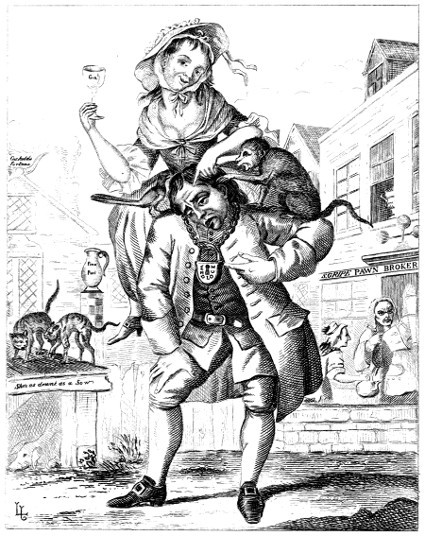
Drawn by Experience
Engraved by Sorrow
a Man Loaded with Mischief, or Matrimony.
A Monkey, a Magpie, and Wife; Is the true Emblem of Strife.
Large image (263 kB)
THE
HISTORY OF SIGNBOARDS
From the Earliest Times to the Present Day
BY JACOB LARWOOD AND
JOHN CAMDEN HOTTEN
“He would name you all the signs as he went along”
BEN JONSON’S BARTHOLOMEW FAIR
“Oppida dum peragras peragranda poemata spectes”
DRUNKEN BARNABY’S TRAVELS
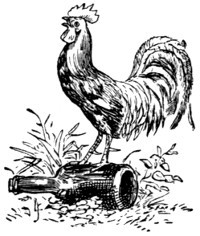
Cock and Bottle
TWELFTH IMPRESSION
WITH ONE HUNDRED ILLUSTRATIONS BY J. LARWOOD
LONDON
CHATTO & WINDUS
1908
To
Thomas Wright, Esq., M.A., F.S.A.,
the Accomplished Interpreter of English Popular Antiquities, this
Little Volume is Dedicated
by
THE AUTHORS.
PREFACE.
The field of history is a wide one, and when the beaten tracks have been well traversed, there will yet remain some of the lesser paths to explore. The following attempt at a “History of Signboards” may be deemed the result of an exploration in one of these by-ways.
Although from the days of Addison’s Spectator down to the present time many short articles have been written upon house-signs, nothing like a general inquiry into the subject has, as yet, been published in this country. The extraordinary number of examples and the numerous absurd combinations afforded such a mass of entangled material as doubtless deterred writers from proceeding beyond an occasional article in a magazine, or a chapter in a book,—when only the more famous signs would be cited as instances of popular humour or local renown. How best to classify and treat the thousands of single and double signs was the chief difficulty in compiling the present work. That it will in every respect satisfy the reader is more than is expected—indeed much more than could be hoped for under the best of circumstances.
In these modern days, the signboard is a very unimportant object: it was not always so. At a time when but few persons could read and write, house-signs were indispensable in city life. As education spread they were less needed; and when in the last century, the system of numbering houses was introduced, and every thoroughfare had its name painted at the beginning and end, they were no longer a positive necessity—their original value was gone, and they lingered on, not by reason of their usefulness, but as instances of the decorative humour of our ancestors, or as advertisements of established reputation and business success. For the names of many of our streets we are indebted to the sign of the old inn or public-house, which frequently was the first building in the street—commonly enough suggesting its erection, or at least a few houses by way of commencement. The huge “London Directory” contains the names of hundreds of streets in the metropolis which derived their titles from taverns or public-houses in the immediate neighbourhood. As material for the etymology of the names of persons and places, the various old signs may be studied with advantage. In many other ways the historic importance of house-signs could be shown.
Something like a classification of our subject was found absolutely necessary at the outset, although from the indefinite nature of many signs the divisions “Historic,” “Heraldic,” “Animal,” &c.—under which the various examples have been arranged—must be regarded as purely arbitrary, for in many instances it would be impossible to say whether such and such a sign should be included under the one head or under the other. The explanations offered as to origin and meaning are based rather upon conjecture and speculation than upon fact—as only in very rare instances reliable data could be produced to bear them out. Compound signs but increase the difficulty of explanation: if the road was uncertain before, almost all traces of a pathway are destroyed here. When, therefore, a solution is offered, it must be considered only as a suggestion of the possible meaning. As a rule, and unless the symbols be very obvious, the reader would do well to consider the majority of compound signs as quarterings or combinations of others, without any hidden signification. A double signboard has its parallel in commerce, where for a common advantage, two merchants will unite their interests under a double name; but as in the one case so in the other, no rule besides the immediate interests of those concerned can be laid down for such combinations.
A great many signs, both single and compound, have been omitted. To have included all, together with such particulars of their history as could be obtained, would have required at least half-a-dozen folio volumes. However, but few signs of any importance are known to have been omitted, and care has been taken to give fair samples of the numerous varieties of the compound sign. As the work progressed a large quantity of material accumulated for which no space could be found, such as “A proposal to the House of Commons for raising above half a million of money per annum, with a great ease to the subject, by a TAX upon SIGNS, London, 1695,” a very curious tract; a political jeu-d’esprit from the Harleian MSS., (5953,) entitled “The Civill Warres of the Citie,” a lengthy document prepared for a journal in the reign of William of Orange by one “E. I.,” and giving the names and whereabouts of the principal London signs at that time. Acts of Parliament for the removal or limitation of signs; and various religious pamphlets upon the subject, such as “Helps for Spiritual Meditation, earnestly Recommended to the Perusal of all those who desire to have their Hearts much with God,” a chap-book of the time of Wesley and Whitfield, in which the existing “Signs of London are Spiritualized, with an Intent, that when a person walks along the Street, instead of having their Mind fill’d with Vanity, and their Thoughts amus’d with the trifling Things that continually present themselves, they may be able to Think of something Profitable.”
Anecdotes and historical facts have been introduced with a double view; first, as authentic proofs of the existence and age of the sign; secondly, in the hope that they may afford variety and entertainment. They will call up many a picture of the olden time; many a trait of bygone manners and customs—old shops and residents, old modes of transacting business, in short, much that is now extinct and obsolete. There is a peculiar pleasure in pondering over these old houses, and picturing them to ourselves as again inhabited by the busy tenants of former years; in meeting the great names of history in the hours of relaxation, in calling up the scenes which must have been often witnessed in the haunt of the pleasure-seeker,—the tavern with its noisy company, the coffee-house with its politicians and smart beaux; and, on the other hand, the quiet, unpretending shop of the ancient bookseller filled with the monuments of departed minds. Such scraps of history may help to picture this old London as it appeared during the last three centuries. For the contemplative mind there is some charm even in getting at the names and occupations of the former inmates of the houses now only remembered by their signs; in tracing, by means of these house decorations, their modes of thought or their ideas of humour, and in rescuing from oblivion a few little anecdotes and minor facts of history connected with the house before which those signs swung in the air.
It is a pity that such a task as the following was not undertaken many years ago; it would have been much better accomplished then than now. London is so rapidly changing its aspect, that ten years hence many of the particulars here gathered could no longer be collected. Already, during the printing of this work, three old houses famous for their signs have been doomed to destruction—the Mitre in Fleet Street, the Tabard in Southwark, (where Chaucer’s pilgrims lay,) and Don Saltero’s house in Cheyne Walk, Chelsea. The best existing specimens of old signboards may be seen in our cathedral towns. Antiquaries cling to these places, and the inhabitants themselves are generally animated by a strong conservative feeling. In London an entire street might be removed with far less of public discussion than would attend the taking down of an old decayed sign in one of these provincial cities. Does the reader remember an article in Punch, about two years ago, entitled “Asses in Canterbury?” It was in ridicule of the Canterbury Commissioners of Pavement, who had held grave deliberations on the well-known sign of Sir John Falstaff, hanging from the front of the hotel of that name,—a house which has been open for public entertainment these three hundred years. The knight with sword and buckler (from “Henry the Fourth,”) was suspended from some ornamental iron-work, far above the pavement, in the open thoroughfare leading to the famous Westgate, and formed one of the most noticeable objects in this part of Canterbury. In 1787, when the general order was issued for the removal of all the signs in the city—many of them obstructed the thoroughfares—this was looked upon with so much veneration that it was allowed to remain until 1863, when for no apparent reason it was sentenced to destruction. However, it was only with the greatest difficulty that men could be found to pull it down, and then several cans of beer had first to be distributed amongst them as an incentive to action—in so great veneration was the old sign held even by the lower orders of the place. Eight pounds were paid for this destruction, which, for fear of a riot, was effected at three in the morning, “amid the groans and hisses of the assembled multitude,” says a local paper. Previous to the demolition the greatest excitement had existed in the place; the newspapers were filled with articles; a petition with 400 signatures—including an M.P., the prebends, minor canons, and clergy of the cathedral—prayed the local “commissioners” that the sign might be spared; and the whole community was in an uproar. No sooner was the old portrait of Sir John removed than another was put up; but this representing the knight as seated, and with a can of ale by his side, however much it may suit the modern publican’s notion of military ardour, does not please the owner of the property, and a fac-simile of the time-honoured original is in course of preparation.
Concerning the internal arrangement of the following work, a few explanations seem necessary.
Where a street is mentioned without the town being specified, it in all cases refers to a London thoroughfare.
The trades tokens so frequently referred to, it will be scarcely necessary to state, were the brass farthings issued by shop or tavern keepers, and generally adorned with a representation of the sign of the house. Nearly all the tokens alluded to belong to the latter part of the seventeenth century, mostly to the reign of Charles II.
As the work has been two years in the press, the passing events mentioned in the earlier sheets refer to the year 1864.
In a few instances it was found impossible to ascertain whether certain signs spoken of as existing really do exist, or whether those mentioned as things of the past are in reality so. The wide distances at which they are situated prevented personal examination in every case, and local histories fail to give such small particulars.
The rude unattractive woodcuts inserted in the work are in most instances fac-similes, which have been chosen as genuine examples of the style in which the various old signs were represented. The blame of the coarse and primitive execution, therefore, rests entirely with the ancient artist, whether sign painter or engraver.
Translations of the various quotations from foreign languages have been added for the following reasons:—It was necessary to translate the numerous quotations from the Dutch signboards; Latin was Englished for the benefit of the ladies, and Italian and French extracts were Anglicised to correspond with rest.
Errors, both of fact and opinion, may doubtless be discovered in the book. If, however, the compilers have erred in a statement or an explanation, they do not wish to remain in the dark, and any light thrown upon a doubtful passage will be acknowledged by them with thanks. Numerous local signs—famous in their own neighbourhood—will have been omitted, (generally, however, for the reasons mentioned on a preceding page,) whilst many curious anecdotes and particulars concerning their history may be within the knowledge of provincial readers. For any information of this kind the compilers will be much obliged; and should their work ever pass to a second edition, they hope to avail themselves of such friendly contributions.
London, June 1866.
CONTENTS.
PAGE
CHAPTER I.
GENERAL SURVEY OF SIGNBOARD HISTORY,
1CHAPTER II.
HISTORIC AND COMMEMORATIVE SIGNS,
45CHAPTER III.
HERALDIC AND EMBLEMATIC SIGNS,
101CHAPTER IV.
SIGNS OF ANIMALS AND MONSTERS,
150CHAPTER V.
BIRDS AND FOWLS,
199CHAPTER VI.
FISHES AND INSECTS,
225CHAPTER VII.
FLOWERS, TREES, HERBS, ETC.,
233CHAPTER VIII.
BIBLICAL AND RELIGIOUS SIGNS,
253CHAPTER IX.
SAINTS, MARTYRS, ETC.,
279CHAPTER X.
DIGNITIES, TRADES, AND PROFESSIONS,
305CHAPTER XI.
THE HOUSE AND THE TABLE,
375CHAPTER XII.
DRESS; PLAIN AND ORNAMENTAL,
399CHAPTER XIII.
GEOGRAPHY AND TOPOGRAPHY,
414CHAPTER XIV.
HUMOROUS AND COMIC,
437CHAPTER XV.
PUNS AND REBUSES,
469CHAPTER XVI.
MISCELLANEOUS SIGNS,
476APPENDIX.
BONNELL THORNTON’S SIGNBOARD EXHIBITION,
512INDEX
OF ALL THE SIGNS MENTIONED IN THE WORK, 527PLATE I.
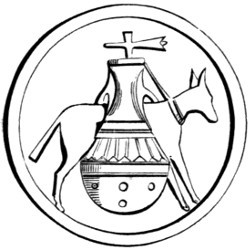
BAKER.
(Pompeii,
A.D.70.)
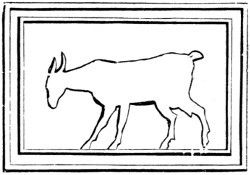
DAIRY.
(Pompeii,
A.D.70.)
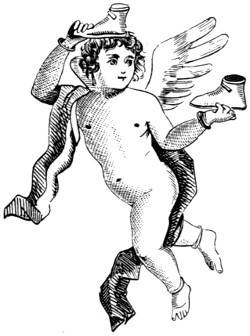
SHOEMAKER.
(Herculaneum.)
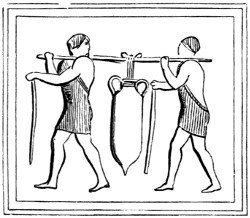
WINE MERCHANT.
(Pompeii,
A.D.70.)
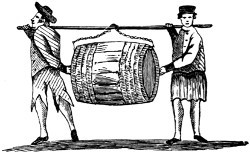
TWO JOLLY BREWERS.
(Banks’s Bills, 1770.)
CHAPTER I.
GENERAL SURVEY OF SIGNBOARD HISTORY.
In the cities of the East all trades are confined to certain streets, or to certain rows in the various bazars and wekalehs. Jewellers, silk-embroiderers, pipe-dealers, traders in drugs,—each of these classes has its own quarter, where, in little open shops, the merchants sit enthroned upon a kind of low counter, enjoying their pipes and their coffee with the otium cum dignitate characteristic of the Mussulman. The purchaser knows the row to go to; sees at a glance what each shop contains; and, if he be an habitué, will know the face of each particular shopkeeper, so that under these circumstances, signboards would be of no use.
With the ancient Egyptians it was much the same. As a rule, no picture or description affixed to the shop announced the trade of the owner; the goods exposed for sale were thought sufficient to attract attention. Occasionally, however, there were inscriptions denoting the trade, with the emblem which indicated it;[1] whence we may assume that this ancient nation was the first to appreciate the benefit that might be derived from signboards.
What we know of the Greek signs is very meagre and indefinite. Aristophanes, Lucian, and other writers, make frequent allusions, which seem to prove that signboards were in use with the Greeks. Thus Aristotle says: ὡσπερ επι των καπηλιων γραφομενοι, μικροι μεν εισι, φαινονται δε εχοντες πλατη και βαθη.[2] And Athenæus: εν προτεροις θηκη διδασκαλιην.[3] But what their signs were, and whether carved, painted, or the natural object, is entirely unknown.
With the Romans only we begin to have distinct data. In the Eternal City, some streets, as in our mediæval towns, derived their names from signs. Such, for instance, was the vicus Ursi Pileati, (the street of “The Bear with the Hat on,”) in the Esquiliæ. The nature of their signs, also, is well known. The Bush, their tavern-sign, gave rise to the proverb, “Vino vendibili suspensa hedera non opus est;” and hence we derive our sign of the Bush, and our proverb, “Good Wine needs no Bush.” An ansa, or handle of a pitcher, was the sign of their post-houses, (stathmoi or allagæ,) and hence these establishments were afterwards denominated ansæ.[4] That they also had painted signs, or exterior decorations which served their purpose, is clearly evident from various authors:—
“Quum victi Mures Mustelarum exercitu (Historia quorum in tabernis pingitur.)”[5]
Phædrus, lib. iv. fab. vi.
These Roman street pictures were occasionally no mean works of art, as we may learn from a passage in Horace:—
“Contento poplite miror Proelia, rubrico picta aut carbone; velut si Re vera pugnent, feriant vitentque moventes Arma viri.”[6]
Cicero also is supposed by some scholars to allude to a sign when he says:—
“Jam ostendamcujus modi sis: quum ille ‘ostende quæso’ demonstravi digito pictum Gallum in Mariano scuto Cimbrico, sub Novis, distortum ejectâ linguâ, buccis fluentibus, risus est commotus.”[7]
Pliny, after saying that Lucius Mummius was the first in Rome who affixed a picture to the outside of a house, continues:—
“Deinde video et in foro positas vulgo. Hinc enim Crassi oratoris lepos, [here follows the anecdote of the Cock of Marius the Cimberian] . . . In foro fuit et illa pastoris senis cum baculo, de qua Teutonorum legatus respondit, interrogatus quanti eum æstimaret, sibi donari nolle talem vivum verumque.”[8]
Fabius also, according to some, relates the story of the cock, and his explanation is cited:—“Taberna autem erant circa Forum, ac scutum illud signi gratia positum.”[9]
But we can judge even better from an inspection of the Roman signs themselves, as they have come down to us amongst the ruins of Herculaneum and Pompeii. A few were painted; but, as a rule, they appear to have been made of stone, or terra-cotta relievo, and let into the pilasters at the side of the open shop-fronts. Thus there have been found a goat, the sign of a dairy; a mule driving a mill, the sign of a baker, (plate 1.) At the door of a schoolmaster was the not very tempting sign of a boy receiving a good birching. Very similar to our Two Jolly Brewers, carrying a tun slung on a long pole, a Pompeian public-house keeper had two slaves represented above his door, carrying an amphora; and another wine-merchant had a painting of Bacchus pressing a bunch of grapes. At a perfumer’s shop, in the street of Mercury, were represented various items of that profession—viz., four men carrying a box with vases of perfume, men occupied in laying out and perfuming a corpse, &c. There was also a sign similar to the one mentioned by Horace, the Two Gladiators, under which, in the usual Pompeian cacography, was the following imprecation:—Abiat Venerem Pompeiianama iradam qui hoc læserit, i.e., Habeat Venerem Pompeianam iratam, &c. Besides these there were the signs of the Anchor, the Ship, (perhaps a ship-chandler’s,) a sort of a Cross, the Chequers, the Phallus on a baker’s shop, with the words, Hic habitat felicitas; whilst in Herculaneum there was a very cleverly painted Amorino, or Cupid, carrying a pair of ladies’ shoes, one on his head and the other in his hand.
It is also probable that, at a later period at all events, the various artificers of Rome had their tools as the sign of their house, to indicate their profession. We find that they sculptured them on their tombs in the catacombs, and may safely conclude that they would do the same on their houses in the land of the living. Thus on the tomb of Diogenes, the grave-digger, there is a pick-axe and a lamp; Bauto and Maxima have the tools of carpenters, a saw, an adze, and a chisel; Veneria, a tire-woman, has a mirror and a comb:—then there are others who have wool-combers’ implements; a physician, who has a cupping-glass; a poulterer, a case of poultry; a surveyor, a measuring rule; a baker, a bushel, a millstone, and ears of corn; in fact, almost every trade had its symbolic implements. Even that cockney custom of punning on the name, so common on signboards, finds its precedent in those mansions of the dead. Owing to this fancy, the grave of Dracontius bore a dragon; Onager, a wild ass; Umbricius, a shady tree; Leo, a lion; Doleus, father and son, two casks; Herbacia, two baskets of herbs; and Porcula, a pig. Now it seems most probable that, since these emblems were used to indicate where a baker, a carpenter, or a tire-woman was buried, they would adopt similar symbols above ground, to acquaint the public where a baker, a carpenter, or a tire-woman lived.
We may thus conclude that our forefathers adopted the signboard from the Romans; and though at first there were certainly not so many shops as to require a picture for distinction,—as the open shop-front did not necessitate any emblem to indicate the trade carried on within,—yet the inns by the road-side, and in the towns, would undoubtedly have them. There was the Roman bush of evergreens to indicate the sale of wine;[10] and certain devices would doubtless be adopted to attract the attention of the different classes of wayfarers, as the Cross for the Christian customer,[11] and the Sun or the Moon for the pagan. Then we find various emblems, or standards, to court respectively the custom of the Saxon, the Dane, or the Briton. He that desired the patronage of soldiers might put up some weapon; or, if he sought his customers among the more quiet artificers, there were the various implements of trade with which he could appeal to the different mechanics that frequented his neighbourhood.
Along with these very simple signs, at a later period, coats of arms, crests, and badges, would gradually make their appearance at the doors of shops and inns. The reasons which dictated the choice of such subjects were various. One of the principal was this. In the Middle Ages, the houses of the nobility, both in town and country, when the family was absent, were used as hostelries for travellers. The family arms always hung in front of the house, and the most conspicuous object in those arms gave a name to the establishment amongst travellers, who, unacquainted with the mysteries of heraldry, called a lion gules or azure by the vernacular name of the Red or Blue Lion.[12] Such coats of arms gradually became a very popular intimation that there was—
“Good entertainment for all that passes,— Horses, mares, men, and asses;”
and innkeepers began to adopt them, hanging out red lions and green dragons as the best way to acquaint the public that they offered food and shelter.
Still, as long as civilisation was only at a low ebb, the so-called open-houses few, and competition trifling, signs were of but little use. A few objects, typical of the trade carried on, would suffice; a knife for the cutler, a stocking for the hosier, a hand for the glover, a pair of scissors for the tailor, a bunch of grapes for the vintner, fully answered public requirements. But as luxury increased, and the number of houses or shops dealing in the same article multiplied, something more was wanted. Particular trades continued to be confined to particular streets; the desideratum then was, to give to each shop a name or token by which it might be mentioned in conversation, so that it could be recommended and customers sent to it. Reading was still a scarce acquirement; consequently, to write up the owner’s name would have been of little use. Those that could, advertised their name by a rebus; thus, a hare and a bottle stood for Harebottle, and two cocks for Cox. Others, whose names no rebus could represent, adopted pictorial objects; and, as the quantity of these augmented, new subjects were continually required. The animal kingdom was ransacked, from the mighty elephant to the humble bee, from the eagle to the sparrow; the vegetable kingdom, from the palm-tree and cedar to the marigold and daisy; everything on the earth, and in the firmament above it, was put under contribution. Portraits of the great men of all ages, and views of towns, both painted with a great deal more of fancy than of truth; articles of dress, implements of trades, domestic utensils, things visible and invisible, ea quæ sunt tamquam ea quæ non sunt, everything was attempted in order to attract attention and to obtain publicity. Finally, as all signs in a town were painted by the same small number of individuals, whose talents and imagination were limited, it followed that the same subjects were naturally often repeated, introducing only a change in the colour for a difference.
Since all the pictorial representations were, then, of much the same quality, rival tradesmen tried to outvie each other in the size of their signs, each one striving to obtrude his picture into public notice by putting it out further in the street than his neighbour’s. The “Liber Albus,” compiled in 1419, names this subject amongst the Inquisitions at the Wardmotes: “Item, if the ale-stake of any tavern is longer or extends further than ordinary.” And in book iii. part iii. p. 389, is said:—
“Also, it was ordained that, whereas the ale-stakes projecting in front of taverns in Chepe, and elsewhere in the said city, extend too far over the King’s highways, to the impeding of riders and others, and, by reason of their excessive weight, to the great deterioration of the houses in which they are fixed;—to the end that opportune remedy might be made thereof, it was by the Mayor and Aldermen granted and ordained, and, upon summons of all the taverners of the said city, it was enjoined upon them, under pain of paying forty pence[13] unto the Chamber of the Guildhall, on every occasion upon which they should transgress such ordinance, that no one of them in future should have a stake, bearing either his sign, or leaves, extending or lying over the King’s highway, of greater length than seven feet at most, and that this ordinance should begin to take effect at the Feast of Saint Michael, then next ensuing, always thereafter to be valid and of full effect.”
The booksellers generally had a woodcut of their signs for the colophon of their books, so that their shops might get known by the inspection of these cuts. For this reason, Benedict Hector, one of the early Bolognese printers, gives this advice to the buyers in his “Justinus et Florus:”—
“Emptor, attende quando vis emere libros formatos in officina mea excussoria, inspice signum quod in liminari pagina est, ita numquam falleris. Nam quidam malevoli Impressores libris suis inemendatis et maculosis apponunt nomen meum ut fiant vendibiliores.”[14]
Jodocus Badius of Paris, gives a similar caution:—
“Oratum facimus lectorem ut signum inspiciat, nam sunt qui titulum nomenque Badianum mentiantur et laborem suffurentur.”[15]
Aldus, the great Venetian printer, exposes a similar fraud, and points out how the pirate had copied the sign also in his colophon; but, by inadvertency, making a slight alteration:—
“Extremum est ut admoneamus studiosissimum quemque, Florentinos quosdam impressores, cum viderint se diligentiam nostram in castigando et imprimendo non posse assequi, ad artes confugisse solitas; hoc est Grammaticis Institutionibus Aldi in sua officina formatis, notam Delphini Anchoræ Involuti nostram apposuisse; sed ita egerunt ut quivis mediocriter versatus in libris impressionis nostræ animadvertit illos impudenter fecisse. Nam rostrum Delphini in partem sinistram vergit, cum tamen nostrum in dexteram totum demittatur.”[16]
No wonder, then, that a sign was considered an heirloom, and descended from father to son, like the coat of arms of the nobility, which was the case with the Brazen Serpent, the sign of Reynold Wolfe. “His trade was continued a good while after his demise by his wife Joan, who made her will the 1st of July 1574, whereby she desires to be buried near her husband, in St Faith’s Church, and bequeathed to her son, Robert Wolfe, the chapel-house, [their printing-office,] the Brazen Serpent, and all the prints, letters, furniture,” etc.—Dibdin’s Typ. Ant., vol. iv. p. 6.
As we observed above, directly signboards were generally adopted, quaintness became one of the desiderata, and costliness another. This last could be obtained by the quality of the picture, but, for two reasons, was not much aimed at—firstly, because good artists were scarce in those days; and even had they obtained a good picture, the ignorant crowd that daily passed underneath the sign would, in all probability, have thought the harsh and glaring daub a finer production of art than a Holy Virgin by Rafaelle himself. The other reason was the instability of such a work, exposed to sun, wind, rain, frost, and the nightly attacks of revellers and roisters. Greater care, therefore, was bestowed upon the ornamentation of the ironwork by which it was suspended; and this was perfectly in keeping with the taste of the times, when even the simplest lock or hinges could not be launched into the world without its scrolls and strapwork.
The signs then were suspended from an iron bar, fixed either in the wall of the house, or in a post or obelisk standing in front of it; in both cases the ironwork was shaped and ornamented with that taste so conspicuous in the metal-work of the Renaissance period, of which many churches, and other buildings of that period, still bear witness. In provincial towns and villages, where there was sufficient room in the streets, the sign was generally suspended from a kind of small triumphal arch, standing out in the road, partly wood, partly iron, and ornamented with all that carving, gilding, and colouring could bestow upon it, (see description of White-Hart Inn at Scole.) Some of the designs of this class of ironwork have come down to us in the works of the old masters, and are indeed exquisite.
Painted signs then, suspended in the way we have just pointed out, were more common than those of any other kind; yet not a few shops simply suspended at their doors some prominent article in their trade, which custom has outlived the more elegant signboards, and may be daily witnessed in our streets, where the ironmonger’s frying-pan, or dust-pan, the hardware-dealer’s teapot, the grocer’s tea-canister, the shoemaker’s last or clog, with the Golden Boot, and many similar objects, bear witness to this old custom.
Lastly, there was in London another class of houses that had a peculiar way of placing their signs—viz., the Stews upon the Bankside, which were, by a proclamation of 37 Hen. VIII., “whited and painted with signs on the front, for a token of the said houses.” Stow enumerates some of these symbols, such as the Cross-Keys, the Gun, the Castle, the Crane, the Cardinal’s Hat, the Bell, the Swan, &c.
Still greater variety in the construction of the signs existed in France; for besides the painted signs in the iron frames, the shopkeepers in Paris, according to H. Sauval, (“Antiquités de la Ville de Paris,”) had anciently banners hanging above their doors, or from their windows, with the sign of the shop painted on them; whilst in the sixteenth century carved wooden signs were very common. These, however, were not suspended, but formed part of the wooden construction of the house; some of them were really chefs-d’œuvres, and as careful in design as a carved cathedral stall. Several of them are still remaining in Rouen and other old towns; many also have been removed and placed in various local museums of antiquities. The most general rule, however, on the Continent, as in England, was to have the painted signboard suspended across the streets.
An observer of James I.’s time has jotted down the names of all the inns, taverns, and side streets in the line of road between Charing Cross and the old Tower of London, which document lies now embalmed amongst the Harl. MS., 6850, fol. 31. In imagination we can walk with him through the metropolis:—
“On the way from Whitehall to Charing Cross we pass: the White Hart, the Red Lion, the Mairmade, iij. Tuns, Salutation, the Graihound, the Bell, the Golden Lyon. In sight of Charing Crosse: the Garter, the Crown, the Bear and Ragged Staffe, the Angel, the King Harry Head. Then from Charing Cross towards ye cittie: another White Hart, the Eagle and Child, the Helmet, the Swan, the Bell, King Harry Head, the Flower-de-luce, Angel, the Holy Lambe, the Bear and Harroe, the Plough, the Shippe, the Black Bell, another King Harry Head, the Bull Head, the Golden Bull, ‘a sixpenny ordinarye,’ another Flower-de-luce, the Red Lyon, the Horns, the White Hors, the Prince’s Arms, Bell Savadge’s In, the S. John the Baptist, the Talbot, the Shipp of War, the S. Dunstan, the Hercules or the Owld Man Tavern, the Mitar, another iij. Tunnes Inn, and a iij. Tunnes Tavern, and a Graihound, another Mitar, another King Harry Head, iij. Tunnes, and the iij. Cranes.”
Having walked from Whitechapel “straight forward to the Tower,” the good citizen got tired, and so we hear no more of him.
In the next reign we find the following enumerated by Taylor the water-poet, in one of his facetious pamphlets:—5 Angels, 4 Anchors, 6 Bells, 5 Bullsheads, 4 Black Bulls, 4 Bears, 5 Bears and Dolphins, 10 Castles, 4 Crosses, (red or white,) 7 Three Crowns, 7 Green Dragons, 6 Dogs, 5 Fountains, 3 Fleeces, 8 Globes, 5 Greyhounds, 9 White Harts, 4 White Horses, 5 Harrows, 20 King’s Heads, 7 King’s Arms, 1 Queen’s Head, 8 Golden Lyons, 6 Red Lyons, 7 Halfmoons, 10 Mitres, 33 Maidenheads, 10 Mermaids, 2 Mouths, 8 Nagsheads, 8 Prince’s Arms, 4 Pope’s Heads, 13 Suns, 8 Stars, &c. Besides these he mentions an Adam and Eve, an Antwerp Tavern, a Cat, a Christopher, a Cooper’s Hoop, a Goat, a Garter, a Hart’s Horn, a Mitre, &c. These were all taverns in London; and it will be observed that their signs were very similar to those seen at the present day—a remark applicable to the taverns not only of England, but of Europe generally, at this period. In another work Taylor gives us the signs of the taverns[17] and alehouses in ten shires and counties about London, all similar to those we have just enumerated; but amongst the number, it may be noted, there is not one combination of two objects, except the Eagle and Child, and the Bear and Ragged Staff. In a black-letter tract entitled “Newes from Bartholomew Fayre,” the following are named:—
In old times the ale-house windows were generally open, so that the company within might enjoy the fresh air, and see all that was going on in the street; but, as the scenes within were not always fit to be seen by the “profanum vulgus” that passed by, a trellis was put up in the open window. This trellis, or lattice, was generally painted red, to the intent, it has been jocularly suggested, that it might harmonise with the rich hue of the customers’ noses; which effect, at all events, was obtained by the choice of this colour. Thus Pistol says:—
[1] Sir Gardiner Wilkinson’s Ancient Egyptians, vol. iii. p. 158. Also, Rosellini Monumenti dell’Egitto e della Nubia.
[2] Aristotle, Problematum x. 14: “As with the things drawn above the shops, which, though they are small, appear to have breadth and depth.”
[3] “He hung the well-known sign in the front of his house.”
[4] Hearne, Antiq. Disc., i. 39.
[5] “When the mice were conquered by the army of the weasels, (a story which we see painted on the taverns.)”
[6] Lib. ii. sat. vii.: “I admire the position of the men that are fighting, painted in red or in black, as if they were really alive; striking and avoiding each other’s weapons, as if they were actually moving.”
[7] De Oratore, lib. ii. ch. 71: “Now I shall shew you how you are, to which he answered, ‘Do, please.’ Then I pointed with my finger towards the Cock painted on the signboard of Marius the Cimberian, on the New Forum, distorted, with his tongue out and hanging cheeks. Everybody began to laugh.”
[8] Hist. Nat., xxxv. ch. 8: “After this I find that they were also commonly placed on the Forum. Hence that joke of Crassus, the orator. . . . On the Forum was also that of an old shepherd with a staff, concerning which a German legate, being asked at how much he valued it, answered that he would not care to have such a man given to him as a present, even if he were real and alive.”
[9] “There were, namely, taverns round about the Forum, and that picture [the Cock] had been put up as a sign.”
[10] The Bush certainly must be counted amongst the most ancient and popular of signs. Traces of its use are not only found among Roman and other old-world remains, but during the Middle Ages we have evidence of its display. Indications of it are to be seen in the Bayeux tapestry, in that part where a house is set on fire, with the inscription, Hic domus incenditur, next to which appears a large building, from which projects something very like a pole and a bush, both at the front and the back of the building.
[11] In Cædmon’s Metrical Paraphrase of Scripture History, (circa A.D. 1000,) in the drawings relating to the history of Abraham, there are distinctly represented certain cruciform ornaments painted on the walls, which might serve the purpose of signs. (See upon this subject under “Religious Signs.”)
[12] The palace of St Laurence Poulteney, the town residence of Charles Brandon, Duke of Suffolk, and also of the Dukes of Buckingham, was called the Rose, from that badge being hung up in front of the house:—
[13] Rather a heavy fine, as the best ale at that time was not to be sold for more than three-halfpence a gallon.
[14] “Purchaser, be aware when you wish to buy books issued from my printing-office. Look at my sign, which is represented on the title-page, and you can never be mistaken. For some evil-disposed printers have affixed my name to their uncorrected and faulty works, in order to secure a better sale for them.”
[15] “We beg the reader to notice the sign, for there are men who have adopted the same title, and the name of Badius, and so filch our labour.”
[16] “Lastly, I must draw the attention of the student to the fact that some Florentine printers, seeing that they could not equal our diligence in correcting and printing, have resorted to their usual artifices. To Aldus’s Institutiones Grammaticæ, printed in their offices, they have affixed our well-known sign of the Dolphin wound round the Anchor. But they have so managed, that any person who is in the least acquainted with the books of our production, cannot fail to observe that this is an impudent fraud. For the head of the Dolphin is turned to the left, whereas that of ours is well known to be turned to the right.”—Preface to Aldus’s Livy, 1518.
[17] The number of taverns in these ten shires was “686, or thereabouts.”
“There has been great sale and utterance of Wine, Besides Beer, Ale, and Hippocrass fine, In every Country, Region, and Nation, Chiefly at Billingsgate, at the Salutation;[10] And Boreshead near London Stone, The Swan at Dowgate, a tavern well knowne; The Mitre in Cheap, and the Bullhead, And many like places that make noses red; The Boreshead in Old Fish Street, Three Cranes in the Vintree, And now, of late, Saint Martin’s in the Sentree; The Windmill in Lothbury, the Ship at the Exchange, King’s Head in New Fish Street, where Roysters do range; The Mermaid in Cornhill, Red Lion in the Strand, Three Tuns in Newgate Market, in Old Fish Street the Swan.”
Drunken Barnaby, (1634,) in his travels, called at several of the London taverns, which he has recorded in his vinous flights:—
“Country left I in a fury, To the Axe in Aldermanbury First arrived, that place slighted, I at the Rose in Holborn lighted. From the Rose in Flaggons sail I To the Griffin i’ th’ Old Bailey, Where no sooner do I waken, Than to Three Cranes I am taken, Where I lodge and am no starter. ...... Yea, my merry mates and I, too, Oft the Cardinal’s Hat do fly to. There at Hart’s Horns we carouse,” &c.
Already, in very early times, publicans were compelled by law to have a sign; for we find that in the 16 Richard II., (1393,) Florence North, a brewer of Chelsea, was “presented” “for not putting up the usual sign.”[18] In Cambridge the regulations were equally severe; by an Act of Parliament, 9 Henry VI., it was enacted: “Quicunq; de villa Cantebrigg ‘braciaverit ad vendend’ exponat signum suum, alioquin omittat cervisiam.”—Rolls of Parliament, vol. v. fol. 426 a.[19] But with the other trades it was always optional. Hence Charles I., on his accession to the throne, gave the inhabitants of London a charter by which, amongst other favours, he granted them the right to hang out signboards:—
“And further, we do give and grant to the said Mayor, and Commonalty, and Citizens of the said city, and their successors, that it may and shall be lawful to the Citizens of the same city and any of them, for the time being, to expose and hang in and over the streets, and ways, and alleys of the said city and suburbs of the same, signs, and posts of signs, affixed to their houses and shops, for the better finding out such citizens’ dwellings, shops, arts, or occupations, without impediment, molestation, or interruption of his heirs or successors.”
In France, the innkeepers were under the same regulations as in England; for there also, by the edict of Moulins, in 1567, all innkeepers were ordered to acquaint the magistrates with their name and address, and their “affectes et enseignes;” and Henri III., by an edict of March 1577, ordered that all innkeepers should place a sign on the most conspicuous part of their houses, “aux lieux les plus apparents;” so that everybody, even those that could not read, should be aware of their profession. Louis XIV., by an ordnance of 1693, again ordered signs to be put up, and also the price of the articles they were entitled to sell:—
“Art. XXIII.—Taverniers metront enseignes et bouchons. . . . Nul ne pourra tenir taverne en cette dite ville et faubourgs, sans mettre enseigne et bouchon.”[20]
Hence, the taking away of a publican’s licence was accompanied by the taking away of his sign:—
“For this gross fault I here do damn thy licence, Forbidding thee ever to tap or draw; For instantly I will in mine own person, Command the constables to pull down thy sign.”
Massinger, A New Way to Pay Old Debts, iv. 2.
At the time of the great Civil War, house-signs played no inconsiderable part in the changes and convulsions of the state, and took a prominent place in the politics of the day. We may cite an earlier example, where a sign was made a matter of high treason—namely, in the case of that unfortunate fellow in Cheapside, who, in the reign of Edward IV., kept the sign of the Crown, and lost his head for saying he would “make his son heir to the Crown.” But more general examples are to be met with in the history of the Commonwealth troubles. At the death of Charles I., John Taylor the water-poet, a Royalist to the backbone, boldly shewed his opinion of that act, by taking as a sign for his alehouse in Phœnix Alley, Long Acre, the Mourning Crown; but he was soon compelled to take it down. Richard Flecknoe, in his “Ænigmatical Characters,” (1665,) tells us how many of the severe Puritans were shocked at anything smelling of Popery:—“As for the signs, they have pretty well begun their reformation already, changing the sign of the Salutation of Our Lady into the Souldier and Citizen, and the Catherine Wheel into the Cat and Wheel; such ridiculous work they make of this reformation, and so jealous they are against all mirth and jollity, as they would pluck down the Cat and Fiddle too, if it durst but play so loud as they might hear it.” No doubt they invented very godly signs, but these have not come down to us.
At that time, also, a fashion prevailed which continued, indeed, as long as the signboard was an important institution—of using house-signs to typify political ideas. Imaginary signs, as a part of secret imprints, conveying most unmistakably the sentiments of the book, were often used in the old days of political plots and violent lampoons. Instance the following:—
“Vox Borealis, or a Northerne Discoverie, by Way of Dialogue, between Jamie and Willie. Amidst the Babylonians—printed by Margery Marprelate, in Thwack Coat Lane, at the sign of the Crab-Tree Cudgell, without any privilege of the Catercaps. 1641.”
“Articles of High Treason made and enacted by the late Halfquarter usurping Convention, and now presented to the publick view for a general satisfaction of all true Englishmen. Imprinted for Erasmus Thorogood, and to be sold at the signe of the Roasted Rump. 1659.”
“A Catalogue of Books of the Newest Fashion, to be sold by auction at the Whigs’ Coffeehouse, at the sign of the Jackanapes in Prating Alley, near the Deanery of Saint Paul’s.”
“The Censure of the Rota upon Mr Milton’s book, entitled ‘The Ready and Easy Way to Establish a Free Commonwealth,’ &c. Printed at London by Paul Giddy, Printer to the Rota, at the sign of the Windmill, in Turn-again Lane. 1660.”
“An Address from the Ladies of the Provinces of Munster and Leinster to their Graces the Duke and Duchess of D——t, Lord G——, and Caiaphas the High Priest, with sixty original toasts, drank by the Ladies at their last Assembly, with Love-letters added. London: Printed for John Pro Patria, at the sign of Vivat Rex. 1754.”
“Chivalry no Trifle, or the Knight and his Lady: a Tale. To which is added the Hue and Cry after Touzer and Spitfire, the Lady’s two lapdogs. Dublin: Printed at the sign of Sir Tady’s Press, etc. 1754.”
“An Address from the Influential Electors of the County and City of Galway, with a Collection of 60 Original Patriot Toasts and 48 Munster Toasts, with Intelligence from the Kingdom of Eutopia. Printed at the sign of the Pirate’s Sword in the Captain’s Scabbard. London, 1754.”
“The C——t’s Apology to the Freeholders of this Kingdom for their conduct, containing some Pieces of Humour, to which is added a Bill of C——t Morality. London: Printed at the sign of Betty Ireland, d——d of a Tyrant in Purple, a Monster in Black, etc.”
In the newspapers of the eighteenth century, we find that signs were constantly used as emblems of, or as sharp hits at, the politics of the day; thus, in the Weekly Journal for August 17, 1718, allusions are made to the sign of the Salutation, in Newgate Street, by the opposition party, to which the Original Weekly Journal, the week after, retaliates by a description and explanation of an indelicate sign said to be in King Street, Westminster. In 1763, the following pasquinade went the round of the newspapers, said to have been sent over from Holland:—
“HÔTELS POUR LES MINISTRES DES COURS ETRANGÈRES AU FUTUR CONGRESS.
De l’Empereur,
À la Bonne Volonté; rue d’Impuissance.
De Russie,
Au Chimère; rue des Caprices.
De France,
Au Coq déplumé; rue de Canada.
D’Autriche,
À la Mauvaise Alliance, rue des Invalides.
D’Angleterre,
À la Fortune, Place des Victoires, rue des Subsides.
De Prusse,
Aux Quatre vents, rue des Renards, près la Place des Guinées.
De Suede,
Au Passage des Courtisans, rue des Visionaires.
De Pologne,
Au Sacrifice d’Abraham, rue des Innocents, près la Place des Devôts.
Des Princes de l’Empire,
Au Roitelêt, près de l’Hôpital des Incurables, rue des Charlatans.
De Wirtemberg,
Au Don Quichotte, rue des Fantômes près de la Montagne en Couche.
D’Hollande,
À la Baleine, sur le Marché aux Fromages, près du Grand Observatoire.”
On the morning of September 28, 1736, all the tavern-signs in London were in deep mourning; and no wonder, their dearly beloved patron and friend Gin was defunct,—killed by the new Act against spirituous liquors! But they soon dropped their mourning, for Gin had only been in a lethargic fit, and woke up much refreshed by his sleep. Fifteen years after, when Hogarth painted his “Gin Lane,” royal gin was to be had cheap enough, if we may believe the signboard in that picture, which informs us that “gentlemen and others” could get “drunk for a penny,” and “dead drunk for twopence,” in which last emergency, “clean straw for nothing” was provided.
Of the signs which were to be seen in London at the period of the Restoration,—to return to the subject we were originally considering,—we find a goodly collection of them in one of the “Roxburghe Ballads,” (vol. i. 212,) entitled:—
“LONDON’S ORDINARIE, OR EVERY MAN IN HIS HUMOUR
THROUGH the Royal Exchange as I walked, Where Gallants in sattin doe shine,[14] At midst of the day, they parted away, To seaverall places to dine.
The Gentrie went to the King’s Head, The Nobles unto the Crowne: The Knights went to the Golden Fleece, And the Ploughmen to the Clowne.
The Cleargie will dine at the Miter, The Vintners at the Three Tunnes, The Usurers to the Devill will goe, And the Fryers to the Nunnes.
The Ladyes will dine at the Feathers, The Globe no Captaine will scorne, The Huntsmen will goe to the Grayhound below, And some Townes-men to the Horne.
The Plummers will dine at the Fountaine, The Cookes at the Holly Lambe, The Drunkerds by noone, to the Man in the Moone, And the Cuckholdes to the Ramme.
The Roarers will dine at the Lyon, The Watermen at the Old Swan; And Bawdes will to the Negro goe, And Whores to the Naked Man.
The Keepers will to the White Hart, The Marchants unto the Shippe, The Beggars they must take their way To the Egge-shell and the Whippe.
The Farryers will to the Horse, The Blackesmith unto the Locke, The Butchers unto the Bull will goe, And the Carmen to Bridewell Clocke.
The Fishmongers unto the Dolphin, The Barbers to the Cheat Loafe,[21] The Turners unto the Ladle will goe, Where they may merrylie quaffe.
The Taylors will dine at the Sheeres, The Shooemakers will to the Boote, The Welshmen they will take their way, And dine at the signe of the Gote.
The Hosiers will dine at the Legge, The Drapers at the signe of the Brush. The Fletchers to Robin Hood will goe, And the Spendthrift to Begger’s Bush.
The Pewterers to the Quarte Pot, The Coopers will dine at the Hoope, The Coblers to the Last will goe, And the Bargemen to the Sloope.[15]
The Carpenters will to the Axe, The Colliers will dine at the Sacke, Your Fruterer he to the Cherry-Tree, Good fellowes no liquor will lacke.
The Goldsmith will to the Three Cups, For money they hold it as drosse; Your Puritan to the Pewter Canne, And your Papists to the Crosse.
The Weavers will dine at the Shuttle, The Glovers will unto the Glove, The Maydens all to the Mayden Head, And true Louers unto the Doue.
The Sadlers will dine at the Saddle, The Painters will to the Greene Dragon, The Dutchmen will go to the Froe,[22] Where each man will drinke his Flagon.
The Chandlers will dine at the Skales, The Salters at the signe of the Bagge; The Porters take pain at the Labour in Vaine, And the Horse-Courser to the White Nagge.
Thus every Man in his humour, That comes from the North or the South, But he that has no money in his purse, May dine at the signe of the Mouth.
The Swaggerers will dine at the Fencers, But those that have lost their wits: With Bedlam Tom let that be their home, And the Drumme the Drummers best fits.
The Cheter will dine at the Checker, The Picke-pockets in a blind alehouse, Tel on and tride then up Holborne they ride, And they there end at the Gallowes.”
Thomas Heywood introduced a similar song in his “Rape of Lucrece.” This, the first of the kind we have met with, is in all probability the original, unless the ballad be a reprint from an older one; but the term Puritan used in it, seems to fix its date to the seventeenth century.
“THE Gintry to the Kings Head, The Nobles to the Crown, The Knights unto the Golden Fleece, And to the Plough the Clowne.
The Churchmen to the Mitre, The Shepheard to the Star, The Gardener hies him to the Rose, To the Drum the Man of War.[16]
The Huntsmen to the White Hart, To the Ship the Merchants goe, But you that doe the Muses love, The sign called River Po.
The Banquerout to the World’s End, The Fool to the Fortune his, Unto the Mouth the Oyster-wife, The Fiddler to the Pie.
The Punk unto the Cockatrice,[23] The Drunkard to the Vine, The Begger to the Bush, there meet, And with Duke Humphrey dine.”[24]
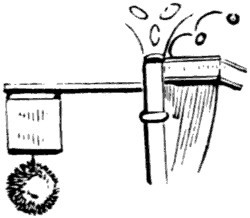
After the great fire of 1666, many of the houses that were rebuilt, instead of the former wooden signboards projecting in the streets, adopted signs carved in stone, and generally painted or gilt, let into the front of the house, beneath the first floor windows. Many of these signs are still to be seen, and will be noticed in their respective places. But in those streets not visited by the fire, things continued on the old footing, each shopkeeper being fired with a noble ambition to project his sign a few inches farther than his neighbour. The consequence was that, what with the narrow streets, the penthouses, and the signboards, the air and light of the heavens were well-nigh intercepted from the luckless wayfarers through the streets of London. We can picture to ourselves the unfortunate plumed, feathered, silken gallant of the period walking, in his low shoes and silk stockings, through the ill-paved dirty streets, on a stormy November day, when the honours were equally divided between fog, sleet, snow, and rain, (and no umbrellas, be it remembered,) with flower-pots blown from the penthouses, spouts sending down shower-baths from almost every house, and the streaming signs swinging overhead on their rusty, creaking hinges. Certainly the evil was great, and demanded that redress which Charles II. gave in the seventh year of his reign, when a new Act “ordered that in all the streets no signboard shall hang across, but that the sign shall be fixed against the balconies, or some convenient part of the side of the house.”
The Parisians, also, were suffering from the same enormities; everything was of Brobdignagian proportions. “J’ai vu,” says an essayist of the middle of the seventeenth century, “suspendu aux boutiques des volants de six pieds de hauteur, des perles grosses comme des tonneaux, des plumes qui allaient au troisième étage.”[25] There, also, the scalpel of the law was at last applied to the evil; for, in 1669, a royal order was issued to prohibit these monstrous signs, and the practice of advancing them too far into the streets, “which made the thoroughfares close in the daytime, and prevented the lights of the lamps from spreading properly at night.”
PLATE II.
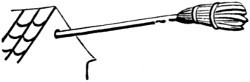
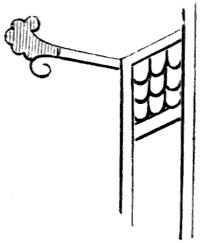
BUSH.
(MS. of the 14th century.)
BUSH.
(Bayeux tapestry, 11th cent.)
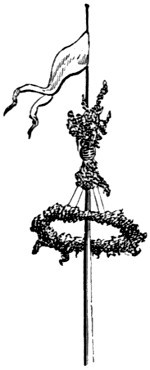
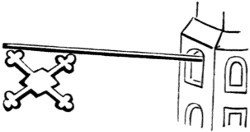
CROSS.
(Luttrell Psalter, 11th century.)
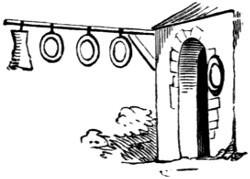
ALE-POLE.
(Picture of Wouwverman, 17th cent.)
BLACK JACK AND PEWTER PLATTER.
(Print by Schavelin, 1480.)
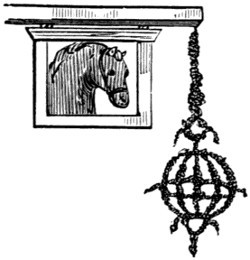
NAG’S HEAD.
(Cheapside. 1640.)
BUSH.
(MS. of the 15th cent.)
Still, with all their faults, the signs had some advantages for the wayfarer; even their dissonant creaking, according to the old weather proverb, was not without its use:—
“But when the swinging signs your ears offend With creaking noise, then rainy floods impend.”
Gay’s Trivia, canto i.
This indeed, from the various allusions made to it in the literature of the last century, was regarded as a very general hint to the lounger, either to hurry home, or hail a sedan-chair or coach. Gay, in his didactic—flâneur—poem, points out another benefit to be derived from the signboards:—
“If drawn by Bus’ness to a street unknown, Let the sworn Porter point thee through the town; Be sure observe the Signs, for Signs remain Like faithful Landmarks to the walking Train.”
Besides, they offered constant matter of thought, speculation, and amusement to the curious observer. Even Dean Swift, and the Lord High Treasurer Harley,
“Would try to read the lines Writ underneath the country signs.”
And certainly these productions of the country muse are often highly amusing. Unfortunately for the compilers of the present work, they have never been collected and preserved; although they would form a not unimportant and characteristic contribution to our popular literature. Our Dutch neighbours have paid more attention to this subject, and a great number of their signboard inscriptions were, towards the close of the seventeenth century, gathered in a curious little 12mo volume,[26] to which we shall often refer. Nay, so much attention was devoted to this branch of literature in that country, that a certain H. van den Berg, in 1693, wrote a little volume,[27] which he entitled a “Banquet,” giving verses adapted for all manner of shops and signboards; so that a shopkeeper at a loss for an inscription had only to open the book and make his selection; for there were rhymes in it both serious and jocular, suitable to everybody’s taste. The majority of the Dutch signboard inscriptions of that day seem to have been eminently characteristic of the spirit of the nation. No such inscriptions could be brought before “a discerning public,” without the patronage of some holy man mentioned in the Scriptures, whose name was to stand there for no other purpose than to give the Dutch poet an opportunity of making a jingling rhyme; thus, for instance,—
“Jacob was David’s neef maar ’t waren geen Zwagers. Hier slypt men allerhande Barbiers gereedschappen, ook voor vischwyven en slagers.”[28]
Or another example:—
“Men vischte Moses uit de Biezen, Hier trekt men tanden en Kiezen.”[29]
In the beginning of the eighteenth century, we find the following signs named, which puzzled a person of an inquisitive turn of mind, who wrote to the British Apollo,[30] (the meagre Notes and Queries of those days,) in the hope of eliciting an explanation of their quaint combination:—
“I’m amazed at the Signs As I pass through the Town, To see the odd mixture: A Magpie and Crown, The Whale and the Crow, The Razor and Hen, The Leg and Seven Stars, The Axe and the Bottle, The Tun and the Lute, The Eagle and Child, The Shovel and Boot.”
All these signs are also named by Tom Brown:[31]—“The first amusements we encountered were the variety and contradictory language of the signs, enough to persuade a man there were no rules of concord among the citizens. Here we saw Joseph’s Dream, the Bull and Mouth, the Whale and Crow, the Shovel and Boot, the Leg and Star, the Bible and Swan, the Frying-pan and Drum, the Lute and Tun, the Hog in Armour, and a thousand others that the wise men that put them there can give no reason for.”
From this enumeration, we see that a century had worked great changes in the signs. Those of the beginning of the seventeenth century were all simple, and had no combinations. But now we meet very heterogeneous objects joined together. Various reasons can be found to account for this. First, it must be borne in mind that most of the London signs had no inscription to tell the public “this is a lion,” or, “this is a bear;” hence the vulgar could easily make mistakes, and call an object by a wrong name, which might give rise to an absurd combination, as in the case of the Leg and Star; which, perhaps, was nothing else but the two insignia of the order of the Garter; the garter being represented in its natural place, on the leg, and the star of the order beside it. Secondly, the name might be corrupted through faulty pronunciation; and when the sign was to be repainted, or imitated in another street, those objects would be represented by which it was best known. Thus the Shovel and Boot might have been a corruption of the Shovel and Boat, since the Shovel and Ship is still a very common sign in places where grain is carried by canal boats; whilst the Bull and Mouth is said to be a corruption of the Boulogne Mouth—the Mouth of Boulogne Harbour. Finally, whimsical shopkeepers would frequently aim at the most odd combination they could imagine, for no other reason but to attract attention. Taking these premises into consideration, some of the signs which so puzzled Tom Brown might be easily accounted for; the Axe and Bottle, in this way, might have been a corruption of the Battle-axe. The Bible and Swan, a sign in honour of Luther, who is generally represented by the symbol of a swan, a figure of which many Lutheran Churches have on their steeple instead of a weathercock; whilst the Lute and Tun was clearly a pun on the name of Luton, similar to the Bolt and Tun of Prior Bolton, who adopted this device as his rebus.
Other causes of combinations, and many very amusing and instructive remarks about signs, are given in the following from the Spectator, No. 28, April 2, 1710:—
“There is nothing like sound literature and good sense to be met with in those objects, that are everywhere thrusting themselves out to the eye and endeavouring to become visible. Our streets are filled with blue boars, black swans, and red lions, not to mention flying-pigs and hogs in armour, with many creatures more extraordinary than any in the deserts of Africa. Strange that one, who has all the birds and beasts in nature to choose out of, should live at the sign of an ens rationis.
“My first task, therefore, should be like that of Hercules, to clear the city from monsters. In the second place, I should forbid that creatures of jarring and incongruous natures should be joined together in the same sign; such as the Bell and the Neat’s Tongue, the Dog and the Gridiron. The Fox and the Goose may be supposed to have met, but what has the Fox and the Seven Stars to do together? And when did the Lamb and Dolphin ever meet except upon a signpost? As for the Cat and Fiddle, there is a conceit in it, and therefore I do not intend that anything I have here said should affect it. I must, however, observe to you upon this subject, that it is usual for a young tradesman, at his first setting up, to add to his own sign that of the master whom he served, as the husband, after marriage, gives a place to his mistress’s arms in his own coat. This I take to have given rise to many of those absurdities which are committed over our heads; and, as I am informed, first occasioned the Three Nuns and a Hare, which we see so frequently joined together. I would therefore establish certain rules for the determining how far one tradesman may give the sign of another, and in what case he may be allowed to quarter it with his own.
“In the third place, I would enjoin every shop to make use of a sign which bears some affinity to the wares in which it deals. What can be more inconsistent than to see a bawd at the sign of the Angel, or a tailor at the Lion? A cook should not live at the Boot, nor a shoemaker at the Roasted Pig; and yet, for want of this regulation, I have seen a Goat set up before the door of a perfumer, and the French King’s Head at a sword-cutler’s.
“An ingenious foreigner observes that several of those gentlemen who value themselves upon their families, and overlook such as are bred to trades, bear the tools of their forefathers in their coats of arms. I will not examine how true this is in fact; but though it may not be necessary for posterity thus to set up the sign of their forefathers, I think it highly proper that those who actually profess the trade should shew some such mark of it before their doors.
“When the name gives an occasion for an ingenious signpost, I would likewise advise the owner to take that opportunity of letting the world know who he is. It would have been ridiculous for the ingenious Mrs Salmon to have lived at the sign of the trout, for which reason she has erected before her house the figure of the fish that is her namesake. Mr Bell has likewise distinguished himself by a device of the same nature. And here, sir, I must beg leave to observe to you, that this particular figure of a Bell has given occasion to several pieces of wit in this head. A man of your reading must know that Abel Drugger gained great applause by it in the time of Ben Jonson. Our Apocryphal heathen god is also represented by this figure, which, in conjunction with the Dragon,[32] makes a very handsome picture in several of our streets. As for the Bell Savage, which is the sign of a savage man standing by a bell, I was formerly very much puzzled upon the conceit of it, till I accidentally fell into the reading of an old romance translated out of the French, which gives an account of a very beautiful woman, who was found in a wilderness, and is called la Belle Sauvage, and is everywhere translated by our countrymen the Bell Savage.[33] This piece of philology will, I hope, convince you that I have made signposts my study, and consequently qualified myself for the employment which I solicit at your hands. But before I conclude my letter, I must communicate to you another remark which I have made upon the subject with which I am now entertaining you—namely, that I can give a shrewd guess at the humour of the inhabitant by the sign that hangs before his door. A surly, choleric fellow generally makes choice of a Bear, as men of milder dispositions frequently live at the Lamb. Seeing a Punchbowl painted upon a sign near Charing Cross, and very curiously garnished, with a couple of angels hovering over it and squeezing a lemon into it, I had the curiosity to ask after the master of the house, and found upon inquiry, as I had guessed by the little agrémens upon his sign, that he was a Frenchman.”
Another reason for “quartering” signs was on removing from one shop to another, when it was customary to add the sign of the old shop to that of the new one.
“WHEREAS Anthony Wilton, who lived at the Green Cross publick-house against the new Turnpike on New Cross Hill, has been removed for two years past to the new boarded house now the sign of the[22] Green Cross and Kross Keyes on the same hill,” &c.—Weekly Journal, November 22, 1718.
“THOMAS BLACKALL and Francis Ives, Mercers, are removed from the Seven Stars on Ludgate Hill to the Black Lion and Seven Stars over the way.”—Daily Courant, November 17, 1718.
“PETER DUNCOMBE and Saunders Dancer, who lived at the Naked Boy in Great Russell Street, Covent Garden, removed to the Naked Boy and Mitre, near Sommerset House, Strand,” &c.—Postboy, January 2-4, 1711.
“RICHARD MEARES, Musical Instrument maker, is removed from y’ Golden Viol in Leaden Hall Street to y’ North side of St Paul’s Churchyard, at y’ Golden Viol and Hautboy, where he sells all sorts of musical instruments,” &c.—[Bagford bills.]
To increase this complexity still more, came the corruption of names arising from pronunciation; thus Mr Burn, in his introduction to the “Beaufoy Tokens,” mentions the sign of Pique and Carreau, on a gambling-house at Newport, Isle of Wight, which was Englished into the Pig and Carrot; again, the same sign at Godmanchester was still more obliterated into the Pig and Checkers. The sign of the Island Queen I have frequently heard, either in jest or in ignorance, called the Iceland Queen. The editor of the recently-published “Slang Dictionary” remarks that he has seen the name of the once popular premier, George Canning, metamorphosed on an alehouse-sign into the George and Cannon; so the Golden Farmer became the Jolly Farmer; whilst the Four Alls, in Whitechapel, were altered into the Four Awls. Along with this practice, there is a tendency to translate a sign into a sort of jocular slang phrase; thus, in the seventeenth century, the Blackmoorshead and Woolpack, in Pimlico, was called the Devil and Bag of Nails by those that frequented that tavern, and by the last part of that name the house is still called at the present day. Thus the Elephant and Castle is vulgarly rendered as the Pig and Tinderbox; the Bear and Ragged Staff, the Angel and Flute; the Eagle and Child, the Bird and Bantling; the Hog in Armour, the Pig in Misery; the Pig in the Pound, the Gentleman in Trouble, &c.
Some further information, in illustration of the different signboards, is to be obtained from the Adventurer, No. 9, (1752:)—
“It cannot be doubted but that signs were intended originally to express the several occupations of their owners, and to bear some affinity in their external designations with the wares to be disposed of, or the business carried on within. Hence the Hand and Shears is justly appropriated to tailors, and the Hand and Pen to writing-masters; though the very reverend and right worthy order of my neighbours, the Fleet-parsons, have assumed it to themselves as a mark of ‘marriages performed without imposition.’ The Woolpack plainly points out to us a woollen draper; the Naked Boy elegantly reminds us of the necessity of clothing; and the Golden Fleece figuratively denotes the riches of our staple commodity; but are not the Hen and Chickens and the Three Pigeons the unquestionable right of the poulterer, and not to be usurped by the vender of silk or linen?
“It would be useless to enumerate the gross blunders committed in this point by almost every branch of trade. I shall therefore confine myself chiefly to the numerous fraternity of publicans, whose extravagance in this affair calls aloud for reprehension and restraint. Their modest ancestors were contented with a plain Bough stuck up before their doors, whence arose the wise proverb, ‘Good Wine needs no Bush;’ but how have they since deviated from their ancient simplicity! They have ransacked earth, air, and seas, called down sun, moon, and stars to their assistance, and exhibited all the monsters that ever teemed from fantastic imagination. Their Hogs in Armour, their Blue Boars, Black Bears, Green Dragons, and Golden Lions, have already been sufficiently exposed by your brother essay-writers:—
‘Sus horridus, atraque Tigris, Squamosusque Draco, et fulva cervice Leæna.
Virgil.
‘With foamy tusks to seem a bristly boar, Or imitate the lion’s angry roar; Or kiss a dragon, or a tiger stare.’—Dryden.
“It is no wonder that these gentlemen who indulged themselves in such unwarrantable liberties, should have so little regard to the choice of signs adapted to their mystery. There can be no objection made to the Bunch of Grapes, the Rummer, or the Tuns; but would not any one inquire for a hosier at the Leg, or for a locksmith at the Cross Keys? and who would expect anything but water to be sold at the Fountain? The Turkshead may fairly intimate that a seraglio is kept within; the Rose may be strained to some propriety of meaning, as the business transacted there may be said to be done ‘under the rose;’ but why must the Angel, the Lamb, and the Mitre be the designations of the seats of drunkenness or prostitution?
“Some regard should likewise be paid by tradesmen to their situation; or, in other words, to the propriety of the place; and in this, too, the publicans are notoriously faulty. The King’s Arms, and the Star and Garter, are aptly enough placed at the court end of the town, and in the neighbourhood of the royal palace; Shakespeare’s Head takes his station by one playhouse, and Ben Jonson’s by the other; Hell is a public-house adjoining to Westminster Hall, as the Devil Tavern is to the lawyers’ quarter in the Temple: but what has the Crown to do by the ’Change, or the Gun, the Ship, or the Anchor anywhere but at Tower Hill, at Wapping, or Deptford?
“It was certainly from a noble spirit of doing honour to a superior desert, that our forefathers used to hang out the heads of those who were particularly eminent in their professions. Hence we see Galen and Paracelsus exalted before the shops of chemists; and the great names of Tully, Dryden, and Pope, &c., immortalised on the rubric posts[34] of booksellers, while their heads denominate the learned repositors of their works. But I know not whence it happens that publicans have claimed a right to the physiognomies of kings and heroes, as I cannot find out, by the most painful researches, that there is any alliance between them. Lebec, as he was an excellent cook, is the fit representative of luxury; and Broughton, that renowned athletic champion, has an indisputable right to put up his own head if he pleases; but what reason can there be why the glorious Duke William should draw porter, or the brave Admiral Vernon retail flip? Why must Queen Anne keep a ginshop, and King Charles inform us of a skittle-ground? Propriety of character, I think, require that these illustrious personages should be deposed from their lofty stations, and I would recommend hereafter that the alderman’s effigy should accompany his Intire Butt Beer, and that the comely face of that public-spirited patriot who first reduced the price of punch and raised its reputation Pro Bono Publico, should be set up wherever three penn’orth of warm rum is to be sold.
“I have been used to consider several signs, for the frequency of which it is difficult to give any other reason, as so many hieroglyphics with a hidden meaning, satirising the follies of the people, or conveying instruction to the passer-by. I am afraid that the stale jest on our citizens gave rise to so many Horns in public streets; and the number of Castles floating with the wind was probably designed as a ridicule on those erected by soaring projectors. Tumbledown Dick, in the borough of Southwark, is a fine moral on the instability of greatness, and the consequences of ambition; but there is a most ill-natured sarcasm against the fair sex exhibited on a sign in Broad Street, St Giles’s, of a headless female figure called the Good Woman.
[18] “The original court roll of this presentation is still to be found amongst the records of the Dean and Chapter of Westminster.”—Lyson’s Env. of London, vol. iii. p. 74.
[19] “Whosoever shall brew ale in the town of Cambridge, with intention of selling it, must hang out a sign, otherwise he shall forfeit his ale.”
[20] “Art. XXIII.—Tavernkeepers must put up signboards and a bush. . . . Nobody shall be allowed to open a tavern in the said city and its suburbs without having a sign and a bush.”
[21] A Cheat loaf was a household loaf, “wheaten seconds bread.”—Nares’s Glossary.
[22] Froe—i.e. Vrouw, woman.
[23] This was in those days a slang term for a mistress.
[24] i.e. Walk about in St Paul’s during the dinner hour.
[25] “I have seen, hanging from the shops, shuttlecocks six feet high, pearls as large as a hogshead, and feathers reaching up to the third story.”
[26] “Koddige en ernstige opschriften op Luiffels, wagens, glazen, uithangborden en andere tafereelen door Jeroen Jeroense. Amsterdam, 1682.”
[27] “Het gestoffeerde Winkelen en Luifelen Banquet. H. van den Berg. Amsterdam, 1693.”
[1] Sir Gardiner Wilkinson’s Ancient Egyptians, vol. iii. p. 158. Also, Rosellini Monumenti dell’Egitto e della Nubia.
[2] Aristotle, Problematum x. 14: “As with the things drawn above the shops, which, though they are small, appear to have breadth and depth.”
[3] “He hung the well-known sign in the front of his house.”
[4] Hearne, Antiq. Disc., i. 39.
[5] “When the mice were conquered by the army of the weasels, (a story which we see painted on the taverns.)”
[6] Lib. ii. sat. vii.: “I admire the position of the men that are fighting, painted in red or in black, as if they were really alive; striking and avoiding each other’s weapons, as if they were actually moving.”
[7] De Oratore, lib. ii. ch. 71: “Now I shall shew you how you are, to which he answered, ‘Do, please.’ Then I pointed with my finger towards the Cock painted on the signboard of Marius the Cimberian, on the New Forum, distorted, with his tongue out and hanging cheeks. Everybody began to laugh.”
[8] Hist. Nat., xxxv. ch. 8: “After this I find that they were also commonly placed on the Forum. Hence that joke of Crassus, the orator. . . . On the Forum was also that of an old shepherd with a staff, concerning which a German legate, being asked at how much he valued it, answered that he would not care to have such a man given to him as a present, even if he were real and alive.”
[9] “There were, namely, taverns round about the Forum, and that picture [the Cock] had been put up as a sign.”
[10] The Bush certainly must be counted amongst the most ancient and popular of signs. Traces of its use are not only found among Roman and other old-world remains, but during the Middle Ages we have evidence of its display. Indications of it are to be seen in the Bayeux tapestry, in that part where a house is set on fire, with the inscription, Hic domus incenditur, next to which appears a large building, from which projects something very like a pole and a bush, both at the front and the back of the building.
[11] In Cædmon’s Metrical Paraphrase of Scripture History, (circa A.D. 1000,) in the drawings relating to the history of Abraham, there are distinctly represented certain cruciform ornaments painted on the walls, which might serve the purpose of signs. (See upon this subject under “Religious Signs.”)
[12] The palace of St Laurence Poulteney, the town residence of Charles Brandon, Duke of Suffolk, and also of the Dukes of Buckingham, was called the Rose, from that badge being hung up in front of the house:—
“The Duke being at the Rose, within the parish Of St Laurence Poultney.”—Henry VIII., a. i. s. 2.
“A house in the town of Lewes was formerly known as The Three Pelicans, the fact of those birds constituting the arms of Pelham having been lost sight of. Another is still called The Cats,” which is nothing more than “the arms of the Dorset family, whose supporters are two leopards argent, spotted sable.”—Lower, Curiosities of Heraldry.
[13] Rather a heavy fine, as the best ale at that time was not to be sold for more than three-halfpence a gallon.
[14] “Purchaser, be aware when you wish to buy books issued from my printing-office. Look at my sign, which is represented on the title-page, and you can never be mistaken. For some evil-disposed printers have affixed my name to their uncorrected and faulty works, in order to secure a better sale for them.”
[15] “We beg the reader to notice the sign, for there are men who have adopted the same title, and the name of Badius, and so filch our labour.”
[16] “Lastly, I must draw the attention of the student to the fact that some Florentine printers, seeing that they could not equal our diligence in correcting and printing, have resorted to their usual artifices. To Aldus’s Institutiones Grammaticæ, printed in their offices, they have affixed our well-known sign of the Dolphin wound round the Anchor. But they have so managed, that any person who is in the least acquainted with the books of our production, cannot fail to observe that this is an impudent fraud. For the head of the Dolphin is turned to the left, whereas that of ours is well known to be turned to the right.”—Preface to Aldus’s Livy, 1518.
[17] The number of taverns in these ten shires was “686, or thereabouts.”
[18] “The original court roll of this presentation is still to be found amongst the records of the Dean and Chapter of Westminster.”—Lyson’s Env. of London, vol. iii. p. 74.
[19] “Whosoever shall brew ale in the town of Cambridge, with intention of selling it, must hang out a sign, otherwise he shall forfeit his ale.”
[20] “Art. XXIII.—Tavernkeepers must put up signboards and a bush. . . . Nobody shall be allowed to open a tavern in the said city and its suburbs without having a sign and a bush.”
[21] A Cheat loaf was a household loaf, “wheaten seconds bread.”—Nares’s Glossary.
[22] Froe—i.e. Vrouw, woman.
[23] This was in those days a slang term for a mistress.
[24] i.e. Walk about in St Paul’s during the dinner hour.
[25] “I have seen, hanging from the shops, shuttlecocks six feet high, pearls as large as a hogshead, and feathers reaching up to the third story.”
[26] “Koddige en ernstige opschriften op Luiffels, wagens, glazen, uithangborden en andere tafereelen door Jeroen Jeroense. Amsterdam, 1682.”
[27] “Het gestoffeerde Winkelen en Luifelen Banquet. H. van den Berg. Amsterdam, 1693.”
[28]
“Jacob was David’s nephew, but not his brother-in-law. All sorts of barbers’ tools ground here, also fishwives’ and butchers’ knives.”
[29]
“Moses was pick’d up among the rushes. Teeth and grinders drawn here.”
[30] The British Apollo, 1710, vol. iii. p. 34.
[31] Amusements for the Meridian of London, 1708, p. 72.
[32] Bell and the Dragon, still to be met on the signboard.
[33] Addison is wrong in this derivation, (see under Miscellaneous Signs, at the end.)
[34] From Martial and other Latin poets, we learn that it was usual for the bibliopoles of those days to advertise new works by affixing copies of the title-pages to a post outside their shops; but whether this method obtained in the last century, the history of Paternoster Row does not inform us.
[35] For the Three Balls of the Pawnbrokers, see under Miscellaneous Signs; for the Barber’s Pole, under Trades’ Signs.
[36] Probably John James Heidegger, director of the Opera, a very ugly man.
[37] For a full account of the “Exhibition,” see in the Supplement at the end of this work.
[38] The last streets that kept them swinging were Wood Street and Whitecross Street, where they remained till 1773; whilst in Holywell Street, Strand, not more than twenty years ago, some were still dangling above the shop doors. In the suburbs many may be observed even at the present day.
[39] Laws, Customs, Usages, and Regulations of the City and Port of London. By Alexander Pulling. London, 1854.
Under the 72d section of the 57 Geo. III. ch. 29, post. 315, Mr Ballantine, some years ago, decided against a pawnbroker’s sign being considered a nuisance, notwithstanding it projected over the footway, unless it obstructed the circulation of light and air, or was inconvenient or incommodious.
[40] Trades tokens were brass farthings issued by shopkeepers in the seventeenth century, and stamped with the sign of the shop and the name of its owner.
[41] Memorials of Nature and Art collected on a Journey in Great Britain during the Years 1802 and 1803. By C. A. G. Gœde. London, 1808. Vol. i. p. 68.
[42] Mementos, Historical and Classical, of a Tour through part of France, Switzerland, and Italy, in the Years 1821 and 1822. London, 1824.
[43] Un bon enfant is in French “a jolly good fellow,” as well as a “good child.”
[44] Taken from the Opera “La Somnambula.”
[45]
“Nature provides man with hair and beard, But I cut them both.”
[46]
“I devote my razors to all faces, And defy the criticism of faithful mirrors.”
[47] A sort of pun, “la belle occasion” implying the same idea that our shopkeepers express by their “Now is your time,” and similar puffs.
[48] Similar instances may also be occasionally met with in London; for instance, the Corsican Brothers, (Coffee-house, Fulham Road.)
[49] Two or three good examples are to be seen in the South Kensington Museum.
[50] Edwards’s Anecdotes of Painters, 1808, p. 117.
[51] J. T. Smith’s Nollekens and his Times, vol. i. p. 25.
[52] Tommy Burkett was the name of mine host. The painting is now gone, but the verses remain.
[53] M. A. Lower’s Essay on Family Nomenclature, vol. i. p. 201.
[1] Sir Gardiner Wilkinson’s Ancient Egyptians, vol. iii. p. 158. Also, Rosellini Monumenti dell’Egitto e della Nubia.
[2] Aristotle, Problematum x. 14: “As with the things drawn above the shops, which, though they are small, appear to have breadth and depth.”
[3] “He hung the well-known sign in the front of his house.”
[4] Hearne, Antiq. Disc., i. 39.
[5] “When the mice were conquered by the army of the weasels, (a story which we see painted on the taverns.)”
[6] Lib. ii. sat. vii.: “I admire the position of the men that are fighting, painted in red or in black, as if they were really alive; striking and avoiding each other’s weapons, as if they were actually moving.”
[7] De Oratore, lib. ii. ch. 71: “Now I shall shew you how you are, to which he answered, ‘Do, please.’ Then I pointed with my finger towards the Cock painted on the signboard of Marius the Cimberian, on the New Forum, distorted, with his tongue out and hanging cheeks. Everybody began to laugh.”
[8] Hist. Nat., xxxv. ch. 8: “After this I find that they were also commonly placed on the Forum. Hence that joke of Crassus, the orator. . . . On the Forum was also that of an old shepherd with a staff, concerning which a German legate, being asked at how much he valued it, answered that he would not care to have such a man given to him as a present, even if he were real and alive.”
[9] “There were, namely, taverns round about the Forum, and that picture [the Cock] had been put up as a sign.”
[10] The Bush certainly must be counted amongst the most ancient and popular of signs. Traces of its use are not only found among Roman and other old-world remains, but during the Middle Ages we have evidence of its display. Indications of it are to be seen in the Bayeux tapestry, in that part where a house is set on fire, with the inscription, Hic domus incenditur, next to which appears a large building, from which projects something very like a pole and a bush, both at the front and the back of the building.
[11] In Cædmon’s Metrical Paraphrase of Scripture History, (circa A.D. 1000,) in the drawings relating to the history of Abraham, there are distinctly represented certain cruciform ornaments painted on the walls, which might serve the purpose of signs. (See upon this subject under “Religious Signs.”)
[12] The palace of St Laurence Poulteney, the town residence of Charles Brandon, Duke of Suffolk, and also of the Dukes of Buckingham, was called the Rose, from that badge being hung up in front of the house:—
“The Duke being at the Rose, within the parish Of St Laurence Poultney.”—Henry VIII., a. i. s. 2.
“A house in the town of Lewes was formerly known as The Three Pelicans, the fact of those birds constituting the arms of Pelham having been lost sight of. Another is still called The Cats,” which is nothing more than “the arms of the Dorset family, whose supporters are two leopards argent, spotted sable.”—Lower, Curiosities of Heraldry.
[13] Rather a heavy fine, as the best ale at that time was not to be sold for more than three-halfpence a gallon.
[14] “Purchaser, be aware when you wish to buy books issued from my printing-office. Look at my sign, which is represented on the title-page, and you can never be mistaken. For some evil-disposed printers have affixed my name to their uncorrected and faulty works, in order to secure a better sale for them.”
[15] “We beg the reader to notice the sign, for there are men who have adopted the same title, and the name of Badius, and so filch our labour.”
[16] “Lastly, I must draw the attention of the student to the fact that some Florentine printers, seeing that they could not equal our diligence in correcting and printing, have resorted to their usual artifices. To Aldus’s Institutiones Grammaticæ, printed in their offices, they have affixed our well-known sign of the Dolphin wound round the Anchor. But they have so managed, that any person who is in the least acquainted with the books of our production, cannot fail to observe that this is an impudent fraud. For the head of the Dolphin is turned to the left, whereas that of ours is well known to be turned to the right.”—Preface to Aldus’s Livy, 1518.
[17] The number of taverns in these ten shires was “686, or thereabouts.”
[18] “The original court roll of this presentation is still to be found amongst the records of the Dean and Chapter of Westminster.”—Lyson’s Env. of London, vol. iii. p. 74.
[19] “Whosoever shall brew ale in the town of Cambridge, with intention of selling it, must hang out a sign, otherwise he shall forfeit his ale.”
[20] “Art. XXIII.—Tavernkeepers must put up signboards and a bush. . . . Nobody shall be allowed to open a tavern in the said city and its suburbs without having a sign and a bush.”
[21] A Cheat loaf was a household loaf, “wheaten seconds bread.”—Nares’s Glossary.
[22] Froe—i.e. Vrouw, woman.
[23] This was in those days a slang term for a mistress.
[24] i.e. Walk about in St Paul’s during the dinner hour.
[25] “I have seen, hanging from the shops, shuttlecocks six feet high, pearls as large as a hogshead, and feathers reaching up to the third story.”
[26] “Koddige en ernstige opschriften op Luiffels, wagens, glazen, uithangborden en andere tafereelen door Jeroen Jeroense. Amsterdam, 1682.”
[27] “Het gestoffeerde Winkelen en Luifelen Banquet. H. van den Berg. Amsterdam, 1693.”
[28]
“Jacob was David’s nephew, but not his brother-in-law. All sorts of barbers’ tools ground here, also fishwives’ and butchers’ knives.”
[29]
“Moses was pick’d up among the rushes. Teeth and grinders drawn here.”
[30] The British Apollo, 1710, vol. iii. p. 34.
[31] Amusements for the Meridian of London, 1708, p. 72.
[32] Bell and the Dragon, still to be met on the signboard.
[33] Addison is wrong in this derivation, (see under Miscellaneous Signs, at the end.)
[34] From Martial and other Latin poets, we learn that it was usual for the bibliopoles of those days to advertise new works by affixing copies of the title-pages to a post outside their shops; but whether this method obtained in the last century, the history of Paternoster Row does not inform us.
[35] For the Three Balls of the Pawnbrokers, see under Miscellaneous Signs; for the Barber’s Pole, under Trades’ Signs.
[36] Probably John James Heidegger, director of the Opera, a very ugly man.
[37] For a full account of the “Exhibition,” see in the Supplement at the end of this work.
[38] The last streets that kept them swinging were Wood Street and Whitecross Street, where they remained till 1773; whilst in Holywell Street, Strand, not more than twenty years ago, some were still dangling above the shop doors. In the suburbs many may be observed even at the present day.
[39] Laws, Customs, Usages, and Regulations of the City and Port of London. By Alexander Pulling. London, 1854.
Under the 72d section of the 57 Geo. III. ch. 29, post. 315, Mr Ballantine, some years ago, decided against a pawnbroker’s sign being considered a nuisance, notwithstanding it projected over the footway, unless it obstructed the circulation of light and air, or was inconvenient or incommodious.
[40] Trades tokens were brass farthings issued by shopkeepers in the seventeenth century, and stamped with the sign of the shop and the name of its owner.
[41] Memorials of Nature and Art collected on a Journey in Great Britain during the Years 1802 and 1803. By C. A. G. Gœde. London, 1808. Vol. i. p. 68.
[42] Mementos, Historical and Classical, of a Tour through part of France, Switzerland, and Italy, in the Years 1821 and 1822. London, 1824.
[43] Un bon enfant is in French “a jolly good fellow,” as well as a “good child.”
[44] Taken from the Opera “La Somnambula.”
[45]
“Nature provides man with hair and beard, But I cut them both.”
[46]
“I devote my razors to all faces, And defy the criticism of faithful mirrors.”
[47] A sort of pun, “la belle occasion” implying the same idea that our shopkeepers express by their “Now is your time,” and similar puffs.
[48] Similar instances may also be occasionally met with in London; for instance, the Corsican Brothers, (Coffee-house, Fulham Road.)
[49] Two or three good examples are to be seen in the South Kensington Museum.
[50] Edwards’s Anecdotes of Painters, 1808, p. 117.
[51] J. T. Smith’s Nollekens and his Times, vol. i. p. 25.
[52] Tommy Burkett was the name of mine host. The painting is now gone, but the verses remain.
[53] M. A. Lower’s Essay on Family Nomenclature, vol. i. p. 201.
[30] The British Apollo, 1710, vol. iii. p. 34.
[31] Amusements for the Meridian of London, 1708, p. 72.
[32] Bell and the Dragon, still to be met on the signboard.
[33] Addison is wrong in this derivation, (see under Miscellaneous Signs, at the end.)
[34] From Martial and other Latin poets, we learn that it was usual for the bibliopoles of those days to advertise new works by affixing copies of the title-pages to a post outside their shops; but whether this method obtained in the last century, the history of Paternoster Row does not inform us.
‘Quale portentum neque militaris Daunia in latis alit esculetis, Nec Jubæ tellus generat, leonum Arida Nutrix.’—Horace.
‘No beast of such portentous size In warlike Daunia’s forest lies, Nor such the tawny lion reigns Fierce on his native Afric’s plains.’—Francis.
“A discerning eye may also discover in many of our signs evident marks of the religion prevalent amongst us before the Reformation. St George, as the tutelary saint of this nation, may escape the censure of superstition; but St Dunstan, with his tongs ready to take hold of Satan’s nose, and the legions of Angels, Nuns, Crosses, and Holy Lambs, certainly had their origin in the days of Popery.
“Among the many signs which are appropriated to some particular business, and yet have not the least connexion with it, I cannot as yet find any relation between blue balls and pawnbrokers. Nor could I conceive the intent of that long pole putting out at the entrance of a barber’s shop, till a friend of mine, a learned etymologist and glossariographer, assured me that the use of this pole took its rise from the corruption of an old English word. ‘It is probable,’ says he, ‘that our primitive tonsors used to stick up a wooden block or head, or poll, as it was called, before their shop windows, to denote their occupation; and afterwards, through a confounding of different things with a like pronunciation, they put up the parti-coloured staff of enormous length, which is now called a pole, and appropriated to barbers.’”[35]
The remarks of the Adventurer have brought us down to the middle of the eighteenth century, when the necessity for signs was not so great as formerly. Education was spreading fast, and reading had become a very general acquirement; yet it would appear that the exhibitors of signboards wished to make up in extravagance what they had lost in use. “Be it known, however, to posterity,” says a writer in the Gentleman’s Magazine, “that long after signs became unnecessary, it was not unusual for an opulent shopkeeper to lay out as much upon a sign, and the curious ironwork with which it was fixed in the house, so as to project nearly in the middle of the street, as would furnish a less considerable dealer with a stock in trade. I have been credibly informed that there were many signs and sign irons upon Ludgate Hill which cost several hundred pounds, and that as much was laid out by a mercer on the sign of the Queen’s Head, as would have gone a good way towards decorating the original for a birthday.” Misson, a French traveller who visited England in 1719, thus speaks about the signs:—
“By a decree of the police, the signs of Paris must be small, and not too far advanced from the houses. At London, they are commonly very large, and jut out so far, that in some narrow streets they touch one another; nay, and run across almost quite to the other side. They are generally adorned with carving and gilding; and there are several that, with the branches of iron which support them, cost above a hundred guineas. They seldom write upon the signs the name of the thing represented in it, so that there is no need of Molière’s inspector. But this does not at all please the German and other travelling strangers; because, for want of the things being so named, they have not an opportunity of learning their names in England, as they stroll along the streets. Out of London, and particularly in villages, the signs of inns are suspended in the middle of a great wooden portal, which may be looked upon as a kind of triumphal arch to the honour of Bacchus.”
M. Grosley, another Frenchman, who made a voyage through England in 1765, makes very similar remarks. As soon as he landed at Dover, he observes,—
“I saw nothing remarkable, but the enormous size of the public-house signs, the ridiculous magnificence of the ornaments with which they are overcharged, the height of a sort of triumphal arches that support them, and most of which cross the streets,” &c. Elsewhere he says, “In fact nothing can be more inconsistent than the choice and the placing of the ornaments, with which the signposts and the outside of the shops of the citizens are loaded.”
But gaudy and richly ornamented as they were, it would seem that, after all, the pictures were bad, and that the absence of inscriptions was not to be lamented, for those that existed only “made fritters of English.” The Tatler, No. 18, amused his readers at the expense of their spelling:—“There is an offence I have a thousand times lamented, but fear I shall never see remedied, which is that, in a nation where learning is so frequent as in Great Britain, there should be so many gross errors as there are, in the very direction of things wherein accuracy is necessary for the conduct of life. This is notoriously observed by all men of letters when they first come to town, (at which time they are usually curious that way,) in the inscriptions on signposts. I have cause to know this matter as well as anybody, for I have, when I went to Merchant Taylor’s School, suffered stripes for spelling after the signs I observed in my way; though at the same time, I must confess, staring at those inscriptions first gave me an idea and curiosity for medals, in which I have since arrived at some knowledge. Many a man has lost his way and his dinner, by this general want of skill in orthography; for, considering that the paintings are usually so very bad that you cannot know the animal under whose sign you are to live that day, how must the stranger be misled, if it is wrong spelled as well as ill painted? I have a cousin now in town, who has answered under bachelor at Queen’s College, whose name is Humphrey Mopstaff, (he is akin to us by his mother;) this young man, going to see a relation in Barbican, wandered a whole day by the mistake of one letter; for it was written, ‘This is the Beer,’ instead of ‘This is the Bear.’ He was set right at last by inquiring for the house of a fellow who could not read, and knew the place mechanically, only by having been often drunk there. . . . I propose that every tradesman in the city of London and Westminster shall give me a sixpence a quarter for keeping their signs in repair as to the grammatical part; and I will take into my house a Swiss count[36] of my acquaintance, who can remember all their names without book, for despatch’ sake, setting up the head of the said foreigner for my sign, the features being strong and fit to hang high.”
Had the signs murdered only the king’s English, it might have been forgiven; but even the lives of his majesty’s subjects were not secure from them; for, leaving alone the complaints raised about their preventing the circulation of fresh air, a more serious charge was brought against them in 1718, when a sign in Bride’s Lane, Fleet Street, by its weight dragged down the front of the house, and in its fall killed two young ladies, the king’s jeweller, and a cobbler. A commission of inquiry into the nuisance was appointed; but, like most commissions and committees, they talked a great deal and had some dinners; in the meantime the public interest and excitement abated, and matters remained as they were.
In the year 1762 considerable attention was directed to signboards by Bonnell Thornton, a clever wag, who, to burlesque the exhibitions of the Society of Artists, got up an Exhibition of Signboards. In a preliminary advertisement, and in his published catalogue, he described it as the “Exhibition of the Society of Sign-painters of all the curious signs to be met with in town or country, together with such original designs as might be transmitted to them, as specimens of the native genius of the nation.” Hogarth, who understood a joke as well as any man in England, entered into the spirit of the humour, was on the hanging committee, and added a few touches to heighten the absurdity. The whole affair proved a great success.[37]
This comical exhibition was the greatest glory to which signboards were permitted to attain, as not more than four years after they had a fall from which they never recovered. Education had now so generally spread, that the majority of the people could read sufficiently well to decipher a name and a number. The continual exhibition of pictures in the streets and thoroughfares consequently became useless; the information they conveyed could be imparted in a more convenient and simple manner, whilst their evils could be avoided. The strong feeling of corporations, too, had set in steadily against signboards, and henceforth they were doomed.
Paris, this time, set the example: by an act of September 17, 1761, M. de Sartines, Lieutenant de Police, ordered that, in a month’s time from the publication of the act, all signboards in Paris and its suburbs were to be fixed against the walls of the houses, and not to project more than four inches, including the border, frame, or other ornaments;—also, all the signposts and sign irons were to be removed from the streets and thoroughfares, and the passage cleared.
London soon followed: in the Daily News, November 1762, we find:—“The signs in Duke’s Court, St Martin’s Lane, were all taken down and affixed to the front of the houses.” Thus Westminster had the honour to begin the innovation, by procuring an act with ample powers to improve the pavement, &c., of the streets; and this act also sealed the doom of the signboards, which, as in Paris, were ordered to be affixed to the houses. This was enforced by a statute of 2 Geo. III. c. 21, enlarged at various times. Other parishes were longer in making up their mind; but the great disparity in the appearance of the streets westward from Temple Bar, and those eastward, at last made the Corporation of London follow the example, and adopt similar improvements. Suitable powers to carry out the scheme were soon obtained. In the 6 Geo. III. the Court of Common Council appointed commissions, and in a few months all the parishes began to clear away: St Botolph in 1767; St Leonard, Shoreditch, in 1768; St Martin’s-le-Grand in 1769; and Marylebone in 1770.[38] By these acts—
“The commissioners are empowered to take down and remove all signs or other emblems used to denote the trade, occupation, or calling of any person or persons, signposts, signirons, balconies, penthouses, showboards, spouts, and gutters, projecting into any of the said streets, &c., and all other encroachments, projections, and annoyances whatsoever, within the said cities and liberties, and cause the same, or such parts thereof as they think fit, to be affixed or placed on the fronts of the houses, shops, warehouses, or buildings to which they belong, and return to the owner so much as shall not be put up again or otherwise made use of in such alterations; and any person having, placing, erecting, or building any sign, signpost, or other post, signirons, balcony, penthouse, obstruction, or annoyance, is subject to a penalty of £5, and twenty shillings a day for continuing the same.”[39]
With the signboards, of course, went the signposts. The removing of the posts, and paving of the streets with Scotch granite, gave rise to the following epigram:—
“The Scottish new pavement well deserves our praise; To the Scotch we’re obliged, too, for mending our ways; But this we can never forgive, for they say As that they have taken our posts all away.”
After the signs and posts had been removed, we can imagine how bleak and empty the streets at first appeared; how silent in the night-time; what a difficulty there must have been in finding out the houses and shops; and how everybody, particularly the old people, grumbled about the innovations.
Now numbers appeared everywhere. As early as 1512 an attempt had been made in Paris at numbering sixty-eight new houses, built in that year on the Pont Nôtre-Dame, which were all distinguished by 1, 2, 3, 4, &c.; yet more than two centuries elapsed before the numerical arrangement was generally adopted. In 1787 the custom in France had become almost universal, but was not enforced by police regulations until 1805. In London it appears to have been attempted in the beginning of the eighteenth century; for in Hatton’s “New View of London,” 1708, we see that “in Prescott Street, Goodman’s Fields, instead of signs the houses are distinguished by numbers, as the staircases in the Inns of Court and Chancery.” In all probability reading was not sufficiently widespread at that time to bring this novelty into general practice. Yet how much more simple is the method of numbering, for giving a clear and unmistakable direction, may be seen from the means resorted to to indicate a house under the signboard system; as for instance:—
“TO be lett, Newbury House, in St James’s Park, next door but one to Lady Oxford’s, having two balls at the gate, and iron rails before the door,” &c., &c.—Advertisement in the original edition of the Spectator, No. 207.
“AT her house, the Red Ball and Acorn, over against the Globe Tavern, in Queen Street, Cheapside, near the Three Crowns, liveth a Gentlewoman,” &c.
At night the difficulty of finding a house was greatly increased, for the light of the lamps was so faint that the signs, generally hung rather high, could scarcely be discerned. Other means, therefore, were resorted to, as we see from the advertisement of “Doctor James Tilbrogh, a German Doctor,” who resides “over against the New Exchange in Bedford Street, at the sign of the Peacock, where you shall see at night two candles burning within one of the chambers before the balcony, and a lanthorn with a candle in it upon the balcony.” And in that strain all directions were given: over against, or next door to, were among the consecrated formulæ. Hence many dispensed with a picture of their own, and clung, like parasites, to the sign opposite or next door, particularly if it was a shop of some note. Others resorted to painting their houses, doors, balconies, or doorposts, in some striking colour; hence those Red, Blue, or White Houses still so common; hence also the Blue Posts and the Green Posts. So we find a Dark House in Chequer Alley, Moorfields, a Green Door in Craven Building, and a Blue Balcony in Little Queen Street, all of which figure on the seventeenth century trades tokens.[40] Those who did much trade by night, as coffee-houses, quacks, &c., adopted lamps with coloured glasses, by which they distinguished their houses. This custom has come down to us, and is still adhered to by doctors, chemists, public-houses, and occasionally by sweeps.
Yet, though the numbers were now an established fact, the shopkeepers still clung to the old traditions, and for years continued to display their signs, grand, gorgeous, and gigantic as ever, though affixed to the houses. As late as 1803, a traveller thus writes about London:—“As it is one of the principal secrets of the trade to attract the attention of that tide of people which is constantly ebbing and flowing in the streets, it may easily be conceived that great pains are taken to give a striking form to the signs and devices hanging out before their shops. The whole front of a house is frequently employed for this purpose. Thus, in the vicinity of Ludgate Hill, the house of S——, who has amassed a fortune of £40,000 by selling razors, is daubed with large capitals three feet high, acquainting the public that ‘the most excellent and superb patent razors are sold here.’ As soon, therefore, as a shop has acquired some degree of reputation, the younger brethren of the trade copy its device. A grocer in the city, who had a large Beehive for his sign hanging out before his shop, had allured a great many customers. No sooner were the people seen swarming about this hive than the old signs suddenly disappeared, and Beehives, elegantly gilt, were substituted in their places. Hence the grocer was obliged to insert an advertisement in the newspapers, importing ‘that he was the sole proprietor of the original and celebrated Beehive.’ A similar accident befell the shop of one E—— in Cheapside, who has a considerable demand for his goods on account of their cheapness and excellence. The sign of this gentleman consists in a prodigious Grasshopper, and as this insect had quickly propagated its species through every part of the city, Mr E—— has in his advertisements repeatedly requested the public to observe that ‘the genuine Grasshopper is only to be found before his warehouse.’ He has, however, been so successful as to persuade several young beginners to enter into engagements with him, on conditions very advantageous to himself, by which they have obtained a licence for hanging out the sign of a Grasshopper before their shops, expressly adding this clause in large capitals, that ‘they are genuine descendants of the renowned and matchless Grasshopper of Mr E—— in Cheapside.’”[41]
Such practices as these, however, necessarily gave the deathblow to signboards; for, by reason of this imitation on the part of rival shopkeepers, the main object—distinction and notoriety—was lost. How was a stranger to know which of those innumerable Beehives in the Strand was the Beehive; or which of all those “genuine Grasshoppers” was THE genuine one? So, gradually, the signs began to dwindle away, first in the principal streets, then in the smaller thoroughfares and the suburbs; finally, in the provincial towns also. The publicans only retained them, and even they in the end were satisfied with the name without the sign, vox et præterea nihil.
PLATE III.
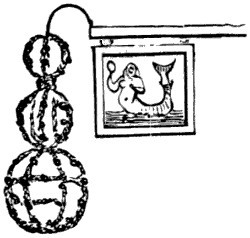
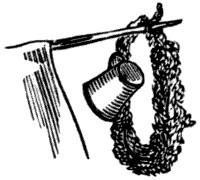
MERMAID.
(Cheapside, 1640.)
ALE-GARLAND.
(Wouwverman, 17th cent.)
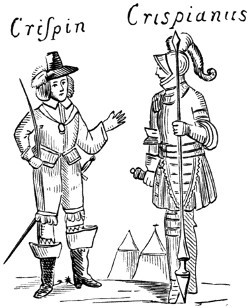
CRISPIN AND CRISPIAN.
(Roxburghe Ballads. 17th century.)
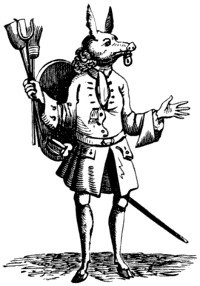
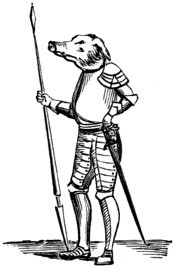
TRUSTY SERVANT.
(Circa 1700.)
HOG IN ARMOUR.
In the seventeenth century signs had been sung in sprightly ballads, and often given the groundwork for a biting satire. They continued to inspire the popular Muse until the end, but her latter productions were more like a wail than a ballad. There is certainly a rollicking air of gladness about the following song, but it was the last flicker of the lamp:—
“THE MAIL-COACH GUARD.
At each inn on the road I a welcome could find:— At the Fleece I’d my skin full of ale; The Two Jolly Brewers were just to my mind; At the Dolphin I drank like a whale. Tom Tun at the Hogshead sold pretty good stuff; They’d capital flip at the Boar; And when at the Angel I’d tippled enough, I went to the Devil for more. Then I’d always a sweetheart so snug at the Car; At the Rose I’d a lily so white; Few planets could equal sweet Nan at the Star, No eyes ever twinkled so bright. I’ve had many a hug at the sign of the Bear; In the Sun courted morning and noon; And when night put an end to my happiness there, I’d a sweet little girl in the Moon. To sweethearts and ale I at length bid adieu, Of wedlock to set up the sign: Hand-in-hand the Good Woman I look for in you, And the Horns I hope ne’er will be mine. Once guard to the mail, I’m now guard to the fair; But though my commission’s laid down, Yet while the King’s Arms I’m permitted to bear, Like a Lion I’ll fight for the Crown.”
This was written in the beginning of the century, when eighteen hundred was still in her teens. A considerable falling off may be observed in the following, contributed by a correspondent of William Hone:—
“SIGNS OF LOVE AT OXFORD. By an Inn-consolable Lover.
She’s as light as The Greyhound, as fair as The Angel, Her looks than The Mitre more sanctified are; But she flies like The Roebuck, and leaves me to range ill, Still looking to her as my true polar Star. New Inn-ventions I try, with new art to adore, But my fate is, alas, to be voted a Boar; My Goats I forsook to contemplate her charms, And must own she is fit for our noble King’s Arms; Now Cross’d, and now Jockey’d, now sad, now elate, The Checquers appear but a map of my fate; I blush’d like a Blue Cur, to send her a Pheasant, But she call’d me a Turk, and rejected my present; So I moped to The Barley Mow, grieved in my mind, That The Ark from the Flood ever rescued mankind! In my dreams Lions roar, and The Green Dragon grins, And fiends rise in shape of The Seven Deadly Sins, When I ogle The Bells, should I see her approach, I skip like a Nag and jump into The Coach. She is crimson and white like a Shoulder of Mutton, Not the red of The Ox was so bright when first put on; Like The Holly-bush prickles she scratches my liver, While I moan and die like a Swan by the river.”
But tame as this last performance is, it is “merry as a brass band” when compared with a ballad sung in the streets some twenty years later, entitled, “Laughable and Interesting Picture of Drunkenness.” Speaking of the publicans, who call themselves “Lords,” it says:—
“If these be the Lords, there are many kinds, For over their doors you will see many signs; There is The King, and likewise The Crown, And beggars are made in every town.
There is The Queen, and likewise her Head, And many I fear to the gallows are led; There is The Angel, and also The Deer, Destroying health in every sphere.
There is The Lamb, likewise The Fleece, And the fruit’s bad throughout the whole piece; There is The White Hart, also The Cross Keys, And many they’ve sent far over the seas.
There is The Bull, and likewise his Head. His Horns are so strong, they will gore you quite dead;[34] There’s The Hare and Hounds that never did run, And many’s been hung for the deeds they’ve done.
There are Two Fighting Cocks that never did crow, Where men often meet to break God’s holy vow; There is The New Inn, and the Rodney they say, Which send men to jail their debts for to pay.
The Hope and The Anchor, The Turk and his Head, Hundreds they’ve caused for to wander for bread; There is The White Horse, also The Woolpack, Take the shoes off your feet, and the clothes off your back.
The Axe and the Cleaver, The Jockey and Horse, Some they’ve made idle, some they’ve made worse; The George and the Dragon, and Nelson the brave, Many lives they’ve shorten’d and brought to the grave.
The Fox and the Goose, and The Guns put across, But all the craft is to get hold of the brass; The Bird in the Cage, and the sign of The Thrush, But one in the hand is worth two in the bush.”
There is an unpleasant musty air about this ballad, a taint of Seven Dials, an odour of the ragged dresscoat, and the broken, ill-used hat. The gay days of signboard poetry, when sparks in feathers and ruffles sang their praises, are no more. Our forefathers were content to buy “at the Golden Frying-pan,” but we must needs go to somebody’s emporium, mart, repository, or make our purchases at such grand places as the Pantocapelleion, Pantometallurgicon, or Panklibanon. The corruptions and misapplications of the old pictorial signboards find a parallel in the modern rendering of our ancient proverbs and sayings. When the primary use and purpose of an article have fallen out of fashion, or become obsolete, there is no knowing how absurdly it may not be treated by succeeding generations. We were once taken many miles over fields and through lanes to see the great stone coffins of some ancient Romans, but the farmer, a sulky man, thought we were impertinent in wishing to see his pig-troughs. In Haarlem, we were once shewn the huge cannon-ball which killed Heemskerk, the discoverer of Nova Zembla. When not required for exhibition, however, the good man in charge found it of great use in grinding his mustard-seed. Amongst the middle classes of to-day, no institution of ancient times has been more corrupted and misapplied than heraldry. The modern “Forrester,” or member of the “Ancient Order of Druids,” is scarcely a greater burlesque upon the original than the beer retailers’ “Arms” of the present hour.
Good wine and beer were formerly to be had at the Boar’s Head, or the Three Tuns; but those emblems will not do now, it must be the “Arms” of somebody or something; whence we find such anomalies as the Angel Arms, (Clapham Road;) Dunstan’s Arms, (City Road;) Digger’s Arms, (Petworth, Surrey;) Farmer’s Arms and Gardener’s Arms, (Lancashire;) Grand Junction Arms, (Praed Street, London;) Griffin’s Arms, (Warrington;) Mount Pleasant Arms, Paragon Arms, (Kingston, Surrey;) St Paul’s Arms, (Newcastle;) Portcullis Arms, (Ludlow;) Puddler’s Arms, (Wellington, Shropshire;) Railway Arms, (Ludlow;) Sol’s Arms, (Hampstead Row;) the Vulcan Arms, (Sheffield;) General’s Arms, (Little Baddon, Essex;) the Waterloo Arms, (High Street, Marylebone,) &c. Besides these, a quantity of newfangled, high-sounding, but unmeaning names seem to be the order of the day with gin-palaces and refreshment-houses, as, Perseverance, Enterprise, Paragon, Criterion.
Notwithstanding these innovations, the majority of the old objects still survive, in name at least, on the signboards of alehouses and taverns. Their use may still be regarded as a rule with publicans and innkeepers, although they have become the exception in other trades. Occasionally, also, we may still come upon a painted signboard, but these are daily becoming scarcer. Not so in France; there the good old tradition of the painted signboard is yet kept up. We get a good glimpse of this subject in the following:[42]—“But it is the signs that so amuse and absolutely arrest a stranger. This is a practice that has grown into a mania at Paris, and is even a subject for the ridicule of the stage, since many a shopkeeper considers his sign as a primary matter, and spends a little capital in this one outfit. Many of them exhibit figures as large as life, painted in no humble or shabby style; while history, sacred and classical, religion, the stage, &c., furnish subjects. You may see the Horatii and Curiatii—a scene from the ‘Fourberies de Scapin’ of Molière—a group of French soldiers, with the inscription, A la Valeur des Soldats Français, or a group of children inscribed à la réunion des Bons Enfants,[43]—or à la Baigneuse, depicting a beautiful nymph just issuing from the bath; or à la Somnambule, a pretty girl walking in her sleep and nightdress, and followed by her gallant.[44]
“In ludicrous things, a barber will write under his sign:—
‘La Nature donne barbe et cheveux, Et moi, je les coupe tous les deux.’[45]
‘A toutes les figures dédiant mes rasoirs, Je nargue la censure des fidèles miroirs.’[46]
“Also a frequent inscription with a barber is, ‘Ici on rajeunit.’ A breeches-maker writes up, M——, Culottier de Mme. la Duchesse de Devonshire. A perruquier exhibits a sign, very well painted, of an old fop trying on a new wig, entitled, Au ci-devant jeune homme. A butcher displays a bouquet of faded flowers, with this inscription, Au tendre Souvenir. An eating-house exhibits a punning sign, with an ox dressed up with bonnet, lace veil, shawl, &c., which naturally implies, Bœuf à-la-mode. A pastry-cook has a very pretty little girl climbing up to reach some cakes in a cupboard, and this sign he calls, A la petite Gourmande. A stocking-maker has painted for him a lovely creature, trying on a new stocking, at the same time exhibiting more charms than the occasion requires to the young fellow who is on his knees at her feet, with the very significant motto, A la belle occasion.”[47]
Though it is forty years since these remarks were written, they still, mutatis mutandis, apply to the present day. Even the greatest and most fashionable shops on the Boulevards have their names or painted signs; the subjects are mostly taken from the principal topic of conversation at the time the establishment opened, whether politics, literature, the drama, or fine arts: thus we have à la Présidence; au Prophète; au Palais d’Industrie; aux Enfants d’Edouard, (the Princes in the Tower;) au Colosse de Rhodes; à la Tour de Malakoff; à la Tour de Nesles, (tragedy;) au Sonneur de St Paul, (tragedy;) à la Dame Blanche; à la Bataille de Solferino; au Trois Mousquetaires; au Lingot d’Or, (a great lottery swindle in 1852;) à la Reine Blanche, &c.[48] Some of these signs are remarkably well painted, in a vigorous, bold style, with great bravura of brush; for instance, les Noces de Vulcain, on the Quai aux Fleurs, is painted in a style which would do no discredit to the artist of les Romains de la Décadence. Roger Bontemps is still frequent on the French signboard, where he is represented as a jolly rubicund toper, crowned with vine-leaves and seated astride a tun, with a brimming tumbler in his hand; this is a favourite sign with publicans. At the tobacconist’s door we may see a sign representing an elderly Paul Pry-looking gentleman enjoying a pinch of snuff. The Bureaux des Remplacements Militaires particularly excel in a gaudy display of military subjects, where the various passages of a soldier’s life are represented with all the romance of the warriors of the comic opera. Here can be seen the gallant troopers now courting Jeanette or Fanchon; now charging Russians, Cabyles, or Austrians, according to the date of the picture. Elsewhere a lancer on a fantastic wild horse; a guide, walking with a pretty vivandière, or an old grenadier with the Legion of Honour upon his breast;—“all the glorious pomp and circumstance of war” portrayed to entice the French clodhopper to sell himself “to death or to glory.” More pacific pictures may be observed at the door of the midwife; there we see a sedate-looking matron in ecstasy over the interesting young stranger she has just ushered forth into the world, whilst paterfamilias stands with a triumphant look in the background. Then there is the Herculean coalheaver at the door of the auvergnat, who sells coals and firewood; and landscapes with cattle at the dairyshops. But amongst the best painted are those at the doors of the marchands de vins et de comestibles, where we see frequently bunches of fruit, game, flowers, glasses, hams, fowls, fish, all cleverly grouped together, and painted in a dashing style. There is one, for instance, in the Rue Bellechasse, and another in the Rue St Lazare, that are well worth inspection. These paintings are generally on the door-posts and window-frames; they are painted on thin white canvas, fixed with varnish at the back of a thick piece of plateglass, and so let into the woodwork.
And now a few words concerning the painters of signs. Their head-quarters were in Harp Alley, Shoe Lane, where, until lately, gilt grapes, sugar-loaves, lasts, teapots, &c., &c., were displayed ready for the market. Here Messrs Barlow, Craddock, and others, whose names are now as completely lost as their works, had their studios, and produced some very creditable signs, both carved and painted. A few, however, were the productions of no mean artists. The Spectator, January 8, 1743, No. 744, says:—
“The other day, going down Ludgate Street, several people were gaping at a very splendid sign of Queen Elizabeth, which by far exceeded all the[38] other signs in the street, the painter having shewn a masterly judgment and the carver and gilder much pomp and splendour. It looked rather like a capital picture in a gallery than a sign in the street.”
Unfortunately the name of the artist who painted this has not come down to us.
Those who produced the best signs, however, were not exactly the Harp Alley sign-painters, but the coach-painters, who often united these two branches of art. In the last century, both the coaches and sedans of the wealthy classes were walking picture galleries, the panels being painted with all sorts of subjects.[49] And when the men that painted these turned their hands to sign-painting, they were sure to produce something good. Such was Clarkson, to whom J. T. Smith ascribed the beautiful sign of Shakespeare that formerly hung in Little Russell Street, Drury Lane, for which he was paid £500.—John Baker, (ob. 1771,) who studied under the same master as Catton, and was made a member of the Royal Academy at its foundation.—Charles Catton (ob. 1798) painted several very good signs, particularly a Lion for his friend Wright, a famous coachmaker, at that time living in Long Acre. This picture, though it had weathered many a storm, was still to be seen in J. T. Smith’s time, at a coachmaker’s on the west side of Well Street, Oxford Street. A Turk’s head, painted by him, was long admired as the sign of a mercer in York Street, Covent Garden.—John Baptist Cipriani, (ob. 1785,) a Florentine carriage-painter, living in London, also a Royal Academician.—Samuel Wale, R.A. (ob. 1786) painted a celebrated Falstaff and various other signs; the principal one was a whole length of Shakespeare, about five feet high, which was executed for and displayed at the door of a public-house at the north-west corner of Little Russell Street, Drury Lane. It was enclosed in a most sumptuous carved gilt frame, and was suspended by rich ironwork. But this splendid object of attraction did not hang long before it was taken down, in consequence of the Act of Parliament for removing the signs and other obstructions in the streets of London. Such was the change in the public appreciation consequent on the new regulations in signs, that this representation of our great dramatic poet was sold for a trifle to Mason the broker in Lower Grosvenor Street, where it stood at his door for several years, until it was totally destroyed by the weather and other accidents.[50]
The universal use of signboards furnished no little employment for the inferior rank of painters, and sometimes even to the superior professors. Among the most celebrated practitioners in this branch was a person of the name of Lamb, who possessed considerable ability. His pencil was bold and masterly, and well adapted to the subjects on which it was generally employed. There was also Gwynne, another coach-painter, who acquired some reputation as a marine painter, and produced a few good signs. Robert Dalton, keeper of the pictures of King George III., had been apprenticed to a sign and coach-painter; so were Ralph Kirby, drawing-master to George IV. when Prince of Wales, Thomas Wright of Liverpool, the marine painter, Smirke, R.A., and many artists who acquired considerable after-reputation.
Peter Monamy (ob. 1749) was apprenticed to a sign and house-painter on London Bridge. It was this artist who decorated the carriage of Admiral Byng with ships and naval trophies, and painted a portrait of Admiral Vernon’s ship for a famous public-house of the day, well known by the sign of the Portobello, a few doors north of the church in St Martin’s Lane.[51]
Besides these, we have the “great professors,” as Edwards calls them, who occasionally painted a sign for a freak. At the head of these stands Hogarth, whose Man loaded with Mischief is still to be seen at 414 Oxford Street, where it is a fixture in the alehouse of that name.
Richard Wilson, R.A., (ob. 1782,) painted the Three Loggerheads for an alehouse in North Wales, which gave its name to the village of Loggerheads, near the town of Mould. The painting was still exhibited as a signboard in 1824, though little of Wilson’s work remained, as it had been repeatedly touched up.
George Morland painted several; the Goat in Boots on the Fulham Road is attributed to him, but has since been painted often over; he also painted a White Lion for an inn at Paddington, where he used to carouse with his boon companions, Ibbetson and Rathbone; and in a small public-house near Chelsea Bridge, Surrey, there was, as late as 1824, a sign of the Cricketers painted by him. This painting by Morland, at the date mentioned, had been removed inside the house, and a copy of it hung up for the sign; unfortunately, however, the landlord used to travel about with the original, and put it up before his booth at Staines and Egham races, cricket matches, and similar occasions.
Ibbetson painted a sign for the village alehouse at Troutbeck, near Ambleside, to settle a bill run up in a sketching, fishing, and dolce-far-niente expedition; the sign represented two faces, the one thin and pale, the other jolly and rubicund; under it was the following rhyme:—
[35] For the Three Balls of the Pawnbrokers, see under Miscellaneous Signs; for the Barber’s Pole, under Trades’ Signs.
[36] Probably John James Heidegger, director of the Opera, a very ugly man.
[37] For a full account of the “Exhibition,” see in the Supplement at the end of this work.
[38] The last streets that kept them swinging were Wood Street and Whitecross Street, where they remained till 1773; whilst in Holywell Street, Strand, not more than twenty years ago, some were still dangling above the shop doors. In the suburbs many may be observed even at the present day.
[39] Laws, Customs, Usages, and Regulations of the City and Port of London. By Alexander Pulling. London, 1854.
[40] Trades tokens were brass farthings issued by shopkeepers in the seventeenth century, and stamped with the sign of the shop and the name of its owner.
[41] Memorials of Nature and Art collected on a Journey in Great Britain during the Years 1802 and 1803. By C. A. G. Gœde. London, 1808. Vol. i. p. 68.
[42] Mementos, Historical and Classical, of a Tour through part of France, Switzerland, and Italy, in the Years 1821 and 1822. London, 1824.
[43] Un bon enfant is in French “a jolly good fellow,” as well as a “good child.”
[44] Taken from the Opera “La Somnambula.”
[1] Sir Gardiner Wilkinson’s Ancient Egyptians, vol. iii. p. 158. Also, Rosellini Monumenti dell’Egitto e della Nubia.
[2] Aristotle, Problematum x. 14: “As with the things drawn above the shops, which, though they are small, appear to have breadth and depth.”
[3] “He hung the well-known sign in the front of his house.”
[4] Hearne, Antiq. Disc., i. 39.
[5] “When the mice were conquered by the army of the weasels, (a story which we see painted on the taverns.)”
[6] Lib. ii. sat. vii.: “I admire the position of the men that are fighting, painted in red or in black, as if they were really alive; striking and avoiding each other’s weapons, as if they were actually moving.”
[7] De Oratore, lib. ii. ch. 71: “Now I shall shew you how you are, to which he answered, ‘Do, please.’ Then I pointed with my finger towards the Cock painted on the signboard of Marius the Cimberian, on the New Forum, distorted, with his tongue out and hanging cheeks. Everybody began to laugh.”
[8] Hist. Nat., xxxv. ch. 8: “After this I find that they were also commonly placed on the Forum. Hence that joke of Crassus, the orator. . . . On the Forum was also that of an old shepherd with a staff, concerning which a German legate, being asked at how much he valued it, answered that he would not care to have such a man given to him as a present, even if he were real and alive.”
[9] “There were, namely, taverns round about the Forum, and that picture [the Cock] had been put up as a sign.”
[10] The Bush certainly must be counted amongst the most ancient and popular of signs. Traces of its use are not only found among Roman and other old-world remains, but during the Middle Ages we have evidence of its display. Indications of it are to be seen in the Bayeux tapestry, in that part where a house is set on fire, with the inscription, Hic domus incenditur, next to which appears a large building, from which projects something very like a pole and a bush, both at the front and the back of the building.
[11] In Cædmon’s Metrical Paraphrase of Scripture History, (circa A.D. 1000,) in the drawings relating to the history of Abraham, there are distinctly represented certain cruciform ornaments painted on the walls, which might serve the purpose of signs. (See upon this subject under “Religious Signs.”)
[12] The palace of St Laurence Poulteney, the town residence of Charles Brandon, Duke of Suffolk, and also of the Dukes of Buckingham, was called the Rose, from that badge being hung up in front of the house:—
“The Duke being at the Rose, within the parish Of St Laurence Poultney.”—Henry VIII., a. i. s. 2.
“A house in the town of Lewes was formerly known as The Three Pelicans, the fact of those birds constituting the arms of Pelham having been lost sight of. Another is still called The Cats,” which is nothing more than “the arms of the Dorset family, whose supporters are two leopards argent, spotted sable.”—Lower, Curiosities of Heraldry.
[13] Rather a heavy fine, as the best ale at that time was not to be sold for more than three-halfpence a gallon.
[14] “Purchaser, be aware when you wish to buy books issued from my printing-office. Look at my sign, which is represented on the title-page, and you can never be mistaken. For some evil-disposed printers have affixed my name to their uncorrected and faulty works, in order to secure a better sale for them.”
[15] “We beg the reader to notice the sign, for there are men who have adopted the same title, and the name of Badius, and so filch our labour.”
[16] “Lastly, I must draw the attention of the student to the fact that some Florentine printers, seeing that they could not equal our diligence in correcting and printing, have resorted to their usual artifices. To Aldus’s Institutiones Grammaticæ, printed in their offices, they have affixed our well-known sign of the Dolphin wound round the Anchor. But they have so managed, that any person who is in the least acquainted with the books of our production, cannot fail to observe that this is an impudent fraud. For the head of the Dolphin is turned to the left, whereas that of ours is well known to be turned to the right.”—Preface to Aldus’s Livy, 1518.
[17] The number of taverns in these ten shires was “686, or thereabouts.”
[18] “The original court roll of this presentation is still to be found amongst the records of the Dean and Chapter of Westminster.”—Lyson’s Env. of London, vol. iii. p. 74.
[19] “Whosoever shall brew ale in the town of Cambridge, with intention of selling it, must hang out a sign, otherwise he shall forfeit his ale.”
[20] “Art. XXIII.—Tavernkeepers must put up signboards and a bush. . . . Nobody shall be allowed to open a tavern in the said city and its suburbs without having a sign and a bush.”
[21] A Cheat loaf was a household loaf, “wheaten seconds bread.”—Nares’s Glossary.
[22] Froe—i.e. Vrouw, woman.
[23] This was in those days a slang term for a mistress.
[24] i.e. Walk about in St Paul’s during the dinner hour.
[25] “I have seen, hanging from the shops, shuttlecocks six feet high, pearls as large as a hogshead, and feathers reaching up to the third story.”
[26] “Koddige en ernstige opschriften op Luiffels, wagens, glazen, uithangborden en andere tafereelen door Jeroen Jeroense. Amsterdam, 1682.”
[27] “Het gestoffeerde Winkelen en Luifelen Banquet. H. van den Berg. Amsterdam, 1693.”
[28]
“Jacob was David’s nephew, but not his brother-in-law. All sorts of barbers’ tools ground here, also fishwives’ and butchers’ knives.”
[29]
“Moses was pick’d up among the rushes. Teeth and grinders drawn here.”
[30] The British Apollo, 1710, vol. iii. p. 34.
[31] Amusements for the Meridian of London, 1708, p. 72.
[32] Bell and the Dragon, still to be met on the signboard.
[33] Addison is wrong in this derivation, (see under Miscellaneous Signs, at the end.)
[34] From Martial and other Latin poets, we learn that it was usual for the bibliopoles of those days to advertise new works by affixing copies of the title-pages to a post outside their shops; but whether this method obtained in the last century, the history of Paternoster Row does not inform us.
[35] For the Three Balls of the Pawnbrokers, see under Miscellaneous Signs; for the Barber’s Pole, under Trades’ Signs.
[36] Probably John James Heidegger, director of the Opera, a very ugly man.
[37] For a full account of the “Exhibition,” see in the Supplement at the end of this work.
[38] The last streets that kept them swinging were Wood Street and Whitecross Street, where they remained till 1773; whilst in Holywell Street, Strand, not more than twenty years ago, some were still dangling above the shop doors. In the suburbs many may be observed even at the present day.
[39] Laws, Customs, Usages, and Regulations of the City and Port of London. By Alexander Pulling. London, 1854.
Under the 72d section of the 57 Geo. III. ch. 29, post. 315, Mr Ballantine, some years ago, decided against a pawnbroker’s sign being considered a nuisance, notwithstanding it projected over the footway, unless it obstructed the circulation of light and air, or was inconvenient or incommodious.
[40] Trades tokens were brass farthings issued by shopkeepers in the seventeenth century, and stamped with the sign of the shop and the name of its owner.
[41] Memorials of Nature and Art collected on a Journey in Great Britain during the Years 1802 and 1803. By C. A. G. Gœde. London, 1808. Vol. i. p. 68.
[42] Mementos, Historical and Classical, of a Tour through part of France, Switzerland, and Italy, in the Years 1821 and 1822. London, 1824.
[43] Un bon enfant is in French “a jolly good fellow,” as well as a “good child.”
[44] Taken from the Opera “La Somnambula.”
[45]
“Nature provides man with hair and beard, But I cut them both.”
[46]
“I devote my razors to all faces, And defy the criticism of faithful mirrors.”
[47] A sort of pun, “la belle occasion” implying the same idea that our shopkeepers express by their “Now is your time,” and similar puffs.
[48] Similar instances may also be occasionally met with in London; for instance, the Corsican Brothers, (Coffee-house, Fulham Road.)
[49] Two or three good examples are to be seen in the South Kensington Museum.
[50] Edwards’s Anecdotes of Painters, 1808, p. 117.
[51] J. T. Smith’s Nollekens and his Times, vol. i. p. 25.
[52] Tommy Burkett was the name of mine host. The painting is now gone, but the verses remain.
[53] M. A. Lower’s Essay on Family Nomenclature, vol. i. p. 201.
[1] Sir Gardiner Wilkinson’s Ancient Egyptians, vol. iii. p. 158. Also, Rosellini Monumenti dell’Egitto e della Nubia.
[2] Aristotle, Problematum x. 14: “As with the things drawn above the shops, which, though they are small, appear to have breadth and depth.”
[3] “He hung the well-known sign in the front of his house.”
[4] Hearne, Antiq. Disc., i. 39.
[5] “When the mice were conquered by the army of the weasels, (a story which we see painted on the taverns.)”
[6] Lib. ii. sat. vii.: “I admire the position of the men that are fighting, painted in red or in black, as if they were really alive; striking and avoiding each other’s weapons, as if they were actually moving.”
[7] De Oratore, lib. ii. ch. 71: “Now I shall shew you how you are, to which he answered, ‘Do, please.’ Then I pointed with my finger towards the Cock painted on the signboard of Marius the Cimberian, on the New Forum, distorted, with his tongue out and hanging cheeks. Everybody began to laugh.”
[8] Hist. Nat., xxxv. ch. 8: “After this I find that they were also commonly placed on the Forum. Hence that joke of Crassus, the orator. . . . On the Forum was also that of an old shepherd with a staff, concerning which a German legate, being asked at how much he valued it, answered that he would not care to have such a man given to him as a present, even if he were real and alive.”
[9] “There were, namely, taverns round about the Forum, and that picture [the Cock] had been put up as a sign.”
[10] The Bush certainly must be counted amongst the most ancient and popular of signs. Traces of its use are not only found among Roman and other old-world remains, but during the Middle Ages we have evidence of its display. Indications of it are to be seen in the Bayeux tapestry, in that part where a house is set on fire, with the inscription, Hic domus incenditur, next to which appears a large building, from which projects something very like a pole and a bush, both at the front and the back of the building.
[11] In Cædmon’s Metrical Paraphrase of Scripture History, (circa A.D. 1000,) in the drawings relating to the history of Abraham, there are distinctly represented certain cruciform ornaments painted on the walls, which might serve the purpose of signs. (See upon this subject under “Religious Signs.”)
[12] The palace of St Laurence Poulteney, the town residence of Charles Brandon, Duke of Suffolk, and also of the Dukes of Buckingham, was called the Rose, from that badge being hung up in front of the house:—
“The Duke being at the Rose, within the parish Of St Laurence Poultney.”—Henry VIII., a. i. s. 2.
“A house in the town of Lewes was formerly known as The Three Pelicans, the fact of those birds constituting the arms of Pelham having been lost sight of. Another is still called The Cats,” which is nothing more than “the arms of the Dorset family, whose supporters are two leopards argent, spotted sable.”—Lower, Curiosities of Heraldry.
[13] Rather a heavy fine, as the best ale at that time was not to be sold for more than three-halfpence a gallon.
[14] “Purchaser, be aware when you wish to buy books issued from my printing-office. Look at my sign, which is represented on the title-page, and you can never be mistaken. For some evil-disposed printers have affixed my name to their uncorrected and faulty works, in order to secure a better sale for them.”
[15] “We beg the reader to notice the sign, for there are men who have adopted the same title, and the name of Badius, and so filch our labour.”
[16] “Lastly, I must draw the attention of the student to the fact that some Florentine printers, seeing that they could not equal our diligence in correcting and printing, have resorted to their usual artifices. To Aldus’s Institutiones Grammaticæ, printed in their offices, they have affixed our well-known sign of the Dolphin wound round the Anchor. But they have so managed, that any person who is in the least acquainted with the books of our production, cannot fail to observe that this is an impudent fraud. For the head of the Dolphin is turned to the left, whereas that of ours is well known to be turned to the right.”—Preface to Aldus’s Livy, 1518.
[17] The number of taverns in these ten shires was “686, or thereabouts.”
[18] “The original court roll of this presentation is still to be found amongst the records of the Dean and Chapter of Westminster.”—Lyson’s Env. of London, vol. iii. p. 74.
[19] “Whosoever shall brew ale in the town of Cambridge, with intention of selling it, must hang out a sign, otherwise he shall forfeit his ale.”
[20] “Art. XXIII.—Tavernkeepers must put up signboards and a bush. . . . Nobody shall be allowed to open a tavern in the said city and its suburbs without having a sign and a bush.”
[21] A Cheat loaf was a household loaf, “wheaten seconds bread.”—Nares’s Glossary.
[22] Froe—i.e. Vrouw, woman.
[23] This was in those days a slang term for a mistress.
[24] i.e. Walk about in St Paul’s during the dinner hour.
[25] “I have seen, hanging from the shops, shuttlecocks six feet high, pearls as large as a hogshead, and feathers reaching up to the third story.”
[26] “Koddige en ernstige opschriften op Luiffels, wagens, glazen, uithangborden en andere tafereelen door Jeroen Jeroense. Amsterdam, 1682.”
[27] “Het gestoffeerde Winkelen en Luifelen Banquet. H. van den Berg. Amsterdam, 1693.”
[28]
“Jacob was David’s nephew, but not his brother-in-law. All sorts of barbers’ tools ground here, also fishwives’ and butchers’ knives.”
[29]
“Moses was pick’d up among the rushes. Teeth and grinders drawn here.”
[30] The British Apollo, 1710, vol. iii. p. 34.
[31] Amusements for the Meridian of London, 1708, p. 72.
[32] Bell and the Dragon, still to be met on the signboard.
[33] Addison is wrong in this derivation, (see under Miscellaneous Signs, at the end.)
[34] From Martial and other Latin poets, we learn that it was usual for the bibliopoles of those days to advertise new works by affixing copies of the title-pages to a post outside their shops; but whether this method obtained in the last century, the history of Paternoster Row does not inform us.
[35] For the Three Balls of the Pawnbrokers, see under Miscellaneous Signs; for the Barber’s Pole, under Trades’ Signs.
[36] Probably John James Heidegger, director of the Opera, a very ugly man.
[37] For a full account of the “Exhibition,” see in the Supplement at the end of this work.
[38] The last streets that kept them swinging were Wood Street and Whitecross Street, where they remained till 1773; whilst in Holywell Street, Strand, not more than twenty years ago, some were still dangling above the shop doors. In the suburbs many may be observed even at the present day.
[39] Laws, Customs, Usages, and Regulations of the City and Port of London. By Alexander Pulling. London, 1854.
Under the 72d section of the 57 Geo. III. ch. 29, post. 315, Mr Ballantine, some years ago, decided against a pawnbroker’s sign being considered a nuisance, notwithstanding it projected over the footway, unless it obstructed the circulation of light and air, or was inconvenient or incommodious.
[40] Trades tokens were brass farthings issued by shopkeepers in the seventeenth century, and stamped with the sign of the shop and the name of its owner.
[41] Memorials of Nature and Art collected on a Journey in Great Britain during the Years 1802 and 1803. By C. A. G. Gœde. London, 1808. Vol. i. p. 68.
[42] Mementos, Historical and Classical, of a Tour through part of France, Switzerland, and Italy, in the Years 1821 and 1822. London, 1824.
[43] Un bon enfant is in French “a jolly good fellow,” as well as a “good child.”
[44] Taken from the Opera “La Somnambula.”
[45]
“Nature provides man with hair and beard, But I cut them both.”
[46]
“I devote my razors to all faces, And defy the criticism of faithful mirrors.”
[47] A sort of pun, “la belle occasion” implying the same idea that our shopkeepers express by their “Now is your time,” and similar puffs.
[48] Similar instances may also be occasionally met with in London; for instance, the Corsican Brothers, (Coffee-house, Fulham Road.)
[49] Two or three good examples are to be seen in the South Kensington Museum.
[50] Edwards’s Anecdotes of Painters, 1808, p. 117.
[51] J. T. Smith’s Nollekens and his Times, vol. i. p. 25.
[52] Tommy Burkett was the name of mine host. The painting is now gone, but the verses remain.
[53] M. A. Lower’s Essay on Family Nomenclature, vol. i. p. 201.
[47] A sort of pun, “la belle occasion” implying the same idea that our shopkeepers express by their “Now is your time,” and similar puffs.
[48] Similar instances may also be occasionally met with in London; for instance, the Corsican Brothers, (Coffee-house, Fulham Road.)
[49] Two or three good examples are to be seen in the South Kensington Museum.
[50] Edwards’s Anecdotes of Painters, 1808, p. 117.
[51] J. T. Smith’s Nollekens and his Times, vol. i. p. 25.
“Thou mortal man that liv’st by bread, What made thy face to look so red?
Thou silly fop, that looks so pale, ‘Tis red with Tommy Burkett’s ale.”[52]
David Cox painted a Royal Oak for the alehouse at Bettws-y-Coed, Denbighshire; fortunately this has been taken down, and is now preserved behind glass inside the inn.
The elder Crome produced a sign of the Sawyers at St Martins, Norwich; it was afterwards taken down by the owner, framed, and hung up as a picture.
At New Inn Lane, Epsom, Harlow painted a front and a back view of Queen Charlotte, to settle a bill he had run up; he imitated Sir Thomas Lawrence’s style, and signed it “T. L.,” Greek Street, Soho. When Lawrence heard this, he got in a terrible rage and said, if Harlow were not a scoundrel, he would kick him from one street’s end to the other; upon which Harlow very coolly remarked, that when Sir Thomas should make up his mind to it, he hoped he would choose a short street.
In his younger days Sir Charles Ross painted a sign of the Magpie at Sudbury, and the landlady of the house, with no small pride, gave the informant to understand that, more than thirty years after, the aristocratic portrait-painter came in a carriage to her house, and asked to be shewn the old sign once more.
Herring is said to have painted some signs. Amongst them are the Flying Dutchman, at Cottage Green, Camberwell, and a White Lion at Doncaster; underneath the last are the words,—“Painted by Herring.”
Millais painted a Saint George and Dragon, with grapes round it, for the Vidler’s Inn, Hayes, Kent; and we learn that a sign at Singleton, Lancashire, was painted by an R.A. and an R.S., each painting one side of it; on the front was represented a wearied pilgrim, at the back the same refreshed, but the sign was never hung up.
Great men of former ages, also, are known to have painted signs; in the museum at Basle, in Switzerland, there are two pictures of a school, painted by Holbein when fourteen years old, for a sign of the schoolmaster of the town. The Mule and Muleteer in the Sutherland collection, is said to have been painted by Correggio as a sign for an inn; a similar legend is told about the Young Bull of Paul Potter, in the museum of the Hague, in Holland, which is reported to have been painted for a butcher’s signboard. The Chaste Susannah (la chaste Susanne) was formerly a fine stone bas-relief in the Rue aux Fèves, Paris; it was attributed to Goujon, and bought as such by an amateur. A plaster cast of it now occupies its place. Watteau executed a sign for a milliner on the Pont Nôtre-Dame, which was thought sufficiently good to be engraved. Horace Vernet has the name of having produced some signs in his younger days; and there is still at the present time a sign of the White Horse, in one of the villages in the neighbourhood of Paris, which is pointed out as a work of Guéricault.
Besides these, there are, and have been at various times, excellent signboards in Paris, the artists of which are not known. Thus there was, in the beginning of the eighteenth century, a sign at the foot of the Pont Neuf, called le Petit Dunkerque, which was greatly admired; and in the reign of Louis XV. an armourer on the Pont Saint Michel had a sign, which was so fine a work of art that it was bought as a cabinet picture by a wealthy citizen. In the beginning of this century there was a much admired sign on the shutters of a glass and china shop in the Rue Royale St Honoré, which unfortunately was destroyed during some repairs that took place upon the building passing into other hands. In 1808, the sign of la Fille mal gardée, (a vaudeville,) at a mercer’s, attracted great attention. About this period the Rue Vivienne was very rich in good signboards; there were la Toison de Cachemire; les Trois Sultanes; le Couronnement de la Rosière, and la Joconde, all very good works of art. There was a gay Comte Ory on the Boulevard des Italiens, and la Blanche Marguerite, most comely to look upon, in the Rue Montmartre. All these are now gone, but many good specimens of French signboard painting may yet be met with.
Before closing this general survey of signboard history, we must direct attention to the number of streets named after signs, both in England and abroad. A walk down Fleet Street will give, in a small compass, as many illustrations as are to be met with in any other thoroughfare in town, for there nearly all the courts are named after signs that were either hung within them, or at their entrance. Not only streets, but families also have to thank signs for their names.
“Many names that seem unfitting for men, as of brutish beasts, etc., come from the very signes of the houses where they inhabited; for I have heard of them which sayd they spake of knowledge, that some in late time dwelling at the signe of the Dolphin, Bull, White Horse, Racket, Peacocke, etc., were commonly called Thomas at the Dolphin, Will at the Bull, George at the White Horse, Robin at the Racket, which names, as many other of like sort, with omitting at the, became afterwards hereditary to their children.”—Camden’s Remaines, p. 102.
As examples of such names we have, “Arrow, Axe, Barrell, Bullhead, Bell, Block, Board, Banner, Bowles, Baskett, Cann, Coulter, Chisell, Clogg, Crosskeys, Crosier, Funnell, Forge, Firebrand, Grapes, Griffin, Horns, Hammer, Hamper, Hodd, Harrow, Image, (the sign originally in honour of some saint perhaps,) Jugg, Kettle, Knife, Lance, Mallet, Maul, Mattock, Needle, Pail, Pott, Potts, Plowe, Plane, Pipes, Pottle, Patten, Posnet, (a purse or money-bag,) Pitcher, Rule, Rainbow, Sack, Saw, Shovel, Shears, Scales, Silverspoon, Swords, Tankard, Tabor, (a drum,) Trowel, Tubb and Wedge, and a good many others.”[53]
And now, having taken a passing glance at signboard history, from the earliest times down to the present day, we may not improperly conclude this chapter with an enumeration of the inn, tavern, and public-house signs which occur most frequently in London, in this present year of grace, 1864:—
12 Adam and Eves, 13 Albions, 5 Alfred’s Heads, 13 Anchor and Hopes, 18 Angels, 8 Angels and Crowns, 3 Antigallicans, 5 Artichokes, 13 Barley Mows, 9 Beehives, 31 Bells, 7 Ben Jonsons, 5 Birds in Hand, 5 Black Boys, 16 Black Bulls, 5 Black Dogs, 29 Black Horses, 10 Black Lions, 6 Black Swans, 19 Blue Anchors, 5 Blue Coat Boys, 6 Blue Lasts, 14 Blue Peters, 27 Bricklayers’ Arms, 5 Bridge Houses, 22 Britannias, 15 Brown Bears, 8 Builders’ Arms, 17 Bulls, (some combined with Bells, Butchers, &c.,) 22 Bull’s Heads, 4 Camden Heads, 6 Capes of Good Hope, 14 Carpenters’ Arms, 19 Castles, 6 Catherine Wheels, 7 Champions, 5 Chequers, 5 Cherry-trees, 8 Cheshire Cheeses, 11 City Arms, 18 Cities of London, and other cities, (as Canton, Paris, Quebec, &c.,) 52 Coach and Horses, 12 Cocks, 16 Cocks in combination with Bottles, Hoops, Lions, Magpies, &c., 6 Constitutions, 17 Coopers’ Arms, 7 Crooked Billets, 5 Cross Keys, 61 Crowns, 18 Crown and Anchors, 5 Crown and Cushions, 11 Crown and Sceptres, 17 Crowns, combined with other objects, as Anvils, Barley Mows, Thistles, Dolphins, &c., (in all, 112 Crowns; certainly we are a loyal nation!) 12 Devonshire Arms, 2 Devonshire Castles, 10 Dolphins, 6 Dover Castles, 34 Dukes of Wellington, 32 Dukes of York, 6 Dukes of Sussex, 16 Dukes of Clarence, 7 Dukes of Cambridge, 26 other Dukes, (including Albemarle, Argyle, Bedford, Bridgewater, Gloucester, &c.,) 7 various Duchesses, (as Kent, York, Oldenburgh, &c.,) 14 Duke’s Heads, 18 Earls, (Aberdeen, Cathcart, Chatham, Durham, Essex, &c.,) 6 Edinburgh Castles, 5 Elephants and Castles, 9 Falcons, 21 Feathers, 4 Fishmongers’ Arms, 4 Five Bells, 5 Fleeces, 6 Flying Horses, 5 Fortunes of War, 24 Fountains, 8 Foxes, 12 Foxes, combined with Grapes, Hounds, Geese, &c., 8 Freemasons’ Arms, 8 various Generals, (Elliott, Hill, Abercrombie, Picton, Wolfe, &c.,) 52 Georges, 14 George and Dragons, 19 George the Fourths, 31 Globes, 6 Gloster Arms, 7 Goats, 5 Golden Anchors, 5 Golden Fleeces, 15 Golden Lions, 6 Goldsmith’s Arms, 56 Grapes, 15 Green Dragons, 4 Green Gates, 24 Green Men, 9 Greyhounds, 7 Griffins, 5 Grosvenor Arms, 8 Guns, 4 Guy of Warwicks, 6 Half-moons, 4 Hercules, 2 Hercules Pillars, 5 Holes in the Wall, 5 Hoop and Grapes, 4 Hop-poles, 12 Hopes, 11 Horns, 21 Horses and Grooms, 7 Horseshoes, 5 Horseshoe and Magpies, 6 Jacob’s Wells, 5 John Bulls, 16 various “Jolly” people, as Jolly Anglers, Caulkers, Gardeners, &c., 12 Kings of Prussia, 10 Kings and Queens, 89 King’s Arms, 63 King’s Heads, (loyalty again!) 8 Lambs, 3 Lambs and Flags, 4 Lion and Lambs, 55 different Lords, amongst which, 23 Lord Nelsons, 4 Magpie and Stumps, 3 Mail-coaches, 3 Men in the Moon, 2 Marlborough Arms, 6 Marlborough Heads, 18 Marquis of Granbys, 6 Marquis of Cornwallises, 14 various Marquises, 9 Masons’ Arms, 17 Mitres, 4 Mulberry-trees, 15 Nag’s Heads, 3 Nell Gwynns, 7 Noah’s Arks, 7 Norfolk Arms, 4 North Poles, 9 Northumberland Arms, 3 Old Parr’s Heads, 6 Olive Branches, 6 Oxford Arms, 10 Peacocks, (1 Peahen,) 5 Perseverances, 5 Pewter Platters, 10 Phœnixes, 3 Pied Bulls, 5 Pine Apples, 9 Pitt’s Heads, 15 Ploughs, 6 Portland Arms, 5 Portman Arms, 19 Prince Alberts, 5 Prince Alfreds, 3 Prince Arthurs, 15 other Princes, (mostly of the Royal Family,) 43 Princes of Wales, 12 Prince Regents, 6 Princess Royals, 3 Princess Victorias, and a few of the younger Princesses, 2 Punchbowls, 3 Queens, 3 Queen and Prince Alberts, 17 Queen Victorias, 23 Queen’s Arms, 49 Queen’s Heads, 8 Railway Taverns, 8 Red Cows, 4 Red Crosses, 73 Red Lions, 26 Rising Suns, 9 Robin Hoods, 5 Rodney Heads, 10 Roebucks, 14 Roses, 48 Rose and Crowns, 4 Royal Alberts, 28 various Royal personages and objects, as Champions, Cricketers, Crowns, Dukes, Forts, &c., 8 Royal Georges, 26 Royal Oaks, 13 Royal Standards, 7 Running Horses, 23 Saints, (3 Saint Andrews, 4 St Georges, 3 St Jameses, 3 St Johns, 2 St Luke’s Heads, 2 St Martins, 2 St Pauls, &c.,) 5 Salisbury Arms, 2 Salmons, 4 Salutations, 6 Scotch Stores, 4 Seven Stars, 8 Shakespeare Heads, 2 Shepherds and Flocks, 2 Shepherds and Shepherdesses, 53 Ships, (23 in combination, on launch, aground, &c.,) 3 Ship and Stars, 2 Ships and Whales, 19 Sirs, (including 4 Falstaffs, Sir John Barleycorn, Middleton, Newton, Wren, Abercrombie, Pindar, Peel, Raleigh, Walworth, &c.,) 5 Skinners’ Arms, 4 Southampton Arms, 4 Sportsmen, 3 Spotted Dogs, 14 Spread Eagles, 3 Stags, 3 Staghounds, 11 Stars, 17 Star and Garters, 8 Sugar-loaves, 19 Suns, 19 Swans, 9 Talbots, 4 Telegraphs, 3 Thatched Houses, 5 Thistles and Crowns, 21 Three Compasses, 8 Three Crowns, 3 Three Cranes, 3 Three Cups, 3 Three Kings, 19 Three Tuns, 8 Tigers, (1 Tiger Cat,) 10 Turk’s Heads, 28 Two Brewers, 5 Two Chairmen, 4 Unicorns, 10 Unions, 2 Union Flags, 11 Victories, 5 Vines, 3 Waggon and Horses, 10 Watermen’s Arms, 9 Weavers’ Arms, 3 Westminster Arms, 20 Wheat Sheaves, 15 White Bears, 63 White Harts, 44 White Horses, 25 White Lions, 35 White Swans, 3 Whittington and Cats, (1 Whittington and Stone,) 16 William the Fourths, 11 Windmills, 12 Windsor Castles, 4 Woodmen, 8 Woolpacks, 10 York Arms and York Minster, 12 Yorkshire Greys.
[1] Sir Gardiner Wilkinson’s Ancient Egyptians, vol. iii. p. 158. Also, Rosellini Monumenti dell’Egitto e della Nubia.
[2] Aristotle, Problematum x. 14: “As with the things drawn above the shops, which, though they are small, appear to have breadth and depth.”
[3] “He hung the well-known sign in the front of his house.”
[4] Hearne, Antiq. Disc., i. 39.
[5] “When the mice were conquered by the army of the weasels, (a story which we see painted on the taverns.)”
[6] Lib. ii. sat. vii.: “I admire the position of the men that are fighting, painted in red or in black, as if they were really alive; striking and avoiding each other’s weapons, as if they were actually moving.”
[7] De Oratore, lib. ii. ch. 71: “Now I shall shew you how you are, to which he answered, ‘Do, please.’ Then I pointed with my finger towards the Cock painted on the signboard of Marius the Cimberian, on the New Forum, distorted, with his tongue out and hanging cheeks. Everybody began to laugh.”
[8] Hist. Nat., xxxv. ch. 8: “After this I find that they were also commonly placed on the Forum. Hence that joke of Crassus, the orator. . . . On the Forum was also that of an old shepherd with a staff, concerning which a German legate, being asked at how much he valued it, answered that he would not care to have such a man given to him as a present, even if he were real and alive.”
[9] “There were, namely, taverns round about the Forum, and that picture [the Cock] had been put up as a sign.”
[10] The Bush certainly must be counted amongst the most ancient and popular of signs. Traces of its use are not only found among Roman and other old-world remains, but during the Middle Ages we have evidence of its display. Indications of it are to be seen in the Bayeux tapestry, in that part where a house is set on fire, with the inscription, Hic domus incenditur, next to which appears a large building, from which projects something very like a pole and a bush, both at the front and the back of the building.
[11] In Cædmon’s Metrical Paraphrase of Scripture History, (circa A.D. 1000,) in the drawings relating to the history of Abraham, there are distinctly represented certain cruciform ornaments painted on the walls, which might serve the purpose of signs. (See upon this subject under “Religious Signs.”)
[12] The palace of St Laurence Poulteney, the town residence of Charles Brandon, Duke of Suffolk, and also of the Dukes of Buckingham, was called the Rose, from that badge being hung up in front of the house:—
“The Duke being at the Rose, within the parish Of St Laurence Poultney.”—Henry VIII., a. i. s. 2.
“A house in the town of Lewes was formerly known as The Three Pelicans, the fact of those birds constituting the arms of Pelham having been lost sight of. Another is still called The Cats,” which is nothing more than “the arms of the Dorset family, whose supporters are two leopards argent, spotted sable.”—Lower, Curiosities of Heraldry.
[13] Rather a heavy fine, as the best ale at that time was not to be sold for more than three-halfpence a gallon.
[14] “Purchaser, be aware when you wish to buy books issued from my printing-office. Look at my sign, which is represented on the title-page, and you can never be mistaken. For some evil-disposed printers have affixed my name to their uncorrected and faulty works, in order to secure a better sale for them.”
[15] “We beg the reader to notice the sign, for there are men who have adopted the same title, and the name of Badius, and so filch our labour.”
[16] “Lastly, I must draw the attention of the student to the fact that some Florentine printers, seeing that they could not equal our diligence in correcting and printing, have resorted to their usual artifices. To Aldus’s Institutiones Grammaticæ, printed in their offices, they have affixed our well-known sign of the Dolphin wound round the Anchor. But they have so managed, that any person who is in the least acquainted with the books of our production, cannot fail to observe that this is an impudent fraud. For the head of the Dolphin is turned to the left, whereas that of ours is well known to be turned to the right.”—Preface to Aldus’s Livy, 1518.
[17] The number of taverns in these ten shires was “686, or thereabouts.”
[18] “The original court roll of this presentation is still to be found amongst the records of the Dean and Chapter of Westminster.”—Lyson’s Env. of London, vol. iii. p. 74.
[19] “Whosoever shall brew ale in the town of Cambridge, with intention of selling it, must hang out a sign, otherwise he shall forfeit his ale.”
[20] “Art. XXIII.—Tavernkeepers must put up signboards and a bush. . . . Nobody shall be allowed to open a tavern in the said city and its suburbs without having a sign and a bush.”
[21] A Cheat loaf was a household loaf, “wheaten seconds bread.”—Nares’s Glossary.
[22] Froe—i.e. Vrouw, woman.
[23] This was in those days a slang term for a mistress.
[24] i.e. Walk about in St Paul’s during the dinner hour.
[25] “I have seen, hanging from the shops, shuttlecocks six feet high, pearls as large as a hogshead, and feathers reaching up to the third story.”
[26] “Koddige en ernstige opschriften op Luiffels, wagens, glazen, uithangborden en andere tafereelen door Jeroen Jeroense. Amsterdam, 1682.”
[27] “Het gestoffeerde Winkelen en Luifelen Banquet. H. van den Berg. Amsterdam, 1693.”
“Jacob was David’s nephew, but not his brother-in-law. All sorts of barbers’ tools ground here, also fishwives’ and butchers’ knives.”
“Moses was pick’d up among the rushes. Teeth and grinders drawn here.”
[30] The British Apollo, 1710, vol. iii. p. 34.
[31] Amusements for the Meridian of London, 1708, p. 72.
[32] Bell and the Dragon, still to be met on the signboard.
[33] Addison is wrong in this derivation, (see under Miscellaneous Signs, at the end.)
[34] From Martial and other Latin poets, we learn that it was usual for the bibliopoles of those days to advertise new works by affixing copies of the title-pages to a post outside their shops; but whether this method obtained in the last century, the history of Paternoster Row does not inform us.
[35] For the Three Balls of the Pawnbrokers, see under Miscellaneous Signs; for the Barber’s Pole, under Trades’ Signs.
[36] Probably John James Heidegger, director of the Opera, a very ugly man.
[37] For a full account of the “Exhibition,” see in the Supplement at the end of this work.
[38] The last streets that kept them swinging were Wood Street and Whitecross Street, where they remained till 1773; whilst in Holywell Street, Strand, not more than twenty years ago, some were still dangling above the shop doors. In the suburbs many may be observed even at the present day.
[39] Laws, Customs, Usages, and Regulations of the City and Port of London. By Alexander Pulling. London, 1854.
Under the 72d section of the 57 Geo. III. ch. 29, post. 315, Mr Ballantine, some years ago, decided against a pawnbroker’s sign being considered a nuisance, notwithstanding it projected over the footway, unless it obstructed the circulation of light and air, or was inconvenient or incommodious.
[40] Trades tokens were brass farthings issued by shopkeepers in the seventeenth century, and stamped with the sign of the shop and the name of its owner.
[41] Memorials of Nature and Art collected on a Journey in Great Britain during the Years 1802 and 1803. By C. A. G. Gœde. London, 1808. Vol. i. p. 68.
[42] Mementos, Historical and Classical, of a Tour through part of France, Switzerland, and Italy, in the Years 1821 and 1822. London, 1824.
[43] Un bon enfant is in French “a jolly good fellow,” as well as a “good child.”
[44] Taken from the Opera “La Somnambula.”
“Nature provides man with hair and beard, But I cut them both.”
“I devote my razors to all faces, And defy the criticism of faithful mirrors.”
[47] A sort of pun, “la belle occasion” implying the same idea that our shopkeepers express by their “Now is your time,” and similar puffs.
[48] Similar instances may also be occasionally met with in London; for instance, the Corsican Brothers, (Coffee-house, Fulham Road.)
[49] Two or three good examples are to be seen in the South Kensington Museum.
[50] Edwards’s Anecdotes of Painters, 1808, p. 117.
[51] J. T. Smith’s Nollekens and his Times, vol. i. p. 25.
[52] Tommy Burkett was the name of mine host. The painting is now gone, but the verses remain.
[53] M. A. Lower’s Essay on Family Nomenclature, vol. i. p. 201.
CHAPTER II.
HISTORIC AND COMMEMORATIVE SIGNS.
The Greeks honoured their great men and successful commanders by erecting statues to them; the Romans rewarded their popular favourites with triumphal entries and ovations; modern nations make the portraits of their celebrities serve as signs for public-houses.
“Vernon, the Butcher Cumberland, Wolfe, Hawke, Prince Ferdinand, Granby, Burgoyne, Keppel, Howe, Evil and good have had their tithe of talk, And fill’d their signpost then, like Wellesley now.”
As Byron hints, popular admiration is generally very short-lived; and when a fresh hero is gazetted, the next new alehouse will most probably adopt him for a sign in preference to the last great man. Thus it is that even the Duke of Wellington is now neglected, and in his place we see General Havelock, Sir Colin Campbell, Lord Palmerston, and Mr Gladstone, the Chancellor of the Exchequer, not omitting the fair Princess of Denmark. We will not now dwell upon these modern celebrities, but rather direct our attention to those illustrious dead upon whom the signboard honours were bestowed in bygone ages.
Many signboards have an historic connexion of some sort with the place where they are exhibited. Thus the Alfred’s Head, at Wantage, in Berkshire, was in all probability chosen as a sign because Wantage was the birthplace of King Alfred. So the Canute Castle, at Southampton, owes its existence to a local tradition; whilst admiration for the great Scotch patriot made an innkeeper in Stowell Street, Newcastle, adopt Sir William Wallace’s Arms. The Cæsar’s Head was, in 1761, to be seen near the New Church in the Strand,[54] and, in the beginning of this century, was the sign of a tavern in Soho, which afterwards removed to Great Palace Yard, Westminster. Even at the present day, his head may be seen outside certain village alehouses; but this we may attribute to that provincial popularity which the Roman hero shares with Oliver Cromwell; for as the Protector gets the blame of having made nearly all the ruins which are to be found in the three kingdoms, so Cæsar is generally named by country people as the builder of every old wall or earthwork the origin of which is unknown.
Notwithstanding the popular censure, Cromwell is still honoured with signboards in places where his memory has lingered, as at Kate’s Hill, near Dudley.
In most cases, however, signboard popularity is rather short-lived; “dulcique animos novitate tenebo” seems to be essentially the motto of those that choose popular characters for their sign. Had this modern tribute of admiration been in use at the time of the Preacher, it might have afforded him one more illustration of the vanity of vanities to be found in all sublunary things. Horace Walpole noticed this fickleness of signboard fame in one of his letters:—
“I was yesterday out of town, and the very signs, as I passed through the villages, made me make very quaint reflections on the mortality of fame and popularity. I observed how the Duke’s Head had succeeded almost universally to Admiral Vernon’s, as his had left but few traces of the Duke of Ormond’s. I pondered these things in my breast, and said to myself, ’Surely all glory is but as a sign!’”[55]
Some favourites of the signboard have, however, been more fortunate than others. Henry VIII., for instance, may still be seen in many places; indeed, for more than two centuries after his death, almost every King’s Head invariably gave a portrait of Bluff Harry.
Older kings occasionally occur, but their memories seem to have been revived rather than handed down by successive innkeepers. If we are to believe an old Chester legend, however, The King Edgar Inn, in Bridge Street of that city, has existed by the same name since the time of the Saxon king. The sign represents King Edgar rowed down the river Dee by the eight tributary kings. The present house has the appearance of being built anterior to the reign of Elizabeth, and the sign looks almost as old, but it would be unwise to give the place or the sign a much higher antiquity. King John is the sign under whose auspices Jem Mace, the pugilist, keeps a public-house in Holywell Lane, Shoreditch. The same king also figures in Albemarle Street and in Bermondsey; whilst the great event of his reign, Magna Charta, is a sign at New Holland, Hull. John of Gaunt may be seen in many places; and we may surmise that his upholders are stanch Protestants, who value his character as a reformer and supporter of Wicliffe. The Black Prince may not unlikely have come down to us in an uninterrupted line of signboards; so little was his identity sometimes understood, that there is a shop-bill in the “Banks Collection”[56] on which this hero is represented as a negro!
There is a Queen Eleanor in London Fields, Hackney, probably the beautiful and affectionate queen of Edward I., buried in Westminster Abbey, 1290, in honour of whom Charing Cross, Cheapcross, and seven other crosses, were erected on the places where her body rested on its way to the great Abbey. What prompted the choice of this sign it is hard to say.
At Hever, in Kent, a rude portrait of Henry VIII. may be seen. Near this village the Bolleyn or Bullen family formerly held large possessions; and old people in the district yet shew the spot where, as the story goes, King Henry often used to meet Sir Thomas Bolleyn’s daughter Anne. Be this as it may, years after the unhappy death of Anne, the village alehouse had for its sign, Bullen Butchered; but the place falling into new hands, the name of the house was altered to the Bull and Butcher, which sign existed to a recent date, and would probably have swung at this moment, but for a desire of the resident clergyman to see something different. He suggested the King’s Head; and the village painter was forthwith commissioned to make the alteration. The latter accepted the task, drew the bluff features of the monarch, and represented it as other King’s Heads, but in his hands placed a large axe, which signboard exists to this day.
As for Queen Elizabeth, she was the constant type of the Queen’s Head, as her father was of the King’s Head; and, like him, she may still be seen in many places. It is somewhat more difficult to ascertain who is meant by the Queen Catherine in Brook Street, Ratcliffe Highway; whether it be Queen Catherine of Aragon, or Queen Catherine of Braganza. Queen Anne, in South Street, Walworth, has evidently come down to us as the token of that house since the day of its opening, just as the Queen of Bohemia, who, until about fifty years ago, continued as a sign in Drury Lane.[57] This was Elizabeth, daughter of James I., married to Frederic V., Elector-Palatine, who, after her husband’s death, lived at Craven House, Drury Lane, and died there, February 13, 1661, having been privately married, it is thought, to Lord Craven, who was foremost in fighting the battles of her husband.
Of King’s Heads, Henry VIII. is the oldest on authentic record. But this does not prove that he was the first; for, as there lived great men before Agamemnon, so most kings during their reign will, in all probability, have had their signs. Among Henry’s successors, we find the head of Edward VI. on a trades token; whilst Charles the First’s Head was the portrait hanging from the house of that scoundrel Jonathan Wild, in the Old Bailey. Even at the present day there is a sign of Charles the First at Goring Heath, Reading. The Martyr’s Head in Smithfield, 1710, seems also to have been a portrait of Charles I.; so, at least, the following allusion gives us to understand:—
“May Hyde, near Smithfield, at the Martyr’s Head, Who charms the nicest judge with noble red, Thrive on by drawing wines, which none can blame, But those who in his sign behold their shame;”[58]
which seems to be an allusion to Puritanical water-drinkers. To this unfortunate king belongs also the sign of the Mourning Bush, set up by Taylor the water-poet over his tavern in Phœnix Alley, Long Acre, to express his grief at the beheading of Charles I.; but he was soon compelled to take it down, when he put up the Poet’s Head, his own portrait, with this inscription:—
“There is many a head hangs for a sign; Then, gentle reader, why not mine?”
This “Poeta Aquaticus,” as he sometimes called himself, was a boatman on the Thames, and alehouse-keeper by profession, besides being the author of fourscore books of very original poetry. At the same time that he put up his new sign of the Poet’s Head, he issued a rhyming pamphlet, in which occur the following lines:—
“My signe was once a Crowne, but now it is Changed by a sudden metamorphosis. The crowne was taken downe, and in the stead Is placed John Taylor’s, or the Poet’s Head. A painter did my picture gratis make, And (for a signe) I hang’d it for his sake. Now, if my picture’s drawing can prevayle, ‘Twill draw my friends to me, and I’ll draw ale. Two strings are better to a bow than one; And poeting does me small good alone. So ale alone yields but small good to me, Except it have some spice of poesie. The fruits of ale are unto drunkards such, To make ‘em sweare and lye that drinke too much. But my ale, being drunk with moderation, Will quench thirst, and make merry recreation. My book and signe were publish’d for two ends, T’ invite my honest, civill, sober friends. From such as are not such, I kindly pray, Till I send for ‘em, let ‘em keep away. From Phœnix Alley, the Globe Taverne neare, The middle of Long Acre, I dwell there.
“John Taylor, Poeta Aquaticus.”
PLATE IV.
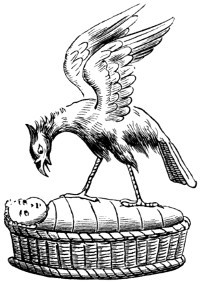
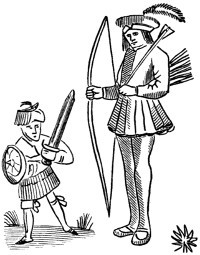
EAGLE AND CHILD.
(Banks’s Bills, circa 1750.)
ROBIN HOOD AND LITTLE JOHN.
(Roxburghe Ballads, 1600.)
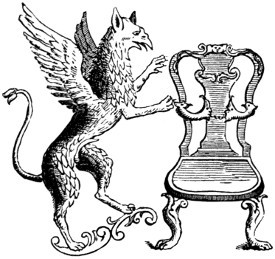
GRIFFIN AND CHAIR.
(Banks’s Bills, 1790.)
BOLT-IN-TUN.
(Fleet Street).
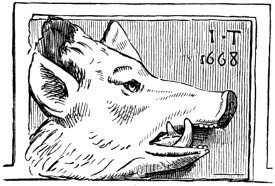
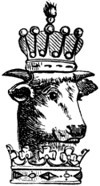
BOAR’S HEAD.
(Eastcheap.)
BULL’S HEAD.
(Longhborough, Linc., 1806.)
The Mourning Crown was afterwards revived, and in the last century it was the sign of a tavern in Aldersgate, where, on Saturdays, when Parliament was not sitting, the Duke of Devonshire, the Earls of Oxford, Sunderland, Pembroke, and Winchelsea, Mr Bagford the antiquary, and Britton the musical small-coalman, used to refresh themselves, after having passed the forepart of the day in hunting for antiquities and curiosities in Little Britain and its neighbourhood.
Not only was the Crown put in mourning at the death of Charles I., but also the Mitre. Hearne has an anecdote which he transcribed from Dr Richard Rawlinson:—“Of Daniel Rawlinson, who kept the Mitre Tavern in Fenchurch Street, and of whose being sequestered in the Rump time, I have heard much. The Whigs tell this, that upon the king’s murder he hung his sign in mourning. He certainly judged right; the honour of the mitre was much eclipsed through the loss of so good a parent of the Church of England. Those rogues say, this endeared him so much to the Churchmen that he soon throve amain, and got a good estate.”
Charles the Second’s Head swung at the door of a “music-house” for seafaring men and others, in Stepney, at the end of the seventeenth century. In a great room of this house there was an organ and a band of fiddles and hautboys, to the music whereof it was no unusual thing for parties, and sometimes single persons,—and those not of very inferior sort,—to dance. At the present day, that king’s memory is still kept alive on a signboard in Herbert Street, Hoxton, under the name of the Merry Monarch.
To his miraculous escape at Boscobel we owe the Royal Oak, which, notwithstanding a lapse of two centuries and a change of dynasty, still continues a very favourite sign. In London alone it occurs on twenty-six public-houses, exclusive of beerhouses, coffee-houses, &c. Sometimes it is called King Charles in the Oak, as at Willen Hall, Warwickshire. The Royal Oak, soon after the Restoration, became a favourite with the shops of London; tokens of some half a dozen houses bearing that sign are extant. What is rather curious is that, not many years since, one of the descendants of trusty Dick Pendrell kept an inn at Lewes, in Sussex, called the Royal Oak.
There is a trades token of “William Hagley, at the Restoration, in St George’s Fields;” but how this event was represented does not appear. At Charing Cross it was commemorated by the sign of the Pageant Tavern, which represented the triumphal arch erected at that place on occasion of the entry of Charles II., and which remained standing for a year after. This was evidently the same house which Pepys calls the Triumph. It seems to have been a fashionable place, for he went there, on the 25th May 1662, to see the Portuguese ladies of Queen Catherine. “They are not handsome,” says he, “and their fardingales a strange dress. Many ladies and persons of quality come to see them. I find nothing in them that is pleasing; and I see they have learned to kiss and look freely up and down already, and, I believe, will soon forget the recluse practice of their own country. They complain much for lack of good water to drink.” The Triumph is still the sign of a public-house in Skinner Street, Somers Town.
Queen Mary was in her day a very popular sign, as may be gathered from many of the shop-bills in the Banks Collection; whilst William and Mary are still to be seen in Maiden Causeway, Cambridge. The accession of the house of Brunswick produced the Brunswick, still very common, particularly in the West Riding of Yorkshire. Then come the Georges, of whom George III. and George IV. still survive in nearly as many instances as their successor, William IV.; with them a few of the royal Dukes of Clarence, Suffolk, and, above all, “the Butcher Cumberland;” until at length we come to Princess Victoria, and, finally, the Queen Victoria, the British Queen, Island Queen, &c. Under one of her signs at Coopersale, in Essex, is the following inscription:—
[52] Tommy Burkett was the name of mine host. The painting is now gone, but the verses remain.
[53] M. A. Lower’s Essay on Family Nomenclature, vol. i. p. 201.
With the ancient Egyptians it was much the same. As a rule, no picture or description affixed to the shop announced the trade of the owner; the goods exposed for sale were thought sufficient to attract attention. Occasionally, however, there were inscriptions denoting the trade, with the emblem which indicated it;[1] whence we may assume that this ancient nation was the first to appreciate the benefit that might be derived from signboards.
What we know of the Greek signs is very meagre and indefinite. Aristophanes, Lucian, and other writers, make frequent allusions, which seem to prove that signboards were in use with the Greeks. Thus Aristotle says: ὡσπερ επι των καπηλιων γραφομενοι, μικροι μεν εισι, φαινονται δε εχοντες πλατη και βαθη.[2] And Athenæus: εν προτεροις θηκη διδασκαλιην.[3] But what their signs were, and whether carved, painted, or the natural object, is entirely unknown.
What we know of the Greek signs is very meagre and indefinite. Aristophanes, Lucian, and other writers, make frequent allusions, which seem to prove that signboards were in use with the Greeks. Thus Aristotle says: ὡσπερ επι των καπηλιων γραφομενοι, μικροι μεν εισι, φαινονται δε εχοντες πλατη και βαθη.[2] And Athenæus: εν προτεροις θηκη διδασκαλιην.[3] But what their signs were, and whether carved, painted, or the natural object, is entirely unknown.
With the Romans only we begin to have distinct data. In the Eternal City, some streets, as in our mediæval towns, derived their names from signs. Such, for instance, was the vicus Ursi Pileati, (the street of “The Bear with the Hat on,”) in the Esquiliæ. The nature of their signs, also, is well known. The Bush, their tavern-sign, gave rise to the proverb, “Vino vendibili suspensa hedera non opus est;” and hence we derive our sign of the Bush, and our proverb, “Good Wine needs no Bush.” An ansa, or handle of a pitcher, was the sign of their post-houses, (stathmoi or allagæ,) and hence these establishments were afterwards denominated ansæ.[4] That they also had painted signs, or exterior decorations which served their purpose, is clearly evident from various authors:—
(Historia quorum in tabernis pingitur.)”[5]
Arma viri.”[6]
“Jam ostendamcujus modi sis: quum ille ‘ostende quæso’ demonstravi digito pictum Gallum in Mariano scuto Cimbrico, sub Novis, distortum ejectâ linguâ, buccis fluentibus, risus est commotus.”[7]
“Deinde video et in foro positas vulgo. Hinc enim Crassi oratoris lepos, [here follows the anecdote of the Cock of Marius the Cimberian] . . . In foro fuit et illa pastoris senis cum baculo, de qua Teutonorum legatus respondit, interrogatus quanti eum æstimaret, sibi donari nolle talem vivum verumque.”[8]
Fabius also, according to some, relates the story of the cock, and his explanation is cited:—“Taberna autem erant circa Forum, ac scutum illud signi gratia positum.”[9]
We may thus conclude that our forefathers adopted the signboard from the Romans; and though at first there were certainly not so many shops as to require a picture for distinction,—as the open shop-front did not necessitate any emblem to indicate the trade carried on within,—yet the inns by the road-side, and in the towns, would undoubtedly have them. There was the Roman bush of evergreens to indicate the sale of wine;[10] and certain devices would doubtless be adopted to attract the attention of the different classes of wayfarers, as the Cross for the Christian customer,[11] and the Sun or the Moon for the pagan. Then we find various emblems, or standards, to court respectively the custom of the Saxon, the Dane, or the Briton. He that desired the patronage of soldiers might put up some weapon; or, if he sought his customers among the more quiet artificers, there were the various implements of trade with which he could appeal to the different mechanics that frequented his neighbourhood.
We may thus conclude that our forefathers adopted the signboard from the Romans; and though at first there were certainly not so many shops as to require a picture for distinction,—as the open shop-front did not necessitate any emblem to indicate the trade carried on within,—yet the inns by the road-side, and in the towns, would undoubtedly have them. There was the Roman bush of evergreens to indicate the sale of wine;[10] and certain devices would doubtless be adopted to attract the attention of the different classes of wayfarers, as the Cross for the Christian customer,[11] and the Sun or the Moon for the pagan. Then we find various emblems, or standards, to court respectively the custom of the Saxon, the Dane, or the Briton. He that desired the patronage of soldiers might put up some weapon; or, if he sought his customers among the more quiet artificers, there were the various implements of trade with which he could appeal to the different mechanics that frequented his neighbourhood.
Along with these very simple signs, at a later period, coats of arms, crests, and badges, would gradually make their appearance at the doors of shops and inns. The reasons which dictated the choice of such subjects were various. One of the principal was this. In the Middle Ages, the houses of the nobility, both in town and country, when the family was absent, were used as hostelries for travellers. The family arms always hung in front of the house, and the most conspicuous object in those arms gave a name to the establishment amongst travellers, who, unacquainted with the mysteries of heraldry, called a lion gules or azure by the vernacular name of the Red or Blue Lion.[12] Such coats of arms gradually became a very popular intimation that there was—
“Also, it was ordained that, whereas the ale-stakes projecting in front of taverns in Chepe, and elsewhere in the said city, extend too far over the King’s highways, to the impeding of riders and others, and, by reason of their excessive weight, to the great deterioration of the houses in which they are fixed;—to the end that opportune remedy might be made thereof, it was by the Mayor and Aldermen granted and ordained, and, upon summons of all the taverners of the said city, it was enjoined upon them, under pain of paying forty pence[13] unto the Chamber of the Guildhall, on every occasion upon which they should transgress such ordinance, that no one of them in future should have a stake, bearing either his sign, or leaves, extending or lying over the King’s highway, of greater length than seven feet at most, and that this ordinance should begin to take effect at the Feast of Saint Michael, then next ensuing, always thereafter to be valid and of full effect.”
“Emptor, attende quando vis emere libros formatos in officina mea excussoria, inspice signum quod in liminari pagina est, ita numquam falleris. Nam quidam malevoli Impressores libris suis inemendatis et maculosis apponunt nomen meum ut fiant vendibiliores.”[14]
“Oratum facimus lectorem ut signum inspiciat, nam sunt qui titulum nomenque Badianum mentiantur et laborem suffurentur.”[15]
“Extremum est ut admoneamus studiosissimum quemque, Florentinos quosdam impressores, cum viderint se diligentiam nostram in castigando et imprimendo non posse assequi, ad artes confugisse solitas; hoc est Grammaticis Institutionibus Aldi in sua officina formatis, notam Delphini Anchoræ Involuti nostram apposuisse; sed ita egerunt ut quivis mediocriter versatus in libris impressionis nostræ animadvertit illos impudenter fecisse. Nam rostrum Delphini in partem sinistram vergit, cum tamen nostrum in dexteram totum demittatur.”[16]
In the next reign we find the following enumerated by Taylor the water-poet, in one of his facetious pamphlets:—5 Angels, 4 Anchors, 6 Bells, 5 Bullsheads, 4 Black Bulls, 4 Bears, 5 Bears and Dolphins, 10 Castles, 4 Crosses, (red or white,) 7 Three Crowns, 7 Green Dragons, 6 Dogs, 5 Fountains, 3 Fleeces, 8 Globes, 5 Greyhounds, 9 White Harts, 4 White Horses, 5 Harrows, 20 King’s Heads, 7 King’s Arms, 1 Queen’s Head, 8 Golden Lyons, 6 Red Lyons, 7 Halfmoons, 10 Mitres, 33 Maidenheads, 10 Mermaids, 2 Mouths, 8 Nagsheads, 8 Prince’s Arms, 4 Pope’s Heads, 13 Suns, 8 Stars, &c. Besides these he mentions an Adam and Eve, an Antwerp Tavern, a Cat, a Christopher, a Cooper’s Hoop, a Goat, a Garter, a Hart’s Horn, a Mitre, &c. These were all taverns in London; and it will be observed that their signs were very similar to those seen at the present day—a remark applicable to the taverns not only of England, but of Europe generally, at this period. In another work Taylor gives us the signs of the taverns[17] and alehouses in ten shires and counties about London, all similar to those we have just enumerated; but amongst the number, it may be noted, there is not one combination of two objects, except the Eagle and Child, and the Bear and Ragged Staff. In a black-letter tract entitled “Newes from Bartholomew Fayre,” the following are named:—
Already, in very early times, publicans were compelled by law to have a sign; for we find that in the 16 Richard II., (1393,) Florence North, a brewer of Chelsea, was “presented” “for not putting up the usual sign.”[18] In Cambridge the regulations were equally severe; by an Act of Parliament, 9 Henry VI., it was enacted: “Quicunq; de villa Cantebrigg ‘braciaverit ad vendend’ exponat signum suum, alioquin omittat cervisiam.”—Rolls of Parliament, vol. v. fol. 426 a.[19] But with the other trades it was always optional. Hence Charles I., on his accession to the throne, gave the inhabitants of London a charter by which, amongst other favours, he granted them the right to hang out signboards:—
Already, in very early times, publicans were compelled by law to have a sign; for we find that in the 16 Richard II., (1393,) Florence North, a brewer of Chelsea, was “presented” “for not putting up the usual sign.”[18] In Cambridge the regulations were equally severe; by an Act of Parliament, 9 Henry VI., it was enacted: “Quicunq; de villa Cantebrigg ‘braciaverit ad vendend’ exponat signum suum, alioquin omittat cervisiam.”—Rolls of Parliament, vol. v. fol. 426 a.[19] But with the other trades it was always optional. Hence Charles I., on his accession to the throne, gave the inhabitants of London a charter by which, amongst other favours, he granted them the right to hang out signboards:—
“Art. XXIII.—Taverniers metront enseignes et bouchons. . . . Nul ne pourra tenir taverne en cette dite ville et faubourgs, sans mettre enseigne et bouchon.”[20]
The Barbers to the Cheat Loafe,[21]
The Dutchmen will go to the Froe,[22]
The Punk unto the Cockatrice,[23]
And with Duke Humphrey dine.”[24]
The Parisians, also, were suffering from the same enormities; everything was of Brobdignagian proportions. “J’ai vu,” says an essayist of the middle of the seventeenth century, “suspendu aux boutiques des volants de six pieds de hauteur, des perles grosses comme des tonneaux, des plumes qui allaient au troisième étage.”[25] There, also, the scalpel of the law was at last applied to the evil; for, in 1669, a royal order was issued to prohibit these monstrous signs, and the practice of advancing them too far into the streets, “which made the thoroughfares close in the daytime, and prevented the lights of the lamps from spreading properly at night.”
And certainly these productions of the country muse are often highly amusing. Unfortunately for the compilers of the present work, they have never been collected and preserved; although they would form a not unimportant and characteristic contribution to our popular literature. Our Dutch neighbours have paid more attention to this subject, and a great number of their signboard inscriptions were, towards the close of the seventeenth century, gathered in a curious little 12mo volume,[26] to which we shall often refer. Nay, so much attention was devoted to this branch of literature in that country, that a certain H. van den Berg, in 1693, wrote a little volume,[27] which he entitled a “Banquet,” giving verses adapted for all manner of shops and signboards; so that a shopkeeper at a loss for an inscription had only to open the book and make his selection; for there were rhymes in it both serious and jocular, suitable to everybody’s taste. The majority of the Dutch signboard inscriptions of that day seem to have been eminently characteristic of the spirit of the nation. No such inscriptions could be brought before “a discerning public,” without the patronage of some holy man mentioned in the Scriptures, whose name was to stand there for no other purpose than to give the Dutch poet an opportunity of making a jingling rhyme; thus, for instance,—
And certainly these productions of the country muse are often highly amusing. Unfortunately for the compilers of the present work, they have never been collected and preserved; although they would form a not unimportant and characteristic contribution to our popular literature. Our Dutch neighbours have paid more attention to this subject, and a great number of their signboard inscriptions were, towards the close of the seventeenth century, gathered in a curious little 12mo volume,[26] to which we shall often refer. Nay, so much attention was devoted to this branch of literature in that country, that a certain H. van den Berg, in 1693, wrote a little volume,[27] which he entitled a “Banquet,” giving verses adapted for all manner of shops and signboards; so that a shopkeeper at a loss for an inscription had only to open the book and make his selection; for there were rhymes in it both serious and jocular, suitable to everybody’s taste. The majority of the Dutch signboard inscriptions of that day seem to have been eminently characteristic of the spirit of the nation. No such inscriptions could be brought before “a discerning public,” without the patronage of some holy man mentioned in the Scriptures, whose name was to stand there for no other purpose than to give the Dutch poet an opportunity of making a jingling rhyme; thus, for instance,—
Hier slypt men allerhande Barbiers gereedschappen, ook voor vischwyven en slagers.”[28]
Hier trekt men tanden en Kiezen.”[29]
In the beginning of the eighteenth century, we find the following signs named, which puzzled a person of an inquisitive turn of mind, who wrote to the British Apollo,[30] (the meagre Notes and Queries of those days,) in the hope of eliciting an explanation of their quaint combination:—
All these signs are also named by Tom Brown:[31]—“The first amusements we encountered were the variety and contradictory language of the signs, enough to persuade a man there were no rules of concord among the citizens. Here we saw Joseph’s Dream, the Bull and Mouth, the Whale and Crow, the Shovel and Boot, the Leg and Star, the Bible and Swan, the Frying-pan and Drum, the Lute and Tun, the Hog in Armour, and a thousand others that the wise men that put them there can give no reason for.”
“When the name gives an occasion for an ingenious signpost, I would likewise advise the owner to take that opportunity of letting the world know who he is. It would have been ridiculous for the ingenious Mrs Salmon to have lived at the sign of the trout, for which reason she has erected before her house the figure of the fish that is her namesake. Mr Bell has likewise distinguished himself by a device of the same nature. And here, sir, I must beg leave to observe to you, that this particular figure of a Bell has given occasion to several pieces of wit in this head. A man of your reading must know that Abel Drugger gained great applause by it in the time of Ben Jonson. Our Apocryphal heathen god is also represented by this figure, which, in conjunction with the Dragon,[32] makes a very handsome picture in several of our streets. As for the Bell Savage, which is the sign of a savage man standing by a bell, I was formerly very much puzzled upon the conceit of it, till I accidentally fell into the reading of an old romance translated out of the French, which gives an account of a very beautiful woman, who was found in a wilderness, and is called la Belle Sauvage, and is everywhere translated by our countrymen the Bell Savage.[33] This piece of philology will, I hope, convince you that I have made signposts my study, and consequently qualified myself for the employment which I solicit at your hands. But before I conclude my letter, I must communicate to you another remark which I have made upon the subject with which I am now entertaining you—namely, that I can give a shrewd guess at the humour of the inhabitant by the sign that hangs before his door. A surly, choleric fellow generally makes choice of a Bear, as men of milder dispositions frequently live at the Lamb. Seeing a Punchbowl painted upon a sign near Charing Cross, and very curiously garnished, with a couple of angels hovering over it and squeezing a lemon into it, I had the curiosity to ask after the master of the house, and found upon inquiry, as I had guessed by the little agrémens upon his sign, that he was a Frenchman.”
“When the name gives an occasion for an ingenious signpost, I would likewise advise the owner to take that opportunity of letting the world know who he is. It would have been ridiculous for the ingenious Mrs Salmon to have lived at the sign of the trout, for which reason she has erected before her house the figure of the fish that is her namesake. Mr Bell has likewise distinguished himself by a device of the same nature. And here, sir, I must beg leave to observe to you, that this particular figure of a Bell has given occasion to several pieces of wit in this head. A man of your reading must know that Abel Drugger gained great applause by it in the time of Ben Jonson. Our Apocryphal heathen god is also represented by this figure, which, in conjunction with the Dragon,[32] makes a very handsome picture in several of our streets. As for the Bell Savage, which is the sign of a savage man standing by a bell, I was formerly very much puzzled upon the conceit of it, till I accidentally fell into the reading of an old romance translated out of the French, which gives an account of a very beautiful woman, who was found in a wilderness, and is called la Belle Sauvage, and is everywhere translated by our countrymen the Bell Savage.[33] This piece of philology will, I hope, convince you that I have made signposts my study, and consequently qualified myself for the employment which I solicit at your hands. But before I conclude my letter, I must communicate to you another remark which I have made upon the subject with which I am now entertaining you—namely, that I can give a shrewd guess at the humour of the inhabitant by the sign that hangs before his door. A surly, choleric fellow generally makes choice of a Bear, as men of milder dispositions frequently live at the Lamb. Seeing a Punchbowl painted upon a sign near Charing Cross, and very curiously garnished, with a couple of angels hovering over it and squeezing a lemon into it, I had the curiosity to ask after the master of the house, and found upon inquiry, as I had guessed by the little agrémens upon his sign, that he was a Frenchman.”
“It was certainly from a noble spirit of doing honour to a superior desert, that our forefathers used to hang out the heads of those who were particularly eminent in their professions. Hence we see Galen and Paracelsus exalted before the shops of chemists; and the great names of Tully, Dryden, and Pope, &c., immortalised on the rubric posts[34] of booksellers, while their heads denominate the learned repositors of their works. But I know not whence it happens that publicans have claimed a right to the physiognomies of kings and heroes, as I cannot find out, by the most painful researches, that there is any alliance between them. Lebec, as he was an excellent cook, is the fit representative of luxury; and Broughton, that renowned athletic champion, has an indisputable right to put up his own head if he pleases; but what reason can there be why the glorious Duke William should draw porter, or the brave Admiral Vernon retail flip? Why must Queen Anne keep a ginshop, and King Charles inform us of a skittle-ground? Propriety of character, I think, require that these illustrious personages should be deposed from their lofty stations, and I would recommend hereafter that the alderman’s effigy should accompany his Intire Butt Beer, and that the comely face of that public-spirited patriot who first reduced the price of punch and raised its reputation Pro Bono Publico, should be set up wherever three penn’orth of warm rum is to be sold.
“Among the many signs which are appropriated to some particular business, and yet have not the least connexion with it, I cannot as yet find any relation between blue balls and pawnbrokers. Nor could I conceive the intent of that long pole putting out at the entrance of a barber’s shop, till a friend of mine, a learned etymologist and glossariographer, assured me that the use of this pole took its rise from the corruption of an old English word. ‘It is probable,’ says he, ‘that our primitive tonsors used to stick up a wooden block or head, or poll, as it was called, before their shop windows, to denote their occupation; and afterwards, through a confounding of different things with a like pronunciation, they put up the parti-coloured staff of enormous length, which is now called a pole, and appropriated to barbers.’”[35]
But gaudy and richly ornamented as they were, it would seem that, after all, the pictures were bad, and that the absence of inscriptions was not to be lamented, for those that existed only “made fritters of English.” The Tatler, No. 18, amused his readers at the expense of their spelling:—“There is an offence I have a thousand times lamented, but fear I shall never see remedied, which is that, in a nation where learning is so frequent as in Great Britain, there should be so many gross errors as there are, in the very direction of things wherein accuracy is necessary for the conduct of life. This is notoriously observed by all men of letters when they first come to town, (at which time they are usually curious that way,) in the inscriptions on signposts. I have cause to know this matter as well as anybody, for I have, when I went to Merchant Taylor’s School, suffered stripes for spelling after the signs I observed in my way; though at the same time, I must confess, staring at those inscriptions first gave me an idea and curiosity for medals, in which I have since arrived at some knowledge. Many a man has lost his way and his dinner, by this general want of skill in orthography; for, considering that the paintings are usually so very bad that you cannot know the animal under whose sign you are to live that day, how must the stranger be misled, if it is wrong spelled as well as ill painted? I have a cousin now in town, who has answered under bachelor at Queen’s College, whose name is Humphrey Mopstaff, (he is akin to us by his mother;) this young man, going to see a relation in Barbican, wandered a whole day by the mistake of one letter; for it was written, ‘This is the Beer,’ instead of ‘This is the Bear.’ He was set right at last by inquiring for the house of a fellow who could not read, and knew the place mechanically, only by having been often drunk there. . . . I propose that every tradesman in the city of London and Westminster shall give me a sixpence a quarter for keeping their signs in repair as to the grammatical part; and I will take into my house a Swiss count[36] of my acquaintance, who can remember all their names without book, for despatch’ sake, setting up the head of the said foreigner for my sign, the features being strong and fit to hang high.”
In the year 1762 considerable attention was directed to signboards by Bonnell Thornton, a clever wag, who, to burlesque the exhibitions of the Society of Artists, got up an Exhibition of Signboards. In a preliminary advertisement, and in his published catalogue, he described it as the “Exhibition of the Society of Sign-painters of all the curious signs to be met with in town or country, together with such original designs as might be transmitted to them, as specimens of the native genius of the nation.” Hogarth, who understood a joke as well as any man in England, entered into the spirit of the humour, was on the hanging committee, and added a few touches to heighten the absurdity. The whole affair proved a great success.[37]
London soon followed: in the Daily News, November 1762, we find:—“The signs in Duke’s Court, St Martin’s Lane, were all taken down and affixed to the front of the houses.” Thus Westminster had the honour to begin the innovation, by procuring an act with ample powers to improve the pavement, &c., of the streets; and this act also sealed the doom of the signboards, which, as in Paris, were ordered to be affixed to the houses. This was enforced by a statute of 2 Geo. III. c. 21, enlarged at various times. Other parishes were longer in making up their mind; but the great disparity in the appearance of the streets westward from Temple Bar, and those eastward, at last made the Corporation of London follow the example, and adopt similar improvements. Suitable powers to carry out the scheme were soon obtained. In the 6 Geo. III. the Court of Common Council appointed commissions, and in a few months all the parishes began to clear away: St Botolph in 1767; St Leonard, Shoreditch, in 1768; St Martin’s-le-Grand in 1769; and Marylebone in 1770.[38] By these acts—
“The commissioners are empowered to take down and remove all signs or other emblems used to denote the trade, occupation, or calling of any person or persons, signposts, signirons, balconies, penthouses, showboards, spouts, and gutters, projecting into any of the said streets, &c., and all other encroachments, projections, and annoyances whatsoever, within the said cities and liberties, and cause the same, or such parts thereof as they think fit, to be affixed or placed on the fronts of the houses, shops, warehouses, or buildings to which they belong, and return to the owner so much as shall not be put up again or otherwise made use of in such alterations; and any person having, placing, erecting, or building any sign, signpost, or other post, signirons, balcony, penthouse, obstruction, or annoyance, is subject to a penalty of £5, and twenty shillings a day for continuing the same.”[39]
At night the difficulty of finding a house was greatly increased, for the light of the lamps was so faint that the signs, generally hung rather high, could scarcely be discerned. Other means, therefore, were resorted to, as we see from the advertisement of “Doctor James Tilbrogh, a German Doctor,” who resides “over against the New Exchange in Bedford Street, at the sign of the Peacock, where you shall see at night two candles burning within one of the chambers before the balcony, and a lanthorn with a candle in it upon the balcony.” And in that strain all directions were given: over against, or next door to, were among the consecrated formulæ. Hence many dispensed with a picture of their own, and clung, like parasites, to the sign opposite or next door, particularly if it was a shop of some note. Others resorted to painting their houses, doors, balconies, or doorposts, in some striking colour; hence those Red, Blue, or White Houses still so common; hence also the Blue Posts and the Green Posts. So we find a Dark House in Chequer Alley, Moorfields, a Green Door in Craven Building, and a Blue Balcony in Little Queen Street, all of which figure on the seventeenth century trades tokens.[40] Those who did much trade by night, as coffee-houses, quacks, &c., adopted lamps with coloured glasses, by which they distinguished their houses. This custom has come down to us, and is still adhered to by doctors, chemists, public-houses, and occasionally by sweeps.
Yet, though the numbers were now an established fact, the shopkeepers still clung to the old traditions, and for years continued to display their signs, grand, gorgeous, and gigantic as ever, though affixed to the houses. As late as 1803, a traveller thus writes about London:—“As it is one of the principal secrets of the trade to attract the attention of that tide of people which is constantly ebbing and flowing in the streets, it may easily be conceived that great pains are taken to give a striking form to the signs and devices hanging out before their shops. The whole front of a house is frequently employed for this purpose. Thus, in the vicinity of Ludgate Hill, the house of S——, who has amassed a fortune of £40,000 by selling razors, is daubed with large capitals three feet high, acquainting the public that ‘the most excellent and superb patent razors are sold here.’ As soon, therefore, as a shop has acquired some degree of reputation, the younger brethren of the trade copy its device. A grocer in the city, who had a large Beehive for his sign hanging out before his shop, had allured a great many customers. No sooner were the people seen swarming about this hive than the old signs suddenly disappeared, and Beehives, elegantly gilt, were substituted in their places. Hence the grocer was obliged to insert an advertisement in the newspapers, importing ‘that he was the sole proprietor of the original and celebrated Beehive.’ A similar accident befell the shop of one E—— in Cheapside, who has a considerable demand for his goods on account of their cheapness and excellence. The sign of this gentleman consists in a prodigious Grasshopper, and as this insect had quickly propagated its species through every part of the city, Mr E—— has in his advertisements repeatedly requested the public to observe that ‘the genuine Grasshopper is only to be found before his warehouse.’ He has, however, been so successful as to persuade several young beginners to enter into engagements with him, on conditions very advantageous to himself, by which they have obtained a licence for hanging out the sign of a Grasshopper before their shops, expressly adding this clause in large capitals, that ‘they are genuine descendants of the renowned and matchless Grasshopper of Mr E—— in Cheapside.’”[41]
Notwithstanding these innovations, the majority of the old objects still survive, in name at least, on the signboards of alehouses and taverns. Their use may still be regarded as a rule with publicans and innkeepers, although they have become the exception in other trades. Occasionally, also, we may still come upon a painted signboard, but these are daily becoming scarcer. Not so in France; there the good old tradition of the painted signboard is yet kept up. We get a good glimpse of this subject in the following:[42]—“But it is the signs that so amuse and absolutely arrest a stranger. This is a practice that has grown into a mania at Paris, and is even a subject for the ridicule of the stage, since many a shopkeeper considers his sign as a primary matter, and spends a little capital in this one outfit. Many of them exhibit figures as large as life, painted in no humble or shabby style; while history, sacred and classical, religion, the stage, &c., furnish subjects. You may see the Horatii and Curiatii—a scene from the ‘Fourberies de Scapin’ of Molière—a group of French soldiers, with the inscription, A la Valeur des Soldats Français, or a group of children inscribed à la réunion des Bons Enfants,[43]—or à la Baigneuse, depicting a beautiful nymph just issuing from the bath; or à la Somnambule, a pretty girl walking in her sleep and nightdress, and followed by her gallant.[44]
Notwithstanding these innovations, the majority of the old objects still survive, in name at least, on the signboards of alehouses and taverns. Their use may still be regarded as a rule with publicans and innkeepers, although they have become the exception in other trades. Occasionally, also, we may still come upon a painted signboard, but these are daily becoming scarcer. Not so in France; there the good old tradition of the painted signboard is yet kept up. We get a good glimpse of this subject in the following:[42]—“But it is the signs that so amuse and absolutely arrest a stranger. This is a practice that has grown into a mania at Paris, and is even a subject for the ridicule of the stage, since many a shopkeeper considers his sign as a primary matter, and spends a little capital in this one outfit. Many of them exhibit figures as large as life, painted in no humble or shabby style; while history, sacred and classical, religion, the stage, &c., furnish subjects. You may see the Horatii and Curiatii—a scene from the ‘Fourberies de Scapin’ of Molière—a group of French soldiers, with the inscription, A la Valeur des Soldats Français, or a group of children inscribed à la réunion des Bons Enfants,[43]—or à la Baigneuse, depicting a beautiful nymph just issuing from the bath; or à la Somnambule, a pretty girl walking in her sleep and nightdress, and followed by her gallant.[44]
Notwithstanding these innovations, the majority of the old objects still survive, in name at least, on the signboards of alehouses and taverns. Their use may still be regarded as a rule with publicans and innkeepers, although they have become the exception in other trades. Occasionally, also, we may still come upon a painted signboard, but these are daily becoming scarcer. Not so in France; there the good old tradition of the painted signboard is yet kept up. We get a good glimpse of this subject in the following:[42]—“But it is the signs that so amuse and absolutely arrest a stranger. This is a practice that has grown into a mania at Paris, and is even a subject for the ridicule of the stage, since many a shopkeeper considers his sign as a primary matter, and spends a little capital in this one outfit. Many of them exhibit figures as large as life, painted in no humble or shabby style; while history, sacred and classical, religion, the stage, &c., furnish subjects. You may see the Horatii and Curiatii—a scene from the ‘Fourberies de Scapin’ of Molière—a group of French soldiers, with the inscription, A la Valeur des Soldats Français, or a group of children inscribed à la réunion des Bons Enfants,[43]—or à la Baigneuse, depicting a beautiful nymph just issuing from the bath; or à la Somnambule, a pretty girl walking in her sleep and nightdress, and followed by her gallant.[44]
Et moi, je les coupe tous les deux.’[45]
Je nargue la censure des fidèles miroirs.’[46]
“Also a frequent inscription with a barber is, ‘Ici on rajeunit.’ A breeches-maker writes up, M——, Culottier de Mme. la Duchesse de Devonshire. A perruquier exhibits a sign, very well painted, of an old fop trying on a new wig, entitled, Au ci-devant jeune homme. A butcher displays a bouquet of faded flowers, with this inscription, Au tendre Souvenir. An eating-house exhibits a punning sign, with an ox dressed up with bonnet, lace veil, shawl, &c., which naturally implies, Bœuf à-la-mode. A pastry-cook has a very pretty little girl climbing up to reach some cakes in a cupboard, and this sign he calls, A la petite Gourmande. A stocking-maker has painted for him a lovely creature, trying on a new stocking, at the same time exhibiting more charms than the occasion requires to the young fellow who is on his knees at her feet, with the very significant motto, A la belle occasion.”[47]
Though it is forty years since these remarks were written, they still, mutatis mutandis, apply to the present day. Even the greatest and most fashionable shops on the Boulevards have their names or painted signs; the subjects are mostly taken from the principal topic of conversation at the time the establishment opened, whether politics, literature, the drama, or fine arts: thus we have à la Présidence; au Prophète; au Palais d’Industrie; aux Enfants d’Edouard, (the Princes in the Tower;) au Colosse de Rhodes; à la Tour de Malakoff; à la Tour de Nesles, (tragedy;) au Sonneur de St Paul, (tragedy;) à la Dame Blanche; à la Bataille de Solferino; au Trois Mousquetaires; au Lingot d’Or, (a great lottery swindle in 1852;) à la Reine Blanche, &c.[48] Some of these signs are remarkably well painted, in a vigorous, bold style, with great bravura of brush; for instance, les Noces de Vulcain, on the Quai aux Fleurs, is painted in a style which would do no discredit to the artist of les Romains de la Décadence. Roger Bontemps is still frequent on the French signboard, where he is represented as a jolly rubicund toper, crowned with vine-leaves and seated astride a tun, with a brimming tumbler in his hand; this is a favourite sign with publicans. At the tobacconist’s door we may see a sign representing an elderly Paul Pry-looking gentleman enjoying a pinch of snuff. The Bureaux des Remplacements Militaires particularly excel in a gaudy display of military subjects, where the various passages of a soldier’s life are represented with all the romance of the warriors of the comic opera. Here can be seen the gallant troopers now courting Jeanette or Fanchon; now charging Russians, Cabyles, or Austrians, according to the date of the picture. Elsewhere a lancer on a fantastic wild horse; a guide, walking with a pretty vivandière, or an old grenadier with the Legion of Honour upon his breast;—“all the glorious pomp and circumstance of war” portrayed to entice the French clodhopper to sell himself “to death or to glory.” More pacific pictures may be observed at the door of the midwife; there we see a sedate-looking matron in ecstasy over the interesting young stranger she has just ushered forth into the world, whilst paterfamilias stands with a triumphant look in the background. Then there is the Herculean coalheaver at the door of the auvergnat, who sells coals and firewood; and landscapes with cattle at the dairyshops. But amongst the best painted are those at the doors of the marchands de vins et de comestibles, where we see frequently bunches of fruit, game, flowers, glasses, hams, fowls, fish, all cleverly grouped together, and painted in a dashing style. There is one, for instance, in the Rue Bellechasse, and another in the Rue St Lazare, that are well worth inspection. These paintings are generally on the door-posts and window-frames; they are painted on thin white canvas, fixed with varnish at the back of a thick piece of plateglass, and so let into the woodwork.
Those who produced the best signs, however, were not exactly the Harp Alley sign-painters, but the coach-painters, who often united these two branches of art. In the last century, both the coaches and sedans of the wealthy classes were walking picture galleries, the panels being painted with all sorts of subjects.[49] And when the men that painted these turned their hands to sign-painting, they were sure to produce something good. Such was Clarkson, to whom J. T. Smith ascribed the beautiful sign of Shakespeare that formerly hung in Little Russell Street, Drury Lane, for which he was paid £500.—John Baker, (ob. 1771,) who studied under the same master as Catton, and was made a member of the Royal Academy at its foundation.—Charles Catton (ob. 1798) painted several very good signs, particularly a Lion for his friend Wright, a famous coachmaker, at that time living in Long Acre. This picture, though it had weathered many a storm, was still to be seen in J. T. Smith’s time, at a coachmaker’s on the west side of Well Street, Oxford Street. A Turk’s head, painted by him, was long admired as the sign of a mercer in York Street, Covent Garden.—John Baptist Cipriani, (ob. 1785,) a Florentine carriage-painter, living in London, also a Royal Academician.—Samuel Wale, R.A. (ob. 1786) painted a celebrated Falstaff and various other signs; the principal one was a whole length of Shakespeare, about five feet high, which was executed for and displayed at the door of a public-house at the north-west corner of Little Russell Street, Drury Lane. It was enclosed in a most sumptuous carved gilt frame, and was suspended by rich ironwork. But this splendid object of attraction did not hang long before it was taken down, in consequence of the Act of Parliament for removing the signs and other obstructions in the streets of London. Such was the change in the public appreciation consequent on the new regulations in signs, that this representation of our great dramatic poet was sold for a trifle to Mason the broker in Lower Grosvenor Street, where it stood at his door for several years, until it was totally destroyed by the weather and other accidents.[50]
Those who produced the best signs, however, were not exactly the Harp Alley sign-painters, but the coach-painters, who often united these two branches of art. In the last century, both the coaches and sedans of the wealthy classes were walking picture galleries, the panels being painted with all sorts of subjects.[49] And when the men that painted these turned their hands to sign-painting, they were sure to produce something good. Such was Clarkson, to whom J. T. Smith ascribed the beautiful sign of Shakespeare that formerly hung in Little Russell Street, Drury Lane, for which he was paid £500.—John Baker, (ob. 1771,) who studied under the same master as Catton, and was made a member of the Royal Academy at its foundation.—Charles Catton (ob. 1798) painted several very good signs, particularly a Lion for his friend Wright, a famous coachmaker, at that time living in Long Acre. This picture, though it had weathered many a storm, was still to be seen in J. T. Smith’s time, at a coachmaker’s on the west side of Well Street, Oxford Street. A Turk’s head, painted by him, was long admired as the sign of a mercer in York Street, Covent Garden.—John Baptist Cipriani, (ob. 1785,) a Florentine carriage-painter, living in London, also a Royal Academician.—Samuel Wale, R.A. (ob. 1786) painted a celebrated Falstaff and various other signs; the principal one was a whole length of Shakespeare, about five feet high, which was executed for and displayed at the door of a public-house at the north-west corner of Little Russell Street, Drury Lane. It was enclosed in a most sumptuous carved gilt frame, and was suspended by rich ironwork. But this splendid object of attraction did not hang long before it was taken down, in consequence of the Act of Parliament for removing the signs and other obstructions in the streets of London. Such was the change in the public appreciation consequent on the new regulations in signs, that this representation of our great dramatic poet was sold for a trifle to Mason the broker in Lower Grosvenor Street, where it stood at his door for several years, until it was totally destroyed by the weather and other accidents.[50]
Peter Monamy (ob. 1749) was apprenticed to a sign and house-painter on London Bridge. It was this artist who decorated the carriage of Admiral Byng with ships and naval trophies, and painted a portrait of Admiral Vernon’s ship for a famous public-house of the day, well known by the sign of the Portobello, a few doors north of the church in St Martin’s Lane.[51]
‘Tis red with Tommy Burkett’s ale.”[52]
As examples of such names we have, “Arrow, Axe, Barrell, Bullhead, Bell, Block, Board, Banner, Bowles, Baskett, Cann, Coulter, Chisell, Clogg, Crosskeys, Crosier, Funnell, Forge, Firebrand, Grapes, Griffin, Horns, Hammer, Hamper, Hodd, Harrow, Image, (the sign originally in honour of some saint perhaps,) Jugg, Kettle, Knife, Lance, Mallet, Maul, Mattock, Needle, Pail, Pott, Potts, Plowe, Plane, Pipes, Pottle, Patten, Posnet, (a purse or money-bag,) Pitcher, Rule, Rainbow, Sack, Saw, Shovel, Shears, Scales, Silverspoon, Swords, Tankard, Tabor, (a drum,) Trowel, Tubb and Wedge, and a good many others.”[53]
[54] Lloyd’s Evening Post, February 11-13, 1761.
[55] Horace Walpole’s Letters. Thirteenth Letter to Mr Conway, April 16, 1747.
[56] In the Print-room of the British Museum.
[57] Pennant’s History of London, vol. i. p. 99.
[58] “The Quack Vintners, 1710,” a tract written against Brooke and Hilliers, the famous wine-merchants of that time, frequently mentioned by the Spectator.
“The Queen some day May pass this way, And see our Tom and Jerry. Perhaps she’ll stop, And stand a drop, To make her subjects merry.”
Among the foreign kings and potentates who have figured in our open-air walhalla, the Turkish sultans seem to have stood foremost. Morat (Amurat) and Soliman were constant coffee-house signs in the seventeenth century. Trades tokens are extant, in the Beaufoy and other collections, of a coffee-house in Exchange Alley, the sign of Morat, with this distich:—
“Morat . ye . Great . Men . Did . Mee . Call Where . Ere . I . Came . I . Conquer’d . All.”
On the reverse: “Coffee, tobacco, sherbett, tea, and chocolat retal’d in Exchange Alley.” The same house figures in advertisements of the time, giving the prices of those various articles:—
“At the Coffee-house in Exchange Alley is sold by Retail the right Coffee-powder, from 4s. to 6s. per pound, as in goodness: that pounded in a mortar at 3s. per pound; also that termed the right Turkie Berry, well garbled, at 3s. per pound—the ungarbled for less; that termed the East India Berry at 20d. per pound, with directions gratis how to make and use the same. Likewise, there you may have Tobacco, Verinas and Virginia, Chocolatta—the ordinary pound-boxes at 2s. per pound; also Sherbets (made in Turkie) of Lemons, Roses, and Violets perfumed; and Tea according to its goodness, from 6s. to 60s. per pound. For all of which, if any Gentleman shall write or send, they shall be sure of the best as they shall order; and to avoid deceit, warranted under the House Seal—viz., Morat the Great,” &c.—Mercurius Publicus, March 12-19, 1662.
The Great Mogol also had his share of signboards, of which a few still survive; one, for instance, in New Bartholomew Street, Birmingham. Kouli Khan we find only in one instance, (though there were probably many more,) namely, on the sign of a tavern by the Quayside, Newcastle, in 1746.[59] This house had formerly been called the Crown, but changed its sign in honour of Thomas Nadir Shah, or Kouli Khan, who, from having been chief of a band of robbers, at last sat himself on the throne of Persia. He was killed in 1747. One of the reasons of his popularity in this country was the permission he granted to the English nation to trade with Persia, the most chimerical ideas being entertained of the advantages to be derived from that commerce. Hanway, the philanthropist, was for some time concerned in it, but died before he could carry out the scheme; ultimately, the death of Nadir Shah himself put an end to it.
The Indian King, which we meet with so frequently, is an extremely vague personage, which various Indian potentates might take for themselves as the cap fitted. It was generally set up when some king from the far East visited the metropolis, and for a short time created a sensation. Thus, in 1710, there were four Indian kings from “states between New England, New York and Canada,” who had audiences with Queen Anne, and seems to have been a good deal talked about. (See Spectator, No. 50.)
Again, in 1762, London was honoured with the visit of a Cherokee king, and thus many before and after him have created their nine days’ wonder.
Visits of European monarchs were also commemorated by complimentary signs. One of the oldest was the King of Denmark, and few kings better than he deserved the exalted place at the alehouse door; yet, such is the ingratitude of the world, that he seems now completely forgotten. The sign originated in the reign of James I., who married a daughter of Christian IV., King of Denmark. In July 1606, the royal father-in-law came over on a visit, when the two kings began “bousing” and carousing right royally, the court, of course, duly following the example. “I came here a day or two before the Danish king came,” says Sir John Harrington, “and from that day he did come till this hour, I have been well-nigh overwhelmed with carousal and sport of all kinds. I think the Dane has strangely wrought on our English nobles; for those whom I could never get to taste good liquor, now follow the fashion and wallow in beastly delights. The ladies abandon their society, and are seen to roll about in intoxication,” &c.[60] So late as thirty years ago, not less than three of these signs were left, the most notorious being in the Old Bailey. It used to be open all night for the sale of creature comforts to the drunkard, the thief, the nightwalker, and profligates of every description. Slang was the language of the place, and doubtless the refreshments were mostly paid for with stolen money. On execution nights, the landlord used to reap a golden harvest; then there were such scenes of drunkenness as must have done the old king on the signboard good to survey, and made him wish to be inside. The visit of another crowned votary of Bacchus is commemorated by the sign of the Czar’s Head, Great Tower Street:—
“Peter the Great and his companions, having finished their day’s work, used to resort to a public-house in Great Tower Street, close to Tower Hill, to smoke their pipes and drink beer and brandy. The landlord had the Czar of Muscovy’s Head painted, and put it up for his sign, which continued till the year 1808, when a person of the name of Waxel took a fancy to the old sign, and offered the then occupier of the house to paint him a new one for it. A copy was accordingly made of the original, which maintains its station to the present day as the Czar of Muscovy.”[61]
The sign is now removed, but the public-house still bears the same name. Prince Eugene also was at one time a popular tavern portrait in England, more particularly after his visit to this country in January 1712. It is named as one of the signs in Norwich in 1750,[62] but is now, we believe, completely extinct in England; in Paris there is still one surviving on the Boulevard St Martin.
The Grave Maurice is of very old standing in London, being named by Taylor the water-poet as an inn at Knightsbridge in 1636; at present there are two left, one in Whitechapel Road, the other in St Leonard’s Road. Who this Grave Maurice was is not quite clear. Grave (Ger. Graf, Dutch Graaf, i.e. Count,) Maurice of Nassau, afterwards Maurice, Prince of Orange, was, on account of his successful opposition to the Spanish domination in the Netherlands, very popular in this country. In Baker’s Chronicles, anno 1612, we read that:—“Upon St Thomas-day, the Paltzgrave and Grave Maurice were elected Knights of the Garter; and the 27th of December, the Paltzgrave was betrothed to the Lady Elizabeth. On Sunday the 7th of February, the Paltzgrave in person was installed a Knight of the Garter at Windsor, and at the same time was Grave Maurice installed by his deputy, Count Lodewick of Nassau.” The Garter conferred on the Grave Maurice was that which had been previously worn by Henri Quatre, King of France and Navarre. The Palzgrave was Grave Maurice’s nephew, the Palatine Count Frederick, by whose marriage with King James’s daughter were born the brothers Rupert and Maurice, (the latter in 1620,) who distinguished themselves in England during the civil wars. It was this Prince Maurice’s great uncle, the Grave Maurice of Nassau, whose counterfeit presentment still gives a name to two of our taverns. Another Maurice, about this period, was very popular in England—viz., Maurice Landgrave of Hesse-Cassel, who “carried away the palm of excellency in whatever is to be wished in a brave prince.”[63] Peacham, enumerating this prince’s qualifications, says that he was a good musician, spoke ten or twelve languages, was a universal scholar, could dispute, “even in boots and spurs,” for an hour with the best professors on any subject, and was the best bone-setter in the country. He gained, too, much of his popularity by his adherence to the Protestant religion during the Thirty Years’ War.
The Paltsgrave became a popular sign at the marriage of Frederick Casimir V., Elector and Count Palatine of the Rhine, King of Bohemia, with Elizabeth, daughter of James I. Trades tokens are extant of a famous tavern, the sign of the Palsgrave’s Head, without Temple Bar,[64] which gave its name to Paltsgrave Court, whilst the Palatine Head was an inn near the French ’Change, Soho. Prince Rupert, the Palsgrave’s son, who behaved so gallantly in many of the fights during the Civil War, was no doubt a favourite sign after the Restoration. We have an instance of one on the trades token of Jacob Robins, in the Strand.
One of the last foreign princes to whom the signboard honour was accorded, was the King of Prussia. This still occurs in many places. After the battle of Rosbach, Frederick the Great, our ally, became the popular hero in England. Ballads were made, in which he was called “Frederick of Prussia, or the Hero.” “Portraits of the hero of Rosbach, with his cocked hat and long pigtail, were in every house. An attentive observer will at this day find in the parlours of old-fashioned inns, and in the portfolios of printsellers, twenty portraits of Frederick for one of George II. The sign-painters were everywhere employed in touching up Admiral Vernon into the King of Prussia.[65]”
These words of Macaulay remind us of a passage in the Mirror, No. 82, Saturday, February 19, 1780, bearing on the same subject. In 1739, after the capture of Portobello, Admiral Vernon’s “portrait dangled from every signpost, and he may be figuratively said to have sold the ale, beer, porter, and purl of England for six years. Towards the close of that period, the admiral’s favour began to fade apace with the colours of his uniform, and the battle of Culloden was total annihilation for him. . . . The Duke of Cumberland kept possession of the signboard a long time. In the beginning of the last war, our admirals in the Mediterranean, and our generals in North America, did nothing that could tend in the least degree to move his Royal Highness from his place; but the doubtful battle of Hamellan, followed by the unfortunate convention of Stade, and the rising fame of the King of Prussia, obliterated the glories of the Duke of Cumberland as effectually as his Royal Highness and the battle of Culloden had effaced the figure, the memory, and the renown of Admiral Vernon. The duke was so completely displaced by his Prussian majesty, that we have some doubts whether he met with fair play. One circumstance, indeed, was much against him; his figure being marked by a hat with the Kevenhuller cock, a military uniform, and a very fierce look, a slight touch of the painter converted him into the King of Prussia. But what crowned the success of his Prussian majesty, was the title bestowed upon him by the brothers of the brush, ‘The Glorious Protestant Hero,’ words which added splendour to every signpost, and which no British hero could read without peculiar sensation of veneration and of thirst.
“For two years, ‘the glorious Protestant hero’ was unrivalled; but the French being defeated at Minden, upon the 1st of August 1759, by the army under Prince Frederick of Brunswick, the King of Prussia began to give place a little to two popular favourites, who started at the same time; I mean Prince Ferdinand, and the Marquis of Granby. Prince Ferdinand was supported altogether by his good conduct at Minden, and by his high reputation over Europe as a general. The Marquis of Granby behaved with spirit and personal courage everywhere; but his success on the signposts of England was very much owing to a comparison generally made between him and another British general of higher rank, but who was supposed not to have behaved so well. Perhaps, too, he was a good deal indebted to another circumstance—to wit, the baldness of his head.”
That crowned heads, as well as other human beings, were subject to the law of change on the signboard, is amusingly illustrated in an anecdote told by Goldsmith:—
“An alehouse keeper near Islington, who had long lived at the sign of the French King, upon the commencement of the last war, pulled down his old sign, and put up that of the Queen of Hungary. Under the influence of her red nose and golden sceptre, he continued to sell ale, till she was no longer the favourite of his customers; he changed her therefore, some time ago, for the King of Prussia, who may probably be changed in turn for the next great man that shall be set up for vulgar admiration.”[66]
Of all great men, “bene meriti de patria,” military men appear at all times to have captivated the popular favour much more than those men who promoted the welfare of the country in the Cabinet, or who made themselves famous by the arts of peace, and the more quiet productions of their genius. We find hundreds of admirals and generals on the signboard, but we are not aware that there is one Watt, or one Sir Walter Scott; yet, what glory and pleasure has the nation not derived from their genius! Booksellers formerly honoured the heads and names of great authors with a signboard; but that custom fell into disuse when signs became unnecessary. At present, the publicans only have signs, and they and their customers can much better appreciate “the glorious pomp and pageantry of war,” than a parliamentary debate. A victory, with so many of the enemy killed and wounded, and so many colours and stands of arms captured, awakens much more thrilling emotions in their breasts than the most useful invention, or the most glorious work of art.
The sea being our proper element, admirals have always had the lion’s share of the popular admiration, and their fame appears more firmly rooted than that of generals. Signs of Admiral Drake, Sir Francis Drake, or the Drake Arms, so common at the water-side in our seaports, shew that the nation has not yet forgotten the bold navigator of good Queen Bess. Sir Walter Raleigh has not been quite so fortunate; for though he also came in for a great share of signboard honour, yet it was less owing to his qualities as a commander, than to his reputation of having introduced tobacco into England, whence he became a favourite tobacconist’s sign; and in that quality, we find him on several of the shop-bills in the Banks Collection. Signs being frequently used in the last century for political pasquinades, advantage was taken of a tobacconist’s sign for the following sharp hit at Lord North:—
“To the Printer of the General Advertiser:—
“Sir,—Being a smoaker, I take particular notice of the devices used by different dealers in tobacco, by way of ornament to the papers in which that valuable plant is enclosed for sale; and that used by the worthy Alderman in Ludgate Street, has often given me much pleasure, it having the head of Sir Walter Raleigh, and the following motto round it:—
‘Great Britain to great Raleigh owes This plant and country where it grows.’
“To which I offer the following lines by way of contrast; the truth thereof no one can doubt:—
‘To Rubicon and North, old England owes The loss of country where tobacco grows.’
“I suppose no dealer will chuse to adopt so unfortunate a subject for[57] their insignia; but perhaps, when you have a spare corner in your General Advertiser, it may not be inadmissible, which will oblige.—Yours, &c.,
“Feb. 1, 1783.
“A Smoaker.
General Advertiser, March 13, 1784.”
Brave old Admiral Benbow, who held up the honour of the British flag in the reign of William III., is still far from uncommon. Admiral Duncan, Howe, and Jervis still preside over the sale of many a hogshead of beer or spirits; whilst Admiral Vernon seems to have secured himself an everlasting place on the front of the alehouse, by reason of his dashing capture of Portobello; the name of that town, or sometimes the Portobello Arms, being also frequently adopted, instead of the admiral’s name. Admiral Keppel is another great favourite. There is a public-house with that sign, on the Fulham Road, where, some years ago, the portrait of the admiral used to court the custom of the passing traveller, by a poetical appeal to both man and beast:—
“Stop, brave boys, and quench your thirst; If you won’t drink, your horses murst.”
But, above all, Admiral Rodney seems to have obtained a larger share of popularity than even Nelson himself. In Boston there is the Rodney and Hood; and in Creggin, Montgomeryshire, the Rodney Pillar Inn, with the following Anacreontic effusion on a double-sided signboard:—
“Under these trees, in sunny weather, Just try a cup of ale, however; And if in tempest or in storm, A couple then to make you warm; But when the day is very cold, Then taste a mug a twelvemonth old.”
On the reverse:—
“Rest and regal yourself, ’tis pleasant; Enough is all the present need, That’s the due of the hardy peasant Who toils all sorts of men to feed. Then muzzle not the ox when he treads out the corn, Nor grudge honest labour its pipe and its horn.”
The last addition to this portrait gallery, before Sir Charles Napier, was the head of the gallant besieger of Algiers, Lord Exmouth. In 1825, there was one at Barnstaple, in Devon, with the following address to the wayfarer:—
“All you that pace round field or moor, Pray do not pass John Armstrong’s door; There’s what will cheer man in his course, And entertainment for his horse.”
Finally, there is still one sign left in honour of that deserving but unfortunate commander, Captain Cook, murdered by the natives of Owhyhee in 1779. His name is preserved as the sign of an alehouse in Mariner Street, London.
Though the fame of generals seems to be more short-lived than that of admirals, yet a few ancient heroes still remain. Amongst these, General Elliott, or Lord Heathfield, the defender of Gibraltar, seems to be one of the greatest favourites; perhaps his popularity in London was not a little increased by the present which he made to Astley, of his charger named Gibraltar; who, performing every evening in the ring, and shining forth in the circus bills, would certainly act as an excellent puff for the general’s glory. This hero’s popularity is only surpassed by that of the Marquis of Granby. Though nearly a century has elapsed since the death of the latter, (Oct. 19, 1770,) his portrait is still one of the most common signs. In London alone, he presides over eighteen public-houses, besides numerous beerhouses. The first one is said to have been hung out at Hounslow, by one Sumpter, a discharged trooper of the regiment of Horse Guards, which the Marquis of Granby had commanded as colonel.
Among the generals of a later period, are General Tarleton, (or, as he is called on a sign in Clarence Street, Newcastle, Colonel Tarlton,) General Wolfe, General Moore, and Sir Ralph Abercrombie. At a tavern of this last denomination in Lombard Street, some thirty-five or forty years ago, the “House of Lords’ Club” used to meet, not composed, as might be expected from the name, of members of the peerage, but simply of the good citizens of the neighbourhood, each dubbed with a title. The president was styled Lord Chancellor; he wore a legal wig and robes, and a mace was laid on the table before him. The title bestowed upon the members depended on the fee—one shilling constituted a Baron, two shillings a Viscount, three shillings an Earl, four shillings a Marquis, and five shillings a Duke; beyond that rank their ambition did not reach. This club originated early in the eighteenth century, at the Fleece in Cornhill, but removed to the Three Tuns in Southwark, that the members might be more retired from the bows and compliments of the London apprentices, who used to salute the noble lords by their titles as they passed to and fro in the streets about their business. One of their last houses was the Yorkshire Grey, near Roll’s Buildings. At present they are, we believe, extinct. In Newcastle, also, there was a House of Lords, of which Bewick the wood-engraver was a member. They used to hold their meetings in the Groat Market of that town.
The Duke’s Head, and the Old Duke, are signs that, for the last two or three centuries, have always been applied to some ducal hero or other, for the time being basking himself in the noontide sun of fame. One of the first to whom it was applied, was Monck, Duke of Albemarle after the Restoration; then came Ormond, Marlborough, Cumberland, York, and, at present, Wellington and the Duke of Cambridge. The Duke’s Head in Upper Street, corner of Gad’s Row, Islington, was the sign of a public-house kept by Thomas Topham, the strong man, who, in 1741, in honour of Admiral Vernon’s birthday, lifted three hogsheads of water, weighing 1859 lb., in Coldbath Fields.[67]
The Duke of Albemarle figured on numberless signboards after the Restoration; but at the same period, there existed still older signs, on which his grace was simply called Monck; as for instance, that hung out by “Will. Kidd, suttler to the Guard at St James’s,”[68] which was the Monck’s Head. Kidd had probably followed the army in many a campaign in former years, and was much more accustomed to the name of General Monck than that of his Grace the Duke of Albemarle. Of the Duke of Ormond there is still one instance remaining in Longstreet, Tetbury, Gloucester, under the name of the Ormond’s Head. A very few Dukes of Marlborough are also left. In the beginning of the eighteenth century, the Duke of Marlborough’s Head in Fleet Street, was a tavern used for purposes very similar to those which we are accustomed now-a-days to behold at the St James’ and the Egyptian Halls. Among the Bagford Bills, and in the newspapers of the time, it is constantly mentioned as the place where something wonderful or amusing was to be seen—panoramas, dioramas, moving pictures, marionnettes, curious pieces of mechanism, &c., &c.[69]
The Lord Craven was once a very popular sign in London. It occurs amongst the trades tokens of Bishopsgate Street Without, and even at present there is a Craven Head and two Craven Arms in London. These signs were in honour of William Craven, eldest son of Sir William Craven, knt., (Sheriff of London temp. Queen Elizabeth.) This nobleman passed the greater part of his life abroad, serving the Protestant cause in Holland and in Germany. During the Civil War, he at various times gave pecuniary assistance to King Charles II., who at the Restoration created him Viscount Craven of Uffington, &c. He is said to have been privately married to Elizabeth, daughter of James I., the Queen of Bohemia. He died, April 19, 1697. Though his public and military career had certainly been brilliant, yet he owed his popularity probably more to his civic virtues, shewn during the plague period, when he and General Monck were almost the only men of rank that remained in town to keep order. He even erected a pesthouse at his own expense in Pesthouse Field, Carnaby Market, (now Marshall Street, Golden Square.) His assistance during the frequent London fires, also tended to make him a favourite with the Londoners.
“Lord Craven, in the time of King Charles II., was a constant man at a fire; for which purpose he always had a horse ready saddled in his stables, and rewarded the first that gave him notice of such an accident. It was a good-natured fancy, and he did a good deal of service; but in that reign everything was turned to a joke. The king being told of a terrible fire that was broke out, asked if Lord Craven was there yet. ‘Oh!’ says somebody by, ‘an’t please your majesty, he was there before it began, waiting for it, he has had two horses burnt under him already.’[70] On such occasions he usually rode a white horse, well known to the London mob, which was said to smell the fires from afar off.”
The Earl of Essex, Elizabeth’s quondam favourite, might have been met with on many signs long after the Restoration. There are trades tokens of a shop or tavern with such a sign on the Bankside, Southwark, and tokens are extant of two other shops that had the Essex Arms. In the last century there was an Essex Head in Essex Street; in this tavern the Robin Hood Society, “a club of free and candid inquiry,” used to meet. It was originally established in 1613, at the house of Sir Hugh Middleton, the projector of the New River for supplying London with water. Its first meetings were held at the houses of members, but afterwards, the numbers increasing, they removed to the above tavern, and its name was altered into the “Essex Head Society.” In 1747 it removed to the Robin Hood in Butcher Row, near Temple Bar. The society attained a position of so much importance, that a history of its proceedings was published in 1764, giving an account of the subjects debated, and reports of some of the speeches. Seven minutes only were allowed to each speaker, at the expiration of which the Baker, or president, summed up. Many a young politician here winged his first flight.[71]
In 1784, the year of his death, Dr Johnson instituted at this house a club of twenty-four members, in order to insure himself society for at least three days in the week. He composed the regulations himself, and wrote above them the following motto from Milton:—
“To-day deep thoughts with me resolve to drench In mirth which after no repenting draws.”
The house at that time was kept by Samuel Greaves, an old servant of Mrs Thrale. Each night of non-attendance was visited on the members by a fine of threepence. Members were to spend at least sixpence, besides a penny for the waiter. Each member had to preside one evening a month.
That the Earl of Essex, who had taken up arms against his queen, should have continued more than a century after his death, is easily accounted for by the immense popularity he enjoyed, exceeding that of any of his cotemporaries. More difficult to explain is the presence on English signboards of the Dutch Admiral van Tromp; yet we find him in Church Street, Shoreditch, and in St Helen’s, Lancashire. His countryman, Mynheer van Donck, would certainly make a much more appropriate public-house sign.
Names of battles and glorious faits d’ armes have also been much used as signs,—thus, Gibraltar, Portobello, the Battle of the Nile, the Mouth of the Nile, Trafalgar, the Battle of Waterloo, the Battle of the Pyramids, are all more or less common. The Bull and Mouth is said to have a similar origin, being a corruption of Boulogne Mouth, the entry to Boulogne Harbour, which grew into a popular sign after the capture of that place by Henry VIII. The first house with this sign is said to have been an inn in Aldgate. In less than a century the name was already corrupted into the “Bull and Mouth,” and the sign represented by a black bull and a large mouth. Thus it appears on the trades tokens, and also in a sculpture in the façade of the Queen’s Hotel, St Martin’s-le-Grand, formerly the Bull and Mouth Inn. Of the same time also dates the Bull and Gate, a corruption of the Boulogne Gates, which Henry VIII. ordered to be taken away, and transported to Hardes, in Kent, where they still (?) remain. The Bull and Gate was a noted inn in the seventeenth century in Holborn, where Fielding makes his hero Tom Jones put up on his arrival in London. It is still in existence under the same name, though much reduced in size. There is another in New Chapel Place, Kentish Town; and a few imitations of it were carried to distant provincial towns by the coaches of old times.
Another sign of the same period, although not commemorative of a battle, was the Golden Field Gate, mentioned by Taylor the water-poet, in 1632, as the sign of an inn at the upper end of Holborn. It was put up in honour of the Champ du Drap d’Or, where Henry VIII. and Francis I.,
“Those suns of glory, those two lights of men, Met in the vale of Arde.”—Henry VIII., a. i. s. 1.
The signs of great men who have distinguished themselves in the civil walks of life are much more scarce. Archimedes we meet with as an optician’s sign. He had been adopted by that class of workmen on account of the burning lenses with which he set the Roman fleet on fire at Syracuse. Various implements of their trade were added as distinctions by the several shops who sold spectacles under his auspices, such as Golden Prospects of Perspectives, (i.e., spectacles or any other glass that assisted the sight,) Globes, King’s Arms, &c. Among the Bagford Bills there is one of John Marshall, optician on Ludgate Hill, “at the sign of the Old Archimedes and Two Golden Spectacles,” which represents Archimedes taking astronomical observations, a huge pair of spectacles being suspended on one side of the sign, and on the other a lantern.[72] Archimedes and Three Pair of Golden Spectacles was the sign of another optician in Ludgate Street, 1697, who evidently had adopted Marshall’s sign with the addition of one pair of spectacles, in the hope of filching some of his customers. Sir Isaac Newton was another telescope-maker’s sign in Ludgate Street circa 1795.[73] At the present day he occurs on a few public-houses; but it is somewhat more gratifying for our national pride to see a coffee-house in the Rue Arcade, Paris, named after him. Lord Bacon’s Head was the sign of W. Bickerton, a bookseller, without Temple Bar, in 1735; Locke’s Head, of T. Peele, between the Temple Gates, 1718; James Ferguson figured at the door of an optical instrument maker in New Bond Street in 1780.[74] No doubt this optician was a Scotchman, who had given preference to a national celebrity. Just so, Andrew Miller, the great publisher and friend of Thomson, Hume, Fielding, &c., took the Buchanan Head for the sign of his shop in the Strand, opposite St Catherine Street, the house where the famous Jacob Tonson had lived, in whose time it was the Shakespeare’s Head. But Miller preferred his countryman, and put up the less known head of George Buchanan, (1525-1582.) Buchanan was author of a version of the Psalms, and at various times of his life tutor to Queen Mary Stuart, Moderator of the General Assembly of the Church of Scotland, Principal of St Leonard’s, preceptor to James I., director of the Chancery, Privy Seal, &c.
Cardinal Wolsey occurs in many places, particularly in London, Windsor, and the neighbourhood of Hampton Court. Andrew Marvel is still commemorated on a sign in Whitefriargate, Hull, of which town he was a native. Thomas Gresham, the founder of the Royal Exchange, was a favourite in London after the opening of the first Exchange in 1566; and Sir Hugh Middleton, the projector of the New River, is duly honoured with two or three signs in Islington.
There exists a curious alehouse picture, called the Three Johns, in Little Park Street, Westminster, and in White Lion Street, Pentonville. The same sign, many years ago, might have been seen in Bennett Street, near Queen Square, in the former locality. It represented an oblong table, with John Wilkes in the middle, the Rev. John Horne Tooke at one end, and Sir John Glynn (sergeant-at-law) at the other. There is a mezzotinto print of this picture (or the sign may be from the print) drawn and engraved by Richard Houston, 1769. John Wilkes, on whom the popular gratitude for writing the Earl of Bute out of power conferred many a signboard, still survives in a few spots. In a small Staffordshire town called Leek-with-Lowe, there is a stanch re-publican, who to this day keeps the Wilkes’-Head as his sign, whilst another one occurs in Bridges Street, St Ives. Sir Francis Burdett is also far from forgotten, and may still be seen “hung in effigy” at Castlegate, Berwick, in Nottingham, and in a few other places.
In 1683, we find Sir Edmundbury Godfrey on the picture-board of Langley Curtis, a bookseller near Fleetbridge. Being the martyr of a party, he undoubtedly for a while must have been a popular sign. Lord Anglesey was, in 1679, adopted by an inn in Drury Lane. This, we suppose, was Arthur, second Viscount Valentia, son of Sir Thomas Annesley, (Lord Mountmorris,) and elevated to the British peerage by the title of Earl of Anglesey in 1661; he died in 1686. One of the acts which probably contributed most to his popularity was that he, with the Lord Cavendish, Mr Howard, Dr Tillotson, Dr Burnet, and a few others, appeared to vindicate Lord Russell in the face of the court, and gave testimony to the good life and conversation of the prisoner.
The bulky figure of Paracelsus, or, as he called himself, Philippus Aureolus Theophrastus Paracelsus Bombastus von Hohenheim, used formerly to be a constant apothecaries’ symbol. From an advertisement in the London Gazette, July 22-26, 1680, about a stolen horse “with a sowre head,” we gather that there was at that time a sign of Paracelsus in Old Fish Street. Information about the horse with “the sowre head” would also be received at a house in Lambeth, with no less a dignitary for its sign than the Bishop of Canterbury, his grace having been thus honoured from a neighbourly feeling.
Doctor Butler, (ob. 1617,) physician to James I., and, according to Fuller, “the Æsculapius of that age,” invented a kind of medicated ale, called Dr Butler’s ale, “which, if not now, (1784,) was, a few years ago, sold at certain houses that had the Butler’s Head for a sign.”[75] One of the last remaining Butler’s Heads was in a court leading from Basinghall into Coleman Street.
PLATE V.
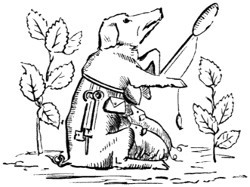
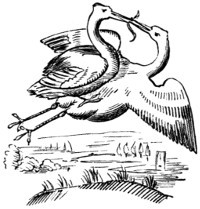
SPINNING SOW.
(France, 1520.)
TWO STORKS.
(Antwerp, 1639.)
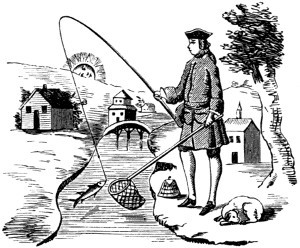
THE COMPLETE ANGLER.
(Banks’s Bills, 1780.)
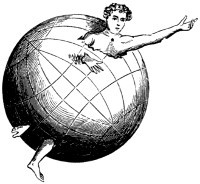
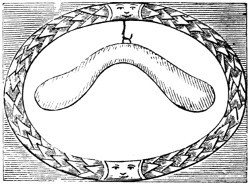
HELP ME THROUGH THIS WORLD.
(Banks’s Bills, 1812.)
CROOKED BILLET.
(Harleian Collection, 1710.)
That singularly successful quack, Lilly, though he ought not to be placed in such good company as the king’s physician, was also a constant sign, in the last century, at the door of sham doctors and astrologers. Not unfrequently they combined the Balls (a favourite sign of the quacks) with Lilly’s head, as the Black Ball and Lillyhead, the sign of Thomas Saffold, “an approved and licensed physician and student in astrology: he hath practised astronomy for twenty-four years, and hath had the Bishop of London’s licence to practise physick ever since the 4th day of September 1674, and hath, he thanks God for it, great experience and wonderful success in those arts.” He promised to perform the usual tours de force.
———“foretell what s’ever was By consequence to come to pass; As death of great men, alterations, Diseases, battles, inundations, Or search’d a planet’s house to know Who broke and robb’d a house below. Examined Venus and the Moon To find who stole a silver spoon.”
Butler’s Hudibras.
This address was “at the Black Ball and Lilly Head, next door to the Feather shops that are within Blackfriars gateway, which is over against Ludgate Church, just by Ludgate in London.”[76]
Classic authors also have come in for their share of signboard popularity in this country, which, at the time they flourished, was about as little civilized as the Sandwich Islands in the days of Captain Cook. These signs were set up by booksellers; thus Homer’s Head was, in 1735, the sign of Lawton Gilliver, against St Dunstan’s Church, publisher of some of Pope’s works, and in 1761, of J. Walker at Charing Cross. Cicero, under the name of Tully’s Head, hung at the door of Robert Dodsley, a famous bookseller in Pall Mall. In a newspaper of 1756, appeared some verses “on Tully’s head in Pall Mall, by the Rev. Mr G——s, of which the following are the first and the last stanzas:—
[59] Newcastle Journal, June 28, 1746.
[60] Nugæ Antiquæ, vol. i. p. 348.
[61] Barrow’s Life of Peter the Great.
[62] Gent. Mag., March 1842.
[63] Peacham’s Compleat Gentleman, p. 79.
[64] The taverns of the seventeenth century appear in many instances to have been upstairs, above shops. In 1679, there was a “Mr Crutch, goldsmith, near Temple Bar, at the Palsgrave Head.” In a similar way, a bookseller lived at the sign of the Rainbow, at the same time as one Farr, who opened this place as a coffee-house. Another bookseller, James Roberts, who printed most of the satires, epigrams, and other wasp-stings against Pope, lived at the Oxford Arms, a carriers’ inn in Warwick Lane. Finally, Isaac Walton sold his “Complete Angler” “at his shopp in Fleet Street, under the King’s Head Tavern.”
[65] Macaulay’s Biographical Essays, Frederick the Great.
[66] Goldsmith’s Essay on the Versatility of Popular Favour.
[67] For more particulars about Topham, see p. 88.
[68] Trades tokens in the Beaufoy Collection.
[69] For several centuries, Fleet Street was the head-quarters for shows and exhibitions out of fair-time. Ben Jonson speaks of “the City of Nineveh at Fleetbridge.” This was in the reign of James I. Mrs Salmon’s waxworks were among the last remaining sights in that locality.
[70] Richardsoniana, p. 140.
[71] Grosley, in his Tour to London, 1772, vol i. p. 150, mentions this society, which at that period was held at the Robin Hood, and says it was a semi-public club, into which all sorts of people were admitted, and all sorts of topics, religious as well as political, were discussed. He makes an odd mistake, however, when he says that the president was a baker by trade.
[72] This John Marshall afterwards, when he was appointed the king’s optician, changed his sign into the Archimedes and King’s Arms, under which we find him, in 1718, advertising his “chrystall dressing-glasses for ladies, which shew the face as nature hath made it, which other looking-glasses do not.”
[73] Banks’s Collection.
[74] Banks’s Collection.
[75] The Angler. Hawkins’s edition. 1784.
[76] Bagford Bills, Bib. Harl. 5964.
“Where Tully’s bust and honour’d name Point out the venal page, There Dodsley consecrates to fame The classics of his age. ..... Persist to grace this humble post, Be Tully’s head the sign, Till future booksellers shall boast To sell their tomes at thine.”
About the same time, the favourite Tully’s Head was also the sign of T. Becket, and P. A. de Hondt, booksellers in the Strand, near Surrey Street. Horace’s Head graced the shop of J. White in Fleet Street, publisher of several of Joseph Strutt’s antiquarian works; and Virgil’s Head of Abraham van den Hoeck and George Richmond, opposite Exeter Change in the Strand, in the middle of the last century. Of Seneca’s Head two instances occur, J. Round in Exchange Alley in 1711, and —— Varenne, near Somerset House, in the Strand, at the same period.
A few of our own poets are also common tavern pictures. As early as 1655 we find a (Ben) Jonson’s Head tavern in the Strand, where Ben Jonson’s chair was kept as a relic.[77] In that same year it was the sign of Robert Pollard, bookseller, behind the Royal Exchange. Ten years later it occurs in the following advertisement:—
“WHEREAS Thomas Williams, of the society of real and well-meaning Chymists hath prepaired certain Medicynes for the cure and prevention of the Plague, at cheap rates, without Benefit to himself, and for the publick good, In pursuance of directions from authority, be it known that these said Medicynes are to be had at Mr Thomas Fidges, in Fountain Court, Shoe Lane, near Fleet Street, and are also left by him to be disposed of at the Green Ball, within Ludgate, the Ben Jonson’s Head, near Yorkhouse,” &c.[78]
There is still a Ben Jonson’s Head tavern with a painted portrait of the poet in Shoe Lane, Fleet Street; a Ben Jonson’s Inn at Pemberton, Wigan, Lancashire; and another at Weston-on-the Green, Bicester.
Shakespeare’s Head is to be seen in almost every town where there is a theatre. At a tavern with that sign in Great Russell Street, Covent Garden, the Beefsteak Society (different from the Beefsteak Club,) used to meet before it was removed to the Lyceum Theatre. George Lambert, scene-painter to Covent Garden Theatre, was its originator. This tavern was at one time famous for its beautifully painted sign. The well-known Lion’s Head, first set up by Addison at Button’s, was for a time placed at this house.[79] There was another Shakespeare Head in Wych Street, Drury Lane, a small public-house at the beginning of this century, the last haunt of the Club of Owls, so called on account of the late hours kept by its members. The house was then kept by a lady under the protection of Dutch Sam the pugilist. After this it was for one year in the hands of the well-known Mr Mark Lemon, present editor of Punch, then just newly married to Miss Romer, a singer of some renown, who assisted him in the management of this establishment. The house was chiefly visited by actors from Covent Garden, Drury Lane, and the Olympic, whilst a club of literati used to meet on the first floor.
Sir John Falstaff, who so dearly loved his sack, could not fail to become popular with the publicans, and may be seen on almost as many signboards as his parent Shakespeare.
Milton’s Head was, in 1759, the sign of George Hawkins, a bookseller at the corner of the Middle Temple gate, Fleet Street; at present there are two Milton’s Head public-houses in Nottingham. Dryden’s Head was to be seen in 1761, at the door of H. Payne and Crossley, booksellers in Paternoster Row. At Kate’s Cabin, on the Great Northern Road, between Chesterton and Alwalton, there is a sign of Dryden’s head, painted by Sir William Beechey, when engaged as a house-painter on the decoration of Alwalton Hall. Dryden was often in that neighbourhood when on a visit to his kinsman, John Dryden of Chesterton.
Pope’s Head was in favour with the booksellers of the last century; thus the Gentleman’s Magazine, Sept. 1770, mentions a head of Alexander Pope in Paternoster Row, painted by an eminent artist, but does not say who the painter was. Edmund Curll, the notorious bookseller in Rose Street, Covent Garden, had Pope’s head for his sign, not out of affection certainly, but out of hatred to the poet. After the quarrel which arose out of Curll’s piratical publication of Pope’s literary correspondence, Curll, in May 22, 1735, addressed a letter of thanks to the House of Lords, ending thus,—“I have engraved a new plate of Mr Pope’s head from Mr Jervas’s painting, and likewise intend to hang him up in effigy for a sign to all spectators of his falsehood and my own veracity, which I will always maintain under the Scotch motto, ‘Nemo me impune lacessit.’” R. Griffiths, a bookseller in St Paul’s Churchyard since 1750, had the Dunciad for his sign. He was agent for a very primitive social-evil movement; advertisements emanating from this “sett of gentlemen sympathising with the misfortunes of young girls” occur in the papers of June and July 1752. One of the regulations was, “☞ None need to apply but such as are Fifteen years of age, and not above Twenty-five: older are thought past being reclaim’d, unless good Recommendations are given. Drinkers of spirits and swearers have a bad chance.”
The Man of Ross is at the present day a signboard at Wye Terrace, Ross, Herefordshire; the house in which John Kyrle, the Man of Ross, dwelt, was, after his death, converted into an inn. Twenty or thirty years ago the following poetical effusion was to be read stuck up in that inn:—
“Here dwelt the Man of Ross, O traveller here, Departed merit claims the rev’rent tear. Friend to the friendless, to the sick man health, With generous joy he view’d his modest wealth. If ’neath this roof thy wine-cheer’d moments pass, Fill to the good man’s name one grateful glass. To higher zest shall memory wake thy soul, And virtue mingle in th’ ennobled bowl, Here cheat thy cares, in generous visions melt, And dream of goodness thou hast never felt.”
The head of Rowe, the first emendator, corrector, and illustrator of Shakespeare, was in 1735 the sign of a bookseller in Essex Street, Strand. The Camden Head and Camden Arms occur in four instances as the sign of London publicans. Camden Town, however, may perhaps take the credit of this last sign. Addison’s Head was for above sixty years the sign of the then well-known firm of Corbett & Co.—first of C. Corbett, afterwards of his son Thomas, booksellers in Fleet Street from 1740 till the beginning of this century. Dr Johnson’s Head, exhibiting a portrait of the great lexicographer, is a modern sign in Bolton Court, Fleet Street, opposite to where the great man lived, and which was in his time occupied by an upholsterer. It is sometimes asserted to be the house in which the Doctor resided, but this statement is wrong, for the house in which he had apartments was burned down in 1819. Finally, a portrait of Sterne, under the name of the Yorick’s Head, was the sign of John Wallis, a bookseller in Ludgate Street in 1795.
Of modern poets Lord Byron is the only one who has been exalted to the signboard. In the neighbourhood of Nottingham his portrait occurs in several instances; his Mazeppa also is a great favourite, but it must be confessed its popularity has been greatly assisted by the circus, by sensational engravings, and, above all, by that love for horse flesh innate to the British character. Don Juan also occurs on a publican’s signboard at Cawood, Selby, West Riding; and Don John at Maltby, Rotheram, in the same county; but perhaps these are merely the names of race horses.
The latest of all literary celebrities who attained sufficient popularity to entitle him to a signboard was Sheridan Knowles, who was chosen as the sign of a tavern in Bridge Street, Covent Garden, facing the principal entrance to Drury Lane Theatre, (now a nameless eating-house.) There the Club of Owls used to meet. Sheridan Knowles was one of the patrons, and Augustine Wade, an author and composer of some fame, was chairman of the club in those days. Pierce Egan and Leman Rede were amongst its members; so that it may be conjectured that the nights were not passed in moping.[80]
Mythological divinities and heroes, also, have been very fairly represented on our signboards. At this head, of course, Bacchus (frequently with the epithet of Jolly) well deserves to be placed. In the time when the Bush was the usual alehouse sign, or rather when it had swollen to a crown of evergreens, a chubby little Bacchus astride on a tun was generally a pendant to the crown. In Holland and Germany we have seen a Beer king, (a modern invention, certainly,) named Cambrinus, taking the place of Bacchus at the beer-house door; but, according to the sixteenth century notions, Bacchus included beer in his dominions. Hence he is styled “Bacchus, the God of brew’d wine and sugar, grand patron of robpots, upsey freesy tipplers, and supernaculum takers, this Bacchus, who is head warden of Vintner’s Hall, ale connor, mayor of all victualling houses,” &c.—Massinger’s Virgin Martyr, a. ii. s. l. Next to Bacchus, Apollo is most frequent, but whether as god of the sun or leader of the Muses it is difficult to say. Sometimes he is called Glorious Apollo, which, in heraldic language, means that he has a halo round his head.[81] In the beginning of this century there was a notorious place of amusement in St George’s Fields, Westminster Road, called the Apollo Gardens—a Vauxhall or a Ranelagh of a very low description. It was tastefully fitted up, but being small and having few attractions beyond its really good orchestra, it became the resort of the vulgar and the depraved, and was finally closed and built over.
Minerva also is not uncommon—probably not so much because she was the goddess of wisdom, but as “ye patroness of scholars, shoemakers, diers,” &c.[82] Juno has a temple in Church Lane, Hull, and Neptune of course is of frequent occurrence in a country that holds the
“Imperium pelagi sævumque tridentem.”
The smith “being generally a thirsty soul, his patron Vulcan constitutes an appropriate alehouse sign, and in that capacity he frequently figures, particularly in the Black country. Amongst the quaint Dutch signboard inscriptions there is one which, in the seventeenth century, was written under a sign of Vulcan lighting his pipe:—
“In Vulcanus. Hy steekt zyn pyp op aan ’t vyer Die goed tabak wil hebben die komt alhier. Je krygt een gestopte pyp toe en op kermis een glas dik bier.”[83]
Vulcan, as the god of fire, without which there is no smoke, was a common tobacconist’s sign in Holland two hundred years ago. One of these dealers had the following rhymes affixed to his Vulcan sign:—
“Vulcan die lamme smid als hy was moei van smeden Ging hy wat zitten neer en ruste zyne leden De Goden zagen ’t aan, hy haalde uit zyn zak Zyn pypye en zyn doos en rookte doen tabak.”[84]
Mercury, the god of commerce, was of frequent occurrence, as might be expected. Amongst the Banks collection of shop-bills there is one of a fanshop in Wardour Street with the sign of the Mercury and Fan. Both Cupid and Flora were signs at Norwich in 1750,[85] and Comus is frequently the tutelary god of our provincial public-houses. Castor and Pollux, represented in the dress of Roman soldiers of the empire standing near a cask of tallow, was the sign of T. & J. Bolt, tallow-chandlers, at the corner of Berner Street, Oxford Street, at the end of the last century, for the obvious reason that, like the Messrs Bolt, they were two brothers that spread light over the world. Our admiration for athletic strength and sports suggested the sign of Hercules, as well as his biblical parallel Samson.
As for the Hercules Pillars, this was the classic name for the Straits of Gibraltar, which by the ancients was considered the end of the world; in the same classic sense it was adopted on outskirts of towns, where it is more common now to see the World’s End. In 1667 it was the sign of Richard Penck in Pall Mall, and also of a public-house in Piccadilly, on the site of the present Hamilton Place, both which spots were at that period the end of the inhabited world of London. The sign generally represented the demi-god standing between the pillars, or pulling the pillars down—a strange cross between the biblical and the pagan Hercules.
The Pillars of Hercules in Piccadilly is mentioned by Wycherley in the “Plain Dealer,” 1676:—“I should soon be picking up all our own mortgaged apostle spoons, bowls, and beakers out of most of the alehouses betwixt the Hercules Pillars and the Boatswain in Wapping.” The Marquis of Granby often visited the former house, and here Fielding, in “Tom Jones,” makes Squire Western put up:—“The Squire sat down to regale himself over a bottle of wine with his parson and the landlord of the Hercules Pillars, who, as the Squire said, would make an excellent third man, and would inform them of the news of the town; for, to be sure, says he, he knows a great deal, since the horses of many of the quality stand at his house.”[86] In Pepys’ time there was a Hercules Pillars tavern in Fleet Street. Here the merry clerk of the Admiralty supped with his wife and some friends on Feb. 6, 1667-8; his return home gives a good idea of London after the fire:—
“Coming from the Duke of York’s playhouse I got a coach, and a humour took us and I carried them to the Hercules Pillars, and there did give them a kind of supper of about 7s. and very merry, and home round the town, not through the ruins. And it was pretty how the coachman by mistake drives us into the ruins from London Wall unto Coleman Street, and would persuade me that I lived there. And the truth is, I did think that he and the linkman had contrived some roguery, but it proved only a mistake of the coachman; but it was a cunning place to have done us a mischief in, as any I know, to drive us out of the road into the ruins, and there stop, while nobody could be called to help us. But we came home safe.”
Atlas carrying the World was the very appropriate sign of the map and chart makers. In 1674 there was one in Cornhill,[87] and under a print of Blanket fair (the fair held on the Thames when frozen over) occurs the following imprint:—“A map of the river Thames merrily called Blanket-fair, as it was frozen in the memorable year 1683-4, describing the Booths, Footpaths, Coaches, Sledges, Bull-baitings, and other remarks. Sold by Joseph Moxon on the West side of Fleet ditch, at the sign of the Atlas.” Equally appropriate was Orpheus as the sign of the music shop of L. Peppard, next door to Bickerstaffe’s coffee-house, Russell Street, Covent Garden, 1711. No fault either can be found with the Golden Fleece as the sign of a woollen draper—Jason’s golden fleece being an allegory of the wool trade, but at the door of an inn or public-house it looks very like a warning of the fate the traveller may expect within—in being fleeced. In the seventeenth century there was a Fleece Tavern in St James’s:—
“A RARE Consort of four Trumpets Marine, never heard of before in England.[88] If any person desire to come and hear it, they may repair to the Fleece Tavern near St James’s about 2 o’clock in the afternoon every day in the week except Sundays. Every consort shall continue one hour and so to begin again. The best places are 1 shilling, the others sixpence.”—London Gazette, Feb. 1-4, 1674.
This is amongst the earliest concerts on record in London. Another example of this sign worth mentioning was the Fleece Tavern, (in York Street,) Covent Garden, which, says Aubrey, “was very unfortunate for homicides; there have been several killed—three in my time. It is now (1692) a private house. Clifton, the master, hanged himself, having perjured himself.”[89] Pepys does not give this house a better character:—“Decemb. 1, 1660. Mr Flower did tell me how a Scotch knight was killed basely the other day at the Fleece in Covent Garden, where there had been a great many formerly killed.” On the Continent, also, this symbol was used; for instance, in 1687, by Jean Camusat, a printer in the Rue St Jacques, Paris; his colophon represented Jason taking the golden fleece off a tree, with the motto—“Tegit et quos tangit inaurat.”
Another sign, of which the application is not very obvious, is Pegasus or the Flying Horse, unless it refers to this rhyme:—
“If with water you fill up your glasses, You’ll never write anything wise; For wine is the horse of Parnassus, Which hurries a bard to the skies.”
“John Gay, at the Flying Horse, between St Dunstan’s Church and Chancery Lane, 1680,” is an imprint under many ballads. John Gay undoubtedly had adopted this sign as a compliment to the Templars, in whose vicinity he lived, and whose arms are a Pegasus on a field arg. As for the poor balladmongers, whose works Gay printed, they certainly put Pegasus too much to the plough, to imagine that he alluded to theirs as a Flying Horse. Instead of the Flying Horse, a facetious innkeeper at Rogate Petersfield, has put up a parody in the shape of the Flying Bull.
The Hope and the Hope and Anchor are constant signs with shop and tavern keepers. Pepys spent his Sunday, the 23d September 1660, at the Hope Tavern, in a not very godly manner; and his account shews the curious business management of the taverns in the time:—
“To the Hope and sent for Mr Chaplin, who with Nicholas Osborne and one Daniel come to us, and we drank of two or three quarts of wine, which was very good; the drawing of our wine causing a great quarrel in the house between the two drawers which should draw us the best, which caused a great deal of noise and falling out, till the master parted them, and came up to us and did give us a long account of the liberty he gives his servants, all alike, to draw what wine they will to please his customers; and we eat above two hundred walnuts.”
In consequence of these excesses Master Pepys was very ill next day, but the particulars of the illness, though very graphically entered into the diary, are “unfit for publication.”
The Fortune was adopted from considerations somewhat similar to those that prompted the choice of the Hope. It occurs as the sign of a tavern in Wapping in 1667. The trades tokens of this house represent the goddess by a naked figure standing on a globe, and holding a veil distended by the wind,—a delicate hint to the customers, for it is a well-known fact that a man who has “a sheet in the wind” is as happy as a king. Doubtless the name of the Elysium, a public-house in Drury Lane about thirty years ago, had also been adopted as suggestive of the happiness in store for the customers who honoured the place by their company.
Ballads, novels, chapbooks, and songs, have also given their contingent. Thus, for instance, the Blind Beggar of Bethnal Green—still a public-house in the Whitechapel Road—has decorated the signpost for ages. The ballad was written in the reign of Queen Elizabeth; but the legend refers to Henry de Montfort, son of the Earl of Leicester, who was supposed to have fallen at the battle of Evesham in the reign of Henry III. Not only was the Beggar adopted as a sign by publicans, but he also figured on the staff of the parish beadle; and so convinced were the Bethnal Green folks of the truth of the story, that the house called Kirby Castle was generally pointed out as the Blind Beggar’s palace, and two turrets at the extremity of the court wall as the place where he deposited his gains.
Still more general all over England is Guy of Warwick, who occurs amongst the signs on trades tokens of the seventeenth century: that of Peel Beckford, in Field Lane, represents him as an armed man holding a boar’s head erect on a spear. The wondrous strange feats of this knight form the subject of many a ballad. In the Roxburgh Collection there is one headed, “The valiant deads of chivalry atchieved by that noble knight, Sir Guy of Warwick, who, for the love of fair Phillis, became a hermit, and dyed in a cave of a craggy rock a mile distant from Warwick. In Normandy stoutly won by fight the Emperor’s daughter of Almayne from many a valiant, worthy knight.”[90] His most popular feat is the slaying of the Dun Cow on Dunsmore Heath, which act of valour is commemorated on many signs.
“By gallant Guy of Warwick slain Was Colbrand, that gigantick Dane. Nor could this desp’rate champion daunt A dun cow bigger than elephaunt. But he, to prove his courage sterling, His whinyard in her blood embrued; He cut from her enormous side a sirloin, And in his porridge-pot her brisket stew’d, Then butcher’d a wild boar, and eat him barbicu’d.”
Huddersford Wiccamical Chaplet.
A public-house at Swainsthorpe, near Norwich, has the following inscription on his sign of the Dun Cow:—
“Walk in, gentlemen, I trust you’ll find The Dun Cow’s milk is to your mind.”
Another on the road between Durham and York:—
“Oh, come you from the east, Oh, come you from the west, If ye will taste the Dun Cow’s milk, Ye’ll say it is the best.”
The King and Miller is another ballad-sign seen in many places. It alludes to the adventure of Henry II. with the Miller of Mansfield.[91] Similar stories are told of many different kings: of King John and the Miller of Charlton, (from whom Cuckold’s Point got its name;) of King Edward and the tanner of Drayton Basset; of Henry VIII.; of James V. of Scotland, (the guidman of Ballageich;) of Henry IV. of France and the pig-merchant; of Charles V. of Spain and the cobbler of Brussels; of Joseph II.; of Frederick the Great; and even of Haroun-al-Raschid, who used to go about incognito under the name of Il Bondocani.
The most frequent of all ballad signs is unquestionably Robin Hood and Little John, his faithful accolyte. Robin Hood has for centuries enjoyed a popularity amongst the English people shared by no other hero. He was a crack shot, and of a manly, merry temper, qualities which made the mob overlook his confused notions about meum and tuum, and other peccadilloes. His sign is frequently accompanied by the following inscription:—
“You gentlemen, and yeomen good, Come in and drink with Robin Hood. If Robin Hood be not at home, Come in and drink with Little John.”
Which last line a country publican, not very well versed in ballad lore, thus corrected:—
“Come in and drink with Jemmie Webster.”
At Bradford, in Yorkshire, the following variation occurs:—
“Call here, my boy, if you are dry, The fault’s in you, and not in I. If Robin Hood from home is gone, Step in and drink with Little John.”
At Overseal, in Leicestershire:—
“Robin Hood is dead and gone, Pray call and drink with Little John.”
Finally, at Turnham Green:—
“Try Charrington’s ale, you will find it good. Step in and drink with Robin Hood. If Robin Hood,” &c.
And to shew the perfect application of the rhyme, mine host informs the public that he is “Little John from the old Pack Horse,” (a public-house opposite.)
One of the ballads in Robin Hood’s Garland has given another signboard hero, namely, the Pindar of Wakefield,[92] George a Green.
“In Wakefielde there lives a jolly Pindar, In Wakefielde all on the greene. ‘There is neither knight nor squire,’ said the Pindar, ‘Nor baron so bold, nor baron so bold, Dares make a trespass to the town of Wakefielde, But his pledge goes to the Pinfold.’”
Drunken Barnaby mentions the sign in Wakefield in 1634:—
“Straight at Wakefielde I was seen, a’, Where I sought for George-a-Green, a’, But could find not such a creature, Yet on sign I saw his feature. Whose strength of ale had so much stirr’d me, That I grew stouter far than Jordie.”
There was formerly a public-house near St Chad’s Well, Clerkenwell, bearing this sign, which at one period, to judge from the following inscription, would seem to have been more famous than the celebrated Bagnigge Wells hard by. A stone in the garden-wall of Bagnigge House said:—
☩
S. T.
This is Bagnigge House, neare the Pindar A Wakefeilde. 1680.
Among the more uncommon ballad signs, we find the Babes in the Wood at Hanging Heaton, Dewsbury, West Riding. Jane Shore was commemorated in Shoreditch in the seventeenth century, as we see from trades tokens. Valentine and Orson we find mentioned as early as 1711,[93] as the sign of a coffee-house in Long Lane, Bermondsey; and there they remain till the present day.
Other chapbook celebrities are Mother Shipton, Kentish Town, and Low Bridge, Knaresboro’; which latter village disputes with Shipton, near Londesborough, the honour of giving birth to this remarkable character in the month of July 1488. The fact is duly commemorated under her signboard in the former place:—
“Near to this petrifying wall[94] I first drew breath, as records tell.”
Her life and prophecies have at all times been a favourite theme in popular literature. If we may believe her biographers, she predicted the fall of Cardinal Wolsey, the dissolution of the monasteries, the establishment of the Protestant religion under Edward VI., the cruelty of Queen Mary, the glorious reign of Queen Elizabeth, the defeat of the Armada, the Plague and Great Fire, and many things not yet come to pass. Like the Delphic oracles, her predictions were given in metre, and veiled in mystery. The plague and fire, for instance, are thus foretold:—
“Triumphant death rides London thro’, And men on tops of houses go.”
She is represented as of a most unprepossessing appearance; although we certainly might have expected better from the daughter of a necromancer, or “the phantasm of Apollo, or some aerial dæmon who seduced her mother;”—“her body was long, and very big-boned; she had great goggling eyes, very sharp and fiery; a nose of unproportionable length, having in it many crooks and turnings, adorned with great pimples, and which, like vapours of brimstone, gave such a lustre in the night, that the nurse needed no other light to dress her by in her childhood.”[95]
Another necromancer, Merlin, shares renown with Mother Shipton, both in chapbooks and on signboards. Merlin’s Cave is the sign of a public-house in Great Audley Street, and in Upper Rosomon Street, Clerkenwell, in which places he doubtless still plays his old pranks, of changing men into beasts. Innumerable romances and histories of Merlin were printed in the middle ages. He appears in Geoffrey of Monmouth as early as the twelfth century, and Alain de l’Isle gave an ample explanation of his prophecies in seven books, printed in 1608. “This Merlin,” says M. de la Monnoye, “tout magicien et fils du diable que l’on l’a cru,” has by the good Carmelite, Baptiste Mantuanus, been metamorphosed into a saint. At the end of his “Tolentinum,” a poem in three books, in honour of St Nicholas, (anno 1509,) he thus speaks of Merlin:—
“Vitæ venerabilis olim Vir fuit et vates, venturi præscius ævi, Merlinus, laris infando de semine cretus. Hic satus infami coitu pietate refulsit Eximia superum factus post funera consors.”[96]
His prophecies were also translated into Italian, and printed at Venice in 1516. The annotators say it was reported that Merlin, by his enchantments, transported from Ireland those huge stones found in Salisbury plain. His cave was in Clerkenwell, on the site where the alehouse now stands, and was in the reign of James I., one of the London sights strangers went to see.[97]
We have a well-known chapbook hero in Jack of Newbury, who had already attained to the signboard honours in the seventeenth century, when we find him on the token of John Wheeler, in Soper Lane (now Queen Street, Cheapside,) whilst at present, he may be seen in a full-length portrait in Chiswell Street, Finsbury Square. This Jack of Newbury, alias Winchcombe, alias Smallwoode, “was the most considerable clothier England ever had. He kept an hundred looms in his house, each managed by a man and a boy. He feasted King Henry VIII. and his first Queen Catherine at his own house in Newbury, now divided into sixteen clothiers’ houses. He built the Church of Newbury, from the pulpit westward to the town.”[98] At the battle of Flodden in 1513, he joined the Earl of Surrey with a corps of one hundred men, well equipped at his sole expense, who distinguished themselves greatly in that fight. He is buried in Newbury, where his brass effigy is still to be seen, purporting that he died February 15, 1519. An inn bearing his sign in Newbury, is said to be built on the site of the house where he entertained King Harry. Thomas Deloney, the ballad-writer, wrote a tale about him, entitled, “The pleasant history of John Winchcomb, in his younger years called Jack of Newberry, the famous and worthy clothier of England, declaring his life and love, together with his charitable deeds and great hospitalitie. Entered in the Stationers’ Book, May 7, 1596.”
Whittington and his Cat is still very common, not only in London but in the country also. Sometimes the cat is represented without her master, as on the token of a shop in Longacre, 1657, and on the sign of —— Varney, a seal-engraver in New Court, Old Bailey, 1783, whose shopbill[99] represents a large cat carved in wood holding an eye-glass by a chain. The story of Whittington is still a favourite chapbook tale, and has its parallel in the fairy tales of various other countries. Straparola, in his “Piacevole Notte,” is, we believe, the first who mentions it. The earliest English narrative occurs in Johnson’s “Crown Garland of Golden Roses,” 1612, but there is an allusion to “Whittington and his Puss” in the play of “Eastward Hoe!” 1603. For more than a century it was one of the stock pieces of Punch and his dramatic troop. Sept. 21, 1688, Pepys went to see it: “To Southwark Fair, very dirty, and there saw the puppet-show of Whittington, which is pretty to see; and how that idle thing do work upon people that see it, and even myself too.” Foote, in his comedy of the “Nabob,” makes Sir Matthew Mite account for the legend by explaining the cat as the name of some quick-sailing vessels by which Whittington imported coals, which should have been the source of the Lord Mayor’s wealth. In the Highgate Road there is a skeleton of a cat in a public-house window, which by the people who visit there is firmly believed to be the earthly remains of Whittington’s identical cat. The house is not far distant from the spot where the future Lord Mayor of London stopped to listen to the city bells inviting him to return. It is now marked by a stone, with the event duly inscribed thereon.
King Arthur’s Round Table is to be seen on various public-houses. There is one in St Martin’s Court, Leicester Square, where the American champion, Heenan, put up when he came to contest the belt with the valiant Tom Sayers. The same sign is also often to be met with on the Continent. In the seventeenth century there was a famous tavern called la Table Roland in the Vallée de Misère at Paris. John-o’-Groat’s House is also used for a sign; there was one some years ago in Windmill Street, Haymarket; and at present there is a John-o’-Groat’s in Gray Street, Blackfriars Road. Both these and the Round Table contain, we conceive, some intimation of that even-handed justice observed at the houses, where all comers are treated alike, and one man is as good as another.
Darby and John, a corruption of Darby and Joan, and borrowed from an old nursery fable, is a sign at Crowle, in Lincolnshire; and Hob in the Well, with a similar origin, at Little Port Street, Lynn; whilst Sir John Barleycorn is the hero of a ballad allegorical of the art of brewing, &c.
A favourite ballad of our ancestors originated the sign of the London Apprentice, of which there are still numerous examples. How they were represented appears from the Spectator, No. 428, viz., “with a lion’s heart in each hand.” The ballad informs us that the apprentice came off with flying colours, after endless adventures, one of which was that like Richard Cœur-de-Lion—he “robbed the lion of his heart.” The ballad is entitled “The Honour of an Apprentice of London, wherein he declared his matchless manhood and brave adventures done by him in Turkey, and by what means he married the king’s daughter of that same country.”
The Essex Serpent is a sign in King Street, Covent Garden, and in Charles Street, Westminster, perhaps in allusion to a fabulous monster recorded in a catalogue of wonders and awful prognostications contained in a broadside of 1704,[100] from which we learn that, “Before Henry the Second died, a dragon of marvellous bigness was discovered at St Osyph, in Essex.” Had we any evidence that it is an old sign, we might almost be inclined to consider it as dating from the civil war, and hung up with reference to Essex, the Parliamentary general; for though we have searched the chroniclers fondest of relating wonders and monstrous apparitions, we have not succeeded in finding any authority for the St Osyph Dragon, other than the above-mentioned broadside.
Literature of a somewhat higher class than street ballads, has likewise contributed material to the signboards. One of the oldest instances is the Lucrece, the chaste felo-de-se of Roman history, who, in the sixteenth century, was much in fashion among the poets, and was even sung by Shakespeare. We find that “Thomas Berthelet, prynter unto the kynges mooste noble grace, dwellynge at the sygne of the Lucrece, in Fletestrete, in the year of our Lorde 1536.” In 1557, it was the sign of Leonard Axtell, in St Paul’s Churchyard; and in the reign of Charles I., of Thomas Purfoot, in New Rents, Newgate Market, both booksellers and printers. The Complete Angler was the usual sign of fish-tackle sellers in the last century, and the essays of the Spectator made the character of Sir Roger de Coverley very popular with tobacconists. Doctor Syntax hangs at the door of many public-houses, as at Preston, Oldham, Newcastle, Gateshead, &c.; the Lady of the Lake at Lowestoft; Dandie Dinmont at West Linton, Carlisle; Pickwick in Newcastle; the Red Rover, Barton Street, Gloucester;[101] Tam o’ Shanter, Laurence Street, York, and various other towns; Robin Adair, Benwell, Newcastle. Popular songs also belong to this class, as the Lass o’ Gowrie, Sunderland and Durham; Auld Lang Syne, Preston Street, Liverpool; Tulloch-Gorum and Loch-na-Gar, both in Manchester; Rob Roy, Titheburn Street, Liverpool; Flowers of the Forest, Blackfriars Road. On the whole, however, this class of names is much more prevalent in the northerly than in the southerly districts of England. In the south, if we except The Old English Gentleman, who occurs everywhere, the great Jim Crow is almost the only instance of the hero of a song promoted to the signboard. Robinson Crusoe is common to all the seaports of the kingdom, whilst Uncle Tom, or Uncle Tom’s Cabin, is to be found everywhere, not only in England, but also on the Continent. Any little underground place of refreshment or beer-house difficult of access, is considered as fittingly named by Mrs Beecher Stowe’s novel.
A very appropriate, and not uncommon public-house sign is the Toby Philpott. That he well deserves this honour, appears from the following obituary notice, (in the Gent. Mag., Dec. 1810:)—
“At the Ewes farm-house, Yorkshire, aged 76, Mr Paul Parnell, farmer, grazier, and maltster, who, during his lifetime, drank out of one silver pint cup upwards of £2000 sterling worth of Yorkshire Stingo, being remarkably attached to Stingo tipple of the home-brewed best quality. The calculation is taken at 2d. per cupful. He was the bon-vivant whom O’Keefe celebrated in more than one of his Bacchanalian songs under the appellation of Toby Philpott.”
Between St Albans and Harpenden, there was, some years ago, and perhaps there is still, a public-house called the Old Roson. This name also appears to be borrowed from the well-known song, “Old Rosin the Beau,” beginning thus:—
[77] “On the chair of Ben Johnson, now remaining at Robert Wilson’s, at the sign of the Johnson’s Head, in the Strand.”—Wit and Drollery, 1655, p. 79.
[78] The Newes, August 24, 1655. This may have been the above-mentioned tavern, as York House was situated in the Strand on the site of the present York Buildings.
[79] Addison’s Lion’s Head, the box for the deposition of the correspondence of the Guardian, was originally placed at Button’s, over against Tom’s in Great Russell Street. “After having become a receptacle of papers and a spy for the Guardian, it was moved to the Shakespeare’s Head Tavern, under the Piazza in Covent Garden, kept by a person named Tomkins, and in 1751 was for a short time placed in the Bedford Coffeehouse, immediately adjoining the Shakespeare Tavern, and there employed as a medium of literary communication by Dr John Hill, author of the ‘Inspector.’ In 1769, Tomkins was succeeded by his waiter, named Campbell, as proprietor of the tavern and Lion’s Head, and by him the latter was retained till 1804, when it was purchased by the late Charles Richardson, after whose death in 1827 it devolved to his son, and has since become the property of his Grace the Duke of Bedford.”—Till, in his Preface to Descriptive Catalogue of English Medals.
[80] Our slang friends the burlesque writers and parodists, would probably say something about mopping.—Ed.
[81] An “Apollo in his glory” is a charge in the apothecaries’ arms.
[82] Aubrey, Remains of Gentilisme and Judaism. Lansdowne MSS. 231, p. 106.
[83] At the Vulcan. He lights his pipe at the fire;—whosoever wants to buy good tobacco let him come here;—you will get a pipe filled into the bargain, and a glass of strong beer in fair time.
[84] Vulcan, that lame blacksmith, when he got tired over his work, sat down a while to rest his limbs. The gods saw it; he took his cutty pipe and his tobacco box out of his pocket and smoked a pipe of tobacco.
[85] Gent. Mag., March 1842.
[86] The History of Tom Jones, book xvi. ch. ii.
[87] Lond. Gaz., June 18-22, 1674.
[88] This was not true, for Pepys went (24th Oct. 1667) to hear the same instrument played by a Mr Prin, a Frenchman, “which he do beyond belief, and the truth is, it do so far outdo a trumpet as nothing more, and he do play anything very true. The instrument is open at the end I discovered, but he would not let me look into it.” Philips, in his “New World of Words,” 1696, describes it as “an instrument with a bellows, resembling a lute, having a long neck with a string, which being struck with a hairbow sounds like a trumpet.”
[89] Aubrey, Miscellanies upon various subjects.
[90] See in Bib. Top. Brit., vol. iv., a Critical Memoir on the Story of Guy of Warwick, by the Rev. Samuel Pegge, who supposes that Guy lived in Saxon times, and was the son of Simon, Baron of Wallingford. He married Felicia, (Phillis,) the daughter and heiress of Rohand, Earl of Warwick, who flourished in the reign of Edward the Elder, and so became Earl of Warwick.
[91] In Ritson’s Ancient Songs and Ballads.
[92] The “pindar” was the man who took care of stray cattle, which he kept in the pinfold, or pound, until it was claimed and the expenses paid.
[93] Daily Courant, Feb. 19, 1711.
[94] The “Dropping Well,” one of the most noted petrifying springs in England, and so named on account of its percolating through the rock that hangs over it.
[95] This information we gather from a chapbook entitled “The Strange and Wonderful History and Prophecies of Mother Shipton, by Ferraby, printer on the Market Place, Hull.” It is evidently a reprint of a chapbook of the time of Charles II., as appears from many allusions.
[96] Once there was a man who led a holy life, and was a prophet, who could see what would come to pass; his name was Merlin, and he was the offspring of an evil and fiendish spirit. But though born from such a father, he shone forth in virtue, and after his death, became a companion of the saints.
[97] Henry Peacham’s Compleat Gentleman.
[98] John Collet’s Historical Anecdotes, Add. MSS. 8890, p. 113.
[99] In the Banks Collection.
[100] This broadside is reprinted in Notes and Queries for January 15, 1859. Sussex had its snake as late as 1614. There is a pamphlet In the Harl. Collection, entitled, “True and Wonderful—a discourse relating a strange and monstrous serpent, (or dragon,) lately discovered, and yet living, to the great annoyance and divers slaughter both of men and cattell, by his strong and violent Poyson, in Sussex, two miles from Horsam, in a woode called St Leonard’s Forrest, and thirtie miles from London, this present month of August 1614.” That this Sussex snake caused a great sensation, appears from the fact that seventeen years after, it is alluded to in “Whimsies: or, A New Cast of Characters,” 1631: “Nor comes his [the ballad-monger’s] invention far short of his imagination. For want of truer relations for a neede, he can find you out a Sussex dragon, some sea or inland monster, drawn out by some Shoe Lane man, [i.e., a sign-painter; they all lived in Harp Alley, Shoe Lane,] in Gorgon-like features, to enforce more horror in the beholder.”
[101] The title of Cooper’s novel seems to have taken hold of the popular fancy to an astonishing degree: not only are there several public-houses who have adopted it as their sign, but also race-horses, ships, and locomotive engines have been named after it. There is even a baked potato-can in the streets of London, decorated with that name; it is built in the shape of a locomotive-engine, japanned red, and wheeled about the streets by an old woman. The name on a brass plate is screwed to the can, similar to the names of locomotive-engines.
“I have travell’d this wide world over, And now to another I’ll go,[82] I know that good quarters are waiting To welcome old Rosin the Beau (ter.)
When I am dead and laid out on the counter, A voice you will hear from below, Singing out brandy and water To drink to old Rosin the Beau (ter.)
You must get some dozen good fellows, And stand them all round in a row, And drink out of half-gallon bottles, To the name of old Rosin the Beau,” &c.
These stanzas, and one or two more to the same import, were quite sufficient to make the old Beau a fit subject for the signboard, irrespective of his other amiable qualities held forth in the song. The very common Old House at Home, too, is borrowed from a once-popular ballad, the verse of which is too well known to need quotation here.
The equally common Hearty Good Fellow is adopted from a Seven Dials ballad:—
“I am a hearty good fellow, I live at my ease, I work when I am willing, I play when I please. .... With my bottle and my glass, Many hours I pass, Sometimes with a friend, And sometimes with a lass,” &c.
Of signboards portraying artists, but few instances occur; and when they do, they are almost exclusively the property of printsellers. We have only met with three: Rembrandt’s Head, the sign of J. Jackson, printseller, at the corner of Chancery Lane, Fleet Street, 1759; and of Nathaniel Smith, the father (?) of J. T. Smith, in Great May’s Buildings, St Martin’s Lane. Another member of that family, J. Smith, who kept a printshop in Cheapside, where several of Hogarth’s engravings were published, assumed the Hogarth’s Head for his sign. The third is the Van Dyke’s Head, the sign of C. Philips, engraver and print-publisher in Portugal Street, in 1761. Hogarth also had a head of Van Dyke as his trade symbol, made from small pieces of cork, but being gilt, he called it the Golden Head, (see under Miscellaneous Signs.)
In old times, more than at present, music was deemed a necessary adjunct to tavern hospitality and public-house entertainment. The fiddlers and ballad singers of the “tap” room, however, gave way to the newer brass band at the doors, and this, in its turn, is now gradually fading before the “music hall” and so-called “concert” arrangement. Singing, it may be remarked, is one of the first follies into which a man falls after a too free indulgence in the cup. It is not to be wondered at, therefore, that musical signboards should have swung from time to time over the alehouse door. Paganini, who contributed so much to the popularity of that well-known part of the “Carnival de Venise”—still the shibboleth of all fiddlers—is of very common occurrence.
The love for music is also eloquently expressed by the sign of the Fiddler’s Arms, Gornal Wood, Staffordshire. Jenny Lind seems to be the only musician of modern times who has found her way to the signboard. In the last century, Handel’s Head was common; but at the present moment, no instance of its use remains. The Maid and the Magpie, a very common tavern title, is believed to be the only sign borrowed from an opera. In Queen Anne’s time, there was a Purcell’s Head in Wych Street, Drury Lane, the sign of a music-house. It represented that musician in a brown, full-bottomed wig, and green nightgown, and was very well painted. Purcell, who died in 1682, greatly improved English melody; he composed sonatas, anthems, and the music to various plays. His “Te Deum” and “Jubilate” are still admired.
Actors, and favourite characters from plays, have frequently been adopted as signs. The oldest instance we find is Tarleton, or Dick Tarleton, who, in the sixteenth century, seems to have been common enough to make Bishop Hall allude to him in his “Satyres,” (b. vi., s. 1)—
“O honour far beyond a brazen shrine, To sit with Tarlton on an ale-post’s sign.”
Tarleton is seen on the trades token of a house in Wheeler Street, Southwark; and it is only within a very few years that this sign has been consigned to oblivion. Richard, or “Dick” Tarleton was a celebrated low-comedy actor, born at Condover in Shropshire, and brought to town in the household of the Earl of Leicester. He first kept an ordinary in Paternoster Row, called the Castle, much frequented by the booksellers and printers of St Paul’s Churchyard. Afterwards, he kept the Tabor, in Gracechurch Street. He was one of Queen Elizabeth’s twelve players, in receipt of wages, and was at that time living as one of the grooms of the chamber at Barn Elms, but lost his situation by reason of some scurrilous reflections on Leicester and Raleigh. He probably also performed at the Curtain in Shoreditch, in which parish he was buried, September 3, 1588. “The great popularity which Tarlton possessed may be readily seen from the numerous allusions to him in almost all the writers of the time, and few actors have been honoured with so many practical tokens of esteem. His portrait graced the ale-house, game-cocks were named after him, and a century after his death, his effigy adorned the jakes.”[102] The portrait of this famous wit is prefixed to the edition of his jests, printed in 1611, where he is represented in the costume of a clown playing on the tabor and pipe. Another portrait of him occurs as an accompaniment to the letter T, in a collection of ornamental letters,[103] with the following rhymes:—
“This picture here set down within his letter T, Aright doth shew the forme and shape of Tharleton unto thee. When he in pleasaunt wise the counterfeit expreste, Of clowne with cote of russet hew, and startups wth the reste; Who merry many made when he appear’d in sight, The grave, the wise, as well as rude, att him did take delight. The partie now is gone, and closlie clad in claye; Of all the jesters in the lande, he bare the praise awaie. Now hath he plaied his parte, and sure he is of this, If he in Christe did die to live with Him in lasting bliss.”
Spiller’s Head was the sign of an inn in Clare Market, where one of the most famous tavern clubs was held. This meeting of artists, wits, humorists, and actors originated with the performances at Lincoln’s Inn, about the year 1697. They counted many men of note amongst their members. Colley Cibber was one of the founders, and their best president, not even excepting Tom d’Urfey. James Spiller, it should be stated, was a celebrated actor circa 1700. His greatest character was “Mat o’ the Mint,” in the Beggar’s Opera. He was an immense favourite with the butchers of Clare Market, one of whom was so charmed with his performances, that he took down his sign of the Bull and Butcher, and put up Spiller’s Head. At Spiller’s death, (Feb. 7, 1729,) the following elegiac verse was made by one of the butchers in that locality:—
“Down with your marrow-bones and cleavers all, And on your marrow-bones ye butchers fall! For prayers from you who never pray’d before,[85] Perhaps poor Jimmie may to life restore. ‘What have we done?’ the wretched bailiffs cry, ‘That th’ only man by whom we lived should die!’ Enraged they gnaw their wax and tear their writs, While butchers’ wives fall in hysteric fits; For, sure as they’re alive, poor Spiller’s dead. But, thanks to Jack Legar! we’ve got his head. He was an inoffensive, merry fellow, When sober, hipp’d, blythe as a bird when mellow.”
A ticket for one of his benefit representations, engraved by Hogarth, is still a morceau recherché amongst print collectors, as much as £12 having been paid for one. “Spiller’s Life and Jests” is the title of a little book published at that time.
Garrick’s Head was set up as a sign in his lifetime, and in 1768 it hung at the door of W. Griffiths, a bookseller of Catherine Street, Strand. It is still common in the neighbourhood of theatres. There is one in Leman Street, Whitechapel, not far from the place of his first successes, where, in 1742, he played at the theatre in Goodman’s Fields, and “the town ran horn-mad after him,” so that there were “a dozen dukes of a night at Goodman’s Fields sometimes.”[104]
Roxellana was, in the seventeenth century, the sign of Thomas Lacy, of Cateaton Street, (now Gresham Street,) City. It was the name of the principal female character in “The Siege of Rhodes,” and was originally the favourite part of the handsome Elizabeth Davenport, whose sham marriage to the Earl of Oxford, (who deceived her by disguising a trumpeter of his troop as a priest,) is told in De Grammont’s Memoirs. After she had found out the Earl’s deception, she continued under his protection, and is occasionally mentioned, (always under the name of Roxellana,) with a few words of encomium on her good looks by that entertaining gossip, Pepys.
Formerly there was a sign of Joey Grimaldi at a public-house nearly opposite Sadler’s Wells Theatre; not only had it the name, but addidit vultum verbis, in the shape of a clown with a goose under his arm, and a string of sausages issuing from his pocket. Joey’s name being less familiar to the public of the present day, the house is now called the Clown. This, we think, is the last instance of an actor being elevated to signboard honours.
Abel Drugger is one of the dramatis personæ in Ben Jonson’s comedy of the Alchymist, and from the character given him by his friend Captain Face, we get some curious information concerning the mysteries of the tobacco trade of that day:—
“This is my friend Abel, an honest fellow, He lets me have good tobacco, and he does not Sophisticate it with sack lees or oil, Nor washes it with muscadel and grains, Nor buries it in gravel underground, Wrapp’d up in greasy leather or p—— clouts, But keeps it in fine lily pots, that open’d Smell like conserve of roses, or French beans. He has his maple block, his silver tongs, Winchester pipes, and fire of juniper. A neat, spruce, honest fellow, and no goldsmith.”
This worthy was, in the end of the last century, the sign of Peter Cockburn, a tobacconist in Fenchurch Street, formerly shopman at the Sir Roger de Coverley, as he informs the public on his tobacco paper.[105] According to the custom of the times, and one which has yet lingered in old-fashioned neighbourhoods, this wrapper is adorned with some curious rhymes:—
“At Drugger’s Head, without a puff, You’ll ever find the best of snuff, Believe me, I’m not joking; Tobacco, too, of every kind, The very best you’ll always find, For chewing or for smoaking. Tho’ Abel, when the Humour’s in, At Drury Lane to make you grin, May sometimes take his station; At number Hundred-Forty-Six, In Fenchurch Street he now does fix His present Habitation. His best respects he therefore sends, And thus acquaints his generous Friends, From Limehouse up to Holborn, That his rare snuffs are sold by none, Except in Fenchurch Street alone, And there by Peter Cockburn.”
Falstaff, whom we have already mentioned when speaking of Shakespeare, and Paul Pry, are both very common. The last is even of more frequent occurrence than “honest Jack” himself.
Lower down in the scale of celebrities and public characters, we find the court-jester of Henry VIII., Old Will Somers, the sign of a public-house in Crispin Street, Spittalfields, at the present day. He also occurs on a token issued from Old Fish Street, in which he is represented very much the same as in his portrait by Holbein, viz., wearing a long gown, with hat on his head, and blowing a horn. Under an engraving of this picture are the following lines:—
“What though thou think’st me clad in strange attire, Knowe I am suted to my own deseire; And yet the characters described upon mee May shew thee that a king bestowed them upon mee. This horn I have betokens Sommers’ game, Which sportive tyme will bid thee reade my name, All with my nature well agreeing to As both the name, and tyme, and habit doe.”
Formerly there used to be in the town a wooden figure of Will with rams’ horns and a pair of large spectacles; and the story was told that he never would believe that his wife had presented him with the “bull’s feather” until he had seen it through his spectacles.
Two portraits of Sommers are preserved at Hampton Court, one in a picture after Holbein, representing Henry VII. with his queen, Elizabeth, and Henry VIII. with his queen, Jane Seymour. Will is on one side, his wife on the other. The other portrait is by Holbein, three-quarter life size, where he is represented looking through a closed window.[106] He also figures in Henry VIII.’s illuminated Psalter,[107] in which King Henry’s features are given to David, and those of Will Sommers to the fool who accompanies him.
Sommers was born at Eston Neston, Northamptonshire, where his father was a shepherd. His popularity arose from his frankness, which is thus eulogised by Ascham in his “Toxophilus:”—“They be not much unlike in this to Wyll Sommers, the kingis foole, which smiteth him that standeth alwayes before his face, be he never so worshipful a man, and never greatlye lokes for him which lurkes behinde another man’s backe that hurte him indeede.”
We next come to Broughton, the champion pugilist of England in the reign of George II. He kept a public-house in the Haymarket, opposite the present theatre; his sign was a portrait of himself, without a wig, in the costume of a bruiser. Underneath was the following line, from Æneid, v. 484:—
“Hic victor cæstus, artemque repono.”
Numerous public-houses already retail their good things under the auspices of the great Tom Sayers. One in Pimlico, Brighton, deserves especial mention, as it is reported to be the identical house in which the mighty champion made his entry on the stage of this world, for the noble purpose of dealing and receiving the blows of fistic fortune. But, as in the case of Homer’s birthplace, the honour is contested; almost every house in Pimlico lays claim to his nativity, and unless the great man writes his life and settles this mooted point, it is likely to give serious trouble to future historiographers.
Another athlete, Topham, “the strong man,” had also his quantum of signboards. “The public interest which his extraordinary exhibitions of strength had always excited did not die with him. His feats were delineated on many signs which were remaining up to 1800. One in particular, over a public-house near the Maypole, in East Smithfield, represented his first great feat of pulling against two dray horses.”[108]
Thomas Topham was born in London in 1710. His strength almost makes the feats of Homer’s heroes credible, for, besides pulling against two dray horses, in which he would have been successful if he had been properly placed, he lifted three hogsheads of water, weighing 1836 lbs, broke a rope two inches in circumference, lifted a stone roller, weighing 800 lbs., by a chain with his hands only, lifted with his teeth a table six feet long, with half a hundredweight fastened to the end of it, and held it a considerable time in a horizontal position, struck an iron poker, a yard long and three inches thick, against his bare left arm until it was bent into a right angle, placed a poker of the same dimensions against the back of his neck, and bent it until the ends met, and performed innumerable other remarkable feats.
In Daniel Lambert, whose portly figure acts as sign to a coffee-house on Ludgate Hill, and to a public-house in the High Street, St Martins, Stamford, Lincolnshire, we behold another wonder of the age. This man weighed no less than 52 stone 11 lb. (14 lbs. to the stone.) He was in his 40th year when he died, and the circumstances of his burial give a good idea of his enormous proportions. His coffin, in which there was great difficulty of placing him, was 6 ft. 4 in. long, 4 ft. 4 in. wide, and 2 ft. 4 in. deep. The immense size of his legs made it almost a square case. It consisted of 112 superficial feet of elm, and was built upon two axletrees and four clogwheels, and upon them his remains were rolled into the grave, a regular descent having been made by cutting the earth away for some distance slopingly down to the bottom. The window and part of the wall had to be taken down to allow his exit from the house in which he died. His demise took place on June 21, 1809.
Over the entrance to Bullhead Court, Newgate Street, there is a stone bas-relief, according to Horace Walpole once the sign of a house called The King’s Porter and the Dwarf, with the date 1660. The two persons represented are William Evans and Jeffrey Hudson. Evans is mentioned by Fuller.[109] Jeffrey Hudson, the dwarf, had a very chequered life. He was born in 1609 at Okeham in Rutlandshire, from a stalwart father, keeper of baiting-bulls to the Duke of Buckingham. Having been introduced at court by the Duchess, he entered the Queen’s service. On one occasion, at an entertainment given by Charles I. to his queen, he was served up in a cold pie; at another time at a court ball, he was drawn out of the pocket of Will Evans, the huge door porter, or keeper, at the palace. In 1630 he was sent to France to bring over a midwife for the queen, but on his return was taken prisoner by Flemish pirates, who robbed him of £2500 worth of presents received in France. Sir John Davenant wrote a comic poem on this occasion entitled “Jeffereïdos.” During the civil wars Jeffrey was a captain of horse in the royal army; he followed the queen to France, and there had a duel with a Mr Crofts (brother of Lord Crofts) whom he shot, for which misdemeanour he was expelled the court. Taken prisoner by pirates a second time, he was sold as a slave in Barbary. When he obtained his liberty he returned to London, but got into prison for participation in the Titus Oates plot, and died shortly after his release in 1682. Walter Scott has introduced him in his “Peveril of the Peak.”
Jeffrey is not the only dwarf who has figured on a signboard, for in the last century there was a Dwarf Tavern in Chelsea Fields, kept by John Coan, a Norfolk dwarf. It seems to have been a place of some attraction, since it was honoured by the repeated visits of an Indian king. “On Friday last the Cherokee king and his two chiefs, were so greatly pleased with the curiosities of the Dwarf’s Tavern in Chelsea Fields, that they were there again on Sunday at seven in the evening to drink tea, and will be there again in a few days.”—Daily Advertiser, July 12, 1762. Two years after we find the following advertisement:—“Yesterday died at the Dwarf Tavern in Chelsea Fields, Mr John Coan, the unparalleled Norfolk Dwarf.”—Daily Advertiser, March 17, 1764.
The name of Dirty Dick, which graces a public-house in Bishopsgate Without, was transferred to those spirit stores from the once famous Dirty Warehouse formerly in Leadenhall Street, a hardware shop kept in the end of the last century by Richard Bentley, alias Dirty Dick, in which premises, until about fifteen or twenty years ago, the signboard of the original shop was still to be seen in the window. Bentley was an eccentric character, the son of an opulent merchant, who kept his carriage and lived in great style. In his early life he was one of the beaux in Paris, was presented at the court of Louis XVI., and enjoyed the reputation of being the handsomest and best dressed Englishman at that time in the capital of France. On his return to London he became a new, though not a better, man. Brooms, mops, and brushes were rigorously proscribed from his shop; all order was abolished, jewellery and hardware were carelessly thrown together, covered by the same shroud of undisturbed dust. So they remained for more than forty years, when he relinquished business in 1804. The outside of his house was as dirty as the inside, to the great annoyance of his neighbours, who repeatedly offered Bentley to have it cleaned, painted, and repaired at their expense; but he would not hear of this, for his dirt had given him celebrity, and his house was known in the Levant, and the East and West Indies, by no other denomination than the “Dirty Warehouse in Leadenhall Street.” The appearance of his premises is thus described by a contemporary:—
“Who but has seen, (if he can see at all,) ‘Twixt Aldgate’s well-known pump and Leadenhall, A curious hardware shop, in generall full Of wares from Birmingham and Pontipool! Begrimed with dirt, behold its ample front, With thirty years’ collected filth upon’t; In festoon’d cobwebs pendant o’er the door, While boxes, bales, and trunks are strew’d around the floor. ....... Behold how whistling winds and driving rain Gain free admission at each broken pane, Safe when the dingy tenant keeps them out, With urn or tray, knife-case or dirty clout![91] Here snuffers, waiters, patent screws for corks, There castors, cardracks, cheesetrays, knives and forks; There empty cases piled in heaps on high, There packthread, papers, rope, in wild disorder lie.” &c.&c.&c.
The present Dirty Dick is a small public-house, or rather a tap of a wholesale wine and spirit business in Bishopsgate Street Without. It has all the appearance of one of those establishments that started up in the wake of the army at Varna and Balaclava, or at newly-discovered gold-diggings. A warehouse or barn without floorboards; a low ceiling, with cobweb festoons dangling from the black rafters; a pewter bar battered and dirty, floating with beer; numberless gas-pipes, tied anyhow along the struts and posts, to conduct the spirits from the barrels to the taps; sample phials and labelled bottles of wine and spirits on shelves,—everything covered with virgin dust and cobweb,—indeed, a place that would set the whole Dutch nation frantic.
Yet, though it has been observed that cleanliness of the body is conducive to cleanliness of the soul, and vice versa, the regulations of this dirty establishment, (hung up in a conspicuous place,) are more moral than those of the cleaner gin-palaces,—as, for instance:—“No man can be served twice.”[110] “No person to be served if in the least intoxicated.” “No improper language permitted.” “No smoking permitted;” whilst the last request, for fear of this charming place tempting customers to lounge about, says, “Our shop being small, difficulty occasionally arises in supplying the customers, who will greatly oblige by bearing in mind the good old maxim:—
‘When you are in a place of business, Transact your business And go about your business.’”
By a trades token we see that Old Parr’s Head was already in the seventeenth century the sign of a house in Chancery Lane. Circa 1825, a publican in Aldersgate put up the old patriarch, with the following medical advice:—
“Your head cool, Your feet warm, But a glass of good gin Would do you no harm.”
Thomas Parr was born in 1483, and dying November 15, 1635, at the age of 152, had lived in the reigns of ten several princes,—viz., Edward IV., Edward V., Richard III., Henry VII., Henry VIII., Edward VI., Queen Mary, Queen Elizabeth, James I., and Charles I. He was not the only one of the family who attained to a great age, for the London Evening Post, August 24, 1757, has the following note:—“Last week died at Kanne, in Shropshire, Robert Parr, aged 124. He was great-grandson of old Thomas Parr, who died in the reign of King Charles I., and lies buried in Westminster Abbey. What is very remarkable is, that the father of Robert was 109; the grandfather 113; and the great-grandfather, the said Thomas, is well known to have died at the age of 152.” Signs of old Parr are still remaining at Gravesend and at Rochester.
Thomas Hobson, (Hobson’s Choice,) the benevolent old carrier, is the sign of two public-houses in Cambridge,—the one called Old Hobson, the other Hobson’s House. His own inn in London was the Bull Inn in Bishopsgate Street, where he was represented in fresco, having a £100 bag under his arm, with the words, “The fruitful mother of an hundred more.” There is an engraving of him by John Payne, his contemporary, which also represents him holding a bag of money. Under it are these lines:—
“Laugh not to see so plaine a man in print; The shadow’s homely, yet there’s something in’t. Witness the Bagg he wears, (though seeming poore,) The fertile Mother of a thousand more. He was a thriving man, through lawful gain, And wealthy grew by warrantable faime. Men laugh at them that spend, not them that gather, Like thriving sonnes of such a thrifty father.”
The print also informs us that he died at the age of eighty-six, in the year 1630. Milton, who wrote two epitaphs upon him, says, that “he sickened in the time of his vacancy, being forbid to go to London by reason of the plague.”
Among this class of minor celebrities we may also place those who put up their own head for signs. Taylor, the water poet, (see Mourning Crown, pp. 49,) was one of the first. Next to him followed Pasqua Rosee; according to his handbill, “the first who made and publicly sold coffee-drink in England.” His establishment was “in St Michael’s Alley, in Cornhill, at the sign of his own head.” This handbill largely enters into the virtues of the “coffee-drink,” gives the natural history of the plant, prescribes how to make the drink, and advises that “it is to be drunk, fasting an hour before, and not eating an hour after, and to be taken as hot as possibly can be endured; the which will never fetch the skin off the mouth, or raise any blisters by reason of that heat.” The next enters upon a glowing description of all the evils cured by that drink, as fumes, headaches, defluxions of rhumes, dropsy, gout, scurvy, king’s-evil, spleen, hypochondriac, winds, stone, &c. This coffee-house was opened in 1652.
Lebeck’s Head was another instance of the owner setting up his own head as a sign; and though his name has not filled the trumpet of fame, yet had he many times bravely stood the fire, and filled the mouths of his contemporaries, for he kept an ordinary (about 1690) at the north-west corner of Half-moon Passage, (since called Bradford Street.) The sign seems to have found imitators at the time, and is even yet kept up by tradition. There is Lebeck’s Head in Shadwell, High Street; a Lebeck’s Inn and Lebeck’s Tavern in Bristol; and a Lebeck and Chaff-cutter at a village in Gloucestershire.
A still more famous house was the Pontack’s Head, formerly called the White Bear, in Christ Church Passage, (leading from Newgate Street to Christ Church.) This tavern having been destroyed by fire, Pontack, the son of a president of the parliament of Bordeaux, opened a new establishment on its site, and assuming his father’s portrait as its sign, called it the Pontack’s Head. It was the first fashionable eating-house in London, was opened soon after the Restoration, and continued in favour until about the year 1780, when it was pulled down to make room for the building of the vestry hall of Christ Church. De Foe describes it as “a constant ordinary for all comers at very reasonable prices, where you may bespeak a dinner from four or five shillings a head to a guinea, or what sum you please.”[111] In the beginning of the eighteenth century the dinners had become proverbially extravagant:—
“Now at Pontack’s we’ll take a bit, Shall quicken Nature’s appetite. Here, shew a room! what have you got? The waiter (cries) What have we not? All that the season can afford, Fresh, fat, and fine, upon my word A Guinea ordinary, sir.”
This Guinea ordinary was:—
“—— every way compleat, Adorn’d and beautifully dress’d. But what it was could not be guess’d.”
The waiter, however, gives the menu, which contains—Bird’s nest soup from China; a ragout of fatted snails; bantam pig, but one day old, stuffed with hard row and ambergris; French peas stewed in gravy, with cheese and garlick; an incomparable tart of frogs and forced meat; cod, with shrimp sauce; chickens en surprise, (they had not been two hours from the shell,) and similar dainties.[112] Pontack contributed much towards bringing the French wines in fashion, being proprietor of some of the Bordeaux vineyards which bore his name.
About the same time another tavern flourished, with its master’s head for sign; this was Caveac’s,[113] celebrated for wine; of him Amhurst sang:—
“Now sumptuously at Caveac’s dine, And drink the very best of wine.”
Though it cannot be said that Don Saltero put up his portrait for a sign, yet his coffee-house was named after him, and is still extant under the same denomination in Cheyne Walk, Chelsea. This house was opened in 1695 by a certain Salter, who had been servant to Sir Hans Sloane, and had accompanied him on his travels. Chelsea at that time was a village, full of the suburban residences of the aristocracy, and the pleasant situation of Salter’s house soon made it the resort of merry companions, on their way to or from friends’ villas, or Vauxhall, Jenny Whin’s, and other places of public resort in the neighbourhood. Vice-Admiral Mundy, on his return from the coast of Spain, amused with the pedantic dignity of Salter, christened him Don Saltero, and under that name the house has continued till this day.
From his connexion with the great Sir Hans Sloane, and the tradition of a descent from the Tradescants, Salter was of course in duty bound to have a museum of curiosities, which, by gifts from Sir Hans and certain aristocratic customers in the army and navy, soon became sufficiently interesting to constitute one of the London sights. It existed more than a century, and was at last sold by auction in the summer of 1798. From his catalogue[114] (headed with the words, “O Rare!”) we gather that the curiosities fully deserved that name, for amongst them we find: “a piece of St Catherine’s skin;” “a painted ribbon from Jerusalem, with which our Saviour was tied to the pillar when scourged, with a motto;”[115] “a very curious young mermaid-fish;” “manna from Canaan, it drops from the clouds twice a year, in May and June, one day in each month;” “a piece of nun’s skin;” “a necklace made of Job’s tears;” “the skeleton (sic) of a man’s finger;” “petrified rain;” “a petrified lamb, or a stone of that animal;” “a starved cat in the act of catching two mice, found between the walls of Westminster Abbey when repairing;” “Queen Elizabeth’s chambermaid’s hat,” &c.[116]
A most amusing paper in the Tatler, No. 34, gives a full-length portrait of Salter, who appears to have been an “original.” Music was his besetting sin, and with very little excuse for it. In that paper the museum, too, is taken to task. Richard Cromwell used to be a visitor to this house, where Pennant’s father, when a child, saw him, “a very neat old man, with a placid countenance.” Franklin also, when a printer’s apprentice, “one day made a party to go by water to Chelsea in order to see the college, and Don Saltero’s curiosities.”
There is a rather amusing advertisement of the Don’s in the Weekly Journal for June 23, 1723:—
“Sir,—Fifty years since to Chelsea great, From Rodnam on the Irish main, I stroll’d with maggots in my pate, Where much improved they still remain. Through various employs I’ve past, Toothdrawer, trimmer, and at last, I’m now a gimcrack whim-collector. Monsters of all sorts here are seen, Strange things in nature as they grew so; Some relicks of the Sheba queen, And fragments of the famed Bob Cruso; Knicknacks to dangle round the wall, Some in glass cases, some on shelf; But what’s the rarest sight of all, Your humble servant shows himself. On this my chiefest hope depends. Now if you will the cause espouse,[96] In journals pray direct your friends To my Museum-Coffeehouse; And in requital for the timely favour I’ll gratis bleed, draw teeth, and be your shaver. Nay, that your pate may with my noddle tally, And you shine bright as I do—marry shall ye. Freely consult my revelation Molly; Nor shall one jealous thought create a huff, For she has taught me manners long enough.
“Chelsea Knackatory.
Don Saltero.”
At the end of his catalogue a list of the donors is added, most of whom, doubtless, also frequented his house. Amongst them the following names appear:—the Duke of Buccleuch, the Earl of Sutherland, Sir John Balchen, Sir Rob. Cotton, Bart., Sir John Cope, Bart., Sir Thomas de Veil, Sir Francis Drake, Lady Humphrey, Sir Thomas Littleton, Sir John Molesworth, the Hon. Capt. William Montague, Sir Yelverton Peyton, George Selwyn, the Hon. Mr Verney, Sir Francis Windham, &c., besides numbers of naval and military officers.
The Mother Redcap is a sign that occurs in various places, as in Upper Holloway, in the High Street, Camden Town, in Blackburn, Lancashire, in Edmund’s Lowland, Lincolnshire, &c.: whilst there is a Father Redcap at Camberwell Green, but he is merely a creature of the publican’s fancy. From the way in which Brathwaite mentions this sign in his “Whimsies of a new Cast of Characters,” 1631, it would seem to have been not uncommon at that time. “He [the painter] bestows his pencile on an aged piece of decayed canvas, in a sooty alehouse where Mother Redcap must be set out in her colours.” Who the original Mother Redcap was, is believed to be unknown, but not unlikely it is an impersonification of Skelton’s famous “Ellinor Rumming,” the alewife.
The Mother Redcap at Holloway is named by Drunken Barnaby in his travels. Formerly the following verses accompanied this sign:—
“Old Mother Redcap, according to her tale, Lived twenty and a hundred years by drinking this good ale; It was her meat, it was her drink, and medicine besides, And if she still had drank this ale, she never would have died.”
At one time the Mother Redcap, in Kentish Town, was kept by an old crone, from her amiable temper surnamed Mother Damnable.[117] This was probably the same person we find elsewhere alluded to under the name of Mother Huff, as in Baker’s “Comedy of Hampstead Heath,” 1706, a. ii. s. 1. “Arabella.—Well, this Hampstead’s a charming place, to dance all night at the Wells, and be treated at Mother Huff’s.”
PLATE VI.
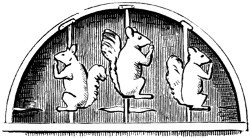
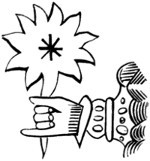
THREE SQUIRRELS.
(Fleet Street, circa 1668.)
HAND AND STAR.
(1550.)
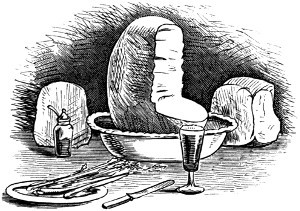
CHESHIRE CHEESE.
(Modern sign, Aldermanbury, City.)
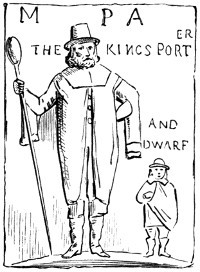
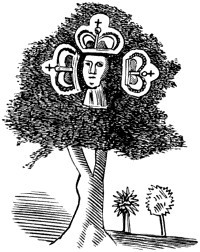
KING’S PORTER AND DWARF.
(Newgate Street, circa 1668.)
ROYAL OAK.
(Roxburghe Ballads, 1660.)
Only a few more celebrities now remain to be disposed of; but they are of such a varied character, and so heterogeneous, that they can scarcely be ranged under any of the former divisions: thus we meet with the stern reformer, Melancthon’s Head, as the sign of an orthodox publican, in Park Street, Derby. Pretty Nell Gwynn occurs on several London public-houses: one in Chelsea, where she must have been well known, since her mother resided in that neighbourhood, and popular tradition allows Nell to have been one of the principal promoters of the erection of the famous hospital there. Another house, named after Charles II.’s favourite mistress, may be observed in Drury Lane, in which street she lived, and where Pepys, on May-day, 1667, saw her “standing at her lodgings door, in her smock sleeves and boddice,” and thought her “a mighty pretty creature.”
The Sir John Oldcastle was a tavern, in Coldbathfields, in the beginning of the last century; near this house, Bagford and a Mr Conyers, an antiquarian apothecary of Fleet Street, discovered the skeleton of an elephant in a gravel pit.[118] This house is also named in the following bill:—[119]
“All gentlemen, who are lovers of the ancient and noble exercise of archery, are hereby invited, by the stewards of the annual feast for the Clerkenwell Archers, to dine with them at Mrs Mary Barton’s, at the sign of Sir John Oldcastle, upon Friday, the 18th day of July 1707, at one of the clock, and to pay the bearer, Thomas Beaumont, Master of the Regiment of Archers, two shillings and sixpence, and to take a sealed ticket, that the certain number may be known, and provision made accordingly.
Nathaniel Axtell, Esq. Edward Bromwick, Gent. } Stewards.”
Opposite this house stood the Lord Cobham’s Head, as appears from the Daily Advertiser for August 9, 1742, which contains an advertisement puff of this place, praising its beer at 3d. a tankard, and mentioning the concert and illuminations. The correspondent concludes his letter by saying: “Note.—In seeing this great preparation, I thought it a duty incumbent upon me to inform my fellow-citizens and others, that they may distinguish this place from any pretended concerts, which are nothing but noise and nonsense, in particular, one that is rightly-styled the Hog-concert,” &c.
Both these houses were named after “the Good Lord Cobham,”—Sir John Oldcastle, who married the heiress of the Cobham family—the first author, as well as the first martyr of noble family in England. Being one of the Lollards, he was accused of rebellion, hanged in chains, and burned alive at St Giles in the Fields, in December 1417. Lord Cobham’s estates were close to the site of these two public-houses, which were supposed to comprise a part of the ancient mansion of that nobleman.
The Sir Paul Pindar public-house, in Bishopsgate Street Without, is all that remains of the splendid mansion of the rich merchant of that name, who had here a beautiful park, well stocked with game. The house continues almost in its original state, in the Cinque Cento style of ornament; the best part of it is the façade. In “Londiniana,” ii. p. 137, is an engraving of a lodge, standing in Half-Moon Alley, ornamented with figures, which tradition says was the keeper’s lodge of Sir Paul Pindar’s Park. Mulberry trees, and other park-like vestiges, were still within memory in 1829. In Pennant’s time it was already a public-house, having for a sign, “a head, called that of the original owner.” Sir Paul was a contemporary of Gresham, the founder of the Exchange. He travelled much, and by that means acquired many languages, which, at that time, was a sure way to advancement. James I. sent him as ambassador to the Sultan, from whom he obtained valuable concessions for the English trade throughout the Turkish dominions. After his return, he was appointed farmer of the customs, and frequently advanced money to King James, and afterwards to Charles I. In 1639 he was esteemed worth £236,000, exclusive of bad debts. He expended £19,000 in repairing St Paul’s Cathedral, and contributed large sums to various charities, yet, strange to say, died insolvent, Aug. 22, 1650, the year after his royal master had been beheaded. His executor, William Toomes, was so shocked at the hopeless state of Sir Paul’s affairs, that he committed suicide, and was buried with all the degrading ceremonies of a felo-de-se.
The Welch Head was the sign of a low public-house in Dyot Street, St Giles. In the last century there was a mendicants’ club held here, the origin of which dated as far back as 1660, at which time they used to hold their meetings at the Three Crowns in the Poultry. Saunders Welch was one of the justices of the peace for Westminster, and kept a regular office for the police of that district, in which he succeeded Fielding. He died Oct. 31, 1784, and lies buried in the church of St George’s, Bloomsbury. He was a very popular magistrate: a story is told that in 1766 he went unattended into Cranbourne Alley, to quell the riotous meetings of the journeymen shoemakers there, who had struck for an advance of wages. One of the crowd soon recognised him, when they at once mounted him on a beer barrel, and patiently listened to all that he had to say. He quieted the rioters, and prevailed upon the master shoemakers to grant an additional allowance to the workmen. This little incident, joined to his well-known benevolence, and skill in capturing malefactors, gave him that popularity which rewards by a signboard fame.
The Bedford Head, Covent Garden, represented the head of one of the Dukes of Bedford, ground landlords of that district. Pope twice alludes to this tavern, as a place where to obtain a delicate dinner. This house Mr Cunningham[120] suspects to have occupied the north-east corner of the Piazza, and there it appears in a view of old Covent Garden, about 1780, preserved in the “Crowle Pennant,” (vii. p. 25.) There was another Bedford Head in Southampton Street, which was kept by Wildman, the brother-in-law of Horne Tooke. A Liberal club used to meet at this house, of which Wilkes was a member, for several years. There is still a Bedford Head in Maiden Lane, hard by, at which the Reunion Literary Club is held.
Under the historical signs may be ranged a class of more modern signs, referring to local celebrities,—“mighty hunters before the Lord” probably—such as Captain Harmer, White Horse Plain, Yarmouth; Captain Ross on Clinker, at Natland, a village in Westmoreland; Captain Digby (the name of a vessel wrecked), at St Peter’s, Margate; Colonel Linskill, Charlotte Street, North Shields, &c.
The Don Cossack, so frequently seen, dates from the celebrity acquired by those troops in the extermination of the unfortunate half-starved and frozen soldiers, on their retreat from Moscow; though a more intimate acquaintance with the formidable Cossacks, during the Crimean campaign, considerably damaged their ancient reputation. The signs of the Druid, the Druid’s Head, the Druid and Oak, and the Royal Arch Druid, are more to be attributed to various kinds of masonic brotherhoods, than as a mark of respect paid to our aboriginal clergy. The Union originated with the union of Ireland with this kingdom; the Jubilee dates from the centenary of the revolution of 1688, held with considerable pomp and national rejoicing, in 1788. The Hero of Switzerland, Loughborough Road, Brixton, and in a few other places, refers to William Tell; and the Spanish Patriot, (Lambeth Lower Marsh and White Conduit Street,) dates from the excitement of our proposed intervention in the Spanish Succession question, in 1833. The Spanish Galleon, Church Street, Greenwich, simply owes its origin to the pictures of our naval victories in the Greenwich Hospital.
These, then, are some of the principal and most curious historic signs. From the perusal of this catalogue, we can draw one conclusion—namely, that only a few of what we have termed “historical signs,” outlive the century which gave them birth. If the term of their duration extends over this period, there is some chance that they will remain in popular favour for a long time. Thus, in the case of most heroes of the last century, few publicans certainly will know anything about the Marquis of Granby, Admiral Rodney, or the Duke of Cumberland, yet their names are almost as familiar as the Red Lion, or the Green Dragon, and have indeed become public-household words. Once that stage past, they have a last chance of continuing another century or two—namely, when those heroes are so completely forgotten, that the very mystery of their names becomes their recommendation; such as the Grave Morris, the Will Sommers, the Jack of Newbury, &c.
[102] Introduction to Tarlton’s Jests, by J. O. Halliwell.
[103] Harl. MSS. 3885.
[104] Gray’s Letter to Chute. Mitford, ii. 138.
[105] Banks’s Collection.
[106] This is engraved in Caulfield’s Portraits of Remarkable and Eccentric Characters, as well as the wooden figure in the Tower.
[107] MSS. Reg., 2 A. xvi.
[108] Fairholt, Remarkable and Eccentric Characters, p. 56.
[109] Fuller’s Worthies, voce Monmouthshire.
[110] This is an old “dodge,” mentioned long ago by Decker in his “Seven Deadly Sins, seven times pressed to Death,” &c.:—“Then you have another brewing called Huff’s ale, at which, because no man must have but a pot at a sitting, and so be gone, the restraint makes them more eager to come in, so that by this policie one may huffe it four or five times a day.”
[111] Journey through England, vol. i. p. 175.
[112] Metamorphosis of the Town; or, a View of the Present Fashions. London: Printed for J. Wilford at the Three Flower de Luces, behind the Chapter House in St Paul’s Churchyard, 1730.
[113] Oddly enough, both Cave and Ponto are terms of some games at cards.
[114] There is a copy in the British Museum.
[115] This motto was: “Misura della Colonna di Christo nro,” i.e., Measure of the column of our Saviour.
[116] A brother Boniface, Adams, “at the Royal Swan in Kingsland Road, leading from Shoreditch Church,” (1756) had also a knackatory, which, from his catalogue, looks very like a parody on the Don’s. He exhibited, for instance, “Adam’s eldest daughter’s hat;” “the heart of famous Bess Adams, that was hanged with Lawyer Carr, January 18, 1736-37;” “the Vicar of Bray’s clogs;” “an engine to shell green peas with;” “teeth that grew in a fish’s belly;” “Black Jack’s ribs;” “the very comb that Adam combed his son Isaac’s and Jacob’s head with;” “rope that cured Captain Lowry of the headach, earach, toothach, and bellyach;” “Adam’s key to the fore and back door of the garden of Eden,” &c., &c., and 500 other curiosities.
[117] Her portrait, with a poem upon her, too long to quote, occurs in “Portraits and Lives of Remarkable and Eccentric Characters,” Westminster, 1819.
[118] Harl. MSS. 5900.
[119] Bagford Bills. Harl. MSS. 5962.
[120] London, Past and Present, p. 48.
[54] Lloyd’s Evening Post, February 11-13, 1761.
[55] Horace Walpole’s Letters. Thirteenth Letter to Mr Conway, April 16, 1747.
[56] In the Print-room of the British Museum.
[57] Pennant’s History of London, vol. i. p. 99.
[58] “The Quack Vintners, 1710,” a tract written against Brooke and Hilliers, the famous wine-merchants of that time, frequently mentioned by the Spectator.
[59] Newcastle Journal, June 28, 1746.
[60] Nugæ Antiquæ, vol. i. p. 348.
[61] Barrow’s Life of Peter the Great.
[62] Gent. Mag., March 1842.
[63] Peacham’s Compleat Gentleman, p. 79.
[64] The taverns of the seventeenth century appear in many instances to have been upstairs, above shops. In 1679, there was a “Mr Crutch, goldsmith, near Temple Bar, at the Palsgrave Head.” In a similar way, a bookseller lived at the sign of the Rainbow, at the same time as one Farr, who opened this place as a coffee-house. Another bookseller, James Roberts, who printed most of the satires, epigrams, and other wasp-stings against Pope, lived at the Oxford Arms, a carriers’ inn in Warwick Lane. Finally, Isaac Walton sold his “Complete Angler” “at his shopp in Fleet Street, under the King’s Head Tavern.”
[65] Macaulay’s Biographical Essays, Frederick the Great.
[66] Goldsmith’s Essay on the Versatility of Popular Favour.
[67] For more particulars about Topham, see p. 88.
[68] Trades tokens in the Beaufoy Collection.
[69] For several centuries, Fleet Street was the head-quarters for shows and exhibitions out of fair-time. Ben Jonson speaks of “the City of Nineveh at Fleetbridge.” This was in the reign of James I. Mrs Salmon’s waxworks were among the last remaining sights in that locality.
[70] Richardsoniana, p. 140.
[71] Grosley, in his Tour to London, 1772, vol i. p. 150, mentions this society, which at that period was held at the Robin Hood, and says it was a semi-public club, into which all sorts of people were admitted, and all sorts of topics, religious as well as political, were discussed. He makes an odd mistake, however, when he says that the president was a baker by trade.
[72] This John Marshall afterwards, when he was appointed the king’s optician, changed his sign into the Archimedes and King’s Arms, under which we find him, in 1718, advertising his “chrystall dressing-glasses for ladies, which shew the face as nature hath made it, which other looking-glasses do not.”
[73] Banks’s Collection.
[74] Banks’s Collection.
[75] The Angler. Hawkins’s edition. 1784.
[76] Bagford Bills, Bib. Harl. 5964.
[77] “On the chair of Ben Johnson, now remaining at Robert Wilson’s, at the sign of the Johnson’s Head, in the Strand.”—Wit and Drollery, 1655, p. 79.
[78] The Newes, August 24, 1655. This may have been the above-mentioned tavern, as York House was situated in the Strand on the site of the present York Buildings.
[79] Addison’s Lion’s Head, the box for the deposition of the correspondence of the Guardian, was originally placed at Button’s, over against Tom’s in Great Russell Street. “After having become a receptacle of papers and a spy for the Guardian, it was moved to the Shakespeare’s Head Tavern, under the Piazza in Covent Garden, kept by a person named Tomkins, and in 1751 was for a short time placed in the Bedford Coffeehouse, immediately adjoining the Shakespeare Tavern, and there employed as a medium of literary communication by Dr John Hill, author of the ‘Inspector.’ In 1769, Tomkins was succeeded by his waiter, named Campbell, as proprietor of the tavern and Lion’s Head, and by him the latter was retained till 1804, when it was purchased by the late Charles Richardson, after whose death in 1827 it devolved to his son, and has since become the property of his Grace the Duke of Bedford.”—Till, in his Preface to Descriptive Catalogue of English Medals.
[80] Our slang friends the burlesque writers and parodists, would probably say something about mopping.—Ed.
[81] An “Apollo in his glory” is a charge in the apothecaries’ arms.
[82] Aubrey, Remains of Gentilisme and Judaism. Lansdowne MSS. 231, p. 106.
[83] At the Vulcan. He lights his pipe at the fire;—whosoever wants to buy good tobacco let him come here;—you will get a pipe filled into the bargain, and a glass of strong beer in fair time.
[84] Vulcan, that lame blacksmith, when he got tired over his work, sat down a while to rest his limbs. The gods saw it; he took his cutty pipe and his tobacco box out of his pocket and smoked a pipe of tobacco.
[85] Gent. Mag., March 1842.
[86] The History of Tom Jones, book xvi. ch. ii.
[87] Lond. Gaz., June 18-22, 1674.
[88] This was not true, for Pepys went (24th Oct. 1667) to hear the same instrument played by a Mr Prin, a Frenchman, “which he do beyond belief, and the truth is, it do so far outdo a trumpet as nothing more, and he do play anything very true. The instrument is open at the end I discovered, but he would not let me look into it.” Philips, in his “New World of Words,” 1696, describes it as “an instrument with a bellows, resembling a lute, having a long neck with a string, which being struck with a hairbow sounds like a trumpet.”
[89] Aubrey, Miscellanies upon various subjects.
[90] See in Bib. Top. Brit., vol. iv., a Critical Memoir on the Story of Guy of Warwick, by the Rev. Samuel Pegge, who supposes that Guy lived in Saxon times, and was the son of Simon, Baron of Wallingford. He married Felicia, (Phillis,) the daughter and heiress of Rohand, Earl of Warwick, who flourished in the reign of Edward the Elder, and so became Earl of Warwick.
[91] In Ritson’s Ancient Songs and Ballads.
[92] The “pindar” was the man who took care of stray cattle, which he kept in the pinfold, or pound, until it was claimed and the expenses paid.
[93] Daily Courant, Feb. 19, 1711.
[94] The “Dropping Well,” one of the most noted petrifying springs in England, and so named on account of its percolating through the rock that hangs over it.
[95] This information we gather from a chapbook entitled “The Strange and Wonderful History and Prophecies of Mother Shipton, by Ferraby, printer on the Market Place, Hull.” It is evidently a reprint of a chapbook of the time of Charles II., as appears from many allusions.
[96] Once there was a man who led a holy life, and was a prophet, who could see what would come to pass; his name was Merlin, and he was the offspring of an evil and fiendish spirit. But though born from such a father, he shone forth in virtue, and after his death, became a companion of the saints.
[97] Henry Peacham’s Compleat Gentleman.
[98] John Collet’s Historical Anecdotes, Add. MSS. 8890, p. 113.
[99] In the Banks Collection.
[100] This broadside is reprinted in Notes and Queries for January 15, 1859. Sussex had its snake as late as 1614. There is a pamphlet In the Harl. Collection, entitled, “True and Wonderful—a discourse relating a strange and monstrous serpent, (or dragon,) lately discovered, and yet living, to the great annoyance and divers slaughter both of men and cattell, by his strong and violent Poyson, in Sussex, two miles from Horsam, in a woode called St Leonard’s Forrest, and thirtie miles from London, this present month of August 1614.” That this Sussex snake caused a great sensation, appears from the fact that seventeen years after, it is alluded to in “Whimsies: or, A New Cast of Characters,” 1631: “Nor comes his [the ballad-monger’s] invention far short of his imagination. For want of truer relations for a neede, he can find you out a Sussex dragon, some sea or inland monster, drawn out by some Shoe Lane man, [i.e., a sign-painter; they all lived in Harp Alley, Shoe Lane,] in Gorgon-like features, to enforce more horror in the beholder.”
[101] The title of Cooper’s novel seems to have taken hold of the popular fancy to an astonishing degree: not only are there several public-houses who have adopted it as their sign, but also race-horses, ships, and locomotive engines have been named after it. There is even a baked potato-can in the streets of London, decorated with that name; it is built in the shape of a locomotive-engine, japanned red, and wheeled about the streets by an old woman. The name on a brass plate is screwed to the can, similar to the names of locomotive-engines.
[102] Introduction to Tarlton’s Jests, by J. O. Halliwell.
[103] Harl. MSS. 3885.
[104] Gray’s Letter to Chute. Mitford, ii. 138.
[105] Banks’s Collection.
[106] This is engraved in Caulfield’s Portraits of Remarkable and Eccentric Characters, as well as the wooden figure in the Tower.
[107] MSS. Reg., 2 A. xvi.
[108] Fairholt, Remarkable and Eccentric Characters, p. 56.
[109] Fuller’s Worthies, voce Monmouthshire.
[110] This is an old “dodge,” mentioned long ago by Decker in his “Seven Deadly Sins, seven times pressed to Death,” &c.:—“Then you have another brewing called Huff’s ale, at which, because no man must have but a pot at a sitting, and so be gone, the restraint makes them more eager to come in, so that by this policie one may huffe it four or five times a day.”
[111] Journey through England, vol. i. p. 175.
[112] Metamorphosis of the Town; or, a View of the Present Fashions. London: Printed for J. Wilford at the Three Flower de Luces, behind the Chapter House in St Paul’s Churchyard, 1730.
[113] Oddly enough, both Cave and Ponto are terms of some games at cards.
[114] There is a copy in the British Museum.
[115] This motto was: “Misura della Colonna di Christo nro,” i.e., Measure of the column of our Saviour.
[116] A brother Boniface, Adams, “at the Royal Swan in Kingsland Road, leading from Shoreditch Church,” (1756) had also a knackatory, which, from his catalogue, looks very like a parody on the Don’s. He exhibited, for instance, “Adam’s eldest daughter’s hat;” “the heart of famous Bess Adams, that was hanged with Lawyer Carr, January 18, 1736-37;” “the Vicar of Bray’s clogs;” “an engine to shell green peas with;” “teeth that grew in a fish’s belly;” “Black Jack’s ribs;” “the very comb that Adam combed his son Isaac’s and Jacob’s head with;” “rope that cured Captain Lowry of the headach, earach, toothach, and bellyach;” “Adam’s key to the fore and back door of the garden of Eden,” &c., &c., and 500 other curiosities.
[117] Her portrait, with a poem upon her, too long to quote, occurs in “Portraits and Lives of Remarkable and Eccentric Characters,” Westminster, 1819.
[118] Harl. MSS. 5900.
[119] Bagford Bills. Harl. MSS. 5962.
[120] London, Past and Present, p. 48.
CHAPTER III.
HERALDIC AND EMBLEMATIC SIGNS.
Royalty stands prominently at the head of the heraldic signs in its triple hieroglyphic of the Crown, (no coronets ever occur,) the King’s or Queen’s Arms, and the various royal badges.
The Crown seems to be one of the oldest of English signs. We read of it as early as 1467, when a certain Walter Walters, who kept the Crown in Cheapside, made an innocent Cockney pun, saying he would make his son heir to the Crown, which so displeased his gracious majesty, King Edward IV., that he ordered the man to be put to death for high treason.
The Crown Inn at Oxford was kept by Davenant, (Sir William Davenant’s father.) Shakespeare, on his frequent journeys between London and his native place, generally put up at this inn, and the malicious world said that young Davenant (the future Sir William) was somewhat nearer related to him than as a godson only. One day, when Shakespeare was just arrived, and the boy sent for from school to see him, a master of one of the colleges, pretty well acquainted with the affairs of the family, asked the boy why he was going home in so much haste, who answered, that he was going to see his godfather Shakespeare. “Fie, child,” said the old gentleman, “why are you so superfluous? Have you not learnt yet that you should not use the name of God in vain?”
On the site occupied by the present Bank of England there used to stand four taverns; one of them bore the sign of the Crown, and was certainly in a good line of business, for, according to Sir John Hawkins,[121] it was not unusual in those toping days to draw a butt (120 gallons) of mountain in half-pints in the course of a single morning.
About the same period there was another Crown Tavern in Duck Lane, W. Smithfield. One of the rooms in that house was decorated by Isaac Fuller (ob. 1672) with pictures of the Muses, Pallas, Mars, Ajax, Ulysses, &c. Ned Ward praises them highly in his “London Spy.” “The dead figures appeared with such lively majesty that they begot reverence in the spectators towards the awful shadows!” Such painted rooms in taverns were not uncommon at that period.
The origin of the sign of the Three Crowns is thus accounted for by Bagford:[122]—“The mercers trading with Collen (Cologne) set vp ther singes ouer ther dores of ther Houses the three kinges of Collen, with the Armes of that Citye, which was the Three Crouens of the former kinges, in memory of them, and by those singes the people knew in what wares they deld in.” Afterwards, like all other signs, it was used promiscuously, and thus it gave a name to a good old-fashioned inn in Lichfield, the property of Dr Johnson, and the very next house to that in which the doctor was born.
Frequently the Royal Crown is combined with other objects, to amplify the meaning, or to express some particular prerogative; such are the Crown and Cushion, being the Crown as it is carried before the king in coronation, and other ceremonies. We even meet with the Two Crowns and Cushions; that is, the Crown for the King and for the Queen, which was the sign of a Mr Arne, an upholsterer in Covent Garden, the hero of several Tatlers and Spectators, and father of the celebrated musician and composer, Dr Arne. This political upholsterer also figures in a farce by Murphy, entitled “The Upholsterer; or what news?” The four Indian princes referred to in Tatler, No. 155, who came to England in the reign of Queen Anne, to implore the help of the British Government against the encroachments of the French in Canada, seem to have lodged in this man’s house,—a circumstance frequently alluded to in the papers of the Tatler and other periodicals of the time.
The Crown and Glove refers to the well-known ceremony of the Royal Champion at the Coronation. It occurs as a sign at Stannington, Sheffield, Eastgate Row, South Chester, &c. The Royal Champion himself figures in George Street, Oxford. In the Gazetteer for August 20, 1784, we find an anecdote recorded concerning the Royal Champion, which is almost too good to be true:—“At the coronation of King William and Queen Mary, the Champion of England dressed in armour of complete and glittering steel; his horse richly caparisoned, and himself, and beaver finely capped with plumes of feathers, entered Westminster Hall while the King and Queen were at dinner. And, at giving the usual challenge to any one that disputed their majesties’ right to the crown of England, (when he has the honour to drink the Sovereign’s health out of a golden cup, always his fee,) after he had flung down his gauntlet on the pavement, an old woman, who entered the hall on crutches, (which she left behind her,) took it up, and made off with great celerity, leaving her own glove, with a challenge in it to meet her the next day at an appointed hour in Hyde Park. This occasioned some mirth at the lower end of the hall: and it was remarkable that every one was too well engaged to pursue her. A person in the same dress appeared the next day at the place appointed, though it was generally supposed to be a good swordsman in that disguise. However, the Champion of England politely declined any contest of that nature with the fair sex, and never made his appearance.”
The Crown and Sceptre, another of the royal insignia, is named by Misson[123] in the following incident:—“Butler, the keeper of the Crown and Sceptre tavern, in St Martin’s Lane, told me that there was a tun of red port drunk at his wife’s burial, besides mulled white wine. Note.—No men ever goe to women’s burials, nor the women to the men’s; so that there were none but women at the drinking of Butler’s wine. Such women in England will hold it out with the men, when they have a bottle before them, as well as upon th’ other occasion, and tattle infinitely better than they.”
The Crown and Mitre, indicative of royalty and the church, is the sign of a High Church publican at Taunton; and the Bible and Crown has for more than a century and a half been the sign of Rivingtons the publishers. (See under Religious Signs.) The King and Parliament are represented by the well-known Crown and Woolpack, which at Gedney Holbeach, in Lincolnshire, has been corrupted into the Crown and Woodpecker. The Crown and Tower, at Taunton, may refer to the regalia kept in the Tower, or to the king being “a tower of strength.” A similar symbol seems to be intended in the Crown and Column, Ker Street, Devonport, perhaps implying the strength of royalty when supported by a powerful and united nation.
The Crown and Anchor, the well-known badge of the Navy, is a great favourite. One of the most famous taverns with this sign was in the Strand, where Dr Johnson often used to “make a night of it.” “Soon afterwards,” says Boswell, “in 1768, he supped at the Crown and Anchor in the Strand, with a company whom I collected to meet him. There were Dr Percy, now bishop of Dromore; Dr Douglas, now bishop of Salisbury; Mr Langton; Dr Robertson, the historian; Dr Hugh Blair, and Mr Thomas Davis.” On this occasion the great doctor was unusually colloquial, and according to his amiable custom “tossed and gored several persons.”
The famous “Crown and Anchor Association” against so-called Republicans and Levellers—as the reformers were styled by the ministerial party in 1792—owed its name to this tavern. Its rise and progress is rather curious: it was undertaken at the instance of Pitt and Dundas, by John Reeves, a barrister. Reeves, at first, could get no one to join him, but, to meet the wishes of his employers, used to go to the Crown and Anchor, draw up some resolutions, pass them nem. con., and sign them John Reeves, chairman: thus being in his own person, meeting, chairman, and secretary. In this way they were inserted in all the papers of the three kingdoms, the expense being no object to the persons concerned. Meetings of the counties were advertised, but the first, second, and third consisted of Reeves alone, and it was not till the fourth meeting that he had any coadjutors. The political effervescence created by this society, its imitations and branches, form part of the history of the nation.
In the year 1800 the Farming Society proposed to have an experimental dinner in order to ascertain the relative qualities of the various breeds of cattle in the kingdom; the dinner was planned and patronised by Sir John Sinclair, and the execution intrusted to Mr Simpkins, landlord of the Crown and Anchor, who sent a tender of the most Brobdignagian dinner probably ever heard of. Twelve kinds of oxen and sheep of the most famous breed, eight kinds of pork, and various specimens of poultry, were to bleed as victims in this holocaust to the devil of gluttony; the fish was only to be from fresh waters, such as were “entitled to the attention of British farmers;” there were various kinds of vegetables, nine sorts of bread, besides veal, lamb, hams, poultry, tarts and puddings, all of which were to be washed down by a variety of strong and mild ales, stout, cider, Perry, and “British” spirits. Tickets one guinea each.[124]
The Anchor and Crown was also the sign of the great booth at Greenwich fair; it was 323 feet long, and 60 feet wide, was used for dancing, and could easily accommodate 2000 persons at a time. The other booths also had signs; amongst them were the Royal Standard, the Lads of the Village, the Black Boy and Cat, the Moonrakers, and others.
The Crown and Dove, Bridewell Street, Bristol, may refer to the order of the Holy Ghost, or may have been suggested by the Three Pigeons and Sceptre.
Objects of various trades, with a crown above them, were very common: the Crown and Fan was an ordinary fan-maker’s sign.[125] The Crown and Rasp, belonging to snuff-makers, occurs as the sign of Fribourg and Treyer, tobacconists, at the upper end of Pall Mall, near the Haymarket, in 1781: it is still to be seen on the façade of the house. The oldest form of taking snuff was to scrape it with a rasp from the dry root of the tobacco plant; the powder was then placed on the back of the hand and so snuffed up; hence the name of râpé (rasped) for a kind of snuff, and the common tobacconist’s sign of LA CAROTTE D’OR, (the golden root,) in France. The rasps for this purpose were carried in the waistcoat pocket, and soon became articles of luxury, being carved in ivory and variously enriched. Some of them, in ivory and inlaid wood, may be seen at the Hôtel Cluny in Paris, and an engraving of such an object occurs in “Archæologia,” vol. xiii. One of the first snuff-boxes was the so-called râpé, or grivoise box, at the back of which was a little space for a piece of the root, whilst a small iron rasp was contained in the middle. When a pinch was wanted, the root was drawn a few times over the iron rasp, and so the snuff was produced and could be offered to a friend with much more grace than under the above-mentioned process with the pocket grater.
The Crown and Last originated with shoemakers, but the gentle craft having the reputation of being thirsty souls, it was also adopted as an alehouse sign: we find it as such in 1718:—
“ON Easter Monday, at the Crown and Last at Primlico (sic) in Chelsea road, a silver watch, value 30 sh., is to be bowled for; three bowls for six pence, to begin at Eight of the clock in the morning and continues till Eight in the evening. N.B.—They that win the watch may have it or 30s.”[126]
The Crown and Halbert was, in 1790, the sign of a cutler in St Martin’s Churchyard;[127] the Crown and Can occurs in St John Street; and the Crown and Trumpet at Broadway, Worcester: this last may either allude to the trumpet of the royal herald, or simply signify a crowned trumpet.
Of the King’s Arms, and the Queen’s Arms, there are innumerable instances; they are to be found in almost every town or village. The story is told that a simple clodhopper once walked ever so many miles to see King George IV. on one of his journeys, and came home mightily disgusted, for the king had arms like any other man, while he had always understood that his majesty’s right arm was a lion and his left arm a unicorn.
Grinling Gibbons, the celebrated carver and sculptor, lived at the sign of the King’s Arms in Bow Street, from 1678 until 1721, when he died. This house is alluded to in the Postman, January 24, 1701-2:—
“On Thursday, the house of Mr Gibbons, the carver in Bow Street, fell down, but by special providence none of the family were killed; but, ’tis said, a young girl which was playing in the court being missed, is supposed to be buried in the rubbish.”
At the Haymarket, corner of Pall Mall, stood the Queen’s Arms tavern, in the reign of Queen Anne. At the accession of George I. it was called the King’s Arms, and there, in 1734, the Whig party used to meet to plan opposition to Sir Robert Walpole. This club went by the name of the Rump-steak Club.
Faulkner[128] says that at the King’s Arms, in the High Street, Fulham, the Great Fire of London was annually commemorated on the 1st of September, and had been continued without interruption until his time. It was said to have taken its rise from a number of Londoners who had been burnt out, and who, having no employment, strolled out to Fulham, on their way collecting a quantity of hazel nuts, from the hedges, with which they resorted to this house. A capital picture of the great conflagration used to be exhibited on that day.
In 1568 the prizes of the first lottery held in England were exhibited at the Queen’s Arms in Cheapside, the house of Mr Dericke, goldsmith to Queen Elizabeth. There were no blanks, and the prizes consisted of ready money, and “certain sorts of merchandises having been valued and prized.” It had 400,000 lots of 10s. each, and the profits were to go towards repairing the havens of the kingdom. The drawing was at first intended to have taken place at Dericke’s house, but finally was done at the west door of St Paul’s. The programme of this lottery, printed by Binneman, was exhibited to the Antiquarian Society by Dr Rawlinson in 1748. The next lottery was in 1612. It was drawn on the same plan, and granted by King James, as a special favour, for the establishment of English colonies in Virginia. Thomas Sharpley, a tailor, had the chief prize, which consisted of £4000 of “fair plate.”
“On Friday, April 6,” (1781) says Boswell,[129] “Dr Johnson carried me to dine at a club, which, at his desire, had been lately formed at the Queen’s Arms in St Paul’s Churchyard. He told Mr Hoole that he wished to have a City-club, and asked him to collect one; but, said he, don’t let them be patriots. The company were that day very sensible well-behaved men.” This same tavern was also patronised by Garrick. “Garrick kept up an interest in the city by appearing about twice in a winter at Tom’s coffeehouse in Cornhill, the usual rendezvous of young merchants at Changetimes; and frequented a club established for the sake of his company at the Queen’s Arms Tavern in St Paul’s Churchyard, where were used to assemble Mr Samuel Sharpe, the surgeon; Mr Paterson, the City solicitor; Mr Draper, the bookseller; Mr Clutterbuck, a mercer; and a few others: they were none of them drinkers, and in order to make a reckoning, called only for French wines. These were his standing counsel in theatrical affairs.”[130]
Sometimes we meet with the King’s or Queen’s Arms in very odd combinations; thus in the reign of Queen Anne there was a Queen’s Arms and Corncutter[131] in King Street, Westminster; the sign of Thomas Smith, who, according to his handbill, (in the Bagford collection,) had, “by experience and ingenuity learnt the art of taking out and curing all manner of corns without any pain;” he also sold “the famoustest ware in all England, which never fails curing the toothache in half an hour.” It was customary with those who were “sworn servants to his Majesty,”—i.e., who had the lord chamberlain’s diploma, to set up the royal arms beside their sign. The said Thomas, however, does not appear to have had this honour, for not a word about it is mentioned in his bill, so that he must have set up the Queen’s Arms merely to blind the public. The name of the person who filled the important office of corncutter to Queen Anne, I am afraid is lost to posterity, but, en revanche, we know who drew King Charles II.’s teeth, for the Rev. John Ward has recorded in his Diary.[132] “Upon a sign about Fleetbridge this is written,—‘Here lives Peter de la Roch and George Goslin, both which, and no others, are sworn operators to the king’s teeth.’”
Royal badges, and the supporters of the arms of various kings, were in former times largely used as signs. The following is a list of the supporters:—
- Richard II., Two Angels, (blowing trumpets.)
- Henry IV., Swan and Antelope.
- Henry V., Lion and Antelope.
- Henry VI., Two Antelopes.
- Edward IV., Lion and Bull.
- Edward V., Lion and Hind.
- Richard III., Two Boars.
- Henry VII., Dragon and Greyhound.
- Henry VIII., Lion and Dragon.
- Edward VI., Lion and Dragon.
- Mary, Eagle and Lion.
- Elizabeth, Lion and Dragon.
- James I., Lion and Unicorn, which have continued ever since.
Of early royal badges an interesting list occurs in Harl. MS., 304, f. 12:—
“King Edward the first after the Conquest, sonne to Henry the third, gave a Rose gold, the stalke vert.
“King Edward the iij gave a lyon in his proper coulor, armed azure langued or. The oustrich fether gold, the pen gold, and a faucon in his proper coulor and the Sonne Rising.
“The prince of Wales the ostrich fether pen and all arg.
[109]
“Queen Philipe, wyff of Edward the iijd. gave the whyte hynd.
“Edmond, Duk of York, sonne of Edward the iij, gave the Faucon arg. and the Fetterlock or.
“Richard the second gave the White hart, armed, horned, crowned or, and the golden son.
“Henry, sonne to the Erl of Derby, first Duk of Lancaster, gave the red rose uncrowned, and his ancestors gave the Fox tayle in his prop. coulor and the ostrich fether ar. the pen ermyn.
“Henry the iiij gave the Swan ar. and the antelope.
“Henry the v gave the Antelope or, armed, crowned, spotted (?) and horned gold and the Red Rose oncrowned and the Swan silver, crown and collar gold, by the Erldom of Herford.
“Henry the vi gave the same that his father gave.
“Edward the iiij gave the Whyte Lyon and the Whyte Rose and the Blak Bull uncrowned.
“Richard the iij gave the Whyte Boar and the Whyte Rose, the clayes gold.
“Henry the seventh gave the hawthorn tree vert and the Porte Cullys and the Red Rose and the Whyte Crowned.
“The Ostrych fether silver, the pen gobone sylver and azur, is the Duk of Somerset’s bage.
“The Shypmast with the tope and sayle down is the bage of . . .
“The Cresset and burnyng fyer is the bage of the Admyraltye.
“The Egle Russet with a maydenshead, abowt her neke a Crowne gold, is the bage of the mannor of Conysborow.
“The Duk of York’s bage is the Faucon and the Fetterlock.
“The Whyte Rose by the Castell of Clyfford.
“The Black Dragon by the Erldom of Ulster.
“The Black Bull horned and clayed gold by the honor of Clare.
“The Whyte Hynd by the fayre mayden of Kent.
“The Whyte Lyon by the Erldom of Marche.
“The ostrych fether silver and pen gold ys the kinges.
“The ostrych fether pen and all sylver ys the Prynces.
“The ostrych fether sylver, pen ermyn is the Duke of Lancasters.
“The ostrych fether sylver and pen gobone is the Duke of Somersets.”
Many of these badges, as will be seen afterwards, have come down on signboards even to the present day. Equally common are the Stuart badges, which were:—
The red rose of Lancaster and the white rose of York frequently placed on sunbeams; sometimes the red rose charged with the white.
The rose dimidiated with the pomegranate, symbolical of the connexion between England and Spain by the marriage of Catherine of Arragon; for the same reason the castle of Castille, and the sheaf of arrows of Granada, occur amongst their badges.
The portcullis, borne by the descendants of John of Gaunt, who was born in Beaufort Castle, whence, pars pro toto, the gate was used to indicate the castle.
The falcon and fetterlock, badge of Henry VII., on account of his descent from Edmond of Langley, Duke of York.
The red dragon, the ensign of the famous Cadwaller, the last of the British kings, from whom the Tudors descended.
The hawthorn bush crowned, which Henry VII. adopted in allusion to the royal crown of Richard III. having been found hidden in a hawthorn bush after the battle of Bosworth.
The white falcon crowned and holding a sceptre was the badge of Queen Anna Boleyn, and of Queen Elizabeth her daughter.
The phœnix in flames was adopted by Edward VI. in allusion to his birth, having been the cause of his mother’s death; afterwards he also granted this badge to the Seymour family.
In pondering over this class of signs great difficulty often arises from the absence of all proof that the object under consideration was set up as a badge, and not as a representation of the actual animal. As no amount of investigation can decide this matter, we have been somewhat profuse in our list of badges, in order that the reader should be able to form his own opinion upon that subject. Thus, for instance, with the first sign that offers itself, the Angel and Trumpet, it is impossible to say whether the supporters of Richard II. gave rise to it, or whether it represents Fame. Various examples of it still occur, and a very good carved specimen may be seen above a draper’s shop in Oxford Street. It is also the name of alehouses in King Street, Holborn, and in Stepney, High Street, &c.
The Antelope is not very common now, although in 1664 there was a tavern with this sign in W. Smithfield, the trades token of this house bearing the following legend:—Bibis. Vinum. Saluta. Antelop. The Rev. John Ward tells a very feeble college joke concerning the Antelope Tavern in Oxford:—
“I have heard of a fellow at Oxford, one Ffrank Hil by name, who kept the Antelope; and if one yawned, hee could not chuse but yawne, that vppon a time some schollars hawing stoln his ducks, hee had them to the Vice chancelor, and one of the scholars got behind the Vice chancelor, and when the fellow beganne to speak hee would presently fall a yawning, insomuch that the Vice chancelor turned the fellow away in great indignation.”[133]
Macklin, the centenarian comedian, who died in 1797, used for thirty years and upwards to visit a public-house called the Antelope in White Hart yard, Covent Garden, where his usual beverage was a pint of stout made hot and sweetened almost to a syrup. This, he said, balmed his stomach, and kept him from having any inward pains.[134] He died at the age of upwards of 107, a proof that if, as the teetotallers inform us, fermented liquors be a poison, it is certainly a slow one.
The Dragon appears to have been one of the oldest heraldic charges of this kingdom. It was the standard of the West Saxons, and continued so until the arrival of William the Conqueror, for in the Bayeux tapestry a winged dragon on a pole is constantly represented near the person of King Harold. It was likewise the supporter of the royal arms of Henry VII. and all the Tudor sovereigns except Queen Mary. Before that time it had been borne by some of the early Princes of Wales, and also by several of the kings. Thus it is recorded, 28 Hen. III., the king ordered to be made—
“Unum draconem in modum unius vexilli de quodam rubro sanulo, qui ubique sit de auro extensillatus, cujus lingua sit facta tamquam ignis comburens et continue appareat moveatur, et ejus oculi fiant de sapphiris vel de aliis lapidibus eidem convenientibus.”[135]
At the battle of Lewes, 1264, the chronicler says that—
Many signboards have an historic connexion of some sort with the place where they are exhibited. Thus the Alfred’s Head, at Wantage, in Berkshire, was in all probability chosen as a sign because Wantage was the birthplace of King Alfred. So the Canute Castle, at Southampton, owes its existence to a local tradition; whilst admiration for the great Scotch patriot made an innkeeper in Stowell Street, Newcastle, adopt Sir William Wallace’s Arms. The Cæsar’s Head was, in 1761, to be seen near the New Church in the Strand,[54] and, in the beginning of this century, was the sign of a tavern in Soho, which afterwards removed to Great Palace Yard, Westminster. Even at the present day, his head may be seen outside certain village alehouses; but this we may attribute to that provincial popularity which the Roman hero shares with Oliver Cromwell; for as the Protector gets the blame of having made nearly all the ruins which are to be found in the three kingdoms, so Cæsar is generally named by country people as the builder of every old wall or earthwork the origin of which is unknown.
“I was yesterday out of town, and the very signs, as I passed through the villages, made me make very quaint reflections on the mortality of fame and popularity. I observed how the Duke’s Head had succeeded almost universally to Admiral Vernon’s, as his had left but few traces of the Duke of Ormond’s. I pondered these things in my breast, and said to myself, ’Surely all glory is but as a sign!’”[55]
Older kings occasionally occur, but their memories seem to have been revived rather than handed down by successive innkeepers. If we are to believe an old Chester legend, however, The King Edgar Inn, in Bridge Street of that city, has existed by the same name since the time of the Saxon king. The sign represents King Edgar rowed down the river Dee by the eight tributary kings. The present house has the appearance of being built anterior to the reign of Elizabeth, and the sign looks almost as old, but it would be unwise to give the place or the sign a much higher antiquity. King John is the sign under whose auspices Jem Mace, the pugilist, keeps a public-house in Holywell Lane, Shoreditch. The same king also figures in Albemarle Street and in Bermondsey; whilst the great event of his reign, Magna Charta, is a sign at New Holland, Hull. John of Gaunt may be seen in many places; and we may surmise that his upholders are stanch Protestants, who value his character as a reformer and supporter of Wicliffe. The Black Prince may not unlikely have come down to us in an uninterrupted line of signboards; so little was his identity sometimes understood, that there is a shop-bill in the “Banks Collection”[56] on which this hero is represented as a negro!
As for Queen Elizabeth, she was the constant type of the Queen’s Head, as her father was of the King’s Head; and, like him, she may still be seen in many places. It is somewhat more difficult to ascertain who is meant by the Queen Catherine in Brook Street, Ratcliffe Highway; whether it be Queen Catherine of Aragon, or Queen Catherine of Braganza. Queen Anne, in South Street, Walworth, has evidently come down to us as the token of that house since the day of its opening, just as the Queen of Bohemia, who, until about fifty years ago, continued as a sign in Drury Lane.[57] This was Elizabeth, daughter of James I., married to Frederic V., Elector-Palatine, who, after her husband’s death, lived at Craven House, Drury Lane, and died there, February 13, 1661, having been privately married, it is thought, to Lord Craven, who was foremost in fighting the battles of her husband.
But those who in his sign behold their shame;”[58]
The Great Mogol also had his share of signboards, of which a few still survive; one, for instance, in New Bartholomew Street, Birmingham. Kouli Khan we find only in one instance, (though there were probably many more,) namely, on the sign of a tavern by the Quayside, Newcastle, in 1746.[59] This house had formerly been called the Crown, but changed its sign in honour of Thomas Nadir Shah, or Kouli Khan, who, from having been chief of a band of robbers, at last sat himself on the throne of Persia. He was killed in 1747. One of the reasons of his popularity in this country was the permission he granted to the English nation to trade with Persia, the most chimerical ideas being entertained of the advantages to be derived from that commerce. Hanway, the philanthropist, was for some time concerned in it, but died before he could carry out the scheme; ultimately, the death of Nadir Shah himself put an end to it.
Visits of European monarchs were also commemorated by complimentary signs. One of the oldest was the King of Denmark, and few kings better than he deserved the exalted place at the alehouse door; yet, such is the ingratitude of the world, that he seems now completely forgotten. The sign originated in the reign of James I., who married a daughter of Christian IV., King of Denmark. In July 1606, the royal father-in-law came over on a visit, when the two kings began “bousing” and carousing right royally, the court, of course, duly following the example. “I came here a day or two before the Danish king came,” says Sir John Harrington, “and from that day he did come till this hour, I have been well-nigh overwhelmed with carousal and sport of all kinds. I think the Dane has strangely wrought on our English nobles; for those whom I could never get to taste good liquor, now follow the fashion and wallow in beastly delights. The ladies abandon their society, and are seen to roll about in intoxication,” &c.[60] So late as thirty years ago, not less than three of these signs were left, the most notorious being in the Old Bailey. It used to be open all night for the sale of creature comforts to the drunkard, the thief, the nightwalker, and profligates of every description. Slang was the language of the place, and doubtless the refreshments were mostly paid for with stolen money. On execution nights, the landlord used to reap a golden harvest; then there were such scenes of drunkenness as must have done the old king on the signboard good to survey, and made him wish to be inside. The visit of another crowned votary of Bacchus is commemorated by the sign of the Czar’s Head, Great Tower Street:—
“Peter the Great and his companions, having finished their day’s work, used to resort to a public-house in Great Tower Street, close to Tower Hill, to smoke their pipes and drink beer and brandy. The landlord had the Czar of Muscovy’s Head painted, and put it up for his sign, which continued till the year 1808, when a person of the name of Waxel took a fancy to the old sign, and offered the then occupier of the house to paint him a new one for it. A copy was accordingly made of the original, which maintains its station to the present day as the Czar of Muscovy.”[61]
The sign is now removed, but the public-house still bears the same name. Prince Eugene also was at one time a popular tavern portrait in England, more particularly after his visit to this country in January 1712. It is named as one of the signs in Norwich in 1750,[62] but is now, we believe, completely extinct in England; in Paris there is still one surviving on the Boulevard St Martin.
The Grave Maurice is of very old standing in London, being named by Taylor the water-poet as an inn at Knightsbridge in 1636; at present there are two left, one in Whitechapel Road, the other in St Leonard’s Road. Who this Grave Maurice was is not quite clear. Grave (Ger. Graf, Dutch Graaf, i.e. Count,) Maurice of Nassau, afterwards Maurice, Prince of Orange, was, on account of his successful opposition to the Spanish domination in the Netherlands, very popular in this country. In Baker’s Chronicles, anno 1612, we read that:—“Upon St Thomas-day, the Paltzgrave and Grave Maurice were elected Knights of the Garter; and the 27th of December, the Paltzgrave was betrothed to the Lady Elizabeth. On Sunday the 7th of February, the Paltzgrave in person was installed a Knight of the Garter at Windsor, and at the same time was Grave Maurice installed by his deputy, Count Lodewick of Nassau.” The Garter conferred on the Grave Maurice was that which had been previously worn by Henri Quatre, King of France and Navarre. The Palzgrave was Grave Maurice’s nephew, the Palatine Count Frederick, by whose marriage with King James’s daughter were born the brothers Rupert and Maurice, (the latter in 1620,) who distinguished themselves in England during the civil wars. It was this Prince Maurice’s great uncle, the Grave Maurice of Nassau, whose counterfeit presentment still gives a name to two of our taverns. Another Maurice, about this period, was very popular in England—viz., Maurice Landgrave of Hesse-Cassel, who “carried away the palm of excellency in whatever is to be wished in a brave prince.”[63] Peacham, enumerating this prince’s qualifications, says that he was a good musician, spoke ten or twelve languages, was a universal scholar, could dispute, “even in boots and spurs,” for an hour with the best professors on any subject, and was the best bone-setter in the country. He gained, too, much of his popularity by his adherence to the Protestant religion during the Thirty Years’ War.
The Paltsgrave became a popular sign at the marriage of Frederick Casimir V., Elector and Count Palatine of the Rhine, King of Bohemia, with Elizabeth, daughter of James I. Trades tokens are extant of a famous tavern, the sign of the Palsgrave’s Head, without Temple Bar,[64] which gave its name to Paltsgrave Court, whilst the Palatine Head was an inn near the French ’Change, Soho. Prince Rupert, the Palsgrave’s son, who behaved so gallantly in many of the fights during the Civil War, was no doubt a favourite sign after the Restoration. We have an instance of one on the trades token of Jacob Robins, in the Strand.
One of the last foreign princes to whom the signboard honour was accorded, was the King of Prussia. This still occurs in many places. After the battle of Rosbach, Frederick the Great, our ally, became the popular hero in England. Ballads were made, in which he was called “Frederick of Prussia, or the Hero.” “Portraits of the hero of Rosbach, with his cocked hat and long pigtail, were in every house. An attentive observer will at this day find in the parlours of old-fashioned inns, and in the portfolios of printsellers, twenty portraits of Frederick for one of George II. The sign-painters were everywhere employed in touching up Admiral Vernon into the King of Prussia.[65]”
“An alehouse keeper near Islington, who had long lived at the sign of the French King, upon the commencement of the last war, pulled down his old sign, and put up that of the Queen of Hungary. Under the influence of her red nose and golden sceptre, he continued to sell ale, till she was no longer the favourite of his customers; he changed her therefore, some time ago, for the King of Prussia, who may probably be changed in turn for the next great man that shall be set up for vulgar admiration.”[66]
The Duke’s Head, and the Old Duke, are signs that, for the last two or three centuries, have always been applied to some ducal hero or other, for the time being basking himself in the noontide sun of fame. One of the first to whom it was applied, was Monck, Duke of Albemarle after the Restoration; then came Ormond, Marlborough, Cumberland, York, and, at present, Wellington and the Duke of Cambridge. The Duke’s Head in Upper Street, corner of Gad’s Row, Islington, was the sign of a public-house kept by Thomas Topham, the strong man, who, in 1741, in honour of Admiral Vernon’s birthday, lifted three hogsheads of water, weighing 1859 lb., in Coldbath Fields.[67]
The Duke of Albemarle figured on numberless signboards after the Restoration; but at the same period, there existed still older signs, on which his grace was simply called Monck; as for instance, that hung out by “Will. Kidd, suttler to the Guard at St James’s,”[68] which was the Monck’s Head. Kidd had probably followed the army in many a campaign in former years, and was much more accustomed to the name of General Monck than that of his Grace the Duke of Albemarle. Of the Duke of Ormond there is still one instance remaining in Longstreet, Tetbury, Gloucester, under the name of the Ormond’s Head. A very few Dukes of Marlborough are also left. In the beginning of the eighteenth century, the Duke of Marlborough’s Head in Fleet Street, was a tavern used for purposes very similar to those which we are accustomed now-a-days to behold at the St James’ and the Egyptian Halls. Among the Bagford Bills, and in the newspapers of the time, it is constantly mentioned as the place where something wonderful or amusing was to be seen—panoramas, dioramas, moving pictures, marionnettes, curious pieces of mechanism, &c., &c.[69]
The Duke of Albemarle figured on numberless signboards after the Restoration; but at the same period, there existed still older signs, on which his grace was simply called Monck; as for instance, that hung out by “Will. Kidd, suttler to the Guard at St James’s,”[68] which was the Monck’s Head. Kidd had probably followed the army in many a campaign in former years, and was much more accustomed to the name of General Monck than that of his Grace the Duke of Albemarle. Of the Duke of Ormond there is still one instance remaining in Longstreet, Tetbury, Gloucester, under the name of the Ormond’s Head. A very few Dukes of Marlborough are also left. In the beginning of the eighteenth century, the Duke of Marlborough’s Head in Fleet Street, was a tavern used for purposes very similar to those which we are accustomed now-a-days to behold at the St James’ and the Egyptian Halls. Among the Bagford Bills, and in the newspapers of the time, it is constantly mentioned as the place where something wonderful or amusing was to be seen—panoramas, dioramas, moving pictures, marionnettes, curious pieces of mechanism, &c., &c.[69]
“Lord Craven, in the time of King Charles II., was a constant man at a fire; for which purpose he always had a horse ready saddled in his stables, and rewarded the first that gave him notice of such an accident. It was a good-natured fancy, and he did a good deal of service; but in that reign everything was turned to a joke. The king being told of a terrible fire that was broke out, asked if Lord Craven was there yet. ‘Oh!’ says somebody by, ‘an’t please your majesty, he was there before it began, waiting for it, he has had two horses burnt under him already.’[70] On such occasions he usually rode a white horse, well known to the London mob, which was said to smell the fires from afar off.”
The Earl of Essex, Elizabeth’s quondam favourite, might have been met with on many signs long after the Restoration. There are trades tokens of a shop or tavern with such a sign on the Bankside, Southwark, and tokens are extant of two other shops that had the Essex Arms. In the last century there was an Essex Head in Essex Street; in this tavern the Robin Hood Society, “a club of free and candid inquiry,” used to meet. It was originally established in 1613, at the house of Sir Hugh Middleton, the projector of the New River for supplying London with water. Its first meetings were held at the houses of members, but afterwards, the numbers increasing, they removed to the above tavern, and its name was altered into the “Essex Head Society.” In 1747 it removed to the Robin Hood in Butcher Row, near Temple Bar. The society attained a position of so much importance, that a history of its proceedings was published in 1764, giving an account of the subjects debated, and reports of some of the speeches. Seven minutes only were allowed to each speaker, at the expiration of which the Baker, or president, summed up. Many a young politician here winged his first flight.[71]
The signs of great men who have distinguished themselves in the civil walks of life are much more scarce. Archimedes we meet with as an optician’s sign. He had been adopted by that class of workmen on account of the burning lenses with which he set the Roman fleet on fire at Syracuse. Various implements of their trade were added as distinctions by the several shops who sold spectacles under his auspices, such as Golden Prospects of Perspectives, (i.e., spectacles or any other glass that assisted the sight,) Globes, King’s Arms, &c. Among the Bagford Bills there is one of John Marshall, optician on Ludgate Hill, “at the sign of the Old Archimedes and Two Golden Spectacles,” which represents Archimedes taking astronomical observations, a huge pair of spectacles being suspended on one side of the sign, and on the other a lantern.[72] Archimedes and Three Pair of Golden Spectacles was the sign of another optician in Ludgate Street, 1697, who evidently had adopted Marshall’s sign with the addition of one pair of spectacles, in the hope of filching some of his customers. Sir Isaac Newton was another telescope-maker’s sign in Ludgate Street circa 1795.[73] At the present day he occurs on a few public-houses; but it is somewhat more gratifying for our national pride to see a coffee-house in the Rue Arcade, Paris, named after him. Lord Bacon’s Head was the sign of W. Bickerton, a bookseller, without Temple Bar, in 1735; Locke’s Head, of T. Peele, between the Temple Gates, 1718; James Ferguson figured at the door of an optical instrument maker in New Bond Street in 1780.[74] No doubt this optician was a Scotchman, who had given preference to a national celebrity. Just so, Andrew Miller, the great publisher and friend of Thomson, Hume, Fielding, &c., took the Buchanan Head for the sign of his shop in the Strand, opposite St Catherine Street, the house where the famous Jacob Tonson had lived, in whose time it was the Shakespeare’s Head. But Miller preferred his countryman, and put up the less known head of George Buchanan, (1525-1582.) Buchanan was author of a version of the Psalms, and at various times of his life tutor to Queen Mary Stuart, Moderator of the General Assembly of the Church of Scotland, Principal of St Leonard’s, preceptor to James I., director of the Chancery, Privy Seal, &c.
The signs of great men who have distinguished themselves in the civil walks of life are much more scarce. Archimedes we meet with as an optician’s sign. He had been adopted by that class of workmen on account of the burning lenses with which he set the Roman fleet on fire at Syracuse. Various implements of their trade were added as distinctions by the several shops who sold spectacles under his auspices, such as Golden Prospects of Perspectives, (i.e., spectacles or any other glass that assisted the sight,) Globes, King’s Arms, &c. Among the Bagford Bills there is one of John Marshall, optician on Ludgate Hill, “at the sign of the Old Archimedes and Two Golden Spectacles,” which represents Archimedes taking astronomical observations, a huge pair of spectacles being suspended on one side of the sign, and on the other a lantern.[72] Archimedes and Three Pair of Golden Spectacles was the sign of another optician in Ludgate Street, 1697, who evidently had adopted Marshall’s sign with the addition of one pair of spectacles, in the hope of filching some of his customers. Sir Isaac Newton was another telescope-maker’s sign in Ludgate Street circa 1795.[73] At the present day he occurs on a few public-houses; but it is somewhat more gratifying for our national pride to see a coffee-house in the Rue Arcade, Paris, named after him. Lord Bacon’s Head was the sign of W. Bickerton, a bookseller, without Temple Bar, in 1735; Locke’s Head, of T. Peele, between the Temple Gates, 1718; James Ferguson figured at the door of an optical instrument maker in New Bond Street in 1780.[74] No doubt this optician was a Scotchman, who had given preference to a national celebrity. Just so, Andrew Miller, the great publisher and friend of Thomson, Hume, Fielding, &c., took the Buchanan Head for the sign of his shop in the Strand, opposite St Catherine Street, the house where the famous Jacob Tonson had lived, in whose time it was the Shakespeare’s Head. But Miller preferred his countryman, and put up the less known head of George Buchanan, (1525-1582.) Buchanan was author of a version of the Psalms, and at various times of his life tutor to Queen Mary Stuart, Moderator of the General Assembly of the Church of Scotland, Principal of St Leonard’s, preceptor to James I., director of the Chancery, Privy Seal, &c.
The signs of great men who have distinguished themselves in the civil walks of life are much more scarce. Archimedes we meet with as an optician’s sign. He had been adopted by that class of workmen on account of the burning lenses with which he set the Roman fleet on fire at Syracuse. Various implements of their trade were added as distinctions by the several shops who sold spectacles under his auspices, such as Golden Prospects of Perspectives, (i.e., spectacles or any other glass that assisted the sight,) Globes, King’s Arms, &c. Among the Bagford Bills there is one of John Marshall, optician on Ludgate Hill, “at the sign of the Old Archimedes and Two Golden Spectacles,” which represents Archimedes taking astronomical observations, a huge pair of spectacles being suspended on one side of the sign, and on the other a lantern.[72] Archimedes and Three Pair of Golden Spectacles was the sign of another optician in Ludgate Street, 1697, who evidently had adopted Marshall’s sign with the addition of one pair of spectacles, in the hope of filching some of his customers. Sir Isaac Newton was another telescope-maker’s sign in Ludgate Street circa 1795.[73] At the present day he occurs on a few public-houses; but it is somewhat more gratifying for our national pride to see a coffee-house in the Rue Arcade, Paris, named after him. Lord Bacon’s Head was the sign of W. Bickerton, a bookseller, without Temple Bar, in 1735; Locke’s Head, of T. Peele, between the Temple Gates, 1718; James Ferguson figured at the door of an optical instrument maker in New Bond Street in 1780.[74] No doubt this optician was a Scotchman, who had given preference to a national celebrity. Just so, Andrew Miller, the great publisher and friend of Thomson, Hume, Fielding, &c., took the Buchanan Head for the sign of his shop in the Strand, opposite St Catherine Street, the house where the famous Jacob Tonson had lived, in whose time it was the Shakespeare’s Head. But Miller preferred his countryman, and put up the less known head of George Buchanan, (1525-1582.) Buchanan was author of a version of the Psalms, and at various times of his life tutor to Queen Mary Stuart, Moderator of the General Assembly of the Church of Scotland, Principal of St Leonard’s, preceptor to James I., director of the Chancery, Privy Seal, &c.
Doctor Butler, (ob. 1617,) physician to James I., and, according to Fuller, “the Æsculapius of that age,” invented a kind of medicated ale, called Dr Butler’s ale, “which, if not now, (1784,) was, a few years ago, sold at certain houses that had the Butler’s Head for a sign.”[75] One of the last remaining Butler’s Heads was in a court leading from Basinghall into Coleman Street.
This address was “at the Black Ball and Lilly Head, next door to the Feather shops that are within Blackfriars gateway, which is over against Ludgate Church, just by Ludgate in London.”[76]
A few of our own poets are also common tavern pictures. As early as 1655 we find a (Ben) Jonson’s Head tavern in the Strand, where Ben Jonson’s chair was kept as a relic.[77] In that same year it was the sign of Robert Pollard, bookseller, behind the Royal Exchange. Ten years later it occurs in the following advertisement:—
“WHEREAS Thomas Williams, of the society of real and well-meaning Chymists hath prepaired certain Medicynes for the cure and prevention of the Plague, at cheap rates, without Benefit to himself, and for the publick good, In pursuance of directions from authority, be it known that these said Medicynes are to be had at Mr Thomas Fidges, in Fountain Court, Shoe Lane, near Fleet Street, and are also left by him to be disposed of at the Green Ball, within Ludgate, the Ben Jonson’s Head, near Yorkhouse,” &c.[78]
Shakespeare’s Head is to be seen in almost every town where there is a theatre. At a tavern with that sign in Great Russell Street, Covent Garden, the Beefsteak Society (different from the Beefsteak Club,) used to meet before it was removed to the Lyceum Theatre. George Lambert, scene-painter to Covent Garden Theatre, was its originator. This tavern was at one time famous for its beautifully painted sign. The well-known Lion’s Head, first set up by Addison at Button’s, was for a time placed at this house.[79] There was another Shakespeare Head in Wych Street, Drury Lane, a small public-house at the beginning of this century, the last haunt of the Club of Owls, so called on account of the late hours kept by its members. The house was then kept by a lady under the protection of Dutch Sam the pugilist. After this it was for one year in the hands of the well-known Mr Mark Lemon, present editor of Punch, then just newly married to Miss Romer, a singer of some renown, who assisted him in the management of this establishment. The house was chiefly visited by actors from Covent Garden, Drury Lane, and the Olympic, whilst a club of literati used to meet on the first floor.
The latest of all literary celebrities who attained sufficient popularity to entitle him to a signboard was Sheridan Knowles, who was chosen as the sign of a tavern in Bridge Street, Covent Garden, facing the principal entrance to Drury Lane Theatre, (now a nameless eating-house.) There the Club of Owls used to meet. Sheridan Knowles was one of the patrons, and Augustine Wade, an author and composer of some fame, was chairman of the club in those days. Pierce Egan and Leman Rede were amongst its members; so that it may be conjectured that the nights were not passed in moping.[80]
Mythological divinities and heroes, also, have been very fairly represented on our signboards. At this head, of course, Bacchus (frequently with the epithet of Jolly) well deserves to be placed. In the time when the Bush was the usual alehouse sign, or rather when it had swollen to a crown of evergreens, a chubby little Bacchus astride on a tun was generally a pendant to the crown. In Holland and Germany we have seen a Beer king, (a modern invention, certainly,) named Cambrinus, taking the place of Bacchus at the beer-house door; but, according to the sixteenth century notions, Bacchus included beer in his dominions. Hence he is styled “Bacchus, the God of brew’d wine and sugar, grand patron of robpots, upsey freesy tipplers, and supernaculum takers, this Bacchus, who is head warden of Vintner’s Hall, ale connor, mayor of all victualling houses,” &c.—Massinger’s Virgin Martyr, a. ii. s. l. Next to Bacchus, Apollo is most frequent, but whether as god of the sun or leader of the Muses it is difficult to say. Sometimes he is called Glorious Apollo, which, in heraldic language, means that he has a halo round his head.[81] In the beginning of this century there was a notorious place of amusement in St George’s Fields, Westminster Road, called the Apollo Gardens—a Vauxhall or a Ranelagh of a very low description. It was tastefully fitted up, but being small and having few attractions beyond its really good orchestra, it became the resort of the vulgar and the depraved, and was finally closed and built over.
Minerva also is not uncommon—probably not so much because she was the goddess of wisdom, but as “ye patroness of scholars, shoemakers, diers,” &c.[82] Juno has a temple in Church Lane, Hull, and Neptune of course is of frequent occurrence in a country that holds the
Je krygt een gestopte pyp toe en op kermis een glas dik bier.”[83]
Zyn pypye en zyn doos en rookte doen tabak.”[84]
Mercury, the god of commerce, was of frequent occurrence, as might be expected. Amongst the Banks collection of shop-bills there is one of a fanshop in Wardour Street with the sign of the Mercury and Fan. Both Cupid and Flora were signs at Norwich in 1750,[85] and Comus is frequently the tutelary god of our provincial public-houses. Castor and Pollux, represented in the dress of Roman soldiers of the empire standing near a cask of tallow, was the sign of T. & J. Bolt, tallow-chandlers, at the corner of Berner Street, Oxford Street, at the end of the last century, for the obvious reason that, like the Messrs Bolt, they were two brothers that spread light over the world. Our admiration for athletic strength and sports suggested the sign of Hercules, as well as his biblical parallel Samson.
The Pillars of Hercules in Piccadilly is mentioned by Wycherley in the “Plain Dealer,” 1676:—“I should soon be picking up all our own mortgaged apostle spoons, bowls, and beakers out of most of the alehouses betwixt the Hercules Pillars and the Boatswain in Wapping.” The Marquis of Granby often visited the former house, and here Fielding, in “Tom Jones,” makes Squire Western put up:—“The Squire sat down to regale himself over a bottle of wine with his parson and the landlord of the Hercules Pillars, who, as the Squire said, would make an excellent third man, and would inform them of the news of the town; for, to be sure, says he, he knows a great deal, since the horses of many of the quality stand at his house.”[86] In Pepys’ time there was a Hercules Pillars tavern in Fleet Street. Here the merry clerk of the Admiralty supped with his wife and some friends on Feb. 6, 1667-8; his return home gives a good idea of London after the fire:—
Atlas carrying the World was the very appropriate sign of the map and chart makers. In 1674 there was one in Cornhill,[87] and under a print of Blanket fair (the fair held on the Thames when frozen over) occurs the following imprint:—“A map of the river Thames merrily called Blanket-fair, as it was frozen in the memorable year 1683-4, describing the Booths, Footpaths, Coaches, Sledges, Bull-baitings, and other remarks. Sold by Joseph Moxon on the West side of Fleet ditch, at the sign of the Atlas.” Equally appropriate was Orpheus as the sign of the music shop of L. Peppard, next door to Bickerstaffe’s coffee-house, Russell Street, Covent Garden, 1711. No fault either can be found with the Golden Fleece as the sign of a woollen draper—Jason’s golden fleece being an allegory of the wool trade, but at the door of an inn or public-house it looks very like a warning of the fate the traveller may expect within—in being fleeced. In the seventeenth century there was a Fleece Tavern in St James’s:—
“A RARE Consort of four Trumpets Marine, never heard of before in England.[88] If any person desire to come and hear it, they may repair to the Fleece Tavern near St James’s about 2 o’clock in the afternoon every day in the week except Sundays. Every consort shall continue one hour and so to begin again. The best places are 1 shilling, the others sixpence.”—London Gazette, Feb. 1-4, 1674.
This is amongst the earliest concerts on record in London. Another example of this sign worth mentioning was the Fleece Tavern, (in York Street,) Covent Garden, which, says Aubrey, “was very unfortunate for homicides; there have been several killed—three in my time. It is now (1692) a private house. Clifton, the master, hanged himself, having perjured himself.”[89] Pepys does not give this house a better character:—“Decemb. 1, 1660. Mr Flower did tell me how a Scotch knight was killed basely the other day at the Fleece in Covent Garden, where there had been a great many formerly killed.” On the Continent, also, this symbol was used; for instance, in 1687, by Jean Camusat, a printer in the Rue St Jacques, Paris; his colophon represented Jason taking the golden fleece off a tree, with the motto—“Tegit et quos tangit inaurat.”
Still more general all over England is Guy of Warwick, who occurs amongst the signs on trades tokens of the seventeenth century: that of Peel Beckford, in Field Lane, represents him as an armed man holding a boar’s head erect on a spear. The wondrous strange feats of this knight form the subject of many a ballad. In the Roxburgh Collection there is one headed, “The valiant deads of chivalry atchieved by that noble knight, Sir Guy of Warwick, who, for the love of fair Phillis, became a hermit, and dyed in a cave of a craggy rock a mile distant from Warwick. In Normandy stoutly won by fight the Emperor’s daughter of Almayne from many a valiant, worthy knight.”[90] His most popular feat is the slaying of the Dun Cow on Dunsmore Heath, which act of valour is commemorated on many signs.
The King and Miller is another ballad-sign seen in many places. It alludes to the adventure of Henry II. with the Miller of Mansfield.[91] Similar stories are told of many different kings: of King John and the Miller of Charlton, (from whom Cuckold’s Point got its name;) of King Edward and the tanner of Drayton Basset; of Henry VIII.; of James V. of Scotland, (the guidman of Ballageich;) of Henry IV. of France and the pig-merchant; of Charles V. of Spain and the cobbler of Brussels; of Joseph II.; of Frederick the Great; and even of Haroun-al-Raschid, who used to go about incognito under the name of Il Bondocani.
One of the ballads in Robin Hood’s Garland has given another signboard hero, namely, the Pindar of Wakefield,[92] George a Green.
Among the more uncommon ballad signs, we find the Babes in the Wood at Hanging Heaton, Dewsbury, West Riding. Jane Shore was commemorated in Shoreditch in the seventeenth century, as we see from trades tokens. Valentine and Orson we find mentioned as early as 1711,[93] as the sign of a coffee-house in Long Lane, Bermondsey; and there they remain till the present day.
“Near to this petrifying wall[94]
She is represented as of a most unprepossessing appearance; although we certainly might have expected better from the daughter of a necromancer, or “the phantasm of Apollo, or some aerial dæmon who seduced her mother;”—“her body was long, and very big-boned; she had great goggling eyes, very sharp and fiery; a nose of unproportionable length, having in it many crooks and turnings, adorned with great pimples, and which, like vapours of brimstone, gave such a lustre in the night, that the nurse needed no other light to dress her by in her childhood.”[95]
Eximia superum factus post funera consors.”[96]
His prophecies were also translated into Italian, and printed at Venice in 1516. The annotators say it was reported that Merlin, by his enchantments, transported from Ireland those huge stones found in Salisbury plain. His cave was in Clerkenwell, on the site where the alehouse now stands, and was in the reign of James I., one of the London sights strangers went to see.[97]
We have a well-known chapbook hero in Jack of Newbury, who had already attained to the signboard honours in the seventeenth century, when we find him on the token of John Wheeler, in Soper Lane (now Queen Street, Cheapside,) whilst at present, he may be seen in a full-length portrait in Chiswell Street, Finsbury Square. This Jack of Newbury, alias Winchcombe, alias Smallwoode, “was the most considerable clothier England ever had. He kept an hundred looms in his house, each managed by a man and a boy. He feasted King Henry VIII. and his first Queen Catherine at his own house in Newbury, now divided into sixteen clothiers’ houses. He built the Church of Newbury, from the pulpit westward to the town.”[98] At the battle of Flodden in 1513, he joined the Earl of Surrey with a corps of one hundred men, well equipped at his sole expense, who distinguished themselves greatly in that fight. He is buried in Newbury, where his brass effigy is still to be seen, purporting that he died February 15, 1519. An inn bearing his sign in Newbury, is said to be built on the site of the house where he entertained King Harry. Thomas Deloney, the ballad-writer, wrote a tale about him, entitled, “The pleasant history of John Winchcomb, in his younger years called Jack of Newberry, the famous and worthy clothier of England, declaring his life and love, together with his charitable deeds and great hospitalitie. Entered in the Stationers’ Book, May 7, 1596.”
Whittington and his Cat is still very common, not only in London but in the country also. Sometimes the cat is represented without her master, as on the token of a shop in Longacre, 1657, and on the sign of —— Varney, a seal-engraver in New Court, Old Bailey, 1783, whose shopbill[99] represents a large cat carved in wood holding an eye-glass by a chain. The story of Whittington is still a favourite chapbook tale, and has its parallel in the fairy tales of various other countries. Straparola, in his “Piacevole Notte,” is, we believe, the first who mentions it. The earliest English narrative occurs in Johnson’s “Crown Garland of Golden Roses,” 1612, but there is an allusion to “Whittington and his Puss” in the play of “Eastward Hoe!” 1603. For more than a century it was one of the stock pieces of Punch and his dramatic troop. Sept. 21, 1688, Pepys went to see it: “To Southwark Fair, very dirty, and there saw the puppet-show of Whittington, which is pretty to see; and how that idle thing do work upon people that see it, and even myself too.” Foote, in his comedy of the “Nabob,” makes Sir Matthew Mite account for the legend by explaining the cat as the name of some quick-sailing vessels by which Whittington imported coals, which should have been the source of the Lord Mayor’s wealth. In the Highgate Road there is a skeleton of a cat in a public-house window, which by the people who visit there is firmly believed to be the earthly remains of Whittington’s identical cat. The house is not far distant from the spot where the future Lord Mayor of London stopped to listen to the city bells inviting him to return. It is now marked by a stone, with the event duly inscribed thereon.
The Essex Serpent is a sign in King Street, Covent Garden, and in Charles Street, Westminster, perhaps in allusion to a fabulous monster recorded in a catalogue of wonders and awful prognostications contained in a broadside of 1704,[100] from which we learn that, “Before Henry the Second died, a dragon of marvellous bigness was discovered at St Osyph, in Essex.” Had we any evidence that it is an old sign, we might almost be inclined to consider it as dating from the civil war, and hung up with reference to Essex, the Parliamentary general; for though we have searched the chroniclers fondest of relating wonders and monstrous apparitions, we have not succeeded in finding any authority for the St Osyph Dragon, other than the above-mentioned broadside.
Literature of a somewhat higher class than street ballads, has likewise contributed material to the signboards. One of the oldest instances is the Lucrece, the chaste felo-de-se of Roman history, who, in the sixteenth century, was much in fashion among the poets, and was even sung by Shakespeare. We find that “Thomas Berthelet, prynter unto the kynges mooste noble grace, dwellynge at the sygne of the Lucrece, in Fletestrete, in the year of our Lorde 1536.” In 1557, it was the sign of Leonard Axtell, in St Paul’s Churchyard; and in the reign of Charles I., of Thomas Purfoot, in New Rents, Newgate Market, both booksellers and printers. The Complete Angler was the usual sign of fish-tackle sellers in the last century, and the essays of the Spectator made the character of Sir Roger de Coverley very popular with tobacconists. Doctor Syntax hangs at the door of many public-houses, as at Preston, Oldham, Newcastle, Gateshead, &c.; the Lady of the Lake at Lowestoft; Dandie Dinmont at West Linton, Carlisle; Pickwick in Newcastle; the Red Rover, Barton Street, Gloucester;[101] Tam o’ Shanter, Laurence Street, York, and various other towns; Robin Adair, Benwell, Newcastle. Popular songs also belong to this class, as the Lass o’ Gowrie, Sunderland and Durham; Auld Lang Syne, Preston Street, Liverpool; Tulloch-Gorum and Loch-na-Gar, both in Manchester; Rob Roy, Titheburn Street, Liverpool; Flowers of the Forest, Blackfriars Road. On the whole, however, this class of names is much more prevalent in the northerly than in the southerly districts of England. In the south, if we except The Old English Gentleman, who occurs everywhere, the great Jim Crow is almost the only instance of the hero of a song promoted to the signboard. Robinson Crusoe is common to all the seaports of the kingdom, whilst Uncle Tom, or Uncle Tom’s Cabin, is to be found everywhere, not only in England, but also on the Continent. Any little underground place of refreshment or beer-house difficult of access, is considered as fittingly named by Mrs Beecher Stowe’s novel.
Tarleton is seen on the trades token of a house in Wheeler Street, Southwark; and it is only within a very few years that this sign has been consigned to oblivion. Richard, or “Dick” Tarleton was a celebrated low-comedy actor, born at Condover in Shropshire, and brought to town in the household of the Earl of Leicester. He first kept an ordinary in Paternoster Row, called the Castle, much frequented by the booksellers and printers of St Paul’s Churchyard. Afterwards, he kept the Tabor, in Gracechurch Street. He was one of Queen Elizabeth’s twelve players, in receipt of wages, and was at that time living as one of the grooms of the chamber at Barn Elms, but lost his situation by reason of some scurrilous reflections on Leicester and Raleigh. He probably also performed at the Curtain in Shoreditch, in which parish he was buried, September 3, 1588. “The great popularity which Tarlton possessed may be readily seen from the numerous allusions to him in almost all the writers of the time, and few actors have been honoured with so many practical tokens of esteem. His portrait graced the ale-house, game-cocks were named after him, and a century after his death, his effigy adorned the jakes.”[102] The portrait of this famous wit is prefixed to the edition of his jests, printed in 1611, where he is represented in the costume of a clown playing on the tabor and pipe. Another portrait of him occurs as an accompaniment to the letter T, in a collection of ornamental letters,[103] with the following rhymes:—
Tarleton is seen on the trades token of a house in Wheeler Street, Southwark; and it is only within a very few years that this sign has been consigned to oblivion. Richard, or “Dick” Tarleton was a celebrated low-comedy actor, born at Condover in Shropshire, and brought to town in the household of the Earl of Leicester. He first kept an ordinary in Paternoster Row, called the Castle, much frequented by the booksellers and printers of St Paul’s Churchyard. Afterwards, he kept the Tabor, in Gracechurch Street. He was one of Queen Elizabeth’s twelve players, in receipt of wages, and was at that time living as one of the grooms of the chamber at Barn Elms, but lost his situation by reason of some scurrilous reflections on Leicester and Raleigh. He probably also performed at the Curtain in Shoreditch, in which parish he was buried, September 3, 1588. “The great popularity which Tarlton possessed may be readily seen from the numerous allusions to him in almost all the writers of the time, and few actors have been honoured with so many practical tokens of esteem. His portrait graced the ale-house, game-cocks were named after him, and a century after his death, his effigy adorned the jakes.”[102] The portrait of this famous wit is prefixed to the edition of his jests, printed in 1611, where he is represented in the costume of a clown playing on the tabor and pipe. Another portrait of him occurs as an accompaniment to the letter T, in a collection of ornamental letters,[103] with the following rhymes:—
Garrick’s Head was set up as a sign in his lifetime, and in 1768 it hung at the door of W. Griffiths, a bookseller of Catherine Street, Strand. It is still common in the neighbourhood of theatres. There is one in Leman Street, Whitechapel, not far from the place of his first successes, where, in 1742, he played at the theatre in Goodman’s Fields, and “the town ran horn-mad after him,” so that there were “a dozen dukes of a night at Goodman’s Fields sometimes.”[104]
This worthy was, in the end of the last century, the sign of Peter Cockburn, a tobacconist in Fenchurch Street, formerly shopman at the Sir Roger de Coverley, as he informs the public on his tobacco paper.[105] According to the custom of the times, and one which has yet lingered in old-fashioned neighbourhoods, this wrapper is adorned with some curious rhymes:—
Two portraits of Sommers are preserved at Hampton Court, one in a picture after Holbein, representing Henry VII. with his queen, Elizabeth, and Henry VIII. with his queen, Jane Seymour. Will is on one side, his wife on the other. The other portrait is by Holbein, three-quarter life size, where he is represented looking through a closed window.[106] He also figures in Henry VIII.’s illuminated Psalter,[107] in which King Henry’s features are given to David, and those of Will Sommers to the fool who accompanies him.
Two portraits of Sommers are preserved at Hampton Court, one in a picture after Holbein, representing Henry VII. with his queen, Elizabeth, and Henry VIII. with his queen, Jane Seymour. Will is on one side, his wife on the other. The other portrait is by Holbein, three-quarter life size, where he is represented looking through a closed window.[106] He also figures in Henry VIII.’s illuminated Psalter,[107] in which King Henry’s features are given to David, and those of Will Sommers to the fool who accompanies him.
Another athlete, Topham, “the strong man,” had also his quantum of signboards. “The public interest which his extraordinary exhibitions of strength had always excited did not die with him. His feats were delineated on many signs which were remaining up to 1800. One in particular, over a public-house near the Maypole, in East Smithfield, represented his first great feat of pulling against two dray horses.”[108]
Over the entrance to Bullhead Court, Newgate Street, there is a stone bas-relief, according to Horace Walpole once the sign of a house called The King’s Porter and the Dwarf, with the date 1660. The two persons represented are William Evans and Jeffrey Hudson. Evans is mentioned by Fuller.[109] Jeffrey Hudson, the dwarf, had a very chequered life. He was born in 1609 at Okeham in Rutlandshire, from a stalwart father, keeper of baiting-bulls to the Duke of Buckingham. Having been introduced at court by the Duchess, he entered the Queen’s service. On one occasion, at an entertainment given by Charles I. to his queen, he was served up in a cold pie; at another time at a court ball, he was drawn out of the pocket of Will Evans, the huge door porter, or keeper, at the palace. In 1630 he was sent to France to bring over a midwife for the queen, but on his return was taken prisoner by Flemish pirates, who robbed him of £2500 worth of presents received in France. Sir John Davenant wrote a comic poem on this occasion entitled “Jeffereïdos.” During the civil wars Jeffrey was a captain of horse in the royal army; he followed the queen to France, and there had a duel with a Mr Crofts (brother of Lord Crofts) whom he shot, for which misdemeanour he was expelled the court. Taken prisoner by pirates a second time, he was sold as a slave in Barbary. When he obtained his liberty he returned to London, but got into prison for participation in the Titus Oates plot, and died shortly after his release in 1682. Walter Scott has introduced him in his “Peveril of the Peak.”
Yet, though it has been observed that cleanliness of the body is conducive to cleanliness of the soul, and vice versa, the regulations of this dirty establishment, (hung up in a conspicuous place,) are more moral than those of the cleaner gin-palaces,—as, for instance:—“No man can be served twice.”[110] “No person to be served if in the least intoxicated.” “No improper language permitted.” “No smoking permitted;” whilst the last request, for fear of this charming place tempting customers to lounge about, says, “Our shop being small, difficulty occasionally arises in supplying the customers, who will greatly oblige by bearing in mind the good old maxim:—
A still more famous house was the Pontack’s Head, formerly called the White Bear, in Christ Church Passage, (leading from Newgate Street to Christ Church.) This tavern having been destroyed by fire, Pontack, the son of a president of the parliament of Bordeaux, opened a new establishment on its site, and assuming his father’s portrait as its sign, called it the Pontack’s Head. It was the first fashionable eating-house in London, was opened soon after the Restoration, and continued in favour until about the year 1780, when it was pulled down to make room for the building of the vestry hall of Christ Church. De Foe describes it as “a constant ordinary for all comers at very reasonable prices, where you may bespeak a dinner from four or five shillings a head to a guinea, or what sum you please.”[111] In the beginning of the eighteenth century the dinners had become proverbially extravagant:—
The waiter, however, gives the menu, which contains—Bird’s nest soup from China; a ragout of fatted snails; bantam pig, but one day old, stuffed with hard row and ambergris; French peas stewed in gravy, with cheese and garlick; an incomparable tart of frogs and forced meat; cod, with shrimp sauce; chickens en surprise, (they had not been two hours from the shell,) and similar dainties.[112] Pontack contributed much towards bringing the French wines in fashion, being proprietor of some of the Bordeaux vineyards which bore his name.
About the same time another tavern flourished, with its master’s head for sign; this was Caveac’s,[113] celebrated for wine; of him Amhurst sang:—
From his connexion with the great Sir Hans Sloane, and the tradition of a descent from the Tradescants, Salter was of course in duty bound to have a museum of curiosities, which, by gifts from Sir Hans and certain aristocratic customers in the army and navy, soon became sufficiently interesting to constitute one of the London sights. It existed more than a century, and was at last sold by auction in the summer of 1798. From his catalogue[114] (headed with the words, “O Rare!”) we gather that the curiosities fully deserved that name, for amongst them we find: “a piece of St Catherine’s skin;” “a painted ribbon from Jerusalem, with which our Saviour was tied to the pillar when scourged, with a motto;”[115] “a very curious young mermaid-fish;” “manna from Canaan, it drops from the clouds twice a year, in May and June, one day in each month;” “a piece of nun’s skin;” “a necklace made of Job’s tears;” “the skeleton (sic) of a man’s finger;” “petrified rain;” “a petrified lamb, or a stone of that animal;” “a starved cat in the act of catching two mice, found between the walls of Westminster Abbey when repairing;” “Queen Elizabeth’s chambermaid’s hat,” &c.[116]
From his connexion with the great Sir Hans Sloane, and the tradition of a descent from the Tradescants, Salter was of course in duty bound to have a museum of curiosities, which, by gifts from Sir Hans and certain aristocratic customers in the army and navy, soon became sufficiently interesting to constitute one of the London sights. It existed more than a century, and was at last sold by auction in the summer of 1798. From his catalogue[114] (headed with the words, “O Rare!”) we gather that the curiosities fully deserved that name, for amongst them we find: “a piece of St Catherine’s skin;” “a painted ribbon from Jerusalem, with which our Saviour was tied to the pillar when scourged, with a motto;”[115] “a very curious young mermaid-fish;” “manna from Canaan, it drops from the clouds twice a year, in May and June, one day in each month;” “a piece of nun’s skin;” “a necklace made of Job’s tears;” “the skeleton (sic) of a man’s finger;” “petrified rain;” “a petrified lamb, or a stone of that animal;” “a starved cat in the act of catching two mice, found between the walls of Westminster Abbey when repairing;” “Queen Elizabeth’s chambermaid’s hat,” &c.[116]
From his connexion with the great Sir Hans Sloane, and the tradition of a descent from the Tradescants, Salter was of course in duty bound to have a museum of curiosities, which, by gifts from Sir Hans and certain aristocratic customers in the army and navy, soon became sufficiently interesting to constitute one of the London sights. It existed more than a century, and was at last sold by auction in the summer of 1798. From his catalogue[114] (headed with the words, “O Rare!”) we gather that the curiosities fully deserved that name, for amongst them we find: “a piece of St Catherine’s skin;” “a painted ribbon from Jerusalem, with which our Saviour was tied to the pillar when scourged, with a motto;”[115] “a very curious young mermaid-fish;” “manna from Canaan, it drops from the clouds twice a year, in May and June, one day in each month;” “a piece of nun’s skin;” “a necklace made of Job’s tears;” “the skeleton (sic) of a man’s finger;” “petrified rain;” “a petrified lamb, or a stone of that animal;” “a starved cat in the act of catching two mice, found between the walls of Westminster Abbey when repairing;” “Queen Elizabeth’s chambermaid’s hat,” &c.[116]
At one time the Mother Redcap, in Kentish Town, was kept by an old crone, from her amiable temper surnamed Mother Damnable.[117] This was probably the same person we find elsewhere alluded to under the name of Mother Huff, as in Baker’s “Comedy of Hampstead Heath,” 1706, a. ii. s. 1. “Arabella.—Well, this Hampstead’s a charming place, to dance all night at the Wells, and be treated at Mother Huff’s.”
The Sir John Oldcastle was a tavern, in Coldbathfields, in the beginning of the last century; near this house, Bagford and a Mr Conyers, an antiquarian apothecary of Fleet Street, discovered the skeleton of an elephant in a gravel pit.[118] This house is also named in the following bill:—[119]
The Sir John Oldcastle was a tavern, in Coldbathfields, in the beginning of the last century; near this house, Bagford and a Mr Conyers, an antiquarian apothecary of Fleet Street, discovered the skeleton of an elephant in a gravel pit.[118] This house is also named in the following bill:—[119]
The Bedford Head, Covent Garden, represented the head of one of the Dukes of Bedford, ground landlords of that district. Pope twice alludes to this tavern, as a place where to obtain a delicate dinner. This house Mr Cunningham[120] suspects to have occupied the north-east corner of the Piazza, and there it appears in a view of old Covent Garden, about 1780, preserved in the “Crowle Pennant,” (vii. p. 25.) There was another Bedford Head in Southampton Street, which was kept by Wildman, the brother-in-law of Horne Tooke. A Liberal club used to meet at this house, of which Wilkes was a member, for several years. There is still a Bedford Head in Maiden Lane, hard by, at which the Reunion Literary Club is held.
[121] History of Musick.
[122] Harl. MSS. 5910, vol. i. fol. 193. The reader will be amused with the spelling of this extract from the original manuscript, written when Addison was penning “Spectators,” and many classic English compositions were issuing from the press. Old Mr Bagford was a genuine antiquary, and despised new hats, new coats, and anything approaching the new style of spelling, with other changes then being introduced.
[123] Misson’s Memoirs and Observations in his Travels over England. London, 1719.
[124] England is the country, par excellence, for gigantic dinners, amongst which agricultural repasts stand foremost; even that nuptial dinner of Camacho, at which honest Sancho Panza did such execution, would scarcely rank as a lunch beside the Homeric dinners of our farmers. In our times we have seen Soyer roast a whole ox for the Agricultural Society at Exeter; the details of this culinary feat are somewhat interesting: it was called a “baron with saddle back of beef à la magna charta, weighing 535 lbs., the joints being the whole length of the ox, rumps, rounds, loins, ribs, and shoulders to the neck. It was roasted in the open air within a temporary enclosure of brick work, the monster joint steaming and frizzling away over 216 jets of gas from pipes of an inch diameter, the whole being covered in with sheet iron; when in 5 hours the beef was dressed for 5 shillings.”—Hints for the Table.
[125] Various examples of it occur in the Banks Bills.
[126] Original Weekly Journal, March 29 to April 3, 1718.
[127] Banks Bills.
[128] Historical and Topographical Account of the Parish of Fulham, 1813, p. 271.
[129] Boswell’s Johnson, vol. iv. p. 60.
[130] Hawkins’s Life of Dr Johnson, p. 433.
[131] This corncutter was probably the antique statue of the boy picking a thorn out of his foot, and was usual with pedicures. See under the sign “Old pick my toe.”
[132] Diary of the Rev. John Ward, M.A., 1648-1679. London, 1839.
[133] Diary of Rev. John Ward, M.A., 1648-1679, p. 122.
[134] Memoirs of Charles Macklin, Esq. By J. F. Kirkman. Vol. ii. p. 419.
[135] “A dragon in the manner of a banner, of a certain red silk embroidered with gold; its tongue like a flaming fire must always seem to be moving; its eyes must be made of sapphire, or of some other stone suitable for that purpose.”
“The king schewed forth his schild his Dragon full austere.”[136]
In that time, however, it appears not to have been the royal standard, but it was borne along with it, for Matthew of Westminster says, “Regius locus erat inter Draconem et standardum.”[137] Edward III., at the battle of Crescy, also had a standard “with a dragon of red silk adorned and beaten with very broad and fair lilies of gold.” Then, again, it occurs on a coin struck in the reign of Henry VI., and was also one of the badges of Edward IV.
The Green Dragon was of very frequent occurrence on the signboard. When Taylor, the water poet, wrote his “Travels through London,” there were not less than seven Green Dragons amongst the metropolitan taverns of that day. One of these is still in existence, the well-known Green Dragon in Bishopsgate Street, for nearly two centuries one of the most famous coach and carriers’ inns. At present it is simply a public-house. The Red Dragon is much less common, whilst the White Dragon occurs on a trades token of Holborn, representing a dragon pierced with an arrow, evidently some family crest.
The White Hart was the favourite badge of Richard II. At a tournament held in Smithfield in 1390, in honour of the Count of St Pol, Count of Luxemburg, and the Count of Ostrevant, eldest son of Albert, Count of Holland and Zealand, who had been elected members of the garter, “all the kynges house were of one sute; theyr cotys, theyr armys, theyr sheldes, and theyr trappours, were browdrid all with whyte hertys, with crownes of gold about their neck, and cheynes of gold hanging thereon, whiche hertys was the kynges leverye that he gaf to lordes, ladyes, knyghtes, and squyers, to knowe his household people from others.”[138]
The origin of this White Hart, with a collar of gold round its neck, dates from the most remote antiquity. Aristotle[139] reports that Diomedes consecrated a white hart to Diana, which, a thousand years after, was killed by Agathocles, king of Sicily. Pliny[140] states that it was Alexander the Great, who caught a white stag and placed a collar of gold round its neck. This marvellous story highly pleased the fancy of the mediæval writers, always in quest of the wonderful. They substituted Julius Cæsar for Alexander the Great, and transplanted the fable to western regions, in consequence of which various countries now claim the honour of having produced the white hart, collared with gold. One was said to have been caught in Windsor Forest, another on Rothwell Haigh Common, in Yorkshire, a third at Senlis, in France, and a fourth at Magdeburg. This last was killed by Charlemagne. The same emperor is also reported to have caught a white stag in the woods of Holstein, and to have attached the usual golden collar round its neck. More than three centuries after, in 1172, this animal was killed by Henry the Lion, and the whole story is, to this day, recorded in a Latin inscription on the walls of Lubeck Cathedral.
Amongst the oldest inns which bore this sign, the White Hart, in the High Street, Borough, ranks foremost in historical interest. Here it was that Jack Cade established his headquarters, July 1, 1450. “And you, base peasants, do ye believe him? Will you needs be hanged with your pardons about your necks? Hath my sword therefore broken through London gates, that ye should leave me at the White Hart in Southwark.”—Henry VI., p. ii. a. 1. s. 8. In the yard of that inn he beheaded “one Hawaydyne of Sent Martyns.”[141] Many and wild must have been the scenes of riot and debauchery enacted in this place during the stay of the reckless rebel. The original inn that had sheltered Cade and his followers, remained standing till 1676, when it was burnt down in the great fire that laid part of Southwark in ashes. It was rebuilt, and the structure is still in existence; in Hatton’s time (1708) it could boast of the largest sign in London except one, which was at the Castle Tavern in Fleet Street. Charles Dickens has immortalised the White Hart Inn, by a most lifelike description in his “Pickwick Papers.”
The White Hart Tavern, in Bishopsgate, is also of very respectable antiquity. It has the date 1480 in the front. Standing on the boundary of the old hospital of Bethlehem, it is probable that this building formed part of that religious house. Doubtless it was the hostelry or inn for the entertainment of strangers, which was a usual outbuilding belonging to the great hospitals in those days.
In the reign of Queen Elizabeth there was a White Hart Inn in the Strand, mentioned in a copy of an indenture of lease, from the Earl of Bedford to Sir William Cecil (7th September 1570) of a portion of pasture in Covent Garden, “beinge thereby devyeded from certayne gardens belonginge to the Inne called the Whyte Heart, and other Tenements scituate in the high streate of Westm’ comunly called the Stronde.” It is not improbable that this inn gave its name to Hart Street and White Hart Yard, in that neighbourhood.
There was another inn of this name in Whitechapel, connected with the name of a rather curious character, Mrs Mapp, the female bone-setter. “On Friday, several persons who had the misfortune of lameness, crowded to the White Hart Inn in Whitechapel, on hearing Mrs Mapp, the famous bonesetter, was there. Some of them were admitted to her, and were relieved as they apprehended. But a gentleman who happened to come by declared Mrs Mapp was at Epsom, on which the woman thought proper to move off.”[142] The genuine Mrs Sarah Mapp was a female bone-setter, or “shape mistress,” the daughter of a bonesetter of Hindon, Wilts. Her maiden name was Wallis. It appears that she made some successful cures before Sir Hans Sloane, in the Grecian Coffee-house. For a time she was in affluent circumstances, kept a carriage and four, had a plate of ten guineas run for at the Epsom races, where she lived, frequented theatres, and was quite the lion of a season. Ballads were made upon her, songs were introduced on the stage, in which the “Doctress of Epsom” was exalted to the tune of Derry Down; in short, she was called the “Wonder of the Age.” But, alas! the year after all this éclat, we read in the same Grub Street Journal, that had recorded all her greatness—“December 22, 1737. Died last week at her lodgings, near the Seven Dialls, the much-talked of Mrs Mapp, the bonesetter, so miserably poor, that the parish was obliged to bury her.” Sic transit gloria mundi!
Lastly, we must mention the White Hart, at Scole, in Norfolk, as most of all bearing upon our subject, for that inn had certainly the most extensive and expensive sign ever produced. It is mentioned by Sir Thomas Brown, March 4, 16634—“About three miles further, I came to Scoale, where is a very handsome inne, and the noblest sighnepost in England, about and upon which are carved a great many stories as of Charon and Cerberus, Actæon and Diana, and many others; the signe itself is a White Hart, which hanges downe carved in a stately wreath.” A century later, it is again mentioned. Speaking of Osmundestone, or Scole, Blomefield says—“Here are two very good inns for the entertainment of travellers. The White Hart is much noted in these parts, being called by way of distinction Scole Inn; the house is a large brick building adorned with imagery and carved work in several places, as big as the life; it was built in 1655 by James Peck, Esq., whose arms impaling his wife’s are over the porch door. The sign is very large, beautified all over with a great number of images of large stature carved in wood, and was the work of Fairchild; the arms about it are those of the chief towns and gentlemen in the county.” “There was lately a very round large bed, big enough to hold 15 or 20 couples, in imitation (I suppose) of the remarkable great bed at Ware. The house was in all things accommodated at first for large business; but the road not supporting it, it is much in decay at present.” A correspondent in Notes and Queries says:—“I think the sign was not taken down till after 1795, as I have a recollection of having passed under it when a boy, in going from Norwich to Ipswich.” We obtain full details of this wonderful erection from an engraving made in 1740, entitled:—
“The North East side of ye sign of ye White Heart at Schoale Inn in Norfolk, built in the year 1655 by James Peck, a merchant of Norwich, which cost £1057. Humbly Dedicated to James Betts, Gent., by his most obt servt, Harwin Martin.”
The sign passed over the road, resting on one side on a pier of brickwork, and joined to the house on the other; its height was sufficient to allow carriages to pass beneath. Its ornamentation was divided into compartments, which contained the following subjects according to the numbers in the engraving:—1. Jonah coming out of the fish’s mouth. 2. A Lion supporting the arms of Great Yarmouth. 3. A Bacchus. 4. The arms of Lindley. 5. The arms of Hobart. 6. A Shepherd playing on his pipe. 7. An Angel supporting the arms of Mr Peck’s lady. 8. An Angel supporting the arms of Mr Peck. 9. A White Hart [the sign itself] with this motto,—“Implentur veteris Bacchi pinguisque ferinæ. Anno dom. 1655.” 10. The arms of the Earl of Yarmouth. 11. The arms of the Duke of Norfolk. 12. Neptune on a Dolphin. 13. A Lion supporting the arms of Norwich. 14. Charon carrying a reputed Witch to Hades. 15. Cerberus. 16. A Huntsman. 17. Actæon [addressing his dogs with the words “Actæon ego sum, dominum cognoscite vestrum.”] 18. A White Hart couchant [underneath, the name of the maker of the sign, Johannes Fairchild, struxit.] 19. Prudence. 20. Fortitude. 21. Temperance. 22. Justice. 23. Diana. 24. Time devouring an infant [underneath, “Tempus Edax rerum.”] 25. An Astronomer, who is seated on a “circumferenter, and by some chymical preparations is so affected that in fine weather he faces that quarter from which it is about to come.” There is a ballad on this sign in “Songs and other Poems,” by Alexander Brome, Gent. London, 1661, p. 123.
This herd of white harts has led us over a large tract of ground, but we will now return to other royal badges, and note the Hawk and Buckle, which occurs in Wrenbury, Nantwich, Cheshire; Etwall, Derby; and various other places. This is simply a popular rendering of the Falcon and the Fetterlock, one of the badges of the house of York. The Hawk and Buck, which appears to be only another version of the last corruption, occurs at Pearsly Sutton Street, St Helens, Lancashire; the Falcon and Horse-shoe, a sign in Poplar in the seventeenth century, (see Trades’ Tokens,) may have had the same origin, whilst the Bull and Stirrup, in Upper Northgate, Chester, probably comes from the Bull and Fetterlock, another combination of badges of the house of York.
From this family are also derived the Blue Boar and the White Boar. One of the badges of Richard, Duke of York, father of Edward IV., was “a blewe Bore with his tuskis and his cleis and his membres of gold.”[143] The heraldic origin of this sign, of which there are still innumerable instances all over England, is now so completely lost sight of, that in many places it passes under the ignoble appellation of the Blue Pig.
The White Boar was the popular sign in Richard the Third’s time, that king’s cognizance being a boar passant argent, whence the rhyme which cost William Collingborne his life:—
“The Cat, the Rat, and Lovell our Dogge, Rulen all England vnder an Hogge.”[144]
The fondness of Richard for this badge appears from his wardrobe accounts for the year 1483, one of which contains a charge “for 8000 bores made and wrought upon fustian,” and 5000 more are mentioned shortly afterwards. He also established a herald of arms called Blanc Sanglier, and it was this trusty squire who carried his master’s mangled body from Bosworth battle-field to Leicester.
After Richard’s defeat and death the White Boars were changed into Blue Boars, this being the easiest and cheapest way of changing the sign; and so the Boar of Richard, now painted “true blue,” passed for the Boar of the Earl of Oxford, who had largely contributed to place Henry VII. on the throne. Even the White Boar Inn at Leicester, in which Richard passed the last night of his royalty and of his life, followed the general example, and became the Blue Boar Inn, under which sign it continued until taken down twenty-five or thirty years ago. The bed in which the king slept was preserved, and continued for many generations one of the curiosities shewn to strangers at Leicester. It was said that a large sum of money had been discovered in its double bottom, which the landlord himself quietly appropriated. The discovery, however, got wind, and his widow was killed and robbed by some of her guests, in connivance with a maid-servant. They carried away seven horse-loads of treasure. This murder was committed in 1605.[145]
The sign of the White Boar, however, did not become quite extinct with the overthrow of the York faction, for we find it still in 1542, as appears from the following title of a very scarce book:—
“David’s Harp full of most delectable harmony newly strung and set in Tune by Thos. Basille ye Lord Cobham. Imprinted at London in Buttolp lane at ye sign of ye White Boar by John Mayler for John Gough, 1542.”[146]
The Firebeacon, a sign at Fulston, Lincolnshire, was a badge of Edward IV., and also of the Admiralty.
The Hawthorn, or Hawthornbush, which we meet in so many places, may be Henry VII.’s badge, but various other causes may have contributed to the popularity of that sign, such as the custom of gathering bunches of hawthorn on the first of May. Magic powers, too, are attributed to this plant. “And now,” says Reginald Scott, “to be delivered from witches themselves they hange in their entrees an hearb called pentaphyllon, cinquefole, also an oliue branch, also franckincense, myrrh, valerian veruen, palme, anterihmon, &c.; also Haythorne, otherwise whitethorne, gathered on Maiedaie,” &c.[147]
The Gun, or Cannon, was the cognizance of King Edward VI., Queen Mary, and Queen Elizabeth. In the beginning of the eighteenth century it was of such frequent occurrence that the Craftsman, No. 638, observed—“Nothing is more common in England than the sign of a cannon.” Sarah Milwood, the “wanton” who led George Barnwell astray, lived, according to the ballad, in Shoreditch, “next door unto the Gun.” At the present day it is still a great favourite. In the neighbourhood of arsenals its adoption is easily explained.
About eighty years ago there was a famous Cannon Coffee-house at the corner of Trafalgar Square, at the end of Whitcombe Street or Hedgelane; its site is now occupied by the Union Club. From this coffeehouse Hackman saw Miss Ray drive past on her way to Covent Garden Theatre, when he followed and shot her as she was entering her coach after the performance. The Gun was also a sign with many booksellers, as in the case of Edward White at the Little North Door of St Paul’s Church, 1579; Thomas Ewster in Ivy Lane, 1649; Henry Brome, at the West End of St Paul’s Churchyard, 1678, and various others.
The Swan was a favourite badge of several of our kings, as Henry IV., Edward III. At a tournament in Smithfield the last king wore the following rather profane motto:—
“Hay, hay, the wyth Swan, By God’s soule I am thy man.”
Thomas Woodstock, Duke of Gloucester, used the same cognizance; whence Gower styles him “cignus de corde benignus;” whilst Cecily Nevil, Duchess of York, mother of Edward IV. and Richard III., likewise had a swan as supporter of her arms.
The sign of the Swan and Maidenhead, at Stratford-on-Avon, may have originated in one of the royal badges; for we find that in 1375 the Black Prince bequeathed to his son Richard his hangings for a hall, embroidered with mermen, and a border of red and black empaled, embroidered with swans having ladies’ heads.[148] The Swan and Falcon (two badges of Edward III.) was a sign in Hereford, in 1775, as appears from the following advertisement:—
“HEREFORD MACHINE.
“IN a Day and a Half twice a week, continues flying from the Swan and Falcon, in Hereford, Monday and Thursday mornings; and from the Bolt-in-Tun, in Fleet Street, London, Monday and Thursday evenings. Fare 19s.; outsides half.”—Hereford Journal, January 12, 1775.
The Swan and White Hart may have been originally the Swan and Antelope, supporters of the arms of Henry IV., but as it at present stands two distinct royal badges are represented. This sign occurs on a trades-token of St Giles in the Fields, in the second half of the seventeenth century.
The Rising Sun was a badge of Edward III., and forms part of the arms of Ireland; but the Sun Shining was a cognizance of several kings. Various other causes may have led to the adoption of that luminary as a sign. (See Miscellaneous Signs.)
Lions have been at all times, and still continue, greater signboard favourites than any other heraldic animals. The lion rampant most frequently occurs, although in late years naturalism has crept in, and the felis leo is often represented standing or crouching, quite regardless of his heraldic origin. The lion of the signboard being seldom seen passant, it is more than probable that it was not derived from the national coat of arms, but rather from some badge, either that of Edward III. or from the White Lion of Edward IV. Though silver in general was not used on English signboards yet, the White Lion was anything but uncommon. Several examples occur amongst early booksellers. Thus in 1604 the “Shepherd’s Calendar” was “printed at London by G. Elde, for Thomas Adams, dwelling in Paule’s Churchyarde, at the signe of the White Lion.” In 1652 we meet with another bookseller, John Fey, near the New Exchange; and about the same period John Andrews, a ballad printer, near Pye Corner, who both had the sign of the White Lion. For inns, also, it was not an uncommon decoration. Thus the White Lion in St John’s Street, Clerkenwell, was originally an inn frequented by cattle-drovers and other wayfarers connected with Smithfield market. Formerly it was a very extensive building, two of the adjoining houses and part of White Lion Street, all being built on its site. The house now occupied by an oilshop was in those days the gateway to the inn-yard, and over it was the sign, in stone relief, a lion rampant, painted white, inserted in the front wall. It still remains in its original position, with the date 1714, when it was probably renewed. Pepys’s cousin, Anthony Joyce, drowned himself in a pond behind this inn. He was a tavern-keeper himself, and kept the Three Stags at Holborn, (a house of which tokens are extant.) Heavy losses by the fire of 1666 preyed upon his mind. He imagined that he had not served God as he ought to have done, and in a moment of despair committed the rash act. We have another, and not uninteresting instance, of this sign. Sir Thomas Lawrence’s father kept the White Lion Hotel at Bristol. He afterwards removed to the Bear, at Devizes, where he failed in business. It seemed that it was this last speculation in hotel-keeping which ruined him, with reference to which local wits used to say, “It was not the Lion but the Bear that eat him up.”—Bristol Times, June 4, 1859.
Since pictorial or carved signs have fallen into disuse, and only names given, the Silver Lion is not uncommon, though in all probability simply adopted as a change from the very frequent Golden Lion. Thus there is one in the High Street, Poplar; in the London Road, and Midland Road, Derby; in the Lilly Road, Luton, Herts, &c. The Red Lion is by far the most common; doubtless it originated with the badge of John of Gaunt, Duke of Lancaster, married to Constance, daughter of Don Pedro the Cruel, king of Leon and Castille. The duke bore the lion rampant gules of Leon as his cognizance, to represent his claim to the throne of Castille, when that was occupied by Henry de Transtamare. In after years it may often have been used to represent the lion of Scotland.
The Red Lion Inn at Sittingbourne is a very ancient establishment. A new landlord, who entered circa 1820, issued the following advertisement:—
“WM. WHITAKER having taken the above house, most respectfully solicits the custom and support of the nobility and gentry, &c., &c.
“The antiquity of the inn, and the respectable character which it has in history are recorded as under:—
“Sittingbourne, in Kent, is a considerable thoroughfare on the Dover Road, where there are several good inns, particularly the Red Lion, which is remarkable for an entertainment, made by Mr John Norwood, for King Henry the Fifth, as he returned from the battle of Agincourt, in France, in the year 1415, the whole amounting to no more than Nine Shillings and Ninepence. Wine being at that time only a penny a pint, and all other things being proportionably cheap.
P.S.—The same character in a like proportionate degree Wm. Whitaker hopes to obtain by his moderate charges at the present time.”
Red Lion Square, Holborn, was called after an inn known as the Red Lion. “Andrew Marvell lies interred under ye pews in the south side of St Giles church in ye Fields, under the window wherein is painted on glasse, a red lyon, (it was given by the Inneholder of the Red lyon Inne, Holborn.)”[149]
Another celebrated tavern was the Old Red Lion, St John’s Road, Islington,—which has been honoured by the presence of several great literary characters. Thomson, of the “Seasons,” was a frequent visitor; Paine, the author of the “Rights of Man,” lived, here; and Dr Johnson, with his friends, are said often to have sat in the parlour. Hogarth introduced its gable end in his picture of Evening.
The Black Lion is somewhat uncommon; it may have been derived from the coat of arms of Queen Philippa of Hainault, wife of Edward III.[150] We find an example of it in the following advertisement:—[151]
“AT the Union Society at the Black Lion against Short’s Garden in Drury Lane, a Linen Draper’s, on Thursday the 21st past, was[121] opened three offices of Insurance on the birth of Children, by way of dividend. At the same place there is two offices for marriages,” &c.
In this advertisement we touch upon the joint-stock mania then raging. Newspapers of the time teemed with advertisements of insurance companies of all sorts: the above paper, with less than a dozen advertisements, offers four schemes, by which on payment of 10s. per week £1000 were eventually to be received!
Among the badges of the Tudors, Henry VII. and Henry VIII. left us the still common sign of the Portcullis.
“A portcullis, or porte-coulisse, is French for that wooden instrument or machine, plated over with iron, made in the form of a harrow or lozenge, hung up with pullies in the entries of gates or castles, to be let down upon any occasion.”—Anstis Garter.
It is the principal charge in the arms of the city of Westminster, and is to be seen everywhere within and without the beautiful chapel of Henry VII., whose favourite device it was as importing his descent from the house of Lancaster. It was also one of the badges of Henry VIII., with the motto, Securitas Altera, and occurs on some of his coins.
To this same family we also owe the Rose and Crown, which sign, at the present day, may be observed on not less than forty-eight public-houses in London alone, exclusive of beer-houses. One of the oldest is in the High Street, Knightsbridge, which has been licensed above three hundred years, though not under that name, for anciently it was called the Oliver Cromwell. The Protector’s bodyguard is said to have been quartered here, and an inscription to that effect was formerly painted in front of the house, accompanied by an emblazoned coat of arms of Cromwell, on an ornamental piece of plaster work, which last is all that now remains of it. It is the oldest house in Brompton, was formerly its largest inn, and not improbably the house at which Sir Thomas Wyatt put up, while his Kentish followers rested on the adjacent green. Corbould painted this inn under the title of “The Old Hostelrie at Knightsbridge,” exhibited in 1849, but he transferred its date to 1497, altering the house according to his own fancy.
During the persecutions, in the reign of Queen Elizabeth, of booksellers suspected as publishers of the mysterious Martin Marprelate tracts, we find one Bogue, at the loyal sign of the Rose and Crown, in St Paul’s Churchyard, who fell into the category of the suspected, and who was so severely persecuted that he was almost ruined by it.
One more royal, or rather princely badge remains to be mentioned,—The Feathers, Prince of Wales’ Feathers, occasionally varied to the Prince of Wales’ Arms. Ostrich feathers were from a very early period among the devices of our kings and princes. King Stephen, for instance, according to Guillim, bore a plume of ostrich feathers with the motto:—VI NULLA INVERTITUR ORDO, No force alters their fashion, meaning that no wind can ruffle a feather into lasting disorder. Not only the Black Prince, but also Edward III., himself and his sons, bore ostrich feathers as their cognizances, each with some distinction in colour or metal. The badge originally took the form of a single feather. John Ardern, physician to the Black Prince, who is the first to mention the derivation of the feathers from the King of Bohemia, says:—
“Et nota quod talem pennam albam portabat Edwardus primogenitus filius Edwardi regis super crestam suam, et illam pennam conquisivit de rege Boemiæ, quem interfecit apud Cresse in Francia, et sic assumpsit sibi illam pennam quæ dicitur ostrich feather, quam prius dictus rex nobilissimus portabat super crestam.”[152]
The feather, also, is drawn in the margin of the MS. as single, and in that shape, too, it is represented on the Black Prince’s tomb. This feather, however, appears only to have been an ornament on the helmet of King John of Bohemia. A contemporary Flemish poem, quoted by Baron van Reiffenberg, thus describes his heraldic crest:—
“Twee ghiervogelen daer aen geleyt Die al vol bespringelt zyn Met Linden bladeren gult fyn, Deze is, as ik merken kan Van Bohemen Koninck Jan.”[153]
And in that shape it also occurs on the King’s seal. More difficulties are offered by the motto: Hou moet ich dien, for so it is in full,—the Black Prince himself wrote it after this fashion in a letter dated April 25, 1370. The last two words in German mean “I serve,” but no explanation is given of the remainder, “Hou moet.” Since no mottos in two languages occur, we must look for a language which can account for both parts of the motto; and thus in Flemish we find these words to mean, “Keep courage, I serve,” or, in less concise language, “Keep courage, I serve with you, I am your companion in arms;” and though no parentage has as yet been found for this motto, it may not improbably have been derived from the Black Prince’s maternal family, since his mother, Queen Philippa of Hainault, was a Flemish princess.
Amongst the many shops which took the feathers for their sign we find the following noted in an advertisement:—
“THE Late Countess of Kent’s powder has been lately experimented upon divers infected persons with admirable success. The virtues of it against the Plague and all malignant distempers are sufficiently known to all the Physicians of Christendom, and the Powder itself prepared by the only person living that has the true Receipt, is to be had at the third part of the ordinary price at Mr Calvert’s, at the Feathers in the old Pall Mall near St James’s,” &c.
This, and other advertisements announcing equally efficacious panacea, appeared daily in the London papers during the plague of 1665. De Foe, in his little chronicle of the plague, often speaks of these quack medicines.
Less dismal images are called up by “the Feathers at the side of Leicester Fields,” which sign was evidently complimentary to its neighbour Frederick, Prince of Wales, son of George II., who lived at Leicester House, “the pouting house of princes,” when on bad terms with his father, and died there in 1751. The back parlour of this tavern was for some years the meeting-place of a club of artists and well-known amateurs, amongst whom Stuart, the Athenian traveller; Scott, the marine painter; Luke Sullivan, the miniature artist, engraver of the March to Finchley; burly Captain Grose, author of the “Antiquities of England,” and the greatest wit of his day; Mr Hearne, the antiquary; Nathaniel Smith, the father of J. T. Smith; Mr John Ireland, then a watchmaker in Maidenlane, and afterwards editor of Boydell’s edition of Dr Trusler’s “Hogarth Moralised,” and several others. When this house was taken down to make way for Dibdin’s theatre, called the Sans-souci, the club adjourned to the Coach and Horses, in Castle Street, Leicester Fields. But, in consequence of the members not proving customers sufficiently expensive for that establishment, the landlord one evening venturing to let them out with a farthing candle, they betook themselves to Gerard Street and thence to the Blue Posts in Dean Street, where the club dwindled to two or three members and at last died out.
An amusing anecdote is told about the Feathers, Grosvenor Street West. A lodge of Oddfellows was held at this house, into the private chamber of which George, Prince of Wales, one night intruded very abruptly with a roystering friend. The society was, at the moment, celebrating some of its awful mysteries, which no uninitiated eye may behold, and these were witnessed by the profane intruders. The only way to repair the sacrilege was to make the Prince and his companion “Oddfellows,” a title they certainly deserved as richly as any members of the club. The initiatory rites were quickly gone through, and the Prince was chairman for the remainder of the evening. In 1851 the old public-house was pulled down and a new gin palace built on its site, in the parlour of which the chair used by the distinguished Oddfellow is still preserved, along with a portrait of his Royal Highness in the robes of the order.
Among the badges and arms of countries and towns, the national emblem the Rose is most frequent, and has been so for centuries. Bishop Earle observes, “If the vintner’s Rose be at the door it is sign sufficient, but the absence of this is supplied by the ivy-bush.” Hutton, in his “Battle of Bosworth,” says that “upon the death of Richard III., and the consequent overthrow of the York faction, all the signboards with white roses were pulled down, and that none are to be found at the present day.” This last part of the statement, we believe, is true, but that the White Roses were not all immediately done away with appears from the fact that, in 1503, a White Rose Tavern was demolished to make room for the building of Henry VII.’s chapel in Westminster; that tavern stood near the chapel of Our Lady, behind the high altar of the abbey church. At present, however, as the rose on the signboard represents in the eye of the public simply the Queen of Flowers,—its heraldic history having been forgotten long ago,—it is painted any colour according to taste, or occasionally gilt. Long after the famous battles between the White and Red Roses had ceased, the custom was continued of adding the colour to the name of the sign. Thus, in Stow, “Then have ye one other lane called Rother Lane, or Red Rose Lane, of such a sign,” &c. In Lancashire we meet, in one or two instances, with the old heraldic flower, as at Springwood, Chadderton, Manchester, where the Red Rose of Lancaster is still in full bloom on a publican’s signboard.
Skelton’s “Armony of Byrdes” was “imprynted at Londo’ by John Wyght dwelling in Poule’s Church yarde at the sygne of the Rose.” Machyn, in his Diary, mentions many instances:—“The vij day of Aprill (1563) at seint Katheryns beyond the Toure, the wyff of the syne of the Rose, a tavarne, was set on the pelere for ettyng of rowe flesse and rostyd boyth,” which in our modern English means that she was put in the pillory for breaking fast in Lent.
The Rose Tavern in Russell Street, Covent Garden, was a noted place for debauchery in the seventeenth century; constant allusions are made to it in the old plays. “In those days a man could not go from the Rose Tavern to the Piazzi once but he must venture his life twice.”—Shadwell, the Scowrers, 1691. “Oh no, never talk on’t. There will never be his fellow. Oh! had you seen him scower as I did; oh! so delicately, so like a gentleman! How he cleared the Rose Tavern!”—Ibid. In this house, November 14, 1712, the duel between the Duke of Hamilton and Lord Mohun was arranged, in which the latter was killed. In the reign of Queen Anne the place was still a great resort for loose women; hence in the “Rake Reformed,” 1718—
“Not far from thence appears a pendant sign, Whose bush declares the product of the vine, Where to the traveller’s sight the full-blown Rose Its dazzling beauties doth in gold disclose, And painted faces flock in tallied cloaths.”
Hogarth has represented one of the rooms of the house in his “Rake’s Progress.” In 1766 this tavern was swallowed up in the enlargements of Drury Lane by Garrick, but the sign was preserved and hung up against the front wall, between the first and second floor windows.[154]
Two other Roses, not without thorns, are mentioned by Tom Brown:—
“Between two Roses down I fell, As ’twixt two stools a platter; One held me up exceeding well, Th’ other did no such matter. The Rose by Temple Bar gave wine Exchanged for chalk, and filled me, But being for the ready coin, The Rose in Wood Street killed me.”
The “Rose by Temple Bar” stood at the corner of Thanet Place. Strype says it was “a well customed house, with good conveniences of rooms and a good garden.” Walpole mentions a painted room in this tavern in his letters of January 26 and March 1, 1776. The Rose in Wood Street was a spunging-house: “I have been too lately under their [the Bayliffs’] clutches, to desire any more dealings with them, and I cannot come within a furlong of the Rose spunging-house without five or six yellow boys in my pocket to cast out those devils there, who would otherwise infallibly take possession of me.”—Tom Brown’s Works, iii. p. 24.
Innumerable other Rose inns and taverns might be mentioned, but we will conclude with noting the Rose Inn at Wokingham, once famous as the resort of Pope and Gay. There was a room here called “Pope’s room,” and a chair was shown in which the great little man had sat. It is also celebrated in the well-known song of Molly Mog, attributed to Gay, and printed in Swift’s “Miscellanies.” “This cruel fair, who was daughter of John Mog, the landlord of that inn, died a spinster at the age of 67. Mr Standen of Arborfield, who died in 1730, is said to have been the enamoured swain to whom the song alludes. The current tradition of the place is, that Gay and his poetic friends having met upon some occasion to dine at the Rose, and being detained within doors by the weather, it was proposed that they should write a song, and that each person present should contribute a verse: the subject proposed was the Fair Maid of the Inn. It is said that by mistake they wrote in praise of Molly, but that in fact it was intended to apply to her sister Sally, who was the greater beauty. A portrait of Gay still remains at the inn.”[155] The house at present is changed into a mercer’s shop.
Sometimes the Rose is combined with other objects, as the Rose and Ball, which originated in the Rose as the sign of a mercer, and the Ball as the emblem or device which silk dealers formerly hung at their doors like the Berlin wool shops of the present day. (See under Ball.) The Rose and Key was a sign in Cheapside in 1682.[156] This combination looks like a hieroglyphic rendering of the phrase, “under the rose,” but the key is of very common occurrence in other signs, as will be seen presently.
The Scotch Thistle and Crown is another not uncommon national badge, adopted mostly by publicans of North British origin. The Crown and Harp is less frequent; there is one at Bishop’s Cleeve, Cheltenham. Of the Crown and Leek we know only one example, viz., in Dean Street, Mile End; but since both the rose and thistle are crowned, why not the leek also? It is “a wholesome food,” according to Fluellen, and would no doubt look just as well under a crown as in a Welshman’s cap. The Shamrock also is of common occurrence, but we have never seen it combined with the Crown.
Among heraldic signs referring to towns are the Bible and Three Crowns, the coat of arms of Oxford, which was not uncommon with the booksellers in former times. To one of them, probably, belonged the carved stone specimen walled up in a house at the corner of Little Distaff Lane and St Paul’s Churchyard. Such a sign is also mentioned in a rather curious advertisement in the Postboy, September 27, 1711:—
“THIS IS to give notice That ten Shillings over and above the Market price will be given for the Ticket in the £1,500,000 Lottery, No. 132, by Nath. Cliff at the Bible and Three Crowns in Cheapside.”
The Spectator in his 191st number took occasion from this advertisement to write a very amusing paper on the various lottery superstitions with regard to numbers.
There is also an Oxford Arms Inn in Warwick Lane, Newgate Street; a fine, old, galleried inn, with exterior staircases leading to the bed-rooms. This was already a carriers’ inn before the fire, as appears from the following advertisement:—
“THESE ARE to give notice that Edward Barlet, Oxford Carrier, hath removed his Inn in London from the Swan at Holborn Bridge, to the Oxford Arms in Warwick Lane, where he did inne before the fire. His coaches and waggons going forth on their usual days, Mondays, Wednesdays, and Fridays. He hath also a hearse with all things convenient to carry a corps to any part of England.”[157]
The Buck in the Park, Curzon Street, Derby, is the vernacular rendering of the arms of that town, which are—a hart cumbant on a mount, in a park paled, all proper. The Three Legs was the sign of a bookseller named Thomas Cockerill, over against Grocer’s Hall, in the Poultry, about 1700. Sometimes his house is designated on his publications as the Three Legs and Bible. These three legs were the Manx arms. It is still a not uncommon alehouse sign. There is one, for instance, in Call Lane, Leeds, which is known to the lower classes under the jocular denomination of “the kettle with three spouts.”
County arms also are sometimes represented on the signboards; as the Fifteen Balls, (which refer to the Cornish arms, fifteen roundles arranged in triangular form) at Union Street, Bodmin, Cornwall; One and All, the motto of the county of Cornwall, occurs at Cheapside, St Heliers, Jersey; and in Market Jew Street, Penzance. This motto has, besides the advantage of being a hearty appeal to all the thirsty sons of Bacchus, and will call to the mind of a thoughtful toper, the relative position of one and many, or all, as explained by the al-fresco artists, who decorate the pavement in Piccadilly—“Many can help one, one cannot help many.” The Staffordshire Knot is common in the pottery districts; besides these almost every county is represented by its own arms, such as the Northumberland Arms, &c., but about these nothing need be said.
The Three Balls of the pawnbrokers are taken from the lower part of the coat of arms of the Dukes of Medici, from whose states, and from Lombardy, nearly all the early bankers came. These capitalists also advanced money on valuable goods, and hence gradually became pawnbrokers. The arms of the Medici family were five bezants azure, whence the balls formerly were blue, and only within the last half century have assumed a golden exterior, evidently to gild the pill for those who have dealings with “my uncle;” as for the position in which they are placed, the popular explanation is that there are two chances to one that whatever is brought there will not be redeemed.
The Lion and Castle, of which there are a few instances, (Cherry Garden Stairs, Rotherhithe, for example,) need not be derived from royal marriage alliances with Spain, as it may simply have been borrowed from the brand of the Spanish arms on the sherry casks, and have been put up by the landlord to indicate the sale of genuine Spanish wines, such as sack, canary, mountain.
The Flower de Luce was a frequent English sign in old times, either taken from the quartering of the French arms with the English, or set up as a compliment to private families who bear this charge in their arms or as crest. The preface of “Edyth, the lying widow,” ends with these words:—
[136] Peter Langtoffe’s Chronicle of Robert of Brunne, p. 217.
[137] “The king’s place was between the Dragon and the standard.”
[138] Caxton’s Chronicle at the end of Polychronicon, lib. ult. chap. vi.
[139] Hist., lib. ix. cap. vi.
[140] Nat. Hist., lib. viii. cap. ii.
[141] Chronicle of the Grey Fryars, Camden Society, p. 19.
[142] Grub Street Journal, Sept. 2, 1736.
[143] Badges of Cognizance of Richard, Duke of York, written on a blank leaf at the beginning of Digby MS. 82. Bodleian Library, Oxford. Archæologia xvii. 1814.
[144] The Cat, William Catesby; the Rat, Sir Richard Ratcliffe; Lovell our dog, Lord Lovel.
[145] Sir Roger Twisden’s Commonplace Books, 1653, as quoted in extenso in Notes and Queries, Aug. 8, 1857. Mr James Thompson, in his “History of Leicester,” informs us that one man was hanged and a woman burned for this crime, and not seven persons capitally executed, according to the popular tradition.
[146] Harl. MS. 5910; of this printer Bagford says: “I do not find he prented many books, or at lest few of them have come to my hand.”
[147] Reginald Scot, The Discovery of Witchcraft, b. xii. ch. xviii. p. 268, 1584.
[148] Archæologia. vol. xxix. 1840.
[149] Aubrey, iii. 438.
[150] Owen Glendower also bore a lion rampant sable, “the black lion of Powyss;” his arms were Paly of eight, arg. and gules, over all a lion sable. The black lion was the royal ensign of his father Madoc ap Meredith, last sovereign prince of Powyss; he died at Winchester in 1160. The black lion consequently might sometimes be set up by Welshmen.
[151] Daily Courant, January 1, 1711.
[152] “And observe that such a white feather was borne on his crest by Edward the eldest son of K. Edward; and this feather he conquered from the King of Bohemia whom he killed at Cressy in France, and so he assumed the feather, called the ostrich feather, which that most noble king had formerly worn on his crest.”—Sloane MSS. No. 56.
[153] Added to this were two vultures, sprinkled all over with finely-gilt linden leaves. Therefore I know this is King John of Bohemia.
[154] See the engraving in Pennant’s History of London, vol. i. p. 100.
[155] Lyson’s Berkshire, vol. i. p. 442.
[156] London Gazette, Sept. 18-21, 1682.
[157] London Gazette, March 12, 1672-3.