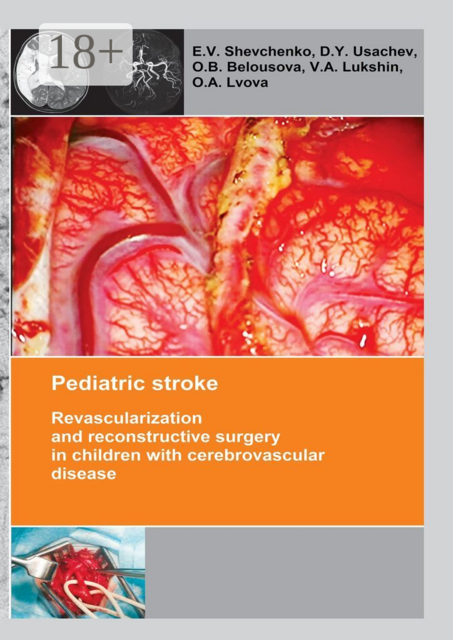



Pediatric stroke. Revascularization and reconstructive surgery in children with cerebrovascular disease
Қосымшада ыңғайлырақҚосымшаны жүктеуге арналған QRRuStore · Samsung Galaxy Store
Huawei AppGallery · Xiaomi GetApps

автордың кітабын онлайн тегін оқу  Pediatric stroke. Revascularization and reconstructive surgery in children with cerebrovascular disease

Pediatric stroke

Revascularization and reconstructive surgery in children with cerebrovascular disease

Fonts by «ParaType»


Contents

  1. Pediatric stroke
  2. List of acronyms and conventional symbols
  3. Introduction
  4. Chapter I. Pediatric stroke. General information
    1. 1. Epidemiology
    2. 2. Pediatric stroke classifications
    3. 3. Aetiopathogenesis and risks
    4. 4. Clinical manifestations of cerebrovascular diseases in children
    5. 5. Diagnostics of pediatric stroke
  5. Chapter II. Conservative therapy of stroke and approaches to secondary prevention of CVD
    1. 1. Conservative therapy in the acute period of stroke
    2. 2. Secondary prevention of CVD
    3. 3. The outcomes of pediatric strokes and their prognosis
  6. Chapter III. Surgical treatment of children with chronic cerebral ischemia
    1. 1. History of reconstructive and revascularization brain surgeries on pathological major cerebral vessels
    2. 2. Use of reconstructive and revascularization surgeries for treatment of various types of vascular diseases
    3. 3. Diagnostic algorithm and indications for surgical treatment
    4. 4. Types of surgeries on pathological brachiocephalic arteries
      1. 4.1 Reconstructive surgeries
      2. 4.2 Revascularization surgeries
    5. 5. Results of surgical treatment of children with chronic cerebral ischemia and indications for surgery
      1. 5.1 General data
      2. 5.2 Neuropsychological examination results in children with chronic cerebral ischemia
      3. 5.3 EEG test results in children with chronic cerebral ischemia
    6. 6. Results of surgical treatment of children with pathological extra-cranial segment of the ICA
      1. 6.1 Patho-morphological description of dysplastic vascular wall changes in the pathological deformation area
    7. 7. Results of surgical treatment of children with the pathology of an intracranial segment of major cerebral arteries
    8. 8. Stepwise surgical treatment
    9. 9. Surgical treatment complications
    10. 10. Assessment of surgical treatment results in the early post-surgery period (immediate outcomes)
      1. 10.1 Post-surgery catamnesis in children (outcomes)
  7. Chapter IV. Conclusion
  8. List of References

Writing Team


Olga Benuanovna Belousova

Neurologist, Dr. Med. Sci., leading research scientist in the Clinical Vascular Neurosurgery Department of FSAI «Burdenko Neurosurgery Institute» of the Ministry of Healthcare of the Russian Federation


Anton Evgenyevich Korshunov

Neurosurgeon, Cand. Med. Sci., senior research scientist in the Clinical Pediatric Department of FSAI «Burdenko Neurosurgery Institute» of the Ministry of Healthcare of the Russian Federation


Irina Andreyevna Nagorskaya

Medical Psychologist, Cand. Psych. Sci., Medical Psychologist in the Mental Research Team of FSAI «Burdenko Neurosurgery Institute» of the Ministry of Healthcare of the Russian Federation


Vasiliy Andreyevich Lukshin

Neurosurgeon, Cand. Med. Sci., senior research scientist in the Clinical Vascular Neurosurgery Department of FSAI «Burdenko Neurosurgery Institute» of the Ministry of Healthcare of the Russian Federation


Olga Aleksandrovna Lvova

Pediatric Neurologist, Dr. Med. Sci., assistant professor in Chair of Psychiatry, FSBEI of Higher Professional Education «Urals State Medical University» of the Ministry of Healthcare of the Russian Federation, leading research scientist in the Laboratory of Brain and Neurocognitive Development of FSAEI of Higher Professional Education «Ural Federal University named after the first President of Russia B.N. Yeltsin»

Olga Borisovna Sazonova

Neurophysiologist, Cand. Med. Sci., leading research scientist in the Laboratory of Clinical Neurophysiology of FSAI «Burdenko Neurosurgery Institute» of the Ministry of Healthcare of the Russian Federation


Elena Viktorovna Shevchenko

Neurosurgeon, Cand. Med. Sci., junior research scientist in the Clinical Vascular Neurosurgery Department of FSAI «Burdenko Neurosurgery Institute» of the Ministry of Healthcare of the Russian Federation


Lyudmila Valentinovna Shishkina

Pathomorphologist, Cand. Med. Sci., Head of Laboratory of Pathomorphology in FSAI «Burdenko Neurosurgery Institute» of the Ministry of Healthcare of the Russian Federation


Dmitry Yuryevich Usachev

Neurosurgeon, Corresponding Member of the Russian Academy of Sciences, Dr. Med. Sci.,Prof., Deputy Director for Science of FSAI «Burdenko Neurosurgery Institute» of the Ministry of Healthcare of the Russian Federation

List of acronyms and conventional symbols

ABP — arterial blood pressure

ACA — anterior cerebral artery

ACVD — acute cerebrovascular disease

ADHD — attention deficiency and hyperactivity

disorder

ADP test — adenosine diphosphate induced

platelet aggregation test

AHT — arterial hypertension

ASA — acetylsalicylic acid

ASL — Arterial Spin Labeled

ASPI test — arachidonic acid induced

platelet aggregation test

BCA — brachiocephalic arteries

CAG — cerebral angiography

CCA — common carotid artery

CCVD — complete cerebrovascular disease /

complete stroke

CN — cerebral nerves

CNS — central nervous system

CO — cerebral oximetry

CPISR — Canadian Pediatric Ischemic Stroke Registry

CVD — cerebrovascular disease

CVS — cardiovascular system

DEP — dyscirculatory encephalopathy

DMB — dura mater of brain

ECA — external carotid artery

ECG — electrocardiography

EchoCG — echo-cardiography

EDAS — encephalo-duro-arterio-synangiosis

EDMS — encephalo-duro-myo-synangiosis

EEG — electro-encephalography

EICMA — extra-intracranial microvascular

anastomosis

EMS — encephalo-myo-synangiosis

ICA — internal carotid artery

INR — international normalized ratio

IS (AIS) — ischemic stroke (arterial ischemic stroke)

LBFR — linear blood flow rate

MASGS — Modified Ashworth Scale of

Grading Spasticity

MCA — middle cerebral artery

MONICA — The World Health Organization’s

Multinational Monitoring of Trends and

Determinants in Cardiovascular Disease

MRA — magnetic resonance angiography

MRI — magnetic resonance imaging

NIHSS — National Institutes of Health Stroke Scale

NSA — National Stroke Association

OA — occipital artery

PCA — posterior cerebral artery

PComA — posterior communicating artery

PET — positron emission tomography

PS — pial synangiosis

SCT AG — spiral computed angiography

SCT or CT — spiral computer tomography

STA — superficial temporal artery

TCUSDG — transcranial ultrasonic dopplerography

TIA — transitory ischemic attacks

US — ultrasonography

VBS — vertebrobasilar system

WHO — World Health Organization

Introduction

Pediatric stroke. Revascularization and
reconstructive surgery in children

Pediatric stroke is one of the most widely discussed problems in contemporary medicine. This is, primarily, associated with the fact that a cerebral vascular disease (CVD) is considerably less common in childhood than in adults, and, therefore, less known. At the same time, children, who had suffered CVD, constitute an essential group among disabled children. This determines the need for a closer study of the pediatric stroke problem, particularly, in the background of successful conservative and surgical treatment of strokes in adult population.

The spectrum of clinical manifestations of the pediatric stroke is wide enough — from mild focal and isolated general cerebral symptoms to the formation of a significant neurologic deficiency with a predisposition to recurrence with the subsequent sustained disability and a high risk of fatality. Thanks to a widespread distribution and technical improvement of neuroimaging methods, the pediatric stroke is diagnosed with the ever increasing frequency. Nevertheless, the low awareness of neurologists about the CVD problem in childhood, including the transitory ischemic attacks (TIAs), frequently leads to difficulties in diagnostics and, consequently, to delayed and insufficient medical aid. Due to the variety of reasons, clinical manifestations and the course of the pediatric stroke, selecting the patient management approach becomes difficult, especially, in neurology and brain surgery departments in small city hospitals, where medical specialists lack sufficient experience in treatment of this disease.

This book presents basic literature data on etiology, pathogenesis, clinical manifestations of a pediatric stroke, examination methods and approach to the conservative and surgical treatment of acute and chronic cerebral ischemia in children as well as our own studies on diagnostics and results of conservative and surgical treatment of children with the disease onset at the age of the 1-st day of life up to 18 years old, all obtained on the basis of Burdenko Neurosurgery Institute and FSBEI of Higher Professional Education «Urals State Medical University» of the Ministry of Healthcare of the Russian Federation.

This book will enable a wide range of pediatric specialists to get an idea about the specific features of a pediatric ischemic stroke, its diagnostics, conservative treatment principles and options for surgical treatment of this disease.

Chapter I.
Pediatric stroke. General information

Nowadays, the mortality rate of cerebrovascular diseases in Russia is one of the world’s highest. A cerebrovascular disease holds one of the first places among the most frequent mortality and disability causes, just as in economically developed countries too. The World Health Organization’s Multinational Monitoring of Trends and Determinants in Cardiovascular Disease (MONICA) determines the course of a stroke as «a sudden neurologic deficiency sustaining for over 24 hours, or a sudden death». This definition includes both ischemic and hemorrhagic strokes [262].

In a pediatric population, an ischemic stroke is a less frequent pathology as compared to the adult population. Strokes occur in children of any age [33]. Delayed or erroneous diagnosis of a stroke in children still remains a common enough event [80; 104].

The descriptions of individual clinical cases of cerebrovascular diseases in children can be found in literature since the 17-th century. The first description of a stroke in a child is considered to be made by T. Willis in 1667. J. Wepfer (1658) mentioned sick children, who had a hemiplegia, which was emerging and regressing within a day or faster [278]. The disease termed as «an infantile hemiplegia» was presented in the works by W. Osler (1889), B. Sachs and F. Peterson (1890) as well as S. Freud (1893) in a series of pediatric patients, who had suffered a stroke. It was only in 1927 that F. Ford and A. Schaffer published the first ever systematized description of methods for assessment and treatment of children with ischemic strokes. The authors analyzed the etiology of a pediatric stroke as well as the methods and the results of treatment, which had a subsequent effect on the quality of life [98]. V. Hachinski (1982) described non-specific symptoms, such as a headache and syncopes [118]. It is important to note that many problems outlined by them still remain pertinent even today.

The works by M. Norman (1957), C. Fischer (1959), E. Frantzen (1961), E. Bickertaff (1964), J. Jackson (1970), J. Abraham (1971), W. Kannel (1972) about pediatric strokes are, doubtless, interesting, although these publications did not contain any mentioning of the transient cerebrovascular diseases in childhood [131]. In later studies, the transient cerebrovascular diseases, or, in other terms, the transitory ischemic attacks (TIAs), were noted to occur in children much more frequently than strokes [209]. In 2006 G. Ganesan et al. published an article on the results of a retrospective (from 1978 to 1990) and prospective (from 1990 to 2000) survey of children, who had suffered a stroke, with the use of a neuroimaging. They described 212 patients, including 97 ones with an erroneous initial diagnosis. 79 children were noted to have a growing neurologic deficiency (29 strokes, 46 TIAs, 4 fatal cases due to a recurrent stroke), while during the analysis of the subsequent 5 years 51 children (67%) were noted to have recurrent episodes of cerebrovascular diseases [104].

The number of publications on the subject of a pediatric stroke is growing worldwide with every year. In recent years, educational seminars and topical sessions on this problem appeared in the European Stroke Organization Congress program (Nice, 2014; Glasgow, 2015; Barcelona, 2016). Nowadays, practitioners working abroad can be guided by two manuals: an American one — «Management of Stroke in Infants and Children» released in 2008 and a European one — «Stroke and cerebrovascular disease in childhood» published in 2011 in London [105; 267]. Thus, practical manuals accumulating the results of scientific research and permitting to make clinical decisions are solitary and rarely updated.

The lack of universally accepted international recommendations or guidelines hampers the choice of approaches to treatment and prevention of pediatric strokes. A low awareness of pediatric neurologists on the problem of pediatric strokes and TIAs often leads to difficulties in diagnostics and inadequate therapy of pediatric patients and, therefore, to a delayed and inadequate care, which was noted by V.P. Zykov (2008), F. Kirkham (2011) and A. Mallick (2014) in their works. The main drawback of the research studies presented in literature consists in the fact that only some individual states were specified as those relevant to risks, which, as a rule, was determined by the specialty of a research team (infectologists, rheumatologists, geneticists, hematologists, etc.). The paucity of assessed sampling children in these studies and the restriction of data acquisition to a specific age group (infants, teenagers, etc.) hampered the potential generalization of results obtained within the boundaries of all age groups.