


автордың кітабын онлайн тегін оқу The Later Renaissance
Transcriber’s Notes:
This eBook contains sidenotes. Their appearance varies, depending upon the device used to display this text, as explained in the Additional Transcriber’s Notes.
Additional Transcriber’s Notes are at the end.
Periods of European Literature
EDITED BY
PROFESSOR SAINTSBURY
VI.
THE LATER RENAISSANCE
PERIODS OF EUROPEAN LITERATURE.
Edited by Professor SAINTSBURY.
“The criticism which alone can much help us for the future is a criticism which regards Europe as being, for intellectual and spiritual purposes, one great confederation, bound to a joint action and working to a common result.”
—Matthew Arnold.
In 12 Crown 8vo Volumes. Price 5s. net each.
The DARK AGES
Professor
W. P. Ker.
The FLOURISHING OF ROMANCE AND THE RISE OF ALLEGORY
The Editor.
The FOURTEENTH CENTURY
F. J. Snell.
The TRANSITION PERIOD
G. Gregory Smith.
The EARLIER RENAISSANCE
The LATER RENAISSANCE
David Hannay.
The
FIRST HALF of 17th CENTURYThe AUGUSTAN AGES
Oliver Elton.
The MID-EIGHTEENTH CENTURY
J. Hepburn Millar.
The ROMANTIC REVOLT
Professor
C. E. Vaughan.
The ROMANTIC TRIUMPH
T. S. Omond.
The LATER NINETEENTH CENTURY
The Editor.
WILLIAM BLACKWOOD & SONS, Edinburgh and London.
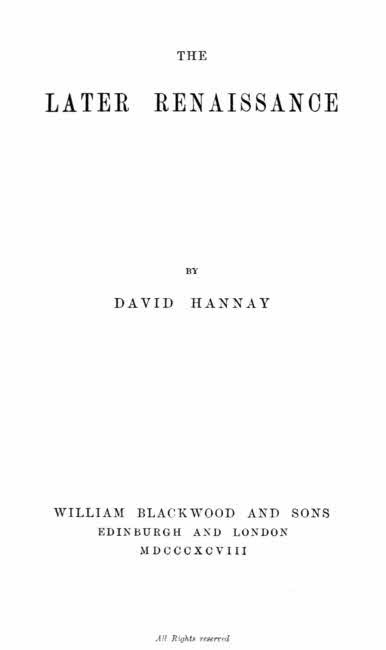
THE
LATER RENAISSANCE
BY
DAVID HANNAY
WILLIAM BLACKWOOD AND SONS
EDINBURGH AND LONDON
MDCCCXCVIII
All Rights reserved
PREFACE.
The general rules by which this series is governed have been fully stated by the Editor in the first published volume, The Flourishing of Romance and the Rise of Allegory. It will therefore not be necessary for me to do more than endeavour to justify the particular application of them in this book. Mr Saintsbury has fully recognised the magnitude of the task which has to be overcome by the writer who should undertake to display “intimate and equal knowledge of all the branches of European Literature at any given time.” Nobody could be more conscious of his insufficiency to attain to any such standard of knowledge than I have had occasion to become in the course of executing the part of the plan intrusted to me. Though I hope my work has not been shirked, I still cannot venture to boast of “intimate and equal knowledge” of all the great bulk of literature produced during the later sixteenth century. Happily so much as this is not required. Some ignorance of—or at least some want of familiarity with—the less important, is permitted where the writer is “thoroughly acquainted with the literature which happened to be of greatest prominence in the special period.” I must leave others to decide how far my handling of the Spanish, English, and French portions of the subject can be held to excuse my less intimate familiarity with the Italian and Portuguese. The all but unbroken silence of Germany during this period made it unnecessary to take account of it. Modern Dutch and modern Scandinavian literature had hardly begun; such Scottish poets as Scott and Montgomerie are older than their age. These and other things, on the principles of the series, fall into the previous or the next volume.
Although the reasons for the course taken with the literature of Spain are given in the text, they may be repeated here by way of preliminary excuse. It has been decided to treat the Spaniards as an example of the overlapping necessary to the satisfactory carrying out of a series in periods. I have begun with them earlier than with others, have ended with them later, and have as far as space permitted treated them as a whole. For this there is what appears to me to be a sound critical reason. Although Spain undoubtedly belongs to Europe, yet there is in her something which is not quite European. The Spaniards, though they have always been, and are, vigorous and interesting, have a certain similarity to some oriental races. This is not the place for an essay on the Spanish national character. The comparison is only mentioned as a justification for pointing out that, like some oriental races, the Spaniards have had one great period of energy. At no time have they been weak, and to-day they can still show a power of resistance and a tenacity of will which promise that if ever the intellect of the nation revives, they will again play a great part in the world. But it is none the less a matter of fact that, except during their one flowering time, they have not been what can be called great. From the fifteenth century till well into the seventeenth, those defects in the national character, which have kept the Spaniards stationary and rather anarchical, were in abeyance. The qualities of the race were seen at work on a vast stage, doing wonderful things in war, colonisation, art, and letters. Yet the very reason that the Spaniard was then exercising his faculties to the full extent to which they would go, gives a complete unity to his Golden Age. It cannot be divided in any other than a purely arbitrary way. England and France were destined to grow and develop after the Later Renaissance. Tasso and Bruno were the last voices of a great Italian time. But Spain suspended the anarchy of her middle ages at the end of the fifteenth century, gathered force, burst upon the world with the violence of a Turkish invasion, flourished for a space, and then sank exhausted at the end of a hundred and fifty years.
It may be thought that too little attention has been paid to the Portuguese. I will not venture to assert that the criticism is ill founded. Still I shall plead by way of excuse that what the lesser Peninsular nation did in literature was hardly sufficiently original to deserve fuller notice in a general survey of a very fertile period. Sà de Miranda and his contemporaries, even Camoens and his follower Corte-Real, were after all little more than adapters of Italian forms. They were doing in kindred language what was also being done by the Spanish “learned poets.” In Camoens there was no doubt a decided superiority of accomplishment, but the others seem to me to have been inferior to Garcilaso, Luis de Leon, or Hernan de Herrera. And this “learned poetry” is in itself the least valuable part of the literature of the Peninsula. In what is original and important, the share of the Portuguese is dubious or null. They have a doubtful right to the Libros de Caballerías. They have a very insignificant share in the stage, and no part in the Novelas de Pícaros. Barros and the other historians were men of the same class as the Spaniards Oviedo or Gómara. For these reasons, I have thought it consistent with the scheme of the book to treat them as very subordinate.
CONTENTS.
PAGE
CHAPTER I.
THE LATER RENAISSANCE IN SPAIN.
The unity of Spanish literature—Limits of treatment—A prevailing characteristic—The division into native and imitative—The inheritance from the fifteenth century—Spanish verse—The
Cancioneros—The romances—The
Romanceros—The quality of this poetry—Spain and Italy—The
Diálogo de la Lengua—Prose of the early sixteenth century—The influence of the Inquisition
1CHAPTER II.
THE SPANISH LEARNED POETS.
The starting-point of the classic school—The natural influence of Italy—Prevalence of the classic school—Its aristocratic spirit—What was imitated from the Italians—Its technique and matter—Artificiality of the work of the school—Boscan—Garcilaso—Their immediate followers—The schools of Salamanca and Seville—Góngora and Góngorism—The epics—The
Araucana—The
Lusiads 30CHAPTER III.
THE GROWTH AND DECADENCE OF THE SPANISH DRAMA.
The national character of the Spanish drama—The first beginnings of the religious plays—The starting-point of the secular play—Bartolomé de Torres Naharro—Lope de Rueda—Lope de Vega’s life—His influence on the drama—The conditions of the work—Contemporaries and followers of Lope—Calderon—Calderon’s school
60CHAPTER IV.
FORMS OF THE SPANISH DRAMA.
The prevailing quality of the Spanish drama—Typical examples—
La Dama Melindrosa—
El Tejedor de Segovia—
El Condenado por Desconfiado—The plays on “honour”—
A Secreto Agravio Secreta Venganza—The
Auto Sacramental—the
loa—The
Verdadero Dios Pan—
Los Dos Habladores 91CHAPTER V.
SPANISH PROSE ROMANCE.
Pastorals and short stories—The original work of the Spaniard—The
Libros de Caballerías—The
Amadis of Gaul—Followers of
Amadis of Gaul—Influence and character of these tales—The real cause of their decline—The character of the
Novelas de Pícaros—The
Celestina—
Lazarillo de Tormés—
Guzman de Alfarache—The followers of Mateo Aleman—Quevedo—Cervantes—His life—His work—The minor things—
Don Quixote 124CHAPTER VI.
SPAIN—HISTORIANS, MISCELLANEOUS WRITERS, AND THE MYSTICS.
Spanish historians—Histories of particular events—Early historians of the Indies—General historians of the Indies—Gómara, Oviedo, Las Casas, Herrera, the Inca Garcilaso—Mendoza, Moncada, and Melo—General histories—Ocampo, Zurita, Morales—Mariana—The decadence—Solis—Miscellaneous writers—Gracian and the prevalence of Góngorism—The mystics—Spanish mysticism—The influence of the Inquisition on Spanish religious literature—Malon de Chaide—Juan de Ávila—Luis de Granada—Luis de Leon—Santa Teresa—Juan de la Cruz—Decadence of the mystic writers
157CHAPTER VII.
ELIZABETHAN POETRY.
The starting-point—Italian influence—The opposition to rhyme—Excuses for this—Its little effect—Poetry of first half of Elizabeth’s reign—Spenser—Order of his work—His metre—Character of his poetry—Sir P. Sidney—The
Apologie for Poetrie—His sonnets and lyrics—Watson—The Sonneteers—Other lyric poetry—The collections and song-books—The historical poems—Fitz-Geoffrey and Markham—Warner—Daniel—Drayton—The satiric poets—Lodge—Hall—Marston—Donne
185CHAPTER VIII.
THE EARLIER DRAMATISTS.
The first plays—Resistance to classic influence—Advantages of this—And the limitations—The dramatic quality—Classic, Spanish, and French drama—Unity in the English Plays—
Ralph Roister Doister—
Gammer Gurton’s Needle—
Gorboduc—Formation
of the theatre—Lyly—Greene—Peele—Kyd—Marlowe—Character of these writers—Shakespeare—Guesses about his life—Order of his work—Estimates of Shakespeare—Divisions of his work—The Poems—The Dramas—The reality of Shakespeare’s characters
223CHAPTER IX.
THE ELIZABETHAN PROSE-WRITERS.
Elizabethan prose—Two schools of writers—Roger Ascham—His books and style—Webbe and Puttenham—The sentence—Euphuism—The
Arcadia—Sidney’s style—Short stories—Nash’s
Unfortunate Traveller—Nash and the pamphleteers—Martin Marprelate—Origin of the Marprelate Tracts—The
Diotrephes—Course of the controversy—Its place in literary history—Hooker—
The Ecclesiastical Polity 259CHAPTER X.
FRANCE. POETRY OF THE LATER RENAISSANCE.
The Pléiade—Ronsard—The lesser stars—The
Défense et Illustration de la Langue Française—The work of Ronsard—His place in poetry—Joachim du Bellay—Remi Belleau—Baïf—Du Bartas—D’Aubigné—The dramatic work of the Pléiade—Jodelle—Grevin and La Taille—Montchrestien—The comedy—
La Reconnue—Causes of failure of early dramatic literature
290CHAPTER XI.
FRENCH PROSE-WRITERS OF THE LATER SIXTEENTH CENTURY.
Abundance of later sixteenth-century prose—A distinction—Sully—Bodin—The great memoir-writers—Carloix—La Noue—D’Aubigné—Monluc—Brantôme—The
Satyre Ménippée—Its
origin—Its authors—Its form and spirit—Montaigne—His
Essays—The scepticism of Montaigne—His style—Charron and Du Vair
326CHAPTER XII.
THE LATER RENAISSANCE IN ITALY.
The later Renaissance in Italy—Torquato Tasso—His work—The
Gerusalemme Liberata—Giordano Bruno—Literary character of his work—Giambattista Guarini
352CHAPTER XIII.
CONCLUSION
367INDEX
379THE LATER RENAISSANCE.
CHAPTER I.
THE LATER RENAISSANCE IN SPAIN.
THE UNITY OF SPANISH LITERATURE—LIMITS OF TREATMENT—A PREVAILING CHARACTERISTIC—THE DIVISION INTO NATIVE AND IMITATIVE—THE INHERITANCE FROM THE FIFTEENTH CENTURY—SPANISH VERSE—THE “CANCIONEROS”—THE ROMANCES—THE “ROMANCEROS”—THE QUALITY OF THIS POETRY—SPAIN AND ITALY—THE “DIÁLOGO DE LA LENGUA”—PROSE OF THE EARLY SIXTEENTH CENTURY—THE INFLUENCE OF THE INQUISITION.
The unity of Spanish Literature.
The Literature of Spain, of which the Portuguese is the little sister, or even at times the echo, stands apart. In this fact lies the excuse for the division adopted in this volume. There is at first sight something arbitrary in beginning a survey of Literature of the later Renaissance with a book written at the close of the fifteenth century. To carry the story on till the close of the seventeenth may well appear to be a violation of proportion. The Renaissance even in Italy was not in its later stages in 1500, and it is far behind us when we get to the years in which Boileau, Molière, and Racine were writing in France, while Dryden was the undisputed prince of English poets and prose-writers. Yet there is good critical reason for making a wide distinction between the one period of literary greatness of the Peninsula and those stages in the history of the Literatures of England, France, or Italy, which belong to the time of the later Renaissance. It is this—that we cannot, without separating things which are identical, divide the literature of Spain and Portugal in the sixteenth and seventeenth centuries. The years between the appearance of the Shepherd’s Calendar and the death of Shakespeare form a period possessing a character of its own in the history of our poetry, our prose, and our drama. It is still more emphatically true that French literature, between the rise of the Pléiade and the death of Mathurin Regnier, is marked off sharply, both from what had gone before and what was to follow. But we cannot draw a line anywhere across the Spanish drama, poetry, or prose story of the great time and say, Here an old influence ended, here a new one began. We have to deal with the slow growth, very brief culmination, and sudden extinction of a brilliant literature, which came late and went early, and which for the short time that it lasted is one and indivisible. It grew up partly from native roots, partly under an influence imparted by Italy; attained its full stature in the early years of the seventeenth century; then “withered, fell into puerile ravings, and died,” with the close of the Austrian dynasty.
Limits of treatment.
As, then, the Golden Age of Spain is one, we are justified in taking it as a whole, even though we appear to violate the harmony of the arrangement of the series to which this volume belongs. And this division of the matter imposes an obvious limitation on the treatment to be adopted. Spanish literature is, in one sense, exceedingly rich. During the century and a half, or so, of its vigour, it produced a vast number of books, and the catalogue of its authors is very long. Don Nicolas Antonio, the industrious compiler of the Biblioteca Hispana, has calculated the number of mystic and ascetic works (of which some are among the best of Spanish books) at over three thousand. The fecundity of its theatre is a commonplace; the fluency of its poets is boundless; the bulk of its prose stories is considerable; its historians are many, and not a few are good. It is needless to add that much was written on law, theology, and the arts which has value. In dealing with all this mass of printed matter in the space at our disposal, it is clearly necessary to remember the injunction, “il faut savoir se borner.”
We must, to begin with, leave aside all that is not primarily literature, except when it can be shown to have influenced that which is. Again, even in dealing with our proper subject, we must submit to limits. It is manifestly necessary to omit scores—nay, hundreds—of minor names. But that is not all. In making a survey of a fertile literature in a brief space, we are always obliged to go by kinds and classes rather than by individual writers. But in Spanish literature this is more especially true.
A prevailing characteristic.
In the course of an introduction to a translation of Shakespeare’s plays by Señor Clarke, Don Juan Valera (himself the author of stories both Spanish and good) has made a complaint, which is of the nature of an unconscious confession. He has lamented that the characters of Spanish drama are so little known. An artist, so he says, has only to paint a young man in a picturesque dress on a rope-ladder, with a beautiful young woman on a balcony above him, and all the world recognises Romeo and Juliet. If he takes his anecdote from Lope and Calderon, nobody will be able to guess what it is all about. With less than his usual good sense, Señor Valera accounts for the obscurity into which the world has been content to allow the characters and scenes of the Spanish drama to fall, by the political decadence of his country at the end of the seventeenth century. Yet the passing away of Spain’s greatness has not prevented Don Quixote and Sancho from being familiar to the whole world. If anecdote pictures are to be the test, Cervantes has no reason to fear the rivalry of the English dramatic poet. There is less of Spanish pride than of its ugly shadow, Spanish vanity, in Don Juan Valera’s explanation. The Drama of Spain, brilliant as it was within its limits, is not universally known, because it does not give what we find in Cervantes, and in boundless profusion in Shakespeare, characters true to unchanging human nature, and therefore both true and interesting to all time. It is mainly a drama of situation, and of certain stock passions working through personages who are rarely more than puppets. We may say the same of the prose stories, whether Libros de Caballerías, or Novelas de Pícaros—Books of Chivalry, or Tales of Rogues. They all have the same matter and the same stock figures. They differ only in the degree of dexterity with which the author has used his material. In the poetry of Spain we see two influences at work—first, the Italian Renaissance, which ruled the learned poetry of the school of Garcilaso; and then the native “romance” or ballad poetry, which held its ground beside the more varied and splendid metres imitated from abroad. Each of these, within its own bounds, is very uniform, and the works of each school vary only according to the writer’s greater or less mastery of what he uses in common with all others. Such a literature is manifestly best treated by classes and types. Cervantes, indeed, stands apart. His greatness is not a towering superiority but a difference of kind. It is as individual as the greatness of Velasquez in painting.
The division into native and imitative.
These two influences, the foreign and the native, divided Spanish literature of the Golden Age between them in very different proportions. To the first is owing the whole body of its learned poetry, and part of its prose. To the second belong all the “deliveries of the Spaniard’s self,” as they may be called in a phrase adapted from Bacon, the prose tale, the ballad, the drama, and the ascetic works of the so-called mystics. These are the genuine things of Spanish literature, and in them the Spaniard expressed his own nature. It was very shrewdly noted by Aarsens van Sommelsdyck, a Hollander who visited Spain in the later seventeenth century, that however solemn the Spaniard may be in public, he is easy and jocular enough in private. He is very susceptible to what is lofty and noble, capable of ecstatic piety, of a decidedly grandiose loyalty and patriotism, endowed with a profound sense of his own dignity, which nerves him to bear adversity well, but which also causes him to be contumaciously impenetrable to facts when they tell him he must yield or amend his ways. With all that, and perhaps as a reaction from all that, he can enjoy crude forms of burlesque, can laugh over hard realistic pictures of the sordid side of life, and delights in rather cynical judgments of human nature. The lofty and the low have their representations in his literature, in forms easily traced back to the middle ages. About the third quarter of the sixteenth century it might have appeared to a superficial observer that the native element was overpowered by the foreign. But the triumph of the “learned” literature was in show, not in reality.
The book already alluded to as marking the starting-point of the Golden Age is the once famous Celestina, a long story in dialogue, of uncertain authorship and age. It was written at some time between the conquest of Granada and the end of the fifteenth century. Precision is in this case of no importance, since the true descendants of the Celestina were the Picaresque stories. Its first successor was the Lazarillo de Tormes, which, though no doubt written earlier, appeared in or about 1547. Then at an interval of fifty years came the Beacon of Life—Atalaya de la Vida—better known as Guzman de Alfarache, of Mateo Aleman, and from him sprang the great Rogue family. But while the Picaresque novel was gathering strength, all the more slowly because it was not an imitation, the classic school of poetry had blossomed, and was already showing signs of decadence. The drama, another purely native growth, had risen by degrees alongside the prose tale, and reached its full development at about the same time. Both are intrinsically of far greater value than the learned verse. Yet since their maturity came later, they may be postponed while the story of the school of Garcilaso is told.
The inheritance from the fifteenth century.
Before entering upon that, it is necessary to say something of the conditions which the “new poetry” and the influence of the Renaissance found before them when they began to influence Spain. The fifteenth century had not been barren of literature. King John II. (1407-1454) had collected round him a school of Court poets whose chief was Juan de Mena. Although the last representatives of this school resisted the innovations of Boscan and Garcilaso as unpatriotic, it was itself entirely foreign in origin—being, in truth, little more than an echo of Provençal and early Italian poetry. Juan de Mena, the Prince of Poets of his time, wrote long allegorical poems in imitation of Dante, and was perhaps not uninfluenced by the French rhétoriqueurs. Indeed the earlier leaders of the school made no secret of their debt. The Marquis of Santillana, a contemporary of King John, candidly says, in a letter to the Constable of Portugal, that he sought the origin of poetry in the Gai Saber of Provence. The troubadours, when driven from France, had found refuge in the dominions of Aragon, and had there given rise to a school of imitators. The connection of Aragon with Italy was close. Dante found translators, and Petrarch imitators, among the Catalan poets of Valencia, and from thence their influence spread to Castile. Juan del Encina, who in 1496 prefixed a brief Ars Poetica to one of those collections of lyric verse called Cancioneros, and who was himself a poet of the Court school, confessed that he and his brother verse-writers had conveyed largely from the earlier Italians. Moreover, he made this the main ground of their claim to be considered poets. It was not till the next century, and until the last representatives of this school found themselves opposed by the Italian influence, that they began to claim to be essentially Spanish.
Spanish verse.
What there was of really Spanish in their verse must be allowed to have been mainly the impoverishment of the original models. The Spaniard has always been recalcitrant to the shackles imposed by complicated and artful forms of verse, and there is a natural tendency in him to drift at all times to his native trochaic assonants of eight syllables. His language, admirable when properly handled for prose, wants the variety of melody required for poetry. Impatience of the difficulties of metre is another name for the want of a due sense of the beauty of form. Indeed it is not by its form that Spanish literature has been distinguished. Given, then, a people who had very little faculty for delicate verse, and a language which wanted both the wealth of the Italian accent and the flexibility of the French, and it is easy to see what was likely to be the end of the Provençal and Petrarchian influence in the Court school. Its poetry, never more than an echo, sank into mechanical verse-making—mostly in eight-syllabled couplets, relieved by a broken line of four. The inborn preference of the Spaniard for loose metres gradually gained the upper hand. No doubt fine verses may be picked out from the bulk of the writings of the troubadour school of Castile. The rhythmus de contemptu mundi, known as the coplas de Manrique, which has been made known to English readers by Mr Longfellow, is even noble in its rigid gravity. But the merit lies not in the melody of the verse, which soon becomes monotonous. It is in this, that the coplas give us perhaps the finest expression of one side of the Spaniard. They are full of what he himself calls in his own untranslatable word el desengaño—that is to say, the melancholy recognition of the hollowness of man’s life, and “the frailty of all things here”—not in puling self-pity, but in manly and pious resignation to fate and necessity.
The Cancioneros.
This old or troubadour school did not give up the field to the new Italian influence without a struggle. Its models continued to be imitated nearly all through the sixteenth century. It was praised and regretted by Lope de Vega and Cervantes. Boscan and Garcilaso found an opponent and a critic in Cristobal de Castillejo, a very fluent verse-writer, a most worthy man, and a loyal servant of the house of Austria, who died in exile at Vienna in 1556. El buen de Castillejo—the good Castillejo, as he is commonly called, with condescending kindness—was an excellent example of the stamp of critic, more or less common in all times, who judges of poetry exclusively by his own stop-watch. He condemned Boscan and Garcilaso, not for writing bad poetry, but for not writing according to what he considered the orthodox model. The new school not unnaturally retorted by wholesale condemnation of the old. When Hernan, or Fernan, de Herrera published his edition of Garcilaso in 1572, he was rebuked for quoting Juan del Encina in the commentary. A pamphleteer, believed to have been no less a person than the Admiral of Castile, whose likeness may be seen in the National Portrait Gallery among the ambassadors who signed the peace at the beginning of the reign of James I., laughed at Herrera for quoting as an authority one who had become a name for a bad poet. This was pedantry as bad as Castillejo’s, and represented an opinion never generally accepted by the Spaniards. They continued to read the collections of ancient verse called Cancioneros, even when the new school was at the height of its vigour. The Cancioneros Generales of Hernan del Castillo, the great storehouse of the poetry of the fifteenth century, was reprinted, with some changes, no less than nine times between 1511 and 1573. The extreme rarity of copies of these numerous editions proves that they must have been well thumbed to pieces by admiring readers. Yet they constitute no inconsiderable body of literature. The modern reprint issued (unfortunately only to its own members) by the Sociedad de Bibliófilos Españoles is in two weighty volumes.
The romances.
In this Cancionero there are two elements, destined to very different fates. Hernan del Castillo included eighteen romances in his collection, and they reappeared in subsequent editions. The importance of this word in Spanish literature seems to call for some definition of its scope. The word “romance” bore originally in Spanish exactly the same meaning as in other tongues descended from the Latin. It was the vernacular, and to write en romance was to write Castilian, Galician, or Catalan. “Ni romance ni romano”—neither Romance nor Roman—is a phrase bearing more or less the meaning of our “neither rhyme nor reason.” But little by little, by use and wont, it came about the end of the sixteenth century to be applied exclusively to the form of verse dearest and most native to the Spaniard, the already mentioned trochaic eight-syllable assonant metre. As the ancient ballads are mainly, though not exclusively, written in this form, they are called romances. Yet to write romances does not necessarily mean to write ballads, but only to write in that metre, whether in the dialogue of a play or in long narrative poems, or for any other purpose.
The assonant metre, as is well known, is not peculiar to Spain. It may well have been imported into Castile from France by those churchmen to whom the country owes so much of its architecture, what learning it had, and its civilisation when it began to revive from the merely martial barbarism produced by the Moorish conquest. But if the Spaniard did indeed take the assonant metre from his French teachers, he soon subjected it to that process which all forms of verse are apt to undergo in his hands. He released it from shackles, and gave it a freedom amounting to licence. The romance is a loose-flowing rhythm, in which the rhyme is made by the last accented vowel. Sometimes the same vowel is used line after line until it is exhausted. More commonly the assonant comes in alternate lines. As a rule there is no division into stanzas, but the verse runs on till the speech is ended, or the tale is told. To this there are, however, exceptions, and the romance is divided into redondillas—that is, roundels or staves of four lines, assonanced either alternately, or the first with the fourth and the second with the third, or into quintillas of five lines, with an assonant in three. The recalcitrance of the Spaniard to all limitations in verse-making has caused him to give a very wide range indeed to the assonant. The vowel u is allowed to rhyme with o, and i with e, though they have a very different sound and force. The Spaniard, again, allows a diphthong to be assonant to a vowel, although he pronounces both the vowels in his diphthongs. It will be seen that such verse as this can be written with extreme facility. Indeed it is a byword in Spain that nothing is easier than to write romances—badly. The difficulty, in fact, is to avoid writing them in prose; and it is no small one, when the ear of a people finds a rhyme in so faint a similarity of sound, and in a language in which the accent is at once so pronounced and as little varied. It is not, I trust, superfluous to add that in Castilian, which we call Spanish, there is a marked accent in the last syllable of words ending in a consonant, on the penult of words ending in a vowel, while a limited number of words are esdrujulo—that is, accented on the antepenult. The addition of a syllable to form the plural, or of the adverbial termination mente, does not alter the place of the accent. These rules, though nowise severe, are not rigidly followed. Not infrequently the assonant rhyme falls into the full or consonant rhyme, while the liesse or stave formed on one vowel, and its equivalents, is broken by a line corresponding to nothing. Even the rule requiring the use of eight syllables is applied with restrictions,—an accented syllable at the end counts as two, while two unaccented syllables rank only as one. It must be acknowledged that this metre is unsatisfactory to an ear attuned to the melody of English poetry. In our language it renders hardly a tinkle. When we have become accustomed to it in Castilian—and until we do it tantalises with a sense of something wanting—its highest virtue seems to be that it keeps the voice of the speaker in a chanted recitative. It is more akin to numbered prose than to verse.
However incomplete the romance may seem to us, to the Spaniard it is dear. When romances were not being well written in Spain, it was because nothing was being written well. The metre not only held its ground against the court poetry of the fifteenth century, but prevailed against the new Italian influence. Here as in other fields the Spaniard was very tenacious of the things of Spain. To find a parallel to what happened in Spain we must do more than suppose that the Pléiade in France, or Spenser and his successors in England, had failed to overcome the already existing literary schools. It was as if the ballad metres had won a place even on the stage. No Spanish Sir Philip Sidney need have apologised for feeling his heart stirred by those ballads of the Cid, or of the Infantes de Lara, which answer to our Chevy Chase. They were strenuously collected, and constantly imitated, all through the sixteenth and well into the seventeenth century. |The Romanceros| So far were they from falling into neglect, that they were first able to shake the slowly withering poetry of the troubadour school, and then to fill a long series of collections, known, in the beginning, as Cancioneros, or Libros, or Sylvas de Romances, but finally as Romanceros. Much bibliographical learning and controversy has collected about these early editions. Even if I could profess to be competent to speak on such matters, they would have no proper place here. From the point of view of the literary historian, the interesting fact is that at a time when classic, or at least new influences, born of the Renaissance, were carrying all before them in France and England, and in Italy had long ago definitively conquered, the Spaniards did not wholly part with their inheritance from the Middle Ages.
The few ballads, and fragments of ballads, printed by Hernan del Castillo in 1511, proved so popular that an editor was tempted to form a special collection. The place and date of this first ballad-book proper are both significant.[1] It appeared at Antwerp in or about 1546—that is to say, three years or so after the first edition of the poems of Boscan and Garcilaso. The editor was one Martin Nucio. Antwerp, be it observed, was always a great publishing place for Spanish books, a fact which may be accounted for, not only by the political connection between Spain and the Low Countries, the number of Spaniards employed there in various capacities, as soldiers, officials, or traders, and the then extensive use of their language, but also by the superiority of the Flemish printers. That same carelessness of form which is found in the Spaniard’s literature followed him in lesser arts, where neatness of handling was more necessary than spirit and creative faculty. He was, at any rate in the sixteenth and seventeenth centuries, rarely a good engraver, and hardly ever a good printer. The Cancionero de Romances, brought out, it may be, primarily for the pleasure of the Spaniards scattered over Flanders and Germany, was soon reprinted in Spain, by one Estéban de Najera, at Saragossa. These contemporary collections are not quite identical, but essentially the same. This Cancionero, or Sylva, de Romances met with a reception which proved how strong a hold his indigenous verse had on the Spaniard. Three editions, with corrections and additions, appeared by 1555. The latest of these was not reprinted until well into the next century. In the meantime other editors had followed Nucio and Najera. A Romancero in nine parts appeared at places so far distant from one another as Valencia, Burgos, Toledo, Alcalá, and Madrid, between 1593 and 1597. This again grew into the great Romancero General of 1604-1614, wherein there are a thousand ballads.
The quality of this poetry.
In so far as this great mass of verse is really an inheritance from the Middle Ages, it does not belong to the subject of this book. All that it is necessary to do here is to note the fact that it did survive, and did continue to exert an influence. But nothing is more doubtful than the antiquity of the vast majority of the romances. The best judges have given up the attempt to class them by age, and indeed that must needs be a hopeless task where poems have been preserved by oral tradition alone, and have therefore been subject to modification by every succeeding generation. The presence of very ancient words is no proof of antiquity, since they may be put in by an imitator. Neither is the mention of comparatively recent events, or of such things as clocks or articles of commerce only known in later times, of itself proof that the framework of the ballad was not ancient when it took its final shape. The Romances were collected very much in the style of the Minstrelsy of the Scottish Border, and we all know with what facility remains of popular poetry are found when there is a demand for them, when no critical tests are applied, and when the searchers are endowed with a faculty for verse-writing. The Moorish ballads have been called old, and yet nothing is more certain than that they were the fruits of a literary fashion of the later sixteenth century. The Moor, like the Red Man, became a picturesque figure only when he ceased to be dangerous. Another class of the ballads, those called of chivalry, are full of references showing that the writers were acquainted with Ariosto, and cannot have been written before the middle of the century at the earliest. Where the romance is identical in subject with, and very similar in language to, a passage in the great chronicle of Alfonso the Wise, or other unquestionably mediæval work preserved in writing of known antiquity, it may be accepted as ancient. Where that test cannot be applied, it is safer not to think that the ballad is older than the sixteenth century. In some cases the inspiration can be shown to have been French. The subject of the Molinero de Arcos, a popular ballad existing in several versions, was taken from a well-known French farce, Le Meunier d’Arleux.
It is very necessary, when judging this great body of verse, to stand on our guard against certain besetting fallacies. There is always a marked tendency in collectors to excuse what is grotesque on the ground that it is ancient, and to pardon what is bad on the ground that it is popular. The Spanish ballads have suffered from the too great zeal with which modern editors have reprinted what was accepted by the indiscriminate taste of first collectors. Many of the ballads belong to the class of romances de ciegos—i.e., “blindmen’s ballads”—which were doggerel at all times. Others are not above the level of the poets’ corner of not over-exacting newspapers. Even in the best, the intention and the first inspiration are commonly far better than the expression. The Spaniard’s slovenliness of form is found here as elsewhere. Lockhart, in the preface to his adaptations, has rebuked the Spaniards for “neglecting old and simpler poets,” who wrote the romances, in favour of authors “who were at the best ingenious imitators of classical or Italian models.” He has himself, however, subjected those he selected for translation into English to a treatment which conveys a severe and a just critical judgment. A comparison between his ballads and the originals will show that he occasionally, though very rarely, weakened a forcible phrase. Now and again there are signs that his knowledge of Spanish was not deep. He writes, “So spake the brave Montanez,” as if that had been the name of the Lord of Butrago, whereas montanes (mountaineer) was a common old Spanish equivalent for noble, a custom due to the belief that the old Castilian aristocracy drew its “blue blood,” shown by its grey or blue eyes, from the Visigoths, who held the mountains of Asturias against the Moors. The Lord of Butrago was a historical personage, and the head of the house of Mendoza. But if a few faults of this kind can be found, there are to be set off against them a hundred passages in which he has suppressed a redundancy or replaced the purely prosaic original by poetry. A very good test case is to be found in the last verse of the Wandering Knight’s song—which stands thus in Lockhart:—
“I ride from land to land,
I sail from sea to sea;
Some day more kind I fate may find,
Some night kiss thee.”
What can be more pretty or more fit? but it is not in the Cancionero de Romances, where the words stand:—
“Andando de Sierra en Sierra
Por orillas de la mar,
Por provar si en mi ventura
Ay lugar donde avadar;
Pero por vos, mi señora,
Todo se ha de comportar.”
“Wandering from hills to hills by the shore of the sea, to try whether my fortune will give me a ford; but for you, my lady, all things are to be endured,” is the bald literal meaning, which, though it is at least as old as 1555, and is simple enough, is also, unfortunately, bathos. And this is very far from being a solitary example. The result is, that Lockhart’s ballads give an unduly high estimate of the originals to those who only know the English rifacimento. A reader who refuses to be enslaved by authority will find that he is constantly compelled to make allowances for the faults which Lockhart was in the fortunate position of being able to correct—for redundancies, for lines of mere prose, for vulgarities, for flat, spiritless endings. He will often feel that he is reading mere repetitions in a popular form, written by painfully uninspired authors, whose too frequent use of stock literary phrases shows that they were far from the simplicity attributed to the ballad-maker. It is true that poetic feeling, and some poetic matter in the shape of traditional stories, is to be found in the romances, but, as it were, in solution. Nor is it to be denied that it is to the honour of a people when it clings to a national form of verse, and to its own traditions. Yet neither good poetic intention nor the most respectable patriotism will make inferior execution anything but inferior even in national ballads. It is unquestionably unjust to find fault with a body of professedly unlearned writers because they show the defects of men who have not a severe literary training. But the claim made for the Spanish romances is that they express the natural feelings of a poetic people with simplicity: it is quite fair to answer that the great mass of them belong to a time of high literary cultivation; that they show signs of being the work of its inferior writers; that, even at their best, their loose metrical form—far looser as it is than our own ballad stanza—permitted them to be written by persons who could not have mastered even doggerel rhyme; and that they are too often wanting in the direct, simple, passionate expression by which the rudest genuine poet can force his way to the realm of poetry.
Spain and Italy.
It was a real, but in all probability an inevitable, misfortune that the best poetic faculty in Spain during the sixteenth century neglected the native metre, and turned for inspiration “to the sweet and stately measures of the Italian poesie.” An Italian influence, as has been already pointed out, was no new thing in Spain, and as the sixteenth century drew on it was sure to be felt again. Italy, indeed, was full of Spaniards. They were numerous at the papal Court, and the wars for Naples brought them in greatly increased numbers. Until the close of the fifteenth century those who settled in the southern kingdom were mainly drawn from Aragon. A great change came with the reign of Ferdinand the Catholic. He claimed Naples by right of his inherited crown of Aragon, but he fought for it with the forces, and the arms, of Castile. Isabel was tenacious of her rights as queen of the greater kingdom, but she was scrupulous in fulfilling her wifely duty to comfort her husband. She supported him with her own subjects. After her death he was regent, except for the short period during which he was displaced by his worthless son-in-law, Philip the Handsome. Thus the Castilians came more directly in contact with Italy and Italian civilisation than they had ever done before. They abounded as soldiers, as diplomatists, lay and ecclesiastical, and as administrators. Some among them were sure to feel the artistic and literary influences of that many-sided time. The way was prepared in Spain by the alliance between the crowns of Castile and Aragon, which could not give the country administrative unity, but did give an internal peace. It was a time of expansion and vigour. Isabel had favoured learning. Her favourite scholar, Antonio de Lebrija—better known by the Latinised form of his name as Nebrissensis—drew up a Castilian grammar and dictionary. The language came rapidly to maturity, and was in fact full grown at the beginning of the sixteenth century. This speedy maturity, though perhaps not for the good of the language in the end, was natural. Castilian, in spite of a large admixture of Arabic words, is so thoroughly Latin that little was needed to fit it for literary purposes when once the study of classical models was seriously begun—much as the art of printing came quickly to perfection because the early typographers had beautifully executed manuscripts before them as models.
The early sixteenth century in Spain was not barren in prose-writers, mostly didactic, and also for the most part imitators of the Italians. Francisco de Villalobos, of whom little is known except that he was doctor to Ferdinand the Catholic and the Emperor Charles V., and Fernan Perez de Oliva of Córdova (1492-1530), are the best remembered of the class. But the Problems of the first, and the treatise on the Dignity of Man of the second, are mainly notable as examples of the growing wish to write Castilian for serious purposes.[2]
The Spanish tongue.
But a more interesting proof of the care the Spaniards were giving to their language is to be found in the Diálogo de la Lengua[3]—Talk about our Language, as it may be freely but not inaccurately translated. |The Diálogo de la Lengua.| This little book appears to have been written about, and perhaps a little after, 1530, but was not printed till Mayans included it in his Origenes de la Lengua Castillana in the last century. There is strong internal evidence to show that it was the work of one Juan de Váldes, a Spaniard belonging to the colony settled in Naples, a Castilian by birth, and a member of the doubtfully orthodox society collected round Vittoria Colonna. Juan de Váldes himself is included in the short list of Spanish Protestants, and his heterodoxy accounts for the length of time during which his work remained in manuscript. He smelt of the fagot, as the French phrase has it. All who possess even a slight acquaintance with the literary habits of the sixteenth and seventeenth centuries are aware that we must not draw from the fact that work remained in manuscript the deduction that it was little known. The Diálogo de la Lengua was never quite forgotten. It is in itself somewhat disappointing, being altogether narrower in scope and less ambitious in aim than Joachim du Bellay’s Défense et Illustration de la Langue française, published in 1549. Much of it is devoted to nice points in the use of words, while the scholarly, perhaps also the patriotic, leanings of Váldes led him to assume the untenable position that the few Greek colonies on the Mediterranean coast of Spain had spread the use of their language all over the country before it was displaced by the Latin. But though the Diálogo is not, like the Défense, a great literary manifesto, and though its learning is at times fantastic, it has some intrinsic interest, and no small value as a piece of evidence. That exceedingly difficult literary form the dialogue is very fairly mastered. The four speakers—two Spaniards and two Italians—who take part in the conversation have a distinct dramatic reality, and the tone of talk, familiar, occasionally even witty in form, but serious in substance, is well maintained. The scheme is that three of a party of four gentlemen who are spending a day at a villa on the Bay of Naples join in a friendly conspiracy to draw the fourth, whose name, by the way, is Váldes, into expounding to them, before they take horse to return to the city, how a cultivated man ought to speak and write Castilian. The doctrine of Váldes differs significantly from the lesson enforced by Joachim du Bellay. He does not call upon his countrymen to go forth to the conquest of the haughty Greeks and Romans. On the contrary, it is his contention that although the vocabulary requires refining, and the grammar needs to be better fixed, the language is already as fit for every purpose of literature as the Italian, or even as the classic tongues. With the pride of a genuine Spaniard he seeks his examples in the refranes, the proverbs and proverbial phrases. He makes free use of the collection formed in the fifteenth century by the Marquess of Santillana, who gathered the traditional sayings “from the old women sitting round the hearth.” Váldes may be held to have given evidence in support of his own belief in the maturity of the language. The Castilian of the Diálogo has very little in it that is antiquated, and where it differs from the modern tongue it is in being more terse and manly. His literary doctrine, which is rather indicated than expounded, would have commended itself to our Queen Anne men. To be simple and direct, to avoid affectation, to prefer at all times the natural and straightforward way of saying what you have to say—that is the advice of Juan de Váldes. Withal, he has no squeamish dislike of the common, when, as in the case of his beloved proverbs, it is also pure Spanish. The principles of Váldes might have been fatal to a stately and embroidered eloquence (of which Castilian has in any case no great store), but they would preserve a literature from the affected folly of Góngorism on the one hand, and from the grey uniformity of general terms, which was the danger incident to the classic literature of the eighteenth century.
Váldes, who cited Garcilaso with praise, would not have agreed in many things with Cristobal de Castillejo, but he would have applauded his saying that Castilian is friendly to a “cierta clara brevedad”—to a certain lucid brevity. We shall be better able to judge later whether the recognition of this truth does not lead directly to agreement with Mr Borrow, when he says that Spanish Literature is not wholly worthy of the language. |The prose of the early sixteenth century.| Lucid brevity is certainly not the quality to be noted in Spanish prose-writers of what we may call the time of preparation—the earlier sixteenth century. The quality may indeed be found in an eminent degree in the writings of Spaniards who were not men of letters—in the despatches of Cortes, or in the numerous extant narratives of soldiers or priests who were eyewitnesses of the wars of Italy, of the sack of Rome, or of the conquest of America. It would be easy to make an excellent collection of stories of adventure from their letters, which would show the masculine force and the savoury quality of Castilian. But these were men of the sword, or churchmen as adventurous as they—not men of letters who knew by what devious paths the Muses should be approached. The prose-writers of this epoch as a class need not detain us in what must be a brief outline portrait of Spanish literature. There is, however, one exception in Antonio de Guevara, the Bishop of Mondoñedo (d. 1545), who is best known to us as the author of the once famous Golden Epistles, if only for the sake of the influence he may have had on Lyly.[4] Guevara wants, indeed, the quaint graceful fancy, and also the oddity of the English writer; but it is possible that his sententious antithetical style had some share in producing euphuism. Guevara is also worth notice as an early, though not the earliest, example of the pretentiousness and the tendency to wordy platitude which have been so fatal in Spanish literature. He had knowledge both of books and the world, and some command of sarcasm. These qualities were, however, swamped in the “flowing and watery vein” of his prose style. No writer ever carried the seesaw antithetical manner to a more provoking extent. To make one phrase balance another appears to have been his chief aim, and in order to achieve this end he repeated and amplified. In his own time, when whatever was at once sound as moralising, learned, and professedly too good for the vulgar was received with respect, Guevara had a wide popularity both in Spain and abroad. To-day he is almost unreadable, and for a reason which it is easy to make clear. It is known that La Fontaine took the subject of the Paysan du Danube from the Golden Epistles indirectly if not directly. Spaniards may be found to boast that there is nothing in the fable which is not in their countrymen. This is partly true, but it is stated in the wrong way. The accurate version is that there is nothing in Guevara’s prose which is not in La Fontaine’s verse, but that it is said in several hundred times as many words, and that the meaning (not in itself considerable) is smothered in tiresome digressions and amplifications.
The influence of the Inquisition.
A few words, and they need be very few, on the influence of the Inquisition seem not out of place in a history of any part of Spanish life in the sixteenth and seventeenth centuries. They are even to be justified by the fact that its oppressive influence has been called on to account for the withering of the national will and intelligence, which dried up the very sources of literature. The prevalence of the destructive affectation called Góngorism has been excused by Mr Ticknor on the ground that men were driven back on mere playing with words because the Inquisition made thinking dangerous. But we are met at once by the problem of the Sufi pipkin. It is hard to tell which is potter and which is pot. Did the Spanish intellect wither because the Inquisition wrapped it in over-tight swaddling-clothes? or did the Spaniard first create and then submit to this repressive institution because he had little tendency to speculation? To judge by what went before and by what has come after the Inquisition, the second reading of the riddle is at least as plausible as the first. However that may be, it is difficult to see how the Inquisition is to be made responsible for the carelessness of form and the loquacious commonplace, which are the main defects of Spanish prose and verse, while it may fairly claim to have helped to preserve Spanish literature from one grave fault so visible in parts of our own. The Holy Office, which allowed Lope de Vega to write La Esclava de su Galan, would not have punished him for writing an As You Like It. Since it suffered Cervantes to create Don Quixote, it would not have burnt the author of a Novela de Pícaros, who had made his hero as real as Gil Blas. The Inquisition was no more responsible for the hasty writing of Lope than for his undue complacence towards the vices of his patron the Duke of Sessa. A literature which could produce La Vida es Sueño, El Condenado por Desconfiado, and the Mágico Prodigioso, had all the freedom necessary to say the profoundest things on man’s passions and nature in the noblest style. It was his own too great readiness to say “This will do,” and not the Inquisition, which prevented Tirso de Molina from making La Venganza de Tamar as perfect in form all through as it is in one scene. The Church had no quarrel with perfection of form. It had, indeed, a quarrel with mere grossness of expression, and would certainly have frowned on many so-called comic scenes of our own Elizabethan plays. This was a commendable fastidiousness of taste not peculiar to the Spanish Church. The Spaniard may not be always moral, but he has seldom been foul-mouthed. In this, as in other respects, the Church spoke for the nation; but it was the effective administrative instrument which could coerce an offending minority into decency—and that we may surely count to it for righteousness.
[1] The fullest collection of Spanish ballads is that of Duran in the Biblioteca de Ribadeneyra; but the best are in the Rosa de Romances of Wolf and Depping, ed. 1844-1846, with notes by Don A. Alcalá Galiano.
[2] For Villalobos see Biblioteca de Ribadeneyra, B. xxxvi. There is a modern edition of Perez de Oliva. Madrid, 1787.
[3] Origenes de la Lengua Castillana. Mayans y Siscar. Madrid, ed. of 1873.
[4] The early editions and translations of Guevara are very numerous. The passages spoken of in the text will be found in Biblioteca de Ribadeneyra, Obras de Filósofos.
CHAPTER II.
THE SPANISH LEARNED POETS.
THE STARTING-POINT OF THE CLASSIC SCHOOL—THE NATURAL INFLUENCE OF ITALY—PREVALENCE OF THE CLASSIC SCHOOL—ITS ARISTOCRATIC SPIRIT—WHAT WAS IMITATED FROM THE ITALIANS—ITS TECHNIQUE AND MATTER—ARTIFICIALITY OF THE WORK OF THE SCHOOL—BOSCAN—GARCILASO—THEIR IMMEDIATE FOLLOWERS—THE SCHOOLS OF SALAMANCA AND SEVILLE—GÓNGORA AND GÓNGORISM—THE EPICS—THE ‘ARAUCANA’—THE ‘LUSIADS.’
The starting-point of the classic school.
Mr Ticknor has made the very just remark, that the manner of the introduction of the later Italian influence into Spanish poetry enables us to see for once in a way exactly, when and at whose instigation a literary revolution was begun. The story is told by the best possible authority, by Juan Boscan, who was one of the leaders of the movement, in the long letter to the Duchess of Soma, which is printed as a preface to the second book of the collected works of himself and his friend Garcilaso de la Vega, published at Barcelona in 1543.[5] En (to give him his native title) Juan Boscan Almogaver was a Catalan of a noble family and of good estate. The date of his birth is uncertain, but it probably fell in the last years of the fifteenth century. He died in 1540 at Perpignan, where he had gone in discharge of his duty as ayo, or tutor, to that formidable person the great Duke of Alva. The story has been often told, but must needs be repeated in every history of Spanish literature. Boscan, who had already written verse in the old forms of the previous century, was a cultivated gentleman who had served in Italy, and had there acquired a good knowledge of the language. This he afterwards turned to account in a translation of Castiglione’s Courtier, which was considered by the Spaniards as not inferior to the original, and had great popularity. In 1526 he attended the Court at Granada, and there met Andrea Navagiero the Venetian ambassador. Navagiero urged him to write “in the Italian manner.” Boscan turned the advice over in his mind during his long ride back to Barcelona, and finally decided to act on it, though not without doubts, and not until he had been encouraged by a friend. This was the far more famous Garcia Laso de la Vega, whose names, according to a not uncommon custom, were combined into Garcilaso.[6] He was born in 1503 of a very ancient house of nobles of Toledo, and was killed by being hurled from a ladder while leading a storming-party at Frèjus in 1536. Little is known of their friendship, and indeed it would seem that they cannot have seen much of one another, for Boscan spent most of his life on his estate or at Court, whereas Garcilaso, who was first a page and then soldier to Charles V., lived, in common with all who followed “the conquering banners” of the emperor, on the march or on shipboard, from the Danube to Tunis.
The natural influence of Italy.
It would unquestionably be an error to conclude from the exact manner of its beginning that there would have been no Spanish imitation of Italian models if Boscan had not met Navagiero at Granada in 1526. Garcilaso, Diego de Mendoza, Gutierre de Cetina, and others, would no doubt have begun to write pastorals, epistles, and canzones “in the Italian manner” in any case. Allowing for the strength of the Italian influence of the day, the close kinship of the two languages, the frequent intercourse between the peoples, the ease with which Castilian could be run into a Tuscan mould, this was inevitable. Yet the story not only gives a curious incident in literary history, but it is characteristic of the classic poetry of Spain. Boscan we see took to playing with the foreign metres as a mere exercise of ingenuity, and as an amusement for his leisure. He implies that Garcilaso acted on the same motives as himself. With such a beginning there was an obvious danger that the Spaniards would work as mere pupils and produce only school exercises.
Prevalence of the classic school.
The ample following found by these two is itself a proof that Navagiero’s advice and Boscan’s docility were hardly necessary. It needed only an accident to provoke the literary activity of the Italianate Spaniards gathered round the emperor, in the Court of Rome, at Naples, and at home, where the “learned” men were all readers of Italian and of Latin. Greek was never much read in Spain, though a few of her scholars were good Hellenists. The ambition of the poets of the school of Boscan and Garcilaso is shown by their favourite epithet of praise—the word docto. The literal sense is “learned,” but educated expresses its true meaning more accurately. It did not necessarily imply much more than this, that the poet was familiar with Horace as well as with Sannazzaro and Ariosto, which, at a time when Latin was the language of education and diplomacy, and Italian was the language of society, hardly amounted to learning, in the full sense of the word. The seed fell on well-prepared soil. A quick and copious harvest sprang up, which for a time overshadowed all other forms of literary growth. The second half of the sixteenth century was the time of the learned poets of Spain. The school lasted, indeed, into the seventeenth century, but it had produced its best work before 1600.
Its aristocratic spirit.
The origin of this poetry would of itself lead us to expect to find it composed of imitators who produced more or less ingenious school exercises. Its works are extant to show that the expectation would be well founded. Again, we should expect to find that it was always much more of a society fashion than a manifestation of the real qualities of the Spaniard in literature, and here also experience will be found to confirm expectation. It was an aristocratic school, not perhaps quite so indifferent to appearing in print as some others have been, but still not uncommonly satisfied to leave its work in manuscript. These poets could afford to be indifferent to publication, since they did not thereby injure their fame in the only world to which they appealed. They were careless of the great unlearned public, whose tastes favoured the romances and the theatre. Manuscript copies sufficed for their own limited society. Luis de Leon, for instance, was the recognised chief of the Castilian learned poets in his lifetime, yet his works were not printed till they were brought out, forty years after his death, by Quevedo, in the idle hope of converting his countrymen from Góngorism by the sight of better examples, while Góngora was able to found a school of affectation by his influence, and yet his poems were not published during his lifetime. The learned poets did not expect to find readers among the vulgo, the common herd, of whose brutez, or bestial stupidity, they habitually spoke in a very high and mighty fashion. This attitude of superiority was not peculiar to the learned poets of Spain. It was habitual with the school of Ronsard, and indeed common to the whole Renaissance, which was emphatically scholarly and aristocratic. But though the pretensions of Spain’s learned poets were not different from those of the Italian, the Frenchman, or the Englishman, they were less fully justified. These very self-conscious “children of the Muses” were not so superior to the vulgar herd of writers of romances and coplas in poetic inspiration as to be entitled to look down upon them, on the strength of a certain mechanical dexterity acquired from foreigners by imitation.
What was imitated from the Italian.
The question what exactly it was that the innovators of the sixteenth century took from their Italian masters is easier to put than to answer. The mere imitation of Italian models was in itself no novelty. Cristobal de Castillejo denied the claim of the new school to originality in the writing of hendecasyllabics. They had, he said, already been written by Juan de Mena. So they had, and by Ausias March and other poets of the Catalan school also. The Marquess of Santillana had written sonnets on the Petrarchian model; the ottava rima and tercets were not unknown to the Court school of Castile or to the Catalans. The canzone had been written in Spain by imitators of the earlier Italian poetry. What then remained for the innovators to take? If we look at the names only, and the bare skeleton of the verse, little indeed; but when the manner of the execution is considered, a great deal. The Italian hendecasyllable, which the Spaniards allowed to be the original of their own line of eleven syllables, and of the line of ten with an accent on the final syllable, had become very monotonous in their hands. The cæsura fell with unvarying regularity after the fourth syllable. The innovators learnt to vary the pause, and thereby to give a new melody to the verse. It remained to them also to be more slavish in imitation than their predecessors had been. |Its technique and matter.| This slavishness was shown by the establishment of the endecasílabo piano, with the unaccented vowel termination as alone legitimate. Castilian abounds in vocablos agudos, in masculine rhymes, and was not under the same necessity as Italian to prefer the softer form. The Spanish poets were, we may suppose, influenced by the fact that the accented ending had become associated with comic verse among the Italians, and yet by submitting to a limitation which was not justified by the genius of their language, they began by impoverishing their poetic vocabulary, and they did it in pure unintelligent imitation. The restriction was not accepted without reluctance. Rengifo, who is the Spanish Puttenham[7]—the author, that is to say, of the standard work on the mechanism of verse written in Spain in the close of the sixteenth century—even puts in a plea for the verso agudo. He had good authorities to support him, for Garcilaso had dared to end a line with the word vestí. Boscan, who, however, is not accepted by the Spaniards as of unimpeachable authority, had been so left to himself as to end on nació, while Diego de Mendoza had done the evil thing “a thousand times.” According to the stop-watch of the new school this was wrong, and all three were duly pilloried for their offences in the Egemplar Poético—i.e., Ars Poetica—of Juan de la Cueva.[8]
Yet Juan de la Cueba or Cueva (the b and v, being very similar in Spanish pronunciation, were constantly written for one another before the spelling was fixed) was a man not unworthy of attention. His life is covered by the obscurity common to the men of letters of the time, and on the whole more dense in Spain than elsewhere. But we know that he lived in Seville during the latter half of the sixteenth century. His Egemplar Poético, though not considered as above reproach in form by Spanish critics, undoubtedly contains the orthodox poetic creed of the school, and is therefore of authority. Nothing is more striking or, when the future of poetry in the two countries is considered, more significant, than the contrast between the three verse epistles of Don Juan de la Cueva, and the Apologie for Poetrie of Sir Philip Sidney. The Egemplar is in tercets, and the Apologie in fresh youthful prose; but the work of the Englishman is all on fire with the very soul of poetic feeling, while the work of the Spaniard is a cold didactic treatise of the most mechanical kind. Sir Philip committed himself to the heresy that the essential of poetry is in the matter, the passion, and the intention, while the verse is an accident. Don Juan is spotlessly correct on the one point on which Sir Philip is heterodox. On the many on which our countryman goes to the root of the matter, the Sevillian is worse than wrong. He drops no single word to show that he thinks them worthy of consideration. A few general platitudes are to be found inculcating the wisdom of consulting your genius, the excellence of consistency and decency, the duty of despising the profanum vulgus, the folly of applying the metres and language proper to kings and great persons to the doings of common people. Then having cleared the way, he proceeds to the things really of necessity for a poet,—as that no cancion should contain more than fifteen stanzas; that a sestina is rhymed a b c, c b a, and that its lines ought to end in nouns and never in verbs; that three adjectives are more than enough for any substantive; that an agudo at the end of a hendecasyllable is the abomination of desolation; that the letter l is useful for sweetness; that r comes in with good effect “when violent Eurus opposes his rush with horrid fury to powerful Boreas”; and that s suits with soft sleep and savoury repose (“al blando sueño y al sabroso sosiego”), for he did not scorn alliteration’s artful aid.
It would be trivial to insist on the Egemplar Poético if the author had been an insignificant man, or if the bulk of Spanish classic poetry showed that he spoke only for himself. But Juan de la Cueva has an honourable place in the history of Spanish dramatic literature among the forerunners of Lope de Vega. When he comes to write upon the comedy he rises at once above the level of mechanism and commonplace. He ceases to be a mere schoolboy to the Italians, and roundly vindicates the right of his countrymen to reject the Senecan model, to be alive, Spanish, and original on the stage, in defiance of all the rules and all the doctors. The theatre was to imitate nature, and to please. Poetry was to imitate the Italians, and satisfy the orthodox but minute critic. That is the sum and substance of Juan de la Cueva’s teaching, and therein lies the explanation of the impassable gulf which separates the Spanish drama—a very genuine thing of its kind—from Spanish classic poetry—a school exercise, redeemed from time to time by a note of patriotism or of piety.
Artificiality of the work of the school.
When poetry is approached in this spirit its matter is likely to be as merely imitative as its form. Spanish classic poetry did not escape this fate, and there is only too much truth in the taunt of “sterile abundance” which has been thrown at it. We meet continually with the exasperating, nameless, characterless shadow of a lady whose “threads of gold” (which the rude vulgar call her hair) cruel hard tyrant Love has used to enchain the lamenting poet, whose sorrows just fill the correct number of stanzas. The pastoral raged. The same Tirsis and the same Chloe repeat many hundreds of times identical things in a landscape which has flowers but no flower, trees but no tree, and is withal most manifestly sham in arid, rocky Spain. Spanish critics have complained that their classic poets so seldom touched on the life of their time,—but that is a small matter. They have—piety and patriotism apart—little human reality of any kind. Love according to an Italian literary pattern, varied by platonism learnt from the Florentines, is the staple subject. Don Marcelino Menendez, the most learned of contemporary Spanish critics, has said, when controverting Ticknor’s theory that the Inquisition was accountable for the prevalence of Góngorism, that the real explanation of that disaster lies elsewhere. Europe, he says, was invaded in the fifteenth and sixteenth centuries by a sham middle age and a sham antiquity, which could end in nothing but verbal follies. One does not recognise the truth of this judgment in the case of France and England, but it has force as applied to Spain.
A general estimate of a school must always be difficult to justify except by a profusion of quotation, which is impossible here. We can do no more than leave it to be accepted or rejected by those who can control it by a knowledge of the original, and proceed to give such a sketch of the history of Spanish classic poetry as our limits allow.[9] It falls naturally under two heads—the Lyric and the Epic—and in both the presence of the Italian model is constant. The leading form in lyric poetry is the cancion in hendecasyllables with quebrados—that is, broken lines of seven syllables. But the Epístola in tercets, imitated from the capitolo of the Italians, is very common. The song proper is wholly absent. There is no “Come unto these yellow sands,” no voice of Ariel in Spanish poetry. The Spaniard does not sing; he chants.
Boscan.
Of the two chiefs of the school, Boscan ranks mainly by virtue of the example he set. He was somewhat harshly condemned by his follower, Herrera, for hanging jewels robbed from the classics and Italians on his own robe of frieze. The charge of plagiarism is not easily rebutted, for Boscan certainly took his goods where he found them in Virgil or Horace. As for the quality of his robe, it is undoubtedly of the nature of frieze. What strikes the reader most in Boscan is a certain worldly good sense, more like our own Queen Anne men than the poetry of a sixteenth-century school at its beginning. His most quoted piece, an Epístola addressed to Diego de Mendoza, is eminently rational prose disguised in verse, avowing a most heterodox affection for his wife (his whole tone to women is thoroughly modern), and a quite unpoetic liking for a good supper by a blazing fire of logs at the end of a day in the open air. But we note also the maturity of the language, in spite of a certain awkwardness due to the writer’s want of skill. |Garcilaso.| This same premature and fatal maturity is even more conspicuous in Garcilaso, who was more master of his pen. In the small body of his verse, and the one fragment which remains of his prose—a letter to his friend’s wife praising her good taste for enjoying the Courtier of Castiglione—there is hardly a word or phrase which has become antiquated. This classic poetry was born with an old head on young shoulders, and had no youth. His finished form earned and kept for Garcilaso the rank of Prince of Castilian poets. In the latter part of the century he was twice edited—once at Salamanca in 1577 by the Humanist, Francisco Sanchez, called, from the name of his native town, Las Brozas, el Brocense, and best known as the author of the Minerva; and then at Seville by Hernan de Herrera. The edition of Herrera has a commentary on a large scale, and is of considerable value for the history of Spanish poetry; but it set an example which was followed to an excess of tiresome pedantry by the editors of Góngora and Camoens. It led to a famous and not unamusing literary quarrel. The Castilian critics, who were banded in support of their own man, Sanchez, fell on Herrera with some justice for his inappropriate display of scholastic pedantry, and most unjustly for ignorance of Castilian. No Castilian will ever readily allow that an Andalusian (which Herrera was) speaks the language quite correctly. Of the matter of Garcilaso’s verse it may be said that it is pastoral, or gentlemanlike, and melancholy. The Spaniard finds, no doubt, a charm in the mere language, which of itself is enough; but even to him there may be suspected to be some tedium in this obvious determination to get a stool to be melancholy on. It is not the melancholy of Jorge Manrique, who is saddened by those eternal sorrows, death of kin and friends and the burden of life, but the melancholy of a gentleman who is imitating a model to pass the time in winter quarters. But the so-called Lira or ode, in lines of seven syllables mixed with hendecasyllabics, addressed “To the flower of Gnidus” is elegant. It is in stanzas of five lines, rhyming the first with the third, the second, fourth, and fifth together, and enforces the well-known lesson, “Gather ye rosebuds while ye may,” for the instruction of a young lady at Naples who had not favoured the suit of one of the poet’s friends.
Their immediate followers.
Only a very full history of Spanish literature could afford to dwell on Ferdinand de Acuña (Ferdinand, Fernando, Fernan, and Hernan are all forms of the same name, employed according to taste or local usage), who was a Portuguese noble in the service of Charles V., a soldier of distinction, a writer of Castilian verse, and a copious translator from the classics; or Gutierre de Cetina, a soldier best known by a graceful madrigal;[10] or many others whom it would be a barren display to name; but Diego Hurtado de Mendoza is too strong a man to be passed in a crowd. He is chiefly famous as a man of action—as a soldier who governed Siena for Charles V., and a diplomatist who represented the emperor in a very military fashion at the Council of Trent. In literature he ranks chiefly as the undoubted author of a history of the revolt of the Moriscoes, and as the possible, though doubtful, author of the Lazarillo de Tormes. Diego de Mendoza (1503-1575) was a younger son of the Count of Tendilla, head of one of the many titled branches of his famous house—the Douglases of Spain. He was the direct descendant of the Marquess of Santillana, and through him of that Lord of Butrago who sacrificed his life for the king at the battle of Aljubarrota.[11] His poetry was the relaxation of a great noble who broke through the rules in a fashion well calculated to horrify such critics as Juan de la Cueva. But Don Diego had fire enough in him to burn up a wilderness of correct poets of that order. Sometimes it flamed out with little regard to decency. But in happier moments—as, for instance, in the ode to Cardinal Espinosa—he could strike that note of a haughty, or even arrogant patriotism, which is the finest in Spanish poetry. Even in his case we have examples of the same premature maturity noted in Boscan. One of his epistles addressed to this very writer begins by the Horatian “Nil admirari”—an excellent maxim, perhaps, but chilling in the first youth of a poetry. Mendoza wrote not only in the Tuscan, but the native metres, couplets, and glosas. The glosa is a favourite exercise of verse-making ingenuity with the Spaniard. It consists in taking any stanza of whatever number of lines, and building on it a poem of the same number of stanzas as there are lines. Each must end in one of the lines of the foundation stanza taken in their order. They must be brought in without violence, and the whole must be a variation on the theme of the stanza quoted. Diego de Mendoza outlived Charles V., and spent his last years in exile at Granada, incurred by a too great promptitude in resenting impertinence within the precincts of the Court.
The two schools of Salamanca and Seville.
It has been the custom to divide the poets of Spain into the Castilian and the Andalusian, or those of Salamanca and those of Seville. The division is somewhat arbitrary, and corresponds to very little distinction in tone, method, or language among the writers, or at least so it seems to a foreigner who compares Luis de Leon with Hernan de Herrera, though the first is counted as the chief of the school of Salamanca, and the second as the chief of the school of Seville. Both wrote the same fine Castilian, both were good scholars, and there was the same intense religious feeling, the same high patriotism, in both. Luis Ponce de Leon (1528-1591), as if to show how artificial this distinction is, was born at Granada, which is one of the sub-kingdoms of Andalusia.[12] He was an Augustine friar, and occupied two important chairs in succession at Salamanca. Between 1572 and 1576 he was imprisoned by the Inquisition. The charge made against him was that he had translated the Song of Solomon, which, at a time when the Reformers were making an active use of the Bible in the vernacular tongues against the Church, was a serious offence. The leader of the attack on him was the Dominican Melchior Cano, of whose De Locis Theologicis Dr Johnson wrote, “Nec admiror, nec multum laudo.” It is a well-known story of Luis de Leon that when the verdict of the Holy Office was given in his favour, and he was allowed to resume his lectures, he began where he had left off, and with the words, “As we were saying yesterday, gentlemen.” His poetry may be divided into that part which is inspired by Horace, and that which is inspired by the Bible. It is perhaps only natural that he should appear to more advantage when he is paraphrasing the description of a perfect wife from the Proverbs of Solomon than when he is endeavouring to adapt the lira of Garcilaso to some theme obviously taken because it bore a certain resemblance to the subject of one of the odes of Horace. These imitations of the classic models were not confined to the graver and more reflective parts of his originals. Luis de Leon, though a churchman of undoubted piety, wrote amatory poems. The coplas in the old Spanish metres called A una Desdeñosa—to a scornful lady—are on exactly the same subject as the already named Flor de Gnido of Garcilaso. Whether he was following the classics and learned poets of his own country, or paraphrasing the Psalms, Luis de Leon was always a master of the very purest Castilian; while his reflective poems—the Noche Serena, for instance, or the ode which imitates the Beatus Ille of Horace—are something more than mere exercises of ingenuity. It was his reputation as a stylist which secured the publication of his poems forty years after his death. Luis de Leon himself seems to have considered them only as amusements for his leisure. But in 1631 Quevedo brought out the first edition, in order to counteract the growing taste for Góngorism.
The poet who has the honour to rank as a stylist among the Spaniards, next to, if not on an equality with Garcilaso, is Hernan de Herrera of Seville (1534-1597), a churchman of whose life almost nothing is known with certainty.[13] As usual, he published little during his life, and much of his manuscript was lost by an accident after his death. The remainder was published by his friend the painter Pacheco in 1619. Spaniards, if asked to name the pieces of verse in their language which display the greatest measure of force and dignity, would certainly quote the famous odes on the battles of Lepanto and Alcázar el-Quebir, together with the sonnet in honour of Don John of Austria. The vigour of these verses is unquestionable, and if it cannot be claimed for them that they display any great originality of form, they are animated by a fine spirit of patriotism. Herrera, too, had a sense of the merits of compression, which is not common with his countrymen. He worked at the language in an artistic spirit.
Once more, as in the case of the immediate followers of Garcilaso, we must pass over the names of all but the chiefs very lightly.[14] The Aragonese brothers Lupercio and Bartolomé de Argensola, who may be classed among the poets of Castile; Francisco de Figueroa, who spent nearly all his life in Italy; Rioja, the poet of flowers, and the author of a moral poem on the Ruins of Italica (a Roman colony near Seville), inspired by Joachim du Bellay; Arguijo, and many others, must be passed over in silence. It is proper to note, however, that whatever anybody else was doing at this time, Lope de Vega did in as great quantities as men who did nothing else. But there will be occasion to speak of Lope elsewhere. For the present he must make room for the writer whom some have claimed as the most genuine lyric poet of Spain, and who bears the discredit of having flooded the literature of his country with a ruinous affectation.
Góngora and Góngorism.
Don Luis de Argote y Góngora, who habitually used the second of these names, which was his mother’s, was a Cordovese, born in 1561.[15] He was educated at Salamanca, followed the Court for some years, and was attached to the Duke of Lerma. He took orders, and received a benefice when advanced in life, and died in his native city in 1627. His evil fame, based on the invention of the particular form of bad literature called after him Góngorism, is greater than his good, which yet has some foundation. His romances on stories of captives among Barbary pirates, and of wars on the frontiers, are among the best of their kind. Among his earlier poems on the Tuscan models there are some which possess the lyric cry with a degree of intensity very rare among the Spaniards. The third cancion, for instance, contains a singularly passionate and admirably worded variation, on the theme of Shakespeare’s forty-fourth sonnet, “If the dull substance of my flesh were thought.” But it was not for this, the work of his earlier years, that the reputation of Góngora has been spread over the world, but because he, to steal an image from Carlyle, swings in chains on the side of Parnassus, as the inventor of “El Culteranismo” or “Góngorism.” At some period in his life he began to write in this style. Hostile critics say he did so because he could not attract sufficient attention by writing with sanity. Admirers have asserted that he had a literary ambition to improve the poetic language of Spain, to make it, in fact, more culto—more cultivated. The question what exactly Góngorism was, will be best answered by an example. Here, for instance, is a passage from the Pyramus and Thisbe, a short poem, published in 1636 by his admirer Cristobal de Salazar Mardones, with a wordy commentary of incredible pomposity, and futility. The English translation is put below the Spanish on the Hamiltonian system, and the reader is begged to observe that the inversions and transpositions are only a little more violent in English than in Spanish:—
Piramo fueron y Tisbe,
Pyramus they were and Tisbe,
Los que en verso hizo culto
Those who in verse made[16] polished
El Licenciado Nason
The Licentiate Naso
Bien romo ó bien narigudo
Maybe snub, maybe beak
Dejar el dulce candor
To leave the sweet white
Lastimosamente obscuro
Lamentably dark
Al que, túmulo de seda,
Of that which, tomb of silk,
Fue de los dos casquilucios
Was of the two feather-heads
Moral que los hospedó
Mulberry which gave them shelter
Y fue condenando al punto
And was condemned at once
Si del Tigris no en raizes
If by the Tigris not in root
De los amantes en frutos.
By the lovers in fruit.
Don Cristobal de Salazar Mardones explains in prose, and with copious references to Ovid, Meta., lib. iv., that what this means is that the mulberry-tree was not torn up by the roots as a punishment by the Tigris, but was coloured by the blood of the lovers. The reader will see at once that this is puerile nonsense, and that it is a mere trick. It is also a very old trick. When Thiodolf of Hvin, whose verse riddles adorn the Heimskringla, wrote of a certain king—
“Now hath befallen
In Frodi’s house
The word of fate
To fall on Fiolnir;
That the windless wave
Of the wild bull’s spears
That lord should do
To death by drowning,”—
he was writing in “góngorina especie”—that is, in what was to be the manner of Góngora. The whole secret lay, as Lope de Vega, indeed, pointed out, in never calling anything by its right name, and in transposing words violently. Given a great deal of bad taste, and a puerile mania for making people stare, and the thing is easily accounted for. In such conditions it may be thought clever to call mead which men drink out of horns “the windless wave of the wild bull’s spear,” or to describe a mulberry-tree as a tumulus of silk, though the mistake was incomparably more excusable in Thiodolf of Hvin than in Góngora, and the Norseman seems on the whole to have been the least silly of the two. The comparison which has been made between Góngorism and our own metaphysical school is too favourable to the Spaniards, in whom there was absolutely nothing but juggling with words.
This folly spread as rapidly as the imitation of Italian models had done. It was in vain that Lope argued against it for common-sense. He was himself conquered. Quevedo,[17] who attacked it, was driven to worse straits, for he endeavoured to resist it by means of another affectation, the conceptista, or conceited style, which is more like our “metaphysical” manner, but never had the popularity of Góngorism. The founder of this school of affectation was Alonso de Ledesma of Segovia (1552-1623). The poems which Quevedo published under the name of the Bachiller Francisco de la Torre were meant to reinforce Luis de Leon, and were free from either kind of fault; but the learned poetry of Spain had not vitality enough to throw off the disease. Góngorism became the literary taste of the day, and was soon traceable everywhere.
The Epics.
The great mass of epics, or so-called epics,[18] which form the non-lyric side of the learned poetry of Spain, belong with rare exceptions, if not with only one exception, to the domains of bibliography and curiosity. I have to confess that I do not speak with any personal knowledge of the Carolea of Hierónimo Sempere, published in 1560, or many others, and with only a slight acquaintance with the Carlo Famoso of Don Luis de Zapata. This second poem, published in 1565, is in 50 cantos, and contains 40,000 verses. The subject is the history of the Emperor Charles V., and it may stand here as a specimen of the whole class to which it belongs. The Carlo Famoso is essentially prose, disguised in such ottava rima stanzas as any one who had once acquired the trick could probably write as easily as prose pure and simple. If Don Luis de Zapata, who had served the emperor, had been content to tell us of what he saw in prose, he would probably have left a readable, and perhaps a valuable, book. But, unfortunately, he felt called upon to build the lofty rhyme, in imitation of Ariosto, and this brought with it the necessity for supernatural machinery, which the Don Luis de Zapatas of all countries are very ill qualified to handle. The ease with which verses of a kind are written in Spanish, the influence of a fashionable model, and the prestige attaching to the writing of verse, led to the production of innumerable volumes on historical subjects of what would fain have been poetry if it could. Some of this mass of writing is not without merit, the Elegies of Famous Men of the Indies—Elegias de Varones Ilustres de Indias—of Juan de Castellanos[19] is readable enough, and has some historical value. Juan de Castellanos, whose dates of birth and death are unknown, was an old soldier turned priest, who in common with many others could in a fashion write ottava rima stanza. He seems to have thought that “Elegy” meant much the same thing as “Eulogy,” and his Elegias are, in fact, a history of the conquest of America by the Spaniards, carried down to 1588. It is only a fragment, but even so, it fills a crown octavo volume of 563 pages in double columns. Of course there are by the side of work of this kind imitations of the Italian epic serious or humorous, which have no pretensions to a historical character. Here it was only to be expected that Lope de Vega would be among the most fluent and the most conspicuous, for it may be repeated that he tried his hand at whatever others were doing. The epics in the Italian form being popular, he wrote several; and as he had an unparallelled command of facile verse which always stopped short of becoming bad, he is never unreadable, though, as he was also only a very superior improvisatore, his poems never quite compel reading. The subject of the Dragontea—the last cruise and death of Sir Francis Drake in 1594—is so much more attractive to an Englishman than the Angelicas and Jerusalem Conquistadas, taken from Ariosto and Tasso, that one is perhaps prejudiced in its favour. And yet it seems to me to have a certain vitality not present in the rest, and to be by no means inferior to them in other respects.[20]
The Araucana.
The partiality of his countrymen and the too good-natured acquiescence of foreigners have given the name of epic to the Araucana of Alonso de Ercilla.[21] The author was a very typical Spaniard of his century. He was born in 1533, and came to England as page to Philip of Spain at the time of his marriage with Mary Tudor. It was from England that he sailed to Chili for the purpose of helping in the suppression of the revolt of the Araucans, which, became the subject of his poem. While on service he was condemned to death for drawing his sword on a brother officer. The sentence was remitted, but Ercilla resented it so bitterly that he entirely omitted the name of his general, the Marquis of Cañete, in his poem. He returned to Spain in 1565, and passed the remainder of his life, until his end in 1595, partly in endeavouring to secure a reward from the king for his services, and partly in compiling his great Araucana. It appeared in three parts in 1569, 1575, and 1590. The story told by himself, that he wrote it on pieces of leather and scraps of paper during his campaign, applies, therefore, only to the first part. It is only by a figure of speech that the Araucana can be described as an epic. Ercilla said that he found courage to print it because it was a true history of wars he had seen for himself. The first part is almost wholly occupied with the skirmishes of the Araucan war. In the later parts he was tempted to provide a proper epic machinery, but the change is only a proof of the tyranny of a fashion. Ercilla was a good handicraftsman of ottava rima stanzas, he wrote very fine Castilian, and his poem has unquestionable vitality. Yet it is, after all, hybrid. At its best it is a superior version of the Varones Ilustres of Castellanos, at its weakest an echo of the Italians. The literature of the world would have been richer, not poorer, if Ercilla had written memoirs on the model of his French contemporary Monluc.
The Italian influence which produced the learned poetry of Spain had its effect on Portugal also. The Portuguese remember Francisco de Sa de Miranda (1495-1558) as the first who began to shape their language for literary purposes, and the work was continued by Antonio Ferreira and Pedro de Andrade Caminha, his younger contemporaries and followers. My own knowledge of these writers is small, but as far as it goes it leads me to believe that Southey’s sound literary judgment had as usual led him right when he said that, “They rendered essential service to the language of their country, and upon that their claims to remembrance must rest.”[22] They are interesting in fact as examples of a general literary movement which started in Italy, and prevailed over all Western Europe. Southey did not note, and Portuguese writers have naturally not been forward to confess, how near Portugal came to having no modern literature in her own tongue. One of the two founders of the Spanish Italianate school was a Catalan who left the tongue of Muntaner and Ausias March to write Castilian. Had the political union of Spain and Portugal been a little closer, it is very possible that Portuguese would have shared the fate of Catalan. It would not have ceased to be spoken, but it would no longer have been the language of government and literature. Even as it was, Castilian had in Portugal something of the pre-eminence which mediæval French had had among neighbouring peoples. Portuguese who wrote their own tongue also wrote Castilian—even Camoens is in the list of those who used both languages. But the unity of the Peninsula was destined never to be completed, and Portuguese has escaped falling into the position of a dialect. Before the close of the sixteenth century it was illustrated by a poem which has at any rate “a world-wide reputation.”
[5] I have used the first edition of Boscan, Barcelona, 1543, but have seen mention of a modern reprint by William J. Knapp, Madrid, 1875.
[6] Tesoro del Parnaso Español of Quintana, 41-51. Biblioteca de Ribadeneyra, vol. xxxii.
[7] The Arte Poética Española, which goes under the name of Juan Diaz Rengifo, a schoolmaster of Ávila, is believed to have been written by his brother Alfonso, a Jesuit. With the addition of a dictionary of rhymes, it became the handbook of Spanish poetasters, a numerous tribe. It appeared at Salamanca in 1592.
[8] The Egemplar Poético is the first piece quoted in vol. viii. of the Parnaso Español of Sedaño, 1774.
[9] This seems the most convenient place to note that fairly ample specimens of Spanish literature will be found in the very useful collection known as the Biblioteca de Aribau, or de Ribadeneyra—seventy-one somewhat ponderous volumes printed with middling skill on poor paper. The texts are the best where few are really good, and the introductions of value. It is well indexed. I prefer to make my references to this rather than to earlier editions or better editions published by societies, and therefore not easily accessible in this country.
[10] A very interesting study of this phase of Spanish poetry, and some account of its writers, will be found in the introduction written by M. Alfred Morel-Fatio to his reprint of a Cancionero General of 1535, in his L’Espagne au XVIme. et au XVIIme. Siècle. Heilbronn, 1878.
[11] Parnaso Español of Sedaño, vol. vii.; and Ribadeneyra, vol. xxxii.; Poetas Liricos de los Siglos, xvi., xvii.
[12] Biblioteca de Ribadeneyra, vol. xxxvii., contains the work of Luis de Leon, both prose and verse, together with a selection from the papers of his trial before the Inquisition.
[13] Biblioteca de Ribadeneyra, vol. xxxii.
[14] The reference is again to Ribadeneyra, vols. xxxii., xlii.
[15] Biblioteca de Ribadeneyra, vol. xxxii.
[16] “Made” is the past tense of the verb. The order is “made to leave,” which is shown by the inflection in Spanish.
[17] Biblioteca de Ribadeneyra, vols. xxiii., xlviii., lxix. There is a very pretty edition of Quevedo in eleven octavo volumes, by Sancha, Madrid, 1791, which is occasionally met with.
[18] Vols. xvii. and xix. of the Biblioteca de Ribadeneyra contain not only all, but more than all, that is entitled to survive of this portion of Spanish literature.
[19] Biblioteca de Ribadeneyra, vol. iv.
[20] Biblioteca de Ribadeneyra. Obras no dramaticas de Lope de Vega; also, Obras Sueltas. Madrid, 1776-1779.
[21] Biblioteca de Ribadeneyra, vol. xvii.
[22] Article on Portuguese Literature in the Quarterly for May 1809.