



автордың кітабын онлайн тегін оқу A History of Pendennis, Volume 1 / His fortunes and misfortunes, his friends and his greatest enemy
The Project Gutenberg EBook of A History of Pendennis, Volume 1, by
William Makepeace Thackeray
This eBook is for the use of anyone anywhere at no cost and with
almost no restrictions whatsoever. You may copy it, give it away or
re-use it under the terms of the Project Gutenberg License included
with this eBook or online at www.gutenberg.net
Title: A History of Pendennis, Volume 1
His fortunes and misfortunes, his friends and his greatest enemy
Author: William Makepeace Thackeray
Release Date: January 11, 2011 [EBook #34922]
Language: English
*** START OF THIS PROJECT GUTENBERG EBOOK A HISTORY OF PENDENNIS, VOLUME 1 ***
Produced by Lee Dawei, David Garcia and the Online
Distributed Proofreading Team at http://www.pgdp.net (This
file was produced from scans of public domain works at the
University of Michigan's Making of America collection.)
THE HISTORY OF PENDENNIS.
HIS FORTUNES AND MISFORTUNES, HIS FRIENDS AND HIS GREATEST ENEMY.
BY
WILLIAM MAKEPEACE THACKERAY.
WITH ILLUSTRATIONS ON WOOD BY THE AUTHOR.
IN TWO VOLUMES.
VOL. I.
NEW YORK:
HARPER & BROTHERS, PUBLISHERS
329 & 331 PEARL STREET,
FRANKLIN SQUARE.
1858.
TO DR. JOHN ELLIOTSON.
My Dear Doctor,
Thirteen months ago, when it seemed likely that this story had come to a close, a kind friend brought you to my bedside, whence, in all probability, I never should have risen but for your constant watchfulness and skill. I like to recall your great goodness and kindness (as well as many acts of others, showing quite a surprising friendship and sympathy) at that time, when kindness and friendship were most needed and welcome.
And as you would take no other fee but thanks, let me record them here in behalf of me and mine, and subscribe myself,
Yours, most sincerely and gratefully,
W. M. THACKERAY.
CONTENTS.
CHAP.
PAGE
1.—SHOWS HOW FIRST LOVE MAY INTERRUPT BREAKFAST
92.—A PEDIGREE AND OTHER FAMILY MATTERS
143.—IN WHICH PENDENNIS APPEARS AS A VERY YOUNG MAN INDEED
304.—MRS. HALLER
415.—MRS. HALLER AT HOME
496.—CONTAINS BOTH LOVE AND WAR
627.—IN WHICH THE MAJOR MAKES HIS APPEARANCE
738.—IN WHICH PEN IS KEPT WAITING AT THE DOOR, WHILE THE READER IS INFORMED WHO LITTLE LAURA WAS
819.—IN WHICH THE MAJOR OPENS THE CAMPAIGN
9210.—FACING THE ENEMY
9911.—NEGOTIATION
10512.—IN WHICH A SHOOTING MATCH IS PROPOSED
11413.—A CRISIS
12214.—IN WHICH MISS FOTHERINGAY MAKES A NEW ENGAGEMENT
13015.—THE HAPPY VILLAGE
13716.—MORE STORMS IN THE PUDDLE
14717.—WHICH CONCLUDES THE FIRST PART OF THIS HISTORY
15818.—ALMA MATER
16919.—PENDENNIS OF BONIFACE
17820.—RAKE'S PROGRESS
19121.—FLIGHT AFTER DEFEAT
20122.—PRODIGAL'S RETURN
20923.—NEW FACES
21724.—A LITTLE INNOCENT
23325.—CONTAINS BOTH LOVE AND JEALOUSY
24326.—A HOUSE FULL OF VISITORS
25327.—CONTAINS SOME BALL PRACTICING
26528.—WHICH IS BOTH QUARRELSOME AND SENTIMENTAL
27429.—BABYLON
28730.—THE KNIGHTS OF THE TEMPLE
29731.—OLD AND NEW ACQUAINTANCES
30632.—IN WHICH THE PRINTER'S DEVIL COMES TO THE DOOR
31733.—WHICH IS PASSED IN THE NEIGHBORHOOD OF LUDGATE HILL
32934.—IN WHICH THE HISTORY STILL HOVERS ABOUT FLEET STREET
33935.—A DINNER IN THE ROW
34536.—THE PALL MALL GAZETTE
35537.—WHERE PEN APPEARS IN TOWN AND COUNTRY
36138.—IN WHICH THE SYLPH REAPPEARS
37639.—IN WHICH COLONEL ALTAMONT APPEARS AND DISAPPEARS
384PREFACE.
If this kind of composition, of which the two years' product is now laid before the public, fail in art, as it constantly does and must, it at least has the advantage of a certain truth and honesty, which a work more elaborate might lose. In his constant communication with the reader, the writer is forced into frankness of expression, and to speak out his own mind and feelings as they urge him. Many a slip of the pen and the printer, many a word spoken in haste, he sees and would recall as he looks over his volume. It is a sort of confidential talk between writer and reader, which must often be dull, must often flag. In the course of his volubility, the perpetual speaker must of necessity lay bare his own weaknesses, vanities, peculiarities. And as we judge of a man's character, after long frequenting his society, not by one speech, or by one mood or opinion, or by one day's talk, but by the tenor of his general bearing and conversation; so of a writer, who delivers himself up to you perforce unreservedly, you say, Is he honest? Does he tell the truth in the main? Does he seem actuated by a desire to find out and speak it? Is he a quack, who shams sentiment, or mouths for effect? Does he seek popularity by clap-traps or other arts? I can no more ignore good fortune than any other chance which has befallen me. I have found many thousands more readers than I ever looked for. I have no right to say to these, You shall not find fault with my Art, or fall asleep over my pages; but I ask you to believe that this person writing strives to tell the truth. If there is not that, there is nothing.
Perhaps the lovers of "excitement" may care to know, that this book began with a very precise plan, which was entirely put aside. Ladies and gentlemen, you were to have been treated, and the writer's and the publishers' pocket benefited, by the recital of the most active horrors. What more exciting than a ruffian (with many admirable virtues) in St. Giles's, visited constantly by a young lady from Belgravia? What more stirring than the contrasts of society? the mixture of slang and fashionable language? the escapes, the battles, the murders? Nay, up to nine o'clock this very morning, my poor friend, Colonel Altamont, was doomed to execution, and the author only relented when his victim was actually at the window.
The "exciting" plan was laid aside (with a very honorable forbearance on the part of the publishers), because, on attempting it, I found that I failed, from want of experience of my subject; and never having been intimate with any convict in my life, and the manners of ruffians and jail-birds being quite unfamiliar to me, the idea of entering into competition with M. Eugène Sue was abandoned. To describe a real rascal, you must make him so horrible that he would be too hideous to show; and unless the painter paints him fairly, I hold he has no right to show him at all.
Even the gentlemen of our age—this is an attempt to describe one of them, no better nor worse than most educated men—even these we can not show as they are, with the notorious foibles and selfishness of their lives and their education. Since the author of Tom Jones was buried, no writer of fiction among us has been permitted to depict, to his utmost power, a Man. We must drape him, and give him a certain conventional simper. Society will not tolerate the Natural in our Art. Many ladies have remonstrated, and subscribers left me, because, in the course of the story, I described a young man resisting and affected by temptation. My object was to say, that he had the passions to feel, and the manliness and generosity to overcome them. You will not hear—it is best to know it—what moves in the real world, what passes in society, in the clubs, colleges, newsrooms—what is the life and talk of your sons. A little more frankness than is customary has been attempted in this story; with no bad desire on the writer's part, it is hoped, and with no ill consequence to any reader. If truth is not always pleasant; at any rate truth is best, from whatever chair—from those whence graver writers or thinkers argue, as from that at which the story-teller sits as he concludes his labor, and bids his kind reader farewell.
Kensington, Nov. 26th, 1850.
PENDENNIS.
CHAPTER I.
SHOWS HOW FIRST LOVE MAY INTERRUPT BREAKFAST.
One fine morning in the full London season, Major Arthur Pendennis came over from his lodgings, according to his custom, to breakfast at a certain club in Pall Mall, of which he was a chief ornament. As he was one of the finest judges of wine in England, and a man of active, dominating, and inquiring spirit, he had been very properly chosen to be a member of the committee of this club and indeed was almost the manager of the institution; and the stewards and waiters bowed before him as reverentially as to a duke or a field-marshal.
At a quarter past ten the major invariably made his appearance in the best blacked boots in all London, with a checked morning cravat that never was rumpled until dinner time, a buff waistcoat which bore the crown of his sovereign on the buttons, and linen so spotless that Mr. Brummel himself asked the name of his laundress, and would probably have employed her, had not misfortunes compelled that great man to fly the country. Pendennis's coat, his white gloves, his whiskers, his very cane, were perfect of their kind as specimens of the costume of a military man en retraite. At a distance, or seeing his back merely, you would have taken him to be not more than thirty years old: it was only by a nearer inspection that you saw the factitious nature of his rich brown hair, and that there were a few crows'-feet round about the somewhat faded eyes of his handsome mottled face. His nose was of the Wellington pattern. His hands and wristbands were beautifully long and white. On the latter he wore handsome gold buttons given to him by his Royal Highness the Duke of York, and on the others more than one elegant ring, the chief and largest of them being emblazoned with the famous arms of Pendennis.
He always took possession of the same table in the same corner of the room, from which nobody ever now thought of ousting him. One or two mad wags and wild fellows had in former days, and in freak or bravado, endeavored twice or thrice to deprive him of this place; but there was a quiet dignity in the major's manner as he took his seat at the next table, and surveyed the interlopers, which rendered it impossible for any man to sit and breakfast under his eye; and that table—by the fire and yet near the window—became his own. His letters were laid out there in expectation of his arrival, and many was the young fellow about town who looked with wonder at the number of those notes, and at the seals and franks which they bore. If there was any question about etiquette, society, who was married to whom, of what age such and such a duke was, Pendennis was the man to whom every one appealed. Marchionesses used to drive up to the club, and leave notes for him or fetch him out. He was perfectly affable. The young men liked to walk with him in the Park or down Pall Mall; for he touched his hat to every body, and every other man he met was a lord.
The major sate down at his accustomed table then, and while the waiters went to bring him his toast and his hot newspaper, he surveyed his letters through his gold double eye-glass. He carried it so gayly, you would hardly have known it was spectacles in disguise, and examined one pretty note after another, and laid them by in order. There were large solemn dinner cards, suggestive of three courses and heavy conversation; there were neat little confidential notes, conveying female entreaties; there was a note on thick official paper from the Marquis of Steyne, telling him to come to Richmond to a little party at the Star and Garter, and speak French, which language the major possessed very perfectly; and another from the Bishop of Ealing and Mrs. Trail, requesting the honor of Major Pendennis's company at Ealing House, all of which letters Pendennis read gracefully, and with the more satisfaction, because Glowry, the Scotch surgeon, breakfasting opposite to him, was looking on, and hating him for having so many invitations, which nobody ever sent to Glowry.
These perused, the major took out his pocket-book to see on what days he was disengaged, and which of these many hospitable calls he could afford to accept or decline.
He threw over Cutler, the East India Director, in Baker-street, in order to dine with Lord Steyne and the little French party at the Star and Garter—the bishop he accepted, because, though the dinner was slow he liked to dine with bishops—and so went through his list and disposed of them according to his fancy or interest. Then he took his breakfast and looked over the paper, the gazette, the births and deaths, and the fashionable intelligence, to see that his name was down among the guests at my Lord So-and-so's fête, and in the intervals of these occupations carried on cheerful conversation with his acquaintances about the room.
Among the letters which formed Major Pendennis's budget for that morning there was only one unread, and which lay solitary and apart from all the fashionable London letters, with a country postmark and a homely seal. The superscription was in a pretty, delicate female hand, and though marked "Immediate" by the fair writer, with a strong dash of anxiety under the word, yet the major had, for reasons of his own, neglected up to the present moment his humble rural petitioner, who to be sure could hardly hope to get a hearing among so many grand folks who attended his levee. The fact was, this was a letter from a female relative of Pendennis, and while the grandees of her brother's acquaintance were received and got their interview, and drove off, as it were, the patient country letter remained for a long time waiting for an audience in the ante-chamber under the slop-basin.
At last it came to be this letter's turn, and the major broke a seal with "Fairoaks" engraved upon it, and "Clavering St. Mary's" for a post-mark. It was a double letter, and the major commenced perusing the envelope before he attacked the inner epistle.
"Is it a letter from another Jook?" growled Mr. Glowry, inwardly, "Pendennis would not be leaving that to the last, I'm thinking."
"My dear Major Pendennis," the letter ran, "I beg and implore you to come to me immediately"—very likely, thought Pendennis, and Steyne's dinner to-day—"I am in the very greatest grief and perplexity. My dearest boy, who has been hitherto every thing the fondest mother could wish, is grieving me dreadfully. He has formed—I can hardly write it—a passion, an infatuation,"—the major grinned—"for an actress who has been performing here. She is at least twelve years older than Arthur—who will not be eighteen till next February—and the wretched boy insists upon marrying her."
"Hay! What's making Pendennis swear now?"—Mr. Glowry asked of himself, for rage and wonder were concentrated in the major's open mouth, as he read this astounding announcement.
"Do, my dear friend," the grief-stricken lady went on, "come to me instantly on the receipt of this; and, as Arthur's guardian, entreat, command, the wretched child to give up this most deplorable resolution." And, after more entreaties to the above effect, the writer concluded by signing herself the major's "unhappy affectionate sister, Helen Pendennis."
"Fairoaks, Tuesday"—the major concluded, reading the last words of the letter—"A d—d pretty business at Fairoaks, Tuesday; now let us see what the boy has to say;" and he took the other letter, which was written in a great floundering boy's hand, and sealed with the large signet of the Pendennises, even larger than the major's own, and with supplementary wax sputtered all round the seal, in token of the writer's tremulousness and agitation.
The epistle ran thus—
"Fairoaks, "Monday, Midnight.
"My dear Uncle,
"In informing you of my engagement with Miss Costigan, daughter of J. Chesterfield Costigan Esq., of Costiganstown, but, perhaps, better known to you under her professional name of Miss Fotheringay, of the Theaters Royal Drury Lane and Crow-street, and of the Norwich and Welsh Circuit, I am aware that I make an announcement which can not, according to the present prejudices of society, at least, be welcome to my family. My dearest mother, on whom, God knows I would wish to inflict no needless pain, is deeply moved and grieved, I am sorry to say, by the intelligence which I have this night conveyed to her. I beseech you, my dear sir, to come down and reason with her, and console her. Although obliged by poverty to earn an honorable maintenance by the exercise of her splendid talents, Miss Costigan's family is as ancient and noble as our own. When our ancestor, Ralph Pendennis, landed with Richard II. in Ireland, my Emily's forefathers were kings of that country. I have the information from Mr. Costigan, who, like yourself, is a military man.
"It is in vain I have attempted to argue with my dear mother, and prove to her that a young lady of irreproachable character and lineage, endowed with the most splendid gifts of beauty and genius, who devotes herself to the exercise of one of the noblest professions, for the sacred purpose of maintaining her family, is a being whom we should all love and reverence, rather than avoid;—my poor mother has prejudices which it is impossible for my logic to overcome, and refuses to welcome to her arms one who is disposed to be her most affectionate daughter through life.
"Although Miss Costigan is some years older than myself, that circumstance does not operate as a barrier to my affection, and I am sure will not influence its duration. A love like mine, sir, I feel, is contracted once and for ever. As I never had dreamed of love until I saw her—I feel now that I shall die without ever knowing another passion. It is the fate of my life. It was Miss C.'s own delicacy which suggested that the difference of age, which I never felt, might operate as a bar to our union. But having loved once, I should despise myself, and be unworthy of my name as a gentleman, if I hesitated to abide by my passion: if I did not give all where I felt all, and endow the woman who loves me fondly with my whole heart and my whole fortune.
"I press for a speedy marriage with my Emily—for why, in truth, should it be delayed? A delay implies a doubt, which I cast from me as unworthy. It is impossible that my sentiments can change toward Emily—that at any age she can be any thing but the sole object of my love. Why, then, wait? I entreat you, my dear uncle, to come down and reconcile my dear mother to our union, and I address you as a man of the world, qui mores hominum multorum vidit et urbes, who will not feel any of the weak scruples and fears which agitate a lady who has scarcely ever left her village.
"Pray come down to us immediately. I am quite confident that—apart from considerations of fortune—you will admire and approve of my Emily.
"Your affectionate Nephew.
"ARTHUR PENDENNIS, Jr."
When the major had concluded the perusal of this letter, his countenance assumed an expression of such rage and horror that Glowry the surgeon-official, felt in his pocket for his lancet, which he always carried in his card-case, and thought his respected friend was going into a fit. The intelligence was indeed sufficient to agitate Pendennis. The head of the Pendennises going to marry an actress ten years his senior—a headstrong boy going to plunge into matrimony. "The mother has spoiled the young rascal," groaned the major inwardly, "with her cursed sentimentality and romantic rubbish. My nephew marry a tragedy queen! Gracious mercy, people will laugh at me so that I shall not dare show my head!" And he thought with an inexpressible pang that he must give up Lord Steyne's dinner at Richmond, and must lose his rest and pass the night in an abominable tight mail-coach, instead of taking pleasure, as he had promised himself, in some of the most agreeable and select society in England.
And he must not only give up this but all other engagements for some time to come. Who knows how long the business might detain him. He quitted his breakfast table for the adjoining writing-room, and there ruefully wrote off refusals to the marquis, the earl, the bishop, and all his entertainers; and he ordered his servant to take places in the mail-coach for that evening, of course charging the sum which he disbursed for the seats to the account of the widow and the young scapegrace of whom he was guardian.
CHAPTER II.
A PEDIGREE AND OTHER FAMILY MATTERS.
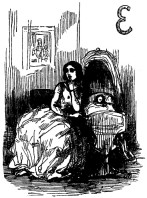
Early in the Regency of George the Magnificent, there lived in a small town in the west of England, called Clavering, a gentleman whose name was Pendennis. There were those alive who remembered having seen his name painted on a board, which was surmounted by a gilt pestle and mortar over the door of a very humble little shop in the city of Bath, where Mr. Pendennis exercised the profession of apothecary and surgeon; and where he not only attended gentlemen in their sick-rooms, and ladies at the most interesting periods of their lives, but would condescend to sell a brown-paper plaster to a farmer's wife across the counter—or to vend tooth-brushes, hair-powder, and London perfumery. For these facts a few folks at Clavering could vouch, where people's memories were more tenacious, perhaps, than they are in a great bustling metropolis.
And yet that little apothecary who sold a stray customer a pennyworth of salts, or a more fragrant cake of Windsor soap, was a gentleman of good education, and of as old a family as any in the whole county of Somerset. He had a Cornish pedigree which carried the Pendennises up to the time of the Druids—and who knows how much farther back? They had intermarried with the Normans at a very late period of their family existence, and they were related to all the great families of Wales and Britanny. Pendennis had had a piece of University education too, and might have pursued that career with great honor, but that in his second year at Cambridge his father died insolvent, and poor Pen was obliged to betake himself to the pestle and apron. He always detested the trade, and it was only necessity, and the offer of his mother's brother, a London apothecary of low family, into which Pendennis's father had demeaned himself by marrying, that forced John Pendennis into so odious a calling.
He quickly after his apprenticeship parted from the coarse-minded practitioner, his relative, and set up for himself at Bath with his modest medical ensign. He had for some time a hard struggle with poverty; and it was all he could do to keep the shop and its gilt ornaments in decent repair, and his bed-ridden mother in comfort: but Lady Ribstone, happening to be passing to the Rooms with an intoxicated Irish chair man who bumped her ladyship up against Pen's very door-post, and drove his chair-pole through the handsomest pink-bottle in the surgeon's window, alighted screaming from her vehicle, and was accommodated with a chair in Mr. Pendennis's shop, where she was brought round with cinnamon and sal-volatile.
Mr. Pendennis's manners were so uncommonly gentlemanlike and soothing, that her ladyship, the wife of Sir Pepin Ribstone, of Codlingbury, in the county of Somerset, Bart., appointed her preserver, as she called him, apothecary to her person and family, which was very large. Master Ribstone coming home for the Christmas holidays from Eton, over-ate himself and had a fever, in which Mr. Pendennis treated him with the greatest skill and tenderness. In a word, he got the good graces of the Codlingbury family, and from that day began to prosper. The good company of Bath patronized him, and among the ladies especially he was beloved and admired. First his humble little shop became a smart one; then he discarded the selling of tooth-brushes and perfumery, as unworthy of a gentleman of an ancient lineage; then he shut up the shop altogether, and only had a little surgery attended by a genteel young man: then he had a gig with a man to drive him; and, before her exit from this world, his poor old mother had the happiness of seeing from her bed-room window to which her chair was rolled, her beloved John step into a close carriage of his own, a one-horse carriage it is true, but with the arms of the family of Pendennis handsomely emblazoned on the panels. "What would Arthur say now?" she asked, speaking of a younger son of hers—"who never so much as once came to see my dearest Johnny through all the time of his poverty and struggles!"
"Captain Pendennis is with his regiment in India, mother," Mr. Pendennis remarked, "and, if you please, I wish you would not call me Johnny before the young man—before Mr. Parkins."
Presently the day came when she ceased to call her son by the name of Johnny, or by any other title of endearment or affection; and his house was very lonely without that kind though querulous voice. He had his night-bell altered and placed in the room in which the good old lady had grumbled for many a long year, and he slept in the great large bed there. He was upward of forty years old when these events befell; before the war was over; before George the Magnificent came to the throne; before this history indeed: but what is a gentleman without his pedigree? Pendennis, by this time, had his handsomely framed and glazed, and hanging up in his drawing-room between the pictures of Codlingbury House in Somersetshire, and St. Boniface's College, Cambridge, where he had passed the brief and happy days of his early manhood. As for the pedigree he had taken it out of a trunk, as Sterne's officer called for his sword, now that he was a gentleman and could show it.
About the time of Mrs. Pendennis's demise, another of her son's patients likewise died at Bath; that virtuous woman, old Lady Pontypool, daughter of Reginald twelfth Earl of Bareacres, and by consequence great grand aunt to the present earl, and widow of John second Lord Pontypool, and likewise of the Reverend Jonas Wales, of the Armageddon Chapel, Clifton. For the last five years of her life her ladyship had been attended by Miss Helen Thistlewood, a very distant relative of the noble house of Bareacres, before mentioned, and daughter of Lieutenant R. Thistlewood, R. N., killed at the battle of Copenhagen. Under Lady Pontypool's roof Miss Thistlewood found a comfortable shelter, as far as boarding and lodging went, but suffered under such an infernal tyranny as only women can inflict on, or bear from, one another; the doctor, who paid his visits to my Lady Pontypool at least twice a day, could not but remark the angelical sweetness and kindness with which the young lady bore her elderly relative's insults; and it was, as they were going in the fourth mourning coach to attend her ladyship's venerated remains to Bath Abbey, where they now repose, that he looked at her sweet pale face, and resolved upon putting a certain question to her, the very nature of which made his pulse beat ninety, at least.
He was older than she by more than twenty years, and at no time the most ardent of men. Perhaps he had had a love affair in early life which he had to strangle—perhaps all early love affairs ought to be strangled or drowned, like so many blind kittens: well, at three-and-forty he was a collected quiet little gentleman in black stockings, with a bald head, and a few days after the ceremony he called to see her, and, as he felt her pulse, he kept hold of her hand in his, and asked her where she was going to live now that the Pontypool family had come down upon the property, which was being nailed into boxes, and packed into hampers, and swaddled up with haybands, and buried in straw, and locked under three keys in green-baize plate-chests, and carted away under the eyes of poor Miss Helen—he asked her where she was going to live finally.
Her eyes filled with tears, and she said she did not know. She had a little money. The old lady had left her a thousand pounds, indeed; and she would go into a boarding-house or into a school; in fine, she did not know where.
Then Pendennis, looking into her pale face, and keeping hold of her cold little hand, asked her if she would come and live with him? He was old compared to—to so blooming a young lady as Miss Thistlewood (Pendennis was of the grave old complimentary school of gentlemen and apothecaries), but he was of good birth, and, he flattered himself, of good principles and temper. His prospects were good, and daily mending. He was alone in the world, and had need of a kind and constant companion, whom it would be the study of his life to make happy; in a word, he recited to her a little speech, which he had composed that morning in bed, and rehearsed and perfected in his carriage, as he was coming to wait upon the young lady.
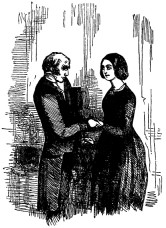
Perhaps if he had had an early love-passage, she too had one day hoped for a different lot than to be wedded to a little gentleman who rapped his teeth and smiled artificially, who was laboriously polite to the butler as he slid up stairs into the drawing-room, and profusely civil to the lady's-maid, who waited at the bed-room door; for whom her old patroness used to ring as for a servant, and who came with even more eagerness; who got up stories, as he sent in draughts, for his patient's amusement and his own profit: perhaps she would have chosen a different man—but she knew, on the other hand, how worthy Pendennis was, how prudent, how honorable; how good he had been to his mother, and constant in his care of her; and the upshot of this interview was, that she, blushing very much, made Pendennis an extremely low courtesy, and asked leave to—to consider his very kind proposal.
They were married in the dull Bath season, which was the height of the season in London. And Pendennis having previously, through a professional friend, M.R.C.S., secured lodgings in Holles-street, Cavendish Square, took his wife thither in a chaise and pair; conducted her to the theaters, the Parks, and the Chapel Royal; showed her the folks going to a drawing-room, and, in a word, gave her all the pleasures of the town. He likewise left cards upon Lord Pontypool, upon the Right Honorable the Earl of Bareacres, and upon Sir Pepin and Lady Ribstone, his earliest and kindest patrons. Bareacres took no notice of the cards. Pontypool called, admired Mrs. Pendennis, and said Lady Pontypool would come and see her, which her ladyship did, per proxy of John her footman, who brought her card, and an invitation to a concert five weeks off. Pendennis was back in his little one-horse carriage, dispensing draughts and pills at that time: but the Ribstones asked him and Mrs. Pendennis to an entertainment, of which Mr. Pendennis bragged to the last day of his life.
The secret ambition of Mr. Pendennis had always been to be a gentleman. It takes much time and careful saving for a provincial doctor, whose gains are not very large, to lay by enough money wherewith to purchase a house and land: but besides our friend's own frugality and prudence, fortune aided him considerably in his endeavor, and brought him to the point which he so panted to attain. He laid out some money very advantageously in the purchase of a house and small estate close upon the village of Clavering before mentioned. Words can not describe, nor did he himself ever care to confess to any one, his pride when he found himself a real landed proprietor, and could walk over acres of which he was the master. A lucky purchase which he had made of shares in a copper-mine added very considerably to his wealth, and he realized with great prudence while this mine was still at its full vogue. Finally, he sold his business, at Bath, to Mr. Parkins, for a handsome sum of ready money, and for an annuity to be paid to him during a certain number of years after he had forever retired from the handling of the mortar and pestle.
Arthur Pendennis, his son, was eight years old at the time of this event, so that it is no wonder that the latter, who left Bath and the surgery so young, should forget the existence of such a place almost entirely, and that his father's hands had ever been dirtied by the compounding of odious pills, or the preparation of filthy plasters. The old man never spoke about the shop himself, never alluded to it; called in the medical practitioner of Clavering to attend his family when occasion arrived; sunk the black breeches and stockings altogether; attended market and sessions, and wore a bottle-green coat and brass buttons with drab gaiters, just as if he had been an English gentleman all his life. He used to stand at his lodge-gate, and see the coaches come in, and bow gravely to the guards and coachmen as they touched their hats and drove by. It was he who founded the Clavering Book Club; and set up the Samaritan Soup and Blanket Society. It was he who brought the mail, which used to run through Cacklefield before, away from that village and through Clavering. At church he was equally active as a vestryman and a worshiper. At market every Thursday, he went from pen to stall, looked at samples of oats, and munched corn, felt beasts, punched geese in the breast, and weighed them with a knowing air, and did business with the farmers at the Clavering Arms, as well as the oldest frequenter of that house of call. It was now his shame, as it formerly was his pride, to be called doctor, and those who wished to please him always gave him the title of squire.
Heaven knows where they came from, but a whole range of Pendennis portraits presently hung round the doctor's oak dining-room; Lelys and Vandykes he vowed all the portraits to be, and when questioned as to the history of the originals, would vaguely say they were "ancestors of his." You could see by his wife's looks that she disbelieved in these genealogical legends, for she generally endeavored to turn the conversation when he commenced them. But his little boy believed them to their fullest extent, and Roger Pendennis of Agincourt, Arthur Pendennis of Crecy, General Pendennis of Blenheim and Oudenarde, were as real and actual beings for this young gentleman as—whom shall we say?—as Robinson Crusoe, or Peter Wilkins, or the Seven Champions of Christendom, whose histories were in his library.
Pendennis's fortune, which, at the best, was not above eight hundred pounds a year, did not, with the best economy and management, permit of his living with the great folks of the county; but he had a decent comfortable society of the second-best sort. If they were not the roses, they lived near the roses, as it were, and had a good deal of the odor of genteel life. They had out their plate, and dined each other round in the moonlight nights twice a year, coming a dozen miles to these festivals; and besides the county, the Pendennises had the society of the town of Clavering, as much as, nay, more than they liked: for Mrs. Pybus was always poking about Helen's conservatories, and intercepting the operation of her soup-tickets and coal-clubs: Captain Glanders (H. P., 50th Dragoon Guards), was forever swaggering about the squire's stables and gardens, and endeavoring to enlist him in his quarrels with the vicar, with the postmaster, with the Reverend F. Wapshot of Clavering Grammar School, for overflogging his son, Anglesea Glanders—with all the village, in fine. And Pendennis and his wife often blessed themselves, that their house of Fairoaks was nearly a mile out of Clavering, or their premises would never have been free from the prying eyes and prattle of one or other of the male and female inhabitants there.
Fairoaks lawn comes down to the little river Brawl, and on the other side were the plantations and woods (as much as were left of them) of Clavering Park, Sir Francis Clavering, Bart. The park was let out in pasture and fed down by sheep and cattle, when the Pendennises came first to live at Fairoaks. Shutters were up in the house; a splendid freestone palace, with great stairs, statues, and porticos, whereof you may see a picture in the "Beauties of England and Wales." Sir Richard Clavering, Sir Francis's grandfather, had commenced the ruin of the family by the building of this palace; his successor had achieved the ruin by living in it. The present Sir Francis was abroad somewhere; nor could any body be found rich enough to rent that enormous mansion, through the deserted rooms, moldy clanking halls, and dismal galleries of which, Arthur Pendennis many a time walked trembling when he was a boy. At sunset, from the lawn of Fairoaks, there was a pretty sight: it and the opposite park of Clavering were in the habit of putting on a rich golden tinge, which became them both wonderfully. The upper windows of the great house flamed so as to make your eyes wink; the little river ran off noisily westward, and was lost in a somber wood, behind which the towers of the old abbey church of Clavering (whereby that town is called Clavering St. Mary's to the present day) rose up in purple splendor. Little Arthur's figure and his mother's, cast long blue shadows over the grass; and he would repeat in a low voice (for a scene of great natural beauty always moved the boy, who inherited this sensibility from his mother) certain lines beginning, "These are thy glorious works, Parent of Good; Almighty! thine this universal frame," greatly to Mrs. Pendennis's delight. Such walks and conversation generally ended in a profusion of filial and maternal embraces; for to love and to pray were the main occupations of this dear woman's life; and I have often heard Pendennis say in his wild way, that he felt that he was sure of going to heaven, for his mother never could be happy there without him.
As for John Pendennis, as the father of the family, and that sort of thing, every body had the greatest respect for him; and his orders were obeyed like those of the Medes and Persians. His hat was as well brushed, perhaps, as that of any man in this empire. His meals were served at the same minute every day, and wo to those who came late, as little Pen, a disorderly little rascal, sometimes did. Prayers were recited, his letters were read, his business dispatched, his stables and garden inspected, his hen-houses and kennel, his barn and pigstye visited, always at regular hours. After dinner he always had a nap with the Globe newspaper on his knee, and his yellow bandanna handkerchief on his face (Major Pendennis sent the yellow handkerchiefs from India, and his brother had helped in the purchase of his majority, so that they were good friends now). And so, as his dinner took place at six o'clock to a minute, and the sunset business alluded to may be supposed to have occurred at about half-past seven, it is probable that he did not much care for the view in front of his lawn windows, or take any share in the poetry and caresses which were taking place there.
They seldom occurred in his presence. However frisky they were before, mother and child were hushed and quiet when Mr. Pendennis walked into the drawing room, his newspaper under his arm. And here, while little Pen, buried in a great chair, read all the books of which he could lay hold, the squire perused his own articles in the "Gardener's Gazette," or took a solemn hand at picquet with Mrs. Pendennis, or an occasional friend from the village.
Pendennis usually took care that at least one of his grand dinners should take place when his brother, the major, who, on the return of his regiment from India and New South Wales, had sold out and gone upon half-pay, came to pay his biennial visit to Fairoaks. "My brother, Major Pendennis," was a constant theme of the retired doctor's conversation. All the family delighted in my brother the major. He was the link which bound them to the great world of London, and the fashion. He always brought down the last news of the nobility, and was in the constant habit of dining with lords and great folks. He spoke of such with soldier-like respect and decorum. He would say, "My Lord Bareacres has been good enough to invite me to Bareacres for the pheasant shooting," or, "My Lord Steyne is so kind as to wish for my presence at Stillbrook for the Easter holidays;" and you may be sure the whereabouts of my brother the major was carefully made known by worthy Mr. Pendennis to his friends at the Clavering reading-room, at justice-meetings, or at the county town. Their carriages would come from ten miles round to call upon Major Pendennis in his visits to Fairoaks; the fame of his fashion as a man about town was established throughout the county. There was a talk of his marrying Miss Hunkle, of Lilybank, old Hunkle the attorney's daughter, with at least fifteen hundred a year to her fortune: but my brother the major refused this negotiation, advantageous as it might seem to most persons. "As a bachelor," he said, "nobody cares how poor I am. I have the happiness to live with people who are so highly placed in the world, that a few hundreds or thousands a year more or less can make no difference in the estimation in which they are pleased to hold me. Miss Hunkle, though a most respectable lady, is not in possession of either the birth or the manners, which would entitle her to be received into the sphere in which I have the honor to move. I shall live and die an old bachelor, John: and your worthy friend, Miss Hunkle, I have no doubt, will find some more worthy object of her affection, than a worn-out old soldier on half-pay." Time showed the correctness of the surmise of the old man of the world; Miss Hunkle married a young French nobleman, and is now at this moment living at Lilybank, under the title of Baroness de Carambole, having been separated from her wild young scapegrace of a baron very shortly after their union.
The major was a great favorite with almost all the little establishment of Fairoaks. He was as good-natured as he was well bred, and had a sincere liking and regard for his sister-in-law, whom he pronounced, and with perfect truth, to be as fine a lady as any in England, and an honor to the family. Indeed, Mrs. Pendennis's tranquil beauty, her natural sweetness and kindness, and that simplicity and dignity which a perfect purity and innocence are sure to bestow upon a handsome woman, rendered her quite worthy of her brother's praises. I think it is not national prejudice which makes me believe that a high-bred English lady is the most complete of all Heaven's subjects in this world. In whom else do you see so much grace and so much virtue; so much faith and so much tenderness; with such a perfect refinement and chastity? And by high-bred ladies I don't mean duchesses and countesses. Be they ever so high in station, they can be but ladies, and no more. But almost every man who lives in the world has the happiness, let us hope, of counting a few such persons among his circle of acquaintance—women in whose angelical natures, there is something awful as well as beautiful, to contemplate; at whose feet the wildest and fiercest of us must fall down and humble ourselves;—in admiration of that adorable purity which never seems to do or to think wrong.
Arthur Pendennis had the good fortune to have a mother endowed with those happy qualities. During his childhood and youth, the boy thought of her as little less than an angel—as a supernatural being, all wisdom, love, and beauty. When her husband drove her into the county town, or to the assize balls or concerts there, he would step into the assembly with his wife on his arm, and look the great folks in the face, as much as to say, "Look at that, my lord; can any of you show me a woman like that?" She enraged some country ladies with three times her money, by a sort of desperate perfection which they found in her. Miss Pybus said she was cold and haughty; Miss Pierce, that she was too proud for her station; Mrs. Wapshot as a doctor of divinity's lady, would have the pas of her, who was only the wife of a medical practitioner. In the mean while, this lady moved through the world quite regardless of all the comments that were made in her praise or disfavor. She did not seem to know that she was admired or hated for being so perfect: but carried on calmly through life, saying her prayers, loving her family, helping her neighbors, and doing her duty.
That even a woman should be faultless, however, is an arrangement not permitted by nature, which assigns to us mental defects, as it awards to us headaches, illnesses, or death; without which, the scheme of the world could not be carried on—nay, some of the best qualities of mankind could not be brought into exercise. As pain produces or elicits fortitude and endurance; difficulty, perseverance; poverty, industry and ingenuity; danger, courage and what not; so the very virtues, on the other hand, will generate some vices: and, in fine, Mrs. Pendennis had that vice which Miss Pybus and Miss Pierce discovered in her, namely, that of pride; which did not vest itself so much in her own person, as in that of her family. She spoke about Mr. Pendennis (a worthy little gentleman enough, but there are others as good as he) with an awful reverence, as if he had been the Pope of Rome on his throne, and she a cardinal kneeling at his feet and giving him incense. The major she held to be a sort of Bayard among majors: and as for her son, Arthur, she worshiped that youth with an ardor which the young scapegrace accepted almost as coolly as the statue of the saint in Saint Peter's receives the rapturous osculations which the faithful deliver on his toe.
This unfortunate superstition and idol-worship of this good woman was the cause of a great deal of the misfortune which befell the young gentleman who is the hero of this history, and deserves therefore to be mentioned at the outset of his story.
Arthur Pendennis's schoolfellows at the Greyfriars School state that, as a boy, he was in no ways remarkable either as a dunce or as a scholar. He did, in fact, just as much as was required of him, and no more. If he was distinguished for any thing it was for verse-writing; but was his enthusiasm ever so great, it stopped when he had composed the number of lines demanded by the regulations (unlike young Swettenham, for instance, who, with no more of poetry in his composition than Mr. Wakley, yet would bring up a hundred dreary hexameters to the master after a half-holiday; or young Fluxmore, who not only did his own verses, but all the fifth form's besides). He never read to improve himself out of school-hours, but, on the contrary, devoured all the novels, plays, and poetry, on which he could lay his hands. He never was flogged, but it was a wonder how he escaped the whipping-post. When he had money he spent it royally in tarts for himself and his friends; he has been known to disburse nine and sixpence out of ten shillings awarded to him in a single day. When he had no funds he went on tick. When he could get no credit he went without, and was almost as happy. He has been known to take a thrashing for a crony without saying a word; but a blow, ever so slight, from a friend, would make him roar. To fighting he was averse from his earliest youth, as indeed to physic, the Greek Grammar, or any other exertion, and would engage in none of them, except at the last extremity. He seldom, if ever, told lies, and never bullied little boys. Those masters or seniors who were kind to him, he loved with boyish ardor. And though the doctor, when he did not know his Horace, or could not construe his Greek play, said that that boy Pendennis was a disgrace to the school, a candidate for ruin in this world, and perdition in the next; a profligate who would most likely bring his venerable father to ruin and his mother to a dishonored grave, and the like—yet as the doctor made use of these compliments to most of the boys in the place (which has not turned out an unusual number of felons and pick-pockets), little Pen, at first uneasy and terrified by these charges, became gradually accustomed to hear them; and he has not, in fact, either murdered his parents, or committed any act worthy of transportation or hanging up to the present day.
There were many of the upper boys, among the Cistercians with whom Pendennis was educated, who assumed all the privileges of men long before they quitted that seminary. Many of them, for example, smoked cigars—and some had already begun the practice of inebriation. One had fought a duel with an ensign in a marching regiment in consequence of a row at the theater—another actually kept a buggy and horse at a livery stable in Covent Garden, and might be seen driving any Sunday in Hyde Park with a groom with squared arms and armorial buttons by his side. Many of the seniors were in love, and showed each other in confidence poems addressed to, or letters and locks of hair received from, young ladies—but Pen, a modest and timid youth, rather envied these than imitated them as yet. He had not got beyond the theory as yet—the practice of life was all to come. And, by the way, ye tender mothers and sober fathers of Christian families, a prodigious thing that theory of life is as orally learned at a great public school. Why, if you could hear those boys of fourteen who blush before mothers and sneak off in silence in the presence of their daughters, talking among each other—it would be the woman's turn to blush then. Before he was twelve years old and while his mother fancied him an angel of candor, little Pen had heard talk enough to make him quite awfully wise upon certain points—and so, madam, has your pretty little rosy-cheeked son, who is coming home from school for the ensuing Christmas holidays. I don't say that the boy is lost, or that the innocence has left him which he had from "Heaven, which is our home," but that the shades of the prison-house are closing very fast over him, and that we are helping as much as possible to corrupt him.
Well—Pen had just made his public appearance in a coat with a tail, or cauda-virilis, and was looking most anxiously in his little study-glass to see if his whiskers were growing, like those of more fortunate youths his companions; and, instead of the treble voice with which he used to speak and sing (for his singing voice was a very sweet one, and he used when little to be made to perform "Home, sweet Home," "My pretty Page," and a French song or two which his mother had taught him, and other ballads for the delectation of the senior boys), had suddenly plunged into a deep bass diversified by a squeak, which, when he was called upon to construe in school, set the master and scholars laughing—he was about sixteen years old, in a word, when he was suddenly called away from his academic studies.
It was at the close of the forenoon school, and Pen had been unnoticed all the previous part of the morning till now, when the doctor put him on to construe in a Greek play. He did not know a word of it, though little Timmins, his form-fellow, was prompting him with all his might. Pen had made a sad blunder or two—when the awful chief broke out upon him.
"Pendennis, sir," he said, "your idleness is incorrigible, and your stupidity beyond example. You are a disgrace to your school, and to your family, and I have no doubt will prove so in after-life to your country. If that vice, sir, which is described to us as the root of all evil, be really what moralists have represented (and I have no doubt of the correctness of their opinion), for what a prodigious quantity of future crime and wickedness are you, unhappy boy, laying the seed! Miserable trifler! A boy who construes δε and, instead of δε but, at sixteen years of age is guilty not merely of folly, and ignorance, and dullness inconceivable, but of crime, of deadly crime, of filial ingratitude, which I tremble to contemplate. A boy, sir, who does not learn his Greek play cheats the parent who spends money for his education. A boy who cheats his parent is not very far from robbing or forging upon his neighbor. A man who forges on his neighbor pays the penalty of his crime at the gallows. And it is not such a one that I pity (for he will be deservedly cut off); but his maddened and heart-broken parents, who are driven to a premature grave by his crimes, or, if they live, drag on a wretched and dishonored old age. Go on, sir, and I warn you that the very next mistake that you make shall subject you to the punishment of the rod. Who's that laughing? What ill-conditioned boy is there that dares to laugh?" shouted the doctor.

Indeed, while the master was making this oration, there was a general titter behind him in the school-room. The orator had his back to the door of this ancient apartment, which was open, and a gentleman who was quite familiar with the place, for both Major Arthur and Mr. John Pendennis had been at the school, was asking the fifth form boy who sate by the door for Pendennis. The lad grinning pointed to the culprit against whom the doctor was pouring out the thunders of his just wrath—Major Pendennis could not help laughing. He remembered having stood under that very pillar where Pen the younger now stood, and having been assaulted by the doctor's predecessor, years and years ago. The intelligence was "passed round" that it was Pendennis's uncle in an instant, and a hundred young faces wondering and giggling, between terror and laughter, turned now to the new comer and then to the awful doctor.
The major asked the fifth-form boy to carry his card up to the doctor, which the lad did with an arch look. Major Pendennis had written on the card, "I must take A. P. home; his father is very ill."
As the doctor received the card, and stopped his harangue with rather a scared look, the laughter of the boys, half constrained until then, burst out in a general shout. "Silence!" roared out the doctor, stamping with his foot. Pen looked up and saw who was his deliverer; the major beckoned to him gravely with one of his white gloves, and tumbling down his books, Pen went across.
The doctor took out his watch. It was two minutes to one. "We will take the Juvenal at afternoon school," he said, nodding to the major, and all the boys, understanding the signal, gathered up their books and poured out of the hall.
Young Pen saw by his uncle's face that something had happened at home. "Is there any thing the matter with—my mother?" he said. He could hardly speak, though, for emotion, and the tears which were ready to start.
"No," said the major, "but your father's very ill. Go and pack your trunk directly; I have got a post-chaise at the gate."
Pen went off quickly to his boarding-house to do as his uncle bade him; and the doctor, now left alone in the school-room, came out to shake hands with his old schoolfellow. You would not have thought it was the same man. As Cinderella at a particular hour became, from a blazing and magnificent princess, quite an ordinary little maid in a gray petticoat, so, as the clock struck one, all the thundering majesty and awful wrath of the schoolmaster disappeared.
"There is nothing serious, I hope," said the doctor. "It is a pity to take the boy away unless there is. He is a very good boy, rather idle and unenergetic, but he is a very honest, gentlemanlike little fellow, though I can't get him to construe as I wish. Won't you come in and have some luncheon? My wife will be very happy to see you."
But Major Pendennis declined the luncheon. He said his brother was very ill, had had a fit the day before, and it was a great question if they should see him alive.
"There's no other son, is there?" said the doctor. The major answered "No."
"And there's a good eh—a good eh—property I believe?" asked the other, in an offhand way.
"H'm—so so," said the major. Whereupon this colloquy came to an end. And Arthur Pendennis got into the post-chaise with his uncle never to come back to school any more.
As the chaise drove through Clavering, the hostler standing whistling under the archway of the Clavering Arms, winked the postillion ominously, as much as to say all was over. The gardener's wife came and opened the lodge-gates, and let the travelers through, with a silent shake of the head. All the blinds were down at Fairoaks—the face of the old footman was as blank when he let them in. Arthur's face was white too, with terror more than with grief. Whatever of warmth and love the deceased man might have had, and he adored his wife and loved and admired his son with all his heart, he had shut them up within himself; nor had the boy been ever able to penetrate that frigid outward harrier. But Arthur had been his father's pride and glory through life, and his name the last which John Pendennis had tried to articulate while he lay with his wife's hand clasping his own cold and clammy palm, as the flickering spirit went out into the darkness of death, and life and the world passed away from him.
The little girl, whose face had peered for a moment under the blinds as the chaise came up, opened the door from the stairs into the hall, and taking Arthur's hand silently as he stooped down to kiss her, led him up-stairs to his mother. Old John opened the drawing-room door for the major. The room was darkened, with the blinds down, and surrounded by all the gloomy pictures of the Pendennises. He drank a glass of wine. The bottle had been opened for the squire four days before. His hat was brushed, and laid on the hall table: his newspapers, and his letter bag, with John Pendennis, Esquire, Fairoaks, engraved upon the brass plate, were there in waiting. The doctor and the lawyer from Clavering, who had seen the chaise pass through, came up in a gig half an hour after the major's arrival, and entered by the back door. The former gave a detailed account of the seizure and demise of Mr. Pendennis, enlarged on his virtues and the estimation in which the neighborhood held him; on what a loss he would be to the magistrates' bench, the county hospital, &c. Mrs. Pendennis bore up wonderfully, he said, especially since Master Arthur's arrival. The lawyer staid and dined with Major Pendennis, and they talked business all the evening. The major was his brother's executor, and joint guardian to the boy with Mrs. Pendennis. Every thing was left unreservedly to her, except in case of a second marriage—an occasion which might offer itself in the case of so young and handsome a woman, Mr. Tatham gallantly said, when different provisions were enacted by the deceased. The major would of course take entire superintendence of every thing under this most impressive and melancholy occasion. Aware of this authority, Old John the footman, when he brought Major Pendennis the candle to go to bed, followed afterward with the plate-basket; and the next morning brought him the key of the hall clock—the squire always used to wind it up of a Thursday, John said. Mrs. Pendennis's maid brought him messages from her mistress. She confirmed the doctor's report, of the comfort which Master Arthur's arrival had caused to his mother.
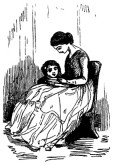
What passed between that lady and the boy is not of import. A vail should be thrown over those sacred emotions of love and grief. The maternal passion is a sacred mystery to me. What one sees symbolized in the Roman churches in the image of the Virgin Mother with a bosom bleeding with love, I think one may witness (and admire the Almighty bounty for) every day. I saw a Jewish lady, only yesterday, with a child at her knee, and from whose face toward the child there shone a sweetness so angelical, that it seemed to form a sort of glory round both. I protest I could have knelt before her too, and adored in her the Divine beneficence in endowing us with the maternal storgé, which began with our race and sanctifies the history of mankind.
So it was with this, in a word, that Mrs. Pendennis comforted herself on the death of her husband, whom, however, she always reverenced as the best, the most upright, wise, high-minded, accomplished, and awful of men. If the women did not make idols of us, and if they saw us as we see each other, would life be bearable, or could society go on? Let a man pray that none of his womankind should form a just estimation of him. If your wife knew you as you are, neighbor, she would not grieve much about being your widow, and would let your grave-lamp go out very soon, or perhaps not even take the trouble to light it. Whereas Helen Pendennis put up the handsomest of memorials to her husband, and constantly renewed it with the most precious oil.
As for Arthur Pendennis, after that awful shock which the sight of his dead father must have produced on him, and the pity and feeling which such an event no doubt occasioned, I am not sure that in the very moment of the grief, and as he embraced his mother and tenderly consoled her, and promised to love her forever, there was not springing up in his breast a feeling of secret triumph and exultation. He was the chief now and lord. He was Pendennis; and all round about him were his servants and handmaids. "You'll never send me away," little Laura said, tripping by him, and holding his hand. "You won't send me to school, will you, Arthur?"
Arthur kissed her and patted her head. No, she shouldn't go to school. And as for going himself, that was quite out of the question. He had determined that that part of his life should not be renewed. In the midst of the general grief, and the corpse still lying above, he had leisure to conclude that he would have it all holidays for the future, that he wouldn't get up till he liked, or stand the bullying of the doctor any more, and had made a hundred of such day dreams and resolves for the future. How one's thoughts will travel! and how quickly our wishes beget them! When he, with Laura in his hand, went into the kitchen on his way to the dog-kennel, the fowl-houses, and his other favorite haunts, all the servants there assembled in great silence with their friends, and the laboring men and their wives, and Sally Potter who went with the post-bag to Clavering, and the baker's man from Clavering—all there assembled and drinking beer on the melancholy occasion—rose up on his entrance and bowed or courtesied to him. They never used to do so last holidays, he felt at once and with indescribable pleasure. The cook cried out, "O Lord," and whispered, "How Master Arthur do grow!" Thomas, the groom, in the act of drinking, put down the jug, alarmed before his master. Thomas's master felt the honor keenly. He went through and looked at the pointers. As Flora put her nose up to his waistcoat, and Ponto, yelling with pleasure hurtled at his chain, Pen patronized the dogs, and said, "Poo, Ponto, poo, Flora," in his most condescending manner. And then he went and looked at Laura's hens, and at the pigs, and at the orchard, and at the dairy; perhaps he blushed to think that it was only last holidays he had, in a manner, robbed the great apple-tree, and been scolded by the dairy-maid for taking cream.
They buried John Pendennis, Esquire, "formerly an eminent medical practitioner at Bath, and subsequently an able magistrate, a benevolent landlord, and a benefactor to many charities and public institutions in this neighborhood and county," with one of the most handsome funerals that had been seen since Sir Roger Clavering was buried here, the clerk said, in the abbey church of Clavering St. Mary's. A fair marble slab, from which the above inscription is copied, was erected over the Fairoaks pew in the church. On it you may see the Pendennis coat of arms, and crest, an eagle looking toward the sun, with the motto "nec tenui pennâ," to the present day. Doctor Portman alluded to the deceased most handsomely and affectingly, "as our dear departed friend," in his sermon next Sunday; and Arthur Pendennis reigned in his stead.
CHAPTER III.
IN WHICH PENDENNIS APPEARS AS A VERY YOUNG MAN INDEED.
Arthur was about sixteen years old, we have said, when he began to reign; in person (for I see that the artist who is to illustrate this book, and who makes sad work of the likeness, will never be able to take my friend off), he had what his friends would call a dumpy, but his mamma styled a neat little figure. His hair was of a healthy brown color, which looks like gold in the sunshine, his face was round, rosy, freckled, and good-humored, his whiskers (when those facial ornaments for which he sighed so ardently were awarded to him by nature) were decidedly of a reddish hue; in fact, without being a beauty, he had such a frank, good-natured, kind face, and laughed so merrily at you out of his honest blue eyes, that no wonder Mrs. Pendennis thought him the pride of the whole county. Between the ages of sixteen and eighteen he rose from five feet six to five feet eight inches in height, at which altitude he paused. But his mother wondered at it. He was three inches taller than his father. Was it possible that any man could grow to be three inches taller than Mr. Pendennis?
You may be certain he never went back to school; the discipline of the establishment did not suit him, and he liked being at home much better. The question of his return was debated, and his uncle was for his going back. The doctor wrote his opinion that it was most important for Arthur's success in after-life that he should know a Greek play thoroughly, but Pen adroitly managed to hint to his mother what a dangerous place Greyfriars was, and what sad wild fellows some of the chaps there were, and the timid soul, taking alarm at once, acceded to his desire to stay at home.
Then Pen's uncle offered to use his influence with His Royal Highness the commander-in-chief, who was pleased to be very kind to him, and proposed to get Pen a commission in the Foot Guards. Pen's heart leaped at this: he had been to hear the band at St. James's play on a Sunday, when he went out to his uncle. He had seen Tom Ricketts, of the fourth form, who used to wear a jacket and trowsers so ludicrously tight, that the elder boys could not forbear using him in the quality of a butt or "cockshy"—he had seen this very Ricketts arrayed in crimson and gold, with an immense bear-skin cap on his head, staggering under the colors of the regiment. Tom had recognized him, and gave him a patronizing nod. Tom, a little wretch whom he had cut over the back with a hockey-stick last quarter—and there he was in the center of the square, rallying round the flag of his country, surrounded by bayonets, cross-belts, and scarlet, the band blowing trumpets and banging cymbals—talking familiarly to immense warriors with tufts to their chins and Waterloo medals. What would not Pen have given to wear such epaulettes and enter such a service?
But Helen Pendennis, when this point was proposed to her by her son, put on a face full of terror and alarm. She said "she did not quarrel with others who thought differently, but that in her opinion a Christian had no right to make the army a profession. Mr. Pendennis never, never would have permitted his son to be a soldier. Finally, she should be very unhappy if he thought of it." Now, Pen would have as soon cut off his nose and ears as deliberately, and of aforethought malice, made his mother unhappy; and, as he was of such a generous disposition that he would give away any thing to any one, he instantly made a present of his visionary red coat and epaulettes and his ardor for military glory to his mother.
She thought him the noblest creature in the world. But Major Pendennis, when the offer of the commission was acknowledged and refused, wrote back a curt and somewhat angry letter to the widow, and thought his nephew was rather a spooney.
He was contented, however, when he saw the boy's performances out hunting at Christmas, when the major came down as usual to Fairoaks. Pen had a very good mare, and rode her with uncommon pluck and grace. He took his fences with great coolness, and yet with judgment, and without bravado. He wrote to the chaps at school about his top-boots, and his feats across country. He began to think seriously of a scarlet coat: and his mother must own that she thought it would become him remarkably well; though, of course, she passed hours of anguish during his absence, and daily expected to see him brought home on a shutter.
With these amusements, in rather too great plenty, it must not be assumed that Pen neglected his studies altogether. He had a natural taste for reading every possible kind of book which did not fall into his school-course. It was only when they forced his head into the waters of knowledge that he refused to drink. He devoured all the books at home, from Inchbald's Theater to White's Farriery; he ransacked the neighboring book-cases. He found at Clavering an old cargo of French novels, which he read with all his might; and he would sit for hours perched upon the topmost bar of Doctor Portman's library steps, with a folio on his knees, whether it were Hackluyt's Travels, Hobbes's Leviathan, Augustini Opera, or Chaucer's Poems. He and the vicar were very good friends, and from his reverence, Pen learned that honest taste for port wine which distinguished him through life. And as for that dear, good woman, Mrs. Portman, who was not in the least jealous, though her doctor avowed himself in love with Mrs. Pendennis, whom he pronounced to be by far the finest lady in the county—all her grief was, as she looked up fondly at Pen perched on the book-ladder, that her daughter Minny was too old for him—as indeed she was; Miss Mira Portman being at that period only two years younger than Pen's mother, and weighing as much as Pen and Mrs. Pendennis together.
Are these details insipid? Look back, good friend, at your own youth, and ask how was that? I like to think of a well-nurtured boy, brave and gentle, warm-hearted and loving, and looking the world in the face with kind, honest eyes. What bright colors it wore then, and how you enjoyed it! A man has not many years of such time. He does not know them while they are with him. It is only when they are passed long away that he remembers how dear and happy they were.
In order to keep Mr. Pen from indulging in that idleness of which his friend the doctor of the Cistercians had prophesied such awful consequences, Mr. Smirke, Dr. Portman's curate, was engaged at a liberal salary, to walk or ride over from Clavering, and pass several hours daily with the young gentleman. Smirke was a man perfectly faultless at a tea-table, wore a curl on his fair forehead, and tied his neck-cloth with a melancholy grace. He was a decent scholar and mathematician, and taught Pen as much as the lad was ever disposed to learn, which was not much. For Pen had soon taken the measure of his tutor, who, when he came riding into the court-yard at Fairoaks on his pony, turned out his toes so absurdly, and left such a gap between his knees and the saddle, that it was impossible for any lad endowed with a sense of humor to respect such an equestrian. He nearly killed Smirke with terror by putting him on his mare, and taking him a ride over a common, where the county fox-hounds (then hunted by that stanch old sportsman, Mr. Hardhead, of Dumplingbeare) happened to meet. Mr. Smirke, on Pen's mare, Rebecca (she was named after Pen's favorite heroine, the daughter of Isaac of York), astounded the hounds as much as he disgusted the huntsman, laming one of the former by persisting in riding among the pack, and receiving a speech from the latter, more remarkable for energy of language, than any oration he had ever heard since he left the bargemen on the banks of Isis.
Smirke confided to his pupil his poems both Latin and English; and presented to Mrs. Pendennis a volume of the latter, printed at Clapham, his native place. The two read the ancient poets together, and rattled through them at a pleasant rate, very different from that steady grubbing pace with which the Cistercians used to go over the classic ground, scenting out each word as they went, and digging up every root in the way. Pen never liked to halt, but made his tutor construe when he was at fault, and thus galloped through the Iliad and the Odyssey, the tragic play-writers, and the charming wicked Aristophanes (whom he vowed to be the greatest poet of all). But he went at such a pace that, though he certainly galloped through a considerable extent of the ancient country, he clean forgot it in after-life, and had only such a vague remembrance of his early classic course as a man has in the House of Commons, let us say, who still keeps up two or three quotations; or a reviewer who, just for decency's sake, hints at a little Greek. Our people are the most prosaic in the world, but the most faithful; and with curious reverence we keep up and transmit, from generation to generation, the superstition of what we call the education of a gentleman.
Besides the ancient poets you may be sure Pen read the English with great gusto. Smirke sighed and shook his head sadly both about Byron and Moore. But Pen was a sworn fire-worshiper and a Corsair; he had them by heart, and used to take little Laura into the window, and say—"Zuleika, I am not thy brother," in tones so tragic that they caused the solemn little maid to open her great eyes still wider. She sat until the proper hour for retirement, sewing at Mrs. Pendennis's knee, and listening to Pen reading out to her of nights, without comprehending one word of what he read.
He read Shakspeare to his mother (which she said she liked, but didn't), and Byron, and Pope, and his favorite Lalla Rookh, which pleased her indifferently. But as for Bishop Heber, and Mrs. Hemans above all, this lady used to melt right away, and be absorbed into her pocket-handkerchief, when Pen read those authors to her in his kind, boyish voice. The "Christian Year" was a book which appeared about that time. The son and the mother whispered it to each other with awe: faint, very faint, and seldom in after-life Pendennis heard that solemn church music: but he always loved the remembrance of it, and of the times when it struck on his heart, and he walked over the fields full of hope and void of doubt, as the church bells rang on Sunday morning.
It was at this period of his existence, that Pen broke out in the poets' corner of the County Chronicle, with some verses with which he was perfectly well satisfied. His are the verses signed "NEP.," addressed "To a Tear;" "On the Anniversary of the Battle of Waterloo;" "To Madame Caradori singing at the Assize Meetings;" "On Saint Bartholomew's Day" (a tremendous denunciation of Popery, and a solemn warning to the people of England to rally against emancipating the Roman Catholics), &c., &c.—all which masterpieces Mrs. Pendennis no doubt keeps to this day, along with his first socks, the first cutting of his hair, his bottle, and other interesting relics of his infancy. He used to gallop Rebecca over the neighboring Dumpling Downs, or into the county town, which, if you please, we shall call Chatteries, spouting his own poems, and filled with quite a Byronic afflatus, as he thought.
His genius at this time was of a decidedly gloomy cast. He brought his mother a tragedy, in which, though he killed sixteen people before the second act, it made her laugh so, that he thrust his masterpiece into the fire in a pet. He projected an epic poem in blank verse, "Cortez, or the Conqueror of Mexico, and the Inca's Daughter." He wrote part of "Seneca, or the Fatal Bath," and "Ariadne in Naxos;" classical pieces, with choruses and strophes and antistrophes, which sadly puzzled poor Mrs. Pendennis; and began a "History of the Jesuits," in which he lashed that order with tremendous severity, and warned his Protestant fellow-countrymen of their machinations. His loyalty did his mother's heart good to witness. He was a stanch, unflinching Church-and-King man in those days; and at the election, when Sir Giles Beanfield stood on the Blue interest, against Lord Trehawk, Lord Eyrie's son, a Whig and a friend of Popery, Arthur Pendennis, with an immense bow for himself, which his mother made, and with a blue ribbon for Rebecca, rode alongside of the Reverend Doctor Portman, on his gray mare Dowdy, and at the head of the Clavering voters, whom the doctor brought up to plump for the Protestant champion.
On that day Pen made his first speech at the Blue Hotel; and also, it appears, for the first time in his life, took a little more wine than was good for him. Mercy! what a scene it was at Fairoaks, when he rode back at ever so much o'clock at night. What moving about of lanterns in the court-yard and stables, though the moon was shining out; what a gathering of servants, as Pen came home, clattering over the bridge and up the stable-yard, with half-a-score of the Clavering voters yelling after him the Blue song of the election.
He wanted them all to come in and have some wine—some very good Madeira—some capital Madeira—John, go and get some Madeira—and there is no knowing what the farmers would have done, had not Madam Pendennis made her appearance in a white wrapper, with a candle, and scared those zealous Blues so by the sight of her pale, handsome face, that they touched their hats, and rode off.
Besides these amusements and occupations in which Mr. Pen indulged, there was one which forms the main business and pleasure of youth, if the poets tell us aright, whom Pen was always studying; and this young fellow's heart was so ardent, and his imagination so eager, that it is not to be expected he should long escape the passion to which we allude, and which, ladies, you have rightly guessed to be that of Love. Pen sighed for it first in secret, and, like the love-sick swain in Ovid, opened his breast, and said—"Aura, veni." What generous youth is there that has not courted some such windy mistress in his time?
Yes, Pen began to feel the necessity of a first love—of a consuming passion—of an object on which he could concentrate all those vague,
floating fancies under which he sweetly suffered—of a young lady to whom he could really make verses, and whom he could set up and adore, in place of those unsubstantial Ianthes and Zuleikas to whom he addressed the outpourings of his gushing muse. He read his favorite poems over and over again, he called upon Alma Venus, the delight of gods and men, he translated Anacreon's odes, and picked out passages suitable to his complaint from Waller, Dryden, Prior, and the like. Smirke and he were never weary, in their interviews, of discoursing about love. The faithless tutor entertained him with sentimental conversations in place of lectures on algebra and Greek; for Smirke was in love too. Who could help it, being in daily intercourse with such a woman? Smirke was madly in love (as far as such a mild flame as Mr. Smirke's may be called madness) with Mrs. Pendennis. That honest lady, sitting down below stairs, teaching little Laura to play the piano, or devising flannel petticoats for the poor round about her, or otherwise busied with the calm routine of her modest and spotless Christian life, was little aware what storms were brewing in two bosoms up-stairs in the study—in Pen's, as he sat in his shooting jacket, with his elbows on the green study-table, and his hands clutching his curly brown hair, Homer under his nose—and in worthy Mr. Smirke's, with whom he was reading. Here they would talk about Helen and Andromache. "Andromache's like my mother," Pen used to avouch; "but I say, Smirke, by Jove I'd cut off my nose to see Helen:" and he would spout certain favorite lines which the reader will find in their proper place in the third book. He drew portraits of her—they are extant still—with straight noses and enormous eyes, and "Arthur Pendennis delineavit et pinxit" gallantly written underneath.
As for Mr. Smirke he naturally preferred Andromache. And in consequence he was uncommonly kind to Pen. He gave him his Elzevir Horace, of which the boy was fond, and his little Greek Testament which his own mamma at Clapham had purchased and presented to him. He bought him a silver pencil case; and in the matter of learning let him do just as much or as little as ever he pleased. He always seemed to be on the point of unbosoming himself to Pen: nay, he confessed to the latter that he had a—an attachment, an ardently cherished attachment, about which Pendennis longed to hear, and said, "Tell us, old chap, is she handsome? has she got blue eyes or black?" But Doctor Portman's curate, heaving a gentle sigh, cast up his eyes to the ceiling, and begged Pen, faintly, to change the conversation. Poor Smirke! He invited Pen to dine at his lodgings over Madame Fribsby's, the milliner's, in Clavering, and once when it was raining, and Mrs. Pendennis, who had driven in her pony-chaise into Clavering with respect to some arrangements, about leaving off mourning probably, was prevailed upon to enter the curate's apartments, he sent out for poundcakes instantly. The sofa on which she sate became sacred to him from that day: and he kept flowers in the glass which she drank from ever after.
As Mrs. Pendennis was never tired of hearing the praises of her son, we may be certain that this rogue of a tutor neglected no opportunity of conversing with her upon that subject. It might be a little tedious to him to hear the stories about Pen's generosity, about his bravery in fighting the big naughty boy, about his fun and jokes, about his prodigious skill in Latin, music, riding, &c.—but what price would he not pay to be in her company? and the widow, after these conversations, thought Mr. Smirke a very pleasing and well-informed man. As for her son she had not settled in her mind, whether he was to be Senior Wrangler and Archbishop of Canterbury, or Double First Class at Oxford, and Lord Chancellor. That all England did not possess his peer, was a fact about which there was, in her mind, no manner of question.
A simple person of inexpensive habits, she began forthwith to save, and, perhaps, to be a little parsimonious, in favor of her boy. There were no entertainments, of course, at Fairoaks, during the year of her weeds. Nor, indeed, did the doctor's silver dish-covers, of which he was so proud, and which were flourished all over with the arms of the Pendennises, and surmounted with their crest, come out of the plate-chests again for long, long years. The household was diminished, and its expenses curtailed. There was a very blank anchorite repast when Pen dined from home: and he himself headed the remonstrance from the kitchen regarding the deteriorated quality of the Fairoaks beer. She was becoming miserly for Pen. Indeed, who ever accused women of being just? They are always sacrificing themselves or somebody for somebody else's sake.
There happened to be no young woman in the small circle of friends who were in the widow's intimacy whom Pendennis could by any possibility gratify by endowing her with the inestimable treasure of a heart which he was longing to give away. Some young fellows in this predicament bestow their young affections upon Dolly, the dairy-maid, or cast the eyes of tenderness upon Molly, the blacksmith's daughter. Pen thought a Pendennis much too grand a personage to stoop so low. He was too high-minded for a vulgar intrigue, and, at the idea of an intrigue or a seduction, had he ever entertained it, his heart would have revolted as from the notion of any act of baseness or dishonor. Miss Minny Portman was too old, too large, and too fond of reading "Rollin's Ancient History." The Miss Boardbacks, Admiral Boardback's daughters (of St. Vincent's, or fourth of June House, as it was called), disgusted Pen with the London airs which they brought into the country, from Gloucester Place, where they passed the season, and looked down upon Pen as a chit. Captain Glanders's (H. P., 50th Dragoon Guards) three girls were in brown-holland pinafores as yet, with the ends of their hair-plaits tied up in dirty pink ribbon. Not having acquired the art of dancing, the youth avoided such chances as he might have had of meeting with the fair sex at the Chatteries' Assemblies; in fine, he was not in love, because there was nobody at hand to fell in love with. And the young monkey used to ride out, day after day, in quest of Dulcinea, and peep into the pony-chaises and gentlefolks' carriages, as they drove along the broad turnpike roads, with a heart heating within him, and a secret tremor and hope that she might be in that yellow post-chaise coming swinging up the hill, or one of those three girls in beaver bonnets in the back seat of the double gig, which the fat old gentleman in black was driving, at four miles an hour. The post-chaise contained a snuffy old dowager of seventy, with a maid, her contemporary. The three girls in the beaver bonnets were no handsomer than the turnips that skirted the roadside. Do as he might, and ride where he would, the fairy princess that he was to rescue and win, had not yet appeared to honest Pen.
Upon these points he did not discourse to his mother. He had a world of his own. What generous, ardent, imaginative soul has not a secret pleasure-place in which it disports? Let no clumsy prying or dull meddling of ours try to disturb it in our children. Actæon was a brute for wanting to push in where Diana was bathing. Leave him occasionally alone, my good madame, if you have a poet for a child. Even your admirable advice may be a bore sometimes. You are faultless; but it does not follow that every body in your family is to think exactly like yourself. Yonder little child may have thoughts too deep even for your great mind, and fancies so coy and timid that they will not bare them selves when your ladyship sits by.
Helen Pendennis by the force of sheer love divined a great number of her son's secrets. But she kept these things in her heart (if we may so speak), and did not speak of them. Besides, she had made up her mind that he was to marry little Laura, who would be eighteen when Pen was six-and-twenty: and had finished his college career, and had made his grand tour, and was settled either in London, astonishing all the metropolis by his learning and eloquence at the bar, or, better still, in a sweet country parsonage surrounded with hollyhocks and roses, close to a delightful romantic ivy-covered church, from the pulpit of which Pen would utter the most beautiful sermons ever preached.
While these natural sentiments were waging war and trouble in honest Pen's bosom, it chanced one day that he rode into Chatteries, for the purpose of carrying to the County Chronicle a tremendous and thrilling poem for the next week's paper; and putting up his horse according to custom, at the stables of the George Hotel there, he fell in with an old acquaintance. A grand black tandem, with scarlet wheels came rattling into the inn yard, as Pen stood there in converse with the hostler about Rebecca; and the voice of the driver called out, "Hallo, Pendennis, is that you?" in a loud, patronizing manner. Pen had some difficulty in recognizing under the broad-brimmed hat and the vast great coats and neckcloths, with which the new comer was habited, the person and figure of his quondam schoolfellow, Mr. Foker.
A year's absence had made no small difference in that gentleman. A youth who had been deservedly whipped a few months previously, and who spent his pocket-money on tarts and hardbake, now appeared before Pen in one of those costumes to which the public consent, that I take to be quite as influential in this respect as "Johnson's Dictionary," has awarded the title of "Swell." He had a bull-dog between his legs, and in his scarlet shawl neckcloth was a pin representing another bull-dog in gold: he wore a fur waistcoat laced over with gold chains; a green cut-away coat with basket-buttons, and a white upper-coat ornamented with cheese-plate buttons, on each of which was engraved some stirring incident of the road or the chase; all which ornaments set off this young fellow's figure to such advantage, that you would hesitate to say which character in life he most resembled, and whether he was a boxer en goguette, or a coachman in his gala suit.
"Left that place for good, Pendennis?" Mr. Foker said, descending from his landau, and giving Pendennis a finger.
"Yes, this year or more," Pen said.
"Beastly old hole," Mr. Foker remarked. "Hate it. Hate the doctor: hate Towzer, the second master; hate every body there. Not a fit place for a gentleman."
"Not at all," said Pen with an air of the utmost consequence.
"By gad, sir, I sometimes dream, now, that the doctor's walking into me," Foker continued (and Pen smiled as he thought that he himself had likewise fearful dreams of this nature). "When I think of the diet there, by gad, sir, I wonder how I stood it. Mangy mutton, brutal beef, pudding on Thursdays and Sundays, and that fit to poison you. Just look at my leader—did you ever see a prettier animal? Drove over from Baymouth. Came the nine mile in two-and-forty minutes. Not bad going, sir."
"Are you stopping at Baymouth, Foker?" Pendennis asked.
"I'm coaching there," said the other, with a nod.
"What?" asked Pen, and in a tone of such wonder, that Foker burst out laughing, and said, "He was blowed if he didn't think Pen was such a flat as not to know what coaching meant."
"I'm come down with a coach from Oxford. A tutor, don't you see, old boy? He's coaching me, and some other men, for the little go. Me and Spavin have the drag between us. And I thought I'd just tool over, and go to the play. Did you ever see Rowkins do the hornpipe?" and Mr. Foker began to perform some steps of that popular dance in the inn yard, looking round for the sympathy of his groom and the stable men.
Pen thought he would like to go to the play too: and could ride home afterward, as there was a moonlight. So he accepted Foker's invitation to dinner, and the young men entered the inn together, where Mr. Foker stopped at the bar, and called upon Miss Rincer, the landlady's fair daughter, who presided there, to give him a glass of "his mixture."
Pen and his family had been known at the George ever since they came into the country; and Mr. Pendennis's carriages and horses always put up there when he paid a visit to the county town. The landlady dropped the heir of Fairoaks a respectful courtesy, and complimented him upon his growth and manly appearance, and asked news of the family at Fairoaks, and of Doctor Portman and the Clavering people, to all of which questions the young gentleman answered with much affability. But he spoke to Mr. and Mrs. Rincer with that sort of good nature with which a young prince addresses his father's subjects; never dreaming that those "bonnes gens" were his equals in life.
Mr. Foker's behavior was quite different. He inquired for Rincer and the cold in his nose, told Mrs. Rincer a riddle, asked Miss Rincer when she would be ready to marry him, and paid his compliments to Miss Brett, the other young lady in the bar, all in a minute of time, and with a liveliness and facetiousness which set all these ladies in a giggle; and he gave a cluck, expressive of great satisfaction as he tossed off his mixture which Miss Rincer prepared and handed to him.
"Have a drop," said he to Pen, "it's recommended to me by the faculty as a what-do-you-call-'em—a stomatic, old boy. Give the young one a glass, R, and score it up to yours truly."
Poor Pen took a glass, and every body laughed at the face which he made as he put it down.—Gin, bitters, and some other cordial, was the compound with which Mr. Foker was so delighted as to call it by the name of Foker's own. As Pen choked, sputtered, and made faces, the other took occasion to remark to Mr. Rincer that the young fellow was green, very green, but that he would soon form him; and then they proceeded to order dinner—which Mr. Foker determined should consist of turtle and venison; cautioning the landlady to be very particular about icing the wine.
Then Messrs. Foker and Pen strolled down the High-street together—the former having a cigar in his mouth, which he had drawn out of a case almost as big as a portmanteau. He went in to replenish it at Mr. Lewis's, and talked to that gentleman for a while, sitting down on the counter; he then looked in at the fruiterer's, to see the pretty girl there, to whom he paid compliments similar to those before addressed to the bar at the George; then they passed the County Chronicle office, for which Pen had his packet ready, in the shape of "Lines to Thyrza," but poor Pen did not like to put the letter into the editor's box while walking in company with such a fine gentleman as Mr. Foker. They met heavy dragoons of the regiment always quartered at Chatteries; and stopped and talked about the Baymouth balls, and what a pretty girl was Miss Brown, and what a dem fine woman Mrs. Jones was. It was in vain that Pen recalled to his own mind what a stupid ass Foker used to be at school—how he could scarcely read, how he was not cleanly in his person, and notorious for his blunders and dullness. Mr. Foker was no more like a gentleman now than in his school days; and yet Pen felt a secret pride in strutting down High-street with a young fellow who owned tandems, talked to officers, and ordered turtle and champagne for dinner. He listened, and with respect too, to Mr. Foker's accounts of what the men did at the University of which Mr. F. was an ornament, and encountered a long series of stories about boat-racing, bumping, College grass-plats, and milk-punch—and began to wish to go up himself to College to a place where there were such manly pleasures and enjoyments. Farmer Gurnett, who lives close by Fairoaks, riding by at this minute and touching his hat to Pen, the latter stopped him, and sent a message to his mother to say that he had met with an old schoolfellow, and should dine in Chatteries.
The two young gentlemen continued their walk, and were passing round the Cathedral Yard, where they could hear the music of the afternoon service (a music which always exceedingly impressed and affected Pen), but whither Mr. Foker came for the purpose of inspecting the nursery maids who frequent the Elms Walk there, and who are uncommonly pretty at Chatteries, and here they strolled until with a final burst of music the small congregation was played out.
Old Doctor Portman was one of the few who came from the venerable gate. Spying Pen, he came and shook him by the hand, and eyed with wonder Pen's friend, from whose mouth and cigar clouds of fragrance issued, which curled round the doctor's honest face and shovel hat.
"An old schoolfellow of mine, Mr. Foker," said Pen. The doctor said "H'm": and scowled at the cigar. He did not mind a pipe in his study, but the cigar was an abomination to the worthy gentleman.
"I came up on Bishop's business," the doctor said. "We'll ride home, Arthur, if you like?"
"I—I'm engaged to my friend here," Pen answered.
"You had better come home with me," said the doctor.
"His mother knows he's out, sir," Mr. Foker remarked; "don't she, Pendennis?"
"But that does not prove that he had not better come home with me," the doctor growled, and he walked off with great dignity.
"Old boy don't like the weed, I suppose," Foker said. "Ha! who's here?—here's the general, and Bingley, the manager. How do, Cos? How do, Bingley?"
"How does my worthy and gallant young Foker?" said the gentleman addressed as the general; and who wore a shabby military cape with a mangy collar, and a hat cocked very much over one eye.
"Trust you are very well, my very dear sir," said the other gentleman, "and that the Theater Royal will have the honor of your patronage to-night. We perform 'The Stranger,' in which your humble servant will—"
"Can't stand you in tights and Hessians, Bingley," young Mr. Foker said. On which the general, with the Irish accent, said, "But I think ye'll like Miss Fotheringay, in Mrs. Haller, or me name's not Jack Costigan."
Pen looked at these individuals with the greatest interest. He had never seen an actor before; and he saw Dr. Portman's red face looking over the doctor's shoulder, as he retreated from the Cathedral Yard, evidently quite dissatisfied with the acquaintances into whose hands Pen had fallen.
Perhaps it would have been much better for him had he taken the parson's advice and company home. But which of us knows his fate?
CHAPTER IV.
MRS. HALLER.
Having returned to the George, Mr. Foker and his guest sate down to a handsome repast in the coffee-room; where Mr. Rincer brought in the first dish, and bowed as gravely as if he was waiting upon the Lord-Lieutenant of the county. Mr. Foker attacked the turtle and venison with as much gusto as he had shown the year before, when he used to make feasts off ginger-beer and smuggled polonies. Pen could not but respect his connoisseurship as he pronounced the champagne to be condemned gooseberry, and winked at the port with one eye. The latter he declared to be of the right sort; and told the waiters, there was no way of humbugging him. All these attendants he knew by their Christian names, and showed a great interest in their families; and as the London coaches drove up, which in those early days used to set off from the George, Mr. Foker flung the coffee-room window open, and called the guards and coachmen by their Christian names, too, asking about their respective families, and imitating with great liveliness and accuracy the tooting of the horns as Jem the ostler whipped the horses' cloths off, and the carriages drove gayly away.
"A bottle of sherry, a bottle of sham, a bottle of port and a shass caffy, it ain't so bad, hay, Pen?" Foker said, and pronounced, after all these delicacies and a quantity of nuts and fruit had been dispatched, that it was time to "toddle." Pen sprang up with very bright eyes, and a flushed face; and they moved off toward the theater, where they paid their money to the wheezy old lady slumbering in the money taker's box. "Mrs. Dropsicum, Bingley's mother-in-law, great in Lady Macbeth," Foker said to his companion. Foker knew her, too.
They had almost their choice of places in the boxes of the theater, which was no better filled than country theaters usually are, in spite of the "universal burst of attraction and galvanic thrills of delight" advertised by Bingley in the play-bills. A score or so of people dotted the pit-benches, a few more kept a kicking and whistling in the galleries, and a dozen others, who came in with free admissions, were in the boxes where our young gentlemen sate. Lieutenants Rodgers and Podgers, and young Cornet Tidmus, of the Dragoons, occupied a private box. The performers acted to them, and these gentlemen seemed to hold conversations with the players when not engaged in the dialogue, and applauded them by name loudly.
Bingley the manager, who assumed all the chief tragic and comic parts except when he modestly retreated to make way for the London stars, who came down occasionally to Chatteries; was great in the character of the "Stranger." He was attired in the tight pantaloons and Hessian boots which the stage legend has given to that injured man, with a large cloak and beaver and a hearse feather in it drooping over his raddled old face, and only partially concealing his great buckled brown wig. He had the stage-jewelry on, too, of which he selected the largest and most shiny rings for himself, and allowed his little finger to quiver out of his cloak with a sham diamond ring covering the first joint of the finger and twiddling in the faces of the pit. Bingley made it a favor to the young men of his company to go on in light comedy parts with that ring. They flattered him by asking its history. The stage has its traditional jewels as the crown and all great families have. This had belonged to George Frederick Cooke, who had had it from Mr. Quin, who may have bought it for a shilling. Bingley fancied the world was fascinated with its glitter.
He was reading out of the stage-book—that wonderful stage-book which is not bound like any other book in the world, but is rouged and tawdry like the hero or heroine who holds it; and who holds it as people never do hold books; and points with his finger to a passage, and wags his head ominously at the audience, and then lifts up eyes and finger to the ceiling professing to derive some intense consolation from the work, between which and heaven there is a strong affinity. Any body who has ever seen one of our great light comedians, X. in a chintz dressing-gown, such as nobody ever wore, and representing himself to the public as a young nobleman in his apartments, and whiling away the time with light literature until his friend Sir Harry shall arrive, or his father shall come down to breakfast—any body, I say, who has seen the great X. over a sham book has indeed had a great pleasure and an abiding matter for thought.
Directly the Stranger saw the young men, he acted at them; eying them solemnly over his gilt volume as he lay on the stage-bank showing his hand, his ring, and his Hessians. He calculated the effect that every one of these ornaments would produce upon his victims; he was determined to fascinate them, for he knew they had paid their money; and he saw their families coming in from the country and filling the cane chairs in his boxes.
As he lay on the bank reading, his servant, Francis, made remarks upon his master.
"Again reading," said Francis, "thus it is, from morn to night. To him nature has no beauty—life no charm. For three years I have never seen him smile" (the gloom of Bingley's face was fearful to witness during these comments of the faithful domestic). "Nothing diverts him. O, if he would but attach himself to any living thing, were it an animal—for something man must love."
[Enter Tobias (Goll) from the hut]. He cries, "O, how refreshing, after seven long weeks, to feel these warm sunbeams once again. Thanks, bounteous heaven, for the joy I taste!" He presses his cap between his hands, looks up and prays. The Stranger eyes him attentively.
Francis to the Stranger. "This old man's share of earthly happiness can be but little. Yet mark how grateful he is for his portion of it."
Bingley. "Because though old, he is but a child in the leading-string of hope." (He looks steadily at Foker, who, however, continues to suck the top of his stick in an unconcerned manner.)
Francis. "Hope is the nurse of life."
Bingley. "And her cradle—is the grave."
The stranger uttered this with the moan of a bassoon in agony, and fixed his eyes on Pendennis so steadily, that the poor lad was quite put out of countenance. He thought the whole house must be looking at him; and cast his eyes down. As soon as ever he raised them Bingley's were at him again. All through the scene the manager played at him. When he was about to do a good action, and sent off Francis with his book, so that that domestic should not witness the deed of benevolence which he meditated, Bingley marked the page carefully, so that he might continue the perusal of the volume off the stage if he liked. But all was done in the direct face of Pendennis, whom the manager was bent upon subjugating. How relieved the lad was when the scene ended, and Foker, tapping with his cane, cried out, "Bravo Bingley!"
"Give him a hand, Pendennis; you know every chap likes a hand," Mr. Foker said; and the good-natured young gentleman, and Pendennis laughing, and the dragoons in the opposite box, began clapping hands to the best of their power.
A chamber in Wintersen Castle closed over Tobias's hut and the Stranger and his boots; and servants appeared bustling about with chairs and tables—"That's Hicks and Miss Thackthwaite," whispered Foker. "Pretty girl, ain't she, Pendennis? But stop—hurray—bravo! here's the Fotheringay."
The pit thrilled and thumped its umbrellas; a volley of applause was fired from the gallery: the dragoon officers and Foker clapped their hands furiously: you would have thought the house was full, so loud were their plaudits. The red face and ragged whiskers of Mr. Costigan were seen peering from the side-scene. Pen's eyes opened wide and bright, as Mrs. Haller entered with a downcast look, then rallying at the sound of the applause, swept the house with a grateful glance, and, folding her hands across her breast, sank down in a magnificent courtesy. More applause, more umbrellas; Pen this time, flaming with wine and enthusiasm, clapped hands and sang "bravo" louder than all. Mrs. Haller saw him, and every body else, and old Mr. Bows, the little first fiddler of the orchestra (which was this night increased by a detachment of the band of the Dragoons, by the kind permission of Colonel Swallowtail), looked up from the desk where he was perched, with his crutch beside him, and smiled at the enthusiasm of the lad.
Those who have only seen Miss Fotheringay in later days, since her marriage and introduction into London life, have little idea how beautiful a creature she was at the time when our friend Pen first set eyes on her: and I warn my reader, as beforehand, that the pencil which illustrates this work (and can draw an ugly face tolerably well, but is sadly put out when it tries to delineate a beauty) can give no sort of notion of her. She was of the tallest of women, and at her then age of six-and-twenty—for six-and-twenty she was, though she vows she was only nineteen—in the prime and fullness of her beauty. Her forehead was vast, and her black hair waved over it with a natural ripple (that beauties of late days have tried to imitate with the help of the crimping-irons) and was confined in shining and voluminous braids at the back of a neck such as you see on the shoulders of the Louvre Venus—that delight of gods and men. Her eyes, when she lifted them up to gaze on you, and ere she dropped their purple deep-fringed lids, shone with tenderness and mystery unfathomable. Love and Genius seemed to look out from them and then retire coyly, as if ashamed to have been seen at the lattice. Who could have had such a commanding brow but a woman of high intellect? She never laughed (indeed her teeth were not good), but a smile of endless tenderness and sweetness played round her beautiful lips, and in the dimples of her cheeks and her lovely chin. Her nose defied description in those days. Her ears were like two little pearl shells, which the ear-rings she wore (though the handsomest properties in the theater) only insulted. She was dressed in long flowing robes of black, which she managed and swept to and fro with wonderful grace, and out of the folds of which you only saw her sandals occasionally; they were of rather a large size; but Pen thought them as ravishing as the slippers of Cinderella. But it was her hand and arm that this magnificent creature most excelled in, and somehow you could never see her but through them. They surrounded her. When she folded them over her bosom in resignation; when she dropped them in mute agony, or raised them in superb command; when in sportive gayety her hands fluttered and waved before her, like—what shall we say?—like the snowy doves before the chariot of Venus—it was with these arms and hands that she beckoned, repelled, entreated, embraced, her admirers—no single one, for she was armed with her own virtue, and with her father's valor, whose sword would have leapt from its scabbard at any insult offered to his child—but the whole house; which rose to her, as the phrase was, as she courtesied and bowed, and charmed it.
Thus she stood for a minute—complete and beautiful—as Pen stared at her. "I say, Pen, isn't she a stunner?" asked Mr. Foker.
"Hush!" Pen said. "She's speaking."
She began her business in a deep sweet voice. Those who know the play of the "Stranger," are aware that the remarks made by the various characters are not valuable in themselves, either for their sound sense, their novelty of observation, or their poetic fancy. In fact, if a man were to say it was a stupid play he would not be far wrong. Nobody ever talked so. If we meet idiots in life, as will happen, it is a great mercy that they do not use such absurdly fine words. The Stranger's talk is sham, like the book he reads, and the hair he wears, and the bank he sits on, and the diamond ring he makes play with—but, in the midst of the balderdash, there runs that reality of love, children, and forgiveness of wrong, which will be listened to wherever it is preached, and sets all the world sympathizing.
With what smothered sorrow, with what gushing pathos, Mrs. Haller delivered her part! At first, when as Count Wintersen's housekeeper, and preparing for his Excellency's arrival, she has to give orders about the beds and furniture, and the dinner, &c., to be got ready, she did so with the calm agony of despair. But when she could get rid of the stupid servants and give vent to her feelings to the pit and the house, she overflowed to each individual as if he were her particular confidant, and she was crying out her griefs on his shoulder: the little fiddler in the orchestra (whom she did not seem to watch, though he followed her ceaselessly) twitched, twisted, nodded, pointed about, and when she came to the favorite passage "I have a William, too, if he be still alive—Ah, yes, if he be still alive. His little sisters, too! Why, Fancy, dost thou rack me so? Why dost thou image my poor children fainting in sickness, and crying to—to—their mum-um-other,"—when she came to this passage little Bows buried his face in his blue cotton handkerchief, after crying out "Bravo."
All the house was affected. Foker, for his part, taking out a large yellow bandanna, wept piteously. As for Pen, he was gone too far for that. He followed the woman about and about—when she was off the stage, it and the house were blank; the lights and the red officers reeled wildly before his sight. He watched her at the side-scene—where she stood waiting to come on the stage, and where her father took off her shawl; when the reconciliation arrived, and she flung herself down on Mr. Bingley's shoulders, while the children clung to their knees, and the countess (Mrs. Bingley) and Baron Steinforth (performed with great liveliness and spirit by Garbetts)—while the rest of the characters formed a group round them, Pen's hot eyes only saw Fotheringay, Fotheringay. The curtain fell upon him like a pall. He did not hear a word of what Bingley said, who came forward to announce the play for the next evening, and who took the tumultuous applause, as usual, for himself. Pen was not even distinctly aware that the house was calling for Miss Fotheringay, nor did the manager seem to comprehend that any body else but himself had caused the success of the play. At last he understood it—stepped back with a grin, and presently appeared with Mrs. Haller on his arm. How beautiful she looked! Her hair had fallen down, the officers threw her flowers. She clutched them to her heart. She put back her hair, and smiled all round. Her eyes met Pen's. Down went the curtain again: and she was gone. Not one note could he hear of the overture which the brass band of the Dragoons blew by kind permission of Colonel Swallowtail.
"She is a crusher, ain't she now?" Mr. Foker asked of his companion.
Pen did not know exactly what Foker said, and answered vaguely. He could not tell the other what he felt; he could not have spoken, just then, to any mortal. Besides, Pendennis did not quite know what he felt yet; it was something overwhelming, maddening, delicious; a fever of wild joy and undefined longing.
And now Rowkins and Miss Thackthwaite came on to dance the favorite double hornpipe, and Foker abandoned himself to the delights of this ballet, just as he had to the tears of the tragedy, a few minutes before. Pen did not care for it, or indeed think about the dance, except to remember that that woman was acting with her in the scene where she first came in. It was a mist before his eyes. At the end of the dance he looked at his watch and said it was time for him to go.
"Hang it, stay to see The Bravo of the Battle-Ax," Foker said, "Bingley's splendid in it; he wears red tights, and has to carry Mrs. B. over the Pine-bridge of the Cataract, only she's too heavy. It's great fun, do stop."
Pen looked at the bill with one lingering fond hope that Miss Fotheringay's name might be hidden somewhere in the list of the actors of the after-piece, but there was no such name. Go he must. He had a long ride home. He squeezed Foker's hand. He was choking to speak, but he couldn't. He quitted the theater and walked frantically about the town, he knew not how long; then he mounted at the George and rode homeward, and Clavering clock sang out one as he came into the yard at Fairoaks. The lady of the house might have been awake, but she only heard him from the passage outside his room as he dashed into bed and pulled the clothes over his head.
Pen had not been in the habit of passing wakeful nights, so he at once fell off into a sound sleep. Even in later days, and with a great deal of care and other thoughtful matter to keep him awake, a man, from long practice or fatigue or resolution, begins by going to sleep as usual: and gets a nap in advance of Anxiety. But she soon comes up with him and jogs his shoulder, and says "Come, my man, no more of this laziness, you must wake up and have a talk with me." Then they fall to together in the midnight. Well, whatever might afterward happen to him, poor little Pen was not come to this state yet; he tumbled into a sound sleep—did not wake until an early hour in the morning, when the rooks began to caw from the little wood beyond his bed-room windows; and—at that very instant and as his eyes started open, the beloved image was in his mind. "My dear boy," he heard her say, "you were in a sound sleep, and I would not disturb you: but I have been close by your pillow all this while: and I don't intend that you shall leave me. I am Love! I bring with me fever and passion: wild longing, maddening desire; restless craving and seeking. Many a long day ere this I heard you calling out for me; and behold now I am come."
Was Pen frightened at the summons? Not he. He did not know what was coming: it was all wild pleasure and delight as yet. And as, when three years previously, and on entering the fifth form at the Cistercians, his father had made him a present of a gold watch, which the boy took from under his pillow and examined on the instant of waking: forever rubbing and polishing it up in private, and retiring into corners to listen to its ticking: so the young man exulted over his new delight; felt in his waistcoat pocket to see that it was safe; wound it up at nights, and at the very first moment of waking hugged it and looked at it.—By the way, that first watch of Pen's was a showy ill manufactured piece: it never went well from the beginning, and was always getting out of order. And after putting it aside into a drawer and forgetting it for some time, he swapped it finally away for a more useful time-keeper.
Pen felt himself to be ever so many years older since yesterday. There was no mistake about it now. He was as much in love as the best hero in the best romance he ever read. He told John to bring his shaving water with the utmost confidence. He dressed himself in some of his finest clothes that morning: and came splendidly down to breakfast, patronizing his mother and little Laura, who had been strumming her music lesson for hours before; and who after he had read the prayers (of which he did not heed one single syllable) wondered at his grand appearance, and asked him to tell her what the play was about.
Pen laughed, and declined to tell Laura what the play was about. In fact, it was quite as well that she should not know. Then she asked him why he had got on his fine pin and beautiful new waistcoat?
Pen blushed, and told his mother that the old schoolfellow with whom he had dined at Chatteries was reading with a tutor at Baymouth, a very learned man; and as he was himself to go to College, and as there were several young men pursuing their studies at Baymouth—he was anxious to ride over—and—and just see what the course of their reading was.
Laura made a long face. Helen Pendennis looked hard at her son, troubled more than ever with the vague doubt and terror which had been haunting her ever since the last night, when Farmer Gurnett brought back the news that Pen would not return home to dinner. Arthur's eyes defied her. She tried to console herself, and drive off her fears. The boy had never told her an untruth. Pen conducted himself during breakfast in a very haughty and supercilious manner; and, taking leave of the elder and younger lady, was presently heard riding out of the stable court. He went gently at first, but galloped like a madman as soon as he thought he was out of hearing.
Smirke, thinking of his own affairs, and softly riding with his toes out, to give Pen his three hours' reading at Fairoaks, met his pupil, who shot by him like the wind. Smirke's pony shied, as the other thundered past him; the gentle curate went over his head among the stinging nettles in the hedge. Pen laughed as they met, pointed toward the Baymouth road, and was gone half a mile in that direction before poor Smirke had picked himself up.
Pen had resolved in his mind that he must see Foker, that morning, he must hear about her; know about her; be with somebody who knew her; and honest Smirke, for his part, sitting up among the stinging-nettles, as his pony cropped quietly in the hedge, thought dismally to himself, ought he to go to Fairoaks now that his pupil was evidently gone away for the day. Yes, he thought he might go too. He might go and ask Mrs. Pendennis when Arthur would be back; and hear Miss Laura her Watts's Catechism. He got up on the little pony—both were used to his slipping off—and advanced upon the house from which his scholar had just rushed away in a whirlwind.
Thus love makes fools of all of us, big and little; and the curate had tumbled over head and heels in pursuit of it, and Pen had started in the first heat of the mad race.
CHAPTER V.
MRS. HALLER AT HOME.
Without slackening her pace, Rebecca the mare galloped on to Baymouth, where Pen put her up at the inn stables, and ran straightway to Mr. Foker's lodgings, which he knew from the direction given to him by that gentleman on the previous day. On reaching these apartments, which were over a chemist's shop whose stock of cigars and soda-water went off rapidly by the kind patronage of his young inmates, Pen only found Mr. Spavin, Foker's friend, and part owner of the tandem which the latter had driven into Chatteries, who was smoking, and teaching a little dog, a friend of his, tricks with a bit of biscuit.
Pen's healthy red face fresh from the gallop, compared oddly, with the waxy, debauched little features of Foker's chum; the latter remarked it. "Who's that man?" he thought, "he looks as fresh as a bean, His hand don't shake of a morning, I'd bet five to one."
Foker had not come home at all. Here was a disappointment!—
Mr. Spavin could not say when his friend would return. Sometimes he stopped a day, sometimes a week. Of what college was Pen? Would he have any thing? There was a very fair tap of ale. Mr. Spavin was enabled to know Pendennis's name, on the card which the latter took out and laid down (perhaps Pen in these days was rather proud of having a card)—and so the young men took leave.
Then Pen went down the rock, and walked about on the sand, biting his nails by the shore of the much sounding sea. It stretched before him bright and immeasurable. The blue waters came rolling into the bay, foaming and roaring hoarsely: Pen looked them in the face, with blank eyes, hardly regarding them. What a tide there was pouring into the lad's own mind at the time, and what a little power had he to check it! Pen flung stones into the sea, but it still kept coming on. He was in a rage at not seeing Foker. He wanted to see Foker. He must see Foker. "Suppose I go on—on the Chatteries road, just to see if I can meet him," Pen thought. Rebecca was saddled in another half hour, and galloping on the grass by the Chatteries road. About four miles from Baymouth, the Clavering road branches off, as every body knows, and the mare naturally was for taking that turn, but, cutting her over the shoulder, Pen passed the turning, and rode on to the turnpike without seeing any sign of the black tandem and red wheels.
As he was at the turnpike, he might as well go on: that was quite clear. So Pen rode to the George, and the hostler told him that Mr Foker was there sure enough, and that "he'd been a making a tremendous row the night afore, a drinkin and a singin, and wanting to fight Tom the post-boy: which I'm thinking he'd have the worst of it," the man added, with a grin.—"Have you carried up your master's hot water to shave with?" he added, in a very satirical manner, to Mr. Foker's domestic, who here came down the yard bearing his master's clothes, most beautifully brushed and arranged. "Show Mr. Pendennis up to 'un," and Pen followed the man at last to the apartment, where, in the midst of an immense bed, Mr. Harry Foker lay reposing.
The feather bed and bolsters swelled up all round Mr. Foker, so that you could hardly see his little sallow face and red silk night-cap.
"Hullo!" said Pen.
"Who goes there? brother, quickly tell!" sang out the voice from the bed. "What! Pendennis again? Is your mamma acquainted with your absence? Did you sup with us last night? No—stop—who supped with us last night, Stoopid?"
"There was the three officers, sir, and Mr. Bingley, sir, and Mr. Costigan, sir," the man answered, who received all Mr. Foker's remarks with perfect gravity.
"Ah yes: the cup and merry jest went round. We chanted: and I remember I wanted to fight a post-boy. Did I thrash him, Stoopid?"
"No, sir. Fight didn't come off, sir," said Stoopid, still with perfect gravity. He was arranging Mr. Foker's dressing-case—a trunk, the gift of a fond mother, without which the young fellow never traveled. It contained a prodigious apparatus in plate; a silver dish, a silver mug, silver boxes and bottles for all sorts of essences, and a choice of razors ready against the time when Mr. Foker's beard should come.
"Do it some other day," said the young fellow, yawning and throwing up his little lean arms over his head. "No, there was no fight; but there was chanting. Bingley chanted, I chanted, the general chanted—Costigan I mean.—Did you ever hear him sing 'The Little Pig under the Bed,' Pen?"
"The man we met yesterday," said Pen, all in a tremor, "the father of—"
"Of the Fotheringay—the very man. Ain't she a Venus, Pen?"
"Please sir, Mr. Costigan's in the sittin-room, sir, and says, sir, you asked him to breakfast, sir. Called five times, sir; but wouldn't wake you on no account; and has been year since eleven o'clock, sir—"
"How much is it now?"
"One, sir."
"What would the best of mothers say," cried the little sluggard, "if she saw me in bed at this hour? She sent me down here with a grinder. She wants me to cultivate my neglected genus.—He he! I say, Pen, this isn't quite like seven o'clock school—is it, old boy?"—and the young fellow burst out into a boyish laugh of enjoyment. Then he added—"Go in and talk to the general whilst I dress. And I say, Pendennis, ask him to sing you 'The Little Pig under the Bed;' it's capital." Pen went off in great perturbation, to meet Mr. Costigan, and Mr. Foker commenced his toilet.
Of Mr. Foker's two grandfathers, the one from whom he inherited a fortune, was a brewer; the other was an earl, who endowed him with the most doting mother in the world. The Fokers had been at the Cistercian school, from father to son; at which place, our friend whose name could be seen over the play-ground wall, on a public-house sign, under which "Foker's Entire" was painted, had been dreadfully bullied on account of his trade, his uncomely countenance, his inaptitude for learning and cleanliness, his gluttony and other weak points. But those who know how a susceptible youth, under the tyranny of his schoolfellows becomes silent and a sneak, may understand how, in a very few months after his liberation from bondage, he developed himself as he had done; and became the humorous, the sarcastic, the brilliant Foker, with whom we have made acquaintance. A dunce he always was, it is true; for learning can not be acquired by leaving school and entering at college as a fellow commoner; but he was now (in his own peculiar manner) as great a dandy as he before had been a slattern, and when he entered his sitting-room to join his two guests, arrived scented and arrayed in fine linen, and perfectly splendid in appearance.
General or Captain Costigan—for the latter was the rank which he preferred to assume—was seated in the window with the newspaper held before him at arm's length. The captain's eyes were somewhat dim; and he was spelling the paper with the help of his lips as well as of those blood-shot eyes of his, as you see gentlemen do to whom reading is a rare and difficult occupation. His hat was cocked very much on one ear; and as one of his feet lay up in the window-seat, the observer of such matters might remark, by the size and shabbiness of the boots which the captain wore that times did not go very well with him. Poverty seems as if it were disposed, before it takes possession of a man entirely, to attack his extremities first: the coverings of his head, feet, and hands, are its first prey. All these parts of the captain's person were particularly rakish and shabby. As soon as he saw Pen he descended from the window-seat and saluted the new comer, first in a military manner, by conveying a couple of his fingers (covered with a broken black glove) to his hat, and then removing that ornament altogether. The captain was inclined to be bald, but he brought a quantity of lank iron-gray hair over his pate, and had a couple of wisps of the same falling down on each side of his face. Much whisky had spoiled what complexion Mr. Costigan may have possessed in his youth. His once handsome face had now a copper tinge. He wore a very high stock, scarred and stained in many places; and a dress-coat tightly buttoned up in those parts where the buttons had not parted company from the garment.
"The young gentleman to whom I had the honor to be introjuiced yesterday in the Cathadral Yard," said the captain, with a splendid bow and wave of his hat. "I hope I see you well, sir. I marked ye in the thayater last night during me daughter's perfawrumance; and missed ye on my return. I did but conduct her home, sir, for Jack Costigan, though poor, is a gentleman; and when I reintered the house to pay me respects to me joyous young friend Mr. Foker—ye were gone. We had a jolly night of ut, sir—Mr. Foker, the three gallant young dragoons, and your 'umble servant. Gad, sir, it put me in mind of one of our old nights when I bore His Majesty's commission in the Foighting Hundtherd and Third." And he pulled out an old snuff-box, which he presented with a stately air to his new acquaintance.
Arthur was a great deal too much flurried to speak. This shabby-looking buck was—was her father. The captain was perfumed with the recollections of the last night's cigars, and pulled and twisted the tuft on his chin as jauntily as any young dandy.
"I hope, Miss F——, Miss Costigan is well sir," Pen said, flushing up. "She—she gave me greater pleasure, than—than I—I—I ever enjoyed at a play. I think, sir—I think she's the finest actress in the world," he gasped out.
"Your hand, young man! for ye speak from your heart," cried the captain. "Thank ye, sir, an old soldier and a fond father thanks ye. She is the finest actress in the world. I've seen the Siddons, sir, and the O'Nale.—They were great, but what were they compared to Miss Fotheringay? I do not wish that she should ashume her own name while on the stage. Me family, sir, are proud people; and the Costigans of Costiganstown think that an honest man who has borne Her Majesty's colors in the Hundred and Third, would demean himself, by permitting his daughter to earn her old father's bread."
"There can not be a more honorable duty, surely," Pen said.
"Honorable! Bedad, sir, I'd like to see the man who said Jack Costigan would consent to any thing dishonorable. I have a heart, sir, though I am poor; I like a man who has a heart. You have; I read it in your honest face and steady eye. And would you believe it?" he added, after a pause, and with a pathetic whisper, "that that Bingley, who has made his fortune by me child, gives her but two guineas a week, out of which she finds herself in dresses, and which, added to me own small means makes our all?"
Now the captain's means were so small as to be, it may be said, quite invisible. But nobody knows how the wind is tempered to shorn Irish lambs, and in what marvelous places they find pasture. If Captain Costigan, whom I had the honor to know, would but have told his history, it would have been a great moral story. But he neither would have told it if he could, nor could if he would; for the captain was not only unaccustomed to tell the truth—he was unable even to think it—and fact and fiction reeled together in his muzzy, whiskified brain.
He began life rather brilliantly with a pair of colors, a fine person and legs, and one of the most beautiful voices in the world. To his latest day he sang, with admirable pathos and humor, those wonderful Irish ballads which are so mirthful and so melancholy: and was always the first himself to cry at their pathos. Poor Cos! he was at once brave and maudlin, humorous and an idiot; always good-natured, and sometimes almost trustworthy. Up to the last day of his life he would drink with any man, and back any man's bill: and his end was in a spunging-house, where the sheriff's officer who took him, was fond of him.
In his brief morning of life, Cos formed the delight of regimental messes, and had the honor of singing his songs, bacchanalian and sentimental, at the tables of the most illustrious generals and commanders-in-chief, in the course of which period he drank three times as much claret as was good for him, and spent his doubtful patrimony. What became of him subsequently to his retirement from the army, is no affair of ours. I take it, no foreigner understands the life of an Irish gentleman without money, the way in which he manages to keep afloat—the wind-raising conspiracies, in which he engages with heroes as unfortunate as himself—the means by which he contrives, during most days of the week, to get his portion of whisky-and-water: all these are mysteries to us inconceivable: but suffice it to say, that through all the storms of life Jack had floated somehow, and the lamp of his nose had never gone out.
Before he and Pen had had a half hour's conversation, the captain managed to extract a couple of sovereigns from the young gentleman for tickets for his daughter's benefit, which was to take place speedily, and was not a bonâ fide transaction such as that of the last year, when poor Miss Fotheringay had lost fifteen shillings by her venture, but was an arrangement with the manager, by which the lady was to have the sale of a certain number of tickets, keeping for herself a large portion of the sum for which they were sold.
Pen had but two pounds in his purse, and he handed them over to the captain for the tickets; he would have been afraid to offer more, lest he should offend the latter's delicacy. Costigan scrawled him an order for a box, lightly slipped the sovereigns into his waistcoat, and slapped his hand over the place where they lay. They seemed to warm his old sides.
"Faith, sir," said he, "the bullion's scarcer with me than it used to be, as is the case with many a good fellow. I won six hundthred of 'em in a single night, sir, when me kind friend, His Royal Highness the Duke of Kent, was in Gibralther." And he straightway poured out to Pen a series of stories regarding the claret drunk, the bets made, the races ridden by the garrison there, with which he kept the young gentleman amused until the arrival of their host and his breakfast.
Then it was good to see the captain's behavior before the deviled turkey and the mutton-chops! His stories poured forth unceasingly, and his spirits rose as he chatted to the young men. When he got a bit of sunshine, the old lazarone basked in it; he prated about his own affairs and past splendor, and all the lords, generals, and lord-lieutenants he had ever known. He described the death of his darling Bessie, the late Mrs. Costigan, and the challenge he had sent to Captain Shanty Clancy, of the Slashers, for looking rude at Miss Fotheringay as she was on her kyar in the Phaynix; and then he described how the captain apologized, gave a dinner at the Kildare-street, where six of them drank twinty-one bottles of claret, &c. He announced that to sit with two such noble and generous young fellows was the happiness and pride of an old soldier's existence; and having had a second glass of Curaçoa, was so happy that he began to cry. Altogether we should say that the captain was not a man of much strength of mind, or a very eligible companion for youth; but there are worse men, holding much better places in life, and more dishonest, who have never committed half so many rogueries as he. They walked out, the captain holding an arm of each of his dear young friends, and in a maudlin state of contentment. He winked at one or two tradesmen's shops, where, possibly, he owed a bill, as much as to say—"See the company I am in—sure I'll pay you, my boy"—and they parted finally with Mr. Foker at a billiard-room, where the latter had a particular engagement with some gentlemen of Colonel Swallowtail's regiment.
Pen and the shabby captain still walked the streets together; the captain, in his sly way, making inquiries about Mr. Foker's fortune and station in life. Pen told him how Foker's father was a celebrated brewer, and his mother was Lady Agnes Milton, Lord Rosherville's daughter. The captain broke out into a strain of exaggerated compliment and panegyric about Mr. Foker, whose "native aristocracie," he said, "could be seen with the twinkling of an oi—and only served to adawrun other qualities which he possessed—a foin intellect and a generous heart"—in not one word of which speech did the captain accurately believe.
Pen walked on, listening to his companion's prate, wondering, amused, and puzzled. It had not as yet entered into the boy's head to disbelieve any statement that was made to him; and being of a candid nature himself, he took naturally for truth what other people told him. Costigan had never had a better listener, and was highly flattered by the attentiveness and modest bearing of the young man.
So much pleased was he with the young gentleman, so artless, honest, and cheerful did Pen seem to be, that the captain finally made him an invitation, which he very seldom accorded to young men, and asked Pen if he would do him the fevor to enter his humble abode, which was near at hand, where the captain would have the honor of inthrojuicing his young friend to his daughther, Miss Fotheringay?
Pen was so delightfully shocked at this invitation, and was so stricken down by the happiness thus suddenly offered to him, that he thought he should have dropped from the captain's arm at first, and trembled lest the other should discover his emotion. He gasped out a few incoherent words, indicative of the high gratification he should have in being presented to the lady for whose—for whose talents he had conceived such an admiration—such an extreme admiration, and followed the captain, scarcely knowing whither that gentleman led him. He was going to see her! He was going to see her! In her was the center of the universe. She was the kernel of the world for Pen. Yesterday, before he knew her, seemed a period ever so long ago—a revolution was between him and that time, and a new world about to begin.
The captain conducted his young friend to that quiet little street in Chatteries, which is called Prior's Lane, which lies in the ecclesiastical quarter of the town, close by Dean's Green and the canons' houses, and is overlooked by the enormous towers of the cathedral; there the captain dwelt modestly in the first floor of a low gabled house, on the door of which was the brass-plate of "Creed, Tailor and Robe-maker." Creed was dead, however. His widow was a pew-opener in the cathedral hard by; his eldest son was a little scamp of a choir-boy, who played toss-halfpenny, led his little brothers into mischief, and had a voice as sweet as an angel. A couple of the latter were sitting on the door-step, down which you went into the passage of the house; and they jumped up with great alacrity to meet their lodger, and plunged wildly, and rather to Pen's surprise, at the swallow-tails of the captain's dress-coat; for the truth is, that the good-natured gentleman, when he was in cash, generally brought home an apple or a piece of gingerbread for these children—"Whereby the widdy never pressed me for rint when not convanient," as he remarked afterward to Pen, winking knowingly, and laying a finger on his nose.
Pen tumbled down the step, and as he followed his companion up the creaking old stair, his knees trembled under him. He could hardly see when he entered, following the captain, and stood in the room—in her room. He saw something black before him, and waving as if making a courtesy, and heard, but quite indistinctly, Costigan making a speech over him, in which the captain, with his usual magniloquence, expressed to "me child" his wish to make her known to "his dear and admirable young friend, Mr. Awther Pindinnis, a young gentleman of property in the neighborhood, a person of refoined moind, and emiable manners, a sincare lover of poethry, and a man possest of a feeling and affectionate heart."
"It is very fine weather," Miss Fotheringay said, in an Irish accent, and with a deep, rich, melancholy voice.
"Very," said Mr. Pendennis. In this romantic way their conversation began, and he found himself seated on a chair, and having leisure to look at the young lady.
She looked still handsomer off the stage than before the lamps. All her attitudes were naturally grand and majestical. If she went and stood up against the mantle-piece her robe draped itself classically round her; her chin supported itself on her hand, the other lines of her form arranged themselves in full harmonious undulations: she looked like a muse in contemplation. If she sate down on a cane-bottomed chair, her arm rounded itself over the back of the seat, her hand seemed as if it ought to have a scepter put into it, the folds of her dress fell naturally round her in order, like ladies of honor round a throne, and she looked like an empress. All her movements were graceful and imperial. In the morning you could see her hair was blue-black, her complexion of dazzling fairness, with the faintest possible blush flickering, as it were, in her cheek. Her eyes were gray, with prodigious long lashes; and as for her mouth, Mr. Pendennis has given me subsequently to understand, that it was of a staring red color, with which the most brilliant geranium, sealing-wax, or guardsman's coat, could not vie.
"And very warm," continued this empress and Queen of Sheba.
Mr. Pen again assented, and the conversation rolled on in this manner. She asked Costigan whether he had had a pleasant evening at the George, and he recounted the supper and the tumblers of punch. Then the father asked her how she had been employing the morning.
"Bows came," said she, "at ten, and we studied Ophalia. It's for the twenty-fourth, when I hope, sir, we shall have the honor of seeing ye."
"Indeed, indeed, you will," Mr. Pendennis cried, wondering that she should say "Ophalia," and speak with an Irish inflection of voice naturally, who had not the least Hibernian accent on the stage.
"I've secured 'um for your benefit, dear," said the captain, tapping his waistcoat pocket, wherein lay Pen's sovereigns, and winking at Pen with one eye, at which the boy blushed.
"Mr. —— the gentleman's very obleging," said Mrs. Haller.
"My name is Pendennis," said Pen, blushing. "I—I—hope you'll—you'll remember it." His heart thumped so as he made this audacious declaration, that he almost choked in uttering it.
"Pendennis," she answered slowly, and looking him full in the eyes, with a glance so straight, so clear, so bright, so killing, with a voice so sweet, so round, so low, that the word and the glance shot Pen through and through, and perfectly transfixed him with pleasure.
"I never knew the name was so pretty before," Pen said.
"'Tis a very pretty name," Ophelia said. "Pentweazle's not a pretty name. Remember, papa, when we were on the Norwich Circuit, Young Pentweazle, who used to play second old men, and married Miss Rancy, the Columbine; they're both engaged in London now, at the Queen's, and get five pounds a week. Pentweazle wasn't his real name. 'Twas Judkin gave it him, I don't know why. His name was Harrington; that is, his real name was Potts; fawther a clergyman, very respectable. Harrington was in London, and got in debt. Ye remember, he came out in Falkland, to Mrs. Bunce's Julia."
"And a pretty Julia she was," the captain interposed; "a woman of fifty, and a mother of ten children. 'Tis you ought to have been Julia, or my name's not Jack Costigan."
"I didn't take the leading business then," Miss Fotheringay said, modestly; "I wasn't fit for't till Bows taught me."
"True for you, my dear," said the captain: and bending to Pendennis, he added, "Rejuced in circumstances, sir, I was for some time a fencing master in Dublin (there's only three men in the empire could touch me with the foil once, but Jack Costigan's getting old and stiff now, sir); and my daughter had an engagement at the thayater there; and 'twas there that my friend, Mr. Bows, who saw her capabilities, and is an uncommon 'cute man, gave her lessons in the dramatic art, and made her what ye see. What have ye done since Bows went, Emily?"
"Sure, I've made a pie," Emily said, with perfect simplicity. She, pronounced it "poy."
"If ye'll try it at four o'clock, sir, say the word," said Costigan, gallantly. "That girl, sir, makes the best veal and ham pie in England, and I think I can promise ye a glass of punch of the right flavor."
Pen had promised to be at home to dinner at six o'clock, but the rascal thought he could accommodate pleasure and duty in this point, and was only too eager to accept this invitation. He looked on with delight and wonder while Ophelia busied herself about the room, and prepared for the dinner. She arranged the glasses, and laid and smoothed the little cloth, all which duties she performed with a quiet grace and good humor, which enchanted her guest more and more. The "poy" arrived from the baker's, in the hands of one of the little choir-boy's brothers, at the proper hour: and at four o'clock, Pen found himself at dinner—actually at dinner with the greatest tragic actress in the world, and her father—with the handsomest woman in all creation—with his first and only love, whom he had adored ever since when?—ever since yesterday, ever since forever. He ate a crust of her making, he poured her out a glass of beer, he saw her drink a glass of punch—just one wine-glass full—out of the tumbler which she mixed for her papa. She was perfectly good-natured, and offered to mix one for Pendennis too. It was prodigiously strong; Pen had never in his life drunk so much spirits and water. Was it the punch, or the punch-maker who intoxicated him?
During dinner, when the captain, whom his daughter treated most respectfully, ceased prattling about himself and his adventures, Pen tried to engage the Fotheringay in conversation about poetry and about her profession. He asked her what she thought of Ophelia's madness, and whether she was in love with Hamlet or not? "In love with such a little ojous wretch as that stunted manager of a Bingley?" She bristled with indignation at the thought. Pen explained it was not of her he spoke, but of Ophelia of the play. "Oh, indeed; if no offense was meant, none was taken; but as for Bingley, indeed, she did not value him—not that glass of punch." Pen next tried her on Kotzebue. "Kotzebue? who was he?"—"The author of the play in which she had been performing so admirably." "She did not know that—the man's name at the beginning of the book was Thompson," she said. Pen laughed at her adorable simplicity. He told her of the melancholy fate of the author of the play, and how Sand had killed him. It was for the first time in her life that Miss Costigan had ever heard of Mr. Kotzebue's existence, but she looked as if she was very much interested, and her sympathy sufficed for honest Pen.
And in the midst of this simple conversation, the hour and a quarter which poor Pen could afford to allow himself, passed away only too quickly; and he had taken leave, he was gone, and away on his rapid road homeward on the back of Rebecca. She was called upon to show her mettle in the three journeys which she made that day.
"What was that he was talking about, the madness of Hamlet, and the theory of the great German critic on the subject?" Emily asked of her father.
"'Deed then I don't know, Milly dear," answered the captain. "We'll ask Bows when he comes."
"Anyhow, he's a nice, fair-spoken, pretty young man," the lady said: "how many tickets did he take of you?"
"'Fait, then, he took six, and gev me two guineas, Milly," the captain said, "I suppose them young chaps is not too flush of coin."
"He's full of book-learning," Miss Fotheringay continued. "Kotzebue! He, he, what a droll name indeed, now; and the poor fellow killed by Sand, too! Did ye ever hear such a thing? I'll ask Bows about it, papa, dear."
"A queer death, sure enough," ejaculated the captain, and changed the painful theme. "'Tis an elegant mare the young gentleman rides," Costigan went on to say; "and a grand breakfast, intirely, that young Mister Foker gave us."
"He's good for two private boxes, and at least twenty tickets, I should say," cried the daughter, a prudent lass, who always kept her fine eyes on the main chance.
"I'll go bail of that," answered the papa; and so their conversation continued awhile, until the tumbler of punch was finished; and their hour of departure soon came, too; for at half past six Miss Fotheringay was to appear at the theater again, whither her father always accompanied her; and stood, as we have seen, in the side-scene watching her, and drank spirits-and-water in the green-room with the company there.
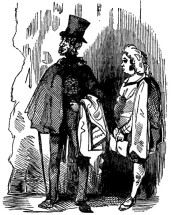
"How beautiful she is," thought Pen, cantering homeward. "How simple and how tender! How charming it is to see a woman of her commanding genius busying herself with the delightful, though humble, offices of domestic life, cooking dishes to make her old father comfortable, and brewing drink for him with her delicate fingers! How rude it was of me to begin to talk about professional matters, and how well she turned the conversation! By-the-way, she talked about professional matters herself; but then with what fun and humor she told the story of her comrade, Pentweazle, as he was called! There is no humor like Irish humor. Her father is rather tedious, but thoroughly amiable; and how fine of him, giving lessons in fencing after he quitted the army, where he was the pet of the Duke of Kent! Fencing! I should like to continue my fencing, or I shall forget what Angelo taught me. Uncle Arthur always liked me to fence—he says it is the exercise of a gentleman. Hang it. I'll take some lessons of Captain Costigan. Go along, Rebecca—up the hill, old lady. Pendennis, Pendennis—how she spoke the word! Emily, Emily! how good, how noble, how beautiful, how perfect, she is!"
Now the reader, who has had the benefit of overhearing the entire conversation which Pen had with Miss Fotheringay, can judge for himself about the powers of her mind, and may perhaps be disposed to think that she has not said any thing astonishingly humorous or intellectual in the course of the above interview. She has married, and taken her position in the world as a most spotless and irreproachable lady since, and I have had the pleasure of making her acquaintance: and must certainly own, against my friend Pen's opinion, that his adored Emily is not a clever woman. The truth is, she had not only never heard of Kotzebue, but she had never heard of Farquhar, or Congreve, or any dramatist in whose plays she had not a part: and of these dramas she only knew that part which concerned herself. A wag once told her that Dante was born at Algiers: and asked her—which Dr. Johnson wrote first, "Irene," or "Every Man in his Humor." But she had the best of the joke, for she had never heard of Irene, or Every Man in his Humor, or Dante, or perhaps Algiers. It was all one to her. She acted what little Bows told her—where he told her to sob, she sobbed—where he told her to laugh, she laughed. She gave the tirade or the repartee without the slightest notion of its meaning. She went to church and goes every Sunday, with a reputation perfectly intact, and was (and is) as guiltless of sense as of any other crime.
But what did our Pen know of these things? He saw a pair of bright eyes, and he believed in them—a beautiful image, and he fell down and worshiped it. He supplied the meaning which her words wanted; and created the divinity which he loved. Was Titania the first who fell in love with an ass, or Pygmalion the only artist who has gone crazy about a stone? He had found her; he had found what his soul thirsted after. He flung himself into the stream and drank with all his might. Let those say who have been thirsty once how delicious that first draught is. As he rode down the avenue toward home, Pen shrieked with laughter, as he saw the Reverend Mr. Smirke once more coming demurely away from Fairoaks on his pony. Smirke had dawdled and staid at the cottages on the way, and then dawdled with Laura over her lessons—and then looked at Mrs. Pendennis's gardens and improvements until he had perfectly bored out that lady: and he had taken his leave at the very last minute without that invitation to dinner which he fondly expected.
Pen was full of kindness and triumph. "What, picked up and sound?" he cried out, laughing. "Come along back, old fellow, and eat my dinner—I have had mine: but we will have a bottle of the old wine and drink her health, Smirke."
Poor Smirke turned the pony's head round, and jogged along with Arthur. His mother was charmed to see him in such high spirits, and welcomed Mr. Smirke for his sake, when Arthur said he had forced the curate back to dine. He gave a most ludicrous account of the play of the night before, and of the acting of Bingley the Manager, in his ricketty Hessians, and the enormous Mrs. Bingley as the Countess, in rumpled green satin and a Polish cap: he mimicked them, and delighted his mother and little Laura, who clapped her hands with pleasure.
"And Mrs. Haller?" said Mrs. Pendennis.
"She's a stunner, ma'am," Pen said, laughing, and using the words of his reverend friend, Mr. Foker.
"A what, Arthur?" asked the lady.
"What is a stunner, Arthur?" cried Laura, in the same voice.
So he gave them a queer account of Mr. Foker, and how he used to be called Vats and Grains, and by other contumelious names at school, and how he was now exceedingly rich, and a Fellow Commoner at St. Boniface. But gay and communicative as he was, Mr. Pen did not say one syllable about his ride to Chatteries that day, or about the new friends whom he had made there.
When the two ladies retired, Pen, with flashing eyes, filled up two great bumpers of Madeira, and looking Smirke full in the face said, "Here's to her!"
"Here's to her," said the curate with a sigh, lifting the glass: and emptying it, so that his face was a little pink when he put it down.
Pen had even less sleep that night than on the night before. In the morning, and almost before dawn, he went out and saddled that unfortunate Rebecca himself, and rode her on the Downs like mad. Again Love had roused him—and said, "Awake Pendennis, I am here." That charming fever—that delicious longing—and fire, and uncertainty; he hugged them to him—he would not have lost them for all the world.
CHAPTER VI.
CONTAINS BOTH LOVE AND WAR.
Cicero and Euripides did not occupy Mr. Pen much for some time after this, and honest Mr. Smirke had a very easy time with his pupil. Rebecca was the animal who suffered most in the present state of Pen's mind for, besides those days when he could publicly announce his intention of going to Chatteries to take a fencing-lesson, and went thither with the knowledge of his mother, whenever he saw three hours clear before him, the young rascal made a rush for the city, and found his way to Prior's Lane. He was as frantic with vexation when Rebecca went lame, as Richard at Bosworth, when his horse was killed under him: and got deeply into the books of the man who kept the hunting stables at Chatteries for the doctoring of his own, and the hire of another animal.
Then, and perhaps once in a week, under pretense of going to read a Greek play with Smirke, this young reprobate set off so as to be in time for the Competitor down coach, staid a couple of hours in Chatteries, and returned on the Rival which left for London at ten at night. Once his secret was nearly lost by Smirke's simplicity, of whom Mrs. Pendennis asked whether they had read a great deal the night before, or a question to that effect. Smirke was about to tell the truth, that he had never seen Mr. Pen at all, when the latter's boot-heel came grinding down on Mr. Smirke's toe under the table, and warned the curate not to betray him.
They had had conversations on the tender subject of course. It is good sport (if you are not yourself engaged in the conversation) to hear two men in love talk. There must be a confidant and depositary somewhere. When informed, under the most solemn vows of secrecy, of Pen's condition of mind, the curate said, with no small tremor, "that he hoped it was no unworthy object—no unlawful attachment, which Pen had formed"—for if so, the poor fellow felt it would be his duty to break his vow and inform Pen's mother, and then there would be a quarrel, he felt, with sickening apprehension, and he would never again have a chance of seeing what he most liked in the world.
"Unlawful, unworthy!" Pen bounced out at the curate's question. "She is as pure as she is beautiful; I would give my heart to no other woman. I keep the matter a secret in my family, because—because—there are reasons of a weighty nature which I am not at liberty to disclose. But any man who breathes a word against her purity insults both her honor and mine, and—and dammy, I won't stand it."
Smirke, with a faint laugh, only said, "Well, well, don't call me out, Arthur, for you know I can't fight;" but by this compromise the wretched curate was put more than ever into the power of his pupil, and the Greek and mathematics suffered correspondingly.
If the reverend gentleman had had much discernment, and looked into the poet's corner of the County Chronicle, as it arrived in the Wednesday's bag, he might have seen "Mrs. Haller," "Passion and Genius," "Lines to Miss Fotheringay, of the Theater Royal," appearing every week; and other verses of the most gloomy, thrilling, and passionate cast. But as these poems were no longer signed NEP. by their artful composer, but subscribed EROS; neither the tutor nor Helen, the good soul, who cut all her son's verses out of the paper, knew that Nep. was no other than that flaming Eros, who sang so vehemently the character of the new actress.
"Who is the lady," at last asked Mrs. Pendennis, "whom your rival is always singing in the County Chronicle. He writes something like you, dear Pen, but yours is much the best. Have you seen Miss Fotheringay?"
Pen said yes, he had; that night he went to see the "Stranger," she acted Mrs. Haller. By the way she was going to have a benefit, and was to appear in Ophelia—suppose we were to go—Shakspeare you know, mother—we can get horses from the Clavering Arms. Little Laura sprang up with delight, she longed for a play.
Pen introduced "Shakspeare you know," because the deceased Pendennis, as became a man of his character, professed an uncommon respect for the bard of Avon, in whose works he safely said there was more poetry than in all "Johnson's Poets" put together. And though Mr. Pendennis did not much read the works in question, yet he enjoined Pen to peruse them, and often said what pleasure he should have, when the boy was of a proper age, in taking him and his mother to see some good plays of the immortal poet.
The ready tears welled up in the kind mother's eyes as she remembered these speeches of the man who was gone. She kissed her son fondly, and said she would go. Laura jumped for joy. Was Pen happy?—was he ashamed? As he held his mother to him, he longed to tell her all, but he kept his counsel. He would see how his mother liked her; the play should be the thing, and he would try his mother like Hamlet's.
Helen, in her good humor, asked Mr. Smirke to be of the party. That ecclesiastic had been bred up by a fond parent at Clapham, who had an objection to dramatic entertainments, and he had never yet seen a play. But, Shakspeare!—but to go with Mrs. Pendennis in her carriage, and sit a whole night by her side!—he could not resist the idea of so much pleasure, and made a feeble speech, in which he spoke of temptation and gratitude, and finally accepted Mrs. Pendennis's most kind offer. As he spoke he gave her a look, which made her exceedingly uncomfortable. She had seen that look more than once, of late, pursuing her. He became more positively odious every day in the widow's eyes.
We are not going to say a great deal about Pen's courtship of Miss Fotheringay, for the reader has already had a specimen of her conversation, much of which need surely not be reported. Pen sate with her hour after hour, and poured forth all his honest boyish soul to her. Every thing he knew, or hoped, or felt, or had read, or fancied, he told to her. He never tired of talking and longing. One after another, as his thoughts rose in his hot eager brain, he clothed them in words, and told them to her. Her part of the tête-à-tête was not to talk, but to appear as if she understood what Pen talked (a difficult matter, for the young fellow blurted out no small quantity of nonsense), and to look exceedingly handsome and sympathizing. The fact is, while he was making one of his tirades—and delighted, perhaps, and wondering at his own eloquence, the lad would go on for twenty minutes at a time—the lovely Emily, who could not comprehend a tenth part of his talk, had leisure to think about her own affairs, and would arrange, in her own mind how they should dress the cold mutton, or how she would turn the black satin, or make herself out of her scarf a bonnet like Miss Thackthwaite's new one, and so forth. Pen spouted Byron and Moore; passion and poetry: her business was to throw up her eyes, or fixing them for a moment on his face, to cry, "Oh, 'tis beautiful! Ah, how exquisite! Repeat those lines again." And off the boy went, and she returned to her own simple thoughts about the turned gown, or the hashed mutton.
In fact Pen's passion was not long a secret from the lovely Emily or her father. Upon his second visit, his admiration was quite evident to both of them, and on his departure the old gentleman said to his daughter, as he winked at her over his glass of grog, "Faith, Milly darling, I think ye've hooked that chap."
"Pooh, 'tis only a boy, papa dear," Milly remarked. "Sure he's but a child." Pen would have been very much pleased if he had heard that phrase—he was galloping home wild with pleasure, and shouting out her name as he rode.
"Ye've hooked 'um any how," said the captain, "and let me tell ye he's not a bad fish. I asked Tom at the George, and Flint, the grocer, where his mother dales—fine fortune—drives in her chariot—splendid park and grounds—Fairoaks Park—only son—property all his own at twenty-one—ye might go further and not fare so well, Miss Fotheringay."
"Them boys are mostly talk," said Milly, seriously. "Ye know at Dublin how ye went on about young Poldoody, and I've a whole desk full of verses he wrote me when he was in Trinity College; but he went abroad, and his mother married him to an Englishwoman."
"Lord Poldoody was a young nobleman; and in them it's natural: and ye weren't in the position in which ye are now, Milly dear. But ye mustn't encourage this young chap too much, for, bedad, Jack Costigan wont have any thrifling with his daughter."
"No more will his daughter, papa, you may be sure of that," Milly said. "A little sip more of the punch—sure, 'tis beautiful. Ye needn't be afraid about the young chap—I think I'm old enough to take care of myself, Captain Costigan."
So Pen used to come day after day, rushing in and galloping away, and growing more wild about the girl with every visit. Sometimes the captain was present at their meetings; but having a perfect confidence in his daughter, he was more often inclined to leave the young couple to themselves, and cocked his hat over his eye, and strutted off on some errand when Pen entered. How delightful these interviews were! The captain's drawing-room was a low wainscoted room, with a large window looking into the dean's garden. There Pen sate and talked—and talked to Emily, looking beautiful as she sate at her work—looking beautiful and calm, and the sunshine came streaming in at the great windows, and lighted up her superb face and form. In the midst of the conversation, the great bell would begin to boom, and he would pause, smiling, and be silent until the sound of the vast music died away—or the rooks in the cathedral elms would make a great noise toward sunset—or the sound of the organ and the choristers would come over the quiet air, and gently hush Pen's talking.
By the way, it must be said, that Miss Fotheringay, in a plain shawl and a close bonnet and vail, went to church every Sunday of her life, accompanied by her indefatigable father, who gave the responses in a very rich and fine brogue, joined in the psalms and chanting, and behaved in the most exemplary manner.
Little Bows, the house-friend of the family, was exceedingly wroth at the notion of Miss Fotheringay's marriage with a stripling seven or eight years her junior. Bows, who was a cripple, and owned that he was a little more deformed even than Bingley the manager, so that he could not appear on the stage, was a singular wild man of no small talents and humor. Attracted first by Miss Fotheringay's beauty he began to teach her how to act. He shrieked out in his cracked voice the parts, and his pupil learned them from his lips by rote, and repeated them in her full rich tones. He indicated the attitudes, and set and moved those beautiful arms of hers. Those who remember this grand actress on the stage can recall how she used always precisely the same gestures, looks, and tones: how she stood on the same plank of the stage in the same position, rolled her eyes at the same instant and to the same degree, and wept with precisely the same heart-rending pathos, and over the same pathetic syllable. And after she had come out trembling with emotion before the audience, and looking so exhausted and tearful that you fancied she would faint with sensibility, she would gather up her hair the instant she was behind the curtain, and go home to a mutton chop and a glass of brown stout; and the harrowing labors of the day over, she went to bed and snored as resolutely and as regularly as a porter.
Bows then, was indignant at the notion that his pupil should throw her chances away in life by bestowing her hand upon a little country squire. As soon as a London manager saw her, he prophesied that she would get a London engagement, and a great success. The misfortune was that the London managers had seen her. She had played in London three years before, and failed from utter stupidity. Since then it was that Bows had taken her in hand and taught her part after part. How he worked and screamed, and twisted, and repeated lines over and over again, and with what indomitable patience and dullness she followed him! She knew that he made her: and let herself be made. She was not grateful, or ungrateful, or unkind, or ill-humored. She was only stupid; and Pen was madly in love with her.
The post-horses from the Clavering Arms arrived in due time, and carried the party to the theater at Chatteries, where Pen was gratified in perceiving that a tolerably large audience was assembled. The young gentlemen from Baymouth had a box, in the front of which sate Mr. Foker and his friend Mr. Spavin splendidly attired in the most full-blown evening costume. They saluted Pen in a cordial manner, and examined his party, of which they approved, for little Laura was a pretty little red-cheeked girl with a quantity of shining brown ringlets, and Mrs. Pendennis, dressed in black velvet with the diamond cross which she sported on great occasions, looked uncommonly handsome and majestic. Behind these sate Mr. Arthur, and the gentle Smirke, with the curl reposing on his fair forehead, and his white tie in perfect order. He blushed to find himself in such a place—but how happy was he to be there. He and Mrs. Pendennis brought books of "Hamlet" with them to follow the tragedy, as is the custom of honest country-folks who go to a play in state. Samuel, coachman, groom, and gardener to Mr. Pendennis took his place in the pit, where Mr. Foker's man was also visible. It was dotted with non-commissioned officers of the Dragoons, whose band, by kind permission of Colonel Swallowtail, were as usual in the orchestra; and that corpulent and distinguished warrior himself, with his Waterloo medal and a number of his young men, made a handsome show in the boxes.
"Who is that odd-looking person bowing to you, Arthur?" Mrs. Pendennis asked of her son.
Pen blushed a great deal. "His name is Captain Costigan, ma'am," he said—a "Peninsular officer." In fact, it was the captain in a new shoot of clothes, as he called them, and with a large pair of white kid gloves, one of which he waved to Pendennis, while he laid the other sprawling over his heart and coat buttons. Pen did not say any more. And how was Mrs. Pendennis to know that Mr. Costigan was the father of Miss Fotheringay?
Mr. Hornbull, from London, was the Hamlet of the night, Mr. Bingley modestly contenting himself with the part of Horatio, and reserving his chief strength for William in "Black-Eyed Susan," which was the second piece.
We have nothing to do with the play: except to say, that Ophelia looked lovely, and performed with admirable wild pathos: laughing, weeping, gazing wildly, waving her beautiful white arms, and flinging about her snatches of flowers and songs with the most charming madness. What an opportunity her splendid black hair had of tossing over her shoulders! She made the most charming corpse ever seen; and while Hamlet and Laertes were battling in her grave, she was looking out from the back scenes with some curiosity toward Pen's box, and the family party assembled in it.
There was but one voice in her praise there. Mrs. Pendennis was in ecstasies with her beauty. Little Laura was bewildered by the piece, and the Ghost, and the play within the play (during which, as Hamlet lay at Ophelia's knee, Pen felt that he would have liked to strangle Mr. Hornbull), but cried out great praises of that beautiful young creature. Pen was charmed with the effect which she produced on his mother—and the clergyman, for his part, was exceedingly enthusiastic.
When the curtain fell upon that group of slaughtered personages, who are dispatched so suddenly at the end of "Hamlet," and whose demise astonished poor little Laura not a little, there was an immense shouting and applause from all quarters of the house; the intrepid Smirke, violently excited, clapped his hands, and cried out "Bravo, Bravo," as loud as the Dragoon officers themselves. These were greatly moved—ils s'agitaient sur leurs bancs—to borrow a phrase from our neighbors. They were led cheering into action by the portly Swallowtail, who waved his cap—the non-commissioned officers in the pit, of course, gallantly following their chiefs. There was a roar of bravos rang through the house: Pen bellowing with the loudest, "Fotheringay, Fotheringay!" and Messrs. Spavin and Foker giving the view halloo from their box. Even Mrs. Pendennis began to wave about her pocket-handkerchief, and little Laura danced, laughed, clapped, and looked up at Pen with wonder.
Hornbull led the beneficiaire forward amidst bursts of enthusiasm—and she looked so handsome and radiant, with her hair still over her shoulders, that Pen hardly could contain himself for rapture; and he leaned over his mother's chair and shouted, and hurrayed and waved his hat. It was all he could do to keep his secret from Helen, and not say, "Look! That's the woman! Isn't she peerless? I tell you I love her." But he disguised these feelings under an enormous bellowing and hurraying.
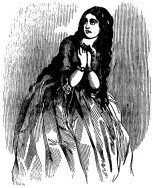
As for Miss Fotheringay and her behavior, the reader is referred to a former page for an account of that. She went through precisely the same business. She surveyed the house all round with glances of gratitude; and trembled, and almost sank with emotion, over her favorite trap-door. She seized the flowers (Foker discharged a prodigious bouquet at her, and even Smirke made a feeble shy with a rose, and blushed dreadfully when it fell into the pit). She seized the flowers and pressed them to her swelling heart—&c. &c.—in a word—we refer the reader to page 46. Twinkling in her breast poor old Pen saw a locket which he had bought of Mr. Nathan in High-street, with the last shilling he was worth and a sovereign borrowed from Smirke.
"Black-Eyed Susan" followed, at which sweet story our gentle-hearted friends were exceedingly charmed and affected: and in which Susan, with a russet gown and a pink ribbon in her cap, looked to the full as lovely as Ophelia. Bingley was great in William. Goll, as the admiral, looked like the figure-head of a seventy-four; and Garbetts, as Captain Boldweather, a miscreant who forms a plan for carrying off Black-eyed Susan, and, waving an immense cocked hat, says, "Come what may, he will be the ruin of her"—all these performed their parts with their accustomed talent; and it was with a sincere regret that all our friends saw the curtain drop down and end that pretty and tender story.
If Pen had been alone with his mother in the carriage as they went home, he would have told her all that night; but he sate on the box in the moonshine smoking a cigar by the side of Smirke, who warmed himself with a comforter. Mr. Foker's tandem and lamps whirled by the sober old Clavering posters, as they were a couple of miles on their road home, and Mr. Spavin saluted Mrs. Pendennis's carriage with some considerable variations of Rule Britannia on the key-bugle.
It happened two days after the above gayeties that Mr. Dean of Chatteries entertained a few select clerical friends at dinner at his Deanery House. That they drank uncommonly good port wine, and abused the bishop over their dessert, are very likely matters; but with such we have nothing at present to do. Our friend Doctor Portman, of Clavering, was one of the dean's guests, and being a gallant man, and seeing from his place at the mahogany, the dean's lady walking up and down the grass, with her children sporting around her, and her pink parasol over her lovely head—the doctor stepped out of the French windows of the dining-room into the lawn, which skirts that apartment, and left the other white neckcloths to gird at my lord bishop. Then the doctor went up and offered Mrs. Dean his arm, and they sauntered over the ancient velvet lawn, which had been mowed and rolled for immemorial deans, in that easy, quiet, comfortable manner, in which people of middle age and good temper walk after a good dinner, in a calm golden summer evening, when the sun has but just sunk behind the enormous cathedral-towers, and the sickle-shaped moon is growing every instant brighter in the heavens.
Now at the end of the dean's garden, there is, as we have stated, Mrs. Creed's house, and the windows of the first-floor room were open to admit the pleasant summer air. A young lady of six-and-twenty, whose eyes were perfectly wide open, and a luckless boy of eighteen, blind with love and infatuation, were in that chamber together; in which persons, as we have before seen them in the same place, the reader will have no difficulty in recognizing Mr. Arthur Pendennis and Miss Costigan.
The poor boy had taken the plunge. Trembling with passionate emotion, his heart beating and throbbing fiercely, tears rushing forth in spite of him, his voice almost choking with feeling, poor Pen had said those words which he could withhold no more, and flung himself and his whole store of love, and admiration, and ardor, at the feet of this mature beauty. Is he the first who has done so? Have none before or after him staked all their treasure of life, as a savage does his land and possessions against a draught of the fair-skins' fire-water, or a couple of bauble eyes?
"Does your mother know of this, Arthur?" said Miss Fotheringay, slowly. He seized her hand madly, and kissed it a thousand times. She did not withdraw it. "Does the old lady know it?" Miss Costigan thought to herself "well, perhaps she may," and then she remembered what a handsome diamond cross Mrs. Pendennis had on the night of the play, and thought, "sure 'twill go in the family."
"Calm yourself, dear Arthur," she said, in her low rich voice, and smiled sweetly and gravely upon him. Then, with her disengaged hand, she put the hair lightly off his throbbing forehead. He was in such a rapture and whirl of happiness that he could hardly speak. At last he gasped out, "My mother has seen you, and admires you beyond measure. She will learn to love you soon: who can do otherwise? She will love you because I do."
"'Deed then, I think you do," said Miss Costigan, perhaps with a sort of pity for Pen.
Think he did! Of course here Mr. Pen went off into a rhapsody through which, as we have perfect command over our own feelings, we have no reason to follow the lad. Of course, love, truth, and eternity were produced; and words were tried but found impossible to plumb the tremendous depth of his affection. This speech, we say, is no business of ours. It was most likely not very wise, but what right have we to overhear? Let the poor boy fling out his simple heart at the woman's feet, and deal gently with him. It is best to love wisely, no doubt; but to love foolishly is better than not to be able to love at all. Some of us can't; and are proud of our impotence too.
At the end of his speech Pen again kissed the imperial hand with rapture—and I believe it was at this very moment, and while Mrs. Dean and Doctor Portman were engaged in conversation, that young Master Ridley Roset, her son, pulled his mother by the back of her capacious dress, and said—
"I say, ma! look up there"—and he waggled his innocent head.
That was, indeed, a view from the dean's garden such as seldom is seen by deans—or is written in chapters. There was poor Pen performing a salute upon the rosy fingers of his charmer, who received the embrace with perfect calmness and good humor. Master Ridley looked up and grinned, little Miss Rosa looked at her brother, and opened the mouth of astonishment. Mrs. Dean's countenance defied expression, and as for Dr. Portman, when he beheld the scene, and saw his prime favorite and dear pupil Pen, he stood mute with rage and wonder.
Mrs. Haller spied the party below at the same moment, and gave a start and a laugh. "Sure there's somebody in the dean's garden," she cried out; and withdrew with perfect calmness, while Pen darted away with his face glowing like coals. The garden party had re-entered the house when he ventured to look out again. The sickle moon was blazing bright in the heavens then, the stars were glittering, the bell of the cathedral tolling nine, the dean's guests (all save one, who had called for his horse Dumpling, and ridden off early) were partaking of tea and buttered cakes in Mrs. Dean's drawing-room—when Pen took leave of Miss Costigan.
Pen arrived at home in due time afterward; and was going to slip off to bed, for the poor lad was greatly worn and agitated, and his high-strung nerves had been at almost a maddening pitch—when a summons came to him by John, the old footman, whose countenance bore a very ominous look, that his mother must see him below.
On this he tied on his neckcloth again, and went down stairs to the drawing-room. There sate not only his mother, but her friend, the Reverend Doctor Portman. Helen's face looked very pale by the light of the lamp—the doctor's was flushed, on the contrary, and quivering with anger and emotion.
Pen saw at once that there was a crisis, and that there had been a discovery. "Now for it," he thought.
"Where have you been, Arthur?" Helen said, in a trembling voice.
"How can you look that—that dear lady, and a Christian clergyman in the face, sir?" bounced out the doctor, in spite of Helen's pale, appealing looks. "Where has he been? Where his mother's son should have been ashamed to go. For your mother's an angel, sir, an angel. How dare you bring pollution into her house, and make that spotless creature wretched with the thoughts of your crime?"
"Sir!" said Pen.
"Don't deny it, sir," roared the doctor. "Don't add lies, sir, to your other infamy. I saw you myself, sir. I saw you from the dean's garden. I saw you kissing the hand of that infernal painted—"
"Stop," Pen said, clapping his fist on the table, till the lamp flickered up and shook, "I am a very young man, but you will please to remember that I am a gentleman—I will hear no abuse of that lady."
"Lady, sir," cried the doctor, "that a lady—you—you—you stand in your mother's presence and call that—that woman a lady!—"
"In any body's presence," shouted out Pen. "She is worthy of any place. She is as pure as any woman. She is as good as she is beautiful. If any man but you insulted her, I would tell him what I thought; but as you are my oldest friend, I suppose you have the privilege to doubt of my honor."
"No, no, Pen, dearest Pen," cried out Helen in an excess of joy. "I told, I told you, doctor, he was not—not what you thought;" and the tender creature coming trembling forward flung herself on Pen's shoulder.
Pen felt himself a man, and a match for all the doctors in doctordom. He was glad this explanation had come. "You saw how beautiful she was," he said to his mother, with a soothing, protecting air, like Hamlet with Gertrude in the play. "I tell you, dear mother, she is as good. When you know her you will say so. She is of all, except you, the simplest, the kindest, the most affectionate of women. Why should she not be on the stage?—She maintains her father by her labor."
"Drunken old reprobate," growled the doctor, but Pen did not hear or heed.
"If you could see, as I have, how orderly her life is, how pure and pious her whole conduct, you would—as I do—yes, as I do"—(with a savage look at the doctor)—"spurn the slanderer who dared to do her wrong. Her father was an officer, and distinguished himself in Spain. He was a friend of His Royal Highness the Duke of Kent, and is intimately known to the Duke of Wellington, and some of the first officers of our army. He has met my uncle Arthur at Lord Hill's, he thinks. His own family is one of the most ancient and respectable in Ireland, and indeed is as good as our own. The—the Costigans, were kings of Ireland."
"Why, God bless my soul," shrieked out the doctor, hardly knowing whether to burst with rage or laughter, "you don't mean to say you want to marry her?"
Pen put on his most princely air. "What else, Dr. Portman," he said, "do you suppose would be my desire?"
Utterly foiled in his attack, and knocked down by this sudden lunge of Pen's, the doctor could only gasp out, "Mrs. Pendennis, ma'am, send for the major."
"Send for the major? with all my heart," said Arthur, Prince of Pendennis and Grand Duke of Fairoaks, with a most superb wave of the hand. And the colloquy terminated by the writing of those two letters which were laid on Major Pendennis's breakfast-table, in London, at the commencement of Prince Arthur's most veracious history.
CHAPTER VII.
IN WHICH THE MAJOR MAKES HIS APPEARANCE.
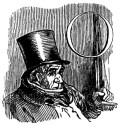
Our acquaintance, Major Arthur Pendennis, arrived in due time at Fairoaks, after a dreary night passed in the mail-coach, where a stout fellow-passenger, swelling preternaturally with great-coats, had crowded him into a corner, and kept him awake by snoring indecently; where a widow lady, opposite, had not only shut out the fresh air by closing all the windows of the vehicle, but had filled the interior with fumes of Jamaica rum and water, which she sucked perpetually from a bottle in her reticule; where, whenever he caught a brief moment of sleep, the twanging of the horn at the turnpike-gates, or the scuffling of his huge neighbor wedging him closer and closer, or the play of the widow's feet on his own tender toes, speedily woke up the poor gentleman to the horrors and realities of life—a life which has passed away now and become impossible, and only lives in fond memories. Eight miles an hour, for twenty or five-and-twenty hours, a tight mail-coach, a hard seat, a gouty tendency, a perpetual change of coachmen grumbling because you did not fee them enough, a fellow-passenger partial to spirits-and-water—who has not borne with these evils in the jolly old times? and how could people travel under such difficulties? And yet they did, and were merry too. Next the widow, and by the side of the major's servant on the roof, were a couple of schoolboys going home for the midsummer holidays, and Major Pendennis wondered to see them sup at the inn at Bagshot, where they took in a cargo of ham, eggs, pie, pickles, tea, coffee, and boiled beef, which surprised the poor major, sipping a cup of very feeble tea, and thinking with a tender dejection that Lord Steyne's dinner was coming off at that very moment. The ingenuous ardor of the boys, however, amused the major, who was very good-natured, and he became the more interested when he found that the one who traveled inside with him, was a lord's son, whose noble father Pendennis, of course, had met in the world of fashion, which he frequented. The little lord slept all night through, in spite of the squeezing, and the horn-blowing, and the widow; and he looked as fresh as paint (and, indeed, pronounced himself to be so) when the major, with a yellow face, a bristly beard, a wig out of curl, and strong rheumatic griefs shooting through various limbs of his uneasy body, descended at the little lodge-gate at Fairoaks where the portress and gardener's wife reverentially greeted him; and, still more respectfully, Mr. Morgan, his man.
Helen was on the lookout for this expected guest, and saw him from her window. But she did not come forward immediately to greet him. She knew the major did not like to be seen at a surprise, and required a little preparation before he cared to be visible. Pen, when a boy, had incurred sad disgrace, by carrying off from the major's dressing-table a little morocco box, which it must be confessed contained the major's back teeth, which he naturally would leave out of his jaws in a jolting mail-coach, and without which he would not choose to appear. Morgan, his man, made a mystery of his wigs: curling them in private places: introducing them mysteriously to his master's room;—nor without his head of hair would the major care to show himself to any member of his family or any acquaintance. He went to his apartment then, and supplied these deficiencies; he groaned and moaned, and wheezed, and cursed Morgan through his toilet, as an old buck will, who has been up all night with a rheumatism, and has a long duty to perform. And finally being belted, curled, and set straight, he descended upon the drawing-room, with a grave, majestic air, such as befitted one who was at once a man of business and a man of fashion.
Pen was not there, however, only Helen, and little Laura sewing at her knees; and to whom he never presented more than a fore-finger, as he did on this occasion, after saluting his sister-in-law. Laura took the finger, trembling, and dropped it—and then fled out of the room. Major Pendennis did not want to keep her, or indeed to have her in the house at all, and had his private reason for disapproving of her: which we may mention on some future occasion. Meanwhile Laura disappeared and wandered about the premises seeking for Pen; whom she presently found in the orchard, pacing up and down a walk there, in earnest conversation with Mr. Smirke. He was so occupied that he did not hear Laura's clear voice singing out, until Smirke pulled him by the coat, and pointed toward her as she came running.
She ran up and put her hand into his. "Come in, Pen," she said, "there's somebody come; uncle Arthur's come."
"He is, is he?" said Pen, and she felt him grasp her little hand. He looked round at Smirke with uncommon fierceness, as much as to say, I am ready for him or any man.—Mr. Smirke cast up his eyes as usual and heaved a gentle sigh.
"Lead on, Laura," Pen said, with a half fierce half comic air—"Lead on, and say I wait upon my uncle." But he was laughing in order to hide a great anxiety: and was screwing his courage inwardly to face the ordeal which he knew was now before him.
Pen had taken Smirke into his confidence in the last two days, and after the outbreak attendant on the discovery of Dr. Portman, and during every one of those forty-eight hours which he had passed in Mr. Smirke's society, had done nothing but talk to his tutor about Miss Fotheringay—Miss Emily Fotheringay—Emily, &c., to all which talk Smirke listened without difficulty, for he was in love himself, most anxious in all things to propitiate Pen, and indeed very much himself enraptured by the personal charms of this goddess, whose like, never having been before at a theatrical representation, he had not beheld until now. Pen's fire and volubility, his hot eloquence and rich poetical tropes and figures, his manly heart, kind, ardent, and hopeful, refusing to see any defects in the person he loved, any difficulties in their position that he might not overcome, half convinced Mr. Smirke that the arrangement proposed by Mr. Pen was a very feasible and prudent one and that it would be a great comfort to have Emily settled at Fairoaks, Captain Costigan in the yellow room, established for life there, and Pen married at eighteen.
And it is a fact that in these two days, the boy had almost talked over his mother too; had parried all her objections one after another with that indignant good sense which is often the perfection of absurdity and had brought her almost to acquiesce in the belief that if the marriage was doomed in heaven, why doomed it was—that if the young woman was a good person, it was all that she, for her part, had to ask; and rather to dread the arrival of the guardian uncle who, she foresaw, would regard Mr. Pen's marriage in a manner very different to that simple, romantic, honest, and utterly absurd way, in which the widow was already disposed to look at questions of this sort.
For as in the old allegory of the gold and silver shield, about which the two knights quarreled, each is right according to the point from which he looks: so about marriage; the question whether it is foolish or good, wise or otherwise, depends upon the point of view from which you regard it. If it means a snug house in Belgravia, and pretty little dinner parties, and a pretty little brougham to drive in the Park, and a decent provision, not only for the young people, but for the little Belgravians to come; and if these are the necessaries of life (and they are with many honest people), to talk of any other arrangement is an absurdity: of love in lodgings—a babyish folly of affection: that can't pay coach-hire or afford a decent milliner—as mere wicked balderdash and childish romance. If, on the other hand your opinion is that people, not with an assured subsistence, but with a fair chance to obtain it, and with the stimulus of hope, health, and strong affection, may take the chance of fortune for better or worse, and share its good or its evil together, the polite theory then becomes an absurdity in its turn: worse than an absurdity, a blasphemy almost, and doubt of Providence; and a man who waits to make his chosen woman happy, until he can drive her to church in a neat little carriage with a pair of horses, is no better than a coward or a trifler, who is neither worthy of love nor of fortune.
I don't say that the town folks are not right, but Helen Pendennis was a country bred woman, and the book of life, as she interpreted it, told her a different story to that page which is read in cities. Like most soft and sentimental women, match-making, in general, formed a great part of her thoughts, and I dare say she had begun to speculate about her son's falling in love and marrying long before the subject had ever entered into the brains of the young gentleman. It pleased her (with that dismal pleasure which the idea of sacrificing themselves gives to certain women), to think of the day when she would give up all to Pen, and he should bring his wife home, and she would surrender the keys and the best bed-room, and go and sit at the side of the table, and see him happy. What did she want in life but to see the lad prosper? As an empress certainly was not too good for him, and would be honored by becoming Mrs. Pen; so if he selected humble Esther instead of Queen Vashti, she would be content with his lordship's choice. Never mind how lowly or poor the person might be who was to enjoy that prodigious honor, Mrs. Pendennis was willing to bow before her and welcome her, and yield her up the first place. But an actress—a mature woman, who had long ceased blushing except with rouge, as she stood under the eager glances of thousands of eyes—an illiterate and ill-bred person, very likely, who must have lived with light associates, and have heard doubtful conversation—Oh! it was hard that such a one should be chosen, and that the matron should be deposed to give place to such a Sultana.
All these doubts the widow laid before Pen during the two days which had of necessity to elapse ere the uncle came down; but he met them with that happy frankness and ease which a young gentleman exhibits at his time of life, and routed his mother's objections with infinite satisfaction to himself. Miss Costigan was a paragon of virtue and delicacy; she was as sensitive as the most timid maiden; she was as pure as the unsullied snow; she had the finest manners, the most graceful wit and genius, the most charming refinement and justness of appreciation in all matters of taste; she had the most admirable temper and devotion to her father, a good old gentleman of high family and fallen fortunes, who had lived, however, with the best society in Europe: he was in no hurry, and could afford to wait any time—till he was one-and-twenty. But he felt (and here his face assumed an awful and harrowing solemnity) that he was engaged in the one only passion of his life, and that DEATH alone could close it.
Helen told him, with a sad smile and shake of the head, that people survived these passions, and as for long engagements contracted between very young men and old women—she knew an instance in her own family—Laura's poor father was an instance—how fatal they were.
Mr. Pen, however, was resolved that death must be his doom in case of disappointment, and rather than this—rather than balk him, in fact—this lady would have submitted to any sacrifice or personal pain, and would have gone down on her knees and have kissed the feet of a Hottentot daughter-in-law.
Arthur knew his power over the widow, and the young tyrant was touched while he exercised it. In those two days he brought her almost into submission, and patronized her very kindly; and he passed one evening with the lovely pie-maker at Chatteries, in which he bragged of his influence over his mother; and he spent the other night in composing a most flaming and conceited copy of verses to his divinity, in which he vowed, like Montrose, that he would make her famous with his sword and glorious by his pen, and that he would love her as no mortal woman had been adored since the creation of womankind.
It was on that night, long after midnight, that wakeful Helen, passing stealthily by her son's door, saw a light streaming through the chink of the door into the dark passage, and heard Pen tossing and tumbling, and mumbling verses in his bed. She waited outside for a while, anxiously listening to him. In infantile fevers and early boyish illnesses, many a night before, the kind soul had so kept watch. She turned the lock very softly now, and went in so gently, that Pen for a moment did not see her. His face was turned from her. His papers on his desk were scattered about, and more were lying on the bed round him. He was biting a pencil and thinking of rhymes and all sorts of follies and passions. He was Hamlet jumping into Ophelia's grave; he was the Stranger taking Mrs. Haller to his arms, beautiful Mrs. Haller with the raven ringlets falling over her shoulders. Despair and Byron, Thomas Moore and all the Loves of the Angels, Waller and Herrick, Beranger and all the love-songs he had ever read, were working and seething in this young gentleman's mind, and he was at the very height and paroxysm of the imaginative frenzy, when his mother found him.
"Arthur," said the mother's soft silver voice: and he started up and turned round. He clutched some of the papers and pushed them under the pillow.
"Why don't you go to sleep, my dear?" she said, with a sweet tender smile, and sate down on the bed and took one of his hot hands.
Pen looked at her wildly for an instant—"I couldn't sleep," he said—"I—I was—I was writing."—And hereupon he flung his arms round her neck and said, "O mother! I love her, I love her!"—How could such a kind soul as that help soothing and pitying him? The gentle creature did her best: and thought with a strange wonderment and tenderness, that it was only yesterday that he was a child in that bed: and how she used to come and say her prayers over it before he woke upon holiday mornings.
They were very grand verses, no doubt, although Miss Fotheringay did not understand them; but old Cos, with a wink and a knowing finger on his nose, said, "Put them up with th' other letthers, Milly darling. Poldoody's pomes was nothing to this." So Milly locked up the manuscripts.
When, then, the major being dressed and presentable, presented himself to Mrs. Pendennis, he found in the course of ten minutes' colloquy that the poor widow was not merely distressed at the idea of the marriage contemplated by Pen, but actually more distressed at thinking that the boy himself was unhappy about it, and that his uncle and he should have any violent altercation on the subject. She besought Major Pendennis to be very gentle with Arthur: "He has a very high spirit, and will not brook unkind words," she hinted. "Dr. Portman spoke to him very roughly—and I must own unjustly, the other night—for my dearest boy's honor is as high as any mother can desire—but Pen's answer quite frightened me, it was so indignant. Recollect he is a man now; and be very—very cautious," said the widow, laying a fair long hand on the major's sleeve.
He took it up, kissed it gallantly, and looked in her alarmed face with wonder, and a scorn which he was too polite to show. "Bon dieu!" thought the old negotiator, "the boy has actually talked the woman round, and she'd get him a wife as she would a toy, if master cried for it. Why are there no such things as lettres-de-cachet—and a Bastile for young fellows of family?" The major lived in such good company that he might be excused for feeling like an earl.—He kissed the widow's timid hand, pressed it in both his, and laid it down on the table with one of his own over it, as he smiled and looked her in the face.
"Confess," said he, "now that you are thinking how you possibly can make it up to your conscience to let the boy have his own way."
She blushed, and was moved, in the usual manner of females. "I am thinking that he is very unhappy; and I am too—"
"To contradict him or to let him have his own wish?" asked the other; and added, with great comfort to his inward self, "I'm d—d if he shall."
"To think that he should have formed so foolish and cruel and fatal an attachment," the widow said, "which can but end in pain whatever be the issue."
"The issue shan't be marriage, my dear sister," the major said, resolutely. "We're not going to have a Pendennis, the head of the house, marry a strolling mountebank from a booth. No, no, we won't marry into Greenwich Fair, ma'am."
"If the match is broken suddenly off," the widow interposed, "I don't know what may be the consequence. I know Arthur's ardent temper, the intensity of his affections, the agony of his pleasures and disappointments, and I tremble at this one, if it must be. Indeed, indeed, it must not come on him too suddenly."
"My dear madam," the major said, with an air of the deepest commiseration, "I've no doubt Arthur will have to suffer confoundedly before he gets over the little disappointment. But is he, think you, the only person who has been so rendered miserable?"
"No, indeed," said Helen, holding down her eyes. She was thinking of her own case, and was at that moment seventeen again, and most miserable.
"I, myself," whispered her brother-in-law, "have undergone a disappointment in early life. A young woman with fifteen thousand pounds, niece to an earl—most accomplished creature—a third of her money would have run up my promotion in no time, and I should have been a lieutenant-colonel at thirty: but it might not be. I was but a penniless lieutenant: her parents interfered, and I embarked for India—where I had the honor of being secretary to Lord Buckley, when commander-in-chief—without her. What happened? We returned our letters, sent back our locks of hair (the major here passed his fingers through his wig), we suffered, but we recovered. She is now a baronet's wife with thirteen grown-up children: altered, it is true, in person; but her daughters remind me of what she was, and the third is to be presented early next week."
Helen did not answer. She was still thinking of old times. I suppose if one lives to be a hundred, there are certain passages of one's early life whereof the recollection will always carry us back to youth again, and that Helen was thinking of one of these.
"Look at my own brother, my dear creature," the major continued gallantly: "he himself, you know, had a little disappointment when he started in the—the medical profession—an eligible opportunity presented itself. Miss Balls, I remember the name, was daughter of an apoth—a practitioner in very large practice; my brother had very nearly succeeded in his suit.—But difficulties arose: disappointments supervened, and—and I am sure he had no reason to regret the disappointment, which gave him this hand," said the major, and he once more politely pressed Helen's fingers.
"Those marriages between people of such different rank and age," said Helen, "are sad things. I have known them produce a great deal of unhappiness.—Laura's father, my cousin, who—who was brought up with me"—she added in a low voice, "was an instance of that."
"Most injudicious," cut in the major. "I don't know any thing more painful than for a man to marry his superior in age or his inferior in station. Fancy marrying a woman of a low rank of life, and having your house filled with her confounded tag-rag-and-bobtail of relations! Fancy your wife attached to a mother who dropped her h's, or called Maria Marire! How are you to introduce her into society? My dear Mrs. Pendennis, I will name no names, but in the very best circles of London society I have seen men suffering the most excruciating agony, I have known them to be cut, to be lost entirely, from the vulgarity of their wives' connections. What did Lady Snapperton do last year at her déjeuné dansant after the Bohemian Ball? She told Lord Brouncker that he might bring his daughters or send them with a proper chaperon, but that she would not receive Lady Brouncker: who was a druggist's daughter, or some such thing, and as Tom Wagg remarked of her, never wanted medicine certainly, for she never had an h in her life. Good Ged, what would have been the trifling pang of a separation in the first instance to the enduring infliction of a constant misalliance and intercourse with low people?"
"What, indeed!" said Helen, dimly disposed toward laughter, but yet checking the inclination, because she remembered in what prodigious respect her deceased husband held Major Pendennis and his stories of the great world.
"Then this fatal woman is ten years older than that silly young scapegrace of an Arthur. What happens in such cases, my dear creature? I don't mind telling you, now we are alone: that in the highest state of society, misery, undeviating misery, is the result. Look at Lord Clodworthy come into a room with his wife—why, good Ged, she looks like Clodworthy's mother. What's the case between Lord and Lady Willowbank, whose love match was notorious? He has already cut her down twice when she has hanged herself out of jealousy for Mademoiselle de Sainte Cunegonde, the dancer; and mark my words, good Ged, one day he'll not cut the old woman down. No, my dear madam, you are not in the world, but I am: you are a little romantic and sentimental (you know you are—women with those large beautiful eyes always are); you must leave this matter to my experience. Marry this woman! Marry at eighteen an actress of thirty—bah, bah!—I would as soon he sent into the kitchen and married the cook."
"I know the evils of premature engagements," sighed out Helen: and as she made this allusion no less than thrice in the course of the above conversation, and seems to be so oppressed with the notion of long engagements and unequal marriages, and as the circumstance we have to relate will explain what perhaps some persons are anxious to know, namely, who little Laura is, who has appeared more than once before us, it will be as well to clear up these points in another chapter.
CHAPTER VIII.
IN WHICH PEN IS KEPT WAITING AT THE DOOR, WHILE THE READER IS INFORMED WHO LITTLE LAURA WAS.

Once upon a time, then, there was a young gentleman of Cambridge University who came to pass the long vacation at the village where young Helen Thistlewood was living with her mother, the widow of the lieutenant slain at Copenhagen.—This gentleman—whose name was the Reverend Francis Bell—was nephew to Mrs. Thistlewood, and by consequence, own cousin to Miss Helen, so that it was very right that he should take lodgings in his aunt's house, who lived in a very small way; and there he passed the long vacation, reading with three or four pupils who accompanied him to the village. Mr. Bell was fellow of a college, and famous in the University for his learning and skill as a tutor.
His two kinswomen understood pretty early that the reverend gentleman was engaged to be married, and was only waiting for a college living to enable him to fulfill his engagement. His intended bride was the daughter of another parson, who had acted as Mr. Bell's own private tutor in Bell's early life, and it was while under Mr. Coacher's roof, indeed, and when only a boy of seventeen or eighteen years of age, that the impetuous young Bell had flung himself at the feet of Miss Martha Coacher, whom he was helping to pick peas in the garden. On his knees, before those peas and her, he pledged himself to an endless affection.
Miss Coacher was by many years the young fellow's senior; and her own heart had been lacerated by many previous disappointments in the matrimonial line. No less than three pupils of her father had trifled with those young affections. The apothecary of the village had despicably jilted her. The dragoon officer, with whom she had danced so many times during that happy season which she passed at Bath with her gouty grandmamma, one day gayly shook his bridle-rein, and galloped away, never to return. Wounded by the shafts of repeated ingratitude, can it be wondered at that the heart of Martha Coacher should pant to find rest somewhere? She listened to the proposals of the gawky, gallant, honest boy, with great kindness and good-humor; at the end of his speech she said, "Law, Bell, I'm sure you are too young to think of such things;" but intimated that she too would revolve them in her own virgin bosom. She could not refer Mr. Bell to her mamma, for Mr. Coacher was a widower, and being immersed in his books, was of course unable to take the direction of so frail and wondrous an article as a lady's heart, which Miss Martha had to manage for herself.
A lock of her hair, tied up in a piece of blue ribbon, conveyed to the happy Bell the result of the Vestal's conference with herself. Thrice before had she snipt off one of her auburn ringlets, and given them away. The possessors were faithless, but the hair had grown again; and Martha had indeed occasion to say that men were deceivers, when she handed over this token of love to the simple boy.
Number 6, however, was an exception to former passions—Francis Bell was the most faithful of lovers. When his time arrived to go to college, and it became necessary to acquaint Mr. Coacher of the arrangements that had been made, the latter cried, "God bless my soul, I hadn't the least idea what was going on!" as was indeed very likely, for he had been taken in three times before in precisely a similar manner; and Francis went to the University resolved to conquer honors, so as to be able to lay them at the feet of his beloved Martha.
This prize in view made him labor prodigiously. News came, term after term, of the honors he won. He sent the prize-books for his college essays to old Coacher, and his silver declamation cup to Miss Martha. In due season he was high among the Wranglers, and a fellow of his college; and during all the time of these transactions a constant tender correspondence was kept up with Miss Coacher, to whose influence, and perhaps with justice, he attributed the successes which he had won.
By the time, however, when the Rev. Francis Bell, M.A., and fellow and tutor of his college, was twenty-six years of age, it happened that Miss Coacher was thirty-four, nor had her charms, her manners, or her temper improved since that sunny day in the spring-time of life when he found her picking peas in the garden. Having achieved his honors, he relaxed in the ardor of his studies, and his judgment and taste also perhaps became cooler. The sunshine of the pea-garden faded away from Miss Martha, and poor Bell found himself engaged—and his hand pledged to that bond in a thousand letters—to a coarse, ill-tempered, ill-favored, ill-mannered, middle-aged woman.
It was in consequence of one of many altercations (in which Martha's eloquence shone, and in which therefore she was frequently pleased to indulge) that Francis refused to take his pupils to Bearleader's Green, where Mr. Coacher's living was, and where Bell was in the habit of spending the summer; and he bethought him that he would pass the vacation at his aunt's village, which he had not seen for many years—not since little Helen was a girl and used to sit on his knee. Down then he came and lived with them. Helen was grown a beautiful young woman now. The cousins were nearly four months together, from June to October. They walked in the summer evenings; they met in the early morn. They read out of the same book when the old lady dozed at night over the candles. What little Helen knew, Frank taught her. She sang to him: she gave her artless heart to him. She was aware of all his story. Had he made any secret?—had he not shown the picture of the woman to whom he was engaged, and with a blush—her letters, hard, eager, and cruel?—The days went on and on, happier and closer, with more kindness, more confidence, and more pity. At last one morning in October came when Francis went back to college, and the poor girl felt that her tender heart was gone with him.
Frank too wakened up from the delightful midsummer-dream to the horrible reality of his own pain. He gnashed and tore at the chain which bound him. He was frantic to break it and be free. Should he confess?—give his savings to the woman to whom he was bound, and beg his release?—there was time yet—he temporized. No living might fall in for years to come. The cousins went on corresponding sadly and fondly: the betrothed woman, hard, jealous, and dissatisfied, complaining bitterly, and with reason, of her Francis's altered tone.
At last things came to a crisis, and the new attachment was discovered. Francis owned it, cared not to disguise it, rebuked Martha with her violent temper and angry imperiousness, and, worst of all, with her inferiority and her age.
Her reply was, that if he did not keep his promise she would carry his letters into every court in the kingdom—letters in which his love was pledged to her ten thousand times; and, after exposing him to the world as the perjurer and traitor he was, she would kill herself.
Frank had one more interview with Helen, whose mother was dead then, and who was living companion with old Lady Pontypool—one more interview, where it was resolved that he was to do his duty; that is, to redeem his vow; that is, to pay a debt cozened from him by a sharper; that is, to make two honest people miserable. So the two judged their duty to be, and they parted.
The living fell in only too soon; but yet Frank Bell was quite a gray and worn-out man when he was inducted into it, Helen wrote him a letter on his marriage, beginning "My dear cousin," and ending "always truly yours." She sent him back the other letters, and the lock of his hair—all but a small piece. She had it in her desk when she was talking to the major.
Bell lived for three or four years in his living, at the end of which time, the Chaplainship of Coventry Island falling vacant, Frank applied for it privately, and having procured it, announced the appointment to his wife. She objected, as she did to every thing. He told her bitterly that he did not want her to come: so she went. Bell went out in Governor Crawley's time, and was very intimate with that gentleman in his later years. And it was in Coventry Island, years after his own marriage, and five years after he had heard of the birth of Helen's boy, that his own daughter was born.
She was not the daughter of the first Mrs. Bell, who died of island fever very soon after Helen Pendennis and her husband, to whom Helen had told every thing, wrote to inform Bell of the birth of their child. "I was old, was I?" said Mrs. Bell the first; "I was old, and her inferior, was I? but I married you, Mr. Bell, and kept you from marrying her?" and hereupon she died. Bell married a colonial lady, whom he loved fondly. But he was not doomed to prosper in love; and, this lady dying in child-birth, Bell gave up too: sending his little girl home to Helen Pendennis and her husband, with a parting prayer that they would befriend her.
The little thing came to Fairoaks from Bristol, which is not very far off, dressed in black, and in company of a soldier's wife, her nurse, at parting from whom she wept bitterly. But she soon dried up her grief under Helen's motherly care.
Round her neck she had a locket with hair, which Helen had given, ah, how many years ago! to poor Francis, dead and buried. This child was all that was left of him, and she cherished, as so tender a creature would, the legacy which he had bequeathed to her. The girl's name, as his dying letter stated, was Helen Laura. But John Pendennis, though he accepted the trust, was always rather jealous of the orphan; and gloomily ordered that she should be called by her own mother's name; and not by that first one which her father had given her. She was afraid of Mr. Pendennis, to the last moment of his life. And it was only when her husband was gone that Helen dared openly to indulge in the tenderness which she felt for the little girl.
Thus it was that Laura Bell became Mrs. Pendennis's daughter. Neither her husband nor that gentleman's brother, the major, viewed her with very favorable eyes. She reminded the first of circumstances in his wife's life which he was forced to accept, but would have forgotten much more willingly: and as for the second, how could he regard her? She was neither related to his own family of Pendennis, nor to any nobleman in this empire, and she had but a couple of thousand pounds for her fortune.
And now let Mr. Pen come in, who has been waiting all this while.
Having strung up his nerves, and prepared himself, without at the door, for the meeting, he came to it, determined to face the awful uncle. He had settled in his mind that the encounter was to be a fierce one, and was resolved on bearing it through with all the courage and dignity of the famous family which he represented. And he flung open the door and entered with the most severe and warlike expression, armed cap-à-pié as it were, with lance couched and plumes displayed, and glancing at his adversary, as if to say, "Come on, I'm ready."
The old man of the world, as he surveyed the boy's demeanor, could hardly help a grin at his admirable, pompous simplicity. Major Pendennis too, had examined his ground; and finding that the widow was already half won over to the enemy, and having a shrewd notion that threats and tragic exhortations would have no effect upon the boy, who was inclined to be perfectly stubborn and awfully serious, the major laid aside the authoritative manner at once, and with the most good-humored natural smile in the world, held out his hands to Pen, shook the lad's passive fingers gayly, and said, "Well Pen, my boy, tell us all about it."
Helen was delighted with the generosity of the major's good humor. On the contrary, it quite took aback and disappointed poor Pen, whose nerves were strung up for a tragedy, and who felt that his grand entrée was altogether balked and ludicrous. He blushed and winced with mortified vanity and bewilderment. He felt immensely inclined to begin to cry—"I—I—I didn't know that you were come till just now," he said: "is—is—town very full, I suppose?"
If Pen could hardly gulp his tears down, it was all the major could do to keep from laughter. He turned round and shot a comical glance at Mrs. Pendennis, who too felt that the scene was at once ridiculous and sentimental. And so, having nothing to say, she went up and kissed Mr. Pen: as he thought of her tenderness and soft obedience to his wishes, it is very possible too the boy was melted.
"What a couple of fools they are," thought the old guardian. "If I hadn't come down, she would have driven over in state to pay a visit and give her blessing to the young lady's family."
"Come, come," said he still grinning at the couple, "let us have as little sentiment as possible, and Pen, my good fellow, tell us the whole story."
Pen got back at once to his tragic and heroical air. "The story is, sir," said he, "as I have written it to you before. I have made the acquaintance of a most beautiful and most virtuous lady; of a high family, although in reduced circumstances: I have found the woman in whom I know that the happiness of my life is centered; I feel that I never, never can think about any woman but her. I am aware of the difference of our ages and other difficulties in my way. But my affection was so great that I felt I could surmount all these;—that we both could: and she has consented to unite her lot with mine, and to accept my heart and my fortune."
"How much is that, my boy?" said the major. "Has any body left you some money? I don't know that you are worth a shilling in the world."
"You know what I have is his," cried out Mrs. Pendennis.
"Good heavens, madam, hold your tongue!" was what the guardian was disposed to say; but he kept his temper, not without a struggle. "No doubt, no doubt," he said. "You would sacrifice any thing for him. Every body knows that. But it is, after all, then, your fortune which Pen is offering to the young lady; and of which he wishes to take possession at eighteen."
"I know my mother will give me any thing," Pen said, looking rather disturbed.
"Yes, my good fellow, but there is reason in all things. If your mother keeps the house, it is but fair that she should select her company. When you give her house over her head, and transfer her banker's account to yourself for the benefit of Miss What-d'-you-call-'em—Miss Costigan—don't you think you should at least have consulted my sister as one of the principal parties in the transaction? I am speaking to you, you see, without the least anger or assumption of authority, such as the law and your father's will give me over you for three years to come—but as one man of the world to another,—and I ask you, if you think that, because you can do what you like with your mother, therefore you have a right to do so! As you are her dependent, would it not have been more generous to wait before you took this step, and at least to have paid her the courtesy to ask her leave?"
Pen held down his head, and began dimly to perceive that the action on which he had prided himself as a most romantic, generous instance of disinterested affection, was perhaps a very selfish and headstrong piece of folly.
"I did it in a moment of passion," said Pen, floundering; "I was not aware what I was going to say or to do" (and in this he spoke with perfect sincerity). "But now it is said, and I stand to it. No; I neither can nor will recall it. I'll die rather than do so. And I—I don't want to burthen my mother," he continued. "I'll work for myself. I'll go on the stage and act with her. She—she says I should do well there."
"But will she take you on those terms?" the major interposed. "Mind, I do not say that Miss Costigan is not the most disinterested of women: but, don't you suppose, now, fairly, that your position as a young gentleman of ancient birth and decent expectations, forms a part of the cause why she finds your addresses welcome?"
"I'll die, I say, rather than forfeit my pledge to her," said Pen, doubling his fists and turning red.
"Who asks you, my dear friend?" answered the imperturbable guardian. "No gentleman breaks his word, of course, when it has been given freely. But after all, you can wait. You owe something to your mother, something to your family—something to me as your father's representative."
"Oh, of course," Pen said, feeling rather relieved.
"Well, as you have pledged your word to her, give us another, will you, Arthur?"
"What is it?" Arthur asked.
"That you will make no private marriage—that you won't be taking a trip to Scotland, you understand."
"That would be a falsehood. Pen never told his mother a falsehood," Helen said.
Pen hung down his head again, and his eyes filled with tears of shame. Had not this whole intrigue been a falsehood to that tender and confiding creature who was ready to give up all for his sake? He gave his uncle his hand.
"No, sir—on my word of honor, as a gentleman," he said, "I will never marry without my mother's consent!" and giving Helen a bright parting look of confidence and affection unchangeable, the boy went out of the drawing-room into his own study.
"He's an angel—he's an angel," the mother cried out, in one of her usual raptures.
"He comes of a good stock, ma'am," said her brother-in-law—"of a good stock on both sides." The major was greatly pleased with the result of his diplomacy—so much so, that he once more saluted the tips of Mrs. Pendennis's glove, and dropping the curt, manly, and straightforward tone in which he had conducted the conversation with the lad, assumed a certain drawl which he always adopted when he was most conceited and fine.
"My dear creature," said he, in that his politest tone, "I think it certainly as well that I came down, and I flatter myself that last botte was a successful one. I tell you how I came to think of it. Three years ago my kind friend Lady Ferrybridge sent for me in the greatest state of alarm about her son Gretna, whose affair you remember, and implored me to use my influence with the young gentleman, who was engaged in an affaire de c[oe]ur with a Scotch clergyman's daughter, Miss MacToddy. I implored, I entreated gentle measures. But Lord Ferrybridge was furious, and tried the high hand. Gretna was sulky and silent, and his parents thought they had conquered. But what was the fact, my dear creature? The young people had been married for three months before Lord Ferrybridge knew any thing about it. And that was why I extracted the promise from Master Pen."
"Arthur would never have done so," Mrs. Pendennis said.
"He hasn't—that is one comfort," answered the brother-in-law.
Like a wary and patient man of the world, Major Pendennis did not press poor Pen any farther for the moment, but hoped the best from time, and that the young fellow's eyes would be opened before long to see the absurdity of which he was guilty. And having found out how keen the boy's point of honor was, he worked kindly upon that kindly feeling with great skill, discoursing him over their wine after dinner, and pointing out to Pen the necessity of a perfect uprightness and openness in all his dealings, and entreating that his communications with his interesting young friend (as the major politely called Miss Fotheringay) should be carried on with the knowledge, if not approbation, of Mrs. Pendennis. "After all, Pen," the major said, with a convenient frankness that did not displease the boy, while it advanced the interests of the negotiator, "you must bear in mind that you are throwing yourself away. Your mother might submit to your marriage, as she would to any thing else you desired, if you did but cry long enough for it: but be sure of this, that it can never please her. You take a young woman off the boards of a country theater and prefer her, for such is the case, to one of the finest ladies in England. And your mother will submit to your choice, but you can't suppose that she will be happy under it. I have often fancied, entre nous, that my sister had it in her eye to make a marriage between you and that little ward of hers—Flora, Laura—what's her name? And I always determined to do my small endeavor to prevent any such match. The child has but two thousand pounds, I am given to understand. It is only with the utmost economy and care that my sister can provide for the decent maintenance of her house, and for your appearance and education as a gentleman; and I don't care to own to you that I had other and much higher views for you. With your name and birth, sir—with your talents, which I suppose are respectable, with the friends whom I have the honor to possess, I could have placed you in an excellent position—a remarkable position for a young man of such exceeding small means, and had hoped to see you, at least, try to restore the honors of our name. Your mother's softness stopped one prospect, or you might have been a general, like our gallant ancestor who fought at Ramillies and Malplaquet. I had another plan in view: my excellent and kind friend, Lord Bagwig, who is very well disposed toward me, would, I have little doubt, have attached you to his mission at Pumpernickel, and you might have advanced in the diplomatic service. But, pardon me for recurring to the subject; how is a man to serve a young gentleman of eighteen, who proposes to marry a lady of thirty, whom he has selected from a booth in a fair?—well, not a fair—a barn. That profession at once is closed to you. The public service is closed to you. Society is closed to you. You see, my good friend, to what you bring yourself. You may get on at the bar, to be sure, where I am given to understand that gentlemen of merit occasionally marry out of their kitchens; but in no other profession. Or you may come and live down here—down here, mon Dieu! forever" (said the major, with a dreary shrug, as he thought with inexpressible fondness of Pall Mall), "where your mother will receive the Mrs. Arthur that is to be, with perfect kindness; where the good people of the county won't visit you; and where, by Gad, sir, I shall be shy of visiting you myself, for I'm a plain-spoken man, and I own to you that I like to live with gentlemen for my companions; where you will have to live, with rum-and-water-drinking gentlemen-farmers, and drag through your life the young husband of an old woman, who, if she doesn't quarrel with your mother, will at least cost that lady her position in society, and drag her down into that dubious caste into which you must inevitably fall. It is no affair of mine, my good sir. I am not angry. Your downfall will not hurt me farther than that it will extinguish the hopes I had of seeing my family once more taking its place in the world. It is only your mother and yourself that will be ruined. And I pity you both from my soul. Pass the claret: it is some I sent to your poor father; I remember I bought it at poor Lord Levant's sale. But of course," added the major, smacking the wine, "having engaged yourself, you will do what becomes you as a man of honor, however fatal your promise may be. However, promise us on our side, my boy, what I set out by entreating you to grant—that there shall be nothing clandestine, that you will pursue your studies, that you will only visit your interesting friend at proper intervals. Do you write to her much?"
Pen blushed and said, "Why, yes, he had written."
"I suppose verses, eh! as well as prose? I was a dab at verses myself. I recollect when I first joined, I used to write verses for the fellows in the regiment; and did some pretty things in that way. I was talking to my old friend General Hobbler about some lines I dashed off for him in the year 1806, when we were at the Cape, and, Gad, he remembered every line of them still; for he'd used 'em so often, the old rogue, and had actually tried 'em on Mrs. Hobbler, sir—who brought him sixty thousand pounds. I suppose you've tried verses, eh, Pen?"
Pen blushed again, and said, "Why, yes, he had written verses."
"And does the fair one respond in poetry or prose?" asked the major, eying his nephew with the queerest expression, as much as to say, "O Moses and green spectacles! what a fool the boy is."
Pen blushed again. She had written, but not in verse, the young lover owned, and he gave his breast-pocket the benefit of a squeeze with his left arm, which the major remarked, according to his wont.
"You have got the letters there, I see," said the old campaigner, nodding at Pen, and pointing to his own chest (which was manfully wadded with cotton by Mr. Stultz). "You know you have. I would give twopence to see 'em."
"Why," said Pen, twiddling the stalks of the strawberries, "I—I," but this sentence never finished; for Pen's face was so comical and embarrassed, as the major watched it, that the elder could contain his gravity no longer, and burst into a fit of laughter, in which chorus Pen himself was obliged to join after a minute: when he broke out fairly into a guffaw.
It sent them with great good humor into Mrs. Pendennis's drawing-room. She was pleased to hear them laughing in the hall as they crossed it.
"You sly rascal!" said the major, putting his arm gayly on Pen's shoulder, and giving a playful push at the boy's breast-pocket. He felt the papers crackling there, sure enough. The young fellow was delighted—conceited—triumphant—and, in one word, a spoony.
The pair came to the tea-table in the highest spirits. The major's politeness was beyond expression. He had never tasted such good tea, and such bread was only to be had in the country. He asked Mrs. Pendennis for one of her charming songs. He then made Pen sing, and was delighted and astonished at the beauty of the boy's voice: he made his nephew fetch his map and drawings, and praised them as really remarkable works of talent in a young fellow: he complimented him on his French pronunciation: he flattered the simple boy as adroitly as ever lover flattered a mistress: and when bed time came, mother and son went to their several rooms perfectly enchanted with the kind major.
When they had reached those apartments, I suppose Helen took to her knees as usual: and Pen read over his letters before going to bed just as if he didn't know every word of them by heart already. In truth, there were but three of those documents: and to learn their contents required no great effort of memory.
In No. 1, Miss Fotheringay presents grateful compliments to Mr. Pendennis, and in her papa's name and her own begs to thank him for his most beautiful presents. They will always be kept carefully; and Miss F. and Captain C. will never forget the delightful evening which they passed on Tuesday last.
No. 2, said—Dear sir, we shall have a small quiet party of social friends at our humble board, next Tuesday evening, at an early tea, when I shall wear the beautiful scarf which, with its accompanying delightful verses, I shall ever, ever cherish; and papa bids me say how happy he will be if you will join "the feast of reason and the flow of soul" in our festive little party, as I am sure will be your truly grateful Emily Fotheringay.
No. 3 was somewhat more confidential, and showed that matters had proceeded rather far. You were odious yesterday night, the letter said, Why did you not come to the stage-door? Papa could not escort me on account of his eye; he had an accident, and fell down over a loose carpet on the stair on Sunday night. I saw you looking at Miss Diggle all night; and you were so enchanted with Lydia Languish you scarcely once looked at Julia. I could have crushed Bingley, I was so angry. I play Ella Rosenberg on Friday: will you come then? Miss Diggle performs—ever your E. F.
These three letters Mr. Pen used to read at intervals, during the day and night, and embrace with that delight and fervor which such beautiful compositions surely warranted. A thousand times at least he had kissed fondly the musky satin paper, made sacred to him by the hand of Emily Fotheringay. This was all he had in return for his passion and flames, his vows and protests, his rhymes and similes, his wakeful nights and endless thoughts, his fondness, fears, and folly. The young wiseacre had pledged away his all for this: signed his name to endless promissory notes, conferring his heart upon the bearer; bound himself for life, and got back twopence as an equivalent. For Miss Costigan was a young lady of such perfect good conduct and self-command, that she never would have thought of giving more, and reserved the treasures of her affection until she could transfer them lawfully at church.
Howbeit, Mr. Pen was content with what tokens of regard he had got, and mumbled over his three letters in a rapture of high spirits, and went to sleep delighted with his kind old uncle from London, who must evidently yield to his wishes in time; and, in a word, in a preposterous state of contentment with himself and all the world.
CHAPTER IX.
IN WHICH THE MAJOR OPENS THE CAMPAIGN.
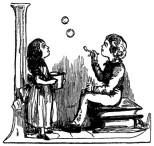
Let those who have a real heartfelt relish for London society, and the privilege of an entrée into its most select circles, admit that Major Pendennis was a man of no ordinary generosity and affection, in the sacrifice which he now made. He gave up London in May—his newspapers and his mornings—his afternoons from club to club, his little confidential visits to my ladies, his rides in Rotten Row, his dinners and his stall at the opera, his rapid escapades to Fulham or Richmond on Saturdays and Sundays, his bow from my Lord Duke or my Lord Marquis at the great London entertainments, and his name in the Morning Post of the succeeding day—his quieter little festivals, more select, secret, and delightful—all these he resigned to lock himself into a lone little country house, with a simple widow and a greenhorn of a son, a mawkish curate, and a little girl of ten years of age.
He made the sacrifice, and it was the greater that few knew the extent of it. His letters came down franked from town, and he showed the invitations to Helen with a sigh. It was beautiful and tragical to see him refuse one party after another—at least to those who could understand, as Helen didn't, the melancholy grandeur of his self-denial. Helen did not, or only smiled at the awful pathos with which the major spoke of the Court Guide in general: but young Pen looked with great respect at the great names upon the superscriptions of his uncle's letters, and listened to the major's stories about the fashionable world with constant interest and sympathy.
The elder Pendennis's rich memory was stored with thousands of these delightful tales, and he poured them into Pen's willing ear with unfailing eloquence. He knew the name and pedigree of every body in the Peerage, and every body's relations. "My dear boy," he would say, with a mournful earnestness and veracity, "you can not begin your genealogical studies too early; I wish to Heavens you would read in Debrett every day. Not so much the historical part (for the pedigrees, between ourselves, are many of them very fabulous, and there are few families that can show such a clear descent as our own) as the account of family alliances, and who is related to whom. I have known a man's career in life blasted, by ignorance on this important, this all-important subject. Why, only last month, at dinner at my Lord Hobanob's, a young man, who has lately been received among us, young Mr. Suckling (author of a work, I believe), began to speak lightly of Admiral Bowser's conduct for ratting to ministers, in what I must own is the most audacious manner. But who do you think sate next and opposite to this Mr. Suckling? Why—why, next to him was Lady Grampound Bowser's daughter, and opposite to him was Lord Grampound Bowser's son-in-law. The infatuated young man went on cutting his jokes at the admiral's expense, fancying that all the world was laughing with him, and I leave you to imagine Lady Hobanob's feelings—Hobanob's!—those of every well-bred man, as the wretched intru was so exposing himself. He will never dine again in South-street. I promise you that."
With such discourses the major entertained his nephew, as he paced the terrace in front of the house for his two hours' constitutional walk, or as they sate together after dinner over their wine. He grieved that Sir Francis Clavering had not come down to the park, to live in it since his marriage, and to make a society for the neighborhood. He mourned that Lord Eyrie was not in the country, that he might take Pen and present him to his lordship. "He has daughters," the major said. "Who knows? you might have married Lady Emily or Lady Barbara Trehawk: but all those dreams are over; my poor fellow, you must lie on the bed which you have made for yourself."
These things to hear did young Pendennis seriously incline. They are not so interesting in print as when delivered orally; but the major's anecdotes of the great George, of the royal dukes, of the statesmen, beauties, and fashionable ladies of the day, filled young Pen's soul with longing and wonder; and he found the conversations with his guardian, which sadly bored and perplexed poor Mrs. Pendennis, for his own part, never tedious.
It can't be said that Mr. Pen's new guide, philosopher and friend, discoursed him on the most elevated subjects, or treated the subjects which he chose in the most elevated manner. But his morality, such as it was, was consistent. It might not, perhaps, tend to a man's progress in another world, but it was pretty well calculated to advance his interests in this: and then it must be remembered, that the major never for one instant doubted that his views were the only views practicable, and that his conduct was perfectly virtuous and respectable. He was a man of honor, in a word; and had his eyes, what he called, open. He took pity on this young greenhorn of a nephew, and wanted to open his eyes too.
No man, for instance, went more regularly to church, when in the country, than the old bachelor. "It don't matter so much in town, Pen," he said, "for there the women go, and the men are not missed. But when a gentleman is sur ses terres, he must give an example to the country people; and if I could turn a tune, I even think I should sing. The Duke of Saint David's, whom I have the honor of knowing, always sings in the country, and let me tell you, it has a doosed fine effect from the family pew. And you are somebody down here. As long as the Claverings are away you are the first man in the parish; and as good as any. You might represent the town if you played your cards well. Your poor dear father would have done so had he lived; so might you.—Not if you marry a lady, however amiable, whom the country people won't meet.—Well, well: it's a painful subject. Let us change it, my boy." But if Major Pendennis changed the subject once, he recurred to it a score of times in the day; and the moral of his discourse always was, that Pen was throwing himself away. Now it does not require much coaxing or wheedling to make a simple boy believe that he is a very fine fellow.
Pen took his uncle's counsels to heart. He was glad enough, we have said, to listen to his elder's talk. The conversation of Captain Costigan became by no means pleasant to him, and the idea of that tipsy old father-in-law haunted him with terror. He couldn't bring that man, unshaven and reeking of punch, to associate with his mother. Even about Emily—he faltered when the pitiless guardian began to question him. "Was she accomplished?" He was obliged to own, no. "Was she clever?" Well, she had a very good average intellect: but he could not absolutely say she was clever. "Come, let us see some of her letters." So Pen confessed that he had but those three of which we have made mention—and that they were but trivial invitations or answers.
"She is cautious enough," the major said, drily. "She is older than you, my poor boy;" and then he apologized with, the utmost frankness and humility, and flung himself upon Pen's good feelings, begging the lad to excuse a fond old uncle, who had only his family's honor in view—for Arthur was ready to flame up in indignation whenever Miss Costigan's honesty was doubted, and swore that he would never have her name mentioned lightly, and never, never would part from her.
He repeated this to his uncle and his friends at home, and also, it must be confessed, to Miss Fotheringay and the amiable family at Chatteries, with whom he still continued to spend some portion of his time. Miss Emily was alarmed when she heard of the arrival of Pen's guardian, and rightly conceived that the major came down with hostile intentions to herself. "I suppose ye intend to leave me, now your grand relation, has come down from town. He'll carry ye off, and you'll forget your poor Emily, Mr. Arthur!"
Forget her! In her presence, in that of Miss Rouncy, the Columbine and Milly's confidential friend, of the company, in the presence of the captain himself, Pen swore he never could think of any other woman but his beloved Miss Fotheringay; and the captain, looking up at his foils, which were hung as a trophy on the wall of the room where Pen and he used to fence, grimly said, he would not advoise any man to meddle rashly with the affections of his darling child; and would never believe his gallant young Arthur, whom he treated as his son, whom he called his son, would ever be guilty of conduct so revolting to every idaya of honor and humanity.
He went up and embraced Pen after speaking. He cried, and wiped his eye with one large dirty hand as he clasped Pen with the other. Arthur shuddered in that grasp, and thought of his uncle at home. His father-in-law looked unusually dirty and shabby; the odor of whisky-and-water was even more decided than in common. How was he to bring that man and his mother together? He trembled when he thought that he had absolutely written to Costigan (inclosing to him a sovereign, the loan of which the worthy gentleman had need), saying, that one day he hoped to sign himself his affectionate son, Arthur Pendennis. He was glad to get away from Chatteries that day; from Miss Rouncy the confidante; from the old toping father-in-law; from the divine Emily herself. "O Emily, Emily," he cried inwardly, as he tattled homeward on Rebecca, "you little know what sacrifices I am making for you!—for you who are always so cold, so cautious, so mistrustful;" and he thought of a character in Pope to whom he had often involuntarily compared her.
Pen never rode over to Chatteries upon a certain errand, but the major found out on what errand the boy had been. Faithful to his plan, Major Pendennis gave his nephew no let or hindrance; but somehow the constant feeling that the senior's eye was upon him, an uneasy shame attendant upon that inevitable confession which the evening's conversation would be sure to elicit in the most natural, simple manner, made Pen go less frequently to sigh away his soul at the feet of his charmer than he had been wont to do previous to his uncle's arrival. There was no use trying to deceive him: there was no pretext of dining with Smirke, or reading Greek plays with Foker; Pen felt, when he returned from one of his flying visits, that every body knew whence he came, and appeared quite guilty before his mother and guardian, over their books or their game at picquet.
Once having walked out half a mile, to the Fairoaks Inn, beyond the lodge gates, to be in readiness for the Competitor coach, which changed horses there, to take a run for Chatteries, a man on the roof touched his hat to the young gentleman: it was his uncle's man, Mr. Morgan, who was going on a message for his master, and had been took up at the lodge, as he said. And Mr. Morgan came back by the Rival, too; so that Pen had the pleasure of that domestic's company both ways. Nothing was said at home. The lad seemed to have every decent liberty; and yet he felt himself dimly watched and guarded, and that there were eyes upon him even in the presence of his Dulcinea.
In fact, Pen's suspicions were not unfounded, and his guardian had sent forth to gather all possible information regarding the lad and his interesting young friend. The discreet and ingenious Mr. Morgan, a London confidential valet, whose fidelity could be trusted, had been to Chatteries more than once, and made every inquiry regarding the past history and present habits of the captain and his daughter. He delicately cross-examined the waiters, the ostlers, and all the inmates of the bar at the George, and got from them what little they knew respecting the worthy captain. He was not held in very great regard there, as it appeared. The waiters never saw the color of his money, and were warned not to furnish the poor gentleman with any liquor for which some other party was not responsible. He swaggered sadly about the coffee-room there, consumed a tooth-pick, and looked over the paper, and if any friend asked him to dinner, he staid. Morgan heard at the George of Pen's acquaintance with Mr. Foker, and he went over to Baymouth to enter into relations with that gentleman's man: but the young student was gone to a Coast Regatta, and his servant, of course, traveled in charge of the dressing-case.
From the servants of the officers at the barracks Mr. Morgan found that the captain had so frequently and outrageously inebriated himself there, that Colonel Swallowtail had forbidden him the mess-room. The indefatigable Morgan then put himself in communication with some of the inferior actors at the theater, and pumped them over their cigars and punch, and all agreed that Costigan was poor, shabby, and given to debt and to drink. But there was not a breath upon the reputation of Miss Fotheringay; her father's courage was reported to have displayed itself on more than one occasion toward persons disposed to treat his daughter with freedom. She never came to the theater but with her father; in his most inebriated moments, that gentleman kept a watch over her; finally Mr. Morgan, from his own experience, added that he had been to see her hact, and was uncommon delighted with the performance, besides thinking her a most splendid woman.
Mrs. Creed, the pew-opener, confirmed these statements to Doctor Portman, who examined her personally, and threatened her with the terrors of the Church, one day after afternoon service. Mrs. Creed had nothing unfavorable to her lodger to divulge. She saw nobody; only one or two ladies of the theater. The captain did intoxicate himself sometimes, and did not always pay his rent regularly, but he did when he had money, or rather Miss Fotheringay did. Since the young gentleman from Clavering had been and took lessons in fencing, one or two more had come from the barracks: Sir Derby Oaks, and his young friend, Mr. Foker, which was often together: and which was always driving over from Baymouth in the tandem. But on the occasions of the lessons, Miss F. was very seldom present, and generally came down stairs to Mrs. Creed's own room.
The doctor and the major consulting together as they often did, groaned in spirit over that information. Major Pendennis openly expressed his disappointment; and, I believe the divine himself was ill-pleased at not being able to pick a hole in poor Miss Fotheringay's reputation.
Even about Pen himself, Mrs. Creed's reports were desperately favorable. "Whenever he come," Mrs. Creed said, "she always have me or one of the children with her. And Mrs. Creed, marm, says she, if you please marm, you'll on no account leave the room when that young gentleman's here. And many's the time I've seen him a lookin' as if he wished I was away, poor young man: and he took to coming in service-time, when I wasn't at home, of course: but she always had one of the boys up if her pa wasn't at home, or old Mr. Bowser with her a teaching of her her lesson, or one of the young ladies of the theayter."
It was all true: whatever encouragements might have been given him before he avowed his passion, the prudence of Miss Emily was prodigious after Pen had declared himself: and the poor fellow chafed against her hopeless reserve, which maintained his ardor as it excited his anger.
The major surveyed the state of things with a sigh. "If it were but a temporary liaison," the excellent man said, "one could bear it. A young fellow must sow his wild oats and that sort of thing. But a virtuous attachment is the deuce. It comes from the d—d romantic notions boys get from being brought up by women."
"Allow me to say, major, that you speak a little too like a man of the world," replied the doctor. "Nothing can be more desirable for Pen than a virtuous attachment for a young lady of his own rank and with a corresponding fortune—this present infatuation, of course, I must deplore as sincerely as you do. If I were his guardian I should command him to give it up."
"The very means, I tell you, to make him marry to-morrow. We have got time from him, that is all, and we must do our best with that."
"I say, major," said the doctor, at the end of the conversation in which the above subject was discussed—"I am not, of course, a play-going man—but suppose, I say, we go and see her."
The major laughed—he had been a fortnight at Fairoaks, and strange to say, had not thought of that. "Well," he said, "why not? After all, it is not my niece, but Miss Fotheringay the actress, and we have as good a right as any other of the public to see her if we pay our money." So upon a day when it was arranged that Pen was to dine at home, and pass the evening with his mother, the two elderly gentlemen drove over to Chatteries in the doctor's chaise, and there, like a couple of jolly bachelors, dined at the George Inn, before proceeding to the play.
Only two other guests were in the room—an officer of the regiment quartered at Chatteries, and a young gentleman whom the doctor thought he had somewhere seen. They left them at their meal, however, and hastened to the theater. It was Hamlet over again. Shakspeare was Article XL. of stout old Dr. Portman's creed, to which he always made a point of testifying publicly at least once in a year.
We have described the play before, and how those who saw Miss Fotheringay perform in Ophelia saw precisely the same thing on one night as on another. Both the elderly gentlemen looked at her with extraordinary interest, thinking how very much young Pen was charmed with her.
"Gad," said the major, between his teeth, as he surveyed her, when she was called forward as usual, and swept her courtesies to the scanty audience, "the young rascal has not made a bad choice."
The doctor applauded her loudly and loyally. "Upon my word," said he, "she is a very clever actress; and I must say, major, she is endowed with very considerable personal attractions."
"So that young officer thinks in the stage-box," Major Pendennis answered, and he pointed out to Doctor Portman's attention the young dragoon of the George Coffee-room, who sat in the box in question, and applauded with immense enthusiasm. She looked extremely sweet upon him too, thought the major: but that's their way—and he shut up his natty opera-glass and pocketed it, as if he wished to see no more that night. Nor did the doctor, of course, propose to stay for the after-piece, so they rose and left the theater; the doctor returning to Mrs. Portman, who was on a visit at the Deanery, and the major walking home full of thought toward the George, where he had bespoken a bed.
CHAPTER X.
FACING THE ENEMY.
Sauntering slowly homeward Major Pendennis reached the George presently, and found Mr. Morgan his faithful valet, awaiting him at the door of the George Inn, who stopped his master as he was about to take a candle to go to bed, and said, with his usual air of knowing deference, "I think, sir, if you would go into the coffee-room, there's a young gentleman there as you would like to see."
"What, is Mr. Arthur here?" the major said, in great anger.
"No, sir—but his great friend, Mr. Foker, sir. Lady Hagnes Foker's son is here, sir. He's been asleep in the coffee-room since he took his dinner, and has just rung for his coffee, sir. And I think, p'raps, you might like to git into conversation with him," the valet said, opening the coffee-room door.
The major entered; and there indeed was Mr. Foker, the only occupant of the place. He was rubbing his eyes, and sate before a table decorated with empty decanters and relics of dessert. He had intended to go to the play too, but sleep had overtaken him after a copious meal, and he had flung up his legs on the bench, and indulged in a nap instead of the dramatic amusement. The major was meditating how to address the young man, but the latter prevented him that trouble.
"Like to look at the evening paper, sir?" said Mr. Foker, who was always communicative and affable; and he took up the Globe from his table, and offered it to the new comer.
"I am very much obliged to you," said the major, with a grateful bow and smile. "If I don't mistake the family likeness, I have the pleasure of speaking to Mr. Henry Foker, Lady Agnes Foker's son. I have the happiness to name her ladyship among my acquaintances—and you bear, sir, a Rosherville face."
"Hullo! I beg your pardon," Mr. Foker said, "I took you"—he was going to say—"I took you for a commercial gent." But he stopped that phrase. "To whom have I the pleasure of speaking?" he added.
"To a relative of a friend and schoolfellow of yours—Arthur Pendennis, my nephew, who has often spoken to me about you in terms of great regard. I am Major Pendennis, of whom you may have heard him speak. May I take my soda-water at your table? I have had the pleasure of sitting at your grandfather's."
"Sir, you do me proud," said Mr. Foker, with much courtesy. "And so you are Arthur Pendennis's uncle, are you?"
"And guardian," added the major.
"He's as good a fellow as ever stepped, sir," said Mr. Foker.
"I am glad you think so."
"And clever, too—I was always a stupid chap, I was—but you see, sir, I know 'em when they are clever, and like 'em of that sort.
"You show your taste and your modesty, too," said the major. "I have heard Arthur repeatedly speak of you, and he said your talents were very good."
"I'm not good at the books," Mr. Foker said, wagging his head—"never could manage that—Pendennis could—he used to do half the chaps' verses—and yet"—the young gentleman broke out—"you are his guardian; and I hope you will pardon me for saying that I think he is what we call a flat," the candid young gentleman said.
The major found himself on the instant in the midst of a most interesting and confidential conversation. "And how is Arthur a flat?" he asked, with a smile.
"You know," Foker answered, winking at him—he would have winked at the Duke of Wellington with just as little scruple, for he was in that state of absence, candor, and fearlessness, which a man sometimes possesses after drinking a couple of bottles of wine—"You know Arthur's a flat—about women I mean."
"He is not the first of us, my dear Mr. Harry," answered the major. "I have heard something of this—but pray tell me more.'"
"Why, sir, see—it's partly my fault. He went to the play one night—for you see I'm down here readin' for my little-go during the Long, only I come over from Baymouth pretty often in my drag—well, sir, we went to the play, and Pen was struck all of a heap with Miss Fotheringay—Costigan her real name is—an uncommon fine gal she is too; and the next morning I introduced him to the general, as we call her father—a regular old scamp—and such a boy for the whisky-and-water!—and he's gone on being intimate there. And he's fallen in love with her—and I'm blessed if he hasn't proposed to her," Foker said, slapping his hand on the table, until all the dessert began to jingle.
"What! you know it too?" asked the major.
"Know it! don't I? and many more too. We were talking about it at mess, yesterday, and chaffing Derby Oaks—until he was as mad as a hatter. Know Sir Derby Oaks? We dined together, and he went to the play; we were standing at the door smoking, I remember, when you passed in to dinner."
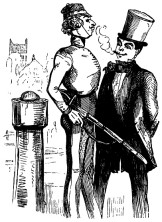
"I remember Sir Thomas Oaks, his father, before he was a baronet or a knight; he lived in Cavendish-square, and was Physician to Queen Charlotte."
"The young one is making the money spin, I can tell you," Mr. Foker said.
"And is Sir Derby Oaks," the major said, with great delight and anxiety, "another soupirant?"
"Another what?" inquired Mr. Foker.
"Another admirer of Miss Fotheringay?"
"Lord bless you! we call him, Mondays, Wednesdays, and Fridays, and Pen, Tuesdays, Thursdays, and Saturdays. But, mind you, nothing wrong! No, no! Miss F. is a deal too wide awake for that, Major Pendennis. She plays one off against the other. What you call two strings to her bow."
"I think you seem tolerably wide awake, too, Mr. Foker," Pendennis said, laughing.
"Pretty well thank you, sir—how are you?" Foker replied, imperturbably. "I'm not clever, p'raps: but I am rather downy; and partial friends say I know what's o'clock tolerably well. Can I tell you the time of day in any way?"
"Upon my word," the major answered, quite delighted, "I think you may be of very great service to me. You are a young man of the world, and with such one likes to deal. And as such I need not inform you that our family is by no means delighted at this absurd intrigue in which Arthur is engaged."
"I should rather think not," said Mr. Foker. "Connection not eligible. Too much beer drunk on the premises. No Irish need apply. That I take to be your meaning."
The major said it was, exactly; though in truth he did not quite understand what Mr. Foker's meaning was: and he proceeded to examine his new acquaintance regarding the amiable family into which his nephew proposed to enter, and soon got from the candid witness a number of particulars regarding the house of Costigan.
We must do Mr. Foker the justice to say that he spoke most favorably of Mr. and Miss Costigan's moral character. "You see," said he, "I think the general is fond of the jovial bowl, and if I wanted to be very certain of my money, it isn't in his pocket I'd invest it—but he has always kept a watchful eye on his daughter, and neither he nor she will stand any thing but what's honorable. Pen's attentions to her are talked about in the whole Company, and I hear all about them from a young lady who used to be very intimate with her, and with whose family I sometimes take tea in a friendly way. Miss Rouncy says, Sir Derby Oaks has been hanging about Miss Fotheringay ever since his regiment has been down here; but Pen has come in and cut him out lately, which has made the baronet so mad, that he has been very near on the point of proposing too. Wish he would; and you'd see which of the two Miss Fotheringay would jump at."
"I thought as much," the major said. "You give me a great deal of pleasure, Mr. Foker. I wish I could have seen you before."
"Didn't like to put in my oar," replied the other. "Don't speak till I'm asked, when, if there's no objections, I speak pretty freely. Heard your man had been hankering about my servant—didn't know myself what was going on until Miss Fotheringay and Miss Rouncy had the row about the ostrich feathers, when Miss R. told me every thing."
"Miss Rouncy, I gather, was the confidante of the other."
"Confidant? I believe you. Why she's twice as clever a girl as Fotheringay, and literary and that, while Miss Foth can't do much more than read."
"She can write," said the major, remembering Pen's breast pocket.
Foker broke out into a sardonic "He, he! Rouncy writes her letters," he said; "every one of 'em; and since they've quarreled, she don't know how the deuce to get on. Miss Rouncy is an uncommon pretty hand, whereas the old one makes dreadful work of the writing and spelling when Bows ain't by. Rouncy's been settin' her copies lately—she writes a beautiful hand, Rouncy does."
"I suppose you know it pretty well," said the major archly: upon which Mr. Foker winked at him again.
"I would give a great deal to have a specimen of her handwriting," continued Major Pendennis, "I dare say you could give me one."
"No, no, that would be too bad," Foker replied. "Perhaps I oughtn't to have said as much as I have. Miss F.'s writin' ain't so very bad, I dare say; only she got Miss R. to write the first letter, and has gone on ever since. But you mark my word, that till they are friends again the letters will stop."
"I hope they will never be reconciled," the major said, with great sincerity; "and I can't tell you how delighted I am to have had the good fortune of making your acquaintance. You must feel, my dear sir, as a man of the world, how fatal to my nephew's prospects in life is this step which he contemplates, and how eager we all must be to free him from this absurd engagement."
"He has come out uncommon strong," said Mr. Foker; "I have seen his verses; Rouncy copied 'em. And I said to myself when I saw 'em, 'Catch me writin' verses to a woman—that's all.'"
"He has made a fool of himself, as many a good fellow has before him. How can we make him see his folly and cure it? I am sure you will give us what aid you can in extricating a generous young man from such a pair of schemers as this father and daughter seem to be. Love on the lady's side is out of the question."
"Love, indeed!" Foker said. "If Pen hadn't two thousand a year when he came of age—"
"If Pen hadn't what?" cried out the major, in astonishment.
"Two thousand a year: hasn't he got two thousand a year?—the general says he has."
"My dear friend," shrieked out the major, with an eagerness which this gentleman rarely showed, "thank you!—thank you!—I begin to see now.—Two thousand a year! Why, his mother has but five hundred a year in the world.—She is likely to live to eighty, and Arthur has not a shilling but what she can allow him."
"What! he ain't rich then?" Foker asked.
"Upon my honor, he has no more than what I say."
"And you ain't going to leave him any thing?"
The major had sunk every shilling he could scrape together on annuity, and of course was going to leave Pen nothing; but he did not tell Foker this. "How much do you think a major on half-pay can save?" he asked. "If these people have been looking at him as a fortune, they are utterly mistaken—and—and you have made me the happiest man in the world."
"Sir to you," said Mr. Foker, politely, and when they parted for the night they shook hands with the greatest cordiality; the younger gentleman promising the elder not to leave Chatteries without a further conversation in the morning. And as the major went up to his room, and Mr. Foker smoked his cigar against the door pillars of the George, Pen, very likely, ten miles off, was lying in bed kissing the letter from his Emily.
The next morning before Mr. Foker drove off in his drag, the insinuating major had actually got a letter of Miss Rouncy's in his own pocket-book. Let it be a lesson to women how they write. And in very high spirits Major Pendennis went to call upon Doctor Portman at the Deanery, and told him what happy discoveries he had made on the previous night. As they sat in confidential conversation in the dean's oak breakfast parlor, they could look across the lawn and see Captain Costigan's window, at which poor Pen had been only too visible some three weeks since. The doctor was most indignant against Mrs. Creed the landlady, for her duplicity, in concealing Sir Derby Oaks's constant visits to her lodgers, and threatened to excommunicate her out of the cathedral. But the wary major thought that all things were for the best; and, having taken counsel with himself over night, felt himself quite strong enough to go and face Captain Costigan.
"I'm going to fight the dragon," he said, with a laugh, to Doctor Portman.
"And I shrive you, sir, and bid good fortune go with you," answered the doctor. Perhaps he and Mrs. Portman and Miss Mira, as they sate with their friend the dean's lady, in her drawing-room, looked up more than once at the enemy's window to see if they could perceive any signs of the combat.
The major walked round, according to the directions given him, and soon found Mrs. Creed's little door. He passed in, and as he ascended to Captain Costigan's apartment, he could hear a stamping of feet, and a great shouting of "Ha, ha!" within.
"It's Sir Derby Oaks taking his fencing lesson," said the child, who piloted Major Pendennis. "He takes it Mondays, Wednesdays, and Fridays."
The major knocked, and at length a tall gentleman came forth, with a foil and mask in one hand, and a fencing glove on the other.
Pendennis made him a deferential bow. "I believe I have the honor of speaking to Captain Costigan.—My name is Major Pendennis."
The captain brought his weapon up to the salute, and said—"Major, the honor is moine; I'm deloighted to see ye."
CHAPTER XI.
NEGOTIATION.

The major and Captain Costigan were old soldiers and accustomed to face the enemy, so we may presume that they retained their presence of mind perfectly; but the rest of the party assembled in Cos's sitting-room were, perhaps, a little flurried at Pendennis's apparition. Miss Fotheringay's slow heart began to beat, no doubt, for her cheek flushed up with a great healthy blush, as Lieutenant Sir Derby Oaks looked at her with a scowl. The little crooked old man in the window-seat, who had been witnessing the fencing-match between the two gentlemen (whose stamping and jumping had been such as to cause him to give up all attempts to continue writing the theater music, in the copying of which he had been engaged) looked up eagerly toward the new comer as the major of the well-blacked boots entered the apartment distributing the most graceful bows to every body present.
"Me daughter—me friend, Mr. Bows—me gallant young pupil and friend, I may call 'um, Sir Derby Oaks," said Costigan splendidly waving his hand, and pointing each of these individuals to the major's attention. "In one moment, meejor, I'm your humble servant," and to dash into the little adjoining chamber where he slept, to give a twist to his lank hair with his hair-brush (a wonderful and ancient piece), to tear off his old stock and put on a new one which Emily had constructed for him, and to assume a handsome clean collar, and the new coat which had been ordered upon the occasion of Miss Fotheringay's benefit, was with the still active Costigan the work of a minute.
After him, Sir Derby entered, and presently emerged from the same apartment, where he also cased himself in his little shell-jacket, which fitted tightly upon the young officer's big person; and which he, and Miss Fotheringay, and poor Pen too, perhaps, admired prodigiously.
Meanwhile conversation was engaged between the actress and the new comer; and the usual remarks about the weather had been interchanged before Costigan re-entered in his new "shoot," as he called it.
"I needn't apologize to ye, meejor," he said, in his richest and most courteous manner, "for receiving ye in me shirt-sleeves."
"An old soldier can't be better employed than in teaching a young one the use of his sword," answered the major, gallantly. "I remember in old times hearing that you could use yours pretty well, Captain Costigan."
"What, ye've heard of Jack Costigan, major," said the other, greatly.
The major had, indeed; he had pumped his nephew concerning his new friend, the Irish officer; and whether he had no other knowledge of the captain than what he had thus gained, or whether he actually remembered him, we can not say. But Major Pendennis was a person of honor and undoubted veracity, and said that he perfectly well recollected meeting Mr. Costigan, and hearing him sing, at Sir Richard Strachan's table at Walcheren.
At this information, and the bland and cordial manner in which it was conveyed, Bows looked up, entirely puzzled. "But we will talk of these matters another time," the major continued, perhaps not wishing to commit himself; "it is to Miss Fotheringay that I came to pay my respects to-day;" and he performed another bow for her, so courtly and gracious, that if she had been a duchess he could not have made it more handsome.
"I had heard of your performances from my nephew, madam," the major said, "who raves about you, as I believe you know pretty well. But Arthur is but a boy, and a wild enthusiastic young fellow, whose opinions one must not take au pied de la lettre; and I confess I was anxious to judge for myself. Permit me to say your performance delighted and astonished me. I have seen our best actresses, and, on my word, I think you surpass them all. You are as majestic as Mrs. Siddons."
"Faith, I always said so," Costigan said, winking at his daughter; "Major take a chair." Milly rose at this hint, took an unripped satin garment off the only vacant seat, and brought the latter to Major Pendennis with one of her finest courtesies.
"You are as pathetic as Miss O'Neill," he continued, bowing and seating himself; "your snatches of song reminded me of Mrs. Jordan in her best time, when we were young men, Captain Costigan; and your manner reminded me of Mars. Did you ever see the Mars, Miss Fotheringay?"
"There was two Mahers in Crow-street," remarked Miss Emily; "Fanny was well enough, but Biddy was no great things."
"Sure, the major means the god of war, Milly, my dear," interposed the parent.
"It is not that Mars I meant, though Venus, I suppose, may be pardoned for thinking about him;" the major replied, with a smile directed in full to Sir Derby Oaks, who now re-entered in his shell-jacket, but the lady did not understand the words of which he made use, nor did the compliment at all pacify Sir Derby, who, probably, did not understand it either, and at any rate received it with great sulkiness and stiffness; scowling uneasily at Miss Fotheringay, with an expression which seemed to ask, "What the deuce does this man here?"
Major Pendennis was not in the least annoyed by the gentleman's ill-humor. On the contrary, it delighted him. "So," thought he, "a rival is in the field;" and he offered up vows that Sir Derby might be, not only a rival, but a winner too, in this love-match in which he and Pen were engaged.
"I fear I interrupted your fencing lesson; but my stay in Chatteries is very short, and I was anxious to make myself known to my old fellow-campaigner Captain Costigan, and to see a lady nearer who had charmed me so much from the stage. I was not the only man épris last night, Miss Fotheringay (if I must call you so, though your own family name is a very ancient and noble one). There was a reverend friend of mine, who went home in raptures with Ophelia; and I saw Sir Derby Oaks fling a bouquet, which no actress ever merited better. I should have brought one myself, had I known what I was going to see. Are not those the very flowers in a glass of water on the mantle-piece yonder?"
"I am very fond of flowers," said Miss Fotheringay, with a languishing ogle at Sir Derby Oaks—but the baronet still scowled sulkily.
"Sweets to the sweet—isn't that the expression of the play?" Mr. Pendennis asked, bent upon being good-humored.
"'Pon my life, I don't know. Very likely it is. I ain't much of a literary man," answered Sir Derby.
"Is it possible?" the major continued, with an air of surprise. "You don't inherit your father's love of letters, then, Sir Derby? He was a remarkably fine scholar, and I had the honor of knowing him very well."
"Indeed," said the other, and gave a sulky wag of his head.
"He saved my life," continued Pendennis.
"Did he now?" cried Miss Fotheringay, rolling her eyes first upon the major with surprise, then toward Sir Derby with gratitude—but the latter was proof against those glances; and far from appearing to be pleased that the apothecary, his father, should have saved Major Pendennis's life, the young man actually looked as if he wished the event had turned the other way.
"My father, I believe, was a very good doctor," the young gentleman said, by way of reply. "I'm not in that line myself. I wish you good morning, sir. I've got an appointment—Cos, by-by—Miss Fotheringay, good morning." And, in spite of the young lady's imploring looks and appealing smiles, the dragoon bowed stiffly out of the room, and the clatter of his saber was heard as he strode down the creaking stair; and the angry tones of his voice as he cursed little Tom Creed, who was disporting in the passage, and whose peg-top Sir Derby kicked away with an oath into the street.
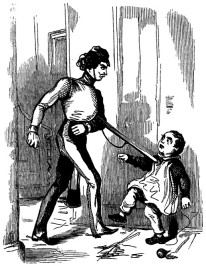
The major did not smile in the least, though he had every reason to be amused. "Monstrous handsome young man that—as fine a looking soldier as ever I saw," he said to Costigan.
"A credit to the army and to human nature in general," answered Costigan. "A young man of refoined manners, polite affabilitee, and princely fortune. His table is sumptuous: he's adawr'd in the regiment: and he rides sixteen stone."
"A perfect champion," said the major, laughing. "I have no doubt all the ladies admire him."
"He's very well in spite of his weight, now he's young," said Milly; "but he's no conversation."
"He's best on horseback," Mr. Bows said: on which Milly replied, that the baronet had ridden third in the steeple-chase on his horse Tareaways, and the major began to comprehend that the young lady herself was not of a particular genius, and to wonder how she should be so stupid and act so well.
Costigan, with Irish hospitality, of course pressed refreshment upon his guest: and the major, who was no more hungry than you are after a Lord Mayor's dinner, declared that he should like a biscuit and a glass of wine above all things, as he felt quite faint from long fasting—but he knew that to receive small kindnesses flatters the donors very much, and that people must needs grow well disposed toward you as they give you their hospitality.
"Some of the old Madara, Milly, love," Costigan said, winking to his child—and that lady, turning to her father a glance of intelligence, went out of the room, and down the stair, where she softly summoned her little emissary Master Tommy Creed; and giving him a piece of money, ordered him to go buy a pint of Madara wine at the Grapes, and sixpennyworth of sorted biscuits at the baker's, and to return in a hurry, when he might have two biscuits for himself.
While Tommy Creed was gone on this errand, Miss Costigan sate below with Mrs. Creed, telling her landlady how Mr. Arthur Pendennis's uncle, the major, was above stairs; a nice, soft-spoken old gentleman: that butter wouldn't melt in his mouth; and how Sir Derby had gone out of the room in a rage of jealousy, and thinking what must be done to pacify both of them.
"She keeps the keys of the cellar, major," said Mr. Costigan, as the girl left the room.
"Upon my word you have a very beautiful butler," answered Pendennis, gallantly, "and I don't wonder at the young fellows raving about her. When we were of their age, Captain Costigan, I think plainer women would have done our business."
"Faith, and ye may say that, sir—and lucky is the man who gets her. Ask me friend Bob Bows here whether Miss Fotheringay's moind is not even shuparior to her person, and whether she does not possess a cultiveated intellect, a refoined understanding, and an emiable disposition?"
"O, of course," said Mr. Bows, rather drily. "Here comes Hebe blushing from the cellar. Don't you think it is time to go to rehearsal, Miss Hebe? You will be fined if you are later"—and he gave the young lady a look, which intimated that they had much better leave the room and the two elders together.
At this order Miss Hebe took up her bonnet and shawl, looking uncommonly pretty, good-humored, and smiling; and Bows gathered up his roll of papers, and hobbled across the room for his hat and cane.
"Must you go?" said the major. "Can't you give us a few minutes more, Miss Fotheringay? Before you leave us, permit an old fellow to shake you by the hand, and believe that I am proud to have had the honor of making your acquaintance, and am most sincerely anxious to be your friend."
Miss Fotheringay made a low courtesy at the conclusion of this gallant speech, and the major followed her retreating steps to the door, where he squeezed her hand with the kindest and most paternal pressure. Bows was puzzled with this exhibition of cordiality: "The lad's relatives can't be really wanting to marry him to her," he thought—and so they departed.
"Now for it," thought Major Pendennis: and as for Mr. Costigan he profited instantaneously by his daughter's absence to drink up the rest of the wine; and tossed off one bumper after another of the Madeira from the Grapes, with an eager, shaking hand. The major came up to the table, and took up his glass and drained it with a jovial smack. If it had been Lord Steyne's particular, and not public-house Cape, he could not have appeared to relish it more.
"Capital Madeira, Captain Costigan," he said. "Where do you get it? I drink the health of that charming creature in a bumper. Faith, captain, I don't wonder that the men are wild about her. I never saw such eyes in my life, or such a grand manner. I am sure she is as intellectual as she is beautiful; and I have no doubt she's as good as she is clever."
"A good girl, sir—a good girl, sir," said the delighted father; "and I pledge a toast to her with all my heart. Shall I send to the—to the cellar for another pint? It's handy by. No? Well, indeed, sir, ye may say she is a good girl, and the pride and glory of her father—honest old Jack Costigan. The man who gets her will have a jew'l to a wife, sir; and I drink his health, sir, and ye know who I mean, major."
"I am not surprised at young or old falling in love with her," said the major, "and frankly must tell you, that though I was very angry with my poor nephew Arthur, when I heard of the boy's passion—now I have seen the lady I can pardon him any extent of it. By George, I should like to enter for the race myself, if I wern't an old fellow and a poor one."
"And no better man, major, I'm sure," cried Jack, enraptured. "Your friendship, sir, delights me. Your admiration for my girl brings tears to me eyes—tears, sir—manlee tears—and when she leaves me humble home for your own more splendid mansion, I hope she'll keep a place for her poor old father, poor old Jack Costigan."—The captain suited the action to the word, and his blood-shot eyes were suffused with water, as he addressed the major.
"Your sentiments do you honor," the other said. "But, Captain Costigan, I can't help smiling at one thing you have just said."
"And what's that, sir?" asked Jack, who was at a too heroic and sentimental pitch to descend from it.
"You were speaking about our splendid mansion—my sister's house, I mean."
"I mane the park and mansion of Arthur Pendennis, Esquire, of Fairoaks Park, whom I hope to see a Mimber of Parliament for his native town of Clavering, when he is of ege to take that responsible stetion," cried the captain, with much dignity.
The major smiled as he recognized a shaft out of his own bow. It was he who had set Pen upon the idea of sitting in parliament for the neighboring borough—and the poor lad had evidently been bragging on the subject to Costigan and the lady of his affections. "Fairoaks Park, my dear sir," he said. "Do you know our history? We are of excessively ancient family certainly, but I began life with scarce enough money to purchase my commission, and my eldest brother was a country apothecary; who made every shilling he died possessed of out of his pestle and mortar."
"I have consented to waive that objection, sir," said Costigan majestically, "in consideration of the known respectability of your family."
"Curse your impudence," thought the major; but he only smiled and bowed.
"The Costigans, too, have met with misfortunes; and our house of Castle Costigan is by no manes what it was. I have known very honest men apothecaries, sir, and there's some in Dublin that has had the honor of dining at the Lord Leftenant's teeble."
"You are very kind to give us the benefit of your charity," the major continued: "but permit me to say that is not the question. You spoke just now of my little nephew as heir of Fairoaks Park, and I don't know what besides."
"Funded property, I've no doubt, meejor, and something handsome eventually from yourself."
"My good sir, I tell you the boy is the son of a country apothecary," cried out Major Pendennis; "and that when he comes of age he won't have a shilling."
"Pooh, major, you're laughing at me," said Mr. Costigan, "me young friend, I make no doubt, is heir to two thousand pounds a year."
"Two thousand fiddlesticks! I beg your pardon, my dear sir; but has the boy been humbugging you?—it is not his habit. Upon my word and honor, as a gentleman and an executor to my brother's will too, he left little more than five hundred a year behind him."
"And with aconomy, a handsome sum of money too, sir," the captain answered. "Faith, I've known a man drink his clar't, and drive his coach-and-four on five hundred a year and strict aconomy, in Ireland, sir. We'll manage on it, sir—trust Jack Costigan for that."
"My dear Captain Costigan—I give you my word that my brother did not leave a shilling to his son Arthur."
"Are ye joking with me, Meejor Pendennis?" cried Jack Costigan. "Are ye thrifling with the feelings of a father and a gentleman?"
"I am telling you the honest truth," said Major Pendennis. "Every shilling my brother had, he left to his widow: with a partial reversion, it is true, to the boy. But she is a young woman, and may marry if he offends her—or she may outlive him, for she comes of an uncommonly long-lived family. And I ask you, as a gentleman and a man of the world, what allowance can my sister, Mrs. Pendennis, make to her son out of five hundred a year, which is all her fortune—that shall enable him to maintain himself and your daughter in the rank befitting such an accomplished young lady?"
"Am I to understand, sir, that the young gentleman, your nephew, and whom I have fosthered and cherished as the son of me bosom, is an imposther who has been thrifling with the affections of me beloved child?" exclaimed the general, with an outbreak of wrath.—"Have you yourself been working upon the feelings of the young man's susceptible nature to injuice him to break off an engagement, and with it me adored Emily's heart? Have a care, sir, how you thrifle with the honor of John Costigan. If I thought any mortal man meant to do so, be heavens I'd have his blood, sir—were he old or young."
"Mr. Costigan!" cried out the major.
"Mr. Costigan can protect his own and his daughter's honor, and will, sir," said the other. "Look at that chest of dthrawers, it contains heaps of letthers that that viper has addressed to that innocent child. There's promises there, sir, enough to fill a band-box with; and when I have dragged the scoundthrel before the courts of law, and shown up his perjury and his dishonor, I have another remedy in yondther mahogany case, sir, which shall set me right, sir, with any individual—ye mark me words, Major Pendennis—with any individual who has counseled your nephew to insult a soldier and a gentleman. What? Me daughter to be jilted, and me gray hairs dishonored by an apothecary's son. By the laws of heaven, sir, I should like to see the man that shall do it."
"I am to understand, then, that you threaten in the first place to publish the letters of a boy of eighteen to a woman of eight-and-twenty: and afterward to do me the honor of calling me out," the major said, still with perfect coolness.
"You have described my intentions with perfect accuracy, Meejor Pendennis," answered the captain, as he pulled his ragged whiskers over his chin.
"Well, well; these shall be the subjects of future arrangements, but before we come to powder and ball, my good sir—do have the kindness to think with yourself in what earthly way I have injured you? I have told you that my nephew is dependent upon his mother, who has scarcely more than five hundred a year."
"I have my own opinion of the correctness of that assertion," said the captain.
"Will you go to my sister's lawyers, Messrs. Tatham here, and satisfy yourself?"
"I decline to meet those gentlemen," said the captain, with rather a disturbed air. "If it be as you say, I have been athrociously deceived by some one, and on that person I'll be revenged."
"Is it my nephew?" cried the major, starting up and putting on his hat. "Did he ever tell you that his property was two thousand a year? If he did, I'm mistaken in the boy. To tell lies has not been a habit in our family, Mr. Costigan, and I don't think my brother's son has learned it as yet. Try and consider whether you have not deceived yourself; or adopted extravagant reports from hearsay. As for me, sir, you are at liberty to understand that I am not afraid of all the Costigans in Ireland and know quite well how to defend myself against any threats from any quarter. I come here as the boy's guardian to protest against a marriage, most absurd and unequal, that can not but bring poverty and misery with it; and in preventing it I conceive I am quite as much your daughter's friend (who I have no doubt is an honorable young lady), as the friend of my own family; and prevent the marriage I will, sir, by every means in my power. There, I have said my say, sir."
"But I have not said mine, Major Pendennis—and ye shall hear more from me," Mr. Costigan said, with a look of tremendous severity.
"'Sdeath, sir, what do you mean?" the major asked, turning round on the threshold of the door, and looking the intrepid Costigan in the face.
"Ye said, in the coorse of conversation, that ye were at the George Hotel, I think," Mr. Costigan said, in a stately manner. "A friend shall wait upon ye there before ye leave town, sir."
"Let him make haste, Mr. Costigan," cried out the major, almost beside himself with rage. "I wish you a good morning, sir." And Captain Costigan, bowed a magnificent bow of defiance to Major Pendennis over the landing-place as the latter retreated down the stairs.
CHAPTER XII.
IN WHICH A SHOOTING MATCH IS PROPOSED.
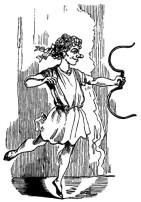
Early mention has been made in this history of Mr. Garbetts, Principal Tragedian, a promising and athletic young actor, of jovial habits and irregular inclinations, with whom and Mr. Costigan there was a considerable intimacy. They were the chief ornaments of the convivial club held at the Magpie Hotel; they helped each other in various bill transactions in which they had been engaged, with the mutual loan of each other's valuable signatures. They were friends, in fine: although Mr. Garbetts seldom called at Costigan's house, being disliked by Miss Fotheringay, of whom in her turn Mrs. Garbetts was considerably jealous. The truth is, that Garbetts had paid his court to Miss Fotheringay and been refused by her, before he offered his hand to Mrs. G. Their history, however, forms no part of our present scheme—suffice it, Mr. Garbetts was called in by Captain Costigan immediately after his daughter and Mr. Bows had quitted the house, as a friend proper to be consulted at the actual juncture. He was a large man, with a loud voice and fierce aspect, who had the finest legs of the whole company, and could break a poker in mere sport across his stalwart arm.
"Run, Tommy," said Mr. Costigan to the little messenger, "and fetch Mr. Garbetts from his lodgings over the tripe shop, ye know, and tell 'em to send two glasses of whisky-and-water, hot, from the Grapes." So Tommy went his way; and presently Mr. Garbetts and the whisky came.
Captain Costigan did not disclose to him the whole of the previous events, of which the reader is in possession; but, with the aid of the spirits-and-water, he composed a letter of a threatening nature to Major Pendennis's address, in which he called upon that gentleman to offer no hindrance to the marriage projected between Mr. Arthur Pendennis and his daughter, Miss Fotheringay, and to fix an early day for its celebration: or, in any other case, to give him the satisfaction which was usual between gentlemen of honor. And should Major Pendennis be disinclined to this alternative, the captain hinted, that he would force him to accept by the use of a horsewhip, which he should employ upon the major's person. The precise terms of this letter we can not give, for reasons which shall be specified presently; but it was, no doubt, couched in the captain's finest style, and sealed elaborately with the great silver seal of the Costigans—the only bit of the family plate which the captain possessed.
Garbetts was dispatched then with this message and letter; and bidding Heaven bless 'um, the general squeezed his embassador's hand, and saw him depart. Then he took down his venerable and murderous dueling pistols, with flint locks, that had done the business of many a pretty fellow in Dublin: and having examined these, and seen that they were in a satisfactory condition, he brought from the drawer all Pen's letters and poems which he kept there, and which he always read before he permitted his Emily to enjoy their perusal.
In a score of minutes Garbetts came back, with an anxious and crestfallen countenance.
"Ye've seen 'um?" the captain said.
"Why, yes," said Garbetts.
"And when is it for?" asked Costigan, trying the lock of one of the ancient pistols, and bringing it to a level with his oi—as he called that blood-shot orb.
"When is what for?" asked Mr. Garbetts.
"The meeting, my dear fellow?"
"You don't mean to say, you mean mortal combat, captain," Garbetts said, aghast.
"What the devil else do I mean, Garbetts?—I want to shoot that man that has trajuiced me honor, or meself dthrop a victim on the sod."
"D—— if I carry challenges," Mr. Garbetts replied. "I'm a family man, captain, and will have nothing to do with pistols—take back your letter;" and, to the surprise and indignation of Captain Costigan, his emissary flung the letter down with its great sprawling superscription and blotched seal.
"Ye don't mean to say ye saw 'um and didn't give 'um the letter?" cried out the captain, in a fury.
"I saw him, but I could not have speech with him, captain," said Mr. Garbetts.
"And why the devil not?" asked the other.
"There was one there I cared not to meet, nor would you," the tragedian answered, in a sepulchral voice. "The minion Tatham was there, captain."
"The cowardly scoundthrel!" roared Costigan. "He's frightened, already going to swear the peace against me."
"I'll have nothing to do with the fighting, mark that," the tragedian doggedly said, "and I wish I'd not seen Tatham neither, nor that bit of—"
"Hold your tongue, Bob Acres. It's my belief ye're no better than a coward," said Captain Costigan, quoting Sir Lucius O'Trigger, which character he had performed with credit, both off and on the stage, and after some more parley between the couple they separated in not very good humor.
Their colloquy has been here condensed, as the reader knows the main point upon which it turned. But the latter will now see how it is impossible to give a correct account of the letter which the captain wrote to Major Pendennis, as it was never opened at all by that gentleman.
When Miss Costigan came home from rehearsal, which she did in the company of the faithful Mr. Bows, she found her father pacing up and down their apartment in a great state of agitation, and in the midst of a powerful odor of spirits-and-water, which, as it appeared, had not succeeded in pacifying his disordered mind. The Pendennis papers were on the table surrounding the empty goblets and now useless teaspoon which had served to hold and mix the captain's liquor and his friend's. As Emily entered he seized her in his arms, and cried out "Prepare yourself me child, me blessed child," in a voice of agony, and with eyes brimful of tears.
"Ye're tipsy again, papa," Miss Fotheringay said, pushing back her sire. "Ye promised me ye wouldn't take spirits before dinner."
"It's to forget me sorrows, me poor girl, that I've taken just a drop," cried the bereaved father—"it's to drown me care that I drain the bowl."
"Your care takes a deal of drowning, captain dear," said Bows, mimicking his friend's accent; "what has happened? Has the soft-spoken gentleman in the wig been vexing you?"
"The oily miscreant! I'll have his blood!" roared Cos. Miss Milly, it must be premised, had fled to her room out of his embrace, and was taking off her bonnet and shawl there.
"I thought he meant mischief. He was so uncommon civil," the other said. "What has he come to say?"
"O Bows! He has overwhellum'd me," the captain said. "There's a hellish conspiracy on foot against me poor girl; and it's me opinion that both them Pendennises, nephew and uncle, is two infernal thrators and scoundthrels, who should be conshumed from off the face of the earth."
"What is it? What has happened?" said Mr. Bows, growing rather excited.
Costigan then told him the major's statement that the young Pendennis had not two thousand, nor two hundred pounds a year; and expressed his fury that he should have permitted such an impostor to coax and wheedle his innocent girl, and that he should have nourished such a viper in his own personal bosom. "I have shaken the reptile from me, however," said Costigan; "and as for his uncle, I'll have such a revenge on that old man, as shall make 'um rue the day he ever insulted a Costigan."
"What do you mean, general?" said Bows.
"I mean to have his life, Bows—his villainous skulking life, my boy;" and he rapped upon the battered old pistol-case in an ominous and savage manner. Bows had often heard him appeal to that box of death, with which he proposed to sacrifice his enemies; but the captain did not tell him that he had actually written and sent a challenge to Major Pendennis, and Mr. Bows therefore rather disregarded the pistols in the present instance.
At this juncture Miss Fotheringay returned to the common sitting-room from her private apartment, looking perfectly healthy, happy, and unconcerned, a striking and wholesome contrast to her father, who was in a delirious tremor of grief, anger, and other agitation. She brought in a pair of ex-white satin shoes with her, which she proposed to rub as clean as might be with bread-crumb; intending to go mad with them upon next Tuesday evening in Ophelia, in which character she was to reappear on that night.
She looked at the papers on the table; stopped, as if she was going to ask a question, but thought better of it, and going to the cupboard, selected an eligible piece of bread wherewith she might operate on the satin slippers: and afterward coming back to the table, seated herself there commodiously with the shoes, and then asked her father, in her honest, Irish brogue, "What, have ye got them letthers, and pothry, and stuff, of Master Arthur's out for, pa? Sure ye don't want to be reading over that nonsense."
"O Emilee!" cried the captain, "that boy whom I loved as the boy of mee bosom is only a scoundthrel, and a deceiver, mee poor girl;" and he looked in the most tragical way at Mr. Bows, opposite: who, in his turn, gazed somewhat anxiously at Miss Costigan.
"He! pooh! Sure the poor lad's as simple as a school-boy," she said. "All them children write verses and nonsense."
"He's been acting the part of a viper to this fire-side, and a traitor in this familee," cried the captain. "I tell ye he's no better than an impostor."
"What has the poor fellow done, papa?" asked Emily.
"Done? He has deceived us in the most athrocious manner," Miss Emily's papa said. "He has thrifled with your affections, and outraged my own fine feelings. He has represented himself as a man of property, and it turruns out that he is no betther than a beggar. Haven't I often told ye he had two thousand a year? He's a pauper, I tell ye, Miss Costigan; a depindent upon the bountee of his mother; a good woman, who may marry again, who's likely to live forever, and who has but five hundred a year. How dar he ask ye to marry into a family which has not the means of providing for ye? Ye've been grossly deceived and put upon, Milly, and it's my belief, his old ruffian of an uncle in a wig is in the plot against us."
"That soft old gentleman? What has he been doing, papa?" continued Emily still imperturbable.
Costigan informed Milly, that when she was gone, Major Pendennis told him, in his double-faced Pall Mall polite manner, that young Arthur had no fortune at all, that the major had asked him (Costigan) to go to the lawyers ("wherein he knew the scoundthrels have a bill of mine, and I can't meet them," the captain parenthetically remarked), and see the lad's father's will: and finally that an infernal swindle had been practiced upon him by the pair, and that he was resolved either on a marriage, or on the blood of both of them.
Milly looked very grave and thoughtful, rubbing the white satin shoes. "Sure, if he's no money, there's no use marrying him, papa," she said sententiously.
"Why did the villain say he was a man of prawpertee?" asked Costigan.
"The poor fellow always said he was poor," answered the girl. "'Twas you would have it he was rich, papa—and made me agree to take him."
"He should have been explicit and told us his income, Milly," answered the father. "A young fellow who rides a blood mare, and makes presents of shawls and bracelets, is an impostor, if he has no money:—and as for his uncle, bedad, I'll pull off his wig whenever I see 'um. Bows, here, shall take a message to him and tell him so. Either it's a marriage, or he meets me in the field like a man, or I tweak 'um on the nose in front of his hotel or in the gravel walks of Fairoaks Park before all the county, bedad."
"Bedad you may send somebody else with the message," said Bows, laughing. "I'm a fiddler not a fighting man, captain."
"Pooh, you've no spirit, sir," roared the general. "I'll be my own second, if no one will stand by and see me injured. And I'll take my case of pistols and shoot 'um in the coffee-room of the George."
"And so poor Arthur has no money?" sighed out Miss Costigan, rather plaintively. "Poor lad, he was a good lad too: wild and talking nonsense, with his verses and pothry and that, but a brave, generous boy, and indeed I liked him—and he liked me too," she added, rather softly, and rubbing away at the shoe.
"Why don't you marry him if you like him so?" Mr. Bows said, rather savagely. "He is not more than ten years younger than you are. His mother may relent, and you might go and live and have enough at Fairoaks Park. Why not go and be a lady? I could go on with the fiddle, and the general live on his half-pay. Why don't you marry him? You know he likes you."
"There's others that likes me as well, Bows, that has no money and that's old enough," Miss Milly said sententiously.
"Yes, d—— it," said Bows with a bitter curse—"that are old enough and poor enough and fools enough for any thing."
"There's old fools and young fools too. You've often said so, you silly man," the imperious beauty said, with a conscious glance at the old gentleman. "If Pendennis has not enough money to live upon, it's folly to talk about marrying him; and that's the long and short of it."
"And the boy?" said Mr. Bows. "By Jove! you throw a man away like an old glove, Miss Costigan."
"I don't know what you mean, Bows," said Miss Fotheringay, placidly, rubbing the second shoe. "If he had had half of two thousand a year that papa gave him, or the half of that, I would marry him. But what is the good of taking on with a beggar? We're poor enough already. There's no use in my going to live with an old lady that's testy and cross, maybe, and would grudge me every morsel of meat. (Sure, it's near dinner time, and Suky not laid the cloth yet), and then," added Miss Costigan, quite simply, "suppose there was a family?—why, papa, we shouldn't be as well off as we are now."
"'Deed then, you would not Milly dear," answered the father.
"And there's an end to all the fine talk about Mrs. Arthur Pendennis of Fairoaks Park—the member of Parliament's lady," said Milly, with a laugh. "Pretty carriages and horses we should have to ride!—that you were always talking about, papa! But it's always the same. If a man looked at me, you fancied he was going to marry me; and if he had a good coat, you fancied he was as rich as Crazes."
"—As Cr[oe]sus," said Mr. Bows.
"Well, call 'um what ye like. But it's a fact now that papa has married me these eight years a score of times. Wasn't I to be my Lady Poldoody of Oystherstown castle? Then there was the navy captain at Portsmouth, and the old surgeon at Norwich, and the Methodist preacher here last year, and who knows how many more? Well, I bet a penny, with all your scheming, I shall die Milly Costigan, at last. So poor little Arthur has no money? Stop and take dinner, Bows; we've a beautiful beefsteak pudding."
"I wonder whether she is on with Sir Derby Oaks," thought Bows, whose eyes and thoughts were always watching her. "The dodges of women beat all comprehension; and I am sure she wouldn't let the lad off so easily if she had not some other scheme on hand."
It will have been perceived that Miss Fotheringay, though silent in general, and by no means brilliant as a conversationalist, where poetry, literature, or the fine arts were concerned, could talk freely, and with good sense, too, in her own family circle. She can not justly be called a romantic person: nor were her literary acquirements great: she never opened a Shakspeare from the day she left the stage, nor, indeed, understood it during all the time she adorned the boards: but about a pudding, a piece of needle-work, or her own domestic affairs, she was as good a judge as could be found; and not being misled by a strong imagination or a passionate temper, was better enabled to keep her judgment cool. When, over their dinner, Costigan tried to convince himself and the company, that the major's statement regarding Pen's finances was unworthy of credit, and a mere ruse upon the old hypocrite's part, so as to induce them, on their side, to break off the match, Miss Milly would not, for a moment, admit the possibility of deceit on the side of the adversary: and pointed out clearly that it was her father who had deceived himself, and not poor little Pen, who had tried to take them in. As for that poor lad, she said she pitied him with all her heart. And she ate an exceedingly good dinner, to the admiration of Mr. Bows, who had a remarkable regard and contempt for this woman, during, and after which repast, the party devised upon the best means of bringing this love matter to a close. As for Costigan, his idea of tweaking the major's nose vanished with his supply of after-dinner whisky-and-water; and he was submissive to his daughter, and ready for any plan on which she might decide, in order to meet the crisis which she saw was at hand.
The captain, who, as long as he had a notion that he was wronged, was eager to face and demolish both Pen and his uncle, perhaps shrank from the idea of meeting the former, and asked "what the juice they were to say to the lad if he remained steady to his engagement, and they broke from theirs?" "What? don't you know how to throw a man over?" said Bows; "ask a woman to tell you?" and Miss Fotheringay showed how this feat was to be done simply enough—nothing was more easy. "Papa writes to Arthur to know what settlements he proposes to make in the event of a marriage; and asks what his means are. Arthur writes back and says what he's got, and you'll find it's as the major says, I'll go bail. Then papa writes and says it's not enough, and the match had best be at an end."
"And, of course, you inclose a parting line, in which you say you will always regard him as a brother;" said Mr. Bows, eying her in his scornful way.
"Of course, and so I shall," answered Miss Fotheringay. "He's a most worthy young man I'm sure. I'll thank ye hand me the salt. Them filberts is beautiful."
"And there will be no noses pulled, Cos, my boy? I'm sorry you're balked," said Mr. Bows.
"'Dad I suppose not," said Cos, rubbing his own.—"What'll ye do about them letters, and verses and pomes, Milly, darling?—Ye must send 'em back."
"Wigsby would give a hundred pound for 'em," Bows said, with a sneer.
"'Deed, then he would," said Captain Costigan, who was easily led.
"Papa!" said Miss Milly, "ye wouldn't be for not sending the poor boy his letters back? Them letters and pomes is mine. They were very long and full of all sorts of nonsense, and Latin and things I couldn't understand the half of; indeed I've not read 'em all; but we'll send 'em back to him when the proper time comes." And going to a drawer, Miss Fotheringay took out from it a number of the County Chronicle and Chatteries Champion, in which Pen had written a copy of flaming verses celebrating her appearance in the character of Imogen, and putting by the leaf upon which the poem appeared (for, like ladies of her profession, she kept the favorable printed notices of her performances), she wrapped up Pen's letters, poems, passions, and fancies, and tied them with a piece of string neatly, as she would a parcel of sugar.
Nor was she in the least moved while performing this act. What hours the boy had passed over those papers! What love and longing: what generous faith and manly devotion—what watchful nights and lonely fevers might they tell of! She tied them up like so much grocery, and sate down and made tea afterward with a perfectly placid and contented heart; while Pen was yearning after her, ten miles off; and hugging her image to his soul.
CHAPTER XIII.
A CRISIS.
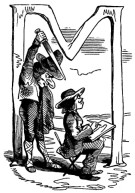
Meanwhile they were wondering at Fairoaks that the major had not returned. Dr. Portman and his lady, on their way home to Clavering, stopped at Helen's lodge-gate, with a brief note for her from Major Pendennis, in which he said he should remain at Chatteries another day, being anxious to have some talk with Messrs. Tatham, the lawyers, whom he would meet that afternoon: but no mention was made of the transaction in which the writer had been engaged during the morning. Indeed the note was written at the pause after the first part of the engagement, and when the major had decidedly had the worst of the battle.
Pen did not care somehow to go into the town while his uncle was there. He did not like to have to fancy that his guardian might be spying at him from that abominable dean's grass-plat, while he was making love in Miss Costigan's drawing-room; and the pleasures of a walk (a delight which he was very rarely permitted to enjoy) would have been spoiled if he had met the man of the polished boots on that occasion. His modest love could not show in public by any outward signs, except the eyes (with which the poor fellow ogled and gazed violently, to be sure), but it was dumb in the presence of third parties; and so much the better, for of all the talk which takes place in this world, that of love-makers is surely, to the uninitiated, the most silly. It is the vocabulary without the key; it is the lamp without the flame. Let the respected reader look or think over some old love-letters that he (or she) has had and forgotten, and try them over again. How blank and meaningless they seem! What glamour of infatuation was it which made that nonsense beautiful? One wonders that such puling and trash could ever have made one happy. And yet there were days when you kissed those silly letters with rapture—lived upon six absurd lines for a week, and until the reactionary period came, when you were restless and miserable until you got a fresh supply of folly.
That is why we decline to publish any of the letters and verses which Mr. Pen wrote at this period of his life, out of mere regard for the young fellow's character. They are too spooney and wild. Young ladies ought not to be called upon to read them in cold blood. Bide your time young women; perhaps you will get and write them on your own account soon. Meanwhile we will respect Mr. Pen's first outpourings, and keep them tied up in the newspapers with Miss Fotheringay's string, and sealed with Captain Costigan's great silver seal.
The major came away from his interview with Captain Costigan in a state of such concentrated fury as rendered him terrible to approach! "The impudent bog-trotting scamp," he thought, "dare to threaten me! Dare to talk of permitting his damned Costigans to marry with the Pendennises! Send me a challenge! If the fellow can get any thing in the shape of a genleman to carry it, I have the greatest mind in life not to balk him.—Psha! what would people say if I were to go out with a tipsy mountebank, about a row with an actress in a barn!" So when the major saw Dr. Portman, who asked anxiously regarding the issue of his battle with the dragon, Mr. Pendennis did not care to inform the divine of the general's insolent behavior, but stated that the affair was a very ugly and disagreeable one, and that it was by no means over yet.
He enjoined Doctor and Mrs. Portman to say nothing about the business at Fairoaks; whither he contented himself with dispatching the note we have before mentioned. And then he returned to his hotel, where he vented his wrath upon Mr. Morgan, his valet, "dammin and cussin up stairs and down stairs," as that gentleman observed to Mr. Foker's man, in whose company he partook of dinner in the servants' room of the George.
The servant carried the news to his master; and Mr. Foker having finished his breakfast about this time, it being two o'clock in the afternoon, remembered that he was anxious to know the result of the interview between his two friends, and having inquired the number of the major's sitting-room, went over in his brocade dressing-gown, and knocked for admission.
Major Pendennis had some business, as he had stated, respecting a lease of the widow's, about which he was desirous of consulting old Mr. Tatham, the lawyer, who had been his brother's man of business, and who had a branch-office at Clavering, where he and his son attended market and other days three or four in the week. This gentleman and his client were now in consultation when Mr. Foker showed his grand dressing-gown and embroidered skull-cap at Major Pendennis's door.
Seeing the major engaged with papers and red-tape, and an old man with a white head, the modest youth was for drawing back—and said, "O, you're busy—call again another time." But Mr. Pendennis wanted to see him, and begged him, with a smile, to enter: whereupon Mr. Foker took off the embroidered tarboosh or fez (it had been worked by the fondest of mothers), and advanced, bowing to the gentlemen, and smiling on them graciously. Mr. Tatham had never seen so splendid an apparition before as this brocaded youth, who seated himself in an arm chair, spreading out his crimson skirts, and looking with exceeding kindness and frankness on the other two tenants of the room. "You seem to like my dressing-gown, sir," he said to Mr. Tatham. "A pretty thing, isn't it? Neat, but not in the least gaudy. And how do you do? Major Pendennis, sir, and how does the world treat you?"
There was that in Foker's manner and appearance which would have put an Inquisitor into good humor, and it smoothed the wrinkles under Pendennis's head of hair.
"I have had an interview with that Irishman (you may speak before my friend, Mr. Tatham here, who knows all the affairs of the family), and it has not, I own, been very satisfactory. He won't believe that my nephew is poor: he says we are both liars; he did me the honor to hint that I was a coward, as I took leave. And I thought when you knocked at the door, that you might be the gentleman whom I expect with a challenge from Mr. Costigan—that is how the world treats me, Mr. Foker."
"You don't mean that Irishman, the actress's father?" cried Mr. Tatham, who was a dissenter himself, and did not patronize the drama.
"That Irishman, the actress's father—the very man. Have not you heard what a fool my nephew has made of himself about the girl?"—Mr. Tatham, who never entered the walls of a theater, had heard nothing: and Major Pendennis had to recount the story of his nephew's loves to the lawyer, Mr. Foker coming in with appropriate comments in his usual familiar language.
Tatham was lost in wonder at the narrative. Why had not Mrs. Pendennis married a serious man, he thought—Mr. Tatham was a widower—and kept this unfortunate boy from perdition? As for Miss Costigan he would say nothing: her profession was sufficient to characterize her. Mr. Foker here interposed to say he had known some uncommon good people in the booths, as he called the temple of the muses. Well, it might be so, Mr. Tatham hoped so—but the father, Tatham knew personally—a man of the worst character, a wine-bibber and an idler in taverns and billiard-rooms, and a notorious insolvent. "I can understand the reason, major," he said, "why the fellow would not come to my office to ascertain the truth of the statements which you made him.—We have a writ out against him and another disreputable fellow, one of the play-actors, for a bill given to Mr. Skinner of this city, a most respectable grocer and wine and spirit merchant, and a member of the Society of Friends. This Costigan came crying to Mr. Skinner—crying in the shop, sir—and we have not proceeded against him or the other, as neither were worth powder and shot."
It was while Mr. Tatham was engaged in telling this story that a third knock came to the door, and there entered an athletic gentleman in a shabby braided frock, bearing in his hand a letter with a large blotched red seal.
"Can I have the honor of speaking with Major Pendennis in private?" he began—"I have a few words, for your ear, sir. I am the bearer of a mission from my friend Captain Costigan,"—but here the man with the bass voice paused, faltered, and turned pale—he caught sight of the red and well-remembered face of Mr. Tatham.
"Hullo, Garbetts, speak up!" cried Mr. Foker, delighted.
"Why, bless my soul, it is the other party to the bill!" said Mr. Tatham. "I say, sir; stop, I say." But Garbetts, with a face as blank as Macbeth's when Banquo's ghost appears upon him, gasped some inarticulate words, and fled out of the room.
The major's gravity was also altogether upset, and he burst out laughing. So did Mr. Foker, who said, "By Jove, it was a good 'un." So did the attorney, although by profession a serious man.
"I don't think there'll be any fight, major," young Foker said; and began mimicking the tragedian. "If there is, the old gentleman—your name Tatham?—very happy to make your acquaintance Mr. Tatham—may send the bailiffs to separate the men;" and Mr. Tatham—promised to do so. The major was by no means sorry at the ludicrous issue of the quarrel. "It seems to me, sir," he said to Mr. Foker, "that you always arrive to put me into good humor."
Nor was this the only occasion on which Mr. Foker this day was destined to be of service to the Pendennis family. We have said that he had the entrée of Captain Costigan's lodgings, and in the course of the afternoon he thought he would pay the general a visit, and hear from his own lips what had occurred in the conversation, in the morning, with Mr. Pendennis. Captain Costigan was not at home. He had received permission, nay, encouragement from his daughter, to go to the convivial club at the Magpie Hotel, where no doubt he was bragging at that moment of his desire to murder a certain ruffian; for he was not only brave, but he knew it too, and liked to take out his courage, and, as it were, give it an airing in company.
Costigan then was absent, but Miss Fotheringay was at home washing the tea-cups while Mr. Bows sate opposite to her.
"Just done breakfast I see—how do?" said Mr. Foker, popping in his little funny head.
"Get out you funny little man," cried Miss Fotheringay.
"You mean come in," answered the other.—"Here we are!" and entering the room he folded his arms and began twirling his head round and round with immense rapidity, like Harlequin in the Pantomime when he first issues from his cocoon or envelope. Miss Fotheringay laughed with all her heart: a wink of Foker's would set her off laughing, when the bitterest joke Bows ever made could not get a smile from her, or the finest of poor Pen's speeches would only puzzle her. At the end of the harlequinade he sank down on one knee and kissed her hand. "You're the drollest little man," she said, and gave him a great good-humored slap. Pen used to tremble as he kissed her hand. Pen would have died of a slap.
These preliminaries over, the three began to talk; Mr. Foker amused his companions by recounting to them the scene which he had just witnessed of the discomfiture of Mr. Garbetts, by which they learned, for the first time, how far the general had carried his wrath against Major Pendennis. Foker spoke strongly in favor of the major's character for veracity and honor, and described him as a tip-top swell, moving in the upper circle of society, who would never submit to any deceit—much more to deceive such a charming young woman as Miss Foth.
He touched delicately upon the delicate marriage question, though he couldn't help showing that he held Pen rather cheap. In fact, he had a perhaps just contempt for Mr. Pen's high flown sentimentality; his own weakness, as he thought, not lying that way. "I knew it wouldn't do, Miss Foth," said he, nodding his little head. "Couldn't do.—Didn't like to put my hand into the bag, but knew it couldn't do. He's too young for you: too green: a deal too green: and he turns out to be poor as Job. Can't have him at no price, can she, Mr. Bo?"
"Indeed he's a nice poor boy," said the Fotheringay, rather sadly.
"Poor little beggar," said Bows, with his hands in his pockets, and stealing up a queer look at Miss Fotheringay. Perhaps he thought and wondered at the way in which women play with men, and coax them and win them and drop them.
But Mr. Bows had not the least objection to acknowledge that he thought Miss Fotheringay was perfectly right in giving up Mr. Arthur Pendennis, and that in his idea the match was always an absurd one: and Miss Costigan owned that she thought so herself, only she couldn't send away two thousand a year. "It all comes of believing papa's silly stories," she said; "faith, I'll choose for meself another time"—and very likely the large image of Lieutenant Sir Derby Oaks entered into her mind at that instant.
After praising Major Pendennis, whom Miss Costigan declared to be a proper gentleman entirely, smelling of lavender, and as neat as a pin—and who was pronounced by Mr. Bows to be the right sort of fellow, though rather too much of an old buck, Mr. Foker suddenly bethought him to ask the pair to come and meet the major that very evening at dinner at his apartment at the George. "He agreed to dine with me, and I think after the—after the little shindy this morning, in which I must say the general was wrong, it would look kind, you know.—I know the major fell in love with you Miss Foth: he said so."
"So she may be Mrs. Pendennis still," Bows said, with a sneer—"No thank you, Mr. F.—I've dined."
"Sure, that was at three o'clock," said Miss Costigan, who had an honest appetite, "and I can't go without you."
"We'll have lobster salad and Champagne," said the little monster, who could not construe a line of Latin, or do a sum beyond the Rule of Three. Now, for lobster-salad and Champagne in an honorable manner Miss Costigan would have gone any where—and Major Pendennis actually found himself at seven o'clock, seated at a dinner-table in company with Mr. Bows, a professional fiddler, and Miss Costigan, whose father had wanted to blow his brains out a few hours before.
To make the happy meeting complete, Mr. Foker, who knew Costigan's haunts, dispatched Stoopid to the club at the Magpie, where the general was in the act of singing a pathetic song, and brought him off to supper. To find his daughter and Bows seated at the board was a surprise indeed—Major Pendennis laughed, and cordially held out his hand, which the general officer grasped avec effusion, as the French say. In fact, he was considerably inebriated, and had already been crying over his own song before he joined the little party at the George. He burst into tears more than once, during the entertainment, and called the major his dearest friend. Stoopid and Mr. Foker walked home with him; the major gallantly giving his arm to Miss Costigan. He was received with great friendliness when he called the next day, when many civilities passed between the gentlemen. On taking leave he expressed his anxious desire to serve Miss Costigan on any occasion in which he could be useful to her, and he shook hands with Mr. Foker most cordially and gratefully, and said that gentleman had done him the very greatest service.
"All right," said Mr. Foker: and they parted with mutual esteem.
On his return to Fairoaks the next day, Major Pendennis did not say what had happened to him on the previous night, or allude to the company in which he had passed it. But he engaged Mr. Smirke to stop to dinner; and any person accustomed to watch his manner might have remarked that there was something constrained in his hilarity and talkativeness, and that he was unusually gracious and watchful in his communications with his nephew. He gave Pen an emphatic God-bless-you, when the lad went to bed; and as they were about to part for the night, he seemed as if he was going to say something to Mrs. Pendennis, but he bethought him that if he spoke he might spoil her night's rest, and allowed her to sleep in peace.
The next morning he was down in the breakfast-room earlier than was his custom, and saluted every body there with great cordiality. The post used to arrive commonly about the end of this meal. When John, the old servant entered, and discharged the bag of its letters and papers, the major looked hard at Pen as the lad got his—Arthur blushed, and put his letter down. He knew the hand, it was that of old Costigan, and he did not care to read it in public. Major Pendennis knew the letter, too. He had put it into the post himself in Chatteries the day before.
He told little Laura to go away, which the child did, having a thorough dislike to him; and as the door closed on her, he took Mrs. Pendennis's hand, and giving her a look full of meaning, pointed to the letter under the newspaper which Pen was pretending to read. "Will you come into the drawing-room?" he said. "I want to speak to you." And she followed him, wondering, into the hall.
"What is it?" she said, nervously.
"The affair is at an end," Major Pendennis said. "He has a letter there giving him his dismissal. I dictated it myself yesterday. There are a few lines from the lady, too, bidding him farewell. It is all over."
Helen ran back to the dining-room, her brother following. Pen had jumped at his letter the instant they were gone. He was reading it, with a stupefied face. It stated what the major had said, that Mr. Costigan was most gratified for the kindness with which Arthur had treated his daughter, but that he was only now made aware of Mr. Pendennis's pecuniary circumstances. They were such that marriage was at present out of the question, and considering the great disparity in the age of the two, a future union was impossible. Under these circumstances, and with the deepest regret and esteem for him, Mr. Costigan bade Arthur farewell, and suggested that he should cease visiting, for some time at least, at his house.
A few lines from Miss Costigan were inclosed. She acquiesced in the decision of her papa. She pointed out that she was many years older than Arthur, and that an engagement was not to be thought of. She would always be grateful for his kindness to her, and hoped to keep his friendship. But at present, and until the pain of the separation should be over, she entreated they should not meet.
Pen read Costigan's letter and its inclosure mechanically, hardly knowing what was before his eyes. He looked up wildly, and saw his mother and uncle regarding him with sad faces. Helen's, indeed, was full of tender maternal anxieties.
"What—what is this?" Pen said. "It's some joke. This is not her writing. This is some servant's writing. Who's playing these tricks upon me?"
"It comes under her father's envelope," the major said. "Those letters you had before were not in her hand: that is hers."
"How do you know?" said Pen, very fiercely.
"I saw her write it," the uncle answered, as the boy started up; and his mother, coming forward, took his hand. He put her away.
"How came you to see her? How came you between me and her? What have I ever done to you that you should.—Oh, it's not true, it's not true!"—Pen broke out with a wild execration. "She can't have done it of her own accord. She can't mean it. She's pledged to me. Who has told her lies to break her from me?"
"Lies are not told in the family, Arthur," Major Pendennis replied. "I told her the truth, which was, that you had no money to maintain her, for her foolish father had represented you to be rich. And when she knew how poor you were, she withdrew at once, and without any persuasion of mine. She was quite right. She is ten years older than you are. She is perfectly unfitted to be your wife, and knows it. Look at that handwriting, and ask yourself, is such a woman fitted to be the companion of your mother?"
"I will know from herself if it is true," Arthur said, crumpling up the paper.
"Won't you take my word of honor? Her letters were written by a confidante of hers, who writes better than she can—look here. Here's one from the lady to your friend, Mr. Foker. You have seen her with Miss Costigan, as whose amanuensis she acted"—the major said, with ever so little of a sneer, and laid down a certain billet which Mr. Foker had given to him.
"It's not that," said Pen, burning with shame and rage. "I suppose what you say is true, sir, but I'll hear it from herself."
"Arthur!" appealed his mother.
"I will see her," said Arthur. "I'll ask her to marry me, once more. I will. No one shall prevent me."
"What, a woman who spells affection with one f? Nonsense, sir. Be a man, and remember that your mother is a lady. She was never made to associate with that tipsy old swindler or his daughter. Be a man, and forget her, as she does you."
"Be a man and comfort your mother, my Arthur," Helen said, going and embracing him: and seeing that the pair were greatly moved, Major Pendennis went out of the room and shut the door upon them, wisely judging that they were best alone.
He had won a complete victory. He actually had brought away Pen's letters in his portmanteau from Chatteries: having complimented Mr. Costigan, when he returned them, by giving him the little promissory note which had disquieted himself and Mr. Garbetts; and for which the major settled with Mr. Tatham.
Pen rushed wildly off to Chatteries that day, but in vain attempted to see Miss Fotheringay, for whom he left a letter, inclosed to her father. The inclosure was returned by Mr. Costigan, who begged that all correspondence might end; and after one or two further attempts of the lad's, the indignant general desired that their acquaintance might cease. He cut Pen in the street. As Arthur and Foker were pacing the Castle walk, one day, they came upon Emily on her father's arm. She passed without any nod of recognition. Foker felt poor Pen trembling on his arm.
His uncle wanted him to travel, to quit the country for a while, and his mother urged him, too: for he was growing very ill, and suffered severely. But he refused, and said point blank he would not go. He would not obey in this instance: and his mother was too fond and his uncle too wise to force him. Whenever Miss Fotheringay acted he rode over to the Chatteries Theater and saw her. One night there were so few people in the house that the manager returned the money. Pen came home and went to bed at eight o'clock, and had a fever. If this continues, his mother will be going over and fetching the girl, the major thought, in despair. As for Pen, he thought he should die. We are not going to describe his feelings, or give a dreary journal of his despair and passion. Have not other gentlemen been balked in love besides Mr. Pen? Yes, indeed: but few die of the malady.
CHAPTER XIV.
IN WHICH MISS FOTHERINGAY MAKES A NEW ENGAGEMENT.
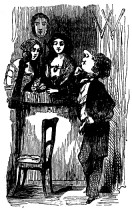
Within a short period of the events above narrated, Mr. Manager Bingley was performing his famous character of "Rolla," in "Pizarro," to a house so exceedingly thin, that it would appear as if the part of Rolla was by no means such a favorite with the people of Chatteries as it was with the accomplished actor himself. Scarce any body was in the theater. Poor Pen had the boxes almost all to himself, and sate there lonely, with blood-shot eyes, leaning over the ledge, and gazing haggardly toward the scene, when Cora came in. When she was not on the stage he saw nothing. Spaniards and Peruvians, processions and battles, priests and virgins of the sun, went in and out, and had their talk, but Arthur took no note of any one of them; and only saw Cora whom his soul longed after. He said afterward that he wondered he had not taken a pistol to shoot her, so mad was he with love, and rage, and despair; and had it not been for his mother at home, to whom he did not speak about his luckless condition, but whose silent sympathy and watchfulness greatly comforted the simple half heart-broken fellow, who knows but he might have done something desperate, and have ended his days prematurely in front of Chatteries jail? There he sate then, miserable, and gazing at her. And she took no more notice of him than he did of the rest of the house.
The Fotheringay was uncommonly handsome, in a white raiment and leopard skin, with a sun upon her breast, and fine tawdry bracelets on her beautiful glancing arms. She spouted to admiration the few words of her part, and looked it still better. The eyes, which had overthrown Pen's soul, rolled and gleamed as lustrous as ever; but it was not to him that they were directed that night. He did not know to whom, or remark a couple of gentlemen, in the box next to him, upon whom Miss Fotheringay's glances were perpetually shining.
Nor had Pen noticed the extraordinary change which had taken place on the stage a short time after entry of these two gentleman into the theater. There were so few people in the house, that the first act of the play languished entirely, and there had been some question of returning the money, as upon that other unfortunate night when poor Pen had been driven away. The actors were perfectly careless about their parts, and yawned through the dialogue, and talked loud to each other in the intervals. Even Bingley was listless, and Mrs. B. in Elvira spoke under her breath.
How came it that all of a sudden Mrs. Bingley began to raise her voice and bellow like a bull of Bashan? Whence was it that Bingley, flinging off his apathy, darted about the stage and yelled like Kean? Why did Garbetts and Rowkins and Miss Rouncy try, each of them the force of their charms or graces, and act and swagger and scowl and spout their very loudest at the two gentlemen in box No. 3?
One was a quiet little man in black, with a gray head and a jolly shrewd face—the other was in all respects a splendid and remarkable individual. He was a tall and portly gentleman with a hooked nose and a profusion of curling brown hair and whiskers; his coat was covered with the richest frogs-braiding and velvet. He had under-waistcoats many splendid rings, jeweled pins and neck-chains. When he took out his yellow pocket-hankerchief with his hand that was cased in white kids, a delightful odor of musk and bergamot was shaken through the house. He was evidently a personage of rank, and it was at him that the little Chatteries company was acting.
He was, in a word, no other than Mr. Dolphin, the great manager from London, accompanied by his faithful friend and secretary Mr. William Minns: without whom he never traveled. He had not been ten minutes in the theater before his august presence there was perceived by Bingley and the rest: and they all began to act their best and try to engage his attention. Even Miss Fotheringay's dull heart, which was disturbed at nothing, felt perhaps a flutter, when she came in presence of the famous London Impresario. She had not much to do in her part, but to look handsome, and stand in picturesque attitudes encircling her child: and she did this work to admiration. In vain the various actors tried to win the favor of the great stage sultan. Pizaro never got a hand from him. Bingley yelled, and Mrs. Bingley bellowed, and the manager only took snuff out of his great gold box. It was only in the last scene, when Rolla comes in staggering with the infant (Bingley is not so strong as he was, and his fourth son Master Talma Bingley is a monstrous large child for his age)—when Rolla comes staggering with the child to Cora, who rushes forward with a shriek, and says—"O God, there's blood upon him!"—that the London manager clapped his hands, and broke out with an enthusiastic bravo.
Then having concluded his applause, Mr. Dolphin gave his secretary a slap on the shoulder, and said "By Jove, Billy, she'll do!"
"Who taught her that dodge?" said old Billy, who was a sardonic old gentleman—"I remember her at the Olympic, and hang me if she could say Bo to a goose."
It was little Mr. Bows in the orchestra who had taught her the 'dodge' in question. All the company heard the applause, and, as the curtain went down, came round her, and congratulated and hated Miss Fotheringay.
Now Mr. Dolphin's appearance in the remote little Chatteries theater may be accounted for in this manner. In spite of all his exertions, and the perpetual blazes of triumph, coruscations of talent, victories of good old English comedy, which his play bills advertised, his theater (which, if you please, and to injure no present susceptibilities and vested interests, we shall call the Museum Theater) by no means prospered, and the famous Impresario found himself on the verge of ruin. The great Hubbard had acted legitimate drama for twenty nights, and failed to remunerate any body but himself: the celebrated Mr. and Mrs. Cawdor had come out in Mr. Rawhead's tragedy, and in their favorite round of pieces, and had not attracted the public. Herr Garbage's lions and tigers had drawn for a little time, until one of the animals had bitten a piece out of the Herr's shoulder; when the Lord Chamberlain interfered, and put a stop to this species of performance: and the grand Lyrical Drama, though brought out with unexampled splendor and success, with Monsieur Poumons as first tenor, and an enormous orchestra, had almost crushed poor Dolphin in its triumphant progress: so that great as his genius and resources were, they seemed to be at an end. He was dragging on his season wretchedly with half salaries, small operas, feeble old comedies, and his ballet company; and every body was looking out for the day when he should appear in the Gazette.
One of the illustrious patrons of the Museum Theater, and occupant of the great proscenium-box, was a gentleman whose name has been mentioned in a previous history; that refined patron of the arts, and enlightened lover of music and the drama, the Most Noble the Marquis of Steyne. His lordship's avocations as a statesman prevented him from attending the playhouse very often, or coming very early. But he occasionally appeared at the theater in time for the ballet, and was always received with the greatest respect by the manager, from whom he sometimes condescended to receive a visit in his box. It communicated with the stage, and when any thing occurred there which particularly pleased him, when a new face made its appearance among the coryphées, or a fair dancer executed a pas with especial grace or agility, Mr. Wenham, Mr. Wagg, or some other aid-de-camp of the noble marquis, would be commissioned to go behind the scenes, and express the great man's approbation, or make the inquiries which were prompted by his lordship's curiosity, or his interest in the dramatic art. He could not be seen by the audience, for Lord Steyne sate modestly behind a curtain, and looked only toward the stage—but you could know he was in the house, by the glances which all the corps-de-ballet, and all the principal dancers, cast toward his box. I have seen many scores of pairs of eyes (as in the Palm Dance in the ballet of Cook at Otaheite, where no less than a hundred-and-twenty lovely female savages in palm leaves and feather aprons, were made to dance round Floridor as Captain Cook), ogling that box as they performed before it, and have often wondered to remark the presence of mind of Mademoiselle Sautarelle, or Mademoiselle de Bondi (known as la petite Caoutchouc), who, when actually up in the air quivering like so many shuttlecocks, always kept their lovely eyes winking at that box in which the great Steyne sate. Now and then you would hear a harsh voice from behind the curtain, cry, "Brava, Brava," or a pair of white gloves wave from it, and begin to applaud. Bondi, or Sauterelle, when they came down to earth, courtesied and smiled, especially to those hands, before they walked up the stage again, panting and happy.
One night this great prince surrounded by a few choice friends was in his box at the Museum, and they were making such a noise and laughter that the pit was scandalized, and many indignant voices were bawling out silence so loudly, that Wagg wondered the police did not interfere to take the rascals out. Wenham was amusing the party in the box with extracts from a private letter which he had received from Major Pendennis, whose absence in the country at the full London season had been remarked, and of course deplored, by his friends.
"The secret is out," said Mr. Wenham, "There's a woman in the case."
"Why d—— it, Wenham, he's your age," said the gentleman behind the curtain.
"Pour les âmes bien nées, l'amour ne compte pas le nombre des années," said Mr. Wenham, with a gallant air. "For my part I hope to be a victim till I die, and to break my heart every year of my life." The meaning of which sentence was, "My lord, you need not talk; I'm three years younger than you, and twice as well conservé."
"Wenham, you affect me," said the great man, with one of his usual oaths. "By —— you do. I like to see a fellow preserving all the illusions of youth up to our time of life—and keeping his heart warm as yours is. Hang it, sir—it's a comfort to meet with such a generous, candid creature.—Who's that gal in the second row, with blue ribbons, third from the stage?—fine gal. Yes, you and I are sentimentalists. Wagg I don't think so much cares—it's the stomach rather more than the heart with you, eh, Wagg, my boy?"
"I like every thing that's good," said Mr. Wagg, generously. "Beauty and Burgundy, Venus and Venison. I don't say that Venus's turtles are to be despised, because they don't cook them at the London Tavern: but—but tell us about old Pendennis, Mr. Wenham," he abruptly concluded—for his joke flagged just then, as he saw that his patron was not listening. In fact, Steyne's glasses were up, and he was examining some object on the stage.
"Yes, I've heard that joke about Venus's turtles and the London Tavern before—you begin to fail, my poor Wagg. If you don't mind I shall be obliged to have a new Jester," Lord Steyne said, laying down his glass. "Go on, Wenham, about old Pendennis."
"'Dear Wenham,'—he begins," Mr. Wenham read,—"'as you have had my character in your hands for the last three weeks, and no doubt have torn me to shreds, according to your custom, I think you can afford to be good-humored by way of variety, and to do me a service. It is a delicate matter, entre nous, une affaire de c[oe]ur. There is a young friend of mine who is gone wild about a certain Miss Fotheringay, an actress at the theater here, and I must own to you, as handsome a woman, and, as it appears to me, as good an actress as ever put on rouge. She does Ophelia, Lady Teazle, Mrs. Haller—that sort of thing. Upon my word, she is as splendid as Georges in her best days, and as far as I know, utterly superior to any thing we have on our scene. I want a London engagement for her. Can't you get your friend Dolphin to come and see her—to engage her—to take her out of this place? A word from a noble friend of ours (you understand) would be invaluable, and if you could get the Gaunt House interest for me—I will promise any thing I can in return for your service—which I shall consider as one of the greatest that can be done to me. Do, do this now as a good fellow, which I always said you were: and, in return, command yours truly, A. Pendennis.'"
"It's a clear case," said Mr. Wenham, having read this letter; "old Pendennis is in love."
"And wants to get the woman up to London—evidently," continued Mr. Wagg.
"I should like to see Pendennis on his knees, with the rheumatism," said Mr. Wenham.
"Or accommodating the beloved object with a lock of his hair," said Wagg.
"Stuff," said the great man. "He has relations in the country, hasn't he? He said something about a nephew, whose interest could return a member. It is the nephew's affair, depend on it. The young one is in a scrape. I was myself—when I was in the fifth form at Eton—a market-gardener's daughter—and swore I'd marry her. I was mad about her—poor Polly!"—Here he made a pause, and perhaps the past rose up to Lord Steyne, and George Gaunt was a boy again, not altogether lost.—"But I say, she must be a fine woman from Pendennis's account. Have in Dolphin, and let us hear if he knows any thing of her."
At this Wenham sprang out of the box, passed the servitor who waited at the door communicating with the stage, and who saluted Mr. Wenham with profound respect; and the latter emissary, pushing on, and familiar with the place, had no difficulty in finding out the manager, who was employed, as he not unfrequently was, in swearing and cursing the ladies of the corps-de-ballet for not doing their duty.
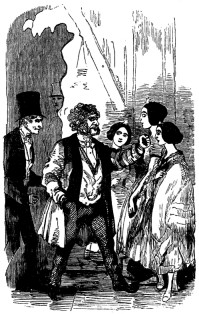
The oaths died away on Mr. Dolphin's lips, as soon as he saw Mr. Wenham: and he drew off the hand which was clenched in the face of one of the offending Coryphées, to grasp that of the new comer. "How do, Mr. Wenham? How's his lordship to-night? Looks uncommonly well," said the manager smiling, as if he had never been out of temper in his life; and he was only too delighted to follow Lord Steyne's embassador, and pay his personal respects to that great man.
The visit to Chatteries was the result of their conversation: and Mr. Dolphin wrote to his lordship from that place, and did himself the honor to inform the Marquess of Steyne, that he had seen the lady about whom his lordship had spoken, that he was as much struck by her talents as he was by her personal appearance, and that he had made an engagement with Miss Fotheringay who would soon have the honor of appearing before a London audience, and his noble and enlightened patron the Marquess of Steyne.
Pen read the announcement of Miss Fotheringay's engagement in the Chatteries paper, where he had so often praised her charms. The editor made very handsome mention of her talent and beauty, and prophesied her success in the metropolis. Bingley, the manager, began to advertise "The last night of Miss Fotheringay's engagement." Poor Pen and Sir Derby Oaks were very constant at the play: Sir Derby in the stage-box, throwing bouquets and getting glances.—Pen in the almost deserted boxes, haggard, wretched, and lonely. Nobody cared whether Miss Fotheringay was going or staying except those two—and perhaps one more, which was Mr. Bows of the orchestra.
He came out of his place one night, and went into the house to the box where Pen was; and he held out his hand to him, and asked him to come and walk. They walked down the street together: and went and sate upon Chatteries bridge in the moonlight, and talked about her. "We may sit on the same bridge," said he: "we have been in the same boat for a long time. You are not the only man who has made a fool of himself about that woman. And I have less excuse than you, because I'm older and know her better. She has no more heart than the stone you are leaning on; and it or you or I might fall into the water, and never come up again, and she wouldn't care. Yes—she would care for me, because she wants me to teach her; and she won't be able to get on without me, and will be forced to send for me from London. But she wouldn't if she didn't want me. She has no heart and no head, and no sense, and no feelings, and no griefs or cares, whatever. I was going to say no pleasures—but the fact is, she does like her dinner, and she is pleased when people admire her."
"And you do?" said Pen, interested out of himself, and wondering at the crabbed, homely little old man.
"It's a habit, like taking snuff, or drinking drams," said the other, "I've been taking her these five years, and can't do without, her. It was I made her. If she doesn't send for me, I shall follow her: but I know she'll send for me. She wants me. Same day she'll marry, and fling me over, as I do the end of this cigar."
The little flaming spark dropped into the water below, and disappeared; and Pen, as he rode home that night, actually thought about somebody but himself.
CHAPTER XV.
THE HAPPY VILLAGE.
Until the enemy had retired altogether from before the place, Major Pendennis was resolved to keep his garrison in Fairoaks. He did not appear to watch Pen's behavior or to put any restraint on his nephew's actions, but he managed nevertheless to keep the lad constantly under his eye or those of his agents, and young Arthur's comings and goings were quite well known to his vigilant guardian.
I suppose there is scarcely any man who reads this or any other novel but has been balked in love sometime or other, by fate, and circumstance, by the falsehood of woman, or his own fault. Let that worthy friend recall his own sensations under the circumstances, and apply them as illustrative of Mr. Pen's anguish. Ah! what weary nights and sickening fevers! Ah! what mad desires dashing up against some rock of obstruction or indifference, and flung back again from the unimpressionable granite! If a list could be made this very night in London of the groans, thoughts, imprecations of tossing lovers, what a catalogue it would be! I wonder what a per centage of the male population of the metropolis will be lying awake at two or three o'clock to-morrow morning, counting the hours as they go by knelling drearily, and rolling from left to right, restless, yearning, and heart-sick? What a pang it is! I never knew a man die of love, certainly, but I have known a twelve stone man go down to nine stone five, under a disappointed passion, so that pretty nearly a quarter of him may be said to have perished; and that is no small portion. He has come back to his old size subsequently; perhaps is bigger than ever: very likely some new affection has closed round his heart and ribs and made them comfortable, and young Pen is a man who will console himself like the rest of us. We say this lest the ladies should be disposed to deplore him prematurely, or be seriously uneasy with regard to his complaint. His mother was, but what will not a maternal fondness fear or invent? "Depend on it, my dear creature," Major Pendennis would say gallantly to her, "the boy will recover. As soon as we get her out of the country we will take him somewhere, and show him a little life. Meantime make yourself easy about him. Half a fellow's pangs at losing a woman result from vanity more than affection. To be left by a woman is the deuce and all, to be sure; but look how easily we leave 'em."
Mrs. Pendennis did not know. This sort of knowledge had by no means come within the simple lady's scope. Indeed she did not like the subject or to talk of it: her heart had had its own little private misadventure and she had borne up against it and cured it; and perhaps she had not much patience with other folks' passions, except, of course, Arthur's whose sufferings she made her own, feeling indeed, very likely, in many of the boy's illnesses and pains a great deal more than Pen himself endured. And she watched him through this present grief with a jealous silent sympathy; although, as we have said, he did not talk to her of his unfortunate condition.
The major must be allowed to have had not a little merit and forbearance, and to have exhibited a highly creditable degree of family affection. The life at Fairoaks was uncommonly dull to a man who had the entrée of half the houses in London, and was in the habit of making his bow in three or four drawing-rooms of a night. A dinner with Doctor Portman or a neighboring squire now and then; a dreary rubber at backgammon with the widow, who did her utmost to amuse him: these were the chief of his pleasures. He used to long for the arrival of the bag with the letters, and he read every word of the evening paper. He doctored himself too, assiduously—a course of quiet living would suit him well, he thought, after the London banquets. He dressed himself laboriously every morning and afternoon: he took regular exercise up and down the terrace walk. Thus with his cane, his toilet, his medicine-chest, his backgammon-box, and his newspaper, this worthy and worldly philosopher fenced himself against ennui; and if he did not improve each shining hour, like the bees by the widow's garden wall, Major Pendennis made one hour after another pass as he could: and rendered his captivity just tolerable. After this period it was remarked that he was fond of bringing round the conversation to the American war, the massacre of Wyoming and the brilliant actions of Saint Lucie the fact being that he had a couple of volumes of the "Annual Register" in his bed-room, which he sedulously studied. It is thus a well-regulated man will accommodate himself to circumstances, and show himself calmly superior to fortune.
Pen sometimes took the box at backgammon of a night, or would listen to his mother's simple music of summer evenings—but he was very restless and wretched in spite of all; and has been known to be up before the early daylight even: and down at a carp-pond in Clavering Park, a dreary pool with innumerable-whispering rushes and green alders, where a milkmaid drowned herself in the baronet's grandfather's time, and her ghost was said to walk still. But Pen did not drown himself, as perhaps his mother fancied might be his intention. He liked to go and fish there, and think and think at leisure, as the float quivered in the little eddies of the pond, and the fish flapped about him. If he got a bite he was excited enough: and in this way occasionally brought home, carps, tenches, and eels, which the major cooked in the continental fashion.
By this pond, and under a tree, which was his favorite resort, Pen composed a number of poems suitable to his circumstances—over which verses he blushed in after days, wondering how he could ever have invented such rubbish. And as for the tree, why, it is in a hollow of this very tree, where he used to put his tin box of ground-bait, and other fishing commodities, that he afterward—but we are advancing matters. Suffice it to say, he wrote poems and relieved himself very much. When a man's grief or passion is at this point, it may be loud, but it is not very severe. When a gentleman is cudgeling his brain to find any rhyme for sorrow, beside borrow and to-morrow, his woes are nearer at an end than he thinks for. So were Pen's. He had his hot and cold fits, his days of sullenness and peevishness, and of blank resignation and despondency, and occasional mad paroxysms of rage and longing, in which fits Rebecca would be saddled and galloped fiercely about the country, or into Chatteries, her rider gesticulating wildly on her back, and astonishing carters and turnpikemen as he passed, crying out the name of the false one.
Mr. Foker became a very frequent and welcome visitor at Fairoaks during this period, where his good spirits and oddities always amused the major and Pendennis, while they astonished the widow and little Laura not a little. His tandem made a great sensation in Clavering market-place; where he upset a market stall, and cut Mrs. Pybus's poodle over the shaven quarters, and drank a glass of raspberry bitters at the Clavering Arms. All the society in the little place heard who he was, and looked out his name in their Peerages. He was so young, and their books so old, that his name did not appear in many of their volumes; and his mamma, now quite an antiquated lady, figured among the progeny of the Earl of Rosherville, as Lady Agnes Milton, still. But his name, wealth, and honorable lineage were speedily known about Clavering, where you may be sure that poor Pen's little transaction with the Chatteries actress was also pretty freely discussed.
Looking at the little old town of Clavering St. Mary from the London road as it runs by the lodge at Fairoaks, and seeing the rapid and shining Brawl winding down from the town and skirting the woods of Clavering Park, and the ancient church tower and peaked roofs of the houses rising up among trees and old walls, behind which swells a fair back-ground of sunshiny hills that stretch from Clavering westward toward the sea—the place looks so cheery and comfortable that many a traveler's heart must have yearned toward it from the coach-top, and he must have thought that it was in such a calm friendly nook he would like to shelter at the end of life's struggle. Tom Smith who used to drive the Alacrity coach, would often point to a tree near the river, from which a fine view of the church and town was commanded, and inform his companion on the box that "Artises come and take hoff the Church from that there tree.—It was a Habby once, sir:"—and indeed a pretty view it is, which I recommend to Mr. Stanfield or Mr. Roberts, for their next tour.
Like Constantinople seen from the Bosphorus; like Mrs. Rougemont viewed in her box from the opposite side of the house; like many an object which we pursue in life, and admire before we have attained it; Clavering is rather prettier at a distance than it is on a closer acquaintance. The town so cheerful of aspect a few furlongs off, looks very blank and dreary. Except on market days there is nobody in the streets.
The clack of a pair of pattens echoes through half the place, and you may hear the creaking of the rusty old ensign at the Clavering Arms, without being disturbed by any other noise. There has not been a ball in the assembly rooms since the Clavering volunteers gave one to their colonel, the old Sir Francis Clavering; and the stables which once held a great part of that brilliant, but defunct regiment, are now cheerless and empty, except on Thursdays, when the farmers put up there, and their tilted carts and gigs make a feeble show of liveliness in the place, or on petty sessions, when the magistrates attend in what used to be the old card-room.
On the south side of the market rises up the church, with its great gray towers, of which the sun illuminates the delicate carving; deepening the shadows of the huge buttresses, and gilding the glittering windows, and flaming vanes. The image of the patroness of the church was wrenched out of the porch centuries ago: such of the statues of saints as were within reach of stones and hammer at that period of pious demolition are maimed and headless, and of those who were out of fire, only Doctor Portman knows the names and history, for his curate, Smirke, is not much of an antiquarian, and Mr. Simcoe (husband of the Honorable Mrs. Simcoe) incumbent and architect of the Chapel of Ease in the lower town, thinks them the abomination of desolation.
The rectory is a stout broad-shouldered brick house, of the reign of Anne. It communicates with the church and market by different gates, and stands at the opening of Yew-tree Lane, where the Grammar School (Rev. —— Wapshot) is; Yew-tree Cottage (Miss Flather); the butcher's slaughtering-house, an old barn or brew-house of the Abbey times, and the Misses Finucane's establishment for young ladies. The two schools had their pews in the loft on each side of the organ, until the Abbey Church getting rather empty, through the falling off of the congregation, who were inveigled to the Heresy-shop in the lower town, the doctor induced the Misses Finucane to bring their pretty little flock down stairs; and the young ladies' bonnets make a tolerable show in the rather vacant aisles. Nobody is in the great pew of the Clavering family except the statues of defunct baronets and their ladies: there is Sir Poyntz Clavering, knight and baronet, kneeling in a square beard opposite his wife in a ruff; a very fat lady, the Dame Rebecca Clavering, in alto-relievo, is borne up to Heaven by two little blue-veined angels, who seem to have a severe task—and so forth. How well, in after life, Pen remembered those effigies, and how often in youth he scanned them as the doctor was grumbling the sermon from the pulpit, and Smirke's mild head and forehead curl peered over the great prayer-book in the desk!
The Fairoaks folks were constant at the old church; their servants had a pew, so had the doctor's, so had Wapshot's, and those of Misses Finucane's establishment, three maids and a very nice looking young man in a livery. The Wapshot family were numerous and faithful. Glanders and his children regularly came to church: so did one of the apothecaries. Mrs. Pybus went, turn and turn about, to the Low Town church, and to the Abbey: the Charity School and their families of course came; Wapshot's boys made a good cheerful noise, scuffling with their feet as they marched into church and up the organ-loft stair, and blowing their noses a good deal during the service. To be brief, the congregation looked as decent as might be in these bad times. The Abbey Church was furnished with a magnificent screen, and many hatchments and heraldic tombstones. The doctor spent a great part of his income in beautifying his darling place; he had endowed it with a superb painted window, bought in the Netherlands, and an organ grand enough for a cathedral.
But in spite of organ and window, in consequence of the latter very likely, which had come out of a papistical place of worship and was blazoned all over with idolatry, Clavering New Church prospered scandalously in the teeth of orthodoxy; and many of the doctor's congregation deserted to Mr. Simcoe and the honorable woman his wife. Their efforts had thinned the very Ebenezer hard by them, which building, before Simcoe's advent used to be so full, that you could see the backs of the congregation squeezing out of the arched windows thereof. Mr. Simcoe's tracts fluttered into the doors of all the doctor's cottages, and were taken as greedily as honest Mrs. Portman's soup, with the quality of which the graceless people found fault. With the folks at the Ribbon Factory situated by the weir on the Brawl side, and round which the Low Town had grown, orthodoxy could make no way at all. Quiet Miss Myra was put out of court by impetuous Mrs. Simcoe and her female aids-de-camp. Ah, it was a hard burthen for the doctor's lady to bear, to behold her husband's congregation dwindling away; to give the precedence on the few occasions when they met to a notorious low-churchman's wife who was the daughter of an Irish Peer; to know that there was a party in Clavering, their own town of Clavering, on which her doctor spent a great deal more than his professional income, who held him up to odium because he played a rubber at whist; and pronounced him to be a heathen because he went to the play. In her grief she besought him to give up the play and the rubber—indeed they could scarcely get a table now, so dreadful was the outcry against the sport—but the doctor declared that he would do what he thought right, and what the great and good George the Third did (whose chaplain he had been): and as for giving up whist because those silly folks cried out against it, he would play dummy to the end of his days with his wife and Myra, rather than yield to their despicable persecutions.
Of the two families, owners of the factory (which had spoiled the Brawl as a trout-stream and brought all the mischief into the town), the senior partner, Mr. Rolt, went to Ebenezer; the junior, Mr. Barker, to the New Church. In a word, people quarreled in this little place a great deal more than neighbors do in London; and in the book club, which the prudent and conciliating Pendennis had set up, and which ought to have been a neutral territory, they bickered so much that nobody scarcely was ever seen in the reading room, except Smirke, who though he kept up a faint amity with the Simcoe faction, had still a taste for magazines and light worldly literature; and old Glanders, whose white head and grizzly mustache might be seen at the window; and of course, little Mrs. Pybus, who looked at every body's letters as the post brought them (for the Clavering reading room, as every one knows, used to be held at Baker's Library, London-street formerly Hog Lane), and read every advertisement in the paper.
It may be imagined how great a sensation was created in this amiable little community when the news reached it of Mr. Pen's love-passages at Chatteries. It was carried from house to house, and formed the subject of talk at high-church, low-church, and no-church tables; it was canvassed by the Misses Finucane and their teachers, and very likely debated by the young ladies in the dormitories, for what we know; Wapshot's big boys had their version of the story, and eyed Pen curiously as he sate in his pew at church, or raised the finger of scorn at him as he passed through Chatteries. They always hated him and called him Lord Pendennis, because he did not wear corduroys as they did, and rode a horse, and gave himself the airs of a buck.
And if the truth must be told, it was Mrs. Portman herself who was the chief narrator of the story of Pen's loves. Whatever tales this candid woman heard, she was sure to impart them to her neighbors; and after she had been put into possession of Pen's secret by the little scandal at Chatteries, poor Doctor Portman knew that it would next day be about the parish of which he was the rector. And so indeed it was; the whole society there had the legend—at the news' room, at the milliner's, at the shoe-shop, and the general warehouse at the corner of the market; at Mrs. Pybus's, at the Glanders's, at the Honorable Mrs. Simcoe's soirée, at the factory; nay, through the mill itself the tale was current in a few hours, and young Arthur Pendennis's madness, was in every mouth.
All Doctor Portman's acquaintances barked out upon him when he walked the street the next day. The poor divine knew that his Betsy was the author of the rumor, and groaned in spirit. Well, well—it must have come in a day or two, and it was as well that the town should have the real story. What the Clavering folks thought of Mrs. Pendennis for spoiling her son, and of that precocious young rascal of an Arthur for daring to propose to a play-actress, need not be told here. If pride exists among any folks in our country, and assuredly we have enough of it, there is no pride more deep-seated than that of twopenny old gentlewomen in small towns. "Gracious goodness," the cry was, "how infatuated the mother is about that pert and headstrong boy, who gives himself the airs of a lord on his blood-horse, and for whom our society is not good enough, and who would marry an odious painted actress off a booth, where very likely he wants to rant himself. If dear, good Mr. Pendennis had been alive this scandal would never have happened."
No more it would, very likely, nor should we have been occupied in narrating Pen's history. It was true that he gave himself airs to the Clavering folks. Naturally haughty and frank, their cackle and small talk and small dignities bored him, and he showed a contempt which he could not conceal. The doctor and the curate were the only people Pen cared for in the place—even Mrs. Portman shared in the general distrust of him, and of his mother, the widow, who kept herself aloof from the village society, and was sneered at accordingly, because she tried, forsooth, to keep her head up with the great county families. She, indeed! Mrs. Barker at the factory has four times the butcher's meat that goes up to Fairoaks, with all their fine airs.
&c. &c. &c.: let the reader fill up these details according to his liking and experience of village scandal. They will suffice to show how it was that a good woman, occupied solely in doing her duty to her neighbor and her children, and an honest, brave lad, impetuous, and full of good, and wishing well to every mortal alive, found enemies and detractors among people to whom they were superior, and to whom they had never done any thing like harm. The Clavering curs were yelping all round the house of Fairoaks, and delighted to pull Pen down.
Doctor Portman and Smirke were both cautious of informing the widow of the constant outbreak of calumny which was pursuing poor Pen, though Glanders, who was a friend of the house, kept him au courant. It may be imagined what his indignation was; was there any man in the village whom he could call to account? Presently some wags began to chalk up "Fotheringay forever!" and other sarcastic allusions to late transactions, at Fairoaks gate. Another brought a large play-bill from Chatteries, and wafered it there one night. On one occasion Pen, riding through the lower town, fancied he heard the factory boys jeer him; and finally going through the doctor's gate into the churchyard, where some of Wapshot's boys were lounging, the biggest of them, a young gentleman about twenty years of age, son of a neighboring small squire, who lived in the doubtful capacity of parlor boarder with Mr. Wapshot, flung himself into a theatrical attitude near a newly-made grave, and began repeating Hamlet's verses over Ophelia, with a hideous leer at Pen.
The young fellow was so enraged that he rushed at Hobnell Major with a shriek very much resembling an oath, cut him furiously across the face with the riding-whip which he carried, flung it away, calling upon the cowardly villain to defend himself, and in another minute knocked the bewildered young ruffian into the grave which was just waiting for a different lodger.
Then with his fists clenched, and his face quivering with passion and indignation, he roared out to Mr. Hobnell's gaping companions, to know if any of the blackguards would come on? But they held back with a growl, and retreated as Doctor Portman came up to his wicket, and Mr. Hobnell, with his nose and lip bleeding piteously, emerged from the grave.
Pen, looking death and defiance at the lads, who retreated toward their side of the churchyard, walked back again through the doctor's wicket, and was interrogated by that gentleman. The young fellow was so agitated he could scarcely speak. His voice broke into a sob, as he answered. "The —— coward insulted me, sir," he said; and the doctor passed over the oath, and respected the emotion of the honest, suffering young heart.
Pendennis the elder, who like a real man of the world had a proper and constant dread of the opinion of his neighbor, was prodigiously annoyed by the absurd little tempest which was blowing in Chatteries, and tossing about Master Pen's reputation. Doctor Portman and Captain Glanders had to support the charges of the whole Chatteries society against the young reprobate, who was looked upon as a monster of crime. Pen did not say any thing about the churchyard scuffle at home; but went over to Baymouth, and took counsel with his friend Harry Foker, Esq., who drove over his drag presently to the Clavering Arms, whence he sent Stoopid with a note to Thomas Hobnell, Esq., at the Rev. J. Wapshot's, and a civil message to ask when he should wait upon that gentleman.
Stoopid brought back word that the note had been opened by Mr. Hobnell, and read to half-a-dozen of the big boys, on whom it seemed to make a great impression; and that after consulting together, and laughing, Mr. Hobnell said he would send an answer "arter arternoon school, which the bell was a ringing; and Mr. Wapshot he came out in his Master's gownd." Stoopid was learned in academical costume, having attended Mr. Foker at St. Boniface.
Mr. Foker went out to see the curiosities of Clavering, meanwhile; but not having a taste for architecture, Doctor Portman's fine church did not engage his attention much, and he pronounced the tower to be as moldy as an old Stilton cheese. He walked down the street and looked at the few shops there; he saw Captain Glanders at the window of the reading-room, and having taken a good stare at that gentleman, he wagged his head at him in token of satisfaction; he inquired the price of meat at the butcher's, with an air of the greatest interest, and asked, "when was next killing day?" he flattened his little nose against Madam Fribsby's window to see if haply there was a pretty workwoman in her premises; but there was no face more comely than the doll's or dummy's wearing the French cap in the window, only that of Madame Fribsby herself, dimly visible in the parlor, reading a novel. That object was not of sufficient interest to keep Mr. Foker very long in contemplation, and so having exhausted the town and the inn stables, in which there were no cattle, save the single old pair of posters that earned a scanty livelihood by transporting the gentry round about to the county dinners, Mr. Foker was giving himself up to ennui entirely, when a messenger from Mr. Hobnell was at length announced.
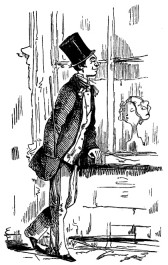
It was no other than Mr. Wapshot himself, who came with an air of great indignation, and holding Pen's missive in his hand, asked Mr. Foker "how dared he bring such an unchristian message as a challenge to a boy of his school?"
In fact Pen had written a note to his adversary of the day before, telling him that if after the chastisement which his insolence richly deserved, he felt inclined to ask the reparation which was usually given among gentlemen, Mr. Arthur Pendennis's friend, Mr. Henry Foker, was empowered to make any arrangements for the satisfaction of Mr. Hobnell.
"And so he sent you with the answer—did he, sir?" Mr. Foker said, surveying the schoolmaster in his black coat and clerical costume.
"If he had accepted this wicked challenge, I should have flogged him," Mr. Wapshot said, and gave Mr. Foker a glance which seemed to say, "and I should like very much to flog you, too."
"Uncommon kind of you, sir, I'm sure," said Pen's emissary. "I told my principal that I didn't think the other man would fight," he continued, with a great air of dignity. "He prefers being flogged to fighting, sir, I dare say. May I offer you any refreshment, Mr. ——? I haven't the advantage of your name."
"My name is Wapshot, sir, and I am master of the grammar school of this town, sir," cried the other: "and I want no refreshment, sir, I thank you, and have no desire to make your acquaintance, sir."
"I didn't seek yours, sir, I'm sure," replied Mr. Foker. "In affairs of this sort, you see, I think it is a pity that the clergy should be called in, but there's no accounting for tastes, sir."
"I think it's a pity that boys should talk about committing murder, sir, as lightly as you do," roared the schoolmaster; "and if I had you in my school—"
"I dare say you would teach me better, sir," Mr. Foker said, with a bow. "Thank you, sir. I've finished my education, sir, and ain't a going back to school, sir—when I do, I'll remember your kind offer, sir. John, show this gentleman down stairs—and, of course, as Mr. Hobnell likes being thrashed, we can have no objection, sir, and we shall be very happy to accommodate him, whenever he comes our way."
And with this, the young fellow bowed the elder gentleman out of the room, and sate down and wrote a note off to Pen, in which he informed the latter, that Mr. Hobnell was not disposed to fight, and proposed to put up with the caning which Pen had administered to him.
CHAPTER XVI.
MORE STORMS IN THE PUDDLE.
Pen's conduct in this business of course was soon made public and angered his friend Doctor Portman, not a little: while it only amused Major Pendennis. As for the good Mrs. Pendennis, she was almost distracted when she heard of the squabble, and of Pen's unchristian behavior. All sorts of wretchedness, discomfort, crime, annoyance, seemed to come out of this transaction in which the luckless boy had engaged; and she longed more than ever to see him out of Chatteries for a while—any where removed from the woman who had brought him into so much trouble.
Pen, when remonstrated with by this fond parent, and angrily rebuked by the doctor for his violence and ferocious intentions, took the matter au grand sérieux, with the happy conceit and gravity of youth: said that he himself was very sorry for the affair, that the insult had come upon him without the slightest provocation on his part; that he would permit no man to insult him upon this head without vindicating his own honor, and appealing with great dignity to his uncle, asked whether he could have acted otherwise as a gentleman, than as he did in resenting the outrage offered to him, and in offering satisfaction to the person chastised?
"Vous allez trop vite, my good sir," said the uncle, rather puzzled, for he had been indoctrinating his nephew with some of his own notions upon the point of honor—old-world notions savoring of the camp and pistol a great deal more than our soberer opinions of the present day—"between men of the world I don't say; but between two school-boys, this sort of thing is ridiculous, my dear boy—perfectly ridiculous."
"It is extremely wicked, and unlike my son," said Mrs. Pendennis, with tears in her eyes; and bewildered with the obstinacy of the boy.
Pen kissed her, and said with great pomposity, "Women, dear mother, don't understand these matters—I put myself into Foker's hands—I had no other course to pursue."
Major Pendennis grinned and shrugged his shoulders. The young ones were certainly making great progress, he thought. Mrs. Pendennis declared that that Foker was a wicked horrid little wretch, and was sure that he would lead her dear boy into mischief, if Pen went to the same college with him. "I have a great mind not to let him go at all," she said: and only that she remembered that the lad's father had always destined him for the college in which he had had his own brief education, very likely the fond mother would have put a veto upon his going to the University.
That he was to go, and at the next October term, had been arranged between all the authorities who presided over the lad's welfare. Foker had promised to introduce him to the right set; and Major Pendennis laid great store upon Pen's introduction into college life and society by this admirable young gentleman. "Mr. Foker knows the very best young men now at the University," the major said, "and Pen will form acquaintances there who will be of the greatest advantage through life to him. The young Marquis of Plinlimmon is there, eldest son of the Duke of Saint David's—Lord Magnus Charters is there, Lord Runnymede's son; and a first cousin of Mr. Foker (Lady Runnymede, my dear, was Lady Agatha Milton, you of course remember), Lady Agnes will certainly invite him to Logwood; and far from being alarmed at his intimacy with her son, who is a singular and humorous, but most prudent and amiable young man, to whom, I am sure, we are under every obligation for his admirable conduct in the affair of the Fotheringay marriage, I look upon it as one of the very luckiest things which could have happened to Pen, that he should have formed an intimacy with this most amusing young gentleman."
Helen sighed, she supposed the major knew best. Mr. Foker had been very kind in the wretched business with Miss Costigan, certainly, and she was grateful to him. But she could not feel otherwise than a dim presentiment of evil; and all these quarrels, and riots, and worldliness, scared her about the fate of her boy.
Doctor Portman was decidedly of opinion that Pen should go to college. He hoped the lad would read, and have a moderate indulgence of the best society too. He was of opinion that Pen would distinguish himself: Smirke spoke very highly of his proficiency: the doctor himself had heard him construe, and thought he acquitted himself remarkably well. That he should go out of Chatteries was a great point, at any rate, and Pen, who was distracted from his private grief by the various rows and troubles which had risen round about him, gloomily said he would obey.
There were assizes, races, and the entertainments, and the flux of company consequent upon them, at Chatteries, during a part of the months of August and September, and Miss Fotheringay still continued to act, and take farewell of the audiences at the Chatteries Theater during that time. Nobody seemed to be particularly affected by her presence, or her announced departure, except those persons whom we have named; nor could the polite county folks who had houses in London, and very likely admired the Fotheringay prodigiously in the capital, when they had been taught to do so by the fashion which set in in her favor find any thing remarkable in the actress performing on the little Chatteries boards. Many a genius and many a quack, for that matter, has met with a similar fate before and since Miss Costigan's time. This honest woman meanwhile bore up against the public neglect, and any other crosses or vexations which she might have in life, with her usual equanimity; and ate, drank, acted, slept, with that regularity and comfort which belongs to people of her temperament. What a deal of grief, care, and other harmful excitement, does a healthy dullness and cheerful insensibility avoid! Nor do I mean to say that Virtue is not Virtue because it is never tempted to go astray; only that dullness is a much finer gift than we give it credit for being, and that some people are very lucky whom Nature has endowed with a good store of that great anodyne.
Pen used to go drearily in and out from the play at Chatteries during this season, and pretty much according to his fancy. His proceedings tortured his mother not a little, and her anxiety would have led her often to interfere, had not the major constantly checked, and at the same time encouraged her; for the wily man of the world fancied he saw that a favorable turn had occurred in Pen's malady. It was the violent efflux of versification, among other symptoms, which gave Pen's guardian and physician satisfaction. He might be heard spouting verses in the shrubbery walks, or muttering them between his teeth as he sat with the home party of evenings. One day prowling about the house in Pen's absence, the major found a great book full of verses in the lad's study. They were in English, and in Latin; quotations from the classic authors were given in the scholastic manner in the foot-notes. He can't be very bad, wisely thought the Pall Mall Philosopher: and he made Pen's mother remark (not, perhaps, without a secret feeling of disappointment, for she loved romance like other soft women), that the young gentleman during the last fortnight came home quite hungry to dinner at night, and also showed a very decent appetite at the breakfast table in the morning. "Gad, I wish I could," said the major, thinking ruefully of his dinner pills. "The boy begins to sleep well, depend upon that." It was cruel, but it was true.
Having no other soul to confide in—for he could not speak to his mother of his loves and disappointments—his uncle treated them in a scornful and worldly tone, which, though carefully guarded and polite, yet jarred greatly on the feelings of Mr. Pen—and Foker was much too coarse to appreciate those refined sentimental secrets—the lad's friendship for the curate redoubled, or rather, he was never tired of having Smirke for a listener on that one subject. What is a lover without a confidant? Pen employed Mr. Smirke, as Corydon does the elm-tree, to cut out his mistress's name upon. He made him echo with the name of the beautiful Amaryllis. When men have left off playing the tune, they do not care much for the pipe: but Pen thought he had a great friendship for Smirke, because he could sigh out his loves and griefs into his tutor's ears; and Smirke had his own reasons for always being ready at the lad's call.
Pen's affection gushed out in a multitude of sonnets to the friend of his heart, as he styled the curate, which the other received with great sympathy. He plied Smirke with Latin Sapphics and Alcaics. The love-songs multiplied under his fluent pen; and Smirke declared and believed that they were beautiful. On the other hand, Pen expressed a boundless gratitude to think that Heaven should have sent him such a friend at such a moment. He presented his tutor with his best bound books, and his gold guard chain, and wanted him to take his double-barreled gun. He went into Chatteries and got a gold pencil-case on credit (for he had no money, and indeed was still in debt to Smirke for some of the Fotheringay presents), which he presented to Smirke, with an inscription indicative of his unalterable and eternal regard for the curate; who of course was pleased with every mark of the boy's attachment.
The poor curate was naturally very much dismayed at the contemplated departure of his pupil. When Arthur should go, Smirke's occupation and delight would go too. What pretext could he find for a daily visit to Fairoaks, and that kind word or glance from the lady there, which was as necessary to the curate as the frugal dinner which Madam Fribsby served him? Arthur gone, he would only be allowed to make visits like any other acquaintance: little Laura could not accommodate him by learning the catechism more than once a week: he had curled himself like ivy round Fairoaks: he pined at the thought that he must lose his hold of the place. Should he speak his mind and go down on his knees to the widow? He thought over any indications in her behavior which flattered his hopes. She had praised his sermon three weeks before; she had thanked him exceedingly for his present of a melon, for a small dinner party which Mrs. Pendennis gave: she said she should always be grateful to him for his kindness to Arthur, and when he declared that there were no bounds to his love and affection for that dear boy, she had certainly replied in a romantic manner, indicating her own strong gratitude and regard to all her son's friends. Should he speak out?—or should he delay? If he spoke and she refused him, it was awful to think that the gate of Fairoaks might be shut upon him forever—and within that door lay all the world for Mr. Smirke.
Thus, oh friendly readers, we see how every man in the world, has his own private griefs and business, by which he is more cast down or occupied than by the affairs or sorrows of any other person. While Mrs. Pendennis is disquieting herself about losing her son and that anxious hold she has had of him, as long as he has remained in the mother's nest, whence he is about to take flight into the great world beyond—while the major's great soul chafes and frets, inwardly vexed as he thinks what great parties are going on in London, and that he might be sunning himself in the glances of dukes and duchesses, but for those cursed affairs which keep him in a wretched little country hole—while Pen is tossing between his passion and a more agreeable sensation, unacknowledged yet, but swaying him considerably, namely, his longing to see the world—Mr. Smirke has a private care watching at his bed side, and sitting behind him on his pony; and is no more satisfied than the rest of us. How lonely we are in the world; how selfish and secret, every body! You and your wife have pressed the same pillow for forty years and fancy yourselves united.—Pshaw, does she cry out when you have the gout, or do you lie awake when she has the tooth-ache? Your artless daughter, seemingly all innocence, and devoted to her mamma and her piano lesson, is thinking of neither, but of the young lieutenant with whom she danced at the last ball—the honest frank boy just returned from school is secretly speculating upon the money you will give him, and the debts he owes the tart man. The old grandmother crooning in the corner and bound to another world within a few months, has some business or cares which are quite private and her own—very likely she is thinking of fifty years back, and that night when she made such an impression, and danced a cotillion with the captain, before your father proposed for her; or, what a silly little over-rated creature your wife is, and how absurdly you are infatuated about her—and, as for your wife—O philosophic reader, answer and say—Do you tell her all? Ah, sir—a distinct universe walks about under your hat and under mine—all things in nature are different to each—the woman we look at has not the same features, the dish we eat from has not the same taste to the one and the other—you and I are but a pair of infinite isolations, with some fellow-islands a little more or less near to us. Let us return, however, to the solitary Smirke.
Smirke had one confidante for his passion—that most injudicious woman, Madame Fribsby. How she became Madame Fribsby, nobody knows; she had left Clavering to go to a milliner's in London as Miss Fribsby—she pretended that she had got the rank in Paris during her residence in that city. But how could the French king, were he ever so much disposed, give her any such title? We shall not inquire into this mystery, however. Suffice to say, she went away from home a bouncing young lass; she returned a rather elderly character, with a Madonna front and a melancholy countenance—bought the late Mrs. Harbottle's business for a song—took her elderly mother to live with her; was very good to the poor, was constant at church, and had the best of characters. But there was no one in all Clavering, not Mrs. Portman herself, who read so many novels as Madame Fribsby. She had plenty of time for this amusement, for, in truth, very few people besides the folks at the Rectory and Fairoaks employed her; and by a perpetual perusal of such works (which were by no means so moral or edifying in the days of which we write, as they are at present), she had got to be so absurdly sentimental, that in her eyes life was nothing but an immense love-match; and she never could see two people together, but she fancied they were dying for one another.
On the day after Mrs. Pendennis's visit to the curate, which we have recorded many pages back, Madame Fribsby settled in her mind that Mr. Smirke must be in love with the widow, and did every thing in her power to encourage this passion on both sides. Mrs. Pendennis she very seldom saw, indeed, except in public, and in her pew at church. That lady had very little need of millinery, or made most of her own dresses and caps; but on the rare occasions when Madame Fribsby received visits from Mrs. Pendennis, or paid her respects at Fairoaks, she never failed to entertain the widow with praises of the curate, pointing out what an angelical man he was, how gentle, how studious, how lonely; and she would wonder that no lady would take pity upon him.
Helen laughed at these sentimental remarks, and wondered that madame herself did not compassionate her lodger, and console him. Madame Fribsby shook her Madonna front, "Mong cure a boco souffare," she said, laying her hand on the part she designated as her cure. "Il est more en Espang, Madame," she said with a sigh. She was proud of her intimacy with the French language, and spoke it with more volubility than correctness. Mrs. Pendennis did not care to penetrate the secrets of this wounded heart: except to her few intimates she was a reserved and it may be a very proud woman; she looked upon her son's tutor merely as an attendant on that young prince, to be treated with respect as a clergyman, certainly, but with proper dignity as a dependent on the house of Pendennis. Nor were madame's constant allusions to the curate particularly agreeable to her. It required a very ingenious sentimental turn indeed to find out that the widow had a secret regard for Mr. Smirke, to which pernicious error, however, Madame Fribsby persisted in holding.
Her lodger was very much more willing to talk on this subject with his soft-hearted landlady. Every time after that she praised the curate to Mrs. Pendennis, she came away from the latter with the notion that the widow herself had been praising him. "Etre soul au monde est bien ouneeyong," she would say, glancing up at a print of a French carbineer in a green coat and brass cuirass which decorated her apartment—"Depend upon it when Master Pendennis goes to college, his ma will find herself very lonely. She is quite young yet.—You wouldn't suppose her to be five-and-twenty. Monsieur le Cury, song cure est touchy—j'ong suis sure—Je conny cela biang—Ally, Monsieur Smirke."
He softly blushed; he sighed; he hoped; he feared; he doubted; he sometimes yielded to the delightful idea—his pleasure was to sit in Madame Fribsby's apartment, and talk upon the subject, where, as the greater part of the conversation was carried on in French by the milliner, and her old mother was deaf, that retired old individual (who had once been a housekeeper, wife and widow of a butler in the Clavering family), could understand scarce one syllable of their talk.
Thus it was, that when Major Pendennis announced to his nephew's tutor that the young fellow would go to college in October, and that Mr. Smirke's valuable services would no longer be needful to his pupil, for which services the major, who spoke as grandly as a lord, professed himself exceedingly grateful, and besought Mr. Smirke to command his interest in any way—thus it was, that the curate felt that the critical moment was come for him, and was racked and tortured by those severe pangs which the occasion warranted.
Madame Fribsby had, of course, taken the strongest interest in the progress of Mr. Pen's love affair with Miss Fotheringay. She had been over to Chatteries, and having seen that actress perform, had pronounced that she was old and overrated: and had talked over Master Pen's passion in her shop many and many a time to the half-dozen old maids, and old women in male clothes, who are to be found in little country towns, and who formed the genteel population of Clavering. Captain Glanders, H.P., had pronounced that Pen was going to be a devil of a fellow, and had begun early; Mrs. Glanders had told him to check his horrid observations, and to respect his own wife, if he pleased. She said it would be a lesson to Helen for her pride and absurd infatuation about that boy. Mrs. Pybus said many people were proud of very small things, and for her part, she didn't know why an apothecary's wife should give herself such airs. Mrs. Wapshot called her daughters away from that side of the street, one day when Pen, on Rebecca, was stopping at the saddler's, to get a new lash to his whip—one and all of these people had made visits of curiosity to Fairoaks, and had tried to condole with the widow, or bring the subject of the Fotheringay affair on the tapis, and had been severally checked by the haughty reserve of Mrs. Pendennis, supported by the frigid politeness of the major her brother.
These rebuffs, however, did not put an end to the gossip, and slander went on increasing about the unlucky Fairoaks family. Glanders (H.P.), a retired cavalry officer, whose half-pay and large family compelled him to fuddle himself with brandy-and-water instead of claret, after he quitted the dragoons, had the occasional entrée at Fairoaks, and kept his friend the major there informed of all the stories which were current at Clavering. Mrs. Pybus had taken an inside place by the coach to Chatteries, and gone to the George on purpose to get the particulars. Mrs. Speers's man had treated Mr. Foker's servant to drink at Baymouth for a similar purpose. It was said that Pen had hanged himself for despair in the orchard, and that his uncle had cut him down; that, on the contrary, it was Miss Costigan who was jilted, and not young Arthur; and that the affair had only been hushed up by the payment of a large sum of money, the exact amount of which there were several people in Clavering could testify—the sum of course varying according to the calculation of the individual narrator of the story.
Pen shook his mane and raged like a furious lion when these scandals, affecting Miss Costigan's honor and his own, came to his ears. Why was not Pybus a man (she had whiskers enough), that he might call her out and shoot her? Seeing Simcoe pass by, Pen glared at him so from his saddle on Rebecca, and clutched his whip in a manner so menacing, that that clergyman went home and wrote a sermon, or thought over a sermon (for he delivered oral testimony at great length), in which he spoke of Jezebel, theatrical entertainments (a double cut this—for Doctor Portman, the rector of the old church, was known to frequent such), and of youth going to perdition, in a manner which made it clear to every capacity that Pen was the individual meant, and on the road alluded to. What stories more were there not against young Pendennis, while he sate sulking, Achilles-like in his tent, for the loss of his ravished Briseis?
After the affair with Hobnell, Pen was pronounced to be a murderer as well as a profligate, and his name became a name of terror and a byword in Clavering. But this was not all; he was not the only one of the family about whom the village began to chatter, and his unlucky mother was the next to become a victim to their gossip.
"It is all settled," said Mrs. Pybus to Mrs. Speers, "the boy is to go to college, and then the widow is to console herself."
"He's been there every day, in the most open manner, my dear," continued Mrs. Speers.
"Enough to make poor Mr. Pendennis turn in his grave," said Mrs. Wapshot.
"She never liked him, that we know," says No. 1.
"Married him for his money. Every body knows that; was a penniless hanger-on of Lady Pontypool's," says No. 2.
"It's rather too open, though, to encourage a lover under pretense of having a tutor for your son," cried No. 3.
"Hush! here comes Mrs. Portman," some one said; as the good rector's wife entered Madame Fribsby's shop, to inspect her monthly book of fashions just arrived from London. And the fact is, that Madame Fribsby had been able to hold out no longer; and one day, after she and her lodger had been talking of Pen's approaching departure, and the curate had gone off to give one of his last lessons to that gentleman, Madame Fribsby had communicated to Mrs. Pybus, who happened to step in with Mrs. Speers, her strong suspicion, her certainty almost, that there was an attachment between a certain clerical gentleman and a certain lady, whose naughty son was growing quite unmanageable, and that a certain marriage would take place pretty soon.
Mrs. Portman saw it all, of course, when the matter was mentioned. What a sly fox that curate was! He was low-church, and she never liked him. And to think of Mrs. Pendennis taking a fancy to him after she had been married to such a man as Mr. Pendennis! She could hardly stay five minutes at Madame Fribsby's, so eager was she to run to the Rectory and give Doctor Portman the news.
When Doctor Portman heard this piece of intelligence, he was in such a rage with his curate, that his first movement was to break with Mr. Smirke, and to beg him to transfer his services to some other parish. "That milksop of a creature pretend to be worthy of such a woman as Mrs. Pendennis," broke out the doctor: "where will impudence stop next?"
"She is much too old for Mr. Smirke," Mrs. Portman remarked: "why, poor dear Mrs. Pendennis might be his mother almost."
"You always choose the most charitable reason, Betsy," cried the rector. "A matron with a son grown up—she would never think of marrying again."
"You only think men should marry again, Doctor Portman," answered his lady, bridling up.
"You stupid old woman," said the doctor, "when I am gone, you shall marry whomsoever you like. I will leave orders in my will, my dear, to that effect: and I'll bequeath a ring to my successor, and my ghost shall come and dance at your wedding."
"It is cruel for a clergyman to talk so," the lady answered, with a ready whimper: but these little breezes used to pass very rapidly over the surface of the doctor's domestic bliss; and were followed by a great calm and sunshine. The doctor adopted a plan for soothing Mrs. Portman's ruffled countenance, which has a great effect when it is tried between a worthy couple who are sincerely fond of one another; and which I think becomes "John Anderson" at three-score, just as much as it used to do when he was a black haired young Jo of five-and-twenty.
"Hadn't you better speak to Mr. Smirke, John?" Mrs. Portman asked.
"When Pen goes to college, cadit quæstio," replied the rector, "Smirke's visits at Fairoaks will cease of themselves, and there will be no need to bother the widow. She has trouble enough on her hands, with the affairs of that silly young scapegrace, without being pestered by the tittle-tattle of this place. It is all an invention, of that fool, Fribsby."
"Against whom I always warned you—you know I did, my dear John," interposed Mrs. Portman.
"That you did; you very often do, my love," the doctor answered, with a laugh. "It is not from want of warning on your part, I am sure, that I have formed my opinion of most women with whom we are acquainted. Madam Fribsby is a fool, and fond of gossip, and so are some other folks. But she is good to the poor: she takes care of her mother, and she comes to church twice every Sunday. And as for Smirke, my dear—" here the doctor's face assumed for one moment a comical expression, which Mrs. Portman did not perceive (for she was looking out of the drawing-room window, and wondering what Mrs. Pybus could want, cheapening fowls again in the market, when she had had poultry from Livermore's two days before)—"and as for Mr. Smirke, my dear Betsy, will you promise me that you will never breathe to any mortal what I am going to tell you as a profound secret?"
"What is it, my dear John?—of course I won't," answered the rector's lady.
"Well then—I can not say it is a fact, mind—but if you find that Smirke is at this moment—ay, and has been for years—engaged to a young lady, a Miss—a Miss Thompson, if you will have the name, who lives on Clapham Common—yes, on Clapham Common, not far from Mrs. Smirke's house, what becomes of your story then about Smirke and Mrs. Pendennis?"
"Why did you not tell me this before?" asked the doctor's wife.—"How long have you known it?—How we all of us have been deceived in that man!"
"Why should I meddle in other folks' business, my dear?" the doctor answered. "I know how to keep a secret—and perhaps this is only an invention like that other absurd story; at least, Madam Portman, I should never have told you this but for the other, which I beg you to contradict whenever you hear it." And so saying the doctor went away to his study, and Mrs. Portman, seeing that the day was a remarkably fine one, thought she would take advantage of the weather and pay a few visits.
The doctor looking out of his study window saw the wife of his bosom presently issue forth, attired in her best. She crossed the market-place, saluting the market-women right and left, and giving a glance at the grocery and general emporium at the corner: then entering London-street (formerly Hog Lane), she stopped for a minute at Madame Fribsby's window, and looking at the fashions which hung up there, seemed hesitating whether she should enter; but she passed on, and never stopped again until she came to Mrs. Pybus's little green gate and garden, through which she went to that lady's cottage.
There, of course, her husband lost sight of Mrs. Portman. "Oh, what a long bow I have pulled," he said inwardly—"Goodness forgive me! and shot my own flesh and blood. There must be no more tattling and scandal about that house. I must stop it, and speak to Smirke. I'll ask him to dinner this very day."
Having a sermon to compose, the doctor sat down to that work, and was so engaged in the composition, that he had not concluded it until near five o'clock in the afternoon: when he stepped over to Mr. Smirke's lodgings, to put his hospitable intentions, regarding that gentleman, into effect. He reached Madame Fribsby's door, just as the curate issued from it.
Mr. Smirke was magnificently dressed, and as he turned out his toes he showed a pair of elegant open-worked silk stockings and glossy pumps. His white cravat was arranged in a splendid stiff tie, and his gold shirt studs shone on his spotless linen. His hair was curled round his fair temples. Had he borrowed Madame Fribsby's irons to give that curly grace? His white cambric pocket handkerchief was scented with the most delicious Eau-de-Cologne.
"O gracilis puer,"—cried the doctor.—"Whither are you bound? I wanted you to come home to dinner."
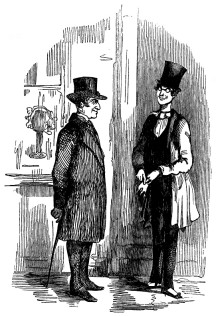
"I am engaged to dine at—at Fairoaks," said Mr. Smirke, blushing faintly and whisking the scented pocket-handkerchief, and his pony being in waiting, he mounted and rode away simpering down the street. No accident befell him that day, and he arrived with his tie in the very best order at Mrs. Pendennis's house.
CHAPTER XVII.
WHICH CONCLUDES THE FIRST PART OF THIS HISTORY.
The curate had gone on his daily errand to Fairoaks, and was up-stairs in Pen's study pretending to read with his pupil, in the early part of that very afternoon when Mrs. Portman after transacting business with Mrs. Pybus had found the weather so exceedingly fine that she pursued her walk as far as Fairoaks, in order to pay a visit to her dear friend there. In the course of their conversation, the rector's lady told Mrs. Pendennis and the major a very great secret about the curate, Mr. Smirke, which was no less than that he had an attachment, a very old attachment, which he had long kept quite private.
"And on whom is it that Mr. Smirke has bestowed his heart?" asked Mrs. Pendennis, with a superb air, but rather an inward alarm.
"Why, my dear," the other lady answered, "when he first came and used to dine at the Rectory, people said we wanted him for Myra, and we were forced to give up asking him. Then they used to say he was smitten in another quarter; but I always contradicted it, for my part, and said that you—"
"That I," cried Mrs. Pendennis; "people are very impertinent, I am sure. Mr. Smirke came here as Arthur's tutor, and I am surprised that any body should dare to speak so—"
"'Pon my soul, it is a little too much," the major said, laying down the newspaper and the double eye-glass.
"I've no patience with that Mrs. Pybus," Helen continued, indignantly.
"I told her there was no truth in it," Mrs. Portman said. "I always said so, my dear: and now it comes out that my demure gentleman has been engaged to a young lady—Miss Thompson, of Clapham Common, ever so long: and I am delighted, for my part, and on Myra's account, too, for an unmarried curate is always objectionable about one's house: and of course it is strictly private, but I thought I would tell you, as it might remove unpleasantnesses. But mind: not one word, if you please, about the story."
Mrs. Pendennis said, with perfect sincerity, that she was exceedingly glad to hear the news: and hoped Mr. Smirke, who was a very kind and amiable man, would have a deserving wife: and when her visitor went away, Helen and her brother talked of the matter with great satisfaction, the kind lady rebuking herself for her haughty behavior to Mr. Smirke, whom she had avoided of late, instead of being grateful to him for his constant attention to Arthur.
"Gratitude to this kind of people," the major said, "is very well; but familiarity is out of the question. This gentleman gives his lessons and receives his money like any other master. You are too humble, my good soul. There must be distinctions in ranks, and that sort of thing. I told you before, you were too kind to Mr. Smirke."
But Helen did not think so; and now that Arthur was going away, and she bethought her how very polite Mr. Smirke had been; how he had gone on messages for her; how he had brought books and copied music; how he had taught Laura so many things, and given her so many kind presents, her heart smote her on account of her ingratitude toward the curate;—so much so, that when he came down from study with Pen, and was hankering about the hall previous to his departure, she went out and shook hands with him with rather a blushing face, and begged him to come into her drawing-room, where she said they now never saw him. And as there was to be rather a good dinner that day, she invited Mr. Smirke to partake of it; and we may be sure that he was too happy to accept such a delightful summons.
Eased, by the above report, of all her former doubts and misgivings regarding the curate, Helen was exceedingly kind and gracious to Mr. Smirke during dinner, redoubling her attentions, perhaps because Major Pendennis was very high and reserved with his nephew's tutor. When Pendennis asked Smirke to drink wine, he addressed him as if he was a sovereign speaking to a petty retainer, in a manner so condescending, that even Pen laughed at it, although quite ready, for his part, to be as conceited as most young men are.
But Smirke did not care for the impertinences of the major so long as he had his hostess's kind behavior; and he passed a delightful time by her side at table, exerting all his powers of conversation to please her, talking in a manner both clerical and worldly, about the Fancy Bazaar, and the Great Missionary Meeting, about the last new novel, and the bishop's excellent sermon—about the fashionable parties in London, an account of which he read in the newspapers—in fine, he neglected no art, by which a college divine who has both sprightly and serious talents, a taste for the genteel, an irreproachable conduct, and a susceptible heart, will try and make himself agreeable to the person on whom he has fixed his affections.
Major Pendennis came yawning out of the dining-room very soon after his sister and little Laura had left the apartment—"What an unsufferable bore that man is, and how he did talk!" the major said.
"He has been very good to Arthur, who is very fond of him," Mrs. Pendennis said—"I wonder who the Miss Thompson is whom he is going to marry."
"I always thought the fellow was looking in another direction," said the major.
"And in what?" asked Mrs. Pendennis, quite innocently—"toward Myra Portman?"
"Toward Helen Pendennis, if you must know," answered her brother-in-law.
"Toward me! impossible!" Helen said, who knew perfectly well that such had been the case. "His marriage will be a very happy thing. I hope Arthur will not take too much wine."
Now Arthur flushed with a good deal of pride at the privilege of having the keys of the cellar, and remembering that a very few more dinners would probably take place which he and his dear friend Smirke could share, had brought up a liberal supply of claret for the company's drinking, and when the elders with little Laura left him, he and the curate began to pass the wine very freely.
One bottle speedily yielded up the ghost, another shed more than half its blood, before the two topers had been much more than half an hour together—Pen, with a hollow laugh and voice, had drunk off one bumper to the falsehood of women, and had said sardonically, that wine, at any rate, was a mistress who never deceived, and was sure to give a man a welcome.
Smirke gently said that he knew for his part some women who were all truth and tenderness; and casting up his eyes toward the ceiling, and heaving a sigh as if evoking some being dear and unmentionable, he took up his glass and drained it, and the rosy liquor began to suffuse his face.
Pen trolled over some verses he had been making that morning, in which he informed himself that the woman who had slighted his passion could not be worthy to win it: that he was awaking from love's mad fever, and, of course, under these circumstances, proceeded to leave her, and to quit a heartless deceiver: that a name which had one day been famous in the land, might again be heard in it: and, that though he never should be the happy and careless boy he was but a few months since, or his heart be what it had been ere passion had filled it and grief had well-nigh killed it; that though to him personally death was as welcome as life, and that he would not hesitate to part with the latter, but for the love of one kind being whose happiness depended on his own—yet he hoped to show he was a man worthy of his race, and that one day the false one should be brought to know how great was the treasure and noble the heart which she had flung away.
Pen, we say, who was a very excitable person, rolled out these verses in his rich, sweet voice, which trembled with emotion while our young poet spoke. He had a trick of blushing when in this excited state, and his large and honest gray eyes also exhibited proofs of a sensibility so genuine, hearty, and manly, that Miss Costigan, if she had a heart, must needs have softened toward him; and very likely she was, as he said, altogether unworthy of the affection which he lavished upon her.
The sentimental Smirke was caught by the emotion which agitated his young friend. He grasped Pen's hand over the dessert dishes and wine glasses. He said the verses were beautiful: that Pen was a poet, a great poet, and likely by heaven's permission to run a great career in the world. "Go on and prosper, dear Arthur," he cried; "the wounds under which at present you suffer are only temporary, and the very grief you endure will cleanse and strengthen your heart. I have always prophesied the greatest and brightest things of you, as soon as you have corrected some failings and weaknesses of character, which at present belong to you. But you will get over these, my boy; you will get over these; and when you are famous and celebrated, as I know you will be, will you remember your old tutor and the happy early days of your youth?"
Pen swore he would: with another shake of the hand across the glasses and apricots. "I shall never forget how kind you have been to me, Smirke," he said. "I don't know what I should have done without you. You are my best friend."
"Am I, really, Arthur?" said Smirke, looking through his spectacles; and his heart began to beat so that he thought Pen must almost hear it throbbing.
"My best friend, my friend forever," Pen said. "God bless you, old boy," and he drank up the last glass of the second bottle of the famous wine which his father had laid in, which his uncle had bought, which Lord Levant had imported, and which now, like a slave indifferent, was ministering pleasure to its present owner, and giving its young master delectation.
"We'll have another bottle, old boy," Pen said, "by Jove we will. Hurray!—claret goes for nothing. My uncle was telling me that he saw Sheridan drink five bottles at Brookes's, besides a bottle of Maraschino. This is some of the finest wine in England, he says. So it is, by Jove. There's nothing like it. Nunc vino pellite curas—cras ingens iterabimus æq—fill your glass, Old Smirke, a hogshead of it won't do you any harm." And Mr. Pen began to sing the drinking song out of Der Freischütz. The dining-room windows were open, and his mother was softly pacing on the lawn outside, while little Laura was looking at the sunset. The sweet fresh notes of the boy's voice came to the widow. It cheered her kind heart to hear him sing.
"You—you are taking too much wine, Arthur," Mr. Smirke said, softly—"you are exciting yourself."
"No," said Pen, "women give headaches, but this don't. Fill your glass, old fellow, and let's drink—I say, Smirke, my boy—let's drink to her—your her, I mean, not mine, for whom I swear I'll care no more—no, not a penny—no, not a fig—no, not a glass of wine. Tell us about the lady, Smirke; I've often seen you sighing about her."
"Oh!" said Smirke—and his beautiful cambric shirt front and glistening studs heaved with the emotion which agitated his gentle and suffering bosom.
"Oh—what a sigh!" Pen cried, growing very hilarious; "fill, my boy, and drink the toast, you can't refuse a toast, no gentleman refuses a toast. Here's her health, and good luck to you, and may she soon be Mrs. Smirke."
"Do you say so?" Smirke said, all of a tremble. "Do you really say so, Arthur?"
"Say so; of course, I say so. Down with it. Here's Mrs. Smirke's good health: hip, hip, hurray!"
Smirke convulsively gulped down his glass of wine, and Pen waved his over his head, cheering so as to make his mother and Laura wonder on the lawn, and his uncle, who was dozing over the paper in the drawing-room, start, and say to himself, "that boy's drinking too much."
Smirke put down the glass.
"I accept the omen," gasped out the blushing curate. "Oh, my dear Arthur, you—you know her—"
"What—Myra Portman? I wish you joy: she's got a dev'lish large waist; but I wish you joy, old fellow."
"Oh, Arthur!" groaned the curate again, and nodded his head, speechless.
"Beg your pardon—sorry I offended you—but she has got a large waist, you know—devilish large waist," Pen continued—the third bottle evidently beginning to act upon the young gentleman.
"It's not Miss Portman," the other said, in a voice of agony.
"Is it any body at Chatteries or at Clapham? Somebody here? No—it ain't old Pybus? it can't be Miss Rolt at the factory—she's only fourteen."
"It's somebody rather older than I am, Pen," the curate cried, looking up at his friend, and then guiltily casting his eyes down into his plate.
Pen burst out laughing. "It's Madame Fribsby, by Jove, it's Madame Fribsby. Madame Frib, by the immortal gods!"
The curate could contain no more. "O Pen," he cried, "how can you suppose that any of those—of those more than ordinary beings you have named, could have an influence upon this heart, when I have been daily in the habit of contemplating perfection! I may be insane, I may be madly ambitious, I may be presumptuous—but for two years my heart has been filled by one image, and has known no other idol. Haven't I loved you as a son, Arthur?—say, hasn't Charles Smirke loved you as a son?"
"Yes, old boy, you've been very good to me," Pen said, whose liking, however, for his tutor was not by any means of the filial kind.
"My means," rushed on Smirke, "are at present limited, I own, and my mother is not so liberal as might be desired; but what she has will be mine at her death. Were she to hear of my marrying a lady of rank and good fortune, my mother would be liberal, I am sure she would be liberal. Whatever I have or subsequently inherit—and it's five hundred a year at the very least—would be settled upon her and—and—and you at my death—that is—"
"What the deuce do you mean?—and what have I to do with your money?" cried out Pen, in a puzzle.
"Arthur, Arthur!" exclaimed the other wildly; "You say I am your dearest friend—let me be more. Oh, can't you see that the angelic being I love—the purest, the best of women—is no other than your dear, dear angel of a mother."
"My mother!" cried out Arthur, jumping up, and sober in a minute. "Pooh! damn it, Smirke, you must be mad—she's seven or eight years older than you are."
"Did you find that any objection," cried Smirke piteously, and alluding, of course, to the elderly subject of Pen's own passion.
The lad felt the hint, and blushed quite red. "The cases are not similar, Smirke," he said, "and the allusion might have been spared. A man may forget his own rank and elevate any woman to it; but allow me to say our positions are very different."
"How do you mean, dear Arthur?" the curate interposed sadly, cowering as he felt that his sentence was about to be read.
"Mean?" said Arthur. "I mean what I say. My tutor, I say, my tutor, has no right to ask a lady of my mother's rank of life to marry him. It's a breach of confidence. I say it's a liberty you take, Smirke—it's a liberty. Mean, indeed!"
"Oh Arthur!" the curate began to cry, with clasped hands, and a scared face, but Arthur gave another stamp with his foot, and began to pull at the bell. "Don't let's have any more of this. We'll have some coffee, if you please," he said, with a majestic air: and the old butler entering at the summons, Arthur bade him to serve that refreshment.
John said he had just carried coffee into the drawing-room, where his uncle was asking for Master Arthur, and the old man gave a glance of wonder at the three empty claret-bottles. Smirke said he thought he'd—he'd rather not go into the drawing-room, on which Arthur haughtily said, "As you please," and called for Mr. Smirke's horse to be brought round. The poor fellow said he knew the way to the stable and would get his pony himself, and he went into the hall and sadly put on his coat and hat.
Pen followed him out uncovered. Helen was still walking up and down the soft lawn as the sun was setting, and the curate took off his hat and bowed by way of farewell, and passed on to the door leading to the stable-court by which the pair disappeared. Smirke knew the way to the stables, as he said, well enough. He fumbled at the girths of the saddle which Pen fastened for him, and put on the bridle and led the pony into the yard. The boy was touched by the grief which appeared in the other's face as he mounted. Pen held out his hand, and Smirke wrung it silently.
"I say, Smirke," he said, in an agitated voice, "forgive me if I have said any thing harsh—for you have always been very, very kind to me. But it can't be, old fellow, it can't be. Be a man. God bless you."
Smirke nodded his head silently, and rode out of the lodge gate; and Pen looked after him for a couple of minutes, until he disappeared down the road, and the clatter of the pony's hoofs died away. Helen was still lingering in the lawn waiting until the boy came back—she put his hair off his forehead and kissed it fondly. She was afraid he had been drinking too much wine. Why had Mr. Smirke gone away without any tea?
He looked at her with a kind humor beaming in his eyes; "Smirke is unwell," he said, with a laugh. For a long while Helen had not seen the boy looking so cheerful. He put his arm round her waist, and walked her up and down the walk in front of the house. Laura began to drub on the drawing-room window and nod and laugh from it. "Come along you two people," cried out Major Pendennis, "your coffee is getting quite cold."
When Laura was gone to bed, Pen, who was big with his secret, burst out with it, and described the dismal but ludicrous scene which had occurred. Helen heard of it with many blushes, which became her pale face very well, and a perplexity which Arthur roguishly enjoyed.
"Confound the fellow's impudence," Major Pendennis said, as he took his candle, "where will the assurance of these people stop?" Pen and his mother had a long talk that night, full of love, confidence, and laughter, and the boy somehow slept more soundly and woke up more easily than he had done for many months before.
Before the great Mr. Dolphin quitted Chatteries, he not only made an advantageous engagement with Miss Fotheringay, but he liberally left with her a sum of money to pay off any debts which the little family might have contracted during their stay in the place, and which, mainly through the lady's own economy and management, were not considerable. The small account with the spirit merchant, which Major Pendennis had settled, was the chief of Captain Costigan's debts, and though the captain at one time talked about repaying every farthing of the money, it never appears that he executed his menace, nor did the laws of honor in the least call upon him to accomplish that threat.
When Miss Costigan had seen all the outstanding bills paid to the uttermost shilling, she handed over the balance to her father, who broke out into hospitalities to all his friends, gave the little Creeds more apples and gingerbread, than he had ever bestowed upon them, so that the widow Creed ever after held the memory of her lodger in veneration, and the young ones wept bitterly when he went away; and in a word, managed the money so cleverly that it was entirely expended before many days, and that he was compelled to draw upon Mr. Dolphin for a sum to pay for traveling expenses when the time of their departure arrived.
There was held at an inn in that county town a weekly meeting of a festive, almost a riotous character, of a society of gentlemen who called themselves the Buccaneers. Some of the choice spirits of Chatteries belonged to this cheerful club. Graves, the apothecary (than whom a better fellow never put a pipe in his mouth and smoked it), Smart, the talented and humorous portrait-painter of High-street, Croker, an excellent auctioneer, and the uncompromising Hicks, the able editor for twenty-three years of the County Chronicle and Chatteries Champion, were among the crew of the Buccaneers, whom also Bingley the manager liked to join of a Saturday evening, whenever he received permission from his lady.
Costigan had been also an occasional Buccaneer. But a want of punctuality of payments had of late somewhat excluded him from the society, where he was subject to disagreeable remarks from the landlord, who said that a Buccaneer who didn't pay his shot was utterly unworthy to be a Marine Bandit. But when it became known to the 'Ears, as the clubbists called themselves familiarly, that Miss Fotheringay had made a splendid engagement, a great revolution of feeling took place in the club regarding Captain Costigan. Solly, mine host of the Grapes, (and I need not say as worthy a fellow as ever stood behind a bar), told the gents in the Buccaneers' room one night how noble the captain had beayved: having been round and paid off all his ticks in Chatteries, including his score of three pound fourteen here, and pronounced that Cos was a good feller, a gentleman at bottom, and he, Solly, had always said so, and finally worked upon the feelings of the Buccaneers to give the captain a dinner.
The banquet took place on the last night of Costigan's stay in Chatteries, and was served in Solly's accustomed manner. As good a plain dinner of old English fare as ever smoked on a table was prepared by Mrs. Solly; and about eighteen gentlemen sate down to the festive board. Mr. Jubber (the eminent draper of High-street) was in the chair, having this distinguished guest of the club on his right. The able and consistent Hicks, officiated as croupier on the occasion; most of the gentlemen of the club were present, and H. Foker, Esq., and —— Spavin, Esq., friends of Captain Costigan, were also participators in the entertainment. The cloth having been drawn, the chairman said, "Costigan, there is wine, if you like," but the captain preferring punch, that liquor was voted by acclamation: and "Non Nobis," having been sung in admirable style by Messrs. Bingley, Hicks, and Bullby (of the cathedral choir, than whom a more jovial spirit ne'er tossed off a bumper or emptied a bowl), the chairman gave the health of the "King!" which was drunk with the loyalty of Chatteries men, and then without further circumlocution proposed their friend "Captain Costigan."
After the enthusiastic cheering which rang through old Chatteries had subsided, Captain Costigan rose in reply, and made a speech of twenty minutes, in which he was repeatedly overcome by his emotions.
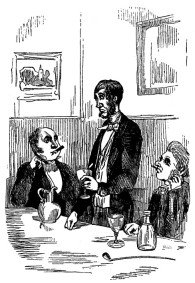
The gallant captain said he must be pardoned for incoherence, if his heart was too full to speak. He was quitting a city celebrated for its antiquitee, its hospitalitee, the beautee of its women, the manly fidelitee, generositee, and jovialitee of its men. (Cheers). He was going from that ancient and venerable city, of which while mimoree held her sayt, he should never think without the fondest emotion, to a methrawpolis where the talents of his daughther were about to have full play, and where he would watch over her like a guardian angel. He should never forget that it was at Chatteries she had acquired the skill which she was about to exercise in another sphere, and in her name and his own, Jack Costigan thanked and blessed them. The gallant officer's speech was received with tremendous cheers.
Mr. Hicks, Croupier, in a brilliant and energetic manner, proposed Miss Fotheringay's health.
Captain Costigan returned thanks in a speech full of feeling and eloquence.
Mr. Jubber proposed the Drama and the Chatteries Theater, and Mr. Bingley was about to rise, but was prevented by Captain Costigan, who, as long connected with the Chatteries Theater, and on behalf of his daughter, thanked the company. He informed them that he had been in garrison, at Gibraltar, and at Malta, and had been at the taking of Flushing. The Duke of York was a patron of the Drama; he had the honor of dining with His Royal Highness and the Duke of Kent many times; and the former had justly been named the friend of the soldier. (Cheers.)
The army was then proposed, and Captain Costigan returned thanks. In the course of the night he sang his well known songs, "The Deserter," "The Shan Van Voght," "The Little Pig under the Bed," and "The Vale of Avoca." The evening was a great triumph for him—it ended. All triumphs and all evenings end. And the next day, Miss Costigan having taken leave of all her friends, and having been reconciled to Miss Rouncy, to whom she left a necklace and a white satin gown—the next day he and Miss Costigan had places in the Competitor coach rolling by the gates of Fairoaks Lodge—and Pendennis never saw them.
Tom Smith, the coachman, pointed out Fairoaks to Mr. Costigan, who sate on the box smelling of rum-and-water—and the captain said it was a poor place—and added, "Ye should see Castle Costigan, County Mayo, me boy,"—which Tom said he should like very much to see.
They were gone and Pen had never seen them! He only knew of their departure by its announcement in the county paper the next day and straight galloped over to Chatteries to hear the truth of this news. They were gone indeed. A card of "Lodgings to let" was placed in the dear little familiar window. He rushed up into the room and viewed it over. He sate ever so long in the old window-seat looking into the dean's garden: whence he and Emily had so often looked out together. He walked, with a sort of terror, into her little empty bed-room. It was swept out and prepared for new comers. The glass which had reflected her fair face was shining ready for her successor. The curtains lay square folded on the little bed: he flung himself down and buried his head on the vacant pillow.
Laura had netted a purse into which his mother had put some sovereigns, and Pen had found it on his dressing-table that very morning. He gave one to the little servant who had been used to wait upon the Costigans, and another to the children, because they said they were very fond of her. It was but a few months back, yet what years ago it seemed since he had first entered that room! He felt that it was all done. The very missing her at the coach had something fatal in it. Blank, weary, utterly wretched and lonely the poor lad felt.
His mother saw she was gone by his look when he came home. He was eager to fly too now, as were other folks round about Chatteries. Poor Smirke wanted to go away from the sight of the syren widow. Foker began to think he had had enough of Baymouth, and that a few supper parties at Saint Boniface would not be unpleasant. And Major Pendennis longed to be off, and have a little pheasant-shooting at Stillbrook, and get rid of all annoyances and tracasseries of the village. The widow and Laura nervously set about the preparation for Pen's kit, and filled trunks with his books and linen. Helen wrote cards with the name of Arthur Pendennis, Esq., which were duly nailed on the boxes; and at which both she and Laura looked with tearful, wistful eyes. It was not until long, long after he was gone, that Pen remembered how constant and tender the affection of these women had been, and how selfish his own conduct was.
A night soon comes, when the mail, with echoing horn and blazing lamps, stops at the lodge-gate of Fairoaks, and Pen's trunks and his uncle's are placed on the roof of the carriage, into which the pair presently afterward enter. Helen and Laura are standing by the evergreens of the shrubbery, their figures lighted up by the coach lamps; the guard cries, All right: in another instant the carriage whirls onward; the lights disappear, and Helen's heart and prayers go with them. Her sainted benedictions follow the departing boy. He has left the home-nest in which he has been chafing, and whither, after his very first flight, he returned bleeding and wounded; he is eager to go forth again, and try his restless wings.
How lonely the house looks without him! The corded trunks and book-boxes are there in his empty study. Laura asks leave to come and sleep in Helen's room: and when she has cried herself to sleep there, the mother goes softly into Pen's vacant chamber, and kneels down by the bed, on which the moon is shining, and there prays for her boy, as mothers only know how to plead. He knows that her pure blessings are following him, as he is carried miles away.
CHAPTER XVIII.
ALMA MATER.
Every man, however brief or inglorious may have been his academical career, must remember with kindness and tenderness the old university comrades and days. The young man's life is just beginning: the boy's leading-strings are cut, and he has all the novel delights and dignities of freedom. He has no idea of cares yet, or of bad health, or of roguery, or poverty, or to-morrow's disappointment. The play has not been acted so often as to make him tired. Though the after-drink, as we mechanically go on repeating it, is stale and bitter, how pure and brilliant was that first sparkling draught of pleasure!—How the boy rushes at the cup, and with what a wild eagerness he drains it! But old epicures who are cut off from the delights of the table, and are restricted to a poached egg and a glass of water, like to see people with good appetites; and, as the next best thing to being amused at a pantomime one's self is to see one's children enjoy it, I hope there may be no degree of age or experience to which mortal may attain, when he shall become such a glum philosopher, as not to be pleased by the sight of happy youth. Coming back a few weeks since from a brief visit to the old University of Oxbridge, where my friend Mr. Arthur Pendennis passed some period of his life, I made the journey in the railroad by the side of a young fellow at present a student of Saint Boniface. He had got an excat somehow, and was bent on a day's lark in London: he never stopped rattling and talking from the commencement of the journey until its close (which was a great deal too soon for me, for I never was tired of listening to the honest young fellow's jokes and cheery laughter); and when we arrived at the terminus nothing would satisfy him but a Hansom cab, so that he might get into town the quicker, and plunge into the pleasures awaiting him there. Away the young lad went whirling, with joy lighting up his honest face; and as for the reader's humble servant, having but a small carpet-bag, I got up on the outside of the omnibus, and sate there very contentedly between a Jew-pedlar smoking bad cigars, and a gentleman's servant taking care of a poodle-dog, until we got our fated complement of passengers and boxes, when the coachman drove leisurely away. We weren't in a hurry to get to town. Neither one of us was particularly eager about rushing into that near smoking Babylon, or thought of dining at the club that night, or dancing at the Casino. Yet a few years more, and my young friend of the railroad will be not a whit more eager.
There were no railroads made when Arthur Pendennis went to the famous University of Oxbridge; but he drove thither in a well appointed coach, filled inside and out with dons, gownsmen, young freshmen about to enter, and their guardians, who were conducting them to the University. A fat old gentleman, in gray stockings, from the City, who sate by Major Pendennis inside the coach, having his pale-faced son opposite, was frightened beyond measure, when he heard that the coach had been driven for a couple of stages by young Mr. Foker, of Saint Boniface College, who was the friend of all men, including coachmen, and could drive as well as Tom Hicks himself. Pen sate on the roof, examining coach, passengers, and country, with great delight and curiosity. His heart jumped with pleasure as the famous University came in view, and the magnificent prospect of venerable towers and pinnacles, tall elms and shining river, spread before him.
Pen had passed a few days with his uncle at the major's lodgings, in Bury-street, before they set out for Oxbridge. Major Pendennis thought that the lad's wardrobe wanted renewal; and Arthur was by no means averse to any plan which was to bring him new coats and waistcoats. There was no end to the sacrifices which the self-denying uncle made in the youth's behalf. London was awfully lonely. The Pall Mall pavement was deserted; the very red jackets had gone out of town. There was scarce a face to be seen in the bow windows of the clubs. The major conducted his nephew into one or two of those desert mansions, and wrote down the lad's name on the candidate-list of one of them; and Arthur's pleasure at this compliment on his guardian's part was excessive. He read in the parchment volume his name and titles, as "Arthur Pendennis, Esquire, of Fairoaks Lodge, —shire, and Saint Boniface College, Oxbridge; proposed by Major Pendennis, and seconded by Viscount Colchicum," with a thrill of intense gratification. "You will come in for ballot in about three years, by which time you will have taken your degree," the guardian said. Pen longed for the three years to be over, and surveyed the stucco-halls, and vast libraries, and drawing rooms, as already his own property. The major laughed slily to see the pompous airs of the simple young fellow, as he strutted out of the building. He and Foker drove down in the latter's cab one day to the Gray Friars, and renewed acquaintance with some of their old comrades there. The boys came crowding up to the cab as it stood by the Gray Friars gates, where they were entering, and admired the chestnut horse, and the tights and livery and gravity of Stoopid, the tiger. The bell for afternoon-school rang as they were swaggering about the play ground talking to their old cronies. The awful doctor passed into school with his grammar in his hand. Foker slunk away uneasily at his presence, but Pen went up blushing, and shook the dignitary by the hand. He laughed as he thought that well-remembered Latin Grammar had boxed his ears many a time. He was generous, good-natured, and, in a word, perfectly conceited and satisfied with himself.
Then they drove to the parental brew-house. Foker's Entire is composed in an enormous pile of buildings, not far from the Gray Friars, and the name of that well known firm is gilded upon innumerable public-house signs, tenanted by its vassals in the neighborhood; and the venerable junior partner and manager did honor to the young lord of the vats, and his friend, and served them with silver flagons of brown stout, so strong, that you would have thought, not only the young men, but the very horse Mr. Harry Foker drove, was affected by the potency of the drink, for he rushed home to the west-end of the town at a rapid pace, which endangered the pie-stalls and the women on the crossings, and brought the cab-steps into collision with the posts at the street corners, and caused Stoopid to swing fearfully on his board behind.
The major was quite pleased when Pen was with his young acquaintance; listened to Mr. Foker's artless stories with the greatest interest, gave the two boys a fine dinner at a Covent Garden Coffee-house, whence they proceeded to the play; but was above all happy when Mr. and Lady Agnes Foker, who happened to be in London, requested the pleasure of Major Pendennis and Mr. Arthur Pendennis's company at dinner in Grosvenor-street. "Having obtained the entrée into Lady Agnes Foker's house," he said to Pen with an affectionate solemnity which befitted the importance of the occasion, "it behoves you, my dear boy, to keep it. You must mind and never neglect to call in Grosvenor-street when you come to London. I recommend you to read up carefully, in Debrett, the alliances and genealogy of the Earls of Rosherville, and if you can, to make some trifling allusions to the family, something historical, neat, and complimentary, and that sort of thing, which you, who have a poetic fancy, can do pretty well. Mr. Foker himself is a worthy man, though not of high extraction or indeed much education. He always makes a point of having some of the family porter served round after dinner, which you will on no account refuse, and which I shall drink myself, though all beer disagrees with me confoundedly." And the heroic martyr did actually sacrifice himself, as he said he would, on the day when the dinner took place, and old Mr. Foker at the head of his table, made his usual joke about Foker's Entire. We should all of us, I am sure, have liked to see the major's grin, when the worthy old gentleman made his time-honored joke.
Lady Agnes, who, wrapped up in Harry, was the fondest of mothers, and one of the most good-natured though not the wisest of women, received her son's friend with great cordiality: and astonished Pen by accounts of the severe course of studies which her darling boy was pursuing, and which she feared might injure his dear health. Foker the elder burst into a horse-laugh at some of these speeches, and the heir of the house winked his eye very knowingly at his friend. And Lady Agnes then going through her son's history from the earliest time, and recounting his miraculous sufferings in the measles and whooping-cough, his escape from drowning, the shocking tyrannies practiced upon him at that horrid school, whither Mr. Foker would send him because he had been brought up there himself, and she never would forgive that disagreeable doctor, no never—Lady Agnes, we say, having prattled away for an hour incessantly about her son, voted the two Messieurs Pendennis most agreeable men; and when the pheasants came with the second course, which the major praised as the very finest birds he ever saw, her ladyship said they came from Logwood (as the major knew perfectly well) and hoped that they would both pay her a visit there—at Christmas, or when dear Harry was at home for the vacations.
"God bless you, my dear boy," Pendennis said to Arthur, as they were lighting their candles in Bury-street afterward to go to bed. "You made that little allusion to Agincourt, where one of the Roshervilles distinguished himself, very neatly and well, although Lady Agnes did not quite understand it; but it was exceedingly well for a beginner—though you oughtn't to blush so, by the way—and I beseech you, my dear Arthur, to remember through life, that with an entrée—with a good entrée, mind—it is just as easy for you to have good society as bad, and that it costs a man, when properly introduced, no more trouble or soins to keep a good footing in the best houses in London than to dine with a lawyer in Bedford-square. Mind this when you are at Oxbridge pursuing your studies, and for Heaven's sake be very particular in the acquaintances which you make. The premier pas in life is the most important of all—did you write to your mother to-day?—No?—well, do, before you go, and call and ask Mr. Foker for a frank.—They like it.—Good night. God bless you."
Pen wrote a droll account of his doings in London, and the play, and the visit to the old Friars, and the brewery, and the party at Mr. Foker's, to his dearest mother, who was saying her prayers at home in the lonely house at Fairoaks, her heart full of love and tenderness unutterable for the boy: and she and Laura read that letter and those which followed, many, many times, and brooded over them as women do. It was the first step in life that Pen was making—Ah! what a dangerous journey it is, and how the bravest may stumble and the strongest fail. Brother wayfarer! may you have a kind arm to support you on the path, and a friendly hand to succor those who fall beside you. May truth guide, mercy forgive at the end, and love accompany always. Without that lamp how blind the traveler would be, and how black and cheerless the journey!
So the coach drove up to that ancient and comfortable inn the Trencher, which stands in Main-street Oxbridge, and Pen with delight and eagerness remarked, for the first time, gownsmen going about, chapel bells clinking (bells in Oxbridge are ringing from morning-tide till even-song)—towers and pinnacles rising calm and stately over the gables and antique house-roofs of the homely, busy city. Previous communications had taken place between Dr. Portman on Pen's part, and Mr. Buck, Tutor of Boniface, on whose side Pen was entered; and as soon as Major Pendennis had arranged his personal appearance, so that it should make a satisfactory impression upon Pen's tutor, the pair walked down Main-street, and passed the great gate and belfry-tower of Saint George's College, and so came, as they were directed, to Saint Boniface: where again Pen's heart began to beat as they entered at the wicket of the venerable ivy-mantled gate of the college. It is surmounted with an ancient dome almost covered with creepers, and adorned with the effigy of the saint from whom the house takes its name, and many coats-of-arms of its royal and noble benefactors.
The porter pointed out a queer old tower at the corner of the quadrangle, by which Mr. Buck's rooms were approached, and the two gentlemen walked across the square, the main features of which, were at once and forever stamped in Pen's mind—the pretty fountain playing in the center of the fair grass plats; the tall chapel windows and buttresses rising to the right; the hall with its tapering lantern and oriel window; the lodge, from the doors of which the master issued awfully in rustling silks; the lines of the surrounding rooms pleasantly broken by carved chimneys, gray turrets, and quaint gables—all these Mr. Pen's eyes drank in with an eagerness which belongs to first impressions; and Major Pendennis surveyed with that calmness which belongs to a gentleman who does not care for the picturesque, and whose eyes have been somewhat dimmed by the constant glare of the pavement of Pall Mall.
Saint George's is the great college of the University of Oxbridge, with its four vast quadrangles, and its beautiful hall and gardens, and the Georgians, as the men are called, wear gowns of a peculiar cut, and give themselves no small airs of superiority over all other young men. Little Saint Boniface is but a petty hermitage in comparison of the huge consecrated pile alongside of which it lies. But considering its size it has always kept an excellent name in the University. Its ton is very good; the best families of certain counties have time out of mind sent up their young men to Saint Boniface; the college livings are remarkably good, the fellowships easy; the Boniface men had had more than their fair share of University honors; their boat was third upon the river: their chapel-choir is not inferior to Saint George's itself; and the Boniface ale the best in Oxbridge. In the comfortable old wainscoted College-Hall, and round about Roubilliac's statue of Saint Boniface (who stands in an attitude of seraphic benediction over the uncommonly good cheer of the fellows' table) there are portraits of many most eminent Bonifacians. There is the learned Dr. Griddle, who suffered in Henry VIII.'s time, and Archbishop Bush who roasted him—there is Lord Chief Justice Hicks—the Duke of St. David's, K. G., Chancellor of the University and member of this College—Sprott, the poet, of whose fame the college is justly proud—Doctor Blogg, the late master and friend of Doctor Johnson, who visited him at St. Boniface—and other lawyers, scholars, and divines, whose portraitures look from the walls, or whose coats-of-arms shine in emerald and ruby, gold and azure, in the tall windows of the refectory. The venerable cook of the college is one of the best artists in Oxbridge (his son took the highest honors in the other University of Camford) and the wine in the fellows' room has long been famed for its excellence and abundance.
Into this certainly not the least snugly sheltered arbor among the groves of Academe, Pen now found his way, leaning on his uncle's arm, and they speedily reached Mr. Buck's rooms, and were conducted into the apartment of that courteous gentleman.
He had received previous information from Dr. Portman regarding Pen, with respect to whose family, fortune, and personal merits the honest doctor had spoken with no small enthusiasm. Indeed Portman had described Arthur to the tutor "as a young gentleman of some fortune and landed estate, of one of the most ancient families in the kingdom, and possessing such a character and genius as were sure, under the proper guidance, to make him a credit to the college and the University." Under such recommendations the tutor was, of course, most cordial to the young freshman and his guardian, invited the latter to dine in hall, where he would have the satisfaction of seeing his nephew wear his gown and eat his dinner for the first time, and requested the pair to take wine at his rooms after hall, and in consequence of the highly favorable report he had received of Mr. Arthur Pendennis, said he should be happy to give him the best set of rooms to be had in college—a gentleman-pensioner's set, indeed, which were just luckily vacant. So they parted until dinner-time, which was very near at hand, and Major Pendennis pronounced Mr. Buck to be uncommonly civil indeed. Indeed when a college magnate takes the trouble to be polite, there is no man more splendidly courteous. Immersed in their books and excluded from the world by the gravity of their occupations, these reverend men assume a solemn magnificence of compliment in which they rustle and swell as in their grand robes of state. Those silks and brocades are not put on for all comers or every day.
When the two gentlemen had taken leave of the tutor in his study, and had returned to Mr. Buck's ante-room, or lecture-room, a very handsome apartment, turkey-carpeted, and hung with excellent prints and richly framed pictures, they found the tutor's servant already in waiting there, accompanied by a man with a bag full of caps and a number of gowns, from which Pen might select a cap and gown for himself, and the servant, no doubt, would get a commission proportionable to the service done by him. Mr. Pen was all in a tremor of pleasure as the bustling tailor tried on a gown and pronounced that it was an excellent fit; and then he put the pretty college cap on, in rather a dandified manner and somewhat on one side, as he had seen Fiddicombe, the youngest master at Gray Friars, wear it. And he inspected the entire costume with a great deal of satisfaction in one of the great gilt mirrors which ornamented Mr. Buck's lecture-room: for some of these college divines are no more above looking-glasses than a lady is, and look to the set of their gowns and caps quite as anxiously as folks do of the lovelier sex. The major smiled as he saw the boy dandifying himself in the glass: the old gentleman was not displeased with the appearance of the comely lad.
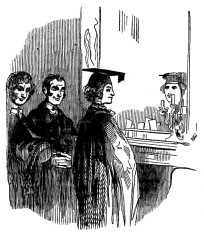
Then Davis, the skip or attendant, led the way, keys in hand, across the quadrangle, the major and Pen following him, the latter blushing, and pleased with his new academical habiliments, across the quadrangle to the rooms which were destined for the freshman; and which were vacated by the retreat of the gentleman-pensioner, Mr. Spicer. The rooms were very comfortable, with large cross beams, high wainscots and small windows in deep embrasures. Mr. Spicer's furniture was there, and to be sold at a valuation, and Major Pendennis agreed on his nephew's behalf to take the available part of it, laughingly, however, declining (as, indeed, Pen did for his own part), six sporting prints, and four groups of opera-dancers with gauze draperies, which formed the late occupant's pictorial collection.
Then they went to hall, where Pen sate down and ate his commons with his brother freshmen, and the major took his place at the high-table along with the college dignitaries and other fathers or guardians of youth, who had come up with their sons to Oxbridge; and after hall they went to Mr. Buck's to take wine: and after wine to chapel, where the major sate with great gravity in the upper place, having a fine view of the Master in his carved throne or stall under the organ-loft, where that gentleman, the learned Doctor Donne, sate magnificent, with his great prayer-book before him, an image of statuesque piety and rigid devotion. All the young freshmen behaved with gravity and decorum, but Pen was shocked to see that atrocious little Foker, who came in very late, and half-a-dozen of his comrades in the gentlemen-pensioners' seats, giggling and talking as if they had been in so many stalls at the opera. But these circumstances, it must be remembered, took place some years back, when William the Fourth was king. Young men are much better behaved now, and besides, Saint Boniface was rather a fast college.
Pen could hardly sleep at night in his bed-room at the Trencher: so anxious was he to begin his college life, and to get into his own apartments. What did he think about, as he lay tossing and awake? Was it about his mother at home; the pious soul whose life was bound up in his? Yes, let us hope he thought of her a little. Was it about Miss Fotheringay, and his eternal passion, which had kept him awake so many nights, and created such wretchedness and such longing? He had a trick of blushing, and if you had been in the room, and the candle had not been out, you might have seen the youth's countenance redden more than once, as he broke out into passionate incoherent exclamations regarding that luckless event of his life. His uncle's lessons had not been thrown away upon him; the mist of passion had passed from his eyes now, and he saw her as she was. To think that he, Pendennis, had been enslaved by such a woman, and then jilted by her! that he should have stooped so low, to be trampled on in the mire! that there was a time in his life, and that but a few months back, when he was willing to take Costigan for his father-in-law!—
"Poor old Smirke!" Pen presently laughed out—"well, I'll write and try and console the poor old boy. He won't die of his passion, ha, ha!" The major, had he been awake, might have heard a score of such ejaculations uttered by Pen as he lay awake and restless through the first night of his residence at Oxbridge.
It would, perhaps, have been better for a youth, the battle of whose life was going to begin on the morrow, to have passed the eve in a different sort of vigil: but the world had got hold of Pen in the shape of his selfish old Mentor; and those who have any interest in his character, must have perceived ere now, that this lad was very weak as well as very impetuous, very vain as well as very frank, and if of a generous disposition, not a little selfish in the midst of his profuseness, and also rather fickle, as all eager pursuers of self-gratification are.
The six months' passion had aged him very considerably. There was an immense gulf between Pen the victim of love, and Pen the innocent boy of eighteen, sighing after it: and so Arthur Pendennis had all the experience and superiority, besides that command which afterward conceit and imperiousness of disposition gave him over the young men with whom he now began to live.
He and his uncle passed the morning with great satisfaction in making purchases for the better comfort of the apartments which the lad was about to occupy. Mr. Spicer's china and glass was in a dreadfully dismantled condition, his lamps smashed, and his book cases by no means so spacious as those shelves which would be requisite to receive the contents of the boxes which were lying in the hall at Fairoaks, and which were addressed to Arthur in the hand of poor Helen.
The boxes arrived in a few days, that his mother had packed with so much care. Pen was touched as he read the superscriptions in the dear well-known hand, and he arranged in their proper places all the books, his old friends, and all the linen and table-cloths which Helen had selected from the family stock, and all the jam-pots which little Laura had bound in straw, and the hundred simple gifts of home. Pen had another Alma Mater now. But it is not all children who take to her kindly.
CHAPTER XIX.
PENDENNIS OF BONIFACE.
Our friend Pen was not sorry when his Mentor took leave of the young gentleman on the second day after the arrival of the pair in Oxbridge, and we may be sure that the major on his part was very glad to have discharged his duty, and to have the duty over. More than three months of precious time had that martyr of a major given up to his nephew.—Was ever selfish man called upon to make a greater sacrifice? Do you know many men or majors who would do as much? A man will lay down his head, or peril his life for his honor, but let us be shy how we ask him to give up his ease or his heart's desire. Very few of us can bear that trial. Say, worthy reader, if thou hast peradventure a beard, wouldst thou do as much? I will not say that a woman will not. They are used to it; we take care to accustom them to sacrifices: but, my good sir, the amount of self-denial which you have probably exerted through life, when put down to your account elsewhere, will not probably swell the balance on the credit side much. Well, well, there is no use in speaking of such ugly matters, and you are too polite to use a vulgar tu quoque. But I wish to state once for all that I greatly admire the major for his conduct during the past quarter, and think that he has quite a right to be pleased at getting a holiday. Foker and Pen saw him off in the coach, and the former young gentleman gave particular orders to the coachman to take care of that gentleman inside. It pleased the elder Pendennis to have his nephew in the company of a young fellow who would introduce him to the best set of the University. The major rushed off to London and thence to Cheltenham, from which watering-place he descended upon some neighboring great houses, whereof the families were not gone abroad, and where good shooting and company was to be had.
A quarter of the space which custom has awarded to works styled the Serial Nature, has been assigned to the account of one passage in Pen's career, and it is manifest that the whole of his adventures can not be treated at a similar length, unless some descendant of the chronicler of Pen's history should take up the pen at his decease, and continue the narrative for the successors of the present generation of readers. We are not about to go through the young fellow's academical career with, by any means, a similar minuteness. Alas, the life of such boys does not bear telling altogether. I wish it did. I ask you, does yours? As long as what we call our honor is clear, I suppose your mind is pretty easy. Women are pure, but not men. Women are unselfish, but not men. And I would not wish to say of poor Arthur Pendennis that he was worse than his neighbors, only that his neighbors are bad, for the most part. Let us have the candor to own as much at least. Can you point out ten spotless men of your acquaintance? Mine is pretty large, but I can't find ten saints in the list.
During the first term of Mr. Pen's academical life, he attended classical and mathematical lectures with tolerable assiduity; but discovering, before very long time, that he had little taste or genius for the pursuing of the exact sciences, and being, perhaps, rather annoyed that one or two very vulgar young men, who did not even use straps to their trowsers, so as to cover the abominably thick and coarse shoes and stockings which they wore, beat him completely in the lecture-room, he gave up his attendance at that course, and announced to his fond parent that he proposed to devote himself exclusively to the cultivation of Greek and Roman literature.
Mrs. Pendennis was, for her part, quite satisfied that her darling boy should pursue that branch of learning for which he had the greatest inclination; and only besought him not to ruin his health by too much study, for she had heard the most melancholy stories of young students who, by over fatigue, had brought on brain-fevers and perished untimely in the midst of their university career. And Pen's health, which was always delicate, was to be regarded, as she justly said, beyond all considerations or vain honors. Pen, although not aware of any lurking disease which was likely to endanger his life, yet kindly promised his mamma not to sit up reading too late of nights, and stuck to his word in this respect with a great deal more tenacity of resolution than he exhibited upon some other occasions, when, perhaps, he was a little remiss.
Presently he began too to find that he learned little good in the classical lecture. His fellow-students there were too dull, as in mathematics they were too learned for him. Mr. Buck, the tutor, was no better a scholar than many a fifth-form boy at Gray Friars; might have some stupid humdrum notions about the meter and grammatical construction of a passage of Æschylus or Aristophanes, but had no more notion of the poetry than Mrs. Binge, his bed-maker; and Pen grew weary of hearing the dull students and tutor blunder through a few lines of a play, which he could read in a tenth part of the time which they gave to it. After all, private reading, as he began to perceive, was the only study which was really profitable to a man; and he announced to his mamma, that he should read by himself a great deal more, and in public a great deal less. That excellent woman knew no more about Homer than she did about algebra, but she was quite contented with Pen's arrangements regarding his course of studies, and felt perfectly confident that her dear boy would get the place which he merited.
Pen did not come home until after Christmas, a little to the fond mother's disappointment, and Laura's, who was longing for him to make a fine snow fortification, such as he had made three winters before. But he was invited to Logwood, Lady Agnes Foker's, where there were private theatricals, and a gay Christmas party of very fine folks, some of them whom Major Pendennis would, on no account, have his nephew neglect. However, he staid at home for the last three weeks of the vacation, and Laura had the opportunity of remarking what a quantity of fine new clothes he brought with him, and his mother admired his improved appearance and manly and decided tone.
He did not come home at Easter; but when he arrived for the long vacation, he brought more smart clothes: appearing in the morning in wonderful shooting-jackets, with remarkable buttons; and in the evening in gorgeous velvet waistcoats, with richly-embroidered cravats, and curious linen. And as she pried about his room, she saw, oh, such a beautiful dressing-case, with silver mountings, and a quantity of lovely rings and jewelry. And he had a new French watch and gold chain, in place of the big old chronometer, with its bunch of jingling seals, which had hung from the fob of John Pendennis, and by the second-hand of which the defunct doctor had felt many a patient's pulse in his time. It was but a few months back Pen had longed for this watch, which he thought the most splendid and august time-piece in the world; and just before he went to college, Helen had taken it out of her trinket-box (where it had remained unwound since the death of her husband) and given it to Pen with a solemn and appropriate little speech respecting his father's virtues and the proper use of time. This portly and valuable chronometer, Pen now pronounced to be out of date, and, indeed, made some comparisons between it and a warming-pan, which Laura thought disrespectful, and he left the watch in a drawer, in the company of soiled primrose gloves, cravats which had gone out of favor, and of that other school watch which has once before been mentioned in this history. Our old friend, Rebecca, Pen pronounced to be no longer up to his weight, and swapped her away for another and more powerful horse, for which he had to pay rather a heavy figure. Mrs. Pendennis gave the boy the money for the new horse; and Laura cried when Rebecca was fetched away.
Also Pen brought a large box of cigars, branded Colorados, Afrancesados, Telescopios, Fudson, Oxford-street, or by some such strange titles, and began to consume these not only about the stables and green-houses, where they were very good for Helen's plants, but in his own study, of which practice his mother did not at first approve. But he was at work upon a prize-poem, he said, and could not compose without his cigar, and quoted the late lamented Lord Byron's lines in favor of the custom of smoking. As he was smoking to such good purpose, his mother could not, of course, refuse permission: in fact, the good soul coming into the room one day in the midst of Pen's labors (he was consulting a novel which had recently appeared, for the cultivation of the light literature of his own country as well as of foreign nations became every student)—Helen, we say, coming into the room, and finding Pen on the sofa at this work, rather than disturb him, went for a light-box and his cigar-case to his bed-room which was adjacent, and actually put the cigar into his mouth and lighted the match at which he kindled it. Pen laughed, and kissed his mother's hand as it hung fondly over the back of the sofa. "Dear old mother," he said, "if I were to tell you to burn the house down, I think you would do it." And it is very likely that Mr. Pen was right, and that the foolish woman would have done almost as much for him as he said.
Besides the works of English "light literature" which this diligent student devoured, he brought down boxes of the light literature of the neighboring country of France: into the leaves of which when Helen dipped, she read such things as caused her to open her eyes with wonder. But Pen showed her that it was not he who made the books, though it was absolutely necessary that he should keep up his French by an acquaintance with the most celebrated writers of the day, and that it was as clearly his duty to read the eminent Paul de Kock, as to study Swift or Molière. And Mrs. Pendennis yielded with a sigh of perplexity. But Miss Laura was warned off the books, both by his anxious mother, and that rigid moralist Mr. Arthur Pendennis himself, who, however he might be called upon to study every branch of literature in order to form his mind and to perfect his style, would by no means prescribe such a course of reading to a young lady whose business in life was very different.
In the course of this long vacation Mr. Pen drank up the bin of claret which his father had laid in, and of which we have heard the son remark, that there was not a headache in a hogshead; and this wine being exhausted, he wrote for a further supply to "his wine merchants," Messrs. Binney and Latham of Mark Lane, London: from whom, indeed, old Doctor Portman had recommended Pen to get a supply of port and sherry on going to college. "You will have, no doubt, to entertain your young friends at Boniface with wine parties," the honest rector had remarked to the lad. "They used to be customary at college in my time, and I would advise you to employ an honest and respectable house in London for your small stock of wine, rather than to have recourse to the Oxbridge tradesmen, whose liquor, if I remember rightly, was both deleterious in quality and exorbitant in price." And the obedient young gentleman took the doctor's advice, and patronized Messrs. Binney and Latham at the rector's suggestion.
So when he wrote orders for a stock of wine to be sent down to the cellars at Fairoaks, he hinted that Messrs. B. and L. might send in his university account for wine at the same time with the Fairoaks bill. The poor widow was frightened at the amount. But Pen laughed at her old-fashioned views, said that the bill was moderate, that every body drank claret and champagne now, and, finally, the widow paid, feeling dimly, that the expenses of her household were increasing considerably, and that her narrow income would scarce suffice to meet them. But they were only occasional. Pen merely came home for a few weeks at the vacation. Laura and she might pinch when he was gone. In the brief time he was with them ought they not to make him happy?
Arthur's own allowances were liberal all this time; indeed, much more so than those of the sons of far more wealthy men. Years before, the thrifty and affectionate John Pendennis, whose darling project it had ever been to give his son a university education, and those advantages of which his own father's extravagance had deprived him, had begun laying by a store of money which he called Arthur's Education Fund. Year after year in his book his executors found entries of sums vested as A. E. F., and during the period subsequent to her husband's decease, and before Pen's entry at college, the widow had added sundry sums to this fund, so that when Arthur went up to Oxbridge it reached no inconsiderable amount. Let him be liberally allowanced, was Major Pendennis's maxim. Let him make his first entrée into the world as a gentleman, and take his place with men of good rank and station: after giving it to him, it will be his own duty to hold it. There is no such bad policy as stinting a boy—or putting him on a lower allowance than his fellows. Arthur will have to face the world and fight for himself presently. Meanwhile we shall have procured for him good friends, gentlemanly habits, and have him well backed and well trained against the time when the real struggle comes. And these liberal opinions the major probably advanced, both because they were just, and because he was not dealing with his own money.
Thus young Pen, the only son of an estated country gentleman, with a good allowance, and a gentlemanlike bearing and person, looked to be a lad of much more consequence than he was really; and was held by the Oxbridge authorities, tradesmen, and undergraduates, as quite a young buck and member of the aristocracy. His manner was frank, brave, and perhaps a little impertinent, as becomes a high-spirited youth. He was perfectly generous and free-handed with his money, which seemed pretty plentiful. He loved joviality, and had a good voice for a song. Boat-racing had not risen in Pen's time to the fureur which, as we are given to understand, it has since attained in the University; and riding and tandem-driving were the fashions of the ingenuous youth. Pen rode well to hounds, appeared in pink, as became a young buck, and not particularly extravagant in equestrian or any other amusement, yet managed to run up a fine bill at Nile's the livery stable-keeper, and in a number of other quarters. In fact, this lucky young gentleman had almost every taste to a considerable degree. He was very fond of books of all sorts: Doctor Portman had taught him to like rare editions, and his own taste led him to like beautiful bindings. It was marvelous what tall copies, and gilding, and marbling, and blind-tooling, the booksellers and binders put upon Pen's book-shelves. He had a very fair taste in matters of art, and a keen relish for prints of a high school—none of your French opera dancers, or tawdry racing prints, such as had delighted the simple eyes of Mr. Spicer, his predecessor—but your Stranges, and Rembrandt etchings, and Wilkies before the letter, with which his apartments were furnished presently in the most perfect good taste, as was allowed in the University, where this young fellow got no small reputation. We have mentioned that he exhibited a certain partiality for rings, jewelry, and fine raiment of all sorts; and it must be owned that Mr. Pen, during his time at the University, was rather a dressy man, and loved to array himself in splendor. He and his polite friends would dress themselves out with as much care in order to go and dine at each others' rooms, as other folks would who were going to enslave a mistress. They said he used to wear rings over his kid gloves, which he always denies; but what follies will not youth perpetrate with its own admirable gravity and simplicity? That he took perfumed baths is a truth; and he used to say that he took them after meeting certain men of a very low set in hall.
In Pen's second year, when Miss Fotheringay made her chief hit in London, and scores of prints were published of her, Pen had one of these hung in his bed-room, and confided to the men of his set how awfully, how wildly, how madly, how passionately, he had loved that woman. He showed them in confidence the verses that he had written to her, and his brow would darken, his eyes roll, his chest heave with emotion as he recalled that fatal period of his life, and described the woes and agonies which he had suffered. The verses were copied out, handed about, sneered at, admired, passed from coterie to coterie. There are few things which elevate a lad in the estimation of his brother boys, more than to have a character for a great and romantic passion. Perhaps there is something noble in it at all times—among very young men it is considered heroic.—Pen was pronounced a tremendous fellow. They said he had almost committed suicide: that he had fought a duel with a baronet about her. Freshmen pointed him out to each other. As at the promenade time at two o'clock he swaggered out of college, surrounded by his cronies, he was famous to behold. He was elaborately attired. He would ogle the ladies who came to lionize the University, and passed before him on the arms of happy gownsmen, and give his opinion upon their personal charms, or their toilets, with the gravity of a critic whose experience entitled him to speak with authority. Men used to say that they had been walking with Pendennis, and were as pleased to be seen in his company as some of us would be if we walked with a duke down Pall Mall. He and the proctor capped each other as they met, as if they were rival powers, and the men hardly knew which was the greater.


