


автордың кітабын онлайн тегін оқу International Sports Law. Textbook for Bachelor Students
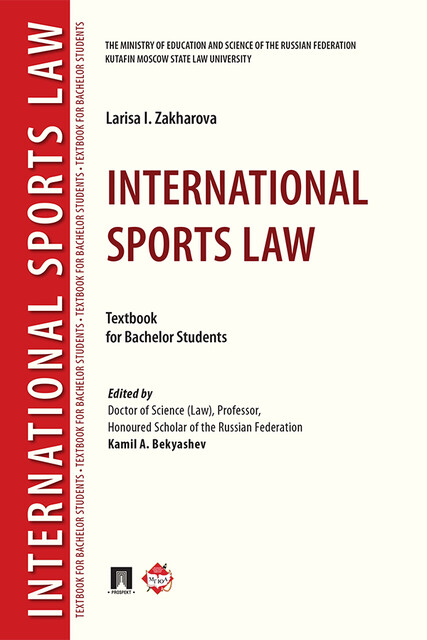
Larisa I. Zakharova
International sports law
Textbook for Bachelor Students
Edited by
Doctor of Science (Law), Professor,
Honoured Scholar of the Russian Federation
Kamil A. Bekyashev

Информация о книге
UDC 796:34
BBC 75.4
Z-38
Author:
Larisa I. Zakharova, PhD (Law), Associate Professor of the International Law Department of the Kutafin Moscow State Law University, member of the FIFA Appeal Committee.
Reviewer:
Victor N. Sidorov, PhD (Law), Associate Professor of the International Law Department of the Kutafin Moscow State Law University.
Editor:
Kamil A. Bekyashev, Doctor of Science (Law), Professor of the International Law Department of the Kutafin Moscow State Law University, Honoured Scholar of the Russian Federation.
The Textbook was prepared in accordance with the Federal State Educational Standard for Higher Education as applied to specialisation 40.03.01 “Jurisprudence” (Bachelor (degree) qualification) and the syllabus of the academic discipline “International Sports Law”, approved by the International Law Department of the Kutafin Moscow State Law University in January 2017.
The Textbook consists of 17 chapters. They correspond to the themes of the syllabus of the academic discipline. In its General part, the history, object, subjects, sources, special principles of international sports law, the process of regulation of international sports relations at the universal level within the framework of the United Nations, its specialised agencies and programs, at the regional level within the Council of Europe and the European Union, at the bilateral level are considered. The Author makes a corresponding distinction with the object, subjects, sources, special principles of lex sportiva, a set of corporate norms elaborated by the International Olympic Committee, the International Paralympic Committee, international and national sports federations. Special attention is paid to the study of ways of resolving sports disputes through arbitration and appeal proceedings in the Court of Arbitration for Sport (CAS), by means of judicial proceedings in the European Court of Human Rights (ECtHR) and the Court of Justice of the European Union (CJEU).
The Special Part of the Textbook identifies problem areas that require additional efforts to implement international legal and corporate regulations: the use of doping in sport, violence and hooligan behaviour of spectators and fans, environmental protection when organising international sports competitions, economic crimes and discrimination in international sports, protection of property rights with regard to television and radio broadcasts of international sports competitions, the use of Olympic symbols, countering threats to a healthy lifestyle.
International instruments and acts of the Russian legislation are as of May 2018.
The Textbook will be of interest for Bachelor students of law, lecturers of higher education institutions, practicing lawyers, staff members of organizations of the Olympic and Paralympic movements, as well as for all those whose academic interests and practical activities are connected with international law, sports law and lex sportivа.
UDC 796:34
BBC 75.4
© Захарова Л. И., 2018
© ООО «Проспект», 2018
Introduction
The Textbook was prepared in accordance with the Federal State Educational Standard for Higher Education as applied to specialisation 40.03.01 “Jurisprudence” (Bachelor (degree) qualification) and the syllabus of the academic discipline “International Sports Law”. The materials of the Textbook together with the developed syllabus of the academic discipline form a complex designed for students who have chosen “Lawyer in the field of sports, advertising and show business” as their specialisation profile.
The Chapters of the Textbook correspond to the themes of the syllabus of the academic discipline. In its General part, the object, history, sources, subjects, special principles of international sports law, the process of regulation of international sports relations at the universal level within the framework of the United Nations, its specialized agencies (by the example of UNESCO, WIPO, WHO) and programs (with regard to UNEP), at the regional level within the Council of Europe and the European Union, at the bilateral level are considered. The Author of the Textbook makes a corresponding distinction with the object, sources, subjects, special principles of lex sportiva that forms a set of corporate norms worked out by the International Olympic Committee, the International Paralympic Committee, International Sports Federations and enshrined in their Charters, Statutes, Regulations, Programmes. Much attention is paid to the structure and main activities of the Olympic and Paralympic movement, to the study of ways of resolving sports disputes through arbitration and appeal proceedings in the Court of Arbitration for Sport (CAS), by means of judicial proceedings in the European Court of Human Rights (ECtHR) and the Court of Justice of the European Union (CJEU).
The Special Part of the Textbook identifies problem areas that require additional efforts to implement international legal and corporate regulations: the use of doping in sport, violence and hooligan behaviour of spectators and fans, environmental protection when organising international sports competitions, economic crimes and discrimination in international sports, protection of property rights with regard to television and radio broadcasts of international sports competitions, the use of Olympic symbols, countering threats to a healthy lifestyle. At the same time, the Author characterizes the standing of the Russian Federation concerning the relevant problems and indicates some possible ways to resolve them.
In areas where public interests (ensuring international peace and security, protecting public health and morals) prevail, States and international governmental organizations that coordinate interstate cooperation in developing unified approaches to regulating physical culture and sports and their promotion in the public are actively involved in regulating processes at the international and national levels, countering doping, corruption, discrimination, misuse of the Olympic symbol, as well as tobacco smoking and unhealthy eating habits. The emerging rules can be called rules of law. Their totality at the national level forms sports law. International legal norms regulating sports activities at the universal, regional, bilateral level enshrined mainly in international treaties and decisions of international intergovernmental organizations form international sports law. It is not yet possible to regard it as an independent branch of international law.
The sport of high achievements is the sphere in which the role of the main regulator belongs to the International Olympic Committee and the International Sports Federations for the Olympic sports. In “the sport of the highest achievements” the aspirations of athletes and national teams are closely intertwined with the commercial concerns of the IOC, the National Olympic Committees, the cities hosting the Olympic Games and transnational corporations acting as sponsors or rights holders for the television broadcast or radio broadcast of the Olympic Games. In the world of higher sporting achievements, the main normative documents are not international treaties and resolutions of international governmental organizations, but the Olympic Charter, Statutes and Regulations of the organizations of the Olympic movement. They contain not legal, but corporate norms, to which the Olympic community is committed.
The study of international sports law is impossible without resort to lex sportiva – they complement and enrich each other. When carrying out practical activities related to the legal regulation of sports activities, a lawyer must have knowledge necessary both in the field of international sports law and lex sportiva.
The Author of this Edition wants to thank Kamil A.Bekyashev, Honoured Scholar of the Russian Federation, Professor of the International Law Department of the Kutafin Moscow State Law University, for his comments and proposals as an editor and her colleague Natalia M. Golovina for her kind cooperation in the process of translating the Textbook into English.
Furthermore, the Author thanks the staff of the Prospekt Publishing House for the opportunity to present this Textbook to the attention of Bachelor students – the students of the first stage of higher education, as well as undergraduates, postgraduates, professors of law schools, practitioners whose work is related to international law and lex sportiva.
Abbreviations
CAS – Court of Arbitration for Sport in Lausanne (Switzerland)
CJEU – Court of Justice of the European Union (Luxembourg)
ICRC – International Committee of the Red Cross
ECHR – Convention for the Protection of Human Rights and Fundamental Freedoms of 4 November 1950 (European Convention on Human Rights)
ECtHR – European Court of Human Rights in Strasbourg (France)
ECOSOC – Economic and Social Council of the United Nations ЕU – European Union
FAO – Food and Agriculture Organization
FIDEPS – UNESCO International Fund for the Development of Physical Education and Sport
FIFA – Fédération Internationale de Football Association
FUR – Football Union of Russia
ICSD – International Committee of Sports for the Deaf
IF – international sports federation
IGO – international governmental organizations
ILO – International Labour Organization
IMO – International Maritime Organization
IOC – International Olympic Committee
IPC – International Paralympic Committee
ITU – International Telecommunication Union
NGO – nongovernmental organizations
NOC – national Olympic committee
ОCOG – organizing committee for the Olympic Games
RCDS – Russian Committee of Deaf Sports
ROC – Russian Olympic Committee
RPC – Russian Paralympic Committee
RUSADA – Russian Anti-Doping Agency
UEFA – Union of European Football Associations
UN – United Nations
UNAIDS – Joint United Nations Programme on HIV/AIDS
UNCITRAL – United Nations Commission on International Trade Law
UNDP – United Nations Development Programme
UNEP – United Nations Environment Programme
UNESCO – United Nations Education, Science and Culture Organization
UNHCR – United Nations Commissioner for Refugees
UNICEF – United Nations International Children’s Emergency Fund
UNIDROIT – in French, Institut international pour l'unification du droit privé
UNODC – United Nations Office on Drugs and Crime
UPU – Universal Postal Union
WADA – World Anti-Doping Agency
WHO –World Health Organization
WIPO – World Intellectual Property Organization
WMO – World Meteorological Organization
WTO – World Tourism Organization
General part
Chapter 1. Object of regulation in international sports law and lex sportivа. formation of the olympic and paralympic movement
In this Chapter the following issues are considered:
1.1. Notion and the object of the legal regulation in international sports law.
1.2. Place of the norms regulating international sports relations in the legal system. The notion of lex sportivа.
1.3. Formation of the modern Olympic and Paralympic movement. Lex olympica.
1.1. Notion and the Object of the Legal Regulation in International Sports Law
Two major directions can be seen in the international cooperation in the sphere of sports. First, it is the public subjects of law that enter into cooperation: with states in a bilateral format and states within the framework of international governmental organizations that touch upon certain aspects of sports activities in their work (for instance, fighting doping in sports became one of the activities of the United Nations on Education, Science and Culture (UNESCO)). The international cooperation in sports is carried out at the universal and regional levels. These activities result in international treaties and resolutions of international governmental organizations that are “soft law” acts.
Second, international sports are regulated at the non-governmental level within the framework of the Olympic movement thanks to the efforts of the International Olympic Committee and international sports federations. Rules that they produce (for example, rules of the Olympic Charter in force as from 15 September 2017, regulations of sports federations, etc.) are observed by all participants of the Olympic movement, however, scholars differ in their opinions on the nature of these rules.
The assortment of opinions is quite vast: they differ from the proposal to view them as corporate norms (self-regulation norms),1 or lex sportiva,2 to regarding rules elaborated by the IOC as international customs.3
Academics and practitioners have recently started using the term international sports law and they mean a complex entity that comprises various norms regulating public relations in the sphere of sports that go beyond the boundaries of a state. More widely, international sports law connotes a system of interconnected norms and rules regulating public relations that arise in international sports activities.4 It is assumed that it comprises norms of public international law as well as corporate norms of international organizations of the Olympic movement.
However, one cannot but notice that the latter category of norms–corporate normsrepresents an example of normative regulators different from legal regulators (along with moral, political, technical norms as well as customs, traditions, business usages).5This is the reason why it seems more correct to use such a term as international sports quasi-law in respect of corporate norms regulating the sphere of sports. However, S.V.Alekseev, who suggested this term, points put to the expertise of foreign countries in the field of regulating legal problems of international sports activities and teaching sports law,6 where the terms “sports law” and “international sports law” are widely used.7
The specificity of legal relations in sports is that they lack homogeneity. First, they arise both in the public and private spheres. Private, or horizontal relations arise when sports and health goods and services are purchased, and these sale and purchase can take place either within one and the same state or have a transboundary character. Public, or vertical relations are formed between public subjects of sports activities, for instance, at the national level this relationship takes place between a national body with certification powers and an enterprise that produces sports products and equipment.
Second, legal relationships in the sphere of sports can be limited by the state boundaries or, vice versa, have a transboundary or interstate character. At the national level national legislation regulates a vast variety of labour relations in sports (regulating the labour and legal status of athletes, coaches, judges and other experts in the field of physical training and sports, protection of health and social protection of participants of the sports movement, activities of sports trade unions, resolving labour disputes in the sphere of sports) as well as public relations that arise in the field of physical training of schoolchildren, students and the military, mass sports, professional sports, sports recreation and rehabilitation.8 The normative regulation of transfers when athletes leave a sports club in their country for a foreign sports club represents a vivid example of transboundary corporate regulation. One cannot view these relations as international (interstate) since “there exists no specific legal regulation of athletes’ transfers from one professional club to another – these relations are governed by corporate norms».9 In some cases the states regulates the transfer relations by means of labour or more rarely civil law, however, “in most countries just lex sportivа has a priority over the norms established by the state” – these cases are not numerous and deal primarily with the transfer of football players.10 International rules of fighting the use of doping addressed to the states-parties to the UNESCO Convention against Doping in Sport of 19 October 2005 are the result of the regulation carried out at the interstate level.
What constitutes the object of the international legal regulation in the sphere of sports? As the general theory of law stipulates, in any branch of law it is homogeneous public relations that arise in a specific field of public life that form the object of the legal regulation. Numerous international relations in the field of sports and other related fields represent the object of the legal regulation in the sports sphere. S.V. Alekseev singles out more than a dozen of such spheres:
1) the participation of international governmental and non-governmental organization in the international sports movement;
2) the participation of states, national sports associations, athletes and other subjects of the national law in international sports relations;
4) organising and holding international sports competitions including the Olympic Games (at the national level this can be seen in preparing athletes for the participation in such competitions, organizing mass sports, providing the sports centers with the equipment, supporting the national sports industry;
5) transboundary labour relations and other relations in the sphere of sports business including professional sports (international movement of labour resources – international transfers, leasing, international activities of sports agents);
6) international financial support and foreign investments in the sphere of sports;
8) international commercial activities in the sphere of sports (establishing joint ventures that produce goods for sports, physical training and tourism,
international sales);
9) international protection of the intellectual property rights in the sphere of sports– rights to trade marks, sports and Olympic symbols, rights to TV and radio broadcasting sports events;
10) international tax relations in the sphere of sports;
11) traumatism, sports medicine and insurance in international sports;
12) international anti-doping policy and fight against doping in international sports;
13) international cooperation in the fight against crime in the sphere of sports;
14) the resolution of international sports disputes,11 including resolving certain moral and ethical issues of the international cooperation in the sphere of sports (prohibition of any discrimination on the grounds of gender, nationality, race, introduction of the Fair Play principles – holding sports competitions in accordance with the principles of dignity and equity).
Our primary interest lies with the international relations of a public character. First, these are relations between the subjects of public law such as states (state bodies) and international governmental organizations. Second, in the context of studying international sports law, it is not the legal regulation of sports and physical training at the national level, but the international aspect of regulating sports activities that seems most interesting. It includes the cooperation between states and international governmental organizations and bilateral cooperation of states in the sphere of sports.
NB! It is the international public relations in the sphere of sports that form the object of the international legal regulation here. These relations arise between the subjects of public law and are regulated by means of harmonizing the parties’ wills.
1.2. Place of the Norms Regulating International Sports Relations in the Legal System. The Notion of Lex Sportivа
Some researchers believe that the normative complex regulating of international relations in the sphere of sports can be singled out as a separate entity. Thus, S.V. Alekseev calls international sports law «one of the most important structures of contemporary international law» and points to its complex character, which presupposes, in his opinion, the need to combine norms of public international law, international private law as well as domestic law. «The very object of legal regulation – international sports activities – serves as an integrating basis».12 Elaborating on the thesis of how international sports law can include norms of domestic law, S.V. Alekseev says it is aimed at regulating sports relations of international character, and they can be public or private in their nature. The relations between private persons can be indeed regulated by means of international treaties and national legislation.13
In our opinion, the term ”international sports law” can legitimately be used, but it is not correct to utilize this term in respect of all the complex of various norms regulating sports relations that go beyond the boundaries of a state. One can accept the idea of incorporating neither the norms of domestic law into it, since they belong to a legal order that differs in principle from public international law, nor the norms of international private law since “contrary to its name, it makes part of domestic law” even though it is closely connected with foreign law and public international law.14 “International sports law” should be understood as a set of international legal norms that regulate the cooperation of states in the field of sports. However, it has not turned into a branch of public international law like such traditional branches as, for instance, law of international treaties, law of external relations or international maritime law, etc.
In the Soviet, and later on, in the Russian academic literature scholars pointed to a number of system-forming criteria that predetermine the existence of a branch in the system of international law or the lack thereof.15
Traditionally, the simultaneous existence of the following conditions make it possible to single out a new branch of law: first, the existence of a separate group of homogeneous public relations – the object of the legal regulation; second, the realisation of a particular public need and significance of these public relations; third, normative material of a proper quality and quantity; forth, a specific method of the legal regulation.16
As far as international sports law is concerned, one should take into account the undisputable existence of the object of the legal regulation – these are international (primarily interstate) relations in the sphere of sports and in related spheres. The public need for their regulation does not produce any doubts, either. However, it is not possible to claim that the process of international legal regulation in this field can be characterized as complete and systematic. Those aspects of sports life are subject to regulating at the interstate level where public interests prevail (providing peace and cooperation, protection of public health and morals, etc.). Quite often post factum states accept as international legal norms the rules of conduct that have been formed and already apply within the framework of the Olympic movement headed by the International Olympic Committee. Since the moment of its formation in 1894 the IOC and the system of the Olympic movement organisations have aspired to become autonomous and self-sustained. Establishing in 1983 the international Court of Arbitration for Sport in Lausanne strengthened this state of affairs: the subjects of the Olympic movement can resolve their disputes without recourse to general jurisdiction courts of national states.
Analyzing such a criterion of a branch of law as the existence of normative material of a proper quality and quantity, some international legal scholars voice an opinion according to which a branch of international law is established only when “states reach an agreement to elaborate a vast universal international legal act that contains basic principles in this field”.17 Thus, in the law of international treaties there are such codifying acts as the Vienna Convention on the Law of Treaties of 23 May 1969 and the Vienna Convention on the Law of Treaties between States and International Organizations or Between International Organizations of 21 May 1986, in the law of external relations – the Vienna Convention on Diplomatic Relations of 18 April 1961 and the Vienna Convention on Consular Relations of 24 April 1963, in international maritime law – the United Nations Convention on the Law of the Sea of 10 December 1982. The codification process is undoubtedly important, but one should not overestimate the role of a single act in forming new branches of international law. Nowadays there exist a number of branches of international law for which there are no codifying acts yet. Nonetheless, they are already regarded as quite established branches of public international law. These are international labour law, international agricultural law, international energy law, international transportation law, international law of intellectual property, international atomic law.18 One cannot but notice the absence of a single universal international legal act in the sphere of sports that would contain basic principles of regulating international sports activities. Simultaneously there is a number of international legal acts that regulate some of their aspects, for example, the UN International Convention against Apartheid in Sports of 10 December 1985, the UNESCO Convention against Doping in Sport of 19 October 2005, Nairobi Treaty on the Protection of the Olympic Symbol of 26 September 1981, some provisions of the Convention on the Rights of the Child of 20 November 1989, Convention on the Rights of Persons with Disabilities of 13 December 2006, Declaration on the Rights of Indigenous Peoples of 13 September 2007. Besides, one should also mention regional documents adopted within the framework of the Council of Europe such as Anti-Doping Convention of 16 November 1989. and its Additional Protocol of 12 September 2002, European Convention on Spectator Violence and Misbehaviour at Sports Events and in particular at Football Matches of 19 August 1985, Convention on the Manipulation of Sports Competition of 19 September 2014. The Olympic Charter contains a set of fundamental principles and rules guiding the Olympic movement, but this document is not a source of international law.
There is no international governmental organization whose competence would include coordinating interstate cooperation in the sports sphere – there is no need for it, to put it simply. The United Nations Office for Sport for Development and Peace headed by the UN Secretary General carries out representative functions and provides for a necessary forum for joint discussions of the United Nations and the Olympic movement representatives. Some aspects of cooperation in the sports sphere are regulated by the UN specialised agencies such as UNESCO, WHO, WIPO and others. It is the International Olympic Committee who leads the Olympic movement quite successfully.
The complementarity is a distinctive feature of the method of the legal regulation in the sports sphere. The international non-governmental organizations of the Olympic movement take the lead in elaborating proper rules of conduct in sports. They become generally recognized at least among those who demonstrate the intention to participate in them. Those who do not take part in them cannot and usually do not act in contravention of these rules. With a certain delay states recognize the legal force of these rules.19
NB! Norms established by the international legal acts mentioned above do not constitute a separate branch of public international law. Collectively, they can be designated as a set of norms regulating international cooperation in the sports sphere.20 Corporate norms elaborated by the international non-governmental organizations of the Olympic movement play a considerable role in its regulation. However, they represent normative regulators different from legal ones. In respect of corporate norms of the Olympic movement such terms as international sports quasi-law or lex sportiva seem to be acceptable.
1.3. The Formation of the Modern Olympic and the Paralympic Movement. The Formation of Lex Olympica
One of the main causes of sports games in the ancient times was the need for trained warriors, the demonstration of superiority by the military and aristocratic nobility in the field of physical training. In ancient Greek society the intertribal struggle for the conquest of the best lands and receipt of the spoils of war was conducted, thus, good physical training was highly appreciated. Since ancient times Greeks held agones, sports games to celebrate religious or political festivities. Almost every significant Greek polis had its periodic games, closely related to the national mythology. With the development of slavery relations the interaction between tribes, and later between the poleis became more intense. Tribal names eventually gave way to a common name of Hellenes. By this time (by the end of the VII century BC-beginning of the VI century BC) common beliefs in the immortal Olympian gods had been formed.21 According to the famous Spanish philosopher and sociologist J. Ortega y Gasset who put forward the sports theory on the origin of the state, and a number of Russian scholars who agree with his conclusions, these factors – nationwide physical games and common religious beliefs, contributed to the emergence of a unified Greek state: The Olympic games united the Greek poleis, reduced the animosity between them; their regular celebration led to the creation of larger and more durable structures than was required for the initiations (empowerments) of a primitive society during which physical exercises and games were also used; later, these structures evolved into state bodies.22
In the VIII century BC four agones in ancient Greece turned into true national festivals: the Olympic games, or Olympics (since 776 BC), the Pythian games (since 586 BC), the Isthmian games (since 582 BC), and the Nemean games (since 573 BC). The Olympic and Pythian games were celebrated every four years, the Isthmian and Nemean games – every two years. Participation in them was strictly forbidden to slaves and barbarians (non-Hellenes). At the Olympic Games the presence of women was also forbidden.
At the Olympics athletes competed only in sports; during the Pythian, Isthmian and Nemean games the competitions patronized by Muses, companions of Apollo, were also held, for instance, in music (e.g. playing the cithara or flute), recitation (e.g., in reading dithyrambs), drama. In honour of the winners (hieronimi) hymns were composed, their names were engraved on stone stelae in their hometowns; they enjoyed honours and privileges throughout their life. Agones were celebrated in accordance with the programme the implementation of which was monitored by Agonothetes (Hellanodikai in Olympia): they supervised the training of athletes and their compliance with sporting rules, resolved disputes, awarded prizes – a wreath of olive leaves at the Olympic games called Kotin, a laurel wreath at the Pythian games, a pine wreath at the Isthmian games, a celery wreath at the Nemean games, and various valuable items and cash.23
Xenophanes (570–480 BC) in his elegy describes the honours to the winners of the Olympic games in the following way:
The one who in the quick run
Or in the pentathlon battle
Was able to achieve a victory –
In the grove of Zeus,
On the plain of Olympus,
In a duel of wrestlers,
Or in fist fights,
or in the terrible battle
Called the pankration,
He will appear
All the more glorious
In front of the city:
He will get a place of honour
Among the opponents,
Whatever he eats
Will be paid by the Treasury,
He will receive
A priceless prize from the state,
If his horse wins,
He will get all this to the full.24
The Games became a bright part of the ancient Greek culture. The conquests of Alexander the Great contributed to their dissemination in the countries of Minor Asia, Syria and Egypt. Gymnastics and other exercises performed to the music were most popular, they included running, jumping, ball games, and military exercises such as chariot racing, boxing and other types of fighting, discus throwing and javelin throwing, swimming, horse riding, rowing, archery, fencing. Starting from the IV century BC, agonistic contests in physical strength and agility became prevalent during sports games, and they forced out gymnastics. These competitions were widespread and were timed to celebrate pagan feasts or accessions of kings and emperors to the throne. Over time the greatest popularity was gained by the Olympic pentathlon, which comprised running one or more stadia (one stadium was equal to 192 m), long jumps with dumbbells in hands, javelin throwing, discus throwing, and wrestling. The venue was associated with the rites of Zeus – the chief god of the Greek Pantheon and his wife Hera – the goddess of fertility. The temple of Zeus and the sanctuary of Hera were located in Olympia. The Olympic games were actually a part of pagan cult rites in their honour.25 On the first day of the games a sacrifice to the gods was made, and the athletes delivered an oath, and sporting events took place in the next four days.26
In ancient times, the Olympics had a huge political significance. In the year of the Olympic games thousands of heralds spread throughout the cities of ancient Greece the joyful news, “Come to Olympia! Sacred peace is declared, the roads are safe! Let the strongest win!”. During the games all hostilities ceased, and the sacred peace was established. In this period, Olympia was declared a neutralized territory: At the venue of the competition, the warriors laid down their arms, the freedom of movement and personal integrity were guaranteed to athletes and spectators in Olympia and on the way to it, even if they crossed the territory of poleis that were in a state of war with their home city.27 Major statesmen sought to take part in the Olympics. Pythagoras and Plato in their youth were fond of wrestling and repeatedly defeated their rivals.
In ancient Rome, public contests in physical strength, especially particularly brutal gladiator fights and chariot races, retained their popularity till the final triumph of Christianity. Polytheism in the form it existed among the ancient Greeks, gave way to monotheism. The main value in Christianity was a quest for the spiritual, asceticism, confession, rather than the physical, carnal, exciting passions, as in the ancient culture. In 394, Emperor Theodosius the Great forbade the Olympic games as pagan by the edict of Milan. In 405, Emperor Honorius banned gladiatorial fights. It should be noted, however, that Christianity after it had become the state religion, did not forbid all kinds of physical exercises, only those which clearly bore the imprint of pagan cults and could lead to murder or serious injury, exerted a corrupting influence on morals and ethics – first of all, gladiator fights, chariot races, fist fighting, and pankration (wrestling).28 In all, from 776 BC to 395 AD, when the city of Olympia was destroyed by two strong earthquakes, 293 Olympic games were held.
In the physical culture of medieval Europe an important factor along with religious prohibitions and restrictions was the stratification structure of society – the division into elite and common people, which was not typical of the democratic poleis of ancient Greece.29 Thus, the Olympic competitions, as they were known to the ancient world, were not held over the next fifteen centuries, although the development of physical culture and sports continued in other forms in knight tournaments of the Middle Ages, in the period of the European Renaissance, the French revolution of 1789, events of the XVIII–XIX centuries in Europe.30
The XIX century was a period of a renewed interest in the mass sports movement. It could be explained by the desire of urban dwellers to satisfy their natural need for movement, to compensate the physical deformation caused by monotonous labour operations and sedentary lifestyle. Starting from 1870 (the Paris commune), efforts were made to organize the development of physical culture within the European labour movement. In Russia among the associations officially permitted by the authorities the “Ekateringofsky circle of sports fans” existed long enough at the Putilov plant. The reason for the elimination of the circle was the participation of its leaders in organizing strikes. In the years after the defeat of the revolution of 1905 the liberal – bourgeois societies and factories directorates in the Western fashion tried to create associations free from politics at their enterprises to divert the workers from the political organization of their ranks. The first such an association was the Orekhovo-Zuyevo “Workers’ Sports Club of the Morozov manufacturers” that was founded in 1908. Thus, in the conditions of capitalist urbanization processes of the development of physical education and recreation were completely different from similar phenomena in the period preceding the epoch of machine industry.31
At the same time, in the late XIX-early XX century the first international sports associations began to emerge. Some of them were established much earlier than the International Olympic Committee (IOC), on the basis of individual national sports unions and associations for specific sports (e.g., for gymnastics – in 1881, for rowing and skating in 1892). This could be explained by the awakening of a mass interest for sport and holding competitions in specific sports between athletes from various European states. The idea of reviving the Olympic games was implemented in the modern times by Pierre de Coubertin, a French statesman, educator and enlightener. On his initiative in the summer of 1894 in Paris the International Athletic Congress was convened to define amateur sports and to start preparations for conducting the International Olympic Games. At the Paris Congress the revival of the Olympic Games was officially proclaimed and the IOC was established to guide the preparatory work, representatives of 14 States took part in its work. From the very beginning of the International Olympic movement, efforts were made to preserve the sport free from politics. In 1882 the Triple Alliance was formed between Germany, Austria-Hungary, and Italy; in 1891, the Franco-Russian agreement was signed and the UK joined it, thus the Entente was established. The first World War was approaching. The international campaign to revive the Olympic games under the patronage of France caused understandable aversion on the part of Germany. However, German delegates participated in the Paris Congress of 1894 and subsequently in the activities of the IOC that was established there.
On 6–14 April 1896 the first revived Olympic games were held in Athens. The games of the first Olympic games of modern times were opened by the king of Greece George I on the Marble stadium in Athens in the presence of 80 thousand people. Only men participated in them: 241 athletes from 14 countries represented at the Paris Congress in 1894. The first Games included nine sports: classical Greco-Roman wrestling, cycling, gymnastics, athletics, tennis, swimming, shooting, fencing, marathon. The second Olympic games were organized in 1900 in Paris. The Christian Church supported conducting the Games.32
Numerous rules developed from the late nineteenth century to the present by the international non-governmental organizations of the Olympic movement under the leadership of the IOC, can be called collectively lex olympica – they form the core of lex sportivа. Activities of Pierre de Coubertin for his tenure as the IOC President continued until 1925, when he was succeeded by Henri de Baillet-Latour (1926–1941). This period was characterized by a complete failure of the principle of “sport above politics”. The line on the anti-Soviet blockade was taken. By the time an independent sports movement alternative to the bourgeois Olympic movement had taken shape – the International Association of Red Sports and Gymnastics Associations, or the Red Sport International (Sportintern). This movement was under the leadership of the Communists. In parallel with this there was the Socialist Workers’ Sport International. In accordance with the decision of the III Congress of the Comintern on physical culture adopted 12 July 12, 1921 the Red Sports International undertook efforts to restore the unity of the workers’ sports movement. Both Internationals sought to conduct international Olympic games for workers. The first international Olympics for workers, including winter and summer games, took place in 1925 in Germany, the second international Olympics for workers – in 1931 in Vienna (Soviet Russia did not participate in any of them). Between the two Internationals there existed ideological differences that made it difficult to hold the Olympics for workers jointly. In the next decade there was a split between them. Reconciliation became possible only in the face of the Nazi danger, when two Internationals reached an agreement to end the fragmented organizational activities under the sign of anti-fascist unity. As a result of their joint efforts, the III International Olympics for workers were organized in 1937 in Antwerp.33
The Soviet Union joined the international Olympic movement under the leadership of the IOC only in the 1950s. In 1951 The USSR raised the question of its membership in the IOC, thus setting the legal basis for participation in the Olympic movement. Soviet athletes first participated in the Olympic Games in 1952. All the period from that moment until the end of the cold war was understandably characterized by intense ideological opposition.34
Paralympic sport originated in the late XIX century. In 1888, in Berlin there were the first sport clubs for the deaf.35 However, it turned into a well – organized movement that gained an international dimension over time only in the second half of the XX century thanks to the work of Ludwig Guttmann, a German doctor who fled from Nazism to Great Britain in 1936. There he continued his medical practice at the hospital in Stoke Mandeville. To improve physical, psychological and social rehabilitation of people with spinal cord injuries L. Guttmann proposed to use sports. This approach was popular in the treatment of veterans of the Second world war. Later in Stoke Mandeville the Centre of rehabilitation of patients with spinal injuries was set up and it was headed by sir L. Guttmann. Sports became an integral part of the complex treatment.
On 29 July 1948, the opening day of the Olympic games in London L. Guttman organized the Stoke Mandeville games in archery for ex-servicemen, 16 paralysed men and women. In 1952, they were joined by war veterans from the Netherlands and Stoke-Mandeville games became international. Later games were held annually and the number of participants increased steadily. In 1959, L. Guttman prepared and published in the “Book of the Stoke-Mandeville games for the paralyzed” the first regulations of the sports competitions for persons with disabilities.
In 1960, more than 400 athletes from 23 countries took part in the Ninth annual international Stoke-Mandeville games that were held in a few weeks after the Olympic games in Rome. In fact, they became the first Paralympic summer games. In 1976 Örnsköldvik (Sweden) hosted the first Paralympic winter games. Such a high interest in the Paralympic games and their obvious connection with the Olympic movement led to the decision that they should be held every fourth year in the countries hosting the Olympics. Since the Paralympic summer games in Seoul (South Korea) in 1988 and the Paralympic winter games in Tignes-Albertville (France) in 1992 they have been arranged in the same places as the Olympic games.
International sports organizations began to be established to coordinate the sports movement for people with various disabilities: in 1960 in Rome the Committee of the International Stoke – Mandeville games was established, later renamed the International Federation of the Stoke-Mandeville games (IFSMG) and then the International Federation of Sport in Wheelchairs in Stoke- Mandeville (IFSWSM); in 1964 the International Sports Federation for the Disabled (ISOD) was created including athletes with amputations, in 2004, these federations united to form the International Wheelchairs and Amputee Sport Federation (IWAS). In the period from the late 1970s to the mid-1980s three more specialized sports organizations were established: in 1978, the International Association of Physical Education and Sport for Individuals with Cerebral Palsy (CPISRA), in 1981, the International Blind Sports Federation (IBSA), in 1986, the International Sports Federation for Persons with Intellectual Disabilities (INAS-FID).
Since 1982 the international organizations of sport for the disabled started to cooperate more actively and coordinate their actions, they formed the International Coordinating Committee for the Disabled in the World (ICC). In 1986 they were joined by the International Committee of Sports for the Deaf (ISCD) that had functioned successfully since 1924.36 The ICC led the Paralympic movement until 1992. In order to increase national representation and to create a sport movement, largely focused on sports and not on disability, the international Paralympic Committee (IPC) was founded on 22 September 1989 in Düsseldorf (Germany). The six federations mentioned above acted as its founders – the IFSMG, CPISRA, IBSA, ISOD, ISCD, INAS-FID (later the games for the deaf and for people with intellectual disabilities began to be held separately, outside the framework of the Paralympic movement37). In addition, 42 national Paralympic committees and national organisations of sport for the disabled were represented. The first Constitution of the IPC was adopted and the first President, Robert Steadward (Canada), was elected.38 From 1989 to 1997, the headquarters of the organization were situated in Bruges (Belgium), after which it moved to Bonn (Germany).
Control Questions and Tasks
1. What are the distinctive features of international sports law? Describe the object, method and the subjects.
2. What is the place of international sports law in the system of international law?
3. What is the theory of lex sportiva? Make a survey of the views of the representatives of Western and Russian doctrine on this subject.
References Bibliography
1. Alekseev S. V. International Sports Law/ed. by P.V. Krasheninnikov. Moscow: Zakon i pravo Pbl., 2008.
2. State Management in the Field of Sports: a textbook for Master students / Ponkin I. V., Redkina A. I., Soloviev A. A., Shevchenko O. A.; ed. by I. V. Ponkin, D. I. Rogachev. Moscow: Buki Vedi Pbl., 2017.
3. Zakharova L. I. “O Sport, You are Peace!”. The Role of International Law, Lex Sportiva and Lex Olympica in the Regulation of International Sports Relations. Moscow, 2013; 2nd ed, revised and updated, Saarbrücken: LAP Lambert Academic Publishing, 2015.
4. Ponkina A.I. Public Administration and Autonomous Institutionalization in Sports / Commission on Sports Law of the Association of Lawyers of Russia; National Association of Sports Lawyers of the Russian Federation. Moscow, 2012.
5. Solovyov A. A. Russian and Foreign Experience of Systematization of Legislation on Sport / Commission on Sports Law of the Association of Lawyers of Russia. Moscow, 2011.
6. Nafziger J. International Sports Law. 2nd ed. Ardsley, New York: Transnational Publishers, Inc., 2004.
7. Panagiotopoulos D. Sports Law. Lex Sportiva and Lex Olympica. Theory and Praxis. Athens-Komotini, 2011.
Chapter 2. Subjects of International Sports Law
In this Сhapter the following questions are considered:
2.1. Subjects of international sports law: concept, types.
2.2. The international personality of states.
2.3. The international personality of international governmental organizations.
2.1. Subjects of International Sports Law: Concept, Types
At the present stage regulation of various aspects of sports activities requires the involvement of different actors: states, international governmental organizations (IGOs) and international non-governmental organisations (NGOs) of the Olympic movement.
The subjects of international relations in the field of sports-relations regulated by the norms of international law, are states and international governmental organizations. International treaties and non-binding acts of international governmental organizations (“soft” law) regulate the relations between them. The International Olympic Committee possesses certain elements of the international legal personality. The IOC is the supreme authority of the Olympic movement acting on the global non-governmental level (Rule 1 of the Olympic Charter). Its special status is recognized by the Swiss Federal Council and the United Nations, with many specialized agencies and programmes of which it cooperates quite actively. This allows to include the IOC in the number of the subjects of international relations in the field of sports and to determine the existence of some features of the emerging international legal personality sui generis (for more information on the activities of the IOC and international non-governmental organizations of the Olympic movement, see Chapter 6).
In most cases the IOC and the International Paralympic Committee (IPC), national Olympic and Paralympic committees, national and international sports federations for Olympic and Paralympic sports, the organising committees of the cities hosting the Olympic and Paralympic games and athletes enter into corporate relations governed by the regulations of the international non-governmental organizations in the sports field rather than into international legal relations. These are the subjects of lex sportiva. They live and operate within a normative order that is autonomous and independent from the states. In case of disputes between them, they are motivated not to have recourse to state courts, but to resolve sports disputes autonomously through a flexible and expedite procedure in a specialized arbitration court within the Olympic system (CAS). In the world of higher sports achievements the main regulatory documents are not international treaties and resolutions of international governmental organizations, but the Olympic Charter adopted by the IOC, IPC Rules, statutes and regulations of the international sports federations. They contain corporate, not legal standards, and the Olympic and Paralympic communities are committed to comply with them.
There is no separate intergovernmental organization, fully engaged in the coordination of international cooperation in the field of sports. However, there is a number of international governmental organizations involved in the coordination of specific areas of international cooperation in the field of physical culture and amateur sports at the universal and regional level (for more details on the activities of the governmental organizations in the field of sports, see chapters 5 and 8).
A significant part of sports relations is regulated within the framework of the Olympic movement at the global non-governmental level. They should be distinguished as a separate group of corporate relations in sport. General theory of international law specifies the main difference between international governmental and non-governmental organizations such as the IOC, the International Committee of the Red Cross, Greenpeace, Amnesty International, etc. It is the way they are created. Intergovernmental organizations are established as a result of treaties between states that define and limit their mandates. International non-governmental organizations are established not by the delegation of authority from the States, but as a consequence of the interaction between individuals who share the ideas and values that NGOs promote. They are registered as legal entities according to the legislation of the state in whose territory they function.
In other words, an international intergovernmental organization is a voluntary association of states, while international non-governmental organization is an association of individuals. They join the NGO and support it in its activities to achieve the goals it proclaims. It is these goals together with the organizational structure of the non-governmental organization that provide the power that it has, and it is of a moral rather than of a legal nature.
S. Charnovitz, a renowned American international lawyer, gives the following definition of international nongovernmental organizations. These are groups of individuals or social organizations, freely created by private initiative, who are involved in cross-border relations and do not aim at gaining profit.39 S. Charnovitz points to the fact that the use of the term “non-governmental organizations” is due to the norm of Art. 71 of the UN Charter, which states that the Economic and Social Council (ECOSOC) may make suitable arrangements for consultations with non-governmental organizations interested in matters within its competence, however, the Charter does not reveal the contents of the term “non-governmental organizations”.40
The legal status of the World Anti-Doping Agency (WADA), an organization that currently leads the international fight against doping in sport, is of particular interest. WADA occupies an intermediate position between international governmental and non-governmental organizations. Both representatives of the Olympic movement41 and state governments take part in its activities, and among the 38 members of the WADA Executive Board Europe is represented, inter alia, by such intergovernmental European organizations as the Council of Europe and the European Union.42 WADA should be considered as a unique hybrid organization, whose management and financing are carried out jointly by the Olympic movement and governments.
2.2. The International Personality of States
States are the principal subjects of international law. It is presumed in international law that states have general legal personality. They are able to participate in all international relations.
International legal features of the state are formulated in the Montevideo Convention on Rights and Duties of States of 1933:
a permanent population,
a defined territory,
government,
capacity to enter into relations with the other States.
The Russian theory of State and law of the interprets the fourth characteristic more broadly as the possession of state sovereignty, i.e. the supreme rule on its territory and independence in the international arena. States, acting as subjects of international legal relations arising in the field of sports, enter into treaties governing various aspects of sporting life. Treaties may be multilateral (at the universal level under the UN or its specialized agencies, e.g. the international Convention against apartheid in sports of 10 December 1985, the UNESCO Convention against doping in sport of 19 October 2005; at the regional level, for example, the Council of Europe Convention against doping of 16 November 1989) or bilateral (between the states concerned, for example, the Treaty on Friendship and Cooperation between the Russian Federation and the Republic of South Africa of 5 September 2006,43 which have some provisions on cooperation in sports; Agreement between the Government of the Russian Federation and the Government of the Argentine Republic on Cultural Cooperation of 25 November 1997,44 the Agreement between the Government of the Russian Federation and the Government of the United Kingdom of Great Britain and Northern Ireland on Cooperation in the Fields of Education, Science and Culture of 15 February 1994).45
States participate in the work of international governmental organizations that coordinate interstate cooperation at the universal or regional level in the development of common approaches in the regulation of physical culture and sports, promote them at the national level, combating doping, smoking, unhealthy eating habits.
In those areas where public interests such as peace and cooperation, public health and morality prevail, States and IGOs are actively involved in the regulation of the processes: The UN and many of its specialised agencies, programmes, funds, regional organizations – the European Union, the Council of Europe, the African Union, the Commonwealth of Independent States, etc. IGOs coordinate the cooperation of States in developing common approaches for the regulation of physical culture and sports. The resulting norms can legitimately be called legal. Their combination at the national level forms sports law, the term that has become accepted by science and practice. International legal norms on the regulation of sports activities at the universal and regional level form a set of rules for international cooperation in the field of sports. It is not yet possible to consider it as a separate branch of international law.
2.3. The International Personality of International Governmental Organizations
A notable contribution in the field of the international regulation of cooperation in sports is made by international governmental organizations. They play a significant role in the regulation of various aspects of sports activities at the universal and regional levels. The doctrine of international law views intergovernmental organizations as “associations of States established under international law and on the basis of an international treaty for the cooperation in political, economic, cultural, scientific, technical, legal and other areas, with the organizational structure including necessary bodies, the rights and obligations derived from the rights and duties of States, and an autonomous will, the volume of which is determined by the will of the member States”.46
IGO meets the following criteria:
it is established in accordance with international law,
it is established on the basis of an international treaty,
it coordinates the cooperation of states in a particular area of activity,
it has an organizational structure in the form of principal and subsidiary organs,
the organization has a set of rights and duties,
the organization has an autonomous will, other than the will of the member States.47
There is no separate intergovernmental organization, fully engaged in the coordination of international cooperation in the field of sports. Since its revival on the initiative of the Baron Pierre de Coubertin in 1894 the Olympic movement has been striving for autonomy and independence from States and the depoliticization of sports cooperation: “The project of Coubertin was directly aimed at building a parallel society in free space, not affected by State influence, and companies, which obeyed its own rules and mobilized forces to protect itself by its own means”.48 The creation of the International Olympic Committee at the Paris Congress in 1894 and the establishment of the Court of Arbitration for Sport (CAS) in Lausanne in 1983 contributed to achieving these goals. The subjects of the Olympic movement do not recourse to State courts, they resolve sports disputes on their own.49
However, a number of international governmental organizations are involved in the coordination of specific areas of the international cooperation in the field of physical culture and amateur sports at the universal and regional level. The interstate cooperation in the field of sports at the universal level is carried out within the framework of the United Nations, its specialised agencies and organs. For example, the Office of Sport for Development and Peace acts under the leadership of the UN Deputy Secretary General; in the framework of the UNESCO, a specialised agency of the UN, the intergovernmental Committee for Physical Education and Sport is established. There can be interaction between international governmental and non-governmental structures, for instance, the process of cooperation between the United Nations Environment Programme (UNEP) and the IOC, which resulted in adopting the Agenda 21 of the Olympic movement, dedicated to environmental aspects of sporting activities. At the regional level, a significant contribution to the international legal regulation of relations in the field of sports is made by the Council of Europe and the European Union.
Control Questions and Tasks
1. Who are the subjects of international sports law? Enumerate and give examples.
2. Who are the participants of corporate relations in the field of sport (lex sportiva)?
3. What are the differences between international governmental and non-governmental organizations? Give examples of successful interaction between the IGOs and NGOs in the field of sports.
References Bibliography
1. Alekseev S. V. International Sports Law. Ed. by P.V. Krasheninnikov. Moscow: Zakon i pravo Pbl., 2008.
2. Alekseev S. V. Legal Bases of Professional Activities in Sports: a textbook. Moscow: Sovetskiy sport Pbl., 2013.
3. Zakharova L. I. “O Sport, You are Peace!”. The Role of International Law, Lex Sportiva and Lex Olympica in the Regulation of International Sports Relations. Moscow: GI “Tsentralnaya tipografiya”, 2013; 2nd ed., revised and updated. Saarbrücken: LAP Lambert Academic Publishing, 2015.
4. Public International Law: a textbook / Anufrieva L. P., Bekyashev K. A., Moiseev E. G., UstinovV. V. and others. Ed. by K.A. Bekyashev. 5th ed., revised and updated. Moscow: Prospekt, 2011.
5. Charnovitz S. Nongovernmental Organizations and International Law. American Journal of International Law. 2006, Vol. 100. No. 2. P. 348–372.
Normative Acts
1. The Montevideo Convention on the Rights and Duties of States of 26 December 1933.
2. The Charter of the United Nations of 26 June 1945.
3. The Olympic Charter (in force as from 15 September 2017).
4. Constitution of the International Paralympic Committee, 2011 (as amended in March 2015).
Chapter 3. Sources of International Sports Law
In this Сhapter the following questions are considered:
3.1. Sources of international sports law: concept and types.
3.2. International Treaties as a Source of International Sports Law.
3.3. International Legal Customs as a Source of International Sports Law.
3.4. Resolutions of International Governmental Organizations as a Source of International Sports Law.
3.5. Unilateral Acts of States as a Source of International Sports Law.
3.6. Decisions of International Non-Governmental Organizations of the Olympic Movement as a Source of lex sportiva.
3.7. Jurisprudence of International Courts and Arbitral Tribunals as a Subsidiary Means for the Determination of Rules of Law and lex sportivа.
3.1. Sources of International Sports Law: Concept and Types
In accordance with the general theory of law a source of law is a way of establishing legal commands. Art. 38 of the Statute of the International Court of Justice enumerates the sources of international law by which the Court is guided in resolving disputes referred to it. In a broader sense, this is a list of sources of international law. Art. 38 enumerates international conventions, whether general or particular; international custom; general principles of law; judicial decisions and the teachings of the most qualified publicists in public law of the various nations.
The international treaty, international custom and general principles of law are traditionally considered to be the main sources of international law. Resolutions of international governmental organizations that have proliferated in the 20th century in connection with the active growth of the number of IGOs and intensity of their activities, are considered secondary (derivative) ) sources of international law.50 Judicial decisions and the teachings of the most qualified specialists are named in the Statute of the International Court of Justice as subsidiary means for the determination of legal norms.
Among the sources of the international legal regulation in the field of sports the most significant role belongs to international treaties concluded by States and intergovernmental organizations, international legal customs, resolutions of IGOs regulating international sport activities.
International treaties can be concluded between States or between States and IGOs, or between the IGOs. Art. 2 of the Vienna Convention on the Law of Treaties of 23 May 1969 provides the following legal definition of an international treaty: it is an international agreement concluded between states in written form and governed by international law, whether embodied in a single instrument or in two or more related instruments and whatever its particular designation. Art. 2 of the Vienna Convention on the Law of Treaties between States and International Organizations or between International Organizations of 21 March 1986, extends the same requirements for agreements between one or more States and one or more international organizations as well as for agreements between international organizations.
In accordance with Art. 38–1(b) of the Statute of the International Court of Justice of 26 June 1945 international legal custom is evidence of a general practice accepted as law. I.Brownlie, a renowned British international lawyer, identifies four characteristics of international legal custom: the continuation of the practice; uniformity and consistency of the practice; universality of the practice; belief in the legitimacy and necessity of the act
...