автордың кітабын онлайн тегін оқу Flute and Violin, and Other Kentucky Tales and Romances
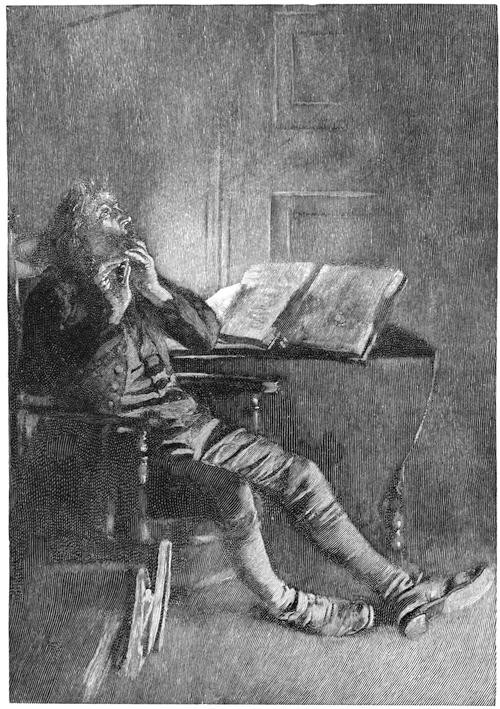
THE MAGIC FLUTE. [See p. 8.
Flute and Violin

AND OTHER KENTUCKY TALES
AND ROMANCES. BY JAMES
LANE ALLEN. ILLUSTRATED
NEW YORK
HARPER & BROTHERS
MDCCCXCVI.
Copyright, 1891, by Harper & Brothers.
All rights reserved.

FROM WHOSE FRAIL BODY HE DREW LIFE IN THE
BEGINNING, FROM WHOSE STRONG SPIRIT HE
WILL DRAW LIFE UNTIL THE CLOSE, THESE
TALES, WITH ALL OTHERS HAPLY HERE-
AFTER TO BE WRITTEN, ARE DEDI-
CATED AS A PERISHABLE MONU-
MENT OF INEFFABLE
REMEMBRANCE
PREFACE.
The opening tale of this collection is taken from Harper's Monthly; the others, from the Century Magazine. By leave of these periodicals they are now published, and of the kindness thus shown the author makes grateful acknowledgment.
While the tales and sketches have been appearing, the authorship of them has now and then been charged to Mr. James Lane Allen, of Chicago, Illinois—pardonably to his discomfiture.
A sense of fitness forbade that the author should send along with each, as it came out, a claim that it was not another's; but he now gladly asks that the responsibility of all his work be placed where it solely belongs.
CONTENTS.
3
KING SOLOMON OF KENTUCKY65
TWO GENTLEMEN OF KENTUCKY97
THE WHITE COWL135
SISTER DOLOROSA175
POSTHUMOUS FAME281
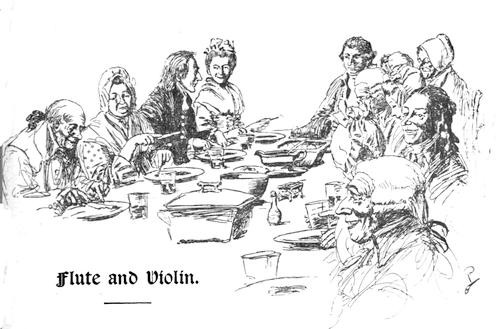
Flute and Violin.
THE PARSON'S MAGIC FLUTE.
On one of the dim walls of Christ Church, in Lexington, Kentucky, there hangs, framed in thin black wood, an old rectangular slab of marble. A legend sets forth that the tablet is in memory of the Reverend James Moore, first minister of Christ Church and President of Transylvania University, who departed this life in the year 1814, at the age of forty-nine. Just beneath runs the record that he was learned, liberal, amiable, and pious.
Save this concise but not unsatisfactory summary, little is now known touching the reverend gentleman. A search through other sources of information does, indeed, result in reclaiming certain facts. Thus, it appears that he was a Virginian, and that he came to Lexington in the year 1792—when Kentucky ceased to be a county of Virginia, and became a State. At first he was a candidate for the ministry of the Presbyterian Church; but the Transylvania Presbytery having reproved him for the liberality of his sermons, James kicked against such rigor in his brethren, and turned for refuge to the bosom of the Episcopal Communion. But this body did not offer much of a bosom to take refuge in.
Virginia Episcopalians there were in and around the little wooden town; but so rampant was the spirit of the French Revolution and the influence of French infidelity that a celebrated local historian, who knew thoroughly the society of the place, though writing of it long afterwards, declared that about the last thing it would have been thought possible to establish there was an Episcopal church.
"Not so," thought James. He beat the canebrakes and scoured the buffalo trails for his Virginia Episcopalians, huddled them into a dilapidated little frame house on the site of the present building, and there fired so deadly a volley of sermons at the sinners free of charge that they all became living Christians. Indeed, he fired so long and so well that, several years later—under favor of Heaven and through the success of a lottery with a one-thousand-dollar prize and nine hundred and seventy-four blanks—there was built and furnished a small brick church, over which he was regularly called to officiate twice a month, at a salary of two hundred dollars a year.
Here authentic history ends, except for the additional fact that in the university he sat in the chair of logic, metaphysics, moral philosophy, and belles-lettres—a large chair to sit in with ill-matched legs and most uncertain bottom. Another authority is careful to state that he had a singularly sweet breath and beautiful[Pg 5] [Pg 6] [Pg 7] manners. Thus it has been well with the parson as respects his posthumous fame; for how many of our fellow-creatures are learned without being amiable, amiable without being pious, and pious without having beautiful manners!
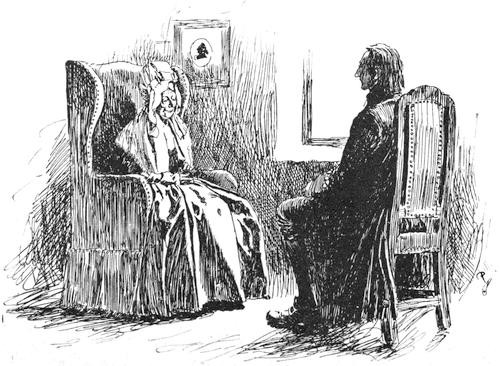
"HE HAD BEAUTIFUL MANNERS."
And yet the best that may be related of him is not told in the books; and it is only when we have allowed the dust to settle once more upon the histories, and have peered deep into the mists of oral tradition, that the parson is discovered standing there in spirit and the flesh, but muffled and ghost-like, as a figure seen through a dense fog.
A tall, thinnish man, with silky pale-brown hair, worn long and put back behind his ears, the high tops of which bent forward a little under the weight, and thus took on the most remarkable air of paying incessant attention to everybody and everything; set far out in front of these ears, as though it did not wish to be disturbed by what was heard, a white, wind-splitting face, calm, beardless, and seeming never to have been cold, or to have dropped the kindly dew of perspiration; under the serene peak of this forehead a pair of large gray eyes, patient and dreamy, being habitually turned inward upon a mind toiling with hard abstractions; having within him a conscience burning always like a planet; a bachelor—being a logician; therefore sweet-tempered, never having sipped the sour cup of experience; gazing covertly at womankind from behind the delicate veil of unfamiliarity that lends enchantment; being a bachelor and a bookworm, therefore already old at forty, and a little run down in his toilets, a little frayed out at the elbows and the knees, a little seamy along the back, a little deficient at the heels; in pocket poor always, and always the poorer because of a spendthrift habit in the matter of secret chanties; kneeling down by his small hard bed every morning and praying that during the day his logical faculty might discharge its function morally, and that his moral faculty might discharge its function logically, and that over all the operations of all his other faculties he might find heavenly grace to exercise both a logical and a moral control; at night kneeling down again to ask forgiveness that, despite his prayer of the morning, one or more of these same faculties—he knew and called them all familiarly by name, being a metaphysician—had gone wrong in a manner the most abnormal, shameless, and unforeseen; thus, on the whole, a man shy and dry; gentle, lovable; timid, resolute; forgetful, remorseful; eccentric, impulsive, thinking too well of every human creature but himself; an illogical logician, an erring moralist, a wool-gathered philosopher, but, humanly speaking, almost a perfect man.
But the magic flute? Ah, yes! The magic flute!
Well, the parson had a flute—a little one—and the older he grew, and the more patient and dreamy his gray eyes, always the more and more devotedly he blew this little friend. How the fond soul must have loved it! They say that during his last days as he lay propped high on white pillows, once, in a moment of wandering consciousness, he stretched forth his hand and in fancy lifting it from the white counterpane, carried it gently to his lips. Then, as his long, delicate fingers traced out the spirit ditties of no tone and his mouth pursed itself in the fashion of one who is softly blowing, his whole face was overspread with a halo of ecstatic peace.
And yet, for all the love he bore it, the parson was never known to blow his flute between the hours of sunrise and sunset—that is, never but once. Alas, that memorable day! But when the night fell and he came home—home to the two-story log-house of the widow Spurlock; when the widow had given him his supper of coffee sweetened with brown sugar, hot johnny-cake, with perhaps a cold joint of venison and cabbage pickle; when he had taken from the supper table, by her permission, the solitary tallow dip in its little brass candlestick, and climbed the rude steep stairs to his room above; when he had pulled the leathern string that lifted the latch, entered, shut the door behind him on the world, placed the candle on a little deal table covered with text-books and sermons, and seated himself beside it in a rush-bottomed chair—then—He began to play? No; then there was dead silence.
For about half an hour this silence continued. The widow Spurlock used to say that the parson was giving his supper time to settle; but, alas! it must have settled almost immediately, so heavy was the johnny-cake. Howbeit, at the close of such an interval, any one standing at the foot of the steps below, or listening beneath the window on the street outside, would have heard the silence broken.
At first the parson blew low, peculiar notes, such as a kind and faithful shepherd might blow at nightfall as an invitation for his scattered wandering sheep to gather home about him. Perhaps it was a way he had of calling in the disordered flock of his faculties—some weary, some wounded, some torn by thorns, some with their fleeces, which had been washed white in the morning prayer, now bearing many a stain. But when they had all answered, as it were, to this musical roll-call, and had taken their due places within the fold of his brain, obedient, attentive, however weary, however suffering, then the flute was laid aside, and once more there fell upon the room intense stillness; the poor student had entered upon his long nightly labors.
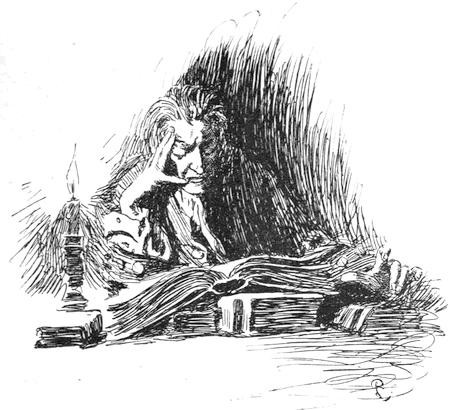
Hours passed. Not a sound was to be heard but the rustle of book leaves, now rapidly, now slowly turned, or the stewing of sap in the end of a log on the hearth, or the faint drumming of fingers on the table—those long fingers, the tips of which seemed not so full of particles of blood as of notes of music, circulating impatiently back and forth from his heart. At length, as midnight drew near, and the candle began to sputter in the socket, the parson closed the last book with a decisive snap, drew a deep breath, buried his face in his hands for a moment, as if asking a silent blessing on the day's work, and then, reaching for his flute, squared himself before the dying embers, and began in truth to play. This was the one brief, pure pleasure he allowed himself.
It was not a musical roll-call that he now blew, but a dismissal for the night. One might say that he was playing the cradle song of his mind. And what a cradle song it was! A succession of undertone, silver-clear, simple melodies; apparently one for each faculty, as though he was having something kind to say to them all; thanking some for the manner in which they had served him during the day, the music here being brave and spirited; sympathizing with others that had been unjustly or too rudely put upon, the music here being plaintive and soothing; and finally granting his pardon to any such as had not used him quite fairly, the music here having a searching, troubled quality, though ending in the faintest breath of love and peace.
It was not known whence the parson had these melodies; but come whence they might, they were airs of heavenly sweetness, and as he played them, one by one his faculties seemed to fall asleep like quieted children. His long, out-stretched legs relaxed their tension, his feet fell over sidewise on the hearth-stone, his eyes closed, his head sank towards his shoulder. Still, he managed to hold on to his flute, faintly puffing a few notes at greater intervals, until at last, by the dropping of the flute from his hands or the sudden rolling of his big head backward, he would awaken with a violent jerk. The next minute he would be asleep in bed, with one ear out on guard, listening for the first sound that should awake him in the morning.
Such having been the parson's fixed habit as long as any one had known him, it is hard to believe that five years before his death he abruptly ceased to play his flute and never touched it again. But from this point the narrative becomes so mysterious that it were better to have the testimony of witnesses.
II.
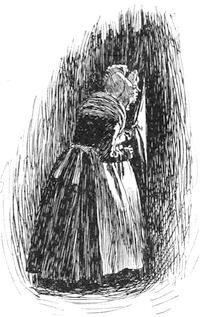
Every bachelor in this world is secretly watched by some woman. The parson was watched by several, but most closely by two. One of these was the widow Spurlock, a personage of savory countenance and wholesome figure—who was accused by the widow Babcock, living at the other end of the town, of having robust intentions towards her lodger. This piece of slander had no connection with the fact that she had used the point of her carving knife to enlarge in the door of his room the hole through which the latch-string passed, in order that she might increase the ventilation. The aperture for ventilation thus formed was exactly the size of one of her innocent black eyes.
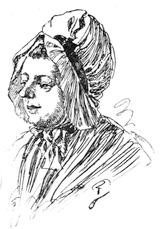
The other woman was an infirm, ill-favored beldam by the name of Arsena Furnace, who lived alone just across the street, and whose bedroom was on the second floor, on a level with the parson's. Being on terms of great intimacy with the widow Spurlock, she persuaded the latter that the parson's room was poorly lighted for one who used his eyes so much, and that the window-curtain of red calico should be taken down. On the same principle of requiring less sun because having less use for her eyes, she hung before her own window a faded curtain, transparent only from within. Thus these two devoted, conscientious souls conspired to provide the parson unawares with a sufficiency of air and light.
On Friday night, then, of August 31, 1809—for this was the exact date—the parson played his flute as usual, because the two women were sitting together below and distinctly heard him. It was unusual for them to be up at such an hour, but on that day the drawing of the lottery had come off, and they had held tickets, and were discussing their disappointment in having drawn blanks. Towards midnight the exquisite notes of the flute floated down to them from the parson's room.
"I suppose he'll keep on playing those same old tunes as long as there is a thimbleful of wind in him: I wish he'd learn some new ones," said the hag, taking her cold pipe from her cold lips, and turning her eyes towards her companion with a look of some impatience.
"He might be better employed at such an hour than playing on the flute," replied the widow, sighing audibly and smoothing a crease out of her apron.
As by-and-by the notes of the flute became intermittent, showing that the parson was beginning to fall asleep, Arsena said good-night, and crossing the street to her house, mounted to the front window. Yes, there he was; the long legs stretched out towards the hearth, head sunk sidewise on his shoulder, flute still at his lips, the sputtering candle throwing its shadowy light over his white weary face, now wearing a smile. Without doubt he played his flute that night as usual; and Arsena, tired of the sight, turned away and went to bed.
A few minutes later the widow Spurlock placed an eye at the aperture of ventilation, wishing to see whether the logs on the fire were in danger of rolling out and setting fire to the parson's bed; but suddenly remembering that it was August, and that there was no fire, she glanced around to see whether his candle needed snuffing. Happening, however, to discover the parson in the act of shedding his coat, she withdrew her eye, and hastened precipitately down-stairs, but sighing so loud that he surely must have heard her had not his faculty of external perception been already fast asleep.
At about three o'clock on the afternoon of the next day, as Arsena was sweeping the floor of her kitchen, there reached her ears a sound which caused her to listen for a moment, broom in air. It was the parson playing—playing at three o'clock in the afternoon!— and playing—she strained her ears again and again to make sure—playing a Virginia reel. Still, not believing her ears, she hastened aloft to the front window and looked across the street. At the same instant the widow Spurlock, in a state of equal excitement, hurried to the front door of her house, and threw a quick glance up at Arsena's window. The hag thrust a skinny hand through a slit in the curtain and beckoned energetically, and a moment later the two women stood with their heads close together watching the strange performance.
Some mysterious change had come over the parson and over the spirit of his musical faculty. He sat upright in his chair, looking ten years younger, his whole figure animated, his foot beating time so audibly that it could be heard across the street, a vivid bloom on his lifeless cheeks, his head rocking to and fro like a ship in a storm, and his usually dreamy, patient gray eyes now rolled up towards the ceiling in sentimental perturbation. And how he played that Virginia reel! Not once, but over and over, and faster and faster, until the notes seemed to get into the particles of his blood and set them to dancing. And when he had finished that, he snatched his handkerchief from his pocket, dashed it across his lips, blew his nose with a resounding snort, and settling his figure into a more determined attitude, began another. And the way he went at that! And when he finished that, the way he went at another! Two negro boys, passing along the street with a spinning-wheel, put it down and paused to listen; then, catching the infection of the music, they began to dance. And then the widow Spurlock, catching the infection also, began to dance, and bouncing into the middle of the room, there actually did dance until her tucking-comb rolled out, and—ahem!—one of her stockings slipped down. Then the parson struck up the "Fisher's Hornpipe," and the widow, still in sympathy, against her will, sang the words:
"Did you ever see the Devil
With his wood and iron shovel,
A-hoeing up coal
For to burn your soul?"
"He's bewitched," said old Arsena, trembling and sick with terror.
"By whom?" cried the widow Spurlock, indignantly, laying a heavy hand on Arsena's shoulder.
"By his flute," replied Arsena, more fearfully.
At length the parson, as if in for it, and possessed to go all lengths, jumped from his chair, laid the flute on the table, and disappeared in a hidden corner of the room. Here he kept closely locked a large brass-nailed hair trunk, over which hung a looking-glass. For ten minutes the two women waited for him to reappear, and then he did reappear, not in the same clothes, but wearing the ball dress of a Virginia gentleman of an older time, perhaps his grandfather's—knee-breeches, silk stockings, silver buckles, low shoes, laces at his wrists, laces at his throat and down his bosom. And to make the dress complete he had actually tied a blue ribbon around his long silky hair. Stepping airily and gallantly to the table, he seized the flute, and with a little wave of it through the air he began to play, and to tread the mazes of the minuet, about the room, this way and that, winding and bowing, turning and gliding, but all the time fingering and blowing for dear life.
"Who would have thought it was in him?" said Arsena, her fear changed to admiration.
"I would!" said the widow.
While he was in the midst of this performance the two women had their attention withdrawn from him in a rather singular way. A poor lad hobbling on a crutch made his appearance in the street below, and rapidly but timidly swung himself along to the widow Spurlock's door. There he paused a moment, as if overcome by mortification, but finally knocked. His summons not being answered, he presently knocked more loudly.
"Hist!" said the widow to him, in a half-tone, opening a narrow slit in the curtain. "What do you want, David?"
The boy wheeled and looked up, his face at once crimson with shame. "I want to see the parson," he said, in a voice scarcely audible.
"The parson's not at home," replied the widow, sharply. "He's out; studying up a sermon." And she closed the curtain.
An expression of despair came into the boy's face, and for a moment in physical weakness he sat down on the door-step. He heard the notes of the flute in the room above; he knew that the parson was at home; but presently he got up and moved away.
The women did not glance after his retreating figure, being reabsorbed by the movements of the parson. Whence had he that air of grace and high-born courtesy? that vivacity of youth?
"He must be in love," said Arsena. "He must be in love with the widow Babcock."
"He's no more in love with her than I am," replied her companion, with a toss of her head.
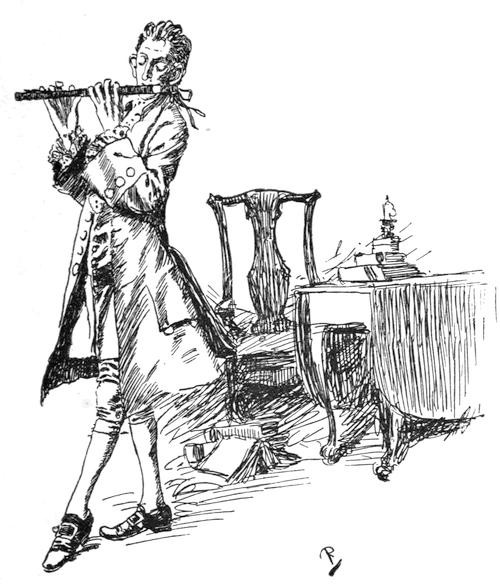
"HE BEGAN TO PLAY."
A few moments later the parson, whose motions had been gradually growing less animated, ceased dancing,[Pg 17] [Pg 18] [Pg 19] and disappeared once more in the corner of the room, soon emerging therefrom dressed in his own clothes, but still wearing on his hair the blue ribbon, which he had forgotten to untie. Seating himself in his chair by the table, he thrust his hands into his pockets, and with his eyes on the floor seemed to pass into a trance of rather demure and dissatisfying reflections.
When he came down to supper that night he still wore his hair in the forgotten queue, and it may have been this that gave him such an air of lamb-like meekness. The widow durst ask him no questions, for there was that in him which held familiarity at a distance; but although he ate with unusual heartiness, perhaps on account of such unusual exercise, he did not lift his eyes from his plate, and thanked her for all her civilities with a gratitude that was singularly plaintive.
That night he did not play his flute. The next day being Sunday, and the new church not yet being opened, he kept his room. Early in the afternoon a messenger handed to the widow a note for him, which, being sealed, she promptly delivered. On reading it he uttered a quick, smothered cry of grief and alarm, seized his hat, and hurried from the house. The afternoon passed and he did not return. Darkness fell, supper hour came and went, the widow put a candle in his room, and then went across to commune with Arsena on these unusual proceedings.
Not long afterwards they saw him enter his room carrying under his arm a violin case. This he deposited on the table, and sitting down beside it, lifted out a boy's violin.
"A boy's violin!" muttered Arsena.
"A boy's violin!" muttered the widow; and the two women looked significantly into each other's eyes.
"Humph!"
"Humph!"
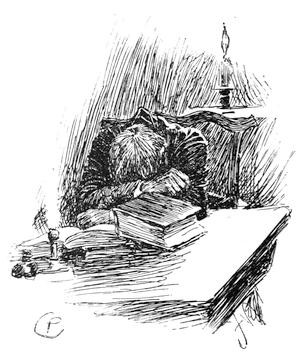
By-and-by the parson replaced the violin in the box and sat motionless beside it, one of his arms hanging listlessly at his side, the other lying on the table. The candle shone full in his face, and a storm of emotions passed over it. At length they saw him take up the violin again, go to the opposite wall of the room, mount a chair, knot the loose strings together, and hang the violin on a nail above his meagre shelf of books. Upon it he hung the bow. Then they saw him drive a nail in the wall close to the other, take his flute from the table, tie around it a piece of blue ribbon he had picked up off the floor, and hang it also on the wall. After this he went back to the table, threw himself in his chair, buried his head in his arms, and remained motionless until the candle burned out.
"What's the meaning of all this?" said one of the two women, as they separated below.
"I'll find out if it's the last act of my life," said the other.
But find out she never did. For question the parson directly she dared not; and neither to her nor any one else did he ever vouchsafe an explanation. Whenever, in the thousand ways a woman can, she would hint her desire to fathom the mystery, he would baffle her by assuming an air of complete unconsciousness, or repel her by a look of warning so cold that she hurriedly changed the subject.
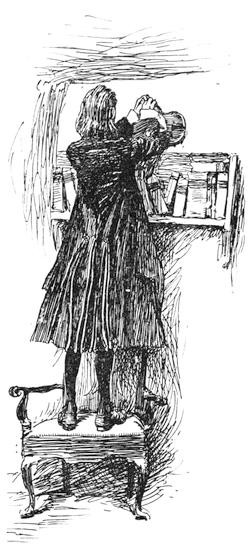
As time passed on it became evident that some grave occurrence indeed had befallen him. Thenceforth, and during the five remaining years of his life, he was never quite the same. For months his faculties, long used to being soothed at midnight by the music of the flute, were like children put to bed hungry and refused to be quieted, so that sleep came to him only after hours of waiting and tossing, and his health suffered in consequence. And then in all things he lived like one who was watching himself closely as a person not to be trusted.
Certainly he was a sadder man. Often the two women would see him lift his eyes from his books at night, and turn them long and wistfully towards the wall of the room where, gathering cobwebs and dust, hung the flute and the violin.
If any one should feel interested in having this whole mystery cleared up, he may read the following tale of a boy's violin.
III.
A BOY'S VIOLIN.
On Friday, the 31st of August, 1809—that being the day of the drawing of the lottery for finishing and furnishing the new Episcopal church—at about ten o'clock in the morning, there might have been seen hobbling slowly along the streets, in the direction of the public square, a little lad by the name of David. He was idle and lonesome, not wholly through his fault. If there had been white bootblacks in those days, he might now have been busy around a tavern door polishing the noble toes of some old Revolutionary soldier; or if there had been newsboys, he might have been selling the Gazette or the Reporter—the two papers which the town afforded at that time. But there were enough negro slaves to polish all the boots in the town for nothing when the boots got polished at all, as was often not the case; and if people wanted to buy a newspaper, they went to the office of the editor and publisher, laid the silver down on the counter, and received a copy from the hands of that great man himself.
The lad was not even out on a joyous summer vacation, for as yet there was not a public school in the town, and his mother was too poor to send him to a private one, teaching him as best she could at home. This home was one of the rudest of the log-cabins of the town, built by his father, who had been killed a few years before in a tavern brawl. His mother earned a scant livelihood, sometimes by taking in coarse sewing for the hands of the hemp factory, sometimes by her loom, on which with rare skill she wove the finest fabrics of the time.
As he hobbled on towards the public square, he came to an elm-tree which cast a thick cooling shade on the sidewalk, and sitting down, he laid his rickety crutch beside him, and drew out of the pocket of his home-made tow breeches a tangled mass of articles—pieces of violin strings, all of which had plainly seen service under the bow at many a dance; three old screws, belonging in their times to different violin heads; two lumps of resin, one a rather large lump of dark color and common quality, the other a small lump of transparent amber wrapped sacredly to itself in a little brown paper bag labelled "Cucumber Seed;" a pair of epaulets, the brass fringes of which were tarnished and torn; and further miscellany.
These treasures he laid out one by one, first brushing the dirt off the sidewalk with the palm of one dirty hand, and then putting his mouth close down to blow away any loose particles that might remain to soil them; and when they were all displayed, he propped himself on one elbow, and stretched his figure caressingly beside them.
A pretty picture the lad made as he lay there dreaming over his earthly possessions—a pretty picture in the shade of the great elm, that sultry morning of August, three-quarters of a century ago! The presence of the crutch showed there was something sad about it; and so there was; for if you had glanced at the little bare brown foot, set toes upward on the curb-stone, you would have discovered that the fellow to it was missing—cut off about two inches above the ankle. And if this had caused you to throw a look of sympathy at his face, something yet sadder must long have held your attention. Set jauntily on the back of his head was a weather-beaten dark blue cloth cap, the patent-leather frontlet of which was gone; and beneath the ragged edge of this there fell down over his forehead and temples and ears a tangled mass of soft yellow hair, slightly curling. His eyes were large, and of a blue to match the depths of the calm sky above the tree-tops; the long lashes which curtained them were brown; his lips were red, his nose delicate and fine, and his cheeks tanned to the color of ripe peaches. It was a singularly winning face, intelligent, frank, not describable. On it now rested a smile, half joyous, half sad, as though his mind was full of bright hopes, the realization of which was far away. From his neck fell the wide collar of a white cotton shirt, clean but frayed at the elbows, and open and buttonless down his bosom. Over this he wore an old-fashioned satin waistcoat of a man, also frayed and buttonless. His dress was completed by a pair of baggy tow breeches, held up by a single tow suspender fastened to big brown horn buttons.
After a while he sat up, letting his foot hang down over the curb-stone, and uncoiling the longest of the treble strings, he put one end between his shining teeth, and stretched it tight by holding the other end off between his thumb and forefinger. Then, waving in the air in his other hand an imaginary bow, with his head resting a little on one side, his eyelids drooping, his mind in a state of dreamy delight, the little musician began to play—began to play the violin that he had long been working for, and hoped would some day become his own.
It was nothing to him now that his whole performance consisted of one broken string. It was nothing to him, as his body rocked gently to and fro, that he could not hear the music which ravished his soul. So real was that music to him that at intervals, with a little frown of vexation as though things were not going perfectly, he would stop, take up the small lump of costly resin, and pretend to rub it vigorously on the hair of the fancied bow. Then he would awake that delicious music again, playing more ecstatically, more passionately than before.
At that moment there appeared in the street, about a hundred yards off, the Reverend James Moore, who was also moving in the direction of the public square, his face more cool and white than usual, although the morning was never more sultry.
He had arisen with an all but overwhelming sense of the importance of that day. Fifteen years are an immense period in a brief human life, especially fifteen years of spiritual toil, hardships, and discouragements, rebuffs, weaknesses, and burdens, and for fifteen such years he had spent himself for his Episcopalians, some of whom read too freely Tom Paine and Rousseau, some loved too well the taverns of the town, some wrangled too fiercely over their land suits. What wonder if this day, which, despite all drawbacks, was to witness the raising of money for equipping the first brick church, was a proud and happy one to his meek but victorious spirit! What wonder if, as he had gotten out of bed that morning, he had prayed with unusual fervor that for this day in especial his faculties, from the least to the greatest, and from the weakest to the strongest, might discharge their functions perfectly, and that the drawing of the lottery might come off decently and in good order; and that—yes, this too was in the parson's prayer—that if it were the will of Heaven and just to the other holders of tickets, the right one of the vestry-men might draw the thousand-dollar prize; for he felt very sure that otherwise there would be little peace in the church for many a day to come, and that for him personally the path-way of life would be more slippery and thorny.
So that now as he hurried down the street he was happy; but he was anxious; and being excited for both reasons, the way was already prepared for him to lose that many-handed self-control which he had prayed so hard to retain.
He passed within the shade of the great elm, and then suddenly came to a full stop. A few yards in front of him the boy was performing his imaginary violin solo on a broken string, and the sight went straight to the heart of that musical faculty whose shy divinity was the flute. For a few moments he stood looking on in silence, with all the sympathy of a musician for a comrade in poverty and distress.
Other ties also bound him to the boy. If the divine voice had said to the Reverend James Moore: "Among all the people of this town, it will be allowed you to save but one soul. Choose you which that shall be," he would have replied: "Lord, this is a hard saying, for I wish to save them all. But if I must choose, let it be the soul of this lad."
The boy's father and he had been boyhood friends in Virginia, room-mates and classmates in college, and together they had come to Kentucky. Summoned to the tavern on the night of the fatal brawl, he had reached the scene only in time to lay his old playfellow's head on his bosom, and hear his last words:
"Be kind to my boy!... Be a better father to him than I have been!... Watch over him and help him!... Guard him from temptation!... Be kind to him in his little weaknesses!... Win his heart, and you can do everything with him!... Promise me this!"
"So help me Heaven, all that I can do for him I will do!"
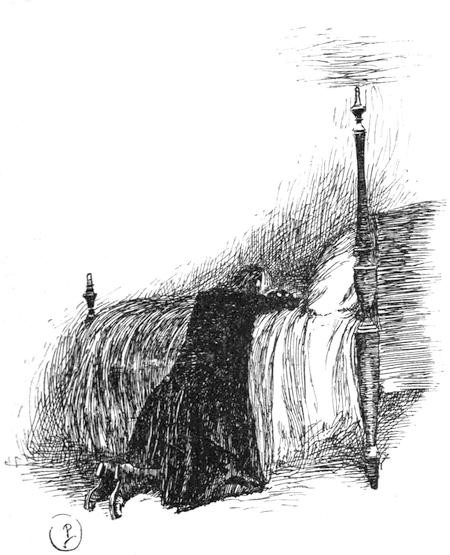
From that moment he had taken upon his conscience, already toiling beneath its load of cares, the burden of this sacred responsibility. During the three years of his guardianship that had elapsed, this burden had not grown lighter; for apparently he had failed to acquire any influence over the lad, or to establish the least friendship with him. It was a difficult nature that had been bequeathed him to master—sensitive, emotional, delicate, wayward, gay, rebellious of restraint, loving freedom like the poet and the artist. The Reverend James Moore, sitting in the chair of logic, moral philosophy, metaphysics, and belles-lettres; lecturing daily to young men on all the powers and operations of the human mind, taking it to pieces and putting it together and understanding it so perfectly, knowing by name every possible form of fallacy and root of evil—the Reverend James Moore, when he came to study the living mind of this boy, confessed to himself that he was as great a dunce as the greatest in his classes. But he loved the boy, nevertheless, with the lonely resources of his nature, and he never lost hope that he would turn to him in the end.
How long he might have stood now looking on and absorbed with the scene, it is impossible to say; for the lad, happening to look up and see him, instantly, with a sidelong scoop of his hand, the treasures on the sidewalk disappeared in a cavernous pocket, and the next moment he had seized his crutch, and was busy fumbling at a loosened nail.
"Why, good-morning, David," cried the parson, cheerily, but with some embarrassment, stepping briskly forward, and looking down upon the little figure now hanging its head with guilt. "You've got the coolest seat in town," he continued, "and I wish I had time to sit down and enjoy it with you; but the drawing comes off at the lottery this morning, and I must hurry down to see who gets the capital prize." A shade of anxiety settled on his face as he said this. "But here's the morning paper," he added, drawing out of his coat-pocket the coveted sheet of the weekly Reporter, which he was in the habit of sending to the lad's mother, knowing that her silver was picked up with the point of her needle. "Take it to your mother, and tell her she must be sure to go to see the wax figures." What a persuasive smile overspread his face as he said this! "And you must be certain to go too! They'll be fine. Good-bye."
He let one hand rest gently on the lad's blue cloth cap, and looked down into the upturned face with an expression that could scarcely have been more tender.
"He looks feverish," he said to himself as he walked away, and then his thoughts turned to the lottery.
"Good-bye," replied the boy, in a low voice, lifting his dark blue eyes slowly to the patient gray ones. "I'm glad he's gone!" he added to himself; but he nevertheless gazed after the disappearing figure with shy fondness. Then he also began to think of the lottery.
If Mr. Leuba should draw the prize, he might give Tom Leuba a new violin; and if he gave Tom a new violin, then he had promised to give him Tom's old one. It had been nearly a year since Mr. Leuba had said to him, laughing, in his dry, hard little fashion:
"Now, David, you must be smart and run my errands while Tom's at school of mornings; and some of these days, when I get rich enough, I'll give Tom a new violin and I'll give you his old one."
"Oh, Mr. Leuba!" David had cried, his voice quivering with excitement, and his whole countenance beaming with delight, "I'll wait on you forever, if you'll give me Tom's old violin."
Yes, nearly a whole year had passed since then—a lifetime of waiting and disappointment. Many an errand he had run for Mr. Leuba. Many a bit of a thing Mr. Leuba had given him: pieces of violin strings, odd worn-out screws, bits of resin, old epaulets, and a few fourpences; but the day had never come when he had given him Tom's violin.
Now if Mr. Leuba would only draw the prize! As he lay on his back on the sidewalk, with the footless stump of a leg crossed over the other, he held the newspaper between his eyes and the green limbs of the elm overhead, and eagerly read for the last time the advertisement of the lottery. Then, as he finished reading it, his eyes were suddenly riveted upon a remarkable notice printed just beneath.
This notice stated that Messrs. Ollendorf and Mason respectfully acquainted the ladies and gentlemen of Lexington that they had opened at the Kentucky Hotel a new and elegant collection of wax figures, judged by connoisseurs to be equal, if not superior, to any exhibited in America. Among which are the following characters: An excellent representation of General George Washington giving orders to the Marquis de la Fayette, his aid. In another scene the General is represented as a fallen victim to death, and the tears of America, represented by a beautiful female weeping over him—which makes it a most interesting scene. His Excellency Thomas Jefferson. General Buonaparte in marshal action. General Hamilton and Colonel Burr. In this interesting scene the Colonel is represented in the attitude of firing, while the General stands at his distance waiting the result of the first fire: both accurate likenesses. The death of General Braddock, who fell in Braddock's Defeat. An Indian is represented as scalping the General, while one of his men, in an attempt to rescue him out of the hands of the Indians, was overtaken by another Indian, who is ready to split him with his tomahawk. Mrs. Jerome Buonaparte, formerly Miss Patterson. The Sleeping Beauty. Eliza Wharton, or the American coquette, with her favorite gallant and her intimate friend Miss Julia Granby. The Museum will be open from ten o'clock in the morning 'til nine in the evening. Admittance fifty cents for grown persons; children half price. Profiles taken with accuracy at the Museum.
The greatest attraction of the whole Museum will be a large magnificent painting of Christ in the Garden of Gethsemane.
All this for a quarter! The newspaper suddenly dropped from his hands into the dirt of the street—he had no quarter! For a moment he sat as immovable as if the thought had turned him into stone; but the next moment he had sprung from the sidewalk and was speeding home to his mother. Never before had the stub of the little crutch been plied so nimbly among the stones of the rough sidewalk. Never before had he made a prettier picture, with the blue cap pushed far back from his forehead, his yellow hair blowing about his face, the old black satin waistcoat flopping like a pair of disjointed wings against his sides, the open newspaper streaming backward from his hand, and his face alive with hope.
IV.
Two hours later he issued from the house, and set his face in the direction of the museum—a face full of excitement still, but full also of pain, because he had no money, and saw no chance of getting any. It was a dull time of the year for his mother's work. Only the day before she had been paid a month's earnings, and already the money had been laid out for the frugal expenses of the household. It would be a long time before any more would come in, and in the mean time the exhibition of wax figures would have been moved to some other town. When he had told her that the parson had said that she must go to see them, she had smiled fondly at him from beside her loom, and quietly shaken her head with inward resignation; but when he told her the parson had said he must be sure to go too, the smile had faded into an expression of fixed sadness.
On his way down town he passed the little music store of Mr. Leuba, which was one block this side of the Kentucky Hotel. He was all eagerness to reach the museum, but his ear caught the sounds of the violin, and he forgot everything else in his desire to go in and speak with Tom, for Tom was his lord and master.
"Tom, are you going to see the wax figures?" he cried, with trembling haste, curling himself on top of the keg of nails in his accustomed corner of the little lumber-room. But Tom paid no attention to the question or the questioner, being absorbed in executing an intricate passage of "O Thou Fount of every Blessing!" For the moment David forgot his question himself, absorbed likewise in witnessing this envied performance.
When Tom had finished, he laid the violin across his knees and wiped his brow with his shirt-sleeves. "Don't you know that you oughtn't to talk to me when I'm performing?" he said, loftily, still not deigning to look at his offending auditor. "Don't you know that it disturbs a fiddler to be spoken to when he's performing?"
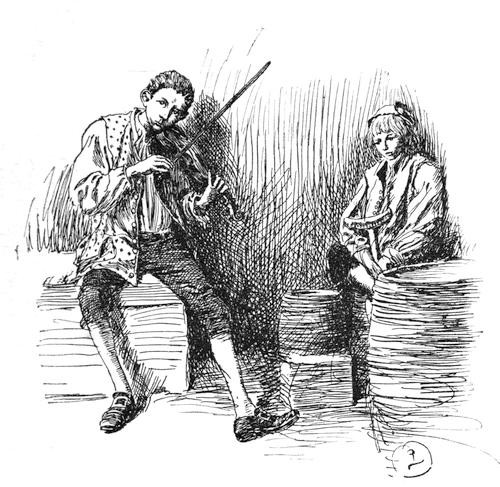
"EXECUTING AN INTRICATE PASSAGE."
[Pg 34] [Pg 35]
Tom was an overgrown, rawboned lad of some fifteen years, with stubby red hair, no eyebrows, large watery blue eyes, and a long neck with a big Adam's apple.
"I didn't mean to interrupt you, Tom," said David, in a tone of the deepest penitence. "You know that I'd rather hear you play than anything."
"Father got the thousand-dollar prize," said Tom coldly, accepting the apology for the sake of the compliment.
"Oh, Tom! I'm so glad! Hurrah!" shouted David, waving his old blue cap around his head, his face transfigured with joy, his heart leaping with a sudden hope, and now at last he would get the violin.
"What are you glad for?" said Tom, with dreadful severity. "He's my father; he's not your father;" and for the first time he bestowed a glance upon the little figure curled up on the nail keg, and bending eagerly towards him with clasped hands.
"I know he's your father, Tom, but—"
"Well, then, what are you glad for?" insisted Tom. "You're not going to get any of the money."
"I know that, Tom," said David, coloring deeply, "but—"
"Well, then, what are you glad for?"
"I don't think I'm so very glad, Tom," replied David, sorrowfully.
But Tom had taken up the bow and was rubbing the resin on it. He used a great deal of resin in his playing, and would often proudly call David's attention to how much of it would settle as a white dust under the bridge. David was too well used to Tom's rebuffs to mind them long, and as he now looked on at this resining process, the sunlight came back into his face.
"Please let me try it once, Tom—just once." Experience had long ago taught him that this was asking too much of Tom; but with the new hope that the violin might now soon become his, his desire to handle it was ungovernable.
"Now look here, David," replied Tom, with a great show of kindness in his manner, "I'd let you try it once, but you'd spoil the tone. It's taken me a long time to get a good tone into this fiddle, and you'd take it all out the very first whack. As soon as you learn to get a good tone out of it, I'll let you play on it. Don't you know you'd spoil it, if I was to let you try it now?" he added, suddenly wheeling with tremendous energy upon his timid petitioner.
"I'm afraid I would, Tom," replied David, with a voice full of anguish.
"But just listen to me," said Tom; and taking up the violin, he rendered the opening passage of "O Thou Fount of every Blessing!" Scarcely had he finished when a customer entered the shop, and he hurried to the front, leaving the violin and the bow on the chair that he had quitted.
No sooner was he gone than the little figure slipped noiselessly from its perch, and hobbling quickly to the chair on which the violin lay, stood beside it in silent love. Touch it he durst not; but his sensitive, delicate hands passed tremblingly over it, and his eyes dwelt upon it with unspeakable longing. Then, with a sigh, he turned away, and hastened to the front of the shop. Tom had already dismissed his customer, and was standing in the door, looking down the street in the direction of the Kentucky Hotel, where a small crowd had collected around the entrance of the museum.
As David stepped out upon the sidewalk, it was the sight of this crowd that recalled him to a new sorrow.
"Tom," he cried, with longing, "are you going to see the wax figures?"
"Of course I'm going," he replied, carelessly. "We're all going."
"When, Tom?" asked David, with breathless interest.
"Whenever we want to, of course," replied Tom. "I'm not going just once; I'm going as often as I like."
"Why don't you go now, Tom? It's so hot—they might melt."
This startling view of the case was not without its effect on Tom, although a suggestion from such a source was not to be respected. He merely threw his eyes up towards the heavens and said, sturdily: "You ninny! they'll not melt. Don't you see it's going to rain and turn cooler?"
"I'll bet you I'd not wait for it to turn cooler. I'll bet you I'd be in there before you could say Jack Roberson, if I had a quarter," said David, with resolution.
V.
All that long afternoon he hung in feverish excitement around the door of the museum. There was scarce a travelling show in Kentucky in those days. It was not strange if to this idler of the streets, in whom imagination was all-powerful, and in whose heart quivered ungovernable yearnings for the heroic, the poetic, and the beautiful, this day of the first exhibition of wax figures was the most memorable of his life.
It was so easy for everybody to go in who wished; so impossible for him. Groups of gay ladies slipped their silver half-dollars through the variegated meshes of their silken purses. The men came in jolly twos and threes, and would sometimes draw out great rolls of bills. Now a kind-faced farmer passed in, dropping into the hands of the door-keeper a half-dollar for himself, and three quarters for three sleek negroes that followed at his heels; and now a manufacturer with a couple of apprentices—lads of David's age and friends of his. Poor little fellow! at many a shop of the town he had begged to be taken as an apprentice himself, but no one would have him because he was lame.
And now the people were beginning to pour out, and he hovered about them, hoping in this way to get some idea of what was going on inside. Once, with the courage of despair, he seized the arm of a lad as he came out.
"Oh, Bobby, tell me all about it!"
But Bobby shook him off, and skipped away to tell somebody else who didn't want to hear.
After a while two sweet-faced ladies dressed in mourning appeared. As they passed down the street he was standing on the sidewalk, and there must have been something in his face to attract the attention of one of them, for she paused, and in the gentlest manner said:
"My little man, how did you like the wax figures and the picture?"
"Oh, madam," he replied, his eyes filling, "I have not seen them!"
"But you will see them, I hope," she said, moving away, but bestowing on him the lingering smile of bereft motherhood.
The twilight fell, and still he lingered, until, with a sudden remorseful thought of his mother, he turned away and passed up the dark street. His tongue was parched, there was a lump in his throat, and a numb pain about his heart. Far up the street he paused and looked back. A lantern had been swung out over the entrance of the museum, and the people were still passing in.
VI.
A happy man was the Reverend James Moore the next morning. The lottery had been a complete success, and he would henceforth have a comfortable church, in which the better to save the souls of his fellow-creatures. The leading vestry-man had drawn the capital prize, and while the other members who had drawn blanks were not exactly satisfied, on the whole the result seemed as good as providential. As he walked down town at an early hour, he was conscious of suffering from a dangerous elation of spirit; and more than once his silent prayer had been: "Lord, let me not be puffed up this day! Let me not be blinded with happiness! Keep the eyes of my soul clear, that I overlook no duty! What have I, unworthy servant, done that I should be so fortunate?"
Now and then, as he passed along, a church member would wring his hand and offer congratulations. After about fifteen years of a more or less stranded condition a magnificent incoming tide of prosperity now seemed to lift him off his very feet.
From wandering rather blindly about the streets for a while, he started for the new church, remembering that he had an engagement with a committee of ladies, who had taken in charge the furnishing of it. But when he reached there, no one had arrived but the widow Babcock. She was very beautiful; and looking at womankind from behind his veil of unfamiliarity, the parson, despite his logic, had always felt a desire to lift that veil when standing in her presence. The intoxication of his mood was not now lessened by coming upon her so unexpectedly alone.
"My dear Mrs. Babcock," he said, offering her his hand in his beautiful manner, "it seems peculiarly fitting that you should be the first of the ladies to reach the spot; for it would have pained me to think you less zealous than the others. The vestry needs not only your taste in furniture, but the influence of your presence."
The widow dropped her eyes, the gallantry of the speech being so unusual. "I came early on purpose," she replied, in a voice singularly low and tremulous. "I wanted to see you alone. Oh, Mr. Moore, the ladies of this town owe you such a debt of gratitude! You have been such a comfort to those who are sad, such a support to those who needed strengthening! And who has needed these things as much as I?"
As she spoke, the parson, with a slight look of apprehension, had put his back against the wall, as was apt to be his way when talking with ladies.
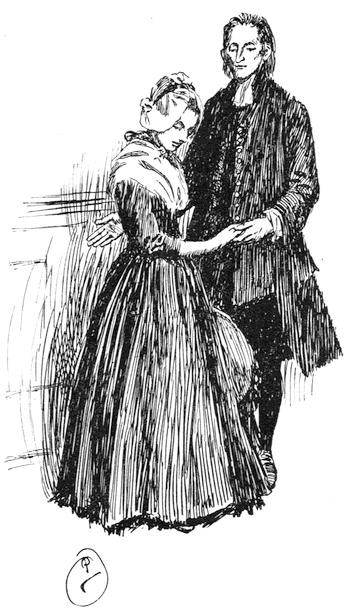
"THE WIDOW DROPPED HER EYES."
"Who has needed these things as I have?" continued the widow, taking a step forward, and with increasing agitation. "Oh, Mr. Moore, I should be an ungrateful woman if I did not mingle my congratulations with the others. And I want to do this now with my whole soul. May God bless you, and crown the labors of[Pg 41] [Pg 42] [Pg 43] your life with every desire of your heart!" And saying this, the widow laid the soft tips of one hand on one of the parson's shoulders, and raising herself slightly on tiptoe, kissed him.
"Oh, Mrs. Babcock!" cried the dismayed logician, "what have you done?" But the next moment, the logician giving place to the man, he grasped one of her hands, and murmuring, "May God bless you for that!" seized his hat, and hurried out into the street.
The most careless observer might have been interested in watching his movements as he walked away.
He carried his hat in his hand, forgetting to put it on. Several persons spoke to him on the street, but he did not hear them. He strode a block or two in one direction, and then a block or two in another.
"If she does it again," he muttered to himself—"if she does it again, I'll marry her!... Old?... I could run a mile in a minute!"
As he was passing the music-store, the dealer called out to him:
"Come in, parson. I've got a present for you."
"A—present—for—me?" repeated the parson, blank with amazement. In his life the little music-dealer had never made him a present.
"Yes, a present," repeated the fortunate vestry-man, whose dry heart, like a small seed-pod, the wind of good-fortune had opened, so that a few rattling germs of generosity dropped out. Opening a drawer behind his counter, he now took out a roll of music. "Here's some new music for your flute," he said. "Accept it with my compliments."
New music for his flute! The parson turned it over dreamily, and it seemed that the last element of disorder had come to derange his faculties.
"And Mrs. Leuba sends her compliments, and would like to have you to dinner," added the shopkeeper, looking across the counter with some amusement at the expression of the parson, who now appeared as much shocked as though his whole nervous system had been suddenly put in connection with a galvanic battery of politeness.
It was a very gay dinner, having been gotten up to celebrate the drawing of the prize. The entire company were to go in the afternoon to see the waxworks, and some of the ladies wore especial toilets, with a view to having their profiles taken.
"Have you been to see the waxworks, Mr. Moore?" inquired a spinster roguishly, wiping a drop of soup from her underlip.
The unusual dinner, the merriment, the sense of many ladies present, mellowed the parson like old wine.
"No, madam," he replied, giddily; "but I shall go this very afternoon. I find it impossible any longer to deny myself the pleasure of beholding the great American Coquette and the Sleeping Beauty. I must take my black sheep," he continued, with expanding warmth. "I must drive my entire flock of soiled lambs into the favored and refining presence of Miss Julia Granby."
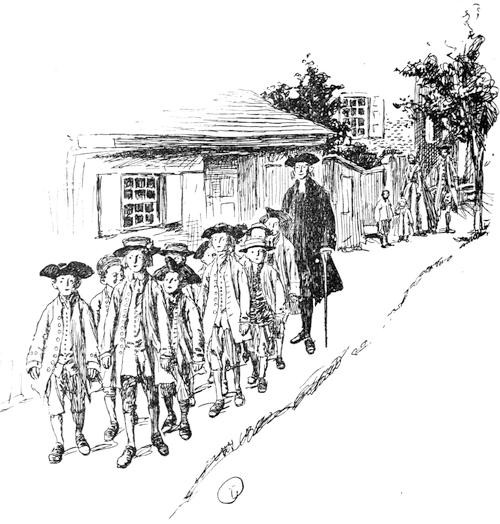
Keeping to this resolution, as soon as dinner was over he made his excuses to the company, and set off to collect a certain class of boys which he had scraped together by hook and crook from the by-ways of the town, and about an hour later he might have been seen driving them before him towards the entrance of the museum. There he shouldered his way cheerfully up to the door, and shoved each of the lads good-naturedly in, finally passing in himself, with a general glance at the by-standers, as if to say, "Was there ever another man as happy in this world?"
But he soon came out, leaving his wild lambs to browse at will in those fresh pastures, and took his way up street homeward. He seemed to be under some necessity of shaking them off in order to enjoy the solitude of his thoughts.
"If she does it again!... If she does it again!... Whee! whee! whee!—whee! whee! whee!" and he began to whistle for his flute with a nameless longing.
It was soon after this that the two women heard him playing the reel, and watched him perform certain later incredible evolutions. For whether one event, or all events combined, had betrayed him into this outbreak, henceforth he was quite beside himself.
Is it possible that on this day the Reverend James Moore had driven the ancient, rusty, creaky chariot of his faculties too near the sun of love?
VII.
A sad day it had been meantime for the poor lad.
He had gotten up in the morning listless and dull and sick at the sight of his breakfast. But he had feigned to be quite well that he might have permission to set off down-town. There was no chance of his being able to get into the museum, but he was drawn irresistibly thither for the mere pleasure of standing around and watching the people, and hoping that something—something would turn up. He was still there when his dinner-hour came, but he never thought of this. Once, when the door-keeper was at leisure, he had hobbled up and said to him, with a desperate effort to smile, "Sir, if I were rich, I'd live in your museum for about five years."
But the door-keeper had pushed him rudely back, telling him to be off and not obstruct the sidewalk.
He was still standing near the entrance when the parson came down the street driving his flock of boys. Ah, if he had only joined that class, as time after time he had been asked to do! All at once his face lit up with a fortunate inspiration, and pushing his way to the very side of the door-keeper, he placed himself there that the parson might see him and take him with the others; for had he not said that he must be sure to go? But when the parson came up, this purpose had failed him, and he had apparently shrunk to half his size behind the bulk of the door-keeper, fearing most of all things that the parson would discover him and know why he was there.
He was still lingering outside when the parson reappeared and started homeward; and he sat down and watched him out of sight. He seemed cruelly hurt, and his eyes filled with tears.
"I'd have taken him in the very first one," he said, choking down a sob; and then, as if he felt this to be unjust, he murmured over and over: "Maybe he forgot me; maybe he didn't mean it; maybe he forgot me."
Perhaps an hour later, slowly and with many pauses, he drew near the door of the parson's home. There he lifted his hand three times before he could knock.
"The parson's not at home," the widow Spurlock had called sharply down to him.
With this the last hope had died out of his bosom; for having dwelt long on the parson's kindness to him—upon all the parson's tireless efforts to befriend him—he had summoned the courage at last to go and ask him to lend him a quarter.
With little thought of whither he went, he now turned back down-town, but some time later he was still standing at the entrance of the museum.
He looked up the street again. All the Leubas were coming, Tom walking, with a very haughty air, a few feet ahead.
"Why don't you go in?" he said, loudly, walking up to David and jingling the silver in his pockets. "What are you standing out here for? If you want to go in, why don't you go in?"
"Oh, Tom!" cried David, in a whisper of eager confidence, his utterance choked with a sob, "I haven't got any money."
"I'd hate to be as poor as you are," said Tom, contemptuously. "I'm going this evening, and to-night, and as often as I want," and he turned gayly away to join the others.
He was left alone again, and his cup of bitterness, which had been filling drop by drop, now ran over.
Several groups came up just at that moment. There was a pressure and a jostling of the throng. As Mr. Leuba, who had made his way up to the door-keeper, drew a handful of silver from his pocket, some one accidentally struck his elbow, and several pieces fell to the pavement. Then there was laughter and a scrambling as these were picked up and returned. But out through the legs of the crowd one bright silver quarter rolled unseen down the sloping sidewalk towards the spot where David was standing.
It was all done in an instant. He saw it coming; the little crutch was set forward a pace, the little body was swung silently forward, and as the quarter fell over on its shining side, the dirty sole of a brown foot covered it.
The next minute, with a sense of triumph and bounding joy, the poverty-tortured, friendless little thief had crossed the threshold of the museum, and stood face to face with the Redeemer of the world; for the picture was so hung as to catch the eye upon entering, and it arrested his quick, roving glance and held it in awe-stricken fascination. Unconscious of his own move[Pg 49] [Pg 50] [Pg 51]ments, he drew nearer and nearer, until he stood a few feet in front of the arc of spectators, with his breathing all but suspended, and one hand crushing the old blue cloth cap against his naked bosom.
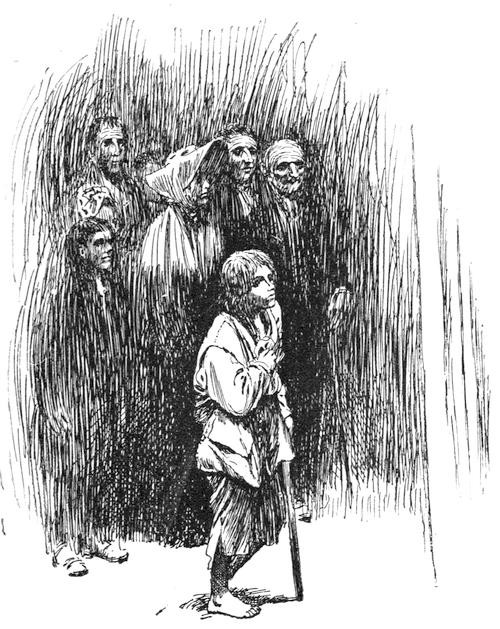
BEFORE THE PICTURE.
It was a strange meeting. The large rude painting possessed no claim to art. But to him it was an overwhelming revelation, for he had never seen any pictures, and he was gifted with an untutored love of painting. Over him, therefore, it exercised an inthralling influence, and it was as though he stood in the visible presence of One whom he knew that the parson preached of and his mother worshipped.
Forgetful of his surroundings, long he stood and gazed. Whether it may have been the thought of the stolen quarter that brought him to himself, at length he drew a deep breath, and looked quickly around with a frightened air. From across the room he saw Mr. Leuba watching him gravely, as it seemed to his guilty conscience, with fearful sternness. A burning flush dyed his face, and he shrank back, concealing himself among the crowd. The next moment, without ever having seen or so much as thought of anything else in the museum, he slipped out into the street.
There the eyes of everybody seemed turned upon him. Where should he go? Not home. Not to Mr. Leuba's music-store. No; he could never look into Mr. Leuba's face again. And Tom? He could hear Tom crying out, wherever he should meet him, "You stole a quarter from father."
In utter terror and shame, he hurried away out to the southern end of the town, where there was an abandoned rope-walk.
It was a neglected place, damp and unhealthy. In the farthest corner of it he lay down and hid himself in a clump of iron-weeds. Slowly the moments dragged themselves along. Of what was he thinking? Of his mother? Of the parson? Of the violin that would now never be his? Of that wonderful sorrowful face which he had seen in the painting? The few noises of the little town grew very faint, the droning of the bumblebee on the purple tufts of the weed overhead very loud, and louder still the beating of his heart against the green grass as he lay on his side, with his head on his blue cap and his cheek in his hand. And then he fell asleep.
When he awoke he started up bewildered. The sun had set, and the heavy dews of twilight were falling. A chill ran through him; and then the recollection of what had happened came over him with a feeling of desolation. When it was quite dark he left his hiding-place and started back up-town.
He could reach home in several ways, but a certain fear drew him into the street which led past the music-store. If he could only see Mr. Leuba, he felt sure that he could tell by the expression of his face whether he had missed the quarter. At some distance off he saw by the light of the windows Mr. Leuba standing in front of his shop talking to a group of men. Noiselessly he drew near, noiselessly he was passing without the courage to look up.
"Stop, David. Come in here a moment. I want to talk to you."
As Mr. Leuba spoke, he apologized to the gentlemen for leaving, and turned back into the rear of the shop. Faint, and trembling so that he could scarcely stand, his face of a deadly whiteness, the boy followed.
"David," said Mr. Leuba—in his whole life he had never spoken so kindly; perhaps his heart had been touched by some belated feeling, as he had studied the boy's face before the picture in the museum, and certainly it had been singularly opened by his good-fortune—"David," he said, "I promised when I got rich enough I'd give Tom a new violin, and give you his old one. Well, I gave him a new one to-day; so here's yours," and going to a corner of the room, he took up the box, brought it back, and would have laid it on the boy's arm, only there was no arm extended to receive it.
"Take it! It's yours!"
"Oh, Mr. Leuba!"
It was all he could say. He had expected to be charged with stealing the quarter, and instead there was held out to him the one treasure in the world—the violin of which he had dreamed so long, for which he had served so faithfully.
"Oh, Mr. Leuba!"
There was a pitiful note in the cry, but the dealer was not the man to hear it, or to notice the look of angelic contrition on the upturned face. He merely took the lad's arm, bent it around the violin, patted the ragged cap, and said, a little impatiently:
"Come, come! they're waiting for me at the door. To-morrow you can come down and run some more errands for me," and he led the way to the front of the shop and resumed his conversation.
Slowly along the dark street the lad toiled homeward with his treasure. At any other time he would have sat down on the first curb-stone, opened the box, and in ecstatic joy have lifted out that peerless instrument; or he would have sped home with it to his mother, flying along on his one crutch as if on the winds of heaven. But now he could not look at it, and something clogged his gait so that he loitered and faltered and sometimes stood still irresolute.
But at last he approached the log-cabin which was his home. A rude fence enclosed the yard, and inside this fence there grew a hedge of lilacs. When he was within a few feet of the gate he paused, and did what he had never done before—he put his face close to the panels of the fence, and with a look of guilt and sorrow peeped through the lilacs at the face of his mother, who was sitting in the light of the open door-way.
She was thinking of him. He knew that by the patient sweetness of her smile. All the heart went out of him at the sight, and hurrying forward, he put the violin down at her feet, and threw his arms around her neck, and buried his head on her bosom.
VIII.
After he had made his confession, a restless and feverish night he had of it, often springing up from his troubled dreams and calling to her in the darkness. But the next morning he insisted upon getting up for a while.
Towards the afternoon he grew worse again, and took to his bed, the yellow head tossing to and fro, the eyes bright and restless, and his face burning. At length he looked up and said to his mother, in the manner of one who forms a difficult resolution: "Send for the parson. Tell him I am sick and want to see him."
It was this summons that the widow Spurlock had delivered on the Sunday afternoon when the parson had quitted the house with such a cry of distress. He had not so much as thought of the boy since the Friday morning previous.
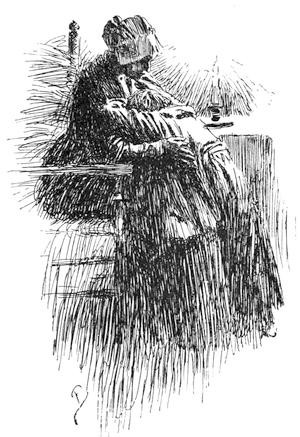
"How is it possible," he exclaimed, as he hurried on—"how is it possible that I could have forgotten him?"
The boy's mother met him outside the house and drew him into an adjoining room, silently, for her tears were falling. He sank into the first chair.
"Is he so ill?" he asked, under his trembling breath.
"I'm afraid he's going to be very ill. And to see him in so much trouble—"
"What is the matter? In God's name, has anything happened to him?"
She turned her face away to hide her grief. "He said he would tell you himself. Oh, if I've been too hard with him! But I did it for the best. I didn't know until the doctor came that he was going to be ill, or I would have waited. Do anything you can to quiet him—anything he should ask you to do," she implored, and pointed towards the door of the room in which the boy lay.
Conscience-stricken and speechless, the parson opened it and entered.
The small white bed stood against the wall beneath an open window, and one bright-headed sunflower, growing against the house outside, leaned in and fixed its kind face anxiously upon the sufferer's.
The figure of the boy was stretched along the edge of the bed, his cheek on one hand and his eyes turned steadfastly towards the middle of the room, where, on a table, the violin lay exposed to view.
He looked quickly towards the door as the parson entered, and an expression of relief passed over his face.
"Why, David," said the parson, chidingly, and crossing to the bed with a bright smile. "Sick? This will never do;" and he sat down, imprisoning one of the burning palms in his own.
The boy said nothing, but looked at him searchingly, as though needing to lay aside masks and disguises and penetrate at once to the bottom truth. Then he asked, "Are you mad at me?"
"My poor boy!" said the parson, his lips trembling a little as he tightened his pressure—"my poor boy! why should I be mad at you?"
"You never could do anything with me."
"Never mind that now," said the parson, soothingly, but adding, with bitterness, "it was all my fault—all my fault."
"It wasn't your fault," said the boy. "It was mine."
A change had come over him in his treatment of the parson. Shyness had disappeared, as is apt to be the case with the sick.
"I want to ask you something," he added, confidentially.
"Anything—anything! Ask me anything!"
"Do you remember the wax figures?"
"Oh yes, I remember them very well," said the parson, quickly, uneasily.
"I wanted to see 'em, and I didn't have any money, and I stole a quarter from Mr. Leuba."
Despite himself a cry escaped the parson's lips, and dropping the boy's hand, he started from his chair and walked rapidly to and fro across the room, with the fangs of remorse fixed deep in his conscience.
"Why didn't you come to me?" he asked at length, in a tone of helpless entreaty. "Why didn't you come to me? Oh, if you had only come to me!"
"I did come to you," replied the boy.
"When?" asked the parson, coming back to the bedside.
"About three o'clock yesterday."
About three o'clock yesterday! And what was he doing at that time? He bent his head over to his very knees, hiding his face in his hands.
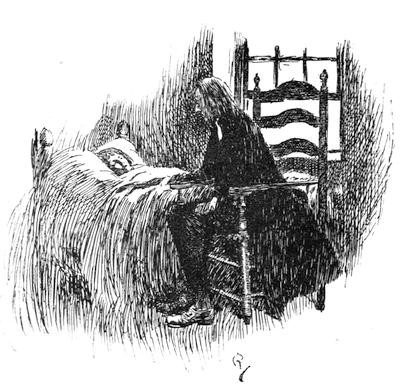
"But why didn't you let me know it? Why didn't you come in?"
"Mrs. Spurlock told me you were at work on a sermon."
"God forgive me!" murmured the parson, with a groan.
"I thought you'd lend me a quarter," said the boy, simply. "You took the other boys, and you told me I must be certain to go. I thought you'd lend me a quarter till I could pay you back."
"Oh, David!" cried the parson, getting down on his knees by the bedside, and putting his arms around the boy's neck, "I would have lent you—I would have given you—anything I have in this poor world!"
The boy threw his arms around the parson's neck and clasped him close. "Forgive me!"
"Oh, boy! boy! can you forgive me?" Sobs stifled the parson's utterance, and he went to a window on the opposite side of the room.
When he turned his face inward again, he saw the boy's gaze fixed once more intently upon the violin.
"There's something I want you to do for me," he said. "Mr. Leuba gave me a violin last night, and mamma says I ought to sell it and pay him back. Mamma says it will be a good lesson for me." The words seemed wrung from his heart's core. "I thought I'd ask you to sell it for me. The doctor says I may be sick a long time, and it worries me." He began to grow excited, and tossed from side to side.
"Don't worry," said the parson, "I'll sell it for you."
The boy looked at the violin again. To him it was priceless, and his eyes grew heavy with love for it. Then he said, cautiously: "I thought you'd get a good price for it. I don't think I could take less than a hundred dollars. It's worth more than that, but if I have to sell it, I don't think I could take less than a hundred dollars," and he fixed his burning eyes on the parson's.
"Don't worry! I'll sell it for you. Oh yes, you can easily get a hundred dollars for it. I'll bring you a hundred dollars for it by to-morrow morning."
As the parson was on the point of leaving the room, with the violin under his arm, he paused with his hand on the latch, an anxious look gathering in his face. Then he came back, laid the violin on the table, and going to the bedside, took the boy's hands in both of his own.
"David," said the moral philosopher, wrestling in his consciousness with the problem of evil—"David, was it the face of the Saviour that you wished to see? Was it this that tempted you to—" and he bent over the boy breathless.
"I wanted to see the Sleeping Beauty."
The parson turned away with a sigh of acute disappointment.
It was on this night that he was seen to enter his room with a boy's violin under his arm, and later to hang it, and hang his beloved flute, tied with a blue ribbon, above the meagre top shelf of books—Fuller's Gospel, Petrarch, Volney's Ruins, Zollicoffer's Sermons, and the Horrors of San Domingo. After that he remained motionless at his table, with his head bowed on his folded arms, until the candle went out, leaving him in inner and outer darkness. Moralist, logician, philosopher, he studied the transgression, laying it at last solely to his own charge.
At daybreak he stood outside the house with the physician who had been with the boy during the night. "Will he die?" he asked.
The physician tapped his forehead with his forefinger. "The chances are against him. The case has peculiar complications. All night it has been nothing but the wax figures and the stolen quarter and the violin. His mother has tried to persuade him not to sell it. But he won't bear the sight of it now, although he is wild at the thought of selling it."
"David," said the parson, kneeling by the bedside, and speaking in a tone pitiful enough to have recalled a soul from the other world—"David, here's the money for the violin; here's the hundred dollars," and he pressed it into one of the boy's palms. The hand closed upon it, but there was no recognition. It was half a year's salary.
The first sermon that the parson preached in the new church was on the Sunday after the boy's death. It was expected that he would rise to the occasion and surpass himself, which, indeed, he did, drawing tears even from the eyes of those who knew not that they could shed them, and all through making the greatest effort to keep back his own. The subject of the sermon was "The Temptations of the Poor." The sermon of the following fortnight was on the "Besetting Sin," the drift of it going to show that the besetting sin may be the one pure and exquisite pleasure of life, involving only the exercise of the loftiest faculty. And this was followed by a third sermon on "The Kiss that Betrayeth," in which the parson ransacked history for illustrations to show that every species of man—ancient, mediæval, and modern—had been betrayed in this way. During the delivery of this sermon the parson looked so cold and even severe that it was not understood why the emotions of any one should have been touched, or why the widow Babcock should have lowered her veil and wept bitterly.
And thus being ever the more loved and revered as he grew ever the more lovable and saint-like, he passed onward to the close. But not until the end came did he once stretch forth a hand to touch his flute; and it was only in imagination then that he grasped it, to sound the final roll-call of his wandering faculties, and to blow a last good-night to his tired spirit.
[Pg 64] [Pg 65]
King Solomon of Kentucky.

I.
It had been a year of strange disturbances—a desolating drought, a hurly-burly of destructive tempests, killing frosts in the tender valleys, mortal fevers in the tender homes. Now came tidings that all day the wail of myriads of locusts was heard in the green woods of Virginia and Tennessee; now that Lake Erie was blocked with ice on the very verge of summer, so that in the Niagara new rocks and islands showed their startling faces. In the Blue-grass Region of Kentucky countless caterpillars were crawling over the ripening apple orchards and leaving the trees as stark as when tossed in the thin air of bitter February days.
Then, flying low and heavily through drought and tempest and frost and plague, like the royal presence of disaster, that had been but heralded by its mournful train, came nearer and nearer the dark angel of the pestilence.
M. Xaupi had given a great ball only the night before in the dancing-rooms over the confectionery of M. Giron—that M. Giron who made the tall pyramids of meringues and macaroons for wedding-suppers, and spun around them a cloud of candied webbing as white and misty as the veil of the bride. It was the opening cotillon party of the summer. The men came in blue cloth coats with brass buttons, buff waistcoats, and laced and ruffled shirts; the ladies came in white satins with ethereal silk overdresses, embroidered in the figure of a gold beetle or an oak leaf of green. The walls of the ball-room were painted to represent landscapes of blooming orange-trees, set here and there in clustering tubs; and the chandeliers and sconces were lighted with innumerable wax-candles, yellow and green and rose.
Only the day before, also, Clatterbuck had opened for the summer a new villa-house, six miles out in the country, with a dancing-pavilion in a grove of maples and oaks, a pleasure-boat on a sheet of crystal water, and a cellar stocked with old sherry, Sauterne, and Château Margaux wines, with anisette, "Perfect Love," and Guigholet cordials.
Down on Water Street, near where now stands a railway station, Hugh Lonney, urging that the fear of cholera was not the only incentive to cleanliness, had just fitted up a sumptuous bath-house, where cold and shower baths might be had at twelve and a half cents each, or hot ones at three for half a dollar.
Yes, the summer of 1833 was at hand, and there must be new pleasures, new luxuries; for Lexington was the Athens of the West and the Kentucky Birmingham.
Old Peter Leuba felt the truth of this, as he stepped smiling out of his little music-store on Main Street, and, rubbing his hands briskly together, surveyed once more his newly-arranged windows, in which were displayed gold and silver epaulets, bottles of Jamaica rum, garden seeds from Philadelphia, drums and guitars and harps. Dewees & Grant felt it in their drug-store on Cheapside, as they sent off a large order for calomel and superior Maccoboy, rappee, and Lancaster snuff. Bluff little Daukins Tegway felt it, as he hurried on the morning of that day to the office of the Observer and Reporter, and advertised that he would willingly exchange his beautiful assortment of painted muslins and Dunstable bonnets for flax and feathers. On the threshold he met a florid farmer, who had just offered ten dollars' reward for a likely runaway boy with a long fresh scar across his face; and to-morrow the paper would contain one more of those tragical little cuts, representing an African slave scampering away at the top of his speed, with a stick swung across his shoulder and a bundle dangling down his back. In front of Postlethwaite's Tavern, where now stands the Phœnix Hotel, a company of idlers, leaning back in Windsor chairs and planting their feet against the opposite wall on a level with their heads, smoked and chewed and yawned, as they discussed the administration of Jackson and arranged for the coming of Daniel Webster in June, when they would give him a great barbecue, and roast in his honor a buffalo bull taken from the herd emparked near Ashland. They hailed a passing merchant, who, however, would hear nothing of the bull, but fell to praising his Rocky Mountain beaver and Goose Creek salt; and another, who turned a deaf ear to Daniel Webster, and invited them to drop in and examine his choice essences of peppermint, bergamot, and lavender.
But of all the scenes that might have been observed in Lexington on that day, the most remarkable occurred in front of the old court-house at the hour of high noon. On the mellow stroke of the clock in the steeple above the sheriff stepped briskly forth, closely followed by a man of powerful frame, whom he commanded to station himself on the pavement several feet off. A crowd of men and boys had already collected in anticipation, and others came quickly up as the clear voice of the sheriff was heard across the open public square and old market-place.
He stood on the topmost of the court-house steps, and for a moment looked down on the crowd with the usual air of official severity.
"Gentlemen," he then cried out sharply, "by an ordah of the cou't I now offah this man at public sale to the highes' biddah. He is able-bodied but lazy, without visible property or means of suppoht, an' of dissolute habits. He is therefoh adjudged guilty of high misdemeanahs, an' is to be sole into labah foh a twelvemonth. How much, then, am I offahed foh the vagrant? How much am I offahed foh ole King Sol'mon?"
Nothing was offered for old King Solomon. The spectators formed themselves into a ring around the big vagrant and settled down to enjoy the performance.
"Staht 'im, somebody."
Somebody started a laugh, which rippled around the circle.
The sheriff looked on with an expression of unrelaxed severity, but catching the eye of an acquaintance on the outskirts, he exchanged a lightning wink of secret appreciation. Then he lifted off his tight beaver hat, wiped out of his eyes a little shower of perspiration which rolled suddenly down from above, and warmed a degree to his theme.
"Come, gentlemen," he said, more suasively, "it's too hot to stan' heah all day. Make me an offah! You all know ole King Sol'mon; don't wait to be interduced. How much, then, to staht 'im? Say fifty dollahs! Twenty-five! Fifteen! Ten! Why, gentlemen! Not ten dollahs? Remembah this is the Blue-grass Region of Kentucky—the land of Boone an' Kenton, the home of Henry Clay!" he added, in an oratorical crescendo.
"He ain't wuth his victuals," said an oily little tavern-keeper, folding his arms restfully over his own stomach and cocking up one piggish eye into his neighbor's face. "He ain't wuth his 'taters."
"Buy 'im foh 'is rags!" cried a young law-student, with a Blackstone under his arm, to the town rag-picker opposite, who was unconsciously ogling the vagrant's apparel.
"I might buy 'im foh 'is scalp," drawled a farmer, who had taken part in all kinds of scalp contests and was now known to be busily engaged in collecting crow scalps for a match soon to come off between two rival counties.
"I think I'll buy 'im foh a hat-sign," said a manufacturer of ten-dollar Castor and Rhorum hats. This sally drew merry attention to the vagrant's hat, and the merchant felt rewarded.
"You'd bettah say the town ought to buy 'im an' put 'im up on top of the cou't-house as a scarecrow foh the cholera," said some one else.
"What news of the cholera did the stage-coach bring this mohning?" quickly inquired his neighbor in his ear; and the two immediately fell into low, grave talk, forgot the auction, and turned away.
"Stop, gentlemen, stop!" cried the sheriff, who had watched the rising tide of good-humor, and now saw his chance to float in on it with spreading sails. "You're runnin' the price in the wrong direction—down, not up. The law requires that he be sole to the highes' biddah, not the lowes'. As loyal citizens, uphole the constitution of the commonwealth of Kentucky an' make me an offah; the man is really a great bargain. In the first place, he would cos' his ownah little or nothin', because, as you see, he keeps himself in cigahs an' clo'es; then, his main article of diet is whiskey—a supply of which he always has on han'. He don't even need a bed, foh you know he sleeps jus' as well on any doohstep; noh a chair, foh he prefers to sit roun' on the curb-stones. Remembah, too, gentlemen, that ole King Sol'mon is a Virginian—from the same neighbohhood as Mr. Clay. Remembah that he is well educated, that he is an awful Whig, an' that he has smoked mo' of the stumps of Mr. Clay's cigahs than any other man in existence. If you don't b'lieve me, gentlemen, yondah goes Mr. Clay now; call him ovah an' ask 'im foh yo'se'ves."
He paused, and pointed with his right forefinger towards Main street, along which the spectators, with a sudden craning of necks, beheld the familiar figure of the passing statesman.
"But you don't need anybody to tell you these fac's, gentlemen," he continued. "You merely need to be reminded that ole King Sol'mon is no ohdinary man. Mo'ovah he has a kine heaht, he nevah spoke a rough wohd to anybody in this worl', an' he is as proud as Tecumseh of his good name an' charactah. An', gentlemen," he added, bridling with an air of mock gallantry and laying a hand on his heart, "if anythin' fu'thah is required in the way of a puffect encomium, we all know that there isn't anothah man among us who cuts as wide a swath among the ladies. The'foh, if you have any appreciation of virtue, any magnanimity of heaht; if you set a propah valuation upon the descendants of Virginia, that mothah of Presidents; if you believe in the pure laws of Kentucky as the pioneer bride of the Union; if you love America an' love the worl'—make me a gen'rous, high-toned offah foh ole King Sol'mon!"
He ended his peroration amid a shout of laughter and applause, and, feeling satisfied that it was a good time for returning to a more practical treatment of his subject, proceeded in a sincere tone:
"He can easily earn from one to two dollahs a day, an' from three to six hundred a yeah. There's not anothah white man in town capable of doin' as much work. There's not a niggah han' in the hemp factories with such muscles an' such a chest. Look at 'em! An', if you don't b'lieve me, step fo'wahd and feel 'em. How much, then, is bid foh 'im?"
"One dollah!" said the owner of a hemp factory, who had walked forward and felt the vagrant's arm, laughing, but coloring up also as the eyes of all were quickly turned upon him. In those days it was not an unheard-of thing for the muscles of a human being to be thus examined when being sold into servitude to a new master.
"Thank you!" cried the sheriff, cheerily. "One precinc' heard from! One dollah! I am offahed one dollah foh ole King Sol'mon. One dollah foh the king! Make it a half. One dollah an' a half. Make it a half. One dol-dol-dol-dollah!"
Two medical students, returning from lectures at the old Medical Hall, now joined the group, and the sheriff explained:
"One dollah is bid foh the vagrant ole King Sol'mon, who is to be sole into labah foh a twelvemonth. Is there any othah bid? Are you all done? One dollah, once—"
"Dollah and a half," said one of the students, and remarked half jestingly under his breath to his companion, "I'll buy him on the chance of his dying. We'll dissect him."
"Would you own his body if he should die?"
"If he dies while bound to me, I'll arrange that."
"One dollah an' a half," resumed the sheriff; and falling into the tone of a facile auctioneer he rattled on:
"One dollah an' a half foh ole Sol'mon—sol, sol, sol,—do, re, mi, fa, sol—do, re, mi, fa, sol! Why, gentlemen, you can set the king to music!"
All this time the vagrant had stood in the centre of that close ring of jeering and humorous by-standers—a baffling text from which to have preached a sermon on the infirmities of our imperfect humanity. Some years before, perhaps as a master-stroke of derision, there had been given to him that title which could but heighten the contrast of his personality and estate with every suggestion of the ancient sacred magnificence; and never had the mockery seemed so fine as at this moment, when he was led forth into the streets to receive the lowest sentence of the law upon his poverty and dissolute idleness. He was apparently in the very prime of life—a striking figure, for nature at least had truly done some royal work on him. Over six feet in height, erect, with limbs well shaped and sinewy, with chest and neck full of the lines of great power, a large head thickly covered with long reddish hair, eyes blue, face beardless, complexion fair but discolored by low passions and excesses—such was old King Solomon. He wore a stiff, high, black Castor hat of the period, with the crown smashed in and the torn rim hanging down over one ear; a black cloth coat in the old style, ragged and buttonless; a white cotton shirt, with the broad collar crumpled, wide open at the neck and down his sunburnt bosom; blue jeans pantaloons, patched at the seat and the knees; and ragged cotton socks that fell down over the tops of his dusty shoes, which were open at the heels.
In one corner of his sensual mouth rested the stump of a cigar. Once during the proceedings he had produced another, lighted it, and continued quietly smoking. If he took to himself any shame as the central figure of this ignoble performance, no one knew it. There was something almost royal in his unconcern. The humor, the badinage, the open contempt, of which he was the public target, fell thick and fast upon him, but as harmlessly as would balls of pith upon a coat of mail. In truth, there was that in his great, lazy, gentle, good-humored bulk and bearing which made the gibes seem all but despicable. He shuffled from one foot to the other as though he found it a trial to stand up so long, but all the while looking the spectators full in the eyes without the least impatience. He suffered the man of the factory to walk round him and push and pinch his muscles as calmly as though he had been the show bull at a country fair. Once only, when the sheriff had pointed across the street at the figure of Mr. Clay, he had looked quickly in that direction with a kindling light in his eye and a passing flush on his face. For the rest, he seemed like a man who has drained his cup of human life and has nothing left him but to fill again and drink without the least surprise or eagerness.
The bidding between the man of the factory and the student had gone slowly on. The price had reached ten dollars. The heat was intense, the sheriff tired. Then something occurred to revivify the scene. Across the market-place and towards the steps of the court-house there suddenly came trundling along in breathless haste a huge old negress, carrying on one arm a large shallow basket containing apple crab-lanterns and fresh gingerbread. With a series of half-articulate grunts and snorts she approached the edge of the crowd and tried to force her way through. She coaxed, she begged, she elbowed and pushed and scolded, now laughing, and now with the passion of tears in her thick, excited voice. All at once, catching sight of the sheriff, she lifted one ponderous brown arm, naked to the elbow, and waved her hand to him above the heads of those in front.
"Hole on, marseter! Hole on!" she cried, in a tone of humorous entreaty. "Don' knock 'im off till I come! Gim me a bid at 'im!"
The sheriff paused and smiled. The crowd made way tumultuously, with broad laughter and comment.
"Stan' aside theah an' let Aun' Charlotte in!"
"Now you'll see biddin'!"
"Get out of the way foh Aun' Charlotte!"
"Up, my free niggah! Hurrah foh Kentucky!"
A moment more and she stood inside the ring of spectators, her basket on the pavement at her feet, her hands plumped akimbo into her fathomless sides, her head up, and her soft, motherly eyes turned eagerly upon the sheriff. Of the crowd she seemed unconscious, and on the vagrant before her she had not cast a single glance.
She was dressed with perfect neatness. A red and yellow Madras kerchief was bound about her head in a high coil, and another was crossed over the bosom of her stiffly starched and smoothly ironed blue cottonade dress. Rivulets of perspiration ran down over her nose, her temples, and around her ears, and disappeared mysteriously in the creases of her brown neck. A single drop accidentally hung glistening like a diamond on the circlet of one of her large brass ear-rings.
The sheriff looked at her a moment, smiling, but a little disconcerted. The spectacle was unprecedented.
"What do you want heah, Aun' Charlotte?" he asked, kindly. "You can't sell yo' pies an' gingerbread heah."
"I don' wan' sell no pies en gingerbread," she replied, contemptuously. "I wan' bid on him," and she nodded sidewise at the vagrant.
"White folks allers sellin' niggahs to wuk fuh dem; I gwine buy a white man to wuk fuh me. En he gwine t' git a mighty hard mistiss, you heah me!"
The eyes of the sheriff twinkled with delight.
"Ten dollahs is offahed foh ole King Sol'mon. Is theah any othah bid? Are you all done?"
"'Leben," she said.
Two young ragamuffins crawled among the legs of the crowd up to her basket and filched pies and cake beneath her very nose.
"Twelve!" cried the student, laughing.
"Thirteen!" she laughed too, but her eyes flashed.
"You are bidding against a niggah," whispered the student's companion in his ear.
"So I am; let's be off," answered the other, with a hot flush on his proud face.
Thus the sale was ended, and the crowd variously dispersed. In a distant corner of the court-yard the ragged urchins were devouring their unexpected booty. The old negress drew a red handkerchief out of her bosom, untied a knot in a corner of it, and counted out the money to the sheriff. Only she and the vagrant were now left on the spot.
"You have bought me. What do you want me to do?" he asked quietly.
"Lohd, honey!" she answered, in a low tone of affectionate chiding, "I don' wan' you to do nothin'! I wuzn' gwine t' 'low dem white folks to buy you. Dey'd wuk you till you dropped dead. You go 'long en do ez you please."
She gave a cunning chuckle of triumph in thus setting at naught the ends of justice, and, in a voice rich and musical with affection, she said, as she gave him a little push:
"You bettah be gittin' out o' dis blazin' sun. G' on home! I be 'long by-en-by."
He turned and moved slowly away in the direction of Water Street, where she lived; and she, taking up her basket, shuffled across the market-place towards Cheapside, muttering to herself the while:
"I come mighty nigh gittin' dah too late, foolin' 'long wid dese pies. Sellin' him 'ca'se he don' wuk! Umph! If all de men in dis town dat don' wuk wuz to be tuk up en sole, d' wouldn' be 'nough money in de town to buy 'em! Don' I see 'em settin' 'roun' dese taverns f'om mohnin' till night?"
She snorted out her indignation and disgust, and sitting down on the sidewalk, under a Lombardy poplar, uncovered her wares and kept the flies away with a locust bough, not discovering, in her alternating good and ill humor, that half of them had been filched by her old tormentors.
This was the memorable scene enacted in Lexington on that memorable day of the year 1833—a day that passed so briskly. For whoever met and spoke together asked the one question: Will the cholera come to Lexington? And the answer always gave a nervous haste to business—a keener thrill to pleasure. It was of the cholera that the negro woman heard two sweet passing ladies speak as she spread her wares on the sidewalk. They were on their way to a little picture-gallery just opened opposite M. Giron's ball-room, and in one breath she heard them discussing their toilets for the evening and in the next several portraits by Jouett.
So the day passed, the night came on, and M. Xaupi gave his brilliant ball. Poor old Xaupi—poor little Frenchman! whirled as a gamin of Paris through the mazes of the Revolution, and lately come all the way to Lexington to teach the people how to dance. Hop about blithely on thy dry legs, basking this night in the waxen radiance of manners and melodies and graces! Where will be thy tunes and airs to-morrow? Ay, smile and prompt away! On and on! Swing corners, ladies and gentlemen! Form the basket! Hands all around!
While the bows were still darting across the strings, out of the low, red east there shot a long, tremulous bow of light up towards the zenith. And then, could human sight have beheld the invisible, it might have seen hovering over the town, over the ball-room, over M. Xaupi, the awful presence of the plague.
But knowing nothing of this, the heated revellers went merrily home in the chill air of the red and saffron dawn. And knowing nothing of it also, a man awakened on the door-step of a house opposite the ball-room, where he had long since fallen asleep. His limbs were cramped and a shiver ran through his frame. Staggering to his feet, he made his way down to the house of Free Charlotte, mounted to his room by means of a stair-way opening on the street, threw off his outer garments, kicked off his shoes, and taking a bottle from a closet pressed it several times to his lips with long outward breaths of satisfaction. Then, casting his great white bulk upon the bed, in a minute more he had sunk into a heavy sleep—the usual drunken sleep of old King Solomon.
He, too, had attended M. Xaupi's ball, in his own way and in his proper character, being drawn to the place for the pleasure of seeing the fine ladies arrive and float in, like large white moths of the summer night; of looking in through the open windows at the many-colored waxen lights and the snowy arms and shoulders, of having blown out to him the perfume and the music; not worthy to go in, being the lowest of the low, but attending from a door-step of the street opposite—with a certain rich passion in his nature for splendor and revelry and sensuous beauty.
II.
About 10 o'clock the sunlight entered through the shutters and awoke him. He threw one arm up over his eyes to intercept the burning rays. As he lay out-stretched and stripped of grotesque rags, it could be better seen in what a mould nature had cast his figure. His breast, bare and tanned, was barred by full, arching ribs and knotted by crossing muscles; and his shirt-sleeve, falling away to the shoulder from his bent arm, revealed its crowded muscles in the high relief of heroic bronze. For, although he had been sold as a vagrant, old King Solomon had in earlier years followed the trade of a digger of cellars, and the strenuous use of mattock and spade had developed every sinew to the utmost. His whole person, now half naked and in repose, was full of the suggestions of unspent power. Only his face, swollen and red, only his eyes, bloodshot and dull, bore the impress of wasted vitality. There, all too plainly stamped, were the passions long since raging and still on fire.
The sunlight had stirred him to but a low degree of consciousness, and some minutes passed before he realized that a stifling, resinous fume impregnated the air. He sniffed it quickly; through the window seemed to come the smell of burning tar. He sat up on the edge of the bed and vainly tried to clear his thoughts.
The room was a clean but poor habitation—uncarpeted, whitewashed, with a piece or two of the cheapest furniture, and a row of pegs on one wall, where usually hung those tattered coats and pantaloons, miscellaneously collected, that were his purple and fine linen. He turned his eyes in this direction now and noticed that his clothes were missing. The old shoes had disappeared from their corner; the cigar stumps, picked up here and there in the streets according to his wont, were gone from the mantel-piece. Near the door was a large bundle tied up in a sheet. In a state of bewilderment, he asked himself what it all meant. Then a sense of the silence in the street below possessed him. At this hour he was used to hear noises enough—from Hugh Lonney's new bath-house on one side, from Harry Sikes's barber-shop on the other.
A mysterious feeling of terror crept over and helped to sober him. How long had he lain asleep? By degrees he seemed to remember that two or three times he had awakened far enough to drink from the bottle under his pillow, only to sink again into heavier stupefaction. By degrees, too, he seemed to remember that other things had happened—a driving of vehicles this way and that, a hurrying of people along the street. He had thought it the breaking-up of M. Xaupi's ball. More than once had not some one shaken and tried to arouse him? Through the wall of Harry Sikes's barber-shop had he not heard cries of pain—sobs of distress?
He staggered to the window, threw open the shutters, and, kneeling at the sill, looked out. The street was deserted. The houses opposite were closed. Cats were sleeping in the silent door-ways. But as he looked up and down he caught sight of people hurrying along cross-streets. From a distant lumber-yard came the muffled sound of rapid hammerings. On the air was the faint roll of vehicles—the hush and the vague noises of a general terrifying commotion.
In the middle of the street below him a keg was burning, and, as he looked, the hoops gave way, the tar spread out like a stream of black lava, and a cloud of inky smoke and deep-red furious flame burst upward through the sagging air. Just beneath the window a common cart had been backed close up to the door of the house. In it had been thrown a few small articles of furniture, and on the bottom bedclothes had been spread out as if for a pallet. While he looked old Charlotte hurried out with a pillow.
He called down to her in a strange, unsteady voice:
"What is the matter? What are you doing, Aunt Charlotte?"
She uttered a cry, dropped the pillow, and stared up at him. Her face looked dry and wrinkled.
"My God! De chol'ra's in town! I'm waitin' on you! Dress, en come down en fetch de bun'le by de dooh." And she hurried back into the house.
But he continued leaning on his folded arms, his brain stunned by the shock of the intelligence. Suddenly he leaned far out and looked down at the closed shutters of the barber-shop. Old Charlotte reappeared.
"Where is Harry Sikes?" he asked.
"Dead en buried."
"When did he die?"
"Yestidd'y evenin'."
"What day is this?"
"Sadd'y."
M. Xaupi's ball had been on Thursday evening. That night the cholera had broken out. He had lain in his drunken stupor ever since. Their talk had lasted but a minute, but she looked up anxiously and urged him.
"D' ain' no time to was'e, honey! D' ain' no time to was'e. I done got dis cyart to tek you 'way in, en I be ready to start in a minute. Put yo' clo'es on en bring de bun'le wid all yo' yudder things in it."
With incredible activity she climbed into the cart and began to roll up the bedclothes. In reality she had made up her mind to put him into the cart, and the pallet had been made for him to lie and finish his drunken sleep on, while she drove him away to a place of safety.
Still he did not move from the window-sill. He was thinking of Harry Sikes, who had shaved him many a time for nothing. Then he suddenly called down to her:
"Have many died of the cholera? Are there many cases in town?"
She went on with her preparations and took no notice of him. He repeated the question. She got down quickly from the cart and began to mount the staircase. He went back to bed, pulled the sheet up over him, and propped himself up among the pillows. Her soft, heavy footsteps slurred on the stair-way as though her strength were failing, and as soon as she entered the room she sank into a chair, overcome with terror. He looked at her with a sudden sense of pity.
"Don't be frightened," he said, kindly. "It might only make it the worse for you."
"I can' he'p it, honey," she answered, wringing her hands and rocking herself to and fro; "de ole niggah can' he'p it. If de Lohd jes spah me to git out'n dis town wid you! Honey, ain' you able to put on yo' clo'es?"
"You've tied them all up in the sheet."
"De Lohd he'p de crazy ole niggah!"
She started up and tugged at the bundle, and laid out a suit of his clothes, if things so incongruous could be called a suit.
"Have many people died of the cholera?"
"Dey been dyin' like sheep ev' since yestidd'y mohnin'—all day, en all las' night, en dis mohnin'! De man he done lock up de huss, en dey been buryin' 'em in cyarts. En de grave-diggah he done run away, en hit look like d' ain' nobody to dig de graves."
She bent over the bundle, tying again the four corners of the sheet. Through the window came the sound of the quick hammers driving nails. She threw up her arms into the air, and then seizing the bundle dragged it rapidly to the door.
"You heah dat? Dey nailin' up cawfins in de lumbah-yahd! Put on yo' clo'es, honey, en come on."
A resolution had suddenly taken shape in his mind.
"Go on away and save your life. Don't wait for me; I'm not going. And good-bye, Aunt Charlotte, in case I don't see you any more. You've been very kind to me—kinder than I deserved. Where have you put my mattock and spade?"
He said this very quietly, and sat up on the edge of the bed, his feet hanging down, and his hand stretched out towards her.
"Honey," she explained, coaxingly, from where she stood, "can't you sobah up a little en put on yo' clo'es? I gwine to tek you 'way to de country. You don' wan' no tools. You can' dig no cellahs now. De chol'ra's in town en de people's dyin' like sheep."
"I expect they will need me," he answered.
She perceived now that he was sober. For an instant her own fear was forgotten in an outburst of resentment and indignation.
"Dig graves fuh 'em, when dey put you up on de block en sell you same ez you wuz a niggah! Dig graves fuh 'em, when dey allers callin' you names on de street en makin' fun o' you!"
"They are not to blame. I have brought it on myself."
"But we can' stay heah en die o' de chol'ra!"
"You mustn't stay. You must go away at once."
"But if I go, who gwine tek cyah o' you?"
"Nobody."
She came quickly across the room to the bed, fell on her knees, clasped his feet to her breast, and looked up into his face with an expression of imploring tenderness. Then, with incoherent cries and with sobs and tears, she pleaded with him—pleaded for dear life; his and her own.
It was a strange scene. What historian of the heart will ever be able to do justice to those peculiar ties which bound the heart of the negro in years gone by to a race of not always worthy masters? This old Virginia nurse had known King Solomon when he was a boy playing with her young master, till that young master died on the way to Kentucky.
At the death of her mistress she had become free with a little property. By thrift and industry she had greatly enlarged this. Years passed and she became the only surviving member of the Virginian household, which had emigrated early in the century to the Blue-grass Region. The same wave of emigration had brought in old King Solomon from the same neighborhood. As she had risen in life, he had sunk. She sat on the sidewalks selling her fruits and cakes; he sat on the sidewalks more idle, more ragged and dissolute. On no other basis than these facts she began to assume a sort of maternal pitying care of him, patching his rags, letting him have money for his vices, and when, a year or two before, he had ceased working almost entirely, giving him a room in her house and taking in payment what he chose to pay.
He brushed his hand quickly across his eyes as she knelt before him now, clasping his feet to her bosom. From coaxing him as an intractable child she had, in the old servile fashion, fallen to imploring him, with touching forgetfulness of their real relations:
"O my marseter! O my marseter Solomon! Go 'way en save yo' life, en tek yo' po' ole niggah wid you!"
But his resolution was formed, and he refused to go. A hurried footstep paused beneath the window and a loud voice called up. The old nurse got up and went to the window. A man was standing by the cart at her door.
"For God's sake let me have this cart to take my wife and little children away to the country! There is not a vehicle to be had in town. I will pay you—" He stopped, seeing the distress on her face.
"Is he dead?" he asked, for he knew of her care of old King Solomon.
"He will die!" she sobbed. "Tilt de t'ings out on de pavement. I gwine t' stay wid 'im en tek cyah o' 'im."
III.
A little later, dressed once more in grotesque rags and carrying on his shoulder a rusty mattock and a rusty spade, old King Solomon appeared in the street below and stood looking up and down it with an air of anxious indecision. Then shuffling along rapidly to the corner of Mill Street, he turned up towards Main.
Here a full sense of the terror came to him. A man, hurrying along with his head down, ran full against him and cursed him for the delay:
"Get out of my way, you old beast!" he cried. "If the cholera would carry you off it would be a blessing to the town."
Two or three little children, already orphaned and hungry, wandered past, crying and wringing their hands. A crowd of negro men with the muscles of athletes, some with naked arms, some naked to the waist, their eyes dilated, their mouths hanging open, sped along in tumultuous disorder. The plague had broken out in the hemp factory and scattered them beyond control.
He grew suddenly faint and sick. His senses swam, his heart seemed to cease beating, his tongue burned, his throat was dry, his spine like ice. For a moment the contagion of deadly fear overcame him, and, unable to stand, he reeled to the edge of the sidewalk and sat down.
Before him along the street passed the flying people—men on horseback with their wives behind and children in front, families in carts and wagons, merchants in two-wheeled gigs and sulkies. A huge red and yellow stage-coach rolled ponderously by, filled within, on top, in front, and behind with a company of riotous students of law and of medicine. A rapid chorus of voices shouted to him as they passed:
"Good-bye, Solomon!"
"The cholera'll have you befoah sunset!"
"Better be diggin' yoah grave, Solomon! That 'll be yoah last cellah."
"Dig us a big wine cellah undah the Medical Hall while we are away."
"And leave yo' body there! We want yo' skeleton."
"Good-bye, old Solomon!"
A wretched carry-all passed with a household of more wretched women; their tawdry and gay attire, their haggard and painted and ghastly faces, looking horrible in the blaze of the pitiless sunlight. They, too, simpered and hailed him and spent upon him their hardened and degraded badinage. Then there rolled by a high-swung carriage, with the most luxurious of cushions, upholstered with morocco, with a coat-of-arms, a driver and a footman in livery, and drawn by sparkling, prancing horses. Lying back on the satin cushions a fine gentleman; at the window of the carriage two rosy children, who pointed their fingers at the vagrant and turned and looked into their father's face, so that he leaned forward, smiled, leaned back again, and was whirled away to a place of safety.
Thus they passed him, as he sat down on the sidewalk—even physicians from their patients, pastors from their stricken flocks. Why should not he flee? He had no ties, except the faithful affection of an old negress. Should he not at least save her life by going away, seeing that she would not leave him?
The orphaned children wandered past again, sobbing more wearily. He called them to him.
"Why do you not go home? Where is your mother?" he asked.
"She is dead in the house," they answered; "and no one has come to bury her."
Slowly down the street was coming a short funeral train. It passed—a rude cortege: a common cart, in the bottom of which rested a box of plain boards containing the body of the old French dancing-master; walking behind it, with a cambric handkerchief to his eyes, the old French confectioner; at his side, wearing the robes of his office and carrying an umbrella to ward off the burning sun, the beloved Bishop Smith; and behind them, two by two and with linked arms, perhaps a dozen men, most of whom had been at the ball.
No head was lifted or eye turned to notice the vagrant seated on the sidewalk. But when the train had passed he rose, laid his mattock and spade across his shoulder, and, stepping out into the street, fell into line at the end of the procession.
They moved down Short Street to the old burying-ground, where the Baptist church-yard is to-day. As they entered it, two grave-diggers passed out and hurried away. Those before them had fled. They had been at work but a few hours. Overcome with horror at the sight of the dead arriving more and more rapidly, they, too, deserted that post of peril. No one was left. Here and there in the church-yard could be seen bodies awaiting interment. Old King Solomon stepped quietly forward and, getting down into one of the half-finished graves, began to dig.
The vagrant had happened upon an avocation.
IV.
All summer long, Clatterbuck's dancing-pavilion was as silent in its grove of oaks as a temple of the Druids, and his pleasure-boat nestled in its moorings, with no hand to feather an oar in the little lake. All summer long, no athletic young Kentuckians came to bathe their white bodies in Hugh Lonney's new bath-house for twelve and a half cents, and no one read Daukins Tegway's advertisement that he was willing to exchange his Dunstable bonnets for flax and feathers. The likely runaway boy, with a long, fresh scar across his face, was never found, nor the buffalo bull roasted for Daniel Webster, and Peter Leuba's guitars were never thrummed on any moonlit verandas. Only Dewees and Grant were busy, dispensing, not snuff, but calomel.
Grass grew in the deserted streets. Gardens became little wildernesses of rank weeds and riotous creepers. Around shut window-lattices roses clambered and shed their perfume into the poisoned air, or dropped their faded petals to strew the echoless thresholds. In darkened rooms family portraits gazed on sad vacancy or looked helplessly down on rigid sheeted forms.
In the trees of poplar and locust along the streets the unmolested birds built and brooded. The oriole swung its hempen nest from a bough over the door of the spider-tenanted factory, and in front of the old Medical Hall the blue-jay shot up his angry crest and screamed harshly down at the passing bier. In a cage hung against the wall of a house in a retired street a mocking-bird sung, beat its breast against the bars, sung more passionately, grew silent and dropped dead from its perch, never knowing that its mistress had long since become a clod to its full-throated requiem.
Famine lurked in the wake of the pestilence. Markets were closed. A few shops were kept open to furnish necessary supplies. Now and then some old negro might have been seen, driving a meat-wagon in from the country, his nostrils stuffed with white cotton saturated with camphor. Oftener the only visible figure in the streets was that of a faithful priest going about among his perishing fold, or that of the bishop moving hither and thither on his ceaseless ministrations.
But over all the ravages of that terrible time there towered highest the solitary figure of that powerful grave-digger, who, nerved by the spectacle of the common misfortune, by one heroic effort rose for the time above the wrecks of his own nature. In the thick of the plague, in the very garden spot of the pestilence, he ruled like an unterrified king. Through days unnaturally chill with gray cloud and drizzling rain, or unnaturally hot with the fierce sun and suffocating damps that appeared to steam forth from subterranean caldrons, he worked unfaltering, sometimes with a helper, sometimes with none. There were times when, exhausted, he would lie down in the half-dug graves and there sleep until able to go on; and many a midnight found him under the spectral moon, all but hidden by the rank nightshade as he bent over to mark out the lines of one of those narrow mortal cellars.
What weaknesses he fought and conquered through those days and nights! Out of what unforeseen depths of nature did he draw the tough fibre of such a resolution! To be alone with the pestilential dead at night—is not that a test of imperial courage? To live for weeks braving swift death itself—is not that the fierce and ungovernable flaring up of the soul in heroism? For all the mockery and derision of his name, had it not some fitness? For had he not a royal heart?
V.
Nature soon smiles upon her own ravages and strews our graves with flowers, not as memories, but for other flowers when the spring returns.
It was one cool, brilliant morning late in that autumn. The air blew fresh and invigorating, as though on the earth there were no corruption, no death. Far southward had flown the plague. A spectator in the open court-square might have seen many signs of life returning to the town. Students hurried along, talking eagerly. Merchants met for the first time and spoke of the winter trade. An old negress, gayly and neatly dressed, came into the market-place, and sitting down on a sidewalk displayed her yellow and red apples and fragrant gingerbread. She hummed to herself an old cradle-song, and in her soft, motherly black eyes shone a mild, happy radiance. A group of young ragamuffins eyed her longingly from a distance. Court was to open for the first time since the spring. The hour was early, and one by one the lawyers passed slowly in. On the steps of the court-house three men were standing: Thomas Brown, the sheriff; old Peter Leuba, who had just walked over from his music-store on Main Street; and little M. Giron, the French confectioner. Each wore mourning on his hat, and their voices were low and grave.
"Gentlemen," the sheriff was saying, "it was on this very spot the day befoah the cholera broke out that I sole 'im as a vagrant. An' I did the meanes' thing a man can evah do. I hel' 'im up to public ridicule foh his weaknesses an' made spoht of 'is infirmities. I laughed at 'is povahty an' 'is ole clo'es. I delivahed on 'im as complete an oration of sarcastic detraction as I could prepare on the spot, out of my own meanness an' with the vulgah sympathies of the crowd. Gentlemen, if I only had that crowd heah now, an' ole King Sol'mon standin' in the midst of it, that I might ask 'im to accept a humble public apology, offahed from the heaht of one who feels himself unworthy to shake 'is han'! But, gentlemen, that crowd will nevah reassemble. Neahly ev'ry man of them is dead, an' ole King Sol'mon buried them."
"He buried my friend Adolphe Xaupi," said François Giron, touching his eyes with his handkerchief.
"There is a case of my best Jamaica rum for him whenever he comes for it," said old Leuba, clearing his throat.
"But, gentlemen, while we are speakin' of ole King Sol'mon we ought not to fohget who it is that has supported 'im. Yondah she sits on the sidewalk, sellin' 'er apples an' gingerbread."
The three men looked in the direction indicated.
"Heah comes ole King Sol'mon now," exclaimed the sheriff.
Across the open square the vagrant was seen walking slowly along with his habitual air of quiet, unobtrusive preoccupation. A minute more and he had come over and passed into the court-house by a side door.
"Is Mr. Clay to be in court to-day?"
"He is expected, I think."
"Then let's go in; there will be a crowd."
"I don't know; so many are dead."
They turned and entered and found seats as quietly as possible; for a strange and sorrowful hush brooded over the court-room. Until the bar assembled, it had not been realized how many were gone. The silence was that of a common overwhelming disaster. No one spoke with his neighbor, no one observed the vagrant as he entered and made his way to a seat on one of the meanest benches, a little apart from the others. He had not sat there since the day of his indictment for vagrancy. The judge took his seat and, making a great effort to control himself, passed his eyes slowly over the court-room. All at once he caught sight of old King Solomon sitting against the wall in an obscure corner; and before any one could know what he was doing, he hurried down and walked up to the vagrant and grasped his hand. He tried to speak, but could not. Old King Solomon had buried his wife and daughter—buried them one clouded midnight, with no one present but himself.
Then the oldest member of the bar started up and followed the example; and then the other members, rising by a common impulse, filed slowly back and one by one wrung that hard and powerful hand. After them came the other persons in the court-room. The vagrant, the grave-digger, had risen and stood against the wall, at first with a white face and a dazed expression, not knowing what it meant; afterwards, when he understood it, his head dropped suddenly forward and his tears fell thick and hot upon the hands that he could not see. And his were not the only tears. Not a man in the long file but paid his tribute of emotion as he stepped forward to honor that image of sadly eclipsed but still effulgent humanity. It was not grief, it was not gratitude, nor any sense of making reparation for the past. It was the softening influence of an act of heroism, which makes every man feel himself a brother hand in hand with every other—such power has a single act of moral greatness to reverse the relations of men, lifting up one, and bringing all others to do him homage.
It was the coronation scene in the life of old King Solomon of Kentucky.
[Pg 94] [Pg 95]
[Pg 96] [Pg 97]
TWO GENTLEMEN OF KENTUCKY.

"The woods are hushed, their music is no more:
The leaf is dead, the yearning passed away:
New leaf, new life—the days of frost are o'er:
New life, new love, to suit the newer day."
THE WOODS ARE HUSHED.
It was near the middle of the afternoon of an autumnal day, on the wide, grassy plateau of Central Kentucky.
The Eternal Power seemed to have quitted the universe and left all nature folded in the calm of the Eternal Peace. Around the pale blue dome of the heavens a few pearl-colored clouds hung motionless, as though the wind had been withdrawn to other skies. Not a crimson leaf floated downward through the soft, silvery light that filled the atmosphere and created the sense of lonely, unimaginable spaces. This light overhung the far-rolling landscape of field and meadow and wood, crowning with faint radiance the remoter low-swelling hill-tops and deepening into dreamy half-shadows on their eastern slopes. Nearer, it fell in a white flake on an unstirred sheet of water which lay along the edge of a mass of sombre-hued woodland, and nearer still it touched to spring-like brilliancy a level, green meadow on the hither edge of the water, where a group of Durham cattle stood with reversed flanks near the gleaming trunks of some leafless sycamores. Still nearer, it caught the top of the brown foliage of a little bent oaktree and burned it into a silvery flame. It lit on the back and the wings of a crow flying heavily in the path of its rays, and made his blackness as white as the breast of a swan. In the immediate foreground, it sparkled in minute gleams along the stalks of the coarse, dead weeds that fell away from the legs and the flanks of a white horse, and slanted across the face of the rider and through the ends of his gray hair, which straggled from beneath his soft black hat.
The horse, old and patient and gentle, stood with low-stretched neck and closed eyes half asleep in the faint glow of the waning heat; and the rider, the sole human presence in all the field, sat looking across the silent autumnal landscape, sunk in reverie. Both horse and rider seemed but harmonious elements in the panorama of still-life, and completed the picture of a closing scene.
To the man it was a closing scene. From the rank, fallow field through which he had been riding he was now surveying, for the last time, the many features of a landscape that had been familiar to him from the beginning of memory. In the afternoon and the autumn of his age he was about to rend the last ties that bound him to his former life, and, like one who had survived his own destiny, turn his face towards a future that was void of everything he held significant or dear.
The Civil War had only the year before reached its ever-memorable close. From where he sat there was not a home in sight, as there was not one beyond the reach of his vision, but had felt its influence. Some of his neighbors had come home from its camps and prisons, aged or altered as though by half a lifetime of years. The bones of some lay whitening on its battle-fields. Families, reassembled around their hearth-stones, spoke in low tones unceasingly of defeat and victory, heroism and death. Suspicion and distrust and estrangement prevailed. Former friends met each other on the turnpikes without speaking; brothers avoided each other in the streets of the neighboring town. The rich had grown poor; the poor had become rich. Many of the latter were preparing to move West. The negroes were drifting blindly hither and thither, deserting the country and flocking to the towns. Even the once united church of his neighborhood was jarred by the unstrung and discordant spirit of the times. At affecting passages in the sermons men grew pale and set their teeth fiercely; women suddenly lowered their black veils and rocked to and fro in their pews; for it is always at the bar of Conscience and before the very altar of God that the human heart is most wrung by a sense of its losses and the memory of its wrongs. The war had divided the people of Kentucky as the false mother would have severed the child.
It had not left the old man unscathed. His younger brother had fallen early in the conflict, borne to the end of his brief warfare by his impetuous valor; his aged mother had sunk under the tidings of the death of her latest-born; his sister was estranged from him by his political differences with her husband; his old family servants, men and women, had left him, and grass and weeds had already grown over the door-steps of the shut, noiseless cabins. Nay, the whole vast social system of the old régime had fallen, and he was henceforth but a useless fragment of the ruins.
All at once his mind turned from the cracked and smoky mirror of the times and dwelt fondly upon the scenes of the past. The silent fields around him seemed again alive with the negroes, singing as they followed the ploughs down the corn-rows or swung the cradles through the bearded wheat. Again, in a frenzy of merriment, the strains of the old fiddles issued from crevices of cabin-doors to the rhythmic beat of hands and feet that shook the rafters and the roof. Now he was sitting on his porch, and one little negro was blacking his shoes, another leading his saddle-horse to the stiles, a third bringing his hat, and a fourth handing him a glass of ice-cold sangaree; or now he lay under the locust-trees in his yard, falling asleep in the drowsy heat of the summer afternoon, while one waved over him a bough of pungent walnut leaves, until he lost consciousness and by-and-by awoke to find that they both had fallen asleep side by side on the grass and that the abandoned fly-brush lay full across his face.
From where he sat also were seen slopes on which picnics were danced under the broad shade of maples and elms in June by those whom death and war had scattered like the transitory leaves that once had sheltered them. In this direction lay the district schoolhouse where on Friday evenings there were wont to be speeches and debates; in that, lay the blacksmith's shop where of old he and his neighbors had met on horseback of Saturday afternoons to hear the news, get the mails, discuss elections, and pitch quoits. In the valley beyond stood the church at which all had assembled on calm Sunday mornings like the members of one united family. Along with these scenes went many a chastened reminiscence of bridal and funeral and simpler events that had made up the annals of his country life.
The reader will have a clearer insight into the character and past career of Colonel Romulus Fields by remembering that he represented a fair type of that social order which had existed in rank perfection over the blue-grass plains of Kentucky during the final decades of the old régime. Perhaps of all agriculturists in the United States the inhabitants of that region had spent the most nearly idyllic life, on account of the beauty of the climate, the richness of the land, the spacious comfort of their homes, the efficiency of their negroes, and the characteristic contentedness of their dispositions. Thus nature and history combined to make them a peculiar class, a cross between the aristocratic and the bucolic, being as simple as shepherds and as proud as kings, and not seldom exhibiting among both men and women types of character which were as remarkable for pure, tender, noble states of feeling as they were commonplace in powers and cultivation of mind.
It was upon this luxurious social growth that the war naturally fell as a killing frost, and upon no single specimen with more blighting power than upon Colonel Fields. For destiny had quarried and chiselled him, to serve as an ornament in the barbaric temple of human bondage. There were ornaments in that temple, and he was one. A slave-holder with Southern sympathies, a man educated not beyond the ideas of his generation, convinced that slavery was an evil, yet seeing no present way of removing it, he had of all things been a model master. As such he had gone on record in Kentucky, and no doubt in a Higher Court; and as such his efforts had been put forth to secure the passage of many of those milder laws for which his State was distinguished. Often, in those dark days, his face, anxious and sad, was to be seen amid the throng that surrounded the blocks on which slaves were sold at auction; and more than one poor wretch he had bought to save him from separation from his family or from being sold into the Southern plantations—afterwards riding far and near to find him a home on one of the neighboring farms.
But all those days were over. He had but to place the whole picture of the present beside the whole picture of the past to realize what the contrast meant for him.
At length he gathered the bridle reins from the neck of his old horse and turned his head homeward. As he rode slowly on, every spot gave up its memories. He dismounted when he came to the cattle and walked among them, stroking their soft flanks and feeling in the palm of his hand the rasp of their salt-loving tongues; on his sideboard at home was many a silver cup which told of premiums on cattle at the great fairs. It was in this very pond that as a boy he had learned to swim on a cherry rail. When he entered the woods, the sight of the walnut-trees and the hickory-nut trees, loaded on the topmost branches, gave him a sudden pang.
Beyond the woods he came upon the garden, which he had kept as his mother had left it—an old-fashioned garden with an arbor in the centre, covered with Isabella grape-vines on one side and Catawba on the other; with walks branching thence in four directions, and along them beds of jump-up-johnnies, sweet-williams, daffodils, sweet-peas, larkspur, and thyme, flags and the sensitive-plant, celestial and maiden's-blush roses. He stopped and looked over the fence at the very spot where he had found his mother on the day when the news of the battle came.
She had been kneeling, trowel in hand, driving away vigorously at the loamy earth, and, as she saw him coming, had risen and turned towards him her face with the ancient pink bloom on her clear cheeks and the light of a pure, strong soul in her gentle eyes. Overcome by his emotions, he had blindly faltered out the words, "Mother, John was among the killed!" For a moment she had looked at him as though stunned by a blow. Then a violent flush had overspread her features, and then an ashen pallor; after which, with a sudden proud dilating of her form as though with joy, she had sunk down like the tenderest of her lily-stalks, cut from its root.
Beyond the garden he came to the empty cabin and the great wood-pile. At this hour it used to be a scene of hilarious activity—the little negroes sitting perched in chattering groups on the topmost logs or playing leap-frog in the dust, while some picked up baskets of chips or dragged a back-log into the cabins.
At last he drew near the wooden stiles and saw the large house of which he was the solitary occupant. What darkened rooms and noiseless halls! What beds, all ready, that nobody now came to sleep in, and cushioned old chairs that nobody rocked! The house and the contents of its attic, presses, and drawers could have told much of the history of Kentucky from almost its beginning; for its foundations had been laid by his father near the beginning of the century, and through its doors had passed a long train of forms, from the veterans of the Revolution to the soldiers of the Civil War. Old coats hung up in closets; old dresses folded away in drawers; saddle-bags and buckskin-leggins; hunting-jackets, powder-horns, and militiamen hats; looms and knitting-needles; snuffboxes and reticules—what a treasure-house of the past it was! And now the only thing that had the springs of life within its bosom was the great, sweet-voiced clock, whose faithful face had kept unchanged amid all the swift pageantry of changes.
He dismounted at the stiles and handed the reins to a gray-haired negro, who had hobbled up to receive them with a smile and a gesture of the deepest respect.
"Peter," he said, very simply, "I am going to sell the place and move to town. I can't live here any longer."
With these words he passed through the yard-gate, walked slowly up the broad pavement, and entered the house.
MUSIC NO MORE.
On the disappearing form of the colonel was fixed an ancient pair of eyes that looked out at him from behind a still more ancient pair of silver-rimmed spectacles with an expression of indescribable solicitude and love.
These eyes were set in the head of an old gentleman—for such he was—named Peter Cotton, who was the only one of the colonel's former slaves that had remained inseparable from his person and his altered fortunes. In early manhood Peter had been a wood-chopper; but he had one day had his leg broken by the limb of a falling tree, and afterwards, out of consideration for his limp, had been made supervisor of the wood-pile, gardener, and a sort of nondescript servitor of his master's luxurious needs.
Nay, in larger and deeper characters must his history be writ, he having been, in days gone by, one of those ministers of the gospel whom conscientious Kentucky masters often urged to the exercise of spiritual functions in behalf of their benighted people. In course of preparation for this august work, Peter had learned to read and had come to possess a well-chosen library of three several volumes—Webster's Spelling-Book, The Pilgrim's Progress, and the Bible. But even these unusual acquisitions he deemed not enough; for being touched with a spark of poetic fire from heaven, and fired by the African's fondness for all that is conspicuous in dress, he had conceived for himself the creation of a unique garment which should symbolize in perfection the claims and consolations of his apostolic office. This was nothing less than a sacred blue-jeans coat that he had had his old mistress make him, with very long and spacious tails, whereon, at his further direction, she embroidered sundry texts of Scripture which it pleased him to regard as the fit visible annunciations of his holy calling. And inasmuch as his mistress, who had had the coat woven on her own looms from the wool of her finest sheep, was, like other gentlewomen of her time, rarely skilled in the accomplishments of the needle, and was moreover in full sympathy with the piety of his intent, she wrought of these passages a border enriched with such intricate curves, marvellous flourishes, and harmonious letterings, that Solomon never reflected the glory in which Peter was arrayed whenever he put it on. For after much prayer that the Almighty wisdom would aid his reason in the difficult task of selecting the most appropriate texts, Peter had chosen seven—one for each day in the week—with such tact, and no doubt heavenly guidance, that when braided together they did truly constitute an eloquent epitome of Christian duty, hope, and pleading.
From first to last they were as follows: "Woe is unto me if I preach not the gospel;" "Servants, be obedient to them that are your masters according to the flesh;" "Come unto me, all ye that labour and are heavy laden;" "Consider the lilies of the field, how they grow; they toil not, neither do they spin;" "Now abideth faith, hope, and charity, these three; but the greatest of these is charity;" "I would not have you to be ignorant, brethren, concerning them which are asleep;" "For as in Adam all die, even so in Christ shall all be made alive." This concatenation of texts Peter wished to have duly solemnized, and therefore, when the work was finished, he further requested his mistress to close the entire chain with the word "Amen," introduced in some suitable place.
But the only spot now left vacant was one of a few square inches, located just where the coat-tails hung over the end of Peter's spine; so that when any one stood full in Peter's rear, he could but marvel at the sight of so solemn a word emblazoned in so unusual a locality.
Panoplied in this robe of righteousness, and with a worn leathern Bible in his hand, Peter used to go around of Sundays, and during the week, by night, preaching from cabin to cabin the gospel of his heavenly Master.
The angriest lightnings of the sultriest skies often played amid the darkness upon those sacred coat-tails and around that girdle of everlasting texts, as though the evil spirits of the air would fain have burned them and scattered their ashes on the roaring winds. The slow-sifting snows of winter whitened them as though to chill their spiritual fires; but winter and summer, year after year, in weariness of body, often in sore distress of mind, for miles along this lonely road and for miles across that rugged way, Peter trudged on and on, withal perhaps as meek a spirit as ever grew foot sore in the paths of its Master. Many a poor overburdened slave took fresh heart and strength from the sight of that celestial raiment; many a stubborn, rebellious spirit, whose flesh but lately quivered under the lash, was brought low by its humble teaching; many a worn-out old frame, racked with pain in its last illness, pressed a fevered lip to its hopeful hem; and many a dying eye closed in death peacefully fixed on its immortal pledges.
When Peter started abroad, if a storm threatened, he carried an old cotton umbrella of immense size; and as the storm burst, he gathered the tails of his coat carefully up under his armpits that they might be kept dry. Or if caught by a tempest without his umbrella, he would take his coat off and roll it up inside out, leaving his body exposed to the fury of the elements. No care, however, could keep it from growing old and worn and faded; and when the slaves were set free and he was called upon by the interposition of Providence to lay it finally aside, it was covered by many a patch and stain as proofs of its devoted usage.
One after another the colonel's old servants, gathering their children about them, had left him, to begin their new life. He bade them all a kind good-bye, and into the palm of each silently pressed some gift that he knew would soon be needed. But no inducement could make Peter or Phillis, his wife, budge from their cabin. "Go, Peter! Go, Phillis!" the colonel had said time and again. "No one is happier that you are free than I am; and you can call on me for what you need to set you up in business." But Peter and Phillis asked to stay with him. Then suddenly, several months before the time at which this sketch opens, Phillis had died, leaving the colonel and Peter as the only relics of that populous life which had once filled the house and the cabins. The colonel had succeeded in hiring a woman to do Phillis's work; but her presence was a strange note of discord in the old domestic harmony, and only saddened the recollections of its vanished peace.
Peter had a short, stout figure, dark-brown skin, smooth-shaven face, eyes round, deep-set and wide apart, and a short, stub nose which dipped suddenly into his head, making it easy for him to wear the silver-rimmed spectacles left him by his old mistress. A peculiar conformation of the muscles between the eyes and the nose gave him the quizzical expression of one who is about to sneeze, and this was heightened by a twinkle in the eyes which seemed caught from the shining of an inner sun upon his tranquil heart.
Sometimes, however, his face grew sad enough. It was sad on this afternoon while he watched the colonel walk slowly up the pavement, well overgrown with weeds, and enter the house, which the setting sun touched with the last radiance of the finished day.
NEW LIFE.
About two years after the close of the war, therefore, the colonel and Peter were to be found in Lexington, ready to turn over a new leaf in the volumes of their lives, which already had an old-fashioned binding, a somewhat musty odor, and but few unwritten leaves remaining.
After a long, dry summer you may have seen two gnarled old apple-trees, that stood with interlocked arms on the western slope of some quiet hill-side, make a melancholy show of blooming out again in the autumn of the year and dallying with the idle buds that mock their sapless branches. Much the same was the belated, fruitless efflorescence of the colonel and Peter.
The colonel had no business habits, no political ambition, no wish to grow richer. He was too old for society, and without near family ties. For some time he wandered through the streets like one lost—sick with yearning for the fields and woods, for his cattle, for familiar faces. He haunted Cheapside and the court-house square, where the farmers always assembled when they came to town; and if his eye lighted on one, he would button-hole him on the street-corner and lead him into a grocery and sit down for a quiet chat. Sometimes he would meet an aimless, melancholy wanderer like himself, and the two would go off and discuss over and over again their departed days; and several times he came unexpectedly upon some of his old servants who had fallen into bitter want, and who more than repaid him for the help he gave by contrasting the hardships of a life of freedom with the ease of their shackled years.
In the course of time, he could but observe that human life in the town was reshaping itself slowly and painfully, but with resolute energy. The colossal structure of slavery had fallen, scattering its ruins far and wide over the State; but out of the very débris was being taken the material to lay the deeper foundations of the new social edifice. Men and women as old as he were beginning life over and trying to fit themselves for it by changing the whole attitude and habit of their minds—by taking on a new heart and spirit. But when a great building falls, there is always some rubbish, and the colonel and others like him were part of this. Henceforth they possessed only an antiquarian sort of interest, like the stamped bricks of Nebuchadnezzar.
Nevertheless he made a show of doing something, and in a year or two opened on Cheapside a store for the sale of hardware and agricultural implements. He knew more about the latter than anything else; and, furthermore, he secretly felt that a business of this kind would enable him to establish in town a kind of headquarters for the farmers. His account-books were to be kept on a system of twelve months' credit; and he resolved that if one of his customers couldn't pay then, it would make no difference.
Business began slowly. The farmers dropped in and found a good lounging-place. On county-court days, which were great market-days for the sale of sheep, horses, mules, and cattle in front of the colonel's door, they swarmed in from the hot sun and sat around on the counter and the ploughs and machines till the entrance was blocked to other customers.
When a customer did come in, the colonel, who was probably talking with some old acquaintance, would tell him just to look around and pick out what he wanted and the price would be all right. If one of those acquaintances asked for a pound of nails, the colonel would scoop up some ten pounds and say, "I reckon that's about a pound, Tom." He had never seen a pound of nails in his life; and if one had been weighed on his scales, he would have said the scales were wrong.
He had no great idea of commercial despatch. One morning a lady came in for some carpet-tacks, an article that he had forgotten to lay in. But he at once sent off an order for enough to have tacked a carpet pretty well all over Kentucky; and when they came, two weeks later, he told Peter to take her up a dozen papers with his compliments. He had laid in, however, an ample and especially fine assortment of pocket-knives, for that instrument had always been to him one of gracious and very winning qualities. Then when a friend dropped in he would say, "General, don't you need a new pocket-knife?" and, taking out one, would open all the blades and commend the metal and the handle. The "general" would inquire the price, and the colonel, having shut the blades, would hand it to him, saying in a careless, fond way, "I reckon I won't charge you anything for that." His mind could not come down to the low level of such ignoble barter, and he gave away the whole case of knives.
These were the pleasanter aspects of his business life which did not lack as well its tedium and crosses. Thus there were many dark stormy days when no one he cared to see came in; and he then became rather a pathetic figure, wandering absently around amid the symbols of his past activity, and stroking the ploughs, like dumb companions. Or he would stand at the door and look across at the old court-house, where he had seen many a slave sold and had listened to the great Kentucky orators.
But what hurt him most was the talk of the new farming and the abuse of the old which he was forced to hear; and he generally refused to handle the improved implements and mechanical devices by which labor and waste were to be saved.
Altogether he grew tired of "the thing," and sold out at the end of the year with a loss of over a thousand dollars, though he insisted he had done a good business.
As he was then seen much on the streets again and several times heard to make remarks in regard to the sidewalks, gutters, and crossings, when they happened to be in bad condition, the Daily Press one morning published a card stating that if Colonel Romulus Fields would consent to make the race for mayor he would receive the support of many Democrats, adding a tribute to his virtues and his influential past. It touched the colonel, and he walked down-town with a rather commanding figure the next morning. But it pained him to see how many of his acquaintances returned his salutations very coldly; and just as he was passing the Northern Bank he met the young opposition candidate—a little red-haired fellow, walking between two ladies, with a rose-bud in his button-hole—who refused to speak at all, but made the ladies laugh by some remark he uttered as the colonel passed. The card had been inserted humorously, but he took it seriously; and when his friends found this out, they rallied round him. The day of election drew near. They told him he must buy votes. He said he wouldn't buy a vote to be mayor of the New Jerusalem. They told him he must "mix" and "treat." He refused. Foreseeing he had no chance, they besought him to withdraw. He said he would not. They told him he wouldn't poll twenty votes. He replied that one would satisfy him, provided it was neither begged nor bought. When his defeat was announced, he accepted it as another evidence that he had no part in the present—no chance of redeeming his idleness.
A sense of this weighed heavily on him at times; but it is not likely that he realized how pitifully he was undergoing a moral shrinkage in consequence of mere disuse. Actually, extinction had set in with him long prior to dissolution, and he was dead years before his heart ceased beating. The very basic virtues on which had rested his once spacious and stately character were now but the mouldy corner-stones of a crumbling ruin.
It was a subtle evidence of deterioration in manliness that he had taken to dress. When he had lived in the country, he had never dressed up unless he came to town. When he had moved to town, he thought he must remain dressed up all the time; and this fact first fixed his attention on a matter which afterwards began to be loved for its own sake. Usually he wore a Derby hat, a black diagonal coat, gray trousers, and a white necktie. But the article of attire in which he took chief pleasure was hose; and the better to show the gay colors of these, he wore low-cut shoes of the finest calf-skin, turned up at the toes. Thus his feet kept pace with the present, however far his head may have lagged in the past; and it may be that this stream of fresh fashions, flowing perennially over his lower extremities like water about the roots of a tree, kept him from drying up altogether.
Peter always polished his shoes with too much blacking, perhaps thinking that the more the blacking the greater the proof of love. He wore his clothes about a season and a half—having several suits—and then passed them on to Peter, who, foreseeing the joy of such an inheritance, bought no new ones. In the act of transferring them the colonel made no comment until he came to the hose, from which he seemed unable to part without a final tribute of esteem, as: "These are fine, Peter;" or, "Peter, these are nearly as good as new." Thus Peter, too, was dragged through the whims of fashion. To have seen the colonel walking about his grounds and garden followed by Peter, just a year and a half behind in dress and a yard and a half behind in space, one might well have taken the rear figure for the colonel's double, slightly the worse for wear, somewhat shrunken, and cast into a heavy shadow.
Time hung so heavily on his hands at night that with a happy inspiration he added a dress suit to his wardrobe, and accepted the first invitation to an evening party.
He grew excited as the hour approached, and dressed in a great fidget for fear he should be too late.
"How do I look, Peter?" he inquired at length, surprised at his own appearance.
"Splendid, Marse Rom," replied Peter, bringing in the shoes with more blacking on them than ever before.
"I think," said the colonel, apologetically—"I think I'd look better if I'd put a little powder on. I don't know what makes me so red in the face."
But his heart began to sink before he reached his hostess's, and he had a fearful sense of being the observed of all observers as he slipped through the hall and passed rapidly up to the gentlemen's room. He stayed there after the others had gone down, bewildered and lonely, dreading to go down himself. By-and-by the musicians struck up a waltz, and with a little cracked laugh at his own performance he cut a few shines of an unremembered pattern; but his ankles snapped audibly, and he suddenly stopped with the thought of what Peter would say if he should catch him at these antics. Then he boldly went down-stairs.
He had touched the new human life around him at various points: as he now stretched out his arms towards its society, for the first time he completely realized how far removed it was from him. Here he saw a younger generation—the flowers of the new social order—sprung from the very soil of fraternal battle-fields, but blooming together as the emblems of oblivious peace. He saw fathers, who had fought madly on opposite sides, talking quietly in corners as they watched their children dancing, or heard them toasting their old generals and their campaigns over their champagne in the supper-room. He was glad of it; but it made him feel, at the same time, that, instead of treading the velvety floors, he ought to step up and take his place among the canvases of old-time portraits that looked down from the walls.
The dancing he had done had been not under the blinding glare of gaslight, but by the glimmer of tallow-dips and star-candles and the ruddy glow of cavernous firesides—not to the accompaniment of an orchestra of wind-instruments and strings, but to a chorus of girls' sweet voices, as they trod simpler measures, or to the maddening sway of a gray-haired negro fiddler standing on a chair in the chimney corner. Still, it is significant to note that his saddest thought, long after leaving, was that his shirt bosom had not lain down smooth, but stuck out like a huge cracked egg-shell; and that when, in imitation of the others, he had laid his white silk handkerchief across his bosom inside his vest, it had slipped out during the evening, and had been found by him, on confronting a mirror, flapping over his stomach like a little white masonic apron.
"Did you have a nice time, Marse Rom?" inquired Peter, as they drove home through the darkness.
"Splendid time, Peter, splendid time," replied the colonel, nervously.
"Did you dance any, Marse Rom?"
"I didn't dance. Oh, I could have danced if I'd wanted to; but I didn't."
Peter helped the colonel out of the carriage with pitying gentleness when they reached home. It was the first and only party.
Peter also had been finding out that his occupation was gone.
Soon after moving to town, he had tendered his pastoral services to one of the fashionable churches of the city—not because it was fashionable, but because it was made up of his brethren. In reply he was invited to preach a trial sermon, which he did with gracious unction.
It was a strange scene, as one calm Sunday morning he stood on the edge of the pulpit, dressed in a suit of the colonel's old clothes, with one hand in his trousers-pocket, and his lame leg set a little forward at an angle familiar to those who know the statues of Henry Clay.
How self-possessed he seemed, yet with what a rush of memories did he pass his eyes slowly over that vast assemblage of his emancipated people! With what feelings must he have contrasted those silk hats, and walking-canes, and broadcloths; those gloves and satins, laces and feathers, jewelry and fans—that whole many-colored panorama of life—with the weary, sad, and sullen audiences that had often heard him of old under the forest trees or by the banks of some turbulent stream!
In a voice husky, but heard beyond the flirtation of the uttermost pew, he took his text: "Consider the lilies of the field, how they grow; they toil not, neither do they spin." From this he tried to preach a new sermon, suited to the newer day. But several times the thoughts of the past were too much for him, and he broke down with emotion.
The next day a grave committee waited on him and reported that the sense of the congregation was to call a colored gentleman from Louisville. Private objections to Peter were that he had a broken leg, wore Colonel Fields's second-hand clothes, which were too big for him, preached in the old-fashioned way, and lacked self-control and repose of manner.
Peter accepted his rebuff as sweetly as Socrates might have done. Humming the burden of an old hymn, he took his righteous coat from a nail in the wall and folded it away in a little brass-nailed deer-skin trunk, laying over it the spelling-book and the Pilgrim's Progress, which he had ceased to read. Thenceforth his relations to his people were never intimate, and even from the other servants of the colonel's household he stood apart. But the colonel took Peter's rejection greatly to heart, and the next morning gave him the new silk socks he had worn at the party. In paying his servants the colonel would sometimes say, "Peter, I reckon I'd better begin to pay you a salary; that's the style now." But Peter would turn off, saying he didn't "have no use fur no salary."
Thus both of them dropped more and more out of life, but as they did so drew more and more closely to each other. The colonel had bought a home on the edge of the town, with some ten acres of beautiful ground surrounding. A high osage-orange hedge shut it in, and forest trees, chiefly maples and elms, gave to the lawn and house abundant shade. Wild-grape vines, the Virginia-creeper, and the climbing-oak swung their long festoons from summit to summit, while honeysuckles, clematis, and the Mexican-vine clambered over arbors and trellises, or along the chipped stone of the low, old-fashioned house. Just outside the door of the colonel's bedroom slept an ancient, broken sundial.
The place seemed always in half-shadow, with hedgerows of box, clumps of dark holly, darker firs half a century old, and aged, crape-like cedars.
It was in the seclusion of this retreat, which looked almost like a wild bit of country set down on the edge of the town, that the colonel and Peter spent more of their time as they fell farther in the rear of onward events. There were no such flower-gardens in the city, and pretty much the whole town went thither for its flowers, preferring them to those that were to be had for a price at the nurseries.
There was, perhaps, a suggestion of pathetic humor in the fact that it should have called on the colonel and Peter, themselves so nearly defunct, to furnish the flowers for so many funerals; but, it is certain, almost weekly the two old gentlemen received this chastening admonition of their all-but-spent mortality. The colonel cultivated the rarest fruits also, and had under glass varieties that were not friendly to the climate; so that by means of the fruits and flowers there was established a pleasant social bond with many who otherwise would never have sought them out.
But others came for better reasons. To a few deep-seeing eyes the colonel and Peter were ruined landmarks on a fading historic landscape, and their devoted friendship was the last steady burning-down of that pure flame of love which can never again shine out in the future of the two races. Hence a softened charm invested the drowsy quietude of that shadowy paradise in which the old master without a slave and the old slave without a master still kept up a brave pantomime of their obsolete relations. No one ever saw in their intercourse ought but the finest courtesy, the most delicate consideration. The very tones of their voices in addressing each other were as good as sermons on gentleness, their antiquated playfulness as melodious as the babble of distant water. To be near them was to be exorcised of evil passions.
The sun of their day had indeed long since set; but like twin clouds lifted high and motionless into some far quarter of the gray twilight skies, they were still radiant with the glow of the invisible orb.
Henceforth the colonel's appearances in public were few and regular. He went to church on Sundays, where he sat on the edge of the choir in the centre of the building, and sang an ancient bass of his own improvisation to the older hymns, and glanced furtively around to see whether any one noticed that he could not sing the new ones. At the Sunday-school picnics the committee of arrangements allowed him to carve the mutton, and after dinner to swing the smallest children gently beneath the trees. He was seen on Commencement Day at Morrison Chapel, where he always gave his bouquet to the valedictorian. It was the speech of that young gentleman that always touched him, consisting as it did of farewells.
In the autumn he might sometimes be noticed sitting high up in the amphitheatre at the fair, a little blue around the nose, and looking absently over into the ring where the judges were grouped around the music-stand. Once he had strutted around as a judge himself, with a blue ribbon in his button-hole, while the band played "Sweet Alice, Ben Bolt," and "Gentle Annie." The ring seemed full of young men now, and no one even thought of offering him the privileges of the grounds. In his day the great feature of the exhibition had been cattle; now everything was turned into a horse-show. He was always glad to get home again to Peter, his true yoke-fellow. For just as two old oxen—one white and one black—that have long toiled under the same yoke will, when turned out to graze at last in the widest pasture, come and put themselves horn to horn and flank to flank, so the colonel and Peter were never so happy as when ruminating side by side.
NEW LOVE.
In their eventless life the slightest incident acquired the importance of a history. Thus, one day in June, Peter discovered a young couple love-making in the shrubbery, and with the deepest agitation reported the fact to the colonel.
Never before, probably, had the fluttering of the dear god's wings brought more dismay than to these ancient involuntary guardsmen of his hiding-place. The colonel was at first for breaking up what he considered a piece of underhand proceedings, but Peter reasoned stoutly that if the pair were driven out they would simply go to some other retreat; and without getting the approval of his conscience to this view, the colonel contented himself with merely repeating that they ought to go straight and tell the girl's parents. Those parents lived just across the street outside his grounds. The young lady he knew very well himself, having a few years before given her the privilege of making herself at home among his flowers. It certainly looked hard to drive her out now, just when she was making the best possible use of his kindness and her opportunity. Moreover, Peter walked down street and ascertained that the young fellow was an energetic farmer living a few miles from town, and son of one of the colonel's former friends; on both of which accounts the latter's heart went out to him. So when, a few days later, the colonel, followed by Peter, crept up breathlessly and peeped through the bushes at the pair strolling along the shady perfumed walks, and so plainly happy in that happiness which comes but once in a lifetime, they not only abandoned the idea of betraying the secret, but afterwards kept away from that part of the grounds, lest they should be an interruption.
"Peter," stammered the colonel, who had been trying to get the words out for three days, "do you suppose he has already—asked her?"
"Some's pow'ful quick on de trigger, en some's mighty slow," replied Peter, neutrally. "En some," he added, exhaustively, "don't use de trigger 't all!"
"I always thought there had to be asking done by somebody," remarked the colonel, a little vaguely.
"I nuver axed Phillis!" exclaimed Peter, with a certain air of triumph.
"Did Phillis ask you, Peter?" inquired the colonel, blushing and confidential.
"No, no, Marse Rom! I couldn't er stood dat from no 'oman!" replied Peter, laughing and shaking his head.
The colonel was sitting on the stone steps in front of the house, and Peter stood below, leaning against a Corinthian column, hat in hand, as he went on to tell his love-story.
"Hit all happ'n dis way, Marse Rom. We wuz gwine have pra'r-meetin', en I 'lowed to walk home wid Phillis en ax 'er on de road. I been 'lowin' to ax 'er heap o' times befo', but I ain' jes nuver done so. So I says to myse'f, says I, 'I jes mek my sermon to-night kiner lead up to whut I gwine tell Phillis on de road home.' So I tuk my tex' from de lef' tail o' my coat: 'De greates' o' dese is charity;' caze I knowed charity wuz same ez love. En all de time I wuz preachin' an' glorifyin' charity en identifyin' charity wid love, I couldn' he'p thinkin' 'bout what I gwine say to Phillis on de road home. Dat mek me feel better; en de better I feel, de better I preach, so hit boun' to mek my heahehs feel better likewise—Phillis 'mong um. So Phillis she jes sot dah listenin' en listenin' en lookin' like we wuz a'ready on de road home, till I got so wuked up in my feelin's I jes knowed de time wuz come. By-en-by, I had n' mo' 'n done preachin' en wuz lookin' roun' to git my Bible en my hat, 'fo' up popped dat big Charity Green, who been settin' 'longside o' Phillis en tekin' ev'y las' thing I said to herse'f. En she tuk hole o' my han' en squeeze it, en say she felt mos' like shoutin'. En 'fo' I knowed it, I jes see Phillis wrap 'er shawl roun' 'er head en tu'n 'er nose up at me right quick en flip out de dooh. De dogs howl mighty mou'nful when I walk home by myse'f dat night," added Peter, laughing to himself, "en I ain' preach dat sermon no mo' tell atter me en Phillis wuz married.
"Hit wuz long time," he continued, "'fo' Phillis come to heah me preach any mo'. But 'long 'bout de nex' fall we had big meetin', en heap mo' um j'ined. But Phillis, she ain't nuver j'ined yit. I preached mighty nigh all roun' my coat-tails till I say to myse'f, D' ain't but one tex' lef', en I jes got to fetch 'er wid dat! De tex' wuz on de right tail o' my coat: 'Come unto me, all ye dat labor en is heavy laden.' Hit wuz a ve'y momentous sermon, en all 'long I jes see Phillis wras'lin' wid 'erse'f, en I say, 'She got to come dis night, de Lohd he'pin' me.' En I had n' mo' 'n said de word, 'fo' she jes walked down en guv me 'er han'.
"Den we had de baptizin' in Elkhorn Creek, en de watter wuz deep en de curren' tol'ble swif'. Hit look to me like dere wuz five hundred uv um on de creek side. By-en-by I stood on de edge o' de watter, en Phillis she come down to let me baptize 'er. En me en 'er j'ined han's en waded out in the creek, mighty slow, caze Phillis didn' have no shot roun' de bottom uv 'er dress, en it kep' bobbin' on top de watter till I pushed it down. But by-en-by we got 'way out in de creek, en bof uv us wuz tremblin'. En I says to 'er ve'y kin'ly, 'When I put you un'er de watter, Phillis, you mus' try en hole yo'se'f stiff, so I can lif' you up easy.' But I hadn't mo' 'n jes got 'er laid back over de watter ready to souze 'er un'er when 'er feet flew up off de bottom uv de creek, en when I retched out to fetch 'er up, I stepped in a hole; en 'fo' I knowed it, we wuz flounderin' roun' in de watter, en de hymn dey was singin' on de bank sounded mighty confused-like. En Phillis she swallowed some watter, en all 't oncet she jes grap me right tight roun' de neck, en say mighty quick, says she, 'I gwine marry whoever gits me out'n dis yere watter!'
"En by-en-by, when me en 'er wuz walkin' up de bank o' de creek, drippin' all over, I says to 'er, says I:
"'Does you 'member what you said back yon'er in de watter, Phillis?'
"'I ain' out'n no watter yit,' says she, ve'y contemptuous.
"'When does, you consider yo'se'f out'n de watter?' says I, ve'y humble.
"'When I git dese soakin' clo'es off'n my back,' says she.
"Hit wuz good dark when we got home, en atter a while I crope up to de dooh o' Phillis's cabin en put my eye down to de key-hole, en see Phillis jes settin' 'fo' dem blazin' walnut logs dressed up in 'er new red linsey dress, en 'er eyes shinin'. En I shuk so I 'mos' faint. Den I tap easy on de dooh, en say in a mighty tremblin' tone, says I:
"'Is you out'n de watter yit, Phillis?'
"'I got on dry dress,' says she.
"'Does you 'member what you said back yon'er in de watter, Phillis?' says I.
"'De latch-string on de outside de dooh,' says she, mighty sof'.
"En I walked in."
As Peter drew near the end of this reminiscence, his voice sank to a key of inimitable tenderness; and when it was ended he stood a few minutes, scraping the gravel with the toe of his boot, his head dropped forward. Then he added, huskily:
"Phillis been dead heap o' years now;" and turned away.
This recalling of the scenes of a time long gone by may have awakened in the breast of the colonel some gentle memory; for after Peter was gone he continued to sit a while in silent musing. Then getting up, he walked in the falling twilight across the yard and through the gardens until he came to a secluded spot in the most distant corner. There he stooped or rather knelt down and passed his hands, as though with mute benediction, over a little bed of old-fashioned China pinks. When he had moved in from the country he had brought nothing away from his mother's garden but these, and in all the years since no one had ever pulled them, as Peter well knew; for one day the colonel had said, with his face turned away:
"Let them have all the flowers they want; but leave the pinks."
He continued kneeling over them now, touching them softly with his fingers, as though they were the fragrant, never-changing symbols of voiceless communion with his past. Still it may have been only the early dew of the evening that glistened on them when he rose and slowly walked away, leaving the pale moonbeams to haunt the spot.
Certainly after this day he showed increasing concern in the young lovers who were holding clandestine meetings in his grounds.
"Peter," he would say, "why, if they love each other, don't they get married? Something may happen."
"I been spectin' some'n' to happ'n fur some time, ez dey been quar'lin' right smart lately," replied Peter, laughing.
Whether or not he was justified in this prediction, before the end of another week the colonel read a notice of their elopement and marriage; and several days later he came up from down-town and told Peter that everything had been forgiven the young pair, who had gone to house-keeping in the country. It gave him pleasure to think he had helped to perpetuate the race of blue-grass farmers.
THE YEARNING PASSED AWAY.
It was in the twilight of a late autumn day in the same year that nature gave the colonel the first direct intimation to prepare for the last summons. They had been passing along the garden walks, where a few pale flowers were trying to flourish up to the very winter's edge, and where the dry leaves had gathered unswept and rustled beneath their feet. All at once the colonel turned to Peter, who was a yard and a half behind, as usual, and said:
"Give me your arm, Peter, I feel tired;" and thus the two, for the first time in all their lifetime walking abreast, passed slowly on.
"Peter," said the colonel, gravely, a minute or two later, "we are like two dried-up stalks of fodder. I wonder the Lord lets us live any longer."
"I reck'n He's managin' to use us some way, or we wouldn' be heah," said Peter.
"Well, all I have to say is, that if He's using me, He can't be in much of a hurry for his work," replied the colonel.
"He uses snails, en I know we ain' ez slow ez dem," argued Peter, composedly.
"I don't know. I think a snail must have made more progress since the war than I have."
The idea of his uselessness seemed to weigh on him, for a little later he remarked, with a sort of mortified smile:
"Do you think, Peter, that we would pass for what they call representative men of the New South?"
"We done had ou' day, Marse Rom," replied Peter. "We got to pass fur what we wuz. Mebbe de Lohd's got mo' use fur us yit 'n people has," he added, after a pause.
From this time on the colonel's strength gradually failed him; but it was not until the following spring that the end came.
A night or two before his death his mind wandered backward, after the familiar manner of the dying, and his delirious dreams showed the shifting, faded pictures that renewed themselves for the last time on his wasting memory. It must have been that he was once more amid the scenes of his active farm life, for his broken snatches of talk ran thus:
"Come, boys, get your cradles! Look where the sun is! You are late getting to work this morning. That is the finest field of wheat in the county. Be careful about the bundles! Make them the same size and tie them tight. That swath is too wide, and you don't hold your cradle right, Tom....
"Sell Peter! Sell Peter Cotton! No, sir! You might buy me some day and work me in your cotton-field; but as long as he's mine, you can't buy Peter, and you can't buy any of my negroes....
"Boys! boys! If you don't work faster, you won't finish this field to-day.... You'd better go in the shade and rest now. The sun's very hot. Don't drink too much ice-water. There's a jug of whisky in the fence-corner. Give them a good dram around, and tell them to work slow till the sun gets lower." ...
Once during the night a sweet smile played over his features as he repeated a few words that were part of an old rustic song and dance. Arranged, not as they came broken and incoherent from his lips, but as he once had sung them, they were as follows: