



автордың кітабын онлайн тегін оқу The Makers of Modern Rome, in Four Books
Transcriber's Note:
Obvious typographical errors have been corrected. Inconsistent spelling and hyphenation in the original document have been preserved.
THE MAKERS
OF
MODERN ROME

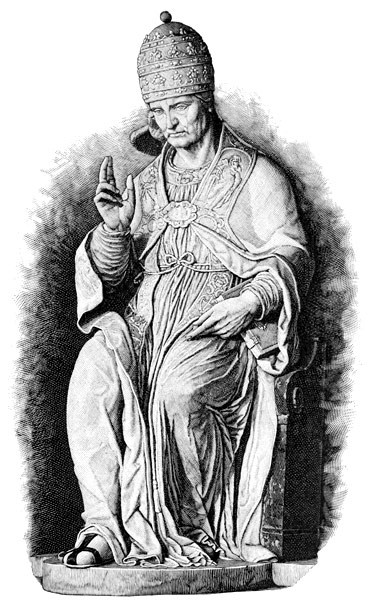
POPE GREGORY.
Frontispiece.
THE MAKERS
OF
MODERN ROME
IN FOUR BOOKS
I. HONOURABLE WOMEN NOT A FEW
II. THE POPES WHO MADE THE PAPACY
III. LO POPOLO: AND THE TRIBUNE OF THE PEOPLE
IV. THE POPES WHO MADE THE CITY
BY
MRS. OLIPHANT
AUTHOR OF "THE MAKERS OF FLORENCE"
WITH ILLUSTRATIONS BY HENRY P. RIVIERE, A.R.W.S. AND JOSEPH PENNELL
New York
MACMILLAN AND CO.
AND LONDON
1896
All rights reserved
Copyright, 1895,
By MACMILLAN AND CO.
Set up and electrotyped November, 1895. Reprinted January, 1896.
Norwood Press
J. S. Cushing & Co.—Berwick & Smith.
Norwood Mass. U.S.A.
I INSCRIBE THIS BOOK
WITH THE DEAR NAMES OF THOSE OF MINE
WHO LIE UNDER THE WALLS OF ROME:
AND OF HIM, THE LAST OF ALL,
WHO WAS BORN IN THAT SAD CITY:
ALL NOW AWAITING ME, AS I TRUST,
WHERE GOD MAY PLEASE.
F. W. O.
M. W. O.
F. R. O.
PREFACE.
Nobody will expect in this book, or from me, the results of original research, or a settlement—if any settlement is ever possible—of vexed questions which have occupied the gravest students. An individual glance at the aspect of these questions which most clearly presents itself to a mind a little exercised in the aspects of humanity, but not trained in the ways of learning, is all I attempt or desire. This humble endeavour has been conscientious at least. The work has been much interrupted by sorrow and suffering, on which account, for any slips of hers, the writer asks the indulgence of her unknown friends.
CONTENTS.
BOOK I.
HONOURABLE WOMEN NOT A FEW.
CHAPTER I.
ROME IN THE FOURTH CENTURY
page 1CHAPTER II.
THE PALACE ON THE AVENTINE
14CHAPTER III.
MELANIA
29CHAPTER IV.
THE SOCIETY OF MARCELLA
43CHAPTER V.
PAULA
65CHAPTER VI.
THE MOTHER HOUSE
89BOOK II.
THE POPES WHO MADE THE PAPACY.
CHAPTER I.
GREGORY THE GREAT
119CHAPTER II.
THE MONK HILDEBRAND
181CHAPTER III.
THE POPE GREGORY VII
230CHAPTER IV.
INNOCENT III
307BOOK III.
LO POPOLO: AND THE TRIBUNE OF THE PEOPLE.
CHAPTER I.
ROME IN THE FOURTEENTH CENTURY
381CHAPTER II.
THE DELIVERER
402CHAPTER III.
THE BUONO STATO
428CHAPTER IV.
DECLINE AND FALL
460CHAPTER V.
THE SOLDIER OF FORTUNE
486CHAPTER VI.
THE END OF THE TRAGEDY
493BOOK IV.
THE POPES WHO MADE THE CITY.
CHAPTER I.
MARTIN V.—EUGENIUS IV.—NICOLAS V.
513CHAPTER II.
CALIXTUS III.—PIUS II.—PAUL II.—SIXTUS IV.
552CHAPTER III.
JULIUS II.—LEO X.
581LIST OF ILLUSTRATIONS.
FULL-PAGE ILLUSTRATIONS.
page Pope Gregory Frontispiece Colosseum by Moonlight,
by H. P. Riviere 37 Temple of Venus and River from the Colosseum(1860),
by H. P. Riviere 73 Temple of Vesta,
by H. P. Riviere 111 Arch of Constantine,
by H. P. Riviere 153 The Forum,
by H. P. Riviere 171 Arch of Titus,
by H. P. Riviere 209 Santa Maria Maggiore,
by H. P. Riviere 247 Arch of Drusus(1860),
by H. P. Riviere 267 Island on Tiber,
by H. P. Riviere 287 The Capitol,
by J. Pennell 317 Porta Maggiore,
by H. P. Riviere 327 In the Campagna(1860),
by H. P. Riviere 347 St. Peter's and the Castle of St. Angelo,
by H. P. Riviere 367 Approach to the Capitol(1860),
by H. P. Riviere 387 Theatre of Marcellus,
by J. Pennell 407 Aqua Felice,
by H. P. Riviere 463 The Tarpeian Rock,
by J. Pennell 481 Ancient, Mediæval, and Modern Rome,
by J. Pennell 503 Modern Rome: Shelley's Tomb,
by J. Pennell 519 Fountain of Trevi,
by H. P. Riviere 527 Santa Maria del Popolo,
by H. P. Riviere 547 Piazza Colonna,
by J. Pennell 565 Old St. Peter's,
from the engraving by Campini 585 Modern Rome: The Grave of Keats,
by J. Pennell 593ILLUSTRATIONS IN TEXT.
The Colosseum,
by J. Pennell 1 The Palatine, from the Aventine,
by J. Pennell 13 The Ripetta,
by J. Pennell 14 On the Palatine,
by J. Pennell 27 The Walls by St. John Lateran,
by J. Pennell 29 The Temple of Vesta,
by J. Pennell 42 Churches on the Aventine,
by J. Pennell 43 The Steps of the Capitol,
by J. Pennell 51 The Lateran from the Aventine,
by J. Pennell 64 Portico of Octavia,
by J. Pennell 65 Trinita de' Monti,
by J. Pennell 76 From the Aventine,
by J. Pennell 87 The Capitol from the Palatine,
by J. Pennell 89 San Bartolommeo,
by J. Pennell 97 St. Peter's, from the Janiculum,
by J. Pennell 103 St. Peter's, from the Pincio,
by J. Pennell 107 Porta San Paola,
by J. Pennell 115 The Steps of San Gregorio,
by J. Pennell 119 Villa de' Medici,
by J. Pennell 133 San Gregorio Magno, and St. John and St. Paul,
by J. Pennell 145 The Piazza del Popolo,
by J. Pennell 157 Monte Pincio, from the Piazza del Popolo,
by J. Pennell 167 Ponte Molle,
by J. Pennell 180 The Palatine,
by J. Pennell 181 Pyramid of Caius Cestius,
by J. Pennell 197 Trinita de' Monti,
by J. Pennell 207 The Villa Borghese,
by J. Pennell 220 Where the Ghetto stood,
by J. Pennell 228 From San Gregorio Magno,
by J. Pennell 230 In the Villa Borghese,
by J. Pennell 306 The Fountain of the Tortoise,
by J. Pennell 307 All that is left of the Ghetto,
by J. Pennell 377 On the Tiber,
by J. Pennell 381 On the Pincio,
by J. Pennell 402 The Lungara,
by J. Pennell 428 Porta del Popolo (Flaminian Gate),
by J. Pennell 459 Theatre of Marcellus,
by J. Pennell 460 The Borghese Gardens,
by J. Pennell 486 Tomb of Cecilia Metella,
by J. Pennell 493 Letter Writer,
by J. Pennell 510 Piazza del Popolo,
by J. Pennell 513 On the Pincio,
by J. Pennell 533 In the Corso: Church Doors,
by J. Pennell 542 Modern Degradation of a Palace,
by J. Pennell 552 Fountain of Trevi,
by J. Pennell 581 A Bric-a-brac Shop,
by J. Pennell 600BOOK I.
HONOURABLE WOMEN NOT A FEW.
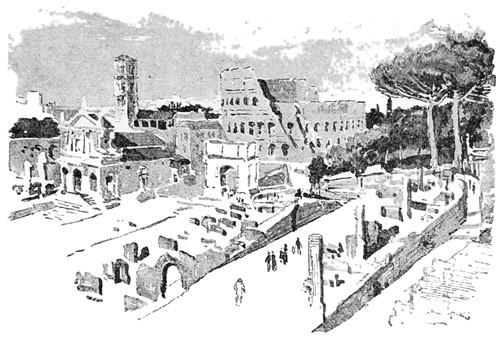
THE COLOSSEUM.
BOOK I.
HONOURABLE WOMEN NOT A FEW.
CHAPTER I.
ROME IN THE FOURTH CENTURY.
There is no place in the world of which it is less necessary to attempt description (or of which so many descriptions have been attempted) than the once capital of that world, the supreme and eternal city, the seat of empire, the home of the conqueror, the greatest human centre of power and influence which our race has ever known. Its history is unique and its position. Twice over in circumstances and by means as different as can be imagined it has conquered and held subject the world. All that was known to man in their age gave tribute and acknowledgment to the Cæsars; and an ever-widening circle, taking in countries and races unknown to the Cæsars, have looked to the spiritual sovereigns who succeeded them as to the first and highest of authorities on earth. The reader knows, or at least is assisted on all hands to have some idea and conception of the classical city—to be citizens of which was the aim of the whole world's ambition, and whose institutions and laws, and even its architecture and domestic customs, were the only rule of civilisation—with its noble and grandiose edifices, its splendid streets, the magnificence and largeness of its life; while on the other hand most people are able to form some idea of what was the Rome of the Popes, the superb yet squalid mediæval city with its great palaces and its dens of poverty, and that conjunction of exuberance and want which does not strike the eye while the bulk of a population remains in a state of slavery. But there is a period between, which has not attracted much attention from English writers, and which the reader passes by as a time in which there is little desirable to dwell upon, though it is in reality the moment of transition when the old is about to be replaced by the new, and when already the energy and enthusiasm of a new influence is making its appearance among the tragic dregs and abysses of the past. An ancient civilisation dying in the impotence of luxury and wealth from which all active power or influence over the world had departed, and a new and profound internal revolt, breaking up its false calm from within, before the raging forces of another rising power had yet begun to thunder at its gates without—form however a spectacle full of interest, especially when the scene of so many conflicts is traversed and lighted up by the most lifelike figures, and has left its record, both of good and evil, in authentic and detailed chronicles, full of individual character and life, in which the men and women of the age stand before us, occupied and surrounded by circumstances which are very different from our own, yet linked to us by that unfailing unity of human life and feeling which makes the farthest off foreigner a brother, and the most distant of our primeval predecessors like a neighbour of to-day.
The circumstances of Rome in the middle and end of the fourth century were singular in every point of view. With all its prestige and all its memories, it was a city from which power and the dominant forces of life had faded. The body was there, the great town with its high places made to give law and judgment to the world, even the officials and executors of the codes which had dispensed justice throughout the universe; but the spirit of dominion and empire had passed away. A great aristocracy, accustomed to the first place everywhere, full of wealth, full of leisure, remained; but with nothing to do to justify this greatness, nothing but luxury, the prize and accompaniment of it, now turned into its sole object and meaning. The patrician class had grown by use, by the high capability to fill every post and lead every expedition which they had constantly shown, which was their original cause and the reason of their existence, into a position of unusual superiority and splendour. But that reason had died away, the empire had departed from them, the world had a new centre: and the sons of the men who had conducted all the immense enterprises of Rome were left behind with the burden of their great names, and the weight of their great wealth, and nothing to do but to enjoy and amuse themselves: no vocations to fulfil, no important public functions to occupy their time and their powers. Such a position is perhaps the most dreadful that can come to any class in the history of a nation. Great and irresponsible wealth, the supremacy of high place, without those bonds of practical affairs which, in the case of all rulers—even of estates or of factories—preserve the equilibrium of humanity, are instruments of degradation rather than of elevation. To have something to do for it, something to do with it, is the condition which alone makes boundless wealth wholesome. And this had altogether failed in the imperial city. Pleasure and display had taken the place of work and duty. Rome had no longer any imperial affairs in hand. Her day was over: the absence of a court and all its intrigues might have been little loss to any community—but that those threads of universal dominion which had hitherto occupied them had been transferred to other hands, and that all the struggles, the great questions, the causes, the pleas, the ordinances of the world were now decided and given forth at Constantinople, was ruin to the once masters of the world. It was worse than destruction, a more dreadful overthrow than anything that the Goths and barbarians could bring—not death which brings a satisfaction of all necessities in making an end of them—but that death in life which fills men's blood with cold.
The pictures left us of this condition of affairs do indeed chill the blood. It is natural that there should be a certain amount of exaggeration in them. We read daily in our own contemporary annals, records of society of which we are perfectly competent to judge, that though true to fact in many points, they give a picture too dark in all its shadows, too garish in its lights, to afford a just view of the state of any existing condition of things. Contemporaries know how much to receive and how much to reject, and are apt to smile at the possibility of any permanent impression upon the face of history being made by lights and darks beyond the habit of nature. But yet when every allowance has been made, the contemporary pictures of Rome at this unhappy period leave an impression on the mind which is not contradicted but supported and enforced by the incidents of the time and the course of history. The populace, which had for ages been fed and nourished upon the bread of public doles and those entertainments of ferocious gaiety which deadened every higher sense, had sunk into complete debasement. Honest work and honest purpose, or any hope of improving their own position, elevating themselves or training their children, do not seem to have existed among them. A half-ludicrous detail, which reminds us that the true Roman had always a trifle of pedantry in his pride, is noted with disgust and disdain even by serious writers—which is that the common people bore no longer their proper names, but were known among each other by nicknames, such as those of Cabbage-eaters, Sausage-mongers, and other coarse familiar vulgarisms. This might be pardoned to the crowd which spent its idle days at the circus or spectacle, and its nights on the benches in the Colosseum or in the porch of a palace; but it is difficult to exaggerate the debasement of a populace which lived for amusement alone, picking up the miserable morsels which kept it alive from any chance or tainted source, without work to do or hope of amelioration. They formed the shouting, hoarse accompaniment of every pageant, they swarmed on the lower seats of every amphitheatre, howling much criticism as well as boisterous applause, and keeping in fear, and disgusted yet forced compliance with their coarse exactions, the players and showmen who supplied their lives with an object. According to all the representations that have reached us, nothing more degraded than this populace—encumbering every portico and marble stair, swarming over the benches of the Colosseum, basking in filth and idleness in the brilliant sun of Rome, or seeking, among the empty glories of a triumphal age gone by, a lazy shelter from it—has ever been known.
The higher classes suffered in their way as profoundly, and with a deeper consciousness, from the same debasing influences of stagnation. The descriptions of their useless life of luxury are almost too extravagant to quote. "A loose silken robe," says the critic and historian of the time, Ammianus Marcellinus, speaking of a Roman noble,—"for a toga of the lightest tissue would have been too heavy for him—linen so transparent that the air blew through it, fans and parasols to protect him from the light, a troop of eunuchs always round him." This was the appearance and costume of a son of the great and famous senators of Rome. "When he was not at the bath, or at the circus to maintain the cause of some charioteer, or to inspect some new horses, he lay half asleep upon a luxurious couch in great rooms paved with marble, panelled with mosaic." The luxurious heat implied, which makes the freshness of the marble, the thinness of the linen, so desirable, as in a picture of Mr. Alma Tadema's, bids us at the same time pause in receiving the whole of this description as unquestionable; for Rome has its seasons in which vast chambers paved with marble are no longer agreeable, though the manners and utterances of the race still tend to a complete ignoring of this other side of the picture: but yet no doubt its general features are true.
When this Sybarite went out it was upon a lofty chariot, where he reclined negligently, showing off himself, his curled and perfumed locks, his robes, with their wonderful embroideries and tissues of silk and gold, to the admiration of the world; his horses' harness were covered with ornaments of gold, his coachman armed with a golden wand instead of a whip, and the whole equipage followed by a procession of attendants, slaves, freedmen, eunuchs, down to the knaves of the kitchen, the hewers of wood and drawers of water, to give importance to the retinue, which pushed along through the streets with all the brutality which is the reverse side of senseless display, pushing citizens and passers-by out of the way. The dinner parties of the evening were equally childish in their extravagance: the tables covered with strange dishes, monsters of the sea and of the mountains, fishes and birds of unknown kinds and unequalled size. The latter seems to have been a special subject of pride, for we are told of the servants bringing scales to weigh them, and notaries crowding round with their tablets and styles to record the weight. After the feast came a "hydraulic organ," and other instruments of corresponding magnitude, to fill the great hall with resounding music, and pantomimical plays and dances to enliven the dulness of the luxurious spectators on their couches—"women with long hair, who might have married and given subjects to the state," were thus employed, to the indignation of the critic.
This chronicler of folly and bad manners would not be human if he omitted the noble woman of Rome from his picture. Her rooms full of obsequious attendants, slaves, and eunuchs, half of her time was occupied by the monstrous toilette which annulled all natural charms to give to the Society beauty a fictitious and artificial display of red and white, of painted eyelids, tortured hair, and extravagant dress. An authority still more trenchant than the heathen historian, Jerome, describes even one of the noble ladies who headed the Christian society of Rome as spending most of the day before the mirror. Like the ladies of Venice in a later age, these women, laden with ornaments, attired in cloth of gold, and with shoes that crackled under their feet with the stiffness of metallic decorations, were almost incapacitated from walking, even with the support of their attendants; and a life so accoutred was naturally spent in the display of the charms and wealth thus painfully set forth.
The fairer side of the picture, the revolt of the higher nature from such a life, brings us into the very heart of this society: and nothing can be more curious than the gradual penetration of a different and indeed sharply contrary sentiment, the impulse of asceticism and the rudest personal self-deprivation, amid a community spoilt by such a training, yet not incapable of disgust and impatience with the very luxury which had seemed essential to its being. The picturesqueness and attraction of the picture lies here, as in so many cases, chiefly on the women's side.
It is necessary to note, however, the curious mixture which existed in this Roman society, where Christianity as a system was already strong, and the high officials of the Church were beginning to take gradually and by slow degrees the places abandoned by the functionaries of the empire. Though the hierarchy was already established, and the Bishop of Rome had assumed a special importance in the Church, Paganism still held in the high places that sway of the old economy giving place to the new, which is at once so desperate and so nerveless—impotence and bitterness mingling with the false tolerance of cynicism. The worship of the gods had dropped into a survival of certain habits of mind and life, to which some clung with the angry revulsion of terror against a new revolutionary power at first despised: and some held with the loose grasp of an imaginative and poetical system, and some with a sense of the intellectual superiority of art and philosophy over the arguments and motives that moved the crowd. Life had ebbed away from these religions of the past. The fictitious attempt of Julian to re-establish the worship of the gods, and bring new blood into the exhausted veins of the mythological system, had in reality given the last proof of its extinction as a power in the world: but still it remained lingering out its last, holding a place, sometimes dignified by a gleam of noble manners and the graces of intellectual life—and often, it must be allowed, justified by the failure of the Church to embody that purity and elevation which its doctrines, but scarcely its morals or life, professed. Thus the faith in Christ, often real, but very faulty—and the faith in Apollo, almost always fictitious, but sometimes dignified and superior—existed side by side. The father might hold the latter with a superb indifference to its rites, and a contemptuous tolerance for its opponents, while the mother held the first with occasional hot impulses of devotion, and performances of penance for the pardon of those worldly amusements and dissipations to which she returned with all the more zest when her vigils and prayers were over.
This conjunction of two systems so opposite in every impulse, proceeding from foundations so absolutely contrary to each other, could not fail to have an extraordinary effect upon the minds of the generations moved by it, and affords, I think, an explanation of some events very difficult to explain on ordinary principles, and particularly the abandonment of what would appear the most unquestionable duties, by some of the personages, especially the women whose histories and manners fill this chapter of the great records of Rome. Some of them deserted their children to bury themselves in the deserts, to withdraw to the mountains, placing leagues of land and sea between themselves and their dearest duties—why? the reader asks. At the bidding of a priest, at the selfish impulse of that desire to save their own souls, which in our own day at least has come to mean a degrading motive—is the general answer. It would not be difficult, however, to paint on the other side a picture of the struggle with the authorities of her family for the training of a son, for the marriage of a daughter, from which a woman might shrink with a sense of impotence, knowing the prestige of the noble guardian against whom she would have to contend, and all the forces of family pride, of tradition and use and wont, that would be arrayed against her. Better perhaps, the mother might think, to abandon that warfare, to leave the conflict for which she was not strong enough, than to lose the love of her child as well, and become to him the emblem of an opposing faction attempting to turn him from those delights of youth which the hereditary authority of his house encouraged instead of opposing. It is difficult perhaps for the historians to take such motives into consideration, but I think the student of human nature may feel them to be worth a thought, and receive them as some justification, or at least apology, for the actions of some of the Roman women who fill the story of the time.
Unfortunately it is not possible to leave out the Church in Rome when we collect the details of depravity and folly in Society. One cannot but feel how robust is the faith which goes back to these ages for guidance and example when one sees the image in St. Jerome's pages of a period so early in the history of Christianity. "Could ye not watch with me one hour?" our Lord said to the chosen disciples, His nearest friends and followers, in the moment of His own exceeding anguish, with a reproach so sorrowful, yet so conscious of the weakness of humanity, that it silences every excuse. We may say, for a poor four hundred years could not the Church keep the impress of His teaching, the reality of the faith of those who had themselves fallen and fainted, yet found grace to live and die for their Master? But four centuries are a long time, and men are but men even with the inheritance of Christians. They belonged to their race, their age, and the manifold influences which modify in the crowd everything it believes or wishes. And they were exposed to many temptations which were doubly strong in that world to which by birth and training they belonged. How is an ordinary man to despise wealth in the midst of a society corrupted by it, and in which it is supreme? how learn to be indifferent to rank and prestige in a city where without these every other claim was trampled under foot? "The virtues of the primitive Church," says Villemain of a still later period, "had been under the guard of poverty and persecution: they were weak in success and triumph. Enthusiasm became less pure, the rules of life less severe. In the always increasing crowd of proselytes were many unworthy persons, who turned to Christianity for reasons of ambition and self-interest, to make way at Court, to appear faithful to the emperor. The Church, enriched at once by the spoil of the temples and the offerings of the Christian crowd, began to clothe itself in profane magnificence." Those who attained the higher clerical honours were sure, according to the evidence of Ammianus, "of being enriched by the offerings of the Roman ladies, and drove forth like noblemen in lofty chariots, clothed magnificently, and sat down at tables worthy of kings." The Church, endowed in an earlier period by converts, who offered sometimes all their living for the sustenance of the community which gave them home and refuge, had continued to receive the gifts of the pious after the rules of ordinary life regained their force; and now when she had yielded to a great extent to the prevailing temptations of the age, found a large means of endowment in the gifts of deathbed repentance and the weakness of dying penitents, of which she was reputed to take large advantage: wealth grew within her borders, and luxury with it, according to the example of surrounding society. It is Jerome himself who reports the saying of one of the highest of Roman officials to Bishop Damasus. "If you will undertake to make me Bishop of Rome, I will be a Christian to-morrow." Not even the highest place in the Government was so valuable and so great. It is Jerome also who traces for us—the fierce indignation of his natural temper, mingling with an involuntary perception of the ludicrous side of the picture—a popular young priest of his time, whose greatest solicitude was to have perfumed robes, a well fitting shoe, hair beautifully curled, and fingers glittering with jewels, and who walked on tip-toe lest he should soil his feet.
They died all three, one after another, and were laid to rest in the pure and wholesome rock near the sacred spot of the Nativity. There is a touching story told of how Eustochium, after her mother's death, when Jerome was overwhelmed with grief and unable to return to any of his former occupations, came to him with the book of Ruth still untranslated in her hand, at once a promise and an entreaty. "Where thou goest I will go. Where thou dwellest I will dwell"—and a continuation at the same time of the blessed work which kept their souls alive.
In the very age that produced the Borgias, and himself the head of that band of elegant scholars and connoisseurs, everything but Christian, to whom Rome owes so much of her external beauty and splendour, it is pathetic to stand by this kind and gentle spirit as he pauses on the threshold of a higher life, subduing the astute and worldly minded Churchmen round him with the tender appeal of the dying father, their Papa Niccolajo, familiar and persuasive—beseeching them to be of one accord without so much as saying it, turning his own weakness to account to touch their hearts, for the honour of the Church and the welfare of the flock.
COLOSSEUM BY MOONLIGHT.
To face page 36.
TEMPLE OF VENUS AND ROME FROM THE COLOSSEUM (1860).
To face page 72.
TEMPLE OF VESTA.
To face page 110.
ARCH OF CONSTANTINE.
To face page 152.
THE FORUM
To face page 170.
ARCH OF TITUS.
To face page 208.
SANTA MARIA MAGGIORE.
To face page 246.
ARCH OF DRUSUS (1860)
To face page 266.
ISLAND ON TIBER.
To face page 286.
THE CAPITOL.
To face page 316.
PORTA MAGGIORE.
To face page 326.
IN THE CAMPAGNA (1860)
To face page 346.
ST. PETER'S AND THE CASTLE OF ST. ANGELO.
To face page 366.
APPROACH TO THE CAPITOL (1860).
APPROACH TO THE CAPITOL (1860).
THEATRE OF MARCELLUS.
To face page 406.
AQUA FELICE
To face page 462.
THE TARPEIAN ROCK.
To face page 480.
ANCIENT, MEDIÆVAL, AND MODERN ROME.
To face page 502.
MODERN ROME: SHELLEY'S TOMB.
To face page 518.
FOUNTAIN OF TREVI.
To face page 526.
SANTA MARIA DEL POPOLO.
To face page 546.
PIAZZA COLONNA,
To face page 564.
OLD ST. PETER'S.
To face page 584.
MODERN ROME: THE GRAVE OF KEATS.
To face page 592.
THE COLOSSEUM.
THE PALATINE, FROM THE AVENTINE.
THE RIPETTA.
ON THE PALATINE.
THE WALLS BY ST. JOHN LATERAN.
THE TEMPLE OF VESTA
CHURCHES ON THE AVENTINE
THE STEPS OF THE CAPITOL.
THE LATERAN FROM THE AVENTINE.
PORTICO OF OCTAVIA.
TRINITA DE' MONTI.
FROM THE AVENTINE.
THE CAPITOL FROM THE PALATINE.
SAN BARTOLOMMEO.
ST. PETER'S, FROM THE JANICULUM.
ST. PETER'S, FROM THE PINCIO.
PORTA SAN PAOLO.
THE STEPS OF SAN GREGORIO.
VILLA DE' MEDICI.
SAN GREGORIO MAGNO, AND ST. JOHN AND ST. PAUL.
THE PIAZZA DEL POPOLO.
MONTE PINCIO, FROM THE PIAZZA DEL POPOLO.
PONTE MOLLE.
THE PALATINE.
PYRAMID OF CAIUS CESTIUS.
TRINITA DE MONTI.
THE VILLA BORGHESE.
WHERE THE GHETTO STOOD.
FROM SAN GREGORIO MAGNO
IN THE VILLA BORGHESE.
THE FOUNTAIN OF THE TORTOISE
ALL THAT IS LEFT OF THE GHETTO.
ON THE TIBER.
ON THE PINCIO.
THE LUNGARA
PORTA DEL POPOLO (FLAMINIAN GATE).
THEATRE OF MARCELLUS.
THE BORGHESE GARDENS
TOMB OF CECILIA METELLA
LETTER WRITER.
PIAZZA DEL POPOLO.
ON THE PINCIO.
IN THE CORSO: CHURCH DOORS.
MODERN DEGRADATION OF A PALACE.
FOUNTAIN OF TREVI.
A BRIC-A-BRAC SHOP.
"What are these men? To those who see them pass they are more like bridegrooms than priests. Some among them devote their life and energies to the single object of knowing the names, the houses, the habits, the disposition of all the ladies in Rome. I will sketch for you, dear Eustochium, in a few lines, the day's work of one of them, great in the arts of which I speak, that by means of the master you may the more easily recognise his disciples.
"Our hero rises with the sun: he regulates the order of his visits, studies the shortest ways, and arrives before he is wanted, almost before his friends are awake. If he perceives anything that strikes his fancy, a pretty piece of furniture or an elegant marble, he gazes at it, praises it, turns it over in his hands, and grieves that he has not one like it—thus extorting rather than obtaining the object of his desires; for what woman would not hesitate to offend the universal gossip of the town? Temperance, modesty (castitas), and fasting are his sworn enemies. He smells out a feast and loves savoury meats.
"Wherever one goes one is sure to meet him; he is always there before you. He knows all the news, proclaims it in an authoritative tone, and is better informed than any one else can be. The horses which carry him to the four quarters of Rome in pursuit of this honest task are the finest you can see anywhere; you would say he was the brother of that King of Thrace known in story by the speed of his coursers.
"This man," adds the implacable satirist in another letter, "was born in the deepest poverty, brought up under the thatch of a peasant's cottage, with scarcely enough of black bread and millet to satisfy the cravings of his appetite; yet now he is fastidious and hard to please, disdaining honey and the finest flour. An expert in the science of the table, he knows every kind of fish by name, and whence come the best oysters, and what district produces the birds of finest savour. He cares only for what is rare and unwholesome. In another kind of vice he is not less remarkable; his mania is to lie in wait for old men and women without children. He besieges their beds when they are ill, serves them in the most disgusting offices, more humble and servile than any nurse. When the doctor enters he trembles, asking with a faltering voice how the patient is, if there is any hope of saving him. If there is any hope, if the disease is cured, the priest disappears with regrets for his loss of time, cursing the wretched old man who insists on living to be as old as Methusalem."
The last accusation, which has been the reproach of the Church in many different ages, had just been specially condemned by a law of the Emperor Valentinian I., declaring null and void all legacies made to priests, a law which called forth Jerome's furious denunciation, not of itself, but of the abuse which called it forth. This was a graver matter than the onslaught upon the curled darlings of the priesthood, more like bridegrooms than priests, who carried the news from boudoir to boudoir, and laid their entertainers under contribution for the bibelots and ancient bric-a-brac which their hearts desired. Thus wherever the eye turned there was nothing but luxury and the love of luxury, foolish display, extravagance and emulation in all the arts of prodigality, a life without gravity, without serious occupation, with nothing in it to justify the existence of those human creatures standing between earth and heaven, and capable of so many better things. The revulsion, a revulsion inspired by disgust and not without extravagance in its new way, was sure to come.
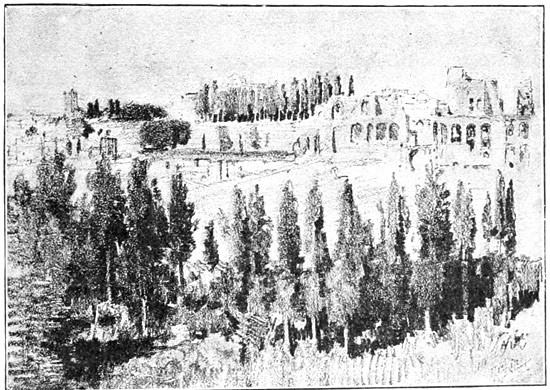
THE PALATINE, FROM THE AVENTINE.
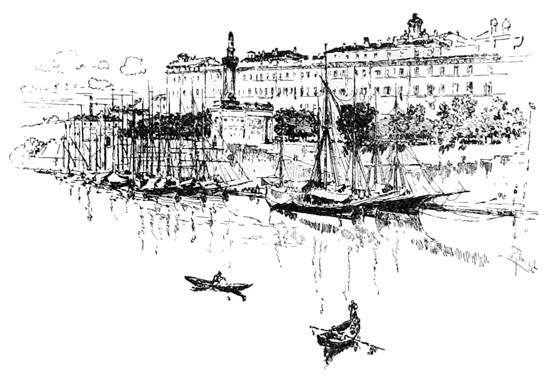
THE RIPETTA.
CHAPTER II.
THE PALACE ON THE AVENTINE.
The strong recoil of human nature from those fatal elements which time after time have threatened the destruction of all society is one of the noblest things in history, as it is one of the most divine in life. There are evidences that it exists even in the most wicked individuals, and it very evidently comes uppermost in every commonwealth from century to century to save again and again from utter debasement a community or a nation. When depravity becomes the rule instead of the exception, and sober principle appears on the point of yielding altogether to the whirl of folly or the thirst of self-indulgence, then it may always be expected that some ember of divine indignation, some thrill of high disgust with the miserable satisfactions of the world will kindle in one quarter or another and set light to a thousand smouldering tires over all the face of the earth. It is one of the highest evidences of that charter of our being which is our most precious possession, the reflection of that image of God which amid all degradations still holds its place in human nature, and will not be destroyed. We may mourn indeed that so short a span of centuries had so effaced the recollection of the brightest light that ever shone among men, as to make the extravagance of a human revulsion and revolution necessary in order to preserve and restore the better life of Christendom. At the same time it is our salvation as a race that such revolutions, however imperfect they may be in themselves, are sure to come.
This revulsion from vice, degradation, and evil of every kind, public and personal, had already come with the utmost excess of self-punishment and austerity in the East, where already the deserts were mined with caverns and holes in the sand, to which hermits and cœ;nobites, the one class scarcely less exalted in religious passion and suffering than the other, had escaped from the current of evil which they did not feel themselves capable of facing, and lived and starved and agonised for the salvation of their own souls and for a world lying in wickedness. The fame of the Thebaid and its saints and martyrs, slowly making itself known through the great distances and silences, had already breathed over the world, when Athanasius, driven by persecution from his see and his country, came to Rome, accompanied by two of the monks whose character was scarcely understood as yet in the West, and bringing with him his own book, the life of St. Antony of the desert, a work which had as great an effect in that time as the most popular of publications, spread over the world in thousands of copies, could have now. It puzzles the modern reader to think how a book should thus have moved the world and revolutionised hundreds of lives, while it existed only in manuscript and every example had to be carefully and tediously copied before it could touch even those who were wealthy enough to secure themselves such a luxury. What readings in common, what earnest circles of auditors, what rapt intense hanging upon the lips of the reader, there must have been before any work, even the most sacred, penetrated to the crowd!—but to us no doubt the process seems more slow and difficult than it really was when scribes were to be found everywhere, and manuscripts were treated with reverence and respect. When Athanasius found refuge in Rome, which was during the pontificate, or rather—for the full papal authority had as yet been claimed by no one—the primacy—of Liberius, and about the year 341, he was received by all that was best in Rome with great hospitality and sympathy. Rome so far as it was Christian was entirely orthodox, the Arian heresy having gained no part of the Christian society there—and a man of genius and imposing character, who brought into that stagnant atmosphere the breath of a larger world, who had shared the councils of the emperor and lived in the cells of Egypt—an orator, a traveller, an exile, with every kind of interest attaching to him, was such a visitor as seldom appeared in the city deserted by empire. Something like the man who nine centuries later went about the Italian streets with the signs upon him of one who had been through heaven and hell, the Eastern bishop must have appeared to the languid citizens, with the brown of the desert still on his cheeks, yet something of the air of a courtly prelate, a friend of princes; while his attendants, one with all the wildness of a hermit from the desert in his eyes and aspect, in the unfamiliar robe and cowl—and the other mild and young like the ideal youth, shy and simple as a girl—were wonderful apparitions in the fatigued and blasé society, which longed above everything for something new, something real, among all the mocks and shows of their impotent life.
One of the houses in which Athanasius and his monks were most welcome was the palace of a noble widow, Albina, who lived the large and luxurious life of her class in the perfect freedom of a Roman matron, Christian, yet with no idea in her mind of retirement from the world, or renunciation of its pleasures. A woman of a more or less instructive mind and lively intelligence, she received with the greatest interest and pleasure these strangers who had so much to tell, the great bishop flying from his enemies, the monks from the desert. That she and her circle gathered round him with that rapt and flattering attention which not the most abstracted saint any more than the sternest general can resist, is evident from the story, and it throws a gleam of softer light upon the impassioned theologian who stood fast, "I, Athanasius, against the world" for that mysterious splendour of the Trinity, against which the heretical East had risen. In the Roman lady's withdrawingroom, in his dark and flowing Eastern robes, we find him amid the eager questionings of the women, describing to them the strange life of the desert which it was such a wonder to hear of—the evensong that rose as from every crevice of the earth, while the Egyptian after-glow burned in one great circle of colour round the vast globe of sky, diffusing an illumination weird and mystic over the fantastic rocks and dark openings where the singers lived unseen. What a picture to be set before that soft, eager circle, half rising from silken couches, clothed with tissues of gold, blazing with jewels, their delicate cheeks glowing in artificial red and white, their crisped and curled tresses surmounted by the fantastic towering headdress which weighed them down!
Among the ladies was the child of the house, the little girl who was her mother's excuse for retaining the freedom of her widowhood, Marcella: a thoughtful and pensive child, devouring all these wonderful tales, listening to everything and laying up a store of silent resolutions and fancies in her heart. Her elder sister Asella would seem to have already secluded herself in precocious devotion from the family, or at least is not referred to. The story which touched the general mind of the time with so strange and strong an enthusiasm, fell into the virgin soil of this young spirit like the seed of a new life. But the little Roman maiden was no ascetic. She had evidently no impulse, as some young devotees have had, to set out barefoot in search of suffering. When Athanasius left Rome, he left in the house which had received him so kindly his life of St. Antony, the first copy which had been seen in the Western world. This manuscript, written perhaps by the hand of one of those wonderful monks, the strangest figures in her luxurious world whom Marcella knew, became the treasure of her youth. Such a present, at such a time, was enough to occupy the visionary silence of a girl's life, often so full of dreams unknown and unsearchable even to her nearest surroundings. She went through however the usual routine of a young lady's life in Rome. Madame Albina the mother, though full of interest and curiosity in respect to all things intellectual and Christian, held still more dearly a mother's natural desire to see her only remaining child nobly married and established in the splendour and eminence to which she was born. We are told that Marcella grew up to be one of the beauties of Rome, but as this is an inalienable qualification of all these beautiful souls, it is not necessary to believe that the "insignem decorem corporis" meant any extraordinary distinction. She carried out at all events her natural fate and married a rich and noble husband, of whom however we know no details, except that he died some months after, leaving her without child or tie to the ordinary life of the world, in all the freedom of widowhood, at a very early age.
Thus placed in full command of her fate, she never seems to have hesitated as to what she should do with herself. She was, as a matter of course, assailed by many new suitors, among whom her historian, who is no other than St. Jerome himself, makes special mention of the exceptionally wealthy Cerealis ("whose name is great among the consuls"), and who was so splendid a suitor that the fact that he was old scarcely seems to have told against him. Marcella's refusal of this great match and of all the others offered to her, offended and alienated her friends and even her mother, and there followed a moment of pain and perplexity in her life. She is said to have made a sacrifice of a part of her possessions to relatives to whom, failing herself, it fell to keep up the continuance of the family name, hoping thus to secure their tolerance. And she acquired the reputation of an eccentric, and probably of a poseuse, so general in all times when a young woman forsakes the beaten way, as she had done by giving up the ridiculous fashions and toilettes of the time, putting aside the rouge and antimony, the disabling splendour of cloth of gold, and assuming a simple dress of a dark colour, a thing which shocked her generation profoundly. The gossip rose and flew from mouth to mouth among the marble salons where the Roman ladies languished for a new subject, or in the ante-rooms, where young priests and deacons awaited or forestalled the awakening of their patronesses. It might be the Hôtel Rambouillet of which we are reading, and a fine lady taking refuge at Port Royal who was being discussed and torn to pieces in those antique palaces. What was the meaning that lay beneath that brown gown? Was it some unavowed disappointment, or, more exciting still, some secret intrigue, some low-placed love which she dared not acknowledge? Withdrawn into a villa had she, into the solitude of a suburban garden, hid from every eye? and who then was the companion of Marcella's solitude? The ladies who discussed her had small faith in austerities, nor in the desire of a young and attractive woman to live altogether alone.
It is very likely that Marcella herself, as well as her critics, soon began to feel that the mock desert into which she had made the gardens of her villa was indeed a fictitious way of living the holy life, and the calumny was more ready and likely to take hold of this artificial retirement, than of a course of existence led within sight of the world. She finally took a wiser and more reasonable way. Her natural home was a palace upon the Aventine to which she returned, consecrating a portion of it to pious uses, a chapel for common worship and much accommodation for the friends of similar views and purposes who immediately began to gather about her. It is evident that there were already many of these women in the best society of Rome. A lively sentiment of feminine society, of the multiplied and endless talks, consultations, speculations, of a community of women, open to every pleasant curiosity and quick to every new interest, rises immediately before us in that first settlement of monasticism—or, as the ecclesiastical historians call it, the first convent of Rome, before our eyes. It was not a convent after all so much as a large and hospitable feminine house, possessing the great luxury of beautiful rooms and furniture, and the liberal ways of a large and wealthy family, with everything that was most elegant, most cultured, most elevated, as well as most devout and pious. The "Souls," to use our own jargon of the moment, would seem indeed to have been more truly represented there than the Sisters of our modern understanding, though we may acknowledge that there are few communities of Sisters in which this element does not more or less flourish. Christian ladies who were touched like herself with the desire of a truer and purer life, gathered about her, as did the French ladies about Port Royal, and women of the same class everywhere, wherever a woman of influential character leads the way.
The character and position of these ladies was not perhaps so much different as we might suppose from those of the court of Louis XIV. or any other historical period in which great luxuries and much dissipation had sickened the heart of all that was good and noble. Yet there were very special characteristics in their lot. Some of them were the wives of pagan officials of the empire, holding a sometimes devious and always agitated course through the troubles of a divided household: and there were many young widows perplexed with projects of remarriage, of whom some would be tempted by the prospects of a triumphant re-entry into the full enjoyments of life, although a larger number were probably resistant and alarmed, anxious to retain their freedom, or to devote themselves as Marcella had done to a higher life. Women of fashion not unwilling to add a devotion à la mode to their other distractions, women of intellectual aspirations, lovers of the higher education, seekers after a society altogether brilliant and new, without any special emotions of religious feeling, no doubt filled up the ranks. "A society," says Thierry, in his Life of Jerome, "of rich and influential women, belonging for the great part to patrician families, thus organised itself, and the oratory on the Aventine became a seat of lay influence and power which the clergy themselves were soon compelled to reckon with."
The heads of the community bore the noblest names in Rome, which however at that period of universal deterioration was not always a guarantee of noble birth, since the greatest names were sometimes assumed with the slenderest of claims to their honours. Marcella's sister, Asella, older than the rest, and a sort of mother among them, had for a long time before "lived the life" in obscurity and humbleness, and several others not remarkable in the record, were prominent associates. The actual members of the community, however, are not so much remarked or dwelt upon as the visitors who came and went, not all of them of consistent religious character, ladies of the great world. One of these, Fabiola, affords an amusing episode in the graver tale, the contrast of a butterfly of society, a grande dame of fascinating manners, airs, and graces, unfortunate in her husbands, of whom she had two, one of them divorced—and not quite unwilling to divorce the second and try her luck again. Another, one of the most important of all in family and pretensions, and by far the most important in history of these constant visitors, was Paula, a descendant (collateral, the link being of the lightest and easiest kind, as was characteristic of the time) of the great Æmilius Paulus, the daughter of a distinguished Greek who claimed to be descended from Agamemnon, and widow of another who claimed Æneas as his ancestor. These large claims apart, she was certainly a great lady in every sense of the word, delicate, luxurious, following all the fashions of the time. She too was a widow, with a family of young daughters, in that enviable state of freedom which the Roman ladies give every sign of having used and enjoyed to the utmost, the only condition in which they were quite at liberty to regulate their own fate. Paula is the most interesting of the community, as she is the one of whom we know the most. No fine lady more exquisite, more fastidious, more splendid than she. Not even her Christianity had beguiled her from the superlative finery of her Roman habits. She was one of the fine ladies who could not walk abroad without the support of her servants, nor scarcely cross the marble floor from one silken couch to another without tottering, as well she might, under the weight of the heavy tissues interwoven with gold, of which her robes were made. A widow at thirty-five, she was still in full possession of the charms of womanhood, and the sunshine of life (though we are told that her grief for her husband was profound and sincere)—with her young daughters growing up round her, more like her sisters than her children, and sharing every thought. Blæsilla, the eldest, a widow at twenty, was, like her mother, a Roman exquisite, loving everything that was beautiful and soft and luxurious. In the affectionate gibes of the family she is described as spending entire days before her mirror, giving herself up to all the extravagances of dress and personal decoration, the tower of curls upon her head, the touch of rouge on her cheeks. A second daughter, Paulina, was on the eve of marriage with a young patrician, as noble, as rich, and, as was afterwards proved, as devoutly Christian as the family into which he married. The third member of the family, Eustochium, a girl of sixteen, of a character contrasting strongly with those of her beautiful mother and sister, a saint from her birth, was the favourite, and almost the child, of Marcella, instructed by her from her earliest years, and had already fixed her choice upon a monastic life, and would seem to have been a resident in the Aventine palace to which the others were such frequent visitors. Of all this delightful and brilliant party she is the one born recluse, severe in youthful virtue, untouched by any of the fascinations of the world. The following very pretty and graphic story is told of her, in which we have a curious glimpse into the strangely mixed society of the time.
The family of Paula though Christian, and full of religious fervour, or at least imbued with the new spirit of revolt against the corruption of the time, was closely connected with the still existing pagan society of Rome. Her sister-in-law, sister of her husband and aunt of her children, was a certain lady named Prætextata, the wife of Hymettius, a high official under the Emperor Julian the Apostate, both of them belonging, with something of the fictitious enthusiasm of their master, to the faith of the old gods. No doubt one of the severest critics of that society on the Aventine, Prætextata saw with impatience and wrath, what no doubt she considered the artificial gravity, inspired by her surroundings, of the young niece who had already announced her intention never to marry, and to withdraw altogether from the world. Such resolutions on the part of girls who know nothing of the world they abandon have exasperated the most devout of parents, and it was not wonderful if this pagan lady thought it preposterous. The little plot which she formed against the serious girl was, however, of the most good-natured and innocent kind. Finding that words had no effect upon her, the elder lady invited Eustochium to her house on a visit. The young vestal came all unsuspicious in her little brown gown, the costume of humility, but had scarcely entered her aunt's house when she was seized by the caressing and flattering hands of the attendants, interested in the plot as the favourite maids of such an establishment would be, who unloosed her long hair and twisted it into curls and plaits, took away her humble dress, clothed her in silk and cloth of gold, covered her with ornaments and led her before the mirror which reflected all these charms, to dazzle her eyes with the apparition of herself, so different from the schoolroom figure with which she was acquainted. The little plot was clever as well as innocent, and might, no doubt, have made a heart of sixteen beat high. But Eustochium with her Greek name, and her virgin heart, was the grave girl we all know, the one here and there among the garden of girls, born to a natural seriousness which is beyond such temptations. She let them turn her round and round, received sweetly in her gentle calm the applauses of the collected household, looked at her image in the mirror as at a picture—and went home again in her little brown gown with her story to tell, which, no doubt, was an endless amusement and triumph to the ladies on the Aventine, repeated to every new-comer with many a laugh at the foolishness of the clever aunt who had hoped by such means to seduce Eustochium—Eustochium, the most serious of them all!
Such was the first religious community in Rome. It was the natural home of Marcella to which her friends gathered, without in most cases deserting their own palaces, or forsaking their own place in the world—a centre and home of the heart, where they met constantly, the residents ever ready to receive, not only their closer associates, but all the society of Roman ladies, who might be attracted by the higher aspirations of intellect and piety. Not a stone exists of that noble mansion now, but it is supposed to have stood close to the existing church of Sta. Sabina, an unrivalled mount of vision. From that mount now covered with so many ruins the ladies looked out upon the yet unbroken splendour of the city, Tiber far below sweeping round under the walls. Palatinus, with the "white roofs" of that home to which Horatius looked before he plunged into the yellow river, still stood intact at their right hand: and, older far, and longer surviving, the wealth of nature, the glory of the Roman sky and air, the white-blossomed daphne and the starry myrtle, and those roses which are as ancient inhabitants of the world as any we know flinging their glories about the marble balustrades and making the terraces sweet. There would they walk and talk, the recluses at ease and simple in their brown gowns, the great ladies uneasy under the weight of their toilettes, but all eager to hear, to tell, to read the last letter from the East, from the desert or the cloister, to exchange their experiences and plan their charities. There is nothing ascetic in the picture, which is a very different one from that of those austere solitudes of the desert, which had suggested and inspired it—the lady Paula tottering in, with a servant on either side to conduct her to the nearest couch, and young Blæsilla making a brilliant irruption in all her bravery, with her jewels sparkling and her transparent veil floating, and her golden heels tapping upon the marble floor. This is not how we understand the atmosphere of a convent; yet, if fact were taken into due consideration, the greatest convents have been very like it, in all ages—the finest ladies having always loved that intercourse and contrast, half envious of the peace of their cloistered sisters, half pleased to dazzle them with a splendour which never could be theirs.
"No fixed rule," says Thierry, in his Life of St. Jerome, "existed in this assembly, where there was so much individuality, and where monastic life was not even attempted. They read the Holy Scriptures together, sang psalms, organised good works, discussed the condition of the Church, the progress of spiritual life in Italy and in the provinces, and kept up a correspondence with the brothers and sisters outside of a more strictly monastic character. Those of the associates who carried on the ordinary life of the world came from time to time to refresh their spirits in these holy meetings, then returned to their families. Those who were free gave themselves up to devotional exercises, according to their taste and inclination, and Marcella retired into her desert. In a short time these exercises were varied by the pursuit of knowledge. All Roman ladies of rank knew a little Greek, if only to be able to say to their favourites, according to the mot of Juvenal, repeated by a father of the Church, Ζωὴ καὶ ψυχὴ, my life and my soul: the Christian ladies studied it better and with a higher motive. Several later versions of the Old and New Testament were in general circulation in Italy, differing considerably from each other, and this very difference interested anxious minds in referring to the original Greek for the Gospels, and for the Hebrew books to the Greek of the Septuagint, the favourite guide of Western translators. The Christian ladies accordingly set themselves to perfect their knowledge of Greek, and many, among whom were Marcella and Paula, added the Hebrew language, in order that they might sing the psalms in the very words of the prophet-king. Marcella even became, by intelligent comparison of the texts, so strong in exegetical knowledge that she was often consulted by the priests themselves."
It was about the year 380 that this establishment was formed. "The desert of Marcella" above referred to was, as the reader will remember, a great garden in a suburb of Rome, which she had pleased herself by allowing to run wild, and where occasionally this great Roman lady played at a hermit's life in solitude and abstinence. Paula's desert, perhaps not so easy a one, was in her own house, where, besides the three daughters already mentioned, she had a younger girl Rufina, not yet of an age to show any marked tendencies, and a small boy Toxotius, her only son, who was jealously looked after by his pagan relatives, to keep him from being swept away by this tide of Christianity.
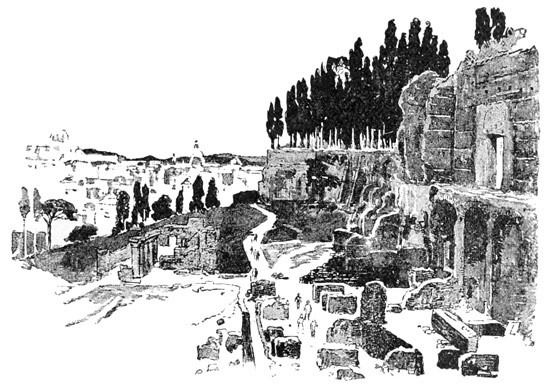
ON THE PALATINE.
Such was the condition of the circle on the Aventine, when a great event happened in Rome. Following many struggles and disasters in the East, chiefly the continually recurring misfortune of a breach of unity, a diocese here and there exhibiting its freedom by choosing two bishops representing different parties at the same time, and thus calling for the exercise of some central authority—Pope Damasus had called a council in Rome. He was so well qualified to be a judge in such cases that he had himself won his see at the point of the sword, after a stoutly contested fight in which much blood was shed, and the church of S. Lorenzo, the scene of the struggle, was besieged and taken like a castle. If he had hoped by this means to establish the universal authority of his see, a pretension as yet undeveloped, it was immediately forestalled by the Bishop of Constantinople, who at once called together a rival council in that place. The Council of Rome, however, is of so much more importance to us that it called into full light in the Western world the great and remarkable figure of Jerome: and still more to our record of the Roman ladies of the Aventine, since it suddenly introduced to them the man whose name is for ever connected with theirs, who is supposed erroneously, as the reader will see, to have been the founder of their community, but who henceforward became its most trusted leader and guide in the spiritual life.
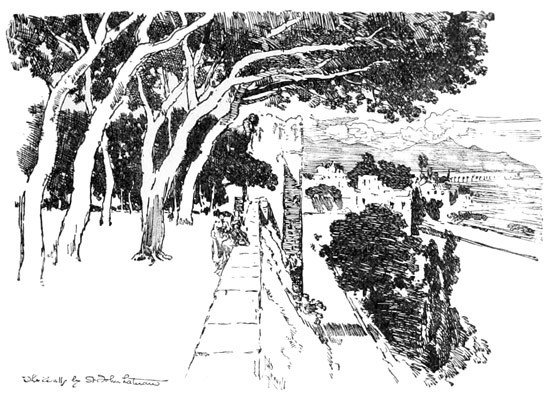
THE WALLS BY ST. JOHN LATERAN.
CHAPTER III.
MELANIA.
It may be well, however, before continuing this narrative to tell the story of another Roman lady, not of their band, nor in any harmony with them, which had already echoed through the Christian world, a wild romance of enthusiasm and adventure in which the breach of all the decorums of life was no less remarkable than the abandonment of its duties. Some ten years before the formation of Marcella's religious household (the dates are of the last uncertainty) a young lady of Rome, of Spanish origin, rich and noble and of the highest existing rank, found herself suddenly left in the beginning of a splendid and happy life, in desolation and bereavement. Her husband, whose name is unrecorded, died early leaving her with three little children, and shortly after, while yet unrecovered from this crushing blow, another came upon her in the death of her two eldest children, one following the other. The young woman, only twenty-three, thus terribly stricken, seems to have been roused into a fever of excitement and passion by a series of disasters enough to crush any spirit. It is recorded of her that she neither wept nor tore her hair, but advancing towards the crucifix with her arms extended, her head high, her eyes tearless, and something like a smile upon her lips, thanked God who had now delivered her from all ties and left her free to serve Himself. Whether she had previously entertained this desire, or whether it was only the despair of the distracted mother which expressed itself in such words, we are not told. In the haste and restlessness of her anguish she arranged everything for a great funeral, and placing the three corpses on one bier followed them to Rome to the family mausoleum alone, holding her infant son, the only thing left to her, in her arms. The populace of Rome, eager for any public show, had crowded upon the course of many a triumph, and watched many a high-placed Cæsar return in victory to the applauding city, but never had seen such a triumphal procession as this, Death the Conqueror leading his captives. We are not told whether it was attended by the overflowing charities, extravagant doles and offerings to the poor with which other mourners attempted to assuage their grief, or whether Melania's splendour and solitude of mourning was unsoftened by any ministrations of charity; but the latter is more in accordance with the extraordinary fury and passion of grief, as of a woman injured and outraged by heaven to which she thus called the attention of the spheres.
The impression made by that funeral splendour and by the sight of the young woman following tearless and despairing with her one remaining infant in her arms, had not faded from the minds of the spectators when it was rumoured through Rome that Melania had abandoned her one remaining tie to life and gone forth into the outside world no one knew where, leaving her child so entirely without any arrangement for its welfare that the official charged with the care of orphans had to select a guardian for this son of senators and consuls as if he had been a nameless foundling. What bitterness of soul lay underneath such an incomprehensible desertion, who could say? It might be a sense of doom such as overwhelms some sensitive minds, as if everything belonging to them were fated and nothing left them but the tragic expedient of Hagar in the desert, "Let me not see the child die." Perhaps the courage of the heartbroken young woman sank before the struggle with pagan relations, who would leave no stone unturned to bring up this last scion of the family in the faith or no-faith of his ancestors; perhaps she was in reality devoid of those maternal instincts which make the child set upon the knee the best comforter of the woman to whom they have brought home her warrior dead. This was the explanation given by the world which tore the unhappy Melania to pieces and held her up to universal indignation. Not even the Christians already touched with the enthusiasm and passion of the pilgrim and ascetic could justify the sudden and mysterious disappearance of a woman who still had so strong a natural bond to keep her in her home. But whatever the character of Melania might be, whether destitute of tenderness, or only distracted by grief and bereavement, and hastening to take her fatal shadow away from the cradle of her child, she was at least invulnerable to any argument or persuasion. "God will take care of him better than I can," she said as she left the infant to his fate. It was probably a better one than had he been the charge of this apparently friendless young woman, with her pagan relations, her uncompromising enthusiasm and self-will, and with all the risks surrounding her feet which made the path of a young widow in Rome so full of danger; but it is fortunate for the world that few mothers are capable of counting those risks or of turning their backs upon a duty which is usually their best consolation.
There is, however, an interest in the character and proceedings of such an exceptional woman which has always excited the world, and which the thoughtful spectator will scarcely dismiss with the common imputation of simple heartlessness and want of feeling. Melania was a proud patrician notwithstanding that she flung from her every trace of earthly rank or wealth, and a high-spirited, high-tempered individual notwithstanding her subsequent plunge into the most self-abasing ministrations of charity. And these features of character were not altered by her sudden renunciation of all things. She went forth a masterful personage determined, though no doubt unconsciously, to sway all circumstances to her will, though in the utmost self-denial and with all the appearances and surroundings of humility. This is a paradox which meets us on every side, in the records of such world-abandonment as are familiar in every history of the beginnings of the monastic system, in which continually both men and women give up all things while giving up nothing, and carry their individual will and way through circumstances which seem to preclude the exercise of either.
The disappearance of Melania made a great sensation in Rome, and no doubt discouraged Christian zeal and woke doubts in many minds even while proving to others the height of sacrifice which could be made for the faith. On the other hand the adversary had boundless occasion to blaspheme and denounce the doctrines which, as he had some warrant for saying, thus struck at the very basis of society and weakened every bond of nature. What more dreadful influence could be than one which made a woman forsake her child, the infant whom she had carried in her arms to the great funeral, in the sight of all Rome, the son of her sorrow? Nobody except a hot-headed enthusiast could take her part even among her fellow-Christians, nor does it appear that she sought any support or made any apology for herself. Jerome, then a young student and scholar from the East, was in Rome, in obscurity, still a catechumen preparing for his baptism, at the time of Melania's flight; and though there is no proof that he was even known to her, and no probability that so unknown a person could have anything to do with her resolution, or could have influenced her mind, it was suggested in later times when he was well known, that probably he had much to do—who can tell if not the most powerful and guilty of motives?—in determining her flight. Such a vulgar explanation is always adapted to the humour of the crowd, and gives an easy solution of the problems which are otherwise so difficult to solve. As a matter of fact these two personages, not unlike each other in force and spirit, had much to do with each other, though mostly in a hostile sense, in the after part of their life.
We find Melania again in Egypt, to which presumably she at once directed her flight as the headquarters of austere devotion and self-sacrifice, on leaving Rome—alone so far as appears. This was in the year 372 (nothing can be more delightful than to encounter from time to time a date, like an angel, in the vague wilderness of letters and narratives), when Athanasius the great Bishop was near his end. The young fugitive, whose arrival in Alexandria would not be attended by such mystery as shrouded her departure from Rome, was received kindly by the dying saint, to whom she had probably been known in her better days, and who in his enthusiasm for the life of monastic privation and sacrifice probably considered her flight and her resolution alike inspired by heaven. He gave her, let us hope, his blessing, and much good counsel—in addition to the sacred sheepskin which had formed the sole garment of the holy Macarius in his cell in the desert, which she carried away with her as her most valued possession. The great Roman lady then pursued her way into the wilderness, which was indeed a wilderness rather in name than in fact, being peopled on every side by communities both of men and women, while in every rocky fissure and cavern were hermits jealously shut each in his hole, the more inaccessible the better. Nothing can be more contradictory than the terms used. This desert of solitaries gave forth the evening hymn over all its extent as if the very sands and rocks sang, so many were the unseen worshippers. And the traveller went into the wilderness alone so to speak, in the utmost self-abnegation and humility, yet attended by an endless retinue of servants whose attendance was indispensable, if only to convey and protect the store of provisions and presents which she carried with her.
The conception of a lonely figure on the edge of a trackless sandy waste facing all perils, and encountering perhaps after toilsome days of solitude a still more lonely anchorite in his cell, to give her the hospitality of a handful of peas, and a shrine of prayer, which is the natural picture which rises before us—changes greatly when the details are examined. Melania evidently travelled with a great caravanserai, with camels laden with grain and every kind of provision that was necessary to sustain life in those regions. The times were more troublous even than usual. The death of Athanasius was the signal for one of those outbursts of persecution which rent the Christian world in its very earliest ages, and which alas! the Church herself has never been slow to learn the use of. The underground or overground population of the Egyptian desert was orthodox; the powers that were, were Arian; and hermits and cœnobites alike were hunted out of their refuges and dragged before tribunals, where their case was decided before it was heard and every ferocity used against them. In a country so rent by the most violent of agitations Melania passed like an angel of charity. She became the providence of the hunted and suffering monks. She is said for a short period to have provided for five thousand in Nitria, which proves that however secret her disappearance from Rome had been, her address as we should say must have been well known to her bankers, or their equivalent. Thus it is evident that a robe of sackcloth need not necessarily imply poverty, much less humility, and that a woman may ride about on the most sorry horse (chosen it would seem because it was a more abject thing than the well-conditioned ass of the East) and yet demean herself like a princess.
There is one story told of this primitive Lady Bountiful by Palladius which if it did not recall the action of St. Paul in somewhat similar circumstances would be highly picturesque. The proconsul in Palestine, not at all aware who was the pestilent woman who persisted in supplying and defending the population of the religious which it was his mission to get rid of—even going so far as to visit and nourish them in his prisons—had her arrested to answer for her interference. There is nothing more likely than that Melania remembered the method adopted by St. Paul to bring his judges to his feet. She sent the consul a message in which a certain compassionate scorn mingles with pride. "You esteem me by my present dress," she said, "which it is quite in my power to change when I will. Take care lest you bring yourself into trouble by what you do in your ignorance." This incident happened at Cæsarea, the great city on the Mediterranean shore which Herod had built, and where the prodigious ruins still lie in sombre grandeur capable of restoration to the uses of life. The governor of the Syrian city trembled in his gilded chair. The names which Melania quoted were enough to unseat him half a dozen times over, though, truth to tell, they are not very clearly revealed to the distant student. He hastened to set free the sunburnt pilgrim in her brown gown, and leave her to her own devices. "One must answer a fool according to his folly," she said disdainfully, as she accepted her freedom. This lady's progress through the haunted deserts, her entrance into town after town, with the shield of rank ready for use in any emergency, attended by continual supplies from the stewards of her estates, and the power of shedding abundance round her wherever she went, could hardly be said to merit the rewards of privation and austerity even if her delicate feet were encased in rude sandals and the cloth of gold replaced by a tunic of rough wool.
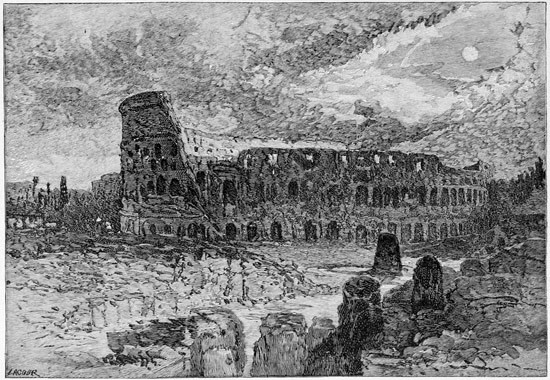
COLOSSEUM BY MOONLIGHT.
To face page 36.
Melania had been, presumably for some time before this incident, accompanied by a priest named Rufinus, a fellow-countryman, schoolfellow and dear friend of Jerome, the future Father of the Church, at this period a young religious adventurer if we may use the word:—which indeed seems the only description applicable to the bands of young, devout enthusiasts, who roamed about the world, not bound to any special duties, supporting themselves one knows not how, aiming at one knows not what, except some devotion of mystical religious life, or indefinite Christian service to the world. The object of saving their souls was perhaps for most the prevailing object, and the greater part of them had at least passed a year or two in those Eastern deserts where renunciation of the world had been pushed to its furthest possibilities. But they were also hungry for learning, for knowledge, for disciples, and full of that activity of youth which is bound to go everywhere and see everything whether with possible means and motives or not. Whatever they were, they were not so far as can be made out missionaries in any sense of the word. They were received wherever they went, in devout households here and there, in any of the early essays at monasteries which existed by bounty and Christian charity, among the abounding dependents of great houses, or by the bishop or other ecclesiastical
functionary. They were this man's secretary, that man's tutor—seldom so far as we can see were they employed as chaplains. Rufinus indeed was a priest, but few of the others were so, Jerome himself only having consented to be ordained from courtesy, and in no way fulfilling the duties of the priesthood. There were, however, many offices no doubt appropriate to them in the household of a bishop, who was often the distributor of great charities and the administrator of great possessions. But it is evident that there were always a number of these scholar-student monks available to join any travelling party, to serve their patron with their knowledge of the desert and their general experience of the ways of the world. "To lead about a sister":—St. Paul perhaps had already in his time some knowledge of the usefulness of such a functionary, and of the perfectly legitimate character of his office. Rufinus joined Melania in this way, to all appearance as the other head of the expedition, on perfectly equal terms, though it was her purse which supplied everything necessary. Jerome himself (with a train of brethren behind him) travelled in the same way with Paula—Oceanus with Fabiola. Nothing could be more completely in accordance with the fashion of the time. Perhaps the young men provided for their own expenses as we say, but the caravan was the lady's and all the immense and indiscriminate charity which flowed from it.
It is not necessary for us to follow the career of Rufinus any more than we intend to follow that of Jerome, into the violent controversy which is the chief link which connects their names, or indeed in any way except that of their association with the women of our tale. Rufinus was a Dalmatian from the shores of the Adriatic, learned enough according to the fashion of his time, though not such a scholar as Jerome, and apt to despise those elegances of literature which he was incapable of appreciating. He too, no doubt, like Jerome, had some following of other men like himself, ready for any adventure, and glad to make themselves the almoners of Melania and form a portion of her train. It is a strange conjunction according to our modern ideas, and no doubt there were vague and flying slanders, such as exist in all ages, accounting for anything that is unusual or mysterious by the worse reasons. But it must be remembered that such partnerships were habitual in those days, permitted by the usage of a time of which absolute purity was the craze and monomania, if we may so speak, as well as the ideal: and also that the solitude of those pilgrims was at all times that of a crowd—the supposed fugitive flying forth alone being in reality, as has been explained already, accompanied on every stage of the way by attendants enough to fill her ship and form her caravan wherever she went.
From Cæsarea, where Melania discomfited the government by her high rank and connections, it is but a little way to Jerusalem, where the steps of the party were directed after their prolonged journey through the desert. It had already become the end of many pilgrimages, the one place in the world which most attracted the hearts and imaginations of the devout throughout all the world; and we can well realise the sensation of the wanderers when they came in sight of that green hill, dominating the scene of so many tragedies, the still half-ruined but immortal city of which the very dust was dear to the primitive Christians. Who that has come suddenly upon that scene in quiet, without offensive guidance or ciceroneship, has not named to himself the Mount of Olives with such a thrill of identification as would move him in scarcely any other landscape in the world? It was still comparatively virgin soil in the end of the fourth century. The Empress Helena had been there, making, as we all feel now, but too easy and too exact discoveries: but the country was unexplored by any vain searchings of curiosity, and the calm of solitude, as perfect and far sweeter than amid the sands of the deserts, was still to be found there. The pilgrims went no further. They chose each their site upon the soft slope of that hill of divine memories. Rufinus took up his abode in a rocky cell, Melania probably in some house in the city, while their monasteries were being built. The great Roman lady with her faithful stewards, always sending those ever valuable supplies, no doubt provided for the expenses of both: and soon two communities arose near each other preserving the fellowship of their founders, where after some years of travel and movement Melania, with strength and courage restored, took up her permanent abode.
It is difficult to decide what is meant by sacrifice and self-abnegation in this world of human subterfuge and self-deception. It is very likely that Melania, like Paula after her, gave herself to the most humble menial offices, and did not scorn, great lady as she was, to bow the haughty head which had made the proconsul of Palestine tremble, to the modest necessities of primitive life. Perhaps she cooked the spare food, swept the bare cells with her own hands: undoubtedly she would superintend the flocks and herds and meagre fields which kept her community supplied. We know that she rode the sorriest horse, and wore the roughest gown. These things rank high in the catalogue of privations, as privations are calculated in the histories of the saints. And yet it is doubtful how far she is to be credited, if it were a merit, with any self-sacrifice. She had attained the full gratification of her own will and way, which is an advantage not easily or often computed. She had settled herself in the most interesting spot in the world, in the midst of a landscape which, notwithstanding all natural aridity and the depressing effects of ruin everywhere, is yet full of beauty as well as interest. Most of all perhaps she was in the way of the very best of company, receiving pilgrims of the highest eminence, bishops, scholars, princes, sometimes ladies of rank like herself, who were continually coming and going, bringing the great news of the world from every quarter to the recluses who thus commanded everything that wealth could supply. One may be sure that, as Jerome and Paula afterwards spent many a serene evening in Bethlehem under their trees, Melania and Rufinus would often sit under those hoary olives doubly grey with age, talking of all things in heaven and earth, looking across the little valley to the wall, all the more picturesque that it was broken, and lay here and there in heaps of ruin, of Jerusalem, and hearing, in the pauses of their conversation, the tinkling of that little brook which has seen so many sacred scenes and over which our Lord and His favourite disciples crossed to Gethsemane, on such a night as that on which His servants sat and talked of Him. It is true that the accursed Arians, and grave news of the fight going on between them and the Catholics, or perhaps the question of Origen's orthodoxy, or how the struggle was going between Paulinus and Meletius at Antioch, might occupy them more than those sacred memories. But it is much to be doubted whether any grandeur of Roman living would have been so much to Melania's mind as the convent on the Mount of Olives, the stream of distinguished pilgrims, and the society of her ever devoted companion and friend.
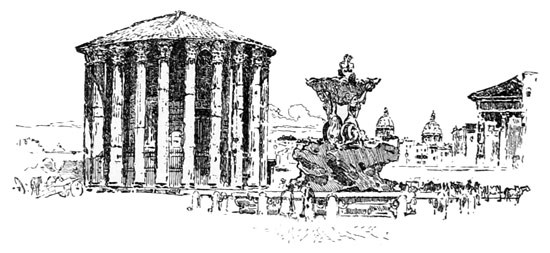
THE TEMPLE OF VESTA
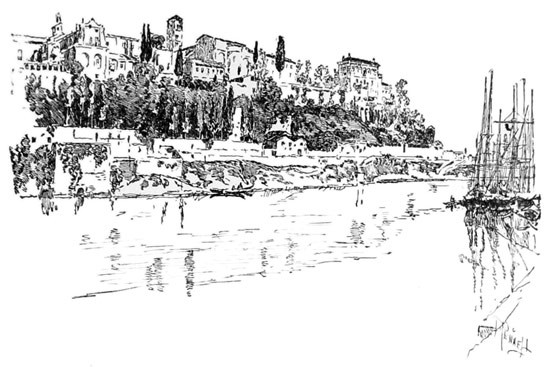
CHURCHES ON THE AVENTINE
CHAPTER IV.
THE SOCIETY OF MARCELLA.
The council which was held in Rome in 382 with the intention of deciding the cases of various contending bishops in distant sees, especially in Antioch where two had been elected for the same seat—a council scarcely acknowledged even by those on whose behalf it was held, and not at all by those opposed to them—was chiefly remarkable, as we have said, from the appearance for the first time, as a marked and notable personage, of one of the most important, picturesque, and influential figures of his time—Jerome: a scholar insatiable in intellectual zeal, who had sought everywhere the best schools of the time and was learned in all their science: and at the same time a monk and ascetic fresh from the austerities of the desert and one of those struggles with the flesh and the imagination which formed the epic of the solitary. It was not unnatural that the régime of extreme abstinence combined with utter want of occupation, and the concentration of all thought upon one's self and one's moods and conditions of mind, should have awakened all the subtleties of the imagination, and filled the brooding spirit with dreams of every wild and extravagant kind; but it would not occur to us now to represent the stormy passage into a life dedicated to religion as filled with dancing nymphs and visions of the grossest sensual enjoyment—above all in the case of such a man as Jerome, whose chief temptations one would have felt to be of quite another kind. This however was the fashion of the time, and belonged more or less to the monkish ideal, which exaggerated the force of all these lower fleshly impulses by way of enhancing the virtue of him who successfully overcame them. The early fathers all scourged themselves till they were in danger of their lives, rolled themselves in the snow, lay on the cold earth, and lived on a handful of dried grain, perhaps on the grass and wild herbs to be found in the crevices of the rocks, in order to get the body into subjection: which might have been more easily done, we should have supposed, by putting other more wholesome subjects in the place of these visionary temptations, or filling the vacancy of the hours with hard work. But the dulness of an English clown or athlete, in whom muscular exercise extinguishes all visions, would not have been at all to the mind of a monkish neophyte, to whom the sharpest stings of penitence and agonies of self-humiliation were necessary, whether he had done anything to call them forth or not.
Jerome had gone through all these necessary sufferings without sparing himself a pang. His face pale with fasting, and his body so worn with penance and privation that it was almost dead, he had yet felt the fire of earthly passions burning in his soul after the truest orthodox model. "The sack with which I was covered," he says, "deformed my members; my skin and flesh were like those of an Ethiop. But in that vast solitude, burnt up by the blazing sun, all the delights of Rome appeared before my eyes. Scorpions and wild beasts were my companions, yet I seemed to hear the choruses of dancing girls."
Finding no succour anywhere, I flung myself at the feet of Jesus, bathing them with tears, drying them with the hair of my head. I passed day and night beating my breast, I banished myself even from my cell, as if it were conscious of all my evil thoughts; and, rigid against myself, wandered further into the desert, seeking some deeper cave, some wilder mountain, some riven rock which I could make the prison of this miserable flesh, the place of my prayers.
Sometimes he endeavoured to find refuge in his books, the precious parchments which he carried with him even in those unlikely regions: but here another temptation came in. "Unhappy that I am," he cries, "I fasted yet read Cicero. After spending nights of wakefulness and tears I found Plautus in my hands." To lay aside dramatist, orator, and poet, so well known and familiar, and plunge into the imperfectly known character of the Hebrew which he was learning, the uncomprehended mysteries and rude style of the prophets, was almost as terrible as to fling himself fasting on the cold earth and hear the bones rattle in the skin which barely held them together. Yet sometimes there were moments of deliverance: sometimes, when all the tears were shed, gazing up with dry exhausted eyes to the sky blazing with stars, "I felt myself transported to the midst of the angels, and full of confidence and joy, lifted up my voice and sang, 'Because of the savour of thy ointments we will run after thee.'" Thus both were reconciled, his imagination freed from temptation, and the poetry of the crabbed books, which were so different from Cicero, made suddenly clear to his troubled eyes.
This was however but a small part of the training of Jerome. From his desert, as his spirit calmed, he carried on a great correspondence, and many of his letters became at once a portion of the literature of his time. One in particular, an eloquent and oratorical appeal to one of his friends, the Epistle to Heliodorus, with its elaborate description of the evils of the world and impassioned call to the peace of the desert, went through the religious circles of the time with that wonderful speed and facility of circulation which it is so difficult to understand, and was read in Marcella's palace on the Aventine and learnt by heart by some fervent listeners, so precious were its elaborate sentences held to be. This letter boldly proclaimed as the highest principle of life the extraordinary step which Melania, as well as so many other self-devoted persons, had taken—and called every Christian to the desert, whatever duties or enjoyments might stand in the way. Perhaps such exhortations are less dangerous than they seem to be, for the noble ladies who read and admired and learned by heart these moving appeals do not seem to have been otherwise affected by them. Like the song of the Ancient Mariner, they have to be addressed to the predestined, who alone have ears to hear. Heliodorus, upon whom all that eloquence was poured at first hand, turned a deaf ear, and lived and died in peace among his own people, among the lagoons where Venice as yet was not, notwithstanding all his friend could say.
"What make you in your father's house, oh sluggish soldier?" cried that eager voice; "where are your ramparts and trenches, under what tent of skins have you passed the bitter winter? The trumpet of heaven sounds, and the great Leader comes upon the clouds to overcome the world. Let the little ones hang upon other necks; let your mother rend her hair and her garments; let your father stretch himself on the threshold to prevent you from passing: but arise, come thou! Are you not pledged to the sacrifice even of father and mother? If you believe in Christ, fight with me for His name and let the dead bury their dead." There were many who would dwell upon these entreaties as upon a noble song rousing the heart and charming the ear, but the balance of human nature is but rarely disturbed by any such appeal. Even in that early age we may in the greater number of cases permit it to move all hearers without any great fears for the issue.
Jerome, however, did not himself remain very long in his desert; he was invaded in his very cell by the echoes of polemical warfare drifting in from the world he had left: and was called upon to pronounce himself for one side or the other, while yet, according to his own account, unaware what it was all about. He left his retirement unwillingly after some three years, quoting Virgil as to the barbarity of the race which refused him the hospitality of a little sand, and plunged into the fight at Antioch between contending bishops and parties, the heresy of Apollinaris, and all the rage of religious polemics. It was probably his intimate acquaintance with all the questions so strongly contested in the East, and his power of giving information on points which the Western Council could only know at second hand, which led him to Rome on the eve of the Council already referred to, called by Pope Damasus, in 382. The primary object of this Council was to settle matters of ecclesiastical polity, and especially the actual question as to which of the competitors was lawful bishop of Antioch, besides other questions concerning other important sees. It was no small assumption on the part of the bishops of the West, an assumption supported in those days by no dogma as to the supremacy of the Bishop of Rome, to interfere in the affairs of the East to this extent. And it was at once crushed by the action of the Church in the East, which immediately held a council of its own at Constantinople, and authoritatively decided every practical question. Jerome was the friend of all those bishops whose causes would have been pleaded at Rome, had not their own section of the Church thus made short work with them: and this no doubt commended him to the special attention of Damasus, even after these practical questions were set aside, and the heresy of Apollinaris, which had been intended to be treated in the second place, was turned into the only subject before the house. Jerome was deeply learned on the subject of Apollinaris too. It was on account of this new heresy that his place in Egypt had become untenable. His knowledge could not but be of the utmost importance to the Western bishops, who were not as a rule scholars, nor given to the subtle reasoning of the East. He was very welcome therefore in Rome, especially after the illness of the great Ambrose had denuded that Council, shorn of so much of its prestige, of almost the only imposing name left to it. This was the opportunity of such a man as Jerome, in himself, as we have said, still not much different from the many young religious adventurers who scoured the world. He was already, however, a distinguished man of letters: he was known to Damasus, who had baptized him: he had learning enough to supplement the deficiencies of an entire Council, and for once these abilities were fully appreciated and found their right place. He had scarcely arrived in Rome when he was named Secretary of the Council—a temporary office which was afterwards prolonged and extended to that of Secretary to the Pope himself: thus the stranger became at once a functionary of the utmost importance in the proceedings of the See of Rome and in its development as a supreme power and authority in the Church.
There is something strangely familiar and quaint in the appearance, so perfectly known to ourselves, of the gathering of a religious congress, convocation, or general assembly, when every considerable house and hospitable family is moved to receive some distinguished clerical visitor—which thus took place in Rome in the end of the fourth century, while still all was classic in the aspect of the Eternal City, and the altars of the gods were still standing. The bishops and their trains arrived, making a little stir, sometimes even at the marble porticoes of great mansions where the master or mistress still professed a languid devotion to Jove or Mercury. Jerome, burnt brown by Egyptian suns, meagre and sinewy in his worn robe, with a humble brother or two in his train, accepted, after a little modest difficulty, the invitation or the allotment which led him to the Aventine, to the palace of Marcella, where he was already well known, and where, though his eyes were downcast with a becoming reserve at the sight of all the ladies, he yet felt it right to follow the example of the Apostle and industriously overcome his own bashfulness. It was not perhaps a quality very strong in his nature, and very soon his new and splendid habitation became to the ascetic a home more dear than any he had yet known.
It is curious to find how completely the principle of the association and friendship of a man and woman, failing closer ties, was adopted and recognised among these mystics and ascetics, without apparent fear of the comments of the world, or any of the self-consciousness which so often spoils such a relationship in ordinary society. Perhaps the gossips smiled even then upon the close alliance of Jerome with Paula, or Rufinus with Melania. There were calumnies abroad of the coarsest sort, as was inevitable; but neither monk nor lady seem to have been affected by them. It has constantly been so in the history of the Church, and it is interesting to collect such repeated testimony from the most unlikely quarter, to the advantage of this natural association. Women have had hard measure from Catholic doctors and saints. Their conventional position, so to speak, is that of the Seductress, always studying how to draw the thoughts of men away from higher things. The East and the West, though so much apart on other points, are at one in this. From the anguish of the fathers in the desert to the supposed difficulties of the humblest ordinary priest of modern times, the disturbing influence is always supposed to be that of the woman. Gruesome figure as he was for any such temptation, Antony of Egypt himself was driven to extremity by the mere thought of her: and it is she who figures as danger or as victim in every ultra-Protestant plaint over the condition of the priest (except in Ireland, wonderful island of contradictions! where priests and all men are more moved to fighting than to love). Yet notwithstanding there has been no founder of ecclesiastical institutions, no reformer, scarcely any saint, who has not been accompanied by the special friendship and affection of some woman. Jerome, who was so much the reverse, if we may venture to use these words, of a drawing-room hero, a man more used to vituperation than to gentleness of speech, often harsh as the desert from which he had come, was a notable example of this rule. From the time of his arrival on the Aventine to that of his death, his name was never dissociated from that of Paula, the pious lady par excellence of the group, the exquisite and delicate patrician who could scarcely plant her golden shoe firmly on the floor, but came tottering into Marcella's great house with a slave on either side to support her, in all the languid grace which was the highest fashion of the time. That such an example of conventional delicacy and luxury should have become the humble friend and secretary of Jerome, and that he, the pious solitary, acrid with opposition and controversy, should have found in this fine flower of society his life-long companion, both in labour and life, is more astonishing than words can say.
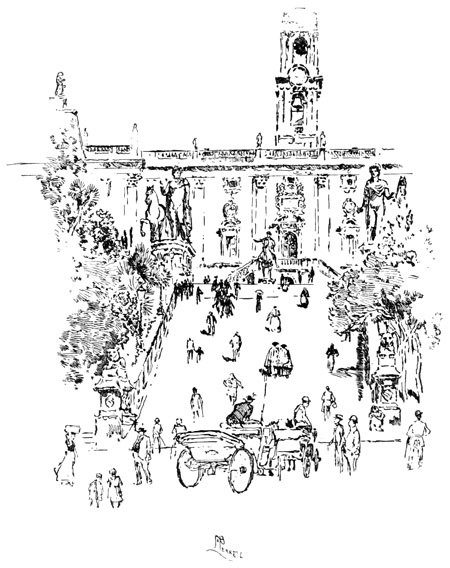
THE STEPS OF THE CAPITOL.
His arrival in Marcella's hospitable house, with its crowds of feminine visitors, was in every way a great event. It brought the ladies into the midst of all the ecclesiastical questions of the time: and one can imagine how they crowded round him when he returned from the sittings of the Council—perhaps in the stillness of the evening after the dangerous hour of sunset, when all Rome comes forth to breathe again—assembling upon the marble terrace, from which that magical scene was visible at their feet: the long withdrawing distance beyond the river, out of which some gleam might be apparent of the great church which already covered the tombs of the Apostles, and the white crest of the Capitol close at hand, and the lights of the town scattered dimly like glowworms among the wide openings and level lines of classical building which made the Rome of the time. The subjects discussed were not precisely those which the lighter conventional fancy, Boccaccio or Watteau, has associated with such groups, any more than the dark monk resembled the troubadour. But they were subjects which up to the present day have never lost their interest. The debates of the Council were chiefly taken up with an extremely abstruse heresy, concerning the humanity of our Lord, how far the nature of man existed in him in connection with the nature of God, and whether the Redeemer of mankind had taken upon himself a mere ethereal appearance of flesh, or an actual human body, tempted as we are and subject to all the influences which affect man. It is a question which has arisen again and again at various periods and in various manners, and the subtleties of such a controversy have proved of the profoundest interest to many minds. Jerome was not alone to report to those eager listeners the course of the debates, and to demolish over again the intricate arguments by which that assembly of divines wrought itself to fever heat. The great Bishop Epiphanius, the great heresy-hunter of his day—who had fathomed all the fallacious reasonings of all the schismatics, and could detect a theological error at the distance of a continent, in whatever garb it might shield itself—was the guest of Paula, and no doubt, along with his hostess, would often join these gatherings. The two doctors thus brought together would vie with each other in making the course of the controversy clear to the women, who hung upon their lips with keen apprehension of every phrase and the enthusiastic partisanship which inspires debate. There could be no better audience for the fine-drawn arguments which such a controversy demands. How strange to think that these hot discussions were going on, and the flower of the artificial society of Rome keenly occupied by such a question, while still the shadow of Jove lingered on the Capitol, and the Rome of the heathen emperors, the Rome of the great Republic, stood white and splendid, a shadow, yet a mighty one, upon the seven hills!
Before his arrival in Rome, Jerome had been but little known to the general world. His name had been heard in connection with some eloquent letters which had flown about from hand to hand among the finest circles; but his true force and character were better known in the East than in the West, and it was in part this Council which gave him his due place in the ranks of the Church. He was no priest to be promoted to bishoprics or established in high places. He had indeed been consecrated against his will by an enthusiastic prelate, eager to secure his great services to the Church; but, monk and ascetic as he was, he had no inclination towards the sacerdotal character, and had said but one mass, immediately after his ordination, and no more. It was not therefore as spiritual director in the ordinary sense of the words that he found his place in Marcella's house, but at first at least as a visitor merely and probably for the time of the Council alone. But the man of the desert would seem to have been charmed out of himself by the unaccustomed sweetness of that gentle life. He would indeed have been hard to please if he had not felt the attraction of such a retreat, not out of, but on the edge of, the great world, with its excitements and warfare within reach, the distant murmur of the crowd, the prospect of the great city with its lights and rumours, yet sacred quiet and delightful sympathy within. The little community had given up the luxuries of the age, but they could not have given up the refinements of gentle breeding, the high-born manners and grace, the charm of educated voices and cultivated minds. And there was even more than these attractions to gratify the scholar. Not an allusion could be made to the studies of which he was most proud, the rugged Hebrew which he had painfully mastered, or ornate Greek, but some quick intelligence there would take it up; and the poets and sages of their native tongue, the Cicero and Virgil from whom he could not wean himself even in the desert, were their own literature, their valued inheritance. And not in the most devoted community of monks could the great orator have found such undivided attention and interest in his work as among the ladies of the Aventine, or secretaries so eager and ready to help, so proud to be associated with it. He was at the same time within reach of Bishop Damasus, a man of many experiences, who seems to have loved him as a son, and who not only made him his secretary, but his private counsellor in many difficulties and dangers: and Jerome soon became the centre also of a little band of chosen friends, distinguished personages in Roman society connected in faith and in blood with the sisterhood, whom he speaks of as Daniel, Ananias, Azarias, and Misael, some of whom were his own old companions and schoolfellows, all deeply attached to him and proud of his friendship. No more delightful position could have been imagined for the repose and strengthening of a man who had endured many hardships, and who had yet before him much more to bear.
Jerome remained nearly three years in this happy retreat, and it was here that he executed the first portion of his great work, that first authoritative translation of the entire Canon of Scripture which still retains its place in the Church of Rome—the Vulgate, so named when the Latin of Jerome, which is by no means that of Cicero, was the language of the crowd. In every generation what is called the higher education of women is treated as a new and surprising thing by the age, as if it were the greatest novelty; but we doubt whether Girton itself could produce graduates as capable as Paula and Marcella of helping in this work, discussing the turning of a phrase or the meaning of an abstruse Hebrew word, and often holding their own opinion against that of the learned writer whose scribes they were so willing to be. This undertaking gave a double charm to the life, which went on with much variety and animation, with news from all quarters, with the constant excitement of a new charity established, a new community founded: and never without amusement either, much knowledge of the sayings and doings of society outside, visits from the finest persons, and a daily entertainment in the flutterings of young Blæsilla between the world and the convent, and her pretty ways, so true a woman of the world, yet all the same a predestined saint: and the doings of Fabiola, one day wholly absorbed in the foundation of her great hospital, the first in Rome, the next not so sure in her mind that love, even by means of a second divorce, might not win the day over devotion. Even Paula in these days was but half decided, and came, a dazzling vision in her jewels and her crown, to visit her friends, in all the pomp of autumnal beauty, among her daughters, of whom that serious little maiden Eustochium was the only one quite detached from the world. For was there not also going on under their eyes the gentle wooing of Pammachius and Paulina to make it apparent to the world that the ladies on the Aventine did not wholly discredit the ordinary ties of life, although they considered with St. Paul that the other was the better way? The lovers were as devout and as much given up to good works as any of them, yet, as even Jerome might pardon once in a way, preferred to the cloister the common happiness of life. These good works were the most wonderful part of all, for every member of the community was rich. Their fortunes were like the widow's cruse. One hears of great foundations like that of Fabiola's hospital and Melania's provision for the monks in Africa, for which everything was sacrificed; yet, next day, next year, renewed beneficences were forthcoming, and always a faithful intendant, a good steward, to continue the bountiful supplies. So wonderful indeed are these liberalities, and so extraordinary the details, that it is surprising to find that no learned German, or other savant, has, as yet, attempted to prove that the fierce and vivid Jerome never existed, that his letters were the work of half a dozen hands, and the subjects of his brilliant narrative altogether fictitious—Melania and Paula being but mythical repetitions of the same incident, wrapt in the colours of fable. This hypothesis might be made to seem very possible if it were not, perhaps, a little too late in the centuries for the operations of that high-handed criticism, and Jerome himself a very hard fact to encounter.
But the great wealth of these ladies remains one of the most singular circumstances in the story. When they sell and sacrifice everything it is clear it must only be their floating possessions, leaving untouched the capital, as we should say, or the estates, perhaps, more justly, the wealthy source from which the continued stream flowed. This gave a splendour and a largeness of living to the home on the Aventine. There was no need to send any petitioner away empty, charity being the rule of life, and no thought having as yet entered the most elevated mind that to give to the poor was inexpedient for them, and apt to establish a pauper class, dependent and willing to be so. These ladies filled with an even and open hand every wallet and every mouth. They received orphans, they provided for widows, they filled the poor quarters below the hill—where all the working people about the Marmorata clustered near the river bank, in the garrets and courtyards of the old houses—with asylums and places of refuge. The miserable and idle populace of which the historian speaks so contemptuously, the fellows who hung about the circuses, and had no name but the nicknames of coarsest slang, the Cabbage-feeders, the Sausage-eaters, &c., the Porringers and Gluttons, were, no doubt, left all the more free to follow their own foul devices; but the poor women, who though perhaps far from blameless suffer most in the debasement of the population, and the unhappy little swarms of children, profited by this universal balm of charity, and let us hope grew up to something a little better than their sires. For however paganism might linger among the higher class, the multitudes were all nominally Christian. It was to the tombs of the Apostles that they made their pilgrimages, rather than to the four hundred temples of the gods. "For all its gilding the Capitol looks dingy," says Jerome himself in one of his letters; "every temple in Rome is covered with soot and cobwebs, and the people pour past those half-ruined shrines to visit the tombs of the apostles."
The house of Marcella was in the condition we have attempted to describe when Jerome became its guest. It was in no way more rigid in its laws than at the beginning. The little ecclesia domestica, as he happily called it, seems to have been entirely without rule or conventual order. They sang psalms together (sometimes we are led to believe, in the original Hebrew learned for the purpose—but it must have been few who attained to this height), they read together, they held their little conferences on points of doctrine, with much consultation of learned texts; but there is no mention even of any regular religious service, much less of matins, and vespers, and nones and compline, and the other ritualistic divisions of a monastic day; for indeed no rule had been as yet invented for any cœnobites of the West. We do not hear even of a daily mass. Often there were desertions from the ranks, sometimes a young maiden withdrawing from the social enclosure, sometimes a young widow drawn back into the vortex of the fashionable world. But on the whole the record of the little domestic church, with its bodyguard of faithful friends and servitors outside, and Jerome, its pride and crown of glory, within, is one of serene and happy life, dignified by everything that was best in the antique world.
It was after the arrival of Jerome that the little tragedy of Blæsilla, the eldest daughter of Paula, occurred, rending their gentle hearts. "Our dear widow," as Jerome called her, had no idea of second marriage in her mind. The first, it would appear, had not been happy; and Blæsilla, fair and rich and young, had every mind to enjoy her freedom, her fine dresses, and all the pleasures of her youth. Safely lodged under her mother's wing, with those irreproachable friends 011 the Aventine about her, no gossip touched her gentle name. The community amused itself with her light-hearted ways. "Our widow loves to adorn herself. She is the whole day before her mirror," says Jerome, and there is no harsh tone in his voice. But in the midst of her gay and innocent life she fell ill of a fever, no unusual thing. It lingered, however, more than a month and took a dangerous form, so that the doctors began to despair. When things were at this point Blæsilla had a dream or vision, in her fever, in which the Saviour appeared to her and bade her arise as He had done to Lazarus. It was the crisis of the disease, and she immediately began to recover, with the deepest faith that she had been cured by a miracle. The butterfly was touched beyond measure by this divine interposition, as she believed, in her favour, and as soon as she was well, made up her mind to devote herself to God. "An extraordinary thing has happened," cries Jerome. "Blæsilla has put on a brown gown! What a scandal is this!" He launches forth thereupon into a diatribe upon the fashionable ladies, with faces of gypsum like idols, who dare not shed a tear lest they should spoil their painted cheeks, and who are the true scandal to Christianity: then narrates with growing tenderness the change that has taken place in the habits of the young penitent. She, whose innocent head was tortured with curls and plaits and crowned with the fashionable mitella, now finds a veil enough for her. She lies on the ground who found the softest cushions hard, and is up the first in the morning to sing Alleluia in her silvery voice.
The conversion rang through Rome all the more that Blæsilla was known to have had no inclination toward austerity of life. Her relations, half pagan and altogether worldly, were hot against the fanatic monk, who according to the usual belief tyrannised over the whole house in which he had been so kindly received, and the weak-minded mother who had lent herself to his machinations. The question fired Rome, and became a matter of discussion under every portico and wherever men or women assembled. Was it lawful, had it any warrant in law or history, this new folly of opposing marriage and representing celibacy as a happier and holier state? It was against every tradition of the race; it tore families in pieces, abstracted from society its most brilliant members, alienated the patrimony of families, interfered with succession and every natural law. In the turmoil raised by this event, a noisy public controversy arose. Two assailants presented themselves, one a priest, who had been for a time a monk, and one a layman, to maintain the popular canon, the superiority of marriage and the natural life of the world. These arguments had a great effect upon the public mind, naturally prone to take fright at any interference with its natural laws. They had very serious results at a later period both in the life of Paula and that of Jerome, and they seem to have threatened for a time serious injury to the newly established convents which Marcella's community had planted everywhere, and from which half-hearted sisters took this opportunity of separating themselves. It is amusing to find that, by a curious and furious twist of the usual argument, Jerome in his indignant and not always temperate defence describes these deserters as old and ugly, and unable to find husbands notwithstanding the most desperate efforts. It has been very common to allege this as a reason for the self-dedication of nuns: and it is always a handy missile to throw.
Jerome was not the man to let any such fine opening for a controversy pass. He burst forth upon his opponents, thundering from the heights of the Aventine, reducing the feeble writers who opposed him to powder. Helvidius, the layman above mentioned, had taken up the question—a question always offensive and injurious to natural sentiment and prejudice, exclusive even of religious feeling, and which, whatever opinions may prevail, it must always be profane to touch—of the Virgin Mary herself, and the existence of persons called brothers and sisters of our Lord. To him Jerome replied by a flood of angry eloquence, as well as some cogent argument—though argument, however strong, is insupportable on such a subject. And he launched forth upon the other, Jovinian, the false monk, that famous letter on Virginity, nominally addressed to Eustochium, in which one of the most trenchant pictures ever made of society, both lay and clerical—the habits, the ideas, the follies of debased and fallen Rome—is of far more force and importance than the argument, and furnishes us with such a spectacle as very few writers at any time or in any place are capable of placing before the eyes of the world. I have already quoted from this wonderful composition the portrait of the popular priest.
The foolish virgin who puts on an appearance of indifference to worldly things, and "under the ensign of a holy profession draws towards her the regard of men," is treated with equal severity.
We cast out and banish from our sight those virgins who only wish to seem to be so. Their robes have but a narrow stripe of purple, they let their hair hang about their shoulders, their sleeves are short and narrow, and they have cheap shoes upon their feet. This is all their sanctity. They make by these pretences a higher price for their innocence. Avoid, dear Eustochium, the secret thought that having ceased to court attention in cloth of gold you may begin to do so in mean attire. When you come into an assembly of the brothers and sisters do not, like some, choose the lowest seat or plead that you are unworthy of a footstool. Do not speak with a faltering voice as if worn out with fasting, or lean upon the shoulders of your neighbours as if fainting. There are some who thus disfigure their faces that they may appear to men to fast. As soon as they are seen, they begin to groan, they look down, they cover their faces, all but one eye. Their dress is sombre, their girdles are of sackcloth. Others assume the mien of men, blushing that they have been born women, who cut their hair short, and walk abroad with effrontery, confronting the world with the impudent faces of eunuchs.... I have seen, but will not name, one among the noblest of Rome who in the very basilica of the blessed Peter gave alms with her own hands at the head of her retinue of servants, but struck in the face a poor woman who had twice held out her hand. Flee also the men who wear an iron chain, who have long hair like women against the rule of the Apostle, a miserable black robe, who go barefooted in the cold, and have in appearance at least an air of sadness and anxiety.
The following sketch of the married woman who thinks of the things of the world, how she may please her husband, while the unmarried are free to please God, has an interest long outliving the controversy, in the light it throws upon contemporary Roman life.
Do you think there is no difference between one who spends her time in fastings, and humbles herself night and day in prayer—and her who must prepare her face for the coming of her husband, ornament herself, and put on airs of fascination? The first veils her beauty and the graces which she despises; the other paints herself before a mirror, to make herself more fair than God has made her. Then come the children, crying, rioting, hanging about her neck, waiting for her kiss. Expenses follow without end, her time is spent in making up her accounts, her purse always open in her hand. Here there is a troop of cooks, their garments girded like soldiers for the battle, hashing and steaming. Then the women spinning and babbling. Anon comes the husband, followed by his friends. The wife flies about like a swallow from one end of the house to the other, to see that all is right, the beds made, the marble floors shining, flowers in the vases, the dinner prepared. Is there in all that, I ask, a thought of God? Are these happy homes? No, the fear of God is absent there, where the drum is sounded, the lyre struck, where the flute breathes out and the cymbals clash. Then the parasite abandons shame and glories in it, if he amuses the host who has invited him. The victims of debauch have their place at these feasts; they appear half naked in transparent garments which unclean eyes see through. What part is there for the wife in these orgies? She must learn to take pleasure in such scenes, or else to bring discord into her house.
He paints for us, in another letter, a companion picture of the widow remarried.
Your contract of marriage will scarcely be written when you will be compelled to make your will. Your new husband pretends to be very ill, and makes a will in your favour, desiring you to do the same. But he lives, and it is you who die. And if it happens that you have sons by your second marriage, war blazes forth in your house, a domestic contest without term or conclusion. Those who owe life to you, you are not permitted to love equally, fully. The second envies the caress which you give to the son of the first. If, on the contrary, it is he who has children by another wife, although you may be the most loving of mothers, you are condemned as a stepmother by all the rhetoric of the comedies, the pantomimes, and orators. If your stepson has a headache you have poisoned him. If he eats nothing you starve him, if you serve him his food it is worse still. What compensation is there in a second marriage to make up for so many woes?
This tremendous outburst and others of a similar kind raised up, as was natural, a strong feeling against Jerome. It was not likely that the originals of these trenchant sketches would forgive easily the man who put them up in effigy on the very walls of Rome. That the pictures were identified was clear from another letter, in which he asks whether he is never to speak of any vice or folly lest he should offend a certain Onasus, who took everything to himself. Little cared he whom he offended, or what galled jade might wince. But at last the remonstrances of his friends subdued his rage. "When you read this you will bend your brows and check my freedom, putting a finger on my mouth to stop me from speaking," he wrote to Marcella. It was full time that the prudent mistress of the house which contained such a champion should interfere.
While still the conflict raged which had been roused by the retirement of Blæsilla from the world, and which had thus widened into the general question, far more important than any individual case, between the reforming party in the Church, the Puritans of the time—then specially represented by the new development of monasticism—and the world which it called all elevated souls to abandon: incidents were happening which plunged the cheerful home on the Aventine into sorrow and made another noble house in Rome desolate. The young convert in the bloom of her youthful devotion, who had been raised up miraculously as they all thought from her sick bed in order that she might devote her life to Christ, was again struck down by sickness, and this time without any intervention of a miracle. Blæsilla died in the fulness of her youth, scarcely twenty-two, praying only that she might be forgiven for not having been able to do what she had wished to do in the service of her Lord. She was a great lady, though she had put her natural splendour away from her, and it was with all the pomp of a patrician funeral that she was carried to her rest. It is again Jerome who makes visible to us the sad scene of this funeral, and the feeling of the multitude towards the austere reformers who had by their cruel exactions cut off this flower of Roman society before her time. Paula, the bereaved mother, followed, as was the custom, the bier of her daughter through the crowded streets of Rome, scarcely able in the depths of her grief to support herself, and at last fell fainting into the arms of the attendants and had to be carried home insensible. At this sight, which might have touched their hearts, the multitude with one voice cried out against the distracted mother. "She weeps, the daughter whom she has killed with fastings," they cried. "Why are not these detestable monks driven from the city? why are they not stoned or thrown into the river? It is they who have seduced this miserable woman to be herself a monk against her will—this is why she weeps for her child as no woman has ever wept before." Paula, let us hope, did not hear these cries of popular rage. The streets rung with them, the populace always ready for tumult, and the disgusted and angry nobles encouraging every impulse towards revolt. No doubt many of the higher classes had looked on with anxiety and alarm at the new movement which dissipated among the poor so many fine inheritances and threatened to carry off out of the world, of which they had been the ornaments, so many of the most distinguished women. Any sudden rising which might kill or banish the pestilent monk or disperse the troublesome community would naturally find favour in their eyes.
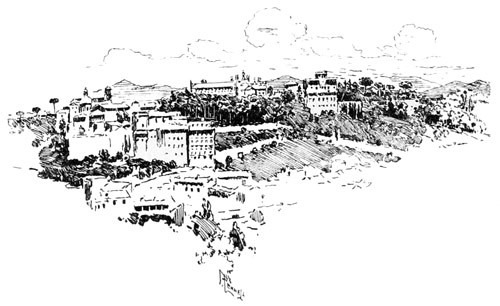
THE LATERAN FROM THE AVENTINE.
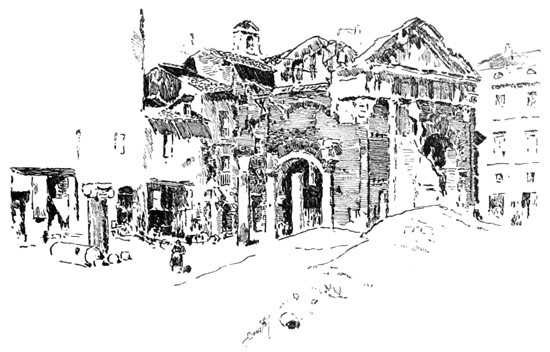
PORTICO OF OCTAVIA.
CHAPTER V.
PAULA.
Paula was a woman of very different character from the passionate and austere Melania who preceded and resembled her in many details of her career. Full of tender and yet sprightly humour, of love and gentleness and human kindness, a true mother benign and gracious, yet with those individualities of lively intelligence, understanding, and sympathy which quicken that mild ideal and bring in all the elements of friendship and the social life—she was the most important of those visitors and associates who made the House on the Aventine the fashion, and filled it with all that was best in Rome. Though her pedigree seems a little delusive, her relationship to Æmilius Paulus resolving itself into a descent from his sister through her own mother, it is yet apparent that her claims of the highest birth and position were fully acknowledged, and that no Roman matron held a higher or more honourable place. She was rich as they all were, highly allied, the favourite of society, neglecting none of its laws, though always with a love of intellectual intercourse and a tendency to devotion. Which of these tendencies drew her first towards Marcella and her little society we cannot tell: but it is evident that both found satisfaction there, and were quickened by the strong impulse given by Jerome when he came out of the schools and out of the wilds, at once Scholar and Hermit, to this house of friendship, the Ecclesia Domestica of Rome. That all this rising tide of life, the books, the literary work, the ever-entertaining companionship, as well as the higher influence of a life of self-denial and renunciation, as understood in those days—should have at first added a charm even to that existence upon its border, the life in which every motive contradicted the new law, is very apparent. Many a great lady, deeply plunged in all the business of the world, has felt the same attraction, the intense pleasure of an escape from those gay commotions which in the light of the other life seem so insignificant and wearisome, the sensation of rest and tranquillity and something higher, purer, in the air—which yet perhaps at first gave a zest to the return into the world, in itself once more a relief from that higher tension and those deeper requirements. The process by which the attraction grew is very comprehensible also. Common pleasures and inane talk of society grow duller and duller in comparison with the conversation full of wonders and revelations which would keep every faculty in exercise, the mutual studies, the awe yet exhilaration of mutual prayers and psalms, the realisation of spiritual things. And no doubt the devout child's soul so early fixed, the little daughter who had thought of nothing from her cradle but the service of God, must have drawn the ever-tender, ever-sympathetic mother still nearer to the centre of all. The beautiful mother among her girls, one betrothed, one self-consecrated, one in all the gay emancipation of an early widowhood, affords the most charming picture among the graver women—women all so near to each other in nature,—mutually related, members of one community, linked by every bond of common association and tradition.
When Blæsilla on her recovery from her illness threw off her gaieties and finery, put on the brown gown, and adopted all the rules of the community, the life of Paula, trembling between two spheres, was shaken by a stronger impulse than ever before. But how difficult was any decision in her circumstances! She had her boy and girl at home as yet undeveloped—her only boy, dragged as much as might be to the other side, persuaded to think his mother a fanatic and his sisters fools. Paula did all she could to combine the two lives, indulging perhaps in an excess of austerities under the cloth of gold and jewels which, as symbols of her state and rank, she could not yet put off. The death of Blæsilla was the shock which shattered her life to pieces. Even the coarse reproaches of the streets show us with what anguish of mourning this first breach in her family overwhelmed her. "This is why she weeps for her child as no woman has ever wept before," the crowd cried, turning her sorrow into an accusation, as if she had thus acknowledged her own fault in leaving Blæsilla to privations she was not able to endure. Did the cruel censure perhaps awake an echo in her heart, ready as all hearts are in that moment of prostration to blame themselves for something neglected, something done amiss? At least it would remind Paula that she herself had never made completely this sacrifice which her child had made with such fatal effect. She was altogether overcome by her sorrow: her sobs and cries rent the hearts of her friends. She refused all food, and when exhausted by the paroxysms of violent grief fell into a lethargy of despair more alarming still. When every one else had tried their best to draw her from this excess of affliction, the ladies had recourse to Jerome in their extremity: for it was clear that Paula must be roused from this collapse of all courage and hope, or she must die.
Jerome did not refuse to answer the appeal: though helpless as even the most anxious affection is in face of this anguish of the mother which will not be comforted, he did what he could; he wrote to her from the house of their friends who shared yet could not still her sorrow, a letter full of grief and sympathy, in the forlorn hope of bringing her back to life. Such letters heaven knows are common enough. We have all written, and most of us have received them, and found in their tender arguments, in their assurances of final good and present fellow feeling, only fresh pangs and additional sickness of heart. Yet Jerome's letter was not of a common kind. No one could have touched the shrinking heart with a softer touch than this fierce controversialist, this fiery and remorseless champion: for he had yet a more effectual spell to move the mourner, in that he was himself a mourner, not much less deeply touched than she. "Who am I," he cries, "to forbid the tears of a mother who myself weep? This letter is written in tears. He is not the best consoler whom his own groans master, whose being is un-manned, whose broken words distil into tears. Yes, Paula, I call to witness Christ Jesus whom our Blæsilla now follows, and the angels who are now her companions, I, too, her father in the spirit, her foster-father in affection, could also say with you—Cursed be the day that I was born. Great waves of doubt surge over my soul as over yours. I, too, ask myself why so many old men live on, why the impious, the murderers, the sacrilegious, live and thrive before our eyes, while blooming youth and childhood without sin are cut off in their flower." It is not till after he has thus wept with her that he takes a severer tone. "You deny yourself food, not from desire of fasting, but of sorrow. If you believed your daughter to be alive, you would not thus mourn that she has migrated to a better world. Have you no fear lest the Saviour should say to you, 'Are you angry, Paula, that your daughter has become my daughter? Are you vexed at my decree, and do you with rebellious tears grudge me the possession of Blæsilla?' At the sound of your cries Jesus, all-clement, asks, 'Why do you weep? the damsel is not dead but sleepeth.' And when you stretch yourself despairing on the grave of your child, the angel who is there asks sternly, 'Why seek ye the living among the dead?'"
In conclusion Jerome adds a wonderful vow: "So long as breath animates my body, so long as I continue in life, I engage, declare and promise that Blæsilla's name shall be for ever on my tongue, that my labours shall be dedicated to her honour, and my talents devoted to her praise." It was the last word which the enthusiasm of tenderness could say: and no doubt the fervour and warmth of the promise, better kept than such promises usually are, gave a little comfort to the sorrowful soul.
When Paula came back to the charities and devotions of life after this terrible pause a bond of new friendship was formed between her and Jerome. They had wept together, they bore the reproach together, if perhaps their trembling hearts might feel there was any truth in it, of having possibly exposed the young creature they had lost to privations more than she could bear. But it is little likely that this modern refinement of feeling affected these devoted souls; for such privations were in their eyes the highest privileges of life, and in fasting man was promoted to eat the food of angels. At all events, the death of Blæsilla made a new bond between them, the bond of a mutual and most dear remembrance never to be forgotten.
This natural consequence of a common sorrow inflamed the popular rage against Jerome to the wildest fury. Paula's relations and connections, half of them, as in most cases in the higher ranks of society, still pagan—who now saw before them the almost certain alienation to charitable and religious purposes of Paula's wealth, pursued him with calumny and outrage, and did not hesitate to accuse the lady and the monk of a shameful relationship and every crime. To make things worse, Damasus, whose friend and secretary, almost his son, Jerome had been, died a few months after Blæsilla, depriving him at once of that high place to which the Pope's favour naturally elevated him. He complains of the difference which his close connection with Paula's family had made on the general opinion of him. "All, almost without exception, thought me worthy of the highest sacerdotal position; there was but one word for me in the world. By the mouth of the blessed Damasus it was I who spoke. Men called me holy, humble, eloquent." But all this had changed since the recent events in Paula's house. She on her side, wounded to the heart by the reproaches poured upon her, and the shameful slanders of which she was the object, and which had no doubt stung her into renewed life and energy, resolved upon a step stronger than that of joining the community, and announced her intention of leaving Rome, seeking a refuge in the holy city of Jerusalem, and shaking the dust of her native country, where she had been so vilified, from her feet. This resolution was put to Jerome's account as might have been expected, and when his patron's death left him without protection every enemy he had ever made, and no doubt they were many, was let loose. He whom courtiers had sought, whose hands had been kissed and his favour implored by all who sought anything from the Pope, was now greeted when he appeared in the streets by fierce cries of "Greek," "Impostor," "Monk," and his presence became a danger for the peaceful house in which he had found a refuge.
It is scarcely possible to be very sorry for Jerome. He had not minced his words; he had flung libels and satires about that must have stung and wounded many, and in such matters reprisals are inevitable. But Paula had done no harm. Even granting the case that Blæsilla's health had been ruined by fasting, the mother herself had gone through the same privations and exulted in them: and her only fault was to have followed and sympathised in, with enthusiasm, the new teaching and precepts of the divine life in the form which was most highly esteemed in her time. No cry from that silent woman comes into the old world, ringing with so many outcries, where the rude Roman crowd bellowed forth abuse, and the ladies on their silken couches whispered the scandal of Paula's liaison to each other, and the men scoffed and sneered over their banquets at the mere thought of such a friendship being innocent. Some one of their enemies ventured to speak or write publicly the vile accusation, and was instantly brought to book by Jerome, and publicly forswore the scandal he had spread. "But," as Jerome says, "a lie is hard to kill; the world loves to believe an evil story: it puts its faith in the lie, but not in the recantation." And the situation of affairs became such that he too saw no expedient possible but that of leaving Rome. He would seem to have been, or to have imagined himself, in danger of his life, and his presence was unquestionably a danger for his friends. A man of more patient temperament and quiet mind might have thought that Paula's resolution to go away was a reason for him to stay, and thus to bear the scandal and outrage alone, at least until she was safe out of its reach—giving no possible occasion for the adversary to blaspheme. But Jerome was evidently not disposed to any such self-abnegation, and indeed it is very likely that his position had become intolerable and that his only resource was departure. It was in the summer of 385, nearly three years after his arrival in Rome—in August, seven months after the death of Damasus, and not a year after that of Blæsilla, that he left "Babylon," as he called the tumultuous city, writing his farewell with tears of grief and wrath to the Lady Asella, now one of the eldest and most important members of the community, and thanking God that he was found worthy of the hatred of the world. We are apt to speak as if travelling were an invention of our time: but as a matter of fact facilities of travelling then existed little inferior to those we ourselves possessed thirty or forty years ago, and it was no strange or unusual journey from Ostia at the mouth of the Tiber, by the soft Mediterranean shores, past the vexed rocks of the Sirens in the blazing weather, to Cyprus that island of monasteries, and Antioch a vexed and heresy-tainted city yet full of friends and succour. Jerome had a cluster of faithful followers round him, and was escorted by a weeping crowd to the very point of his embarkation: but yet swept forth from Rome in a passion of indignation and distress.
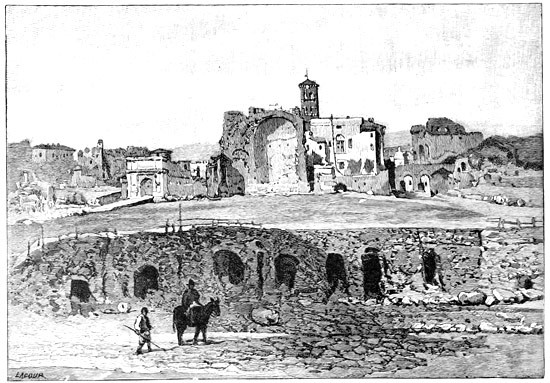
TEMPLE OF VENUS AND ROME FROM THE COLOSSEUM (1860).
To face page 72.
It was while waiting for the moment of departure in the ship that was to carry him far from his friends and the life he loved, that Jerome's letters to Asella were written. They were full of anger and sorrow, the utterance of a heart sore and wounded, of a man driven almost to despair. "I am said," he cries, "to be an infamous person, a deceiver full of guile, an impostor with all the arts of Satan at his fingers' ends.... These men have kissed my hands in public, and stung me in secret with a viper's tooth; they compassionate me with their lips and rejoice in their hearts. But the Lord saw them, and had them in derision, reserving them to appear with me, his unfortunate servant, at the last judgment. One of them ridicules my walk, and my laugh: another makes of my features a subject of accusation: to another the simplicity of my manners is the evil thing: and I have lived three years in the company of such men!" He continues his indignant self-defence as follows:
"I have lived surrounded by virgins, and to some of them I explained as best I could the divine books. With study came an increased knowledge of each other, and with that knowledge mutual confidence. Let them say if they have ever found anything in my conduct unbecoming a Christian. Have I not refused all presents, great or small? Gold has never sounded in my palm. Have they heard from my lips any doubtful word, or seen in my eyes a bold or hazardous look? Never, and no one dares say so. The only objection to me is that I am a man: and that objection only appeared when Paula announced her intention of going to Jerusalem. They believed my accuser when he lied: why do they not believe him when he retracts? He is the same man now as then. He imputed false crimes to me, now he declares me innocent. What a man confesses under torture is more likely to be true than that which he gives forth in a moment of gaiety: but people are more prone to believe such a lie than the truth.
"Of all the ladies in Rome Paula only, in her mourning and fasting, has touched my heart. Her songs were psalms, her conversations were of the Gospel, her delight was in purity, her life a long fast. But when I began to revere, respect, and venerate her, as her conspicuous virtue deserved, all my good qualities forsook me on the spot.
"Had Paula and Melania rushed to the baths, taken advantage of their wealth and position to join, perfumed and adorned, in one worship God and their wealth, their freedom and pleasure, they would have been known as great and saintly ladies; but now it is said they seek to be admired in sackcloth and ashes, and go down to hell laden with fasting and mortifications: as if they could not as well have been damned along with the rest, amid the applauses of the crowd. If it were Pagans and Jews who condemned them, they would have had the consolation of being hated by those who hated Christ, but these are Christians, or men known by that name.
"Lady Asella, I write these lines in haste, while the ship spreads its sails. I write them with sobs and tears, yet giving thanks to God to have been found worthy of the hatred of the world. Salute Paula and Eustochium, mine in Christ whether the world pleases or not, salute Albina your mother, Marcella your sister, Marcellina, Felicita: say to them that we shall meet again before the judgment seat of God, where the secrets of all hearts shall be revealed. Remember me, oh example of purity! and may thy prayers tranquillise before me the tumults of the sea!"
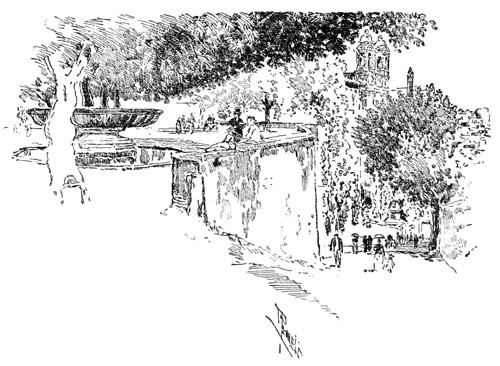
TRINITA DE' MONTI.
The agitation with which the community of ladies must have received such a letter may easily be imagined. They were better able than any others to judge of the probity and honour of the writer who had lived among them so long: and no doubt all these storms raging about, the injurious and insulting imputations, all the evil tongues of Rome let loose upon the harmless house, their privacy invaded, their quiet disturbed, must, during the whole course of the deplorable incident, have been the cause of pain and trouble unspeakable to the gentle society on the Aventine. Marcella it is evident had done what she could to stop the mouth of Jerome when the trouble began; it is perhaps for this reason that the letter of farewell is addressed to the older Asella, perhaps a milder judge.
Paula's preparations had begun before Jerome had as yet thought of his more abrupt departure. They were not so easily made as those of a solitary already detached from the world. She had all her family affairs to regulate, and, what was harder still, her children to part with, the most difficult of all, and the special point in her conduct with which it is impossible for us to sympathise. But it must be remembered that Paula, a spotless matron, had been branded with the most shameful of slanders, that she had been shrieked at by the crowd as the slayer of her daughter, and accused by society of having dishonoured her name. She had been the subject of a case of libel, as we should say, before the public courts, and though the slanderer had confessed his falsehood (under the influence of torture it would seem, according to the words of Jerome), the imputation, as in most cases, remained. Outraged and wounded to the quick, it is very possible that she may have thought that it was well for her younger children that she should leave them, that they might not remain under the wing of a mother whose name had been bandied about in the mouths of men. Her daughter Paulina was by this time married to the good and faithful Pammachius, whose protection might be of greater advantage to the younger girl and boy than her own. And Paula had full knowledge of the tender mercies of her pagan relations, and of the influence they were likely to exercise against her, even in her own house. The staid young Eustochium, grave and calm, clung to her mother's side, her youthful head already covered by the veil of the dedicated virgin, a serene and unfaltering figure in the midst of all the agitations of the parting. All Rome poured forth to accompany them to the port, brothers and sisters with their wives and husbands, relations less near, a crowd of friends. All the way along the winding banks of the Tiber they plied Paula with entreaties and reproaches and tears. She made them no reply. She was at all times slow to speak, as the tender chronicle reports. "She raised her eyes to heaven, pious towards her children but more pious to God." She retained her self-command until the vessel began to move from the shore, where little Toxotius, the boy of ten years old, stood stretching out his hands to her in a last appeal, his sister Rufina silent, with wistful eyes, by his side. Paula's heart was like to burst. She turned her eyes away unable to bear that cruel sight, while Eustochium, firm and steadfast, supported her weaker mother in her arms.
Was it a cruel desertion, a heartless abandonment of duty? Who can tell? There are desertions, cruelties in this kind, which are the highest sacrifice, and sometimes the most bitter proof of self-devotion. Did Paula in her heart believe, most painful thought that can enter a mother's mind, that her boy would be better without her, brought up in peace among his uncles and guardians, who, had she been there, would have made his life a continual struggle between two sides? Was Rufina more likely to be happy in her gentle sister's charge, than with her mind disturbed, and perhaps her marriage spoiled, by her mother's religious vows, and all that was involved in them? She might be wrong in thinking so, as we are all wrong often in our best and most painfully pondered plans. But condemnation is very easy, and gives so little trouble—there is surely a word to be said on the other side of the question.
When these pilgrims leave Rome they cease to have any part in the story of the great city with which we have to do. Yet their after-fate may be stated in a few words. No need to follow the great lady in her journey over land and sea to the Holy Land with all its associations, where Jerusalem out of her ruins, decked with a new classic name, was already rising again into the knowledge and the veneration of the world. These were not the days of excursion trains and steamers, it is true; but the number of pilgrims ever coming and going to those more than classic shores, those holy places, animated with every higher hope, was perhaps greater in proportion to the smaller size and less population of the known world than are our many pilgrimages now, though this seems so strange a thing to say. But is there not a Murray, a Baedeker, of the fourth century, still existent, the Itinéraire de Bordeaux à Jerusalem, unquestioned and authentic, containing the most careful account of inns and places of refuge and modes of travel for the pilgrims? It is possible that the lady Paula may have had that ancient roll in her satchel, or slung about the shoulders of her attendant for constant reference. Her ship was occupied by her own party alone, and conveyed, no doubt, much baggage and many provisions as an emigration for life would naturally do; and it was hindered by no storms, as far as we hear, but only by a great calm which delayed the vessel much and made the voyage tedious, necessitating the use of the galley's oars, which very likely the ladies would like best, though it kept them so many more days upon the sea. They reached Cyprus at last, that holy island now covered with monasteries, where Epiphanius, once Paula's guest in Rome, awaited and received her with every honour, and where there were many visits to be paid to monks and nuns in their new establishments, the favourite dissipation of the cloister. The ladies afterwards continued their voyage to Antioch, where they met Jerome; and proceeded on their journey, having probably had enough of the sea, along the coast by Tyre and Sidon, by Herod's splendid city of Cæsarea, and Joppa with its memories of the Apostles—not without a thought of Andromeda and her monster as they looked over the dark and dangerous reefs which still scare the traveller: for they loved literature, notwithstanding their separation from the world. They formed by this time a great caravanserai, not unlike, to tell the truth, one of those parties which we are so apt to despise, under charge of guides and attendants who wear the livery of Cook. But such an expedition was far more dignified and important in those distant days. Jerome and his monks made but one family of sisters and brothers with the Roman ladies and their followers, who endured so bravely all the fatigues and dangers of the way. Paula the pilgrim was no longer a tottering fine lady, but the most animated and interested of travellers, with no mere mission of hermit-hunting like Melania, but the truest human enthusiasm for all the storied scenes through which she passed. When they reached Jerusalem she went in a rapture of tears and exaltation from one to another of the sacred sites, kissing the broken stone which was supposed to have been that which was rolled against the door of the Holy Sepulchre, and following with pious awe and joy the steps of Helena into the cave where the True Cross was found. The legend was still fresh in those days, and doubts there were none. The enthusiasm of Paula, the rapture and exaltation, which found vent in torrents of tears, in ecstasies of sacred emotion, joy and prayer, moved all the city, thronged with pilgrims, devout and otherwise, to whom the great Roman lady was a wonder: the crowd followed her about from point to point, marvelling at her devotion and the warmth of natural feeling which in all circumstances distinguished her. The reader cannot but follow still with admiring interest a figure so fresh, so unconventional, so profoundly touched by all those holy and sacred associations. Amid so many who are represented as almost more abstracted among spiritual thoughts than nature permits, her frank emotion and tender, natural enthusiasm are always a refreshment and a charm.
We come here upon a break in the hitherto redundant story. Melania and Rufinus were in possession of their convents, and fully established as residents on the Mount of Olives, when the other pilgrims arrived; and there can be but little doubt that every grace of hospitality was extended by the one Roman lady to the other, as well as by the old companions of Jerome to her friend. But in the course of the after-years these dear friends quarrelled bitterly, not on personal matters, so far as appears, but on points of doctrine, and fell into such prolonged warfare of angry and stinging words as hurt more than blows. By means of this very intimacy they knew everything that had ever been said or whispered of each other, and in the heat of conflict did not hesitate to use every old insinuation, every suggestion that could hurt or wound. The struggle ran so high that the after-peace of both parties was seriously affected by it; and one of its most significant results was that Jerome, a man great enough and little enough for anything, either in the way of spitefulness or magnanimity, cut off from his letters and annals all mention of this early period of peace, and all reference to Melania, whom he is supposed to have praised so highly in his first state of mind that it became impossible in his second to permit these expressions of amity to be connected with her name. This is a melancholy explanation of the silence which falls over the first period of Paula's residence in Palestine, but it is a very natural one: and both sides were equally guilty. The quarrel happened, however, years after the first visit, which we have every reason to believe was all friendliness and peace.
After this first pause at Jerusalem, the caravanserai got under way again and set out on a long journey through all the scenes of the Old Testament, the storied deserts and ruins of Syria, not much less ancient to the view and much less articulate than now. This was in the year 387, two years after their departure from Rome. Even now, with all our increased facilities for travel—neutralised as they are by the fact that these wild and desert lands will probably never be adapted to modern methods—the journey would be a very long and fatiguing business. Jerome and his party "went everywhere," as we should say; they were daunted by no difficulties. No modern lady in deer-stalker's costume could have shrunk less from any dangerous road than the once fastidious Paula. They stopped everywhere, receiving the ready hospitality of the convents in every awful pass of the rocks and stony waste where such homes of penance were planted. Those wildernesses of ruin, from which our own explorers have picked carefully out some tradition of Gilgal or of Ziklag, some Philistine stronghold or Jewish city of refuge—were surveyed by these adventurers fourteen hundred years ago, when perhaps there was greater freshness of tradition, but none of the aids of science to decipher what would seem even more hoary with age to them than it does to us. How trifling in our pretences at exploration do the luxurious parties of the nineteenth century seem, abstracted from common life for a few months at the most, and with all the resources of civilisation to fall back upon, in comparison with that of these patient wanderers, eating the Arab bread and clotted milk, and such fare as was to be got at, finding shelter among the dark-skinned ascetics of the desert communities, taking refuge in the cave which some saint but a day or two before had inhabited, wandering everywhere, over primeval ruin and recent shrine!
When they came back from these savage wildernesses to green Bethlehem standing up on its hillside over the pleasant fields, the calm and sweetness of the place went to their hearts. It was in this sacred spot that they decided to settle themselves, building their two convents, Jerome's upon the hill near the western gate, Paula's upon the smiling level below. He is said to have sold all that he had, some remains of personal property in Dalmatia belonging to himself and his brother, who was his faithful and constant companion, to provide for the expenses of the building, on his side; and no doubt the abundant wealth of Paula supplemented all that was wanting. Gradually a conventual settlement, such as was the ideal of the time, gathered in this spot. After her own convent was finished Paula built two others near it, which were soon filled with dedicated sisters. And she built a hospice for the reception of travellers, so that, as she said with tender smiles and tears, "If Joseph and Mary should return to Bethlehem, they might be sure of finding room for them in the inn." This soft speech shines like a gleam of tender light upon the little holy city with all its memories, showing us the great lady of old in her gracious kindness, full of noble natural kindness, and seeing in every poor pilgrim who passed that way some semblance of that simple pair, who carried the Light of the World to David's little town among the hills.
All these homes of piety and charity are swept away, and no tradition even of their site is left; but there is one storied chamber that remains full of the warmest interest of all. It is the rocky room, in one of the half caves, half excavations close to that of the Nativity, and communicating with it by rudely hewn stairs and passages, in which Jerome established himself while his convent was building, which he called his Paradise, and which is for ever associated with the great work completed there. All other traditions and memories grow dim in the presence of the great and sacred interest of the place. Yet it will be impossible even there for the spectator who knows their story to stand unmoved in the scene, practically unaltered since their day, where Jerome laboured at his great translation, and Paula and Eustochium copied, compared, and criticised his daily labours. A great part of the Vulgate had been completed in Rome, but since leaving that city Jerome had much increased his knowledge of Hebrew, losing no opportunity, during his travels, of studying the language with every learned Rabbi he encountered, and acquiring much information in respect to the views and readings of the doctors in the law. He took the opportunity of his retirement at Bethlehem to revise what was already done and to finish the work. His two friends had both learned Hebrew in a greater or less degree before leaving Rome. They had no doubt shared his studies on the way. They read with him daily a portion of the Scriptures in the original; and it was at their entreaty and with their help that he began the translation of the Psalms, so deeply appropriate to this scene, in which the voice of the shepherd of Bethlehem could almost be heard, singing as he led his flock about the little hills. I quote from M. Amédée Thierry a sympathetic description of the method of this work as it was carried out in the rocky chamber at Bethlehem, or in the convent close by.
His two friends charged themselves with the task of collecting all the materials, and this edition, prepared by their care, is that which remains in the Church under Jerome's name. We have his own instructions to them for this work, even to the lines traced for greater exactness, and the explanation of the signs which he had adopted in the collation of the different versions with his text, sometimes a line underscored, sometimes an obelisk or asterisk. A comma followed by two points indicated the cutting out of superfluous words coming from some paraphrase of the Septuagint; a star followed by two points showed, on the contrary, where passages had to be inserted from the Hebrew; another mark denoted passages borrowed from the translation of Theodosius, slightly different from the Septuagint as to the simplicity of the language. In reading these various symbols it is pleasant to think of the two noble Roman ladies seated before the vast desk upon which were spread the numerous manuscripts, Greek, Hebrew, and Latin—the Hebrew text of the Bible, the different editions of the Septuagint, the Hexapla of Origen, Theodosius, Symmachus, Aquila, and the Italian Vulgate—whilst they examined and compared, reducing to order under their hands, with piety and joy, that Psalter of St. Jerome which we still sing, at least the greater part of it, in the Latin Church at the present day.
It is indeed a touching association with that portion of Scripture which next to the Gospel is most dear to the devout, that the translation still in daily use throughout the churches of Continental Europe, the sonorous and noble words which amid all the babble of different tongues still form a large universal language, of which all have at least a conventional understanding—should have been thus transcribed and perfected for the use of the generations. Jerome is no gentle hero, and, truth to tell, has never been much loved in the Church which yet owes so much to him. Yet there is no other work of the kind which carries with it so many soft and tender associations. The cave at Bethlehem is as little adapted as a scene for that domestic combination as Jerome is naturally adapted to be its centre. And no doubt there are unkindly critics who will describe this austere yet beautiful interior as the workshop of two poor female slaves dragged after him by the tyranny of their grim taskmaster to do his work for him. No such idea is consistent with the record. The gentle Paula was a woman of high spirit as well as of much grace and courtesy, steadfastness and humour, the last the most unusual quality of all. The imaginative devotion which had induced her to learn Hebrew in order to sing the Psalmist's songs in the original, among the little band of Souls, under Marcella's gilded roof, had its natural evolution in the gentle pressure laid upon Jerome to make of them an authoritative translation: and where could so fit a place for this work have been found as in the delightful rest after their travels were over, in the very scene where these sacred songs were first begun? It would be almost as impertinent and foolish to suppose that any modern doubt of their authenticity existed in Paula's mind as to suggest that these were forced and dreary labours to which she was driven by a spiritual tyrant. To our mind this mutual labour and study adds the last charm to their companionship. The sprightly, gentle woman who shed so much light over that curious self-denying yet self-indulgent life, and the grave young daughter who never left her side, whose gentle shadow is one with her, so that while Paula lived we cannot distinguish them apart—must have found a quiet happiness above all they had calculated on in this delightful intercourse and work. Their minds and thoughts occupied by the charm of noble poetry, by the puzzle of words to be cleared and combined aright, and by constant employment in a matter which interested them so deeply, which is perhaps the best of all—must have drawn closer and ever closer, mother to child, and child to mother, as well as both to the friend and father whom they delighted to serve, and whose large intellect and knowledge kept theirs going in constant sympathy—not unmingled with now and then a little opposition, and the pleasant stir of independent opinion.
It is right to give Jerome himself, so fierce in quarrel and controversy, the advantage of this gentle lamp which burns for ever in his little Paradise. And can any one suppose that Paula, once so sensitive and exquisite, now strong and vigorous in the simplicity of that retirement, with her hands full and her mind, plenty to think of, plenty to do, had not her advantage also? The life would be ideal but for the thought that must have come over her by times, of the young ones left in Rome, and what was happening to them. She was indeed prostrated by grief again and again by the death of her daughters there, one after another, and mourned with a bitterness which makes us wonder whether that haunting doubt and self-censure, which perhaps gave an additional sting to her sorrow in the case of Blæsilla, may not have overwhelmed her heart again though on a contrary ground—the doubt whether perhaps the austerities she enjoined and shared had been fatal to one, the contradictory doubt whether to leave them to the usual course of life might not have been fatal to the others. Such a woman has none of the self-confidence which steels so many against fate—and, finding nothing effectual for the safety of those she loved, neither a sacred dedication nor that consent to commonplace happiness which is the ordinary ideal of a mother's duty, might well sometimes fall into despair—a despair silently shared by many a trembling heart in all ages, which finds its best-laid plans, though opposite to each other, fall equally into downfall and dismay.
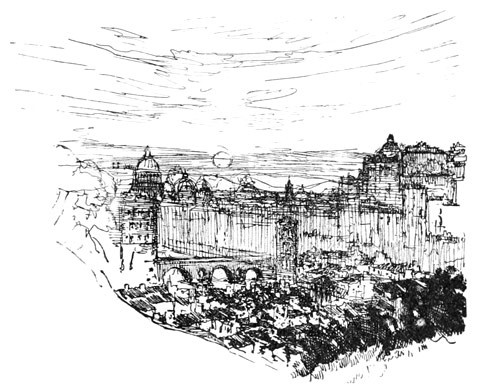
FROM THE AVENTINE.
But she had her compensations. She had her little glory, too, in the books which went forth from that seclusion in Bethlehem, bearing her name, inscribed to her and her child by the greatest writer of the time. "You, Paula and Eustochium, who have studied so deeply the books of the Hebrews, take it, this book of Esther, and test it word by word; you can tell whether anything is added, anything withdrawn: and can bear faithful witness whether I have rendered aright in Latin this Hebrew history." Few women would despise such a tribute, and fewer still the place of these two women in the Paradise of that laborious study, and at the doors of that beautiful Hospice on the Jerusalem road, where Joseph and Mary had they but come again would have run no risk of finding room!
They died all three, one after another, and were laid to rest in the pure and wholesome rock near the sacred spot of the Nativity. There is a touching story told of how Eustochium, after her mother's death, when Jerome was overwhelmed with grief and unable to return to any of his former occupations, came to him with the book of Ruth still untranslated in her hand, at once a promise and an entreaty. "Where thou goest I will go. Where thou dwellest I will dwell"—and a continuation at the same time of the blessed work which kept their souls alive.
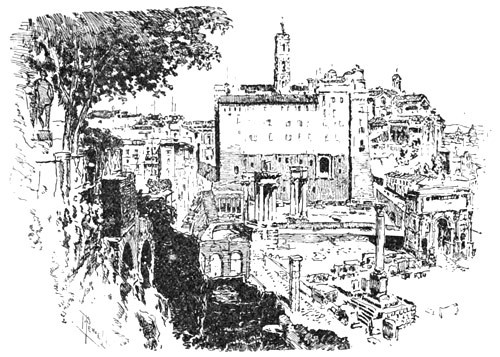
THE CAPITOL FROM THE PALATINE.
CHAPTER VI.
THE MOTHER HOUSE.
Amid all these changes the house on the Aventine—the mother house as it would be called in modern parlance—went on in busy quiet, no longer visible in that fierce light which beats upon the path of such a man as Jerome, doing its quiet work steadily, having a hand in many things, most of them beneficent, which went on in Rome. Albina the mother of Marcella, and Asella her elder sister, died in peace: and younger souls, with more stirring episodes of life, disturbed and enlivened the peace of the cloister, which yet was no cloister but open to all the influences of life, maintaining a large correspondence and much and varied intercourse with the society of the times. In the first fervour of the settlement in Bethlehem both Paula and Jerome (she by his hand) wrote to Marcella urging her to join them, to forsake the world in a manner more complete than she had yet done. "... You were the first to kindle the fire in us" (the letter is nominally from Paula and Eustochium): "the first by precept and example to urge us to adopt our present life. As a hen gathers her chickens, who fear the hawk and tremble at every shadow of a bird, so did you take us under your wing. And will you now let us fly about at random with no mother near us?"
This letter is full not only of affectionate entreaties but of delightful pictures of their own retired and peaceful life. "How shall I describe to you," the writer says, "the little cave of Christ, the hostel of Mary? Silence is more respectful than words, which are inadequate to speak its praise. There are no lines of noble colonnades, no walls decorated by the sweat of the poor and the labour of convicts, no gilded roofs to intercept the sky. Behold in this poor crevice of the earth, in a fissure of the rock, the builder of the firmament was born." She goes on with touching eloquence to put forth every argument to move her friend.
Read the Apocalypse of St. John and see there what he says of the woman clothed in scarlet, on whose forehead is written blasphemy, and of her seven hills, and many waters, and the end of Babylon. "Come out of her, my people," the Lord says, "that ye be not partakers of her sins." There is indeed there a holy Church; there are the trophies of apostles and martyrs, the true confession of Christ, the faith preached by the apostles, and heathendom trampled under foot, and the name of Christian every day raising itself on high. But its ambition, its power, the greatness of the city, the need of seeing and being seen, of greeting and being greeted, of praising and detracting, hearing or talking, of seeing, even against one's will, all the crowds of the world—these things are alien to the monastic profession and they have spoiled Rome, they all oppose an insurmountable obstacle to the quiet of the true monk. People visit you: if you open your doors, farewell to silence: if you close them, you are proud and unfriendly. If you return their politeness, it is through proud portals, through a host of grumbling insolent lackeys. But in the cottage of Christ all is simple, all is rustic: except the Psalms, all is silence: no frivolous talk disturbs you, the ploughman sings Allelujah as he follows his plough, the reaper covered with sweat refreshes himself with chanting a psalm, and it is David who supplies with a song the vine dresser among his vineyards. These are the songs of the country, its ditties of love, played upon the shepherd's flute. Will the time never come when a breathless courier will bring us the good news, your Marcella has landed in Palestine? What a cry of joy among the choirs of the monks, among all the bands of the virgins! In our excitement we wait for no carriage but go on foot to meet you, to clasp your hand, to look upon your face. When will the day come when we shall enter together the birthplace of Christ: when, leaning over the divine sepulchre, we weep with a sister, a mother, when our lips touch together the sacred wood of the Cross: when on the Mount of Olives our hearts and souls rise together in the rising of our Lord? Would not you see Lazarus coming out of his tomb, bound in his shroud? and the waters of Jordan purified for the washing of the Lord? Then we shall hasten to the shepherds' folds, and pray at the tomb of David. Listen, it is the prophet Amos blowing his shepherd's horn from the height of his rock; we shall see the monuments of Abraham, Isaac and Jacob, and the three famous women, and Samaria and Nazareth, the flower of Galilee, and Shiloh and Bethel and other holy places, accompanied by Christ, where churches rise everywhere like standards of the victories of Christ. And when we return to our cavern we will sing together always, and sometimes we shall weep; our hearts wounded with the arrow of the Lord, we will say one to another, "I have found Him whom my soul loveth; I will hold Him, and will not let Him go!"
Similar words upon the happiness of rural life and retirement Jerome had addressed to Marcella before. He had warned her of the danger of the tumultuous sea of life, and how the frail bark, beaten by the waves, ought to seek the shelter of the port before the last hurricane breaks. The image was even more true than he imagined; but it was not of the perils of Rome in the dreadful time of war and siege which was approaching that he spoke, but of the usual dangers of common life to the piety of the recluse. "The port which we offer you, it is the solitude of the fields," he says:
Brown bread, herbs watered by our own hands, and milk, the daintiest of the country, supply our rustic feasts. We have no fear of drowsiness in prayer or heaviness in our readings, on such fare. In summer we seek the shade of our trees; in autumn the mild weather and pure air invite us to rest on a bed of fallen leaves; in spring, when the fields are painted with flowers, we sing our psalms among the birds. When winter comes, with its chills and snows, the wood of the nearest forest supplies our fire. Let Rome keep her tumults, her cruel arena, her mad circus, her luxurious theatres; let the senate of matrons pay its daily visits. It is good for us to cleave to the Lord and to put all our hope in Him.
But Marcella turned a deaf ear to these entreaties. Perhaps she still loved the senate of matrons, the meetings of the Souls, the irruption of gentle visitors, the murmur of all the stories of Rome, and the delicate difficulties of marriage and re-marriage brought to her for advice and guidance. The allusions in both these letters point to such a conclusion, and there is no reason why it should not have been so. The Superior of a convent has in this fashion in much later days fulfilled more important uses than the gentle nun of the fields. At all events this lady remained in her home, her natural place, and continued to pour forth her bounty upon the poor of her native city: which many would agree was perhaps the better, though it certainly was not the safer, way. The death of her mother, which made a change in her life, and might have justified a still greater breaking up of all old customs and ties, was perhaps the occasion of these affectionate arguments; but Marcella would herself be no longer young and in a position much resembling that of a mother in her own person, the trusted friend of many in Rome, and their closest tie to a more spiritual and better life. The light of such a guest as Jerome, attracting all eyes to the house and bringing it within the records of literary history, that sole mode of saving the daily life of a household from oblivion—had indeed died away, leaving life perhaps a little flat and blank, certainly much less agitated and visible to the outer world than when he was pouring forth fire and flame upon every adversary from within the shelter of its peaceful walls. But no other change had happened in the circumstances under which Marcella opened her palace to a few consecrated sisters, and made it a general oratory and place of pious counsel and retreat for the ladies of Rome. The same devout readings, the same singing of psalms (sometimes in the original), the same life of mingled piety and intellectualism must have gone on as before: and other fine ladies perhaps not less interesting than Paula must have sought with their confessions and confidences the ear of the experienced woman, who as Paula says in respect to herself and her daughters, "first carried the sparkle of light to our hearts, and collected us like chickens under your wing." She was the same, "our gentle, our sweet Marcella, sweeter than honey," open to every charity and kindness: not refusing, it would seem, to visit as well as to be visited, and willing to "live the life" without forsaking any ordinary bonds or traditions of existence. There is less to tell of her for this reason, but not perhaps less to praise.
Marcella had her share no doubt in forming the minds of the two younger spirits, vowed from their cradle to the perfect life of virginhood, the second Paula, daughter of Toxotius and his Christian wife; and the younger Melania, daughter also of the son whom his mother had abandoned as an infant. It is a curious answer to the stern virtue which reproaches these two Roman ladies with the cruel desertion of their children, to find that both those children, grown men, permitted or encouraged the vocation of their daughters, and were proud of the saintly renown of the mothers who had left them to their fate. The consecrated daughters however leave only a faint trace as of two spotless catechumens in the story. Incidents of a more exciting character broke now and then the calm of life in the palace on the Aventine. M. Thierry in his life of Jerome gives us perhaps a sketch too entertaining of Fabiola, one of the ladies more or less associated with the house of Marcella, a constant visitor, a penitent by times, an enthusiast in charity, a woman bent on making, or so it seemed, the best of both worlds. She had made early what for want of a better expression we may call a love match, in which she had been bitterly disappointed. That a divorce should follow was both natural and lawful in the opinion of the time, and Fabiola had already formed a new attachment and made haste to marry again. But the second marriage was a disappointment even greater than the first, and this repeated failure seems to have confused and excited her mind to issues by no means clear at first, probably even to herself. She made in the distraction of her life a sudden and unannounced visit to Paula's convent at Bethlehem, where she was a welcome and delightful visitor, carrying with her all the personal news that cannot be put into writing, and the gracious ways of an accomplished woman of the world. She is supposed to have had a private object of her own under this visit of friendship, but the atmosphere and occupations of the place must have overawed Fabiola, and though her object was hidden in an artful web of fiction she was not bold enough to reveal it, either to the stern Jerome or the mild Paula. What she did was to make herself delightful to both in the little society upon which we have so many side-lights, and which doubtless, though so laborious and full of privations, was a very delightful society, none better, with such a man as Jerome, full of intellectual power, and human experience, at its head, and ladies of the highest breeding like Paula and her daughter to regulate its simple habits. We are told of one pretty scene where—amid the talk which no doubt ran upon the happiness of that peaceful life amid the pleasant fields where the favoured shepherds heard the angels' song—there suddenly rose the voice of the new-comer reciting with the most enchanting flattery a certain famous letter which Jerome long before had written to his friend Heliodorus and which had been read in all the convents and passed from hand to hand as a chef d'œuvre of literary beauty and sacred enthusiasm. Fabiola, quick and adroit and emotional, had learned it by heart, and Jerome would have been more than man had he not felt the charm of such flattery.
For a moment the susceptible Roman seems to have felt that she had attained the haven of peace after her disturbed and agitated life. Her hand was full and her heart generous: she spread her charities far and wide among poor pilgrims and poor residents with that undoubting liberality which considered almsgiving as one of the first of Christian duties. But whether the little busy society palled after a time, or whether it was the great scare of the rumour that the Huns were coming that frightened Fabiola, we cannot tell, nor precisely how long her stay was. Her coming and going were at least within the space of two years. She was not made to settle down to the revision of manuscripts like her friends, though she had dipped like them into Hebrew and had a pretty show of knowledge. She would seem to have evidenced this however more by curious and somewhat frivolous questions than by any assistance given in the work which was going on. Nothing could be more kind, more paternal, than Jerome to the little band of women round him. He complains, it is true, that Fabiola sometimes propounded problems and did not wait for an answer, and that occasionally he had to reply that he did not know, when she puzzled him with this rapid stream of inquiry. But it is evident also that he did his best sincerely to satisfy her curiosity as if it had been the sincerest thing in the world. For instance, she was seized with a desire to know the symbolical meaning of the costume of the high priest among the Jews: and to gratify this desire Jerome occupied a whole night in dictating to one of his scribes a little treatise on the subject, which probably the fine lady scarcely took time to read. Nothing can be more characteristic than the indications of this bright and charming visitor, throwing out reflections of all that was going on round her, so brilliant that they seemed better than the reality, fluttering upon the surface of their lives, bringing all under her spell.
There seems but little ground however for the supposition of M. Thierry that it was in the interest of Fabiola that Amandus, a priest in Rome, wrote a letter laying before Jerome a case of conscience, that of a woman who had divorced her husband and married again, and who now was troubled in her mind as to her duty; whether the second husband was wholly unlawful, and whether she could remain in full communion with the Church, having made this marriage? If she was the person referred to no one has been able to divulge what the question meant—whether she had a third marriage in her mind, or if a wholly unnecessary fit of compunction had seized her; for as a matter of fact she had never been subjected by the Church to any pains or penalties in consequence of her second marriage. Jerome however, as might have been expected of him, gave forth no uncertain sound in his reply. According to the Church, he said, there could be but one husband, the first. Whatever had been his unworthiness, to replace him by another was to live in sin. Whether it was this answer which decided her action, or whether she had been moved by the powerful fellowship of Bethlehem to renounce the more agitating course of worldly life, at least it is certain that Fabiola's career was changed from this time. Perhaps it was her desire to shake off the second husband which moved her. At all events on her return to Rome she announced to the bishop that she felt herself guilty of a great sin, and that she desired to make public penance for the same.
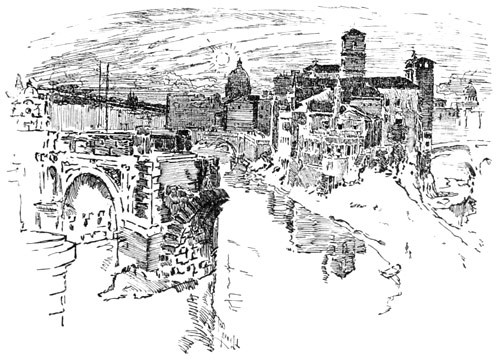
SAN BARTOLOMMEO.
Accordingly on the eve of Easter, when the penitents assembled under the porch of the great Church of St. John Lateran, amid all the wild and haggard figures appearing there, murderers and criminals of all kinds, the delicate Fabiola, with her hair hanging about her shoulders, ashes on her head and on the dark robe that covered her, her face pale with fasting and tears, stood among them, a sight for the world. Under many aspects had all Rome seen this daughter of the great Fabian race, in the splendour of her worldly espousals, and at all the great spectacles and entertainments of a city given up to display and amusement. Her jewels, her splendid dresses, her fine equipages, were well known. With what curiosity would all her old admirers, her rivals in splendour, those who had envied her luxury and high place, gather to see her now in her voluntary humiliation, descending to the level of the very lowest as she had hitherto been on the very highest apex of society! All Rome we are told was there, gazing, wondering, tracing her movements under the portico, among these unaccustomed companions. Perhaps there might be a supreme fantastic satisfaction to the penitent—with that craving for sensation which the exhaustion of all kinds of triumphs and pleasures brings—in thus stepping from one extreme to the other, a gratification in the thought that Rome which had worshipped her beauty and splendour was now gazing aghast at her bare feet and dishevelled hair. One can have no doubt of the sensation experienced by the Tota urbe spectante Romana. It was worth while frequenting religious ceremonies when such a sight was possible! Fabiola,—once with mincing steps, and gorgeous liveried servants on either hand, descending languidly the great marble steps from her palace to the gilded carriage in which she sank fatigued when that brief course was over, the mitella blazing with gold upon her head, her robe woven with all the tints of the rainbow into metallic splendour of gold and silver threads. And now to see her amid that crowd of ruffians from the Campagna, and unhappy women from the purlieus of the city, her splendid head uncovered, her thin hands crossed in the rough sleeves of the penitent's gown! It might be to some perhaps a salutary sight—moving other great ladies with heavier sins on their heads than Fabiola's to feel the prickings of remorse; though no doubt it is equally possible that they might think they saw through her, and the new form of self-exhibition which attracted all the world to gaze. We are not told whether Fabiola found refuge in the house on the Aventine with Marcella, who had lit the fire of Christian faith in her heart as well as in that of Paula: or whether she remained, like Marcella, in her own house, making it another centre of good works. But at all events her life from this moment was entirely given up to charity and spiritual things. Her kinsfolk and noble neighbours still more or less Pagan, were filled with fury and indignation and that sharp disgust at the loss of so much good money to the world, which had so much to do in embittering opposition: but the Christians were deeply impressed, the homage of such a great lady to the faith, and her recantation of her errors affecting many as a true martyrdom.
If it was really compunction for the sin of the second marriage which so moved her, her position would much resemble that of the fine fleur of French society as at present constituted, in its tremendous opposition to the law of divorce, now lawful in France of the nineteenth century as it was in Rome of the fourth—but resisted with a splendid bigotry of feeling, altogether independent of morality or even of reason, by all that is noblest in the country. Fabiola's divorce had been perfectly lawful and according to all the teaching and traditions of her time. The Church had as yet uplifted no voice against it. She had not been shut out from the society even of the most pious, or condemned to any penance or deprivation. Not even Jerome (till forced to give a categorical answer), nor that purest circle of devout women at Bethlehem, had refused her any privilege. Her action was unique and unprecedented as a protest against the existing law of the land, as well as universal custom and tradition. We are not informed whether it had any lasting effect, or formed a precedent for other women. No doubt it encouraged the formation of the laws against divorce which originated in the Church itself but have held through the intervening ages a doubtful sway, broken on every side by Papal dispensations, until now that they have settled down into a bond of iron on the consciences of the devout—chiefly the women, more specially still the gentlewomen—of Catholic Europe, where as in Fabiola's time they are once more against the law of the land.
The unworthy second husband we are informed had died even before Fabiola's public act of penitence; but no further movements towards the world, or the commoner ways of life reveal themselves in her future career. If she returned to life with the veiled head and bare feet of her penitence, or if she resumed, like Marcella, much of the ordinary traffic of society, we have no information. But she was the founder of the first public hospital in Rome, besides the usual monasteries, and built in concert with Pammachius a hospice at Ostia at the mouth of the Tiber, where strangers and travellers from all parts of the world were received, probably on the model of that hospice for pilgrims which Paula had established. And she was herself the foremost nurse in her own hospital, shrinking from no office of charity. The Church has always and in all circumstances encouraged such practical acts of self-devotion.
The ladies of the Aventine and all the friends of Jerome had been disturbed a little before by the arrival of a stranger in Rome, also a pretended friend of Jerome, and at first very willing to shelter himself under that title, Rufinus, who brought with him—after a moment of delusive amiability during which he had almost deceived the very elect themselves—a blast of those wild gales of polemical warfare which had been echoing for some time with sacrilegious force and inappropriateness from the Mount of Olives itself. The excitement which he raised in Rome in respect to the doctrines of Origen caused much commotion in the community, which lived as much by news of the Church and reports of all that was going on in theology as by the daily bread of their charities and kindness. It was to Marcella that Jerome wrote, when, reports having been made to him of all that had happened, he exploded, with the flaming bomb of his furious rhetoric, the fictitious statements of Rufinus, by which he was made to appear a supporter of Origen. Into that hot and fierce controversy we have no need to enter. No one can study the life of Jerome without becoming acquainted with this episode and finding out how much the wrath of a Father of the Church is like the rage of other men, if not more violent; but happily as Rome was not the birthplace of this fierce quarrel it is quite immaterial to our subject or story. It filled the house of Marcella with trouble and doubt for a time, with indignation afterwards when the facts of the controversy were better known; but interesting as it must have been to the eager theologians there, filling their halls with endless discussions and alarms, lest this new agitation should interfere with the repose of their friend, it is no longer interesting except to the student now. Rufinus was finally unmasked, and condemned by the Bishop of Rome, chiefly by the exertions of Marcella, whom Oceanus, coming hot from the scene of the controversy, and Paulinian the brother of Jerome, had instructed in his true character. Events were many at this moment in that little Christian society. The tumult of controversy thus excited and all the heat and passion it brought with it had scarcely blown aside, when the ears of the Roman world were made to tingle with the wonderful story of Fabiola, and the crowd flew to behold in the portico of the Lateran her strange appearance as a penitent; and the commotion of that event had scarcely subsided when another wonderful incident appears in the contemporary history filling the house with lamentation and woe.
The young Paulina, dear on all accounts to the ladies of the Aventine as her mother's daughter, and as her husband's wife (for Pammachius, the friend and schoolfellow of Jerome, was one of the fast friends and counsellors of the community), as well as for her own virtues, died in the flower of life and happiness, a rich and noble young matron exhibiting in her own home and amid the common duties of existence, all the noblest principles of the Christian faith. She had not chosen what these consecrated women considered as the better way: but in her own method, and amid a world lying in wickedness, had unfolded that white flower of a blameless life which even monks and nuns were thankful to acknowledge as capable of existing here and there in the midst of worldly splendours and occupations. She left no children behind her, so that her husband Pammachius was free of the anxieties and troubles, as well as of the joy and pride, of a family to regulate and provide for. His young wife left to him all her property on condition that it should be distributed among the poor, and when he had fulfilled this bequest the sorrowful husband himself retired from life, and entered a convent, in obedience to the strong impulse which swayed so many. Before this occurred however "all Rome" was roused by another great spectacle. The entire city was invited to the funeral of Paulina as if it had been to her marriage, though those who came were not the same wondering circles who crowded round the Lateran gate to see Fabiola in her humiliation. It was the poor of Rome who were called by sound of trumpet in every street, to assemble around the great Church of St. Peter, where were those tombs of the Apostles which every Christian visited as the most sacred of shrines, and where Paulina was laid forth upon her bier, the mistress of the feast. The custom was an old one, and chambers for these funeral repasts were attached to the great catacombs and all places of burial. The funeral feast of Paulina however meant more than ordinary celebrations of the kind, as the place in which it was held was more impressive and imposing than an ordinary sepulchre however splendid. She must have been carried through the streets in solemn procession, from the heights on which stood the palaces of her ancient race, across the bridge, and by the tomb of Hadrian to that great basilica where the Apostles lay, her husband and his friends following the bier: and in all likelihood Marcella and her train were also there, replacing the distant mother. St. Peter's it is unnecessary to say was not the St. Peter's we know; but it was even then a great basilica, with wide extending porticoes and squares, and lofty roof, though the building was scarcely quite detached from the rock out of which the back part of the cathedral had been hewn.
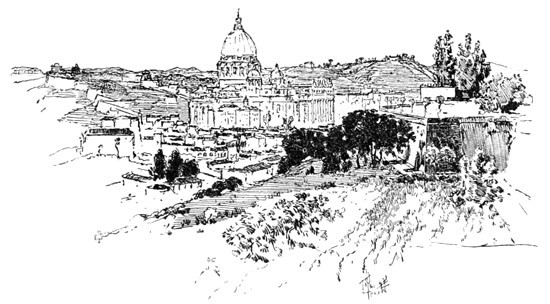
ST. PETER'S, FROM THE JANICULUM.
Many strange sights have been seen in that spot which once was the centre of the civilised world, and this which seems to us one of the strangest was in no way unusual or against the traditions of the age in which it occurred. The church itself, and all its surroundings, nave and aisles and porticoes, and the square beyond, were filled with tables, and to these from all the four quarters of Rome, from the circus and the benches of the Colosseum, where the wretched slept and lurked, from the sunny pavements, and all the dens and haunts of the poor by the side of the Tiber, the crowds poured, in those unconceivable yet picturesque rags which clothe the wretchedness of the South. They were ushered solemnly to their seats, the awe of the place, let us hope, quieting the voices of a profane and degraded populace, and overpowering the whispering, rustling, many-coloured multitude. Outside the later comers would be more unrestrained, and the roar, even though subdued, of thronging humanity must have come in strangely to the silence of the great church, and of the mourners, bent upon doing Paulina honour in this curious way. Did she lie there uplifted on her high bier to receive her guests? Or was the heart-broken Pammachius the host, standing pale upon the steps, over the grave of the Apostles? When they were "saturated" with food and wine, the first assembly left their places and were succeeded by another, each as he went away receiving from the hands of Pammachius himself a sum of money and a new garment. "Happy giver, unwearied distributor!" says the record. The livelong day this process went on; a winter day in Rome, not always warm, not always genial, very cold outside in the square under the evening breeze, and no doubt growing more and more noisy as one band continued to succeed another, and the first fed lingered about comparing their gifts, and hoping perhaps for some remnants to be collected at the end from the abundant and oft-renewed meal. There were no doubts in anybody's mind, as we have said, about encouraging pauperism or demoralising the recipients of these gifts; perhaps it would have been difficult to demoralise further that mendicant crowd. But one cannot help wondering how the peace was kept, whether there were soldiers or some manner of classical police about to keep order, or if the disgusted Senators would have to bestir themselves to prevent this wild Christian carnival of sorrow and charity from becoming a danger to the public peace.
We are told that it was the sale of Paulina's jewels, and her splendid toilettes which provided the cost of this extraordinary funeral feast. "The beautiful dresses woven with threads of gold were turned into warm robes of wool to cover the naked; the gems that adorned her neck and her hair filled the hungry with good things." Poor Paulina! She had worn her finery very modestly according to all reports; it had served no purposes of coquetry. The reader feels that something more congenial than that coarse and noisy crowd filling the church with its deformities and loathsomeness might have celebrated her burial. But not so was the feeling of the time; that they were more miserable than words could say, vile, noisome, and unclean, formed their claim of right to all these gifts—a claim from which their noisy and rude profanity, their hoarse blasphemy and ingratitude took nothing away. Charity was more robust in the early centuries than in our fastidious days. "If such had been all the feasts spread for thee by thy Senators," cried Bishop Paulinus, the historian of this episode, "oh Rome thou might'st have escaped the evils denounced against thee in the Apocalypse." We must remember that whatever might have been the opinion later, there was no doubt in any Christian mind in the fourth century that Rome was the Scarlet Woman of the Revelation of St. John, and that a dreadful fate was to overwhelm her luxury and pride.
Pammachius, when he had fulfilled the wishes of his wife in this way, thrilling the hearts of the mourning mother and sister in Bethlehem with sad gratification, and edifying the anxious spectators on the Aventine, carried out her will to its final end by becoming a monk, but with the curious mixture of devotion and independence common at the time, retired to no cloister, but lived in his own house, fulfilling his duties, and appearing even in the Senate in the gown and cowl so unlike the splendid garb of the day. He was no doubt one of the members for the poor in that august but scarcely active assembly, and occupied henceforward all his leisure in works of charity and religious organisations, in building religious houses, and protecting Christians in every necessity of life.
We have said that Rome in these days was as freely identified with the Scarlet Woman of the Apocalypse as ever was done by any Reformer or Puritan in later times. To Jerome she was as much Babylon, and as damnable and guilty in every way as if he had been an Orangeman or Covenanter. Mildness was not general either in speech or thought: it has seldom been so perhaps in religious controversy. It is curious indeed to mark how, so near the fount of Christianity, the Church had already come to rend itself with questions of doctrine, and expend on discussions of philosophical subtlety the force that was wanted for the moral advantage of the world. But that no doubt was one of the defects of the great principle of self-devotion which aimed at emptying the mind of everything worldly and practical, and fixing it entirely upon spiritual subjects, thus substituting them for the ruder obstacles which occupied in common life the ruder forces of nature.
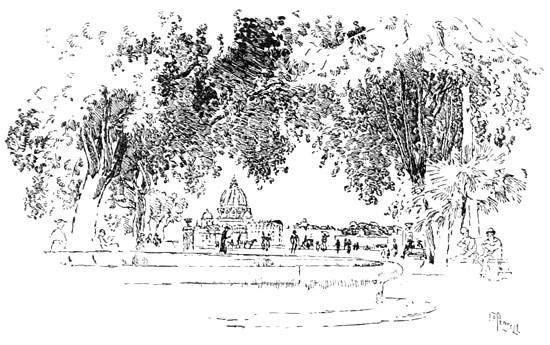
ST. PETER'S, FROM THE PINCIO.
All things however were now moving swiftly towards one of the great catastrophes of the ages. Though Christianity was young, the entire system of the world's government was old and drawing towards its fall. Rome was dead, or virtually so, and all the old prestige, the old pride and pretension of her race, were perishing miserably in those last vulgarities of luxury and display which were all that was left to her. It is no doubt true that the crumbling of all common ties which took place within her bosom, under the invasion of the monkish missionaries from the East, and the influence of Athanasius, Jerome, and others—had been for some time undermining her unity, and that the rent between that portion of the aristocracy of Rome which still held by the crumbling system of Paganism, and those who had adopted the new faith, was now complete. Rome which had been the seat of empire, the centre from which law and power had gone out over all the earth, the very impersonation of the highest forces of humanity, the pride of life, the eminence of family and blood—now saw her highest names subjected voluntarily to strange new laws of humiliation, whole households trooping silently away in the garb of servants to the desert somewhere, to the Holy Land on pilgrimages, or living a life of hardship and privation and detachment from all public interests, in the very palaces which had once been the seats of authority. Her patricians moved silent about the streets in the rude sandals and mean robes of the monk: her great ladies drove forth no longer resplendent as Venus on her car, but stood like penitent Magdalenes upon the steps of a church; and bridegroom and bride no longer linked with flowery garlands, but with the knotted cord of monastic rule, lived like vestals side by side. What was to come to a society so broken up and undermined, knowing no salvation save in its own complete undoing, preparing unconsciously for some convulsion at hand? The interpreter of the dark sayings of prophecy goes on through one lingering age after another, holding the threats of divine justice as still and always unfulfilled, and will never be content that it is any other than the present economy which is marked with the curse and threatened with the ruin of Apocalyptic denunciations. But no one could doubt that the wine was red in that cup of the wrath of God which the city of so many sins held in her hand. The voice that called "Come out of her, my people," had rung aloud in tones unmistakable, calling the best of her sons and daughters from her side; her natural weapons had fallen from her nerveless hands; she had no longer any heart even to defend herself, she who had once but to lift her hand and the air had tingled to the very boundaries of the known world as if a blazing sword had been drawn. It requires but little imagination to appropriate to the condition of Rome on the eve of the invasion of Alaric every strophe of the magnificent ode in the eighteenth chapter of Revelation. There are reminiscences in that great poem of another, of the rousing of Hell to meet the king of the former Babylon echoing out of the mists of antiquity from the lips of the Hebrew prophet. Once more that cry was in the air—once more the thrill of approaching destruction was like the quiver of heat in the great atmosphere of celestial blue which encircled the white roofs, the shining temples, the old forums as yet untouched, and the new basilicas as yet scarce completed, of Rome. The old order was about to change finally, giving place to the new.
All becomes confused in the velocity and precipitation of descending ruin. We can trace the last hours of Paula dying safe and quiet in her retreat at Bethlehem, and even of the less gentle Melania; but when we attempt to follow the course of the events which overwhelmed the home of early faith on the Aventine, the confusion of storm and sack and horrible sufferings and terror fills the air with blackness. For years there had existed a constant succession of danger and reprieve, of threatening hosts (the so-called friends not much better than the enemies) around the walls of the doomed city, great figures of conquerors with their armies coming and going, now the barbarian, now the Roman general upon the height of the wave of battle, the city escaping by a hair's breadth, then plunged into terror again. And Marcella's house had suffered with the rest. No doubt much of the gaiety, the delightful intellectualism of that pleasant refuge, had departed with the altering time. Age had subdued the liveliness and brightness of a community still full of the correspondences, the much letter-writing which women love. Marcella's companions had died away from her side; life was more quickly exhausted in these days of agitation, and she herself, the young and brilliant founder of that community of Souls, must have been sixty or more when the terrible Alaric, a scourge of God like his predecessor Attila, approached Rome. What had become of the rest we are not told, or if the relics of the community, nameless in their age and lessened importance, were still there: the only one that is mentioned is a young sister called Principia, her adopted child and attendant. Nothing can be more likely than that the remainder of the community had fled, seeking safety, or more likely an unknown death, in less conspicuous quarters of the city than the great palace of the Aventine with its patrician air of wealth and possible treasure. In that great house, so far as appears, remained only its mistress, her soul wound up for any martyrdom, and the girl who clung to her. If they dared to look forth at all from the marble terrace where so often they must have gazed over Rome shining white in the sunshine in all her measured lines and great proportions, her columns and her domes, what a dread scene must have met their eyes, clouds of smoke and wild gleams of flame, and the roar of outcry and slaughter mounting up into the air, soiling the very sky. There the greatest ladies of Rome had come in their grandeur to enjoy the piquant contrast and the still more piquant talk, the philosophies which they loved to penetrate and understand, the learning which went over their heads. There Jerome, surrounded with soft flatteries and provocations, had talked his best, giving forth out of his stores the tales of wonder he had brought from Eastern cells and caves and all the knowledge of the schools, to dazzle the amateurs of the Roman gynæceum. What gay, what thrilling, what happy memories!—mingled with the sweetness of remembrance of gentle Paula who was dead, of Asella dead, of Fabiola in all her fascinations and caprices, dead too so far as appears—and no doubt in those thirty years since first Marcella opened her house to the special service of God, many more; till now that she was left alone, grey-headed, on that height whither the fierce Goths were coming, raging, flashing round them fire and flame, with the girl who would not leave her, the young maiden in her voiceless meekness whom we see only at this awful moment, she who might have a sharper agony than death before her, the most appalling of martyrdoms.
One final triumph however remained for Marcella. By what wonderful means we know not, by her prayers and tears, by supplication on her knees, to the rude Goths who after their sort were Christians, and sometimes spared the helpless victims and sometimes listened to a woman's prayer, she succeeded in saving her young companion from outrage, and in dragging her somehow to the shelter of the nearest church, where they were safe. But she was herself in her age and weakness, tortured, flogged, and treated with the utmost cruelty, that she might disclose the hiding-place in which she had put her treasure. The treasure of the house of the Aventine was not there: it had fed the poor, and supplied the wants of the sick in all the most miserable corners of Rome. The kicks and blows of the baffled plunderers could not bring that long-expended gold and silver together again. But these sufferings were as nothing in comparison to the holy triumph of saving young Principia, which was the last and not the least wonderful work of her life. The very soldiers who had struck and beaten the mistress of the desolate house were overcome by her patience and valour, "Christ softened their hard hearts," says Jerome. "The barbarians conveyed both you and her to the basilica that you might find a place of safety or at least a tomb." Nothing can be more extraordinary in the midst of this awful scene of carnage and rapine than to know that the churches were sanctuaries upon which the rudest assailants dared not to lift a hand, and that the helpless women, half dead of fright and one of them bleeding and wounded with the cruel treatment she had received, were safe as soon as they had been dragged over the sacred threshold.
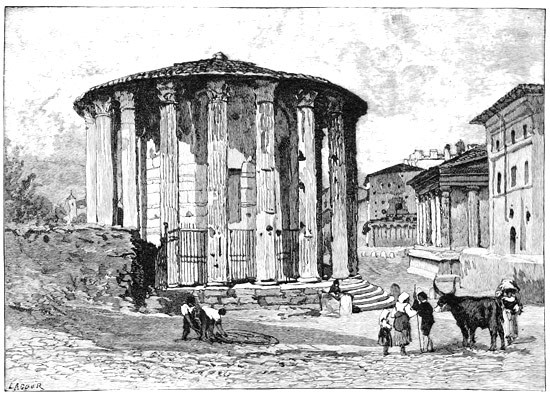
TEMPLE OF VESTA.
To face page 110.
The church in which Marcella and her young companion found shelter was the great basilica of St. Paul fuori le mura, beyond the Ostian gate. They were conducted there by their captors themselves, some compassionate Gaul or Frank, whose rude chivalry of soul had been touched by the spectacle of the aged lady's struggle for her child. What a terrible flight through the darkness must that have been "in the lost battle borne down by the flying" amid the trains of trembling fugitives all bent on that one spot of safety, the gloom lighted up by the gleams of the burning city behind, the air full of shrieks and cries of the helpless, the Tiber rushing swift and strong by the path to swallow any helpless wayfarer pushed aside by stronger fugitives. The two ladies reached half-dead the great church on the edge of the Campagna, the last refuge of the miserable, into which were crowded the wrecks of Roman society, both Pagan and Christian, patrician and slave, hustled together in the equality of doom. A few days after, in the church itself, or some of its dependencies, Marcella died. Her palace in ruins, her companions dead or fled, she perished along with the old Rome against whose vices she had protested, but which she had loved and would not abandon: whose poor she had fed with her substance, whose society she had attempted to purify, and in which she had led so honourable and noble—may we not also believe amid all her austerities, in the brown gown which was almost a scandal, and the meagre meals that scarcely kept body and soul together?—so happy a life. There is no trace now of the noble mansion which she devoted to so high a purpose, and few of the many pilgrims who love to discover all that is interesting in the relics of Rome, have even heard the name of Marcella—"Illam mitem, illam suavem, illam omni melle et dulcedine dulciorem"—whose example "lured to higher worlds and led the way." But her pleasant memory lingers on the leafy crest of the Aventine where she lived, and where the church of Sta. Sabina now stands: and her mild shadow lies on that great church outside the gates, often destroyed, often restored, the shrine of Paul the Apostle, where, wounded and broken, but always faithful to her trust, she died. The history of the first dedicated household, the first convent, the ecclesia domestica, which was so bright a centre of life in the old Rome, not yet entirely Christian, is thus rounded into a perfect record. It began in 380 or thereabouts, it ended in 410. Its story is but an obscure chapter in the troubled chronicles of the time; but there is none more spotless, and scarcely any so serenely radiant and bright.
Pammachius also died in the siege, whether among the defenders of the city or in the general carnage is not known, "with many other brothers and sisters whose death is announced to us" Jerome says, whom that dreadful news threw into a stupor of horror and misery, so that it was some time before he could understand the details or discover who was saved and who lost. The saved indeed were very few, and the losses many. Young Paula, the granddaughter of the first, the child of Toxotius, who also was happily dead before these horrors, had been for some years in Bethlehem peacefully learning how to take the elder Paula's place, and shedding sweetness into the life of the old prophet in his rocky chamber at Bethlehem, and of the grave Eustochium in her convent. Young Melania, standing in the same relationship to the heroine of that name, whose fame is less sweet, was out of harm's way too. They and many humbler members of the community had escaped by flight, among the agitated crowds which had long been pouring out of Italy towards the East, some from mere panic, some by the vows of self-dedication and retirement from the world. Many more as has been seen escaped in Rome itself, before its agony began, by the still more effectual way of death. Only Marcella, the first of all, the pupil of Athanasius, the mother and mistress of so many consecrated souls, fell on the outraged threshold of her own house, over which she had come and gone for thirty years, with those feet that are beautiful on the mountains, the feet of those who bring good tidings, and carry charity and loving kindness to every door.
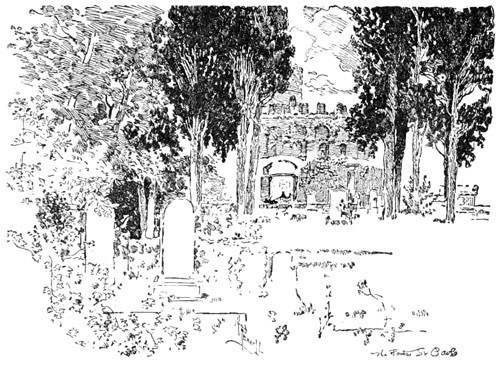
PORTA SAN PAOLO.
BOOK II.
THE POPES WHO MADE THE PAPACY.
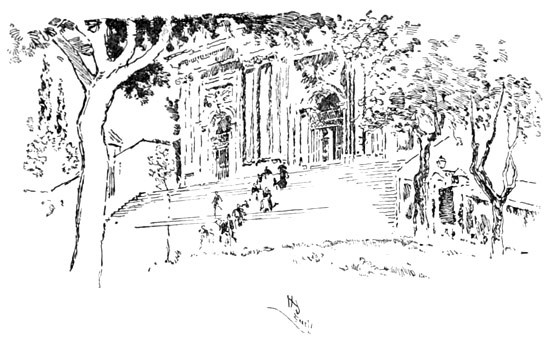
THE STEPS OF SAN GREGORIO.
BOOK II.
THE POPES WHO MADE THE PAPACY.
CHAPTER I.
GREGORY THE GREAT.
When Rome had fallen into the last depths of decadence, luxury, weakness, and vice, the time of fierce and fiery trial came. The great city lay like a helpless woman at the mercy of her foes—or rather at the mercy of every new invader who chose to sack her palaces and throw down her walls, without even the pretext of any quarrel against the too wealthy and luxurious city, which had been for her last period at least nobody's enemy but her own. Alaric, who, not content with the heaviest ransom, returned to rage through her streets with all those horrors and cruelties which no advance in civilisation has ever yet entirely dissociated from the terrible name of siege: Attila, whose fear of his predecessor's fate and the common report of murders and portents, St. Peter with a sword of flame guarding his city, and other signs calculated to melt the hearts of the very Huns in their bosoms, kept at a distance: passed by without harming the prostrate city. But Genseric and his Vandals were kept back by no such terrors. The ancient Rome, with all her magnificent relics of the imperial age, fell into ruin and was trampled under foot by victor after victor in the fierce license of barbarous triumph. Her secret stores of treasure, her gold and silver, her magnificent robes, her treasures of art fell, like her beautiful buildings, into the rude hands which respected nothing, neither beauty nor the traditions of a glorious past. How doth the city sit solitary that was full of people! All the pathetic and wonderful plaints of the Hebrew prophet over a still holier and more ancient place, trodden under foot and turned into a desert, rise to the mind during this passion and agony of imperial Rome. But the mistress of the world had no such fierce band of patriots to fight inch by inch for her holy places as had the old Jerusalem. There were few to shed their blood for her in the way of defence. The blood that flowed was that of murdered weakness, not that freely shed of valiant men.
During this terrible period of blood and outrage and passion and suffering, one institution alone stood firm amid the ruins, wringing even from the fiercest of the barbarians a certain homage, and establishing a sanctuary in the midst of sack and siege in which the miserable could find shelter. As every other public office and potency fell, the Church raised an undaunted front, and took the place at once of authority and of succour among the crushed and downtrodden people. It is common to speak of this as the beginning of that astute and politic wisdom of Rome which made the city in the middle ages almost a greater power than in her imperial days, and equally mistress of the world. But there is very little evidence that any great plan for the aggrandisement of the Church, or the establishment of her supremacy, had yet been formed, or that the early Popes had any larger purpose in their minds than to do their best in the position in which they stood, to avert disaster, to spread Christianity, and to shield as far as was possible the people committed to their care. No formal claim of supremacy over the rest of the Church had been as yet made: it was indeed formally repudiated by the great Gregory in the end of the sixth century as an unauthorised claim, attributed to the bishops of Rome only by their enemies, though still more indignantly to be denounced when put forth by any other ecclesiastical authority such as the patriarch of Constantinople. To Peter, he says in one of his epistles, was committed the charge of the whole Church, but his successors did not on that account call themselves rulers of the Church universal—how much less a bishropic of the East who had no such glorious antecedents!
But if pretension to the primacy had not yet been put forth, there had arisen the practical situation, which called the bishops of Rome to a kind of sovereignty of the city. The officials of the empire, a distant exarch at Ravenna, a feeble prætor at Rome, had no power either to protect or to rescue. The bishop instinctively, almost involuntarily, whenever he was a man of strength or note, was put into the breach. Whatever could be done by negotiation, he, a man of peace, was naturally called to do. Innocent procured from Alaric the exemption of the churches from attack even in the first and most terrible siege; there wounded men and flying women found refuge in the hottest of the pillage, and Marcella struggling, praying for the deliverance of her young nun, through the brutal crowd which had invaded her house, was in safety with her charge, as we have seen, as soon as they could drag themselves within the sanctuary. This was already a great thing in that dread conflict of force with weakness—and it continued to be the case more or less in all the successive waves of fire and flame which passed over Rome. And when the terrible tide of devastation was over, one patriot Pope at least took the sacred vessels of gold and silver, which had been saved along with the people in their sanctuaries, and melted them down to procure bread for the remnant, thus doubly delivering the flock committed to his care. These facts worked silently, and there seems no reason to believe other than unconsciously at first, towards the formation of the great power which was once more to make Rome a centre of empire. The historian is too apt to perceive in every action an early-formed and long-concealed project tending towards one great end; and it is common to recognise, even in the missionary expeditions of the Church, as well as in the immediate protection exercised around her seat, this astute policy and ever-maturing, ever-growing scheme. But neither Leo nor Gregory require any such explanation of their motives; their duty was to protect, to deliver, to work day and night for the welfare of the people who had no other protectors: as it was their first duty to spread the Gospel, to teach all nations according to their Master's commission. It is hard to take from them the credit of those measures which were at once their natural duty and their delight, in order to make all their offices of mercy subservient to the establishment of a universal authority to which neither of them laid any claim.
While Rome still lay helpless in the midst of successive invasions, now in one conqueror's hands, now in another, towards the middle of the sixth century a young man of noble race—whose father and mother were both Christians, the former occupying a high official position, as was also the case with the son, in his earlier years—became remarkable among his peers according to the only fashion which a high purpose and noble meaning seems to have been able to take at that period. Perhaps such a spirit as that of Gregory could never have been belligerent; yet it is curious to note that no patriotic saviour of his country, no defender of Rome, who might have called forth a spirit in the gilded youth, and raised up the ancient Roman strength for the deliverance of the city, seems to have been possible in that age of degeneration. No Maccabæus was to be found among the ashes of the race which once had ruled the world. Whatever excellence remained in it was given to the new passion of the cloister, the instinct of sacrifice and renunciation instead of resistance and defence. It may be said that the one way led equally with the other to that power which is always dear to the heart of man: yet it is extraordinary that amid all the glorious traditions of Rome,—notwithstanding the fame of great ancestors still hanging about every noble house, and the devotion which the city itself, then as now, excited among its children, a sentiment which has made many lesser places invulnerable, so long as there was a native arm to strike a blow for them, no single bold attempt was ever made, no individual stand, no popular frenzy of patriotism ever excited in defence of the old empress of the world. The populace perhaps was too completely degraded to make any such attempt possible, but the true hero when he appears does not calculate, and is able to carry out his glorious effort with sometimes the worst materials. However, it is needless to attempt to account for such an extraordinary failure in the very qualities which had made the Roman name illustrious. Despair must have seized upon the very heart of the race. That race itself had been vitiated and mingled with baser elements by ages of conquest, repeated captivities, and overthrows, and all the dreadful yet monotonous vicissitudes of disaster, one outrage following another, and the dreadful sense of impotence, which crushes the very being, growing with each new catastrophe. It must have appeared to the children of the ancient conquerors that there was no refuge or hope for them, save in that kingdom not of this world, which had risen while everything else crumbled under their feet, which had been growing in silence while the old economy fell into ashes, and which alone promised a resurrection and renewal worthy of the highest hopes.
This ideal had been growing throughout the world, and had penetrated into almost every region of Christendom before the period of Gregory's birth. Nearly a hundred and fifty unhappy years had passed since Marcella ended her devout life amid the fire and flame of the first siege; but the times had so little changed that it was at first under the same aspect which attracted that Roman lady and so many of her contemporaries, that the monastic life recommended itself to the young patrician Gregorius, in the home of his parents, the Roman villa on the edge of that picturesque and splendid wood of great oak-trees which gave to the Cœlian Hill its first title of Mons Querquetulanus. It had been from the beginning of his life a devout house, full of the presence and influence of three saintly women, all afterwards canonised, his mother Silvia and his father's sisters. That father himself was at least not uncongenial to his surroundings, though living the usual life, full of magnificence and display, of the noble Roman, filling in his turn great offices in the state, or at least the name and outward pomp of offices which had once been great. Some relics of ancient temples gleaming through the trees beyond the gardens of the villa must still have existed among the once sacred groves; and the vast buildings of the old economy, the Colosseum behind, the ruined and roofless palaces of the Palatine, would be visible from the terrace on which the meditative youth wandered, pondering over Rome at his feet and the great world lying beyond, in which there were endless marchings and countermarchings of barbarous armies, one called in to resist the other, Huns and Vandals from one quarter, irresistible Franks, alien races all given to war, while the secret and soul of peace lay in that troubled and isolated stronghold of Him whose kingdom was not of this world. Gregory musing can have had no thought, such as we should put instinctively into the mind of a noble young man in such circumstances, of dying upon the breached and crumbling walls for his country, or leading any forlorn hope; and if his fancy strayed instead far from those scenes of battle and trouble to the convent cells and silent brotherhoods, where men disgusted and sick of heart could enter and pray, it was as yet with no thought or intention of following their example. He tells us himself that he resisted as long as he could "the grace of conversion," and as a matter of fact entered into the public life such as it was, of the period, following in his father's footsteps, and was himself, like Gordianus, prætor urbis in his day, when he had attained the early prime of manhood. The dates of his life are dubious until we come to his later years, but it is supposed that he was born about 540; and he was recommended for the Prætorship by the Emperor Julius, which must have been before 573, at which date he would have attained the age of thirty-three, that period so significant in the life of man, the limit, as is believed, of our Lord's existence on earth, and close to that mezzo del cammin which the poet has celebrated as the turning-point of life. In his splendid robes, attended by his throng of servants, he must no doubt have ruffled it with the best among the officials of a state which had scarcely anything but lavish display and splendour to justify its pretence of government; but we hear nothing either of the early piety or early profanity which generally distinguish, one or the other, the beginning of a predestined saint. Neither prodigal nor devotee, the son of Gordianus and Silvia did credit to his upbringing, even if he did not adopt its austerer habits. But when his father died, the attraction which drew so many towards the cloister must have begun to operate upon Gregory. When all the wealth came into his hands, when his devout mother retired to her nun's cell on the Aventine, close to the old basilica of S. Sabba, giving up the world, and the young man was left in full possession of his inheritance and the dwelling of his fathers, he would seem to have come to a serious pause in his life. Did he give a large slice of his fortune to endow monasteries in distant Sicily, as far out of the way, one might say, as possible, by way of compromising with his conscience, and saving himself from the sweep of the current which had begun to catch his feet? Perhaps it was some family connection with Sicily—estates, situated there as some think, which prompted the appropriation of his gifts to that distant island; but this is mere speculation, and all that the authorities tell us is that he did establish and endow six monasteries in Sicily, without giving any reason for it. This was his first step towards the life to which later all his wishes and interests were devoted.
It would seem, however, if there is any possible truth in the idea, that the Sicilian endowments were a sort of ransom for himself and the personal sacrifice of the world which his growing fervour demanded of him, that the expedient was not a successful one. He did not resist the grace of conversion very long; but it is curious to find him, so long after, adopting the same expedient as that which had formed a middle ground for his predecessors in an earlier age, by converting his father's house into a convent. St. Benedict, the first of monastic founders in Europe, was scarcely born when Marcella first called about her the few pious maidens and widows who formed her permanent household in Rome; but by the time of Gregory, the order of Benedict had become one of the great facts and institutions of the time—and his villa was soon filled with a regular community of black-robed monks with their abbot and other leaders. Remaining in the beloved shelter of his natural home, he became a member of this community. He did not even retain, as Marcella did, the government of the new establishment in his own hand, but served humbly, holding no office, as an undistinguished brother. It was not without difficulty that he made up his mind to this step. In the letter to Leander which forms the dedication of his commentary on Job, he gives a brief and vague account of his own hesitations and doubts. The love of things eternal, he says, had taken hold upon his mind while yet custom had so wound its chains round him that he could not make up his mind to change his outward garb. But the new influence was so strong that he engaged in the service of the world as it were in semblance only, his purpose and inclination turning more and more towards the cloister. When the current of feeling and spiritual excitement carried him beyond all these reluctances and hesitations, and he at last "sought the haven of the monastery," having, as he says, "left all that is of the world as at that time I vainly believed, I came out naked from the shipwreck of human life." His intention at this crisis was evidently not that of fitting himself for the great offices of the Church or entering what was indeed one of the greatest professions of the time, the priesthood, the one which, next to that of the soldier, was most apt for advancement. Like Jerome, Gregory's inclination was to be a monk and not a priest, and he expressly tells us that "the virtue of obedience was set against my own inclination to make me take the charge of ministering at the holy altar," which he was obliged to accept upon the ground that the Church had need of him. This disinclination to enter the priesthood is all the more remarkable that Gregory was evidently a preacher born, and seems early in his monastic life to have developed this gift. The elucidation of so difficult and mysterious a book as that of Job was asked of him by his brethren at an early period of his career.
We have no guidance of dates to enable us to know how long a time he passed in the monastery, which was dedicated to St. Andrew, after he turned it from a palace-villa into monastic cells and cloisters; but the legend which comes in more or less to every saintly life here affords us one or two delightful vignettes to illustrate the history. His mother Silvia in her nun's cell, surrounded by its little garden, at S. Sabba, sent daily, the story goes—and there is no reason to doubt its truth—a mess of vegetables to her son upon the Cœlian, prepared by her own tender hands. One can imagine some shockheaded Roman of a lay brother, old servant or retainer, tramping alone, day by day, over the stony ways, across the deep valley between the two hills, with the simple dish tied in its napkin, which perhaps had some savour of home and childhood, the mother's provision for her boy.
Another story, less original, relates how having sold everything and given all his money to the poor, Gregory was beset by a shipwrecked sailor who came to him again and again in the cell where he sat writing, and to whom at last, having no money, he gave the only thing of value he had left, a silver dish given him by his mother—perhaps the very bowl in which day by day his dinner of herbs was sent to him. Needless to say that the mysterious sailor assumed afterwards a more glorious form, and Gregory found that he had given alms, if not as in most such cases to his Master, at least to a ministering angel. Then, too, in those quiet years arose other visionary legends, that of the dove who sat on his shoulder and breathed inspiration into his ear, and the Madonna who spoke to him as he sat musing—a Madonna painted by no mortal hands, but coming into being on the wall—a sweet and consoling vision in the light that never was by sea or shore. These are the necessary adjuncts of every saintly legend. It is not needful that we should insist upon them; but they help us to realise the aspect of the young Roman who had, at last, after some struggles attained that "grace of conversion" which makes the renunciation of every worldly advantage possible, but who still dwelt peacefully in his own house, and occupied the cell he had chosen for himself with something of the consciousness of the master of the house, although no superiority of rank among his brethren, finding no doubt a delightful new spring of life in the composition of his homilies, and the sense that a higher sphere of work and activity was thus opening before his feet.
The cell of St. Gregory and his marble chair in which he worked and rested, are still shown for the admiration of the faithful on the right side of the church which bears his name: but neither church nor convent are of his building, though they occupy the sites consecrated by him to the service of God. "Here was the house of Gregory, converted by him into a monastery," says the inscription on the portico. And in one spot at least the steps of the Roman gentleman turned monk, may still be traced in the evening freshness and among the morning dews—in the garden, from which the neighbouring summits of the sun-crowned city still rise before the rapt spectator with all their memories and their ruins. There were greater ruins in Gregory's day, ruins still smoking from siege and fire, roofless palaces telling their stern lesson of the end of one great period of empire, of a mighty power overthrown, and new rude overwhelming forces, upon which no man could calculate, come in, in anarchy and bloodshed, to turn the world upside down. We all make our own somewhat conventional comparisons and reflections upon that striking scene, and moralise at our leisure over the Pagan and the Christian, and all that has been signified to the world in such an overthrow and transformation. But Gregory's thoughts as he paced his garden terrace must have been very different from ours. He no doubt felt a thrill of pleasure as he looked at the desecrated places over which Goth and Vandal had raged, in the thought that the peaceful roof of his father's house was safe, a refuge for the chosen souls who had abjured the world; and self-withdrawn from all those conflicts and miseries, mused in his heart over the new world which was dawning, under the tender care of the Church and the ministration of those monks denuded of all things, whose sole inspiration was to be the love of God and the succour of the human race. The world could not go on did not every new economy form to itself some such glorious dream of the final triumph of the good, the noble, and the true. Great Rome lay wrecked and ended in the sight of the patrician monk who had schooled himself out of all the bitterness of the vanquished in that new hope and new life of the cloister. Did he already see his brethren, the messengers of the faith, going forth to all the darkest corners of the unknown world with their gospel, and new skies and new lands turning to meet the shining of the new day?—or with thoughts more profound in awe, more sacred in mysterious joy, did he hold his breath to think what all these ragings of nations and overturning of powers might portend, the glorious era when all misery should be ended, and the Lord come in the clouds to judge the earth and vindicate His people? The monks have failed like the emperors since Gregory's day—the Popes have found no more certain solution for the problems of earth than did the philosophers. But it is perhaps more natural on one of those seven hills of Rome, to think of that last great event which shall fulfil all things, and finally unravel this mortal coil of human affairs, than it is on any other spot of earth except the mystic Mount of the Olives, from which rose the last visible steps of the Son of Man.
We have no knowledge how long this quiet life lasted, or if he was long left to write his sermons in his cell, and muse in his garden, and receive his spare meal from his mother's hands, the mess of lentils, or beans, or artichokes, which would form his only fare; but it is evident that even in this seclusion he had given assurance of a man to the authorities of the Church and was looked upon as one of its hopes. He had no desire, as has been said, to become a priest, but rather felt an almost superstitious fear of being called upon to minister at the holy altar, a sentiment very usual in those days among men of the world converted to a love of the life of prayer and penitence, but not of the sacerdotal charge or profession. It is curious indeed how little the sacramental idea had then developed in the minds of the most pious. The rule of Benedict required the performance of the mass only on Sundays and festivals, and there is scarcely any mention of the more solemn offices of worship in the age of Jerome, who was a priest in spite of himself, and never said but one mass in his life. It was to "live the life," as in the case of a recent remarkable convert from earthly occupations to mystical religionism, that the late prætor, sick of worldly things, devoted himself: and not to enter into a new caste, against which the tradition that discredits all priesthoods and the unelevated character of many of its members, has always kept up a prejudice, which exists now as it existed then.
But Gregory could not struggle against the fiat of his ecclesiastical superiors, and was almost compelled to receive the first orders. After much toiling and sifting of evidence the ever careful Bollandists have concluded that this event happened in 578 or 579—while Baronius, perhaps less bigoted in his accuracy, fixes it in 583. Nor was it without a distinct purpose that this step was taken; there was more to do in the world for this man than to preach homilies and expound Scripture in the little Roman churches. Some one was wanted to represent Pope Benedict the First in Constantinople, some one who knew the world and would not fear the face of any emperor; and it was evidently to enable him to hold the post of Apocrisarius or Nuncio, that Gregory was hastily invested with deacon's orders, and received the position later known as that of a Cardinal deacon. It is a little premature, and harmonises ill with the other features of the man, to describe him as a true mediæval Nuncio, with all the subtle powers and arrogant assumptions of the Rome of the middle ages. This however is Gibbon's description of him, a bold anachronism, antedating by several ages the pretensions which had by no means come to any such development in the sixth century. He describes the Apocrisarius of Pope Benedict as one "who boldly assumed in the name of St. Peter a tone of independent dignity which would have been criminal and dangerous in the most illustrious layman of the empire."
There is little doubt that Gregory would be an original and remarkable figure among the sycophants of the imperial court, where the vices of the East mingled with those of the West, and everything was venal, corrupt, and debased. Gregory was the representative of a growing power, full of life and the prospects of a boundless future. There was neither popedom nor theories of universal primacy as yet, and he was confronted at Constantinople by ecclesiastical functionaries of as high pretensions as any he could put forth; but yet the Bishop of Rome had a unique position, and the care of the interests of the entire Western Church was not to be held otherwise than with dignity and a bold front whoever should oppose.
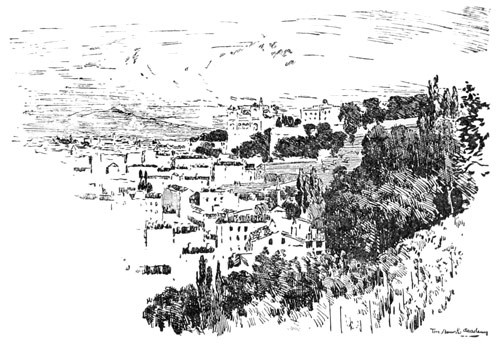
VILLA DE' MEDICI.
There was however another side to the life of the Nuncio which is worthy of note and very characteristic of the man. He had been accompanied on his mission by a little train of monks; for these cœnobites were nothing if not social, and their solitude was always tempered by the proverbial companion to whom they could say how delightful it was to be alone. This little private circle formed a home for the representative of St. Peter, to which he retired with delight from the wearisome audiences, intrigues, and ceremonies of the imperial court. Another envoy, Leander, a noble Spaniard, afterwards Bishop of Seville, and one of the favourite saints of Spain, was in Constantinople at the same time, charged with some high mission from Rome "touching the faith of the Visigoths," whose conversion from Arianism was chiefly the work of this apostolic labourer. And he too found refuge in the home of Gregory among the friends there gathered together, probably bringing with him his own little retinue in the same Benedictine habit. "To their society I fled," says Gregory, "as to the bosom of the nearest port from the rolling swell and waves of earthly occupation; and though that office which withdrew me from the monastery had with the point of its employments stabbed to death my former tranquillity of life, yet in their society I was reanimated." They read and prayed together, keeping up the beloved punctilios of the monastic rule, the brethren with uninterrupted attention, the Nuncio and the Bishop as much as was possible to them in the intervals of their public work. And in the cool atrio of some Eastern palace, with the tinkling fountain in the midst and the marble benches round, the little company with one breath besought their superior to exercise for them those gifts of exposition and elucidation of which he had already proved himself a master. "It was then that it seemed good to those brethren, you too adding your influence as you will remember, to oblige me by the importunity of their requests to set forth the book of the blessed Job—and so far as the Truth should inspire me, to lay open to them these mysteries." We cannot but think it was a curious choice for the brethren to make in the midst of that strange glittering world of Constantinople, where the ecclesiastical news would all be of persecuting Arians and perverse Eastern bishops, and where all kinds of subtle heresies, both doctrinal and personal, were in the air, fine hair-splitting arguments as to how much or how little of common humanity was in the sacred person of our Lord, as well as questions as to the precise day on which to keep Easter and other regulations of equal importance. But to none of these matters did the monks in exile turn their minds. "They made this too an additional burden which their petition laid upon me, that I would not only unravel the words of the history in allegorical senses, but that I would go on to give to the allegorical sense the turn of a moral exercise: with the addition of something yet harder, that I would fortify the different meanings with analogous passages, and that these, should they chance to be involved, should be disentangled by the aid of additional explanation."
This abstruse piece of work was the recreation with which his brethren supplied the active mind of Gregory in the midst of his public employments and all the distractions of the imperial court. It need not be said that he did not approach the subject critically or with any of the lights of that late learning which has so much increased the difficulty of approaching any subject with simplicity. It is not supposed even that he had any knowledge of the original, or indeed any learning at all. The Nuncio and his monks were not disturbed by questions about that wonderful scene in which Satan stands before God. They accepted it with a calm which is as little concerned by its poetic grandeur as troubled by its strange suggestions. That extraordinary revelation of an antique world, so wonderfully removed from us, beyond all reach of history, was to them the simplest preface to a record of spiritual experience, full of instruction to themselves, lessons of patience and faith, and all the consolations of God. Nothing is more likely than that there were among the men who clustered about Gregory in his Eastern palace, some who like Job had seen everything that was dear to them perish, and had buried health and wealth and home and children under the ashes of sacked and burning Rome. We might imagine even that this was the reason why that mysterious poem with all its wonderful discoursings was chosen as the subject to be treated in so select an assembly. Few of these men if any would be peaceful sons of the cloister, bred up in the stillness of conventual life; neither is it likely that they would be scholars or divines. They were men rescued from a world more than usually terrible and destructive of individual happiness, saddened by loss, humiliated in every sensation either of family or national pride, the fallen sons of a great race, trying above all things to console themselves for the destruction of every human hope. And the exposition of Job is written with this end, with strange new glosses and interpretations from that New Testament which was not yet six hundred years old, and little account of any difference between: for were not both Holy Scripture intended for the consolation and instruction of mankind? and was not this the supreme object of all—not to raise antiquarian questions or exercise the mind on metaphysical arguments, but to gather a little balsam for the wounds, and form a little prop for the weakness of labouring and heavily laden men? Moralia: "The Book of the Morals of St. Gregory the Pope" is the title of the book—a collection of lessons how to endure and suffer, how to hope and believe, how to stand fast—in the certainty of a faith that overcomes all things, in the very face of fate.
"Whosoever is speaking concerning God," says Gregory, "must be careful to search out thoroughly whatsoever furnishes moral instruction to his hearers; and should account that to be the right method of ordering his discourse which permits him when opportunity for edification requires it, to turn aside for a useful purpose from that which he had begun to speak of. He that treats of sacred writ should follow the way of a river: for if a river as it flows along its channel meets with open valleys on its side, into these it immediately turns the course of its current, and when they are copiously supplied presently it pours itself back into its bed. Thus unquestionably should it be with every one that treats the Divine word, so that if discussing any subject he chances to find at hand any occasion of seasonable edification he should as it were force the streams of discourse towards the adjacent valley, and when he has poured forth enough upon its level of instruction fall back into the channel of discourse which he had proposed to himself."
We do not know what the reader may think of Gregory's geography; but certainly he carries out his discursive views to the full, and fills every valley he may chance to come to in his flowing, with pools and streams—no doubt waters of refreshing to the souls that surrounded him, ever eager to press him on. A commentary thus called forth by the necessities of the moment, spoken in the first place to anxious listeners who had with much pressure demanded it, and who nodded their heads over it with mingled approbation and criticism as half their own, has a distinctive character peculiar to itself, and requires little aid from science or learning. A large portion of it was written as it fell from his lips, without revision Gregory informs us, "because the brethren drawing me away to other things, would not leave time to correct this with any great degree of exactness."
A gleam of humour comes across the picture as he describes his position among this band of dependent and applauding followers, who yet were more or less the masters of his leisure and private life. "Pursuing my object of obeying their instructions, which I must confess were sufficiently numerous, I have completed this work," he says. The humour is a little rueful, the situation full of force and nature. The little group of lesser men would no doubt have fully acknowledged themselves inferior to the eloquent brother, their founder, their instructor, so much greater a man in every way than themselves: but yet not able to get on without the hints of Brother John or Brother Paul, helped so much by that fine suggestion of the Cellarius, and the questions and sagacious remarks of the others. The instructions of the brethren! who does not recognise the scene, the nods aside, the objections, the volunteered information and directions how to say this or that, which he knew so much better how to say than any of them! while he sat listening all the time, attending to every criticism, taking up a hint here and there, with that curious alchemy of good humour and genius, turning the dull remarks to profit, yet always with a twinkle in his eye at those advices "sufficiently numerous" which aimed at teaching him how to teach them, a position which many an ecclesiastic and many an orator must have realised since then. Gregory reveals his consciousness of the state of affairs quite involuntarily, nothing being further from his mind than to betray to his reverend and saintly brother anything so human and faulty as a smile; and it is clear that he took the animadversions in good part with as much good nature as humour. To make out the features of the same man in Gibbon's picture of an arrogant priest assuming more than any layman durst assume, is very difficult. The historian evidently made his study from models a few hundred years further down in the record.
Gregory seems to have held the place of Apocrisarius twice under two different Popes—Benedict I. and Pelagius II.; but whether he returned to Rome between the two is not clear. One part of his commission from Pelagius was to secure help from the Emperor against the Lombards who were threatening Rome. The Pope's letter with its lamentable account of the undefended and helpless condition of the city, and the urgency with which he entreats his representative to support the pleading of a special envoy sent for that purpose, is interesting. It is sent to Gregory by the hands of a certain Sebastian, "our brother and coadjutor," who has been in Ravenna with the general Decius, and therefore is able to describe at first hand the terrible state of affairs to the Emperor. "Such misfortunes and tribulations," says the Pope, "have been inflicted upon us by the perfidy of the Lombards contrary to their own oath as no one could describe. Therefore speak and act so as to relieve us speedily in our danger. For the state is so hemmed in, that unless God put it into the heart of our most pious prince to show pity to his servants, and to vouchsafe us a grant of money, and a commander and leader, we are left in the last extremity, all the districts round Rome being defenceless, and the Exarch unable to do anything to help us. Therefore may God persuade the Emperor to come quickly to our aid before the armies of that most accursed race have overrun our lands."
What a strange overturn of all things is apparent when such a piteous appeal is conveyed to the Eastern empire already beginning to totter, from what was once imperial and triumphant Rome!
It was in 586, four years before the end of the life of Pelagius, that Gregory returned home. The abbot of his convent, Maximianus, had been promoted to the see of Syracuse, though whether for independent reasons or to make room for Gregory in that congenial position we are not informed; and the Nuncio on his return succeeded naturally to the vacant place. If it was now or at an earlier period that he bestowed all his robes, jewels, etc., on the convent it is difficult to decide, for there seems always to have been some reserve of gifts to come out on a later occasion, after we have heard of an apparent sacrifice of all things for the endowment of one charity or another. At all events Gregory's charities were endless and continued as long as he lived.
No retirement within the shadow of the convent was however possible now for the man who had taken so conspicuous a position in public life. He was appointed secretary to the Pope, combining that office with the duties of head of his convent, and would appear besides to have been the most popular preacher in Rome, followed from one church to another by admiring crowds, and moving the people with all the force of that religious oratory which is more powerful than any other description of eloquence: though to tell the truth we find but little trace of this irresistible force in his discourses as they have come down to us. Popular as he was he does not seem to have had any special reputation either for learning or for literary style.
One of the best known of historical anecdotes is the story of Gregory's encounter with the group of English children brought to Rome as slaves, whom he saw accidentally, as we say, in one of his walks. It belongs in all probability to this period of his life, and no doubt formed an episode in his daily progress from St. Andrew's on its hill to the palace of the Bishop of Rome which was then attached to the great church of the Lateran gate. In this early home of the head of the Roman hierarchy there would no doubt be accommodation for pilgrims and strangers, in addition to the spare court of the primitive Pope, but probably little anticipation of the splendours of the Vatican, not yet dreamed of. Gregory was pursuing his musing way, a genial figure full of cheerful observation and interest in all around him, when he was suddenly attracted as he crossed some street or square, amid the crowd of dark heads and swarthy faces by a group, unlike the rest, of fair Saxon boys, long-limbed and slender, with their rose tints and golden locks. The great ecclesiastic appears to us here all at once in a new light, after all we have known of him among his monastic brethren. He would seem to have been one of those inveterate punsters who abound among ecclesiastics, as well as a tender-hearted man full of fatherly instincts. He stopped to look at the poor children so unlike anything he knew. Who were they? Angles. Nay, more like angels, he said in his kind tones, with no doubt a smile in return for the wondering looks suddenly raised upon him. And their country? Deiri. Ah, a happy sign! de ira eruti, destined to rise out of wrath into blessedness. And their king? the boys themselves might by this time be moved to answer the kind monk, who looked at them so tenderly. Ella—Alle, as it is reported in the Latin, softening the narrower vowel. And was it still all heathen that distant land, and unknown rude monarch, and the parents of these angelic children? Then might it soon be, good Lord, that Allelujah should sound wherever the barbarous Alle reigned! Perhaps he smiled at his own play upon words, as punsters are apt to do, as he strolled away, not we may be sure without a touch of benediction upon the shining tawny heads of the little Saxon lions. But smiling was not all it came to. The thought dwelt with him as he pursued his way, by the great round of the half-ruined Colosseum, more ruinous probably then than now, and down the long street to the Latin gate, where Pelagius and all the work of his secretaryship awaited him. The Pope was old and wanted cheering, especially in those dark days when the invader so often raged without, and Tiber was slowly swelling within, muttering wrath and disaster; while no force existed, to be brought against one enemy or another but the prayers of a few old men. Gregory told the story of his encounter, perhaps making the old Pope laugh at the wit so tempered with devotion, before he put forth his plea for a band of missionaries to be sent to those unknown regions to convert that beautiful and wonderful fair-haired race. Pelagius was very willing to give his consent; but where were men to be found to risk themselves and their lives on such a distant expedition among the savages of that unknown island? When it was found that nobody would undertake such a perilous mission, Gregory, who would naturally have become more determined in respect to it after every repulse, offered himself; and somehow managed to extort a consent from the Pope, of which he instantly took advantage, setting out at once with a band of faithful brethren, among whom no doubt must have been some of those who had accompanied him when he was Nuncio into scenes so different, and pressed him on with their advice and criticism while he opened to them the mysteries of Scripture. They might be tyrannical in their suggestions, but no doubt the impulse of the apostles—"let us die with him"—was strong in their hearts.
No sooner was it known, however, in Rome that Gregory had left the city on so distant and perilous a mission than the people rose in a sudden tumult. They rushed together from all the quarters of the city in excited bands towards the Lateran, surrounding the Pope with angry cries and protests, demanding the recall of the preacher, whose eloquence as well as his great benefactions to the poor had made him to the masses the foremost figure in the Church. The Pope, frightened by this tumult, yielded to the demand, and sent off messengers in hot haste to bring the would-be missionary back. The picture which his biographers afford us is less known than the previous incidents, yet full of character and picturesque detail. The little band had got three days on in their journey—one wonders from what port they meant to embark, for Ostia, the natural way, was but a few hours from Rome—when they made their usual halt at noon for refreshment and rest "in the fields." Gregory had seated himself under the shade of a tree with a book to beguile the warm and lingering hours. And as he sat thus reading with all the bustle of the little encampment round him, men and horses in the outdoor freedom enjoying the pause, the shade, and needful food—a locust suddenly alighted upon his page, on the roll of parchment which was then the form of the latest editions. Such a visitor usually alights for a moment and no more; but Gregory was too gentle a spectator of all life to dash the insect off, and it remained there with a steadiness and "mansuetude" unlike the habits of the creature. The good monk began to be interested, to muse and pun, and finally to wonder. "Locusta," he said to himself, groping for a meaning, "loca sta." What could it signify but that in this place he would be made to stay? He called to his attendants to make ready with all speed and push on, eager to get beyond the reach of pursuit; but before the cumbrous train could be got under way again, the Pope's messengers arrived "bloody with spurring, fiery red with haste," and the missionaries were compelled to return to Rome. Thus his first attempt for the conversion of England was to have been made, could he have carried out his purpose, by himself.
There is a curious story also related of Gregory in his walks through Rome, the issue of which, could an unbelieving age put faith in it, would be even more remarkable. One day as he passed by the Forum of Trajan—then no doubt a spot more wildly ruinous than now, though still with some of its great galleries and buildings standing among overthrown monuments and broken pillars—some one told him the story of Trajan and the widow, which must have greatly affected the mediæval imagination since Dante has introduced it in his great poem. The prayer addressed to the Emperor on his way to the wars was the same as that of the widow in the parable, "Avenge me of mine adversary." "I will do so when I return," the Emperor replied. "But who will assure me that you will ever return?" said the importunate widow; upon which the Emperor, recognising the justice of the objection, stopped his warlike progress until he had executed the vengeance required, upon one of his own officials (is it not said by one authority his own son?) who had wronged her. Gregory was as much impressed by this tale as Dante. He went on lamenting that such a man, so just, so tolerant of interruption, so ready to do what was right, should be cut off from the Divine mercy. He carried this regret with him all the way to the tomb of the apostles, where he threw himself on his knees and prayed with all his heart that the good Trajan, the man who did right according to the light that was in him, at all costs, should be saved. Some versions of the story add that he offered to bear any penance that might be put upon him for his presumption, and was ready to incur any penalty to secure this great boon. It can never be put to proof in this world whether Gregory's petition was heard or not, but his monks and biographers were sure of it, and some of them allege that his own bodily sufferings and weakness were the penalty which he accepted gladly for the salvation of that great soul. The story proves at least the intense humanity and yearning over the unhappy, which was in his heart. Whether he played and punned in tender humour with the objects of his sympathy, or so flung himself in profoundest compassion into the abyss of hopelessness with them, that he could wish himself like Paul accursed for his brethren's sake—Gregory's being was full of brotherly love and fervent feeling, a love which penetrated even beyond the limits of visible life.
The four years that elapsed between his return to his convent and his election to the Popedom (or to speak more justly the bishopric of Rome) were years of trouble. In addition to the constant danger of invasion, the misery, even when that was escaped, of the tales brought to Rome by the fugitives who took refuge there from all the surrounding country, in every aggravation of poverty and wretchedness, and the efforts that had to be made for their succour—a great inundation of the Tiber, familiar yet terrible disaster from which Rome has not even now been able to secure herself, took place towards the end of the period, followed by a terrible pestilence, its natural result. Gregory was expounding the prophet Ezekiel in one of the Roman churches at the time of this visitation: but as the plague increased his sorrowful soul could not bear any bondage of words or thoughts apart from the awful needs of the moment, and closing the book, he poured forth his heart to the awed and trembling people, exhorting all to repent, and to fling themselves upon God's mercy that the pestilence might be stayed. In all such terrible emergencies it is the impulse of human nature to take refuge in something that can be done, and the impulse is no doubt itself of use to relieve the crushing weight of despair, whatever may be the form it takes.
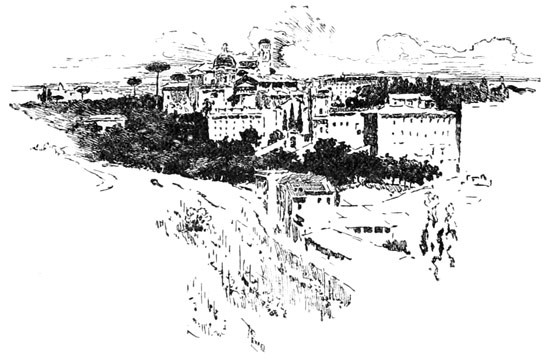
SAN GREGORIO MAGNO, AND ST. JOHN AND ST. PAUL.
We clean and scrub and whitewash in our day, and believe in these ways of arresting the demons; but in old Rome the call for help was more impressive at least, and probably braced the souls of the sufferers as even whitewash could not do. The manner in which Gregory essayed to turn the terrible tide was by a direct appeal to Heaven. He organised a great simultaneous procession from all the quarters of Rome to meet at "the Church of the Virgin"—we are not informed which—in one great united outcry to God for mercy. The septiform litany, as it was called, was chanted through the desolate streets by gradually approaching lines, the men married and unmarried, the priests and monks each approaching in a separate band; while proceeding from other churches came the women in all their subdivisions, the wives, the widows, the maidens, the dedicated virgins, Ancillæ Dei, each line converging towards the centre, each followed no doubt from windows within which the dying lay with tears and echoes of prayers. Many great sights there have been in old Rome, but few could have been more melancholy or impressive than this. We hear of no miraculous picture, no saintly idol as in later ceremonials, but only the seven processions with their long-drawn monotones of penitence, the men by themselves, the women by themselves, the widows in their mourning, the veiled nuns, the younger generation, boys and girls, most precious of all. That Gregory should have had the gift to see, or believe that he saw, a shining angel upon Hadrian's tomb, pausing and sheathing his sword as the long line of suppliants drew near, is very soothing and human to think of. Fresh from his studies of Ezekiel or Job, though too sick at heart with present trouble to continue them, why should he have doubted that the Hearer of Prayer might thus grant a visible sign of the acceptance which He had promised? We do not expect such visions nowadays, nor do we with such intense and united purpose seek them; but the same legend connects itself with many such periods of national extremity. So late as the Great Plague of London a similar great figure, radiant in celestial whiteness, was also reported to be seen as the pestilence abated, sheathing, in the same imagery, a blazing sword.
The story of the septiform litany relates how here and there in the streets as they marched the dead and dying fell out of the very ranks of the suppliants. But yet the angel sheathed his sword. It is hard to recall the splendid monument of Hadrian with its gleaming marbles and statues as the pilgrim of to-day approaches the vast but truncated and heavy round of the Castle of St. Angelo; but it does not require so great an effort of the mind to recall that scene, when the great angel standing out against the sky existed but in Gregory's anxious eyes, and was reflected through the tears of thousands of despairing spectators, who stood trembling between the Omnipotence which could save in a moment and the terrible Death which seized and slew while they were looking on. No human heart can refuse to beat quicker at such a spectacle—the good man in his rapture of love and earnestness with his face turned to that radiant Roman sky, and all the dark lines of people arrested in their march gazing too, the chant dying from their lips, while the white angel paused for a moment and sheathed the sword of judgment over their heads.
It was not till many centuries later, when every relic of the glories of the great Emperor's tomb had been torn from its walls, that the angel in marble, afterwards succeeded by the present angel in bronze, was erected on the summit of the Castle of St. Angelo, which derives from this incident its name—a name now laden with many other associations and familiar to us all.
Pope Pelagius was one of the victims of this great plague; and it is evident from all the circumstances recorded that Gregory was already the most prominent figure in Rome, taking the chief place, not only in such matters as the public penitence, but in all the steps necessary to meet so great a calamity. Not only were his powers as an administrator very great, but he had the faculty of getting at those sacred hordes of ecclesiastical wealth, the Church's treasures of gold and silver plate, which a secular ruler could not have touched. Gregory's own liberality was the best of lessons, and though he had already sacrificed so much he had yet, it would appear, something of his own still to dispose of, as we have already found to be the case in so many instances, no doubt rents or produce of estates which could not be alienated, though everything they produced was freely given up. Already the wealth of the Church had been called into requisition to provide for the fugitives who had taken refuge from the Lombards in Rome. These riches, however, were now almost exhausted by the wants of the disorganised commonwealth, where every industry and occupation had been put out of gear, and nothing but want and misery, enfeebled bodies, and discouraged hearts remained. It was inevitable that at such a time Gregory should be the one man to whom every eye turned as the successor of Pelagius. The clergy, the nobles, and the populace, all accustomed to take a part in the choice of the bishop, pronounced for him with one voice. It is a kind of fashion among the saints that each one in his turn should resist and refuse the honours which it is wished to thrust upon him; but there was at least sufficient reason in Gregory's case for resistance. For the apostolical see, which was far from being a bed of roses at any time, was at that period of distress and danger one of the most onerous posts in the world.
Pelagius died in January 590, but it was late in that year before his successor was forced into the vacant place. In the meantime Gregory had appealed to the Emperor, begging that he would oppose the election and support him in his resistance. This letter fell into the hands of the Præfect of Rome, who intercepted it, and wrote in his own name and that of the people a contrary prayer, begging the Emperor Maurice to sanction and give authority to their choice. It was only when the answer was received confirming the election, that Gregory became aware of the trick played upon him; and all his natural aversion strengthened by this deceitful proceeding, he withdrew secretly from the city, hiding himself, it is said, in a cave among the woods. Whether this means that he had made his way to the hills, and found this refuge among the ruins of Tusculum, or in some woodland grotto about Albano, or that some of the herdsmen's huts upon the Campagna amid the broken arches of the aqueducts received and concealed him, it is impossible to tell. It is said that the place of his retreat was made known by a light from heaven which made an illumination about him in his stony refuge, for the legend is unsparing in the breadth of its effects and easily appropriates the large miracle which in the Old Testament attends the passage of a whole nation to the service of an individual, without any of that sense of proportion which is to be found in older records. This light suggests somehow the wide breadth of the Campagna where its distant glow could be seen from afar, from the battlements of Rome herself, rather than the more distant hills. And we must hope that this direct betrayal by Heaven of his hiding-place showed Gregory that the appointment against which he struggled had in fact the sanction of the higher powers.
He speaks, however, in many of his works of the great repugnance he felt to take the cares of such an office upon him. He had allowed himself to be ordained a deacon with reluctance, and only apparently on an understanding that when the emergency which called for his services was over he might be permitted to retire again to his cloister. His letter to Leander already referred to is full of the complaint that "when the ministry of the altar was so heavy a weight, the further burden of the pastoral charge was fastened on me, which I now find so much the more difficulty in bearing as I feel myself unequal to it, and cannot find consolation in any comfortable confidence in myself." To another correspondent he remonstrates against the censure he met with for having endeavoured to escape from so heavy a charge. These hesitations are not like those with which it is usual to find the great men of the Church refusing honours, since it is no profession of humility which moves Gregory, but his overwhelming sense of the difficulties and danger to which the chief pastor of the Church would necessarily be exposed. His idea of his position is indeed very different from that of those who consider him as one of the first to conceive the great plan of the papacy, and as working sedulously and with intention at the foundations of an institution which he expected to last for hundreds of years and to sway the fortunes of the world. He was on the contrary fully persuaded that all the signs of the times foretold instead, the end of the world and final winding up of human history. The apostles had believed so before him, and every succeeding age had felt the catastrophe to be only for a little while delayed. Nation was rising against nation under his very eyes, earthquakes destroying the cities of the earth, and pestilence their populations. There had been signs in heaven generally reported and believed, fiery ranks of combatants meeting in conflict in the very skies, and every token of judgment about to fall. Little thought was there in his mind of a triumphant and potent ecclesiastical economy which should dominate all things. "I being unworthy and weak have taken upon me the care of the old and battered vessel," he says in one of his epistles written soon after his election; "the waves make their way in on all sides, and the rotten planks, shattered by daily and violent storms, threaten imminent shipwreck." An old and battered vessel, it had borne the strain of six centuries—a long time to those who knew nothing of the ages to come: and now struggled on its way beaten by winds and waves, not knowing when the dreadful moment expected by so many generations might come, when the sun should be turned into darkness and the moon into blood—the only signs that were yet wanting of the approach of that great and terrible day. How different were these anticipations from any conscious plan of conquest or spiritual empire; and how much more fully justified by all that was happening around that broken, suffering, poor, breathless and hopeless capital of the world!
Yet it is evident enough that this one resolute man, toiling in every possible way for the protection of the people round him, did put a certain heart in the city which had come through so many convulsions. Crowded with fugitives, decimated with pestilence, left for many months without any more able head than the half-hearted prætors and officials of the state and the distant exarch at Ravenna, with all of whom, according to Gregory's own witness, the exaction of taxes was the chief object—a strong and steadfast ruler in the midst of this distracted people changed in every way the disposition of affairs. For one thing he seems to have taken upon him from the beginning the care and nourishment of the poor. It had been the principle of the Church from her earliest days that almsgiving was one of the first of duties, and the care of the poor her inalienable right; but such a time of disaster made something more heroic needful than the usual doles and charities. A large proportion of the population of Rome came upon Gregory's hands to be fed and provided for. Lists of the destitute poor, of their houses and circumstances, were kept with the greatest care; and we are told that before the Pope sat down to any meal the tables for the poor outside were first supplied. How dreadful to any philanthropist now this straightforward and matter-of-fact feeding of the hungry! but it was the manner of Christianity, most understood and approved in the early ages, the one with which even the most enlightened of politicians had no fault to find. This was the first idea in every evangelical soul, but it was by no means the limit of Gregory's exertions. He had learned diplomacy as well as charity in the experiences of his past life, and every resource of his skill and knowledge were needed for the salvation of the otherwise hopeless city. In all the dignity of his spiritual office, yet with all the arts of a statesman, we can see him standing as it were before the gates of Rome, as Horatius stood on the banks of the Tiber. It is sometimes to Constantinople, sometimes to the host of the invaders, that he turns explaining, arguing, pleading on one side and another for the safety of his city and people. His letters to the Emperor and to the Empress on one hand, and those to Queen Theodolinda on the other hand, the wife of the invader—show with what persistency and earnestness he defended Rome and its people who were his special charge and flock, and who had neither ruler nor defender save himself. This was one of his ways of establishing the sway of the papacy, it is said; it was at the same time, and primarily, the stepping forth of the only man who could or would put himself at the head of a disorganised and trembling host without leader or defender. He, only he, stood fast to strike for them, to intercept destruction hanging over their heads, and it, would be a curious fact indeed in human nature if such a man performed his first duty for the sake of an unformed empire to come after hundreds of years had passed. He succeeded with the barbarians, preserving Rome from the attacks which were often threatened but never carried out; but he did little good with Maurice, who on his side had few troops to send and no general able to make a successful campaign against the Lombards. The officers and the armies of the empire were of use in exacting taxes for the imperial treasury, but not for opposing a vigorous invader or rescuing a defenceless people.
It is never pretended by any of his biographers or admirers that Gregory was a man of learning, or even interested very much in the preservation of letters, or the progress of intellectual life. Learning and philosophy were the inheritance of the Greek Church, which was the very presumptuous and arrogant rival of Rome, and the cradle of most of the heresies and all the difficult and delicate questions which had troubled the peace of the Church. He is accused, though without sufficient evidence, of burning a library of Latin poets, a thing which he might well have done, according to his ideas, without much sense of guilt. There has never been an age in which certain books have not been liable to that reformation by fire, and the principle is quite as strong now as in the sixth century, so we need not take pains to exonerate Gregory from such an imputation. He did not, like Jerome, love the literature which was full of classical images and allusions. Neither Cicero nor Plato would have tempted him to occupy himself with vain studies. "The same mouth," he says, "should not pronounce the name of Jupiter and that of Christ;" yet at the same time he expresses strong regret that letters had died out of Rome, amid all the tumults through which she had passed. Amid the jargon of barbarians heard on every side, Greek, he complains, had fallen almost out of knowledge. There were few men learned enough to settle a question of doctrine by reference to the original text of Scripture. "Those we have are good for little but to translate word by word; they are unable to grasp the sense, and it is with difficulty that we understand their translations." He does not take any credit for his own style, which indeed is anything but Ciceronian. He complains with great simplicity, at the end of his dedication to Leander of his Moralia, of the "collisions of metacism," a difficulty about the letter m which would seem to have been as troublesome as the letter h in our own day; and anticipates criticism by confessing that he has neglected the "cases of prepositions." "For I account it far from meet," he says, taking as we should say in Scotland, "the first word of flyting," and with a high hand, "to submit the words of the Divine Oracle to the rules of (the grammarian) Donatus." As who should say Lindley Murray has nothing to do with the language of a sermon. This was a great deal for a man to say, one of whose early feats in life had been the conviction and conversion by argument of Eutychius, whose heresy in respect to the body of the resurrection (a sufficiently distant and far-off subject to disturb the Church about—but such twists of impossible doctrine have always affected some minds) survived himself—but who acknowledged with his dying breath that he was wrong and Gregory right.
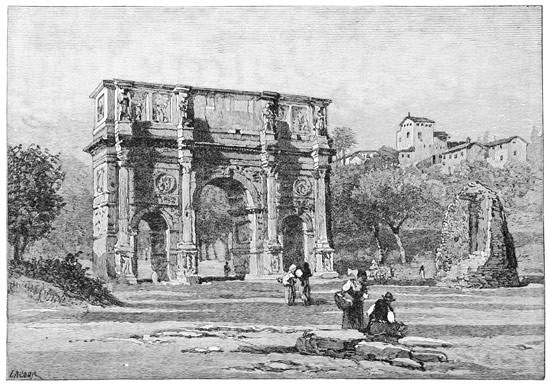
ARCH OF CONSTANTINE.
To face page 152.
Doctrine, however, was not the point on which Gregory was most strong—his Dialogues, written it is said for the edification and strengthening in the faith of the Empress Theodolinda, are nothing more than pious discussions and sanctions of the miracles performed by the saints, which we fear would have a very contrary effect if published in our day. His works upon the pastoral law and the discipline of the Church are the most valuable and important of his productions; though in these also his point of view is extraordinarily different from ours, and he advises a kind and degree of toleration which is somewhat appalling to hear of. For instance, in his instructions to Augustine and his band of missionaries Gregory instructs them to interfere as little as possible with the customs, especially in the matter of religious observances, of the people among whom they were sent. They were not to put down the familiar accompaniments of their converts' native rites and ceremonies. The old temples of Woden and Thor were not to be abandoned but turned to a new and better use; even the system of sacrifice to these gods was not to be altogether set aside. "Let there be no more victims to demons," he says with curious casuistry, "but let them kill and eat giving thanks to God; for you must leave them some material enjoyments that they may so much more easily enter into the delights of the soul." On the other hand, his instructions to a bishop of Sardinia bear a curiously different character. He recommended this prelate to put a pressure more or less gentle upon the peasants there who still remained pagan, in the form of an increased rent and taxes until such time as they should become Christian. "Though, conversion does not come by force," he says with sagacious cynicism, "yet the children of these mercenary converts will receive baptism in their innocence and will be better Christians than their fathers;" an argument which certainly embodies much economic truth if not exactly the spirit of the Gospel.
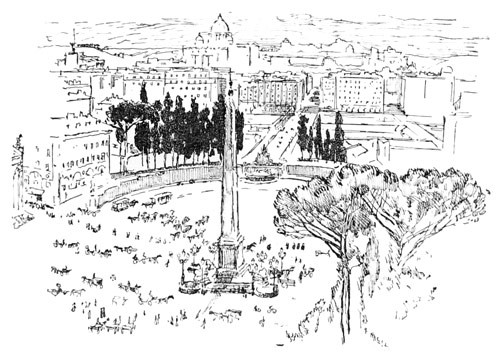
THE PIAZZA DEL POPOLO.
Strangely different from these worldly-wise suggestions, however, are the detailed instructions for pastoral work, quoted by Bede, in Gregory's answer to the questions of Augustine, in which the artificial conscience of the confessional suddenly appears in full development, by the side of those strange counsels of a still semi-pagan age. Nothing can be more remarkable than this contrast, which exacts a more than Levitical punctilio of observance from the devout, while leaving open every door for the entrance of the profane. Though he entered with so much reluctance upon the pastoral care of the Church, no one has laid down more detailed directions for the cure of souls. It would seem to have been in reality one of the things which interested him most. His mind was in some respects that of a statesman full of the broadest sense of expediency and of the practicable, and of toleration and compromise carried to a length which fills us with dismay; while on the other it was that of a parish legislator, an investigator of personal details, to whom no trifle was unimportant, and the most fantastic stipulations of ritualistic purification of as great moment as morality itself.
In contrast however with those letters which recommended what was little more than a forced conversion, and which have been frequently cited as examples of the unscrupulousness of the early missionaries, we must here quote some of Gregory's pastoral instructions in which the true spirit of a pastor shines forth. "Nothing," he says in one of his epistles to the bishops with whom he kept up constant communications, "is so heavy a burden upon a priest as so to bend the force of his own mind in sympathy, as to change souls (cum personis supervenientibus animam mutare) with each new person who approaches him; yet this is very necessary." Nothing could be more happy in expression or fine in sentiment, and it shows how completely the monk-Pope, in cloister and on throne, understood the essential character of his great profession. Still more remarkable, as more involved in personal matters, is his advice to Augustine, who had consulted him as to the differences in worship between the Gallican churches and those of Rome.
"You know, my brother, the custom of the Roman Church in which you were bred up. But it will please me if when you have found anything, either in the Roman or Gallican or any other Church, which may be more acceptable to Almighty God, you will carefully make choice of the same, and sedulously teach the Church of the English, which as yet is new in the faith, whatsoever good thing you can gather from the several Churches. For things are not to be loved for the sake of places, but places for the sake of good things. Choose therefore from every Church those things that are pious, religious and upright, and when you have as it were made them into one system, let the minds of the English be accustomed thereto."
This is surely the truest and highest toleration.
The Papacy of Gregory began in trouble and distress; Rome was more disorganised, more miserable, more confused and helpless than almost ever before, although she had already passed through many a terrible crisis; and he had shrunk from the terrible task of setting her right. But when he had once undertaken that task there was neither weakness nor hesitation in the manner with which he carried it out. The public penance and humiliation to which he moved the people, the septiform litany with its chanting and weeping crowds, the ceaseless prayers and intercessions in the Church were not all, though no doubt the chief part to Gregory, of those methods by which he sustained the courage, or rather put a heart into, the broken-down population, so that for once a show of resistance was made when the Lombards threatened the city. And his anxious negotiations never ceased. The Emperor, far off and indifferent, not to say helpless, in Constantinople, had no rest from the constant remonstrances and appeals of the ever-watchful Bishop. Gregory complained and with reason that no efforts, or at least but fictitious ones, were made for the help of Rome, and that the indifference or hostility of the Emperor was more dangerous to her than the arms of the Lombards. On the other hand he addressed himself to the headquarters of the invaders, taking as his champion—as was his custom, as it has always been the custom of the Churchman—the Queen Theodolinda, who had become a Catholic and baptized her son in that faith, notwithstanding the opposition of her Arian husband, and was therefore a very fitting and natural intercessor. "What an overwhelming charge it is!" he cries to one of his correspondents, "to be at once weighted with the supervision of the bishops and clergy, of the monasteries and the entire people, and to remain all the time watchful to every undertaking of the enemy and on my guard against the robbery and injustice of our rulers." It was indeed a burden under which few men could have stood.
Gregory appears to have neglected no movement of the foe, to have noted every exaction and treachery from Constantinople, to have remembered every bishop in the furthest-off regions, and to have directed to each in turn his expostulations, his entreaties, his reproofs. We have been told in our own day of the overwhelming weight of business (attributed to facilities of post and daily communications) which almost crushes an English archbishop, although that dignitary besides the care of the Church has but such an amount of concern in public matters as a conscientious adviser must have. But Gregory was responsible for everything, the lives and so far as was possible the liberties of his city and people, their daily bread, their safety, their very existence, besides that cure of souls which was his special occupation. The mass of correspondence, which beside all his other work he managed to get through, forgetting nothing, is enough to put any modern writer of hasty notes and curt business letters to shame. On this point there may be said a word of apology for the much-harassed Pope in respect to that one moment in his history, in which his conduct cannot be defended by his warmest admirer. His prayers and appeals were treated with contempt at Constantinople, a contempt involving not his own person alone, but Rome and the Church, for which the Emperor Maurice did not even pretend to care. And when that Emperor was suddenly swept away, it is natural enough that a sensation of relief, a touch of hope in the new man who, notwithstanding the treachery and cruelty of the first step in his career, might turn out better than his predecessor, should have gleamed across the mind of a distant, and perhaps at first imperfectly informed spectator, whose interests were so closely concerned. The complacency with which Gregory wrote to Phocas, the amazing terms he used to that murderer and tyrant, will always be the darkest stain on his reputation. Under Maurice the ministers of the empire had been more oppressive than the invaders. Perhaps under Phocas better things might be hoped for. It is all that can be said for this unfortunate moment of his career; but it is something nevertheless.
It was not till 597, when he had occupied his bishopric for seven years, that Gregory succeeded in carrying out the long-cherished scheme of the mission to England, which had been for many years so near his heart. It is said that he himself had purchased some of the captive boys who caught his eye in the streets, and trained them in the Christian doctrine and faith, in order that they might act as interpreters and commend the missionaries to their people, an expedient which has been so largely followed (and of course boasted of as an original thought) in recent missions. These boys would by this time have attained the age of manhood, and perhaps this determined the moment at which Augustine and his companions were sent forth. They were solemnly consecrated in the chapel of the convent on the Cœlian hill, Gregory's beloved home, to which he always returned with so much affection, and to which they also belonged, monks of the same house. Their names are inscribed in the porch of the present church after that of their master, with designations strangely familiar to our British ears—S. Augustine, Apostle of England; S. Lawrence, Archbishop of Canterbury; S. Mellitus, of London and Canterbury; S. Justus, of Rochester; S. Paulinus, of York, appear in the record, the first teachers and ecclesiastical dignitaries of Saxon England. The church in which this consecration took place exists no longer; the present building, its third or fourth successor, dates only from the eighteenth century, and is dedicated to S. Gregory himself; but the little piazza now visited by so many pilgrims is unchanged, and it was from this small square, so minute a point amid the historic places of Rome, that the missionary party set forth, Augustine and his brethren kneeling below, while the Pope, standing at the head of the steps, gave them his parting blessing. No doubt the young Angles, with their golden locks of childhood matured into russet tones, who had filled Gregory's mind with so many thoughts, were in the group, behind the black-robed Benedictine brothers whose guides and interpreters they were to be.
This is an association full of interest for every Englishman, and has attracted many pilgrims from the nation whose faith has undergone so many vicissitudes, and in which the Pope's authority has been as vehemently decried in one age as strongly upheld in another; but whatever our opinions on that point may be, there can be nothing here but affectionate and grateful remembrance of the man of God who had so long cherished the scheme, which thus at length with fatherly benedictions and joy at heart, he was able to carry out. He himself would fain have gone on this mission many years before; but the care of all the Churches, and the tribulations of a distracted world, had made that for ever impossible, and he was now growing old, in feeble health, and with but a few years of work before him. The hearts of the missionaries were not so strong as that of this great Servant of the servants of God who sent them away with his blessing. Terrors of the sea and terrors of the wilds, the long journey and the savage tribes at the end of it, were in their hearts. When they had got nearly over their journey and were resting a little to recover their health among the Gauls,—fierce enough indeed, but still with sanctuaries of peace and holy brethren among them—before crossing the terrible channel, Augustine wrote beseeching letters, begging to be recalled. But let us hope that at the moment of dedication these terrors had scarcely yet got hold upon them. And to Gregory the occasion was one of unmingled satisfaction and joy. The Pope did not in those days wear the white robes which distinguish his dignity now. Gregory was presumably indifferent to such signs and tokens; for in the portrait of him which still exists in the description given of it by John the Deacon, he wears a dress scarcely distinguishable from the ordinary dress of a layman. But as he stood upon the steps in front of the church, separated from all the attendants, and raised his hands in blessing, the scene is one that any painter might covet, and which to many a visitor from these distant islands of the seas will make the little Piazza di San Gregorio more interesting in its simplicity than any other spot in storied Rome.
It would occupy too much time to quote here his long and careful letters to the bishops of the West generally—from Sicily which always seems to have been the object of his special care, to those in Gaul and his missionaries in England. That he assumed an unquestioned authority over them is clear, an authority which had more or less been exercised by the Bishop of Rome for many generations before him: and that he was unfeignedly indignant at the pretensions of John of Constantinople to be called Universal Bishop is also certain. These facts however by no means prove that a great scheme of papal authority was the chief thing in his mind, underlying all his undertakings. When the historians speak of Gregory as spreading the supremacy of the Church of Rome by his missions, notably by that mission to England of which I have just spoken, they forget that the salvation of the souls lying in darkness is a motive which has moved men in every age to the greatest sacrifices, and that we have no reason in the world to believe that it was not the faith of Christ rather than the supremacy of Rome which was Gregory's object. The Apostles themselves might be said in the same way to have been spreading their own supremacy when they obeyed the injunction of their Master to go over the whole world and preach the Gospel to every creature. The one sovereignty was actually implied in the other—but it requires a very robust faith in a preconceived dogma, and a very small understanding of human nature, to be able to believe that when the meditative monk paused in his walk, with compassion and interest, to look at the angelic boys, and punned tenderly with tears in his eyes over their names and nation and king, the idea immediately sprang up in his mind not that Allelujah should be sung in the dominions of King Alle, but that this wild country lost in the midst of the seas should be brought under a spiritual sceptre not yet designed.
Gregory thought as the Apostles thought, that the days of the world were numbered, and that his own generation might see its records closed. That is an idea which never has stopped any worthy man in undertakings for the good of the world—but it was a belief better established, and much more according to all the theories and dogmas of the age, than a plan of universal dominion for the Church such as is attributed to him. He did his duty most energetically and strenuously in every direction—never afraid of being supposed to interfere, using the prestige of the Apostolical See freely for every ecclesiastical purpose. And he became prince in Rome, an absolute sovereign by stress of circumstance and because every other rule and authority had failed. Whether these practical necessities vaguely formed themselves into visions of spiritual empire before the end of his life it is impossible to tell: as it is equally impossible to tell what dreams of happiness or grandeur may enter into any poor man's brain. But so large and world-embracing a plan seldom springs fully formed into any mind, and in his words he never claimed, nay, vehemently denied and repudiated, any pretension of the kind. It is curious how difficult it is to get the world to believe that a man placed in a position of great responsibility, at the head of any institution, is first of all actuated by the desire of doing his work, whatever the ulterior results may be.
Gregory's activity was boundless, though his health was weak, and his sufferings many. Fastings in his youth and neglect at all times told early upon his constitution. The dinner of herbs which his mother sent him daily, and which is sometimes described as uncooked—salad to wit, which enters so largely into the sustenance of the Italian poor—is a kind of fare which does not suit a delicate digestion; but he spared himself nothing on this account, though he had reached such a pitch of weakness that he was at last, as he bitterly laments, unable to fast at all, even on Easter Eve, when even little children abstain from food. Beside all the labours which I have already noted, there remains one detail which has done perhaps more to make the common world familiar with his name than all the rest; and that is the reformation in music which he accomplished among all his other labours. Church music is the only branch of the art of which we have any authentic record which dates so far back, and the Gregorian chant still exists among us, with that special tone of wailing mingled with its solemn measures which is characteristic of all primitive music.
"Four scales," says Mr. Helmore in The Dictionary of Music, "traditionally ascribed to St. Ambrose, existed before the time of St. Gregory. These, known as the Authentic Modes, and since the thirteenth century named after the ancient Greek scales from which they were supposed to be derived, are as follows: 1, Dorian; 2, Phrygian; 3, Lydian; 4, Mixo-Lydian. To the four Authentic St. Gregory added four Plagal, i.e. collateral or relative Modes. Each is a fourth below its corresponding original, and is called by the same name with the prefix hypo (ὑπὸ, below), as follows: 5, Hypo-Dorium; 6, Hypo-Phrygian; 7, Hypo-Lydian; 8, Hypo-Mixo-Lydian.... Handel's 'Hanover' among modern tunes, which ranges from F to F has its finale on B♭. 'Should auld acquaintance be forgot' is also a specimen of a tune in a Plagal Mode descending about a fourth below its final, and rising above it only six notes, closing upon the final of its tone."
This may be a little too learned for the ordinary reader, but it is interesting to find how far the influence of the busy old Pope, who had a finger in every pie, could go. There is a very curious commentary by John the Deacon, Gregory's later biographer, upon this new musical system and its adoption throughout Europe, which makes a good pendant to the scientific description. The Italians seem then as now to have had a poor opinion of German modes of singing.
"This music was learned easily by the Germans and Gauls, but they could not retain it because of making additions of their own, and also because of their barbarous nature. Their Alpine bodies resounding to their depths with the thunders of their voices, do not properly give forth the sweetness of the modulation, the savage roughness of their bibulous throat when it attempts to give forth a delicate strain, producing rather harsh sounds with a natural crash, as of waggons sounding confusedly over the scales."
This is not flattering; but one can imagine something very like it coming from the lips of an Italian Maestro in our own day. The tradition goes that Gregory himself instructed the choristers, for whom he had established schools endowed each with its little property, one in the precincts of St. Peter's, the other in those of St. John Lateran, where his own residence was. And a couch is still shown on which he lay while giving or superintending their lessons, and even the whip with which he is said to have threatened the singers when they made false notes. The last is little in accord with the Pope's character, and we can scarcely imagine the twang through the air of any whip in Gregory's hand: but it is probably as true as other more agreeable circumstances of the legend. One can scarcely believe however that amid his multitudinous occupations he could have had time for more than a flying visit to the schools, however they might interest him.
Nor did he limit his exertions on behalf of ritual to the arrangement of the music. We are told that the Missal of Pope Gelasius then used in the Church was revised by him, and that he took away much, altered some things and added a little, among other things a confession of faith or Credo of his own writing, which is something between the Athanasian and Nicene Creeds. The Ordinary of the Mass remains now, another authority tells us, very much as it came from his hands. Thus his immediate authority and the impress of his mind remain on things which are still in daily use.
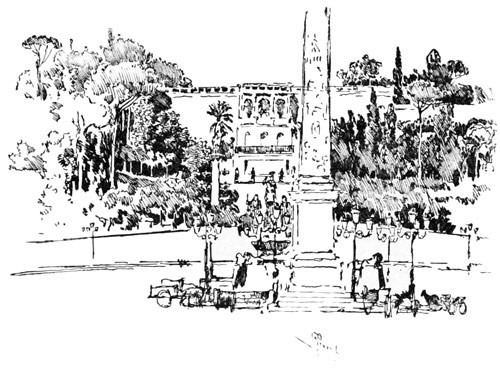
MONTE PINCIO, FROM THE PIAZZA DEL POPOLO.
And there could be no more familiar or characteristic figure in Rome than that of this monk-Pope threading everywhere those familiar streets, in which there were more ruins, and those all fresh and terrible in their suggestions of life destroyed—than now: the gentle spectator full of meditation, who lingered among the group of slaves, and saw and loved and smiled at the Saxon boys: who passed by Trajan's Forum which we all know so well, that field of broken pillars, not then railed off and trim in all the orderliness of an outdoor museum, but wild in the neglect of nature: and heard the story of the Emperor, and loved him too, and poured out his soul to God for the great heathen, so that the gates of Hades were rolled back and the soul set free—strange parable of brotherly kindness as the dominant principle of heart and life. We can follow him through all the lists of the poor laid up in his Scrivii, like the catalogues of books enclosed in caskets, in an old-fashioned library—with careful enumeration of every half-ruined tenement and degraded palace where the miserable had found shelter: or passing among the crowds who received their portions before, not after, the Pope in the precincts of the great basilica; or "modulating," with a voice broken by age and weakness, the new tones of his music which the "bibulous throats" of the barbarian converts turned into thunder, and of which even his own choristers, careless as is their use, would make discords, till the whip of the Master trembled in the air, adding the sting of a sharper sound to the long-drawn notes of the monotone, and compelling every heedless tenor and frivolous soprano to attention. These are his simpler aspects, the lower life of the great Benedictine, the picture of the Pope as he endeared himself to the popular imagination, round which all manner of tender legends grew. His aspect is less familiar yet not less true as he sits at the head of affairs, dictating or writing with his own hand those innumerable letters which treat of every subject under heaven, from the safety of Rome to the cross which is to be hung round a royal infant's neck, or the amethyst ring for the finger of a little princess; from the pretensions of John of Constantinople, that would-be head of the Church, down to the ass sent by the blundering intendant from Sicily. Nothing was too great, nothing too little for his care. He had to manage the mint and cummin without leaving graver matters undone.
And the reader who has leisure may follow him into the maze of those Dialogues in which Peter the Deacon serves as questioner, and the Pope discourses gently, to improve his ignorance, of all the wonderful things which the saints have done, chiefly in Italy, turning every law of nature upside down: or follow him through the minute and endless rules of his book of discipline, and note the fine-drawn scruples with which he has to deal, the strange cases of conscience for which he provides, the punctilio of extravagant penitence, so strangely contrasted with the other rough and ready modes of dealing with the unconverted, to which he gives the sanction of his recommendation. He was a man of his time, not of ours: he flattered Phocas while his hands were still wet with his predecessor's blood—though we may still hope that at such a distance Gregory did not know all that had happened or what a ruffian it was whom he thus addressed. He wrote affectionately and with devotion to Queen Brunhild without inquiring into that lady's character, which no doubt he knew perfectly. Where the good of Rome, either the city or the Church, was concerned, he stopped at nothing. I have no desire to represent him as faultless. But the men who are faultless, if any are to be found, leave but a limited record, and there is little more to say of perfection than that it is perfect. Gregory was not so. He got very angry sometimes, with bishops in Sicily, with stupid intendants, above all with that Eastern John—and sometimes, which is worse, he was submissive and compliant when he ought to have been angry and denounced a criminal. But on the other hand he was the first of the great ecclesiastical princes who have made Modern Rome illustrious—he was able, greatest of miracles, to put a heart into the miserable city which had allowed herself to be overrun by every savage: and stood between her and all creation, giving the whole world assurance of a man, and fighting for her with every weapon that came to his hand. Doing whatsoever he found to do thoroughly well, he laid the foundations of that great power which still extends over the whole world. I do not believe that he acted on any plan or had the supremacy of the Pontificate in his mind, or had conceived any idea of an ecclesiastical empire which should grasp the universe. To say, for instance, that the mission to England which he had cherished so long was undertaken with the idea of extending the sway of the Papacy seems one of those follies of the theorist which requires no answer. St. Paul might as well be accused of intending to spread a spiritual empire when he saw in his dream that man of Macedonia, and immediately directed his steps thither, obeying the vision. What Gregory hoped and prayed for was to bring in a new nation, as he judged a noble and vigorous race, to Christianity. And he succeeded in doing so: with such secondary consequences as the developments of time, and the laws of progress, and the course of Providence brought about.
There is a certain humour in the indignation, which has been several times referred to, with which he turned against the Patriarch of Constantinople and his pretensions to a supremacy which naturally was in the last degree obnoxious to the Bishop of Rome. The Eastern and Western Churches had already diverged widely from each other, the one nourished and subdued under the shadow of a Court, in a leisure which left it open to every refinement and every temptation, whether of asceticism or heresy—both of which abounded: the other fighting hard for life amid the rudest and most practical dangers, obliged to work and fight like Nehemiah on the walls of Jerusalem with the tool in one hand and the sword in the other. John the Faster, so distinguished because of the voluntary privations which he imposed upon himself, forms one of the most startling contrasts of this age with Gregory, worn by work and warfare, whose spare and simple meal could not be omitted even on the eve of Easter. That he who, sitting in St. Peter's seat, with all the care of Church and country upon his shoulders, obeyed by half the world, yet putting forth in words no such pretension—should be aggrieved almost beyond endurance by the dignity conferred on, or assumed by, the other bishop, whose see was not apostolical but the mere creation of an emperor, and the claim put forth by him and the Council called by him for universal obedience, is very natural; yet Gregory's wrath has a fiercely human sense of injury in it, an aggrieved individuality to which we cannot deny our sympathy. "There is no doubt," he says with dignity, writing to the Emperor on the subject, "that the keys of heaven were given to Peter, the power of binding and loosing, and the care of the whole Church; and yet he is not called Universal Apostle. Nor does it detract from the honour of the See that the sins of Gregory are so great that he ought to suffer; for there are no sins of Peter that he should be treated thus. The honour of Peter is not to be brought low because of us who serve him unworthily." "Oh tempora, oh mores!" he exclaims; "Europe lies prostrate under the power of the barbarians. Its towns are destroyed, its fortresses thrown down, its provinces depopulated, the soil has no longer labourers to till it; and yet priests who ought to humble themselves with tears in the dust strive after vain honours and glorify themselves with titles new and profane!" To John himself he writes with more severity, reminding him of the vaunt of Lucifer in Isaiah, "I will exalt my throne above the stars of heaven." Now bishops, he says, are the stars of heaven, they shine over men; they are clouds (the metaphors are mixed) that rain words and are lighted up by the rays of good works. "What, then," he asks, "is the act of your paternity, in looking down upon them and pressing them into subjection, but following the example of the ancient enemy? When I see this I weep that the holy man, the Lord John, a man so renowned for self-sacrifice, should so act. Certainly Peter was first in the whole Church. Andrew, James, and the others were but heads of the people; yet all made up one body, and none were called Universal."
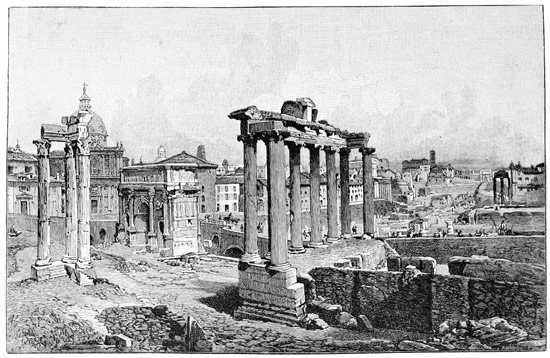
THE FORUM
To face page 170.
The argument with which Gregory replies to a letter from Eulogius, Bishop of Alexandria, who had wished him to assume himself a similar title, is curious. The Apostolical See, he says, consists of three bishoprics, all held by St. Peter, that of Antioch, that of Alexandria, and that of Rome, and the honour of the title is shared between them. "If you give me more than my due," he adds, "you rob yourself. If I am named Pope, you own yourself to be no pope. Let no such thing be named between us. My honour is the honour of the Universal Church. I am honoured in the honour paid to my brethren." Nothing could be more determined than this oft-repeated refusal. Yet he never fails to add that it was Peter's right. The Council of Chalcedon, he says, offered that supreme title to the Church of Rome, which refused it. How much greater then, was the guilt of John, to whom it was never offered, but who assumed it, injuring all priests by setting himself above them, and the Empire itself by a position superior to it? Such were the sentiments of Gregory, in which the wrath of a natural heir, thus supplanted by a usurper, gives fervour to every denunciation. The French historian Villemain points out, what will naturally occur to the reader, that many of these arguments were afterwards used with effect by Luther and his followers against the assumptions of the Church of Rome. It will also be remembered that Jerome put the case more strongly still, denouncing the Scarlet Woman with as much fervour as any No-Popery orator.
But while he rejected all such titles and assumed for himself only that, conceived no doubt in all humility and sincere meaning, but afterwards worn with pride surpassing that of any earthly monarch, of Servus Servorum Dei, the servant of the servants of God, Gregory occupied himself, as has been said, with the care of all the churches in full exercise of the authority and jurisdiction of an overseer, at least over the western half of Christendom. Vain titles he would have none, and we cannot doubt his sincerity in rejecting them; but the reality of the pastoral supervision, never despotic, but continual, was clearly his idea of his own rights and duties. It has been seen what license he left to Augustine in the regulation of the new English Church. He acted with an equally judicious liberality in respect to the rich and vigorous Gallican bishops, never demanding too servile an obedience, but never intermitting his superintendence of all. But he does not seem to have put forth the smallest pretension to political independence, even when that was forced upon him by his isolated and independent position, and he found himself compelled to make his own terms with the Lombard invaders. At the moment of his election as Bishop of Rome, he appealed to the Emperor against the popular appointment, and only when the imperial decision was given against him allowed himself to be dragged from his solitude. And one of his accusations against John of Constantinople was that his assumption injured the very Empire itself in its supreme authority. Thus we may, and indeed I think must, conclude that Gregory's supposed theory of the universal papal power was as little real as are most such elaborate imputations of purpose conceived long before the event. He had no intention, so far as the evidence goes, of making himself an arbitrator between kings, and a judge of the world's actions and movements. He had enough and too much work of his own which it was his determination to do, as vigorously and with as much effect as possible—in the doing of which work it was necessary to influence, to conciliate, to appeal, as well as to command and persuade: to make terms with barbarians, to remonstrate with emperors, as well as to answer the most minute questions of the bishops, and lay out before them the proper course they were to pursue. There is nothing so easy as to attribute deep-laid plans to the great spirits among men. I do not think that Gregory had time for any such ambitious projects. He had to live for the people dependent upon him, who were a multitude, to defend, feed, guide and teach them. He had never an unoccupied moment, and he did in each moment work enough for half a dozen men. That it was his duty to superintend and guide everything that went on, so far as was wise or practicable, in the Church as well as in his immediate diocese, was clearly his conviction, and the reader may find it a little difficult to see why he should have guarded that power so jealously, yet rejected the name of it: but that is as far as any reasonable criticism can go.
What would seem an ancient complaint against Gregory appears in the sketch of his life given by Platina, in his Lives of the Popes—who describes him as having been "censured by a few ignorant men as if the ancient stately buildings were demolished by his order, lest strangers coming out of devotion to Rome should less regard the consecrated places, and spend all their gaze upon triumphal arches and monuments of antiquity." This curious accusation is answered by the author in words which I quote from an almost contemporary translation very striking in its forcible English. "No such reproach," says Platina in the vigorous version of Sir Paul Rycant, Knight, "can justly be fastened on this great Bishop, especially considering that he was a native of the city, and one to whom, next after God, his country was most dear, even above his life. 'Tis certain that many of those ruined structures were devoured by time, and many might, as we daily see, be pulled down to build new houses; and for the rest 'tis probable that, for the sake of the brass used in the concavity of the arches and the conjunctures of the marble or other square stones, they might be battered or defaced not only by the barbarous nations but by the Romans too, if Epirotes, Dalmatians, Pannonians, and other sorry people who from all parts of the world resorted hither, may be called Romans."
This is a specious argument which would not go far toward establishing Gregory's innocence were he seriously accused: but the accusation, like that of burning classical manuscripts, has no proof. Little explanation, however, is necessary to account for the ruins of a city which has undergone several sieges. That Gregory would have helped himself freely as everybody did, and has done in all ages, to the materials lying so conveniently at hand in the ruined palaces which nobody had any mission to restore, may be believed without doubt; for he was a man far too busy and preoccupied to concern himself with questions of Art, or set any great price upon the marble halls of patrician houses, however interesting might be their associations or beautiful their structure. But he built few new churches, we are expressly told, though he was careful every year to look into the condition of all existing ecclesiastical buildings and have them repaired. It seems probable that it might be a later Gregory however against whom this charge was made. In the time of Gregory the First these ruins were recent, and it was but too likely that at any moment a new horde of unscrupulous iconoclasts might sweep over them again.
There came however a time when the Pope's suffering and emaciated body could bear no longer that charge which was so burdensome. He had been ill for many years, suffering from various ailments and especially from weakness of digestion, and he seems to have broken down altogether towards the year 601. Agelulphus thundering at his gates had completed what early fastings and the constant work of a laborious life had begun, and at sixty Gregory took to his bed, from which, as he complains in one of his letters, he was scarcely able to rise for three hours on the great festivals of the Church in order to celebrate Mass. He was obliged also to conclude abruptly that commentary on Ezekiel which had been so often interrupted, leaving the last vision of the prophet unexpounded, which he regretted the more that it was one of the most dark and difficult, and stood in great need of exposition. "But how," he says, "can a mind full of trouble clear up such dark meanings? The more the mind is engaged with worldly things the less is it qualified to expound the heavenly." It was from Ezekiel that Gregory was preaching when the pestilence which swept away his predecessor Pelagius was raging in Rome, and when, shutting the book which was no longer enough with its dark sayings to calm the troubles of the time, he had called out to the people, with a voice which was as that of their own hearts, to repent. All his life as Pope had been threaded through with the study of this prophet. He closed the book again and finally when all Rome believed that another invasion was imminent, and his courage failed in this last emergency. It is curious to associate the name of such a man, so full of natural life and affection, so humorous, so genial, so ready to take interest in everything that met his eyes, with these two saddest figures in all the round of sacred history, the tragic patriarch Job, and the exiled prophet, who was called upon to suffer every sorrow in order to be a sign to his people and generation. Was it that the very overflowing of life and sympathy in him made Gregory seek a balance to his own buoyant spirit in the plaints of those two melancholy voices? or was it the misfortunes of his time, so distracted and full of miserable agitation, which directed him at least to the latter, the prophet of a fallen nation, of disaster and exile and penitence?
Thus he lay after his long activities, suffering sorely, and longing for the deliverance of death, though he was not more, it is supposed, than sixty-two when the end came. From his sick bed he wrote to many of his friends entreating that they would pray for him that his sufferings might be shortened and his sins forgiven. He died finally on the 12th of March, ever afterwards consecrated to his name, in the year 603. This event must have taken place in the palace at the Lateran, which was then the usual dwelling of the Popes. Here the sick and dying man could look out upon one of the finest scenes on earth, the noble line of the Alban Hills rising over the great plains of the Campagna, with all its broken lines of aqueduct and masses of ruin. The features of the landscape are the same, though every accessory is changed, and palace and basilica have both crumbled into the dust of ages, to be replaced by other and again other buildings, handing down the thread of historic continuity through all the generations. There are scarcely any remains of the palace of the Popes itself, save one famous mosaic, copied from a still earlier one, in which a recent learned critic sees the conquest of the world by papal Rome already clearly set forth. But we can scarcely hope that any thought of the first Gregory will follow the mind of the reader into the precincts of St. John of the Lateran Gate. His memory abides in another place, in the spot where stood his father's house, where he changed the lofty chambers of the Roman noble into Benedictine cells, and lived and wrote and mused in the humility of an obedient brother. But still more does it dwell in the little three-cornered piazza before the Church of St. Gregorio, from whence he sent forth the mission to England with issues which he could never have divined—for who could have told in those days that the savage Angles would have overrun the world further than ever Roman standard was carried? The shadow of the great Pope is upon those time-worn steps where he stood and blessed his brethren, with moisture in his eyes and joy in his heart, sending them forth upon the difficult and dangerous way which he had himself desired to tread, but from which their spirits shrank. We have all a sacred right to come back here, to share the blessing of the saint, to remember the constant affection he bore us, his dedication of himself had it been permitted, his never-ending thought of his angel boys which has come to such wonderful issues. He would have been a more attractive apostle than Augustine had he carried out his first intention; but still we find his image here, fatherly, full of natural tenderness, interest and sympathy, smiling back upon us over a dozen centuries which have changed everything—except the historical record of Pope Gregory's blessing and his strong desire and hope.
He was buried in St. Peter's with his predecessors, but his tomb, like so many others, was destroyed at the rebuilding of the great church, and no memorial remains.
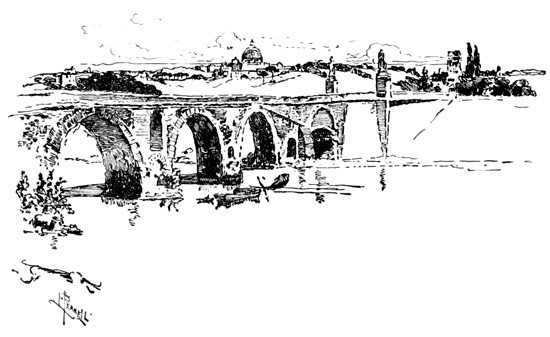
PONTE MOLLE.
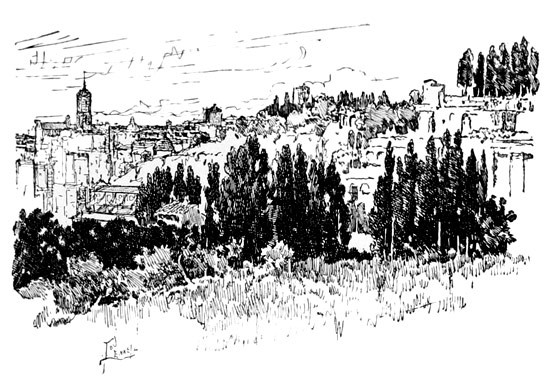
THE PALATINE.
CHAPTER II.
THE MONK HILDEBRAND.
It is a melancholy thing looking back through the long depths of history to find how slow the progress is, even if it can be traced at all, from one age to another, and how, though the dangers and the evils to which they are liable change in their character from time to time, their gravity, their hurtfulness, and their rebellion against all that is best in morals, and most advantageous to humanity, scarcely diminish, however completely altered the conditions may be. We might almost doubt whether the vast and as yet undetermined possibilities of the struggle which has begun in our days between what is called Capital and Labour, the theories held against all experience and reason of a rising Socialism, and the mad folly of Anarchism, which is their immediate climax—are not quite as dangerous to the peace of nations as were the tumults of an age when every man acted by the infallible rule that
He should take who had the power
And he should keep who can—
the principle being entirely the same, though the methods may be different. This strange duration of trouble, equal in intensity though different in form, is specially manifest in a history such as that which we take up from one age to another in so remarkable a development of life and government as Mediæval Rome. We leave the city relieved of some woes, soothed from some troubles, fed by much charity, and weeping apparently honest tears over Gregory the first of the name—although that great man was scarcely dead before the crowd was taught to believe that he had impoverished the city by feeding them, and were scarcely prevented from burning his library as a wise and fit revenge. Still it might have been expected that Rome and her people would have advanced a step upon the pedestal of such a life as that of Gregory: and in fact he left many evils redressed, the commonwealth safer, and the Church more pure.
But when we turn the page and come, four hundred years later, to the life of another Gregory, upon what a tumultuous world do we open our eyes: what blood, what fire, what shouts and shrieks of conflict: what cruelty and shame have reigned between, and still remained, ever stronger than any influence of good men, or amelioration of knowledge! Heathenism, save that which is engrained in the heart of man, had passed away. There were no more struggles with the relics of the classical past: the barbarians who came down in their hordes to overturn civilisation had changed into settled nations, with all the paraphernalia of state and great imperial authority—shifting indeed from one race to another, but always upholding a central standard. All the known world was nominally Christian. It was full of monks dedicated to the service of God, of priests, the administrants of the sacraments, and of bishops as important as any secular nobles—yet what a scene is that upon which we look out through endless smoke of battle and clashing of swords! Rome, at whose gates Alaric and Attila once thundered, was almost less secure now, and less easily visited than when Huns and Goths overran the surrounding country. It was encircled by castles of robber nobles, who infested every road, sometimes seizing the pilgrims bound for Rome, with their offerings great and small, sometimes getting possession of these offerings in a more thorough way by the election of a subject Pope taken from one of their families, and always ready on every occasion to thrust their swords into the balance and crush everything like freedom or purity either in the Church or in the city. In the early part of the eleventh century there were two if not three Popes in Rome. "Benedict IX. officiated in the church of St. John Lateran, Sylvester III. in St. Peter's, and John XX. in the church of St. Mary," says Villemain in his life of Hildebrand: the name of the last does not appear in the lists of Platina, but the fact of this profane rivalry is beyond doubt.
The conflict was brought to an end for the moment by a very curious transaction. A certain dignified ecclesiastic, Gratiano by name, the Cardinal-archdeacon of St. John Lateran, who happened to be rich, horrified by this struggle, and not sufficiently enlightened as to the folly and sin of doing evil that good might come—always, as all the chronicles seem to allow, with the best motives—bought out the two competitors, and procured his own election under the title of Gregory VI. But this mistaken though well-meant act had but brief success. For, on the arrival in 1046 of the Emperor Henry III. in Italy, at a council called together by his desire, Gregory was convicted of the strange bargain he had made, or according to Baronius of the violent means taken to enforce it, and was deposed accordingly, along with his two predecessors. It was this Pope, in his exile and deprivation, who first brought in sight of a universe which he was born to rule, a young monk of Cluny, Hildebrand—German by name, but Italian in heart and race—who had already moved much about the world with the extraordinary freedom and general access everywhere which we find common to monks however humble their origin. From his monastic home in Rome he had crossed the Alps more than once; he had been received and made himself known at the imperial court, and was on terms of kindness with many great personages, though himself but a humble brother of his convent. No youthful cleric in our modern world nowadays would find such access everywhere, though it is still possible that a young Jesuit for instance, noted by his superiors for ability or genius, might be handed on from one authority to another till he reached the highest circle. But it is surprising to see how free in their movements, how adventurous in their lives, the young members of a brotherhood bound under the most austere rule then found it possible to be.
Hildebrand was, like so many other great Churchmen, a child of the people. He was the son of a carpenter in a Tuscan village, who, however, possessed one of those ties with the greater world which a clergy drawn from the people affords to the humblest, a brother or other near relation who was the superior of a monastery in Rome. There the little Tuscan peasant took his way in very early years to study letters, having already given proof of great intelligence such as impressed the village and called forth prophecies of the highest advancement to come. His early education brings us back to the holy mount of the Aventine, on which we have already seen so many interesting assemblies. The monastery of St. Mary has endured as little as the house of Marcella, though it is supposed that in the church of S. Maria Aventina there may still remain some portion of the original buildings. But the beautiful garden of the Priorato, so great a favourite with the lovers of the picturesque, guards for us, in that fidelity of nature which time cannot discompose, the very spot where that keen-eyed boy must have played, if he ever played, or at least must have dreamed the dreams of an ambitious young visionary, and perhaps, as he looked out musing to where the tombs of the Apostles gleamed afar on the other side of Tiber, have received the inheritance of that long hope and vision which had been slowly growing in the minds of Popes and priests—the hope of making the Church the mistress and arbiter of the nations, the supreme and active judge among all tumults of earthly politics and changes of power. He was nourished from his childhood in the house of St. Peter, says the biographer of the Acta Sanctorum. It would be more easy to realise the Apostle's sway, and that of his successors, on that mount of vision, where day and night, by sun and moon, the great temple of Christendom, the centre of spiritual life, shone before his eyes, than on any other spot. That wonderful visionary sovereignty, the great imagination of a central power raised above all the disturbances of worldly life, and judging austerely for right and against wrong all the world over—unbiassed, unaffected by meaner motives, the great tribunal from which justice and mercy should go forth over the whole earth—could there be a more splendid ideal to till the brain of an ardent boy? It is seldom that such an ideal is recognised, or such dreams as these believed in. We know how little the Papacy has carried it out, and how the faults and weaknesses even of great men have for many centuries taken all possibility from it. But it was while that wonderful institution was still fully possible, the devoutest of imaginations, a dream such as had never been surpassed in splendour and glory, that young Hildebrand looked out to Peter's prison on the Janiculum opposite, and from thence to Peter's tomb, and dreamt of Peter's white throne of justice dominating the darkness and the self-seeking of an uneasy world.
The monastery of St. Mary, a Benedictine house, must have been noted in its time. Among the teachers who instructed its neophytes was that same Giovanni Gratiano of whom we have just spoken, the arch-priest who devoted his wealth to the not ignoble purpose of getting rid of two false and immoral Popes: though perhaps his motives would have been less misconstrued had he not been elected in their place. And there was also much fine company at the monastery in those days—bishops with their suites travelling from south and north, seeking the culture and piety of Rome after long banishment from intellectual life—and at least one great abbot, more important than a bishop, Odilon of Cluny, at the head of one of the greatest of monastic communities. All of these great men would notice, no doubt, the young nephew of the superior, the favourite of the cloister, upon whom many hopes were already beginning to be founded, and in whose education every one loved to have a hand. One of these bishops was said afterwards to have taught him magical arts, which proves at least that they took a share in the training of the child of the convent. At what age it was that he was transferred to Cluny it is impossible to tell. Dates do not exist in Hildebrand's history until he becomes visible in the greater traffic of the world. He was born between 1015 and 1020—this is the nearest that we can approach to accuracy. He appears in full light of history at the deposition of Gratiano (Gregory VI.) in 1045. In the meantime he passed through a great many developments. Probably the youth—eager to see the world, eager too to fulfil his vocation, to enter upon the mortifications and self-abasement of a monk's career, and to "subdue the flesh" in true monkish fashion, as well as by the fatigues of travel and the acquirement of learning—followed Odilon and his train across i monti, a favourite and familiar, when the abbot returned from Rome to Cluny. It could not be permitted in the monkish chronicles, even to a character like that of the austere Hildebrand all brain and spirit, that he had no flesh to subdue. And we are not informed whether it was at his early home on the Aventine or in the great French monastery that he took the vows. The rule of Cluny was specially severe. One poor half hour a day was all that was permitted to the brothers for rest and conversation. But this would not matter much, we should imagine, to young Hildebrand, all on fire for work, and full of a thousand thoughts.
How a youth of his age got to court, and was heard and praised by the great Emperor Henry III., the head of Christendom, is not known. Perhaps he went in attendance on his abbot, perhaps as the humble clerk of some elder brethren bearing a complaint or an appeal; the legend goes that he became the tutor and playfellow of the little prince, Henry's son, until the Emperor had a dream in which he saw the stranger, with two horns on his head, with one of which he pushed his playfellow into the mud—significant and alarming vision which was a reasonable cause for the immediate banishment of Hildebrand. The dates, however, if nothing else, make this story impossible, for the fourth Henry was not born within the period named. At all events the young monk was sufficiently distinguished to be brought under the Emperor's notice and to preach before him, though we are not informed elsewhere that Hildebrand had any reputation as a preacher. He was no doubt full of earnestness and strong conviction, and that heat of youth which is often so attractive to the minds of sober men. Henry declared that he had heard no man who preached the word of God with so much faith: and the imperial opinion must have added much to his importance among his contemporaries. On the other hand, the great world of Germany and its conditions must have given the young man many and strange revelations. Nowhere were the prelates so great and powerful, nowhere was there so little distinction between the Church and the world. Many of the clergy were married, and left, sometimes their cures, often a fortune amassed by fees for spiritual offices, to their sons: and benefices were bought and sold like houses and lands, with as little disguise. A youth brought up in Rome would not be easily astonished by the lawlessness of the nobles and subject princes of the empire, but the importance of a central authority strong enough to restrain and influence so vast a sphere, and so many conflicting powers, must have impressed upon him still more forcibly the supreme ideal of a spiritual rule more powerful still, which should control the nations as a great Emperor controlled the electors who were all but kings. And we know that it was now that he was first moved to that great indignation, which never died in his mind, against simony and clerical license, which were universally tolerated, if not acknowledged as the ordinary rule of the age. It was high time that some reformer should arise.
It was not, however, till the year 1046, on the occasion of the deposition of Gregory VI. for simony, that Hildebrand first came into the full light of day. Curiously enough, the first introduction of this great reformer of the Church, the sworn enemy of everything simoniacal, was in the suite of this Pope deposed for that sin. But in all probability the simony of Gregory VI. was an innocent error, and resulted rather from a want of perception than evil intention, of which evidently there was none in his mind. He made up to the rivals who held Rome in fee, for the dues and tributes and offerings which were all they cared for, by the sacrifice of his own fortune. If he had not profited by it himself, if some one else had been elected Pope, no stain would have been left upon his name: and he seems to have laid down his dignities without a murmur: but his heart was broken by the shame and bitter conviction that what he had meant for good was in reality the very evil he most condemned. Henry proceeded on his march to Rome after deposing the Pope, apparently taking Gregory with him: and there without any protest from the silenced and terrified people, nominated a German bishop of his own to the papal dignity, from whose hands he himself afterwards received the imperial crown. He then returned to Germany, sweeping along with him the deposed and the newly-elected Popes, the former attended in silence and sorrow by Hildebrand, who never lost faith in him, and to the end of his life spoke of him as his master.
A stranger journey could scarcely have been. The triumphant German priests and prelates surrounding the new head of the Church, and the handful of crestfallen Italians following the fallen fortunes of the other, must have made a strange and not very peaceful conjunction. "Hildebrand desired to show reverence to his lord," says one of the chronicles. Thus his career began in the deepest mortification and humiliation, the forced subjection of the Church which it was his highest aim and hope to see triumphant, to the absolute force of the empire and the powers of this world.
Pope Gregory reached his place of exile on the banks of the Rhine, with his melancholy train, in deep humility; but that exile was not destined to be long. He died there within a few months: and his successor soon followed him to the grave. For a short and disastrous period Rome seems to have been left out of the calculations altogether, and the Emperor named another German bishop, whom he sent to Rome under charge of the Marquis, or Margrave, or Duke of Tuscany—for he is called by all these titles. This Pope, however, was still more short-lived, and died in three weeks after his proclamation, by poison it was supposed. It is not to be wondered at if the bishops of Germany began to be frightened of this magnificent nomination. Whether it was the judgment of God which was most to be feared, or the poison of the subtle and scheming Romans, the prospect was not encouraging. The third choice of Henry fell upon Bruno, the bishop of Toul, a relative of his own, and a saintly person of commanding presence and noble manners. Bruno, as was natural, shrank from the office, but after days of prayer and fasting yielded, and was presented to the ambassadors from Rome as their new Pope. Thus the head of the Church was for the third time appointed by the Emperor, and the ancient privilege of his election by the Roman clergy and people swept away.
But Henry was not now to meet with complete submission and compliance, as he had done before. The young Hildebrand had shown no rebellious feeling when his master was set aside: he must have, like Gregory, felt the decision to be just. And after faithful service till the death of the exile, he had retired to Cluny, to his convent, pondering many things. We are not told what it was that brought him back to Germany at this crisis of affairs, whether he were sent to watch the proceedings, or upon some humbler mission, or by the mere restlessness of an able young man thirsting to be employed, and the instinct of knowing when and where he was wanted. He reappeared, however, suddenly at the imperial court during these proceedings; and no doubt watched the summary appointment of the new Pope with indignation, injured in his patriotism and in his churchmanship alike, by an election in which Rome had no hand, though otherwise not dissatisfied with the Teutonic bishop, who was renowned both for piety and learning. The chronicler pauses to describe Hildebrand in this his sudden reintroduction to the great world. "He was a youth of noble disposition, clear mind, and a holy monk," we are told. It was while Bishop Bruno was still full of perplexities and doubts that this unexpected counsellor appeared, a man, though young, already well known, who had been trained in Rome, and was an authority upon the customs and precedents of the Holy See. He had been one of the closest attendants upon a Pope, and knew everything about that high office—there could be no better adviser. The anxious bishop sent for the young monk, and Hildebrand so impressed him with his clear mind and high conception of the papal duties, that Bruno begged him to accompany him to Rome.
He answered boldly, "I cannot go with you." "Why?" said the Teuton prelate with amazement. "Because without canonical institution," said the daring monk, "by the sole power of the emperor, you are about to seize the Church of Rome."
Bruno was greatly startled by this bold speech. It is possible that he, in his distant provincial bishopric, had no very clear knowledge of the canonical modes of appointing a Pope. There were many conferences between the monk and the Pope-elect, the young man who was not born to hesitate but saw clear before him what to do, and his elder and superior, who was neither so well informed nor so gifted. Bruno, however, if less able and resolute, must have been a man of a generous and candid mind, anxious to do his duty, and ready to accept instruction as to the best method of doing so, which was at the same time the noblest way of getting over his difficulties. He appeared before the great diet or council assembled in Worms, and announced his acceptance of the pontificate, but only if he were elected to it according to their ancient privileges by the clergy and people of Rome. It does not appear whether there was any resistance to this condition, but it cannot have been of a serious character, for shortly after, having taken farewell of his own episcopate and chapter, he set out for Rome.
This is the account of the incident given by Hildebrand himself when he was the great Pope Gregory, towards the end of his career. It was his habit to tell his attendants the story of his life in all its varied scenes, during the troubled leisure of its end, as old men so often love to do. "Part I myself heard, and part of it was reported to me by many others," says one of the chroniclers. There is another account which has no such absolute authority, but is not unreasonable or unlikely, of the same episode, in which we are told that Bishop Bruno on his way to Rome turned aside to visit Cluny, of which Hildebrand was prior, and that the monk boldly assailed the Pope, upbraiding him with having accepted from the hand of a layman so great an office, and thus violently intruded into the government of the Church. In any case Hildebrand was the chief actor and inspirer of a course of conduct on the part of Bruno which was at once pious and politic. The papal robes which he had assumed at Worms on his first appointment were taken off, the humble dress of a pilgrim assumed, and with a reduced retinue and in modest guise the Pope-elect took his way to Rome. His episcopal council acquiesced in this change of demeanour, says another chronicler, which shows how general an impression Hildebrand's eloquence and the fervour of his convictions must have made. It was a slow journey across the mountains lasting nearly two months, with many lingerings on the way at hospitable monasteries, and towns where the Emperor's cousin could not but be a welcome guest. Hildebrand, who must have felt the great responsibility of the act which he had counselled, sent letter after letter, whenever they paused on their way, to Rome, describing, no doubt with all the skill at his command, how different was this German bishop from the others, how scrupulous he was that his election should be made freely if at all, in what humility he, a personage of so high a rank, and so many endowments, was approaching Rome, and how important it was that a proper reception should be given to a candidate so good, so learned, and so fit in every way for the papal throne. Meanwhile Bishop Bruno, anxious chiefly to conduct himself worthily, and to prepare for his great charge, beguiled the way with prayers and pious meditations, not without a certain timidity as it would appear about his reception. But this timidity turned out to be quite uncalled for. His humble aspect, joined to his high prestige as the kinsman of the emperor, and the anxious letters of Hildebrand had prepared everything for Bruno's reception. The population came out on all sides to greet his passage. Some of the Germans were perhaps a little indignant with this unnecessary humility, but the keen Benedictine pervaded and directed everything while the new Pope, as was befitting on the eve of assuming so great a responsibility, was absorbed in holy thought and prayer. The party had to wait on the further bank of the Tiber, which was in flood, for some days, a moment of anxious suspense in which the pilgrims watched the walls and towers of the great city in which lay their fate with impatience and not without alarm. But as soon as the water fell, which it did with miraculous rapidity, the whole town, with the clergy at its head, came out to meet the new-comers, and Leo IX., one of the finest names in the papal lists, entering barefooted and in all humility by the great doors of St. Peter's, was at once elected unanimously, and received the genuine homage of all Rome. One can imagine with what high satisfaction, yet with eyes ever turned to the future, content with no present achievement, Hildebrand must have watched the complete success of his plan.
This event took place, Villemain tells us (the early chroniclers, as has been said, are most sparing of dates), in 1046, a year full of events. Muratori in his annals gives it as two years later. Hildebrand could not yet have attained his thirtieth year in either case. He was so high in favour with the new Pope, to whom he had been so wise a guide, that he was appointed at once to the office of Economico, a sort of Chancellor of the Exchequer to the Court of Rome, and at the same time was created Cardinal-archdeacon, and abbot of St. Paul's, the great monastery outside the walls. Platina tells us that he received this charge as if the Pope had "divided with him the care of the keys, the one ruling the church of St. Peter and the other that of St. Paul."
That great church, though but a modern building now, after the fire which destroyed it seventy years ago, and standing on the edge of the desolate Campagna, is still a shrine universally visited. The Campagna was not desolate in Hildebrand's days, and the church was of the highest distinction, not only as built upon the spot of St. Paul's martyrdom, but for its own splendour and beauty. It is imposing still, though so modern, and with so few relics of the past. But the pilgrim of to-day, who may perhaps recollect that over its threshold Marcella dragged herself, already half dead, into that peace of God which the sanctuary afforded amid the sack and the tortures of Rome, may add another association if he is so minded in the thought of the great ecclesiastic who ruled here for many years, arriving, full of zeal and eager desire for universal reform, into the midst of an idle crew of depraved monks, who had allowed their noble church to fall into the state of a stable, while they themselves—a mysterious and awful description, yet not perhaps so alarming to us as to them—"were served in the refectory by women," the first and perhaps the only, instance of female servants in a monastery. Hildebrand made short work of these ministrants. He had a dream—which no doubt would have much effect on the monks, always overawed by spiritual intervention, however material they might be in mind or habits—in which St. Paul appeared to him, working hard to clear out and purify his desecrated church. The young abbot immediately set about the work indicated by the Apostle, "eliminating all uncleanness," says his chronicler: "and supplying a sufficient amount of temperate food, he gathered round him a multitude of honest monks faithful to their rule."
Hildebrand's great business powers, as we should say, enabled him very soon to put the affairs of the convent in order. The position of the monastery outside the city gates and defences, and its thoroughly disordered condition, had left it open to all the raids and attacks of neighbouring nobles, who had found the corrupt and undisciplined monks an easy prey; but they soon discovered that they had in the new abbot a very different antagonist. In these occupations Hildebrand passed several years, establishing his monastery on the strongest foundations of discipline, purity, and faith. Reform was what the Church demanded in almost every detail of its work. Amid the agitation and constant disturbance outside, it had not been possible to keep order within, nor was an abbot who had bought his post likely to attempt it: and a great proportion of the abbots, bishops, and great functionaries of the Church had bought their posts. In the previous generation it had been the rule. It had become natural, and disturbed apparently no man's conscience. A conviction, however, had evidently arisen in the Church, working by what influences we know not, but springing into flame by the action of Hildebrand, and by his Pope Leo, that this state of affairs was monstrous and must come to an end. The same awakening has taken place again and again in the Church as the necessity has unfortunately arisen: and never had it been more necessary than now. Every kind of immorality had been concealed under the austere folds of the monk's robe; the parish priests, especially in Germany, lived with their wives in a calm contempt of all the Church's laws in that respect. This, which to us seems the least of their offences, was not so in the eyes of the new race of Church reformers. They thought it worse than ordinary immoral relations, as counterfeiting and claiming the title of a lawful union; and to the remedy of this great declension from the rule of the Church, and of the still greater scandal of simony, the new Pope's utmost energies were now directed.
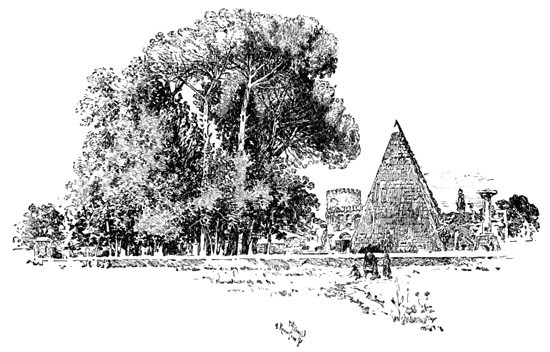
PYRAMID OF CAIUS CESTIUS.
A very remarkable raid of reformation, which really seems the most appropriate term which could be used, took place accordingly in the first year of Leo IX.'s reign. We do not find Hildebrand mentioned as accompanying him in his travels—probably he was already too deeply occupied with the cleansing out of St. Paul's physically and morally, to leave Rome, of which, besides, he had the care, in all its external as well as spiritual interests, during the Pope's absence: but no doubt he was the chief inspiration of the scheme, and had helped to organise all its details. Something even of the subtle snare in which his own patron Gregory had been caught was in the plan with which Hildebrand, thus gleaning wisdom from suffering, sent forth his Pope. After holding various smaller councils in Italy, Leo crossed the mountains to France, where against the wish of the Emperor, he held a great assembly at Rheims. The nominal occasion of the visit was the consecration of that church of St. Remy, then newly built, which is still one of the glories of a city so rich in architectural wealth. The body of St. Remy was carried, with many wonderful processions, from the monastery where it lay, going round and round the walls of the mediæval town and through its streets with chants and psalms, with banner and cross, until at last it was deposited solemnly on an altar in the new building, now so old and venerable. Half of France had poured into Rheims for this great festival, and followed the steps of the Pope and hampered his progress—for he was again and again unable to proceed from the great throngs that blocked every street. This, however, though a splendid ceremony, and one which evidently made much impression on the multitude, was but the preliminary chapter. After the consecration came a wholly unexpected visitation, the council of Rheims, which was not concerned like most other councils with questions of doctrine, but of justice and discipline. The throne for the Pope was erected in the middle of the nave of the cathedral—not, it need scarcely be said, the late but splendid cathedral now existing—and surrounded in a circle by the seats of the bishops and archbishops. When all were assembled the object of the council was stated—the abolition of simony, and of the usurpation of the priesthood and the altar by laymen, and the various immoral practices which had crept into the shadow of the Church and been tolerated or authorised there. The Pope in his opening address adjured his assembled counsellors to help him to root out those tares which choked the divine grain, and implored them, if any among them had been guilty of the sin of simony, either by sale or purchase of benefices, that he should make a public confession of his sin.
Terrible moment for the bishops and other prelates, immersed in all the affairs of their times and no better than other men! The reader after all these centuries can scarcely fail to feel the thrill of alarm, or shame, or abject terror that must have run through that awful sitting as men looked into each other's faces and grew pale. The archbishop of Trèves got up first and declared his hands to be clean, so did the archbishop of Lyons and Besançon. Well for them! But he of Rheims in his own cathedral, he who must have been in the front of everything for these few triumphant days of festival, faltered when his turn came. He begged that the discussion might be adjourned till next day, and that he might be allowed to see the Pope in private before making his explanations. It must have been with a kind of grim benignancy, and awful toleration, that the delay was granted and the inquisition went on, while that great personage, one of the first magnates of the assembly, sat silent, pondering all there was against him and how little he had to say in his defence. The council became more lively after this with accusations and counter-accusations. The bishop of Langres procured the deposition of an abbot in his diocese for immoral conduct; but next day was assailed himself of simony, adultery, and the application of torture in order to extort money. After a day or two of discussion this prelate fled, and was finally excommunicated. Pope Leo was not a man to be trifled with. And so the long line of prelates was gone through with many disastrous consequences as the days ran on.
It is less satisfactory to find him easily excommunicating rebels and opponents of the Emperor, whose arms were too successful or their antagonism too important. Even the best of priests and Popes err sometimes—and to have such a weapon as excommunication at hand like a thunderbolt must have been very tempting. Leo at the same time excommunicated also the people of Benevento, who had rebelled against the Emperor, and the archbishop of Ravenna, who was in rebellion against himself.
The travels and activity of this Pope on his round of examination and punishment were extraordinary. He appears in one part of Italy after another: in the far south, in the midland plains, holding councils everywhere, deposing bishops, scourging the Church clean. Again he is over the hills in his own country, meeting the Emperor, as active as himself, and almost as earnest in his desire to cleanse the Church of simony—moving here and there, performing all kinds of sacred functions from the celebration of a feast to the excommunication of a city. His last, and as it proved fatal enterprise was an expedition against the Normans, who had got possession of a great part of Southern Italy, and against whom the Pope went, most inappropriately, at the head of an army, made up of the most heterogeneous elements, and which collapsed in face of the enemy. Leo himself either was made prisoner or took refuge in the town of Benevento, which had recently, by a bargain with the Emperor, become the property of the Holy See. Here he was detained for nearly a year, more or less voluntarily, and when, at length, he set out for Rome, with a strong escort of the Normans and every mark of honour, it was with broken health and failing strength. He died shortly after reaching his destination, in his own great church, having caused himself to be carried there as he grew worse; and nothing could be more imposing than the scene of his death, in St. Peter's, which was all hung with black and illuminated with thousands of funeral lights for this great and solemn event. All Rome witnessed his last hours and saw him die. He was one of the great Popes, though he did not fully succeed even in his own appropriate work of Church reform, and failed altogether when he took, unfortunately, sword in hand. Not a word, however, could be said against the purity of his life and motives, and these were universally acknowledged, especially among the Normans against whom he led his unfortunate army, and who worshipped, while probably holding captive, their rash invader.
During the eight years of Leo's popedom Hildebrand had been at the head of affairs in Rome, where erring priests and simoniacal bishops had been not less severely brought to book than in other places. He does not seem to have accompanied the Pope on any of his many expeditions; but with the aid of a new brother-in-arms, scarcely less powerful and able than himself, Peter Damian, then abbot of Fontavellona and afterwards bishop of Ostia, did his best under Leo to sweep clean the ecclesiastical world in general as he had swept clean his own church of St. Paul. When Leo died, Hildebrand was one of the three legates sent to consult the Emperor as to the choice of another Pope. This was a long and difficult business, since the susceptibilities of the Romans, anxious to preserve their own real or apparent privilege of election, had to be reconciled with the claims of Henry, who had no idea of yielding them in any way, and who had the power on his side. The selection seems to have been finally made by Hildebrand rather than Henry, and was that of Gebehard, bishop of Aichstadt, another wealthy German prelate, also related to the Emperor. Why he should have consented to accept this mission, however, he who had so strongly declined to follow Leo as the nominee of the Emperor, and made it a condition of his service that the new Pope should go humbly to Rome as a pilgrim to be elected there, is unexplained by any of the historians.
It was in the spring of 1055 that after long delays and much waiting, the Roman conclave came back, bringing their Pope with them. But Victor II. was like so many of his German predecessors, short-lived. His reign only lasted two years, the half of which he seems to have spent in Germany. "He was not one who loved the monks," and probably Hildebrand found that he would do but little with one whose heart would seem to have remained on the other side of i monti—as the Alps are continually called. No second ambassador was sent to the Imperial Court for a successor: for in the fateful year 1056 the Emperor also died, preceding Victor to the grave by a few months. Without pausing to consult the German Court, with a haste which proves their great anxiety to reassert themselves, the Roman clergy and people elected Frederick, abbot of Monte Cassino and brother of the existing prince of Tuscany—Gottfried of Lorraine, the second husband of Beatrice of Tuscany and step-father of Matilda the actual heir to that powerful duchy. Perhaps a certain desire to cling to the only power in Italy which could at all protect them against an irritated Imperial Court mingled with this choice: but it was a perfectly natural and worthy one. Frederick, unfortunately, lived but a few months, disappointing many hopes. He had sent Hildebrand to the Imperial Court to explain and justify his election, but when he found his health beginning to give way, a sort of panic seems to have seized him, and collecting round him all the representatives of priests and people who could be gathered together, he made them swear on pain of excommunication to elect no successor until the return of Hildebrand. He died at Florence shortly after.
There is something monotonous in these brief records: a great turmoil almost reaching the length of a convulsion for the choice, and then a short and agitated span, a year or two, sometimes only a month or two, and all is over and the new Pope goes to rejoin the long line of his predecessors. It was not, either, that these were old men, such as have so often been chosen in later days, venerable fathers of the Church whose age brought them nearer to the grave than the throne:—they were all men in the flower of their age, likely according to all human probability to live long. It was not wonderful if the German bishops were afraid of that dangerous elevation which seemed to carry with it an unfailing fate.
Hildebrand was at the German Court when this sad news reached him. He was in the position, fascinating to most men—and he was not superior to others in this respect—of confidant and counsellor to a princess in the interesting position of a young widow, with a child, upon whose head future empire had already thrown its shadow. The position of the Empress Agnes was, no doubt, one of the most difficult which a woman could be called on to occupy, surrounded by powerful princes scarcely to be kept in subjection by the Emperor, who was so little more than their equal, though their sovereign—and altogether indisposed to accept the supremacy of a woman. There is nothing in which women have done so well in the world as in the great art of government, but the Empress Agnes was not one of that kind. She had to fall back upon the support of the clergy in the midst of the rude circle of potentates with whom she had to contend, and the visit of Hildebrand with his lofty views, his great hopes, his impetuous determination to vanquish evil with good, though not perhaps in the way recommended by the Apostles, was no doubt a wonderful refreshment and interest to her in the midst of all her struggles. But it was like a thunderbolt bursting at their feet to hear of the death of Frederick—(among the Popes Stephen IX.): and the swiftly following outburst in Rome when, in a moment, in the absence of any spirit strong enough to control them, the old methods were put into operation, and certain of the Roman nobles ever ready to take advantage of an opportunity—with such supporters within the city as terror or bribes could secure them, taking the people by surprise—procured the hurried election of a Pope without any qualifications for the office. Nothing could be more dramatic than the entire episode. A young Count of Tusculum, a stronghold seated amid the ruins of the old Roman city, above Frascati, one of a family who then seem to have occupied the position afterwards held by the Orsinis and Colonnas, was the leader of this conspiracy and the candidate was a certain Mincio, Bishop of Velletri, a member of the same family. The description in Muratori's Annals though brief is very characteristic.
"Gregorio, son of Albanio Count Tusculano, of Frascati, along with some other powerful Romans, having gained by bribes a good part of the clergy and people, rushed by night, with a party of armed followers, into the Church of St. Peter, and there, with much tumult, elected Pope, Giovanni, Bishop of Velletri, afterwards called Mincio (a word perhaps drawn from the French Mince and which probably was the original of the phrase now used Minciono, Minchione), who assumed the name of Benedict X. He was a man entirely devoid of letters."
The sudden raid in the night, all Rome silent and asleep, except the disturbed and hastily awakened streets by which the party had entered from across the Campagna and their robber fortress among the ruins of the classic Tusculum, makes a most curious and dramatic picture. The conspirators had among them certain so-called representatives of the people, with a few abbots who felt their seats insecure under a reforming Pope, and a few priests very desirous of shutting out all new and disturbing authority. They gathered hastily in the church which suddenly shone out into the darkness with flare of torch and twinkle of taper, while the intruder, Mincio, a lean and fantastic bishop, with affectations of pose and attitude such as his nickname implies, was hurried to the altar by his rude patrons and attendants. He was consecrated by the terrified archpriest of Ostia, upon whom the Frascati party had somewhere laid violent hands, and who faltered through the office half stupefied by fear. It was the privilege of the Bishop of Ostia to be the officiating prelate at the great solemnity of a Pope's consecration. When he could not be had the careless and profane barons no doubt thought his subordinate would do very well instead.
The news was received, however, though with horror, yet with a dignified self-restraint by the Imperial Court. Hildebrand set out at once for Florence to consult with the Sovereigns there, a royal family of great importance in the history of Italy, consisting of the widowed duchess Beatrice, her second husband Gottfried of Lorraine, and her young daughter Matilda, the actual heiress of the principality, all staunch supporters of the Church and friends of Hildebrand. That he should take the command of affairs at this sudden crisis seems to have been taken for granted on all sides. A council of many bishops "both German and Italian" was called together in Sienna, where it was met by a deputation from Rome, begging that fit steps might be taken to meet the emergency, and a legitimate Pope elected. The choice of this Council fell upon the Bishop of Florence, "who for wisdom and a good life was worthy of such a sublime dignity;" and the new Pope was escorted to Rome by a strong band of Tuscan soldiers powerful enough to put down all tumult or rebellion in the city. The expedition paused at Sutri, a little town, just within the bounds of the papal possessions, which had already on that account been the scene of the confusing and painful council which dethroned Gregory VI. to destroy the strongholds of the Counts of Tusculum near that spot, and make an end of their power. Mincio, however, poor fantastic shadow, had no heart to confront a duly elected Pope, or the keen eye of Hildebrand, and abdicated at once his ill-gotten power. His vague figure so sarcastically indicated has a certain half-comic, half-rueful effect, appearing amid all these more important forms and things, first in the dazzle of the midnight office, and afterwards in a hazy twilight of obscurity, stealing off, to be seen no more, except by the keen country folk and townsmen of his remote bishopric who, burlando—jesting as one is glad to hear they were able to do amid all their tumults and troubles—gave him his nickname, and thus sent down to posterity the fantastic vision of the momentary Pope with his mincing ways—no bad anti-pope though as Benedict X. he holds a faint footing in the papal roll—but a historical burla, a mediæval joke, not without its power to relieve the grave chronicle of the time.
The tumultuous public of Rome, which did not care very much either way, yet felt this election of the Pope to be its one remaining claim to importance, murmured and grumbled its best about the interference of Tuscany, a neighbour more insulting, when taking upon herself airs of mastery, than a distant and vaguely magnificent Emperor; and there was an outcry against Hildebrand, who had erected "a new idol" in concert with Beatrice and without the consent of the Romans. But it was in reality Hildebrand himself who now came to reign under the shadow of another insignificant and short-lived Pope. Nicolas II. and Alexander II. who followed were but the formal possessors of power; the true sway was henceforth in the hands of the ever-watchful monk, Cardinal-archdeacon, deputy and representative of the Holy See. It is one of the few instances to be found in the records of the world of that elevation of the man who can—so strongly preached by Carlyle—to the position which is his natural right. While Hildebrand had been scouring the world, an adventurous young monk, passing i monti recklessly as the young adventurer now crosses the Atlantic, more times than could be counted—while he was, with all the zeal of his first practical essay in reform, cleaning out his stable at St. Paul's, making his presence to be felt in the expenditure and revenues of Rome—there had been, as we have seen, Pope after Pope in the seat of the Apostle, most of them worthy enough, one at least, Leo IX., heroic in effort and devotion—but none of them born to guide the Church through a great crisis. The hour and the man had now come.
It was not long before the presence of a new and great legislator became clearly visible. One of the first acts of Hildebrand, acting under Nicolas, was to hold a council in Rome in 1059, at which many things of importance were decided. The reader will want no argument to prove that there was urgent need of an established and certain rule for the election of the Popes, a necessity constantly recurring and giving rise to a continual struggle. It had been the privilege of the Roman clergy and people; it had become a prerogative of the Emperors; it was exercised by both together, the one satisfying itself with a fictitious co-operation and assent to what the other did, but neither contented, and every vacancy the cause of a bitter and often disgraceful struggle. The nominal election by the clergy and people was a rule impossible, and meant only the temporary triumph of the party which was strongest or wealthiest for the moment, and could best pay for the most sweet voices of the crowd, or best overawe and cow their opponents. On the other hand, the action of the secular power, the selection or at least nomination of a Pope—with armies behind, if necessary, to carry out his choice—by the Emperor across the Alps, was a transaction subject to those ordinary secular laws, which induce a superior in whatever region of affairs to choose the man who is likely to be most serviceable to himself and his interests—interests which were very different from those which are the objects of the Church. No man had seen the dangers and difficulties of this divided and inconsistent authority more than Hildebrand, and his determination to establish a steadfast and final method for the choice and election of the first great official of the Church was both wise and reasonable. Perhaps it was not without thought of the expediency of breaking away from all precedents, and thus preparing the way for a new method, that he had, apparently on his own authority, transferred in a manner, what we may call the patronage of the Holy See, to Tuscany. The moment was propitious for such a change, for there was no Emperor, the heir of Henry III. being still a child and his mother not powerful enough to interfere.
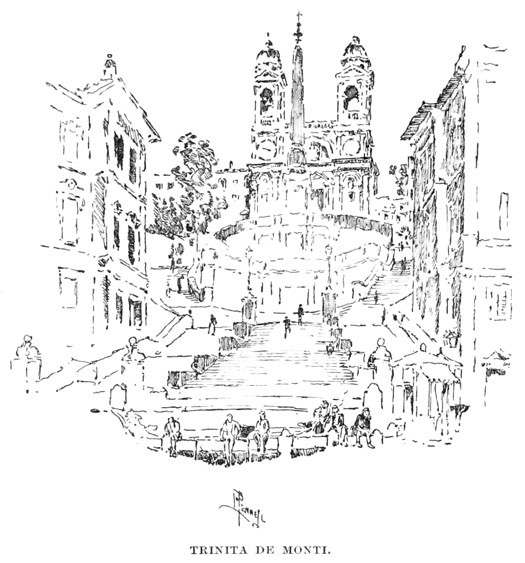
TRINITA DE MONTI.
The new law introduced by Hildebrand and passed by the council was much the same in its general regulations as that which still exists. There was no solemn mysterious Conclave, and the details were more simple; but the rules of election were virtually the same. The Cardinal-bishops made their choice first, which they then submitted to the other Cardinals of lower rank. If both were agreed the name of the Pope-elect was submitted to the final judgment of the people, no doubt a mere formula. This, we believe, is nominally still the last step of the procedure. The name is submitted, i.e., announced to the eager crowd in St. Peter's who applaud, which is all that is required of them: and all is done. This decree was passed salvo debito honore et reverentia delecti filii nostri Henrici, a condition skilfully guarded by the promise to award the same honour (that is, of having a voice in the election) to those of his successors to whom the Holy See shall have personally accorded the same right. It was thus the Holy See which honoured the Emperors by according them a privilege, not the Emperors who had any right to nominate, much less elect, to the Holy See.
Other measures of great importance for the purification and internal discipline of the Church were made law by this council, which was held in April 1059, the year of the accession of Nicolas II.; but none of such fundamental importance as this, or so bold in their claim of spiritual independence. Hildebrand must by this time have been in the very height of life, a man of forty or so, already matured by much experience and beginning to systematise and regulate the dreams and plans of his youth. He must have known by this time fully what he wanted and what was, or at least ought to be, his mission in the world. It is very doubtful, however, we think, whether that mission appeared to him what it has appeared to all the historians since—a deep-laid and all-overwhelming plan for the establishment of the Papacy on such a pinnacle as never crowned head had attained. His purposes as understood by himself were first the cleansing of the Church—the clearing out of all the fleshly filth which had accumulated in it, as in his own noble Basilica, rendering it useless, hiding its beauty: and second the destruction of that system of buying and selling which went on in the Holy Temple—worse than money-changing and selling of doves, the sale of the very altars to any unworthy person who could pay for them. These were his first and greatest purposes—to make the Church pure and to make her free, as perhaps she never has been, as perhaps, alas, she never will wholly be: but yet the highest aim for every true churchman to pursue.
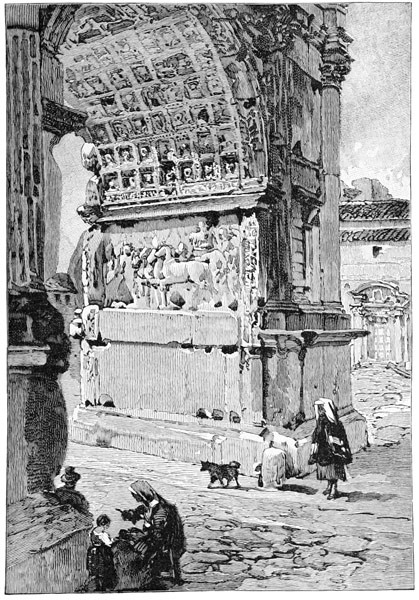
ARCH OF TITUS.
To face page 208.
These purposes were elevated and enlarged in his mind by the noble and beautiful thought of thus preparing and developing the one great disinterested power in the world, with nothing to gain, which should arbitrate in every quarrel, and adjust contending claims and bring peace on earth, instead of the clashing of swords; the true work of the successor of Peter, Christ's Vicar in the world. This was not a dream of Hildebrand alone. Three hundred years later the great soul of Dante still dreamt of that Papa Angelico, the hope of ages, who might one day arise and set all things right. Hildebrand was not of the Angelical type. He was not that high priest made of benign charity, and love for all men—of whom the mediæval sages mused. But who will say that his dream, too, was not of the noblest or his ideal less magnanimous and great? Such an arbiter was wanted—what words could say how much?—in all those troubled and tumultuous kingdoms which were struggling against each other, overcoming and being overcome, always in disorder, carrying out their human fate with a constant accompaniment of human groans and sufferings and tears—one who would set all things right, who would judge the cause of the poor and friendless, who would have power to pull down a tyrant and erect with blessing and honour a new throne of justice in his dishonoured place. Have we less need of a Papa Angelico now? But unfortunately,[1] we have lost faith in the possibility of him, which is a fate which befalls so many high ideals from age to age.
Did Hildebrand, a proud man and strong, a man full of ambition, full of the consciousness of great powers—did he long to grasp the reins of the universe in his own hand? to drive the chariots of the sun, to direct everything, to rule everything, to be more than a king, and hold Emperors trembling before him? It is very possible: in every great spirit, until fully disenchanted, something of this desire must exist. But that it was not a plan of ambition only, but a great ideal which it seemed to him well worth a man's life to carry out, there can, we think, be no reasonable doubt.
Thus he began his reign, in reality, though not by title, in Rome. The cloisters were cleansed and the integrity of the Church vindicated, though not by any permanent process, but one that had to be repeated again and again in every chapter of her history. The Popes were elected after a few stormy experiments in the manner he had decreed, and the liberty of election established and protected—even to some extent and by moments, his Papacy, that wonderful institution answered to his ideal, and promised to fulfil his dream: until the time came common to all men, when hope became failure, and he had to face the dust and mire of purpose overthrown. But in the meantime no such thoughts were in his mind as he laboured with all the exhilaration of capacity, and with immense zeal and pains, at his own affairs, which meant in those days to the Archdeacon of Rome the care of all the Churches. The letters of the Pope in Council which carried the addition of the name of that humblest of his sons and servants, Hildebrand, bore the commands of such a sovereign as Hildebrand dreamt of, to bishops and archbishops over all the world. Here is one of these epistles.
Although several unfavourable reports have reached the Apostolic See in respect to your Fraternity which cannot be rejected without inquiry—as, for example, that you have favoured our enemies, and have neglected pontifical ordinances: yet as you have defended yourself from these accusations by the testimony of a witness of weight and have professed fidelity to St. Peter, we are disposed to pass over these reports and to hope that the testimony in your favour is true. Therefore take care in future so to live, that your enemies shall have no occasion to sadden us on your account. Exert yourself to fulfil the hopes which the Apostolical See has formed of you: reprimand, entreat and warn your glorious king that he may not be corrupted by the counsels of the wicked, who hope under cover of our own troubles to elude Apostolic condemnation. Let him take care how he resists the sacred canons, or rather St. Peter himself, thereby rousing our wrath against him, who rather desire to love him as the apple of our eye.
These were high words to be said to a dubious, not well-assured archbishop, occupying a very high place in the Church and powerful for good or for evil: but Hildebrand did not mince matters, whatever he might have to say.
Meanwhile the good Pope, Nicolas, went on with his charities while his Cardinal Archdeacon thundered in his name. He went, in the end of his life, with his court on a visit to the Normans, who had now, for some time—since they defeated Pope Leo before the gates of Benevento and came under the charm of papal influence, though in the person of their prisoner—become the most devout and generous servants of the Papacy: which indeed granted them titles to the sovereignty of any chance principality they might pick up—which was a good equivalent. When the troops of Guiscard escorted his Holiness back to Rome they were so obliging as to destroy a castle or two of those robber nobles who infested all the roads and robbed the pilgrims, and were, in the midst of all greater affairs, like a nest of venomous wasps about the ears of the Roman statesmen and legislators—especially those of the ever turbulent family of Tusculum, the Counts of Frascati, who kept watch afar upon the northern gates and every pilgrim path. This Pope died soon after in 1061 in Florence, his former episcopal see, which he often revisited and loved.
And now came the opportunity for Hildebrand to carry out his own bold law, and elect at once, by the now legal methods, a new head to the Church. But his coadjutors probably had not his own courage: and though bold enough under his inspiration to pass that law, hesitated to carry it out. It is said, too, that in Rome itself there was the strong opposition of a German party really attached to the imperial order, or convinced that without the strong backing of the empire the Church could not stand. Reluctantly Hildebrand consented to send a messenger to consult the imperial court, where strong remonstrances and appeals were at once presented by the Germans and Lombards who were as little desirous of having an Italian Pope over them as the Romans were of a Teutonic one. The Empress Agnes had been alarmed probably by rumours in the air of her removal from the regency. She had been alienated from Hildebrand by the reports of his enemies, and no doubt made to believe that the rights of her son must suffer if any innovation was permitted. She forgot her usual piety in her panic, and would not so much as receive Hildebrand's messenger, who, alone of all the many deputations arriving on the same errand, was left five days (or seven) waiting at the gates of the Palace—"For seven days he waited in the antechamber of the king," says Muratori—while the others were admitted and listened to. This was too much for Hildebrand, to whom his envoy, Cardinal Stefano, returned full of exasperation, as was natural. The Cardinals with timidity, but sustained by Hildebrand's high courage and determination, then proceeded to the election, which was duly confirmed by the people assembled in St. Peter's, and therefore perfectly legal according to the latest law. We are told much, however, of the excited state of Rome during the election, and of the dislike of the people to the horde of monks, many of them mendicant, and even more or less vagabond, who were let loose upon the city, electioneering agents of the most violent kind, filling the streets and churches with clamour. This wild army, obnoxious to the citizens, was at Hildebrand's devotion, and prejudiced more than they promoted, his views among the crowd.
"Here returned to the Romans," says Muratori, whose right to speak on such a subject will not be doubted, "complete freedom in the election of the Popes, with the addition of not even awaiting the consent of the Emperors for their consecration; an independence ever maintained since, down to our own days." This daring act made a wonderful revolution in the politics of Rome: it was the first erection of her standard of independence. The Church had neither troops nor vassals upon whom she could rely, and to defy thus openly the forces of the Empire was a tremendous step to take. Nor was it only from Germany that danger threatened. Lombardy and all the north of Italy was, with the exception of Tuscany, in arms against the audacious monk. Only those chivalrous savages of Normans, who, however, were as good soldiers as any Germans, could be calculated on as faithful to the Holy See: and Godfried of Tuscany stood between Rome and her enemies fidelissimo, ready to ward off any blow.
The election passed over quietly, and Alexander II. (Anselm the Bishop of Lucca) took his place, every particular of his assumption of the new dignity being carefully carried through as though in times of deepest peace. In Germany, however, the news produced a great sensation and tumult. A Diet was held at Bâle, for the coronation in the first place of the young king Henry, now twelve years old—but still more for the immediate settlement of this unheard-of revolt. When that ceremonial was over the court proceeded to the choice of a Pope with a contemptuous indifference to the proceedings in Rome. This anti-pope has no respect from history. He is said by one authority to have been chosen because his evil life made him safe against any such fury of reform as that which made careless prelate and priest fall under the rod of Hildebrand on every side. Muratori, whose concise little sentences are always so refreshing after the redundancy of the monkish chronicles, is very contemptuous of this pretender, whose name was Cadalous or Cadulo, an undistinguished and ill-sounding name. "The anti-pope Cadaloo or Cadalo occupied himself all the winter of this year" (says Muratori) "in collecting troops and money, in order to proceed to Rome to drive out the legitimate successor of St. Peter and to have himself consecrated there. Some suppose that he had already been ordained Pope, and had assumed the name of Honorius II., but there is no proof of this. And if he did not change his name it is a sign that he had never been consecrated." Other authorities boldly give him the title of Honorius II.: but he is generally called the anti-pope Cadalous in history.
A conflict immediately arose between the two parties. Cadalous, at the head of an army appeared before Rome, but not till after Hildebrand had placed his Pope, who was for the moment less strong than the Emperor's Pope, in Tuscany under the protection of Beatrice and her husband Godfried. Then followed a stormy time of marches and countermarches round and about the city, in which sometimes the invaders were successful and sometimes the defenders. At length the Tuscans came to the rescue with the two Countesses in their midst who were always so faithful in their devotion to Hildebrand, Beatrice in the maturity of her beauty and influence, and the young Matilda, the real sovereign of the Tuscan states, fifteen years old, radiant in hope and enthusiasm and stirring up the spirits of the Florentines and Tuscan men at arms. Cadalous withdrew from that encounter making such terms as he could with Godfried, with many prayers and large presents, so that he was allowed to escape to Parma his bishopric, testa bassa. Yet the records are not very clear on these points, Muratori tells us. Doubts are thrown on the loyalty of Duke Godfried. He is said to have invited the Normans to come to the help of the Pope, and then invaded their territories, which was not a very knightly proceeding: but there is no appearance at this particular moment of the Normans, or any force but that of the Tuscan army with young Countess Matilda and her mother flashing light and courage into the ranks.
The anti-pope, if he deserved that title, did not trouble the legitimate authorities long. He was suddenly dropped by the Germans in the excitement of a revolution, originating in the theft of little Henry the boy-monarch, whom the Bishop of Cologne stole from his mother Agnes, as it became long afterwards a pleasant device of state to carry off from their mothers the young fatherless Jameses of Scots history. Young Henry was run away with in the same way, and Agnes humiliated and cast off by the Teutonic nobility, who forgot all about such a trifle as a Pope in the heat of their own affairs. It was only when this matter was settled that a council was held in Cologne by the archbishop who had been the chief agent in the abduction of Henry, and was now first in power. Of this council there seems no authoritative record. It is only by the answer to its deliberations published by Peter Damian in which, as is natural, that able controversialist has an easy victory over the other side—that anything is known of it. Whether Cadalous was formerly deposed by this council is not known: but he was dropped by the authorities of the Empire which had a similar result.
Notwithstanding, this rash pretender made one other vain attempt to seize the papal throne, being encouraged by various partisans in Rome itself, by whose means he got possession of St. Peter's, where the unfortunate man remained for one troubled night, making such appeals to God and to his supporters as may be imagined, and furtively performing the various offices of the nocturnal service, perhaps not without a sense of profanation in the minds of those who had stolen into the great darkness and silence of the Basilica to meet him, with a political rather than a devotional intention. Next day all Rome heard the news, and rising seized its arms and drove his handful of defenders out of the city. Cadalous was taken by one of his supporters, Cencio or Vincencio "son of the præfect" to St. Angelo, where he held out against the Romans for the space of two years, suffering many privations; and thence escaping on pain of his life after other adventures, disappears into the darkness to be seen no more.
This first distinct conflict between Rome and the Empire was the beginning of the long-continued struggle which tore Italy asunder for generations—the strife of the two parties called Guelfs and Ghibellines, the one for the Empire, the other for the Church, with all the ramifications of that great question.
The year in which Cadalous first appeared in Rome, which was the year 1062, was also distinguished by a very different visitor. The Empress Agnes deprived of her son, shorn of her power, had nothing more to do among the subject princes who had turned against her. She determined, as dethroned monarchs are apt to do, to cast off the world which had rejected her, and came to Rome, to beg pardon of the Pope and find a refuge for herself out of the noise and tumult. She had been in Rome once before, a young wife in all the pomp and pride of empire, conducted through its streets in the midst of a splendid procession, with her husband to be crowned. The strongest contrasts pleased the fancy of these days. She entered Rome the second time as a penitent in a black robe, and mounted upon the sorriest horse—"it was not to call a horse, but like a beast of burden, a donkey, no bigger than an ass." It is a curious sign of humiliation and accompanying elevation of mind, but this is not the first time that we have heard of a pilgrim entering Rome on a miserable hack, as if that were the highest sign of humility. She was received with enthusiasm, notwithstanding her late actions of hostility, and soon the walls of many churches were radiant with the spoils of her imperial toilettes, brocades of gold and silver encrusted with jewels, and wonders of rich stuffs which even Peter Damian with his accomplished pen finds it difficult to describe. "She laid down everything, destroyed everything, in order to become, in her deprivation yet freedom, the bride of Christ." We are not told if Agnes entered a convent or only lived the life of a religious person in her own house; but she had the frequent company of Hildebrand and Peter Damian, and of the Bishop of Como, who seems to have been devoted to her service; and perhaps like other penitents was not so badly off in her humility, thus delivered out of all the tumults against which she had so vainly attempted to make head for years.
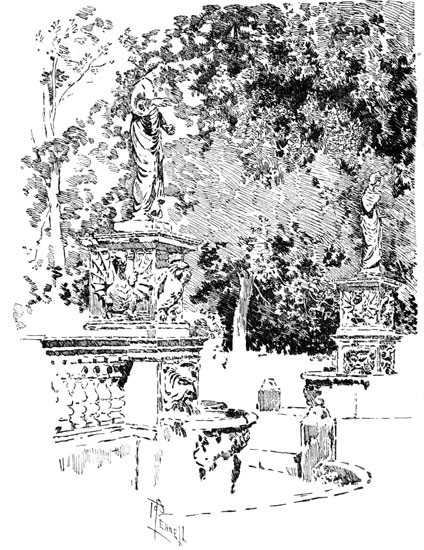
THE VILLA BORGHESE.
While these smaller affairs—for even the anti-pope never seems to have been really dangerous to Rome notwithstanding his many efforts to disturb the peace of the Church—the world of Christendom which surrounded that one steady though constantly contested throne of the papacy, was in commotion everywhere. It seems strange to speak in one breath of Hildebrand's great and noble ideal of a throne always standing for righteousness, and of a sacred monarch supreme and high above all worldly motives, dispensing justice and peace: and in the next to confess his perfect acquiescence in, and indeed encouragement of, the undertaking of William the Conqueror, so manifest an act of tyranny and robbery, and interference with the rights of an independent nation, an undertaking only different from those of the brigands from Tusculum and other robber castles who swept the roads to Rome, by the fact of its much higher importance and its complete success. The Popes had sanctioned the raids of the Normans in Italy, and confirmed to them by legal title the possessions which they had taken by the strong hand: with perhaps a conviction that one strong rule was better than the perpetual bloodshed of the frays between the existing races—the duke here, the marquis there, all seeking their own, and no man thinking of his neighbour's or his people's advantage. But the internal discords of England were too far off to secure the observation of the Pope, and the mere fact of Harold's renunciation in favour of William, though it seems so specious a pretence to us, was to the eyes of the priests by far the most important incident in the matter, a vow taken at the altar and which therefore the servants of the altar were bound to see carried out. These two reasons however were precisely such as show the disadvantage of that grand papal ideal which was burning in Hildebrand's brain; for a Pope, with a sacred authority to set up and pull down, should never be too far off to understand the full rights of any question were it in the remotest parts of the earth: and should be far above the possibility of having his judgment confused by a foregone ecclesiastical prejudice in favour of an unjust vow.
Hildebrand however not only gave William, in his great stroke for an empire, the tremendous support of the Pope's authority but backed him up in many of his most high-handed and arbitrary proceedings against the Saxon prelates and rich abbeys which the Conqueror spoiled at his pleasure. It must not be forgotten, in respect to these latter spoliations, that the internal war which was raging in the Church all over the world, between the new race of reformers and the mass of ordinary clergy—who had committed many ecclesiastical crimes, who sometimes even had married and were comfortable in the enjoyment of a sluggish toleration, or formed connections that were winked at by a contemptuously sympathetic world; or who had bought their benefices great and small, through an entangled system of gifts, graces, and indulgences, as well as by the boldest simony—made every kind of revolution within the Church possible, and produced endless depositions and substitutions on every side. When, as we have seen, the bishop of a great continental see in the centre of civilisation could be turned out remorselessly from his bishopric on conviction of any of these common crimes and forced into the Cloister to amend his ways and end his life, it is scarcely likely that more consideration would be shown for an unknown prelate far away across the Northern seas, though it would seem to be insubordination rather than any ecclesiastical vice with which the Saxon clergy were chiefly charged. This first instance however of the papal right to sanction revolution, and substitute one claimant for another as the selection of Heaven, is perhaps the strongest proof that could be found of the impossibility of that ideal, and of the tribunal thus set up over human thrones and human rights. The papal see was thus drawn in to approve and uphold one of the most bloody invasions and one of the most cruel conquests ever known—and did so with a confidence and certainty, in an ignorance, and with a bias, which makes an end of all those lofty pretensions to perfect impartiality and a judgment beyond all influences of passion which alone could justify its existence.
A great change had come over the firmament since the days when Leo IX. cleansed the Church at Rheims, and held that wonderful Council which set down so many of the mighty from their seats. Henry III., the enemy of simony, was dead, and the world had changed. As we shall often have occasion to remark, the papal rule of justice and purity was strong and succeeded—so long as the forces of the secular powers agreed with it. But when, as time went on, the Church found itself in conflict with these secular powers, a very different state of affairs ensued.
The action of Rome in opposition to the young Henry IV., was as legitimate as had been its general agreement with, and approval of, his predecessor. The youth of this monarch had developed into ways very different from those of his father, and under his long minority all the evils which Henry III. had honestly set his face against, reappeared in full force. Whether it was his removal from the natural and at least pure government of his mother, or from his native disposition which no authority or training had a chance in such circumstances of repressing, the young Henry grew up dissolute and vicious, and his court was the centre of a wild and disorganised society. Married at twenty, it was not very long before he tried by the most disreputable means to get rid of his young wife, and failing in that, called, or procured to be called by a complaisant archbishop, a council, in order to rid him of her. Rome lost no time in sending off to this council as legate, Peter Damian whose gift of speech was so unquestionable that he could even on occasion make the worse appear the better cause. But his cause in the present case was excellent, and his eloquence no less so, and he had all that was prudent as well as all that was wise and good in Germany on his side, notwithstanding the complaisance of the priests. The legate remonstrated, exhorted, threatened. The thing Henry desired was a thing unworthy of a Christian, it was a fatal example to the world; finally no power on earth would induce the Pope, whose hands alone could confer that consecration, to crown as Roman Emperor a man who had sinned so flagrantly against the laws of God. The great German nobles added practical arguments not less urgent in their way; and Henry surrounded on all sides with warnings was forced to give way. But this downfall for the moment had little effect on the behaviour of the young potentate, and his vices were such that his immediate vassals in his own country were on the point of universal rebellion, no man's castle or goods or wife or daughter being safe. The Church, which his father had given so much care and pains to cleanse and purify, sank again into the rankest simony, every stall in a cathedral, and cure in a bishopric selling like articles of merchandise. It was time in the natural course of affairs when the young monarch attained the full age of manhood that he should be promoted to the final dignity of emperor, and consecrated as such—a rite which only the Pope could perform: and no doubt it was with a full consciousness of the power thus resting with the Holy See, as well as in consequence of numerous informal but eager appeals to the Pope against the ever-increasing evils of his sway that Hildebrand proceeded to take such a step as had never been ventured on before by the boldest of Churchmen. He summoned Henry formally to appear before the papal court and defend himself against the accusations brought against him. "For the heresy of simony," says the papal letter, this being the great ecclesiastical crime which came immediately under the cognizance of the Pope.
This citation addressed to the greatest monarch then existing, and by a power but barely escaped from his authority and still owing to him a certain allegiance, was enough to thrill the world from end to end. Such a thing had never happened in the knowledge of man. But before we begin so much as to hear of the effect produced, the Pope who had, nominally at least, issued the summons, the good and saintly Alexander II., after holding the papacy for twelve years, died on the 21st of April, 1073. His reign for that time had been to a great degree the reign of Hildebrand, the ever watchful, ever laborious archdeacon, who, let the Pope travel as he liked—and his expeditions through Italy were many—was always vigilant at his post, always in the centre of affairs, with eyes and ears open to everything, and a mind always intent on its purpose. Hildebrand's great idea of the position and duties of the Holy See had developed much in those twelve years. It had begun to appear a fact, in the eyes of those especially who had need of its support. The Normans everywhere believed and trusted in it, with good secular reason for so doing, and they were at the moment a great power in the earth, especially in Italy. If it had not already acquired an importance and force in the thoughts of men, more subtle and less easy to obtain than external power, it would have been impossible for the boldest to launch forth a summons to the greatest king of Christendom the future Emperor. Already the first step towards that great visionary sway, of which poets and sages, as well as ecclesiastics, so long had dreamed, had been made.
Hildebrand had been virtually at the head of affairs since the year 1055, when he had brought across the Alps Victor II. chosen by himself, whose acts and policy were his. He might have attained the papacy in his own right on more than one occasion had he been so minded, but had persistently held back from the rank while keeping the power. But now humility would have been cowardice, and in the face of the tremendous contest which he had invited no other course was possible to him save to assume the full responsibility. Even before the ceremonies of the funeral of the Pope were completed, while Alexander lay in state, there was a rush of the people and priests to the church of the Lateran, where Hildebrand was watching by the bier, shouting "Hildebrand! The blessed St. Peter has elected Hildebrand." A strange scene of mingled enthusiasm and excitement broke the funereal silence in the great solemn church, amid its forest of columns all hung with black, and glittering with the silver ornaments which are appropriate to mourning, while still the catafalque upon which the dead Pope lay rose imposing before the altar. Hildebrand, startled, was about to ascend the pulpit to address the people, but was forestalled by an eager bishop who hurried into it before him, to make solemn announcement of the event. "The Archdeacon is the man who, since the time of the holy Pope Leo, has by his wisdom and experience contributed most to the exaltation of the Church, and has delivered this town from great danger," he cried. The people responded by shouts of "St. Peter has chosen Hildebrand!" We all know how entirely fallacious is this manner of testing the sentiment of a people; but yet it was the ancient way, the method adopted in those earlier times when every Christian was a tried and tested man, having himself gone through many sufferings for the faith.
It appears that Hildebrand hesitated, which seems strange in such a man; one who, if ever man there was, had the courage of his opinions and was not likely to shrink from the position he himself had created; and it is almost incredible that he should have sent a sort of appeal, as Muratori states, to Henry himself—the very person whom he had so boldly summoned before the tribunal of the Church—requesting him to withhold his sanction from the election. Muratori considers the evidence dubious, we are glad to see, for this strange statement. At all events, after a momentary hesitation Hildebrand yielded to the entreaties of the people. The decree in which his election is recorded is absolutely simple in its narrative.
"The day of the burial of our lord, the Pope Alexander II. (22nd April, 1073), we being assembled in the Basilica of San Pietro in Vincoli,[2] members of the holy Roman Church catholic and apostolic, cardinals, bishops, clerks, acolytes, sub-deacons, deacons, priests—in presence of the venerable bishops and abbots, by consent of the monks, and accompanied by the acclamations of a numerous crowd of both sexes and of divers orders, we elect as pastor and sovereign pontiff a man of religion, strong in the double knowledge of things human and divine, the love of justice and equity, brave in misfortune, moderate in good fortune, and following the words of the apostle, a good man, chaste, modest, temperate, hospitable, ruling well his own house, nobly trained and instructed from his childhood in the bosom of the Church, promoted by the merit of his life to the highest rank in the Church, the Archdeacon Hildebrand, whom, for the future and for ever, we choose; and we name him Gregory, Pope. Will you have him? Yes, we will have him. Do you approve our act? Yes, we approve."
Nothing can be more graphic than this straightforward document, and nothing could give a clearer or more picturesque view of the primitive popular election. The wide-reaching crowd behind, women as well as men, a most remarkable detail, filled to its very doors the long length of the Basilica. The little group of cardinals and their followers made a glow of colour in the midst: the mass of clergy in the centre of the great nave lighted up by bishops and abbots in their distinctive dresses and darkening into the surrounding background of almost innumerable monks: while the whole assembly listened breathless to this simple yet stately declaration, few understanding the words, though all knew the meaning, the large Latin phrases rolling over their heads: until it came to that well-known name of Hildebrand—Ildebrando—which woke a sudden storm of shouts and outcries. Will you have this man? Yes, we will have him! Do you approve? Approviamo! Approviamo! shouted and shrieked the crowd. So were the elections made in Venice long years after, under the dim arches of St. Marco; but Venice was still a straggling village, fringing a lagoon, when this great scene took place.
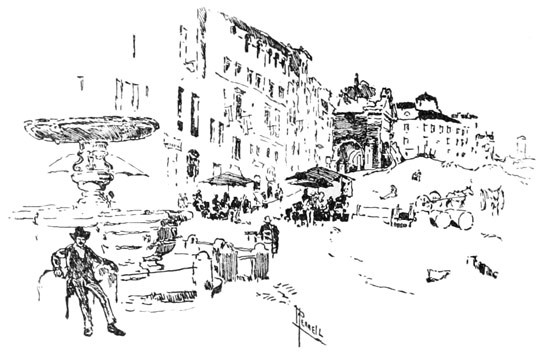
WHERE THE GHETTO STOOD.
Hildebrand was at this time a man between fifty and sixty, having spent the last eighteen years of his life in the control and management of the affairs of Rome. He was a small, spare man of the most abstemious habits, allowing himself as few indulgences in the halls of the Lateran as in a monastic cell. His fare was vegetables, although he was no vegetarian in our modern sense of the word, but ate that food to mortify the flesh and for no better reason. Not long before he made the rueful, and to us comic, confession that he had "ended by giving up leeks and onions, having scruples on account of their flavour, which was agreeable to him." Scruple could scarcely go further in respect to the delights of this world. We are glad however that he who was now the great Pope Gregory denied himself that onion. It was a dignified act and sacrifice to the necessities of his great position.
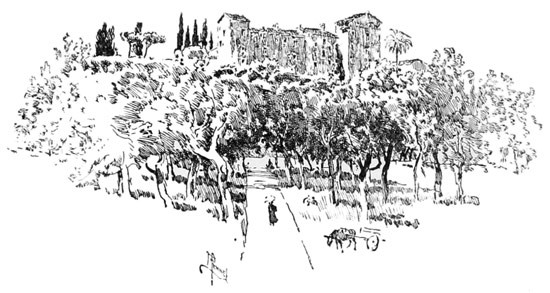
FROM SAN GREGORIO MAGNO
CHAPTER III.
THE POPE GREGORY VII.
The career of Hildebrand up to the moment in which he ascended the papal throne could scarcely be called other than a successful one. He had attained many of his aims. He had awakened the better part of the Church to a sense of the vices that had grown up in her midst, purified in many quarters the lives of her priests, and elevated the mind and ideal of Christendom. But bad as the vices of the clergy were, the ruling curse of simony was worse, to a man whose prevailing dream and hope was that of a great power holding up over all the world the standards of truth and righteousness in the midst of the wrongs and contentions of men. A poor German priest holding fast in his distant corner by the humble wife or half-permitted female companion at whose presence law and charity winked, was indeed a dreadful thought, meaning dishonour and sacrilege to the austere monk; but the bishops and archbishops over him who were so little different from the fierce barons, their kin and compeers, who had procured their benefices by the same intrigues, the same tributes and subserviences, the same violence, by which these barons in many cases held their fiefs, how was it possible that such men could hold the balance of justice, and promote peace and purity and the reign of God over the world? That they should help in any way in that great mission which the new Pope felt himself to have received from the Head of the Church was almost beyond hope. They vexed his soul wherever he turned, men with no motive, no inspiration beyond that of their fellows, ready to scheme and struggle for the aggrandisement of the Church, if you will—for the increase of their own greatness and power and those of the corporations subject to them: but as little conscious of that other and holier ambition, that hope and dream of a reign of righteousness, as were their fellows and brethren, the dukes and counts, the fighting men, the ambitious princes of Germany and Lombardy. Until the order of chiefs and princes of the Church could be purified, Hildebrand had known, and Gregory felt to the bottom of his heart, that nothing effectual could be done.
The Cardinal Archdeacon of Rome, under Popes less inspired than himself—who were, however, if not strong enough to originate, at least acquiescent, and willing to adopt and sanction what he did—had carried on a holy war against simony wherever found. He had condemned it by means of repeated councils, he had poured forth every kind of appeal to men's consciences, and exhortations to repentance, without making very much impression. The greatest offices were still sold in spite of him. They were given to tonsured ruffians and debauchees who had no claim but their wealth to ascend into the high places of the Church, and who, in short, were but secular nobles with a difference, and the fatal addition of a cynicism almost beyond belief, though singularly mingled at times with superstitious terrors. Hildebrand had struggled against these men and their influence desperately, by every means in his power: and Pope Gregory, with stronger methods at command, was bound, if possible, to extirpate the evil. This had raised him up a phalanx of enemies on every side, wherever there was a dignitary of the Church whose title was not clear, or a prince who derived a portion of his revenue from the traffic in ecclesiastical appointments. The degenerate young King not yet Emperor, who supported his every scheme of rapine and conquest by the gold of the ambitious priests whom he made into prelates at his will, was naturally the first of these enemies: Guibert of Ravenna, more near and readily offensive, one of the most powerful ecclesiastical nobles in Italy, sat watchful if he might catch the new Pope tripping, or find any opportunity of accusing him: Robert Guiscard, the greatest of the Normans, who had been so much the servant and partisan of the late Popes, remained sullen and apart, giving no allegiance to this: Rome itself was surrounded by a fierce and audacious nobility, who had always been the natural enemies of the Pope, unless when he happened to be their nominee, and more objectionable than themselves. Thus the world was full of dark and scowling faces. A circle of hostility both at his gates and in the distance frowned unkindly about him, when the age of Hildebrand was over, and that of Gregory began. All his great troubles and sufferings were in this latter part of his life. Nothing in the shape of failure had befallen him up to this point. He had met with great respect and honour, his merit and power had been recognised almost from his earliest years. Great princes and great men—Henry himself, the father of the present degenerate Henry, a noble Emperor, honouring the Church and eager for its purification—had felt themselves honoured by the friendship of the monk who had neither family nor wealth to recommend him. But when Pope Gregory issued from his long probation and took into his hand the papal sceptre, all these things had changed. Whether he was aware by any premonition of the darker days upon which he had now fallen who can say? It is certain that confronting them he bated no jot of heart or hope.
He appears to us at first as very cautious, very desirous of giving the adversary no occasion to blaspheme. The summons issued in the name of the late Pope to Henry requiring him to appear and answer in Rome the charges made against him, seems to have been dropped at Alexander's death: and when his messengers came over the Alps demanding by what right a Pope had been consecrated without his consent, Gregory made mild reply that he was not consecrated, but was awaiting not the nomination but the consent of the Emperor, and that not till that had been received would he carry out the final rites. These were eventually performed with some sort of acquiescence from Henry, given through his wise and prudent ambassador, on the Feast of St. Peter, the 29th June, 1073. Gregory did what he could, as appears, to continue this mild treatment of Henry with all regard to his great position and power. He attempted to call together a very intimate council to discuss the state of affairs between the King and himself: a council of singular construction, which, but that the questions as to the influence and place of women are questions as old as history, and have been decided by every age according to no formal law but the character of the individuals before them, might be taken for an example of enlightenment before his time in Gregory's mind. He invited Duke Rudolf of Suabia, one of Henry's greatest subjects, a man of religious character and much reverence for the Holy See, to come to Rome, and in common with himself, the Empress Agnes, the two Countesses of Tuscany, the Bishop of Como (who was the confessor of Agnes), and other God-fearing persons, to consider the crisis at which the Church had arrived, and to hear and give advice upon the Pope's intentions and projects. The French historian Villemain throws discredit upon this projected consultation of "an ambitious vassal of the King of Germany and three women, one of whom had once been a prisoner in the camp of Henry III., the other had been brought up from infancy in the hate of the empire and the love of the Church, and the last was a fallen empress who was more the penitent of Rome than the mother of Henry." This seems, however, a futile enumeration. There could surely be no better defender found for a son accused than his mother, who we have no reason to suppose was ever estranged from him personally, and who shortly after went upon an embassy to him, and was received with every honour. Beatrice, on the other hand, had been the prisoner of his father the great Emperor, and not of young Henry of whom she was the relative and friend, and between whom and the Pope, as all good statesmen must have seen, it was of the greatest importance to Europe that there should be peace; while any strong personal feeling which might exist would be modified by Gregory himself, by Raymond of Como, and the wisest heads of Rome.
But this board of advice and conciliation never sat, so we need not comment upon its possible concomitants. In every act of his first year, however, Gregory showed a desire to conciliate Henry rather than to defy him. The young king had his hands very full, and his great struggle with the Saxon nobles and people was not at the moment turning in his favour. And he had various natural defenders and partisans about the Roman Court. The Abbot Hugo of Cluny, who was one of Gregory's dearest friends, had been the young king's preceptor, and bore him a strong affection. We have no reason to believe that the influence of Agnes was not all on the side of her son, if not to support his acts, at least to palliate and excuse them. With one of these in his most intimate council, and one an anxious watcher outside, both in command of his ear and attention, it would have been strange if Gregory had been unwilling to hear anything that was in Henry's favour.
And in fact something almost more than a full reconciliation seems to have been effected between the new Pope and the young king, so desirous of winning the imperial crown, and conscious that Gregory's help was of the utmost importance to him. Henry on his side wrote a letter to his "most loving lord and father," his "most desired lord," breathing such an exemplary mind, so much penitence and submission, that Gregory describes it as "full of sweetness and obedience:" while the Pope, if not altogether removing the sword that hung suspended over Henry's head, at least received his communications graciously, and gave him full time and encouragement to change his mind and become the most trusted lieutenant of the Holy See. The King was accordingly left free to pursue his own affairs and his great struggle with the Saxons without any further question of ecclesiastical interference: while Gregory spent the whole ensuing year in a visitation of Italy, and much correspondence and conference on the subject of simony and other abuses in the Church. When he returned to Rome he endeavoured, but in vain, to act as peacemaker between Henry and the Saxons. And it was not till June in the year 1074, when he called together the first of the Lateran Councils, an assembly afterwards renewed yearly, a sort of potential Convocation, that further steps were taken. With this the first note of the great warfare to follow was struck. The seriousness of the letters by which he summoned its members sufficiently shows the importance attached to it.
[1] It is touching and pathetic to divine, in the present Pope, something of that visionary and disinterested ambition, that longing to bless and help the universe, which was in those dreams of the mediæval mind, prompted by a great pity, and a love that is half divine. Leo XIII. is too wise a man to dream of temporal power restored, though he is a martyr to the theory of it: but there would seem to be in his old age which makes it impossible if nothing else did, a trembling consciousness of capacity to be in himself a Papa Angelico, and gather us all under his wings.
[2] It is supposed by some from this that the election took place in this church and not in the Lateran; but that is contradicted by Gregory himself, who says it took place in Ecclesia S. Salvatoris, a name frequently used for the Lateran. Bowden suggests that "at the close of the tumultuous proceedings in the Lateran the cardinal clergy" may have "adjourned to St. Peter ad Vincula formally to ratify and register the election."
"The princes and governors of this world, seeking their own interest and not that of Jesus Christ, trample under foot all the veneration they owe to the Church, and oppress her like a slave. The priests and those charged with the conduct of the Church sacrifice, the law of God, renounce their obligations towards God and their flocks, seeking in ecclesiastical dignities only the glory of this world, and consuming in pomp and pride what ought to serve for the salvation of many. The people, without prelates or sage counsellors to lead them in the way of virtue, and who are instructed by the example of their chiefs in all pernicious things, go astray into every evil way, and bear the name of Christian without its works, without even preserving the principle of the faith. For these reasons, confident in the mercies of God, we have resolved to assemble a Synod in order to seek with the aid of our brethren for a remedy to these evils, and that we may not see in our time the irreparable ruin and destruction of the Church. Wherefore we pray you as a brother, and warn you in the name of the blessed Peter, prince of apostles, to appear at the day fixed, convoking by this letter, and by your own, your suffragan bishops; for we can vindicate the freedom of religion and of ecclesiastical authority with much more surety and strength according as we find ourselves surrounded by the counsels of your prudence, and by the presence of our brethren."
A few Italian princes, Gisulfo of Salerno, Azzo d'Este, Beatrice and Matilda of Tuscany, were convoked to the council and held seats in it. The measures passed were very explicit and clear. They condemned the simoniacal clergy in every rank, deposing them from their positions and commanding them to withdraw from the ministrations of the altar. The same judgment was passed upon those who lived with wives or concubines. Both classes were put beyond the pale of the Church, and the people were forbidden, on pain of sharing their doom, to receive the sacraments from them, or to yield them obedience. Nothing more thorough and far-reaching could be. Hitherto the Popes had proceeded by courts of investigation, by examination of individuals, in which the alternative of repentance and renunciation was always open to the prelate who had perhaps inadvertently fallen into these crimes. But such gentle dealings had been but very partially successful. Here and there an archbishop or great abbot had been convicted by his peers, and made to descend from his high estate—here and there a great personage had risen in his place and made confession. Some had retired to the cloister, putting all their pomps and glories aside, and made a good end. But as is usual after every religious revival, life had risen up again and gone upon its usual course, and the bishoprics thus vacated had probably been sold to the highest bidder or yielded to the most violent assailant, as if no such reformation had ever been.
The matter had gone too far now for any such occasional alleviations; and Gregory struck at the whole body of proud prelates, lords of secular as well as ecclesiastical greatness, men whose position was as powerful in politics and the affairs of the empire as was that of the princes and margraves who were their kin, and whom they naturally supported—as the others had supported them by money and influence in their rise to power: but who had very little time for the affairs of the Church, and less still for the preservation of peace and the redress of wrong.
The other measures passed at this council were more searching still; they were aimed against the disorders into which the clergy had fallen, and chiefly what was to Gregory and his followers the great criminality, of married priests, who abounded in the Church. In this the lower orders of the clergy were chiefly assailed, for the more important members of the hierarchy did not marry though they might be vicious otherwise. But the rural priests, the little-educated and but little-esteemed clerks who abounded in every town and village, were very generally affected by the vice—if vice it was—of marriage, which was half legal and widely tolerated: and their determination not to abandon it was furious. Meetings of the clergy to oppose this condemnation were held in all quarters, and often ended in riot, the priests declaring that none of the good things of the Church fell to their lot, but that rather than give up their wives, their sole compensation, they would die. This was not likely to make Gregory's proceedings less determined: but it may easily be imagined what a prodigious convulsion such an edict was likely to make in the ecclesiastical world.
It is said by the later historians that the Empress Agnes was made use of, with her attendant bishop and confessor, to carry these decrees to Henry's court: though this does not seem to be sanctioned by the elder authorities, who place the mission of Agnes in the previous year, and reckon it altogether one of peace and conciliation. But Henry still continued in a conciliatory frame of mind. His own affairs were not going well, and he was anxious to retain the Pope's support in the midst of his conflicts with his subjects. Neither do the great dignitaries appear to have made any public protest or resistance: it was the poor priests upon whom individually this edict pressed heavily, who were roused almost to the point of insurrection.
One of the most curious effects of the decree was the spirit roused among the laity thus encouraged to judge and even to refuse the ministrations of an unworthy priest. Not only was their immediate conduct affected to acts of spiritual insubordination, but a fundamental change seems to have taken place in their conception of the priest's character. No doubt Gregory's legislation must have originated that determined though illogical opposition to a married priesthood, and disgust with the idea, which has had so singular a sway in Catholic countries ever since, and which would at the present moment we believe make any change in the celibate character of the priesthood impossible even were all other difficulties overcome. We are not aware that it had existed in any force before. The thing had been almost too common for remark: and there seems to have been no fierce opposition to the principle. It arose now gradually yet with a force beyond control: there were many cases of laymen baptizing their children themselves, rather then give them into the hands of a polluted priest—until there arose almost a risk of general indifference to this sacrament because of the rising conviction that the hands which administered it were unworthy: and other religious observances were neglected in the same way, an effect which must have been the reverse of anything intended by the Pope. To this hour in all Catholic countries an inexpressible disgust with the thought, mingles even with the theory that perhaps society might be improved were the priest a married man, and so far forced to content himself with the affairs of his own house. Probably it was Gregory's strong denunciation, and his charge to the people not to reverence, not to obey men so soiled: as well as the conviction long cultivated by the Church, and by this time become a dogma, that the ascetic life was in all cases the holiest—which originated this powerful general sentiment, more potent in deciding the fact of a celibate clergy than all the ecclesiastical decrees in the world.
In the second Lateran Council held in the next year, at the beginning of Lent, along with the reiteration of the laws in respect to simony and the priesthood, a solemn decree against lay investiture was passed by the Church. This law transferred the struggle to a higher ground. It was no longer bishops and prelates of all classes, no longer simple priests, but the greatest sovereigns, all of whom had as a matter of course given ecclesiastical benefices as they gave feudals fiefs, who were now involved. The law was as follows:
"Whosoever shall receive from the hands of a layman a bishopric, or an abbey, shall not be counted among the bishops and abbots, nor share their privileges. We interdict him from entrance into the Church and from the grace of St. Peter until he shall have resigned the dignity thus acquired by ambition and disobedience, which are equal to idolatry. Also, if any emperor, duke, marquis, count, or other secular authority shall presume to give investiture of a bishopric or other dignity of the Church, let him understand that the same penalty shall be exacted from him."
The position of affairs between Pope and Emperor was thus fundamentally altered. The father of Henry, a much more faithful son of the Church, had almost without opposition made Popes by his own will where now his son was interdicted from appointing a single bishop. The evil was great enough perhaps for this great remedy, and Gregory, who had gone so far, was restrained now by no prudent precautions from proceeding to the utmost length possible. The day of prudence was over; he had entered upon a path in which there was no drawing back. That it was not done lightly or without profound and painful thought, and a deep sense of danger and impending trouble, is apparent from the following letter in which the Pope unbosoms himself to the head of his former convent, the great Hugo of Cluny, his own warm friend, and at the same time Henry's tutor and constant defender.
"I am overwhelmed (he writes) with great sorrow and trouble. Wherever I look, south, north, or west, I see not a single bishop whose promotion and conduct are legal, and who governs the Christian people for the love of Christ, and not by temporal ambition. As for secular princes, there is not one who prefers the glory of God to his own, or justice to interest. Those among whom I live—the Romans, the Lombards, the Normans—are, as I tell them to their faces, worse than Jews and Pagans. And when I return within myself, I am so overwhelmed by the weight of life that I feel no longer hope in anything but the mercy of Christ."
Notwithstanding the supreme importance of this question, and Gregory's deep sense of the tremendous character of the struggle on which he had thus engaged, matters of public morality in other ways were not sacrificed to these great proceedings for the honour of the Church. He not only himself assumed, but pressed upon all spiritual authorities under him, the duty and need of prompt interference in the cause of justice and public honesty. The letters which follow were called forth by a remarkable breach of these laws of honesty and the protection due to strangers and travellers which are fundamental rules of society. This was the spoliation of certain merchants robbed in their passage through France, and from whom the Pope accuses the young King Philip I. to have taken, "like a brigand, an immense sum of money." Gregory addresses himself to the bishops of France in warning and entreaty as follows:
"As it is not possible that such crimes should escape the sentence of the Supreme Judge, we pray you and we warn you with true charity to be careful and not to draw upon yourself the prophet's curse: 'Woe to him who turns back his sword from blood'—that is to say, as you well understand, who does not use the sword of the Word for the correction of worldly men; for you are in fault, my brethren, you who, instead of opposing these vile proceedings with all the rigour of the priesthood, encourage wickedness by your silence. It is useless to speak of fear. United and armed to defend the just, your force will be such that you will be able to quench evil passions in penitence. And even if there were danger, that is no reason for giving up the freedom of your priesthood. We pray you, then, and we warn you by the authority of the Apostles, to unite in the interest of your country, of your glory and salvation, in a common and unanimous counsel. Go to the king, tell him of his shame, of his danger and that of his kingdom. Show him to his face how criminal are his acts and motives, endeavour to move him by every inducement that he may undo the harm which he has done.
"But if he will not listen to you, and if, scorning the wrath of God, and indifferent to his own royal dignity, to his own salvation and that of his people, he is obstinate in the hardness of his heart, let him hear as from our mouth that he cannot escape much longer the sword of apostolic punishment."
These are not such words as Peter was ever commissioned in Holy Writ to give forth; but granting all the pretensions of Peter's successors, as so many good Christians do, it is no ignoble voice which thus raises itself in warning, which thus denounces the vengeance of the Church against the evil-doer, be he bishop, clown, or king. Gregory had neither armies nor great wealth to support his interference with the course of the world—he had only right and justice, and a profound faith in his mission. He risked everything—his life (so small a matter!), his position, even the safety of the Church itself, which these potentates could have crushed under their mailed shoes; but that there should be one voice which would not lie, one champion who would not be turned aside, one witness for good, always and everywhere, against evil, was surely as noble a pretension as ever was lifted under heaven. It was to extend the power of Rome, all the historians say; which no doubt he wished to do. But whether to extend the power of Rome was his first object, or to pursue guilt and cruelty and falsehood out of the very boundaries of the world if one man could drive them forth, God only can judge. When there are two evident motives, however, it is not always wise to believe that the worst is the one to choose.
In most curious contrast to these great and daring utterances is the incident, quite temporary and of no real importance, in his life, which occurred to Pope Gregory at the very moment when he was thus threatening a world lying in wickedness with the thunderbolts of Rome. The city which had gone through so many convulsions, and was now the centre of the pilgrimages of the world, was still in its form and construction the ancient Rome, and more or less a city of ruins. The vast open spaces, forums, circuses, great squares, and amphitheatres, which made old Rome so spacious and magnificent, still existed as they still to a certain extent exist. But no great builder had as yet arisen among the Popes, no one wealthy enough or with leisure enough to order the city upon new lines, to give it a modern shape, or reduce it to the dimensions necessary for its limited population. It was still a great quarry for the world, full of treasures that could be carried away, a reservoir and storehouse of relics to which every man might help himself. Professor Lanciani, the accomplished and learned savant to whom we owe so much information concerning the ancient city, has shown us how much mediæval covetousness in this way had to do with the actual disappearance of ancient buildings, stone by stone. But this was not the only offence committed against the monuments of the past. The great edifices of the classic age were often turned, not without advantage in the sense of the picturesque, into strongholds of the nobles, sometimes almost as much isolated amid the great gaps of ruins as in the Campagna outside. The only buildings belonging to the time were monasteries, generally surrounded by strong walls, capable of affording protection to a powerful community, and in which the humble and poor could find refuge in time of trouble. These establishments, and the mediæval fortresses and towers built into the midst of the ruins, occupied with many wild spaces between, where the luxuriant herbage buried fallen pillars and broken foundations, the wastes of desolation which filled up half the area of the town. The population seems to have clustered about the eastern end of the city; all the life of which one reads, except an occasional tumult around St. Peter's and north of St. Angelo, seems to have passed on the slopes or under the shadow of the Aventine and Cœlian hills, from thence to the Latin gate, and the Pope's palace there, the centre of government and state—and on the hill of the Capitol, where still the people gathered when there was a motive for a popular assembly. The ordinary populace must have swarmed in whatsoever half-ruined barracks of old palaces, or squalid huts of new erection hanging on to their skirts, might be attainable in these quarters, clustering together for warmth and safety, while the rest of the city lay waste, sprinkled with ruins and desolate paths, with great houses here and there in which the strangely mixed race bearing the names, often self-appropriated, of ancient Roman patrician families, lived and robbed and made petty war, and besieged each other within their strong walls.
One of these fortified houses or towers, built at or on the bridge of St. Angelo—in which the noble owner sat like a spider, drawing in flies to his web, taking toll of every stranger who entered Rome by that way—belonged to a certain Cencio[3] or Cencius of the family of Tusculum, the son of the Præfect of Rome. The Præfect, unlike his family, was one of the most devoted adherents of the Popes; he is, indeed, in the curious glimpse afforded to us by history, one of the most singular figures that occur in that crowded foreground. A mediæval noble and high official, he was at the same time a lay-preacher, delighted to exercise his gift when the more legitimate sermon failed from any cause, and only too proud, it would appear, of hearing his own voice in the pulpit. That his son should be of a very different disposition was perhaps not to be wondered at. Cencius was as turbulent as his father was pious; but he must have been a soldier of some note, as he held the post of Captain of St. Angelo, and in that capacity had maintained during a long siege the anti-pope Cadalous, or Honorius II., from whom, brigand as he was, he exacted a heavy ransom before permitting the unfortunate and too ambitious prelate to steal away like a thief in the night when his chance was evidently over. Cencius would seem to have lost his post in St. Angelo, but he maintained his robber's tower on the other end of the bridge, and was one of the most dangerous and turbulent of these internal enemies of Rome. During an interval of banishment, following a more than usually cruel murder, he had visited Germany, and had met at young Henry's court with many people to whom Pope Gregory was obnoxious, from Gottfried the Hunchback, the husband of the Countess Matilda, to the young king himself. Whether what followed was the result of any conspiracy, however, or if it was an outburst of mad vengeance on the part of Cencius himself, or the mere calculating impulse of a freebooter to secure a good ransom, is not known. A conspiracy, with Godfrey at the head of it, not without support from Henry, and the knowledge at least of the Archbishop of Ravenna and Robert Guiscard, all deeply irritated by the Pope's recent proceedings, was of course the favourite idea at the time. But no clear explanation of motives has ever been attained, and only the facts are known.
On Christmas-eve it was the habit of the Popes to celebrate a midnight mass in the great basilica of Sta. Maria Maggiore in what was then a lonely and dangerous neighbourhood, though not very far from the Lateran Church and palace. It was usually the occasion of a great concourse from all parts of the city, attracted by the always popular midnight celebration. But on Christmas-eve of the year 1076 (Muratori says 1075) a great storm burst over the city as the hour approached for the ceremony. Torrents of rain, almost tropical in violence, as rain so often is in Rome, poured down from the blackness of the skies, extinguishing even the torches by which the Pope and his diminished procession made their way to the great church, blazing out cheerfully with all its lighted windows into the night. Besides the priests only a very small number of the people followed, and there was no such murmur and rustle of sympathy and warmth of heart as such an assembly generally calls forth. But the great altar was decorated for Christmas, and the Pope attired in his robes, and everything shining with light and brightness within, though the storm raged without. The mass was almost over, Gregory and the priests had communicated, the faithful company assembled were receiving their humbler share of the sacred feast, and in a few minutes the office would have been completed, when suddenly the church was filled with noise and clamour and armed men. There was no one to defend the priests at the altar, even had it been possible in the suddenness of the assault to do so. Cencius's band was composed of ruffians from every region, united only in their lawlessness and crime; they seized the Pope at the altar, one of them wounding him slightly in the forehead. It is said that he neither asked for mercy nor uttered a complaint, nor even an expostulation, but permitted himself without a word to be dragged out of the church, stripped of his robes, placed on a horse behind one of the troopers, and carried off into the night not knowing where.
All this happened before the terrified priests and people—many of the latter probably poor women from the hovels round about—recovered their surprise. The wild band, with the Pope in the midst, galloped out into the blackness and the rain, passing under garden walls and the towers of silent monasteries, where the monks, too much accustomed to such sounds to take much notice, would hear the rush of the horses and the rude voices in the night with thankfulness that no thundering at the convent gates called upon them to give the free lances shelter. It appears that it was not to Cencius's stronghold on the bridge but to the house of one of his retainers that this great prize was conveyed. Here Gregory, in the cassock which he had worn under his gorgeous papal dress, wet and bleeding from the wound in his forehead, was flung without ceremony into an empty room. The story is that some devout man in the crowd and a Roman lady, by some chance witnessing the arrival of the band, stole in with them, and found their way to the place in which the Pope lay, covering him with their own furs and mantles and attending to his wound. And thus passed the Christmas morning in the misery of that cruel cold which, though rare, is nowhere more bitter than in Rome.
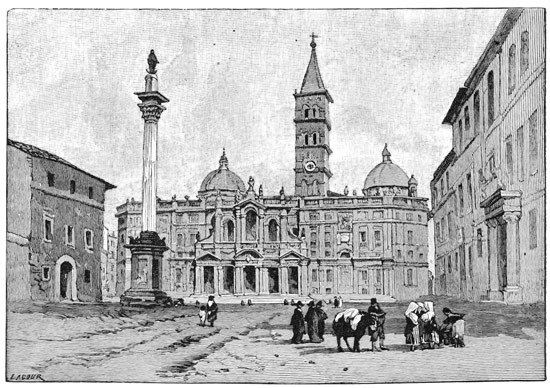
SANTA MARIA MAGGIORE.
To face page 246.
In the meantime the terrified congregation in Sta. Maria Maggiore had recovered its senses, and messengers hurried out in all directions to trace the way by which the freebooters had gone, and to spread the news of the Pope's abduction. The storm had by this time passed over, and the people were easily roused on the eve of the great festival. Torches began to gleam by all the darkling ways, and the population poured forth in the excitement of a great event. It would seem that in all the tumultuous and factious city there was but one thought of horror at the sacrilege, and determination to save the Pope if it were still possible. Gregory was not, like his great predecessor the first of that name, the idol of his people. He had not the wealth with which many great ecclesiastics had secured the homage of the often famished crowd; and a stern man, with no special geniality of nature, and views that went so far beyond the local interests of Rome, he does not seem the kind of ruler to have secured popular favour. Yet the city had never been more unanimous, more determined in its resolution. The tocsin was sounded in all the quarters of Rome during that night of excitement; every soldier was called forth, guards were set at all the gates, lest the Pope should be conveyed out of the city; and the agitated crowd flocked to the Capitol, the only one of the seven hills of Rome where some kind of repair and restoration had been attempted, to consult, rich and poor together, people and nobles, what was to be done. To this spot came the scouts sent out in search of information, to report their discoveries. They had found that the Pope was still in Rome, and where he was—a prisoner, but as yet unharmed.
With one impulse the people of Rome, forming themselves into an undignified but enthusiastic army, rushed down from their place of meeting towards the robber's castle. We hear of engines of war, and all the cumbrous adjuncts of a siege and means of breaching the walls, as if those articles had been all ready in preparation for any emergency. The palace, though strong, could not stand the assault of the whole population, and soon it was necessary to bring the Pope from his prison and show him at a window to pacify the assailants. Cencius did all that a ruffian in such circumstances would naturally do. He first tried to extract money and lands from the Pope's terrors, and then flung himself on his knees before Gregory, imploring forgiveness and protection. The first attempt was useless, for Gregory was not afraid; the second was more successful, for remorseless to the criminals whose evil acts or example injured the Church, the Pope was merciful enough to ordinary sinners, and had never condemned any man to death. "What you have done to me I pardon you as a father; but what you have done against God and the Church must be atoned for," said Gregory, still at the mercy of any rude companion in that band of ruffians: and he commanded his captor to make a pilgrimage to Jerusalem, to cleanse himself from this sin. The Pope was conveyed out of his prison by the excited and enthusiastic crowd, shouting and weeping, half for joy, and half at sight of the still bleeding scar on his forehead. But weak and exhausted as he was, without food, after a night and almost a day of such excitement, in which he had not known from one hour to another what might happen, helpless in the hands of his enemies, Gregory had but one thought—to conclude his mass which he had not finished when he was interrupted at the altar. He went back in his cassock, covered by the stranger's furred cloak, along the same wild way over which he had been hurried in the darkness; and followed by the entire population, which swarmed into every corner and blocked every entrance, returned to the great basilica, where he once more ascended the altar steps, completed the mass, offered his thanksgivings to God, and blessed and thanked his deliverers, before he sought in the quick falling twilight of the winter day the rest of his own house.
It is common to increase the effect of this most picturesque scene by describing Gregory as an aged man, old and worn out, in the midst of his fierce foes; but he was barely sixty and still in the fulness of his strength, though spare and shrunken by many fasts and still more anxieties. That he had lost nothing of his vigour is evident, and in fact the incident, though never forgotten as a dramatic and telling episode by the historians, was a mere incident of no importance whatever in his life.
In the meantime the Emperor Henry, who had been disposed to humility and penitence by the efforts of his mother, and by the distresses of his own position during a doubtful and dangerous intestine war, in which all at the time seemed to be going against him, had subdued the Saxons and recovered the upper hand: and, thus victorious in his own country, was no longer disposed to bow his neck under any spiritual yoke. He had paid no attention to Gregory's commands in respect to simony nor to the ordinance against lay investiture which had proceeded from the Council of 1075; but had, on the contrary, filled up several bishoprics in the old way, continued to receive the excommunicated nobles, and treated Gregory's decrees as if they had never been. His indignation at the Pope's interference—that indignation which every secular prince has always shown when interfered with by the Holy See, and which so easily translates the august titles of the successor of St. Peter, the Vicar of Christ, into a fierce denunciation of the "Italian priest" whom mediæval princes feared and hated—was only intensified by his supreme pretensions as Emperor, and grew in virulence as Gregory's undaunted front and continued exercise, so far as anathemas would do it, of the weapons of church discipline, stood steadily before him. It is very possible that the complete discomfiture of Cencius's attempt upon the Pope's liberty or life, to which Henry is believed to have been accessory, and the disgrace and ridicule of that failure, irritated and exasperated the young monarch, and that he felt henceforward that no terms could be kept with the man whom he had failed to destroy.
Gregory, on the other hand, finding all his efforts unsuccessful to gain the submission of Henry, had again taken the strong step of summoning him to appear before the yearly council held in Rome at the beginning of Lent, there to answer for his indifference to its previous decisions. The following letter sent to Henry a short time after the attempt of Cencius, but in which not a word of that attempt is said, is a remarkable example of Gregory's dignified and unyielding attitude:
"Gregory, servant of the servants of God.
"To Henry, king, salutation and the blessing of the apostles, if he obeys the apostolic see, as becomes a Christian king.
"Considering with anxiety, within ourselves, to what tribunal we have to give an account of the dispensation of the ministry which has been extended to us by the Prince of the apostles, we send you with doubt our apostolic blessing, since we are assured that you live in close union with men excommunicated by the judgment of the Apostolic See and the censure of the synod. If this is true, you will yourself perceive that you cannot receive the grace of blessing either divine or apostolic, until you have dismissed from your society these excommunicated persons, or in forcing them to express their repentance have yourself obtained absolution by penitence and expiation. We counsel your highness, if you are guilty in this respect, to have recourse, without delay, to the advice of some pious bishop, who, under our authority, will direct you what to do, and absolve you, informing us with your consent of your penitence."
The Pope goes on to point out, recalling to Henry's mind the promises he had made, and the assurances given—how different his conduct has been from his professions.
"In respect to the church of Milan, how you have kept the engagements made with your mother, and with the bishops our colleagues, and with what intention you made these promises, the event itself shows. And now to add wound to wound, you have disposed of the churches of Spoleto and of Fermo. Is it possible that a man dares to transfer or give a church to persons unknown to us, while the imposition of hands is not permitted, except on those who are well known and approved? Your own dignity demands, since you call yourself the son of the Church, that you should honour him who is at her head, that is the blessed Peter, the prince of the apostles, to whom, if you are of the flock of the Lord, you have been formally confided by the voice and authority of the Lord—him to whom Christ said 'Feed my sheep.' So long as we, sinful and unworthy as we are, hold his place in his seat and apostolical government, it is he who receives all that you address to us either by writing or speech; and while we read your letters or listen to your words, it is he who beholds with a penetrating eye what manner of heart it is from which they come."
In this dignified and serious remonstrance there is not a word of the personal insult and injury which the Pope himself had suffered. He passes over Cencius and his foiled villainy as if it had never been; but while Gregory could forget, Henry could not: and historians have traced to the failure of this desperate attempt to subdue or extinguish the too daring, too steadfast Pontiff, the new spirit—the impulse of equally desperate rage and vengeance—which took possession of the monarch, finding, after all his victories, that here was one opponent whom he could not overcome, whose voice could reach over all Christendom, and who bore penalties in his unarmed hand at which no crowned head could afford to smile. To crush the audacious priest to the earth, if not by the base ministry of Roman bravos, then by the scarcely more clean hands of German barons and excommunicated bishops, was the impulse which now filled Henry's mind. He invoked a council in Worms, a month after the failure in Rome, which was attended by a large number, not only of the German nobility, but of the great ecclesiastics who nowhere had greater power, wealth, and influence than in Teutonic countries. Half of them had been condemned by Gregory for simony or other vices, many of them were aware that they were liable to similar penalties. The reformer Pope, who after the many tentatives and half-measures of his predecessors, was now supreme, and would shrink from nothing in his great mission of purifying the Church, was a constant danger and fear to these great mediæval nobles varnished over with the names of churchmen. One stroke had failed: but another was quite possible which great Henry the king, triumphant over all his enemies, might surely with their help and sanction bring to pass.
The peers spiritual and temporal, the princes who scorned the interference of a priest, and the priests who feared the loss of all their honours and the disgrace and humiliation with which the Pope threatened them, came together in crowds to pull down their enemy from his throne. Nothing so bold had ever been attempted since Christendom had grown into the comity of nations it now was. Cencius had pulled the Pope from the altar steps in the night and dark: Henry and his court assembled in broad day, with every circumstance of pomp and publicity, to drag him from his spiritual throne. It would be difficult to say whether the palm of fierceness and brutality should be given to the brigand of the Tusculan hills, or to the great king, princes, archbishops, and bishops of the Teutonic empire. Cencius swore in his beard, unheard of after generations; the others, less fortunate, have left on record what were the manner of words they said. This is the solemn act signed by all the members of the assembly, by which the Pope was to learn his doom. It is a long and furious scold from beginning to end.
"Hildebrand, taking the name of Gregory, is the first who, without our knowledge, against the will of the emperor chosen by God, contrary to the habit of our ancestors, contrary to the laws, has, by his ambition alone, invaded the papacy. He does whatever pleases him, right or wrong, good or evil. An apostate monk, he degrades theology by new doctrines and false interpretations, alters the holy books to suit his personal interests, mixes the sacred and profane, opens his ears to demons and to calumny, and makes himself at once judge, witness, accuser, and defender. He separates husbands from wives, prefers immodest women to chaste wives, and adulterous and debauched and incestuous connections to legitimate unions; he raises the people against their bishops and priests. He recognises those only as legally ordained who have begged the priesthood from his hands, or who have bought it from the instruments of his extortions; he deceives the vulgar by a feigned religion, fabricated in a womanish senate: it is there that he discusses the sacred mysteries of religion, ruins the papacy, and attacks at once the holy see and the empire. He is guilty of lèse-majesté both divine and human, desiring to deprive of life and rank our consecrated emperor and gracious sovereign.
"For these reasons, the emperor, the bishops, the senate, and the Christian people declare him deposed, and will no longer leave the sheep of Christ to the keeping of this devouring wolf."
Among the papers sent to Rome this insolent act is repeated at greater length, accompanied by various addresses to the bishops and people, and two letters to the Pope himself, from one of which, the least insolent, we quote a few sentences.
"Henry, king by the grace of God, to Hildebrand.
"While I expected from you the treatment of a father, and deferred to you in everything, to the great indignation of my faithful subjects, I have experienced on your part in return the treatment which I might have looked for from the most pernicious enemy of my life and kingdom.
"First having robbed me by an insolent procedure of the hereditary dignity which was my right in Rome, you have gone further—you have attempted by detestable artifices to alienate from me the kingdom of Italy. Not content with this, you have put forth your hand on venerable bishops who are united to me as the most precious members of my body, and have worn them out with affronts and injustice against all laws human and divine. Judging that this unheard-of insolence ought to be met by acts, not by words, I have called together a general assembly of all the greatest in my kingdom, at their own request, and when there had been publicly produced before them things hidden up to that moment, from fear or respect, their declarations have made manifest the impossibility of retaining you in the Holy See. Therefore adhering to their sentence, which seems to me just and praiseworthy before God and men, I forbid to you the jurisdiction of Pope which you have exercised, and I command you to come down from the Apostolic See of Rome, the superiority of which belongs to me by the gift of God, and the assent and oath of the Romans."
The other letter ends with the following adjuration, which the king prefaces by quoting the words of St. Paul: "If an angel from heaven preach any other doctrine to you than that we have preached unto you, let him be accursed":
"You who are struck by this curse and condemned by the judgment of the bishops and by our own, come down, leave the apostolic chair; let another assume the throne of St. Peter, not to cover violence with the mantle of religion, but to teach the doctrine of the blessed apostle. I, Henry, king by the grace of God, and all my bishops, we command you, come down, come down!"
These letters were sent to Rome by Count Eberhard, the same who had come to inquire into the election of Gregory two years before, and had confirmed and consented to it in the name of his master. He was himself one of the excommunicated barons whom Gregory had struck for simoniacal grants of benefices; but he had not the courage to carry fire and flame into the very household of the Pope. He did, however, all the harm he could, publishing the contents of the letters he carried in the great Italian cities, where every guilty priest rejoiced to think that he had thus escaped the hands of the terrible Gregory. But when he came within reach of Rome the great German baron lost heart. He found a substitute in a priest of Parma, a hot-headed partisan, one of those instruments of malice who are insensible to the peril of burning fuse or sudden explosion. The conspirators calculated with a sense of the dramatic which could scarcely have been expected from their nationality, and which looks more like the inspiration of the Italian himself—that he should arrive in Rome on the eve of the yearly council held in the Lateran at the beginning of Lent. This yearly synod was a more than usually important one; for already the news of the decision at Worms was known in Italy, and a great number of the clergy, both small and great, had crowded to Rome. A hundred and ten prelates are reckoned as present, besides many other dignitaries. Among them sat, as usual on such occasions, Beatrice and Matilda of Tuscany, the only secular protectors of Gregory, the greatest and nearest of Italian sovereigns. It was their presence that was aimed at in the strangely abusive edict of Worms as making the Council a womanish senate: and it was also Matilda's case which was referred to in the accusation that the Pope separated husbands from their wives. The excitement of expectation was in the air as all the strangers in Rome, and the people, ever stirred like the Athenians by the desire to hear some new thing, thronged the corridors and ante-chapels of the Lateran, the great portico and square which were for the moment the centre of Rome. Again the vast basilica, the rustling mediæval crowd in all its glow of colour and picturesqueness of grouping, rises before us. Few scenes more startling and dramatic have ever occurred even in that place of many histories.
The Pope had seated himself in the chair of St. Peter, the long half-circular line of the great prelates extending down the long basilica on either side, the princes in a tribune apart with their attendants, and the crowd of priests filling up every corner and crevice: the Veni Creator had been sung: and the proceedings were about to begin—when Roland of Parma was introduced, no doubt with much courtesy and ceremony, as the bearer of letters from the Emperor. When these letters were taken from him, however, the envoy, instead of withdrawing, as became him, stood still at the foot of the Pope's chair, and to the consternation, as may be supposed, of the assembly, addressed Gregory. "The king, my master," he cried, "and all the bishops, foreign and Italian, command you to quit instantly the Church of Rome, and the chair of Peter." Then turning quickly to the astonished assembly, "My brethren," he cried, "you are hereby warned to appear at Pentecost in the presence of the king to receive your Pope from him; for this is no Pope but a devouring wolf."
The intensity of the surprise alone can account for the possibility of the most rapid speaker delivering himself of so many words before the assembly rose upon him to shut his insolent mouth. The Bishop of Porto was the first to spring up, to cry "Seize him!" but no doubt a hundred hands were at his throat before the Prætorian guard, with their naked swords making a keen line of steel through the shadows of the crowded basilica, now full of shouts and tumult, came in from the gates. The wretch threw himself at the feet of the Pope whom he had that moment insulted, and who seems to have come down hurriedly to rescue him from the fury of the crowd: and was with difficulty placed under the protection of the soldiers. It is not difficult to imagine the supreme excitement which must have filled the church as they disappeared with their prisoner, and the agitated assembly turned again towards their head, the insulted pontiff. Gregory was not the man to fail in such an emergency. He entreated the assembly to retain its composure and calm. "My children," he said, "let not the peace of the Church be broken by you. Perilous times, the gospel itself tells us, shall come: times in which men shall be lovers of their own selves, covetous, boasters, disobedient to parents. It must needs be that offences come, and the Lord has sent us as sheep into the midst of wolves. We have long lived in peace, but it may be that God would now water his growing corn with the blood of martyrs. We behold the devil's force at length displaying itself against us in the open field. Now, therefore, as it behoves the disciples of Christ with hands trained to the war, let us meet him and bravely contend with him until the holy faith which through his practices appears to be throughout the world abandoned and despised shall, the Lord fighting through us, be restored."
It seems a strange descent from the dignity of this address, that the Pope should have gone on to comment upon a marvellous egg which it was said had been found near the church of St. Peter, with a strange design raised upon its surface—a buckler with the figure of a serpent underneath, struggling with bent head and wriggling body to get free. This had seemed, however, a wonderful portent to all Rome, and though his modern historians censure Gregory for having no doubt prepared the prodigy and taken a despicable advantage of it, there does not seem the slightest reason to suppose either that Gregory was guilty of this, or that he was so little a man of his time as not to be himself as much impressed by it as any one else there. Appearances of the kind, which an age on the lookout for portents can define, and make others see, are not wanting in any period. The crowd responded with cries that it was he, the father of the Church, who was supreme, and that the blasphemer should be cut off from the Church and from his throne.
The sensation was not lessened when the full text[4] of Henry's letters, parts of which we have already quoted, was read out to the reassembled council next day. The words which named their Pope—their head who had been the providence and the guide of Rome for so many years—with contemptuous abuse as "the monk Hildebrand," must have stirred that assembly to its depths. The council with one voice demanded from Gregory the excommunication of the Emperor, and of the impious bishops, false to every vow, who had ventured to launch an anathema against the lawful head of the Church. The solemn sentence of excommunication was accordingly pronounced against Henry: his subjects were freed from their oath of allegiance, and his soul cut off from the Church which he had attempted to rend in twain. Excommunications had become so common in these days that the awe of the extraordinary ceremonial was much lessened: but it was no mere spiritual deprivation, as all were aware, but the most tremendous sentence which could be launched against a man not yet assured in his victories over his own rebellious tributaries, and whose throne depended upon the fidelity of powerful vassals, many of whom were much more impressed by the attitude of the Pope than by that of the king.
Thus after so many preliminaries, treaties of peace and declarations of war, the great conflict between Pope and Emperor, between the Church and the State, began. The long feud which ran into every local channel, and rent every mediæval town asunder with the struggles of Guelfs and Ghibellines, thus originated amid events that shook the world. The Synod of Worms and the Council of Rome, with their sudden and extraordinary climax in the conference of Canossa, formed the first act in a drama played upon a larger stage and with more remarkable accompaniments than almost any other in the world.
The effect of Henry's excommunication was extraordinary. The world of Christendom, looking on beyond the sphere of Henry's immediate surroundings and partisans, evidently felt with an impulse almost unanimous that the anathema launched by a partly lay assembly and a secular King against a reigning Pope unassailable in virtue, a man of power and genius equal to his position, was a sort of grim jest, the issue of which was to be watched for with much excitement, but not much doubt as to the result, the horror of the profanity being the gravest point in the matter. But no one doubted the power of Gregory on his part, amid his lawful council, to excommunicate and cut off from the Church the offending king. Already, before the facts were known, many bishops and other ecclesiastics in Germany had sent timid protests against the act to which in some cases they had been forced to append their names: and the public opinion of the world, if such an expression can be used, was undoubtedly on Gregory's side. Henry's triumphant career came to a pause. Not only the judgment of the Church and the opinion of his peers, but the powers of Heaven seemed to be against him. One of his greatest allies and supporters, Gottfried, surnamed Il Gobbo, the son of that Gottfried of Lorraine who married Beatrice of Tuscany, and who had imposed his hunchback son as her husband upon the young Matilda, the daughter of Beatrice—was murdered immediately after. The Bishop of Utrecht, who had been one of the king's chief advisers and confidants in his war with Gregory, died in misery and despair, declaring with his last breath that he saw his bed surrounded by demons, and that it was useless to offer prayers for him. On the other hand, the great Dukes of Suabia, Bavaria, and Carinthia, all faithful to the Church, abandoned the excommunicated king. Some of the greater bishops, trembling before the just ire of the Pope whom they had bearded, took the same part. The half-assuaged rebellion of the Saxon provinces broke forth with greater force than ever. Henry had neither arms nor supporters left to secure further victories, and the very air of the empire was full of the letters of Gregory, in which all his attempts to win the young king to better ways, and all the insults which that king had poured forth against the Holy See, were set forth. The punishment, as it appeared on all sides, was prompt as thunderbolts from heaven to follow the offence.
While Henry hesitated in dismay and alarm, not knowing what step to take, seeing his friends, both lay and clerical, abandon him on every side, consequences more decisive still followed. The great princes met together in an assembly of their own in Ulm without any reference to Henry, whom they named in their proceedings the ex-king, and decided upon another more formal meeting later to choose a new sovereign. These potentates became doubly religious, doubly Catholic, in their sudden revulsion. They surrounded Gregory's legates with reverence, they avoided all communion with simoniacal prelates, and even—carrying the Pope's new influence to the furthest extent—with the married priests against whom he had long fulminated in vain. A reformation of all evils seemed to be about to follow. They formally condemned the excommunicated Henry on every point moral and political, and though they hesitated over the great step of the threatened election of a king in his place, they announced to him that unless he could clear himself of the interdict before the beginning of the following year, when they had decided to call a diet in Augsburg to settle the question, his fall would be complete and without remedy. At the same time they formally and solemnly invited the presence of the Pope at Augsburg to preside over and confirm their conclusions. This invitation Gregory accepted at once, and Henry, with no alternative before him, consented also to appear before the tribunal of his subjects, and to receive from their hands, and those of the Pope whom he had so insulted and outraged, the sentence of his fate. His humiliation was complete.
The assembly which was to make this tremendous decision was convoked for the 2nd February, 1077, the feast of the Purification, at Augsburg. Gregory had accepted the invitation of the German potentates without fear; but there was much alarm in Rome at the thought of such a journey—of the passage through rebellious Lombardy, of the terrible Alps and their dangers, and at the end of all the fierce German princes, who did not always keep faith, and whose minds before this time might have turned again towards their native prince. The Pope set out, however, under the guard of Matilda of Tuscany and her army, to meet the escort promised him from beyond the Alps. On the other hand, Henry was surrounded by dangers on every side. He had been compelled to give up his own special friends, excommunicated like himself; he had no arms, no troops, no money; the term which had been allowed him to make his peace with the Pope was fast passing, and the dreadful moment when it would be his fate to stand before his revolted subjects and learn their decision, appeared before him in all its humiliation and dishonour. Already various offenders had stolen across the mountains privately, to make their submission to Gregory. It seemed the only course for the desperate king to take. At length, after much wavering, he made up his mind, and escaping like a fugitive from the town of Spires to which he had retired, he made his way in the midst of a rigorous winter, and with incredible difficulty, across the Alps, with the help and under the guardianship of Adelaide of Susa, his mother-in-law, who, however, it is said, made him pay a high price for her help. He had begged of the Pope to give him audience at Rome, but this was refused: and in partial despair and confusion he set out to accomplish his hated mission somehow, he did not know where or by what means. A gleam of comfort, however, came to Henry on his travels. He was received with open arms in Lombardy where the revolted bishops eagerly welcomed him as their deliverer from Gregory and his austerities: but there was too much at stake for such an easy solution of the matter as this.
In the meantime Gregory travelled northwards surrounded by all the strength of Tuscany, accompanied by the brilliant and devoted Matilda, a daughter in love and in years, the pupil and youthful friend, no doubt the favourite and beloved companion, of a man whose age and profession and character alike would seem to have made any other idea impossible even to the slanderers of the middle ages. Matilda of Tuscany has had a great fate: not only was she the idol of her own people and the admired of her own age—such an impossible and absurd piece of slander as that which linked the name of a beautiful young woman with that of the austere and aged Gregory being apparently the only one which had ever been breathed against her:—but the great poets of her country have placed her, one in the sweeter aspect of a ministering angel of heaven, the other in that of the most heroic of feminine warriors, on the heights of poetic fame. Matilda on the banks of that sacred river of Lethe where all that is unhappy is forgotten, who is but one degree less sacred to Dante than his own Beatrice in Paradise: and Clorinda, the warrior maiden of Tasso, have carried the image of this noble princess to the hearts of many an after age. The hunchback husband imposed upon her in her extreme youth, the close union between her and her mother Beatrice, the independent court held by these two ladies, their prominent place among all the great minds of their time—and not least the faithful friendship of both with the great Gregory, combine to make this young princess one of the most interesting figures of her day. The usual solaces of life had been cut off from her at the beginning by her loveless marriage. She had no children. She was at this period of her career alone in the world, her mother having recently died, following Il Gobbo very closely to the grave. Henceforward Matilda had more to do in the field and council chamber than with the ordinary delights of life.
The Pope had left Rome with many anxieties on his mind, fully appreciating the dangers of the journey before him, and not knowing if he might ever see the beloved city again. While he was on the way the news reached him that Henry, whom he had refused to receive in Rome, was on his way across the Alps, and as probably the details of that painful journey were unknown, and the first idea would be that the king was coming with an army in full force—still greater anxieties, if not alarms, must have been awakened among the Pope's supporters. It was still more alarming to find that the German escort which was to have met him at Mantua had not been sent, the hearts of the princes having failed them, and their plans having fallen into confusion at the news of the king's escape. Henry had been received with enthusiasm in Lombardy, always rebellious, and might make his appearance any day to overpower the chivalry of Tuscany, and put the lives of both Pope and Princess in danger. They were on the road to Mantua when this news reached them, and in the anxious council of war immediately held, it was resolved that the strong castle of Canossa, supposed to be impregnable, should be, for the moment at least, the Pope's shelter and resting-place. One of the great strongholds of Italy, built like so many on a formidable point of rock, of itself almost inaccessible, and surrounded by three lines of fortified walls, among which no doubt clustered the rude little dwellings of a host of retainers—the situation of this formidable place was one which promised complete protection: and the name of the Tuscan castle has since become one of the best-known names in history, as the incident which followed contains some of the most picturesque and remarkable scenes on record. The castle had already a romantic story; it had sheltered many a fugitive; forlorn princesses had taken refuge within its walls from the pursuit of suitors or of enemies, the one as dangerous as the other. Painfully carried up in his litter by those steep and dangerous ways, from one narrow platform of the cliff to another, with the great stretch of the landscape ever widening as he gained a higher point, and the vast vault of heaven rounding to a vaster horizon, the Pope gained this eyrie of safety, this eagle's nest among the clouds.
We hear of no luxuries, not even those of intellectual and spiritual discourse, which to many an ascetic have represented, and represented well, the happiness of life, in this retreat of Gregory with his beautiful hostess, amid his and her friends. By his side, indeed, was Hugo, Abbot of Cluny, one of his most cherished and life-long companions; but the Pope spent his days of seclusion in prayer and anxious thought. The great plain that lay at his feet, should it be deluged with Christian blood once more, should brother stand against brother in arms, and Italy be crushed under the remorseless foot which even the more patient Teuton had not been able to bear? Many melancholy thoughts were no doubt in Gregory's mind in that great fastness surrounded by all the ramparts of nature and of art. He had dreamed—before the name of Crusade had yet been heard or thought of—of an expedition to Jerusalem at the head of all who loved the Lord, himself in his age and weakness the leader of an army composed of valiant and generous hearts from every quarter of the world, to redeem the Sepulchre of the Lord, and crush the rising power of the Saracens. This had been the favourite imagination of his mind—though as yet it called forth little sympathy from those about him—for some years past. Instead of that noble expedition was it possible that, perhaps partly by his fault, Christians were about to fly at each other's throats and the world to be again torn asunder by intestine warfare? But such thoughts as these were not the thoughts of the eleventh century. Gregory might shed tears before his God at the thought of bloodshed: but that his position in the presence of the Highest was the only right one, and his opponent's that of the most dangerous wrong, was no doubt his assured conviction. He awaited the progress of events, knowing as little as the humblest man-at-arms what was going to happen, with a troubled heart.
Nevertheless the retirement of these first days was broken by many hurried arrivals which were more or less of good omen. One by one the proud German bishops specially designated in Gregory's acts of excommunication, and nobles more haughty still, under the same burden, climbed the steep paths of Canossa, and penetrated from gate to gate, barefooted pilgrims denuding themselves of every vestige of power. "Cursed be he who turns back his sword from the blood," that is, who weakly pauses in the execution of a divine sentence—was one of Gregory's maxims. He received these successive suppliants with more sternness than sweetness. "Mercy," he said, "can never be refused to those who acknowledge and deplore their sins; but long disobedience, like rust on a sword, can be burned out only by the fire of a long repentance;" and he sent them one by one to solitary chambers in which, with the sparest of nourishment, they might reflect upon their sins. After a sufficient seclusion, however, they were liberated and sent away, reprimanded yet blessed—at least the laymen among them. It remained now to see what Henry would do.
[3] This personage is always called Cencio in the Italian records. He is supposed by some to have been of the family of the Crescenzi, of which name, as well as of Vincenzo, this is the diminutive.
[4] On this subject the records differ, some asserting these letters to have been read at once on Roland's removal, some that the sitting was adjourned after that wonderful incident.