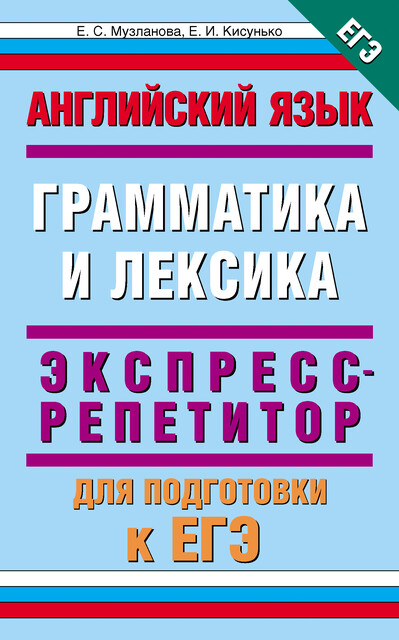



ЕГЭ. Английский язык. Раздел «Грамматика и лексика»на едином государственном экзамене. 10–11 классы
Қосымшада ыңғайлырақҚосымшаны жүктеуге арналған QRRuStore · Samsung Galaxy Store
Huawei AppGallery · Xiaomi GetApps

 ЕГЭ. Английский язык. Раздел «Грамматика и лексика»на едином государственном экзамене. 10–11 классы

Основная цель пособия — активизировать изученный ранее лексико-грамматический материал и подготовить учащихся к успешной сдаче Единого государственного экзамена по английскому языку. Более 200 включенных в него разнообразных тестов помогут прочно усвоить лексику и наиболее важные аспекты грамматики. Все тесты снабжены ключами, что позволяет использовать сборник для самоконтроля и самостоятельного изучения английского языка.
Пособие предназначено для учащихся 10–11 классов общеобразовательных учреждений, а также для учителей английского языка. Оно также будет полезно абитуриентам вузов при подготовке к вступительному экзамену по английскому языку.
Оқыдыңыз ба? Не айтасыз?
Соня Н.
Соня Н.дәйексөз келтірді7 ай бұрын
ADJECTIVES AND ADVERBS
Комментарий жазу
Евгения
Евгениядәйексөз келтірді2 жыл бұрын
• Natural phenomena: darkness, hail, heat, rain (but: the rains = season of continuous rain in tro
Комментарий жазу
Евгения
Евгениядәйексөз келтірді2 жыл бұрын
COUNTABLE AND UNCOUNTABLE NOUNS
Nouns can be countable (those that can be counted) or uncountable (those that can’t be counted). Uncountable nouns take a singular verb. The most common uncountable nouns are:
• Mass nouns: fluids (blood, tea, coffee, milk etc), solids (bread, butter, china, coal, food, fruit, glass, ice, iron, fish [meaning food], etc), gasses (air, oxygen, pollution, smoke, smog, etc), particles (corn, dust, flour, hair, pepper, rice, salt, sand, etc).
• Subjects of study: chemistry, economics, literature, mathematics, physics, etc.
• Languages: Chinese, English, French, etc.
• Games: billiards, chess, golf, soccer, tennis, etc.
• Diseases: flu, measles, mumps, etc.
• Natural phenomena: darkness, hail, heat, rain (but: the rains = season of continuous rain in tropical countries), humidity, thunder, snow, etc.
• Some abstract nouns: accommodation, advice, anger, applause, assistance, behaviour, business, chaos, countryside, courage, damage, dirt, education, evidence, housework, homework, information, intelligence, knowledge, luck, music, news, peace, progress, seaside, shopping, traffic, trouble, truth, wealth, work, etc.
• Collective nouns: baggage, cutlery, furniture, jewellery, luggage, machinery, money, rubbish, stationery, etc.
• Many uncountable nouns can be made countable by adding a partitive: a piece of paper/cake/advice/information/furniture; a slice/loaf of bread; a(n) item/piece of news, etc.
• Some nouns take only a plural verb. These are objects consisting of two parts: garments (pyjamas, trousers, etc), tools (scissors, etc), instruments (binoculars, compasses, spectacles, etc), or nouns such as: arms, ashes, barracks, clothes, congratulations, earnings, (good) looks, outskirts, people, police, premises, riches, stairs, surroundings, wages, etc.
• Group nouns refer to a group of people. These nouns can take either a singular or a plural verb depending on whether we see the group as a whole or as individuals. Such group nouns are: army, audience, class, club, committee, company, council, crew, crowd, headquarters, family, jury, government, press, public, staff, team, etc.
The team was the best. (the team as a group)
The team were all given medals. (each member separately as individuals)
• With expressions of duration, distance or money meaning ‘a whole amount’ we use a singular verb: Two years is long to wait. Three miles is a long way to go. Nine thousand pounds is a high price to pay.
Комментарий жазу
Английский начало
Евгения К.
Евгения К.
16 кітап
1