The study on this topic and the writing of the article was conducted at the expense of the author. There were no co-authors at all stages of research. The conflict of interests is absent, article earlier was not published.
The position and scientific degree at the author at the moment is absent.
Author-correspondent: Kot Oleg. Email: oll.oll13@yahoo.com
https://orcid.org/0000-0003-1727-5513
Abstract. This article is written for the sole purpose — to show the solution of the problem of the genesis of totemism through interdisciplinary approaches. In article the mechanism of emergence of the belief in kinship between a primitive genera and classes of fauna is described. The concept of the last stages of extinction of totemism or its liminality is introduced. This involves the complete exclusion from the search of open systems, including the pathogenesis of the Neanderthal in Paleolithic. The closed system are considered by methods of sea psychology (a bible ark of Noah as the dot of Noah’s-Darwin’s). The method of comparative analysis proves the complete interrelatedness of relationships within the totemic complex with the mutual relations that have arisen within the closed system described in the book of Genesis as the Biblical ark of Noah.
Keywords: the dot of Noah’s-Darwin’s, totemism, open systems, closed systems, PTSD.
1. Introduction
The history of the study of Totemism began with a universally known error — the English soldier, at a later time the furs salesman and translator, John Long incorrectly interpreted the concept of “Ototem” in the full description of his travels (Long 1904 [1791]). The way to solve the problem for today is reliably closed. “In the past the theoretical discussion of totemism was almost entirely concerned with speculations as to its possible origin. <…> To be able to speak of an origin of totemism we must assume that all these diverse institutions that we include under the one general term have been derived by successive modifications from a single form. There does not seem to me to be a particle of evidence to justify such an assumption. But even if we make it we can still only speculate as to what this original form of totemism may have been, as to the enormously complex series of events which could have produced from it the various existing totemic systems, and as to where, when, and how that hypothetical original form of totemism came into existence” (Radcliffe-Brown 1952, p. 122).
The Editor of Current Anthropology Mark Aldenderfer, to the author’s of this article: “However, your manuscript remains speculative and presents little evidence for the hypothesis” (2018, CA MS 303267).
Historiography of the problem (Tokarev 1978; 1990, pp. 51–60, pp. 564–576; Khaitun 1958, pp. 108–142; Levi-Strauss [1962] 1994, pp. 38–47, pp. 108–110; Dmitriyeva 2014, pp. 263–283). The latter noted:
From the work of Ethnographers-Australologists it is clear, that at least in Australia the word “totemism” is sometimes called different and irreducible to each other phenomena. The problem is (and it’s common the bad penny of Ethnology), that these different phenomena traditionally have to be called the same term. <…> Therefore, the only thing that can contribute to mutual understanding in this case is a preliminary definition of the concepts “totemism” and “totem” (ibid, p. 280).
Actually it is the citation belongs to Gladys Reichard (1938, p. 430):
Too much has been written of totemism in its different aspects… to permit leaving it entirely out of the discussion… Since the manifestations are so varied in different parts of the world, since their resemblances are only apparent, and since they are phenomena which may occur in many settings not related to real or supposed consanguinity, they can by no means be fitted into a single category (Levi-Strauss [1964] 1991, p. 7).
The quotations above indicates that the fragments of observations, brought from field expeditions, were not amenable to complete comprehension — the roots of the phenomenon were absent and, accordingly, the conclusions based on these materials began to be critically interpreted. Starting with Goldenweiser and ending with the founder of the school of structuralism Levi-Strauss, a point of view on the totemic complex as on artificially created by the predecessors (from McLennan to Fraser), but actually consisting of completely dissimilar phenomena, was formed and maintained in the future. “The supposed totemism eludes all effort at absolute definition” (Levi-Strauss [1964] 1991, p. 5).
By an answer for inability of ethnography to explain this phenomenon became there is arises an perceptions of the emergence of totemic beliefs among Neanderthals — the ending of the Middle Paleolithic, the beginning of the Upper Paleolithic, the culture of the Mousterian (Semenov [1966] 2002, pp. 427–430). But and this method has failed to bring decisive arguments in its favor.
2. The Dot of Noah’s-Darwin’s: The playback of the closed system in totemism
Errors of the methodological nature of the researchers of the phenomenon of totemism. The first. None of the scientists tried to connect the issue of the origin of the relationship of man and animal with the phenomena of natural disasters. However, the character of totemic relations directly indicates the existence of an extreme situation, after which animals acquire the highest value for man. Totemism was studied in primitive peoples in the open systems of prairies, mountains, plains, forests, savannahs, where there are no conditions for the appearance of such ties of kinship. Soviet scientists were looking for traces of the phenomenon in the burials and caves of Neanderthals (open systems of the Paleolithic). But completely closed systems, really arising from disasters, were not considered by anyone, which indicates an actual narrowing of the search.
The second. The book Genesis directly points out catastrophism, but in the scientific worldview of the XIX and XX centuries there was no place for the Bible. Literally all, who dealt with the problem of the totemic complex, rejected the Scripture as a scientific source, but at the same time many remained the believing people. Strehlow, Schmidt, Fison (missionaries, priests of various faiths), Durkheim, Levi-Strauss, son and grandson of rabbi, two tens more Jewish scientists, the people of the Torah to the marrow of the bones, have passed by the obvious. Tabooing of the totem’s or prohibition on the use in food is one of bases of nature of totem. It is enough to juxtapose the totems of primitive peoples with the pages of book of Genesis to understand that this is a 100% continuation in space and time practice of the fasting. And those who first tabooing the animal, the bird or the amphibian as a totem, acted in the same way as Adam and Eve. And we can assume that they were their remote descendants. But if the book of Genesis describes the emergence of the institution of fasting, the entire chronology of the emergence of totemism and its main institution — tabooing of the totem’s was rests only in the events described from the sixth to eleventh chapters of the book of Genesis.
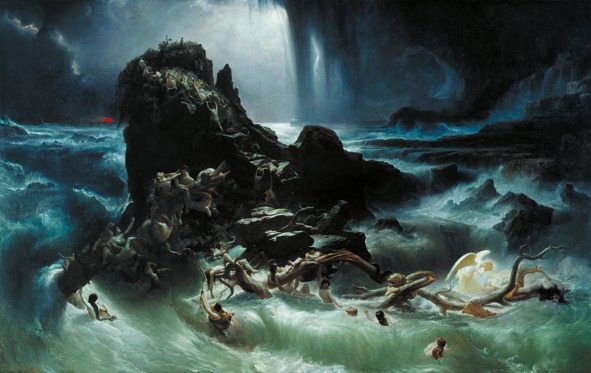
The Flood, Francis Danby, 1840, Tate Gallery.
Perhaps, only therefore the vast majority of researchers of the West and East (an exception Semenov, Eylderman) carried a totemism to the category of primitive religions. Thus, the first, grossest classification error was made. Totemism from the beginning to the end was, first of all, social and domestic phenomenon, which took place in the conditions of an emergency situation and certainly not a religion.
In these two reasons lies the failure of the army of scientists of the XIX and XX century. They studied the last stages of dying totemism with its binding to the specific historical conditions of open systems. For example, the bond of myths about Aboriginal totemic ancestors to the territory of his community in Australia. But closed systems were not considered by them, because none of them could solve the problem of nature of the tabooing totem. Studying the problem, it was impossible to understand what the meaning of food bans, when around the abundance of animal and plant mass? This is approaching the absurd. Perhaps, there is a hidden event, which is firmly forgotten, but it was the impetus for the emergence of taboos. Most likely, the hunger of the planetary scale due to the lack of animal protein duration of 30–40 thousand years. And if the beginning of this phenomenon was connected with a global disaster, then formation of persistent persuasion in the common kinship of a small number of people and animals has become a matter of time. Therefore it is possible to assume that taboos on certain kind of animals or birds arise much later this period of time. The biblical flood is analogous to such a catastrophe. But by virtue of the unscientific nature, the book of Genesis is rejected by scientists to this day. So there was a notorious the problem of totemism in modern ethnography.
For what is the need to correlate totemism with a completely closed system, cut off from the rest of the world? Only because of the main characteristic of a primitive totem. Tabooing or prohibition (restriction) in food intake indicates the coercion, extreme nature of the situation, which and close wasn’t found at the Australian aborigines two hundred years ago or among American Indians four centuries ago by European settlers. On the contrary, the indigenous people prospered.
In totemism there are always two components — a group of people and a group of animals, birds or plants. Consider them in the same sequence.
3. A group of people
1910 year. Having collided with an avalanche of the unsystematic material named totemism, A. A. Goldenweiser has tried to allocate from it the common, which could be inherent in all primitive peoples. “The content, then, must be expressed in the most general terms. We saw that one common factor in the various ethnic complexes generally termed ‘totemism’ is an association which the occurs between certain religious phenomena, on the one hand, and certain social phenomena, on the other” (Goldenweiser 1910, p. 274).
“The five ‘symptoms,’ or two or three of them, or all and a few others in addition, become associated, and thus constitute a totemic whole. That the process is an association, and not a mere juxtaposition, is indeed apparent” (ibid 1910, p. 270).
The description of Totemism by Goldenweiser is a continuation in space and time of the scheme of Association of the Biblical Ark. “Totemism is the tendency of definite social units1 to become associated with objects and symbols of emotional value. To look at the phenomenon from a somewhat different standpoint, objects and symbols which are originally of emotional value for individuals become through their totemic association transformed into social factors, referring to social units which are clearly defined. This process of transformation from individual into social values may fitly be designated by the term ‘socialization’. Totemism is the process of specific socialization of objects and symbols of emotional value” (ibid 1910, p. 275).
And now imagine self that a huge barge, hammered by hundreds of species of animals and birds, a handful’s of people and fodders during a storm has taken out to the ocean. About half a year the vessel drifted in the deserted sector of the Pacific Ocean, same amount of time the vessel stood on a reef. But in the end he was noticed and was able to tow to the nearest port.
We can say with full confidence that no bonds of kinship for the surviving animals and people, who have been the one year side by side on the Ark, will not occur. People will return to humans, animals to animals. Why? Because distress and mortal danger were local, limited in space and time. The world has not suffered a global catastrophe, none of the pe