


автордың кітабын онлайн тегін оқу The Tribes and Castes of the Central Provinces of India, Volume 3

The Tribes and Castes
of the
Central Provinces of India
The Tribes and Castes of the Central Provinces of India
By
R.V. Russell
Of the Indian Civil Service Superintendent of Ethnography, Central Provinces
Assisted by
Rai Bahādur Hīra Lāl
Extra Assistant Commissioner
Published Under the Orders of the Central Provinces Administration
In Four Volumes
Vol. III.
Macmillan and Co., Limited St. Martin’s Street, London.
1916
Contents of Volume III
Articles on Castes and Tribes of the Central Provinces in Alphabetical Order
The articles which are considered to be of most general interest are shown in capitals
- Page
- Gadaria (Shepherd) 3
- Gadba (Forest tribe) 9
- Gānda (Weaver and labourer) 14
- Gandhmāli (Uriya village priests and temple servants) 17
- Gārpagāri (Averter of hailstorms) 19
- Gauria (Snake-charmer and juggler) 24
- Ghasia (Grass-cutter) 27
- Ghosi (Buffalo-herdsman) 32
- Golar (Herdsman) 35
- Gond (Forest tribe and cultivator) 39
- Gond-Gowāri (Herdsman) 143
- Gondhali (Religious mendicant) 144
- Gopāl (Vagrant criminal caste) 147
- Gosain (Religious mendicant) 150
- Gowāri (Herdsman) 160
- Gūjar (Cultivator) 166
- Gurao (Village priest) 175
- Halba (Forest tribe, labourer) 182
- Halwai (Confectioner) 201
- Hatkar (Soldier, shepherd) 204
- Hijra (Eunuch, mendicant) 206
- Holia (Labourer, curing hides) 212
- Injhwār (Boatman and fisherman) 213
- Jādam (Cultivator) 217
- Jādua (Criminal caste) 219
- Jangam (Priest of the Lingāyat sect) 222
- Jāt (Landowner and cultivator) 225
- Jhādi Telenga (Illegitimate, labourer) 238
- Jogi (Religious mendicant and pedlar) 243
- Joshi (Astrologer and village priest) 255
- Julāha (Weaver) 279
- Kachera (Maker of glass bangles) 281
- Kāchhi (Vegetable-grower) 285
- Kadera (Firework-maker) 288
- Kahār (Palanquin-bearer and household servant) 291
- Kaikāri (Basket-maker and vagrant) 296
- Kalanga (Soldier, cultivator) 302
- Kalār (Liquor vendor) 306
- Kamār (Forest tribe) 323
- Kanjar (Gipsies and prostitutes) 331
- Kāpewār (Cultivator) 342
- Karan (Writer and clerk) 343
- Kasai (Butcher) 346
- Kasār (Worker in brass) 369
- Kasbi (Prostitute) 373
- Katia (Cotton-spinner) 384
- Kawar (Forest tribe and cultivator) 389
- Kāyasth (Village accountant, writer and clerk) 404
- Kewat (Boatman and fisherman) 422
- Khairwār (Forest tribe; boilers of catechu) 427
- Khandait (Soldier, cultivator) 436
- Khangār (Village watchman and labourer) 439
- Kharia (Forest tribe, labourer) 445
- Khatīk (Mutton-butcher) 453
- Khatri (Merchant) 456
- Khojāh (Trader and shopkeeper) 461
- Khond (Forest tribe, cultivator) 464
- Kīr (Cultivator) 481
- Kirār (Cultivator) 485
- Kohli (Cultivator) 493
- Kol (Forest tribe, labourer) 500
- Kolām (Forest tribe, cultivator) 520
- Kolhāti (Acrobat) 527
- Koli (Forest tribe, cultivator) 532
- Kolta (Landowner and cultivator) 537
- Komti (Merchant and shopkeeper) 542
- Kori (Weaver and labourer) 545
- Korku (Forest tribe, labourer) 550
- Korwa (Forest tribe, cultivator) 571
- Koshti (Weaver) 581
Illustrations in Volume III
- Page
- 65. Gond women grinding corn 42
- 66. Palace of the Gond kings of Garha-Mandla at Rāmnagar 46
- 67. Gonds on a journey 62
- 68. Killing of Rāwan, the demon king of Ceylon, from whom the Gonds are supposed to be descended 114
- 69. Woman about to be swung round the post called Meghnāth 116
- 70. Climbing the pole for a bag of sugar 118
- 71. Gonds with their bamboo carts at market 122
- 72. Gond women, showing tattooing on backs of legs 126
- 73. Māria Gonds in dancing costume 136
- 74. Gondhali musicians and dancers 144
- 75. Gosain mendicant 150
- 76. Alakhwāle Gosains with faces covered with ashes 152
- 77. Gosain mendicants with long hair 154
- 78. Famous Gosain Mahant. Photograph taken after death 156
- 79. Gūjar village proprietress and her land agent 168
- 80. Guraos with figures made at the Holi festival called Gangour 176
- 81. Group of Gurao musicians with their instruments 180
- 82. Ploughing with cows and buffaloes in Chhattīsgarh 182
- 83. Halwai or confectioner’s shop 202
- 84. Jogi mendicants of the Kanphata sect 244
- 85. Jogi musicians with sārangi or fiddle 250
- 86. Kaikaris making baskets 298
- 87. Kanjars making ropes 332
- 88. A group of Kasārs or brass-workers 370
- 89. Dancing girls and musicians 374
- 90. Girl in full dress and ornaments 378
- 91. Old type of sugarcane mill 494
- 92. Group of Kol women 512
- 93. Group of Kōlams 520
- 94. Korkus of the Melghāt hills 550
- 95. Korku women in full dress 556
- 96. Koshti men dancing a figure, holding strings and beating sticks 582
Pronunciation
ahas the sound of
uin
butor
murmur.
āhas the sound of
ain
bathor
tar.
ehas the sound of
éin
écartéor
aiin
maid.
ihas the sound of
iin
bit, or (as a final letter) of
yin
sulky.
īhas the sound of
eein
beet.
ohas the sound of
oin
boreor
bowl.
uhas the sound of
uin
putor
bull.
ūhas the sound of
ooin
pooror
bootThe plural of caste names and a few common Hindustāni words is formed by adding s in the English manner according to ordinary usage, though this is not, of course, the Hindustāni plural.
Note.—The rupee contains 16 annas, and an anna is of the same value as a penny. A pice is a quarter of an anna, or a farthing. Rs. 1–8 signifies one rupee and eight annas. A lakh is a hundred thousand, and a krore ten million.
Part III
Articles on Castes and Tribes
Garardia—Koshti
Gadaria
List of Paragraphs
- 1. General notice. 3
- 2. Subdivisions. 3
- 3. Marriage customs. 5
- 4. Religion and funeral rites. 5
- 5. Social customs. 6
- 6. Goats and sheep. 6
- 7. Blanket-weaving. 8
- 8. Sanctity of wool. 9
1. General notice.
Gadaria, Gādri.1—The occupational shepherd caste of northern India. The name is derived from the Hindi gādar and the Sanskrit gandhāra, a sheep, the Sanskrit name being taken from the country of Gandhāra or Kandahār, from which sheep were first brought. The three main shepherd castes all have functional names, that of the Dhangars or Marātha shepherds being derived from dhan, small stock, while the Kuramwārs or Telugu shepherds take their name like the Gadarias from kuruba, a sheep. These three castes are of similar nature and status, and differ only in language and local customs. In 1911 the Gadarias numbered 41,000 persons. They are found in the northern Districts, and appear to have been amongst the earliest settlers in the Nerbudda valley, for they have given their name to several villages, as Gadariakheda and Gādarwāra.
2. Subdivisions.
The Gadarias are a very mixed caste. They themselves say that their first ancestor was created by Mahādeo to tend his rams, and that he married three women who were fascinated by the sight of him shearing the sheep. These belonged to the Brāhman, Dhīmar and Barai castes respectively, and became the ancestors of the Nikhar, Dhengar and Barmaiyan subcastes of Gadarias. The Nikhar subcaste are the highest, their name meaning pure. Dhengar is probably, in reality, a corruption of Dhangar, the name of the Marātha shepherd caste. They have other subdivisions of the common territorial type, as Jheria or jungly, applied to the Gadarias of Chhattīsgarh; Desha from desh, country, meaning those who came from northern India; Purvaiya or eastern, applied to immigrants from Oudh; and Mālvi or those belonging to Mālwa. Nikhar and Dhengar men take food together, but not the women; and if a marriage cannot be otherwise arranged these subcastes will sometimes give daughters to each other. A girl thus married is no longer permitted to take food at her father’s house, but she may eat with the women of her husband’s subcaste. Many of their exogamous groups are named after animals or plants, as Hiranwār, from hiran, a deer; Sapha from the cobra, Moria from the peacock, Nāhar from the tiger, Phulsungha, a flower, and so on. Others are the names of Rājpūt septs and of other castes, as Ahirwār (Ahīr) and Bamhania (Brāhman).
Another more ambitious legend derives their origin from the Bania caste. They say that once a Bania was walking along the road with a cocoanut in his hand when Vishnu met him and asked him what it was. The Bania answered that it was a cocoanut. Vishnu said that it was not a cocoanut but wool, and told him to break it, and on breaking the cocoanut the Bania found that it was filled with wool. The Bania asked what he should do with it, and Vishnu told him to make a blanket out of it for the god to sit on. So he made a blanket, and Vishnu said that from that day he should be the ancestor of the Gadaria caste, and earn his bread by making blankets from the wool of sheep. The Bania asked where he should get the sheep from, and the god told him to go home saying ‘Ehān, Ehān, Ehān,’ all the way, and when he got home he would find a flock of sheep following him; but he was not to look behind him all the way. And the Bania did so, but when he had almost got home he could not help looking behind him to see if there were really any sheep. And he saw a long line of sheep following him in single file, and at the very end was a ram with golden horns just rising out of the ground. But as he looked it sank back again into the ground, and he went back to Vishnu and begged for it, but Vishnu said that as he had looked behind him he had lost it. And this was the origin of the Gadaria caste, and the Gadarias always say ‘Ehān, Ehān,’ as they lead their flocks of sheep and goats to pasture.
3. Marriage customs.
Marriage within the clan is forbidden and also the union of first cousins. Girls may be married at any age, and are sometimes united to husbands much younger than themselves. Four castemen of standing carry the proposal of marriage from the boy’s father, and the girl’s father, being forewarned, sends others to meet them. One of the ambassadors opens the conversation by saying, ‘We have the milk and you have the milk-pail; let them be joined.’ To which the girl’s party, if the match be agreeable, will reply, “Yes, we have the tamarind and you have the mango; if the panches agree let there be a marriage.” The boy’s father gives the girl’s father five areca-nuts, and the latter returns them and they clasp each other round the neck. When the wedding procession reaches the bride’s village it is met by their party, and one of them takes the sarota or iron nut-cutter, which the bridegroom holds in his hand, and twirls it about in the air several times. The ceremony is performed by walking round the sacred pole, and the party return to the bridegroom’s lodging, where his brother-in-law fills the bride’s lap with sweetmeats and water-nut as an omen of fertility. The maihar or small wedding-cakes of wheat fried in sesamum oil are distributed to all members of the caste present at the wedding. While the bridegroom’s party is absent at the bride’s house, the women who remain behind enjoy amusements of their own. One of them strips herself naked, tying up her hair like a religious mendicant, and is known as Bāba or holy father. In this state she romps with her companions in turn, while the others laugh and applaud. Occasionally some man hides himself in a place where he can be a witness of their play, but if they discover him he is beaten severely with belnas or wooden bread-rollers. Widow-marriage and divorce are permitted, the widow being usually expected to marry her late husband’s younger brother, whether he already has a wife or not. Sexual offences are not severely reprobated, and may be atoned for by a feast to the caste-fellows.
4. Religion and funeral rites.
The Gadarias worship the ordinary Hindu deities and also Dishai Devi, the goddess of the sheep-pen. No Gadaria may go into the sheep-pen with his shoes on. On entering it in the morning they make obeisance to the sheep, and these customs seem to indicate that the goddess Dishai Devi2 is the deified sheep. When the sheep are shorn and the fleeces are lying on the ground they take some milk from one of the ewes and mix rice with it and sprinkle it over the wool. This rite is called Jimai, and they say that it is feeding the wool, but it appears to be really a sacrificial offering to the material. The caste burn the dead when they can afford to do so, and take the bones to the Ganges or Nerbudda, or if this is not practicable, throw them into the nearest stream.
5. Social customs.
Well-to-do members of the caste employ Brāhmans for ceremonial purposes, but others dispense with their services. The Gadarias eat flesh and drink liquor, but abstain from fowls and pork. They will take food cooked with water from a Lodhi or a Dāngi, members of these castes having formerly been their feudal chieftains in the Vindhyan Districts and Nerbudda valley. Brāhmans and members of the good cultivating castes would be permitted to become Gadarias if they should so desire. The head of the caste committee has the title of Mahton and the office is hereditary, the holder being invariably consulted on caste questions even if he should be a mere boy. The Gadarias rank with those castes from whom a Brāhman cannot take water, but above the servile and labouring castes. They are usually somewhat stupid, lazy and good-tempered, and are quite uneducated. Owing to their work in cleaning the pens and moving about among the sheep, the women often carry traces of the peculiar smell of these animals. This is exemplified in the saying, ‘Ek to Gadaria, dusre lahsan khae,’ or ‘Firstly she is a Gadaria and then she has eaten garlic’; the inference being that she is far indeed from having the scent of the rose.
6. Goats and sheep.
The regular occupations of the Gadarias are the breeding and grazing of sheep and goats, and the weaving of country blankets from sheep’s wool. The flocks are usually tended by the children, while the men and women spin and weave the wool and make blankets. Goats are bred in larger numbers than sheep in the Central Provinces, being more commonly used for food and sacrifices, while they are also valuable for their manure. Any Hindu who thinks an animal sacrifice requisite, and objects to a fowl as unclean, will choose a goat; and the animal after being sacrificed provides a feast for the worshippers, his head being the perquisite of the officiating priest. Muhammadans and most castes of Hindus will eat goat’s meat when they can afford it. The milk is not popular and there is very little demand for it locally, but it is often sold to the confectioners, and occasionally made into butter and exported. Sheep’s flesh is also eaten, but is not so highly esteemed. In the case of both sheep and goats there is a feeling against consuming the flesh of ewes. Sheep are generally black in colour and only occasionally white. Goats are black, white, speckled or reddish-white. Both animals are much smaller than in Europe. Both sheep and goats are in brisk demand in the cotton tracts for their manure in the hot-weather months, and will be kept continually on the move from field to field for a month at a time. It is usual to hire flocks at the rate of one rupee a hundred head for one night; but sometimes the cultivators combine to buy a large flock, and after penning them on their fields in the hot weather, send them to Nāgpur in the beginning of the rains to be disposed of. The Gadaria was formerly the bête noir of the cultivator, on account of the risk incurred by the crops from the depredations of his sheep and goats. This is exemplified in the saying:
Ahīr, Gadaria, Pāsi,
Yeh tinon satyanāsi,
or, ‘The Ahīr (herdsman), the Gadaria and the Pāsi, these three are the husbandmen’s foes.’ And again:
Ahīr, Gadaria, Gūjar,
Yeh tinon chāhen ujar,
or ‘The Ahīr, the Gadaria and the Gūjar want waste land,’ that is for grazing their flocks. But since the demand for manure has arisen, the Gadaria has become a popular personage in the village. The shepherds whistle to their flocks to guide them, and hang bells round the necks of goats but not of sheep. Some of them, especially in forest tracts, train ordinary pariah dogs to act as sheep-dogs. As a rule, rams and he-goats are not gelt, but those who have large flocks sometimes resort to this practice and afterwards fatten the animals up for sale. They divide their sheep into five classes, as follows, according to the length of the ears: Kanāri, with ears a hand’s length long; Semri, somewhat shorter; Burhai, ears a forefinger’s length; Churia, ears as long as the little finger; and Neori, with ears as long only as the top joint of the forefinger. Goats are divided into two classes, those with ears a hand’s length long being called Bangalia or Bagra, while those with small ears a forefinger’s length are known as Gujra.
7. Blanket-weaving.
While ordinary cultivators have now taken to keeping goats, sheep are still as a rule left to the Gadarias. These are of course valued principally for their wool, from which the ordinary country blanket is made. The sheep3 are shorn two or sometimes three times a year, in February, June and September, the best wool being obtained in February from the cold weather coat. Members of the caste commonly shear for each other without payment. The wool is carded with a kamtha, or simple bow with a catgut string, and spun by the women of the household. Blankets are woven by men on a loom like that used for cotton cloth. The fabric is coarse and rough, but strong and durable, and the colour is usually a dark dirty grey, approaching black, being the same as that of the raw material. Every cultivator has one of these, and the various uses to which it may be put are admirably described by ‘Eha’ as follows: 4
“The kammal is a home-spun blanket of the wool of black sheep, thick, strong, as rough as a farrier’s rasp, and of a colour which cannot get dirty. When the Kunbi (cultivator) comes out of his hole in the morning it is wrapped round his shoulders and reaches to his knees, guarding him from his great enemy, the cold, for the thermometer is down to 60° Fahrenheit. By-and-by he has a load to carry, so he folds his kammal into a thick pad and puts it on the top of his head. Anon he feels tired, so he lays down his load, and arranging his kammal as a cushion, sits with comfort on a rugged rock or a stony bank, and has a smoke. Or else he rolls himself in it from head to foot, like a mummy, and enjoys a sound sleep on the roadside. It begins to rain, he folds his kammal into an ingenious cowl and is safe. Many more are its uses. I cannot number them all. Whatever he may be called upon to carry, be it forest produce, or grain or household goods, or his infant child, he will make a bundle of it with his kammal and poise it on his head, or sling it across his back, and trudge away.”
8. Sanctity of wool.
Wool is a material of some sanctity among the Hindus. It is ceremonially pure, and woollen clothing can be worn by Brāhmans while eating or performing sacred functions. In many castes the bridegroom at a wedding has a string of wool with a charm tied round his waist. Religious mendicants wear jatas or wigs of sheep’s wool, and often carry woollen charms. The beads used for counting prayers are often of wool. The reason for wool being thus held sacred may be that it was an older kind of clothing used before cotton was introduced, and thus acquired sanctity by being worn at sacrifices. Perhaps the Aryans wore woollen clothing when they entered India.
1 This article is based on information collected by Mr. Hīra Lāl in Jubbulpore, and the author in Mandla.
2 The word Dishai really means direction or cardinal point, but as the goddess dwells in the sheep-pen it is probable that she was originally the sheep itself.
3 The following particulars are taken from the Central Provinces Monograph on Woollen Industries, by Mr. J. T. Marten.
4 A Naturalist on the Prowl, 3rd ed., p. 219. In the quotation the Hindustāni word kammal, commonly used in the Central Provinces, is substituted for the Marāthi word kambli.
Gadba
1. Description and structure of the tribe.
Gadba, Gadaba.1—A primitive tribe classified as Mundāri or Kolarian on linguistic grounds. The word Gadba, Surgeon-Major Mitchell states, signifies a person who carries loads on his shoulders. The tribe call themselves Guthau. They belong to the Vizagapatam District of Madras, and in the Central Provinces are found only in the Bastar State, into which they have immigrated to the number of some 700 persons. They speak a Mundāri dialect, called Gadba, after their tribal name, and are one of the two Mundāri tribes found so far south as Vizagapatam, the other being the Savars.2 Their tribal organisation is not very strict, and a Bhatra, a Parja, a Muria, or a member of any superior caste may become a Gadba at an expenditure of two or three rupees. The ceremony consists of shaving the body of the novice, irrespective of sex, clean of hair, after which he or she is given to eat rice cooked in the water of the Ganges. This is followed by a feast to the tribe in which a pig must be killed. The Gadbas have totemistic exogamous septs, usually named after animals, as gutāl dog, angwān bear, dungra tortoise, surangai tiger, gūmal snake, and so on. Members of each sept abstain from killing or injuring the animal or plant after which it is named, but they have no scruple in procuring others to do this. Thus if a snake enters the hut of a person belonging to the Gūmal sept, he will call a neighbour of another sept to kill it. He may not touch its carcase with his bare hand, but if he holds it through a piece of rag no sin is incurred.
2. Marriage.
Marriage is adult, but the rule existing in Madras that a girl is not permitted to marry until she can weave her own cloth does not obtain in the Central Provinces.3 As a rule the parents of the couple arrange the match, but the wishes of the girl are sometimes consulted and various irregular methods of union are recognised. Thus a man is permitted with the help of his friends to go and carry off a girl and keep her as his wife, more especially if she is a relation on the maternal side more distant than a first cousin. Another form is the Paisa Mundi, by which a married or unmarried woman may enter the house of a man of her caste other than her husband and become his wife; and the Upaliya, when a married woman elopes with a lover. The marriage ceremony is simple. The bridegroom’s party go to the girl’s house, leaving the parents behind, and before they reach it are met and stopped by a bevy of young girls and men in their best clothes from the bride’s village. A girl comes forward and demands a ring, which one of the men of the wedding party places on her finger, and they then proceed to the bride’s house, where the bridegroom’s presents, consisting of victuals, liquor, a cloth, and two rupees, are opened and carefully examined. If any deficiency is found, it must at once be made good. The pair eat a little food together, coloured rice is applied to their foreheads, and on the second day a new grass shed is erected, in which some rice is cooked by an unmarried girl. The bride and bridegroom are shut up in this, and two pots of water are poured over them from the roof, the marriage being then consummated. If the girl is not adult this ceremony is omitted. Widow-marriage is permitted by what is called the tīka form, by which a few grains of rice coloured with turmeric are placed on the foreheads of the pair and they are considered as man and wife. There is no regular divorce, but if a married woman misbehaves with a man of the caste, the husband goes to him with a few friends and asks whether the story is true, and if the accusation is admitted demands a pig and liquor for himself and his friends as compensation. If these are given he does not turn his wife out of his house. A liaison of a Gadba woman with a man of a superior caste is also said to involve no penalty, but if her paramour is a low-caste man she is excommunicated for ever. In spite of these lax rules, however, Major Mitchell states that the women are usually very devoted to their husbands. Mr. Thurston4 notes that among the Bonda Gadabas a young man and a maid retire to the jungle and light a fire. Then the maid, taking a burning stick, places it on the man’s skin. If he cries out he is unworthy of her, and she remains a maid. If he does not, the marriage is at once consummated. The application of the brand is probably light or severe according to the girl’s feelings towards the young man.
3. Religious beliefs and festivals.
The Gadbas worship Burhi Māta or Thākurāni Māta, who is the goddess of smallpox and rinderpest. They offer to her flowers and incense when these diseases are prevalent among men or cattle, but if the epidemic does not abate after a time, they abuse the goddess and tell her to do her worst, suspending the offerings. They offer a white cock to the sun and a red one to the moon, and various other deities exercise special functions, Bhandārin being the goddess of agriculture and Dharni of good health, while Bharwān is the protector of cattle and Dand Devī of men from the attacks of wild beasts. They have vague notions of a heaven and hell where the sinful will be punished, and also believe in re-birth. But these ideas appear to be borrowed from their Hindu neighbours. When the new rice crop is ripe, the first-fruits are cooked and served to the cattle in new bamboo baskets, and are then partaken of by men. The ripening of the mango crop is also an important festival. In the bright fortnight of Chait (March) the men go out hunting, and on their return cook the game before Mātideo, the god of hunting, who lives in a tree. In Madras the whole male population turn out to hunt, and if they come back without success the women pelt them with cowdung on their return. If successful, however, they have their revenge on the women in another way.5 On festival days men and women dance together to the music of a pipe and drum. Sometimes they form a circle, holding long poles, and jump backwards and forwards to and from the centre by means of the pole; or the women dance singly or in pairs, their hands resting on each other’s waists. A man and woman will then step out of the crowd and sing at each other, the woman reflecting on the man’s ungainly appearance and want of skill as a cultivator or huntsman, while the man retorts by reproaching her with her ugliness and slatternly habits.6
4. Disposal of the dead.
The dead are buried with their feet to the west, ready to start for the region of the setting sun. On their return from the funeral the mourners stop on the way, and a fish is boiled and offered to the dead. An egg is cut in half and placed on the ground, and pieces of mango bark are laid beside it on which the mourners tread. The women accompany the corpse, and in the meantime the house of the dead person is cleaned with cowdung by the children left behind. On the first day food is supplied to the mourners by their relatives, and in the evening some cooked rice and vegetables are offered to the dead. The mourning lasts for nine days, and on the last day a cow or bullock is killed with the blunt head of an axe, the performance of this function being hereditary in certain families of the caste. Some blood from the animal and some cooked rice are put in leaf-cups and placed on the grave by the head of the corpse. The animal is cooked and eaten by the grave, and they then return to the cooking shed and place its jawbone under a stick supported on two others, blood and cooked rice being again offered. The old men and women bathe in warm water, and all return to the place where the dead man breathed his last. Here they drink and have another meal of rice and beef, which is repeated on the following day, and the business of committing the dead to the ancestors is complete. Liquor is offered to the ancestors on feast days.
5. Occupation and mode of living.
The caste are cultivators and labourers, while some are employed as village watchmen, and others are hereditary pālki-bearers to the Rāja of Bastar, enjoying a free grant of land. They practise shifting cultivation, cleaning a space by indiscriminate felling in the forest, and roughly ploughing the ground for a single broad-cast crop of rice; in the following year the clearing is usually abandoned. Their dress is simple, though they now wear ordinary cloth. Forty years ago it is said that they wore coverings made from the bark of the kuring tree and painted with horizontal bands of red, yellow and blue.7 A girdle of the thickness of a man’s arm made from fine strips of bark is still worn and is a distinguishing feature of the Gadba women. They also carry a circlet round their forehead of the seeds of kusa grass threaded on a string. Both men and women wear enormous earrings, the men having three in each ear. The Gadbas are almost omnivorous, and eat flesh, fish, fowls, pork, buffaloes, crocodiles, non-poisonous snakes, large lizards, frogs, sparrows, crows and large red ants. They abstain only from the flesh of monkeys, horses and asses. A Gadba must not ride on a horse under penalty of being put out of caste. Mr. Thurston8 gives the following reason for this prejudice:—“The Gadbas of Vizagapatam will not touch a horse, as they are palanquin-bearers, and have the same objection to a rival animal as a cart-driver has to a motor-car.” They will eat the leavings of other castes and take food from all except the impure ones, but like the Mehtars and Ghasias elsewhere they will not take food or water from a Kāyasth. Only the lowest castes will eat with Gadbas, but they are not considered as impure, and are allowed to enter temples and take part in religious ceremonies.
1 This article is compiled from an excellent monograph contributed by Surgeon-Major Mitchell of Bastar State, with extracts from Colonel Glasfurd’s Report on Bastar (Selections from the Records of the Government of India in the Foreign Department, No. 39 of 1863).
2 India Census Report (1901), p. 283.
3 Madras Census Report (1891), p. 253.
4 Ethnographic Notes in Southern India, p. 22.
5 Madras Census Report (1891), p. 253.
6 Report on the Dependency of Bastar, p. 37.
7 Report on the Dependency of Bastar, p. 37.
8 Ethnographic Notes in Southern India, p. 270.
Gānda
1. Distribution and origin.
Gānda.—A servile and impure caste of Chota Nāgpur and the Uriya Districts. They numbered 278,000 persons in 1901, resident largely in Sambalpur and the Uriya States, but since the transfer of this territory to Bengal, only about 150,000 Gāndas remain in the Central Provinces in Raipur, Bilāspur and Raigarh. In this Province the Gāndas have become a servile caste of village drudges, acting as watchmen, weavers of coarse cloth and musicians. They are looked on as an impure caste, and are practically in the same position as the Mehras and Chamārs of other Districts. In Chota Nāgpur, however, they are still in some places recognised as a primitive tribe,1 being generally known here as Pān, Pāb or Chik. Sir H. Risley suggests that the name of Gānda may be derived from Gond, and that the Pāns may originally have been an offshoot of that tribe, but no connection between the Gāndas and Gonds has been established in the Central Provinces.
2. Caste subdivisions.
The subcastes reported differ entirely from those recorded in Orissa. In the Central Provinces they are mainly occupational. Thus the Bajna or Bajgari are those who act as musicians at feasts and marriages; the Māng or Mangia make screens and mats, while their women serve as midwives; the Dholias make baskets; the Doms skin cattle and the Nagārchis play on nakkāras or drums. Panka is also returned as a subcaste of Gānda, but in the Central Provinces the Pankas are now practically a separate caste, and consist of those Gāndas who have adopted Kabīrpanthism and have thereby obtained some slight rise in status. In Bengal Sir H. Risley mentions a group called Patradias, or slaves and menials of the Khonds, and discusses the Patradias as follows:—“The group seems also to include the descendants of Pāns, who sold themselves as slaves or were sold as Merias or victims to the Khonds. We know that an extensive traffic in children destined for human sacrifice used to go on in the Khond country, and that the Pāns were the agents who sometimes purchased, but more frequently kidnapped, the children, whom they sold to the Khonds, and were so debased that they occasionally sold their own offspring, though they knew of course the fate that awaited them.2 Moreover, apart from the demand for sacrificial purposes, the practice of selling men as agricultural labourers was until a few years ago by no means uncommon in the wilder parts of the Chota Nāgpur Division, where labour is scarce and cash payments are almost unknown. Numbers of formal bonds have come before me, whereby men sold themselves for a lump sum to enable them to marry.” The above quotation is inserted merely as an interesting historical reminiscence of the Pāns or Gāndas.
3. Marriage.
The Gāndas have exogamous groups or septs of the usual low-caste type, named after plants, animals or other inanimate objects. Marriage is prohibited within the sept, and between the children of two sisters, though the children of brothers and sisters may marry. If a girl arrives at maturity without a husband having been found for her, she is wedded to a spear stuck up in the courtyard of the house, and then given away to anybody who wishes to take her. A girl going wrong with a man of the caste is married to him by the ceremony employed in the case of widows, while her parents have to feed the caste. But a girl seduced by an outsider is permanently expelled. The betrothal is marked by a present of various articles to the father of the bride. Marriages must not be celebrated during the three rainy months of Shrāwan, Bhādon or Kunwār, nor during the dark fortnight of the month, nor on a Saturday or Tuesday. The marriage-post is of the wood of the mahua tree, and beneath it are placed seven cowries and seven pieces of turmeric. An elderly male member of the caste known as the Sethia conducts the ceremony, and the couple go five times round the sacred pole in the morning and thrice in the evening. When the bride and bridegroom return home after the wedding, an image of a deer is made with grass and placed behind the ear of the bride. The bridegroom then throws a toy arrow at it made of grass or thin bamboo, and is allowed seven shots. If he fails to knock it out of her ear after these the bride’s brother takes it and runs away and the bridegroom must follow and catch him. This is clearly a symbolic process representing the chase, of the sort practised by the Khonds and other primitive tribes, and may be taken as a reminiscence among the Gāndas of their former life in the forests. The remarriage of widows is permitted, and the younger brother of the deceased husband takes his widow if he wishes to do so. Otherwise she may marry whom she pleases. A husband may divorce his wife for adultery before the caste committee, and if she marries her lover he must repay to the husband the expenses incurred by the latter on his wedding.
4. Religion.
The Gāndas principally worship Dūlha Deo, the young bridegroom who was carried off by a tiger, and they offer a goat to him at their weddings. They observe the Hindu fasts and festivals, and at Dasahra worship their musical instruments and the weaver’s loom. Being impure, they do not revere the tulsi plant nor the banyan or pīpal trees. Children are named on the sixth day after birth without any special ceremony. The dead are generally buried from motives of economy, as with most families the fuel required for cremation would be a serious item of expenditure. A man is laid on his face in the grave and a woman on her back. Mourning is observed for three days, except in the case of children under three years old, whose deaths entail no special observances. On the fourth day a feast is given, and when all have been served, the chief mourner takes a little food from the plate of each guest and puts it in a leaf-cup. He takes another leaf-cup full of water and places the two outside the house, saying ‘Here is food for you’ to the spirit of the departed.
5. Occupation and social status.
The Gāndas are generally employed either in weaving coarse cloth or as village musicians. They sing and dance to the accompaniment of their instruments, the dancers generally being two young boys dressed as women. They have long hair and put on skirts and half-sleeved jackets, with hollow anklets round their feet filled with stones to make them tinkle. On their right shoulders are attached some peacocks’ feathers, and coloured cloths hang from their back and arms and wave about when they dance. Among their musical instruments is the sing-bāja, a single drum made of iron with ox-hide leather stretched over it; two horns project from the sides for purposes of decoration and give the instrument its name, and it is beaten with thick leather thongs. The dafla is a wooden drum open on one side and covered with a goat-skin on the other, beaten with a cane and a bamboo stick. The timki is a single hemispherical drum of earthenware; and the sahnai is a sort of bamboo flute. The Gāndas of Sambalpur have strong criminal tendencies which have recently called for special measures of repression. Nevertheless they are usually employed as village watchmen in accordance with long-standing custom. They are considered as impure and, though not compelled actually to live apart from the village, have usually a separate quarter and are not permitted to draw water from the village well or to enter Hindu temples. Their touch defiles, and a Hindu will not give anything into the hands of one of the caste while holding it himself, but will throw it down in front of the Gānda, and will take anything from him in the same manner. They will admit outsiders of higher rank into the caste, taking from them one or two feasts. And it is reported that in Raipur a Brāhman recently entered the caste for love of a Gānda girl.
1 Risley, Tribes and Castes of Bengal, art. Pān.
2 The human sacrifices of the Khonds were suppressed about 1860. See the article on that tribe.
Gandhmāli
Gandhmāli,1 Thānāpati.—The caste of village priests of the temples of Siva or Mahādeo in Sambalpur and the Uriya States. They numbered about 700 persons in the Central Provinces in 1911. The caste appears to be an offshoot of the Mālis or gardeners, differentiated from them by their special occupation of temple attendants. In Hindustān the priests of Siva’s temples in villages are often Mālis, and in the Marātha country they are Guraos, another special caste, or Phulmālis. Some members of the caste in Sambalpur, however, aspire to Rājpūt origin and wear the sacred thread. These prefer the designation of Thānāpati or ‘Master of the sacred place,’ and call the others who do not wear the thread Gandhmālis. Gandh means incense. The Thānāpatis say that on one occasion a Rājpūt prince from Jaipur made a pilgrimage to the temple of Jagannāth at Puri, and on his return stopped at the celebrated temple of Mahādeo at Huma near Sambalpur. Mahādeo appeared before the prince and asked him to become his priest; the Rājpūt asked to be excused as he was old, but Mahādeo promised him three sons, which he duly obtained and in gratitude dedicated them to the service of the god. From these sons the Thānāpatis say that they are descended, but the claim is no doubt quite illusory. The truth is, probably, that the Thānāpatis are priests of the temples situated in towns and large villages, and owing to their calling have obtained considerable social estimation, which they desire to justify and place on an enduring basis by their claim to Rājpūt ancestry; while the Gandhmālis are village priests, more or less in the position of village menials and below the cultivating castes, and any such pretensions would therefore in their case be quite untenable. There are signs of the cessation of intermarriage between the two groups, but this has not been brought about as yet, probably owing to the paucity of members in the caste and the difficulty of arranging matches. Three functional subdivisions also appear to be in process of formation, the Pujāris or priests of Mahādeo’s temples, the Bandhādias or those who worship him on the banks of tanks, and the Mundjhulas2 or devotees of the goddess Somlai in Sambalpur, on whom the inspiration of the goddess descends, making them shake and roll their heads. When in this state they are believed to drink the blood flowing from goats sacrificed in the temple. For the purposes of marriage the caste is divided into exogamous groups or bargas, the names of which are usually titles or designations of offices. Marriage within the barga is prohibited. When the bride is brought to the altar in the marriage ceremony, she throws a garland of jasmine flowers on the neck of the bridegroom. This custom resembles the old Swayamwāra form of marriage, in which a girl chose her own husband by throwing a garland of flowers round his neck. But it probably has no connection with this and merely denotes the fact that the caste are gardeners by profession, similar ceremonies typifying the caste calling being commonly performed at marriages, especially among the Telugu castes. Girls should be married before adolescence and, as is usual among the Uriya castes, if no suitable husband is forthcoming a symbolic marriage is celebrated; the Thānāpatis make her go through the form with her maternal grandfather or sister’s husband, and in default of them with a tree. She is then immediately divorced and disposed of as a widow. Divorce and the remarriage of widows are permitted. A bachelor marrying a widow must first go through the ceremony with a flower. The Gandhmālis, as the priests of Mahādeo, are generally Saivas and wear red clothes covered with ochre. They consider that their ultimate ancestor is the Nāg or cobra and especially observe the festival of Nāg-Panchmi, abstaining from any cooked food on that day. They both burn and bury the dead and perform the shrāddh ceremony or the offering of sacrificial cakes. They eat flesh but do not drink liquor. Their social position is fairly good and Brāhmans will take water from their hands. Many of them hold free grants of land in return for their services at the temples. A few are ordinary cultivators.
1 This article is compiled from papers by Mr. Jhanjhan Rai, Tahsīldār, Sārangarh, and Satyabādi Misra of the Sambalpur Census office.
2 Mund-jhulānā, to swing the head.
1. General notice.
Gadaria, Gādri.1—The occupational shepherd caste of northern India. The name is derived from the Hindi gādar and the Sanskrit gandhāra, a sheep, the Sanskrit name being taken from the country of Gandhāra or Kandahār, from which sheep were first brought. The three main shepherd castes all have functional names, that of the Dhangars or Marātha shepherds being derived from dhan, small stock, while the Kuramwārs or Telugu shepherds take their name like the Gadarias from kuruba, a sheep. These three castes are of similar nature and status, and differ only in language and local customs. In 1911 the Gadarias numbered 41,000 persons. They are found in the northern Districts, and appear to have been amongst the earliest settlers in the Nerbudda valley, for they have given their name to several villages, as Gadariakheda and Gādarwāra.
2. Subdivisions.
The Gadarias are a very mixed caste. They themselves say that their first ancestor was created by Mahādeo to tend his rams, and that he married three women who were fascinated by the sight of him shearing the sheep. These belonged to the Brāhman, Dhīmar and Barai castes respectively, and became the ancestors of the Nikhar, Dhengar and Barmaiyan subcastes of Gadarias. The Nikhar subcaste are the highest, their name meaning pure. Dhengar is probably, in reality, a corruption of Dhangar, the name of the Marātha shepherd caste. They have other subdivisions of the common territorial type, as Jheria or jungly, applied to the Gadarias of Chhattīsgarh; Desha from desh, country, meaning those who came from northern India; Purvaiya or eastern, applied to immigrants from Oudh; and Mālvi or those belonging to Mālwa. Nikhar and Dhengar men take food together, but not the women; and if a marriage cannot be otherwise arranged these subcastes will sometimes give daughters to each other. A girl thus married is no longer permitted to take food at her father’s house, but she may eat with the women of her husband’s subcaste. Many of their exogamous groups are named after animals or plants, as Hiranwār, from hiran, a deer; Sapha from the cobra, Moria from the peacock, Nāhar from the tiger, Phulsungha, a flower, and so on. Others are the names of Rājpūt septs and of other castes, as Ahirwār (Ahīr) and Bamhania (Brāhman).
Another more ambitious legend derives their origin from the Bania caste. They say that once a Bania was walking along the road with a cocoanut in his hand when Vishnu met him and asked him what it was. The Bania answered that it was a cocoanut. Vishnu said that it was not a cocoanut but wool, and told him to break it, and on breaking the cocoanut the Bania found that it was filled with wool. The Bania asked what he should do with it, and Vishnu told him to make a blanket out of it for the god to sit on. So he made a blanket, and Vishnu said that from that day he should be the ancestor of the Gadaria caste, and earn his bread by making blankets from the wool of sheep. The Bania asked where he should get the sheep from, and the god told him to go home saying ‘Ehān, Ehān, Ehān,’ all the way, and when he got home he would find a flock of sheep following him; but he was not to look behind him all the way. And the Bania did so, but when he had almost got home he could not help looking behind him to see if there were really any sheep. And he saw a long line of sheep following him in single file, and at the very end was a ram with golden horns just rising out of the ground. But as he looked it sank back again into the ground, and he went back to Vishnu and begged for it, but Vishnu said that as he had looked behind him he had lost it. And this was the origin of the Gadaria caste, and the Gadarias always say ‘Ehān, Ehān,’ as they lead their flocks of sheep and goats to pasture.
3. Marriage customs.
Marriage within the clan is forbidden and also the union of first cousins. Girls may be married at any age, and are sometimes united to husbands much younger than themselves. Four castemen of standing carry the proposal of marriage from the boy’s father, and the girl’s father, being forewarned, sends others to meet them. One of the ambassadors opens the conversation by saying, ‘We have the milk and you have the milk-pail; let them be joined.’ To which the girl’s party, if the match be agreeable, will reply, “Yes, we have the tamarind and you have the mango; if the panches agree let there be a marriage.” The boy’s father gives the girl’s father five areca-nuts, and the latter returns them and they clasp each other round the neck. When the wedding procession reaches the bride’s village it is met by their party, and one of them takes the sarota or iron nut-cutter, which the bridegroom holds in his hand, and twirls it about in the air several times. The ceremony is performed by walking round the sacred pole, and the party return to the bridegroom’s lodging, where his brother-in-law fills the bride’s lap with sweetmeats and water-nut as an omen of fertility. The maihar or small wedding-cakes of wheat fried in sesamum oil are distributed to all members of the caste present at the wedding. While the bridegroom’s party is absent at the bride’s house, the women who remain behind enjoy amusements of their own. One of them strips herself naked, tying up her hair like a religious mendicant, and is known as Bāba or holy father. In this state she romps with her companions in turn, while the others laugh and applaud. Occasionally some man hides himself in a place where he can be a witness of their play, but if they discover him he is beaten severely with belnas or wooden bread-rollers. Widow-marriage and divorce are permitted, the widow being usually expected to marry her late husband’s younger brother, whether he already has a wife or not. Sexual offences are not severely reprobated, and may be atoned for by a feast to the caste-fellows.
4. Religion and funeral rites.
The Gadarias worship the ordinary Hindu deities and also Dishai Devi, the goddess of the sheep-pen. No Gadaria may go into the sheep-pen with his shoes on. On entering it in the morning they make obeisance to the sheep, and these customs seem to indicate that the goddess Dishai Devi2 is the deified sheep. When the sheep are shorn and the fleeces are lying on the ground they take some milk from one of the ewes and mix rice with it and sprinkle it over the wool. This rite is called Jimai, and they say that it is feeding the wool, but it appears to be really a sacrificial offering to the material. The caste burn the dead when they can afford to do so, and take the bones to the Ganges or Nerbudda, or if this is not practicable, throw them into the nearest stream.
5. Social customs.
Well-to-do members of the caste employ Brāhmans for ceremonial purposes, but others dispense with their services. The Gadarias eat flesh and drink liquor, but abstain from fowls and pork. They will take food cooked with water from a Lodhi or a Dāngi, members of these castes having formerly been their feudal chieftains in the Vindhyan Districts and Nerbudda valley. Brāhmans and members of the good cultivating castes would be permitted to become Gadarias if they should so desire. The head of the caste committee has the title of Mahton and the office is hereditary, the holder being invariably consulted on caste questions even if he should be a mere boy. The Gadarias rank with those castes from whom a Brāhman cannot take water, but above the servile and labouring castes. They are usually somewhat stupid, lazy and good-tempered, and are quite uneducated. Owing to their work in cleaning the pens and moving about among the sheep, the women often carry traces of the peculiar smell of these animals. This is exemplified in the saying, ‘Ek to Gadaria, dusre lahsan khae,’ or ‘Firstly she is a Gadaria and then she has eaten garlic’; the inference being that she is far indeed from having the scent of the rose.
6. Goats and sheep.
The regular occupations of the Gadarias are the breeding and grazing of sheep and goats, and the weaving of country blankets from sheep’s wool. The flocks are usually tended by the children, while the men and women spin and weave the wool and make blankets. Goats are bred in larger numbers than sheep in the Central Provinces, being more commonly used for food and sacrifices, while they are also valuable for their manure. Any Hindu who thinks an animal sacrifice requisite, and objects to a fowl as unclean, will choose a goat; and the animal after being sacrificed provides a feast for the worshippers, his head being the perquisite of the officiating priest. Muhammadans and most castes of Hindus will eat goat’s meat when they can afford it. The milk is not popular and there is very little demand for it locally, but it is often sold to the confectioners, and occasionally made into butter and exported. Sheep’s flesh is also eaten, but is not so highly esteemed. In the case of both sheep and goats there is a feeling against consuming the flesh of ewes. Sheep are generally black in colour and only occasionally white. Goats are black, white, speckled or reddish-white. Both animals are much smaller than in Europe. Both sheep and goats are in brisk demand in the cotton tracts for their manure in the hot-weather months, and will be kept continually on the move from field to field for a month at a time. It is usual to hire flocks at the rate of one rupee a hundred head for one night; but sometimes the cultivators combine to buy a large flock, and after penning them on their fields in the hot weather, send them to Nāgpur in the beginning of the rains to be disposed of. The Gadaria was formerly the bête noir of the cultivator, on account of the risk incurred by the crops from the depredations of his sheep and goats. This is exemplified in the saying:
Ahīr, Gadaria, Pāsi,
Yeh tinon satyanāsi,
or, ‘The Ahīr (herdsman), the Gadaria and the Pāsi, these three are the husbandmen’s foes.’ And again:
Ahīr, Gadaria, Gūjar,
Yeh tinon chāhen ujar,
or ‘The Ahīr, the Gadaria and the Gūjar want waste land,’ that is for grazing their flocks. But since the demand for manure has arisen, the Gadaria has become a popular personage in the village. The shepherds whistle to their flocks to guide them, and hang bells round the necks of goats but not of sheep. Some of them, especially in forest tracts, train ordinary pariah dogs to act as sheep-dogs. As a rule, rams and he-goats are not gelt, but those who have large flocks sometimes resort to this practice and afterwards fatten the animals up for sale. They divide their sheep into five classes, as follows, according to the length of the ears: Kanāri, with ears a hand’s length long; Semri, somewhat shorter; Burhai, ears a forefinger’s length; Churia, ears as long as the little finger; and Neori, with ears as long only as the top joint of the forefinger. Goats are divided into two classes, those with ears a hand’s length long being called Bangalia or Bagra, while those with small ears a forefinger’s length are known as Gujra.
7. Blanket-weaving.
While ordinary cultivators have now taken to keeping goats, sheep are still as a rule left to the Gadarias. These are of course valued principally for their wool, from which the ordinary country blanket is made. The sheep3 are shorn two or sometimes three times a year, in February, June and September, the best wool being obtained in February from the cold weather coat. Members of the caste commonly shear for each other without payment. The wool is carded with a kamtha, or simple bow with a catgut string, and spun by the women of the household. Blankets are woven by men on a loom like that used for cotton cloth. The fabric is coarse and rough, but strong and durable, and the colour is usually a dark dirty grey, approaching black, being the same as that of the raw material. Every cultivator has one of these, and the various uses to which it may be put are admirably described by ‘Eha’ as follows: 4
“The kammal is a home-spun blanket of the wool of black sheep, thick, strong, as rough as a farrier’s rasp, and of a colour which cannot get dirty. When the Kunbi (cultivator) comes out of his hole in the morning it is wrapped round his shoulders and reaches to his knees, guarding him from his great enemy, the cold, for the thermometer is down to 60° Fahrenheit. By-and-by he has a load to carry, so he folds his kammal into a thick pad and puts it on the top of his head. Anon he feels tired, so he lays down his load, and arranging his kammal as a cushion, sits with comfort on a rugged rock or a stony bank, and has a smoke. Or else he rolls himself in it from head to foot, like a mummy, and enjoys a sound sleep on the roadside. It begins to rain, he folds his kammal into an ingenious cowl and is safe. Many more are its uses. I cannot number them all. Whatever he may be called upon to carry, be it forest produce, or grain or household goods, or his infant child, he will make a bundle of it with his kammal and poise it on his head, or sling it across his back, and trudge away.”
8. Sanctity of wool.
Wool is a material of some sanctity among the Hindus. It is ceremonially pure, and woollen clothing can be worn by Brāhmans while eating or performing sacred functions. In many castes the bridegroom at a wedding has a string of wool with a charm tied round his waist. Religious mendicants wear jatas or wigs of sheep’s wool, and often carry woollen charms. The beads used for counting prayers are often of wool. The reason for wool being thus held sacred may be that it was an older kind of clothing used before cotton was introduced, and thus acquired sanctity by being worn at sacrifices. Perhaps the Aryans wore woollen clothing when they entered India.
1 This article is based on information collected by Mr. Hīra Lāl in Jubbulpore, and the author in Mandla.
2 The word Dishai really means direction or cardinal point, but as the goddess dwells in the sheep-pen it is probable that she was originally the sheep itself.
3 The following particulars are taken from the Central Provinces Monograph on Woollen Industries, by Mr. J. T. Marten.
4 A Naturalist on the Prowl, 3rd ed., p. 219. In the quotation the Hindustāni word kammal, commonly used in the Central Provinces, is substituted for the Marāthi word kambli.
1 This article is compiled from an excellent monograph contributed by Surgeon-Major Mitchell of Bastar State, with extracts from Colonel Glasfurd’s Report on Bastar (Selections from the Records of the Government of India in the Foreign Department, No. 39 of 1863).
2 India Census Report (1901), p. 283.
3 Madras Census Report (1891), p. 253.
4 Ethnographic Notes in Southern India, p. 22.
5 Madras Census Report (1891), p. 253.
6 Report on the Dependency of Bastar, p. 37.
7 Report on the Dependency of Bastar, p. 37.
8 Ethnographic Notes in Southern India, p. 270.
1 Risley, Tribes and Castes of Bengal, art. Pān.
2 The human sacrifices of the Khonds were suppressed about 1860. See the article on that tribe.
1 This article is compiled from papers by Mr. Jhanjhan Rai, Tahsīldār, Sārangarh, and Satyabādi Misra of the Sambalpur Census office.
2 Mund-jhulānā, to swing the head.
Gārpagāri
1. Origin of the caste.
Gārpagāri.1—A caste of village menials whose function it is to avert hailstorms from the crops. They are found principally in the Marātha Districts of the Nāgpur country and Berār, and numbered 9000 persons in 1911. The name is derived from the Marāthi gār, hail. The Gārpagāris are really Nāths or Jogis who have taken to this calling and become a separate caste. They wear clothes coloured with red ochre, and a garland of rudrāksha beads, and bury their dead in a sitting posture. According to their tradition the first Gārpagāri was one Rāut, a Jogi, who accompanied a Kunbi mālguzār on a visit to Benāres, and while there he prophesied that on a certain day all the crops of their village would be destroyed by a hailstorm. The Kunbi then besought him to save the crops if he could, and he answered that by his magic he could draw off the hail from the rest of the village and concentrate it in his own field, and he agreed to do this if the cultivators would recompense him for his loss. When the two came home to their village they found that there had been a severe hailstorm, but it had all fallen in the Jogi’s field. His loss was made good to him and he adopted this calling as a profession, becoming the first Gārpagāri, and being paid by contributions from the proprietor and tenants. There are no subcastes except that the Kharchi Gārpagāri are a bastard group, with whom the others refuse to intermarry.
2. Marriage.
Marriage is regulated by exogamous groups, two of which, Watāri from the Otāri or brass-worker, and Dhankar from the Dhangar or shepherds, are named after other castes. Some are derived from the names of animals, as Harnya from the black-buck, and Wāgh from the tiger. The Diunde group take their name from diundi, the kotwar’s2 drum. They say that their ancestor was so named because he killed his brother, and was proclaimed as an outlaw by beat of drum. The marriage of members of the same group is forbidden and also that of the children of two sisters, so long as the relationship between them is remembered. The caste usually celebrate their weddings after those of the Kunbis, on whom they depend for contributions to their expenses. Widow-marriage is permitted, but the widow sometimes refuses to marry again, and, becoming a Bhagat or devotee, performs long pilgrimages in male attire. Divorce is permitted, but as women are scarce, is rarely resorted to. The Gārpagāris say, “If one would not throw away a vegetable worth a damri (one-eighth of a pice or farthing), how shall one throw away a wife who is 3½ cubits long.” A divorced wife is allowed to marry again.
3. Religion.
The caste worship Mahādeo or Siva and Mahābīr or Hanumān, and do not usually distinguish them. Their principal festival is called Māhi and takes place on the first day of Poush (December), this being the day from which hailstorms may be expected to occur; and next to this Māndo Amāwas, or the first day of Chait (March), after which hailstorms need not be feared. They offer goats to Mahādeo in his terrible form of Kāl Bhairava, and during the ceremony the Kunbis beat the dāheka, a small drum with bells, to enhance the effect of the sacrifice, so that their crops may be saved. When a man is at the point of death he is placed in the sitting posture in which he is to be buried, for fear that after death his limbs may become so stiff that they cannot be made to assume it. The corpse is carried to the grave in a cloth coloured with red ochre. A gourd containing pulse and rice, a pice coin, and a small quantity of any drug to which the deceased may have been addicted in life are placed in the hands, and the grave is filled in with earth and salt. A lamp is lighted on the place where the death occurred, for one night, and on the third day a cocoanut is broken there, after which mourning ends and the house is cleaned. A stone brought from the bed of a river is plastered down on to the grave with clay, and this may perhaps represent the dead man’s spirit.
4. Occupation.
The occupation of the Gārpagāri is to avert hailstorms, and he was formerly remunerated by a customary contribution of rice from each cultivator in the village. He received the usual presents at seed-time and harvest, and two pice from each tenant on the Basant-Panchmi festival. When the sky is of mixed red and black at night like smoke and flame, the Gārpagāri knows that a hailstorm is coming. Then, taking a sword in his hand, he goes and stands before Mahābīr, and begs him to disperse the clouds. When entreaties fail, he proceeds to threats, saying that he will kill himself, and throws off his clothes. Sometimes his wife and children go and stand with him before Mahābīr’s shrine and he threatens to kill them. Formerly he would cut and slash himself, so it is said, if Mahābīr was obdurate, but now the utmost he does is to draw some blood from a finger. He would also threaten to sacrifice his son, and instances are known of his actually having done so.
Two ideas appear to be involved in these sacrifices of the Gārpagāri. One is the familiar principle of atonement, the blood being offered to appease the god as a substitute for the crops which he seems about to destroy. But when the Gārpagāri threatened to kill himself, and actually killed his son, it was not merely as an atonement, because in that case the threats would have had no meaning. His intention seems rather to have been to lay the guilt of homicide upon the god by slaying somebody in front of his shrine, in case nothing less would move him from his purpose of destroying the crops. The idea is the same as that with which people committed suicide in order that their ghosts might haunt those who had driven them to the act. As late as about the year 1905 a Gond Bhumka or village priest was hanged in Chhindwāra for killing his two children. He owed a debt of Rs. 25 and the creditor was pressing him and he had nothing to pay. So he flew into a rage and exclaimed that the gods would do nothing for him even though he was a Bhumka, and he seized his two children and cut off their heads and laid them before the god. In this it would appear that the Bhumka’s intention was partly to take revenge on his master for the neglect shown to him, the god’s special servant. The Gārpagāri diverts the hail by throwing a handful of grain in the direction in which he wishes it to go. When the storm begins he will pick up some hailstones, smear them with his blood and throw them away, telling them to rain over rivers, hills, forests and barren ground. When caterpillars or locusts attack the crops he catches one or two and offers them at Mahābīr’s shrine, afterwards throwing them up in the air. Or he buries one alive and this is supposed to stay the plague. When rust appears in the crops, one or two blades are in like manner offered to Mahābīr, and it is believed that the disease will be stayed. Or if the rice plants do not come into ear a few of them are plucked and offered, and fresh fertile blades then come up. He also has various incantations which are believed to divert the storm or to cause the hailstones to melt into water. In some localities, when the buffalo is slaughtered at the Dasahra festival, the Gārpagāri takes seven different kinds of spring-crop seeds and dips them in its blood. He buries them in a spot beside his hearth, and it is believed that when a hailstorm threatens the grains move about and give out a humming sound like water boiling. Thus the Gārpagāri has warning of the storm. If the Gārpagāri is absent and a storm comes his wife will go and stand naked before Mahābīr’s shrine. The wives know the incantations, but they must not learn them from their husbands, because in that case the husband would be in the position of a guru or spiritual preceptor to his wife and the conjugal relation could no longer continue. No other caste will learn the incantations, for to make the hailstones melt is regarded as equivalent to causing an abortion, and as a sin for which heavy retribution would be incurred in a future life.
In Chhattīsgarh the Baiga or village priest of the aboriginal tribes averts hailstorms in the same manner as the Gārpagāri, and elsewhere the Barais or betel-vine growers perform this function, which is especially important to them because their vines are so liable to be injured by hailstorms. In ancient Greece there existed a village functionary, the Chalazo phulax, who kept off hailstorms in exactly the same manner as the Gārpagāri. He would offer a victim, and if he had none would draw blood from his own fingers to appease the storm.3
The same power has even been imputed to Christian priests as recorded by Sir James Frazer: “In many villages of Provence the priest is still required to possess the faculty of averting storms. It is not every priest who enjoys this reputation; and in some villages when a change of pastors takes place, the parishioners are eager to learn whether the new incumbent has the power (pouder) as they call it. At the first sign of a heavy storm they put him to the proof by inviting him to exorcise the threatening clouds; and if the result answers to their hopes, the new shepherd is assured of the sympathy and respect of his flock. In some parishes where the reputation of the curate in this respect stood higher than that of the rector, the relations between the two have been so strained in consequence that the bishop has had to translate the rector to another benefice.”4
Of late years an unavoidable scepticism as to the Gārpagāri’s efficiency has led to a reduction of his earnings, and the cultivators now frequently decline to give him anything, or only a sheaf of corn at harvest. Some members of the caste have taken to weaving newār or broad tape for beds, and others have become cultivators.
5. Social status.
The Gārpagāris eat flesh and drink liquor. They will take cooked food from a Kunbi, though the Kunbis will not take even water from them. They are a village menial caste and rank with others of the same position, though on a somewhat lower level because they beg and accept cooked food at the weddings of Kunbis. Their names usually end in nāth, as Rāmnāth, Kisannāth and so on.
1 Based on notes taken by Mr. Hīrā Lāl at Chānda and the notices of the Gārpagāri in the District Gazetteers.
2 Village watchman.
3 Dr. Jevons, Introduction to the History of Religion, p. 171.
4 The Golden Bough, 2nd ed. vol. i. p. 68, quoting from French authorities.
Gauria
Gauria.1—A small caste of snake-charmers and jugglers who are an offshoot of the Gond tribe. They number about 500 persons and are found only in Chhattīsgarh. They have the same exogamous septs as the Gonds, as Markām, Marai, Netām, Chhedaiha, Jagat, Purteti, Chichura and others. But they are no doubt of very mixed origin, as is shown by the fact that they do not eat together at their feasts, but the guests all cook their own food and eat it separately. And after a daughter has been married her own family even will not take food from her hand because they are doubtful of her husband’s status. It is said that the Gaurias were accustomed formerly to beg only from the Kewat caste, though this restriction is no longer maintained. The fact may indicate that they are partly descended from the unions of Kewats with Gond women.
Adult marriage is the general rule of the caste and a fixed bride-price of sixteen rupees is paid. The couple go away together at once and six months afterwards return to visit the bride’s parents, when they are treated as outsiders and not allowed to touch the food cooked for the family, while they reciprocally insist on preparing their own. Male Gaurias will take food from any of the higher castes, but the women will eat only from Gaurias. They will admit outsiders belonging to any caste from whom they can take food into the community. And if a Gauria woman goes wrong with a member of any of these castes they overlook the matter and inflict only a feast as a penalty.
Their marriage ceremony consists merely in the placing of bangles on the woman’s wrists, which is the form by which a widow is married among other castes. If a widow marries a man other than her husband’s younger brother, the new husband must pay twelve rupees to her first husband’s family, or to her parents if she has returned to them. If she takes with her a child born of her first husband with permission to keep it, the second husband must pay eight rupees to the first husband’s family as the price of the child. But if the child is to be returned as soon as it is able to shift for itself the second husband receives eight rupees instead of paying it, as remuneration for his trouble in rearing the baby. The caste bury their dead with the feet to the south, like the Hindus. The principal business of the Gaurias is to catch and exhibit snakes, and they carry a damru or rattle in the shape of an hour-glass, which is considered to be a distinctive badge of the caste. If a Gauria saw an Ojha snake-charmer carrying a damru he would consider himself entitled to take it from the Ojha forcibly if he could. A Gauria is forbidden to exhibit monkeys under penalty of being put out of caste. Their principal festival is the Nāg-Panchmi, when the cobra is worshipped. They also profess to know charms for curing persons bitten by snakes. The following incantation is cried by a Gauria snake-doctor three times into the ears of his patient in a loud voice:
“The bel tree and the bel leaves are on the other side of the river. All the Gaurias are drowned in it. The breast of the koil; over it is a net. Eight snakes went to the forest. They tamed rats on the green tree. The snakes are flying, causing the parrots to fly. They want to play, but who can make them play? After finishing their play they stood up; arise thou also, thou sword. I am waking you (the patient) up by crying in your ear, I conjure you by the name of Dhanvantari2 to rise carefully.”
Similar meaningless charms are employed for curing the bites of scorpions and for exorcising bad spirits and the influence of the evil eye.
The Gaurias will eat almost all kinds of flesh, including pigs, rats, fowls and jackals, but they abstain from beef. Their social status is so low that practically no caste will take food or water from them, but they are not considered as impure. They are great drunkards, and are easily known by their damrus or rattles and the baskets in which they carry their snakes.
1 This article is based on papers by Mr. Jeorākhān Lāl, Deputy Inspector of Schools, Bilāspur, and Bhagwān Singh, Court of Wards Clerk, Bilāspur.
2 The Celestial Physician.
GHASIA
List of Paragraphs
- 1. Description of the caste. 27
- 2. Subcastes. 28
- 3. Exogamous sections. 28
- 4. Marriage. 28
- 5. Religion and superstitions. 29
- 6. Occupation. 30
- 7. Social customs. 30
- 8. Ghasias and Kāyasths. 31
1. Description of the caste.
Ghasia, Sais.1—A low Dravidian caste of Orissa and Central India who cut grass, tend horses and act as village musicians at festivals. In the Central Provinces they numbered 43,000 in 1911, residing principally in the Chhattīsgarh Division and the adjoining Feudatory States. The word Ghasia is derived from ghās (grass) and means a grass-cutter. Sir H. Risley states that they are a fishing and cultivating caste of Chota Nāgpur and Central India, who attend as musicians at weddings and festivals and also perform menial offices of all kinds.2 In Bastar they are described as an inferior caste who serve as horse-keepers and also make and mend brass vessels. They dress like the Māria Gonds and subsist partly by cultivation and partly by labour.3 Dr. Ball describes them in Singhbhūm as gold-washers and musicians. Colonel Dalton speaks of them as “An extraordinary tribe, foul parasites of the Central Indian hill tribes and submitting to be degraded even by them. If the Chandāls of the Purānas, though descended from the union of a Brāhmini and a Sūdra, are the lowest of the low, the Ghasias are Chandāls and the people further south who are called Pariahs are no doubt of the same distinguished lineage.”4
2. Subcastes.
The Ghasias generally, however, appear now to be a harmless caste of labourers without any specially degrading or repulsive traits. In Mandla their social position and customs are much on a par with those of the Gonds, from whom a considerable section of the caste seems to be derived. In other localities they have probably immigrated into the Central Provinces from Bundelkhand and Orissa. Among their subdivisions the following may be mentioned: the Udia, who cure raw hides and do the work of sweepers and are generally looked down on; the Dingkuchia, who castrate cattle and ponies; the Dolboha, who carry dhoolies or palanquins; the Nagārchi, who derive their name from the nakkāra or kettle-drum and are village musicians; the Khaltaha or those from Raipur; the Laria, belonging to Chhattīsgarh, and the Uria of the Uriya country; the Rāmgarhia, who take their name from Rāmgarh in the Mandla District, and the Mahobia from Mahoba in Bundelkhand. Those members of the caste who work as grooms have become a separate group and call themselves Sais, dropping the name of Ghasia. They rank higher than the others and marry among themselves, and some of them have become cultivators or work as village watchmen. They are also called Thānwar by the Gonds, the word meaning stable or stall. In Chota Nāgpur a number of Ghasias have become tailors and are tending to form a separate subcaste under the name of Darzi.
3. Exogamous sections.
Their septs are of the usual low-caste type, being named after animals, inanimate objects or nicknames of ancestors. One of them is Pānch-biha or ‘He who had five wives,’ and another Kul-dīp or ‘The sept of the lamp.’ Members of this sept will stop eating if a lamp goes out. The Janta Ragda take their name from the mill for grinding corn and will not have a grinding-mill in their houses. They say that a female ancestor was delivered of a child when sitting near a grinding-mill and this gave the sept its name. Three septs are named after other castes: Kumhārbans, descended from a potter; Gāndbans, from a Gānda; and Luha, from a Lohār or blacksmith, and which names indicate that members of these castes have been admitted into the community.
4. Marriage.
Marriage is forbidden within the sept, but is permitted between the children of brothers and sisters. Those members of the caste who have become Kabīrpanthis may also marry with the others. Marriages may be infant or adult. A girl who is seduced by a member of the caste is married to him by a simple ceremony, the couple standing before a twig of the ūmar5 tree, while some women sprinkle turmeric over them. If a girl goes wrong with an outsider she is permanently expelled and a feast is exacted from her parents. The boy and his relatives go to the girl’s house for the betrothal, and a present of various articles of food and dress is made to her family, apparently as a sort of repayment for their expenditure in feeding and clothing her. A gift of clothes is also made to her mother, called dudh-sāri, and is regarded as the price of the milk with which the mother nourished the girl in her infancy. A goat, which forms part of the bride-price, is killed and eaten by the parties and their relatives. The binding portion of the marriage is the bhānwar ceremony, at which the couple walk seven times round the marriage-post, holding each other by the little fingers. When they return to the bridegroom’s house, a cock or a goat is killed and the head buried before the door; the foreheads of the couple are marked with its blood and they go inside the house. If the bride is not adult, she goes home after a stay of two days, and the gauna or going-away ceremony is performed when she finally leaves her parents’ house. The remarriage of widows is permitted, no restriction being imposed on the widow in her choice of a second husband. Divorce is permitted for infidelity on the part of the wife.
5. Religion and superstitions.
Children are named on the sixth day after birth, special names being given to avert ill-luck, while they sometimes go through the ceremony of selling a baby for five cowries in order to disarm the jealousy of the godlings who are hostile to children. They will not call any person by name when they think an owl is within hearing, as they believe that the owl will go on repeating the name and that this will cause the death of the person bearing it. The caste generally revere Dūlha Deo, the bridegroom god, whose altar stands near the cooking place, and the goddess Devi. Once in three years they offer a white goat to Bura Deo, the great god of the Gonds. They worship the sickle, the implement of their trade, at Dasahra, and offer cocoanuts and liquor to Ghāsi Sādhak, a godling who lives by the peg to which horses are tied in the stable. He is supposed to protect the horse from all kinds of diseases. At Dasahra they also worship the horse. Their principal festival is called Karma and falls on the eleventh day of the second half of Bhādon (August). On this day they bring a branch of a tree from the forest and worship it with betel, areca-nut and other offerings. All through the day and night the men and women drink and dance together. They both burn and bury the dead, throwing the ashes into water. For the first three days after a death they set out rice and pulse and water in a leaf cup for the departed spirit. They believe that the ghosts of the dead haunt the living, and to cure a person possessed in this manner they beat him with shoes and then bury an effigy of the ghost outside the village.
6. Occupation.
The Ghasias usually work as grass-cutters and grooms to horses, and some of them make loom-combs for weavers. These last are looked down upon and called Madarchawa. They make the kūnch or brushes for the loom, like the Kūchbandhias, from the root of the babai or khas-khas grass, and the rāchh or comb for arranging the threads on the loom from the stalks of the bharru grass. Other Ghasias make ordinary hair combs from the kathai, a grass which grows densely on the borders of streams and springs. The frame of the comb is of bamboo and the teeth are fixed in either by thread or wire, the price being one pice (farthing) in the former case and two in the latter.
7. Social customs.
The caste admit outsiders by a disgusting ceremony in which the candidate is shaved with urine and forced to eat a mixture of cowdung, basil leaves, dub6 grass and water in which a piece of silver or gold has been dipped. The women do not wear the choli or breast-cloth nor the nose-ring, and in some localities they do not have spangles on the forehead. Women are tattooed on various parts of the body before marriage with the idea of enhancing their beauty, and sometimes tattooing is resorted to for curing a pain in some joint or for rheumatism. A man who is temporarily put out of caste is shaved on readmission, and in the case of a woman a lock of her hair is cut. To touch a dead cow is one of the offences entailing temporary excommunication. They employ a Brāhman only to fix the dates of their marriages. The position of the caste is very low and in some places they are considered as impure. The Ghasias are very poor, and a saying about them is ‘Ghasia ki jindagi hasia’, or ‘The Ghasia is supported by his sickle,’ the implement used for cutting grass. The Ghasias are perhaps the only caste in the Central Provinces outside those commonly returning themselves as Mehtar, who consent to do scavenger’s work in some localities.
8. Ghasias and Kāyasths.
The caste have a peculiar aversion to Kāyasths and will not take food or water from them nor touch a Kāyasth’s bedding or clothing. They say that they would not serve a Kāyasth as horse-keeper, but if by any chance one of them was reduced to doing so, he at any rate would not hold his master’s stirrup for him to mount. To account for this hereditary enmity they tell the following story:
On one occasion the son of the Kāyasth minister of the Rāja of Ratanpur went out for a ride followed by a Ghasia sais (groom). The boy was wearing costly ornaments, and the Ghasia’s cupidity being excited, he attacked and murdered the child, stripped him of his ornaments and threw the body down a well. The murder was discovered and in revenge the minister killed every Ghasia, man, woman or child that he could lay his hands on. The only ones who escaped were two pregnant women who took refuge in the hut of a Gānda and were sheltered by him. To them were born a boy and a girl and the present Ghasias are descended from the pair. Therefore a Ghasia will eat even the leavings of a Gānda but will accept nothing from the hands of a Kāyasth.
This story is an instance of the process which has been called the transplantation of myth. Sir H. Risley tells a similar legend of the Ghasias of Orissa,7 but in their case it was a young Kāyasth bridegroom who was killed, and before dying he got leave from his murderers to write a letter to his relatives informing them of his death, on condition that he said nothing as to its manner. But in the letter he disclosed the murder, and the Ghasias, who could not read, were duly brought to justice. In the Ratanpur story as reported from Bilāspur it was stated that “Somehow, even from down the well, the minister’s son managed to get a letter sent to his father telling him of the murder.” And this sentence seems sufficient to establish the fact that the Central Provinces story has merely been imported from Orissa and slightly altered to give it local colour. The real reason for the traditional aversion felt by the Ghasias and other low castes for the Kāyasths will be discussed in the article on that caste.
1 This article is compiled partly from papers by Munshis Pyāre Lāl Misra and Kanhya Lāl of the Gazetteer Office.
2 Tribes and Castes of Bengal, art. Ghāsi.
3 Central Provinces Gazetteer (1871), p. 273.
4 Descriptive Ethnology of Bengal, p. 325.
5 Ficus glomerata.
6 Cynodon dactylon.
7 Tribes and Castes of Bengal, art. Ghāsi.
Ghosi
Ghosi.1—A caste of herdsmen belonging to northern India and found in the Central Provinces in Saugor and other Districts of the Jubbulpore and Nerbudda Divisions. In 1911 they numbered 10,000 persons in this Province out of a strength of about 60,000 in India. The name is said to be derived from the Sanskrit root ghush, to shout, the word ghosha meaning one who shouts as he herds his cattle. A noticeable fact about the caste is that, while in Upper India they are all Muhammadans—and it is considered to be partly on account of the difference in religion that they have become differentiated into a separate caste from the Ahīrs—in the Central Provinces they are nearly all Hindus and show no trace of Muhammadan practices. A few Muhammadan Ghosis are found in Nimār and some Muhammadans who call themselves Gaddi in Mandla are believed to be Ghosis. And as the Ghosis of the northern Districts of the Central Provinces must in common with the bulk of the population be descended from immigrants from northern India, it would appear that they must have changed their religion, or rather abandoned one to which their ancestors had only been imperfectly proselytised, when it was no longer the dominant faith of the locality in which they lived. Sir D. Ibbetson says that in the Punjab the name Ghosi is used only for Muhammadans, and is often applied to any cowherd or milkman of that religion, whether Gūjar, Ahīr or of any other caste, just as Goāla is used for a Hindu cowherd. It is said that Hindus will buy pure milk from the Musalmān Ghosi, but will reject it if there is any suspicion of its having been watered by the latter, as they must not drink water at his hands.2 But in Berār Brāhmans will now buy milk and curds from Muhammadan milkmen. Mr. Crooke remarks that most of the Ghosis are Ahīrs who have been converted to Islām. To the east of the United Provinces they claim a Gūjar origin, and here they will not eat beef themselves nor take food with any Muhammadans who consume it. They employ Brāhmans to fix the auspicious times for marriage and other ceremonies. The Ghosis of Lucknow have no other employment but the keeping of milch cattle, chiefly buffaloes of all kinds, and they breed buffaloes.3 This is the case also in Saugor, where the Ghosis are said to rank below ordinary Ahīrs because they breed and tend buffaloes instead of cows. Those of Narsinghpur, however, are generally not herdsmen at all but ordinary cultivators. In northern India, owing to the large number of Muhammadans who, other things being equal, would prefer to buy their milk and ghī from co-religionists, there would be an opening for milkmen professing this faith, and on the facts stated above it may perhaps be surmised that the Ghosi caste came into existence to fill the position. Or they may have been forcibly converted as a number of Ahīrs in Berār were forcibly converted to Islām, and still call themselves Muhammadans, though they can scarcely repeat the Kalma and only go to mosque once a year.4 But when some of the Ghosis migrated into the Central Provinces, they would find, in the absence of a Musalmān clientele, that their religion, instead of being an advantage, was a positive drawback to them, as Hindus would be reluctant to buy milk from a Muhammadan who might be suspected of having mixed it with water; and it would appear that they have relapsed naturally into Hinduism, all traces of their profession of Islām being lost. Even so, however, in Narsinghpur they have had to abandon their old calling and become ordinary cultivators, while in Saugor, perhaps on account of their doubtful status, they are restricted to keeping buffaloes. If this suggestion turned out to be well founded, it would be an interesting instance of a religion being changed to secure a professional advantage. But it can only be considered as a guess. A parallel to the disadvantage of being unable to water their milk without rendering it impure, which attaches to the Ghosis of the Punjāb, may be adduced in the case of the Telis of the small town of Multai in Betūl District. Here the dairyman’s business is for some reason in the hands of Telis (oilmen) and it is stated that from every Teli who engages in it a solemn oath is exacted that he will not put water in the milk, and any violation of this would be punished by expulsion from caste. Because if the Hindus once found that they had been rendered impure by drinking water touched by so low a caste as the Telis, they would decline any longer to purchase milk from them. It is curious that the strict rule of ceremonial purity which obtains in the case of water has apparently no application to milk.
In the Central Provinces the Ghosis have two subcastes, the Havelia or those living in open wheat country, and the Birchheya or residents of jungle tracts. In Saugor they have another set of divisions borrowed from the Ahīrs, and here the Muhammadan Ghosis are said to be a separate subcaste, though practically none were returned at the census. They have the usual system of exogamous groups with territorial names derived from those of villages. At their marriages the couple walk six times round the sacred post, reserving the seventh round, if the bride is a child, to be performed subsequently when she goes to her husband. But if she is adult, the full number may be completed, the ceremony known as lot pata coming between the sixth and seventh rounds. In this the bride sits first on the right of her husband and then changes seats so as to be on his left; and she is thus considered to become joined to her husband as the left part of his body, which the Hindus consider the wife to be, holding the same belief as that expressed in Genesis. After this the bride takes some child of the household into her lap and then makes it over to the bridegroom saying, ‘Take care of the baby while I go and do the household work.’ This ceremony, which has been recorded also of the Kāpus in Chānda, is obviously designed as an auspicious omen that the marriage may be blessed with children. Like other castes of their standing, the Ghosis permit polygamy, divorce and the remarriage of widows, but the practice of taking two wives is rare. The dead are burnt, with the exception that the bodies of young children whose ears have not been pierced and of persons dying of smallpox are buried. Children usually have their ears pierced when they are three or four years old. A corpse must not be taken to the pyre at night, as it is thought that in that case it would be born blind in the next birth. The caste have bards and genealogists of their own who are known as Patia. In Damoh the Ghosis are mainly cart-drivers and cultivators and very few of them sell milk. In Nimār there are some Muhammadan Ghosis who deal in milk. Their women are not secluded and may be known by the number of little rings worn in the ear after the Muhammadan custom. Like the Ahīrs, the Ghosis are considered to be somewhat stupid. They call themselves Ghosi Thākur, as they claim to be Rājpūts, and outsiders also sometimes address them as Thākur. But in Sangor and Damoh these aspirations to Kshatriya rank are so widespread that when one person asks another his caste the usual form of the question is ‘What Thākur are you?’ The questioner thus politely assumes that his companion must be a Rājpūt of some sort and leaves it to him to admit or deny the soft impeachment. Another form of this question is to say ‘What dudh, or milk, are you?’
1 This article is based partly on a paper by Khān Bahādur Imdād Ali, Pleader, Damoh.
2 Punjab Census Report (1881), para. 272.
3 Crooke’s Tribes and Castes, art. Ghosi.
4 From a note by Mr. Hīra Lāl.
1 Based on notes taken by Mr. Hīrā Lāl at Chānda and the notices of the Gārpagāri in the District Gazetteers.
2 Village watchman.
3 Dr. Jevons, Introduction to the History of Religion, p. 171.
4 The Golden Bough, 2nd ed. vol. i. p. 68, quoting from French authorities.
1 This article is based on papers by Mr. Jeorākhān Lāl, Deputy Inspector of Schools, Bilāspur, and Bhagwān Singh, Court of Wards Clerk, Bilāspur.
2 The Celestial Physician.
1. Description of the caste.
Ghasia, Sais.1—A low Dravidian caste of Orissa and Central India who cut grass, tend horses and act as village musicians at festivals. In the Central Provinces they numbered 43,000 in 1911, residing principally in the Chhattīsgarh Division and the adjoining Feudatory States. The word Ghasia is derived from ghās (grass) and means a grass-cutter. Sir H. Risley states that they are a fishing and cultivating caste of Chota Nāgpur and Central India, who attend as musicians at weddings and festivals and also perform menial offices of all kinds.2 In Bastar they are described as an inferior caste who serve as horse-keepers and also make and mend brass vessels. They dress like the Māria Gonds and subsist partly by cultivation and partly by labour.3 Dr. Ball describes them in Singhbhūm as gold-washers and musicians. Colonel Dalton speaks of them as “An extraordinary tribe, foul parasites of the Central Indian hill tribes and submitting to be degraded even by them. If the Chandāls of the Purānas, though descended from the union of a Brāhmini and a Sūdra, are the lowest of the low, the Ghasias are Chandāls and the people further south who are called Pariahs are no doubt of the same distinguished lineage.”4
2. Subcastes.
The Ghasias generally, however, appear now to be a harmless caste of labourers without any specially degrading or repulsive traits. In Mandla their social position and customs are much on a par with those of the Gonds, from whom a considerable section of the caste seems to be derived. In other localities they have probably immigrated into the Central Provinces from Bundelkhand and Orissa. Among their subdivisions the following may be mentioned: the Udia, who cure raw hides and do the work of sweepers and are generally looked down on; the Dingkuchia, who castrate cattle and ponies; the Dolboha, who carry dhoolies or palanquins; the Nagārchi, who derive their name from the nakkāra or kettle-drum and are village musicians; the Khaltaha or those from Raipur; the Laria, belonging to Chhattīsgarh, and the Uria of the Uriya country; the Rāmgarhia, who take their name from Rāmgarh in the Mandla District, and the Mahobia from Mahoba in Bundelkhand. Those members of the caste who work as grooms have become a separate group and call themselves Sais, dropping the name of Ghasia. They rank higher than the others and marry among themselves, and some of them have become cultivators or work as village watchmen. They are also called Thānwar by the Gonds, the word meaning stable or stall. In Chota Nāgpur a number of Ghasias have become tailors and are tending to form a separate subcaste under the name of Darzi.
3. Exogamous sections.
Their septs are of the usual low-caste type, being named after animals, inanimate objects or nicknames of ancestors. One of them is Pānch-biha or ‘He who had five wives,’ and another Kul-dīp or ‘The sept of the lamp.’ Members of this sept will stop eating if a lamp goes out. The Janta Ragda take their name from the mill for grinding corn and will not have a grinding-mill in their houses. They say that a female ancestor was delivered of a child when sitting near a grinding-mill and this gave the sept its name. Three septs are named after other castes: Kumhārbans, descended from a potter; Gāndbans, from a Gānda; and Luha, from a Lohār or blacksmith, and which names indicate that members of these castes have been admitted into the community.
4. Marriage.
Marriage is forbidden within the sept, but is permitted between the children of brothers and sisters. Those members of the caste who have become Kabīrpanthis may also marry with the others. Marriages may be infant or adult. A girl who is seduced by a member of the caste is married to him by a simple ceremony, the couple standing before a twig of the ūmar5 tree, while some women sprinkle turmeric over them. If a girl goes wrong with an outsider she is permanently expelled and a feast is exacted from her parents. The boy and his relatives go to the girl’s house for the betrothal, and a present of various articles of food and dress is made to her family, apparently as a sort of repayment for their expenditure in feeding and clothing her. A gift of clothes is also made to her mother, called dudh-sāri, and is regarded as the price of the milk with which the mother nourished the girl in her infancy. A goat, which forms part of the bride-price, is killed and eaten by the parties and their relatives. The binding portion of the marriage is the bhānwar ceremony, at which the couple walk seven times round the marriage-post, holding each other by the little fingers. When they return to the bridegroom’s house, a cock or a goat is killed and the head buried before the door; the foreheads of the couple are marked with its blood and they go inside the house. If the bride is not adult, she goes home after a stay of two days, and the gauna or going-away ceremony is performed when she finally leaves her parents’ house. The remarriage of widows is permitted, no restriction being imposed on the widow in her choice of a second husband. Divorce is permitted for infidelity on the part of the wife.
5. Religion and superstitions.
Children are named on the sixth day after birth, special names being given to avert ill-luck, while they sometimes go through the ceremony of selling a baby for five cowries in order to disarm the jealousy of the godlings who are hostile to children. They will not call any person by name when they think an owl is within hearing, as they believe that the owl will go on repeating the name and that this will cause the death of the person bearing it. The caste generally revere Dūlha Deo, the bridegroom god, whose altar stands near the cooking place, and the goddess Devi. Once in three years they offer a white goat to Bura Deo, the great god of the Gonds. They worship the sickle, the implement of their trade, at Dasahra, and offer cocoanuts and liquor to Ghāsi Sādhak, a godling who lives by the peg to which horses are tied in the stable. He is supposed to protect the horse from all kinds of diseases. At Dasahra they also worship the horse. Their principal festival is called Karma and falls on the eleventh day of the second half of Bhādon (August). On this day they bring a branch of a tree from the forest and worship it with betel, areca-nut and other offerings. All through the day and night the men and women drink and dance together. They both burn and bury the dead, throwing the ashes into water. For the first three days after a death they set out rice and pulse and water in a leaf cup for the departed spirit. They believe that the ghosts of the dead haunt the living, and to cure a person possessed in this manner they beat him with shoes and then bury an effigy of the ghost outside the village.
6. Occupation.
The Ghasias usually work as grass-cutters and grooms to horses, and some of them make loom-combs for weavers. These last are looked down upon and called Madarchawa. They make the kūnch or brushes for the loom, like the Kūchbandhias, from the root of the babai or khas-khas grass, and the rāchh or comb for arranging the threads on the loom from the stalks of the bharru grass. Other Ghasias make ordinary hair combs from the kathai, a grass which grows densely on the borders of streams and springs. The frame of the comb is of bamboo and the teeth are fixed in either by thread or wire, the price being one pice (farthing) in the former case and two in the latter.
7. Social customs.
The caste admit outsiders by a disgusting ceremony in which the candidate is shaved with urine and forced to eat a mixture of cowdung, basil leaves, dub6 grass and water in which a piece of silver or gold has been dipped. The women do not wear the choli or breast-cloth nor the nose-ring, and in some localities they do not have spangles on the forehead. Women are tattooed on various parts of the body before marriage with the idea of enhancing their beauty, and sometimes tattooing is resorted to for curing a pain in some joint or for rheumatism. A man who is temporarily put out of caste is shaved on readmission, and in the case of a woman a lock of her hair is cut. To touch a dead cow is one of the offences entailing temporary excommunication. They employ a Brāhman only to fix the dates of their marriages. The position of the caste is very low and in some places they are considered as impure. The Ghasias are very poor, and a saying about them is ‘Ghasia ki jindagi hasia’, or ‘The Ghasia is supported by his sickle,’ the implement used for cutting grass. The Ghasias are perhaps the only caste in the Central Provinces outside those commonly returning themselves as Mehtar, who consent to do scavenger’s work in some localities.
8. Ghasias and Kāyasths.
The caste have a peculiar aversion to Kāyasths and will not take food or water from them nor touch a Kāyasth’s bedding or clothing. They say that they would not serve a Kāyasth as horse-keeper, but if by any chance one of them was reduced to doing so, he at any rate would not hold his master’s stirrup for him to mount. To account for this hereditary enmity they tell the following story:
On one occasion the son of the Kāyasth minister of the Rāja of Ratanpur went out for a ride followed by a Ghasia sais (groom). The boy was wearing costly ornaments, and the Ghasia’s cupidity being excited, he attacked and murdered the child, stripped him of his ornaments and threw the body down a well. The murder was discovered and in revenge the minister killed every Ghasia, man, woman or child that he could lay his hands on. The only ones who escaped were two pregnant women who took refuge in the hut of a Gānda and were sheltered by him. To them were born a boy and a girl and the present Ghasias are descended from the pair. Therefore a Ghasia will eat even the leavings of a Gānda but will accept nothing from the hands of a Kāyasth.
This story is an instance of the process which has been called the transplantation of myth. Sir H. Risley tells a similar legend of the Ghasias of Orissa,7 but in their case it was a young Kāyasth bridegroom who was killed, and before dying he got leave from his murderers to write a letter to his relatives informing them of his death, on condition that he said nothing as to its manner. But in the letter he disclosed the murder, and the Ghasias, who could not read, were duly brought to justice. In the Ratanpur story as reported from Bilāspur it was stated that “Somehow, even from down the well, the minister’s son managed to get a letter sent to his father telling him of the murder.” And this sentence seems sufficient to establish the fact that the Central Provinces story has merely been imported from Orissa and slightly altered to give it local colour. The real reason for the traditional aversion felt by the Ghasias and other low castes for the Kāyasths will be discussed in the article on that caste.
1 This article is compiled partly from papers by Munshis Pyāre Lāl Misra and Kanhya Lāl of the Gazetteer Office.
2 Tribes and Castes of Bengal, art. Ghāsi.
3 Central Provinces Gazetteer (1871), p. 273.
4 Descriptive Ethnology of Bengal, p. 325.
5 Ficus glomerata.
6 Cynodon dactylon.
7 Tribes and Castes of Bengal, art. Ghāsi.
1 This article is based partly on a paper by Khān Bahādur Imdād Ali, Pleader, Damoh.
2 Punjab Census Report (1881), para. 272.
3 Crooke’s Tribes and Castes, art. Ghosi.
4 From a note by Mr. Hīra Lāl.
Golar
Golar,1 Gollam, Golla, Gola, Golkar.—The great shepherd caste of the Telugu country, which numbers nearly 1½ million of persons in Madras and Hyderābād. In the Central Provinces there were under 3000 Golars in 1901, and they were returned principally from the Bālāghāt and Seoni Districts. But 2500 Golkars, who belonged to Chānda and were classified under Ahīrs in 1901, may, in view of the information now available, be considered to belong to the Golar caste. Some 2000 Golars were enumerated in Berār. They are a nomadic people and frequent Bālāghāt, owing to the large area of grazing land found in the District. The caste come from the south and speak a dialect of Canarese. Hindus liken the conversation of two Golars to two cocks crowing at each other.2 They seem to have no subcastes except that in Chānda the Yera and Nāna, or black and white Golkars, are distinguished. Marriage is regulated by the ordinary system of exogamous groups, but no meaning can be assigned to the names of these. In Seoni they say that their group-names are the same as those of the Gonds, and that they are related to this great tribe; but though both are no doubt of the same Dravidian stock, there is no reason for supposing any closer affinity to exist, and the statement may be explained by the fact that Golars frequently reside in Gond villages in the forest; and in accordance with a practice commonly found among village communities the fiction of relationship has grown up. The children of brothers and sisters are allowed to marry, but not those of two sisters, the reason stated for this prohibition being that during the absence of the mother her sister nurses her children; the children of sisters are therefore often foster brothers and sisters, and this is considered as equivalent to the real relationship. But the marriage of a brother’s son to a sister’s daughter is held, as among the Gonds, to be a most suitable union. The adult marriage of girls involves no stigma, and the practice of serving for a wife is sometimes followed. Weddings may not be held during the months of Shrāwan, Bhādon, Kunwār and Pūs. The marriage altar is made of dried cowdung plastered over with mud, in honour perhaps of the animal which affords the Golars their livelihood. The clothes of the bridegroom and bride are knotted together and they walk five times round the altar. In Bhandāra the marriages of Golars are celebrated both at the bride’s house and the bridegroom’s. The bridegroom rides on a horse, and on arrival at the marriage-shed is presented by his future mother-in-law with a cup of milk. The bride and bridegroom sit on a platform together, and each gets up and sits down nine times, whoever accomplishes this first being considered to have won. The bridegroom then takes the bride’s little finger in his hand and they walk nine times round the platform. He afterwards falls at the girl’s feet, and standing up carries her inside the house, where they eat together out of one dish. After three days the party proceeds to the bridegroom’s house, where the same ceremonies are gone through. Here the family barbers of the bride and bridegroom take the couple up in their arms and dance, holding them, and all the party dance too. The remarriage of widows is permitted, a sum of Rs. 25 being usually paid to the parents of the woman by her second husband. Divorce may be effected at the option of either party, and documents are usually drawn up on both sides. The Golars worship Mahādeo and have a special deity, Hularia, who protects their cattle from disease and wild beasts. A clay image of Hularia is erected outside the village every five or ten years and goats are offered to it. Each head of a family is supposed to offer on the first occasion two goats, and on the second and subsequent ones, five, seven, nine and twelve goats respectively. But when a man dies his son starts afresh with an offering of two. The flesh of the animals offered is consumed by the caste-fellows. The name Hularia Deo has some connection with the Holias, a low Telugu caste of leather-workers to whom the Golars appear to be related, as they have the same family names. When a Golar dies a plate of cooked rice is laid on his body and then carried to the burning-ghāt. The Holias belonging to the same section go with it, and before arrival the plate of rice is laid on the ground and the Holias eat it. The Golars have various superstitions, and on Saturdays, Sundays and Mondays they will not give salt, fire, milk or water to any one. They usually burn the dead, the corpse being laid with the head to the south, though in some localities the Hindu custom of placing the head to the north has been adopted. They employ Brāhmans for religious and ceremonial purposes. The occupation of the caste is to breed and tend buffaloes and cattle, and they also deal in live-stock, and sell milk, curds and ghī. They were formerly addicted to dacoity and cattle-theft. They have a caste panchāyat, the head of which is designated as Mokāsi. Formerly the Mokāsi received Rs. 15 on the marriage of a widow, and Rs. 5 when a person temporarily outcasted was readmitted to social intercourse, but these payments are now only occasionally made. The caste drink liquor and eat flesh, including pigs and fowls, but not beef. They employ Brāhmans for ceremonial purposes, but their social status is low and they are practically on a level with the Dravidian tribes. The dialect of Canarese spoken by the Golars is known as Golari, Holia or Komtau, and is closely related to the form which that language assumes in Bijāpur;3 but to outsiders they now speak Hindī.
1 This article is compiled from papers by Kanhya Lāl of the Gazetteer Office, and Mādho Rao, Deputy Inspector of Schools, Bālāghāt.
2 Bālāghāt District Gazetteer (C. E. Low), p. 80.
3 Linguistic Survey of India, vol. iv. Dravidian Language, p. 386.
1 This article is compiled from papers by Kanhya Lāl of the Gazetteer Office, and Mādho Rao, Deputy Inspector of Schools, Bālāghāt.
2 Bālāghāt District Gazetteer (C. E. Low), p. 80.
3 Linguistic Survey of India, vol. iv. Dravidian Language, p. 386.
GOND
[Bibliography.—The most important account of the Gond tribe is that contained in the Rev. Stephen Hislop’s Papers on the Aboriginal Tribes of the Central Provinces, published after his death by Sir R. Temple in 1866. Mr. Hislop recorded the legend of Lingo, of which an abstract has been reproduced. Other notices of the Gonds are contained in the ninth volume of General Cunningham’s Archaeological Survey Reports, Sir C. Grant’s Central Provinces Gazetteer of 1871 (Introduction), Colonel Ward’s Mandla Settlement Report (1868), Colonel Lucie Smith’s Chānda Settlement Report (1870), and Mr. C. W. Montgomerie’s Chhīndwāra Settlement Report (1900). An excellent monograph on the Bastar Gonds was contributed by Rai Bahādur Panda Baijnāth, Superintendent of the State, and other monographs by Mr. A. E. Nelson, C.S., Mandla; Mr. Ganga Prasād Khatri, Forest Divisional Officer, Betūl; Mr. J. Langhorne, Manager, Ahiri zamīndāri, Chānda; Mr. R. S. Thākur, tahsīldār, Bālāghāt; and Mr. Dīn Dayāl, Deputy Inspector of Schools, Nāndgaon State. Papers were also furnished by the Rev. A. Wood of Chānda; the Rev. H. J. Molony, Mandla; and Major W. D. Sutherland, I.M.S., Saugor. Notes were also collected by the writer in Mandla. Owing to the inclusion of many small details from the different papers it has not been possible to acknowledge them separately.]
List of Paragraphs
- (a) Origin and History 41
- 1. Numbers and distribution. 41
- 2. Gondwāna. 41
- 3. Derivation of name and origin of the Gonds. 42
- 4. History of the Gonds. 44
- 5. Mythica traditions. Story of Lingo. 47
- 6. Legend of the creation. 49
- 7. Creation of the Gonds and their imprisonment by Mahādeo. 50
- 8. The birth and history of Lingo. 51
- 9. Death and resurrection of Lingo. 55
- 10. He releases the Gonds shut up in the cave and constitutes the tribe. 56
- (b) Tribal Subdivisions 62
- (c) Marriage Customs 71
- 15. Prohibitions on intermarriage, and unions of relations. 71
- 16. Irregular marriages. 72
- 17. Marriage. Arrangement of matches. 73
- 18. The marriage ceremony. 73
- 19. Wedding expenditure. 74
- 20. Special customs. 76
- 21. Taking omens. 78
- 22. Marriage by capture. Weeping and hiding. 79
- 23. Serving for a wife. 80
- 24. Widow remarriage. 80
- 25. Divorce. 82
- 26. Polygamy. 82
- (d) Birth and Pregnancy 83
- (e) Funeral Rites 89
- (f) Religion 97
- 40. Nature of the Gond religion. The gods. 97
- 41. Tribal gods, and their place of residence. 98
- 42. Household gods. 100
- 43. Nāg Deo. 101
- 44. Nārāyan Deo. 101
- 45. Bura Deo. 102
- 46. Charms and magic. 103
- 47. Omens. 105
- 48. Agricultural superstitions. 106
- 49. Magical or religious observances in fishing and hunting. 107
- 50. Witchcraft. 110
- 51. Human sacrifice. 112
- 52. Cannibalism. 114
- 53. Festivals. The new crops. 115
- 54. The Holi festival. 116
- 55. The Meghnāth swinging rite. 116
- 56. The Karma and other rites. 117
- (g) Appearance and Character, and Social Rules and Customs 118
- 57. Physical type. 118
- 58. Character. 119
- 59. Shyness and ignorance. 120
- 60. Villages and houses. 121
- 61. Clothes and ornaments. 122
- 62. Ear-piercing. 123
- 63. Hair. 123
- 64. Bathing and washing clothes. 124
- 65. Tattooing. 124
- 66. Special system of tattooing. 125
- 67. Branding. 127
- 68. Food. 128
- 69. Liquor. 129
- 70. Admission of outsiders and sexual morality. 130
- 71. Common sleeping-houses. 131
- 72. Methods of greeting and observances between relatives. 132
- 73. The caste panchāyat and social offences. 132
- 74. Caste penalty feasts. 134
- 75. Special purification ceremony. 135
- 76. Dancing. 136
- 77. Songs. 137
- 78. Language. 138
- (h) Occupation 139
(a) Origin and History
1. Numbers and distribution.
Gond.—The principal tribe of the Dravidian family, and perhaps the most important of the non-Aryan or forest tribes in India. In 1911 the Gonds were three million strong, and they are increasing rapidly. The Kolis of western India count half a million persons more than the Gonds, and if the four related tribes Kol, Munda, Ho, and Santāl were taken together, they would be stronger by about the same amount. But if historical importance be considered as well as numbers, the first place should be awarded to the Gonds. Of the whole caste the Central Provinces contain 2,300,000 persons, Central India, and Bihār and Orissa about 235,000 persons each, and they are returned in small numbers from Assam, Madras and Hyderābād. The 50,000 Gonds in Assam are no doubt immigrant labourers on the tea-gardens.
2. Gondwāna.
In the Central Provinces the Gonds occupy two main tracts. The first is the wide belt of broken hill and forest country in the centre of the Province, which forms the Satpūra plateau, and is mainly comprised in the Chhindwārā, Betūl, Seoni and Mandla Districts, with portions of several others adjoining them. And the second is the still wider and more inaccessible mass of hill ranges extending south of the Chhattīsgarh plain, and south-west down to the Godāvari, which includes portions of the three Chhattīsgarh Districts, the Bastar and Kanker States, and a great part of Chānda. In Mandla the Gonds form nearly half the population, and in Bastar about two-thirds. There is, however, no District or State of the Province which does not contain some Gonds, and it is both on account of their numbers and the fact that Gond dynasties possessed a great part of its area that the territory of the Central Provinces was formerly known as Gondwāna, or the country of the Gonds.1 The existing importance of the Central Provinces dates from recent years, for so late as 1853 it was stated before the Royal Asiatic Society that “at present the Gondwāna highlands and jungles comprise such a large tract of unexplored country that they form quite an oasis in our maps.” So much of this lately unexplored country as is British territory is now fairly well served by railways, traversed almost throughout by good roads, and provided with village schools at distances of five to ten miles apart, even in the wilder tracts.
Gond women grinding corn
3. Derivation of name and origin of the Gonds.
The derivation of the word Gond is uncertain. It is the name given to the tribe by the Hindus or Muhammadans, as their own name for themselves is Koitūr or Koi. General Cunningham considered that the name Gond probably came from Gauda, the classical term for part of the United Provinces and Bengal. A Benāres inscription relating to one of the Chedi kings of Tripura or Tewar (near Jubbulpore) states that he was of the Haihaya tribe, who lived on the borders of the Nerbudda in the district of the Western Gauda in the Province of Mālwa. Three or four other inscriptions also refer to the kings of Gauda in the same locality. Gauda, however, was properly and commonly used as the name of part of Bengal. There is no evidence beyond a few doubtful inscriptions of its having ever been applied to any part of the Central Provinces. The principal passage in which General Cunningham identifies Gauda with the Central Provinces is that in which the king of Gauda came to the assistance of the ruler of Mālwa against the king of Kanauj, elder brother of the great Harsha Vardhana, and slew the latter king in A.D. 605. But Mr. V. A. Smith holds that Gauda in this passage refers to Bengal and not to the Central Provinces;2 and General Cunningham’s argument on the locality of Gauda is thus rendered extremely dubious, and with it his derivation of the name Gond. In fact it seems highly improbable that the name of a large tribe should have been taken from a term so little used and known in this special application. Though in the Imperial Gazetteer3 the present writer reproduced General Cunningham’s derivation of the term Gond, it was there characterised as speculative, and in the light of the above remarks now seems highly improbable. Mr. Hislop considered that the name Gond was a form of Kond, as he spelt the name of the Khond tribe. He pointed out that k and g are interchangeable. Thus Gotalghar, the empty house where the village young men sleep, comes from Kotal, a led horse, and ghar, a house. Similarly, Koikopāl, the name of a Gond subtribe who tend cattle, is from Koi or Gond, and gopal, a cowherd. The name by which the Gonds call themselves is Koi or Koitūr, while the Khonds call themselves Ku, which word Sir G. Grierson considers to be probably related to the Gond name Koi. Further, he states that the Telugu people call the Khonds, Gond or Kod (Kor). General Cunningham points out that the word Gond in the Central Provinces is frequently or, he says, usually pronounced Gaur, which is practically the same sound as god, and with the change of G to K would become Kod. Thus the two names Gond and Kod, by which the Telugu people know the Khonds, are practically the same as the names Gond and God of the Gonds in the Central Provinces, though Sir G. Grierson does not mention the change of g to k in his account of either language. It seems highly probable that the designation Gond was given to the tribe by the Telugus. The Gonds speak a Dravidian language of the same family as Tamil, Canarese and Telugu, and therefore it is likely that they come from the south into the Central Provinces. Their route may have been up the Godāvari river into Chānda; from thence up the Indravati into Bastar and the hills south and east of the Chhattīsgarh plain; and up the Wardha and Wainganga to the Districts of the Satpūra Plateau. In Chānda, where a Gond dynasty reigned for some centuries, they would be in contact with the Telugus, and here they may have got their name of Gond, and carried it with them into the north and east of the Province. As already seen, the Khonds are called Gond by the Telugus, and Kandh by the Uriyas. The Khonds apparently came up more towards the east into Ganjam and Kālāhandi. Here the name of Gond or Kod, given them by the Telugus, may have been modified into Kandh by the Uriyas, and from the two names came the English corruption of Khond. The Khond and Gondi languages are now dissimilar. Still they present certain points of resemblance, and though Sir G. Grierson does not discuss their connection, it appears from his highly interesting genealogical tree of the Dravidian languages that Khond or Kui and Gondi are closely connected. These two languages, and no others, occupy an intermediate position between the two great branches sprung from the original Dravidian language, one of which is mainly represented by Telugu and the other by Tamil, Canarese and Malayālam.4 Gondi and Khond are shown in the centre as the connecting link between the two great branches. Gondi is more nearly related to Tamil and Khond to Telugu. On the Telugu side, moreover, Khond approaches most closely to Kolāmi, which is a member of the Telugu branch. The Kolāms are a tribe of Wardha and Berār, sometimes considered an offshoot of the Gonds; at any rate, it seems probable that they came from southern India by the same route as the Gonds. Thus the Khond language is intermediate between Gondi and the Kolāmi dialect of Wardha and Berār, though the Kolāms live west of the Gonds and the Khonds east. And a fairly close relationship between the three languages appears to be established. Hence the linguistic evidence appears to afford strong support to the view that the Khonds and Gonds may originally have been one tribe. Further, Mr. Hislop points out that a word for god, pen, is common to the Gonds and Khonds; and the Khonds have a god called Bura Pen, who might be the same as Bura Deo, the great god of the Gonds. Mr. Hislop found Kodo Pen and Pharsi Pen as Gond gods,5 while Pen or Pennu is the regular word for god among the Khonds. This evidence seems to establish a probability that the Gonds and Khonds were originally one tribe in the south of India, and that they obtained separate names and languages since they left their original home for the north. The fact that both of them speak languages of the Dravidian family, whose home is in southern India, makes it probable that the two tribes originally belonged there, and migrated north into the Central Provinces and Orissa. This hypothesis is supported by the traditions of the Gonds.
4. History of the Gonds.
As stated in the article on Kol, it is known that Rājpūt dynasties were ruling in various parts of the Central Provinces from about the sixth to the twelfth centuries. They then disappear, and there is a blank till the fourteenth century or later, when Gond kingdoms are found established at Kherla in Betūl, at Deogarh in Chhīndwara, at Garha-Mandla,6 including the Jubbulpore country, and at Chānda, fourteen miles from Bhāndak. It seems clear, then, that the Hindu dynasties were subverted by the Gonds after the Muhammadan invasions of northern India had weakened or destroyed the central powers of the Hindus, and prevented any assistance being afforded to the outlying settlements. There is some reason to suppose that the immigration of the Gonds into the Central Provinces took place after the establishment of these Hindu kingdoms, and not before, as is commonly held.7 But the point must at present be considered doubtful. There is no reason however to doubt that the Gonds came from the south through Chānda and Bastar. During the fourteenth century and afterwards the Gonds established dynasties at the places already mentioned in the Central Provinces. For two or three centuries the greater part of the Province was governed by Gond kings. Of their method of government in Narsinghpur, Sleeman said: “Under these Gond Rājas the country seems for the most part to have been distributed among feudatory chiefs, bound to attend upon the prince at his capital with a stipulated number of troops, to be employed wherever their services might be required, but to furnish little or no revenue in money. These chiefs were Gonds, and the countries they held for the support of their families and the payment of their troops and retinue little more than wild jungles. The Gonds seem not to have been at home in open country, and as from the sixteenth century a peaceable penetration of Hindu cultivators into the best lands of the Province assumed large dimensions, the Gonds gradually retired to the hill ranges on the borders of the plains.” The headquarters of each dynasty at Mandla, Garha, Kherla, Deogarh and Chānda seem to have been located in a position strengthened for defence either by a hill or a great river, and adjacent to an especially fertile plain tract, whose produce served for the maintenance of the ruler’s household and headquarters establishment. Often the site was on other sides bordered by dense forest which would afford a retreat to the occupants in case it fell to an enemy. Strong and spacious forts were built, with masonry tanks and wells inside them to provide water, but whether these buildings were solely the work of the Gonds or constructed with the assistance of Hindu or Muhammadan artificers is uncertain. But the Hindu immigrants found Gond government tolerant and beneficent. Under the easy eventless sway of these princes the rich country over which they ruled prospered, its flocks and herds increased, and the treasury filled. So far back as the fifteenth century we read in Firishta that the king of Kherla, who, if not a Gond himself, was a king of the Gonds, sumptuously entertained the Bāhmani king and made him rich offerings, among which were many diamonds, rubies and pearls. Of the Rāni Dūrgavati of Garha-Mandla, Sleeman said: “Of all the sovereigns of this dynasty she lives most in the page of history and in the grateful recollections of the people. She built the great reservoir which lies close to Jubbulpore, and is called after her Rāni Talao or Queen’s pond; and many other highly useful works were formed by her about Garha.” When the castle of Chaurāgarh was sacked by one of Akbar’s generals in 1564, the booty found, according to Firishta, comprised, independently of jewels, images of gold and silver and other valuables, no fewer than a hundred jars of gold coin and a thousand elephants. Of the Chānda rulers the Settlement officer who has recorded their history wrote that, “They left, if we forget the last few years, a well-governed and contented kingdom, adorned with admirable works of engineering skill and prosperous to a point which no aftertime has reached. They have left their mark behind them in royal tombs, lakes and palaces, but most of all in the seven miles of battlemented stone wall, too wide now for the shrunk city of Chānda within it, which stands on the very border-line between the forest and the plain, having in front the rich valley of the Wardha river, and behind and up to the city walls deep forest extending to the east.” According to local tradition the great wall of Chānda and other buildings, such as the tombs of the Gond kings and the palace at Junona, were built by immigrant Telugu masons of the Kāpu or Munurwār castes. Another excellent rule of the Gond kings was to give to any one who made a tank a grant of land free of revenue of the land lying beneath it. A large number of small irrigation tanks were constructed under this inducement in the Wainganga valley, and still remain. But the Gond states had no strength for defence, as was shown when in the eighteenth century Marātha chiefs, having acquired some knowledge of the art of war and military training by their long fighting against the Mughals, cast covetous eyes on Gondwāna. The loose tribal system, so easy in time of peace, entirely failed to knit together the strength of the people when united action was most required, and the plain country fell before the Marātha armies almost without a struggle. In the strongholds, however, of the hilly ranges which hem in every part of Gondwāna the chiefs for long continued to maintain an unequal resistance, and to revenge their own wrongs by indiscriminate rapine and slaughter. In such cases the Marātha plan was to continue pillaging and harassing the Gonds until they obtained an acknowledgment of their supremacy and the promise, at least, of an annual tribute. Under this treatment the hill Gonds soon lost every vestige of civilisation, and became the cruel, treacherous savages depicted by travellers of this period. They regularly plundered and murdered stragglers and small parties passing through the hills, while from their strongholds, built on the most inaccessible spurs of the Satpūras, they would make a dash into the rich plains of Berār and the Nerbudda valley, and after looting and killing all night, return straight across country to their jungle fortresses, guided by the light of a bonfire on some commanding peak.8 With the pacification of the country and the introduction of a strong and equable system of government by the British, these wild marauders soon settled down and became the timid and inoffensive labourers which they now are.
Palace of the Gond kings of Garha-Mandla at Rāmnagar
5. Mythica traditions. Story of Lingo.
Mr. Hislop took down from a Pardhān priest a Gond myth of the creation of the world and the origin of the Gonds, and their liberation from a cave, in which they had been shut up by Siva, through the divine hero Lingo. General Cunningham said that the exact position of the cave was not known, but it would seem to have been somewhere in the Himalayas, as the name Dhawalgiri, which means a white mountain, is mentioned. The cave, according to ordinary Gond tradition, was situated in Kachikopa Lohāgarh or the Iron Valley in the Red Hill. It seems clear from the story itself that its author was desirous of connecting the Gonds with Hindu mythology, and as Siva’s heaven is in the Himalayas, the name Dhawalgiri, where he located the cave, may refer to them. It is also said that the cave was at the source of the Jumna. But in Mr. Hislop’s version the cave where all the Gonds except four were shut up is not in Kachikopa Lohāgarh, as the Gonds commonly say; but only the four Gonds who escaped wandered to this latter place and dwelt there. And the story does not show that Kachikopa Lohāgarh was on Mount Dhawalgiri or the Himalayas, where it places the cave in which the Gonds were shut up, or anywhere near them. On the contrary, it would be quite consonant with Mr. Hislop’s version if Kachikopa Lohāgarh were in the Central Provinces. It may be surmised that in the original Gond legend their ancestors really were shut up in Kachikopa Lohāgarh, but not by the god Siva. Very possibly the story began with them in the cave in the Iron Valley in the Red Hill. But the Hindu who clearly composed Mr. Hislop’s version wished to introduce the god Siva as a principal actor, and he therefore removed the site of the cave to the Himalayas. This appears probable from the story itself, in which, in its present form, Kachikopa Lohāgarh plays no real part, and only appears because it was in the original tradition and has to be retained.9 But the Gonds think that their ancestors were actually shut up in Kachikopa Lohāgarh, and one tradition puts the site at Pachmarhi, whose striking hill scenery and red soil cleft by many deep and inaccessible ravines would render it a likely place for the incident. Another version locates Kachikopa Lohāgarh at Dārekasa in Bhandāra, where there is a place known as Kachagarh or the iron fort. But Pachmarhi is perhaps the more probable, as it has some deep caves, which have always been looked upon as sacred places. The point is of some interest, because this legend of the cave being in the Himalayas is adduced as a Gond tradition that their ancestors came from the north, and hence as supporting the theory of the immigration of the Dravidians through the north-west of India. But if the view now suggested is correct, the story of the cave being in the Himalayas is not a genuine Gond tradition at all, but a Hindu interpolation. The only other ground known to the writer for asserting that the Gonds believed their ancestors to have come from the north is that they bury their dead with the feet to the north. There are other obvious Hindu accretions in the legend, as the saintly Brāhmanic character of Lingo and his overcoming the gods through fasting and self-torture, and also the fact that Siva shut up the Gonds in the cave because he was offended by their dirty habits and bad smell. But the legend still contains a considerable quantity of true Gond tradition, and though somewhat tedious, it seems necessary to give an abridgment of Mr. Hislop’s account, with reproduction of selected passages. Captain Forsyth also made a modernised poetical version,10 from which one extract is taken. Certain variations from another form of the legend obtained in Bastar are included.
6. Legend of the creation.
In the beginning there was water everywhere, and God was born in a lotus-leaf and lived alone. One day he rubbed his arm and from the rubbing made a crow, which sat on his shoulder; he also made a crab, which swam out over the waters. God then ordered the crow to fly over the world and bring some earth. The crow flew about and could find no earth, but it saw the crab, which was supporting itself with one leg resting on the bottom of the sea. The crow was very tired and perched on the crab’s back, which was soft so that the crow’s feet made marks on it, which are still visible on the bodies of all crabs at present. The crow asked the crab where any earth could be found. The crab said that if God would make its body hard it would find some earth. God said he would make part of the crab’s body hard, and he made its back hard, as it still remains. The crab then dived to the bottom of the sea, where it found Kenchna, the earth-worm. It caught hold of Kenchna by the neck with its claws and the mark thus made is still to be seen on the earth-worm’s neck. Then the earth-worm brought up earth out of its mouth and the crab brought this to God, and God scattered it over the sea and patches of land appeared. God then walked over the earth and a boil came on his hand, and out of it Mahādeo and Pārvati were born.
7. Creation of the Gonds and their imprisonment by Mahādeo.
From Mahādeo’s urine numerous vegetables began to spring up. Pārvati ate of these and became pregnant and gave birth to eighteen threshing-floors11 of Brāhman gods and twelve threshing-floors of Gond gods. All the Gonds were scattered over the jungle. They behaved like Gonds and not like good Hindus, with lamentable results, as follows:12
Hither and thither all the Gonds were scattered in the jungle.
Places, hills, and valleys were filled with these Gonds.
Even trees had their Gonds. How did the Gonds conduct themselves?
Whatever came across them they must needs kill and eat it;
They made no distinction. If they saw a jackal they killed
And ate it; no distinction was observed; they respected not antelope, sāmbhar and the like.
They made no distinction in eating a sow, a quail, a pigeon,
A crow, a kite, an adjutant, a vulture,
A lizard, a frog, a beetle, a cow, a calf, a he- and she-buffalo,
Rats, bandicoots, squirrels—all these they killed and ate.
So began the Gonds to do. They devoured raw and ripe things;
They did not bathe for six months together;
They did not wash their faces properly, even on dunghills they would fall down and remain.
Such were the Gonds born in the beginning. A smell was spread over the jungle
When the Gonds were thus disorderly behaved; they became disagreeable to Mahādeva,
Who said: “The caste of the Gonds is very bad;
I will not preserve them; they will ruin my hill Dhawalgiri.”
Mahādeo then determined to get rid of the Gonds. With this view he invited them all to a meeting. When they sat down Mahādeo made a squirrel from the rubbings of his body and let it loose in the middle of the Gonds. All the Gonds at once got up and began to chase it, hoping for a meal. They seized sticks and stones and clods of earth, and their unkempt hair flew in the wind. The squirrel dodged about and ran away, and finally, directed by Mahādeo, ran into a large cave with all the Gonds after it. Mahādeo then rolled a large stone to the mouth of the cave and shut up all the Gonds in it. Only four remained outside, and they fled away to Kachikopa Lohāgarh, or the Iron Cave in the Red Hill, and lived there. Meanwhile Pārvati perceived that the smell of the Gonds, which had pleased her, had vanished from Dhawalgiri. She desired it to be restored and commenced a devotion. For six months she fasted and practised austerities. Bhagwān (God) was swinging in a swing. He was disturbed by Pārvati’s devotion. He sent Nārāyan (the sun) to see who was fasting. Nārāyan came and found Pārvati and asked her what she wanted. She said that she missed her Gonds and wanted them back. Nārāyan told Bhagwān, who promised that they should be given back.
8. The birth and history of Lingo.
The yellow flowers of the tree Pahindi were growing on Dhawalgiri. Bhagwān sent thunder and lightning, and the flower conceived. First fell from it a heap of turmeric or saffron. In the morning the sun came out, the flower burst open, and Lingo was born. Lingo was a perfect child. He had a diamond on his navel and a sandalwood mark on his forehead. He fell from the flower into the heap of turmeric. He played in the turmeric and slept in a swing. He became nine years old. He said there was no one there like him, and he would go where he could find his fellows. He climbed a needle-like hill,13 and from afar off he saw Kachikopa Lohāgarh and the four Gonds. He came to them. They saw he was like them, and asked him to be their brother. They ate only animals. Lingo asked them to find for him an animal without a liver, and they searched all through the forest and could not. Then Lingo told them to cut down trees and make a field. They tried to cut down the anjan14 trees, but their hands were blistered and they could not go on. Lingo had been asleep. He woke up and saw they had only cut down one or two trees. He took the axe and cut down many trees, and fenced a field and made a gate to it. Black soil appeared. It began to rain, and rained without ceasing for three days. All the rivers and streams were filled. The field became green with rice, and it grew up. There were sixteen score of nīlgai or blue-bull. They had two leaders, an old bull and his nephew. The young bull saw the rice of Lingo’s field and wished to eat it. The uncle told him not to eat of the field of Lingo or all the nīlgai would be killed. But the young bull did not heed, and took off all the nīlgai to eat the rice. When they got to the field they could find no entrance, so they jumped the fence, which was five cubits high. They ate all the rice from off the field and ran away. The young bull told them as they ran to put their feet on leaves and stones and boughs and grass, and not on the ground, so that they might not be tracked. Lingo woke up and went to see his field, and found all the rice eaten. He knew the nīlgai had done it, and showed the brothers how to track them by the few marks which they had by accident made on the ground. They did so, and surrounded the nīlgai and killed them all with their bows and arrows except the old uncle, from whom Lingo’s arrow rebounded harmlessly on account of his innocence, and one young doe. From these two the nīlgai race was preserved. Then Lingo told the Gonds to make fire and roast the deer as follows:
He said, I will show you something; see if anywhere in your
Waistbands there is a flint; if so, take it out and make fire.
But the matches did not ignite. As they were doing this, a watch of the night passed.
They threw down the matches, and said to Lingo, Thou art a Saint;
Show us where our fire is, and why it does not come out.
Lingo said: Three koss (six miles) hence is Rikad Gawādi the giant.
There is fire in his field; where smoke shall appear, go there,
Come not back without bringing fire. Thus said Lingo.
They said, We have never seen the place, where shall we go?
Ye have never seen where this fire is? Lingo said;
I will discharge an arrow thither.
Go in the direction of the arrow; there you will get fire.
He applied the arrow, and having pulled the bow, he discharged one:
It crashed on, breaking twigs and making its passage clear.
Having cut through the high grass, it made its way and reached the old man’s place (above mentioned).
The arrow dropped close to the fire of the old man, who had daughters.
The arrow was near the door. As soon as they saw it, the daughters came and took it up,
And kept it. They asked their father: When will you give us in marriage?
Thus said the seven sisters, the daughters of the old man.
I will marry you as I think best for you;
Remain as you are. So said the old man, the Rikad Gawādi.
Lingo said, Hear, O brethren! I shot an arrow, it made its way.
Go there, and you will see fire; bring thence the fire.
Each said to the other, I will not go; but (at last) the youngest went.
He descried the fire, and went to it; then beheld he an old man looking like the trunk of a tree.
He saw from afar the old man’s field, around which a hedge was made.
The old man kept only one way to it, and fastened a screen to the entrance, and had a fire in the centre of the field.
He placed logs of the Mahua and Anjun and Sāj trees on the fire,
Teak faggots he gathered, and enkindled flame.
The fire blazed up, and warmed by the heat of it, in deep sleep lay the Rikad Gawādi.
Thus the old man like a giant did appear. When the young Gond beheld him, he shivered;
His heart leaped; and he was much afraid in his mind, and said:
If the old man were to rise he will see me, and I shall be eaten up;
I will steal away the fire and carry it off, then my life will be safe.
He went near the fire secretly, and took a brand of tendu wood tree.
When he was lifting it up a spark flew and fell on the hip of the old man.
That spark was as large as a pot; the giant was blistered; he awoke alarmed.
And said: I am hungry, and I cannot get food to eat anywhere; I feel a desire for flesh;
Like a tender cucumber hast thou come to me. So said the old man to the Gond,
Who began to fly. The old man followed him. The Gond then threw away the brand which he had stolen.
He ran onward, and was not caught. Then the old man, being tired, turned back.
Thence he returned to his field, and came near the fire and sat, and said, What nonsense is this?
A tender prey had come within my reach;
I said I will cut it up as soon as I can, but it escaped from my hand!
Let it go; it will come again, then I will catch it. It has gone now.
Then what happened? the Gond returned and came to his brethren.
And said to them: Hear, O brethren, I went for fire, as you sent me, to that field; I beheld an old man like a giant.
With hands stretched out and feet lifted up. I ran. I thus survived with difficulty.
The brethren said to Lingo, We will not go. Lingo said, Sit ye here.
O brethren, what sort of a person is this giant? I will go and see him.
So saying, Lingo went away and reached a river.
He thence arose and went onward. As he looked, he saw in front three gourds.
Then he saw a bamboo stick, which he took up.
When the river was flooded
It washed away a gourd tree, and its seed fell, and each stem produced bottle-gourds.
He inserted a bamboo stick in the hollow of the gourd and made a guitar.
He plucked two hairs from his head and strung it.
He held a bow and fixed eleven keys to that one stick, and played on it.
Lingo was much pleased in his mind.
Holding it in his hand, he walked in the direction of the old man’s field.
He approached the fire where Rikad Gawādi was sleeping.
The giant seemed like a log lying close to the fire; his teeth were hideously visible;
His mouth was gaping. Lingo looked at the old man while sleeping.
His eyes were shut. Lingo said, This is not a good time to carry off the old man while he is asleep.
In front he looked, and turned round and saw a tree
Of the pīpal sort standing erect; he beheld its branches with wonder, and looked for a fit place to mount upon.
It appeared a very good tree; so he climbed it, and ascended to the top of it to sit.
As he sat the cock crew. Lingo said, It is daybreak;
Meanwhile the old man must be rising. Therefore Lingo took the guitar in his hand,
And held it; he gave a stroke, and it sounded well; from it he drew one hundred tunes.
It sounded well, as if he was singing with his voice.
Thus (as it were) a song was heard.
Trees and hills were silent at its sound. The music loudly entered into
The old man’s ears; he rose in haste, and sat up quickly; lifted up his eyes,
And desired to hear (more). He looked hither and thither, but could not make out whence the sound came.
The old man said: Whence has a creature come here to-day to sing like the maina bird?
He saw a tree, but nothing appeared to him as he looked underneath it.
He did not look up; he looked at the thickets and ravines, but
Saw nothing. He came to the road, and near to the fire in the midst of his field and stood.
Sometimes sitting, and sometimes standing, jumping, and rolling, he began to dance.
The music sounded as the day dawned. His old woman came out in the morning and began to look out.
She heard in the direction of the field a melodious music playing.
When she arrived near the edge of her field, she heard music in her ears.
That old woman called her husband to her.
With stretched hands, and lifted feet, and with his neck bent down, he danced.
Thus he danced. The old woman looked towards her husband, and said, My old man, my husband,
Surely, that music is very melodious. I will dance, said the old woman.
Having made the fold of her dress loose, she quickly began to dance near the hedge.
9. Death and resurrection of Lingo.
Then Lingo disclosed himself to the giant and became friendly with him. The giant apologised for having tried to eat his brother, and called Lingo his nephew. Lingo invited him to come and feast on the flesh of the sixteen scores of nīlgai. The giant called his seven daughters and offered them all to Lingo in marriage. The daughters produced the arrow which they had treasured up as portending a husband. Lingo said he was not marrying himself, but he would take them home as wives for his brothers. So they all went back to the cave and Lingo assigned two of the daughters each to the three elder brothers and one to the youngest. Then the brothers, to show their gratitude, said that they would go and hunt in the forest and bring meat and fruit and Lingo should lie in a swing and be rocked by their seven wives. But while the wives were swinging Lingo and his eyes were shut, they wished to sport with him as their husbands’ younger brother. So saying they pulled his hands and feet till he woke up. Then he reproached them and called them his mothers and sisters, but they cared nothing and began to embrace him. Then Lingo was filled with wrath and leapt up, and seeing a rice-pestle near he seized it and beat them all with it soundly. Then the women went to their houses and wept and resolved to be revenged on Lingo. So when the brothers came home they told their husbands that while they were swinging Lingo he had tried to seduce them all from their virtue, and they were resolved to go home and stay no longer in Kachikopa with such a man about the place. Then the brothers were exceedingly angry with Lingo, who they thought had deceived them with a pretence of virtue in refusing a wife, and they resolved to kill him. So they enticed him into the forest with a story of a great animal which had put them to flight and asked him to kill it, and there they shot him to death with their arrows and gouged out his eyes and played ball with them.
But the god Bhagwān became aware that Lingo was not praying to him as usual, and sent the crow Kageshwar to look for him. The crow came and reported that Lingo was dead, and the god sent him back with nectar to sprinkle it over the body and bring it to life again, which was done.
10. He releases the Gonds shut up in the cave and constitutes the tribe.
Lingo then thought he had had enough of the four brothers, so he determined to go and find the other sixteen score Gonds who were imprisoned somewhere as the brothers had told him. The manner of his doing this may be told in Captain Forsyth’s version:15
And our Lingo redivivus
Wandered on across the mountains,
Wandered sadly through the forest
Till the darkening of the evening,
Wandered on until the night fell.
Screamed the panther in the forest,
Growled the bear upon the mountain,
And our Lingo then bethought him
Of their cannibal propensities.
Saw at hand the tree Niruda,
Clambered up into its branches.
Darkness fell upon the forest,
Bears their heads wagged, yelled the jackal
Kolyal, the King of Jackals.
Sounded loud their dreadful voices
In the forest-shade primeval.
Then the Jungle-Cock Gugotee,
Mull the Peacock, Kurs the Wild Deer,
Terror-stricken, screeched and shuddered,
In that forest-shade primeval.
But the moon arose at midnight,
Poured her flood of silver radiance,
Lighted all the forest arches,
Through their gloomy branches slanting;
Fell on Lingo, pondering deeply
On his sixteen scores of Koitūrs.
Then thought Lingo, I will ask her
For my sixteen scores of Koitūrs.
‘Tell me, O Moon!’ said Lingo,
‘Tell, O Brightener of the darkness!
Where my sixteen scores are hidden.’
But the Moon sailed onwards, upwards,
And her cold and glancing moonbeams
Said, ‘Your Gonds, I have not seen them.’
And the Stars came forth and twinkled
Twinkling eyes above the forest.
Lingo said, “O Stars that twinkle!
Eyes that look into the darkness,
Tell me where my sixteen scores are.”
But the cold Stars twinkling ever,
Said, ‘Your Gonds, we have not seen them.’
Broke the morning, the sky reddened,
Faded out the star of morning,
Rose the Sun above the forest,
Brilliant Sun, the Lord of morning,
And our Lingo quick descended,
Quickly ran he to the eastward,
Fell before the Lord of Morning,
Gave the Great Sun salutation—
‘Tell, O Sun!’ he said, ‘Discover
Where my sixteen scores of Gonds are.’
But the Lord of Day reply made—
“Hear, O Lingo, I a Pilgrim
Wander onwards, through four watches
Serving God, I have seen nothing
Of your sixteen scores of Koitūrs.”
Then our Lingo wandered onwards
Through the arches of the forest;
Wandered on until before him
Saw the grotto of a hermit,
Old and sage, the Black Kumāit,
He the very wise and knowing,
He the greatest of Magicians,
Born in days that are forgotten,
In the unremembered ages,
Salutation gave and asked him—
‘Tell, O Hermit! Great Kumāit!
Where my sixteen scores of Gonds are.
Then replied the Black Magician,
Spake disdainfully in this wise—
“Lingo, hear, your Gonds are asses
Eating cats, and mice, and bandicoots,
Eating pigs, and cows, and buffaloes;
Filthy wretches! wherefore ask me?
If you wish it I will tell you.
Our great Mahādeva caught them,
And has shut them up securely
In a cave within the bowels
Of his mountain Dewalgiri,
With a stone of sixteen cubits,
And his bulldog fierce Basmāsur;
Serve them right, too, I consider,
Filthy, casteless, stinking wretches!”
And the Hermit to his grotto
Back returned, and deeply pondered
On the days that are forgotten,
On the unremembered ages.
But our Lingo wandered onwards,
Fasting, praying, doing penance;
Laid him on a bed of prickles,
Thorns long and sharp and piercing.
Fasting lay he devotee-like,
Hand not lifting, foot not lifting,
Eye not opening, nothing seeing.
Twelve months long thus lay and fasted,
Till his flesh was dry and withered,
And the bones began to show through.
Then the great god Mahādeva
Felt his seat begin to tremble,
Felt his golden stool, all shaking
From the penance of our Lingo.
Felt, and wondered who on earth
This devotee was that was fasting
Till his golden stool was shaking.
Stepped he down from Dewalgiri,
Came and saw that bed of prickles
Where our Lingo lay unmoving.
Asked him what his little game was,
Why his golden stool was shaking.
Answered Lingo, “Mighty Ruler!
Nothing less will stop that shaking
Than my sixteen scores of Koitūrs
Rendered up all safe and hurtless
From your cave in Dewalgiri.”
Then the Great God, much disgusted,
Offered all he had to Lingo,
Offered kingdom, name, and riches,
Offered anything he wished for,
‘Only leave your stinking Koitūrs
Well shut up in Dewalgiri.’
But our Lingo all refusing
Would have nothing but his Koitūrs;
Gave a turn to run the thorns a
Little deeper in his midriff.
Winced the Great God: “Very well, then,
Take your Gonds—but first a favour.
By the shore of the Black Water
Lives a bird they call Black Bindo,
Much I wish to see his young ones,
Little Bindos from the sea-shore;
For an offering bring these Bindos,
Then your Gonds take from my mountain.”
Then our Lingo rose and wandered,
Wandered onwards through the forest,
Till he reached the sounding sea-shore,
Reached the brink of the Black Water,
Found the Bingo birds were absent
From their nest upon the sea-shore,
Absent hunting in the forest,
Hunting elephants prodigious,
Which they killed and took their brains out,
Cracked their skulls, and brought their brains to
Feed their callow little Bindos,
Wailing sadly by the sea-shore.
Seven times a fearful serpent,
Bhawarnāg the horrid serpent,
Serpent born in ocean’s caverns,
Coming forth from the Black Water,
Had devoured the little Bindos—
Broods of callow little Bindos
Wailing sadly by the sea-shore—
In the absence of their parents.
Eighth this brood was. Stood our Lingo,
Stood he pondering beside them—
“If I take these little wretches
In the absence of their parents
They will call me thief and robber.
No! I’ll wait till they come back here.”
Then he laid him down and slumbered
By the little wailing Bindos.
As he slept the dreadful serpent,
Rising, came from the Black Water,
Came to eat the callow Bindos,
In the absence of their parents.
Came he trunk-like from the waters,
Came with fearful jaws distended,
Huge and horrid, like a basket
For the winnowing of corn.
Rose a hood of vast dimensions
O’er his fierce and dreadful visage.
Shrieked the Bindos young and callow,
Gave a cry of lamentation;
Rose our Lingo; saw the monster;
Drew an arrow from his quiver,
Shot it swift into his stomach,
Sharp and cutting in the stomach,
Then another and another;
Cleft him into seven pieces,
Wriggled all the seven pieces,
Wriggled backward to the water.
But our Lingo, swift advancing,
Seized the headpiece in his arms,
Knocked the brains out on a boulder;
Laid it down beside the Bindos,
Callow, wailing, little Bindos.
On it laid him, like a pillow,
And began again to slumber.
Soon returned the parent Bindos
From their hunting in the forest;
Bringing brains and eyes of camels
And of elephants prodigious,
For their little callow Bindos
Wailing sadly by the sea-shore.
But the Bindos young and callow
Brains of camels would not swallow;
Said—“A pretty set of parents
You are truly! thus to leave us
Sadly wailing by the sea-shore
To be eaten by the serpent—
Bhawarnāg the dreadful serpent—
Came he up from the Black Water,
Came to eat us little Bindos,
When this very valiant Lingo
Shot an arrow in his stomach,
Cut him into seven pieces—
Give to Lingo brains of camels,
Eyes of elephants prodigious.”
Then the fond paternal Bindo
Saw the head-piece of the serpent
Under Lingo’s head a pillow,
And he said, ‘O valiant Lingo,
Ask whatever you may wish for.’
Then he asked the little Bindos
For an offering to the Great God,
And the fond paternal Bindo,
Much disgusted first refusing,
Soon consented; said he’d go too
With the fond maternal Bindo—
Take them all upon his shoulders,
And fly straight to Dewalgiri.
Then he spread his mighty pinions,
Took his Bindos up on one side
And our Lingo on the other.
Thus they soared away together
From the shores of the Black Water,
And the fond maternal Bindo,
O’er them hovering, spread an awning
With her broad and mighty pinions
O’er her offspring and our Lingo.
By the forests and the mountains
Six months’ journey was it thither
To the mountain Dewalgiri.
Half the day was scarcely over
Ere this convoy from the sea-shore
Lighted safe on Dewalgiri;
Touched the knocker to the gateway
Of the Great God, Mahādeva.
And the messenger Nārāyan
Answering, went and told his master—
“Lo, this very valiant Lingo!
Here he is with all the Bindos,
The Black Bindos from the sea-shore.”
Then the Great God, much disgusted,
Driven quite into a corner,
Took our Lingo to the cavern,
Sent Basmāsur to his kennel,
Held his nose, and moved away the
Mighty stone of sixteen cubits;
Called those sixteen scores of Gonds out
Made them over to their Lingo.
And they said, “O Father Lingo!
What a bad time we’ve had of it,
Not a thing to fill our bellies
In this horrid gloomy dungeon.”
But our Lingo gave them dinner,
Gave them rice and flour of millet,
And they went off to the river,
Had a drink, and cooked and ate it.
The next episode is taken from a slightly different local version:
And while they were cooking their food at the river a great flood came up, but all the Gonds crossed safely except the four gods, Tekām, Markām, Pusām and Telengām.16 These were delayed because they had cooked their food with ghī which they had looted from the Hindu deities. Then they stood on the bank and cried out,
O God of the crossing,
O Boundary God!
Should you be here,
Come take us across.
Hearing this, the tortoise and crocodile came up to them, and offered to take them across the river. So Markām and Tekām sat on the back of the crocodile and Pusām and Telengām on the back of the tortoise, and before starting the gods made the crocodile and tortoise swear that they would not eat or drown them in the sea. But when they got to the middle of the river the tortoise and crocodile began to sink, with the idea that they would drown the Gonds and feed their young with them. Then the Gonds cried out, and the Raigīdhni or vulture heard them. This bird appears to be the same as the Bindo, as it fed its young with elephants. The Raigīdhni flew to the Gonds and took them up on its back and flew ashore with them. And in its anger it picked out the tongue of the crocodile and crushed the neck of the tortoise. And this is why the crocodile is still tongueless and the tortoise has a broken neck, which is sometimes inside and sometimes outside its shell. Both animals also have the marks of string on their backs where the Gond gods tied their necks together when they were ferried across. Thus all the Gonds were happily reunited and Lingo took them into the forest, and they founded a town there, which grew and prospered. And Lingo divided all the Gonds into clans and made the oldest man a Pardhān or priest and founded the rule of exogamy. He also made the Gond gods, subsequently described,17 and worshipped them with offerings of a calf and liquor, and danced before them. He also prescribed the ceremonies of marriage which are still observed, and after all this was done Lingo went to the gods.
Gonds on a journey
1. Numbers and distribution.
Gond.—The principal tribe of the Dravidian family, and perhaps the most important of the non-Aryan or forest tribes in India. In 1911 the Gonds were three million strong, and they are increasing rapidly. The Kolis of western India count half a million persons more than the Gonds, and if the four related tribes Kol, Munda, Ho, and Santāl were taken together, they would be stronger by about the same amount. But if historical importance be considered as well as numbers, the first place should be awarded to the Gonds. Of the whole caste the Central Provinces contain 2,300,000 persons, Central India, and Bihār and Orissa about 235,000 persons each, and they are returned in small numbers from Assam, Madras and Hyderābād. The 50,000 Gonds in Assam are no doubt immigrant labourers on the tea-gardens.
2. Gondwāna.
In the Central Provinces the Gonds occupy two main tracts. The first is the wide belt of broken hill and forest country in the centre of the Province, which forms the Satpūra plateau, and is mainly comprised in the Chhindwārā, Betūl, Seoni and Mandla Districts, with portions of several others adjoining them. And the second is the still wider and more inaccessible mass of hill ranges extending south of the Chhattīsgarh plain, and south-west down to the Godāvari, which includes portions of the three Chhattīsgarh Districts, the Bastar and Kanker States, and a great part of Chānda. In Mandla the Gonds form nearly half the population, and in Bastar about two-thirds. There is, however, no District or State of the Province which does not contain some Gonds, and it is both on account of their numbers and the fact that Gond dynasties possessed a great part of its area that the territory of the Central Provinces was formerly known as Gondwāna, or the country of the Gonds.1 The existing importance of the Central Provinces dates from recent years, for so late as 1853 it was stated before the Royal Asiatic Society that “at present the Gondwāna highlands and jungles comprise such a large tract of unexplored country that they form quite an oasis in our maps.” So much of this lately unexplored country as is British territory is now fairly well served by railways, traversed almost throughout by good roads, and provided with village schools at distances of five to ten miles apart, even in the wilder tracts.
Gond women grinding corn
3. Derivation of name and origin of the Gonds.
The derivation of the word Gond is uncertain. It is the name given to the tribe by the Hindus or Muhammadans, as their own name for themselves is Koitūr or Koi. General Cunningham considered that the name Gond probably came from Gauda, the classical term for part of the United Provinces and Bengal. A Benāres inscription relating to one of the Chedi kings of Tripura or Tewar (near Jubbulpore) states that he was of the Haihaya tribe, who lived on the borders of the Nerbudda in the district of the Western Gauda in the Province of Mālwa. Three or four other inscriptions also refer to the kings of Gauda in the same locality. Gauda, however, was properly and commonly used as the name of part of Bengal. There is no evidence beyond a few doubtful inscriptions of its having ever been applied to any part of the Central Provinces. The principal passage in which General Cunningham identifies Gauda with the Central Provinces is that in which the king of Gauda came to the assistance of the ruler of Mālwa against the king of Kanauj, elder brother of the great Harsha Vardhana, and slew the latter king in A.D. 605. But Mr. V. A. Smith holds that Gauda in this passage refers to Bengal and not to the Central Provinces;2 and General Cunningham’s argument on the locality of Gauda is thus rendered extremely dubious, and with it his derivation of the name Gond. In fact it seems highly improbable that the name of a large tribe should have been taken from a term so little used and known in this special application. Though in the Imperial Gazetteer3 the present writer reproduced General Cunningham’s derivation of the term Gond, it was there characterised as speculative, and in the light of the above remarks now seems highly improbable. Mr. Hislop considered that the name Gond was a form of Kond, as he spelt the name of the Khond tribe. He pointed out that k and g are interchangeable. Thus Gotalghar, the empty house where the village young men sleep, comes from Kotal, a led horse, and ghar, a house. Similarly, Koikopāl, the name of a Gond subtribe who tend cattle, is from Koi or Gond, and gopal, a cowherd. The name by which the Gonds call themselves is Koi or Koitūr, while the Khonds call themselves Ku, which word Sir G. Grierson considers to be probably related to the Gond name Koi. Further, he states that the Telugu people call the Khonds, Gond or Kod (Kor). General Cunningham points out that the word Gond in the Central Provinces is frequently or, he says, usually pronounced Gaur, which is practically the same sound as god, and with the change of G to K would become Kod. Thus the two names Gond and Kod, by which the Telugu people know the Khonds, are practically the same as the names Gond and God of the Gonds in the Central Provinces, though Sir G. Grierson does not mention the change of g to k in his account of either language. It seems highly probable that the designation Gond was given to the tribe by the Telugus. The Gonds speak a Dravidian language of the same family as Tamil, Canarese and Telugu, and therefore it is likely that they come from the south into the Central Provinces. Their route may have been up the Godāvari river into Chānda; from thence up the Indravati into Bastar and the hills south and east of the Chhattīsgarh plain; and up the Wardha and Wainganga to the Districts of the Satpūra Plateau. In Chānda, where a Gond dynasty reigned for some centuries, they would be in contact with the Telugus, and here they may have got their name of Gond, and carried it with them into the north and east of the Province. As already seen, the Khonds are called Gond by the Telugus, and Kandh by the Uriyas. The Khonds apparently came up more towards the east into Ganjam and Kālāhandi. Here the name of Gond or Kod, given them by the Telugus, may have been modified into Kandh by the Uriyas, and from the two names came the English corruption of Khond. The Khond and Gondi languages are now dissimilar. Still they present certain points of resemblance, and though Sir G. Grierson does not discuss their connection, it appears from his highly interesting genealogical tree of the Dravidian languages that Khond or Kui and Gondi are closely connected. These two languages, and no others, occupy an intermediate position between the two great branches sprung from the original Dravidian language, one of which is mainly represented by Telugu and the other by Tamil, Canarese and Malayālam.4 Gondi and Khond are shown in the centre as the connecting link between the two great branches. Gondi is more nearly related to Tamil and Khond to Telugu. On the Telugu side, moreover, Khond approaches most closely to Kolāmi, which is a member of the Telugu branch. The Kolāms are a tribe of Wardha and Berār, sometimes considered an offshoot of the Gonds; at any rate, it seems probable that they came from southern India by the same route as the Gonds. Thus the Khond language is intermediate between Gondi and the Kolāmi dialect of Wardha and Berār, though the Kolāms live west of the Gonds and the Khonds east. And a fairly close relationship between the three languages appears to be established. Hence the linguistic evidence appears to afford strong support to the view that the Khonds and Gonds may originally have been one tribe. Further, Mr. Hislop points out that a word for god, pen, is common to the Gonds and Khonds; and the Khonds have a god called Bura Pen, who might be the same as Bura Deo, the great god of the Gonds. Mr. Hislop found Kodo Pen and Pharsi Pen as Gond gods,5 while Pen or Pennu is the regular word for god among the Khonds. This evidence seems to establish a probability that the Gonds and Khonds were originally one tribe in the south of India, and that they obtained separate names and languages since they left their original home for the north. The fact that both of them speak languages of the Dravidian family, whose home is in southern India, makes it probable that the two tribes originally belonged there, and migrated north into the Central Provinces and Orissa. This hypothesis is supported by the traditions of the Gonds.
4. History of the Gonds.
As stated in the article on Kol, it is known that Rājpūt dynasties were ruling in various parts of the Central Provinces from about the sixth to the twelfth centuries. They then disappear, and there is a blank till the fourteenth century or later, when Gond kingdoms are found established at Kherla in Betūl, at Deogarh in Chhīndwara, at Garha-Mandla,6 including the Jubbulpore country, and at Chānda, fourteen miles from Bhāndak. It seems clear, then, that the Hindu dynasties were subverted by the Gonds after the Muhammadan invasions of northern India had weakened or destroyed the central powers of the Hindus, and prevented any assistance being afforded to the outlying settlements. There is some reason to suppose that the immigration of the Gonds into the Central Provinces took place after the establishment of these Hindu kingdoms, and not before, as is commonly held.7 But the point must at present be considered doubtful. There is no reason however to doubt that the Gonds came from the south through Chānda and Bastar. During the fourteenth century and afterwards the Gonds established dynasties at the places already mentioned in the Central Provinces. For two or three centuries the greater part of the Province was governed by Gond kings. Of their method of government in Narsinghpur, Sleeman said: “Under these Gond Rājas the country seems for the most part to have been distributed among feudatory chiefs, bound to attend upon the prince at his capital with a stipulated number of troops, to be employed wherever their services might be required, but to furnish little or no revenue in money. These chiefs were Gonds, and the countries they held for the support of their families and the payment of their troops and retinue little more than wild jungles. The Gonds seem not to have been at home in open country, and as from the sixteenth century a peaceable penetration of Hindu cultivators into the best lands of the Province assumed large dimensions, the Gonds gradually retired to the hill ranges on the borders of the plains.” The headquarters of each dynasty at Mandla, Garha, Kherla, Deogarh and Chānda seem to have been located in a position strengthened for defence either by a hill or a great river, and adjacent to an especially fertile plain tract, whose produce served for the maintenance of the ruler’s household and headquarters establishment. Often the site was on other sides bordered by dense forest which would afford a retreat to the occupants in case it fell to an enemy. Strong and spacious forts were built, with masonry tanks and wells inside them to provide water, but whether these buildings were solely the work of the Gonds or constructed with the assistance of Hindu or Muhammadan artificers is uncertain. But the Hindu immigrants found Gond government tolerant and beneficent. Under the easy eventless sway of these princes the rich country over which they ruled prospered, its flocks and herds increased, and the treasury filled. So far back as the fifteenth century we read in Firishta that the king of Kherla, who, if not a Gond himself, was a king of the Gonds, sumptuously entertained the Bāhmani king and made him rich offerings, among which were many diamonds, rubies and pearls. Of the Rāni Dūrgavati of Garha-Mandla, Sleeman said: “Of all the sovereigns of this dynasty she lives most in the page of history and in the grateful recollections of the people. She built the great reservoir which lies close to Jubbulpore, and is called after her Rāni Talao or Queen’s pond; and many other highly useful works were formed by her about Garha.” When the castle of Chaurāgarh was sacked by one of Akbar’s generals in 1564, the booty found, according to Firishta, comprised, independently of jewels, images of gold and silver and other valuables, no fewer than a hundred jars of gold coin and a thousand elephants. Of the Chānda rulers the Settlement officer who has recorded their history wrote that, “They left, if we forget the last few years, a well-governed and contented kingdom, adorned with admirable works of engineering skill and prosperous to a point which no aftertime has reached. They have left their mark behind them in royal tombs, lakes and palaces, but most of all in the seven miles of battlemented stone wall, too wide now for the shrunk city of Chānda within it, which stands on the very border-line between the forest and the plain, having in front the rich valley of the Wardha river, and behind and up to the city walls deep forest extending to the east.” According to local tradition the great wall of Chānda and other buildings, such as the tombs of the Gond kings and the palace at Junona, were built by immigrant Telugu masons of the Kāpu or Munurwār castes. Another excellent rule of the Gond kings was to give to any one who made a tank a grant of land free of revenue of the land lying beneath it. A large number of small irrigation tanks were constructed under this inducement in the Wainganga valley, and still remain. But the Gond states had no strength for defence, as was shown when in the eighteenth century Marātha chiefs, having acquired some knowledge of the art of war and military training by their long fighting against the Mughals, cast covetous eyes on Gondwāna. The loose tribal system, so easy in time of peace, entirely failed to knit together the strength of the people when united action was most required, and the plain country fell before the Marātha armies almost without a struggle. In the strongholds, however, of the hilly ranges which hem in every part of Gondwāna the chiefs for long continued to maintain an unequal resistance, and to revenge their own wrongs by indiscriminate rapine and slaughter. In such cases the Marātha plan was to continue pillaging and harassing the Gonds until they obtained an acknowledgment of their supremacy and the promise, at least, of an annual tribute. Under this treatment the hill Gonds soon lost every vestige of civilisation, and became the cruel, treacherous savages depicted by travellers of this period. They regularly plundered and murdered stragglers and small parties passing through the hills, while from their strongholds, built on the most inaccessible spurs of the Satpūras, they would make a dash into the rich plains of Berār and the Nerbudda valley, and after looting and killing all night, return straight across country to their jungle fortresses, guided by the light of a bonfire on some commanding peak.8 With the pacification of the country and the introduction of a strong and equable system of government by the British, these wild marauders soon settled down and became the timid and inoffensive labourers which they now are.
Palace of the Gond kings of Garha-Mandla at Rāmnagar
5. Mythica traditions. Story of Lingo.
Mr. Hislop took down from a Pardhān priest a Gond myth of the creation of the world and the origin of the Gonds, and their liberation from a cave, in which they had been shut up by Siva, through the divine hero Lingo. General Cunningham said that the exact position of the cave was not known, but it would seem to have been somewhere in the Himalayas, as the name Dhawalgiri, which means a white mountain, is mentioned. The cave, according to ordinary Gond tradition, was situated in Kachikopa Lohāgarh or the Iron Valley in the Red Hill. It seems clear from the story itself that its author was desirous of connecting the Gonds with Hindu mythology, and as Siva’s heaven is in the Himalayas, the name Dhawalgiri, where he located the cave, may refer to them. It is also said that the cave was at the source of the Jumna. But in Mr. Hislop’s version the cave where all the Gonds except four were shut up is not in Kachikopa Lohāgarh, as the Gonds commonly say; but only the four Gonds who escaped wandered to this latter place and dwelt there. And the story does not show that Kachikopa Lohāgarh was on Mount Dhawalgiri or the Himalayas, where it places the cave in which the Gonds were shut up, or anywhere near them. On the contrary, it would be quite consonant with Mr. Hislop’s version if Kachikopa Lohāgarh were in the Central Provinces. It may be surmised that in the original Gond legend their ancestors really were shut up in Kachikopa Lohāgarh, but not by the god Siva. Very possibly the story began with them in the cave in the Iron Valley in the Red Hill. But the Hindu who clearly composed Mr. Hislop’s version wished to introduce the god Siva as a principal actor, and he therefore removed the site of the cave to the Himalayas. This appears probable from the story itself, in which, in its present form, Kachikopa Lohāgarh plays no real part, and only appears because it was in the original tradition and has to be retained.9 But the Gonds think that their ancestors were actually shut up in Kachikopa Lohāgarh, and one tradition puts the site at Pachmarhi, whose striking hill scenery and red soil cleft by many deep and inaccessible ravines would render it a likely place for the incident. Another version locates Kachikopa Lohāgarh at Dārekasa in Bhandāra, where there is a place known as Kachagarh or the iron fort. But Pachmarhi is perhaps the more probable, as it has some deep caves, which have always been looked upon as sacred places. The point is of some interest, because this legend of the cave being in the Himalayas is adduced as a Gond tradition that their ancestors came from the north, and hence as supporting the theory of the immigration of the Dravidians through the north-west of India. But if the view now suggested is correct, the story of the cave being in the Himalayas is not a genuine Gond tradition at all, but a Hindu interpolation. The only other ground known to the writer for asserting that the Gonds believed their ancestors to have come from the north is that they bury their dead with the feet to the north. There are other obvious Hindu accretions in the legend, as the saintly Brāhmanic character of Lingo and his overcoming the gods through fasting and self-torture, and also the fact that Siva shut up the Gonds in the cave because he was offended by their dirty habits and bad smell. But the legend still contains a considerable quantity of true Gond tradition, and though somewhat tedious, it seems necessary to give an abridgment of Mr. Hislop’s account, with reproduction of selected passages. Captain Forsyth also made a modernised poetical version,10 from which one extract is taken. Certain variations from another form of the legend obtained in Bastar are included.
6. Legend of the creation.
In the beginning there was water everywhere, and God was born in a lotus-leaf and lived alone. One day he rubbed his arm and from the rubbing made a crow, which sat on his shoulder; he also made a crab, which swam out over the waters. God then ordered the crow to fly over the world and bring some earth. The crow flew about and could find no earth, but it saw the crab, which was supporting itself with one leg resting on the bottom of the sea. The crow was very tired and perched on the crab’s back, which was soft so that the crow’s feet made marks on it, which are still visible on the bodies of all crabs at present. The crow asked the crab where any earth could be found. The crab said that if God would make its body hard it would find some earth. God said he would make part of the crab’s body hard, and he made its back hard, as it still remains. The crab then dived to the bottom of the sea, where it found Kenchna, the earth-worm. It caught hold of Kenchna by the neck with its claws and the mark thus made is still to be seen on the earth-worm’s neck. Then the earth-worm brought up earth out of its mouth and the crab brought this to God, and God scattered it over the sea and patches of land appeared. God then walked over the earth and a boil came on his hand, and out of it Mahādeo and Pārvati were born.
7. Creation of the Gonds and their imprisonment by Mahādeo.
From Mahādeo’s urine numerous vegetables began to spring up. Pārvati ate of these and became pregnant and gave birth to eighteen threshing-floors11 of Brāhman gods and twelve threshing-floors of Gond gods. All the Gonds were scattered over the jungle. They behaved like Gonds and not like good Hindus, with lamentable results, as follows:12
Hither and thither all the Gonds were scattered in the jungle.
Places, hills, and valleys were filled with these Gonds.
Even trees had their Gonds. How did the Gonds conduct themselves?
Whatever came across them they must needs kill and eat it;
They made no distinction. If they saw a jackal they killed
And ate it; no distinction was observed; they respected not antelope, sāmbhar and the like.
They made no distinction in eating a sow, a quail, a pigeon,
A crow, a kite, an adjutant, a vulture,
A lizard, a frog, a beetle, a cow, a calf, a he- and she-buffalo,
Rats, bandicoots, squirrels—all these they killed and ate.
So began the Gonds to do. They devoured raw and ripe things;
They did not bathe for six months together;
They did not wash their faces properly, even on dunghills they would fall down and remain.
Such were the Gonds born in the beginning. A smell was spread over the jungle
When the Gonds were thus disorderly behaved; they became disagreeable to Mahādeva,
Who said: “The caste of the Gonds is very bad;
I will not preserve them; they will ruin my hill Dhawalgiri.”
Mahādeo then determined to get rid of the Gonds. With this view he invited them all to a meeting. When they sat down Mahādeo made a squirrel from the rubbings of his body and let it loose in the middle of the Gonds. All the Gonds at once got up and began to chase it, hoping for a meal. They seized sticks and stones and clods of earth, and their unkempt hair flew in the wind. The squirrel dodged about and ran away, and finally, directed by Mahādeo, ran into a large cave with all the Gonds after it. Mahādeo then rolled a large stone to the mouth of the cave and shut up all the Gonds in it. Only four remained outside, and they fled away to Kachikopa Lohāgarh, or the Iron Cave in the Red Hill, and lived there. Meanwhile Pārvati perceived that the smell of the Gonds, which had pleased her, had vanished from Dhawalgiri. She desired it to be restored and commenced a devotion. For six months she fasted and practised austerities. Bhagwān (God) was swinging in a swing. He was disturbed by Pārvati’s devotion. He sent Nārāyan (the sun) to see who was fasting. Nārāyan came and found Pārvati and asked her what she wanted. She said that she missed her Gonds and wanted them back. Nārāyan told Bhagwān, who promised that they should be given back.
8. The birth and history of Lingo.
The yellow flowers of the tree Pahindi were growing on Dhawalgiri. Bhagwān sent thunder and lightning, and the flower conceived. First fell from it a heap of turmeric or saffron. In the morning the sun came out, the flower burst open, and Lingo was born. Lingo was a perfect child. He had a diamond on his navel and a sandalwood mark on his forehead. He fell from the flower into the heap of turmeric. He played in the turmeric and slept in a swing. He became nine years old. He said there was no one there like him, and he would go where he could find his fellows. He climbed a needle-like hill,13 and from afar off he saw Kachikopa Lohāgarh and the four Gonds. He came to them. They saw he was like them, and asked him to be their brother. They ate only animals. Lingo asked them to find for him an animal without a liver, and they searched all through the forest and could not. Then Lingo told them to cut down trees and make a field. They tried to cut down the anjan14 trees, but their hands were blistered and they could not go on. Lingo had been asleep. He woke up and saw they had only cut down one or two trees. He took the axe and cut down many trees, and fenced a field and made a gate to it. Black soil appeared. It began to rain, and rained without ceasing for three days. All the rivers and streams were filled. The field became green with rice, and it grew up. There were sixteen score of nīlgai or blue-bull. They had two leaders, an old bull and his nephew. The young bull saw the rice of Lingo’s field and wished to eat it. The uncle told him not to eat of the field of Lingo or all the nīlgai would be killed. But the young bull did not heed, and took off all the nīlgai to eat the rice. When they got to the field they could find no entrance, so they jumped the fence, which was five cubits high. They ate all the rice from off the field and ran away. The young bull told them as they ran to put their feet on leaves and stones and boughs and grass, and not on the ground, so that they might not be tracked. Lingo woke up and went to see his field, and found all the rice eaten. He knew the nīlgai had done it, and showed the brothers how to track them by the few marks which they had by accident made on the ground. They did so, and surrounded the nīlgai and killed them all with their bows and arrows except the old uncle, from whom Lingo’s arrow rebounded harmlessly on account of his innocence, and one young doe. From these two the nīlgai race was preserved. Then Lingo told the Gonds to make fire and roast the deer as follows:
He said, I will show you something; see if anywhere in your
Waistbands there is a flint; if so, take it out and make fire.
But the matches did not ignite. As they were doing this, a watch of the night passed.
They threw down the matches, and said to Lingo, Thou art a Saint;
Show us where our fire is, and why it does not come out.
Lingo said: Three koss (six miles) hence is Rikad Gawādi the giant.
There is fire in his field; where smoke shall appear, go there,
Come not back without bringing fire. Thus said Lingo.
They said, We have never seen the place, where shall we go?
Ye have never seen where this fire is? Lingo said;
I will discharge an arrow thither.
Go in the direction of the arrow; there you will get fire.
He applied the arrow, and having pulled the bow, he discharged one:
It crashed on, breaking twigs and making its passage clear.
Having cut through the high grass, it made its way and reached the old man’s place (above mentioned).
The arrow dropped close to the fire of the old man, who had daughters.
The arrow was near the door. As soon as they saw it, the daughters came and took it up,
And kept it. They asked their father: When will you give us in marriage?
Thus said the seven sisters, the daughters of the old man.
I will marry you as I think best for you;
Remain as you are. So said the old man, the Rikad Gawādi.
Lingo said, Hear, O brethren! I shot an arrow, it made its way.
Go there, and you will see fire; bring thence the fire.
Each said to the other, I will not go; but (at last) the youngest went.
He descried the fire, and went to it; then beheld he an old man looking like the trunk of a tree.
He saw from afar the old man’s field, around which a hedge was made.
The old man kept only one way to it, and fastened a screen to the entrance, and had a fire in the centre of the field.
He placed logs of the Mahua and Anjun and Sāj trees on the fire,
Teak faggots he gathered, and enkindled flame.
The fire blazed up, and warmed by the heat of it, in deep sleep lay the Rikad Gawādi.
Thus the old man like a giant did appear. When the young Gond beheld him, he shivered;
His heart leaped; and he was much afraid in his mind, and said:
If the old man were to rise he will see me, and I shall be eaten up;
I will steal away the fire and carry it off, then my life will be safe.
He went near the fire secretly, and took a brand of tendu wood tree.
When he was lifting it up a spark flew and fell on the hip of the old man.
That spark was as large as a pot; the giant was blistered; he awoke alarmed.
And said: I am hungry, and I cannot get food to eat anywhere; I feel a desire for flesh;
Like a tender cucumber hast thou come to me. So said the old man to the Gond,
Who began to fly. The old man followed him. The Gond then threw away the brand which he had stolen.
He ran onward, and was not caught. Then the old man, being tired, turned back.
Thence he returned to his field, and came near the fire and sat, and said, What nonsense is this?
A tender prey had come within my reach;
I said I will cut it up as soon as I can, but it escaped from my hand!
Let it go; it will come again, then I will catch it. It has gone now.
Then what happened? the Gond returned and came to his brethren.
And said to them: Hear, O brethren, I went for fire, as you sent me, to that field; I beheld an old man like a giant.
With hands stretched out and feet lifted up. I ran. I thus survived with difficulty.
The brethren said to Lingo, We will not go. Lingo said, Sit ye here.
O brethren, what sort of a person is this giant? I will go and see him.
So saying, Lingo went away and reached a river.
He thence arose and went onward. As he looked, he saw in front three gourds.
Then he saw a bamboo stick, which he took up.
When the river was flooded
It washed away a gourd tree, and its seed fell, and each stem produced bottle-gourds.
He inserted a bamboo stick in the hollow of the gourd and made a guitar.
He plucked two hairs from his head and strung it.
He held a bow and fixed eleven keys to that one stick, and played on it.
Lingo was much pleased in his mind.
Holding it in his hand, he walked in the direction of the old man’s field.
He approached the fire where Rikad Gawādi was sleeping.
The giant seemed like a log lying close to the fire; his teeth were hideously visible;
His mouth was gaping. Lingo looked at the old man while sleeping.
His eyes were shut. Lingo said, This is not a good time to carry off the old man while he is asleep.
In front he looked, and turned round and saw a tree
Of the pīpal sort standing erect; he beheld its branches with wonder, and looked for a fit place to mount upon.
It appeared a very good tree; so he climbed it, and ascended to the top of it to sit.
As he sat the cock crew. Lingo said, It is daybreak;
Meanwhile the old man must be rising. Therefore Lingo took the guitar in his hand,
And held it; he gave a stroke, and it sounded well; from it he drew one hundred tunes.
It sounded well, as if he was singing with his voice.
Thus (as it were) a song was heard.
Trees and hills were silent at its sound. The music loudly entered into
The old man’s ears; he rose in haste, and sat up quickly; lifted up his eyes,
And desired to hear (more). He looked hither and thither, but could not make out whence the sound came.
The old man said: Whence has a creature come here to-day to sing like the maina bird?
He saw a tree, but nothing appeared to him as he looked underneath it.
He did not look up; he looked at the thickets and ravines, but
Saw nothing. He came to the road, and near to the fire in the midst of his field and stood.
Sometimes sitting, and sometimes standing, jumping, and rolling, he began to dance.
The music sounded as the day dawned. His old woman came out in the morning and began to look out.
She heard in the direction of the field a melodious music playing.
When she arrived near the edge of her field, she heard music in her ears.
That old woman called her husband to her.
With stretched hands, and lifted feet, and with his neck bent down, he danced.
Thus he danced. The old woman looked towards her husband, and said, My old man, my husband,
Surely, that music is very melodious. I will dance, said the old woman.
Having made the fold of her dress loose, she quickly began to dance near the hedge.
9. Death and resurrection of Lingo.
Then Lingo disclosed himself to the giant and became friendly with him. The giant apologised for having tried to eat his brother, and called Lingo his nephew. Lingo invited him to come and feast on the flesh of the sixteen scores of nīlgai. The giant called his seven daughters and offered them all to Lingo in marriage. The daughters produced the arrow which they had treasured up as portending a husband. Lingo said he was not marrying himself, but he would take them home as wives for his brothers. So they all went back to the cave and Lingo assigned two of the daughters each to the three elder brothers and one to the youngest. Then the brothers, to show their gratitude, said that they would go and hunt in the forest and bring meat and fruit and Lingo should lie in a swing and be rocked by their seven wives. But while the wives were swinging Lingo and his eyes were shut, they wished to sport with him as their husbands’ younger brother. So saying they pulled his hands and feet till he woke up. Then he reproached them and called them his mothers and sisters, but they cared nothing and began to embrace him. Then Lingo was filled with wrath and leapt up, and seeing a rice-pestle near he seized it and beat them all with it soundly. Then the women went to their houses and wept and resolved to be revenged on Lingo. So when the brothers came home they told their husbands that while they were swinging Lingo he had tried to seduce them all from their virtue, and they were resolved to go home and stay no longer in Kachikopa with such a man about the place. Then the brothers were exceedingly angry with Lingo, who they thought had deceived them with a pretence of virtue in refusing a wife, and they resolved to kill him. So they enticed him into the forest with a story of a great animal which had put them to flight and asked him to kill it, and there they shot him to death with their arrows and gouged out his eyes and played ball with them.
But the god Bhagwān became aware that Lingo was not praying to him as usual, and sent the crow Kageshwar to look for him. The crow came and reported that Lingo was dead, and the god sent him back with nectar to sprinkle it over the body and bring it to life again, which was done.
10. He releases the Gonds shut up in the cave and constitutes the tribe.
Lingo then thought he had had enough of the four brothers, so he determined to go and find the other sixteen score Gonds who were imprisoned somewhere as the brothers had told him. The manner of his doing this may be told in Captain Forsyth’s version:15
And our Lingo redivivus
Wandered on across the mountains,
Wandered sadly through the forest
Till the darkening of the evening,
Wandered on until the night fell.
Screamed the panther in the forest,
Growled the bear upon the mountain,
And our Lingo then bethought him
Of their cannibal propensities.
Saw at hand the tree Niruda,
Clambered up into its branches.
Darkness fell upon the forest,
Bears their heads wagged, yelled the jackal
Kolyal, the King of Jackals.
Sounded loud their dreadful voices
In the forest-shade primeval.
Then the Jungle-Cock Gugotee,
Mull the Peacock, Kurs the Wild Deer,
Terror-stricken, screeched and shuddered,
In that forest-shade primeval.
But the moon arose at midnight,
Poured her flood of silver radiance,
Lighted all the forest arches,
Through their gloomy branches slanting;
Fell on Lingo, pondering deeply
On his sixteen scores of Koitūrs.
Then thought Lingo, I will ask her
For my sixteen scores of Koitūrs.
‘Tell me, O Moon!’ said Lingo,
‘Tell, O Brightener of the darkness!
Where my sixteen scores are hidden.’
But the Moon sailed onwards, upwards,
And her cold and glancing moonbeams
Said, ‘Your Gonds, I have not seen them.’
And the Stars came forth and twinkled
Twinkling eyes above the forest.
Lingo said, “O Stars that twinkle!
Eyes that look into the darkness,
Tell me where my sixteen scores are.”
But the cold Stars twinkling ever,
Said, ‘Your Gonds, we have not seen them.’
Broke the morning, the sky reddened,
Faded out the star of morning,
Rose the Sun above the forest,
Brilliant Sun, the Lord of morning,
And our Lingo quick descended,
Quickly ran he to the eastward,
Fell before the Lord of Morning,
Gave the Great Sun salutation—
‘Tell, O Sun!’ he said, ‘Discover
Where my sixteen scores of Gonds are.’
But the Lord of Day reply made—
“Hear, O Lingo, I a Pilgrim
Wander onwards, through four watches
Serving God, I have seen nothing
Of your sixteen scores of Koitūrs.”
Then our Lingo wandered onwards
Through the arches of the forest;
Wandered on until before him
Saw the grotto of a hermit,
Old and sage, the Black Kumāit,
He the very wise and knowing,
He the greatest of Magicians,
Born in days that are forgotten,
In the unremembered ages,
Salutation gave and asked him—
‘Tell, O Hermit! Great Kumāit!
Where my sixteen scores of Gonds are.
Then replied the Black Magician,
Spake disdainfully in this wise—
“Lingo, hear, your Gonds are asses
Eating cats, and mice, and bandicoots,
Eating pigs, and cows, and buffaloes;
Filthy wretches! wherefore ask me?
If you wish it I will tell you.
Our great Mahādeva caught them,
And has shut them up securely
In a cave within the bowels
Of his mountain Dewalgiri,
With a stone of sixteen cubits,
And his bulldog fierce Basmāsur;
Serve them right, too, I consider,
Filthy, casteless, stinking wretches!”
And the Hermit to his grotto
Back returned, and deeply pondered
On the days that are forgotten,
On the unremembered ages.
But our Lingo wandered onwards,
Fasting, praying, doing penance;
Laid him on a bed of prickles,
Thorns long and sharp and piercing.
Fasting lay he devotee-like,
Hand not lifting, foot not lifting,
Eye not opening, nothing seeing.
Twelve months long thus lay and fasted,
Till his flesh was dry and withered,
And the bones began to show through.
Then the great god Mahādeva
Felt his seat begin to tremble,
Felt his golden stool, all shaking
From the penance of our Lingo.
Felt, and wondered who on earth
This devotee was that was fasting
Till his golden stool was shaking.
Stepped he down from Dewalgiri,
Came and saw that bed of prickles
Where our Lingo lay unmoving.
Asked him what his little game was,
Why his golden stool was shaking.
Answered Lingo, “Mighty Ruler!
Nothing less will stop that shaking
Than my sixteen scores of Koitūrs
Rendered up all safe and hurtless
From your cave in Dewalgiri.”
Then the Great God, much disgusted,
Offered all he had to Lingo,
Offered kingdom, name, and riches,
Offered anything he wished for,
‘Only leave your stinking Koitūrs
Well shut up in Dewalgiri.’
But our Lingo all refusing
Would have nothing but his Koitūrs;
Gave a turn to run the thorns a
Little deeper in his midriff.
Winced the Great God: “Very well, then,
Take your Gonds—but first a favour.
By the shore of the Black Water
Lives a bird they call Black Bindo,
Much I wish to see his young ones,
Little Bindos from the sea-shore;
For an offering bring these Bindos,
Then your Gonds take from my mountain.”
Then our Lingo rose and wandered,
Wandered onwards through the forest,
Till he reached the sounding sea-shore,
Reached the brink of the Black Water,
Found the Bingo birds were absent
From their nest upon the sea-shore,
Absent hunting in the forest,
Hunting elephants prodigious,
Which they killed and took their brains out,
Cracked their skulls, and brought their brains to
Feed their callow little Bindos,
Wailing sadly by the sea-shore.
Seven times a fearful serpent,
Bhawarnāg the horrid serpent,
Serpent born in ocean’s caverns,
Coming forth from the Black Water,
Had devoured the little Bindos—
Broods of callow little Bindos
Wailing sadly by the sea-shore—
In the absence of their parents.
Eighth this brood was. Stood our Lingo,
Stood he pondering beside them—
“If I take these little wretches
In the absence of their parents
They will call me thief and robber.
No! I’ll wait till they come back here.”
Then he laid him down and slumbered
By the little wailing Bindos.
As he slept the dreadful serpent,
Rising, came from the Black Water,
Came to eat the callow Bindos,
In the absence of their parents.
Came he trunk-like from the waters,
Came with fearful jaws distended,
Huge and horrid, like a basket
For the winnowing of corn.
Rose a hood of vast dimensions
O’er his fierce and dreadful visage.
Shrieked the Bindos young and callow,
Gave a cry of lamentation;
Rose our Lingo; saw the monster;
Drew an arrow from his quiver,
Shot it swift into his stomach,
Sharp and cutting in the stomach,
Then another and another;
Cleft him into seven pieces,
Wriggled all the seven pieces,
Wriggled backward to the water.
But our Lingo, swift advancing,
Seized the headpiece in his arms,
Knocked the brains out on a boulder;
Laid it down beside the Bindos,
Callow, wailing, little Bindos.
On it laid him, like a pillow,
And began again to slumber.
Soon returned the parent Bindos
From their hunting in the forest;
Bringing brains and eyes of camels
And of elephants prodigious,
For their little callow Bindos
Wailing sadly by the sea-shore.
But the Bindos young and callow
Brains of camels would not swallow;
Said—“A pretty set of parents
You are truly! thus to leave us
Sadly wailing by the sea-shore
To be eaten by the serpent—
Bhawarnāg the dreadful serpent—
Came he up from the Black Water,
Came to eat us little Bindos,
When this very valiant Lingo
Shot an arrow in his stomach,
Cut him into seven pieces—
Give to Lingo brains of camels,
Eyes of elephants prodigious.”
Then the fond paternal Bindo
Saw the head-piece of the serpent
Under Lingo’s head a pillow,
And he said, ‘O valiant Lingo,
Ask whatever you may wish for.’
Then he asked the little Bindos
For an offering to the Great God,
And the fond paternal Bindo,
Much disgusted first refusing,
Soon consented; said he’d go too
With the fond maternal Bindo—
Take them all upon his shoulders,
And fly straight to Dewalgiri.
Then he spread his mighty pinions,
Took his Bindos up on one side
And our Lingo on the other.
Thus they soared away together
From the shores of the Black Water,
And the fond maternal Bindo,
O’er them hovering, spread an awning
With her broad and mighty pinions
O’er her offspring and our Lingo.
By the forests and the mountains
Six months’ journey was it thither
To the mountain Dewalgiri.
Half the day was scarcely over
Ere this convoy from the sea-shore
Lighted safe on Dewalgiri;
Touched the knocker to the gateway
Of the Great God, Mahādeva.
And the messenger Nārāyan
Answering, went and told his master—
“Lo, this very valiant Lingo!
Here he is with all the Bindos,
The Black Bindos from the sea-shore.”
Then the Great God, much disgusted,
Driven quite into a corner,
Took our Lingo to the cavern,
Sent Basmāsur to his kennel,
Held his nose, and moved away the
Mighty stone of sixteen cubits;
Called those sixteen scores of Gonds out
Made them over to their Lingo.
And they said, “O Father Lingo!
What a bad time we’ve had of it,
Not a thing to fill our bellies
In this horrid gloomy dungeon.”
But our Lingo gave them dinner,
Gave them rice and flour of millet,
And they went off to the river,
Had a drink, and cooked and ate it.
The next episode is taken from a slightly different local version:
And while they were cooking their food at the river a great flood came up, but all the Gonds crossed safely except the four gods, Tekām, Markām, Pusām and Telengām.16 These were delayed because they had cooked their food with ghī which they had looted from the Hindu deities. Then they stood on the bank and cried out,
O God of the crossing,
O Boundary God!
Should you be here,
Come take us across.
Hearing this, the tortoise and crocodile came up to them, and offered to take them across the river. So Markām and Tekām sat on the back of the crocodile and Pusām and Telengām on the back of the tortoise, and before starting the gods made the crocodile and tortoise swear that they would not eat or drown them in the sea. But when they got to the middle of the river the tortoise and crocodile began to sink, with the idea that they would drown the Gonds and feed their young with them. Then the Gonds cried out, and the Raigīdhni or vulture heard them. This bird appears to be the same as the Bindo, as it fed its young with elephants. The Raigīdhni flew to the Gonds and took them up on its back and flew ashore with them. And in its anger it picked out the tongue of the crocodile and crushed the neck of the tortoise. And this is why the crocodile is still tongueless and the tortoise has a broken neck, which is sometimes inside and sometimes outside its shell. Both animals also have the marks of string on their backs where the Gond gods tied their necks together when they were ferried across. Thus all the Gonds were happily reunited and Lingo took them into the forest, and they founded a town there, which grew and prospered. And Lingo divided all the Gonds into clans and made the oldest man a Pardhān or priest and founded the rule of exogamy. He also made the Gond gods, subsequently described,17 and worshipped them with offerings of a calf and liquor, and danced before them. He also prescribed the ceremonies of marriage which are still observed, and after all this was done Lingo went to the gods.
Gonds on a journey
(b) Tribal Subdivisions
11. Subcastes.
Out of the Gond tribe, which, as it gave its name to a province, may be considered as almost a people, a number of separate castes have naturally developed. Among them are several occupational castes such as the Agarias or iron-workers, the Ojhas or soothsayers, Pardhāns or priests and minstrels, Solāhas or carpenters, and Koilabhutis or dancers or prostitutes. These are principally sprung from the Gonds, though no doubt with an admixture of other low tribes or castes. The Parjas of Bastar, now classed as a separate tribe, appear to represent the oldest Gond settlers, who were subdued by later immigrants of the race; while the Bhatras and Jhādi Telengas are of mixed descent from Gonds and Hindus. Similarly the Gowāri caste of cattle-graziers originated from the alliances of Gond and Ahīr graziers. The Mannewārs and Kolāms are other tribes allied to the Gonds. Many Hindu castes and also non-Aryan tribes living in contact with the Gonds have a large Gond element; of the former class the Ahīrs, Basors, Barhais and Lohārs, and of the latter the Baigas, Bhunjias and Khairwārs are instances.
Among the Gonds proper there are two aristocratic subdivisions, the Rāj-Gonds and Khatolas. According to Forsyth the Rāj-Gonds are in many cases the descendants of alliances between Rājpūt adventurers and Gonds. But the term practically comprises the landholding subdivision of the Gonds, and any proprietor who was willing to pay for the privilege could probably get his family admitted into the Rāj-Gond group. The Rāj-Gonds rank with the Hindu cultivating castes, and Brāhmans will take water from them. They sometimes wear the sacred thread. In the Telugu country the Rāj-Gond is known as Durla or Durlasattam. In some localities Rāj-Gonds will intermarry with ordinary Gonds, but not in others. The Khatola Gonds take their name from the Khatola state in Bundelkhand, which is said to have once been governed by a Gond ruler, but is no longer in existence. In Saugor they rank about equal with the Rāj-Gonds and intermarry with them, but in Chhindwāra it is said that ordinary Gonds despise them and will not marry with them or eat with them on account of their mixed descent from Gonds and Hindus. The ordinary Gonds in most Districts form one endogamous group, and are known as the Dhur or ‘dust’ Gonds, that is the common people. An alternative name conferred on them by the Hindus is Rāwanvansi or of the race of Rāwan, the demon king of Ceylon, who was the opponent of Rāma. The inference from this name is that the Hindus consider the Gonds to have been among the people of southern India who opposed the Aryan expedition to Ceylon, which is preserved in the legend of Rāma; and the name therefore favours the hypothesis that the Gonds came from the south and that their migration northward was sufficiently recent in date to permit of its being still remembered in tradition. There are several other small local subdivisions. The Koya Gonds live on the border of the Telugu country, and their name is apparently a corruption of Koi or Koitūr, which the Gonds call themselves. The Gaita are another Chānda subcaste, the word Gaite or Gaita really meaning a village priest or headman. Gattu or Gotte is said to be a name given to the hill Gonds of Chānda, and is not a real subcaste. The Darwe or Nāik Gonds of Chānda were formerly employed as soldiers, and hence obtained the name of Naīk or leader. Other local groups are being formed such as the Larhia or those of Chhattīsgarh, the Mandlāha of Mandla, the Lānjiha from Lānji and so on. These are probably in course of becoming endogamous. The Gonds of Bastar are divided into two groups, the Māria and the Muria. The Māria are the wilder, and are apparently named after the Mad, as the hilly country of Bastar is called. Mr. Hīra Lāl suggests the derivation of Muria from mur, the palās tree, which is common in the plains of Bastar, or from mur, a root. Both derivations must be considered as conjectural. The Murias are the Gonds who live in the plains and are more civilised than the Mārias. The descendants of the Rāja of Deogarh Bakht Buland, who turned Muhammadan, still profess that religion, but intermarry freely with the Hindu Gonds. The term Bhoi, which literally means a bearer in Telugu, is used as a synonym for the Gonds and also as an honorific title. In Chhindwāra it is said that only a village proprietor is addressed as Bhoi. It appears that the Gonds were used as palanquin-bearers, and considered it an honour to belong to the Kahār or bearer caste, which has a fairly good status.18
12. Exogamy.
The Gond rules of exogamy appear to preserve traces of the system found in Australia, by which the whole tribe is split into two or four main divisions, and every man in one or two of them must marry a woman in the other one or two. This is considered by Sir J. G. Frazer to be the beginning of exogamy, by which marriage was prohibited, first, between brothers and sisters, and then between parents and children, by the arrangement of these main divisions.19
Among the Gonds, however, the subdivision into small exogamous septs has been also carried out, and the class system, if the surmise that it once existed be correct, remains only in the form of a survival, prohibiting marriage between agnates, like an ordinary sept. In one part of Bastar all the septs of the Māria Gonds are divided into two great classes. There are ninety septs in A Class and sixty-nine in B Class, though the list may be incomplete. All the septs of A Class say that they are Bhaiband or Dādabhai to each other, that is in the relation of brothers, or cousins being the sons of brothers. No man of Class A can marry a woman of any sept in Class A. The septs of Class A stand in relation of Māmabhai or Akomāma to those of Class B. Māmabhai means a maternal uncle’s son, and Akomāma apparently signifies having the same maternal grandfather. Any man of a sept in Class A can marry any woman of a sept in Class B. It will thus be seen that the smaller septs seem to serve no purpose for regulating marriage, and are no more than family names. The tribe might just as well be divided into two great exogamous clans only. Marriage is prohibited between persons related only through males; but according to the exogamous arrangement there is no other prohibition, and a man could marry any maternal relative. Separate rules, however, prohibit his marriage with certain female relatives, and these will be given subsequently.20 It is possible that the small septs may serve some purpose which has not been elicited, though the inquiry made by Rai Bahādur Panda Baijnāth was most careful and painstaking.
In another part of Bastar there were found to be five classes, and each class had a small number of septs in it. The people who supplied this information could not give the names of many septs. Thus Class A had six septs, Class B five, Classes C and D one each, Class E four, and Class F two. A man could not marry a woman of any sept belonging to his own class.
The Muria Gonds of Bastar have a few large exogamous septs or clans named in Hindi after animals, and each of these clans contains several subsepts with Gondi names. Thus the Bakaravans or Goat race contains the Garde, Kunjami, Karrami and Vadde septs. The Kachhimvans or Tortoise race has the Netāmi, Kawachi, Usendi and Tekāmi septs; the Nāgvans or Cobra race includes the Marāvi, Potāri, Karanga, Nurethi, Dhurwa and others. Other exogamous races are the Sodi (or tiger), Behainsa (buffalo), Netām (dog in Gondi), Chamchidai (bat) and one or two more. In this case the exogamous clans with Hindi names would appear to be a late division, and have perhaps been adopted because the meaning of the old Gondi names had been forgotten, or the septs were too numerous to be remembered.
In Chānda a classification according to the number of gods worshipped is found. There are four main groups worshipping seven, six, five and four gods respectively, and each group contains ten to fifteen septs. A man cannot marry a woman of any sept which worships the same number of gods as himself. Each group has a sacred animal which the members revere, that of the seven-god worshippers being a porcupine, of the six-god worshippers a tiger, of the five-god worshippers the sāras crane, and of the four-god worshippers a tortoise. As a rule the members of the different groups do not know the names of their gods, and in practice it is doubtful whether they restrict themselves to the proper number of gods of their own group. Formerly there were three-, two- and one-god worshippers, but in each of these classes it is said that there were only one or two septs, and they found that they were much inconvenienced by the paucity of their numbers, perhaps for purposes of communal worship and feasting, and hence they got themselves enrolled in the larger groups. In reality it would appear that the classification according to the number of gods worshipped is being forgotten, and the three lowest groups have disappeared. This conjecture is borne out by the fact that in Chhindwāra and other localities only two large classes remain who worship six and seven gods respectively, and marry with each other, the union of a man with a woman worshipping the same number of gods as himself being prohibited. Here, again, the small septs included in the groups appear to serve no purpose for regulating marriages. In Mandla the division according to the number of gods worshipped exists as in Chānda; but many Gonds have forgotten all particulars as to the gods, and say only that those septs which worship the same number of gods are bhaiband, or related to each other, and therefore cannot intermarry. In Betūl the division by numbers of gods appears to be wholly in abeyance. Here certain large septs, especially the Uika and Dhurwa, are subdivided into a number of subsepts, within each of which marriage is prohibited.
13. Totemism.
Many of the septs are named after animals and plants. Among the commonest septs in all Districts are Markām, the mango tree; Tekām, the teak tree; Netām, the dog; Irpāchi, the mahua tree; Tumrāchi, the tendu tree; Warkara, the wild cat, and so on. Generally the members of a sept do not kill or injure their totem animals, but the rule is not always observed, and in some cases they now have some other object of veneration, possibly because they have forgotten the meaning of the sept name, or the object after which it is named has ceased to be sacred. Thus the Markām sept, though named after the mango, now venerate the tortoise, and this is also the case with the Netām sept in Bastar, though named after the dog. In Bastar a man revering the tortoise, though he will not catch the animal himself, will get one of his friends to catch it, and one revering the goat, if he wishes to kill a goat for a feast, will kill it not at his own house but at a friend’s. The meaning of the important sept names Marābi, Dhurwa and Uika has not been ascertained, and the members of the sept do not know it. In Mandla the Marābi sept are divided into the Eti Marābi and Padi Marābi, named after the goat and pig. The Eti or goat Marābi will not touch a goat nor sacrifice one to Bura Deo. They say that once their ancestors stole a goat and were caught by the owner, when they put a basket over it and prayed Bura Deo to change it into a pig, which he did. Therefore they sacrifice only pigs to Bura Deo, but apparently the Padi Marābi also both sacrifice and eat pigs. The Dhurwa sept are divided into the Tumrāchi and Nābalia Dhurwa, named after the tendu tree and the dwarf date-palm. The Nābalia Dhurwas will not cut a dwarf date-palm nor eat its fruit. They worship Bura Deo in this tree instead of in the sāj tree, making an iron doll to represent him and covering it with palm-leaves. The Uika sept in Mandla say that they revere no animal or plant, and can eat any animal or cut down any plant except the sāj tree,21 the tree of Bura Deo; but in Betūl they are divided into several subsepts, each of which has a totem. The Parteti sept revere the crocodile. When a marriage is finished they make a sacrifice to the crocodile, and if they see one lying dead they break their earthen pots in token of mourning. The Warkara sept revere the wild cat; they also will not touch a village cat nor keep one in their house, and if a cat comes in they drive it out at once. The Kunjām sept revere the rat and do not kill it.
14. Connection of totemism with the gods.
In Betūl the Gonds explain the totemistic names of their septs by saying that some incident connected with the animal, tree or other object occurred to the ancestor or priest of the sept while they were worshipping at the Deo-khulla or god’s place or threshing-floor. Mr. Ganga Prasād Khatri has made an interesting collection of these. The reason why these stories have been devised may be that the totem animals or plants have ceased to be revered on their own merits as ancestors or kinsmen of the sept, and it was therefore felt necessary to explain the sept name or sanctity attaching to the totem by associating it with the gods. If this were correct the process would be analogous to that by which an animal or plant is first held sacred of itself, and, when this feeling begins to decay with some recognition of its true nature, it is associated with an anthropomorphic god in order to preserve its sanctity. The following are some examples recorded by Mr. Ganga Prasād Khatri. Some of the examples are not associated with the gods.
Gajjāmi, subsept of Dhurwa sept. From gaj, an arrow. Their first ancestor killed a tiger with an arrow.
Gouribans Dhurwa. Their first ancestor worshipped his gods in a bamboo clump.
Kusadya Dhurwa. (Kosa, tasar silk cocoon.) The first ancestor found a silk cocoon on the tree in which he worshipped his gods.
Kohkapath. Kohka is the fruit of the bhilawa22 or marking-nut tree, and path, a kid. The first ancestor worshipped his gods in a bhilawa tree and offered a kid to them. Members of this sept do not eat the fruit or flowers of the bhilawa tree.
Jaglya. One who keeps awake, or the awakener. The first ancestor stayed awake the whole night in the Deo-khulla, or god’s threshing-floor.
Sariyām. (Sarri, a path.) The first ancestor swept the path to the Deo-khulla.
Guddām. Gudda is a place where a hen lays her eggs. The first ancestor’s hen laid eggs in the Deo-khulla.
Irpāchi. The mahua tree. A mahua tree grew in the Deo-khulla or worshipping-place of this sept.
Admachi. The dhaura tree.23 The first ancestor worshipped his gods under a dhaura tree. Members of the sept do not cut this tree nor burn its wood.
Sarāti Dhurwa. (Sarāti, a whip.) The first ancestor whipped the priest of the gods.
Suibadiwa. (Sui, a porcupine.) The first ancestor’s wife had a porcupine which went and ate the crop of an old man’s field. He tried to catch it, but it went back to her. He asked the name of her sept, and not being able to find it out called it Suibadiwa.
Watka. (A stone.) Members of this sept worship five stones for their gods. Some say that the first ancestors were young boys who forgot where the Deo-khulla was and therefore set up five stones and offered a chicken to them. As they did not offer the usual sacrifice of a goat, members of this sept abstain from eating goats.
Tumrecha Uika. (The tendu tree.24) It is said that the original ancestor of this sept was walking in the forest with his pregnant wife. She saw some tendu fruit and longed for it and he gave it to her to eat. Perhaps the original idea may have been that she conceived through swallowing a tendu fruit. Members of this sept eat the fruit of the tendu tree, but do not cut the tree nor make any use of its leaves or branches.
Tumdan Uika. Tumdan is a kind of pumpkin or gourd. They say that this plant grows in their Deo-khulla. The members drink water out of this gourd in the house, but do not carry it out of the house.
Kadfa-chor Uika. (Stealer of the kadfa.) Kadfa is the sheaf of grain left standing in the field for the gods when the crop is cut. The first ancestor stole the kadfa and offered it to his gods.
Gadhamār Uika. (Donkey-slayer.) Some say that the gods of the sept came to the Deo-khulla riding on donkeys, and others that the first ancestor killed a donkey in the Deo-khulla.
Eti-kumra. Eti is a goat. The ancestors of the sept used to sacrifice a Brāhman boy to their gods. Once they were caught in the act by the parents of the boy they had stolen, and they prayed to the gods to save them, and the boy was turned into a goat. They do not kill a goat nor eat its flesh, nor sacrifice it to the gods.
Ahke. This word means ‘on the other side of a river.’ They say that a man of the Dhurwa sept abducted a girl of the Uika sept from the other side of a river and founded this sept.
Tirgām. The word means fire. They say that their ancestor’s hand was burnt in the Deo-khulla while cooking the sacrifice.
Tekām. (The teak tree.) The ancestor of the sept had his gods in this tree. Members of the sept will not eat food off teak leaves, but they will use them for thatching, and also cut the tree.
Manapa. In Gondi mani is a son and apa a father. They say that their ancestors sacrificed a Brāhman father and son to their gods and were saved by their being turned into goats like the Eti-kumra sept. Members of the sept do not kill or eat a goat.
Korpachi. The droppings of a hen. The ancestors of the sept offered these to his gods.
Mandani. The female organ of generation. The ancestor of the sept slept with his wife in the Deo-khulla.
Paiyām. Paiya is a heifer which has not borne a calf, such as is offered to the gods. Other Gonds say that the people of this sept have no gods. They are said not only to marry a girl from any other subsept of the Dhurwas and Uikas, but from their own sept and even their own sisters, though this is probably no longer true. They are held to be the lowest of the Gonds. Except in this instance, as already seen, the subsepts of the Dhurwa and Uika septs do not intermarry with each other.
11. Subcastes.
Out of the Gond tribe, which, as it gave its name to a province, may be considered as almost a people, a number of separate castes have naturally developed. Among them are several occupational castes such as the Agarias or iron-workers, the Ojhas or soothsayers, Pardhāns or priests and minstrels, Solāhas or carpenters, and Koilabhutis or dancers or prostitutes. These are principally sprung from the Gonds, though no doubt with an admixture of other low tribes or castes. The Parjas of Bastar, now classed as a separate tribe, appear to represent the oldest Gond settlers, who were subdued by later immigrants of the race; while the Bhatras and Jhādi Telengas are of mixed descent from Gonds and Hindus. Similarly the Gowāri caste of cattle-graziers originated from the alliances of Gond and Ahīr graziers. The Mannewārs and Kolāms are other tribes allied to the Gonds. Many Hindu castes and also non-Aryan tribes living in contact with the Gonds have a large Gond element; of the former class the Ahīrs, Basors, Barhais and Lohārs, and of the latter the Baigas, Bhunjias and Khairwārs are instances.
Among the Gonds proper there are two aristocratic subdivisions, the Rāj-Gonds and Khatolas. According to Forsyth the Rāj-Gonds are in many cases the descendants of alliances between Rājpūt adventurers and Gonds. But the term practically comprises the landholding subdivision of the Gonds, and any proprietor who was willing to pay for the privilege could probably get his family admitted into the Rāj-Gond group. The Rāj-Gonds rank with the Hindu cultivating castes, and Brāhmans will take water from them. They sometimes wear the sacred thread. In the Telugu country the Rāj-Gond is known as Durla or Durlasattam. In some localities Rāj-Gonds will intermarry with ordinary Gonds, but not in others. The Khatola Gonds take their name from the Khatola state in Bundelkhand, which is said to have once been governed by a Gond ruler, but is no longer in existence. In Saugor they rank about equal with the Rāj-Gonds and intermarry with them, but in Chhindwāra it is said that ordinary Gonds despise them and will not marry with them or eat with them on account of their mixed descent from Gonds and Hindus. The ordinary Gonds in most Districts form one endogamous group, and are known as the Dhur or ‘dust’ Gonds, that is the common people. An alternative name conferred on them by the Hindus is Rāwanvansi or of the race of Rāwan, the demon king of Ceylon, who was the opponent of Rāma. The inference from this name is that the Hindus consider the Gonds to have been among the people of southern India who opposed the Aryan expedition to Ceylon, which is preserved in the legend of Rāma; and the name therefore favours the hypothesis that the Gonds came from the south and that their migration northward was sufficiently recent in date to permit of its being still remembered in tradition. There are several other small local subdivisions. The Koya Gonds live on the border of the Telugu country, and their name is apparently a corruption of Koi or Koitūr, which the Gonds call themselves. The Gaita are another Chānda subcaste, the word Gaite or Gaita really meaning a village priest or headman. Gattu or Gotte is said to be a name given to the hill Gonds of Chānda, and is not a real subcaste. The Darwe or Nāik Gonds of Chānda were formerly employed as soldiers, and hence obtained the name of Naīk or leader. Other local groups are being formed such as the Larhia or those of Chhattīsgarh, the Mandlāha of Mandla, the Lānjiha from Lānji and so on. These are probably in course of becoming endogamous. The Gonds of Bastar are divided into two groups, the Māria and the Muria. The Māria are the wilder, and are apparently named after the Mad, as the hilly country of Bastar is called. Mr. Hīra Lāl suggests the derivation of Muria from mur, the palās tree, which is common in the plains of Bastar, or from mur, a root. Both derivations must be considered as conjectural. The Murias are the Gonds who live in the plains and are more civilised than the Mārias. The descendants of the Rāja of Deogarh Bakht Buland, who turned Muhammadan, still profess that religion, but intermarry freely with the Hindu Gonds. The term Bhoi, which literally means a bearer in Telugu, is used as a synonym for the Gonds and also as an honorific title. In Chhindwāra it is said that only a village proprietor is addressed as Bhoi. It appears that the Gonds were used as palanquin-bearers, and considered it an honour to belong to the Kahār or bearer caste, which has a fairly good status.18
12. Exogamy.
The Gond rules of exogamy appear to preserve traces of the system found in Australia, by which the whole tribe is split into two or four main divisions, and every man in one or two of them must marry a woman in the other one or two. This is considered by Sir J. G. Frazer to be the beginning of exogamy, by which marriage was prohibited, first, between brothers and sisters, and then between parents and children, by the arrangement of these main divisions.19
Among the Gonds, however, the subdivision into small exogamous septs has been also carried out, and the class system, if the surmise that it once existed be correct, remains only in the form of a survival, prohibiting marriage between agnates, like an ordinary sept. In one part of Bastar all the septs of the Māria Gonds are divided into two great classes. There are ninety septs in A Class and sixty-nine in B Class, though the list may be incomplete. All the septs of A Class say that they are Bhaiband or Dādabhai to each other, that is in the relation of brothers, or cousins being the sons of brothers. No man of Class A can marry a woman of any sept in Class A. The septs of Class A stand in relation of Māmabhai or Akomāma to those of Class B. Māmabhai means a maternal uncle’s son, and Akomāma apparently signifies having the same maternal grandfather. Any man of a sept in Class A can marry any woman of a sept in Class B. It will thus be seen that the smaller septs seem to serve no purpose for regulating marriage, and are no more than family names. The tribe might just as well be divided into two great exogamous clans only. Marriage is prohibited between persons related only through males; but according to the exogamous arrangement there is no other prohibition, and a man could marry any maternal relative. Separate rules, however, prohibit his marriage with certain female relatives, and these will be given subsequently.20 It is possible that the small septs may serve some purpose which has not been elicited, though the inquiry made by Rai Bahādur Panda Baijnāth was most careful and painstaking.
In another part of Bastar there were found to be five classes, and each class had a small number of septs in it. The people who supplied this information could not give the names of many septs. Thus Class A had six septs, Class B five, Classes C and D one each, Class E four, and Class F two. A man could not marry a woman of any sept belonging to his own class.
The Muria Gonds of Bastar have a few large exogamous septs or clans named in Hindi after animals, and each of these clans contains several subsepts with Gondi names. Thus the Bakaravans or Goat race contains the Garde, Kunjami, Karrami and Vadde septs. The Kachhimvans or Tortoise race has the Netāmi, Kawachi, Usendi and Tekāmi septs; the Nāgvans or Cobra race includes the Marāvi, Potāri, Karanga, Nurethi, Dhurwa and others. Other exogamous races are the Sodi (or tiger), Behainsa (buffalo), Netām (dog in Gondi), Chamchidai (bat) and one or two more. In this case the exogamous clans with Hindi names would appear to be a late division, and have perhaps been adopted because the meaning of the old Gondi names had been forgotten, or the septs were too numerous to be remembered.
In Chānda a classification according to the number of gods worshipped is found. There are four main groups worshipping seven, six, five and four gods respectively, and each group contains ten to fifteen septs. A man cannot marry a woman of any sept which worships the same number of gods as himself. Each group has a sacred animal which the members revere, that of the seven-god worshippers being a porcupine, of the six-god worshippers a tiger, of the five-god worshippers the sāras crane, and of the four-god worshippers a tortoise. As a rule the members of the different groups do not know the names of their gods, and in practice it is doubtful whether they restrict themselves to the proper number of gods of their own group. Formerly there were three-, two- and one-god worshippers, but in each of these classes it is said that there were only one or two septs, and they found that they were much inconvenienced by the paucity of their numbers, perhaps for purposes of communal worship and feasting, and hence they got themselves enrolled in the larger groups. In reality it would appear that the classification according to the number of gods worshipped is being forgotten, and the three lowest groups have disappeared. This conjecture is borne out by the fact that in Chhindwāra and other localities only two large classes remain who worship six and seven gods respectively, and marry with each other, the union of a man with a woman worshipping the same number of gods as himself being prohibited. Here, again, the small septs included in the groups appear to serve no purpose for regulating marriages. In Mandla the division according to the number of gods worshipped exists as in Chānda; but many Gonds have forgotten all particulars as to the gods, and say only that those septs which worship the same number of gods are bhaiband, or related to each other, and therefore cannot intermarry. In Betūl the division by numbers of gods appears to be wholly in abeyance. Here certain large septs, especially the Uika and Dhurwa, are subdivided into a number of subsepts, within each of which marriage is prohibited.
13. Totemism.
Many of the septs are named after animals and plants. Among the commonest septs in all Districts are Markām, the mango tree; Tekām, the teak tree; Netām, the dog; Irpāchi, the mahua tree; Tumrāchi, the tendu tree; Warkara, the wild cat, and so on. Generally the members of a sept do not kill or injure their totem animals, but the rule is not always observed, and in some cases they now have some other object of veneration, possibly because they have forgotten the meaning of the sept name, or the object after which it is named has ceased to be sacred. Thus the Markām sept, though named after the mango, now venerate the tortoise, and this is also the case with the Netām sept in Bastar, though named after the dog. In Bastar a man revering the tortoise, though he will not catch the animal himself, will get one of his friends to catch it, and one revering the goat, if he wishes to kill a goat for a feast, will kill it not at his own house but at a friend’s. The meaning of the important sept names Marābi, Dhurwa and Uika has not been ascertained, and the members of the sept do not know it. In Mandla the Marābi sept are divided into the Eti Marābi and Padi Marābi, named after the goat and pig. The Eti or goat Marābi will not touch a goat nor sacrifice one to Bura Deo. They say that once their ancestors stole a goat and were caught by the owner, when they put a basket over it and prayed Bura Deo to change it into a pig, which he did. Therefore they sacrifice only pigs to Bura Deo, but apparently the Padi Marābi also both sacrifice and eat pigs. The Dhurwa sept are divided into the Tumrāchi and Nābalia Dhurwa, named after the tendu tree and the dwarf date-palm. The Nābalia Dhurwas will not cut a dwarf date-palm nor eat its fruit. They worship Bura Deo in this tree instead of in the sāj tree, making an iron doll to represent him and covering it with palm-leaves. The Uika sept in Mandla say that they revere no animal or plant, and can eat any animal or cut down any plant except the sāj tree,21 the tree of Bura Deo; but in Betūl they are divided into several subsepts, each of which has a totem. The Parteti sept revere the crocodile. When a marriage is finished they make a sacrifice to the crocodile, and if they see one lying dead they break their earthen pots in token of mourning. The Warkara sept revere the wild cat; they also will not touch a village cat nor keep one in their house, and if a cat comes in they drive it out at once. The Kunjām sept revere the rat and do not kill it.
14. Connection of totemism with the gods.
In Betūl the Gonds explain the totemistic names of their septs by saying that some incident connected with the animal, tree or other object occurred to the ancestor or priest of the sept while they were worshipping at the Deo-khulla or god’s place or threshing-floor. Mr. Ganga Prasād Khatri has made an interesting collection of these. The reason why these stories have been devised may be that the totem animals or plants have ceased to be revered on their own merits as ancestors or kinsmen of the sept, and it was therefore felt necessary to explain the sept name or sanctity attaching to the totem by associating it with the gods. If this were correct the process would be analogous to that by which an animal or plant is first held sacred of itself, and, when this feeling begins to decay with some recognition of its true nature, it is associated with an anthropomorphic god in order to preserve its sanctity. The following are some examples recorded by Mr. Ganga Prasād Khatri. Some of the examples are not associated with the gods.
Gajjāmi, subsept of Dhurwa sept. From gaj, an arrow. Their first ancestor killed a tiger with an arrow.
Gouribans Dhurwa. Their first ancestor worshipped his gods in a bamboo clump.
Kusadya Dhurwa. (Kosa, tasar silk cocoon.) The first ancestor found a silk cocoon on the tree in which he worshipped his gods.
Kohkapath. Kohka is the fruit of the bhilawa22 or marking-nut tree, and path, a kid. The first ancestor worshipped his gods in a bhilawa tree and offered a kid to them. Members of this sept do not eat the fruit or flowers of the bhilawa tree.
Jaglya. One who keeps awake, or the awakener. The first ancestor stayed awake the whole night in the Deo-khulla, or god’s threshing-floor.
Sariyām. (Sarri, a path.) The first ancestor swept the path to the Deo-khulla.
Guddām. Gudda is a place where a hen lays her eggs. The first ancestor’s hen laid eggs in the Deo-khulla.
Irpāchi. The mahua tree. A mahua tree grew in the Deo-khulla or worshipping-place of this sept.
Admachi. The dhaura tree.23 The first ancestor worshipped his gods under a dhaura tree. Members of the sept do not cut this tree nor burn its wood.
Sarāti Dhurwa. (Sarāti, a whip.) The first ancestor whipped the priest of the gods.
Suibadiwa. (Sui, a porcupine.) The first ancestor’s wife had a porcupine which went and ate the crop of an old man’s field. He tried to catch it, but it went back to her. He asked the name of her sept, and not being able to find it out called it Suibadiwa.
Watka. (A stone.) Members of this sept worship five stones for their gods. Some say that the first ancestors were young boys who forgot where the Deo-khulla was and therefore set up five stones and offered a chicken to them. As they did not offer the usual sacrifice of a goat, members of this sept abstain from eating goats.
Tumrecha Uika. (The tendu tree.24) It is said that the original ancestor of this sept was walking in the forest with his pregnant wife. She saw some tendu fruit and longed for it and he gave it to her to eat. Perhaps the original idea may have been that she conceived through swallowing a tendu fruit. Members of this sept eat the fruit of the tendu tree, but do not cut the tree nor make any use of its leaves or branches.
Tumdan Uika. Tumdan is a kind of pumpkin or gourd. They say that this plant grows in their Deo-khulla. The members drink water out of this gourd in the house, but do not carry it out of the house.
Kadfa-chor Uika. (Stealer of the kadfa.) Kadfa is the sheaf of grain left standing in the field for the gods when the crop is cut. The first ancestor stole the kadfa and offered it to his gods.
Gadhamār Uika. (Donkey-slayer.) Some say that the gods of the sept came to the Deo-khulla riding on donkeys, and others that the first ancestor killed a donkey in the Deo-khulla.
Eti-kumra. Eti is a goat. The ancestors of the sept used to sacrifice a Brāhman boy to their gods. Once they were caught in the act by the parents of the boy they had stolen, and they prayed to the gods to save them, and the boy was turned into a goat. They do not kill a goat nor eat its flesh, nor sacrifice it to the gods.
Ahke. This word means ‘on the other side of a river.’ They say that a man of the Dhurwa sept abducted a girl of the Uika sept from the other side of a river and founded this sept.
Tirgām. The word means fire. They say that their ancestor’s hand was burnt in the Deo-khulla while cooking the sacrifice.
Tekām. (The teak tree.) The ancestor of the sept had his gods in this tree. Members of the sept will not eat food off teak leaves, but they will use them for thatching, and also cut the tree.
Manapa. In Gondi mani is a son and apa a father. They say that their ancestors sacrificed a Brāhman father and son to their gods and were saved by their being turned into goats like the Eti-kumra sept. Members of the sept do not kill or eat a goat.
Korpachi. The droppings of a hen. The ancestors of the sept offered these to his gods.
Mandani. The female organ of generation. The ancestor of the sept slept with his wife in the Deo-khulla.
Paiyām. Paiya is a heifer which has not borne a calf, such as is offered to the gods. Other Gonds say that the people of this sept have no gods. They are said not only to marry a girl from any other subsept of the Dhurwas and Uikas, but from their own sept and even their own sisters, though this is probably no longer true. They are held to be the lowest of the Gonds. Except in this instance, as already seen, the subsepts of the Dhurwa and Uika septs do not intermarry with each other.
(c) Marriage Customs
15. Prohibitions on intermarriage, and unions of relations.
A man must not marry in his own sept, nor in one which worships the same number of gods, in localities where the classification of septs according to the number of gods worshipped obtains. Intermarriage between septs which are bhaiband or brothers to each other is also prohibited. The marriage of first cousins is considered especially suitable. Formerly, perhaps, the match between a brother’s daughter and sister’s son was most common; this is held to be a survival of the matriarchate, when a man’s sister’s son was his heir. But the reason has now been generally forgotten, and the union of a brother’s son to a sister’s daughter has also become customary, while, as girls are scarce and have to be paid for, it is the boy’s father who puts forward his claim. Thus in Mandla and Bastar a man thinks he has a right to his sister’s daughter for his son on the ground that his family has given a girl to her husband’s family, and therefore they should give one back. This match is known as Dūdh lautāna or bringing back the milk; and if the sister’s daughter marries any one else her maternal uncle sometimes claims what is known as ‘milk money,’ which may be a sum of Rs. 5, in compensation for the loss of the girl as a wife for his son. This custom has perhaps developed out of the former match in changed conditions of society, when the original relation between a brother and his sister’s son has been forgotten and girls have become valuable. But it is said that the dūdh or milk money is also payable if a brother refuses to give his daughter to his sister’s son. In Mandla a man claims his sister’s daughter for his son and sometimes even the daughter of a cousin, and considers that he has a legitimate grievance if the girl is married to somebody else. Frequently, if he has reason to apprehend this, he invites the girl to his house for some ceremony or festival, and there marries her to his son without the consent of her parents. As this usually constitutes the offence of kidnapping under the Penal Code, a crop of criminal cases results, but the procedure of arrest without warrant and the severe punishment imposed by the Code are somewhat unsuitable for a case of this kind, which, according to Gond ideas, is rather in the nature of a civil wrong, and a sufficient penalty would often be the payment of an adequate compensation or bride-price for the girl. The children of two sisters cannot, it is said, be married, and a man cannot marry his wife’s elder sister, any aunt or niece, nor his mother-in-law or her sister. But marriage is not prohibited between grandparents and grandchildren. If an old man marries a young wife and dies, his grandson will marry her if she is of proper age. In this there would be no blood-relationship, but it is doubtful whether even the existence of such relationship would prevent the match. It is said that even among Hindu castes the grandfather will flirt with his granddaughter, and call her his wife in jest, and the grandmother with her grandson. In Bastar a man can marry his daughter’s daughter or maternal grandfather’s or grandmother’s sister. He could not marry his son’s daughter or paternal grandfather’s sister, because they belong to the same sept as himself.
16. Irregular marriages.
In the Māria country, if a girl is made pregnant by a man of the caste before marriage, she simply goes to his house and becomes his wife. This is called Paithu or entering. The man has to spend Rs. 2 or 3 on food for the caste and pay the price for the girl to her parents. If a girl has grown up and no match has been arranged for her to which she agrees, her parents will ask her maternal uncle’s or paternal aunt’s son to seize her and take her away. These two cousins have a kind of prescriptive claim to the girl, and apparently it makes no difference whether the prospective husband is already married or not. He and his friends lie in wait near her home and carry her off, and her parents afterwards proceed to his house to console their daughter and reconcile her to the match. Sometimes when a woman is about to become what is known as a Paisamundi or kept woman, without being married, the relations rub her and the man whose mistress she is with oil and turmeric, put marriage crowns of palm-leaves on their heads, pour water on them from the top of a post, and make them go seven times round a mahua branch, so that they may be considered to be married. When a couple are very poor they may simply go and live together without any wedding, and perform the ceremony afterwards when they have means, or they distribute little pieces of bread to the tribesmen in lieu of the marriage feast.
17. Marriage. Arrangement of matches.
Marriage is generally adult. Among the wild Māria Gonds of Bastar the consent of the girl is considered an essential preliminary to the union. She gives it before a council of elders, and if necessary is allowed time to make up her mind. The boy must also agree to the match. Elsewhere matches are arranged by the parents, and a bride-price which amounts to a fairly substantial sum in comparison with the means of the parties is usually paid. But still the girls have a considerable amount of freedom. It is generally considered that if a girl goes of her own accord and pours turmeric and water over a man, it is a valid marriage and he can take her to live in his house. Married women also sometimes do this to another man if they wish to leave their husbands.
18. The marriage ceremony.
The most distinctive feature of a Gond marriage is that the procession usually starts from the bride’s house and the wedding is held at that of the bridegroom, in contradistinction to the Hindu practice. It is supposed that this is a survival of the custom of marriage by capture, when the bride was carried off from her own house to the bridegroom’s, and any ceremony which was requisite was necessarily held at the house of the latter. But the Gonds say that since Dūlha Deo, the bridegroom god and one of the commonest village deities, was carried off by a tiger on his way to his wedding, it was decided that in future the bride must go to the bridegroom to be married in order to obviate the recurrence of such a calamity. Any risk incidental to the journey thus falls to the lady. Among the wilder Māria Gonds of Bastar the ritual is very simple. The bride’s party arrive at the bridegroom’s village and occupy some huts made ready for them. His father sends them provisions, including a pig and fowls, and the day passes in feasting. In the evening they go to the bridegroom’s house, and the night is spent in dancing by the couple and the young people of the village. Next morning the bride’s people go back again, and after another meal her parents bring her to the bridegroom’s house and push her inside, asking the boy’s father to take charge of her, and telling her that she now belongs to her husband’s family and must not come back to them alone. The girl cries a little for form’s sake and acquiesces, and the business is over, no proper marriage rite being apparently performed at all. Among the more civilised Mārias the couple are seated for the ceremony side by side under a green shed, and water is poured on them through the shed in imitation of the fertilising action of rain. Some elder of the village places his hands on them and the wedding is over. But Hindu customs are gradually being adopted, and the rubbing of powdered turmeric and water on the bodies of the bride and bridegroom is generally essential to a proper wedding. The following description is given of the Gonds of Kanker. On the day fixed for the marriage the pair, accompanied by the Dosi or caste priest, proceed to a river, in the bed of which two reeds five or six feet high are placed just so far apart that a man can lie down between them, and tied together with a thread at the top. The priest lies down between the reeds, and the bride and bridegroom jump seven times over his body. After the last jump they go a little way off, throw aside their wet clothes, and then run naked to a place where their dry clothes are kept; they put them on and go home without looking back. Among the Gonds in Khairāgarh the pair are placed in two pans of a balance and covered with blankets. The caste priest lifts up the bridegroom’s pan and her female relatives the bride’s, and walk round with them seven times, touching the marriage-post at each time. After this they are taken outside the village without being allowed to see each other. They are placed standing at a little distance with a screen between them, and liquor is spilt on the ground to make a line from one to the other. After a time the bridegroom lifts up the screen, rushes on the bride, gives her a blow on the back and puts the ring on her finger, at the same time making a noise in imitation of the cry of a goat. All the village then indulge in bacchanalian orgies, not sparing their own relations.
19. Wedding expenditure.
In Bastar it is said that the expenses of a wedding vary from Rs. 5 to Rs. 20 for the bride’s family and from Rs. 10 to Rs. 50 for the bridegroom’s, according to their means.25 In a fairly well-to-do family the expenditure of the bridegroom’s family is listed as follows: liquor Rs. 20, rice Rs. 12, salt Rs. 2, two goats Rs. 2, chillies Rs. 2, ghī Rs. 4, turmeric Rs. 2, oil Rs. 3, three cloths for the bride Rs. 8, two sheets and a loin-cloth for her relatives Rs. 5, payment to the Kumhār for earthen pots Rs. 5, the bride-price Rs. 10, present to the bride’s maternal uncle when she is not married to his son Rs. 2, and something for the drummers. The total of this is Rs. 76, and any expenditure on ornaments which the family can afford may be added. In wealthier localities the bride-price is Rs. 15 to 20 or more. Sometimes if the girl has been married and dies before the bride-price has been paid, her father will not allow her body to be buried until it is paid. The sum expended on a wedding probably represents the whole income of the family for at least six months, and often for a considerably longer period. In Chānda26 the bride’s party on arrival at the bridegroom’s village receive the Bara jawa or marriage greeting, every one present being served with a little rice-water, an onion and a piece of tobacco. At the wedding the bridegroom has a ring either of gold, silver or copper, lead not being permissible, and places this on the bride’s finger. Often the bride resists and the bridegroom has to force her fist open, or he plants his foot on hers in order to control her while he gets the ring on to her finger. Elsewhere the couple hold each other by the little fingers in walking round the marriage-post, and then each places an iron ring on the other’s little finger. The couple then tie strings, coloured yellow with turmeric, round each other’s right wrists. On the second day they are purified with water and put on new clothes. On the third day they go to worship the god, preceded by two men who carry a chicken in a basket. This chicken is called the Dhendha or associate of the bridal couple, and corresponds to the child which in Hindu marriages is appointed as the associate of the bridegroom. Just before their arrival at the temple the village jester snatches away the chicken, and pretends to eat it. At the temple they worship the god, and deposit before him the strings coloured with turmeric which had been tied on their wrists. In Chhindwāra the bride is taken on a bullock to the bridegroom’s house. At the wedding four people hold out a blanket in which juāri, lemons and eggs are placed, and the couple walk round this seven times, as in the Hindu bhānwar ceremony. They then go inside the house, where a chicken is torn asunder and the blood sprinkled on their heads. At the same time the bride crushes a chicken under her foot. In Mandla the bride on entering the marriage-shed kills a chicken by cutting off its head either with an axe or a knife. Then all the gods of her house enter into her and she is possessed by them, and for each one she kills a chicken, cutting off its head in the same manner. The chickens are eaten by all the members of the bride’s party who have come with her, but none belonging to the bridegroom’s party may partake of them. Here the marriage-post is made of the wood of the mahua tree, round which a toran or string of mango leaves is twisted, and the couple walk seven times round this. In Wardha the bride and bridegroom stand on the heap of refuse behind the house and their heads are knocked together. In Bhandāra two spears are placed on the heap of refuse and their ends are tied together at the top with the entrails of a fowl. The bride and bridegroom have to stand under the spears while water is poured over them, and then run out. Before the bride starts the bridegroom must give her a blow on the back, and if he can do this before she runs out from the spears it is thought that the marriage will be lucky. The women of the bride’s and bridegroom’s party also stand one at each end of a rope and have a competition in singing. They sing against each other and see which can go on the longest. Brāhmans are not employed at a Gond wedding. The man who officiates is known as Dosi, and is the bridegroom’s brother-in-law, father’s sister’s husband or some similar relative. A woman relative of the bride helps her to perform her part and is known as Sawāsin. To the Dosi and Sawāsin the bride and bridegroom’s parties present an earthen vessel full of kodon. The donors mark the pots, take them home and sow them in their own fields, and then give the crop to the Dosi and Sawāsin.
20. Special customs.
Some years ago in Bālāghāt the bride and bridegroom sat and ate food together out of two leaf-plates. When they had finished the bride took the leaf-plates, ran with them to the marriage-shed, and fixed them in the woodwork so that they did not fall down. The bridegroom ran after her, and if she did not put the plates away quickly, gave her one or two blows with his fist. This apparently was a symbolical training of the bride to be diligent and careful in her household work. Among the Rāj-Gonds of Saugor, if the bridegroom could not come himself he was accustomed to send his sword to represent him. The Sawāsin carried the sword seven times round the marriage-post with the bride and placed a garland on her on its behalf, and the bride put a garland over the sword. This was held to be a valid marriage. In a rich Rāj-Gond or Khatola Gond family two or three girls would be given with the bride, and they would accompany her and become the concubines of the bridegroom. Among the Māria Gonds of Chānda the wedded pair retire after the ceremony to a house allotted to them and spend the night together. Their relatives and friends before leaving shout and make merry round the house for a time, and throw all kinds of rubbish and dirt on it. In the morning the couple have to get up early and clear all this off, and clean up the house. A curious ceremony is reported from one part of Mandla. When a Gond girl is leaving to be married, her father places inside her litter a necklace of many strings of blue and yellow beads, with a number of cowries at the end, and an iron ring attached to it. On her arrival at the bridegroom’s house his father takes out the necklace and ring. Sometimes it is said that he simply passes a stone through the ring, but often he hangs it up in the centre of a room, and the bridegroom’s relatives throw stones at it until one of them goes through the ring, or they throw long bamboo sticks or shoot arrows at it, or even fire bullets from a gun. In a recent case it is said that a man was trying to fire a bullet through the ring and killed a girl. Until a stone, stick, arrow or bullet has been sent through the ring the marriage cannot take place, nor can the bridegroom or his father touch the bride, and they go on doing this all night until somebody succeeds. When the feat has been done they pour a bottle of liquor over the necklace and ring, and the bride’s relatives catch the liquor as it falls, and drink it. The girl wears the necklace at her wedding, and thereafter so long as her husband lives, and when he dies she tears the string to pieces and throws it into the river. The iron ring must be made by a Gondi Lohār or blacksmith, and he will not accept money in payment for it, but must be given a cow, calf, or buffalo. The symbolical meaning of this rite does not appear to require explanation.27 In many places the bride and bridegroom go and bathe in a river or tank on the day after the wedding, and throw mud and dirt over each other, or each throws the other down and rolls him or her in the mud. This is called Chikhal-Mundi or playing in the mud. Afterwards the bride has to wash the bridegroom’s muddy clothes, roll them up in a blanket, and carry them on her head to the house. A see-saw is then placed in the marriage-shed, and the bridegroom’s father sits on it. The bride makes the see-saw move up and down, while her relations joke with her and say, ‘Your child is crying.’ Elsewhere the bridegroom’s father sits in a swing. The bride and bridegroom swing him, and the bystanders exclaim that the old man is the child of the new bride. It seems possible that both customs are meant to portray the rocking of a baby in a cradle or swinging it in a swing, and hence it is thought that through performing them the bride will soon rock or swing a real baby.
21. Taking omens.
In Bastar an omen is taken before the wedding. The village elders meet on an auspicious day as Monday, Thursday or Friday, and after midnight they cook and eat food, and go out into the forest. They look for a small black bird called Usi, from which omens are commonly taken. When anybody sees this bird, if it cries ‘Sun, Sun,’ on the right hand, it is thought that the marriage will be lucky. If, however, it cries ‘Chi, Chi’ or ‘Fie, Fie,’ the proposed match is held to be of evil omen, and is cancelled. The Koya Gonds of Bastar distil mahua liquor before arranging for a match. If the liquor is good they think the marriage will be lucky, and take the liquor with them to cement the betrothal; but if it is bad they think the marriage will be unlucky, and the proposal is dropped. Mondays, Wednesdays and Fridays are held to be lucky days for marriages, and they are celebrated in the hot-weather months of Baisākh, Jesth and Asār, or April, May and June, or in Pūs (December), and rarely in Māgh (January). A wedding is only held in Kārtik (October) if the bride and bridegroom have already had sexual intercourse, and cannot take place in the rains.
22. Marriage by capture. Weeping and hiding.
Survivals of the custom of marriage by capture are to be found in many localities. In Bastar the prospective bridegroom collects a party of his friends and lies in wait for the girl, and they catch her when she comes out and gets a little distance from her house. The girl cries out, and women of the village come and rescue her and beat the boys with sticks till they have crossed the boundary of the village. The boys neither resist nor retaliate on the women, but simply make off with the girl. When they get home a new cloth is given to her, and the boys have a carouse on rice-beer, and the marriage is considered to be complete. The parents do not interfere, but as a rule the affair is prearranged between the girl and her suitor, and if she really objects to the match they let her go. A similar procedure occurs in Chānda. Other customs which seem to preserve the idea that marriage was once a forcible abduction are those of the bride weeping and hiding, which are found in most Districts. In Bālāghāt the bride and one or two friends go round to the houses of the village and to other villages, all of them crying, and receive presents from their friends. In Wardha the bride is expected to cry continuously for a day and a night before the wedding, to show her unwillingness to leave her family. In Kanker it is said that before marriage the bride is taught to weep in different notes, so that when that part of the ceremony arrives in which weeping is required, she may have the proper note at her command. In Chhindwāra the bridegroom’s party go and fetch the bride for the wedding, and on the night before her departure she hides herself in some house in the village. The bridegroom’s brother and other men seek all through the village for her, and when they find her she runs and clings to the post of the house. The bridegroom’s brother carries her off by force, and she is taken on a bullock to the bridegroom’s house. In Seoni the girl hides in the same manner, and calls out ‘Coo, coo,’ when they are looking for her. After she is found, the bridegroom’s brother carries her round on his back to the houses of his friends in the village, and she weeps at each house. When the bride’s party arrive at the bridegroom’s village the latter’s party meet them and stop them from proceeding further. After waving sticks against each other in a threatening manner they fall on each other’s necks and weep. Then two spears are planted to make an arch before the door, and the bridegroom pushes the bride through these from behind, hitting her to make her go through, while she hangs back and feigns reluctance. In Mandla the bride sometimes rides to the wedding on the shoulders of her sister’s husband, and it is supposed that she never gets down all the way.
23. Serving for a wife.
The practice of Lamsena, or serving for a wife, is commonly adopted by boys who cannot afford to buy one. The bridegroom serves his prospective father-in-law for an agreed period, usually three to five or even six years, and at its expiry he should be married to the girl without expense. During this time he is not supposed to have access to the girl, but frequently they become intimate, and if this happens the boy may either stay and serve his unexpired term or take his wife away at once; in the latter case his parents should pay the girl’s father Rs. 5 for each year of the bridegroom’s unexpired service. The Lamsena custom does not work well as a rule, since the girl’s parents can break their contract, and the Lamsena has no means of redress. Sometimes if they are offered a good bride-price they will marry the girl to another suitor when he has served the greater part of his term, and all his work goes for nothing.
24. Widow remarriage.
The remarriage of widows is freely permitted. As a rule it is considered suitable that she should marry her deceased husband’s younger brother, but she may not marry his elder brother, and in the south of Bastar and Chānda the union with the younger brother is also prohibited. In Mandla, if she will not wed the younger brother, on the eleventh day after the husband’s death he puts the tarkhi or palm-leaf earrings in her ears, and states that if she marries anybody else he will claim dawa-bunda or compensation. Similarly in Bastar, if an outsider marries the widow, he first goes through a joint ceremony with the younger brother, by which the latter relinquishes his right in favour of the former. The widow must not marry any man whom she could not have taken as her first husband. After her husband’s death she resides with her parents, and a price is usually paid to them by any outsider who wishes to marry her. In Bastar there is a fixed sum of Rs. 24, half of which goes to the first husband’s family and half to the caste panchāyat. The payment to the panchāyat perhaps comes down from the period when widows were considered the property of the state or the king, and sold by auction for the benefit of the treasury. It is said that the descendants of the Gond Rājas of Chānda still receive a fee of Rs. 1–8 from every Gond widow who is remarried in the territories over which their jurisdiction extended. In Bastar when a widow marries again she has to be transferred from the gods of her first husband’s sept to those of her second husband. For this two leaf-cups are filled with water and mahua liquor respectively, and placed with a knife between them. The liquor and water are each poured three times from one cup to the other and back until they are thoroughly mixed, and the mixture is then poured over the heads of the widow and her second husband. This symbolises her transfer to the god of the new sept. In parts of Bastar when a man has been killed by a tiger and his widow marries again, she goes through the ceremony not with her new husband but with a lance, axe or sword, or with a dog. It is thought that the tiger into which her first husband’s spirit has entered will try to kill her second husband, but owing to the precaution taken he will either simply carry off the dog or will himself get killed by an axe, sword or lance. In most localities the ceremony of widow-marriage is simple. Turmeric is rubbed on the bodies of the couple and they may exchange a pair of rings or their clothes.
25. Divorce.
Divorce is freely allowed on various grounds, as for adultery on the wife’s part, a quarrelsome disposition, carelessness in the management of household affairs, or if a woman’s children continue to die, or she is suspected of being a witch. Divorce is, however, very rare, for in order to get a fresh wife the man would have to pay for another wedding, which few Gonds can afford, and he would also have difficulty in getting a girl to marry him. Therefore he will often overlook even adultery, though a wife’s adultery not infrequently leads to murder among the Gonds. In order to divorce his wife the husband sends for a few castemen, takes a piece of straw, spits on it, breaks it in two and throws it away, saying that he has renounced all further connection with his wife. If a woman is suspected of being a witch she often has to leave the village and go to some place where she is not known, and in that case her husband must either divorce her or go with her. There is no regular procedure for a wife divorcing her husband, but she can, if sufficiently young and attractive, take matters into her own hands, and simply leave her husband’s house and go and live with some one else. In such a case the man who takes her has to repay to the husband the sum expended by the latter on his marriage, and the panchāyat may even decree that he should pay double the amount. When a man divorces his wife he has no liability for her maintenance, and often takes back any ornaments he may have given her. And a man who marries a divorced woman may be expected to pay her husband the expenses of his marriage. Instances are known of a bride disappearing even during the wedding, if she dislikes her partner; and Mr. Lampard of the Baihir Mission states that one night a Gond wedding party came to his house and asked for the loan of a lantern to look for the bride who had vanished.
26. Polygamy.
Polygamy is freely allowed, and the few Gonds who can afford the expense are fond of taking a number of wives. Wives are very useful for cultivation as they work better than hired servants, and to have several wives is a sign of wealth and dignity. A man who has a number of wives will take them all to the bazār in a body to display his importance. A Gond who had seven wives in Bālāghāt was accustomed always to take them to the bazār like this, walking in a line behind him.
15. Prohibitions on intermarriage, and unions of relations.
A man must not marry in his own sept, nor in one which worships the same number of gods, in localities where the classification of septs according to the number of gods worshipped obtains. Intermarriage between septs which are bhaiband or brothers to each other is also prohibited. The marriage of first cousins is considered especially suitable. Formerly, perhaps, the match between a brother’s daughter and sister’s son was most common; this is held to be a survival of the matriarchate, when a man’s sister’s son was his heir. But the reason has now been generally forgotten, and the union of a brother’s son to a sister’s daughter has also become customary, while, as girls are scarce and have to be paid for, it is the boy’s father who puts forward his claim. Thus in Mandla and Bastar a man thinks he has a right to his sister’s daughter for his son on the ground that his family has given a girl to her husband’s family, and therefore they should give one back. This match is known as Dūdh lautāna or bringing back the milk; and if the sister’s daughter marries any one else her maternal uncle sometimes claims what is known as ‘milk money,’ which may be a sum of Rs. 5, in compensation for the loss of the girl as a wife for his son. This custom has perhaps developed out of the former match in changed conditions of society, when the original relation between a brother and his sister’s son has been forgotten and girls have become valuable. But it is said that the dūdh or milk money is also payable if a brother refuses to give his daughter to his sister’s son. In Mandla a man claims his sister’s daughter for his son and sometimes even the daughter of a cousin, and considers that he has a legitimate grievance if the girl is married to somebody else. Frequently, if he has reason to apprehend this, he invites the girl to his house for some ceremony or festival, and there marries her to his son without the consent of her parents. As this usually constitutes the offence of kidnapping under the Penal Code, a crop of criminal cases results, but the procedure of arrest without warrant and the severe punishment imposed by the Code are somewhat unsuitable for a case of this kind, which, according to Gond ideas, is rather in the nature of a civil wrong, and a sufficient penalty would often be the payment of an adequate compensation or bride-price for the girl. The children of two sisters cannot, it is said, be married, and a man cannot marry his wife’s elder sister, any aunt or niece, nor his mother-in-law or her sister. But marriage is not prohibited between grandparents and grandchildren. If an old man marries a young wife and dies, his grandson will marry her if she is of proper age. In this there would be no blood-relationship, but it is doubtful whether even the existence of such relationship would prevent the match. It is said that even among Hindu castes the grandfather will flirt with his granddaughter, and call her his wife in jest, and the grandmother with her grandson. In Bastar a man can marry his daughter’s daughter or maternal grandfather’s or grandmother’s sister. He could not marry his son’s daughter or paternal grandfather’s sister, because they belong to the same sept as himself.
16. Irregular marriages.
In the Māria country, if a girl is made pregnant by a man of the caste before marriage, she simply goes to his house and becomes his wife. This is called Paithu or entering. The man has to spend Rs. 2 or 3 on food for the caste and pay the price for the girl to her parents. If a girl has grown up and no match has been arranged for her to which she agrees, her parents will ask her maternal uncle’s or paternal aunt’s son to seize her and take her away. These two cousins have a kind of prescriptive claim to the girl, and apparently it makes no difference whether the prospective husband is already married or not. He and his friends lie in wait near her home and carry her off, and her parents afterwards proceed to his house to console their daughter and reconcile her to the match. Sometimes when a woman is about to become what is known as a Paisamundi or kept woman, without being married, the relations rub her and the man whose mistress she is with oil and turmeric, put marriage crowns of palm-leaves on their heads, pour water on them from the top of a post, and make them go seven times round a mahua branch, so that they may be considered to be married. When a couple are very poor they may simply go and live together without any wedding, and perform the ceremony afterwards when they have means, or they distribute little pieces of bread to the tribesmen in lieu of the marriage feast.
17. Marriage. Arrangement of matches.
Marriage is generally adult. Among the wild Māria Gonds of Bastar the consent of the girl is considered an essential preliminary to the union. She gives it before a council of elders, and if necessary is allowed time to make up her mind. The boy must also agree to the match. Elsewhere matches are arranged by the parents, and a bride-price which amounts to a fairly substantial sum in comparison with the means of the parties is usually paid. But still the girls have a considerable amount of freedom. It is generally considered that if a girl goes of her own accord and pours turmeric and water over a man, it is a valid marriage and he can take her to live in his house. Married women also sometimes do this to another man if they wish to leave their husbands.
18. The marriage ceremony.
The most distinctive feature of a Gond marriage is that the procession usually starts from the bride’s house and the wedding is held at that of the bridegroom, in contradistinction to the Hindu practice. It is supposed that this is a survival of the custom of marriage by capture, when the bride was carried off from her own house to the bridegroom’s, and any ceremony which was requisite was necessarily held at the house of the latter. But the Gonds say that since Dūlha Deo, the bridegroom god and one of the commonest village deities, was carried off by a tiger on his way to his wedding, it was decided that in future the bride must go to the bridegroom to be married in order to obviate the recurrence of such a calamity. Any risk incidental to the journey thus falls to the lady. Among the wilder Māria Gonds of Bastar the ritual is very simple. The bride’s party arrive at the bridegroom’s village and occupy some huts made ready for them. His father sends them provisions, including a pig and fowls, and the day passes in feasting. In the evening they go to the bridegroom’s house, and the night is spent in dancing by the couple and the young people of the village. Next morning the bride’s people go back again, and after another meal her parents bring her to the bridegroom’s house and push her inside, asking the boy’s father to take charge of her, and telling her that she now belongs to her husband’s family and must not come back to them alone. The girl cries a little for form’s sake and acquiesces, and the business is over, no proper marriage rite being apparently performed at all. Among the more civilised Mārias the couple are seated for the ceremony side by side under a green shed, and water is poured on them through the shed in imitation of the fertilising action of rain. Some elder of the village places his hands on them and the wedding is over. But Hindu customs are gradually being adopted, and the rubbing of powdered turmeric and water on the bodies of the bride and bridegroom is generally essential to a proper wedding. The following description is given of the Gonds of Kanker. On the day fixed for the marriage the pair, accompanied by the Dosi or caste priest, proceed to a river, in the bed of which two reeds five or six feet high are placed just so far apart that a man can lie down between them, and tied together with a thread at the top. The priest lies down between the reeds, and the bride and bridegroom jump seven times over his body. After the last jump they go a little way off, throw aside their wet clothes, and then run naked to a place where their dry clothes are kept; they put them on and go home without looking back. Among the Gonds in Khairāgarh the pair are placed in two pans of a balance and covered with blankets. The caste priest lifts up the bridegroom’s pan and her female relatives the bride’s, and walk round with them seven times, touching the marriage-post at each time. After this they are taken outside the village without being allowed to see each other. They are placed standing at a little distance with a screen between them, and liquor is spilt on the ground to make a line from one to the other. After a time the bridegroom lifts up the screen, rushes on the bride, gives her a blow on the back and puts the ring on her finger, at the same time making a noise in imitation of the cry of a goat. All the village then indulge in bacchanalian orgies, not sparing their own relations.
19. Wedding expenditure.
In Bastar it is said that the expenses of a wedding vary from Rs. 5 to Rs. 20 for the bride’s family and from Rs. 10 to Rs. 50 for the bridegroom’s, according to their means.25 In a fairly well-to-do family the expenditure of the bridegroom’s family is listed as follows: liquor Rs. 20, rice Rs. 12, salt Rs. 2, two goats Rs. 2, chillies Rs. 2, ghī Rs. 4, turmeric Rs. 2, oil Rs. 3, three cloths for the bride Rs. 8, two sheets and a loin-cloth for her relatives Rs. 5, payment to the Kumhār for earthen pots Rs. 5, the bride-price Rs. 10, present to the bride’s maternal uncle when she is not married to his son Rs. 2, and something for the drummers. The total of this is Rs. 76, and any expenditure on ornaments which the family can afford may be added. In wealthier localities the bride-price is Rs. 15 to 20 or more. Sometimes if the girl has been married and dies before the bride-price has been paid, her father will not allow her body to be buried until it is paid. The sum expended on a wedding probably represents the whole income of the family for at least six months, and often for a considerably longer period. In Chānda26 the bride’s party on arrival at the bridegroom’s village receive the Bara jawa or marriage greeting, every one present being served with a little rice-water, an onion and a piece of tobacco. At the wedding the bridegroom has a ring either of gold, silver or copper, lead not being permissible, and places this on the bride’s finger. Often the bride resists and the bridegroom has to force her fist open, or he plants his foot on hers in order to control her while he gets the ring on to her finger. Elsewhere the couple hold each other by the little fingers in walking round the marriage-post, and then each places an iron ring on the other’s little finger. The couple then tie strings, coloured yellow with turmeric, round each other’s right wrists. On the second day they are purified with water and put on new clothes. On the third day they go to worship the god, preceded by two men who carry a chicken in a basket. This chicken is called the Dhendha or associate of the bridal couple, and corresponds to the child which in Hindu marriages is appointed as the associate of the bridegroom. Just before their arrival at the temple the village jester snatches away the chicken, and pretends to eat it. At the temple they worship the god, and deposit before him the strings coloured with turmeric which had been tied on their wrists. In Chhindwāra the bride is taken on a bullock to the bridegroom’s house. At the wedding four people hold out a blanket in which juāri, lemons and eggs are placed, and the couple walk round this seven times, as in the Hindu bhānwar ceremony. They then go inside the house, where a chicken is torn asunder and the blood sprinkled on their heads. At the same time the bride crushes a chicken under her foot. In Mandla the bride on entering the marriage-shed kills a chicken by cutting off its head either with an axe or a knife. Then all the gods of her house enter into her and she is possessed by them, and for each one she kills a chicken, cutting off its head in the same manner. The chickens are eaten by all the members of the bride’s party who have come with her, but none belonging to the bridegroom’s party may partake of them. Here the marriage-post is made of the wood of the mahua tree, round which a toran or string of mango leaves is twisted, and the couple walk seven times round this. In Wardha the bride and bridegroom stand on the heap of refuse behind the house and their heads are knocked together. In Bhandāra two spears are placed on the heap of refuse and their ends are tied together at the top with the entrails of a fowl. The bride and bridegroom have to stand under the spears while water is poured over them, and then run out. Before the bride starts the bridegroom must give her a blow on the back, and if he can do this before she runs out from the spears it is thought that the marriage will be lucky. The women of the bride’s and bridegroom’s party also stand one at each end of a rope and have a competition in singing. They sing against each other and see which can go on the longest. Brāhmans are not employed at a Gond wedding. The man who officiates is known as Dosi, and is the bridegroom’s brother-in-law, father’s sister’s husband or some similar relative. A woman relative of the bride helps her to perform her part and is known as Sawāsin. To the Dosi and Sawāsin the bride and bridegroom’s parties present an earthen vessel full of kodon. The donors mark the pots, take them home and sow them in their own fields, and then give the crop to the Dosi and Sawāsin.
20. Special customs.
Some years ago in Bālāghāt the bride and bridegroom sat and ate food together out of two leaf-plates. When they had finished the bride took the leaf-plates, ran with them to the marriage-shed, and fixed them in the woodwork so that they did not fall down. The bridegroom ran after her, and if she did not put the plates away quickly, gave her one or two blows with his fist. This apparently was a symbolical training of the bride to be diligent and careful in her household work. Among the Rāj-Gonds of Saugor, if the bridegroom could not come himself he was accustomed to send his sword to represent him. The Sawāsin carried the sword seven times round the marriage-post with the bride and placed a garland on her on its behalf, and the bride put a garland over the sword. This was held to be a valid marriage. In a rich Rāj-Gond or Khatola Gond family two or three girls would be given with the bride, and they would accompany her and become the concubines of the bridegroom. Among the Māria Gonds of Chānda the wedded pair retire after the ceremony to a house allotted to them and spend the night together. Their relatives and friends before leaving shout and make merry round the house for a time, and throw all kinds of rubbish and dirt on it. In the morning the couple have to get up early and clear all this off, and clean up the house. A curious ceremony is reported from one part of Mandla. When a Gond girl is leaving to be married, her father places inside her litter a necklace of many strings of blue and yellow beads, with a number of cowries at the end, and an iron ring attached to it. On her arrival at the bridegroom’s house his father takes out the necklace and ring. Sometimes it is said that he simply passes a stone through the ring, but often he hangs it up in the centre of a room, and the bridegroom’s relatives throw stones at it until one of them goes through the ring, or they throw long bamboo sticks or shoot arrows at it, or even fire bullets from a gun. In a recent case it is said that a man was trying to fire a bullet through the ring and killed a girl. Until a stone, stick, arrow or bullet has been sent through the ring the marriage cannot take place, nor can the bridegroom or his father touch the bride, and they go on doing this all night until somebody succeeds. When the feat has been done they pour a bottle of liquor over the necklace and ring, and the bride’s relatives catch the liquor as it falls, and drink it. The girl wears the necklace at her wedding, and thereafter so long as her husband lives, and when he dies she tears the string to pieces and throws it into the river. The iron ring must be made by a Gondi Lohār or blacksmith, and he will not accept money in payment for it, but must be given a cow, calf, or buffalo. The symbolical meaning of this rite does not appear to require explanation.27 In many places the bride and bridegroom go and bathe in a river or tank on the day after the wedding, and throw mud and dirt over each other, or each throws the other down and rolls him or her in the mud. This is called Chikhal-Mundi or playing in the mud. Afterwards the bride has to wash the bridegroom’s muddy clothes, roll them up in a blanket, and carry them on her head to the house. A see-saw is then placed in the marriage-shed, and the bridegroom’s father sits on it. The bride makes the see-saw move up and down, while her relations joke with her and say, ‘Your child is crying.’ Elsewhere the bridegroom’s father sits in a swing. The bride and bridegroom swing him, and the bystanders exclaim that the old man is the child of the new bride. It seems possible that both customs are meant to portray the rocking of a baby in a cradle or swinging it in a swing, and hence it is thought that through performing them the bride will soon rock or swing a real baby.
21. Taking omens.
In Bastar an omen is taken before the wedding. The village elders meet on an auspicious day as Monday, Thursday or Friday, and after midnight they cook and eat food, and go out into the forest. They look for a small black bird called Usi, from which omens are commonly taken. When anybody sees this bird, if it cries ‘Sun, Sun,’ on the right hand, it is thought that the marriage will be lucky. If, however, it cries ‘Chi, Chi’ or ‘Fie, Fie,’ the proposed match is held to be of evil omen, and is cancelled. The Koya Gonds of Bastar distil mahua liquor before arranging for a match. If the liquor is good they think the marriage will be lucky, and take the liquor with them to cement the betrothal; but if it is bad they think the marriage will be unlucky, and the proposal is dropped. Mondays, Wednesdays and Fridays are held to be lucky days for marriages, and they are celebrated in the hot-weather months of Baisākh, Jesth and Asār, or April, May and June, or in Pūs (December), and rarely in Māgh (January). A wedding is only held in Kārtik (October) if the bride and bridegroom have already had sexual intercourse, and cannot take place in the rains.
22. Marriage by capture. Weeping and hiding.
Survivals of the custom of marriage by capture are to be found in many localities. In Bastar the prospective bridegroom collects a party of his friends and lies in wait for the girl, and they catch her when she comes out and gets a little distance from her house. The girl cries out, and women of the village come and rescue her and beat the boys with sticks till they have crossed the boundary of the village. The boys neither resist nor retaliate on the women, but simply make off with the girl. When they get home a new cloth is given to her, and the boys have a carouse on rice-beer, and the marriage is considered to be complete. The parents do not interfere, but as a rule the affair is prearranged between the girl and her suitor, and if she really objects to the match they let her go. A similar procedure occurs in Chānda. Other customs which seem to preserve the idea that marriage was once a forcible abduction are those of the bride weeping and hiding, which are found in most Districts. In Bālāghāt the bride and one or two friends go round to the houses of the village and to other villages, all of them crying, and receive presents from their friends. In Wardha the bride is expected to cry continuously for a day and a night before the wedding, to show her unwillingness to leave her family. In Kanker it is said that before marriage the bride is taught to weep in different notes, so that when that part of the ceremony arrives in which weeping is required, she may have the proper note at her command. In Chhindwāra the bridegroom’s party go and fetch the bride for the wedding, and on the night before her departure she hides herself in some house in the village. The bridegroom’s brother and other men seek all through the village for her, and when they find her she runs and clings to the post of the house. The bridegroom’s brother carries her off by force, and she is taken on a bullock to the bridegroom’s house. In Seoni the girl hides in the same manner, and calls out ‘Coo, coo,’ when they are looking for her. After she is found, the bridegroom’s brother carries her round on his back to the houses of his friends in the village, and she weeps at each house. When the bride’s party arrive at the bridegroom’s village the latter’s party meet them and stop them from proceeding further. After waving sticks against each other in a threatening manner they fall on each other’s necks and weep. Then two spears are planted to make an arch before the door, and the bridegroom pushes the bride through these from behind, hitting her to make her go through, while she hangs back and feigns reluctance. In Mandla the bride sometimes rides to the wedding on the shoulders of her sister’s husband, and it is supposed that she never gets down all the way.
23. Serving for a wife.
The practice of Lamsena, or serving for a wife, is commonly adopted by boys who cannot afford to buy one. The bridegroom serves his prospective father-in-law for an agreed period, usually three to five or even six years, and at its expiry he should be married to the girl without expense. During this time he is not supposed to have access to the girl, but frequently they become intimate, and if this happens the boy may either stay and serve his unexpired term or take his wife away at once; in the latter case his parents should pay the girl’s father Rs. 5 for each year of the bridegroom’s unexpired service. The Lamsena custom does not work well as a rule, since the girl’s parents can break their contract, and the Lamsena has no means of redress. Sometimes if they are offered a good bride-price they will marry the girl to another suitor when he has served the greater part of his term, and all his work goes for nothing.
24. Widow remarriage.
The remarriage of widows is freely permitted. As a rule it is considered suitable that she should marry her deceased husband’s younger brother, but she may not marry his elder brother, and in the south of Bastar and Chānda the union with the younger brother is also prohibited. In Mandla, if she will not wed the younger brother, on the eleventh day after the husband’s death he puts the tarkhi or palm-leaf earrings in her ears, and states that if she marries anybody else he will claim dawa-bunda or compensation. Similarly in Bastar, if an outsider marries the widow, he first goes through a joint ceremony with the younger brother, by which the latter relinquishes his right in favour of the former. The widow must not marry any man whom she could not have taken as her first husband. After her husband’s death she resides with her parents, and a price is usually paid to them by any outsider who wishes to marry her. In Bastar there is a fixed sum of Rs. 24, half of which goes to the first husband’s family and half to the caste panchāyat. The payment to the panchāyat perhaps comes down from the period when widows were considered the property of the state or the king, and sold by auction for the benefit of the treasury. It is said that the descendants of the Gond Rājas of Chānda still receive a fee of Rs. 1–8 from every Gond widow who is remarried in the territories over which their jurisdiction extended. In Bastar when a widow marries again she has to be transferred from the gods of her first husband’s sept to those of her second husband. For this two leaf-cups are filled with water and mahua liquor respectively, and placed with a knife between them. The liquor and water are each poured three times from one cup to the other and back until they are thoroughly mixed, and the mixture is then poured over the heads of the widow and her second husband. This symbolises her transfer to the god of the new sept. In parts of Bastar when a man has been killed by a tiger and his widow marries again, she goes through the ceremony not with her new husband but with a lance, axe or sword, or with a dog. It is thought that the tiger into which her first husband’s spirit has entered will try to kill her second husband, but owing to the precaution taken he will either simply carry off the dog or will himself get killed by an axe, sword or lance. In most localities the ceremony of widow-marriage is simple. Turmeric is rubbed on the bodies of the couple and they may exchange a pair of rings or their clothes.
25. Divorce.
Divorce is freely allowed on various grounds, as for adultery on the wife’s part, a quarrelsome disposition, carelessness in the management of household affairs, or if a woman’s children continue to die, or she is suspected of being a witch. Divorce is, however, very rare, for in order to get a fresh wife the man would have to pay for another wedding, which few Gonds can afford, and he would also have difficulty in getting a girl to marry him. Therefore he will often overlook even adultery, though a wife’s adultery not infrequently leads to murder among the Gonds. In order to divorce his wife the husband sends for a few castemen, takes a piece of straw, spits on it, breaks it in two and throws it away, saying that he has renounced all further connection with his wife. If a woman is suspected of being a witch she often has to leave the village and go to some place where she is not known, and in that case her husband must either divorce her or go with her. There is no regular procedure for a wife divorcing her husband, but she can, if sufficiently young and attractive, take matters into her own hands, and simply leave her husband’s house and go and live with some one else. In such a case the man who takes her has to repay to the husband the sum expended by the latter on his marriage, and the panchāyat may even decree that he should pay double the amount. When a man divorces his wife he has no liability for her maintenance, and often takes back any ornaments he may have given her. And a man who marries a divorced woman may be expected to pay her husband the expenses of his marriage. Instances are known of a bride disappearing even during the wedding, if she dislikes her partner; and Mr. Lampard of the Baihir Mission states that one night a Gond wedding party came to his house and asked for the loan of a lantern to look for the bride who had vanished.
26. Polygamy.
Polygamy is freely allowed, and the few Gonds who can afford the expense are fond of taking a number of wives. Wives are very useful for cultivation as they work better than hired servants, and to have several wives is a sign of wealth and dignity. A man who has a number of wives will take them all to the bazār in a body to display his importance. A Gond who had seven wives in Bālāghāt was accustomed always to take them to the bazār like this, walking in a line behind him.
(d) Birth and Pregnancy
27. Menstruation.
In parts of Mandla the first appearance of the signs of puberty in a girl is an important occasion. She stays apart for four days, and during this time she ties up one of her body-cloths to a beam in the house in the shape of a cradle, and swings it for a quarter or half an hour every day in the name of Jhulān Devi, the cradle goddess. On the fifth day she goes and bathes, and the Baiga priest and his wife go with her. She gives the Baiga a hen and five eggs and a bottle of wine, and he offers them to Jhulān Devi at her shrine. To the Baigan she gives a hen and ten eggs and a bottle of liquor, and the Baigan tattoos the image of Jhulān Devi on each side of her body. A black hen with feathers spotted with white is usually chosen, as they say that this hen’s blood is of a darker colour and that she lays more eggs. All this ceremonial is clearly meant to induce fertility in the girl. The Gonds regard a woman as impure for as long as the menstrual period lasts, and during this time she cannot draw water nor cook food, nor go into a cowshed or touch cowdung. In the wilder Māria tracts there is, or was till lately, a building out of sight of the village to which women in this condition retired. Her relatives brought her food and deposited it outside the hut, and when they had gone away she came out and took it. It was considered that a great evil would befall any one who looked on the face of a woman during the period of this impurity. The Rāj-Gonds have the same rules as Hindus regarding the menstrual periods of women.28
28. Superstitions about pregnancy and childbirth.
No special rites are observed during pregnancy, and the superstitions about women in this condition resemble those of the Hindus.29 A pregnant woman must not go near a horse or elephant, as they think that either of these animals would be excited by her condition and would assault her. In cases where labour is prolonged they give the woman water to drink from a swiftly flowing stream, or they take pieces of wood from a tree struck by lightning or by a thunder-bolt, and make a necklace of them and hang it round her neck. In these instances the swiftness of the running water, or of the lightning or thunder-bolt, is held to be communicated to the woman, and thus she will obtain a quick delivery. Or else they ask the Gunia or sorcerer to discover what ancestor will be reborn in the child, and when he has done this he calls on the ancestor to come and be born quickly. If a woman is childless they say that she should worship Bura Deo and fast continually, and then on the termination of her monthly impurity, after she has bathed, if she walks across the shadow of a man she will have a child. It is thus supposed that the woman can be made fertile by the man’s shadow, which will be the father of the child. Or she should go on a Sunday night naked to a sāj tree30 and pray to it, and she may have a child. The sāj is the tree in which Bura Deo resides, and was probably in the beginning itself the god. Hence it is supposed that the woman is impregnated by the spirit of the tree, as Hindu women think that they can be made fertile by the spirits of unmarried Brāhman boys living in pīpal trees. Or she may have recourse to the village priest, the Bhumka or the Baiga, who probably finds that her barren condition is the work of an evil spirit and propitiates him. If a woman dies in the condition of pregnancy they cut her belly open before burial, so that the spirit of the child may escape. If she dies during or soon after delivery they bury her in some remote jungle spot, from which her spirit will find it difficult to return to the village. The spirit of such a woman is supposed to become a Churel and to entice men, and especially drunken men, to injury by causing them to fall into rivers or get shut up in hollow trees. The only way they can escape her is to offer her the ornaments which a married woman wears. Her enmity to men is due to the fact that she was cut off when she had just had the supreme happiness of bearing a child, and the present of these ornaments appeases her. The spirit of a woman whose engagement for marriage has been broken off, or who has deserted her husband’s house for another man’s, is also supposed to become a Churel. If an abortion occurs, or a child is born dead or dies very shortly after birth, they put the body in an earthen pot, and bury it under the heap of refuse behind the house. They say that this is done to protect the body from the witches, who if they get hold of it will raise the child’s spirit, and make it a Bir or familiar spirit. Witches have special power over the spirits of such children, and can make them enter the body of an owl, a cat, a dog, or a headless man, and in this form cause any injury which the witch may desire to inflict on a human being. The real reason for burying the bodies of such children close to the house is probably, however, the belief that they will thus be born again in the same family. If the woman is fat and well during pregnancy they think a girl will be born, but if she is ailing and thin, that the child will be a boy. If the nipples of her breasts are of a reddish colour they think the birth of a boy is portended, but if of blackish colour, a girl. When a birth occurs another woman carefully observes the knots or protuberances on the navel-cord. It is supposed that the number of them indicates the further number of children which will be born to the mother. A blackish knot inclining downwards portends a boy, and a reddish one inclining upwards a girl. It is supposed that an intelligent midwife can change the order of these knots, and if a woman has only borne girl-children can arrange that the next one shall be a boy.
29. Procedure at a birth.
Professional midwives are not usually employed at childbirth, and the women look after each other. Among the Māria Gonds of Bastar the father is impure for a month after the birth of a child and does not go to his work. A Muria Gond father is impure until the navel-cord drops; he may reap his crop, but cannot thresh or sow. This is perhaps a relic of the custom of the Couvade. The rules for the treatment of the mother resemble those of the Hindus, but they do not keep her so long without food. On some day from the fifth to the twelfth after the birth the mother is purified and the child is named. On this day its hair is shaved by the son-in-law or husband’s or wife’s brother-in-law. The mother and child are washed and rubbed with oil and turmeric, and the house is freshly whitewashed and cleaned with cowdung. They procure a winnowing-fan full of kodon and lay the child on it, and the mother ties this with a cloth under her arm. In the Nāgpur country the impurity of the mother is said to last for a month, during which time she is not allowed to cook food and no one touches her. Among the poorer Gonds the mother often does not lie up at all after a birth, but eats some pungent root as a tonic and next day goes on with her work.
30. Names.
On the Sor night, or that of purification, the women of the village assemble and sing. The mother holds the child in her lap, and they each put a pice (¼d.) in a dish as a present to it. A name is chosen, and an elderly woman announces it. Names are now often Hindu words, and are selected very much at random.31 If the child was born on a Tuesday, Wednesday, Friday or Sunday the name of the day is often given, as Mangal, Budhu, Sukhiya, Itwāri; or if born in the month of Māgh (January), Phāgun (February), Chait (March), Baisākh (April), Jesth (May), or Pūs (December), the name may be from the month, as Māhu, Phāgu, Chaitia, Baisākhu, Jetha and Puso. The names of the other months are also given, but are less common. If any Government official is in the village when the child is born it may be named after his office, as Daroga, Havildar (head-constable), Vaccinator, Patwāri (village surveyor), Jemadār (head process-server), or Munshi (clerk). If a European officer is in the village the child may be called Gora (red) or Bhura (brown). Other names are Zamīndār (landholder) or Kirsān (tenant). Or the child may be named after any peculiarity, as Ghurman, fat, Kaluta, black, Chatua, one who kicks, and so on. Or it may be given a bad name in order to deceive the evil spirits as to its value, as Ghurha, a heap of cowdung, Jhāru, sweepings, Dumre or Bhangi, a sweeper, Chamari, a Chamār or tanner, and so on. If the mother has got the child after propitiating a spirit, it may be called Bhūta, from bhūt, a spirit or ghost. Nicknames are also given to people when they grow up, as Dariya, long-footed, Bobdi, fat and sluggish, Putchi, having a tail or cat-like, Bera, an idiot, and so on. Such names come into general use, and the bearers accept and answer to them without objection. All the above names are Hindi. Names taken from the Gond language are rare or non-existent, and it would appear either that they have been completely forgotten, or else that the Gonds had not advanced to the stage of giving every individual a personal name prior to their contact with the Hindus.
31. Superstitions about children.
If a child is born feet first its feet are supposed to have special power, and people suffering from pain in the back come and have their backs touched by the toes of the child’s left foot. This power is believed to be retained in later life. If a woman gets a child when the signs of menstruation have not appeared, the child is called Lamka, and is held to be in danger of being struck by lightning. In order to avert this fate an offering of a white cock is made to the lightning during the month of Asārh (June) following the birth, when thunderstorms are frequent, and prayer is made that it will accept this sacrifice in lieu of the life of the child. They think that the ancestors who have been mingled with Bura Deo may be born again. Sometimes such an ancestor appears in a dream and intimates that he is coming back to earth. Then if a newborn child will not drink its mother’s milk, they think it is some important male ancestor, and that he is vexed at being in such a dependent position to a woman over whom he formerly had authority. So they call the Gunia or sorcerer, and he guesses what ancestor has been reborn by measuring a stick. He says that if the length of the stick is an even number of times the breadth of his hand, or more or less than half a hand-breadth over, such and such an ancestor is reborn in the child. Then he measures his hand along the stick breadthwise, and when the measurement comes to that foretold for a particular ancestor he says that this one has been reborn; or if they find any mark on the body of the child corresponding to one they remember to have been borne by a particular ancestor, they identify it with this ancestor. Then they wash the child’s feet as a token of respect, and pass their hands over its head and say to it, ‘Drink milk, and we will give you a ring and clothes and jewels.’ Sometimes they think that an ancestor has been born again in a calf, and the Gunia ascertains who he is in the same manner. Then this calf is not castrated if a bull, nor put to the plough if it is a cow, and when it dies they will not take off its hide for sale but bury it with the hide on.
It is believed that if a barren woman can get hold of the first hair of another woman’s child or its navel-cord, she can transfer the mother’s fertility to herself, so they dispose of these articles very carefully. If they wish the child to grow fat, they bury the navel-cord in a manure-heap. The upper milk teeth are thrown on to the roof, and the lower ones buried under a water-pot. They say that the upper ones should be in a high place, and the lower ones in a low place. The teeth thrown on the roof may be meant for the rats, who in exchange for them will give the child strong white teeth like their own, while those thrown under the water-pot will cause the new teeth to grow large and quickly, like the grass under a water-pot. Diseases of children are attributed to evil spirits. The illness called Sukhi, in which the body and limbs grow weak and have a dried-up appearance, is very common, and is probably caused by malnutrition. They attribute it to the machinations of an owl which has heard the child’s name or obtained a piece of its soiled clothing. If a stone or piece of wood is thrown at the owl to scare it away, it will pick this up, and after wetting it in a stream, put it out in the sun to dry. As the stone or wood dries up, so will the child’s body dry up and wither. In order to cure this illness they use charms and amulets, and also let the child wallow in a pig-sty so that it may become as fat as the pigs. They say that they always beat a brass dish at a birth so that the noise may penetrate the child’s ears, and this will remove any obstruction there may be to its hearing. If the child appears to be deaf, they lay it several times in a deep grain-bin for about half an hour at a time; when it cries the noise echoes in the bin, and this is supposed to remove the obstruction to its power of hearing. If they wish the boy to be a good dancer, they get a little of the flesh of the kingfisher or hawk which hangs poised in the air over water by the rapid vibration of its wings, on the look-out for a fish, and give him this to eat. If they wish him to speak well, they touch his finger with the tip of a razor, and think that he will become talkative like a barber. If they want him to run fast, they look for a stone on which a hare has dropped some dung and rub this on his legs, or they get a piece of a deer’s horn and hang it round his neck as a charm. If a girl or boy is very dark-coloured, they get the branches of a creeper called malkangni, and express the oil from them, and rub it on the child’s face, and think it will make the face reddish. Thus they apparently consider a black colour to be ugly.
27. Menstruation.
In parts of Mandla the first appearance of the signs of puberty in a girl is an important occasion. She stays apart for four days, and during this time she ties up one of her body-cloths to a beam in the house in the shape of a cradle, and swings it for a quarter or half an hour every day in the name of Jhulān Devi, the cradle goddess. On the fifth day she goes and bathes, and the Baiga priest and his wife go with her. She gives the Baiga a hen and five eggs and a bottle of wine, and he offers them to Jhulān Devi at her shrine. To the Baigan she gives a hen and ten eggs and a bottle of liquor, and the Baigan tattoos the image of Jhulān Devi on each side of her body. A black hen with feathers spotted with white is usually chosen, as they say that this hen’s blood is of a darker colour and that she lays more eggs. All this ceremonial is clearly meant to induce fertility in the girl. The Gonds regard a woman as impure for as long as the menstrual period lasts, and during this time she cannot draw water nor cook food, nor go into a cowshed or touch cowdung. In the wilder Māria tracts there is, or was till lately, a building out of sight of the village to which women in this condition retired. Her relatives brought her food and deposited it outside the hut, and when they had gone away she came out and took it. It was considered that a great evil would befall any one who looked on the face of a woman during the period of this impurity. The Rāj-Gonds have the same rules as Hindus regarding the menstrual periods of women.28
28. Superstitions about pregnancy and childbirth.
No special rites are observed during pregnancy, and the superstitions about women in this condition resemble those of the Hindus.29 A pregnant woman must not go near a horse or elephant, as they think that either of these animals would be excited by her condition and would assault her. In cases where labour is prolonged they give the woman water to drink from a swiftly flowing stream, or they take pieces of wood from a tree struck by lightning or by a thunder-bolt, and make a necklace of them and hang it round her neck. In these instances the swiftness of the running water, or of the lightning or thunder-bolt, is held to be communicated to the woman, and thus she will obtain a quick delivery. Or else they ask the Gunia or sorcerer to discover what ancestor will be reborn in the child, and when he has done this he calls on the ancestor to come and be born quickly. If a woman is childless they say that she should worship Bura Deo and fast continually, and then on the termination of her monthly impurity, after she has bathed, if she walks across the shadow of a man she will have a child. It is thus supposed that the woman can be made fertile by the man’s shadow, which will be the father of the child. Or she should go on a Sunday night naked to a sāj tree30 and pray to it, and she may have a child. The sāj is the tree in which Bura Deo resides, and was probably in the beginning itself the god. Hence it is supposed that the woman is impregnated by the spirit of the tree, as Hindu women think that they can be made fertile by the spirits of unmarried Brāhman boys living in pīpal trees. Or she may have recourse to the village priest, the Bhumka or the Baiga, who probably finds that her barren condition is the work of an evil spirit and propitiates him. If a woman dies in the condition of pregnancy they cut her belly open before burial, so that the spirit of the child may escape. If she dies during or soon after delivery they bury her in some remote jungle spot, from which her spirit will find it difficult to return to the village. The spirit of such a woman is supposed to become a Churel and to entice men, and especially drunken men, to injury by causing them to fall into rivers or get shut up in hollow trees. The only way they can escape her is to offer her the ornaments which a married woman wears. Her enmity to men is due to the fact that she was cut off when she had just had the supreme happiness of bearing a child, and the present of these ornaments appeases her. The spirit of a woman whose engagement for marriage has been broken off, or who has deserted her husband’s house for another man’s, is also supposed to become a Churel. If an abortion occurs, or a child is born dead or dies very shortly after birth, they put the body in an earthen pot, and bury it under the heap of refuse behind the house. They say that this is done to protect the body from the witches, who if they get hold of it will raise the child’s spirit, and make it a Bir or familiar spirit. Witches have special power over the spirits of such children, and can make them enter the body of an owl, a cat, a dog, or a headless man, and in this form cause any injury which the witch may desire to inflict on a human being. The real reason for burying the bodies of such children close to the house is probably, however, the belief that they will thus be born again in the same family. If the woman is fat and well during pregnancy they think a girl will be born, but if she is ailing and thin, that the child will be a boy. If the nipples of her breasts are of a reddish colour they think the birth of a boy is portended, but if of blackish colour, a girl. When a birth occurs another woman carefully observes the knots or protuberances on the navel-cord. It is supposed that the number of them indicates the further number of children which will be born to the mother. A blackish knot inclining downwards portends a boy, and a reddish one inclining upwards a girl. It is supposed that an intelligent midwife can change the order of these knots, and if a woman has only borne girl-children can arrange that the next one shall be a boy.
29. Procedure at a birth.
Professional midwives are not usually employed at childbirth, and the women look after each other. Among the Māria Gonds of Bastar the father is impure for a month after the birth of a child and does not go to his work. A Muria Gond father is impure until the navel-cord drops; he may reap his crop, but cannot thresh or sow. This is perhaps a relic of the custom of the Couvade. The rules for the treatment of the mother resemble those of the Hindus, but they do not keep her so long without food. On some day from the fifth to the twelfth after the birth the mother is purified and the child is named. On this day its hair is shaved by the son-in-law or husband’s or wife’s brother-in-law. The mother and child are washed and rubbed with oil and turmeric, and the house is freshly whitewashed and cleaned with cowdung. They procure a winnowing-fan full of kodon and lay the child on it, and the mother ties this with a cloth under her arm. In the Nāgpur country the impurity of the mother is said to last for a month, during which time she is not allowed to cook food and no one touches her. Among the poorer Gonds the mother often does not lie up at all after a birth, but eats some pungent root as a tonic and next day goes on with her work.
30. Names.
On the Sor night, or that of purification, the women of the village assemble and sing. The mother holds the child in her lap, and they each put a pice (¼d.) in a dish as a present to it. A name is chosen, and an elderly woman announces it. Names are now often Hindu words, and are selected very much at random.31 If the child was born on a Tuesday, Wednesday, Friday or Sunday the name of the day is often given, as Mangal, Budhu, Sukhiya, Itwāri; or if born in the month of Māgh (January), Phāgun (February), Chait (March), Baisākh (April), Jesth (May), or Pūs (December), the name may be from the month, as Māhu, Phāgu, Chaitia, Baisākhu, Jetha and Puso. The names of the other months are also given, but are less common. If any Government official is in the village when the child is born it may be named after his office, as Daroga, Havildar (head-constable), Vaccinator, Patwāri (village surveyor), Jemadār (head process-server), or Munshi (clerk). If a European officer is in the village the child may be called Gora (red) or Bhura (brown). Other names are Zamīndār (landholder) or Kirsān (tenant). Or the child may be named after any peculiarity, as Ghurman, fat, Kaluta, black, Chatua, one who kicks, and so on. Or it may be given a bad name in order to deceive the evil spirits as to its value, as Ghurha, a heap of cowdung, Jhāru, sweepings, Dumre or Bhangi, a sweeper, Chamari, a Chamār or tanner, and so on. If the mother has got the child after propitiating a spirit, it may be called Bhūta, from bhūt, a spirit or ghost. Nicknames are also given to people when they grow up, as Dariya, long-footed, Bobdi, fat and sluggish, Putchi, having a tail or cat-like, Bera, an idiot, and so on. Such names come into general use, and the bearers accept and answer to them without objection. All the above names are Hindi. Names taken from the Gond language are rare or non-existent, and it would appear either that they have been completely forgotten, or else that the Gonds had not advanced to the stage of giving every individual a personal name prior to their contact with the Hindus.
31. Superstitions about children.
If a child is born feet first its feet are supposed to have special power, and people suffering from pain in the back come and have their backs touched by the toes of the child’s left foot. This power is believed to be retained in later life. If a woman gets a child when the signs of menstruation have not appeared, the child is called Lamka, and is held to be in danger of being struck by lightning. In order to avert this fate an offering of a white cock is made to the lightning during the month of Asārh (June) following the birth, when thunderstorms are frequent, and prayer is made that it will accept this sacrifice in lieu of the life of the child. They think that the ancestors who have been mingled with Bura Deo may be born again. Sometimes such an ancestor appears in a dream and intimates that he is coming back to earth. Then if a newborn child will not drink its mother’s milk, they think it is some important male ancestor, and that he is vexed at being in such a dependent position to a woman over whom he formerly had authority. So they call the Gunia or sorcerer, and he guesses what ancestor has been reborn by measuring a stick. He says that if the length of the stick is an even number of times the breadth of his hand, or more or less than half a hand-breadth over, such and such an ancestor is reborn in the child. Then he measures his hand along the stick breadthwise, and when the measurement comes to that foretold for a particular ancestor he says that this one has been reborn; or if they find any mark on the body of the child corresponding to one they remember to have been borne by a particular ancestor, they identify it with this ancestor. Then they wash the child’s feet as a token of respect, and pass their hands over its head and say to it, ‘Drink milk, and we will give you a ring and clothes and jewels.’ Sometimes they think that an ancestor has been born again in a calf, and the Gunia ascertains who he is in the same manner. Then this calf is not castrated if a bull, nor put to the plough if it is a cow, and when it dies they will not take off its hide for sale but bury it with the hide on.
It is believed that if a barren woman can get hold of the first hair of another woman’s child or its navel-cord, she can transfer the mother’s fertility to herself, so they dispose of these articles very carefully. If they wish the child to grow fat, they bury the navel-cord in a manure-heap. The upper milk teeth are thrown on to the roof, and the lower ones buried under a water-pot. They say that the upper ones should be in a high place, and the lower ones in a low place. The teeth thrown on the roof may be meant for the rats, who in exchange for them will give the child strong white teeth like their own, while those thrown under the water-pot will cause the new teeth to grow large and quickly, like the grass under a water-pot. Diseases of children are attributed to evil spirits. The illness called Sukhi, in which the body and limbs grow weak and have a dried-up appearance, is very common, and is probably caused by malnutrition. They attribute it to the machinations of an owl which has heard the child’s name or obtained a piece of its soiled clothing. If a stone or piece of wood is thrown at the owl to scare it away, it will pick this up, and after wetting it in a stream, put it out in the sun to dry. As the stone or wood dries up, so will the child’s body dry up and wither. In order to cure this illness they use charms and amulets, and also let the child wallow in a pig-sty so that it may become as fat as the pigs. They say that they always beat a brass dish at a birth so that the noise may penetrate the child’s ears, and this will remove any obstruction there may be to its hearing. If the child appears to be deaf, they lay it several times in a deep grain-bin for about half an hour at a time; when it cries the noise echoes in the bin, and this is supposed to remove the obstruction to its power of hearing. If they wish the boy to be a good dancer, they get a little of the flesh of the kingfisher or hawk which hangs poised in the air over water by the rapid vibration of its wings, on the look-out for a fish, and give him this to eat. If they wish him to speak well, they touch his finger with the tip of a razor, and think that he will become talkative like a barber. If they want him to run fast, they look for a stone on which a hare has dropped some dung and rub this on his legs, or they get a piece of a deer’s horn and hang it round his neck as a charm. If a girl or boy is very dark-coloured, they get the branches of a creeper called malkangni, and express the oil from them, and rub it on the child’s face, and think it will make the face reddish. Thus they apparently consider a black colour to be ugly.
(e) Funeral Rites
32. Disposal of the dead.
Burial of the dead has probably been the general custom of the Gonds in the past, and the introduction of cremation may be ascribed to Hindu influence. The latter method of disposal involves greater expense on account of the fuel, and is an honour reserved for elders and important men, though in proportion as the body of the tribe in any locality becomes well-to-do it may be more generally adopted. The dead are usually buried with the feet pointing to the north in opposition to the Hindu practice, and this fact has been adduced in evidence of the Gond belief that their ancestors came from the north. The Māria Gonds of Bastar, however, place the feet to the west in the direction of the setting sun, and with the face upwards. In some places the Hindu custom of placing the head to the north has been adopted. Formerly it is said that the dead were buried in or near the house in which they died, so that their spirits would thus the more easily be born again in children, but this practice has now ceased. In most British Districts Hindu ceremonial32 tends more and more to be adopted, but in Bastar State and Chānda some interesting customs remain.
33. Funeral ceremony.
Among the Māria Gonds a drum is beaten to announce a death, and the news is sent to relatives and friends in other villages. The funeral takes place on the second or third day, when these have assembled. They bring some pieces of cloth, and these, together with the deceased’s own clothes and some money, are buried with him, so that they may accompany his spirit to the other world. Sometimes the women will put a ring of iron on the body. The body is borne on a hurdle to the burial- or burning-ground, which is invariably to the east of the village, followed by all the men and women of the place. Arrived there, the bearers with the body on their shoulders face round to the west, and about ten yards in front of them are placed three sāj leaves in a line with a space of a yard between each, the first representing the supreme being, the second disembodied spirits, and the third witchcraft. Sometimes a little rice is put on the leaves. An axe is struck three times on the ground, and a villager now cries to the corpse to disclose the cause of his death, and immediately the bearers, impelled, as they believe, by the dead man, carry the body to one of the leaves. If they halt before the first, then the death was in the course of nature; if before the second, it arose from the anger of offended spirits; if before the third, witchcraft was the cause. The ordeal may be thrice repeated, the arrangement of the leaves being changed each time. If witchcraft is indicated as the cause of death, and confirmed by the repeated tests, the corpse is asked to point out the sorcerer or witch, and the body is carried along until it halts before some one in the crowd, who is at once seized and disposed of as a witch. Sometimes the corpse may be carried to the house of a witch in another village to a distance of eight or ten miles. In Mandla in such cases a Gunia or exorciser formerly called on the corpse to go forward and point out the witch. The bearers then, impelled by the corpse, made one step forward and stopped. The exorciser then again adjured the corpse, and they made a step, and this was repeated again and again until they halted in front of the supposed witch. All the beholders and the bearers themselves thus thought that they were impelled by the corpse, and the episode is a good illustration of the power of suggestion. Frequently the detected witch was one of the deceased’s wives. In Mandla the cause of the man’s death was determined in the digging of his grave. When piling in the earth removed for the grave after burial, if it reached exactly to the surface of the ground, they thought that the dead man had died after living the proper span of his life. If the earth made a mound over the hole, they thought he had lived beyond his allotted time and called him Sīgpur, that is a term for a measure of grain heaped as high as it will stand above the brim. But if the earth was insufficient and did not reach to the level of the ground, they held that he had been prematurely cut off, and had been killed by an enemy or by a witch through magic.
Children at breast are buried at the roots of a mahua tree, as it is thought that they will suck liquor from them and be nourished as if by their mother’s milk. The mahua is the tree from whose flowers spirits are distilled. The body of an adult may also be burnt under a mahua tree so that the tree may give him a supply of liquor in the next world. Sometimes the corpse is bathed in water, sprinkled over with milk and then anointed with a mixture of mahua oil, turmeric and charcoal, which will prevent it from being reincarnated in a human body. In the case of a man killed by a tiger the body is burned, and a bamboo image of a tiger is made and thrown outside the village. None but the nearest relatives will touch the body of a man killed by a tiger, and they only because they are obliged to do so. None of the ornaments are removed from the corpse, and sometimes any other ornaments possessed by the deceased are added to them, as it is thought that otherwise the tiger into which his spirit passes will come back to look for them and kill some other person in the house. In some localities any one who touches the body of a man killed or even wounded by a tiger or panther is put temporarily out of caste. Yet the Gonds will eat the flesh of tigers and panthers, and also of animals killed and partly devoured by them. When a man has been killed by a tiger, or when he has died of disease and before death vermin have appeared in a wound, the whole family are temporarily out of caste and have to be purified by an elaborate ceremony in which the Bhumka or village priest officiates. The method of laying the spirit of a man killed by a tiger resembles that described in the article on Baiga.
34. Mourning and offerings to the dead.
Mourning is usually observed for three days. The mourners abstain from work and indulgence in luxuries, and the house is cleaned and washed. The Gonds often take food on the spot after the burial or burning of a corpse and they usually drink liquor. On the third day a feast is given. In Chhindwāra a bullock or cow is slaughtered on the death of a male or female Gond respectively. They tie it up by the horns to a tree so that its forelegs are in the air, and a man slashes it across the head once or twice until it dies. The head is buried under a platform outside the village in the name of the deceased. Sometimes the spirit of the dead man is supposed to enter into one of the persons present and inform the party how he died, whether from witchcraft or by natural causes. He also points out the place where the bullock’s or cow’s head is to be buried, and here they make a platform to his spirit with a memorial stone. Red lead is applied to the stone and the blood of a chicken poured over it, and the party then consume the bodies of the cow and chicken. In Mandla the mourners are shaved at the grave nine or ten days after the death by the brother-in-law or son-in-law of the deceased, and they cook and eat food there and drink liquor. Then they come home and put oil on the head of the heir and tie a piece of new cloth round his head. They give the dead man’s clothes and also a cow or bullock to the Pardhān priest, and offer a goat to the dead man, first feeding the animal with rice, and saying to the dead man’s spirit, ‘Your son- or brother-in-law has given you this.’ Sometimes the rule is that the priest should receive all the ornaments worn on the right side of a man or the left side of a woman, including those on the head, arm and leg. If they give him a cow or bullock, they will choose the one which goes last when the animals are let out to graze. Then they cook and eat it in the compound. They have no regular anniversary ceremonies, but on the new moon of Kunwār (September) they will throw some rice and pulse in front of the house and pour water on it in honour of the dead. The widow breaks her glass bangles when the funeral takes place, and if she is willing she may be married to the dead man’s younger brother on the expiry of the period of mourning.
35. Memorial stones to the dead.
In Bastar, at some convenient time after the death, a stone is set up in memory of any dead person who was an adult, usually by the roadside. Families who have emigrated to other localities often return to their parent village for setting up these stones. The stones vary according to the importance of the deceased, those for prominent men being sometimes as much as eight feet high. In some places a small stone seat is made in front, and this is meant for the deceased to sit on, the memorial stone being his house. After being placed in position the stone is anointed with turmeric, curds, ghī and oil, and a cow or pig is offered to it. Afterwards irregular offerings of liquor and tobacco are made to the dead man at the stone by the family and also by strangers passing by. They believe that the memorial stones sometimes grow and increase in size, and if this happens they think that the dead man’s family will become extinct, as the stone and the family cannot continue to grow together. Elsewhere a long heap of stones is made in honour of a dead man, sometimes with a flat-topped post at the head. This is especially done for men who have died from epidemic disease or by an accident, and passers-by fling stones on the heap with the idea that the dead man’s spirit will thereby be kept down and prevented from returning to trouble the living. In connection with the custom of making a seat at the deceased’s tomb for his spirit to sit upon, Mr. A. K. Smith writes: “It is well known to every Gond that ghosts and devils cannot squat on the bare ground like human beings, and must be given something to sit on. The white man who requires a chair to sit on is thus plainly akin to the world of demons, so one of the few effective ways of getting Gonds to open their mouths and talk freely is to sit on the ground among them. Outside every Gond house is placed a rough bench for the accommodation of any devils that may be flitting about at night, so that they may not come indoors and trouble the inmates.”
36. House abandoned after a death.
If one or two persons die in a house in one year, the family often leave it and make another house. On quitting the old house they knock a hole in the back wall to go out, so as to avoid going out by the front door. This is usually done when the deaths have been due to an epidemic, and it is presumably supposed that the dead men’s spirits will haunt the house and cause others to die, from spite at their own untimely end. If an epidemic visits a village, the Gonds will also frequently abandon it, and make a new village on another site.
37. Bringing back the soul.
They believe that the spirits of ancestors are reincarnated in children or in animals. Sometimes they make a mark with soot or vermilion on the body of a dead man, and if some similar mark is subsequently found on any newborn child it is held that the dead man’s spirit has been reborn in it. In Bastar, on some selected day a short time after the death, they obtain two small baskets and set them out at night, placing a chicken under one and some flour of wheat or kutki under the other. The householder then says, “I do the work of those old men who died. O spirits, I offer a chicken to you to-day; be true and I will perform your funeral rites to-morrow.” On the next morning the basket placed over the flour is lifted up, and if a mark resembling a footprint of a man or any animal be found, they think that the deceased has become incarnate in a human being or in that animal. Subsequently they sacrifice a cow to the spirit as described. In other places on the fifth day after death they perform the ceremony of bringing back the soul. The relatives go to the riverside and call aloud the name of the dead person, and then enter the river, catch a fish or insect and, taking it home, place it among the sainted dead of the family, believing that the spirit of the dead person has in this manner been brought back to the house. The brother-in-law or son-in-law of the dead man will make a miniature grass hut in the compound and place the fish or insect inside it. He will then sacrifice a pig, killing it with a rice-husker, and with not more than three blows. The animal is eaten, and next morning he breaks down the hut and throws away the earthen pots from the house. They will spread some flour on the ground and in the morning bring a chicken up to it. If the animal eats the flour they say that the soul of the deceased has shown his wish to remain in the house, and he is enshrined there in the shape of a stone or copper coin. If it does not eat, then they say that the spirit will not remain in the house. They take the stone or coin outside the village, sacrifice a chicken to it and bury it under a heap of stones to prevent it from returning. Sometimes at the funeral ceremony one of the party is possessed by the spirit of the dead man, and a little white mark or a small caterpillar appears on his hand, and they say that it is the soul of the dead man come back. Then the caterpillar vanishes again, and they say that the dead man has been taken among the gods, and go home. Occasionally some mark may appear on the hand of the dead man’s son after a period of time, and he says that his father’s soul has come back, and gives another funeral feast. The good souls are quickly appeased and their veneration is confined to their descendants. But the bad ones excite a wider interest because their evil influences may be extended to others. And the same fear attaches to the spirits of persons who have died a violent or unnatural death. The soul of a man who has been eaten by a tiger must be specially propitiated, and ten or twelve days are occupied in bringing it back. To ascertain when this has been done a thread is tied to a beam and a copper ring is suspended from it, being secured by twisting the thread round it and not by a knot. A pot full of water is placed below the ring. Songs are then sung in propitiation and a watch is kept day and night. When the ring falls from the thread and drops into the water it is considered that the soul has come back. If the ring delays to fall they adjure the dead man to come back and ask where he has gone to and why he is tarrying. Animals are offered to the ring and their blood poured over it, and when it finally falls they rejoice greatly and say that the dead man has come back. The ancestors are represented by small pebbles kept in a basket in the kitchen, which is considered the holiest part of the house, or they may be pice copper coins (¼d.) tied up in a little bundle. They are daubed with vermilion and worshipped occasionally. A man who has been killed by a tiger or cobra may receive general veneration, with the object of appeasing his spirit, and become a village god. And the same honour may be accorded to any prominent man, such as the founder of a village.
38. The dead absorbed in Bura Deo.
In Mandla the dead are sometimes mingled with Bura Deo or the Great God. On the occasion of a communal sacrifice to Bura Deo a stalk of charra grass is picked in the name of each of the dead ancestors, and tied to the little bundle containing a pice and a piece of turmeric, which represents the dead ancestor in the house. The stalk of grass and the bundle is called kunda; and all the kundas are then hidden in grass or under stones in the adjacent forest. Then Bura Deo comes on some man and possesses him, and he waves his arms about and goes and finds all the kundas. Some of them he throws down beside Bura Deo, and these they say have been absorbed in Bura Deo and are disposed of. Others he throws apart, and these are said not to have been absorbed into the god. For the latter, as well as for all persons who have died a violent death, a heap of stones should be made outside the village, and wine and a fowl are offered at the heap, and passers-by cast additional stones on it to keep down their spirits, which remain unquiet because they have not been absorbed in the god, and are apt to wander about and trouble the living.
39. Belief in a future life.
The Gonds seem originally to have had no idea of a place of abode for the spirits of the dead, that is a heaven or hell. So far as can be conjectured, their primary view of the fate of the spirits of the dead, after they had come to consider the soul or spirit as surviving the death of the body, was that they hung about the houses and village where they had dwelt, and were able to exert considerable influence on the lives and fortunes of their successors. An alternative or subsequent view was that they were reincarnated, most frequently in the bodies of children born in the same family, and less frequently in animals. Whether or no this doctrine of reincarnation is comparatively late and borrowed from Hinduism cannot be decided. In Bastar, however, they have now a conception of retribution after death for the souls of evil-doers. They say that the souls are judged after death, and the sinful are hurled down into a dense forest without any sulphi trees. The sulphi tree appears to be that variety of palm from which palm-liquor or toddy is obtained in Bastar, and the Gond idea of a place of punishment for departed sinners is, therefore, one in which no alcoholic liquor is to be had.
32. Disposal of the dead.
Burial of the dead has probably been the general custom of the Gonds in the past, and the introduction of cremation may be ascribed to Hindu influence. The latter method of disposal involves greater expense on account of the fuel, and is an honour reserved for elders and important men, though in proportion as the body of the tribe in any locality becomes well-to-do it may be more generally adopted. The dead are usually buried with the feet pointing to the north in opposition to the Hindu practice, and this fact has been adduced in evidence of the Gond belief that their ancestors came from the north. The Māria Gonds of Bastar, however, place the feet to the west in the direction of the setting sun, and with the face upwards. In some places the Hindu custom of placing the head to the north has been adopted. Formerly it is said that the dead were buried in or near the house in which they died, so that their spirits would thus the more easily be born again in children, but this practice has now ceased. In most British Districts Hindu ceremonial32 tends more and more to be adopted, but in Bastar State and Chānda some interesting customs remain.
33. Funeral ceremony.
Among the Māria Gonds a drum is beaten to announce a death, and the news is sent to relatives and friends in other villages. The funeral takes place on the second or third day, when these have assembled. They bring some pieces of cloth, and these, together with the deceased’s own clothes and some money, are buried with him, so that they may accompany his spirit to the other world. Sometimes the women will put a ring of iron on the body. The body is borne on a hurdle to the burial- or burning-ground, which is invariably to the east of the village, followed by all the men and women of the place. Arrived there, the bearers with the body on their shoulders face round to the west, and about ten yards in front of them are placed three sāj leaves in a line with a space of a yard between each, the first representing the supreme being, the second disembodied spirits, and the third witchcraft. Sometimes a little rice is put on the leaves. An axe is struck three times on the ground, and a villager now cries to the corpse to disclose the cause of his death, and immediately the bearers, impelled, as they believe, by the dead man, carry the body to one of the leaves. If they halt before the first, then the death was in the course of nature; if before the second, it arose from the anger of offended spirits; if before the third, witchcraft was the cause. The ordeal may be thrice repeated, the arrangement of the leaves being changed each time. If witchcraft is indicated as the cause of death, and confirmed by the repeated tests, the corpse is asked to point out the sorcerer or witch, and the body is carried along until it halts before some one in the crowd, who is at once seized and disposed of as a witch. Sometimes the corpse may be carried to the house of a witch in another village to a distance of eight or ten miles. In Mandla in such cases a Gunia or exorciser formerly called on the corpse to go forward and point out the witch. The bearers then, impelled by the corpse, made one step forward and stopped. The exorciser then again adjured the corpse, and they made a step, and this was repeated again and again until they halted in front of the supposed witch. All the beholders and the bearers themselves thus thought that they were impelled by the corpse, and the episode is a good illustration of the power of suggestion. Frequently the detected witch was one of the deceased’s wives. In Mandla the cause of the man’s death was determined in the digging of his grave. When piling in the earth removed for the grave after burial, if it reached exactly to the surface of the ground, they thought that the dead man had died after living the proper span of his life. If the earth made a mound over the hole, they thought he had lived beyond his allotted time and called him Sīgpur, that is a term for a measure of grain heaped as high as it will stand above the brim. But if the earth was insufficient and did not reach to the level of the ground, they held that he had been prematurely cut off, and had been killed by an enemy or by a witch through magic.
Children at breast are buried at the roots of a mahua tree, as it is thought that they will suck liquor from them and be nourished as if by their mother’s milk. The mahua is the tree from whose flowers spirits are distilled. The body of an adult may also be burnt under a mahua tree so that the tree may give him a supply of liquor in the next world. Sometimes the corpse is bathed in water, sprinkled over with milk and then anointed with a mixture of mahua oil, turmeric and charcoal, which will prevent it from being reincarnated in a human body. In the case of a man killed by a tiger the body is burned, and a bamboo image of a tiger is made and thrown outside the village. None but the nearest relatives will touch the body of a man killed by a tiger, and they only because they are obliged to do so. None of the ornaments are removed from the corpse, and sometimes any other ornaments possessed by the deceased are added to them, as it is thought that otherwise the tiger into which his spirit passes will come back to look for them and kill some other person in the house. In some localities any one who touches the body of a man killed or even wounded by a tiger or panther is put temporarily out of caste. Yet the Gonds will eat the flesh of tigers and panthers, and also of animals killed and partly devoured by them. When a man has been killed by a tiger, or when he has died of disease and before death vermin have appeared in a wound, the whole family are temporarily out of caste and have to be purified by an elaborate ceremony in which the Bhumka or village priest officiates. The method of laying the spirit of a man killed by a tiger resembles that described in the article on Baiga.
34. Mourning and offerings to the dead.
Mourning is usually observed for three days. The mourners abstain from work and indulgence in luxuries, and the house is cleaned and washed. The Gonds often take food on the spot after the burial or burning of a corpse and they usually drink liquor. On the third day a feast is given. In Chhindwāra a bullock or cow is slaughtered on the death of a male or female Gond respectively. They tie it up by the horns to a tree so that its forelegs are in the air, and a man slashes it across the head once or twice until it dies. The head is buried under a platform outside the village in the name of the deceased. Sometimes the spirit of the dead man is supposed to enter into one of the persons present and inform the party how he died, whether from witchcraft or by natural causes. He also points out the place where the bullock’s or cow’s head is to be buried, and here they make a platform to his spirit with a memorial stone. Red lead is applied to the stone and the blood of a chicken poured over it, and the party then consume the bodies of the cow and chicken. In Mandla the mourners are shaved at the grave nine or ten days after the death by the brother-in-law or son-in-law of the deceased, and they cook and eat food there and drink liquor. Then they come home and put oil on the head of the heir and tie a piece of new cloth round his head. They give the dead man’s clothes and also a cow or bullock to the Pardhān priest, and offer a goat to the dead man, first feeding the animal with rice, and saying to the dead man’s spirit, ‘Your son- or brother-in-law has given you this.’ Sometimes the rule is that the priest should receive all the ornaments worn on the right side of a man or the left side of a woman, including those on the head, arm and leg. If they give him a cow or bullock, they will choose the one which goes last when the animals are let out to graze. Then they cook and eat it in the compound. They have no regular anniversary ceremonies, but on the new moon of Kunwār (September) they will throw some rice and pulse in front of the house and pour water on it in honour of the dead. The widow breaks her glass bangles when the funeral takes place, and if she is willing she may be married to the dead man’s younger brother on the expiry of the period of mourning.
35. Memorial stones to the dead.
In Bastar, at some convenient time after the death, a stone is set up in memory of any dead person who was an adult, usually by the roadside. Families who have emigrated to other localities often return to their parent village for setting up these stones. The stones vary according to the importance of the deceased, those for prominent men being sometimes as much as eight feet high. In some places a small stone seat is made in front, and this is meant for the deceased to sit on, the memorial stone being his house. After being placed in position the stone is anointed with turmeric, curds, ghī and oil, and a cow or pig is offered to it. Afterwards irregular offerings of liquor and tobacco are made to the dead man at the stone by the family and also by strangers passing by. They believe that the memorial stones sometimes grow and increase in size, and if this happens they think that the dead man’s family will become extinct, as the stone and the family cannot continue to grow together. Elsewhere a long heap of stones is made in honour of a dead man, sometimes with a flat-topped post at the head. This is especially done for men who have died from epidemic disease or by an accident, and passers-by fling stones on the heap with the idea that the dead man’s spirit will thereby be kept down and prevented from returning to trouble the living. In connection with the custom of making a seat at the deceased’s tomb for his spirit to sit upon, Mr. A. K. Smith writes: “It is well known to every Gond that ghosts and devils cannot squat on the bare ground like human beings, and must be given something to sit on. The white man who requires a chair to sit on is thus plainly akin to the world of demons, so one of the few effective ways of getting Gonds to open their mouths and talk freely is to sit on the ground among them. Outside every Gond house is placed a rough bench for the accommodation of any devils that may be flitting about at night, so that they may not come indoors and trouble the inmates.”
36. House abandoned after a death.
If one or two persons die in a house in one year, the family often leave it and make another house. On quitting the old house they knock a hole in the back wall to go out, so as to avoid going out by the front door. This is usually done when the deaths have been due to an epidemic, and it is presumably supposed that the dead men’s spirits will haunt the house and cause others to die, from spite at their own untimely end. If an epidemic visits a village, the Gonds will also frequently abandon it, and make a new village on another site.
37. Bringing back the soul.
They believe that the spirits of ancestors are reincarnated in children or in animals. Sometimes they make a mark with soot or vermilion on the body of a dead man, and if some similar mark is subsequently found on any newborn child it is held that the dead man’s spirit has been reborn in it. In Bastar, on some selected day a short time after the death, they obtain two small baskets and set them out at night, placing a chicken under one and some flour of wheat or kutki under the other. The householder then says, “I do the work of those old men who died. O spirits, I offer a chicken to you to-day; be true and I will perform your funeral rites to-morrow.” On the next morning the basket placed over the flour is lifted up, and if a mark resembling a footprint of a man or any animal be found, they think that the deceased has become incarnate in a human being or in that animal. Subsequently they sacrifice a cow to the spirit as described. In other places on the fifth day after death they perform the ceremony of bringing back the soul. The relatives go to the riverside and call aloud the name of the dead person, and then enter the river, catch a fish or insect and, taking it home, place it among the sainted dead of the family, believing that the spirit of the dead person has in this manner been brought back to the house. The brother-in-law or son-in-law of the dead man will make a miniature grass hut in the compound and place the fish or insect inside it. He will then sacrifice a pig, killing it with a rice-husker, and with not more than three blows. The animal is eaten, and next morning he breaks down the hut and throws away the earthen pots from the house. They will spread some flour on the ground and in the morning bring a chicken up to it. If the animal eats the flour they say that the soul of the deceased has shown his wish to remain in the house, and he is enshrined there in the shape of a stone or copper coin. If it does not eat, then they say that the spirit will not remain in the house. They take the stone or coin outside the village, sacrifice a chicken to it and bury it under a heap of stones to prevent it from returning. Sometimes at the funeral ceremony one of the party is possessed by the spirit of the dead man, and a little white mark or a small caterpillar appears on his hand, and they say that it is the soul of the dead man come back. Then the caterpillar vanishes again, and they say that the dead man has been taken among the gods, and go home. Occasionally some mark may appear on the hand of the dead man’s son after a period of time, and he says that his father’s soul has come back, and gives another funeral feast. The good souls are quickly appeased and their veneration is confined to their descendants. But the bad ones excite a wider interest because their evil influences may be extended to others. And the same fear attaches to the spirits of persons who have died a violent or unnatural death. The soul of a man who has been eaten by a tiger must be specially propitiated, and ten or twelve days are occupied in bringing it back. To ascertain when this has been done a thread is tied to a beam and a copper ring is suspended from it, being secured by twisting the thread round it and not by a knot. A pot full of water is placed below the ring. Songs are then sung in propitiation and a watch is kept day and night. When the ring falls from the thread and drops into the water it is considered that the soul has come back. If the ring delays to fall they adjure the dead man to come back and ask where he has gone to and why he is tarrying. Animals are offered to the ring and their blood poured over it, and when it finally falls they rejoice greatly and say that the dead man has come back. The ancestors are represented by small pebbles kept in a basket in the kitchen, which is considered the holiest part of the house, or they may be pice copper coins (¼d.) tied up in a little bundle. They are daubed with vermilion and worshipped occasionally. A man who has been killed by a tiger or cobra may receive general veneration, with the object of appeasing his spirit, and become a village god. And the same honour may be accorded to any prominent man, such as the founder of a village.
38. The dead absorbed in Bura Deo.
In Mandla the dead are sometimes mingled with Bura Deo or the Great God. On the occasion of a communal sacrifice to Bura Deo a stalk of charra grass is picked in the name of each of the dead ancestors, and tied to the little bundle containing a pice and a piece of turmeric, which represents the dead ancestor in the house. The stalk of grass and the bundle is called kunda; and all the kundas are then hidden in grass or under stones in the adjacent forest. Then Bura Deo comes on some man and possesses him, and he waves his arms about and goes and finds all the kundas. Some of them he throws down beside Bura Deo, and these they say have been absorbed in Bura Deo and are disposed of. Others he throws apart, and these are said not to have been absorbed into the god. For the latter, as well as for all persons who have died a violent death, a heap of stones should be made outside the village, and wine and a fowl are offered at the heap, and passers-by cast additional stones on it to keep down their spirits, which remain unquiet because they have not been absorbed in the god, and are apt to wander about and trouble the living.
39. Belief in a future life.
The Gonds seem originally to have had no idea of a place of abode for the spirits of the dead, that is a heaven or hell. So far as can be conjectured, their primary view of the fate of the spirits of the dead, after they had come to consider the soul or spirit as surviving the death of the body, was that they hung about the houses and village where they had dwelt, and were able to exert considerable influence on the lives and fortunes of their successors. An alternative or subsequent view was that they were reincarnated, most frequently in the bodies of children born in the same family, and less frequently in animals. Whether or no this doctrine of reincarnation is comparatively late and borrowed from Hinduism cannot be decided. In Bastar, however, they have now a conception of retribution after death for the souls of evil-doers. They say that the souls are judged after death, and the sinful are hurled down into a dense forest without any sulphi trees. The sulphi tree appears to be that variety of palm from which palm-liquor or toddy is obtained in Bastar, and the Gond idea of a place of punishment for departed sinners is, therefore, one in which no alcoholic liquor is to be had.
(f) Religion
40. Nature of the Gond religion. The gods.
The religious practices of the Gonds present much variety. The tribal divisions into groups worshipping seven, six, five and four gods, already referred to, are generally held to refer to the number of gods which a man has in his house. But very few Gonds can name the gods of their sect, and the prescribed numbers are seldom adhered to. The worship of ancestors is an integral part of their religion and is described in the section on funeral customs. Bura Deo, their great god in most localities, was probably at first the sāj tree,33 but afterwards the whole collection of gods were sometimes called Bura Deo. He is further discussed subsequently. The other Gond gods proper appear to be principally implements and weapons of the chase, one or two animals, and deified human beings. A number of Hindu deities have now also been admitted into the Gond pantheon. The following account of the gods is largely taken from a note written by Mr. J. A. Tawney.34 The worship of the Gonds may be summarised as that of the gods presiding over the village destinies, the crops, and epidemic disease, the spirits of their forefathers and the weapons and creatures of the chase. The village gods are generally common to the Gonds and Hindus. They consist of stones, or mud platforms, placed at a convenient distance from the village under the shade of some appropriate tree, and often having a red or white flag, made of a piece of cloth, tied to the end of a pole to indicate their position. The principal village gods have been given in the article on Kurmi. Besides these in Gond villages there is especially Bhīmsen, who is held to be Bhima, one of the five Pāndava brothers, and is the god of strength. Ghor Deo35 is the horse god, and Holera, who is represented by a wooden bullock’s bell, is the god of cattle. Ghansiām Deo is a god much worshipped in Mandla. He is said to have been a prince who was killed by a tiger on his way to his wedding like Dūlha Deo. In northern Bastar the Gonds worship the spirit of a Muhammadan doctor under the name of Doctor Deo. A Gond of the place where the doctor died is occasionally possessed by his spirit, and on such occasions he can talk fluent Urdu. This man’s duty is to keep off cholera, and when the epidemic breaks out he is ordered by the Rāja to drive it away. The local method of averting cholera is to make a small litter covered with cloth, and in it to place a brass or silver image of the cholera goddess, Marai Māta. When the goddess is thus sent from one village to another it is supposed that the epidemic is similarly transferred. The man possessed by Doctor Deo has the power of preventing the approach of this litter to villages in Bastar, and apparently also can drive away the epidemic, though his method of doing this is not explained. The dealings of the Gonds with the Government of India are mainly conducted through chuprāssies or peons, who come to collect their revenue, obtain supplies and so on. The peons have in the past been accustomed to abuse their authority and practise numerous petty extortions, which is a very easy business with the ignorant Gonds of the wilder tracts. Regarding the peons as the visible emblem of authority, the Gonds, like the Oraons, have similarly furnished the gods with a peon, who is worshipped under the name of Kalha Deo with offerings of liquor and fowls. Besides this if a tiger makes himself troublesome a stone is set up in his honour and he receives a small offering; and if a platform has been erected to the memory of the founder of the village he is included with the others. The cholera and smallpox deities are worshipped when an epidemic breaks out. The worship of the village gods is communal, and in Chhīndwāra is performed at the end of the hot weather before seed is sown, houses thatched, or the new mahua oil eaten by the Gonds. All the villagers subscribe, and the Bhumka or village priest conducts the rite. If in any year the community cannot afford a public worship they hang up a little grass over the god just to intimate that they have not forgotten him, but that he will have to wait till next year.
41. Tribal gods, and their place of residence.
Besides the village gods worshipped in common with the Hindus, the Gonds have also their special tribal gods. These are sometimes kept at a Deo-khulla, which is said to mean literally the threshing-floor of the gods, and is perhaps so called because the place of meeting of the worshippers is cleaned and plastered like a threshing-floor in the fields. The gods most commonly found are Pharsi Pen, the battle-axe god; Matiya, the great god of mischief; Ghangra, the bell god; Chāwar, the cow’s tail, which is also used as a whisk; Pālo, who consists of a piece of cloth used to cover spear-heads; and Sale, who may be the god who presides over cattle-pens (sāla). The Deo-khulla of a six-god Gond should have six, and that of a seven-god Gond seven gods, but this rule is not regularly observed, and the Deo-khullas themselves now tend to disappear as the Gonds become Hinduised and attention is concentrated on the village and household gods. The collection of gods at a Deo-khulla, Mr. Tawney remarks, is called Bura Deo, and when a Gond swears by Bura Deo, he swears by all the gods of his sect. “The gods,” Mr. Tawney writes, “are generally tied up in grass and fixed in the fork of the sāj tree, or buried in some recess in the forest, except Pālo, who is put in a bag to prevent his getting wet, and Chāwar the cow’s tail. The Bhumkas or priests are somewhat shy of showing the gods at the Deo-khulla, and they may have some reason for this, for not long since, a young scamp of a Muhammadan, having determined to put to a test the reputed powers of the Gond gods for evil, hid himself in a tree near the Deo-khulla during a meeting, and afterwards took the gods out and threw them bag and baggage down a well. However, when I went there, the Bhumka at Mujāwar after some parley retired into the forest, and came out quite confidingly with an armful of gods. The Deo-khulla gods are generally all of iron, and those at Mujāwar were all spear-shaped except Pālo, who is a piece of cloth, and Ghangra, who is of bell-metal and in form like the bells ordinarily put round the necks of bullocks. When a spear-head has been lost, and another is not available, anything in the shape of a pike or spear will do, and it does not appear to make any difference so long as iron is the metal used. Women may not worship at the Deo-khulla. It seems clear that the original gods were, with the exception of Ghangra, hunting-weapons and representations of animals. Ghangra may be venerated because of his association with bullocks and also on account of the melodious sound made by bullock-bells. Of all the gods the most remarkable probably is Pālo. He is made of cloth and acts as a covering for the spear-heads at the time of worship. The one I saw was a small cloth, about 30 by 18 inches, and in the form of a shield. He is a very expensive god and costs from Rs. 50 to Rs. 80, his outside value perhaps being Rs. 5. When a new one is required it has to be made by a Katia or Rāj-Pardhān, who must live in a separate house and not go near his own till its completion. He must also be naked while he is working and may not eat, drink, smoke or perform natural functions till he has finished for the day. While engaged on the cloth he is well fed by the Gonds and supplied with fowls and spirits; it is not surprising, therefore, that the god is never finished in six months, though I would engage to make one in a week. The cloth is embroidered with figures in coloured silk, with a stitch or two of red silk in each animal, which will subsequently represent blood. The animals I saw embroidered were a bullock, some sort of deer, a gouty-looking snake with a body as thick as the elephant’s, and the latter animal barely distinguishable from it by having two legs and a trunk. When ready the cloth Pālo is taken to the Deo-khulla and a great worship is held, during which blood is seen to flow from the figures on the cloth and they are supposed to be endowed with life.” The animals embroidered on the cloth are probably those principally revered by the Gonds, as the elephant, snake, deer and bullock, while the worship of the cloth itself and the embroidery on it indicates that they considered the arts of weaving and sewing as divinely revealed accomplishments. And the fact that the other gods were made of iron shows a similar reverence for this metal, which they perhaps first discovered in India. At any rate the quarrying and refining of indigenous iron-ore is at present carried out by the Agarias, a caste derived from the Gonds. The spear-head shape of most of the gods and that of Pālo like a shield show their veneration for these weapons of war, which are themselves sacred.
42. Household gods.
“In almost every house,” Mr. Tawney states, “there is also a set of gods for everyday use. They are often the same as the village gods or those of the Deo-khulla and also include deified ancestors. These household gods have a tendency to increase, as special occasions necessitate the creation of a new god, and once he is enthroned in the house he never seems to leave it of his own accord. Thus if a man is killed by a cobra; he or the cobra becomes a household god and is worshipped for many generations. If a set of gods does not work satisfactorily, they are also, some or all of them, discarded and a new lot introduced. The form of the gods varies considerably, the only constant thing about them being the vermilion with which they are all daubed. They are sometimes all earthen cones and vary from that to miniature wooden tables. I may mention that it is somewhat difficult to get a Gond either to confess that he has any household gods or to show them. The best way is to send off the father of the family on some errand, and then to ask his unsuspecting wife to bring out the gods. You generally get them on a tray and some of the villagers will help her to name them.” In Mandla in every Gond’s house there is a Deothāna or god’s place, where all the gods are kept. Those who have children include Jhulān Devi, or the cradle goddess, among their household deities. In the Deothāna there is always a vessel full of water and a stick, and when a man comes in from outside he goes to this and sprinkles a little water over his body to free himself from any impurity he may have contracted abroad.
43. Nāg Deo.
On one of the posts of the house the image of Nāg Deo, the cobra god, is made in mud. In Asārh (June) the first month of the rains, which the Gonds consider the beginning of the year, snakes frequently appear. In this month they try to kill a cobra, and will then cut off the head and tail, and offer them to Nāg Deo, inside the house, while they cook and eat the body. They think that the eating of the snake’s body will protect them from the effects of eating any poisonous substance throughout the year.
44. Nārāyan Deo.
Nārāyan Deo or the sun is also a household deity. He has a little platform inside the threshold of the house. He may be worshipped every two or three years, but if a snake appears in the house or any one falls ill they think that Nārāyan Deo is impatient and perform his worship. A young pig is offered to him and is sometimes fattened up beforehand by feeding it on rice. The pig is laid on its back over the threshold of the door and a number of men press a heavy beam of wood on its body till it is crushed to death. They cut off the tail and testicles and bury them near the threshold. The body of the pig is washed in a hole dug in the yard, and it is then cooked and eaten. They sing to the god, “Eat, Nārāyan Deo, eat this rice and meat, and protect us from all tigers, snakes and bears in our houses; protect us from all illnesses and troubles.” Next day the bones and any other remains of the pig are buried in the hole in the compound and the earth is well stamped down over it.
45. Bura Deo.
Bura Deo, the great god of the Gonds, is sometimes, as seen, a name for all the gods in the Deo-khulla. But he is usually considered as a single god, and often consists of a number of brass or iron balls suspended to a ring and hung on a sāj tree. Again, he may be represented by a few links of a roughly forged iron chain also hung on the tree, and the divine power of the chain is shown by the fact that it can move of itself, and occasionally descends to rest on a stone under the tree or migrates to a neighbouring nullah (stream). Nowadays in Mandla Bura Deo is found as an iron doll made by a neighbouring blacksmith instead of a chain. It would appear, however, that he was originally the sāj tree (Boswellia serrata), an important forest tree growing to a considerable height, which is much revered by the Gonds. They do not cut this tree, nor its branches, except for ceremonial purposes, and their most sacred form of oath is to swear by the name of Bura Deo, holding a branch of the sāj tree above the head. If Bura Deo was first the sāj tree, then we may surmise that when the Gonds discovered iron they held it more sacred than the tree because it was more important, as the material from which their axes and spears were made. And therefore Bura Deo became an iron chain hanging on the sāj tree. The axe is a Gond’s most valuable implement, as with it he cut down the forest to clear a space for his shifting cultivation, and also provided himself with wood for hutting, fuel and other purposes. The axe and spear were also his weapons of war. Hence the discovery of iron was an enormous step forward in civilisation, and this may account for the reverence in which it is held by the Gonds. The metamorphosis of Bura Deo from an iron chain to an iron doll may perhaps be considered to mark the arrival of the Gonds at the stage of religion when anthropomorphic gods are worshipped. Bura Deo is sometimes represented with Mahādeo or Siva and Pārvati, two of the greatest Hindu deities, in attendance on him on each side. Communal sacrifices of pigs and also of goats are made to him at intervals of one or two years; the animals are stretched out on their backs and killed by driving a stake of sāj or tendu36 wood through the belly. Sometimes a goat is dedicated to him a year beforehand, and allowed to wander loose in the village in the name of Bura Deo, and given good food, and even called by the name of the god. It would appear that the original sacrificial animal was the pig, and the goat was afterwards added or substituted. Bura Deo is also worshipped on special occasions, as when a man has got vermin in a wound, or, as the people of the country say, when god has remembered him. In this case the sufferer must pay all the expenses of the ceremony which is necessary for his purification. The dead are also mingled in Bura Deo, as described in the section on funeral rites. Bura Deo is believed to protect the Gonds from wild animals; and if members of a family meet a tiger, snake or other dangerous animal several times within a fairly short period, they think that Bura Deo is displeased with them and have a special sacrifice in his honour. Ordinarily when the Panda or priest sacrifices an animal he severs its head with an axe and holds the head over the image or symbol of the god to allow the blood to drop on it. Before sacrificing a chicken he places some grain before it and says, ‘If I have committed no fault, eat,’ and if the chicken does not eat of itself he usually forces it to pick a grain. Then he says that the sacrifice is acceptable to the god.
46. Charms and magic.
When they think a child has been overlooked they fetch a strip of leather from the Chamār’s house, make it into a little bag, fill it with scrapings from a clean bit of leather, and hang it round the child’s neck. If a child is ill they sometimes fetch from the Chamār’s house water which has been used for tanning and give it him to drink. If a man is possessed by an evil spirit, they will take some coins, silver for preference, and wave them round his head with a lamp, and take them out and bury them in a waste place. They throw one or two more rupees on the surface of the soil in which they have buried the coins. Then they think the spirit will leave the sufferer, and if any one picks up the coins on the surface of the ground the spirit will possess him. Hindus who find such buried coins frequently refuse to take them, even though they may be valuable, from fear of being possessed by the spirit. Occasionally a man of a treacherous disposition may transfer an evil spirit, which is haunting him, with a daughter in marriage. The husband’s family suspect this if a spirit begins to trouble them. A Vaddai or magician is called, and he tries to transfer the spirit to a fowl or goat by giving the latter some rice to eat. If the spirit then ceases troubling they conclude that it was transferred by the bride’s father, and go to him and reproach him. If he admits that he had a spirit in his family which has given no trouble lately, they ask him to take it back, even though he may not have intended its transfer. The goat or fowl to which the spirit was transferred is then sacrificed in its name and the meat is eaten only by the father-in-law’s family, to whom the spirit thus returns. A miniature hut is built for the spirit in his yard, and a pot, a lamp and a knife are placed in the hut for its use, and an offering of a goat is made to the spirit occasionally at festivals.
In order to injure an enemy they will make an image of him in clay, preferably taken from underneath his footprint, and carry it to the cemetery. Here they offer red lead, red thread, bangles, and various kinds of grain and pulse to the ghosts and say to them, “Male and female deities, old and newly buried, maimed and lame, spirits of the wind, I pronounce this charm with your help.” Then they pierce the figure with arrows in the chest and cut it with a knife in the region of the liver and think that their enemy will die. Another method is to draw the likeness of an enemy on cloth with lime or charcoal, and bury it in a pot in front of his house on a Sunday or Tuesday night so that he may walk on it in the morning, when they hope that the same result will be achieved.
In order to breed a quarrel in an enemy’s house they get the feathers of a crow, or the seeds of the amaltās,37 or porcupine needles, and after smoking them over a fire in which some nails have been placed, tie them to the eaves of his house, repeating some charm. The seeds of the amaltās rattle in their pods in the wind, and hence it is supposed that they will produce a noise of quarrelling. Porcupine’s quills are sharp and prickly, and crow’s feathers are perhaps efficacious because the crow is supposed to be a talkative and quarrelsome bird. The nails in the fire, being sharp-pointed, may be meant to add potency to the charm. One who wishes to transfer sickness to another person obtains a cloth belonging to the latter and draws two human figures on it, one right side up and the other upside down, in lamp-black. After saying charms over the cloth he puts it back surreptitiously in the owner’s house. When people are ill they make a vow to some god that if they recover they will sacrifice a certain number of animals proportionate to the severity of the illness. If the patient then recovers, and the vow is for a larger number of animals than he can afford, he sets fire to a piece of forest so that a number of animals may be burnt as an offering to the god, and his vow may thus be fulfilled. This practice has no doubt gone out owing to the conservation of forests.
47. Omens.
If a Gond, when starting on a journey in the morning, should meet a tiger, cat, hare, or a four-horned deer, he will return and postpone his journey; but if he meets one of these animals when he is well on the way it is considered to be lucky. Rain falling at a wedding or some other festival is believed to be unlucky, as it is as if somebody were crying. In Mandla, if a cock crows in the night, a man will get up at once, catch it and twist its neck, and throw it over the house as far away as he can. Apparently the cock is supposed to be calling to evil spirits. If a hen cackles, or lays eggs at night, it is also considered inauspicious, and the bird is often killed or given away. They think they can acquire strength by carrying the shoulder-bones of a tiger on their shoulders or drinking a little of the bone-dust pounded in water. If there is disease in the village, the Bhumka or village priest performs the ceremony of Gaon bāndhna or tying up the village. Accompanied by a party of men he drives a pig all round the village boundary, scattering grains of urad pulse and mustard seed on the way. The pig is then sacrificed, its blood is sprinkled on all the village gods, and it is eaten by the party. No man or animal may go outside the village on the day of this ceremony, which should be performed on a Sunday or Wednesday. When cattle disease breaks out the Bhumka makes an arch of three poles, to which is hung a string of mango leaves, and all the cattle of the village are driven under it to avert the disease.
48. Agricultural superstitions.
When there is drought two boys put a pestle across their shoulders, tie a living frog to it with a rag, and go from house to house accompanied by other boys and girls singing:
Mendak Bhai pāni de,
Dhān, kodon pakne de,
Mere byāh hone de,
or ‘Brother Frog give rain; let the rice and kodon ripen; let my marriage be held.’ The frog is considered to be able to produce rain because it lives in water and therefore has control over its element. The boy’s point in asking the frog to let his marriage be held is that if the rains failed and the crops withered, his parents would be unable to afford the expense. Another method of obtaining rain is for two naked women to go and harness themselves to a plough at night, while a third naked woman drives the plough and pricks them with a goad. This does not appear capable of explanation on any magical basis, so far as I know, and the idea may possibly be to force the clemency of the gods by showing their extraordinary sufferings, or to show that the world is topsy-turvy for want of rain. A leather rope is sometimes tied to a plough and harrow, and the boys and girls pull against one another on the rope in a tug-of-war. If the girls win they think that rain will soon come, but if the boys win that it will not. In order to stop excessive rain, a naked bachelor collects water from the eaves in a new earthen pot, covers the pot with a lid or with mud, and buries it beneath the earth; or the pot may be filled with salt. Here it may perhaps be supposed that, as the water dries up in the pot or the salt gets dry, so the rain will stop and the world generally become dry. The reason for employing women to produce rain, and men to stop it, may be that women, as they give milk, will be more potent in obtaining the other liquid, water. Nakedness is a common element in magic, perhaps because clothes are considered a civilised appanage, and unsuitable for a contest with the powers of nature; a certain idea of impurity may also attach to them. If a crow in carrying a straw to build its nest holds it in the middle, they think that the rains will be normal and adequate; but if the straw is held towards one end, that the rains will be excessive or deficient. If the titahri or sandpiper lays four eggs properly arranged, they think that sufficient rain will fall in all the four monsoon months. If only one, two or three eggs are laid, or only this number properly placed in the nest and the others at the side, then the rains will be good only in an equivalent number of months.
At the beginning of the harvest they pluck an ear of corn and say, ‘Whatever god is the guardian of this place, this is your share, take it, and do not interfere.’ The last plants in the field are cut and sent home by a little girl and put at the bottom of the grain-bin of the house. Chitkuar Devi is the goddess of the threshing-floor, and before beginning to winnow the grain they sacrifice a pig and a chicken to her, cutting the throats of the animals and letting their blood drop on to the central post of the threshing-floor. When they are about to take the kodon home, they set aside a basketful and give it to the sister’s son or sister’s husband of the owner, placing a bottle of liquor on the top, and he takes it home to the house, and there they drink one or two bottles of liquor, and then begin eating the new grain.
49. Magical or religious observances in fishing and hunting.
In Mandla the Gonds still perform, or did till recently, various magical or religious rites to obtain success in fishing and hunting. The men of a village were accustomed to go out fishing as a communal act. They arrived at the river before sunrise, and at midday their women brought them pej or gruel. On returning the women made a mound or platform before the house of the principal man of the party. All the fish caught were afterwards laid on this platform and the leader then divided them, leaving one piece on the platform. Next morning this piece was taken away and placed on the grave of the leader’s ancestor. If no fish were caught on the first day, then on the next day the women took the men no food. And if they caught no fish for two or three days running, they went and dug up the platform erected in front of the leader’s house and levelled it with the ground. Then the next morning early all the people of the village went to another village and danced the Sela dance before the tombs of the ancestors of that village. Sometimes they went on to a third village and did the same. The headman of the village visited levied a contribution from his people, and gave them food and drink and a present of Rs. 1–4. With this they bought liquor, and coming back to their own village, offered it in front of the platform which they had levelled, and drank it. Next morning they went fishing again, but said that they did not care whether they caught anything or not, as they had pleased their god. Next year all the people of the village they had visited would come and dance the Sela dance at their village the whole day, and the hosts had to give the visitors food and drink. This was said to be from gratitude to the headman of the other village for placating their god with an offering of Rs. 1–4. And the visit might even be repeated annually so long as the headman of the other village was alive. Apparently in this elaborate ritual the platform especially represented the forefathers of the village, whose spirits were supposed to give success in fishing. If the fishers were unsuccessful, they demolished the platform to show their displeasure to the spirits, and went and danced before the ancestors of another village to intimate the transfer of their allegiance from their own ancestors to these latter. The ancestors would thus feel themselves properly snubbed and discarded for their ill-nature in not giving success to the fishing party. But when they had been in this condition for a day or so the headman of the other village sent them an offering of liquor, and it was thus intimated to them that, though their own descendants had temporarily transferred their devotion, they were not entirely abandoned. It would be hoped that the ancestors would lay the lesson to heart, and, placated by the liquor, be more careful in future of the welfare of their descendants. The season for fishing was in Kunwār and Kārtik, and it sometimes extended into Aghan (September to November). During these months, from the time the new kodon was cut at the beginning of the period, they danced the Sela, and they did not dance this dance at any other time of the year.38 At other seasons they would dance the Karma. The Sela dance is danced by men alone; they have sticks and form two circles, and walk in and out in opposite directions, beating their sticks together as they pass. Sometimes other men sit on the shoulders of the dancers and beat their sticks. Sela is said to be the name of the stick. In the Sela dance the singing is in the form of Dadaria, that is, one party recites a line and the other party replies; this is not done in the Karma dance, for which they have regular songs. It seems possible that the Sela dance was originally a mimic combat, danced before they went out to fight in order to give them success in the battle. Subsequently it might be danced before they went out hunting and fishing with the same object. If there was no stream to which they could go fishing they would buy some fish and offer it to the god, and have a holiday and eat it, or if they could not go fishing they might go hunting in a party instead. When a single Gond intends to go out hunting in the forest he first lights a lamp before his household god in the house, or if he has no oil he will kindle a fire, and the lamp or fire must be kept burning all the time he is out. If he returns successful he offers a chicken to the god and extinguishes the lamp. But if he is unsuccessful he keeps the lamp burning all night, and goes out again early next morning. If he gets more game this time he will offer the chicken, but if not he will extinguish the lamp, put his gun outside and not touch it again for eight days. A Gond never takes food in the morning before going out hunting, but goes out in a fasting condition perhaps in order that the god, seeing his hunger, may send him some game to eat. Nor will a Gond visit his wife the night before he goes out hunting. When a Baiga goes out hunting he bangs his liquor-gourd on the ground before his household god and vows that, if successful, he will offer to the god the gourd full of liquor and a chicken. But if he returns empty-handed, instead of doing this he fills the gourd with earth and throws it over the god to show his wrath. Then if he is successful on the next day, he will scrape off the earth and offer the liquor and chicken as promised. A Baiga should worship his god and go out hunting at the new moon, and then he will hunt the whole month. But if he has not worshipped his god at the new moon, and still goes out hunting and is unsuccessful, he will hunt no more that month. Some Gonds before they go hunting draw an image of Mahābīr or Hanumān, the monkey god and the god of strength, on their guns, and rub it out when they get home again.
50. Witchcraft.
The belief in witchcraft has been till recently in full force and vigour among the Gonds, and is only now showing symptoms of decline. In 1871 Sir C. Grant wrote:39 “The wild hill country from Mandla to the eastern coast is believed to be so infested by witches that at one time no prudent father would let his daughter marry into a family which did not include among its members at least one of the dangerous sisterhood. The non-Aryan belief in the power of evil here strikes a ready chord in the minds of their conquerors, attuned to dread by the inhospitable appearance of the country and the terrible effect of its malicious influences upon human life. In the wilds of Mandla there are many deep hillside caves which not even the most intrepid Baiga hunter would approach for fear of attracting upon himself the wrath of their demoniac inhabitants; and where these hillmen, who are regarded both by themselves and by others as ministers between men and spirits, are afraid, the sleek cultivator of the plains must feel absolute repulsion. Then the suddenness of the epidemics to which, whether from deficient water-supply or other causes, Central India seems so subject, is another fruitful source of terror among an ignorant people. When cholera breaks out in a wild part of the country it creates a perfect stampede—villages, roads, and all works in progress are deserted; even the sick are abandoned by their nearest relations to die, and crowds fly to the jungles, there to starve on fruits and berries till the panic has passed off. The only consideration for which their minds have room at such times is the punishment of the offenders, for the ravages caused by the disease are unhesitatingly set down to human malice. The police records of the Central Provinces unfortunately contain too many sad instances of life thus sacrificed to a mad unreasoning terror.” The detection of a witch by the agency of the corpse, when the death is believed to have been caused by witchcraft, has been described in the section on funeral rites. In other cases a lamp was lighted and the names of the suspected persons repeated; the flicker of the lamp at any name was held to indicate the witch. Two leaves were thrown on the outstretched hand of a suspected person, and if the leaf representing her or him fell above the other suspicion was deepened. In Bastar the leaf ordeal was followed by sewing the person accused into a sack and letting her down into shallow water; if she managed in her struggles for life to raise her head above water she was finally adjudged to be guilty. A witch was beaten with rods of the tamarind or castor-oil plants, which were supposed to be of peculiar efficacy in such cases; her head was shaved cross-wise from one ear to the other over the head and down to the neck; her teeth were sometimes knocked out, perhaps to prevent her from doing mischief if she should assume the form of a tiger or other wild animal; she was usually obliged to leave the village, and often murdered. Murder for witchcraft is now comparatively rare as it is too often followed by detection and proper punishment. But the belief in the causation of epidemic disease by personal agency is only slowly declining. Such measures as the disinfection of wells by permanganate of potash during a visitation of cholera, or inoculation against plague, are sometimes considered as attempts on the part of the Government to reduce the population. When the first epidemic of plague broke out in Mandla in 1911 it caused a panic among the Gonds, who threatened to attack with their axes any Government officer who should come to their village, in the belief that all of them must be plague-inoculators. In the course of six months, however, the feeling of panic died down under a system of instruction by schoolmasters and other local officials and by circulars; and by the end of the period the Gonds began to offer themselves voluntarily for inoculation, and would probably have come to do so in fairly large numbers if the epidemic had not subsided.
51. Human sacrifice.40
The Gonds were formerly accustomed to offer human sacrifices, especially to the goddess Kāli and to the goddess Danteshwari, the tutelary deity of the Rājas of Bastar. Her shrine was at a place called Dantewāra, and she was probably at first a local goddess and afterwards identified with the Hindu goddess Kāli. An inscription recently found in Bastar records the grant of a village to a Medipota in order to secure the welfare of the people and their cattle. This man was the head of a community whose business it was, in return for the grants of land which they enjoyed, to supply victims for human sacrifice either from their own families or elsewhere. Tradition states that on one occasion as many as 101 persons were sacrificed to avert some great calamity which had befallen the country. And sacrifices also took place when the Rāja visited the temple. During the period of the Bhonsla rule early in the nineteenth century the Rāja of Bastar was said to have immolated twenty-five men before he set out to visit the Rāja of Nāgpur at his capital. This would no doubt be as an offering for his safety, and the lives of the victims were given as a substitute for his own. A guard was afterwards placed on the temple by the Marāthas, but reports show that human sacrifice was not finally stamped out until the Nāgpur territories lapsed to the British in 1853. At Chānda and Lānji also, Mr. Hislop states, human sacrifices were offered until well into the nineteenth century41 at the temples of Kāli. The victim was taken to the temple after sunset and shut up within its dismal walls. In the morning, when the door was opened, he was found dead, much to the glory of the great goddess, who had shown her power by coming during the night and sucking his blood. No doubt there must have been some of her servants hid in the fane whose business it was to prepare the horrid banquet. It is said that an iron plate was afterwards put over the face of the goddess to prevent her from eating up the persons going before her. In Chānda the legend tells that the families of the town had each in turn to supply a victim to the goddess. One day a mother was weeping bitterly because her only son was to be taken as the victim, when an Ahīr passed by, and on learning the cause of her sorrow offered to go instead. He took with him the rope of hair with which the Ahīrs tie the legs of their cows when milking them and made a noose out of it. When the goddess came up to him he threw the noose over her neck and drew it tight like a Thug. The goddess begged him to let her go, and he agreed to do so on condition that she asked for no more human victims. No doubt, if the legend has any foundation, the Ahīr found a human neck within his noose. It has been suggested in the article on Thug that the goddess Kāli is really the deified tiger, and if this were so her craving for human sacrifices is readily understood. All the three places mentioned, Dantewāra, Lānji and Chānda, are in a territory where tigers are still numerous, and certain points in the above legends favour the idea of this animal origin of the goddess. Such are the shutting of the victim in the temple at night as an animal is tied up for a tiger-kill, and the closing of her mouth with an iron plate as the mouths of tigers are sometimes supposed to be closed by magic. Similarly it may perhaps be believed that the Rāja of Bastar offered human sacrifices to protect himself and his party from the attacks of tigers, which would be the principal danger on a journey to Nāgpur. In Mandla there is a tradition that a Brāhman boy was formerly sacrificed at intervals to the god Bura Deo, and the forehead of the god was marked with his hair in place of sandalwood, and the god bathed in his blood and used his bones as sticks for playing at ball. Similarly in Bindrānawāgarh in Raipur the Gonds are said to have entrapped strangers and offered them to their gods, and if possible a Brāhman was obtained as the most suitable offering. These legends indicate the traditional hostility of the Gonds to the Hindus, and especially to the Brāhmans, by whom they were at one time much oppressed and ousted from their lands. According to tradition, a Gond Rāja of Garha-Mandla, Madhkur Shāh, had treacherously put his elder brother to death. Divine vengeance overtook him and he became afflicted with chronic pains in the head. No treatment was of avail, and he was finally advised that the only means of appeasing a justly incensed deity was to offer his own life. He determined to be burnt inside the trunk of the sacred pīpal tree, and a hollow trunk sufficiently dry for the purpose having been found at Deogarh, twelve miles from Mandla, he shut himself up in it and was burnt to death. The story is interesting as showing how the neurotic or other pains, which are the result of remorse for a crime, are ascribed to the vengeance of a divine providence.
Killing of Rāwan, the demon king of Ceylon, from whom the Gonds are supposed to be descended
52. Cannibalism.
Mr. Wilson quotes42 an account, written by Lieutenant Prendergast in 1820, in which he states that he had discovered a tribe of Gonds who were cannibals, but ate only their own relations. The account was as follows: “In May 1820 I visited the hills of Amarkantak, and having heard that a particular tribe of Gonds who lived in the hills were cannibals, I made the most particular inquiries assisted by my clerk Mohan Singh, an intelligent and well-informed Kāyasth. We learned after much trouble that there was a tribe of Gonds who resided in the hills of Amarkantak and to the south-east in the Gondwāna country, who held very little intercourse with the villagers and never went among them except to barter or purchase provisions. This race live in detached parties and seldom have more than eight or ten huts in one place. They are cannibals in the real sense of the word, but never eat the flesh of any person not belonging to their own family or tribe; nor do they do this except on particular occasions. It is the custom of this singular people to cut the throat of any person of their family who is attacked by severe illness and who they think has no chance of recovering, when they collect the whole of their relations and friends, and feast upon the body. In like manner when a person arrives at a great age and becomes feeble and weak, the Halālkhor operates upon him, when the different members of the family assemble for the same purpose as above stated. In other respects this is a simple race of people, nor do they consider cutting the throats of their sick relations or aged parents any sin; but on the contrary an act acceptable to Kāli, a blessing to their relatives, and a mercy to their whole race.”
It may be noted that the account is based on hearsay only, and such stories are often circulated about savage races. But if correct, it would indicate probably only a ritual form of cannibalism. The idea of the Gonds in eating the bodies of their relatives would be to assimilate the lives of these as it were, and cause them to be reborn as children in their own families. Possibly they ate the bodies of their parents, as many races ate the bodies of animal gods, in order to obtain their divine virtues and qualities. No corroboration of this custom is known in respect of the Gonds, but Colonel Dalton records43 a somewhat similar story of the small Birhor tribe who live in the Chota Nāgpur hills not far from Amarkantak, and it has been seen that the Bhunjias of Bilāspur eat small portions of the bodies of their dead relatives.44
53. Festivals. The new crops.
The original Gond festivals were associated with the first eating of the new crops and fruits. In Chait (March) a festival called Chaitrai is observed in Bastar. A pig or fowl with some liquor is offered to the village god, and the new urad and semi beans of the year’s crop are placed before him uncooked. The people dance and sing the whole night and begin eating the new pulse and beans. In Bhādon (August) is the Nawākhai or eating of the new rice. The old and new grain is mixed and offered raw to the ancestors, a goat is sacrificed, and they begin to eat the new crop of rice. Similarly when the mahua flowers, from which country spirit is made, first appear, they proceed to the forest and worship under a sāj tree.
Before sowing rice or millet they have a rite called Bījphūtni or breaking the seed. Some grain, fowls and a pig are collected from the villagers by subscription. The grain is offered to the god and then distributed to all the villagers, who sow it in their fields for luck.
54. The Holi festival.
The Holi festival, which corresponds to the Carnival, being held in spring at the end of the Hindu year, is observed by Gonds as well as Hindus. In Bilāspur a Gond or Baiga, as representing the oldest residents, is always employed to light the Holi fire. Sometimes it is kindled in the ancient manner by the friction of two pieces of wood. In Mandla, at the Holi, the Gonds fetch a green branch of the semar or cotton tree and plant it in a little hole, in which they put also a pice (farthing) and an egg. They place fuel round and burn up the branch. Then next day they take out the egg and give it to a dog to eat and say that this will make the dog as swift as fire. They choose a dog whom they wish to train for hunting. They bring the ploughshare from the house and heat it red-hot in the Holi fire and take it back. They say that this wakes up the ploughshare, which has fallen asleep from rusting in the house, and makes it sharp for ploughing. Perhaps when rust appears on the metal they think this a sign of its being asleep. They plough for the first time on a Monday or Wednesday and drive three furrows when nobody is looking.
Woman about to be swung round the post called Meghnāth
55. The Meghnāth swinging rite.
In the western Districts on one of the five days following the Holi the swinging rite is performed. For this they bring a straight teak or sāj tree from the forest, as long as can be obtained, and cut from a place where two trees are growing together. The Bhumka or village priest is shown in a dream where to cut the tree. It is set up in a hole seven feet deep, a quantity of salt being placed beneath it. The hole is coloured with geru or red ochre, and offerings of goats, sheep and chickens are made to it by people who have vowed them in sickness. A cross-bar is fixed on to the top of the pole in a socket and the Bhumka is tied to one end of the cross-bar. A rope is attached to the other end and the people take hold of this and drag the Bhumka round in the air five times. When this has been done the village proprietor gives him a present of a cocoanut, and head- and body-clothes. If the pole falls down it is considered that some great misfortune, such as an epidemic, will ensue. The pole and ritual are now called Meghnāth. Meghnāth is held to have been the son of Rāwan, the demon king of Ceylon, from whom the Gonds are supposed by the Hindus to be descended, as they are called Rāwanvansi, or of the race of Rāwan. After this they set up another pole, which is known as Jheri, and make it slippery with oil, butter and other things. A little bag containing Rs. 1–4 and also a seer (2 lbs.) of ghī or butter are tied to the top, and the men try to climb the pole and get these as a prize. The women assemble and beat the men with sticks as they are climbing to prevent them from doing so. If no man succeeds in climbing the pole and getting the reward, it is given to the women. This seems to be a parody of the first or Meghnāth rite, and both probably have some connection with the growth of the crops.
56. The Karma and other rites.
During Bhādon (August), in the rains, the Gonds bring a branch of the kalmi or of the haldu tree from the forest and wrap it up in new cloth and keep it in their houses. They have a feast and the musicians play, and men and women dance round the branch singing songs, of which the theme is often sexual. The dance is called Karma and is the principal dance of the Gonds, and they repeat it at intervals all through the cold weather, considering it as their great amusement. A further notice of it is given in the section on social customs. The dance is apparently named after the tree, though it is not known whether the same tree is always selected. Many deciduous trees in India shed their leaves in the hot weather and renew them in the rains, so that this season is partly one of the renewal of vegetation as well as of the growth of crops.
Climbing the pole for a bag of sugar
In Kunwār (September) the Gond girls take an earthen pot, pierce it with holes, and put a lamp inside and also the image of a dove, and go round from house to house singing and dancing, led by a girl carrying the pot on her head. They collect contributions and have a feast. In Chhattīsgarh among the Gonds and Rāwats (Ahīrs) there is from time to time a kind of feminist movement, which is called the Stiria-Rāj or kingdom of women. The women pretend to be soldiers, seize all the weapons, axes and spears that they can get hold of, and march in a body from village to village. At each village they kill a goat and send its head to another village, and then the women of that village come and join them. During this time they leave their hair unbound and think that they are establishing the kingdom of women. After some months the movement subsides, and it is said to occur at irregular intervals with a number of years between each. The women are commonly considered to be out of their senses.
40. Nature of the Gond religion. The gods.
The religious practices of the Gonds present much variety. The tribal divisions into groups worshipping seven, six, five and four gods, already referred to, are generally held to refer to the number of gods which a man has in his house. But very few Gonds can name the gods of their sect, and the prescribed numbers are seldom adhered to. The worship of ancestors is an integral part of their religion and is described in the section on funeral customs. Bura Deo, their great god in most localities, was probably at first the sāj tree,33 but afterwards the whole collection of gods were sometimes called Bura Deo. He is further discussed subsequently. The other Gond gods proper appear to be principally implements and weapons of the chase, one or two animals, and deified human beings. A number of Hindu deities have now also been admitted into the Gond pantheon. The following account of the gods is largely taken from a note written by Mr. J. A. Tawney.34 The worship of the Gonds may be summarised as that of the gods presiding over the village destinies, the crops, and epidemic disease, the spirits of their forefathers and the weapons and creatures of the chase. The village gods are generally common to the Gonds and Hindus. They consist of stones, or mud platforms, placed at a convenient distance from the village under the shade of some appropriate tree, and often having a red or white flag, made of a piece of cloth, tied to the end of a pole to indicate their position. The principal village gods have been given in the article on Kurmi. Besides these in Gond villages there is especially Bhīmsen, who is held to be Bhima, one of the five Pāndava brothers, and is the god of strength. Ghor Deo35 is the horse god, and Holera, who is represented by a wooden bullock’s bell, is the god of cattle. Ghansiām Deo is a god much worshipped in Mandla. He is said to have been a prince who was killed by a tiger on his way to his wedding like Dūlha Deo. In northern Bastar the Gonds worship the spirit of a Muhammadan doctor under the name of Doctor Deo. A Gond of the place where the doctor died is occasionally possessed by his spirit, and on such occasions he can talk fluent Urdu. This man’s duty is to keep off cholera, and when the epidemic breaks out he is ordered by the Rāja to drive it away. The local method of averting cholera is to make a small litter covered with cloth, and in it to place a brass or silver image of the cholera goddess, Marai Māta. When the goddess is thus sent from one village to another it is supposed that the epidemic is similarly transferred. The man possessed by Doctor Deo has the power of preventing the approach of this litter to villages in Bastar, and apparently also can drive away the epidemic, though his method of doing this is not explained. The dealings of the Gonds with the Government of India are mainly conducted through chuprāssies or peons, who come to collect their revenue, obtain supplies and so on. The peons have in the past been accustomed to abuse their authority and practise numerous petty extortions, which is a very easy business with the ignorant Gonds of the wilder tracts. Regarding the peons as the visible emblem of authority, the Gonds, like the Oraons, have similarly furnished the gods with a peon, who is worshipped under the name of Kalha Deo with offerings of liquor and fowls. Besides this if a tiger makes himself troublesome a stone is set up in his honour and he receives a small offering; and if a platform has been erected to the memory of the founder of the village he is included with the others. The cholera and smallpox deities are worshipped when an epidemic breaks out. The worship of the village gods is communal, and in Chhīndwāra is performed at the end of the hot weather before seed is sown, houses thatched, or the new mahua oil eaten by the Gonds. All the villagers subscribe, and the Bhumka or village priest conducts the rite. If in any year the community cannot afford a public worship they hang up a little grass over the god just to intimate that they have not forgotten him, but that he will have to wait till next year.
41. Tribal gods, and their place of residence.
Besides the village gods worshipped in common with the Hindus, the Gonds have also their special tribal gods. These are sometimes kept at a Deo-khulla, which is said to mean literally the threshing-floor of the gods, and is perhaps so called because the place of meeting of the worshippers is cleaned and plastered like a threshing-floor in the fields. The gods most commonly found are Pharsi Pen, the battle-axe god; Matiya, the great god of mischief; Ghangra, the bell god; Chāwar, the cow’s tail, which is also used as a whisk; Pālo, who consists of a piece of cloth used to cover spear-heads; and Sale, who may be the god who presides over cattle-pens (sāla). The Deo-khulla of a six-god Gond should have six, and that of a seven-god Gond seven gods, but this rule is not regularly observed, and the Deo-khullas themselves now tend to disappear as the Gonds become Hinduised and attention is concentrated on the village and household gods. The collection of gods at a Deo-khulla, Mr. Tawney remarks, is called Bura Deo, and when a Gond swears by Bura Deo, he swears by all the gods of his sect. “The gods,” Mr. Tawney writes, “are generally tied up in grass and fixed in the fork of the sāj tree, or buried in some recess in the forest, except Pālo, who is put in a bag to prevent his getting wet, and Chāwar the cow’s tail. The Bhumkas or priests are somewhat shy of showing the gods at the Deo-khulla, and they may have some reason for this, for not long since, a young scamp of a Muhammadan, having determined to put to a test the reputed powers of the Gond gods for evil, hid himself in a tree near the Deo-khulla during a meeting, and afterwards took the gods out and threw them bag and baggage down a well. However, when I went there, the Bhumka at Mujāwar after some parley retired into the forest, and came out quite confidingly with an armful of gods. The Deo-khulla gods are generally all of iron, and those at Mujāwar were all spear-shaped except Pālo, who is a piece of cloth, and Ghangra, who is of bell-metal and in form like the bells ordinarily put round the necks of bullocks. When a spear-head has been lost, and another is not available, anything in the shape of a pike or spear will do, and it does not appear to make any difference so long as iron is the metal used. Women may not worship at the Deo-khulla. It seems clear that the original gods were, with the exception of Ghangra, hunting-weapons and representations of animals. Ghangra may be venerated because of his association with bullocks and also on account of the melodious sound made by bullock-bells. Of all the gods the most remarkable probably is Pālo. He is made of cloth and acts as a covering for the spear-heads at the time of worship. The one I saw was a small cloth, about 30 by 18 inches, and in the form of a shield. He is a very expensive god and costs from Rs. 50 to Rs. 80, his outside value perhaps being Rs. 5. When a new one is required it has to be made by a Katia or Rāj-Pardhān, who must live in a separate house and not go near his own till its completion. He must also be naked while he is working and may not eat, drink, smoke or perform natural functions till he has finished for the day. While engaged on the cloth he is well fed by the Gonds and supplied with fowls and spirits; it is not surprising, therefore, that the god is never finished in six months, though I would engage to make one in a week. The cloth is embroidered with figures in coloured silk, with a stitch or two of red silk in each animal, which will subsequently represent blood. The animals I saw embroidered were a bullock, some sort of deer, a gouty-looking snake with a body as thick as the elephant’s, and the latter animal barely distinguishable from it by having two legs and a trunk. When ready the cloth Pālo is taken to the Deo-khulla and a great worship is held, during which blood is seen to flow from the figures on the cloth and they are supposed to be endowed with life.” The animals embroidered on the cloth are probably those principally revered by the Gonds, as the elephant, snake, deer and bullock, while the worship of the cloth itself and the embroidery on it indicates that they considered the arts of weaving and sewing as divinely revealed accomplishments. And the fact that the other gods were made of iron shows a similar reverence for this metal, which they perhaps first discovered in India. At any rate the quarrying and refining of indigenous iron-ore is at present carried out by the Agarias, a caste derived from the Gonds. The spear-head shape of most of the gods and that of Pālo like a shield show their veneration for these weapons of war, which are themselves sacred.
42. Household gods.
“In almost every house,” Mr. Tawney states, “there is also a set of gods for everyday use. They are often the same as the village gods or those of the Deo-khulla and also include deified ancestors. These household gods have a tendency to increase, as special occasions necessitate the creation of a new god, and once he is enthroned in the house he never seems to leave it of his own accord. Thus if a man is killed by a cobra; he or the cobra becomes a household god and is worshipped for many generations. If a set of gods does not work satisfactorily, they are also, some or all of them, discarded and a new lot introduced. The form of the gods varies considerably, the only constant thing about them being the vermilion with which they are all daubed. They are sometimes all earthen cones and vary from that to miniature wooden tables. I may mention that it is somewhat difficult to get a Gond either to confess that he has any household gods or to show them. The best way is to send off the father of the family on some errand, and then to ask his unsuspecting wife to bring out the gods. You generally get them on a tray and some of the villagers will help her to name them.” In Mandla in every Gond’s house there is a Deothāna or god’s place, where all the gods are kept. Those who have children include Jhulān Devi, or the cradle goddess, among their household deities. In the Deothāna there is always a vessel full of water and a stick, and when a man comes in from outside he goes to this and sprinkles a little water over his body to free himself from any impurity he may have contracted abroad.
43. Nāg Deo.
On one of the posts of the house the image of Nāg Deo, the cobra god, is made in mud. In Asārh (June) the first month of the rains, which the Gonds consider the beginning of the year, snakes frequently appear. In this month they try to kill a cobra, and will then cut off the head and tail, and offer them to Nāg Deo, inside the house, while they cook and eat the body. They think that the eating of the snake’s body will protect them from the effects of eating any poisonous substance throughout the year.
44. Nārāyan Deo.
Nārāyan Deo or the sun is also a household deity. He has a little platform inside the threshold of the house. He may be worshipped every two or three years, but if a snake appears in the house or any one falls ill they think that Nārāyan Deo is impatient and perform his worship. A young pig is offered to him and is sometimes fattened up beforehand by feeding it on rice. The pig is laid on its back over the threshold of the door and a number of men press a heavy beam of wood on its body till it is crushed to death. They cut off the tail and testicles and bury them near the threshold. The body of the pig is washed in a hole dug in the yard, and it is then cooked and eaten. They sing to the god, “Eat, Nārāyan Deo, eat this rice and meat, and protect us from all tigers, snakes and bears in our houses; protect us from all illnesses and troubles.” Next day the bones and any other remains of the pig are buried in the hole in the compound and the earth is well stamped down over it.
45. Bura Deo.
Bura Deo, the great god of the Gonds, is sometimes, as seen, a name for all the gods in the Deo-khulla. But he is usually considered as a single god, and often consists of a number of brass or iron balls suspended to a ring and hung on a sāj tree. Again, he may be represented by a few links of a roughly forged iron chain also hung on the tree, and the divine power of the chain is shown by the fact that it can move of itself, and occasionally descends to rest on a stone under the tree or migrates to a neighbouring nullah (stream). Nowadays in Mandla Bura Deo is found as an iron doll made by a neighbouring blacksmith instead of a chain. It would appear, however, that he was originally the sāj tree (Boswellia serrata), an important forest tree growing to a considerable height, which is much revered by the Gonds. They do not cut this tree, nor its branches, except for ceremonial purposes, and their most sacred form of oath is to swear by the name of Bura Deo, holding a branch of the sāj tree above the head. If Bura Deo was first the sāj tree, then we may surmise that when the Gonds discovered iron they held it more sacred than the tree because it was more important, as the material from which their axes and spears were made. And therefore Bura Deo became an iron chain hanging on the sāj tree. The axe is a Gond’s most valuable implement, as with it he cut down the forest to clear a space for his shifting cultivation, and also provided himself with wood for hutting, fuel and other purposes. The axe and spear were also his weapons of war. Hence the discovery of iron was an enormous step forward in civilisation, and this may account for the reverence in which it is held by the Gonds. The metamorphosis of Bura Deo from an iron chain to an iron doll may perhaps be considered to mark the arrival of the Gonds at the stage of religion when anthropomorphic gods are worshipped. Bura Deo is sometimes represented with Mahādeo or Siva and Pārvati, two of the greatest Hindu deities, in attendance on him on each side. Communal sacrifices of pigs and also of goats are made to him at intervals of one or two years; the animals are stretched out on their backs and killed by driving a stake of sāj or tendu36 wood through the belly. Sometimes a goat is dedicated to him a year beforehand, and allowed to wander loose in the village in the name of Bura Deo, and given good food, and even called by the name of the god. It would appear that the original sacrificial animal was the pig, and the goat was afterwards added or substituted. Bura Deo is also worshipped on special occasions, as when a man has got vermin in a wound, or, as the people of the country say, when god has remembered him. In this case the sufferer must pay all the expenses of the ceremony which is necessary for his purification. The dead are also mingled in Bura Deo, as described in the section on funeral rites. Bura Deo is believed to protect the Gonds from wild animals; and if members of a family meet a tiger, snake or other dangerous animal several times within a fairly short period, they think that Bura Deo is displeased with them and have a special sacrifice in his honour. Ordinarily when the Panda or priest sacrifices an animal he severs its head with an axe and holds the head over the image or symbol of the god to allow the blood to drop on it. Before sacrificing a chicken he places some grain before it and says, ‘If I have committed no fault, eat,’ and if the chicken does not eat of itself he usually forces it to pick a grain. Then he says that the sacrifice is acceptable to the god.
46. Charms and magic.
When they think a child has been overlooked they fetch a strip of leather from the Chamār’s house, make it into a little bag, fill it with scrapings from a clean bit of leather, and hang it round the child’s neck. If a child is ill they sometimes fetch from the Chamār’s house water which has been used for tanning and give it him to drink. If a man is possessed by an evil spirit, they will take some coins, silver for preference, and wave them round his head with a lamp, and take them out and bury them in a waste place. They throw one or two more rupees on the surface of the soil in which they have buried the coins. Then they think the spirit will leave the sufferer, and if any one picks up the coins on the surface of the ground the spirit will possess him. Hindus who find such buried coins frequently refuse to take them, even though they may be valuable, from fear of being possessed by the spirit. Occasionally a man of a treacherous disposition may transfer an evil spirit, which is haunting him, with a daughter in marriage. The husband’s family suspect this if a spirit begins to trouble them. A Vaddai or magician is called, and he tries to transfer the spirit to a fowl or goat by giving the latter some rice to eat. If the spirit then ceases troubling they conclude that it was transferred by the bride’s father, and go to him and reproach him. If he admits that he had a spirit in his family which has given no trouble lately, they ask him to take it back, even though he may not have intended its transfer. The goat or fowl to which the spirit was transferred is then sacrificed in its name and the meat is eaten only by the father-in-law’s family, to whom the spirit thus returns. A miniature hut is built for the spirit in his yard, and a pot, a lamp and a knife are placed in the hut for its use, and an offering of a goat is made to the spirit occasionally at festivals.
In order to injure an enemy they will make an image of him in clay, preferably taken from underneath his footprint, and carry it to the cemetery. Here they offer red lead, red thread, bangles, and various kinds of grain and pulse to the ghosts and say to them, “Male and female deities, old and newly buried, maimed and lame, spirits of the wind, I pronounce this charm with your help.” Then they pierce the figure with arrows in the chest and cut it with a knife in the region of the liver and think that their enemy will die. Another method is to draw the likeness of an enemy on cloth with lime or charcoal, and bury it in a pot in front of his house on a Sunday or Tuesday night so that he may walk on it in the morning, when they hope that the same result will be achieved.
In order to breed a quarrel in an enemy’s house they get the feathers of a crow, or the seeds of the amaltās,37 or porcupine needles, and after smoking them over a fire in which some nails have been placed, tie them to the eaves of his house, repeating some charm. The seeds of the amaltās rattle in their pods in the wind, and hence it is supposed that they will produce a noise of quarrelling. Porcupine’s quills are sharp and prickly, and crow’s feathers are perhaps efficacious because the crow is supposed to be a talkative and quarrelsome bird. The nails in the fire, being sharp-pointed, may be meant to add potency to the charm. One who wishes to transfer sickness to another person obtains a cloth belonging to the latter and draws two human figures on it, one right side up and the other upside down, in lamp-black. After saying charms over the cloth he puts it back surreptitiously in the owner’s house. When people are ill they make a vow to some god that if they recover they will sacrifice a certain number of animals proportionate to the severity of the illness. If the patient then recovers, and the vow is for a larger number of animals than he can afford, he sets fire to a piece of forest so that a number of animals may be burnt as an offering to the god, and his vow may thus be fulfilled. This practice has no doubt gone out owing to the conservation of forests.
47. Omens.
If a Gond, when starting on a journey in the morning, should meet a tiger, cat, hare, or a four-horned deer, he will return and postpone his journey; but if he meets one of these animals when he is well on the way it is considered to be lucky. Rain falling at a wedding or some other festival is believed to be unlucky, as it is as if somebody were crying. In Mandla, if a cock crows in the night, a man will get up at once, catch it and twist its neck, and throw it over the house as far away as he can. Apparently the cock is supposed to be calling to evil spirits. If a hen cackles, or lays eggs at night, it is also considered inauspicious, and the bird is often killed or given away. They think they can acquire strength by carrying the shoulder-bones of a tiger on their shoulders or drinking a little of the bone-dust pounded in water. If there is disease in the village, the Bhumka or village priest performs the ceremony of Gaon bāndhna or tying up the village. Accompanied by a party of men he drives a pig all round the village boundary, scattering grains of urad pulse and mustard seed on the way. The pig is then sacrificed, its blood is sprinkled on all the village gods, and it is eaten by the party. No man or animal may go outside the village on the day of this ceremony, which should be performed on a Sunday or Wednesday. When cattle disease breaks out the Bhumka makes an arch of three poles, to which is hung a string of mango leaves, and all the cattle of the village are driven under it to avert the disease.
48. Agricultural superstitions.
When there is drought two boys put a pestle across their shoulders, tie a living frog to it with a rag, and go from house to house accompanied by other boys and girls singing:
Mendak Bhai pāni de,
Dhān, kodon pakne de,
Mere byāh hone de,
or ‘Brother Frog give rain; let the rice and kodon ripen; let my marriage be held.’ The frog is considered to be able to produce rain because it lives in water and therefore has control over its element. The boy’s point in asking the frog to let his marriage be held is that if the rains failed and the crops withered, his parents would be unable to afford the expense. Another method of obtaining rain is for two naked women to go and harness themselves to a plough at night, while a third naked woman drives the plough and pricks them with a goad. This does not appear capable of explanation on any magical basis, so far as I know, and the idea may possibly be to force the clemency of the gods by showing their extraordinary sufferings, or to show that the world is topsy-turvy for want of rain. A leather rope is sometimes tied to a plough and harrow, and the boys and girls pull against one another on the rope in a tug-of-war. If the girls win they think that rain will soon come, but if the boys win that it will not. In order to stop excessive rain, a naked bachelor collects water from the eaves in a new earthen pot, covers the pot with a lid or with mud, and buries it beneath the earth; or the pot may be filled with salt. Here it may perhaps be supposed that, as the water dries up in the pot or the salt gets dry, so the rain will stop and the world generally become dry. The reason for employing women to produce rain, and men to stop it, may be that women, as they give milk, will be more potent in obtaining the other liquid, water. Nakedness is a common element in magic, perhaps because clothes are considered a civilised appanage, and unsuitable for a contest with the powers of nature; a certain idea of impurity may also attach to them. If a crow in carrying a straw to build its nest holds it in the middle, they think that the rains will be normal and adequate; but if the straw is held towards one end, that the rains will be excessive or deficient. If the titahri or sandpiper lays four eggs properly arranged, they think that sufficient rain will fall in all the four monsoon months. If only one, two or three eggs are laid, or only this number properly placed in the nest and the others at the side, then the rains will be good only in an equivalent number of months.
At the beginning of the harvest they pluck an ear of corn and say, ‘Whatever god is the guardian of this place, this is your share, take it, and do not interfere.’ The last plants in the field are cut and sent home by a little girl and put at the bottom of the grain-bin of the house. Chitkuar Devi is the goddess of the threshing-floor, and before beginning to winnow the grain they sacrifice a pig and a chicken to her, cutting the throats of the animals and letting their blood drop on to the central post of the threshing-floor. When they are about to take the kodon home, they set aside a basketful and give it to the sister’s son or sister’s husband of the owner, placing a bottle of liquor on the top, and he takes it home to the house, and there they drink one or two bottles of liquor, and then begin eating the new grain.
49. Magical or religious observances in fishing and hunting.
In Mandla the Gonds still perform, or did till recently, various magical or religious rites to obtain success in fishing and hunting. The men of a village were accustomed to go out fishing as a communal act. They arrived at the river before sunrise, and at midday their women brought them pej or gruel. On returning the women made a mound or platform before the house of the principal man of the party. All the fish caught were afterwards laid on this platform and the leader then divided them, leaving one piece on the platform. Next morning this piece was taken away and placed on the grave of the leader’s ancestor. If no fish were caught on the first day, then on the next day the women took the men no food. And if they caught no fish for two or three days running, they went and dug up the platform erected in front of the leader’s house and levelled it with the ground. Then the next morning early all the people of the village went to another village and danced the Sela dance before the tombs of the ancestors of that village. Sometimes they went on to a third village and did the same. The headman of the village visited levied a contribution from his people, and gave them food and drink and a present of Rs. 1–4. With this they bought liquor, and coming back to their own village, offered it in front of the platform which they had levelled, and drank it. Next morning they went fishing again, but said that they did not care whether they caught anything or not, as they had pleased their god. Next year all the people of the village they had visited would come and dance the Sela dance at their village the whole day, and the hosts had to give the visitors food and drink. This was said to be from gratitude to the headman of the other village for placating their god with an offering of Rs. 1–4. And the visit might even be repeated annually so long as the headman of the other village was alive. Apparently in this elaborate ritual the platform especially represented the forefathers of the village, whose spirits were supposed to give success in fishing. If the fishers were unsuccessful, they demolished the platform to show their displeasure to the spirits, and went and danced before the ancestors of another village to intimate the transfer of their allegiance from their own ancestors to these latter. The ancestors would thus feel themselves properly snubbed and discarded for their ill-nature in not giving success to the fishing party. But when they had been in this condition for a day or so the headman of the other village sent them an offering of liquor, and it was thus intimated to them that, though their own descendants had temporarily transferred their devotion, they were not entirely abandoned. It would be hoped that the ancestors would lay the lesson to heart, and, placated by the liquor, be more careful in future of the welfare of their descendants. The season for fishing was in Kunwār and Kārtik, and it sometimes extended into Aghan (September to November). During these months, from the time the new kodon was cut at the beginning of the period, they danced the Sela, and they did not dance this dance at any other time of the year.38 At other seasons they would dance the Karma. The Sela dance is danced by men alone; they have sticks and form two circles, and walk in and out in opposite directions, beating their sticks together as they pass. Sometimes other men sit on the shoulders of the dancers and beat their sticks. Sela is said to be the name of the stick. In the Sela dance the singing is in the form of Dadaria, that is, one party recites a line and the other party replies; this is not done in the Karma dance, for which they have regular songs. It seems possible that the Sela dance was originally a mimic combat, danced before they went out to fight in order to give them success in the battle. Subsequently it might be danced before they went out hunting and fishing with the same object. If there was no stream to which they could go fishing they would buy some fish and offer it to the god, and have a holiday and eat it, or if they could not go fishing they might go hunting in a party instead. When a single Gond intends to go out hunting in the forest he first lights a lamp before his household god in the house, or if he has no oil he will kindle a fire, and the lamp or fire must be kept burning all the time he is out. If he returns successful he offers a chicken to the god and extinguishes the lamp. But if he is unsuccessful he keeps the lamp burning all night, and goes out again early next morning. If he gets more game this time he will offer the chicken, but if not he will extinguish the lamp, put his gun outside and not touch it again for eight days. A Gond never takes food in the morning before going out hunting, but goes out in a fasting condition perhaps in order that the god, seeing his hunger, may send him some game to eat. Nor will a Gond visit his wife the night before he goes out hunting. When a Baiga goes out hunting he bangs his liquor-gourd on the ground before his household god and vows that, if successful, he will offer to the god the gourd full of liquor and a chicken. But if he returns empty-handed, instead of doing this he fills the gourd with earth and throws it over the god to show his wrath. Then if he is successful on the next day, he will scrape off the earth and offer the liquor and chicken as promised. A Baiga should worship his god and go out hunting at the new moon, and then he will hunt the whole month. But if he has not worshipped his god at the new moon, and still goes out hunting and is unsuccessful, he will hunt no more that month. Some Gonds before they go hunting draw an image of Mahābīr or Hanumān, the monkey god and the god of strength, on their guns, and rub it out when they get home again.
50. Witchcraft.
The belief in witchcraft has been till recently in full force and vigour among the Gonds, and is only now showing symptoms of decline. In 1871 Sir C. Grant wrote:39 “The wild hill country from Mandla to the eastern coast is believed to be so infested by witches that at one time no prudent father would let his daughter marry into a family which did not include among its members at least one of the dangerous sisterhood. The non-Aryan belief in the power of evil here strikes a ready chord in the minds of their conquerors, attuned to dread by the inhospitable appearance of the country and the terrible effect of its malicious influences upon human life. In the wilds of Mandla there are many deep hillside caves which not even the most intrepid Baiga hunter would approach for fear of attracting upon himself the wrath of their demoniac inhabitants; and where these hillmen, who are regarded both by themselves and by others as ministers between men and spirits, are afraid, the sleek cultivator of the plains must feel absolute repulsion. Then the suddenness of the epidemics to which, whether from deficient water-supply or other causes, Central India seems so subject, is another fruitful source of terror among an ignorant people. When cholera breaks out in a wild part of the country it creates a perfect stampede—villages, roads, and all works in progress are deserted; even the sick are abandoned by their nearest relations to die, and crowds fly to the jungles, there to starve on fruits and berries till the panic has passed off. The only consideration for which their minds have room at such times is the punishment of the offenders, for the ravages caused by the disease are unhesitatingly set down to human malice. The police records of the Central Provinces unfortunately contain too many sad instances of life thus sacrificed to a mad unreasoning terror.” The detection of a witch by the agency of the corpse, when the death is believed to have been caused by witchcraft, has been described in the section on funeral rites. In other cases a lamp was lighted and the names of the suspected persons repeated; the flicker of the lamp at any name was held to indicate the witch. Two leaves were thrown on the outstretched hand of a suspected person, and if the leaf representing her or him fell above the other suspicion was deepened. In Bastar the leaf ordeal was followed by sewing the person accused into a sack and letting her down into shallow water; if she managed in her struggles for life to raise her head above water she was finally adjudged to be guilty. A witch was beaten with rods of the tamarind or castor-oil plants, which were supposed to be of peculiar efficacy in such cases; her head was shaved cross-wise from one ear to the other over the head and down to the neck; her teeth were sometimes knocked out, perhaps to prevent her from doing mischief if she should assume the form of a tiger or other wild animal; she was usually obliged to leave the village, and often murdered. Murder for witchcraft is now comparatively rare as it is too often followed by detection and proper punishment. But the belief in the causation of epidemic disease by personal agency is only slowly declining. Such measures as the disinfection of wells by permanganate of potash during a visitation of cholera, or inoculation against plague, are sometimes considered as attempts on the part of the Government to reduce the population. When the first epidemic of plague broke out in Mandla in 1911 it caused a panic among the Gonds, who threatened to attack with their axes any Government officer who should come to their village, in the belief that all of them must be plague-inoculators. In the course of six months, however, the feeling of panic died down under a system of instruction by schoolmasters and other local officials and by circulars; and by the end of the period the Gonds began to offer themselves voluntarily for inoculation, and would probably have come to do so in fairly large numbers if the epidemic had not subsided.
51. Human sacrifice.40
The Gonds were formerly accustomed to offer human sacrifices, especially to the goddess Kāli and to the goddess Danteshwari, the tutelary deity of the Rājas of Bastar. Her shrine was at a place called Dantewāra, and she was probably at first a local goddess and afterwards identified with the Hindu goddess Kāli. An inscription recently found in Bastar records the grant of a village to a Medipota in order to secure the welfare of the people and their cattle. This man was the head of a community whose business it was, in return for the grants of land which they enjoyed, to supply victims for human sacrifice either from their own families or elsewhere. Tradition states that on one occasion as many as 101 persons were sacrificed to avert some great calamity which had befallen the country. And sacrifices also took place when the Rāja visited the temple. During the period of the Bhonsla rule early in the nineteenth century the Rāja of Bastar was said to have immolated twenty-five men before he set out to visit the Rāja of Nāgpur at his capital. This would no doubt be as an offering for his safety, and the lives of the victims were given as a substitute for his own. A guard was afterwards placed on the temple by the Marāthas, but reports show that human sacrifice was not finally stamped out until the Nāgpur territories lapsed to the British in 1853. At Chānda and Lānji also, Mr. Hislop states, human sacrifices were offered until well into the nineteenth century41 at the temples of Kāli. The victim was taken to the temple after sunset and shut up within its dismal walls. In the morning, when the door was opened, he was found dead, much to the glory of the great goddess, who had shown her power by coming during the night and sucking his blood. No doubt there must have been some of her servants hid in the fane whose business it was to prepare the horrid banquet. It is said that an iron plate was afterwards put over the face of the goddess to prevent her from eating up the persons going before her. In Chānda the legend tells that the families of the town had each in turn to supply a victim to the goddess. One day a mother was weeping bitterly because her only son was to be taken as the victim, when an Ahīr passed by, and on learning the cause of her sorrow offered to go instead. He took with him the rope of hair with which the Ahīrs tie the legs of their cows when milking them and made a noose out of it. When the goddess came up to him he threw the noose over her neck and drew it tight like a Thug. The goddess begged him to let her go, and he agreed to do so on condition that she asked for no more human victims. No doubt, if the legend has any foundation, the Ahīr found a human neck within his noose. It has been suggested in the article on Thug that the goddess Kāli is really the deified tiger, and if this were so her craving for human sacrifices is readily understood. All the three places mentioned, Dantewāra, Lānji and Chānda, are in a territory where tigers are still numerous, and certain points in the above legends favour the idea of this animal origin of the goddess. Such are the shutting of the victim in the temple at night as an animal is tied up for a tiger-kill, and the closing of her mouth with an iron plate as the mouths of tigers are sometimes supposed to be closed by magic. Similarly it may perhaps be believed that the Rāja of Bastar offered human sacrifices to protect himself and his party from the attacks of tigers, which would be the principal danger on a journey to Nāgpur. In Mandla there is a tradition that a Brāhman boy was formerly sacrificed at intervals to the god Bura Deo, and the forehead of the god was marked with his hair in place of sandalwood, and the god bathed in his blood and used his bones as sticks for playing at ball. Similarly in Bindrānawāgarh in Raipur the Gonds are said to have entrapped strangers and offered them to their gods, and if possible a Brāhman was obtained as the most suitable offering. These legends indicate the traditional hostility of the Gonds to the Hindus, and especially to the Brāhmans, by whom they were at one time much oppressed and ousted from their lands. According to tradition, a Gond Rāja of Garha-Mandla, Madhkur Shāh, had treacherously put his elder brother to death. Divine vengeance overtook him and he became afflicted with chronic pains in the head. No treatment was of avail, and he was finally advised that the only means of appeasing a justly incensed deity was to offer his own life. He determined to be burnt inside the trunk of the sacred pīpal tree, and a hollow trunk sufficiently dry for the purpose having been found at Deogarh, twelve miles from Mandla, he shut himself up in it and was burnt to death. The story is interesting as showing how the neurotic or other pains, which are the result of remorse for a crime, are ascribed to the vengeance of a divine providence.
Killing of Rāwan, the demon king of Ceylon, from whom the Gonds are supposed to be descended
52. Cannibalism.
Mr. Wilson quotes42 an account, written by Lieutenant Prendergast in 1820, in which he states that he had discovered a tribe of Gonds who were cannibals, but ate only their own relations. The account was as follows: “In May 1820 I visited the hills of Amarkantak, and having heard that a particular tribe of Gonds who lived in the hills were cannibals, I made the most particular inquiries assisted by my clerk Mohan Singh, an intelligent and well-informed Kāyasth. We learned after much trouble that there was a tribe of Gonds who resided in the hills of Amarkantak and to the south-east in the Gondwāna country, who held very little intercourse with the villagers and never went among them except to barter or purchase provisions. This race live in detached parties and seldom have more than eight or ten huts in one place. They are cannibals in the real sense of the word, but never eat the flesh of any person not belonging to their own family or tribe; nor do they do this except on particular occasions. It is the custom of this singular people to cut the throat of any person of their family who is attacked by severe illness and who they think has no chance of recovering, when they collect the whole of their relations and friends, and feast upon the body. In like manner when a person arrives at a great age and becomes feeble and weak, the Halālkhor operates upon him, when the different members of the family assemble for the same purpose as above stated. In other respects this is a simple race of people, nor do they consider cutting the throats of their sick relations or aged parents any sin; but on the contrary an act acceptable to Kāli, a blessing to their relatives, and a mercy to their whole race.”
It may be noted that the account is based on hearsay only, and such stories are often circulated about savage races. But if correct, it would indicate probably only a ritual form of cannibalism. The idea of the Gonds in eating the bodies of their relatives would be to assimilate the lives of these as it were, and cause them to be reborn as children in their own families. Possibly they ate the bodies of their parents, as many races ate the bodies of animal gods, in order to obtain their divine virtues and qualities. No corroboration of this custom is known in respect of the Gonds, but Colonel Dalton records43 a somewhat similar story of the small Birhor tribe who live in the Chota Nāgpur hills not far from Amarkantak, and it has been seen that the Bhunjias of Bilāspur eat small portions of the bodies of their dead relatives.44
53. Festivals. The new crops.
The original Gond festivals were associated with the first eating of the new crops and fruits. In Chait (March) a festival called Chaitrai is observed in Bastar. A pig or fowl with some liquor is offered to the village god, and the new urad and semi beans of the year’s crop are placed before him uncooked. The people dance and sing the whole night and begin eating the new pulse and beans. In Bhādon (August) is the Nawākhai or eating of the new rice. The old and new grain is mixed and offered raw to the ancestors, a goat is sacrificed, and they begin to eat the new crop of rice. Similarly when the mahua flowers, from which country spirit is made, first appear, they proceed to the forest and worship under a sāj tree.
Before sowing rice or millet they have a rite called Bījphūtni or breaking the seed. Some grain, fowls and a pig are collected from the villagers by subscription. The grain is offered to the god and then distributed to all the villagers, who sow it in their fields for luck.
54. The Holi festival.
The Holi festival, which corresponds to the Carnival, being held in spring at the end of the Hindu year, is observed by Gonds as well as Hindus. In Bilāspur a Gond or Baiga, as representing the oldest residents, is always employed to light the Holi fire. Sometimes it is kindled in the ancient manner by the friction of two pieces of wood. In Mandla, at the Holi, the Gonds fetch a green branch of the semar or cotton tree and plant it in a little hole, in which they put also a pice (farthing) and an egg. They place fuel round and burn up the branch. Then next day they take out the egg and give it to a dog to eat and say that this will make the dog as swift as fire. They choose a dog whom they wish to train for hunting. They bring the ploughshare from the house and heat it red-hot in the Holi fire and take it back. They say that this wakes up the ploughshare, which has fallen asleep from rusting in the house, and makes it sharp for ploughing. Perhaps when rust appears on the metal they think this a sign of its being asleep. They plough for the first time on a Monday or Wednesday and drive three furrows when nobody is looking.
Woman about to be swung round the post called Meghnāth
55. The Meghnāth swinging rite.
In the western Districts on one of the five days following the Holi the swinging rite is performed. For this they bring a straight teak or sāj tree from the forest, as long as can be obtained, and cut from a place where two trees are growing together. The Bhumka or village priest is shown in a dream where to cut the tree. It is set up in a hole seven feet deep, a quantity of salt being placed beneath it. The hole is coloured with geru or red ochre, and offerings of goats, sheep and chickens are made to it by people who have vowed them in sickness. A cross-bar is fixed on to the top of the pole in a socket and the Bhumka is tied to one end of the cross-bar. A rope is attached to the other end and the people take hold of this and drag the Bhumka round in the air five times. When this has been done the village proprietor gives him a present of a cocoanut, and head- and body-clothes. If the pole falls down it is considered that some great misfortune, such as an epidemic, will ensue. The pole and ritual are now called Meghnāth. Meghnāth is held to have been the son of Rāwan, the demon king of Ceylon, from whom the Gonds are supposed by the Hindus to be descended, as they are called Rāwanvansi, or of the race of Rāwan. After this they set up another pole, which is known as Jheri, and make it slippery with oil, butter and other things. A little bag containing Rs. 1–4 and also a seer (2 lbs.) of ghī or butter are tied to the top, and the men try to climb the pole and get these as a prize. The women assemble and beat the men with sticks as they are climbing to prevent them from doing so. If no man succeeds in climbing the pole and getting the reward, it is given to the women. This seems to be a parody of the first or Meghnāth rite, and both probably have some connection with the growth of the crops.
56. The Karma and other rites.
During Bhādon (August), in the rains, the Gonds bring a branch of the kalmi or of the haldu tree from the forest and wrap it up in new cloth and keep it in their houses. They have a feast and the musicians play, and men and women dance round the branch singing songs, of which the theme is often sexual. The dance is called Karma and is the principal dance of the Gonds, and they repeat it at intervals all through the cold weather, considering it as their great amusement. A further notice of it is given in the section on social customs. The dance is apparently named after the tree, though it is not known whether the same tree is always selected. Many deciduous trees in India shed their leaves in the hot weather and renew them in the rains, so that this season is partly one of the renewal of vegetation as well as of the growth of crops.
Climbing the pole for a bag of sugar
In Kunwār (September) the Gond girls take an earthen pot, pierce it with holes, and put a lamp inside and also the image of a dove, and go round from house to house singing and dancing, led by a girl carrying the pot on her head. They collect contributions and have a feast. In Chhattīsgarh among the Gonds and Rāwats (Ahīrs) there is from time to time a kind of feminist movement, which is called the Stiria-Rāj or kingdom of women. The women pretend to be soldiers, seize all the weapons, axes and spears that they can get hold of, and march in a body from village to village. At each village they kill a goat and send its head to another village, and then the women of that village come and join them. During this time they leave their hair unbound and think that they are establishing the kingdom of women. After some months the movement subsides, and it is said to occur at irregular intervals with a number of years between each. The women are commonly considered to be out of their senses.
(g) Appearance and Character, and Social Rules and Customs
57. Physical type.
Hislop describes the Gonds as follows:45 “All are a little below the average size of Europeans and in complexion darker than the generality of Hindus. Their bodies are well proportioned, but their features rather ugly. They have a roundish head, distended nostrils, wide mouth, thickish lips, straight black hair and scanty beard and moustache. It has been supposed that some of the aborigines of Central India have woolly hair; but this is a mistake. Among the thousands I have seen I have not found one with hair like a negro.” Captain Forsyth says:46 “The Gond women differ among themselves more than the men. They are somewhat lighter in colour and less fleshy than Korku women. But the Gond women of different parts of the country vary greatly in appearance, many of them in the open tracts being great robust creatures, finer animals by far than the men; and here Hindu blood may fairly be expected. In the interior again bevies of Gond women may be seen who are more like monkeys than human beings. The features of all are strongly marked and coarse. The girls occasionally possess such comeliness as attaches to general plumpness and a good-humoured expression of face; but when their short youth is over all pass at once into a hideous age. Their hard lives, sharing as they do all the labours of the men except that of hunting, suffice to account for this.” There is not the least doubt that the Gonds of the more open and civilised country, comprised in British Districts, have a large admixture of Hindu blood. They commonly work as farmservants, women as well as men, and illicit connections with their Hindu masters have been a natural result. This interbreeding, as well as the better quality of food which those who have taken to regular cultivation obtain, have perhaps conduced to improve the Gond physical type. Gond men as tall as Hindus, and more strongly built and with comparatively well-cut features, are now frequently seen, though the broad flat nose is still characteristic of the tribe as a whole. Most Gonds have very little hair on the face.
58. Character.
Of the Māria Gonds, Colonel Glasfurd wrote47 that “They are a timid, quiet race, docile, and though addicted to drinking they are not quarrelsome. Without exception they are the most cheerful, light-hearted people I have met with, always laughing and joking among themselves. Seldom does a Māria village resound with quarrels or wrangling among either sex, and in this respect they present a marked contrast to those in more civilised tracts. They, in common with many other wild races, bear a singular character for truthfulness and honesty, and when once they get over the feeling of shyness which is natural to them, are exceedingly frank and communicative.” Writing in 1825 Sleeman said: “Such is the simplicity and honesty of character of the wildest of these Gonds that when they have agreed to a jama48 they will pay it, though they sell their children to do so, and will also pay it at the precise time that they agreed to. They are dishonest only in direct theft, and few of them will refuse to take another man’s property when a fair occasion offers, but they will immediately acknowledge it.”49 The more civilised Gonds retain these characteristics to a large extent, though contact with the Hindus and the increased complexity of life have rendered them less guileless. Murder is a comparatively frequent crime among Gonds, and is usually due either to some quarrel about a woman or to a drunken affray. The kidnapping of girls for marriage is also common, though hardly reckoned as an offence by the Gonds themselves. Otherwise crime is extremely rare in Gond villages as a rule. As farmservants the Gonds are esteemed fairly honest and hard-working; but unless well driven they are constitutionally averse to labour, and care nothing about provision for the future. The proverb says, ‘The Gond considers himself a king as long as he has a pot of grain in the house,’ meaning that while he has food for a day or two he will not work for any more. During the hot weather the Gonds go about in parties and pay visits to their relatives, staying with them several days, and the time is spent simply in eating, drinking when liquor is available, and conversation. The visitors take presents of grain and pulse with them and these go to augment the host’s resources. The latter will kill a chicken or, as a great treat, a young pig. Mr. Montgomerie writes of the Gonds as follows:50 “They are a pleasant people, and leave kindly memories in those who have to do with them. Comparatively truthful, always ready for a laugh, familiar with the paths and animals and fruits of the forest, lazy cultivators on their own account but good farmservants under supervision, the broad-nosed Gonds are the fit inhabitants of the hilly and jungly tracts in which they are found. With a marigold tucked into his hair above his left ear, with an axe in his hand and a grin on his face, the Gond turns out cheerfully to beat for game, and at the end of the day spends his beating pay on liquor for himself or on sweetmeats for his children. He may, in the previous year, have been subsisting largely on jungle fruits and roots because his harvest failed, but he does not dream of investing his modest beating pay in grain.”
59. Shyness and ignorance.
In the wilder tracts the Gonds were, until recently, extremely shy of strangers, and would fly at their approach. Their tribute to the Rāja of Bastar, paid in kind, was collected once a year by an officer who beat a tom-tom outside the village and forthwith hid himself, whereupon the inhabitants brought out whatever they had to give and deposited it on an appointed spot. Colonel Glasfurd notes that they had great fear of a horse, and the sight of a man on horseback would put a whole village to flight.51 Even within the writer’s experience, in the wilder forest tracts of Chānda Gond women picking up mahua would run and climb a tree at one’s approach on a pony. As displaying the ignorance of the Gonds, Mr. Cain relates52 that about forty years ago a Gond was sent with a basket of mangoes from Palvatsa to Bhadrachalam, and was warned not to eat any of the fruit, as it would be known if he did so from a note placed in the basket. On the way, however, the Gond and his companion were overcome by the attraction of the fruit, and decided that if they buried the note it would be unable to see them eating. They accordingly did so and ate some of the mangoes, and when taxed with their dishonesty at the journey’s end, could not understand how the note could have known of their eating the mangoes when it had not seen them.
The Gonds can now count up to twenty, and beyond that they use the word kori or a score, in talking of cattle, grain or rupees, so that this, perhaps, takes them up to twenty score. They say they learnt to count up to twenty on their ten fingers and ten toes.
60. Villages and houses.
When residing in the centre of a Hindu population the Gonds inhabit mud houses, like the low-class Hindus. But in the jungles their huts are of bamboo matting plastered with mud, with thatched roofs. The internal arrangements are of the simplest kind, comprising two apartments separated from each other by a row of tall baskets, in which they store up their grain. Adjoining the house is a shed for cattle, and round both a bamboo fence for protection from wild beasts. In Bastar the walls of the hut are only four or five feet high, and the door three feet. Here there are one or two sheds, in which all the villagers store their grain in common, and no man steals another’s grain. In Gond villages the houses are seen perched about on little bluffs or other high ground, overlooking the fields, one, two and three together. The Gond does not like to live in a street. He likes a large bāri or fenced enclosure, about an acre in size, besides his house. In this he will grow mustard for sale, or his own annual supply of tobacco or vegetables. He arranges that the village cattle shall come and stand in the bāri on their way to and from pasture, and that the cows shall be milked there for some time. His family also perform natural functions in it, which the Hindus will not do in their fields. Thus the bāri gets well manured and will easily give two crops in the year, and the Gond sets great store by this field. When building a new house a man plants as the first post a pole of the sāj tree, and ties a bundle of thatching-grass round it, and buries a pice (¼d.) and a bhilawa nut beneath it. They feed two or three friends and scatter a little of the food over the post. The post is called Khirkhut Deo, and protects the house from harm.
Gonds with their bamboo carts at market
A brass or pewter dish and lota or drinking-vessel of the same material, a few earthen cooking-pots, a hatchet and a clay chilam or pipe-bowl comprise the furniture of a Gond.
61. Clothes and ornaments.
In Sir R. Jenkins’ time, a century ago, the Gonds were represented as naked savages, living on roots and fruits, and hunting for strangers to sacrifice. About fifty years later, when Mr. Hislop wrote, the Māria women of the wilder tracts were said only to have a bundle of leafy twigs fastened with a string round their waist to cover them before and behind. Now men have a narrow strip of cloth round the waist and women a broader one, but in the south of Bastar they still leave their breasts uncovered. Here a woman covers her breasts for the first time when she becomes pregnant, and if a young woman did it, she would be thought to be big with child. In other localities men and women clothe themselves more like Hindus, but the women leave the greater part of the thighs bare, and men often have only one cloth round the loins and another small rag on the head. They have bangles of glass, brass and zinc, and large circlets of brass round the legs, though these are now being discarded. In Bastar both men and women have ten to twenty iron and brass hoops round their necks, and on to these rings of the same metal are strung. Rai Bahādur Panda Baijnāth counted 181 rings on one hoop round an old woman’s neck. In the Māria country the boys have small separate plots of land, which they cultivate themselves and use the proceeds as their pocket-money, and this enables them to indulge in a profusion of ornaments sometimes exceeding those worn by the girls. In Mandla women wear a number of strings of yellow and bluish-white beads. A married woman has both colours, and several cowries tied to the end of the necklace. Widows and girls may only wear the bluish-white beads without cowries, and a remarried widow may not have any yellow beads, but she can have one cowrie on her necklace. Yellow beads are thus confined to married women, yellow being the common wedding-colour. A Gond woman is not allowed to wear a choli or little jacket over the breasts. If she does she is put out of caste. This rule may arise from opposition to the adoption of Hindu customs and desire to retain a distinctive feature of dress, or it may be thought that the adoption of the choli might make Gond women weaker and unfitted for hard manual labour, like Hindu women. A Gond woman must not keep her cloth tucked up behind into her waist when she meets an elderly man of her own family, but must let it down so as to cover the upper part of her legs. If she omits to do this, on the occasion of the next wedding the Bhumka or caste priest will send some men to catch her, and when she is brought the man to whom she was disrespectful will put his right hand on the ground and she must make obeisance to it seven times, then to his left hand, then to a broom and pestle, and so on till she is tired out. When they have a sprain or swelling of the arm they make a ring of tree-fibre and wear this on the arm, and think that it will cure the sprain or swelling.
62. Ear-piercing.
The ears of girls are pierced by a thorn, and the hole is enlarged by putting in small pieces of wood or peacock’s feathers. Gond women wear in their ears the tarkhi or a little slab in shape like a palm-leaf, covered with coloured glass and fixed on to a stalk of hemp-fibre nearly an inch thick, which goes through the ear; or they wear the silver shield-shaped ornament called dhāra, which is described in the article on Sunār. In Bastar the women have their ears pierced in a dozen or more places, and have a small ring in each hole. If a woman gets her ear torn through she is simply put out of caste and has to give a feast for readmission, and is not kept out of caste till it heals, like a Hindu woman.
63. Hair.
Gond men now cut their hair. Before scissors were obtainable it is said that they used to tie it up on their heads and chop off the ends with an axe, or burn them off. But the wilder Gonds often wear their hair long, and as it is seldom combed it gets tangled and matted. The Pandas or priests do not cut their hair. Women wear braids of false hair, of goats or other animals, twisted into their own to improve their appearance. In Mandla a Gond girl should not have her hair parted in the middle till she is married. When she is married this is done for the first time by the Baiga, who subsequently tattoos on her forehead the image of Chandi Māta.53
64. Bathing and washing clothes.
Gonds, both men and women, do not bathe daily, but only wash their arms and legs. They think a complete bath once a month is sufficient. If a man gets ill he may think the god is angry with him for not bathing, and when he recovers he goes and has a good bath, and sometimes gives a feast. Hindus say that a Gond is only clean in the rains, when he gets a compulsory bath every day. In Bastar they seldom wash their clothes, as they think this impious, or else that the cloth would wear out too quickly if it were often washed. Here they set great store by their piece of cloth, and a woman will take it off before she cleans up her house, and do her work naked. It is probable that these wild Gonds, who could not weave, regarded the cloth as something miraculous and sacred, and, as already seen, the god Pālo is a piece of cloth.54
65. Tattooing.
Both men and women were formerly much tattooed among the Gonds, though the custom is now going out among men. Women are tattooed over a large part of the body, but not on the hips or above them to the waist. Sorcerers are tattooed with some image or symbol of their god on their chest or right shoulder, and think that the god will thus always remain with them and that any magic directed against them by an enemy will fail. A woman should be tattooed at her father’s house, if possible before marriage, and if it is done after marriage her parents should pay for it. The tattooing is done with indigo in black or blue, and is sometimes a very painful process, the girl being held down by her friends while it is carried out. Loud shrieks, Forsyth says, would sometimes be heard by the traveller issuing from a village, which proclaimed that some young Gondin was being operated upon with the tattooing-needle. Patterns of animals and also common articles of household use are tattooed in dots and lines. In Mandla the legs are marked all the way up behind with sets of parallel lines, as shown above. These are called ghāts or steps, and sometimes interspersed at intervals is another figure called sānkal or chain. Perhaps their idea is to make the legs strong for climbing.
66. Special system of tattooing.
Tattooing seems to have been originally a magical means of protecting the body against real and spiritual dangers, much in the same manner as the wearing of ornaments. It is also supposed that people were tattooed with images of their totem in order the better to identify themselves with it. The following account is stated to have been taken from the Baiga priest of a popular shrine of Devi in Mandla. His wife was a tattooer of both Baigas and Gonds, and considered it the correct method for the full tattooing of a woman, though very few women can nowadays be found with it. The magical intent of tattooing is here clearly brought out:—
On the sole of the right foot is the annexed device:
It represents the earth, and will have the effect of preventing the woman’s foot from being bruised and cut when she walks about barefoot.
On the sole of the left foot is this pattern:
It is meant to be in the shape of a foot, and is called Padam Sen Deo or the Foot-god. This deity is represented by stones marked with two footprints under a tree outside the village. When they have a pain in the foot they go to him, rub his two stones together and sprinkle the dust from them on their feet as a means of cure. The device tattooed on the foot no doubt performs a similar protective function.
On the upper part of the foot five dots are made, one on each toe, and a line is drawn round the foot from the big toe to the little toe. This sign is said to represent Gajkaran Deo, the elephant god, who resides in cemeteries. He is a strong god, and it is probably thought that his symbol on the feet will enable them to bear weight. On the legs behind they have the images of the Baiga priest and priestess. These are also supposed to give strength for labour, and when they cannot go into the forest from fever or weakness they say that Bura Deo, as the deified priest is called, is angry with them. On the upper legs in front they tattoo the image of a horse, and at the back a saddle between the knee and the thigh. This is Koda Deo the horse-god, whose image will make their thighs as strong as those of a horse. If they have a pain or weakness in the thigh they go and worship Koda Deo, offering him a piece of saddle-cloth. On the outer side of each upper arm they tattoo the image of Hanumān, the deified monkey and the god of strength, in the form of a man. Both men and women do this, and men apply burning cowdung to the tattoo-mark in order to burn it effectually into the arm. This god makes the arms strong to carry weights. Down the back is tattooed an oblong figure, which is the house of the god Bhimsen, with an opening at the lower end just above the buttocks to represent the gate. Inside this on the back is the image of Bhimsen’s club, consisting of a pattern of dots more or less in the shape of an Indian club. Bhimsen is the god of the cooking-place, and the image of his club, in white clay stained green with the leaves of the semar tree, is made on the wall of the kitchen. If they have no food, or the food is bad, they say that Bhimsen is angry with them. The pattern tattooed on the back appears therefore to be meant to facilitate the digestion of food, which the Gonds apparently once supposed to pass down the body along the back. On the breast in front women tattoo the image of Bura Deo, as shown, the head on her neck and the body finishing at her breast-bone. The marks round the body represent stones, because the symbol of Bura Deo is sometimes a basket plastered with mud and filled with stones. On each side of the body women have the image of Jhulān Devi, the cradle goddess, as shown by the small figures attached to Bura Deo. But a woman cannot have the image of Jhulān Devi tattooed on her till she has borne a child. The place where the image is tattooed is that where a child rests against its mother’s body when she carries it suspended in her cloth, and it is supposed that the image of the goddess supports and protects the child, while the mother’s arms are left free for work.
Gond women, showing tattooing on backs of legs
Round the neck they have Kanteshwar Māta, the goddess of the necklace. She consists of three to six lines of dots round the neck representing bead necklaces.
On the face below the mouth there is sometimes the image of a cobra, and it is supposed that this will protect them from the effects of eating any poisonous thing.
On the forehead women have the image of Chāndi Māta. This consists of a dot at the forehead at the parting of the hair, from which two lines of dots run down to the ears on each side, and are continued along the sides of the face to the neck. This image can only be tattooed after the hair of a woman has been parted on her marriage, and they say that Chāndi Māta will preserve and guard the parting of the hair, that is the life of the woman’s husband, because the parting can only be worn so long as her husband is alive. Chāndi means the moon, and it seems likely that the parting of the hair may be considered to represent the bow of the moon.
The elaborate system of tattooing here described is rarely found, and it is perhaps comparatively recent, having been devised by the Baiga and Pardhān priests as their intelligence developed and their theogony became more complex.
67. Branding.
Men are accustomed to brand themselves on the joints of the wrists, elbows and knees with burning wood of the semar tree from the Holi fire in order to render their joints supple for dancing. It would appear that the idea of suppleness comes from the dancing of the flames or the swift burning of the fire, while the wood is also of very light weight. Men are also accustomed to burn two or three marks on each wrist with a piece of hare’s dung, perhaps to make the joints supple like the legs of a hare.
68. Food.
The Gonds have scarcely any restriction on diet. They will eat fowls, beef, pork, crocodiles, certain kinds of snakes, lizards, tortoises, rats, cats, red ants, jackals and in some places monkeys. Khatola and Rāj-Gonds usually abstain from beef and the flesh of the buffalo and monkey. They consider field-mice and rats a great delicacy, and will take much trouble in finding and digging out their holes. The Māria Gonds are very fond of red ants, and in Bastar give them fried or roasted to a woman during her confinement. The common food of the labouring Gond is a gruel of rice or small millet boiled in water, the quantity of water increasing in proportion to their poverty. This is about the cheapest kind of food on which a man can live, and the quantity of grain taken in the form of this gruel or pej which will suffice for a Gond’s subsistence is astonishingly small. They grow the small grass-millets kodon and kutki for their subsistence, selling the more valuable crops for rent and expenses. The flowers of the mahua tree are also a staple article of diet, being largely eaten as well as made into liquor, and the Gond knows of many other roots and fruits of the forest. He likes to eat or drink his pej several times a day, and in Seoni, it is said, will not go more than three hours without a meal.
Gonds are rather strict in the matter of taking food from others, and in some localities refuse to accept it even from Brāhmans. Elsewhere they will take it from most Hindu castes. In Hoshangābād the men may take food from the higher Hindu castes, but not the women. This, they say, is because the woman is a wooden vessel, and if a wooden vessel is once put on the fire it is irretrievably burnt. A woman similarly is the weaker vessel and will sustain injury from any contamination. The Rāj-Gond copies Hindu ways and outdoes the Hindu in the elaboration of ceremonial purity, even having the fuel with which his Brāhman cook prepares his food sprinkled with water to purify it before it is burnt. Mr. A. K. Smith states that a Gond will not eat an antelope if a Chamār has touched it, even unskinned, and in some places they are so strict that a wife may not eat her husband’s leavings of food. The Gonds will not eat the leavings of any Hindu caste, probably on account of a traditional hostility arising out of their subjection by the Hindus. Very few Hindu castes will take water or food from the Gonds, but some who employ them as farmservants do this for convenience. The Gonds are not regarded as impure, even though from a Hindu point of view some of their habits are more objectionable than those of the impure castes. This is because the Gonds have never been completely reduced to subjection, nor converted into the village drudges, who are consigned to the most degraded occupations. Large numbers of them hold land as tenants and estates as zamīndārs; and the greater part of the Province was once governed by Gond kings. The Hindus say that they could not consider a tribe as impure to which their kings once belonged. Brāhmans will take water from Rāj-Gonds and Khatola Gonds in many localities. This is when it is freshly brought from the well and not after it has been put in their houses.
69. Liquor.
Excessive drinking is the common vice of the Gonds and the principal cause which militates against their successfully competing with the Hindus. They drink the country spirit distilled from the flowers of the mahua tree, and in the south of the Province toddy or the fermented juice of the date-palm. As already seen, in Bastar their idea of hell is a place without liquor. The loss of the greater part of the estates formerly held by Gond proprietors has been due to this vice, which many Hindu liquor-sellers have naturally fostered to their own advantage. No festival or wedding passes without a drunken bout, and in Chānda at the season for tapping the date-palm trees the whole population of a village may be seen lying about in the open dead drunk. They impute a certain sanctity to the mahua tree, and in some places walk round a post of it at their weddings. Liquor is indispensable at all ceremonial feasts, and a purifying quality is attributed to it, so that it is drunk at the cemetery or bathing-ghāt after a funeral. The family arranges for liquor, but mourners attending from other families also bring a bottle each with them, if possible. Practically all the events of a Gond’s life, the birth of a child, betrothals and weddings, recovery from sickness, the arrival of a guest, bringing home the harvest, borrowing money or hiring bullocks, and making contracts for cultivation, are celebrated by drinking. And when a Gond has once begun to drink, if he has the money he usually goes on till he is drunk, and this is why the habit is such a curse to him. He is of a social disposition and does not like to drink alone. If he has drunk something, and has no more money, and the contractor refuses to let him have any more on credit as the law prescribes, the Gond will sometimes curse him and swear never to drink in his shop again. Nevertheless, within a few days he will be back, and when chaffed about it will answer simply that he could not resist the longing. In spite of all the harm it does him, it must be admitted that it is the drink which gives most of the colour and brightness to a Gond’s life, and without this it would usually be tame to a degree.
When a Gond drinks water from a stream or tank, he bends down and puts his mouth to the surface and does not make a cup with his hands like a Hindu.
70. Admission of outsiders and sexual morality.
Outsiders are admitted into the tribe in some localities in Bastar, and also the offspring of a Gond man or woman with a person of another caste, excepting the lowest. But some people will not admit the children of a Gond woman by a man of another caste. Not much regard is paid to the chastity of girls before marriage, though in the more civilised tracts the stricter Hindu views on the subject are beginning to prevail. Here it is said that if a girl is detected in a sexual intrigue before marriage she may be taken into caste, but may not participate in the worship of Bura Deo nor of the household god. But this is probably rather a counsel of perfection than a rule actually enforced. If a daughter is taken in the sexual act, they think some misfortune will happen to them, as the death of a cow or the failure of crops. Similarly the Māria Gonds think that if tigers kill their cattle it is a punishment for the adultery of their wives, and hence if a man loses a head or two he looks very closely after his wife, and detection is often followed by murder. Here probably adultery was originally considered an offence as being a sin against the tribe, because it contaminated the tribal blood, and out of this attitude marital jealousy has subsequently developed. Speaking generally, the enforcement of rules of sexual morality appears to be comparatively recent, and there is no doubt that the Baigas and other tribes who have lived in contact with the Gonds, as well as the Ahīrs and other low castes, have a large admixture of Gond blood. In Bastar a Gond woman formerly had no feelings of modesty as regards her breasts, but this is now being acquired. Laying the hand on a married woman’s shoulder gives great offence. Mr. Low writes:55 “It is difficult to say what is not a legal marriage from a Gond point of view; but in spite of this laxity abductions are frequent, and Colonel Bloomfield mentions one particularly noteworthy case where the abductor, an unusually ugly Gond with a hare-lip, was stated by the complainant to have taken off first the latter’s aunt, then his sister and finally his only wife.”
71. Common sleeping-houses.
Many Gond villages in Chhattīsgarh and the Feudatory States have what is known as a gotalghar. This is a large house near the village where unmarried youths and maidens collect and dance and sing together at night. Some villages have two, one for the boys and one for the girls. In Bastar the boys have a regular organisation, their captain being called Sirdār, and the master of the ceremonies Kotwār, while they have other officials bearing the designation of the State officers. After supper the unmarried boys go first to the gotalghar and are followed by the girls. The Kotwār receives the latter and directs them to bow to the Sirdār, which they do. Each girl then takes a boy and combs his hair and massages his hands and arms to refresh him, and afterwards they sing and dance together until they are tired and then go to bed. The girls can retire to their own house if they wish, but frequently they sleep in the boys’ house. Thus numerous couples become intimate, and if on discovery the parents object to their marriage, they run away to the jungle, and it has to be recognised. In some villages, however, girls are not permitted to go to the gotalghar. In one part of Bastar they have a curious rule that all males, even the married, must sleep in the common house for the eight months of the open season, while their wives sleep in their own houses. A Māria Gond thinks it impious to have sexual intercourse with his wife in his house, as it would be an insult to the goddess of wealth who lives in the house, and the effect would be to drive her away. Their solicitude for this goddess is the more noticeable, as the Māria Gond’s house and furniture probably constitute one of the least valuable human habitations on the face of the globe.
72. Methods of greeting and observances between relatives.
When two Gond friends or relatives meet, they clasp each other in their arms and lean against each shoulder in turn. A man will then touch the knees of an elder male relative with his fingers, carrying them afterwards to his own forehead. This is equivalent to falling at the other’s feet, and is a token of respect shown to all elder male relatives and also to a son-in-law, sister’s husband, and a samhdi, that is the father of a son- or daughter-in-law. Their term of salutation is Johār, and they say this to each other. Another method of greeting is that each should put his fingers under the other’s chin and then kiss them himself. Women also do this when they meet. Or a younger woman meeting an elder will touch her feet, and the elder will then kiss her on the forehead and on each cheek. If they have not met for some time they will weep. It is said that Baigas will kiss each other on the cheek when meeting, both men and women. A Gond will kiss and caress his wife after marriage, but as soon as she has a child he drops the habit and never does it again. When husband and wife meet after an absence the wife touches her husband’s feet with her hand and carries it to her forehead, but the husband makes no demonstration. The Gonds kiss their children. Among the Māria Gonds the wife is said not to sleep on a cot in her husband’s house, which would be thought disrespectful to him, but on the ground. Nor will a woman even sit on a cot in her own house, as if any male relative happened to be in the house it would be disrespectful to him. A woman will not say the name of her husband, his elder or younger brother, or his elder brother’s sons. A man will not mention his wife’s name nor that of her elder sister.
73. The caste panchāyat and social offences.
The tribe have panchāyats or committees for the settlement of tribal disputes and offences. A member of the panchāyat is selected by general consent, and holds office during good behaviour. The office is not hereditary, and generally there does not seem to be a recognised head of the panchāyat. In Mandla there is a separate panchāyat for each village, and every Gond male adult belongs to it, and all have to be summoned to a meeting. When they assemble five leading elderly men decide the matter in dispute, as representing the assembly. Caste offences are of the usual Hindu type with some variations. Adultery, taking another man’s wife or daughter, getting vermin in a wound, being sent to jail and eating the jail food, or even having handcuffs put on, a woman getting her ear torn, and eating or even smoking with a man of very low caste, are the ordinary offences. Others are being beaten by a shoe, dealing in the hides of cattle or keeping donkeys, removing the corpse of a dead horse or donkey, being touched by a sweeper, cooking in the earthen pots of any impure caste, a woman entering the kitchen during her monthly impurity, and taking to wife the widow of a younger brother, but not of course of an elder brother.
In the case of septs which revere a totem animal or plant, any act committed in connection with that animal or plant by a member of the sept is an offence within the cognisance of the panchāyat. Thus in Mandla the Kumhra sept revere the goat and the Markām sept the crocodile and crab. If a member of one of these septs touches, keeps, kills or eats the animal which his sept reveres, he is put out of caste and comes before the panchāyat. In practice the offences with which the panchāyat most frequently deals are the taking of another man’s wife or the kidnapping of a daughter for marriage, this last usually occurring between relatives. Both these offences can also be brought before the regular courts, but it is usually only when the aggrieved person cannot get satisfaction from the panchāyat, or when the offender refuses to abide by its decision, that the case goes to court. If a Gond loses his wife he will in the ordinary course compromise the matter if the man who takes her will repay his wedding expenses; this is a very serious business for him, as his wedding is the principal expense of a man’s life, and it is probable that he may not be able to afford to buy another girl and pay for her wedding. If he cannot get his wedding expenses back through the panchāyat he files a complaint of adultery under the Penal Code, in the hope of being repaid through a fine inflicted on the offender, and it is perfectly right and just that this should be done. When a girl is kidnapped for marriage, her family can usually be induced to recognise the affair if they receive the price they could have got for the girl in an ordinary marriage, and perhaps a little more, as a solace to their outraged feelings.
The panchāyat takes no cognisance of theft, cheating, forgery, perjury, causing hurt and other forms of crime. These are not considered to be offences against the caste, and no penalty is inflicted for them. Only if a man is arrested and handcuffed, or if he is sent to jail for any such crime, he is put out of caste for eating the jail food and subjected in this latter case to a somewhat severe penalty. It is not clear whether a Gond is put out of caste for murder, though Hindu panchāyats take cognisance of this offence.
74. Caste penalty feasts.
The punishments inflicted by the panchāyat consist of feasts, and in the case of minor offences of a fine. This last, subject perhaps to some commission to the members for their services, is always spent on liquor, the drinking of which by the offender with the caste-fellows will purify him. The Gonds consider country liquor as equivalent to the Hindu Amrita or nectar.
The penalty for a serious offence involves three feasts. The first, known as the meal of impurity, consists of sweet wheaten cakes which are eaten by the elders on the bank of a stream or well. The second or main feast is given in the offender’s courtyard to all the castemen of the village and sometimes of other villages. Rice, pulse, and meat, either of a slaughtered pig or goat, are provided at this. The third feast is known as ‘The taking back into caste’ and is held in the offender’s house and may be cooked by him. Wheat, rice and pulses are served, but not meat or vegetables. When the panchāyat have eaten this food in the offender’s house he is again a proper member of the caste. Liquor is essential at each feast. The nature of the penalty feasts is thus very clear. They have the effect of a gradual purification of the offender. In the first meal he can take no part, nor is it served in his house, but in some neutral place. For the second meal the castemen go so far as to sit in his compound, but apparently he does not cook the food nor partake of it. At the third meal they eat with him in his house and he is fully purified. These three meals are prescribed only for serious offences, and for ordinary ones only two meals, the offender partaking of the second. The three meals are usually exacted from a woman taken in adultery with an outsider. In this case the woman’s head is shaved at the first meal by the Sharmia, that is her son-in-law, and the children put her to shame by throwing lumps of cowdung at her. She runs away and bathes in a stream. At the second meal, taken in her courtyard, the Sharmia sprinkles some blood on the ground and on the lintel of the door as an offering to the gods and in order that the house may be pure for the future. If a man is poor and cannot afford the expense of the penalty feasts imposed on him, the panchāyat will agree that only a few persons will attend instead of the whole community. The procedure above described is probably borrowed to a large extent from Hinduism, but the working of a panchāyat can be observed better among the Gonds and lower castes than among high-caste Hindus, who are tending to let it lapse into abeyance.
75. Special purification ceremony.
The following detailed process of purification had to be undergone by a well-to-do Gond widow in Mandla who had been detected with a man of the Panka caste, lying drunk and naked in a liquor-shop. The Gonds here consider the Pankas socially beneath themselves. The ritual clearly belongs to Hinduism, as shown by the purifying virtue attached to contact with cows and bullocks and cowdung, and was directed by the Panda or priest of Devi’s shrine, who, however, would probably be a Gond. First, the offending woman was taken right out of the village across a stream; here her head was shaved with the urine of an all-black bullock and her body washed with his dung, and she then bathed in the stream, and a feast was given on its bank to the caste. She slept here, and next day was yoked to the same bullock and taken thus to the Kharkha or standing-place for the village cattle. She was rolled over the surface of the Kharkha about four times, again rubbed with cowdung, another feast was given, and she slept the night on the spot, without being washed. Next day, covered with the dust and cowdung of the Kharkha, she crouched underneath the black bullock’s belly and in this manner proceeded to the gate of her own yard. Here a bottle of liquor and fifteen chickens were waved round her and afterwards offered at Devi’s shrine, where they became the property of the Panda who was conducting the ceremony. Another feast was given in her yard and the woman slept there. Next day the woman, after bathing, was placed standing with one foot outside her threshold and the other inside; a feast was given, called the feast of the threshold, and she again slept in her yard. On the following day came the final feast of purification in the house. The woman was bathed eleven times, and a hen, a chicken and five eggs were offered by the Panda to each of her household gods. Then she drank a little liquor from a cup of which the Panda had drunk, and ate some of the leavings of food of which he had eaten. The black bullock and a piece of cloth sufficient to cover it were presented to the Panda for his services. Then the woman took a dish of rice and pulse and placed a little in the leaf-cup of each of the caste-fellows present, and they all ate it and she was readmitted to caste. Twelve cow-buffaloes were sold to pay for the ceremony, which perhaps cost Rs. 600 or more.
Māria Gonds in dancing costume
76. Dancing.
Dancing and singing to the dance constitute the social amusement and recreation of the Gonds, and they are passionately fond of it. The principal dance is the Karma, danced in celebration of the bringing of the leafy branch of a tree from the forest in the rains. They continue to dance it as a recreation during the nights of the cold and hot weather, whenever they have leisure and a supply of liquor, which is almost indispensable, is forthcoming. The Mārias dance, men and women together, in a great circle, each man holding the girl next him on one side round the neck and on the other round the waist. They keep perfect time, moving each foot alternately in unison throughout the line, and moving round in a slow circle. Only unmarried girls may join in a Māria dance, and once a woman is married she can never dance again. This is no doubt a salutary provision for household happiness, as sometimes couples, excited by the dance and wine, run away from it into the jungle and stay there for a day or two till their relatives bring them home and consider them as married. At the Māria dances the men wear the skins of tigers, panthers, deer and other animals, and sometimes head-dresses of peacock’s feathers. They may also have a girdle of cowries round the waist, and a bell tied to their back to ring as they move. The musicians sit in the centre and play various kinds of drums and tom-toms. At a large Māria dance there may be as many as thirty musicians, and the provision of rice or kodon and liquor may cost as much as Rs. 50. In other localities the dance is less picturesque. Men and women form two long lines opposite each other, with the musicians in the centre, and advance and retreat alternately, bringing one foot forward and the other up behind it, with a similar movement in retiring. Married women may dance, and the men do not hold the women at any time. At intervals they break off and liquor is distributed in small leaf-cups, or if these are not available, it is poured into the hands of the dancers held together like a cup. In either case a considerable proportion of the liquor is usually spilt on to the ground.
77. Songs.
All the time they are dancing they also sing in unison, the men sometimes singing one line and the women the next, or both together. The songs are with few exceptions of an erotic character, and a few specimens are subjoined.
a. Be not proud of your body, your body must go away above (to death).
Your mother, brother and all your kinsmen, you must leave them and go.
You may have lakhs of treasure in your house, but you must leave it all and go.
b. The musicians play and the feet beat on the earth.
A pice (¼d.) for a divorced woman, two pice for a kept woman, for a virgin many sounding rupees.
The musicians play and the earth sounds with the trampling of feet.
c. Rāja Darwa is dead, he died in his youth.
Who is he that has taken the small gun, who has taken the big bow?
Who is aiming through the harra and bahera trees, who is aiming on the plain?
Who has killed the quail and partridge, who has killed the peacock?
Rāja Darwa has died in the prime of his youth.
The big brother says, ‘I killed him, I killed him’; the little brother shot the arrow.
Rāja Darwa has died in the bloom of his youth.
d. Rāwan56 is coming disguised as a Bairāgi; by what road will Rāwan come?
The houses and castles fell before him, the ruler of Bhānwargarh rose up in fear.
He set the match to his powder, he stooped and crept along the ground and fired.
e. Little pleasure is got from a kept woman; she gives her lord pej (gruel) of kutki to drink.
She gives it him in a leaf-cup of laburnum;57 the cup is too small for him to drink.
She put two gourds full of water in it, and the gruel is so thin that it gives him no sustenance.
f. Man speaks:
The wife is asleep and her Rāja (husband) is asleep in her lap.
She has taken a piece of bread in her lap and water in her vessel.
See from her eyes will she come or not?
Woman:
I have left my cow in her shed, my buffalo in her stall.
I have left my baby at the breast and am come alone to follow you.
g. The father said to his son, ‘Do not go out to service with any master, neither go to any strange woman.
I will sell my sickle and axe, and make you two marriages.’
He made a marriage feast for his son, and in one plate he put rice, and over it meat, and poured soup over it till it flowed out of the plate.
Then he said to the men and women, young and old, ‘Come and eat your fill.’
78. Language.
In 1911 Gondi was spoken by 1,500,000 persons, or more than half the total number of Gonds in India. The other Gonds of the Central Provinces speak a broken Hindi. Gondi is a Dravidian language, having a common ancestor with Tamil and Canarese, but little immediate connection with its neighbour Telugu; the specimens given by Sir G. Grierson show that a large number of Hindi words have been adopted into the vocabulary of Gondi, and this tendency is no doubt on the increase. There are probably few Gonds outside the Feudatory States, and possibly a few of the wildest tracts in British Districts, who could not understand Hindi to some extent. And with the extension of primary education in British Districts Gondi is likely to decline still more rapidly. Gondi has no literature and no character of its own; but the Gospels and the Book of Genesis have been translated into it and several grammatical sketches and vocabularies compiled. In Saugor the Hindus speak of Gondi as Farsi or Persian, apparently applying this latter name to any foreign language.
57. Physical type.
Hislop describes the Gonds as follows:45 “All are a little below the average size of Europeans and in complexion darker than the generality of Hindus. Their bodies are well proportioned, but their features rather ugly. They have a roundish head, distended nostrils, wide mouth, thickish lips, straight black hair and scanty beard and moustache. It has been supposed that some of the aborigines of Central India have woolly hair; but this is a mistake. Among the thousands I have seen I have not found one with hair like a negro.” Captain Forsyth says:46 “The Gond women differ among themselves more than the men. They are somewhat lighter in colour and less fleshy than Korku women. But the Gond women of different parts of the country vary greatly in appearance, many of them in the open tracts being great robust creatures, finer animals by far than the men; and here Hindu blood may fairly be expected. In the interior again bevies of Gond women may be seen who are more like monkeys than human beings. The features of all are strongly marked and coarse. The girls occasionally possess such comeliness as attaches to general plumpness and a good-humoured expression of face; but when their short youth is over all pass at once into a hideous age. Their hard lives, sharing as they do all the labours of the men except that of hunting, suffice to account for this.” There is not the least doubt that the Gonds of the more open and civilised country, comprised in British Districts, have a large admixture of Hindu blood. They commonly work as farmservants, women as well as men, and illicit connections with their Hindu masters have been a natural result. This interbreeding, as well as the better quality of food which those who have taken to regular cultivation obtain, have perhaps conduced to improve the Gond physical type. Gond men as tall as Hindus, and more strongly built and with comparatively well-cut features, are now frequently seen, though the broad flat nose is still characteristic of the tribe as a whole. Most Gonds have very little hair on the face.
58. Character.
Of the Māria Gonds, Colonel Glasfurd wrote47 that “They are a timid, quiet race, docile, and though addicted to drinking they are not quarrelsome. Without exception they are the most cheerful, light-hearted people I have met with, always laughing and joking among themselves. Seldom does a Māria village resound with quarrels or wrangling among either sex, and in this respect they present a marked contrast to those in more civilised tracts. They, in common with many other wild races, bear a singular character for truthfulness and honesty, and when once they get over the feeling of shyness which is natural to them, are exceedingly frank and communicative.” Writing in 1825 Sleeman said: “Such is the simplicity and honesty of character of the wildest of these Gonds that when they have agreed to a jama48 they will pay it, though they sell their children to do so, and will also pay it at the precise time that they agreed to. They are dishonest only in direct theft, and few of them will refuse to take another man’s property when a fair occasion offers, but they will immediately acknowledge it.”49 The more civilised Gonds retain these characteristics to a large extent, though contact with the Hindus and the increased complexity of life have rendered them less guileless. Murder is a comparatively frequent crime among Gonds, and is usually due either to some quarrel about a woman or to a drunken affray. The kidnapping of girls for marriage is also common, though hardly reckoned as an offence by the Gonds themselves. Otherwise crime is extremely rare in Gond villages as a rule. As farmservants the Gonds are esteemed fairly honest and hard-working; but unless well driven they are constitutionally averse to labour, and care nothing about provision for the future. The proverb says, ‘The Gond considers himself a king as long as he has a pot of grain in the house,’ meaning that while he has food for a day or two he will not work for any more. During the hot weather the Gonds go about in parties and pay visits to their relatives, staying with them several days, and the time is spent simply in eating, drinking when liquor is available, and conversation. The visitors take presents of grain and pulse with them and these go to augment the host’s resources. The latter will kill a chicken or, as a great treat, a young pig. Mr. Montgomerie writes of the Gonds as follows:50 “They are a pleasant people, and leave kindly memories in those who have to do with them. Comparatively truthful, always ready for a laugh, familiar with the paths and animals and fruits of the forest, lazy cultivators on their own account but good farmservants under supervision, the broad-nosed Gonds are the fit inhabitants of the hilly and jungly tracts in which they are found. With a marigold tucked into his hair above his left ear, with an axe in his hand and a grin on his face, the Gond turns out cheerfully to beat for game, and at the end of the day spends his beating pay on liquor for himself or on sweetmeats for his children. He may, in the previous year, have been subsisting largely on jungle fruits and roots because his harvest failed, but he does not dream of investing his modest beating pay in grain.”
59. Shyness and ignorance.
In the wilder tracts the Gonds were, until recently, extremely shy of strangers, and would fly at their approach. Their tribute to the Rāja of Bastar, paid in kind, was collected once a year by an officer who beat a tom-tom outside the village and forthwith hid himself, whereupon the inhabitants brought out whatever they had to give and deposited it on an appointed spot. Colonel Glasfurd notes that they had great fear of a horse, and the sight of a man on horseback would put a whole village to flight.51 Even within the writer’s experience, in the wilder forest tracts of Chānda Gond women picking up mahua would run and climb a tree at one’s approach on a pony. As displaying the ignorance of the Gonds, Mr. Cain relates52 that about forty years ago a Gond was sent with a basket of mangoes from Palvatsa to Bhadrachalam, and was warned not to eat any of the fruit, as it would be known if he did so from a note placed in the basket. On the way, however, the Gond and his companion were overcome by the attraction of the fruit, and decided that if they buried the note it would be unable to see them eating. They accordingly did so and ate some of the mangoes, and when taxed with their dishonesty at the journey’s end, could not understand how the note could have known of their eating the mangoes when it had not seen them.
The Gonds can now count up to twenty, and beyond that they use the word kori or a score, in talking of cattle, grain or rupees, so that this, perhaps, takes them up to twenty score. They say they learnt to count up to twenty on their ten fingers and ten toes.
60. Villages and houses.
When residing in the centre of a Hindu population the Gonds inhabit mud houses, like the low-class Hindus. But in the jungles their huts are of bamboo matting plastered with mud, with thatched roofs. The internal arrangements are of the simplest kind, comprising two apartments separated from each other by a row of tall baskets, in which they store up their grain. Adjoining the house is a shed for cattle, and round both a bamboo fence for protection from wild beasts. In Bastar the walls of the hut are only four or five feet high, and the door three feet. Here there are one or two sheds, in which all the villagers store their grain in common, and no man steals another’s grain. In Gond villages the houses are seen perched about on little bluffs or other high ground, overlooking the fields, one, two and three together. The Gond does not like to live in a street. He likes a large bāri or fenced enclosure, about an acre in size, besides his house. In this he will grow mustard for sale, or his own annual supply of tobacco or vegetables. He arranges that the village cattle shall come and stand in the bāri on their way to and from pasture, and that the cows shall be milked there for some time. His family also perform natural functions in it, which the Hindus will not do in their fields. Thus the bāri gets well manured and will easily give two crops in the year, and the Gond sets great store by this field. When building a new house a man plants as the first post a pole of the sāj tree, and ties a bundle of thatching-grass round it, and buries a pice (¼d.) and a bhilawa nut beneath it. They feed two or three friends and scatter a little of the food over the post. The post is called Khirkhut Deo, and protects the house from harm.
Gonds with their bamboo carts at market
A brass or pewter dish and lota or drinking-vessel of the same material, a few earthen cooking-pots, a hatchet and a clay chilam or pipe-bowl comprise the furniture of a Gond.
61. Clothes and ornaments.
In Sir R. Jenkins’ time, a century ago, the Gonds were represented as naked savages, living on roots and fruits, and hunting for strangers to sacrifice. About fifty years later, when Mr. Hislop wrote, the Māria women of the wilder tracts were said only to have a bundle of leafy twigs fastened with a string round their waist to cover them before and behind. Now men have a narrow strip of cloth round the waist and women a broader one, but in the south of Bastar they still leave their breasts uncovered. Here a woman covers her breasts for the first time when she becomes pregnant, and if a young woman did it, she would be thought to be big with child. In other localities men and women clothe themselves more like Hindus, but the women leave the greater part of the thighs bare, and men often have only one cloth round the loins and another small rag on the head. They have bangles of glass, brass and zinc, and large circlets of brass round the legs, though these are now being discarded. In Bastar both men and women have ten to twenty iron and brass hoops round their necks, and on to these rings of the same metal are strung. Rai Bahādur Panda Baijnāth counted 181 rings on one hoop round an old woman’s neck. In the Māria country the boys have small separate plots of land, which they cultivate themselves and use the proceeds as their pocket-money, and this enables them to indulge in a profusion of ornaments sometimes exceeding those worn by the girls. In Mandla women wear a number of strings of yellow and bluish-white beads. A married woman has both colours, and several cowries tied to the end of the necklace. Widows and girls may only wear the bluish-white beads without cowries, and a remarried widow may not have any yellow beads, but she can have one cowrie on her necklace. Yellow beads are thus confined to married women, yellow being the common wedding-colour. A Gond woman is not allowed to wear a choli or little jacket over the breasts. If she does she is put out of caste. This rule may arise from opposition to the adoption of Hindu customs and desire to retain a distinctive feature of dress, or it may be thought that the adoption of the choli might make Gond women weaker and unfitted for hard manual labour, like Hindu women. A Gond woman must not keep her cloth tucked up behind into her waist when she meets an elderly man of her own family, but must let it down so as to cover the upper part of her legs. If she omits to do this, on the occasion of the next wedding the Bhumka or caste priest will send some men to catch her, and when she is brought the man to whom she was disrespectful will put his right hand on the ground and she must make obeisance to it seven times, then to his left hand, then to a broom and pestle, and so on till she is tired out. When they have a sprain or swelling of the arm they make a ring of tree-fibre and wear this on the arm, and think that it will cure the sprain or swelling.
62. Ear-piercing.
The ears of girls are pierced by a thorn, and the hole is enlarged by putting in small pieces of wood or peacock’s feathers. Gond women wear in their ears the tarkhi or a little slab in shape like a palm-leaf, covered with coloured glass and fixed on to a stalk of hemp-fibre nearly an inch thick, which goes through the ear; or they wear the silver shield-shaped ornament called dhāra, which is described in the article on Sunār. In Bastar the women have their ears pierced in a dozen or more places, and have a small ring in each hole. If a woman gets her ear torn through she is simply put out of caste and has to give a feast for readmission, and is not kept out of caste till it heals, like a Hindu woman.
63. Hair.
Gond men now cut their hair. Before scissors were obtainable it is said that they used to tie it up on their heads and chop off the ends with an axe, or burn them off. But the wilder Gonds often wear their hair long, and as it is seldom combed it gets tangled and matted. The Pandas or priests do not cut their hair. Women wear braids of false hair, of goats or other animals, twisted into their own to improve their appearance. In Mandla a Gond girl should not have her hair parted in the middle till she is married. When she is married this is done for the first time by the Baiga, who subsequently tattoos on her forehead the image of Chandi Māta.53
64. Bathing and washing clothes.
Gonds, both men and women, do not bathe daily, but only wash their arms and legs. They think a complete bath once a month is sufficient. If a man gets ill he may think the god is angry with him for not bathing, and when he recovers he goes and has a good bath, and sometimes gives a feast. Hindus say that a Gond is only clean in the rains, when he gets a compulsory bath every day. In Bastar they seldom wash their clothes, as they think this impious, or else that the cloth would wear out too quickly if it were often washed. Here they set great store by their piece of cloth, and a woman will take it off before she cleans up her house, and do her work naked. It is probable that these wild Gonds, who could not weave, regarded the cloth as something miraculous and sacred, and, as already seen, the god Pālo is a piece of cloth.54
65. Tattooing.
Both men and women were formerly much tattooed among the Gonds, though the custom is now going out among men. Women are tattooed over a large part of the body, but not on the hips or above them to the waist. Sorcerers are tattooed with some image or symbol of their god on their chest or right shoulder, and think that the god will thus always remain with them and that any magic directed against them by an enemy will fail. A woman should be tattooed at her father’s house, if possible before marriage, and if it is done after marriage her parents should pay for it. The tattooing is done with indigo in black or blue, and is sometimes a very painful process, the girl being held down by her friends while it is carried out. Loud shrieks, Forsyth says, would sometimes be heard by the traveller issuing from a village, which proclaimed that some young Gondin was being operated upon with the tattooing-needle. Patterns of animals and also common articles of household use are tattooed in dots and lines. In Mandla the legs are marked all the way up behind with sets of parallel lines, as shown above. These are called ghāts or steps, and sometimes interspersed at intervals is another figure called sānkal or chain. Perhaps their idea is to make the legs strong for climbing.
66. Special system of tattooing.
Tattooing seems to have been originally a magical means of protecting the body against real and spiritual dangers, much in the same manner as the wearing of ornaments. It is also supposed that people were tattooed with images of their totem in order the better to identify themselves with it. The following account is stated to have been taken from the Baiga priest of a popular shrine of Devi in Mandla. His wife was a tattooer of both Baigas and Gonds, and considered it the correct method for the full tattooing of a woman, though very few women can nowadays be found with it. The magical intent of tattooing is here clearly brought out:—
On the sole of the right foot is the annexed device:
It represents the earth, and will have the effect of preventing the woman’s foot from being bruised and cut when she walks about barefoot.
On the sole of the left foot is this pattern:
It is meant to be in the shape of a foot, and is called Padam Sen Deo or the Foot-god. This deity is represented by stones marked with two footprints under a tree outside the village. When they have a pain in the foot they go to him, rub his two stones together and sprinkle the dust from them on their feet as a means of cure. The device tattooed on the foot no doubt performs a similar protective function.
On the upper part of the foot five dots are made, one on each toe, and a line is drawn round the foot from the big toe to the little toe. This sign is said to represent Gajkaran Deo, the elephant god, who resides in cemeteries. He is a strong god, and it is probably thought that his symbol on the feet will enable them to bear weight. On the legs behind they have the images of the Baiga priest and priestess. These are also supposed to give strength for labour, and when they cannot go into the forest from fever or weakness they say that Bura Deo, as the deified priest is called, is angry with them. On the upper legs in front they tattoo the image of a horse, and at the back a saddle between the knee and the thigh. This is Koda Deo the horse-god, whose image will make their thighs as strong as those of a horse. If they have a pain or weakness in the thigh they go and worship Koda Deo, offering him a piece of saddle-cloth. On the outer side of each upper arm they tattoo the image of Hanumān, the deified monkey and the god of strength, in the form of a man. Both men and women do this, and men apply burning cowdung to the tattoo-mark in order to burn it effectually into the arm. This god makes the arms strong to carry weights. Down the back is tattooed an oblong figure, which is the house of the god Bhimsen, with an opening at the lower end just above the buttocks to represent the gate. Inside this on the back is the image of Bhimsen’s club, consisting of a pattern of dots more or less in the shape of an Indian club. Bhimsen is the god of the cooking-place, and the image of his club, in white clay stained green with the leaves of the semar tree, is made on the wall of the kitchen. If they have no food, or the food is bad, they say that Bhimsen is angry with them. The pattern tattooed on the back appears therefore to be meant to facilitate the digestion of food, which the Gonds apparently once supposed to pass down the body along the back. On the breast in front women tattoo the image of Bura Deo, as shown, the head on her neck and the body finishing at her breast-bone. The marks round the body represent stones, because the symbol of Bura Deo is sometimes a basket plastered with mud and filled with stones. On each side of the body women have the image of Jhulān Devi, the cradle goddess, as shown by the small figures attached to Bura Deo. But a woman cannot have the image of Jhulān Devi tattooed on her till she has borne a child. The place where the image is tattooed is that where a child rests against its mother’s body when she carries it suspended in her cloth, and it is supposed that the image of the goddess supports and protects the child, while the mother’s arms are left free for work.
Gond women, showing tattooing on backs of legs
Round the neck they have Kanteshwar Māta, the goddess of the necklace. She consists of three to six lines of dots round the neck representing bead necklaces.
On the face below the mouth there is sometimes the image of a cobra, and it is supposed that this will protect them from the effects of eating any poisonous thing.
On the forehead women have the image of Chāndi Māta. This consists of a dot at the forehead at the parting of the hair, from which two lines of dots run down to the ears on each side, and are continued along the sides of the face to the neck. This image can only be tattooed after the hair of a woman has been parted on her marriage, and they say that Chāndi Māta will preserve and guard the parting of the hair, that is the life of the woman’s husband, because the parting can only be worn so long as her husband is alive. Chāndi means the moon, and it seems likely that the parting of the hair may be considered to represent the bow of the moon.
The elaborate system of tattooing here described is rarely found, and it is perhaps comparatively recent, having been devised by the Baiga and Pardhān priests as their intelligence developed and their theogony became more complex.
67. Branding.
Men are accustomed to brand themselves on the joints of the wrists, elbows and knees with burning wood of the semar tree from the Holi fire in order to render their joints supple for dancing. It would appear that the idea of suppleness comes from the dancing of the flames or the swift burning of the fire, while the wood is also of very light weight. Men are also accustomed to burn two or three marks on each wrist with a piece of hare’s dung, perhaps to make the joints supple like the legs of a hare.
68. Food.
The Gonds have scarcely any restriction on diet. They will eat fowls, beef, pork, crocodiles, certain kinds of snakes, lizards, tortoises, rats, cats, red ants, jackals and in some places monkeys. Khatola and Rāj-Gonds usually abstain from beef and the flesh of the buffalo and monkey. They consider field-mice and rats a great delicacy, and will take much trouble in finding and digging out their holes. The Māria Gonds are very fond of red ants, and in Bastar give them fried or roasted to a woman during her confinement. The common food of the labouring Gond is a gruel of rice or small millet boiled in water, the quantity of water increasing in proportion to their poverty. This is about the cheapest kind of food on which a man can live, and the quantity of grain taken in the form of this gruel or pej which will suffice for a Gond’s subsistence is astonishingly small. They grow the small grass-millets kodon and kutki for their subsistence, selling the more valuable crops for rent and expenses. The flowers of the mahua tree are also a staple article of diet, being largely eaten as well as made into liquor, and the Gond knows of many other roots and fruits of the forest. He likes to eat or drink his pej several times a day, and in Seoni, it is said, will not go more than three hours without a meal.
Gonds are rather strict in the matter of taking food from others, and in some localities refuse to accept it even from Brāhmans. Elsewhere they will take it from most Hindu castes. In Hoshangābād the men may take food from the higher Hindu castes, but not the women. This, they say, is because the woman is a wooden vessel, and if a wooden vessel is once put on the fire it is irretrievably burnt. A woman similarly is the weaker vessel and will sustain injury from any contamination. The Rāj-Gond copies Hindu ways and outdoes the Hindu in the elaboration of ceremonial purity, even having the fuel with which his Brāhman cook prepares his food sprinkled with water to purify it before it is burnt. Mr. A. K. Smith states that a Gond will not eat an antelope if a Chamār has touched it, even unskinned, and in some places they are so strict that a wife may not eat her husband’s leavings of food. The Gonds will not eat the leavings of any Hindu caste, probably on account of a traditional hostility arising out of their subjection by the Hindus. Very few Hindu castes will take water or food from the Gonds, but some who employ them as farmservants do this for convenience. The Gonds are not regarded as impure, even though from a Hindu point of view some of their habits are more objectionable than those of the impure castes. This is because the Gonds have never been completely reduced to subjection, nor converted into the village drudges, who are consigned to the most degraded occupations. Large numbers of them hold land as tenants and estates as zamīndārs; and the greater part of the Province was once governed by Gond kings. The Hindus say that they could not consider a tribe as impure to which their kings once belonged. Brāhmans will take water from Rāj-Gonds and Khatola Gonds in many localities. This is when it is freshly brought from the well and not after it has been put in their houses.
69. Liquor.
Excessive drinking is the common vice of the Gonds and the principal cause which militates against their successfully competing with the Hindus. They drink the country spirit distilled from the flowers of the mahua tree, and in the south of the Province toddy or the fermented juice of the date-palm. As already seen, in Bastar their idea of hell is a place without liquor. The loss of the greater part of the estates formerly held by Gond proprietors has been due to this vice, which many Hindu liquor-sellers have naturally fostered to their own advantage. No festival or wedding passes without a drunken bout, and in Chānda at the season for tapping the date-palm trees the whole population of a village may be seen lying about in the open dead drunk. They impute a certain sanctity to the mahua tree, and in some places walk round a post of it at their weddings. Liquor is indispensable at all ceremonial feasts, and a purifying quality is attributed to it, so that it is drunk at the cemetery or bathing-ghāt after a funeral. The family arranges for liquor, but mourners attending from other families also bring a bottle each with them, if possible. Practically all the events of a Gond’s life, the birth of a child, betrothals and weddings, recovery from sickness, the arrival of a guest, bringing home the harvest, borrowing money or hiring bullocks, and making contracts for cultivation, are celebrated by drinking. And when a Gond has once begun to drink, if he has the money he usually goes on till he is drunk, and this is why the habit is such a curse to him. He is of a social disposition and does not like to drink alone. If he has drunk something, and has no more money, and the contractor refuses to let him have any more on credit as the law prescribes, the Gond will sometimes curse him and swear never to drink in his shop again. Nevertheless, within a few days he will be back, and when chaffed about it will answer simply that he could not resist the longing. In spite of all the harm it does him, it must be admitted that it is the drink which gives most of the colour and brightness to a Gond’s life, and without this it would usually be tame to a degree.
When a Gond drinks water from a stream or tank, he bends down and puts his mouth to the surface and does not make a cup with his hands like a Hindu.
70. Admission of outsiders and sexual morality.
Outsiders are admitted into the tribe in some localities in Bastar, and also the offspring of a Gond man or woman with a person of another caste, excepting the lowest. But some people will not admit the children of a Gond woman by a man of another caste. Not much regard is paid to the chastity of girls before marriage, though in the more civilised tracts the stricter Hindu views on the subject are beginning to prevail. Here it is said that if a girl is detected in a sexual intrigue before marriage she may be taken into caste, but may not participate in the worship of Bura Deo nor of the household god. But this is probably rather a counsel of perfection than a rule actually enforced. If a daughter is taken in the sexual act, they think some misfortune will happen to them, as the death of a cow or the failure of crops. Similarly the Māria Gonds think that if tigers kill their cattle it is a punishment for the adultery of their wives, and hence if a man loses a head or two he looks very closely after his wife, and detection is often followed by murder. Here probably adultery was originally considered an offence as being a sin against the tribe, because it contaminated the tribal blood, and out of this attitude marital jealousy has subsequently developed. Speaking generally, the enforcement of rules of sexual morality appears to be comparatively recent, and there is no doubt that the Baigas and other tribes who have lived in contact with the Gonds, as well as the Ahīrs and other low castes, have a large admixture of Gond blood. In Bastar a Gond woman formerly had no feelings of modesty as regards her breasts, but this is now being acquired. Laying the hand on a married woman’s shoulder gives great offence. Mr. Low writes:55 “It is difficult to say what is not a legal marriage from a Gond point of view; but in spite of this laxity abductions are frequent, and Colonel Bloomfield mentions one particularly noteworthy case where the abductor, an unusually ugly Gond with a hare-lip, was stated by the complainant to have taken off first the latter’s aunt, then his sister and finally his only wife.”
71. Common sleeping-houses.
Many Gond villages in Chhattīsgarh and the Feudatory States have what is known as a gotalghar. This is a large house near the village where unmarried youths and maidens collect and dance and sing together at night. Some villages have two, one for the boys and one for the girls. In Bastar the boys have a regular organisation, their captain being called Sirdār, and the master of the ceremonies Kotwār, while they have other officials bearing the designation of the State officers. After supper the unmarried boys go first to the gotalghar and are followed by the girls. The Kotwār receives the latter and directs them to bow to the Sirdār, which they do. Each girl then takes a boy and combs his hair and massages his hands and arms to refresh him, and afterwards they sing and dance together until they are tired and then go to bed. The girls can retire to their own house if they wish, but frequently they sleep in the boys’ house. Thus numerous couples become intimate, and if on discovery the parents object to their marriage, they run away to the jungle, and it has to be recognised. In some villages, however, girls are not permitted to go to the gotalghar. In one part of Bastar they have a curious rule that all males, even the married, must sleep in the common house for the eight months of the open season, while their wives sleep in their own houses. A Māria Gond thinks it impious to have sexual intercourse with his wife in his house, as it would be an insult to the goddess of wealth who lives in the house, and the effect would be to drive her away. Their solicitude for this goddess is the more noticeable, as the Māria Gond’s house and furniture probably constitute one of the least valuable human habitations on the face of the globe.
72. Methods of greeting and observances between relatives.
When two Gond friends or relatives meet, they clasp each other in their arms and lean against each shoulder in turn. A man will then touch the knees of an elder male relative with his fingers, carrying them afterwards to his own forehead. This is equivalent to falling at the other’s feet, and is a token of respect shown to all elder male relatives and also to a son-in-law, sister’s husband, and a samhdi, that is the father of a son- or daughter-in-law. Their term of salutation is Johār, and they say this to each other. Another method of greeting is that each should put his fingers under the other’s chin and then kiss them himself. Women also do this when they meet. Or a younger woman meeting an elder will touch her feet, and the elder will then kiss her on the forehead and on each cheek. If they have not met for some time they will weep. It is said that Baigas will kiss each other on the cheek when meeting, both men and women. A Gond will kiss and caress his wife after marriage, but as soon as she has a child he drops the habit and never does it again. When husband and wife meet after an absence the wife touches her husband’s feet with her hand and carries it to her forehead, but the husband makes no demonstration. The Gonds kiss their children. Among the Māria Gonds the wife is said not to sleep on a cot in her husband’s house, which would be thought disrespectful to him, but on the ground. Nor will a woman even sit on a cot in her own house, as if any male relative happened to be in the house it would be disrespectful to him. A woman will not say the name of her husband, his elder or younger brother, or his elder brother’s sons. A man will not mention his wife’s name nor that of her elder sister.
73. The caste panchāyat and social offences.
The tribe have panchāyats or committees for the settlement of tribal disputes and offences. A member of the panchāyat is selected by general consent, and holds office during good behaviour. The office is not hereditary, and generally there does not seem to be a recognised head of the panchāyat. In Mandla there is a separate panchāyat for each village, and every Gond male adult belongs to it, and all have to be summoned to a meeting. When they assemble five leading elderly men decide the matter in dispute, as representing the assembly. Caste offences are of the usual Hindu type with some variations. Adultery, taking another man’s wife or daughter, getting vermin in a wound, being sent to jail and eating the jail food, or even having handcuffs put on, a woman getting her ear torn, and eating or even smoking with a man of very low caste, are the ordinary offences. Others are being beaten by a shoe, dealing in the hides of cattle or keeping donkeys, removing the corpse of a dead horse or donkey, being touched by a sweeper, cooking in the earthen pots of any impure caste, a woman entering the kitchen during her monthly impurity, and taking to wife the widow of a younger brother, but not of course of an elder brother.
In the case of septs which revere a totem animal or plant, any act committed in connection with that animal or plant by a member of the sept is an offence within the cognisance of the panchāyat. Thus in Mandla the Kumhra sept revere the goat and the Markām sept the crocodile and crab. If a member of one of these septs touches, keeps, kills or eats the animal which his sept reveres, he is put out of caste and comes before the panchāyat. In practice the offences with which the panchāyat most frequently deals are the taking of another man’s wife or the kidnapping of a daughter for marriage, this last usually occurring between relatives. Both these offences can also be brought before the regular courts, but it is usually only when the aggrieved person cannot get satisfaction from the panchāyat, or when the offender refuses to abide by its decision, that the case goes to court. If a Gond loses his wife he will in the ordinary course compromise the matter if the man who takes her will repay his wedding expenses; this is a very serious business for him, as his wedding is the principal expense of a man’s life, and it is probable that he may not be able to afford to buy another girl and pay for her wedding. If he cannot get his wedding expenses back through the panchāyat he files a complaint of adultery under the Penal Code, in the hope of being repaid through a fine inflicted on the offender, and it is perfectly right and just that this should be done. When a girl is kidnapped for marriage, her family can usually be induced to recognise the affair if they receive the price they could have got for the girl in an ordinary marriage, and perhaps a little more, as a solace to their outraged feelings.
The panchāyat takes no cognisance of theft, cheating, forgery, perjury, causing hurt and other forms of crime. These are not considered to be offences against the caste, and no penalty is inflicted for them. Only if a man is arrested and handcuffed, or if he is sent to jail for any such crime, he is put out of caste for eating the jail food and subjected in this latter case to a somewhat severe penalty. It is not clear whether a Gond is put out of caste for murder, though Hindu panchāyats take cognisance of this offence.
74. Caste penalty feasts.
The punishments inflicted by the panchāyat consist of feasts, and in the case of minor offences of a fine. This last, subject perhaps to some commission to the members for their services, is always spent on liquor, the drinking of which by the offender with the caste-fellows will purify him. The Gonds consider country liquor as equivalent to the Hindu Amrita or nectar.
The penalty for a serious offence involves three feasts. The first, known as the meal of impurity, consists of sweet wheaten cakes which are eaten by the elders on the bank of a stream or well. The second or main feast is given in the offender’s courtyard to all the castemen of the village and sometimes of other villages. Rice, pulse, and meat, either of a slaughtered pig or goat, are provided at this. The third feast is known as ‘The taking back into caste’ and is held in the offender’s house and may be cooked by him. Wheat, rice and pulses are served, but not meat or vegetables. When the panchāyat have eaten this food in the offender’s house he is again a proper member of the caste. Liquor is essential at each feast. The nature of the penalty feasts is thus very clear. They have the effect of a gradual purification of the offender. In the first meal he can take no part, nor is it served in his house, but in some neutral place. For the second meal the castemen go so far as to sit in his compound, but apparently he does not cook the food nor partake of it. At the third meal they eat with him in his house and he is fully purified. These three meals are prescribed only for serious offences, and for ordinary ones only two meals, the offender partaking of the second. The three meals are usually exacted from a woman taken in adultery with an outsider. In this case the woman’s head is shaved at the first meal by the Sharmia, that is her son-in-law, and the children put her to shame by throwing lumps of cowdung at her. She runs away and bathes in a stream. At the second meal, taken in her courtyard, the Sharmia sprinkles some blood on the ground and on the lintel of the door as an offering to the gods and in order that the house may be pure for the future. If a man is poor and cannot afford the expense of the penalty feasts imposed on him, the panchāyat will agree that only a few persons will attend instead of the whole community. The procedure above described is probably borrowed to a large extent from Hinduism, but the working of a panchāyat can be observed better among the Gonds and lower castes than among high-caste Hindus, who are tending to let it lapse into abeyance.
75. Special purification ceremony.
The following detailed process of purification had to be undergone by a well-to-do Gond widow in Mandla who had been detected with a man of the Panka caste, lying drunk and naked in a liquor-shop. The Gonds here consider the Pankas socially beneath themselves. The ritual clearly belongs to Hinduism, as shown by the purifying virtue attached to contact with cows and bullocks and cowdung, and was directed by the Panda or priest of Devi’s shrine, who, however, would probably be a Gond. First, the offending woman was taken right out of the village across a stream; here her head was shaved with the urine of an all-black bullock and her body washed with his dung, and she then bathed in the stream, and a feast was given on its bank to the caste. She slept here, and next day was yoked to the same bullock and taken thus to the Kharkha or standing-place for the village cattle. She was rolled over the surface of the Kharkha about four times, again rubbed with cowdung, another feast was given, and she slept the night on the spot, without being washed. Next day, covered with the dust and cowdung of the Kharkha, she crouched underneath the black bullock’s belly and in this manner proceeded to the gate of her own yard. Here a bottle of liquor and fifteen chickens were waved round her and afterwards offered at Devi’s shrine, where they became the property of the Panda who was conducting the ceremony. Another feast was given in her yard and the woman slept there. Next day the woman, after bathing, was placed standing with one foot outside her threshold and the other inside; a feast was given, called the feast of the threshold, and she again slept in her yard. On the following day came the final feast of purification in the house. The woman was bathed eleven times, and a hen, a chicken and five eggs were offered by the Panda to each of her household gods. Then she drank a little liquor from a cup of which the Panda had drunk, and ate some of the leavings of food of which he had eaten. The black bullock and a piece of cloth sufficient to cover it were presented to the Panda for his services. Then the woman took a dish of rice and pulse and placed a little in the leaf-cup of each of the caste-fellows present, and they all ate it and she was readmitted to caste. Twelve cow-buffaloes were sold to pay for the ceremony, which perhaps cost Rs. 600 or more.
Māria Gonds in dancing costume
76. Dancing.
Dancing and singing to the dance constitute the social amusement and recreation of the Gonds, and they are passionately fond of it. The principal dance is the Karma, danced in celebration of the bringing of the leafy branch of a tree from the forest in the rains. They continue to dance it as a recreation during the nights of the cold and hot weather, whenever they have leisure and a supply of liquor, which is almost indispensable, is forthcoming. The Mārias dance, men and women together, in a great circle, each man holding the girl next him on one side round the neck and on the other round the waist. They keep perfect time, moving each foot alternately in unison throughout the line, and moving round in a slow circle. Only unmarried girls may join in a Māria dance, and once a woman is married she can never dance again. This is no doubt a salutary provision for household happiness, as sometimes couples, excited by the dance and wine, run away from it into the jungle and stay there for a day or two till their relatives bring them home and consider them as married. At the Māria dances the men wear the skins of tigers, panthers, deer and other animals, and sometimes head-dresses of peacock’s feathers. They may also have a girdle of cowries round the waist, and a bell tied to their back to ring as they move. The musicians sit in the centre and play various kinds of drums and tom-toms. At a large Māria dance there may be as many as thirty musicians, and the provision of rice or kodon and liquor may cost as much as Rs. 50. In other localities the dance is less picturesque. Men and women form two long lines opposite each other, with the musicians in the centre, and advance and retreat alternately, bringing one foot forward and the other up behind it, with a similar movement in retiring. Married women may dance, and the men do not hold the women at any time. At intervals they break off and liquor is distributed in small leaf-cups, or if these are not available, it is poured into the hands of the dancers held together like a cup. In either case a considerable proportion of the liquor is usually spilt on to the ground.
77. Songs.
All the time they are dancing they also sing in unison, the men sometimes singing one line and the women the next, or both together. The songs are with few exceptions of an erotic character, and a few specimens are subjoined.
a. Be not proud of your body, your body must go away above (to death).
Your mother, brother and all your kinsmen, you must leave them and go.
You may have lakhs of treasure in your house, but you must leave it all and go.
b. The musicians play and the feet beat on the earth.
A pice (¼d.) for a divorced woman, two pice for a kept woman, for a virgin many sounding rupees.
The musicians play and the earth sounds with the trampling of feet.
c. Rāja Darwa is dead, he died in his youth.
Who is he that has taken the small gun, who has taken the big bow?
Who is aiming through the harra and bahera trees, who is aiming on the plain?
Who has killed the quail and partridge, who has killed the peacock?
Rāja Darwa has died in the prime of his youth.
The big brother says, ‘I killed him, I killed him’; the little brother shot the arrow.
Rāja Darwa has died in the bloom of his youth.
d. Rāwan56 is coming disguised as a Bairāgi; by what road will Rāwan come?
The houses and castles fell before him, the ruler of Bhānwargarh rose up in fear.
He set the match to his powder, he stooped and crept along the ground and fired.
e. Little pleasure is got from a kept woman; she gives her lord pej (gruel) of kutki to drink.
She gives it him in a leaf-cup of laburnum;57 the cup is too small for him to drink.
She put two gourds full of water in it, and the gruel is so thin that it gives him no sustenance.
f. Man speaks:
The wife is asleep and her Rāja (husband) is asleep in her lap.
She has taken a piece of bread in her lap and water in her vessel.
See from her eyes will she come or not?
Woman:
I have left my cow in her shed, my buffalo in her stall.
I have left my baby at the breast and am come alone to follow you.
g. The father said to his son, ‘Do not go out to service with any master, neither go to any strange woman.
I will sell my sickle and axe, and make you two marriages.’
He made a marriage feast for his son, and in one plate he put rice, and over it meat, and poured soup over it till it flowed out of the plate.
Then he said to the men and women, young and old, ‘Come and eat your fill.’
78. Language.
In 1911 Gondi was spoken by 1,500,000 persons, or more than half the total number of Gonds in India. The other Gonds of the Central Provinces speak a broken Hindi. Gondi is a Dravidian language, having a common ancestor with Tamil and Canarese, but little immediate connection with its neighbour Telugu; the specimens given by Sir G. Grierson show that a large number of Hindi words have been adopted into the vocabulary of Gondi, and this tendency is no doubt on the increase. There are probably few Gonds outside the Feudatory States, and possibly a few of the wildest tracts in British Districts, who could not understand Hindi to some extent. And with the extension of primary education in British Districts Gondi is likely to decline still more rapidly. Gondi has no literature and no character of its own; but the Gospels and the Book of Genesis have been translated into it and several grammatical sketches and vocabularies compiled. In Saugor the Hindus speak of Gondi as Farsi or Persian, apparently applying this latter name to any foreign language.
(h) Occupation
79. Cultivation.
The Gonds are mainly engaged in agriculture, and the great bulk of them are farmservants and labourers. In the hilly tracts, however, there is a substantial Gond tenantry, and a small number of proprietors remain, though the majority have been ousted by Hindu moneylenders and liquor-sellers. In the eastern Districts many important zamīndāri estates are owned by Gond proprietors. The ancestors of these families held the wild hilly country on the borders of the plains in feudal tenure from the central rulers, and were responsible for the restraint of the savage hillmen under their jurisdiction, and the protection of the rich and settled lowlands from predatory inroads from without. Their descendants are ordinary landed proprietors, and would by this time have lost their estates but for the protection of the law declaring them impartible and inalienable. A few of the Feudatory Chiefs are also Gonds. Gond proprietors are generally easy-going and kind-hearted to their tenants, but lacking in business acumen and energy, and often addicted to drink and women. The tenants are as a class shiftless and improvident and heavily indebted. But they show signs of improvement, especially in the ryotwāri villages under direct Government management, and it may be hoped that primary education and more temperate habits will gradually render them equal to the Hindu cultivators.
80. Patch cultivation.
In the Feudatory States and some of the zamīndāris the Gonds retain the dahia or bewar method of shifting cultivation, which has been prohibited everywhere else on account of its destructive effects on the forests. The Māria Gonds of Bastar cut down a patch of jungle on a hillside about February, and on its drying up burn all the wood in April or May. Tying strips of the bark of the sāj tree to their feet to prevent them from being burnt, they walk over the smouldering area, and with long bamboo sticks move any unburnt logs into a burning patch, so that they may all be consumed. When the first showers of rain fall they scatter seed of the small millets into the soft covering of wood ashes, and the fertility of the soil is such that without further trouble they get a return of a hundred-fold or more. The same patch can be sown for three years in succession without ploughing, but it then gives out, and the Gonds move themselves and their habitations to a fresh one. When the jungle has been allowed to grow on the old patch for ten or twelve years, there is sufficient material for a fresh supply of wood-ash manure, and they burn it over again. Teak yields a particularly fertilising ash, and when standing the tree is hurtful to crops grown near it, as its large, broad leaves cause a heavy drip and wash out the grain. Hence the Gonds were particularly hostile to this tree, and it is probably to their destructive efforts that the poor growth of teak over large areas of the Provincial forests is due.58 The Māria Gonds do not use the plough, and their only agricultural implement is a kind of hoe or spade. Elsewhere the Gonds are gradually adopting the Hindu methods of cultivation, but their land is generally in hilly and jungly tracts and of poor quality. They occupy large areas of the wretched barra or gravel soil which has disintegrated from the rock of the hillsides, and covers it in a thin sheet mixed with quantities of large stones. The Gonds, however, like this land, as it is so shallow as to entail very little trouble in ploughing, and it is suitable for their favourite crops of the small millets, kodon and kutki, and the poorer oilseeds. After three years of cropping it must be given an equal or longer period of fallow before it will again yield any return. The Gonds say it is nārang or exhausted. In the new ryotwāri villages formed within the last twenty years the Gonds form a large section, and in Mandla the great majority, of the tenantry, and have good black-soil fields which grow wheat and other valuable crops. Here, perhaps, their condition is happier than anywhere else, as they are secured in the possession of their lands subject to the payment of revenue, liberally assisted with Government loans at low interest, and protected as far as possible from the petty extortion and peculation of Hindu subordinate officials and moneylenders. The opening of a substantial number of primary schools to serve these villages will, it may be hoped, have the effect of making the Gond a more intelligent and provident cultivator, and counteract the excessive addiction to liquor which is the great drawback to his prosperity. The fondness of the Gond for his bāri or garden plot adjoining his hut has been described in the section on villages and houses.
81. Hunting: traps for animals.
The primary occupation of the Gonds in former times was hunting and fishing, but their opportunities in this respect have been greatly circumscribed by the conservation of the game in Government forests, which was essential if it was not to become extinct, when the native shikāris had obtained firearms. Their weapons were until recently bows and arrows, but now Gond hunters usually have an old matchlock gun. They have several ingenious devices for trapping animals. It is essential for them to make a stockade round their patch cultivation fields in the forests, or the grain would be devoured by pig and deer. At one point in this they leave a narrow opening, and in front of it dig a deep pit and cover it with brushwood and grass; then at the main entrance they spread some sand. Coming in the middle of the night they see from the footprints in the sand what animals have entered the enclosure; if these are worth catching they close the main gate, and make as much noise as they can. The frightened animals dash round the enclosure and, seeing the opening, run through it and fall into the pit, where they are easily despatched with clubs and axes. They also set traps across the forest paths frequented by animals. The method is to take a strong raw-hide rope and secure one end of it to a stout sapling, which is bent down like a spring. The other end is made into a noose and laid open on the ground, often over a small hole. It is secured by a stone or log of wood, and this is so arranged by means of some kind of fall-trap that on pressure in the centre of the hole it is displaced and releases the noose. The animal comes and puts his foot in the hole, thus removing the trap which secured the noose. This flies up and takes the animal’s foot with it, being drawn tight in mid-air by the rebound of the sapling. The animal is thus suspended with one foot in the air, which it cannot free, and the Gonds come and kill it. Tigers are sometimes caught in this manner. A third very cruel kind of trap is made by putting up a hedge of thorns and grass across a forest-path, on the farther side of which they plant a few strong and sharply-pointed bamboo stakes. A deer coming up will jump the hedge, and on landing will be impaled on one of the stakes. The wound is very severe and often festers immediately, so that the victim dies in a few hours. Or they suspend a heavy beam over a forest path held erect by a loose prop which stands on the path. The deer comes along and knocks aside the prop, and the beam falls on him and pins him down. Mr. Montgomerie writes as follows on Gond methods of hunting:59 “The use of the bow and arrow is being forgotten owing to the restrictions placed by Government on hunting. The Gonds can still throw an axe fairly straight, but a running hare is a difficult mark and has a good chance of escaping. The hare, however, falls a victim to the fascination of fire. The Gond takes an earthen pot, knocks a large hole in the side of it, and slings it on a pole with a counterbalancing stone at the other end. Then at night he slings the pole over one shoulder, with the earthen pot in front containing fire, and sallies out hare-hunting. He is accompanied by a man who bears a bamboo. The hare, attracted and fascinated by the light, comes close and watches it stupidly till the bamboo descends on the animal’s head, and the Gonds have hare for supper.” Sometimes a bell is rung as well, and this is said to attract the animals. They also catch fish by holding a lamp over the water on a dark night and spearing them with a trident.
79. Cultivation.
The Gonds are mainly engaged in agriculture, and the great bulk of them are farmservants and labourers. In the hilly tracts, however, there is a substantial Gond tenantry, and a small number of proprietors remain, though the majority have been ousted by Hindu moneylenders and liquor-sellers. In the eastern Districts many important zamīndāri estates are owned by Gond proprietors. The ancestors of these families held the wild hilly country on the borders of the plains in feudal tenure from the central rulers, and were responsible for the restraint of the savage hillmen under their jurisdiction, and the protection of the rich and settled lowlands from predatory inroads from without. Their descendants are ordinary landed proprietors, and would by this time have lost their estates but for the protection of the law declaring them impartible and inalienable. A few of the Feudatory Chiefs are also Gonds. Gond proprietors are generally easy-going and kind-hearted to their tenants, but lacking in business acumen and energy, and often addicted to drink and women. The tenants are as a class shiftless and improvident and heavily indebted. But they show signs of improvement, especially in the ryotwāri villages under direct Government management, and it may be hoped that primary education and more temperate habits will gradually render them equal to the Hindu cultivators.
80. Patch cultivation.
In the Feudatory States and some of the zamīndāris the Gonds retain the dahia or bewar method of shifting cultivation, which has been prohibited everywhere else on account of its destructive effects on the forests. The Māria Gonds of Bastar cut down a patch of jungle on a hillside about February, and on its drying up burn all the wood in April or May. Tying strips of the bark of the sāj tree to their feet to prevent them from being burnt, they walk over the smouldering area, and with long bamboo sticks move any unburnt logs into a burning patch, so that they may all be consumed. When the first showers of rain fall they scatter seed of the small millets into the soft covering of wood ashes, and the fertility of the soil is such that without further trouble they get a return of a hundred-fold or more. The same patch can be sown for three years in succession without ploughing, but it then gives out, and the Gonds move themselves and their habitations to a fresh one. When the jungle has been allowed to grow on the old patch for ten or twelve years, there is sufficient material for a fresh supply of wood-ash manure, and they burn it over again. Teak yields a particularly fertilising ash, and when standing the tree is hurtful to crops grown near it, as its large, broad leaves cause a heavy drip and wash out the grain. Hence the Gonds were particularly hostile to this tree, and it is probably to their destructive efforts that the poor growth of teak over large areas of the Provincial forests is due.58 The Māria Gonds do not use the plough, and their only agricultural implement is a kind of hoe or spade. Elsewhere the Gonds are gradually adopting the Hindu methods of cultivation, but their land is generally in hilly and jungly tracts and of poor quality. They occupy large areas of the wretched barra or gravel soil which has disintegrated from the rock of the hillsides, and covers it in a thin sheet mixed with quantities of large stones. The Gonds, however, like this land, as it is so shallow as to entail very little trouble in ploughing, and it is suitable for their favourite crops of the small millets, kodon and kutki, and the poorer oilseeds. After three years of cropping it must be given an equal or longer period of fallow before it will again yield any return. The Gonds say it is nārang or exhausted. In the new ryotwāri villages formed within the last twenty years the Gonds form a large section, and in Mandla the great majority, of the tenantry, and have good black-soil fields which grow wheat and other valuable crops. Here, perhaps, their condition is happier than anywhere else, as they are secured in the possession of their lands subject to the payment of revenue, liberally assisted with Government loans at low interest, and protected as far as possible from the petty extortion and peculation of Hindu subordinate officials and moneylenders. The opening of a substantial number of primary schools to serve these villages will, it may be hoped, have the effect of making the Gond a more intelligent and provident cultivator, and counteract the excessive addiction to liquor which is the great drawback to his prosperity. The fondness of the Gond for his bāri or garden plot adjoining his hut has been described in the section on villages and houses.
81. Hunting: traps for animals.
The primary occupation of the Gonds in former times was hunting and fishing, but their opportunities in this respect have been greatly circumscribed by the conservation of the game in Government forests, which was essential if it was not to become extinct, when the native shikāris had obtained firearms. Their weapons were until recently bows and arrows, but now Gond hunters usually have an old matchlock gun. They have several ingenious devices for trapping animals. It is essential for them to make a stockade round their patch cultivation fields in the forests, or the grain would be devoured by pig and deer. At one point in this they leave a narrow opening, and in front of it dig a deep pit and cover it with brushwood and grass; then at the main entrance they spread some sand. Coming in the middle of the night they see from the footprints in the sand what animals have entered the enclosure; if these are worth catching they close the main gate, and make as much noise as they can. The frightened animals dash round the enclosure and, seeing the opening, run through it and fall into the pit, where they are easily despatched with clubs and axes. They also set traps across the forest paths frequented by animals. The method is to take a strong raw-hide rope and secure one end of it to a stout sapling, which is bent down like a spring. The other end is made into a noose and laid open on the ground, often over a small hole. It is secured by a stone or log of wood, and this is so arranged by means of some kind of fall-trap that on pressure in the centre of the hole it is displaced and releases the noose. The animal comes and puts his foot in the hole, thus removing the trap which secured the noose. This flies up and takes the animal’s foot with it, being drawn tight in mid-air by the rebound of the sapling. The animal is thus suspended with one foot in the air, which it cannot free, and the Gonds come and kill it. Tigers are sometimes caught in this manner. A third very cruel kind of trap is made by putting up a hedge of thorns and grass across a forest-path, on the farther side of which they plant a few strong and sharply-pointed bamboo stakes. A deer coming up will jump the hedge, and on landing will be impaled on one of the stakes. The wound is very severe and often festers immediately, so that the victim dies in a few hours. Or they suspend a heavy beam over a forest path held erect by a loose prop which stands on the path. The deer comes along and knocks aside the prop, and the beam falls on him and pins him down. Mr. Montgomerie writes as follows on Gond methods of hunting:59 “The use of the bow and arrow is being forgotten owing to the restrictions placed by Government on hunting. The Gonds can still throw an axe fairly straight, but a running hare is a difficult mark and has a good chance of escaping. The hare, however, falls a victim to the fascination of fire. The Gond takes an earthen pot, knocks a large hole in the side of it, and slings it on a pole with a counterbalancing stone at the other end. Then at night he slings the pole over one shoulder, with the earthen pot in front containing fire, and sallies out hare-hunting. He is accompanied by a man who bears a bamboo. The hare, attracted and fascinated by the light, comes close and watches it stupidly till the bamboo descends on the animal’s head, and the Gonds have hare for supper.” Sometimes a bell is rung as well, and this is said to attract the animals. They also catch fish by holding a lamp over the water on a dark night and spearing them with a trident.
(a) Origin and History
1. Numbers and distribution.
Gond.—The principal tribe of the Dravidian family, and perhaps the most important of the non-Aryan or forest tribes in India. In 1911 the Gonds were three million strong, and they are increasing rapidly. The Kolis of western India count half a million persons more than the Gonds, and if the four related tribes Kol, Munda, Ho, and Santāl were taken together, they would be stronger by about the same amount. But if historical importance be considered as well as numbers, the first place should be awarded to the Gonds. Of the whole caste the Central Provinces contain 2,300,000 persons, Central India, and Bihār and Orissa about 235,000 persons each, and they are returned in small numbers from Assam, Madras and Hyderābād. The 50,000 Gonds in Assam are no doubt immigrant labourers on the tea-gardens.
2. Gondwāna.
In the Central Provinces the Gonds occupy two main tracts. The first is the wide belt of broken hill and forest country in the centre of the Province, which forms the Satpūra plateau, and is mainly comprised in the Chhindwārā, Betūl, Seoni and Mandla Districts, with portions of several others adjoining them. And the second is the still wider and more inaccessible mass of hill ranges extending south of the Chhattīsgarh plain, and south-west down to the Godāvari, which includes portions of the three Chhattīsgarh Districts, the Bastar and Kanker States, and a great part of Chānda. In Mandla the Gonds form nearly half the population, and in Bastar about two-thirds. There is, however, no District or State of the Province which does not contain some Gonds, and it is both on account of their numbers and the fact that Gond dynasties possessed a great part of its area that the territory of the Central Provinces was formerly known as Gondwāna, or the country of the Gonds.1 The existing importance of the Central Provinces dates from recent years, for so late as 1853 it was stated before the Royal Asiatic Society that “at present the Gondwāna highlands and jungles comprise such a large tract of unexplored country that they form quite an oasis in our maps.” So much of this lately unexplored country as is British territory is now fairly well served by railways, traversed almost throughout by good roads, and provided with village schools at distances of five to ten miles apart, even in the wilder tracts.

Gond women grinding corn
3. Derivation of name and origin of the Gonds.
The derivation of the word Gond is uncertain. It is the name given to the tribe by the Hindus or Muhammadans, as their own name for themselves is Koitūr or Koi. General Cunningham considered that the name Gond probably came from Gauda, the classical term for part of the United Provinces and Bengal. A Benāres inscription relating to one of the Chedi kings of Tripura or Tewar (near Jubbulpore) states that he was of the Haihaya tribe, who lived on the borders of the Nerbudda in the district of the Western Gauda in the Province of Mālwa. Three or four other inscriptions also refer to the kings of Gauda in the same locality. Gauda, however, was properly and commonly used as the name of part of Bengal. There is no evidence beyond a few doubtful inscriptions of its having ever been applied to any part of the Central Provinces. The principal passage in which General Cunningham identifies Gauda with the Central Provinces is that in which the king of Gauda came to the assistance of the ruler of Mālwa against the king of Kanauj, elder brother of the great Harsha Vardhana, and slew the latter king in A.D. 605. But Mr. V. A. Smith holds that Gauda in this passage refers to Bengal and not to the Central Provinces;2 and General Cunningham’s argument on the locality of Gauda is thus rendered extremely dubious, and with it his derivation of the name Gond. In fact it seems highly improbable that the name of a large tribe should have been taken from a term so little used and known in this special application. Though in the Imperial Gazetteer3 the present writer reproduced General Cunningham’s derivation of the term Gond, it was there characterised as speculative, and in the light of the above remarks now seems highly improbable. Mr. Hislop considered that the name Gond was a form of Kond, as he spelt the name of the Khond tribe. He pointed out that k and g are interchangeable. Thus Gotalghar, the empty house where the village young men sleep, comes from Kotal, a led horse, and ghar, a house. Similarly, Koikopāl, the name of a Gond subtribe who tend cattle, is from Koi or Gond, and gopal, a cowherd. The name by which the Gonds call themselves is Koi or Koitūr, while the Khonds call themselves Ku, which word Sir G. Grierson considers to be probably related to the Gond name Koi. Further, he states that the Telugu people call the Khonds, Gond or Kod (Kor). General Cunningham points out that the word Gond in the Central Provinces is frequently or, he says, usually pronounced Gaur, which is practically the same sound as god, and with the change of G to K would become Kod. Thus the two names Gond and Kod, by which the Telugu people know the Khonds, are practically the same as the names Gond and God of the Gonds in the Central Provinces, though Sir G. Grierson does not mention the change of g to k in his account of either language. It seems highly probable that the designation Gond was given to the tribe by the Telugus. The Gonds speak a Dravidian language of the same family as Tamil, Canarese and Telugu, and therefore it is likely that they come from the south into the Central Provinces. Their route may have been up the Godāvari river into Chānda; from thence up the Indravati into Bastar and the hills south and east of the Chhattīsgarh plain; and up the Wardha and Wainganga to the Districts of the Satpūra Plateau. In Chānda, where a Gond dynasty reigned for some centuries, they would be in contact with the Telugus, and here they may have got their name of Gond, and carried it with them into the north and east of the Province. As already seen, the Khonds are called Gond by the Telugus, and Kandh by the Uriyas. The Khonds apparently came up more towards the east into Ganjam and Kālāhandi. Here the name of Gond or Kod, given them by the Telugus, may have been modified into Kandh by the Uriyas, and from the two names came the English corruption of Khond. The Khond and Gondi languages are now dissimilar. Still they present certain points of resemblance, and though Sir G. Grierson does not discuss their connection, it appears from his highly interesting genealogical tree of the Dravidian languages that Khond or Kui and Gondi are closely connected. These two languages, and no others, occupy an intermediate position between the two great branches sprung from the original Dravidian language, one of which is mainly represented by Telugu and the other by Tamil, Canarese and Malayālam.4 Gondi and Khond are shown in the centre as the connecting link between the two great branches. Gondi is more nearly related to Tamil and Khond to Telugu. On the Telugu side, moreover, Khond approaches most closely to Kolāmi, which is a member of the Telugu branch. The Kolāms are a tribe of Wardha and Berār, sometimes considered an offshoot of the Gonds; at any rate, it seems probable that they came from southern India by the same route as the Gonds. Thus the Khond language is intermediate between Gondi and the Kolāmi dialect of Wardha and Berār, though the Kolāms live west of the Gonds and the Khonds east. And a fairly close relationship between the three languages appears to be established. Hence the linguistic evidence appears to afford strong support to the view that the Khonds and Gonds may originally have been one tribe. Further, Mr. Hislop points out that a word for god, pen, is common to the Gonds and Khonds; and the Khonds have a god called Bura Pen, who might be the same as Bura Deo, the great god of the Gonds. Mr. Hislop found Kodo Pen and Pharsi Pen as Gond gods,5 while Pen or Pennu is the regular word for god among the Khonds. This evidence seems to establish a probability that the Gonds and Khonds were originally one tribe in the south of India, and that they obtained separate names and languages since they left their original home for the north. The fact that both of them speak languages of the Dravidian family, whose home is in southern India, makes it probable that the two tribes originally belonged there, and migrated north into the Central Provinces and Orissa. This hypothesis is supported by the traditions of the Gonds.
4. History of the Gonds.
As stated in the article on Kol, it is known that Rājpūt dynasties were ruling in various parts of the Central Provinces from about the sixth to the twelfth centuries. They then disappear, and there is a blank till the fourteenth century or later, when Gond kingdoms are found established at Kherla in Betūl, at Deogarh in Chhīndwara, at Garha-Mandla,6 including the Jubbulpore country, and at Chānda, fourteen miles from Bhāndak. It seems clear, then, that the Hindu dynasties were subverted by the Gonds after the Muhammadan invasions of northern India had weakened or destroyed the central powers of the Hindus, and prevented any assistance being afforded to the outlying settlements. There is some reason to suppose that the immigration of the Gonds into the Central Provinces took place after the establishment of these Hindu kingdoms, and not before, as is commonly held.7 But the point must at present be considered doubtful. There is no reason however to doubt that the Gonds came from the south through Chānda and Bastar. During the fourteenth century and afterwards the Gonds established dynasties at the places already mentioned in the Central Provinces. For two or three centuries the greater part of the Province was governed by Gond kings. Of their method of government in Narsinghpur, Sleeman said: “Under these Gond Rājas the country seems for the most part to have been distributed among feudatory chiefs, bound to attend upon the prince at his capital with a stipulated number of troops, to be employed wherever their services might be required, but to furnish little or no revenue in money. These chiefs were Gonds, and the countries they held for the support of their families and the payment of their troops and retinue little more than wild jungles. The Gonds seem not to have been at home in open country, and as from the sixteenth century a peaceable penetration of Hindu cultivators into the best lands of the Province assumed large dimensions, the Gonds gradually retired to the hill ranges on the borders of the plains.” The headquarters of each dynasty at Mandla, Garha, Kherla, Deogarh and Chānda seem to have been located in a position strengthened for defence either by a hill or a great river, and adjacent to an especially fertile plain tract, whose produce served for the maintenance of the ruler’s household and headquarters establishment. Often the site was on other sides bordered by dense forest which would afford a retreat to the occupants in case it fell to an enemy. Strong and spacious forts were built, with masonry tanks and wells inside them to provide water, but whether these buildings were solely the work of the Gonds or constructed with the assistance of Hindu or Muhammadan artificers is uncertain. But the Hindu immigrants found Gond government tolerant and beneficent. Under the easy eventless sway of these princes the rich country over which they ruled prospered, its flocks and herds increased, and the treasury filled. So far back as the fifteenth century we read in Firishta that the king of Kherla, who, if not a Gond himself, was a king of the Gonds, sumptuously entertained the Bāhmani king and made him rich offerings, among which were many diamonds, rubies and pearls. Of the Rāni Dūrgavati of Garha-Mandla, Sleeman said: “Of all the sovereigns of this dynasty she lives most in the page of history and in the grateful recollections of the people. She built the great reservoir which lies close to Jubbulpore, and is called after her Rāni Talao or Queen’s pond; and many other highly useful works were formed by her about Garha.” When the castle of Chaurāgarh was sacked by one of Akbar’s generals in 1564, the booty found, according to Firishta, comprised, independently of jewels, images of gold and silver and other valuables, no fewer than a hundred jars of gold coin and a thousand elephants. Of the Chānda rulers the Settlement officer who has recorded their history wrote that, “They left, if we forget the last few years, a well-governed and contented kingdom, adorned with admirable works of engineering skill and prosperous to a point which no aftertime has reached. They have left their mark behind them in royal tombs, lakes and palaces, but most of all in the seven miles of battlemented stone wall, too wide now for the shrunk city of Chānda within it, which stands on the very border-line between the forest and the plain, having in front the rich valley of the Wardha river, and behind and up to the city walls deep forest extending to the east.” According to local tradition the great wall of Chānda and other buildings, such as the tombs of the Gond kings and the palace at Junona, were built by immigrant Telugu masons of the Kāpu or Munurwār castes. Another excellent rule of the Gond kings was to give to any one who made a tank a grant of land free of revenue of the land lying beneath it. A large number of small irrigation tanks were constructed under this inducement in the Wainganga valley, and still remain. But the Gond states had no strength for defence, as was shown when in the eighteenth century Marātha chiefs, having acquired some knowledge of the art of war and military training by their long fighting against the Mughals, cast covetous eyes on Gondwāna. The loose tribal system, so easy in time of peace, entirely failed to knit together the strength of the people when united action was most required, and the plain country fell before the Marātha armies almost without a struggle. In the strongholds, however, of the hilly ranges which hem in every part of Gondwāna the chiefs for long continued to maintain an unequal resistance, and to revenge their own wrongs by indiscriminate rapine and slaughter. In such cases the Marātha plan was to continue pillaging and harassing the Gonds until they obtained an acknowledgment of their supremacy and the promise, at least, of an annual tribute. Under this treatment the hill Gonds soon lost every vestige of civilisation, and became the cruel, treacherous savages depicted by travellers of this period. They regularly plundered and murdered stragglers and small parties passing through the hills, while from their strongholds, built on the most inaccessible spurs of the Satpūras, they would make a dash into the rich plains of Berār and the Nerbudda valley, and after looting and killing all night, return straight across country to their jungle fortresses, guided by the light of a bonfire on some commanding peak.8 With the pacification of the country and the introduction of a strong and equable system of government by the British, these wild marauders soon settled down and became the timid and inoffensive labourers which they now are.
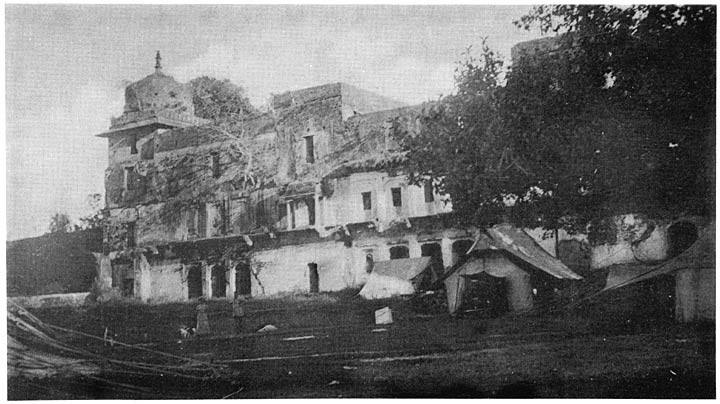
Palace of the Gond kings of Garha-Mandla at Rāmnagar
5. Mythica traditions. Story of Lingo.
Mr. Hislop took down from a Pardhān priest a Gond myth of the creation of the world and the origin of the Gonds, and their liberation from a cave, in which they had been shut up by Siva, through the divine hero Lingo. General Cunningham said that the exact position of the cave was not known, but it would seem to have been somewhere in the Himalayas, as the name Dhawalgiri, which means a white mountain, is mentioned. The cave, according to ordinary Gond tradition, was situated in Kachikopa Lohāgarh or the Iron Valley in the Red Hill. It seems clear from the story itself that its author was desirous of connecting the Gonds with Hindu mythology, and as Siva’s heaven is in the Himalayas, the name Dhawalgiri, where he located the cave, may refer to them. It is also said that the cave was at the source of the Jumna. But in Mr. Hislop’s version the cave where all the Gonds except four were shut up is not in Kachikopa Lohāgarh, as the Gonds commonly say; but only the four Gonds who escaped wandered to this latter place and dwelt there. And the story does not show that Kachikopa Lohāgarh was on Mount Dhawalgiri or the Himalayas, where it places the cave in which the Gonds were shut up, or anywhere near them. On the contrary, it would be quite consonant with Mr. Hislop’s version if Kachikopa Lohāgarh were in the Central Provinces. It may be surmised that in the original Gond legend their ancestors really were shut up in Kachikopa Lohāgarh, but not by the god Siva. Very possibly the story began with them in the cave in the Iron Valley in the Red Hill. But the Hindu who clearly composed Mr. Hislop’s version wished to introduce the god Siva as a principal actor, and he therefore removed the site of the cave to the Himalayas. This appears probable from the story itself, in which, in its present form, Kachikopa Lohāgarh plays no real part, and only appears because it was in the original tradition and has to be retained.9 But the Gonds think that their ancestors were actually shut up in Kachikopa Lohāgarh, and one tradition puts the site at Pachmarhi, whose striking hill scenery and red soil cleft by many deep and inaccessible ravines would render it a likely place for the incident. Another version locates Kachikopa Lohāgarh at Dārekasa in Bhandāra, where there is a place known as Kachagarh or the iron fort. But Pachmarhi is perhaps the more probable, as it has some deep caves, which have always been looked upon as sacred places. The point is of some interest, because this legend of the cave being in the Himalayas is adduced as a Gond tradition that their ancestors came from the north, and hence as supporting the theory of the immigration of the Dravidians through the north-west of India. But if the view now suggested is correct, the story of the cave being in the Himalayas is not a genuine Gond tradition at all, but a Hindu interpolation. The only other ground known to the writer for asserting that the Gonds believed their ancestors to have come from the north is that they bury their dead with the feet to the north. There are other obvious Hindu accretions in the legend, as the saintly Brāhmanic character of Lingo and his overcoming the gods through fasting and self-torture, and also the fact that Siva shut up the Gonds in the cave because he was offended by their dirty habits and bad smell. But the legend still contains a considerable quantity of true Gond tradition, and though somewhat tedious, it seems necessary to give an abridgment of Mr. Hislop’s account, with reproduction of selected passages. Captain Forsyth also made a modernised poetical version,10 from which one extract is taken. Certain variations from another form of the legend obtained in Bastar are included.
6. Legend of the creation.
In the beginning there was water everywhere, and God was born in a lotus-leaf and lived alone. One day he rubbed his arm and from the rubbing made a crow, which sat on his shoulder; he also made a crab, which swam out over the waters. God then ordered the crow to fly over the world and bring some earth. The crow flew about and could find no earth, but it saw the crab, which was supporting itself with one leg resting on the bottom of the sea. The crow was very tired and perched on the crab’s back, which was soft so that the crow’s feet made marks on it, which are still visible on the bodies of all crabs at present. The crow asked the crab where any earth could be found. The crab said that if God would make its body hard it would find some earth. God said he would make part of the crab’s body hard, and he made its back hard, as it still remains. The crab then dived to the bottom of the sea, where it found Kenchna, the earth-worm. It caught hold of Kenchna by the neck with its claws and the mark thus made is still to be seen on the earth-worm’s neck. Then the earth-worm brought up earth out of its mouth and the crab brought this to God, and God scattered it over the sea and patches of land appeared. God then walked over the earth and a boil came on his hand, and out of it Mahādeo and Pārvati were born.
7. Creation of the Gonds and their imprisonment by Mahādeo.
From Mahādeo’s urine numerous vegetables began to spring up. Pārvati ate of these and became pregnant and gave birth to eighteen threshing-floors11 of Brāhman gods and twelve threshing-floors of Gond gods. All the Gonds were scattered over the jungle. They behaved like Gonds and not like good Hindus, with lamentable results, as follows:12
Hither and thither all the Gonds were scattered in the jungle.
Places, hills, and valleys were filled with these Gonds.
Even trees had their Gonds. How did the Gonds conduct themselves?
Whatever came across them they must needs kill and eat it;
They made no distinction. If they saw a jackal they killed
And ate it; no distinction was observed; they respected not antelope, sāmbhar and the like.
They made no distinction in eating a sow, a quail, a pigeon,
A crow, a kite, an adjutant, a vulture,
A lizard, a frog, a beetle, a cow, a calf, a he- and she-buffalo,
Rats, bandicoots, squirrels—all these they killed and ate.
So began the Gonds to do. They devoured raw and ripe things;
They did not bathe for six months together;
They did not wash their faces properly, even on dunghills they would fall down and remain.
Such were the Gonds born in the beginning. A smell was spread over the jungle
When the Gonds were thus disorderly behaved; they became disagreeable to Mahādeva,
Who said: “The caste of the Gonds is very bad;
I will not preserve them; they will ruin my hill Dhawalgiri.”
Mahādeo then determined to get rid of the Gonds. With this view he invited them all to a meeting. When they sat down Mahādeo made a squirrel from the rubbings of his body and let it loose in the middle of the Gonds. All the Gonds at once got up and began to chase it, hoping for a meal. They seized sticks and stones and clods of earth, and their unkempt hair flew in the wind. The squirrel dodged about and ran away, and finally, directed by Mahādeo, ran into a large cave with all the Gonds after it. Mahādeo then rolled a large stone to the mouth of the cave and shut up all the Gonds in it. Only four remained outside, and they fled away to Kachikopa Lohāgarh, or the Iron Cave in the Red Hill, and lived there. Meanwhile Pārvati perceived that the smell of the Gonds, which had pleased her, had vanished from Dhawalgiri. She desired it to be restored and commenced a devotion. For six months she fasted and practised austerities. Bhagwān (God) was swinging in a swing. He was disturbed by Pārvati’s devotion. He sent Nārāyan (the sun) to see who was fasting. Nārāyan came and found Pārvati and asked her what she wanted. She said that she missed her Gonds and wanted them back. Nārāyan told Bhagwān, who promised that they should be given back.
8. The birth and history of Lingo.
The yellow flowers of the tree Pahindi were growing on Dhawalgiri. Bhagwān sent thunder and lightning, and the flower conceived. First fell from it a heap of turmeric or saffron. In the morning the sun came out, the flower burst open, and Lingo was born. Lingo was a perfect child. He had a diamond on his navel and a sandalwood mark on his forehead. He fell from the flower into the heap of turmeric. He played in the turmeric and slept in a swing. He became nine years old. He said there was no one there like him, and he would go where he could find his fellows. He climbed a needle-like hill,13 and from afar off he saw Kachikopa Lohāgarh and the four Gonds. He came to them. They saw he was like them, and asked him to be their brother. They ate only animals. Lingo asked them to find for him an animal without a liver, and they searched all through the forest and could not. Then Lingo told them to cut down trees and make a field. They tried to cut down the anjan14 trees, but their hands were blistered and they could not go on. Lingo had been asleep. He woke up and saw they had only cut down one or two trees. He took the axe and cut down many trees, and fenced a field and made a gate to it. Black soil appeared. It began to rain, and rained without ceasing for three days. All the rivers and streams were filled. The field became green with rice, and it grew up. There were sixteen score of nīlgai or blue-bull. They had two leaders, an old bull and his nephew. The young bull saw the rice of Lingo’s field and wished to eat it. The uncle told him not to eat of the field of Lingo or all the nīlgai would be killed. But the young bull did not heed, and took off all the nīlgai to eat the rice. When they got to the field they could find no entrance, so they jumped the fence, which was five cubits high. They ate all the rice from off the field and ran away. The young bull told them as they ran to put their feet on leaves and stones and boughs and grass, and not on the ground, so that they might not be tracked. Lingo woke up and went to see his field, and found all the rice eaten. He knew the nīlgai had done it, and showed the brothers how to track them by the few marks which they had by accident made on the ground. They did so, and surrounded the nīlgai and killed them all with their bows and arrows except the old uncle, from whom Lingo’s arrow rebounded harmlessly on account of his innocence, and one young doe. From these two the nīlgai race was preserved. Then Lingo told the Gonds to make fire and roast the deer as follows:
He said, I will show you something; see if anywhere in your
Waistbands there is a flint; if so, take it out and make fire.
But the matches did not ignite. As they were doing this, a watch of the night passed.
They threw down the matches, and said to Lingo, Thou art a Saint;
Show us where our fire is, and why it does not come out.
Lingo said: Three koss (six miles) hence is Rikad Gawādi the giant.
There is fire in his field; where smoke shall appear, go there,
Come not back without bringing fire. Thus said Lingo.
They said, We have never seen the place, where shall we go?
Ye have never seen where this fire is? Lingo said;
I will discharge an arrow thither.
Go in the direction of the arrow; there you will get fire.
He applied the arrow, and having pulled the bow, he discharged one:
It crashed on, breaking twigs and making its passage clear.
Having cut through the high grass, it made its way and reached the old man’s place (above mentioned).
The arrow dropped close to the fire of the old man, who had daughters.
The arrow was near the door. As soon as they saw it, the daughters came and took it up,
And kept it. They asked their father: When will you give us in marriage?
Thus said the seven sisters, the daughters of the old man.
I will marry you as I think best for you;
Remain as you are. So said the old man, the Rikad Gawādi.
Lingo said, Hear, O brethren! I shot an arrow, it made its way.
Go there, and you will see fire; bring thence the fire.
Each said to the other, I will not go; but (at last) the youngest went.
He descried the fire, and went to it; then beheld he an old man looking like the trunk of a tree.
He saw from afar the old man’s field, around which a hedge was made.
The old man kept only one way to it, and fastened a screen to the entrance, and had a fire in the centre of the field.
He placed logs of the Mahua and Anjun and Sāj trees on the fire,
Teak faggots he gathered, and enkindled flame.
The fire blazed up, and warmed by the heat of it, in deep sleep lay the Rikad Gawādi.
Thus the old man like a giant did appear. When the young Gond beheld him, he shivered;
His heart leaped; and he was much afraid in his mind, and said:
If the old man were to rise he will see me, and I shall be eaten up;
I will steal away the fire and carry it off, then my life will be safe.
He went near the fire secretly, and took a brand of tendu wood tree.
When he was lifting it up a spark flew and fell on the hip of the old man.
That spark was as large as a pot; the giant was blistered; he awoke alarmed.
And said: I am hungry, and I cannot get food to eat anywhere; I feel a desire for flesh;
Like a tender cucumber hast thou come to me. So said the old man to the Gond,
Who began to fly. The old man followed him. The Gond then threw away the brand which he had stolen.
He ran onward, and was not caught. Then the old man, being tired, turned back.
Thence he returned to his field, and came near the fire and sat, and said, What nonsense is this?
A tender prey had come within my reach;
I said I will cut it up as soon as I can, but it escaped from my hand!
Let it go; it will come again, then I will catch it. It has gone now.
Then what happened? the Gond returned and came to his brethren.
And said to them: Hear, O brethren, I went for fire, as you sent me, to that field; I beheld an old man like a giant.
With hands stretched out and feet lifted up. I ran. I thus survived with difficulty.
The brethren said to Lingo, We will not go. Lingo said, Sit ye here.
O brethren, what sort of a person is this giant? I will go and see him.
So saying, Lingo went away and reached a river.
He thence arose and went onward. As he looked, he saw in front three gourds.
Then he saw a bamboo stick, which he took up.
When the river was flooded
It washed away a gourd tree, and its seed fell, and each stem produced bottle-gourds.
He inserted a bamboo stick in the hollow of the gourd and made a guitar.
He plucked two hairs from his head and strung it.
He held a bow and fixed eleven keys to that one stick, and played on it.
Lingo was much pleased in his mind.
Holding it in his hand, he walked in the direction of the old man’s field.
He approached the fire where Rikad Gawādi was sleeping.
The giant seemed like a log lying close to the fire; his teeth were hideously visible;
His mouth was gaping. Lingo looked at the old man while sleeping.
His eyes were shut. Lingo said, This is not a good time to carry off the old man while he is asleep.
In front he looked, and turned round and saw a tree
Of the pīpal sort standing erect; he beheld its branches with wonder, and looked for a fit place to mount upon.
It appeared a very good tree; so he climbed it, and ascended to the top of it to sit.
As he sat the cock crew. Lingo said, It is daybreak;
Meanwhile the old man must be rising. Therefore Lingo took the guitar in his hand,
And held it; he gave a stroke, and it sounded well; from it he drew one hundred tunes.
It sounded well, as if he was singing with his voice.
Thus (as it were) a song was heard.
Trees and hills were silent at its sound. The music loudly entered into
The old man’s ears; he rose in haste, and sat up quickly; lifted up his eyes,
And desired to hear (more). He looked hither and thither, but could not make out whence the sound came.
The old man said: Whence has a creature come here to-day to sing like the maina bird?
He saw a tree, but nothing appeared to him as he looked underneath it.
He did not look up; he looked at the thickets and ravines, but
Saw nothing. He came to the road, and near to the fire in the midst of his field and stood.
Sometimes sitting, and sometimes standing, jumping, and rolling, he began to dance.
The music sounded as the day dawned. His old woman came out in the morning and began to look out.
She heard in the direction of the field a melodious music playing.
When she arrived near the edge of her field, she heard music in her ears.
That old woman called her husband to her.
With stretched hands, and lifted feet, and with his neck bent down, he danced.
Thus he danced. The old woman looked towards her husband, and said, My old man, my husband,
Surely, that music is very melodious. I will dance, said the old woman.
Having made the fold of her dress loose, she quickly began to dance near the hedge.
9. Death and resurrection of Lingo.
Then Lingo disclosed himself to the giant and became friendly with him. The giant apologised for having tried to eat his brother, and called Lingo his nephew. Lingo invited him to come and feast on the flesh of the sixteen scores of nīlgai. The giant called his seven daughters and offered them all to Lingo in marriage. The daughters produced the arrow which they had treasured up as portending a husband. Lingo said he was not marrying himself, but he would take them home as wives for his brothers. So they all went back to the cave and Lingo assigned two of the daughters each to the three elder brothers and one to the youngest. Then the brothers, to show their gratitude, said that they would go and hunt in the forest and bring meat and fruit and Lingo should lie in a swing and be rocked by their seven wives. But while the wives were swinging Lingo and his eyes were shut, they wished to sport with him as their husbands’ younger brother. So saying they pulled his hands and feet till he woke up. Then he reproached them and called them his mothers and sisters, but they cared nothing and began to embrace him. Then Lingo was filled with wrath and leapt up, and seeing a rice-pestle near he seized it and beat them all with it soundly. Then the women went to their houses and wept and resolved to be revenged on Lingo. So when the brothers came home they told their husbands that while they were swinging Lingo he had tried to seduce them all from their virtue, and they were resolved to go home and stay no longer in Kachikopa with such a man about the place. Then the brothers were exceedingly angry with Lingo, who they thought had deceived them with a pretence of virtue in refusing a wife, and they resolved to kill him. So they enticed him into the forest with a story of a great animal which had put them to flight and asked him to kill it, and there they shot him to death with their arrows and gouged out his eyes and played ball with them.
But the god Bhagwān became aware that Lingo was not praying to him as usual, and sent the crow Kageshwar to look for him. The crow came and reported that Lingo was dead, and the god sent him back with nectar to sprinkle it over the body and bring it to life again, which was done.
10. He releases the Gonds shut up in the cave and constitutes the tribe.
Lingo then thought he had had enough of the four brothers, so he determined to go and find the other sixteen score Gonds who were imprisoned somewhere as the brothers had told him. The manner of his doing this may be told in Captain Forsyth’s version:15
And our Lingo redivivus
Wandered on across the mountains,
Wandered sadly through the forest
Till the darkening of the evening,
Wandered on until the night fell.
Screamed the panther in the forest,
Growled the bear upon the mountain,
And our Lingo then bethought him
Of their cannibal propensities.
Saw at hand the tree Niruda,
Clambered up into its branches.
Darkness fell upon the forest,
Bears their heads wagged, yelled the jackal
Kolyal, the King of Jackals.
Sounded loud their dreadful voices
In the forest-shade primeval.
Then the Jungle-Cock Gugotee,
Mull the Peacock, Kurs the Wild Deer,
Terror-stricken, screeched and shuddered,
In that forest-shade primeval.
But the moon arose at midnight,
Poured her flood of silver radiance,
Lighted all the forest arches,
Through their gloomy branches slanting;
Fell on Lingo, pondering deeply
On his sixteen scores of Koitūrs.
Then thought Lingo, I will ask her
For my sixteen scores of Koitūrs.
‘Tell me, O Moon!’ said Lingo,
‘Tell, O Brightener of the darkness!
Where my sixteen scores are hidden.’
But the Moon sailed onwards, upwards,
And her cold and glancing moonbeams
Said, ‘Your Gonds, I have not seen them.’
And the Stars came forth and twinkled
Twinkling eyes above the forest.
Lingo said, “O Stars that twinkle!
Eyes that look into the darkness,
Tell me where my sixteen scores are.”
But the cold Stars twinkling ever,
Said, ‘Your Gonds, we have not seen them.’
Broke the morning, the sky reddened,
Faded out the star of morning,
Rose the Sun above the forest,
Brilliant Sun, the Lord of morning,
And our Lingo quick descended,
Quickly ran he to the eastward,
Fell before the Lord of Morning,
Gave the Great Sun salutation—
‘Tell, O Sun!’ he said, ‘Discover
Where my sixteen scores of Gonds are.’
But the Lord of Day reply made—
“Hear, O Lingo, I a Pilgrim
Wander onwards, through four watches
Serving God, I have seen nothing
Of your sixteen scores of Koitūrs.”
Then our Lingo wandered onwards
Through the arches of the forest;
Wandered on until before him
Saw the grotto of a hermit,
Old and sage, the Black Kumāit,
He the very wise and knowing,
He the greatest of Magicians,
Born in days that are forgotten,
In the unremembered ages,
Salutation gave and asked him—
‘Tell, O Hermit! Great Kumāit!
Where my sixteen scores of Gonds are.
Then replied the Black Magician,
Spake disdainfully in this wise—
“Lingo, hear, your Gonds are asses
Eating cats, and mice, and bandicoots,
Eating pigs, and cows, and buffaloes;
Filthy wretches! wherefore ask me?
If you wish it I will tell you.
Our great Mahādeva caught them,
And has shut them up securely
In a cave within the bowels
Of his mountain Dewalgiri,
With a stone of sixteen cubits,
And his bulldog fierce Basmāsur;
Serve them right, too, I consider,
Filthy, casteless, stinking wretches!”
And the Hermit to his grotto
Back returned, and deeply pondered
On the days that are forgotten,
On the unremembered ages.
But our Lingo wandered onwards,
Fasting, praying, doing penance;
Laid him on a bed of prickles,
Thorns long and sharp and piercing.
Fasting lay he devotee-like,
Hand not lifting, foot not lifting,
Eye not opening, nothing seeing.
Twelve months long thus lay and fasted,
Till his flesh was dry and withered,
And the bones began to show through.
Then the great god Mahādeva
Felt his seat begin to tremble,
Felt his golden stool, all shaking
From the penance of our Lingo.
Felt, and wondered who on earth
This devotee was that was fasting
Till his golden stool was shaking.
Stepped he down from Dewalgiri,
Came and saw that bed of prickles
Where our Lingo lay unmoving.
Asked him what his little game was,
Why his golden stool was shaking.
Answered Lingo, “Mighty Ruler!
Nothing less will stop that shaking
Than my sixteen scores of Koitūrs
Rendered up all safe and hurtless
From your cave in Dewalgiri.”
Then the Great God, much disgusted,
Offered all he had to Lingo,
Offered kingdom, name, and riches,
Offered anything he wished for,
‘Only leave your stinking Koitūrs
Well shut up in Dewalgiri.’
But our Lingo all refusing
Would have nothing but his Koitūrs;
Gave a turn to run the thorns a
Little deeper in his midriff.
Winced the Great God: “Very well, then,
Take your Gonds—but first a favour.
By the shore of the Black Water
Lives a bird they call Black Bindo,
Much I wish to see his young ones,
Little Bindos from the sea-shore;
For an offering bring these Bindos,
Then your Gonds take from my mountain.”
Then our Lingo rose and wandered,
Wandered onwards through the forest,
Till he reached the sounding sea-shore,
Reached the brink of the Black Water,
Found the Bingo birds were absent
From their nest upon the sea-shore,
Absent hunting in the forest,
Hunting elephants prodigious,
Which they killed and took their brains out,
Cracked their skulls, and brought their brains to
Feed their callow little Bindos,
Wailing sadly by the sea-shore.
Seven times a fearful serpent,
Bhawarnāg the horrid serpent,
Serpent born in ocean’s caverns,
Coming forth from the Black Water,
Had devoured the little Bindos—
Broods of callow little Bindos
Wailing sadly by the sea-shore—
In the absence of their parents.
Eighth this brood was. Stood our Lingo,
Stood he pondering beside them—
“If I take these little wretches
In the absence of their parents
They will call me thief and robber.
No! I’ll wait till they come back here.”
Then he laid him down and slumbered
By the little wailing Bindos.
As he slept the dreadful serpent,
Rising, came from the Black Water,
Came to eat the callow Bindos,
In the absence of their parents.
Came he trunk-like from the waters,
Came with fearful jaws distended,
Huge and horrid, like a basket
For the winnowing of corn.
Rose a hood of vast dimensions
O’er his fierce and dreadful visage.
Shrieked the Bindos young and callow,
Gave a cry of lamentation;
Rose our Lingo; saw the monster;
Drew an arrow from his quiver,
Shot it swift into his stomach,
Sharp and cutting in the stomach,
Then another and another;
Cleft him into seven pieces,
Wriggled all the seven pieces,
Wriggled backward to the water.
But our Lingo, swift advancing,
Seized the headpiece in his arms,
Knocked the brains out on a boulder;
Laid it down beside the Bindos,
Callow, wailing, little Bindos.
On it laid him, like a pillow,
And began again to slumber.
Soon returned the parent Bindos
From their hunting in the forest;
Bringing brains and eyes of camels
And of elephants prodigious,
For their little callow Bindos
Wailing sadly by the sea-shore.
But the Bindos young and callow
Brains of camels would not swallow;
Said—“A pretty set of parents
You are truly! thus to leave us
Sadly wailing by the sea-shore
To be eaten by the serpent—
Bhawarnāg the dreadful serpent—
Came he up from the Black Water,
Came to eat us little Bindos,
When this very valiant Lingo
Shot an arrow in his stomach,
Cut him into seven pieces—
Give to Lingo brains of camels,
Eyes of elephants prodigious.”
Then the fond paternal Bindo
Saw the head-piece of the serpent
Under Lingo’s head a pillow,
And he said, ‘O valiant Lingo,
Ask whatever you may wish for.’
Then he asked the little Bindos
For an offering to the Great God,
And the fond paternal Bindo,
Much disgusted first refusing,
Soon consented; said he’d go too
With the fond maternal Bindo—
Take them all upon his shoulders,
And fly straight to Dewalgiri.
Then he spread his mighty pinions,
Took his Bindos up on one side
And our Lingo on the other.
Thus they soared away together
From the shores of the Black Water,
And the fond maternal Bindo,
O’er them hovering, spread an awning
With her broad and mighty pinions
O’er her offspring and our Lingo.
By the forests and the mountains
Six months’ journey was it thither
To the mountain Dewalgiri.
Half the day was scarcely over
Ere this convoy from the sea-shore
Lighted safe on Dewalgiri;
Touched the knocker to the gateway
Of the Great God, Mahādeva.
And the messenger Nārāyan
Answering, went and told his master—
“Lo, this very valiant Lingo!
Here he is with all the Bindos,
The Black Bindos from the sea-shore.”
Then the Great God, much disgusted,
Driven quite into a corner,
Took our Lingo to the cavern,
Sent Basmāsur to his kennel,
Held his nose, and moved away the
Mighty stone of sixteen cubits;
Called those sixteen scores of Gonds out
Made them over to their Lingo.
And they said, “O Father Lingo!
What a bad time we’ve had of it,
Not a thing to fill our bellies
In this horrid gloomy dungeon.”
But our Lingo gave them dinner,
Gave them rice and flour of millet,
And they went off to the river,
Had a drink, and cooked and ate it.
The next episode is taken from a slightly different local version:
And while they were cooking their food at the river a great flood came up, but all the Gonds crossed safely except the four gods, Tekām, Markām, Pusām and Telengām.16 These were delayed because they had cooked their food with ghī which they had looted from the Hindu deities. Then they stood on the bank and cried out,
O God of the crossing,
O Boundary God!
Should you be here,
Come take us across.
Hearing this, the tortoise and crocodile came up to them, and offered to take them across the river. So Markām and Tekām sat on the back of the crocodile and Pusām and Telengām on the back of the tortoise, and before starting the gods made the crocodile and tortoise swear that they would not eat or drown them in the sea. But when they got to the middle of the river the tortoise and crocodile began to sink, with the idea that they would drown the Gonds and feed their young with them. Then the Gonds cried out, and the Raigīdhni or vulture heard them. This bird appears to be the same as the Bindo, as it fed its young with elephants. The Raigīdhni flew to the Gonds and took them up on its back and flew ashore with them. And in its anger it picked out the tongue of the crocodile and crushed the neck of the tortoise. And this is why the crocodile is still tongueless and the tortoise has a broken neck, which is sometimes inside and sometimes outside its shell. Both animals also have the marks of string on their backs where the Gond gods tied their necks together when they were ferried across. Thus all the Gonds were happily reunited and Lingo took them into the forest, and they founded a town there, which grew and prospered. And Lingo divided all the Gonds into clans and made the oldest man a Pardhān or priest and founded the rule of exogamy. He also made the Gond gods, subsequently described,17 and worshipped them with offerings of a calf and liquor, and danced before them. He also prescribed the ceremonies of marriage which are still observed, and after all this was done Lingo went to the gods.

Gonds on a journey
1 The country of Gondwāna properly included the Satpūra plateau and a section of the Nāgpur plain and Nerbudda valley to the south and west.
2 Early History of India, 3rd ed. p. 337.
3 Art. Gondwāna.
4 Linguistic Survey, Munda and Dravidian Languages, iv. p. 285.
5 Notes, p. 15.
6 Garha is six miles from Jubbulpore.
7 See article on Kol.
8 Mr. Standen’s Betūl Settlement Report.
9 The argument in this section will be followed more easily if read after the legend in the following paragraphs.
10 Highlands of Central India (Chapman & Hall).
11 Deo-khulla or threshing-floor of the gods. See section on Religion.
12 Passage from Mr. Hislop’s version.
13 Dhūpgarh in Pachmarhi might be indicated, which has a steep summit.
14 Terminalia arjuna.
15 This extract is reproduced by permission of the publishers, Messrs. Chapman & Hall, London.
16 Tekām the teak tree, Markām the mango tree, and Telengām the Telugu. These are the names of well-known exogamous septs.
17 See section on Religion.
(b) Tribal Subdivisions
11. Subcastes.
Out of the Gond tribe, which, as it gave its name to a province, may be considered as almost a people, a number of separate castes have naturally developed. Among them are several occupational castes such as the Agarias or iron-workers, the Ojhas or soothsayers, Pardhāns or priests and minstrels, Solāhas or carpenters, and Koilabhutis or dancers or prostitutes. These are principally sprung from the Gonds, though no doubt with an admixture of other low tribes or castes. The Parjas of Bastar, now classed as a separate tribe, appear to represent the oldest Gond settlers, who were subdued by later immigrants of the race; while the Bhatras and Jhādi Telengas are of mixed descent from Gonds and Hindus. Similarly the Gowāri caste of cattle-graziers originated from the alliances of Gond and Ahīr graziers. The Mannewārs and Kolāms are other tribes allied to the Gonds. Many Hindu castes and also non-Aryan tribes living in contact with the Gonds have a large Gond element; of the former class the Ahīrs, Basors, Barhais and Lohārs, and of the latter the Baigas, Bhunjias and Khairwārs are instances.
Among the Gonds proper there are two aristocratic subdivisions, the Rāj-Gonds and Khatolas. According to Forsyth the Rāj-Gonds are in many cases the descendants of alliances between Rājpūt adventurers and Gonds. But the term practically comprises the landholding subdivision of the Gonds, and any proprietor who was willing to pay for the privilege could probably get his family admitted into the Rāj-Gond group. The Rāj-Gonds rank with the Hindu cultivating castes, and Brāhmans will take water from them. They sometimes wear the sacred thread. In the Telugu country the Rāj-Gond is known as Durla or Durlasattam. In some localities Rāj-Gonds will intermarry with ordinary Gonds, but not in others. The Khatola Gonds take their name from the Khatola state in Bundelkhand, which is said to have once been governed by a Gond ruler, but is no longer in existence. In Saugor they rank about equal with the Rāj-Gonds and intermarry with them, but in Chhindwāra it is said that ordinary Gonds despise them and will not marry with them or eat with them on account of their mixed descent from Gonds and Hindus. The ordinary Gonds in most Districts form one endogamous group, and are known as the Dhur or ‘dust’ Gonds, that is the common people. An alternative name conferred on them by the Hindus is Rāwanvansi or of the race of Rāwan, the demon king of Ceylon, who was the opponent of Rāma. The inference from this name is that the Hindus consider the Gonds to have been among the people of southern India who opposed the Aryan expedition to Ceylon, which is preserved in the legend of Rāma; and the name therefore favours the hypothesis that the Gonds came from the south and that their migration northward was sufficiently recent in date to permit of its being still remembered in tradition. There are several other small local subdivisions. The Koya Gonds live on the border of the Telugu country, and their name is apparently a corruption of Koi or Koitūr, which the Gonds call themselves. The Gaita are another Chānda subcaste, the word Gaite or Gaita really meaning a village priest or headman. Gattu or Gotte is said to be a name given to the hill Gonds of Chānda, and is not a real subcaste. The Darwe or Nāik Gonds of Chānda were formerly employed as soldiers, and hence obtained the name of Naīk or leader. Other local groups are being formed such as the Larhia or those of Chhattīsgarh, the Mandlāha of Mandla, the Lānjiha from Lānji and so on. These are probably in course of becoming endogamous. The Gonds of Bastar are divided into two groups, the Māria and the Muria. The Māria are the wilder, and are apparently named after the Mad, as the hilly country of Bastar is called. Mr. Hīra Lāl suggests the derivation of Muria from mur, the palās tree, which is common in the plains of Bastar, or from mur, a root. Both derivations must be considered as conjectural. The Murias are the Gonds who live in the plains and are more civilised than the Mārias. The descendants of the Rāja of Deogarh Bakht Buland, who turned Muhammadan, still profess that religion, but intermarry freely with the Hindu Gonds. The term Bhoi, which literally means a bearer in Telugu, is used as a synonym for the Gonds and also as an honorific title. In Chhindwāra it is said that only a village proprietor is addressed as Bhoi. It appears that the Gonds were used as palanquin-bearers, and considered it an honour to belong to the Kahār or bearer caste, which has a fairly good status.18
12. Exogamy.
The Gond rules of exogamy appear to preserve traces of the system found in Australia, by which the whole tribe is split into two or four main divisions, and every man in one or two of them must marry a woman in the other one or two. This is considered by Sir J. G. Frazer to be the beginning of exogamy, by which marriage was prohibited, first, between brothers and sisters, and then between parents and children, by the arrangement of these main divisions.19
Among the Gonds, however, the subdivision into small exogamous septs has been also carried out, and the class system, if the surmise that it once existed be correct, remains only in the form of a survival, prohibiting marriage between agnates, like an ordinary sept. In one part of Bastar all the septs of the Māria Gonds are divided into two great classes. There are ninety septs in A Class and sixty-nine in B Class, though the list may be incomplete. All the septs of A Class say that they are Bhaiband or Dādabhai to each other, that is in the relation of brothers, or cousins being the sons of brothers. No man of Class A can marry a woman of any sept in Class A. The septs of Class A stand in relation of Māmabhai or Akomāma to those of Class B. Māmabhai means a maternal uncle’s son, and Akomāma apparently signifies having the same maternal grandfather. Any man of a sept in Class A can marry any woman of a sept in Class B. It will thus be seen that the smaller septs seem to serve no purpose for regulating marriage, and are no more than family names. The tribe might just as well be divided into two great exogamous clans only. Marriage is prohibited between persons related only through males; but according to the exogamous arrangement there is no other prohibition, and a man could marry any maternal relative. Separate rules, however, prohibit his marriage with certain female relatives, and these will be given subsequently.20 It is possible that the small septs may serve some purpose which has not been elicited, though the inquiry made by Rai Bahādur Panda Baijnāth was most careful and painstaking.
In another part of Bastar there were found to be five classes, and each class had a small number of septs in it. The people who supplied this information could not give the names of many septs. Thus Class A had six septs, Class B five, Classes C and D one each, Class E four, and Class F two. A man could not marry a woman of any sept belonging to his own class.
The Muria Gonds of Bastar have a few large exogamous septs or clans named in Hindi after animals, and each of these clans contains several subsepts with Gondi names. Thus the Bakaravans or Goat race contains the Garde, Kunjami, Karrami and Vadde septs. The Kachhimvans or Tortoise race has the Netāmi, Kawachi, Usendi and Tekāmi septs; the Nāgvans or Cobra race includes the Marāvi, Potāri, Karanga, Nurethi, Dhurwa and others. Other exogamous races are the Sodi (or tiger), Behainsa (buffalo), Netām (dog in Gondi), Chamchidai (bat) and one or two more. In this case the exogamous clans with Hindi names would appear to be a late division, and have perhaps been adopted because the meaning of the old Gondi names had been forgotten, or the septs were too numerous to be remembered.
In Chānda a classification according to the number of gods worshipped is found. There are four main groups worshipping seven, six, five and four gods respectively, and each group contains ten to fifteen septs. A man cannot marry a woman of any sept which worships the same number of gods as himself. Each group has a sacred animal which the members revere, that of the seven-god worshippers being a porcupine, of the six-god worshippers a tiger, of the five-god worshippers the sāras crane, and of the four-god worshippers a tortoise. As a rule the members of the different groups do not know the names of their gods, and in practice it is doubtful whether they restrict themselves to the proper number of gods of their own group. Formerly there were three-, two- and one-god worshippers, but in each of these classes it is said that there were only one or two septs, and they found that they were much inconvenienced by the paucity of their numbers, perhaps for purposes of communal worship and feasting, and hence they got themselves enrolled in the larger groups. In reality it would appear that the classification according to the number of gods worshipped is being forgotten, and the three lowest groups have disappeared. This conjecture is borne out by the fact that in Chhindwāra and other localities only two large classes remain who worship six and seven gods respectively, and marry with each other, the union of a man with a woman worshipping the same number of gods as himself being prohibited. Here, again, the small septs included in the groups appear to serve no purpose for regulating marriages. In Mandla the division according to the number of gods worshipped exists as in Chānda; but many Gonds have forgotten all particulars as to the gods, and say only that those septs which worship the same number of gods are bhaiband, or related to each other, and therefore cannot intermarry. In Betūl the division by numbers of gods appears to be wholly in abeyance. Here certain large septs, especially the Uika and Dhurwa, are subdivided into a number of subsepts, within each of which marriage is prohibited.
13. Totemism.
Many of the septs are named after animals and plants. Among the commonest septs in all Districts are Markām, the mango tree; Tekām, the teak tree; Netām, the dog; Irpāchi, the mahua tree; Tumrāchi, the tendu tree; Warkara, the wild cat, and so on. Generally the members of a sept do not kill or injure their totem animals, but the rule is not always observed, and in some cases they now have some other object of veneration, possibly because they have forgotten the meaning of the sept name, or the object after which it is named has ceased to be sacred. Thus the Markām sept, though named after the mango, now venerate the tortoise, and this is also the case with the Netām sept in Bastar, though named after the dog. In Bastar a man revering the tortoise, though he will not catch the animal himself, will get one of his friends to catch it, and one revering the goat, if he wishes to kill a goat for a feast, will kill it not at his own house but at a friend’s. The meaning of the important sept names Marābi, Dhurwa and Uika has not been ascertained, and the members of the sept do not know it. In Mandla the Marābi sept are divided into the Eti Marābi and Padi Marābi, named after the goat and pig. The Eti or goat Marābi will not touch a goat nor sacrifice one to Bura Deo. They say that once their ancestors stole a goat and were caught by the owner, when they put a basket over it and prayed Bura Deo to change it into a pig, which he did. Therefore they sacrifice only pigs to Bura Deo, but apparently the Padi Marābi also both sacrifice and eat pigs. The Dhurwa sept are divided into the Tumrāchi and Nābalia Dhurwa, named after the tendu tree and the dwarf date-palm. The Nābalia Dhurwas will not cut a dwarf date-palm nor eat its fruit. They worship Bura Deo in this tree instead of in the sāj tree, making an iron doll to represent him and covering it with palm-leaves. The Uika sept in Mandla say that they revere no animal or plant, and can eat any animal or cut down any plant except the sāj tree,21 the tree of Bura Deo; but in Betūl they are divided into several subsepts, each of which has a totem. The Parteti sept revere the crocodile. When a marriage is finished they make a sacrifice to the crocodile, and if they see one lying dead they break their earthen pots in token of mourning. The Warkara sept revere the wild cat; they also will not touch a village cat nor keep one in their house, and if a cat comes in they drive it out at once. The Kunjām sept revere the rat and do not kill it.
14. Connection of totemism with the gods.
In Betūl the Gonds explain the totemistic names of their septs by saying that some incident connected with the animal, tree or other object occurred to the ancestor or priest of the sept while they were worshipping at the Deo-khulla or god’s place or threshing-floor. Mr. Ganga Prasād Khatri has made an interesting collection of these. The reason why these stories have been devised may be that the totem animals or plants have ceased to be revered on their own merits as ancestors or kinsmen of the sept, and it was therefore felt necessary to explain the sept name or sanctity attaching to the totem by associating it with the gods. If this were correct the process would be analogous to that by which an animal or plant is first held sacred of itself, and, when this feeling begins to decay with some recognition of its true nature, it is associated with an anthropomorphic god in order to preserve its sanctity. The following are some examples recorded by Mr. Ganga Prasād Khatri. Some of the examples are not associated with the gods.
Gajjāmi, subsept of Dhurwa sept. From gaj, an arrow. Their first ancestor killed a tiger with an arrow.
Gouribans Dhurwa. Their first ancestor worshipped his gods in a bamboo clump.
Kusadya Dhurwa. (Kosa, tasar silk cocoon.) The first ancestor found a silk cocoon on the tree in which he worshipped his gods.
Kohkapath. Kohka is the fruit of the bhilawa22 or marking-nut tree, and path, a kid. The first ancestor worshipped his gods in a bhilawa tree and offered a kid to them. Members of this sept do not eat the fruit or flowers of the bhilawa tree.
Jaglya. One who keeps awake, or the awakener. The first ancestor stayed awake the whole night in the Deo-khulla, or god’s threshing-floor.
Sariyām. (Sarri, a path.) The first ancestor swept the path to the Deo-khulla.
Guddām. Gudda is a place where a hen lays her eggs. The first ancestor’s hen laid eggs in the Deo-khulla.
Irpāchi. The mahua tree. A mahua tree grew in the Deo-khulla or worshipping-place of this sept.
Admachi. The dhaura tree.23 The first ancestor worshipped his gods under a dhaura tree. Members of the sept do not cut this tree nor burn its wood.
Sarāti Dhurwa. (Sarāti, a whip.) The first ancestor whipped the priest of the gods.
Suibadiwa. (Sui, a porcupine.) The first ancestor’s wife had a porcupine which went and ate the crop of an old man’s field. He tried to catch it, but it went back to her. He asked the name of her sept, and not being able to find it out called it Suibadiwa.
Watka. (A stone.) Members of this sept worship five stones for their gods. Some say that the first ancestors were young boys who forgot where the Deo-khulla was and therefore set up five stones and offered a chicken to them. As they did not offer the usual sacrifice of a goat, members of this sept abstain from eating goats.
Tumrecha Uika. (The tendu tree.24) It is said that the original ancestor of this sept was walking in the forest with his pregnant wife. She saw some tendu fruit and longed for it and he gave it to her to eat. Perhaps the original idea may have been that she conceived through swallowing a tendu fruit. Members of this sept eat the fruit of the tendu tree, but do not cut the tree nor make any use of its leaves or branches.
Tumdan Uika. Tumdan is a kind of pumpkin or gourd. They say that this plant grows in their Deo-khulla. The members drink water out of this gourd in the house, but do not carry it out of the house.
Kadfa-chor Uika. (Stealer of the kadfa.) Kadfa is the sheaf of grain left standing in the field for the gods when the crop is cut. The first ancestor stole the kadfa and offered it to his gods.
Gadhamār Uika. (Donkey-slayer.) Some say that the gods of the sept came to the Deo-khulla riding on donkeys, and others that the first ancestor killed a donkey in the Deo-khulla.
Eti-kumra. Eti is a goat. The ancestors of the sept used to sacrifice a Brāhman boy to their gods. Once they were caught in the act by the parents of the boy they had stolen, and they prayed to the gods to save them, and the boy was turned into a goat. They do not kill a goat nor eat its flesh, nor sacrifice it to the gods.
Ahke. This word means ‘on the other side of a river.’ They say that a man of the Dhurwa sept abducted a girl of the Uika sept from the other side of a river and founded this sept.
Tirgām. The word means fire. They say that their ancestor’s hand was burnt in the Deo-khulla while cooking the sacrifice.
Tekām. (The teak tree.) The ancestor of the sept had his gods in this tree. Members of the sept will not eat food off teak leaves, but they will use them for thatching, and also cut the tree.
Manapa. In Gondi mani is a son and apa a father. They say that their ancestors sacrificed a Brāhman father and son to their gods and were saved by their being turned into goats like the Eti-kumra sept. Members of the sept do not kill or eat a goat.
Korpachi. The droppings of a hen. The ancestors of the sept offered these to his gods.
Mandani. The female organ of generation. The ancestor of the sept slept with his wife in the Deo-khulla.
Paiyām. Paiya is a heifer which has not borne a calf, such as is offered to the gods. Other Gonds say that the people of this sept have no gods. They are said not only to marry a girl from any other subsept of the Dhurwas and Uikas, but from their own sept and even their own sisters, though this is probably no longer true. They are held to be the lowest of the Gonds. Except in this instance, as already seen, the subsepts of the Dhurwa and Uika septs do not intermarry with each other.
18 See also art. Kahār.
19 The theory is stated and explained in vol. iv. of Exogamy and Totemism.
20 See para. 15.
21 Boswellia serrata.
22 Semecarpus anacardium.
23 Anogeissus latifolia.
24 Diosypyros tomentosa.
(c) Marriage Customs
15. Prohibitions on intermarriage, and unions of relations.
A man must not marry in his own sept, nor in one which worships the same number of gods, in localities where the classification of septs according to the number of gods worshipped obtains. Intermarriage between septs which are bhaiband or brothers to each other is also prohibited. The marriage of first cousins is considered especially suitable. Formerly, perhaps, the match between a brother’s daughter and sister’s son was most common; this is held to be a survival of the matriarchate, when a man’s sister’s son was his heir. But the reason has now been generally forgotten, and the union of a brother’s son to a sister’s daughter has also become customary, while, as girls are scarce and have to be paid for, it is the boy’s father who puts forward his claim. Thus in Mandla and Bastar a man thinks he has a right to his sister’s daughter for his son on the ground that his family has given a girl to her husband’s family, and therefore they should give one back. This match is known as Dūdh lautāna or bringing back the milk; and if the sister’s daughter marries any one else her maternal uncle sometimes claims what is known as ‘milk money,’ which may be a sum of Rs. 5, in compensation for the loss of the girl as a wife for his son. This custom has perhaps developed out of the former match in changed conditions of society, when the original relation between a brother and his sister’s son has been forgotten and girls have become valuable. But it is said that the dūdh or milk money is also payable if a brother refuses to give his daughter to his sister’s son. In Mandla a man claims his sister’s daughter for his son and sometimes even the daughter of a cousin, and considers that he has a legitimate grievance if the girl is married to somebody else. Frequently, if he has reason to apprehend this, he invites the girl to his house for some ceremony or festival, and there marries her to his son without the consent of her parents. As this usually constitutes the offence of kidnapping under the Penal Code, a crop of criminal cases results, but the procedure of arrest without warrant and the severe punishment imposed by the Code are somewhat unsuitable for a case of this kind, which, according to Gond ideas, is rather in the nature of a civil wrong, and a sufficient penalty would often be the payment of an adequate compensation or bride-price for the girl. The children of two sisters cannot, it is said, be married, and a man cannot marry his wife’s elder sister, any aunt or niece, nor his mother-in-law or her sister. But marriage is not prohibited between grandparents and grandchildren. If an old man marries a young wife and dies, his grandson will marry her if she is of proper age. In this there would be no blood-relationship, but it is doubtful whether even the existence of such relationship would prevent the match. It is said that even among Hindu castes the grandfather will flirt with his granddaughter, and call her his wife in jest, and the grandmother with her grandson. In Bastar a man can marry his daughter’s daughter or maternal grandfather’s or grandmother’s sister. He could not marry his son’s daughter or paternal grandfather’s sister, because they belong to the same sept as himself.
16. Irregular marriages.
In the Māria country, if a girl is made pregnant by a man of the caste before marriage, she simply goes to his house and becomes his wife. This is called Paithu or entering. The man has to spend Rs. 2 or 3 on food for the caste and pay the price for the girl to her parents. If a girl has grown up and no match has been arranged for her to which she agrees, her parents will ask her maternal uncle’s or paternal aunt’s son to seize her and take her away. These two cousins have a kind of prescriptive claim to the girl, and apparently it makes no difference whether the prospective husband is already married or not. He and his friends lie in wait near her home and carry her off, and her parents afterwards proceed to his house to console their daughter and reconcile her to the match. Sometimes when a woman is about to become what is known as a Paisamundi or kept woman, without being married, the relations rub her and the man whose mistress she is with oil and turmeric, put marriage crowns of palm-leaves on their heads, pour water on them from the top of a post, and make them go seven times round a mahua branch, so that they may be considered to be married. When a couple are very poor they may simply go and live together without any wedding, and perform the ceremony afterwards when they have means, or they distribute little pieces of bread to the tribesmen in lieu of the marriage feast.
17. Marriage. Arrangement of matches.
Marriage is generally adult. Among the wild Māria Gonds of Bastar the consent of the girl is considered an essential preliminary to the union. She gives it before a council of elders, and if necessary is allowed time to make up her mind. The boy must also agree to the match. Elsewhere matches are arranged by the parents, and a bride-price which amounts to a fairly substantial sum in comparison with the means of the parties is usually paid. But still the girls have a considerable amount of freedom. It is generally considered that if a girl goes of her own accord and pours turmeric and water over a man, it is a valid marriage and he can take her to live in his house. Married women also sometimes do this to another man if they wish to leave their husbands.
18. The marriage ceremony.
The most distinctive feature of a Gond marriage is that the procession usually starts from the bride’s house and the wedding is held at that of the bridegroom, in contradistinction to the Hindu practice. It is supposed that this is a survival of the custom of marriage by capture, when the bride was carried off from her own house to the bridegroom’s, and any ceremony which was requisite was necessarily held at the house of the latter. But the Gonds say that since Dūlha Deo, the bridegroom god and one of the commonest village deities, was carried off by a tiger on his way to his wedding, it was decided that in future the bride must go to the bridegroom to be married in order to obviate the recurrence of such a calamity. Any risk incidental to the journey thus falls to the lady. Among the wilder Māria Gonds of Bastar the ritual is very simple. The bride’s party arrive at the bridegroom’s village and occupy some huts made ready for them. His father sends them provisions, including a pig and fowls, and the day passes in feasting. In the evening they go to the bridegroom’s house, and the night is spent in dancing by the couple and the young people of the village. Next morning the bride’s people go back again, and after another meal her parents bring her to the bridegroom’s house and push her inside, asking the boy’s father to take charge of her, and telling her that she now belongs to her husband’s family and must not come back to them alone. The girl cries a little for form’s sake and acquiesces, and the business is over, no proper marriage rite being apparently performed at all. Among the more civilised Mārias the couple are seated for the ceremony side by side under a green shed, and water is poured on them through the shed in imitation of the fertilising action of rain. Some elder of the village places his hands on them and the wedding is over. But Hindu customs are gradually being adopted, and the rubbing of powdered turmeric and water on the bodies of the bride and bridegroom is generally essential to a proper wedding. The following description is given of the Gonds of Kanker. On the day fixed for the marriage the pair, accompanied by the Dosi or caste priest, proceed to a river, in the bed of which two reeds five or six feet high are placed just so far apart that a man can lie down between them, and tied together with a thread at the top. The priest lies down between the reeds, and the bride and bridegroom jump seven times over his body. After the last jump they go a little way off, throw aside their wet clothes, and then run naked to a place where their dry clothes are kept; they put them on and go home without looking back. Among the Gonds in Khairāgarh the pair are placed in two pans of a balance and covered with blankets. The caste priest lifts up the bridegroom’s pan and her female relatives the bride’s, and walk round with them seven times, touching the marriage-post at each time. After this they are taken outside the village without being allowed to see each other. They are placed standing at a little distance with a screen between them, and liquor is spilt on the ground to make a line from one to the other. After a time the bridegroom lifts up the screen, rushes on the bride, gives her a blow on the back and puts the ring on her finger, at the same time making a noise in imitation of the cry of a goat. All the village then indulge in bacchanalian orgies, not sparing their own relations.
19. Wedding expenditure.
In Bastar it is said that the expenses of a wedding vary from Rs. 5 to Rs. 20 for the bride’s family and from Rs. 10 to Rs. 50 for the bridegroom’s, according to their means.25 In a fairly well-to-do family the expenditure of the bridegroom’s family is listed as follows: liquor Rs. 20, rice Rs. 12, salt Rs. 2, two goats Rs. 2, chillies Rs. 2, ghī Rs. 4, turmeric Rs. 2, oil Rs. 3, three cloths for the bride Rs. 8, two sheets and a loin-cloth for her relatives Rs. 5, payment to the Kumhār for earthen pots Rs. 5, the bride-price Rs. 10, present to the bride’s maternal uncle when she is not married to his son Rs. 2, and something for the drummers. The total of this is Rs. 76, and any expenditure on ornaments which the family can afford may be added. In wealthier localities the bride-price is Rs. 15 to 20 or more. Sometimes if the girl has been married and dies before the bride-price has been paid, her father will not allow her body to be buried until it is paid. The sum expended on a wedding probably represents the whole income of the family for at least six months, and often for a considerably longer period. In Chānda26 the bride’s party on arrival at the bridegroom’s village receive the Bara jawa or marriage greeting, every one present being served with a little rice-water, an onion and a piece of tobacco. At the wedding the bridegroom has a ring either of gold, silver or copper, lead not being permissible, and places this on the bride’s finger. Often the bride resists and the bridegroom has to force her fist open, or he plants his foot on hers in order to control her while he gets the ring on to her finger. Elsewhere the couple hold each other by the little fingers in walking round the marriage-post, and then each places an iron ring on the other’s little finger. The couple then tie strings, coloured yellow with turmeric, round each other’s right wrists. On the second day they are purified with water and put on new clothes. On the third day they go to worship the god, preceded by two men who carry a chicken in a basket. This chicken is called the Dhendha or associate of the bridal couple, and corresponds to the child which in Hindu marriages is appointed as the associate of the bridegroom. Just before their arrival at the temple the village jester snatches away the chicken, and pretends to eat it. At the temple they worship the god, and deposit before him the strings coloured with turmeric which had been tied on their wrists. In Chhindwāra the bride is taken on a bullock to the bridegroom’s house. At the wedding four people hold out a blanket in which juāri, lemons and eggs are placed, and the couple walk round this seven times, as in the Hindu bhānwar ceremony. They then go inside the house, where a chicken is torn asunder and the blood sprinkled on their heads. At the same time the bride crushes a chicken under her foot. In Mandla the bride on entering the marriage-shed kills a chicken by cutting off its head either with an axe or a knife. Then all the gods of her house enter into her and she is possessed by them, and for each one she kills a chicken, cutting off its head in the same manner. The chickens are eaten by all the members of the bride’s party who have come with her, but none belonging to the bridegroom’s party may partake of them. Here the marriage-post is made of the wood of the mahua tree, round which a toran or string of mango leaves is twisted, and the couple walk seven times round this. In Wardha the bride and bridegroom stand on the heap of refuse behind the house and their heads are knocked together. In Bhandāra two spears are placed on the heap of refuse and their ends are tied together at the top with the entrails of a fowl. The bride and bridegroom have to stand under the spears while water is poured over them, and then run out. Before the bride starts the bridegroom must give her a blow on the back, and if he can do this before she runs out from the spears it is thought that the marriage will be lucky. The women of the bride’s and bridegroom’s party also stand one at each end of a rope and have a competition in singing. They sing against each other and see which can go on the longest. Brāhmans are not employed at a Gond wedding. The man who officiates is known as Dosi, and is the bridegroom’s brother-in-law, father’s sister’s husband or some similar relative. A woman relative of the bride helps her to perform her part and is known as Sawāsin. To the Dosi and Sawāsin the bride and bridegroom’s parties present an earthen vessel full of kodon. The donors mark the pots, take them home and sow them in their own fields, and then give the crop to the Dosi and Sawāsin.
20. Special customs.
Some years ago in Bālāghāt the bride and bridegroom sat and ate food together out of two leaf-plates. When they had finished the bride took the leaf-plates, ran with them to the marriage-shed, and fixed them in the woodwork so that they did not fall down. The bridegroom ran after her, and if she did not put the plates away quickly, gave her one or two blows with his fist. This apparently was a symbolical training of the bride to be diligent and careful in her household work. Among the Rāj-Gonds of Saugor, if the bridegroom could not come himself he was accustomed to send his sword to represent him. The Sawāsin carried the sword seven times round the marriage-post with the bride and placed a garland on her on its behalf, and the bride put a garland over the sword. This was held to be a valid marriage. In a rich Rāj-Gond or Khatola Gond family two or three girls would be given with the bride, and they would accompany her and become the concubines of the bridegroom. Among the Māria Gonds of Chānda the wedded pair retire after the ceremony to a house allotted to them and spend the night together. Their relatives and friends before leaving shout and make merry round the house for a time, and throw all kinds of rubbish and dirt on it. In the morning the couple have to get up early and clear all this off, and clean up the house. A curious ceremony is reported from one part of Mandla. When a Gond girl is leaving to be married, her father places inside her litter a necklace of many strings of blue and yellow beads, with a number of cowries at the end, and an iron ring attached to it. On her arrival at the bridegroom’s house his father takes out the necklace and ring. Sometimes it is said that he simply passes a stone through the ring, but often he hangs it up in the centre of a room, and the bridegroom’s relatives throw stones at it until one of them goes through the ring, or they throw long bamboo sticks or shoot arrows at it, or even fire bullets from a gun. In a recent case it is said that a man was trying to fire a bullet through the ring and killed a girl. Until a stone, stick, arrow or bullet has been sent through the ring the marriage cannot take place, nor can the bridegroom or his father touch the bride, and they go on doing this all night until somebody succeeds. When the feat has been done they pour a bottle of liquor over the necklace and ring, and the bride’s relatives catch the liquor as it falls, and drink it. The girl wears the necklace at her wedding, and thereafter so long as her husband lives, and when he dies she tears the string to pieces and throws it into the river. The iron ring must be made by a Gondi Lohār or blacksmith, and he will not accept money in payment for it, but must be given a cow, calf, or buffalo. The symbolical meaning of this rite does not appear to require explanation.27 In many places the bride and bridegroom go and bathe in a river or tank on the day after the wedding, and throw mud and dirt over each other, or each throws the other down and rolls him or her in the mud. This is called Chikhal-Mundi or playing in the mud. Afterwards the bride has to wash the bridegroom’s muddy clothes, roll them up in a blanket, and carry them on her head to the house. A see-saw is then placed in the marriage-shed, and the bridegroom’s father sits on it. The bride makes the see-saw move up and down, while her relations joke with her and say, ‘Your child is crying.’ Elsewhere the bridegroom’s father sits in a swing. The bride and bridegroom swing him, and the bystanders exclaim that the old man is the child of the new bride. It seems possible that both customs are meant to portray the rocking of a baby in a cradle or swinging it in a swing, and hence it is thought that through performing them the bride will soon rock or swing a real baby.
21. Taking omens.
In Bastar an omen is taken before the wedding. The village elders meet on an auspicious day as Monday, Thursday or Friday, and after midnight they cook and eat food, and go out into the forest. They look for a small black bird called Usi, from which omens are commonly taken. When anybody sees this bird, if it cries ‘Sun, Sun,’ on the right hand, it is thought that the marriage will be lucky. If, however, it cries ‘Chi, Chi’ or ‘Fie, Fie,’ the proposed match is held to be of evil omen, and is cancelled. The Koya Gonds of Bastar distil mahua liquor before arranging for a match. If the liquor is good they think the marriage will be lucky, and take the liquor with them to cement the betrothal; but if it is bad they think the marriage will be unlucky, and the proposal is dropped. Mondays, Wednesdays and Fridays are held to be lucky days for marriages, and they are celebrated in the hot-weather months of Baisākh, Jesth and Asār, or April, May and June, or in Pūs (December), and rarely in Māgh (January). A wedding is only held in Kārtik (October) if the bride and bridegroom have already had sexual intercourse, and cannot take place in the rains.
22. Marriage by capture. Weeping and hiding.
Survivals of the custom of marriage by capture are to be found in many localities. In Bastar the prospective bridegroom collects a party of his friends and lies in wait for the girl, and they catch her when she comes out and gets a little distance from her house. The girl cries out, and women of the village come and rescue her and beat the boys with sticks till they have crossed the boundary of the village. The boys neither resist nor retaliate on the women, but simply make off with the girl. When they get home a new cloth is given to her, and the boys have a carouse on rice-beer, and the marriage is considered to be complete. The parents do not interfere, but as a rule the affair is prearranged between the girl and her suitor, and if she really objects to the match they let her go. A similar procedure occurs in Chānda. Other customs which seem to preserve the idea that marriage was once a forcible abduction are those of the bride weeping and hiding, which are found in most Districts. In Bālāghāt the bride and one or two friends go round to the houses of the village and to other villages, all of them crying, and receive presents from their friends. In Wardha the bride is expected to cry continuously for a day and a night before the wedding, to show her unwillingness to leave her family. In Kanker it is said that before marriage the bride is taught to weep in different notes, so that when that part of the ceremony arrives in which weeping is required, she may have the proper note at her command. In Chhindwāra the bridegroom’s party go and fetch the bride for the wedding, and on the night before her departure she hides herself in some house in the village. The bridegroom’s brother and other men seek all through the village for her, and when they find her she runs and clings to the post of the house. The bridegroom’s brother carries her off by force, and she is taken on a bullock to the bridegroom’s house. In Seoni the girl hides in the same manner, and calls out ‘Coo, coo,’ when they are looking for her. After she is found, the bridegroom’s brother carries her round on his back to the houses of his friends in the village, and she weeps at each house. When the bride’s party arrive at the bridegroom’s village the latter’s party meet them and stop them from proceeding further. After waving sticks against each other in a threatening manner they fall on each other’s necks and weep. Then two spears are planted to make an arch before the door, and the bridegroom pushes the bride through these from behind, hitting her to make her go through, while she hangs back and feigns reluctance. In Mandla the bride sometimes rides to the wedding on the shoulders of her sister’s husband, and it is supposed that she never gets down all the way.
23. Serving for a wife.
The practice of Lamsena, or serving for a wife, is commonly adopted by boys who cannot afford to buy one. The bridegroom serves his prospective father-in-law for an agreed period, usually three to five or even six years, and at its expiry he should be married to the girl without expense. During this time he is not supposed to have access to the girl, but frequently they become intimate, and if this happens the boy may either stay and serve his unexpired term or take his wife away at once; in the latter case his parents should pay the girl’s father Rs. 5 for each year of the bridegroom’s unexpired service. The Lamsena custom does not work well as a rule, since the girl’s parents can break their contract, and the Lamsena has no means of redress. Sometimes if they are offered a good bride-price they will marry the girl to another suitor when he has served the greater part of his term, and all his work goes for nothing.
24. Widow remarriage.
The remarriage of widows is freely permitted. As a rule it is considered suitable that she should marry her deceased husband’s younger brother, but she may not marry his elder brother, and in the south of Bastar and Chānda the union with the younger brother is also prohibited. In Mandla, if she will not wed the younger brother, on the eleventh day after the husband’s death he puts the tarkhi or palm-leaf earrings in her ears, and states that if she marries anybody else he will claim dawa-bunda or compensation. Similarly in Bastar, if an outsider marries the widow, he first goes through a joint ceremony with the younger brother, by which the latter relinquishes his right in favour of the former. The widow must not marry any man whom she could not have taken as her first husband. After her husband’s death she resides with her parents, and a price is usually paid to them by any outsider who wishes to marry her. In Bastar there is a fixed sum of Rs. 24, half of which goes to the first husband’s family and half to the caste panchāyat. The payment to the panchāyat perhaps comes down from the period when widows were considered the property of the state or the king, and sold by auction for the benefit of the treasury. It is said that the descendants of the Gond Rājas of Chānda still receive a fee of Rs. 1–8 from every Gond widow who is remarried in the territories over which their jurisdiction extended. In Bastar when a widow marries again she has to be transferred from the gods of her first husband’s sept to those of her second husband. For this two leaf-cups are filled with water and mahua liquor respectively, and placed with a knife between them. The liquor and water are each poured three times from one cup to the other and back until they are thoroughly mixed, and the mixture is then poured over the heads of the widow and her second husband. This symbolises her transfer to the god of the new sept. In parts of Bastar when a man has been killed by a tiger and his widow marries again, she goes through the ceremony not with her new husband but with a lance, axe or sword, or with a dog. It is thought that the tiger into which her first husband’s spirit has entered will try to kill her second husband, but owing to the precaution taken he will either simply carry off the dog or will himself get killed by an axe, sword or lance. In most localities the ceremony of widow-marriage is simple. Turmeric is rubbed on the bodies of the couple and they may exchange a pair of rings or their clothes.
25. Divorce.
Divorce is freely allowed on various grounds, as for adultery on the wife’s part, a quarrelsome disposition, carelessness in the management of household affairs, or if a woman’s children continue to die, or she is suspected of being a witch. Divorce is, however, very rare, for in order to get a fresh wife the man would have to pay for another wedding, which few Gonds can afford, and he would also have difficulty in getting a girl to marry him. Therefore he will often overlook even adultery, though a wife’s adultery not infrequently leads to murder among the Gonds. In order to divorce his wife the husband sends for a few castemen, takes a piece of straw, spits on it, breaks it in two and throws it away, saying that he has renounced all further connection with his wife. If a woman is suspected of being a witch she often has to leave the village and go to some place where she is not known, and in that case her husband must either divorce her or go with her. There is no regular procedure for a wife divorcing her husband, but she can, if sufficiently young and attractive, take matters into her own hands, and simply leave her husband’s house and go and live with some one else. In such a case the man who takes her has to repay to the husband the sum expended by the latter on his marriage, and the panchāyat may even decree that he should pay double the amount. When a man divorces his wife he has no liability for her maintenance, and often takes back any ornaments he may have given her. And a man who marries a divorced woman may be expected to pay her husband the expenses of his marriage. Instances are known of a bride disappearing even during the wedding, if she dislikes her partner; and Mr. Lampard of the Baihir Mission states that one night a Gond wedding party came to his house and asked for the loan of a lantern to look for the bride who had vanished.
26. Polygamy.
Polygamy is freely allowed, and the few Gonds who can afford the expense are fond of taking a number of wives. Wives are very useful for cultivation as they work better than hired servants, and to have several wives is a sign of wealth and dignity. A man who has a number of wives will take them all to the bazār in a body to display his importance. A Gond who had seven wives in Bālāghāt was accustomed always to take them to the bazār like this, walking in a line behind him.
25 One rupee = 1s. 4d.
26 From Mr. Langhorne’s monograph.
27 The above rite has some resemblance to the test required of the suitors of Penelope in the Odyssey of bending the bow of Odysseus and shooting an arrow through the axes, which they could not perform.