



автордың кітабын онлайн тегін оқу The Parent's Assistant / Stories for Children
The Project Gutenberg EBook of The Parent's Assistant, by Maria Edgeworth
This eBook is for the use of anyone anywhere at no cost and with
almost no restrictions whatsoever. You may copy it, give it away or
re-use it under the terms of the Project Gutenberg License included
with this eBook or online at www.gutenberg.net
Title: The Parent's Assistant
Stories for Children
Author: Maria Edgeworth
Illustrator: Chris Hammond
Release Date: May 17, 2011 [EBook #36132]
Language: English
*** START OF THIS PROJECT GUTENBERG EBOOK THE PARENT'S ASSISTANT ***
Produced by David Edwards, Matthew Wheaton and the Online
Distributed Proofreading Team at http://www.pgdp.net (This
file was produced from images generously made available
by The Internet Archive)
THE PARENT'S ASSISTANT


'I thought I saw——' poor Franklin began.—P. 61.
THE
PARENT'S ASSISTANT
or, Stories for Children
BY
MARIA EDGEWORTH
WITH AN INTRODUCTION
BY
ANNE THACKERAY RITCHIE
ILLUSTRATED
BY
CHRIS HAMMOND
LONDON: MACMILLAN AND CO, LIMITED
NEW YORK: THE MACMILLAN COMPANY
1903
First printed with Illustrations by Chris Hammond 1897.
Illustrated Pocket Classics 1903.
INTRODUCTION
Once when the present writer was a very little girl she suffered for a short time from some inflammation of the eyes, which prevented her from reading, or amusing herself in any way. Her father, who had just then returned from the East, in order to help her to pass the weary hours began telling her the story of the 'Forty Thieves,' and when he had finished, and had boiled down the wicked thieves in oil, and when she asked him to tell it all over again, he said that he would try and find something else to amuse her, and looking about the room he took up a volume of the Parent's Assistant which was lying on the table, and began to read aloud the story of the 'Little Merchants.' The story lasted two mornings, and an odd, confused impression still remains in the listener's mind to this day of Naples, Vesuvius, pink and white sugar plums—of a darkened room, of a lonely country house in Belgium, of a sloping garden full of flowers outside the shutters, of the back of a big sofa covered with yellow velvet, and of her father's voice reading on and on. When she visited Naples in after days she found herself looking about unconsciously for her early playfellows.
Not only Francisco and Piedro, but all those various members of the Edgeworth family who play their parts in fancy names and dresses in Miss Edgeworth's stories, became her daily familiar companions from that day forth.
Many of the stories in the Parent's Assistant were written in a time when wars and rumours of wars were in the air; these quiet scenes of village life were devised to the sound of clarions. Rebels were marching and countermarching; volunteers were assembling; husbandmen, throwing away their spades, were arming and turning into soldiers; the French were landing in Ireland. 'I cannot be a Captain of Dragoons,' writes Miss Edgeworth, 'and it would not make any of us one degree safer if I were sitting with my hands before me.' So she quietly goes on with her stories. One or two of them were written at Clifton, and very early in her career an illustrated edition had been suggested by the publishers. A young Irish neighbour, with a taste for the fine arts, was asked to make the drawings to these stories, and it was this lady, Miss Beaufort, the daughter of the Rector of Colon, who afterwards became the fourth Mrs. Edgeworth. Not long after his third wife's death in 1797, Mr. Edgeworth wrote a letter to Dr. Darwin at Lichfield, in which he gives him various items of family news. He writes of portraits (Dr. Darwin, Mr. Thomas Day, and Mr. Edgeworth, had all sat for their portraits); he writes of Upas trees, of frozen frogs, of farming and rack-rents; of pipes for hot-houses to be heated by stable dung, of speaking machines, and finally in a postscript he announces the fact of his being engaged to be married for the fourth time, 'to a young lady of small fortune and large accomplishments, much youth, some beauty, more sense, uncommon talents, more uncommon temper, liked by my family, loved by me.'
These were stormy times for Ireland: a few days after the letter was written, a conspiracy was discovered in Dublin, and the city was under arms. Mr. Edgeworth set out immediately to join the Beauforts, who were there. The true-hearted daughter now admires her father for urging on the marriage. 'Instead of delaying, as some would have advised, my father urged for an immediate day. He brought his bride home through a part of the country in actual insurrection.'
There is a grim story of the new-married pair on their way to Edgeworthstown passing the suspended corpse of a man hanging between the shafts of a cart. Miss Edgeworth in her Memoirs of her father gives a striking account of the family assembled to receive the new wife. It is a grandson of this last Mrs. Edgeworth who is the present owner of Edgeworthstown.
The Parent's Assistant had just been written; but one or two of the stories in the present collection were not added till much later, such as 'The Bracelets,' which were written in Switzerland to make up a proper allowance of copy for a new edition. It is hard to make a choice among these charming and familiar histories. They open like fairy tales, recounting in simple diction the histories of widows living in flowery cottages, with assiduous devoted little sons, who work in the garden and earn money to make up the rent. There are also village children busily employed, and good little orphans whose parents generally die in the opening pages. Fairies were not much in Miss Edgeworth's line, but philanthropic manufacturers, liberal noblemen, and benevolent ladies in travelling carriages, do as well and appear in the nick of time to distribute rewards or to point a moral. Rosamond of the Purple Jar reappears in the Birthday Present, which gives one an odd picture of the customs of those days. We read of the little lace girl who leaves her pillow upon a stone before the door, and of the footman laced with silver, who having entangled the bobbins and kicked the pillow into the lane, jumps up behind his mistress's coach and is out of sight in a minute. Wise Laura, who had not, like Rosamond, spent her half-guinea upon filigree paper, consoles the little weeping lace-maker, and presses her golden coin into her hand.
Lazy Lawrence is one of the prettiest stories in the collection. Who could read the story of Dutiful Jim and his love for old Lightfoot unmoved? Lightfoot deserves to take his humble place among the immortal winged steeds of mythology along with Pegasus, or with Black Bess, or Balaam's Ass, or any other celebrated steeds.
Most children like the history of the Orphans; that quiet history in which the sister of twelve years old acts a mother's part by the little children. I believe the story is founded on some real and modest heroine of those bygone days. Then, again, who has not sympathised with 'Waste not, Want not,' and with thoughtful Ben and his careful assiduity? It would be curious to calculate how much good time has been sacrificed to saving worthless pieces of string in imitation of this thrifty but fascinating hero. But after all nothing is to compare to Simple Susan: how pretty the scene is where Susan, working in her arbour, hears the sound of her friend Philip's pipe and tabor; the children come across the green with their garlands, leading up Susan's lamb tied up with ribbons, the wicked agent skulks away; innocence and beauty triumph over wrong.
Friendship plays a no less important part in Miss Edgeworth's stories than it did in her own actual experience. Many of the scenes of Miss Edgeworth's stories are laid in manufacturing districts, and I have already quoted from the correspondence with Mr. Strutt, on whose sympathy and help she so greatly relied. Young Edward Strutt, afterwards Lord Belper, used to write to the young men at Edgeworthstown when he was a child of only nine years old. 'I shall not be satisfied with any letter from you that does not mention every member of your uncle's family and your own,' says one of the young Edgeworths, writing back in answer to the boy. Mr. Edgeworth sends his sons in succession to visit his friend Mr. Strutt, and quotes from Pliny, saying: 'The claim I now make to your favour is your having already done me favours. I introduce my fourth son to your notice simply upon the foundation of your having been very kind to his brothers.'
In 1823 Miss Edgeworth, who has been writing to Mr. Strutt for years, addresses him as 'my dear sir—my dear friend, I think I may venture to say!' She consults him upon details in her stories, and asks his advice on some matter connected with spinning-jennies. There also are many family events, charmingly chronicled in the orderly flowing characters of the lady, or the bolder writing of her correspondent; one letter concerns the election to Parliament of Mr. Edward Strutt in 1830.
The Strutts are all clever,
Here's Edward for ever,
she writes, and defends her doggerel by the 'natural Irish spirits where the interests of a friend are concerned.' As time goes on Lord Belper's own letters appear, keeping up the family tradition of kindness and hospitality. The author's conscientious painstaking strikes one, as one realises the care she bestowed upon her work. La Triste Réalité, of which Mme. de Stael complained, has certainly its charm for the infant mind, and also for some maturer readers.
Archbishop Whately in one of his reviews upon Miss Edgeworth points out the change which has gradually come over story-telling. 'Instead of the splendid scenes of an imaginary world, striking representations of that which is daily taking place around us are set forth,' he says. 'We now turn to Flemish painting'—so he calls the descriptions; and he adds that a novel which makes good its pretensions of giving a perfectly correct picture of common life, becomes a far more instructive work than one of superior merit belonging to the imaginative class; for, as he tells us, 'It guides the judgment and supplies a kind of artificial experience of life.' It is also Whately who complains—not exactly as one would expect an archbishop to complain—that Miss Edgeworth's stories are too improving, too didactic. 'She would, we think, instruct more successfully, and we are sure please more frequently, if she kept the design of teaching more out of sight,' he writes. If Whately were alive to review the novels of our own day, he might after all prefer 'the splendid scenes of an imaginary world' to the favourite experiments in garbage of our present Laura Matildas. It is true the books sell by thousands. They certainly prove that the successful discovery of the age is not to point out what is right but what is wrong. Books used to be coarse and jocular; our books are earnest and indecent on principle. One hears of the revolting daughters who are so much to the front, the same word in a different sense may perhaps apply to a favourite school of authors now in vogue.
There is, however, a compensating balance in every adjustment of the scales of life: along with the minor virtues which are so much out of fashion, such as modesty, decency, good breeding, etc., follows the expulsion of a great many minor vices, such as affectation, disingenuousness, exclusiveness, and worldly wisdom. The latter qualities still exist of course, but in a rather shame-stricken, apologetic sort of way. Besides the gibes of literature, they have to contend with all sorts of opposing influences,—with omnibuses, depreciated investments, penny papers, county councils, all of which certainly place altruism and public spirit in the place of the more personal egotisms of our grandfathers.
CONTENTS
PAGE Preface 1 The Orphans 5 Lazy Lawrence 27 The False Key 55 Simple Susan 79 The White Pigeon 141 The Birthday Present 153 Eton Montem 169 Forgive and Forget 215 Waste not, Want not; or, Two Strings to your Bow 231 Old Poz 257 The Mimic 273 The Barring Out; or, Party Spirit 307 The Bracelets 347 The Little Merchants 373 Tarlton 431 The Basket-Woman 451
LIST OF ILLUSTRATIONS
PAGE
'I thought I saw——' poor Franklin began
FrontispieceInquired what it was she most wanted
10'Well, and what have you done with the treasure you had the luck to find?'
20'See what you've done for me—look!—look, look, I say!'
38'What's the matter?' said his mistress. 'God bless the boy!' said his mother
48'You know this key? I shall trust it in your care'
72'It won't do,' said Barbara, turning her back
85Tried all her skill to fathom his thoughts
100Let it eat out of her hand for the last time
116'Stay! oh stay! don't chop his head off'
144The boy pulled off the cover, and saw a white pigeon painted upon the sign
151She twisted and untwisted, placed and replaced, the bobbins, while the footman stood laughing at her distress
156'I shan't spoil it; and I will have it in my own hands'
161'Then shake hands, my honest landlord'
176Enter Miss Bursal, in a riding dress
181'I say I saw
himthere take the jump which strained the horse.'
209'Talbot and truth for ever! Huzza'
212'Stay! Stand still, sir! or you will break your china jar'
217When Maurice saw his raspberry-plants scattered upon the ground, and his favourite tulip broken, he was in much astonishment
228Playing at cat's cradle
236He dragged poor Hal out of the red mud
253 Lucy.What's this, papa?
Just.Pshaw! pshaw! pshaw!—it is not melted, child—it is the same as no sugar
260'Five times have I commanded silence, and I won't command anything five times in vain—
that's poz!'
264'And Mr. Smack, the curate, and Squire Solid, and the doctor, sir, are come, and dinner is upon the table'
270The next day Mrs. Theresa Tattle did herself the honour to wait upon Mrs. Montague
276'She dashed and splashed without minding exactness, or the recipe, or anything'
284'And like a man—and like a good man, I am sure thou wilt,' said the good Quaker, shaking Frederick's hand affectionately
304'What is become of my Livy?' 'Your
sisterLivy, do you mean?'
313Archer leaped up, and seizing hold of Fisher with a powerful grasp, sternly demanded 'What he meant by this?'
335He sneaked out, whimpering in a doleful voice
345'How?' cried Cecilia, catching hold of her
352'Oh, stay one minute!' said Cecilia
363'I saw him the other day miss selling a melon for his father by turning the bruised side to the customer'
377Piedro was hissed and hooted out of the market-place
400The Jew, who was a man old in all the arts of villainy, contrived to cheat both his associates
413Returned in safety over the lava, yet warm under his feet
419'Is it poison?' exclaimed Loveit, starting back with horror
441'May God bless you!'
448'But, oh, brother, look at this! this is not the same as the other halfpence'
456His master came in with a face of indignation, and demanded '
The guinea—the
guinea,
sir!'
464PREFACE
ADDRESSED TO PARENTS
Our great lexicographer, in his celebrated eulogium on Dr. Watts, thus speaks in commendation of those productions which he so successfully penned for the pleasure and instruction of the juvenile portion of the community.
'For children,' says Dr. Johnson, 'he condescended to lay aside the philosopher, the scholar, and the wit, to write little poems of devotion, and systems of instruction adapted to their wants and capacities, from the dawn of reason to its gradation of advance in the morning of life. Every man acquainted with the common principles of human action will look with veneration on the writer who is at one time combating Locke and at another time making a catechism for children in their fourth year. A voluntary descent from the dignity of science is perhaps the hardest lesson which humility can teach.'
It seems, however, no very easy task to write for children. Those only who have been interested in the education of a family, who have patiently followed children through the first processes of reasoning, who have daily watched over their thoughts and feelings—those only who know with what ease and rapidity the early associations of ideas are formed, on which the future taste, character, and happiness depend, can feel the dangers and difficulties of such an undertaking.
Indeed, in all sciences the grand difficulty has been to ascertain facts—a difficulty which, in the science of education, peculiar circumstances conspire to increase. Here the objects of every experiment are so interesting that we cannot hold our minds indifferent to the result. Nor is it to be expected that many registers of experiments, successful and unsuccessful, should be kept, much less should be published, when we consider that the combined powers of affection and vanity, of partiality to his child and to his theory, will act upon the mind of a parent, in opposition to the abstract love of justice, and the general desire to increase the wisdom and happiness of mankind. Notwithstanding these difficulties, an attempt to keep such a register has actually been made. The design has from time to time been pursued. Though much has not been collected, every circumstance and conversation that have been preserved are faithfully and accurately related, and these notes have been of great advantage to the writer of the following stories.
The question, whether society could exist without the distinction of ranks, is a question involving a variety of complicated discussions, which we leave to the politician and the legislator. At present it is necessary that the education of different ranks should, in some respects, be different. They have few ideas, few habits, in common; their peculiar vices and virtues do not arise from the same causes, and their ambition is to be directed to different objects. But justice, truth, and humanity are confined to no particular rank, and should be enforced with equal care and energy upon the minds of young people of every station; and it is hoped that these principles have never been forgotten in the following pages.
As the ideas of children multiply, the language of their books should become less simple; else their taste will quickly be disgusted, or will remain stationary. Children that live with people who converse with elegance will not be contented with a style inferior to what they hear from everybody near them.
All poetical allusions, however, have been avoided in this book; such situations only are described as children can easily imagine, and which may consequently interest their feelings. Such examples of virtue are painted as are not above their conception of excellence, or their powers of sympathy and emulation.
It is not easy to give rewards to children which shall not indirectly do them harm by fostering some hurtful taste or passion. In the story of 'Lazy Lawrence,' where the object was to excite a spirit of industry, care has been taken to proportion the reward to the exertion, and to demonstrate that people feel cheerful and happy whilst they are employed. The reward of our industrious boy, though it be money, is only money considered as the means of gratifying a benevolent wish. In a commercial nation it is especially necessary to separate, as much as possible, the spirit of industry and avarice; and to beware lest we introduce Vice under the form of Virtue.
In the story of 'Tarlton and Loveit' are represented the danger and the folly of that weakness of mind, and that easiness to be led, which too often pass for good nature; and in the tale of the 'False Key' are pointed out some of the evils to which a well-educated boy, on first going to service, is exposed from the profligacy of his fellow-servants.
In the 'Birthday Present,' and in the character of Mrs. Theresa Tattle, the Parent's Assistant has pointed out the dangers which may arise in education from a bad servant or a common acquaintance.
In the 'Barring Out' the errors to which a high spirit and the love of party are apt to lead have been made the subject of correction, and it is hoped that the common fault of making the most mischievous characters appear the most active and the most ingenious has been as much as possible avoided. Unsuccessful cunning will not be admired, and cannot induce imitation.
It has been attempted, in these stories, to provide antidotes against ill-humour, the epidemic rage for dissipation, and the fatal propensity to admire and imitate whatever the fashion of the moment may distinguish. Were young people, either in public schools or in private families, absolutely free from bad examples, it would not be advisable to introduce despicable and vicious characters in books intended for their improvement. But in real life they must see vice, and it is best that they should be early shocked with the representation of what they are to avoid. There is a great deal of difference between innocence and ignorance.
To prevent the precepts of morality from tiring the ear and the mind, it was necessary to make the stories in which they are introduced in some measure dramatic; to keep alive hope and fear and curiosity, by some degree of intricacy. At the same time, care has been taken to avoid inflaming the imagination, or exciting a restless spirit of adventure, by exhibiting false views of life, and creating hopes which, in the ordinary course of things, cannot be realised.
THE ORPHANS
Near the ruins of the castle of Rossmore, in Ireland, is a small cabin, in which there once lived a widow and her four children. As long as she was able to work, she was very industrious, and was accounted the best spinner in the parish; but she overworked herself at last, and fell ill, so that she could not sit to her wheel as she used to do, and was obliged to give it up to her eldest daughter, Mary.
Mary was at this time about twelve years old. One evening she was sitting at the foot of her mother's bed spinning, and her little brothers and sisters were gathered round the fire eating their potatoes and milk for supper. 'Bless them, the poor young creatures!' said the widow, who, as she lay on her bed, which she knew must be her deathbed, was thinking of what would become of her children after she was gone. Mary stopped her wheel, for she was afraid that the noise of it had wakened her mother, and would hinder her from going to sleep again.
'No need to stop the wheel, Mary, dear, for me,' said her mother, 'I was not asleep; nor is it that which keeps me from sleep. But don't overwork yourself, Mary.' 'Oh, no fear of that,' replied Mary; 'I'm strong and hearty.' 'So was I once,' said her mother. 'And so you will be again, I hope,' said Mary, 'when the fine weather comes again.'
'The fine weather will never come again to me,' said her mother. ''Tis a folly, Mary, to hope for that; but what I hope is, that you'll find some friend—some help—orphans as you'll soon all of you be. And one thing comforts my heart, even as I am lying here, that not a soul in the wide world I am leaving has to complain of me. Though poor I have lived honest, and I have brought you up to be the same, Mary; and I am sure the little ones will take after you; for you'll be good to them—as good to them as you can.'
Here the children, who had finished eating their suppers, came round the bed, to listen to what their mother was saying. She was tired of speaking, for she was very weak; but she took their little hands as they laid them on the bed, and joining them all together, she said, 'Bless you, dears—bless you; love and help one another all you can. Good night!—good-bye!'
Mary took the children away to their bed, for she saw that their mother was too ill to say more; but Mary did not herself know how ill she was. Her mother never spoke rightly afterwards, but talked in a confused way about some debts, and one in particular, which she owed to a schoolmistress for Mary's schooling; and then she charged Mary to go and pay it, because she was not able to go in with it. At the end of the week she was dead and buried, and the orphans were left alone in their cabin.
The two youngest girls, Peggy and Nancy, were six and seven years old. Edmund was not yet nine, but he was a stout-grown, healthy boy, and well disposed to work. He had been used to bring home turf from the bog on his back, to lead carthorses, and often to go on errands for gentlemen's families, who paid him a sixpence or a shilling, according to the distance which he went, so that Edmund, by some or other of these little employments, was, as he said, likely enough to earn his bread; and he told Mary to have a good heart, for that he should every year grow able to do more and more, and that he should never forget his mother's words when she last gave him her blessing and joined their hands all together.
As for Peggy and Nancy, it was little that they could do; but they were good children, and Mary, when she considered that so much depended upon her, was resolved to exert herself to the utmost. Her first care was to pay those debts which her mother had mentioned to her, for which she left money done up carefully in separate papers. When all these were paid away, there was not enough left to pay both the rent of the cabin and a year's schooling for herself and sisters which was due to the schoolmistress in a neighbouring village.
Mary was in hopes that the rent would not be called for immediately, but in this she was disappointed. Mr. Harvey, the gentleman on whose estate she lived, was in England, and in his absence all was managed by a Mr. Hopkins, an agent, who was a hard man.1 The driver came to Mary about a week after her mother's death and told her that the rent must be brought in the next day, and that she must leave the cabin, for a new tenant was coming into it; that she was too young to have a house to herself, and that the only thing she had to do was to get some neighbour to take her and her brother and her sisters in for charity's sake.
The driver finished by hinting that she would not be so hardly used if she had not brought upon herself the ill-will of Miss Alice, the agent's daughter. Mary, it is true, had refused to give Miss Alice a goat upon which she had set her fancy; but this was the only offence of which she had been guilty, and at the time she refused it her mother wanted the goat's milk, which was the only thing she then liked to drink.
Mary went immediately to Mr. Hopkins, the agent, to pay her rent; and she begged of him to let her stay another year in her cabin; but this he refused. It was now September 25th, and he said that the new tenant must come in on the 29th, so that she must quit it directly. Mary could not bear the thoughts of begging any of the neighbours to take her and her brother and sisters in for charity's sake; for the neighbours were all poor enough themselves. So she bethought herself that she might find shelter in the ruins of the old castle of Rossmore, where she and her brother, in better times, had often played at hide and seek. The kitchen and two other rooms near it were yet covered in tolerably well; and a little thatch, she thought, would make them comfortable through the winter. The agent consented to let her and her brother and sisters go in there, upon her paying him half a guinea in hand, and promising to pay the same yearly.
Into these lodgings the orphans now removed, taking with them two bedsteads, a stool, chair, and a table, a sort of press, which contained what little clothes they had, and a chest in which they had two hundred of meal. The chest was carried for them by some of the charitable neighbours, who likewise added to their scanty stock of potatoes and turf what would make it last through the winter.
These children were well thought of and pitied, because their mother was known to have been all her life honest and industrious. 'Sure,' says one of the neighbours, 'we can do no less than give a helping hand to the poor orphans, that are so ready to help themselves.' So one helped to thatch the room in which they were to sleep, and another took their cow to graze upon his bit of land on condition of having half the milk; and one and all said they should be welcome to take share of their potatoes and buttermilk if they should find their own ever fall short.
The half-guinea which Mr. Hopkins, the agent, required for letting Mary into the castle was part of what she had to pay to the schoolmistress, to whom above a guinea was due. Mary went to her, and took her goat along with her, and offered it in part of payment of the debt, but the schoolmistress would not receive the goat. She said that she could afford to wait for her money till Mary was able to pay it; that she knew her to be an honest, industrious little girl, and she would trust her with more than a guinea. Mary thanked her; and she was glad to take the goat home again, as she was very fond of it.
Being now settled in their house, they went every day regularly to work; Mary spun nine cuts a day, besides doing all that was to be done in the house; Edmund got fourpence a day by his work; and Peggie and Annie earned twopence apiece at the paper-mills near Navan, where they were employed to sort rags and to cut them into small pieces.
When they had done work one day, Annie went to the master of the paper-mill and asked him if she might have two sheets of large white paper which were lying on the press. She offered a penny for the paper; but the master would not take anything from her, but gave her the paper when he found that she wanted it to make a garland for her mother's grave. Annie and Peggy cut out the garland, and Mary, when it was finished, went along with them and Edmund to put it up. It was just a month after their mother's death.
It happened, at the time the orphans were putting up this garland, that two young ladies, who were returning home after their evening walk, stopped at the gate of the churchyard to look at the red light which the setting sun cast upon the window of the church. As the ladies were standing at the gate, they heard a voice near them crying, 'O mother! mother! are you gone for ever?' They could not see any one; so they walked softly round to the other side of the church, and there they saw Mary kneeling beside a grave, on which her brother and sisters were hanging their white garlands.
The children all stood still when they saw the two ladies passing near them; but Mary did not know anybody was passing, for her face was hid in her hands.
Isabella and Caroline (so these ladies were called) would not disturb the poor children; but they stopped in the village to inquire about them. It was at the house of the schoolmistress that they stopped, and she gave them a good account of these orphans. She particularly commended Mary's honesty, in having immediately paid all her mother's debts to the utmost farthing, as far as her money would go. She told the ladies how Mary had been turned out of her house, and how she had offered her goat, of which she was very fond, to discharge a debt due for her schooling; and, in short, the schoolmistress, who had known Mary for several years, spoke so well of her that these ladies resolved that they would go to the old castle of Rossmore to see her the next day.
When they went there, they found the room in which the children lived as clean and neat as such a ruined place could be made. Edmund was out working with a farmer, Mary was spinning, and her little sisters were measuring out some bogberries, of which they had gathered a basketful, for sale. Isabella, after telling Mary what an excellent character she had heard of her, inquired what it was she most wanted; and Mary said that she had just worked up all her flax, and she was most in want of more flax for her wheel.
Isabella promised that she would send her a fresh supply of flax, and Caroline bought the bogberries from the little girls, and gave them money enough to buy a pound of coarse cotton for knitting, as Mary said that she could teach them how to knit.

Inquired what it was she most wanted.
The supply of flax, which Isabella sent the next day, was of great service to Mary, as it kept her in employment for above a month; and when she sold the yarn which she had spun with it, she had money enough to buy some warm flannel for winter wear. Besides spinning well, she had learned at school to do plain work tolerably neatly, and Isabella and Caroline employed her to work for them; by which she earned a great deal more than she could by spinning. At her leisure hours she taught her sisters to read and write; and Edmund, with part of the money which he earned by his work out of doors, paid a schoolmaster for teaching him a little arithmetic. When the winter nights came on, he used to light his rush candles for Mary to work by. He had gathered and stripped a good provision of rushes in the month of August, and a neighbour gave him grease to dip them in.
One evening, just as he had lighted his candle, a footman came in, who was sent by Isabella with some plain work to Mary. This servant was an Englishman, and he was but newly come over to Ireland. The rush candles caught his attention; for he had never seen any of them before, as he came from a part of England where they were not used. Edmund, who was ready to oblige, and proud that his candles were noticed, showed the Englishman how they were made, and gave him a bundle of rushes.2
The servant was pleased with his good nature in this trifling instance, and remembered it long after it was forgotten by Edmund. Whenever his master wanted to send a messenger anywhere, Gilbert (for that was the servant's name) always employed his little friend Edmund, whom, upon further acquaintance, he liked better and better. He found that Edmund was both quick and exact in executing commissions.
One day, after he had waited a great while at a gentleman's house for an answer to a letter, he was so impatient to get home that he ran off without it. When he was questioned by Gilbert why he did not bring an answer, he did not attempt to make any excuse; he did not say, 'There was no answer, please your honour' or, 'They bid me not wait' etc.; but he told exactly the truth; and though Gilbert scolded him for being so impatient as not to wait, yet his telling the truth was more to the boy's advantage than any excuse he could have made. After this he was always believed when he said, 'There was no answer' or, 'They bid me not wait'; for Gilbert knew that he would not tell a lie to save himself from being scolded.
The orphans continued to assist one another in their work according to their strength and abilities; and they went on in this manner for three years. With what Mary got by her spinning and plain work, and Edmund by leading of carthorses, going on errands, etc., and with little Peggy and Anne's earnings, the family contrived to live comfortably. Isabella and Caroline often visited them, and sometimes gave them clothes, and sometimes flax or cotton for their spinning and knitting; and these children did not expect that, because the ladies did something for them, they should do everything. They did not grow idle or wasteful.
When Edmund was about twelve years old, his friend Gilbert sent for him one day, and told him that his master had given him leave to have a boy in the house to assist him, and that his master told him he might choose one in the neighbourhood. Several were anxious to get into such a good place; but Gilbert said that he preferred Edmund before them all, because he knew him to be an industrious, honest, good-natured lad, who always told the truth. So Edmund went into service at the vicarage; and his master was the father of Isabella and Caroline. He found his new way of life very pleasant; for he was well fed, well clothed, and well treated; and he every day learned more of his business, in which at first he was rather awkward. He was mindful to do all that Mr. Gilbert required of him; and he was so obliging to all his fellow-servants that they could not help liking him. But there was one thing which was at first rather disagreeable to him: he was obliged to wear shoes and stockings, and they hurt his feet. Besides this, when he waited at dinner he made such a noise in walking that his fellow-servants laughed at him. He told his sister Mary of his distress, and she made for him, after many trials, a pair of cloth shoes, with soles of platted hemp.3 In these he could walk without making the least noise; and as these shoes could not be worn out of doors, he was always sure to change them before he went out; and consequently he had always clean shoes to wear in the house.
It was soon remarked by the men-servants that he had left off clumping so heavily, and it was observed by the maids that he never dirtied the stairs or passages with his shoes. When he was praised for these things, he said it was his sister Mary who should be thanked, and not he; and he showed the shoes which she had made for him.
Isabella's maid bespoke a pair immediately, and sent Mary a piece of pretty calico for the outside. The last-maker made a last for her, and over this Mary sewed the calico vamps tight. Her brother advised her to try platted packthread instead of hemp for the soles; and she found that this looked more neat than the hemp soles, and was likely to last longer. She platted the packthread together in strands of about half an inch thick, and these were sewed firmly together at the bottom of the shoe. When they were finished they fitted well, and the maid showed them to her mistress.
Isabella and Caroline were so well pleased with Mary's ingenuity and kindness to her brother, that they bespoke from her two dozen of these shoes, and gave her three yards of coloured fustian to make them of, and galloon for the binding. When the shoes were completed, Isabella and Caroline disposed of them for her amongst their acquaintance, and got three shillings a pair for them. The young ladies, as soon as they had collected the money, walked to the old castle, where they found everything neat and clean as usual. They had great pleasure in giving to this industrious girl the reward of her ingenuity, which she received with some surprise and more gratitude. They advised her to continue the shoemaking trade, as they found the shoes were liked, and they knew that they could have a sale for them at the Repository in Dublin.
Mary, encouraged by these kind friends, went on with her little manufacture with increased activity. Peggy and Anne platted the packthread, and basted the vamps and linings together ready for her. Edmund was allowed to come home for an hour every morning, provided he was back again before eight o'clock. It was summer time, and he got up early, because he liked to go home to see his sisters, and he took his share in the manufactory. It was his business to hammer the soles flat; and as soon as he came home every morning he performed his task with so much cheerfulness, and sang so merrily at his work, that the hour of his arrival was always an hour of joy to the family.
Mary had presently employment enough upon her hands. Orders came to her for shoes from many families in the neighbourhood, and she could not get them finished fast enough. She, however, in the midst of her hurry, found time to make a very pretty pair, with neat roses, as a present for her schoolmistress, who, now that she saw her pupil in a good way of business, consented to receive the amount of her old debt. Several of the children who went to her school were delighted with the sight of Mary's present, and went to the little manufactory at Rossmore Castle, to find out how these shoes were made. Some went from curiosity, others from idleness; but when they saw how happy the little shoemakers seemed whilst busy at work, they longed to take some share in what was going forward. One begged Mary to let her plat some packthread for the soles; another helped Peggy and Anne to baste in the linings; and all who could get employment were pleased, for the idle ones were shoved out of the way. It became a custom with the children of the village to resort to the old castle at their play hours; and it was surprising to see how much was done by ten or twelve of them, each doing but a little at a time.
One morning Edmund and the little manufacturers were assembled very early, and they were busy at their work, all sitting round the meal chest, which served them for a table.
'My hands must be washed,' said George, a little boy who came running in; 'I ran so fast that I might be in time, to go to work along with you all, that I tumbled down, and look how I have dirtied my hands. Most haste worst speed. My hands must be washed before I can do anything.'
Whilst George was washing his hands, two other little children, who had just finished their morning's work, came to him to beg that he would blow some soap bubbles for them, and they were all three eagerly blowing bubbles, and watching them mount into the air, when suddenly they were startled by a noise as loud as thunder. They were in a sort of outer court of the castle, next to the room in which all their companions were at work, and they ran precipitately into the room, exclaiming, 'Did you hear that noise?'
'I thought I heard a clap of thunder,' said Mary, 'but why do you look so frightened?'
As she finished speaking, another and a louder noise, and the walls round about them shook. The children turned pale and stood motionless; but Edmund threw down his hammer and ran out to see what was the matter. Mary followed him, and they saw that a great chimney of the old ruins at the farthest side of the castle had fallen down, and this was the cause of the prodigious noise.
The part of the castle in which they lived seemed, as Edmund said, to be perfectly safe; but the children of the village were terrified, and thinking that the whole would come tumbling down directly, they ran to their homes as fast as they could. Edmund, who was a courageous lad, and proud of showing his courage, laughed at their cowardice; but Mary, who was very prudent, persuaded her brother to ask an experienced mason, who was building at his master's, to come and give his opinion whether their part of the castle was safe to live in or not. The mason came, and gave it as his opinion that the rooms they inhabited might last through the winter, but that no part of the ruins could stand another year. Mary was sorry to leave a place of which she had grown fond, poor as it was, having lived in it in peace and contentment ever since her mother's death, which was now nearly four years; but she determined to look out for some other place to live in; and she had now money enough to pay the rent of a comfortable cabin. Without losing any time, she went to the village that was at the end of the avenue leading to the vicarage, for she wished to get a lodging in this village because it was so near to her brother, and to the ladies who had been so kind to her. She found that there was one newly built house in this village unoccupied; it belonged to Mr. Harvey, her landlord, who was still in England; it was slated, and neatly fitted up inside; but the rent of it was six guineas a year, and this was far above what Mary could afford to pay. Three guineas a year she thought was the highest rent for which she could venture to engage. Besides, she heard that several proposals had been made to Mr. Harvey for this house, and she knew that Mr. Hopkins, the agent, was not her friend; therefore she despaired of getting it. There was no other to be had in this village. Her brother was still more vexed than she was, that she could not find a place near him. He offered to give a guinea yearly towards the rent out of his wages; and Mr. Gilbert spoke about it for him to the steward, and inquired whether, amongst any of those who had given in proposals, there might not be one who would be content with a part of the house, and who would join with Mary in paying the rent. None could be found but a woman who was a great scold, and a man who was famous for going to law about every trifle with his neighbours. Mary did not choose to have anything to do with these people. She did not like to speak either to Miss Isabella or Caroline about it, because she was not of an encroaching temper; and when they had done so much for her, she would have been ashamed to beg for more. She returned home to the old castle, mortified that she had no good news to tell Anne and Peggy, who she knew expected to hear that she had found a nice house for them in the village near their brother.
'Bad news for you, Peggy,' cried she, as soon as she got home. 'And bad news for you, Mary,' replied her sisters, who looked very sorrowful. 'What's the matter?' 'Your poor goat is dead,' replied Peggy. 'There she is, yonder, lying under the great corner stone; you can just see her leg. We cannot lift the stone from off her, it is so heavy. Betsy (one of the neighbour's girls) says she remembers, when she came to us to work early this morning, she saw the goat rubbing itself and butting with its horns against that old tottering chimney.'
'Many's the time,' said Mary, 'that I have driven the poor thing away from that place; I was always afraid she would shake that great ugly stone down upon her at last.'
The goat, who had long been the favourite of Mary and her sisters, was lamented by them all. When Edmund came, he helped them to move the great stone from off the poor animal, who was crushed so as to be a terrible sight. As they were moving away this stone in order to bury the goat, Anne found an odd-looking piece of money, which seemed neither like a halfpenny, nor a shilling, nor a guinea.
'Here are more, a great many more of them,' cried Peggy; and upon searching amongst the rubbish, they discovered a small iron pot, which seemed as if it had been filled with these coins, as a vast number of them were found about the spot where it fell. On examining these coins, Edmund thought that several of them looked like gold, and the girls exclaimed with great joy—'O Mary! Mary! this is come to us just in right time—now you can pay for the slated house. Never was anything so lucky!'
But Mary, though nothing could have pleased her better than to have been able to pay for the house, observed that they could not honestly touch any of this treasure, as it belonged to the owner of the castle. Edmund agreed with her that they ought to carry it all immediately to Mr. Hopkins, the agent. Peggy and Anne were convinced by what Mary said, and they begged to go along with her and her brother, to take the coins to Mr. Hopkins. On their way they stopped at the vicarage, to show the treasure to Mr. Gilbert, who took it to the young ladies, Isabella and Caroline, and told them how it had been found.
It is not only by their superior riches, but it is yet more by their superior knowledge, that persons in the higher rank of life may assist those in a lower condition.
Isabella, who had some knowledge of chemistry, discovered, by touching the coins with nitric acid, that several of them were of gold, and consequently of great value. Caroline also found out that many of the coins were very valuable as curiosities. She recollected her father's having shown to her the prints of the coins at the end of each king's reign in Rapin's History of England; and upon comparing these impressions with the coins found by the orphans, she perceived that many of them were of the reign of Henry the Seventh, which, from their scarcity, were highly appreciated by numismatic collectors.
Isabella and Caroline, knowing something of the character of Mr. Hopkins, the agent, had the precaution to count the coins, and to mark each of them with a cross, so small that it was scarcely visible to the naked eye, though it was easily to be seen through a magnifying glass. They also begged that their father, who was well acquainted with Mr. Harvey, the gentleman to whom Rossmore Castle belonged, would write to him, and tell him how well these orphans had behaved about the treasure which they had found. The value of the coins was estimated at about thirty or forty guineas.
A few days after the fall of the chimney at Rossmore Castle, as Mary and her sisters were sitting at their work, there came hobbling in an old woman, leaning on a crab stick that seemed to have been newly cut. She had a broken tobacco-pipe in her mouth; her head was wrapped up in two large red and blue handkerchiefs, with their crooked corners hanging far down over the back of her neck, no shoes on her broad feet, nor stockings on her many-coloured legs. Her petticoat was jagged at the bottom, and the skirt of her gown turned up over her shoulders to serve instead of a cloak, which she had sold for whisky. This old woman was well known amongst the country people by the name of Goody Grope;4 because she had for many years been in the habit of groping in old castles and in moats,5 and at the bottom of a round tower6 in the neighbourhood, in search of treasure. In her youth she had heard some one talking in a whisper of an old prophecy, found in a bog, which said that before many
Mr. Case having paid Sir Arthur some compliments on his great legal abilities, and his high reputation at the bar, he coolly replied, 'I have left the bar.' The attorney looked in unfeigned astonishment that a man who was actually making £3000 per annum at the bar should leave it.
THE BARRING OUT
OR,
PARTY SPIRIT
The boy pulled off the cover, and saw a white pigeon painted upon the sign, and the name of O'Neill in large letters underneath.
6 Near Kells, in Ireland, there is a round tower, which was in imminent danger of being pulled down by an old woman's rooting at its foundation, in hopes of finding treasure.
THE ORPHANS
'That's right, Townsend,' said Archer, 'laugh on, my boy! Friend or foe, it's all the same to you. I know how to value your friendship now. You are a mighty good fellow when the sun shines; but let a storm come, and how you slink away!'
'If she has so many, and if we like to have so many, to be sure she will,' said Paul, 'but I think we should not like to have two hundred and fifty-two dozen of plums; we could not eat such a number.'
THE WHITE PIGEON
Just. (eagerly). And, friend, do you hear? You'll dine here to-day, you'll dine here. We have some excellent ale. I will have you drink my health—that's poz!—hey? You'll drink my health, won't you—hey?
THE LITTLE MERCHANTS
THE BASKET-WOMAN.
Without taking any notice of Mrs. Tattle, or her apprehensive looks, Mr. Eden explained all he knew of the affair in a few words. 'Your son,' concluded he, 'will quickly put off his dirty dress. The dress hath not stained the mind; that is fair and honourable. When he found himself in the wrong, he said so; nor was he in haste to conceal his adventure from his father; this made me think well of both father and son. I speak plainly, friend, for that is best. But what is become of the other chimney-sweeper? He will want to go home,' said Mr. Eden, turning to Mrs. Theresa. Without making any reply, she hurried out of the room as fast as possible, and returned in a few moments, with a look of extreme consternation.
OLD POZ
WASTE NOT, WANT NOT;
OR,
TWO STRINGS TO YOUR BOW
'Poor girl!' exclaimed Rosamond, no longer able to restrain her indignation at this injustice; 'poor little girl!'
FORGIVE AND FORGET
SIMPLE SUSAN
Tulips were, at this time, things of great consequence in the estimation of the country several miles round where Maurice and Arthur lived. There was a florist's feast to be held at the neighbouring town, at which a prize of a handsome set of gardening tools was to be given to the person who could produce the finest flower of its kind. A tulip was the flower which was thought the finest the preceding year, and consequently numbers of people afterwards endeavoured to procure tulip-roots, in hopes of obtaining the prize this year. Arthur's tulip was beautiful. As he examined it from day to day, and every day thought it improving, he longed to thank his friend Maurice for it; and he often mounted into his crab-tree, to look into Maurice's garden, in hopes of seeing his tulip also in full bloom and beauty. He never could see it.
1A hard-hearted man.
'A very pleasant woman' Mrs. Tattle was usually called; and, conscious of her accomplishments, she was eager to introduce herself to the acquaintance of her new neighbours; having, with her ordinary expedition, collected from their servants, by means of her own, all that could be known, or rather all that could be told about them. The name of Montague, at all events, she knew was a good name, and justified in courting the acquaintance. She courted it first by nods and becks and smiles at Marianne whenever she met her; and Marianne, who was a very little girl, began presently to nod and smile in return, persuaded that a lady who smiled so much could not be ill-natured. Besides, Mrs. Theresa's parlour door was sometimes left more than half open, to afford a view of a green parrot. Marianne sometimes passed very slowly by this door. One morning it was left quite wide open, when she stopped to say 'Pretty Poll'; and immediately Mrs. Tattle begged she would do her the honour to walk in and see 'Pretty Poll,' at the same time taking the liberty to offer her a piece of iced plum-cake.
His mother listened to him with the greatest surprise, whilst his mistress stood in silence, looking first at the old woman and then at Jem with a penetrating eye, as if she suspected the truth of his story, and was afraid of becoming the dupe of her own compassion.
'Oh, miss!' said he, returning it carelessly, 'I hope there's no offence. I meant but to serve you, that's all. Such a rare piece of china-work has no cause to go a-begging,' added he. Then, putting the Flora deliberately into the case, and turning the key with a jerk, he let it drop into his pocket; when, lifting up his box by the leather straps, he was preparing to depart.
3 The author has seen a pair of shoes, such as here described, made in a few hours.
'If you had seen him, ma'am, last night in the midst of the fire—I'm sure we may thank him that we were not burned alive in our beds—and I shall never forget his coming to call me. Poor fellow! he that I was always scolding and scolding, enough to make him hate me. But he's too good to hate anybody; and I'll be bound I'll make it up to him now.' 'Take care that you don't go from one extreme into another, Pomfret; don't spoil the boy.' 'No, ma'am, there's no danger of that; but I'm sure if you had seen him last night yourself, you would think he deserved to be rewarded.' 'And so he shall be rewarded,' said Mrs. Churchill; 'but I will try him more fully yet.' 'There's no occasion, I think, for trying him any more, ma'am,' said Mrs. Pomfret, who was as violent in her likings as in her dislikes. 'Pray desire,' continued her mistress, 'that he will bring up breakfast this morning; and leave the key of the house door, Pomfret, with me.'
In the same moment Anne and Paul exclaimed, 'The thing we wish for the most in the world is a blanket for our grandmother.'
'That's not what I would have done in your place,' replied the old woman. 'When good luck came to you, what a shame to turn your back upon it! But it is idle talking of what's done—that's past; but I'll try my luck in this here castle before next St. Patrick's day comes about. I was told it was more than twenty miles from our bog, or I would have been here long ago; but better late than never.'
We hope that both children and parents will here pause for a moment to reflect. The habits of tyranny, meanness, and falsehood, which children acquire from living with bad servants, are scarcely ever conquered in the whole course of their future lives.
The gipsy paused for information. 'It had a leaf torn out in the beginning, and I hate Dr. Middleton——' 'Written in it,' interrupted the gipsy. 'Right—the very book!' cried Fisher with joy. 'But how could you know it was Dr. Middleton's name? I thought I had scratched it, so that nobody could make it out.' 'Nobody could make it out but me,' replied the gipsy. 'But never think to deceive me,' said she, shaking her head at him in a manner that made him tremble. 'I don't deceive you indeed, I tell you the whole truth. I lost it a week ago.' 'True.' 'And when shall I find it?' 'Meet me here at this hour to-morrow evening, and I will answer you. No more! I must be gone. Not a word more to-night.'
The poor Bristol lad hastened to Mr. Gresham's for clean stockings and shoes for Hal. He was willing to give up his uniform: it was rubbed and rubbed, and a spot here and there was washed out; and he kept continually repeating,—'When it's dry it will all brush off—when it's dry it will all brush off, won't it?' But soon the fear of being too late at the archery meeting began to balance the dread of appearing in his stained habiliments; and he now as anxiously repeated, whilst the woman held the wet coat to the fire, 'Oh, I shall be too late; indeed, I shall be too late; make haste; it will never dry; hold it nearer—nearer to the fire. I shall lose my turn to shoot; oh, give me the coat; I don't mind how it is, if I can but get it on.'
TARLTON
5 What are in Ireland called moats, are, in England, called Danish mounds, or barrows.
We shall now for the present leave Piedro to his follies and his fate; or, to speak more properly, to his follies and their inevitable consequences.
Mr. Gresham inquired why the first of September was to be so much happier than any other day in the year. 'Why,' replied Hal, 'Lady Diana Sweepstakes, you know, is a famous rider, and archer, and all that——' 'Very likely,' said Mr. Gresham, soberly; 'but what then?'
The little boys now burst into piercing lamentations. They pushed away the butcher's hand; they threw their arms round the neck of the lamb; they kissed its forehead—it bleated. 'It will not bleat to-morrow!' said William, and he wept bitterly. The butcher looked aside, and hastily rubbed his eyes with the corner of his blue apron. The attorney stood unmoved; he pulled up the head of the lamb, which had just stooped to crop a mouthful of clover. 'I have no time to waste,' said he; 'butcher, you'll account with me. If it's fat—the sooner the better. I've no more to say.' And he walked off, deaf to the prayers of the poor children.
'Indeed! indeed! but she would,' cried Marianne, eagerly; 'and a great deal more exactly, for mamma has taught her to weigh and measure things very carefully; and when I was ill she always weighed the bark in nicely, and dropped my drops so carefully: better than the cook. When mamma took me down to see the cook make a cake once, I saw her spoonfuls, and her ounces, and her handfuls: she dashed and splashed without minding exactness, or the recipe, or anything. I'm sure Sophy would make a much better pudding, if exactness only were wanting.'
Lord J. I must not say, 'Huzza for Talbot!'
'Was it caught to-day?' said the boy.
LAZY LAWRENCE
THE FALSE KEY
'Mr. Fisher,' said Dr. Middleton, 'as to you, I shall not punish you: I have no hope of making you either wiser or better. Do you know this paper?'—the paper appeared to be a bill for candles and a tinder-box. 'I desired him to buy those things, sir,' said Archer, colouring. 'And did you desire him not to pay for them?' 'No,' said Archer, 'he had half-a-crown on purpose to pay for them.' 'I know he had, but he chose to apply it to his private use, and gave it to the gipsy to buy twelve buns for his own eating. To obtain credit for the tinder-box and candles, he made use of this name,' said he, turning to the other side of the bill, and pointing to De Grey's name, which was written at the end of a copy of one of De Grey's exercises.
Mrs. T. Poor girl! My Louisa, you did not fall into hysterics, when I told you of the loss of our whole fortune.
PREFACE
Talb. The hunter, you know; since Wheeler won't pay, I must—that's all. Good morning.
THE MIMIC
THE BIRTHDAY PRESENT
Poor Loveit, in haste to get away, returned to his friend Hardy; but his mind was in such agitation, that he neither talked nor moved like himself; and two or three times his heart was so full that he was ready to burst into tears.
Piedro's father saw that his smart son, though scarcely sixteen years of age, was a match for him in villainy. He promised him that he should have half of whatever the Jew would give for the diamonds, and Piedro insisted upon being present at the transaction.
ETON MONTEM
Will. Yes, sir, I saw the landlady herself; she said she would come up immediately, sir.
'But first,' said Mr. Trueman, laying down the cane, 'let us see. Perhaps we may find out the owner of this handkerchief another way,' examining the corners. It was torn almost to pieces; but luckily the corner that was marked remained.
The carpenter was speaking to Mr. Somerville upon the landing-place of the stairs; but, the moment he spied the white pigeon, he broke off in the midst of a speech about the nose of the stairs, and exclaimed, 'There he is, please your honour! There's he that has done all the damage to our bow-window—that's the very same wicked white pigeon that broke the church windows last Sunday was se'nnight; but he's down for it now; we have him safe, and I'll chop his head off, as he deserves, this minute.'
2 'The proper species of rush,' says White, in his Natural History of Selborne, 'seems to be the Juncus effusus, or common soft rush, which is to be found in moist pastures, by the sides of streams, and under hedges. These rushes are in best condition in the height of summer, but may be gathered so as to serve the purpose well quite on to autumn. The largest and longest are the best. Decayed labourers, women, and children make it their business to procure and prepare them. As soon as they are cut, they must be flung into water, and kept there; for otherwise they will dry and shrink, and the peel will not run. When these junci are thus far prepared, they must lie out on the grass to be bleached, and take the dew for some nights, and afterwards be dried in the sun. Some address is required in dipping these rushes in the scalding fat or grease; but this knack is also to be attained by practice. A pound of common grease may be procured for fourpence, and about six pounds of grease will dip a pound of rushes, and one pound of rushes may be bought for one shilling; so that a pound of rushes, medicated and ready for use, will cost three shillings.'
'Well, I'm glad of it,' replied the rough-faced man, who was the captain of a ship. 'I am glad to have a day longer to stay ashore, and I've business enough on my hands.' The captain pushed forward towards the shop door. Maurice, who was kneeling on the floor, picking up his seeds, saw that the captain's foot was entangled in some packthread which hung down from the shelf on which the china jar stood. Maurice saw that, if the captain took one more step forward, he must pull the string, so that it would throw down the jar, round the bottom of which the packthread was entangled. He immediately caught hold of the captain's leg, and stopped him, 'Stay! Stand still, sir!' said he, 'or you will break your china jar.'
Isabella promised that she would send her a fresh supply of flax, and Caroline bought the bogberries from the little girls, and gave them money enough to buy a pound of coarse cotton for knitting, as Mary said that she could teach them how to knit.
Just. Again! again! Mrs. Landlady, this is downright—I have said you should speak presently. He shall speak first, since I've said it—that's poz! Speak on, friend. You slept last night at the 'Saracen's Head.'
What was the surprise and joy of the poor firework-maker when he saw Francisco return from this dangerous expedition! He could scarcely believe his eyes, when he saw the rockets and the gunpowder all safe.
'Will nobody help me?' exclaimed Louisa, snatching her hat again, and running away with all her force.
Miss Burs. Nay, why do you decamp, Mrs. Talbot? I 'ad a thousand things to say to you, Louisa; but am so tired and so annoyed——
4 Goody is not a word used in Ireland. Collyogh is the Irish appellation of an old woman; but as Collyogh might sound strangely to English ears, we have translated it by the word Goody.
At these terrible words Lawrence burst into tears, and, going to the side of a ditch, sat down and cried for an hour; and when he had cried till he could cry no more, he exerted himself so far as to empty his pockets, to see whether there might not happen to be one halfpenny left; and, to his great joy, in the farthest corner of his pocket one halfpenny was found. With this he proceeded to the fruit-woman's stall. She was busy weighing out some plums, so he was obliged to wait; and whilst he was waiting he heard some people near him talking and laughing very loud.
When Rose, however, learnt that her friend's guinea-hen was detained prisoner by the attorney's daughter, she exclaimed, with all the honest warmth of indignation, and instantly ran back to tell the story to her companions.
THE BRACELETS
St. Patrick's days should come about,
There would be found
A treasure under ground,
By one within twenty miles around.
This prophecy made a deep impression upon her. She also dreamed of it three times: and as the dream, she thought, was a sure token that the prophecy was to come true, she, from that time forwards, gave up her spinning-wheel and her knitting, and could think of nothing but hunting for the treasure that was to be found by one 'within twenty miles round.'
Year after year St. Patrick's day came about without her ever finding a farthing by all her groping; and, as she was always idle, she grew poorer and poorer; besides, to comfort herself for her disappointments, and to give her spirits for fresh searches, she took to drinking. She sold all she had by degrees; but still she fancied that the lucky day would come, sooner or later, that would pay for all.
Goody Grope, however, reached her sixtieth year without ever seeing this lucky day; and now, in her old age, she was a beggar, without a house to shelter her, a bed to lie on, or food to put into her mouth, but what she begged from the charity of those who had trusted more than she had to industry and less to luck.
'Ah, Mary, honey! give me a potato and a sup of something, for the love o' mercy; for not a bit have I had all day, except half a glass of whisky and a halfpenny-worth of tobacco!'
Mary immediately set before her some milk, and picked a good potato out of the bowl for her. She was sorry to see such an old woman in such a wretched condition. Goody Grope said she would rather have spirits of some kind or other than milk; but Mary had no spirits to give her; so she sat herself down close to the fire, and after she had sighed and groaned and smoked for some time, she said to Mary, 'Well, and what have you done with the treasure you had the luck to find?' Mary told her that she had carried it to Mr. Hopkins, the agent.
'That's not what I would have done in your place,' replied the old woman. 'When good luck came to you, what a shame to turn your back upon it! But it is idle talking of what's done—that's past; but I'll try my luck in this here castle before next St. Patrick's day comes about. I was told it was more than twenty miles from our bog, or I would have been here long ago; but better late than never.'

'Well, and what have you done with the treasure you had the luck to find?'
Mary was much alarmed, and not without reason, at this speech; for she knew that if Goody Grope once set to work at the foundation of the old castle of Rossmore, she would soon bring it all down. It was in vain to talk to Goody Grope of the danger of burying herself under the ruins, or of the improbability of her meeting with another pot of gold coins. She set her elbow upon her knees, and stopping her ears with her hands, bid Mary and her sisters not to waste their breath advising their elders; for that, let them say what they would, she would fall to work the next morning, 'barring you'll make it worth my while to let it alone.'
'And what will make it worth your while to let it alone?' said Mary; for she saw that she must either get into a quarrel or give up her habitation, or comply with the conditions of this provoking old woman.
Half a crown, Goody Grope said, was the least she could be content to take. Mary paid the half-crown, and was in hopes that she had got rid for ever of her tormentor, but she was mistaken, for scarcely was the week at an end before the old woman appeared before her again, and repeated her threats of falling to work the next morning, unless she had something given to her to buy tobacco.
The next day and the next, and the next, Goody Grope came on the same errand, and poor Mary, who could ill afford to supply her constantly with halfpence, at last exclaimed, 'I am sure the finding of this treasure has not been any good luck to us, but quite the contrary; and I wish we never had found it.'
Mary did not yet know how much she was to suffer on account of this unfortunate pot of gold coins. Mr. Hopkins, the agent, imagined that no one knew of the discovery of this treasure but himself and these poor children; so, not being as honest as they were, he resolved to keep it for his own use. He was surprised some weeks afterwards to receive a letter from his employer, Mr. Harvey, demanding from him the coins which had been discovered at Rossmore Castle. Hopkins had sold the gold coins, and some of the others; and he flattered himself that the children, and the young ladies, to whom he now found they had been shown, could not tell whether what they had seen were gold or not, and he was not in the least apprehensive that those of Henry the Seventh's reign should be reclaimed from him as he thought they had escaped attention. So he sent over the silver coins and others of little value, and apologised for his not having mentioned them before, by saying that he considered them as mere rubbish.
Mr. Harvey, in reply, observed that he could not consider as rubbish the gold coins which were amongst them when they were discovered; and he inquired why these gold coins, and those of the reign of Henry the Seventh, were not now sent to him.
Mr. Hopkins denied that he had ever received any such; but he was thunderstruck when Mr. Harvey, in reply to this falsehood, sent him a list of the coins which the orphans had deposited with him, and exact drawings of those that were missing. He informed him that this list and these drawings came from two ladies who had seen the coins in question.
Mr. Hopkins thought that he had no means of escape but by boldly persisting in falsehood. He replied, that it was very likely such coins had been found at Rossmore Castle, and that the ladies alluded to had probably seen them; but he positively declared that they never came to his hands; that he had restored all that were deposited with him; and that, as to the others, he supposed they must have been taken out of the pot by the children, or by Edmund or Mary on their way from the ladies' house to his.
The orphans were shocked and astonished when they heard, from Isabella and Caroline, the charge that was made against them. They looked at one another in silence for some moments. Then Peggy exclaimed—'Sure! Mr. Hopkins has forgotten himself strangely. Does not he remember Edmund's counting the things to him upon the great table in his hall, and we all standing by? I remember it as well as if it was this instant.'
'And so do I,' cried Anne. 'And don't you recollect, Mary, your picking out the gold ones, and telling Mr. Hopkins that they were gold; and he said you knew nothing of the matter; and I was going to tell him that Miss Isabella had tried them, and knew that they were gold? but just then there came in some tenants to pay their rent, and he pushed us out, and twitched from my hand the piece of gold which I had taken up to show him the bright spot which Miss Isabella had cleaned by the stuff that she had poured on it? I believe he was afraid I should steal it; he twitched it from my hand in such a hurry. Do, Edmund; do, Mary—let us go to him, and put him in mind of all this.' 'I'll go to him no more,' said Edmund sturdily. 'He is a bad man—I'll never go to him again. Mary, don't be cast down—we have no need to be cast down—we are honest.' 'True,' said Mary; 'but is not it a hard case that we, who have lived, as my mother did all her life before us, in peace and honesty with all the world, should now have our good name taken from us, when——' Mary's voice faltered and stopped. 'It can't be taken from us,' cried Edmund, 'poor orphans though we are, and he a rich gentleman, as he calls himself. Let him say and do what he will, he can't hurt our good name.'
Edmund was mistaken, alas! and Mary had but too much reason for her fears. The affair was a great deal talked of; and the agent spared no pains to have the story told his own way. The orphans, conscious of their own innocence, took no pains about the matter; and the consequence was, that all who knew them well had no doubt of their honesty; but many, who knew nothing of them, concluded that the agent must be in the right and the children in the wrong. The buzz of scandal went on for some time without reaching their ears, because they lived very retiredly. But one day, when Mary went to sell some stockings of Peggy's knitting at the neighbouring fair, the man to whom she sold them bid her write her name on the back of a note, and exclaimed, on seeing it—'Ho! ho! mistress; I'd not have had any dealings with you, had I known your name sooner. Where's the gold that you found at Rossmore Castle?'
It was in vain that Mary related the fact. She saw that she gained no belief, as her character was not known to this man, or to any of those who were present. She left the fair as soon as she could; and though she struggled against it, she felt very melancholy. Still she exerted herself every day at her little manufacture; and she endeavoured to console herself by reflecting that she had two friends left who would not give up her character, and who continued steadily to protect her and her sisters.
Isabella and Caroline everywhere asserted their belief in the integrity of the orphans, but to prove it was in this instance out of their power. Mr. Hopkins, the agent, and his friends, constantly repeated that the gold coins were taken away in coming from their house to his; and these ladies were blamed by many people for continuing to countenance those that were, with great reason, suspected to be thieves. The orphans were in a worse condition than ever when the winter came on, and their benefactresses left the country to spend some months in Dublin. The old castle, it was true, was likely to last through the winter, as the mason said; but though the want of a comfortable house to live in was, a little while ago, the uppermost thing in Mary's thoughts, now it was not so.
One night, as Mary was going to bed, she heard some one knocking hard at the door. 'Mary, are you up? let us in,' cried a voice, which she knew to be the voice of Betsy Green, the postmaster's daughter, who lived in the village near them.
She let Betsy in, and asked what she could want at such a time of night.
'Give me sixpence, and I'll tell you,' said Betsy; 'but waken Anne and Peggy. Here's a letter just come by post for you, and I stepped over to you with it; because I guessed you'd be glad to have it, seeing it is your brother's handwriting.'
Peggy and Anne were soon roused, when they heard that there was a letter from Edmund. It was by one of his rush candles that Mary read it; and the letter was as follows:—
'Dear Mary, Nancy, and little Peg—Joy! joy!—I always said the truth would come out at last; and that he could not take our good name from us. But I will not tell you how it all came about till we meet, which will be next week, as we are (I mean, master and mistress, and the young ladies—bless them!—and Mr. Gilbert and I) coming down to the vicarage to keep Christmas; and a happy Christmas 'tis likely to be for honest folks. As for they that are not honest, it is not for them to expect to be happy, at Christmas, or any other time. You shall know all when we meet. So, till then, fare ye well, dear Mary, Nancy, and little Peg.—Your joyful and affectionate brother, Edmund.'
To comprehend why Edmund is joyful, our readers must be informed of certain things which happened after Isabella and Caroline went to Dublin. One morning they went with their father and mother to see the magnificent library of a nobleman, who took generous and polite pleasure in thus sharing the advantages of his wealth and station with all who had any pretensions to science or literature. Knowing that the gentleman who was now come to see his library was skilled in antiquities, the nobleman opened a drawer of medals, to ask his opinion concerning the age of some coins, which he had lately purchased at a high price. They were the very same which the orphans had found at Rossmore Castle. Isabella and Caroline knew them again instantly; and as the cross which Isabella had made on each of them was still visible through a magnifying glass, there could be no possibility of doubt.
The nobleman, who was much interested both by the story of these orphans, and the manner in which it was told to him, sent immediately for the person from whom he had purchased the coins. He was a Jew broker. At first he refused to tell them from whom he got them, because he had bought them, he said, under a promise of secrecy. Being further pressed, he acknowledged that it was made a condition in his bargain that he should not sell them to any one in Ireland, but that he had been tempted by the high price the present noble possessor had offered.
At last, when the Jew was informed that the coins were stolen, and that he would be proceeded against as a receiver of stolen goods if he did not confess the whole truth, he declared that he had purchased them from a gentleman, whom he had never seen before or since; but he added that he could swear to his person, if he saw him again.
Now, Mr. Hopkins, the agent, was at this time in Dublin, and Caroline's father posted the Jew, the next day, in the back-parlour of a banker's house, with whom Mr. Hopkins had, on this day, appointed to settle some accounts. Mr. Hopkins came—the Jew knew him—swore that he was the man who had sold the coins to him; and thus the guilt of the agent and the innocence of the orphans were completely proved.
A full account of all that happened was sent to England to Mr. Harvey, their landlord, and a few posts afterwards there came a letter from him, containing a dismissal of the dishonest agent, and a reward for the honest and industrious orphans. Mr. Harvey desired that Mary and her sisters might have the slated house, rent-free, from this time forward, under the care of ladies Isabella and Caroline, as long as Mary or her sisters should carry on in it any useful business. This was the joyful news which Edmund had to tell his sisters.
All the neighbours shared in their joy, and the day of their removal from the ruins of Rossmore Castle to their new house was the happiest of the Christmas holidays. They were not envied for their prosperity; because everybody saw that it was the reward of their good conduct; everybody except Goody Grope. She exclaimed, as she wrung her hands with violent expressions of sorrow—'Bad luck to me! bad luck to me! —Why didn't I go sooner to that there Castle? It is all luck, all luck in this world; but I never had no luck. Think of the luck of these childer, that have found a pot of gold, and such great, grand friends, and a slated house, and all: and here am I, with scarce a rag to cover me, and not a potato to put into my mouth!—I, that have been looking under ground all my days for treasure, not to have a halfpenny at the last, to buy me tobacco!'
'That is the very reason that you have not a halfpenny,' said Betsy. 'Here Mary has been working hard, and so have her two little sisters and her brother, for these five years past; and they have made money for themselves by their own industry—and friends too—not by luck, but by——'
'Phoo! phoo!' interrupted Goody Grope; 'don't be prating; don't I know as well as you do that they found a pot of gold, by good luck? and is not that the cause why they are going to live in a slated house now?'
'No,' replied the postmaster's daughter; 'this house is given to them as a reward—that was the word in the letter; for I saw it. Edmund showed it to me, and will show it to any one that wants to see. This house was given to them "as a reward for their honesty."'
LAZY LAWRENCE
In the pleasant valley of Ashton there lived an elderly woman of the name of Preston. She had a small neat cottage, and there was not a weed to be seen in her garden. It was upon her garden that she chiefly depended for support; it consisted of strawberry beds, and one small border for flowers. The pinks and roses she tied up in nice nosegays, and sent either to Clifton or Bristol to be sold. As to her strawberries, she did not send them to market, because it was the custom for numbers of people to come from Clifton, in the summer time, to eat strawberries and cream at the gardens in Ashton.
Now, the widow Preston was so obliging, active, and good-humoured, that every one who came to see her was pleased. She lived happily in this manner for several years; but, alas! one autumn she fell sick, and, during her illness, everything went wrong; her garden was neglected, her cow died, and all the money which she had saved was spent in paying for medicines. The winter passed away, while she was so weak that she could earn but little by her work; and when the summer came, her rent was called for, and the rent was not ready in her little purse as usual. She begged a few months' delay, and they were granted to her; but at the end of that time there was no resource but to sell her horse Lightfoot. Now Lightfoot, though perhaps he had seen his best days, was a very great favourite. In his youth he had always carried the dame to the market behind her husband; and it was now her little son Jem's turn to ride him. It was Jem's business to feed Lightfoot, and to take care of him—a charge which he never neglected, for, besides being a very good-natured, he was a very industrious boy.
'It will go near to break my Jem's heart,' said Dame Preston to herself, as she sat one evening beside the fire stirring the embers, and considering how she had best open the matter to her son, who stood opposite to her, eating a dry crust of bread very heartily for supper.
'Jem,' said the old woman, 'what, art hungry?' 'That I am, brave and hungry!'
'Ay! no wonder, you've been brave hard at work—Eh?' 'Brave hard! I wish it was not so dark, mother, that you might just step out and see the great bed I've dug; I know you'd say it was no bad day's work—and oh, mother! I've good news: Farmer Truck will give us the giant strawberries, and I'm to go for 'em to-morrow morning, and I'll be back afore breakfast.'
'God bless the boy! how he talks!—Four mile there, and four mile back again, afore breakfast.' 'Ay, upon Lightfoot, you know, mother, very easily; mayn't I?' 'Ay, child!' 'Why do you sigh, mother?' 'Finish thy supper, child.' 'I've done!' cried Jem, swallowing the last mouthful hastily, as if he thought he had been too long at supper—'and now for the great needle; I must see and mend Lightfoot's bridle afore I go to bed.'
To work he set, by the light of the fire, and the dame having once more stirred it, began again with 'Jem, dear, does he go lame at all now?' 'What, Lightfoot! Oh la, no, not he!—never was so well of his lameness in all his life. He's grown quite young again, I think, and then he's so fat he can hardly wag.' 'God bless him—that's right. We must see, Jem, and keep him fat.' 'For what, mother!' 'For Monday fortnight at the fair. He's to be—sold!' 'Lightfoot!' cried Jem, and let the bridle fall from his hand; 'and will mother sell Lightfoot?' 'Will? no: but I must, Jem.' 'Must! who says you must? why must you, mother?' 'I must, I say, child. Why, must not I pay my debts honestly; and must not I pay my rent, and was not it called for long and long ago; and have not I had time; and did not I promise to pay it for certain Monday fortnight, and am not I two guineas short; and where am I to get two guineas? So what signifies talking, child?' said the widow, leaning her head upon her arm. 'Lightfoot must go.'
Jem was silent for a few minutes—'Two guineas, that's a great, great deal. If I worked, and worked, and worked ever so hard, I could no ways earn two guineas afore Monday fortnight—could I, mother?' 'Lord help thee, no; not an' work thyself to death.' 'But I could earn something, though, I say,' cried Jem proudly; 'and I will earn something—if it be ever so little, it will be something—and I shall do my very best; so I will.' 'That I'm sure of, my child,' said his mother, drawing him towards her and kissing him; 'you were always a good, industrious lad, that I will say afore your face or behind your back;—but it won't do now—Lightfoot must go.'
Jem turned away struggling to hide his tears, and went to bed without saying a word more. But he knew that crying would do no good; so he presently wiped his eyes, and lay awake, considering what he could possibly do to save the horse. 'If I get ever so little,' he still said to himself, 'it will be something, and who knows but landlord might then wait a bit longer? and we might make it all up in time; for a penny a day might come to two guineas in time.'
But how to get the first penny was the question. Then he recollected that one day, when he had been sent to Clifton to sell some flowers, he had seen an old woman with a board beside her covered with various sparkling stones, which people stopped to look at as they passed, and he remembered that some people bought the stones; one paid twopence, another threepence, and another sixpence for them; and Jem heard her say that she got them amongst the neighbouring rocks: so he thought that if he tried he might find some too, and sell them as she had done.
Early in the morning he wakened full of this scheme, jumped up, dressed himself, and, having given one look at poor Lightfoot in his stable, set off to Clifton in search of the old woman, to inquire where she found her sparkling stones. But it was too early in the morning, the old woman was not at her seat; so he turned back again, disappointed. He did not waste his time waiting for her, but saddled and bridled Lightfoot, and went to Farmer Truck's for the giant strawberries.
A great part of the morning was spent in putting them into the ground; and, as soon as that was finished, he set out again in quest of the old woman, whom, to his great joy, he spied sitting at her corner of the street with her board before her. But this old woman was deaf and cross; and when at last Jem made her hear his questions, he could get no answer from her, but that she found the fossils where he would never find any more. 'But can't I look where you looked?' 'Look away, nobody hinders you,' replied the old woman; and these were the only words she would say.
Jem was not, however, a boy to be easily discouraged; he went to the rocks, and walked slowly along, looking at all the stones as he passed. Presently he came to a place where a number of men were at work loosening some large rocks, and one amongst the workmen was stooping down looking for something very eagerly; Jem ran up and asked if he could help him. 'Yes,' said the man, 'you can; I've just dropped, amongst this heap of rubbish, a fine piece of crystal that I got to-day.' 'What kind of a looking thing is it?' said Jem. 'White, and like glass,' said the man, and went on working whilst Jem looked very carefully over the heap of rubbish for a great while.
'Come,' said the man, 'it's gone for ever; don't trouble yourself any more, my boy.' 'It's no trouble; I'll look a little longer; we'll not give it up so soon,' said Jem; and after he had looked a little longer, he found the piece of crystal. 'Thank'e,' said the man, 'you are a fine little industrious fellow.' Jem, encouraged by the tone of voice in which the man spoke this, ventured to ask him the same questions which he had asked the old woman.
'One good turn deserves another,' said the man; 'we are going to dinner just now, and shall leave off work—wait for me here, and I'll make it worth your while.'
Jem waited; and, as he was very attentively observing how the workmen went on with their work, he heard somebody near him give a great yawn, and, turning round, he saw stretched upon the grass, beside the river, a boy about his own age, who, in the village of Ashton, as he knew, went by the name of Lazy Lawrence—a name which he most justly deserved, for he never did anything from morning to night. He neither worked nor played, but sauntered or lounged about restless and yawning. His father was an ale-house keeper, and being generally drunk, could take no care of his son; so that Lazy Lawrence grew every day worse and worse. However, some of the neighbours said that he was a good-natured poor fellow enough, and would never do any one harm but himself; whilst others, who were wiser, often shook their heads, and told him that idleness was the root of all evil.
'What, Lawrence!' cried Jem to him, when he saw him lying upon the grass; 'what, are you asleep?' 'Not quite.' 'Are you awake?' 'Not quite.' 'What are you doing there?' 'Nothing.' 'What are you thinking of?' 'Nothing.' 'What makes you lie there?' 'I don't know—because I can't find anybody to play with me to-day. Will you come and play?' 'No, I can't; I'm busy.' 'Busy,' cried Lawrence, stretching himself, 'you are always busy. I would not be you for the world to have so much to do always.' 'And I,' said Jem, laughing, 'would not be you for the world, to have nothing to do.'
They then parted, for the workman just then called Jem to follow him. He took him home to his own house, and showed him a parcel of fossils, which he had gathered, he said, on purpose to sell, but had never had time enough to sell them. Now, however, he set about the task; and having picked out those which he judged to be the best, he put them in a small basket, and gave them to Jem to sell, upon condition that he should bring him half of what he got. Jem, pleased to be employed, was ready to agree to what the man proposed, provided his mother had no objection. When he went home to dinner, he told his mother his scheme, and she smiled, and said he might do as he pleased; for she was not afraid of his being from home. 'You are not an idle boy,' said she; 'so there is little danger of your getting into any mischief.'
Accordingly Jem that evening took his stand, with his little basket, upon the bank of the river, just at the place where people land from a ferry-boat, and the walk turns to the wells, and numbers of people perpetually pass to drink the waters. He chose his place well, and waited nearly all the evening, offering his fossils with great assiduity to every passenger; but not one person bought any.
'Hallo!' cried some sailors, who had just rowed a boat to land, 'bear a hand here, will you, my little fellow, and carry these parcels for us into yonder house?'
Jem ran down immediately for the parcels, and did what he was asked to do so quickly, and with so much good-will, that the master of the boat took notice of him, and, when he was going away, stopped to ask him what he had got in his little basket; and when he saw that they were fossils, he immediately told Jem to follow him, for that he was going to carry some shells he had brought from abroad to a lady in the neighbourhood who was making a grotto. 'She will very likely buy your stones into the bargain. Come along, my lad; we can but try.'
The lady lived but a very little way off, so that they were soon at her house. She was alone in her parlour, and was sorting a bundle of feathers of different colours; they lay on a sheet of pasteboard upon a window seat, and it happened that as the sailor was bustling round the table to show off his shells, he knocked down the sheet of pasteboard, and scattered all the feathers. The lady looked very sorry, which Jem observing, he took the opportunity, whilst she was busy looking over the sailor's bag of shells, to gather together all the feathers, and sort them according to their different colours, as he had seen them sorted when he first came into the room.
'Where is the little boy you brought with you? I thought I saw him here just now.' 'And here I am, ma'am,' cried Jem, creeping from under the table with some few remaining feathers which he had picked from the carpet; 'I thought,' added he, pointing to the others, 'I had better be doing something than standing idle, ma'am.' She smiled, and, pleased with his activity and simplicity, began to ask him several questions; such as who he was, where he lived, what employment he had, and how much a day he earned by gathering fossils.
'This is the first day I ever tried,' said Jem; 'I never sold any yet, and if you don't buy 'em now, ma'am, I'm afraid nobody else will; for I've asked everybody else.'
'Come, then,' said the lady, laughing, 'if that is the case, I think I had better buy them all.' So, emptying all the fossils out of his basket, she put half a crown into it.
Jem's eyes sparkled with joy. 'Oh, thank you, ma'am,' said he, 'I will be sure and bring you as many more, to-morrow.' 'Yes, but I don't promise you,' said she, 'to give you half a crown, to-morrow.' 'But, perhaps, though you don't promise it, you will.' 'No,' said the lady, 'do not deceive yourself; I assure you that I will not. That, instead of encouraging you to be industrious, would teach you to be idle.'
Jem did not quite understand what she meant by this, but answered, 'I'm sure I don't wish to be idle; what I want is to earn something every day, if I knew how; I'm sure I don't wish to be idle. If you knew all, you'd know I did not.' 'How do you mean, if I knew all?' 'Why, I mean, if you knew about Lightfoot.' 'Who's Lightfoot?' 'Why, mammy's horse,' added Jem, looking out of the window; 'I must make haste home, and feed him afore it gets dark; he'll wonder what's gone with me.' 'Let him wonder a few minutes longer,' said the lady, 'and tell me the rest of your story.' 'I've no story, ma'am, to tell, but as how mammy says he must go to the fair Monday fortnight, to be sold, if she can't get the two guineas for her rent; and I should be main sorry to part with him, for I love him, and he loves me; so I'll work for him, I will, all I can. To be sure, as mammy says, I have no chance, such a little fellow as I am, of earning two guineas afore Monday fortnight.' 'But are you willing earnestly to work?' said the lady; 'you know there is a great deal of difference between picking up a few stones and working steadily every day, and all day long.' 'But,' said Jem, 'I would work every day, and all day long.' 'Then,' said the lady, 'I will give you work. Come here to-morrow morning, and my gardener will set you to weed the shrubberies, and I will pay you sixpence a day. Remember, you must be at the gates by six o'clock.' Jem bowed, thanked her, and went away.
It was late in the evening, and Jem was impatient to get home to feed Lightfoot; yet he recollected that he had promised the man who had trusted him to sell the fossils, that he would bring him half of what he got for them; so he thought that he had better go to him directly; and away he went, running along by the water-side about a quarter of a mile, till he came to the man's house. He was just come home from work, and was surprised when Jem showed him the half-crown, saying, 'Look what I got for the stones; you are to have half, you know.' 'No,' said the man, when he had heard his story, I shall not take half of that; it was given to you. I expected but a shilling at the most, and the half of that is but sixpence, and that I'll take. 'Wife, give the lad two shillings, and take this half-crown.' So the wife opened an old glove, and took out two shillings; and the man, as she opened the glove, put in his fingers and took out a little silver penny. 'There, he shall have that into the bargain for his honesty—honesty is the best policy—there's a lucky penny for you, that I've kept ever since I can remember.' 'Don't you ever go to part with it, do ye hear!' cried the woman. 'Let him do what he will with it, wife,' said the man. 'But,' argued the wife, 'another penny would do just as well to buy gingerbread; and that's what it will go for.' 'No, that it shall not, I promise you,' said Jem; and so he ran away home, fed Lightfoot, stroked him, went to bed, jumped up at five o'clock in the morning, and went singing to work as gay as a lark.
Four days he worked 'every day and all day long'; and every evening the lady, when she came out to walk in her gardens, looked at his work. At last she said to her gardener, 'This little boy works very hard.' 'Never had so good a little boy about the grounds,' said the gardener; 'he's always at his work, let me come by when I will, and he has got twice as much done as another would do; yes, twice as much, ma'am; for look here—he began at this 'ere rose-bush, and now he's got to where you stand, ma'am; and here is the day's work that t'other boy, and he's three years older too, did to-day—I say, measure Jem's fairly, and it's twice as much, I'm sure.' 'Well,' said the lady to her gardener, 'show me how much is a fair good day's work for a boy of his age.' 'Come at six o'clock and go at six? why, about this much, ma'am,' said the gardener, marking off a piece of the border with his spade.
'Then, little boy,' said the lady, 'so much shall be your task every day. The gardener will mark it off for you; and when you've done, the rest of the day you may do what you please.'
Jem was extremely glad of this; and the next day he had finished his task by four o'clock; so that he had all the rest of the evening to himself. He was as fond of play as any little boy could be; and when he was at it he played with all the eagerness and gaiety imaginable; so as soon as he had finished his task, fed Lightfoot, and put by the sixpence he had earned that day, he ran to the playground in the village, where he found a party of boys playing, and amongst them Lazy Lawrence, who indeed was not playing, but lounging upon a gate, with his thumb in his mouth. The rest were playing at cricket. Jem joined them, and was the merriest and most active amongst them; till, at last, when quite out of breath with running, he was obliged to give up to rest himself, and sat down upon the stile, close to the gate on which Lazy Lawrence was swinging.
'And why don't you play, Lawrence?' said he. 'I'm tired,' said Lawrence. 'Tired of what?' 'I don't know well what tires me; grandmother says I'm ill, and I must take something—I don't know what ails me.' 'Oh, pugh! take a good race—one, two, three, and away—and you'll find yourself as well as ever. Come, run—one, two, three, and away.' 'Ah, no, I can't run, indeed,' said he hanging back heavily; 'you know I can play all day long if I like it, so I don't mind play as you do, who have only one hour for it.' 'So much the worse for you. Come now, I'm quite fresh again, will you have one game at ball? do.' 'No, I tell you I can't; I'm as tired as if I had been working all day long as hard as a horse.' 'Ten times more,' said Jem, 'for I have been working all day long as hard as a horse, and yet you see I'm not a bit tired, only a little out of breath just now.' 'That's very odd,' said Lawrence, and yawned, for want of some better answer; then taking out a handful of halfpence,—'See what I got from father to-day, because I asked him just at the right time, when he had drunk a glass or two; then I can get anything I want out of him—see! a penny, twopence, threepence, fourpence—there's eightpence in all; would not you be happy if you had eightpence?' 'Why, I don't know,' said Jem, laughing, 'for you don't seem happy, and you have eightpence.' 'That does not signify, though. I'm sure you only say that because you envy me. You don't know what it is to have eightpence. You never had more than twopence or threepence at a time in all your life.'
Jem smiled. 'Oh, as to that,' said he, 'you are mistaken, for I have at this very time more than twopence, threepence, or eightpence either. I have—let me—see—stones, two shillings; then five days' work that's five sixpences, that's two shillings and sixpence; in all, makes four shillings and sixpence; and my silver penny, is four and sevenpence—four and sevenpence!' 'You have not!' said Lawrence, roused so as absolutely to stand upright, 'four and sevenpence, have you? Show it me and then I'll believe you.' 'Follow me, then,' cried Jem, 'and I'll soon make you believe me; come.' 'Is it far?' said Lawrence, following half-running, half-hobbling, till he came to the stable, where Jem showed him his treasure. 'And how did you come by it—honestly?' 'Honestly! to be sure I did; I earned it all.' 'Lord bless me, earned it! well, I've a great mind to work; but then it's such hot weather, besides, grandmother says I'm not strong enough yet for hard work; and besides, I know how to coax daddy out of money when I want it, so I need not work. But four and sevenpence; let's see, what will you do with it all?' 'That's a secret,' said Jem, looking great. 'I can guess; I know what I'd do with it if it was mine. First, I'd buy pocketfuls of gingerbread; then I'd buy ever so many apples and nuts. Don't you love nuts? I'd buy nuts enough to last me from this time to Christmas, and I'd make little Newton crack 'em for me, for that's the worst of nuts, there's the trouble of cracking 'em.' 'Well, you never deserve to have a nut.' 'But you'll give me some of yours,' said Lawrence, in a fawning tone; for he thought it easier to coax than to work—'you'll give me some of your good things, won't you?' 'I shall not have any of those good things,' said Jem. 'Then, what will you do with all your money?' 'Oh, I know very well what to do with it; but, as I told you, that's a secret, and I shan't tell it anybody. Come now, let's go back and play—their game's up, I daresay.'
Lawrence went back with him, full of curiosity, and out of humour with himself and his eightpence. 'If I had four and sevenpence,' said he to himself, 'I certainly should be happy!'
The next day, as usual, Jem jumped up before six o'clock and went to his work, whilst Lazy Lawrence sauntered about without knowing what to do with himself. In the course of two days he laid out sixpence of his money in apples and gingerbread; and as long as these lasted, he found himself well received by his companions; but at length the third day he spent his last halfpenny, and when it was gone, unfortunately some nuts tempted him very much, but he had no money to pay for them; so he ran home to coax his father, as he called it.
When he got home he heard his father talking very loud, and at first he thought he was drunk; but when he opened the kitchen door, he saw that he was not drunk, but angry.
'You lazy dog!' cried he, turning suddenly upon Lawrence, and gave him such a violent box on the ear as made the light flash from his eyes; 'you lazy dog! See what you've done for me—look!—look, look, I say!'
Lawrence looked as soon as he came to the use of his senses, and with fear, amazement, and remorse beheld at least a dozen bottles burst, and the fine Worcestershire cider streaming over the floor.
'Now, did not I order you three days ago to carry these bottles to the cellar, and did not I charge you to wire the corks? answer me, you lazy rascal; did not I?' 'Yes,' said Lawrence, scratching his head. 'And why was not it done, I ask you?' cried his father, with renewed anger, as another bottle burst at the moment. 'What do you stand there for, you lazy brat? why don't you move, I say? No, no,' catching hold of him, 'I believe you can't move; but I'll make you.' And he shook him till Lawrence was so giddy he could not stand. 'What had you to think of? What had you to do all day long, that you could not carry my cider, my Worcestershire cider, to the cellar when I bid you? But go, you'll never be good for anything; you are such a lazy rascal—get out of my sight!' So saying, he pushed him, out of the house door, and Lawrence sneaked off, seeing that this was no time to make his petition for halfpence.
The next day he saw the nuts again, and wishing for them more than ever, he went home, in hopes that his father, as he said to himself, would be in a better humour. But the cider was still fresh in his recollection; and the moment Lawrence began to whisper the word 'halfpenny' in his ear, his father swore with a loud oath, 'I will not give you a halfpenny, no, not a farthing, for a month to come. If you want money, go work for it; I've had enough of your laziness—go work!'
At these terrible words Lawrence burst into tears, and, going to the side of a ditch, sat down and cried for an hour; and when he had cried till he could cry no more, he exerted himself so far as to empty his pockets, to see whether there might not happen to be one halfpenny left; and, to his great joy, in the farthest corner of his pocket one halfpenny was found. With this he proceeded to the fruit-woman's stall. She was busy weighing out some plums, so he was obliged to wait; and whilst he was waiting he heard some people near him talking and laughing very loud.

'See what you've done for me—look!—look, look, I say!'
The fruit-woman's stall was at the gate of an inn yard; and peeping through the gate in this yard, Lawrence saw a postilion and a stable-boy, about his own size, playing at pitch farthing. He stood by watching them for a few minutes. 'I began but with one halfpenny,' cried the stable-boy, with an oath, 'and now I've got twopence!' added he, jingling the halfpence in his waistcoat pocket. Lawrence was moved at the sound, and said to himself, 'If I begin with one halfpenny I may end, like him, with having twopence; and it is easier to play at pitch farthing than to work.'
So he stepped forward, presenting his halfpenny, offering to toss up with the stable-boy, who, after looking him full in the face, accepted the proposal, and threw his halfpenny into the air. 'Head or tail?' cried he. 'Head,' replied Lawrence, and it came up head. He seized the penny, surprised at his own success, and would have gone instantly to have laid it out in nuts; but the stable-boy stopped him, and tempted him to throw it again. This time Lawrence lost; he threw again and won; and so he went on, sometimes losing, but most frequently winning, till half the morning was lost. At last, however, finding himself the master of three halfpence, he said he would play no more.
The stable-boy, grumbling, swore he would have his revenge another time, and Lawrence went and bought his nuts. 'It is a good thing,' said he to himself, 'to play at pitch farthing; the next time I want a halfpenny I'll not ask my father for it, nor go to work neither.' Satisfied with this resolution, he sat down to crack his nuts at his leisure, upon the horse-block in the inn yard. Here, whilst he ate, he overheard the conversation of the stable-boys and postilions. At first their shocking oaths and loud wrangling frightened and shocked him; for Lawrence, though lazy, had not yet learned to be a wicked boy. But, by degrees, he was accustomed to the swearing and quarrelling, and took a delight and interest in their disputes and battles. As this was an amusement which he could enjoy without any sort of exertion, he soon grew so fond of it, that every day he returned to the stable yard, and the horse-block became his constant seat. Here he found some relief from the insupportable fatigue of doing nothing, and here, hour after hour, with his elbows on his knees and his head on his hands, he sat, the spectator of wickedness. Gaming, cheating, and lying soon became familiar to him; and, to complete his ruin, he formed a sudden and close intimacy with the stable-boy (a very bad boy) with whom he had first begun to game.
The consequences of this intimacy we shall presently see. But it is now time to inquire what little Jem had been doing all this while.
One day, after Jem had finished his task, the gardener asked him to stay a little while, to help him to carry some geranium pots into the hall. Jem, always active and obliging, readily stayed from play, and was carrying in a heavy flower pot, when his mistress crossed the hall. 'What a terrible litter!' said she, 'you are making here—why don't you wipe your shoes upon the mat?' Jem turned to look for the mat, but he saw none. 'Oh,' said the lady, recollecting herself, 'I can't blame you, for there is no mat.' 'No, ma'am,' said the gardener, 'nor I don't know when, if ever, the man will bring home those mats you bespoke, ma'am.' 'I am very sorry to hear that,' said the lady; 'I wish we could find somebody who would do them, if he can't. I should not care what sort of mats they were, so that one could wipe one's feet on them.'
Jem, as he was sweeping away the litter, when he heard these last words, said to himself, 'Perhaps I could make a mat.' And all the way home, as he trudged along whistling, he was thinking over a scheme for making mats, which, however bold it may appear, he did not despair of executing, with patience and industry. Many were the difficulties which his 'prophetic eye' foresaw; but he felt within himself that spirit which spurs men on to great enterprises, and makes them 'trample on impossibilities.' In the first place, he recollected that he had seen Lazy Lawrence, whilst he lounged upon the gate, twist a bit of heath into different shapes; and he thought that, if he could find some way of plaiting heath firmly together, it would make a very pretty green, soft mat, which would do very well for one to wipe one's shoes on. About a mile from his mother's house, on the common which Jem rode over when he went to Farmer Truck's for the giant strawberries, he remembered to have seen a great quantity of this heath; and, as it was now only six o'clock in the evening, he knew that he should have time to feed Lightfoot, stroke him, go to the common, return, and make one trial of his skill before he went to bed.
Lightfoot carried him swiftly to the common, and there Jem gathered as much of the heath as he thought he should want. But what toil! what time! what pains did it cost him, before he could make anything like a mat! Twenty times he was ready to throw aside the heath, and give up his project, from impatience of repeated disappointments. But still he persevered. Nothing truly great can be accomplished without toil and time. Two hours he worked before he went to bed. All his play hours the next day he spent at his mat; which, in all, made five hours of fruitless attempts. The sixth, however, repaid him for the labours of the other five. He conquered his grand difficulty of fastening the heath substantially together, and at length completely finished a mat, which far surpassed his most sanguine expectations. He was extremely happy—sang, danced round it—whistled—looked at it again and again, and could hardly leave off looking at it when it was time to go to bed. He laid it by his bedside, that he might see it the moment he awoke in the morning.
And now came the grand pleasure of carrying it to his mistress. She looked fully as much surprised as he expected, when she saw it, and when she heard who made it. After having duly admired it, she asked how much he expected for his mat. 'Expect!—Nothing, ma'am,' said Jem; 'I meant to give it you, if you'd have it; I did not mean to sell it. I made it in my play hours, I was very happy in making it; and I'm very glad, too, that you like it; and if you please to keep it, ma'am, that's all.' 'But that's not all,' said the lady. 'Spend your time no more in weeding in my garden, you can employ yourself much better; you shall have the reward of your ingenuity as well as of your industry. Make as many more such mats as you can, and I will take care and dispose of them for you.'
'Thank'e, ma'am,' said Jem, making his best bow, for he thought by the lady's looks that she meant to do him a favour, though he repeated to himself, 'Dispose of them, what does that mean?'
The next day he went to work to make more mats, and he soon learned to make them so well and quickly, that he was surprised at his own success. In every one he made he found less difficulty, so that, instead of making two, he could soon make four, in a day. In a fortnight he made eighteen.
It was Saturday night when he finished, and he carried, at three journeys, his eighteen mats to his mistress's house; piled them all up in the hall, and stood with his hat off, with a look of proud humility, beside the pile, waiting for his mistress's appearance. Presently a folding-door, at one end of the hall, opened, and he saw his mistress, with a great many gentlemen and ladies, rising from several tables.
'Oh! there is my little boy and his mats,' cried the lady; and, followed by all the rest of the company, she came into the hall. Jem modestly retired whilst they looked at his mats; but in a minute or two his mistress beckoned to him, and when he came into the middle of the circle, he saw that his pile of mats had disappeared.
'Well,' said the lady, smiling, 'what do you see that makes you look so surprised?' 'That all my mats are gone,' said Jem; 'but you are very welcome.' 'Are we?' said the lady, 'well, take up your hat and go home then, for you see that it is getting late, and you know Lightfoot will wonder what's become of you.' Jem turned round to take up his hat, which he had left on the floor.
But how his countenance changed! the hat was heavy with shillings. Every one who had taken a mat had put in two shillings; so that for the eighteen mats he had got thirty-six shillings. 'Thirty-six shillings,' said the lady; 'five and sevenpence I think you told me you had earned already—how much does that make? I must add, I believe, one other sixpence to make out your two guineas.'
'Two guineas!' exclaimed Jem, now quite conquering his bashfulness, for at the moment he forgot where he was, and saw nobody that was by. 'Two guineas!' cried he, clapping his hands together,—'O Lightfoot! O mother!' Then, recollecting himself, he saw his mistress, whom he now looked up to quite as a friend. 'Will you thank them all?' said he, scarcely daring to glance his eyes round upon the company; 'will you thank 'em, for you knew I don't know how to thank 'em rightly.' Everybody thought, however, that they had been thanked rightly. 'Now we won't keep you any longer, only,' said his mistress, 'I have one thing to ask you, that I may be by when you show your treasure to your mother.'
'Come, then,' said Jem, 'come with me now.' 'Not now,' said the lady, laughing; 'but I will come to Ashton to-morrow evening; perhaps your mother can find me a few strawberries.'
'That she will,' said Jem; 'I'll search the garden myself.'
He now went home, but felt it a great restraint to wait till to-morrow evening before he told his mother. To console himself he flew to the stable:—'Lightfoot, you're not to be sold on Monday, poor fellow!' said he, patting him, and then could not refrain from counting out his money. Whilst he was intent upon this, Jem was startled by a noise at the door: somebody was trying to pull up the latch. It opened, and there came in Lazy Lawrence, with a boy in a red jacket, who had a cock under his arm. They started when they got into the middle of the stable, and when they saw Jem, who had been at first hidden by the horse.
'We—we—we came,' stammered Lazy Lawrence—'I mean, I came to—to—to——' 'To ask you,' continued the stable-boy, in a bold tone, 'whether you will go with us to the cock-fight on Monday? See, I've a fine cock here, and Lawrence told me you were a great friend of his; so I came.'
Lawrence now attempted to say something in praise of the pleasures of cock-fighting and in recommendation of his new companion. But Jem looked at the stable-boy with dislike, and a sort of dread. Then turning his eyes upon the cock with a look of compassion, said, in a low voice, to Lawrence, 'Shall you like to stand by and see its eyes pecked out?' 'I don't know,' said Lawrence, 'as to that; but they say a cockfight's a fine sight, and it's no more cruel in me to go than another; and a great many go, and I've nothing else to do, so I shall go.' 'But I have something else to do,' said Jem, laughing, 'so I shall not go.' 'But,' continued Lawrence, 'you know Monday is a great Bristol fair, and one must be merry then, of all the days in the year.' 'One day in the year, sure, there's no harm in being merry,' said the stable-boy. 'I hope not,' said Jem; 'for I know, for my part, I am merry every day in the year.' 'That's very odd,' said Lawrence; 'but I know, for my part, I would not for all the world miss going to the fair, for at least it will be something to talk of for half a year after. Come, you'll go, won't you?' 'No,' said Jem, still looking as if he did not like to talk before the ill-looking stranger. 'Then what will you do with all your money?' 'I'll tell you about that another time,' whispered Jem; 'and don't you go to see that cock's eyes pecked out; it won't make you merry, I'm sure.' 'If I had anything else to divert me,' said Lawrence, hesitating and yawning. 'Come,' cried the stable-boy, seizing his stretching arm, 'come along,' cried he; and, pulling him away from Jem, upon whom he cast a look of extreme contempt; 'leave him alone, he's not the sort.'
'What a fool you are,' said he to Lawrence, the moment he got him out of the stable; 'you might have known he would not go, else we should soon have trimmed him out of his four and sevenpence. But how came you to talk of four and sevenpence? I saw in the manger a hat full of silver.' 'Indeed!' exclaimed Lawrence. 'Yes, indeed; but why did you stammer so when we first got in? You had like to have blown us all up.' 'I was so ashamed,' said Lawrence, hanging down his head. 'Ashamed! but you must not talk of shame now you are in for it, and I shan't let you off; you owe us half a crown, recollect, and I must be paid to-night, so see and get the money somehow or other.' After a considerable pause he added, 'I answer for it he'd never miss half a crown out of all that silver.' 'But to steal,' said Lawrence, drawing back with horror; 'I never thought I should come to that—and from poor Jem, too—the money that he has worked so hard for, too.' 'But it is not stealing; we don't mean to steal; only to borrow it; and if we win, which we certainly shall, at the cock-fight, pay it back again, and he'll never know anything about the matter, and what harm will it do him? Besides, what signifies talking? you can't go to the cock-fight, or the fair either, if you don't; and I tell ye we don't mean to steal it; we'll pay it by Monday night.'
Lawrence made no reply, and they parted without his coming to any determination.
Here let us pause in our story. We are almost afraid to go on. The rest is very shocking. Our little readers will shudder as they read. But it is better that they should know the truth and see what the idle boy came to at last.
In the dead of the night, Lawrence heard somebody tap at his window. He knew well who it was, for this was the signal agreed upon between him and his wicked companion. He trembled at the thoughts of what he was about to do, and lay quite still, with his head under the bedclothes, till he heard the second tap. Then he got up, dressed himself, and opened his window. It was almost even with the ground. His companion said to him, in a hollow voice, 'Are you ready?' He made no answer, but got out of the window and followed.
When he got to the stable a black cloud was just passing over the moon, and it was quite dark. 'Where are you?' whispered Lawrence, groping about, 'where are you? Speak to me.' 'I am here; give me your hand.' Lawrence stretched out his hand. 'Is that your hand?' said the wicked boy, as Lawrence laid hold of him; 'how cold it feels.' 'Let us go back,' said Lawrence; 'it is time yet.' 'It is no time to go back,' replied the other, opening the door: 'you've gone too far now to go back,' and he pushed Lawrence into the stable. 'Have you found it? Take care of the horse. Have you done? What are you about? Make haste, I hear a noise,' said the stable-boy, who watched at the door. 'I am feeling for the half-crown, but I can't find it.' 'Bring all together.' He brought Jem's broken flower-pot, with all the money in it, to the door.
The black cloud had now passed over the moon, and the light shone full upon them. 'What do we stand here for?' said the stable-boy, snatching the flower-pot out of Lawrence's trembling hands, and pulled him away from the door.
'Good God!' cried Lawrence, 'you won't take all. You said you'd only take half a crown, and pay it back on Monday. You said you'd only take half a crown!' 'Hold your tongue,' replied the other, walking on, deaf to all remonstrances—'if ever I am to be hanged, it shan't be for half a crown.'
Lawrence's blood ran cold in his veins, and he felt as if all his hair stood on end. Not another word passed. His accomplice carried off the money, and Lawrence crept, with all the horrors of guilt upon him, to his restless bed. All night he was starting from frightful dreams; or else, broad awake, he lay listening to every small noise, unable to stir, and scarcely daring to breathe—tormented by that most dreadful of all kinds of fear, that fear which is the constant companion of an evil conscience.
He thought the morning would never come; but when it was day, when he heard the birds sing, and saw everything look cheerful as usual, he felt still more miserable. It was Sunday morning, and the bell rang for church. All the children of the village, dressed in their Sunday clothes, innocent and gay, and little Jem, the best and gayest amongst them, went flocking by his door to church.
'Well, Lawrence,' said Jem, pulling his coat as he passed, and saw Lawrence leaning against his father's door, 'what makes you look so black?' 'I?' said Lawrence, starting; 'why do you say that I look black?' 'Nay, then,' said Jem, 'you look white enough now, if that will please you, for you're turned as pale as death.' 'Pale!' replied Lawrence, not knowing what he said, and turned abruptly away, for he dared not stand another look of Jem's; conscious that guilt was written in his face, he shunned every eye. He would now have given the world to have thrown off the load of guilt which lay upon his mind. He longed to follow Jem, to fall upon his knees and confess all.
Dreading the moment when Jem should discover his loss, Lawrence dared not stay at home, and not knowing what to do, or where to go, he mechanically went to his old haunt at the stable yard, and lurked thereabouts all day, with his accomplice, who tried in vain to quiet his fears and raise his spirits by talking of the next day's cock-fight. It was agreed that, as soon as the dusk of the evening came on, they should go together into a certain lonely field, and there divide their booty.
In the meantime, Jem, when he returned from church, was very full of business, preparing for the reception of his mistress, of whose intended visit he had informed his mother; and whilst she was arranging the kitchen and their little parlour, he ran to search the strawberry beds.
'Why, my Jem, how merry you are to-day!' said his mother, when he came in with the strawberries, and was jumping about the room playfully. 'Now, keep those spirits of yours, Jem, till you want 'em, and don't let it come upon you all at once. Have it in mind that to-morrow's fair day, and Lightfoot must go. I bid Farmer Truck call for him to-night. He said he'd take him along with his own, and he'll be here just now—and then I know how it will be with you, Jem!' 'So do I!' cried Jem, swallowing his secret with great difficulty, and then tumbling head over heels four times running.
A carriage passed the window, and stopped at the door. Jem ran out; it was his mistress. She came in smiling, and soon made the old woman smile, too, by praising the neatness of everything in the house.
We shall pass over, however important as they were deemed at the time, the praises of the strawberries, and of 'my grandmother's china plate.'
Another knock was heard at the door. 'Run, Jem,' said his mother. 'I hope it's our milk-woman with cream for the lady.' No; it was Farmer Truck come for Lightfoot. The old woman's countenance fell. 'Fetch him out, dear,' said she, turning to her son; but Jem was gone; he flew out to the stable the moment he saw the flap of Farmer Truck's greatcoat.
'Sit ye down, farmer,' said the old woman, after they had waited about five minutes in expectation of Jem's return. 'You'd best sit down, if the lady will give you leave; for he'll not hurry himself back again. My boy's a fool, madam, about that there horse.' Trying to laugh, she added, 'I knew how Lightfoot and he would be loth enough to part. He won't bring him out to the last minute; so do sit ye down, neighbour.'
The farmer had scarcely sat down when Jem, with a pale, wild countenance, came back. 'What's the matter?' said his mistress. 'God bless the boy!' said his mother, looking at him quite frightened, whilst he tried to speak but could not.
She went up to him, and then leaning his head against her, he cried, 'It's gone!—it's all gone!' and, bursting into tears, he sobbed as if his little heart would break. 'What's gone, love?' said his mother. 'My two guineas—Lightfoot's two guineas. I went to fetch 'em to give you, mammy; but the broken flower-pot that I put them in and all's gone!—quite gone!' repeated he, checking his sobs. 'I saw them safe last night, and was showing 'em to Lightfoot; and I was so glad to think I had earned them all myself; and I thought how surprised you'd look, and how glad you'd be, and how you'd kiss me, and all!'
His mother listened to him with the greatest surprise, whilst his mistress stood in silence, looking first at the old woman and then at Jem with a penetrating eye, as if she suspected the truth of his story, and was afraid of becoming the dupe of her own compassion.
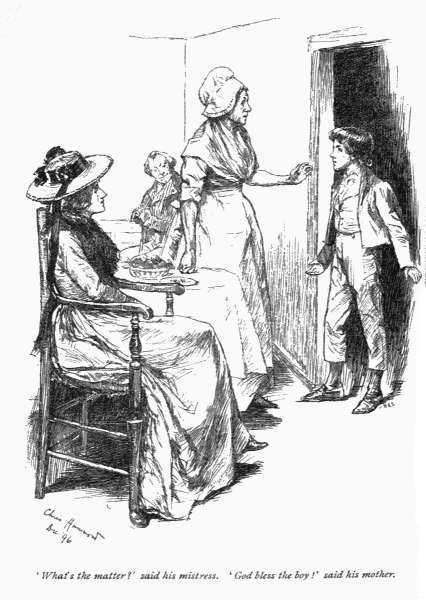
'What's the matter?' said his mistress. 'God bless the boy!' said his mother.
'This is a very strange thing!' said she gravely. 'How came you to leave all your money in a broken flower-pot in the stable? How came you not to give it to your mother to take care of?' 'Why, don't you remember?' said Jem, looking up in the midst of his tears—'why, don't you remember you, your own self, bid me not tell her about it till you were by?' 'And did you not tell her?' 'Nay, ask mammy,' said Jem, a little offended; and when afterwards the lady went on questioning him in a severe manner, as if she did not believe him, he at last made no answer. 'O Jem! Jem! why don't you speak to the lady?' said his mother. 'I have spoke, and spoke the truth,' said Jem proudly; 'and she did not believe me.'
Still the lady, who had lived too long in the world to be without suspicion, maintained a cold manner, and determined to wait the event without interfering, saying only that she hoped the money would be found, and advised Jem to have done crying.
'I have done,' said Jem; 'I shall cry no more.' And as he had the greatest command over himself, he actually did not shed another tear, not even when the farmer got up to go, saying he could wait no longer.
Jem silently went to bring out Lightfoot. The lady now took her seat, where she could see all that passed at the open parlour-window. The old woman stood at the door, and several idle people of the village, who had gathered round the lady's carriage examining it, turned about to listen. In a minute or two Jem appeared, with a steady countenance, leading Lightfoot, and, when he came up, without saying a word, put the bridle into Farmer Truck's hand. 'He has been a good horse,' said the farmer. 'He is a good horse!' cried Jem, and threw his arm over Lightfoot's neck, hiding his own face as he leaned upon him.
At this instant a party of milk-women went by; and one of them, having set down her pail, came behind Jem and gave him a pretty smart blow upon the back. He looked up. 'And don't you know me?' said she. 'I forget,' said Jem; 'I think I have seen your face before, but I forget.' 'Do you so? and you'll tell me just now,' said she, half opening her hand, 'that you forget who gave you this, and who charged you not to part with it, too.' Here she quite opened her large hand, and on the palm of it appeared Jem's silver penny.
'Where?' exclaimed Jem, seizing it, 'oh, where did you find it? and have you—oh, tell me, have you got the rest of my money?' 'I know nothing of your money—I don't know what you would be at,' said the milk-woman. 'But where—pray tell me where—did you find this?' 'With them that you gave it to, I suppose,' said the milk-woman, turning away suddenly to take up her milk-pail. But now Jem's mistress called to her through the window, begging her to stop, and joining in his entreaties to know how she came by the silver penny.
'Why, madam,' said she, taking up the corner of her apron, 'I came by it in an odd way, too. You must know my Betty is sick, so I came with the milk myself, though it's not what I'm used to; for my Betty—you know my Betty?' said she, turning round to the old woman, 'my Betty serves you, and she's a tight and stirring lassy, ma'am, I can assure——' 'Yes, I don't doubt it,' said the lady impatiently; 'but about the silver penny?' 'Why, that's true; as I was coming along all alone, for the rest came round, and I came a short cut across yon field—no, you can't see it, madam, where you stand—but if you were here——' 'I see it—I know it,' said Jem, out of breath with anxiety. 'Well—well—I rested my pail upon the stile, and sets me down awhile, and there comes out of the hedge—I don't know well how, for they startled me so I'd like to have thrown down my milk—two boys, one about the size of he,' said she, pointing to Jem, 'and one a matter taller, but ill-looking like; so I did not think to stir to make way for them, and they were like in a desperate hurry: so, without waiting for the stile, one of 'em pulled at the gate, and when it would not open (for it was tied with a pretty stout cord) one of 'em whips out with his knife and cuts it——Now, have you a knife about you, sir?' continued the milk-woman to the farmer. He gave her his knife. 'Here, now, ma'am, just sticking, as it were here, between the blade and the haft, was the silver penny. The lad took no notice; but when he opened it, out it falls. Still he takes no heed, but cuts the cord, as I said before, and through the gate they went, and out of sight in half a minute. I picks up the penny, for my heart misgave me that it was the very one my husband had had a long time, and had given against my voice to he,' pointing to Jem; 'and I charged him not to part with it; and, ma'am, when I looked I knew it by the mark, so I thought I would show it to he,' again pointing to Jem, 'and let him give it back to those it belongs to.' 'It belongs to me,' said Jem, 'I never gave it to anybody—but——' 'But,' cried the farmer, 'those boys have robbed him; it is they who have all his money.' 'Oh, which way did they go?' cried Jem, 'I'll run after them.'
'No, no,' said the lady, calling to her servant; and she desired him to take his horse and ride after them. 'Ay,' added Farmer Truck, 'do you take the road, and I'll take the field way, and I'll be bound we'll have 'em presently.'
Whilst they were gone in pursuit of the thieves, the lady, who was now thoroughly convinced of Jem's truth, desired her coachman would produce what she had ordered him to bring with him that evening. Out of the boot of the carriage the coachman immediately produced a new saddle and bridle.
How Jem's eyes sparkled when the saddle was thrown upon Lightfoot's back! 'Put it on your horse yourself, Jem,' said the lady; 'it is yours.'
Confused reports of Lightfoot's splendid accoutrements, of the pursuit of thieves, and of the fine and generous lady who was standing at dame Preston's window, quickly spread through the village, and drew everybody from their houses. They crowded round Jem to hear the story. The children especially, who were fond of him, expressed the strongest indignation against the thieves. Every eye was on the stretch; and now some, who had run down the lane, came back shouting, 'Here they are! they've got the thieves!'
The footman on horseback carried one boy before him; and the farmer, striding along, dragged another. The latter had on a red jacket, which little Jem immediately recollected, and scarcely dared lift his eyes to look at the boy on horseback. 'Good God!' said he to himself, 'it must be—yet surely it can't be Lawrence!' The footman rode on as fast as the people would let him. The boy's hat was slouched, and his head hung down, so that nobody could see his face.
At this instant there was a disturbance in the crowd. A man who was half-drunk pushed his way forwards, swearing that nobody should stop him; that he had a right to see—and he would see. And so he did; for, forcing through all resistance, he staggered up to the footman just as he was lifting down the boy he had carried before him. 'I will—I tell you I will see the thief!' cried the drunken man, pushing up the boy's hat. It was his own son. 'Lawrence!' exclaimed the wretched father. The shock sobered him at once, and he hid his face in his hands.
There was an awful silence. Lawrence fell on his knees, and in a voice that could scarcely be heard made a full confession of all the circumstances of his guilt.
'Such a young creature so wicked!' the bystanders exclaimed; 'what could put such wickedness in your head?' 'Bad company,' said Lawrence. 'And how came you—what brought you into bad company?' 'I don't know, except it was idleness.'
While this was saying, the farmer was emptying Lazy Lawrence's pockets; and when the money appeared, all his former companions in the village looked at each other with astonishment and terror. Their parents grasped their little hands closer, and cried, 'Thank God! he is not my son. How often when he was little we used, as he lounged about, to tell him that idleness was the root of all evil.'
As for the hardened wretch, his accomplice, every one was impatient to have him sent to gaol. He put on a bold, insolent countenance, till he heard Lawrence's confession; till the money was found upon him; and he heard the milk-woman declare that she would swear to the silver penny which he had dropped. Then he turned pale, and betrayed the strongest signs of fear.
'We must take him before the justice,' said the farmer, 'and he'll be lodged in Bristol gaol.'
'Oh!' said Jem, springing forwards when Lawrence's hands were going to be tied, 'let him go—won't you?—can't you let him go?' 'Yes, madam, for mercy's sake,' said Jem's mother to the lady; 'think what a disgrace to his family to be sent to gaol.'
His father stood by wringing his hands in an agony of despair. 'It's all my fault,' cried he; 'brought him up in idleness.' 'But he'll never be idle any more,' said Jem; 'won't you speak for him, ma'am?' 'Don't ask the lady to speak for him,' said the farmer; 'it's better he should go to Bridewell now, than to the gallows by and by.'
Nothing more was said; for everybody felt the truth of the farmer's speech.
Lawrence was eventually sent to Bridewell for a month, and the stable-boy was sent for trial, convicted, and transported to Botany Bay.
During Lawrence's confinement, Jem often visited him, and carried him such little presents as he could afford to give; and Jem could afford to be generous, because he was industrious. Lawrence's heart was touched by his kindness, and his example struck him so forcibly that, when his confinement was ended, he resolved to set immediately to work; and, to the astonishment of all who knew him, soon became remarkable for industry. He was found early and late at his work, established a new character, and for ever lost the name of 'Lazy Lawrence.'
THE FALSE KEY
Mr. Spencer, a very benevolent and sensible man, undertook the education of several poor children. Among the best was a boy of the name of Franklin, whom he had bred up from the time he was five years old. Franklin had the misfortune to be the son of a man of infamous character; and for many years this was a disgrace and reproach to his child. When any of the neighbours' children quarrelled with him, they used to tell him that he would turn out like his father. But Mr. Spencer always assured him that he might make himself whatever he pleased; that by behaving well he would certainly, sooner or later, secure the esteem and love of all who knew him, even of those who had the strongest prejudice against him on his father's account.
This hope was very delightful to Franklin, and he showed the strongest desire to learn and to do everything that was right; so that Mr. Spencer soon grew fond of him, and took great pains to instruct him, and to give him all the good habits and principles which might make him a useful, respectable, and happy man.
When he was about thirteen years of age, Mr. Spencer one day sent for him into his closet; and as he was folding up a letter which he had been writing, said to him, with a very kind look, but in a graver tone than usual, 'Franklin, you are going to leave me.' 'Sir!' said Franklin. 'You are now going to leave me, and to begin the world for yourself. You will carry this letter to my sister, Mrs. Churchill, in Queen's Square. You know Queen's Square?' Franklin bowed. 'You must expect,' continued Mr. Spencer, 'to meet with several disagreeable things, and a great deal of rough work, at your first setting out; but be faithful and obedient to your mistress, and obliging to your fellow-servants, and all will go well. Mrs. Churchill will make you a very good mistress, if you behave properly; and I have no doubt but you will.' 'Thank you, sir.' 'And you will always—I mean, as long as you deserve it—find a friend in me.' 'Thank you, sir—I am sure you are——' There Franklin stopped short, for the recollection of all Mr. Spencer's goodness rushed upon him at once, and he could not say another word. 'Bring me a candle to seal this letter,' said his master; and he was very glad to get out of the room. He came back with the candle, and, with a stout heart, stood by whilst the letter was sealing; and, when his master put it into his hand, said, in a cheerful voice, 'I hope you will let me see you again, sir, sometimes.' 'Certainly; whenever your mistress can spare you, I shall be very glad to see you; and remember, if ever you get into any difficulty, don't be afraid to come to me. I have sometimes spoken harshly to you; but you will not meet with a more indulgent friend.' Franklin at this turned away with a full heart; and, after making two or three attempts to express his gratitude, left the room without being able to speak.
He got to Queen's Square about three o'clock. The door was opened by a large, red-faced man, in a blue coat and scarlet waistcoat, to whom he felt afraid to give his message, lest he should not be a servant. 'Well, what's your business, sir?' said the butler. 'I have a letter for Mrs. Churchill, sir,' said Franklin, endeavouring to pronounce his sir in a tone as respectful as the butler's was insolent.
The man, having examined the direction, seal, and edges of the letter, carried it upstairs, and in a few minutes returned, and ordered Franklin to rub his shoes well and follow him. He was then shown into a handsome room, where he found his mistress—an elderly lady. She asked him a few questions, examining him attentively as she spoke; and her severe eye at first and her gracious smile afterwards, made him feel that she was a person to be both loved and feared. 'I shall give you in charge,' said she, ringing a bell, 'to my housekeeper, and I hope she will have no reason to be displeased with you.'
The housekeeper, when she first came in, appeared with a smiling countenance; but the moment she cast her eyes on Franklin, it changed to a look of surprise and suspicion. Her mistress recommended him to her protection, saying, 'Pomfret, I hope you will keep this boy under your own eye.' And she received him with a cold 'Very well, ma'am,' which plainly showed that she was not disposed to like him. In fact, Mrs. Pomfret was a woman so fond of power, and so jealous of favour, that she would have quarrelled with an angel who had got so near her mistress without her introduction. She smothered her displeasure, however, till night; when, as she attended her mistress's toilette, she could not refrain from expressing her sentiments. She began cautiously: 'Ma'am, is not this the boy Mr. Spencer was talking of one day—that has been brought up by the Villaintropic Society, I think they call it?'—'Philanthropic Society; yes,' said her mistress; 'and my brother gives him a high character: I hope he will do very well.' 'I'm sure I hope so too,' observed Mrs. Pomfret; 'but I can't say; for my part, I've no great notion of those low people. They say all those children are taken from the very lowest drugs and refuges of the town, and surely they are like enough, ma'am, to take after their own fathers and mothers.' 'But they are not suffered to be with their parents,' rejoined the lady; 'and therefore cannot be hurt by their example. This little boy, to be sure, was unfortunate in his father, but he has had an excellent education.' 'Oh, edication! to be sure, ma'am, I know. I don't say but what edication is a great thing. But then, ma'am, edication can't change the natur that's in one, they say; and one that's born naturally bad and low, they say, all the edication in the world won't do no good; and, for my part, ma'am, I know you knows best; but I should be afraid to let any of those Villaintropic folks get into my house; for nobody can tell the natur of them aforehand. I declare it frights me.' 'Pomfret, I thought you had better sense: how would this poor boy earn his bread? he would be forced to starve or steal, if everybody had such prejudices.'
Pomfret, who really was a good woman, was softened at this idea, and said, 'God forbid he should starve or steal, and God forbid I should say anything prejudiciary of the boy; for there may be no harm in him.'
'Well,' said Mrs. Churchill, changing her tone, 'but, Pomfret, if we don't like the boy at the end of the month, we have done with him; for I have only promised Mr. Spencer to keep him a month upon trial: there is no harm done.' 'Dear, no, ma'am, to be sure; and cook must put up with her disappointment, that's all.' 'What disappointment?' 'About her nephew, ma'am; the boy she and I was speaking to you for.' 'When?' 'The day you called her up about the almond pudding, ma'am. If you remember, you said you should have no objections to try the boy; and upon that cook bought him new shirts; but they are to the good, as I tell her.' 'But I did not promise to take her nephew.' 'Oh no, ma'am, not at all; she does not think to say that, else I should be very angry; but the poor woman never let fall a word, any more than frets that the boy should miss such a good place.' 'Well, but since I did say that I should have no objection to try him, I shall keep my word; let him come to-morrow. Let them both have a fair trial, and at the end of the month I can decide which I like best, and which we had better keep.'
Dismissed with these orders, Mrs. Pomfret hastened to report all that had passed to the cook, like a favourite minister, proud to display the extent of her secret influence. In the morning Felix, the cook's nephew, arrived; and, the moment he came into the kitchen, every eye, even the scullion's, was fixed upon him with approbation, and afterwards glanced upon Franklin with contempt—contempt which Franklin could not endure without some confusion, though quite unconscious of having deserved it; nor, upon the most impartial and cool self-examination, could he comprehend the justice of his judges. He perceived indeed—for the comparisons were minutely made in audible and scornful whispers—that Felix was a much handsomer, or as the kitchen maid expressed it, a much more genteeler gentlemanly looking like sort of person than he was; and he was made to understand that he wanted a frill to his shirt, a cravat, a pair of thin shoes, and, above all, shoe-strings, besides other nameless advantages, which justly made his rival the admiration of the kitchen. However, upon calling to mind all that his friend Mr. Spencer had ever said to him, he could not recollect his having warned him that shoe-strings were indispensable requisites to the character of a good servant; so that he could only comfort himself with resolving, if possible, to make amends for these deficiencies, and to dissipate the prejudices which he saw were formed against him, by the strictest adherence to all that his tutor had taught him to be his duty. He hoped to secure the approbation of his mistress by scrupulous obedience to all her commands, and faithful care of all that belonged to her. At the same time he flattered himself he should win the goodwill of his fellow-servants by showing a constant desire to oblige them. He pursued this plan of conduct steadily for nearly three weeks, and found that he succeeded beyond his expectations in pleasing his mistress; but unfortunately he found it more difficult to please his fellow-servants, and he sometimes offended when he least expected it. He had made great progress in the affections of Corkscrew, the butler, by working indeed very hard for him, and doing every day at least half his business. But one unfortunate night the butler was gone out; the bell rang: he went upstairs; and his mistress asking where Corkscrew was, he answered that he was gone out. 'Where to?' said his mistress. 'I don't know,' answered Franklin. And, as he had told exactly the truth, and meant to do no harm, he was surprised, at the butler's return, when he repeated to him what had passed, at receiving a sudden box on the ear, and the appellation of a mischievous, impertinent, mean-spirited brat.
'Mischievous, impertinent, mean!' repeated Franklin to himself; but, looking in the butler's face, which was a deeper scarlet than usual, he judged that he was far from sober, and did not doubt but that the next morning, when he came to the use of his reason, he would be sensible of his injustice, and apologise for his box of the ear. But no apology coming all day, Franklin at last ventured to request an explanation, or rather, to ask what he had best do on the next occasion. 'Why,' said Corkscrew, 'when mistress asked for me, how came you to say I was gone out?' 'Because, you know, I saw you go out.' 'And when she asked you where I was gone, how came you to say that you did not know?' 'Because, indeed, I did not.' 'You are a stupid blockhead! could you not say I was gone to the washerwoman's?' 'But were you?' said Franklin. 'Was I?' cried Corkscrew, and looked as if he would have struck him again: 'how dare you give me the lie, Mr. Hypocrite? You would be ready enough, I'll be bound, to make excuses for yourself. Why are not mistress's clogs cleaned? Go along and blacken 'em, this minute, and send Felix to me.'
From this time forward Felix alone was privileged to enter the butler's pantry. Felix became the favourite of Corkscrew; and, though Franklin by no means sought to pry into the mysteries of their private conferences, nor ever entered without knocking at the door, yet it was his fate once to be sent of a message at an unlucky time; and, as the door was half-open, he could not avoid seeing Felix drinking a bumper of red liquor, which he could not help suspecting to be wine; and, as the decanter, which usually went upstairs after dinner, was at this time in the butler's grasp, without any stopper in it, he was involuntarily forced to suspect they were drinking his mistress's wine.
Nor were the bumpers of port the only unlawful rewards which Felix received: his aunt, the cook, had occasion for his assistance, and she had many delicious douceurs in her gift. Many a handful of currants, many a half-custard, many a triangular remnant of pie, besides the choice of his own meal at breakfast, dinner, and supper, fell to the share of the favourite Felix; whilst Franklin was neglected, though he took the utmost pains to please the cook in all honourable service, and, when she was hot, angry, or hurried, he was always at hand to help her; and in the hour of adversity, when the clock struck five, and no dinner was dished, and no kitchen-maid with twenty pair of hands was to be had, Franklin would answer to her call, with flowers to garnish her dishes, and presence of mind to know, in the midst of the commotion, where everything that was wanting was to be found; so that, quick as lightning, all difficulties vanished before him. Yet when the danger was over, and the hour of adversity had passed, the ungrateful cook would forget her benefactor, and, when it came to his supper time, would throw him, with a carelessness that touched him sensibly, anything which the other servants were too nice to eat. All this Franklin bore with fortitude; nor did he envy Felix the dainties which he ate, sometimes close beside him: 'For,' said he to himself, 'I have a clear conscience, and that is more than Felix can have. I know how he wins cook's favour too well, and I fancy I know how I have offended her; for since the day I saw the basket, she has done nothing but huff me.'
The history of the basket was this. Mrs. Pomfret, the housekeeper, had several times, directly and indirectly, given the world below to understand that she and her mistress thought there was a prodigious quantity of meat eaten of late. Now, when she spoke, it was usually at dinner time; she always looked, or Franklin imagined that she looked, suspiciously at him. Other people looked more maliciously; but, as he felt himself perfectly innocent, he went on eating his dinner in silence.
But at length it was time to explain. One Sunday there appeared a handsome sirloin of beef, which before noon on Monday had shrunk almost to the bare bone, and presented such a deplorable spectacle to the opening eyes of Mrs. Pomfret that her long-smothered indignation burst forth, and she boldly declared she was now certain there had been foul play, and she would have the beef found, or she would know why. She spoke, but no beef appeared, till Franklin, with a look of sudden recollection, cried, 'Did not I see something like a piece of beef in a basket in the dairy?—I think——'
The cook, as if somebody had smote her a deadly blow, grew pale; but, suddenly recovering the use of her speech, turned upon Franklin, and, with a voice of thunder, gave him the lie direct; and forthwith, taking Mrs. Pomfret by the ruffle, led the way to the dairy, declaring she could defy the world—'that so she could, and would.' 'There, ma'am,' said she kicking an empty basket which lay on the floor—'there's malice for you. Ask him why he don't show you the beef in the basket.' 'I thought I saw——' poor Franklin began. 'You thought you saw!' cried the cook, coming close up to him with kimboed arms, and looking like a dragon; 'and pray, sir, what business has such a one as you to think you see? And pray, ma'am, will you be pleased to speak—perhaps, ma'am, he'll condescend to obey you—ma'am, will you be pleased to forbid him my dairy? for here he comes prying and spying about; and how, ma'am, am I to answer for my butter and cream, or anything at all? I'm sure it's what I can't pretend to, unless you do me the justice to forbid him my places.'
Mrs. Pomfret, whose eyes were blinded by her prejudices against the folks of the Villaintropic Society, and also by her secret jealousy of a boy whom she deemed to be a growing favourite of her mistress's, took part with the cook, and ended, as she began, with a firm persuasion that Franklin was the guilty person. 'Let him alone, let him alone!' said she, 'he has as many turns and windings as a hare; but we shall catch him yet, I'll be bound, in some of his doublings. I knew the nature of him well enough, from the first time I ever set my eyes upon him; but mistress shall have her own way, and see the end of it.'
These words, and the bitter sense of injustice, drew tears at length fast down the proud cheek of Franklin, which might possibly have touched Mrs. Pomfret, if Felix, with a sneer, had not called them crocodile tears. 'Felix, too!' thought he; 'this is too much.' In fact, Felix had till now professed himself his firm ally, and had on his part received from Franklin unequivocal proofs of friendship; for it must be told that every other morning, when it was Felix's turn to get breakfast, Felix never was up in decent time, and must inevitably have come to public disgrace if Franklin had not got all the breakfast things ready for him, the bread and butter spread, and the toast toasted; and had not, moreover, regularly, when the clock struck eight, and Mrs. Pomfret's foot was heard overhead, run to call the sleeping Felix, and helped him constantly through the hurry of getting dressed one instant before the housekeeper came downstairs. All this could not but be present to his memory; but, scorning to reproach him, Franklin wiped away his crocodile tears, and preserved a magnanimous silence.
The hour of retribution was; however, not so far off as Felix imagined. Cunning people may go on cleverly in their devices for some time; but although they may escape once, twice, perhaps ninety-nine times, what does that signify?—for the hundredth time they come to shame, and lose all their character. Grown bold by frequent success, Felix became more careless in his operations; and it happened that one day he met his mistress full in the passage, as he was going on one of the cook's secret errands. 'Where are you going, Felix?' said his mistress. 'To the washerwoman's, ma'am,' answered he, with his usual effrontery. 'Very well,' said she. 'Call at the bookseller's in—stay, I must write down the direction. Pomfret,' said she, opening the housekeeper's room door. 'have you a bit of paper?' Pomfret came with the writing-paper, and looked very angry to see that Felix was going out without her knowledge; so, while Mrs. Churchill was writing the direction, she stood talking to him about it; whilst he, in the greatest terror imaginable, looked up in her face as she spoke; but was all the time intent on parrying on the other side the attacks of a little French dog of his mistress's, which, unluckily for him, had followed her into the passage. Manchon was extremely fond of Felix, who, by way of pleasing his mistress, had paid most assiduous court to her dog; yet now his caresses were rather troublesome. Manchon leaped up, and was not to be rebuffed. 'Poor fellow—poor fellow—down! down! poor fellow!' cried Felix, and put him away. But Manchon leaped up again, and began smelling near the fatal pocket in a most alarming manner. 'You will see by this direction where you are to go,' said his mistress. 'Manchon, come here—and you will be so good as to bring me—down! down! Manchon, be quiet!' But Manchon knew better—he had now got his head into Felix's pocket, and would not be quiet till he had drawn from thence, rustling out of its brown paper, half a cold turkey, which had been missing since morning. 'My cold turkey, as I'm alive!' exclaimed the housekeeper, darting upon it with horror and amazement. 'What is all this?' said Mrs. Churchill, in a composed voice. 'I don't know, ma'am,' answered Felix, so confused that he knew not what to say; 'but——' 'But what?' cried Mrs. Pomfret, indignation flashing from her eyes. 'But what?' repeated his mistress, waiting for his reply with a calm air of attention, which still more disconcerted Felix; for, though with an angry person he might have some chance of escape, he knew that he could not invent any excuse in such circumstances, which could stand the examination of a person in her sober senses. He was struck dumb. 'Speak,' said Mrs. Churchill, in a still lower tone; 'I am ready to hear all you have to say. In my house everybody shall have justice; speak—but what?' 'But,' stammered Felix; and, after in vain attempting to equivocate, confessed that he was going to take the turkey to his cousin's; but he threw all the blame upon his aunt, the cook, who, he said, had ordered him upon this expedition.
The cook was now summoned; but she totally denied all knowledge of the affair, with the same violence with which she had lately confounded Franklin about the beef in the basket; not entirely, however, with the same success; for Felix, perceiving by his mistress's eye that she was on the point of desiring him to leave the house immediately; and not being very willing to leave a place in which he had lived so well with the butler, did not hesitate to confront his aunt with assurance equal to her own. He knew how to bring his charge home to her. He produced a note in her own handwriting, the purport of which was to request her cousin's acceptance of 'some delicate cold turkey,' and to beg she would send her, by the return of the bearer, a little of her cherry-brandy.
Mrs. Churchill coolly wrote upon the back of the note her cook's discharge, and informed Felix she had no further occasion for his services, but, upon his pleading with many tears, which Franklin did not call crocodile tears, that he was so young, that he was under the dominion of his aunt, he touched Mrs. Pomfret's compassion, and she obtained for him permission to stay till the end of the month, to give him yet a chance of redeeming his character.
Mrs. Pomfret, now seeing how far she had been imposed upon, resolved, for the future, to be more upon her guard with Felix, and felt that she had treated Franklin with great injustice, when she accused him of malpractices about the sirloin of beef.
Good people, when they are made sensible that they have treated any one with injustice, are impatient to have an opportunity to rectify their mistake; and Mrs. Pomfret was now prepared to see everything which Franklin did in the most favourable point of view; especially as the next day she discovered that it was he who every morning boiled the water for her tea, and buttered her toast—services for which she had always thought she was indebted to Felix. Besides, she had rated Felix's abilities very highly, because he made up her weekly accounts for her; but unluckily once, when Franklin was out of the way, and she brought a bill in a hurry to her favourite to cast up, she discovered that he did not know how to cast up pounds, shillings, and pence, and he was obliged to confess that she must wait till Franklin came home.
But, passing over a number of small incidents which gradually unfolded the character of the two boys, we must proceed to a more serious affair.
Corkscrew frequently, after he had finished taking away supper, and after the housekeeper was gone to bed, sallied forth to a neighbouring alehouse to drink with his friends. The alehouse was kept by that cousin of Felix's who was so fond of 'delicate cold turkey,' and who had such choice cherry-brandy. Corkscrew kept the key of the house door, so that he could return home whenever he thought proper; and, if he should by accident be called for by his mistress after supper, Felix knew where to find him, and did not scruple to make any of those excuses which poor Franklin had too much integrity to use.
All these precautions taken, the butler was at liberty to indulge his favourite passion, which so increased with indulgence that his wages were by no means sufficient to support him in this way of life. Every day he felt less resolution to break through his bad habits; for every day drinking became more necessary to him. His health was ruined. With a red, pimpled, bloated face, emaciated legs, and a swelled, diseased body, he appeared the victim of intoxication. In the morning, when he got up, his hands trembled, his spirits flagged, he could do nothing until he had taken a dram—an operation which he was obliged to repeat several times in the course of the day, as all those wretched people must who once acquire this habit.
He had run up a long bill at the alehouse which he frequented; and the landlord, who grew urgent for his money, refused to give further credit.
One night, when Corkscrew had drunk enough only to make him fretful, he leaned with his elbow surlily upon the table, began to quarrel with the landlord, and swore that he had not of late treated him like a gentleman. To which the landlord coolly replied, 'That as long as he had paid like a gentleman, he had been treated like one, and that was as much as any one could expect, or, at any rate, as much as any one would meet with in this world.' For the truth of this assertion he appealed, laughing, to a party of men who were drinking in the room. The men, however, took part with Corkscrew, and, drawing him over to their table, made him sit down with them. They were in high good-humour, and the butler soon grew so intimate with them that, in the openness of his heart, he soon communicated to them not only all his own affairs, but all that he knew, and more than all that he knew, of his mistress's.
His new friends were by no means uninterested by his conversation, and encouraged him as much as possible to talk; for they had secret views, which the butler was by no means sufficiently sober to discover.
Mrs. Churchill had some fine old family plate; and these men belonged to a gang of housebreakers. Before they parted with Corkscrew, they engaged him to meet them again the next night; their intimacy was still more closely cemented. One of the men actually offered to lend Corkscrew three guineas towards the payment of his debt, and hinted that, if he thought proper, he could easily get the whole cleared off. Upon this hint, Corkscrew became all attention, till, after some hesitation on their part, and repeated promises of secrecy on his, they at length disclosed their plans to him. They gave him to understand that, if he would assist in letting them into his mistress's house, they would let him have an ample share in the booty. The butler, who had the reputation of being an honest man, and indeed whose integrity had hitherto been proof against everything but his mistress's port, turned pale and trembled at this proposal, drank two or three bumpers to drown thought, and promised to give an answer the next day.
He went home more than half-intoxicated. His mind was so full of what had passed, that he could not help bragging to Felix, whom he found awake at his return, that he could have his bill paid off at the alehouse whenever he pleased; dropping, besides, some hints which were not lost upon Felix.
In the morning Felix reminded him of the things which he had said; and Corkscrew, alarmed, endeavoured to evade his questions by saying that he was not in his senses when he talked in that manner. Nothing, however, that he could urge made any impression upon Felix, whose recollection on the subject was perfectly distinct, and who had too much cunning himself, and too little confidence in his companion, to be the dupe of his dissimulation. The butler knew not what to do when he saw that Felix was absolutely determined either to betray their scheme or to become a sharer in the booty.
The next night came, and he was now to make a final decision; either to determine on breaking off entirely with his new acquaintances, or taking Felix with him to join in the plot.
His debt, his love of drinking, the impossibility of indulging it without a fresh supply of money, all came into his mind at once and conquered his remaining scruples. It is said by those whose fatal experience gives them a right to be believed, that a drunkard will sacrifice anything, everything, sooner than the pleasure of habitual intoxication.
How much easier is it never to begin a bad custom than to break through it when once formed!
The hour of rendezvous came, and Corkscrew went to the alehouse, where he found the housebreakers waiting for him, and a glass of brandy ready poured out. He sighed—drank—hesitated—drank again—heard the landlord talk of his bill, saw the money produced which would pay it in a moment—drank again—cursed himself, and, giving his hand to the villain who was whispering in his ear, swore that he could not help it, and must do as they would have him. They required of him to give up the key of the house door, that they might get another made by it. He had left it with Felix, and was now obliged to explain the new difficulty which had arisen. Felix knew enough to ruin them, and must therefore be won over. This was no very difficult task; he had a strong desire to have some worked cravats, and the butler knew enough of him to believe that this would be a sufficient bribe. The cravats were bought and shown to Felix. He thought them the only things wanting to make him a complete fine gentleman; and to go without them, especially when he had once seen himself in the glass with one tied on in a splendid bow, appeared impossible. Even this paltry temptation, working upon his vanity, at length prevailed with a boy whose integrity had long been corrupted by the habits of petty pilfering and daily falsehood. It was agreed that, the first time his mistress sent him out on a message, he should carry the key of the house door to his cousin's, and deliver it into the hands of one of the gang, who were there in waiting for it. Such was the scheme.
Felix, the night after all this had been planned, went to bed and fell fast asleep; but the butler, who had not yet stifled the voice of conscience, felt, in the silence of the night, so insupportably miserable that, instead of going to rest, he stole softly into the pantry for a bottle of his mistress's wine, and there drinking glass after glass, he stayed till he became so far intoxicated that, though he contrived to find his way back to bed, he could by no means undress himself. Without any power of recollection, he flung himself upon the bed, leaving his candle half hanging out of the candlestick beside him. Franklin slept in the next room to him, and presently awaking, thought he perceived a strong smell of something burning. He jumped up, and seeing a light under the butler's door, gently opened it, and, to his astonishment, beheld one of the bed curtains in flames. He immediately ran to the butler, and pulled him with all his force to rouse him from his lethargy. He came to his senses at length, but was so terrified and so helpless that, if it had not been for Franklin, the whole house would soon inevitably have been on fire. Felix, trembling and cowardly, knew not what to do; and it was curious to see him obeying Franklin, whose turn it now was to command. Franklin ran upstairs to awaken Mrs. Pomfret, whose terror of fire was so great that she came from her room almost out of her senses, whilst he, with the greatest presence of mind, recollected where he had seen two large tubs of water, which the maids had prepared the night before for their washing, and seizing the wet linen which had been left to soak, he threw them upon the flames. He exerted himself with so much good sense, that the fire was presently extinguished.
Everything was now once more safe and quiet. Mrs. Pomfret, recovering from her fright, postponed all inquiries till the morning, and rejoiced that her mistress had not been awakened, whilst Corkscrew flattered himself that he should be able to conceal the true cause of the accident.
'Don't you tell Mrs. Pomfret where you found the candle when you came into the room,' said he to Franklin. 'If she asks me, you know I must tell the truth,' replied he. 'Must!' repeated Felix, sneeringly; 'what, you must be a tell-tale!' 'No, I never told any tales of anybody, and I should be very sorry to get any one into a scrape; but for all that I shall not tell a lie, either for myself or anybody else, let you call me what names you will.' 'But if I were to give you something that you would like,' said Corkscrew—'something that I know you would like?' repeated Felix. 'Nothing you can give me will do,' answered Franklin, steadily; 'so it is useless to say any more about it—I hope I shall not be questioned.' In this hope he was mistaken; for the first thing Mrs. Pomfret did in the morning was to come into the room to examine and deplore the burnt curtains, whilst Corkscrew stood by, endeavouring to exculpate himself by all the excuses he could invent.
Mrs. Pomfret, however, though sometimes blinded by her prejudices, was no fool; and it was absolutely impossible to make her believe that a candle which had been left on the hearth, where Corkscrew protested he had left it, could have set curtains on fire which were at least six feet distant. Turning short round to Franklin, she desired that he would show her where he found the candle when he came into the room. He took up the candlestick; but the moment the housekeeper cast her eye upon it, she snatched it from his hands. 'How did this candlestick come here? This was not the candlestick you found here last night,' cried she. 'Yes, indeed it was,' answered Franklin. 'That is impossible,' retorted she, vehemently, 'for I left this candlestick with my own hands, last night, in the hall, the last thing I did, after you,' said she, turning to the butler, 'was gone to bed—I'm sure of it. Nay, don't you recollect my taking this japanned candlestick out of your hand, and making you to go up to bed with the brass one, and I bolted the door at the stair-head after you?'
This was all very true; but Corkscrew had afterwards gone down from his room by a back staircase, unbolted that door, and, upon his return from the alehouse, had taken the japanned candlestick by mistake upstairs, and had left the brass one in its stead upon the hall table.
'Oh, ma'am,' said Felix, 'indeed you forget; for Mr. Corkscrew came into my room to desire me to call him betimes in the morning, and I happened to take particular notice, and he had the japanned candlestick in his hand, and that was just as I heard you bolting the door. Indeed, ma'am, you forget.' 'Indeed, sir,' retorted Mrs. Pomfret, rising in anger, 'I do not forget; I'm not come to be superannuated yet, I hope. How do you dare to tell me I forget?' 'Oh, ma'am,' cried Felix, 'I beg your pardon, I did not—I did not mean to say you forgot, but only I thought, perhaps, you might not particularly remember; for if you please to recollect——' 'I won't please to recollect just whatever you please, sir! Hold your tongue; why should you poke yourself into this scrape; what have you to do with it, I should be glad to know?' 'Nothing in the world, oh nothing in the world; I'm sure I beg your pardon, ma'am,' answered Felix, in a soft tone; and, sneaking off, left his friend Corkscrew to fight his own battle, secretly resolving to desert in good time, if he saw any danger of the alehouse transactions coming to light.
Corkscrew could make but very blundering excuses for himself; and, conscious of guilt, he turned pale, and appeared so much more terrified than butlers usually appear when detected in a lie, that Mrs. Pomfret resolved, as she said, to sift the matter to the bottom. Impatiently did she wait till the clock struck nine, and her mistress's bell rang, the signal for her attendance at her levee. 'How do you find yourself this morning, ma'am?' said she, undrawing the curtains. 'Very sleepy, indeed,' answered her mistress in a drowsy voice; 'I think I must sleep half an hour longer—shut the curtains.' 'As you please, ma'am; but I suppose I had better open a little of the window shutter, for it's past nine.' 'But just struck.' 'Oh dear, ma'am, it struck before I came upstairs, and you know we are twenty minutes slow—Lord bless us!' exclaimed Mrs. Pomfret, as she let fall the bar of the window, which roused her mistress. 'I'm sure I beg your pardon a thousand times—it's only the bar—because I had this great key in my hand.' 'Put down the key, then, or you'll knock something else down; and you may open the shutters now, for I'm quite awake.' 'Dear me! I'm so sorry to think of disturbing you,' cried Mrs. Pomfret, at the same time throwing the shutters wide open; 'but, to be sure, ma'am, I have something to tell you which won't let you sleep again in a hurry. I brought up this here key of the house door for reasons of my own, which I'm sure you'll approve of; but I'm not come to that part of my story yet. I hope you were not disturbed by the noise in the house last night, ma'am.' 'I heard no noise.' 'I am surprised at that, though,' continued Mrs. Pomfret, and proceeded to give a most ample account of the fire, of her fears and her suspicions. 'To be sure, ma'am, what I say is, that without the spirit of prophecy one can nowadays account for what has passed. I'm quite clear in my own judgment that Mr. Corkscrew must have been out last night after I went to bed; for, besides the japanned candlestick, which of itself I'm sure is strong enough to hang a man, there's another circumstance, ma'am, that certifies it to me—though I have not mentioned it, ma'am, to no one yet,' lowering her voice—'Franklin, when I questioned him, told me that he left the lantern in the outside porch in the court last night, and this morning it was on the kitchen table. Now, ma'am, that lantern could not come without hands; and I could not forget about that, you know; for Franklin says he's sure he left the lantern out.' 'And do you believe him?' inquired her mistress. 'To be sure, ma'am—how can I help believing him? I never found him out in the least symptom of a lie since ever he came into the house; so one can't help believing in him, like him or not.' 'Without meaning to tell a falsehood, however,' said the lady, 'he might make a mistake.' 'No, ma'am, he never makes mistakes; it is not his way to go gossiping and tattling; he never tells anything till he's asked, and then it's fit he should. About the sirloin of beef, and all, he was right in the end, I found, to do him justice; and I'm sure he's right now about the lantern—he's always right.'
Mrs. Churchill could not help smiling.
'If you had seen him, ma'am, last night in the midst of the fire—I'm sure we may thank him that we were not burned alive in our beds—and I shall never forget his coming to call me. Poor fellow! he that I was always scolding and scolding, enough to make him hate me. But he's too good to hate anybody; and I'll be bound I'll make it up to him now.' 'Take care that you don't go from one extreme into another, Pomfret; don't spoil the boy.' 'No, ma'am, there's no danger of that; but I'm sure if you had seen him last night yourself, you would think he deserved to be rewarded.' 'And so he shall be rewarded,' said Mrs. Churchill; 'but I will try him more fully yet.' 'There's no occasion, I think, for trying him any more, ma'am,' said Mrs. Pomfret, who was as violent in her likings as in her dislikes. 'Pray desire,' continued her mistress, 'that he will bring up breakfast this morning; and leave the key of the house door, Pomfret, with me.'
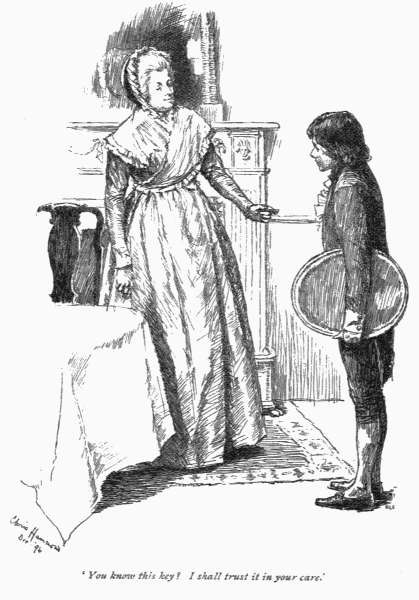
'You know this key? I shall trust it in your care.'
When Franklin brought the urn into the breakfast-parlour, his mistress was standing by the fire with the key in her hand. She spoke to him of his last night's exertions in terms of much approbation. 'How long have you lived with me?' said she, pausing; 'three weeks, I think?' 'Three weeks and four days, madam.' 'That is but a short time; yet you have conducted yourself so as to make me think I may depend upon you. You know this key?' 'I believe, madam, it is the key of the house door.' 'It is; I shall trust it in your care. It is a great trust for so young a person as you are.' Franklin stood silent, with a firm but modest look. 'If you take the charge of this key,' continued his mistress, 'remember it is upon condition that you never give it out of your own hands. In the daytime it must not be left in the door. You must not tell anybody where you keep it at night; and the hou door must not be unlocked after eleven o'clock at night, unless by my orders. Will you take charge of the key upon these conditions?' 'I will, madam, do anything you order me,' said Franklin, and received the key from her hands.
When Mrs. Churchill's orders were made known, they caused many secret marvellings and murmurings. Corkscrew and Felix were disconcerted, and dared not openly avow their discontent; and they treated Franklin with the greatest seeming kindness and cordiality.
Everything went on smoothly for three days. The butler never attempted his usual midnight visits to the alehouse, but went to bed in proper time, and paid particular court to Mrs. Pomfret, in order to dispel her suspicions. She had never had any idea of the real fact, that he and Felix were joined in a plot with housebreakers to rob the house, but thought he only went out at irregular hours to indulge himself in his passion for drinking.
Thus stood affairs the night before Mrs. Churchill's birthday. Corkscrew, by the housekeeper's means, ventured to present a petition that he might go to the play the next day, and his request was granted. Franklin came into the kitchen just when all the servants had gathered round the butler, who, with great importance, was reading aloud the play-bill. Everybody present soon began to speak at once, and with great enthusiasm talked of the playhouse, the actors and actresses; and then Felix, in the first pause, turned to Franklin and said, 'Lord, you know nothing of all this! you never went to a play, did you?' 'Never,' said Franklin, and felt, he did not know why, a little ashamed; and he longed extremely to go to one. 'How should you like to go to the play with me to-morrow?' said Corkscrew. 'Oh,' exclaimed Franklin, 'I should like it exceedingly.' 'And do you think mistress would let you if I asked?' 'I think—maybe she would, if Mrs. Pomfret asked her.' 'But then you have no money, have you?' 'No,' said Franklin, sighing. 'But stay,' said Corkscrew, 'what I'm thinking of is, that if mistress will let you go, I'll treat you myself, rather than that you should be disappointed.'
Delight, surprise, and gratitude appeared in Franklin's face at these words. Corkscrew rejoiced to see that now, at least, he had found a most powerful temptation. 'Well, then, I'll go just now and ask her. In the meantime, lend me the key of the house door for a minute or two.' 'The key!' answered Franklin, starting; 'I'm sorry, but I can't do that, for I've promised my mistress never to let it out of my own hands.' 'But how will she know anything of the matter? Run, run, and get it for us.' 'No, I cannot,' replied Franklin, resisting the push which the butler gave his shoulder. 'You can't?' cried Corkscrew, changing his tone; 'then, sir, I can't take you to the play.' 'Very well, sir,' said Franklin, sorrowfully, but with steadiness. 'Very well, sir,' said Felix, mimicking him, 'you need not look so important, nor fancy yourself such a great man, because you're master of a key.'
'Say no more to him,' interrupted Corkscrew; 'let him alone to take his own way. Felix, you would have no objection, I suppose, to going to the play with me?' 'Oh, I should like it of all things, if I did not come between anybody else. But come, come!' added the hypocrite, assuming a tone of friendly persuasion, 'you won't be such a blockhead, Franklin, as to lose going to the play for nothing; it's only just obstinacy. What harm can it do to lend Mr. Corkscrew the key for five minutes? he'll give it you back again safe and sound.' 'I don't doubt that,' answered Franklin. 'Then it must be all because you don't wish to oblige Mr. Corkscrew.' 'No, but I can't oblige him in this; for, as I told you before, my mistress trusted me. I promised never to let the key out of my own hands, and you would not have me break my trust. Mr. Spencer told me that was worse than robbing.'
At the word robbing both Corkscrew and Felix involuntarily cast down their eyes, and turned the conversation immediately, saying that he did very right, that they did not really want the key, and had only asked for it just to try if he would keep his word. 'Shake hands,' said Corkscrew, 'I am glad to find you out to be an honest fellow!' 'I am sorry you did not think me an honest fellow before, Mr. Corkscrew,' said Franklin giving his hand rather proudly, and he walked away.
'We shall make no hand of this prig,' said Corkscrew. 'But we'll have the key from him in spite of all his obstinacy,' said Felix; 'and let him make his story good as he can afterwards. He shall repent of these airs. To-night I'll watch him, and find out where he hides the key; and when he's asleep we'll get it without thanking him.'
This plan Felix put into execution. They discovered the place where Franklin kept the key at night, stole it whilst he slept, took off the impression in wax, and carefully replaced it in Franklin's trunk, exactly where they found it.
Probably our young readers cannot guess what use they could mean to make of this impression of the key in wax. Knowing how to do mischief is very different from wishing to do it, and the most innocent persons are generally the least ignorant. By means of the impression which they had thus obtained, Corkscrew and Felix proposed to get a false key made by Picklock, a smith who belonged to their gang of housebreakers; and with this false key knew they could open the door whenever they pleased.
Little suspecting what had happened, Franklin, the next morning, went to unlock the house door as usual; but finding the key entangled in the lock, he took it out to examine it, and perceived a lump of wax sticking in one of the wards. Struck with this circumstance, it brought to his mind all that had passed the preceding evening, and, being sure that he had no wax near the key, he began to suspect what had happened; and he could not help recollecting what he had once heard Felix say, that 'give him but a halfpenny worth of wax, and he could open the strongest lock that ever was made by hands.'
All these things considered, Franklin resolved to take the key just as it was, with the wax sticking to it, to his mistress.
'I was not mistaken when I thought I might trust you with this key,' said Mrs. Churchill, after she had heard his story. 'My brother will be here to-day, and I shall consult him. In the meantime, say nothing of what has passed.'
Evening came, and after tea Mr. Spencer sent for Franklin upstairs. 'So, Mr. Franklin,' said he, 'I'm glad to find you are in such high trust in this family.' Franklin bowed. 'But you have lost, I understand, the pleasure of going to the play to-night.' 'I don't think anything—much, I mean, of that, sir,' answered Franklin, smiling. 'Are Corkscrew and Felix gone to the play?' 'Yes; half an hour ago, sir.' 'Then I shall look into his room and examine the pantry and the plate that is under his care.'
When Mr. Spencer came to examine the pantry, he found the large salvers and cups in a basket behind the door, and the other things placed so as to be easily carried off. Nothing at first appeared in Corkscrew's bedchamber to strengthen their suspicions, till, just as they were going to leave the room, Mrs. Pomfret exclaimed, 'Why, if there is not Mr. Corkscrew's dress coat hanging up there! and if here isn't Felix's fine cravat that he wanted in such a hurry to go to the play! Why, sir, they can't be gone to the play. Look at the cravat. Ah! upon my word I am afraid they are not at the play. No, sir, you may be sure that they are plotting with their barbarous gang at the alehouse; and they'll certainly break into the house to-night. We shall all be murdered in our beds, as sure as I'm a living woman, sir; but if you'll only take my advice——' 'Pray, good Mrs. Pomfret,' Mr. Spencer observed, 'don't be alarmed.' 'Nay, sir, but I won't pretend to sleep in the house, if Franklin isn't to have a blunderbuss, and I a baggonet.' 'You shall have both, indeed, Mrs. Pomfret; but don't make such a noise, for everybody will hear you.'
The love of mystery was the only thing which could have conquered Mrs. Pomfret's love of talking. She was silent; and contented herself the rest of the evening with making signs, looking ominous, and stalking about the house like one possessed with a secret.
Escaped from Mrs. Pomfret's fears and advice, Mr. Spencer went to a shop within a few doors of the alehouse which he heard Corkscrew frequented, and sent to beg to speak to the landlord. He came; and, when Mr. Spencer questioned him, confessed that Corkscrew and Felix were actually drinking in his house, with two men of suspicious appearance; that, as he passed through the passage, he heard them disputing about a key; and that one of them said, 'Since we've got the key, we'll go about it to-night.' This was sufficient information. Mr. Spencer, lest the landlord should give them information of what was going forwards, took him along with him to Bow Street.
A constable and proper assistance was sent to Mrs. Churchill's. They stationed themselves in a back parlour which opened on a passage leading to the butler's pantry, where the plate was kept. A little after midnight they heard the hall door open. Corkscrew and his accomplices went directly to the pantry; and there Mr. Spencer and the constable immediately secured them, as they were carrying off their booty.
Mrs. Churchill and Pomfret had spent the night at the house of an acquaintance in the same street. 'Well, ma'am,' said Mrs. Pomfret, who had heard all the news in the morning, 'the villains are all safe, thank God. I was afraid to go to the window this morning; but it was my luck to see them all go by to gaol. They looked so shocking! I am sure I never shall forget Felix's look to my dying day! But poor Franklin! ma'am; that boy has the best heart in the world. I could not get him to give a second look at them as they passed. Poor fellow! I thought he would have dropped; and he was so modest, ma'am, when Mr. Spencer spoke to him, and told him he had done his duty.' 'And did my brother tell him what reward I intend for him?' 'No, ma'am, and I'm sure Franklin thinks no more of reward than I do.' 'I intend,' continued Mrs. Churchill, 'to sell some of my old useless plate, and to lay it out in an annuity for Franklin's life.' 'La, ma'am!' exclaimed Mrs. Pomfret, with unfeigned joy, 'I'm sure you are very good; and I'm very glad of it.' 'And,' continued Mrs. Churchill, 'here are some tickets for the play, which I shall beg you, Pomfret, to give him, and to take him with you.'
'I am very much obliged to you, indeed, ma'am; and I'll go with him with all my heart, and choose such plays as won't do no prejudice to his morality. And, ma'am,' continued Mrs. Pomfret, 'the night after the fire I left him my great Bible and my watch, in my will; for I never was more mistaken at the first in any boy in my born days; but he has won me by his own deserts, and I shall from this time forth love all the Villaintropic folks for his sake.'
SIMPLE SUSAN
CHAPTER I
Waked, as her custom was, before the day,
To do the observance due to sprightly May.
Dryden.
In a retired hamlet on the borders of Wales, between Oswestry and Shrewsbury, it is still the custom to celebrate the 1st of May.
The children of the village, who look forward to this rural festival with joyful eagerness, usually meet on the last day of April to make up their nosegays for the morning and to choose their queen. Their customary place of meeting is at a hawthorn which stands in a little green nook, open on one side to a shady lane, and separated on the other side by a thick sweet-brier and hawthorn hedge from the garden of an attorney.
This attorney began the world with nothing, but he contrived to scrape together a good deal of money, everybody knew how. He built a new house at the entrance of the village, and had a large well-fenced garden, yet, notwithstanding his fences, he never felt himself secure. Such were his litigious habits and his suspicious temper that he was constantly at variance with his simple and peaceable neighbours. Some pig, or dog, or goat, or goose was for ever trespassing. His complaints and his extortions wearied and alarmed the whole hamlet. The paths in his fields were at length unfrequented, his stiles were blocked up with stones, or stuffed with brambles and briers, so that not a gosling could creep under, or a giant get over them. Indeed, so careful were even the village children of giving offence to this irritable man of the law, that they would not venture to fly a kite near his fields lest it should entangle in his trees or fall upon his meadow.
Mr. Case, for this was the name of our attorney, had a son and a daughter, to whose education he had not time to attend, as his whole soul was intent upon accumulating for them a fortune. For several years he suffered his children to run wild in the village; but suddenly, on his being appointed to a considerable agency, he began to think of making his children a little genteel. He sent his son to learn Latin; he hired a maid to wait upon his daughter Barbara, and he strictly forbade her thenceforward to keep company with any of the poor children who had hitherto been her playfellows. They were not sorry for this prohibition, because she had been their tyrant rather than their companion. She was vexed to observe that her absence was not regretted, and she was mortified to perceive that she could not humble them by any display of airs and finery.
There was one poor girl, amongst her former associates, to whom she had a peculiar dislike,—Susan Price, a sweet-tempered, modest, sprightly, industrious lass, who was the pride and delight of the village. Her father rented a small farm, and, unfortunately for him, he lived near Attorney Case.
Barbara used often to sit at her window, watching Susan at work. Sometimes she saw her in the neat garden raking the beds or weeding the borders; sometimes she was kneeling at her beehive with fresh flowers for her bees; sometimes she was in the poultry yard, scattering corn from her sieve amongst the eager chickens; and in the evening she was often seated in a little honeysuckle arbour, with a clean, light, three-legged deal table before her, upon which she put her plain work.
Susan had been taught to work neatly by her good mother, who was very fond of her, and to whom she was most gratefully attached.
Mrs. Price was an intelligent, active, domestic woman; but her health was not robust. She earned money, however, by taking in plain work; and she was famous for baking excellent bread and breakfast cakes. She was respected in the village, for her conduct as a wife and as a mother, and all were eager to show her attention. At her door the first branch of hawthorn was always placed on May morning, and her Susan was usually Queen of the May.
It was now time to choose the Queen. The setting sun shone full upon the pink blossoms of the hawthorn, when the merry group assembled upon their little green. Barbara was now walking in sullen state in her father's garden. She heard the busy voices in the lane, and she concealed herself behind the high hedge, that she might listen to their conversation.
'Where's Susan?' were the first unwelcome words which she overheard. 'Ay, where's Susan?' repeated Philip, stopping short in the middle of a new tune that he was playing on his pipe. 'I wish Susan would come! I want her to sing me this same tune over again; I have not it yet.'
'And I wish Susan would come, I'm sure,' cried a little girl, whose lap was full of primroses. 'Susan will give me some thread to tie up my nosegays, and she'll show me where the fresh violets grow; and she has promised to give me a great bunch of her double cowslips to wear to-morrow. I wish she would come.'
'Nothing can be done without Susan! She always shows us where the nicest flowers are to be found in the lanes and meadows,' said they. 'She must make up the garlands; and she shall be Queen of the May!' exclaimed a multitude of little voices.
'But she does not come!' said Philip.
Rose, who was her particular friend, now came forward to assure the impatient assembly 'that she would answer for it Susan would come as soon as she possibly could, and that she probably was detained by business at home.'
The little electors thought that all business should give way to theirs, and Rose was despatched to summon her friend immediately.
'Tell her to make haste,' cried Philip. 'Attorney Case dined at the Abbey to-day—luckily for us. If he comes home and finds us here, maybe he'll drive us away; for he says this bit of ground belongs to his garden: though that is not true, I'm sure; for Farmer Price knows, and says, it was always open to the road. The Attorney wants to get our playground, so he does. I wish he and his daughter Bab, or Miss Barbara, as she must now be called, were a hundred miles off, out of our way, I know. No later than yesterday she threw down my ninepins in one of her ill-humours, as she was walking by with her gown all trailing in the dust.'
'Yes,' cried Mary, the little primrose-girl, 'her gown is always trailing. She does not hold it up nicely, like Susan; and with all her fine clothes she never looks half so neat. Mamma says she wishes I may be like Susan, when I grow up to be a great girl, and so do I. I should not like to look conceited as Barbara does, if I was ever so rich.'
'Rich or poor,' said Philip, 'it does not become a girl to look conceited, much less bold, as Barbara did the other day, when she was at her father's door without a hat upon her head, staring at the strange gentleman who stopped hereabout to let his horse drink. I know what he thought of Bab by his looks, and of Susan too; for Susan was in her garden, bending down a branch of the laburnum tree, looking at its yellow flowers, which were just come out; and when the gentleman asked her how many miles it was from Shrewsbury, she answered him so modest!—not bashful, like as if she had never seen nobody before—but just right: and then she pulled on her straw hat, which was fallen back with her looking up at the laburnum, and she went her ways home; and the gentleman says to me, after she was gone, "Pray, who is that neat modest girl——?" But I wish Susan would come,' cried Philip, interrupting himself.
Susan was all this time, as her friend Rose rightly guessed, busy at home. She was detained by her father's returning later than usual. His supper was ready for him nearly an hour before he came home; and Susan swept up the ashes twice, and twice put on wood to make a cheerful blaze for him; but at last, when he did come in, he took no notice of the blaze or of Susan; and when his wife asked him how he did, he made no answer, but stood with his back to the fire, looking very gloomy. Susan put his supper upon the table, and set his own chair for him; but he pushed away the chair and turned from the table, saying—'I shall eat nothing, child! Why have you such a fire to roast me at this time of the year?'
'You said yesterday, father, I thought, that you liked a little cheerful wood fire in the evening; and there was a great shower of hail; your coat is quite wet, we must dry it.'
'Take it, then, child,' said he, pulling it off—'I shall soon have no coat to dry—and take my hat too,' said he, throwing it upon the ground.
Susan hung up his hat, put his coat over the back of a chair to dry, and then stood anxiously looking at her mother, who was not well; she had this day fatigued herself with baking; and now, alarmed by her husband's moody behaviour, she sat down pale and trembling. He threw himself into a chair, folded his arms, and fixed his eyes upon the fire.
Susan was the first who ventured to break silence. Happy the father who has such a daughter as Susan!—her unaltered sweetness of temper, and her playful, affectionate caresses, at last somewhat dissipated her father's melancholy.
He could not be prevailed upon to eat any of the supper which had been prepared for him; however, with a faint smile, he told Susan that he thought he could eat one of her guinea-hen's eggs. She thanked him, and with that nimble alacrity which marks the desire to please, she ran to her neat chicken-yard; but, alas! her guinea-hen was not there—it had strayed into the attorney's garden. She saw it through the paling, and timidly opening the little gate, she asked Miss Barbara, who was walking slowly by, to let her come in and take her guinea-hen. Barbara, who was at this instant reflecting, with no agreeable feelings, upon the conversation of the village children, to which she had recently listened, started when she heard Susan's voice, and with a proud, ill-humoured look and voice, refused her request.
'Shut the gate,' said Barbara, 'you have no business in our garden; and as for your hen, I shall keep it; it is always flying in here and plaguing us, and my father says it is a trespasser; and he told me I might catch it and keep it the next time it got in, and it is in now.' Then Barbara called to her maid, Betty, and bid her catch the mischievous hen.
'Oh, my guinea-hen! my pretty guinea-hen!' cried Susan, as they hunted the frightened, screaming creature from corner to corner.
'Here we have got it!' said Betty, holding it fast by the legs.
'Now pay damages, Queen Susan, or good-bye to your pretty guinea-hen,' said Barbara, in an insulting tone.
'Damages! what damages?' said Susan; 'tell me what I must pay.' 'A shilling,' said Barbara. 'Oh, if sixpence would do!' said Susan; 'I have but sixpence of my own in the world, and here it is.' 'It won't do,' said Barbara, turning her back. 'Nay, but hear me,' cried Susan; 'let me at least come in to look for its eggs. I only want one for my father's supper; you shall have all the rest.' 'What's your father, or his supper to us? is he so nice that he can eat none but guinea-hen's eggs?' said Barbara. 'If you want your hen and your eggs, pay for them, and you'll have them.' 'I have but sixpence, and you say that won't do,' said Susan, with a sigh, as she looked at her favourite, which was in the maid's grasping hands, struggling and screaming in vain.
Susan retired disconsolate. At the door of her father's cottage she saw her friend Rose, who was just come to summon her to the hawthorn bush.
'They are all at the hawthorn, and I am come for you. We can do nothing without you, dear Susan,' cried Rose, running to meet her, at the moment she saw her. 'You are chosen Queen of the May—come, make haste. But what is the matter? why do you look so sad?'
'Ah!' said Susan, 'don't wait for me; I can't come to you, but,' added she, pointing to the tuft of double cowslips in the garden, 'gather those for poor little Mary; I promised them to her, and tell her the violets are under a hedge just opposite the turnstile, on the right as we go to church. Good-bye! never mind me; I can't come—I can't stay, for my father wants me.'
'But don't turn away your face; I won't keep you a moment; only tell me what's the matter,' said her friend, following her into the cottage.
'Oh, nothing, not much,' said Susan; 'only that I wanted the egg in a great hurry for father, it would not have vexed me—to be sure I should have clipped my guinea-hen's wings, and then she could not have flown over the hedge; but let us think no more about it, now,' added she, twinkling away a tear.
When Rose, however, learnt that her friend's guinea-hen was detained prisoner by the attorney's daughter, she exclaimed, with all the honest warmth of indignation, and instantly ran back to tell the story to her companions.
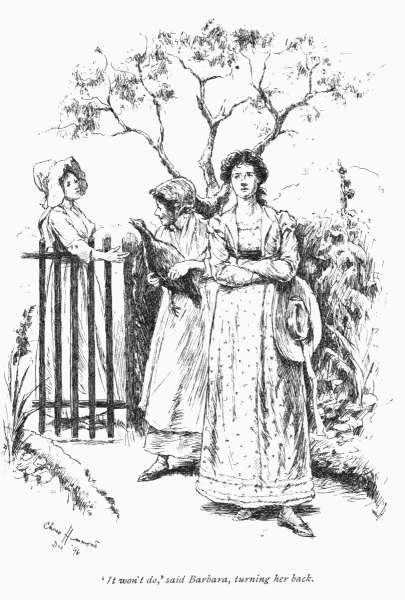
'It won't do,' said Barbara, turning her back.
'Barbara! ay; like father, like daughter,' cried Farmer Price, starting from the thoughtful attitude in which he had been fixed, and drawing his chair closer to his wife.
'You see something is amiss with me, wife—I'll tell you what it is.' As he lowered his voice, Susan, who was not sure that he wished she should hear what he was going to say, retired from behind his chair. 'Susan, don't go; sit you down here, my sweet Susan,' said he, making room for her upon his chair; 'I believe I was a little cross when I came in first to-night; but I had something to vex me, as you shall hear.
'About a fortnight ago, you know, wife,' continued he, 'there was a balloting in our town for the militia; now at that time I wanted but ten days of forty years of age; and the attorney told me I was a fool for not calling myself plump forty. But the truth is the truth, and it is what I think fittest to be spoken at all times come what will of it. So I was drawn for a militiaman; but when I thought how loth you and I would be to part, I was main glad to hear that I could get off by paying eight or nine guineas for a substitute—only I had not the nine guineas—for, you know, we had bad luck with our sheep this year, and they died away one after another—but that was no excuse, so I went to Attorney Case, and, with a power of difficulty, I got him to lend me the money; for which, to be sure, I gave him something, and left my lease of our farm with him, as he insisted upon it, by way of security for the loan. Attorney Case is too many for me. He has found what he calls a flaw in my lease; and the lease, he tells me, is not worth a farthing, and that he can turn us all out of our farm to-morrow if he pleases; and sure enough he will please; for I have thwarted him this day, and he swears he'll be revenged of me. Indeed, he has begun with me badly enough already. I'm not come to the worst part of my story yet——'
Here Farmer Price made a dead stop; and his wife and Susan looked up in his face, breathless with anxiety.
'It must come out,' said he, with a short sigh; 'I must leave you in three days, wife.'
'Must you?' said his wife, in a faint, resigned voice. 'Susan, love, open the window.' Susan ran to open the window, and then returned to support her mother's head. When she came a little to herself she sat up, begged that her husband would go on, and that nothing might be concealed from her. Her husband had no wish indeed to conceal anything from a wife he loved so well; but, firm as he was, and steady to his maxim, that the truth was the thing the fittest to be spoken at all times, his voice faltered, and it was with great difficulty that he brought himself to speak the whole truth at this moment.
The fact was this. Case met Farmer Price as he was coming home, whistling, from a new-ploughed field. The attorney had just dined at The Abbey. The Abbey was the family seat of an opulent baronet in the neighbourhood, to whom Mr. Case had been agent. The baronet died suddenly, and his estate and title devolved to a younger brother, who was now just arrived in the country, and to whom Mr. Case was eager to pay his court, in hopes of obtaining his favour. Of the agency he flattered himself that he was pretty secure; and he thought that he might assume a tone of command towards the tenants, especially towards one who was some guineas in debt, and in whose lease there was a flaw.
Accosting the farmer in a haughty manner, the attorney began with, 'So, Farmer Price, a word with you, if you please. Walk on here, man, beside my horse, and you'll hear me. You have changed your opinion, I hope, about that bit of land—that corner at the end of my garden?' 'As how, Mr. Case?' said the farmer. 'As how, man! Why, you said something about it's not belonging to me, when you heard me talk of enclosing it the other day.' 'So I did,' said Price, 'and so I do.'
Provoked and astonished at the firm tone in which these words were pronounced, the attorney was upon the point of swearing that he would have his revenge; but, as his passions were habitually attentive to the letter of the law, he refrained from any hasty expression, which might, he was aware, in a court of justice, be hereafter brought against him.
'My good friend, Mr. Price,' said he, in a soft voice, and pale with suppressed rage. He forced a smile. 'I'm under the necessity of calling in the money I lent you some time ago, and you will please to take notice that it must be paid to-morrow morning. I wish you a good evening. You have the money ready for me, I daresay.'
'No,' said the farmer, 'not a guinea of it; but John Simpson, who was my substitute, has not left our village yet. I'll get the money back from him, and go myself, if so be it must be so, into the militia—so I will.'
The attorney did not expect such a determination, and he represented, in a friendly, hypocritical tone to Price, that he had no wish to drive him to such an extremity; that it would be the height of folly in him to run his head against a wall for no purpose. 'You don't mean to take the corner into your own garden, do you, Price?' said he. 'I,' said the farmer, 'God forbid! it's none of mine; I never take what does not belong to me.' 'True, right, very proper, of course,' said Mr. Case; 'but then you have no interest in life in the land in question?' 'None.' 'Then why so stiff about it, Price? All I want of you to say——' 'To say that black is white, which I won't do, Mr. Case. The ground is a thing not worth talking of; but it's neither yours nor mine. In my memory, since the new lane was made, it has always been open to the parish; and no man shall enclose it with my good-will. Truth is truth, and must be spoken; justice is justice, and should be done, Mr. Attorney.'
'And law is law, Mr. Farmer, and shall have its course, to your cost,' cried the attorney, exasperated by the dauntless spirit of this village Hampden.
Here they parted. The glow of enthusiasm, the pride of virtue, which made our hero brave, could not render him insensible. As he drew nearer home, many melancholy thoughts pressed upon his heart. He passed the door of his own cottage with resolute steps, however, and went through the village in search of the man who had engaged to be his substitute. He found him, told him how the matter stood; and luckily the man, who had not yet spent the money, was willing to return it; as there were many others drawn for the militia, who, he observed, would be glad to give him the same price, or more, for his services.
The moment Price got the money, he hastened to Mr. Case's house, walked straight forward into his room, and laying the money down upon his desk, 'There, Mr. Attorney, are your nine guineas; count them; now I have done with you.'
'Not yet,' said the attorney, jingling the money triumphantly in his hand. 'We'll give you a taste of the law, my good sir, or I'm mistaken. You forgot the flaw in your lease, which I have safe in this desk.'
'Ah, my lease,' said the farmer, who had almost forgot to ask for it till he was thus put in mind of it by the attorney's imprudent threat.
'Give me my lease, Mr. Case. I've paid my money; you have no right to keep the lease any longer, whether it is a bad one or a good one.'
'Pardon me,' said the attorney, locking his desk and putting the key into his pocket, 'possession, my honest friend,' cried he, striking his hand upon the desk, 'is nine points of the law. Good-night to you. I cannot in conscience return a lease to a tenant in which I know there is a capital flaw. It is my duty to show it to my employer; or, in other words, to your new landlord, whose agent I have good reasons to expect I shall be. You will live to repent your obstinacy, Mr. Price. Your servant, sir.'
Price retired with melancholy feelings, but not intimidated. Many a man returns home with a gloomy countenance, who has not quite so much cause for vexation.
When Susan heard her father's story, she quite forgot her guinea-hen, and her whole soul was intent upon her poor mother, who, notwithstanding her utmost exertion, could not support herself under this sudden stroke of misfortune.
In the middle of the night Susan was called up; her mother's fever ran high for some hours; but towards morning it abated, and she fell into a soft sleep with Susan's hand locked fast in hers.
Susan sat motionless, and breathed softly, lest she should disturb her. The rushlight, which stood beside the bed, was now burnt low; the long shadow of the tall wicker chair flitted, faded, appeared, and vanished, as the flame rose and sank in the socket. Susan was afraid that the disagreeable smell might waken her mother; and, gently disengaging her hand, she went on tiptoe to extinguish the candle. All was silent: the gray light of the morning was now spreading over every object; the sun rose slowly, and Susan stood at the lattice window, looking through the small leaded, crossbarred panes at the splendid spectacle. A few birds began to chirp; but, as Susan was listening to them, her mother started in her sleep, and spoke unintelligibly. Susan hung up a white apron before the window to keep out the light, and just then she heard the sound of music at a distance in the village. As it approached nearer, she knew that it was Philip playing upon his pipe and tabor. She distinguished the merry voices of her companions 'carolling in honour of the May,' and soon she saw them coming towards her father's cottage, with branches and garlands in their hands. She opened quick, but gently, the latch of the door, and ran out to meet them.
'Here she is!—here's Susan!' they exclaimed joyfully. 'Here's the Queen of the May.' 'And here's her crown!' cried Rose, pressing forward; but Susan put her finger upon her lips, and pointed to her mother's window. Philip's pipe stopped instantly.
'Thank you,' said Susan, 'my mother is ill; I can't leave her, you know.' Then gently putting aside the crown, her companions bid her say who should wear it for her.
'Will you, dear Rose?' said she, placing the garland upon her friend's head. 'It's a charming May morning,' added she, with a smile; 'good-bye. We shan't hear your voices or the pipe when you have turned the corner into the village; so you need only stop till then, Philip.'
'I shall stop for all day,' said Philip; 'I've no mind to play any more.'
'Good-bye, poor Susan. It is a pity you can't come with us,' said all the children; and little Mary ran after Susan to the cottage door.
'I forgot to thank you,' said she, 'for the double cowslips; look how pretty they are, and smell how sweet the violets are in my bosom, and kiss me quick, for I shall be left behind.' Susan kissed the little breathless girl, and returned softly to the side of her mother's bed.
'How grateful that child is to me for a cowslip only! How can I be grateful enough to such a mother as this?' said Susan to herself, as she bent over her sleeping mother's pale countenance.
Her mother's unfinished knitting lay upon a table near the bed, and Susan sat down in her wicker arm-chair, and went on with the row, in the middle of which her hand stopped the preceding evening. 'She taught me to knit, she taught me everything that I know,' thought Susan, 'and the best of all, she taught me to love her, to wish to be like her.'
Her mother, when she awakened, felt much refreshed by her tranquil sleep, and observing that it was a delightful morning, said 'that she had been dreaming she heard music; but that the drum frightened her, because she thought it was the signal for her husband to be carried away by a whole regiment of soldiers, who had pointed their bayonets at him. But that was but a dream, Susan; I awoke, and knew it was a dream, and I then fell asleep, and have slept soundly ever since.'
How painful it is to awake to the remembrance of misfortune. Gradually as this poor woman collected her scattered thoughts, she recalled the circumstances of the preceding evening. She was too certain that she had heard from her husband's own lips the words, 'I must leave you in three days'; and she wished that she could sleep again, and think it all a dream.
'But he'll want, he'll want a hundred things,' said she, starting up. 'I must get his linen ready for him. I'm afraid it's very late. Susan, why did you let me lie so long?'
'Everything shall be ready, dear mother; only don't hurry yourself,' said Susan. And indeed her mother was ill able to bear any hurry, or to do any work this day. Susan's affectionate, dexterous, sensible activity was never more wanted, or more effectual. She understood so readily, she obeyed so exactly; and when she was left to her own discretion, judged so prudently, that her mother had little trouble and no anxiety in directing her. She said that Susan never did too little, or too much.
Susan was mending her father's linen, when Rose tapped softly at the window, and beckoned to her to come out. She went out. 'How does your mother do, in the first place?' said Rose. 'Better, thank you.' 'That's well, and I have a little bit of good news for you besides—here,' said she, pulling out a glove, in which there was money, 'we'll get the guinea-hen back again—we have all agreed about it. This is the money that has been given to us in the village this May morning. At every door they gave silver. See how generous they have been—twelve shillings, I assure you. Now we are a match for Miss Barbara. You won't like to leave home; I'll go to Barbara, and you shall see your guinea-hen in ten minutes.'
Rose hurried away, pleased with her commission, and eager to accomplish her business. Miss Barbara's maid, Betty, was the first person that was visible at the attorney's house. Rose insisted upon seeing Miss Barbara herself, and she was shown into a parlour to the young lady, who was reading a dirty novel, which she put under a heap of law papers as they entered.
'Dear, how you startled me! Is it only you?' said she to her maid; but as soon as she saw Rose behind the maid, she put on a scornful air. 'Could not ye say I was not at home, Betty? Well, my good girl, what brings you here? Something to borrow or beg, I suppose.'
May every ambassador—every ambassador in as good a cause—answer with as much dignity and moderation as Rose replied to Barbara upon the present occasion. She assured her that the person from whom she came did not send her either to beg or borrow; that she was able to pay the full value of that for which she came to ask; and, producing her well-filled purse, 'I believe that this is a very good shilling,' said she. 'If you don't like it, I will change it, and now you will be so good as to give me Susan's guinea-hen. It is in her name I ask for it.'
'No matter in whose name you ask for it,' replied Barbara, 'you will not have it. Take up your shilling, if you please. I would have taken a shilling yesterday, if it had been paid at the time properly; but I told Susan, that if it was not paid then, I should keep the hen, and so I shall, I promise her. You may go back, and tell her so.'
The attorney's daughter had, whilst Rose opened her negotiation, measured the depth of her purse with a keen eye; and her penetration discovered that it contained at least ten shillings. With proper management she had some hopes that the guinea-hen might be made to bring in at least half the money.
Rose, who was of a warm temper, not quite so fit a match as she had thought herself for the wily Barbara, incautiously exclaimed, 'Whatever it costs us, we are determined to have Susan's favourite hen; so, if one shilling won't do, take two; and if two won't do, why, take three.'
The shillings sounded provoking upon the table, as she threw them down one after another, and Barbara coolly replied, 'Three won't do.' 'Have you no conscience, Miss Barbara? Then take four.' Barbara shook her head. A fifth shilling was instantly proffered; but Bab, who now saw plainly that she had the game in her own hands, preserved a cold, cruel silence. Rose went on rapidly, bidding shilling after shilling, till she had completely emptied her purse. The twelve shillings were spread upon the table. Barbara's avarice was moved; she consented for this ransom to liberate her prisoner.
Rose pushed the money towards her; but just then, recollecting that she was acting for others more than for herself, and doubting whether she had full powers to conclude such an extravagant bargain, she gathered up the public treasure, and with newly-recovered prudence observed that she must go back to consult her friends. Her generous little friends were amazed at Barbara's meanness, but with one accord declared that they were most willing, for their parts, to give up every farthing of the money. They all went to Susan in a body, and told her so. 'There's our purse,' said they; 'do what you please with it.' They would not wait for one word of thanks, but ran away, leaving only Rose with her to settle the treaty for the guinea-hen.
There is a certain manner of accepting a favour, which shows true generosity of mind. Many know how to give, but few know how to accept a gift properly. Susan was touched, but not astonished, by the kindness of her young friends, and she received the purse with as much simplicity as she would have given it.
'Well,' said Rose, 'shall I go back for the guinea-hen?' 'The guinea-hen!' said Susan, starting from a reverie into which she had fallen, as she contemplated the purse. 'Certainly I do long to see my pretty guinea-hen once more; but I was not thinking of her just then—I was thinking of my father.'
Now Susan had heard her mother often, in the course of this day, wish that she had but money enough in the world to pay John Simpson for going to serve in the militia instead of her husband. 'This, to be sure, will go but a little way,' thought Susan; 'but still it may be of some use to my father.' She told her mind to Rose, and concluded by saying, decidedly, that 'if the money was given to her to dispose of as she pleased, she would give it to her father.'
'It is all yours, my dear good Susan,' cried Rose, with a look of warm approbation. 'This is so like you!—but I'm sorry that Miss Bab must keep your guinea-hen. I would not be her for all the guinea-hens, or guineas either, in the whole world. Why, I'll answer for it, the guinea-hen won't make her happy, and you'll be happy even without; because you are good. Let me come and help you to-morrow,' continued she, looking at Susan's work, 'if you have any more mending work to do—I never liked work till I worked with you. I won't forget my thimble or my scissors,' added she, laughing—'though I used to forget them when I was a giddy girl. I assure you I am a great hand at my needle, now—try me.'
Susan assured her friend that she did not doubt the powers of her needle, and that she would most willingly accept of her services, but that unluckily she had finished all her needlework that was immediately wanted.
'But do you know,' said she, 'I shall have a great deal of business to-morrow; but I won't tell you what it is that I have to do, for I am afraid I shall not succeed; but if I do succeed, I'll come and tell you directly, because you will be so glad of it.'
Susan, who had always been attentive to what her mother taught her, and who had often assisted her when she was baking bread and cakes for the family at the Abbey, had now formed the courageous, but not presumptuous, idea that she could herself undertake to bake a batch of bread. One of the servants from the Abbey had been sent all round the village in the morning in search of bread, and had not been able to procure any that was tolerable. Mrs. Price's last baking failed for want of good barm. She was not now strong enough to attempt another herself; and when the brewer's boy came with eagerness to tell her that he had some fine fresh yeast, she thanked him, but sighed, and said it would be of no use to her. Accordingly she went to work with much prudent care, and when her bread the next morning came out of the oven, it was excellent; at least her mother said so, and she was a good judge. It was sent to the Abbey; and as the family there had not tasted any good bread since their arrival in the country, they also were earnest and warm in its praise. Inquiries were made from the housekeeper, and they heard, with some surprise, that this excellent bread was made by a young girl only twelve years old.
The housekeeper, who had known Susan from a child, was pleased to have an opportunity in speaking in her favour. 'She is the most industrious little creature, ma'am, in the world,' said she to her mistress. 'Little I can't so well call her now, since she's grown tall and slender to look at; and glad I am she is grown up likely to look at; for handsome is that handsome does; she thinks no more of her being handsome than I do myself; yet she has as proper a respect for herself, ma'am, as you have; and I always see her neat, and with her mother, ma'am, or fit people, as a girl should be. As for her mother, she dotes upon her, as well she may; for I should myself if I had half such a daughter; and then she has two little brothers; and she's as good to them, and, my boy Philip says, taught 'em to read more than the schoolmistress, all with tenderness and good nature; but I beg your pardon, ma'am, I cannot stop myself when I once begin to talk of Susan.'
'You have really said enough to excite my curiosity,' said her mistress; 'pray send for her immediately; we can see her before we go out to walk.'
The benevolent housekeeper despatched her boy Philip for Susan, who never happened to be in such an untidy state as to be unable to obey a summons without a long preparation. She had, it is true, been very busy; but orderly people can be busy and neat at the same time. She put on her usual straw hat, and accompanied Rose's mother, who was going with a basket of cleared muslin to the Abbey.
The modest simplicity of Susan's appearance, and the artless good sense and propriety of the answers she gave to all the questions that were asked her, pleased the ladies at the Abbey, who were good judges of character and manners.
Sir Arthur Somers had two sisters, sensible, benevolent women. They were not of that race of fine ladies who are miserable the moment they come to the country; nor yet were they of that bustling sort, who quack and direct all their poor neighbours, for the mere love of managing, or the want of something to do. They were judiciously generous; and whilst they wished to diffuse happiness, they were not peremptory in requiring that people should be happy precisely their own way. With these dispositions, and with a well-informed brother, who, though he never wished to direct, was always willing to assist in their efforts to do good, there were reasonable hopes that these ladies would be a blessing to the poor villagers amongst whom they were now settled.
As soon as Miss Somers had spoken to Susan, she inquired for her brother; but Sir Arthur was in his study, and a gentleman was with him on business.
Susan was desirous of returning to her mother, and the ladies therefore would not detain her. Miss Somers told her, with a smile, when she took leave, that she would call upon her in the evening at six o'clock.
It was impossible that such a grand event as Susan's visit to the Abbey could long remain unknown to Barbara Case and her gossiping maid. They watched eagerly for the moment of her return, that they might satisfy their curiosity. 'There she is, I declare, just come into her garden,' cried Bab; 'I'll run in and get it all out of her in a minute.'
Bab could descend, without shame, whenever it suited her purposes, from the height of insolent pride to the lowest meanness of fawning familiarity.
Susan was gathering some marigolds and some parsley for her mother's broth.
'So, Susan,' said Bab, who came close up to her before she perceived it, 'how goes the world with you to-day?' 'My mother is rather better to-day, she says, ma'am—thank you,' replies Susan, coldly but civilly. 'Ma'am! dear, how polite we are grown of a sudden!' cried Bab, winking at her maid. 'One may see you've been in good company this morning—hey, Susan? Come, let's hear about it.' 'Did you see the ladies themselves, or was it only the housekeeper sent for you?' said the maid. 'What room did you go into?' continued Bab. 'Did you see Miss Somers, or Sir Arthur?' 'Miss Somers.' 'La! she saw Miss Somers! Betty, I must hear about it. Can't you stop gathering those things for a minute and chat a bit with us, Susan?' 'I can't stay, indeed, Miss Barbara; for my mother's broth is just wanted, and I'm in a hurry.' Susan ran home.
'Lord, her head is full of broth now,' said Bab to her maid; 'and she has not a word for herself, though she has been abroad. My papa may well call her Simple Susan; for simple she is, and simple she will be, all the world over. For my part, I think she's little better than a downright simpleton. But, however, simple or not, I'll get what I want out of her. She'll be able to speak, maybe, when she has settled the grand matter of the broth. I'll step in and ask to see her mother, that will put her in a good humour in a trice.'
Barbara followed Susan into the cottage, and found her occupied with the grand affair of the broth. 'Is it ready?' said Bab, peeping into the pot that was over the fire. 'Dear, how savoury it smells! I'll wait till you go in with it to your mother; for I must ask her how she does myself.' 'Will you please to sit down then, miss?' said Simple Susan, with a smile; for at this instant she forgot the guinea-hen; 'I have but just put the parsley into the broth; but it soon will be ready.'
During this interval Bab employed herself, much to her own satisfaction, in cross-questioning Susan. She was rather provoked indeed that she could not learn exactly how each of the ladies was dressed, and what there was to be for dinner at the Abbey; and she was curious beyond measure to find out what Miss Somers meant by saying that she would call at Mr. Price's cottage at six o'clock in the evening. 'What do you think she could mean?' 'I thought she meant what she said,' replied Susan, 'that she would come here at six o'clock.' 'Ay, that's as plain as a pike-staff,' said Barbara; 'but what else did she mean, think you? People, you know, don't always mean exactly, downright, neither more nor less than what they say.' 'Not always,' said Susan, with an arch smile, which convinced Barbara that she was not quite a simpleton. 'Not always,' repeated Barbara colouring,—'oh, then I suppose you have some guess at what Miss Somers meant.' 'No,' said Susan, 'I was not thinking about Miss Somers, when I said not always.' 'How nice that broth does look,' resumed Barbara, after a pause.
Susan had now poured the broth into a basin, and as she strewed over it the bright orange marigolds, it looked very tempting. She tasted it, and added now a little salt, and now a little more, till she thought it was just to her mother's taste. 'Oh, I must taste it,' said Bab, taking the basin up greedily. 'Won't you take a spoon?' said Susan, trembling at the large mouthfuls which Barbara sucked up with a terrible noise. 'Take a spoonful, indeed!' exclaimed Barbara, setting down the basin in high anger. 'The next time I taste your broth you shall affront me, if you dare! The next time I set my foot in this house, you shall be as saucy to me as you please.' And she flounced out of the house, repeating 'Take a spoon, pig, was what you meant to say.'
Susan stood in amazement at the beginning of this speech; but the concluding words explained to her the mystery.
Some years before this time, when Susan was a very little girl, and could scarcely speak plain, as she was eating a basin of bread and milk for her supper at the cottage door, a great pig came up and put his nose into the basin. Susan was willing that the pig should have some share of the bread and milk; but as she ate with a spoon and he with his large mouth, she presently discovered that he was likely to have more than his share; and in a simple tone of expostulation she said to him, 'Take a poon, pig.'7 The saying became proverbial in the village. Susan's little companions repeated it, and applied it upon many occasions, whenever any one claimed more than his share of anything good. Barbara, who was then not Miss Barbara, but plain Bab, and who had played with all the poor children in the neighbourhood, was often reproved in her unjust methods of division by Susan's proverb. Susan, as she grew up, forgot the childish saying; but the remembrance of it rankled in Barbara's mind, and it was to this that she suspected Susan had alluded, when she recommended a spoon to her, whilst she was swallowing the basin of broth.
'La, miss,' said Barbara's maid, when she found her mistress in a passion upon her return from Susan's, 'I only wondered you did her the honour to set your foot within her doors. What need have you to trouble her for news about the Abbey folks, when your own papa has been there all the morning, and is just come in, and can tell you everything?'
Barbara did not know that her father meant to go to the Abbey that morning, for Attorney Case was mysterious even to his own family about his morning rides. He never chose to be asked where he was going, or where he had been; and this made his servants more than commonly inquisitive to trace him.
Barbara, against whose apparent childishness and real cunning he was not sufficiently on his guard, had often the art of drawing him into conversation about his visits. She ran into her father's parlour; but she knew, the moment she saw his face, that it was no time to ask questions; his pen was across his mouth, and his brown wig pushed oblique upon his contracted forehead. The wig was always pushed crooked whenever he was in a brown, or rather a black, study. Barbara, who did not, like Susan, bear with her father's testy humour from affection and gentleness of disposition, but who always humoured him from artifice, tried all her skill to fathom his thoughts, and when she found that it would not do, she went to tell her maid so, and to complain that her father was so cross there was no bearing him.
It is true that Attorney Case was not in the happiest mood possible; for he was by no means satisfied with his morning's work at the Abbey. Sir Arthur Somers, the new man, did not suit him, and he began to be rather apprehensive that he should not suit Sir Arthur. He had sound reasons for his doubts.
Sir Arthur Somers was an excellent lawyer, and a perfectly honest man. This seemed to our attorney a contradiction in terms; in the course of his practice the case had not occurred; and he had no precedents ready to direct his proceedings. Sir Arthur was also a man of wit and eloquence, yet of plain dealing and humanity. The attorney could not persuade himself to believe that his benevolence was anything but enlightened cunning, and his plain dealing he one minute dreaded as the masterpiece of art, and the next despised as the characteristic of folly. In short, he had not yet decided whether he was an honest man or a knave. He had settled accounts with him for his late agency, and had talked about sundry matters of business. He constantly perceived, however, that he could not impose upon Sir Arthur; but the idea that he could know all the mazes of the law, and yet prefer the straight road, was incomprehensible.
Mr. Case having paid Sir Arthur some compliments on his great legal abilities, and his high reputation at the bar, he coolly replied, 'I have left the bar.' The attorney looked in unfeigned astonishment that a man who was actually making £3000 per annum at the bar should leave it.
7 This is a true anecdote.
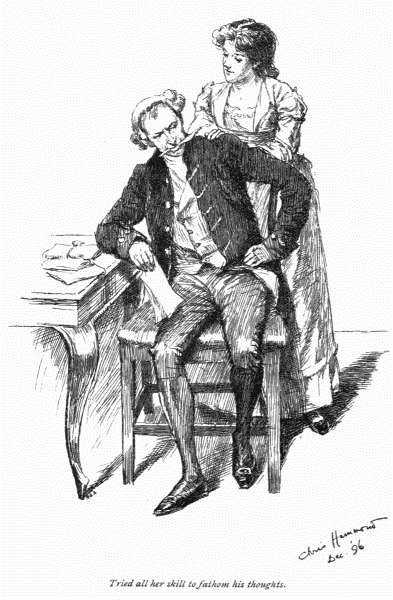
Tried all her skill to fathom his thoughts.
'I am come,' said Sir Arthur, 'to enjoy that kind of domestic life in the country which I prefer to all others, and amongst people whose happiness I hope to increase.' At this speech the attorney changed his ground, flattering himself that he should find his man averse to business, and ignorant of country affairs. He talked of the value of land, and of new leases.
Sir Arthur wished to enlarge his domain, and to make a ride round it. A map of it was lying upon the table, and Farmer Price's garden came exactly across the new road for the ride. Sir Arthur looked disappointed; and the keen attorney seized the moment to inform him that 'Price's whole land was at his disposal.'
'At my disposal! how so?' cried Sir Arthur, eagerly; 'it will not be out of lease, I believe, these ten years. I'll look into the rent-roll again; perhaps I am mistaken.'
'You are mistaken, my good sir, and you are not mistaken,' said Mr. Case, with a shrewd smile. 'In one sense, the land will not be out of lease these ten years, and in another it is out of lease at this present time. To come to the point at once, the lease is, ab origine, null and void. I have detected a capital flaw in the body of it. I pledge my credit upon it, sir, it can't stand a single term in law or equity.'
The attorney observed that at these words Sir Arthur's eye was fixed with a look of earnest attention. 'Now I have him,' said the cunning tempter to himself.
'Neither in law nor equity,' repeated Sir Arthur, with apparent incredulity. 'Are you sure of that, Mr. Case?' 'Sure! As I told you before, sir, I'd pledge my whole credit upon the thing—I'd stake my existence.' 'That's something,' said Sir Arthur, as if he was pondering upon the matter.
The attorney went on with all the eagerness of a keen man, who sees a chance at one stroke of winning a rich friend and of ruining a poor enemy. He explained, with legal volubility and technical amplification, the nature of the mistake in Mr. Price's lease. 'It was, sir,' said he, 'a lease for the life of Peter Price, Susanna his wife, and to the survivor or survivors of them, or for the full time and term of twenty years, to be computed from the first day of May then next ensuing. Now, sir, this, you see, is a lease in reversion, which the late Sir Benjamin Somers had not, by his settlement, a right to make. This is a curious mistake, you see, Sir Arthur; and in filling up those printed leases there's always a good chance of some flaw. I find it perpetually; but I never found a better than this in the whole course of my practice.'
Sir Arthur stood in silence.
'My dear sir,' said the attorney, taking him by the button, 'you have no scruple of stirring in this business?'
'A little,' said Sir Arthur.
'Why, then, that can be done away in a moment. Your name shall not appear in it at all. You have nothing to do but to make over the lease to me. I make all safe to you with my bond. Now, being in possession, I come forward in my own proper person. Shall I proceed?'
'No—you have said enough,' replied Sir Arthur.
'The case, indeed, lies in a nutshell,' said the attorney, who had by this time worked himself up to such a pitch of professional enthusiasm that, intent upon his vision of a lawsuit, he totally forgot to observe the impression his words made upon Sir Arthur.
'There's only one thing we have forgotten all this time,' said Sir Arthur. 'What can that be, sir?' 'That we shall ruin this poor man.'
Case was thunderstruck at these words, or rather, by the look which accompanied them. He recollected that he had laid himself open before he was sure of Sir Arthur's real character. He softened, and said he should have had certainly more consideration in the case of any but a litigious, pig-headed fellow, as he knew Price to be.
'If he be litigious,' said Sir Arthur, 'I shall certainly be glad to get him fairly out of the parish as soon as possible. When you go home, you will be so good, sir, as to send me his lease, that I may satisfy myself before we stir in this business.'
The attorney, brightening up, prepared to take leave; but he could not persuade himself to take his departure without making one push at Sir Arthur about the agency.
'I will not trouble you, Sir Arthur, with this lease of Price's,' said Case; 'I'll leave it with your agent. Whom shall I apply to?' 'To myself, sir, if you please,' replied Sir Arthur.
The courtiers of Louis the Fourteenth could not have looked more astounded than our attorney, when they received from their monarch a similar answer. It was this unexpected reply of Sir Arthur's which had deranged the temper of Mr. Case, and caused his wig to stand so crooked upon his forehead, and which had rendered him impenetrably silent to his inquisitive daughter Barbara.
After having walked up and down his room, conversing with himself, for some time, the attorney concluded that the agency must be given to somebody when Sir Arthur should have to attend his duty in Parliament; that the agency, even for the winter season, was not a thing to be neglected; and that, if he managed well, he might yet secure it for himself. He had often found that small timely presents worked wonderfully upon his own mind, and he judged of others by himself. The tenants had been in the reluctant but constant practice of making him continual petty offerings; and he resolved to try the same course with Sir Arthur, whose resolution to be his own agent, he thought, argued a close, saving, avaricious disposition. He had heard the housekeeper at the Abbey inquiring, as he passed through the servants, whether there was any lamb to be gotten. She said that Sir Arthur was remarkably fond of lamb, and that she wished she could get a quarter for him. Immediately he sallied into his kitchen, as soon as the idea struck him, and asked a shepherd, who was waiting there, whether he knew of a nice fat lamb to be had anywhere in the neighbourhood.
'I know of one,' cried Barbara. 'Susan Price has a pet lamb that's as fat as fat could be.' The attorney easily caught at these words, and speedily devised a scheme for obtaining Susan's lamb for nothing.
It would be something strange if an attorney of his talents and standing was not an over-match for Simple Susan. He prowled forth in search of his prey. He found Susan packing up her father's little wardrobe; and when she looked up as she knelt, he saw that she had been in tears.
'How is your mother to-day, Susan?' inquired the attorney. 'Worse, sir. My father goes to-morrow.' 'That's a pity.' 'It can't be helped,' said Susan, with a sigh. 'It can't be helped—how do you know that?' said Case. 'Sir, dear sir!' cried she, looking up at him, and a sudden ray of hope beamed in her ingenuous countenance. 'And if you could help it, Susan?' said he. Susan clasped her hands in silence, more expressive than words. 'You can help it, Susan.' She started up in an ecstasy. 'What would you give now to have your father at home for a whole week longer?' 'Anything!—but I have nothing.' 'Yes, but you have, a lamb,' said the hard-hearted attorney. 'My poor little lamb!' said Susan; 'but what can that do?' 'What good can any lamb do? Is not lamb good to eat? Why do you look so pale, girl? Are not sheep killed every day, and don't you eat mutton? Is your lamb better than anybody else's, think you?' 'I don't know,' said Susan, 'but I love it better.' 'More fool you,' said he. 'It feeds out of hand, it follows me about; I have always taken care of it; my mother gave it to me.' 'Well, say no more about it, then,' he cynically observed; 'if you love your lamb better than both your father and your mother, keep it, and good morning to you.'
'Stay, oh stay!' cried Susan, catching the skirt of his coat with an eager, trembling hand;—'a whole week, did you say? My mother may get better in that time. No, I do not love my lamb half so well.' The struggle of her mind ceased, and with a placid countenance and calm voice, 'Take the lamb,' said she. 'Where is it?' said the attorney. 'Grazing in the meadow, by the river-side.' 'It must be brought up before nightfall for the butcher, remember.' 'I shall not forget it,' said Susan, steadily.
As soon, however, as her persecutor turned his back and quitted the house, Susan sat down and hid her face in her hands. She was soon aroused by the sound of her mother's feeble voice, who was calling Susan from the inner room where she lay. Susan went in, but did not undraw the curtain as she stood beside the bed.
'Are you there, love? Undraw the curtain, that I may see you, and tell me;—I thought I heard some strange voice just now talking to my child. Something's amiss, Susan,' said her mother, raising herself as well as she was able in the bed, to examine her daughter's countenance.
'Would you think it amiss, then, my dear mother,' said Susan, stooping to kiss her—'would you think it amiss, if my father was to stay with us a week longer?' 'Susan! you don't say so?' 'He is, indeed, a whole week;—but how burning hot your hand is still.' 'Are you sure he will stay?' inquired her mother. 'How do you know? Who told you so? Tell me all quick.' 'Attorney Case told me so; he can get him a week's longer leave of absence, and he has promised he will.' 'God bless him for it, for ever and ever!' said the poor woman, joining her hands. 'May the blessing of heaven be with him!'
Susan closed the curtains, and was silent. She could not say Amen. She was called out of the room at this moment, for a messenger was come from the Abbey for the bread-bills. It was she who always made out the bills, for though she had not a great number of lessons from the writing-master, she had taken so much pains to learn that she could write a very neat, legible hand, and she found this very useful. She was not, to be sure, particularly inclined to draw out a long bill at this instant, but business must be done. She set to work, ruled her lines for the pounds, shillings, and pence, made out the bill for the Abbey, and despatched the impatient messenger. She then resolved to make out all the bills for the neighbours, who had many of them taken a few loaves and rolls of her baking. 'I had better get all my business finished,' said she to herself, 'before I go down to the meadow to take leave of my poor lamb.'
This was sooner said than done, for she found that she had a great number of bills to write, and the slate on which she had entered the account was not immediately to be found, and when it was found the figures were almost rubbed out. Barbara had sat down upon it. Susan pored over the number of loaves, and the names of the persons who took them; and she wrote and cast up sums, and corrected and re-corrected them, till her head grew quite puzzled.
The table was covered with little square bits of paper, on which she had been writing bills over and over again, when her father came in with a bill in his hand. 'How's this, Susan?' said he. 'How can ye be so careless, child? What is your head running upon? Here, look at the bill you were sending up to the Abbey? I met the messenger, and luckily asked to see how much it was. Look at it.'
Susan looked and blushed; it was written, 'Sir Arthur Somers, to John Price, debtor, six dozen lambs, so much.' She altered it, and returned it to her father; but he had taken up some of the papers which lay upon the table. 'What are all these, child?' 'Some of them are wrong, and I've written them out again,' said Susan. 'Some of them! All of them, I think, seem to be wrong, if I can read,' said her father, rather angrily, and he pointed out to her sundry strange mistakes. Her head, indeed, had been running upon her poor lamb. She corrected all the mistakes with so much patience, and bore to be blamed with so much good humour, that her father at last said that it was impossible ever to scold Susan, without being in the wrong at the last.
As soon as all was set right, Price took the bills, and said he would go round to the neighbours and collect the money himself; for that he should be very proud to have it to say to them that it was all earned by his own little daughter.
Susan resolved to keep the pleasure of telling him of his week's reprieve till he should come home to sup, as he had promised to do, in her mother's room. She was not sorry to hear him sigh as he passed the knapsack, which she had been packing up for his journey. 'How delighted he will be when he hears the good news!' said she to herself; 'but I know he will be a little sorry too for my poor lamb.'
As Susan had now settled all her business, she thought she could have time to go down to the meadow by the river-side to see her favourite; but just as she had tied on her straw hat the village clock struck four, and this was the hour at which she always went to fetch her little brothers home from a dame-school near the village. She knew that they would be disappointed if she was later than usual, and she did not like to keep them waiting, because they were very patient, good boys; so she put off the visit to her lamb, and went immediately for her brothers.
CHAPTER II
Evn in the spring and playtime of the year,
That calls th' unwonted villager abroad,
With all her little ones, a sportive train,
To gather kingcups in the yellow mead,
And prink their heads with daisies.
Cowper.
The dame-school, which was about a mile from the hamlet, was not a showy edifice: but it was reverenced as much by the young race of village scholars as if it had been the most stately mansion in the land; it was a low-roofed, long, thatched tenement, sheltered by a few reverend oaks, under which many generations of hopeful children had gambolled in their turn.
The close-shaven green, which sloped down from the hatch-door of the schoolroom, was paled round with a rude paling, which, though decayed in some parts by time, was not in any place broken by violence.
The place bespoke order and peace. The dame who governed was well obeyed, because she was just and well beloved, and because she was ever glad to give well-earned praise and pleasure to her little subjects.
Susan had once been under her gentle dominion, and had been deservedly her favourite scholar. The dame often cited her as the best example to the succeeding tribe of emulous youngsters. She had scarcely opened the wicket which separated the green before the schoolroom door from the lane, when she heard the merry voices of the children, and saw the little troup issuing from the hatchway and spreading over the green.
'Oh, there's Susan!' cried her two little brothers, running, leaping, and bounding up to her; and many of the other rosy girls and boys crowded round her, to talk of their plays; for Susan was easily interested in all that made others happy; but she could not make them comprehend that, if they all spoke at once, it was not possible that she could hear what was said.
The voices were still raised one above another, all eager to establish some important observation about ninepins, or marbles, or tops, or bows and arrows, when suddenly music was heard and the crowd was silenced. The music seemed to be near the spot where the children were standing, and they looked round to see whence it could come. Susan pointed to the great oak tree, and they beheld, seated under its shade, an old man playing upon his harp. The children all approached—at first timidly, for the sounds were solemn; but as the harper heard their little footsteps coming towards him, he changed his hand and played one of his most lively tunes. The circle closed, and pressed nearer and nearer to him; some who were in the foremost row whispered to each other, 'He is blind!' 'What a pity!' and 'He looks very poor,—what a ragged coat he wears!' said others. 'He must be very old, for all his hair is white: and he must have travelled a great way, for his shoes are quite worn out,' observed another.
All these remarks were made whilst he was tuning his harp, for when he once more began to play, not a word was uttered. He seemed pleased by their simple exclamations of wonder and delight, and, eager to amuse his young audience, he played now a gay and now a pathetic air, to suit their several humours.
Susan's voice, which was soft and sweet, expressive of gentleness and good nature, caught his ear the moment she spoke. He turned his face eagerly to the place where she stood; and it was observed that, whenever she said that she liked any tune particularly, he played it over again.
'I am blind,' said the old man, 'and cannot see your faces; but I know you all asunder by your voices, and I can guess pretty well at all your humours and characters by your voices.'
'Can you so, indeed?' cried Susan's little brother William, who had stationed himself between the old man's knees. 'Then you heard my sister Susan speak just now. Can you tell us what sort of person she is?' 'That I can, I think, without being a conjurer,' said the old man, lifting the boy up on his knee; 'your sister Susan is good-natured.' The boy clapped his hands. 'And good-tempered.' 'Right,' said little William, with a louder clap of applause. 'And very fond of the little boy who sits upon my knee.' 'O right! right! quite right!' exclaimed the child, and 'quite right' echoed on all sides.
'But how came you to know so much, when you are blind?' said William, examining the old man attentively.
'Hush,' said John, who was a year older than his brother, and very sage, 'you should not put him in mind of his being blind.'
'Though I am blind,' said the harper, 'I can hear, you know, and I heard from your sister herself all that I told you of her, that she was good-tempered and good-natured and fond of you.' 'Oh, that's wrong—you did not hear all that from herself, I'm sure,' said John, 'for nobody ever hears her praising herself.' 'Did not I hear her tell you,' said the harper, 'when you first came round me, that she was in a great hurry to go home, but that she would stay a little while, since you wished it so much? Was not that good-natured? And when you said you did not like the tune she liked best, she was not angry with you, but said, "Then play William's first, if you please,"—was not that good-tempered?' 'Oh,' interrupted William, 'it's all true; but how did you find out that she was fond of me?' 'That is such a difficult question,' said the harper, 'that I must take time to consider.' The harper tuned his instrument, as he pondered, or seemed to ponder; and at this instant two boys who had been searching for birds' nests in the hedges, and who had heard the sound of the harp, came blustering up, and pushing their way through the circle, one of them exclaimed, 'What's going on here? Who are you, my old fellow? A blind harper! Well, play us a tune, if you can play ever a good one—play me—let's see, what shall he play, Bob?' added he, turning to his companion. 'Bumper Squire Jones.'
The old man, though he did not seem quite pleased with the peremptory manner of the request, played, as he was desired, 'Bumper Squire Jones'; and several other tunes were afterwards bespoke by the same rough and tyrannical voice.
The little children shrank back in timid silence, and eyed the brutal boy with dislike. This boy was the son of Attorney Case; and as his father had neglected to correct his temper when he was a child, as he grew up it became insufferable. All who were younger and weaker than himself dreaded his approach, and detested him as a tyrant.
When the old harper was so tired that he could play no more, a lad, who usually carried his harp for him, and who was within call, came up, and held his master's hat to the company, saying, 'Will you be pleased to remember us?' The children readily produced their halfpence, and thought their wealth well bestowed upon this poor, good-natured man, who had taken so much pains to entertain them, better even than upon the gingerbread woman, whose stall they loved to frequent. The hat was held some time to the attorney's son before he chose to see it. At last he put his hand surlily into his waistcoat pocket and pulled out a shilling. There were sixpennyworth of halfpence in the hat. 'I'll take these halfpence,' said he, 'and here's a shilling for you.'
'God bless you, sir,' said the lad; but as he took the shilling, which the young gentleman had slily put into the blind man's hand, he saw that it was not worth one farthing. 'I am afraid it is not good, sir,' said the lad, whose business it was to examine the money for his master. 'I am afraid, then, you'll get no other,' said young Case, with an insulting laugh. 'It never will do, sir,' persisted the lad; 'look at it yourself; the edges are all yellow! you can see the copper through it quite plain. Sir, nobody will take it from us.' 'That's your affair,' said the brutal boy, pushing away his hand. 'You may pass it, you know, as well as I do, if you look sharp. You have taken it from me, and I shan't take it back again, I promise you.'
A whisper of 'that's very unjust,' was heard. The little assembly, though under evident constraint, could no longer suppress their indignation.
'Who says it's unjust?' cried the tyrant sternly, looking down upon his judges.
Susan's little brothers had held her gown fast, to prevent her from moving at the beginning of this contest, and she was now so much interested to see the end of it, that she stood still, without making any resistance.
'Is any one here amongst yourselves a judge of silver?' said the old man. 'Yes, here's the butcher's boy,' said the attorney's son; 'show it to him.' He was a sickly-looking boy, and of a remarkably peaceful disposition. Young Case fancied that he would be afraid to give judgment against him. However, after some moments' hesitation, and after turning the shilling round several times, he pronounced, 'that, as far as his judgment went, but he did not pretend to be a downright certain sure of it, the shilling was not over and above good.' Then turning to Susan, to screen himself from manifest danger, for the attorney's son looked upon him with a vengeful mien, 'But here's Susan here, who understands silver a great deal better than I do; she takes a power of it for bread, you know.'
'I'll leave it to her,' said the old harper; 'if she says the shilling is good, keep it, Jack.' The shilling was handed to Susan, who, though she had with becoming modesty forborne all interference, did not hesitate, when she was called upon, to speak the truth: 'I think that this shilling is a bad one,' said she; and the gentle but firm tone in which she pronounced the words for a moment awed and silenced the angry and brutal boy. 'There's another, then,' cried he; 'I have sixpences and shillings too in plenty, thank my stars.'
Susan now walked away with her two little brothers, and all the other children separated to go to their several homes. The old harper called to Susan, and begged that, if she was going towards the village, she would be so kind as to show him the way. His lad took up his harp, and little William took the old man by the hand. 'I'll lead him, I can lead him,' said he; and John ran on before them, to gather kingcups in the meadow.
There was a small rivulet which they had to cross, and as a plank which served for a bridge over it was rather narrow, Susan was afraid to trust the old blind man to his little conductor; she therefore went on the tottering plank first herself, and then led the old harper carefully over. They were now come to a gate, which opened upon the highroad to the village. 'There is the highroad straight before you,' said Susan to the lad, who was carrying his master's harp; 'you can't miss it. Now I must bid you a good evening; for I'm in a great hurry to get home, and must go the short way across the fields here, which would not be so pleasant for you, because of the stiles. Good-bye.' The old harper thanked her, and went along the highroad, whilst she and her brothers tripped on as fast as they could by the short way across the fields.
'Miss Somers, I am afraid, will be waiting for us,' said Susan. 'You know she said she would call at six; and by the length of our shadows I'm sure it is late.'
When they came to their own cottage door, they heard many voices, and they saw, when they entered, several ladies standing in the kitchen. 'Come in, Susan; we thought you had quite forsaken us,' said Miss Somers to Susan, who advanced timidly. 'I fancy you forgot that we promised to pay you a visit this evening; but you need not blush so much about the matter; there is no great harm done; we have only been here about five minutes; and we have been well employed in admiring your neat garden and your orderly shelves. Is it you, Susan, who keep these things in such nice order?' continued Miss Somers, looking round the kitchen.
Before Susan could reply, little William pushed forward and answered, 'Yes, ma'am, it is my sister Susan that keeps everything neat; and she always comes to school for us, too, which was what caused her to be so late.' 'Because as how,' continued John, 'she was loth to refuse us the hearing a blind man play on the harp. It was we kept her, and we hopes, ma'am, as you are—as you seem so good, you won't take it amiss.'
Miss Somers and her sister smiled at the affectionate simplicity with which Susan's little brothers undertook her defence, and they were, from this slight circumstance, disposed to think yet more favourably of a family which seemed so well united. They took Susan along with them through the village. Many neighbours came to their doors, and far from envying, they all secretly wished Susan well as she passed.
'I fancy we shall find what we want here,' said Miss Somers, stopping before a shop, where unfolded sheets of pins and glass buttons glistened in the window, and where rolls of many coloured ribbons appeared ranged in tempting order. She went in, and was rejoiced to see the shelves at the back of the counter well furnished with glossy tiers of stuffs, and gay, neat printed linens and calicoes.
'Now, Susan, choose yourself a gown,' said Miss Somers; 'you set an example of industry and good conduct, of which we wish to take public notice, for the benefit of others.'
The shopkeeper, who was father to Susan's friend Rose, looked much satisfied by this speech, and as if a compliment had been paid to himself, bowed low to Miss Somers, and then with alertness, which a London linendraper might have admired, produced piece after piece of his best goods to his young customer—unrolled, unfolded, held the bright stuffs and calendered calicoes in various lights. Now stretched his arm to the highest shelves, and brought down in a trice what seemed to be beyond the reach of any but a giant's arm; now dived into some hidden recess beneath the counter, and brought to light fresh beauties and fresh temptations.
Susan looked on with more indifference than most of the spectators. She was thinking much of her lamb, and more of her father.
Miss Somers had put a bright guinea into her hand, and had bid her pay for her own gown; but Susan, as she looked at the guinea, thought it was a great deal of money to lay out upon herself, and she wished, but did not know how to ask, that she might keep it for a better purpose.
Some people are wholly inattentive to the lesser feelings, and incapable of reading the countenances of those on whom they bestow their bounty. Miss Somers and her sister were not of this roughly charitable class.
'She does not like any of these things,' whispered Miss Somers to her sister. Her sister observed that Susan looked as if her thoughts were far distant from gowns.
'If you don't fancy any of these things,' said the civil shopkeeper to Susan, 'we shall have a new assortment of calicoes for the spring season soon from town.' 'Oh,' interrupted Susan, with a smile and a blush, 'these are all pretty, and too good for me, but——' 'But what, Susan?' said Miss Somers. 'Tell us what is passing in your little mind.' Susan hesitated. 'Well then, we will not press you, you are scarcely acquainted with us yet; when you are, you will not be afraid, I hope, to speak your mind. Put this shining yellow counter,' continued she, pointing to the guinea, 'in your pocket, and make what use of it you please. From what we know, and from what we have heard of you, we are persuaded that you will make a good use of it.'
'I think, madam,' said the master of the shop, with a shrewd, good-natured look, 'I could give a pretty good guess myself what will become of that guinea; but I say nothing.'
'No, that is right,' said Miss Somers; 'we leave Susan entirely at liberty; and now we will not detain her any longer. Good night, Susan, we shall soon come again to your neat cottage.' Susan curtsied, with an expressive look of gratitude, and with a modest frankness in her countenance which seemed to say, 'I would tell you, and welcome, what I want to do with the guinea; but I am not used to speak before so many people. When you come to our cottage again you shall know all.'
When Susan had departed, Miss Somers turned to the obliging shopkeeper, who was folding up all the things he had opened. 'You have had a great deal of trouble with us, sir,' said she; 'and since Susan will not choose a gown for herself, I must.' She selected the prettiest; and whilst the man was rolling it in paper, she asked him several questions about Susan and her family, which he was delighted to answer, because he had now an opportunity of saying as much as he wished in her praise.
'No later back, ma'am, than last May morning,' said he, 'as my daughter Rose was telling us, Susan did a turn, in her quiet way, by her mother, that would not displease you if you were to hear it. She was to have been Queen of the May, which in our little village, amongst the younger tribe, is a thing that is thought of a good deal; but Susan's mother was ill, and Susan, after sitting up with her all night, would not leave her in the morning, even when they brought the crown to her. She put the crown upon my daughter Rose's head with her own hands; and, to be sure, Rose loves her as well as if she was her own sister. But I don't speak from partiality; for I am no relation whatever to the Prices—only a well-wisher, as every one, I believe, who knows them is. I'll send the parcel up to the Abbey, shall I, ma'am?'
'If you please,' said Miss Somers, 'and, as soon as you receive your new things from town, let us know. You will, I hope, find us good customers and well-wishers,' added she, with a smile; 'for those who wish well to their neighbours surely deserve to have well-wishers themselves.'
A few words may encourage the benevolent passions, and may dispose people to live in peace and happiness; a few words may set them at variance, and may lead to misery and lawsuits. Attorney Case and Miss Somers were both equally convinced of this, and their practice was uniformly consistent with their principles.
But now to return to Susan. She put the bright guinea carefully into the glove with the twelve shillings which she had received from her companions on May day. Besides this treasure, she calculated that the amount of the bills for bread could not be less than eight or nine and thirty shillings; and as her father was now sure of a week's reprieve, she had great hopes that, by some means or other, it would be possible to make up the whole sum necessary to pay for a substitute. 'If that could but be done,' said she to herself, 'how happy would my mother be. She would be quite stout again, for she certainly is a great deal better since I told her that father would stay a week longer. Ah! but she would not have blessed Attorney Case, though, if she had known about my poor Daisy.'
Susan took the path that led to the meadow by the water-side, resolved to go by herself and take leave of her innocent favourite. But she did not pass by unperceived. Her little brothers were watching for her return, and as soon as they saw her they ran after her, and overtook her as she reached the meadow.
'What did that good lady want with you?' cried William; but looking up in his sister's face he saw tears in her eyes, and he was silent, and walked on quietly. Susan saw her lamb by the water-side. 'Who are those two men?' said William. 'What are they going to do with Daisy?' The two men were Attorney Case and the butcher. The butcher was feeling whether the lamb was fat.
Susan sat down upon the bank in silent sorrow; her little brothers ran up to the butcher, and demanded whether he was going to do any harm to the lamb. The butcher did not answer, but the attorney replied, 'It is not your sister's lamb any longer; it's mine—mine to all intents and purposes.' 'Yours!' cried the children, with terror; 'and will you kill it?' 'That's the butcher's business.'
The little boys now burst into piercing lamentations. They pushed away the butcher's hand; they threw their arms round the neck of the lamb; they kissed its forehead—it bleated. 'It will not bleat to-morrow!' said William, and he wept bitterly. The butcher looked aside, and hastily rubbed his eyes with the corner of his blue apron. The attorney stood unmoved; he pulled up the head of the lamb, which had just stooped to crop a mouthful of clover. 'I have no time to waste,' said he; 'butcher, you'll account with me. If it's fat—the sooner the better. I've no more to say.' And he walked off, deaf to the prayers of the poor children.
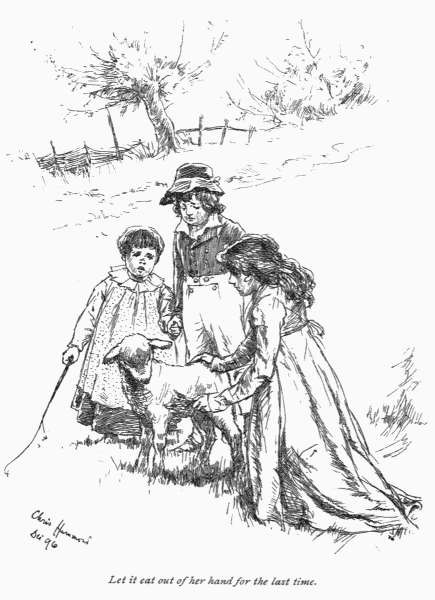
Let it eat out of her hand for the last time.
As soon as the attorney was out of sight, Susan rose from the bank where she was seated, came up to her lamb, and stooped to gather some of the fresh dewy trefoil, to let it eat out of her hand for the last time. Poor Daisy licked her well-known hand.
'Now, let us go,' said Susan. 'I'll wait as long as you please,' said the butcher. Susan thanked him, but walked away quickly, without looking again at her lamb. Her little brothers begged the man to stay a few minutes, for they had gathered a handful of blue speedwell and yellow crowsfoot, and they were decking the poor animal. As it followed the boys through the village, the children collected as they passed, and the butcher's own son was amongst the number. Susan's steadiness about the bad shilling was full in this boy's memory; it had saved him a beating. He went directly to his father to beg the life of Susan's lamb.
'I was thinking about it, boy, myself,' said the butcher; 'it's a sin to kill a pet lamb, I'm thinking—any way, it's what I'm not used to, and don't fancy doing, and I'll go and say as much to Attorney Case; but he's a hard man; there's but one way to deal with him, and that's the way I must take, though so be I shall be the loser thereby; but we'll say nothing to the boys, for fear it might be the thing would not take; and then it would be worse again to poor Susan, who is a good girl, and always was, as well she may, being of a good breed, and well reared from the first.'
'Come, lads, don't keep a crowd and a scandal about my door,' continued he, aloud, to the children; 'turn the lamb in here, John, in the paddock, for to-night, and go your ways home.'
The crowd dispersed, but murmured, and the butcher went to the attorney. 'Seeing that all you want is a good, fat, tender lamb, for a present for Sir Arthur, as you told me,' said the butcher, 'I could let you have what's as good or better for your purpose.' 'Better—if it's better, I'm ready to hear reason.' The butcher had choice, tender lamb, he said, fit to eat the next day; and as Mr. Case was impatient to make his offering to Sir Arthur, he accepted the butcher's proposal, though with such seeming reluctance, that he actually squeezed out of him, before he would complete the bargain, a bribe of a fine sweetbread.
In the meantime Susan's brothers ran home to tell her that her lamb was put into the paddock for the night; this was all they knew, and even this was some comfort to her. Rose, her good friend, was with her, and she had before her the pleasure of telling her father of his week's reprieve. Her mother was better, and even said she was determined to sit up to supper in her wicker armchair.
Susan was getting things ready for supper, when little William, who was standing at the house door, watching in the dusk for his father's return, suddenly exclaimed, 'Susan! if here is not our old man!'
'Yes,' said the old harper, 'I have found my way to you. The neighbours were kind enough to show me whereabouts you lived; for, though I didn't know your name, they guessed who I meant by what I said of you all.' Susan came to the door, and the old man was delighted to hear her speak again. 'If it would not be too bold,' said he, 'I'm a stranger in this part of the country, and come from afar off. My boy has got a bed for himself here in the village, but I have no place. Could you be so charitable as to give an old blind man a night's lodging?' Susan said she would step in and ask her mother; and she soon returned with an answer that he was heartily welcome, if he could sleep upon the children's bed, which was but small.
The old man thankfully entered the hospitable cottage. He struck his head against the low roof, as he stepped over the door-sill. 'Many roofs that are twice as high are not half so good,' said he. Of this he had just had experience at the house of the Attorney Case, while he had asked, but had been roughly refused all assistance by Miss Barbara, who was, according to her usual custom, standing staring at the hall door.
The old man's harp was set down in Farmer Price's kitchen, and he promised to play a tune for the boys before they went to bed; their mother giving them leave to sit up to supper with their father. He came home with a sorrowful countenance; but how soon did it brighten when Susan, with a smile, said to him, 'Father, we've good news for you! good news for us all!—You have a whole week longer to stay with us; and perhaps,' continued she, putting her little purse into his hands, 'perhaps with what's here and the bread bills, and what may somehow be got together before a week's at an end, we may make up the nine guineas for the substitute, as they call him. Who knows, dearest mother, but we may keep him with us for ever!' As she spoke, she threw her arms round her father, who pressed her to his bosom without speaking, for his heart was full. He was some little time before he could perfectly believe that what he heard was true; but the revived smiles of his wife, the noisy joy of his little boys, and the satisfaction that shone in Susan's countenance, convinced him that he was not in a dream.
As they sat down to supper, the old harper was made welcome to his share of the cheerful though frugal meal.
Susan's father, as soon as supper was finished, even before he would let the harper play a tune for his boys, opened the little purse which Susan had given him. He was surprised at the sight of the twelve shillings, and still more, when he came to the bottom of the purse, to see the bright golden guinea.
'How did you come by all this money, Susan?' said he. 'Honestly and handsomely, that I'm sure of beforehand,' said her proud mother; 'but how I can't make out, except by the baking. Hey, Susan, is this your first baking?' 'Oh no, no,' said her father, 'I have her first baking snug here, besides, in my pocket. I kept it for a surprise, to do your mother's heart good, Susan. Here's twenty-nine shillings, and the Abbey bill, which is not paid yet, comes to ten more. What think you of this, wife? Have we not a right to be proud of our Susan? Why,' continued he, turning to the harper, 'I ask your pardon for speaking out so free before strangers in praise of my own, which I know is not mannerly; but the truth is the fittest thing to be spoken, as I think, at all times; therefore, here's your good health, Susan; why, by-and-by she'll be worth her weight in gold—in silver at least. But tell us, child, how came you by all this riches? and how comes it that I don't go to-morrow? All this happy news makes me so gay in myself, I'm afraid I shall hardly understand it rightly. But speak on, child—first bringing us a bottle of the good mead you made last year from your own honey.'
Susan did not much like to tell the history of her guinea-hen—of the gown and of her poor lamb. Part of this would seem as if she was vaunting of her own generosity, and part of it she did not like to recollect. But her mother pressed to know the whole, and she related it as simply as she could. When she came to the story of her lamb, her voice faltered, and everybody present was touched. The old harper sighed once, and cleared his throat several times. He then asked for his harp, and, after tuning it for a considerable time, he recollected—for he had often fits of absence—that he had sent for it to play the tune he had promised to the boys.
This harper came from a great distance, from the mountains of Wales, to contend with several other competitors for a prize, which had been advertised by a musical society about a year before this time. There was to be a splendid ball given upon the occasion at Shrewsbury, which was about five miles from our village. The prize was ten guineas for the best performer on the harp, and the prize was now to be decided in a few days.
All this intelligence Barbara had long since gained from her maid, who often paid visits to the town of Shrewsbury, and she had long had her imagination inflamed with the idea of this splendid music-meeting and ball. Often had she sighed to be there, and often had she revolved in her mind schemes for introducing herself to some genteel neighbours, who might take her to the ball in their carriage. How rejoiced, how triumphant was she when this very evening, just about the time when the butcher was bargaining with her father about Susan's lamb, a livery servant from the Abbey rapped at the door, and left a card for Mr. and Miss Barbara Case.
'There,' cried Bab, 'I and papa are to dine and drink tea at the Abbey to-morrow. Who knows? I daresay, when they see that I'm not a vulgar-looking person, and all that, and if I go cunningly to work with Miss Somers, as I shall, to be sure—I daresay she'll take me to the ball with her.'
'To be sure,' said the maid; 'it's the least one may expect from a lady who demeans herself to visit Susan Price, and goes about a-shopping for her. The least she can do for you is to take you in her carriage, which costs nothing, but is just a common civility, to a ball.'
'Then pray, Betty,' continued Miss Barbara, 'don't forget to-morrow, the first thing you do, to send off to Shrewsbury for my new bonnet. I must have it to dine in, at the Abbey, or the ladies will think nothing of me; and, Betty, remember the mantua-maker too. I must see and coax papa to buy me a new gown against the ball. I can see, you know, something of the fashions to-morrow at the Abbey. I shall look the ladies well over, I promise you. And, Betty, I have thought of the most charming present for Miss Somers, as papa says it's good never to go empty-handed to a great house, I'll make Miss Somers, who is fond, as her maid told you, of such things—I'll make Miss Somers a present of that guinea-hen of Susan's; it's of no use to me, so do you carry it up early in the morning to the Abbey, with my compliments. That's the thing.'
In full confidence that her present and her bonnet would operate effectually in her favour, Miss Barbara paid her first visit at the Abbey. She expected to see wonders. She was dressed in all the finery which she had heard from her maid, who had heard from the 'prentice of a Shrewsbury milliner, was the thing in London; and she was much surprised and disappointed, when she was shown into the room where the Miss Somerses and the ladies of the Abbey were sitting, to see that they did not, in any one part of their dress, agree with the picture her imagination had formed of fashionable ladies. She was embarrassed when she saw books and work and drawings upon the table, and she began to think that some affront was meant to her, because the company did not sit with their hands before them.
When Miss Somers endeavoured to find out conversation that would interest her, and spoke of walks and flowers and gardening, of which she was herself fond, Miss Barbara still thought herself undervalued, and soon contrived to expose her ignorance most completely, by talking of things which she did not understand.
Those who never attempt to appear what they are not—those who do not in their manners pretend to anything unsuited to their habits and situation in life, never are in danger of being laughed at by sensible, well-bred people of any rank; but affectation is the constant and just object of ridicule.
Miss Barbara Case, with her mistaken airs of gentility, aiming to be thought a woman and a fine lady, whilst she was, in reality, a child and a vulgar attorney's daughter, rendered herself so thoroughly ridiculous, that the good-natured, yet discerning spectators were painfully divided between their sense of comic absurdity and a feeling of shame for one who could feel nothing for herself.
One by one the ladies dropped off. Miss Somers went out of the room for a few minutes to alter her dress, as it was the custom of the family, before dinner. She left a portfolio of pretty drawings and good prints for Miss Barbara's amusement; but Miss Barbara's thoughts were so intent upon the harpers' ball, that she could not be entertained with such trifles. How unhappy are those who spend their time in expectation! They can never enjoy the present moment. Whilst Barbara was contriving means of interesting Miss Somers in her favour, she recollected, with surprise, that not one word had yet been said of her present of the guinea-hen. Mrs. Betty, in the hurry of her dressing her young lady in the morning, had forgotten it; but it came just whilst Miss Somers was dressing; and the housekeeper came into her mistress's room to announce its arrival.
'Ma'am,' said she, 'here's a beautiful guinea-hen just come, with Miss Barbara Case's compliments to you.'
Miss Somers knew, by the tone in which the housekeeper delivered this message, that there was something in the business which did not perfectly please her. She made no answer, in expectation that the housekeeper, who was a woman of a very open temper, would explain her cause of dissatisfaction. In this she was not mistaken. The housekeeper came close up to the dressing-table, and continued, 'I never like to speak till I'm sure, ma'am, and I'm not quite sure, to say certain, in this case, ma'am, but still I think it right to tell you, which can't wrong anybody, what came across my mind about this same guinea-hen, ma'am; and you can inquire into it, and do as you please afterwards, ma'am. Some time ago we had fine guinea-fowls of our own, and I made bold, not thinking, to be sure, that all our own would die away from us, as they have done, to give a fine couple last Christmas to Susan Price, and very fond and pleased she was at the time, and I'm sure would never have parted with the hen with her good-will; but if my eyes don't strangely mistake, this hen, that comes from Miss Barbara, is the self-same identical guinea-hen that I gave to Susan. And how Miss Bab came by it is the thing that puzzles me. If my boy Philip was at home, maybe, as he's often at Mrs. Price's (which I don't disapprove), he might know the history of the guinea-hen. I expect him home this night, and if you have no objection, I will sift the affair.'
'The shortest way, I think,' said Henrietta, 'would be to ask Miss Case herself about it, which I will do this evening.' 'If you please, ma'am,' said the housekeeper, coldly; for she knew that Miss Barbara was not famous in the village for speaking truth.
Dinner was now served. Attorney Case expected to smell mint sauce, and, as the covers were taken from off the dishes, looked around for lamb; but no lamb appeared. He had a dexterous knack of twisting the conversation to his point. Sir Arthur was speaking, when they sat down to dinner, of a new carving knife, which he lately had had made for his sister. The Attorney immediately went from carving-knives to poultry; thence to butchers meat. Some joints, he observed, were much more difficult to carve than others. He never saw a man carve better than the gentleman opposite him, who was the curate of the parish. 'But, sir,' said the vulgar attorney, 'I must make bold to differ with you in one point, and I'll appeal to Sir Arthur. Sir Arthur, pray may I ask, when you carve a forequarter of lamb, do you, when you raise the shoulder, throw in salt, or not?' This well-prepared question was not lost upon Sir Arthur. The attorney was thanked for his intended present; but mortified and surprised to hear Sir Arthur say that it was a constant rule of his never to accept of any presents from his neighbours. 'If we were to accept a lamb from a rich neighbour on my estate,' said he, 'I am afraid we should mortify many of our poor tenants, who can have little to offer, though, perhaps, they may bear us thorough good-will notwithstanding.'
After the ladies left the dining-room, as they were walking up and down the large hall, Miss Barbara had a fair opportunity of imitating her keen father's method of conversing. One of the ladies observed that this hall would be a charming place for music. Bab brought in harps and harpers, and the harpers' ball, in a breath. 'I know so much about it,—about the ball I mean,' said she, 'because a lady in Shrewsbury, a friend of papa's, offered to take me with her; but papa did not like to give her the trouble of sending so far for me, though she has a coach of her own.' Barbara fixed her eyes upon Miss Somers as she spoke; but she could not read her countenance as distinctly as she wished, because Miss Somers was at this moment letting down the veil of her hat.
'Shall we walk out before tea?' said Miss Somers to her companions; 'I have a pretty guinea-hen to show you.' Barbara, secretly drawing propitious omens from the guinea-hen, followed with a confidential step. The pheasantry was well filled with pheasants, peacocks, etc.; and Susan's pretty little guinea-hen appeared well, even in this high company. It was much admired. Barbara was in glory; but her glory was of short duration.
Just as Miss Somers was going to inquire into the guinea-hen's history, Philip came up, to ask permission to have a bit of sycamore, to turn a nutmeg box for his mother. He was an ingenious lad, and a good turner for his age. Sir Arthur had put by a bit of sycamore on purpose for him; and Miss Somers told him where it was to be found. He thanked her; but in the midst of his bow of thanks his eye was struck by the sight of the guinea-hen, and he involuntarily exclaimed, 'Susan's guinea-hen, I declare!' 'No, it's not Susan's guinea-hen,' said Miss Barbara, colouring furiously; 'it is mine, and I have made a present of it to Miss Somers.'
At the sound of Bab's voice, Philip turned—saw her—and indignation, unrestrained by the presence of all the amazed spectators, flashed in his countenance.
'What is the matter, Philip?' said Miss Somers, in a pacifying tone; but Philip was not inclined to be pacified. 'Why, ma'am,' said he, 'may I speak out?' and, without waiting for permission, he spoke out, and gave a full, true, and warm account of Rose's embassy, and of Miss Barbara's cruel and avaricious proceedings.
Barbara denied, prevaricated, stammered, and at last was overcome with confusion; for which even the most indulgent spectators could scarcely pity her.
Miss Somers, however, mindful of what was due to her guest, was anxious to despatch Philip for his piece of sycamore. Bab recovered herself as soon as he was out of sight; but she further exposed herself by exclaiming, 'I'm sure I wish this pitiful guinea-hen had never come into my possession. I wish Susan had kept it at home, as she should have done!'
'Perhaps she will be more careful now that she has received so strong a lesson,' said Miss Somers. 'Shall we try her?' continued she. 'Philip will, I daresay, take the guinea-hen back to Susan, if we desire it.' 'If you please, ma'am,' said Barbara, sullenly; 'I have nothing more to do with it.'
So the guinea-hen was delivered to Philip, who set off joyfully with his prize, and was soon in sight of Farmer Price's cottage. He stopped when he came to the door. He recollected Rose and her generous friendship for Susan. He was determined that she should have the pleasure of restoring the guinea-hen. He ran into the village. All the children who had given up their little purse on May-day were assembled on the play-green. They were delighted to see the guinea-hen once more. Philip took his pipe and tabor, and they marched in innocent triumph towards the white washed cottage.
'Let me come with you—let me come with you,' said the butcher's boy to Philip. 'Stop one minute! my father has something to say to you.' He darted into his father's house. The little procession stopped, and in a few minutes the bleating of a lamb was heard. Through a back passage, which led into the paddock behind the house, they saw the butcher leading a lamb.
'It is Daisy!' exclaimed Rose. 'It's Daisy!' repeated all her companions. 'Susan's lamb! Susan's lamb!' and there was a universal shout of joy.
'Well, for my part,' said the good butcher, as soon as he could be heard,—'for my part, I would not be so cruel as Attorney Case for the whole world. These poor brute beasts don't know aforehand what's going to happen to them; and as for dying, it's what we must all do some time or another; but to keep wringing the hearts of the living, that have as much sense as one's self, is what I call cruel; and is not this what Attorney Case has been doing by poor Susan and her whole family, ever since he took a spite against them? But, at any rate, here's Susan's lamb safe and sound. I'd have taken it back sooner, but I was off before day to the fair, and am but just come back. Daisy, however, has been as well off in my paddock as he would have been in the field by the water-side.'
The obliging shopkeeper, who showed the pretty calicoes to Susan, was now at his door, and when he saw the lamb, and heard that it was Susan's, and learned its history, he said that he would add his mite; and he gave the children some ends of narrow riband, with which Rose decorated her friend's lamb.
The pipe and tabor now once more began to play, and the procession moved on in joyful order, after giving the humane butcher three cheers; three cheers which were better deserved than 'loud huzzas' usually are.
Susan was working in her arbour, with her little deal table before her. When she heard the sound of the music, she put down her work and listened. She saw the crowd of children coming nearer and nearer. They had closed round Daisy, so that she did not see it; but as they came up to the garden gate she saw that Rose beckoned to her. Philip played as loud as he could, that she might not hear, till the proper moment, the bleating of the lamb. Susan opened the garden-wicket, and at this signal the crowd divided, and the first thing that Susan saw, in the midst of her taller friends, was little smiling Mary, with the guinea-hen in her arms.
'Come on! Come on!' cried Mary, as Susan started with joyful surprise; 'you have more to see.'
At this instant the music paused, Susan heard the bleating of a lamb, and scarcely daring to believe her senses, she pressed eagerly forward, and beheld poor Daisy!—she burst into tears. 'I did not shed one tear when I parted with you, my dear little Daisy!' said she. 'It was for my father and mother. I would not have parted with you for anything else in the whole world. Thank you, thank you all,' added she, to her companions, who sympathised in her joy, even more than they had sympathised in her sorrow. 'Now, if my father was not to go away from us next week, and if my mother was quite stout, I should be the happiest person in the world!'
As Susan pronounced these words, a voice behind the little listening crowd cried, in a brutal tone, 'Let us pass, if you please; you have no right to stop up the public road!' This was the voice of Attorney Case, who was returning with his daughter Barbara from his visit to the Abbey. He saw the lamb, and tried to whistle as he went on. Barbara also saw the guinea-hen, and turned her head another way, that she might avoid the contemptuous, reproachful looks of those whom she only affected to despise. Even her new bonnet, in which she had expected to be so much admired, was now only serviceable to hide her face and conceal her mortification.
'I am glad she saw the guinea-hen,' cried Rose, who now held it in her hands. 'Yes,' said Philip, 'she'll not forget May-day in a hurry.' 'Nor I neither, I hope,' said Susan, looking round upon her companions with a most affectionate smile: 'I hope, whilst I live, I shall never forget your goodness to me last May-day. Now I've my pretty guinea-hen safe once more, I should think of returning your money.' 'No! no! no!' was the general cry. 'We don't want the money—keep it, keep it—you want it for your father.' 'Well,' said Susan, 'I am not too proud to be obliged. I will keep your money for my father. Perhaps some time or other I may be able to earn——' 'Oh,' interrupted Philip, 'don't let us talk of earning; don't let us talk to her of money now; she has not had time hardly to look at poor Daisy and her guinea-hen. Come, we had best go about our business, and let her have them all to herself.'
The crowd moved away in consequence of Philip's considerate advice; but it was observed that he was the very last to stir from the garden-wicket himself. He stayed, first, to inform Susan that it was Rose who tied the ribands on Daisy's head. Then he stayed a little longer to let her into the history of the guinea-hen, and to tell her who it was that brought the hen home from the Abbey.
Rose held the sieve, and Susan was feeding her long-lost favourite, whilst Philip leaned over the wicket, prolonging his narration. 'Now, my pretty guinea-hen,' said Susan—'my naughty guinea-hen, that flew away from me, you shall never serve me so again. I must cut your nice wings; but I won't hurt you.' 'Take care,' cried Philip; 'you'd better, indeed you'd better let me hold her whilst you cut her wings.'
When this operation was successfully performed, which it certainly could never have been if Philip had not held the hen for Susan, he recollected that his mother had sent him with a message to Mrs. Price. This message led to another quarter of an hour's delay; for he had the whole history of the guinea-hen to tell over again to Mrs. Price, and the farmer himself luckily came in whilst it was going on, so it was but civil to begin it afresh; and then the farmer was so rejoiced to see his Susan so happy again with her two little favourites, that he declared he must see Daisy fed himself; and Philip found that he was wanted to hold the jugful of milk, out of which Farmer Price filled the pan for Daisy. Happy Daisy! who lapped at his ease whilst Susan caressed him, and thanked her fond father and her pleased mother.
'But, Philip,' said Mrs. Price, 'I'll hold the jug—you'll be late with your message to your mother; we'll not detain you any longer.'
Philip departed, and as he went out of the garden-wicket he looked up, and saw Bab and her maid Betty staring out of the window, as usual. On this, he immediately turned back to try whether he had shut the gate fast, lest the guinea-hen might stray, out and fall again into the hands of the enemy.
Miss Barbara, in the course of this day, felt considerable mortification, but no contrition. She was vexed that her meanness was discovered, but she felt no desire to cure herself of any of her faults. The ball was still uppermost in her vain, selfish soul. 'Well,' said she to her confidante, Betty, 'you hear how things have turned out; but if Miss Somers won't think of asking me to go out with her, I've a notion I know who will. As papa says, it's a good thing to have two strings to one's bow.'
Now some officers, who were quartered at Shrewsbury, had become acquainted with Mr. Case. They had gotten into some quarrel with a tradesman of the town, and Attorney Case had promised to bring them through the affair, as the man threatened to take the law of them. Upon the faith of this promise, and with the vain hope that, by civility, they might dispose him to bring in a reasonable bill of costs, these officers sometimes invited Mr. Case to the mess; and one of them, who had lately been married, prevailed upon his bride sometimes to take a little notice of Miss Barbara. It was with this lady that Miss Barbara now hoped to go to the harpers' ball.
'The officers and Mrs. Strathspey, or, more properly, Mrs. Strathspey and the officers, are to breakfast here, to-morrow, do you know?' said Bab to Betty. 'One of them dined at the Abbey to-day, and told papa they'd all come. They are going out on a party, somewhere into the country, and breakfast here on their way. Pray, Betty, don't forget that Mrs. Strathspey can't breakfast without honey. I heard her say so myself.' 'Then, indeed,' said Betty, 'I'm afraid Mrs. Strathspey will be likely to go without her breakfast here; for not a spoonful of honey have we, let her long for it ever so much.' 'But, surely,' said Bab, 'we can contrive to get some honey in the neighbourhood.' 'There's none to be bought, as I know of,' said Betty. 'But is there none to be begged or borrowed?' said Bab, laughing. 'Do you forget Susan's beehive? Step over to her in the morning with my compliments, and see what you can do. Tell her it's for Mrs. Strathspey.'
In the morning Betty went with Miss Barbara's compliments to Susan, to beg some honey for Mrs. Strathspey who could not breakfast without it. Susan did not like to part with her honey, because her mother loved it, and she therefore gave Betty but a small quantity. When Barbara saw how little Susan sent, she called her a miser, and she said she must have some more for Mrs. Strathspey. 'I'll go myself and speak to her. Come with me, Betty,' said the young lady, who found it at present convenient to forget her having declared, the day that she sucked up the broth, that she never would honour Susan with another visit. 'Susan,' said she, accosting the poor girl, whom she had done everything in her power to injure, 'I must beg a little more honey from you for Mrs. Strathspey's breakfast. You know, on a particular occasion such as this, neighbours must help one another.' 'To be sure they should,' added Betty.
Susan, though she was generous, was not weak; she was willing to give to those she loved, but not disposed to let anything be taken from her, or coaxed out of her, by those she had reason to despise. She civilly answered that she was sorry she had no more honey to spare.
Barbara grew angry, and lost all command of herself, when she saw that Susan, without regarding her reproaches, went on looking through the glass pane in the beehive. 'I'll tell you what, Susan Price,' said she, in a high tone, 'the honey I will have, so you may as well give it to me by fair means. Yes or no? Speak! Will you give it me or not? Will you give me that piece of the honeycomb that lies there?' 'That bit of honeycomb is for my mother's breakfast,' said Susan; 'I cannot give it you.' 'Can't you?' said Bab, 'then see if I don't take it!' She stretched across Susan for the honeycomb, which was lying by some rosemary leaves that Susan had freshly gathered for her mother's tea. Bab grasped, but at her first effort she only reached the rosemary. She made a second dart at the honeycomb, and, in her struggle to obtain it, she overset the beehive. The bees swarmed about her. Her maid Betty screamed and ran away. Susan, who was sheltered by a laburnum tree, called to Barbara, upon whom the black clusters of bees were now settling, and begged her to stand still, and not to beat them away. 'If you stand quietly you won't be stung, perhaps.' But instead of standing quietly, Bab buffeted and stamped and roared, and the bees stung her terribly. Her arms and her face swelled in a frightful manner. She was helped home by poor Susan and treacherous Mrs. Betty, who, now the mischief was done, thought only of exculpating herself to her master.
'Indeed, Miss Barbara,' said she, 'this was quite wrong of you to go and get yourself into such a scrape. I shall be turned away for it, you'll see.'
'I don't care whether you are turned away or not,' said Barbara; 'I never felt such pain in my life. Can't you do something for me? I don't mind the pain either so much as being such a fright. Pray, how am I to be fit to be seen at breakfast by Mrs. Strathspey; and I suppose I can't go to the ball either to-morrow, after all!'
'No, that you can't expect to do, indeed,' said Betty, the comforter. 'You need not think of balls; for those lumps and swellings won't go off your face this week. That's not what pains me; but I'm thinking of what your papa will say to me when he sees you, miss.'
Whilst this amiable mistress and maid were in their adversity reviling one another, Susan, when she saw that she could be of no further use, was preparing to depart, but at the house-door she was met by Mr. Case. Mr. Case had revolved things in his mind; for his second visit at the Abbey pleased him as little as his first, owing to a few words which Sir Arthur and Miss Somers dropped in speaking of Susan and Farmer Price. Mr. Case began to fear that he had mistaken his game in quarrelling with this family. The refusal of his present dwelt upon the attorney's mind; and he was aware that, if the history of Susan's lamb ever reached the Abbey, he was undone. He now thought that the most prudent course he could possibly follow would be to hush up matters with the Prices with all convenient speed. Consequently, when he met Susan at his door, he forced a gracious smile. 'How is your mother, Susan?' said he. 'Is there anything in our house can be of service to her?' On hearing his daughter he cried out, 'Barbara, Barbara—Bab! come downstairs, child, and speak to Susan Price.' But as no Barbara answered, her father stalked upstairs directly, opened the door, and stood amazed at the spectacle of her swelled visage.
Betty instantly began to tell the story of Barbara's mishap her own way. Bab contradicted her as fast as she spoke. The attorney turned the maid away on the spot; and partly with real anger, and partly with feigned affectation of anger, he demanded from his daughter how she dared to treat Susan Price so ill, 'when,' as he said, 'she was so neighbourly and obliging as to give you some of her honey? Couldn't you be content, without seizing upon the honeycomb by force? This is scandalous behaviour, and what, I assure you, I can't countenance.'
Susan now interceded for Barbara; and the attorney, softening his voice, said that 'Susan was a great deal too good to her; as you are, indeed,' added he, 'to everybody. I forgive her for your sake.' Susan curtsied, in great surprise; but her lamb could not be forgotten, and she left the attorney's house as soon as she could, to make her mother's rosemary tea breakfast.
Mr. Case saw that Susan was not so simple as to be taken in by a few fair words. His next attempt was to conciliate Farmer Price. The farmer was a blunt, honest man, and his countenance remained inflexibly contemptuous, when the attorney addressed him in his softest tone.
So stood matters the day of the long-expected harpers' ball. Miss Barbara Case, stung by Susan's bees, could not, after all her manœuvres, go with Mrs. Strathspey to the ball. The ballroom was filled early in the evening. There was a numerous assembly. The harpers, who contended for the prize, were placed under the music-gallery at the lower end of the room. Amongst them was our old blind friend, who, as he was not so well clad as his competitors, seemed to be disdained by many of the spectators. Six ladies and six gentlemen were now appointed to be judges of the performance. They were seated in a semicircle, opposite to the harpers. The Miss Somerses, who were fond of music, were amongst the ladies in the semicircle; and the prize was lodged in the hands of Sir Arthur. There was now silence. The first harp sounded, and as each musician tried his skill, the audience seemed to think that each deserved the prize. The old blind man was the last. He tuned his instrument; and such a simple pathetic strain was heard as touched every heart. All were fixed in delighted attention; and when the music ceased, the silence for some moments continued.
The silence was followed by a universal buzz of applause. The judges were unanimous in their opinions, and it was declared that the old blind harper, who played the last, deserved the prize.
The simple pathetic air which won the suffrages of the whole assembly, was his own composition. He was pressed to give the words belonging to the music; and at last he modestly offered to repeat them, as he could not see to write. Miss Somers' ready pencil was instantly produced; and the old harper dictated the words of his ballad, which he called—Susan's Lamentation for her Lamb.
Miss Somers looked at her brother from time to time, as she wrote; and Sir Arthur, as soon as the old man had finished, took him aside, and asked him some questions, which brought the whole history of Susan's lamb and of Attorney Case's cruelty to light.
The attorney himself was present when the harper began to dictate his ballad. His colour, as Sir Arthur steadily looked at him, varied continually; till at length, when he heard the words 'Susan's Lamentation for her Lamb,' he suddenly shrank back, skulked through the crowd, and disappeared. We shall not follow him; we had rather follow our old friend, the victorious harper.
No sooner had he received the ten guineas, his well-merited prize, than he retired to a small room belonging to the people of the house, asked for pen, ink, and paper, and dictated, in a low voice, to his boy, who was a tolerably good scribe, a letter, which he ordered him to put directly into the Shrewsbury post-office. The boy ran with the letter to the post-office. He was but just in time, for the postman's horn was sounding.
The next morning, when Farmer Price, his wife, and Susan, were sitting together, reflecting that his week's leave of absence was nearly at an end, and that the money was not yet made up for John Simpson, the substitute, a knock was heard at the door, and the person who usually delivered the letters in the village put a letter into Susan's hand, saying, 'A penny, if you please—here's a letter for your father.'
'For me!' said Farmer Price; 'here's the penny then; but who can it be from, I wonder? Who can think of writing to me, in this world?' He tore open the letter; but the hard name at the bottom of the page puzzled him—'your obliged friend, Llewellyn.'
'And what's this?' said he, opening a paper that was enclosed in the letter. 'It's a song, seemingly; it must be somebody that has a mind to make an April fool of me.' 'But it is not April, it is May, father,' said Susan. 'Well, let us read the letter, and we shall come to the truth all in good time.'
Farmer Price sat down in his own chair, for he could not read entirely to his satisfaction in any other, and read as follows:—
'My worthy Friend—I am sure you will be glad to hear that I have had good success this night. I have won the ten guinea prize, and for that I am in a great measure indebted to your sweet daughter Susan; as you will see by a little ballad I enclose for her. Your hospitality to me has afforded to me an opportunity of learning some of your family history. You do not, I hope, forget that I was present when you were counting the treasure in Susan's little purse, and that I heard for what purpose it was all destined. You have not, I know, yet made up the full sum for your substitute, John Simpson; therefore do me the favour to use the five guinea banknote which you will find within the ballad. You shall not find me as hard a creditor as Attorney Case. Pay me the money at your own convenience. If it is never convenient to you to pay it, I shall never ask it. I shall go my rounds again through this country, I believe, about this time next year, and will call to see how you do, and to play the new tune for Susan and the dear little boys.
'I should just add, to set you hearts at rest about the money, that it does not distress me at all to lend it to you. I am not quite so poor as I appear to be. But it is my humour to go about as I do. I see more of the world under my tattered garb than, perhaps, I should ever see in a better dress. There are many of my profession who are of the same mind as myself in this respect; and we are glad, when it lies in our way, to do any kindness to such a worthy family as yours. So, fare ye well.—Your obliged Friend, Llewellyn.'
Susan now, by her father's desire, opened the ballad. He picked up the five-guinea banknote, whilst she read, with surprise, 'Susan's Lamentation for her Lamb.' Her mother leaned over her shoulder to read the words; but they were interrupted, before they had finished the first stanza, by another knock at the door. It was not the postman with another letter. It was Sir Arthur and his sisters.
They came with an intention, which they were much disappointed to find that the old harper had rendered vain—they came to lend the farmer and his good family the money to pay for his substitute.
'But, since we are here,' said Sir Arthur, 'let me do my own business, which I had like to have forgotten. Mr. Price, will you come out with me, and let me show you a piece of your land, through which I want to make a road? Look there,' said Sir Arthur, pointing to the spot; 'I am laying out a ride round my estate, and that bit of land of yours stops me.'
'Why, sir,' said Price, 'the land's mine, to be sure, for that matter; but I hope you don't look upon me to be that sort of person that would be stiff about a trifle or so.'
'The fact is,' said Sir Arthur, 'I had heard you were a litigious, pig-headed fellow; but you do not seem to deserve this character.'
'Hope not, sir,' said the farmer; 'but about the matter of the land, I don't want to take any advantage of your wishing for it. You are welcome to it; and I leave it to you to find me out another bit of land convenient to me that will be worth neither more nor less; or else to make up the value to me some way or other. I need say no more about it.'
'I hear something,' continued Sir Arthur, after a short silence—'I hear something, Mr. Price, of a flaw in your lease. I would not speak to you about it whilst we were bargaining about your land, lest I should overawe you; but, tell me, what is this flaw?'
'In truth, and the truth is the fittest thing to be spoken at all times,' said the farmer, 'I didn't know myself what a flaw, as they call it, meant, till I heard of the word from Attorney Case; and, I take it, a flaw is neither more nor less than a mistake, as one should say. Now, by reason a man does not make a mistake on purpose, it seems to me to be the fair thing that if a man finds out his mistake, he might set it right; but Attorney Case says this is not law; and I've no more to say. The man who drew up my lease made a mistake; and if I must suffer for it, I must,' said the farmer. 'However, I can show you, Sir Arthur, just for my own satisfaction and yours, a few lines of a memorandum on a slip of paper, which was given me by your relation, the gentleman who lived here before, and let me my farm. You'll see, by that bit of paper, what was meant; but the attorney says the paper's not worth a button in a court of justice, and I don't understand these things. All I understand is the common honesty of the matter. I've no more to say.'
'This attorney, whom you speak of so often,' said Sir Arthur, 'you seem to have some quarrel with. Now, would you tell me frankly what is the matter between——?'
'The matter between us, then,' said Price, 'is a little bit of ground, not worth much, that is there open to the lane at the end of Mr. Case's garden, and he wanted to take it in. Now I told him my mind, that it belonged to the parish, and that I never would willingly give my consent to his cribbing it in that way. Sir, I was the more loth to see it shut into his garden, which, moreover, is large enough of all conscience without it, because you must know, Sir Arthur, the children in our village are fond of making a little play-green of it; and they have a custom of meeting on May-day at a hawthorn that stands in the middle of it, and altogether I was very loth to see 'em turned out of it by those who have no right.'
'Let us go and see this nook,' said Sir Arthur. 'It is not far off, is it?'
'Oh no, sir, just hard by here.'
When they got to the ground, Mr. Case, who saw them walking together, was in a hurry to join them, that he might put a stop to any explanations. Explanations were things of which he had a great dread; but, fortunately, he was upon this occasion a little too late.
'Is this the nook in dispute?' said Sir Arthur. 'Yes; this is the whole thing,' said Price. 'Why, Sir Arthur,' interposed the politic attorney, with an assumed air of generosity, 'don't let us talk any more about it. Let it belong to whom it will, I give it up to you.'
'So great a lawyer, Mr. Case, as you are,' replied Sir Arthur, 'must know that a man cannot give up that to which he has no legal title; and in this case it is impossible that, with the best intentions to oblige me in the world, you can give up this bit of land to me, because it is mine already, as I can convince you effectually by a map of the adjoining land, which I have fortunately safe amongst my papers. This piece of ground belonged to the farm on the opposite side of the road, and it was cut off when the lane was made.'
'Very possibly. I daresay you are quite correct; you must know best,' said the attorney, trembling for the agency.
'Then,' said Sir Arthur, 'Mr. Price, you will observe that I now promise this little green to the children for a playground; and I hope they may gather hawthorn many a May-day at this their favourite bush.' Mr. Price bowed low, which he seldom did, even when he received a favour himself. 'And now, Mr. Case,' said Sir Arthur, turning to the attorney, who did not know which way to look, 'you sent me a lease to look over.'
'Ye—ye—yes,' stammered Mr. Case. 'I thought it my duty to do so; not out of any malice or ill-will to this good man.'
'You have done him no injury,' said Sir Arthur coolly. 'I am ready to make him a new lease, whenever he pleases, of his farm, and I shall be guided by a memorandum of the original bargain, which he has in his possession. I hope I never shall take an unfair advantage of any one.'
'Heaven forbid, sir,' said the attorney, sanctifying his face, 'that I should suggest the taking an unfair advantage of any man, rich or poor; but to break a bad lease is not taking an unfair advantage.'
'You really think so?' said Sir Arthur. 'Certainly I do, and I hope I have not hazarded your good opinion by speaking my mind concerning the flaw so plainly. I always understood that there could be nothing ungentlemanlike, in the way of business, in taking advantage of the flaw in a lease.'
'Now,' said Sir Arthur, 'you have pronounced judgment undesignedly in your own case. You intended to send me this poor man's lease; but your son, by some mistake, brought me your own, and I have discovered a fatal error in it.' 'A fatal error!' said the alarmed attorney. 'Yes, sir,' said Sir Arthur, pulling the lease out of his pocket. 'Here it is. You will observe that it is neither signed nor sealed by the grantor.' 'But you won't take advantage of me, surely, Sir Arthur?' said Mr. Case, forgetting his own principles. 'I shall not take advantage of you, as you would have taken of this honest man. In both cases I shall be guided by memoranda which I have in my possession. I shall not, Mr. Case, defraud you of one shilling of your property. I am ready, at a fair valuation, to pay the exact value of your house and land; but upon this condition—that you quit the parish within one month!'
Attorney Case was thus compelled to submit to the hard necessity of the case, for he knew that he could not legally resist. Indeed he was glad to be let off so easily; and he bowed and sneaked away, secretly comforting himself with the hope that when they came to the valuation of the house and land he should be the gainer, perhaps, of a few guineas. His reputation he justly held very cheap.
'You are a scholar; you write a good hand; you can keep accounts, cannot you?' said Sir Arthur to Mr. Price, as they walked home towards the cottage. 'I think I saw a bill of your little daughter's drawing out the other day, which was very neatly written. Did you teach her to write?'
'No, sir,' said Price, 'I can't say I did that; for she mostly taught it herself; but I taught her a little arithmetic, as far as I knew, on our winter nights, when I had nothing better to do.'
'Your daughter shows that she has been well taught,' said Sir Arthur; 'and her good conduct and good character speak strongly in favour of her parents.'
'You are very good, very good indeed, sir, to speak in this sort of way,' said the delighted father.
'But I mean to do more than pay you with words,' said Sir Arthur. 'You are attached to your own family, perhaps you may become attached to me, when you come to know me, and we shall have frequent opportunities of judging of one another. I want no agent to squeeze my tenants, or do my dirty work. I only want a steady, intelligent, honest man, like you, to collect my rents, and I hope, Mr. Price, you will have no objection to the employment.' 'I hope, sir,' said Price, with joy and gratitude glowing in his honest countenance, 'that you'll never have cause to repent your goodness.'
'And what are my sisters about here?' said Sir Arthur, entering the cottage, and going behind his sisters, who were busily engaged in measuring an extremely pretty coloured calico.
'It is for Susan, my dear brother,' said they. 'I knew she did not keep that guinea for herself,' said Miss Somers. 'I have just prevailed upon her mother to tell me what became of it. Susan gave it to her father; but she must not refuse a gown of our choosing this time; and I am sure she will not, because her mother, I see, likes it. And, Susan, I hear that instead of becoming Queen of the May this year, you were sitting in your sick mother's room. Your mother has a little colour in her cheeks now.'
'Oh, ma'am,' interrupted Mrs. Price, 'I'm quite well. Joy, I think, has made me quite well.'
'Then,' said Miss Somers, 'I hope you will be able to come out on your daughter's birthday, which, I hear, is the 25th of this month. Make haste and get quite well before that day; for my brother intends that all the lads and lassies of the village shall have a dance on Susan's birthday.'
'Yes,' said Sir Arthur, 'and I hope on that day, Susan, you will be very happy with your little friends upon their play-green. I shall tell them that it is your good conduct which has obtained it for them; and if you have anything to ask, any little favour for any of your companions, which we can grant, now ask, Susan. These ladies look as if they would not refuse you anything that is reasonable; and, I think, you look as if you would not ask anything unreasonable.'
'Sir,' said Susan, after consulting her mother's eyes, 'there is, to be sure, a favour I should like to ask; it is for Rose.'
'Well, I don't know who Rose is,' said Sir Arthur, smiling; 'but go on.'
'Ma'am, you have seen her, I believe; she is a very good girl, indeed,' said Mrs. Price. 'And works very neatly, indeed,' continued Susan, eagerly, to Miss Somers; 'and she and her mother heard you were looking out for some one to wait upon you.'
'Say no more,' said Miss Somers; 'your wish is granted. Tell Rose to come to the Abbey to-morrow morning, or, rather, come with her yourself; for our housekeeper, I know, wants to talk to you about a certain cake. She wishes, Susan, that you should be the maker of the cake for the dance; and she has good things ready looked out for it already, I know. It must be large enough for everybody to have a slice, and the housekeeper will ice it for you. I only hope your cake will be as good as your bread. Fare ye well.'
How happy are those who bid farewell to a whole family, silent with gratitude, who will bless them aloud when they are far out of hearing!
'How do I wish, now,' said Farmer Price, 'and it's almost a sin for one who has had such a power of favours done him to wish for anything more; but how I do wish, wife, that our good friend, the harper, was only here at this time. It would do his old warm heart good. Well, the best of it is, we shall be able next year, when he comes his rounds, to pay him his money with thanks, being all the time, and for ever, as much obliged to him as if we kept it. I long, so I do, to see him in this house again, drinking, as he did, just in this spot, a glass of Susan's mead, to her very good health.'
'Yes,' said Susan, 'and the next time he comes, I can give him one of my guinea-hen's eggs, and I shall show my lamb, Daisy.'
'True, love,' said her mother, 'and he will play that tune and sing that pretty ballad. Where is it? for I have not finished it.'
'Rose ran away with it, mother, but I'll step after her, and bring it back to you this minute,' said Susan.
Susan found her friend Rose at the hawthorn, in the midst of a crowded circle of her companions, to whom she was reading 'Susan's Lamentation for her Lamb.'
'The words are something, but the tune—the tune—I must have the tune,' cried Philip. 'I'll ask my mother to ask Sir Arthur to try and find out which way that good old man went after the ball; and if he's above ground, we'll have him back by Susan's birthday, and he shall sit here—just exactly here—by this, our bush, and he shall play—I mean, if he pleases—that same tune for us, and I shall learn it—I mean, if I can—in a minute.'
The good news that Farmer Price was to be employed to collect the rents, and that Attorney Case was to leave the parish in a month, soon spread over the village. Many came out of their houses to have the pleasure of hearing the joyful tidings confirmed by Susan herself. The crowd on the play-green increased every minute.
'Yes,' cried the triumphant Philip, 'I tell you it's all true, every word of it. Susan's too modest to say it herself; but I tell ye all, Sir Arthur gave us this play-green for ever, on account of her being so good.'
You see, at last Attorney Case, with all his cunning, has not proved a match for 'Simple Susan.'
THE WHITE PIGEON
The little town of Somerville, in Ireland, has, within these few years, assumed the neat and cheerful appearance of an English village. Mr. Somerville, to whom this town belongs, wished to inspire his tenantry with a taste for order and domestic happiness, and took every means in his power to encourage industrious, well-behaved people to settle in his neighbourhood. When he had finished building a row of good slated houses in his town, he declared that he would let them to the best tenants he could find, and proposals were publicly sent to him from all parts of the country.
By the best tenants, Mr. Somerville did not, however, mean the best bidders; and many, who had offered an extravagant price for the houses, were surprised to find their proposals rejected. Amongst these was Mr. Cox, an alehouse-keeper, who did not bear a very good character.
'Please your honour, sir,' said he to Mr. Somerville, 'I expected, since I bid as fair and fairer for it than any other, that you would have let me the house next the apothecary's. Was not it fifteen guineas I mentioned in my proposal? and did not your honour give it against me for thirteen?' 'My honour did just so,' replied Mr. Somerville calmly. 'And please your honour, but I don't know what it is I or mine have done to offend you. I'm sure there is not a gentleman in all Ireland I'd go further to sarve. Would not I go to Cork to-morrow for the least word from your honour?' 'I am much obliged to you, Mr. Cox, but I have no business at Cork at present,' answered Mr. Somerville drily. 'It is all I wish,' exclaimed Mr. Cox, 'that I could find out and light upon the man that has belied me to your honour.' 'No man has belied you, Mr. Cox, but your nose belies you much, if you do not love drinking a little, and your black eye and cut chin belie you much if you do not love quarrelling a little.'
'Quarrel! I quarrel, please your honour! I defy any man, or set of men, ten mile round, to prove such a thing, and I am ready to fight him that dares to say the like of me. I'd fight him here in your honour's presence, if he'd only come out this minute and meet me like a man.'
Here Mr. Cox put himself into a boxing attitude, but observing that Mr. Somerville looked at his threatening gesture with a smile, and that several people, who had gathered round him as he stood in the street, laughed at the proof he gave of his peaceable disposition, he changed his attitude, and went on to vindicate himself against the charge of drinking.
'And as to drink, please your honour, there's no truth in it. Not a drop of whisky, good or bad, have I touched these six months, except what I took with Jemmy M'Doole the night I had the misfortune to meet your honour coming home from the fair of Ballynagrish.'
To this speech Mr. Somerville made no answer, but turned away to look at the bow-window of a handsome new inn, which the glazier was at this instant glazing. 'Please your honour, that new inn is not let, I hear, as yet,' resumed Mr. Cox; 'if your honour recollects, you promised to make me a compliment of it last Seraphtide was twelvemonth.'
'Impossible!' cried Mr. Somerville, 'for I had no thoughts of building an inn at that time.' 'Oh, I beg your honour's pardon, but if you'd be just pleased to recollect, it was coming through the gap in the bog meadows, forenent Thady O'Connor, you made me the promise—I'll leave it to him, so I will.' 'But I will not leave it to him, I assure you,' cried Mr. Somerville; 'I never made any such promise. I never thought of letting this inn to you.' 'Then your honour won't let me have it?' 'No; you have told me a dozen falsehoods. I do not wish to have you for a tenant.'
'Well, God bless your honour; I've no more to say, but God bless your honour,' said Mr. Cox; and he walked away, muttering to himself, as he slouched his hat over his face, 'I hope I'll live to be revenged on him!'
Mr. Somerville the next morning went with his family to look at the new inn, which he expected to see perfectly finished; but he was met by the carpenter, who, with a rueful face, informed him that six panes of glass in the large bow-window had been broken during the night.
'Ha! perhaps Mr. Cox has broken my windows, in revenge for my refusing to let him my house,' said Mr. Somerville; and many of the neighbours, who knew the malicious character of this Mr. Cox, observed that this was like one of his tricks. A boy of about twelve years old, however, stepped forward and said, 'I don't like Mr. Cox, I'm sure; for once he beat me when he was drunk; but, for all that, no one should be accused wrongfully. He could not be the person that broke these windows last night, for he was six miles off. He slept at his cousin's last night, and he has not returned home yet. So I think he knows nothing of the matter.'
Mr. Somerville was pleased with the honest simplicity of this boy, and observing that he looked in eagerly at the staircase, when the house door was opened, he asked him whether he would like to go in and see the new house. 'Yes, sir,' said the boy, 'I should like to go up those stairs, and to see what I should come to.' 'Up with you, then!' said Mr. Somerville; and the boy ran up the stairs. He went from room to room with great expressions of admiration and delight. At length, as he was examining one of the garrets, he was startled by a fluttering noise over his head; and looking up he saw a white pigeon, who, frightened at his appearance, began to fly round and round the room, till it found its way out of the door, and flew into the staircase.
The carpenter was speaking to Mr. Somerville upon the landing-place of the stairs; but, the moment he spied the white pigeon, he broke off in the midst of a speech about the nose of the stairs, and exclaimed, 'There he is, please your honour! There's he that has done all the damage to our bow-window—that's the very same wicked white pigeon that broke the church windows last Sunday was se'nnight; but he's down for it now; we have him safe, and I'll chop his head off, as he deserves, this minute.'
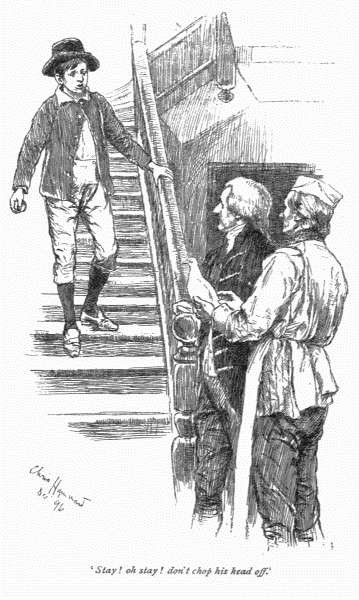
'Stay! oh stay! don't chop his head off.'
'Stay! oh stay! don't chop his head off: he does not deserve it,' cried the boy, who came running out of the garret with the greatest eagerness—'I broke your window, sir,' said he to Mr. Somerville. 'I broke your window with this ball; but I did not know that I had done it, till this moment, I assure you, or I should have told you before. Don't chop his head off,' added the boy to the carpenter, who had now the white pigeon in his hands. 'No,' said Mr. Somerville, 'the pigeon's head shall not be chopped off, nor yours either, my good boy, for breaking a window. I am persuaded by your open, honest countenance, that you are speaking the truth; but pray explain this matter to us; for you have not made it quite clear. How happened it that you could break my windows without knowing it? and how came you to find it out at last?' 'Sir,' said the boy, 'if you'll come up here, I'll show you all I know, and how I came to know it.'
Mr. Somerville followed the boy into the garret, who pointed to a pane of glass that was broken in a small window that looked out upon a piece of waste ground behind the house. Upon this piece of waste ground the children of the village often used to play. 'We were playing there at ball yesterday evening,' continued the boy, addressing himself to Mr. Somerville, 'and one of the lads challenged me to hit a mark in the wall, which I did; but he said I did not hit it, and bade me give him up my ball as the forfeit. This I would not do; and when he began to wrestle with me for it, I threw the ball, as I thought, over the house. He ran to look for it in the street, but could not find it, which I was very glad of; but I was very sorry just now to find it myself lying upon this heap of shavings, sir, under this broken window; for, as soon as I saw it lying there, I knew I must have been the person that broke the window; and through this window came the white pigeon. Here's one of his white feathers sticking in the gap.'
'Yes,' said the carpenter, 'and in the bow-window room below there's plenty of his feathers to be seen; for I've just been down to look. It was the pigeon broke them windows, sure enough.' 'But he could not have got in had I not broke this little window,' said the boy eagerly; 'and I am able to earn sixpence a day, and I'll pay for all the mischief, and welcome. The white pigeon belongs to a poor neighbour, a friend of ours, who is very fond of him, and I would not have him killed for twice as much money.'
'Take the pigeon, my honest, generous lad,' said Mr. Somerville, 'and carry him back to your neighbour. I forgive him all the mischief he has done me, tell your friend, for your sake. As to the rest, we can have the windows mended; and do you keep all the sixpences you earn for yourself.'
'That's what he never did yet,' said the carpenter. 'Many's the sixpence he earns, but not a halfpenny goes into his own pocket: it goes every farthing to his poor father and mother. Happy for them to have such a son!'
'More happy for him to have such a father and mother,' exclaimed the boy. 'Their good days they took all the best care of me that was to be had for love or money, and would, if I would let them, go on paying for my schooling now, falling as they be in the world; but I must learn to mind the shop now. Good morning to you, sir; and thank you kindly,' said he to Mr. Somerville.
'And where does this boy live, and who are his father and mother? They cannot live in town,' said Mr. Somerville, 'or I should have heard of them.'
'They are but just come into the town, please your honour,' said the carpenter. 'They lived formerly upon Counsellor O'Donnel's estate; but they were ruined, please your honour, by taking a joint lease with a man who fell afterwards into bad company, ran out all he had, so could not pay the landlord; and these poor people were forced to pay his share and their own too, which almost ruined them. They were obliged to give up the land; and now they have furnished a little shop in this town with what goods they could afford to buy with the money they got by the sale of their cattle and stock. They have the goodwill of all who know them; and I am sure I hope they will do well. The boy is very ready in the shop, though he said only that he could earn sixpence a day. He writes a good hand, and is quick at casting up accounts, for his age. Besides, he is likely to do well in the world, because he is never in idle company, and I've known him since he was two foot high, and never heard of his telling a lie.'
'This is an excellent character of the boy, indeed,' said Mr. Somerville, 'and from his behaviour this morning I am inclined to think that he deserves all your praises.'
Mr. Somerville resolved to inquire more fully concerning this poor family, and to attend to their conduct himself, fully determined to assist them if he should find them such as they had been represented.
In the meantime, this boy, whose name was Brian O'Neill, went to return the white pigeon to its owner. 'You have saved its life,' said the woman to whom it belonged, 'and I'll make you a present of it.' Brian thanked her; and he from that day began to grow fond of the pigeon. He always took care to scatter some oats for it in his father's yard; and the pigeon grew so tame at last that it would hop about the kitchen, and eat off the same trencher with the dog.
Brian, after the shop was shut up at night, used to amuse himself with reading some little books which the schoolmaster who formerly taught him arithmetic was so good as to lend him. Amongst these he one evening met with a little book full of the history of birds and beasts; he looked immediately to see whether the pigeon was mentioned amongst the birds, and, to his great joy, he found a full description and history of his favourite bird.
'So, Brian, I see your schooling has not been thrown away upon you; you like your book, I see, when you have no master over you to bid you read,' said his father, when he came in and saw Brian reading his book very attentively.
'Thank you for having me taught to read, father,' said Brian. 'Here I've made a great discovery: I've found out in this book, little as it looks, father, a most curious way of making a fortune; and I hope it will make your fortune, father, and if you'll sit down, I'll tell it to you.'
Mr. O'Neill, in hopes of pleasing his son rather than in the expectation of having his fortune made, immediately sat down to listen; and his son explained to him that he had found in his book an account of pigeons who carried notes and letters: 'and, father,' continued Brian, 'I find my pigeon is of this sort; and I intend to make my pigeon carry messages. Why should not he? If other pigeons have done so before him, I think he is as good, and, I daresay, will be as easy to teach as any pigeon in the world. I shall begin to teach him to-morrow morning; and then, father, you know people often pay a great deal for sending messengers: and no boy can run, no horse can gallop, so fast as a bird can fly; therefore the bird must be the best messenger, and I should be paid the best price. Hey, father?'
'To be sure, to be sure, my boy,' said his father, laughing; 'I wish you may make the best messenger in Ireland of your pigeon; but all I beg, my dear boy, is that you won't neglect our shop for your pigeon; for I've a notion we have a better chance of making a fortune by the shop than by the white pigeon.'
Brian never neglected the shop: but in his leisure hours he amused himself with training his pigeon; and after much patience he at last succeeded so well, that one day he went to his father and offered to send him word by his pigeon what beef was a pound in the market of Ballynagrish, where he was going. 'The pigeon will be home long before me, father; and he will come in at the kitchen window and light upon the dresser; then you must untie the little note which I shall have tied under his left wing, and you'll know the price of beef directly.'
The pigeon carried his message well; and Brian was much delighted with his success. He soon was employed by the neighbours, who were aroused by Brian's fondness of his swift messenger; and soon the fame of the white pigeon was spread amongst all who frequented the markets and fairs of Somerville.
At one of these fairs a set of men of desperate fortunes met to drink, and to concert plans of robberies. Their place of meeting was at the alehouse of Mr. Cox, the man who, as our readers may remember, was offended by Mr. Somerville's hinting that he was fond of drinking and of quarrelling, and who threatened vengeance for having been refused the new inn.
Whilst these men were talking over their schemes, one of them observed that one of their companions was not arrived. Another said, 'No.' 'He's six miles off,' said another; and a third wished that he could make him hear at that distance. This turned the discourse upon the difficulties of sending messages secretly and quickly. Cox's son, a lad of about nineteen, who was one of this gang, mentioned the white carrier pigeon, and he was desired to try all means to get it into his possession. Accordingly, the next day young Cox went to Brian O'Neill, and tried, at first by persuasion and afterwards by threats, to prevail upon him to give up the pigeon. Brian was resolute in his refusal, more especially when the petitioner began to bully him.
'If we can't have it by fair means, we will by foul,' said Cox; and a few days afterwards the pigeon was gone. Brian searched for it in vain—inquired from all the neighbours if they had seen it, and applied, but to no purpose, to Cox. He swore that he knew nothing about the matter. But this was false, for it was he who during the night-time had stolen the white pigeon. He conveyed it to his employers, and they rejoiced that they had gotten it into their possession, as they thought it would serve them for a useful messenger.
Nothing can be more short-sighted than cunning. The very means which these people took to secure secrecy were the means of bringing their plots to light. They endeavoured to teach the pigeon, which they had stolen, to carry messages for them in a part of the country at some distance from Somerville; and when they fancied that it had forgotten its former habits and its old master, they thought that they might venture to employ him nearer home. The pigeon, however, had a better memory than they imagined. They loosed him from a bag near the town of Ballynagrish, in hopes that he would stop at the house of Cox's cousin, which was on its road between Ballynagrish and Somerville. But the pigeon, though he had been purposely fed at this house for a week before this trial, did not stop there, but flew on to his old master's house in Somerville, and pecked at the kitchen window, as he had formerly been taught to do. His father, fortunately, was within hearing, and poor Brian ran with the greatest joy to open the window and to let him in.
'Oh, father, here's my white pigeon come back of his own accord,' exclaimed Brian; 'I must run and show him to my mother.' At this instant the pigeon spread his wings, and Brian discovered under one of its wings a small and very dirty-looking billet. He opened it in his father's presence. The scrawl was scarcely legible; but these words were at length deciphered:—
'Thare are eight of uz sworn: I send yo at botom thare names. We meat at tin this nite at my faders, and have harms and all in radiness to brak into the grate 'ouse. Mr. Summervill is to lye out to nite—kip the pigeon untill to-morrow. For ever yours, Murtagh Cox, Jun.'
Scarcely had they finished reading this note, than both father and son exclaimed, 'Let us go and show it to Mr. Somerville.' Before they set out, they had, however, the prudence to secure the pigeon, so that he should not be seen by any one but themselves.
Mr. Somerville, in consequence of this fortunate discovery, took proper measures for the apprehension of the eight men who had sworn to rob his house. When they were all safely lodged in the county gaol, he sent for Brian O'Neill and his father; and after thanking them for the service they had done him, he counted out ten bright guineas upon a table, and pushed them towards Brian, saying, 'I suppose you know that a reward of ten guineas was offered some weeks ago for the discovery of John MacDermod, one of the eight men whom we have just taken up?'
'No, sir,' said Brian; 'I did not know it, and I did not bring that note to you to get ten guineas, but because I thought it was right. I don't want to be paid for doing it.' 'That's my own boy,' said his father. 'We thank you, sir; but we'll not take the money; I don't like to take the price of blood.'
'I know the difference, my good friends,' said Mr. Somerville, 'between vile informers and courageous, honest men.' 'Why, as to that, please your honour, though we are poor, I hope we are honest.' 'And, what is more,' said Mr. Somerville, 'I have a notion that you would continue to be honest, even if you were rich.
'Will you, my good lad,' continued Mr. Somerville, after a moment's pause—'will you trust me with your pigeon a few days?' 'Oh, and welcome, sir,' said the boy, with a smile; and he brought the pigeon to Mr. Somerville when it was dark, and nobody saw him.
A few days afterwards, Mr. Somerville called at O'Neill's house, and bid him and his son follow him. They followed till he stopped opposite to the bow-window of the new inn. The carpenter had just put up a sign, which was covered over with a bit of carpeting.
'Go up the ladder, will you?' said Mr. Somerville to Brian, 'and pull that sign straight, for it hangs quite crooked. There, now it is straight. Now pull off the carpet, and let us see the new sign.'
The boy pulled off the cover, and saw a white pigeon painted upon the sign, and the name of O'Neill in large letters underneath.
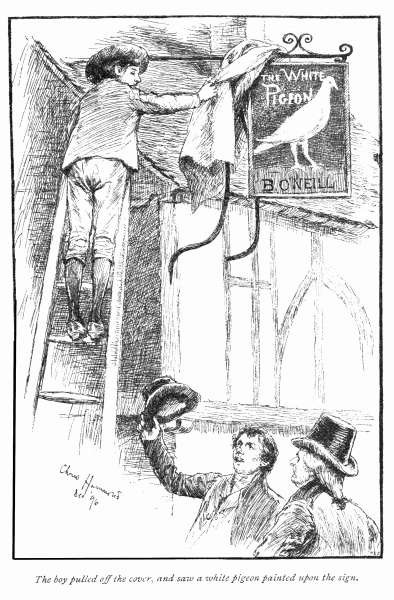
The boy pulled off the cover, and saw a white pigeon painted upon the sign.
'Take care you do not tumble down and break your neck upon this joyful occasion,' said Mr. Somerville, who saw that Brian's surprise was too great for his situation. 'Come down from the ladder, and wish your father joy of being master of the new inn called the "White Pigeon." And I wish him joy of having such a son as you are. Those who bring up their children well, will certainly be rewarded for it, be they poor or rich.'
THE BIRTHDAY PRESENT
'Mamma,' said Rosamond, after a long silence, 'do you know what I have been thinking of all this time?' 'No, my dear—What?' 'Why, mamma, about my cousin Bell's birthday; do you know what day it is?' 'No, I don't remember.' 'Dear mother! don't you remember it's the 22nd of December; and her birthday is the day after to-morrow? Don't you recollect now? But you never remember about birthdays, mamma. That was just what I was thinking of, that you never remember my sister Laura's birthday, or—or—or mine, mamma.'
'What do you mean, my dear? I remember your birthday perfectly well.' 'Indeed! but you never keep it, though.' 'What do you mean by keeping your birthday?' 'Oh, mamma, you know very well—as Bell's birthday is kept. In the first place, there is a great dinner.' 'And can Bell eat more upon her birthday than upon any other day?' 'No; nor I should not mind about the dinner, except the mince-pies. But Bell has a great many nice things—I don't mean nice eatable things, but nice new playthings, given to her always on her birthday; and everybody drinks her health, and she's so happy.'
'But stay, Rosamond, how you jumble things together! Is it everybody's drinking her health that makes her so happy? or the new playthings, or the nice mince-pies? I can easily believe that she is happy whilst she is eating a mince-pie, or whilst she is playing; but how does everybody's drinking her health at dinner make her happy?'
Rosamond paused, and then said she did not know. 'But,' added she, 'the nice new playthings, mother!' 'But why the nice new playthings? Do you like them only because they are new?' 'Not only—I do not like playthings only because they are new: but Bell does, I believe—for that puts me in mind—Do you know, mother, she had a great drawer full of old playthings that she never used, and she said that they were good for nothing, because they were old; but I thought many of them were good for a great deal more than the new ones. Now you shall be judge, mamma; I'll tell you all that was in the drawer.'
'Nay, Rosamond, thank you, not just now; I have not time to listen to you.'
'Well then, mamma, the day after to-morrow I can show you the drawer. I want you to judge very much, because I am sure I was in the right. And, mother,' added Rosamond, stopping her as she was going out of the room, 'will you—not now, but when you've time—will you tell me why you never keep my birthday—why you never make any difference between that day and any other day?' 'And will you, Rosamond—not now, but when you have time to think about it—tell me why I should make any difference between your birthday and any other day?'
Rosamond thought, but she could not find out any reason; besides, she suddenly recollected that she had not time to think any longer; for there was a certain work-basket to be finished, which she was making for her cousin Bell, as a present upon her birthday. The work was at a stand for want of some filigree-paper, and, as her mother was going out, she asked her to take her with her, that she might buy some. Her sister Laura went with them.
'Sister,' said Rosamond, as they were walking along, 'what have you done with your half-guinea?' 'I have it in my pocket.' 'Dear! you will keep it for ever in your pocket. You know, my godmother when she gave it to you said you would keep it longer than I should keep mine; and I know what she thought by her look at the time. I heard her say something to my mother.' 'Yes,' said Laura, smiling; 'she whispered so loud that I could not help hearing her too. She said I was a little miser.' 'But did not you hear her say that I was very generous? and she'll see that she was not mistaken. I hope she'll be by when I give my basket to Bell—won't it be beautiful? There is to be a wreath of myrtle, you know, round the handle, and a frost ground, and then the medallions——'
'Stay,' interrupted her sister, for Rosamond, anticipating the glories of her work-basket, talked and walked so fast that she had passed, without perceiving it, the shop where the filigree-paper was to be bought. They turned back. Now it happened that the shop was the corner house of a street, and one of the windows looked out into a narrow lane. A coach full of ladies stopped at the door, just before they went in, so that no one had time immediately to think of Rosamond and her filigree-paper, and she went to the window where she saw her sister Laura looking earnestly at something that was passing in the lane.
Opposite to the window, at the door of a poor-looking house, there was sitting a little girl weaving lace. Her bobbins moved as quick as lightning, and she never once looked up from her work. 'Is not she very industrious?' said Laura; 'and very honest, too?' added she in a minute afterwards; for just then a baker with a basket of rolls on his head passed, and by accident one of the rolls fell close to the little girl. She took it up eagerly, looked at it as if she was very hungry, then put aside her work, and ran after the baker to return it to him. Whilst she was gone, a footman in a livery laced with silver, who belonged to the coach that stood at the shop door, as he was lounging with one of his companions, chanced to spy the weaving pillow, which she had left upon a stone before the door. To divert himself (for idle people do mischief often to divert themselves) he took up the pillow, and entangled all the bobbins. The little girl came back out of breath to her work; but what was her surprise and sorrow to find it spoiled. She twisted and untwisted, placed and replaced, the bobbins, while the footman stood laughing at her distress. She got up gently, and was retiring into the house, when the silver-laced footman stopped her, saying, insolently, 'Sit still, child.' 'I must go to my mother, sir,' said the child; 'besides, you have spoiled all my lace. I can't stay.' 'Can't you?' said the brutal footman, snatching her weaving-pillow again, 'I'll teach you to complain of me.' And he broke off, one after another, all the bobbins, put them into his pocket, rolled her weaving-pillow down the dirty lane, then jumped up behind his mistress's coach, and was out of sight in an instant.
'Poor girl!' exclaimed Rosamond, no longer able to restrain her indignation at this injustice; 'poor little girl!'
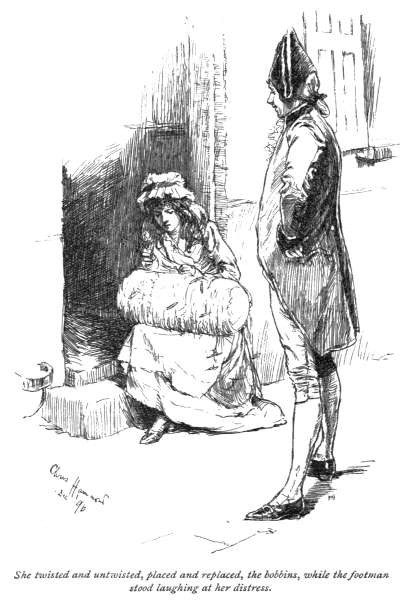
She twisted and untwisted, placed and replaced, the bobbins, while the footman stood laughing at her distress.
At this instant her mother said to Rosamond—'Come, now, my dear, if you want this filigree-paper, buy it.' 'Yes, madam,' said Rosamond; and the idea of what her godmother and her cousin Bell would think of her generosity rushed again upon her imagination. All her feelings of pity were immediately suppressed. Satisfied with bestowing another exclamation upon the 'poor little girl!' she went to spend her half-guinea upon her filigree basket. In the meantime, she that was called the 'little miser' beckoned to the poor girl, and, opening the window, said, pointing to the cushion, 'Is it quite spoiled?' 'Quite! quite spoiled! and I can't, nor mother neither, buy another; and I can't do anything else for my bread.' A few, but very few, tears fell as she said this.
'How much would another cost?' said Laura. 'Oh, a great—great deal.' 'More than that?' said Laura, holding up her half-guinea. 'Oh no.' 'Then you can buy another with that,' said Laura, dropping the half-guinea into her hand; and she shut the window before the child could find words to thank her, but not before she saw a look of joy and gratitude, which gave Laura more pleasure probably than all the praise which could have been bestowed upon her generosity.
Late on the morning of her cousin's birthday, Rosamond finished her work-basket. The carriage was at the door—Laura came running to call her; her father's voice was heard at the same instant; so she was obliged to go down with her basket but half wrapped up in silver paper—a circumstance at which she was a good deal disconcerted; for the pleasure of surprising Bell would be utterly lost if one bit of the filigree should peep out before the proper time. As the carriage went on, Rosamond pulled the paper to one side and to the other, and by each of the four corners.
'It will never do, my dear,' said her father, who had been watching her operations. 'I am afraid you will never make a sheet of paper cover a box which is twice as large as itself.'
'It is not a box, father,' said Rosamond, a little peevishly; 'it's a basket.'
'Let us look at this basket,' said he, taking it out of her unwilling hands, for she knew of what frail materials it was made, and she dreaded its coming to pieces under her father's examination. He took hold of the handle rather roughly; when, starting off the coach seat, she cried, 'Oh, sir! father! sir! you will spoil it indeed!' said she, with increased vehemence, when, after drawing aside the veil of silver paper, she saw him grasp the myrtle-wreathed handle. 'Indeed, sir, you will spoil the poor handle.'
'But what is the use of the poor handle,' said her father, 'if we are not to take hold of it? And pray,' continued he, turning the basket round with his finger and thumb, rather in a disrespectful manner, 'pray, is this the thing you have been about all this week? I have seen you all this week dabbling with paste and rags; I could not conceive what you were about. Is this the thing?' 'Yes, sir. You think, then, that I have wasted my time, because the basket is of no use; but then it is for a present for my cousin Bell.' 'Your cousin Bell will be very much obliged to you for a present that is of no use. You had better have given her the purple jar.'
'Oh, father! I thought you had forgotten that—it was two years ago; I'm not so silly now. But Bell will like the basket, I know, though it is of no use.'
'Then you think Bell is sillier now than you were two years ago,—well, perhaps that is true; but how comes it, Rosamond, now that you are so wise, that you are fond of such a silly person?' 'I, father?' said Rosamond, hesitating; 'I don't think I am very fond of her.' 'I did not say very fond.' 'Well, but I don't think I am at all fond of her.' 'But you have spent a whole week in making this thing for her.' 'Yes, and all my half-guinea besides.'
'Yet you think her silly, and you are not fond of her at all; and you say you know this thing will be of no use to her.'
'But it is her birthday, sir; and I am sure she will expect something, and everybody else will give her something.'
'Then your reason for giving is because she expects you to give her something. And will you, or can you, or should you, always give, merely because others expect, or because somebody else gives?' 'Always?—no, not always.' 'Oh, only on birthdays.'
Rosamond, laughing: 'Now you are making a joke of me, papa, I see; but I thought you liked that people should be generous,—my godmother said that she did.' 'So do I, full as well as your godmother; but we have not yet quite settled what it is to be generous.' 'Why, is it not generous to make presents?' said Rosamond. 'That is the question which it would take up a great deal of time to answer. But, for instance, to make a present of a thing that you know can be of no use to a person you neither love nor esteem, because it is her birthday, and because everybody gives her something, and because she expects something, and because your godmother says she likes that people should be generous, seems to me, my dear Rosamond, to be, since I must say it, rather more like folly than generosity.'
Rosamond looked down upon the basket, and was silent. 'Then I am a fool, am I?' said she, looking up at last. 'Because you have made one mistake? No. If you have sense enough to see your own mistakes, and can afterwards avoid them, you will never be a fool.'
Here the carriage stopped, and Rosamond recollected that the basket was uncovered.
Now we must observe that Rosamond's father had not been too severe upon Bell when he called her a silly girl. From her infancy she had been humoured; and at eight years old she had the misfortune to be a spoiled child. She was idle, fretful, and selfish; so that nothing could make her happy. On her birthday she expected, however, to be perfectly happy. Everybody in the house tried to please her, and they succeeded so well that between breakfast and dinner she had only six fits of crying. The cause of five of these fits no one could discover: but the last, and most lamentable, was occasioned by a disappointment about a worked muslin frock; and accordingly, at dressing time, her maid brought it to her, exclaiming, 'See here, miss, what your mamma has sent you on your birthday. Here's a frock fit for a queen—if it had but lace round the cuffs.' 'And why has not it lace around the cuffs? mamma said it should.' 'Yes, but mistress was disappointed about the lace; it is not come home.' 'Not come home, indeed! and didn't they know it was my birthday? But then I say I won't wear it without the lace—I can't wear it without the lace, and I won't.'
The lace, however, could not be had; and Bell at length submitted to let the frock be put on. 'Come, Miss Bell, dry your eyes,' said the maid who educated her; 'dry your eyes, and I'll tell you something that will please you.'
'What, then?' said the child, pouting and sobbing. 'Why——but you must not tell that I told you.' 'No,—but if I am asked?' 'Why, if you are asked, you must tell the truth, to be sure. So I'll hold my tongue, miss.' 'Nay, tell me, though, and I'll never tell—if I am asked.' 'Well, then,' said the maid, 'your cousin Rosamond is come, and has brought you the most beautifullest thing you ever saw in your life; but you are not to know anything about it till after dinner, because she wants to surprise you; and mistress has put it into her wardrobe till after dinner.' 'Till after dinner!' repeated Bell impatiently; 'I can't wait till then; I must see it this minute.' The maid refused her several times, till Bell burst into another fit of crying, and the maid, fearing that her mistress would be angry with her, if Bell's eyes were red at dinner time, consented to show her the basket.
'How pretty!—but let me have it in my own hands,' said Bell, as the maid held the basket up out of her reach. 'Oh, no, you must not touch it; for if you should spoil it, what would become of me?' 'Become of you, indeed!' exclaimed the spoiled child, who never considered anything but her own immediate gratification—'Become of you, indeed! what signifies that?—I shan't spoil it; and I will have it in my own hands. If you don't hold it down for me directly, I'll tell that you showed it to me.' 'Then you won't snatch it?' 'No, no, I won't indeed,' said Bell; but she had learned from her maid a total disregard of truth. She snatched the basket the moment it was within her reach. A struggle ensued, in which the handle and lid were torn off, and one of the medallions crushed inwards, before the little fury returned to her senses.
Calmed at this sight, the next question was, how she should conceal the mischief which she had done. After many attempts, the handle and lid were replaced; the basket was put exactly in the same spot in which it had stood before, and the maid charged the child 'to look as if nothing was the matter.'
We hope that both children and parents will here pause for a moment to reflect. The habits of tyranny, meanness, and falsehood, which children acquire from living with bad servants, are scarcely ever conquered in the whole course of their future lives.
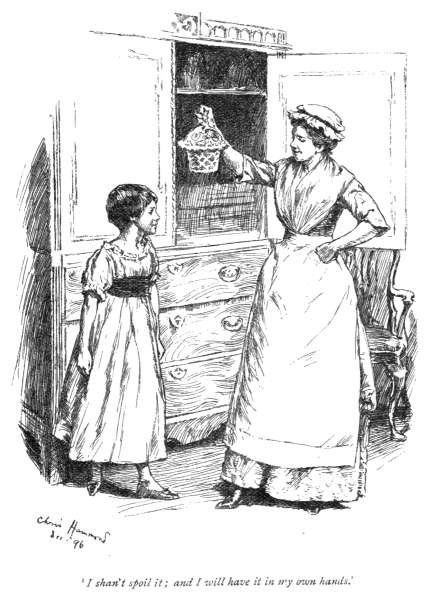
'I shan't spoil it; and I will have it in my own hands.'
After shutting up the basket they left the room, and in the adjoining passage they found a poor girl waiting with a small parcel in her hand. 'What's your business?' said the maid. 'I have brought home the lace, madam, that was bespoke for the young lady.' 'Oh, you have, have you, at last?' said Bell; 'and pray why didn't you bring it sooner?' The girl was going to answer, but the maid interrupted her, saying, 'Come, come, none of your excuses; you are a little idle, good-for-nothing thing, to disappoint Miss Bell upon her birthday. But now you have brought it, let us look at it!'
The little girl gave the lace without reply, and the maid desired her to go about her business, and not to expect to be paid; for that her mistress could not see anybody, because she was in a room full of company.
'May I call again, madam, this afternoon?' said the child, timidly.
'Lord bless my stars!' replied the maid, 'what makes people so poor, I wonders! I wish mistress would buy her lace at the warehouse, as I told her, and not of these folks. Call again! yes, to be sure. I believe you'd call, call, call twenty times for twopence.'
However ungraciously the permission to call again was granted, it was received with gratitude. The little girl departed with a cheerful countenance, and Bell teased her maid till she got her to sew the long-wished-for lace upon her cuffs.
Unfortunate Bell!—All dinner time passed, and people were so hungry, so busy, or so stupid, that not an eye observed her favourite piece of finery. Till at length she was no longer able to conceal her impatience, and turning to Laura, who sat next to her, she said, 'You have no lace upon your cuffs. Look how beautiful mine is!—is not it? Don't you wish your mamma could afford to give some like it? But you can't get any if she would, for this was made on purpose for me on my birthday, and nobody can get a bit more anywhere, if they would give the world for it.' 'But cannot the person who made it,' said Laura, 'make any more like it?' 'No, no, no!' cried Bell; for she had already learned, either from her maid or her mother, the mean pride which values things not for being really pretty or useful, but for being such as nobody else can procure. 'Nobody can get any like it, I say,' repeated Bell; 'nobody in all London can make it but one person, and that person will never make a bit for anybody but me, I am sure. Mamma won't let her, if I ask her not.' 'Very well,' said Laura coolly, 'I do not want any of it; you need not be so violent: I assure you that I don't want any of it.' 'Yes, but you do, though,' said Bell, more angrily. 'No, indeed,' said Laura, smiling. 'You do, in the bottom of your heart; but you say you don't to plague me, I know,' cried Bell, swelling with disappointed vanity. 'It is pretty for all that, and it cost a great deal of money too, and nobody shall have any like it, if they cried their eyes out.'
Laura received this declaration in silence—Rosamond smiled; and at her smile the ill-suppressed rage of the spoiled child burst forth into the seventh and loudest fit of crying which had yet been heard on her birthday.
'What's the matter, my pet?' cried her mother; 'come to me and tell me what's the matter.' Bell ran roaring to her mother; but no otherwise explained the cause of her sorrow than by tearing the fine lace with frantic gestures from her cuffs, and throwing the fragments into her mother's lap. 'Oh! the lace, child!—are you mad?' said her mother, catching hold of both her hands. 'Your beautiful lace, my dear love—do you know how much it cost?' 'I don't care how much it cost—it is not beautiful, and I'll have none of it,' replied Bell, sobbing; 'for it is not beautiful.' 'But it is beautiful,' retorted her mother; 'I chose the pattern myself. Who has put it into your head, child, to dislike it? Was it Nancy?' 'No, not Nancy, but them, mamma,' said Bell, pointing to Laura and Rosamond. 'Oh, fie! don't point,' said her mother, putting down her stubborn finger; 'nor say them, like Nancy; I am sure you misunderstood. Miss Laura, I am sure, did not mean any such thing.' 'No, madam; and I did not say any such thing, that I recollect,' said Laura, gently. 'Oh no, indeed!' cried Rosamond, warmly, rising in her sister's defence.
No defence or explanation, however, was to be heard, for everybody had now gathered round Bell, to dry her tears, and to comfort her for the mischief she had done to her own cuffs. They succeeded so well, that in about a quarter of an hour the young lady's eyes and the reddened arches over her eyebrows came to their natural colour; and the business being thus happily hushed up, the mother, as a reward to her daughter for her good humour, begged that Rosamond would now be so good as to produce her 'charming present.'
Rosamond, followed by all the company, amongst whom, to her great joy, was her godmother, proceeded to the dressing-room. 'Now I am sure,' thought she, 'Bell will be surprised, and my godmother will see she was right about my generosity.'
The doors of the wardrobe were opened with due ceremony, and the filigree basket appeared in all its glory. 'Well, this is a charming present, indeed!' said the godmother, who was one of the company; 'my Rosamond knows how to make presents.' And as she spoke, she took hold of the basket, to lift it down to the admiring audience. Scarcely had she touched it, when, lo! the basket fell to the ground, and only the handle remained in her hand. All eyes were fixed upon the wreck. Exclamations of sorrow were heard in various tones; and 'Who can have done this?' was all that Rosamond could say. Bell stood in sullen silence, which she obstinately preserved in the midst of the inquiries that were made about the disaster.
At length the servants were summoned, and amongst them Nancy, Miss Bell's maid and governess. She affected much surprise when she saw what had befallen the basket, and declared that she knew nothing of the matter, but that she had seen her mistress in the morning put it quite safe into the wardrobe; and that, for her part, she had never touched it, or thought of touching it, in her born days. 'Nor Miss Bell, neither, ma'am,—I can answer for her; for she never knew of its being there, because I never so much as mentioned it to her, that there was such a thing in the house, because I knew Miss Rosamond wanted to surprise her with the secret; so I never mentioned a sentence of it—did I, Miss Bell?'
Bell, putting on the deceitful look which her maid had taught her, answered boldly, 'No'; but she had hold of Rosamond's hand, and at the instant she uttered this falsehood she squeezed it terribly. 'Why do you squeeze my hand so?' said Rosamond, in a low voice; 'what are you afraid of?' 'Afraid of!' cried Bell, turning angrily; 'I'm not afraid of anything—I've nothing to be afraid about.' 'Nay, I did not say you had,' whispered Rosamond; 'but only if you did by accident—you know what I mean—I should not be angry if you did—only say so.' 'I say I did not!' cried Bell furiously. 'Mamma, mamma! Nancy! my cousin Rosamond won't believe me! That's very hard. It's very rude, and I won't bear it—I won't.' 'Don't be angry, love. Don't,' said the maid. 'Nobody suspects you, darling,' said her mother; 'but she has too much sensibility. Don't cry, love; nobody suspected you.' 'But you know,' continued she, turning to the maid, 'somebody must have done this, and I must know how it was done. Miss Rosamond's charming present must not be spoiled in this way, in my house, without my taking proper notice of it. I assure you I am very angry about it, Rosamond.'
Rosamond did not rejoice in her anger, and had nearly made a sad mistake by speaking aloud her thoughts—'I was very foolish——' she began and stopped.
'Ma'am,' cried the maid, suddenly, 'I'll venture to say I know who did it.' 'Who?' said every one, eagerly. 'Who?' said Bell, trembling. 'Why, miss, don't you recollect that little girl with the lace, that we saw peeping about in the passage? I'm sure she must have done it; for here she was by herself half an hour or more, and not another creature has been in mistress's dressing-room, to my certain knowledge, since morning. Those sort of people have so much curiosity. I'm sure she must have been meddling with it,' added the maid.
'Oh yes, that's the thing,' said the mistress, decidedly. 'Well, Miss Rosamond, for your comfort she shall never come into my house again.' 'Oh, that would not comfort me at all,' said Rosamond; 'besides, we are not sure that she did it, and if——' A single knock at the door was heard at this instant. It was the little girl, who came to be paid for her lace. 'Call her in,' said the lady of the house; 'let us see her directly.'
The maid, who was afraid that the girl's innocence would appear if she were produced, hesitated; but upon her mistress repeating her commands, she was forced to obey. The girl came in with a look of simplicity; but when she saw a room full of company she was a little abashed. Rosamond and Laura looked at her and one another with surprise, for it was the same little girl whom they had seen weaving lace. 'Is not it she?' whispered Rosamond to her sister. 'Yes, it is; but hush,' said Laura, 'she does not know us. Don't say a word, let us hear what she will say.'
Laura got behind the rest of the company as she spoke, so that the little girl could not see her.
'Vastly well!' said Bell's mother; 'I am waiting to see how long you will have the assurance to stand there with that innocent look. Did you ever see that basket before?' 'Yes, ma'am,' said the girl. 'Yes, ma'am!' cried the maid; 'and what else do you know about it? You had better confess it at once, and mistress, perhaps, will say no more about it.' 'Yes, do confess it,' added Bell, earnestly. 'Confess what, madam?' said the little girl; 'I never touched the basket, madam.' 'You never touched it; but you confess,' interrupted Bell's mother, 'that you did see it before. And, pray, how came you to see it? You must have opened my wardrobe.' 'No, indeed, ma'am,' said the little girl; 'but I was waiting in the passage, ma'am, and this door was partly open; and looking at the maid, you know, I could not help seeing it.' 'Why, how could you see through the doors of my wardrobe?' rejoined the lady.
The maid, frightened, pulled the little girl by the sleeve.
'Answer me,' said the lady, 'where did you see this basket?' Another stronger pull. 'I saw it, madam, in her hands,' looking at the maid; 'and——' 'Well, and what became of it afterwards?' 'Ma'am'—hesitating—'miss pulled, and by accident—I believe, I saw, ma'am—miss, you know what I saw.' 'I do not know—I do not know; and if I did, you had no business there; and mamma won't believe you, I am sure.' Everybody else, however, did believe; and their eyes were fixed upon Bell in a manner which made her feel rather ashamed. 'What do you all look at me so for? Why do you all look so? And am I to be put to shame on my birthday?' cried she, bursting into a roar of passion; 'and all for this nasty thing!' added she, pushing away the remains of the basket, and looking angrily at Rosamond. 'Bell! Bell! oh, fie! fie!—Now I am ashamed of you; that's quite rude to your cousin,' said her mother, who was more shocked at her daughter's want of politeness than at her falsehood. 'Take her away, Nancy, till she has done crying,' added she to the maid, who accordingly carried off her pupil.
Rosamond, during this scene, especially at the moment when her present was pushed away with such disdain, had been making reflections upon the nature of true generosity. A smile from her father, who stood by, a silent spectator of the catastrophe of the filigree basket, gave rise to these reflections; nor were they entirely dissipated by the condolence of the rest of the company, nor even by the praises of her godmother, who, for the purpose of condoling with her, said, 'Well, my dear Rosamond, I admire your generous spirit. You know I prophesied that your half-guinea would be gone the soonest. Did I not, Laura?' said she, appealing, in a sarcastic tone, to where she thought Laura was. 'Where is Laura? I don't see her.' Laura came forward. 'You are too prudent to throw away your money like your sister. Your half-guinea, I'll answer for it, is snug in your pocket—is it not?' 'No, madam,' answered she, in a low voice.
But low as the voice of Laura was, the poor little lace-girl heard it; and now, for the first time, fixing her eyes upon Laura, recollected her benefactress. 'Oh, that's the young lady!' she exclaimed, in a tone of joyful gratitude, 'the good, good young lady who gave me the half-guinea, and would not stay to be thanked for it; but I will thank her now.'
'The half-guinea, Laura!' said her godmother. 'What is all this?' 'I'll tell you, madam, if you please,' said the little girl.
It was not in expectation of being praised for it that Laura had been generous, and therefore everybody was really touched with the history of the weaving-pillow; and whilst they praised, felt a certain degree of respect, which is not always felt by those who pour forth eulogiums. Respect is not an improper word, even applied to a child of Laura's age; for let the age or situation of the person be what it may, they command respect who deserve it.
'Ah, madam!' said Rosamond to her godmother, 'now you see—you see she is not a little miser. I'm sure that's better than wasting half a guinea upon a filigree basket; is it not, ma'am?' said she, with an eagerness which showed that she had forgotten all her own misfortunes in sympathy with her sister. 'This is being really generous, father, is it not?'
'Yes, Rosamond,' said her father, and he kissed her; 'this is being really generous. It is not only by giving away money that we can show generosity; it is by giving up to others anything that we like ourselves; and therefore,' added he, smiling, 'it is really generous of you to give your sister the thing you like best of all others.'
'The thing I like the best of all others, father,' said Rosamond, half pleased, half vexed. 'What is that, I wonder? You don't mean praise, do you, sir?' 'Nay, you must decide that yourself, Rosamond.' 'Why, sir,' said she, ingenuously, 'perhaps it was once the thing I liked best; but the pleasure I have just felt makes me like something else much better.'
ETON MONTEM
[Extracted from the 'Courier' of May 1799.]
'Yesterday this triennial ceremony took place, with which the public are too well acquainted to require a particular description. A collection, called Salt, is taken from the public, which forms a purse, to support the Captain of the School in his studies at Cambridge. This collection is made by the Scholars, dressed in fancy dresses, all round the country.
'At eleven o'clock, the youths being assembled in their habiliments at the College, the Royal Family set off from the Castle to see them, and, after walking round the Courtyard, they proceeded to Salt Hill in the following order:—
'His Majesty, his Royal Highness the Prince of Wales, and the Earl of Uxbridge.
'Their Royal Highnesses the Dukes of Kent and Cumberland, Earl Morton, and General Gwynne, all on horseback, dressed in the Windsor uniform, except the Prince of Wales, who wore a suit of dark blue, and a brown surtout over.
'Then followed the Scholars, preceded by the Marechal Serjeant, the Musicians of the Staffordshire Band, and Mr. Ford, Captain of the Seminary, the Serjeant-Major, Serjeants, Colonels, Corporals, Musicians, Ensign, Lieutenant, Steward, Salt-Bearers, Polemen, and Runners.
'The cavalcade was brought up by Her Majesty and her amiable daughters in two carriages, and a numerous company of equestrians and pedestrians, all eager to behold their Sovereign and his family. Among the former, Lady Lade was foremost in the throng; only two others dared venture their persons on horseback in such a multitude.
'The King and Royal Family were stopped on Eton Bridge by Messrs. Young and Mansfield, the Salt-Bearers, to whom their Majesties delivered their customary donation of fifty guineas each.
'At Salt Hill, His Majesty, with his usual affability, took upon himself to arrange the procession round the Royal carriages; and even when the horses were taken off, with the assistance of the Duke of Kent, fastened the traces round the pole of the coaches, to prevent any inconvenience.
'An exceeding heavy shower of rain coming on, the Prince took leave, and went to the "Windmill Inn" till it subsided. The King and his attendants weathered it out in their greatcoats.
'After the young gentlemen walked round the carriage, Ensign Vince and the Salt-Bearers proceeded to the summit of the hill; but the wind being boisterous, he could not exhibit his dexterity in displaying his flag, and the space being too small before the carriages, from the concourse of spectators, the King kindly acquiesced in not having it displayed under such inconvenience.
'Their Majesties and the Princesses then returned home, the King occasionally stopping to converse with the Dean of Windsor, the Earl of Harrington, and other noblemen.
'The Scholars partook of an elegant dinner at the "Windmill Inn," and in the evening walked on Windsor Terrace.
'Their Royal Highnesses the Prince of Wales and Duke of Cumberland, after taking leave of their Majesties, set off for town, and honoured the Opera House with their presence in the evening.
'The profit arising from the Salt collected, according to account, amounted to £800.
'The Stadtholder, the Duke of Gordon, Lord and Lady Melbourne, Viscount Brome, and a numerous train of fashionable nobility were present.
'The following is an account of their dresses, made as usual, very handsomely, by Mrs. Snow, milliner, of Windsor:—
'Mr. Ford, Captain, with eight Gentlemen to attend him as servitors.
'Mr. Sarjeant, Marechal.
'Mr. Bradith, Colonel.
'Mr. Plumtree, Lieutenant.
'Mr. Vince, Ensign.
'Mr. Young, College Salt-Bearer; white and gold dress, rich satin bag, covered with gold netting.
'Mr. Mansfield, Oppidin, white, purple, and orange dress, trimmed with silver; rich satin bag, purple and silver: each carrying elegant poles, with gold and silver cord.
'Mr. Keity, yellow and black velvet; helmet trimmed with silver.
'Mr. Bartelot, plain mantle and sandals, Scotch bonnet, a very Douglas.
'Mr. Knapp, flesh-colour and blue; Spanish hat and feathers.
'Mr. Ripley, rose-colour; helmet.
'Mr. Islip (being in mourning), a scarf; helmet, black velvet; and white satin.
'Mr. Tomkins, violet and silver; helmet.
'Mr. Thackery, lilac and silver; Roman cap.
'Mr. Drury, mazarin blue; fancy cap.
'Mr. Davis, slate-colour and straw.
'Mr. Routh, pink and silver; Spanish hat.
'Mr. Curtis, purple; fancy cap.
'Mr. Lloyd, blue; ditto.
'At the conclusion of the ceremony the Royal Family returned to Windsor, and the boys were all sumptuously entertained at the tavern at Salt Hill. About six in the evening all the boys returned in the order of procession, and, marching round the great square of Eton, were dismissed. The Captain then paid his respects to the Royal Family, at the Queen's Lodge, Windsor, previously to his departure for King's College, Cambridge, to defray which expense the produce of the Montem was presented to him.
'The day concluded by a brilliant promenade of beauty, rank, and fashion on Windsor Terrace, enlivened by the performance of several bands of music.
'The origin of the procession is from the custom by which the Manor was held.
'The custom of hunting the Ram belonged to Eton College, as well as the custom of Salt; but it was discontinued by Dr. Cook, late Dean of Ely. Now this custom we know to have been entered on the register of the Royal Abbey of Bee, in Normandy, as one belonging to the Manor of East or Great Wrotham, in Norfolk, given by Ralph de Toni to the Abbey of Bee, and was as follows:—When the harvest was finished, the tenants were to have half an acre of barley, and a ram let loose; and if they caught him he was their own to make merry with, but if he escaped from them he was the Lord's. The Etonians, in order to secure the ram, houghed him in the Irish fashion, and then attacked him with great clubs. The cruelty of this proceeding brought it into disuse, and now it exists no longer.—See Register of the Royal Abbey of Bee, folio 58.
'After the dissolution of the alien priories, in 1414, by the Parliament of Leicester, they remained in the Crown till Henry VI., who gave Wrotham Manor to Eton College; and if the Eton Fellows would search, they would perhaps find the Manor in their possession, that was held by the custom of Salt.'
Men
Alderman Bursal, Father of young Bursal.
Lord John,
}
Talbot,
}
Wheeler,
} Young Gentlemen of Eton, from 17 to 19 years of age.
Bursal,
}
Rory O'Ryan
}
Mr. Newington, Landlord of the Inn at Salt Hill.
Farmer Hearty.
A Waiter and crowd of Eton Lads.
Women
The Marchioness of Piercefield, Mother of Lord John.
Lady Violetta—her Daughter, a Child of six or seven years old.
Mrs. Talbot.
Louisa Talbot, her Daughter.
Miss Bursal, Daughter to the Alderman.
Mrs. Newington, Landlady of the Inn at Salt Hill.
Sally, a Chambermaid.
Patty, a Country Girl.
Pipe and Tabor, and Dance of Peasants.
ACT THE FIRST
SCENE I
The Bar of the 'Windmill Inn' at Salt Hill
Mr. and Mrs. Newington, the Landlord and Landlady
Landlady. 'Tis an unpossibility, Mr. Newington; and that's enough. Say no more about it; 'tis an unpossibility in the natur of things. (She ranges jellies, etc., in the Bar.) And pray, do you take your great old-fashioned tankard, Mr. Newington, from among my jellies and confectioneries.
Landlord (takes his tankard and drinks). Anything for a quiet life. If it is an unpossibility, I've no more to say; only, for the soul of me, I can't see the great unpossibility, wife.
Landlady. Wife, indeed!—wife!—wife! wife every minute.
Landlord. Heyday! Why, what a plague would you have me call you? The other day you quarrelled with me for calling you Mrs. Landlady.
Landlady. To be sure I did, and very proper in me I should. I've turned off three waiters and five chambermaids already, for screaming after me Mrs. Landlady! Mrs. Landlady! But 'tis all your ill manners.
Landlord. Ill manners! Why, if I may be so bold, if you are not Mrs. Landlady, in the name of wonder what are you?
Landlady. Mrs. Newington, Mr. Newington.
Landlord (drinks). Mrs. Newington, Mr. Newington drinks your health; for I suppose I must not be landlord any more in my own house (shrugs).
Landlady. Oh, as to that, I have no objections nor impediments to your being called Landlord. You look it, and become it very proper.
Landlord. Why, yes, indeed, thank my tankard, I do look it, and become it, and am nowise ashamed of it; but every one to their mind, as you, wife, don't fancy the being called Mrs. Landlady.
Landlady. To be sure I don't. Why, when folks hear the old-fashioned cry of Mrs. Landlady! Mrs. Landlady! who do they expect, think you, to see, but an overgrown, fat, featherbed of a woman coming waddling along with her thumbs sticking on each side of her apron, o' this fashion? Now, to see me coming, nobody would take me to be a landlady.
Landlord. Very true, indeed, wife—Mrs. Newington, I mean—I ask pardon; but now to go on with what we were saying about the unpossibility of letting that old lady and the civil-spoken young lady there above have them there rooms for another day.
Landlady. Now, Mr. Newington, let me hear no more about that old gentlewoman and that civil-spoken young lady. Fair words cost nothing; and I've a notion that's the cause they are so plenty with the young lady. Neither o' them, I take it, by what they've ordered since their coming into the house, are such grand folk that one need be so petticular about them.
Landlord. Why, they came only in a chaise and pair, to be sure; I can't deny that.
Landlady. But, bless my stars! what signifies talking? Don't you know, as well as I do, Mr. Newington, that to-morrow is Eton Montem, and that if we had twenty times as many rooms and as many more to the back of them, it would not be one too many for all the company we've a right to expect, and those the highest quality of the land? Nay, what do I talk of to-morrow? isn't my Lady Piercefield and suite expected? and, moreover, Mr. and Miss Bursal's to be here, and will call for as much in an hour as your civil-spoken young lady in a twelvemonth, I reckon. So, Mr. Newington, if you don't think proper to go up and inform the ladies above that the Dolphin rooms are not for them, I must speak myself, though 'tis a thing I never do when I can help it.
Landlord (aside). She not like to speak! (Aloud.) My dear, you can speak a power better than I can; so take it all upon yourself, if you please; for, old-fashioned as I and my tankard here be, I can't make a speech that borders on the uncivil order, to a lady like, for the life and lungs of me. So, in the name of goodness, do you go up, Mrs. Newington.
Landlady. And so I will, Mr. Newington. Help ye! Civilities and rarities are out o' season for them that can't pay for them in this world; and very proper.
(Exit Landlady.)
Landlord. And very proper! Ha! who comes yonder? The Eton chap who wheedled me into lending him my best hunter last year, and was the ruination of him; but that must be paid for, wheedle or no wheedle; and, for the matter of wheedling, I'd stake this here Mr. Wheeler, that is making up to me, do you see, against e'er a boy, or hobbledehoy, in all Eton, London, or Christendom, let the other be who he will.
Enter Wheeler.
Wheeler. A fine day, Mr. Newington.
Landlord. A fine day, Mr. Wheeler.
Wheel. And I hope, for your sake, we may have as fine a day for the Montem to-morrow. It will be a pretty penny in your pocket! Why, all the world will be here; and (looking round at the jellies, etc.) so much the better for them; for here are good things enough, and enough for them. And here's the best thing of all, the good old tankard still; not empty, I hope.
Landlord. Not empty, I hope. Here's to you, Mr. Wheeler.
Wheel. Mr. Wheeler!—Captain Wheeler, if you please.
Landlord. You, Captain Wheeler!—Why, I thought in former times it was always the oldest scholar at Eton that was Captain at the Montems; and didn't Mr. Talbot come afore you?
Wheel. Not at all; we came on the same day. Some say I came first; some say Talbot. So the choice of which of us is to be captain is to be put to the vote amongst the lads—most votes carry it; and I have most votes, I fancy; so I shall be captain, to-morrow, and a pretty deal of salt8 I reckon I shall pocket. Why, the collection at the last Montem, they say, came to a plump thousand! No bad thing for a young fellow to set out with for Oxford or Cambridge—hey?
Landlord. And no bad thing, before he sets out for Cambridge or Oxford, 'twould be for a young gentleman to pay his debts.
Wheel. Debts! Oh, time enough for that. I've a little account with you in horses, I know; but that's between you and me, you know—mum.
Landlord. Mum me no mums, Mr. Wheeler. Between you and me, my best hunter has been ruinationed; and I can't afford to be mum. So you'll take no offence if I speak; and as you'll set off to-morrow, as soon as the Montem's over, you'll be pleased to settle with me some way or other to-day, as we've no other time.
Wheel. No time so proper, certainly. Where's the little account?—I have money sent me for my Montem dress, and I can squeeze that much out of it. I came home from Eton on purpose to settle with you. But as to the hunter, you must call upon Talbot—do you understand? to pay for him; for though Talbot and I had him the same day, 'twas Talbot did for him, and Talbot must pay. I spoke to him about it, and charged him to remember you; for I never forget to speak a good word for my friends.
Landlord. So I perceive.
Wheel. I'll make bold just to give you my opinion of these jellies whilst you are getting my account, Mr. Newington.
(He swallows down a jelly or two—Landlord is going.)
Enter Talbot.
Talbot. Hallo, Landlord! where are you making off so fast? Here, your jellies are all going as fast as yourself.
Wheel. (aside). Talbot!—I wish I was a hundred miles off.
Landlord. You are heartily welcome, Mr. Talbot. A good morning to you, sir; I'm glad to see you—very glad to see you, Mr. Talbot.
Talb. Then shake hands, my honest landlord.
(Talbot, in shaking hands with him, puts a purse into the Landlord's hands.)
Landlord. What's here? Guineas?
Talb. The hunter, you know; since Wheeler won't pay, I must—that's all. Good morning.
Wheel. (aside.) What a fool!
(Landlord, as Talbot is going catches hold of his coat.)
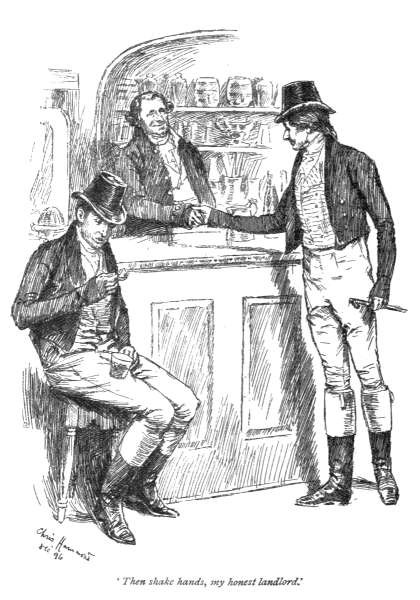
'Then shake hands, my honest landlord.'
Landlord. Hold, Mr. Talbot, this won't do!
Talb. Won't it? Well, then, my watch must go.
Landlord. Nay, nay! but you are in such a hurry to pay—you won't hear a man. Half this is enough for your share o' the mischief, in all conscience. Mr. Wheeler, there, had the horse on the same day.
Wheel. But Bursal's my witness——
Talb. Oh, say no more about witnesses; a man's conscience is always his best witness, or his worst. Landlord, take your money, and no more words.
Wheel. This is very genteel of you, Talbot. I always thought you would do the genteel thing, as I knew you to be so generous and considerate.
Talb. Don't waste your fine speeches, Wheeler, I advise you, this election time. Keep them for Bursal or Lord John, or some of those who like them. They won't go down with me. Good morning to you. I give you notice, I'm going back to Eton as fast as I can gallop; and who knows what plain speaking may do with the Eton lads? I may be captain yet, Wheeler. Have a care! Is my horse ready there?
Landlord. Mr. Talbot's horse, there! Mr. Talbot's horse, I say.
Talbot sings.
He carries weight—he rides a race—
'Tis for a thousand pound!
(Exit Talbot.)
Wheel. And, dear me! I shall be left behind. A horse for me, pray; a horse for Mr. Wheeler!
(Exit Wheeler.)
Landlord (calls very loud). Mr. Talbot's horse! Hang the hostler! I'll saddle him myself.
(Exit Landlord.)
SCENE II
A Dining-room in the Inn at Salt Hill
Mrs. Talbot and Louisa
Louisa (laughing). With what an air Mrs. Landlady made her exit!
Mrs. Talbot. When I was young, they say, I was proud; but I am humble enough now: these petty mortifications do not vex me.
Louisa. It is well my brother was gone before Mrs. Landlady made her entrée; for if he had heard her rude speech, he would at least have given her the retort courteous.
Mrs. Talb. Now tell me honestly, my Louisa——You were, a few days ago, at Bursal House. Since you have left it and have felt something of the difference that is made in this world between splendour and no splendour, you have never regretted that you did not stay there, and that you did not bear more patiently with Miss Bursal's little airs?
Louisa. Never for a moment. At first Miss Bursal paid me a vast deal of attention; but, for what reason I know not, she suddenly changed her manner, grew first strangely cold, then condescendingly familiar, and at last downright rude. I could not guess the cause of these variations.
Mrs. Talb. (aside). I guess the cause too well.
Louisa. But as I perceived the lady was out of tune, I was in haste to leave her. I should make a very bad, and, I am sure, a miserable toad eater. I had much rather, if I were obliged to choose, earn my own bread, than live as toad eater with anybody.
Mrs. Talb. Fine talking, dear Louisa!
Louisa. Don't you believe me to be in earnest, mother? To be sure, you cannot know what I would do, unless I were put to the trial.
Mrs. Talb. Nor you either, my dear.
(She sighs, and is silent.)
Louisa (takes her mother's hand). What is the matter, dear mother? You used to say that seeing my brother always made you feel ten years younger; yet even while he was here, you had, in spite of all your efforts to conceal them, those sudden fits of sadness.
Mrs. Talb. The Montem—is not it to-morrow? Ay, but my boy is not sure of being captain.
Louisa. No; there is one Wheeler, who, as he says, is most likely to be chosen captain. He has taken prodigious pains to flatter and win over many to his interest. My brother does not so much care about it; he is not avaricious.
Mrs. Talb. I love your generous spirit and his! but, alas! my dear, people may live to want, and wish for money, without being avaricious. I would not say a word to Talbot; full of spirits as he was this morning, I would not say a word to him, till after the Montem, of what has happened.
Louisa. And what has happened, dear mother? Sit down,—you tremble.
Mrs. Talb. (sits down and puts a letter into Louisa's hand). Read that, love. A messenger brought me that from town a few hours ago.
Louisa (reads). 'By an express from Portsmouth, we hear the Bombay Castle East Indiaman is lost, with all your fortune on board.' All! I hope there is something left for you to live upon.
Mrs. Talb. About £150 a year for us all.
Louisa. That is enough, is it not, for you?
Mrs. Talb. For me, love? I am an old woman, and want but little in this world, and shall be soon out of it.
Louisa (kneels down beside her). Do not speak so, dearest mother.
Mrs. Talb. Enough for me, love! Yes, enough, and too much for me. I am not thinking of myself.
Louisa. Then, as to my brother, he has such abilities, and such industry, he will make a fortune at the bar for himself, most certainly.
Mrs. Talb. But his education is not completed. How shall we provide him with money at Cambridge?
Louisa. This Montem. The last time the captain had eight hundred, the time before a thousand, pounds. Oh, I hope—I fear! Now, indeed, I know that, without being avaricious, we may want, and wish for money.
(Landlady's voice heard behind the scenes.)
Landlady. Waiter!—Miss Bursal's curricle, and Mr. Bursal's vis-à-vis. Run! see that the Dolphin's empty. I say run!—run!
Mrs. Talb. I will rest for a few moments upon the sofa, in this bedchamber, before we set off.
Louisa (goes to open the door). They have bolted or locked it. How unlucky!
(She turns the key, and tries to unlock the door.)
Enter Waiter.
Waiter. Ladies, I'm sorry—Miss Bursal and Mr. Bursal are come—just coming upstairs.
Mrs. Talb. Then, will you be so good, sir, as to unlock this door?
(Waiter tries to unlock the door.)
Waiter. It must be bolted on the inside. Chambermaid! Sally! Are you within there? Unbolt this door.
Mr. Bursal's voice behind the scenes. Let me have a basin of good soup directly.
Waiter. I'll go round and have the door unbolted immediately, ladies.
(Exit Waiter.)
Enter Miss Bursal, in a riding dress, and with a long whip.
Miss Bursal. Those creatures, the ponies, have a'most pulled my 'and off. Who 'ave we 'ere? Ha! Mrs. Talbot! Louisa, 'ow are ye? I'm so vastly glad to see you; but I'm so shocked to 'ear of the loss of the Bombay Castle. Mrs. Talbot, you look but poorly; but this Montem will put everybody in spirits. I 'ear everybody's to be 'ere; and my brother tells me, 'twill be the finest ever seen at H Eton. Louisa, my dear, I'm sorry I've not a seat for you in my curricle for to-morrow; but I've promised Lady Betty; so, you know, 'tis impossible for me.
Louisa. Certainly; and it would be impossible for me to leave my mother at present.
Chambermaid (opens the bedchamber door). The room's ready now, ladies.
Mrs. Talb. Miss Bursal, we intrude upon you no longer.
Miss Burs. Nay, why do you decamp, Mrs. Talbot? I 'ad a thousand things to say to you, Louisa; but am so tired and so annoyed——
(Seats herself. Exeunt Mrs. Talbot, Louisa, and Chambermaid.)

Enter Miss Bursal, in a riding dress.
Enter Mr. Bursal, with a basin of soup in his hand.
Mr. Burs. Well, thank my stars the Airly Castle is safe in the Downs.
Miss Burs. Mr. Bursal, can you inform me why Joe, my groom, does not make his appearance?
Mr. Burs. (eating and speaking). Yes, that I can, child; because he is with his 'orses, where he ought to be. 'Tis fit they should be looked after well; for they cost me a pretty penny—more than their heads are worth, and yours into the bargain; but I was resolved, as we were to come to this Montem, to come in style.
Miss Burs. In style, to be sure; for all the world's to be here—the King, the Prince of Whales, and Duke o' York, and all the first people; and we shall cut a dash! Dash! dash! will be the word to-morrow!—(playing with her whip).
Mr. Burs. (aside). Dash! dash! ay, just like her brother. He'll pay away finely, I warrant, by the time he's her age. Well, well, he can afford it; and I do love to see my children make a figure for their money. As Jack Bursal says, what's money for, if it e'nt to make a figure? (Aloud.) There's your brother Jack, now. The extravagant dog! he'll have such a dress as never was seen, I suppose, at this here Montem. Why, now, Jack Bursal spends more money at Eton, and has more to spend, than my Lord John, though my Lord John's the son of a marchioness.
Miss Burs. Oh, that makes no difference nowadays. I wonder whether her ladyship is to be at this Montem. The only good I ever got out of these stupid Talbots was an introduction to their friend Lady Piercefield. What she could find to like in the Talbots, heaven knows. I've a notion she'll drop them, when she hears of the loss of the Bombay Castle.
Enter a Waiter, with a note.
Waiter. A note from my Lady Piercefield, sir.
Miss B. Charming woman! Is she here, pray, sir?
Waiter. Just come. Yes, ma'am.
(Exit Waiter.)
Miss B. Well, Mr. Bursal, what is it?
Mr. B. (reads). 'Business of importance to communicate——' Hum! what can it be?—(going).
Miss B. (aside). Perhaps some match to propose for me! (Aloud.) Mr. Bursal, pray before you go to her ladyship, do send my ooman to me to make me presentable.
(Exit Miss Bursal at one door.)
Mr. B. (at the opposite door). 'Business of importance!' Hum! I'm glad I'm prepared with a good basin of soup. There's no doing business well upon an empty stomach. Perhaps the business is to lend cash; and I've no great stomach for that. But it will be an honour, to be sure.
(Exit.)
SCENE III
Landlady's Parlour
Landlady—Mr. Finsbury, a man-milliner, with bandboxes—a fancy cap, or helmet, with feathers, in the Landlady's hand—a satin bag, covered with gold netting, in the man-milliner's hand—a mantle hanging over his arm. A rough-looking Farmer is sitting with his back towards them, eating bread and cheese, and reading a newspaper.
Landlady. Well, this, to be sure, will be the best-dressed Montem that ever was seen at Eton; and you Lon'on gentlemen have the most fashionablest notions; and this is the most elegantest fancy cap——
Finsbury. Why, as you observe, ma'm, that is the most elegant fancy cap of them all. That is Mr. Hector Hogmorton's fancy cap, ma'm; and here, ma'm, is Mr. Saul's rich satin bag, covered with gold net. He is college salt-bearer, I understand, and has a prodigious superb white and gold dress. But, in my humble opinion, ma'm, the marshal's white and purple and orange fancy-dress, trimmed with silver, will bear the bell; though, indeed, I shouldn't say that,—for the colonel's and lieutenant's, and ensign's, are beautiful in the extreme. And, to be sure, nothing could be better imagined than Mr. Marlborough's lilac and silver, with a Roman cap. And it must be allowed that nothing in nature can have a better effect than Mr. Drake's flesh-colour and blue, with this Spanish hat, ma'm, you see.
(The Farmer looks over his shoulder from time to time during this speech, with contempt.)
Farmer (reads the newspaper). French fleet at sea—Hum!
Landlady. O gemini: Mr. Drake's Spanish hat is the sweetest, tastiest thing! Mr. Finsbury, I protest——
Finsb. Why, ma'm, I knew a lady of your taste couldn't but approve of it. My own invention entirely, ma'm. But it's nothing to the captain's cap, ma'm. Indeed, ma'm, Mr. Wheeler, the captain that is to be, has the prettiest taste in dress. To be sure, his sandals were my suggestion; but the mantle he has the entire credit of, to do him justice; and when you see it, ma'm, you will be really surprised; for (for contrast and elegance, and richness, and lightness, and propriety, and effect, and costume) you've never yet seen anything at all to be compared to Captain Wheeler's mantle, ma'm.
Farmer (to the Landlady). Why, now, pray, Mrs. Landlady, how long may it have been the fashion for milliners to go about in men's clothes?
Landlady (aside to Farmer). Lord, Mr. Hearty, hush! This is Mr. Finsbury, the great man-milliner.
Farm. The great man-milliner! This is a sight I never thought to see in Old England.
Finsb. (packing up bandboxes). Well, ma'm, I'm glad I have your approbation. It has ever been my study to please the ladies.
Farm. (throws a fancy mantle over his frieze coat). And is this the way to please the ladies, Mrs. Landlady, nowadays?
Finsb. (taking off the mantle). Sir, with your leave—I ask pardon—but the least thing detriments these tender colours; and as you have just been eating cheese with your hands——
Farm. 'Tis my way to eat cheese with my mouth, man.
Finsb. Man!
Farm. I ask pardon—man-milliner, I mean.
Enter Landlord.
Landlord. Why, wife!
Landlady. Wife!
Landlord. I ask pardon—Mrs. Newington I mean. Do you know who them ladies are that you have been and turned out of the Dolphin?
Landlady (alarmed). Not I, indeed. Who are they, pray? Why, if they are quality it's no fault of mine. It is their own fault for coming, like scrubs, without four horses. Why, if quality will travel the road this way, incognito, how can they expect to be known and treated as quality? 'Tis no fault of mine. Why didn't you find out sooner who they were, Mr. Newington? What else in the 'versal world have you to do, but to go basking about in the yards and places with your tankard in your hand, from morning till night? What have you else to ruminate, all day long, but to find out who's who, I say?
Farm. Clapper! clapper! clapper! like my mill in a high wind, landlord. Clapper! clapper! clapper!—enough to stun a body.
Landlord. That is not used to it; but use is all, they say.
Landlady. Will you answer me, Mr. Newington? Who are the grandees that were in the Dolphin?—and what's become on them?
Landlord. Grandees was your own word, wife. They be not to call grandees; but I reckon you'd be sorry not to treat 'em civil, when I tell you their name is Talbot, mother and sister to our young Talbot of Eton; he that paid me so handsome for the hunter this very morning.
Landlady. Mercy! is that all? What a combustion for nothing in life!
Finsb. For nothing in life, as you say, ma'm; that is, nothing in high life, I'm sure, ma'm; nay, I dare a'most venture to swear. Would you believe it, Mr. Talbot is one of the few young gentlemen of Eton that has not bespoke from me a fancy-dress for this grand Montem?
Landlady. There, Mr. Newington; there's your Talbot for you! and there's your grandees! Oh, trust me, I know your scrubs at first sight.
Landlord. Scrubs, I don't, nor can't, nor won't call them that pay their debts honestly. Scrubs, I don't, nor won't, nor can't call them that behave as handsome as young Mr. Talbot did here to me this morning about the hunter. A scrub he is not, wife. Fancy-dress or no fancy-dress, Mr. Finsbury, this young gentleman is no scrub.
Finsb. Dear me! 'Twas not I said scrub. Did I say scrub?
Farm. No matter if you did.
Finsb. No matter, certainly; and yet it is a matter; for I'm confident I wouldn't for the world leave it in any one's power to say that I said—that I called—any young gentleman of Eton a scrub! Why, you know, sir, it might breed a riot!
Farm. And a pretty figure you'd make in a riot!
Landlady. Pray let me hear nothing about riots in my house.
Farm. Nor about scrubs.
Finsb. But I beg leave to explain, gentlemen. All I ventured to remark or suggest was, that as there was some talk of Mr. Talbot's being captain to-morrow, I didn't conceive how he could well appear without any dress. That was all, upon my word and honour. A good morning to you, gentlemen; it is time for me to be off. Mrs. Newington, you were so obliging as to promise to accommodate me with a return chaise as far as Eton.
(Finsbury bows and exit.)
Farm. A good day to you and your bandboxes. There's a fellow for you now! Ha! ha! ha!—A man-milliner, forsooth!
Landlord. Mrs. Talbot's coming—stand back.
Landlady. Lord! why does Bob show them through this way?
Enter Mrs. Talbot, leaning on Louisa; Waiter showing the way.
Landlady. You are going on, I suppose, ma'am?
Waiter (aside to Landlord). Not if she could help it; but there's no beds, since Mr. Bursal and Miss Bursal's come.
Landlord. I say nothing, for it is vain to say more. But isn't it a pity she can't stay for the Montem, poor old lady! Her son—as good and fine a lad as ever you saw—they say, has a chance, too, of being captain. She may never live to see another such a sight.
(As Mrs. Talbot walks slowly on, the Farmer puts himself across her way, so as to stop her short.)
Farm. No offence, madam, I hope; but I have a good snug farmhouse, not far off hand; and if so be you'd be so good to take a night's lodging, you and the young lady with you, you'd have a hearty welcome. That's all I can say; and you'd make my wife very happy; for she's a good woman, to say nothing of myself.
Landlord. If I may be so bold to put in my word, madam, you'd have as good beds, and be as well lodged, with Farmer Hearty, as in e'er a house at Salt Hill.
Mrs. Talb. I am very much obliged——
Farm. Oh, say nothing o' that, madam. I am sure I shall be as much obliged if you do come. Do, miss, speak for me.
Louisa. Pray, dear mother——
Farm. She will. (Calls behind the scenes.) Here, waiter! hostler! driver! what's your name? drive the chaise up here to the door, smart, close. Lean on my arm, madam, and we'll have you in and home in a whiff.
(Exeunt Mrs. Talbot, Louisa, Farmer, Landlord, and Waiter.)
Landlady (sola). What a noise and a rout this farmer man makes! and my husband, with his great broad face, bowing, as great a nincompoop as t'other. The folks are all bewitched with the old woman, I verily believe. (Aloud.) A good morning to you, ladies.
ACT THE SECOND
SCENE I
A field near Eton College;—several boys crossing backwards and forwards in the background. In front, Talbot, Wheeler, Lord John and Bursal.
Talbot. Fair play, Wheeler! Have at 'em, my boy! There they stand, fair game! There's Bursal there, with his dead forty-five votes at command; and Lord John with his—how many live friends?
Lord John (coolly). Sir, I have fifty-six friends, I believe.
Talb. Fifty-six friends, his lordship believes—Wheeler inclusive no doubt.
Lord J. That's as hereafter may be.
Wheeler. Hereafter! Oh, fie, my lud! You know your own Wheeler has, from the first minute he ever saw you, been your fast friend.
Talb. Your fast friend from the first minute he ever saw you, my lord! That's well hit, Wheeler; stick to that; stick fast. Fifty-six friends, Wheeler inclusive, hey, my lord! hey, my lud!
Lord J. Talbot exclusive, I find, contrary to my expectations.
Talb. Ay, contrary to your expectations, you find that Talbot is not a dog that will lick the dust: but then there's enough of the true spaniel breed to be had for whistling for; hey, Wheeler?
Bursal (aside to Wheeler). A pretty electioneerer. So much the better for you, Wheeler. Why, unless he bought a vote, he'd never win one, if he talked from this to the day of judgment.
Wheeler (aside to Bursal). And as he has no money to buy votes—he! he! he!—we are safe enough.
Talb. That's well done, Wheeler; fight the by-battle there with Bursal, now you are sure of the main with Lord John.
Lord J. Sure! I never made Mr. Wheeler any promise yet.
Wheel. Oh, I ask no promise from his lordship; we are upon honour: I trust entirely to his lordship's good nature and generosity, and to his regard for his own family; I having the honour, though distantly, to be related.
Lord J. Related! How, Wheeler?
Wheel. Connected, I mean, which is next door, as I may say, to being related. Related slipped out by mistake; I beg pardon, my Lord John.
Lord J. Related!—a strange mistake, Wheeler.
Talb. Overshot yourself, Wheeler; overshot yourself, by all that's awkward. And yet, till now, I always took you for 'a dead-shot at a yellow-hammer.'9
Wheel. (taking Bursal by the arm). Bursal, a word with you. (Aside to Bursal.) What a lump of family pride that Lord John is.
Talb. Keep out of my hearing, Wheeler, lest I should spoil sport. But never fear: you'll please Bursal sooner than I shall. I can't, for the soul of me, bring myself to say that Bursal's not purse-proud, and you can. Give you joy.
Burs. A choice electioneerer!—ha! ha! ha!
Wheel. (faintly). He! he! he!—a choice electioneerer, as you say.
(Exeunt Wheeler and Bursal; manent Lord J. and Talbot.)
Lord J. There was a time, Talbot——
Talb. There was a time, my lord—to save trouble and a long explanation—there was a time when you liked Talbots better than spaniels; you understand me?
Lord J. I have found it very difficult to understand you of late, Mr. Talbot.
Talb. Yes, because you have used other people's understandings instead of your own. Be yourself, my lord. See with your own eyes, and hear with your own ears, and then you'll find me still, what I've been these seven years; not your under-strapper, your hanger-on, your flatterer, but your friend! If you choose to have me for a friend, here's my hand. I am your friend, and you'll not find a better.
Lord J. (giving his hand). You are a strange fellow, Talbot; I thought I never could have forgiven you for what you said last night.
Talb. What? for I don't keep a register of my sayings. Oh, it was something about gaming—Wheeler was flattering your taste for it, and he put me into a passion—I forget what I said. But, whatever it was, I'm sure it was well meant, and I believe it was well said.
Lord J. But you laugh at me sometimes to my face.
Talb. Would you rather I should laugh at you behind your back?
Lord J. But of all things in the world I hate to be laughed at. Listen to me, and don't fumble in your pockets while I'm talking to you.
Talb. I'm fumbling for—oh, here it is. Now, Lord John, I once did laugh at you behind your back, and what's droll enough, it was at your back I laughed. Here's a caricature I drew of you—I really am sorry I did it; but 'tis best to show it to you myself.
Lord J. (aside). It is all I can do to forgive this. (After a pause, he tears the paper.) I have heard of this caricature before; but I did not expect, Talbot, that you would come and show it to me yourself, Talbot, so handsomely, especially at such a time as this. Wheeler might well say you are a bad electioneerer.
Talb. Oh, hang it! I forgot my election, and your fifty-six friends.
Enter Rory O'Ryan.
Rory (claps Talbot on the back). Fifty-six friends, have you, Talbot? Say seven—fifty-seven, I mean; for I'll lay you a wager, you've forgot me; and that's a shame for you, too; for out of the whole posse-comitatus entirely now, you have not a stauncher friend than poor little Rory O'Ryan. And a good right he has to befriend you; for you stood by him when many who ought to have known better were hunting him down for a wild Irishman. Now that same wild Irishman has as much gratitude in him as any tame Englishman of them all. But don't let's be talking sintimint; for, for my share I'd not give a bogberry a bushel for sintimint, when I could get anything better.
Lord J. And pray, sir, what may a bogberry be?
Rory. Phoo! don't be playing the innocent, now. Where have you lived all your life (I ask pardon, my lard) not to know a bogberry when you see or hear of it? (Turns to Talbot.) But what are ye standing idling here for? Sure, there's Wheeler, and Bursal along with him, canvassing out yonder at a terrible fine rate. And haven't I been huzzaing for you there till I'm hoarse? So I am, and just stepped away to suck an orange for my voice—(sucks an orange). I am a thoroughgoing friend, at any rate.
Talb. Now, Rory, you are the best fellow in the world, and a thoroughgoing friend; but have a care, or you'll get yourself and me into some scrape, before you have done with this violent thoroughgoing work.
Rory. Never fear! never fear, man!—a warm frind and a bitter enemy, that's my maxim.
Talb. Yes, but too warm a friend is as bad as a bitter enemy.
Rory. Oh, never fear me! I'm as cool as a cucumber all the time; and whilst they tink I'm tinking of nothing in life but making a noise, I make my own snug little remarks in prose and verse, as—now my voice is after coming back to me, you shall hear, if you plase.
Talb. I do please.
Rory. I call it Rory's song. Now, mind, I have a verse for everybody—o' the leading lads, I mean; and I shall put 'em in or lave 'em out, according to their inclinations and deserts, wise-a-wee to you, my little frind. So you comprehend it will be Rory's song, with variations.
Talbot and Lord John. Let's have it; let's have it without further preface.
Rory sings.
8 Salt, the cant name given by the Eton lads to the money collected at Montem.
9 Young noblemen at Oxford wear yellow tufts at the tops of their caps. Hence their flatterers are said to be dead-shots at yellow-hammers.
I'm true game to the last, and no Wheeler for me.
Rory. There's a stroke, in the first place, for Wheeler,—you take it?
Talb. Oh yes, yes, we take it; go on.
Rory sings.
I'm true game to the last, and no Wheeler for me.
Of all birds, beasts, or fishes, that swim in the sea,
Webb'd or finn'd, black or white, man or child, Whig or Tory,
None but Talbot, O Talbot's the dog for Rory.
Talb. 'Talbot the dog' is much obliged to you.
Lord J. But if I have any ear, one of your lines is a foot too long, Mr. O'Ryan.
Rory. Phoo, put the best foot foremost for a frind. Slur it in the singing, and don't be quarrelling, anyhow, for a foot more or less. The more feet the better it will stand, you know. Only let me go on, and you'll come to something that will plase you.
Rory sings.
Then there's he with the purse that's as long as my arm.
Rory. That's Bursal, mind now, whom I mean to allude to in this verse.
Lord J. If the allusion's good, we shall probably find out your meaning.
Talb. On with you, Rory, and don't read us notes on a song.
Lord J. Go on, and let us hear what you say of Bursal.
Rory sings.
Then there's he with the purse that's as long as my arm;
His father's a tanner,—but then where's the harm?
Heir to houses, and hunters, and horseponds in fee,
Won't his skins sure soon buy him a pedigree?
Lord J. Encore! encore! Why, Rory, I did not think you could make so good a song.
Rory. Sure 'twas none of I made it—'twas Talbot here.
Talb. I!
Rory (aside). Not a word: I'll make you a present of it: sure, then, it's your own.
Talb. I never wrote a word of it.
Rory (to Lord J.) Phoo, phoo! he's only denying it out of false modesty.
Lord J. Well, no matter who wrote it,—sing it again.
Rory. Be easy; so I will, and as many more verses as you will to the back of it. (Winking at Talbot aside.) You shall have the credit of all. (Aloud.) Put me in when I'm out, Talbot, and you (to Lord John) join—join.
Rory sings, and Lord John sings with him.
Then there's he with the purse that's as long as my arm;
His father's a tanner,—but then where's the harm?
Heir to houses, and hunters, and horseponds in fee,
Won't his skins sure soon buy him a pedigree?
There's my lord with the back that never was bent——
(Lord John stops singing; Talbot makes signs to Rory to stop; but Rory does not see him, and sings on.)
There's my lord with the back that never was bent;
Let him live with his ancestors, I am content.
(Rory pushes Lord J. and Talbot with his elbows.)
Rory. Join, join, both of ye—why don't you join? (Sings.)
Who'll buy my Lord John? the arch fishwoman cried,
A nice oyster shut up in a choice shell of pride.
Rory. But join or ye spoil all.
Talb. You have spoiled all, indeed.
Lord J. (making a formal low bow). Mr. Talbot, Lord John thanks you.
Rory. Lord John! blood and thunder! I forgot you were by—quite and clean.
Lord J. (puts him aside and continues speaking to Talbot). Lord John thanks you, Mr. Talbot: this is the second part of the caricature. Lord John thanks you for these proofs of friendship—Lord John has reason to thank you, Mr. Talbot.
Rory. No reason in life now. Don't be thanking so much for nothing in life; or if you must be thanking of somebody, it's me you ought to thank.
Lord J. I ought and do, sir, for unmasking one who——
Talb. (warmly). Unmasking, my lord——
Rory (holding them asunder). Phoo! phoo! phoo! be easy, can't ye?—there's no unmasking at all in the case. My Lord John, Talbot's writing the song was all a mistake.
Lord J. As much a mistake as your singing it, sir, I presume——
Rory. Just as much. 'Twas all a mistake. So now don't you go and make a mistake into a misunderstanding. It was I made every word of the song out o' the face10—that about the back that never was bent, and the ancestors of the oyster, and all. He did not waste a word of it; upon my conscience, I wrote it all—though I'll engage you didn't think I could write such a good thing. (Lord John turns away.) I'm telling you the truth, and not a word of a lie, and yet you won't believe me.
Lord J. You will excuse me, sir, if I cannot believe two contradictory assertions within two minutes. Mr. Talbot, I thank you (going).
(Rory tries to stop Lord John from going, but cannot.—Exit Lord John.)
Rory. Well, if he will go, let him go then, and much good may it do him. Nay, but don't you go too.
Talb. O Rory, what have you done?—(Talbot runs after Lord J.) Hear me, my lord.
(Exit Talbot.)
Rory. Hear him! hear him! hear him!—Well, I'm point blank mad with myself for making this blunder; but how could I help it? As sure as ever I am meaning to do the best thing on earth, it turns out the worst.
Enter a party of lads, huzzaing.
Rory (joins). Huzza! huzza!—Who, pray, are ye huzzaing for?
1st Boy. Wheeler! Wheeler for ever! huzza!
Rory. Talbot! Talbot for ever! huzza! Captain Talbot for ever! huzza!
2nd Boy. Captain he'll never be,—at least not to-morrow; for Lord John has just declared for Wheeler.
1st Boy. And that turns the scale.
Rory. Oh, the scale may turn back again.
3rd Boy. Impossible! Lord John has just given his promise to Wheeler. I heard him with my own ears.
(Several speak at once.) And I heard him; and I! and I! and I!—Huzza! Wheeler for ever!
Rory. Oh, murder! murder! murder! (Aside.) This goes to my heart! it's all my doing. O, my poor Talbot! murder! murder! murder! But I won't let them see me cast down, and it is good to be huzzaing at all events. Huzza for Talbot! Talbot for ever! huzza!
(Exit.)
Enter Wheeler and Bursal.
Wheel. Who was that huzzaing for Talbot?
(Rory behind the scenes, 'Huzza for Talbot! Talbot for ever! huzza!')
Burs. Pooh, it is only Rory O'Ryan, or the roaring lion, as I call him. Ha! ha! ha! Rory O'Ryan, alias O'Ryan, the roaring lion; that's a good one; put it about—Rory O'Ryan, the roaring lion, ha! ha! ha! but you don't take it—you don't laugh, Wheeler.
Wheeler. Ha! ha! ha! Oh, upon my honour I do laugh; ha! ha! ha! (It is the hardest work to laugh at his wit—aside.) (Aloud.) Rory O'Ryan, the roaring lion—ha! ha! ha! You know I always laugh, Bursal, at your jokes—he! he! he!—ready to kill myself.
Burs. (sullenly). You are easily killed, then, if that much laughing will do the business.
Wheel. (coughing). Just then—something stuck in my throat; I beg your pardon.
Burs. (still sullen). Oh, you need not beg my pardon about the matter; I don't care whether you laugh or no—not I. Now you have got Lord John to declare for you, you are above laughing at my jokes, I suppose.
Wheel. No, upon my word and honour, I did laugh.
Burs. (aside). A fig for your word and honour. (Aloud.) I know I'm of no consequence now; but you'll remember that, if his lordship has the honour of making you captain, he must have the honour to pay for your captain's accoutrements; for I shan't pay the piper, I promise you, since I'm of no consequence.
Wheel. Of no consequence! But, my dear Bursal, what could put that into your head? that's the strangest, oddest fancy. Of no consequence! Bursal, of no consequence! Why, everybody that knows anything—everybody that has seen Bursal House—knows that you are of the greatest consequence, my dear Bursal.
Burs. (taking out his watch, and opening it, looks at it). No, I'm of no consequence. I wonder that rascal Finsbury is not come yet with the dresses (still looking at his watch).
Wheel. (aside). If Bursal takes it into his head not to lend me the money to pay for my captain's dress, what will become of me? for I have not a shilling—and Lord John won't pay for me—and Finsbury has orders not to leave the house till he is paid by everybody. What will become of me?—(bites his nails).
Burs. (aside). How I love to make him bite his nails! (Aloud.) I know I'm of no consequence. (Strikes his repeater.)
Wheel. What a fine repeater that is of yours, Bursal! It is the best I ever heard.
Burs. So it well may be; for it cost a mint of money.
Wheel. No matter to you what anything costs. Happy dog as you are! You roll in money; and yet you talk of being of no consequence.
Burs. But I am not of half so much consequence as Lord John—am I?
Wheel. Are you? Why, aren't you twice as rich as he!
Burs. Very true, but I'm not purse-proud.
Wheel. You purse-proud! I should never have thought of such a thing.
Burs. Nor I, if Talbot had not used the word.
Wheel. But Talbot thinks everybody purse-proud that has a purse.
Burs. (aside). Well, this Wheeler does put one into a good humour with one's self in spite of one's teeth. (Aloud.) Talbot says blunt things; but I don't think he's what you can call clever—hey, Wheeler?
Wheel. Clever! Oh, not he.
Burs. I think I could walk round him.
Wheel. To be sure you could. Why, do you know, I've quizzed him famously myself within this quarter of an hour?
Burs. Indeed! I wish I had been by.
Wheel. So do I, 'faith! It was the best thing. I wanted, you see, to get him out of my way, that I might have the field clear for electioneering to-day. So I bowls up to him with a long face—such a face as this. 'Mr. Talbot, do you know—I'm sorry to tell you, here's Jack Smith has just brought the news from Salt Hill. Your mother, in getting into the carriage, slipped, and has broke her leg, and there she's lying at a farmhouse, two miles off. Is not it true, Jack?' said I. 'I saw the farmer helping her in with my own eyes,' cries Jack. Off goes Talbot like an arrow. 'Quizzed him, quizzed him!' said I.
Burs. Ha! ha! ha! quizzed him indeed, with all his cleverness; that was famously done.
Wheel. Ha! ha! ha! With all his cleverness he will be all the evening hunting for the farmhouse and the mother that has broke her leg; so he is out of our way.
Burs. But what need have you to want him out of your way, now Lord John has come over to your side? You have the thing at a dead beat.
Wheel. Not so dead either; for there's a great independent party, you know; and if you don't help me, Bursal, to canvass them, I shall be no captain. It is you I depend upon after all. Will you come and canvass them with me? Dear Bursal, pray—all depends upon you.
(Pulls him by the arm—Bursal follows.)
Burs. Well, if all depends upon me, I'll see what I can do for you. (Aside.) Then I am of some consequence! Money makes a man of some consequence, I see; at least with some folks.
SCENE II
In the back scene a flock of sheep are seen penned. In front, a party of country lads and lasses, gaily dressed, as in sheep-shearing time, with ribands and garlands of flowers, etc., are dancing and singing.
Enter Patty, dressed as the Queen of the Festival, with a lamb in her arms. The dancers break off when she comes in, and direct their attention towards her.
1st Peasant. Oh, here comes Patty! Here comes the Queen o' the day. What has kept you from us so long, Patty?
2nd Peasant. 'Please your Majesty,' you should say.
Patty. This poor little lamb of mine was what kept me so long. It strayed away from the rest; and I should have lost him, so I should, for ever, if it had not been for a good young gentleman. Yonder he is, talking to Farmer Hearty. That's the young gentleman who pulled my lamb out of the ditch for me, into which he had fallen—pretty creature!
1st Peasant. Pretty creature—or, your Majesty, whichever you choose to be called—come and dance with them, and I'll carry your lamb.
(Exeunt, singing and dancing.)
Enter Farmer Hearty and Talbot.
Farmer. Why, young gentleman, I'm glad I happened to light upon you here, and so to hinder you from going farther astray, and set your heart at ease like.
Talb. Thanks, good farmer, you have set my heart at ease, indeed. But the truth is, they did frighten me confoundedly—more fool I.
Farm. No fool at all, to my notion. I should, at your age, ay, or at my age, just the self-same way have been frightened myself, if so be that mention had been made to me, that way, of my own mother's having broke her leg or so. And greater, by a great deal, the shame for them that frighted you, than for you to be frighted. How young gentlemen, now, can bring themselves for to tell such lies, is to me, now, a matter of amazement, like, that I can't noways get over.
Talb. Oh, farmer, such lies are very witty, though you and I don't just now like the wit of them. This is fun, this is quizzing; but you don't know what we young gentlemen mean by quizzing.
Farm. Ay, but I do though, to my cost, ever since last year. Look you, now, at yon fine field of wheat. Well, it was just as fine, and finer, last year, till a young Eton jackanapes——
Talb. Take care what you say, farmer; for I am a young Eton jackanapes.
Farm. No; but you be not the young Eton jackanapes that I'm a-thinking on. I tell you it was this time last year, man; he was a-horseback, I tell ye, mounted upon a fine bay hunter, out o' hunting, like.
Talb. I tell you 'it was this time last year, man, that I was mounted upon a fine bay hunter, out a-hunting.
Farm. Zooks! would you argufy a man out of his wits? You won't go for to tell me that you are that impertinent little jackanapes!
Talb. No! no! I'll not tell you that I am an impertinent little jackanapes!
Farm. (wiping his forehead). Well, don't then, for I can't believe it; and you put me out. Where was I?
Talb. Mounted upon a fine bay hunter.
Farm. Ay, so he was. 'Here, you,' says he, meaning me—'open this gate for me.' Now, if he had but a-spoke me fair, I would not have gainsaid him; but he falls to swearing, so I bid him open the gate for himself. 'There's a bull behind you, farmer,' says he. I turns. 'Quizzed him!' cries my jackanapes, and off he gallops him, through the very thick of my corn; but he got a fall, leaping the ditch out yonder, which pacified me, like, at the minute. So I goes up to see whether he was killed; but he was not a whit the worse for his tumble. So I should ha' fell into a passion with him then, to be sure, about my corn; but his horse had got such a terrible sprain, I couldn't say anything to him; for I was a-pitying the poor animal. As fine a hunter as ever you saw! I am sartain sure he could never come to good after.
Talb. (aside). I do think, from the description, that this was Wheeler; and I have paid for the horse which he spoiled! (Aloud.) Should you know either the man or the horse again, if you were to see them?
Farm. Ay, that I should, to my dying day.
Talb. Will you come with me, then, and you'll do me some guineas' worth of service?
Farm. Ay, that I will, with a deal of pleasure; for you be a civil-spoken young gentleman; and, besides, I don't think the worse on you for being frighted a little about your mother; being what I might ha' been, at your age, myself; for I had a mother myself once. So lead on, master.
(Exeunt.)
ACT THE THIRD
SCENE I
The Garden of the 'Windmill Inn' at Salt Hill
Miss Bursal, Mrs. Newington, Sally the Chambermaid
(Miss Bursal, in a fainting state, is sitting on a garden stool, and leaning her head against the Landlady. Sally is holding a glass of water and a smelling bottle.)
Miss Bursal. Where am I? Where am I?
Landlady. At the 'Windmill,' at Salt Hill, young lady; and ill or well, you can't be better.
Sally. Do you find yourself better since coming into the air, miss?
Miss B. Better! Oh, I shall never be better!
(Leans her head on hand, and rocks herself backwards and forwards.)
Landlady. My dear young lady, don't take on so. (Aside.) Now would I give something to know what it was my Lady Piercefield said to the father, and what the father said to this one, and what's the matter at the bottom of affairs. Sally, did you hear anything at the doors?
Sally (aside). No, indeed, ma'am; I never be's at the doors.
Landlady (aside). Simpleton! (Aloud.) But, my dear Miss Bursal, if I may be so bold—if you'd only disembosom your mind of what's on it——
Miss B. Disembosom my mind! Nonsense! I've nothing on my mind. Pray leave me, madam.
Landlady (aside). Madam, indeed! madam, forsooth! Oh, I'll make her pay for that! That madam shall go down in the bill as sure as my name's Newington. (In a higher tone.) Well, I wish you better, ma'am. I suppose I'd best send your own servant?
Miss B. (sullenly). Yes, I suppose so. (To Sally.) You need not wait, child, nor look so curious.
Sally. Cur'ous! Indeed, miss, if I look a little cur'ous, or so (looking at her dress), 'tis only because I was frighted to see you take on, which made me forget my clean apron when I came out; and this apron——
Miss B. Hush! hush! child. Don't tell me about clean aprons, nor run on with your vulgar talk. Is there ever a seat one can set on in that harbour yonder?
Sally. O dear 'art, yes, miss; 'tis the pleasantest harbour on hearth. Be pleased to lean on my harm, and you'll soon be there.
Miss B. (going). Then tell my woman she need not come to me, and let nobody interude on me—do you 'ear? (Aside.) Oh, what will become of me? and the Talbots will soon know it! And the ponies, and the curricle, and the vis-à-vis—what will become of them? and how shall I make my appearance at the Montem, or any ware else?
SCENE II
Lord John—Wheeler—Bursal
Wheeler. Well, but, my lord—Well, but, Bursal—though my Lady Piercefield—though Miss Bursal is come to Salt Hill, you won't leave us all at sixes and sevens. What can we do without you?
Lord J. You can do very well without me.
Bursal. You can do very well without me.
Wheel. (to Burs.). Impossible!—impossible! You know Mr. Finsbury will be here just now, with the dresses; and we have to try them on.
Burs. And to pay for them.
Wheel. And to settle about the procession. And then, my lord, the election is to come on this evening. You won't go till that's over, as your lordship has promised me your lordship's vote and interest.
Lord J. My vote I promised you, Mr. Wheeler; but I said not a syllable about my interest. My friends, perhaps, have not been offended, though I have, by Mr. Talbot. I shall leave them to their own inclinations.
Burs. (whistling). Wheugh! wheugh! wheugh! Wheeler, the principal's nothing without the interest.
Wheel. Oh, the interest will go along with the principal, of course; for I'm persuaded, if my lord leaves his friends to their inclinations, it will be the inclination of my lord's friends to vote as he does, if he says nothing to them to the contrary.
Lord J. I told you, Mr. Wheeler, that I should leave them to themselves.
Burs. (still whistling). Well, I'll do my best to make that father of mine send me off to Oxford. I'm sure I'm fit to go—along with Wheeler. Why, you'd best be my tutor, Wheeler!—a devilish good thought.
Wheel. An excellent thought.
Burs. And a cursed fine dust we should kick up at Oxford, with your Montem money and all!—Money's the go after all. I wish it was come to my making you my last bow, 'ye distant spires, ye antic towers!'
Wheel. (aside to Lord J.). Ye antic towers!—fit for Oxford, my lord!
Lord J. Antique towers, I suppose Mr. Bursal means.
Burs. Antique, to be sure!—I said antique, did not I, Wheeler?
Wheel. Oh yes.
Lord J. (aside). What a mean animal is this!
Enter Rory O'Ryan.
Rory. Why, now, what's become of Talbot, I want to know? There he is not to be found anywhere in the wide world; and there's a hullabaloo amongst his friends for him.
(Wheeler and Bursal wink at one another.)
Wheel. We know nothing of him.
Lord J. I have not the honour, sir, to be one of Mr. Talbot's friends. It is his own fault, and I am sorry for it.
Rory. 'Faith, so am I, especially as it is mine—fault I mean; and especially as the election is just going to come on.
Enter a party of boys, who cry, Finsbury's come!—Finsbury's come with the dresses!
Wheel. Finsbury's come? Oh, let us see the dresses, and let us try 'em on to-night.
Burs. (pushing the crowd). On with ye—on with ye, there!—Let's try 'em on!—Try 'em on—I'm to be colonel.
1st Boy. And I lieutenant.
2nd Boy. And I ensign.
3rd Boy. And I college salt-bearer.
4th Boy. And I oppidan.
5th Boy. Oh, what a pity I'm in mourning.
(Several speak at once.) And we are servitors. We are to be the eight servitors.
Wheel. And I am to be your Captain, I hope. Come on, my Colonel (to Bursal). My lord, you are coming?
Rory. By-and-by—I've a word in his ear, by your lave and his.
Burs. Why, what the devil stops the way, there?—Push on—on with them.
6th Boy. I'm marshal.
Burs. On with you—on with you—who cares what you are?
Wheel. (to Bursal, aside). You'll pay Finsbury for me, you rich Jew? (To Lord John.) Your lordship will remember your lordship's promise?
Lord J. I do not usually forget my promises, sir; and therefore need not to be reminded of them.
Wheel. I beg pardon—I beg ten thousand pardons, my lord.
Burs. (taking him by the arm). Come on, man, and don't stand begging pardon there, or I'll leave you.
Wheel. (to Burs.). I beg pardon, Bursal—I beg pardon, ten thousand times.
(Exeunt.)
Manent Lord John and Rory O'Ryan.
Rory. Wheugh!—Now put the case. If I was going to be hanged, for the life of me I couldn't be after begging so many pardons for nothing at all. But many men, many minds—(Hums.) True game to the last! No Wheeler for me. Oh, murder! I forgot, I was nigh letting the cat out o' the bag again.
Lord J. You had something to say to me, sir? I wait till your recollection returns.
Rory. 'Faith, and that's very kind of you; and if you had always done so, you would never have been offended with me, my lord.
Lord J. You are mistaken, Mr. O'Ryan, if you think that you did or could offend me.
Rory. Mistaken was I, then, sure enough; but we are all liable to mistakes, and should forget and forgive one another; that's the way to go through.
Lord J. You will go through the world your own way, Mr. O'Ryan, and allow me to go through it my way.
Rory. Very fair—fair enough—then we shan't cross. But now, to come to the point. I don't like to be making disagreeable retrospects, if I could any way avoid it; nor to be going about the bush, especially at this time o' day; when, as Mr. Finsbury's come, we've not so much time to lose as we had. Is there any truth, then, my lord, in the report that is going about this hour past, that you have gone in a huff and given your promise there to that sneaking Wheeler to vote for him now?
Lord J. In answer to your question, sir, I am to inform you that I have promised Mr. Wheeler to vote for him.
Rory. In a huff?—Ay, now, there it is!—Well, when a man's mad, to be sure, he's mad—and that's all that can be said about it. And I know, if I had been mad myself, I might have done a foolish thing as well as another. But now, my lord, that you are not mad——
Lord J. I protest, sir, I cannot understand you. In one word, sir, I'm neither mad nor a fool!—Your most obedient (going, angrily).
Rory (holding him). Take care, now; you are going mad with me again. But phoo! I like you the better for being mad. I'm very often mad myself, and I would not give a potato for one that had never been mad in his life.
Lord J. (aside). He'll not be quiet till he makes me knock him down.
Rory. Agh! agh! agh!—I begin to guess whereabouts I am at last. Mad, in your country, I take it, means fit for Bedlam; but with us in Ireland, now, 'tis no such thing; it means nothing in life but the being in a passion. Well, one comfort is, my lord, as you're a bit of a scholar, we have the Latin proverb in our favour—'Ira furor brevis est' (Anger is short madness). The shorter the better, I think. So, my lord, to put an end to whatever of the kind you may have felt against poor Talbot, I'll assure you he's as innocent o' that unfortunate song as the babe unborn.
Lord J. It is rather late for Mr. Talbot to make apologies to me.
Rory. He make apologies! Not he, 'faith; he'd send me to Coventry, or maybe to a worse place, did he but know I was condescending to make this bit of explanation, unknown to him. But, upon my conscience, I've a regard for you both, and don't like to see you go together by the ears. Now, look you, my lord. By this book, and all the books that were ever shut and opened, he never saw or heard of that unlucky song of mine till I came out with it this morning.
Lord J. But you told me this morning that it was he who wrote it.
Rory. For that I take shame to myself, as it turned out; but it was only a white lie to sarve a friend, and make him cut a dash with a new song at election time. But I've done for ever with white lies.
Lord J. (walking about as if agitated). I wish you had never begun with them, Mr. O'Ryan. This may be a good joke to you, but it is none to me or Talbot. So Talbot never wrote a word of the song?
Rory. Not a word or syllable, good or bad.
Lord J. And I have given my promise to vote against him. He'll lose his election.
Rory. Not if you'll give me leave to speak to your friends in your name.
Lord J. I have promised to leave them to themselves; and Wheeler, I am sure, has engaged them by this time.
Rory. Bless my body! I'll not stay prating here then.
(Exit Rory.)
Lord J. (follows). But what can have become of Talbot? I have been too hasty for once in my life. Well, I shall suffer for it more than anybody else; for I love Talbot, since he did not make the song, of which I hate to think.
(Exit.)
SCENE III
A large hall in Eton College—A staircase at the end—Eton lads, dressed in their Montem Dresses, in the Scene—In front, Wheeler (dressed as Captain), Bursal, and Finsbury.
Fins. I give you infinite credit, Mr. Wheeler, for this dress.
Burs. Infinite credit! Why, he'll have no objection to that—hey, Wheeler? But I thought Finsbury knew you too well to give you credit for anything.
Fins. You are pleased to be pleasant, sir. Mr. Wheeler knows, in that sense of the word, it is out of my power to give him credit, and I'm sure he would not ask it.
Wheel. (aside). O, Bursal, pay him, and I'll pay you to-morrow.
Burs. Now, if you weren't to be captain after all, Wheeler, what a pretty figure you'd cut. Ha! ha! ha!—Hey?
Wheel. Oh, I am as sure of being captain as of being alive. (Aside.) Do pay for me, now, there's a good, dear fellow, before they (looking back) come up.
Burs. (aside). I love to make him lick the dust. (Aloud.) Hollo! here's Finsbury waiting to be paid, lads. (To the lads who are in the back scene.) Who has paid, and who has not paid? I say.
(The lads come forward, and several exclaim at once,) I've paid! I've paid!
Enter Lord John and Rory O'Ryan.
Rory. Oh, King of Fashion, how fine we are! Why, now, to look at ye all one might fancy one's self at the playhouse at once, or at a fancy ball in dear little Dublin. Come, strike up a dance.
Burs. Pshaw! Wherever you come, Rory O'Ryan, no one else can be heard. Who has paid, and who has not paid? I say.
Several boys exclaim, We've all paid.
1st Boy. I've not paid, but here's my money.
Several Boys. We have not paid, but here's our money.
6th Boy. Order there, I am marshal. All that have paid march off to the staircase, and take your seats there, one by one. March!
(As they march by, one by one, so as to display their dresses, Mr. Finsbury bows, and says,)
A thousand thanks, gentlemen. Thank you, gentlemen. Thanks, gentlemen. The finest sight ever I saw out of Lon'on.
Rory, as each lad passes, catches his arm, Are you a Talbotite, or a Wheelerite? To each who answers 'A Wheelerite,' Rory replies, 'Phoo! dance off, then. Go to the devil and shake yourself.'11 Each who answers 'A Talbotite,' Rory shakes by the hand violently, singing,
Talbot, oh, Talbot's the dog for Rory.
When they have almost all passed, Lord John says, But where can Mr. Talbot be all this time?
Burs. Who knows? Who cares?
Wheel. A pretty electioneerer! (Aside to Bursal.) Finsbury's waiting to be paid.
Lord J. You don't wait for me, Mr. Finsbury. You know, I have settled with you.
Fins. Yes, my lord—yes. Many thanks; and I have left your lordship's dress here, and everybody's dress, I believe, as bespoke.
Burs. Here, Finsbury, is the money for Wheeler, who, between you and me, is as poor as a rat.
Wheeler (affecting to laugh). Well, I hope I shall be as rich as a Jew to-morrow.
(Bursal counts money, in an ostentatious manner, into Finsbury's hand.)
Fins. A thousand thanks for all favours.
Rory. You will be kind enough to lave Mr. Talbot's dress with me, Mr. Finsbury, for I'm a friend.
Fins. Indubitably, sir; but the misfortune is—he! he! he!—Mr. Talbot, sir, has bespoke no dress. Your servant, gentlemen.
(Exit Finsbury.)
Burs. So your friend Mr. Talbot could not afford to bespeak a dress—(Bursal and Wheeler laugh insolently). How comes that, I wonder?
Lord J. If I'm not mistaken, here comes Talbot to answer for himself.
Rory. But who, in the name of St. Patrick, has he along with him?
Enter Talbot and Landlord.
Talb. Come in along with us, Farmer Hearty—come in.
(Whilst the Farmer comes in, the boys who were sitting on the stairs rise and exclaim,)
Whom have we here? What now? Come down, lads; here's more fun.
Rory. What's here, Talbot?
Talb. An honest farmer and a good-natured landlord, who would come here along with me to speak——
Farm. (interrupting). To speak the truth—(strikes his stick on the ground).
Landlord (unbuttoning his waistcoat). But I am so hot—so short-winded, that (panting and puffing)—that for the soul and body of me, I cannot say what I have got for to say.
Rory. 'Faith, now, the more short-winded a story, the better, to my fancy.
Burs. Wheeler, what's the matter, man? you look as if your under jaw was broke.
Farm. The matter is, young gentlemen, that there was once upon a time a fine bay hunter.
Wheel. (squeezing up to Talbot, aside). Don't expose me, don't let him tell. (To the Farmer.) I'll pay for the corn I spoiled. (To the Landlord.) I'll pay for the horse.
Farm. I does not want to be paid for my corn. The short of it is, young gentlemen, this 'un here, in the fine thing-em-bobs (pointing to Wheeler), is a shabby fellow; he went and spoiled Master Newington's best hunter.
Land. (panting). Ruinationed him! ruinationed him!
Rory. But was that all the shabbiness? Now I might, or any of us might, have had such an accident as that. I suppose he paid the gentleman for the horse, or will do so, in good time.
Land. (holding his sides). Oh, that I had but a little breath in this body o' mine to speak all—speak on, Farmer.
Farm. (striking his stick on the floor). Oons, sir, when a man's put out, he can't go on with his story.
Omnes. Be quiet, Rory—hush!
(Rory puts his finger on his lips.)
Farm. Why, sir, I was a-going to tell you the shabbiness—why, sir, he did not pay the landlord, here, for the horse; but he goes and says to the landlord, here—'Mr. Talbot had your horse on the self-same day; 'twas he did the damage; 'tis from he you must get your money.' So Mr. Talbot, here, who is another sort of a gentleman (though he has not so fine a coat), would not see a man at a loss, that could not afford it; and not knowing which of 'em it was that spoiled the horse, goes, when he finds the other would not pay a farthing, and pays all.
Rory (rubbing his hands). There's Talbot for ye. And now, gentlemen (to Wheeler and Bursal), you guess the rason, as I do, I suppose, why he bespoke no dress; he had not money enough to be fine—and honest, too. You are very fine, Mr. Wheeler, to do you justice.
Lord J. Pray, Mr. O'Ryan, let the farmer go on; he has more to say. How did you find out, pray, my good friend, that it was not Talbot who spoiled the horse? Speak loud enough to be heard by everybody.
Farm. Ay, that I will—I say (very loudly) I say I saw him there (pointing to Wheeler) take the jump which strained the horse; and I'm ready to swear to it. Yet he let another pay; there's the shabbiness.
(A general groan from all the lads. 'Oh, shabby Wheeler, shabby! I'll not vote for shabby Wheeler!')
Lord J. (aside). Alas! I must vote for him.
Rory sings.
11 This is the name of a country dance.
10 From beginning to end.


