


автордың кітабын онлайн тегін оқу Some Account of Gothic Architecture in Spain
Transcriber's note: The etext attempts to replicate the printed book as closely as possible. Obvious errors in spelling and punctuation have been corrected (
see the list here). The spellings of names, places and Spanish words used by the author have not been corrected or modernized by the etext transcriber. The footnotes have been moved to the end of the text body. The images have been moved from the middle of a paragraph to the closest paragraph break.

SANTIAGO CATHEDRAL. PORTICO DE DA GLORIA.
SOME ACCOUNT
OF
GOTHIC ARCHITECTURE
IN
SPAIN.
BY GEORGE EDMUND STREET, A.R.A.,
HONORARY MEMBER OF THE IMPERIAL ACADEMY OF THE FINE ARTS, VIENNA.

“The old paths, where is the good way.”
JEREMIAH vi. 16.
SECOND EDITION.
LONDON:
JOHN MURRAY, ALBEMARLE STREET.
1869.
The right of Translation is reserved.
TO
THE RIGHT HONOURABLE
WILLIAM EWART GLADSTONE,
&c. &c. &c.,
THIS WORK IS INSCRIBED
AS A TESTIMONY OF THE AUTHOR’S RESPECT
AND ADMIRATION.
PREFACE.
THE book which I here commit to the reader requires, I fear, some apology on my part. I feel that I have undertaken almost more than an artist like myself, always at work, has any right to suppose he can properly accomplish in the little spare time he can command. Nevertheless, I have always felt that part of the duty which every artist owes to his mother art is to study her developments wherever they are to be seen, and whenever he can find the opportunity. Moreover, I believe that in this age it is only by the largest kind of study and range of observation that any artist can hope to perfect himself in so complex and difficult an art as architecture, and that it is only by studying the development of Gothic architecture in all countries that we can form a true and just estimate of the marvellous force of the artistic impulse which wrought such wonders all over Europe in the twelfth, thirteenth, fourteenth, and fifteenth centuries.
In a day of revival, such as this, I believe it to be necessary that we should form this just estimate of bygone art; because I am sure that, unless our artists learn their art by studying patiently, lovingly, and constantly the works of their great predecessors, they will never themselves be great. I know full well how much hostility there is on the part of some to any study of foreign examples; but as from my boyhood up I have never lost any opportunity of visiting and studying our old English buildings, and as my love for our own national artistic peculiarities rather increases than diminishes the more I study the contemporary buildings of the Continent, I have no hesitation in giving to the world what I have been able to learn about Spanish art.
What I have here written will no doubt be supplemented and corrected by others hereafter; and much additional light will, I hope, be thrown upon the history of Spanish buildings and their architects. It will be found that I have referred to many Spanish authorities for the historical facts on which the dates of the buildings I have visited can alone be decided. Of these authorities none is more useful to the architect, none is more creditable to its authors, than the ‘Notices of the Architects and Architecture of Spain, by D. Eugenio Llaguno y Amirola, edited with additions by D. Juan Agustin Cean-Bermudez,’ in four volumes, compiled about the beginning of this century, but not published until A.D. 1829.[1]
This work, full of documentary evidence as to the Spanish architects and their works, appears to me to be far better in its scheme and mode of execution than any work which we in England have upon the buildings of our own country; and, though it is true that neither of its authors had a very accurate knowledge of the art, they seem to have exercised great diligence in their search after information bearing on their subject, and to have been remarkably successful.
Mr. Ford’s ‘Handbook of Spain’ has been of great service to me, not only because it was the only guide to be had, and on account of the charm of his style, but because it had the rare excellence (in a Guide-book) of constantly referring to local guides and authorities, and so enabling me to turn at once to the books most likely to aid me in my work.
The other works to which I have at some pains referred are mainly local guides and histories, collections of documents, and the like. Of these a vast number have been published, and I cannot pretend to have exhausted the stores which they contain.
Unfortunately, so far as I have been able to learn, no one of late years has taken up the subject of the Mediæval antiquities of Spain in the way in which we are accustomed to see them treated by writers on the subject elsewhere in Europe. The ‘Ensayo Historico’ of D. José Caveda is very slight and unsatisfactory, and not to be depended on. Passavant, who has published some notes on Spanish architecture,[2] is so ludicrously wrong in most of his statements that it seems probable that he trusted to his internal consciousness instead of to personal inspection for his facts. The work of Don G. P. de Villa Amil[3] is very showy and very untrustworthy; and that of Don F. J. Parcerisa,[4] and the great work which the Spanish Government is publishing,[5] are both so large and elaborate as to be useless for the purpose of giving such a general and comprehensive idea of the features of Gothic architecture in Spain as it has been my effort to give in this work.
Seeing, then, how complete is the ignorance which up to the present time we have laboured under, as to the true history and nature of Gothic architecture in Spain, I commit this volume to the reader with a fair trust that what has been the occupation of all my leisure moments for the last two or three years,—a work not only of much labour at home, but of considerable labour also in long journeys taken year after year for this object alone,—will not be found an unwelcome addition to the literature of Christian art. I have attempted to throw what I had to say into the form which has always appeared to me to be the right form for any such architectural treatise. The interest of the subject is threefold—first, Artistic and Archæological; secondly, Historical; and lastly, Personal. I have first of all, therefore, arranged the notes of my several journeys in the form of one continuous tour; and then, in the concluding chapters, I have attempted a general résumé of the history of architecture in Spain, and, finally, a short history of the men who as architects and builders have given me the materials for my work.
To this I have added, in an Appendix, two catalogues—one of dated examples of buildings, and the other of their architects, with short notices of their works; and, beside these, a few translations of documents which seem to me to bring before us in a very real way the mode in which these mediæval buildings were undertaken, carried on, and completed.
CONTENTS.
CHAP. PAGE I. Irun, San Sebastian, Burgos 1 II.B
URGOS 12 III. Palencia, Valladolid 56 IV. Salamanca, Zamora, Benavente 78 V.L
EON 105 VI. Astorga, Lugo, La Coruña 129 VII. Santiago de Compostella 140 VIII. Medina del Campo, Avila 160 IX.S
EGOVIA 180 X. Madrid, Alcalá, Guadalajara, Sigüenza 195 XI.T
OLEDO 209 XII.V
ALENCIA 259 XIII.T
ARRAGONA 273 XIV.B
ARCELONA 291 XV. Gerona, Perpiñan, S. Elne 318 XVI. Manresa, Lérida 339 XVII. Huesaca, Zaragoza 362 XVIII. Tarazona, Veruela 376 XIX. Tudela, Olite, Pamplona 391 XX. Summary of the History of Gothic Architecture in Spain 409 XXI. Gothic Architects in Spain 448APPENDIX.
PAGEA.—Catalogue of dated examples of Spanish Buildings, from the tenth to the sixteenth century inclusive
467B.—Catalogue of Architects, Sculptors, and Builders of the Churches, &c., mentioned in this volume
471C.—Documents relating to the construction of the new Cathedral at Salamanca
482D.—Royal Warrant for the payment of the Master of the Works at Santiago
489E.—Memoir of the construction of the Cathedral at Segovia, by the Canon Juan Rodriguez
490F.—Catalogue of the subjects carved on the screens round the Coro of Toledo Cathedral
495G.—Agreement between Jayme Fabre and the Sub-prior and Brethren of the Convent of San Domingo at Palma in Mallorca
500H.—The Reports of the Junta of Architects assembled at Gerona to decide on the mode of building the nave of the Cathedral
501I.—Contract between Guillermo Sagrera and the Council of the Fabric, for the erection of the Exchange at Palma in Mallorca
514 INDEX:
A,
B,
C,
D,
E,
F,
G,
H,
I,
J,
L,
M,
N,
O,
P,
Q,
R,
S,
T,
U,
V,
W,
X,
Z 517LIST OF ILLUSTRATIONS.
(The Full-Page Engravings are Numbered in Order.)
Frontispiece. Santiago Cathedral, Portico de la Gloria.
Vignette on Title-page, Segovia from the Alcazar.
PageCompartment of Nave, Burgos Cathedral
14 1.Burgos Cathedral, North-west View (from Fergusson)
25Varieties of Crockets, Burgos Cathedral
28 2.Burgos Cathedral, Clerestory of Choir
29 3.Burgos Cathedral, View of Cloisters from the roof
30Carved Capital, Burgos Cathedral
33Transept Chapel, Las Huelgas
35 4.Las Huelgas, Burgos, north-west view
38 5.San Esteban, Burgos, Interior looking west
49San Esteban, Burgos, Iron Lectern
50 6.San Gil, Burgos, Iron Pulpit
51Prie-Dieu, Palencia Cathedral
59Steeple of San Miguel, Palencia
62Cloister, Sta. Maria l’Antigua, Valladolid
67 7.Salamanca Old Cathedral, Interior of Lantern looking east
80 8.Salamanca Old Cathedral, Exterior of Lantern
82Archivolt, San Martin, Salamanca
91 9.Zamora, Bridge over the Douro
91 10.Zamora Cathedral, Interior of Nave looking east
92 11.Zamora Cathedral, Exterior from the south-west
94Choir Lectern, Zamora Cathedral
96Monument, la Magdalena, Zamora
98San Vicente, Zamora
99 12.Benavente, East End of Sta. Maria
102 13.Leon Cathedral, Interior of Aisle round the Apse
108Bay of Choir, Leon Cathedral
113Interior of San Isidoro, Leon, looking north-east
123 14.Leon, South Transept of San Isidoro
126 15.Lugo Cathedral, Interior, looking north-west
132Sta. Maria, la Coruña
137 16.La Coruña, Church of Santiago
138 17.Santiago Cathedral, Interior of Lower Church
147Exterior of Chevet, Santiago de Compostella
149 18.Santiago Cathedral, Shafts in South Doorway
150Inscription on South Door, Santiago Cathedral
151 19.Santiago Cathedral, Interior of South Transept looking north-east
152Central Shaft of Western Doorway, Santiago Cathedral
154 20.Medina del Campo, the Castle
160Puerta de San Vicente, Avila
163 21.Avila Cathedral, Interior of Aisle round the Apse
164East End, Avila Cathedral
165Stone Roofing, Avila Cathedral
168 22.San Vicente, Avila, north-east view
170 23.San Vicente, Avila, Interior of Western Porch
172 24.Segovia, Interior of the Templars’ Church
184 25.San Esteban, Segovia, south-west view of Church and Steeple
187 26.San Millan, Segovia, north-west view
188Capital in Cloister, San Martin, Segovia
190Organ, Alcalá de Henares
200Domestic Window, Alcalá de Henares
201 27.Guadalajara, Palace of the Duke del Infantado
203 28.Sigüenza Cathedral, Interior of Nave and Aisles looking north-east
204San Cristo de la Luz, Toledo (from Fergusson)
215 29.Toledo, Interior of Sta. Maria la Blanca (from Fergusson)
218Knocker and Nails on Door, Toledo
222San Roman, Toledo
225Sta. Magdalena, Toledo
226Puerta del Sol, Toledo
230Stone Roof of Outer Aisle and Chapels, Toledo Cathedral
239 30.Toledo Cathedral, Interior of Transept, &c., looking north-west
241Diagrams of Vaulting, Toledo Cathedral
243Chapels of the Chevet, Toledo Cathedral
245 31.Toledo Cathedral, Interior of North Aisle of Choir, looking east
246 32.Valencia Cathedral, North Transept and Cimborio (from Fergusson)
263The Micalete, Valencia Cathedral
264Puerta de Serranos, Valencia
268 33.Valencia, Exterior of the Casa Lonja
270Ajimez Window, Valencia
270Apse of Choir, Tarragona Cathedral
277Newel Staircase, ditto
278 34.Tarragona Cathedral, View across Transepts
280 35.Tarragona Cathedral, Interior of Cloister
282Sculptured Abacus in Cloister, Tarragona Cathedral
284West Front of San Pablo, Barcelona
293 36.Barcelona Cathedral, Exterior of Chevet
298 37.Barcelona Cathedral, Interior of West End of Nave
301 38.Barcelona Cathedral, View of the Steeples, &c., from the Cloisters
304Lock on Screen in Cloister, Barcelona Cathedral
305 39.Sta. Maria del Mar, Barcelona, south-west view
308Interior of Sta. Agata, Barcelona
312 40.Barcelona, the Casa Consistorial
314Ajimez Window, Barcelona
315 41.Gerona Cathedral, Interior looking east
322Altar, Gerona Cathedral
327Wheel of Bells, ditto
328 42.San Pedro, Gerona, Exterior from north-west
330Spire of San Feliu, Gerona
334 43.Manresa, Interior of the Collegiate Church
342Wheel of Bells, Manresa Collegiate Church
345 44.Lérida Old Cathedral, View from Steeple
353Cornice of South Transept Doorway, Lérida Old Cathedral
355 45.Lérida Old Cathedral, South Porch
356Pendentive, &c., under Lantern, Lérida Old Cathedral
357Interior of San Pedro, Huesca
366 46.Church at Salas, near Huesca, West Front
368Cloister, Tarazona
381 47.Tarazona, Campanile of La Magdalena
382 48.Abbey of Veruela, Entrance Gateway
384 49.Veruela Abbey Church, Interior
386Chapel Altar, Veruela
387Entrance to Chapter-house, Veruela
388 50.Tudela Cathedral, Interior of Choir
392Angle of Cloister, Tudela
397Castle, and Church of San Pedro, Olite
400 51.Pamplona Cathedral, Exterior from the north-east
402GROUND PLANS.
Plate 1.Burgos, Plan of Cathedral
34 2.Burgos, Plans of Las Huelgas, San Gil, and San Esteban
46 3.Palencia and Valladolid, Plans of three Churches
61 4.Salamanca, Plans of old and new Cathedrals and San Marcos
104 5.Leon, Plan of Cathedral
128 6.Leon, Plan of San Isidoro
128 7.Lugo, Plan of Cathedral
132 8.Plans of Churches at Benavente, La Coruña, Segovia, and Lérida
137 9.Santiago, Plan of Cathedral
158 10.Avila, Plan of Cathedral
168 11.Avila, Plan of San Vicente
170 12.Segovia, Plan of Cathedral
194 13.Sigüenza, Plan of Cathedral
208 14.Toledo, Plan of Cathedral
258 15.Tarragona, Plan of Cathedral
290 16.Barcelona, Plan of Cathedral
306 17.Barcelona, Plans of three Churches
310 18.Gerona, Plans of Cathedral, &c.
338 19.Manresa, Plan of the Collegiata
341 20.Lérida, Plan of the old Cathedral
358 21.Huesca, Plans of the Cathedral and San Pedro
366 22.Tarazona, Plan of the Cathedral
378 23.Veruela, Plan of the Abbey Church, &c.
390 24.Tudela, Plan of the Cathedral
398 25.Pamplona, Plans of Cathedral and of San Saturnino
408[1] I have quoted this book throughout as “Cean Bermudez, Arq. de Esp.”
[2] Die Christliche Kunst in Spanien. Leipzic, 1853.
[3] España Artistica y Monumental, por Don G. P. de Villa Amil y Don P. de la Escosura. Paris, 1842.
[4] Recuerdos y Bellezas de España, por F. J. Parcerisa, 1844, &c.
[5] Monumentos Arquitectónicos de España; publicados á expensas del Estado, bajo la direccçon de una Comision especial creada por el Ministerio de Fomento.—Madrid, 1859-65, and still in course of publication.
The railroad, which is now open to Burgos, follows very much the same line as the old road. As far as Miranda the scenery is generally very beautiful, and here there is a junction with the wonderfully-engineered railway to Bilbao, which is continued again on the other side until it joins the Pamplona and Tudela Railway near the latter city. It is therefore a very good plan to enter Spain by the steamboat from Bayonne to Bilbao, to come thence by railway, join the main line at Miranda, and so on to Burgos, or else by the valley of the Ebro to Tudela and Zaragoza. The passage of the Pancorbo defile by the railway is even finer than by the road; and for the remainder of the distance to Burgos the traveller’s feeling must be in the main one of joy at finding himself skimming along with fair rapidity over the tame country, in place of loitering over it in a tiresome diligence.
The great promenade here is along the river-side, where the houses are all new, bald, and uninteresting; but the back streets are picturesque, and there is a fine irregularly-shaped Plaza, surrounded by arcades in front of the shops, where are to be found capital blankets and mantas, useful even in the hottest weather if any night travelling is to be undertaken, and invariably charming in their colour.
I spent one day only in Valladolid; but this is ample for seeing all its architectural features. It is one of those cities which was too rich and prosperous during an age of much work and little taste, and where, though Berruguete and Herrera may be studied by those who think such labour desirable, very little mediæval architecture of any real value is to be seen. Yet as a modern city it is in parts gay and attractive, being after Madrid the most important city of the North of Spain. Its suburbs are less cheerful, for here one lights constantly on some desecrated church or ruined building, which recalls to mind the vast difference between the Valladolid of to-day—a mere provincial town—and the Valladolid of two centuries ago, for a short time the capital of Spain.
There are some other churches, but those which I saw seemed to be all late and uninteresting. There are, too, the rapidly wasting ruins of an imposing castle. It is of very late sixteenth century work, and apparently has no detail of any interest; but the approach to it through a gateway, and up a winding hilly road under the steep castle walls, is very picturesque. By its side an Alameda has been planted, and here is the one agreeable walk in Benavente. Below is the river Esla, winding through a broad plain well wooded hereabouts with poplars and aspens; in the background are lines of hills, and beyond them bold mountain outlines; and such a view, aided by the transparent loveliness of the atmosphere, was enough to make me half-inclined to forget the squalid misery of everything that met the eye when I passed back again to my lodging.
From Galicia I travelled back by the same road along which I had already journeyed as far as Leon; and from thence by Medina del Rio Seco—a poor, forlorn, and uninteresting town—to Valladolid. The plain between Leon and Valladolid is most uninteresting; and the whole journey from the coast of Galicia to the last-named city is one of the most wearisome I ever undertook. The occasional beauty of the scenery,—and on this road it is oftentimes very beautiful,—does not prevent one’s feeling rather acutely a diligence journey of sixty-six hours with few and short pauses for meals; and the only solace—if solace it is—one has, is that the adalantero or postilion, who has to ride the whole distance, is in infinitely worse case than oneself! Fortunately the least interesting part of the road is now superseded by the opening of the railway from Palencia to Leon.
I did not stop on my road to see the Escorial: as far as the building is concerned, it is enough I think to know that Herrera designed it, to be satisfied that it will be cold, insipid, and formal in character. And the glimpses I had of it as I passed amply justified this expectation. It is, too, as utterly unsuited to its position on the mountain-side as it well could be. On the other hand, I no doubt lost much in neglecting to make the excursions to the various points of view which it is the fashion for visitors to go to, though it seemed to me that the country in the neighbourhood of La Granja, which one passes on the road from the Escorial to Segovia, was more interesting than this, the mountains being as high and much more finely wooded.
My last work in Segovia was to go to the Alcazar to get a sketch of the town, with the cathedral rising in a noble mass in its very centre, backed by the line of the Guadarrama mountains, looking black and angry with the storm-clouds which swept over the sky and around their summits at sunset; and then strolling quietly back into the town, I went into the cathedral, to be impressed, as one always must be in such a place, by the aweful solemnity which even the latest Gothic architects in Spain knew how to impart to their buildings.
I saw no other old building here except a castle on the hill above the town, with square towers projecting at intervals from the outer wall; but it seemed to have been much modernized, and I did not go into it.
I believe that Toledo, in addition to all its other charms, is a good starting-point for visits to several of the best examples of mediæval Castilian castles. I have not been able to afford the time necessary for this work, and was unluckily obliged, therefore, to neglect it altogether; but the Spanish castles are so important that they deserve a volume to themselves; and it is to be hoped that ere long some one will undertake the pleasant task of examining and illustrating them.
At Valencia the national love for the mantilla, which in courtly Madrid seems to be now half out of fashion, finds vent in the positive prohibition at one of the churches for any woman to enter who wears a bonnet in place of it!
I bade farewell to Tarragona with a heavy heart, and with a determination to avail myself of the first chance I may have of returning to look once more at its noble and too little known cathedral.[277]
Cean Bermudez mentions an interesting fact about the construction of the old Mole. It was built, he says, by Estacio, a famous hydraulic architect of Alexandria, in A.D. 1477; and the city authorities took counsel about it with the most learned professors of Syracuse, Rhodes, and Candia.
The history of Cataluña shows how intimate was the connection of the people and towns on both sides of the mountains, and it is here and elsewhere in the south of France that we see the germ of almost all the mediæval Spanish art.
I saw nothing else of architectural interest in Lérida; but I confidently recommend other ecclesiologists to examine its buildings for themselves. They form an important link between the noble cathedral at Tarragona and the smaller but beautiful church of Tudela; and belonging as they do to the most interesting period of our art, the end of the twelfth and beginning of the thirteenth century, they afford examples for our emulation and study of even more value than the later works at Barcelona and Manresa, which I have before had to describe.[370]
It will be seen that Zaragoza has not very much to interest an architect or ecclesiologist. Travellers in Spain who find it necessary to recruit after roughing it in country towns may no doubt feel grateful for the creature comforts they will be able to enjoy there, and it is now rather a centre of railway communication, being on the line of railway which runs from Bilbao to Barcelona, and at the point where the line from Madrid joins it.
At Tarazona I was much struck by the extremely good character of the common crockery in use in the inn and elsewhere. It is all painted by hand, never printed; and the result is that, even when simple diapers only are used, there is far greater life, variety, and vigour in the drawing than there ever is in our machine-made work. The colour seems generally to be used in such a way as that when burnt it varies charmingly in tint and texture. Every plate is different in pattern; and I fear that, uncivilized as we might think these good Spaniards in some things, they would be justly shocked were they to see the wretchedly inferior patterns with which, after many years of talking about art, we are still satisfied to decorate our earthenware. These people excel, too, just as much in form as in ornament. Their jugs are always quaint and good in outline, and made with the simplest regard to what is useful.
The views from the walls of Pamplona are eminently lovely; I remember looking across to the east, over the flat which stretches away from them to where the mountains begin to rise boldly beyond; and, as my eyes wandered on, I began to turn my thoughts eagerly homewards, and much as I had enjoyed the Spanish journey which ended at Pamplona, there was perhaps no part of it which I enjoyed more than this, where I was ungrateful enough to Spain to allow everything to be seasoned by the near prospect of home.
Sculpture in moderation is above everything beautiful. Sculpture in excess is very offensive. These Spanish churches teach us this most unmistakably if they teach us anything at all; and as the main object of the study of ancient art—the main object of those who wish to “stand in the old ways where is the truth”—is to derive lessons for the present and future from the practice of the past, I am sure that, in applying the results of my study of Spanish art in the warning which I here very gravely give, I am only doing that which as an artist I am bound to do, if I care at all for my art.
1507
SIGÜENZA
Cloister of Cathedral completed.
The report of the architects having been received, the Chapter then say that the many singular and great Masters of the Art of Masonry (canteria) who had been consulted had agreed on a plan, but that it will be necessary to choose and elect a Master (Maestro) and an overseer (aparejador).[461] On the same day, Sept. 3rd, 1512, Juan Gil de Hontañon, “Master of Masonry,” was appointed principal master of the works (Maestro principal), and Juan Campero, mason, overseer, with a salary to the former of 40,000 maravedis a year, and 100 maravedis more for each day that he assisted at the works; and to the latter of 20,000 maravedis a year, and 2½ reals per day.[462] And on the 10th May, 1538, Roderigo Gil de Hontañon was appointed principal master of the works, with the salary of 30,000 maravedis a year. Alonso de Covarrubias seems to have been joined with Rodrigo Gil de Hontañon as master.[463] By R. G. de Hontañon’s will it seems that he also had a house rent free from the Chapter.[464]
“And in order to answer satisfactorily any complaints of the Señores of the city, we may make a comparison with the Church of Salamanca, which is the same kind as this church, and commenced by the same Master, though this church is 100 feet broader than Salamanca, which was begun by the same Master a long time before that of Segovia was commenced anew. The said work at Salamanca had all the ground on which it was built, so that the site cost nothing, whereas at Segovia the whole site required was bought, and redeemed of rents which were heavy,” &c. &c.
The French work to which this Spanish sculpture has most similarity, appears to me to be that of the three western doors of Bourges cathedral. In some respects, indeed, there is so much likeness between the two that one can hardly avoid supposing that the sculptor at Leon had himself been at Bourges. And it is interesting therefore to observe that one of the most remarkable series of sculptures illustrating the early portion of the Old Testament is that which is carved in the spandrels of the arcade which is carried all round the lower part of the jambs of the Bourges doorways. I have, in the earlier part of this work, observed that there is evidence of the same men having wrought at Burgos, Leon, Avila, and Toledo.
SIT omnibus notum, quod ego magister Jacobus Fabre lapicida, civis Majoricarum, præsenti stipulatione convenio vobis fratri Petro Alegre, gerenti Vices-Prioris conventus fratrum Prædicatorum Majoricarum antedicti et Notarij infra scripti stipulantis, vice et nomine dicti conventus; quod quando Prior dictæ domus fratrum Prædicatorum Majoricarum, vel ejus locum tenens, voluerit, et requisiverit me, quod redeam ad hanc civitatem Majoricarum ex Barchinona, quo iturus sum in præsenti, causa faciendi illuc aliqua opera, vel ea dirigendi cum licencia vestra, et fratrum dictæ domus, ad præces Illustrissimi Domini Regis Aragonum, et venerabilis Domini Barchinonensis Episcopi: ego illico recepta monitione vel requisitione vestra vel Prioris dictæ domus, seu ejus locum tenentis, omnibus operibus et negotiis postpositis, redeam ad hanc civitatem Majoricarum, salvo justo impedimento et quod vobis et fratribus vestri conventus faciam, et consumabo opera vestri monasterij, et alia opera faciam prout pactus sum, et facere teneor, ut continetur in quodam publico instrumento, facto inter me et venerabilem Fr. Arnaldum Burgeti, dudum Priorem dictæ domus; quod instrumentum sit validum, et nihil pro prædictis ille videatur innovatum, aut mutatum. Quod si per me steterit quod non redeam, cum citatus fuero, et non compleverim prædicta cum ea complere possim, tenear dare, et per validam, et solemnem stipulationem dare promitto operi vestri dicti monasterij in manu et posse Notarij infrascripti, vice et nomine dicti operis stipulantis, pro pena, et nomine penæ, quinquaginta libras regalium Majoricensium monetæ perpetæ minutorum, quæ pro damnis, et interesse computtantur, qua pena soluta, vel non, nihilominus rata maneant hæc prædicta, et cetera contenta in instrumento inter me et dictum fratrem Arnaldum Burgeti facto, et pro prædictis attendendis, et non contraveniendis, obligo vobis, et vestro conventui supradicto, et nomine infrascripti stipulantis, vice et nomine ejusdem monasterij me, et omnia bona mea, ubique habita, et habenda. Ad hæc ego Maymonus Peris civis Majoricarum,” &c. &c. “Actum est hoc Majoricis octavo idus Junii, anno Domini millessimo trecentessimo septimo decimo sig✠num Magistri Jacobi Fabre,” &c. &c.
Et sic rationum intuitu præmisarum dictus reverendus dominus episcopus et honorabile capitulum supradictæ ecclesiæ Gerundensis voluerunt, cupierunt, et intenderunt, ut dictum est, opus magnum unius navis prædictum, quantum cum Deo poterunt prosequi et deduci totaliter ac effectum. Et talis fuerunt intentionis domini episcopus et capitulum ante dicti præsente me eodem Bernardo de Solerio, notario supra et infra scripto et præsentibus venerabilibus viris, &c. &c. &c.
Signed March 11th, 1426, by Guillermo Sagrera, Francesco Anglada, and Juan Terriola, and by others.[471]
On entering the nave at the west end, the effect of the arcades, triforia, and clerestory is very fine, though much damaged by the arrangement of the choir, which, as in most Spanish churches, is brought down into the nave, enclosed with close walls or screens, and entered only from the transept at its eastern end. An altar is placed against the western entrance of the choir, and the nave being only six bays in length, and equally divided, the view is—it may easily be imagined—very confined and cramped. Otherwise, the architectural features of the nave are thoroughly good. The original scheme evidently included two western steeples, the piers which support them—large clusters of engaged shafts—being larger than any of the others, yet of the same date. The nave columns are circular, with eight engaged shafts around them. The bases are circular, finished on squares, with knops of foliage filling in the spandrels. The abaci are all square in plan, and both bases and caps are set at right angles to the direction of the arches they support. One of the smaller columns carries the pier arch, the other three carry the transverse and diagonal groining ribs, whilst the wall ribs are carried on shafts on each side of the clerestory window. The pier arches are of ordinary early-pointed character, and well moulded. There is not much variety in the general design of the nave and transepts, though some changes of detail occur. The triforium in both is very peculiar, as will be seen by the illustration which I give of one bay of the nave. The openings vary considerably in number, and the piercings of the tympanum and in the enclosing arch are also singularly arranged. I know nothing like this singular triforium elsewhere. It is certainly more curious than really beautiful, but at the same time it is valuable, as seeming to prove this part of the work to be from the hand of a native artist. The enclosing label is in all cases a segment of a circle, and filled with sculptured heads at short intervals apart. At first sight this triforium hardly seems to be of early date, having suffered by the addition of pinnacles covered with crockets in front of, and open traceried parapet walls between, the detached shafts on which the early traceries were carried; the result is, that one of the most striking features in the church is completely spoiled, and a general effect of very poor and tawdry design is felt more or less throughout the whole building.[8]
The central lantern was the last great work executed in this cathedral, and its history must be given somewhat at length, as it is of much interest. In the Royal Library at Madrid[18] there is preserved a MS., from which we learn that the “crossing” of the cathedral fell on the 4th of March, 1539; and that Felipe de Borgoña, “one of the three ‘maestros’ who in the time of our Emperor came to our Spain, from whom we have learned perfect architecture and sculpture, though in both they say he had the advantage over the others,” was intrusted with the execution of the new work erected in its place. This Cimborio or lantern was completed, according to this MS., in December, A.D. 1567, Maestro Vallejo being mentioned as having wrought at the work under Felipe de Borgoña; Cean Bermudez,[19] without giving his authorities, says, that the Bishop (celebrated for the many buildings he had erected, among others San Esteban at Salamanca), on the fall of the “crucero,” summoned Felipe de Borgoña from Toledo, where he was at work with Berruguete on the stalls, to superintend the cathedral architects Juan de Vallejo and Juan de Castañeda. Maestro Felipe seems to have died in A.D. 1543, so that it is probable that after all most of the work was done after his death by Juan de Vallejo, who was sufficiently distinguished to be consulted with the architects of Toledo, Seville, and Leon about the building of the new cathedral at Salamanca in A.D. 1512, and had also, between the years A.D. 1514-1524, built the very Renaissance-looking gateway which opens from the east side of the north transept into the Calle de la Pellegria. The whole composition of this lantern is Gothic and picturesque; yet there is scarce a portion of it which does not show a most strange mixture of Pagan and Gothic detail. The piers which support it are huge, ungainly cylinders, covered with carving in low relief, and everywhere there is that combination of heaviness of parts and intricacy of detail, which in all ages marks the inferior artist. I cannot help lamenting much, therefore, the fall of the old work in A.D. 1539. There is no evidence, so far as I know, as to what it was that fell,[20] but the nearly coeval church of Las Huelgas has a fine simple lantern, and it is probable that some such erection existed in the cathedral, and that Bishop Luis de Acuña y Osorio raised it, and, by increasing its weight, caused its fall. The central lantern is so completely a feature of English buildings, or of those built in lands over which our kings also ruled, that any evidence of their early existence here would have been most valuable, seeing how close the connexion was at the time of its erection between the families of the kings of Castile and of England.
The façades of the two transepts are quite unaltered, and as fine as those of the best of our French or English churches. I particularly delighted in the entrance to and entourage of the southern transept, presenting as it does all those happy groupings which to the nineteenth-century Rue-de-Rivoli-loving public are of course odious, but to the real lover of art simply most exquisite and quaint.[23] The cloister and bishop’s palace, built out from the church on the south, leave a narrow lane between them, not absolutely in face of the great door, but twisting its way up to it; the entrance to this is through a low archway, called the Puerta del Sarmental, above which, on the right, towers one of the enormous and really noble crocketed pinnacles which mark the angles of the cloister, and then, passing by several old monuments built into the walls of the passage, the great doorway is reached by a flight of steps at its end. Above this doorway is a fine rose window of twenty rays of geometrical tracery, and above this is a screen in front of the roof, consisting of four traceried openings, each of four lights, and each monial protected, as are the lights at the west front, by figures of angels rather above life-size. The angles of the transepts are flanked by crocketed pinnacles, the crockets here, as elsewhere throughout the early work, being simple in form and design, but as perfect in effect as it is possible for crockets to be. The sculptures of the south door are, in the tympanum, our Lord seated with the evangelistic beasts around Him, and the four evangelists, one on either side and two above, seated and writing at desks, whilst below His feet are the twelve apostles, seated and holding open books. Below, there is a bishop in front of the central pier, and statues on either side, of which I made out two on the right to be St. Peter and St. Paul, and two answering to them on the left Moses and Aaron. The three orders of the archivolt have—(1) angels with censers, and angels with candles; (2 and 3) kings seated, and playing musical instruments. Here, as throughout the early sculpture, the character of the work is very French, and the detail of the arcading below the statues in the jambs is very nearly the same as that of the earliest portion of the work in the west front of the Cathedral at Bourges.
It is quite worth while to ascend to the roofs, if only to see what is, perhaps, the most charming view in the whole church; that, namely, which is obtained from the south-east angle of the lantern, looking down into the cloister, above the traceries of which rise the quaint pinnacles and parapets of the old sacristy, and the great angle pinnacles of the cloister itself, whilst beyond are seen the crowded roofs of the city, the all but dry bed of the Arlanzon dividing it in two parts, and beyond, on the one side, the steeple of the Convent of Las Huelgas rising among its trees, and on the other the great chapel of Miraflores, crowning a dreary, dusty, and desolate-looking hill in the distance.
I have now in a general way gone over the whole of this very interesting church, and have said enough, I hope, to prove that popular report has never overrated its real merits, though no doubt it has regarded too much those points only of the fabric which to my eye seemed to be least worthy of praise—the late additions to it rather than the old church itself. As to the charm of the whole building from every point of view there cannot be two opinions. It has in a large degree that real picturesqueness which we so seldom see in French Gothic interiors, whilst at the same time it still retains much of that fine Early Pointed work which could hardly have been the work of any but one who knew well the best French buildings of his day; whoever he was—and amid the plentiful mention of later artists I have looked in vain for any mention of him—he was no servile reproducer of foreign work. The treatment of the triforium throughout is evidently an original conception; and it is to be noted that the dog-tooth enrichment is freely used, and that the bells of the capitals throughout are octagonal with concave sides. The crocketing of the pinnacles is, I believe, quite original; and the general planning and construction of the building is worthy of all praise. Nor was the sculptor less worthy of praise than the architect. The carving of foliage in the early work is good and very plentiful; the figured sculpture is still richer, and whether in the thirteenth-century transept doors, the fourteenth-century cloisters, or the fifteenth-century Retablos, is amazingly good and spirited. The thirteenth-century figures are just in the style of those Frenchmen who always conveyed so riant and piquant a character both of face and attitude to their work. The later architects all seem to have wrought in a fairly original mode; and even where architects were brought from Germany, there was some influence evidently used to prevent their work being a mere repetition of what was being done in their own land; and so aided by the admirable skill of the Spanish artists who worked under them, the result is much more happy than might have been expected. Much, no doubt, of the picturesque effect of such a church is owing to the way in which it has been added to from time to time: to the large number, therefore, of personal interests embodied in it, the variety of styles and parts each of them full of individuality, and finally to the noble memorials of the dead which abound in it. In France—thanks to revolutions and whitewash without stint—the noblest churches have a certain air of baldness which tires the eye of an Englishman used to our storied cathedrals: but in Spain this is never the case, and we may go to Burgos, as we may anywhere else in the land, certain that we shall find in each cathedral much that will illustrate every page of the history of the country, if well studied and rightly read.
Santa Maria la Real de las Huelgas was founded by Alfonso VIII., son of D. Sancho el Deseado, at the instance, it is said, of Leonor (or Alienor) his Queen, daughter of Henry II. of England, of whom I have before spoken in referring to Bishop Maurice, the founder of the cathedral. The dates given for the work are as follow:—The monastery was commenced in A.D. 1180; inhabited on the 1st June, A.D. 1187;[28] and in A.D. 1199 formally established as a house of Cistercians. The first abbess ruled from A.D. 1187 to A.D. 1203; and the second, Doña Constanza, daughter of the founder, from A.D. 1203 to A.D. 1218; and from that time forward a large number of noble persons here took the veil, whilst kings were knighted, crowned, and buried before its altars. No wonder, therefore, that the postern-gate of Las Huelgas—a simple thirteenth-century archway—leads, not at once into the convent, but into the village which has grown up around it, and which, whatever may have been its aspect in old times, is now as dreary, desolate, and forlorn-looking as only a Spanish or an Irish village can be, though still ruled as of yore by the lady abbess,—no doubt with terribly shorn and shrunken revenues. There is a small church in the village here, but it is of no interest: and we may well reserve ourselves for the great church rising from behind the boundary walls which shut in the convent on all sides, and the people’s entrance to which is from an open courtyard on its north side through the transept porch.
The detail generally of all the architecture here is very good, and in particular nothing can be more minute and delicate in execution than some of the sculpture of foliage in the eastern chapels, where also, as is frequently the case in early Spanish buildings, the dog-tooth enrichment is freely introduced wherever possible. The design of the interior of the choir is very good; below are lancet windows, with semi-circular inside arches; and above, lancets with double internal jamb-shafts, very picturesquely introduced high up in the walls, and close to the groining. I could only get a glimpse of the exterior of the apse, owing to the high walls which completely enclose the convent on the east. It has simple but good buttresses, but otherwise there seems nothing worthy of note. The rest of the exterior is, however, very interesting. The general view which I give shows the extremely simple and somewhat English-looking west front; the gateway and wall, with its Moorish battlements, dividing an inner court from the great court north of the church; and the curious rather than beautiful steeple. An arched bell-cot rises out of the western wall of the lantern, and a tall staircase-turret out of the western wall of the north transept. The cloister, which is carried all along the north aisle of the nave of the church, is very simple, having two divisions between each buttress, the arches being carried on shafts, coupled in the usual early fashion, one behind the other. A very rich first-pointed doorway opens into the second bay from the west of this cloister, and a much simpler archway, with a circular window over it, into the fifth, and at its east end a most ingenious and picturesque group is produced by the contrivance of a covered passage from the cloister to the projecting transept-porch. The detail here is of the richest first-pointed, very delicate and beautiful, but, apparently, very little cared for now. The cloister is entirely blocked up and converted into a receptacle for lumber, but I was able to see that it is groined. The rose window in the transept-porch, with doubled traceries and shafts, set one behind the other, with fine effect, the elaborate corbel-tables, and the doorway to the smaller porch—rich with chevron and dog-tooth—ought to be specially noticed: their detail being tolerably convincing as to their French origin. There are some curious monuments inside the transept-porch, which I was not able to examine properly, as when I went to Las Huelgas a second time, in order to see them, I found the church locked for the day. To see such a church properly it is necessary to rise with the lark; for after ten or eleven in the morning it is always closed.
Entering the church from hence we find a very solid, simple, and dignified building, spoilt indeed as much as possible by yellow wash, but still in other respects very little damaged. It is groined throughout, and the groining has the peculiarity of having ridge ribs longitudinally but not transversely. This is common in Spain; but it is impossible to see why one ridge should require it and the other not, and the only explanation is that possibly the architect wished to lead the eye on from end to end of the building. In the groining of an apse this ridge-rib in its western part always looks very badly, and jars with the curved lines of all the rest of the ribs. The columns of the nave arcades are circular, with eight smaller engaged shafts around them, those under the western tower being rather more elaborate and larger than the others. Here we see a clear imitation of the very similar planning of the cathedral nave. The planning of the east end is more interesting, because, whilst it has no precedent in the cathedral, it is one of the evidences we have of the connexion of the Spanish architecture of the middle ages with that of other countries, which we ought not to overlook. I have said something on this in speaking of the plan of Las Huelgas. Here, however, I do not think we can look in the same direction for the original type of plan; for, numerous as are the varieties of ground-plan which we see in France, there is one—the parallel-triapsidal—which we meet so seldom that we may almost say it does not occur at all. In Germany, on the other hand, it is seen everywhere, and there, indeed, it is the national plan: in Italy it is also found constantly. In Spain, however, it was quite as much the national ground-plan as it was in Germany; almost everywhere we see it, and in any case the fact is of value as proving that the Spaniards adopted their own national form of Gothic, and were not indebted solely to their nearest neighbours, the French, for their inspiration and education in architecture, though undoubtedly they owed them very much.
The western gallery is so good an example of its class, that I think it is quite worthy of illustration. It is obviously an insertion of circa A.D. 1450, and is reached by a staircase of still later date at the west end of the south aisle. I cannot deny it the merit of picturesqueness, and the two ambons which project like pulpits at the north and south extremities of the front add much to its effect. The stalls are all arranged in the gallery in the usual fashion of a choir, with return stalls at the west end and a large desk for office books in the centre. The organ is on the north side in the bay east of the gallery, and is reached through the ambon on the Gospel[49] side. This organ, its loft, and the pulpit against it are all very elaborate examples of Plateresque[50] Renaissance work.
From San Esteban I found my way first through the decayed-looking and uninteresting streets, and then among the ruined outskirts of the north-eastern part of the city, to the church of San Gil, situated very much in the same kind of locality as San Esteban, on the outskirts of the city. This church is just mentioned in ‘España Sagrada’[53] twice: first as being named, with ten other churches in Burgos, in a Bull of A.D. 1163; and subsequently, as having been built by Pedro de Camargo and Garcia de Burgos, with the approbation of Bishop Villacraces in A.D. 1399; and Don Diego de Soria, and his wife Doña Catalina, are said to have rebuilt the Capilla mayor in A.D. 1586.
It will be seen, therefore, that there is little to praise here, save the grand scale upon which the work has been done. The nave is 36 feet 8 inches from centre to centre of the columns, whilst each aisle is no less than 31 feet 2 inches. The relative proportions are bad, but owing to the arrangement of the Coro in the nave there is not much opportunity of seeing this, and the internal view of the aisles, owing to their width and to the very massive character of the nave columns, is extremely fine. The nave is of five bays in length, the two eastern bays being occupied by the Coro. There is an altar against the western screen of the Coro, in front of which are some steps leading down to a well, said to be that of St. Antholin, the tutelar saint. The whole of the stalls are old, and fine of their kind; they are mainly the work of El Maestro Centellas, a Valencian, who contracted to execute them about the year 1410,[64] but they are not in their old place, for in A.D. 1518-1519 Pedro de Guadalupe agreed to move them from the old choir into the new choir for the sum of fifteen hundred maravedis, and to execute twenty additional stalls for the sum of two thousand maravedis each.[65] At the same time the Retablo was moved forward and enlarged to fit its new position by one Pedro Manso, at a cost of two hundred ducats; whilst Juan de Valmeseda executed the statues of the Blessed Virgin Mary, St. John, and the Crucifixion for it for one hundred ducats.[66]
San Miguel is both the earliest and best church in the city, and deserves most careful study. I give an illustration of its ground-plan on Plate III. The portion east of the crossing appeared to me of the end of the twelfth century, and the rest of the church a few years later. The plan is one of a not uncommon type, and suggestive either of Italian or German influence in the mind of its designer. The regular planning of the whole work, the bold dimensions of the groining shafts, and the good character of the mouldings and windows, corbel-tables and buttresses, all deserve special notice. The apse is groined in four compartments, so that a rib and buttress occur in its centre,[71] and the ribs here are square and plain in section, whilst those throughout the nave are well moulded. The bosses at the intersection of the groining ribs in the nave are sculptured: that on the east bay having St. Michael and the Dragon, whilst the next bay but one has an Agnus Dei. There is a peculiarity in the finish of the buttresses of the apse, which I noticed also at San Juan and San Pablo at Burgos. In all of them the face of the buttress is carried up to the eaves-cornice, which is returned round them, instead of being carried on to their centre, as is usual: so that at San Miguel, in place of the apse at the cornice-line having four sides only, it has four long and three shorter sides, the latter above the buttresses. All the work in the chancel appears to be of earlier date than that in the nave, and its western arch is segmental, and of poor character.
I need say but little of the Cathedral. Its design is said to be the greatest work of Herrera (A.D. 1585); but a small portion only of it has been completed. The complete plan is given by Ponz.[75] It was to have been cruciform, with four towers at the angles, four bays of nave, and four of choir, with aisles to both. The stalls of the Coro were intended to be in the choir behind the altar. There is a large cloister on the north side of the nave. The nave of four bays, with its aisles and chapels on either side of them, is all that is completed; and, large as it is, the parts are all so colossal that there is not the impression of size that there ought to be. The piers are some 60 feet from centre to centre north and south, and 45 feet east and west; they carry bold arches, above which runs a great cornice surmounted by a white (plastered and panelled) groined ceiling, which contrasts violently with the dark sombre grey of the stonework below. These vaults are of red tile; and if the plaster were altogether taken off, the vault covered with mosaic, and the mouldings of the cornices carefully removed, the interior would really be fine and impressive. Nothing, however, could ever cure the hideous unsightliness of the exterior. Herrera’s west front was revised by Churriguera in the eighteenth century, and cannot therefore be fairly criticised; but the side elevation remains as Herrera designed it, and is really valuable as a warning. Flying buttresses were of course an abomination; so in their place he erected enormous solid buttresses above the aisles to resist the thrust of the nave vault. They are shapeless blocks of masonry projecting about forty feet from the clerestory wall, and finished with a horrid concave line at the top. However, it is only right to give Herrera his due, and to say, that after all he only did what Wren did at St. Paul’s, but had the courage and the honesty to let his deeds be seen, instead of spending a vast sum, like Wren, in concealing them. And again it is plain that he thought much more of the internal effect of his church than of the external;—how unlike ourselves, who but too often, if we can attract men to our new churches by a smart spire or a picturesque exterior, seem to forget that we must make the interior noble, winning, solemn, and instructive too, if we would keep them there!
The foundation of the first of these two cathedrals may be fixed, I think, with a fair approach to certainty, as being some time in the twelfth century. It was at this time, soon after the city had been regained from the Moors, in A.D. 1095, that Bernard, Archbishop of Toledo, himself a Frenchman, brought many other Frenchmen into Spain, and through his great influence procured their appointment to various sees—a fact which I may say, in passing, suggests much in regard to the origin of the churches which they built. Among the French ecclesiastics so promoted was Gerónimo Visquio,[89] a native of Périgord, who was for a long time the great friend and close companion of the Cid Rodrigo Diaz, and confessor to him and Doña Ximena his wife. On the Cid’s death he brought his body from Valencia to the monastery of Cardeña, near Burgos, and there dwelt till Count Ramon and Doña Urraca made him Bishop of Salamanca. Gil Gonzalez Dávila[90] says that at this time the church was founded, and Cean Bermudez adds some documentary evidence as to privileges conceded to its chapter for the works about this time by Count Ramon.[91] In A.D. 1178 a priest—Don Miguel of San Juan, Medina del Campo—made a bequest to the Chapter of his property for the work of the cloister, and we may fairly assume, therefore, that before this date the church itself was completed. The new cathedral was not commenced until A.D. 1513, and of this I need not now speak; but in an inscription on it, which records its consecration in A.D. 1560, the first mass is related to have been said in the old cathedral four hundred and sixty years before, i.e. in A.D. 1100.[92] This probably was only a tradition; but it may fairly be taken to point to the twelfth century as that in which the cathedral was built.
My drawings explain better than any written description can, the various details of the design; but I may well call attention to the admirable treatment of the gables over the windows on the cardinal sides of the dome. No doubt they answer the same purpose as the circular turrets at the angles in providing a counterpoise to the thrust of the vault, and the change from the circular lines of the angle turrets to the sharp straight lines of these gables is among the happiest efforts of art. So again I ought to notice the contrast between the shafted windows, with their springing lines definitely and accurately marked by sculptured capitals, and the openings in the turrets, with their continuous mouldings. The value of contrast—a treasure in the hands of the real artist—is here consciously and most artistically exhibited; and it was no mean artist who could venture to make so unsparing a use of architectural ornamentation without producing any sense of surfeit on those who look at his work even with the most critical eyes.
I was fortunate in happening to light upon one very curious church here—that of San Marcos. The engraving of the plan[100] will show how very cleverly its architect managed to combine the scheme of a circular church with the usual Spanish triapsidal arrangement. The apses are vaulted with semi-domes, whilst the rest of the church is covered with wooden roofs, and these all lean towards the central square, which has a hipped roof. The arches are all pointed, and there are rudely carved capitals to the columns. A simple corbel-table is carried along under the eaves, and there are one or two slits—they are not more—for light. This little church is close to the town walls, and the absence of windows gives it the look of a part of a fortress. The plan seems to me to be admirably suggestive: we are too much in the habit of working perpetually in certain grooves which have been cut for us by our forefathers, and most men now-a-days would be afraid to plan a little church like this, even if the idea of it came into their heads. Yet it struck me as being really an extremely useful and economical construction, and such a scheme might with ease be fitted specially for a cemetery chapel in place of one of the vulgar erections with which we are now everywhere indulged.
From Salamanca an uninteresting road leads to Zamora: occasionally there are considerable woods, and in other parts of the road the fields were well covered with vines. For two or three hours the domes of Salamanca are in sight, backed, as every view in Spain seems to be, by a fine line of distant mountains. No old churches are passed on the road, unless I except a large convent, now desecrated and nearly destroyed, but which seemed by the glimpse I caught of it to have old parts.
The nave piers are very bold and vigorous in design; they are planned with triple shafts on each face of a square core, and have square caps and bases. The arches are very simple, but pointed. The massiveness of the piers is very remarkable, for though the clear width of the nave is only about twenty-three feet, the columns are not less than seven feet across. The nave is groined in square, the aisles in oblong compartments. There are no groining ribs in the aisles, though the vaults are quadripartite, and in the transepts there are pointed waggon roofs. The central dome is carried on pendentives, similar to those in the old cathedral at Salamanca. It has an arcaded and pierced stage above the pendentives, and then a dome or vault, divided into sixteen compartments by ribs of bold section, the filling in between which is a succession of small cylindrical vaults, so that the construction inside looks rather complicated. It is, moreover, so defaced by whitewash and plaster as to produce a much less fine effect than the dome at Salamanca; but, on the other hand, there can be but little doubt, I think, that it is the earlier of the two by some years. The exterior of the dome, though much decayed and mutilated, is still very noble in its design and effect. It will be seen that in many respects it is singularly like that at Salamanca. The circular angle turrets, the dormers on the cardinal sides, are similar in idea, though ruder and heavier here than there: here, too, the outline of the dome is more thoroughly domical. All the courses of stone in the dome seem to have been scalloped at the edges. The arches of the windows and arcades are all semi-circular, and the angles of the dome have a sort of sharp fringe of ornament, in which we see the very earliest kind of suggestion of a crocket: it is very simple, and extremely effective. Unfortunately this extremely interesting work is not only very much decayed, but also rent throughout with cracks, and I much fear that ere long it may cease to exist. The loss of such an example would be one of the greatest misfortunes for the student of Christian art in Spain, and for rarity and peculiarity I am not speaking too strongly when I say that we in England have no monument of the middle ages which is one whit more precious. It is to be hoped that the authorities of the church will do their best to preserve it from further decay as far as possible, and to repair it in the most tenderly conservative spirit.
It remains to say a few words as to the fittings of the church. The Coro here occupies the two eastern bays of the nave, and is fitted with very rich late stalls and canopies, which are quite magnificent in their effect. The backs of the stalls are carved with figures, and those over the lower range of stalls throughout with half-length figures of Old Testament worthies, most of which have inscribed scrolls, with legends referring to our Lord, in their hands. These texts have been printed by Dr. Neale in the ‘Ecclesiologist,’ and they afford so valuable an example of the right mode of selecting inscriptions, that, with his consent, I give a copy of his account.[105] The figures are rather in the style afterwards so much employed by Berruguete, large scale bas-reliefs of single figures—always an awkward kind of sculpture in the hands even of the very best artist. The traceries and crockets of this stall-work are very elaborate, crisp, and good of their kind. There is a continuous horizontal canopy above the upper stalls, each division of which is filled with purely secular sculptures of beasts and animals. The metal Rejas are of the same age as the stalls; and there is a fine ancient lectern for the choir, of enormous size, in the centre of the Coro, and two others of more modern date. The western screen is old—of the fifteenth century—and has the rare feature of two doorways, leaving the centre unpierced for the altar in the nave, and the bishop’s throne on its eastern side, towards the Coro. By the time this work was done, it was very generally settled that the bishop’s place was here, in the centre of the western end of the Coro; but I have seen no other screen in which the entrance has still been retained at the west in connexion with this arrangement of the stalls. There is an old metal screen or Reja under the eastern arch of the crossing, which is of the same age as the choir fittings, and has two iron pulpits projecting from its western face. These pulpits are lined with wood, and stand on stone bases; the staircases to them are of wood, carved on the Gospel side with figures of the Evangelists and St. Laurence, and on the Epistle side with St. John, St. Peter, and other Epistolers. Each pulpit has a desk on a little crane projecting from the column by its side.
The long, narrow, and winding street which leads along the thin crest of the hill to the centre of the city, passes on the way the very interesting little church of La Magdalena. This is a Romanesque church, divided into nave, chancel, and apsidal sanctuary, in the way we so often see in works of similar date in England. The chancel has a pointed waggon-vault, the apse is groined with ribs, whilst the nave has now a modern (and probably always had a) flat wooden roof. The south doorway is placed very nearly in the centre of the south wall of the nave. It is a very grand example of the most ornate late Romanesque work, with twisted and moulded shafts, and a profusion of carving in the capitals and archivolts. Over this door is a circular window with dog-tooth in the label, and a quatrefoil piercing in the centre; and on each side, in the other bays, are round-arched windows of two lights. There is a very considerable likeness between the plan of this church and that of San Juan at Lérida.[106] In both, the overwhelming size and grandeur of the doorway as compared with that of the building, combined with its central position, produces at first the impression that it is the western, and not the southern, façade one is looking at. This is a defect; yet perhaps more so to the eyes of an Englishman, who now as of old prefers creeping through little holes[107] in the wall into his finest churches, than to those of any one used to the noble doorways of the Continent. The interior of La Magdalena is more interesting than the exterior; for, in addition to the good early detail of the arches across the chancel, it has at the east end of the nave some very fine and very peculiar monuments. Two of these are high tombs, with lofty canopies over them, occupying the space between the side walls of the nave and the jambs of the chancel arch. These canopies are square-topped, with round arches on the two disengaged sides, and carried upon large shafts standing detached on the floor. The detail of the canopies is as plain as possible; but the capitals are carved with very pure and vigorous conventional foliage, and the shafts are twisted; the moulding on those of the northernmost of the two monuments being reversed in mid-height, so as to produce a large and simple chevron. The mouldings of the shaft are carefully stopped below the necking, and above the base. The effect of this monument, filling in as it does the angle at the end of the nave, is extremely good; its rather large detail and general proportions giving it the effect of being an integral part of the fabric rather than, as monuments usually are, a subsequent addition.
To the west of the monument already mentioned, against the north wall, is another of about the same age—probably the early part of the thirteenth century—and even more curious in its design. It has three shafts in front carrying the canopy; and this is composed of two divisions of canopy-work, very similar to those so often seen in French sculpture over figures and subjects in doorways; under each are a pair of monsters—wyverns, or some such nondescripts—fighting. The capitals are similarly carved, and the abaci have conventional foliage. The tomb under the canopy has a plain coffin-shaped stone with a cross on it; but against the wall are, below, a figure lying in a bed carved on a bold block of stone projecting from the wall; and, above this, the soul of the departed being carried up by angels. The whole design and character of this monument are so unlike any other work that I know, that I give a native artist the credit of them. Yet the character of the detail seems to me to show an acquaintance with the French and Italian architecture of the day.
I was unable, unfortunately, to spare time when I was at Zamora to go over to Toro to see the fine Collegiata there. M. Villa Amil has given a drawing of the domed lantern over the Crossing. In plan it is similar to the domes at Salamanca and Zamora as to the angle pinnacles, but not as to the gabled windows between them. But it appears to have lost its ancient roof; and I cannot understand, from the drawing, how the domical roof, which it was no doubt built to receive, can now possibly exist.[109] It seems pretty clear that this example is of rather later date than that at Salamanca; and we have therefore in Zamora, Salamanca, and Toro a very good sequence of Gothic domes, all upon much the same plan, and most worthy of careful study. A more complete acquaintance with this part of Spain might be expected to reveal some other examples of the same extremely interesting kind of work.
Don Manrique, Bishop of Leon from A.D. 1181 to A.D. 1205, is said to have been the first founder of the present cathedral. The contemporary chronicler Don Lucas de Tuy speaks most positively on this point, and as he wrote his history in the convent of San Isidoro close by, it is difficult to dispute his testimony.[114] How much he completed nowhere appears, though, judging by the style of the church, I should say it could have been but very little. Later than this, in A.D. 1258, during the episcopate of D. Martin Fernandez, a Junta of all the bishops of the kingdom of Leon was held at Madrid, at which the state of the fabric of the cathedral was discussed, and forty days of indulgence offered to those who made offerings towards the further promotion of the works.[115] Sixteen years later a council was held in Leon, and again the state of the fabric of the church was discussed and indulgence offered to those who gave alms for it.[116] Finally, in A.D. 1303, the Bishop Don Gonzalez gave back to the use of the Chapter a property which had been devoted to the work of the church, “because,” he says, “the work is now done, thanks be to God.” Nothing more clear on the face of it than this list of dates can be desired; yet, as frequently happens, when we come to compare them with the building itself, it is utterly impossible to believe in the most important part of it—the foundation, namely, of any part of the present church in the time of Bishop Manrique before the year 1205. I have elsewhere in this volume had occasion to show how much the Spaniards borrowed from the French in their architecture. Certain entire buildings, such as Burgos, Toledo, and Santiago, are distinctly derived from French churches, and in all cases are somewhat later in date than the French examples with which they most nearly correspond. If we apply this test to Leon it will be impossible to admit that any part of the existing church was built much before A.D. 1250. The church from beginning to end is thoroughly French; French in its detail, in its plan, and in its general design. And inasmuch as there is no long and regular sequence of Spanish buildings leading up step by step to the developed style which it exhibits, it is quite out of the question to give it credit for an earlier existence than the corresponding French churches, in the history of which such steps are not wanting.
The flying buttresses are rather steep in pitch, and each consists of two arches abutting against very broad buttresses rising from between the side chapels; the lower arch supports the clerestory just at the level of the springing of the groining; the higher a few feet only below the parapet. Two pinnacles rise out of each of the buttresses, and others form a finish to them all round the clerestory, and at the angles of the chapels of the apse.
San Isidoro was one of the most popularly venerated saints in Spain, and many are the miracles said to have been wrought by him. One of them is not a little suggestive of plans for church-building, not a whit behind the cleverest schemes of the present day. It is said that in a time when much sickness prevailed, the body of the saint was taken out in procession to a village near Leon, Trobajo del Camino, the bearers of the body barefooted, and all singing hymns, in order to charm away the disease from the people. Suddenly the weight became so great that it was impossible to move or lift the saint, even by the aid of a strong body of men: and many complained not a little of the Canons for bringing the body out on such an errand, whilst the King, who was at Benavente, was so incensed, that he insisted, as the saint would not move, that they should build a church over him for his protection; and at last came the Queen, grieving bitterly appealing to “her beloved spouse” San Isidoro, and saying, “Turn, O blessed confessor! turn again to the monastery of Leon, which my forefathers, out of their devotion, built for you;” and then the saint, moved by her prayer, allowed himself to be borne back upon the shoulders of four children, who brought him back to Leon amid the rejoicings of the people: and these, moved by the miracle, at once built a chapel on the spot which the saint had marked out for the purpose by his pertinacious refusal to move until the King had ordered it to be built, and until the Queen had shown how deep was her interest in the work.
The exterior of the church has some features which have all the air of being very early and original in their character. Such is the grand south doorway of the nave. Its arch is semicircular, and above it the spandrels are filled with sculpture. Above this is a line of panels containing the signs of the Zodiac; below are figures with musical instruments; and below these again, on the west, is a figure of San Isidoro, and on the right a figure of a woman, I think, book in hand, both of them supported on corbels formed of the heads of oxen. The tympanum itself is divided into two parts, the lower half being surmounted by a flat pediment, and the upper filling up the space from this to the intrados of the arch. The upper half has an Agnus Dei in a circle in the centre, and the lower half has Abraham’s sacrifice, with figures on horseback on either side. The head of the opening of the doorway is finished with a square trefoil, under which rams’ heads are carved. The whole detail of this sculpture is very unlike that of most of the early work I have seen in Spain; the figures are round and flabby, and badly arranged, and very free from any of the usual conventionality. All this made me feel much inclined to think that the execution of this work was at an early date, and soon after the first consecration of the church.
This is a church of very considerable architectural value and interest. It was commenced early in the twelfth century, under the direction of a certain Maestro Raymundo, of Monforte de Lemos. His contract with the bishop and canons was dated A.D. 1129; and by this it was agreed that he should be paid an annual salary of two hundred sueldos of the money then current; and if there was any change in its value, then he was to be paid six marks of silver, thirty-six yards of linen, seventeen “cords” of wood, shoes and gaiters as he had need of them; and each month two sueldos for meat, a measure of salt, and a pound of candles. Master Raymundo accepted these conditions, and bound himself to assist at the work all the days of his life; and if he died before its completion, his son was to finish it.[132]
The west front is quaint and picturesque. It has a bold porch—now almost built up by modern erections—and two small square towers or turrets at the angles. Of these the south-western has a low, square stone spire, springing from within a traceried parapet, and with some very quaint crockets at the angles. A tall cross, with an original sculpture of the Crucifixion, stands in the little Plaza in front of the church. The Coro here is in a large western gallery, but both this and the stalls are Renaissance in style.
The exterior of the cathedral at Santiago—to a more detailed description of which I must now devote myself—is almost completely obscured and overlaid by modern additions. The two old western steeples shown on the plan are old only about as high as the side walls of the church, and have been raised to a very considerable height, and finished externally with a lavish display of pilasters, balustrades, vases, and what not, till they finish in a sort of pepper-box fashion with small cupolas. Between them is a lofty niche over the west front, which contains a statue of the tutelar.[156] Fortunately the whole of the façade between the steeples was built on in front of, and without destroying, Master Matthew’s great work, the western porch. The ground falls considerably to the west, and a rather picturesque quadruple flight of steps, arranged in a complicated fashion, leads up from the Plaza to the doors. There are two great and two lesser flights of steps, so that a procession going up might be divided into four lines; a doorway in the centre of the western wall below these steps leads into a chapel constructed below the western porch. This is now called the Chapel of St. Joseph, but seems to have been known of old as Santiago la Vajo. The arrangement of its plan is very peculiar.[157] There are two large central piers east and west of a sort of transept; to the west of this are two old arches, and then the modern passage leading to the doorway at the foot of the steps. To the east of the transept is an apse consisting of an aisle formed round the great central pier, with small recesses for altars round it. The aisle is covered with a round-arched waggon-vault; it has five recesses for altars; the easternmost seems to have a square east end, the next to it on either side have apses, and the others are very shallow recesses hardly large enough for altars. There can be no doubt whatever, I think, that this is the work on which Master Matthew was first employed; it is exactly under the porch and doorway, on which, as we know by the inscription on the lintel of the door, he wrought; and as he was first at work here in A.D. 1168, and finished the doors in A.D. 1188, we may safely put down this chapel as having been begun and finished circa A.D. 1168-1175. In this the bases are some of them square, some circular in plan; the sculpture of the capitals is elaborate and similar in character to most of the later work in the cathedral. The favourite device of pairs of animals regarding each other is frequently repeated; and there are moulded and spiral shafts in the jambs of the western arches. My view of the interior of this interesting little chapel will best explain its general character and peculiarities, and it will be felt, I think, that it is certainly not earlier than the date I have assigned, and therefore, like the great western door, of later date than the church in connection with which it was built. Behind the eastern altar there is an arcade of three arches forming a kind of reredos, but I am not at all sure whether they are in their old places, and I am inclined to think it more likely that there is an eastern apse behind them. There is nothing to prove whether there were any western doors to this chapel, and as all the light must originally have come through the western arches, it would seem to be most probable that there were none. The chapel is now kept locked, and is but seldom used for service.[158]
The whole of the northern front of the transept and church is modernized. But to the east of it lies the little church used as the Parroquia, and which will be better described when I go to the interior, as externally it has no old feature save a simple little window in its north wall.
A narrow passage from the Plaza de San Martin leads to the upper side of a third Plaza opposite the east end; and here, though the cathedral has been enclosed within square modern walls, there is fortunately just enough left of the exterior of the eastern chapel and part of the apse enclosed in a small court to explain its whole original design. The entrance to this court is garnished with a number of statues, evidently, I think, taken from a doorway, and perhaps from the destroyed north doorway.[160] From this fragment of the chevet, it seems that the eastern chapel was surrounded with a deeply recessed arcading, within which were broad, round-arched windows with moulded archivolts carried on shafts with sculptured capitals. The smaller chapels have three-quarter shafts running up to the cornices placed between the windows, and the corbel-tables at the eaves are simple and bold. The bay between the chapels has a window occupying the whole space in width, and above it is a small circular window, a feature which occurs in almost exactly the same position in S. Sernin, Toulouse.[161] A string-course is carried round the aisle wall above the roofs of the chapels, and the wall is continued up to the same level as the walls of the aisles of the church, and has alternately windows and arcading in its outer elevation. This is perhaps the only serious difference between the design of this church and that of S. Sernin. There the triforia are not carried round the chevet, and consequently the aisle walls are not so lofty, and the clerestory of the apse is shown in the usual way.
The jamb of this door retains an inscription deeply cut in large letters, which appears to give the same date—Era 1116, 5 Ides of July—that I have already quoted from the ‘Historia Compostellana.’ But as the reading of this inscription is open to doubt, I think it well to engrave it. This Era would make the date of these doors agree with the commencement of the works. Figures on either side support the ends of the lintels of the doors, but the tympana and the wall above for some feet are covered with pieces of sculpture, evidently taken down and refixed where they are now seen. They are arranged, in short, like the casts at the Crystal Palace, as if the wall were part of a museum. One of the stones in the tympanum of the eastern door has the Crowning with Thorns and the Scourging; and on other stones above are portions of a Descent into Hades, in which asses with wings are shown kneeling to our Lord. Asses and other beasts are carved elsewhere, and altogether the whole work has a rude barbaric splendour characteristic of its age.
Altogether the impression which is first given here is of a church which has been completely altered by Renaissance architects of rather a more picturesque turn of mind than is usual; and the generally similar character of the work in the Plazas on the several sides of the church gives certainly a rather stately, though to me it was a very disappointing, tout ensemble.
It is now necessary to say something about what is to an architect the chief glory of this noble church—its grand western entrance, fitly called the Portico de la Gloria. On the whole, with no small experience to warrant my speaking, and yet with a due sense of the rashness of too general an approval, I cannot avoid pronouncing this effort of Master Matthew’s at Santiago to be one of the greatest glories of Christian art.[162] Its scale is not very grand, but in every other respect it is quite admirable, and there is a freshness and originality about the whole of the detail which cannot be praised too much. If we consider the facts with which we are acquainted, we may understand how it is that it has these great merits. Let us assume that Master Matthew was, as he no doubt was, extremely skilled when the king sent him to Santiago with his special warrant and recommendation. From that time until the happy day came, after twenty years of anxious labour, when he was able to write his inscription on the lintel of the door, it is probable that this same man wrought on slowly but systematically on this great work. During all this time he had but a very moderate opportunity of studying similar works in his own neighbourhood, or of receiving incitement by the competition of others of his craft; and I think the whole work bears about it evidence that this was its history. There is up to a certain point a conformity to common custom and precedent, and yet at the same time a constant freshness and originality about it which seems to me to show that its sculptor was not in the habit of seeing other similar works during its progress. The figures are almost all placed in attitudes evidently selected with a view to giving them life and piquancy. But these attitudes are singularly unconventional; and though they are by no means always successful to an eye educated in the nineteenth century, they have all of them graces and merits which are almost entirely unseen in the productions of nineteenth century sculptors; whilst, again, in strong contrast to what is now almost the invariable rule, there is no doubt that here we have the absolute handiwork of the sculptor, and not a design only, the execution of which has been relegated to a band of unknown and unrewarded assistants! The detail of some of the smaller portions, as e.g. of the sculptured shafts, is exquisitely refined and delicate, beautifully executed, and with a singular appreciation, in some respects, of the good points of classic sculpture.
The space within the walls was very confined, and no doubt it was found impossible for any new religious foundations to be established within their boundaries. Several of the great churches, and among these some of the most important—as San Vicente, San Pedro, and San Tomás—were therefore built outside the walls; and the Cathedral itself, cramped by its close neighbourhood to them, was built out boldly with its apse projecting beyond the face of the walls, and making an additional circular tower larger and bolder than any of the others.
I doubt very much whether any part of the existing Cathedral is of the age of the church whose erection is recorded by Don Pelayo, except perhaps the external walls of the apse. Its general character is thoroughly that of the end of the twelfth or early part of the thirteenth century, with considerable alterations and additions at later periods; and we may safely assume that the chevet, commenced in A.D. 1091, was continued westward very slowly and gradually during the following hundred years or more. The ground-plan will show the very singular disposition of the plan; in which the chevet, with its double aisle and semi-circular chapels in the thickness of the walls, is, I think, among the most striking works of the kind in Spain.[172] The external wall of the apse is a semi-circle divided into bays by buttresses of slight projection alternating with engaged shafts. The chapels do not therefore show at all in the external view; and indeed all that does appear here is a projecting tower of vast size pierced with a few very small windows—mere slits in the wall—and flanked on either side by the wall and towers of the town. It is finished at the top by a corbel-table and lofty battlemented parapet; and behind this again, leaving a passage five feet and a half in width, is a second and higher battlemented wall, from within which one looks down upon the aisle-roof of the chevet, and into the triforium and clerestory windows of the central apse. From below very little of the apse and flying buttresses which support it are seen; and one is more struck perhaps by the strange unlikeness to any other east-end one has ever seen, than by any real beauty in the work itself; though at the same time it is pleasant to see that not even so difficult a problem as that of a windowless fortified chevet presented any serious difficulty to these old architects.
Assuming as I do that the external wall of the apse is as old as the end of the eleventh century, I think it nevertheless quite impossible that the chapels within it, in their present state, should be of the same early date. In general plan it is true that they are similar to those round the chevet of the abbey at Veruela,[173] the eastern chapels in the transepts being apsidal in both cases, and similarly planned in connection with those of the apse. The church of Veruela was completed by about the middle of the twelfth century, and is beyond all question earlier in style than the interior of Avila. The great beauty of the latter arises from the narrow, recessed aisle round the apse, the groining of which is carried on lofty and slender shafts, whilst the columns round the apse itself consist of a bold single column with three detached shafts on the side next the aisle. The groining throughout is extremely good, and, in the chapels, is carried on clustered shafts. A careful examination of the groining of the choir shows clearly how much the design of the church was altered during its progress, though it is certainly not an illustration of the advantage of such a course. The lines of the groining on the plan explain that it is planned with hardly any reference to the structure below: some of the groining shafts not being over the piers, and everything having been sacrificed by the architect of the triforium and clerestory in order to make all their bays equal in width both in the apse and in the side walls. East of the Crossing there is a narrow quadripartite bay of vaulting, then a sexpartite bay, and then those of the apse, and each of the three bays of the choir is thus made about equal to those of the apse, though the arches below are quite unequal. Externally all of them are supported by regularly arranged flying-buttresses, some of which must, I think, be supported on the cross-arches of the aisle in front of the chapels. The triforium is round-arched, of two horseshoe-headed lights divided by a shafted monial; and the clerestory is of round-headed broadish windows, with jamb-shafts and richly-chevroned arches. The flying-buttresses are all double, the lower arch abutting against the triforium, and the upper against the wall above the clerestory windows; and all appear to me to have been added after the original erection of the clerestory. The parapet here, as well as in the aisles, is battlemented, the battlements being finished with pyramidal copings of the common Moorish type. I should have observed that the passage round the town walls is connected with that round the aisle walls, and that the two levels of battlements in the latter are connected by occasional flights of stone steps.
The remainder of the church was so much altered in the fourteenth century, that its whole character is now of that period. The north transept façade has in its lower stage two windows of two lights, the traceries of which are precisely similar to those of our own early geometrical style, and there is a very fine rose window above them. This rose is of sixteen divisions, each containing two plain pierced circular openings, but the dividing lines between them being marked, give the whole tracery that effect of radiation from the centre which is so important a feature in the designs of many wheel-windows. All the windows in this façade are richly moulded, and there are well-developed buttresses at its angles, but, unhappily, the gable has been entirely destroyed, and the present termination of the wall is a straight line of brickwork below the eaves of the hipped roof. The question of the original pitch of the roof—always so interesting—is therefore left uncertain and undecided. The clerestory throughout is filled with enormous six-light traceried windows, with transomes, and the double flying buttresses between them are very large, and are finished at the top with a line of traceries below their copings, and with crocketed pinnacles in front. There are two towers at the ends of the aisles, which do not open into them, but only into the nave. The south-west tower has never been completed, but the north-west steeple is a very fine work of the same age as the clerestory of the nave. It has bold buttresses, and a belfry stage lighted by two windows on each side, with tall crocketed pediments above them, and below the battlemented parapet a line of rich sunk tracery. The angles—internal as well as external—are carved with a ball enrichment, which at a distance produces the same effect as our English ball-flower ornament; and, like it, gives an air of richness to the whole work. The buttresses finish above the parapet with crocketed pinnacles, and the parapet with a pointed coping, which somewhat recalls the outline of the Moorish battlement. The whole effect of the steeple, transept, and nave is certainly very noble, and they are marked by an entire absence of any of those foreign peculiarities which usually strike an English eye. The whole might, in fact, be English work of the fourteenth century. The north door of the nave is of grand dimensions, having six statues in niches in each jamb, and others against the buttresses on either side. The tympanum is sculptured with our Lord in an aureole in the centre, the Betrayal and the Last Supper below, angels censing on either side, and the Coronation of the Blessed Virgin above. The orders of the archivolt are filled with figures, some representing the resurrection of the dead, and others figures of kings and saints worshipping the central figure of our Lord. The door-opening has the peculiarity of having an elliptical or three-centred arch. This feature I noticed also in doors evidently of about the same age at Burgos and at Leon, and it is just one of those evidences which go surely to prove that the several works are all designed by the same architect. The resemblance of the mouldings in the jamb of this doorway to those in the western end of Leon Cathedral is very close, and all these doors have an order of very similar foliage between the several sculptured or storied orders of the archivolt. I do not think the work here is quite as good as that at Leon, though the filling in of the tympanum with a well-marked vesica in the centre, and four rows of subjects divided by well-defined horizontal lines, is uncommonly good. A sort of shallow porch has been formed by some later groining, which occupies the space between the buttresses on either side of the doorway, and this is finished in front with a rich open traceried parapet and pinnacles.
I must not forget to notice the furniture of the interior of the cathedral, some of which is very fine. The Retablo of the high altar is very grand, having five sides, which follow the outline of the apse, and it is of three stages in height. The lowest stage has the four evangelists and the four doctors painted on its side panels, and SS. Peter and Paul in the centre; the next has the Transfiguration in the centre, and the Annunciation, the Nativity, the Adoration of the Magi, and the Presentation in the Temple at the sides; and the upper stage the Crucifixion in the centre, and the Agony, the Scourging, the Resurrection, and the Descent into Hell at the sides. These paintings were executed in A.D. 1508 by Santos Cruz, Pedro Berruguete, and Juan de Borgoña: and some of them are not only valuable in the history of art, but of great merit. The St. Matthew attended by an angel, who holds his ink for him, is designed with great grace; and the Adoration of the Magi, and some of the other subjects, are admirably designed and painted. The drawing is rather sharp and angular, and has more the character of German than of Italian art. The woodwork in which the paintings are framed is richly carved and gilt, but in a jumble of styles; the canopies over the pictures being Gothic, and the columns which support them thoroughly Renaissance in style.[175]
The bays of the aisle are divided by pilaster-buttresses, and lighted with round-headed windows which have external jamb-shafts.
Not a little of the grand effect of the interior is owing to the rich stained glass with which all, or nearly all, the windows are filled. It is all, of course, of the very latest kind, and poor in much of its design; yet nevertheless it is often magnificent in colour, and in this respect quite beyond anything that most of our artists in glass seem to me to accomplish nowadays. The Coro is here—and probably was from the first—in the nave; but there is nothing either in its fittings or in those of the Capilla mayor which struck me as worthy of note. The detail of the central dome is quite Pagan, and here and there throughout the work little indications of the same spirit peep out, and show how narrow was the escape which the whole church had of being from first to last executed in the Renaissance style.
Of the early churches here none is altogether so fine as that of San Millan. It stands in the southern valley, not far from the aqueduct, and exactly on the opposite side of the town to the Templars’ Church. Like that, too, it is outside the walls, and in a scantily-peopled suburb. It consists of a nave and aisles,[192] all finished at the east end with apses, and protected on both sides by cloisters similar to those of San Esteban, save that they are confined to the sides, and do not return across the west front. There is a low square lantern at the Crossing, and transepts which do not project beyond the aisles, and hardly show themselves, therefore, on the ground-plan. The central lantern is finished with a corbel-table, roofed with a low tiled roof, and lighted by a small window in each face. The apses are similar in style and detail to most of the early Spanish apses, having engaged shafts at intervals, richly wrought corbel-tables, and round-arched shafted windows. Both the transepts probably had flat gables, with single windows, like those in the apse, but the north transept has been destroyed for the erection of a steeple, which seems to have formed no part of the original plan. The most striking view of the church is from the north-west. The west front is quite unaltered, save by the addition of three little windows over the west door, and is a capital example of simple Romanesque. The gables are all of the same pitch, and the aisle walls are arcaded and pierced with windows above the cloister roofs. The cloister is a very rich composition, the shafts being coupled, with finely sculptured capitals, and the arches enriched with billet mouldings. The corbel-tables and cornices to these cloisters have evidently been carved at a date long after the original foundation of the church, the edge of the eaves-cornice being cut in a rich interlacing pattern of ivy-leaves, which cannot, I think, be earlier than from A.D. 1250 to 1270, and the heads, figures, and foliage on the corbels under it are all of the same character. There are fine north and south doors here, and there is a local peculiarity in their design which deserves notice. Their jambs consist of shafts set within very bold square recesses; and the number of orders in the arch is double that of those in the jamb, they being alternately carried on the capitals of the shafts, and upon the square order of the jambs. The effect is good, the bold spacing of the shafts, and the massiveness of the intermediate square jambs, tending to give that effect of solidity which these early Spanish architects never tired in their attempts to attain.
I wish much that I could put my hands on some documentary evidence which would fix the exact date of this very fine and interesting church, for, from its importance, it may be considered to be a leading example; and there is no doubt that it very largely influenced the other churches of this important city. It is possible, however, from the character of some of the detail, that part of it is older than the Templars’ Church, consecrated, as we have seen, in A.D. 1208; though other parts of the detail—as, for instance, that of the external cornices—cannot be earlier than A.D. 1250-1270. Before the last of these dates, therefore, I have no doubt the church was erected, though, as the arches are all, or nearly all, semi-circular, the greater part of the work was probably finished early in the century, if not in the twelfth century, and the decorations may have been completed afterwards.[193]
The principal church, “El Magistral,” of SS. Just y Pastor—the tutelars of the city—is a large, late church of poor style. It has a nave and aisles of five bays, transepts and choir of one bay, and an apse of three sides. The aisle round the apse is contrived with three square bays and four triangular, and is evidently founded on the beautiful plan of the chevet of Toledo cathedral; but I must say that Pedro Gumiel “el Honrado,” Regidor of Alcalá, and architect of this church, has perfectly succeeded in avoiding any repetition of the beauties of Toledo; his work being thoroughly uninteresting and poor. The three western bays of the nave are open; the two eastern enclosed with screens and stalled for the Coro. A bronze railing under the Crossing connects the Coro with the Capilla mayor. There are no less than six pulpits here! two at the entrance to the choir for the Epistoler and Gospeller, two on the west of the Crossing, and two more opposite each other against the second column from the west in the nave. It looks just as though they had ordered a pair of pulpits as they did a pair of organs; and as preaching does not seem to be much the fashion now in Spain, I had no opportunity of learning how these many pulpits were to be used. There are two organs, one on each side over the Coro; that on the south so picturesque as to be worthy of illustration.
Two great monuments—one in the nave, and one under the Crossing—are remarkable for the position of the effigies with their feet to the west. On the south side of the south transept is a small chapel roofed with a most rich and delicate Moorish plaster ceiling; the whole was richly coloured. It did not appear to be earlier than the church, which is said to have been constructed between the years 1497 and 1509.
The church of San Miguel has a portion of the exterior built in a rich nondescript style—debased Moresque is, perhaps, the right term for it—in the year 1540, as an inscription on the church records. The lower part of the only original portion remaining is built of rough stone, the upper of brick; and it is argued by some, I believe, that the use of the two materials proves that the work was executed at different epochs. To me it seemed that the whole was uniform in style, and evidently the work of sixteenth-century builders. It has large circular projections at the angles, which are finished with fantastic cappings, and sham machicoulis below the ponderous overhanging cornices which ornament the walls both at the end and sides. These cornices have deep brick consoles at intervals, the spaces between them filled with crosses on panels of terracotta. The rest of the church seems to be modernized. Both here and at Sta. Maria there are external cloister passages outside the church walls, modern in style and date, but similar in object to those of Segovia and Valladolid already described. Another little church, called La Antigua, has an eastern apse of brick and stone, with window openings of many cusps formed very simply with bricks of various lengths. This work is similar to much of the Moresque work at Toledo, and it is rather remarkable how continuous the line of Moresque buildings from Toledo to Zaragoza seems to be.
A railway journey of two or three hours carries one hence to a far pleasanter and more profitable city, Sigüenza, whose cathedral is of first-rate interest, and, generally speaking, well preserved. It is, like so many of the Spanish churches, unusually complete in its dependent building’s; and though these sometimes obscure parts of the building which one would like to examine, they always add greatly to the general interest. The plan[196] here consists of a nave and aisles of only four bays in length, but the dimensions are so considerable that the interior does not look short. Two western towers are placed at the angles, touching the main walls only at one corner, and giving consequently great breadth to the façade. There are transepts and an apsidal choir, with an aisle, or procession-path—and no chapels—all round it. The choir is old, the procession-path of Renaissance character, and it is clear that when first built this church had no choir-aisle with surrounding chapels, and it was, I have no doubt, terminated in the usual early Spanish fashion, with three eastern apsidal chapels.
The earliest of the distinctly Moorish buildings is a little mosque—now called the church of “Cristo de la Luz”—which was standing at the time of the entrance of Don Alonso VI. into the city, on Sunday, May 25, 1085. He entered by the old Puerta de Visagra, and, turning into this the first mosque on his road, ordered mass to be said, and hung up his shield there before he went further. No doubt the nave of the building is still very much in the state in which he found it; it is very small, only 21 ft. 7¼ in. by 20 ft. 2 in., and this space is subdivided into nine compartments by four very low circular columns, which are about a foot in diameter. Their capitals are some of those of which I have just spoken; they are all different, and, it seemed to me, more like Moorish work than the other capitals of the same class at San Roman and Sta. Cruz. The arches, of which four spring from each capital, are all of the round horseshoe form; above them is a string-course, and all the intermediate walls are carried up to the same height as the main walls. They are all pierced above the arches with arcades of varied design, generally cusped in very Moorish fashion, and supported on shafts; and above these each of the nine divisions is crowned with a little vault, formed by intersecting cusped ribs, thrown in the most fantastic way across each other, and varied in each compartment. The scale of the whole work is so diminutive that it is difficult, no doubt, to understand how so much is done in so small a space; but, looking to the early date of the work, it is impossible not to feel very great respect for the workmen who built it, and for the ingenious intricacy which has made their work look so much larger and more important than it really is.[210] It is, indeed, an admirable instance of the skill and dexterity in design which seem to have marked the Moors so honourably from the first, and which must have made them, as far as one can judge, in every respect but their faith so much the superiors of their Christian contemporaries. An apse has been added for the altar, but this is evidently a much later addition to the old mosque. The exterior face of the walls is built of brick and rough stone. The lower part of the side wall being arcaded with three round arches, within the centre of which is a round horseshoe arch for a doorway; above is a continuous sunk arcade of cusped arches, within which are window openings with round horseshoe heads. The lower part of the walls is built with single courses of brick, alternating with rough stonework; the piers and arches of brick, with projecting labels and strings also of unmoulded brick. The arches of the upper windows are built with red and green bricks alternated. The horseshoe arches here are built in the usual Moorish fashion, the lower part of the arch being constructed with bricks laid horizontally, and cut at the edge to the required curve; and about halfway round the arch they are cut back to receive the arch, which is there commenced. In the same way the cinquefoiled arches of the upper arcade have their lowest cusps formed by the stone abacus, the intermediate cusps by bricks laid horizontally and cut at the edge, and the upper central cusp alone has any of its masonry constructed as an arch.
Of the two synagogues the older is that which was founded in the twelfth century, but seized in A.D. 1405 by the Toledans—instigated by the preaching of San Vicente Ferrer—and dedicated as a church under the name of Sta. Maria la Blanca.[212] The modernized exterior is of no interest, but the interior is fairly preserved by the zeal, I believe, of some Spanish antiquaries, having long been disused as a church. In plan it consists of a nave, with two aisles on either side. A quasi-chancel was formed at the east end (in the sixteenth century apparently) by the prolongation of the central compartment or nave beyond the aisles, and the intermediate aisles were also lengthened to a less extent at the same time. There are eight horseshoe arches rising from octagonal columns in each of the arcades, and the whole of them, as well as their capitals, are executed in brick, covered with plaster. The capitals are exceedingly elaborate, but very slightly varied in pattern: they have but little connexion with any of the usual types of Byzantine or Romanesque capitals, though they have rather more, perhaps, of the delicate intricacy of the former than of any of the features of the latter, and they are, I imagine, very much later than the original capitals which they overlay. All the Moorish decorative work seems to have been executed in the same way in plaster. This was of very fine quality, and was evidently cut and carved as if it had been stone, and seldom, if ever, I think, stamped or moulded, according to the mistaken practice of the present day. The consequence is that there is endless variety of design everywhere, and—wherever it was desired—any amount of undercutting. The spandrels above the arches are filled in with arabesque patterns, and there is a cusped wall arcade below the roof; but almost all of this is evidently of much later date than the original foundation, as the patterns are all of that large class of Moorish devices which, though they retain many of their old peculiarities, borrow largely at the same time from the traceries and cusping of late Gothic work. Unfortunately in such work the material affords so small an assistance in the detection of alterations, that it requires the exercise of considerable caution to ascertain their exact limits; and in Toledo, as in most places, people seem always disposed to claim the highest possible antiquity in all cases, seldom allowing anything to have been done by the Moors after the restoration of the Christian rule, though, in fact, the exact converse of this would be nearer the truth. The roof has coupled tie beams—placed a very slight distance apart—an arrangement of which the Moorish carpenters seem to have been always very fond. The pavement is very good, but must, I imagine, be of about the date of the conversion of the synagogue into a church. It is divided into compartments by border tiles, laid down the length of the church on either side of the columns. The spaces between these are filled in with a rich diaper of encaustic and plain red tiles, whilst the general area between these richer bands is paved with large red, relieved by an occasional encaustic tile. The latter have patterns in white, dark blue, and yellow, and in all cases they are remarkable for the beautiful inequality both of the colours and of the surface of the tiles. Both colour and material are in themselves better than the work of our tile-manufacturers at the present day, and illustrate very well the difference between hand-work and machine-work, which I have already noticed in comparing the old and new modes of dealing with plaster. The Moorish tiles are very commonly seen in Toledo, and were used both for flooring and inlaying walls, and in some cases for the covering of roofs. This synagogue of Sta. Maria la Blanca is on the whole disappointing. I went to it expecting to see a building of the ninth or tenth century, and found instead a fabric possibly of this age, but in which—thanks to the plasterers of the fourteenth or fifteenth centuries—nothing of the original building but the octagonal columns and the simple form of the round horseshoe arches is still visible. Nevertheless it well deserves examination, and a more accurate knowledge of the detail of Moorish work would, I dare say, have enabled me to separate more clearly the work of the original church from the additions with which it has been overlaid.
This is the type of house to be seen probably in every street in the city; but here and there are still left other houses of distinctly Moorish architecture, and of extreme magnificence in their adornment, Looking to the frail material of all these enrichments, the wonder is, not that so few houses remain, but rather that anything at all exists; and even in their present forlorn state there is something very interesting in these houses and rooms and decorations, so utterly unlike anything to which a northern eye is ever accustomed at home. The examples of this class which I saw seemed to be all of the same date—either of the fourteenth or fifteenth century—and though full of variety in their detail, extremely similar in their general effect. A room in the Casa de Mesa is the finest I saw, and I suppose that even in the South of Spain there are few better examples of its class. Its dimensions are 20 ft. 3 in. in width, by about 55 ft. in length and 34 ft. in height. The walls are lined at the base with very good encaustic tiles, rising nearly 4 ft. from the floor; above this line they are plain up to the cornice, save where the elaborately-decorated entrance archway—an uncusped arch, set in a frame, as it were, of the most fantastic and luxuriant foliage, arcading, and tracery—occupies a considerable part of one of the side walls. A very deep cornice of but slight projection, with a band of enrichment below it, surrounds the room, and this is interrupted by the doorway at the side, and by a small two-light window at one end. This window of two lights, with a cusped round-arched head to each light and some delicate tracery above, is framed in a broad border of tracery work, copied from the latest Gothic panelling, so that the whole design is a complete mixture of Gothic and Moorish detail. The ceiling is in its old state and of the usual artesinado description. Its section is that of a lofty-pointed arch, truncated at the top, so as to give one panel in width flat, the rest being all on the curve. The roof is hipped at both ends and panelled throughout, each panel being filled in with a most ingenious star-like pattern, of the kind which one so commonly sees in Moorish work. The patterns are formed by ribs (square in section) of dark wood, with a white line along the centre of the soffeit of each. The sides of the ribs are painted red, and the recessed panels have lines of white beads painted at their edges, and in the centre an arabesque on a dark blue ground. The colours are so arranged as to mark out as distinctly as possible the squares and patterns into which it is divided, and the sinking of some panels below the others allows the same pattern to be used for borders and grounds with very varied effect. The reds are rather crimson in tone, and the blues very dark. The plaster enrichments on the walls seemed, as far as I could make out, to have been originally left white, with the square edges of the plaster painted red; but I cannot speak quite positively on this point.
The steeple of San Roman is the finest example of its class to be seen here. For half its height it is perfectly plain, built of rough stone, with occasional courses of brick, and quoined with brick. The string-courses are all of brick, unmoulded. The character of the three upper stages will be best understood by the illustration which I give. The cusped arch of the lower of these stages is certainly very pretty, but the common form of trefoiled Moorish arch enclosed within it seems to me to be the most frightful of all possible forms. It is neither graceful in itself, nor does it convey the idea of repose or strength; and it is so completely non-constructional, that the lower portion of the apparent arch is never built as an arch, but always with horizontal courses. In the belfry stage the bold variation of the openings is worthy of notice; and throughout the whole the utmost praise is due to the architect who, with none but the commonest materials, and at the least possible expense in every way, has, nevertheless, left us a work much more worthy of critical examination than most of the costly works in brick erected by ourselves at the present day. It is amazing how much force is given by the abandonment of mouldings and chamfers, and the trust in broad, bold, square soffeits to all the openings. I must not omit to mention that the small red shafts in the arcade below the belfry seem to be made of terracotta.
San Roman has a nave and aisles, with arcades of two arches between them; a chancel, mainly of Renaissance style, covered with a dome, but with some late Gothic groining to its apse; and a south chancel aisle ending without an apse. The tower is on the north side of the chancel. The whole church is plastered and whitewashed most painfully, but still retains one or two interesting features. The footpace in front of the altar has a good pavement of large plain red tiles, laid diagonally, with small encaustic blue and white glazed tiles at intervals. The whole pavement is divided into a number of strips by rectangular bands of blue stone. The altar at the east end of the south choir aisle also deserves a note, being built with a solid black stone front, carved in imitation of embroidery and fringes, with an inscription on the superfrontal, and a shield suspended in the centre of the frontal. This strange device for economizing altar vestments was not common, I think, here, but several examples remain in the new cathedral at Salamanca. The reredos over this altar has a very sweet painting of the Last Supper, the figure of our Lord being much raised above those of the apostles, and the table at which He sits being polygonal.
The last head under which I have to describe Moorish work, is, perhaps, also the most interesting. The walls, gateways, and bridges of Toledo are, I think, the finest I have anywhere seen; in part, at least, of extreme age, very perfectly preserved, and on a grand scale. There is a double line of wall on the unprotected side of the city towards the Vega, the inner line said to be the work of the Visigoths, before the Moorish conquest, in 711,[222] and the outer built in 1109, by Alonso VI. Both walls seem to go from the Bridge of Alcantara on one side of the city, to the Bridge of St. Martin on the other. Outside the wall the hills and walls slope down rapidly to the valley; whilst within them the uneven surface is covered thickly with houses everywhere, until the Tagus, winding round three parts of the city in its deep, savage, and solitary defile—a solitariness all the more impressive from being so near to the busy hive of men—encloses it, and makes defensive erections almost unnecessary.
The exterior of the church, seen from this point, is altogether in a great mess—no other word so well describes its state! So far as I could make it out, I think the original mode of roofing the church was as follows: the aisle next the nave was covered with a timber roof sloping down from the clerestory windows; whilst the outer aisle and the chapels beyond it were roofed with stone roofs laid to a flat pitch, and sloping down to a stone gutter between the two, which again carried the water east and west till it discharged in a pipe through each buttress. In place of this, a gabled roof now covers both aisles with a gutter against the clerestory and overhanging eaves on the outside. The main roofs were probably steep and tiled; that of the choir appears to have been carried on stone columns or piers, in front of which was the parapet, so that there was a current of air throughout. In the apse I was able to see my way a little more clearly; for here the stone roofs of the chapels and outer aisle are still perfect, and most ingeniously contrived, as the accompanying diagram will explain. Here again I was unable to find out what was the original roof of the inner aisle; but it was possibly of stone like the others, though my impression on the spot was that it must have been of wood, and covered with tiles. The diagram shows the roof over one of the circular and two of the square chapels of the apse, and the three corresponding bays of the outer choir aisle. The triangular bays and square chapels have stone roofs sloping down to a gutter between them; whilst the bay between them had a square roof sloping slightly all ways, and over the outer chapel a roof sloping back to the same gutter. The water is all carried away by stone channel-drains to the outside of the walls. The whole of this contrivance is now obscured by an extraordinary jumble of tiled roofs one over the other, added, I suppose, from time to time as the original roof required repair.[233] There are double flying-buttresses wherever there are transverse arches in the groining. These were altered in the fifteenth century by the addition of a fringe of cusping on the edge of their copings, which of course spoilt their effect, though this is not of much consequence now, as they are never seen. The nave also has double flying-buttresses; and its clerestory and triforium were thrown into one, and large windows inserted, in the fourteenth century in place of the original work. The only portion of the original external walls of the aisle that I could see was on the south side of the choir. Here in the apse chapels there are good and rather wide lancet-windows with engaged shafts in the jambs, well moulded, and labels adorned with dog-tooth. The old termination of the buttresses seems to be everywhere destroyed. The flying-buttresses in the apse were finely managed. Owing to the arrangement of the plan two flying-buttresses support each of the main piers, and they are double in height. Their arches are moulded with a very bold roll-moulding, with a smaller one on either side, and the piers which receive them are faced with coupled shafts with carved capitals. The arrangement of the buttresses follows exactly (and of necessity) the planning of the principal transverse arches of the groining. From each angle of the apse there are two flying-buttresses; these each abut against a pinnacle, which is again supported by two diverging flying-buttresses. It might be expected that the effect would be confused, as it is in the somewhat similar plan of the chevet of Le Mans; but here the buttresses and pinnacles seem to have been less prominent, and therefore to have interfered less with the general outline of the church which they support. The pinnacles to the buttresses of the central apse are tolerably perfect, but they appear to be not earlier than the fifteenth century. Those of the intermediate aisle are all destroyed, but many of those in the outer aisle still remain. The chapel of San Ildefonso, too, beyond the chevet, retains its pinnacles and parapets; and behind these rises a flat-pitched tiled roof, which, as everywhere else throughout the cathedral, has the air of being a modern substitute for the old roof: undoubtedly the whole work wants steep roofs to make it equal in effect to the French churches from which it was derived, and in which this feature is usually so marked.
It is now time to take the rest of the fabric in hand; and for this purpose it will be necessary to confine myself henceforth almost entirely to the interior. The doorways will be mentioned further on, because they are all additions to, and not coeval with, the original fabric; and, similarly, the window-traceries—except in the case of one or two of the apse windows, and the openings of the triforium and clerestory of the choir—are none of them original.
In the twelfth and thirteenth centuries the ingenuity of the greatest French architects—the greatest school perhaps the world has ever seen—was taxed to the utmost to devise means for obviating all the difficulties attendant on the plan of an apse with an aisle or aisles continued round it.[234] The arrangement of the central vault is easy enough; but the great flying-buttresses which support this have to be carried in part on the columns which form the divisions of the aisles surrounding the apse. From the centre of the apse, therefore, a number of lines drawn through its angles represent the lines of the flying-buttresses, and mark the position for the outer orders of columns. These lines diverge so rapidly from each other that the compartments enclosed within them become extremely irregular in their outline; and this renders it very difficult to cover them with vaults which shall look thoroughly well, and in which the arched ribs shall not be crippled or irregular in their lines. The French architects had from the first realized the necessity for making the diagonal vaulting rib a semi-circle. They saw that the line thus obtained was a continuous line of the utmost value, leading the eye on in succession from one bay of vaulting to another without any interruption—gradually from one end of the vastest vault to the other. Whenever this form is given up the effect of vaulting is half destroyed; and it matters not whether we turn to the domical pointed vaults of the Angevine architects, or the vaults of some of our own cathedrals, with their pointed diagonal ribs, we shall at once see how inferior they are to the old French mode.[235] In these unequal vaulting bays in the apse it was impossible to make a straight diagonal rib a semi-circle, for then (I) the highest part of the vault would be higher than the intersection of the ribs, and the connexion of the intersection with the highest part of the transverse arch would be extremely bad, and all but unmanageable. To get over this difficulty, we find the architect of Bourges (A.D. 1230) planning his diagonal ribs on a curve (II); whilst at Chartres (A.D. 1220) the architect planned this rib on a broken line (III). The architect of the choir of Le Mans (just later in date than Chartres—circa A.D. 1230) improved enormously upon what his brethren had done by the introduction of a triangular compartment in the outer aisle, which enabled him to make the vaulting bays between them nearly square, and to obtain a light between each of the chapels of the apse, which vastly increased its beauty. The architect of Bourges had indeed introduced triangular-vaulting compartments in his outer aisle, but so clumsily, that he had increased rather than diminished the difficulty with which he was dealing; and the earlier architect of Notre Dame, Paris (A.D. 1170), had ingeniously planned almost all the vaults of his apse in triangular compartments, with great gain over the systems of those who had preceded him; but his plan had the grave defect of placing a column behind the eastern central arch of the apse, and so stopping all view eastward from the choir. It remained for the architect of Toledo Cathedral to resolve all these difficulties by a disposition of his columns so ingenious and so admirable as to be certainly beyond all praise. His plan looks indeed simple and very obvious; yet how many attempts had been made in vain to accomplish what he did; and how completely has he not overcome all his contemporaries! I hold it to be in the highest degree improbable that anyone could have devised this improvement who had not been actively engaged in the study of the French Cathedrals.[236] No churches exist in Spain which in the least degree lead up to the solution of the problems involved. And indeed almost at the same time that this church was commenced, we have Spaniards at work at other churches, as, e.g., at Lérida and Tarragona, in an entirely different and in a much more primitive style. The architect therefore—if he was a Spaniard—was one who had spent much time upon French buildings; but was much more probably a Frenchman, who also, unless I am mistaken, brought with him some of his countrymen to direct the sculpture of the capitals, &c., which, as well as the mouldings, are thoroughly good, pure examples of French Gothic of the date.
The engraving of the plan will best explain the beauty of the arrangement of the chevet.[237] There are twice as many columns between the aisles as there are round the central apse, and the points of support in the outer wall are again double the number of the columns between the aisles. The alternate bays throughout are thus roofed with triangular compartments, and the remaining bays are, as nearly as possible, perfectly rectangular, whilst the vista from west to east is perfectly preserved, and the distance from centre to centre of the outer row of columns is, as nearly as possible, the same as that of the inner order. The outer wall of the aisle was occupied alternately by small square chapels opposite the triangular vaulting compartments, and circular chapels opposite the others. Very few of these remain unaltered; but the sketch and plan which I give will show what their character was. The analogy of the small chapels in the chevets of Paris, Bourges, and Chartres, would seem to prove that originally there was no larger chapel at the east end, and the similar arrangement of the vaulting compartments throughout seems to confirm this view.
The planning of the whole church was uniform throughout. The columns are all circular, surrounded by engaged shafts, which, in the great piers in the transept, are trefoiled in section. There do not appear to have been chapels anywhere in the side walls of the nave, save on the south side of the south aisle, where the chapel of Sta. Lucia appears to be of the same age as the church, and is recorded to have been founded by Archbishop Rodrigo, with an endowment for two chaplains to say masses for the soul of Alonso VI.[238] This chapel has triple groining-shafts in the angles, a good triplet, with dog-tooth and engaged jamb-shafts, in the south wall, and a window of two lancets, with a circle in the head, in the east wall. On the west side of this chapel is an extremely rich recessed arch in stucco, of late Moorish work—a curious contrast to the fine pointed work of the chapel.
I have found no evidence as to the date of the next portion of the fabric, which is the more to be regretted as it is altogether very important and interesting in its character. It includes the whole façade of the north transept, a noble lantern at the Crossing, and a small pulpit, and the whole of this is a good example of probably the latter half of the fourteenth century. The north transept elevation is extremely rich in detail. The great doorway in the centre of the lowest stage—De los Aposteles—has figures under canopies in its jambs, and corresponding figures on either side beyond the jambs. The arch is moulded, and sculptured with four rows of figures and canopies, divided by orders of mouldings. The tympanum of the door is adorned with sculptures of the Blessed Virgin with our Lord and angels. Over the arch is a gabled canopy, the spandrels of which are filled with tracery and figures. Above, and set back rather from the face of the doorway, is a rose window, the very rich traceries of which are arranged in intersecting equilateral triangles; over it is a crocketed pediment, with tracery in the spandrels and on either side, and flanked by pinnacles. Every portion of the wall is panelled or carved. This front affords an admirable example of that class of middle-pointed work which was common in Germany and France at the end of the thirteenth and beginning of the fourteenth centuries. The style prevailed for some time, and it was probably about the middle of the fourteenth century that this building was executed.
The lantern or Cimborio, though in some respects similar to, is no doubt later than the transept; it is one of the finest examples of its class in Spain. Mr. Ford says that it was built in A.D. 1404, but I have been unable to find his authority for the statement,[253] and though he may be right, I should have been inclined to date it somewhat earlier. It is an octagon of two rather similar stages in height above the roof. Crocketed pinnacles are arranged at each angle, and large six-light windows with very rich and varied geometrical tracery fill the whole of each of the sides. The lower windows have crocketed labels, and the upper crocketed canopies, and the string-courses are enriched with foliage. From the very transparent character of this lantern, it is clear that it was never intended to be carried higher. It is a lantern and nothing more, and really very noble, in spite of its somewhat too ornate and frittered character.[254]
In the old sacristy to the east of this room are still preserved two embroidered altar frontals, said to have been brought from our own old St. Paul’s by two merchants, Andres and Pedro de Medina, just about the time of the Reformation.[262] They are therefore of especial interest to an Englishman. They are very large works, strained on frames, and were, I believe, hangings rather than altar frontals, as they are evidently continuations one of the other. The field is of gold, diapered, and upon this a succession of subjects is embroidered. On one cloth are (beginning at the left) (1) our Lord bearing his Cross; (2) being nailed to the Cross; (3) crucified, with the thieves on either side; (4) descending from the Cross; (5) entombed. The next cloth has (1) the descent into Hell; (2) the Maries going to the sepulchre; (3) the Maries at the tomb, the angel, and (4) the Resurrection. The effect of the whole work is like that of a brilliant German painting, and the figures are full of action and spirit, and have a great deal of expression in their faces. The diapered ground is made with gold thread, laid down in vertical lines, and then diapered with diagonal lines of fine bullion stitched down over it to form the diaper. The gold is generally manufactured in a double twist, and borders and edgings are all done with a very bold twisted gold cord. The faces are all wrought in silk, and some of the dresses are of silk, lined all over with gold. The old border at the edge exists on one only of the frontals. The size of each is 3 ft. 1 in. by 10 ft. 2 in., and the date, as nearly as I can judge, must be about A.D. 1450. There is also preserved here a missal which once belonged to Westminster Abbey.
The Arabs had a name for this class of windows, and as we have not, and want one, it may be as well to mention it. They are called ajimez, literally windows by which the sun enters. The Arabs seem to have supplied many of the architectural terms in use in Spain, and probably we owe them in this case not only the name, but the design also. Among other Arab words still in common use, I may mention Alcazar, Alcalá, Tapia, and many more are given in vocabularies.
The original plan of the cathedral was very simple. It had a nave and aisles, transepts, with apsidal chapels to the east of them, a raised lantern or Cimborio over the Crossing, and three parallel apses east of it. On the north-east side of the church—an unusual position, selected probably in obedience to some local necessity—is a large cloister of the same age as the church, with a Chapter-house on its southern side. The piers throughout are clustered in a very fine and massive style, and of a section which is often repeated in early Spanish Gothic; each arch being carried on two coupled half-columns, and the groining-shafts being placed in a nook in the angle between each of these pairs of columns. The nave piers are no less than 11 ft. 9 in. in diameter, the clear width of the nave being about 40 ft. 8 in., and the span of the arches east and west about 20 ft. The bases are finely moulded, and have foliage carved on the angle between their circular and square members. The capitals and abaci are carved generally with a most luxuriant exuberance of conventional foliage, whilst the broad solid unmoulded and unchamfered sections of the arches which rise above them seem to protest gravely against any forgetfulness of solidity and massiveness as the greatest elements at the disposal of the architect. The groining of the nave and its aisles is all quadripartite, as also is that of the transepts, save at the extreme end of the northern transept, which is covered with a pointed waggon-roof. The choir has two bays of cross-vaulting on its western portion and a semi-dome over the apse—a form of roofing which is repeated over the other early apses; that of the north transept having been rebuilt in the fourteenth century, and vaulted in the usual manner. It is probable that the cross-vaults in the choir were not originally contemplated, as they are carried on small shafts raised on the capitals of the main groining-shafts, which may perhaps have been intended to carry a waggon-vault. The roof of the apse is considerably lower than that of the choir, and a small rose window is pierced in the spandrel between the two. The arch in front of the semi-dome of the apse is—like all the other main arches—pointed, though those which open into the smaller apses are semi-circular. The latter, being in the lower part of the wall, were, no doubt, completed at an early date; whilst the former, being on the level of the groining, would not be finished until much later. The apse is lighted with three windows in the lower part of the wall, which are richly shafted inside, and by seven small and perfectly plain round-arched windows, pierced in the lower part of the semi-dome with very singular effect. On the exterior all these windows are remarkable for a very wide splay from the face of the wall to the glass—a feature of early work in England, and usually preceding the common use of glass. The walls are carried up a considerable height above the springing of the dome, in order to resist its thrust, and are finished at the top with a rich projecting corbel-table, from which, at regular intervals, five divisions are brought still further forward, looking much like machicoulis, and yet evidently introduced only for the sake of effect, as there is no access to them. These projections are square in plan, carried on very large corbels, and the cornice under the eaves has a course of square stones set diagonally—a kind of enrichment very common in brickwork, and which I saw in the early church of San Pedro at Gerona. The great depth of this cornice is very imposing. The stone roof above it abuts against a gable-wall, carried by the arch on its western side; but owing to the destruction of the original finish of the staircase turrets, and the erection of a steeple in the angle between the choir and the transept, the general view has to some extent lost its original stern Romanesque character.
The exterior of the other apses on the south has the same appearance of age. The wall of one of them has been raised several feet at a later date, but the other is still altogether in its original state. Both are, of course, very low and insignificant as compared with the choir. The whole detail of the great eastern apse appeared to me to have much more the air of having been the work of an Italian than of a French architect. The masonry is in extremely large square blocks, many of the window-heads being cut out of one block of stone, and in this part of the church I found a large number of masons’ marks on the face of the stones. These tally, like most of those I have seen in Spain, very closely with those which are found in our own buildings, and indeed with those which are used by our own masons at the present day: it is, however, comparatively rare to find them on the outer face of the stones.[269] The stones marked in this way are tooled on the face, and I observed that stones worked by the same man were marked indifferently with perpendicular and diagonal tooling lines. On the south side of the choir, just at its junction with the principal apse, is a staircase which leads to the roof: this is carried up in a large square turret, and is of remarkable construction. The newel is 1 ft. 6 in. in diameter, and worked in stones, each of about 2 ft. 3 in. in height. Each of these has three corbels, with sockets for the steps, which are thus supported by the newel and yet independent of it. The aisles on either side of the choir seem to have been intended to form the lower stage of steeples. On the south side the Romanesque tower seems to have been built no higher than the height of the side walls of the church; but subsequently—circa A.D. 1300-1350—it was carried up as an octagonal steeple, with buttresses against the canted sides of the lower stage over the angles of the square base, finished with crocketed pinnacles. This tower occupies the angle between the choir and transept, and I suppose that traces would be found of a corresponding tower on the opposite side, somewhat in the way so commonly met with in all the German Romanesque churches. Unfortunately the north choir aisle was altered if not rebuilt in the fourteenth century, and I was unable to examine the walls above it, where the evidence of the existence of a second tower would have to be sought. The roof of the apse on the east side of the south transept presents an admirable example of a semi-dome, with the masonry arranged in the usual fashion in regular horizontal courses, and the moulding of the abacus of the arch in front of it carried round it as a string-course at its springing.
The rest of the church is of rather later date than the east end. It is all just of that transitional period in which, whilst the pointed arch was used where great strength was required, the round arch was nevertheless retained for the smaller openings in the walls. But the capitals throughout the church are sculptured so magnificently, and in so well-developed a style, that it is impossible to regard the work anywhere, except at the extreme eastern end, as one in which a Romanesque influence was paramount. We have, indeed, here one of those cases in which almost all the character of the work has been stamped on it by the hands of the sculptor rather than of the architect; for I believe that, had it presented us with a series of plain Romanesque capitals, we should have felt no difficulty about classing the whole work as essentially Romanesque in style, whereas now the effect is rather that of a glorious Pointed church, the exuberance of whose sculpture is kept in subordination by the stern simplicity of the bold unmoulded arches, the massive section of the piers, and the regularity of the outline and firmness of shadow which the deep square abacus everywhere enforces. Here, then, I thought I saw one of those openings which are now and then almost accidentally given us for the infusion of new vigour and greater spirit into our own works. It is no copying of a Spanish work that I should wish to see attempted, but only a deliberate determination on the part of the builder of some one building in England to emulate the grand solidity of this old Spanish church; and if he feels that this is by itself too rude and unpolished for an overcivilized age like ours, then let him take a lesson from the same old Spanish work, and show the extent of his refinement in the subtle delicacy of the sculpture with which he adorns it. We have few if any such churches in England. Our transitional examples are neither very numerous nor very fine; and it is in Germany and in Spain—so far as my experience goes—that we find the finest examples of this noble period. In neither of these countries was the progress of architectural development so rapid as it was in England and in the north of France, and consequently such churches as the cathedrals of Tarragona, Lérida, and Tudela were rising in Spain at the same time as the more advanced and scientific, but perhaps less forcible and solemnly grand cathedrals of Salisbury, Lincoln, and Wells were being built in England.
The doorways are numerous and somewhat remarkable for their position. There are three at the west end, whereof those to the aisles are of the date of the earliest part of the fabric, whilst the great central western doorway, being an addition of the fourteenth century, will be described further on. The tympanum of the western door of the north aisle is sculptured with the Adoration of the Magi, the figures all in niches and carved in small and very delicate style. The door of the south aisle is similar in style, but simpler and without sculpture. The other doors are, as will be seen on reference to the plan, placed in a most unusual position in the north and south choir aisles. It is rare in churches of this plan to find any doorway east of the transept, and where the aisles or chapels are so short this seems to be a very good rule. Here the access to the church is so near the altars of these aisles as to produce a bad effect. The north door was evidently so placed because it was necessary to put the cloisters in a most unusual position, to the north-east of the church, and I suppose we must assume that the south door was put in a corresponding position for no better reason than that it might match the other.
It is so rare to find any such influence as this exerted, that these traceries have an artificial interest. Yet they are in themselves very charmingly designed, and serve admirably to break the too-powerful rays of the sun. Indeed, nothing in its way can be much prettier than the effect of the shadows of these delicate piercings thrown sharply on the pavement by the brilliant sunlight. The groining is carried by triple engaged shafts, and its thrust resisted by buttresses, with an engaged shaft on their outer face. The groining is simple quadripartite, and the ribs are well moulded; many of the capitals are carved with great vigour, and some of their abaci are covered also with stories admirably rendered. Take, for instance, this story of the Cat and the Rats, which I sketched on one of the abaci of the southern walk of the cloister. It is full of a spirit and humour which are thoroughly foreign to the conventional traditions of our present school of workmen. Give one, now-a-days, such a story to illustrate, and the result would probably be simply absurd, whilst in the hands of this natural Tarragonese artist the whole thing is instinct with life and humour, to as great an extent now as it was when his brother workmen first gathered round him and laughed their approval of the speedy retribution which met the silly rats when they forgot to tie the limbs of their enemy. I ought to have sketched the capitals which were under this abacus, for they were sculptured with cocks fighting, with their wings and heads so ingeniously arranged as to conform to the ordinary outlines of the early thirteenth-century foliage capital. It is rarely that so much fine and original sculpture of various kinds is to be found in one such church as this; and I recommend those who follow my footsteps here to go prepared to devote some little time to the accurate delineation and careful study of it.
It will be best, in describing the buildings here, to begin with those of the earliest date, though they are of comparatively unimportant character, and in part fragments only of old buildings preserved in the midst of great works undertaken at a later date. The Benedictine convent of San Pablo del Campo, said to have been founded in the tenth century by Wilfred II., Count of Barcelona,[278] was restored by Guiberto Guitardo and his wife about 1117, and in 1127 was incorporated with the convent of San Cucufate del Vallés.[279] The church is very interesting. It is small and cruciform, with three parallel apses, an octagonal vault on pendentives over the Crossing, and a short nave, which, as well as the transepts, is covered with a waggon-vault. The apses are vaulted with semi-domes. The west end is the only perfect part of the exterior, and deserves illustration. The work is all of a very solid and rude description, though I am almost afraid to give it credit for being so old as is said. The circular window is, however, an interpolation; and if this were removed, and another small window like the others inserted in its place, the whole design would no doubt have an air of extreme antiquity. The ground-plan is a typal one here, and prevails more or less in all the early churches from Cataluña to Galicia. One or two others of the same description seem to have a fair amount of evidence of the date of their consecration, and it is at any rate unlikely that a church built in A.D. 914 would require rebuilding in about a hundred years, which must have been the case here, if we assume that we have not still before us the original church. On the south side of the nave there was a cloister added, probably in the course of the eleventh century, and there is some difference in the character of its design and workmanship, and that of the church and its west front. This cloister is very small, having on each side four arches, divided by a buttress in the centre of each side. The openings are cusped some with three and some with five heavy foliations, plain on the outside, but both moulded and carved on the inside face. The cusping is not at all Gothic in its character, being stilted in a very Eastern fashion, nor is it constructed like Gothic work, the stones being laid over each other, and cut out in the form of cusps, but not constructed anywhere with stones radiating on the principle of an arch. The shafts between the openings are coupled one behind the other, and have well-carved capitals. A fourteenth-century doorway, with a cross for the finial of its label, opens from the north wall of the cloister into the nave; and in the east wall is an extremely good entrance to the Chapter-house of the same date, and showing the usual arrangement of a doorway with a two-light traceried opening on either side. There are also some old monumental arches in the walls.
The history of this church is in part given in two inscriptions on the wall on either side of the north transept doorway,[283] from which it appears that the cathedral was commenced in A.D. 1298, and was still in progress in A.D. 1329. The latter date no doubt refers to the transept façade. But this was not the first church, for one was consecrated here in A.D. 1058, and the doorway from the cloister into the south transept, and another into the chapel of Sta. Lucia, at the south-west angle of the cloister, are probably not very much later than this date. But the bulk of the work is evidently not earlier than the beginning of the fourteenth century, and its design appears to be owing to one Jayme Fabra or Fabre,[284] an architect of whom we first hear at Palma in Mallorca. In the deed which I give in the Appendix, he describes himself as “lapiscida,” citizen of Mallorca, and says that he is about to go to Barcelona, to undertake a certain work there at the request of the King of Aragon and the bishop. This was in A.D. 1318, and it is clear, I think, from the terms of his contract,[285] that Fabre was something more than architect, and really also the builder of this church in Palma. The term used might indeed lead us to suppose that he was a mere mason, but the request of the king and the bishop proves that he was much more than this, and is useful as showing that these titles literally translated are very apt to mislead.[286] The crypt of Sta. Eulalia under the choir was completed in A.D. 1339. Jayme Fabre is said to have been master of the works until A.D. 1388, in which year he was succeeded by el Maestro Roque, who had an assistant, Pedro Viader. He received three “sueldos” and four “dineros” a day, and a hundred sueldos each year for clothing, and in course of time his salary was raised to “two florins or twenty-two sueldos” a week. His assistant received fifty sueldos a year for clothes and three sueldos and six dineros a day for his double office of substitute for the principal architect and workman. Roque no doubt was able to work elsewhere, whilst his assistant, or clerk of the works, was confined to one work; in this way the apparent strangeness of the similar pay to the two men is explained.[287] Roque, who is said to have commenced the cloister, was succeeded by Bartolomé Gual, who was one of the architects summoned to advise about the cathedral of Gerona in 1416, and then described himself as master of the works at Barcelona cathedral; and, finally, Andres Escuder placed the last stone of the vault on September 26, A.D. 1448.
The transepts are groined at the level of the side chapels, and again with an octagonal vault just above the aisle roof, and below where the square base gives place to the octagon on which the upper part of the steeples is planned. It is therefore only on the ground-plan that the transepts show themselves, and here they form porches, that on the south side opening into the cloister. The planning of the nave is very peculiar. It seems as though the main requirement of the founders of this church was a plentiful number of altars; for, as will be seen on reference to the plan, there are no less than twenty-seven distinct chapels inside the church, and twenty-two more round the cloister. The chapels in the south aisle have a row of other chapels, which open into the cloister, placed back to back with them, and the windows which light the former open into the latter, showing when seen from the nave chapels their glass, and when seen from the cloister chapels the dark piercings of their openings. The arrangement is not only extremely picturesque, but also another evidence of the care with which the sun was kept out of the building. On the north side the chapels are uniform throughout, and their windows are pierced in the long unbroken north wall. The Coro here is in its old position in the two eastern bays of the nave, with the old screens around it and all its old fittings. It is to be observed, however, that here, where the late Spanish arrangement was from the first adopted, the western entrance to the choir was preserved, and so the awkward blank which the wall of the Coro generally presents on entering is not felt. There are no signs of any parclose screens across the transept, and the position of the chapel of Sta. Eulalia makes it improbable that there ever were any. It seems, indeed, that such a church as this must from the very first have been built for precisely the kind of worship still used in it. There was never any proper provision for a crowd of worshippers joining in any one common act of prayer or worship. The capitular body filled the Coro and sang the services of the day unnoticed by the people; whilst, as they separated to the chapels to which each was attached, the people followed them by twos and threes to the altar services in which only they wished to join. At present not more than about half the altars are commonly used; yet still each morning mass was generally being said at three, or four, or five of them at the same time, and each altar every day seemed to have a considerable group of worshippers, among whom I noticed a considerable number of men of the upper class. The high altar seems always to have had curtains on either side of it, their rods being supported on columns of jasper in front. These curtains were drawn at the Sanctus, and remained so until the consecration was completed. One sung mass only is celebrated at this altar each day, and an old treatise on the Customs of the Church cites in defence or explanation of this rule the words of a very early council, una missa et unum altare.[289] West of the Coro are two bays of nave, over the western of which rises the lower part of a rich octangular lantern. This is carried on bold piers of square outline, which, from the very simple arrangement of the shafts of which they are composed, have the grandeur of effect so characteristic of Romanesque work. The cross arches under the lantern are lower than the groining, and on the east face the spandrel between the two is filled in with rich tracery and arcading. Arches are thrown across the angles to carry the octagonal lantern, of which the lowest stage only—which is well arcaded—is built. The whole of this work is so good of its kind that it is much to be lamented it was never completed; the design of the octagonal lantern at the west, and the two more slender octagonal steeples at the Crossing, would have been as striking in its effect, doubtless, as it would have been novel in its plan, though it may be doubted whether, in so short a church, it would not have been overpowering. Above the side chapels, on each side of the nave and at the west end, another floor is carried all round. The only difference is that the rooms above the chapels are square-ended, not apsidal, and there seems to be no evidence of their having been intended for altars. I saw no piscinæ and no Retablos in them, and was tempted to imagine that the present use may, perhaps, have been the old one—that of a grand receptacle for all the machinery in fêtes, functions, and the like, of which a Spanish church generally requires no small store.[290] There are arches in the wall, affording means of communication all round this upper floor, and the chambers all open to the church with arches, and have traceried windows in their outer walls. The transverse section of the nave is therefore novel, and unlike any other with which I am acquainted, and interested me not a little.
The cloisters are not good in their detail, but yet are very pleasant; they are full of orange-trees, flowers, and fountains. One of these is in a projecting bay at the north-east internal angle, and is old; another by its side has a little St. George and the Dragon, with the horse’s tail formed by a jet of water; and a third, and more modern, plays in the centre among the flowers. In addition, there are some geese cooped up in one corner, who look as if their livers were being sacrificed in order to provide patés for the canons; and finally a troop of hungry, melancholy cats, who are always howling and prowling about the cloisters and church, and who often contrive to get into the choir-stalls just before service, whence they are forthwith chased about by the choristers and such of the clergy as are in their places in good time! These cloisters are said to have been completed in A.D. 1448,[292] and I have no doubt this date is correct. On the exterior they are bounded on three sides by streets, and the apsidal ends of the chapels do not show, the wall being straight and unbroken. The cloister is lofty and has panelled buttresses between the windows, of which latter the arches only remain, the traceries having been entirely destroyed. The view from hence of the church is one of the best that can be obtained, the octagonal transept towers being the most marked features. The floor is full of gravestones, on which the calling of the person commemorated is indicated by a slight carving in relief of the implements of his trade.
Across the outer archway of all these chapels is an iron grille; very many of these are mediæval; and in the cloister in particular there is a very considerable variety in their treatment, and often great delicacy of execution. I have before noticed the excellence of the smiths’ work in the Spanish churches. Yet though their work is of the latest age of Gothic, it is never marked by that nauseous redundance of ornament in which so many of the most active metal-workers of the present day seem to revel. Hence it is always worthy of study. The doors in these screens are generally double, and shut behind some sort of ogee-arched crocketed head, and sometimes there are crocketed pinnacles and buttresses on either side. The locks are often, of course, specially elaborate; and the illustration which I give of one of them will serve to show their general character. In all the screens here the lower part is very simple, consisting generally of nothing but vertical bars, through which one can see without difficulty to the altars which they guard. The ornament is reserved for open traceried crestings, with bent and sharply-cut crockets, for traceried rails, and for the locks and fastenings.
The grandest church, after the cathedral, is that of Sta. Maria del Mar, a vast building, of very simple plan, and exceedingly characteristic of the work of Catalan architects.[296] An inscription written in Limosin (Catalan) on one side, and in Latin on the other,[297] gives the date of the commencement of the work as A.D. 1328; and it is said by Cean Bermudez not to have been finished until A.D. 1483;[298] but Parcerisa[299] says that the last stone was placed on November 9th, 1383, and the first mass said on August 15th, 1384; and I am inclined to think that the latter dates are the more likely to be correct. I have found no evidence as to the architect of this church: he was one of a school who built many and exceedingly similar churches throughout this district. My impression is that he was most probably Jayme Fabre, the first architect of the cathedral. Fabre had constructed a church for the Dominicans at Palma, in Mallorca, between the years 1296 and 1339. Of this church I can only learn the dimensions; but these point to a church of the same class as those in Barcelona. It had no aisles, and was 280 palms long by 138 broad. The cathedral in the same city is figured in Parcerisa, and is similar in plan to Sta. Maria del Mar, but of far larger dimensions, the width from centre to centre of the nave columns being 71 feet, and the whole church 140 feet wide in the clear, and with the chapels 190 feet. There are north and south doors, and octagonal pinnacles at the west end, and, as will be noticed, its dimensions are proportioned just as at Sta. Maria del Mar. I do not think that Fabre’s name occurs in connexion with the cathedral at Palma; but his fame must have been great, as he was specially summoned to Barcelona by the king and bishop; and nothing is more likely than that he would then have been consulted about this other great work going on at the same time, and in which, though the general design is different, there are so many points of similarity. The church at Manresa is said to have been commenced in the same year, 1328; and it is extremely similar in all respects to Sta. Maria del Mar, as I shall have further on to show when I have to describe it.
I must now take my readers back somewhat to an earlier church, which is full of interest, but very different from those which I have been describing, and of different style. This is the church of Sta. Agata, situated just to the north of the cathedral. I have been unable to learn anything as to its history. It has a nave of four bays, spanned by pointed arches, which carry the wooden roof, and a groined apse of five sides. East of the apse is a waggon-vaulted chamber, whose axis is at right angles to that of the church, and out of it rises a delicate octagonal steeple, the belfry-stage of which has two-light windows on four sides, and gables on each face. These gables run back till they intersect the base of a low stone spire, which is now nearly destroyed, but the lower part of which can be clearly made out from the neighbouring steeple of the cathedral. A staircase, ingeniously constructed in the thickness of the south wall, leads up from the nave to the pulpit (now destroyed), and thence on again to a western gallery. Some of the windows are like domestic windows in design, having a slender shaft-monial with the capital of foliage so often repeated in all the towns from Perpiñan to Valencia. The great height of the windows from the floor—about twenty-six feet—secures an admirable effect of light, and their detail is thoroughly good early middle-pointed. The southern façade has a great deal of that picturesque irregularity which is always so charming when it is natural. The door is in the western angle of the south front, partly built under a great overhanging arch, which carries the wall of a building which abuts on the west end of Sta. Agata. The lower half of the walls has small windows irregularly placed, lighting the eastern chapel, the pulpit, and the passage to the gallery; and then above them the wall is set back a couple of feet between buttresses, and each bay has an extremely well designed and moulded window of two lights, with geometrical tracery. The finish of the walls at the top is modernized. The construction of the roof is very effective, and at the same time of a most unusual character; it consists of a series of purlines resting on corbels in the walls over the arches across the nave; and though it is of flat pitch, this is but little noticed, owing to the good proportions of these arches, which are so marked a feature in the design.
Another church, of which only the ruins now remain, in the Calle del Carmen, must, I presume, be Nuestra Señora del Carmen, founded in 1287.[307] This building was evidently greatly altered in the fourteenth century. It was first of all roofed with a flat roof, carried on arches across the nave, as at Sta. Agata, and subsequently the walls were raised and the church was groined. The groining is now destroyed, and behind it are seen the corbels in the cross wall marking the rake of the first roof. The aisles had roofs gabled north and south, and their windows good fourteenth-century tracery. This church of seven bays in length is 43 feet wide between the columns of the nave, and nearly 80 feet wide from north to south. Compared with Sta. Agata, it seems to prove that this class of timber-roofed church was introduced here between the early waggon-vaulting of the chapel of Sta. Lucia and of Sta. Ana, and the great quadripartite vaults of the cathedral and the other churches of its class.
The civic buildings are quite worthy of the ancient dignity of the city. The Casa Consistorial, and the Casa de la Disputacion, face each other on opposite sides of the principal square, not far from the cathedral, The former has a modern Pagan front, but on the north side the old work remains. This building is said to have been commenced in A.D. 1369, and finished in A.D. 1378;[309] and inside the great hall I noticed an inscription (which unfortunately I neglected to copy) with the date of 1373. The old front to the north of this building seems worthy of illustration. The enormous arch-stones of the principal doorway are very common throughout Cataluña, and are seen indeed as far east even as Perpiñan. The figure of St. Michael has metal wings; and as the little church dedicated in honour of the same archangel is just on the other side of the Casa, it seems as if there was some special connection between the two buildings. The patio or quadrangle is oblong in plan, and on the first-floor the passage is open to the air, with delicate arches all round. On the east side of this passage a door opens into a noble hall, with a dais for the throne at the upper end, and doorways on each side of the dais. This hall is spanned by four moulded semicircular arches rising from corbels formed of a cluster of shafts. These arches support a flat ceiling of rafters, with boarding between them, resting on corbels in the cross walls. The light is admitted by large cusped circles high up in the side walls, and by good ajimez windows of three lights at the dais end. The rafters of the roof are all painted with coats of arms enclosed within quatrefoils, with a very rich effect. The dimensions of this room are about 40 feet wide by 90 feet long, and 45 feet in height. In a passage near it is an admirable ajimez window, which, as it illustrates this common type very well, is worth preserving a record of. The marble shafts here are only three inches in diameter.[310]
When the choir was built, some considerable portions of the church consecrated in A.D. 1038 were left standing. The nave was probably entirely of this age; and a portion of what was no doubt one of the original towers still remains on the north side, between the cloister and the nave. This tower has pilasters at the angles and in the centre, and is divided into equal stages in height by horizontal corbel-tables. An apse of the same age remains on the east side of what seems to have been the south transept of the early church: and from its position we may, I think, assume with safety that the church was then finished with three or five apses at the east, very much as in the church of San Pedro, close by, which I shall have presently to describe. In addition to these early remains there is also a magnificent and all but unaltered cloister. I cannot find any certain evidence of its exact date, though it seems to have existed in A.D. 1117, when an act of the Bishop Raymond Berenger was issued in the “cloister of the cathedral.”[326] The character of the work confirms, I think, this date. The plan is very peculiar, forming a very irregular trapezium, no two of the sides being equal in length. It has on all four sides severely simple round arches carried on coupled shafts: these are of marble, and set as much as 20 inches apart, so as to enable them to carry a wall 3 feet 1½ inches thick. This thickness of wall was quite necessary, as the cloister is all roofed with stone, the section of the vaults on the east, west, and south sides being half of a barrel, and on the north a complete barrel vault. The detail of the capitals is of the extremely elaborate and delicate imitation of classical carving, so frequently seen throughout the south of France. The abaci are in one stone, but the bases of the shafts are separate and rest upon a low dwarf-wall, and square piers are carried up at intervals to strengthen the arcade. The columns have a very slight entasis.
There is nothing more specially worth noticing in the fabric; but fortunately the choir still retains precious relics in the Retablo behind, and the baldachin above, the high-altar. There are also said to be some frontals of the altar still preserved, which are of silver, and which were originally adorned with precious stones, and with an inscription which proves them to have been made before the consecration of the church, in A.D. 1038. Unfortunately they were not in their place when I was at Gerona, and so I missed seeing them.[332] The Retablo is of wood entirely covered with silver plates, and divided vertically into three series of niches and canopies; each division has a subject, and a good deal of enamelling is introduced in various parts of the canopies and grounds of the panels. Each panel has a cinquefoiled arch with a crocketed gablet and pinnacles on either side. The straight line of the top is broken by three niches, which rise in the centre and at either end. In the centre is the Blessed Virgin with our Lord; on the right, San Narcisso; and on the left, San Feliu. The three tiers of subjects contain (a) figures of saints, (b) subjects from the life of the Blessed Virgin, and (c) subjects from the life of our Lord. A monument in one of the chapels gives some account of this precious work; for though it is called a ciborium, it is also spoken of as being of silver, which, I believe, the actual ciborium is not.[333] The date of this monument is 1362; but in the ‘Liber Notularum’ for A.D. 1320, 21, and 22, it seems that the Chapter devoted 3000 libras for the reparation of the Retablo, though it was not till A.D. 1346 that the work was finished, and the altar finally fixed in its present position. [334] The whole of the work is therefore before this date; and probably the Retablo and the baldachin date from the period between the two dates last given, viz. A.D. 1320 and A.D. 1348.
The baldachin is, like the Retablo, of wood covered with thin plates of metal. It stands upon four shafts, the lower portions of which are of dark marble resting on the moulded footpace round the altar. These four shafts have capitals and bands, the latter being set round with enamelled coats-of-arms. The canopy is a sort of very flat quadripartite vault covered with small figures; but on both my visits to Gerona it has been so dark in the choir as to render it impossible to make out the subjects. The central subject seems to be the Coronation of the Blessed Virgin, and in the eastern division is a sitting figure of our Lord with saints on either side. In order to show the figures on the roof of the baldachin as much as possible, the two eastern columns are much lower than the western, the whole roof having thus a slope up towards the west. A singular arrangement was contrived behind the altar—a white marble seat for the bishop raised by several steps on either side to the level of the altar, and placed under the central arch of the apse. Here, when the bishop celebrated pontifically, he sat till the oblation, and returned to it again to give the benediction to the people.[335]
The church[337] consists of a nave and aisles of four bays, the arches being very rude, and the piers plain and square. There are north and south transepts, the former having one, and the latter two eastern apsidal chapels; and the choir is also finished with an apse. There is another apse at the north end of the north transept. The nave is roofed with a round waggon-vault with plain cross-ribs carried on engaged shafts; and there is a clerestory of single-light windows which, on the inside, break up partly into the vault of the roof. The aisles are roofed with half-waggon or quadrant vaults, and the apses with semi-domes. The octagonal steeple is built above the north transept, and has in the eastern wall of its first stage two apsidal recesses, which seem to have been intended for altars, and are roofed with semi-domes. The detail of some of the work at the east end is of an unusual kind: it is built in stone and black volcanic scoriæ, and its rude character is evidence of its early date. Any one who is acquainted with the noble church at Elne, near Perpiñan, will remember the similar use of volcanic scoriæ there, and will be led to class the two monuments together as works of the same hand and period. The view of the exterior of the church from the north-west is very striking. There is a fine western door with a good deal of carving very delicately and elaborately wrought, one of the capitals having a very careful imitation of a fern-leaf on it; above the doorway a horizontal cornice is carried all across the front, and over this is a fine rose window. The side walls are finished with dentil-courses; and the clerestory—which is carried up very high above the springing of the vault inside—is finished with an eaves-arcading also. There were no windows in the side walls of the aisle; and the clerestory windows, and a window at the west end of the north aisle, have bold splays on the outside as well as inside.
Of the western steeple I need not say very much, as my sketch shows the nature of its design, and the evidence as to its date is evidently very accurate. The character of the architectural detail is quite that of flamboyant-work, and the outline is bold, original, and good. It is seldom indeed that the junction of the tower and spire is more happily managed than it is here; and before the destruction of the upper part of the spire, the whole effect must have been singularly graceful. This is the more remarkable in a country where a genuine spire is so rare a feature; but the architect was fortunate in following the customs of the country when he made his steeple octagonal in plan, for it is extremely difficult—one may almost say impossible—to put a spire upon an octagonal tower the outline of which shall not be graceful. In an arch against the wall of this tower is a tomb resting on lions jutting out from the wall, and with the date 1387 in the inscription. It is a good example of the late date to which this early-looking type of monument continued to be used in Spain.
The magnificent scale of the plan is perhaps hardly supported as it should be by the beauty of the design in detail. In its present state it is hardly fair to judge of the original effect of the exterior, but inside one is struck by the enormous width and height, and not at all by the beauty of the details. The columns are of vast height and size: but plain piers, with poor bases and capitals, and poverty-stricken arches, seem out of place in such a church, and, owing to the enormous size of the vault, the clerestory windows are but little seen in the general view of the interior.
The work is all done on fine linen doubled. The faces, hands, and many other parts—as, e.g., the masonry of a wall—are drawn with brown ink on the linen, and very delicately shaded with a brush. The use of ink for the faces is very common in early embroidery, but I have never before seen work so elaborately finished with all the art of the painter. The faces are full of beauty and expression, and have much of the tender religious sentiment one sees in the work of Fra Angelico. The drawing is extremely good, the horses like those Benozzo Gozzoli painted, and the men dressed in Florentine dresses of the early part of the fifteenth century. The subjects are full of intricacy, the Crucifixion having the whole subject, with the crucifixion of the thieves, and all the crowd of figures so often represented.
It will be seen by reference to the plan that there is a steeple abutting against the south-west angle of the cloister; it is set against it in the most irregular fashion; and it is worth mention that the architect of the Micalete, at Valencia, who was directed to study this tower, imitated it even in this peculiarity. Here there seems, so far as I can see, to be no reason for the irregularity; and I can only conjecture that it may have been the consequence of some variation in the rock on which it stands. The entrance is by a staircase through a house, and thence by a newel staircase in the thickness of the wall. The steeple is octagonal in plan, and of five stages in height; the two lowest lighted by windows of one light; the third with windows of two; and the fourth with others of three lights, one in each face of the octagon. There is a rich parapet of open tracery, supported on corbels, to this stage, and a great pinnacle at each angle. The pinnacles are carried up from the ground, and are at present partly destroyed, and made to carry iron beacons instead of their old finish. The fifth stage stands entirely within the other; and its plan, as being the most interesting, is shown on my ground-plan of the whole building. Here each face of the octagon had a bold opening with a crocketed and traceried gable over it, and pinnacles at the angles, and probably a traceried parapet which no longer exists. The various stages are groined with stone vaults, and the whole construction is of the most dignified and solid description. The height from the terrace on the west side of the cloister to the top of the parapet is about 170 feet. The steeple looks much higher than this: but this is no doubt in great part owing to the enormous height above the city of the cliff on the edge of which it stands. The view of the church from the summit is so striking, and gives so clear an idea of its whole scheme, that I have engraved it. My drawing shows the cloister in the foreground, and the south-west view of the church beyond it. Here almost every part that is seen is of the earliest portion of the fabric, which seems to have been carried out on a regular plan from first to last. The church is cruciform, with a nave and aisles only three bays in length, and an octagonal lantern over the crossing. The choir and its aisles had three parallel apses east of the transept, and a fourth chapel was added in the fourteenth century, as were also two chapels on the south side of the nave. Two staircase-turrets on the west sides of the transepts (a favourite position for them in early Spanish churches) added much to the picturesqueness of the outline; but the upper part of one of these has unfortunately been destroyed, and the other was either carried up or altered at a later date—probably in the fourteenth century.
The entrances to the cathedral are at present three in number,—a door in each transept and one in the south wall—in addition to the western doorway, which, if it exists, is now blocked up. These doors are all fine. That in the north transept is simple but effective: it has a simply-moulded semicircular arch, above which is a pointed arch with a stone in the enclosed space carved with A and Ω; and above it a very finely-sculptured horizontal cornice. The doorway is set forward a few inches from the wall, in the Lombard fashion. In the gable of the transept over it is a large moulded but untraceried circular window, and enough of an original stepped corbel-table under the eaves to show that the old pitch of the roofs was very flat, though somewhat steeper than at present. The south transept doorway is much finer: it has a richly-sculptured round arch; and on each side of the arch are niches—one containing a statue of St. Gabriel, and the other one of the Blessed Virgin. Under the exquisitely sculptured cornice which surmounts the door is inscribed, in large incised letters, the angelic salutation; whilst on the right jamb of the door is the inscription of the year 1215, given at p. 349. Above the doorway is, as in the other gables, a circular window; and here the fine early tracery with which it was filled in still remains. The whole detail of this front is of the finest kind, and must have been executed by men who knew something of the best Italian Romanesque work. Nothing can exceed the delicacy and care with which the whole was executed. The wheel is divided by eight octagonal shafts radiating from the centre, and these carry an order of sixteen semi-circular cusps, two to each division. These cusps are covered with the billet ornament, and their spandrels have sunk carved circles. The mouldings which enclose the window are rich and delicate in character; and though it is unfortunately now walled up, it is well preserved, and still extremely effective.
The last and grandest of the doors—the “Puerta dels Fillols” or of the Infantes—is in the centre bay of the south aisle. This is an example of singularly rich transitional work, with an archivolt enriched with mouldings, chevrons, dog-tooth, intersecting arches, and elaborate foliage. There is the usual horizontal cornice over the arch, and above this a fourteenth-century statue of the Blessed Virgin Mary and our Lord. The horizontal cornice is carried on moulded corbels, between which and the wall are carvings of wyverns and other animals: whilst the soffeit of the cornice in each compartment is carved with delicate tracery panels, in some of which I thought I detected some trace of Moorish influence. The cornice has a delicate, trailing branch of foliage; and the label and two or three orders of the arch, in which sculpture of foliage is introduced, are remarkable for the singular delicacy and refinement of the lines of the foliage, and for the exceeding skill with which they have been wrought. There is none of that reckless dash which marks our carvers now-a-days, but in its place a patient elaboration of lovely forms, which cannot too much be praised. The mouldings here are all decidedly characteristic of the thirteenth century. The whole is now protected by a later—probably fifteenth century—vaulted porch, which occupies the space between two added chapels.[366] The effect is very good and picturesque, as will be seen by the illustration which I give; but as this porch is the storehouse for rockets and shells, I fear its beauties are likely to be a sealed book to most travellers, though, owing to the extreme courtesy of the commandant, I was so fortunate as to be allowed to see and sketch it at my leisure.
The chapels which have been added seem all to have been built in the fourteenth century, and are much mutilated: they are good works of their age, but rather mar the general effect of the church, and do not call for much notice; two of them were closed, and I was unable to obtain admission to them.
The nave and aisles are vaulted with continuous waggon-vaults, the chapels at the east end with semi-domes, and the lantern with a quadripartite vault, the ribs of which are enriched with the dog-tooth ornament. The waggon-vault of the nave is divided into bays by cross arches corresponding with the piers of the arcades. The vaulting of the lantern springs from a higher level than the other vaults, and has ridge ribs as well as diagonal and wall ribs. The lantern is lighted by four circular windows, which have rich early thirteenth-century mouldings, and are filled in with tracery which is evidently of Moorish origin. A fine round-arched doorway, with three engaged shafts in each jamb, leads from the transepts into the tower, which has groining shafts in each angle. The Coro here now occupies the western bay of the nave, and is fitted up with fair fifteenth-century stalls, which, being carried across the end, block up the old western doorway.
In the distance, as I approached Huesca, I had noticed what looked like an old church at Salas, and, having time to spare, I walked there. The way lay along fields and by the muddiest of roads, where ruts were being levelled, and the whole made uniformly muddy, in order to accommodate the Bishop of Huesca, who was coming out in procession to have a service in the church there. I found the east and west ends of the church to be old, but the rest, inside and out, had been hopelessly modernized. The east end retains nothing beyond three very long slits for windows, about six inches wide, and not intended for glazing. The west end is very fine, and almost untouched. It has a noble doorway of six orders, very richly sculptured with chevrons, dog-tooth, mouldings of first-pointed character, and rich transitional foliage. The capitals have similar foliage, but the shafts and their bases have been destroyed, and a modern head to the door has been inserted within the arch. This door is set forward from the face of the wall nearly four feet, and has engaged shafts in the angles, and a richly-carved cornice. The gable (which is of flat pitch) is filled with a large circular window, the tracery of which has been destroyed. It has three orders of moulding round it, one moulded only, the others carved with a very bold dog-tooth enrichment. The label has rather ingeniously contrived crockets of very conventional design. The whole of this front is of very much the same character as the early work in the cathedral at Lérida. It is only about a mile and a half out of Huesca, and ought to be visited, as, with the exception of San Pedro el Viejo, it is certainly the most interesting work to be seen.
The cloister, built in the beginning of the sixteenth century, by D. Guillen Ramon de Moncada, is a remarkable example of very rich brickwork. It deserves illustration as being of an extremely uncommon style, and withal very effective. All the arches and jambs of the openings are of moulded brick, and there are brick enclosing arches, and a very simple brick cornice outside; but the delicate traceries which give so much character to the work are all cut in thin slabs of stone let into the brickwork. Of course such a work was not intended for glazing, and was an ingenious arrangement for rendering the cloister cool and unaffected by the sun, even when at its hottest. The forms of the openings here are certainly not good, and look much more like domestic than ecclesiastical work; but in spite of this one cannot but be thankful for novelty, whenever it is, as here, legitimately obtained. The bricks are of a very pale red tint, 12½ inches long, 6¼ inches wide, and from 1½ to 1¾ thick, and the mortar-joint, as usual, is very thick—generally about ¾ of an inch. The cloister is groined, and probably in brick, but is now plastered or whitewashed unsparingly, and its effect is in great degree ruined.
The stalls in the Coro are of very late Gothic, the bishop’s stall, with one on either side of it in the centre of the west end, having lofty canopies. The Coro is more than usually separated from the Capilla mayor, and there can be little doubt that it does not occupy its original position. The men who built so long a nave would never have done so simply to render its length useless by so perverse an arrangement of the choir. Here, in fact, the Coro occupies the same kind of position to which one so often sees it reduced in parish churches in Spain, where it is usually either in a western gallery, or at any rate at the extreme western end of the nave, behind everybody’s backs, and apparently out of their minds!
From Tarazona I made a delightful excursion to the Abbey of Veruela. It is a two hours’ ride, and the path takes one over a hill which conceals the Sierra de Moncayo from sight in most parts of Tarazona. The scenery on the road was beautiful. The town itself is always very striking; and as we ascended, the views of the distant hills and mountains beyond the Ebro were finer and finer. After riding for an hour and a half, a grand view of the whole height of Moncayo is obtained; below it to the right is a little village guarded by a picturesque castle keep, and on beyond and to the left a long line of roof, and towers, and walls girt around with trees, which seems to promise much to reward examination: and this is the old abbey of Veruela. At last the avenue is reached, which leads to the abbey gateway, in front of which stands a tall but mutilated cross, which forms the centre from which five paths—each planted with an avenue of trees—diverge.
If we compare this church with one of the earliest French convents of the same order—as, for instance, Clairvaux—we shall find a very remarkable similarity in most of the arrangements. In both, the church is approached through a long narrow court, to which it is set in a slightly oblique line. In both, the extreme simplicity, the absence of sculptures, the absence of a steeple, are observed in compliance with the fundamental rules of the Order. Both have their cloisters similarly placed, with similar Chapter-houses, and lavatories projecting from their southern alleys. The sacristies and the great libraries are in the same position—though here the latter has been converted into an enormous hall—and there are here groups of buildings all round the cloister, which were probably appropriated much in the same way as were those at Clairvaux. Both, too, were enclosed in a very similar way with walls and towers, though at Clairvaux the enclosure was far larger than at Veruela.
Some part of the floor is laid with blue and white tiles, arranged in chevrons with good effect, and other parts with tombstones of Abbats, whose effigies are carved on them in low relief. They are flatter than the somewhat similar stones in some of the German churches (as e.g. at S. Elizabeth, Marburg) but are still a great deal too uneven on the surface to be suitable for a pavement.
A fine late Romanesque door leads from the south aisle into the cloister, the whole of which is a good work of the early part of the fourteenth century, with well-traceried windows of four lights. The groining piers are clusters of shafts, and the buttresses on the outside are finished with crocketed gables and a bold cornice carved with foliage. The traceries are now all filled in with very thin panels of alabaster, which do not obscure the light much, whilst they effectually keep out the sun; but this precaution against sunshine does not seem to have been much needed, if the men were right who raised a second stage upon the old cloister, the Renaissance arcades of which are all left perfectly open. On the southern alley of the cloister there is a very pretty hexagonal projecting chamber, in which no doubt—if we may judge by the analogy of Clairvaux—was once the lavatory. The cloister has been built in front of, and without at all disturbing, the original Chapter-house, on its east side. The new groining shafts stand detached in front of the old arcade to the Chapter-house, and the combination of the two is managed very cleverly and picturesquely. This old arcade consists of the usual arrangement of a central doorway, with two openings on either side, all carried on clusters of detached shafts with capitals of foliage. The Chapter-house itself is divided into nine groining bays by four detached shafts; it is very low and small, and its three eastern windows are blocked up, but nevertheless its effect is admirable. One of its columns has been spoilt by the elaborate cutting in of the names of a party of Englishmen who ascended the Sierra de Moncayo to see the eclipse of the sun in 1860, and who recorded their not very hazardous or important achievement in this most barbarous fashion.
The cathedral dedicated to Sta. Maria at Tudela is one of the same noble class of church as those of Tarragona and Lérida, and quite worthy in itself of a long pilgrimage. It is said by Madoz to have been commenced in A.D. 1135, and consecrated in 1188, and was at first served by Regular clergy, but Secularized in 1238. It is slightly earlier in date than the churches just mentioned, yet some of its sculpture, as will be seen, has, perhaps, more affinity to the best French work, and is indeed more advanced in style, than that with which the other two churches are decorated. This may be accounted for, most probably, by its more immediate neighbourhood to France. Its scale is fairly good without approaching to being grand, and thus it affords a good illustration of the great power which the mediæval architects undoubtedly possessed, of giving an impression of vastness even with very moderate dimensions, and of securing a thoroughly cathedral-like effect in a building much smaller in all its dimensions than the ordinary cathedral of the middle ages. No power is more to be desired by an architect; none marks more distinctly the abyss between the artist and the mere mechanical builder; and none has been more lost sight of during the three centuries which have elapsed since the eclipse of the Pointed style in the sixteenth century. We see here the usual subdivisions of parts, all well-proportioned and balanced. The nave[392] is of four bays only in length, and this is now, and perhaps was always in great part, occupied by the Coro: but, on the other hand, the proportions of the transept are very fine, and its internal perspective compensates in great degree for the loss of that of the nave. Out of this transept five arches in the east wall open to the choir and to four chapels, two on either side: and it is remarkable that two of these have square east ends, whilst all the rest have circular apses.
In the south-east chapel of the south transept there is a magnificent monument to the “Muy Hoñorable Señor Môsen Francis de Villia Espepa, Doctor, Cabalero, et Chanceller de Navarre,” and his “Muy Hoñorable Duenya Doña Ysabel,” who died in 1423. The two effigies lie under a deeply-recessed arch filled in with tracery, the recess being adorned with sculptured subjects on its three sides. There are eight Weepers in the arcade on the side of the tomb. It was too dark to see what all the subjects were; but at the back our Lord is seated and censed by angels; and below this He is represented in His tomb, with His arms bound, with a weeping angel on either side.
Two grand towers on the eastern face of the castle are octangular in plan, and one of them rises in three stages, each slightly within the other, and each finished with fine corbelled machicoulis.
From Olite to Tafalla there was once, or was once intended to be, a continuous subterraneous communication. The distance must be some three or four miles, so that the story would appear to be rather improbable. The intention of Charles III. of Navarre to make such a communication between the great palace he was building at Tafalla and the already existing castle of Olite, is mentioned by Cean Bermudez under the date of 1419; but he gives no authority for his statement.
There is one point in which for picturesque effect few countries can vie with Spain—and this is the admission of light. In her brilliant climate it seems to matter not at all how many of the windows are blocked up or destroyed: all that results is a deeper shadow thrown across an aisle, or a ray of light looking all the brighter by contrast; and, though it is often a hard matter to see to draw inside a church on the brightest day, it is never too dark for comfort, and one comes in from the scorching sun outside and sits down in the darkest spot of the dark church with the utmost satisfaction. I saw an evidence here one night of the natural aptitude of the people for such effects, in the mode of lighting up the cathedral for an evening service in a large chapel at the east end. There was one lantern on the floor of the nave, another in the south transept, and the light burning before the altar: and in the large side chapel was a numerous congregation, some sitting on the floor, some kneeling, some standing, whilst a priest, holding a candle in his hand, read to the people from the pulpit. In this chapel the only other light was from the lighted candles on the altar. The whole church was in this way just enough lighted to enable you to see your way, and to avoid running against the cloaked forms that trod stealthily about; and the effect would have been inexpressibly solemn, save for the occasional intrusion of a dog or a cat, who seem to be always prowling about, and not unfrequently fighting, in Spanish churches.
The gallery of San Nicolas is less important than most of its class are; and there is indeed little to detain any one within its walls. Externally there is a low tower rising out of the west end of the south aisle. This has a fine third-pointed south doorway with an ogee crocketed canopy, and a belfry stage of two lancet-lights on each face, roofed with a flat roof of pantiles. The remainder of the church has been much altered; but a good flying-buttress remains on the south side, and one or two lancet-windows which convey the impression that the first foundation of the church must have been in the thirteenth century. The east wall is not square, but built so as to suit the irregular site. The whole church is ungainly and ugly on the exterior, and its planning and proportions neither picturesque nor scientific. It is, in short, one of those churches of which we have so many in England, from which nothing is to be learnt save on some small matter of detail; and the alterations of its roofs, windows, and walls have in the end left it an ungainly and uncouth outline, which is redeemed only by its picturesque situation on the slope of the hill just above the cathedral parvise, with which it groups, and from which it is well seen.
On the south side of the nave are the cloisters, which are large, with lofty arched openings, but they have been despoiled of their traceries. Their style is poor third-pointed, and in their present state they are thoroughly uninteresting.[69] To the west of them is the Chapter-house, a large groined room, opening, not, as is usual, from the cloister, but from an outer lobby. The sacristy, on the south side of the choir, contains a few objects of interest, the best being a fine gilt monstrance, covered with crockets and pinnacles, but not earlier than circa A.D. 1500.[70]
The church of San Juan del Mercado seems to be in some respects even more interesting than the other. It has a south doorway of singularly rich character, the two inner orders of the arch being round and the others pointed. The shafts are unusually rich and delicate; they are carved with acanthus-leaves diapered all over their surface, with chevrons and spiral mouldings, and above their bands at mid-height have in front of them figures of saints, three on either side. The tympanum has the Adoration of the Magi, and the order of the arch round it is sculptured with angels. Altogether this is a very refined and noble work, and the combination of the pointed and round arches one over the other is very happy. The west front has also a fine doorway and engaged shafts at intervals in the wall, and the east end is parallel triapsidal of the same character as that of San Juan.
There is a fine steeple detached from the church to the west. It stands on the very edge of the old town wall, several of the round towers of which still exist to the north of it, and below the great walls of the convent built within them. This steeple is very plain below, but its belfry stage has two fine shafted windows in each face, and nook shafts at its four corners. It is capped with a low square spire with small spire-lights: but as I found the working lines of all this drawn out elaborately on the whitewashed walls of one of the cloisters, and as all the work appears to be new, I cannot say whether or no it is an exact restoration, though I dare say it is.
The ritual arrangements here are the same as they usually are in Spain. The Coro occupies four bays of the nave, and there is a passage railed off between the Reja of the Coro and that of the Capilla mayor, and there are not many altars now in use, but the number of clergy is very great, and the church is constantly crowded with worshippers.
Near this house is a tower in the walls even more worthy of notice. It is of very considerable height, quite plain in outline, and pierced with only one or two square-headed windows, but surmounted by a fine parapet supported on machicoulis. The whole tower is built with bold stone quoins and horizontal bands of brickwork, each band two courses in height, at intervals of about three feet. Between these bands the walls are plastered and diapered. Here, as in the other house, only two or three patterns are used, but I think great judgment is shown in the repetition for the greater part of the height of the same pattern, which is changed at last near the top, where it was desirable to emphasize the work. Most men having three patterns to use would have divided them equally, but the real artist gives all their value to his simple materials by not doing so. The construction of this tower led naturally to its decoration. The wrought stone at the angles, the rough stonework of the walls, and the occasional bonding-courses of brick, were all used simply as the best materials for their respective parts; and the rough stonework being plastered and diapered, gave a richness and polish to the whole work which it would otherwise have wanted, whilst it in no degree destroyed the air of stability of the wall, which is secured by the obviously constructional arrangement of the stone and brick.
The ritual arrangements here are of the usual kind. The bishop’s stall is in the centre of the west end, and was made for its place; but the whole of the woodwork is of the latest Gothic, and proves nothing as to the primitive arrangement. Gil Gonzalez Dávila[201] gives an inscription from the tomb of Simon de Cisneros, who died in 1326, and who is there said to be the bishop: “Qui hanc ecclesiam authoritate apostolica ex regulari in secularem reduxit ac multis ædificiis exornavit.” I hardly know what buildings still remaining can be exactly of this date; but it is evident that the statement refers to subordinate buildings and not to the main fabric of the church.
And now I bid farewell to Toledo. Few cities that I have ever seen can compete in artistic interest with it; and none perhaps come up to it in the singular magnificence of its situation, and the endless novelty and picturesqueness of its every corner. It epitomizes the whole strange history of Spain in a manner so vivid, that he who visits its old nooks and corners carefully and thoughtfully, can work out, almost unassisted, the strange variety which that history affords. For here, Romans, Visigoths, Saracens, and again Christians, have in turn held sway, and here all have left their mark; here, moreover, the Christians, since the thirteenth century, have shown two opposite examples,—one of toleration of Jews and Moors, which it would be hard to find a parallel for among ourselves, and the other of intolerance, such as has no parallel out of Spain elsewhere in Europe.
The church at Reus, too, is interesting, from the fact that the contract for its erection is preserved, and has been published by Cean Bermudez. It dates from A.D. 1510. This town is a few miles only from Tarragona, and after seeing Poblet and Vallbona, the ecclesiologist would do well, I think, to make his way across to Lérida, instead of returning to Barcelona, as I did. But I wished much to examine the Collegiata at Manresa on my way to Lérida, and for this purpose the line I took was on the whole the best.
The woodwork of the choir-fittings is of very late date,[293] but good of its kind. The stall-divisions are richly traceried under the elbow, and the misereres carved with foliage. Behind the stalls, and under the old canopies, is a series of Renaissance panels, covered with paintings of the arms of the Knights of the Golden Fleece.[294] The canopies above are very delicate, and of the same character as the stalls. The carved oak pulpit is corbelled out at the east end of the north range of stalls, and is approached by a staircase outside the arcaded stone parclose, which still remains north and south of the choir. This staircase, with its arched doorway between pinnacles at the bottom, its traceried handrail fringed at the top with fantastic ironwork, and its door cunningly and beautifully made of open ironwork, is quite worth notice.
The church of SS. Just y Pastor is of the same class as Sta. Maria del Mar, but its foundation is slightly later, as it seems to have been commenced circa A.D. 1345. It consists of a nave without aisles, but with chapels between the buttresses—one chapel in each bay. There are five bays, and an apse of five sides. The altar stands forward from the wall, and stalls are ranged round the apse. The nave is 43 feet 6 inches in width in the clear by about 130 feet in length. The vaulting is quadripartite throughout, with large bosses at the intersection of the ribs, on which are carved—1, the Annunciation; 2, the Nativity; 3, the Presentation; 4, the Adoration of the Magi; 5, the Resurrection; 6, the Coronation of the B.V.M. The whole church has lately been covered with painting and gilding, in the most approved French style, and to the destruction of all appearance of age. The light is admitted by three-light windows with good geometrical traceries, very high up above the arches, into the side chapels, and by two-light windows in the chapels themselves. At the west end are remains of the usual octagonal flanking turrets; but the whole front is modernized. The side elevation is a repetition of those already described, presenting a long unbroken wall below, out of which the buttresses for the clerestory rise.
A drive of a few miles from Perpiñan leads to the extremely interesting church at Elne, consecrated in A.D. 1058.[346] Here, as in San Pedro, Gerona, and to the east of it in the cathedral at Agde, there are occasional lines of black volcanic scoriæ used in the Romanesque steeple and west front, and with good effect. The nave of the church has a pointed barrel vault, and the aisles half-barrel vaults, but all the cross arches are semi-circular. At the west end is a sort of thirteenth-century narthex, and the three apses at the east have semi-domes. On the north side of the church is a noble cloister, planned just like that in the cathedral at Gerona with the most complete disregard to symmetry. It is extremely similar to it also in general design: but it is very remarkable as having its east and north sides erected about the end of the thirteenth century in evident and very close imitation of the earlier work on the other two sides. The vaulting throughout the cloister is of the later date, and raised considerably above the level of the old vault. The whole of this cloister is wrought in a veined white marble, and a door from it into the church is built in alternated courses of red and white marble.
Two or three old buildings are seen from the railway. Between Sardanola and Sabadell is a house with a tower, in which is a very good round-arched ajimez window. At Tarrasa the churches evidently deserve examination. There is one with a lofty central lantern, and of transverse triapsal plan, which seems to be entirely Romanesque in character; and there is another of the usual later Catalan type, seven bays in length, with an apse of five sides, a tower on the south side of the choir, and a large rose-window at the west end. Near the same town, to the north, is a Romanesque village church with a lofty belfry, which, like that of the early church in the town itself, has belfry-windows of two lights, with a dividing shaft, and a low square spire-roof. A church of the same type is seen near Monistrol—the station for Montserrat,—and from this point there is nothing to be noticed until Manresa is reached, picturesquely situated on the steep hill above the river Cardener, with two or three churches and convents, and a great Collegiata—or collegiate church—towering up imposingly above everything else. But if the situation of this church is noble, the building itself is even more so; and having passed it in my first journey, I was so much struck by its size and character that I made a point of going again to the same district, in order to examine it at my leisure. The town is poor and decayed; but I was there on a festa, and have seldom had a better opportunity of seeing the Catalan peasantry, who thronged the streets, the Plazas, and the churches, and made them lively with bright colours and noisy tongues. There was a church consecrated on the same site in A.D. 1020, and it is of this probably that a fragment still remains on the north side. The rest has been destroyed, and Fr. J. Villanueva[347] says that the existing church was commenced in A.D. 1328,—a date which accords very well with the detail of the earlier portion of the work,—but he does not give his authority for the statement. I have not been able to find any other evidence which would fix the date of the dedication or completion of the building; but as Arnaldo de Valleras, one of the architects consulted in 1416 as to the design for Gerona cathedral, speaks of himself as then engaged on the construction of the church of Manresa, there can be but little doubt that at this time the Collegiata was still unfinished, having, as the detail of the design suggests, been a long time in progress. It is of the common Catalan type of the fourteenth century, and though it is one of the most important examples of its class, it presents so few new or unusual features that it hardly seems to require a very lengthy description. Its design is in nearly all respects of the same kind as those of the Barcelonese churches of the same age; but its plan[348] is very remarkable, as giving, perhaps, the widest span of nave anywhere to be seen in a church with aisles and a clerestory. Or perhaps I ought to limit myself to examples on the mainland, for at Palma in Mallorca the width of the nave of the cathedral seems to be even greater, and the plan is almost exactly the same. The scheme is very similar to that of Sta. Maria del Mar, Barcelona, but the width of the nave here is considerably greater, and the general effect of the interior is even finer. The buttresses are necessarily of vast size, and are formed partly inside and partly outside the church. A lofty tower is erected over one of the bays of the north aisle, and the two nave columns which carry it are in consequence built of larger dimensions than any of the others. A fine Romanesque doorway still remains in the wall, just outside this tower, and leads now into the modern cloister court; but the principal entrances to the church are by grand doorways of the same age as the church, whose jambs and arches have rich continuous mouldings. These doorways are opposite each other, and just to the west of the apse, a position of much importance in regard to the ritual arrangements of the church. There is also a western doorway, but this, together with the rest of the west front, has all been modernized, whilst the cloister and its chapels appear to be entirely modern.
The interior of the church has been as completely encumbered with arrangements for soldiers’ convenience as has that of the cloister. A floor has been erected all over the nave at mid-height of the columns, and in the south transept at the level of their capitals. The choir is boarded off, and not actively desecrated. The real floor of the church is now an artillery storehouse; on the raised floor of the nave a regiment of soldiers sleep and live; and in the south transept the bandsmen spend all their time making the most hideous and deafening discord. It is indeed a shameful use for a church, and there is only one small crumb of consolation in the fact that, soldiers notwithstanding, there has hitherto been no great amount of wilful damage done to any of the old work. The capitals throughout are extremely rich in sculpture, and are still perfect though obscured by whitewash, and the groining has nowhere been damaged. I know no style more full of vigour and true majesty than the earliest pointed, of which this interior is so fine an example. The lavish enrichment of the capitals, the fine section of the great clustered columns, the severe simplicity of the unmoulded arches, and the extreme boldness of the groining-ribs, all combine to produce this result. Almost all the principal shafts are coupled, and the groining-bays are kept very distinct from one another by very bold transverse arches; these, and indeed all the main arches, are pointed. There is no triforium, and but a small space between the arches into the aisles and the clerestory windows. The canted sides of the central lantern are supported on pendentives similar to those which occur under the angles of some of the early French domes.[367] Above these is an arcaded string-course, and then the windows: these are all double, and of varied tracery. There are monials and traceries nearly flush with both the internal and external face of the wall: this was a necessary arrangement for a work which was to be seen so entirely from below, where the external traceries would all have been lost to the view. There are groining-shafts in the angles of the octagon, and an octagonal dome or vault, with ribs at the angles. The choir is not used at all: it has a quadripartite vault over its western half, and a pointed arch in front of the apse, which is covered with a semi-dome. The western bay is lighted by clerestory windows like those in the nave, and the apse by three windows, which on the outside have flat buttresses between them.
The cathedral here is said to have been restored by Alonso the First of Aragon, in the year 1110; but an old Breviary, cited by Argaïz, fixes the foundation of the present cathedral in 1235,[386] and with this date the earliest part of the existing church agrees very closely. The plan[387] is very good, consisting of a nave of six bays, with aisles and chapels between their buttresses, transepts, a lofty Cimborio over the Crossing, and a choir of two bays, ended with a five-sided apse. The chapels in the chevet have mostly been altered, though the first on the north side appears to be original, and proves that the outline of the plan of the chevet could never have been very good. This chapel is four-sided in plan, but much wider at one end than the other, and we must, I fear, give but scant credit to the architect who planned it. The Lady Chapel is a late and poor addition of a very inferior kind, and completely modernized—as indeed is the greater part of the church—on the exterior. On the south side of the cathedral there are old sacristies and a large cloister, of which more presently. The west end seemed to me to have been intended for two steeples, but one only has been completed, and this is on the north side of the north aisle.
At Tarazona I was much struck by the extremely good character of the common crockery in use in the inn and elsewhere. It is all painted by hand, never printed; and the result is that, even when simple diapers only are used, there is far greater life, variety, and vigour in the drawing than there ever is in our machine-made work. The colour seems generally to be used in such a way as that when burnt it varies charmingly in tint and texture. Every plate is different in pattern; and I fear that, uncivilized as we might think these good Spaniards in some things, they would be justly shocked were they to see the wretchedly inferior patterns with which, after many years of talking about art, we are still satisfied to decorate our earthenware. These people excel, too, just as much in form as in ornament. Their jugs are always quaint and good in outline, and made with the simplest regard to what is useful.
I saw but one other old church here—that of la Magdalena, in the Calle de Sta. Cruz. It consists of a nave and choir, vaulted with a pointed waggon roof, with bold transverse ribs carried on carved capitals built in the side-walls. The chancel makes a very decided bend to the north. There is a simple tower on the north side, with a round-arched window of two lights in the belfry stage, and a window of one light in the stage below it. The west doorway is very fine: it is round-arched, and has in the tympanum our Lord seated in a quatrefoil, surrounded by the emblems of the four Evangelists. The label is carved, and the orders of the arch are in part carved with acanthus, and in part with figures. Among the latter are the twelve Apostles and (apparently) the Descent of the Holy Ghost. The capitals are also storied.[394]
The exterior of this church is very much obscured by modern additions and excrescences, but still retains some features of much interest. There is a fine early western door, and above this a rose window filled with rich geometrical tracery, over which is a very boldly projecting pointed arch, which abuts against a tower on the north and against a massive buttress on the south. The walls appear to have been finished at the eaves with very bold machicoulis. At a much later date than that of the church a lofty open cloister, with plain pointed arches, was added on the western and northern sides.
GOTHIC ARCHITECTURE
IN SPAIN.
CHAPTER I.
IRUN—SAN SEBASTIAN—BURGOS.
SO little has it been the fashion hitherto to explore the North of Spain in search of artistic treasures, that it was with somewhat more than usual of the feeling that I was engaged in an adventure that I left Bayonne on my first journey West of the Pyrenees. Yet, in truth, so far as I have seen there is little in the way of adventure to anticipate even there in these matter-of-fact days; and, some slight personal inconvenience excepted, there is nothing to prevent any traveller of ordinary energy doing all that I did with complete success, and an uncommon amount of pleasure. For if there are no serious perils to be encountered, there is great novelty in almost everything that one sees; and whether we wish to study the people and their customs, or to visit the country and explore it in search of striking and picturesque scenery, or to examine, as I did, its treasures of ancient art, we shall find in every one of these respects so much that is unlike what we are used to, so much that is beautiful, and so much that is ancient and venerable by historic association, that we must be dull indeed if we do not enjoy our journey with the fullest measure of enjoyment. Indeed the drawbacks about which so much is usually said and written—the difficulty of finding inns fit to sleep in, or food fit to eat—seem to me to be most enormously exaggerated. It is true that I have purposely avoided travelling over the well-beaten Andalusian corner of Spain; and it is there, I suppose, that most English ideas of Spain and the Spaniards are formed. But in those parts to which my travels have taken me, but in which English travellers are not known so well as they are in Andalusia, I have certainly seldom found any difficulty in obtaining such creature-comforts as are essential. Somewhat, it is true, depends upon the time of year in which a journey is undertaken; for in the spring, when the climate is most enjoyable, and the country gloriously green and bright with wavy crops of corn, the traveller has to depend entirely upon the cook for his food; and has no other resource even where the cookery is intolerable to his English sense of smell, taste, and sight! But in the autumn, if he chances to travel, as I have twice done, just when the grapes are ripening, he may, if he choose, live almost entirely, and with no little advantage to his health, on grapes and bread, the latter being always pure, light, and good to a degree of which our English bakers have no conception; and the former tasting as none but Spanish grapes do, and often costing nothing, or at any rate never more than a merely nominal sum.
On the whole, from my own experience, I should be inclined to recommend the autumn as the most favourable season for a Spanish journey, the weather being then generally more settled than in the spring. But, on the other hand, there is no doubt that any one who wishes to judge fairly of the scenery of Old and New Castile, of great part of Aragon, and of Leon, ought on no account to visit these provinces save in the spring. Then I know no sight more glorious in its way than the sea of corn which is seen covering with its luxuriance and lovely colour the endless sweeps of the great landscape on all sides; whereas in the autumn the same landscape looks parched and barren, burnt up as it is by the furious sun until it assumes everywhere a dusty hue, painful to the eye, and most monotonous and depressing to the mind; whilst the roads suffer sometimes from an accumulation of dust such as can scarcely be imagined by those who have never travelled along them. Even at this season, however, there are some recompenses, and one of them is the power of realizing somewhat of the beauty of an Eastern atmosphere, and the singular contrasts of colours which Eastern landscapes and skies generally present; for nowhere else have I ever seen sunsets more beautiful or more extraordinary than in the dreariest part of dreary Castile.
So far as the inns and food are to be considered, I do not think there is much need ordinarily for violent grumbling. All ideas of English manners and customs must be carefully left behind; and if the travelling-clothes are donned with a full intention to do in Spain as Spain does, there is small fear of their owner suffering very much. But in Spain more than in most parts of Europe the foreign traveller is a rare bird, and if he attempt to import his own customs, he will unquestionably suffer for his pains, and give a good deal of unnecessary—because fruitless—trouble into the bargain.
Spanish inns are of various degrees, from the Posada, which is usually a muleteer’s public-house, and the Parador, which is higher in rank, and where the diligence is generally to be found, up to the Fonda, which answers in idea to our hotel. In small country towns and villages a posada is the only kind of inn to be found; and sometimes indeed large towns and cities have nothing better for the traveller’s accommodation; but in the larger towns, and where there is much traffic, the Parador or Fonda will often be found to be as good as second-rate inns elsewhere usually are.
In a Posada it is generally easy to secure a bed-room which boasts at any rate of clean, wholesome linen, though of but little furniture; and in the remoter parts of the country—as in Leon and Galicia—there is no difficulty in securing in the poorest Posada plenty of bird or fish of quality good enough for a gourmand. The great objection to these small inns is, that nothing but the linen for the beds and the face of the waiting-maid ever seems to be washed. The water is carried to and fro in jars of the most curious and pleasant form and texture, and a few drops are now and then thrown on the floor of the comedor or eating-room by way of laying the ancient dust; but washing in any higher sense than this is unknown. It must be said also, that the entrance is common to the mules and the guests; and that after passing through an archway where the atmosphere is only too lively with fleas, and where the stench is something too dreadful to be borne with ease, you turn into the staircase door, and up the stairs, only to find when you have mounted that you have to live, sleep, and eat above the mules; and (unless you are very lucky), when you open your window, to smell as badly as ever all the sweets of their uncleaned and, I suppose, uncleanable stables!
The kitchen is almost always on the first floor; and here one may stand by the wood fire and see the dinner cooked in a mysterious fashion in a number of little earthen jars planted here and there among the embers; whilst one admires the small but precious array of quaint crockery on the shelves, and tries to induce the cooking-maid to add somewhat less of the usual flavouring to one at any rate of her stews! I confess, in spite of all this, to a grateful recollection of many a Posada, to a hearty appreciation of an olla podrida—a dish abused most by those who know least about its virtues—and to some suspicion that many of the humblest have treasures in their unsophisticated cooks for which one longs in vain in our own English country-town inns, which of all I have seen seem to me to be the worst, in their affectation of superiority, and in their utter inability to support their claim with anything more worthy than bad mutton-chops, doubtful beer, and wine about which there is no kind of doubt whatever! So much for the Posada. In the Parador or the Fonda the entertainment is generally very fair, whilst in many the sleeping-rooms are all that need be desired. But even here the smell of the stables is often so intolerable as to make it very desirable to find other quarters; and about this there is seldom if ever any difficulty; for in almost all towns of moderate size there are plenty of houses where lodgers are taken in for a night; and in these one may generally depend upon cleanliness, the absence of mules, and fairly-good cookery.
In all—whether inns or lodgings—it is well to eat when the Spaniard eats, and not to attempt to do so at any other time, else much precious time and temper will assuredly be lost, and with results entirely incommensurate with the sacrifice. At whatever hour you rise the maid will bring a small cup of chocolate and a vast glass of water, with some sweet biscuits or toast. And you must learn to love this precious cup, if you intend to love Spain: nowhere else will you get chocolate so invariably well made; and if after you have taken it you drink heartily of the water, you have nothing to fear, and may work hard without fainting till you get your morning meal, at about eleven o’clock. This is a dinner, and can be followed by another at sunset, after which you can generally find in a café either coffee, chocolate, or iced lemonade, whilst you watch the relaxation of the domino-playing natives.
Finally, there is seldom anything to quarrel with in the bill, which is usually made out for the entertainment at so much a day; and when this has been paid, the people of the house are sure to bid you God speed—a dios—with pleasant faces and kind hearts.
The journeys which I have undertaken in Spain have all been made with the one object of inspecting the remains of Gothic building which I either hoped to, or knew I should, find there. My knowledge of Spanish scenery has therefore been very much limited, and it is only incidentally that I am able to speak at all of it. Yet I have seen enough to be able to recommend a great extent of country as thoroughly worthy of exploration by those who care for nought but picturesque scenery. The greater part of Catalonia, much of Aragon, Navarre, the north of Leon, Galicia, and the Asturias, are all full of lovely scenery, and even in other districts, where the country is not interesting, there seem always to be ranges of mountains in sight, which, with the singular purity of the atmosphere through which they are seen, never fail of leaving pleasant recollections in one’s mind. Such, for example, is the view of the Guadarrama Mountains from Madrid—a view which redeems that otherwise forlorn situation for a great city, and gives it the only charm it has. Such again are the mountain backgrounds of Leon, Avila, and Segovia.
In my first Spanish tour I entered the country from Bayonne, travelled thence by Vitoria to Burgos, Palencia, Valladolid, Madrid, Alcalá, Toledo, Valencia, Barcelona, Lérida, and by Gerona to Perpiñan. In the second I went again to Gerona, thence to Barcelona, Tarragona, Manresa, Lérida, Huesca, Zaragoza, Tudela, Pamplona, and so to Bayonne; and in the third and last I went by Bayonne to Pamplona, Tudela, Tarazona, Sigüenza, Guadalajara, Madrid, Toledo, Segovia, Avila, Salamanca, Zamora, Benavente, Leon, Astorga, Lugo, Santiago, la Coruña, and thence back by Valladolid and Burgos to San Sebastian and Bayonne.
Tours such as these have, I think, given me a fair chance of forming a right judgment as to most of the features of Spanish architecture; but it were worse than foolish to suppose that they have been in the slightest degree exhaustive, for there are large tracts of country which I have not visited at all, others in which I have seen one or two only out of many towns which are undoubtedly full of interesting subjects to the architect, and others again in which I have been too much pressed for time. Yet I hardly know that I need apologize for my neglect to see more when I consider that, up to the present time, so far as I know, no architect has ever described the buildings which I have visited, and indeed no accurate or reliable information is to be obtained as to their exact character, or age, or history. The real subject for apology is one over which I have had, in truth, no control. The speed with which I have been compelled to travel, and the rapidity with which I have been obliged to sketch and take dimensions of everything I have seen, have often, no doubt, led to my making errors, for which, wherever they exist, I am sincerely sorry. In truth, the work I undertook was hardly the mere relaxation from my ordinary artistic labour for which it was first of all intended, and has been increased not a little by the labour which I have undertaken in the attempt to fix by documentary evidence, where possible, the ages of the various parts of the buildings I have described.
It will be observed that I have not visited the extreme south of Spain; and this was from the first a settled purpose with me. We have already been treated almost to surfeit with accounts of the Moorish remains at Granada, Seville, Cordoba, and other places in the south; but beside this my anxiety was to see how the Christians and not how the Moors built in Spain in the middle ages, and I purposely, therefore, avoided those parts of the country which during the best period of mediæval art were not free from Moorish influence. The pages of this book are the best evidence I can give of the wisdom of such a decision, and I need only say here that I was more than satisfied with the purity and beauty of the Christian architecture of Spain, and that I have no hesitation in the advice which I give to others to follow in my track and to make good the deficiencies in my investigations, of which I am so thoroughly conscious.
By this time travelling on the great high road through Spain viâ Madrid is much easier than it was when I first made the journey. The railway to Madrid is now either completed or all but completed, and it is possible to travel from Calais to Alicante on an almost unbroken line. It is a matter to be grateful for in most respects, yet I rejoice that I made my first journey when it was still necessary to make use of the road, and to see something on the way both of the country and of the people.
It was after a hurried journey by night to Paris, and thence the next night on to Bordeaux, that I arrived, after a few hours spent in that interesting old city, at the end of the second day in Bayonne. Here my first work was to furnish myself with money and places in the Spanish diligence; and in both these matters I received my first lesson in one peculiarity of Spaniards—that of using foreign words in another and different sense from that to which we are accustomed. Napoleons are said to be the best coin for use in Spain, and I furnished myself with them only to discover, when it was too late, that in Spain a Napoleon means a silver five-franc piece, and that my gold Napoleons were all but useless out of Madrid. And again, when I asked for places in the coupé of the diligence, I found that I was really trying to secure seats in the banquette—the coupé being called the berlina, and the banquette the coupé.
At Bayonne there is not very much to be seen beyond the cathedral, the river crossed by the Duke for his attack on Soult, and a charming view from the top of the cathedral tower of the lower ranges of the Pyrenees. The Trois Couronnes is the most conspicuous peak, and its outline is fine; but here, as generally in the distant views of the chain which I obtained, there is a lack of those snow peaks which lend so much beauty to all Alpine views. The exterior of the cathedral has been almost entirely renewed of late, and a small army of masons was busy in the cloister on the south side of the choir. It is to be hoped that the stoppage of the funds so lavishly spent upon the French cathedrals may happen before the Bayonne architects and masons have come round to the west end. At present there is a savage picturesqueness about this which is beyond measure delightful, whilst the original arrangement of the doorways and porches on the west and south, with enormous penthouse roofs over them, is just so far open to conjecture and doubt as to be best left without very much alteration. The general character of the interior of the cathedral is only moderately good, the traceries of the lofty traceried triforium and the great six-light windows of the clerestory in the nave being unusually complicated for French work. The choir is of late thirteenth century work, very short, with five chapels in the chevet.
In the afternoon we followed the stream and drove to Biarritz. A succession of vehicles of every kind, crowded with passengers, gave strong evidence of the attractions either of the place or else of the Emperor and Empress, who had been there for a week or two; and the mob of extravagantly dressed ladies, French and English, who thronged the bathing-places and the sandy plain in front of the Villa Eugénie, accounted for the enormous black boxes under which all the vehicles seemed to groan. The view from the cliffs on the western side of Biarritz is strikingly beautiful, embracing as it does the long range of the Pyrenees descending to the sea in a grand mass above Fuenterrabia, and prolonged as far as the eye could reach along the coast of Biscay. The next morning we left Bayonne at four o’clock for Burgos. We had seats in the coupé, the occupants of the berlina on this journey being a son of Queen Christina, with his bride. In Spain every one seems to travel by the diligence; you seldom meet a private carriage; there are no posting arrangements; and owing to the way in which the diligences on the great roads are crowded, it is very difficult indeed to stop on the road without running great risk of indefinite delays in getting places again.
The drive was very charming. The sun rose before we reached St. Jean de Luz,[6] and we enjoyed to the full the lovely scenery. Crossing the Bidassoa at Irun, the famous Ile de Faisans was seen—a mere stony bank in the middle of the stream, recently walled round and adorned with a sort of monument—and then ensued a delay of an hour whilst our luggage was examined and plombé in order that it might pass out of Guipuzcoa into Castile without a second examination.
There is a rather characteristic church of late date here. It stands on ground sloping steeply down towards the river, and has a bald look outside, owing to the almost complete absence of window openings, what there are being small, and very high above the floor. The plan is peculiar: it has a nave and chancel, and aisles of two bays to the eastern half of the nave, so that the western part of the nave corresponds in outline very nearly with the chancel. There is a tower at the west end of the south aisle. The groining is many-ribbed, and illustrates the love of the later Spanish architects for ogee surface-ribs, which look better on a plan of vaulting than they do in execution. The east end is square, but the vaulting is apsidal, the angles of the square end being cut across by domical pendentives below the vaulting. The most remarkable feature is the great width of the nave, which is about fifty-four feet from centre to centre of the columns, the total length not being more, I think, than a hundred and fifty feet. The church floor was strewed with rushes, and in the evening when I visited it the people stole in and out like ghosts upon this quiet carpeting. This church was rebuilt in A.D. 1508, and is of course not a very good example of Spanish Gothic.
Fuenterrabia is just seen from Irun in the distance, very prettily situated, with the long line of the blue bay of Biscay to its right. From Irun the road to San Sebastian passes the landlocked harbour of Pasage: this is most picturesque, the old houses clustering round the base of the great hills which shut it in from the sea, between which there is only a narrow winding passage to the latter, guarded by a mediæval castle. Leaving this charming picture behind, we were soon in front of San Sebastian. Here again the castle-crowned cliff seems entirely to shut the town out from the sea, whilst only a narrow neck of land between the embouchure of the river on the one side, and a landlocked bay on the other, connects it with the mainland. We had been seven or eight hours en route, and were glad to hear of a halt for breakfast. Whilst it was being prepared I ran off to the church of San Vicente on the opposite side of the town to the Fonda. I found it to be a building of the sixteenth century—built in 1507—with a large western porch, open-arched on each face, a nave and aisles, and eastern apsidal choir. The end of this is filled with an enormous Retablo of Pagan character, reaching to the roof. The church is groined throughout, and all the light is admitted by very small windows in the clerestory. The aisles have altars in each bay, with Retablos facing north and south. There is little or no work of much architectural interest here; but it was almost my first Spanish church, and I had my first very vivid impression of the darkened interiors, lighted up here and there by some brilliant speck of sunshine, which are so characteristic of the country, and as lovely in their effects as they are aggravating to one who wants to be able to make sketches and notes within them.
Leaving San Sebastian at mid-day, we skirted the bay, busy with folk enjoying themselves in the water after the fashion of Biarritz. The country was wild, beautiful, and mountainous all the way to Mondragon. At Vergara there was a fair going on, and the narrow streets were crowded with picturesquely dressed peasants; everywhere in these parts fine, lusty, handsome, and clean, and to my mind the best looking peasantry I have ever seen. In the evening the villages were all alive, the young men and women dancing a wild, indescribable dance, rather gracefully, and with a good deal of waving about of their arms. The music generally consisted of a tambourine, but once of two drums and a flute; and the ball-room was the centre of the road, or the little plaza in the middle of the village. At midnight there was another halt at Vitoria, where an hour was whiled away over chocolate and azucarillos—delicate compositions of sugar which melt away rapidly in water, and make a superior kind of eau sucré; and again at sunrise we stopped at Miranda del Ebro for the examination of luggage before entering Castile.
Close to the bridge, on the opposite side of the Ebro to Miranda, is a church of which I could just see by the dim light of the morning that it was of some value as an example of Romanesque and Early Pointed work. The apse, of five sides, has buttresses with two half-columns in front of each, and an arch thrown across from buttress to buttress carries the cornice and gives a great appearance of massiveness to the window arches with which it is concentric. The south doorway is of very fine Early Pointed style, with three shafts on each jamb, and five orders in the arch.
On the road from Miranda to Pancorbo there is a striking defile between massive limestone cliffs and rocks, through which the Madrid Railway is being constructed with no little difficulty, and where the road is carried up, until, at its summit, we found ourselves at the commencement of the arid, treeless, dusty, and eminently miserable plain of Castile, whilst we groaned not a little at the slow pace at which the ten or twelve horses and mules that drew us got over the ground. These Spanish diligences are certainly most amusing for a time, and thenceforward most wearying. They generally have a team of ten or twelve animals, mostly mules. The driver has a short whip and reins for the wheelers only; a boy, the adalantero, rides the leaders as postilion, and with a power of endurance which deserves record, the same boy having ridden with us all the way from San Sebastian to Burgos—twenty-five hours, with a halt of one hour only at Vitoria. The conductor, or mayoral, sits with the driver, and the two spend half their time in getting down from the box, rushing to the head of one of the mules, belabouring him heartily for two or three minutes till the whole train is in a mad gallop, and then climbing to the box to indulge in a succession of wild shrieks until the poor beasts have fallen again into their usual walk, when the performance is repeated. I believe that for a day and a half our mayoral never slept a wink, and spent something like a fourth of his time running with the mules: though I am bound to say that subsequent experience has convinced me that he was exceptionally lively and wakeful, for elsewhere, in travelling by night, I have generally found that the mules become their own masters after dark, walking or standing still as seemeth them best, and seldom getting over much more than half the ground they travel in the same number of hours of daylight.
A few miles before our arrival at Burgos, we caught the first sight of the three spires of the cathedral; and presently the whole mass stood out grandly, surmounted by the Castle hill on the right. One or two villages with large churches of little interest were passed, the great Carthusian Convent of Miraflores was seen on the left, and then, passing a short suburb, we stopped at the Fonda de la Rafaela; and after an hour spent in recovery from dust, dirt, and horrid hunger, betook ourselves to the famous Cathedral, with no little anxiety as to the result of this first day of ecclesiologizing in Spain.
The railroad, which is now open to Burgos, follows very much the same line as the old road. As far as Miranda the scenery is generally very beautiful, and here there is a junction with the wonderfully-engineered railway to Bilbao, which is continued again on the other side until it joins the Pamplona and Tudela Railway near the latter city. It is therefore a very good plan to enter Spain by the steamboat from Bayonne to Bilbao, to come thence by railway, join the main line at Miranda, and so on to Burgos, or else by the valley of the Ebro to Tudela and Zaragoza. The passage of the Pancorbo defile by the railway is even finer than by the road; and for the remainder of the distance to Burgos the traveller’s feeling must be in the main one of joy at finding himself skimming along with fair rapidity over the tame country, in place of loitering over it in a tiresome diligence.
CHAPTER II.
BURGOS.
THERE are some views of Burgos Cathedral which are constantly met with, and upon which I confess all my ideas of its style and merits had been founded, to their no little detriment. The western steeples, the central lantern, and the lantern-like roof and pinnacles of the chapel of the Constable at the east end, are all very late in date—the first of the latest fifteenth century, and the others of early Renaissance work; and their mass is so important, their character so picturesque, and their detail so exuberantly ornate, that they have often been drawn and described to the entire exclusion of all notice of the noble early church, out of which they rise. The general scheme of the ground-plan of the cathedral is drawn with considerable accuracy in the illustration which I give of it.[7] The fabric consists of a thirteenth-century church, added to somewhat in the fourteenth century, altered again in the fifteenth, and even more in the sixteenth century. The substratum, so to speak, is throughout of the thirteenth century, but the two western steeples, with their crocketed and perforated spires, the gorgeous and fantastic lantern over the crossing, and the lofty and sumptuous monumental chapel at the east end, are all later additions, and so important in their effect, as at first sight to give an entirely wrong impression both of the age and character of the whole church. The various dates are, as well as the scale will admit, explained by the shading of the plan. The early church seems to have consisted of a nave and aisles of six bays, deep transepts, and a choir and aisles, with apses and chapels round it. The transepts probably had chapels on the east, of which one still remains in the north transept; but this is the only original chapel, none of those round the chevet having been spared. Externally, the two transept fronts are the only conspicuous portions of the old church, but, on mounting to the roof, the flying buttresses, clerestory windows, and some other parts, are found still little damaged or altered. Never was a church more altered for the worse after its first erection than was this. It is now a vast congeries of chapels and excrescences of every shape and every style, which have grown round it at various dates, and, to a great extent, concealed the whole of the original plan and structure; and of these, the only valuable Mediæval portions are the cloisters and sacristies, which are, indeed, but little later in date than the church, and two of the chapels on the north side of the chevet, one of which is original, and the other at any rate not much altered. The rest of the additions are all either of the latest Gothic, or of Renaissance.
The principal entrances to this church of “Santa Maria la Mayor” are at the west end and in the north and south transepts—the two last original, the former a modern alteration of the old fabric, made only a few years ago, and of the meanest kind. The Archbishop’s palace occupies the space on the south side of the nave; and the ground on which the whole group of buildings stands, slopes so rapidly from the south up to the north, that on the south side a steep and picturesque flight of steps leads up to the door, whilst on the north, on the contrary, the door is some fifteen feet above the floor, and has to be reached by an elaborate flight of winding steps from the transept. Owing to the rapid rise of the ground, and to the way in which the church is surrounded by houses, or by its own dependent buildings, it is very difficult to obtain any good near views of it, with the exception of that of the west end from the Plaza in front of it; but the views from the Prado, from the opposite side of the river, and from the distant hills and country, are all very fine; and it must be allowed that in them the picturesque richness of the later additions to the fabric produces a very great effect.
Having thus given some general idea of the plan of the church, I will now describe its parts more in detail.

Compartment of Nave.
On entering the nave at the west end, the effect of the arcades, triforia, and clerestory is very fine, though much damaged by the arrangement of the choir, which, as in most Spanish churches, is brought down into the nave, enclosed with close walls or screens, and entered only from the transept at its eastern end. An altar is placed against the western entrance of the choir, and the nave being only six bays in length, and equally divided, the view is—it may easily be imagined—very confined and cramped. Otherwise, the architectural features of the nave are thoroughly good. The original scheme evidently included two western steeples, the piers which support them—large clusters of engaged shafts—being larger than any of the others, yet of the same date. The nave columns are circular, with eight engaged shafts around them. The bases are circular, finished on squares, with knops of foliage filling in the spandrels. The abaci are all square in plan, and both bases and caps are set at right angles to the direction of the arches they support. One of the smaller columns carries the pier arch, the other three carry the transverse and diagonal groining ribs, whilst the wall ribs are carried on shafts on each side of the clerestory window. The pier arches are of ordinary early-pointed character, and well moulded. There is not much variety in the general design of the nave and transepts, though some changes of detail occur. The triforium in both is very peculiar, as will be seen by the illustration which I give of one bay of the nave. The openings vary considerably in number, and the piercings of the tympanum and in the enclosing arch are also singularly arranged. I know nothing like this singular triforium elsewhere. It is certainly more curious than really beautiful, but at the same time it is valuable, as seeming to prove this part of the work to be from the hand of a native artist. The enclosing label is in all cases a segment of a circle, and filled with sculptured heads at short intervals apart. At first sight this triforium hardly seems to be of early date, having suffered by the addition of pinnacles covered with crockets in front of, and open traceried parapet walls between, the detached shafts on which the early traceries were carried; the result is, that one of the most striking features in the church is completely spoiled, and a general effect of very poor and tawdry design is felt more or less throughout the whole building.[8]
The original clerestory still, in great part, remains; it is simple, but good and vigorous in style, and with but one special peculiarity in its detail. The windows are for the most part of two lights, with a quatrefoiled circle in the head; and the peculiarity referred to here is the omission to carry the chamfer round the extrados of the arched heads to the lights or the circle; the effect produced is peculiar, the tracery not looking as if it were properly constructed, but as if the wheel had been loosely placed within the arch without having any proper connection with it. I have noticed the same arrangement in a church at Valladolid, and it must, I think, be regarded either as a freak of the workmen, or more probably as the exhibition of some degree of ignorance of the ordinary mode of executing the mouldings in window traceries.
But here, with this one exception, as in almost all the details throughout the original work of this cathedral, there is little, if anything, to show that we are not in France, and looking at some of its best and purest thirteenth-century Gothic. There is no trace of Moorish or other foreign influence, the whole work being pure, simple, and good. In the aisles two only of the original windows still remain, and these show that they were lighted originally by a series of well-shaped lancets, with engaged jamb-shafts inside. The vaults are all slightly domical in section; the diagonal ribs generally semi-circular, as also are the wall-ribs. The masonry of the cells is arranged in lines parallel to the ridge, but considerably distorted near the springing.
The transepts, which, as has been said, are similar in their design to the nave, are of considerable size, and the view across them is in fact the best internal view in the church. One early chapel alone remains,—on the east side of the north transept,—and its groined roof is remarkable. It is a square in plan, with its vault divided into eight groining cells, forming two bays on each side, and with two lancet windows at the east end, each under a division of the vault. No one who has studied the groining of the churches in Poitou and Anjou—so decided in their local peculiarities—can doubt, on comparison of them with this chapel, that it was the work of men who had studied in the same school, and it is remarkable that we find it reproduced in the lantern of the great church of the Convent of Las Huelgas, near Burgos, of which I shall presently have to speak. In both cases the vaulting is very domical, and the joints of the stone filling-in of the cells are vertical. This chapel suggests, too, the question whether the first idea was not here, as well as at Las Huelgas, to have a series of chapels on the east side of the transepts, though I should decide this in the negative, inasmuch as there is no mark of a chapel in the next bay to the north, and there was probably from the first a complete chevet to the choir.
It will be as well, perhaps, to leave the description in detail of the early features of the exterior for the present, and to complete the notice of the interior first of all.
And here it is necessary to say a few words as to the cathedral arrangements commonly seen in Spain, which exist in full force at Burgos, and must be constantly referred to in all my notices of Spanish churches.
I have already said that the choir proper (Coro) is transferred to the nave, of which it occupies commonly the eastern half; the portion of the nave outside, or to the west of the Coro, being called the “Trascoro,” and that to the east of it the “Entre los dos Coros;” and in most great churches the “Crucero,” or crossing, and the transept really do the work of the nave, in the way of accommodating the people. The floor of the nave proper is, indeed, too often a useless appendage to the building, desolate, dreary, unused, and cold; whereas in the transepts, the services at the altar and in the choir are both seen and heard, and this accordingly is the people’s place. A passage is sometimes, or perhaps I ought to say is usually, made with low iron or brass screens or rails leading from the eastern gate of the Coro to the screen in front of the altar. This is especially necessary here, as the choir proper is deep, and the people are thus kept from pressing on the clergy as they pass to and fro in the long passage from the altar to the Coro. Gates in these screens admit of the passage of the people from one transept to the other whenever the services in the Coro are not going on. The Coro is usually fitted with two rows of stalls on its north, south, and west sides, the front row having no desks before them. The only entrance is usually through the screen on the eastern side, and there are generally two organs placed on either side of the western bay of the Coro, above the stalls. In the centre of the Coro there is always one, and sometimes two or three lecterns, for the great illuminated office-books, which most of the Spanish churches seem still to preserve and use. High metal screens are placed across the nave to the east of the Coro, and across the entrance to the choir, or “capilla mayor,” as its eastern part is called. These screens are called rejas. Above the crossing of the choir and transepts there is usually an open raised lantern, called by the Spaniards the cimborio; and behind the altar, at the end of the Capilla mayor, is usually a great sculptured and painted retablo or reredos. All these arrangements are generally described as if they were invariably found in all Spanish churches, as they certainly are at Burgos and many others now; and an acute and well-informed writer in the ‘Ecclesiologist’ suggests that their origin may perhaps be looked for in the early churches of the Asturias and Galicia, since he had looked in vain, in both Spanish and Mozarabic liturgies, for any peculiar dogma or ritual practice which would have involved arrangements so different from those common in other countries. The grounds for my opinion will appear as I describe other churches in other places; but I may here at once say that what occurred to me at Burgos was to some extent confirmed elsewhere, namely, that most of these arrangements have no very old authority or origin, but are comparatively modern innovations, and that they are never seen in their completeness save where, as here, they are alterations or additions of the sixteenth or subsequent centuries, and they are usually Renaissance in their architectural character. This is particularly the case in regard to the arrangement of the Coro, as well as to its position in the church. At present the bishop is generally placed in a central stall at its western end; yet of this I have seen only one or two really genuine old examples; for, wherever the arrangement occurs in a choir where the old stalls remain, it will be found, I believe, that the bishop’s stall is an interpolation and addition of the sixteenth, seventeenth, or eighteenth century, and that where the old western screen remains, the throne blocks up the old door from the nave into the Coro. The word Cimborio is only the Spanish term for our lantern. The early Spanish churches were like our own in the adoption of this fine feature, and, with such modifications as might be expected, the central lantern is still an invariable feature in most of them. The term Cimborio, however, seems to have no special significance, and, as I prefer the use of an English terminology wherever it is appropriate, I shall generally use the word lantern, rather than Cimborio. There are some of these terms, however, which it will frequently be convenient to use; such, for instance, are the words Reja, Coro, Capilla mayor, and Trascoro, all of which describe Spanish features or arrangements unknown in our own churches.
At Burgos the Coro occupies the three eastern bays of the nave, and the only entrance to it is through a doorway in its eastern screen. The stalls, screens, and fittings are all of early Renaissance work, and were the gift of Bishop Pascual de Fuensanta, between A.D. 1497 and A.D. 1512. There are about eighty stalls, in two rows, returned at the ends, and very richly carved, over the lower stalls with subjects from the New, and over the upper stalls with subjects from the Old Testament. In the centre of the choir, concealed by the great desk for the books (which, by the way, are old, though not very fine[9]), lies a magnificent effigy of Bishop Maurice, the founder of the church. It is of wood, covered with metal plates, and very sumptuously adorned with jewels, enamels, and gilding. He was bishop from A.D. 1213 to A.D. 1238, and his effigy appeared to me to be very little later than the date of his death.
A special architectural interest attaches to the life of this prelate, for the tradition in Burgos has always been that he was an Englishman, who came over in the train of the English Princess Alienor, Queen of Alfonso VIII., and, having been Archdeacon of Toledo, became in A.D. 1213 Bishop of Burgos. Florez,[10] however, doubts the tradition, and observes that his parents’ names, Rodrigo and Oro Sabia, were those of Spaniards. Two years before the cathedral was commenced he went on an embassy through France to Germany, to bring Beatrice, daughter of the Duke of Suabia, to marry King Ferdinand; so that, even if he were not of English birth, he was at any rate well travelled, and had seen some of the noble works in progress and completed in France and Germany at this date. In A.D. 1221 he laid the first stone of his new cathedral:—“Primus lapis ponitur in fundamento novi operis ecclesiæ Burgens: xx. die mensis Julii era millesima quinquagesima nona die Sancte Margarite.”[11] Florez gives two other similar statements, one from the Martyrology of Burgos, and the other from the Chronicle of Cardeña. The King and the Bishop are said to have laid the first stone in the grand column on the epistle side of the choir; and the work went on so rapidly that in November, A.D. 1230, when he drew up directions as to the precedence of the various members of the chapter, their order of serving at the altars, and of walking in processions, the Bishop was able to write, “Tempore nostræ translationis ad novam fabricam.”[12]
Bishop Maurice was buried in the church, and his monument was afterwards moved to the front of the Trascoro (or screen at the west end of the choir) by Bishop Ampudia, before his death, in A.D. 1512. It has never been moved from the spot in which it was then placed, and yet, owing to the rearrangement of the stalls, it is now in the very midst of the Coro,[13] and affords an invaluable piece of evidence of the fact already stated, that of old the stalls did not occupy their present place in the nave.[14]
There is nothing else worthy of note in the Coro. Its floor is boarded, and a long passage about six feet wide, between rails, leads from its door through the choir to a screen in front of the high altar. The people occupy the choir, hemmed in between these rails and the parclose screens under the side arches. The altar has a late and uninteresting Retablo, in Pagan style, carved with large subjects and covered with gold.[15] The steps to the altar are of white, black, and red marble, counterchanged; and at the entrance to the choir under the lantern are two brass pulpits or ambons, for the Epistoler and Gospeller, an admirable and primitive arrangement almost always preserved in Spanish churches.
The columns of the choir arches have been modernized, and there is consequently but little of the old structure visible on the inside, the Retablo rising to the groining, and concealing the arches of the apse. Between these arches sculptures in stone are introduced, which are said to have been executed by Juan de Borgoña, in 1540. They are bold and spirited compositions in high relief, and give great richness of effect to the aisle towards which they face. The subjects are—(1) the Agony in the Garden; (2) our Lord bearing His Cross; (3) the Crucifixion; (4) the Descent from the Cross and the Resurrection; (5) the Ascension. Numbers 1 and 5 are not original, or at any rate are inferior to and different in style from the others.
When we leave the choir for its aisles, we shall find that everything here, too, has been more or less altered. Chapels of all sizes and shapes have been contrived, either by addition to or alteration of the original ground-plan; and, picturesque as the tout ensemble is, with dark shadows crossed here and there by bright rays of light from the side windows, with here a domed Renaissance chapel, there one of the fourteenth century, and here, again, one of the fifteenth, it has lost all that simplicity, unity, and harmony which in a perfect building ought to mark this, the most important part of a church. In truth hardly any part of the aisles or chapels of the chevet of Bishop Maurice now remains; for of the two early chapels on the north side (marked a and b on the plan), the former is evidently of later date, being possibly the work of Bishop Juan de Villahoz, who founded a chapel here, dedicated to S. Martin, in A.D. 1268-69.[16] The style of this chapel is very good middle-pointed; the abaci of the capitals are square, the tracery is geometrical, the vaulting very domical, and its north-western angle is arched across, and groined with a small tripartite vault, in order to bring the main vault into the required polygonal form. This arrangement occurs at an earlier date, as I shall have presently to show, at Las Huelgas (close to Burgos), but ought to be noticed here, as the same feature is seen reproduced, more or less, in many Spanish works of the fifteenth century, and here we have an intermediate example to illustrate its gradual growth. It is, in fact, the Gothic substitute for a pendentive.
The other chapel (b) I believe to be the one remaining evidence of the original plan of the chevet; and, looking at it in connexion with the other portions of the work, and especially with the blank wall between which and the cloister the new sacristy is built, it seems pretty clear that originally there were only three chapels in the chevet, and all of them pentagonal in plan. Between these chapels and the transepts there would then have been two bays of aisle without side chapels, and on the eastern side of each of the transepts a small square chapel, one of which still remains. This plan tallies to some extent with that of the cathedral at Leon (with which the detail of Burgos may well be compared), and is in some respects similar to that of the French cathedrals of Amiens, Clermont, and some other places. In fact, the planning of this chevet is one of the proofs that the work was of French, and not of Spanish origin.
At the east end of the cathedral is a grand chapel, erected about A.D. 1487, by the Constable D. Pedro Fernandez de Velasco and his wife. This remarkable building was designed by an architect whose work we shall see again, and of whom it may be as well at once to say a few words. Juan de Colonia—a German by birth or origin, as his name shows—is said to have been brought to Burgos by Bishop Alfonso de Cartagena (A.D. 1435 to A.D. 1456) when he returned from the Council of Basle. There is evidence that he built the chapel of the great Carthusian monastery of Miraflores, on the hill just outside the town; and there is, I believe, but little doubt that he wrought here too. His work is very peculiar. It is essentially German in its endless intricacy and delicacy of detail, but has features which I do not remember to have seen in Germany, and which may fairly be attributed either to the Spaniards who worked under him, or to an attempt on his own part to accommodate his work to Spanish tastes.
The chapel is octagonal at the east, but square at the west end; and pendentives of exactly the same kind of design as those of the early German and French churches are introduced across the western angles of the chapel, to bring the plan of the central vault to a complete octagon. They are true pendentives, and quite unlike those three-sided vaulting bays across the angles of the apse chapels, to which I just now referred, and which answer precisely the same purpose. They are hardly at all Gothic, having semi-circular arches, and the masonry below them being filled in with stones radiating as in a fan, from the centre of the base of the pendentive. The groining ribs (the mouldings of which interpenetrate at the springing) form by their intersection a large star of eight points in the centre, and the cells between the ribs of this star are pierced with very elaborate traceries. This is a feature often reproduced in late Spanish works, and it is one which aids largely in giving the intricate and elaborately lacelike effect aimed at by the Spanish architects at this date, to a greater extent even than by any of their contemporaries in other lands; for though this, which is wellnigh the richest example of the Spanish art of the fifteenth century, was designed by a German, we must remember that he was following, to a great extent, Spanish traditions, and was largely aided in all the better portion of the detail by national artists, among whom the greatest was, perhaps, Gil de Siloe, whose work in the monuments at Miraflores I shall presently have to describe. And it is not a little curious, and perhaps not very gratifying to the amour propre of Spanish artists, that in this great church the two periods in which the most artistic vigour was shown, and the grandest architectural works undertaken, were marked, the first by the rule of a well-travelled bishop—commonly said to be an Englishman—under an English princess, and who seems to have employed an Angevine architect; and the second by the rule of another travelled bishop, who, coming home from Germany, brought with him a German architect, into whose hands all the great works in the city seem at once to have been put. I must return, however, to the description of the detail of the Constable’s chapel. Each bay of the octagonal part of the chapel below the vaulting is divided in this way: below is a recessed arch, under which is an enormous coat-of-arms set aslant on the wall, with coarse foliage round it. These arches have a very ugly fringe of shields and supporters, and finish with ogee canopies. Above are the windows, which are of flamboyant tracery of three lights; the windows being placed one over the other, the outer mouldings of the upper window going down to the sill of the lower. There are altars in recesses on the east, north, and south sides of the octagon; and the two latter stand upon their old foot-paces, formed by flights of three steps, the ends of which towards the chapel are filled with rich tracery. The monument of the Constable Velasco is in the centre of the chapel; and a velvet pall belonging to it is still preserved, adorned with one of those grand stamped patterns so constantly seen in mediæval German paintings. The stalls for the clergy are arranged strangely in an angle of the chapel, fenced round with a low screen, and looking like one of those enclosures in some of our own churches sacred to archdeacons and their officials.
A quaint little vestry is contrived outside the south-east angle of the octagon, and in it are preserved some pieces of plate of the same age as the chapel. Among these are—
A chalice of silver gilt, enamelled in white and red, with its bowl richly set with pearls strung on a wire: the knop is richly enamelled, and its edge set with alternate emeralds and sapphires; whilst the sexfoiled foot is in the alternate compartments engraved with coats-of-arms, and set with sapphires. It is a very gorgeous work, and, though all but Renaissance in style, still very finely executed.
A pax; the Blessed Virgin Mary holding our Lord, and seated on a throne covered with pearls and other jewels. The figure of the Blessed Virgin Mary is enamelled with blue, and our Lord is in ivory. The old case for this is preserved, and has a drawer below it which contains papers referring to the gift of it.
Another small pax; a flat plate enamelled, with crocketed pinnacles at the side, but no figure.
A fine thurible for incense, in the form of a ship, with Adam and Eve on the lid.
A very good flagon, richly chased all over, sexfoil in section, and with a particularly good spout and handle.
There are many other chapels, as will be seen by reference to the plan, added to various parts of this cathedral, though none of them are of anything like the same importance as that of the Constable, which gives, indeed, much of its character to the exterior of the whole church, so large, lofty, and elaborate is it. On the south side of the south aisle of the nave is one which in the treatment of its groining cells, which are filled with tracery, seems to show the hand of Juan de Colonia; whilst another chapel on the north side of the nave, partly covered with a late Gothic vault, and partly with a dome, may be either a later work of his, or, more probably, of his son Simon de Colonia; another to the east of this is remarkable for the cusps, which come from the moulded ribs and lie on the surface of the vaulting cells in a way I do not remember to have seen before. In these chapels[17] we see the dying out of the old art in every stage of its progress; and I think that both here and elsewhere in Spain the change was much more gradual than it was in most other parts of Europe, many of the early Renaissance masters having availed themselves largely of the picturesque detail of their predecessors’ work.
The central lantern was the last great work executed in this cathedral, and its history must be given somewhat at length, as it is of much interest. In the Royal Library at Madrid[18] there is preserved a MS., from which we learn that the “crossing” of the cathedral fell on the 4th of March, 1539; and that Felipe de Borgoña, “one of the three ‘maestros’ who in the time of our Emperor came to our Spain, from whom we have learned perfect architecture and sculpture, though in both they say he had the advantage over the others,” was intrusted with the execution of the new work erected in its place. This Cimborio or lantern was completed, according to this MS., in December, A.D. 1567, Maestro Vallejo being mentioned as having wrought at the work under Felipe de Borgoña; Cean Bermudez,[19] without giving his authorities, says, that the Bishop (celebrated for the many buildings he had erected, among others San Esteban at Salamanca), on the fall of the “crucero,” summoned Felipe de Borgoña from Toledo, where he was at work with Berruguete on the stalls, to superintend the cathedral architects Juan de Vallejo and Juan de Castañeda. Maestro Felipe seems to have died in A.D. 1543, so that it is probable that after all most of the work was done after his death by Juan de Vallejo, who was sufficiently distinguished to be consulted with the architects of Toledo, Seville, and Leon about the building of the new cathedral at Salamanca in A.D. 1512, and had also, between the years A.D. 1514-1524, built the very Renaissance-looking gateway which opens from the east side of the north transept into the Calle de la Pellegria. The whole composition of this lantern is Gothic and picturesque; yet there is scarce a portion of it which does not show a most strange mixture of Pagan and Gothic detail. The piers which support it are huge, ungainly cylinders, covered with carving in low relief, and everywhere there is that combination of heaviness of parts and intricacy of detail, which in all ages marks the inferior artist. I cannot help lamenting much, therefore, the fall of the old work in A.D. 1539. There is no evidence, so far as I know, as to what it was that fell,[20] but the nearly coeval church of Las Huelgas has a fine simple lantern, and it is probable that some such erection existed in the cathedral, and that Bishop Luis de Acuña y Osorio raised it, and, by increasing its weight, caused its fall. The central lantern is so completely a feature of English buildings, or of those built in lands over which our kings also ruled, that any evidence of their early existence here would have been most valuable, seeing how close the connexion was at the time of its erection between the families of the kings of Castile and of England.
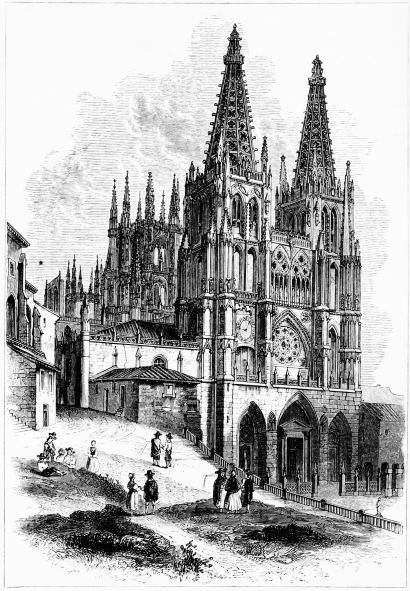
No. 1. BURGOS CATHEDRAL P. 25 NORTH-WEST VIEW.
The groined roofs next to the lantern, on all sides, were of necessity rebuilt at the same time, and with detail quite unlike that of the original vault.
The exterior of the cathedral may be described at less length than the interior, presenting, as it does, fewer alterations of the original fabric, and much of what has been said of the one necessarily illustrating the other also.
The west front is well known by the many illustrations which have been published of it. The ground on which the church stands slopes up, as I have said, rapidly from south to north, but a level Plaza has been formed in front of the doors, and part of which is enclosed with balustrades and pinnacles of a sort of bastard Gothic, which I see drawn in a view published circa 1770, and which may possibly be of the same age as the latest Gothic works in the cathedral. On the rising ground to the north-west stands the little church of San Nicolas, high above the cathedral parvise, and hence it is that the view which I give from Mr. Fergusson’s book is taken. Nothing can be more determinately picturesque, though nothing can be less really interesting, than this florid work, which everywhere substituted elaboration for thought, and labour for art. But I need say no more on this point; for if we now look more closely, we shall see that, underlying all these unsatisfying later excrescences, the old thirteenth century cathedral is still here, intact to an extent which I had not at first ventured to hope for.
The western doors are three in number, but have been completely modernized. Of old the central door, “del Pardon,” had effigies of the Assumption, with angels and saints; the northern door “the mystery of the Conception of the Blessed Virgin;” and the southern door her coronation.[21] Above the side doorways the two steeples rise, whilst in the centre is a finely-traceried rose-window, which lights the nave; and above this two lofty traceried openings, each of four lights, with effigies of saints standing one under each light, the whole forming a screen connecting the steeples, and entirely masking the roof. The steeples, up to this level, are of the original foundation, much altered in parts, and now put to strange uses, their intermediate stages being converted into dwelling-houses, and lively groups of cocks and hens being domesticated on a sort of terrace a hundred feet from the floor. The upper part of the towers and the spires was added in the fifteenth century, by Bishop Alfonso de Cartagena (1435-56), who employed Juan de Colonia (the German of whom I have already spoken) to design them. German peculiarities do not gain in attractiveness by being exported to Spain, and this part of Juan de Colonia’s work is certainly not a success. Nothing can be less elegant than the termination of the spires, which, instead of finishing simply and in the usual way, are surrounded near the top by an open gallery, and then terminated with the clumsiest of finials. This work was commenced in A.D. 1442, and when the bishop died in A.D. 1456, one spire was finished, and the other, being well advanced, was soon completed under Bishop Luis Acuña y Osorio, the founder also of the central lantern.[22] Between the two towers is a figure of the Blessed Virgin, with the words “Pulcra es et decora.” On the upper part of the towers, “Ecce Agnus Dei,” and “Pax vobis;” and on the spires, “Sancta Maria,” and “Jesus.” These words are in large stone letters, with the spaces round them pierced.
The detail of the spires is coarse, and the open stonework traceries with which they are covered are held together everywhere by ironwork, most of which appeared to me to have been added since the erection. The crockets are enormous, projecting two feet from the angles of the spires, curiously scooped out at the top to diminish their weight, and with holes drilled through them to prevent the lodgement of water. The bells are, I think, the most misshapen I ever saw; and, as if to prove that beauty of all kinds is sympathetic, they are as bad in sound as they are in form!
The façades of the two transepts are quite unaltered, and as fine as those of the best of our French or English churches. I particularly delighted in the entrance to and entourage of the southern transept, presenting as it does all those happy groupings which to the nineteenth-century Rue-de-Rivoli-loving public are of course odious, but to the real lover of art simply most exquisite and quaint.[23] The cloister and bishop’s palace, built out from the church on the south, leave a narrow lane between them, not absolutely in face of the great door, but twisting its way up to it; the entrance to this is through a low archway, called the Puerta del Sarmental, above which, on the right, towers one of the enormous and really noble crocketed pinnacles which mark the angles of the cloister, and then, passing by several old monuments built into the walls of the passage, the great doorway is reached by a flight of steps at its end. Above this doorway is a fine rose window of twenty rays of geometrical tracery, and above this is a screen in front of the roof, consisting of four traceried openings, each of four lights, and each monial protected, as are the lights at the west front, by figures of angels rather above life-size. The angles of the transepts are flanked by crocketed pinnacles, the crockets here, as elsewhere throughout the early work, being simple in form and design, but as perfect in effect as it is possible for crockets to be. The sculptures of the south door are, in the tympanum, our Lord seated with the evangelistic beasts around Him, and the four evangelists, one on either side and two above, seated and writing at desks, whilst below His feet are the twelve apostles, seated and holding open books. Below, there is a bishop in front of the central pier, and statues on either side, of which I made out two on the right to be St. Peter and St. Paul, and two answering to them on the left Moses and Aaron. The three orders of the archivolt have—(1) angels with censers, and angels with candles; (2 and 3) kings seated, and playing musical instruments. Here, as throughout the early sculpture, the character of the work is very French, and the detail of the arcading below the statues in the jambs is very nearly the same as that of the earliest portion of the work in the west front of the Cathedral at Bourges.
[6] The church, at Bidart, between Bayonne and the French frontier, is quite worth going into. It has a nave about forty-five feet wide, and three tiers of wooden galleries all round its north, west, and south walls. They are quaint and picturesque in construction, and are supported by timbers jutting out upwards from the walls, not being supported at all from the floor.
[7] Plate I. This (as are all the other plans in this book) is made from my own rapid sketches and measurements. It is necessarily, therefore, only generally correct. But I believe that it, and all the others, will be found to be sufficiently accurate for all the purposes for which they are required. Without ground-plans it is impossible to understand any descriptions of buildings; and they are the more necessary in this case, seeing that, with the exception of very small plans of Burgos and Leon Cathedrals, there is probably no illustration of the plan of any one of the churches visited by me ever yet published in England. I have drawn all the plans to the same scale, viz., fifty feet to an inch. This is double the scale to which the plans in Mr. Fergusson’s ‘History of Architecture’ are drawn; and though it would facilitate a comparison of the Spanish with other ground-plans illustrated by him to have them on the same scale, I found it impossible to show all that I wanted in so very small a compass.
[8] I have not thought it necessary to draw these ruinous additions to the early design. That they are additions is easily proved by the way in which they are tied with bands of iron to the early shafts, as well as by the complete difference in style. The original work is fortunately intact behind the added pinnacles, and there is nothing conjectural in its restoration.
[9] The Chapter entered into a contract with one Jusepe Rodriguez for these books; but Philip II. insisted upon his being set free from this contract in order that he might work for him on the books for the Escorial, where he wrought from A.D. 1577 to A.D. 1585. Cean Bermudez, Dice. Hist. de las Bellas Artes en España. Some illustrations of initial letters in the Burgos books are given by Mr. Waring in his ‘Architectural Studies in Burgos.’
[10] ‘España Sagrada,’ vol. xxvi. p. 301. G. G. Dávila, ‘Teatro Ecclesiastico de las Yglesias de España,’ iii. 65, says that Maurice was a Frenchman; and he mentions the consecration by him of the Premonstratensian Church of Sta. Maria la Real de Aguilar de Campo, on the 2nd Kal. Nov. 1222.
[11] Esp. Sag., xxvii. 306; ‘Memorial in the Archives at Burgos,’ ii. fol. 57. The era 1259 answers to A.D. 1221. The “era” so frequently occurring in Spanish records precedes the year of our Lord by thirty-eight years, and is, in fact, the era of the Emperor Cæsar Augustus. See ‘Cronicas de los Reyes de Castilla,’ vol. i. p. 31, and ‘España Sagrada’ vol. ii. pp. 23 et seq., for an explanation of this computation, which is constantly used as late as the middle of the fourteenth century in all Spanish inscriptions and documents.
[12] Esp. Sag., xxvii. 313.
[13] Esp. Sag., xxvi. 315.
[14] Ponz states that Bishop Pascual de Fuensanta (1497-1512) moved the stalls from the Capilla mayor (i.e. choir) to the middle of the church; and Florez, Esp. Sag. xxvi. 315 and 413, makes the same statement.
[15] Ponz, ‘Viage de España,’ xii. 28, says that the sculptures of this Retablo were executed by Rodrigo de la Aya and his brother Martin between A.D. 1577 and 1593 at a cost of 40,000 ducats; and that Juan de Urbina (a native of Madrid), and Gregorio Martinez of Valladolid, painted and gilded it for 11,000 ducats in three years, finishing in A.D. 1593.
[16] Esp. Sag., xxvi. 331.
[17] The chapel of the Visitation was built by Bishop Alonso de Cartagena, 1435-56. The chapel of Sta. Ana was built by Bishop Luis Acuña y Osorio, 1457-95. The chapel of Sta. Catalina in the Cloister is said to have been built in the time of Enrique II.—Caveda, Ensayo Historico, 379-80.
[18] Cod. M., No. 9.
[19] Noticias de los Arquitectos y Arquitectura de España, vol. i., 206-7.
[20] Florez, Esp. Sag. xxvi. 393, says: “A MS. which I have says that Bishop Luis Acuña y Osorio (1457-95) reformed the fabric of the transept in the middle of the church with eight turrets, which became a ruin in the middle of the following century.”
[21] A view of the west front in A.D. 1771 shows the three western doors in their old state; they had statues on the door-jambs, and on the piers between them.—Esp. Sag. xxvi. p. 404.
[22] Cean Bermudez, Arq. de Esp., i. 105, 106.
[23] It was well that I used the word “delighted” when I wrote this page, for this passage no longer delights me as it did. I visited Burgos again last (1863), and found the Cathedral undergoing a sort of restoration; masons cleaning up everything inside, and by way of a beginning outside they had widened the passage to the south door, so as to make it square with and of the same width as the doorway; to do this a slice had been cut off the bishop’s palace, at some inconvenience to the bishop, no doubt, the result of doing it being simply that much of the beauty and picturesqueness of the old approach to the church is utterly lost for ever. Of one thing, such an unsuccessful alteration satisfies me—little indeed as I require to be satisfied on the point,—and this is, that in dealing with old buildings it is absolutely impossible to be too conservative in everything that one does. Often what seems—as doubtless this thing did to the people of Burgos—the most plain improvement is just, as this is, a disastrous change for the worse. And when we find old work, the reason for or meaning of which we do not quite perceive, we cannot be wrong in letting well alone. It is to be hoped that Spain is not now going to undergo what England suffered from James Wyatt and others, and what she is still in many places suffering at the hands of those who follow in their steps!
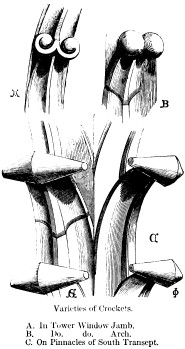
The north transept differs but little from the other. The doorway—De Los Apostoles—is reached from the transept floor by an internal staircase of no less than thirty-eight steps (the sixteenth-century work of Diego de Siloe), and the whole front is of course much less lofty than that of the south transept, owing to the great slope of the ground up from south to north. Above the doorway is an early triplet, and above this the roof-screen and pinnacles, the same as in the other transept. The doorway has in the tympanum our Lord, seated, with St. Mary and St. John on either side, and angels with the instruments of the Passion above and on either side. Below is St. Michael weighing souls, with the good on his left, and the wicked on his right. The orders of the archivolt have—(1) seraphim, (2) angels, and (3) figures rising from their graves: and the jambs have figures of the twelve apostles.

No. 2. BURGOS CATHEDRAL. p. 29. CLERESTORY OF CHOIR.
The ascent to the roofs discloses the remaining early features. These are the clerestory windows, and the double flying buttresses, of which I give an illustration. The water from the main roofs is carried down in a channel on the flying buttresses and discharged by gurgoyles. There are some sitting figures of beasts added in front of the buttresses which are not original. The parapet throughout is an open trefoiled arcade, with an angel standing guard over each buttress. The detail of the clerestory windows is very good; they are of two lights, with a cusped circle above, and a well-moulded enclosing arch. The windows in the apse are built on the curve. The capitals of the shafts in and under the flying buttresses are well carved, and there is a good deal of dog-tooth enrichment. At the back of the screen-walls, in front of the roofs of the nave and transepts, is seen the old weather-moulding marking the line of the very steep-pitched roof (which was evidently intended to be erected), and the stones forming which are so contrived as to form steps leading up to the ridge, and down again to the opposite gutter. In the transept, pinnacles take the place of the angels over the buttresses, and their design is very piquant and original. The moulded stringcourse at the base of these pinnacles is of a section often seen in French work, and never, I believe, used by any but French workmen.
All the steep roofs have long since vanished, and in their place are flat roofs, covered with pantiles laid loosely and roughly, and looking most ruinous. It may well be a question, I think, whether the steep roofs were ever erected. The very fact that they were contemplated in the design and construction of the stonework, appears to me to afford evidence of the design not having been the work of a Spaniard: and it is of course possible that, at the first, the native workmen may have put up a roof of the flat pitch, with which they were familiar, instead of the steep roofs for which the gables were planned. But, assuming that the steep roofs were erected, they must, no doubt, have been damaged by the fall of the lantern in 1539, and as it was reconstructed with reference to roofs of the pitch we now see, the roofs must have been altered at the latest by that time.
It is quite worth while to ascend to the roofs, if only to see what is, perhaps, the most charming view in the whole church; that, namely, which is obtained from the south-east angle of the lantern, looking down into the cloister, above the traceries of which rise the quaint pinnacles and parapets of the old sacristy, and the great angle pinnacles of the cloister itself, whilst beyond are seen the crowded roofs of the city, the all but dry bed of the Arlanzon dividing it in two parts, and beyond, on the one side, the steeple of the Convent of Las Huelgas rising among its trees, and on the other the great chapel of Miraflores, crowning a dreary, dusty, and desolate-looking hill in the distance.
I have left to the last all notice of the cloisters, which are said to have been built in the time of Enrique II. (1379-90), but I can find no authority for the statement, and believe that they would be more rightly dated between A.D. 1280 and A.D. 1350.[24] They are entered from the south transept by the fine doorway, of which a drawing is given by Mr. Waring in his work on Burgos. This would be thought an unusually good example of middle-pointed work even in England, and is as fair an instance as I know of the extreme skill with which the Spanish artists of the same period wrought. The planning of the jambs, with the arrangement of the straight-sided overhanging canopies over the figures which adorn them, are to be noticed as being nearly identical in character with those of the north transept doorway at Leon, and the strange feature of an elliptical three-centred arch to the door opening under the tympanum is common to both. The tympanum is well sculptured with the Baptism of our Lord, and the well-accentuated orders of the arch have sitting figures under canopies, and delicately-carved foliage. The flat surfaces here are, wherever possible, carved with a diaper of castles and lions, which was very popular throughout the kingdom of Castile and Leon in the fourteenth century. The figures on the left jamb of the door are those of the Annunciation, whilst, on the right, are others of David and Isaiah. The wooden doors, though much later in date, are carved with extreme spirit and power, with St. Peter and St. Paul below, and the Entry into Jerusalem and the Descent into Hell above. The ecclesiologist should set these doors open, and then, looking through the archway into the cloister, where the light glances on an angle column clustered round with statues, and upon delicate traceries and vaulting ribs, he will enjoy as charming a picture as is often seen. The arrangement of the masonry round this door shows, as also does its detail, that it is an insertion in the older wall.[25]

No. 3 BURGOS CATHEDRAL p. 30. VIEW OF CLOISTERS FROM THE ROOF
The cloisters are full of beauty and interest. They are of two stages in height, the lower plain, the upper very ornate, the windows being of four lights, with a circle of ten cusps in the centre, and a quatrefoiled circle within the enclosing arch over the side lights. The groining ribs are well moulded, and the details throughout carefully designed and executed. At the internal angles of the cloister are groups of saints on corbels and under canopies placed against the groining shafts, and there is generally a figure of a saint under a recessed arch in the wall opposite each of the windows;[26] besides which there are numerous monuments and doorways. Those on the east are the most noticeable. There is the entrance to the sacristy, with a sculpture of the Descent from the Cross in its tympanum; the entrance to the room in which the coffer of the Cid is preserved, with our Lord seated between SS. Mary and John and Angels; and on the south side are in one bay S. Joseph of Arimathea laying our Lord in the sepulchre, in another the Crucifixion; whilst sculptured high tombs, surrounded by iron grilles, abound. Indeed, I hardly know any cloister in which an architect might be better contented to be confined for a time; for though there are many which are finer and in better style, I know none altogether more interesting and more varied, or more redolent of those illustrations of and links with the past, which are of the very essence of all one’s interest in such works.
One of the doors on the east side of the cloister opens into the old sacristy, a grand room about forty-two feet square, the groining of which is octagonal, with small three-sided vaulting bays filling in the angles between the square and the octagon. The corbels supporting the groining shafts are very quaintly carved with the story of a knight battling with lions.
Here are kept the vestments of the altars and clergy, a right goodly collection in number, and three of them very fine. These are a blue velvet cope with orphreys, fairly wrought on a gold ground, and all the work bound with a twisted cord, which in one part is black and yellow; another cope, also of blue velvet, has a half-figure of our Lord in the centre of the orphrey, and angels on the remainder and on the hood, with wings of green, purple, and blue, exquisitely shaded and lined with gold; another has St. John the Baptist, the Blessed Virgin, our Lord, and three saints, under canopies. In all of them the velvet ground was covered with a large diaper pattern in gold, done before the embroidery was appliqué.
To the south of this sacristy is another groined chamber, in which is kept the coffer of the Cid,[27] and where the groining ribs are painted in rich colour for about three feet from the centre boss. A door out of this leads into the Chapter-house, a room with a flat wooden ceiling of Moresque character. It is made in parqueterie of coloured woods arranged in patterns with gilt pendants, and the cornice is of blue and white majolica, inlaid in the walls: the combination of the whole is certainly very effective. East of these rooms were others, of which traces still remain on the outside; but they have been entirely destroyed, and streets now form, on the east and on the south, the boundaries of the church and its dependent buildings. Advantage was taken of the rise of the ground to make a second cloister below that which I have been describing. In the centre of the enclosure stands a cross, but the arches are built up, and the cloister is now used for workshops, so that there is here none of that air of beauty which the gardened cloisters of Spain usually possess. In the north-west angle of this lower story is a sacristy, reached by a staircase from one of the choir chapels, and still in use for it.
I have now in a general way gone over the whole of this very interesting church, and have said enough, I hope, to prove that popular report has never overrated its real merits, though no doubt it has regarded too much those points only of the fabric which to my eye seemed to be least worthy of praise—the late additions to it rather than the old church itself. As to the charm of the whole building from every point of view there cannot be two opinions. It has in a large degree that real picturesqueness which we so seldom see in French Gothic interiors, whilst at the same time it still retains much of that fine Early Pointed work which could hardly have been the work of any but one who knew well the best French buildings of his day; whoever he was—and amid the plentiful mention of later artists I have looked in vain for any mention of him—he was no servile reproducer of foreign work. The treatment of the triforium throughout is evidently an original conception; and it is to be noted that the dog-tooth enrichment is freely used, and that the bells of the capitals throughout are octagonal with concave sides. The crocketing of the pinnacles is, I believe, quite original; and the general planning and construction of the building is worthy of all praise. Nor was the sculptor less worthy of praise than the architect. The carving of foliage in the early work is good and very plentiful; the figured sculpture is still richer, and whether in the thirteenth-century transept doors, the fourteenth-century cloisters, or the fifteenth-century Retablos, is amazingly good and spirited. The thirteenth-century figures are just in the style of those Frenchmen who always conveyed so riant and piquant a character both of face and attitude to their work. The later architects all seem to have wrought in a fairly original mode; and even where architects were brought from Germany, there was some influence evidently used to prevent their work being a mere repetition of what was being done in their own land; and so aided by the admirable skill of the Spanish artists who worked under them, the result is much more happy than might have been expected. Much, no doubt, of the picturesque effect of such a church is owing to the way in which it has been added to from time to time: to the large number, therefore, of personal interests embodied in it, the variety of styles and parts each of them full of individuality, and finally to the noble memorials of the dead which abound in it. In France—thanks to revolutions and whitewash without stint—the noblest churches have a certain air of baldness which tires the eye of an Englishman used to our storied cathedrals: but in Spain this is never the case, and we may go to Burgos, as we may anywhere else in the land, certain that we shall find in each cathedral much that will illustrate every page of the history of the country, if well studied and rightly read.

There is one point in which for picturesque effect few countries can vie with Spain—and this is the admission of light. In her brilliant climate it seems to matter not at all how many of the windows are blocked up or destroyed: all that results is a deeper shadow thrown across an aisle, or a ray of light looking all the brighter by contrast; and, though it is often a hard matter to see to draw inside a church on the brightest day, it is never too dark for comfort, and one comes in from the scorching sun outside and sits down in the darkest spot of the dark church with the utmost satisfaction. I saw an evidence here one night of the natural aptitude of the people for such effects, in the mode of lighting up the cathedral for an evening service in a large chapel at the east end. There was one lantern on the floor of the nave, another in the south transept, and the light burning before the altar: and in the large side chapel was a numerous congregation, some sitting on the floor, some kneeling, some standing, whilst a priest, holding a candle in his hand, read to the people from the pulpit. In this chapel the only other light was from the lighted candles on the altar. The whole church was in this way just enough lighted to enable you to see your way, and to avoid running against the cloaked forms that trod stealthily about; and the effect would have been inexpressibly solemn, save for the occasional intrusion of a dog or a cat, who seem to be always prowling about, and not unfrequently fighting, in Spanish churches.
Leaving the other churches and buildings of Burgos for the present, let us now cross the Arlanzon by one of its many bridges, and presently striking to the left we shall come upon the well-worn path by the side of the convent-stream, which in less than a mile from the city brings us to a postern of Las Huelgas.
Santa Maria la Real de las Huelgas was founded by Alfonso VIII., son of D. Sancho el Deseado, at the instance, it is said, of Leonor (or Alienor) his Queen, daughter of Henry II. of England, of whom I have before spoken in referring to Bishop Maurice, the founder of the cathedral. The dates given for the work are as follow:—The monastery was commenced in A.D. 1180; inhabited on the 1st June, A.D. 1187;[28] and in A.D. 1199 formally established as a house of Cistercians. The first abbess ruled from A.D. 1187 to A.D. 1203; and the second, Doña Constanza, daughter of the founder, from A.D. 1203 to A.D. 1218; and from that time forward a large number of noble persons here took the veil, whilst kings were knighted, crowned, and buried before its altars. No wonder, therefore, that the postern-gate of Las Huelgas—a simple thirteenth-century archway—leads, not at once into the convent, but into the village which has grown up around it, and which, whatever may have been its aspect in old times, is now as dreary, desolate, and forlorn-looking as only a Spanish or an Irish village can be, though still ruled as of yore by the lady abbess,—no doubt with terribly shorn and shrunken revenues. There is a small church in the village here, but it is of no interest: and we may well reserve ourselves for the great church rising from behind the boundary walls which shut in the convent on all sides, and the people’s entrance to which is from an open courtyard on its north side through the transept porch.
[larger view] [largest view]

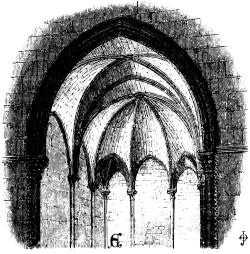
I give an illustration of the ground plan,[29] from which it will be seen that the church consists of a nave and aisles of eight bays, transepts, and choir, with two chapels on either side of it opening into the transept, whilst a porch is erected in front of the north transept, and a cloister passage along the whole length of the north aisle. A tower is placed on the north-east of the north transept, and a chapel has been added on its eastern side. There is another cloister court, of which a not very trustworthy lithograph is given in M. Villa Amil’s work. This is within the convent, from which every one but the inmates is rigorously excluded, but, as far as I can learn, it is on the south side of the nave. The central compartment of the transept is carried up above the rest as a lantern, and groined with an eight-sided vault. The choir has one bay of quadripartite and one of sexpartite vaulting, and an apse. The transept chapels are all of them square in the plan but, by the introduction of an arch across the angle (the space behind which is roofed with a small vault), the vault is brought to half-octagon at the east end. This will be best understood by the illustration which I give of one of these chapels: and here, too, it will be seen that the masonry of the vaulting cells is all arranged in vertical lines,—parallel, that is, to the centre of the vault, and that the transverse section of the vault is in all cases exceedingly domical. Nothing can be more peculiar than this description of early vaulting, and it is one which, I believe, originated in Anjou or Poitou, where numberless examples may be found all more or less akin to this at Las Huelgas. This fact is most suggestive, for what more probable than that Alienor, Henry II.’s daughter, should, in the abbey which she induced her husband to found, have procured the help of some architect from her father’s Angevine domain to assist in the design of her building? Yet, on the other hand, there are some slight differences of detail between the work here and any French example with which I am acquainted, which make it possible that the architect was really a Spaniard, but if so, he must have been well acquainted, not only with the Angevine system of vaulting, but also with some of those English details which, as is well known, were in common use both in Anjou and in England in the latter part of the twelfth, and first half of the thirteenth century. A foreigner naturally gives us an exact reproduction of the work of some foreign school, just as we see at Canterbury in the work of William of Sens, and my own impression is strong that he must have been an Angevine artist who was at work here.
If I am correct in attributing this peculiar church to the Angevine influence of the Queen, I prove at the same time a most important point in the history of the development of style in Spain. The planning of the church at Las Huelgas influenced largely the architects of Burgos, the capital of Castile and Leon. The groining of the only original chapel in the transept of the cathedral is a reproduction of the octopartite vault of the lantern at Las Huelgas; and one may fairly suspect that so, too, was the original lantern of the cathedral. Then, again, in a fourteenth-century chapel, north of the choir of the cathedral, we see the same device (i.e. the arched pendentive across the angle) adopted for obtaining an octagonal vault over a square chamber; and again in the fifteenth and sixteenth centuries, in a chapel on the south of the nave, in the old sacristy, and finally in the all but Renaissance chapel of the Constable, we have the Spanish octagonal vault, supported on pendentives, evidently copied by the German architect from the pendentives of the Romanesque churches on the Rhine. In these Burgalese examples we have a typal vault which is extensively reproduced throughout Spain, and which I last saw at Barcelona, in work of the sixteenth century. It is a type of vault, in its later form, almost peculiar to Spain, and when filled in with tracery in the cell, I believe quite so. And it is undoubtedly more picturesque and generally more scientific in construction than our own late vaults, and infinitely more so than the thin, wasted-looking vaults of the French flamboyant style.
But to proceed with my notice of the church of Las Huelgas. The nave is groined throughout with a quadripartite vault; but beyond this I can say but little, as it is screened off from the church for the use of the nuns,[30] and the only view of it is obtained through the screen. The main arches between the nave and aisles are very simple, of two orders, the inner square, the outer moulded. Above these is a string-course level with the springing of the groining, and then a clerestory of long, simple lancet windows, the whole forming a noble and impressive interior. Above the nuns’ stalls on the south I noticed a good fifteenth-century organ, with pipes arranged in a series of stepped compartments, and painted shutters of the same shape; below the principal range of pipes those of one stop are placed projecting horizontally from the organ. This is an almost universal arrangement in Spanish organs, and is always very picturesque in its effect, and I believe in the case of trumpet-stops very useful, though somewhat costly.[31]
The detail generally of all the architecture here is very good, and in particular nothing can be more minute and delicate in execution than some of the sculpture of foliage in the eastern chapels, where also, as is frequently the case in early Spanish buildings, the dog-tooth enrichment is freely introduced wherever possible. The design of the interior of the choir is very good; below are lancet windows, with semi-circular inside arches; and above, lancets with double internal jamb-shafts, very picturesquely introduced high up in the walls, and close to the groining. I could only get a glimpse of the exterior of the apse, owing to the high walls which completely enclose the convent on the east. It has simple but good buttresses, but otherwise there seems nothing worthy of note. The rest of the exterior is, however, very interesting. The general view which I give shows the extremely simple and somewhat English-looking west front; the gateway and wall, with its Moorish battlements, dividing an inner court from the great court north of the church; and the curious rather than beautiful steeple. An arched bell-cot rises out of the western wall of the lantern, and a tall staircase-turret out of the western wall of the north transept. The cloister, which is carried all along the north aisle of the nave of the church, is very simple, having two divisions between each buttress, the arches being carried on shafts, coupled in the usual early fashion, one behind the other. A very rich first-pointed doorway opens into the second bay from the west of this cloister, and a much simpler archway, with a circular window over it, into the fifth, and at its east end a most ingenious and picturesque group is produced by the contrivance of a covered passage from the cloister to the projecting transept-porch. The detail here is of the richest first-pointed, very delicate and beautiful, but, apparently, very little cared for now. The cloister is entirely blocked up and converted into a receptacle for lumber, but I was able to see that it is groined. The rose window in the transept-porch, with doubled traceries and shafts, set one behind the other, with fine effect, the elaborate corbel-tables, and the doorway to the smaller porch—rich with chevron and dog-tooth—ought to be specially noticed: their detail being tolerably convincing as to their French origin. There are some curious monuments inside the transept-porch, which I was not able to examine properly, as when I went to Las Huelgas a second time, in order to see them, I found the church locked for the day. To see such a church properly it is necessary to rise with the lark; for after ten or eleven in the morning it is always closed.
There is a good simple gateway of the thirteenth century leading into the western court of the convent, but otherwise I could see nothing old, though I daresay the fortunate architect who first is able to examine the whole of the buildings will find much to reward his curiosity.[32] For there is not only a very fine early cloister, but also, if Madoz is to be trusted, a chapter-house, the vaulting of which is supported on four lofty columns, and which is probably, therefore, a square chamber with nine vaulting bays.

No. 4. LAS HUELGAS. BURGOS. p. 38. NORTH-WEST VIEW.
A long list of royal personages buried here is given by Florez.[33] In the choir are the founders, Alfonso VIII. and Alienor; in the nave of Sta. Catalina, Alfonso VII., the founder’s grandfather, his father, his son Don Henrique I., and twenty more of his kin; and in the other parts of the church a similarly noble company.
The king seems to have founded a hospital for men at the same time as, and in connexion with, the convent; but I saw nothing of this, and I do not know whether it still exists.
Here took place many solemnities: Alfonso VII., nephew of the founder, was the first who was made a knight in it (A.D. 1219, Nov. 27); and in A.D. 1254 Don Alfonso el Sabio knighted Edward I. of England before the altar; whilst in later days it seems that in A.D. 1330, in A.D. 1341, and again in A.D. 1366, the kings were here crowned;[34] and in 1367 Edward the Black Prince lodged here after the battle of Navarrete, and went hence to the church of Sta. Maria to swear to a treaty with the King Don Pedro before the principal altar.[35]
The convent seems to have been quite independent of the Bishop,[36] save that each abbess after her election went to ask him to bless the house, when he always answered by protesting that his consent to do so was in no wise to be construed in any sense derogatory to his power, or as binding on his successors. I observe that the abbesses here were elected for life until A.D. 1593, but that from that time they have held office for three years only; though in a few instances they have been re-elected for a second such term.
It was a relief, after the picturesque magnificence of the later Burgalese architects, to turn to such a simple severe church as this at Las Huelgas. But I must not detain my readers any longer within its pleasant walls; and we will imagine ourselves to be there in A.D. 1454, in the midst of a group of the greatest of the nobles and clergy of Castile: we should have found the Bishop Alfonso de Cartagena there, and with him Juan de Colonia, his German architect, and Maestro Gil de Siloe, the sculptor, and Martin Sanchez, the wood-carver, all of them invited and ready to take part in a great work just about to be completed. Juan II. had just died at Valladolid, and forthwith his body was taken towards the Carthusian convent of Miraflores, by Burgos, where of old stood a palace, which in A.D. 1441 he had converted into a convent, and in A.D. 1454, just before his death, had begun to rebuild. The Bishop met his body at Palenzuela—one day’s journey from Burgos—and brought it in procession to the “Real Casa de Las Huelgas,” where he rested the night; and thence he went onward, the coffin borne by ladies and gentlemen, to San Pablo in the city, where the Dominican Fathers sung the funeral office, and the next day—the feast of St. John the Baptist—to Miraflores, where the Bishop himself said the office and preached. Then the body was deposited with much pomp in the sacristy until the church should be finished.[37]
Let us follow them thither. The walk is dreary enough on this hot September day, and terribly deep in dust; but yet, as it rises up the slope of the hills on the side of the river opposite to the cathedral and city, good views are obtained of both. It is but a couple of miles to the convent, which stands desolately by itself, and never was there a spot which, in its present state, could less properly be called Miraflores, where not even a blade of grass is to be seen. The church stands up high above all the other buildings, but its exterior is not attractive; its outline is somewhat like, though very inferior to that of Eton College chapel, and its detail is all rather poor. The windows, placed very high from the floor, are filled with flamboyant tracery, the buttresses are plain, and the pinnacles and parapet quite Renaissance in their character, and are, no doubt, additions to the original fabric. The west gable is fringed with cusping—a very unhappy scheme for a coping-line against the sky! A court at the west end opens into the chapel by its west door, which is close to the main entrance to the convent; but we were taken round by several courts and quadrangles, one of them a cloister of vast size, surrounded by the houses of the monks. These are of fair size, each having two or three rooms below, and two above. Their entrance doorways are square-headed, quaintly cut up into a point in the centre of the lintel, and by the side of each door is a small hatch for the reception of food. Another smaller cloister, close to the south door of the church, has fair pointed windows, with their sills filled with red tiles, and edged with green tiles. Besides these remains, the only old work I saw was a good flat ceiling, panelled between the joists, and richly painted in cinquecento fashion. A good effect was produced here by the prevalence of white and red alternately in the patterns painted on the joists.
The chapel is entered from the convent by a door on the south side, in the third bay from the west. It consists of five bays and a polygonal apse, and is about 135 feet long, 32 wide, and 63 feet in height. The western bay is the people’s nave, and is divided from the next by a metal screen. The second bay forms the Coro, and has stalls at the sides, and two altars on the east, one on each side of the doorway in the screen which separates the Coro from the eastern portion of the chapel. This last is fitted with five stalls on each side against the western screen, and with twenty on either side, all of them extremely rich in their detail: there is a continuous canopy over the whole, and very intricate traceries at the back of each stall.[38]
A step at the east end of the stalls divides the sacrarium from the western part of the chapel; and nearly the whole of the space here is occupied by the sumptuous monument of the founder and his second wife, Isabel or “Elizabeth,” as she is called in the inscription. In the north wall is the monument of the Infante Alfonso, their son; and against the south wall is a sort of throne with very lofty and elaborate canopy, which is said by the cicerone to be for the use of the priest who says mass. Finally, the east wall is entirely filled with an enormous Retablo. The groining throughout has, as is usually the case in late Spanish work in Burgos, a good many surface ribs, and enormous painted bosses at their intersections. These are so much undercut, so large, and so intricate in their design, that I believe they must be of wood, and not of stone. They are of very common occurrence, and always have an extravagant effect, being far too large and intricate for their position. The apse is groined in thirteen very narrow bays, and its groining ribs are richly foliated on the under side. Pagan cornices of plaster and whitewash have been freely bestowed everywhere, to the great damage of the walls, and to such an extent as to make the interior look cold and gloomy. The windows are filled with what looks like poor Flemish glass, though it may perhaps be native work, as the names of two painters on glass, Juan de Santillana and Juan de Valdivieso, are known as residents in Burgos at the end of the fifteenth century,[39] about the time at which it must have been executed.
The monument of Juan and Isabel is as magnificent a work of its kind as I have ever seen[40]—richly wrought all over. The heraldic achievements are very gorgeous, and the dresses are everywhere covered with very delicate patterns in low relief. The whole detail is of the nature of the very best German third-pointed work rather than of flamboyant, and I think, for beauty of execution, vigour and animation of design, finer than any other work of the age. The plan of the high tomb on which the effigies lie is a square with another laid diagonally on it. At the four cardinal angles are sitting figures of the four evangelists, rather loosely placed on the slab, with which they seem to have no connexion; the king holds a sceptre, the queen a book, and both lie under canopies with a very elaborate perforated stone division between the figures; round the sides of the tomb are effigies of kings and saints, figures of the Virtues, sculptured subjects, naked figures, and foliage of marvellous delicacy. A railing encloses the tomb. The whole is the work of Maestro Gil de Siloe; and from the Archives of the Church it appears that, in A.D. 1486, he was paid 1340 maravedis for the design of the work, that he commenced its execution in A.D. 1489, and completed it in A.D. 1493. The monument cost 442,667 maravedis, exclusive of the alabaster, which cost 158,252 maravedis.[41]
About the same time the same sculptor executed the monument of Alfonso, son of Juan and Isabel, in the north wall of the sacrarium. This, though less ambitious than the other, is a noble work. It consists of a high tomb with a recessed arch over it, and pinnacles at the sides. The high tomb has a great shield held by angels, with men in armour on either side; under the arch above the Infante kneels at a Prie-Dieu. The arch is three-centred, edged with a rich fringe of foliage and naked figures; and between it and the ogee gable above it is a spirited figure of St. George and the Dragon. The side pinnacles have figures of the twelve apostles, and one in the centre the Annunciation.[42]
The Retablo is no less worthy of notice. Its colour as well as its sculpture is of the richest kind. Below, on either side of the tabernacle (which has been modernized), are St. John Baptist and S. Mary Magdalene, and subjects on either side of them; on the left the Annunciation, and S. Mary Magdalene anointing our Lord’s feet, and on the right the Adoration of the Magi, and the Betrayal of our Lord; whilst beyond, Alfonso and Isabel kneel at faldstools, with their coats-of-arms above them. Above the Tabernacle is the Assumption of the Blessed Virgin, and above this a grand circle entirely formed of clustered angels, in the centre of which is a great crucifix surmounted by the Pelican vulning her breast. Within this circle are four subjects from the Passion, and a King and a Pope on either side holding the arms of the Cross, which is completely detached from the background. On either side are S. John and S. Mary; and beside all these, a crowd of subjects and figures, pinnacles and canopies, which it is impossible to set down at length. The whole of this work was done by the same Gil de Siloe, assisted by Diego de la Cruz, at a cost of 1,015,613 maravedis, and was executed between A.D. 1496 and 1499. Behind the Retablo some of the old pavement remains, of encaustic tiles in blue, white, and red.
The works at this church seem to have made but slow progress owing to the troubled state of the kingdom after the death of Juan II. His son gave something towards the works in A.D. 1454, but nothing more until A.D. 1465. In A.D. 1474 he died, and was succeeded by Isabel the Catholic, who, in A.D. 1476, confirmed the grants to the monastery, and completed the church in A.D. 1488; but it was not, as we have seen, until the end of the century that the whole work was really finished. Juan de Colonia made the plan for the building in A.D. 1454, for which he received 3350 maravedis: he directed its construction for twelve years, and after his death, in A.D. 1466, Garci Fernandez de Matienzo continued it till he died of the plague in the year 1488, when Simon, son of Juan de Colonia, completed it.[43]
Having completed my notice of the three great buildings of Burgos and its neighbourhood, and which in their style and history best illustrate the several periods of Christian art, I now proceed to give some notes of the Conventual and Parish Churches, which are numerous and fairly interesting. In Burgos, however, as is so often the case on all parts of the Continent, the number of desecrated churches is considerable. The suppression of monasteries involved their desecration as a matter of course; and without religious orders it is obviously useless to have churches crowded together in the way one sees them here. I remember making a note of the relative position of three of these churches, which stand corner to corner without a single intervening house; and though this is an extreme case, the churches were no doubt very numerous for the population. Unluckily a desecrated church is generally a sealed book to an ecclesiologist. They are usually turned to account by the military; and soldiers view with proverbially jealous eyes any one who makes notes!
Just above the west front of the Cathedral is the little church of San Nicolas, mainly interesting for its Retablo, which, however, scarcely needs description, though it is gorgeously sculptured with the story, I think, of the patron. Its date is fixed by an inscription, which I give in a note.[44] On either side are monuments of a type much favoured in Spain, and borrowed probably from Italy, of which the main feature is, that the figures lie on a sloping surface, and look painfully insecure. Here too I saw one of the first old western galleries that I met with in my Spanish journeys; and as I shall constantly have to mention their existence, position, and arrangement in parochial churches, it may be as well to say here, that at about the same date that choirs were moved westward into the naves of cathedrals, western galleries, generally of stone, carried on groining, and fitted up with stalls round three sides, with a great lectern in the centre, and organs on either side, were erected in a great number of parish churches. It cannot be doubted that in those days the mode of worship of the people was exactly what it is now; no one cared much if at all for anything but the service at the altar, and the choir was banished to where it would be least seen, least heard, and least in the way! At present it seems to me that one never sees any one taking more than the slightest passing notice of the really finely-performed service even in the cathedral choirs; whilst in contrast to this, in the large churches, with an almost endless number of altars, all are still used, and all seem to have each their own flock of worshippers; and though it is a constant source of pain and grief to an ever-increasing body of English Churchmen that the use of their own altars should be so lamentably less than it ever was in primitive days, or than it is now in any other branch of the Catholic Church, it is some comfort to feel that our people have tried to retain due respect for some of the other daily uses of the Church, inferior though they be. In Spain, though I was in parish churches almost every day during my journey, I do not remember seeing the western gallery in use more than once. Sometimes it has been my fate to meet with men who suppose that the common objection to galleries in churches is, that there is no old “authority” for them. Well, here in Spain there is authority without end; and I commend to those Anglicans who wish to revive or retain their use in England the curious fact, that the country in which we find it is one distinguished beyond all others by the very decided character of its Romanism, and the period in which they were erected there, one in which Rome was probably more hostile to such as they than any other in the whole course of her history.[45]
The gallery of San Nicolas is less important than most of its class are; and there is indeed little to detain any one within its walls. Externally there is a low tower rising out of the west end of the south aisle. This has a fine third-pointed south doorway with an ogee crocketed canopy, and a belfry stage of two lancet-lights on each face, roofed with a flat roof of pantiles. The remainder of the church has been much altered; but a good flying-buttress remains on the south side, and one or two lancet-windows which convey the impression that the first foundation of the church must have been in the thirteenth century. The east wall is not square, but built so as to suit the irregular site. The whole church is ungainly and ugly on the exterior, and its planning and proportions neither picturesque nor scientific. It is, in short, one of those churches of which we have so many in England, from which nothing is to be learnt save on some small matter of detail; and the alterations of its roofs, windows, and walls have in the end left it an ungainly and uncouth outline, which is redeemed only by its picturesque situation on the slope of the hill just above the cathedral parvise, with which it groups, and from which it is well seen.
Following the steep path of the east end of San Nicolas, I soon reached the fine church of San Esteban. It stands just below the castle, the decaying walls of which surround the slope of melancholy hill which rises from its doorway; these, though now they look so incapable of mischief, yet effectually thwarted the Duke of Wellington.[46] It is quite worth while to ascend the hill, if only for the view. San Esteban, shorn as it is—like all Spanish churches—of more than half its old external features, with pinnacles nipped off, parapets destroyed, windows blocked up, and roofs reduced from their old steep pitch to the uniform rough, ragged, and ruinous-looking flat of pantiles, which is universal here, forms, nevertheless, a good foreground for the fine view of the cathedral below it and the other points of interest in the town beyond. Yet these are fewer than would be expected in such a city, so long the capital of a kingdom and residence of a line of kings. There are no steeples worthy of remark save those of the cathedral, the churches are all, like San Esteban, more or less mutilated, and there is—as always in cities which have been great and now are poor—an air of misery and squalor about only too many of the buildings on which the eye first lights in these outskirts of the city.
I have not been so lucky as to find any record bearing in any way upon the erection of San Esteban, and I regret this the more, as its place among the churches of Burgos is no doubt next after the cathedral, and in all respects it is full of interest.
The ground plan (Plate II.) will explain the general scheme of the building—a nave and aisles, ended at the east with three parallel apses, a cloister, and a large hall on the south of and opening into the cloister. The north side of the cloister has been much mutilated by the erection of chapels and a sacristy, whilst the north wall of the church is blocked up by low buildings built against it. The only good view of the exterior is that from the south-west. Spanish boys did their best to make sketching it impossible, yet their amusements were after all legitimate enough for their age, and it is very seldom in Spain that a sketcher is mobbed and annoyed in the way he commonly is in France or Italy when he ventures on a sketch in an at all public place.
[larger view] [largest view]
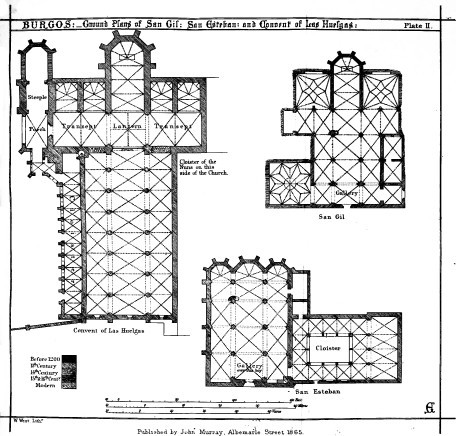
The erection of this church may, I believe, be dated between A.D. 1280-1350; and to the earlier of these two periods the grand west doorway probably belongs. The tympanum contains, in its upper compartment, our Lord seated, with St. John the Evangelist, the Blessed Virgin and angels kneeling on either side—a very favourite subject with Burgalese sculptors of the period; below is the martyrdom of the patron saint, divided into three subjects: (1) St. Stephen before the king; (2) Martyrdom of St. Stephen, angels taking his soul from his body; and (3) the devil taking the soul of his persecutor. The jambs have each three figures under canopies, among which are St. Stephen (with stones sticking to his vestments) and St. Laurence. The doorway is built out in a line with the front of the tower buttresses, and above it a modern balustrade is placed in advance of the west window, which is a fine rose of twenty rays. This window at a little distance has all the effect of very early work; but upon close inspection its details and mouldings all belie this impression, and prove it to be certainly not earlier than the middle of the fourteenth century. The whole of the tracery is thoroughly geometrical, and the design very good. Above it is a lancet window on each face, and then the lower part only of a belfry window of two lights, cut off by one of the usual flat-pitched tiled roofs. A staircase turret is carried up in the south-west angle and finished with a weathering at the base of the belfry stage. The buttresses are all plain, and, as I have said, shorn of the pinnacles with which they were evidently intended to be finished.[47]
This church seems to be always locked up, and I think it was here that the woman who lives in the cloister and shows the church told me that there was service in the church once only in the week; and certainly it had the air which a church misused in this way usually assumes.
We were admitted by the cloister, a small and much mutilated work of circa A.D. 1300. It opens by four arches into a large hall on its south side, which is groined at a higher level than the cloister. The groining of the cloister is good, and the ribs well moulded; but the window tracery is all destroyed, and most of the windows are blocked up. The central court is very small, as indeed is the whole work; but a cloister may be of any size, and in some of our many collegiate erections of the present day it would be as well to remember this, and emulate really and fairly the beautiful effects always attained by our forefathers in this way.[48]
In the western wall of the cloister are two arched recesses for monuments, one of which has a coped tomb, with eight steps to the foot of the cross, which is carved upon its lid. The eastern side is later than the rest, and its groining probably not earlier than A.D. 1500.
Entering the church from hence we find a very solid, simple, and dignified building, spoilt indeed as much as possible by yellow wash, but still in other respects very little damaged. It is groined throughout, and the groining has the peculiarity of having ridge ribs longitudinally but not transversely. This is common in Spain; but it is impossible to see why one ridge should require it and the other not, and the only explanation is that possibly the architect wished to lead the eye on from end to end of the building. In the groining of an apse this ridge-rib in its western part always looks very badly, and jars with the curved lines of all the rest of the ribs. The columns of the nave arcades are circular, with eight smaller engaged shafts around them, those under the western tower being rather more elaborate and larger than the others. Here we see a clear imitation of the very similar planning of the cathedral nave. The planning of the east end is more interesting, because, whilst it has no precedent in the cathedral, it is one of the evidences we have of the connexion of the Spanish architecture of the middle ages with that of other countries, which we ought not to overlook. I have said something on this in speaking of the plan of Las Huelgas. Here, however, I do not think we can look in the same direction for the original type of plan; for, numerous as are the varieties of ground-plan which we see in France, there is one—the parallel-triapsidal—which we meet so seldom that we may almost say it does not occur at all. In Germany, on the other hand, it is seen everywhere, and there, indeed, it is the national plan: in Italy it is also found constantly. In Spain, however, it was quite as much the national ground-plan as it was in Germany; almost everywhere we see it, and in any case the fact is of value as proving that the Spaniards adopted their own national form of Gothic, and were not indebted solely to their nearest neighbours, the French, for their inspiration and education in architecture, though undoubtedly they owed them very much.
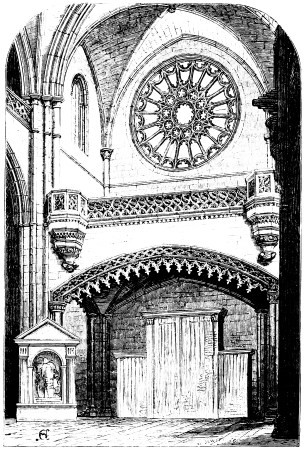
No. 5 SAN ESTEBAN, BURGOS. p. 49. INTERIOR LOOKING WEST.
San Esteban is lighted almost entirely from windows set very high up in the walls. Those in the apses are in the position of clerestory windows, their sills being level with the springing of the groining. The consequence of this arrangement—a very natural one in a country where heat and light are the main things to be excluded from churches—was that a great unbroken space was left between the floor and the windows; and hence it happened that the enormous Retablos, rising seldom less than twenty feet, and often thirty, forty, or even sixty feet from the floors, naturally grew to be so prominent and popular a feature. In San Esteban the Retablos are none of them old, but doubtless take the place of others which were so.
The western gallery is so good an example of its class, that I think it is quite worthy of illustration. It is obviously an insertion of circa A.D. 1450, and is reached by a staircase of still later date at the west end of the south aisle. I cannot deny it the merit of picturesqueness, and the two ambons which project like pulpits at the north and south extremities of the front add much to its effect. The stalls are all arranged in the gallery in the usual fashion of a choir, with return stalls at the west end and a large desk for office books in the centre. The organ is on the north side in the bay east of the gallery, and is reached through the ambon on the Gospel[49] side. This organ, its loft, and the pulpit against it are all very elaborate examples of Plateresque[50] Renaissance work.
Of the fittings of the church two only require any notice, and both of them are curious. One is an iron lectern, just not Gothic, but of very fair design,[51] and of a type that we might with advantage introduce into our own churches. The other is a wooden bier and herse belonging to some burial confraternity, and kept in the cloister; the dimensions are so small (and I saw another belonging to the confraternity of San Gil of the same size), that it was no doubt made for carrying a corpse without a coffin. One knows how in the middle ages this was the usual if not invariable plan,[52] and as these herses are evidently still in use (that of San Gil having been repainted in 1850), it has possibly never been given up.
[24] In A.D. 1257 the king gave a piece of land opposite his palace (now the Episcopal Palace) to the Dean of Burgos. Was not this for the erection of the cloisters?
[25] One of the buttresses of the north transept is seen in the western alley of the cloister. On the face of it still remains one of the original dedication crosses—a cross pattée enclosed in a circle.
[26] On the east side these recessed arches have a very rich foliage in their soffeits.
[27] The coffer of the Cid is that which he filled with sand, and then pledged for a loan from some Jews, who supposed it to be full of valuables; afterwards he honestly repaid the borrowed money, and hence, perhaps, the coffer is preserved, the first part of the transaction being unquestionably not very worthy of record.
[28] Manrique, Anales Cisterciences, iii. 201.
[29] Plate II.
[30] The nuns’ choir in the nave is, according to Florez, “the most capacious of all that are known in cathedrals and monasteries.” Esp. Sag., xxvi. 582.
[31] The organ in All Saints, Margaret Street, has the pipes of one stop similarly placed; but I know no old English example of this arrangement.
[32] Mr. Waring and M. Villa Amil have both published drawings of the inner cloister. The drawing of the latter is evidently not to be trusted; but from Mr. Waring’s view I gather that the arches are round, resting on coupled shafts, with large carved capitals. Mr. Waring calls them Romanesque, but in his drawing they look more like very late Transitional work, probably not earlier than A.D. 1200. They appear to be arranged in arcades of six open arches between larger piers, and with such a construction the cloister could hardly have been intended for groining. The famous cloister at Elne, near Perpignan, with those of Verona Cathedral, S. Trophine at Arles, Montmajeur, and Moissac, are examples of the class from which the design of such a cloister as this must have been derived, and its character is therefore rather more like that of Italian work, or work of the South of France, than that of Northern France or England.
[33] España Sagrada, xxvii. 611-14.
[34] España Sagrada, xxvi. 350, 359.
[35] An interesting account of this meeting is given in Cronicas de los Reyes de Castillos, i. p. 481-3.
[36] That it was “of no diocese” was expressly recorded among the titles borne by the Abbess, and given by Ponz, Viage de España, xii. 65.
[37] See the account at length in Esp. Sag., xxvii. 393 and 558.
[38] These stalls are like late Flemish work, but wrought by a Spaniard, Martin Sanchez, circa A.D. 1480, who received 125,000 maravedis for his labour.
[39] See Cean Bermudez, Dicc. Hist., vi. 171.
[40] A decidedly hyperbolical inscription is quoted by Ponz, in which the Chapel of Miraflores is called a Temple, “second to none in the world for monuments, beauty and curiousness.”—Ponz, Viage de Esp., xii. 61. The remark might fairly have been made if had referred only to the monuments.
[41] Quoted by Cean Bermudez, Dicc. Hist., iv. 378.
[42] There is an illustration of this monument in Mr. Waring’s book.
[43] See España Sagrada, xxvii. 559. Cean Bermudez, Dicc. Hist. iv. 324, vi. 285, and Arq. de España, i. 106 and 121.
[44] “Nobilis Vir Gonsalvus Polauco, atque ejus conjux Eleonora Miranda hujus sacri altaris auctores hoc tumulo conquiescunt:” “Obiit ille anno 1505 hæc vero 1503.”
[45] I fear I must add that Roman Catholics still seem to be fond of western galleries; for one of the most recent, and I hope the most hideous of their works, the new Italian church in Hatton Garden, has, in addition to all its other faults, the glaring one of a western gallery fitted up like an orchestra, whilst the part of the floor which, according to all old usage, was given to the choir to sing praises to God, seems from the aspect of the chairs with which it is filled to be reserved for the more “respectable” part of the congregation! Extremes meet, and this Italian church would be easily convertible, as it would be most suitable, to the use of the baldest form of Dissent!
[46] Ponz, Viage de Esp., xii. 21, gives an inscription on one of the towers of the castle, which states that Pedro Sanchez, “Criado y Ballistero,” servant and archer to the King (Enrique II.), was its Mayordomo during its construction in the year 1295.
[47] In Braun and Hohenburgius’ Théâtre des Villes, A.D. 1574, there is a view of Burgos, which must have been drawn somewhat earlier as the Chapel of the Constable is not shown in the cathedral: San Esteban is represented with a spire on its tower.
[48] I particularly refer here to our colonial cathedrals, in which I wish that the founders would from the first contemplate the erection of all the proper subordinate buildings, as well as that of the church itself; and also to those large town churches which we may hope to see built before long, and served by a staff of clergy working together and encouraging each other.
[49] i.e. the north side, which would be the side of the Gospel ambon if it faced in the right direction. As I never saw these galleries used, I do not know how the ambons were really appropriated.
[50] The work of Berruguete and his school is so called in Spain from its plate-like delicacy of work in flat relief. For Renaissance work it has a certain air of rich beauty, not often attained in other lands; and, indeed, it is only a debt of justice due to the architects of Spain from the time of Berruguete in 1500 to that of the ponderously Pagan Herrera towards the end of the same century, to say, that whatever faults may be found with their overgreat exuberance and lavish display of decoration, they nevertheless possessed rare powers of execution, and a fertility of conception (generally, it must be owned, of very ugly things), for which they may well be envied by their school now, as they were in their own day. Indeed, if the revivers of Renaissance in these days ever think of such a thing as importing a new idea, I wish heartily that they would go to Spain and study some of her 16th century buildings.
[51] The similar but rather earlier iron lectern preserved in the Hôtel Cluny, at Paris, is well known. See an illustration of it from a drawing of mine in the second volume of ‘Instrumenta Ecclesiastica’ of the Ecclesiological Society.
[52] The curious cemetery at Montmajeur, near Arles, is full of graves excavated in the rock, and cut out just so as to receive the body; so too are all our own old stone coffins. See also the illuminations illustrating the burial office so constantly introduced in books of “Hours.”
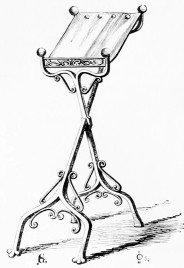
The main thing, I think, that struck me in the architecture of San Esteban, was the very early look of all its proportions and details compared to what seemed to be their real date, when examined more in detail and with the aid of mouldings, traceries, and the like; and its value consists mainly in the place it occupies among the buildings of Burgos, illustrating a period of which otherwise there would be very little indeed in the city.
From San Esteban I found my way first through the decayed-looking and uninteresting streets, and then among the ruined outskirts of the north-eastern part of the city, to the church of San Gil, situated very much in the same kind of locality as San Esteban, on the outskirts of the city. This church is just mentioned in ‘España Sagrada’[53] twice: first as being named, with ten other churches in Burgos, in a Bull of A.D. 1163; and subsequently, as having been built by Pedro de Camargo and Garcia de Burgos, with the approbation of Bishop Villacraces in A.D. 1399; and Don Diego de Soria, and his wife Doña Catalina, are said to have rebuilt the Capilla mayor in A.D. 1586.
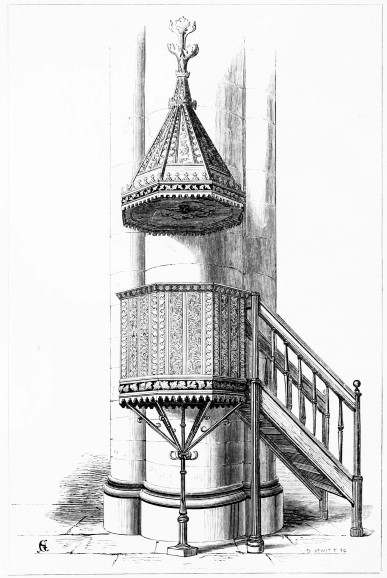
No. 6. SAN GIL, BURGOS p. 51. IRON PULPIT.
I give the plan of this church on Plate II., and am inclined to doubt the exact truth of the statements I have just quoted. I believe the church to be a cruciform structure of the fourteenth century, whose chancel and chancel aisles reproduced the plan of Las Huelgas, but were probably rebuilt in A.D. 1399. The so-called Capilla mayor is probably the chapel on the north side of the north aisle, a very elaborate semi-Renaissance erection, with an octagon vault, reproducing many of the peculiarities of Spanish groining, supported upon pendentives similar to those of which I have spoken in describing the later works in the cathedral; and it is no doubt the work of one of the descendants or pupils of Juan de Colonia. The late chapels on each side of the choir have enormous wooden bosses at the intersection of the groining ribs, carved with tracery, and with a painting of a saint in the centre. This mixture of painting and sculpture is very much the fashion in Spanish wood-carvings, and the altar Retablos often afford examples of it. In the floor of this church are some curious effigies of black marble, with heads and hands of white.[54] Two such remain in the east wall of one of the southern chapels, where they lie north and south.
The Retablos of the two chapels, north and south of the choir, are very sumptuous works.
Against the north-west pier of the crossing there stands what is perhaps the most uncommon piece of furniture in the church, an iron pulpit. It is of very late date, but I think quite worthy of illustration. The support is of iron, resting on stone, and the staircase modern. The framework at the angles, top and bottom, is of wood, upon which the ironwork is laid. The traceries are cut out of two plates of iron, laid one over the other, and the ironwork is in part gilded, but I do not think that this is original. The canopy is of the same age and character, and the whole effect is very rich, at the same time that it is very novel.[55] I saw other iron pulpits, but none so old as this.
I visited two or three other parish churches, but found little in them worth notice. San Lesmes is one of the largest, consisting of a nave with aisles, transepts, apsidal choir, and chapels added in the usual fashion. The window tracery is flamboyant, and the windows have richly moulded jambs, and are very German in their design. The south door is very large and rich, of the same style, and fills the space between two buttresses, on the angles of which are St. Gabriel and the Blessed Virgin.[56] Close to San Lesmes are the church of San Juan, and another, the dedication of which I could not learn, whilst opposite it is the old Convent of San Juan, now converted into a hospital. The entrance is a great doorway, remarkable for the enormous heraldic achievements which were always very popular with the later Castilian architects. The church of San Juan is now desecrated; it is cruciform in plan, with a deep apsidal chancel, and seems to have had chapels on the east side of the transepts. The church is groined throughout, and its window tracery poor flamboyant work. San Lucas has a groined nave of three bays, and there is another church near it of the same character. They both appear to have been built at the end of the sixteenth century.
Of old Convents, the most important appears to have been that of San Pablo. It is now desecrated, and used as a cavalry store; and though I was allowed to look, I could not obtain permission to go, into it. Florez[57] gives the date of the original foundation of the monastery in A.D. 1219, and says that it was moved to its present site in A.D. 1265, but not completed for more than 150 years after that date. The inscription on the monument of Bishop Pablo de Santa Maria, on the Gospel side of the altar in San Pablo, records him to have been the builder of the church,[58] and his story is so singular as to be worth telling. He was a Jew by birth, a native of Burgos, and married to a Jewess, by whom he had four sons[59] and one daughter. In A.D. 1390, at the age of forty, he was baptized; and having tried in vain to convert his wife, “he treated her as though she were dead, dissolving his marriage legally, and ascending to the greater perfection of the priesthood.” In A.D. 1415 he was made Bishop of Burgos, and being at Valladolid at the time, all Burgos went out to meet him as he came to take possession of his see. “His venerable mother, Doña Maria, and his well-loved wife Joana, waited for him in the Episcopal Palace, from whence he went afterwards to adore God in the cathedral.” Doña Joana was buried near the bishop in San Pablo, with an inscription in Spanish, ending, “she died (‘falleció’) in the year 1420,” and from the absence of any religious form in the inscription, I infer that she died unconverted. The bishop died in A.D. 1435.
The church of San Pablo consists of a nave and aisles of five bays, transepts and apsidal choir, with many added chapels. The nave groining bays are square, those of the aisle oblong, a mode of planning which marks rather an Italian-Gothic than a French or German origin. The church is vaulted throughout, with very domical vaults, and lighted with lancets in the aisles, circular windows in the clerestory, and traceried windows in the choir. Part of the old western gallery still remains. The vaulting has transverse, diagonal, and ridge ribs. The apse is well buttressed, but, like all the churches in Burgos, San Pablo has lost its old roofs, and has been so much spoilt by the additions which have been made to it, that its exterior is very unprepossessing. Not so the interior, which, both in scale and proportion, is very fine. The architect of San Pablo is said to have been Juan Rodriguez, who commenced it in 1415, and completed it before 1435.[60]
Another convent, that of La Merced, has been treated in the same way, and is now a military hospital. Its church is on the same plan as that of San Pablo, with the principal doorway in the north wall instead of the west, and this opening under the usual vaulted gallery. There is, too, a small apsidal recess for an altar in the north wall of the north transept. The window tracery and details here are all of very late Pointed, but the buttresses and flying buttresses are good. Flat roofs, destroyed gables, and the entire absence of any steeple or turret to break the mass, make the exterior of little value. This convent was moved to its present site in A.D. 1272, but I doubt whether any part of the exterior now visible is so old as this.
I saw no other churches worthy of mention in Burgos; but there are others which ought to be examined in the neighbourhood, among which one a little beyond Las Huelgas, of large size, surrounded by trees, and apparently belonging to a convent, seemed to be the most important.[61]
There are but few remains of old Domestic Architecture. The Palace has been modernized, but is still approached by a groined passage from the south door of the cathedral. The Palace of the Constable Velasco is a bald and ugly erection of the sixteenth century, in the very latest kind of Gothic; its walls finished with a strange parapet of crocketed pinnacles and stones cut out into a sort of rude fork; its entrance a square-headed doorway, with a large space above it, enclosed with enormous chains carved in stone, within which are armorial bearings. The internal courtyard is surrounded by buildings of three stages in height, with open arcades to each, and traceried balconies. The arcades and windows throughout have debased three-centred arches.
The principal town gateway, that of Sta. Maria, is close to the cathedral; its rear is a very simple but massive work of the thirteenth century, and rather Italian in its design. The front facing the Prado and the river was so much altered by Charles V. that it is doubtful whether any of the old work remains; it is now a very picturesque jumble of circular towers and turrets, battlemented and crenellated, and looking rather like one of those mediæval castles which are seen either in an illumination, or in a canopy over a figure in stained glass, than like a real and useful fortified gateway.
It will be seen how full of interest to the ecclesiologist Burgos is. My notes are, I have no doubt, not by any means exhaustive; and I have equally little doubt that one who had more time at his disposal would discover much more than I found; besides which, I was under the impression, when I was at Burgos, that the Monastery of San Pedro de Cardeña, so intimately connected with the story of the Cid, and where he lay peacefully till the French invasion, had been entirely destroyed, whereas, in truth, I believe the church founded in the thirteenth century still remains; and, if so, must certainly reward examination. It is but a few miles from Burgos.
The great promenade here is along the river-side, where the houses are all new, bald, and uninteresting; but the back streets are picturesque, and there is a fine irregularly-shaped Plaza, surrounded by arcades in front of the shops, where are to be found capital blankets and mantas, useful even in the hottest weather if any night travelling is to be undertaken, and invariably charming in their colour.
CHAPTER III.
PALENCIA—VALLADOLID.
IT was after a day of hard work at Miraflores, Las Huelgas, and Burgos, taking last looks and notes, that we drove to the railway station en route for Palencia. Castile does not improve on acquaintance, and, so far as I could judge in the hurried views obtained from the railway-carriage, we missed nothing by moving apace. The railroad follows the broad valley of the Arlanzon, bounded on either side by hills of moderate height, occasionally capped with sharp cones and peaks, but everywhere of an invariable whitish-grey colour, which soon wearies the eye unspeakably. The few villages seen from the valley seemed generally to occupy the slopes of the hills, and to have large, shapeless, and unattractive churches. Indeed, it is not possible to go very far in Spain without feeling either that Spanish architects seldom cared for the external effect of their buildings, or that whatever they did has been ruthlessly spoilt in later days. Even in a city like Burgos this is the case, and of course it is even more so in villages and smaller towns.
The Spanish railways are, on the whole, well managed. They are usually only single lines, and there is no attempt made to go very fast. Perhaps, too, any one who has travelled along Spanish roads, deep with a five months’ accumulation of dust, and at the pace popular with diligence proprietors, comes to the consideration of the merits and management of a railway in a frame of mind which is not altogether impartial. The luxury even of a second-rate railway is then felt to the utmost, and there is not much desire, even if there is need, for grumbling. It was dark when we arrived at Palencia, and, getting a boy to carry the baggage, we walked off under his directions in search of the Posada de las Frutas. The title was not promising. But Palencia, a cathedral city, and the principal town between Valladolid and Santander, has nothing in the way of an inn better than a Posada, and it was to the best of its class that we had been recommended. The first look was not encouraging, but the people welcomed us cheerfully, and going across the covered entrance way, took us up to a room which was fairly clean and furnished with the remains of eight smart chairs, six of them hopelessly smashed, and the other two so weak in their legs and spines that it was necessary to use them in the most wary and cautious manner! However, the beds were clean, and the bread and grapes—here as everywhere at this season in Spain—so delicious, that, even had the cookery been worse than it was, we might have managed very well. Later in the evening, when I came back from a short ramble through the town, I found the open entrance-court and passage uneven with the bodies of a troop of muleteers, each of whom seemed to have a skinful of wine in his charge and a rough kind of bed laid on the stones; and if I may judge by the way in which they snored as I picked my way among them to my room, they had no occasion to envy me my occupation of the room of state.
I spent a day in Palencia, and found it almost more than its architectural treasures required. I went there with some idea that I should find a very fine cathedral, still retaining all its old furniture of the fourteenth century, and soon discovered that I had been somewhat misinformed. I hoped too, at any rate, if I found no first-rate work, to find something which was peculiar to the district in its artistic character; but in this also I was doomed to be disappointed.
The city is divided into two parts by a very long winding street running entirely across it from north to south. The houses on either side are supported on stone columns (some of them very lofty), so that the general effect is much that of one of the old arcaded Italian cities.
The cathedral, dedicated to S. Antholin, stands in a desolate-looking open space on the edge of the hill which slopes down to the river Carrion on the west side of the city. Cean Bermudez says that it was commenced in A.D. 1321,[62] and completed in the beginning of the sixteenth century.[63] An inscription on the door from the cloister to the church has the date A.D. 1535, and the enclosure of the choir is of A.D. 1534. These dates appear to be fairly correct; but the work having been so long in progress, it may, I think, be assumed that the ground-plan only is of the earliest date, and that the greater part of the architectural detail belongs more probably to the fifteenth than to the fourteenth century. This is quite consistent with the evidence afforded by the building, for the detail of the design is of very poor character throughout, and the window tracery is generally of inferior and rather late flamboyant style. The triforium is well developed, having large traceried openings; and the church is groined throughout. In the eastern part of the chevet the window tracery has an early character, but the mouldings belie this effect; and, if I may judge by them, none of it is earlier than circa A.D. 1350-1370. The plan of the chevet is probably old, but all its details, save those of the piers between the chapels, have been modernized. The thin spandrels of the vaulting in the apse of the choir are pierced with cusped circles, a device occasionally seen in French churches.
It will be seen, therefore, that there is little to praise here, save the grand scale upon which the work has been done. The nave is 36 feet 8 inches from centre to centre of the columns, whilst each aisle is no less than 31 feet 2 inches. The relative proportions are bad, but owing to the arrangement of the Coro in the nave there is not much opportunity of seeing this, and the internal view of the aisles, owing to their width and to the very massive character of the nave columns, is extremely fine. The nave is of five bays in length, the two eastern bays being occupied by the Coro. There is an altar against the western screen of the Coro, in front of which are some steps leading down to a well, said to be that of St. Antholin, the tutelar saint. The whole of the stalls are old, and fine of their kind; they are mainly the work of El Maestro Centellas, a Valencian, who contracted to execute them about the year 1410,[64] but they are not in their old place, for in A.D. 1518-1519 Pedro de Guadalupe agreed to move them from the old choir into the new choir for the sum of fifteen hundred maravedis, and to execute twenty additional stalls for the sum of two thousand maravedis each.[65] At the same time the Retablo was moved forward and enlarged to fit its new position by one Pedro Manso, at a cost of two hundred ducats; whilst Juan de Valmeseda executed the statues of the Blessed Virgin Mary, St. John, and the Crucifixion for it for one hundred ducats.[66]
These facts are of great interest, proving as they do that the stalls stood from the year 1410 to 1518 in their proper place in the choir, and were then moved to their present position in the nave precisely in the same way that we have already seen the old arrangement changed at Burgos at about the same period. This peculiar Spanish arrangement of the Coro in the nave, and separated from the altar, we may now, I think, assume was not known or thought of until this comparatively late date in this part of Spain, though now it is universal throughout the country. The design of the stalls is somewhat like that of late Flemish work, but peculiar in many respects: the forward slope of the stall elbows, the rich traceries behind the lower stalls—very varied in their design—and the upper stalls, are all worthy of notice. I did not observe any distinction in the style of the work answering to the dates at which Maestro Centellas and Pedro de Guadalupe were employed, and I think, therefore, that the latter must have copied rather closely the work of the former. Probably, however the Prie-Dieu desk in front of the bishop’s stall is of the later date, as also the desks which have been widened in front of the upper row of stalls; and possibly Pedro de Guadalupe executed the twenty stalls on each side of the choir forming the easternmost block.
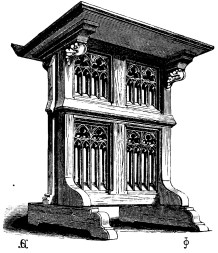
Prie-Dieu.
The eastern part of the church has been worse treated even than the nave, all the old arrangements having been ruthlessly altered. The apse, shut in by screens, covered with a low groined gallery, and used as a mere chapel,[67] is dark, dismal, and undignified. The bay west of the apse is open from north to south, but walled in on the west with the wall behind the high altar. West of this are two bays walled in at the sides, and then we come to the transept, which is open, save the rails marking the passage from the Coro to the choir. The whole arrangement is so confused, unintelligible, and contrary to the obvious intentions of the first designers of the fabric, that it hardly needed documentary evidence to prove that it had no kind of ancient authority. There is no lantern or Cimborio at the crossing. The metal screens[68] across the choir are of no special interest, but those round the apse and opening into one or two of the chapels of the chevet are better, and well illustrate the designs of most of the fifteenth-century iron screens in Spain. They are met with in all directions, for there was no country in the middle ages which made so free a use of iron. They have most of the faults of German ironwork of the same age, the smiths having apparently forgotten the right use of their hammers, and, like Birmingham smiths of the present day, having tried to do what was necessary with thin plates of iron twisted about fantastically here and there, but very much more easily wrought, and proportionably less effective, than the work of the English smiths of a couple of hundred years earlier.
The whole of the floor of the eastern part of the church has been lowered, in some places as much as three feet, in order to obtain a level procession path all round the aisles.
On the south side of the nave are the cloisters, which are large, with lofty arched openings, but they have been despoiled of their traceries. Their style is poor third-pointed, and in their present state they are thoroughly uninteresting.[69] To the west of them is the Chapter-house, a large groined room, opening, not, as is usual, from the cloister, but from an outer lobby. The sacristy, on the south side of the choir, contains a few objects of interest, the best being a fine gilt monstrance, covered with crockets and pinnacles, but not earlier than circa A.D. 1500.[70]
[larger view] [largest view]

The sacristan thought much more of a great plated temple, six or eight feet in height, raised on a stage, and travelling on wheels worked by a couple of men concealed within the platform and its hangings, which is used for processions throughout the town on Corpus Christi day.
I saw only two Gothic churches out of many which I looked into in Palencia—those of San Miguel and San Francesco.
San Miguel is both the earliest and best church in the city, and deserves most careful study. I give an illustration of its ground-plan on Plate III. The portion east of the crossing appeared to me of the end of the twelfth century, and the rest of the church a few years later. The plan is one of a not uncommon type, and suggestive either of Italian or German influence in the mind of its designer. The regular planning of the whole work, the bold dimensions of the groining shafts, and the good character of the mouldings and windows, corbel-tables and buttresses, all deserve special notice. The apse is groined in four compartments, so that a rib and buttress occur in its centre,[71] and the ribs here are square and plain in section, whilst those throughout the nave are well moulded. The bosses at the intersection of the groining ribs in the nave are sculptured: that on the east bay having St. Michael and the Dragon, whilst the next bay but one has an Agnus Dei. There is a peculiarity in the finish of the buttresses of the apse, which I noticed also at San Juan and San Pablo at Burgos. In all of them the face of the buttress is carried up to the eaves-cornice, which is returned round them, instead of being carried on to their centre, as is usual: so that at San Miguel, in place of the apse at the cornice-line having four sides only, it has four long and three shorter sides, the latter above the buttresses. All the work in the chancel appears to be of earlier date than that in the nave, and its western arch is segmental, and of poor character.
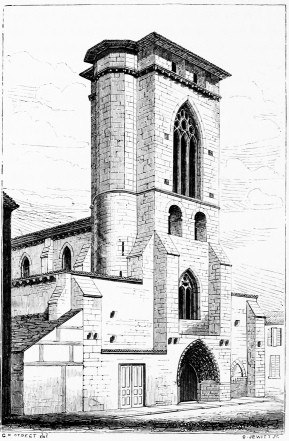
Steeple of San Miguel.
The windows here are plain, round-arched lancets, but those in the clerestory of the nave are two-light windows, with a plain circle in the head, and richly moulded. The most striking architectural feature on the outside is the western steeple, which well deserves illustration, being full of peculiarity and vigour. The belfry-windows are singularly varied, for they are of three lights on the west, of two very wide lights on the south, and of two narrow lights on the east side. The tracery in all consists of uncusped circles, packed together in the same fashion as in the clerestory of Burgos Cathedral. The west window is of two lights, with simple piercings in the tympanum, and between it and the west doorway are a number of corbels all across the west front, which seem to prove that there was a pent-house roof across the whole of it. This must have largely added to the picturesqueness of the building, whilst at the same time it must, in such a climate, have been a most wise expedient for sheltering the doorway from the heat. The west doorway is a really fine work, but terribly mutilated. It has six series of subjects, in as many lines of archivolt moulding, the innermost order containing angels only: the second, figures with books or instruments of music: the third, angels again: the fourth, the Resurrection (with the Last Judgment, occupying the centre of this and the next order): the fifth and sixth, subjects from the life of our Lord, beginning with the Annunciation on the left. The outside moulding consists of a bold bowtell, with another arranged in continuous cusping in front of it, as in some of our own transitional work. The lower stage of the tower has a groined gallery, in which are the stalls, lectern, and organ.
It is much to be lamented that the finish of the steeple is not original, for we should then have had a complete example of a fine parish church, which must have been building from circa A.D. 1190 to circa A.D. 1250; but an early building unaltered on the exterior is a treat for which one generally sighs in vain in Spain.
San Francesco has been much more mutilated than San Miguel, but seems to be a work of about the same age; it is said to have been built in A.D. 1246.[72] There is a large open market-place, busy with venders of vegetables, in front of the building and a small enclosed courtyard between the two seemed to be the receptacle for all the market filth. The west front has a small sort of cloister in front of the doors, with a tiled lean-to roof above it. Over this roof rises the west front, a strange combination with a western gable, and a great bell-gable rising out of its southern slope. The west window appears to have been a fine cusped circular opening, under a pointed arch, the spandrel between the two being filled with circles similar to the traceries in the steeple of San Miguel. Entering the church, I found its broad aisleless nave completely Paganized, but still retaining the low fifteenth-century gallery for the Coro over the two western bays. At the east bay of the nave are small transeptal chapels, and the chancel arch, and two smaller arches open into the chancel and two chancel aisles. The whole arrangement is thoroughly Italian,[73] but the detail of the arches, which are well moulded and adorned with a chevron, is northern. The chancel is apsidal, but its groining is so late, and its east end so far hidden by a Pagan Retablo, that it was impossible to discover whether any traces of the original work remained.
I saw several other churches, but their old features are in all cases of the very latest Gothic or else Pagan, so as to be hardly worthy of record. Sta. Clara appears to be desecrated: it has windows just like those of San Pablo, Burgos, and buttresses to the apse managed in the same way as at San Miguel. It has also a large flamboyant door of poor style. Near it is another church, which has an apse with buttresses and pinnacles at the angles, and from the even and undisturbed look of its masonry I concluded that it never had any windows. This church has a poor tower, but generally the churches here have enormous bell-gable turrets of the most flaunting Renaissance device, which are common throughout a great part of Spain. They have generally several bells hung in openings in the wall, and are often nearly the whole width of the front, and finished with cornices and broken pediments in the most approved fashion of the worst style of Renaissance.
Everywhere, save in the long main street, Palencia was as triste a place as I have seen. The streets were emptied, probably by the heat of the day, and, save a curious crowd of boys who pursued me relentlessly all round San Miguel, I saw few signs of life. Much of the old wall round the city remains, and walking round the north-eastern part of this, I came to a picturesque angle, where is an old walled-up gateway with pointed arch, round towers on either side, and deep machicolations above, which may well have been built before the Cid rode into Palencia for his marriage with Doña Ximena. The town walls are lofty and massive, and crested with what is, I believe, a Moorish battlement. Its peculiarity consists in the battlements and spaces between them being equal, and the former being capped with a stone weathered on all four sides nearly to a point.
On the way to the railway station we saw two churches, both having some portions of fair fifteenth-century work; and then passing the old wall, found ourselves on the melancholy open plain that surrounds the city. Under the hot sun, and after the harvest has all been gathered in, the country looks wretched and arid in the extreme. Not a tree is to be seen, nor a blade of grass; but first a sandy plain of two or three miles, and then rocky and sandy hills, all bleached to much the same colourless tint, rose in long lines against the deep-blue sky. On the other side of the city the river was hardly more attractive; it was wellnigh dry, though it is true there were some trees near its banks which to some extent redeemed the aridness of the soil out of which they grew. As I neared the station I found the whole city assembled to greet the Duke and Duchess of Montpensier, who were to stop for a few minutes to enjoy azucarillos and sweetmeats. Officers of all grades, the bishop and his clergy, and smart people in abundance were there; and as soon as the train arrived there was lusty cheering, and great firing of rockets. After a fight with the mob for a passage to the train, we secured seats, and were soon off. There are some parts of the road which seemed more interesting than most of the country we had been passing. The river runs here and there under steepish bluffs, and occasionally considerable vineyards give—what is so much wanted—some variety of colour to the landscape. I suppose one ought to be cautious in describing such a country after seeing it in September; for I can well imagine that in the spring, when the whole land is covered with great crops of corn, the impression it produces may be very different.
At Valladolid we were delayed a long time whilst the Duke and Duchess of Montpensier, saluted again with rockets, and escorted by cavalry, took their departure from the station to pass the night at the Captain-General’s. As far as a stranger can see and hear the truth, the Royal family seem to be very popular in Spain, and none of them more so than the Duke and Duchess; and the good people of Valladolid did their best, by illuminations, cheering, and decoration of their houses with coloured cloth, to welcome their coming, and speed their parting the next day.[74]
In the evening I strolled out into the town, and presently found myself in the Great Plaza, an imposing square surrounded on three sides by houses on arcades, and having on the fourth side the Town-hall. This was brilliantly illuminated by a number of enormous wax-candles in great sconces flaring in the air, whilst a good military band played waltzes, and the people—soldiers and civilians, men, women, and children—danced merrily and vigorously in groups all about. Presently crossing the Plaza from this noisy scene, I stumbled over a bundle on the ground, and found it to be a couple of labourers who, having been at work at the pavement, had made a bed of sand, covered themselves over with a blanket, and had gone to sleep by the side of their tools for the night, indifferent to all the noise and excitement of the place!
Valladolid is a city of which I have very pleasant general recollections, but of which nevertheless the architecture is nowhere of very great interest. It has the misfortune to have a cathedral built by Herrera, only one or two early works, several gorgeous examples of the richest late-pointed work, and a multitude of examples of the works of Berruguete, Herrera, and their followers. But the streets are picturesque and busy, and have that unmistakably foreign aspect which is always so pleasant to the traveller.
I need say but little of the Cathedral. Its design is said to be the greatest work of Herrera (A.D. 1585); but a small portion only of it has been completed. The complete plan is given by Ponz.[75] It was to have been cruciform, with four towers at the angles, four bays of nave, and four of choir, with aisles to both. The stalls of the Coro were intended to be in the choir behind the altar. There is a large cloister on the north side of the nave. The nave of four bays, with its aisles and chapels on either side of them, is all that is completed; and, large as it is, the parts are all so colossal that there is not the impression of size that there ought to be. The piers are some 60 feet from centre to centre north and south, and 45 feet east and west; they carry bold arches, above which runs a great cornice surmounted by a white (plastered and panelled) groined ceiling, which contrasts violently with the dark sombre grey of the stonework below. These vaults are of red tile; and if the plaster were altogether taken off, the vault covered with mosaic, and the mouldings of the cornices carefully removed, the interior would really be fine and impressive. Nothing, however, could ever cure the hideous unsightliness of the exterior. Herrera’s west front was revised by Churriguera in the eighteenth century, and cannot therefore be fairly criticised; but the side elevation remains as Herrera designed it, and is really valuable as a warning. Flying buttresses were of course an abomination; so in their place he erected enormous solid buttresses above the aisles to resist the thrust of the nave vault. They are shapeless blocks of masonry projecting about forty feet from the clerestory wall, and finished with a horrid concave line at the top. However, it is only right to give Herrera his due, and to say, that after all he only did what Wren did at St. Paul’s, but had the courage and the honesty to let his deeds be seen, instead of spending a vast sum, like Wren, in concealing them. And again it is plain that he thought much more of the internal effect of his church than of the external;—how unlike ourselves, who but too often, if we can attract men to our new churches by a smart spire or a picturesque exterior, seem to forget that we must make the interior noble, winning, solemn, and instructive too, if we would keep them there!
A few fragments of the old cathedral remain to the north-east of the present church, but I could not obtain access to them; and I think nothing now exists but a wall pierced with one or two fourteenth-century windows.
Sta. Maria l’Antigua—the most attractive church, to my mind, in Valladolid—is close to the cathedral. It is so valuable an example, and illustrates so well some peculiarities of Spanish architecture, that I give an illustration of its ground-plan.[76] It is of the common parallel-triapsal arrangement, and has a fine western steeple, and a cloister along the north wall. This kind of cloister is of not unfrequent occurrence: I have already noticed one in the convent at Las Huelgas; and there are two or three churches at Segovia in which also it is introduced. It would seem to be an arrangement expressly adopted to suit a tropical climate, and its effect is always very good.

Cloister. L’Antigua, Valladolid.
The cloister here is walled up, and considerably defaced on the north side; and on the south, if one ever existed, it has been entirely destroyed. That on the north side is of three bays in length, the western bay having four arches, and the others five. The arches are semi-circular, with labels enriched with dog-tooth ornament, and the shafts which carry them are moulded and wrought in imitation of the coupled columns of early Italian artists. Simple buttresses separate the bays, and there is a corbel-table under the eaves. A bold round-arched doorway opened at the west into this cloister.
The interior of this church is fine. It is groined throughout; and most of the groining has longitudinal (but not transverse) ridge-ribs, considerably arched in each bay, to suit the domical section of the vaults. The western bay has the usual late gallery for the Coro supported on a debased arch, and with open tracery in its front, and the stalls and organ still remain in it. The main columns are cylindrical in plan, and each surrounded by eight attached shafts. The transepts are not at all defined in the ground-plan, but are groined at the same level as the nave. The abaci of the capitals are either square or octagonal in plan. The groining has bold and well-moulded transverse arches, and diagonal ribs of an ordinary thirteenth-century section. In the apse of seven bays the vaults, for the greater part of their height, are no thicker than the moulding of their ribs, and are pierced with cusped circles in their spandrels, just above the line of the springing of the windows, in the same manner as at Palencia Cathedral. The clerestory seems to have been lighted with simple lancets, of which one only remains on the south of the nave. Of the old furniture still existing I noticed a good Retablo, partly carved and partly painted, in a chapel on the south side of the choir, and another in the baptistery opening into the south transept.[77] The steeple is the most remarkable feature of the exterior, and from its great height gives, in company with the similar steeple of San Martin, much effect to many views of the city, which, with these exceptions, has nothing to break its monotony. It rises three stages above the roof, the lower stage having an arcaded window of two lights on each face, the middle one of three lights, and the upper, again, one of two lights. The arches are all semi-circular, and are carried upon shafts. There are string-courses under each window, and the abaci are also carried round the steeple as string-courses of inferior scale. There are nook-shafts at the angles, with caps and bases between each of the horizontal string-courses. The upper string-course and the eaves-cornices are carved with a dog-tooth ornament, and the others with a billet mould. The steeple is finished with a low square spire, covered with tiles, some green and some red, and each tile made of a pointed shape, so as to form a series of scallops. This steeple is of the same date as the cloister and lower part of the church—probably circa A.D. 1180-1200; but the east end of the church is evidently a work of later date, being much more advanced in style, and corresponding exactly in some respects with the upper part of the transepts and clerestory of Burgos Cathedral. The windows have three engaged jamb-shafts, with square capitals. The tracery has soffeit-cusping, and there is a peculiarity here which is seen also in the clerestory at Burgos. The arches of the lights and the circle above them are only chamfered on one side, and their fillets do not mitre at the junction; it looks, consequently, as though the circle were merely put in loosely on the back of the arched heads to the lights, without being in any way connected with them. I need not say that the effect is not good: it has the appearance of being the work of men who did not quite understand what they were about; and, though I know of no example of the same thing in England or France, it is not uncommonly seen in the thirteenth and fourteenth century works of the Italian architects. It is, however, impossible to charge the architect of this apse with the indifference to, or ignorance of, other examples of the same age which marked the Italians, for in every other respect his work is as good as possible of its kind. The pinnacles marking the junction of the apse with the choir are very fine. They are hexagonal below, but, with admirable effect, are covered with circular stone spires, enriched by delicate crockets of the same fashion as those at Burgos, illustrated at p. 28, and the springing of the spirelet is marked by small pinnacles. The external roofs have been altered in accordance with the invariable custom, and at the east end they now partially obscure the old pierced parapets which fill the spaces between the pinnacles of the apse. The south transept had a rose-window, which is now blocked up, and the open parapet of the choir was continued round it. This side of the church is now much built against, and concealed by houses, the north side being quite open. I ought not to forget that there is a good sacristy at the north-east angle of the church, and of the same date as the choir.
Sagrador y Vitores[78] says that this church was founded by Don Pedro Ansurez and Doña Eylo his wife, in the latter part of the eleventh century, and rebuilt by King Don Alonso XI. I confess I cannot reconcile these dates (for which no authorities are given) with the existing building. The earlier portions of the work hardly seem to be so early in date as the eleventh century; and the later alterations are so identical in character with work of which we know the age in the thirteenth century, that it is almost impossible they should belong to the time of Alonso XI. (A.D. 1350-1369). The reign of Alonso IX. (A.D. 1230-44) would have been a more likely date.
The church of San Martin, near Sta. Maria, has been rebuilt, with the exception only of its steeple, which is a fine example, very similar to that of Sta. Maria, though, no doubt, of rather later date. The arches here are pointed, in place of round, as they are in the other example; the two upper stages are arranged just as they are there, and the lower stage has a two-light window, with its tracery contrived in a similar way to the apse windows of that church. San Martin is said to have been founded in A.D. 1148,[79] and the earliest part of the steeple may probably be of this age, though I do not think it can have been completed earlier than about A.D. 1250.
Both these steeples bear unmistakable marks of Lombard influence. The absence of buttresses, the repetition of very nearly similar stages one over the other, and the multitude of horizontal string-courses, are all features of constant occurrence in Italy; and it will be sufficient to mention such an example as the steeple of Lucca Cathedral, as, among others, illustrating this similarity very remarkably.
There is not, so far as I could see or learn, any other work of early date in Valladolid; but, on the other hand, the city is rich in works of the latest Gothic, some of which are exceedingly sumptuous, and among the finest of their kind; and they are so characteristic of Spanish art—albeit they are undoubtedly derived from German sources—that it would be unpardonable to pass them by without notice. At the same time it is luxury of ornamentation, profusion of labour, marvellous manual skill and dexterity, rather than real art, which we see displayed in all the works of this school; and, attractive as these often are to the uneducated eye, they are almost offensive to one who has learnt ever so little to look for true art first and above all in all works of architecture, and to regard mere excellence of workmanship as of altogether secondary importance.
The most remarkable of these works are the churches of San Pablo, San Benito, La Magdalena, and the colleges of San Gregorio and Sta. Cruz, which last is now converted into a museum. Their dates are all known very exactly, and the following facts relating to them may as well be recorded.
San Pablo was commenced by Cardinal Don Juan Torquemada, and completed in A.D. 1463.[80] It is said by some to be the work of Juan and Simon de Colonia, but I can find no proof of this statement, though I think that the elaborate façade may possibly be the work of the artists Gil de Siloe or Diego de la Cruz, who wrought under Juan de Colonia and his son at the monuments and Retablo in the convent at Miraflores.
The first stone of the college of San Gregorio was laid in A.D. 1488, and it was finished in A.D. 1496.[81] The architect is said to have been Macías Carpintero of Medina del Campo; but as he cut his own throat in 1490,[82] some other architect or sculptor must have completed the work.
The monastery of San Benito was founded by King Don Juan, who obtained a Bull from Pope Clement VII., on Dec. 28, 1389, for the purpose. But the existing church was erected more than a century later, by Juan de Arandia (probably a Biscayan architect), who began his work in A.D. 1499. He agreed to execute the nave and one aisle for 1,460,000 maravedis, and afterwards the other aisle for 500,000. The Retablo and the stalls were the work of Berruguete, between A.D. 1526 and 1532, and are now preserved in the museum.
The college of Sta. Cruz was founded in A.D. 1480, and completed in A.D. 1492, and was designed by Enrique de Egas[83], son of Anequin de Egas of Brussels.
The church of La Magdalena appears, by extracts from the archives of the Marquis de Resilla, to have been planned by Rodrigo Gil, of Salamanca. By a contract, dated June 14, 1576, he undertook the erection of the Capilla mayor and sacristy for 4,000,000 maravedis, whilst the “master of the works,” Francisco del Rio, by an agreement of October 11, 1570, agreed to build the tower and body of the church according to Rodrigo Gil’s plan, for 6400 ducats.
Having given these details of their history, I must now say a few words about the buildings themselves.
Going from the great Plaza de la Constitucion down a narrow street to the north, we soon came out on another large irregular open place, frequented chiefly by second-hand clothesmen, whose wares would be deemed bad even in Houndsditch, and whose wont it seems to be to induce their customers to make complete changes of their apparel behind scanty screenworks of cloths. At the angle of the further side of this Plaza is the grand church and convent of San Benito. The monks are, of course, all gone, as they are everywhere in Catholic Spain, and the convent is turned into a barrack; the church is left open, but unused, and the more valuable portions of its furniture, its stalls and Retablos, have been carried away for exhibition in another religious house, now used as a museum! Valladolid seems to have been a city of religious houses; and when the revolution, following on civil wars, made so clean a sweep of religious orders, that not only does one see no monks, but even Sisters of Mercy are scarcely ever met[84], there was nothing, I suppose, to be done but to convert these buildings to the first miserable purpose that suggested itself; and we ought perhaps to be thankful when we find a church like San Benito simply desolate and unused, and not converted to some purely secular use.
The ground-plan of the church is given on Plate III. At the west end are the remains of a tower, which seems never to have been completed, and which, though of vast size, is so poor, tame, and bald in detail, that it could hardly have produced a successful effect if it had been finished. The whole design of the exterior of the church is extremely uninteresting; but the interior is much more impressive, being fine, lofty, and groined, and lighted chiefly by large clerestory windows, aided by others high up in the aisle-walls. The groining is all very domical in section, and rather rich in ribs; and the grand scale of the whole work, and the simplicity of the piers—cylinders with eight engaged shafts round them—contribute to produce something of the effect of a building of earlier date. The bases of the columns are of enormous height from the floor, and their caps are generally carved with stiff foliage. Several altars, monuments, and chapels have been inserted between the buttresses of the north wall; and there is one old tomb on the north side of the high altar, with a sculpture of the Crucifixion. The buttresses on the exterior all rise out of a continuous weathered basement, and there is no variety in their design in any part.
The ritual arrangements deserve a few words of description. There are six steps up from the nave to the altar, and there is an ambon on each side of them entered from the altar side. There is a stalled western gallery, with an organ on its south side, of late mediæval design, but apparently an insertion, and not erected at the same time as the Coro. Beside the gallery Coro, there is a second Coro on the floor, with screens round it on the north, south, and west sides, which are evidently not original, being mere brick walls. A metal screen extends all across the nave and aisles at the east of the Coro; and there are gates, not only in these, but also in the screen on the west side of the Coro, which, it will be remembered, is an unusual arrangement at this late date. The large organ is on the north side of the Coro, and of the same date as the woodwork of the stalls. The good people of Valladolid, who seem to feel inordinately proud of all that Berruguete did, have carried off the stalls to the museum. They are much praised by Mr. Ford, but for what reason I endeavoured in vain to discover. Their sculpture appeared to me to be contemptible, and mainly noticeable for woolly dumplings in place of draperies, and for the way in which the figures are sculptured, standing insecurely on their feet, dwarfed in stature, altogether inexpressive in their faces, out of drawing, and wholly deficient in energy or life. There were also three great Retablos to the principal altars at the ends of the aisles. The Renaissance frames of these are mostly in situ, but the sculptures have all been taken, with the stalls, to the museum, where they cumber the little chapel in the most uncouth fashion. I never saw such contemptible work; yet Mr. Ford calls this work[85] “the chef-d’œuvre of Berruguete, circa 1526-1532.” I can only say that the architecture is bad, the sculpture is bad, and the detail is bad; that all three are bad of their kind, and that their kind is the worst possible.[86] It is in truth the ugliest specimen of the imbecility and conceit which usually characterize inferior Renaissance work that I ever saw. The whole of the figures are strained and distorted in the most violent way, and fenced in by columns which look like bedposts, with entablatures planned in all sorts of new and original ways and angles. I have no patience with such work, and it is inconceivable how a man who has once done anything which, from almost every point of view, is so demonstrably bad, can have preserved any reputation whatever, even among his own people. It is a curious illustration, however, of the singular extent to which both Gothic and Renaissance were being wrought at the same time in Spain; for at the time he did this work, in which not a trace of Gothic feeling or skill remained, other men at Salamanca, Zaragoza, and elsewhere, were still building in late Gothic, and some buildings were still more than half Gothic which were not erected for at least fifty years later.
A short walk from San Benito leads to another Plaza, on one of which is the west front of San Pablo, whilst the great convent of San Gregorio is on its south side.
I could not find any means of getting into San Pablo, and am uncertain whether it is in use or desecrated. Its façade is a repetition, on a large scale, of work like that of Juan and Simon de Colonia—who are said to have been the architects employed—in the chapel monuments at Miraflores. Armorial bearings have much more than their due prominence, mouldings are attenuated, every bit of wall is covered with carving or tracery, and such tricks are played with arches of all shapes, that, though they are ingenious, they are hardly worth describing. The western doorway is fringed with kneeling angels for crockets, and there are large and small statues of saints against the wall on either side of it. Above is the Coronation of the Blessed Virgin, with St. John the Baptist on one side, and the kneeling founder on the other, flanked by angels carrying armorial achievements. Above, in the centre, is our Lord seated, St. Peter and St. Paul on either side, and the four Evangelists seated at desks, and instructed by angels. Every vacant space seems to have a couple of angels holding coats-of-arms, so that it is impossible not to feel that the sculptor and the founder must have had some idea of heaven as peopled by none with less than a proper number of quarterings on their shields, or without claim to the possession of Sangre Azul. I must not forget to say of this work that, though its scheme is displeasing and Retablo-like, its execution is wonderful, and the merit of the detail of many parts of it very great.
The façade of San Gregorio is a long lofty wall, pierced with small ogee-headed windows, and finished with a quaint, carved, and pinnacled parapet; in the centre is the entrance gateway, corresponding pretty much in its detail with the front of San Pablo, but even more extremely heraldic in its decorations. The doorway is a square opening under a segmental arch, with an ogee-trefoiled canopy above. Full-length statues of hairy unclad savages on either side may have a meaning which I failed to discover; to me they looked simply uncouth and rude. The canopy over the doorway runs up and forms a great heraldic tree, with an enormous coat-of-arms and supporters in the centre. The finish at the top is one of those open-work conceits of interlacing pierced cusping, which looks like nothing better than a collection of twigs.
The sculpture on this doorway is altogether inferior in its character to that of the doorway of San Pablo. The convent is now, I believe, a barrack, and the sentry refused me admission; but I saw a picturesque court open in the centre, with the usual galleries round it, supported on columns, the wooden ceiling of the passage being painted.
The church of la Magdalena does not look so late in date as the documentary evidence seems to prove that it is; but it is late enough to be most uninteresting. The west front is the ne plus ultra of heraldic absurdity, being entirely occupied with an enormous coat-of-arms and its adjuncts.
Close to the east end of this church is a Moorish archway of brick, a picturesque and rather graceful work. It owes not a little of its effect to the shape of the bricks, which are 7 in. wide by 11 in. long by 1½ in. thick, and to the enormous quantity of mortar used, the joints being not less than an inch wide.[87] The ruggedness and picturesque effect of work done in this way is much greater than that of the smooth, neat walls—badly built of necessity where there is not much mortar used—of our modern buildings.
The Museum is housed in the old college of Sta. Cruz, close to the University, and near to the Cathedral. It is a building of a class whose name is legion in these parts. It encloses a central court surrounded by cloisters, above which there are open arcades all round on each of the three floors, traceried balustrades occupying the spaces between their columns, and the rooms being all entered from these cloister-like open passages. With good detail such an arrangement might easily be made very attractive; but I saw no example in any but the very latest style of Gothic. The contents of the Museum are most uninteresting. There are three paintings said to be by Rubens, but they seemed to me to have been much damaged; and the rest of the pictures are unmixed rubbish. There is a large collection of figures and subjects from sculptured Retablos, all of which are extravagant and strained in their attitudes to the most painful degree. I have already referred to some of Berruguete’s work preserved here, and the rest is mostly of about the same low degree of merit.
The Library, which appeared to have many valuable books, is a large room, well kept and well filled, with a librarian very ready to show it to strangers.
The University is a cold work of Herrera—the coldest of Spanish architects. Mr. Ford mentions an old gateway in it; but I could not find it.
I spent one day only in Valladolid; but this is ample for seeing all its architectural features. It is one of those cities which was too rich and prosperous during an age of much work and little taste, and where, though Berruguete and Herrera may be studied by those who think such labour desirable, very little mediæval architecture of any real value is to be seen. Yet as a modern city it is in parts gay and attractive, being after Madrid the most important city of the North of Spain. Its suburbs are less cheerful, for here one lights constantly on some desecrated church or ruined building, which recalls to mind the vast difference between the Valladolid of to-day—a mere provincial town—and the Valladolid of two centuries ago, for a short time the capital of Spain.
CHAPTER IV.
SALAMANCA—ZAMORA—BENAVENTE.
THE long dreary road which leads over the corn-growing plain from Medina del Campo is at last relieved some two or three miles before Salamanca is reached by the view of its imposing group of steeples and domes, which rise gradually over the low hills on the northern side. The long line of walls round the city still in part remains, but seems daily to be falling more and more to decay, and indeed generally all its grand buildings speak rather of death than of life. Few even of Spanish towns seem to have suffered more at the hands of the French during the Peninsular war than did Salamanca, and we ought not perhaps to be surprised if its old prosperity comes but slowly back again to it.
The public buildings here are generally grandiose and imposing; but almost all of them are of the period of the Renaissance, and there are no very remarkable examples of this bad age. Still when they were perfect there must have been a certain stateliness about them, befitting the importance of a great university.
The main objects of attraction to me were the two cathedrals, the one grand and new, of the sixteenth century, by whose side and as it were under whose wing nestles the smaller but most precious old cathedral of the twelfth century, fortunately preserved almost intact when the new one was erected, and still carefully maintained, though, I believe, very seldom used for service. The remarkable relative positions of these two cathedrals will be readily understood by the accompanying ground-plan,[88] in which, as will be seen, the vast bulk of the later church quite overwhelms the modest dimensions of the earlier. I know indeed few spots, if any, in which the importance, or the contrary, of mere size in architecture can be better tested than here. Most educated artists would, I dare say, agree with me in rating size as the lowest of all really artistic qualities in architecture; and here we find that the small and insignificant old church produces as good an effect as the large and boastfully ambitious new one, though its dimensions are altogether inferior. This is owing to the subdivision of parts, and to the valuable simplicity which so markedly characterizes them. On the other hand, it would be wrong to forget that from another point of view mere size is of the primest importance, for we may well feel, when we compare, for instance, an extremely lofty church with one of very modest height, that in the former there is on the part of the founders an evident act of sacrifice, whilst in the latter their thoughts have possibly never risen above the merest utilitarianism; and it would be a spirit entirely dead to all religious impressions that could regard such an act of sacrifice otherwise than with extreme admiration.
The foundation of the first of these two cathedrals may be fixed, I think, with a fair approach to certainty, as being some time in the twelfth century. It was at this time, soon after the city had been regained from the Moors, in A.D. 1095, that Bernard, Archbishop of Toledo, himself a Frenchman, brought many other Frenchmen into Spain, and through his great influence procured their appointment to various sees—a fact which I may say, in passing, suggests much in regard to the origin of the churches which they built. Among the French ecclesiastics so promoted was Gerónimo Visquio,[89] a native of Périgord, who was for a long time the great friend and close companion of the Cid Rodrigo Diaz, and confessor to him and Doña Ximena his wife. On the Cid’s death he brought his body from Valencia to the monastery of Cardeña, near Burgos, and there dwelt till Count Ramon and Doña Urraca made him Bishop of Salamanca. Gil Gonzalez Dávila[90] says that at this time the church was founded, and Cean Bermudez adds some documentary evidence as to privileges conceded to its chapter for the works about this time by Count Ramon.[91] In A.D. 1178 a priest—Don Miguel of San Juan, Medina del Campo—made a bequest to the Chapter of his property for the work of the cloister, and we may fairly assume, therefore, that before this date the church itself was completed. The new cathedral was not commenced until A.D. 1513, and of this I need not now speak; but in an inscription on it, which records its consecration in A.D. 1560, the first mass is related to have been said in the old cathedral four hundred and sixty years before, i.e. in A.D. 1100.[92] This probably was only a tradition; but it may fairly be taken to point to the twelfth century as that in which the cathedral was built.
This early church is, it will be seen,[93] cruciform, with three eastern apses, a nave and aisles of five bays, and a dome or lantern over the crossing. There is a deep western porch, and I think it probable that there were originally towers on either side of this. The church has been wonderfully little altered, save that its north wall has been taken down in order to allow of the erection of the new cathedral, and at the same time the arch under the northern part of the central lantern or dome was also underbuilt. In other respects the church is almost untouched, and bears every mark of having been in progress during the greater part of the twelfth century.
There is no provision in the plan of the main piers for carrying the diagonal groining ribs, and it may be, therefore, that when they were first planned it was not intended to groin the nave. The groining-ribs are now carried on corbels, in front of which were statues, only two or three of which, however, now remain in their places.[94] The vaulting throughout is quadripartite in the arrangement of the ribs; but the vaults of the three western bays of the nave, of the south transept, and of the aisles are constructed as domes, with the stones all arranged in concentric lines, but with ribs crossing their undersides; the two eastern bays of the nave have quadripartite groining, planned in the common way. The apses have semi-domes. The main arches everywhere are pointed, those of the windows semi-circular, and the capitals throughout are elaborately carved, either with foliage or groups of coupled monsters or birds, a very favourite device of the early Spanish sculptors.
The most interesting feature in this old cathedral still remains to be mentioned: this is the dome over the crossing. The remainder of the original fabric is bold, vigorous, and massive, well justifying the line in an old saying about the Spanish cathedrals, “Fortis Salmantina;” but still it is merely a good example of a class of work, of which other examples on a grander scale are to be met with elsewhere. Not so, however, the dome; for here we have a rare feature treated with rare success, and, so far as I know, with complete originality. The French domed churches, such as S. Front, Perigueux, and others of the same class, Notre Dame du Port, Clermont, and Notre Dame, le Puy, have, it is true, domes, but these are all commenced immediately above the pendentives or arches which carry them. The lack of light in their interiors is consequently a great defect, and those which I have seen have always seemed to me to have something dark, savage, and repulsive in their character. And it was here that the architect of Salamanca Cathedral showed his extreme skill, for, instead of the common low form of dome, he raised his upon a stage arcaded all round inside and out, pierced it with windows, and then, to resist the pressure of his vault, built against the external angles four great circular pinnacles.
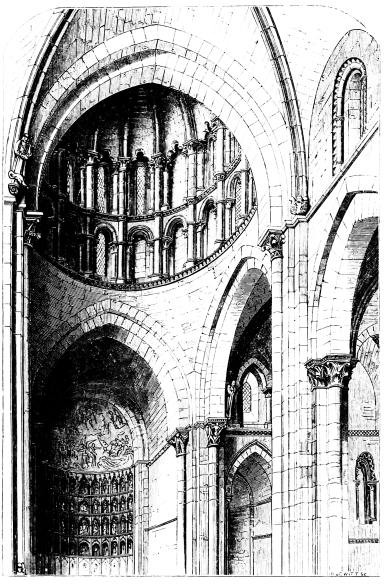
No. 7 SALAMANCA OLD CATHEDRAL p. 80. INTERIOR OF LANTERN, LOOKING EAST
The effect of his work both inside and out is admirable. It is divided into sixteen compartments by bold shafts, which carry the groining ribs; and three of these divisions over each of the cardinal sides are pierced as windows. The other four occur where the turrets on the exterior make it impossible to obtain light. These arcades form two stages in height between the pendentives and the vault. The vault is hardly to be called a real dome, having a series of ribs on its under side, nor does the external covering follow the same curve as the internal, but with admirable judgment it is raised so much as to have rather the effect of a very low spire, with a considerable entasis, than of a regular dome. The exterior angles have lines of simple and boldly contrived crockets, and the stones with which it is covered seem all to have been cut with scallops on their lower edge. The stonework of the exterior is much decayed, but otherwise the whole work stands well and firmly.
[53] Vol. xxvii. p. 675.
[54] This is a very common Flemish custom; but whether the Flemings borrowed it from Spain, or vice versâ, I cannot say.
[55] Iron pulpits were not unknown in England in the middle ages. There was one in Durham Cathedral. See ‘Ancient Rites of Durham,’ p. 40.
[56] A drawing of this door is given by Mr. Waring, ‘Architectural Studies in Burgos,’ pl. 39.
[57] España Sagrada, vol. xxvi. p. 382-387, and vol. xxvii. p. 540.
[58] “Qui venerandus Pontifex hanc ecclesiam cum sacristia et capitulo suis sumptibus ædificavit.”—España Sagrada, xxvi. p. 387. The cloister was rebuilt by Alonso de Burgos, Bishop of Palencia, cir. 1480-99.—G. G. Dávila, Teatro Eccl. ii. 174.
[59] The inscription on the monument of Gonsalvo, Bishop of Sigüenza, contained the following passage: “Hic venerandus Pontifex fuit filius, ex legitimo matrimonio natus, Reverendi Pontificis Dñi Pauli,” &c.
[60] Ceau Bermudez, Arq. y Arquos. de España, i. 103.
[61] In ‘L’Univers Pittoresque, Espagne,’ vol. xxxi. pl. 54, is a view of the ruin of the west end (apparently) of the convent of Carmelites at Burgos; it is a very richly sculptured and panelled front of the most florid kind of latest Pointed, and in a ruinous state.
[62] The first stone of the cathedral was laid on the 1st of June, 1321, by Cardinal Arnoldo, legate of Juan XXII., assisted by Juan II., Bishop of Palencia, and six other bishops, among whom was the Bishop of Bayonne; “and the first prebendary who had charge of the works (‘obrero’) in this holy church was Juan Perez de Aceves, Canon and Prior of Usillos, who assisted in laying the first stone with the legate and the bishops.”—G. G. Dávila, Teatro Eccl. ii. 159.
[63] In 1504 the conclusion of the cathedral of Palencia was undertaken by Martin de Solórzano, an inhabitant of Sta. Maria de Haces, under the condition that he should finish his work in six years, with stone from the quarries of Paredes del Monte and Fuentes de Valdepero. Salórzano, however, died in 1506, and Juan de Ruesga, a native of Segovia, finished it.—Cean Bermudez, Arq. de España, vol. i. p. 142.
[64] Gil Gonzalez Dávila, ‘Iglesia de Palencia,’ fol. 164, gives a letter from the Chapter to the Bishop D. Sancho de Rojas, begging for money for the work. The Chapter state that the stalls are to cost 76,000 maravedis, and that they are the work of “Maestro Centellas,” and that they propose to adorn the Bishop’s seat with four achievements of arms. The bishop at the time this letter was written was at Valencia, assisting at the wedding of Alonso, Prince of Gerona, and the daughter of King D. Enrique III.—G. G. Dávila, Teatro Eccl. ii. 164.
[65] Cean Bermudez, Dicc. Hist., vol. ii. p. 236.
[66] Ibid., vol. v. p. 121.
[67] Also in his (D. Sancho de Rojas, A.D. 1397 to A.D. 1411) time was built the Capilla mayor, which is now the “Parroquia” of the church.—G. G. Dávila, Teatro Eccl., ii. 164.
[68] Cristóbal Andino made the Reja of the Capilla mayor in A.D. 1520 for 1500 ducats, and in 1530 the screen for 430 ducats, and Gaspar Rodriguez made that of the Coro in 1555 for the sum of 3600 gold ducats, paid by the bequest of Bishop D. Luis Cabeza de Vaca.
[69] Cean Bermudez, ‘Arq. Esp.’ i. 60, says the date 1535 exists on the door from the church to the cloister: and G. G. Dávila, Teatro Ecc., ii. p. 171, says that in the time of D. Juan Rodriguez de Fonseca (translated to Burgos in A.D. 1514) the greater part of the chapels from the crossing downwards were built, as also the cloister and Chapter-house. The same bishop gave the stairs leading to the well of S. Antholin, repaired the dormitories, and gave to the sacristy a rich set of altar vestments (terno) of brocade, four tapestries of ecclesiastical history, and four others of “Salve Regina.”
[70] The stained glass which once adorned the church was executed by Diego de Salcedo in 1542, at the price of 100 maravedis each palm (cada palmo).—Cean Bermudez, Dicc. Hist., vol. iv. p. 304.
[71] This rare arrangement is seen in the church of the Frari at Venice, and in the church of the Capuchins at Lugo.
[72] Madoz, Dicc. de España.
[73] It should be compared, for instance, with the church of the Eremitani at Padua, and the church of San Fermo Maggiore at Verona.
[74] We put up at the Fonda de Paris, in the Plaza Sta. Ana—a good inn, kept by some natives of Belliuzona, who took a good deal of trouble for me, and whose hotel may safely be recommended.
[75] ‘Viage de España,’ vol. xi. p. 38.
[76] Plate III.
[77] The Retablo of the high altar is (except the figure of the Blessed Virgin) a work of Juan de Juni (circa A.D. 1556-1583). He had studied under Michael Angelo, and was either an Italian or a Fleming. I am sorry to differ from Mr. Ford as to the merits of this artist; but I must say that I never saw figures so violently twisted and distorted, so affected and unnatural, or coloured decorations so gaudy and contemptible as those in which he indulged. At the same time, his works are so characteristic of his period and school as to deserve examination, even if they provoke contempt.
[78] Historia de Valladolid, vol. ii. p. 181.
[79] Sagrador y Vitores, Hist. de Valladolid, vol. ii. p. 186.
[80] Cean Bermudez, Arq. de Esp. i. 109.
[81] Sagrador y Vitores, Hist. de Valladolid, ii. 263-268.
[82] Cean Bermudez, Arq. de Esp. i. 128.
[83] Enrique de Egas built the Hospital of Sta. Cruz, at Toledo, between 1504 and 1514. His work at Valladolid is still half Gothic; a few years later, at Toledo, it is completely Renaissance in style. It is seldom that we can trace this radical change of style in the work of the same man.
[84] Little meets the eye, but still I have had several new establishments of regular clergy pointed out to me, and the Church in Spain is already, no doubt, regaining something of what she has lost in revolutions and wars.
[85] Handbook of Spain, vol. ii. p. 572.
[86] Berruguete was not dissatisfied with his work. In a letter from him to Andrés de Nágera (given by Sagrador y Vitores in his History of Valladolid, vol. ii. p. 257) he expresses his own extreme satisfaction in the most unreserved way.
[87] The remarkable brick buildings of Toulouse and its neighbourhood are similarly constructed; so, too, are those not less remarkable works at Lübeck and elsewhere in the north of Germany.
[88] Plate IV.
[89] It is doubtful whether this surname is correct, and whether it is not old Spanish for “Vixit” in the inscription on his tomb.—Ford, Handbook, p. 521.
[90] Teatro Eccl., iii. 236-8.
[91] Cean Bermudez, Arq. de Esp., i. 21.
[92] G. G. Dávila, Teat. Eccl., iii. 344.
[93] Plate IV.
[94] The statues at the angles of the lantern are of our Lord, the B. V. M., an angel, and a bishop.
My drawings explain better than any written description can, the various details of the design; but I may well call attention to the admirable treatment of the gables over the windows on the cardinal sides of the dome. No doubt they answer the same purpose as the circular turrets at the angles in providing a counterpoise to the thrust of the vault, and the change from the circular lines of the angle turrets to the sharp straight lines of these gables is among the happiest efforts of art. So again I ought to notice the contrast between the shafted windows, with their springing lines definitely and accurately marked by sculptured capitals, and the openings in the turrets, with their continuous mouldings. The value of contrast—a treasure in the hands of the real artist—is here consciously and most artistically exhibited; and it was no mean artist who could venture to make so unsparing a use of architectural ornamentation without producing any sense of surfeit on those who look at his work even with the most critical eyes.
I have seldom seen any central lantern more thoroughly good and effective from every point of view than this is: it seems indeed to solve, better than the lantern of any church I have yet seen elsewhere, the question of the introduction of the dome to Gothic churches. The lofty pierced tambour, and the exquisite effect of light admitted at so great a height from the floor, are features which it is not, I believe, vain to hope we may see emulated ere long in some modern work. But in any such attempt it must be borne well in mind that, though the scale of this work is very moderate, its solidity and firmness are excessive, and that thus only is it that it maintains that dignified manliness of architectural character which so very few of our modern architects ever seem even to strive for.
From all points, too, this lantern groups admirably with the rest of the church. My sketch was taken from the west end of the nave roof, in order to show the detail of the work to a fair scale; but the best view on the whole is that from the south-east, where it groups with the fine exterior of the eastern apses, with their engaged columns and rich corbel-tables, and with a turret to the east of the transept, which has been carried up and finished rather prettily in the fourteenth century with a short spire, with spire-lights on each side of its hexagonal base.
The old corbel-tables under the eaves remain throughout the east end; but the wall has been raised above them with a line of pierced quatrefoils, over which the rough timbers of the roof project. No doubt here, as we shall find in some other examples, the original intention was to have a stone roof of rather flat pitch. The space between the eaves of the chancel and the lower windows of the lantern would admit of no more than this; and though there is a good deal of piquant effect in the line of dark pierced traceries under the eaves and the rough tiled roof above them, one cannot but regret very much the change from the original design in so important a part of the work. The eaves-cornices are carved with a very rich variety of billet moulding, and carried upon corbels, some of which are carved and some moulded. The walls generally have flat pilasters at short intervals, finishing under the eaves-cornices, and the principal apse has the common arrangement of three-quarter engaged shafts dividing it into three bays. The window-arches are boldly moulded and carved, but the lights are narrow, and those in the main apse are remarkable for the delicate intricacy of the contemporary iron grilles with which they are guarded—genuine laborious smith’s work, utterly unlike the poor modern efforts with which in these days men earn fame without using their hammers! The effect here of the intricate curved lines, relieved by the dark shadow of the window opening, is charming. It may fairly be doubted, I think, whether these windows were ever meant to be glazed. In the transept pointed relieving arches are built over the windows, and one of them is a good example of the joggling of the joints of stonework, not uncommonly seen in early flat arches, but the use of which is not very obvious in a high pointed arch. The smaller apses have only one window, and are lower in proportion to the principal apse than is usually the case.
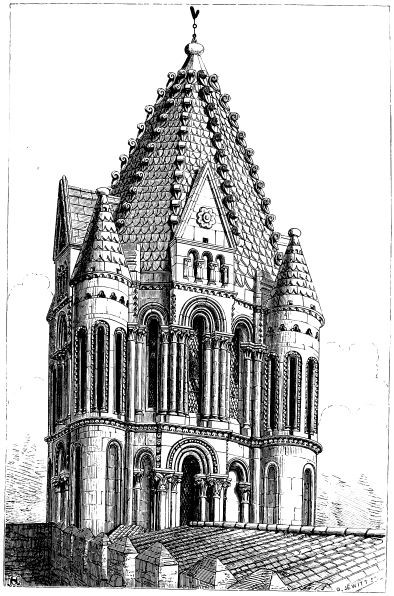
No. 8. SALAMANCA OLD CATHEDRAL p. 82. EXTERIOR OF LANTERN
There are some fine monuments in the south transept, all of them adorned with elaborate bas-reliefs of scriptural subjects. One, of the thirteenth century, has a tomb supported on lions, and a death-bed represented on its side; a little apsidal recess above is groined with a semi-dome, with ribs. Another has sculptures of the Crucifixion, the Entombment, the Maries going to the Sepulchre, and the “Noli me tangere;” and a third has another representation of a death-bed. The effigies are all slightly tilted outwards, and those in the east wall have their feet to the north. The most remarkable features in the decoration of the church are, however, the Retablo and the painting on the semi-dome above it. On the vault the Last Judgment is painted, our Lord being drawn much in the famous attitude of St. Michael in Orcagna’s fresco at Pisa, and without drapery. The Retablo is a work of the fourteenth century, of wood, and planned so as exactly to fit the curve of the apse wall. It is divided into five panels in height and eleven in width, so that there are fifty-five subjects, each surrounded by an architectural framework of delicate character. The subjects are all richly painted on a gold ground, and seemed to me to be well drawn. The coloured decoration of the whole is very effective, and owes much to the white ground of its traceries. Generally speaking, a Retablo is placed across the apse and cuts off its eastern portion, which thenceforward becomes a receptacle for all the untidiness of the church; and when so arranged, if it reaches the height common in Spain, it almost, and in some cases altogether, destroys the internal effect of the apse. Here, however, the exact fitting of the Retablo to the curve of the wall is free from this objection, and its effect is unusually good.
The cloister on the south side is almost all modernized, though one or two old doorways remain. That into the south transept has spiral shafts, with the spiral lines reversed at regular intervals. It has also some very good carving of foliage, with birds and naked figures, and on its jambs are some memorial inscriptions of A.D. 1190, 1192, and 1194. On the south side of the cloister is a richly decorated little chapel, which retains in one corner a very curious mediæval organ, with shutters. On the east side and close to the transept, what was no doubt the original Chapter-house still remains, though it is now called the Mozarabic chapel, and was formerly used for the Mozarabic ritual. At present the boy who had the keys said it was not used; but the proper books were all there. It is a very remarkable chamber, square in plan below, and brought to an octagon above by arches thrown across the angles, and finally roofed with a sort of dome, carried upon moulded and carved ribs of very intricate contrivance. The interlacing of these ribs gives the work somewhat the effect of being Moorish, and there can be little doubt, I think, that it owes its peculiarities in some degree to Moorish influence. It will be seen by reference to the plan, that the groining ribs are arranged in parallel pairs. The ribs go from the angles to the centre of the opposite side instead of from angle to angle, and the sixteen ribs form a star-shaped compartment in the centre. This coupling of ribs in parallel lines is a feature of Moorish work, and is seen in the curious mosque, the Cristo de la Luz, at Toledo, and in the somewhat Moorish vault of the Templars’ church at Segovia. But whether Moorish or not, it is a remarkable room, and deserves careful study. The diameter is but a little over twenty-six feet, and the light is admitted by small windows in the upper stage. I should be inclined to attribute this room and its vault to the architect of the lantern of the church, and I regret that the only part of the outside which I could see was so modernized as to render it impossible to ascertain the original design. I call this the Chapter-house, because I find that it opened originally into the cloister, with three arches, that in the centre a doorway, the others windows of two lights—the almost invariable arrangement of all Chapter-houses at this time.[95]
A considerable number of masons’ marks remain on the exterior of the early part of this church; and if they are the marks of the men who erected so complicated a piece of stonework as the vault of the Chapter-house, they well deserve to be preserved. Throughout this church, indeed, the masonry is unusually good, and, owing to the rich warm colour of the stone, the eastern apses, though they follow the common design of most of the Romanesque apses in this part of Spain, are more than usually good in their effect.
A flight of eighteen steps leads up from the old cathedral through the north transept into one of the southern chapels of the new cathedral, and I know few changes more remarkable than that from the modest simplicity, yet grandeur, of the early church, to the overbearing magnitude and somewhat flaunting character of the late one.
Salamanca seems to have tasted early of that prosperity which in the end ruined art in Spain; and it was possible, therefore, for the Bishop, in the beginning of the sixteenth century, to propose a scheme for replacing his modest old cathedral by one of the most sumptuous and ambitious in Spain, without attempting what was absurd or sure to fail. The whole discussion as to the planning of the church is told us in a series of documents published by Cean Bermudez, which are, I think, of sufficient interest to make them quite worth a place in the Appendix to this volume. I shall discuss in another chapter the light which they throw upon the architectural practice of the day, and here it will only be necessary to refer to such parts of them as affect the architectural history of the building.
In A.D. 1509 a Royal order was issued to Anton Egas, master of the works at Toledo Cathedral, to go to Salamanca to make a plan for the cathedral there. Egas seems to have delayed so long that it was necessary to send another order to him, and then at last, in May, 1510, he went. The same kind of command had been laid at the same time by the king on Alfonso Rodriguez, the master of the works at Seville, and after these two had considered the matter, they presented a joint plan, drawn on parchment, showing the heights and widths of the naves, the thickness of the walls, and so forth; but they were unable, they said, to agree as to the proportion of length to breadth in the Capilla mayor, and so they settled to meet in ten days at Toledo, and then to appoint an umpire. Nothing more seems to have been done by them, for in A.D. 1513 the Bishop and Chapter resolved to call together a Junta of architects to make another report; and Rodriguez being dead, they summoned Anton Egas of Toledo, Juan Gil de Hontañon. Juan de Badajoz of Leon, Alonso de Covarrubias of Toledo, Juan Tornero, Juan de Alava, Juan de Orozco, Rodrigo de Saravia, and Juan Campero, who all assembled in September, A.D. 1512, at Salamanca, and drew up their report. The detailed character of this report is very curious. It decides the dimensions of every part of the church, the thickness of the walls, the projection of the buttresses, and the exact position that it ought to occupy. The architects not only agreed in all their opinions, but testified to their truth by taking an oath “by God and St. Mary,” saying, each one, “So I swear, and amen.”
The question was, whether the new cathedral should be on the site of the old cathedral, or to the north or to the south of it; and among other reasons for placing it to the north, where it now is, the existence of the steeple at the west end of the old cathedral was mentioned. In fine, the church has been so placed as not to interfere at all with the steeple, but little with the old cathedral, and not at all with the cloister. The opinion of the Junta of Architects has been acted upon, in short, in everything save the shape of the head of the church, which they preferred should be octagonal, and which is, in fact, square in plan.
Three days after the presentation of this report certain of the Chapter were appointed to select an architect, and their choice fell at once on Juan Gil de Hontañon for the architect, and Juan Campero for clerk of the works.[96] Whether Juan Gil really made the plans or not seems very uncertain; and I confess that to me it seems more probable that the plan made in A.D. 1509 by Egas and Rodriguez was laid before the Junta, and that they drew up their resolutions upon the data it afforded, and left to Hontañon no choice as to the proportions of his church, but only the management of its construction and the designing of its details.
If this supposition be correct, I fear I can award but little credit to Hontañon; for in this cathedral the only point one can heartily praise is the magnificence of the general idea, and the noble scale and proportion of the whole work. But the detail throughout is of the very poorest kind, fairly Gothic in character inside, but almost Renaissance outside, and everywhere wanting in vigour and effect. Nothing can be much worse than the treatment of the doorways and windows, and—to take one portion—the south transept façade is spotted all over with niches, crockets, and pedestals in the most childish way; whilst every spandrel has a head looking out of a circle, reminding one forcibly of the old application of a horse-collar, and, in fact, the men were foolish who repeated, usque ad nauseam, so stale and unprofitable an idea!
In one respect, however, the design of this church is very important. The Spanish architects seldom troubled themselves to suit their buildings in any respect to the climate; and this, no doubt, because in very many cases they were merely imitating the works of another country, in which no precautions against heat were necessary. Here we have a church expressly designed, and with great judgment, for the requirements of the climate. The windows are very high up, and very small for the size of the building, so that no sunlight could ever make its way to any unpleasant extent into it. There are galleries in front of all the windows, both in the nave and aisles, but they are of thoroughly Renaissance character. The section of the church gives a main clerestory to the nave, and a second clerestory on one side of each aisle over the arches opening into the side chapels. The upper clerestory has two windows of two lights, and a circular window above them in each bay, and the lower clerestory traceried windows generally, I think, of three lights. The traceries are very weak and ill proportioned; but I noticed in places what seemed to be a recurrence to earlier traditions in the groupings of small windows, with several circles pierced in the wall above them. It was, however, just like the imitation of old works we so often see from incompetent hands at the present day. You see whence the idea has been taken, though it is so travestied as to be not even tolerable where the original was probably perfect!
The planning of the church is certainly infelicitous. The square east end is bald to a degree externally, and finished as it is inside with chapels corresponding with those of the aisles, wants relief and life. If the square east end is adopted in a great church, no doubt the prolonged Lady Chapels of our own churches are infinitely to be preferred to such a plan as this, which fails to give the great east windows of which we boast, and loses all the effects of light and shade in which the apsidal chevets of the Continent are so rich.
Everywhere here the buttresses are finished with pinnacles, always planned in the same way, each group being planned on a square, counterchanged over the one below: they are of several stages in height, furnished throughout with crocketed finials on all sides, and at last with a single tall pinnacle. Nothing can be more wearisome than this kind of pinnacled buttress, but the later Spanish authorities were very fond of it, and repeated it everywhere. The dome, or Cimborio, is altogether Pagan in its design and detail outside, and on the inside is so plastered with an olla of pink cherubs, rays of light, and gilt scallopshells of monstrous size, and the like, as to be utterly contemptible in its effect. It is, moreover, too small, and too little separated from the rest of the vaulting, to look really well. The church throughout is finished with hipped roofs in place of gables: but the parapets in front of these are all Renaissance, and marked at intervals by the favourite urns in which Renaissance architects still generally and most unfortunately indulge.
The cathedral was first used for service in A.D. 1560, when on all sides Renaissance buildings were being erected, and perhaps it would be more just to Juan Gil de Hontañon to look upon him as striving to the last to maintain the cause of Christian art against the inroads of the enemy, and failing in his detail not for want of will, but because it was simply impossible to resist the tide which had set in before he died. Much, too, of the church must, no doubt, be attributed to other men; Juan de Alava, Rodrigo Gil de Hontañon, Martin Ruiz, and Juan de Ribero Rada, having been masters of the works after Juan Gil, and the church not having been completed until more than a century after its commencement.[97]
It will have been noticed that the old steeple is spoken of by the Junta of Architects as a work of so much importance as to make it advisable to change the position of the new cathedral, rather than interfere with it. I do not quite understand this, for the greater part of it is now entirely of late Renaissance detail,[98] though some large crocketed pinnacles still exist at the angles of the highest stage. The lower part is very plain, but the upper stage of the square tower has a rich balustrade, and windows and pilasters, and above it is an octagonal stage with pinnacles at the angles, and this in its turn is surmounted by a dome, with a lantern at the top. The outline is certainly fine, and its great height and mass make it a conspicuous object for a very long distance from Salamanca.
The mixed character of the detail in this church is well seen in the great doorway. Its jambs are richly moulded and carved, but the mouldings are all planned on a line receding but little from the face of the wall, so that the general effect is flat, and wanting in shadow. The main arch is a bold simple trefoil, but the label above it is carried on in an ogee line, and the arches below over two sculptured subjects, and over two door-openings under them, are elliptical. So, too, in the sculpture on the bas-reliefs over the door-openings, we have the richest luxuriance of the latest school of Spanish Gothic, with its beasts, its crisp foliage, and its wild love of heraldic achievements, and, mixed with all this, naked cherubs, clouds, and representations of Roman architecture.
In conclusion, I am bound to say of this great church that, whilst its exterior fails in almost every single particular, its interior, thanks to compliance with certain broad rules of Gothic building, is beyond question very grand and impressive. To the vast size and height of the columns this is mainly owing, for though they are cut up with endless little mouldings ingeniously “stopped,” one does not observe their pettinesses, and the arches which they carry are bolder and more important than might have been expected.
Some of the side chapels have altars both at the east and the west; and where the old altars remain they have carved in stone an imitation of an altar frontal. They represent worked super-frontals with fringes, and frontals with fringed orphreys at either end: and I saw one altar with a painted imitation of embroidery all over it. A chapel on the south side of the nave has an altar entirely covered with glazed tiles, the walls around it being similarly inlaid.
Close to the cathedral is one of the University buildings, with a central dome and two dome-capped towers to the west of it, and near these again is another domed church, and in the distance this group is very remarkable and stately-looking.
I wandered all over Salamanca looking for old churches, and could find few of any interest.[99] The finest are all but Renaissance in their character and detail, and seem to have owed much to the influence of Hontañon. The convents and colleges, where not ruined, are grand in scale, yet they produce none of the effect which our Oxford buildings do: but, on the other hand, they are built of a much better stone, and of a rich, warm, yellow tint. The good people here are smartening up the entrance to the town with flower-gardens, seats, and acacias, and are certainly putting their best feet forward, though there is nothing else even approaching to smartness in the place. A walk round the old walls is a melancholy amusement. They are, in part, being levelled; still I saw two or three pointed gateways, which seemed to be of early date, but very simple. I saw also some convents in a dilapidated state, and indeed everywhere the state of these is very bad, and I never saw so many waste places or half-ruined buildings. A good deal of this is no doubt owing to the operations of the French during the Peninsular War, but something certainly to the natives, who are busier in pulling down than building up; or at any rate, when they do the latter, they combine it with the former; for in some repairs of one of the University buildings I found the men re-using old wrought stones from some fifteenth-century building.
A bull-fight had just been celebrated here, and the principal square in the city, the “Plaza Mayor,” one of the best I have seen in Spain, had been fitted up for the occasion as an arena, with seats sloping up from the ground to the first floor windows of the houses all round it. (There was a regular arena, but it was being demolished, to give place, I presume, to one on a grander scale.) Another Plaza close to it is the principal market-place, and affords good opportunities for the study of the costumes of the peasantry.

No. 9. ZAMORA. p. 94. THE BRIDGE ACROSS THE DOURO.
I was fortunate in happening to light upon one very curious church here—that of San Marcos. The engraving of the plan[100] will show how very cleverly its architect managed to combine the scheme of a circular church with the usual Spanish triapsidal arrangement. The apses are vaulted with semi-domes, whilst the rest of the church is covered with wooden roofs, and these all lean towards the central square, which has a hipped roof. The arches are all pointed, and there are rudely carved capitals to the columns. A simple corbel-table is carried along under the eaves, and there are one or two slits—they are not more—for light. This little church is close to the town walls, and the absence of windows gives it the look of a part of a fortress. The plan seems to me to be admirably suggestive: we are too much in the habit of working perpetually in certain grooves which have been cut for us by our forefathers, and most men now-a-days would be afraid to plan a little church like this, even if the idea of it came into their heads. Yet it struck me as being really an extremely useful and economical construction, and such a scheme might with ease be fitted specially for a cemetery chapel in place of one of the vulgar erections with which we are now everywhere indulged.
The church of San Martin has a fine early doorway, in which I first saw a very peculiar order of decoration, which I saw again at Zamora, and of which no doubt more examples exist in this district. My illustration will explain its design, one member of the archivolt of which is like a succession of curled pieces of wood put side by side and perfectly square in section. The effect of light and shade in such work is rather good, but it is nevertheless rather too bizarre to be quite pleasing.
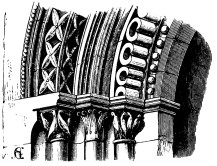
Archivolt. San Martin.
Another little church—that of San Matteo—has a rather fine, though rude, Romanesque doorway, with a buttress on each side, and a corbel-table above. But besides these I saw no remains of early work in Salamanca.
From Salamanca an uninteresting road leads to Zamora: occasionally there are considerable woods, and in other parts of the road the fields were well covered with vines. For two or three hours the domes of Salamanca are in sight, backed, as every view in Spain seems to be, by a fine line of distant mountains. No old churches are passed on the road, unless I except a large convent, now desecrated and nearly destroyed, but which seemed by the glimpse I caught of it to have old parts.
The entrance to Zamora is very striking: the city crowns the long back of a rock, falling steeply on the south to the Douro, and on the north to another valley. At the extreme end of this hill is the cathedral, as far away from the bulk of the people as it can be, but, for all that, very picturesquely and finely perched. Below the cathedral is a scarped rock, and to the left the noble river flows round a wooded point, and then out of sight under a long line of green vine-covered hills. All this view is taken in from the end of an old bridge, carried on sixteen or seventeen pointed arches, across which, near the southern end, is built a picturesque and tall gate-tower. The long line of houses occupies the top of the rock, and then opposite the bridge the street descends by a steep-stepped hill, and the houses cluster round the water-side.
The want of water in most Spanish landscapes is so great, that I was never tired of the views here, where it is so abundant. One of the best, perhaps, is that from just below the cathedral, looking past the picturesque bridge across the cattle-peopled plains to a long line of hills which bounds the horizon, with the dead-level line with which so many of the Spanish table-lands finish above the banks of their rivers.
Of the history of Zamora Cathedral I know but little. Here, as elsewhere at the same time, a Frenchman, Bernardo, a Benedictine, was bishop from A.D. 1125 to 1149, having been appointed through the influence of, and consecrated by, his namesake, the French Archbishop of Toledo.[101] Dávila says that the cathedral was built by a subsequent bishop, Don Estevan, “by order and at the cost of the Emperor Don Alonso VII., as is proved by some lines which were in this church.” These lines give the date of 1174 as that of the completion of the work,[102] and it tallies fairly with the general character of much of the building; for, though it is true that everywhere the main arches are pointed, much of the detail is undoubtedly such as to suggest as early a date as that here given.
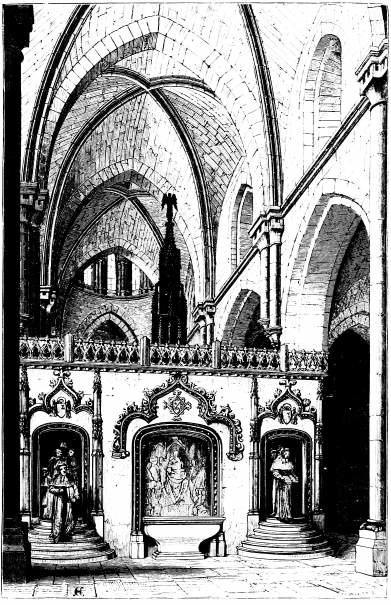
No. 10. ZAMORA CATHEDRAL. p. 92. INTERIOR OF NAVE, LOOKING EAST
This cathedral is on a small scale, and the most important portion of the ground-plan—the choir—having been rebuilt, it has lost much of its interest. It consists now of a nave and aisles of four bays, shallow transepts, with a dome over the crossing, a short choir with an apse of seven sides, and two choir aisles with square east ends. At the west end are chapels added beyond the church, that in the centre being of considerable length, and groined with the common intersecting ribs.[103] At the west end of the north aisle is an unusually large and fine Romanesque steeple—the finest example of the kind I have seen in Spain—and erected, no doubt, during the time of one of the French bishops already referred to.
The nave piers are very bold and vigorous in design; they are planned with triple shafts on each face of a square core, and have square caps and bases. The arches are very simple, but pointed. The massiveness of the piers is very remarkable, for though the clear width of the nave is only about twenty-three feet, the columns are not less than seven feet across. The nave is groined in square, the aisles in oblong compartments. There are no groining ribs in the aisles, though the vaults are quadripartite, and in the transepts there are pointed waggon roofs. The central dome is carried on pendentives, similar to those in the old cathedral at Salamanca. It has an arcaded and pierced stage above the pendentives, and then a dome or vault, divided into sixteen compartments by ribs of bold section, the filling in between which is a succession of small cylindrical vaults, so that the construction inside looks rather complicated. It is, moreover, so defaced by whitewash and plaster as to produce a much less fine effect than the dome at Salamanca; but, on the other hand, there can be but little doubt, I think, that it is the earlier of the two by some years. The exterior of the dome, though much decayed and mutilated, is still very noble in its design and effect. It will be seen that in many respects it is singularly like that at Salamanca. The circular angle turrets, the dormers on the cardinal sides, are similar in idea, though ruder and heavier here than there: here, too, the outline of the dome is more thoroughly domical. All the courses of stone in the dome seem to have been scalloped at the edges. The arches of the windows and arcades are all semi-circular, and the angles of the dome have a sort of sharp fringe of ornament, in which we see the very earliest kind of suggestion of a crocket: it is very simple, and extremely effective. Unfortunately this extremely interesting work is not only very much decayed, but also rent throughout with cracks, and I much fear that ere long it may cease to exist. The loss of such an example would be one of the greatest misfortunes for the student of Christian art in Spain, and for rarity and peculiarity I am not speaking too strongly when I say that we in England have no monument of the middle ages which is one whit more precious. It is to be hoped that the authorities of the church will do their best to preserve it from further decay as far as possible, and to repair it in the most tenderly conservative spirit.
The aisles have very broad massive buttresses, and the corbel-tables which crown the wall are carried round them also. There were simple round-arched, shafted windows in each bay, and the clerestory was finished like the aisle with a corbel-table.

No. 11. ZAMORA CATHEDRAL p. 94. EXTERIOR FROM THE SOUTH-WEST.
The south transept façade is, after the lantern, the most interesting part of the church. Its general character is extremely peculiar, and unlike any other work I have seen in Spain. There are plain buttresses at the angles, and the space between them is divided into three compartments by fluted pilasters, which rise as far as the corbel-table (continued at the same level as the eaves-cornice), and carry three pointed arches which are fitted to the original flat-pitched gable, the centre arch being the widest and highest. The centre compartment has a doorway with three shafts in each jamb, and four orders in the arch all alike, and resembling the door in San Martin, at Salamanca, illustrated at p. 91. The effect of light and shade in this ornamentation is very great; and, executed as it is with comparatively little labour, I rather wonder not to have seen more of the same work elsewhere. Two small recessed arches occupy the side compartments of the façade on either side of the doorway: that on the right hand has its archivolt carved with extreme delicacy with a small leaf repeated frequently; and both have within their arches sculptures of figures. The bases of all the columns are fluted, and the capitals are all carved rather rudely, and have heavy abaci. Over the side arches are square sunk compartments enclosing circular ornaments carved with a succession of hollow flutings sinking back to the centre. In fact, these strange ornaments—which at first sight look almost like modern insertions—are precisely like models of the dome with its arched groining spaces between the ribs. Above the doorway is a row of five arches recessed in the wall,[104] and under the central arch in the gable is a blocked-up window-opening.
I was unable to gain admission to the interior of the steeple. On the outside it rises in a succession of nearly equal stages, of which the upper three have, in the common Lombard fashion, windows of one, two, and three lights respectively.
It remains to say a few words as to the fittings of the church. The Coro here occupies the two eastern bays of the nave, and is fitted with very rich late stalls and canopies, which are quite magnificent in their effect. The backs of the stalls are carved with figures, and those over the lower range of stalls throughout with half-length figures of Old Testament worthies, most of which have inscribed scrolls, with legends referring to our Lord, in their hands. These texts have been printed by Dr. Neale in the ‘Ecclesiologist,’ and they afford so valuable an example of the right mode of selecting inscriptions, that, with his consent, I give a copy of his account.[105] The figures are rather in the style afterwards so much employed by Berruguete, large scale bas-reliefs of single figures—always an awkward kind of sculpture in the hands even of the very best artist. The traceries and crockets of this stall-work are very elaborate, crisp, and good of their kind. There is a continuous horizontal canopy above the upper stalls, each division of which is filled with purely secular sculptures of beasts and animals. The metal Rejas are of the same age as the stalls; and there is a fine ancient lectern for the choir, of enormous size, in the centre of the Coro, and two others of more modern date. The western screen is old—of the fifteenth century—and has the rare feature of two doorways, leaving the centre unpierced for the altar in the nave, and the bishop’s throne on its eastern side, towards the Coro. By the time this work was done, it was very generally settled that the bishop’s place was here, in the centre of the western end of the Coro; but I have seen no other screen in which the entrance has still been retained at the west in connexion with this arrangement of the stalls. There is an old metal screen or Reja under the eastern arch of the crossing, which is of the same age as the choir fittings, and has two iron pulpits projecting from its western face. These pulpits are lined with wood, and stand on stone bases; the staircases to them are of wood, carved on the Gospel side with figures of the Evangelists and St. Laurence, and on the Epistle side with St. John, St. Peter, and other Epistolers. Each pulpit has a desk on a little crane projecting from the column by its side.
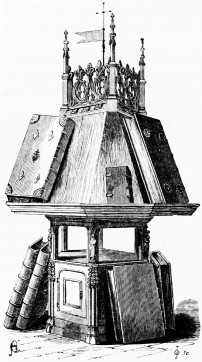
Choir Lectern, Zamora Cathedral.
The cloisters on the north side of the cathedral, and the bishop’s palace on the south, are all completely modernized; but just under the old town walls, to the north of the Cathedral Plaza, is the small Romanesque church of San Isidoro. It has a square-ended chancel of two bays, and a nave of three, the latter lighted by very small windows—mere slits in the masonry—the former by shafted windows with a deep external splay to the openings, which are also very narrow. There are two of these windows at the east end, and there is a corbel-table under the eaves. This church was not intended for groining.
The long, narrow, and winding street which leads along the thin crest of the hill to the centre of the city, passes on the way the very interesting little church of La Magdalena. This is a Romanesque church, divided into nave, chancel, and apsidal sanctuary, in the way we so often see in works of similar date in England. The chancel has a pointed waggon-vault, the apse is groined with ribs, whilst the nave has now a modern (and probably always had a) flat wooden roof. The south doorway is placed very nearly in the centre of the south wall of the nave. It is a very grand example of the most ornate late Romanesque work, with twisted and moulded shafts, and a profusion of carving in the capitals and archivolts. Over this door is a circular window with dog-tooth in the label, and a quatrefoil piercing in the centre; and on each side, in the other bays, are round-arched windows of two lights. There is a very considerable likeness between the plan of this church and that of San Juan at Lérida.[106] In both, the overwhelming size and grandeur of the doorway as compared with that of the building, combined with its central position, produces at first the impression that it is the western, and not the southern, façade one is looking at. This is a defect; yet perhaps more so to the eyes of an Englishman, who now as of old prefers creeping through little holes[107] in the wall into his finest churches, than to those of any one used to the noble doorways of the Continent. The interior of La Magdalena is more interesting than the exterior; for, in addition to the good early detail of the arches across the chancel, it has at the east end of the nave some very fine and very peculiar monuments. Two of these are high tombs, with lofty canopies over them, occupying the space between the side walls of the nave and the jambs of the chancel arch. These canopies are square-topped, with round arches on the two disengaged sides, and carried upon large shafts standing detached on the floor. The detail of the canopies is as plain as possible; but the capitals are carved with very pure and vigorous conventional foliage, and the shafts are twisted; the moulding on those of the northernmost of the two monuments being reversed in mid-height, so as to produce a large and simple chevron. The mouldings of the shaft are carefully stopped below the necking, and above the base. The effect of this monument, filling in as it does the angle at the end of the nave, is extremely good; its rather large detail and general proportions giving it the effect of being an integral part of the fabric rather than, as monuments usually are, a subsequent addition.

Monument, la Magdalena.
To the west of the monument already mentioned, against the north wall, is another of about the same age—probably the early part of the thirteenth century—and even more curious in its design. It has three shafts in front carrying the canopy; and this is composed of two divisions of canopy-work, very similar to those so often seen in French sculpture over figures and subjects in doorways; under each are a pair of monsters—wyverns, or some such nondescripts—fighting. The capitals are similarly carved, and the abaci have conventional foliage. The tomb under the canopy has a plain coffin-shaped stone with a cross on it; but against the wall are, below, a figure lying in a bed carved on a bold block of stone projecting from the wall; and, above this, the soul of the departed being carried up by angels. The whole design and character of this monument are so unlike any other work that I know, that I give a native artist the credit of them. Yet the character of the detail seems to me to show an acquaintance with the French and Italian architecture of the day.
La Magdalena is said to have been a church founded by the Knights Templars, but on the suppression of their order in A.D. 1312 to have become the property of the Knights of St. John of Jerusalem.
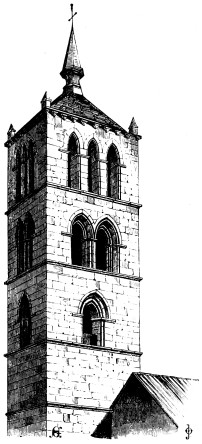
San Vicente. Zamora.
San Miguel, near the picturesque market-place in the centre of the city, has a fine south door. The archivolts are bold, but quite plain, and square in section. Each order is carried on three shafts, and the boldness of the effect is very striking. On the other side of the Plaza the tall tower of San Vicente rises well up against the sky. It has a fine west doorway, and rises above the roof in three stages, lighted respectively by windows of one, two, and three lights. It is finished with a simple corbel-table, above which is a modern roof. The whole of the detail here is fine, simple, early-pointed, very pure and good. The church seems to be almost entirely modernized.
In the lower and eastern part of the city there are also one or two interesting churches. San Leonardo has a square tower engaged against the north side of the west front, very plain below, but with a belfry-stage of two pointed windows, moulded angles, simple corbel-table, and a low square slated spire—the slates cut to pattern, like scales. The fine west door of this church is round-arched, and on either side of it are great brackets sculptured with a lion and a bear.
Sta. Maria de la Horta is a church of the same class as La Magdalena. It has a western tower, a nave of three bays of quadripartite groining carried on very bold piers and shafts in the side walls, a chancel, and apsidal sanctuary. The apse has a semi-dome, with a pointed archway in front of it. The chancel has a round waggon-vault, and the arch between it and the nave is semi-circular. The vaulting of the nave is extremely domical in its section. The light is admitted by small windows in the upper part of the walls, and above the abaci of the groining shafts, which are continued round the building as a string-course. The west doorway is round-arched, with chevron, and a sort of shell or flower-ornament in its arch-mouldings. The tower is of the prevailing type: in the stage above the roof there is a window of one light; in the next there are two lights; and above this the steeple has been destroyed, and a modern roof added. The walls outside are finished with a fine and bold thirteenth-century eaves-cornice.
I think one may see here the local influence exercised by the fine Romanesque tower of the cathedral, which, in its division into equal stages, with an increasing number of openings, has been followed in all these other steeples.
A walk over the bridge takes one to the ruins of a rather fine church close to its further end. This has an apse of seven sides, with good windows of two lights, with a trefoiled circle in the head; above this is a string-course with trefoiled arcading under it, and above this a second tier of windows. The whole is of good early middle-pointed character.[108]
The walls here, as in so many of the Spanish towns, are fairly perfect, and are thickly studded with the usual array of round towers throughout their length. The bridge already mentioned is probably a work of the thirteenth century. The arches are perfectly plain and pointed, springing from about the water-level. The piers between the arches project boldly; and over each is a small arch pierced through the bridge, which gives a good deal of additional effect to the design. The grand length of this bridge, with its long line of pointed arches reflected in the lazily-flowing Douro, and backed by the towers and walls of the city, is extremely striking. Neither of the gateways on it is really old; but nevertheless they add much to its picturesqueness. The only old domestic building of any note that I saw in Zamora was a very late Gothic house in the Plaza de los Momos. The entrance doorway has the enormous and exaggerated arch-stones so common in the later Catalan buildings, but not often seen in this part of Spain. It has above it a label, which is stepped up in the centre to enclose a great coat-of-arms, with its supporters. On either side of this are two windows which, with the coat-of-arms in the centre, make a panel of the same width as the door below. The other principal windows are on a line with these, and all of them of thoroughly debased design. They are of two round-headed lights enclosed within a label-moulding, which finishes in an ogee trefoil; and this again within another label-moulding, either square or ogee in the head. The vagaries of these later Gothic architects in Spain are certainly far from pleasant; yet odd as its detail is, the plain masses of unbroken wall in the lower part of this front give it a kind of dignity which is seldom seen in modern work. The practice of making all the living-rooms on the first-floor of course conduces largely to this happy result.
I was unable, unfortunately, to spare time when I was at Zamora to go over to Toro to see the fine Collegiata there. M. Villa Amil has given a drawing of the domed lantern over the Crossing. In plan it is similar to the domes at Salamanca and Zamora as to the angle pinnacles, but not as to the gabled windows between them. But it appears to have lost its ancient roof; and I cannot understand, from the drawing, how the domical roof, which it was no doubt built to receive, can now possibly exist.[109] It seems pretty clear that this example is of rather later date than that at Salamanca; and we have therefore in Zamora, Salamanca, and Toro a very good sequence of Gothic domes, all upon much the same plan, and most worthy of careful study. A more complete acquaintance with this part of Spain might be expected to reveal some other examples of the same extremely interesting kind of work.
From Zamora, cheered by the recollection of perhaps the most gorgeous sunset and the clearest moonlight that I ever saw, I made my way across country to Benavente. It is a ten hours’ drive over fields, through streams and ditches, and nowhere on a road upon which any pains have ever been bestowed; and when I say that the country is flat and uninteresting, the paternal benevolence of the government which leaves such a district practically roadless will be appreciated. Beyond Benavente the case is still worse, for the broad valley of the Esla, leading straight to Leon, is without a road along which a tartana can drive, though there is scarcely a hillock to surmount or a stream to cross in the forty miles between a considerable town and the capital of the province!
Soon after leaving Zamora some villages were seen to the right, and one of them seemed to me to have a church with a dome; but my view of it was very distant, and I cannot speak with any certainty. From thence to Benavente no old building was passed.

No. 12. BENAVENTE. EAST END OF STA. MARIA. p. 102.
Benavente is the most tumble-down forlorn-looking town I have seen. Most of the houses are built of mud, rain-worn for want of proper thatching, of only one story in height, and relieved in front by a doorway and usually one very small hole for a window. There is, however, a church—Sta. Maria del Azogue—which made the journey quite worth undertaking. It is cruciform, with five apses projecting from the eastern wall, that in the centre larger than the others.[110] The apses have semi-domes, the square compartments to the west of them quadripartite vaulting in the three centre, and waggon-vaults in the two outer bays. The transepts and crossing are vaulted with pointed barrel-vaults at the two ends, and three bays of quadripartite vaulting in the space between these two compartments; and the internal effect is particularly fine, owing to the long line of arches into the eastern chapels and the rich character of most of the details. The nave and aisles no doubt retain to some extent their old form and arrangement, but most of the work here is of the fifteenth century, whilst that of the eastern part of the church is no doubt of circa A.D. 1170-1220. The west front is quite modernized. The transept walls are lofty, and there is a simple pointed clerestory above the roofs of the eastern chapels, and a rose window over the arch into the Capilla mayor. The smaller chapels have each one window, the centre chapel three windows with the usual three-quarter engaged shaft between them, finishing in the eaves-cornice. The south transept has a fine round-headed doorway, but all its detail is that of early-pointed work. It has an Agnus Dei surrounded by angels in the tympanum, the four Evangelists with their emblems in one order of the arch, bold foliage in the next, a deep scallop ornament in the third, and delicate foliage in the label. The capitals are well carved, and the jambs of the door and one of the members of the archivolt have simple rose ornaments at intervals. The abaci of the capitals are square, but notwithstanding this and the other apparently early feature of the round arch I am still not disposed to date this work earlier than circa A.D. 1210-20.[111] Of the same age and character probably are all the eaves-cornices of the earlier part of the church, and, I have little doubt, the whole lower portion of the church itself.
There is a fine doorway to the north transept, and a lofty tower of very singular design rises over its northern bay. This is three stages in height above the roof, and is finished with a corbel-table and a modern spire of ogee outline. The masons’ marks on the exterior of the walls are here, as is usual in these early churches, very plentiful.
The church of San Juan del Mercado seems to be in some respects even more interesting than the other. It has a south doorway of singularly rich character, the two inner orders of the arch being round and the others pointed. The shafts are unusually rich and delicate; they are carved with acanthus-leaves diapered all over their surface, with chevrons and spiral mouldings, and above their bands at mid-height have in front of them figures of saints, three on either side. The tympanum has the Adoration of the Magi, and the order of the arch round it is sculptured with angels. Altogether this is a very refined and noble work, and the combination of the pointed and round arches one over the other is very happy. The west front has also a fine doorway and engaged shafts at intervals in the wall, and the east end is parallel triapsidal of the same character as that of San Juan.
There are some other churches, but those which I saw seemed to be all late and uninteresting. There are, too, the rapidly wasting ruins of an imposing castle. It is of very late sixteenth century work, and apparently has no detail of any interest; but the approach to it through a gateway, and up a winding hilly road under the steep castle walls, is very picturesque. By its side an Alameda has been planted, and here is the one agreeable walk in Benavente. Below is the river Esla, winding through a broad plain well wooded hereabouts with poplars and aspens; in the background are lines of hills, and beyond them bold mountain outlines; and such a view, aided by the transparent loveliness of the atmosphere, was enough to make me half-inclined to forget the squalid misery of everything that met the eye when I passed back again to my lodging.
[larger view] [largest view]

CHAPTER V.
LEON.
IT is a ride of some six-and-thirty or forty miles from Benavente to Leon. The road follows the course of the valley of the Esla all the way, and, though it is as nearly as possible level throughout, it is impassable for carriages. This is characteristic of the country; the Spaniards are content to go on as their fathers have done before them, and until some external friend comes to make a railway for them, the people of Benavente and Leon will probably still remain as practically isolated from each other as they are at present.
The valley is full of villages, as many as ten or twelve being in sight at one time on some parts of the road. None of their churches, however, seem to be of the slightest value. They are mostly modern and built of brick, though some have nothing better than badly built cob-walls to boast of; and their only unusual feature seems to be the great western bell-gable, which is generally an elevation above the roof of the whole width of the western wall, in which several bells are usually hung in a series of openings. The villages, too, are all built of cob; and as the walls are either only half-thatched or not thatched at all, they are gradually being worn away by the rains, and look as forlorn and sad as possible. One almost wonders that the people do not quit their hovels for the wine-caves with which every little hill near the villages is honeycombed, and upon which more care seems to be bestowed than upon the houses. In these parts the peasants adorn the outside of their houses with plenty of whitewash, and then relieve its bareness with rude red and black paintings of sprigs of trees, arranged round the windows and doors.
The cathedral of Leon is first seen some three or four hours before the city is reached. It stands up boldly above the well-wooded valley, and is backed by a noble range of mountain-peaks to the north; so that, though the road was somewhat monotonous and wearying, I rode on picturing to myself the great things I was soon to see. Unfortunately I visited Leon a year too late, for I came just in time to see the cathedral bereft of its southern transept, which had been pulled down to save it from falling, and was being reconstructed under the care of a Madrilenian architect—Señor Lavinia. I saw his plans and some of the work which was being put in its place, and the sight made me wish with double earnestness that I had been there before he had commenced his work! In England or in France such a work would be full of risk, and might well fill all lovers of our old buildings with alarm; but in Spain there is absolutely no school for the education of architects, the old national art is little understood and apparently very little studied, and there are no new churches and no minor restorations on which the native architects may try their prentice hands. In England for some years we have lived in the centre of a church-building movement as active and hearty perhaps as any ever yet known; our advantages, therefore, as compared with those possessed by foreigners generally, are enormous; whilst perhaps, on the other hand, in no country has so little been done as in Spain during the present century. Yet in England few of us would like to think of pulling down and reconstructing one side of a cathedral, and few would doubt that art and history would lose much in the process, even in the hands of the most able and conservative architect.
The two great architectural features of Leon are the cathedral and the church of San Isidoro; and to the former, though it is by much the most modern of the two, I must first of all ask my readers to turn their attention.
Spaniards are rightly proud of this noble church, and the proverbs which assert its pre-eminence seem to be numerous. One, giving the characteristics of several cathedrals, is worth quoting:—
[95] Don Miguel, priest of San Juan, Medina del Campo, made a donation to the church in A.D. 1178, to complete the work of the cathedral. The Chapter-house is probably of about this date or a little later.—Cean Bermudez, Arq. de Esp., i. 23.
[96] I use the modern terms, which seem to express their offices. The original words are J. G. de Hontañon, “maestro de canteria para maestro principal, y en Juan Campero, cautero, para aparejador.”
[97] Two inscriptions on stones on the church give the dates of its commencement and first use.
[98] It will be seen presently that in the somewhat similar cathedral at Zamora the Romanesque steeple occupies precisely the same position as this. It is possible that when the Junta sat the steeple they spoke of was of the same age as the old church, and that it has been subsequently recast in Renaissance.
[99] Yet I think a more careful search would be rewarded, for we know of the consecration of several churches at an early date, and Mr. Ford speaks of them as still existing.
[100] Plate IV.
[101] G. G. Dávila, Teatro Eccl., ii. 397. Dávila’s statement, supported by the inscription on his tomb, is that Bernardo was the first Bishop of Zamora; but this does not appear to accord exactly with the result at which Florez arrives. His statement is that Gerónimo was the first Bishop of Zamora after a long hiatus, that he was succeeded by Bernardo, and that both these bishops were appointed by Bernard of Toledo, and both were natives of Périgord. The fact seems to be that Gerónimo was Bishop of Valencia, and had to fly thence when the Moors regained possession after the Cid’s death, and that he was then made Bishop of Salamanca. It is certainly not a little curious that two of the eleventh-century bishops of Zamora should have come from a district where all the vaulting is more or less domical, and that we should have in their cathedral one of the most remarkable examples of a domed church. It will be recollected that nearly the same facts have been mentioned in regard to Salamanca. See Esp. Sag., vol. xiv. pp. 362-368, and p. 79 ante.
[102]
Fit domus hista quidem, veluti Salomonica capridem Huc adhibite fidem: domus hæc successit eidem. Sumptibus, et magnis viginti fit tribus annis. A quo fundatur, Domino faciente sacratur. Anno millessimo, centessimo, septuagesimo. Quarto completur, Stephanus, qui fecit habetur. Alfonsus imperator, Rex Septimus fundavit. G. G. Dávila, Teat. Eccl., ii. 397-8.
The same historian says that King Fernando I. rebuilt the city of Zamora with very strong walls in 1055.—ii. 395.
[103] This I suppose is the chapel of San Ildefonso, founded in 1466 by the Cardinal D. Juan de Mella, Bishop of Zamora.
[104] M. Villa-Amil, who gives a view of this transept, has converted this arcade into a row of windows, presented the doorway with a sculptured tympanum, and entirely altered the character of the archivolt enrichment.
[105] On the north side, the figures and inscriptions are as follow:—
[106] See plan, Plate VIII.
[107] The western doorways of Salisbury Cathedral are emphatically mere “holes in the wall,” and very characteristic, too.
[108] I add Dr. Neale’s notes of two churches here which I did not discover.
[109] Nevertheless, Dr. Neale describes it as existing, and so, no doubt, it does.—‘An Ecclesiological Tour,’ Ecclesiologist, vol. xiv. p. 361.
[110] See plan, Plate VIII.
[111] There is an inscription on the south-east buttress of the transept which, I believe, refers to the date of the church; but, unfortunately, though I noticed it, I forgot to write it down.
“Dives Toletana, Sancta Ovetensis Pulchra Leonina, fortis Salamantina.”
And again there is another Leonese couplet:—
“Sevilla en grandeza, Toledo en riqueza, Compostella en fortaleza, esta en sutileza.”
So again, just as our own people wrote that jubilant verse on the door-jamb of the Chapter-house at York, here on a column in front of the principal door was inscribed—
“Sint licet Hispaniis ditissima, pulchraque templa, Hoc tamen egregiis omnibus arte prius.”
There used to be a controversy as to the age of this cathedral, which must, however, one would think, long since have been settled. It was asserted that it was the very church built at the end of the ninth century during the reign of Ordoño II.; and the only proof of this was the inscription upon the fine fourteenth-century monument of the King which still stands in the aisle of the chevet behind the high altar:—
“Omnibus exemplum sit, quod venerabile templum Rex dedit Ordonius, quo jacet ipse pius. Hunc fecit sedem, quam primo fecerat ædem Virginis hortatu, quæ fulget Pontificatu. Pavit eam donis, per eam nitet urbs Legionis Quesumus ergo Dei gratia parcat ei. Amen.”
Fortunately, however, in addition to the indubitable evidence of the building itself, there is sufficient documentary evidence to give with tolerable exactness the dates of the commencement and completion of the existing church, and I did not see, and believe there is not, a relic of the church which preceded it still remaining.
One or two facts of interest in regard to the first cathedral may, however, well be mentioned here. The architect is said by Sandoval to have been an Abbat; and in Ordoño II.’s absence he is said to have converted the old Roman baths in the palace into a church, the plan being similar to that of churches with three naves.[112] It is interesting to find this plan so popular in the eleventh and twelfth centuries, already described as existing in the ninth.[113]
Don Manrique, Bishop of Leon from A.D. 1181 to A.D. 1205, is said to have been the first founder of the present cathedral. The contemporary chronicler Don Lucas de Tuy speaks most positively on this point, and as he wrote his history in the convent of San Isidoro close by, it is difficult to dispute his testimony.[114] How much he completed nowhere appears, though, judging by the style of the church, I should say it could have been but very little. Later than this, in A.D. 1258, during the episcopate of D. Martin Fernandez, a Junta of all the bishops of the kingdom of Leon was held at Madrid, at which the state of the fabric of the cathedral was discussed, and forty days of indulgence offered to those who made offerings towards the further promotion of the works.[115] Sixteen years later a council was held in Leon, and again the state of the fabric of the church was discussed and indulgence offered to those who gave alms for it.[116] Finally, in A.D. 1303, the Bishop Don Gonzalez gave back to the use of the Chapter a property which had been devoted to the work of the church, “because,” he says, “the work is now done, thanks be to God.” Nothing more clear on the face of it than this list of dates can be desired; yet, as frequently happens, when we come to compare them with the building itself, it is utterly impossible to believe in the most important part of it—the foundation, namely, of any part of the present church in the time of Bishop Manrique before the year 1205. I have elsewhere in this volume had occasion to show how much the Spaniards borrowed from the French in their architecture. Certain entire buildings, such as Burgos, Toledo, and Santiago, are distinctly derived from French churches, and in all cases are somewhat later in date than the French examples with which they most nearly correspond. If we apply this test to Leon it will be impossible to admit that any part of the existing church was built much before A.D. 1250. The church from beginning to end is thoroughly French; French in its detail, in its plan, and in its general design. And inasmuch as there is no long and regular sequence of Spanish buildings leading up step by step to the developed style which it exhibits, it is quite out of the question to give it credit for an earlier existence than the corresponding French churches, in the history of which such steps are not wanting.

No 13. LEON CATHEDRAL. p. 108. INTERIOR OF AISLE ROUND THE APSE.
The churches which are nearest in style to Leon are, I think, the cathedrals at Amiens and Rheims, and perhaps the later part of S. Denis. Of these, Amiens was in building from A.D. 1220 to A.D. 1269, and Rheims from A.D. 1211 to A.D. 1241. But both are slightly earlier in their character than Leon. In all three the chapels of the apse are planned in the same way; that is to say, they are polygonal and not circular in their outlines, and the sections of the columns, the plans of the bases and capitals, and the detail of the arches and groining ribs are as nearly as may be the same; and in all these points the resemblance between them and Leon Cathedral is close and remarkable.
A similar conclusion will be arrived at if we pursue the inquiry from a different point, and compare this cathedral with other Spanish works of the date at which it is assumed to have been in progress. I can only suppose that Don Lucas de Tuy, when he spoke of Bishop Manrique’s work at the cathedral, did so only from hearsay, or else that the work then commenced was subsequently completely removed to make way for the present building. Certainly in A.D. 1180-1200 all Spanish churches seem to have been built on a different plan, in a very much more solid fashion, and so that it would have been very difficult indeed to convert them into anything like the existing building. I venture to assume, therefore, that the scheme of Leon Cathedral was first made circa A.D. 1230-1240, and that the work had not progressed very far at the time the Junta of bishops was held in Madrid in A.D. 1258.
In plan[117] the cathedral consists of a nave and aisles of six bays, transepts, a choir of three bays, and chevet of five sides, with a surrounding aisle and pentagonal chapels beyond. There are two western towers, a large cloister on the north side, sacristies on the south-east, and a large chapel on the east side of the cloisters, with other buildings on their northern and western sides, arranged very much in the usual way; the chevet pr ojects beyond the line of the old city wall, one of the towers of which is still left on the east side of the cloister. The city was long and narrow; and whilst the cathedral projects to the east of the wall, the church of San Isidoro has its western tower built out beyond the western face of the wall. There is not, however, here, as there is at Avila, any very distinct attempt to fortify the chevet of the cathedral, otherwise than by forming passages, passing through the buttresses all round it, and by raising the windows high above the ground on the east.
There are doorways in all the three grand fronts, west, north, and south; but these shall be described further on. The columns throughout are cylindrical, with attached shafts on the cardinal sides, the groining-shafts towards the nave and choir being, however, triple, instead of single. In the apse the small shafts are not placed regularly round the main shaft, but their position is altered to suit the angles at which the arches are built. The same alteration of plan occurs in the chevet of Amiens, a work which was in progress about A.D. 1240, and to which, as I have said, the plan of this cathedral bears considerable resemblance.
The feature which most struck me in this cathedral was the wonderful lightness which characterizes its construction in every part. The columns of the nave are of moderate size, and the arches which they carry very thin, whilst the large and lofty clerestory, and the triforium below it, were both pierced to such an extent as to leave a pier to receive the groining smaller than I think I ever saw elsewhere in so large a church. There are double flying buttresses, one above the other, and the architect trusted, no doubt, that the weight of the groining would be carried down through them to such an extent as to make it safe to venture on as much as he did. Moreover, he was careful to economize the weight where possible; and with this view he filled in the whole of his vaults with a very light tufa, obtained from the mountains to the north of Leon.[118] In short, when this cathedral was planned, its architect must either have resolved that it should exceed all others in the slender airiness of its construction, or he must have been extremely incautious if not reckless. It is not a little curious that in France, at the same time, the same attempt was being made, and with the like result. The architect of Beauvais, unable to surpass the majestic combination of stable loftiness with beauty of form, which characterized the rather earlier work at Amiens, tried instead to excel him alike in height, and in lightness of construction. No one can pretend that he was an incompetent man, yet his work was so imprudently daring, that it was impossible to avoid a catastrophe; and we now have it rebuilt, to some extent in the same design after its fall, but with so many additional points of support as very much to spoil its symmetry and beauty. Here, then, we have an exactly parallel case: for at Leon, no sooner was the church completed than it became necessary to build up the outer lights, both of the clerestory and triforium, to save the work from the same misfortune. Nor was the precaution altogether successful, for, owing almost entirely to the over-hazardous nature of the whole construction, the south transept had recently, it is said, become so dangerously rent with cracks and settlements as to render it absolutely necessary to rebuild it; and the groining throughout the church shows signs of failure everywhere, and this of serious, if not of so fatal a character.
At the risk of repetition, I cannot help saying how strongly this parallel between Beauvais and Leon tells in favour of the assumption that its origin was rather French than Spanish. For in Spain there were no other churches at the time it was built from which a Spanish architect could have made such a sudden development as this design would have been. The steps by which it would have been attained are altogether wanting, and yet in France we have every step, and, finally, results of precisely the same kind. Both at an earlier and at a later date, when Spaniards made use of their own school of architects, they developed for themselves certain classes of churches, unlike, in some respects, to those of any other country. Here, however, we have an exotic, which, like the cathedral at Burgos, is evidently the work of some artist who had at least been educated among the architects of the north of France, if he was not himself a Frenchman. The proof of this is to be found more perhaps at S. Denis than anywhere, for there the section of the mouldings of the clerestory windows, as well as their general design, tallies so closely with the same parts of Leon Cathedral that it is almost impossible to doubt their common origin.
One other feature not yet insisted upon, affords strong evidence in the same direction. This cathedral is a mere lantern, it has scarcely a yard of plain unpierced wall anywhere, and the main thought of its architect was evidently how he might increase to the utmost extent the size of the windows, and the spaces for the glorious glass with which he contrived to fill the church. No greater fault could be committed in such a climate. This lavish indulgence in windows would have been excessive even in England, and must have always been all but insupportable in Spain. It was the design of French and not Spanish artists, for in their own undoubted works these last always wisely reduced their windows to the smallest possible dimensions. The cathedral at Milan is a case of the same kind, for there a German architect, called to build a church in a foreign land, built it with as many windows as he would have put had it been in his own country, and with a similar contempt for the customs of the national architects to that which marks the work of the architect of Leon Cathedral.
Regarding this cathedral, then, as a French, rather than as a Spanish church, and giving up all attempt to make it illustrate a chapter of the real national artistic history, we shall best be able to do justice to it as a work of art. It is, indeed, in almost every respect worthy to be ranked among the noblest churches of Europe. Its detail is rich and beautiful throughout, its plan very excellent, the sculpture with which it is adorned quite equal in quantity and character to that of any church of the age, and the stained glass with which its windows are everywhere filled, perhaps some of the most brilliant in Europe.
There are many features in its construction and design which must be referred to somewhat in detail, and to this part of my subject I must now turn.
I have already mentioned that the triforium throughout the church was originally glazed. In order to obtain this the aisles were covered with gabled roofs, whose ridges were parallel with the nave; and in order to allow of this being done a stone gutter was formed below the sills of the clerestory windows, and below this again corbels were built into the wall to carry the aisle roofs; cross gutters also of stone were carried through the roof in each bay from the clerestory gutter to the outer wall of the aisles. I cannot say that the effect of this arrangement is good. The eye seems to require some grave space of wall between the main arches and the glazing of the clerestory; and it is difficult to say on what ground the triforium is to be treated as a separate architectural division of the fabric, when it is in truth, as it is here, nothing more than a prolongation of the clerestory.
The flying buttresses are rather steep in pitch, and each consists of two arches abutting against very broad buttresses rising from between the side chapels; the lower arch supports the clerestory just at the level of the springing of the groining; the higher a few feet only below the parapet. Two pinnacles rise out of each of the buttresses, and others form a finish to them all round the clerestory, and at the angles of the chapels of the apse.
The windows throughout have good traceries. They are all of pure geometrical character; those in the chapels of the choir being of two lights, with large cusped circles in the head, and those in the clerestory of four lights, subdivided into two divisions, similar to the chapel windows, with another cusped circle above. The heads of the lights throughout the windows are uncusped, the cusping being confined to the traceries. The clerestory windows originally had six lights, but the outer lights were rather clumsy additions to the original scheme for four-light windows, and have since been walled up, to give the necessary strength to the groining piers. The general arrangement of the traceries in this part of the church will be best understood by reference to the engraving which I give of one bay of the choir.

Bay of Choir, Leon Cathedral.
The stone-work of all the window traceries was very carefully cramped together with strong toothed iron plugs let into the centre of the stones, and the masons seem, in many cases, to have marked the beds and not the face of the stones. Indeed, the early masons’ marks are but few in number, and most of those that I saw occurred at the base of the eastern walls, and again in the upper portion of the work. On the late, and thoroughly Spanish chapel of Santiago also, a good many occur on the outer face of the stones. Owing to the works which were in progress in the south transept, I had an unusually good opportunity of looking for these marks, not only on the face of the stones, but also on their beds, and their almost entire absence from the early work was very remarkable. On the other hand, there were markings on some of the other stones which were of much more interest. I found, for instance, one of the large stones forming the capital of the pier at the crossing of the nave and transepts, carefully marked, first with an outline of the whole of the jamb mould, then with the lines of the capital, and finally with the whole of the archivolt. It had all the air of being the practical working drawing used for the execution of the work, some little alterations having been made in the archivolt. It is easy to conceive that the architect may thus have designed his details, and his mode bears considerable analogy to that which M. Verdier describes as having been adopted at Limoges, where the lines of the groining and all the working outlines were scratched on the floor of the triforia; here the lines are scratched boldly on the surface of the stones.
The walls throughout the church were built of rubble, faced with wrought stone inside and out, and some of the failures in the work are attributable, no doubt, to the want of strength and bond of this kind of walling.
The dimensions of the various parts are about as follows:—
Total internal length
300 feet.
“ width of nave and aisles
83 feet.
Height to springing of main arches
25 feet
6 inches.
“ floor of triforium
46 feet.
“ centre of groining about
100 feet.
These dimensions, though not to be compared to those of many of the French churches, are still very noble, and would place this among the finest of our own buildings in respect of height; but, like all Spanish, and most French churches, the length is not very grand.
The various views of the exterior are fine, but everywhere the height of the clerestory appears to be rather excessive. This is seen even at the west end, where a little management might easily have prevented it. But the two steeples standing beyond the aisles leave a narrow vertical chasm between their side walls and those of the clerestory, which is brought out, without any break in its outline by means of buttresses, quite to the west front. The lower part of these steeples is perfectly plain; each has a sort of double belfry stage, and they are both finished with low spires—that on the south pierced with open traceries, and that on the north simply crocketed; both of them are somewhat ungainly, of very late date, and not sufficiently lofty or important for the church to which they are attached.
The grand feature of the west front is the beautiful porch which extends all across, forming three grand archways, corresponding with the nave and aisles, with smaller and extremely pointed arches between them. These arches are all supported on clustered shafts, standing away between four and five feet from the main wall, in which the doorways are set. Statues are set on corbels round the detached shafts, and again in the jambs of all the doorways, and the tympana and archivolts of the latter are everywhere crowded with sculpture. An open parapet is carried all across the front above the porch, and above this the west end is pierced with a row of four windows corresponding with the triforium, and again, above, by a very large and simple wheel-window. The finish of the west front is completely modernized, with a seventeenth-century gable between two pinnacles.
The sculpture of the western doors well deserves description and illustration. It is charming work, of precisely the same character as the best French work of the latter half of the thirteenth century, and there is a profusion of it.
The central west door has in the tympanum our Lord seated, with angels, and St. John and the Blessed Virgin worshipping on either side. Below is the Last Judgment, the side of the Blessed being as pretty and interesting as anything I have seen. A youth sits at a small organ playing sweet songs to those who go to Paradise; and a king, going jauntily, and as if of right, towards St. Peter, is met by a grave person, who evidently tells him that he must depart to the other and sadder side. The three orders of the arch are filled with the resurrection of the dead, angels taking some, and devils others, as they rise from their graves,—the whole mixed very indiscriminately. On the central shaft is a statue of the Blessed Virgin and our Lord, now with wretched taste dressed up and enclosed in a glass case, to the great damage of the whole doorway.
The north-west doorway has its tympanum divided in three horizontal lines. The lower compartment has the Salutation, the Nativity, an Angel, and the Shepherds; the middle the Magi adoring our Lord in the Blessed Virgin’s arms, and the Flight into Egypt; and the upper, the Massacre of the Innocents. The arch of this door is elliptic, and the space between it and the tympanum is filled with figures of angels with crowns and censers, playing an organ and other instruments, and singing from books. The meaning of the sculpture in the archivolt was not clear to me, and seemed to refer to some legend.
The south-west doorway has the tympanum divided as the last, and in the lower compartment the death of the Blessed Virgin; next to this our Lord and the Blessed Virgin seated; and above, angels putting a crown on her head. The archivolt here is adorned with one order of sitting figures of saints and two of angels.
The east end is more striking than the west. It retains almost all its old features intact, save that the roof is now very flat, and covered with pantiles, whereas it is probable that at first it was of a steep pitch. It stands up well above the sort of boulevard which passes under its east end, and when seen from a little further off, the steeples of the western end group well with it, and, to some extent, compensate for the loss of the old roofing line.
The south transept had been entirely taken down when I was at Leon, and the sculpture of its three doorways was lying on the floor of the church. It is of the same fine character as that of the western doors; the central door has a figure of our Lord with the emblems of the Evangelists on either side, and beyond them the Evangelists themselves writing at desks. Below this are the twelve Apostles seated, and the several orders of the archivolt are carved with figures of angels holding candles, sculptures of vine and other leaves, and crowned figures playing on musical instruments. The south-west door of the transept has no sculpture of figures, but the favourite diapers of fleur-de-lys and castles, and lions and castles, and an order of foliage arranged in the French fashion, à crochet. The south-east door has in its tympanum the death of the Blessed Virgin, with angels in the archivolt holding candles. The gable of this transept seems to have been very much altered by some Renaissance architect before it was taken down.
The north transept has two doorways, only one of which is now open. This has a figure of our Lord seated within a vesica, supported by angels, and the archivolt has figures of saints with books. The jambs have—like all the other door-jambs—statues under canopies, and below them the common diaper of lions and castles. The closed north-west door of this transept now forms a reredos for an altar; it has no sculpture of figures.
The north transept doorway opens into a groined aisle which occupies the space between the transept and the cloister. This aisle is very dark, and opens at its eastern end into the chapel of Santiago, a fine late building of the age of Ferdinand and Isabella, running north and south, and showing its side elevation in the general view of the east end to the north of the choir.
The cloister is so mutilated as to have well-nigh lost all its architectural value. The entrance to the porch in front of the north transept is, however, in its old state; it is a fine doorway, richly and delicately carved with small subjects enclosed in quatrefoils. The original groining shafts, which still remain, show that the whole cloister was built early in the fourteenth century; the traceries, however, have all been destroyed; and the groining, the outer walls, and buttresses altered with vast trouble and cost, into a very poor and weak kind of Renaissance. But if the cloister has lost much of its architectural interest, it is still full of value from another point of view, containing as it does one of the finest series of illustrations of the New Testament that I have ever seen, remaining in each bay of the cloister all the way round. These subjects begin to the east of the doorway to the north transept, and are continued round in regular order till they finish on its western side. I have not been able to learn anything as to the history of these works. If they are Spanish, they prove the existence of a school of painters of rare excellence here, for they are all more or less admirable in their drawing, in the expression of the faces, and in the honesty and simplicity with which they tell their story. The colours, too, where they are still visible, are pure and good, and the whole looked to me like the work of some good Florentine artist of about the middle of the fifteenth century. It would not be a little curious to find the King or Bishop of Leon not only sending to France for his architect, but to Tuscany for his wall-painter, and, if it be the fact, it would show how firm must have been the resolve to make this church as perfect as possible in every respect, and how little dependence was then placed on native talent.
The subjects represented are the following, each painting filling the whole of the upper part of the wall in each bay of the cloister:—
1.
The Birth of the Blessed Virgin.
2.
Her Marriage.
3.
The Annunciation.
4, 5, 6.
Destroyed.
7.
Massacre of the Innocents, and Herod giving orders for it.
8, 9.
Destroyed.
10.
The Blessed Virgin Mary seated with our Lord, angels above, and three figures with nimbi sitting and adoring, others with musical instruments.
11.
The Baptism of our Lord.
12.
Destroyed.
13.
An ass and its foal, Jerusalem in the background, and indistinct groups of figures.
14.
Our Lord riding into Jerusalem. The city has circular towers all round, and churches with two western octagonal steeples.
15.
The Last Supper.
16.
Our Lord washing the Disciples’ feet; some figures on the right carrying water-jars are drawn with extreme grace.
17.
Destroyed.
18.
The Betrayal.
19.
Our Lord bound and stripped, and,
20.
Scourged. (These two subjects are very finely treated.)
21.
Brought to the Place of Judgment: desks with open books on them in front.
22.
Buffeted and spit upon.
23.
Judged: Pilate washing his hands.
24.
Bearing the Cross. (This subject is painted round and over a monument on which is the date XXIII. October, A.D. MCCCCXL.; so that it must be of later date than this.)
25.
Nailed to the Cross: the Cross on the ground.
26.
The Descent from the Cross.
27,
28. The Descent into Hell.
29.
The Incredulity of St. Thomas, and the appearance of our Lord on the way to Emmaus.
30.
The Ascension.
31.
The Descent of the Holy Ghost.
It will be noticed that the Crucifixion is most remarkably omitted from this series. There is no place on the wall for it, and it occurred to me as possible that there may have been a crucifix in the centre of the cloister, round which all these paintings were, so to speak, grouped.[119]
There are several fine monuments in these cloisters, some of them corbelled out from the wall, and some with recumbent effigies under arches in it. One of the latter is so fine in its way as to deserve special notice. The arch is of two orders, each sculptured with figures of angels worshipping and censing our Lord, who is seated in the tympanum of the arch holding a book and giving His blessing. Below, on a high tomb, is the effigy recumbent; and behind it, below the tympanum, two angels bearing up the soul of the departed. The sculpture is admirable for its breadth and simplicity of treatment; and the monument generally is noticeable for the extent to which sculpture, and sculpture only, has been depended on, the strictly architectural features being few and completely subordinate.
The cloister is surrounded by buildings, some of which only are ancient. On the north side are the chapel of San Juan de Regla, another chapel, and the Chapter-house. The latter has one of those foolish Spanish conceits, a doorway planned obliquely to the wall in which it is set.[120]
In the church itself there are several very fine monuments. The most elaborate is that of Ordoño II., the original founder of the old cathedral, which occupies the eastern bay of the apse, with its back to the high altar. This is sometimes spoken of as if it were a contemporary work. It is, however, obviously a work of the fourteenth century, and recalls to mind some of the finest monuments in our own churches. The effigy of the king, laid on a sloping stone, so that it looks out from the monumental arch, is singularly noble, very simple, of great size and uncommon dignity. The general design of this fine monument will be seen in my view of the aisle round the choir.
Another monument in the north transept has a semicircular arch carved alternately with bosses of foliage and censing angels; and within this a succession of cusps, the spandrels of which have also angels. The tympanum has a representation of the Crucifixion;[121] and below this, in an oblong panel just over the recumbent figure, is a representation of the service at a funeral. The side of the high tomb has also an interesting sculpture representing a figure giving a dole of bread to a crowd of poor and maimed people, whilst others bring him large baskets full of bread on their backs. The date in the inscription on this monument is Era 1280, i.e. A.D. 1242.
In a corresponding position in the west wall of the south transept is another monument of a bishop, recessed behind three divisions of the arcade which surrounds the walls of the church. The effigy is rather colossal, and has a lion at the head, and another under the feet. Over the effigy is a group of figures saying the burial office; and above, in panels within arches, are, (1) St. Martin dividing his Cloak, (2) the Scourging of our Lord, and (3) the Crucifixion. The soffeits of the arcade are diapered, and there were three subjects below the figure of the bishop, but they are now nearly destroyed.
The arches round the Capilla mayor were walled up, and those on either side of the monument of Ordoño II., already described, still retain the paintings with which they were all once adorned. They are of the same class as those in the cloister, and one of them, a large Ecce Homo, is certainly a very fine work. Unfortunately the figure of our Lord in the centre has been very badly repainted, but the troop of soldiers and Jews reviling Him on either side is full of life and expression.
The choir occupies the two eastern bays of the nave, and its woodwork is fine, though of late fifteenth-century date. There are large figures in bas-relief, carved in the panels behind the stalls. There is a western door from the nave into the Coro; and in part on this account, and in part from its considerable scale, the nave has less than usual of the air of uselessness which the Spanish arrangement of the Coro produces.
I have already incidentally mentioned that the windows are full of fine stained glass. It is all of the richest possible colour, and most of it of about the same date as the church. Modern critics would, no doubt, object to some of the drawing for its rudeness and want of accuracy. Yet to me this work seemed to be a most emphatic proof—if any were needed—that we who talk so much about drawing are altogether wrong in our sense of the office which stained glass has to fulfil in our buildings. We talk glibly about good drawing, and forget altogether the much greater importance of good colour. At Leon the drawing is forgotten altogether, and I defy any one to be otherwise than charmed with the glories of the effect created solely by the colour. At present in England our glass is all but invariably bad—nay, contemptible—in colour; whilst the so-called good drawing is usually a miserable attempt to reproduce some sentimentality of a German painter. Two schools might well be studied a little more than they are; the one should be this early school of rich colourists, and the other the beautiful works of the sixteenth and seventeenth century French glass-painters, where there is good drawing enough for any one, and generally great beauty and simplicity of colour. Finally, two practices might be suggested to our stained-glass painters,—one, that they should only use good, and therefore costly glass; and the other, that they should limit their palettes to a few pure and simple colours, instead of confusing our eyes with every possible tint of badly-chosen and cheaply-made glass.
If we want religious pictures in our churches—as we do most surely—let us go to painters for them, and, with the money now in great part thrown away on stained glass, we might then have some works of art in our churches of which we might have more chance of feeling proud, and for which our successors would perhaps thank us more than they will for our glass.[122]
I have detained my readers only too long, I fear, upon this cathedral, but it is too full of interest of all kinds to allow of shorter notice, and is, in its way, the finest church of which Spain can boast; at the same time the work is all so thoroughly French as to destroy, to some degree, the interest which we should otherwise feel in it.
The other great architectural attraction of Leon is the church of San Isidoro “el Real.” This is altogether earlier than, and has therefore an interest entirely different from, that of the cathedral.
Gil Gonzalez Dávila says that the church was founded in A.D. 1030,[123] by Ferdinand I., the Great. An inscription in the floor of the church gives the name of its architect;[124] and from the mention of Alonso VI., who came to the throne in A.D. 1065, and his mother Sancha, who died in A.D. 1067, the date of his death must have been between these two periods.[125] In A.D. 1063 King Ferdinand—Alfonso’s father—and Queen Sancha had very richly endowed the church, in the presence of various bishops, who had come together to celebrate the translation of the remains of San Isidoro.[126] Finally Dávila, in his History of the Cathedral at Avila, gives the date of the consecration of the church, from a deed in the archives there, as A.D. 1149.[127]
From these statements it would seem that the church was fit for the reception of the body of San Isidoro in A.D. 1065, and had then three altars; and yet that in A.D. 1149 it was consecrated, though indeed Ponz speaks of an inscription in the cloister which mentions the dedication of the church in A.D. 1063.[128]
San Isidoro was one of the most popularly venerated saints in Spain, and many are the miracles said to have been wrought by him. One of them is not a little suggestive of plans for church-building, not a whit behind the cleverest schemes of the present day. It is said that in a time when much sickness prevailed, the body of the saint was taken out in procession to a village near Leon, Trobajo del Camino, the bearers of the body barefooted, and all singing hymns, in order to charm away the disease from the people. Suddenly the weight became so great that it was impossible to move or lift the saint, even by the aid of a strong body of men: and many complained not a little of the Canons for bringing the body out on such an errand, whilst the King, who was at Benavente, was so incensed, that he insisted, as the saint would not move, that they should build a church over him for his protection; and at last came the Queen, grieving bitterly appealing to “her beloved spouse” San Isidoro, and saying, “Turn, O blessed confessor! turn again to the monastery of Leon, which my forefathers, out of their devotion, built for you;” and then the saint, moved by her prayer, allowed himself to be borne back upon the shoulders of four children, who brought him back to Leon amid the rejoicings of the people: and these, moved by the miracle, at once built a chapel on the spot which the saint had marked out for the purpose by his pertinacious refusal to move until the King had ordered it to be built, and until the Queen had shown how deep was her interest in the work.

Interior of S. Isidoro.
But I must not dwell longer on what is merely legendary, but return to this church of San Isidoro at Leon. It is cruciform in plan,[129] with apsidal chapels on the eastern side of the transepts. The nave and aisles are of six bays in length, and there is a tower detached to the west. There is a chapel dedicated to Sta. Catalina (now called El Panteon) at the north-west end of the church, and a choir of the sixteenth century takes the place of the original apse. The whole of the nave is vaulted with a waggon-vault, with transverse ribs under it in each bay; and this vault is continued on without break to the chancel arch, there being no lantern at the crossing. The arches into the transepts have a fringe of cusping on their under sides, which has a very Moorish air, and the transepts are vaulted with waggon-vaults, but at a lower level than the nave. The chapels to the east of the transept are roofed with semi-domes. The nave has bold columns, with richly sculptured capitals, stilted semi-circular arches, and a clerestory of considerable height, with large windows of rich character.
The whole interior of the church has been picked out in white and brown washes to such an extent, that at first sight its effect is positively repulsive: nevertheless, its detail is very fine. The capitals are all richly sculptured, generally with foliage arranged after the model of the Corinthian capital; but some of them historiés with figures of men and beasts; and I noticed one only with pairs of birds looking at each other. The western part of the church is abominably modernized, but the alterations in the fabric evidently commenced at a very early period, for in the south aisle one of the groining-shafts is carried up exactly in front of what appears to be one of the original aisle windows. I confess myself quite at a loss to account for this, unless it be by the assumption that the church, consecrated in A.D. 1149, was commenced on the same type as S. Sernin, Toulouse—copied, as we shall see further on, at Santiago—and that before the consecration the original triforium had been altered into a clerestory by the alteration of the aisle-roofs and the introduction of quadripartite vaulting in them at a lower level, thus necessitating the introduction of the groining-shaft in front of a window. The difficulty did not occur to me forcibly when I was on the spot, and I am unable to say, therefore, how far a thoroughly close examination of the work would clear it up. It might of course be said that such an alteration proves that the church was of two periods; and such an opinion would be to some extent supported by reference to the certainly early character of the south door, which might have been executed before A.D. 1063. But I am, on the whole, disposed rather to regard the chapel of Sta. Catalina as the original church, and to assume that the remainder of the building was built between A.D. 1063 and A.D. 1149, and that the awkward arrangement to which I have just referred was, in fact, the result of some accident or change of plan. This supposition would reconcile more satisfactorily all the difficulties of the case than any other, and would tally well with what I have been able to learn as to the history of the church. The body of San Isidoro was sent for rather suddenly, and brought from Seville, and the King had but short time for the preparation of the building for its reception. Two years later the body of San Vicente was brought from Avila, and no doubt the popularity of the two saints soon made it necessary to enlarge the church. Then it might well happen that the old church was left in its integrity, and the new building added to the east, but with its north wall in a line with the north wall of the old one, so as to allow of the cloister being built along their sides, and without at all disturbing the early church or its relics. The relative position of the churches makes it probable, in short, that the large church was added to the small one, and not that the latter was a chapel added to the former.
The style of the two buildings leads to the same conclusion, for in Sta. Catalina Ave have a small, low, vaulted church, two bays only in length and three in width. The two detached columns which carry the vaults are cylindrical, with capitals of somewhat the same kind as those in the church, but simpler and ruder. Recessed arches in the side walls contain various tombs of the Royal Family, who for ages, from the time of Fernando I. and Doña Sancha his queen, have been buried here; and the very circumstance that this little chapel was selected for the burial of so many royal persons, seems to make it extremely probable that it was the very chapel in which the body of San Isidoro had first been laid.
The door of communication from the chapel to the church has an arch of the same kind as the transept arches, semi-circular and fringed with several cusps; and the chapel is now lighted by two open arches on the north side, which communicate with the cloister. The groining is all quadripartite, without ribs, but with plain bold transverse arches between the bays.
The exterior of the church has some features which have all the air of being very early and original in their character. Such is the grand south doorway of the nave. Its arch is semicircular, and above it the spandrels are filled with sculpture. Above this is a line of panels containing the signs of the Zodiac; below are figures with musical instruments; and below these again, on the west, is a figure of San Isidoro, and on the right a figure of a woman, I think, book in hand, both of them supported on corbels formed of the heads of oxen. The tympanum itself is divided into two parts, the lower half being surmounted by a flat pediment, and the upper filling up the space from this to the intrados of the arch. The upper half has an Agnus Dei in a circle in the centre, and the lower half has Abraham’s sacrifice, with figures on horseback on either side. The head of the opening of the doorway is finished with a square trefoil, under which rams’ heads are carved. The whole detail of this sculpture is very unlike that of most of the early work I have seen in Spain; the figures are round and flabby, and badly arranged, and very free from any of the usual conventionality. All this made me feel much inclined to think that the execution of this work was at an early date, and soon after the first consecration of the church.
The elevation of the south transept is rather fine. It has a doorway, now blocked, with a figure against the wall on either side, standing between the label and a second label built into the wall from buttress to buttress. Above this is a rich corbel-table, and then an arcade of three divisions, of which the centre is pierced as a window; in the gable is another statue standing against the wall. The doorway has its opening finished with a square trefoil, and the tympanum is plain. The design of the apsidal chapel east of the apse is so precisely like the eastern apsidal chapels of many of the Spanish Romanesque churches,[130] that its date must, to some extent, be decided by theirs: and it may well be doubted whether it can be much earlier than circa A.D. 1150, though the lower part of the south transept appeared to me to be as early as the south door, or at any rate not later than A.D. 1100.
The walls are all carried up high above the clerestory windows, and finished with corbel-tables, carved with a billet-mould on edge, and carried on corbels moulded, not carved. Simple buttresses divide the bays of the clerestory.
The choir, as has been said, was a late addition in place of the original Romanesque apse. It was built in A.D. 1513, or a little after, by Juan de Badajoz, master of the works at the cathedral.[131] It is of debased Gothic design and coarse detail, but large and lofty. The groining at the east end is planned as if for an apse, and portions of diagonal buttresses, to resist the thrust of the groining ribs, are built against the east wall, in the way often to be noticed in the later Spanish buildings. The east window was of two lights only, and is now blocked up by the Retablo. In this church there is a perpetual exposition of the Host, and the choir is therefore screened off with more than usual care, none but the clergy being allowed to enter it. At Lugo, where there is also a similar exposition, the choir is left open, but two priests are always sitting or kneeling before faldstools in front of the altar.

No. 14. SAN ISIDORO, LEON p. 126. SOUTH TRANSEPT.
I could not gain admission to the cloister on the north side of the church; it is large and all modernized, and surrounded by the buildings of the monastery, which is now suppressed. A chapel dedicated to the Holy Trinity was founded here in A.D. 1191, and a list of the relics preserved at its altar is given on a stone preserved in the convent.
The chapel of Sta. Catalina, already described, is specially interesting on account of the remarkable paintings with which the whole of the groining is covered. These all appeared to me to have been certainly executed at the end of the twelfth century, circa A.D. 1180-1200, and they are remarkably rich in their foliage decoration, as well as in painting of figures and subjects. Beginning with the eastern central compartment, over the altar, and going round to the right, the subjects in the six bays of the vault are as follows:—
(1.) In this our Lord is seated in a vesica, at the angles of
which are four angels, with the heads of the four Evangelists,
with their books and names painted beside them. Our Lord’s
feet are to the east, and He holds an open book and gives His
blessing.
(2.) The angel speaking to the shepherds, with the inscription,
“Angelus a pastores.”
(3.) The Massacre of the Innocents.
(4.) The Last Supper, painted without the slightest regard
to the angles formed by the groining, and as if the vault were a
flat surface.
(5.) a. Herod washing his hands.
b. St. Peter denying our Lord.
c. Our Lord bearing his Cross.
d. The Crucifixion (this is almost destroyed).
(6.) Our Lord seated with His feet to the west; the seven
churches around Him, seven candles, and an angel giving the
book to St. John.
The soffeits of the cross arches between the vaults are painted, some with foliage, others with figures. Of the latter, one has the twelve Apostles, another the Holy Spirit in the centre, with angels worshipping on either side, and a third a Hand blessing (inscribed “Dextra Dei”) in centre, and saints on either side. The whole detail of the painted foliage is of thoroughly good conventional character, and just in the transitional style from Romanesque to Pointed.
There is a fine steeple detached from the church to the west. It stands on the very edge of the old town wall, several of the round towers of which still exist to the north of it, and below the great walls of the convent built within them. This steeple is very plain below, but its belfry stage has two fine shafted windows in each face, and nook shafts at its four corners. It is capped with a low square spire with small spire-lights: but as I found the working lines of all this drawn out elaborately on the whitewashed walls of one of the cloisters, and as all the work appears to be new, I cannot say whether or no it is an exact restoration, though I dare say it is.
In the sacristy there are some paintings, of which one or two are of great beauty. One is a charming picture of the Blessed Virgin with our Lord, with angels on either side, and others holding a crown above: the faces are sweet and delicate. One of the attendant angels offers an apple to our Lord; the other plays a guitar: the background is a landscape. The frame, too, is original. It has a gold edge, then a flat of blue covered with delicate gold diaper, and there are two shutters with this inscription on them:—“Fœlix ē sacra virgo Maria et omni laude dignissima quia in te ortus est sol justicie Chrūs Deus noster.” There is also a very little triptych, with a Descent from the Cross, and an inscription on the shutters. Two figures are drawing out the nails, and hold the body of our Lord; two other figures on ladders support His head and feet, and St. Mary and St. Mary Magdalene weep at the foot of the cross. The inscriptions on the shutters are from Zachariah xii., Plagent eum, &c., and Second Corinthians, “Pro omnibus mortuus est Christus.” There are other paintings which the Sacristan exhibits with more pride, but these two are precious works, of extremely good character, and painted probably about the end of the sixteenth century.
Leon is a much smaller city than might be expected for one so famous in Spanish history; its streets wind about in the most tortuous fashion; there are but few buildings of any pretension, and I saw no other old churches. There is indeed a great convent of San Marcos, built from the designs of Juan de Badajoz, in the sixteenth century, and afterwards added to by Berruguete, but I forgot to go to see it, and his work at San Isidoro makes me regard the omission as a very venial one. Round the city, on all sides, are long groves of poplars which look green and pleasant; there is a river—or at least in summer, as I saw it, the broad bed of one—and over the low hills which girt the city is a background of beautiful mountains. Both for its situation, therefore, and for the artistic treasures it enshrines, Leon well deserves a pilgrimage at the hands of all lovers of art.
[larger view] [largest view]

[larger view] [largest view]
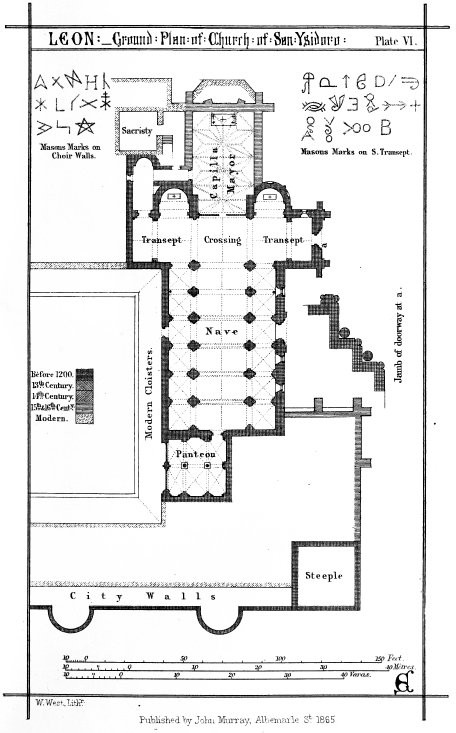
CHAPTER VI.
ASTORGA, LUGO, LA CORUÑA.
THE road from Leon to Astorga is bad, and traverses a very uninteresting country. A good part of the old walls of Astorga still remains, with the usual array of lofty round towers at short intervals: they were in process of partial demolition when I saw them, and I noticed that they were in part constructed with what appeared to be fragments of Roman buildings. There is a rather picturesque Plaza de la Constitucion here, one end of it being occupied by a quaint town-hall of the seventeenth century, through an archway in the centre of which one of the streets opens into the Plaza. A number of bells are hung in picturesque slated turrets on the roof, and some of them are struck by figures.
The only old church I saw was the cathedral. A stone here is inscribed with the following words in Spanish: “In 1471, on the 16th of August, the first stone of the new work of this holy church was laid;” and there is no doubt that the church is all of about this date, with some additions,—chiefly, however, of Retablos and other furniture,—in the two following centuries. The character of the whole design is necessarily in the very latest kind of Gothic; and much of the detail, especially on the exterior, is quite Renaissance in its character. The east end is finished with three parallel apses, and the nave is some seven or eight bays in length, with towers projecting beyond the aisles at the west end, and chapels opening into the aisles between the buttresses. The light is admitted by windows in the aisles over the chapel arches, and by a large clerestory. These windows are fortunately filled with a good deal of fine early Renaissance glass, which, though not all that might be wished in drawing and general treatment, is still remarkable for its very fine colour. Arches of the same height as the groining of the aisles open into the towers, the interior view across which produces the effect of a sort of western transept, corresponding with a similar transept between the nave and the apsidal choir. The detail is throughout very similar to that of the better known cathedrals at Segovia and Salamanca, the section of the columns being like a bundle of reeds, with ingeniously planned interpenetrating base mouldings, multiplied to such an extent that they finish at a height of no less that ten feet from the floor. Another evidence of the late character of the work is given by the arch mouldings, which die against and interpenetrate those of the columns, there being no capitals. Beyond a certain stateliness of height and colour which this small cathedral has in common with most other Spanish works of the same age, there is but little to detain or interest an architect. But stateliness and good effects of light and shade are so very rare in modern works, that we can ill afford to regard a building which shows them as being devoid of merit or interest.
From Astorga the road soon begins to rise, and the scenery thenceforward for the remainder of the journey to la Coruña becomes always interesting, and sometimes extremely beautiful. The country can hardly be said to be mountainous, yet the hills are on a scale far beyond what we are accustomed to; and the grand sweep of the hill sides, covered occasionally with wood, and intersected by deep valleys, makes the whole journey most pleasant. One of the prettiest spots on the road, before reaching Villafranca, is the little village of Torre, where a quaint bridge spans the brawling trout-stream; and where the thick cluster of squalid cottages atones to the traveller, in some degree, by its picturesqueness, for the misery in which the people live. They seem to be terribly ill off, and their chimneyless hovels—pierced only with a door and one very small window or hole in the wall, into which all the light, and out of both of which all the smoke have to find their way—are of the worst description. The village churches appear to be, almost without exception, very mean; and all have the broad western bell-turret, so popular in this part of Spain.
In ten hours from Astorga, passing Ponferrada on the way, from the hill above which the view is very fine, Villafranca del Vierzo is reached; and this is the only place of any importance on the road. Its situation is charming, on a fine trout-stream, along whose beautiful banks the road runs for a considerable distance; and it is the proper centre for excursions to the convents of the Vierzo, of which Mr. Ford gives an account which made me anxious to examine them, though unfortunately the time at my disposal put it completely out of the question. These old towns, of the second or third rank, have a certain amount of picturesque character, though far less than might be expected of external evidence of their antiquity. Here, indeed, the picturesqueness is mainly the result of the long tortuous streets, and the narrow bridges over the beautiful river, which make the passage of a diligence so much of an adventure, as to leave the passengers grateful when they have gained with safety the other side of the town. The Alameda here is pleasantly planted; and the town boasts of an inn which is just good enough to make it quite possible for an ecclesiologist to use it as headquarters in a visit to the convents of the Vierzo, whilst any one who is so fortunate as to be both fisherman and ecclesiologist could scarcely be better placed.
Villafranca has one large, uninteresting, and very late Gothic church, into which I could not get admission; the other churches seemed to be all Renaissance in style.
I arrived at Lugo after a journey of more than thirty hours from Leon. Like Astorga it is surrounded with a many-towered wall, which still seems to be perfect throughout its whole extent. The road passes along under it, half round the town, until at last it turns in through an archway, and reaches the large Plaza of San Domingo, in which is the diligence Fonda. This was so unusually dirty even to the eyes and nose of a tolerably well-seasoned traveller, that I was obliged to look for a lodging, which, after a short search, I discovered; and if it was not much better, it was still a slight improvement on the inn. In these towns lodgings are generally to be found; and as they are free from the abominable scent of the mules, which pervades every part of all the inns, they are often to be preferred to them. Mine was in a narrow street leading out of the great arcaded Plaza, which, on the day of my arrival, was full of market-people, selling and buying every kind of commodity; and on the western side of this Plaza stands the cathedral.
This is a church of very considerable architectural value and interest. It was commenced early in the twelfth century, under the direction of a certain Maestro Raymundo, of Monforte de Lemos. His contract with the bishop and canons was dated A.D. 1129; and by this it was agreed that he should be paid an annual salary of two hundred sueldos of the money then current; and if there was any change in its value, then he was to be paid six marks of silver, thirty-six yards of linen, seventeen “cords” of wood, shoes and gaiters as he had need of them; and each month two sueldos for meat, a measure of salt, and a pound of candles. Master Raymundo accepted these conditions, and bound himself to assist at the work all the days of his life; and if he died before its completion, his son was to finish it.[132]
The church built by Raymundo is said to have been finished in A.D. 1177,[133] and still in part no doubt remains.[134] It consists of a nave and aisles of ten bays in length, transepts, and a short apsidal choir, with aisle and chapels round it. The large central eastern chapel is an addition made in A.D. 1764; and the west front is a very poor work of about the same period. There is an open porch in front of the north transept, and a steeple on its eastern side.
The design and construction of the nave and aisles is very peculiar, and must be compared with that of the more important, cathedral at Santiago. This had been finished, so far as the fabric was concerned, in the previous year, and evidently suggested the mode of construction adopted at Lugo.
Here the arches, with few exceptions, are pointed; but otherwise the design of the two churches is just the same. The nave has a pointed barrel-vault; the triforium, however, has quadripartite vaulting throughout, in place of the half barrel-vaults used at Santiago; and the buttresses externally are connected by a series of arches below the eaves. The triforium consists in each bay of two pointed arches under a round enclosing arch, carried upon coupled shafts, which have rudely sculptured capitals. The five eastern bays of the nave appear at first sight to have no arches opening into the aisles; but upon closer examination the outline of some low arches will be found behind the stall work of the Coro. These arches are all blocked up; but if they were originally open they are so low that they could not have made the effect very different from what it now is. It looks, in fact, at first sight, as if the present arrangement of the Coro were that for which the church was originally built, and as if the nave proper was always that part only of the church to the west of the present Coro which opens to the aisles with simple pointed arches of the whole height of the aisle. But on further examination we find that the vaulting of the aisles in the four eastern bays is a round waggon-vault, and this, of course, limited the height to which it was possible to raise the arches between the aisle and the nave; and it is therefore probable that their height is not to be attributed so much to the wish to define a Coro in the nave, as to the fault of the architect, who did not at first perceive the advantage of using a quadripartite vault instead of a waggon-vault. The three bays west of these have the former kind of vaulting without ribs, and with windows both larger and higher from the floor than the simple round-arched openings which light the four eastern bays. The eighth and ninth bays are evidently rather later than the rest; and the western bays, again, are quite subsequent additions. The crossing has a quadripartite vault, and the transepts waggon-vaults like those of the nave.

No. 15. LUGO CATHEDRAL. p. 131. INTERIOR OF TRANSEPT, LOOKING NORTH-WEST.
[larger view] [largest view]
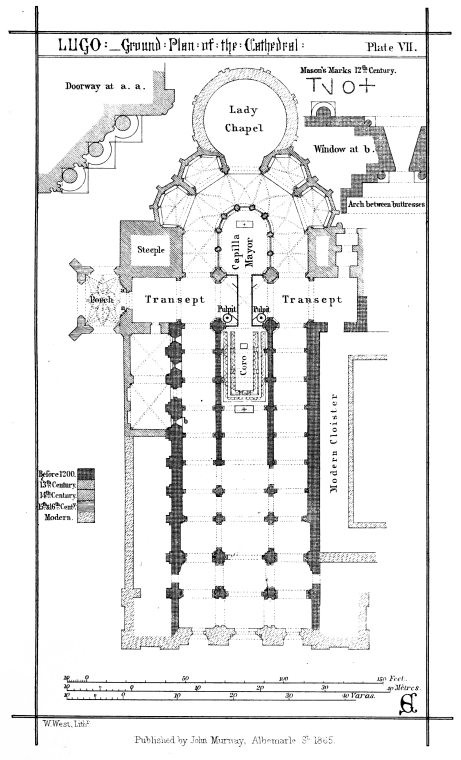
It is pretty clear that the work was commenced upon the scheme which we still see in the bays next the crossing, and carried on gradually with alterations as the work went on, and probably as it went on the architect discovered the mistake he was making in confining himself to waggon-vaulting in the aisles. It is somewhat remarkable that, with the example of Santiago so near, such a scheme should ever have been devised, unless, indeed, the work was commenced earlier than the date assigned, of which I see no evidence.
The choir shows the same gradual variation in style; and I have considerable difficulty in assigning a precise date to it. It is clear, however, that the whole of it is of much later date than the original foundation of the cathedral; and it is probable, I think, that it was reconstructed in the latter half of the thirteenth century. The windows in the chapels of the chevet are of two lights, with a small quatrefoil pierced in the tympanum above the lights. The mouldings of the groining are extremely bold and simple. The aisle-vaulting, too, is very simple and of early-pointed character, whilst the clustered columns round the apse look somewhat later. There is, however, no mark of alterations or additions; and I think, therefore, that the whole of this work must be of the same date, and that the difference visible between the various parts of it may be put down to the long lingering of those forms of art which had been once imported into this distant province, and to the consequent absence of development. The sculpture of the capitals in the chevet is nowhere, I think, earlier than about the end of the thirteenth century, though that in the chapels round it, being very simple, looks rather earlier.
Unfortunately all the upper part of the choir was rebuilt about the same time that the eastern chapel was added. It has strange thin ogee flying buttresses, large windows, and a painted ceiling.
Here, as at San Isidoro, Leon, the Host is always exposed, and, as I have mentioned before, two priests are always in attendance at faldstools on each side of the Capilla mayor in front of the altar.
The interior, of course, has been much damaged by the destruction of the old clerestory of the choir. It is, nevertheless, still very impressive, and much of its fine effect is owing to the contrast between the bright light of the nave and the obscure gloom of the long aisles on either side of the Coro. The length of the nave, too, is unusually great in proportion to the size of the church; and though much of the sculpture is rude in execution, it is still not without effect on the general character of the building.
On the north side of the nave a chapel has been added, which preserves the external arrangement of the windows and buttresses in the earliest part of the building, as they are now enclosed within and protected by it. The simple and rather rude buttresses are carried up and finished under the eaves’ corbel-tables with arches between them, so as to make a continuous arcade the whole length of the building on either side.
The north doorway is of the same age as the early part of the church, and has a figure of our Lord within a vesica in the tympanum, and the Last Supper carved on a pendant below it. The head of the door-opening is very peculiar, having a round arch on either side of this central pendant. The door has some rather good ironwork. The porch in front of it is a work of the fifteenth century, or perhaps later, and is open on three sides.
[112] See Catologo de los Obispos de Leon. Cixila II. Esp. Sag., xxxiv. 211.
[113] In a deed of the 20th March, A.D. 1175, mention is made of Pedro Cebrian, “Maestro de la Obra de la Catedral,” and of Pedro Gallego, “Gobernador de las Torres.” It is possible, of course, that Cebrian may have been the architect of the new cathedral if it was commenced between 1181 and 1205, but I do not believe that this was the case; and the real architect was, more probably one who is thus mentioned in the book of Obits of the cathedral: “Eodem die VII. idus Julii, sub era MCCCXV. obiit Henricus, magister operis,” and who, dying in the year 1277, may well have designed the greater portion of the work. At a later date, in 1513, Juan de Badajoz was architect of the cathedral, and may probably have finished one of the steeples.—Cean Bermudez, Arq. de España, i. 37, 38.
[114] “Hoc tempore,” he says, “ampliata est fides Catholica in Hispania, et licet multi Regnum Legionense bellis impeterent, tamen Ecclesiæ regalibus muneribus ditatæ sunt in tantum, ut antiquæ destruerentur Ecclesiæ, quæ magnis sumptibus fuerant fabricatæ, et multo nobiliores et pulchriores in toto Regno Legionensi fuudarentur. Tunc reverendus Episcopus Legionensis Manricus ejusdem Sedis Ecclesiam fundavit opere magno, sed eam ad perfectionem non duxit.”
[115] “Cum igitur,” they say, “ad fabricam Ecclesiæ Sauctæ Mariæ Legionensis quæ de novo construitur, et magnis indiget sumptibus, propriæ non suppetant facultates, universitatem vestram rogamus,”—“quatenus de bonis vobis a Deo collatis eidem fabricæ pias eleemosynas de vestris facultatibus tribuatis, ut per hæc, et alia bona opera, quæ inspirante Deo feceritis, ad eterna possitis gaudia pervenire.” This indulgence is preserved in the archives of the cathedral.—España Sagrada, xxxv. p. 269.
[116] “Cum igitur Ecclesia Beatæ Mariæ Legion. Sedis ædificetur de novo opere quamplurimum sumptuoso, et absque fidelium adminiculo non possit feliciter consummari, universitatem vestram monemus et exhortamur in Domino,” &c. &c.; “ut per subventionem vestram, quod ibidem inceptum est, ad effectum optatum valeat pervenire,” &c., given in the general Council of Leon, 10 Kal. Aug. A.D. 1273.—España Sagrada, xxxv. p. 270.
[117] Plate V.
[118] So, at least, I was assured by the superintendent of the works at the cathedral. Some of the material I saw was no doubt tufa; but some of it seemed to me to be an exceedingly light kind of concrete. The vaulting of Salisbury Cathedral is similarly constructed. I do not know whether at Beauvais the same expedient was adopted to lessen the weight.
[119] The three crucifixes at the entrance to the cemetery at Nuremberg will be remembered by all who have ever seen them; and such a group would have made a fitting centre for such a cloister as this at Leon.
[120] This conceit is illustrated more elaborately than I have elsewhere seen it in a palace near San Isidoro, where the angle windows are designed and executed in a sort of perspective, which is inexpressibly bad in effect.
[121] Not a crucifix.
[122] Witness Mr. E. Burne Jones’s beautiful picture over the altar of S. Paul, Brighton, and Mr. D. G. Rossetti’s at Llandaff.
[123] Teatro Ecclesiastico, i. p. 365.
[124] “Hic requiescit Petrus de Deo, qui superædificavit Ecclesiam hanc. Iste fundavit pontem, qui dicitur de Deus tamben: et quia erat vir miræ abstinentiæ et multis florebat miraculis, omnes eum laudibus prædicabant. Sepultus est hic ab Imperatore Adefonso et Sancia Regina.” Esp. Sag., xxxv. p. 356. G. G. Dávila, Teatro Eccles., i. p. 340. Dávila adds the words “servus Dei” before the name of the architect.
[125] See Cean Bermudez, Arq. de Esp., i. p. 14.
[126] The whole of this deed of endowment is interesting. I quote a few lines only, which have some interest, as bearing, among other things, on the Gothic crowns found at Guarrazar, and mentioned at p. 212. “Offerimus igitur” “ornamenta altariorum: id est, frontale ex auro puro opere digno cum lapidibus smaragdis, safiris, et omnia genere pretiosis et olovitreis: alios similiter tres frontales argenteos singulis altaribus: Coronas tres aureas: una ex his cum sex alfas in gyro, et corona de Alaules intus in ea pendens: alia est de anemnates cum olivitreo, aurea. Tertia vero est diadema capitis mei,” &c. &c.—Esp. Sag., xxxvi., Appendix, p. clxxxix.
[127] “Sub era millesima centesima octuagesima septima, pridie nonas Martii, facta est Ecclesia Sancti Isidori consecrata per manus Raymundi Toletanæ Sedis Archiepiscopi, et Joannis Legionensis episcopi,” &c. &c.—Teatro Eccl., vol. ii., p. 243. See also the similar inscription on a stone in San Isidoro.—Esp. Sag., vol. xxxv. p. 207.
[128] Ponz, Viage de España, xi. p. 234.
[129] Plate VI.
[130] E.g. Segovia, Avila, Salamanca, Benavente, Lérida.
[131] So, at least, says Cean Bermudez, but without giving his authority.
[132] Pallares Gayoso, Hist. de Lugo, from the black book in the archives.
[133] Cean Bermudez, Arq. de España, i. 25.
[134] Plate VII.
The only good external view of the church is obtained from the north side. Here the tower rises picturesquely above the transept, but the belfry and upper stage are modern[135] and very poor. The bells are not only hung in the windows, but one of them is suspended in an open iron framework from the finish the centre of the roof.
The cloister and other buildings seem to be all completely modern, and are of very poor style.
There are two old churches here—those of the Capuchins and of San Domingo—both of them in or close to the Plaza of San Domingo. The church of the Capuchins is evidently interesting, though I could not gain access to its interior, which appears to be desecrated. It has transepts, a low central lantern, a principal apse of six sides, and two smaller apses opening into the transepts. These apses are remarkable for having an angle in the centre, whilst their windows have a bar of tracery across them, transome fashion, at mid-height. It is certainly a very curious coincidence, that in both these particulars it resembles closely the fine church of the Frari at Venice; and though I am not prepared to say that the imitation is anything more than the merest accident, it is certainly noteworthy. The eaves are all finished with moulded corbel-tables; and there is a rather fine rose-window in the transept gable. The circles in the head of the apse windows are filled in with very delicate traceries, cut out of thin slabs of stone, a device evidently borrowed from Moresque examples; and it is somewhat strange to meet them here so far from any Moorish buildings or influence.
The church of San Domingo is somewhat similar in plan. It has a modernized nave of five bays, a central dome, which looks as though it might be old, but which is now all plastered and whitewashed, a principal apse of seven sides, transepts covered with waggon-vaults, and small apses to the east of them. The capitals have carvings of beasts and foliage; but none of these, or of the mouldings, look earlier than the fourteenth century; yet the capitals are all square in plan, and the arches into the chapels have a bold dog-tooth enrichment. There is a fine south doorway to the nave, in which chevrons, delicate fringes of cusping, and dog-tooth, are all introduced. In such a work the date of the latest portion must be the date of the whole; and so I do not think it can be earlier than the rest of the church, though at first sight it undoubtedly has the air of being more than a century older.
Gil Gonzalez Dávila[136] says that Bishop Fernando gave permission for the foundation of the convent of San Domingo in A.D. 1318, and that circa A.D. 1350-58 the Dominican Fray Pedro Lopez de Aguiar founded it; and this date appears to me to accord very well with the peculiar character of the work.
There is little more to be seen in Lugo. The old walls, though they retain all their towers, have been to some extent altered for the worse to fit them for defence in the last war; they have been also rendered available as a broad public walk,—very pleasant, inasmuch as it commands good views of the open country beyond the city.
The people here and at Santiago all go to the fountains armed with a long tin tube, which they apply to the mouths of the beasts which discharge the water, and so convey the stream straight to their pitchers placed on the edge of the large basins. The crowd of water-carriers round a Spanish fountain is always noisy, talkative, and gay; and many is the fight and furious the clamour for the privilege of putting the tube to the fountain in regular order.
I travelled between la Coruña and Lugo by night, so that I am unable to say anything as to the country or scenery on the road, save that for some distance before reaching Lugo it is cold, bare, and unattractive.
Betanzos, the only town of importance on the road, has two or three good churches, which I missed seeing by daylight. They are of early date, with apsidal east ends, and somewhat similar, apparently, to the churches at la Coruña, though on a larger scale.
La Coruña is charmingly situated, facing a grand landlocked bay, but on the inner side of a narrow ridge, a short walk across which leads to the open sea, which is here very magnificent. The views of the coast, and the openings to the grand bays or rios of Ferrol, Betanzos, and la Coruña, are of unusual beauty, and it is rarely indeed that one sees a more attractive country. But there is not very much to detain an architect. The town is divided into the old and the new; and in the former are two old churches, which, though small, are interesting; whilst in the latter there is absolutely nothing to see but shops and cafés.
The Collegiata of Sta. Maria del Campo was made a parish church by King Alonso X. in A.D. 1256, and in A.D. 1441 was made collegiate: it has a nave and aisles of five bays, and a short chancel, with an apse covered with a semi-dome vault.[137] The nave and aisles are all covered with pointed waggon-vaults springing from the same level; and as the aisles are narrow, their vaults resist the thrust of the main vault, without exerting a violent thrust on the aisle walls. The capitals are rudely carved with foliage, and the arches are perfectly plain. The bay of vaulting over the chancel is a pointed waggon-vault, with ribs on its under side, arranged as though in imitation of a sexpartite vault.[138]
[larger view] [largest view]

The western doorway has a circular arch, with rudely carved foliage in the outer orders; and ten angels, with our Lord giving His blessing in the centre, in the inner order. The tympanum has the Adoration of the Magi. The abaci and capitals are carved, but everywhere the carving is overlaid with whitewash so thickly as to be not very intelligible. The south door has storied capitals, and angels under the corbels, which support the tympanum over the door-opening; this has a figure with a pilgrim’s staff, probably Santiago, and there are other figures and foliage in the arch. The abacus is carried round the buttresses, and a bold arch is thrown across between them above the door. An original window near this door is a mere slit in the wall, and not intended for glazing. The north door is somewhat similar to the other, with a sculpture of St. Katharine in the tympanum.
The apse has a very small east window, engaged columns dividing it into three bays, and a simple corbel-table.

Sta. Maria, la Coruña.
The west front is quaint and picturesque. It has a bold porch—now almost built up by modern erections—and two small square towers or turrets at the angles. Of these the south-western has a low, square stone spire, springing from within a traceried parapet, and with some very quaint crockets at the angles. A tall cross, with an original sculpture of the Crucifixion, stands in the little Plaza in front of the church. The Coro here is in a large western gallery, but both this and the stalls are Renaissance in style.
The other church is that of Santiago. This has a broad nave, forty-four feet wide, into the east wall of which three small apses open.[139] The nave is divided into four bays by bold cross arches, which carry the wooden roof; and of the three eastern arches, the central rises high above the others, and has a circular window above it. The west front has a very fine doorway, set in a projecting portion of the wall, finished with a corbel-table and cornice at the top. This has a figure of Santiago in the tympanum, and statues in the jambs. The north doorway has heads of oxen supporting the lintel, and rude carving of foliage in the arch. One of the original windows remains in the north wall. This is roundheaded and very narrow, but has good jamb-shafts and arch-mouldings. The detail of the eastern apse is of bold and simple Romanesque character, with engaged shafts supporting the eaves-cornice.
There is not, so far as I know, any evidence as to the exact date of these churches; but I think that the character of all their details proves that they were founded about the middle of the twelfth century. They are evidently later than the cathedral at Santiago, and tally more with the work which I have been describing in the nave of Lugo Cathedral. And though the dimensions of both are insignificant, they appear to me to be extremely valuable examples, as showing two evident attempts at development on the part of their architect, who, to judge of the strong similarity in some of their details, was probably the same man.
Three barrel-vaults on the same level as at Sta. Maria are seldom seen; and the bold cross arches spanning Santiago are a good example of an attempt in the twelfth century to achieve what few have yet attempted to accomplish in the revival of the present day—the covering of a broad nave in a simple, economical, and yet effective manner.
In the church of Santiago there is preserved a fragment of an embroidered blue velvet cope. The sprigs with which it is diapered are so exactly similar in character to those of some of our own old examples—the Ely cope in particular—as to suggest the idea that the work is really English.
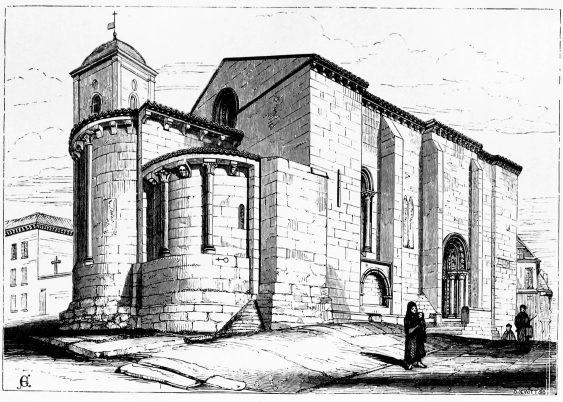
No. 16. LA CORUÑA. p. 138. CHURCH OF SANTIAGO.
From La Coruña to Santiago the road is, for the first half of the way, extremely pleasant, and passes through a luxuriant country; gradually, however, as the end of the great pilgrimage is reached, it becomes dreary and the country bare; still the outlines of the hills are fine, and some of the distant views rather attractive. But Santiago is too important a city, and its cathedral is too grand and interesting, to be described at the end of a chapter.
CHAPTER VII.
SANTIAGO DE COMPOSTELLA.
THE journey from Lugo to Santiago is pleasant so far as the country is concerned, and there is one advantage in the extremely slow and grave pace of the diligences in this part of the world, that it always allows of the scenery being well studied. Moreover, in these long rides there is a pleasure and relief in being able to take a good walk without much risk of being left behind, which can hardly be appreciated by the modern Englishman who travels only in his own country. The general character of the landscape is somewhat like that of the Yorkshire moors, diversified here and there by beautiful valleys, the sides of which are generally clothed with chestnut, but sometimes with walnut, oak, and stone-pines. The heaths were in full flower, and looked brilliant in the extreme, and here and there were patches of gorse. The road is fine, and has only recently been made. The country is very thinly populated, so that we passed not more than two or three villages on the way, and in none of them did I see signs of old churches of any interest. It is difficult to picture anything more wretched than the state of the Gallegan peasantry as we saw them on this road. They were very dirty, and clothed in the merest rags: the boys frequently with nothing on but a shirt, and that all in tatters; and the women with but little more in quantity, and nothing better in quality. The poorest Irish would have some difficulty in showing that their misery is greater than that of these poor Gallegans.
My journey to Santiago was quite an experiment. I had been able to learn nothing whatever about the cathedral before going there, and I was uncertain whether I should not find the mere wreck of an old church, overlaid everywhere with additions by architects of the Berruguetesque or Churrugueresque schools, instead of the old church which I knew had once stood there. In all my Spanish journeys there had been somewhat of this pleasant element of uncertainty as to what I was to find; but here my ignorance was complete, and as the journey was a long one to make on speculation, it was not a little fortunate that my faith was rewarded by the discovery of a church of extreme magnificence and interest.
The weary day wore on as we toiled on and on upon our pilgrimage, and it was nearly dark before we reached the entrance of the city, and after much delay found ourselves following a porter up the steep streets and alleys which lead up from the diligence Fonda to the principal inn, which happens fortunately to be very near the one interesting spot in the city—the cathedral. The next morning showed us not only the exterior of the city, but enabled us also to form a good idea of its surroundings. It stands on the slope of a steep hill, with great bare and bleak hills on all sides, rising generally to a great height. From some of them the views are no doubt very fine, and the town with its towers and walls may well look more imposing than it does on a nearer view.
For, to say the truth, if the cathedral be left out of consideration, Santiago is a disappointing place. There is none of the evidence of the presence of pilgrims which might be expected, and I suspect a genuine pilgrim is a very rare article indeed. I never saw more than one, and he proclaimed his intentions only by the multitude of his scallop-shells fastened on wherever his rags would allow; but I fear much he was a professional pilgrim; he was begging lustily at Zaragoza, and seemed to have been many years there on the same errand, without getting very far on his road. And there is not much evidence in the town itself of its history and pretensions to antiquity; for, as is so often the case in Spain, so great was the wealth possessed by the Church in the seventeenth and early part of the eighteenth century, that all the churches and religious houses were rebuilt about that time, and now, in place of mediæval churches and convents, there are none but enormous Renaissance erections on all sides; and as they are bad examples of their class, little pleasure is to be derived from looking at them, either outside or inside.
Perhaps some exception ought to be made from this general depreciation of the buildings at Santiago in favour of the entourage of the cathedral; for here there is a sumptuous church opening on all sides to Plazas of grand size, and surrounded by buildings all having more or less architectural pretension. Steep flights of steps lead from one Plaza to another, a fountain plays among quarrelsome water-carriers in one, and in another not only does an old woman retail scallop-shells to those who want them, but a tribe of market people ply their trade, cover the flags with their bright fruit, make the ear tired with their eternal wrangle, and the eye delighted with their gay choice of colours for sashes, headgear, and what not.
The whole record of the foundation of this cathedral is a great deal too long to enter upon here; but fortunately enough remains of its architectural history to make the story of the present building both intelligible and interesting, and to this I must now ask the attention of my readers.
There seems to have been a church founded here in or about the year 868,[140] which is said to have been completed in thirty-one years,[141] and consecrated in A.D. 899. Of this church nothing now remains; but the contemporary deed of gift to the church by the King Alfonso III., and the account of the altars and relics existing in it at the time, are of considerable interest.[142]
I need hardly say how much store was laid by the clergy of Santiago on their possession of the body of the Apostle. Mr. Ford[143] gives only too amusing, if it is, as I fear, only too true, a version of the story of the Saint’s remains. Suffice it here to say, that there no longer seem to be great pilgrimages to his shrine, and that even in Spain the old belief in the miracle-working power of his bones seems now practically to have died out.[144] Nothing could, however, have been stronger than the old faith in their patron, and the extreme wealth brought to the church by the pilgrimages made of old to his shrine from all parts of Europe would no doubt have involved the entire destruction of all remains of the early church, in order to its reconstruction on a far grander scale, had it not been destroyed, so far as possible, in the century after its erection, by the Moors under Almanzor.
From the end of the tenth century I find no mention of the cathedral until the episcopate of Diego Gelmirez, in whose time Santiago was made an archbishopric. He was consecrated in the year 1100, and died in A.D. 1130, and the history of his archiepiscopate is given in great detail in the curious contemporary chronicle, the ‘Historia Compostellana.’[145] Here it is recorded that, in A.D. 1128, “forty-six years after the commencement of the new church of St. James,” the bishop, finding that the subordinate buildings were so poor that strangers absolutely “wandered about looking for where the cloisters and offices might be,” called his chapter together, and urged upon them the necessity of remedying so grave a defect, finishing his speech by the offer of a hundred marks of pure silver, thirty at once, and the rest at the end of a year.[146] This would put the commencement of the new cathedral in the year 1082, during the episcopate of Diego Pelaez, though, as will be seen, the same History elsewhere says that the church was commenced in A.D. 1178, a date which occurs also on the south transept door-jamb; and the works must have been carried on during the time of his successors, Pedro II. and Dalmatius (a monk of Cluny), to its completion under Gelmirez.[147] It was in the time of this bishop, in the year 1117, it is recorded in the Chronicle, that during a violent tumult in the city, in which both the bishop and queen hardly escaped alive, the cathedral was set on fire by the mob; but its construction is so nearly fireproof, that doubtless it was the furniture only that was really burnt; for, eleven years later, in A.D. 1128, the bishop, in his speech to the chapter, already mentioned, speaks of the church as being extremely beautiful, and, indeed, renowned for its beauty.[148] In A.D. 1124 two canons of Santiago were collecting money for the works at the cathedral, in Sicily and Apulia,[149] and the cloister, which was commenced in A.D. 1128, seems to have been still unfinished in A.D. 1134.[150] From this date until A.D. 1168 I find no record of any alteration; but in this year Ferdinand II. issued a warrant[151] for the payment of the master of the works—one Matthew—and twenty years later, the same master of the works put the following inscription on the under side of the lintel of the western door:—
“Anno: ab: Incarnatione: Dai: Mº. Cº. LXXXVIIIvo: Era Iª CCXXh. VI.:ª
Die K-L. Aprilis: supra liniharia: Principalium: portalium.”
“Ecclesiæ: Beati: Jacobi: sunt collocata: Per: Magistrum: Matheum: qui:
a: fundamentis: ipsorum: portalium: gessit: magisterium.” [152]
In addition to these evidences, there are two others in the church itself; one, to which I shall refer again, a date which I take to be A.D. 1078, on the jamb of the south transept doorway; and the other, an inscription which, with some modifications, is repeated several times round the margins of circles let into the aisle walls, in the centre of which are the dedication crosses. The date on one of these over the west side of the transept, as well as I could read it, appeared to me to be A.D. 1154;[153] but as the inscriptions vary somewhat round the different crosses, it is possible that the dates may vary also with the time of completion of the various parts of the building; and I regret therefore that I did not make accurate copies of all of them. The dedication crosses are all floriated at the ends, and have in the spandrels between the arms of the cross—above, the sun and moon, and below, the letters A and Ω. Three of these remain on each side of the nave, two in each transept, and two in the choir aisle, twelve in all. I saw none on the exterior; but so little of the old external walls can now be seen that this is not to be wondered at.
It is now time to describe the building itself, the age of its various parts having been pretty accurately defined by the documentary evidence which I have quoted.
This cathedral is of singular interest, not only on account of its unusual completeness, and the general unity of style which marks it, but still more because it is both in plan and design a very curiously exact repetition of the church of S. Sernin at Toulouse.[154] But S. Sernin is earlier in date by several years, having been commenced by S. Raymond in A.D. 1060, and consecrated by Pope Urban II. in A.D. 1096; and the cathedral at Santiago can only be regarded, therefore, as to a great extent a copy of S. Sernin, the materials being, however, different, since granite was used in its construction in place of the brick and stone with which its prototype was constructed.
The dimensions of the two churches do not differ very much; Santiago has one bay less in its nave, but one bay more in each transept; it has only one aisle, whilst S. Sernin has two on each side of the nave; and its two towers are placed north and south of the west front, instead of to the west of it, as they are at S. Sernin. The arrangement of the chevet and of the chapels on the east of the transepts was the same in both churches. Here they still exist in the chevet, but in the transepts traces of them are only to be found after careful examination. Three of them, indeed are quite destroyed, though slight traces still exist of the arches which opened into them from the aisles, but the fourth has been preserved by a piece of vandalism for which one must be grateful. It has been converted into a passage-way to a small church which once stood detached to the north-east of the cathedral, and the access to which was by a western doorway. The erection of a modern chapel blocked up the access to this doorway, and an opening was then made through the northern chapel of the north transept, which has thus been saved from the fate which has befallen the others. The position and size of these chapels are indicated in the ground-plan.
The proportions of the several parts of the plans of the two churches are also nearly identical; and owing in part to the arrangement of the groining piers of the transepts, in which the aisles are returned round the north and south ends, the transept fronts in both churches have the very unusual arrangement of two doorways side by side—a central single doorway being impossible. The triforium galleries surround the whole church, being carried across the west end and the ends of the transepts, so that a procession might easily ascend from the west end, by the tower staircases—which are unusually broad and spacious—and make the entire circuit of the church. Finally, the sections of both these great churches are as nearly as possible the same; their naves being covered with barrel-vaults, their aisles with quadripartite vaults, and the triforia over the aisles with quadrant vaults, abutting against and sustaining as with a continuous flying buttress the great waggon-vaults of their naves.[155]

No. 17 SANTIAGO CATHEDRAL p. 147. INTERIOR OF LOWER CHURCH
The exterior of the cathedral at Santiago—to a more detailed description of which I must now devote myself—is almost completely obscured and overlaid by modern additions. The two old western steeples shown on the plan are old only about as high as the side walls of the church, and have been raised to a very considerable height, and finished externally with a lavish display of pilasters, balustrades, vases, and what not, till they finish in a sort of pepper-box fashion with small cupolas. Between them is a lofty niche over the west front, which contains a statue of the tutelar.[156] Fortunately the whole of the façade between the steeples was built on in front of, and without destroying, Master Matthew’s great work, the western porch. The ground falls considerably to the west, and a rather picturesque quadruple flight of steps, arranged in a complicated fashion, leads up from the Plaza to the doors. There are two great and two lesser flights of steps, so that a procession going up might be divided into four lines; a doorway in the centre of the western wall below these steps leads into a chapel constructed below the western porch. This is now called the Chapel of St. Joseph, but seems to have been known of old as Santiago la Vajo. The arrangement of its plan is very peculiar.[157] There are two large central piers east and west of a sort of transept; to the west of this are two old arches, and then the modern passage leading to the doorway at the foot of the steps. To the east of the transept is an apse consisting of an aisle formed round the great central pier, with small recesses for altars round it. The aisle is covered with a round-arched waggon-vault; it has five recesses for altars; the easternmost seems to have a square east end, the next to it on either side have apses, and the others are very shallow recesses hardly large enough for altars. There can be no doubt whatever, I think, that this is the work on which Master Matthew was first employed; it is exactly under the porch and doorway, on which, as we know by the inscription on the lintel of the door, he wrought; and as he was first at work here in A.D. 1168, and finished the doors in A.D. 1188, we may safely put down this chapel as having been begun and finished circa A.D. 1168-1175. In this the bases are some of them square, some circular in plan; the sculpture of the capitals is elaborate and similar in character to most of the later work in the cathedral. The favourite device of pairs of animals regarding each other is frequently repeated; and there are moulded and spiral shafts in the jambs of the western arches. My view of the interior of this interesting little chapel will best explain its general character and peculiarities, and it will be felt, I think, that it is certainly not earlier than the date I have assigned, and therefore, like the great western door, of later date than the church in connection with which it was built. Behind the eastern altar there is an arcade of three arches forming a kind of reredos, but I am not at all sure whether they are in their old places, and I am inclined to think it more likely that there is an eastern apse behind them. There is nothing to prove whether there were any western doors to this chapel, and as all the light must originally have come through the western arches, it would seem to be most probable that there were none. The chapel is now kept locked, and is but seldom used for service.[158]
To return to the west front. This is the centre only of a vast architectural façade; to the right of the church being the chapter-house and other rooms on the west side of the cloister, and to the left another long line of dependent buildings. The Plaza is bounded by public buildings on its other three sides;[159] and beyond, to the west, the ground falling very rapidly affords a fine view across the valley to the picturesque mountain-like ranges which bound the landscape. This is the Plaza Mayor or “del Hospital.”
Going northward from the west entrance, and turning presently to the east, a low groined gateway is reached, which leads into another Plaza fronting the north transept. This gateway is a work of the twelfth century, but of the simplest kind. The Plaza de San Martin, to the north of the cathedral, is picturesquely irregular; its north side is occupied by a vast convent of St. Martin, and the ground slopes down steeply from it to the cathedral. Here is the gayest and busiest market-place of the town, and the best spot for studying the noisy cries and the bright dresses of the Gallegan peasantry. They are to be seen on a Sunday, especially, in all their finery,—bright, picturesque, and happy looking, for those who can afford to dress smartly are happy, and those who cannot don’t seem to come—selling and buying every possible kind of ware, save, perhaps, the large stock of scallop-shells, which, though they are kept for sale with due regard to the genius loci, seemed to me never to attract any one to become a purchaser, and to adopt the badge of St. James!
The whole of the northern front of the transept and church is modernized. But to the east of it lies the little church used as the Parroquia, and which will be better described when I go to the interior, as externally it has no old feature save a simple little window in its north wall.
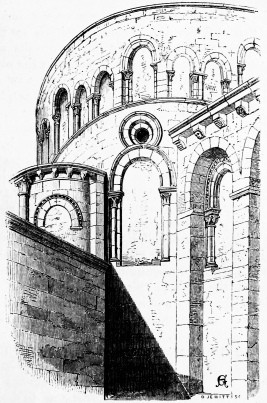
Exterior of Chevet.
A narrow passage from the Plaza de San Martin leads to the upper side of a third Plaza opposite the east end; and here, though the cathedral has been enclosed within square modern walls, there is fortunately just enough left of the exterior of the eastern chapel and part of the apse enclosed in a small court to explain its whole original design. The entrance to this court is garnished with a number of statues, evidently, I think, taken from a doorway, and perhaps from the destroyed north doorway.[160] From this fragment of the chevet, it seems that the eastern chapel was surrounded with a deeply recessed arcading, within which were broad, round-arched windows with moulded archivolts carried on shafts with sculptured capitals. The smaller chapels have three-quarter shafts running up to the cornices placed between the windows, and the corbel-tables at the eaves are simple and bold. The bay between the chapels has a window occupying the whole space in width, and above it is a small circular window, a feature which occurs in almost exactly the same position in S. Sernin, Toulouse.[161] A string-course is carried round the aisle wall above the roofs of the chapels, and the wall is continued up to the same level as the walls of the aisles of the church, and has alternately windows and arcading in its outer elevation. This is perhaps the only serious difference between the design of this church and that of S. Sernin. There the triforia are not carried round the chevet, and consequently the aisle walls are not so lofty, and the clerestory of the apse is shown in the usual way.
Continuing the circuit of the cathedral, we now reach the Plaza de los Plateros, in front of the south transept. This is bounded on the west side by the outer walls of the cloisters, and a broad flight of steps all across the Plaza leads up to the transept. This has been to some extent damaged by the erection of a lofty clock-tower projecting at its south-east angle, in which are the clock and the bells. The rest of the old façade is fortunately preserved. It has two doorways in the centre division, and two grand and deeply recessed windows above them. The ends of the aisles seem to have been similarly treated above. The finish of the transept wall is modern, but there still remain two canopies in it, under one of which is a figure of the Blessed Virgin, no doubt part of a sculpture of the Annunciation.
The detail of the work in this front is of great interest, inasmuch as it is clearly by another and an earlier workman than that of the western part of the church. There are three shafts in each jamb of the doors, whereof the outer are of marble, the rest of stone. These marble shafts are carved with extreme delicacy with a series of figures in niches, the niches having round arches, which rest upon carved and twisted columns separating the figures. The work is so characteristic as to deserve illustration. It is executed almost everywhere with that admirable delicacy so conspicuous in early Romanesque sculpture. The other shafts are twisted and carved in very bold fashion.

No. 18. SANTIAGO CATHEDRAL p. 150. SHAFTS IN SOUTH DOORWAY
The jamb of this door retains an inscription deeply cut in large letters, which appears to give the same date—Era 1116, 5 Ides of July—that I have already quoted from the ‘Historia Compostellana.’ But as the reading of this inscription is open to doubt, I think it well to engrave it. This Era would make the date of these doors agree with the commencement of the works. Figures on either side support the ends of the lintels of the doors, but the tympana and the wall above for some feet are covered with pieces of sculpture, evidently taken down and refixed where they are now seen. They are arranged, in short, like the casts at the Crystal Palace, as if the wall were part of a museum. One of the stones in the tympanum of the eastern door has the Crowning with Thorns and the Scourging; and on other stones above are portions of a Descent into Hades, in which asses with wings are shown kneeling to our Lord. Asses and other beasts are carved elsewhere, and altogether the whole work has a rude barbaric splendour characteristic of its age.

Inscription on South Door.
The windows above deserve special notice. Their shafts and archivolts are very richly twisted and carved, and the cusping of the inner arch is of a rare kind. It consists of five complete foils, so that the points of the lowest cusp rest on the capital, and, to a certain extent, the effect of a horseshoe arch is produced. This might be hastily assumed to be a feature borrowed from the Moors; but the curious fact is that this very rare form of cusping is seen in many, if not most, of the churches of the Auvergnat type, to which reference has already been made, and it must be regarded here, therefore, as another proof of the foreign origin of most of the work at Santiago, rather than of any Moorish influence. I have omitted to say that in addition to the other steeples there is a modern dome over the crossing. The lower part of the lantern is old, and the four piers which support it are somewhat larger than the rest.
The exterior of the cloister is rather Renaissance than Gothic in its character, and has some picturesque small towers at the angles.
Altogether the impression which is first given here is of a church which has been completely altered by Renaissance architects of rather a more picturesque turn of mind than is usual; and the generally similar character of the work in the Plazas on the several sides of the church gives certainly a rather stately, though to me it was a very disappointing, tout ensemble.
With such feelings about the exterior, the complete change in the character of the work as one goes through the door is more than usually striking, for you are at once transferred from what is all modern, to what is almost all very old, uniform, and but little disturbed. The interior of the transepts is very impressive; their length is not far from equal to that of the nave, and the view is less interrupted than in it, as the rails between the Coro and the Capilla mayor are very light, and the stalls are all to the west of the crossing. The whole detail of the design is extremely simple. The piers are alternated throughout the church of the two sections given on my ground-plan. The capitals are all carved, generally with foliage, but sometimes with pairs of birds and beasts. Engaged columns run up from the floor to the vault, and carry transverse ribs or arches below the great waggon-vault. The triforium opens to the nave with a round arch, subdivided with two arches, carried on a detached shaft. I have already described the construction, and I need only add here that the buttresses, which appear on the ground-plan, are all connected by arches thrown from one to the other, so that the eaves of the roof project in front of their outside face. There is consequently an enormous thickness of wall to resist the weight and thrust of the continuous vault of the triforium, these arches between the buttresses having been contrived in order to render the whole wall as rigid and uniform in its resistance to the thrust as possible. The height of the interior, from the floor to the centre of the barrel-vault of the nave, is a little over seventy feet. This dimension is, of course, insignificant if compared with the height of many later churches; but it must be borne in mind that here there is no clerestory, and that, owing to its absence, there is much less light in the upper part of the church than is usual, and one consequence of this partial gloom is a great apparent increase in the size of every part of the building. The original windows remain throughout the greater part of the church. In the aisles they have jamb-shafts inside, and in both aisles and triforia there are jamb-shafts outside. Occasionally at the angles of the aisles, and elsewhere where it was impossible to pierce the walls for windows, sunk arcading, corresponding with them in outline and detail, is substituted for them.
The chevet has been a good deal altered; most of the chapels remain, but the columns and arches round the choir have all been destroyed, or, at any rate, so covered over with modern work as to be no longer visible. A thirteenth-century chapel has been added on the north of the apse, and a small chapel of the fifteenth century and a large one of the Renaissance period on its south-west side. The other alterations are clearly indicated on the engraving of the ground-plan.

No. 19 SANTIAGO CATHEDRAL. p. 152. INTERIOR OF SOUTH TRANSEPT, LOOKING NORTH-EAST
I have already said that the existing Renaissance steeples at the west end are built upon the lower portions of the original Romanesque towers. The only peculiarity about these is the planning of their staircases. The steps are carried all round the steeple in the thickness of the wall, and the central space is made use of for a succession of small chambers one over the other. These staircases are unusually wide and good, and their mode of construction is obviously very strong.
The only other part of the church of the same age as the original fabric is the detached chapel to the north-east of it. This seems to have had originally no connexion whatever with the cathedral, the passage which now leads to its western doorway from the north transept being quite modern, and made for the reason already mentioned. Its western door is a good late Romanesque work, with shafts in the jambs, and carved capitals. The church itself consists of a nave and aisles of two bays in length, and a chancel with an aisle on either side. The columns are cylindrical, with carved capitals. The aisles have quadrant vaults, and the nave a semi-circular ceiling, but I could not ascertain certainly whether this was of plaster or stone. If the latter, then this little church affords a very interesting example of the adaptation of precisely the same mode of construction that we see in the great cathedral by its side, viz. the waggon-vault in the nave supported on either side by the quadrant vaults of the aisles.
[135] A.D. 1577.—Madoz, Dicc.
[136] Teatro Eccl., iii. 182, 183.
[137] Plate VIII.
[138] The following inscription remains on one of the columns on the north side of the nave:—
[139] Plate VIII.
[140] España Sagrada, xix. p. 91.
[141] Historia del Apostol Sanctiago, by Mauro Castella Ferrer, p. 463.
[142] The latter document in particular has much architectural interest, and is worth transcribing in part, on account of its reference to these early buildings, and their materials and furniture. It commences as follows:—
[143] Handbook of Spain, pp. 600-605.
[144] The authors of the ‘Manual del Viagero en la Catedral de Santiago’ are, however, not quite of this opinion. They say of it, “The monument which we examine belongs not to Santiago, to Galicia, to Spain, but is the patrimony of the Christian religion, of the Catholic world; since in all fervent souls something remains of the ancient and fervent faith of our forefathers.” This guide-book, by the way, is one of the worst I ever met with.
[145] The twentieth volume of ‘España Sagrada’ is entirely occupied with the reprint of this chronicle.
[146] Histor. Compost, lib. iii. cap. 1.
[147] “Postquam supradictus Episcopus,” “ad Ecclesiam Patroni sui B. Jacobi Apostoli rediens, circa eam indefessam solicitudinem exhibuit.” “Reversus itaque a supradicta expeditione, vetustissimam Ecclesiolam obrui præcepit, quæ intra immensam novæ ecclesiæ capacitatem imminente ruina lapsum minabatur. Hæc in longitudinem ad altare B. Jacobi protendebatur ab illo pilari qui juxta principalem ecclesiæ parietem, et secus unum de quatuor principalibus pilaribus existit, in sinistra parte superiorem partem chori ingredientibus pone relinquitur, et juxta fores pontificalis Palatii Ecclesiam introeuntibus, recta fronte opponitur, et in alia parte, id est in dextera, a pilari opposito supradicto pilari usque ad idem altare: latitudo vero illius eadem quæ modo et chori est. Destructa illa Ecclesia in era I.C.L.” (A.D. 1112.) “quæ quasi obumbraculum totius Ecclesiæ esse videbatur, Chorum satis competentem ibidem composuit, qui usque in hodiernum diem Dei gratia et B. Jacobi per industriam ejusdem Episcopi optimi Cleri excellentia egregie decoratur. Ipse quoque Episcopus, utpote sapiens architectus, in ejusdem chori dextro capite fecit supereminens pulpitum, in quo Cantores, atque Subdiacones officii sui ordinem peragunt. In sinistro vero aliud, ubi lectiones et Evangelia leguntur. Est autem B. Jacobi specialis et præclara nova ecclesia incæpta Era I. C. XVI.—V. idus Jul.” (A.D. 1078.) Histor. Compost., lib. i. cap. 78.
[148] The Archbishop’s words were as follows:—“Fratres, nostra ecclesia non nostris sed Dei gratia et nostri Patroni Beatissimi Apostoli Jacobi meritis maximi et celeberrimi est nominis, et ultra portus et citra portus pro ditissima et nobilissima reputatur.” “Quælibet Sedes ultra portus pulchriora et valentiora ædificia habet quam nostra,” &c. &c.—Hist. Compost., lib. iii. cap. 1.
[149] Histor. Compost., lib. ii. cap. 64.
[150] Ibid., lib. iii. cap. 36.
[151] See Appendix.
[152] Before this time, in 1161, Master Matthew had built the bridge of Cesures in Gallicia.—Cean Bermudez, Arq. de España, i. 33.
[153] “Era: millena: nova: vicies: duodena.”
[154] By a strange coincidence, S. Sernin boasts of having, among the bones of several of the apostles, those of S. James; though, of course, this would be strongly denied at Compostella.
[155] The church from which the cathedral at Santiago was copied is one of a considerable number in France, all of which have the same general characteristics. I have already given some description of them in a paper read before the Royal Institute of British Architects in 1861, and published in their Transactions. The following list of some of the more remarkable examples will show both their date and locale:—Conques, completed in A.D. 1060; S. Etienne, Nevers, commenced in A.D. 1063, consecrated A.D. 1097; S. Eutrope, Saintes, consecrated in A.D. 1096; S. Genes, A.D. 1016-1120; S. Hilary, Poitiers, A.D. 1049; Montierneuf, Poitiers, A.D. 1069-1096; S. Radigonde, Poitiers, A.D. 1099; S. Amable, Riom, A.D. 1077-1120; S. Sernin, Toulouse, A.D. 1060-1096; Cluny, A.D. 1089-1131; Dorat (Haute Vienne) and Bénévente (Creuse), A.D. 1150-1200; S. Saturnin; Volvic; Issoire; S. Nectaire; N. D. du Port, Clermont Ferrand, circa A.D. 1080-1160; Brioude, A.D. 1200. There is a church of similar construction at Granson, on the lake of Neufchâtel. These churches agree generally in their plans, but especially in those of their chevets (which almost invariably have chapels in the alternate bays only). Their sections are also alike, the triforia galleries being always vaulted with a continuous half-barrel or quadrant vault, and they have no clerestories. No doubt they were always intended to receive stone roofs, without any use of timber; and this mode of covering has been carefully restored recently at N. D. du Port, Clermont Ferrand.
[156] This façade was designed by D. Ventura Rodriguez, in 1764.
[157] The ground-plan of this chapel is shown on Plate IX., above the plan of the cathedral.
[158] The sacristan will not trouble himself to show this chapel, and it was by a mere accident that I discovered its existence. The keys are kept by the carpenter of the chapter, whose shop is below the chapter-house.
[159] The seminario on the west, the hospital on the north, and the College of San Jerónimo on the south side.
[160] This is the Puerta Santa, and is only opened by the archbishop in years of jubilee.
[161] It is just open to doubt whether the small circular window over the other is original, but I think the similarity to S. Sernin is in favour of its being so, in spite of some awkwardness in the mode of its introduction, which would otherwise have inclined me to doubt it.
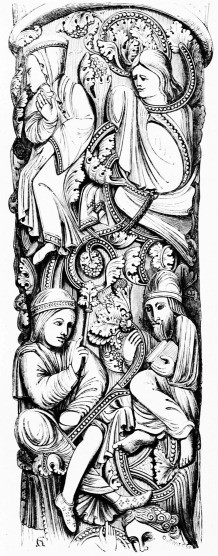
Central Shaft of Western Doorway.
It is now necessary to say something about what is to an architect the chief glory of this noble church—its grand western entrance, fitly called the Portico de la Gloria. On the whole, with no small experience to warrant my speaking, and yet with a due sense of the rashness of too general an approval, I cannot avoid pronouncing this effort of Master Matthew’s at Santiago to be one of the greatest glories of Christian art.[162] Its scale is not very grand, but in every other respect it is quite admirable, and there is a freshness and originality about the whole of the detail which cannot be praised too much. If we consider the facts with which we are acquainted, we may understand how it is that it has these great merits. Let us assume that Master Matthew was, as he no doubt was, extremely skilled when the king sent him to Santiago with his special warrant and recommendation. From that time until the happy day came, after twenty years of anxious labour, when he was able to write his inscription on the lintel of the door, it is probable that this same man wrought on slowly but systematically on this great work. During all this time he had but a very moderate opportunity of studying similar works in his own neighbourhood, or of receiving incitement by the competition of others of his craft; and I think the whole work bears about it evidence that this was its history. There is up to a certain point a conformity to common custom and precedent, and yet at the same time a constant freshness and originality about it which seems to me to show that its sculptor was not in the habit of seeing other similar works during its progress. The figures are almost all placed in attitudes evidently selected with a view to giving them life and piquancy. But these attitudes are singularly unconventional; and though they are by no means always successful to an eye educated in the nineteenth century, they have all of them graces and merits which are almost entirely unseen in the productions of nineteenth century sculptors; whilst, again, in strong contrast to what is now almost the invariable rule, there is no doubt that here we have the absolute handiwork of the sculptor, and not a design only, the execution of which has been relegated to a band of unknown and unrewarded assistants! The detail of some of the smaller portions, as e.g. of the sculptured shafts, is exquisitely refined and delicate, beautifully executed, and with a singular appreciation, in some respects, of the good points of classic sculpture.
The doorways are three in number, of which that in the centre opens into the nave, and those on either side into the aisles. In front of these doors is a western porch, of three groined divisions in width, the outer face of which has been built up and concealed by the modern western façade. The groining ribs of this porch are very richly decorated with sculpture of foliage in their mouldings. The general design of the doors will be best understood by reference to the engraving which I give of them. The bases are all very bold, and rest generally on monsters. That under the central shaft has a figure of a man with his arms round the necks of two open-mouthed winged monsters;[163] whilst on the other side is a figure of a person kneeling towards the east, in prayer, and about life-size. The central shaft is of marble, and carved all over with the tree of Jesse. The detail of this shaft is so delicate and characteristic of the whole work, that I give an engraving of a portion of it; nothing can be prettier or more graceful than the design, and the execution is admirable. The corresponding shaft in either jamb is also sculptured, but in these there is no story, the shafts being twisted with carving of foliage and figures in the alternate members. The capital of the central shaft has the figures of the Holy Trinity, with angels on either side censing; and above is a grand sitting figure of St. James, with a scroll in his right hand, and a palmer’s staff in the other. His nimbus is studded with large crystals; but as none of the other figures throughout the door have nimbi, I suspect it has been added in his case. The main capital of the central shaft, above the saint’s head, has on three sides the Temptation of our Lord, and on its fourth side angels coming and ministering to Him.
The tympanum of this central door has a central seated figure of our Lord, holding up His open hands. Around Him are the four Evangelists, three of them with their emblematic beasts standing up on their hind legs, with their paws in the Evangelists’ laps. Beyond them are angels holding the various instruments of the passion, and above these angels a multitude of small figures worshipping—the hundred and forty-four thousand, many of them naked, i.e. free from sin. The archivolt is perhaps the most striking feature in the whole work, having sitting figures of the four-and-twenty elders arranged around its circumference, in a manner at once quite original and singularly effective. The skill and fancy shown in the treatment of this crowd of figures is beyond praise, and there is a certain degree of barbaric splendour about the profuse richness of the work which is wonderfully attractive. Traces everywhere remain of the old delicate colouring with which the sculpture was covered, and this just suffices to give a beautiful tone to the whole work.
The side jambs have standing figures on a level with that of St. James. On the north jamb are Jeremiah, Daniel, Isaiah, and Moses, and on the opposite side St. Paul, and, I suppose, other New Testament saints, though I could not tell which. The side doorways, though there is no sculpture in their tympana, have figures corresponding with the others in their jambs. Under the groining against the north wall is an angel blowing a trumpet, and there are other angels against the springing of the groining ribs holding children in their hands.
The whole scheme is, in fact, a Last Judgment, treated in a very unconventional manner; the point which most invites hostile criticism being the kind of equality which the sculptor has given to the figures of our Lord and St. James, both being seated, and both in the central position; and though the figure of the apostle is below that of his Lord, it is still the more conspicuous of the two.
The design of the interior of the west end is peculiar. The doorway occupies the same space in height as the nave arches; above it the triforium is carried across over the porch, opening into the nave with two divisions of the same arcade as in the side galleries. Above this is a large circular window, with sixteen small cusps and a small pierced quatrefoil on either side. These openings now all communicate with the western triforium gallery; and I found it impossible to make out, to my own satisfaction, what the original scheme of the west end could have been. It does not appear clear whether there ever were any doors hung in the doorways, but I think there never were; and, perhaps, as we are told that the first church built over the body of the saint was of two stages in height, and open at the ends[164] (somewhat like the curious church still remaining at Naranco, near Oviedo), we may be safe in assuming that this western porch was in the same way open to the air. Above it the vault of the nave may have been prolonged between the towers, and under this the circular window would have been seen from the outside as it is still from the inside. Whether there was any direct access to this western porch from the ground, may admit of question; but it seems difficult to see how it would have been contrived without blocking up the chapel below the porch, which I have already described.
The only remaining work of any importance is the cloister, with its adjacent buildings,—the sacristies, chapter-room, library, &c. The present erections show no relics whatever of the work which, as we have seen, the Archbishop Diego Gelmirez undertook in the twelfth century. It is uncertain, indeed, whether his constructions were on this side of the church, for there are still remains of walls which seem to be coëval with the church round a courtyard on the north side of the nave. The cloisters now in existence are the work of Fonseca, afterwards Archbishop of Toledo, and were commenced in A.D. 1533. As might be expected by the date, there is very little Gothic character in their design; they have the common late many-ribbed Spanish groining; and if they have ever had traceries in the arches, these are now all destroyed.
The festival of St. James is celebrated with special solemnity whenever it happens to fall upon a Sunday. Then the people, I was told, ascend a staircase behind the altar, pass in front of some of his relics, and descend by another staircase[165] on the other side. The body of the saint is said to be contained in a stone tomb below the high altar, which lies north and south, with a modern sarcophagus over it, and there is a rather good old statue of him on horseback against the west wall of the south transept.
The ritual arrangements here are the same as they usually are in Spain. The Coro occupies four bays of the nave, and there is a passage railed off between the Reja of the Coro and that of the Capilla mayor, and there are not many altars now in use, but the number of clergy is very great, and the church is constantly crowded with worshippers.
On a Sunday morning during my stay the Archbishop said Mass, and there was a procession with tapers all round the church. As the slow chant rose from among the dense crowd of worshippers, and the flickering lights of the tapers struck here and there on the walls of the dark old church, one of those pictures was produced which one must, I suppose, go to Spain to see really in perfection. The number of communicants seemed to be extremely small, but the number of those at confession unusually large. The penitents have a way of kneeling with their cloaks held up over them against the confessional, so that their heads are quite concealed. Spanish women are fond of squatting on the floor, fanning themselves, before an altar; but here they often kneel, with their arms stretched out as in wild entreaty, for a long time together, and with rather striking effect. I think I am within bounds in saying that fifty or sixty priests are to be seen in this church at one time, some at the altars, some hearing confessions, and others with a large staff of singing men and boys in the choir.
I have but little more to say about Santiago. The churches seemed everywhere to be modern, and, though some of them are very large, extremely uninteresting. The streets are narrow, picturesque, and winding, but with far fewer traces of any antiquity in the houses than might have been expected. The only Gothic domestic building that I saw is the great hospital, close to the cathedral, which has four fine courts, and the principal entrance through a chapel or oratory, with an altar in it. The detail of this work is, however, extremely late and poor; it was founded in A.D. 1504 by Ferdinand and Isabella, Henrique de Egas being the architect.
The interest which, as an architect, one must feel in a building which is—as I have shown the cathedral here to be—a close copy of another church in another country, is very great. And the only regret I feel is that I am unable to give any evidence as to the nationality of the men who wrought the exquisite work in the western porch. My feeling is certainly strong that they must have been Frenchmen, and from the district of Toulouse. This I infer from the execution of their work. Moreover, I do not know where in Spain we are to find the evidence of the existence of a school in which such artists could have been trained, whilst at Toulouse no one can wander through the Museum in the desecrated convent of the Augustines without recognizing the head-quarters of a school of artists from among whom the sculptor of Santiago might well have come thoroughly educated for his great work.
[larger view] [largest view]

From Galicia I travelled back by the same road along which I had already journeyed as far as Leon; and from thence by Medina del Rio Seco—a poor, forlorn, and uninteresting town—to Valladolid. The plain between Leon and Valladolid is most uninteresting; and the whole journey from the coast of Galicia to the last-named city is one of the most wearisome I ever undertook. The occasional beauty of the scenery,—and on this road it is oftentimes very beautiful,—does not prevent one’s feeling rather acutely a diligence journey of sixty-six hours with few and short pauses for meals; and the only solace—if solace it is—one has, is that the adalantero or postilion, who has to ride the whole distance, is in infinitely worse case than oneself! Fortunately the least interesting part of the road is now superseded by the opening of the railway from Palencia to Leon.
CHAPTER VIII.
MEDINA DEL CAMPO—AVILA.
IN going by the railroad from Valladolid to Madrid the decayed old town of Medina del Campo is passed, and few travellers can have failed to be struck by the size and magnificence of the great castle, under whose walls they are hurried along—the Castle “de la Mota,” founded in 1440, and built under the direction of Fernando de Carreño, as master of the works.[166]
The castle founded at this time evidently took the place of one of much earlier date; for at some distance from its walls there still remain great fragments of old concrete walls lying about, mis-shapen, decayed, and unintelligible; whilst the greater part of the existing castle is a uniform and simple work entirely executed in brick, incorporating and retaining, however, in one or two parts, portions of the walls of the earlier building. The outline is a very irregular square, with round towers at all its angles rising out of the sloping base of the walls, and overlooking the moat which surrounds the whole. Within these outer walls rise the lofty walls of the castle, flanked by occasional square towers, and with an unusually lofty keep at one angle. The entrance is protected with much care, the gateways always opening at right angles to each other, so as to give the best possible chance of easy defence. Entering by the gateway in the centre of the principal front, across the now destroyed bridge, the path turned round the walls of the keep, and then through a small gate by its side into the great inner courtyard, the shape of which is very irregular, and the buildings opening into which are almost all destroyed. There seems to be no direct mode of getting into the keep save by climbing up the face of the wall some twenty feet from the ground; and to this I was unequal, though it was evident, from the well-worn holes in the brick-work, that some of the natives are not so. Possibly there may have been an entrance from below, for the whole of the walls surrounding the castle, and looking out upon the moat, are honeycombed with long vaulted galleries at various levels, along which I tramped for a long time, looking in vain for an outlet towards the keep. The architectural detail here is all of the simplest possible kind; the arches are pointed, but square in section, and only remarkable for the great depth of their archivolts, which gives them an air of strength very fitting to such a building. The bricks are generally a foot long, eight inches wide, and an inch and three-eighths thick, and the mortar-joints are generally an inch and three-quarters wide. Little as such a work affords for mere technical description, I have seldom seen one of its kind altogether more magnificent. The great height of the walls, the simplicity of the whole detail, and the bold vigour of the outline sufficiently account for this.

No. 20. MEDINA DEL CAMPO. p. 160. THE CASTLE.
Medina del Campo is the dullest and saddest of towns now, though three hundred years ago it seems to have been one of the most important places in the district. Nor is there much to detain the ecclesiologist or architect. The principal church—S. Antholin—seems to have been founded in the sixteenth century. An inscription round the chancel gives the date of its erection as A.D. 1503,[167] and the church was probably built at the same time. The plan consists of nave and aisles of three bays in length, and a chancel of one bay. The nave and aisles cover an area of about ninety feet each way, the dimensions being, as they usually are here, very considerable. The columns are really clusters of groining-ribs banded together with a very small cap at the springing, and then branching out into complicated vaulting-bays, most of which are varied in pattern. The Coro is near the west end of the nave, and about equal in length to one of its bays, nearly two bays between its Reja and the Capilla mayor being left for the people; its fittings are all of Renaissance character, and there is a very picturesque organ above it, on the south, bristling with projecting trumpet-pipes, and altogether very well designed. The columns are lofty, and the church is lighted by small round-headed windows of one or two lights placed as high as possible from the floor; there is one light in each southern bay, and two in each on the north side; evidently therefore the whole work is carefully devised for a hot country; and it is an undoubted success in spite of the extremely late character of all its detail. Twenty years only after the foundation of the chancel, and just about the time that Segovia Cathedral was being commenced, a chapel was added on the north side of the altar, covered with a dome, and thoroughly Pagan in almost all its details.
There are three pulpits in this church—one on each side of the chancel, and one in the nave; and low rails keep the passageway from the Coro to the Capilla mayor.
There is a good painting of the Deposition in the sacristy of S. Antholin; and a still more interesting work is the Retablo of a small altar against the eastern column of the nave. This has the Mass of St. Gregory carved and painted, with other paintings of much merit. That of the Pietà recalls Francia, and the figure of the Blessed Virgin in an Annunciation is full of tender grace and sweetness. It is strange how completely the Inquisition altered the whole character of Spanish art, and deprived it at once and for ever apparently of all power of regarding religion from its bright and tender side!
An uninteresting country is passed between Medina and Avila. This old city is indeed very finely situated; and if it be approached from Madrid, seems to be a real capital of the mountains, with ranges of hills on all sides. It lies, in fact, on the northern side of the Sierra, and just at the margin of the great corn-growing plains which extend thence without interruption to Leon and Palencia. Of the many fortified towns I have seen in Spain it is, I think, the most complete. The walls are still almost perfect all round the city; they are perfectly plain, but of great height, and are garnished with bold circular towers not far apart; and for the gateways two of these towers are placed near together, carried up higher than the rest, and connected by a bold arch thrown from one to the other. There are in all no less than eighty-six towers in the circuit of the walls, and ten gateways; and so great is their height[168] that nothing whatever is seen of the town behind them, and they follow all the undulations of the hill on which they stand with a stern, repulsive, savage look which seems almost to belong to a city of the dead rather than to a fairly lively little city of the present day.
The space within the walls was very confined, and no doubt it was found impossible for any new religious foundations to be established within their boundaries. Several of the great churches, and among these some of the most important—as San Vicente, San Pedro, and San Tomás—were therefore built outside the walls; and the Cathedral itself, cramped by its close neighbourhood to them, was built out boldly with its apse projecting beyond the face of the walls, and making an additional circular tower larger and bolder than any of the others.
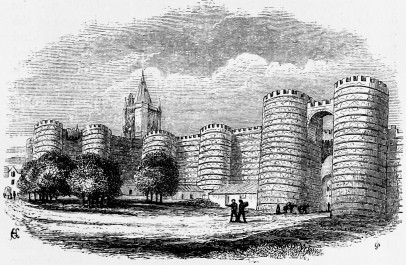
Puerta de San Vicente.
The walls of Avila were commenced in A.D. 1090, eight hundred men having been employed on them daily in that year;[169] among them were many directors who came from Leon and Biscay, and all of them wrought under Casandro, a master of geometry and a Roman, and Florin de Pituenga, a French master; so at least we learn from the contemporary history attributed to D. Pelayo, Bishop of Oviedo. The walls were finished in 1099.
In 1091 the Cathedral of San Salvador was commenced by an architect named Alvar Garcia, a native of Estella, in Navarre;[170] the work was completed in sixteen years, as many as nineteen hundred men, according to the authority already quoted, having been employed on the works. D. P. Risco[171] throws considerable doubt on the veracity of D. Pelayo; and his figures certainly seem to be on too grand a scale to be at all probable.
I doubt very much whether any part of the existing Cathedral is of the age of the church whose erection is recorded by Don Pelayo, except perhaps the external walls of the apse. Its general character is thoroughly that of the end of the twelfth or early part of the thirteenth century, with considerable alterations and additions at later periods; and we may safely assume that the chevet, commenced in A.D. 1091, was continued westward very slowly and gradually during the following hundred years or more. The ground-plan will show the very singular disposition of the plan; in which the chevet, with its double aisle and semi-circular chapels in the thickness of the walls, is, I think, among the most striking works of the kind in Spain.[172] The external wall of the apse is a semi-circle divided into bays by buttresses of slight projection alternating with engaged shafts. The chapels do not therefore show at all in the external view; and indeed all that does appear here is a projecting tower of vast size pierced with a few very small windows—mere slits in the wall—and flanked on either side by the wall and towers of the town. It is finished at the top by a corbel-table and lofty battlemented parapet; and behind this again, leaving a passage five feet and a half in width, is a second and higher battlemented wall, from within which one looks down upon the aisle-roof of the chevet, and into the triforium and clerestory windows of the central apse. From below very little of the apse and flying buttresses which support it are seen; and one is more struck perhaps by the strange unlikeness to any other east-end one has ever seen, than by any real beauty in the work itself; though at the same time it is pleasant to see that not even so difficult a problem as that of a windowless fortified chevet presented any serious difficulty to these old architects.
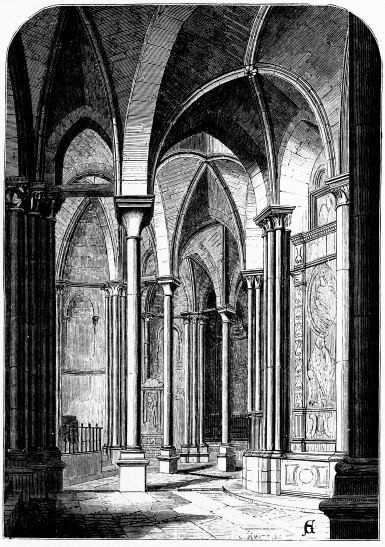
No. 21 AVILA CATHEDRAL p. 164. INTERIOR OF AISLE ROUND THE APSE.

East End, Avila Cathedral.
Assuming as I do that the external wall of the apse is as old as the end of the eleventh century, I think it nevertheless quite impossible that the chapels within it, in their present state, should be of the same early date. In general plan it is true that they are similar to those round the chevet of the abbey at Veruela,[173] the eastern chapels in the transepts being apsidal in both cases, and similarly planned in connection with those of the apse. The church of Veruela was completed by about the middle of the twelfth century, and is beyond all question earlier in style than the interior of Avila. The great beauty of the latter arises from the narrow, recessed aisle round the apse, the groining of which is carried on lofty and slender shafts, whilst the columns round the apse itself consist of a bold single column with three detached shafts on the side next the aisle. The groining throughout is extremely good, and, in the chapels, is carried on clustered shafts. A careful examination of the groining of the choir shows clearly how much the design of the church was altered during its progress, though it is certainly not an illustration of the advantage of such a course. The lines of the groining on the plan explain that it is planned with hardly any reference to the structure below: some of the groining shafts not being over the piers, and everything having been sacrificed by the architect of the triforium and clerestory in order to make all their bays equal in width both in the apse and in the side walls. East of the Crossing there is a narrow quadripartite bay of vaulting, then a sexpartite bay, and then those of the apse, and each of the three bays of the choir is thus made about equal to those of the apse, though the arches below are quite unequal. Externally all of them are supported by regularly arranged flying-buttresses, some of which must, I think, be supported on the cross-arches of the aisle in front of the chapels. The triforium is round-arched, of two horseshoe-headed lights divided by a shafted monial; and the clerestory is of round-headed broadish windows, with jamb-shafts and richly-chevroned arches. The flying-buttresses are all double, the lower arch abutting against the triforium, and the upper against the wall above the clerestory windows; and all appear to me to have been added after the original erection of the clerestory. The parapet here, as well as in the aisles, is battlemented, the battlements being finished with pyramidal copings of the common Moorish type. I should have observed that the passage round the town walls is connected with that round the aisle walls, and that the two levels of battlements in the latter are connected by occasional flights of stone steps.
The transepts have the same triforium in their eastern walls as the choir; and here, too, the same kind of construction was ventured on, the groining shafts not being over the clustered column which divides the arches of the aisles round the chevet. When this was done the intention was evidently to erect one bay of sexpartite vaulting next the Crossing, and then a quadripartite bay beyond it. At present both bays are similar—quadripartite—and the clerestory is filled with large traceried windows.
The remainder of the church was so much altered in the fourteenth century, that its whole character is now of that period. The north transept façade has in its lower stage two windows of two lights, the traceries of which are precisely similar to those of our own early geometrical style, and there is a very fine rose window above them. This rose is of sixteen divisions, each containing two plain pierced circular openings, but the dividing lines between them being marked, give the whole tracery that effect of radiation from the centre which is so important a feature in the designs of many wheel-windows. All the windows in this façade are richly moulded, and there are well-developed buttresses at its angles, but, unhappily, the gable has been entirely destroyed, and the present termination of the wall is a straight line of brickwork below the eaves of the hipped roof. The question of the original pitch of the roof—always so interesting—is therefore left uncertain and undecided. The clerestory throughout is filled with enormous six-light traceried windows, with transomes, and the double flying buttresses between them are very large, and are finished at the top with a line of traceries below their copings, and with crocketed pinnacles in front. There are two towers at the ends of the aisles, which do not open into them, but only into the nave. The south-west tower has never been completed, but the north-west steeple is a very fine work of the same age as the clerestory of the nave. It has bold buttresses, and a belfry stage lighted by two windows on each side, with tall crocketed pediments above them, and below the battlemented parapet a line of rich sunk tracery. The angles—internal as well as external—are carved with a ball enrichment, which at a distance produces the same effect as our English ball-flower ornament; and, like it, gives an air of richness to the whole work. The buttresses finish above the parapet with crocketed pinnacles, and the parapet with a pointed coping, which somewhat recalls the outline of the Moorish battlement. The whole effect of the steeple, transept, and nave is certainly very noble, and they are marked by an entire absence of any of those foreign peculiarities which usually strike an English eye. The whole might, in fact, be English work of the fourteenth century. The north door of the nave is of grand dimensions, having six statues in niches in each jamb, and others against the buttresses on either side. The tympanum is sculptured with our Lord in an aureole in the centre, the Betrayal and the Last Supper below, angels censing on either side, and the Coronation of the Blessed Virgin above. The orders of the archivolt are filled with figures, some representing the resurrection of the dead, and others figures of kings and saints worshipping the central figure of our Lord. The door-opening has the peculiarity of having an elliptical or three-centred arch. This feature I noticed also in doors evidently of about the same age at Burgos and at Leon, and it is just one of those evidences which go surely to prove that the several works are all designed by the same architect. The resemblance of the mouldings in the jamb of this doorway to those in the western end of Leon Cathedral is very close, and all these doors have an order of very similar foliage between the several sculptured or storied orders of the archivolt. I do not think the work here is quite as good as that at Leon, though the filling in of the tympanum with a well-marked vesica in the centre, and four rows of subjects divided by well-defined horizontal lines, is uncommonly good. A sort of shallow porch has been formed by some later groining, which occupies the space between the buttresses on either side of the doorway, and this is finished in front with a rich open traceried parapet and pinnacles.
It was during the prelacy of Don Sancho III., Bishop of Avila from A.D. 1292 to 1353, that most of the later works of the cathedral were executed, and his arms are sculptured upon the vault of the Crossing. The character of all the work would agree perfectly with this date, which is given by Gil Gonzalez Dávila[174] in his account of the church.
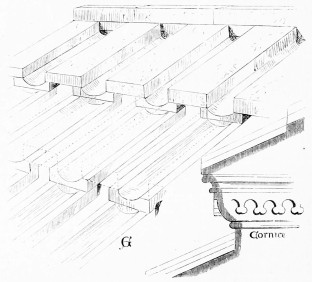
Roofing, Avila.
A staircase in the south-west tower leads up into the roof of the aisles, which now partly blocks up the too large clerestory; and passing through this, and then over the roofs of the sacristies, we reach the exterior of the chevet and the fortified eastern wall. Over the sacristies is some original stone roofing, of an extremely good, and, so far as I know, almost unique kind, with which it, seems very probable that the whole of the roofs were originally covered. But it is now, as well as all the others, protected by an additional timber roof covered with tiles, and is not visible from the exterior. This roofing is all laid to a very flat pitch with stones, which are alternately hollowed on the surface for gutters, and placed about eight and a half inches apart, and other square stones, which rest on the edges of the first, so as to cover their joints. The stones are of course all of the same length—two feet seven inches—and set over each other so as to form a drip. The cornice at the eaves of this roof is very well managed, and looks as if it were of the thirteenth century. Its construction reminded me much of the stone guttering so frequently seen in the early Irish buildings, and which, being so much less perishable than lead, has often preserved them, where the common English construction would long ere this have involved the whole building in ruin.
[larger view] [largest view]
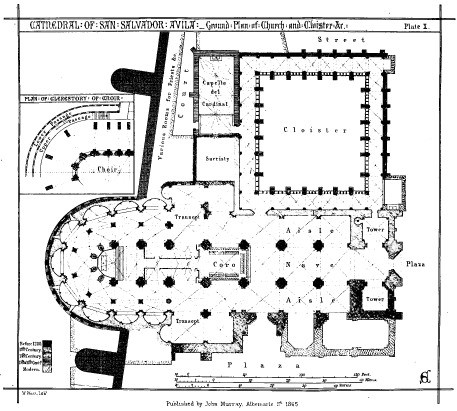
The cloister on the south side of the nave is much decayed and mutilated. It was built probably in the early part of the fourteenth century, and has good traceried windows, generally of four lights, but blocked up, and with all their cusping destroyed. On its east side is a fine fifteenth century chapel, with an altar at the south end, and a passage through its other end, screened off by an iron Reja, leading to the priests’ rooms, and so round to the sacristies. The windows of this chapel are covered with a rude ball ornament, constantly seen in works of the fifteenth century.
I must not forget to notice the furniture of the interior of the cathedral, some of which is very fine. The Retablo of the high altar is very grand, having five sides, which follow the outline of the apse, and it is of three stages in height. The lowest stage has the four evangelists and the four doctors painted on its side panels, and SS. Peter and Paul in the centre; the next has the Transfiguration in the centre, and the Annunciation, the Nativity, the Adoration of the Magi, and the Presentation in the Temple at the sides; and the upper stage the Crucifixion in the centre, and the Agony, the Scourging, the Resurrection, and the Descent into Hell at the sides. These paintings were executed in A.D. 1508 by Santos Cruz, Pedro Berruguete, and Juan de Borgoña: and some of them are not only valuable in the history of art, but of great merit. The St. Matthew attended by an angel, who holds his ink for him, is designed with great grace; and the Adoration of the Magi, and some of the other subjects, are admirably designed and painted. The drawing is rather sharp and angular, and has more the character of German than of Italian art. The woodwork in which the paintings are framed is richly carved and gilt, but in a jumble of styles; the canopies over the pictures being Gothic, and the columns which support them thoroughly Renaissance in style.[175]
The fittings of the Coro are all Renaissance, and there is a screen of the same age across the nave on its western side. To the east is the usual metal Reja, and low rails enclosing the passage from the Coro to the Capilla mayor. A flight of seven steps in front of the altar, the magnificent colour of its Retablo, and the contrast of the extremely light choir and the almost windowless aisles and chapels round it, make the pictorial effects here extremely fine; and they are heightened by a good deal of stained glass, which, though of late date, has some fine rich colour. It was executed at the end of the fifteenth century.
Fine as this cathedral is, I think, on the whole, I derived almost as much pleasure from the church of San Vicente, built just outside the walls, a little to the north of the cathedral. This is a very remarkable work in many respects.
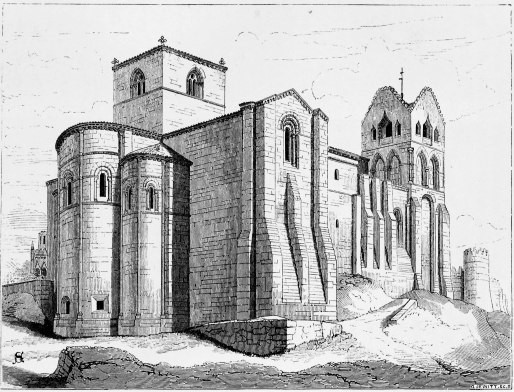
No. 22 SAN VICENTE, AVILA. p. 170. NORTH-EAST VIEW
The church—dedicated to the three martyrs, Vicente, Sabina, and Cristeta, who are said to have suffered on the rock still visible in the crypt below the eastern apse—is cruciform in plan, [176] with three eastern apses, a central lantern, a nave and aisles of six bays in length, two western steeples with a lofty porch between them, and a great open cloister along the whole south side of the nave. The south door is in the bay next but one to the transept, and there are staircase turrets in the angles between the aisles and the transepts. The design and detail of the eastern apses recall to mind the Segovian type of apse. Their detail as well as their general design are, in fact, as nearly as possible identical, and no doubt they are the work of the same school of late Romanesque architects. They are very lofty, the ground being so much below the floor of the church that the windows of a crypt under the choir are pierced in the wall above the plinth. They have, too, the usual engaged shafts between the windows, dividing each apse into three vertical compartments, each pierced with a round-headed window. These shafts are finished with finely carved capitals under the eaves’ corbel-tables; and the stringcourses which occur below the windows, on a level with their capitals, and again just over their arches, are generally delicately carved, but sometimes moulded. The central apse is higher than those on either side, and consequently none of the horizontal lines are continuous round the three apses; and as the eastern walls of the transepts have no openings, and no stringcourses or enrichments of any kind between the ground and the eaves, there is a certain air of disjointedness in the whole design which is not pleasing. The transept façades are very simple: both are pierced with windows of one light high up in the wall, and the northern transept is vigorously treated with a grand system of buttressing, used as mediæval artists alone apparently knew how! The buttresses are mere pilasters at the top, and the eaves-cornices are carried round them and up the flat-pitched gable-line in the way so commonly seen in Italian Gothic. But at mid-height these pilasters are weathered out boldly, and run down to the natural rock on which the church is built, and which here crops up above the surface of the ground: a central buttress is added between the others, and between the buttresses the whole wall is battered out with a long succession of weatherings to the same thickness at the base as the greatest projection of the buttresses. Probably the lower part of this front has been added long after its first erection for the sake of strength; and undoubtedly the somewhat similar system of buttressing which is carried along the north wall of the nave is long subsequent in date to the early church, to which it has been applied. The south transept, owing to the rapid rise of the ground to the south, is much less lofty than the other, and has between its buttresses three high tombs.
The whole south side of the nave is screened, so to speak, by a very singular lofty and open cloister, which extends from the west wall of the transept to a point in advance of the west front. It is very wide, and is entirely open to the south, having occasional piers, with two clustered shafts between each. There is something at first sight about the look of these clustered shafts which might lead one to suppose them to be not later than the thirteenth century; and as the lofty arches are semi-circular, this idea would be strengthened were it not that a careful comparison of the detail with other known early detail proves pretty clearly that they cannot be earlier than about the middle of the fourteenth century. The material—granite—favours this view, for here, just as in our own country, the early architects seem to have avoided the use of granite as much as possible, even where, as at Avila, it lies about everywhere ready for use. There is something so novel and singular about this open loggia or cloister, that I could not help liking it much, though it undoubtedly destroys the proportions, and conceals some of the detail, of the old church in front of which it has been added.
The bays of the aisle are divided by pilaster-buttresses, and lighted with round-headed windows which have external jamb-shafts.
The west end is, perhaps, the noblest portion of this very remarkable church. There are two towers placed at the ends of the aisles. These are buttressed at the angles, and arcaded with sunk panels of very considerable height on the outer sides; they are groined with quadripartite vaults, and do not open into the church, but only into the bay between them, which, though it is a continuation of the full height of the nave, is treated simply as a grand open porch, with a lofty pointed arch in its outer (or western) wall, and a double doorway in its eastern wall opening into the church. This porch is roofed with a vault of eight cells, level with that of the nave, and extremely lofty and impressive, therefore, from the exterior, and over the doorway a window opens into the nave. The western, as well as the side arches, have bold engaged shafts, and the groining is also carried on angle shafts. The whole effect is fine, and the light and shade admirable and well contrasted: but the charm of the whole work seemed to me to lie very much in the contrast between the noble simplicity and solid massiveness of the architecture generally, and the marvellous beauty and delicacy of the enrichments of the western doorway, which is certainly one of the very finest transitional works I have ever seen. It is, as will be seen by the engraving, double, with round arches over each division, and the whole enclosed under a larger round arch. Statues of saints are placed in either jamb, and against the central pier in front of the shafts which carry the archivolt, and the latter and the capitals are carved with the most prodigal luxuriance of design and execution, and with a delicacy of detail and a beauty of which an idea cannot be conveyed by words. Sculptured subjects are introduced in the tympana of the smaller arches, and a richly carved stringcourse is carried across under a parapet which is placed over the doorway. The figures and carving are all wrought in a very fine and delicate stone. The tympana are sculptured on the left with the story of Dives and Lazarus, and on the right with a death-bed scene, where angels carry up the soul to Paradise. The detail of the foliage seemed to me to have a very Italianizing character, being mostly founded on the acanthus-leaf. The capitals are very delicate, but copied closely from Classic work, and the figures are dignified in their pose, but their draperies are rather thin and full of lines. Some of the shafts are twisted, and beasts of various kinds are freely introduced with the foliage in the sculpture.

No. 23 SAN VICENTE, AVILA. p. 172. INTERIOR OF WESTERN PORCH.
To me the sight of such work as this is always somewhat disheartening. For here in the twelfth century we find men executing work which, both in design and execution, is so immeasurably in advance of anything that we ever see done now, that it seems almost vain to hope for a revival of the old spirit in our own days: vain it might be in any age to hope for better work, but more than vain in this day, if the flimsy conceit and impudent self-assertion which characterize so much modern (so-called) Gothic is still to be tolerated! for evil as has been the influence of the paralysis of art which affected England in the last century, it often seems to me that the influence of thoughtless compliance with what is popular, without the least study, the least art, or the least love for their work on the part of some of the architects who pretend to design Gothic buildings at the present day, may, without our knowing it, land us in a worse result even than that which our immediate ancestors arrived at. Here, however, at Avila, in this porch of San Vicente, let us reverence rightly the art and skill of him who built, not only so delicately and beautifully, but also so solidly and so well; let us try to follow his example, knowing for certain that in this combination lies the true merit of all the best architecture—Pagan or Christian—that the world has ever seen.
The three stages of the western towers are, I think, respectively of the twelfth, thirteenth, and fifteenth centuries. The second or intermediate stage is arcaded, and has its angles planned with a shaft set in a broad splay precisely in the mode we see so commonly adopted in the Segovian towers.[177] The upper stage is finished with gables on each face, the gable being fringed with a line of granite trefoils in not very good taste. Gil Gonzales Dávila[178] says that the tower of this church was built by alms in A.D. 1440. He refers, no doubt, to the upper stage, the design of which agrees with this statement. I was not able to learn how it had originally been roofed; but my impression is that it probably had two stone gabled roofs intersecting each other.
In addition to the western door there is another fine entrance on the south side of rather earlier date than the other, and now always in use as the ordinary entrance to the church. Descending here by some steps from the cloister, we find ourselves in the impressive interior, and are at once struck by some features which are of rare occurrence in this part of Spain. The columns are of very bold, perhaps heavy, design, and rest on circular bases. Their front portion is carried up on a bold and massive groining pier in front of the main wall; the arcades are severely simple, the arches semi-circular, and the capitals richly carved. A carved stringcourse is carried round the church above the arches, and there is the very uncommon arrangement (in this country) of a well-developed triforium; each bay here having a round-arched opening, subdivided into two smaller openings, divided by a massive column with sculptured capital. Another stringcourse divides the triforium and clerestory, which has also round-arched windows of one light. The vaulting, both in the nave and aisles, is quadripartite, the only remarkable feature in it being the massive size of the ribs.
The three eastern apses are vaulted with waggon-vaults over their western compartments, and semi-domes over the apses, and the transepts are roofed with waggon-vaults. All the latter have cross arches or ribs below them carried on engaged shafts, and the side walls of the chancel and chancel-aisles are arcaded below the vaulting.
The central lantern is carried on piers, which have evidently been in great part rebuilt at some time subsequent to the foundation of the church. They carry pointed arches of granite, clumsily moulded, and have rudely-carved capitals. Two piers on the south of the nave next the Crossing, and one on the north, were either partly or altogether rebuilt at the same time, and it looks very much as though the first lantern had partly fallen, and then, two centuries after the original foundation of the church, the existing one had been erected, for over the pointed arches there still seem to be remains of the older round arches. The lantern is rather loftier than is usual; it is vaulted with an eight-ribbed dome, carried on arched pendentives, and is lighted by small windows of two lights in its upper stage. Dávila[179] says that this church was rebuilt in the time of Ferdinand “El Santo” (1252-1284), who endowed it with certain rents for the purpose. But other authorities say, with more show of probability, that the work undertaken in this year was the repair of the church. The rebuilding at this date, which is utterly inconsistent with the whole character of the church, agrees, nevertheless, very well indeed with that of the lantern. Subsequently, in A.D. 1440, according to Dávila,[180] the tower of the church was built, and this statement probably refers to the upper stages of the western steeples. The crypt under the choir, called Nra. Sra. de Soterraña, is important only for its position: it is entered by a long flight of steps from the east end of the north aisle, and extends under the three eastern apses. It is mainly modernized, and the great attraction seems to be the hole in which, as I understood, people who wish to take a solemn oath put their hands whilst they swear.
There are no original ritual arrangements remaining here; but an iron Reja is carried across the nave and aisles one bay to the west of the crossing, and here probably was the old place for the Coro, as the position of the shrine of San Vicente under one side of the lantern would have made it impossible for the Coro to be placed nearer the east.
Some features still remain to be noticed, and the most important is the tomb or shrine of the tutelars—San Vicente and his brethren. This is picturesquely placed on one side of the space under the lantern, with entire disregard to that desire for balance everywhere which so painfully affects almost all of us now-a-days. It is a thirteenth-century erection standing on detached shafts, within which appears to be a tomb which is always kept covered with a silken pall. Over this is a lofty canopy carried on four bold shafts at the angles, and consisting of a deep square tester, above which is a lofty pyramidal capping with its sides slightly concave and crockets at the angles. It is rather difficult to convey an idea of this very remarkable work without large and careful illustrations. The inner tomb or shrine is the really important work, the outer canopy or tester being evidently a much later addition.[181] The shrine has all the character of an early pointed Italian Gothic work. Its canopy is carried on clusters of four shafts twisted together, at each of the angles; between them, on each side, are three coupled columns, and at the east and west ends are single shafts. These carry trefoiled or many-cusped arches, the spandrels of which are sculptured; and above this is a sort of shrine with a sloping stone scalloped all over on either side, and a steep diapered roof rising out of the centre. A series of subjects is carved in panels all along the sides of the shrine, which seem to have reference to three saints and martyrs—probably to San Vicente and his companions. Figures of the Twelve Apostles are introduced, two and two, at the angles, and other figures sitting and reading between the subjects. A late iron screen between the columns of the outer baldachin makes it rather difficult either to see or to sketch this interesting work carefully. Its detail is all very peculiar, and in the twisted and sculptured shafts, the strange form of some of the cusping, and the iron ties with which it is undisguisedly held together, I thought I saw evident traces of the influence of Italian art. I take the shrine to be a work of the thirteenth century, though the baldachin is no doubt of later date.
Near this shrine in the south aisle is some very fine rich and delicate wrought-ironwork in a grille round a side altar. It is possibly part of the old choir-screen, and at any rate does not belong to the place in which it is now preserved. The beauty of this work consists in the delicacy of the thin strips of iron, which are bent into a succession of circular lines ending in roses, and on an excessively small and delicate scale. Some similar work is still to be seen in one of the windows of the apse.
The arches on either side of the great western porch are filled in with open trellis-work wood-screens, which show how good occasionally may be the adaptation by Gothic hands of Moorish work. Here the lines of wood cross each other at intervals, leaving, of course, a regular series or diaper of open squares. The edges of all these are simply cut out in a pattern, or notched, in a variety of forms, and the effect is extremely good. The same kind of work is common in Moorish buildings, but I had not seen it before so boldly used by Christians.
[larger view] [largest view]

San Vicente stands outside the walls of Avila, close to one of the principal gates, and near the north-east angle of the city. The church of San Pedro is similarly placed at the south-east angle, and at the end of a large open Plaza called the Mercado Grande. It is not a little remarkable that so soon after the enclosure of the city within enormous walls two of the most important of its churches should have been built deliberately just outside them, and exposed to whatever risks their want of defence entailed. In plan and general design San Pedro is very similar indeed to San Vicente. It has a nave and aisles of five bays, transepts of unusual projection, a central lantern, and three apsidal projections to the east. The doors, too, are in the centre of the west front, and in the next bay but one to the transept on both sides. The detail is almost all of a simple and extremely massive kind of Romanesque, round arches being used everywhere and uncarved capitals with square abaci. The nave piers are of the commonly repeated section, but very large in proportion to the weight they have to carry. There is no triforium, and the clerestory windows are of moderate size, whilst those in the aisles are very small, and placed as high as possible from the floor. The groining generally is quadripartite, and some of the ribs boldly moulded in a manner which suggests the possibility of this severe Romanesque-looking work being in truth not earlier than circa 1250. The transepts and the western portion of the apses are covered with waggon-vaults, and the apses themselves with semi-domes. The lantern over the Crossing is probably not earlier than A.D. 1350, the mark of the junction with the old work just over the arches into the transepts being still very plainly visible. The vaulting here is very peculiar. Groined pendentives at the angles are introduced to bring the vault to an octagon in plan, but the eight compartments are variously treated; those on the cardinal sides having ordinary vaulting cells over the windows, whilst those on the intermediate or diagonal sides are crossed with four segments of a dome with the masonry arranged in horizontal courses.
The west front has three circular windows, that in the centre having wheel tracery; the north doorway has a richly-sculptured archivolt, which is later in character than the general scheme of the church, having an order of good dog-tooth enrichment, and the abacus is carved with rosettes. There are staircases in the usual position in the angle between the transepts and the aisles, and the apses are divided into bays by engaged shafts with sculptured capitals. There is, in fact, not very much to be said about this otherwise noble and remarkable church, because it repeats to so great an extent most of the features of its neighbour San Vicente. Yet its scale, character, and antiquity are all such as would make us class it, if it were in England, among our most remarkable examples of late Romanesque.
There are several other churches in Avila,[182] but the only one besides those already mentioned of which I made any notes is that of the Convent of San Tomás built between A.D. 1482 and 1493.[183] In a charter of Ferdinand the Catholic, dated May 29, 1490, reference is made to this monastery, together with those of Sta. Cruz, Segovia; San Juan de los Reyes, Toledo; Sta. Engracia, Zaragoza; and other churches in Granada, &c., all of them founded by that King and Queen Isabella. They founded this convent on the petition of Confessor P. W. Tomás de Torquemada.
The convent has been closed for some years, but has just been purchased by the Bishop of Avila, who is now repairing it throughout, with the intention, I believe, of using it as a theological seminary. The detail of the conventual buildings, which surround two cloisters, one of which is of great size, is, as might be expected, of the latest kind of Gothic, and extremely poor and uninteresting, whilst the design of the church, as so often seems to be the case with these very late Spanish churches, is full of interest. It has a nave of five bays with side chapels between the buttresses, short transepts, and a very short square chancel to the east of the Crossing; but the remarkable feature is, that not only is there a large gallery filling the two western bays of the nave and fitted up with seventy stalls with richly-carved canopies, the old choir-book desk in the centre, and two ambons projecting from the eastern parapet, but that there is also another gallery at the east end, in which the high altar, with its fine carved and painted Retablo, is placed. This eastern gallery has also gospel and epistle ambons projecting from its front. Strange as the whole arrangement of this interior is, it strikes me as almost more strange that it should not have been one of constant occurrence in a country where at one period the Coro was so constantly elevated in a western gallery. For there is a sort of natural propriety, as it seems to me, in the elevation of an altar, where folk care at all for the mysteries celebrated at it, to at least as high a level as any part of the church used for service; and undoubtedly the effect of the altar-service to those in the raised Coro is much, if not altogether, marred where the altar is in its usual place on the floor. Here the effect is certainly very fine, whether the altar is looked at from the Coro or from the floor of the nave below it; and from the former in particular, the strangeness of looking across the deep-sunk well of the nave to the noble altar raised high above it at the east is in every way most attractive. The detail of all the architecture here is very uninteresting, though the many-ribbed vaulting is certainly good, and the effect of the dark cavernous nave under the western gallery is very fine in light and shade. Rarely as I trouble my reader with any reference to Renaissance works, I must here in justice say that the great tomb of Don Juan, the son of Ferdinand and Isabella, which occupies the floor below the altar, is one of the most tender, fine, and graceful works I have ever seen, and worthy of any school of architecture. The recumbent effigy, in particular, is as dignified, graceful, and religious as it well could be, and in no respect unworthy of a good Gothic artist. It was executed by Micer Domenico Alexandra Florentesi, who refers to it in a contract which he entered into with Cardinal Ximenes in 1518; but it is said to have been completed as early as A.D. 1498.[184] At present it is necessary to get an order to see it from the Bishop, who has the key of the church; doubtless before long this will not be necessary, but it is well to give the caution, as the convent is some little distance beyond the town-walls, and the Bishop’s palace is in the very centre of the city.
It will be felt, I think, that Avila is a city which ought on no account to be left unseen in an architectural tour in Spain. Fortunately it is now as easy of access as it was once difficult, for the railway from Valladolid to Madrid, in order to cross the Sierra de Guadarrama, makes a great détour by Avila, and thence on to the Escorial is carried on through the mountain ranges with considerable exhibition of engineering skill, and with great advantage to the traveller, as the views throughout the whole distance are almost always extremely beautiful.
I did not stop on my road to see the Escorial: as far as the building is concerned, it is enough I think to know that Herrera designed it, to be satisfied that it will be cold, insipid, and formal in character. And the glimpses I had of it as I passed amply justified this expectation. It is, too, as utterly unsuited to its position on the mountain-side as it well could be. On the other hand, I no doubt lost much in neglecting to make the excursions to the various points of view which it is the fashion for visitors to go to, though it seemed to me that the country in the neighbourhood of La Granja, which one passes on the road from the Escorial to Segovia, was more interesting than this, the mountains being as high and much more finely wooded.
[162] See the illustration of this doorway in the frontispiece.
[163] I could not discern the meaning of a rite the people perform here. They kneel down and put the thumb and three fingers of one hand into some cavities just fitted for them in the sculpture of the central shaft, and then with the other hand throw sand down the throats of the monsters. Some people evidently did this much to their own satisfaction, whilst an acolyte called my attention to the practice as being curious and unintelligible.
[164] España Sag., vol. xix.
[165] This practice illustrates the intention of the singular pilgrimage chapel at the west end of Lapworth church, Warwickshire, which has two newel staircases to its small upper chamber, evidently intended to facilitate the passage of a crowd of people.
[166] Cean Bermudez, Arq. de España, i. p. 105.
[167] “Don Juan of Medina, Bishop of Segovia, Abbat of Medina, President of the Cortes, Chancellor of Valladolid, ordered this chapel to be made in the year 1503. Laus Deo.”
[168] The walls near San Vicente are 42 feet high by 14 feet thick, and the towers of the gateway upwards of 60 feet in height.
[169] Ariz, Historia de Avila, part ii. p. 13. Ponz, Viage de España, xii. 308-9.
[170] Cean Bermudez, Arq. de España, vol. i. p. 18.
[171] España Sagrada, xxxviii. p. 134.
[172] See ground-plan, Plate X.
[173] See ground-plan, Plate XXIII.
[174] Teatro Eccl. ii. 258. Dávila, among the celebrities of Avila, includes himself, “the least of all, Pulvis et umbra.” One is surprised to find in his account of his own town so little really original matter as to the history or the date of its buildings.
[175] Juan de Borgoña contracted on March 23, 1508, to paint five pictures which were lacking in this Retablo, receiving 15,000 maravedis for each, and binding himself to finish them by All Saints’ Day of the same year.
[176] Plate XI.
[177] See the illustration of San Esteban, Segovia.
[178] Teatro Eccl. ii. 230.
[179] Teatro Eccl. ii. 229.
[180] Teatro Eccl. ii. 230.
[181] “In 1465 the sepulchre of the martyrs was made by donations from the Catholic kings, prelates,” &c. D. Andres H. Gallejo, ‘Memoria sobre la Basilica de San Vicente,’ p. 13. This date can only refer to the canopy.
[182] The following inscriptions on churches in Avila are given by G. G. Dávila. On a stone in San Nicolas, “In honorem B. Nicolai dedicavit hanc ecclesiam Jacobus Abulensis Episcopus, &c. &c., vi. Kal. Novembris, era MCC.XXXVI.” On a stone in San Bartolomeo, “In honorem S. Bartholomei Apost. dedicavit hanc ecclesiam Petrus Episcopus, &c. &c., vii. idus Decembris, MCCXLVIII.” The same bishop consecrated San Domingo in 1240.
[183] Cean Bermudez, Arq. de España, vol. i. p. 113. This convent is said to have been founded by the Catholic monarchs entirely with the confiscated goods of Jews.
[184] Cean Bermudez, Dicc., &c., de los Bellas Artes en España, vol. ii. p. 125.
CHAPTER IX.
SEGOVIA.
FEW journeys can be made by the ecclesiologist in Spain which will be altogether more agreeable or more fruitful of results than one to this time-honoured city; for not only does it contain within its walls more than the usual number of objects of architectural and ecclesiological interest, but the road by which it is usually approached, across the Sierra de Guadarrama, presents so much fine scenery as to be in itself sufficient to repay the traveller for his work. It was from Madrid that I made my way to Segovia, taking the railway as far as the little station at Villalba, near the Escorial, and travelling thence by a fairly-appointed diligence. The very fine and picturesque granite ranges of the Guadarrama are generally bare and desolate on their southern side, though here and there are small tracts of oak-copse, or fern, or pine-trees; but, after a slow ascent of some three or four hours, when the summit of the pass is reached, the character of the scenery changes entirely, and the road winds down through picturesque valleys and dips in the hills, which are here thickly covered everywhere with pine-trees of magnificent growth. It is necessary to travel for a time in the dismal plains of Old Castile, to enjoy to the full the sudden change to the mountain beauties of the Guadarrama; and it is impossible not to sympathize with the kings of Spain, who at La Granja, on the lower slopes of the northern side of the range, have built themselves a palace within easy reach of Madrid, and—owing to its height above the sea—in a climate utterly different from, and much more endurable than, that of the capital. Of the palace they have built I must speak with less respect than I do of their choice of its site, for it is now untidy in its belongings and apparently little cared for. A church forms the centre of it, and the whole group of buildings has slated roofs, diversified by an abundance of tourelles. The walls are all plastered and covered with decaying paintings of architectural decorations—columns, cornices, and the like—which give a thoroughly pauperized look to the whole place. But probably the interior of the palace and its famous gardens would correct the impression which I received from a hurried inspection of the exterior only. It is an uninteresting drive of about an hour from La Granja to Segovia. The tower of the cathedral is seen long before reaching the city; but it is not till one is very near to it that the first complete view is gained, and this, owing to the way in which the Alcazar and cathedral stand up upon a rocky height above the suburbs, and the streams which girt it on either side, is very picturesque. Even finer is it as one drives on through the suburb and first finds oneself in presence of the grand old Roman aqueduct, which, still perfect and still in use, spans with its magnificent ranges of arch upon arch the valley which separates the city rock from the hills beyond. Its base is girt closely round by houses and the diligence road passes under one of its arches, so that the enormous scale upon which it is built is thoroughly appreciated, and it is quite impossible not to admire the extreme simplicity and grandeur of the work. Nothing here was done that was useless or merely ornamental, and the whole still stands with but little repair—and that little well done—after so many centuries of good service, as useful as at the first.
A steep hill leads up from the valley below the aqueduct through a gateway in the walls into the city, and after threading the narrow winding streets we find ourselves in the fine Plaza de la Constitucion, which is surrounded by picturesque balconied houses, save at its north-west angle, where it opens so as to allow a fine view of the east end of the cathedral. The houses have generally extremely picturesque open upper stages of wood arcading, and the windows and balconies are all gay with the heavy curtains which protect them from the sun.
The situation of the city is in every way striking. On either side of it there is a deep valley, and these at their meeting have between them the great rock on which the Alcazar is built—as admirably secure a site for a castle as could have been selected. Going eastward along the narrow ridge the cathedral is soon reached, and this is the centre of the city, which then widens somewhat, before the edge of the hill is reached which leads down to the suburb below the aqueduct. In the two valleys are some of the best of the buildings: San Millan in one, the Templars’ Church and the Convent of El Parral in the other; but most of the old churches are crowded closely together on the summit of the hill.
I shall begin my architectural notes with the cathedral, in deference only to its rank, and not at all to its age or architectural merits. It is nevertheless a building of no little value in the history of Spanish art, as being perhaps the latest Gothic building erected, and one which was yet but little influenced by Renaissance art. In the Appendix I give a translation of the interesting contemporary account of the church, written by one Juan Rodriguez, who appears to have been the canon in charge of the work. According to his account, Juan Gil de Hontañon, the architect of Salamanca Cathedral, was appointed in A.D. 1522 to superintend the work, and on the 8th of June in the same year the Bishop ordered a procession, and, going himself to the site of the church, laid its foundation-stone at the western end. Cean Bermudez, in his account of this cathedral, speaks of a competition among several architects for the work, and says that the design of Rodrigo Gil de Hontañon—the son of Juan Gil—was selected.[185] But this seems to be clearly contrary to the distinct statement of the Canon Juan Rodriguez. The work was commenced, as we have seen, in 1522, and Juan Gil seems to have died circa 1531. His son Rodrigo was not made Maestro mayor until 1560, and on the 5th of August, 1563, laid the first stone of the Capilla mayor. The inscription on his tombstone in the cloister[186] says that he laid the first stone of the church; but if he did so it was on behalf of his father, who was then undoubtedly the Maestro mayor, and we may assume, I believe, that the greater part of the church, as we now see it, was finished before the year 1577, in which he died, though, indeed, Madoz says that the Sacrament was moved to the new cathedral as early as 1558, though the chapels of the apse were not completed until 1593. The north door, by Juanes de Mugaguren, was added in A.D. 1626, and is thoroughly Pagan.
The plan[187] of this church must be compared with that of the new cathedral at Salamanca, built by the same man. The details of the two churches are very similar; but the scale of Segovia is slightly greater than that of Salamanca, and it has the enormous advantage of having a grand chevet in place of a square east end. It will be seen, on reference to my account of Salamanca, that the architects who drew up the scheme for the cathedral there, intended that its end should be circular, but that nevertheless it has not been so built. It seems probable, therefore, that Hontañon felt that this alteration was a mistake, or else that we owe the amended plan of Segovia to the better taste of his son Rodrigo, who was master of the works of the eastern portion of the church. But in any case, whether it is to the father or the son that we owe it, the internal effect is undoubtedly very noble, in spite of all the shortcomings which must be looked for in a work of such a date. The main columns are of grand dimensions, moulded, and rising from lofty bases planned with that ingenious complication of lines which was always so much affected by the later German and Spanish architects. The arches are very lofty, and there is no triforium, but only a traceried balustrade in front of the clerestory, which consists of uncusped triplets filling the wall above the springing of the groining, and very low in proportion to the great height of the church, though at the same time amply sufficient for the admission of all the light necessary in such a climate. The aisle has a somewhat similar clerestory, but without the traceried balustrade which we see in the nave clerestory, and the aisles and chapels are all lighted with windows, each of one broad light. Most of the smaller arches here are semi-circular; but though this is the case, and though so many of the windows are of one light, there is no appearance anywhere of any attempt to revive the form or detail of earlier work.
On the exterior the general character is just the same as that of Hontañon’s work at Salamanca. There are the same pinnacles and buttresses, the same parapets, and the same concealment of the roofs and roof-lines everywhere—even in the transepts, which have no gables—and there is also a domed lantern over the Crossing and a lofty tower at the west end, finished with an octagonal stage covered with a dome, and rising from between four great pinnacles. So great, in short, are all the points of similarity, that I can well believe that portions of the two works may have been executed from the same plans, and this close copying of the earlier work at Salamanca may perhaps have been the true reason of the respectably Gothic detail of the chevet, built as it was so near the end of the sixteenth century. The groining is all of the kind so common in Spain, having ogee lierne ribs in addition to the diagonal, and in place of ridge ribs.
Not a little of the grand effect of the interior is owing to the rich stained glass with which all, or nearly all, the windows are filled. It is all, of course, of the very latest kind, and poor in much of its design; yet nevertheless it is often magnificent in colour, and in this respect quite beyond anything that most of our artists in glass seem to me to accomplish nowadays. The Coro is here—and probably was from the first—in the nave; but there is nothing either in its fittings or in those of the Capilla mayor which struck me as worthy of note. The detail of the central dome is quite Pagan, and here and there throughout the work little indications of the same spirit peep out, and show how narrow was the escape which the whole church had of being from first to last executed in the Renaissance style.
With all its faults this church has grand points: this every one will allow who has seen it rising in a noble pyramidal mass above the houses of the town from the open space in front of the Alcazar, from whence all its parts are seen to great advantage. Of the other subordinate buildings I need not say much. The canon, whose account I give in the Appendix, is much more enthusiastic about them than I was, for in truth they are cold and tame in design and meagre in detail; and wanting the effect of height and colour of the interior of the cathedral, want all that makes it so striking. I saw no great, if any, difference of style between the cloisters and the church; but they were the cloisters of the old church, and were removed here by a contract entered into by one Juan de Campero in 1524. Campero was one of the architects consulted as to the rebuilding of Salamanca Cathedral, and was evidently a mason or builder as well as an architect. I was not aware of the history of the cloister when I was at Segovia, and I did not notice any evidence of the work having been rebuilt and added to in the way described.
The cathedral is the largest and most important, but at the same time the most modern mediæval building in Segovia; whilst, on the contrary, one of the smallest, the church of the Templars, is also one of the most ancient and curious; it is situated by the roadside just out of the city, on its north-west side, and below the great rock which is crowned by the Alcazar. The date of its consecration in A.D. 1208 is given by an inscription which still remains in the interior, and which has been incorrectly given by Cean Bermudez. It is as follows:—
Hæc sacra fundantes cœlesti sede locentur; Atque suberrantes in eadem consocientur. Dedicatio ecclesiæ beati Sepulchri Xrti Idus Aprilis Era MCCXLVI. +.

No. 24. SEGOVIA p. 184. INTERIOR OF THE TEMPLARS CHURCH LOOKING N E.
The plan is very peculiar.[188] The nave is dodecagonal, and has a small central chamber enclosed with solid walls, round which the vaulted nave forms a kind of aisle. This central chamber is of two storeys in height, the lower entered by archways in the cardinal sides, and the upper by a double flight of steps leading to a door in its western side. The upper room is vaulted with a domical roof which has below it four ribs, two parallel north and south, and two parallel east and west, and it retains the original stone altar, arcaded on its sides with a delicately wrought chevron enrichment and chevroned shafts. The upper chapel is lighted by seven little windows opening into the aisle around it. The room below the chapel has also a dome, with ribs on its under side. On the east side of the building are the chancel and two chapels, forming parallel apses, to the south of which is a low steeple, the bottom stage of which is also converted into a chapel. The chapel in the centre of the nave is carried up and finished externally with a pointed roof, whilst the aisle is roofed with a lean-to abutting against its walls. There are pilasters at the angles outside, small windows high up in the walls, and a fine round-arched doorway on the western side. The character of the whole of this interesting church is late Romanesque, and its value is considerable, as being an accurately dated example. It is not now used, the Templars having been suppressed in A.D. 1312.
Within a few minutes’ walk of this church of La Vera Cruz (for this is its dedication) is the convent of El Parral, founded in the fifteenth century,[189] by a Marquis de Villena, on a spot once so beautiful as to give rise to the saying, “Los huertos del Parral, Paraiso terrenal,” but now so dreary, desolate, decaying, and desecrated, that the eye refuses to rest on it, and seeks relief by looking rather at the grand view of the town on the rocky heights on the other side of the little valley.
Juan Gallego, a native of Segovia, was the master of the works here in 1459, and it is recorded that before beginning to construct the convent he collected all the waters from the hill above its site, and distributed them by aqueducts for the service of the convent. The Capilla mayor was not commenced until A.D. 1472, in which year a contract was drawn up with Bonifacio and Juan de Guas, of Segovia, and Pedro Polido, of Toledo, binding them to complete the work within three years, for the sum of 400,000 maravedis. Then the tribune of the Coro was found to be too low for the taste of the monks, and it was taken down and rebuilt by Juan de Ruesga, of Segovia, for 125,000 maravedis; and by a contract signed in July, 1494, he bound himself to complete the work before the end of the same year. After this, in 1529, Juan Campero, whose name has already been mentioned in connexion with the rebuilding of the cloister of the cathedral, undertook to raise the tower twenty-nine feet.[190]
The ground-plan and general design of this church are very peculiar. The accompanying sketch-plan[191] will explain them better than any words; and, strange as the planning of the transepts looks, it is, nevertheless, very fine in effect. This is mainly the result of the very remarkable distribution of light. The western part of the church is almost without windows, and the great western gallery coming forward just half the length of the nave, adds much to the impression of gloom at this end of the building. The eastern end seems to be by contrast all window, being lighted by twelve large three-light windows, with statues of the Apostles in their jambs. The effect of the brilliant light at the east end, and the deep gloom of the west, is most impressive, and shows how much architects may do by the careful distribution of light. Few old buildings are altogether without some sign of attention to this important element of beauty in building, whilst few modern buildings seem to me ever to have been devised with even any thought of the existence of such a phenomenon as a shadow! The front of the gallery is elaborately panelled, and returned eastward on the north side, to form a gallery in front of the organ; and on the south, to make a passageway to the staircase by which the monks reached the Coro. The arch under the gallery is struck from three centres and richly cusped, and the whole is carried on a stone vault. A very richly carved and cusped doorway leads from the south transept to the cloisters, and to an elaborately painted chapel, which has been added on the south-east of the choir. The exterior of the church and convent is poor and uninteresting, though there is a rather fine double west door, with a statue of the Blessed Virgin in the centre, and saints on either side in the jambs.
The conventual buildings deserve but little notice. In the modern cloister—fast falling to ruin—are retained the traceried balustrades which probably adorned the cloister built at the time of the foundation of the convent.
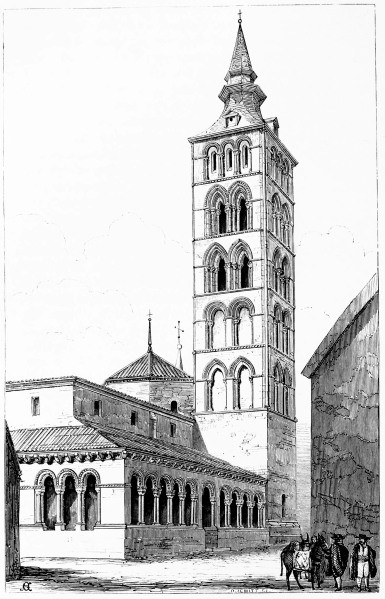
No. 25. SAN ESTEBAN, SEGOVIA. p. 187. SOUTH-EAST VIEW OF CHURCH AND STEEPLE
A very picturesque path loads up from El Parral into the city. The effect of the Alcazar from hence is very imposing, the enormous keep-tower which rises out of its western face being very prominent, with its outline marked by round corner turrets projecting from the angles so often seen in the old castles of Castile. Its walls, as well as many others in the Alcazar, are covered with diapers in plaster, with the pattern left slightly in relief, a mode of decoration which seems to have been extremely popular in Segovia in the fourteenth and fifteenth centuries. Until very lately this Alcazar was covered with picturesque tall slated roofs, but, unfortunately, a fire has completely gutted the whole building, and left nothing but the outside walls, which still, however, are most imposing in their effect. The old town walls diverge slightly from the Alcazar, and enclose the whole city; their outline is broken picturesquely with towers, sometimes round and sometimes square, and they wind about to suit the uneven and rugged surface of the rock on which they are built. The gateways are not very remarkable, though always effective. One of them is passed in coming from El Parral, and, as soon as the town is reached, the noble steeple of San Esteban—one of its finest architectural features—is seen in front.
I have seldom seen a better work than this. It is evidently one of a large class, most of the other steeples here reproducing the unusual arrangement of the angles. They are boldly splayed off, and in the middle of the splay is set a shaft, which finishes with a sculptured capital. The effect of this design is to give great softness of contour to the whole steeple, and yet to mark boldly and broadly the importance of the angles. The arcading of the various stages is richly and admirably managed, and the details throughout are very pure and good. I have found no evidence of its exact date, though it is evidently a work of the first half of the thirteenth century.
The church to which this steeple belongs is remarkable for the remains of an external cloister against the walls of the nave. There are several churches here which have the same feature, and in other parts of this book I have mentioned similar cases at Las Huelgas, Burgos, and at La Antigua, Valladolid. It looks like an arrangement for keeping the building cool, and is as good in its effect, as in so hot a climate it must be convenient.
Of the early churches here none is altogether so fine as that of San Millan. It stands in the southern valley, not far from the aqueduct, and exactly on the opposite side of the town to the Templars’ Church. Like that, too, it is outside the walls, and in a scantily-peopled suburb. It consists of a nave and aisles,[192] all finished at the east end with apses, and protected on both sides by cloisters similar to those of San Esteban, save that they are confined to the sides, and do not return across the west front. There is a low square lantern at the Crossing, and transepts which do not project beyond the aisles, and hardly show themselves, therefore, on the ground-plan. The central lantern is finished with a corbel-table, roofed with a low tiled roof, and lighted by a small window in each face. The apses are similar in style and detail to most of the early Spanish apses, having engaged shafts at intervals, richly wrought corbel-tables, and round-arched shafted windows. Both the transepts probably had flat gables, with single windows, like those in the apse, but the north transept has been destroyed for the erection of a steeple, which seems to have formed no part of the original plan. The most striking view of the church is from the north-west. The west front is quite unaltered, save by the addition of three little windows over the west door, and is a capital example of simple Romanesque. The gables are all of the same pitch, and the aisle walls are arcaded and pierced with windows above the cloister roofs. The cloister is a very rich composition, the shafts being coupled, with finely sculptured capitals, and the arches enriched with billet mouldings. The corbel-tables and cornices to these cloisters have evidently been carved at a date long after the original foundation of the church, the edge of the eaves-cornice being cut in a rich interlacing pattern of ivy-leaves, which cannot, I think, be earlier than from A.D. 1250 to 1270, and the heads, figures, and foliage on the corbels under it are all of the same character. There are fine north and south doors here, and there is a local peculiarity in their design which deserves notice. Their jambs consist of shafts set within very bold square recesses; and the number of orders in the arch is double that of those in the jamb, they being alternately carried on the capitals of the shafts, and upon the square order of the jambs. The effect is good, the bold spacing of the shafts, and the massiveness of the intermediate square jambs, tending to give that effect of solidity which these early Spanish architects never tired in their attempts to attain.

No. 26. SAN MILLAN, SEGOVIA. p. 188. NORTH-WEST VIEW.
The interior of the church has been much modernized, but still enough remains to render the whole scheme intelligible. The arcades between the nave and aisles are all perfect; they are very plain, but spring from carved capitals of large size. The capitals of the nave arcades have their abaci planned with re-entering angles, so as exactly to fit the plan of the two square orders of the archivolt. Some of the caps are of foliage only, others are historiés; one I remember having all round it the Adoration of the Magi, who are represented as large figures on horseback, and produce a most strange effect in such a place. The cross arches under the lantern are old, as also are those across the aisles, but the roof of the nave is now all under-drawn with plaster, and there are no means of telling precisely how it was originally covered; but, on the whole, I incline to the belief that it must have had a cylindrical vault, with quadrant vaults in the aisles, though it is possible, of course, that it had a flat wooden ceiling. The square piers in the nave favour this alternative, inasmuch as they seem to rise higher than they would have done had the roof been a stone vault. The pilasters against the aisle walls also run up to the level of the plate inside, and this (though it is modern) is higher than the springing of the nave arcades, and seems to prove that there have never been cross arches in the aisles. The external walls of the aisles above the cloister roofs are arcaded with plain arches between the pilasters, by which it is divided into bays, and the aisle windows are set within these arches. The lantern is modernized, but there still remain coupled cross ribs on its under side, and these, though they are plastered, being similar to those under the central vault of the Templars’ Church, are probably original.
I wish much that I could put my hands on some documentary evidence which would fix the exact date of this very fine and interesting church, for, from its importance, it may be considered to be a leading example; and there is no doubt that it very largely influenced the other churches of this important city. It is possible, however, from the character of some of the detail, that part of it is older than the Templars’ Church, consecrated, as we have seen, in A.D. 1208; though other parts of the detail—as, for instance, that of the external cornices—cannot be earlier than A.D. 1250-1270. Before the last of these dates, therefore, I have no doubt the church was erected, though, as the arches are all, or nearly all, semi-circular, the greater part of the work was probably finished early in the century, if not in the twelfth century, and the decorations may have been completed afterwards.[193]
The non-introduction of pointed arches is certainly in favour of the earlier date, seeing that in the Templars’ Church most of the main arches, rude as they are, are pointed; and were it not for the late character of some parts of San Millan, and looking only to the character of the plan and general design, I might have assumed its date to be about A.D. 1150. It is possible that the cloisters were added after the erection of the church.
The object of these external cloisters has been, I believe, matter of considerable discussion, yet I confess that they always seemed to me to be adopted mainly, if not solely, on account of the excessive heat in Spain in summer, and to be well worth our imitation when we have to erect churches in tropical climates. That they were confined very much to certain localities is perfectly true, but this is constantly the case, with local developments, in all parts of Europe; and here, no doubt, the idea once suggested by some early architect was frequently repeated by him, without taking the fancy of his brethren generally enough to make them repeat it elsewhere.

Capital in Cloister, San Martin, Segovia.
Another example of the same class, which in its original state must have been finer than San Millan, is to be seen in the church of San Martin. Here the cloister was carried not only along the sides, but across the west front also, with a bold projecting west porch, breaking its lines, and giving great character and dignity to the whole scheme. The west doorway of the porch has statues in its jambs, and the detail seems to me to be all genuine thirteenth century work. The illustration of one of the cloister capitals will, I think, prove this; for though the old favourite device of couples of birds is repeated here, the lines are all extremely fine and graceful, and the carving of the abacus of an advanced kind. This church is, unfortunately, very much modernized throughout. It seems to have had three parallel apses at the east end, and transepts, against which the side cloisters of the nave were stopped. There is a modern lantern over the old crossing, and a tower to the west of it rising from out of the centre of the nave, which seems to be in part old. There were northern and southern as well as western doors, and openings in the cloister opposite each of them.
San Roman, a desecrated church near the palace of the civil governor, has a short nave, chancel, and apse, with a tower on the south side of the chancel. The walls are very lofty, and are all finished with corbel-tables at the eaves. The apse has three round-headed windows, and there is a noble north door, similar in design to those of San Millan, and with the abaci and labels richly carved. The west end has a small doorway, and a circular window over it, the former certainly, and the latter probably, not original. The lower stage only of the tower remains. This church must be of about the same age as San Millan.
San Facundo is similar in plan to San Roman, and of the same date. The detail of the apse is precisely the same as that of San Millan. There is a large west door, modernized, and an open cloister seems to have been added at a later date to the side of the church, and is now walled up. This church is desecrated, and converted into a Museum of Paintings.
Santa Trinidad has a fine apse, and this is again of the San Millan pattern. It has carved stringcourses at the springing of the windows, and again just over their arches, and there are three-quarter engaged wall-shafts between the windows, and a richly sculptured eaves-cornice and corbel-table.
San Nicolas, close to Santa Trinidad, has two apses, each lighted with a single window, engaged wall-shafts, and the usual carved labels, abaci, and corbel-tables. The tower is on the north side, rises one stage above the roof, and is lighted with two round-arched belfry windows. A small apse was added rather later than the original fabric to the east of this tower, and before its erection the plan must have been almost the same as that of San Roman, but reversed. About a hundred yards from San Nicolas is another church which is almost an exact repetition of San Roman.
San Luine (?), in the Plazuela de Capuchinos, is of just the same class as the rest, with nave, chancel, and apse, and a second apse east of the tower on the south side. There are no side windows here, and only a single light at the east end.
Another church, in the Plaza de Isabel II., is of the same plan as the last, with a modernized tower. The carving on the string-courses here is of the same kind of natural foliage that I have described at San Millan.
Near the aqueduct are two churches. One of them, S. Antholin (I think), has a tower at the north-east of the nave; its two upper stages have on each face two round-arched shafted windows, and the angles are treated in a precisely similar way to those of San Esteban, having bold splays with engaged shafts in their centres. Another church close to this is modernized, but retains its old tower, with the angles treated in the same way.
The church of San Juan has remains of an external cloister on one side.
The last church of this long, and I fear very dry, catalogue, is that of San Miguel, which stands in the Plaza near the cathedral. It has four bays of nave, shallow transepts, and a very short choir, which is, I think, apsidal, but almost concealed by a pagan Retablo. The whole is of late fifteenth-century date, and must, I think, be the work of the same hand as the cathedral. Some figures at the west end, representing St. Michael and the Annunciation, have evidently been taken from some older building, and built into the walls here. There is a very beautiful triptych in the north transept, with a Descent from the Cross in the centre, which ought to be looked at. It is a fine work of, I suppose, the latter part of the sixteenth century.[194]
I have already mentioned the great Alcazar, and the old town walls and gateways. They are magnificent in their scale, and very picturesque. The Alcazar was burnt some two or three years ago, and is now roofless, and I was told that its interior had been completely destroyed. I foolishly omitted to verify this statement by personal inspection, and contented myself with the sight of the exterior. The walls of the front towards the city are all diapered in plaster, and here and there about the town several other examples of the same kind of work are to be seen. The patterns are generally tracery patterns of the latest Gothic, repeated over and over again, so as to produce a regular diaper throughout. I presume that it was executed with a frame cut out to the required pattern, so as to allow of the ground being cut back slightly, leaving the pattern lines formed in the original face of the plaster. This kind of decoration seems to be perfectly legitimate, and here, owing to the care with which the plaster has been made and used, it has stood remarkably well, though most of the patterns that I saw had evidently been executed in the fifteenth century.
In the front of the Alcazar these plaster patterns are carried not only all over the plain face of the walls, but also round the towers and turrets at the angles, so that the very smallest possible amount of wrought stone is introduced. The great tower or keep standing back a few feet only from the front is similarly ornamented, but has stone quoins bonded irregularly into the walls; in its upper stage it has windows surmounted by quaint stone canopies, and then a series of great circular turrets, corbelled boldly out from the face of the wall, and carried up a considerable height, give its extremely marked and Spanish air to this grand tower. These turrets are of stone, and between them is a parapet boldly corbelled out on machicoulis from the walls. With that contempt for uniformity which marks mediæval artists, the keep is more than twice as broad on one side as on the other, and the great mass of wall and turret, roofs and spirelets, which crowned the whole building before the fire, well sustained its picturesque irregularity of shape.
The front of a private house near the walls, not far from San Esteban, is another capital example of the same kind of plaster-work. Here the façade is a perfectly smooth and unbroken surface, pierced for doors and windows, which are set in square panels of stone, and with a regular and straight line of stone quoining at the angles. At one end a low tower is carried up a few feet above the general line of the building. The windows are generally mere plain square openings; but two set side by side in the principal stage have delicate ajimez windows of two lights, with elaborately traceried heads. The patterns in the plaster are three in number: the first carried from the stone plinth up to the sills of the principal windows, where it is cut by a narrow band of ornament, acting as a stringcourse to divide it from the second pattern, which is carried up to the eaves, the tower being covered with a third diaper, rather less intricate than the others.
Near this house is a tower in the walls even more worthy of notice. It is of very considerable height, quite plain in outline, and pierced with only one or two square-headed windows, but surmounted by a fine parapet supported on machicoulis. The whole tower is built with bold stone quoins and horizontal bands of brickwork, each band two courses in height, at intervals of about three feet. Between these bands the walls are plastered and diapered. Here, as in the other house, only two or three patterns are used, but I think great judgment is shown in the repetition for the greater part of the height of the same pattern, which is changed at last near the top, where it was desirable to emphasize the work. Most men having three patterns to use would have divided them equally, but the real artist gives all their value to his simple materials by not doing so. The construction of this tower led naturally to its decoration. The wrought stone at the angles, the rough stonework of the walls, and the occasional bonding-courses of brick, were all used simply as the best materials for their respective parts; and the rough stonework being plastered and diapered, gave a richness and polish to the whole work which it would otherwise have wanted, whilst it in no degree destroyed the air of stability of the wall, which is secured by the obviously constructional arrangement of the stone and brick.
The Moors were always distinguished by the beautiful use they made of plaster; and whether or no these Segovian buildings were executed by Moorish architects, it is quite certain that at any rate we owe them to their influence and example. The patterns used are generally such as in stone-work would be unhesitatingly attributed to the end of the fifteenth or first half of the sixteenth century, and to this period no doubt the works I have been describing belong. They deserve a detailed notice because they prove, as do most Moorish works, that plaster may be used truthfully and artistically, and that without any approach to the contemptible effect which the imbecility and dishonesty of the nineteenth-century designers of plaster-work have contrived to impress on almost all their productions.
My last work in Segovia was to go to the Alcazar to get a sketch of the town, with the cathedral rising in a noble mass in its very centre, backed by the line of the Guadarrama mountains, looking black and angry with the storm-clouds which swept over the sky and around their summits at sunset; and then strolling quietly back into the town, I went into the cathedral, to be impressed, as one always must be in such a place, by the aweful solemnity which even the latest Gothic architects in Spain knew how to impart to their buildings.
[larger view] [largest view]

CHAPTER X.
MADRID—ALCALÁ—GUADALAJARA—SIGÜENZA.
ON my first journey to Madrid I travelled most of the way from Valladolid by diligence, and though the way was long and weary, the passage of the Sierra de Guadarrama was very fine, and I remember few pictures more lovely than that which we saw at sunrise, as we climbed the northern side of the mountains amid groups of stone-pines; whilst the steep descent to the village of Guadarrama, on the south, with a slight distant view of Madrid, and a near view of the Escorial, was quite a thing to be remembered with pleasure. Now, however, instead of arriving at Madrid hot, dusty, and sore with a diligence journey, the railway is completed, and the line of country it takes is so beautiful between Avila and Madrid as to leave no room for regrets for the old passage of the mountains by road.
The entrance to Madrid is not very striking. For the last three or four miles the road passes by a fair amount of planted woods, but the river by its side is dry and dreary, and every one in the hot season at which I arrived seemed to be gasping for breath. A very small suburb only is passed before the Queen’s palace is reached: this is built on the edge of a steep hill overhanging the river, and commands a grand view of the Sierra de Guadarrama. This is indeed the one and only glory of such a site as that of Madrid, for were it not for this distant view, I know nothing more dreary and unhappy than the country with which it is surrounded. At the same time, partly owing to the great height above the sea, and partly, probably, to the neighbourhood of this mountain range, the climate here is most treacherous, changing rapidly from the most violent heat in the daytime, to what seems by contrast to be icy chilliness at night.
A garden with statues is laid out in front of the palace, and beyond this, passing some narrow streets, one soon reaches the Puerta del Sol, a fine irregular space in the centre of the city, with a fountain in the centre which is always playing pleasantly, and on great occasions sends up a jet to an unusual height. The Puerta del Sol is very irregular, and on sloping ground, and hence it has a certain pleasing picturesqueness, which probably accounts for the reputation it has achieved.
There is one great attraction to me in Madrid, and only one—the Picture Gallery. And it is as well for travellers to take up their quarters in one of the hotels near the Puerta del Sol, where they are within a walk of it, rather than in the respectable Fonda de Ynglaterra, where I found myself quite too far from everything that I wanted to see.
I discovered no old churches here. Madrid is, in fact, a thoroughly modern city, and is remarkable as not being the see of a bishop, the Archbishops of Toledo having succeeded in retaining it in their diocese.
I found, therefore, nothing whatever to do in the way of ecclesiologizing; and yet, on the whole, having formed a very low estimate of the place beforehand, I was rather agreeably disappointed. The situation is unquestionably fine, the views of the mountains beautiful, the streets busy and smart, and the fountains, which seem to be innumerable, are on a scale which would astonish our London authorities. The evenings are always deliciously cool, and then all Madrid is on the move; the very well laid out and planted Prado is thronged with smart people on foot, and smarter people in carriages; and until one has suffered as one does from the extreme heat of the day, it is hardly possible to imagine the luxurious freshness of the cool night. It is said, however, to be a dangerous pleasure, pulmonary complaints being very common.
The two great sights are the Museo and the Armeria; the latter is said to be the best collection of arms in Europe, but somehow I always managed to want to go there too early or too late, and, after divers mistakes, in the end did not see it at all. Of the Museo it is difficult to speak with too much enthusiasm: the number of pictures is enormous, and it seemed to me that there was a larger proportion than is usual of very first-rate works. Its deficiency is mainly in early pictures—Italian, German, and Spanish. The early Italian schools are represented by one Angelico da Fiesole only: this is a beautiful example; an Annunciation, with the expulsion of Adam and Eve from Eden on the left of the picture, and five subjects from the life of the Blessed Virgin in the predella. Among these, the Marriage of the Blessed Virgin has a close resemblance to Perugino’s and Raffaelle’s celebrated pictures. I could see no examples of Francia or Perugino, not to speak of earlier men; whilst the few early German works were none of them of any great interest.
On the other hand, the pictures by Titian, Velasquez, Raffaelle, Veronese, Tintoret, Murillo, and others of the great masters of their age, are numerous and magnificent beyond description.
Velasquez and Titian are both so grand that I hardly knew which to admire the most; of the former, perhaps on the whole the most charming work is the portrait of Prince Balthazar, a noble boy, galloping forward gallantly on his pony; whilst of the Titians, I think the most striking was a weird-looking portrait of Charles V. in armour on horseback. Murillo of course is in great force; he has frequent representations of the Assumption, always treated in the same way: his work has a religious spirit wanting in the manlier work of Titian and Veronese, but yet not the true religious spirit so much as a sentimental affectation of it. Of Ribera—better known in England as Spagnoletto—there are a great many examples, generally disagreeable portraits of emaciated saints in distorted attitudes, and a horrible elaboration of ghastliness. Juan Juanes, an earlier Spanish painter, is much more agreeable, and he seems to have been largely inspired by Perugino and his school; a series of five subjects from the life of St. Stephen are perhaps the most interesting of his works here.
The room in which the greatest treasures of the Gallery are collected is called the Salon de la Reyna Isabel. Unfortunately a large opening in the floor, to give light to a gallery of sculpture below, makes it a little difficult to see some of the pictures at all well. At its upper end is the famous Spasimo de Sicilia, a noble work, but spoilt by the awkward and distorted drawing of the soldiers on the left. Near it is a very fine Giovanni Bellini, the Delivery of the Keys to St. Peter; and by its side a Giorgione, with a man in armour, as fine as anything I know,—the subject, the Virgin and Saints. By Bronzino there is a violin-player, a lad with a face beyond measure loveable. But it were endless to go on through a list even of the chefs-d’œuvre in such a collection; and it is the less necessary to say much more than generally to praise the whole Gallery as one of the first, if not the first, in Europe, because, now that railways make the journey thither so much more easy, some, no doubt, of our thousands of annual travellers will make their way to Madrid, to make lists for themselves of the best of its pictures.
There is as little interest in modern as in earlier architecture here; the only development that struck me being a fashion the people have of diapering houses all over with a kind of thirteenth-century painting on plaster; but I was not struck with the beauty of the development. The best street is the Calle de Alcalá, leading from the Puerta del Sol to the Prado. It is of great width, rising from the Puerta del Sol and falling to the Prado, and not straight, all which points are much in its favour: but the houses on either side are not generally so fine as they should be, and there is consequently a slightly faded look about it, which is not otherwise characteristic of Madrid. To see the Calle de Alcalá to advantage, the day of a bull-fight should be selected. Then from half-past three to four all the world streams along it to the arena, excited, running, pushing, buying red and yellow paper fans for the seats in the sun, and as noisy, boisterous, and enthusiastic as all the world at any of our own national gatherings. The picadors in their quaint dresses come galloping along on their sorry steeds, each attended by a man in a blouse riding on the same horse, and whose office it is afterwards to make the poor wretch face the bull by beating him with a long stick. Omnibuses and vehicles of all kinds bring their share of the mob; and when I took my seat, I believe there were not less than twelve thousand people assembled, every seat in the rather shabby but vast arena being full. Women formed a very small proportion only of the whole number, and I noticed that a lady who sat near me seemed as much shocked as I was at the brutal parts of the exhibition; for all parts of it are by no means brutal, and, indeed, I should be inclined to limit the term to those parts in which horses are introduced. It would be quite as pleasant to indulge oneself by an occasional visit to a knacker’s yard, as to sit quietly looking on whilst a furious bull rips up a miserable beast, usually blindfolded, in order that it may not move from the spot at which the picador chooses to receive the attack; but this part of the performance over, there is little that is disgusting, and a great deal that is singularly exciting and skilful. The men seldom seem to be in any real danger of being caught by the bull, and nothing can be cleverer than the way in which one of the chulos will dance before him half across the arena, always avoiding his charge by a hair’s-breadth only, or in which one of the banderilleros, seated in a chair, will plant his two arrows exactly on each side of the bull just as he stoops to toss him, and the next instant jump out of his seat, whilst the chair is dashed to atoms by the furious beast.
I felt, however, that one bull-fight was enough for me; the treatment of each bull is of necessity the same, and the mules have no sooner galloped out of one door trailing the dead bull and his victims out of the arena, than another dashes in from the opposite side, only to meet the same fate. The way in which the bulls come in is very striking: they rush in madly like wild beasts, and generally charge rapidly at one of the picadors or chulos. I asked a Spaniard how this was managed, and he explained that in the den from which they emerge they are goaded with sharp-pointed spears just before the doors are opened, and of course come into the arena mad with rage!
The object of bull-fights seems to be generally charitable—in the sense that charity bazaars are so. At Valencia, where they have recently erected an arena which almost rivals in size the Roman amphitheatres, the work has been done by the trustees of the hospitals, and this seemed to be usually the destination of the receipts whenever I saw them advertized. That it is possible to have a bull-fight of even a worse kind than the Spanish I learnt at Nîmes, where the cicerone showing me the amphitheatre explained that they had a bull-fight every Sunday, but never killed their bulls—only goaded them week after week!
Whilst I was at Madrid I made an excursion to Alcalá de Henares, the seat of Cardinal Ximenes’ famous university, under the impression that I should find a good deal to reward me. In this, however, I was disappointed, as the churches are mostly works of the seventeenth and eighteenth centuries, and the whole place is decayed, unprosperous, and uncared for, without being picturesque and venerable.
The principal church, “El Magistral,” of SS. Just y Pastor—the tutelars of the city—is a large, late church of poor style. It has a nave and aisles of five bays, transepts and choir of one bay, and an apse of three sides. The aisle round the apse is contrived with three square bays and four triangular, and is evidently founded on the beautiful plan of the chevet of Toledo cathedral; but I must say that Pedro Gumiel “el Honrado,” Regidor of Alcalá, and architect of this church, has perfectly succeeded in avoiding any repetition of the beauties of Toledo; his work being thoroughly uninteresting and poor. The three western bays of the nave are open; the two eastern enclosed with screens and stalled for the Coro. A bronze railing under the Crossing connects the Coro with the Capilla mayor. There are no less than six pulpits here! two at the entrance to the choir for the Epistoler and Gospeller, two on the west of the Crossing, and two more opposite each other against the second column from the west in the nave. It looks just as though they had ordered a pair of pulpits as they did a pair of organs; and as preaching does not seem to be much the fashion now in Spain, I had no opportunity of learning how these many pulpits were to be used. There are two organs, one on each side over the Coro; that on the south so picturesque as to be worthy of illustration.

Organ, Alcalá.
Two great monuments—one in the nave, and one under the Crossing—are remarkable for the position of the effigies with their feet to the west. On the south side of the south transept is a small chapel roofed with a most rich and delicate Moorish plaster ceiling; the whole was richly coloured. It did not appear to be earlier than the church, which is said to have been constructed between the years 1497 and 1509.
The University founded by Ximenes is in a wretched state of dilapidation; it is said to have been designed by the same Pedro Gumiel who built SS. Just y Pastor, but the work, so far as I saw it, was all Renaissance. The façade and court behind it were the work of Rodrigo Gil de Hontañon, between A.D. 1550 and 1553, and he destroyed Pedro Gumiel’s work in order to erect it. By the side of the college stands the church of San Ildefonso, which I suppose must be the chapel built by Pedro Gumiel. It is, I believe, desecrated, and no one could tell me where the key was to be found, so that I was unable to do more than get a note of the curious Cimborio from the exterior. It is not a lantern, but rather a raising of the whole centre of the church above the remainder. It is constructed of brick and stone, and is evidently of late date. Under this Cimborio, I believe, is the monument of the great Cardinal.
[185] Cean Bermudez, Arq. de España, i. p. 214.
[186] Here lies Rodrigo Gil de Hontañon, Master of the Works of this Holy Church. He died the 31st of May, 1577. He set the first stone, which the Bishop D. Diego de Ribera laid on the 8th of June, 1525.
[187] Plate XII.
[188] See ground-plan, Plate VIII.
[189] Colmenares (Historia de la insigne Ciudad de Segovia; Segovia. 1637) gives the date of the first foundation 1447, but the buildings do not seem to have been begun before 1474, and the vaulting was finished in 1485.—Cean Bermudez, Arq. de España, i. p. 111.
[190] These particulars are all given in Cean Bermudez, Arq. de España, i. pp. 111, 120, 146.
[191] See Plate VIII.
[192] See ground-plan, Plate VIII.
[193] San Millan is said to have been founded in A.D. 923, and similar early dates are given for Sta. Columba and San Esteban: none of them, I believe, retain any features of so great an antiquity.
[194] I did not see the church of San Lorenzo. It has three eastern apses, and an arcaded cloister on the western and southern sides, some of the arches being round and some pointed. The detail is all of the same kind as in other examples here, with much delicate imitation of natural foliage.—See Illustration in Monos. Arqos. de España.