



автордың кітабын онлайн тегін оқу Political economy
Lord Kilgobbin
Contact: DigiCat@okpublishing.info

Table of Contents
CHAPTER I
KILGOBBIN CASTLE
Some one has said that almost all that Ireland possesses of picturesque beauty is to be found on, or in the immediate neighbourhood of, the seaboard; and if we except some brief patches of river scenery on the Nore and the Blackwater, and a part of Lough Erne, the assertion is not devoid of truth. The dreary expanse called the Bog of Allen, which occupies a tableland in the centre of the island, stretches away for miles—flat, sad-coloured, and monotonous, fissured in every direction by channels of dark-tinted water, in which the very fish take the same sad colour. This tract is almost without trace of habitation, save where, at distant intervals, utter destitution has raised a mud-hovel, undistinguishable from the hillocks of turf around it.
Fringing this broad waste, little patches of cultivation are to be seen: small potato-gardens, as they are called, or a few roods of oats, green even in the late autumn; but, strangely enough, with nothing to show where the humble tiller of the soil is living, nor, often, any visible road to these isolated spots of culture. Gradually, however—but very gradually—the prospect brightens. Fields with inclosures, and a cabin or two, are to be met with; a solitary tree, generally an ash, will be seen; some rude instrument of husbandry, or an ass-cart, will show that we are emerging from the region of complete destitution and approaching a land of at least struggling civilisation. At last, and by a transition that is not always easy to mark, the scene glides into those rich pasture-lands and well-tilled farms that form the wealth of the midland counties. Gentlemen’s seats and waving plantations succeed, and we are in a country of comfort and abundance.
On this border-land between fertility and destitution, and on a tract which had probably once been part of the Bog itself, there stood—there stands still—a short, square tower, battlemented at top, and surmounted with a pointed roof, which seems to grow out of a cluster of farm-buildings, so surrounded is its base by roofs of thatch and slates. Incongruous, vulgar, and ugly in every way, the old keep appears to look down on them—time-worn and battered as it is—as might a reduced gentleman regard the unworthy associates with which an altered fortune had linked him. This is all that remains of Kilgobbin Castle.
In the guidebooks we read that it was once a place of strength and importance, and that Hugh de Lacy—the same bold knight ‘who had won all Ireland for the English from the Shannon to the sea’—had taken this castle from a native chieftain called Neal O’Caharney, whose family he had slain, all save one; and then it adds: ‘Sir Hugh came one day, with three Englishmen, that he might show them the castle, when there came to him a youth of the men of Meath—a certain Gilla Naher O’Mahey, foster-brother of O’Caharney himself—with his battle-axe concealed beneath his cloak, and while De Lacy was reading the petition he gave him, he dealt him such a blow that his head flew off many yards away, both head and body being afterwards buried in the ditch of the castle.’
The annals of Kilronan further relate that the O’Caharneys became adherents of the English—dropping their Irish designation, and calling themselves Kearney; and in this way were restored to a part of the lands and the castle of Kilgobbin—‘by favour of which act of grace,’ says the chronicle, ‘they were bound to raise a becoming monument over the brave knight, Hugh de Lacy, whom their kinsman had so treacherously slain; but they did no more of this than one large stone of granite, and no inscription thereon: thus showing that at all times, and with all men, the O’Caharneys were false knaves and untrue to their word.’
In later times, again, the Kearneys returned to the old faith of their fathers and followed the fortunes of King James; one of them, Michael O’Kearney, having acted as aide-de-camp at the ‘Boyne,’ and conducted the king to Kilgobbin, where he passed the night after the defeat, and, as the tradition records, held a court the next morning, at which he thanked the owner of the castle for his hospitality, and created him on the spot a viscount by the style and title of Lord Kilgobbin.
It is needless to say that the newly-created noble saw good reason to keep his elevation to himself. They were somewhat critical times just then for the adherents of the lost cause, and the followers of King William were keen at scenting out any disloyalty that might be turned to good account by a confiscation. The Kearneys, however, were prudent. They entertained a Dutch officer, Van Straaten, on King William’s staff, and gave such valuable information besides as to the condition of the country, that no suspicions of disloyalty attached to them.
To these succeeded more peaceful times, during which the Kearneys were more engaged in endeavouring to reconstruct the fallen condition of their fortunes than in political intrigue. Indeed, a very small portion of the original estate now remained to them, and of what once had produced above four thousand a year, there was left a property barely worth eight hundred.
The present owner, with whose fortunes we are more Immediately concerned, was a widower. Mathew Kearney’s family consisted of a son and a daughter: the former about two-and-twenty, the latter four years younger, though to all appearance there did not seem a year between them.
Mathew Kearney himself was a man of about fifty-four or fifty-six; hale, handsome, and powerful; his snow-white hair and bright complexion, with his full grey eyes and regular teeth giving him an air of genial cordiality at first sight which was fully confirmed by further acquaintance. So long as the world went well with him, Mathew seemed to enjoy life thoroughly, and even its rubs he bore with an easy jocularity that showed what a stout heart he could oppose to Fortune. A long minority had provided him with a considerable sum on his coming of age, but he spent it freely, and when it was exhausted, continued to live on at the same rate as before, till at last, as creditors grew pressing, and mortgages threatened foreclosure, he saw himself reduced to something less than one-fifth of his former outlay; and though he seemed to address himself to the task with a bold spirit and a resolute mind, the old habits were too deeply rooted to be eradicated, and the pleasant companionship of his equals, his life at the club in Dublin, his joyous conviviality, no longer possible, he suffered himself to descend to an inferior rank, and sought his associates amongst humbler men, whose flattering reception of him soon reconciled him to his fallen condition. His companions were now the small farmers of the neighbourhood and the shopkeepers in the adjoining town of Moate, to whose habits and modes of thought and expression he gradually conformed, till it became positively irksome to himself to keep the company of his equals. Whether, however, it was that age had breached the stronghold of his good spirits, or that conscience rebuked him for having derogated from his station, certain it is that all his buoyancy failed him when away from society, and that in the quietness of his home he was depressed and dispirited to a degree; and to that genial temper, which once he could count on against every reverse that befell him, there now succeeded an irritable, peevish spirit, that led him to attribute every annoyance he met with to some fault or shortcoming of others.
By his neighbours in the town and by his tenantry he was always addressed as ‘My lord,’ and treated with all the deference that pertained to such difference of station. By the gentry, however, when at rare occasions he met them, he was known as Mr. Kearney; and in the village post-office, the letters with the name Mathew Kearney, Esq., were perpetual reminders of what rank was accorded him by that wider section of the world that lived beyond the shadow of Kilgobbin Castle.
Perhaps the impossible task of serving two masters is never more palpably displayed than when the attempt attaches to a divided identity—when a man tries to be himself in two distinct parts in life, without the slightest misgiving of hypocrisy while doing so. Mathew Kearney not only did not assume any pretension to nobility amongst his equals, but he would have felt that any reference to his title from one of them would have been an impertinence, and an impertinence to be resented; while, at the same time, had a shopkeeper of Moate, or one of the tenants, addressed him as other than ‘My lord,’ he would not have deigned him a notice.
Strangely enough, this divided allegiance did not merely prevail with the outer world, it actually penetrated within his walls. By his son, Richard Kearney, he was always called ‘My lord’; while Kate as persistently addressed and spoke of him as papa. Nor was this difference without signification as to their separate natures and tempers.
Had Mathew Kearney contrived to divide the two parts of his nature, and bequeathed all his pride, his vanity, and his pretensions to his son, while he gave his light-heartedness, his buoyancy, and kindliness to his daughter, the partition could not have been more perfect. Richard Kearney was full of an insolent pride of birth. Contrasting the position of his father with that held by his grandfather, he resented the downfall as the act of a dominant faction, eager to outrage the old race and the old religion of Ireland. Kate took a very different view of their condition. She clung, indeed, to the notion of their good blood; but as a thing that might assuage many of the pangs of adverse fortune, not increase or embitter them; and ‘if we are ever to emerge,’ thought she, ‘from this poor state, we shall meet our class without any of the shame of a mushroom origin. It will be a restoration, and not a new elevation.’ She was a fine, handsome, fearless girl, whom many said ought to have been a boy; but this was rather intended as a covert slight on the narrower nature and peevish temperament of her brother—another way, indeed, of saying that they should have exchanged conditions.
The listless indolence of her father’s life, and the almost complete absence from home of her brother, who was pursuing his studies at the Dublin University, had given over to her charge not only the household, but no small share of the management of the estate—all, in fact, that an old land-steward, a certain Peter Gill, would permit her to exercise; for Peter was a very absolute and despotic Grand-Vizier, and if it had not been that he could neither read nor write, it would have been utterly impossible to have wrested from him a particle of power over the property. This happy defect in his education—happy so far as Kate’s rule was concerned—gave her the one claim she could prefer to any superiority over him, and his obstinacy could never be effectually overcome, except by confronting him with a written document or a column of figures. Before these, indeed, he would stand crestfallen and abashed. Some strange terror seemed to possess him as to the peril of opposing himself to such inscrutable testimony—a fear, be it said, he never felt in contesting an oral witness.
Peter had one resource, however, and I am not sure that a similar stronghold has not secured the power of greater men and in higher functions. Peter’s sway was of so varied and complicated a kind; the duties he discharged were so various, manifold, and conflicting; the measures he took with the people, whose destinies were committed to him, were so thoroughly devised, by reference to the peculiar condition of each man—what he could do, or bear, or submit to—and not by any sense of justice; that a sort of government grew up over the property full of hitches, contingencies, and compensations, of which none but the inventor of the machinery could possibly pretend to the direction. The estate being, to use his own words, ‘so like the old coach-harness, so full of knots, splices, and entanglements, there was not another man in Ireland could make it work, and if another were to try it, it would all come to pieces in his hands.’
Kate was shrewd enough to see this; and in the same way that she had admiringly watched Peter as he knotted a trace here and supplemented a strap there, strengthening a weak point, and providing for casualties even the least likely, she saw him dealing with the tenantry on the property; and in the same spirit that he made allowance for sickness here and misfortune there, he would be as prompt to screw up a lagging tenant to the last penny, and secure the landlord in the share of any season of prosperity.
Had the Government Commissioner, sent to report on the state of land-tenure in Ireland, confined himself to a visit to the estate of Lord Kilgobbin—for so we like to call him—it is just possible that the Cabinet would have found the task of legislation even more difficult than they have already admitted it to be.
First of all, not a tenant on the estate had any certain knowledge of how much land he held. There had been no survey of the property for years. ‘It will be made up to you,’ was Gill’s phrase about everything. ‘What matters if you have an acre more or an acre less?’ Neither had any one a lease, nor, indeed, a writing of any kind. Gill settled that on the 25th March and 25th September a certain sum was to be forthcoming, and that was all. When ‘the lord’ wanted them, they were always to give him a hand, which often meant with their carts and horses, especially in harvest-time. Not that they were a hard-worked or hard-working population: they took life very easy, seeing that by no possible exertion could they materially better themselves; and even when they hunted a neighbour’s cow out of their wheat, they would execute the eviction with a lazy indolence and sluggishness that took away from the act all semblance of ungenerousness.
They were very poor, their hovels were wretched, their clothes ragged, and their food scanty; but, with all that, they were not discontented, and very far from unhappy. There was no prosperity at hand to contrast with their poverty. The world was, on the whole, pretty much as they always remembered it. They would have liked to be ‘better off’ if they knew how, but they did not know if there were a ‘better off,’ much less how to come at it; and if there were, Peter Gill certainly did not tell them of it.
If a stray visitor to fair or market brought back the news that there was an agitation abroad for a new settlement of the land, that popular orators were proclaiming the poor man’s rights and denouncing the cruelties of the landlord, if they heard that men were talking of repealing the laws which secured property to the owner, and only admitted him to a sort of partnership with the tiller of the soil, old Gill speedily assured them that these were changes only to be adopted in Ulster, where the tenants were rack-rented and treated like slaves. ‘Which of you here,’ would he say, ‘can come forward and say he was ever evicted?’ Now as the term was one of which none had the very vaguest conception—it might, for aught they knew, have been an operation in surgery—the appeal was an overwhelming success. ‘Sorra doubt of it, but ould Peter’s right, and there’s worse places to live in, and worse landlords to live under, than the lord.’ Not but it taxed Gill’s skill and cleverness to maintain this quarantine against the outer world; and he often felt like Prince Metternich in a like strait—that it would only be a question of time, and, in the long run, the newspaper fellows must win.
From what has been said, therefore, it may be imagined that Kilgobbin was not a model estate, nor Peter Gill exactly the sort of witness from which a select committee would have extracted any valuable suggestions for the construction of a land-code.
Anything short of Kate Kearney’s fine temper and genial disposition would have broken down by daily dealing with this cross-grained, wrong-headed, and obstinate old fellow, whose ideas of management all centred in craft and subtlety—outwitting this man, forestalling that—doing everything by halves, so that no boon came unassociated with some contingency or other by which he secured to himself unlimited power and uncontrolled tyranny.
As Gill was in perfect possession of her father’s confidence, to oppose him in anything was a task of no mean difficulty; and the mere thought that the old fellow should feel offended and throw up his charge—a threat he had more than once half hinted—was a terror Kilgobbin could not have faced. Nor was this her only care. There was Dick continually dunning her for remittances, and importuning her for means to supply his extravagances. ‘I suspected how it would be,’ wrote he once, ‘with a lady paymaster. And when my father told me I was to look to you for my allowance, I accepted the information as a heavy percentage taken off my beggarly income. What could you—what could any young girl—know of the requirements of a man going out into the best society of a capital? To derive any benefit from associating with these people, I must at least seem to live like them. I am received as the son of a man of condition and property, and you want to bound my habits by those of my chum, Joe Atlee, whose father is starving somewhere on the pay of a Presbyterian minister. Even Joe himself laughs at the notion of gauging my expenses by his.
‘If this is to go on—I mean if you intend to persist in this plan—be frank enough to say so at once, and I will either take pupils, or seek a clerkship, or go off to Australia; and I care precious little which of the three.
‘I know what a proud thing it is for whoever manages the revenue to come forward and show a surplus. Chancellors of the Exchequer make great reputations in that fashion; but there are certain economies that lie close to revolutions; now don’t risk this, nor don’t be above taking a hint from one some years older than you, though he neither rules his father’s house nor metes out his pocket-money.’
Such, and such like, were the epistles she received from time to time, and though frequency blunted something of their sting, and their injustice gave her a support against their sarcasm, she read and thought over them in a spirit of bitter mortification. Of course she showed none of these letters to her father. He, indeed, only asked if Dick were well, or if he were soon going up for that scholarship or fellowship—he did not know which, nor was he to blame—‘which, after all, it was hard on a Kearney to stoop to accept, only that times were changed with us! and we weren’t what we used to be’—a reflection so overwhelming that he generally felt unable to dwell on it.
CHAPTER II
THE PRINCE KOSTALERGI
Mathew Kearney had once a sister whom he dearly loved, and whose sad fate lay very heavily on his heart, for he was not without self-accusings on the score of it. Matilda Kearney had been a belle of the Irish Court and a toast at the club when Mathew was a young fellow in town; and he had been very proud of her beauty, and tasted a full share of those attentions which often fall to the lot of brothers of handsome girls.
Then Matty was an heiress, that is, she had twelve thousand pounds in her own right; and Ireland was not such a California as to make a very pretty girl with twelve thousand pounds an everyday chance. She had numerous offers of marriage, and with the usual luck in such cases, there were commonplace unattractive men with good means, and there were clever and agreeable fellows without a sixpence, all alike ineligible. Matty had that infusion of romance in her nature that few, if any, Irish girls are free from, and which made her desire that the man of her choice should be something out of the common. She would have liked a soldier who had won distinction in the field. The idea of military fame was very dear to her Irish heart, and she fancied with what pride she would hang upon the arm of one whose gay trappings and gold embroidery emblematised the career he followed. If not a soldier, she would have liked a great orator, some leader in debate that men would rush down to hear, and whose glowing words would be gathered up and repeated as though inspirations; after that a poet, and perhaps—not a painter—a sculptor, she thought, might do.
With such aspirations as these, it is not surprising that she rejected the offers of those comfortable fellows in Meath, or Louth, whose military glories were militia drills, and whose eloquence was confined to the bench of magistrates.
At three-and-twenty she was in the full blaze of her beauty; at three-and-thirty she was still unmarried, her looks on the wane, but her romance stronger than ever, not untinged perhaps with a little bitterness towards that sex which had not afforded one man of merit enough to woo and win her. Partly out of pique with a land so barren of all that could minister to imagination, partly in anger with her brother who had been urging her to a match she disliked, she went abroad to travel, wandered about for a year or two, and at last found herself one winter at Naples.
There was at that time, as secretary to the Greek legation, a young fellow whom repute called the handsomest man in Europe; he was a certain Spiridion Kostalergi, whose title was Prince of Delos, though whether there was such a principality, or that he was its representative, society was not fully agreed upon. At all events, Miss Kearney met him at a Court ball, when he wore his national costume, looking, it must be owned, so splendidly handsome that all thought of his princely rank was forgotten in presence of a face and figure that recalled the highest triumphs of ancient art. It was Antinous come to life in an embroidered cap and a gold-worked jacket, and it was Antinous with a voice like Mario, and who waltzed to perfection. This splendid creature, a modern Alcibiades in gifts of mind and graces, soon heard, amongst his other triumphs, how a rich and handsome Irish girl had fallen in love with him at first sight. He had himself been struck by her good looks and her stylish air, and learning that there could be no doubt about her fortune, he lost no time in making his advances. Before the end of the first week of their acquaintance he proposed. She referred him to her brother before she could consent; and though, when Kostalergi inquired amongst her English friends, none had ever heard of a Lord Kilgobbin, the fact of his being Irish explained their ignorance, not to say that Kearney’s reply, being a positive refusal of consent, so fully satisfied the Greek that it was ‘a good thing,’ he pressed his suit with a most passionate ardour: threatened to kill himself if she persisted in rejecting him, and so worked upon her heart by his devotion, or on her pride by the thought of his position, that she yielded, and within three weeks from the day they first met, she became the Princess of Delos.
When a Greek, holding any public employ, marries money, his Government is usually prudent enough to promote him. It is a recognition of the merit that others have discovered, and a wise administration marches with the inventions of the age it lives in. Kostalergi’s chief was consequently recalled, suffered to fall back upon his previous obscurity—he had been a commission-agent for a house in the Greek trade—and the Prince of Delos gazetted as Minister Plenipotentiary of Greece, with the first class of St. Salvador, in recognition of his services to the state; no one being indiscreet enough to add that the aforesaid services were comprised in marrying an Irishwoman with a dowry of—to quote the Athenian Hemera—‘three hundred and fifty thousand drachmas.’
For a while—it was a very brief while—the romantic mind of the Irish girl was raised to a sort of transport of enjoyment. Here was everything—more than everything—her most glowing imagination had ever conceived. Love, ambition, station all gratified, though, to be sure, she had quarrelled with her brother, who had returned her last letters unopened. Mathew, she thought, was too good-hearted to bear a long grudge: he would see her happiness, he would hear what a devoted and good husband her dear Spiridion had proved himself, and he would forgive her at last.
Though, as was well known, the Greek envoy received but a very moderate salary from his Government, and even that not paid with a strict punctuality, the legation was maintained with a splendour that rivalled, if it did not surpass, those of France, England, or Russia. The Prince of Delos led the fashion in equipage, as did the Princess in toilet; their dinners, their balls, their fêtes attracted the curiosity of even the highest to witness them; and to such a degree of notoriety had the Greek hospitality attained, that Naples at last admitted that without the Palazzo Kostalergi there would be nothing to attract strangers to the capital.
Play, so invariably excluded from the habits of an embassy, was carried on at this legation to such an excess that the clubs were completely deserted, and all the young men of gambling tastes flocked here each night, sure to find lansquenet or faro, and for stakes which no public table could possibly supply. It was not alone that this life of a gambler estranged Kostalergi from his wife, but that the scandal of his infidelities had reached her also, just at the time when some vague glimmering suspicions of his utter worthlessness were breaking on her mind. The birth of a little girl did not seem in the slightest degree to renew the ties between them; on the contrary, the embarrassment of a baby, and the cost it must entail, were the only considerations he would entertain, and it was a constant question of his—uttered, too, with a tone of sarcasm that cut her to the heart: ‘Would not her brother—the Lord Irlandais—like to have that baby? Would she not write and ask him?’ Unpleasant stories had long been rife about the play at the Greek legation, when a young Russian secretary, of high family and influence, lost an immense sum under circumstances which determined him to refuse payment. Kostalergi, who had been the chief winner, refused everything like inquiry or examination; in fact, he made investigation impossible, for the cards, which the Russian had declared to be marked, the Greek gathered up slowly from the table and threw into the fire, pressing his foot upon them in the flames, and then calmly returning to where the other stood, he struck him across the face with his open hand, saying, as he did it: ‘Here is another debt to repudiate, and before the same witnesses also!’
The outrage did not admit of delay. The arrangements were made in an instant, and within half an hour—merely time enough to send for a surgeon—they met at the end of the garden of the legation. The Russian fired first, and though a consummate pistol-shot, agitation at the insult so unnerved him that he missed: his ball cut the knot of Kostalergi’s cravat. The Greek took a calm and deliberate aim, and sent his bullet through the other’s forehead. He fell without a word, stone dead.
Though the duel had been a fair one, and the procès-verbal drawn up and agreed on both sides showed that all had been done loyally, the friends of the young Russian had influence to make the Greek Government not only recall the envoy, but abolish the mission itself.
For some years the Kostalergis lived in retirement at Palermo, not knowing nor known to any one. Their means were now so reduced that they had barely sufficient for daily life, and though the Greek prince—as he was called—constantly appeared on the public promenade well dressed, and in all the pride of his handsome figure, it was currently said that his wife was literally dying of want.
It was only after long and agonising suffering that she ventured to write to her brother, and appeal to him for advice and assistance. But at last she did so, and a correspondence grew up which, in a measure, restored the affection between them. When Kostalergi discovered the source from which his wretched wife now drew her consolation and her courage, he forbade her to write more, and himself addressed a letter to Kearney so insulting and offensive—charging him even with causing the discord of his home, and showing the letter to his wife before sending it—that the poor woman, long failing in health and broken down, sank soon after, and died so destitute, that the very funeral was paid for by a subscription amongst her countrymen. Kostalergi had left her some days before her death, carrying the girl along with him, nor was his whereabouts learned for a considerable time.
When next he emerged into the world it was at Rome, where he gave lessons in music and modern languages, in many in which he was a proficient. His splendid appearance, his captivating address, his thorough familiarity with the modes of society, gave him the entrée to many houses where his talents amply requited the hospitality he received. He possessed, amongst his other gifts, an immense amount of plausibility, and people found it, besides, very difficult to believe ill of that well-bred, somewhat retiring man, who, in circumstances of the very narrowest fortunes, not only looked and dressed like a gentleman, but actually brought up a daughter with a degree of care and an amount of regard to her education that made him appear a model parent.
Nina Kostalergi was then about seventeen, though she looked at least three years older. She was a tall, slight, pale girl, with perfectly regular features—so classic in the mould, and so devoid of any expression, that she recalled the face one sees on a cameo. Her hair was of wondrous beauty—that rich gold colour which has reflets through it, as the light falls full or faint, and of an abundance that taxed her ingenuity to dress it. They gave her the sobriquet of the Titian Girl at Rome whenever she appeared abroad.
In the only letter Kearney had received from his brother-in-law after his sister’s death was an insolent demand for a sum of money, which he alleged that Kearney was unjustly withholding, and which he now threatened to enforce by law. ‘I am well aware,’ wrote he, ‘what measure of honour or honesty I am to expect from a man whose very name and designation are a deceit. But probably prudence will suggest how much better it would be on this occasion to simulate rectitude than risk the shame of an open exposure.’
To this gross insult Kearney never deigned any reply; and now more than two years passed without any tidings of his disreputable relative, when there came one morning a letter with the Roman postmark, and addressed, ‘À Monsieur le Vicomte de Kilgobbin, à son Château de Kilgobbin, en Irlande.’ To the honour of the officials in the Irish post-office, it was forwarded to Kilgobbin with the words, ‘Try Mathew Kearney, Esq.,’ in the corner.
A glance at the writing showed it was not in Kostalergi’s hand, and, after a moment or two of hesitation, Kearney opened it. He turned at once for the writer’s name, and read the words, ‘Nina Kostalergi’—his sister’s child! ‘Poor Matty,’ was all he could say for some minutes. He remembered the letter in which she told him of her little girl’s birth, and implored his forgiveness for herself and his love for her baby.’ I want both, my dear brother,’ wrote she; ‘for though the bonds we make for ourselves by our passions—’ And the rest of the sentence was erased—she evidently thinking she had delineated all that could give a clue to a despondent reflection.
The present letter was written in English, but in that quaint, peculiar hand Italians often write. It began by asking forgiveness for daring to write to him, and recalling the details of the relationship between them, as though he could not have remembered it. ‘I am, then, in my right,’ wrote she, ‘when I address you as my dear, dear uncle, of whom I have heard so much, and whose name was in my prayers ere I knew why I knelt to pray.’
Then followed a piteous appeal—it was actually a cry for protection. Her father, she said, had determined to devote her to the stage, and already had taken steps to sell her—she said she used the word advisedly—for so many years to the impresario of the ‘Fenice’ at Venice, her voice and musical skill being such as to give hope of her becoming a prima donna. She had, she said, frequently sung at private parties at Rome, but only knew within the last few days that she had been, not a guest, but a paid performer. Overwhelmed with the shame and indignity of this false position, she implored her mother’s brother to compassionate her. ‘If I could not become a governess, I could be your servant, dearest uncle,’ she wrote. ‘I only ask a roof to shelter me, and a refuge. May I go to you? I would beg my way on foot if I only knew that at the last your heart and your door would be open to me, and as I fell at your feet, knew that I was saved.’
Until a few days ago, she said, she had by her some little trinkets her mother had left her, and on which she counted as a means of escape, but her father had discovered them and taken them from her.
‘If you answer this—and oh! let me not doubt you will—write to me to the care of the Signori Cayani and Battistella, bankers, Rome. Do not delay, but remember that I am friendless, and but for this chance hopeless.—Your niece,
‘NINA KOSTALERGI.’
While Kearney gave this letter to his daughter to read, he walked up and down the room with his head bent and his hands deep in his pockets.
‘I think I know the answer you’ll send to this, papa,’ said the girl, looking up at him with a glow of pride and affection in her face. ‘I do not need that you should say it.’
‘It will take fifty—no, not fifty, but five-and-thirty pounds to bring her over here, and how is she to come all alone?’
Kate made no reply; she knew the danger sometimes of interrupting his own solution of a difficulty.
‘She’s a big girl, I suppose, by this—fourteen or fifteen?’
‘Over nineteen, papa.’
‘So she is, I was forgetting. That scoundrel, her father, might come after her; he’d have the right if he wished to enforce it, and what a scandal he’d bring upon us all!’
‘But would he care to do it? Is he not more likely to be glad to be disembarrassed of her charge?’
‘Not if he was going to sell her—not if he could convert her into money.’
‘He has never been in England; he may not know how far the law would give him any power over her.’
‘Don’t trust that, Kate; a blackguard always can find out how much is in his favour everywhere. If he doesn’t know it now, he’d know it the day after he landed.’ He paused an instant, and then said: ‘There will be the devil to pay with old Peter Gill, for he’ll want all the cash I can scrape together for Loughrea fair. He counts on having eighty sheep down there at the long crofts, and a cow or two besides. That’s money’s worth, girl!’
Another silence followed, after which he said, ‘And I think worse of the Greek scoundrel than all the cost.’
‘Somehow, I have no fear that he’ll come here?’
‘You’ll have to talk over Peter, Kitty’—he always said Kitty when he meant to coax her. ‘He’ll mind you, and at all events, you don’t care about his grumbling. Tell him it’s a sudden call on me for railroad shares, or’—and here he winked knowingly—‘say, it’s going to Rome the money is, and for the Pope!’
‘That’s an excellent thought, papa,’ said she, laughing; ‘I’ll certainly tell him the money is going to Rome, and you’ll write soon—you see with what anxiety she expects your answer.’
‘I’ll write to-night when the house is quiet, and there’s no racket nor disturbance about me.’ Now though Kearney said this with a perfect conviction of its truth and reasonableness, it would have been very difficult for any one to say in what that racket he spoke of consisted, or wherein the quietude of even midnight was greater than that which prevailed there at noonday. Never, perhaps, were lives more completely still or monotonous than theirs. People who derive no interests from the outer world, who know nothing of what goes on in life, gradually subside into a condition in which reflection takes the place of conversation, and lose all zest and all necessity for that small talk which serves, like the changes of a game, to while away time, and by the aid of which, if we do no more, we often delude the cares and worries of existence.
A kind good-morning when they met, and a few words during the day—some mention of this or that event of the farm or the labourers, and rare enough too—some little incident that happened amongst the tenants, made all the materials of their intercourse, and filled up lives which either would very freely have owned were far from unhappy.
Dick, indeed, when he came home and was weather-bound for a day, did lament his sad destiny, and mutter half-intelligible nonsense of what he would not rather do than descend to such a melancholy existence; but in all his complainings he never made Kate discontented with her lot, or desire anything beyond it.
‘It’s all very well,’ he would say, ‘till you know something better.’
‘But I want no better.’
‘Do you mean you’d like to go through life in this fashion?’
‘I can’t pretend to say what I may feel as I grow older; but if I could be sure to be as I am now, I could ask nothing better.’
‘I must say, it’s a very inglorious life?’ said he, with a sneer.
‘So it is, but how many, may I ask, are there who lead glorious lives? Is there any glory in dining out, in dancing, visiting, and picnicking? Where is the great glory of the billiard-table, or the croquet-lawn? No, no, my dear Dick, the only glory that falls to the share of such humble folks as we are, is to have something to do, and to do it.’
Such were the sort of passages which would now and then occur between them, little contests, be it said, in which she usually came off the conqueror.
If she were to have a wish gratified, it would have been a few more books—something besides those odd volumes of Scott’s novels, Zeluco by Doctor Moore, and Florence McCarthy, which comprised her whole library, and which she read over and over unceasingly. She was now in her usual place—a deep window-seat—intently occupied with Amy Robsart’s sorrows, when her father came to read what he had written in answer to Nina. If it was very brief it was very affectionate. It told her in a few words that she had no need to recall the ties of their relationship; that his heart never ceased to remind him of them; that his home was a very dull one, but that her cousin Kate would try and make it a happy one to her; entreated her to confer with the banker, to whom he remitted forty pounds, in what way she could make the journey, since he was too broken in health himself to go and fetch her. ‘It is a bold step I am counselling you to take. It is no light thing to quit a father’s home, and I have my misgivings how far I am a wise adviser in recommending it. There is, however, a present peril, and I must try, if I can, to save you from it. Perhaps, in my old-world notions, I attach to the thought of the stage ideas that you would only smile at; but none of our race, so far as I know, fell to that condition—nor must you while I have a roof to shelter you. If you would write and say about what time I might expect you, I will try to meet you on your landing in England at Dover. Kate sends you her warmest love, and longs to see you.’
This was the whole of it. But a brief line to the bankers said that any expense they judged needful to her safe convoy across Europe would be gratefully repaid by him.
‘Is it all right, dear? Have I forgotten anything?’ asked he, as Kate read it over.
‘It’s everything, papa—everything. And I do long to see her.’
‘I hope she’s like Matty—if she’s only like her poor mother, it will make my heart young again to look at her.’
CHAPTER III
THE CHUMS
In that old square of Trinity College, Dublin, one side of which fronts the Park, and in chambers on the ground-floor, an oak door bore the names of ‘Kearney and Atlee.’ Kearney was the son of Lord Kilgobbin; Atlee, his chum, the son of a Presbyterian minister in the north of Ireland, had been four years in the university, but was still in his freshman period, not from any deficiency of scholarlike ability to push on, but that, as the poet of the Seasons lay in bed, because he ‘had no motive for rising,’ Joe Atlee felt that there need be no urgency about taking a degree which, when he had got, he should be sorely puzzled to know what to do with. He was a clever, ready-witted, but capricious fellow, fond of pleasure, and self-indulgent to a degree that ill suited his very smallest of fortunes, for his father was a poor man, with a large family, and had already embarrassed himself heavily by the cost of sending his eldest son to the university. Joe’s changes of purpose—for he had in succession abandoned law for medicine, medicine for theology, and theology for civil engineering, and, finally, gave them all up—had so outraged his father that he declared he would not continue any allowance to him beyond the present year; to which Joe replied by the same post, sending back the twenty pounds inclosed him, and saying: ‘The only amendment I would make to your motion is—as to the date—let it begin from to-day. I suppose I shall have to swim without corks some time. I may as well try now as later on.’

The first experience of his ‘swimming without corks’ was to lie in bed two days and smoke; the next was to rise at daybreak and set out on a long walk into the country, from which he returned late at night, wearied and exhausted, having eaten but once during the day.
Kearney, dressed for an evening party, resplendent with jewellery, essenced and curled, was about to issue forth when Atlee, dusty and wayworn, entered and threw himself into a chair.
‘What lark have you been on, Master Joe?’ he said. ‘I have not seen you for three days, if not four!’
‘No; I’ve begun to train,’ said he gravely. ‘I want to see how long a fellow could hold on to life on three pipes of Cavendish per diem. I take it that the absorbents won’t be more cruel than a man’s creditors, and will not issue a distraint where there are no assets, so that probably by the time I shall have brought myself down to, let us say, seven stone weight, I shall have reached the goal.’
This speech he delivered slowly and calmly, as though enunciating a very grave proposition.
‘What new nonsense is this? Don’t you think health worth something?’
‘Next to life, unquestionably; but one condition of health is to be alive, and I don’t see how to manage that. Look here, Dick, I have just had a quarrel with my father; he is an excellent man and an impressive preacher, but he fails in the imaginative qualities. Nature has been a niggard to him in inventiveness. He is the minister of a little parish called Aghadoe, in the North, where they give him two hundred and ten pounds per annum. There are eight in family, and he actually does not see his way to allow me one hundred and fifty out of it. That’s the way they neglect arithmetic in our modern schools!’
‘Has he reduced your allowance?’
‘He has done more, he has extinguished it.’
‘Have you provoked him to this?’
‘I have provoked him to it.’
‘But is it not possible to accommodate matters? It should not be very difficult, surely, to show him that once you are launched in life—’
‘And when will that be, Dick?’ broke in the other. ‘I have been on the stocks these four years, and that launching process you talk of looks just as remote as ever. No, no; let us be fair; he has all the right on his side, all the wrong is on mine. Indeed, so far as conscience goes, I have always felt it so, but one’s conscience, like one’s boots, gets so pliant from wear, that it ceases to give pain. Still, on my honour, I never hip-hurraed to a toast that I did not feel: there goes broken boots to one of the boys, or, worse again, the cost of a cotton dress for one of the sisters. Whenever I took a sherry-cobbler I thought of suicide after it. Self-indulgence and self-reproach got linked in my nature so inseparably, it was hopeless to summon one without the other, till at last I grew to believe it was very heroic in me to deny myself nothing, seeing how sorry I should be for it afterwards. But come, old fellow, don’t lose your evening; we’ll have time enough to talk over these things—where are you going?’
‘To the Clancys’.’
‘To be sure; what a fellow I am to forget it was Letty’s birthday, and I was to have brought her a bouquet! Dick, be a good fellow and tell her some lie or other—that I was sick in bed, or away to see an aunt or a grandmother, and that I had a splendid bouquet for her, but wouldn’t let it reach her through other hands than my own, but to-morrow—to-morrow she shall have it.’
‘You know well enough you don’t mean anything of the sort.’
‘On my honour, I’ll keep my promise. I’ve an old silver watch yonder—I think it knows the way to the pawn-office by itself. There, now be off, for if I begin to think of all the fun you’re going to, I shall just dress and join you.’
‘No, I’d not do that,’ said Dick gravely, ‘nor shall I stay long myself. Don’t go to bed, Joe, till I come back. Good-bye.’
‘Say all good and sweet things to Letty for me. Tell her—’ Kearney did not wait for his message, but hurried down the steps and drove off.
Joe sat down at the fire, filled his pipe, looked steadily at it, and then laid it on the mantel-piece. ‘No, no, Master Joe. You must be thrifty now. You have smoked twice since—I can afford to say—since dinner-time, for you haven’t dined. It is strange, now that the sense of hunger has passed off, what a sense of excitement I feel. Two hours back I could have been a cannibal. I believe I could have eaten the vice-provost—though I should have liked him strongly devilled—and now I feel stimulated. Hence it is, perhaps, that so little wine is enough to affect the heads of starving people—almost maddening them. Perhaps Dick suspected something of this, for he did not care that I should go along with him. Who knows but he may have thought the sight of a supper might have overcome me. If he knew but all. I’m much more disposed to make love to Letty Clancy than to go in for galantine and champagne. By the way, I wonder if the physiologists are aware of that? It is, perhaps, what constitutes the ethereal condition of love. I’ll write an essay on that, or, better still, I’ll write a review of an imaginary French essay. Frenchmen are permitted to say so much more than we are, and I’ll be rebukeful on the score of his excesses. The bitter way in which a Frenchman always visits his various incapacities—whether it be to know something, or to do something, or to be something—on the species he belongs to; the way in which he suggests that, had he been consulted on the matter, humanity had been a much more perfect organisation, and able to sustain a great deal more of wickedness without disturbance, is great fun. I’ll certainly invent a Frenchman, and make him an author, and then demolish him. What if I make him die of hunger, having tasted nothing for eight days but the proof-sheets of his great work—the work I am then reviewing? For four days—but stay—if I starve him to death, I cannot tear his work to pieces. No; he shall be alive, living in splendour and honour, a frequenter of the Tuileries, a favoured guest at Compiègne.’
Without perceiving it, he had now taken his pipe, lighted it, and was smoking away. ‘By the way, how those same Imperialists have played the game!—the two or three middle-aged men that Kinglake says, “put their heads together to plan for a livelihood.” I wish they had taken me into the partnership. It’s the sort of thing I’d have liked well; ay, and I could have done it, too! I wonder,’ said he aloud—‘I wonder if I were an emperor should I marry Letty Clancy? I suspect not. Letty would have been flippant as an empress, and her cousins would have made atrocious princes of the imperial family, though, for the matter of that—Hullo! Here have I been smoking without knowing it! Can any one tell us whether the sins we do inadvertently count as sins, or do we square them off by our inadvertent good actions? I trust I shall not be called on to catalogue mine. There, my courage is out!’ As he said this he emptied the ashes of his pipe, and gazed sorrowfully at the empty bowl.
‘Now, if I were the son of some good house, with a high-sounding name, and well-to-do relations, I’d soon bring them to terms if they dared to cast me off. I’d turn milk or muffin man, and serve the street they lived in. I’d sweep the crossing in front of their windows, or I’d commit a small theft, and call on my high connections for a character—but being who and what I am, I might do any or all o these, and shock nobody.
‘Next to take stock of my effects. Let me see what my assets will bring when reduced to cash, for this time it shall be a sale.’ And he turned to a table where paper and pens were lying, and proceeded to write. ‘Personal, sworn under, let us say, ten thousand pounds. Literature first. To divers worn copies of Virgil, Tacitus, Juvenal, and Ovid, Cæsar’s Commentaries, and Catullus; to ditto ditto of Homer, Lucian, Aristophanes, Balzac, Anacreon, Bacon’s Essays, and Moore’s Melodies; to Dwight’s Theology—uncut copy, Heine’s Poems—very much thumbed, Saint Simon—very ragged, two volumes of Les Causes Célèbres, Tone’s Memoirs, and Beranger’s Songs; to Cuvier’s Comparative Anatomy, Shroeder on Shakespeare, Newman’s Apology, Archbold’s Criminal Law and Songs of the Nation; to Colenso, East’s Cases for the Crown, Carte’s Ormonde, and Pickwick. But why go on? Let us call it the small but well-selected library of a distressed gentleman, whose cultivated mind is reflected in the marginal notes with which these volumes abound. Will any gentleman say, “£10 for the lot”? Why the very criticisms are worth—I mean to a man of literary tastes—five times the amount. No offer at £10? Who is it that says “five”? I trust my ears have deceived me. You repeat the insulting proposal? Well, sir, on your own head be it! Mr. Atlee’s library—or the Atlee collection is better—was yesterday disposed of to a well-known collector of rare books, and, if we are rightly informed, for a mere fraction of its value. Never mind, sir, I bear you no ill-will! I was irritable, and to show you my honest animus in the matter, I beg to present you in addition with this, a handsomely-bound and gilt copy of a sermon by the Reverend Isaac Atlee, on the opening of the new meeting-house in Coleraine—a discourse that cost my father some sleepless nights, though I have heard the effect on the congregation was dissimilar.
‘The pictures are few. Cardinal Cullen, I believe, is Kearney’s; at all events, he is the worse for being made a target for pistol firing, and the archiepiscopal nose has been sorely damaged. Two views of Killarney in the weather of the period—that means July, and raining in torrents—and consequently the scene, for aught discoverable, might be the Gaboon. Portrait of Joe Atlee, ætatis four years, with a villainous squint, and something that looks like a plug in the left jaw. A Skye terrier, painted, it is supposed, by himself; not to recite unframed prints of various celebrities of the ballet, in accustomed attitudes, with the Reverend Paul Bloxham blessing some children—though from the gesture and the expression of the juveniles it might seem cuffing them—on the inauguration of the Sunday school at Kilmurry Macmacmahon.
‘Lot three, interesting to anatomical lecturers and others, especially those engaged in palæontology. The articulated skeleton of an Irish giant, representing a man who must have stood in his no-stockings eight feet four inches. This, I may add, will be warranted as authentic, in so far that I made him myself out of at least eighteen or twenty big specimens, with a few slight “divergencies” I may call them, such as putting in eight more dorsal vertebrae than the regulation, and that the right femur is two inches longer than the left. The inferior maxillary, too, was stolen from a “Pithacus Satyrus” in the Cork Museum by an old friend, since transported for Fenianism. These blemishes apart, he is an admirable giant, and fully as ornamental and useful as the species generally.
‘As to my wardrobe, it is less costly than curious; an alpaca paletot of a neutral tint, which I have much affected of late, having indisposed me to other wear. For dinner and evening duty I usually wear Kearney’s, though too tight across the chest, and short in the sleeves. These, with a silver watch which no pawnbroker—and I have tried eight—will ever advance more on than seven-and-six. I once got the figure up to nine shillings by supplementing an umbrella, which was Dick’s, and which still remains, “unclaimed and unredeemed.”
‘Two o’clock, by all that is supperless! evidently Kearney is enjoying himself. Ah, youth, youth! I wish I could remember some of the spiteful things that are said of you—not but on the whole, I take it, you have the right end of the stick. Is it possible there is nothing to eat in this inhospitable mansion?’ He arose and opened a sort of cupboard in the wall, scrutinising it closely with the candle. ‘“Give me but the superfluities of life,” says Gavarni, “and I’ll not trouble you for its necessaries.” What would he say, however, to a fellow famishing with hunger in presence of nothing but pickled mushrooms and Worcester sauce! Oh, here is a crust! “Bread is the staff of life.” On my oath, I believe so; for this eats devilish like a walking-stick.
‘Hullo! back already?’ cried he, as Kearney flung wide the door and entered. ‘I suppose you hurried away back to join me at supper.’
‘Thanks; but I have supped already, and at a more tempting banquet than this I see before you.’
‘Was it pleasant? was it jolly? Were the girls looking lovely? Was the champagne-cup well iced? Was everybody charming? Tell me all about it. Let me have second-hand pleasure, since I can’t afford the new article.’
‘It was pretty much like every other small ball here, where the garrison get all the prettiest girls for partners, and take the mammas down to supper after.’
‘Cunning dogs, who secure flirtation above stairs and food below! And what is stirring in the world? What are the gaieties in prospect? Are any of my old flames about to get married?’
‘I didn’t know you had any.’
‘Have I not! I believe half the parish of St. Peter’s might proceed against me for breach of promise; and if the law allowed me as many wives as Brigham Young, I’d be still disappointing a large and interesting section of society in the suburbs.’
‘They have made a seizure on the office of the Pike, carried off the press and the whole issue, and are in eager pursuit after Madden, the editor.’
‘What for? What is it all about?’
‘A new ballad he has published; but which, for the matter of that, they were singing at every corner as I came along.’
‘Was it good? Did you buy a copy?’
‘Buy a copy? I should think not.’
‘Couldn’t your patriotism stand the test of a penny?’
‘It might if I wanted the production, which I certainly did not; besides, there is a run upon this, and they were selling it at sixpence.’
‘Hurrah! There’s hope for Ireland after all! Shall I sing it for you, old fellow? Not that you deserve it. English corruption has damped the little Irish ardour that old rebellion once kindled in your heart; and if you could get rid of your brogue, you’re ready to be loyal. You shall hear it, however, all the same.’ And taking up a very damaged-looking guitar, he struck a few bold chords, and began:—
The “drop” and the famine have made our ranks thin.
In the name of endurance, then, what do we wait for?
Will nobody give us the word to begin?
‘Some brothers have left us in sadness and sorrow,
In despair of the cause they had sworn to win;
They owned they were sick of that cry of “to-morrow”;
Not a man would believe that we meant to begin.
‘We’ve been ready for months—is there one can deny it?
Is there any one here thinks rebellion a sin?
We counted the cost—and we did not decry it,
And we asked for no more than the word to begin?
‘At Vinegar Hill, when our fathers were fighters,
With numbers against them, they cared not a pin;
They needed no orders from newspaper writers,
To tell them the day it was time to begin.
‘To sit here in sadness and silence to bear it,
Is harder to face than the battle’s loud din;
‘Tis the shame that will kill me—I vow it, I swear it?
Now or never’s the time, if we mean to begin.’
There was a wild rapture in the way he struck the last chords, that, if it did not evince ecstasy, seemed to counterfeit enthusiasm.
‘Very poor doggerel, with all your bravura,’ said Kearney sneeringly.
‘What would you have? I only got three-and-six for it.’
‘You! Is that thing yours?’
‘Yes, sir; that thing is mine. And the Castle people think somewhat more gravely about it than you do.’
‘At which you are pleased, doubtless?’
‘Not pleased, but proud, Master Dick, let me tell you. It’s a very stimulating reflection to the man who dines on an onion, that he can spoil the digestion of another fellow who has been eating turtle.’
‘But you may have to go to prison for this.’
‘Not if you don’t peach on me, for you are the only one who knows the authorship. You see, Dick, these things are done cautiously. They are dropped into a letter-box with an initial letter, and a clerk hands the payment to some of those itinerant hags that sing the melody, and who can be trusted with the secret as implicitly as the briber at a borough election.’
‘I wish you had a better livelihood, Joe.’
‘So do I, or that my present one paid better. The fact is, Dick, patriotism never was worth much as a career till one got to the top of the profession. But if you mean to sleep at all, old fellow, “it’s time to begin,”’ and he chanted out the last words in a clear and ringing tone, as he banged the door behind him.
CHAPTER IV
AT ‘TRINITY’
It was while the two young men were seated at breakfast that the post arrived, bringing a number of country newspapers, for which, in one shape or other, Joe Atlee wrote something. Indeed, he was an ‘own correspondent,’ dating from London, or Paris, or occasionally from Rome, with an easy freshness and a local colour that vouched for authenticity. These journals were of a very political tint, from emerald green to the deepest orange; and, indeed, between two of them—the Tipperary Pike and the Boyne Water, hailing from Carrickfergus—there was a controversy of such violence and intemperance of language, that it was a curiosity to see the two papers on the same table: the fact being capable of explanation, that they were both written by Joe Atlee—a secret, however, that he had not confided even to his friend Kearney.
‘Will that fellow that signs himself Terry O’Toole in the Pike stand this?’ cried Kearney, reading aloud from the Boyne Water:—
‘“We know the man who corresponds with you under the signature of Terry O’Toole, and it is but one of the aliases under which he has lived since he came out of the Richmond Bridewell, filcher, forger, and false witness. There is yet one thing he has never tried, which is to behave with a little courage. If he should, however, be able to persuade himself, by the aid of his accustomed stimulants, to accept the responsibility of what he has written, we bind ourselves to pay his expenses to any part of France or Belgium, where he will meet us, and we shall also bind ourselves to give him what his life little entitles him to, a Christian burial afterwards.
‘“No SURRENDER.”’
‘I am just reading the answer,’ said Joe. ‘It is very brief: here it is:—
“‘If ‘No Surrender’—who has been a newsvender in your establishment since you yourself rose from that employ to the editor’s chair—will call at this office any morning after distributing his eight copies of your daily issue, we promise to give him such a kicking as he has never experienced during his literary career. TERRY O’TOOLE.’”
‘And these are the amenities of journalism,’ cried Kearney.
‘For the matter of that, you might exclaim at the quack doctor of a fair, and ask, Is this the dignity of medicine?’ said Joe. ‘There’s a head and a tail to every walk in life: even the law has a Chief-Justice at one end and a Jack Ketch at the other.’
‘Well, I sincerely wish that those blackguards would first kick and then shoot each other.’
‘They’ll do nothing of the kind! It’s just as likely that they wrote the whole correspondence at the same table and with the same jug of punch between them.’
‘If so, I don’t envy you your career or your comrades.’
‘It’s a lottery with big prizes in the wheel all the same! I could tell you the names of great swells, Master Dick, who have made very proud places for themselves in England by what you call “journalism.” In France it is the one road to eminence. Cannot you imagine, besides, what capital fun it is to be able to talk to scores of people you were never introduced to? to tell them an infinity of things on public matters, or now and then about themselves; and in so many moods as you have tempers, to warn them, scold, compassionate, correct, console, or abuse them? to tell them not to be over-confident or bumptious, or purse-proud—’
‘And who are you, may I ask, who presume to do all this?’
‘That’s as it may be. We are occasionally Guizot, Thiers, Prévot Paradol, Lytton, Disraeli, or Joe Atlee.’
‘Modest, at all events.’
‘And why not say what I feel—not what I have done, but what is in me to do? Can’t you understand this: it would never occur to me that I could vault over a five-bar gate if I had been born a cripple? but the conscious possession of a little pliant muscularity might well tempt me to try it.’
‘And get a cropper for your pains.’
‘Be it so. Better the cropper than pass one’s life looking over the top rail and envying the fellow that had cleared it; but what’s this? here’s a letter here: it got in amongst the newspapers. I say, Dick, do you stand this sort of thing?’ said he, as he read the address.
‘Stand what sort of thing?’ asked the other, half angrily.
‘Why, to be addressed in this fashion? The Honourable Richard Kearney, Trinity College, Dublin.’
‘It is from my sister,’ said Kearney, as he took the letter impatiently from his hand; ‘and I can only tell you, if she had addressed me otherwise, I’d not have opened her letter.’
‘But come now, old fellow, don’t lose temper about it. You have a right to this designation, or you have not—’
‘I’ll spare all your eloquence by simply saying, that I do not look on you as a Committee of Privilege, and I’m not going to plead before you. Besides,’ added he, ‘it’s only a few minutes ago you asked me to credit you for something you have not shown yourself to be, but that you intended and felt that the world should see you were, one of these days.’
‘So, then, you really mean to bring your claim before the Lords?’
Kearney, if he heard, did not heed this question, but went on to read his letter. ‘Here’s a surprise!’ cried he. ‘I was telling you, the other day, about a certain cousin of mine we were expecting from Italy.’
‘The daughter of that swindler, the mock prince?’
‘The man’s character I’ll not stand up for, but his rank and title are alike indisputable,’ said Kearney haughtily.
‘With all my heart. We have soared into a high atmosphere all this day, and I hope my respiration will get used to it in time. Read away!’
It was not till after a considerable interval that Kearney had recovered composure enough to read, and when he did so it was with a brow furrowed with irritation:—
‘KILGOBBIN.
‘My dear Dick,—We had just sat down to tea last night, and papa was fidgeting about the length of time his letter to Italy had remained unacknowledged, when a sharp ring at the house-door startled us. We had been hearing a good deal of searches for arms lately in the neighbourhood, and we looked very blankly at each other for a moment. We neither of us said so, but I feel sure our thoughts were on the same track, and that we believed Captain Rock, or the head-centre, or whatever be his latest title, had honoured us with a call. Old Mathew seemed of the same mind too, for he appeared at the door with that venerable blunderbuss we have so often played with, and which, if it had any evil thoughts in its head, I must have been tried for a murder years ago, for I know it was loaded since I was a child, but that the lock has for the same space of time not been on speaking terms with the barrel. While, then, thus confirmed in our suspicions of mischief by Mat’s warlike aspect, we both rose from the table, the door opened, and a young girl rushed in, and fell—actually threw herself into papa’s arms. It was Nina herself, who had come all the way from Rome alone, that is, without any one she knew, and made her way to us here, without any other guidance than her own good wits.
‘I cannot tell you how delighted we are with her. She is the loveliest girl I ever saw, so gentle, so nicely mannered, so soft-voiced, and so winning—I feel myself like a peasant beside her. The least thing she says—her laugh, her slightest gesture, the way she moves about the room, with a sort of swinging grace, which I thought affected at first, but now I see is quite natural—is only another of her many fascinations.
‘I fancied for a while that her features were almost too beautifully regular for expression, and that even when she smiled and showed her lovely teeth, her eyes got no increase of brightness; but, as I talked more with her, and learned to know her better, I saw that those eyes have meanings of softness and depths in them of wonderful power, and, stranger than all, an archness that shows she has plenty of humour.
‘Her English is charming, but slightly foreign; and when she is at a loss for a word, there is just that much of difficulty in finding it which gives a heightened expression to her beautifully calm face, and makes it lovely. You may see how she has fascinated me, for I could go on raving about her for hours.
‘She is very anxious to see you, and asks me over and over again, Shall you like her? I was almost candid enough to say “too well.” I mean that you could not help falling in love with her, my dear Dick, and she is so much above us in style, in habit, and doubtless in ambition, that such would be only madness. When she saw your photo she smiled, and said, “Is he not superb?—I mean proud?” I owned you were, and then she added, “I hope he will like me.” I am not perhaps discreet if I tell you she does not like the portrait of your chum, Atlee. She says “he is very good-looking, very clever, very witty, but isn’t he false?” and this she says over and over again. I told her I believed not; that I had never seen him myself, but that I knew that you liked him greatly, and felt to him as a brother. She only shook her head, and said, “Badate bene a quel che dico. I mean,” said she, “I’m right, but he’s very nice for all that!” If I tell you this, Dick, it is just because I cannot get it out of my head, and I will keep saying over and over to myself—“If Joe Atlee be what she suspects, why does she call him very nice for all that?” I said you intended to ask him down here next vacation, and she gave the drollest little laugh in the world—and does she not look lovely when she shows those small pearly teeth? Heaven help you, poor Dick, when you see her! but, if I were you, I should leave Master Joe behind me, for she smiles as she looks at his likeness in a way that would certainly make me jealous, if I were only Joe’s friend, and not himself.
‘We sat up in Nina’s room till nigh morning, and to-day I have scarcely seen her, for she wants to be let sleep, after that long and tiresome journey, and I take the opportunity to write you this very rambling epistle; for you may feel sure I shall be less of a correspondent now than when I was without companionship, and I counsel you to be very grateful if you hear from me soon again.
‘Papa wants to take Duggan’s farm from him, and Lanty Moore’s meadows, and throw them into the lawn; but I hope he won’t persist in the plan; not alone because it is a mere extravagance, but that the county is very unsettled just now about land-tenure, and the people are hoping all sorts of things from Parliament, and any interference with them at this time would be ill taken. Father Cody was here yesterday, and told me confidentially to prevent papa—not so easy a thing as he thinks, particularly if he should come to suspect that any intimidation was intended—and Miss O’Shea unfortunately said something the other day that papa cannot get out of his head, and keeps on repeating. “So, then, it’s our turn now,” the fellows say; “the landlords have had five hundred years of it; it’s time we should come in.” And this he says over and over with a little laugh, and I wish to my heart Miss Betty had kept it to herself. By the way, her nephew is to come on leave, and pass two months with her; and she says she hopes you will be here at the same time, to keep him company; but I have a notion that another playfellow may prove a dangerous rival to the Hungarian hussar; perhaps, however, you would hand over Joe Atlee to him.
‘Be sure you bring us some new books, and some music, when you come, or send them, if you don’t come soon. I am terrified lest Nina should think the place dreary, and I don’t know how she is to live here if she does not take to the vulgar drudgeries that fill my own life. When she abruptly asked me, “What do you do here?” I was sorely puzzled to know what to answer, and then she added quickly: “For my own part, it’s no great matter, for I can always dream. I’m a great dreamer!” Is it not lucky for her, Dick? She’ll have ample time for it here.
‘I suppose I never wrote so long a letter as this in my life; indeed I never had a subject that had such a fascination for myself. Do you know, Dick, that though I promised to let her sleep on till nigh dinner-time, I find myself every now and then creeping up gently to her door, and only bethink me of my pledge when my hand is on the lock; and sometimes I even doubt if she is here at all, and I am half crazy at fearing it may be all a dream.
‘One word for yourself, and I have done. Why have you not told us of the examination? It was to have been on the 10th, and we are now at the 18th. Have you got—whatever it was? the prize, or the medal, or—the reward, in short, we were so anxiously hoping for? It would be such cheery tidings for poor papa, who is very low and depressed of late, and I see him always reading with such attention any notice of the college he can find in the newspaper. My dear, dear brother, how you would work hard if you only knew what a prize success in life might give you. Little as I have seen of her, I could guess that she will never bestow a thought on an undistinguished man. Come down for one day, and tell me if ever, in all your ambition, you had such a goal before you as this?
‘The hoggets I sent in to Tullamore fair were not sold; but I believe Miss Betty’s steward will take them; and, if so, I will send you ten pounds next week. I never knew the market so dull, and the English dealers now are only eager about horses, and I’m sure I couldn’t part with any if I had them. With all my love, I am your ever affectionate sister,
‘KATE KEARNEY.’
‘I have just stepped into Nina’s room and stolen the photo I send you. I suppose the dress must have been for some fancy ball; but she is a hundred million times more beautiful. I don’t know if I shall have the courage to confess my theft to her.’
‘Is that your sister, Dick?’ said Joe Atlee, as young Kearney withdrew the carte from the letter, and placed it face downwards on the breakfast-table.
‘No,’ replied he bluntly, and continued to read on; while the other, in the spirit of that freedom that prevailed between them, stretched out his hand and took up the portrait.
‘Who is this?’ cried he, after some seconds. ‘She’s an actress. That’s something like what the girl wears in Don Cæsar de Bazan. To be sure, she is Maritana. She’s stunningly beautiful. Do you mean to tell me, Dick, that there’s a girl like that on your provincial boards?’
‘I never said so, any more than I gave you leave to examine the contents of my letters,’ said the other haughtily.
‘Egad, I’d have smashed the seal any day to have caught a glimpse of such a face as that. I’ll wager her eyes are blue grey. Will you have a bet on it?’
‘When you have done with your raptures, I’ll thank you to hand the likeness to me.’
‘But who is she? what is she? where is she? Is she the Greek?’
‘When a fellow can help himself so coolly to his information as you do, I scarcely think he deserves much aid from others; but, I may tell you, she is not Maritana, nor a provincial actress, nor any actress at all, but a young lady of good blood and birth, and my own first cousin.’
‘On my oath, it’s the best thing I ever knew of you.’
Kearney laughed out at this moment at something in the letter, and did not hear the other’s remark.
‘It seems, Master Joe, that the young lady did not reciprocate the rapturous delight you feel, at sight of your picture. My sister says—I’ll read you her very words—“she does not like the portrait of your friend Atlee; he may be clever and amusing, she says, but he is undeniably false.” Mind that—undeniably false.’
‘That’s all the fault of the artist. The stupid dog would place me in so strong a light that I kept blinking.’
‘No, no. She reads you like a book,’ said the other.
‘I wish to Heaven she would, if she would hold me like one.’
‘And the nice way she qualifies your cleverness, by calling you amusing.’
‘She could certainly spare that reproach to her cousin Dick,’ said he, laughing; ‘but no more of this sparring. When do you mean to take me down to the country with you? The term will be up on Tuesday.’
‘That will demand a little consideration now. In the fall of the year, perhaps. When the sun is less powerful the light will be more favourable to your features.’
‘My poor Dick, I cram you with good advice every day; but one counsel I never cease repeating, “Never try to be witty.” A dull fellow only cuts his finger with a joke; he never catches it by the handle. Hand me over that letter of your sister’s; I like the way she writes. All that about the pigs and the poultry is as good as the Farmer’s Chronicle.’
The other made no other reply than by coolly folding up the letter and placing it in his pocket; and then, after a pause, he said—
‘I shall tell Miss Kearney the favourable impression her epistolary powers have produced on my very clever and accomplished chum, Mr. Atlee.’
‘Do so; and say, if she’d take me for a correspondent instead of you, she’d be “exchanging with a difference.” On my oath,’ said he seriously, ‘I believe a most finished education might be effected in letter-writing. I’d engage to take a clever girl through a whole course of Latin and Greek, and a fair share of mathematics and logic, in a series of letters, and her replies would be the fairest test of her acquirement.’
‘Shall I propose this to my sister?’
‘Do so, or to your cousin. I suspect Maritana would be an apter pupil.’
‘The bell has stopped. We shall be late in the hall,’ said Kearney, throwing on his gown hurriedly and hastening away; while Atlee, taking some proof-sheets from the chimney-piece, proceeded to correct them, a slight flicker of a smile still lingering over his dark but handsome face.
Though such little jarring passages as those we have recorded were nothing uncommon between these two young men, they were very good friends on the whole, the very dissimilarity that provoked their squabbles saving them from any more serious rivalry. In reality, no two people could be less alike: Kearney being a slow, plodding, self-satisfied, dull man, of very ordinary faculties; while the other was an indolent, discursive, sharp-witted fellow, mastering whatever he addressed himself to with ease, but so enamoured of novelty that he rarely went beyond a smattering of anything. He carried away college honours apparently at will, and might, many thought, have won a fellowship with little effort; but his passion was for change. Whatever bore upon the rogueries of letters, the frauds of literature, had an irresistible charm for him; and he once declared that he would almost rather have been Ireland than Shakespeare; and then it was his delight to write Greek versions of a poem that might attach the mark of plagiarism to Tennyson, or show, by a Scandinavian lyric, how the laureate had been poaching from the Northmen. Now it was a mock pastoral in most ecclesiastical Latin that set the whole Church in arms; now a mock despatch of Baron Beust that actually deceived the Revue des Deux Mondes and caused quite a panic at the Tuileries. He had established such relations with foreign journals that he could at any moment command insertion for a paper, now in the Mémorial Diplomatique, now in the Golos of St. Petersburg, or the Allgemeine Zeitung; while the comment, written also by himself, would appear in the Kreuz Zeitung or the Times; and the mystification became such that the shrewdest and keenest heads were constantly misled, to which side to incline in a controversy where all the wires were pulled by one hand. Many a discussion on the authenticity of a document, or the veracity of a conversation, would take place between the two young men; Kearney not having the vaguest suspicion that the author of the point in debate was then sitting opposite to him, sometimes seeming to share the very doubts and difficulties that were then puzzling himself.
While Atlee knew Kearney in every fold and fibre of his nature, Kearney had not the very vaguest conception of him with whom he sat every day at meals, and communed through almost every hour of his life. He treated Joe, indeed, with a sort of proud protection, thinking him a sharp, clever, idle fellow, who would never come to anything higher than a bookseller’s hack or an ‘occasional correspondent.’ He liked his ready speech, and his fun, but he would not consent to see in either evidences of anything beyond the amusing qualities of a very light intelligence. On the whole, he looked down upon him, as very properly the slow and ponderous people in life do look down upon their more volatile brethren, and vote them triflers. Long may it be so! There would be more sunstrokes in the world, if it were not that the shadows of dull men made such nice cool places for the others to walk in!
CHAPTER V
HOME LIFE AT THE CASTLE
The life of that quaint old country-house was something very strange and odd to Nina Kostalergi. It was not merely its quiet monotony, its unbroken sameness of topics as of events, and its small economies, always appearing on the surface; but that a young girl like Kate, full of life and spirits, gay, handsome, and high-hearted—that she should go her mill-round of these tiresome daily cares, listening to the same complaints, remedying the same evils, meeting the same difficulties, and yet never seem to resent an existence so ignoble and unworthy! This was, indeed, scarcely credible.
As for Nina herself—like one saved from shipwreck—her first sense of security was full of gratitude. It was only as this wore off that she began to see the desolation of the rock on which she had clambered. Not that her former life had been rose-tinted. It had been of all things the most harassing and wearing—a life of dreary necessitude—a perpetual struggle with debt. Except play, her father had scarcely any resource for a livelihood. He affected, indeed, to give lessons in Italian and French to young Englishmen; but he was so fastidious as to the rank and condition of his pupils, so unaccommodating as to his hours and so unpunctual, that it was evident that the whole was a mere pretence of industry, to avoid the reproach of being utterly dependent on the play-table; besides this, in his capacity as a teacher he obtained access to houses and acceptance with families where he would have found entrance impossible under other circumstances.
He was polished and good-looking. All his habits bespoke familiarity with society; and he knew to the nicest fraction the amount of intimacy he might venture on with any one. Some did not like him—the man of a questionable position, the reduced gentleman, has terrible prejudices to combat. He must always be suspected—Heaven knows of what, but of some covert design against the religion or the pocket, or the influence of those who admit him. Some thought him dangerous because his manners were insinuating, and his address studiously directed to captivate. Others did not fancy his passion for mixing in the world, and frequenting society to which his straitened means appeared to deny him rightful access; but when he had succeeded in introducing his daughter to the world, and people began to say, ‘See how admirably M. Kostalergi has brought up that girl! how nicely mannered she is, how ladylike, how well bred, what a linguist, what a musician!’ a complete revulsion took place in public opinion, and many who had but half trusted, or less than liked him before, became now his stanchest friends and adherents. Nina had been a great success in society, and she reaped the full benefit of it. Sufficiently well born to be admitted, without any special condescension, into good houses, she was in manner and style the equal of any; and though her dress was ever of the cheapest and plainest, her fresh toilet was often commented on with praise by those who did not fully remember what added grace and elegance the wearer had lent it.
From the wealthy nobles to whom her musical genius had strongly recommended her, numerous and sometimes costly presents were sent in acknowledgment of her charming gifts; and these, as invariably, were converted into money by her father, who, after a while, gave it to be understood that the recompense would be always more welcome in that form.
Nina, however, for a long time knew nothing of this; she saw herself sought after and flattered in society, selected for peculiar attention wherever she went, complimented on her acquirements, and made much of to an extent that not unfrequently excited the envy and jealousy of girls much more favourably placed by fortune than herself. If her long mornings and afternoons were passed amidst solitude and poverty, vulgar cares, and harassing importunities, when night came, she emerged into the blaze of lighted lustres and gilded salons, to move in an atmosphere of splendour and sweet sounds, with all that could captivate the senses and exalt imagination. This twofold life of meanness and magnificence so wrought upon her nature as to develop almost two individualities. The one hard, stern, realistic, even to grudgingness; the other gay, buoyant, enthusiastic, and ardent; and they who only saw her of an evening in all the exultation of her flattered beauty, followed about by a train of admiring worshippers, addressed in all that exaggeration of language Italy sanctions, pampered by caresses, and honoured by homage on every side, little knew by what dreary torpor of heart and mind that joyous ecstasy they witnessed had been preceded, nor by what a bound her emotions had sprung from the depths of brooding melancholy to this paroxysm of delight; nor could the worn-out and wearied followers of pleasure comprehend the intense enjoyment produced by sights and sounds which in their case no fancy idealised, no soaring imagination had lifted to the heaven of bliss.
Kostalergi seemed for a while to content himself with the secret resources of his daughter’s successes, but at length he launched out into heavy play once more, and lost largely. It was in this strait that he bethought him of negotiating with a theatrical manager for Nina’s appearance on the stage. These contracts take the precise form of a sale, where the victim, in consideration of being educated, and maintained, and paid a certain amount, is bound, legally bound, to devote her services to a master for a given time. The impresario of the ‘Fenice’ had often heard from travellers of that wonderful mezzo-soprano voice which was captivating all Rome, where the beauty and grace of the singer were extolled not less loudly. The great skill of these astute providers for the world’s pleasure is evidenced in nothing more remarkably than the instinctive quickness with which they pounce upon the indications of dramatic genius, and hasten away—half across the globe if need be—to secure it. Signor Lanari was not slow to procure a letter of introduction to Kostalergi, and very soon acquainted him with his object.
Under the pretence that he was an old friend and former schoolfellow, Kostalergi asked him to share their humble dinner, and there, in that meanly-furnished room, and with the accompaniment of a wretched and jangling instrument, Nina so astonished and charmed him by her performance, that all the habitual reserve of the cautious bargainer gave way, and he burst out into exclamations of enthusiastic delight, ending with—‘She is mine! she is mine! I tell you, since Persiani, there has been nothing like her!’
Nothing remained now but to reveal the plan to herself, and though certainly neither the Greek nor his guest were deficient in descriptive power, or failed to paint in glowing colours the gorgeous processions of triumphs that await stage success, she listened with little pleasure to it all. She had already walked the boards of what she thought a higher arena. She had tasted flatteries unalloyed with any sense of decided inferiority; she had moved amongst dukes and duchesses with a recognised station, and received their compliments with ease and dignity. Was all this reality of condition to be exchanged for a mock splendour, and a feigned greatness? was she to be subjected to the licensed stare and criticism and coarse comment, it may be, of hundreds she never knew, nor would stoop to know? and was the adulation she now lived in to be bartered for the vulgar applause of those who, if dissatisfied, could testify the feeling as openly and unsparingly? She said very little of what she felt in her heart, but no sooner alone in her room at night, than she wrote that letter to her uncle entreating his protection.
It had been arranged with Lanari that she should make one appearance at a small provincial theatre so soon as she could master any easy part, and Kostalergi, having some acquaintance with the manager at Orvieto, hastened off there to obtain his permission for her appearance. It was of this brief absence she profited to fly from Rome, the banker conveying her as far as Civita Vecchia, whence she sailed direct for Marseilles. And now we see her, as she found herself in the dreary old Irish mansion, sad, silent, and neglected, wondering whether the past was all a dream, or if the unbroken calm in which she now lived was not a sleep.
Conceding her perfect liberty to pass her time how she liked, they exacted from her no appearance at meals, nor any conformity with the ways of others, and she never came to breakfast, and only entered the drawing-room a short time before dinner. Kate, who had counted on her companionship and society, and hoped to see her sharing with her the little cares and duties of her life, and taking interest in her pursuits, was sorely grieved at her estrangement, but continued to believe it would wear off with time and familiarity with the place. Kearney himself, in secret, resented the freedom with which she disregarded the discipline of his house, and grumbled at times over foreign ways and habits that he had no fancy to see under his roof. When she did appear, however, her winning manners, her grace, and a certain half-caressing coquetry she could practise to perfection, so soothed and amused him that he soon forgot any momentary displeasure, and more than once gave up his evening visit to the club at Moate to listen to her as she sang, or hear her sketch off some trait of that Roman society in which British pretension and eccentricity often figured so amusingly.
Like a faithful son of the Church, too, he never wearied hearing of the Pope and of the Cardinals, of glorious ceremonials of the Church, and festivals observed with all the pomp and state that pealing organs, and incense, and gorgeous vestments could confer. The contrast between the sufferance under which his Church existed at home and the honours and homage rendered to it abroad, were a fruitful stimulant to that disaffection he felt towards England, and would not unfrequently lead him away to long diatribes about penal laws and the many disabilities which had enslaved Ireland, and reduced himself, the descendant of a princely race, to the condition of a ruined gentleman.
To Kate these complainings were ever distasteful; she had but one philosophy, which was ‘to bear up well,’ and when, not that, ‘as well as you could.’ She saw scores of things around her to be remedied, or, at least, bettered, by a little exertion, and not one which could be helped by a vain regret. For the loss of that old barbaric splendour and profuse luxury which her father mourned over, she had no regrets. She knew that these wasteful and profligate livers had done nothing for the people either in act or in example; that they were a selfish, worthless, self-indulgent race, caring for nothing but their pleasures, and making all their patriotism consist in a hate towards England.
These were not Nina’s thoughts. She liked all these stories of a time of power and might, when the Kearneys were great chieftains, and the old castle the scene of revelry and feasting.
She drew prettily, and it amused her to illustrate the curious tales the old man told her of rays and forays, the wild old life of savage chieftains and the scarcely less savage conquerors. On one of these—she called it ‘The Return of O’Caharney’—she bestowed such labour and study, that her uncle would sit for hours watching the work, not knowing if his heart were more stirred by the claim of his ancestor’s greatness, or by the marvellous skill that realised the whole scene before him. The head of the young chieftain was to be filled in when Dick came home. Meanwhile great persuasions were being used to induce Peter Gill to sit for a kern who had shared the exile of his masters, but had afterwards betrayed them to the English; and whether Gill had heard some dropping word of the part he was meant to fill, or that his own suspicion had taken alarm from certain directions the young lady gave as to the expression he was to assume, certain is it nothing could induce him to comply, and go down to posterity with the immortality of crime.
The little long-neglected drawing-room where Nina had set up her easel became now the usual morning lounge of the old man, who loved to sit and watch her as she worked, and, what amused him even more, listen while she talked. It seemed to him like a revival of the past to hear of the world, that gay world of feasting and enjoyment, of which for so many years he had known nothing; and here he was back in it again, and with grander company and higher names than he ever remembered. ‘Why was not Kate like her?’ would he mutter over and over to himself. Kate was a good girl, fine-tempered and happy-hearted, but she had no accomplishments, none of those refinements of the other. If he wanted to present her at ‘the Castle’ one of these days, he did not know if she would have tact enough for the ordeal; but Nina!—Nina was sure to make an actual sensation, as much by her grace and her style as by her beauty. Kearney never came into the room where she was without being struck by the elegance of her demeanour, the way she would rise to receive him, her step, her carriage, the very disposal of her drapery as she sat; the modulated tone of her voice, and a sort of purring satisfaction as she took his hand and heard his praises of her, spread like a charm over him, so that he never knew how the time slipped by as he sat beside her.
Have you ever written to your father since you came here?’ asked he one day as they talked together.
‘Yes, sir; and yesterday I got a letter from him. Such a nice letter, sir—no complainings, no reproaches for my running away; but all sorts of good wishes for my happiness. He owns he was sorry to have ever thought of the stage for me; but he says this lawsuit he is engaged in about his grandfather’s will may last for years, and that he knew I was so certain of a great success, and that a great success means more than mere money, he fancied that in my triumph he would reap the recompense for his own disasters. He is now, however, far happier that I have found a home, a real home, and says, “Tell my lord I am heartily ashamed of all my rudeness with regard to him, and would willingly make a pilgrimage to the end of Europe to ask his pardon”; and say besides that “when I shall be restored to the fortune and rank of my ancestors”—you know,’ added she, ‘he is a prince—“my first act will be to throw myself at his feet, and beg to be forgiven by him.”’
‘What is the property? is it land?’ asked he, with the half-suspectfulness of one not fully assured of what he was listening to.
‘Yes, sir; the estate is in Delos. I have seen the plan of the grounds and gardens of the palace, which are princely. Here, on this seal,’ said she, showing the envelope of her letter, ‘you can see the arms; papa never omits to use it, though on his card he is written only “of the princes”—a form observed with us.’
‘And what chance has he of getting it all back again?’
‘That is more than I can tell you; he himself is sometimes very confident, and talks as if there could not be a doubt of it.’
‘Used your poor mother to believe it?’ asked he, half-tremulously.
‘I can scarcely say, sir; I can barely remember her; but I have heard papa blame her for not interesting her high connections in England in his suit; he often thought that a word to the ambassador at Athens would have almost decided the case.’
‘High connections, indeed!’ burst he forth. ‘By my conscience, they’re pretty much out at elbows, like himself; and if we were trying to recover our own right to-morrow, the look-out would be bleak enough!’
‘Papa is not easily cast down, sir; he has a very sanguine spirit.’
‘Maybe you think it’s what is wanting in my case, eh, Nina? Say it out, girl; tell me, I’d be the better for a little of your father’s hopefulness, eh?’
‘You could not change to anything I could like better than what you are,’ said she, taking his hand and kissing it.
‘Ah, you ‘re a rare one to say coaxing things,’ said he, looking fondly on her. ‘I believe you’d be the best advocate for either of us if the courts would let you plead for us.’
‘I wish they would, sir,’ said she proudly.
‘What is that?’ cried he suddenly; ‘sure it’s not putting myself you are in the picture!’
‘Of course I am, sir. Was not the O’Caharney your ancestor? Is it likely that an old race had not traits of feature and lineament that ages of descent could not efface? I’d swear that strong brow and frank look must be an heirloom.’
‘‘Faith, then, almost the only one!’ said he, sighing. ‘Who’s making that noise out there?’ said he, rising and going to the window. ‘Oh, it’s Kate with her dogs. I often tell her she ‘d keep a pair of ponies for less than those troublesome brutes cost her.’
‘They are great company to her, she says, and she lives so much in the open air.’
‘I know she does,’ said he, dropping his head and sitting like one whose thoughts had taken a brooding, despondent turn.
‘One more sitting I must have, sir, for the hair. You had it beautifully yesterday: it fell over on one side with a most perfect light on a large lock here. Will you give me half an hour to-morrow, say?’

‘I can’t promise you, my dear. Peter Gill has been urging me to go over to Loughrea for the fair; and if we go, we ought to be there by Saturday, and have a quiet look at the stock before the sales begin.’
‘And are you going to be long away?’ said she poutingly, as she leaned over the back of his chair, and suffered her curls to fall half across his face.
‘I’ll be right glad to be back again,’ said he, pressing her head down till he could kiss her cheek, ‘right glad!’
CHAPTER VI
THE ‘BLUE GOAT’
The ‘Blue Goat’ in the small town of Moate is scarcely a model hostel. The entrance-hall is too much encumbered by tramps and beggars of various orders and ages, who not only resort there to take their meals and play at cards, but to divide the spoils and settle the accounts of their several ‘industries,’ and occasionally to clear off other scores which demand police interference. On the left is the bar; the right-hand being used as the office of a land-agent, is besieged by crowds of country-people, in whom, if language is to be trusted, the grievous wrongs of land-tenure are painfully portrayed—nothing but complaint, dogged determination, and resistance being heard on every side. Behind the bar is a long low-ceilinged apartment, the parlour par excellence, only used by distinguished visitors, and reserved on one especial evening of the week for the meeting of the ‘Goats,’ as the members of a club call themselves—the chief, indeed the founder, being our friend Mathew Kearney, whose title of sovereignty was ‘Buck-Goat,’ and whose portrait, painted by a native artist and presented by the society, figured over the mantel-piece. The village Van Dyck would seem to have invested largely in carmine, and though far from parsimonious of it on the cheeks and the nose of his sitter, he was driven to work off some of his superabundant stock on the cravat, and even the hands, which, though amicably crossed in front of the white-waistcoated stomach, are fearfully suggestive of some recent deed of blood. The pleasant geniality of the countenance is, however, reassuring. Nor—except a decided squint, by which the artist had ambitiously attempted to convey a humoristic drollery to the expression—is there anything sinister in the portrait.
An inscription on the frame announces that this picture of their respected founder was presented, on his fiftieth birthday, ‘To Mathew Kearney, sixth Viscount Kilgobbin’; various devices of ‘caprine’ significance, heads, horns, and hoofs, profusely decorating the frame. If the antiquary should lose himself in researches for the origin of this society, it is as well to admit at once that the landlord’s sign of the ‘Blue Goat’ gave the initiative to the name, and that the worthy associates derived nothing from classical authority, and never assumed to be descendants of fauns or satyrs, but respectable shopkeepers of Moate, and unexceptional judges of ‘poteen.’ A large jug of this insinuating liquor figured on the table, and was called ‘Goat’s-milk’; and if these humoristic traits are so carefully enumerated, it is because they comprised all that was specially droll or quaint in these social gatherings, the members of which were a very commonplace set of men, who discussed their little local topics in very ordinary fashion, slightly elevated, perhaps, in self-esteem, by thinking how little the outer world knew of their dulness and dreariness.
As the meetings were usually determined on by the will of the president, who announced at the hour of separation when they were to reassemble, and as, since his niece’s arrival, Kearney had almost totally forgotten his old associates, the club-room ceased to be regarded as the holy of holies, and was occasionally used by the landlord for the reception of such visitors as he deemed worthy of peculiar honour.
It was on a very wet night of that especially rainy month in the Irish calendar, July, that two travellers sat over a turf fire in this sacred chamber, various articles of their attire being spread out to dry before the blaze, the owners of which actually steamed with the effects of the heat upon their damp habiliments. Some fishing-tackle and two knapsacks, which lay in a corner, showed they were pedestrians, and their looks, voice, and manner proclaimed them still more unmistakably to be gentlemen.
One was a tall, sunburnt, soldierlike man of six or seven-and-thirty, powerfully built, and with that solidity of gesture and firmness of tread sometimes so marked with strong men. A mere glance at him showed he was a cold, silent, somewhat haughty man, not given to hasty resolves or in any way impulsive, and it is just possible that a long acquaintance with him would not have revealed a great deal more. He had served in a half-dozen regiments, and although all declared that Henry Lockwood was an honourable fellow, a good soldier, and thoroughly ‘safe’—very meaning epithet—there were no very deep regrets when he ‘exchanged,’ nor was there, perhaps, one man who felt he had lost his ‘pal’ by his going. He was now in the Carbineers, and serving as an extra aide-de-camp to the Viceroy.
Not a little unlike him in most respects was the man who sat opposite him—a pale, finely-featured, almost effeminate-looking young fellow, with a small line of dark moustache, and a beard en Henri Quatre, to the effect of which a collar cut in Van Dyck fashion gave an especial significance. Cecil Walpole was disposed to be pictorial in his get-up, and the purple dye of his knickerbocker stockings, the slouching plumage of his Tyrol hat, and the graceful hang of his jacket, had excited envy in quarters where envy was fame. He too was on the viceregal staff, being private secretary to his relative the Lord-Lieutenant, during whose absence in England they had undertaken a ramble to the Westmeath lakes, not very positive whether their object was to angle for trout or to fish for that ‘knowledge of Ireland’ so popularly sought after in our day, and which displays itself so profusely in platform speeches and letters to the Times. Lockwood, not impossibly, would have said it was ‘to do a bit of walking’ he had come. He had gained eight pounds by that indolent Phoenix-Park life he was leading, and he had no fancy to go back to Leicestershire too heavy for his cattle. He was not—few hunting men are—an ardent fisherman; and as for the vexed question of Irish politics, he did not see why he was to trouble his head to unravel the puzzles that were too much for Mr. Gladstone; not to say, that he felt to meddle with these matters was like interfering with another man’s department. ‘I don’t suspect,’ he would say, ‘I should fancy John Bright coming down to “stables” and dictating to me how my Irish horses should be shod, or what was the best bit for a “borer.”’ He saw, besides, that the game of politics was a game of compromises: something was deemed admirable now that had been hitherto almost execrable; and that which was utterly impossible to-day, if done last year would have been a triumphant success, and consequently he pronounced the whole thing an ‘imposition and a humbug.’ ‘I can understand a right and a wrong as well as any man,’ he would say, ‘but I know nothing about things that are neither or both, according to who’s in or who’s out of the Cabinet. Give me the command of twelve thousand men, let me divide them into three flying columns, and if I don’t keep Ireland quiet, draft me into a West Indian regiment, that’s all.’ And as to the idea of issuing special commissions, passing new Acts of Parliament, or suspending old ones, to do what he or any other intelligent soldier could do without any knavery or any corruption, ‘John Bright might tell us,’ but he couldn’t. And here it may be well to observe that it was a favourite form of speech with him to refer to this illustrious public man in this familiar manner; but always to show what a condition of muddle and confusion must ensue if we followed the counsels that name emblematised; nor did he know a more cutting sarcasm to reply to an adversary than when he had said, ‘Oh, John Bright would agree with you,’ or, ‘I don’t think John Bright could go further.’
Of a very different stamp was his companion. He was a young gentleman whom we cannot more easily characterise than by calling him, in the cant of the day, ‘of the period.’ He was essentially the most recent product of the age we live in. Manly enough in some things, he was fastidious in others to the very verge of effeminacy; an aristocrat by birth and by predilection, he made a parade of democratic opinions. He affected a sort of Crichtonism in the variety of his gifts, and as linguist, musician, artist, poet, and philosopher, loved to display the scores of things he might be, instead of that mild, very ordinary young gentleman that he was. He had done a little of almost everything: he had been in the Guards, in diplomacy, in the House for a brief session, had made an African tour, written a pleasant little book about the Nile, with the illustrations by his own hand. Still he was greater in promise than performance. There was an opera of his partly finished; a five-act comedy almost ready for the stage; a half-executed group he had left in some studio in Rome, showed what he might have done in sculpture. When his distinguished relative the Marquis of Danesbury recalled him from his post as secretary of legation in Italy, to join him at his Irish seat of government, the phrase in which he invited him to return is not without its significance, and we give it as it occurred in the context: ‘I have no fancy for the post they have assigned me, nor is it what I had hoped for. They say, however, I shall succeed here. Nous verrons. Meanwhile, I remember your often remarking, “There is a great game to be played in Ireland.” Come over at once, then, and let me have a talk with you over it. I shall manage the question of your leave by making you private secretary for the moment. We shall have many difficulties, but Ireland will be the worst of them. Do not delay, therefore, for I shall only go over to be sworn in, etc., and return for the third reading of the Church Bill, and I should like to see you in Dublin (and leave you there) when I go.’
Except that they were both members of the viceregal household, and English by birth, there was scarcely a tie between these very dissimilar natures; but somehow the accidents of daily life, stronger than the traits of disposition, threw them into intimacy, and they agreed it would be a good thing ‘to see something of Ireland’; and with this wise resolve they had set out on that half-fishing excursion, which, having taken them over the Westmeath lakes, now was directing them to the Shannon, but with an infirmity of purpose to which lack of sport and disastrous weather were contributing powerfully at the moment we have presented them to our reader.
To employ the phrase which it is possible each might have used, they ‘liked each other well enough’—that is, each found something in the other he ‘could get on with’; but there was no stronger tie of regard or friendship between them, and each thought he perceived some flaw of pretension, or affected wisdom, or selfishness, or vanity, in the other, and actually believed he amused himself by its display. In natures, tastes, and dispositions, they were miles asunder, and disagreement between them would have been unceasing on every subject, had they not been gentlemen. It was this alone—this gentleman element—made their companionship possible, and, in the long run, not unpleasant. So much more has good-breeding to do in the common working of daily life than the more valuable qualities of mind and temperament.
Though much younger than his companion, Walpole took the lead in all the arrangements of the journey, determined where and how long they should halt, and decided on the route next to be taken; the other showing a real or affected indifference on all these matters, and making of his town-bred apathy a very serviceable quality in the midst of Irish barbarism and desolation. On politics, too—if that be the name for such light convictions as they entertained—they differed: the soldier’s ideas being formed on what he fancied would be the late Duke of Wellington’s opinion, and consisted in what he called ‘putting down.’ Walpole was a promising Whig; that is, one who coquets with Radical notions, but fastidiously avoids contact with the mob; and who, fervently believing that all popular concessions are spurious if not stamped with Whig approval, would like to treat the democratic leaders as forgers and knaves.
If, then, there was not much of similarity between these two men to attach them to each other, there was what served for a bond of union: they belonged to the same class in life, and used pretty nigh the same forms for their expression of like and dislike; and as in traffic it contributes wonderfully to the facilities of business to use the same money, so in the common intercourse of life will the habit to estimate things at the same value conduce to very easy relations, and something almost like friendship.
While they sat over the fire awaiting their supper, each had lighted a cigar, busying himself from time to time in endeavouring to dry some drenched article of dress, or extracting from damp and dripping pockets their several contents.
‘This, then,’ said the younger man—‘this is the picturesque Ireland our tourist writers tell us of; and the land where the Times says the traveller will find more to interest him than in the Tyrol or the Oberland.’
‘What about the climate?’ said the other, in a deep bass voice.
‘Mild and moist, I believe, are the epithets; that is, it makes you damp, and it keeps you so.’
‘And the inns?’
‘The inns, it is admitted, might be better; but the traveller is admonished against fastidiousness, and told that the prompt spirit of obligeance, the genial cordiality, he will meet with, are more than enough to repay him for the want of more polished habits and mere details of comfort and convenience.’
‘Rotten humbug! I don’t want cordiality from my innkeeper.’
‘I should think not! As, for instance, a bit of carpet in this room would be worth more than all the courtesy that showed us in.’
‘What was that lake called—the first place I mean?’ asked Lockwood.
‘Lough Brin. I shouldn’t say but with better weather it might be pretty.’
A half-grunt of dissent was all the reply, and Walpole went on—
It’s no use painting a landscape when it is to be smudged all over with Indian ink. There are no tints in mountains swathed in mist, no colour in trees swamped with moisture; everything seems so imbued with damp, one fancies it would take two years in the tropics to dry Ireland.’
‘I asked that fellow who showed us the way here, why he didn’t pitch off those wet rags he wore, and walk away in all the dignity of nakedness.’
A large dish of rashers and eggs, and a mess of Irish stew, which the landlord now placed on the table, with a foaming jug of malt, seemed to rally them out of their ill-temper; and for some time they talked away in a more cheerful tone.
‘Better than I hoped for,’ said Walpole.
‘Fair!’
‘And that ale, too—I suppose it is called ale—is very tolerable.’
‘It’s downright good. Let us have some more of it.’ And he shouted, ‘Master!’ at the top of his voice. ‘More of this,’ said Lockwood, touching the measure. ‘Beer or ale, which is it?’
‘Castle Bellingham, sir,’ replied the landlord; ‘beats all the Bass and Allsopp that ever was brewed.’
‘You think so, eh?’
‘I’m sure of it, sir. The club that sits here had a debate on it one night, and put it to the vote, and there wasn’t one man for the English liquor. My lord there,’ said he, pointing to the portrait, ‘sent an account of it all to Saunders’ newspaper.’
While he left the room to fetch the ale, the travellers both fixed their eyes on the picture, and Walpole, rising, read out the inscription—‘Viscount Kilgobbin.’
‘There’s no such title,’ said the other bluntly.
‘Lord Kilgobbin—Kilgobbin? Where did I hear that name before?’
‘In a dream, perhaps.’
‘No, no. I have heard it, if I could only remember where and how! I say, landlord, where does his lordship live?’ and he pointed to the portrait.
‘Beyond, at the castle, sir. You can see it from the door without when the weather’s fine.’
‘That must mean on a very rare occasion!’ said Lockwood gravely.
‘No indeed, sir. It didn’t begin to rain on Tuesday last till after three o’clock.’
‘Magnificent climate!’ exclaimed Walpole enthusiastically.
‘It is indeed, sir. Glory be to God!’ said the landlord, with an honest gravity that set them both off laughing.
‘How about this club—does it meet often?’
‘It used, sir, to meet every Thursday evening, and my lord never missed a night, but quite lately he took it in his head not to come out in the evenings. Some say it was the rheumatism, and more says it’s the unsettled state of the country; though, the Lord be praised for it, there wasn’t a man fired at in the neighbourhood since Easter, and he was a peeler.’
‘One of the constabulary?’
‘Yes, sir; a dirty, mean chap, that was looking after a poor boy that set fire to Mr. Hagin’s ricks, and that was over a year ago.’
‘And naturally forgotten by this time?’
‘By coorse it was forgotten. Ould Mat Hagin got a presentment for the damage out of the grand-jury, and nobody was the worse for it at all.’
‘And so the club is smashed, eh?’
‘As good as smashed, sir; for whenever any of them comes now of an evening, he just goes into the bar and takes his glass there.’
He sighed heavily as he said this, and seemed overcome with sadness.
‘I’m trying to remember why the name is so familiar to me. I know I have heard of Lord Kilgobbin before,’ said Walpole.
‘Maybe so,’ said the landlord respectfully. ‘You may have read in books how it was at Kilgobbin Castle King James came to stop after the Boyne; that he held a “coort” there in the big drawing-room—they call it the “throne-room” ever since—and slept two nights at the castle afterwards?’
‘That’s something to see, Walpole,’ said Lockwood.
‘So it is. How is that to be managed, landlord? Does his lordship permit strangers to visit the castle?’
‘Nothing easier than that, sir,’ said the host, who gladly embraced a project that should detain his guests at the inn. ‘My lord went through the town this morning on his way to Loughrea fair; but the young ladies is at home; and you’ve only to send over a message, and say you’d like to see the place, and they’ll be proud to show it to you.’
‘Let us send our cards, with a line in pencil,’ said Walpole, in a whisper to his friend.
‘And there are young ladies there?’ asked Lockwood.
‘Two born beauties; it’s hard to say which is handsomest,’ replied the host, overjoyed at the attraction his neighbourhood possessed.
‘I suppose that will do?’ said Walpole, showing what he had written on his card.
‘Yes, perfectly.’
‘Despatch this at once. I mean early to-morrow; and let your messenger ask if there be an answer. How far is it off?’
‘A little over twelve miles, sir; but I’ve a mare in the stable will “rowle” ye over in an hour and a quarter.’
‘All right. We’ll settle on everything after breakfast to-morrow.’ And the landlord withdrew, leaving them once more alone.
‘This means,’ said Lockwood drearily, ‘we shall have to pass a day in this wretched place.’
‘It will take a day to dry our wet clothes; and, all things considered, one might be worse off than here. Besides, I shall want to look over my notes. I have done next to nothing, up to this time, about the Land Question.’
‘I thought that the old fellow with the cow, the fellow I gave a cigar to, had made you up in your tenant-right affair,’ said Lockwood.
‘He gave me a great deal of very valuable information; he exposed some of the evils of tenancy at will as ably as I ever heard them treated, but he was occasionally hard on the landlord.’
‘I suppose one word of truth never came out of his mouth!’
‘On the contrary, real knowledge of Ireland is not to be acquired from newspapers; a man must see Ireland for himself—see it,’ repeated he, with strong emphasis.
‘And then?’
‘And then, if he be a capable man, a reflecting man, a man in whom the perceptive power is joined to the social faculty—’
‘Look here, Cecil, one hearer won’t make a House: don’t try it on speechifying to me. It’s all humbug coming over to look at Ireland. You may pick up a little brogue, but it’s all you’ll pick up for your journey.’ After this, for him, unusually long speech, he finished his glass, lighted his bedroom candle, and nodding a good-night, strolled away.
‘I’d give a crown to know where I heard of you before!’ said Walpole, as he stared up at the portrait.
CHAPTER VII
THE COUSINS
‘Only think of it!’ cried Kate to her cousin, as she received Walpole’s note. ‘Can you fancy, Nina, any one having the curiosity to imagine this old house worth a visit? Here is a polite request from two tourists to be allowed to see the—what is it?—the interesting interior of Kilgobbin Castle!’
‘Which I hope and trust you will refuse. The people who are so eager for these things are invariably tiresome old bores, grubbing for antiquities, or intently bent on adding a chapter to their story of travel. You’ll say No, dearest, won’t you?’
‘Certainly, if you wish it. I am not acquainted with Captain Lockwood, nor his friend Mr. Cecil Walpole.’
‘Did you say Cecil Walpole?’ cried the other, almost snatching the card from her fingers. ‘Of all the strange chances in life, this is the very strangest! What could have brought Cecil Walpole here?’
‘You know him, then?’
‘I should think I do! What duets have we not sung together? What waltzes have we not had? What rides over the Campagna? Oh dear! how I should like to talk over these old times again! Pray tell him he may come, Kate, or let me do it.’
‘And papa away!’
‘It is the castle, dearest, he wants to see, not papa! You don’t know what manner of creature this is! He is one of your refined and supremely cultivated English—mad about archæology and mediæval trumpery. He’ll know all your ancestors intended by every insane piece of architecture, and every puzzling detail of this old house; and he’ll light up every corner of it with some gleam of bright tradition.’
‘I thought these sort of people were bores, dear?’ said Kate, with a sly malice in her look.
‘Of course not. When they are well-bred and well-mannered—-’
‘And perhaps well-looking?’ chimed in Kate.
‘Yes, and so he is—a little of the petit-maître, perhaps. He’s much of that school which fiction-writers describe as having “finely-pencilled eyebrows, and chins of almost womanlike roundness”; but people in Rome always called him handsome, that is if he be my Cecil Walpole.’
‘Well, then, will you tell YOUR Cecil Walpole, in such polite terms as you know how to coin, that there is really nothing of the very slightest pretension to interest in this old place; that we should be ashamed at having lent ourselves to the delusion that might have led him here; and lastly, that the owner is from home?’
‘What! and is this the Irish hospitality I have heard so much of—the cordial welcome the stranger may reckon on as a certainty, and make all his plans with the full confidence of meeting?’
‘There is such a thing as discretion, also, to be remembered, Nina,’ said Kate gravely.
‘And then there’s the room where the king slept, and the chair that—no, not Oliver Cromwell, but somebody else sat in at supper, and there’s the great patch painted on the floor where your ancestor knelt to be knighted.’
‘He was created a viscount, not a knight!’ said Kate, blushing. ‘And there is a difference, I assure you.’
‘So there is, dearest, and even my foreign ignorance should know that much, and you have the parchment that attests it—a most curious document, that Walpole would be delighted to see. I almost fancy him examining the curious old seal with his microscope, and hear him unfolding all sorts of details one never so much as suspected.’
‘Papa might not like it,’ said Kate, bridling up. ‘Even were he at home, I am far from certain he would receive these gentlemen. It is little more than a year ago there came here a certain book-writing tourist, and presented himself without introduction. We received him hospitably, and he stayed part of a week here. He was fond of antiquarianism, but more eager still about the condition of the people—what kind of husbandry they practised, what wages they had, and what food. Papa took him over the whole estate, and answered all his questions freely and openly. And this man made a chapter of his book upon us, and headed it, “Rack-renting and riotous living,” distorting all he heard and sneering at all he saw.’
‘These are gentlemen, dearest Kate,’ said Nina, holding out the card. ‘Come now, do tell me that I may say you will be happy to see them?’
‘If you must have it so—if you really insist—’
‘I do! I do!’ cried she, half wildly. ‘I should go distracted if you denied me. O Kate! I must own it. It will out. I do cling devotedly, terribly, to that old life of the past. I am very happy here, and you are all good, and kind, and loving to me; but that wayward, haphazard existence, with all its trials and miseries, had got little glimpses of such bliss at times that rose to actual ecstasy.’
‘I was afraid of this,’ said Kate, in a low but firm voice. ‘I thought what a change it would be for you from that life of brightness and festivity to this existence of dull and unbroken dreariness.’
‘No, no, no! Don’t say that! Do not fancy that I am not happier than I ever was or ever believed I could be. It was the castle-building of that time that I was regretting. I imagined so many things, I invented such situations, such incidents, which, with this sad-coloured landscape here and that leaden sky, I have no force to conjure up. It is as though the atmosphere is too weighty for fancy to mount in it. You, my dearest Kate,’ said she, drawing her arm round her, and pressing her towards her, ‘do not know these things, nor need ever know them. Your life is assured and safe. You cannot, indeed, be secure from the passing accidents of life, but they will meet you in a spirit able to confront them. As for me, I was always gambling for existence, and gambling without means to pay my losses if Fortune should turn against me. Do you understand me, child?’
‘Only in part, if even that,’ said she slowly.
‘Let us keep this theme, then, for another time. Now for ces messieurs. I am to invite them?’
‘If there was time to ask Miss O’Shea to come over—’
‘Do you not fancy, Kate, that in your father’s house, surrounded with your father’s servants, you are sufficiently the mistress to do without a chaperon? Only preserve that grand austere look you have listened to me with these last ten minutes, and I should like to see the youthful audacity that could brave it. There, I shall go and write my note. You shall see how discreetly and properly I shall word it.’
Kate walked thoughtfully towards a window and looked out, while Nina skipped gaily down the room, and opened her writing-desk, humming an opera air as she wrote:—
‘KILGOBBIN CASTLE.
‘DEAR MR. WALPOLE,—I can scarcely tell you the pleasure I feel at the prospect of seeing a dear friend, or a friend from dear Italy, whichever be the most proper to say. My uncle is from home, and will not return till the day after to-morrow at dinner; but my cousin, Miss Kearney, charges me to say how happy she will be to receive you and your fellow-traveller at luncheon to-morrow. Pray not to trouble yourself with an answer, but believe me very sincerely yours, ‘NINA KOSTALERGI.’
‘I was right in saying luncheon, Kate, and not dinner—was I not? It is less formal.’
‘I suppose so; that is, if it was right to invite them at all, of which I have very great misgivings.’
‘I wonder what brought Cecil Walpole down here?’ said Nina, glad to turn the discussion into another channel. ‘Could he have heard that I was here? Probably not. It was a mere chance, I suppose. Strange things these same chances are, that do so much more in our lives than all our plottings!’
‘Tell me something of your friend, perhaps I ought to say your admirer, Nina!’
‘Yes, very much my admirer; not seriously, you know, but in that charming sort of adoration we cultivate abroad, that means anything or nothing. He was not titled, and I am afraid he was not rich, and this last misfortune used to make his attention to me somewhat painful—to him I mean, not to me; for, of course, as to anything serious, I looked much higher than a poor Secretary of Legation.’
‘Did you?’ asked Kate, with an air of quiet simplicity.
‘I should hope I did,’ said she haughtily; and she threw a glance at herself in a large mirror, and smiled proudly at the bright image that confronted her. ‘Yes, darling, say it out,’ cried she, turning to Kate. ‘Your eyes have uttered the words already.’
‘What words?’
‘Something about insufferable vanity and conceit, and I own to both! Oh, why is it that my high spirits have so run away with me this morning that I have forgotten all reserve and all shame? But the truth is, I feel half wild with joy, and joy in my nature is another name for recklessness.’
‘I sincerely hope not,’ said Kate gravely. ‘At any rate, you give me another reason for wishing to have Miss O’Shea here.’
‘I will not have her—no, not for worlds, Kate, that odious old woman, with her stiff and antiquated propriety. Cecil would quiz her.’
‘I am very certain he would not; at least, if he be such a perfect gentleman as you tell me.’
‘Ah, but you’d never know he did it. The fine tact of these consummate men of the world derives a humoristic enjoyment in eccentricity of character, which never shows itself in any outward sign beyond the heightened pleasure they feel in what other folks might call dulness or mere oddity.’
‘I would not suffer an old friend to be made the subject of even such latent amusement.’
‘Nor her nephew, either, perhaps?’
‘The nephew could take care of himself, Nina; but I am not aware that he will be called on to do so. He is not in Ireland, I believe.’
‘He was to arrive this week. You told me so.’
‘Perhaps he did; I had forgotten it!’ and Kate flushed as she spoke, though whether from shame or anger it was not easy to say. As though impatient with herself at any display of temper, she added hurriedly, ‘Was it not a piece of good fortune, Nina? Papa has left us the key of the cellar, a thing he never did before, and only now because you were here!’
‘What an honoured guest I am!’ said the other, smiling.
‘That you are! I don’t believe papa has gone once to the club since you came here.’
‘Now, if I were to own that I was vain of this, you’d rebuke me, would not you?’
‘Our love could scarcely prompt to vanity.’
‘How shall I ever learn to be humble enough in a family of such humility?’ said Nina pettishly. Then quickly correcting herself, she said, ‘I’ll go and despatch my note, and then I’ll come back and ask your pardon for all my wilfulness, and tell you how much I thank you for all your goodness to me.’
And as she spoke she bent down and kissed Kate’s hand twice or thrice fervently.
‘Oh, dearest Nina, not this—not this!’ said Kate, trying to clasp her in her arms; but the other had slipped from her grasp, and was gone.
‘Strange girl,’ muttered Kate, looking after her. ‘I wonder shall I ever understand you, or shall we ever understand each other?’
CHAPTER VIII
SHOWING HOW FRIENDS MAY DIFFER
The morning broke drearily for our friends, the two pedestrians, at the ‘Blue Goat.’ A day of dull aspect and soft rain in midsummer has the added depression that it seems an anachronism. One is in a measure prepared for being weather-bound in winter. You accept imprisonment as the natural fortune of the season, or you brave the elements prepared to let them do their worst, while, if confined to house, you have that solace of snugness, that comfortable chimney-corner which somehow realises an immense amount of the joys we concentrate in the word ‘Home.’ It is in the want of this rallying-point, this little domestic altar, where all gather together in a common worship, that lies the dreary discomfort of being weather-bound in summer, and when the prison is some small village inn, noisy, disorderly, and dirty, the misery is complete.
‘Grand old pig that!’ said Lockwood, as he gazed out upon the filthy yard, where a fat old sow contemplated the weather from the threshold of her dwelling.
‘I wish she’d come out. I want to make a sketch of her,’ said the other.
‘Even one’s tobacco grows too damp to smoke in this blessed climate,’ said Lockwood, as he pitched his cigar away. ‘Heigh-ho! We ‘re too late for the train to town, I see.’
‘You’d not go back, would you?’
‘I should think I would! That old den in the upper castle-yard is not very cheery or very nice, but there is a chair to sit on, and a review and a newspaper to read. A tour in a country and with a climate like this is a mistake.’
‘I suspect it is,’ said Walpole drearily.
‘There is nothing to see, no one to talk to, nowhere to stop at!’
‘All true,’ muttered the other. ‘By the way, haven’t we some plan or project for to-day—something about an old castle or an abbey to see?’
‘Yes, and the waiter brought me a letter. I think it was addressed to you, and I left it on my dressing-table. I had forgotten all about it. I’ll go and fetch it.’
Short as his absence was, it gave Walpole time enough to recur to his late judgment on his tour, and once more call it a ‘mistake, a complete mistake.’ The Ireland of wits, dramatists, and romance-writers was a conventional thing, and bore no resemblance whatsoever to the rain-soaked, dreary-looking, depressed reality. ‘These Irish, they are odd without being droll, just as they are poor without being picturesque; but of all the delusions we nourish about them, there is not one so thoroughly absurd as to call them dangerous.’
He had just arrived at this mature opinion, when his friend re-entered and handed him the note.
‘Here is a piece of luck. Per Bacco!’ cried Walpole, as he ran over the lines. ‘This beats all I could have hoped for. Listen to this—“Dear Mr. Walpole,—I cannot tell you the delight I feel in the prospect of seeing a dear friend, or a friend from dear Italy, which is it? “’
‘Who writes this?’
‘A certain Mademoiselle Kostalergi, whom I knew at Rome; one of the prettiest, cleverest, and nicest girls I ever met in my life.’
‘Not the daughter of that precious Count Kostalergi you have told me such stories of?’
‘The same, but most unlike him in every way. She is here, apparently with an uncle, who is now from home, and she and her cousin invite us to luncheon to-day.’
‘What a lark!’ said the other dryly.
‘We’ll go, of course?’
‘In weather like this?’
‘Why not? Shall we be better off staying here? I now begin to remember how the name of this place was so familiar to me. She was always asking me if I knew or heard of her mother’s brother, the Lord Kilgobbin, and, to tell truth, I fancied some one had been hoaxing her with the name, and never believed that there was even a place with such a designation.’
‘Kilgobbin does not sound like a lordly title. How about Mademoiselle—what is the name?’
‘Kostalergi; they call themselves princes.’
‘With all my heart. I was only going to say, as you’ve got a sort of knack of entanglement—is there, or has there been, anything of that sort here?’
‘Flirtation—a little of what is called “spooning”—but no more. But why do you ask?’
‘First of all, you are an engaged man.’
‘All true, and I mean to keep my engagement. I can’t marry, however, till I get a mission, or something at home as good as a mission. Lady Maude knows that; her friends know it, but none of us imagine that we are to be miserable in the meantime.’
‘I’m not talking of misery. I’d only say, don’t get yourself into any mess. These foreign girls are very wide-awake.’
‘Don’t believe that, Harry; one of our home-bred damsels would give them a distance and beat them in the race for a husband. It’s only in England girls are trained to angle for marriage, take my word for it.’
‘Be it so—I only warn you that if you get into any scrape I’ll accept none of the consequences. Lord Danesbury is ready enough to say that, because I am some ten years older than you, I should have kept you out of mischief. I never contracted for such a bear-leadership; though I certainly told Lady Maude I’d turn Queen’s evidence against you if you became a traitor.’
‘I wonder you never told me that before,’ said Walpole, with some irritation of manner.
‘I only wonder that I told it now!’ replied the other gruffly.
‘Then I am to take it, that in your office of guardian, you’d rather we’d decline this invitation, eh?’
‘I don’t care a rush for it either way, but, looking to the sort of day it is out there, I incline to keep the house.’
‘I don’t mind bad weather, and I’ll go,’ said Walpole, in a way that showed temper was involved in the resolution.
Lockwood made no other reply than heaping a quantity of turf on the fire, and seating himself beside it.
When a man tells his fellow-traveller that he means to go his own road—that companionship has no tie upon him—he virtually declares the partnership dissolved; and while Lockwood sat reflecting over this, he was also canvassing with himself how far he might have been to blame in provoking this hasty resolution.
‘Perhaps he was irritated at my counsels, perhaps the notion of anything like guidance offended him; perhaps it was the phrase, “bear-leadership,” and the half-threat of betraying him, has done the mischief.’ Now the gallant soldier was a slow thinker; it took him a deal of time to arrange the details of any matter in his mind, and when he tried to muster his ideas there were many which would not answer the call, and of those which came, there were not a few which seemed to present themselves in a refractory and unwilling spirit, so that he had almost to suppress a mutiny before he proceeded to his inspection.
Nor did the strong cheroots, which he smoked to clear his faculties and develop his mental resources, always contribute to this end, though their soothing influence certainly helped to make him more satisfied with his judgments.
‘Now, look here, Walpole,’ said he, determining that he would save himself all unnecessary labour of thought by throwing the burden of the case on the respondent—‘Look here; take a calm view of this thing, and see if it’s quite wise in you to go back into trammels it cost you some trouble to escape from. You call it spooning, but you won’t deny you went very far with that young woman—farther, I suspect, than you’ve told me yet. Eh! is that true or not?’
He waited a reasonable time for a reply, but none coming, he went on—‘I don’t want a forced confidence. You may say it’s no business of mine, and there I agree with you, and probably if you put me to the question in the same fashion, I’d give you a very short answer. Remember one thing, however, old fellow—I’ve seen a precious deal more of life and the world than you have! From sixteen years of age, when you were hammering away at Greek verbs and some such balderdash at Oxford, I was up at Rangoon with the very fastest set of men—ay, of women too—I ever lived with in all my life. Half of our fellows were killed off by it. Of course people will say climate, climate! but if I were to give you the history of one day—just twenty-four hours of our life up there—you’d say that the wonder is there’s any one alive to tell it.’
He turned around at this, to enjoy the expression of horror and surprise he hoped to have called up, and perceived for the first time that he was alone. He rang the bell, and asked the waiter where the other gentleman had gone, and learned that he had ordered a car, and set out for Kilgobbin Castle more than half an hour before.
‘All right,’ said he fiercely. ‘I wash my hands of it altogether! I’m heartily glad I told him so before he went.’ He smoked on very vigorously for half an hour, the burden of his thoughts being perhaps revealed by the summing-up, as he said, ‘And when you are “in for it,” Master Cecil, and some precious scrape it will be, if I move hand or foot to pull you through it, call me a Major of Marines, that’s all—just call me a Major of Marines!’ The ineffable horror of such an imputation served as matter for reverie for hours.
CHAPTER IX
A DRIVE THROUGH A BOG
While Lockwood continued thus to doubt and debate with himself, Walpole was already some miles on his way to Kilgobbin. Not, indeed, that he had made any remarkable progress, for the ‘mare that was to rowle his honour over in an hour and a quarter,’ had to be taken from the field where she had been ploughing since daybreak, while ‘the boy’ that should drive her, was a little old man who had to be aroused from a condition of drunkenness in a hayloft, and installed in his office.
Nor were these the only difficulties. The roads that led through the bog were so numerous and so completely alike that it only needed the dense atmosphere of a rainy day to make it matter of great difficulty to discover the right track. More than once were they obliged to retrace their steps after a considerable distance, and the driver’s impatience always took the shape of a reproach to Walpole, who, having nothing else to do, should surely have minded where they were going. Now, not only was the traveller utterly ignorant of the geography of the land he journeyed in, but his thoughts were far and away from the scenes around him. Very scattered and desultory thoughts were they, at one time over the Alps and with ‘long-agoes’: nights at Rome clashing with mornings on the Campagna; vast salons crowded with people of many nations, all more or less busy with that great traffic which, whether it take the form of religion, or politics, or social intrigue, hate, love, or rivalry, makes up what we call ‘the world’; or there were sunsets dying away rapidly—as they will do—over that great plain outside the city, whereon solitude and silence are as much masters as on a vast prairie of the West; and he thought of times when he rode back at nightfall beside Nina Kostalergi, when little flashes would cross them of that romance that very worldly folk now and then taste of, and delight in, with a zest all the greater that the sensation is so new and strange to them. Then there was the revulsion from the blaze of waxlights and the glitter of diamonds, the crash of orchestras and the din of conversation, the intoxication of the flattery that champagne only seems to ‘accentuate,’ to the unbroken stillness of the hour, when even the footfall of the horse is unheard, and a dreamy doubt that this quietude, this soothing sense of calm, is higher happiness than all the glitter and all the splendour of the ball-room, and that in the dropping words we now exchange, and in the stray glances, there is a significance and an exquisite delight we never felt till now; for, glorious as is the thought of a returned affection, full of ecstasy the sense of a heart all, all our own, there is, in the first half-doubtful, distrustful feeling of falling in love, with all its chances of success or failure, something that has its moments of bliss nothing of earthly delight can ever equal. To the verge of that possibility Walpole had reached—but gone no further—with Nina Kostalergi. The young men of the age are an eminently calculating and prudent class, and they count the cost of an action with a marvellous amount of accuracy. Is it the turf and its teachings to which this crafty and cold-blooded spirit is owing? Have they learned to ‘square their book’ on life by the lessons of Ascot and Newmarket, and seen that, no matter how probably they ‘stand to win’ on this, they must provide for that, and that no caution or foresight is enough that will not embrace every casualty of any venture?
There is no need to tell a younger son of the period that he must not marry a pretty girl of doubtful family and no fortune. He may have his doubts on scores of subjects: he may not be quite sure whether he ought to remain a Whig with Lord Russell, or go in for Odgerism and the ballot; he may be uncertain about Colenso, and have his misgivings about the Pentateuch; he may not be easy in his mind about the Russians in the East, or the Americans in the West; uncomfortable suspicions may cross him that the Volunteers are not as quick in evolution as the Zouaves, or that England generally does not sing ‘Rule Britannia’ so lustily as she used to do. All these are possible misgivings, but that he should take such a plunge as matrimony, on other grounds than the perfect prudence and profit of the investment, could never occur to him.
As to the sinfulness of tampering with a girl’s affections by what in slang is called ‘spooning,’ it was purely absurd to think of it. You might as well say that playing sixpenny whist made a man a gambler. And then, as to the spooning, it was partie égale, the lady was no worse off than the gentleman. If there were by any hazard—and this he was disposed to doubt—‘affections’ at stake, the man ‘stood to lose’ as much as the woman. But this was not the aspect in which the case presented itself, flirtation being, in his idea, to marriage what the preliminary canter is to the race—something to indicate the future, but so dimly and doubtfully as not to decide the hesitation of the waverer.
If, then, Walpole was never for a moment what mothers call serious in his attentions to Mademoiselle Kostalergi, he was not the less fond of her society; he frequented the places where she was likely to be met with, and paid her that degree of ‘court’ that only stopped short of being particular by his natural caution. There was the more need for the exercise of this quality at Rome, since there were many there who knew of his engagement with his cousin, Lady Maude, and who would not have hesitated to report on any breach of fidelity. Now, however, all these restraints were withdrawn. They were not in Italy, where London, by a change of venue, takes its ‘records’ to be tried in the dull days of winter. They were in Ireland, and in a remote spot of Ireland, where there were no gossips, no clubs, no afternoon-tea committees, to sit on reputations, and was it not pleasant now to see this nice girl again in perfect freedom? These were, loosely stated, the thoughts which occupied him as he went along, very little disposed to mind how often the puzzled driver halted to decide the road, or how frequently he retraced miles of distance. Men of the world, especially when young in life, and more realistic than they will be twenty years later, proud of the incredulity they can feel on the score of everything and everybody, are often fond of making themselves heroes to their own hearts of some little romance, which shall not cost them dearly to indulge in, and merely engage some loose-lying sympathies without in any way prejudicing their road in life. They accept of these sentimentalities as the vicar’s wife did the sheep in the picture, pleased to ‘have as many as the painter would put in for nothing.’
Now, Cecil Walpole never intended that this little Irish episode—and episode he determined it should be—should in any degree affect the serious fortunes of his life. He was engaged to his cousin, Lady Maude Bickerstaffe, and they would be married some day. Not that either was very impatient to exchange present comfort—and, on her side, affluence—for a marriage on small means, and no great prospects beyond that. They were not much in love. Walpole knew that the Lady Maude’s fortune was small, but the man who married her must ‘be taken care of,’ and by either side, for there were as many Tories as Whigs in the family, and Lady Maude knew that half-a-dozen years ago, she would certainly not have accepted Walpole; but that with every year her chances of a better parti were diminishing; and, worse than all this, each was well aware of the inducements by which the other was influenced. Nor did the knowledge in any way detract from their self-complacence or satisfaction with the match.
Lady Maude was to accompany her uncle to Ireland, and do the honours of his court, for he was a bachelor, and pleaded hard with his party on that score to be let off accepting the viceroyalty.
Lady Maude, however, had not yet arrived, and even if she had, how should she ever hear of an adventure in the Bog of Allen!
But was there to be an adventure? and, if so, what sort of adventure? Irishmen, Walpole had heard, had all the jealousy about their women that characterises savage races, and were ready to resent what, in civilised people, no one would dream of regarding as matter for umbrage. Well, then, it was only to be more cautious—more on one’s guard—besides the tact, too, which a knowledge of life should give—
‘Eh, what’s this? Why are you stopping here?’
This was addressed now to the driver, who had descended from his box, and was standing in advance of the horse.
‘Why don’t I drive on, is it?’ asked he, in a voice of despair. ‘Sure, there’s no road.’
‘And does it stop here?’ cried Walpole in horror, for he now perceived that the road really came to an abrupt ending in the midst of the bog.
‘Begorra, it’s just what it does. Ye see, your honour,’ added he, in a confidential tone, ‘it’s one of them tricks the English played us in the year of the famine. They got two millions of money to make roads in Ireland, but they were so afraid it would make us prosperous and richer than themselves, that they set about making roads that go nowhere. Sometimes to the top of a mountain, or down to the sea, where there was no harbour, and sometimes, like this one, into the heart of a bog.’
‘That was very spiteful and very mean, too,’ said Walpole.
‘Wasn’t it just mean, and nothing else! and it’s five miles we’ll have to go back now to the cross-roads. Begorra, your honour, it’s a good dhrink ye’ll have to give me for this day’s work.’
‘You forget, my friend, that but for your own confounded stupidity, I should have been at Kilgobbin Castle by this time.’
‘And ye’ll be there yet, with God’s help!’ said he, turning the horse’s head. ‘Bad luck to them for the road-making, and it’s a pity, after all, it goes nowhere, for it’s the nicest bit to travel in the whole country.’
‘Come now, jump up, old fellow, and make your beast step out. I don’t want to pass the night here.’
‘You wouldn’t have a dhrop of whisky with your honour?’
‘Of course not.’
‘Nor even brandy?’
‘No, not even brandy.’
‘Musha, I’m thinking you must be English,’ muttered he, half sulkily.
‘And if I were, is there any great harm in that?’
‘By coorse not; how could ye help it? I suppose we’d all of us be better if we could. Sit a bit more forward, your honour; the belly band does be lifting her, and as you’re doing nothing, just give her a welt of that stick in your hand, now and then, for I lost the lash off my whip, and I’ve nothing but this!’ And he displayed the short handle of what had once been a whip, with a thong of leather dangling at the end.
‘I must say I wasn’t aware that I was to have worked my passage,’ said Walpole, with something between drollery and irritation.
‘She doesn’t care for bating—stick her with the end of it. That’s the way. We’ll get on elegant now. I suppose you was never here before?’
‘No; and I think I can promise you I’ll not come again.’
‘I hope you will, then, and many a time too. This is the Bog of Allen you’re travelling now, and they tell there’s not the like of it in the three kingdoms.’
‘I trust there’s not!’
‘The English, they say, has no bogs. Nothing but coal.’
‘Quite true.’
‘Erin, ma bouchal you are! first gem of the say! that’s what Dan O’Connell always called you. Are you gettin’ tired with the stick?’
‘I’m tired of your wretched old beast, and your car, and yourself, too,’ said Walpole; ‘and if I were sure that was the castle yonder, I’d make my way straight to it on foot.’
‘And why wouldn’t you, if your honour liked it best? Why would ye be beholden to a car if you’d rather walk. Only mind the bog-holes: for there’s twenty feet of water in some of them, and the sides is so straight, you’ll never get out if you fall in.’
‘Drive on, then. I’ll remain where I am; but don’t bother me with your talk; and no more questioning.’
‘By coorse I won’t—why would I? Isn’t your honour a gentleman, and haven’t you a right to say what you plaze; and what am I but a poor boy, earning his bread. Just the way it is all through the world; some has everything they want and more besides, and others hasn’t a stitch to their backs, or maybe a pinch of tobacco to put in a pipe.’
This appeal was timed by seeing that Walpole had just lighted a fresh cigar, whose fragrant fumes were wafted across the speaker’s nose.
Firm to his determination to maintain silence, Walpole paid no attention to the speech, nor uttered a word of any kind; and as a light drizzling rain had now begun to fall, and obliged him to shelter himself under an umbrella, he was at length saved from his companion’s loquacity. Baffled, but not beaten, the old fellow began to sing, at first in a low, droning tone; but growing louder as the fire of patriotism warmed him, he shouted, to a very wild and somewhat irregular tune, a ballad, of which Walpole could not but hear the words occasionally, while the tramping of the fellow’s feet on the foot-board kept time to his song:—
Nor our wit so sharp and keen;
But there’s nothing that provokes them
Like our wearin’ of the green.
They thought Poverty would bate us,
But we’d sell our last “boneen”
And we’ll live on cowld paytatees,
All for wearin’ of the green.
Oh, the wearin’ of the green—the wearin’ of the green!
‘Tis the colour best becomes us
Is the wearin’ of the green!’
‘Here’s a cigar for you, old fellow, and stop that infernal chant.’
‘There’s only five verses more, and I’ll sing them for your honour before I light the baccy.’
‘If you do, then, you shall never light baccy of mine. Can’t you see that your confounded song is driving me mad?’
‘Faix, ye’re the first I ever see disliked music,’ muttered he, in a tone almost compassionate.
And now as Walpole raised the collar of his coat to defend his ears, and prepared, as well as he might, to resist the weather, he muttered, ‘And this is the beautiful land of scenery; and this the climate; and this the amusing and witty peasant we read of. I have half a mind to tell the world how it has been humbugged!’ And thus musing, he jogged on the weary road, nor raised his head till the heavy clash of an iron gate aroused him, and he saw that they were driving along an approach, with some clumps of pretty but young timber on either side.
‘Here we are, your honour, safe and sound,’ cried the driver, as proudly as if he had not been five hours over what should have been done in one and a half. ‘This is Kilgobbin. All the ould trees was cut down by Oliver Cromwell, they say, but there will be a fine wood here yet. That’s the castle you see yonder, over them trees; but there’s no flag flying. The lord’s away. I suppose I’ll have to wait for your honour? You’ll be coming back with me?’
‘Yes, you’ll have to wait.’ And Walpole looked at his watch, and saw it was already past five o’clock.
CHAPTER X
THE SEARCH FOR ARMS
When the hour of luncheon came, and no guests made their appearance, the young girls at the castle began to discuss what they should best do. ‘I know nothing of fine people and their ways,’ said Kate—‘you must take the whole direction here, Nina.’
‘It is only a question of time, and a cold luncheon can wait without difficulty.’
And so they waited till three, then till four, and now it was five o’clock; when Kate, who had been over the kitchen-garden, and the calves’ paddock, and inspecting a small tract laid out for a nursery, came back to the house very tired, and, as she said, also very hungry. ‘You know, Nina,’ said she, entering the room, ‘I ordered no dinner to-day. I speculated on our making our dinner when your friends lunched; and as they have not lunched, we have not dined; and I vote we sit down now. I’m afraid I shall not be as pleasant company as that Mr.—do tell me his name—Walpole—but I pledge myself to have as good a appetite.’
Nina made no answer. She stood at the open window; her gaze steadily bent on the strip of narrow road that traversed the wide moor before her.
‘Ain’t you hungry? I mean, ain’t you famished, child?’ asked Kate.
‘No, I don’t think so. I could eat, but I believe I could go without eating just as well.’
‘Well, I must dine; and if you were not looking so nice and fresh, with a rose-bud in your hair and your white dress so daintily looped up, I’d ask leave not to dress.’
‘If you were to smooth your hair, and, perhaps, change your boots—’
‘Oh I know, and become in every respect a little civilised. My poor dear cousin, what a mission you have undertaken among the savages. Own it honestly, you never guessed the task that was before you when you came here.’
‘Oh, it’s very nice savagery, all the same,’ said the other, smiling pleasantly.
‘There now!’ cried Kate, as she threw her hat to one side, and stood arranging her hair before the glass. ‘I make this toilet under protest, for we are going in to luncheon, not dinner, and all the world knows, and all the illustrated newspapers show, that people do not dress for lunch. And, by the way, that is something you have not got in Italy. All the women gathering together in their garden-bonnets and their morning-muslins, and the men in their knickerbockers and their coarse tweed coats.’
‘I declare I think you are in better spirits since you see these people are not coming.’
‘It is true. You have guessed it, dearest. The thought of anything grand—as a visitor; anything that would for a moment suggest the unpleasant question, Is this right? or, Is that usual? makes me downright irritable. Come, are you ready? May I offer you my arm?’
And now they were at table, Kate rattling away in unwonted gaiety, and trying to rally Nina out of her disappointment.
‘I declare Nina, everything is so pretty I am ashamed to eat. Those chickens near you are the least ornamental things I see. Cut me off a wing. Oh, I forgot, you never acquired the barbarous art of carving.’
‘I can cut this,’ said Nina, drawing a dish of tongue towards her.
‘What! that marvellous production like a parterre of flowers? It would be downright profanation to destroy it.’
‘Then shall I give you some of this, Kate?’
‘Why, child, that is strawberry-cream. But I cannot eat all alone; do help yourself.’
‘I shall take something by-and-by.’
‘What do young ladies in Italy eat when they are—no, I don’t mean in love—I shall call it—in despair?’
‘Give me some of that white wine beside you. There! don’t you hear a noise? I’m certain I heard the sound of wheels.’
‘Most sincerely I trust not. I wouldn’t for anything these people should break in upon us now. If my brother Dick should drop in I’d welcome him, and he would make our little party perfect. Do you know, Nina, Dick can be so jolly. What’s that? there are voices there without.’
As she spoke the door was opened, and Walpole entered. The young girls had but time to rise from their seats, when—they never could exactly say how—they found themselves shaking hands with him in great cordiality.
‘And your friend—where is he?’
‘Nursing a sore throat, or a sprained ankle, or a something or other. Shall I confess it—as only a suspicion on my part, however—that I do believe he was too much shocked at the outrageous liberty I took in asking to be admitted here to accept any partnership in the impertinence?’
‘We expected you at two or three o’clock,’ said Nina.
‘And shall I tell you why I was not here before? Perhaps you’ll scarcely credit me when I say I have been five hours on the road.’
‘Five hours! How did you manage that?’
‘In this way. I started a few minutes after twelve from the inn—I on foot, the car to overtake me.’ And he went on to give a narrative of his wanderings over the bog, imitating, as well as he could, the driver’s conversations with him, and the reproaches he vented on his inattention to the road. Kate enjoyed the story with all the humoristic fun of one who knew thoroughly how the peasant had been playing with the gentleman, just for the indulgence of that strange, sarcastic temper that underlies the Irish nature; and she could fancy how much more droll it would have been to have heard the narrative as told by the driver of the car.
‘And don’t you like his song, Mr. Walpole!’
‘What, “The Wearing of the Green”? It was the dreariest dirge I ever listened to.’
‘Come, you shall not say so. When we go into the drawing-room, Nina shall sing it for you, and I’ll wager you recant your opinion.’
‘And do you sing rebel canticles, Mademoiselle Kostalergi?’
‘Yes, I do all my cousin bids me. I wear a red cloak. How is it called?’
‘Connemara?’
Nina nodded.
‘That’s the name, but I’m not going to say it; and when we go abroad—that is, on the bog there, for a walk—we dress in green petticoats and wear very thick shoes.’
‘And, in a word, are very generally barbarous.’
‘Well, if you be really barbarians,’ said Walpole, filling his glass, ‘I wonder what I would not give to be allowed to join the tribe.’
‘Oh, you’d want to be a sachem, or a chief, or a mystery-man at least; and we couldn’t permit that,’ cried Kate.
‘No; I crave admission as the humblest of your followers.’
‘Shall we put him to the test, Nina?’
‘How do you mean?’ cried the other.
‘Make him take a Ribbon oath, or the pledge of a United Irishman. I’ve copies of both in papa’s study.’
‘I should like to see these immensely,’ said Walpole.
‘I’ll see if I can’t find them,’ cried Kate, rising and hastening away.
For some seconds after she left the room there was perfect silence. Walpole tried to catch Nina’s eye before he spoke, but she continued steadily to look down, and did not once raise her lids.
‘Is she not very nice—is she not very beautiful?’ asked she, in a low voice.
‘It is of you I want to speak.’
And he drew his chair closer to her, and tried to take her hand, but she withdrew it quickly, and moved slightly away.
‘If you knew the delight it is to me to see you again, Nina—well, Mademoiselle Kostalergi. Must it be Mademoiselle?’
‘I don’t remember it was ever “Nina,”’ said she coldly.
‘Perhaps only in my thoughts. To my heart, I can swear, you were Nina. But tell me how you came here, and when, and for how long, for I want to know all. Speak to me, I beseech you. She’ll be back in a moment, and when shall I have another instant alone with you like this? Tell me how you came amongst them, and are they really all rebels?’
Kate entered at the instant, saying, ‘I can’t find it, but I’ll have a good search to-morrow, for I know it’s there.’
‘Do, by all means, Kate, for Mr. Walpole is very anxious to learn if he be admitted legitimately into this brotherhood—whatever it be; he has just asked me if we were really all rebels here.’
‘I trust he does not suppose I would deceive him,’ said Kate gravely. ‘And when he hears you sing “The blackened hearth—the fallen roof,” he’ll not question you, Nina.—Do you know that song, Mr. Walpole?’
He smiled as he said ‘No.’
‘Won’t it be so nice,’ said she, ‘to catch a fresh ingenuous Saxon wandering innocently over the Bog of Allen, and send him back to his friends a Fenian!’
‘Make me what you please, but don’t send me away.’
‘Tell me, really, what would you do if we made you take the oath?’
‘Betray you, of course, the moment I got up to Dublin.’
Nina’s eyes flashed angrily, as though such jesting was an offence.
‘No, no, the shame of such treason would be intolerable; but you’d go your way and behave as though you never saw us.’
‘Oh, he could do that without the inducement of a perjury,’ said Nina, in Italian; and then added aloud, ‘Let’s go and make some music. Mr. Walpole sings charmingly, Kate, and is very obliging about it—at least he used to be.’
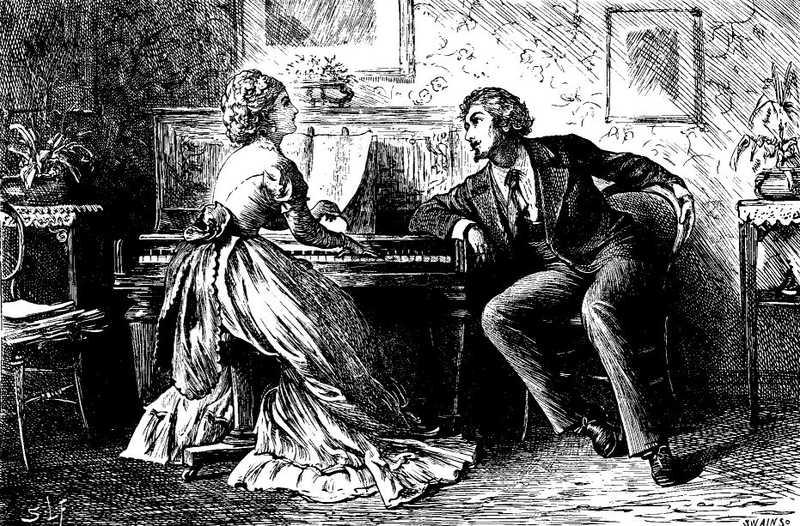
‘I am all that I used to be—towards that,’ whispered he, as she passed him to take Kate’s arm and walk away.
‘You don’t mean to have a thick neighbourhood about you,’ said Walpole. ‘Have you any people living near?’
‘Yes, we have a dear old friend—a Miss O’Shea, a maiden lady, who lives a few miles off. By the way, there’s something to show you—an old maid who hunts her own harriers.’
‘What! are you in earnest?’
‘On my word, it is true! Nina can’t endure her; but Nina doesn’t care for hare-hunting, and, I’m afraid to say, never saw a badger drawn in her life.’
‘And have you?’ asked he, almost with horror in his tone.
‘I’ll show you three regular little turnspit dogs to-morrow that will answer that question.’
‘How I wish Lockwood had come out here with me,’ said Walpole, almost uttering a thought.
‘That is, you wish he had seen a bit of barbarous Ireland he’d scarcely credit from mere description. But perhaps I’d have been better behaved before him. I’m treating you with all the freedom of an old friend of my cousin’s.’
Nina had meanwhile opened the piano, and was letting her hands stray over the instrument in occasional chords; and then in a low voice, that barely blended its tones with the accompaniment, she sang one of those little popular songs of Italy, called ‘Stornelli’—-wild, fanciful melodies, with that blended gaiety and sadness which the songs of a people are so often marked by.
‘That is a very old favourite of mine,’ said Walpole, approaching the piano as noiselessly as though he feared to disturb the singer; and now he stole into a chair at her side. ‘How that song makes me wish we were back again, where I heard it first,’ whispered he gently.
‘I forget where that was,’ said she carelessly.
‘No, Nina, you do not,’ said he eagerly; ‘it was at Albano, the day we all went to Pallavicini’s villa.’
‘And I sang a little French song, “Si vous n’avez rien à me dire,” which you were vain enough to imagine was a question addressed to yourself; and you made me a sort of declaration; do you remember all that?’
‘Every word of it.’
‘Why don’t you go and speak to my cousin; she has opened the window and gone out upon the terrace, and I trust you understand that she expects you to follow her.’ There was a studied calm in the way she spoke that showed she was exerting considerable self-control.
‘No, no, Nina, it is with you I desire to speak; to see you that I have come here.’
‘And so you do remember that you made me a declaration? It made me laugh afterwards as I thought it over.’
‘Made you laugh!’
‘Yes, I laughed to myself at the ingenious way in which you conveyed to me what an imprudence it was in you to fall in love with a girl who had no fortune, and the shock it would give your friends when they should hear she was a Greek.’
‘How can you say such painful things, Nina? how can you be so pitiless as this?’
‘It was you who had no pity, sir; I felt a deal of pity; I will not deny it was for myself. I don’t pretend to say that I could give a correct version of the way in which you conveyed to me the pain it gave you that I was not a princess, a Borromeo, or a Colonna, or an Altieri. That Greek adventurer, yes—you cannot deny it, I overheard these words myself. You were talking to an English girl, a tall, rather handsome person she was—I shall remember her name in a moment if you cannot help me to it sooner—a Lady Bickerstaffe—’
‘Yes, there was a Lady Maude Bickerstaffe; she merely passed through Rome for Naples.’
‘You called her a cousin, I remember.’
‘There is some cousinship between us; I forget exactly in what degree.’
‘Do try and remember a little more; remember that you forgot you had engaged me for the cotillon, and drove away with that blonde beauty—and she was a beauty, or had been a few years before—at all events, you lost all memory of the daughter of the adventurer.’
‘You will drive me distracted, Nina, if you say such things.’
‘I know it is wrong and it is cruel, and it is worse than wrong and cruel, it is what you English call underbred, to be so individually disagreeable, but this grievance of mine has been weighing very heavily on my heart, and I have been longing to tell you so.’
‘Why are you not singing, Nina?’ cried Kate from the terrace. ‘You told me of a duet, and I think you are bent on having it without music.’
‘Yes, we are quarrelling fiercely,’ said Nina. ‘This gentleman has been rash enough to remind me of an unsettled score between us, and as he is the defaulter—’
‘I dispute the debt.’
‘Shall I be the judge between you?’ asked Kate.
‘On no account; my claim once disputed, I surrender it,’ said Nina.
‘I must say you are very charming company. You won’t sing, and you’ll only talk to say disagreeable things. Shall I make tea, and see if it will render you more amiable?’
‘Do so, dearest, and then show Mr. Walpole the house; he has forgotten what brought him here, I really believe.’
‘You know that I have not,’ muttered he, in a tone of deep meaning.
‘There’s no light now to show him the house; Mr. Walpole must come to-morrow, when papa will be at home and delighted to see him.’
‘May I really do this?’
‘Perhaps, besides, your friend will have found the little inn so insupportable, that he too will join us. Listen to that sigh of poor Nina’s and you’ll understand what it is to be dreary!’
‘No; I want my tea.’
‘And it shall have it,’ said Kate, kissing her with a petting affectation as she left the room.
‘Now one word, only one,’ said Walpole, as he drew his chair close to her: ‘If I swear to you—’
‘What’s that? who is Kate angry with?’ cried Nina, rising and rushing towards the door. ‘What has happened?’
‘I’ll tell you what has happened,’ said Kate, as with flashing eyes and heightened colour she entered the room. ‘The large gate of the outer yard, that is every night locked and strongly barred at sunset, has been left open, and they tell me that three men have come in, Sally says five, and are hiding in some of the outhouses.’
‘What for? Is it to rob, think you?’ asked Walpole.
‘It is certainly for nothing good. They all know that papa is away, and the house so far unprotected,’ continued Kate calmly. ‘We must find out to-morrow who has left the gate unbolted. This was no accident, and now that they are setting fire to the ricks all round us, it is no time for carelessness.’
‘Shall we search the offices and the outbuildings?’ asked Walpole.
‘Of course not; we must stand by the house and take care that they do not enter it. It’s a strong old place, and even if they forced an entrance below, they couldn’t set fire to it.’
‘Could they force their way up?’ asked Walpole.
‘Not if the people above have any courage. Just come and look at the stair; it was made in times when people thought of defending themselves.’ They issued forth now together to the top of the landing, where a narrow, steep flight of stone steps descended between two walls to the basement-storey. A little more than half-way down was a low iron gate or grille of considerable strength; though, not being above four feet in height, it could have been no great defence, which seemed, after all, to have been its intention. ‘When this is closed,’ said Kate, shutting it with a heavy bang, ‘it’s not such easy work to pass up against two or three resolute people at the top; and see here,’ added she, showing a deep niche or alcove in the wall, ‘this was evidently meant for the sentry who watched the wicket: he could stand here out of the reach of all fire.’
‘Would you not say she was longing for a conflict?’ said Nina, gazing at her.
‘No, but if it comes I’ll not decline it.’
‘You mean you’ll defend the stair?’ asked Walpole.
She nodded assent.
‘What arms have you?’
‘Plenty; come and look at them. Here,’ said she, entering the dining-room, and pointing to a large oak sideboard covered with weapons, ‘Here is probably what has led these people here. They are going through the country latterly on every side, in search of arms. I believe this is almost the only house where they have not called.’
‘And do they go away quietly when their demands are complied with?’
‘Yes, when they chance upon people of poor courage, they leave them with life enough to tell the story.—What is it, Mathew?’ asked she of the old serving-man who entered the room.
‘It’s the “boys,” miss, and they want to talk to you, if you’ll step out on the terrace. They don’t mean any harm at all.’
‘What do they want, then?’
‘Just a spare gun or two, miss, or an ould pistol, or a thing of the kind that was no use.’
‘Was it not brave of them to come here, when my father was from home? Aren’t they fine courageous creatures to come and frighten two lone girls—eh, Mat?’
‘Don’t anger them, miss, for the love of Joseph! don’t say anything hard; let me hand them that ould carbine there, and the fowling-piece; and if you’d give them a pair of horse-pistols, I’m sure they’d go away quiet.’
A loud noise of knocking, as though with a stone, at the outer door, broke in upon the colloquy, and Kate passed into the drawing-room, and opened the window, out upon the stone terrace which overlooked the yard: ‘Who is there?—who are you?—what do you want?’ cried she, peering down into the darkness, which, in the shadow of the house, was deeper.
‘We’ve come for arms,’ cried a deep hoarse voice.
‘My father is away from home—come and ask for them when he’s here to answer you.’
A wild, insolent laugh from below acknowledged what they thought of this speech.
‘Maybe that was the rayson we came now, miss,’ said a voice, in a lighter tone.
‘Fine courageous fellows you are to say so! I hope Ireland has more of such brave patriotic men.’
‘You’d better leave that, anyhow,’ said another, and as he spoke he levelled and fired, but evidently with intention to terrify rather than wound, for the plaster came tumbling down from several feet above her head; and now the knocking at the door was redoubled, and with a noise that resounded through the house.
‘Wouldn’t you advise her to give up the arms and let them go?’ said Nina, in a whisper to Walpole; but though she was deadly pale there was no tremor in her voice.
‘The door is giving way, the wood is completely rotten. Now for the stairs. Mr. Walpole, you’re going to stand by me?’
‘I should think so, but I’d rather you’d remain here. I know my ground now.’
‘No, I must be beside you. You’ll have to keep a rolling fire, and I can load quicker than most people. Come along now, we must take no light with us—follow me.’
‘Take care,’ said Nina to Walpole as he passed, but with an accent so full of a strange significance it dwelt on his memory long after.
‘What was it Nina whispered you as you came by?’ said Kate.
‘Something about being cautious, I think,’ said he carelessly.
‘Stay where you are, Mathew,’ said the girl, in a severe tone, to the old servant, who was officiously pressing forward with a light.
‘Go back!’ cried she, as he persisted in following her.
‘That’s the worst of all our troubles here, Mr. Walpole,’ said she boldly; ‘you cannot depend on the people of your own household. The very people you have nursed in sickness, if they only belong to some secret association, will betray you!’ She made no secret of her words, but spoke them loud enough to be heard by the group of servants now gathered on the landing. Noiseless she tripped down the stairs, and passed into the little dark alcove, followed by Walpole, carrying any amount of guns and carbines under his arm.
‘These are loaded, I presume?’ said he.
‘All, and ready capped. The short carbine is charged with a sort of canister shot, and keep it for a short range—if they try to pass over the iron gate. Now mind me, and I will give you the directions I heard my father give on this spot once before. Don’t fire till they reach the foot of the stair.’
‘I cannot hear you,’ said he, for the din beneath, where they battered at the door, was now deafening.
‘They’ll be in in another moment—there, the lock has fallen off—the door has given way,’ whispered she; ‘be steady now, no hurry—steady and calm.’
As she spoke, the heavy oak door fell to the ground, and a perfect silence succeeded to the late din. After an instant, muttering whispers could be heard, and it seemed as if they doubted how far it was safe to enter, for all was dark within. Something was said in a tone of command, and at the moment one of the party flung forward a bundle of lighted straw and tow, which fell at the foot of the stairs, and for a few seconds lit up the place with a red lurid gleam, showing the steep stair and the iron bars of the little gate that crossed it.
‘There’s the iron wicket they spoke of,’ cried one. ‘All right, come on!’ And the speaker led the way, cautiously, however, and slowly, the others after him.
‘No, not yet,’ whispered Kate, as she pressed her hand upon Walpole’s.
‘I hear voices up there,’ cried the leader from below. ‘We’ll make them leave that, anyhow.’ And he fired off his gun in the direction of the upper part of the stair; a quantity of plaster came clattering down as the ball struck the ceiling.
‘Now,’ said she. ‘Now, and fire low!’
He discharged both barrels so rapidly that the two detonations blended into one, and the assailants replied by a volley, the echoing din almost sounding like artillery. Fast as Walpole could fire, the girl replaced the piece by another; when suddenly she cried, ‘There is a fellow at the gate—the carbine—the carbine now, and steady.’ A heavy crash and a cry followed his discharge, and snatching the weapon from him, she reloaded and handed it back with lightning speed. ‘There is another there,’ whispered she; and Walpole moved farther out, to take a steadier aim. All was still, not a sound to be heard for some seconds, when the hinges of the gate creaked and the bolt shook in the lock. Walpole fired again, but as he did so, the others poured in a rattling volley, one shot grazing his cheek, and another smashing both bones of his right arm, so that the carbine fell powerless from his hand. The intrepid girl sprang to his side at once, and then passing in front of him, she fired some shots from a revolver in quick succession. A low, confused sound of feet and a scuffling noise followed, when a rough, hoarse voice cried out, ‘Stop firing; we are wounded, and going away.’
‘Are you badly hurt?’ whispered Kate to Walpole.
‘Nothing serious: be still and listen!’
‘There, the carbine is ready again. Oh, you cannot hold it—leave it to me,’ said she.
From the difficulty of removal, it seemed as though one of the party beneath was either killed or badly wounded, for it was several minutes before they could gain the outer door.
‘Are they really retiring?’ whispered Walpole.
‘Yes; they seem to have suffered heavily.’
‘Would you not give them one shot at parting—that carbine is charged?’ asked he anxiously.
‘Not for worlds,’ said she; ‘savage as they are, it would be ruin to break faith with them.’
‘Give me a pistol, my left hand is all right.’ Though he tried to speak with calmness, the agony of pain he was suffering so overcame him that he leaned his head down, and rested it on her shoulder.
‘My poor, poor fellow,’ said she tenderly, ‘I would not for the world that this had happened.’
‘They’re gone, Miss Kate, they’ve passed out at the big gate, and they’re off,’ whispered old Mathew, as he stood trembling behind her.
‘Here, call some one, and help this gentleman up the stairs, and get a mattress down on the floor at once; send off a messenger, Sally, for Doctor Tobin. He can take the car that came this evening, and let him make what haste he can.’
‘Is he wounded?’ said Nina, as they laid him down on the floor. Walpole tried to smile and say something, but no sound came forth.
‘My own dear, dear Cecil,’ whispered Nina, as she knelt and kissed his hand, ‘tell me it is not dangerous.’ He had fainted.
CHAPTER XI
WHAT THE PAPERS SAID OF IT
The wounded man had just fallen into a first sleep after his disaster, when the press of the capital was already proclaiming throughout the land the attack and search for arms at Kilgobbin Castle. In the National papers a very few lines were devoted to the event; indeed, their tone was one of party sneer at the importance given by their contemporaries to a very ordinary incident. ‘Is there,’ asked the Convicted Felon, ‘anything very strange or new in the fact that Irishmen have determined to be armed? Is English legislation in this country so marked by justice, clemency, and generosity that the people of Ireland prefer to submit their lives and fortunes to its sway, to trusting what brave men alone trust in—their fearlessness and their daring? What is there, then, so remarkable in the repairing to Mr. Kearney’s house for a loan of those weapons of which his family for several generations have forgotten the use?’ In the Government journals the story of the attack was headed, ‘Attack on Kilgobbin Castle. Heroic resistance by a young lady’; in which Kate Kearney’s conduct was described in colours of extravagant eulogy. She was alternately Joan of Arc and the Maid of Saragossa, and it was gravely discussed whether any and what honours of the Crown were at Her Majesty’s disposal to reward such brilliant heroism. In another print of the same stamp the narrative began: ‘The disastrous condition of our country is never displayed in darker colours than when the totally unprovoked character of some outrage has to be recorded by the press. It is our melancholy task to present such a case as this to our readers to-day. If it was our wish to exhibit to a stranger the picture of an Irish estate in which all the blessings of good management, intelligence, kindliness, and Christian charity were displayed; to show him a property where the wellbeing of landlord and tenant were inextricably united, where the condition of the people, their dress, their homes, their food, and their daily comforts, could stand comparison with the most favoured English county, we should point to the Kearney estate of Kilgobbin; and yet it is here, in the very house where his ancestors have resided for generations, that a most savage and dastardly attack is made; and if we feel a sense of shame in recording the outrage, we are recompensed by the proud elation with which we can recount the repulse—the noble and gallant achievement of an Irish girl. History has the record of more momentous feats, but we doubt that there is one in the annals of any land in which a higher heroism was displayed than in this splendid defence by Miss Kearney.’ Then followed the story; not one of the papers having any knowledge of Walpole’s presence on the occasion, or the slightest suspicion that she was aided in any way.
Joe Atlee was busily engaged in conning over and comparing these somewhat contradictory reports, as he sat at his breakfast, his chum Kearney being still in bed and asleep after a late night at a ball. At last there came a telegraphic despatch for Kearney; armed with which, Joe entered the bedroom and woke him.
‘Here’s something for you, Dick,’ cried he. ‘Are you too sleepy to read it?’
‘Tear it open and see what it is, like a good fellow,’ said the other indolently.
‘It’s from your sister—at least, it is signed Kate. It says: “There is no cause for alarm. All is going on well, and papa will be back this evening. I write by this post.”’
‘What does all that mean?’ cried Dick, in surprise.
‘The whole story is in the papers. The boys have taken the opportunity of your father’s absence from home to make a demand for arms at your house, and your sister, it seems, showed fight and beat them off. They talk of two fellows being seen badly wounded, but, of course, that part of the story cannot be relied on. That they got enough to make them beat a retreat is, however, certain; and as they were what is called a strong party, the feat of resisting them is no small glory for a young lady.’
‘It was just what Kate was certain to do. There’s no man with a braver heart.’
I wonder how the beautiful Greek behaved? I should like greatly to hear what part she took in the defence of the citadel. Was she fainting or in hysterics, or so overcome by terror as to be unconscious?’
‘I’ll make you any wager you like, Kate did the whole thing herself. There was a Whiteboy attack to force the stairs when she was a child, and I suppose we rehearsed that combat fully fifty—ay, five hundred times. Kate always took the defence, and though we were sometimes four to one, she kept us back.’
‘By Jove! I think I should be afraid of such a young lady.’
‘So you would. She has more pluck in her heart than half that blessed province you come from. That’s the blood of the old stock you are often pleased to sneer at, and of which the present will be a lesson to teach you better.’
‘May not the lovely Greek be descended from some ancient stock too? Who is to say what blood of Pericles she had not in her veins? I tell you I’ll not give up the notion that she was a sharer in this glory.’
‘If you’ve got the papers with the account, let me see them, Joe. I’ve half a mind to run down by the night-mail—that is, if I can. Have you got any tin, Atlee?’
‘There were some shillings in one of my pockets last night. How much do you want?’
‘Eighteen-and-six first class, and a few shillings for a cab.’
‘I can manage that; but I’ll go and fetch you the papers, there’s time enough to talk of the journey.’
The newsman had just deposited the Croppy on the table as Joe returned to the breakfast-table, and the story of Kilgobbin headed the first column in large capitals. ‘While our contemporaries,’ it began, ‘are recounting with more than their wonted eloquence the injuries inflicted on three poor labouring men, who, in their ignorance of the locality, had the temerity to ask for alms at Kilgobbin Castle yesterday evening, and were ignominiously driven away from the door by a young lady, whose benevolence was administered through a blunderbuss, we, who form no portion of the polite press, and have no pretension to mix in what are euphuistically called the “best circles” of this capital, would like to ask, for the information of those humble classes among which our readers are found, is it the custom for young ladies to await the absence of their fathers to entertain young gentlemen tourists? and is a reputation for even heroic courage not somewhat dearly purchased at the price of the companionship of the admittedly most profligate man of a vicious and corrupt society? The heroine who defended Kilgobbin can reply to our query.’
Joe Atlee read this paragraph three times over before he carried in the paper to Kearney.
‘Here’s an insolent paragraph, Dick,’ he cried, as he threw the paper to him on the bed. ‘Of course it’s a thing cannot be noticed in any way, but it’s not the less rascally for that.’
‘You know the fellow who edits this paper, Joe?’ said Kearney, trembling with passion.
‘No; my friend is doing his bit of oakum at Kilmainham. They gave him thirteen months, and a fine that he’ll never be able to pay; but what would you do if the fellow who wrote it were in the next room at this moment?’
‘Thrash him within an inch of his life.’
‘And, with the inch of life left him, he’d get strong again and write at you and all belonging to you every day of his existence. Don’t you see that all this license is one of the prices of liberty? There’s no guarding against excesses when you establish a rivalry. The doctors could tell you how many diseased lungs and aneurisms are made by training for a rowing match.’
‘I’ll go down by the mail to-night and see what has given the origin to this scandalous falsehood.’
‘There’s no harm in doing that, especially if you take me with you.’
‘Why should I take you, or for what?’
‘As guide, counsellor, and friend.’
‘Bright thought, when all the money we can muster between us is only enough for one fare.’
‘Doubtless, first class; but we could go third class, two of us for the same money. Do you imagine that Damon and Pythias would have been separated if it came even to travelling in a cow compartment?’
‘I wish you could see that there are circumstances in life where the comic man is out of place.’
‘I trust I shall never discover them; at least, so long as Fate treats me with “heavy tragedy.”’
‘I’m not exactly sure, either, whether they ‘d like to receive you just now at Kilgobbin.’
‘Inhospitable thought! My heart assures me of a most cordial welcome.’
‘And I should only stay a day or two at farthest.’
‘Which would suit me to perfection. I must be back here by Tuesday if I had to walk the distance.’
‘Not at all improbable, so far as I know of your resources.’
‘What a churlish dog it is! Now had you, Master Dick, proposed to me that we should go down and pass a week at a certain small thatched cottage on the banks of the Ban, where a Presbyterian minister with eight olive branches vegetates, discussing tough mutton and tougher theology on Sundays, and getting through the rest of the week with the parables and potatoes, I’d have said, Done!’
‘It was the inopportune time I was thinking of. Who knows what confusion this event may not have thrown them into? If you like to risk the discomfort, I make no objection.’
‘To so heartily expressed an invitation there can be but one answer, I yield.’
‘Now look here, Joe, I’d better be frank with you: don’t try it on at Kilgobbin as you do with me.’
‘You are afraid of my insinuating manners, are you?’
‘I am afraid of your confounded impudence, and of that notion you cannot get rid of, that your cool familiarity is a fashionable tone.’
‘How men mistake themselves. I pledge you my word, if I was asked what was the great blemish in my manner, I’d have said it was bashfulness.’
‘Well, then, it is not!’
‘Are you sure, Dick, are you quite sure?’
‘I am quite sure, and unfortunately for you, you’ll find that the majority agree with me.’
‘“A wise man should guard himself against the defects that he might have, without knowing it.” That is a Persian proverb, which you will find in Hafiz. I believe you never read Hafiz!’
‘No, nor you either.’
‘That’s true; but I can make my own Hafiz, and just as good as the real article. By the way, are you aware that the water-carriers at Tehran sing Lalla Rookh, and believe it a national poem?’
‘I don’t know, and I don’t care.’
‘I’ll bring down an Anacreon with me, and see if the Greek cousin can spell her way through an ode.’
‘And I distinctly declare you shall do no such thing.’
‘Oh dear, oh dear, what an unamiable trait is envy! By the way, was that your frock-coat I wore yesterday at the races?’
‘I think you know it was; at least you remembered it when you tore the sleeve.’
‘True, most true; that torn sleeve was the reason the rascal would only let me have fifteen shillings on it.’
‘And you mean to say you pawned my coat?’
‘I left it in the temporary care of a relative, Dick; but it is a redeemable mortgage, and don’t fret about it.’
‘Ever the same!’
‘No, Dick, that means worse and worse! Now, I am in the process of reformation. The natural selection, however, where honesty is in the series, is a slow proceeding, and the organic changes are very complicated. As I know, however, you attach value to the effect you produce in that coat, I’ll go and recover it. I shall not need Terence or Juvenal till we come back, and I’ll leave them in the avuncular hands till then.’
‘I wonder you’re not ashamed of these miserable straits.’
‘I am very much ashamed of the world that imposes them on me. I’m thoroughly ashamed of that public in lacquered leather, that sees me walking in broken boots. I’m heartily ashamed of that well-fed, well-dressed, sleek society, that never so much as asked whether the intellectual-looking man in the shabby hat, who looked so lovingly at the spiced beef in the window, had dined yet, or was he fasting for a wager?’
‘There, don’t carry away that newspaper; I want to read over that pleasant paragraph again!’
CHAPTER XII
THE JOURNEY TO THE COUNTRY
The two friends were deposited at the Moate station at a few minutes after midnight, and their available resources amounting to something short of two shillings, and the fare of a car and horse to Kilgobbin being more than three times that amount, they decided to devote their small balance to purposes of refreshment, and then set out for the castle on foot.
‘It is a fine moonlight; I know all the short cuts, and I want a bit of walking besides,’ said Kearney; and though Joe was of a self-indulgent temperament, and would like to have gone to bed after his supper and trusted to the chapter of accidents to reach Kilgobbin by a conveyance some time, any time, he had to yield his consent and set out on the road.
‘The fellow who comes with the letter-bag will fetch over our portmanteau,’ said Dick, as they started.
‘I wish you’d give him directions to take charge of me, too,’ said Joe, who felt very indisposed to a long walk.
‘I like you,’ said Dick sneeringly; ‘you are always telling me that you are the sort of fellow for a new colony, life in the bush, and the rest of it, and when it conies to a question of a few miles’ tramp on a bright night in June, you try to skulk it in every possible way. You’re a great humbug, Master Joe.’
‘And you a very small humbug, and there lies the difference between us. The combinations in your mind are so few, that, as in a game of only three cards, there is no skill in the playing; while in my nature, as in that game called tarocco, there are half-a-dozen packs mixed up together, and the address required to play them is considerable.’
‘You have a very satisfactory estimate of your own abilities, Joe.’
‘And why not? If a clever fellow didn’t know he was clever, the opinion of the world on his superiority would probably turn his brain.’
‘And what do you say if his own vanity should do it?’
‘There is really no way of explaining to a fellow like you—’
‘What do you mean by a fellow like me?’ broke in Dick, somewhat angrily.
‘I mean this, that I’d as soon set to work to explain the theory of exchequer bonds to an Eskimo, as to make an unimaginative man understand something purely speculative. What you, and scores of fellows like you, denominate vanity, is only another form of hopefulness. You and your brethren—for you are a large family—do you know what it is to Hope! that is, you have no idea of what it is to build on the foundation of certain qualities you recognise in yourself, and to say that “if I can go so far with such a gift, such another will help me on so much farther.”’
‘I tell you one thing I do hope, which is, that the next time I set out a twelve miles’ walk, I’ll have a companion less imbued with self-admiration.’
‘And you might and might not find him pleasanter company. Cannot you see, old fellow, that the very things you object to in me are what are wanting in you? they are, so to say, the compliments of your own temperament.’
‘Have you a cigar?’
‘Two—take them both. I’d rather talk than smoke just now.’
‘I am almost sorry for it, though it gives me the tobacco.’
‘Are we on your father’s property yet?’
‘Yes; part of that village we came through belongs to us, and all this bog here is ours.’
‘Why don’t you reclaim it? labour costs a mere nothing in this country. Why don’t you drain those tracts, and treat the soil with lime? I’d live on potatoes, I’d make my family live on potatoes, and my son, and my grandson, for three generations, but I’d win this land back to culture and productiveness.’
‘The fee-simple of the soil wouldn’t pay the cost. It would be cheaper to save the money and buy an estate.’
‘That is one, and a very narrow view of it; but imagine the glory of restoring a lost tract to a nation, welcoming back the prodigal, and installing him in his place amongst his brethren. This was all forest once. Under the shade of the mighty oaks here those gallant O’Caharneys your ancestors followed the chase, or rested at noontide, or skedaddled in double-quick before those smart English of the Pale, who I must say treated your forbears with scant courtesy.’
‘We held our own against them for many a year.’
‘Only when it became so small it was not worth taking. Is not your father a Whig?’
‘He’s a Liberal, but he troubles himself little about parties.’
‘He’s a stout Catholic, though, isn’t he?’
‘He is a very devout believer in his Church,’ said Dick with the tone of one who did not desire to continue the theme.
‘Then why does he stop at Whiggery? why not go in for Nationalism and all the rest of it?’
‘And what’s all the rest of it?’
‘Great Ireland—no first flower of the earth or gem of the sea humbug—but Ireland great in prosperity, her harbours full of ships, the woollen trade, her ancient staple, revived: all that vast unused water-power, greater than all the steam of Manchester and Birmingham tenfold, at full work; the linen manufacture developed and promoted—’
‘And the Union repealed?’
‘Of course; that should be first of all. Not that I object to the Union, as many do, on the grounds of English ignorance as to Ireland. My dislike is, that, for the sake of carrying through certain measures necessary to Irish interests, I must sit and discuss questions which have no possible concern for me, and touch me no more than the debates in the Cortes, or the Reichskammer at Vienna. What do you or I care for who rules India, or who owns Turkey? What interest of mine is it whether Great Britain has five ironclads or fifty, or whether the Yankees take Canada, and the Russians Kabul?’
‘You’re a Fenian, and I am not.’
‘I suppose you’d call yourself an Englishman?’
‘I am an English subject, and I owe my allegiance to England.’
‘Perhaps for that matter, I owe some too; but I owe a great many things that I don’t distress myself about paying.’
‘Whatever your sentiments are on these matters—and, Joe, I am not disposed to think you have any very fixed ones—pray do me the favour to keep them to yourself while under my father’s roof. I can almost promise you he’ll obtrude none of his peculiar opinions on you, and I hope you will treat him with a like delicacy.’
‘What will your folks talk, then? I can’t suppose they care for books, art, or the drama. There is no society, so there can be no gossip. If that yonder be the cabin of one of your tenants, I’ll certainly not start the question of farming.’
‘There are poor on every estate,’ said Dick curtly.
‘Now what sort of a rent does that fellow pay—five pounds a year?’
‘More likely five-and-twenty or thirty shillings.’
‘By Jove, I’d like to set up house in that fashion, and make love to some delicately-nurtured miss, win her affections, and bring her home to such a spot. Wouldn’t that be a touchstone of affection, Dick?’
‘If I could believe you were in earnest, I’d throw you neck and heels into that bog-hole.’
‘Oh, if you would!’ cried he, and there was a ring of truthfulness in his voice now there could be no mistaking. Half-ashamed of the emotion his idle speech had called up, and uncertain how best to treat the emergency, Kearney said nothing, and Atlee walked on for miles without a word.
‘You can see the house now. It tops the trees yonder,’ said Dick.
‘That is Kilgobbin Castle, then?’ said Joe slowly.
‘There’s not much of castle left about it. There is a square block of a tower, and you can trace the moat and some remains of outworks.’
‘Shall I make you a confession, Dick? I envy you all that! I envy you what smacks of a race, a name, an ancestry, a lineage. It’s a great thing to be able to “take up the running,” as folks say, instead of making all the race yourself; and there’s one inestimable advantage in it, it rescues you from all indecent haste about asserting your station. You feel yourself to be a somebody and you’ve not hurried to proclaim it. There now, my boy, if you’d have said only half as much as that on the score of your family, I’d have called you an arrant snob. So much for consistency.’
‘What you have said gave me pleasure, I’ll own that.’
‘I suppose it was you planted those trees there. It was a nice thought, and makes the transition from the bleak bog to the cultivated land more easy and graceful. Now I see the castle well. It’s a fine portly mass against the morning sky, and I perceive you fly a flag over it.’
‘When the lord is at home.’
‘Ay, and by the way, do you give him his title while talking to him here?’
‘The tenants do, and the neighbours and strangers do as they please about it.’
‘Does he like it himself?’
‘If I was to guess, I should perhaps say he does like it. Here we are now. Inside this low gate you are within the demesne, and I may bid you welcome to Kilgobbin. We shall build a lodge here one of these days. There’s a good stretch, however, yet to the castle. We call it two miles, and it’s not far short of it.’
‘What a glorious morning. There is an ecstasy in scenting these nice fresh woods in the clear sunrise, and seeing those modest daffodils make their morning toilet.’
‘That’s a fancy of Kate’s. There is a border of such wild flowers all the way to the house.’
‘And those rills of clear water that flank the road, are they of her designing?’
‘That they are. There was a cutting made for a railroad line about four miles from this, and they came upon a sort of pudding-stone formation, made up chiefly of white pebbles. Kate heard of it, purchased the whole mass, and had these channels paved with them from the gate to the castle, and that’s the reason this water has its crystal clearness.’
‘She’s worthy of Shakespeare’s sweet epithet, the “daintiest Kate in Christendom.” Here’s her health!’ and he stooped down, and filling his palm with the running water, drank it off.
‘I see it’s not yet five o’clock. We’ll steal quietly off to bed, and have three or four hours sleep before we show ourselves.’
CHAPTER XIII
A SICK-ROOM
Cecil Walpole occupied the state-room and the state-bed at Kilgobbin Castle; but the pain of a very serious wound had left him very little faculty to know what honour was rendered him, or of what watchful solicitude he was the object. The fever brought on by his wound had obliterated in his mind all memory of where he was; and it was only now—that is, on the same morning that the young men had arrived at the castle—that he was able to converse without much difficulty, and enjoy the companionship of Lockwood, who had come over to see him and scarcely quitted his bedside since the disaster.
It seems going on all right,’ said Lockwood, as he lifted the iced cloths to look at the smashed limb, which lay swollen and livid on a pillow outside the clothes.
‘It’s not pretty to look at, Harry; but the doctor says “we shall save it”—his phrase for not cutting it off.’
‘They’ve taken up two fellows on suspicion, and I believe they were of the party here that night.’
‘I don’t much care about that. It was a fair fight, and I suspect I did not get the worst of it. What really does grieve me is to think how ingloriously one gets a wound that in real war would have been a title of honour.’
‘If I had to give a V.C. for this affair, it would be to that fine girl I’d give it, and not to you, Cecil.’
‘So should I. There is no question whatever as to our respective shares in the achievement.’
‘And she is so modest and unaffected about it all, and when she was showing me the position and the alcove, she never ceased to lay stress on the safety she enjoyed during the conflict.’
‘Then she said nothing about standing in front of me after I was wounded?’
‘Not a word. She said a great deal about your coolness and indifference to danger, but nothing about her own.’
‘Well, I suppose it’s almost a shame to own it—not that I could have done anything to prevent it—but she did step down one step of the stair and actually cover me from fire.’
‘She’s the finest girl in Europe,’ said Lockwood warmly.
‘And if it was not the contrast with her cousin, I’d almost say one of the handsomest,’ said Cecil.
‘The Greek is splendid, I admit that, though she’ll not speak—she’ll scarcely notice me.’
‘How is that?’
‘I can’t imagine, except it might have been, an awkward speech I made when we were talking over the row. I said, “Where were you? what were you doing all this time? “’
‘And what answer did she make you?’
‘None; not a word. She drew herself proudly up, and opened her eyes so large and full upon me, that I felt I must have appeared some sort of monster to be so stared at.’
‘I’ve seen her do that.’
‘It was very grand and very beautiful; but I’ll be shot if I’d like to stand under it again. From that time to this she has never deigned me more than a mere salutation.’
‘And are you good friends with the other girl?’
‘The best in the world. I don’t see much of her, for she’s always abroad, over the farm, or among the tenants: but when we meet we are very cordial and friendly.’
‘And the father, what is he like?’
‘My lord is a glorious old fellow, full of hospitable plans and pleasant projects; but terribly distressed to think that this unlucky incident should prejudice you against Ireland. Indeed, he gave me to understand that there must have been some mistake or misconception in the matter, for the castle had never been attacked before; and he insists on saying that if you will stop here—I think he said ten years—you’ll not see another such occurrence.’
‘It’s rather a hard way to test the problem though.’
‘What’s more, he included me in the experiment.’
‘And this title? Does he assume it, or expect it to be recognised?’
‘I can scarcely tell you. The Greek girl “my lords” him occasionally; his daughter, never. The servants always do so; and I take it that people use their own discretion about it.’
‘Or do it in a sort of indolent courtesy, as they call Marsala, sherry, but take care at the same time to pass the decanter. I believe you telegraphed to his Excellency?’
‘Yes; and he means to come over next week.’
‘Any news of Lady Maude?’
‘Only that she comes with him, and I’m sorry for it.’
‘So am I—deuced sorry! In a gossiping town like Dublin there will be surely some story afloat about these handsome girls here. She saw the Greek, too, at the Duke of Rigati’s ball at Rome, and she never forgets a name or a face. A pleasant trait in a wife.’
‘Of course the best plan will be to get removed, and be safely installed in our old quarters at the Castle before they arrive.’
‘We must hear what the doctor says.’
‘He’ll say no, naturally, for he’ll not like to lose his patient. He will have to convey you to town, and we’ll try and make him believe it will be the making of him. Don’t you agree with me, Cecil, it’s the thing to do?’
‘I have not thought it over yet. I will to-day. By the way, I know it’s the thing to do,’ repeated he, with an air of determination. ‘There will be all manner of reports, scandals, and falsehoods to no end about this business here; and when Lady Maude learns, as she is sure to learn, that the “Greek girl” is in the story, I cannot measure the mischief that may come of it.’
‘Break off the match, eh?’
‘That is certainly “on the cards.”’
‘I suspect even that would not break your heart.’
‘I don’t say it would, but it would prove very inconvenient in many ways. Danesbury has great claims on his party. He came here as Viceroy dead against his will, and, depend upon it, he made his terms. Then if these people go out, and the Tories want to outbid them, Danesbury could take—ay, and would take—office under them.’
‘I cannot follow all that. All I know is, I like the old boy himself, though he is a bit pompous now and then, and fancies he’s Emperor of Russia.’
‘I wish his niece didn’t imagine she was an imperial princess.’
‘That she does! I think she is the haughtiest girl I ever met. To be sure she was a great beauty.’
‘Was, Harry! What do you mean by “was”? Lady Maude is not eight-and-twenty.’
‘Ain’t she, though? Will you have a ten-pound note on it that she’s not over thirty-one; and I can tell you who could decide the wager?’
‘A delicate thought!—a fellow betting on the age of the girl he’s going to marry!’

‘Ten o’clock!—nearly half-past ten!’ said Lockwood, rising from his chair. ‘I must go and have some breakfast. I meant to have been down in time to-day, and breakfasted with the old fellow and his daughter; for coming late brings me to a tête-à-tête with the Greek damsel, and it isn’t jolly, I assure you.’
‘Don’t you speak?’
‘Never a word?’ She’s generally reading a newspaper when I go in. She lays it down; but after remarking that she fears I’ll find the coffee cold, she goes on with her breakfast, kisses her Maltese terrier, asks him a few questions about his health, and whether he would like to be in a warmer climate, and then sails away.’
‘And how she walks!’
‘Is she bored here?’
‘She says not.’
‘She can scarcely like these people; they ‘re not the sort of thing she has ever been used to.’
‘She tells me she likes them: they certainly like her.’
‘Well,’ said Lockwood, with a sigh, ‘she’s the most beautiful woman, certainly, I’ve ever seen; and, at this moment, I’d rather eat a crust with a glass of beer under a hedge than I’d go down and sit at breakfast with her.’
‘I’ll be shot if I’ll not tell her that speech the first day I’m down again.’
‘So you may, for by that time I shall have seen her for the last time.’ And with this he strolled out of the room and down the stairs towards the breakfast-parlour.
As he stood at the door he heard the sound of voices laughing and talking pleasantly. He entered, and Nina arose as he came forward, and said, ‘Let me present my cousin—Mr. Richard Kearney, Major Lockwood; his friend, Mr. Atlee.’
The two young men stood up—Kearny stiff and haughty, and Atlee with a sort of easy assurance that seemed to suit his good-looking but certainly snobbish style. As for Lockwood, he was too much a gentleman to have more than one manner, and he received these two men as he would have received any other two of any rank anywhere.
‘These gentlemen have been showing me some strange versions of our little incident here in the Dublin papers,’ said Nina to Lockwood. ‘I scarcely thought we should become so famous.’
‘I suppose they don’t stickle much for truth,’ said Lockwood, as he broke his egg in leisurely fashion.
‘They were scarcely able to provide a special correspondent for the event,’ said Atlee; ‘but I take it they give the main facts pretty accurately and fairly.’
‘Indeed!’ said Lockwood, more struck by the manner than by the words of the speaker. ‘They mention, then, that my friend received a bad fracture of the forearm.’
‘No, I don’t think they do; at least so far as I have seen. They speak of a night attack on Kilgobbin Castle, made by an armed party of six or seven men with faces blackened, and their complete repulse through the heroic conduct of a young lady.’
‘The main facts, then, include no mention of poor Walpole and his misfortune?’
‘I don’t think that we mere Irish attach any great importance to a broken arm, whether it came of a cricket-ball or gun; but we do interest ourselves deeply when an Irish girl displays feats of heroism and courage that men find it hard to rival.’
‘It was very fine,’ said Lockwood gravely.
‘Fine! I should think it was fine!’ burst out Atlee. ‘It was so fine that, had the deed been done on the other side of this narrow sea, the nation would not have been satisfied till your Poet Laureate had commemorated it in verse.’
‘Have they discovered any traces of the fellows?’ said Lockwood, who declined to follow the discussion into this channel.
‘My father has gone over to Moate to-day,’ said Kearney, now speaking for the first time, ‘to hear the examination of two fellows who have been taken up on suspicion.’
‘You have plenty of this sort of thing in your country,’ said Atlee to Nina.
‘Where do you mean when you say my country?’
‘I mean Greece.’
‘But I have not seen Greece since I was a child, so high; I have lived always in Italy.’
‘Well, Italy has Calabria and the Terra del Lavoro.’
‘And how much do we in Rome know about either?’
‘About as much,’ said Lockwood, ‘as Belgravia does of the Bog of Allen.’
‘You’ll return to your friends in civilised life with almost the fame of an African traveller, Major Lockwood,’ said Atlee pertly.
‘If Africa can boast such hospitality, I certainly rather envy than compassionate Doctor Livingstone,’ said he politely.
‘Somebody,’ said Kearney dryly, ‘calls hospitality the breeding of the savage.’
‘But I deny that we are savage,’ cried Atlee. ‘I contend for it that all our civilisation is higher, and that class for class we are in a more advanced culture than the English; that your chawbacon is not as intelligent a being as our bogtrotter; that your petty shopkeeper is inferior to ours; that throughout our middle classes there is not only a higher morality but a higher refinement than with you.’
‘I read in one of the most accredited journals of England the other day that Ireland had never produced a poet, could not even show a second-rate humorist,’ said Kearney.
‘Swift and Sterne were third-rate, or perhaps, English,’ said Atlee.
‘These are themes I’ll not attempt to discuss,’ said Lockwood; ‘but I know one thing, it takes three times as much military force to govern the smaller island.’
‘That is to say, to govern the country after your fashion; but leave it to ourselves. Pack your portmanteaus and go away, and then see if we’ll need this parade of horse, foot, and dragoons; these batteries of guns and these brigades of peelers.’
‘You’d be the first to beg us to come back again.’
‘Doubtless, as the Greeks are begging the Turks. Eh, mademoiselle; can you fancy throwing yourself at the feet of a Pasha and asking leave to be his slave?’
‘The only Greek slave I ever heard of,’ said Lockwood, ‘was in marble and made by an American.’
‘Come into the drawing-room and I’ll sing you something,’ said Nina, rising.
‘Which will be far nicer and pleasanter than all this discussion,’ said Joe.
‘And if you’ll permit me,’ said Lockwood, ‘we’ll leave the drawing-room door open and let poor Walpole hear the music.’
‘Would it not be better first to see if he’s asleep?’ said she.
‘That’s true. I’ll step up and see.’
Lockwood hurried away, and Joe Atlee, leaning back in his chair, said, ‘Well, we gave the Saxon a canter, I think. As you know, Dick, that fellow is no end of a swell.’
‘You know nothing about him,’ said the other gruffly.
‘Only so much as newspapers could tell me. He’s Master of the Horse in the Viceroy’s household, and the other fellow is Private Secretary, and some connection besides. I say, Dick, it’s all King James’s times back again. There has not been so much grandeur here for six or eight generations.’
‘There has not been a more absurd speech made than that, within the time.’
‘And he is really somebody?’ said Nina to Atlee.
‘A gran signore davvero,’ said he pompously. ‘If you don’t sing your very best for him, I’ll swear you are a republican.’
‘Come, take my arm, Nina. I may call you Nina, may I not?’ whispered Kearney.
‘Certainly, if I may call you Joe.’
‘You may, if you like,’ said he roughly, ‘but my name is Dick.’
‘I am Beppo, and very much at your orders,’ said Atlee, stepping forward and leading her away.
CHAPTER XIV
AT DINNER
They were assembled in the drawing-room before dinner, when Lord Kilgobbin arrived, heated, dusty, and tired, after his twelve miles’ drive. ‘I say, girls,’ said he, putting his head inside the door, ‘is it true that our distinguished guest is not coming down to dinner, for, if so, I’ll not wait to dress?’
‘No, papa; he said he’d stay with Mr. Walpole. They’ve been receiving and despatching telegrams all day, and seem to have the whole world on their hands,’ said Kate.
‘Well, sir, what did you do at the sessions?’
‘Yes, my lord,’ broke in Nina, eager to show her more mindful regard to his rank than Atlee displayed; ‘tell us your news?’
‘I suspect we have got two of them, and are on the traces of the others. They are Louth men, and were sent special here to give me a lesson, as they call it. That’s what our blessed newspapers have brought us to. Some idle vagabond, at his wits’ end for an article, fastens on some unlucky country gentleman, neither much better nor worse than his neighbours, holds him up to public reprobation, perfectly sure that within a week’s time some rascal who owes him a grudge—the fellow he has evicted for non-payment of rent, the blackguard he prosecuted for perjury, or some other of the like stamp—will write a piteous letter to the editor, relating his wrongs. The next act of the drama is a notice on the hall door, with a coffin at the top; and the piece closes with a charge of slugs in your body, as you are on your road to mass. Now, if I had the making of the laws, the first fellow I’d lay hands on would be the newspaper writer. Eh, Master Atlee, am I right?’
‘I go with you to the furthest extent, my lord.’
‘I vote we hang Joe, then,’ cried Dick. ‘He is the only member of the fraternity I have any acquaintance with.’
‘What—do you tell me that you write for the papers?’ asked my lord slyly.
‘He’s quizzing, sir; he knows right well I have no gifts of that sort.’
‘Here’s dinner, papa. Will you give Nina your arm? Mr. Atlee, you are to take me.’
‘You’ll not agree with me, Nina, my dear,’ said the old man, as he led her along; ‘but I’m heartily glad we have not that great swell who dined with us yesterday.’
‘I do agree with you, uncle—I dislike him.’
‘Perhaps I am unjust to him; but I thought he treated us all with a sort of bland pity that I found very offensive.’
‘Yes; I thought that too. His manner seemed to say, “I am very sorry for you, but what can be done?”’
‘Is the other fellow—the wounded one—as bad?’
She pursed up her lip, slightly shrugged her shoulders, and then said, ‘There’s not a great deal to choose between them; but I think I like him better.’
‘How do you like Dick, eh?’ said he, in a whisper.
‘Oh, so much,’ said she, with one of her half-downcast looks, but which never prevented her seeing what passed in her neighbour’s face.
‘Well, don’t let him fall in love with you,’ said he, with a smile, ‘for it would be bad for you both.’
‘But why should he?’ said she, with an air of innocence.
‘Just because I don’t see how he is to escape it. What’s Master Atlee saying to you, Kitty?’
‘He’s giving me some hints about horse-breaking,’ said she quietly.
‘Is he, by George? Well, I ‘d like to see him follow you over that fallen timber in the back lawn. We’ll have you out, Master Joe, and give you a field-day to-morrow,’ said the old man.
‘I vote we do,’ cried Dick; ‘unless, better still, we could persuade Miss Betty to bring the dogs over and give us a cub-hunt.’
‘I want to see a cub-hunt,’ broke in Nina.
‘Do you mean that you ride to hounds, Cousin Nina?’ asked Dick.
‘I should think that any one who has taken the ox-fences on the Roman Campagna, as I have, might venture to face your small stone-walls here.’
‘That’s plucky, anyhow; and I hope, Joe, it will put you on your metal to show yourself worthy of your companionship. What is old Mathew looking so mysteriously about? What do you want?’
The old servant thus addressed had gone about the room with the air of one not fully decided to whom to speak, and at last he leaned over Miss Kearney’s shoulder, and whispered a few words in her ear. ‘Of course not, Mat!’ said she, and then turning to her father—‘Mat has such an opinion of my medical skill, he wants me to see Mr. Walpole, who, it seems, has got up, and evidently increased his pain by it.’
‘Oh, but is there no doctor near us?’ asked Nina eagerly.
‘I’d go at once,’ said Kate frankly, ‘but my skill does not extend to surgery.’
‘I have some little knowledge in that way: I studied and walked the hospitals for a couple of years,’ broke out Joe. ‘Shall I go up to him?’
‘By all means,’ cried several together, and Joe rose and followed Mathew upstairs.
‘Oh, are you a medical man?’ cried Lockwood, as the other entered.
‘After a fashion, I may say I am. At least, I can tell you where my skill will come to its limit, and that is something.’
‘Look here, then—he would insist on getting up, and I fear he has displaced the position of the bones. You must be very gentle, for the pain is terrific.’
‘No; there’s no great mischief done—the fractured parts are in a proper position. It is the mere pain of disturbance. Cover it all over with the ice again, and’—here he felt his pulse—‘let him have some weak brandy-and-water.’
‘That’s sensible advice—I feel it. I am shivery all over,’ said Walpole.
‘I’ll go and make a brew for you,’ cried Joe, ‘and you shall have it as hot as you can drink it.’
He had scarcely left the room, when he returned with the smoking compound.
‘You’re such a jolly doctor,’ said Walpole, ‘I feel sure you’d not refuse me a cigar?’
‘Certainly not.’
‘Only think! that old barbarian who was here this morning said I was to have nothing but weak tea or iced lemonade.’
Lockwood selected a mild-looking weed, and handed it to his friend, and was about to offer one to Atlee, when he said—
‘But we have taken you from your dinner—pray go back again.’
‘No, we were at dessert. I’ll stay here and have a smoke, if you will let me. Will it bore you, though?’
‘On the contrary,’ said Walpole, ‘your company will be a great boon to us; and as for myself, you have done me good already.’
‘What would you say, Major Lockwood, to taking my place below-stairs? They are just sitting over their wine—some very pleasant claret—and the young ladies, I perceive, here, give half an hour of their company before they leave the dining-room.’
‘Here goes, then,’ said Lockwood. ‘Now that you remind me of it, I do want a glass of wine.’
Lockwood found the party below-stairs eagerly discussing Joe Atlee’s medical qualifications, and doubting whether, if it was a knowledge of civil engineering or marine gunnery had been required, he would not have been equally ready to offer himself for the emergency.
‘I’ll lay my life on it, if the real doctor arrives, Joe will take the lead in the consultation,’ cried Dick: ‘he is the most unabashable villain in Europe.’
‘Well, he has put Cecil all right,’ said Lockwood: ‘he has settled the arm most comfortably on the pillow, the pain is decreasing every moment, and by his pleasant and jolly talk he is making Walpole even forget it at times.’
This was exactly what Atlee was doing. Watching carefully the sick man’s face, he plied him with just that amount of amusement that he could bear without fatigue. He told him the absurd versions that had got abroad of the incident in the press; and cautiously feeling his way, went on to tell how Dick Kearney had started from town full of the most fiery intentions towards that visitor whom the newspapers called a ‘noted profligate’ of London celebrity. ‘If you had not been shot before, we were to have managed it for you now,’ said he.
‘Surely these fellows who wrote this had never heard of me.’
‘Of course they had not, further than you were on the Viceroy’s staff; but is not that ample warranty for profligacy? Besides, the real intention was not to assail you, but the people here who admitted you.’ Thus talking, he led Walpole to own that he had no acquaintanceship with the Kearneys, that a mere passing curiosity to see the interesting house had provoked his request, to which the answer, coming from an old friend, led to his visit. Through this channel Atlee drew him on to the subject of the Greek girl and her parentage. As Walpole sketched the society of Rome, Atlee, who had cultivated the gift of listening fully as much as that of talking, knew where to seem interested by the views of life thrown out, and where to show a racy enjoyment of the little humoristic bits of description which the other was rather proud of his skill in deploying; and as Atlee always appeared so conversant with the family history of the people they were discussing, Walpole spoke with unbounded freedom and openness.
‘You must have been astonished to meet the “Titian Girl” in Ireland?’ said Joe at last, for he had caught up the epithet dropped accidentally in the other’s narrative, and kept it for use.
‘Was I not! but if my memory had been clearer, I should have remembered she had Irish connections. I had heard of Lord Kilgobbin on the other side of the Alps.’
‘I don’t doubt that the title would meet a readier acceptance there than here.’
‘Ah, you think so!’ cried Walpole. ‘What is the meaning of a rank that people acknowledge or deny at pleasure? Is this peculiar to Ireland?’
‘If you had asked whether persons anywhere else would like to maintain such a strange pretension, I might perhaps have answered you.’
‘For the few minutes of this visit to me, I liked him; he seemed frank, hearty, and genial.’
‘I suppose he is, and I suspect this folly of the lordship is no fancy of his own.’
‘Nor the daughter’s, then, I’ll be bound?’
‘No; the son, I take it, has all the ambition of the house.’
‘Do you know them well?’
‘No, I never saw them till yesterday. The son and I are chums: we live together, and have done so these three years.’
‘You like your visit here, however?’
‘Yes. It’s rather good fun on the whole. I was afraid of the indoor life when I was coming down, but it’s pleasanter than I looked for.’
‘When I asked you the question, it was not out of idle curiosity. I had a strong personal interest in your answer. In fact, it was another way of inquiring whether it would be a great sacrifice to tear yourself away from this.’
‘No, inasmuch as the tearing-away process must take place in a couple of days—three at farthest.’
‘That makes what I have to propose all the easier. It is a matter of great urgency for me to reach Dublin at once. This unlucky incident has been so represented by the newspapers as to give considerable uneasiness to the Government, and they are even threatened with a discussion on it in the House. Now, I’d start to-morrow, if I thought I could travel with safety. You have so impressed me with your skill, that, if I dared, I’d ask you to convoy me up. Of course I mean as my physician.’
‘But I’m not one, nor ever intend to be.’
‘You studied, however?’
‘As I have done scores of things. I know a little bit of criminal law, have done some shipbuilding, rode haute école in Cooke’s circus, and, after M. Dumas, I am considered the best amateur macaroni-maker in Europe.’
‘And which of these careers do you intend to abide by?’
‘None, not one of them. “Financing” is the only pursuit that pays largely. I intend to go in for money.’
‘I should like to hear your ideas on that subject.’
‘So you shall, as we travel up to town.’
‘You accept my offer, then?’
‘Of course I do. I am delighted to have so many hours in your company. I believe I can safely say I have that amount of skill to be of service to you. One begins his medical experience with fractures. They are the pothooks and hangers of surgery, and I have gone that far. Now, what are your plans?’
‘My plans are to leave this early to-morrow, so as to rest during the hot hours of the day, and reach Dublin by nightfall. Why do you smile?’
‘I smile at your notion of climate; but I never knew any man who had been once in Italy able to disabuse himself of the idea that there were three or four hours every summer day to be passed with closed shutters and iced drinks.’
‘Well, I believe I was thinking of a fiercer sun and a hotter soil than these. To return to my project: we can find means of posting, carriage and horses, in the village. I forget its name.’
‘I’ll take care of all that. At what hour will you start?’
‘I should say by six or seven. I shall not sleep; and I shall be all impatience till we are away.’
‘Well, is there anything else to be thought of?’
‘There is—that is, I have something on my mind, and I am debating with myself how far, on a half-hour’s acquaintance, I can make you a partner in it.’
‘I cannot help you by my advice. I can only say that if you like to trust me, I’ll know how to respect the confidence.’
Walpole looked steadily and steadfastly at him, and the examination seemed to satisfy him, for he said, ‘I will trust you—not that the matter is a secret in any sense that involves consequences; but it is a thing that needs a little tact and discretion, a slight exercise of a light hand, which is what my friend Lockwood fails in. Now you could do it.’
‘If I can, I will. What is it?’
‘Well, the matter is this. I have written a few lines here, very illegibly and badly, as you may believe, for they were with my left hand; and besides having the letter conveyed to its address, I need a few words of explanation.’
‘The Titian Girl,’ muttered Joe, as though thinking aloud.
‘Why do you say so?’
‘Oh, it was easy enough to see her greater anxiety and uneasiness about you. There was an actual flash of jealousy across her features when Miss Kearney proposed coming up to see you.’
‘And was this remarked, think you?’
‘Only by me. I saw, and let her see I saw it, and we understood each other from that moment.’
‘I mustn’t let you mistake me. You are not to suppose that there is anything between Mademoiselle Kostalergi and myself. I knew a good deal about her father, and there were family circumstances in which I was once able to be of use; and I wished to let her know that if at any time she desired to communicate with me, I could procure an address, under which she could write with freedom.’
‘As for instance: “J. Atlee, 48 Old Square, Trinity College, Dublin.”’
‘Well, I did not think of that at the moment,’ said Walpole, smiling. ‘Now,’ continued he, ‘though I have written all this, it is so blotted and disgraceful generally—done with the left hand, and while in great pain—that I think it would be as well not to send the letter, but simply a message—’
Atlee nodded, and Walpole went on: ‘A message to say that I was wishing to write, but unable; and that if I had her permission, so soon as my fingers could hold a pen, to finish—yes, to finish that communication I had already begun, and if she felt there was no inconvenience in writing to me, under cover to your care, I should pledge myself to devote all my zeal and my best services to her interests.’
‘In fact, I am to lead her to suppose she ought to have the most implicit confidence in you, and to believe in me, because I say so.’
‘I do not exactly see that these are my instructions to you.’
‘Well, you certainly want to write to her.’
‘I don’t know that I do.’
‘At all events, you want her to write to you.’
‘You are nearer the mark now.’
‘That ought not to be very difficult to arrange. I’ll go down now and have a cup of tea, and I may, I hope, come up and see you again before bed-time.’
‘Wait one moment,’ cried Walpole, as the other was about to leave the room. ‘Do you see a small tray on that table yonder, with some trinkets? Yes, that is it. Well, will you do me the favour to choose something amongst them as your fee? Come, come, you know you are my doctor now, and I insist on this. There’s nothing of any value there, and you will have no misgivings.’
‘Am I to take it haphazard?’ asked Atlee.
‘Whatever you like,’ said the other indolently.
‘I have selected a ring,’ said Atlee, as he drew it on his finger.
‘Not an opal?’
‘Yes, it is an opal with brilliants round it.’
‘I’d rather you’d taken all the rest than that. Not that I ever wear it, but somehow it has a bit of memory attached to it!’
‘Do you know,’ said Atlee gravely, ‘you are adding immensely to the value I desired to see in it? I wanted something as a souvenir of you—what the Germans call an Andenken, and here is evidently what has some secret clue to your affections. It was not an old love-token?’
‘No; or I should certainly not part with it.’
‘It did not belong to a friend now no more?’
‘Nor that either,’ said he, smiling at the other’s persistent curiosity.
‘Then if it be neither the gift of an old love nor a lost friend, I’ll not relinquish it,’ cried Joe.
‘Be it so,’ said Walpole, half carelessly. ‘Mine was a mere caprice after all. It is linked with a reminiscence—there’s the whole of it; but if you care for it, pray keep it.’
‘I do care for it, and I will keep it.’
It was a very peculiar smile that curled Walpole’s lip as he heard this speech, and there was an expression in his eyes that seemed to say, ‘What manner of man is this, what sort of nature, new and strange to me, is he made of?’
‘Bye-bye!’ said Atlee carelessly, and he strolled away.
CHAPTER XV
IN THE GARDEN AT DUSK
When Atlee quitted Walpole’s room, he was far too full of doubt and speculation to wish to join the company in the drawing-room. He had need of time to collect his thoughts, too, and arrange his plans. This sudden departure of his would, he well knew, displease Kearney. It would savour of a degree of impertinence, in treating their hospitality so cavalierly, that Dick was certain to resent, and not less certain to attribute to a tuft-hunting weakness on Atlee’s part of which he had frequently declared he detected signs in Joe’s character.
‘Be it so. I’ll only say, you’ll not see me cultivate “swells” for the pleasure of their society, or even the charms of their cookery. If I turn them to no better uses than display, Master Dick, you may sneer freely at me. I have long wanted to make acquaintance with one of these fellows, and luck has now given me the chance. Let us see if I know how to profit by it.’
And, thus muttering to himself, he took his way to the farmyard, to find a messenger to despatch to the village for post-horses.
The fact that he was not the owner of a half-crown in the world very painfully impressed itself on a negotiation, which, to be prompt, should be prepaid, and which he was endeavouring to explain to two or three very idle but very incredulous listeners—not one of whom could be induced to accept a ten miles’ tramp on a drizzling night without the prompting of a tip in advance.
‘It’s every step of eight miles,’ cried one.
‘No, but it’s ten,’ asseverated another with energy, ‘by rayson that you must go by the road. There’s nobody would venture across the bog in the dark.’
‘Wid five shillings in my hand—’
‘And five more when ye come back,’ continued another, who was terrified at the low estimate so rashly adventured.
‘If one had even a shilling or two to pay for a drink when he got in to Kilbeggan wet through and shivering—’
The speaker was not permitted to finish his ignominiously low proposal, and a low growl of disapprobation smothered his words.
‘Do you mean to tell me,’ said Joe angrily, ‘that there’s not a man here will step over to the town to order a chaise and post-horses?’
‘And if yer honour will put his hand in his pocket and tempt us with a couple of crown-pieces, there’s no saying what we wouldn’t do,’ said a little bandy old fellow, who was washing his face at the pump.
‘And are crown-pieces so plentiful with you down here that you can earn them so easily?’ said Atlee, with a sneer.
‘Be me sowl, yer honour, it’s thinking that they’re not so aisy to come at, makes us a bit lazy this evening!’ said a ragged fellow, with a grin, which was quickly followed by a hearty laugh from those around him.
Something that sounded like a titter above his head made Atlee look up, and there, exactly over where he stood, was Nina, leaning over a little stone balcony in front of a window, an amused witness of the scene beneath.
‘I have two words for yourself,’ cried he to her in Italian. ‘Will you come down to the garden for one moment?’
‘Cannot the two words be said in the drawing-room?’ asked she, half saucily, in the same language.
‘No, they cannot be said in the drawing-room,’ continued he sternly.
‘It’s dropping rain. I should get wet.’
‘Take an umbrella, then, but come. Mind me, Signora Nina, I am the bearer of a message for you.’
There was something almost disdainful in the toss of her head as she heard these words, and she hastily retired from the balcony and entered the room.
Atlee watched her, by no means certain what her gesture might portend. Was she indignant with him for the liberty he had taken? or was she about to comply with his request, and meet him? He knew too little of her to determine which was the more likely; and he could not help feeling that, had he only known her longer, his doubt might have been just as great. Her mind, thought he, is perhaps like my own: it has many turnings, and she’s never very certain which one of them she will follow. Somehow, this imputed wilfulness gave her, to his eyes, a charm scarcely second to that of her exceeding beauty. And what beauty it was! The very perfection of symmetry in every feature when at rest, while the varied expressions of her face as she spoke, or smiled, or listened, imparted a fascination which only needed the charm of her low liquid voice to be irresistible.
How she vulgarises that pretty girl, her cousin, by mere contrast! What subtle essence is it, apart from hair and eyes and skin, that spreads an atmosphere of conquest over these natures, and how is it that men have no ascendencies of this sort—nothing that imparts to their superiority the sense that worship of them is in itself an ecstasy?
‘Take my message into town,’ said he to a fellow near, ‘and you shall have a sovereign when you come back with the horses’; and with this he strolled away across a little paddock and entered the garden. It was a large, ill-cultivated space, more orchard than garden, with patches of smooth turf, through which daffodils and lilies were scattered, and little clusters of carnations occasionally showed where flower-beds had once existed. ‘What would I not give,’ thought Joe, as he strolled along the velvety sward, over which a clear moonlight had painted the forms of many a straggling branch—‘What would I not give to be the son of a house like this, with an old and honoured name, with an ancestry strong enough to build upon for future pretensions, and then with an old home, peaceful, tranquil, and unmolested, where, as in such a spot as this, one might dream of great things, perhaps more, might achieve them! What books would I not write! What novels, in which, fashioning the hero out of my own heart, I could tell scores of impressions the world had made upon me in its aspect of religion, or of politics, or of society! What essays could I not compose here—the mind elevated by that buoyancy which comes of the consciousness of being free for a great effort! Free from the vulgar interruptions that cling to poverty like a garment, free from the paltry cares of daily subsistence, free from the damaging incidents of a doubtful position and a station that must be continually asserted. That one disparagement, perhaps, worst of all,’ cried he aloud: ‘how is a man to enjoy his estate if he is “put upon his title” every day of the week? One might as well be a French Emperor, and go every spring to the country for a character.’
‘What shocking indignity is this you are dreaming of?’ said a very soft voice near him, and turning he saw Nina, who was moving across the grass, with her dress so draped as to show the most perfect instep and ankle with a very unguarded indifference.
‘This is very damp for you; shall we not come out into the walk?’ said he.
‘It is very damp,’ said she quickly; ‘but I came because you said you had a message for me: is this true?’
‘Do you think I could deceive you?’ said he, with a sort of tender reproachfulness.
‘It might not be so very easy, if you were to try,’ replied she, laughing.
‘That is not the most gracious way to answer me.’
‘Well, I don’t believe we came here to pay compliments; certainly I did not, and my feet are very wet already—look there, and see the ruin of a chaussure I shall never replace in this dear land of coarse leather and hobnails.’
As she spoke she showed her feet, around which her bronzed shoes hung limp and misshapen.
‘Would that I could be permitted to dry them with my kisses,’ said he, as, stooping, he wiped them with his handkerchief, but so deferentially and so respectfully, as though the homage had been tendered to a princess. Nor did she for a moment hesitate to accept the service.
‘There, that will do,’ said she haughtily. ‘Now for your message.’
‘We are going away, mademoiselle,’ said Atlee, with a melancholy tone.
‘And who are “we,” sir?’
‘By “we,” mademoiselle, I meant to convey Walpole and myself.’ And now he spoke with the irritation of one who had felt a pull-up.
‘Ah, indeed!’ said she, smiling, and showing her pearly teeth. ‘“We” meant Mr. Walpole and Mr. Atlee.’
‘You should never have guessed it?’ cried he in question.
‘Never—certainly,’ was her cool rejoinder.
‘Well! He was less defiant, or mistrustful, or whatever be the name for it. We were only friends of half-an-hour’s growth when he proposed the journey. He asked me to accompany him as a favour; and he did more, mademoiselle: he confided to me a mission—a very delicate and confidential mission—such an office as one does not usually depute to him of whose fidelity or good faith he has a doubt, not to speak of certain smaller qualities, such as tact and good taste.’
‘Of whose possession Mr. Atlee is now asserting himself?’ said she quietly.
He grew crimson at a sarcasm whose impassiveness made it all the more cutting.
‘My mission was in this wise, mademoiselle,’ said he, with a forced calm in his manner. ‘I was to learn from Mademoiselle Kostalergi if she should desire to communicate with Mr. Walpole touching certain family interests in which his counsels might be of use; and in this event, I was to place at her disposal an address by which her letters should reach him.’
‘No, sir,’ said she quietly, ‘you have totally mistaken any instructions that were given you. Mr. Walpole never pretended that I had written or was likely to write to him; he never said that he was in any way concerned in family questions that pertained to me; least of all did he presume to suppose that if I had occasion to address him by letter, I should do so under cover to another.’
‘You discredit my character of envoy, then?’ said he, smiling easily.
‘Totally and completely, Mr. Atlee; and I only wait for you yourself to admit that I am right, to hold out my hand to you and say let us be friends.’
‘I’d perjure myself twice at such a price. Now for the hand.’
‘Not so fast—first the confession,’ said she, with a faint smile.
‘Well, on my honour,’ cried he seriously, ‘he told me he hoped you might write to him. I did not clearly understand about what, but it pointed to some matter in which a family interest was mixed up, and that you might like your communication to have the reserve of secrecy.’
‘All this is but a modified version of what you were to disavow.’
‘Well, I am only repeating it now to show you how far I am going to perjure myself.’
‘That is, you see, in fact, that Mr. Walpole could never have presumed to give you such instructions—that gentlemen do not send such messages to young ladies—do not presume to say that they dare do so; and last of all, if they ever should chance upon one whose nice tact and cleverness would have fitted him to be the bearer of such a commission, those same qualities of tact and cleverness would have saved him from undertaking it. That is what you see, Mr. Atlee, is it not?’
‘You are right. I see it all.’ And now he seized her hand and kissed it as though he had won the right to that rapturous enjoyment.
She drew her hand away, but so slowly and so gently as to convey nothing of rebuke or displeasure. ‘And so you are going away?’ said she softly.
‘Yes; Walpole has some pressing reason to be at once in Dublin. He is afraid to make the journey without a doctor; but rather than risk delay in sending for one, he is willing to take me as his body-surgeon, and I have accepted the charge.’
The frankness with which he said this seemed to influence her in his favour, and she said, with a tone of like candour, ‘You were right. His family are people of influence, and will not readily forget such a service.’
Though he winced under the words, and showed that it was not exactly the mode in which he wanted his courtesy to be regarded, she took no account of the passing irritation, but went on—
If you fancy you know something about me, Mr. Atlee, I know far more about you. Your chum, Dick Kearney, has been so outspoken as to his friend, that my cousin Kate and I have been accustomed to discuss you like a near acquaintance—what am I saying?—I mean like an old friend.’
‘I am very grateful for this interest; but will you kindly say what is the version my friend Dick has given of me? what are the lights that have fallen upon my humble character?’
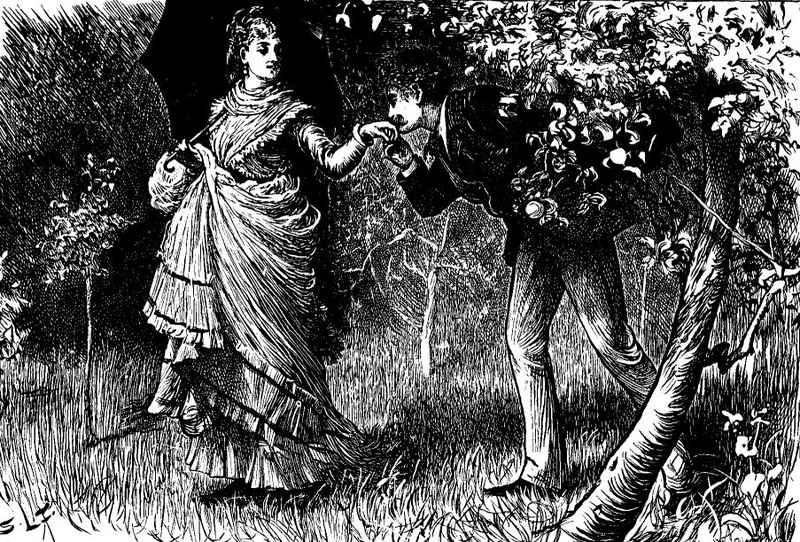
‘Do you fancy that either of us have time at this moment to open so large a question? Would not the estimate of Mr. Joseph Atlee be another mode of discussing the times we live in, and the young gentlemen, more or less ambitious, who want to influence them? would not the question embrace everything, from the difficulties of Ireland to the puzzling embarrassments of a clever young man who has everything in his favour in life, except the only thing that makes life worth living for?’
‘You mean fortune—money?’
‘Of course I mean money. What is so powerless as poverty? do I not know it—not of yesterday, or the day before, but for many a long year? What so helpless, what so jarring to temper, so dangerous to all principle, and so subversive of all dignity? I can afford to say these things, and you can afford to hear them, for there is a sort of brotherhood between us. We claim the same land for our origin. Whatever our birthplace, we are both Bohemians!’
She held out her hand as she spoke, and with such an air of cordiality and frankness that Joe caught the spirit of the action at once, and, bending over, pressed his lips to it, as he said, ‘I seal the bargain.’
‘And swear to it?’
‘I swear to it,’ cried he.
‘There, that is enough. Let us go back, or rather, let me go back alone. I will tell them I have seen you, and heard of your approaching departure.’
CHAPTER XVI
THE TWO ‘KEARNEYS’
A visit to his father was not usually one of those things that young Kearney either speculated on with pleasure beforehand, or much enjoyed when it came. Certain measures of decorum, and some still more pressing necessities of economy, required that he should pass some months of every year at home; but they were always seasons looked forward to with a mild terror, and when the time drew nigh, met with a species of dogged, fierce resolution that certainly did not serve to lighten the burden of the infliction; and though Kate’s experience of this temper was not varied by any exceptions, she would still go on looking with pleasure for the time of his visit, and plotting innumerable little schemes for enjoyment while he should remain. The first day or two after his arrival usually went over pleasantly enough. Dick came back full of his town life, and its amusements; and Kate was quite satisfied to accept gaiety at second-hand. He had so much to tell of balls, picnics, charming rides in the Phoenix, of garden-parties in the beautiful environs of Dublin, or more pretentious entertainments, which took the shape of excursions to Bray or Killiney, that she came at last to learn all his friends and acquaintances by name, and never confounded the stately beauties that he worshipped afar off with the ‘awfully jolly girls’ whom he flirted with quite irresponsibly. She knew, too, all about his male companions, from the flash young fellow-commoner from Downshire, who had a saddle-horse and a mounted groom waiting for him every day after morning lecture, down to that scampish Joe Atlee, with whose scrapes and eccentricities he filled many an idle hour.
Independently of her gift as a good listener, Kate would very willingly have heard all Dick’s adventures and descriptions not only twice but tenth-told; just as the child listens with unwearied attention to the fairy-tale whose end he is well aware of, but still likes the little detail falling fresh upon his ear, so would this young girl make him go over some narratives she knew by heart, and would not suffer him to omit the slightest incident or most trifling circumstance that heightened the history of the story.
As to Dick, however, the dull monotony of the daily life, the small and vulgar interests of the house or the farm, which formed the only topics, the undergrowl of economy that ran through every conversation, as though penuriousness was the great object of existence—but, perhaps more than all these together, the early hours—so overcame him that he at first became low-spirited, and then sulky, seldom appearing save at meal-times, and certainly contributing little to the pleasure of the meeting; so that at last, though she might not easily have been brought to the confession, Kate Kearney saw the time of Dick’s departure approach without regret, and was actually glad to be relieved from that terror of a rupture between her father and her brother of which not a day passed without a menace.
Like all men who aspire to something in Ireland, Kearney desired to see his son a barrister; for great as are the rewards of that high career, they are not the fascinations which appeal most strongly to the squirearchy, who love to think that a country gentleman may know a little law and be never the richer for it—may have acquired a profession, and yet never know what was a client or what a fee.
That Kearney of Kilgobbin Castle should be reduced to tramping his way down the Bachelor’s Walk to the Four Courts, with a stuff bag carried behind him, was not to be thought of; but there were so many positions in life, so many situations for which that gifted creature the barrister of six years’ standing was alone eligible, that Kearney was very anxious his son should be qualified to accept that £1000 or £1800 a year which a gentleman could hold without any shadow upon his capacity, or the slightest reflection on his industry.
Dick Kearney, however, had not only been living a very gay life in town, but, to avail himself of a variety of those flattering attentions which this interested world bestows by preference on men of some pretension, had let it be believed that he was the heir to a very considerable estate, and, by great probability, also to a title. To have admitted that he thought it necessary to follow any career at all, would have been to abdicate these pretensions, and so he evaded that question of the law in all discussions with his father, sometimes affecting to say he had not made up his mind, or that he had scruples of conscience about a barrister’s calling, or that he doubted whether the Bar of Ireland was not, like most high institutions, going to be abolished by Act of Parliament, and all the litigation of the land be done by deputy in Westminster Hall.
On the morning after the visitors took their departure from Kilgobbin, old Kearney, who usually relapsed from any exercise of hospitality into a more than ordinary amount of parsimony, sat thinking over the various economies by which the domestic budget could be squared, and after a very long séance with old Gill, in which the question of raising some rents and diminishing certain bounties was discussed, he sent up the steward to Mr. Richard’s room to say he wanted to speak to him.
Dick at the time of the message was stretched full length on a sofa, smoking a meerschaum, and speculating how it was that the ‘swells’ took to Joe Atlee, and what they saw in that confounded snob, instead of himself. Having in a degree satisfied himself that Atlee’s success was all owing to his intense and outrageous flattery, he was startled from his reverie by the servant’s entrance.
‘How is he this morning, Tim?’ asked he, with a knowing look. ‘Is he fierce—is there anything up—have the heifers been passing the night in the wheat, or has any one come over from Moate with a bill?’
‘No, sir, none of them; but his blood’s up about something. Ould Gill is gone down the stair swearing like mad, and Miss Kate is down the road with a face like a turkey-cock.’
‘I think you’d better say I was out, Tim—that you couldn’t find me in my room.’
‘I daren’t, sir. He saw that little Skye terrier of yours below, and he said to me, “Mr. Dick is sure to be at home; tell him I want him immediately.”’
‘But if I had a bad headache, and couldn’t leave my bed, wouldn’t that be excuse enough?’
‘It would make him come here. And if I was you, sir, I’d go where I could get away myself, and not where he could stay as long as he liked.’
‘There’s something in that. I’ll go, Tim. Say I’ll be down in a minute.’
Very careful to attire himself in the humblest costume of his wardrobe, and specially mindful that neither studs nor watch-chain should offer offensive matter of comment, he took his way towards the dreary little den, which, filled with old top-boots, driving-whips, garden-implements, and fishing-tackle, was known as ‘the lord’s study,’ but whose sole literary ornament was a shelf of antiquated almanacs. There was a strange grimness about his father’s aspect which struck young Kearney as he crossed the threshold. His face wore the peculiar sardonic expression of one who had not only hit upon an expedient, but achieved a surprise, as he held an open letter in one hand and motioned with the other to a seat.
‘I’ve been waiting till these people were gone, Dick—till we had a quiet house of it—to say a few words to you. I suppose your friend Atlee is not coming back here?’
‘I suppose not, sir.’
‘I don’t like him, Dick; and I’m much mistaken if he is a good fellow.’
‘I don’t think he is actually a bad fellow, sir. He is often terribly hard up and has to do scores of shifty things, but I never found him out in anything dishonourable or false.’
‘That’s a matter of taste, perhaps. Maybe you and I might differ about what was honourable or what was false. At all events, he was under our roof here, and if those nobs—or swells, I believe you call them—were like to be of use to any of us, we, the people that were entertaining them, were the first to be thought of; but your pleasant friend thought differently, and made such good use of his time that he cut you out altogether, Dick—he left you nowhere.’
‘Really, sir, it never occurred to me till now to take that view of the situation.’
‘Well, take that view of it now, and see how you’ll like it! You have your way to work in life as well as Mr. Atlee. From all I can judge, you’re scarcely as well calculated to do it as he is. You have not his smartness, you have not his brains, and you have not his impudence—and, ‘faith, I’m much mistaken but it’s the best of the three!’
‘I don’t perceive, sir, that we are necessarily pitted against each other at all.’
‘Don’t you? Well, so much the worse for you if you don’t see that every fellow that has nothing in the world is the rival of every other fellow that’s in the same plight. For every one that swims, ten, at least, sink.’
‘Perhaps, sir, to begin, I never fully realised the first condition. I was not exactly aware that I was without anything in the world.’
‘I’m coming to that, if you’ll have a little patience. Here is a letter from Tom McKeown, of Abbey Street. I wrote to him about raising a few hundreds on mortgage, to clear off some of our debts, and have a trifle in hand for drainage and to buy stock, and he tells me that there’s no use in going to any of the money-lenders so long as your extravagance continues to be the talk of the town. Ay, you needn’t grow red nor frown that way. The letter was a private one to myself, and I’m only telling it to you in confidence. Hear what he says: “You have a right to make your son a fellow-commoner if you like, and he has a right, by his father’s own showing, to behave like a man of fortune; but neither of you have a right to believe that men who advance money will accept these pretensions as good security, or think anything but the worse of you both for your extravagance.”’
‘And you don’t mean to horsewhip him, sir?’ burst out Dick.
‘Not, at any rate, till I pay off two thousand pounds that I owe him, and two years’ interest at six per cent. that he has suffered me to become his debtor for.’
‘Lame as he is, I’ll kick him before twenty-four hours are over.’
‘If you do, he’ll shoot you like a dog, and it wouldn’t be the first time he handled a pistol. No, no, Master Dick. Whether for better or worse, I can’t tell, but the world is not what it was when I was your age. There’s no provoking a man to a duel nowadays; nor no posting him when he won’t fight. Whether it’s your fortune is damaged or your feelings hurt, you must look to the law to redress you; and to take your cause into your own hands is to have the whole world against you.’
‘And this insult is, then, to be submitted to?’
‘It is, first of all, to be ignored. It’s the same as if you never heard it. Just get it out of your head, and listen to what he says. Tom McKeown is one of the keenest fellows I know; and he has business with men who know not only what’s doing in Downing Street, but what’s going to be done there. Now here’s two things that are about to take place: one is the same as done, for it’s all ready prepared—the taking away the landlord’s right, and making the State determine what rent the tenant shall pay, and how long his tenure will be. The second won’t come for two sessions after, but it will be law all the same. There’s to be no primogeniture class at all, no entail on land, but a subdivision, like in America and, I believe, in France.’
‘I don’t believe it, sir. These would amount to a revolution.’
‘Well, and why not? Ain’t we always going through a sort of mild revolution? What’s parliamentary government but revolution, weakened, if you like, like watered grog, but the spirit is there all the same. Don’t fancy that, because you can give it a hard name, you can destroy it. But hear what Tom is coming to. “Be early,” says he, “take time by the forelock: get rid of your entail and get rid of your land. Don’t wait till the Government does both for you, and have to accept whatever condition the law will cumber you with, but be before them! Get your son to join you in docking the entail; petition before the court for a sale, yourself or somebody for you; and wash your hands clean of it all. It’s bad property, in a very ticklish country,” says Tom—and he dashes the words—“bad property in a very ticklish country; and if you take my advice, you’ll get clear of both.” You shall read it all yourself by-and-by; I am only giving you the substance of it, and none of the reasons.’
‘This is a question for very grave consideration, to say the least of it. It is a bold proposal.’
‘So it is, and so says Tom himself; but he adds: “There’s no time to be lost; for once it gets about how Gladstone’s going to deal with land, and what Bright has in his head for eldest sons, you might as well whistle as try to dispose of that property.” To be sure, he says,’ added he, after a pause—‘he says, “If you insist on holding on—if you cling to the dirty acres because they were your father’s and your great-grandfather’s, and if you think that being Kearney of Kilgobbin is a sort of title, in the name of God stay where you are, but keep down your expenses. Give up some of your useless servants, reduce your saddle-horses”—my saddle-horses, Dick! “Try if you can live without foxhunting.” Foxhunting! “Make your daughter know that she needn’t dress like a duchess”—poor Kitty’s very like a duchess; “and, above all, persuade your lazy, idle, and very self-sufficient son to take to some respectable line of life to gain his living. I wouldn’t say that he mightn’t be an apothecary; but if he liked law better than physic, I might be able to do something for him in my own office.”’
‘Have you done, sir?’ said Dick hastily, as his father wiped his spectacles, and seemed to prepare for another heat.
‘He goes on to say that he always requires one hundred and fifty guineas fee with a young man; “but we are old friends, Mathew Kearney,” says he, “and we’ll make it pounds.”’
‘To fit me to be an attorney!’ said Dick, articulating each word with a slow and almost savage determination.
‘‘Faith! it would have been well for us if one of the family had been an attorney before now. We’d never have gone into that action about the mill-race, nor had to pay those heavy damages for levelling Moore’s barn. A little law would have saved us from evicting those blackguards at Mullenalick, or kicking Mr. Hall’s bailiff before witnesses.’
To arrest his father’s recollection of the various occasions on which his illegality had betrayed him into loss and damage, Dick blurted out, ‘I’d rather break stones on the road than I’d be an attorney.’
‘Well, you’ll not have to go far for employment, for they are just laying down new metal this moment; and you needn’t lose time over it,’ said Kearney, with a wave of his hand, to show that the audience was over and the conference ended.
‘There’s just one favour I would ask, sir,’ said Dick, with his hand on the lock.
‘You want a hammer, I suppose,’ said his father, with a grin—‘isn’t that it?’
With something that, had it been uttered aloud, sounded very like a bitter malediction, Dick rushed from the room, slamming the door violently after him as he went.
‘That’s the temper that helps a man to get on in life,’ said the old man, as he turned once more to his accounts, and set to work to see where he had blundered in his figures.
CHAPTER XVII
DICK’S REVERIE
When Dick Kearney left his father, he walked from the house, and not knowing or much caring in what direction he went, turned into the garden.
It was a wild, neglected sort of spot, with fruit-trees of great size, long past bearing, and close underwood in places that barred the passage. Here and there little patches of cultivation appeared, sometimes flowering plants, but oftener vegetables. One long alley, with tall hedges of box, had been preserved, and led to a little mound planted with laurels and arbutus, and known as ‘Laurel Hill’; here a little rustic summer-house had once stood, and still, though now in ruins, showed where, in former days, people came to taste the fresh breeze above the tree-tops, and enjoy the wide range of a view that stretched to the Slieve-Bloom Mountains, nearly thirty miles away.
Young Kearney reached this spot, and sat down to gaze upon a scene every detail of which was well known to him, but of which he was utterly unconscious as he looked. ‘I am turned out to starve,’ cried he aloud, as though there was a sense of relief in thus proclaiming his sorrow to the winds. ‘I am told to go and work upon the roads, to live by my daily labour. Treated like a gentleman until I am bound to that condition by every tie of feeling and kindred, and then bade to know myself as an outcast. I have not even Joe Atlee’s resource—I have not imbibed the instincts of the lower orders, so as to be able to give them back to them in fiction or in song. I cannot either idealise rebellion or make treason tuneful.
‘It is not yet a week since that same Atlee envied me my station as the son and heir to this place, and owned to me that there was that in the sense of name and lineage that more than balanced personal success, and here I am now, a beggar! I can enlist, however, blessings on the noble career that ignores character and defies capacity. I don’t know that I’ll bring much loyalty to Her Majesty’s cause, but I’ll lend her the aid of as broad shoulders and tough sinews as my neighbours.’ And here his voice grew louder and harsher, and with a ring of defiance in it. ‘And no cutting off the entail, my Lord Kilgobbin! no escape from that cruel necessity of an heir! I may carry my musket in the ranks, but I’ll not surrender my birthright!’
The thought that he had at length determined on the path he should follow aroused his courage and made his heart lighter; and then there was that in the manner he was vindicating his station and his claim that seemed to savour of heroism. He began to fancy his comrades regarding him with a certain deference, and treating him with a respect that recognised his condition. ‘I know the shame my father will feel when he sees to what he has driven me. What an offence to his love of rank and station to behold his son in the coarse uniform of a private! An only son and heir, too! I can picture to myself his shock as he reads the letter in which I shall say good-bye, and then turn to tell my sister that her brother is a common soldier, and in this way lost to her for ever!
‘And what is it all about? What terrible things have I done? What entanglements have I contracted? Where have I forged? Whose name have I stolen? whose daughter seduced? What is laid to my charge, beyond that I have lived like a gentleman, and striven to eat and drink and dress like one? And I’ll wager my life that for one who will blame him, there will be ten—no, not ten, fifty—to condemn me. I had a kind, trustful, affectionate father, restricting himself in scores of ways to give me my education among the highest class of my contemporaries. I was largely supplied with means, indulged in every way, and if I turned my steps towards home, welcomed with love and affection.’
‘And fearfully spoiled by all the petting he met with,’ said a soft voice leaning over his shoulder, while a pair of very liquid grey eyes gazed into his own.
‘What, Nina!—Mademoiselle Nina, I mean,’ said he, ‘have you been long there?’
‘Long enough to hear you make a very pitiful lamentation over a condition that I, in my ignorance, used to believe was only a little short of Paradise.’
‘You fancied that, did you?’
‘Yes, I did so fancy it.’
‘Might I be bold enough to ask from what circumstance, though? I entreat you to tell me, what belongings of mine, what resources of luxury or pleasure, what incident of my daily life, suggested this impression of yours?’
‘Perhaps, as a matter of strict reasoning, I have little to show for my conviction, but if you ask me why I thought as I did, it was simply from contrasting your condition with my own, and seeing that in everything where my lot has gloom and darkness, if not worse, yours, my ungrateful cousin, was all sunshine.’
‘Let us see a little of this sunshine, Cousin Nina. Sit down here beside me, and show me, I pray, some of those bright tints that I am longing to gaze on.’
‘There’s not room for both of us on that bench.’
‘Ample room; we shall sit the closer.’
‘No, Cousin Dick; give me your arm and we’ll take a stroll together.’
‘Which way shall it be?’
‘You shall choose, cousin.’
‘If I have the choice, then, I’ll carry you off, Nina, for I’m thinking of bidding good-bye to the old house and all within it.’
‘I don’t think I’ll consent that far,’ said she, smiling. ‘I have had my experience of what it is to be without a home, or something very nearly that. I’ll not willingly recall the sensation. But what has put such gloomy thoughts in your head? What, or rather who is driving you to this?’
‘My father, Nina, my father!’
‘This is past my comprehending.’
‘I’ll make it very intelligible. My father, by way of curbing my extravagance, tells me I must give up all pretension to the life of a gentleman, and go into an office as a clerk. I refuse. He insists, and tells me, moreover, a number of little pleasant traits of my unfitness to do anything, so that I interrupt him by hinting that I might possibly break stones on the highway. He seizes the project with avidity, and offers to supply me with a hammer for my work. All fact, on my honour! I am neither adding to nor concealing. I am relating what occurred little more than an hour ago, and I have forgotten nothing of the interview. He, as I said, offers to give me a stone-hammer. And now I ask you, is it for me to accept this generous offer, or would it be better to wander over that bog yonder, and take my chance of a deep pool, or the bleak world where immersion and death are just as sure, though a little slower in coming?’
‘Have you told Kate of this?’
‘No, I have not seen her. I don’t know, if I had seen her, that I should have told her. Kate has so grown to believe all my father’s caprices to be absolute wisdom, that even his sudden gusts of passion seem to her like flashes of a bright intelligence, too quick and too brilliant for mere reason. She could give me no comfort nor counsel either.’
‘I am not of your mind,’ said she slowly. ‘She has the great gift of what people so mistakingly call common sense.’
‘And she’d recommend me, perhaps, not to quarrel with my father, and to go and break the stones.’
‘Were you ever in love, Cousin Dick?’ asked she, in a tone every accent of which betokened earnestness and even gravity.
‘Perhaps I might say never. I have spooned or flirted or whatever the name of it might be, but I was never seriously attached to one girl, and unable to think of anything but her. But what has your question to do with this?’
‘Everything. If you really loved a girl—that is, if she filled every corner of your heart, if she was first in every plan and project of your life, not alone her wishes and her likings, but her very words and the sound of her voice—if you saw her in everything that was beautiful, and heard her in every tone that delighted you—if to be moving in the air she breathed was ecstasy, and that heaven itself without her was cheerless—if—’
‘Oh, don’t go on, Nina. None of these ecstasies could ever be mine. I have no nature to be moved or moulded in this fashion. I might be very fond of a girl, but she’d never drive me mad if she left me for another.’
‘I hope she may, then, if it be with such false money you would buy her,’ said she fiercely. ‘Do you know,’ added she, after a pause, ‘I was almost on the verge of saying, go and break the stones; the métier is not much beneath you, after all!’
‘This is scarcely civil, mademoiselle; see what my candour has brought upon me!’
‘Be as candid as you like upon the faults of your nature. Tell every wickedness that you have done or dreamed of, but don’t own to cold-heartedness. For that there is no sympathy!’
‘Let us go back a bit, then,’ said he, ‘and let us suppose that I did love in the same fervent and insane manner you spoke of, what and how would it help me here?’
‘Of course it would. Of all the ingenuity that plotters talk of, of all the imagination that poets dream, there is nothing to compare with love. To gain a plodding subsistence a man will do much. To win the girl he loves, to make her his own, he will do everything: he will strive, and strain, and even starve to win her. Poverty will have nothing mean if confronted for her, hardship have no suffering if endured for her sake. With her before him, all the world shows but one goal; without her, life is a mere dreary task, and himself a hired labourer.’
‘I confess, after all this, that I don’t see how breaking stones would be more palatable to me because some pretty girl that I was fond of saw me hammering away at my limestone!’
‘If you could have loved as I would wish you to love, your career had never fallen to this. The heart that loved would have stimulated the head that thought. Don’t fancy that people are only better because they are in love, but they are greater, bolder, brighter, more daring in danger, and more ready in every emergency. So wonder-working is the real passion that even in the base mockery of Love men have risen to genius. Look what it made Petrarch, and I might say Byron too, though he never loved worthy of the name.’
‘And how came you to know all this, cousin mine? I’m really curious to know that.’
‘I was reared in Italy, Cousin Dick, and I have made a deep study of nature through French novels.’
Now there was a laughing devilry in her eye as she said this that terribly puzzled the young fellow, for just at the very moment her enthusiasm had begun to stir his breast, her merry mockery wafted it away as with a storm-wind.
‘I wish I knew if you were serious,’ said he gravely.
‘Just as serious as you were when you spoke of being ruined.’
‘I was so, I pledge my honour. The conversation I reported to you really took place; and when you joined me, I was gravely deliberating with myself whether I should take a header into a deep pool or enlist as a soldier.’
‘Fie, fie! how ignoble all that is. You don’t know the hundreds of thousands of things one can do in life. Do you speak French or Italian?’
‘I can read them, but not freely; but how are they to help me?’
‘You shall see: first of all, let me be your tutor. We shall take two hours, three if you like, every morning. Are you free now from all your college studies?’
‘I can be after Wednesday next. I ought to go up for my term examination.’
‘Well, do so; but mind, don’t bring down Mr. Atlee with you.’
‘My chum is no favourite of yours?’
‘That’s as it may be,’ said she haughtily. ‘I have only said let us not have the embarrassment, or, if you like it, the pleasure of his company. I’ll give you a list of books to bring down, and my life be on it, but my course of study will surpass what you have been doing at Trinity. Is it agreed?’
‘Give me till to-morrow to think of it, Nina.’
‘That does not sound like a very warm acceptance; but be it so: till to-morrow.’
‘Here are some of Kate’s dogs,’ cried he angrily. ‘Down, Fan, down! I say. I’ll leave you now before she joins us. Mind, not a word of what I told you.’
And, without another word, he sprang over a low fence, and speedily disappeared in the copse beyond it.
‘Wasn’t that Dick I saw making his escape?’ cried Kate, as she came up.
‘Yes, we were taking a walk together, and he left me very abruptly.’
‘I wish I had not spoiled a tête-à-tête,’ said Kate merrily.
‘It is no great mischief: we can always renew it.’
‘Dear Nina,’ said the other caressingly, as she drew her arm around her—‘dear, dear Nina, do not, do not, I beseech you.’
‘Don’t what, child?—you must not speak in riddles.’
‘Don’t make that poor boy in love with you. You yourself told me you could save him from it if you liked.’
‘And so I shall, Kate, if you don’t dictate or order me. Leave me quite to myself, and I shall be most merciful.’
CHAPTER XVIII
MATHEW KEARNEY’S ‘STUDY’
Had Mathew Kearney but read the second sheet of his correspondent’s letter, it is more than likely that Dick had not taken such a gloomy view of his condition. Mr. McKeown’s epistle continued in this fashion: ‘That ought to do for him, Mathew, or my name ain’t Tom McKeown. It is not that he is any worse or better than other young fellows of his own stamp, but he has the greatest scamp in Christendom for his daily associate. Atlee is deep in all the mischief that goes on in the National press. I believe he is a head-centre of the Fenians, and I know he has a correspondence with the French socialists, and that Rights-of-labour-knot of vagabonds who meet at Geneva. Your boy is not too wise to keep himself out of these scrapes, and he is just, by name and station, of consequence enough to make these fellows make up to and flatter him. Give him a sound fright, then, and when he is thoroughly alarmed about his failure, send him abroad for a short tour, let him go study at Halle or Heidelberg—anything, in short, that will take him away from Ireland, and break off his intimacy with this Atlee and his companions. While he is with you at Kilgobbin, don’t let him make acquaintance with those Radical fellows in the county towns. Keep him down, Mathew, keep him down; and if you find that you cannot do this, make him believe that you’ll be one day lords of Kilgobbin, and the more he has to lose the more reluctant he’ll be to risk it. If he’d take to farming, and marry some decent girl, even a little beneath him in life, it would save you all uneasiness; but he is just that thing now that brings all the misery on us in Ireland. He thinks he’s a gentleman because he can do nothing; and to save himself from the disgrace of incapacity, ‘he’d like to be a rebel.’
If Mr. Tom McKeown’s reasonings were at times somewhat abstruse and hard of comprehension to his friend Kearney, it was not that he did not bestow on them due thought and reflection; and over this private and strictly confidential page he had now meditated for hours.
‘Bad luck to me,’ cried he at last, ‘if I see what he’s at. If I’m to tell the boy he is ruined to-day, and to-morrow to announce to him that he is a lord—if I’m to threaten him now with poverty, and the morning after I’m to send him to Halle, or Hell, or wherever it is—I’ll soon be out of my mind myself through bare confusion. As to having him “down,” he’s low enough; but so shall I be too, if I keep him there. I’m not used to seeing my house uncomfortable, and I cannot bear it.’
Such were some of his reflections, over his agent’s advice; and it may be imagined that the Machiavellian Mr. McKeown had fallen upon a very inapt pupil.
It must be owned that Mathew Kearney was somewhat out of temper with his son even before the arrival of this letter. While the ‘swells,’ as he would persist in calling the two English visitors, were there, Dick took no trouble about them, nor to all seeming made any impression on them. As Mathew said, ‘He let Joe Atlee make all the running, and, signs on it! Joe Atlee was taken off to town as Walpole’s companion, and Dick not so much as thought of. Joe, too, did the honours of the house as if it was his own, and talked to Lockwood about coming down for the partridge-shooting as if he was the head of the family. The fellow was a bad lot, and McKeown was right so far—the less Dick saw of him the better.’
The trouble and distress these reflections, and others like them, cost him would more than have recompensed Dick, had he been hard-hearted enough to desire a vengeance. ‘For a quarter of an hour, or maybe twenty minutes,’ said he, ‘I can be as angry as any man in Europe, and, if it was required of me during that time to do anything desperate—downright wicked—I could be bound to do it; and what’s more, I’d stand to it afterwards if it cost me the gallows. But as for keeping up the same mind, as for being able to say to myself my heart is as hard as ever, I’m just as much bent on cruelty as I was yesterday—that’s clean beyond me; and the reason, God help me, is no great comfort to me after all—for it’s just this: that when I do a hard thing, whether distraining a creature out of his bit of ground, selling a widow’s pig, or fining a fellow for shooting a hare, I lose my appetite and have no heart for my meals; and as sure as I go asleep, I dream of all the misfortunes in life happening to me, and my guardian angel sitting laughing all the while and saying to me, “Didn’t you bring it on yourself, Mathew Kearney? couldn’t you bear a little rub without trying to make a calamity of it? Must somebody be always punished when anything goes wrong in life? Make up your mind to have six troubles every day of your life, and see how jolly you’ll be the day you can only count five, or maybe four.”’
As Mr. Kearney sat brooding in this wise, Peter Gill made his entrance into the study with the formidable monthly lists and accounts, whose examination constituted a veritable doomsday to the unhappy master.
‘Wouldn’t next Saturday do, Peter?’ asked Kearney, in a tone of almost entreaty.
‘I’m afther ye since Tuesday last, and I don’t think I’ll be able to go on much longer.’
Now as Mr. Gill meant by this speech to imply that he was obliged to trust entirely to his memory for all the details which would have been committed to writing by others, and to a notched stick for the manifold dates of a vast variety of events, it was not really a very unfair request he had made for a peremptory hearing.
‘I vow to the Lord,’ sighed out Kearney, ‘I believe I’m the hardest-worked man in the three kingdoms.’
‘Maybe you are,’ muttered Gill, though certainly the concurrence scarcely sounded hearty, while he meanwhile arranged the books.
‘Oh, I know well enough what you mean. If a man doesn’t work with a spade or follow the plough, you won’t believe that he works at all. He must drive, or dig, or drain, or mow. There’s no labour but what strains a man’s back, and makes him weary about the loins; but I’ll tell you, Peter Gill, that it’s here’—and he touched his forehead with his finger—‘it’s here is the real workshop. It’s thinking and contriving; setting this against that; doing one thing that another may happen, and guessing what will come if we do this and don’t do that; carrying everything in your brain, and, whether you are sitting over a glass with a friend or taking a nap after dinner, thinking away all the time! What would you call that, Peter Gill—what would you call that?’
‘Madness, begorra, or mighty near it!’
‘No; it’s just work—brain-work. As much above mere manual labour as the intellect, the faculty that raises us above the brutes, is above the—the—’
‘Yes,’ said Gill, opening the large volume and vaguely passing his hand over a page. ‘It’s somewhere there about the Conacre!’
‘You’re little better than a beast!’ said Kearney angrily.
‘Maybe I am, and maybe I’m not. Let us finish this, now that we’re about it.’
And so saying, he deposited his other books and papers on the table, and then drew from his breast-pocket a somewhat thick roll of exceedingly dirty bank-notes, fastened with a leather thong.
‘I’m glad to see some money at last, Peter,’ cried Kearney, as his eye caught sight of the notes.
‘Faix, then, it’s little good they’ll do ye,’ muttered the other gruffly.
‘What d’ye mean by that, sir?’ asked he angrily.
‘Just what I said, my lord, the devil a more nor less, and that the money you see here is no more yours nor it is mine! It belongs to the land it came from. Ay, ay, stamp away, and go red in the face: you must hear the truth, whether you like it or no. The place we’re living in is going to rack and ruin out of sheer bad treatment. There’s not a hedge on the estate; there isn’t a gate that could be called a gate; the holes the people live in isn’t good enough for badgers; there’s no water for the mill at the cross-roads; and the Loch meadows is drowned with wet—we’re dragging for the hay, like seaweed! And you think you’ve a right to these’—and he actually shook the notes at him—to go and squander them on them “impedint” Englishmen that was laughing at you! Didn’t I hear them myself about the tablecloth that one said was the sail of a boat.’
‘Will you hold your tongue?’ cried Kearney, wild with passion.
‘I will not! I’ll die on the floore but I’ll speak my mind.’
This was not only a favourite phrase of Mr. Gill’s, but it was so far significant that it always indicated he was about to give notice to leave—a menace on his part of no unfrequent occurrence.
‘Ye’s going, are ye?’ asked Kearney jeeringly.
‘I just am; and I’m come to give up the books, and to get my receipts and my charac—ter.’
‘It won’t be hard to give the last, anyway,’ said Kearney, with a grin.
‘So much the better. It will save your honour much writing, with all that you have to do.’
‘Do you want me to kick you out of the office, Peter Gill?’
‘No, my lord, I’m going quiet and peaceable. I’m only asking my rights.’
‘You’re bidding hard to be kicked out, you are.’
‘Am I to leave them here, or will your honour go over the books with me?’
‘Leave the notes, sir, and go to the devil.’
‘I will, my lord; and one comfort at least I’ll have—it won’t be harder to put up with his temper.’
Mr. Gill’s head barely escaped the heavy account-book which struck the door above him as he escaped from the room, and Mathew Kearney sat back in his chair and grasped the arms of it like one threatened with a fit.
‘Where’s Miss Kitty—where’s my daughter?’ cried he aloud, as though there was some one within hearing. ‘Taking the dogs a walk, I’ll be bound,’ muttered he, ‘or gone to see somebody’s child with the measles, devil fear her! She has plenty on her hands to do anywhere but at home. The place might be going to rack and ruin for her if there was only a young colt to look at, or a new litter of pigs! And so you think to frighten me, Peter Gill! You’ve been doing the same thing every Easter, and every harvest, these five-and-twenty years! I can only say I wish you had kept your threat long ago, and the property wouldn’t have as many tumble-down cabins and ruined fences as it has now, and my rent-roll, too, wouldn’t have been the worse. I don’t believe there’s a man in Ireland more cruelly robbed than myself. There isn’t an estate in the county has not risen in value except my own! There’s not a landed gentleman hasn’t laid by money in the barony but myself, and if you were to believe the newspapers, I’m the hardest landlord in the province of Leinster. Is that Mickey Doolan there? Mickey!’ cried he, opening the window, ‘did you see Miss Kearney anywhere about?’
‘Yes, my lord. I see her coming up the Bog road with Miss O’Shea.’
‘The worse luck mine!’ muttered he, as he closed the window, and leaned his head on his hand.
CHAPTER XIX
AN UNWELCOME VISIT
If Mathew Kearney had been put to the question, he could not have concealed the fact that the human being he most feared and dreaded in life was his neighbour Miss Betty O’Shea.
With two years of seniority over him, Miss Betty had bullied him as a child, snubbed him as a youth, and opposed and sneered at him ever after; and to such an extent did her influence over his character extend, according to his own belief, that there was not a single good trait of his nature she had not thwarted by ridicule, nor a single evil temptation to which he had yielded that had not come out of sheer opposition to that lady’s dictation.
Malevolent people, indeed, had said that Mathew Kearney had once had matrimonial designs on Miss Betty, or rather, on that snug place and nice property called ‘O’Shea’s Barn,’ of which she was sole heiress; but he most stoutly declared this story to be groundless, and in a forcible manner asseverated that had he been Robinson Crusoe and Miss Betty the only inhabitant of the island with him, he would have lived and died in celibacy.
Miss Betty, to give her the name by which she was best known, was no miracle of either tact or amiability, but she had certain qualities that could not be disparaged. She was a strict Catholic, charitable, in her own peculiar and imperious way, to the poor, very desirous to be strictly just and honest, and such a sure foe to everything that she thought pretension or humbug of any kind—which meant anything that did not square with her own habits—that she was perfectly intolerable to all who did not accept herself and her own mode of life as a model and an example.
Thus, a stout-bodied copper urn on the tea-table, a very uncouth jaunting-car, driven by an old man, whose only livery was a cockade, some very muddy port as a dinner wine, and whisky-punch afterwards on the brown mahogany, were so many articles of belief with her, to dissent from any of which was a downright heresy.
Thus, after Nina arrived at the castle, the appearance of napkins palpably affected her constitution; with the advent of finger-glasses she ceased her visits, and bluntly declined all invitations to dinner. That coffee and some indescribable liberties would follow, as postprandial excesses, she secretly imparted to Kate Kearney in a note, which concluded with the assurance that when the day of these enormities arrived, O’Shea’s Barn Would be open to her as a refuge and a sanctuary; ‘but not,’ added she, ‘with your cousin, for I’ll not let the hussy cross my doors.’
For months now this strict quarantine had lasted, and except for the interchange of some brief and very uninteresting notes, all intimacy had ceased between the two houses—a circumstance, I am loth to own, which was most ungallantly recorded every day after dinner by old Kearney, who drank ‘Miss Betty’s health, and long absence to her.’ It was then with no small astonishment Kate was overtaken in the avenue by Miss Betty on her old chestnut mare Judy, a small bog-boy mounted on the croup behind to act as groom; for in this way Paddy Walshe was accustomed to travel, without the slightest consciousness that he was not in strict conformity with the ways of Rotten Row and the ‘Bois.’
That there was nothing ‘stuck-up’ or pretentious about this mode of being accompanied by one’s groom—a proposition scarcely assailable—was Miss Betty’s declaration, delivered in a sort of challenge to the world. Indeed, certain ticklesome tendencies in Judy, particularly when touched with the heel, seemed to offer the strongest protest against the practice; for whenever pushed to any increase of speed or admonished in any way, the beast usually responded by a hoist of the haunches, which invariably compelled Paddy to clasp his mistress round the waist for safety—a situation which, however repugnant to maiden bashfulness, time, and perhaps necessity, had reconciled her to. At all events, poor Paddy’s terror would have been the amplest refutation of scandal, while the stern immobility of Miss Betty during the embrace would have silenced even malevolence.
On the present occasion, a sharp canter of several miles had reduced Judy to a very quiet and decorous pace, so that Paddy and his mistress sat almost back to back—a combination that only long habit enabled Kate to witness without laughing.
‘Are you alone up at the castle, dear?’ asked Miss Betty, as she rode along at her side; ‘or have you the house full of what the papers call “distinguished company”?’
‘We are quite alone, godmother. My brother is with us, but we have no strangers.’
‘I am glad of it. I’ve come over to “have it out” with your father, and it’s pleasant to know we shall be to ourselves.’
Now, as this announcement of having ‘it out’ conveyed to Kate’s mind nothing short of an open declaration of war, a day of reckoning on which Miss O’Shea would come prepared with a full indictment, and a resolution to prosecute to conviction, the poor girl shuddered at a prospect so certain to end in calamity.
‘Papa is very far from well, godmother,’ said she, in a mild way.
‘So they tell me in the town,’ said the other snappishly. ‘His brother magistrates said that the day he came in, about that supposed attack—the memorable search for arms—’
‘Supposed attack! but, godmother, pray don’t imagine we had invented all that. I think you know me well enough and long enough to know—’
‘To know that you would not have had a young scamp of a Castle aide-de-camp on a visit during your father’s absence, not to say anything about amusing your English visitor by shooting down your own tenantry.’
‘Will you listen to me for five minutes?’
‘No, not for three.’
‘Two, then—one even—one minute, godmother, will convince you how you wrong me.’
‘I won’t give you that. I didn’t come over about you nor your affairs. When the father makes a fool of himself, why wouldn’t the daughter? The whole country is laughing at him. His lordship indeed! a ruined estate and a tenantry in rags; and the only remedy, as Peter Gill tells me, raising the rents—raising the rents where every one is a pauper.’
‘What would you have him do, Miss O’Shea?’ said Kate, almost angrily.
‘I’ll tell you what I’d have him do. I’d have him rise of a morning before nine o’clock, and be out with his labourers at daybreak. I’d have him reform a whole lazy household of blackguards, good for nothing but waste and wickedness. I’d have him apprentice your brother to a decent trade or a light business. I’d have him declare he’d kick the first man that called him “My lord”; and for yourself, well, it’s no matter—’
‘Yes, but it is, godmother, a great matter to me at least. What about myself?’
‘Well, I don’t wish to speak of it, but it just dropped out of my lips by accident; and perhaps, though not pleasant to talk about, it’s as well it was said and done with. I meant to tell your father that it must be all over between you and my nephew Gorman; that I won’t have him back here on leave as I intended. I know it didn’t go far, dear. There was none of what they call love in the case. You would probably have liked one another well enough at last; but I won’t have it, and it’s better we came to the right understanding at once.’
‘Your curb-chain is loose, godmother,’ said the girl, who now, pale as death and trembling all over, advanced to fasten the link.
‘I declare to the Lord, he’s asleep!’ said Miss Betty, as the wearied head of her page dropped heavily on her shoulder. ‘Take the curb off, dear, or I may lose it. Put it in your pocket for me, Kate; that is, if you wear a pocket.’
‘Of course I do, godmother. I carry very stout keys in it, too. Look at these.’
‘Ay, ay. I liked all that, once on a time, well enough, and used to think you’d be a good thrifty wife for a poor man; but with the viscount your father, and the young princess your first cousin, and the devil knows what of your fine brother, I believe the sooner we part good friends the better. Not but if you like my plan for you, I’ll be just as ready as ever to aid you.’
‘I have not heard the plan yet,’ said Kate faintly.
‘Just a nunnery, then—no more nor less than that. The “Sacred Heart” at Namur, or the Sisters of Mercy here at home in Bagot Street, I believe, if you like better—eh?’
‘It is soon to be able to make up one’s mind on such a point. I want a little time for this, godmother.’
‘You would not want time if your heart were in a holy work, Kate Kearney. It’s little time you’d be asking if I said, will you have Gorman O’Shea for a husband?’
‘There is such a thing as insult, Miss O’Shea, and no amount of long intimacy can license that.’
‘I ask your pardon, godchild. I wish you could know how sorry I feel.’
‘Say no more, godmother, say no more, I beseech you,’ cried Kate, and her tears now gushed forth, and relieved her almost bursting heart. ‘I’ll take this short path through the shrubbery, and be at the door before you,’ cried she, rushing away; while Miss Betty, with a sharp touch of the spur, provoked such a plunge as effectually awoke Paddy, and apprised him that his duties as groom were soon to be in request.
While earnestly assuring him that some changes in his diet should be speedily adopted against somnolency, Miss Betty rode briskly on, and reached the hall door.
‘I told you I should be first, godmother,’ said the girl; and the pleasant ring of her voice showed she had regained her spirits, or at least such self-control as enabled her to suppress her sorrow.
CHAPTER XX
A DOMESTIC DISCUSSION
It is a not infrequent distress in small households, especially when some miles from a market-town, to make adequate preparation for an unexpected guest at dinner; but even this is a very inferior difficulty to that experienced by those who have to order the repast in conformity with certain rigid notions of a guest who will criticise the smallest deviation from the most humble standard, and actually rebuke the slightest pretension to delicacy of food or elegance of table-equipage.
No sooner, then, had Kate learned that Miss O’Shea was to remain for dinner, than she immediately set herself to think over all the possible reductions that might be made in the fare, and all the plainness and simplicity that could be imparted to the service of the meal.
Napkins had not been the sole reform suggested by the Greek cousin. She had introduced flowers on the table, and so artfully had she decked out the board with fruit and ornamental plants, that she had succeeded in effecting by artifice what would have been an egregious failure if more openly attempted—the service of the dishes one by one to the guests without any being placed on the table. These, with finger-glasses, she had already achieved, nor had she in the recesses of her heart given up the hope of seeing the day that her uncle would rise from the table as she did, give her his arm to the drawing-room, and bow profoundly as he left her. Of the inestimable advantages, social, intellectual, and moral, of this system, she had indeed been cautious to hold forth; for, like a great reformer, she was satisfied to leave her improvements to the slow test of time, ‘educating her public,’ as a great authority has called it, while she bided the result in patience.
Indeed, as poor Mathew Kearney was not to be indulged with the luxury of whisky-punch during his dinner, it was not easy to reply to his question, ‘When am I to have my tumbler?’ as though he evidently believed the aforesaid ‘tumbler’ was an institution that could not be abrogated or omitted altogether.
Coffee in the drawing-room was only a half-success so long as the gentlemen sat over their wine; and as for the daily cigarette Nina smoked with it, Kate, in her simplicity, believed it was only done as a sort of protest at being deserted by those unnatural protectors who preferred poteen to ladies.
It was therefore in no small perturbation of mind that Kate rushed to her cousin’s room with the awful tidings that Miss Betty had arrived and intended to remain for dinner.
‘Do you mean that odious woman with the boy and band-box behind her on horseback?’ asked Nina superciliously.
‘Yes, she always travels in that fashion; she is odd and eccentric in scores of things, but a fine-hearted, honest woman, generous to the poor, and true to her friends.’
‘I don’t care for her moral qualities, but I do bargain for a little outward decency, and some respect for the world’s opinion.’
‘You will like her, Nina, when you know her.’
‘I shall profit by the warning. I’ll take care not to know her.’
‘She is one of the oldest, I believe the oldest, friend our family has in the world.’
‘What a sad confession, child; but I have always deplored longevity.’
‘Don’t be supercilious or sarcastic, Nina, but help me with your own good sense and wise advice. She has not come over in the best of humours. She has, or fancies she has, some difference to settle with papa. They seldom meet without a quarrel, and I fear this occasion is to be no exception; so do aid me to get things over pleasantly, if it be possible.’
‘She snubbed me the only time I met her. I tried to help her off with her bonnet, and, unfortunately, I displaced, if I did not actually remove, her wig, and she muttered something “about a rope-dancer not being a dexterous lady’s-maid.”’
‘O Nina, surely you do not mean—’
‘Not that I was exactly a rope-dancer, Kate, but I had on a Greek jacket that morning of blue velvet and gold, and a white skirt, and perhaps these had some memories of the circus for the old lady.’
‘You are only jesting now, Nina.’
‘Don’t you know me well enough to know that I never jest when I think, or even suspect, I am injured?’
‘Injured!’
‘It’s not the word I wanted, but it will do; I used it in its French sense.’
‘You bear no malice, I’m sure?’ said the other caressingly.
‘No!’ replied she, with a shrug that seemed to deprecate even having a thought about her.
‘She will stay for dinner, and we must, as far as possible, receive her in the way she has been used to here, a very homely dinner, served as she has always seen it—no fruit or flowers on the table, no claret-cup, no finger-glasses.’
‘I hope no tablecloth; couldn’t we have a tray on a corner table, and every one help himself as he strolled about the room?’
‘Dear Nina, be reasonable just for this once.’
‘I’ll come down just as I am, or, better still, I’ll take down my hair and cram it into a net; I’d oblige her with dirty hands, if I only knew how to do it.’
‘I see you only say these things in jest; you really do mean to help me through this difficulty.’
‘But why a difficulty? what reason can you offer for all this absurd submission to the whims of a very tiresome old woman? Is she very rich, and do you expect an heritage?’
‘No, no; nothing of the kind.’
‘Does she load you with valuable presents? Is she ever ready to commemorate birthdays and family festivals?’
‘No.’
‘Has she any especial quality or gift beyond riding double and a bad temper? Oh, I was forgetting; she is the aunt of her nephew, isn’t she?—the dashing lancer that was to spend his summer over here?’
‘You were indeed forgetting when you said this,’ said Kate proudly, and her face grew scarlet as she spoke.
‘Tell me that you like him or that he likes you; tell me that there is something, anything, between you, child, and I’ll be discreet and mannerly, too; and more, I’ll behave to the old lady with every regard to one who holds such dear interests in her keeping. But don’t bandage my eyes, and tell me at the same time to look out and see.’
‘I have no confidences to make you,’ said Kate coldly. ‘I came here to ask a favour—a very small favour, after all—and you might have accorded it without question or ridicule.’
‘But which you never need have asked, Kate,’ said the other gravely. ‘You are the mistress here; I am but a very humble guest. Your orders are obeyed, as they ought to be; my suggestions may be adopted now and then—partly in caprice, part compliment—but I know they have no permanence, no more take root here than—than myself.’
‘Do not say that, my dearest Nina,’ said Kate, as she threw herself on her neck and kissed her affectionately again and again. ‘You are one of us, and we are all proud of it. Come along with me, now, and tell me all that you advise. You know what I wish, and you will forgive me even in my stupidity.’
‘Where’s your brother?’ asked Nina hastily.
‘Gone out with his gun. He’ll not be back till he is certain Miss Betty has taken her departure.’
‘Why did he not offer to take me with him?’
‘Over the bog, do you mean?’
‘Anywhere; I’d not cavil about the road. Don’t you know that I have days when “don’t care” masters me—when I’d do anything, go anywhere—’
‘Marry any one?’ said the other, laughing.
‘Yes, marry any one, as irresponsibly as if I was dealing with the destiny of some other that did not regard me. On these days I do not belong to myself, and this is one of them.’
‘I know nothing of such humours, Nina; nor do I believe it a healthy mind that has them.’
‘I did not boast of my mind’s health, nor tell you to trust to it. Come, let us go down to the dinner-room, and talk that pleasant leg-of-mutton talk you know you are fond of.’
‘And best fitted for, say that,’ said Kate, laughing merrily.
The other did not seem to have heard her words, for she moved slowly away, calling on Kate to follow her.
