автордың кітабын онлайн тегін оқу Edgar Allan Poe. Complete Tales and Poems
Edgar Allan Poe
Complete Tales and Poems
This book contains tales and poems by Edgar Allan Poe that became innovative literature discoveries at the time and extremely popular in its genre: The Fall of the House Usher, The Gold-Bug, poem The Raven. Edgar Poe was one of the first American writers who wrote mostly novellas. Within twenty years Edgar Poe created two short novels, two poems, one play, about seventy stories, fifty poems and ten essays that were published in magazines and almanacs and then gathered in collection books.
Edgar Poe was highly valued by Jules Verne, Arthur Conan Doyle and Howard Phillips Lovecraft who admitted his pioneer role in the genres they were popularizing.
In his thriller stories Poe tries to show psychic side of the crime from the inside. He is not interested in social roots of the crime, but in unmotivated actions that go beyond normal behavior of a person in the society.
Nevertheless, in a series of stories while describing the acts committed by characters under influence of “contradiction demon” or “perversion demon”, Poe puts in rational reasons. For example, the character from the story The Black Cat understands that his brain is poisoned with alcohol, and as a result his mental health and temper were injured. But this reasoning is too plain and trivial for the thriller.
Narrating on behalf of the criminal, Poe brings actions under the control of contradiction demon. Combination of plans puts volume to the stories the events are at the same time rational and not, motivated and incredibly paradoxical.
TALES
THE BLACK CAT
FOR the most wild, yet most homely narrative which I am about to pen, I neither expect nor solicit belief. Mad indeed would I be to expect it, in a case where my very senses reject their own evidence. Yet, mad am I not—and very surely do I not dream. But to-morrow I die, and to-day I would unburthen my soul. My immediate purpose is to place before the world, plainly, succinctly, and without comment, a series of mere household events. In their consequences, these events have terrified—have tortured—have destroyed me. Yet I will not attempt to expound them. To me, they have presented little but Horror—to many they will seem less terrible than barroques. Hereafter, perhaps, some intellect may be found which will reduce my phantasm to the common-place—some intellect more calm, more logical, and far less excitable than my own, which will perceive, in the circumstances I detail with awe, nothing more than an ordinary succession of very natural causes and effects.
From my infancy I was noted for the docility and humanity of my disposition. My tenderness of heart was even so conspicuous as to make me the jest of my companions. I was especially fond of animals, and was indulged by my parents with a great variety of pets. With these I spent most of my time, and never was so happy as when feeding and caressing them. This peculiarity of character grew with my growth, and in my manhood, I derived from it one of my principal sources of pleasure. To those who have cherished an affection for a faithful and sagacious dog, I need hardly be at the trouble of explaining the nature or the intensity of the gratification thus derivable. There is something in the unselfish and self-sacrificing love of a brute, which goes directly to the heart of him who has had frequent occasion to test the paltry friendship and gossamer fidelity of mere Man.
I married early, and was happy to find in my wife a disposition not uncongenial with my own. Observing my partiality for domestic pets, she lost no opportunity of procuring those of the most agreeable kind. We had birds, gold-fish, a fine dog, rabbits, a small monkey, and a cat.
This latter was a remarkably large and beautiful animal, entirely black, and sagacious to an astonishing degree. In speaking of his intelligence, my wife, who at heart was not a little tinctured with superstition, made frequent allusion to the ancient popular notion, which regarded all black cats as witches in disguise. Not that she was ever serious upon this point—and I mention the matter at all for no better reason than that it happens, just now, to be remembered.
Pluto—this was the cat’s name—was my favorite pet and playmate. I alone fed him, and he attended me wherever I went about the house. It was even with difficulty that I could prevent him from following me through the streets.
Our friendship lasted, in this manner, for several years, during which my general temperament and character—through the instrumentality of the Fiend Intemperance—had (I blush to confess it) experienced a radical alteration for the worse. I grew, day by day, more moody, more irritable, more regardless of the feelings of others. I suffered myself to use intemperate language to my wife. At length, I even offered her personal violence. My pets, of course, were made to feel the change in my disposition. I not only neglected, but ill-used them. For Pluto, however, I still retained sufficient regard to restrain me from maltreating him, as I made no scruple of maltreating the rabbits, the monkey, or even the dog, when by accident, or through affection, they came in my way. But my disease grew upon me—for what disease is like Alcohol!—and at length even Pluto, who was now becoming old, and consequently somewhat peevish—even Pluto began to experience the effects of my ill temper.
One night, returning home, much intoxicated, from one of my haunts about town, I fancied that the cat avoided my presence. I seized him; when, in his fright at my violence, he inflicted a slight wound upon my hand with his teeth. The fury of a demon instantly possessed me. I knew myself no longer. My original soul seemed, at once, to take its flight from my body and a more than fiendish malevolence, gin-nurtured, thrilled every fibre of my frame. I took from my waistcoat-pocket a pen-knife, opened it, grasped the poor beast by the throat, and deliberately cut one of its eyes from the socket! I blush, I burn, I shudder, while I pen the damnable atrocity.
When reason returned with the morning—when I had slept off the fumes of the night’s debauch—I experienced a sentiment half of horror, half of remorse, for the crime of which I had been guilty; but it was, at best, a feeble and equivocal feeling, and the soul remained untouched. I again plunged into excess, and soon drowned in wine all memory of the deed.
In the meantime the cat slowly recovered. The socket of the lost eye presented, it is true, a frightful appearance, but he no longer appeared to suffer any pain. He went about the house as usual, but, as might be expected, fled in extreme terror at my approach. I had so much of my old heart left, as to be at first grieved by this evident dislike on the part of a creature which had once so loved me. But this feeling soon gave place to irritation. And then came, as if to my final and irrevocable overthrow, the spirit of PERVERSENESS. Of this spirit philosophy takes no account. Yet I am not more sure that my soul lives, than I am that perverseness is one of the primitive impulses of the human heart—one of the indivisible primary faculties, or sentiments, which give direction to the character of Man. Who has not, a hundred times, found himself committing a vile or a silly action, for no other reason than because he knows he should not? Have we not a perpetual inclination, in the teeth of our best judgment, to violate that which is Law, merely because we understand it to be such? This spirit of perverseness, I say, came to my final overthrow. It was this unfathomable longing of the soul to vex itself—to offer violence to its own nature—to do wrong for the wrong’s sake only—that urged me to continue and finally to consummate the injury I had inflicted upon the unoffending brute. One morning, in cool blood, I slipped a noose about its neck and hung it to the limb of a tree;—hung it with the tears streaming from my eyes, and with the bitterest remorse at my heart;—hung it because I knew that it had loved me, and because I felt it had given me no reason of offence;—hung it because I knew that in so doing I was committing a sin—a deadly sin that would so jeopardize my immortal soul as to place it—if such a thing wore possible—even beyond the reach of the infinite mercy of the Most Merciful and Most Terrible God.
On the night of the day on which this cruel deed was done, I was aroused from sleep by the cry of fire. The curtains of my bed were in flames. The whole house was blazing. It was with great difficulty that my wife, a servant, and myself, made our escape from the conflagration. The destruction was complete. My entire worldly wealth was swallowed up, and I resigned myself thenceforward to despair.
I am above the weakness of seeking to establish a sequence of cause and effect, between the disaster and the atrocity. But I am detailing a chain of facts—and wish not to leave even a possible 2148link imperfect. On the day succeeding the fire, I visited the ruins. The walls, with one exception, had fallen in. This exception was found in a compartment wall, not very thick, which stood about the middle of the house, and against which had rested the head of my bed. The plastering had here, in great measure, resisted the action of the fire—a fact which I attributed to its having been recently spread. About this wall a dense crowd were collected, and many persons seemed to be examining a particular portion of it with very minute and eager attention. The words “strange!” “singular!” and other similar expressions, excited my curiosity. I approached and saw, as if graven in bas relief upon the white surface, the figure of a gigantic cat. The impression was given with an accuracy truly marvellous. There was a rope about the animal’s neck.
When I first beheld this apparition—for I could scarcely regard it as less—my wonder and my terror were extreme. But at length reflection came to my aid. The cat, I remembered, had been hung in a garden adjacent to the house. Upon the alarm of fire, this garden had been immediately filled by the crowd—by some one of whom the animal must have been cut from the tree and thrown, through an open window, into my chamber. This had probably been done with the view of arousing me from sleep. The falling of other walls had compressed the victim of my cruelty into the substance of the freshly-spread plaster; the lime of which, with the flames, and the ammonia from the carcass, had then accomplished the portraiture as I saw it.
Although I thus readily accounted to my reason, if not altogether to my conscience, for the startling fact just detailed, it did not the less fail to make a deep impression upon my fancy. For months I could not rid myself of the phantasm of the cat; and, during this period, there came back into my spirit a half-sentiment that seemed, but was not, remorse. I went so far as to regret the loss of the animal, and to look about me, among the vile haunts which I now habitually frequented, for another pet of the same species, and of somewhat similar appearance, with which to supply its place.
One night as I sat, half stupified, in a den of more than infamy, my attention was suddenly drawn to some black object, reposing upon the head of one of the immense hogsheads of Gin, or of Rum, which constituted the chief furniture of the apartment. I had been looking steadily at the top of this hogshead for some minutes, and what now caused me surprise was the fact that I had not sooner perceived the object thereupon. I approached it, and touched it with my hand. It was a black cat—a very large one—fully as large as Pluto, and closely resembling him in every respect but one. Pluto had not a white hair upon any portion of his body; but this cat had a large, although indefinite splotch of white, covering nearly the whole region of the breast. Upon my touching him, he immediately arose, purred loudly, rubbed against my hand, and appeared delighted with my notice. This, then, was the very creature of which I was in search. I at once offered to purchase it of the landlord; but this person made no claim to it—knew nothing of it—had never seen it before.
I continued my caresses, and, when I prepared to go home, the animal evinced a disposition to accompany me. I permitted it to do so; occasionally stooping and patting it as I proceeded. When it reached the house it domesticated itself at once, and became immediately a great favorite with my wife.
For my own part, I soon found a dislike to it arising within me. This was just the reverse of what I had anticipated; but—I know not how or why it was—its evident fondness for myself rather disgusted and annoyed. By slow degrees, these feelings of disgust and annoyance rose into the bitterness of hatred. I avoided the creature; a certain sense of shame, and the remembrance of my former deed of cruelty, preventing me from physically abusing it. I did not, for some weeks, strike, or otherwise violently ill use it; but gradually—very gradually—I came to look upon it with unutterable loathing, and to flee silently from its odious presence, as from the breath of a pestilence.
What added, no doubt, to my hatred of the beast, was the discovery, on the morning after I brought it home, that, like Pluto, it also had been deprived of one of its eyes. This circumstance, however, only endeared it to my wife, who, as I have already said, possessed, in a high degree, that humanity of feeling which had once been my distinguishing trait, and the source of many of my simplest and purest pleasures.
With my aversion to this cat, however, its partiality for myself seemed to increase. It followed my footsteps with a pertinacity which it would be difficult to make the reader comprehend. Whenever I sat, it would crouch beneath my chair, or spring upon my knees, covering me with its loathsome caresses. If I arose to walk it would get between my feet and thus nearly throw me down, or, fastening its long and sharp claws in my dress, clamber, in this manner, to my breast. At such times, although I longed to destroy it with a blow, I was yet withheld from so doing, partly by a memory of my former crime, but chiefly—let me confess it at once—by absolute dread of the beast.
This dread was not exactly a dread of physical evil—and yet I should be at a loss how otherwise to define it. I am almost ashamed to own—yes, even in this felon’s cell, I am almost ashamed to own—that the terror and horror with which the animal inspired me, had been heightened by one of the merest chimaeras it would be possible to conceive. My wife had called my attention, more than once, to the character of the mark of white hair, of which I have spoken, and which constituted the sole visible difference between the strange beast and the one I had destroyed. The reader will remember that this mark, although large, had been originally very indefinite; but, by slow degrees—degrees nearly imperceptible, and which for a long time my Reason struggled to reject as fanciful—it had, at length, assumed a rigorous distinctness of outline. It was now the representation of an object that I shudder to name—and for this, above all, I loathed, and dreaded, and would have rid myself of the monster had I dared—it was now, I say, the image of a hideous—of a ghastly thing—of the GALLOWS!—oh, mournful and terrible engine of Horror and of Crime—of Agony and of Death!
And now was I indeed wretched beyond the wretchedness of mere Humanity. And a brute beast—whose fellow I had contemptuously destroyed—a brute beast to work out for me—for me a man, fashioned in the image of the High God—so much of insufferable wo! Alas! neither by day nor by night knew I the blessing of Rest any more! During the former the creature left me no moment alone; and, in the latter, I started, hourly, from dreams of unutterable fear, to find the hot breath of the thing upon my face, and its vast weight—an incarnate Night-Mare that I had no power to shake off—incumbent eternally upon my heart!
Beneath the pressure of torments such as these, the feeble remnant of the good within me succumbed. Evil thoughts became my sole intimates—the darkest and most evil of thoughts. The moodiness of my usual temper increased to hatred of all things and of all mankind; while, from the sudden, frequent, and ungovernable outbursts of a fury to which I now blindly abandoned myself, my uncomplaining wife, alas! was the most usual and the most patient of sufferers.
One day she accompanied me, upon some household errand, into the cellar of the old building which our poverty compelled us to inhabit. The cat followed me down the steep stairs, and, nearly throwing me headlong, exasperated me to madness. Uplifting an axe, and forgetting, in my wrath, the childish dread which had hitherto stayed my hand, I aimed a blow at the animal which, of course, would have proved instantly fatal had it descended as I wished. But this blow was arrested by the hand of my wife. Goaded, by the interference, into a rage more than demoniacal, I withdrew my arm from her grasp and buried the axe in her brain. She fell dead upon the spot, without a groan.
This hideous murder accomplished, I set myself forthwith, and with entire deliberation, to the task of concealing the body. I knew that I could not remove it from the house, either by day or by night, without the risk of being observed by the neighbors. Many projects entered my mind. At one period I thought of cutting the corpse into minute fragments, and destroying them by fire. At another, I resolved to dig a grave for it in the floor of the cellar. Again, I deliberated about casting it in the well in the yard—about packing it in a box, as if merchandize, with the usual arrangements, and so getting a porter to take it from the house. Finally I hit upon what I considered a far better expedient than either of these. I determined to wall it up in the cellar—as the monks of the middle ages are recorded to have walled up their victims.
For a purpose such as this the cellar was well adapted. Its walls were loosely constructed, and had lately been plastered throughout with a rough plaster, which the dampness of the atmosphere had prevented from hardening. Moreover, in one of the walls was a projection, caused by a false chimney, or fireplace, that had been filled up, and made to resemble the red of the cellar. I made no doubt that I could readily displace the bricks at this point, insert the corpse, and wall the whole up as before, so that no eye could detect any thing suspicious. And in this calculation I was not deceived. By means of a crow-bar I easily dislodged the bricks, and, having carefully deposited the body against the inner wall, I propped it in that position, while, with little trouble, I re-laid the whole structure as it originally stood. Having procured mortar, sand, and hair, with every possible precaution, I prepared a plaster which could not be distinguished from the old, and with this I very carefully went over the new brickwork. When I had finished, I felt satisfied that all was right. The wall did not present the slightest appearance of having been disturbed. The rubbish on the floor was picked up with the minutest care. I looked around triumphantly, and said to myself—“Here at least, then, my labor has not been in vain.”
My next step was to look for the beast which had been the cause of so much wretchedness; for I had, at length, firmly resolved to put it to death. Had I been able to meet with it, at the moment, there could have been no doubt of its fate; but it appeared that the crafty animal had been alarmed at the violence of my previous anger, and forebore to present itself in my present mood. It is impossible to describe, or to imagine, the deep, the blissful sense of relief which the absence of the detested creature occasioned in my bosom. It did not make its appearance during the night—and thus for one night at least, since its introduction into the house, I soundly and tranquilly slept; aye, slept even with the burden of murder upon my soul!
The second and the third day passed, and still my tormentor came not. Once again I breathed as a freeman. The monster, in terror, had fled the premises forever! I should behold it no more! My happiness was supreme! The guilt of my dark deed disturbed me but little. Some few inquiries had been made, but these had been readily answered. Even a search had been instituted—but of course nothing was to be discovered. I looked upon my future felicity as secured.
Upon the fourth day of the assassination, a party of the police came, very unexpectedly, into the house, and proceeded again to make rigorous investigation of the premises. Secure, however, in the inscrutability of my place of concealment, I felt no embarrassment whatever. The officers bade me accompany them in their search. They left no nook or corner unexplored. At length, for the third or fourth time, they descended into the cellar. I quivered not in a muscle. My heart beat calmly as that of one who slumbers in innocence. I walked the cellar from end to end. I folded my arms upon my bosom, and roamed easily to and fro. The police were thoroughly satisfied and prepared to depart. The glee at my heart was too strong to be restrained. I burned to say if but one word, by way of triumph, and to render doubly sure their assurance of my guiltlessness.
“Gentlemen,” I said at last, as the party ascended the steps, “I delight to have allayed your suspicions. I wish you all health, and a little more courtesy. By the bye, gentlemen, this—this is a very well constructed house.” [In the rabid desire to say something easily, I scarcely knew what I uttered at all.]—“I may say an excellently well constructed house. These walls—are you going, gentlemen?—these walls are solidly put together;” and here, through the mere phrenzy of bravado, I rapped heavily, with a cane which I held in my hand, upon that very portion of the brick-work behind which stood the corpse of the wife of my bosom.
But may God shield and deliver me from the fangs of the Arch-Fiend! No sooner had the reverberation of my blows sunk into silence, than I was answered by a voice from within the tomb!—by a cry, at first muffled and broken, like the sobbing of a child, and then quickly swelling into one long, loud, and continuous scream, utterly anomalous and inhuman—a howl—a wailing shriek, half of horror and half of triumph, such as might have arisen only out of hell, conjointly from the throats of the dammed in their agony and of the demons that exult in the damnation.
Of my own thoughts it is folly to speak. Swooning, I staggered to the opposite wall. For one instant the party upon the stairs remained motionless, through extremity of terror and of awe. In the next, a dozen stout arms were toiling at the wall. It fell bodily. The corpse, already greatly decayed and clotted with gore, stood erect before the eyes of the spectators. Upon its head, with red extended mouth and solitary eye of fire, sat the hideous beast whose craft had seduced me into murder, and whose informing voice had consigned me to the hangman. I had walled the monster up within the tomb!
THE CASK OF AMONTILLADO
THE thousand injuries of Fortunato I had borne as I best could; but when he ventured upon insult, I vowed revenge. You, who so well know the nature of my soul, will not suppose, however, that I gave utterance to a threat. At length I would be avenged; this was a point definitively settled—but the very definitiveness with which it was resolved, precluded the idea of risk. I must not only punish, but punish with impunity. A wrong is unredressed when retribution overtakes its redresser. It is equally unredressed when the avenger fails to make himself felt as such to him who has done the wrong.
It must be understood, that neither by word nor deed had I given Fortunato cause to doubt my good will. I continued, as was my wont, to smile in his face, and he did not perceive that my smile now was at the thought of his immolation.
He had a weak point—this Fortunato—although in other regards he was a man to be respected and even feared. He prided himself on his connoisseurship in wine. Few Italians have the true virtuoso spirit. For the most part their enthusiasm is adopted to suit the time and opportunity—to practise imposture upon the British and Austrian millionaires. In painting and gemmary, Fortunato, like his countrymen, was a quack—but in the matter of old wines he was sincere. In this respect I did not differ from him materially: I was skilful in the Italian vintages myself, and bought largely whenever I could.
It was about dusk, one evening during the supreme madness of the carnival season, that I encountered my friend. He accosted me with excessive warmth, for he had been drinking much. The man wore motley. He had on a tight-fitting parti-striped dress, and his head was surmounted by the conical cap and bells. I was so pleased to see him, that I thought I should never have done wringing his hand.
I said to him—“My dear Fortunato, you are luckily met. How remarkably well you are looking to-day! But I have received a pipe of what passes for Amontillado, and I have my doubts.”
“How?” said he. “Amontillado? A pipe? Impossible! And in the middle of the carnival!”
“I have my doubts,” I replied; “and I was silly enough to pay the full Amontillado price without consulting you in the matter. You were not to be found, and I was fearful of losing a bargain.”
“Amontillado!”
“I have my doubts.”
“Amontillado!”
“And I must satisfy them.”
“Amontillado!”
“As you are engaged, I am on my way to Luchesi. If any one has a critical turn, it is he. He will tell me—”
“Luchesi cannot tell Amontillado from Sherry.”
“And yet some fools will have it that his taste is a match for your own.”
“Come, let us go.”
“Whither?”
“To your vaults.”
“My friend, no; I will not impose upon your good nature. I perceive you have an engagement. Luchesi—”
“I have no engagement;—come.”
“My friend, no. It is not the engagement, but the severe cold with which I perceive you are afflicted. The vaults are insufferably damp. They are encrusted with nitre.”
“Let us go, nevertheless. The cold is merely nothing. Amontillado! You have been imposed upon. And as for Luchesi, he cannot distinguish Sherry from Amontillado.”
Thus speaking, Fortunato possessed himself of my arm. Putting on a mask of black silk, and drawing a roquelaire closely about my person, I suffered him to hurry me to my palazzo.
There were no attendants at home; they had absconded to make merry in honor of the time. I had told them that I should not return until the morning, and had given them explicit orders not to stir from the house. These orders were sufficient, I well knew, to insure their immediate disappearance, one and all, as soon as my back was turned.
I took from their sconces two flambeaux, and giving one to Fortunato, bowed him through several suites of rooms to the archway that led into the vaults. I passed down a long and winding staircase, requesting him to be cautious as he followed. We came at length to the foot of the descent, and stood together on the damp ground of the catacombs of the Montresors.
The gait of my friend was unsteady, and the bells upon his cap jingled as he strode.
“The pipe,” said he.
“It is farther on,” said I; “but observe the white web-work which gleams from these cavern walls.”
He turned towards me, and looked into my eyes with two filmy orbs that distilled the rheum of intoxication.
“Nitre?” he asked, at length.
“Nitre,” I replied. “How long have you had that cough?”
“Ugh! ugh! ugh!—ugh! ugh! ugh!—ugh! ugh! ugh!—ugh! ugh! ugh!—ugh! ugh! ugh!”
My poor friend found it impossible to reply for many minutes.
“It is nothing,” he said, at last.
“Come,” I said, with decision, “we will go back; your health is precious. You are rich, respected, admired, beloved; you are happy, as once I was. You are a man to be missed. For me it is no matter. We will go back; you will be ill, and I cannot be responsible. Besides, there is Luchesi—”
“Enough,” he said; “the cough is a mere nothing; it will not kill me. I shall not die of a cough.”
“True—true,” I replied; “and, indeed, I had no intention of alarming you unnecessarily—but you should use all proper caution. A draught of this Medoc will defend us from the damps.”
Here I knocked off the neck of a bottle which I drew from a long row of its fellows that lay upon the mould.
“Drink,” I said, presenting him the wine.
He raised it to his lips with a leer. He paused and nodded to me familiarly, while his bells jingled.
“I drink,” he said, “to the buried that repose around us.”
“And I to your long life.”
He again took my arm, and we proceeded.
“These vaults,” he said, “are extensive.”
“The Montresors,” I replied, “were a great and numerous family.”
“I forget your arms.”
“A huge human foot d’or, in a field azure; the foot crushes a serpent rampant whose fangs are imbedded in the heel.”
“And the motto?”
“Nemo me impune lacessit.”
“Good!” he said.
The wine sparkled in his eyes and the bells jingled. My own fancy grew warm with the Medoc. We had passed through walls of piled bones, with casks and puncheons intermingling, into the inmost recesses of the catacombs. I paused again, and this time I made bold to seize Fortunato by an arm above the elbow.
“The nitre!” I said: “see, it increases. It hangs like moss upon the vaults. We are below the river’s bed. The drops of moisture trickle among the bones. Come, we will go back ere it is too late. Your cough—”
“It is nothing,” he said; “let us go on. But first, another draught of the Medoc.”
I broke and reached him a flagon of De Gr?ve. He emptied it at a breath. His eyes flashed with a fierce light. He laughed and threw the bottle upwards with a gesticulation I did not understand.
I looked at him in surprise. He repeated the movement—a grotesque one.
“You do not comprehend?” he said.
“Not I,” I replied.
“Then you are not of the brotherhood.”
“How?”
“You are not of the masons.”
“Yes, yes,” I said, “yes, yes.”
“You? Impossible! A mason?”
“A mason,” I replied.
“A sign,” he said.
“It is this,” I answered, producing a trowel from beneath the folds of my roquelaire.
“You jest,” he exclaimed, recoiling a few paces. “But let us proceed to the Amontillado.”
“Be it so,” I said, replacing the tool beneath the cloak, and again offering him my arm. He leaned upon it heavily. We continued our route in search of the Amontillado. We passed through a range of low arches, descended, passed on, and descending again, arrived at a deep crypt, in which the foulness of the air caused our flambeaux rather to glow than flame.
At the most remote end of the crypt there appeared another less spacious. Its walls had been lined with human remains, piled to the vault overhead, in the fashion of the great catacombs of Paris. Three sides of this interior crypt were still ornamented in this manner. From the fourth the bones had been thrown down, and lay promiscuously upon the earth, forming at one point a mound of some size. Within the wall thus exposed by the displacing of the bones, we perceived a still interior recess, in depth about four feet, in width three, in height six or seven. It seemed to have been constructed for no especial use in itself, but formed merely the interval between two of the colossal supports of the roof of the catacombs, and was backed by one of their circumscribing walls of solid granite.
It was in vain that Fortunato, uplifting his dull torch, endeavored to pry into the depths of the recess. Its termination the feeble light did not enable us to see.
“Proceed,” I said; “herein is the Amontillado. As for Luchesi—”
“He is an ignoramus,” interrupted my friend, as he stepped unsteadily forward, while I followed immediately at his heels. In an instant he had reached the extremity of the niche, and finding his progress arrested by the rock, stood stupidly bewildered. A moment more and I had fettered him to the granite. In its surface were two iron staples, distant from each other about two feet, horizontally. From one of these depended a short chain, from the other a padlock. Throwing the 2148links about his waist, it was but the work of a few seconds to secure it. He was too much astounded to resist. Withdrawing the key I stepped back from the recess.
“Pass your hand,” I said, “over the wall; you cannot help feeling the nitre. Indeed it is very damp. Once more let me implore you to return. No? Then I must positively leave you. But I must first render you all the little attentions in my power.”
“The Amontillado!” ejaculated my friend, not yet recovered from his astonishment.
“True,” I replied; “the Amontillado.”
As I said these words I busied myself among the pile of bones of which I have before spoken. Throwing them aside, I soon uncovered a quantity of building stone and mortar. With these materials and with the aid of my trowel, I began vigorously to wall up the entrance of the niche.
I had scarcely laid the first tier of my masonry when I discovered that the intoxication of Fortunato had in a great measure worn off. The earliest indication I had of this was a low moaning cry from the depth of the recess. It was not the cry of a drunken man. There was then a long and obstinate silence. I laid the second tier, and the third, and the fourth; and then I heard the furious vibrations of the chain. The noise lasted for several minutes, during which, that I might hearken to it with the more satisfaction, I ceased my labors and sat down upon the bones. When at last the clanking subsided, I resumed the trowel, and finished without interruption the fifth, the sixth, and the seventh tier. The wall was now nearly upon a level with my breast. I again paused, and holding the flambeaux over the mason-work, threw a few feeble rays upon the figure within.
A succession of loud and shrill screams, bursting suddenly from the throat of the chained form, seemed to thrust me violently back. For a brief moment I hesitated—I trembled. Unsheathing my rapier, I began to grope with it about the recess: but the thought of an instant reassured me. I placed my hand upon the solid fabric of the catacombs, and felt satisfied. I reapproached the wall. I replied to the yells of him who clamored. I re-echoed—I aided—I surpassed them in volume and in strength. I did this, and the clamorer grew still.
It was now midnight, and my task was drawing to a close. I had completed the eighth, the ninth, and the tenth tier. I had finished a portion of the last and the eleventh; there remained but a single stone to be fitted and plastered in. I struggled with its weight; I placed it partially in its destined position. But now there came from out the niche a low laugh that erected the hairs upon my head. It was succeeded by a sad voice, which I had difficulty in recognising as that of the noble Fortunato. The voice said—
“Ha! ha! ha!—he! he!—a very good joke indeed—an excellent jest. We will have many a rich laugh about it at the palazzo—he! he! he!—over our wine—he! he! he!”
“The Amontillado!” I said.
“He! he! he!—he! he! he!—yes, the Amontillado. But is it not getting late? Will not they be awaiting us at the palazzo, the Lady Fortunato and the rest? Let us be gone.”
“Yes,” I said, “let us be gone.”
“For the love of God, Montressor!”
“Yes,” I said, “for the love of God!”
But to these words I hearkened in vain for a reply. I grew impatient. I called aloud—
“Fortunato!”
No answer. I called again—
“Fortunato!”
No answer still. I thrust a torch through the remaining aperture and let it fall within. There came forth in return only a jingling of the bells. My heart grew sick—on account of the dampness of the catacombs. I hastened to make an end of my labor. I forced the last stone into its position; I plastered it up. Against the new masonry I re-erected the old rampart of bones. For the half of a century no mortal has disturbed them. In pace requiescat!
A DESCENT INTO THE MAELSTRÖM
The ways of God in Nature, as in Providence, are not as our ways; nor are the models that we frame any way commensu—rate to the vastness, profundity, and unsearchableness of His works, which have a depth in them greater than the well of Democritus.
WE had now reached the summit of the loftiest crag. For some minutes the old man seemed too much exhausted to speak.
“Not long ago,” said he at length, “and I could have guided you on this route as well as the youngest of my sons; but, about three years past, there happened to me an event such as never happened to mortal man—or at least such as no man ever survived to tell of—and the six hours of deadly terror which I then endured have broken me up body and soul. You suppose me a very old man—but I am not. It took less than a single day to change these hairs from a jetty black to white, to weaken my limbs, and to unstring my nerves, so that I tremble at the least exertion, and am frightened at a shadow. Do you know I can scarcely look over this little cliff without getting giddy?”
The “little cliff,” upon whose edge he had so carelessly thrown himself down to rest that the weightier portion of his body hung over it, while he was only kept from falling by the tenure of his elbow on its extreme and slippery edge—this “little cliff” arose, a sheer unobstructed precipice of black shining rock, some fifteen or sixteen hundred feet from the world of crags beneath us. Nothing would have tempted me to within half a dozen yards of its brink. In truth so deeply was I excited by the perilous position of my companion, that I fell at full length upon the ground, clung to the shrubs around me, and dared not even glance upward at the sky—while I struggled in vain to divest myself of the idea that the very foundations of the mountain were in danger from the fury of the winds. It was long before I could reason myself into sufficient courage to sit up and look out into the distance.
“You must get over these fancies,” said the guide, “for I have brought you here that you might have the best possible view of the scene of that event I mentioned—and to tell you the whole story with the spot just under your eye.”
“We are now,” he continued, in that particularizing manner which distinguished him—“we are now close upon the Norwegian coast—in the sixty-eighth degree of latitude—in the great province of Nordland—and in the dreary district of Lofoden. The mountain upon whose top we sit is Helseggen, the Cloudy. Now raise yourself up a little higher—hold on to the grass if you feel giddy—so—and look out, beyond the belt of vapor beneath us, into the sea.”
I looked dizzily, and beheld a wide expanse of ocean, whose waters wore so inky a hue as to bring at once to my mind the Nubian geographer’s account of the Mare Tenebrarum. A panorama more deplorably desolate no human imagination can conceive. To the right and left, as far as the eye could reach, there lay outstretched, like ramparts of the world, lines of horridly black and beetling cliff, whose character of gloom was but the more forcibly illustrated by the surf which reared high up against its white and ghastly crest, howling and shrieking forever. Just opposite the promontory upon whose apex we were placed, and at a distance of some five or six miles out at sea, there was visible a small, bleak-looking island; or, more properly, its position was discernible through the wilderness of surge in which it was enveloped. About two miles nearer the land, arose another of smaller size, hideously craggy and barren, and encompassed at various intervals by a cluster of dark rocks.
The appearance of the ocean, in the space between the more distant island and the shore, had something very unusual about it. Although, at the time, so strong a gale was blowing landward that a brig in the remote offing lay to under a double-reefed trysail, and constantly plunged her whole hull out of sight, still there was here nothing like a regular swell, but only a short, quick, angry cross dashing of water in every direction—as well in the teeth of the wind as otherwise. Of foam there was little except in the immediate vicinity of the rocks.
“The island in the distance,” resumed the old man, “is called by the Norwegians Vurrgh. The one midway is Moskoe. That a mile to the northward is Ambaaren. Yonder are Islesen, Hotholm, Keildhelm, Suarven, and Buckholm. Farther off—between Moskoe and Vurrgh—are Otterholm, Flimen, Sandflesen, and Stockholm. These are the true names of the places—but why it has been thought necessary to name them at all, is more than either you or I can understand. Do you hear anything? Do you see any change in the water?”
We had now been about ten minutes upon the top of Helseggen, to which we had ascended from the interior of Lofoden, so that we had caught no glimpse of the sea until it had burst upon us from the summit. As the old man spoke, I became aware of a loud and gradually increasing sound, like the moaning of a vast herd of buffaloes upon an American prairie; and at the same moment I perceived that what seamen term the chopping character of the ocean beneath us, was rapidly changing into a current which set to the eastward. Even while I gazed, this current acquired a monstrous velocity. Each moment added to its speed—to its headlong impetuosity. In five minutes the whole sea, as far as Vurrgh, was lashed into ungovernable fury; but it was between Moskoe and the coast that the main uproar held its sway. Here the vast bed of the waters, seamed and scarred into a thousand conflicting channels, burst suddenly into phrensied convulsion—heaving, boiling, hissing—gyrating in gigantic and innumerable vortices, and all whirling and plunging on to the eastward with a rapidity which water never elsewhere assumes except in precipitous descents.
In a few minutes more, there came over the scene another radical alteration. The general surface grew somewhat more smooth, and the whirlpools, one by one, disappeared, while prodigious streaks of foam became apparent where none had been seen before. These streaks, at length, spreading out to a great distance, and entering into combination, took unto themselves the gyratory motion of the subsided vortices, and seemed to form the germ of another more vast. Suddenly—very suddenly—this assumed a distinct and definite existence, in a circle of more than a mile in diameter. The edge of the whirl was represented by a broad belt of gleaming spray; but no particle of this slipped into the mouth of the terrific funnel, whose interior, as far as the eye could fathom it, was a smooth, shining, and jet-black wall of water, inclined to the horizon at an angle of some forty-five degrees, speeding dizzily round and round with a swaying and sweltering motion, and sending forth to the winds an appalling voice, half shriek, half roar, such as not even the mighty cataract of Niagara ever lifts up in its agony to Heaven.
The mountain trembled to its very base, and the rock rocked. I threw myself upon my face, and clung to the scant herbage in an excess of nervous agitation.
“This,” said I at length, to the old man—“this can be nothing else than the great whirlpool of the Maelström.”
“So it is sometimes termed,” said he. “We Norwegians call it the Moskoe-ström, from the island of Moskoe in the midway.”
The ordinary accounts of this vortex had by no means prepared me for what I saw. That of Jonas Ramus, which is perhaps the most circumstantial of any, cannot impart the faintest conception either of the magnificence, or of the horror of the scene—or of the wild bewildering sense of the novel which confounds the beholder. I am not sure from what point of view the writer in question surveyed it, nor at what time; but it could neither have been from the summit of Helseggen, nor during a storm. There are some passages of his description, nevertheless, which may be quoted for their details, although their effect is exceedingly feeble in conveying an impression of the spectacle.
“Between Lofoden and Moskoe,” he says, “the depth of the water is between thirty-six and forty fathoms; but on the other side, toward Ver (Vurrgh) this depth decreases so as not to afford a convenient passage for a vessel, without the risk of splitting on the rocks, which happens even in the calmest weather. When it is flood, the stream runs up the country between Lofoden and Moskoe with a boisterous rapidity; but the roar of its impetuous ebb to the sea is scarce equalled by the loudest and most dreadful cataracts; the noise being heard several leagues off, and the vortices or pits are of such an extent and depth, that if a ship comes within its attraction, it is inevitably absorbed and carried down to the bottom, and there beat to pieces against the rocks; and when the water relaxes, the fragments thereof are thrown up again. But these intervals of tranquility are only at the turn of the ebb and flood, and in calm weather, and last but a quarter of an hour, its violence gradually returning. When the stream is most boisterous, and its fury heightened by a storm, it is dangerous to come within a Norway mile of it. Boats, yachts, and ships have been carried away by not guarding against it before they were within its reach. It likewise happens frequently, that whales come too near the stream, and are overpowered by its violence; and then it is impossible to describe their howlings and bellowings in their fruitless struggles to disengage themselves. A bear once, attempting to swim from Lofoden to Moskoe, was caught by the stream and borne down, while he roared terribly, so as to be heard on shore. Large stocks of firs and pine trees, after being absorbed by the current, rise again broken and torn to such a degree as if bristles grew upon them. This plainly shows the bottom to consist of craggy rocks, among which they are whirled to and fro. This stream is regulated by the flux and reflux of the sea—it being constantly high and low water every six hours. In the year 1645, early in the morning of Sexagesima Sunday, it raged with such noise and impetuosity that the very stones of the houses on the coast fell to the ground.”
In regard to the depth of the water, I could not see how this could have been ascertained at all in the immediate vicinity of the vortex. The “forty fathoms” must have reference only to portions of the channel close upon the shore either of Moskoe or Lofoden. The depth in the centre of the Moskoe-ström must be immeasurably greater; and no better proof of this fact is necessary than can be obtained from even the sidelong glance into the abyss of the whirl which may be had from the highest crag of Helseggen. Looking down from this pinnacle upon the howling Phlegethon below, I could not help smiling at the simplicity with which the honest Jonas Ramus records, as a matter difficult of belief, the anecdotes of the whales and the bears; for it appeared to me, in fact, a self-evident thing, that the largest ship of the line in existence, coming within the influence of that deadly attraction, could resist it as little as a feather the hurricane, and must disappear bodily and at once.
The attempts to account for the phenomenon—some of which, I remember, seemed to me sufficiently plausible in perusal—now wore a very different and unsatisfactory aspect. The idea generally received is that this, as well as three smaller vortices among the Ferroe islands, “have no other cause than the collision of waves rising and falling, at flux and reflux, against a ridge of rocks and shelves, which confines the water so that it precipitates itself like a cataract; and thus the higher the flood rises, the deeper must the fall be, and the natural result of all is a whirlpool or vortex, the prodigious suction of which is sufficiently known by lesser experiments.”—These are the words of the Encyclop?dia Britannica. Kircher and others imagine that in the centre of the channel of the Maelström is an abyss penetrating the globe, and issuing in some very remote part—the Gulf of Bothnia being somewhat decidedly named in one instance. This opinion, idle in itself, was the one to which, as I gazed, my imagination most readily assented; and, mentioning it to the guide, I was rather surprised to hear him say that, although it was the view almost universally entertained of the subject by the Norwegians, it nevertheless was not his own. As to the former notion he confessed his inability to comprehend it; and here I agreed with him—for, however conclusive on paper, it becomes altogether unintelligible, and even absurd, amid the thunder of the abyss.
“You have had a good look at the whirl now,” said the old man, “and if you will creep round this crag, so as to get in its lee, and deaden the roar of the water, I will tell you a story that will convince you I ought to know something of the Moskoe-ström.”
I placed myself as desired, and he proceeded.
“Myself and my two brothers once owned a schooner-rigged smack of about seventy tons burthen, with which we were in the habit of fishing among the islands beyond Moskoe, nearly to Vurrgh. In all violent eddies at sea there is good fishing, at proper opportunities, if one has only the courage to attempt it; but among the whole of the Lofoden coastmen, we three were the only ones who made a regular business of going out to the islands, as I tell you. The usual grounds are a great way lower down to the southward. There fish can be got at all hours, without much risk, and therefore these places are preferred. The choice spots over here among the rocks, however, not only yield the finest variety, but in far greater abundance; so that we often got in a single day, what the more timid of the craft could not scrape together in a week. In fact, we made it a matter of desperate speculation—the risk of life standing instead of labor, and courage answering for capital.
“We kept the smack in a cove about five miles higher up the coast than this; and it was our practice, in fine weather, to take advantage of the fifteen minutes’ slack to push across the main channel of the Moskoe-ström, far above the pool, and then drop down upon anchorage somewhere near Otterholm, or Sandflesen, where the eddies are not so violent as elsewhere. Here we used to remain until nearly time for slack-water again, when we weighed and made for home. We never set out upon this expedition without a steady side wind for going and coming—one that we felt sure would not fail us before our return—and we seldom made a mis-calculation upon this point. Twice, during six years, we were forced to stay all night at anchor on account of a dead calm, which is a rare thing indeed just about here; and once we had to remain on the grounds nearly a week, starving to death, owing to a gale which blew up shortly after our arrival, and made the channel too boisterous to be thought of. Upon this occasion we should have been driven out to sea in spite of everything, (for the whirlpools threw us round and round so violently, that, at length, we fouled our anchor and dragged it) if it had not been that we drifted into one of the innumerable cross currents—here to-day and gone to-morrow—which drove us under the lee of Flimen, where, by good luck, we brought up.
“I could not tell you the twentieth part of the difficulties we encountered ‘on the grounds’—it is a bad spot to be in, even in good weather—but we made shift always to run the gauntlet of the Moskoe-ström itself without accident; although at times my heart has been in my mouth when we happened to be a minute or so behind or before the slack. The wind sometimes was not as strong as we thought it at starting, and then we made rather less way than we could wish, while the current rendered the smack unmanageable. My eldest brother had a son eighteen years old, and I had two stout boys of my own. These would have been of great assistance at such times, in using the sweeps, as well as afterward in fishing—but, somehow, although we ran the risk ourselves, we had not the heart to let the young ones get into the danger—for, after all is said and done, it was a horrible danger, and that is the truth.
“It is now within a few days of three years since what I am going to tell you occurred. It was on the tenth day of July, 18-, a day which the people of this part of the world will never forget—for it was one in which blew the most terrible hurricane that ever came out of the heavens. And yet all the morning, and indeed until late in the afternoon, there was a gentle and steady breeze from the south-west, while the sun shone brightly, so that the oldest seaman among us could not have foreseen what was to follow.
“The three of us—my two brothers and myself—had crossed over to the islands about two o’clock P. M., and had soon nearly loaded the smack with fine fish, which, we all remarked, were more plenty that day than we had ever known them. It was just seven, by my watch, when we weighed and started for home, so as to make the worst of the Ström at slack water, which we knew would be at eight.
“We set out with a fresh wind on our starboard quarter, and for some time spanked along at a great rate, never dreaming of danger, for indeed we saw not the slightest reason to apprehend it. All at once we were taken aback by a breeze from over Helseggen. This was most unusual—something that had never happened to us before—and I began to feel a little uneasy, without exactly knowing why. We put the boat on the wind, but could make no headway at all for the eddies, and I was upon the point of proposing to return to the anchorage, when, looking astern, we saw the whole horizon covered with a singular copper-colored cloud that rose with the most amazing velocity.
“In the meantime the breeze that had headed us off fell away, and we were dead becalmed, drifting about in every direction. This state of things, however, did not last long enough to give us time to think about it. In less than a minute the storm was upon us—in less than two the sky was entirely overcast—and what with this and the driving spray, it became suddenly so dark that we could not see each other in the smack.
“Such a hurricane as then blew it is folly to attempt describing. The oldest seaman in Norway never experienced any thing like it. We had let our sails go by the run before it cleverly took us; but, at the first puff, both our masts went by the board as if they had been sawed off—the mainmast taking with it my youngest brother, who had lashed himself to it for safety.
“Our boat was the lightest feather of a thing that ever sat upon water. It had a complete flush deck, with only a small hatch near the bow, and this hatch it had always been our custom to batten down when about to cross the Ström, by way of precaution against the chopping seas. But for this circumstance we should have foundered at once—for we lay entirely buried for some moments. How my elder brother escaped destruction I cannot say, for I never had an opportunity of ascertaining. For my part, as soon as I had let the foresail run, I threw myself flat on deck, with my feet against the narrow gunwale of the bow, and with my hands grasping a ring-bolt near the foot of the fore-mast. It was mere instinct that prompted me to do this—which was undoubtedly the very best thing I could have done—for I was too much flurried to think.
“For some moments we were completely deluged, as I say, and all this time I held my breath, and clung to the bolt. When I could stand it no longer I raised myself upon my knees, still keeping hold with my hands, and thus got my head clear. Presently our little boat gave herself a shake, just as a dog does in coming out of the water, and thus rid herself, in some measure, of the seas. I was now trying to get the better of the stupor that had come over me, and to collect my senses so as to see what was to be done, when I felt somebody grasp my arm. It was my elder brother, and my heart leaped for joy, for I had made sure that he was overboard—but the next moment all this joy was turned into horror—for he put his mouth close to my ear, and screamed out the word ‘Moskoe-ström!’
“No one ever will know what my feelings were at that moment. I shook from head to foot as if I had had the most violent fit of the ague. I knew what he meant by that one word well enough—I knew what he wished to make me understand. With the wind that now drove us on, we were bound for the whirl of the Ström, and nothing could save us!
“You perceive that in crossing the Ström channel, we always went a long way up above the whirl, even in the calmest weather, and then had to wait and watch carefully for the slack—but now we were driving right upon the pool itself, and in such a hurricane as this! ‘To be sure,’ I thought, ‘we shall get there just about the slack—there is some little hope in that’—but in the next moment I cursed myself for being so great a fool as to dream of hope at all. I knew very well that we were doomed, had we been ten times a ninety-gun ship.
“By this time the first fury of the tempest had spent itself, or perhaps we did not feel it so much, as we scudded before it, but at all events the seas, which at first had been kept down by the wind, and lay flat and frothing, now got up into absolute mountains. A singular change, too, had come over the heavens. Around in every direction it was still as black as pitch, but nearly overhead there burst out, all at once, a circular rift of clear sky—as clear as I ever saw—and of a deep bright blue—and through it there blazed forth the full moon with a lustre that I never before knew her to wear. She lit up every thing about us with the greatest distinctness—but, oh God, what a scene it was to light up!
“I now made one or two attempts to speak to my brother—but, in some manner which I could not understand, the din had so increased that I could not make him hear a single word, although I screamed at the top of my voice in his ear. Presently he shook his head, looking as pale as death, and held up one of his fingers, as if to say ‘listen! ‘
“At first I could not make out what he meant—but soon a hideous thought flashed upon me. I dragged my watch from its fob. It was not going. I glanced at its face by the moonlight, and then burst into tears as I flung it far away into the ocean. It had run down at seven o’clock! We were behind the time of the slack, and the whirl of the Ström was in full fury!
“When a boat is well built, properly trimmed, and not deep laden, the waves in a strong gale, when she is going large, seem always to slip from beneath her—which appears very strange to a landsman—and this is what is called riding, in sea phrase. Well, so far we had ridden the swells very cleverly; but presently a gigantic sea happened to take us right under the counter, and bore us with it as it rose—up—up—as if into the sky. I would not have believed that any wave could rise so high. And then down we came with a sweep, a slide, and a plunge, that made me feel sick and dizzy, as if I was falling from some lofty mountain-top in a dream. But while we were up I had thrown a quick glance around—and that one glance was all sufficient. I saw our exact position in an instant. The Moskoe-Ström whirlpool was about a quarter of a mile dead ahead—but no more like the every-day Moskoe-Ström, than the whirl as you now see it is like a mill-race. If I had not known where we were, and what we had to expect, I should not have recognised the place at all. As it was, I involuntarily closed my eyes in horror. The lids clenched themselves together as if in a spasm.
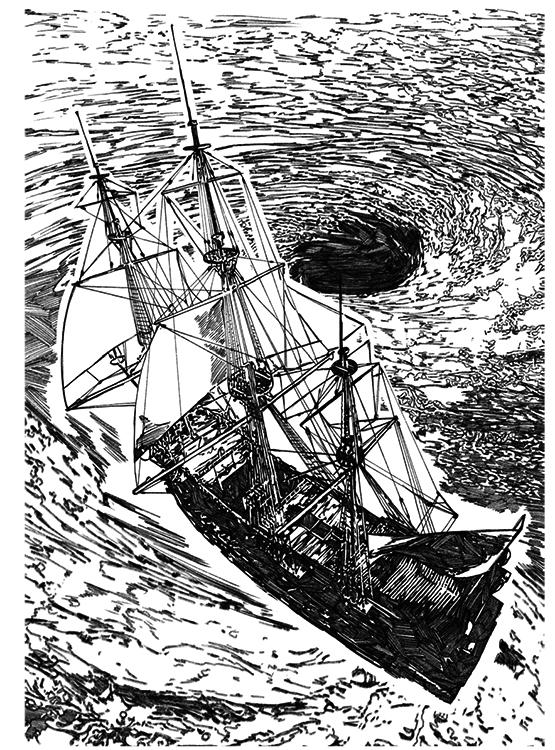
“It could not have been more than two minutes afterward until we suddenly felt the waves subside, and were enveloped in foam. The boat made a sharp half turn to larboard, and then shot off in its new direction like a thunderbolt. At the same moment the roaring noise of the water was completely drowned in a kind of shrill shriek—such a sound as you might imagine given out by the waste-pipes of many thousand steam-vessels, letting off their steam all together. We were now in the belt of surf that always surrounds the whirl; and I thought, of course, that another moment would plunge us into the abyss—down which we could only see indistinctly on account of the amazing velocity with which we wore borne along. The boat did not seem to sink into the water at all, but to skim like an air-bubble upon the surface of the surge. Her starboard side was next the whirl, and on the larboard arose the world of ocean we had left. It stood like a huge writhing wall between us and the horizon.
“It may appear strange, but now, when we were in the very jaws of the gulf, I felt more composed than when we were only approaching it. Having made up my mind to hope no more, I got rid of a great deal of that terror which unmanned me at first. I suppose it was despair that strung my nerves.
“It may look like boasting—but what I tell you is truth—I began to reflect how magnificent a thing it was to die in such a manner, and how foolish it was in me to think of so paltry a consideration as my own individual life, in view of so wonderful a manifestation of God’s power. I do believe that I blushed with shame when this idea crossed my mind. After a little while I became possessed with the keenest curiosity about the whirl i