


автордың кітабын онлайн тегін оқу Memorials of Old London. Volume 2 (of 2)
E-text prepared by Susan Skinner
and the Online Distributed Proofreading Team
(http://www.pgdp.net)
Note:
Project Gutenberg has the other volume of this work.
Volume I: see http://www.gutenberg.org/files/28742/28742-h/28742-h.htm
Memorials of the Counties of England
General Editor:
Rev. P. H. Ditchfield, M.A., F.S.A., F.R.S.L., F.R.Hist.S.
Memorials of Old London
VOLUME II.
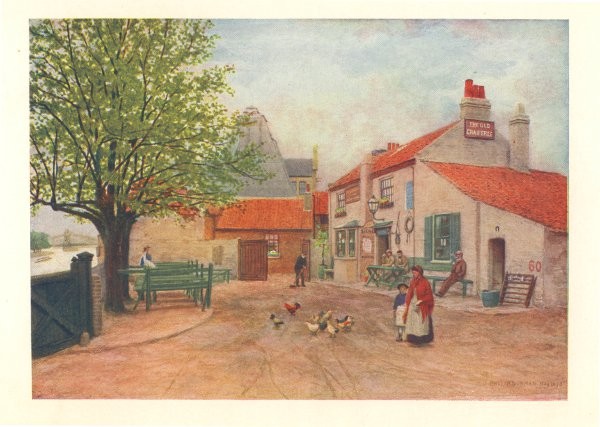
CRAB TREE INN, HAMMERSMITH 1898
From a painting by Philip Norman, LL.D.
MEMORIALS
OF OLD LONDON
EDITED BY
P. H. DITCHFIELD, M.A., F.S.A.
Fellow of the Royal Historical Society
Author of
The City Companies of London and their Good Works
The Story of our Towns
The Cathedral Churches of Great Britain
&c. &c.
IN TWO VOLUMES
VOL. II.
With Many Illustrations

LONDON
BEMROSE & SONS LIMITED, 4 SNOW HILL, E.C.
AND DERBY
1908
[All Rights Reserved]
CONTENTS OF VOL. II.
PageThe Palaces of London
By Rev.
R. S. Mylne, B.C.L., F.S.A.
1Elizabethan London
By
T. Fairman Ordish, F.S.A.
21Pepys's London
By
H. B. Wheatley, F.S.A.
52The Old London Bridges
By
J. Tavenor-Perry 82The Clubs of London
By Sir
Edwd. Brabrook, C.B., F.S.A.
99The Inns of Old London
By
Philip Norman, LL.D.
113The Old London Coffee-Houses
By
G. L. Apperson, I.S.O.
135The Learned Societies of London
By Sir
Edwd. Brabrook, C.B., F.S.A.
150Literary Shrines of Old London
By
Elsie M. Lang 166Crosby Hall
By the
Editor 182The Pageant of London; with some account of the City Churches, Christ's Hospital, etc.
By the
Editor 193Index
223LIST OF ILLUSTRATIONS IN VOL. II.
Crab Tree Inn, Hammersmith, 1898
Frontispiece(
From a painting by Philip Norman, LL.D.)
Page, or Facing PageThe Houses of Parliament
4(
From a photo. by Mansell & Co.)
A View of the Savoy Palace from the River Thames
6(
From an engraving published by the Society of Antiquaries in 1750, from a plan by G. Virtue)
Portion of an exact Survey of the Streets, Lanes, and Churches
8(
Comprehended by the order and directions of the Right Honourable the Lord Mayor, 10th December, 1666)
The Prospect of Bridewell
10(
Published according to Act of Parliament, 1755, for Stow's Survey)
The Palace of Whitehall
14(
From a photo. by Mansell & Co.)
St. James's Palace
16(
From a photo. by Mansell & Co.)
St. James's Palace, from Pall Mall and from the Park
18(
From an old print)
Plan of London in the time of Queen Elizabeth (1563)
24(
From an old print)
Shooting Match by the London Archers in the Year 1583
44(
From an old print)
A View of London as it appeared before the Great Fire
56(
From an old print)
The Great Fire of London
76(
From an old print)
South-West View of Old St. Paul's
80(
From an old print)
Sir John Evelyn's Plan for Rebuilding London after the Great Fire
82(
From an old print)
The Undercroft of St. Thomas of Canterbury on the Bridge
84The Surrey End of London Bridge
89(
Drawn by J. Tavenor-Perry)
The Foundation Stone Chair
93(
Drawn by J. Tavenor-Perry)
Old Westminster Bridge
96(
Drawn by J. Tavenor-Perry)
Badge of Bridge House Estates
98(
Drawn by J. Tavenor-Perry)
An Early Letter of the Royal Society, dated January 18th, 1693-4
152Cheapside, with the Cross, as they appeared in 1660
170(
From an old print)
Crosby Hall
184(
From a drawing by Whichillo, engraved by Stour)
St. Paul's Cathedral, with Lord Mayor's Show on the water
190(
From an engraving by Pugh, 1804)
Christ's Hospital
194(
From an old print)
Carrying the Crug-basket
196Wooden Platters and Beer Jack
198Piggin, Wooden Spoon, Wooden Soup-ladle
199Christ's Hospital: The Garden
200(
From a photo.)
Old Staircase at Christ's Hospital
202The Royal Exchange
218(
From an engraving by Hollar, 1644)
Cardinal Pole possessed a patent from Queen Mary, authorising a household of 100 servants. The modern part of the palace was built by Archbishop Howley in the Tudor style. He held the See from 1828 to 1848, and was the last prelate to maintain the archiepiscopal state of the olden time.
It was in the early thirties of last century that coaching reached its zenith, and perhaps the greatest coaching centre in London was the "Swan with Two Necks," Lad Lane. It was an old inn, mentioned by Machyn as early as 1556. In 1637 carriers from Manchester and other places used to lodge there, but it will be best remembered as it appears in a well-known print during the heyday of its prosperity, the courtyard crowded with life and movement. The gateway was so narrow that it required some horsemanship to drive a fast team out of the said courtyard, and some care on the part of the guard that his horn or bugle basket was not jammed against the gate-post. The proprietor of this establishment was Mr. William Chaplin who, originally a coachman, became perhaps the greatest coach proprietor that ever lived. About 1835 he occupied the yards of no fewer than five famous and important inns in London, to all of which allusion has been made—the "Spread Eagle" and "Cross Keys" in Gracechurch Street, the "Swan with Two Necks," the "White Horse," Fetter Lane, and the "Angel" behind St. Clement's. He had 1,300 horses at work on various roads, and about that time horsed fourteen out of the twenty-seven coaches leaving London every night. When the railways came he bowed to the inevitable, and, in partnership with Mr. Horne, established the great carrying business, which still flourishes on the site of the old "Swan with Two Necks." In 1845 Lad Lane was absorbed by Gresham Street. The origin of the sign has been often discussed, but it is perhaps well to conclude this chapter by adding a few words about it. The swans on the upper reaches of the Thames are owned respectively by the Crown and the Dyers and the Vintners' Company, and, according to ancient custom, the representatives of these several owners make an excursion each year up the river to mark the cygnets. The visitors' mark used to consist of the chevron or letter V and two nicks on the beak. The word nicks has been corrupted into necks, and as the Vintners were often tavern-keepers, the "Swan with Two Necks" became a common sign.
But it is impossible to attempt to exhaust the subject of the Old London Coffee-houses in one brief chapter. For a hundred years they focussed the life of the town. Within their hospitable walls men of all classes and occupations, independently, or in clubs and coteries, met not only for refreshment, but for social intercourse—to read and hear the news, to discuss the topics of the day, to entertain and be entertained. This was the chief end they served. Incidentally, as we have seen, they served a number of other subsidiary and more of less useful purposes. They died slowly. Gradually the better-class houses became more exclusive, and were merged in clubs of the modern kind. The inferior houses were driven from public favour by the taverns and public-houses, or, degenerating from their former condition, lingered on as coffee-houses still, but of the lower type, which is not yet quite extinct.
In this summary account of the principal Learned Societies of London it has not been possible to include many societies of great importance, such as the Colleges of Physicians and Surgeons, the numerous societies connected with other professional pursuits, the Linnæan, Zoological, Botanical, and other societies devoted to natural history; the Royal Astronomical Society, which has important public functions; the Royal Academy, and other institutions devoted to art. The roll of Learned Societies is being constantly increased. Among recent additions may be mentioned the British Academy for Historical Studies, and the Sociological Society.
These are a few out of the many literary memories that we may encounter in an afternoon's stroll from the Borough to St. James's, along one of the great city's busiest highways; others, indeed, there are, meeting us at every corner, but space forbids our dwelling upon them, and regretfully we must pass them by.
During that disastrous time Crosby became a prison for Royalists, and later on a great part of the house was destroyed by fire, and its ancient glories departed. For a hundred years the Hall was used as a Nonconformist chapel. In 1778 part of the premises was converted into a place of business by Messrs. Holmes and Hall, the rest being used as private dwellings. It provided a model for the banqueting-hall of Arundel Castle, and some of the carved stones of the Council Chamber were removed to Henley-upon-Thames to adorn a dairy. Alien buildings soon covered the site of the destroyed portion of the old house. In 1831 it was left forlorn and untenanted, and in a state of considerable decay. Then arose a considerable excitement, of which the struggle of the present year reminds us. Crosby Hall was doomed. But zealous lovers of the antiquities of the city determined to try to save it. An appeal was made, and a restoration fund started, though, like many other restoration funds, it proved itself inadequate. A benevolent lady, Miss Hackett, gallantly came to the rescue, and practically saved Crosby Hall. Her idea was to convert it into a lecture hall for the Gresham Professors; but this plan came to nothing, though the building was repaired, the south wall of the Throne and Council Chambers being rebuilt. Then a company was formed to take over Miss Hackett's interest, and the Crosby Hall Literary and Scientific Institution was formed, but that scheme came to nothing. Then it was bought by Messrs. F. Gordon & Co., who restored the building, attached to it an annex of half-timbered construction, and converted the premises into a restaurant. Thus it remained for several years. Recently the site was acquired by a banking company, and its demolition was threatened. Immediate action was taken by Sir Vesey Strong, the Lord Mayor, and others, to save the building. The fight was fought strenuously and bravely. Apathy was found in some quarters where it would least have been expected, and all efforts were fruitless. It is deplorable to have to record that the last of the mansions of the old city magnates has been allowed to disappear, and that Crosby Hall is now only a memory.
The best-known member of the Lancastrian family who resided in this palace is the famous John of Gaunt, Duke of Lancaster. During his time, so tradition has it, the well-known poet Chaucer was here married to Philippa, daughter of Sir Paon de Roet, one of the young ladies attached to the household of Blanche, Duchess of Lancaster, and the sister of Catherine Swynford, who at a later period became the Duke's third wife. However this may be, the Savoy was at that time the favourite resort of the nobility of England, and John of Gaunt's hospitality was unbounded. Stow, in his Chronicle, declares "there was none other house in the realm to be compared for beauty and stateliness." Yet how very transitory is earthly glory, all the pride of place and power!
King Henry VIII. made use of Bridewell for the trial of his famous divorce case. Cardinal Campeggio was President of the Court, and in the end gave judgment in favour of Queen Catharine of Aragon. Yet, despite the Cardinal, Henry would have nothing more to do with Catharine, and at the same time took a dislike to Bridewell, which was allowed to fall into decay—in fact, nothing of the older building now remains. King Edward VI., just before his own death in 1553, granted the charter which converted Bridewell into a charitable institution, and after many vicissitudes a great work is still carried on at this establishment for the benefit of the poor of London. In May, 1552, Dr. Ridley, Bishop of London, wrote this striking letter to Sir William Cecil, Knight, and Secretary to the King:—
Dr. Wellwood says Lord Falkland tried to laugh the matter off, but the King was pensive.
"There was certainly something of a martyr in him, if the man can be so called who values his own life less than the cause for which he is fighting, and in perishing himself saves it for the future."
When the great Cardinal fell into disgrace, and the Duke of Suffolk came to Whitehall to bid him resign the Great Seal of England, his Eminence left his palace by the privy stair and "took barge" to Putney, and thence to Esher; and Henry VIII. at once took possession of the vacant property, and began to erect new buildings, a vast courtyard, tennis court, and picture gallery, and two great gateways, all of which are now totally destroyed. It was in this palace that he died, January 28, 1547.
"In this lone open glade I lie, Screened by deep boughs on either hand; And at its end, to stay the eye, Those black crowned, red-boled pine trees stand."
No account of the palaces of London can be regarded as complete which omits to mention Lambeth. For more than 700 years the Archbishops of Canterbury have resided at this beautiful abode, intensely interesting from its close association with all the most stirring events in the long history of England. The estate was obtained by Archbishop Baldwin in the year 1197 by exchange for some lands in Kent with Glanville, Bishop of Rochester. In Saxon times Goda, the sister of King Edward the Confessor, had bestowed this property upon the Bishopric of Rochester; so that it has been continuously in the hands of the Church for near 900 years. The fine red-brick gateway with white stone dressings, standing close to the tower of Lambeth Church, is very imposing as seen from the road, and was built by Archbishop Cardinal Moreton in 1490. In the Middle Ages it was the custom to give a farthing loaf twice a week to the poor of London at this gateway, and as many as 4,000 were accustomed to partake of the archiepiscopal gift. Within the gateway is the outer courtyard of the palace, and at the further end, towards the river Thames, rises the picturesque Lollard's tower, built between 1434 and 1445 by that famous ecclesiastical statesman Archbishop Chicheley, founder of All Souls' College, Oxford. The quaint winding staircase, made of rough slabs of unplaned oak, is exactly as it was in Chicheley's time. In this tower is the famous chamber, entirely of oaken boards, called the Lollards' prison. It is 13 feet long, 12 feet broad, and 8 feet high, and eight iron rings remain to which prisoners were fastened. The door has a lock of wood, fastened with pegs of wood, and may be a relic of the older palace of Archbishop Sudbury. On the south side of the outer court stands the hall built by Archbishop Juxon during the opening years of Charles II.'s reign, with a fine timber roof, and Juxon's arms over the door leading into the palace. This Jacobean hall is now used as the library, and contains many precious manuscripts of priceless value, including the Dictyes and Sayings of the Philosophers, translated by Lord Rivers, in which is found a miniature illumination of the Earl presenting Caxton on his knees to Edward IV., who is supported by Elizabeth Woodville and her son Edward V. This manuscript contains the only known portrait of the latter monarch.
But these terrors loomed darkling in the background for the most part. They belonged rather to the time when the sovereign's palaces at Westminster and at the Tower seemed to hold London in a grip. The palace at Westminster now languished in desuetude; the Tower was a State prison, and—with some ironical intent, perhaps—also the abode of the royal beasts, lions, tigers, leopards, and other captives. The Queen passed in her royal barge down the river with ceremonious pageantry from her palace of Whitehall; the drawbridge raised, the floating court passed the Tower as with lofty indifference on its way to "Placentia," Her Majesty's palace at Greenwich. Out of the silence of history a record speaks like a voice, and tells us that here, in 1594, Shakespeare and his fellows performed at least two comedies or interludes before Her Majesty, and we know even the amounts that were paid them for their services.
Against the background of the ancient priory this precinct of Holywell presented a perfect picture of the new conditions which constituted what was distinctively Elizabethan London. It comprehended the conditions of freedom required by the new life. Outside the jurisdiction of the city, but within the protection of the justices of Middlesex; lying open to the common fields of Finsbury, where archery and other sports were daily practised; its two playhouses affording varied entertainment in fencing matches, wrestling matches, and other "sports, shows, and pastimes," besides stage-plays performed by the various acting companies which visited them; this precinct of Holywell presented a microcosm of Elizabethan London society. The attraction of the plays brought visitors from all parts of the city. On the days when dramatic performances were to be given flags were hoisted in the morning over the playhouses; and after the early midday dinner the stream of playgoers began to flow from the gates. On horseback and on foot, over the fields from Cripplegate and Moorgate, or along the road from Bishopsgate, came men and women, citizens and gallants, visitors from the country, adventurers and pickpockets. All classes and conditions mingled in the Theatre or the Curtain, in the "common playhouses," as they were called, which only came into existence in 1576, after the players had been banished from the city. It was all delightfully new and modern; the buildings were gorgeously decorated; the apparel of the players was rich and dazzling; the music was enthralling; the play was a magic dream.
"I stood in the Strand and beheld it, and bless'd God. And all this was done without one drop of blood shed, and by that very army which rebell'd against him; but it was ye Lord's doing, for such a restauration was never mention'd in any history antient or modern, since the returne of the Jews from the Babylonish captivity; nor so joyfull a day and so bright ever seene in this nation, this hapning when to expect or effect it was past all human policy."
Pepys refers, on May 1st, 1667, to his visit to Sir Robert Viner's, the eminent goldsmith, where he saw "two or three great silver flagons, made with inscriptions as gifts of the King to such and such persons of quality as did stay in town [during] the late plague for keeping things in order in the town, which is a handsome thing." Godfrey was a recipient of a silver tankard, and he was knighted by the King in September, 1666, for his efforts to preserve order in the Great Fire. The remembrance of his death, which had so great an influence on the spread of the "Popish Plot" terror, is greater than that of his public spirit during the plague and the fire.
"The conflagration was so universal, and the people so astonish'd, that from the beginning I know not by what despondency or fate, they hardly stirr'd to quench it, so that there was nothing heard or seene but crying out and lamentation, running about like distracted creatures without at all attempting to save even their goods; such a strange consternation there was upon them, so as it burned both in breadth and length, the churches, public halls, Exchange, hospitals, monuments and ornaments, leaping after a prodigious manner, from house to house, and streete to streete, at greate distances one from ye other; for ye heat with a long set of faire and warm weather had even ignited the aire and prepared the materials to conceive the fire, which devour'd after an incredible manner houses, furniture, and every thing. Here we saw the Thames cover'd with goods floating, all the barges and boates laden with what some had time and courage to save, as, on ye other, ye carts, &c., carrying out to the fields, which for many miles were strew'd with moveables of all sorts, and tents erecting to shelter both people and what goods they could get away. Oh the miserable and calamitous spectacle! Such as haply the world had not seene since the foundation of it, nor be outdon till the universal conflagration thereof. All the skie was of a fiery aspect, like the top of a burning oven, and the light seene above 40 miles round about for many nights. God grant mine eyes may never behold the like, who now saw above 10,000 houses all in one flame; the noise and cracking and thunder of the impetuous flames, ye shrieking of women and children, the hurry of people, the fall of towers, houses and churches was like a hideous storme and the aire all about so hot and inflam'd that at the last one was not able to approach it, so that they were forc'd to stand still and let ye flames burn on, which they did neere two miles in length and one in breadth. The clouds also of smoke were dismall and reach'd upon computation neer 50 miles in length. Thus I left it this afternoone burning, a resemblance of Sodom, or the last day. It forcibly call'd to mind that passage—non enim hic habemus stabilem civitatem: the ruines resembling the picture of Troy. London was, but is no more."—(Sept. 3rd, 1666.)
At the beginning of the last century only three bridges spanned the Thames in its course through London, and of these two were scarcely fifty years old; but before the century closed there were no less than thirteen bridges across the river between Battersea and the Pool. The three old bridges have been rebuilt, and even some of the later ones have been reconstructed, whilst one has been removed bodily, and now spans the gorge of the Avon at Bristol. Of all these bridges unfortunately only two are constructed wholly of stone, and can lay claim to any architectural merit; and even one of these two has recently had the happy effect of its graceful arches destroyed by the addition of overhanging pathways. Of the rest, some are frankly utilitarian—mere iron girder railway bridges, with no attempt at decoration beyond gilding the rivets—whilst the others have their iron arches and construction disguised with coarse and meaningless ornaments. One only of the iron bridges is in anyway worthy of its position; in its perfect simplicity and the bold spans of its three arches, Southwark Bridge bears comparison with the best in Europe, but the gradients and approaches are so inconvenient that it is even now threatened with reconstruction.
Fig. 1—The Undercroft of St. Thomas of Canterbury on the Bridge.
Fig. 2—The Surrey End of London Bridge.
The framework of the chair gives a pictorial chronicle of the city bridges; the top rail of the back shows old London Bridge after the removal of the houses, below which are new London Bridge, Southwark and old Blackfriars Bridges. The arms of the city are carved at the top, whilst the monogram of Peter of Colechurch and the device of the Bridge House Estates complete the decoration. This device, which appears to have been also the old badge of Southwark, was sometimes displayed upon a shield, thus:—Az., an annulet ensigned with a cross patée, Or; interlaced with a saltire enjoined in base, of the second. We give an illustration of this in figure 5.
Fig. 4—Old Westminster Bridge.
The last of the older bridges to be built was that of Southwark, which was the speculation of a private company, who hoped to profit by the continuously congested state of London Bridge; but the steepness of the gradients and the inconvenience of the approaches from the city made it from the first a failure. It was the first bridge in London to be constructed in iron; its model being the great single-span bridge across the Wear at Sunderland. It is in three great arches, the centre one being 240 feet across, or four feet more than that at Sunderland, and the mass of metal is such that an ordinary change of temperature will raise the arches an inch, and summer sunshine much more.
After the summary proceedings of James I., in 1604, the antiquaries seem to have allowed the whole of the seventeenth century to pass without any further attempt at organisation, though we learn from Mr. Ashmole that on July 2, 1659, an antiquaries' feast was held, and many renowned antiquaries, such as Dugdale, Spelman, Selden, and Anthony à Wood flourished at that time. On November 5, 1707, three antiquaries met at the "Bear" Tavern in the Strand, and agreed to hold a weekly meeting at the same place on Fridays at 6 o'clock, "and sit till ten at farthest." Other antiquaries joined them, and they removed next year to the "Young Devil" Tavern in Fleet Street, where Le Neve became their president.
golden, perhaps, having reference to his father, who was a goldsmith; and greater still, John Milton, who first saw the light in Bread Street, at the sign of the "Spread Eagle," in a house which was afterwards destroyed in the Great Fire. It must have been a house of comfortable dimensions, for it covered the site now occupied by Nos. 58 to 63, the business premises of a firm who exhibit a bust of Milton, with an inscription, in a room on their top floor. Milton's father, moreover, had grown rich in his profession, which was that of a scrivener, had been made a Judge, and knighted five years before the birth of his son, so it is evident the poet began life in easy circumstances. He was baptised in All Hallows, a church in Bread Street destroyed in 1897. In Bow Church there is a tablet in memory of Milton, which was taken from All Hallows. When he was ten years of age he began to go to Paul's School, which stood in those days on the east side of St. Paul's Churchyard, between Watling Street and Cheapside. Aubrey records that "when he went to schoole, when he was very young, he studied very hard, and sat up very late, commonly till twelve or one o'clock at night, and his father ordered the mayde to sitt up for him, and at these years (ten) he composed many copies of verses which might well have become a riper age." He continued at this school, the old site of which is marked by a tablet on a warehouse, until he was sixteen. Some twenty years later Samuel Pepys was a pupil at Paul's School, and later on in life witnessed its destruction in the Great Fire. Milton would seem to have always cherished a great affection for the city, for after his return from his travels he seldom lived beyond the sound of Bow Bells, once only venturing as far as Westminster; and when he died he was buried in St. Giles's, Cripplegate, in the same grave as his father. Indeed, the city proper was the birthplace of several poets, for was not Pope born in Lombard Street, Gray in Cornhill, and Edmund Spenser in East Smithfield, while Lord Macaulay spent his earlier years in Birchin Lane?
The neighbourhood is interesting. Foremost among the attractions of Bishopsgate Street is the beautiful church of St. Helen, formerly the church of the Nunnery of St. Helen, the Westminster of the city, where lie so many illustrious merchants and knights and dames, and amongst them the founder of Crosby Hall and other owners of the mansion. The church is closely associated with the hall. There in that fine house they lived. There in the church hard by their bodies sleep, and their gorgeous tombs and inscriptions tell the story of their deeds. St. Helen's Church was one of the few which escaped destruction at the Great Fire of London. There was an early Saxon church here, but the earliest parts of the existing building date back to the thirteenth century. There are some blocked-up lancet windows of the transept, a staircase doorway in the south-east corner, another doorway which led from the nun's choir into the convent, and a lancet window. There is a Renaissance porch, the work of Inigo Jones, erected in 1663. The main part of the structure is Decorated and Perpendicular, the fifteenth century work being due to the builder of Crosby Hall, who left 500 marks for its restoration and improvement. The whole church possesses many interesting features, of which want of space prevents a full description.
Crosby Hall has been the scene of many notable historic scenes. In the play of "Edward IV." by Heywood, Sir John Crosby figures as Lord Mayor of London, a position which he never occupied, and the King dines with him and the Alderman after the defeat of the rebel Falconbridge at Crosby Hall. He had just received the honour of knighthood, and thus muses:—
Many regrets were expressed when it was found necessary to remove this ancient school from London, and to destroy the old buildings. Of course, "everything is for the best in this best of possible worlds." Boys, like plants, thrive better in the open country, and London fogs are apt to becloud the brain as well as injure health. But the antiquary may be allowed to utter his plaint over the demolition of the old features of London life. The memorials of this ancient school cannot be omitted from our collection.
But Henry's conscience smote him. The death of Charles Brandon, Duke of Suffolk, the King's boon companion, moved him "to bethink himself of his end, and to do some good work thereunto," as Fuller states. The church was reopened for worship, and Bishop Ridley, preaching at Paul's Cross, announced the King's gift of the conventual grounds and buildings, with the hospital of St. Bartholomew, for the relief of the poor. Letters patent were issued in 1545, making over to the Mayor and Commonalty of London for ever "the Grey Friars' Church, with all the edifices and ground, the fratry, library, dortor, chapter-house, great cloister, and the lesser tenements and vacant grounds, lead, stone, iron, etc.; the hospital of St. Bartholomew, West Smithfield, the church of the same, the lead, bells, and ornaments of the same hospital, with all messuages, tenements, and appurtenances."
For some years nothing was done to further the cause of this charity, but in 1552, when Bishop Ridley, who was a mightily convincing preacher, was discoursing upon charity before Edward VI., the boy-King was so moved that he conversed with the bishop, and, together with the Lord Mayor and aldermen of the city, determined to found three hospitals—Christ's Hospital for the education of poor children, St. Thomas's for the relief of the sick and diseased, and Bridewell for the correction and amendment of the idle and the vagabond. Before his last illness, Edward had just strength enough to sign the charter for the founding of these institutions, ejaculating: "Lord, I yield Thee most hearty thanks that Thou hast given me life thus long to finish this work to the glory of Thy name." The good citizens of London, with their accustomed charity, immediately set to work, before the granting of the charter, to subscribe money for the repair of the old monastic buildings, and in 1552 three hundred and forty children were admitted, not so much for educational purposes as for their rescue from the streets, and the provision of shelter, food, and clothing. It must have been a welcome sight to the citizens to see them clothed in livery of russet cotton, the boys with red caps, the girls with kerchiefs on their heads, lining the procession when the Lord Mayor and aldermen rode to St. Paul's on Christmas Day. On the following Easter the boys and "mayden children" were in "plonket," or blue—hence the hospital derived the name of the Blue Coat School. The dress of the boys, concerning the origin of which many fanciful interpretations have been made, is the costume of the period generally worn by apprentices and serving men, consisting of a long blue coat, with leathern girdle, a sleeveless yellow waistcoat and yellow stockings, clerical bands and a small black cap completing the dress. "Four thousand marks by the year" from the royal exchequer were granted by the King for the maintenance of the school, which sum was largely supplemented by the citizens and other pious benefactors, such as Lady Ramsay, who founded "a free writing schoole for poor men's children" at the hospital. Camden says that at the beginning of the seventeenth century six hundred children were maintained and educated, and one thousand two hundred and forty pensioners relieved by the hospital in alms, and, later on, as many as one thousand one hundred and twenty children were cared for by this institution. The governors, moreover, started "place houses" in other districts—at Hertford, Ware, Reading, and Bloxburn—where boys were educated.
The buildings were greatly injured by the fire of 1666, when the old monastic church was entirely destroyed. The great hall was soon rebuilt by Sir John Frederick, and then the famous Royal Mathematical School was founded through the exertions of Sir Robert Clayton, Sir Jonas Moore, Sir Christopher Wren, Sir Charles Scarbrough, and Samuel Pepys. King Charles II. granted a charter and £1,000 a year for seven years, and the forty boys who composed the school were called "King's boys." They were instructed in navigation, and wore a badge on the left shoulder. A subordinate mathematical school, consisting of twelve scholars, denoted "the Twelves," who wore a badge on the right shoulder, was subsequently formed. Pepys took a keen interest in the school, and a series of a large number of his letters is in existence which show the efforts he made to maintain the mathematical school. He tells also of a little romance connected with the hospital, which is worth recording. There was at that time a grammar school for boys and a separate school for girls. Two wealthy citizens left their estates, one to a bluecoat boy, and the other to a bluecoat girl. Some of the governors thought that it would be well if these two fortunate recipients were married. So a public wedding was arranged at the Guildhall chapel, where the ceremony was performed by the Dean of St. Paul's, the bride, supported by two bluecoat boys, being given away by the Lord Mayor, and the bridegroom, attired in blue satin, being led to the altar by two bluecoat girls.
It is unnecessary to describe all the buildings which so recently existed, but have now been swept away. It is more interesting to note some of the curious customs which exist or formerly existed in the school, and some of the noted of the old "Blues." Christ's Hospital was a home of old customs, some of them, perhaps, little relished by the scholars. Each boy had a wooden "piggin" for drinking small beer served out of a leathern or wooden jack; a platter, spoon, and soup-ladle of the same material. There was a quaint custom of supping in public on Sundays during Lent, when visitors were admitted, and the Lord Mayor or president of the governors sat in state. Quaint wooden candlesticks adorned the tables, and, after the supper, were carried away in procession, together with the tablecloths, crug-baskets, or baskets used for carrying bread, bowls, jacks, and piggins. Before the supper a hymn was sung, and a "Grecian," or head boy, read the prayers from the pulpit, silence being enforced by three blows of a wooden hammer. The supper then began, consisting of bread and cheese, and the visitors used to walk about between the tables. Then followed the solemn procession of the boys carrying their goods, and bowing repeatedly to the governors and their guests. It was a pleasing custom, honoured by the presence of many distinguished guests, and Queen Victoria and Prince Albert on one occasion witnessed the spectacle.
At Easter there were solemn processions—first, on Easter Monday, to the Mansion House, when the Lord Mayor was escorted by the boys to Christ Church to hear the Spital or hospital sermon. On Easter Tuesday again the scholars repaired to the Mansion House, and were regaled with a glass of wine, in lieu of which lemonade, in more recent times, could be obtained, two buns, and a shilling fresh from the Mint, the senior scholars receiving an additional sum, and the Grecians obtained a guinea. Again the Spital sermon was preached. The boys were entitled, by ancient custom, to sundry privileges—to address the sovereign on his visiting the city, and the "King's boys" were entitled to be presented at the first drawing-room of the season, to present their charts for inspection, and to receive sundry gifts. By ancient privilege they were entitled to inspect all the curiosities in the Tower of London free of any charge, and these at one time included a miniature zoological garden.
The Bank of England commenced its career in 1691; founded by William Paterson, a Scotsman, and incorporated by William III. The greatest monetary establishment in the world at first managed to contain its wealth in a single chest, not much larger than a seaman's box. Its first governor was Sir John Houblon, who appears largely in the recent interesting volume on the records of the Houblon family, and whose house and garden were on part of the site of the present bank. The halls of the mercers and grocers provided a home for the officials in their early dealings. The site of the bank was occupied by a church, St. Christopher-le-Stocks, three taverns, and several houses. These have all been removed to make room for the extensions which from time to time were found necessary. The back of the Threadneedle Street front is the earliest portion—built in 1734, to which Sir Robert Taylor added two wings; and then Sir John Soane was appointed architect, and constructed the remainder of the present buildings in the Corinthian style, after the model of the Temple of the Sibyl at Tivoli. There have been several subsequent additions, including the heightening of the Cornhill front by an attic in 1850. There have been many exciting scenes without those sombre-looking walls. It has been attacked by rioters. Panics have created "runs" on the bank; in 1745 the managers just saved themselves by telling their agents to demand payment for large sums in sixpences, which took a long time to count, the agents then paying in the sixpences, which had to be again counted, and thus preventing bonâ-fide holders of notes presenting them. At one time the corporation had a very insignificant amount of money in the bank, and just saved themselves by issuing one pound notes. The history of forgeries on the bank would make an interesting chapter, and the story of its defence in the riots of 1780, when old inkstands were used as bullets by the gallant defenders, fills a page of old-world romance.
THE PALACES OF LONDON
By the Rev. R. S. Mylne, B.C.L. (Oxon), F.S.A. F.R.S. (Scots.)
The housing of the Sovereign is always a matter of interest to the nation. It were natural to expect that some definite arrangement should be made for this purpose, planned and executed on a grand and appropriate scale. Yet as a matter of fact this is seldom the case amongst the western nations of Europe. Two different causes have operated in a contrary direction. One is the natural predilection of the ruler of the State for a commodious palace outside, but not far from, the capital. Thus the great Castle of Windsor has always been par excellence the favourite residence of the King of England. The other is the growth of parliamentary institutions. Thus the entire space occupied by the original Royal Palace has become the official meeting-place of the Parliament; and the King himself has perforce been compelled to find accommodation elsewhere.
Look at the actual history of the Royal Palace of Westminster, where the High Court of Parliament now is accustomed to assemble. It was on this very spot that Edward the Confessor lived and died, glorying in the close proximity of the noble abbey that seemed to give sanctity to his own abode. Here the last Saxon King entertained Duke William of Normandy, destined to be his own successor on the throne. Here he gave the famous feast in which he foretold the failure of the crusades, as Baring Gould records in his delightful Myths of the Middle Ages. Here Edward I. was born, and Edward III. died. The great hall was erected by William Rufus, and the chapel by King Stephen. Henry VIII. added the star chamber. The painted chamber, decorated with frescoes by Henry III., was probably the oldest portion of the mediæval palace, and just beyond was the prince's chamber with walls seven feet thick. There was also the ancient Court of Requests, which served as the House of Lords down to 1834. The beautiful Gothic Chapel of St. Stephen was used as the House of Commons from 1547 to 1834. The walls were covered with frescoes representing scenes from the Old and New Testaments. In modern times they resounded to the eloquence of Pitt, Fox, Burke, and Canning.
The curious crypt beneath this chapel was carefully prepared by H.M. Office of Works for the celebration of the marriage of Lord Chancellor Loreburn last December, and a coffin was discovered while making certain reparations to the stonework, which is believed to contain the remains of the famous Dr. Lyndwode, Bishop of St. David's from 1442 to 1446.
In the terrible fire on the night of October 16, 1834, the entire palace was destroyed with the exception of the great hall, which, begun by William Rufus, received its present beautiful roof of chestnut wood from Henry Yeveley, architect or master mason to Richard II.
The present magnificent Palace of Westminster was erected by Sir Charles Barry between 1840 and 1859 in the Gothic style, and is certainly one of the finest modern buildings in the world. The river front is remarkably effective, and presents an appearance which at once arrests the attention of every visitor. It is quite twice the size of the old palace, formerly occupied by the King, and cost three millions sterling. It is certainly the finest modern building in London.
Some critics have objected to the minuteness of the decorative designs on the flat surfaces of the walls, but these are really quite in accord with the delicate genius of Gothic architecture, and fine examples of this kind of work are found in Belgium and other parts of the Continent.
Every one must admit the elegance of proportion manifested in the architect's design, and this it is which makes the towers stand out so well above the main building from every point of view; moreover, this is the special characteristic which is often so terribly lacking in modern architecture. One wonders whether Vitruvius and kindred works receive their due meed of attention in this twentieth century.
Within the palace the main staircase, with the lobby and corridors leading to either House of Parliament, are particularly fine, and form a worthy approach to the legislative chambers of the vast Empire of Great Britain.
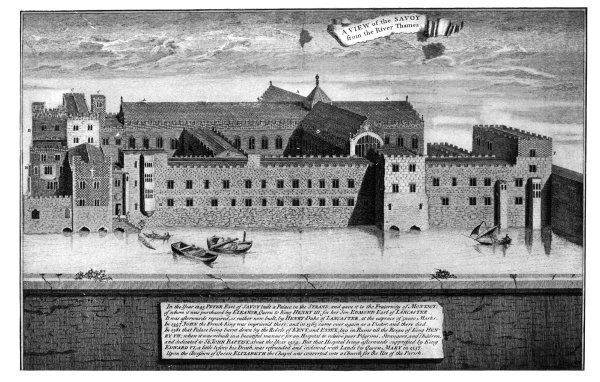
The Palace of the Savoy also needs some notice. The original house was built by Peter, brother of Boniface, for so many years Archbishop of Canterbury, and uncle of Eleanor of Provence, wife of King Henry III. By his will Peter bequeathed this estate to the monks of Montjoy at Havering-at-Bower, who sold it to Queen Eleanor, and it became the permanent residence of her second son Edmund, Earl of Lancaster, and his descendants. When King John of France was made a prisoner after the battle of Poitiers in 1356, he was assigned an apartment in the Savoy, and here he died on April 9, 1364. The sad event is thus mentioned in the famous chronicle of Froissart:—
"The King and Queen, and all the princes of the blood, and all the nobles of England were exceedingly concerned from the great love and affection King John had shewn them since the conclusion of peace."
The best-known member of the Lancastrian family who resided in this palace is the famous John of Gaunt, Duke of Lancaster. During his time, so tradition has it, the well-known poet Chaucer was here married to Philippa, daughter of Sir Paon de Roet, one of the young ladies attached to the household of Blanche, Duchess of Lancaster, and the sister of Catherine Swynford, who at a later period became the Duke's third wife. However this may be, the Savoy was at that time the favourite resort of the nobility of England, and John of Gaunt's hospitality was unbounded. Stow, in his Chronicle, declares "there was none other house in the realm to be compared for beauty and stateliness." Yet how very transitory is earthly glory, all the pride of place and power!
In the terrible rebellion of Wat Tyler, in the year 1381, the Savoy was pillaged and burnt, and the Duke was compelled to flee for his life to the northern parts of Great Britain. His Grace had become very unpopular on account of the constant protection he had extended to the simple followers of Wickcliffe.
After this dire destruction the Savoy was never restored to its former palatial proportions. The whole property passed to the Crown, and King Henry VII. rebuilt it, and by his will endowed it in a liberal manner as a hospital in honour of St. John the Baptist. This hospital was suppressed at the Reformation under Edward VI., most of the estates with which it was endowed passing to the great City Hospital of St. Thomas. But Queen Mary refounded the hospital as an almshouse with a master and other officers, and this latter foundation was finally dissolved in 1762.
Over the gate, now long destroyed, of King Henry VII.'s foundation were these words:—
"Hospitium hoc inopi turbe Savoia vocatum Septimus Henricus solo fundavit ab imo."
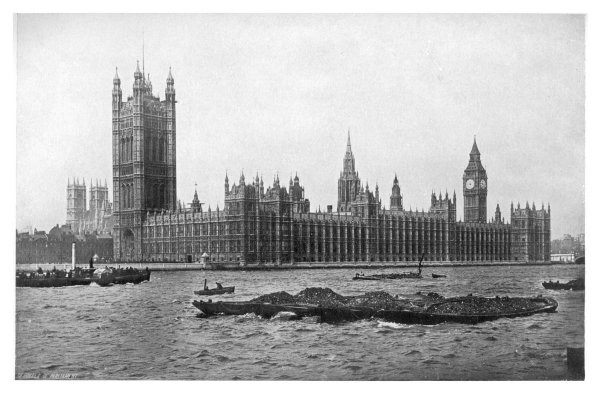
The Houses of Parliament.
The church, which is the only existing remnant of former splendour, was built as the chapel of Henry VII.'s Hospital, and is an interesting example of Perpendicular architecture, with a curious and picturesque belfry. In general design it resembles a college chapel, and the religious services held therein are well maintained. Her late Majesty Queen Victoria behaved with great generosity to the church of the Savoy. In her capacity of Duchess of Lancaster she restored the interior woodwork and fittings, and after a destructive fire in 1864 effected a second restoration of the entire interior of this sacred edifice. There is now a rich coloured roof, and appropriate seats for clergy and people. There is also preserved a brass belonging to the year 1522 from the grave of Thomas Halsey, Bishop of Leighlin, and Gavin Douglas, Bishop of Dunkeld, famous in Scottish history for his piety and learning. There is also a small figure from Lady Dalhousie's monument, but all the other tombs perished in the flames in 1864. The history of the central compartment of the triptych over the font is curious. It was painted for the Savoy Palace in the fourteenth century, afterwards lost, and then recovered in 1876.
Amongst the famous ministers of the Savoy were Thomas Fuller, author of the Worthies, and Anthony Horneck. In the Savoy was held the famous conference between twelve bishops and twelve Nonconformists for the revision of the Liturgy soon after the accession of King Charles II. In this conference Richard Baxter took a prominent part.
In this brief sketch nothing is more remarkable than the great variety of uses to which the palace of the Savoy has been put, as well as the gradual decay of mediæval splendour. Still, however, the name is very familiar to the multitudes of people who are continually passing up and down the Strand. Yet it is a far cry to the days of Archbishop Boniface of Savoy, and Edmund Earl of Lancaster.
Bridewell is situated on a low-lying strip of land between the Thames and the Fleet, just westwards of the south-western end of the Roman wall of London. In early days this open space only possessed a tower for defensive purposes, just as the famous Tower of London guarded the eastern end of the city. Hard by was the church of St. Bride, founded in the days of the Danes, most likely in the reign of King Canute, and here there was a holy well or spring. Hence arose the name of Bridewell.
In 1087, ancient records relate, King William gave choice stones from his tower or castle, standing at the west end of the city, to Maurice, Bishop of London, for the repair of his cathedral church.
From time to time various rooms were added to the original structure, which seem chiefly to have been used for some state ceremonial or judicial purpose. Thus in the seventh year of King John, Walter de Crisping, the Justiciar, gave judgment here in an important lawsuit.
In 1522 the whole building was repaired for the reception of the famous Emperor Charles V., but that distinguished Sovereign actually stayed in the Black Friars, on the other side of the Fleet.
King Henry VIII. made use of Bridewell for the trial of his famous divorce case. Cardinal Campeggio was President of the Court, and in the end gave judgment in favour of Queen Catharine of Aragon. Yet, despite the Cardinal, Henry would have nothing more to do with Catharine, and at the same time took a dislike to Bridewell, which was allowed to fall into decay—in fact, nothing of the older building now remains. King Edward VI., just before his own death in 1553, granted the charter which converted Bridewell into a charitable institution, and after many vicissitudes a great work is still carried on at this establishment for the benefit of the poor of London. In May, 1552, Dr. Ridley, Bishop of London, wrote this striking letter to Sir William Cecil, Knight, and Secretary to the King:—
"Good Master Cecyl,—I must be suitor with you in our Master Christ's cause. I beseech you be good unto him. The matter is, Sir, that he hath been too, too long abroad, without lodging, in the streets of London, both hungry, naked and cold. There is a large wide empty house of the King's Majesty called Bridewell, which would wonderfully serve to lodge Christ in, if he might find friends at Court to procure in his cause."
Thus the philanthropic scheme was started, and brought to completion under the mayoralty of Alderman Sir George Barnes.
View larger version.
A View of the Savoy Palace from the River Thames.
Published by the Society of Antiquaries in 1750, from a plan by G. Virtue.
AAAThe great building, now a barracks.
BBPrison for the Savoy, and guards.
CCCChurch of St. Mary le Savoy.
DStairs to the waterside.
EFGChurches of German Lutherans, French and German Calvinists.
St. James's is the most important royal palace of London. For many a long year it has been most closely associated with our royal family, and the quaint towers and gateway looking up St. James's Street possess an antiquarian interest of quite an unique character. This palace, moreover, enshrines the memory of a greater number of famous events in the history of our land than any other domestic building situated in London, and for this reason is worthy of special attention.
Its history is as follows:—Before the Norman Conquest there was a hospital here dedicated to St. James, for fourteen maiden lepers. A hospital continued to exist throughout the middle ages, but when Henry VIII. became King he obtained this property by an exchange, and converted it, as Holinshed bears witness, into "a fair mansion and park" when he was married to Anne Boleyn. The letters "H. A." can still be traced on the chimney-piece of the presence chamber or tapestry room, as well as a few other memorials of those distant days. And what days they were! Queen Anne Boleyn going to St. James's in all the joyous splendour of a royal bride, and how soon afterwards meeting her cruel fate at the hands of the executioner! Henry VIII. seldom lived at St. James's Palace, perhaps on account of the weird reminiscences of Anne Boleyn, but it became the favourite residence of Queen Mary after her husband Philip II. returned to Spain, and here she died in utter isolation during the dull November days of the autumn of 1558. Thus the old palace is first associated with the sad story of two unhappy queens!
But brighter days were coming. Prince Henry, the eldest son of James I., settled here in 1610, and kept a brilliant and magnificent court, attached to which were nearly 300 salaried officials. Then in two short years he died, November 6, 1612. Then the palace was given to Charles, who afterwards ascended the throne in 1625, and much liked the place as a residence. It is closely associated with the stirring events of this romantic monarch's career. Here Charles II., James II., and the Princess Elizabeth were born, and here Marie de Medici, the mother of Queen Henrietta Maria, took refuge in 1638, and maintained a magnificent household for three years. It is said her pension amounted to £3,000 a month! Her residence within the royal palace increased the unpopularity of the King, whose arbitrary treatment of Parliament led to the ruinous Civil War. The noble House of Stuart is ever unfortunate all down the long page of history, and the doleful prognostications of the Sortes Vergilianæ, sought for by the King, proved but too true in the event.
We quote six lines of Dryden's translation from the sixth book of the Æneid, at the page at which the King by chance opened the book—
"Seek not to know, the ghost replied with tears, The sorrows of thy sons in future years. This youth, the blissful vision of a day, Shall just be shewn on earth, and snatched away. . . . . . "Ah! couldst thou break through Fate's severe decree, A new Marcellus shall arise in thee."
Dr. Wellwood says Lord Falkland tried to laugh the matter off, but the King was pensive.
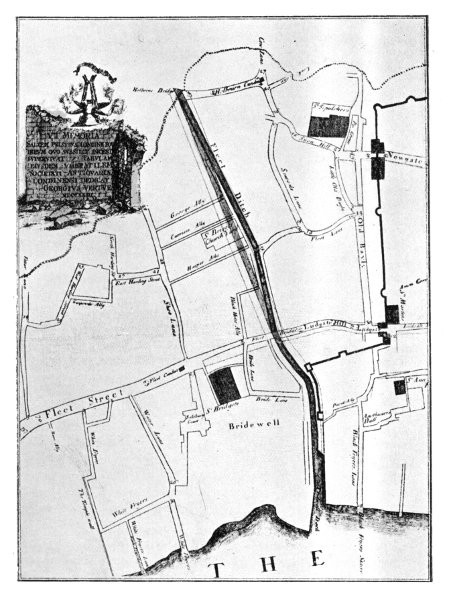
Portion of an exact Survey of the Streets, Lanes, and Churches.
Comprehended by the order and directions of the Right Honourable the Lord Mayor 10th December, 1666.
The fortunes of war were against this very attractive but weak monarch, who was actually brought as a prisoner of the Parliament from Windsor Castle to his own Palace of St. James, there to await his trial on a charge of high treason in Westminster Hall!
Certain of his own subjects presumed to pass sentence of death upon their own Sovereign, and have become known to history as the regicides. Very pathetic is the story of the scenes which took place at St. James's on Sunday, January 28, 1649. A strong guard of parliamentary troops escorted King Charles from Whitehall to St. James's, and Juxon, the faithful Bishop of London, preached his last sermon to his beloved Sovereign from the words, "In the day when God shall judge the secrets of men by Jesus Christ, according to my Gospel." His Majesty then received the Sacrament, and spent much time in private devotion. On the morrow he bade farewell to his dear children the Duke of Gloucester and the Princess Elizabeth, praying them to forgive his enemies, and not to grieve, for he was about to die a glorious death for the maintenance of the laws and liberties of the land and the true Protestant religion. Then he took the little Duke of Gloucester on his knees, saying, "Sweetheart, now they will cut off thy father's head," and the young prince looked very earnestly and steadfastly at the King, who bade him be loyal to his brothers Charles and James, and all the ancient family of Stuart. And thus they parted.
Afterwards His Majesty was taken from St. James's to the scaffold at Whitehall. There was enacted the most tragic scene connected with the entire history of the Royal Family of England. At the hands of Jacobite writers the highly-coloured narrative is like to induce tears of grief, but the Puritans love to dwell on the King's weaknesses and faults. Yet everyone must needs acknowledge the calm nobility and unwavering courage of the King's bearing and conduct.
"He nothing common did or mean Upon that memorable scene, But with his keener eye The axe's edge did try; Nor called the gods with vulgar spite To vindicate his helpless right, But bowed his comely head Down, as upon a bed."
The great German historian Leopold von Ranke is rightly regarded as the best and most impartial authority on the history of Europe in the seventeenth century. This is what he says on the martyrdom of Charles I.:—
"The scaffold was erected on the spot where the kings were wont to show themselves to the people after their coronation. Standing beside the block at which he was to die, he was allowed once more to speak in public. He said that the war and its horrors were unjustly laid to his charge.... If at last he had been willing to give way to arbitrary power, and the change of the laws by the sword, he would not have been in this position: he was dying as the martyr of the people, passing from a perishable kingdom to an imperishable. He died in the faith of the Church of England, as he had received it from his father. Then bending to the block, he himself gave the sign for the axe to fall upon his neck. A moment, and the severed head was shown to the people, with the words: 'This is the head of a traitor.' All public places, the crossings of the streets, especially the entrances of the city, were occupied by soldiery on foot and on horseback. An incalculable multitude had, however, streamed to the spot. Of the King's words they heard nothing, but they were aware of their purport through the cautious and guarded yet positive language of their preachers. When they saw the severed head, they broke into a cry, universal and involuntary, in which the feelings of guilt and weakness were blended with terror—a sort of voice of nature, whose terrible impression those who heard it were never able to shake off."
These weighty words of Ranke are well worth quoting, as well as the conclusion of the section of his great book in which he sums up his estimate of Charles's claim to the title of martyr:
"There was certainly something of a martyr in him, if the man can be so called who values his own life less than the cause for which he is fighting, and in perishing himself saves it for the future."
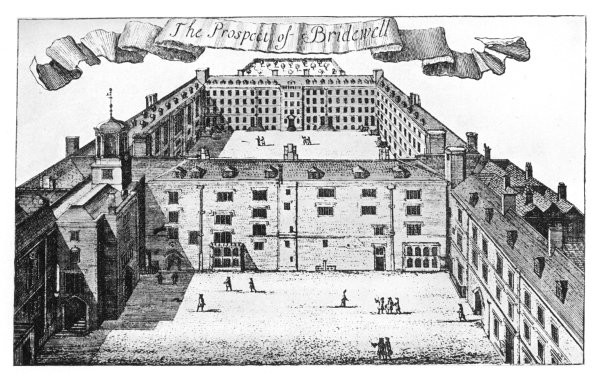
The Prospect of Bridewell.
Published according to Act of Parliament, 1755, for Stow's Survey.
King Charles I., then, is fairly entitled to be called a martyr in the calm and unimpassioned judgment of the greatest historian of modern times in the learned Empire of Germany, who tests the royal claim by a clear and concise definition, framed without any regard to the passionate political feeling which distracted England in the days of the Stuarts.
And it was in the Palace of St. James that Charles I. passed the last terrible days of his earthly life.
On the Restoration, King Charles II. resided at Whitehall, and gave St. James's to his brother James, Duke of York. Here Queen Mary II. was born, and here she was married to William of Orange late in the evening on November 4, 1677. Here also Anne Hyde, Duchess of York, died in 1671, having lived many years more or less in seclusion in the old palace.
James afterwards married Mary of Modena as his second wife, and here was born, on June 10, 1688, Prince James Edward, better known as the Old Pretender, whose long life was spent in wandering and exile, in futile attempts to gain the Crown, in unsuccessful schemes and ruinous plots, until he and his children found rest within the peaceful walls of Rome.
Directly after he landed in England, King William III. came to St. James's, and resided here from time to time during his possession of the Crown, only towards the end of his reign allowing the Princess Anne to reside in this palace, where she first heard of King William's death. The bearer of the sad news was Dr. Burnet, Bishop of Salisbury.
Immediately on his arrival in England, George I., Elector of Hanover, came straight to St. James's just as King William III. had done. In his Reminiscences, Walpole gives this quaint anecdote:—
"This is a strange country," remarked the King. "The first morning after my arrival at St. James's, I looked out of the window, and saw a park with walks and a canal, which they told me were mine. The next day Lord Chetwynd, the ranger of my park, sent me a fine brace of carp out of my canal: and I was told I must give five guineas to Lord Chetwynd's servant for bringing me my own carp, out of my own canal, in my own park."
Many things seem to have surprised King George I. in his English dominions, and he really preferred Hanover, where he died in 1725.
George II. resided at St. James's when Prince of Wales, and here his beloved wife, Queen Caroline of Anspach, died on November 20, 1737. Four years previously her daughter Anne had here been married to the Prince of Orange. It now became customary to assign apartments to younger children of the Sovereign in various parts of the palace, which thus practically ceased to be in the King's own occupation. The state apartments are handsome, and contain many good portraits of royal personages. The Chapel Royal has a fine ceiling, carved and painted, erected in 1540, and is constantly used by royalty. George III. hardly ever missed the Sunday services when in London.
Of course the original palace covered more ground than is now the case, and included the site of Marlborough House and some adjacent gardens, now in private ownership. The German Chapel Royal, which now projects into the grounds of Marlborough House, was originally erected by Charles I. for the celebration of Roman Catholic worship for Queen Henrietta Maria, and at the time gave great offence to all the nobility and people of the land.
"Tempora mutantur, et nos mutamur in illis." Marlborough House was originally built by Sir Christopher Wren for the great Duke of Marlborough, on a portion of St. James's Park given by Queen Anne for that purpose. Here died the Duke, and his famous Duchess Sarah. The house was bought by the Crown for the Princess Charlotte in 1817, and was settled on the Prince of Wales in 1850. There are still a number of interesting pictures in the grand salon of the victories of the Duke of Marlborough by Laguerre. The garden covers the space formerly occupied by the Great Yard of old St. James's Palace.
Altogether, it is quite clear from the above brief account that St. James's is the most important of the royal palaces of London, and more closely connected than any other with the long history of English Royalty. From the days of Henry VIII. to the present time there has always been a close personal connection with the reigning Sovereign of the British Empire.
The Palace of Whitehall presents a long and strange history. Hubert de Burgh, Earl of Kent, Chief Minister of King Henry III., became possessed of the land by purchase from the monks of Westminster for 140 marks of silver and the annual tribute of a wax taper. Hubert bequeathed the property by his will to the Black Friars of Holborn, who sold it in 1248 to Walter de Grey, Archbishop of York, for his Grace's town residence.
When Cardinal Wolsey became possessed of the northern archiepiscopal See, he found York House too small for his taste, and he set to work to rebuild the greater part of this palace on a larger and more magnificent scale. On the completion of the works he took up his abode here with a household of 800 persons, and lived with more than regal splendour, from time to time entertaining the King himself to gorgeous banquets, followed by masked balls. At one of these grand entertainments they say King Henry first met Anne Boleyn. A chronicler says the Cardinal was "sweet as summer to all that sought him."
When the great Cardinal fell into disgrace, and the Duke of Suffolk came to Whitehall to bid him resign the Great Seal of England, his Eminence left his palace by the privy stair and "took barge" to Putney, and thence to Esher; and Henry VIII. at once took possession of the vacant property, and began to erect new buildings, a vast courtyard, tennis court, and picture gallery, and two great gateways, all of which are now totally destroyed. It was in this palace that he died, January 28, 1547.
During the reign of Queen Elizabeth, Whitehall was famous for its magnificent festivities, tournaments, and receptions of distinguished foreign princes. Especially was this the case in 1581, when the French commissioners came to urge the Queen's marriage with the Duke of Anjou. Here the Queen's corpse lay in state before the interment in March, 1603. James I. likewise entertained right royally at Whitehall, and here the Princess Elizabeth was married to the Elector Palatine on February 14, 1613. King James also employed that distinguished architect Inigo Jones to build the beautiful Banqueting House, which is all that now remains of Whitehall Palace, and is one of the finest architectural fragments in London. The proportions are most elegant, and the style perfect. Used as a chapel till 1890, it is now the United Service Museum, while the great painter Rubens decorated the ceiling for Charles I. in 1635.
The whole plan of Inigo Jones remained unfinished, but Charles I. lived in regal splendour in the palace, entertaining on the most liberal scale, and forming the famous collection of pictures dispersed by the Parliament. Here it was that the masque of Comus was acted before the King, and other masques from time to time. After Charles's martyrdom, Oliver Cromwell came to live at Whitehall, and died there September 3, 1658. On his restoration, in May, 1660, King Charles II. returned to Whitehall, and kept his court there in great splendour. Balls rather than masques were now the fashion, and Pepys and Evelyn have preserved full descriptions of these elegant and luxurious festivities, and all the gaiety, frivolity, and dissoluteness connected with them, and the manner of life at Charles's court. The King died in the palace on February 6, 1685, and was succeeded by his austere brother James, who, during his brief reign, set up a Roman Catholic chapel within the precincts of the royal habitation, from which he fled to France in 1688.
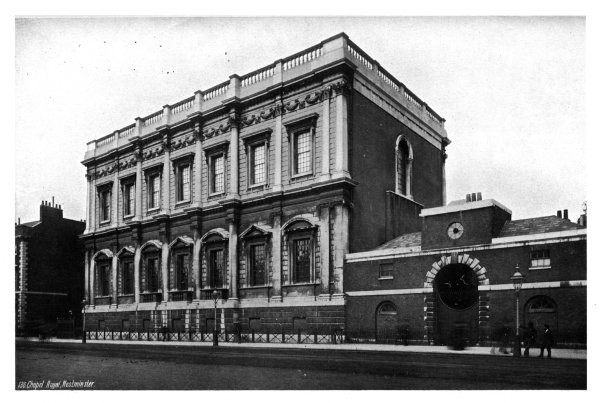
The Palace of Whitehall.
King William III. preferred other places of residence, and two fires—one in 1691, the other in 1698—destroyed the greater part of Whitehall, which was never rebuilt.
Buckingham Palace is now the principal residence in London of His Majesty King Edward VII. Though a fine pile of building it is hardly worthy of its position as the town residence of the mighty Sovereign of the greatest Empire of the world, situated in the largest city on the face of the globe.
King George III. purchased Buckingham Palace in 1761 from Sir Charles Sheffield for £21,000, and in 1775 it was settled upon Queen Charlotte. In the reign of George IV. it was rebuilt from designs by Nash; and in 1846, during the reign of Queen Victoria, the imposing eastern façade was erected from designs by Blore. The length is 360 feet, and the general effect is striking, though the architectural details are of little merit. In fact, it is a discredit to the nation that there is no London palace for the Sovereign which is worthy of comparison with the Royal Palace at Madrid, or the Papal Palace in Rome, though the reason for this peculiar fact is fully set forth in the historical sketch of the royal palaces already given. King Edward VII. was born here in 1841, and here drawing-rooms and levées are usually held. The white marble staircase is fine, and there are glorious portraits of Charles I. and Queen Henrietta Maria by Van Dyck, as well as Queen Victoria and the Prince Consort by Winterhalter. There is also a full-length portrait of George IV. by Lawrence in the State dining-room.
In the private apartments there are many interesting royal portraits, as well as a collection of presents from foreign princes. There is a lake of five acres in the gardens, and the whole estate comprises about fifty acres. There is a curious pavilion adorned with cleverly-painted scenes from Comus by famous English artists. The view from the east over St. James's Park towards the India Office is picturesque, and remarkably countrified for the heart of a great city. The lake in this park is certainly very pretty, and well stocked with various water-fowl. The Horse Guards, Admiralty, and other public offices at the eastern extremity of this park occupy the old site of the western side of the Palace of Whitehall.
Kensington Palace was the favourite abode of King William III. He purchased the property from the Earl of Nottingham, whose father had been Lord Chancellor, and employed Sir Christopher Wren to add a storey to the old house, and built anew the present south façade. Throughout his reign he spent much money in improving the place, and here his wife, Queen Mary II., died on December 28, 1694. In the same palace King William himself breathed his last breath on March 8, 1702.
Queen Anne lived principally at St. James's, the natural residence for the Sovereigns of Great Britain; but she took much interest in the proper upkeep of Kensington, and it was here that her husband died on October 20, 1708, and herself on August 1, 1714. Shortly before, she had placed the treasurer's wand in the hands of the Duke of Shrewsbury, saying, "For God's sake use it for the good of my people," and all the acts of her prosperous reign point to the real validity of the popular title given by common consent—the good Queen Anne.
She planted the trees on "Queen Anne's Mount," and gave gorgeous fêtes in the Royal Gardens, whose woodland scenery possesses a peculiar charm all its own. The noble groves and avenues of elm trees recall St. Cloud and St. Germain in the neighbourhood of Paris, and are quite exceptionally fine. Thus Matthew Arnold wrote:—
"In this lone open glade I lie, Screened by deep boughs on either hand; And at its end, to stay the eye, Those black crowned, red-boled pine trees stand."
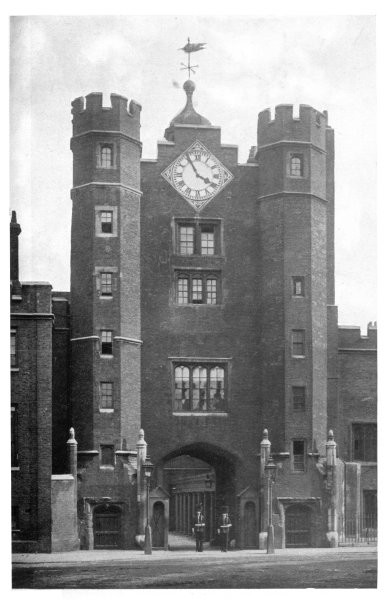
St. James's Palace.
And Chateaubriand declares:—
"C'est dans ce parc de Kensington que j'ai médité l'Essai historique: que, relisant le journal de mes courses d'outre mer, j'en ai tiré les amours d'Atala."
And Haydon says:—
"Here are some of the most poetical bits of tree and stump, and sunny brown and green glens and tawny earth."
George II. died here very suddenly on October 25, 1760, but the Sovereigns of the House of Hanover chiefly made use of the place by assigning apartments therein to their younger children and near relatives. Here it was that Edward Duke of Kent lived with his wife Victoria of Saxe-Coburg, and here their only daughter, the renowned Queen Victoria, was born, May 24, 1819, and here she resided till her accession to the throne in 1837.
Kensington Palace, then, is chiefly celebrated for its associations with William III. and Queen Victoria. In the brief account of the royal palaces here given, it will be seen that none of the sites, with the exception of St. James's, remained for any long period of time the actual residence of the Sovereign, while three—Westminster, Bridewell, and the Savoy—had passed out of royal hands for residential purposes before the Reformation of religion was completed. Another curious fact relates to the origin of the title to these sites, inasmuch as three of these estates were obtained from some ecclesiastical corporation, as the Archbishop of York, or the Hospital of St. James, though Buckingham Palace was bought from Sir Charles Sheffield, and Kensington from the Earl of Nottingham.
No account of the palaces of London can be regarded as complete which omits to mention Lambeth. For more than 700 years the Archbishops of Canterbury have resided at this beautiful abode, intensely interesting from its close association with all the most stirring events in the long history of England. The estate was obtained by Archbishop Baldwin in the year 1197 by exchange for some lands in Kent with Glanville, Bishop of Rochester. In Saxon times Goda, the sister of King Edward the Confessor, had bestowed this property upon the Bishopric of Rochester; so that it has been continuously in the hands of the Church for near 900 years. The fine red-brick gateway with white stone dressings, standing close to the tower of Lambeth Church, is very imposing as seen from the road, and was built by Archbishop Cardinal Moreton in 1490. In the Middle Ages it was the custom to give a farthing loaf twice a week to the poor of London at this gateway, and as many as 4,000 were accustomed to partake of the archiepiscopal gift. Within the gateway is the outer courtyard of the palace, and at the further end, towards the river Thames, rises the picturesque Lollard's tower, built between 1434 and 1445 by that famous ecclesiastical statesman Archbishop Chicheley, founder of All Souls' College, Oxford. The quaint winding staircase, made of rough slabs of unplaned oak, is exactly as it was in Chicheley's time. In this tower is the famous chamber, entirely of oaken boards, called the Lollards' prison. It is 13 feet long, 12 feet broad, and 8 feet high, and eight iron rings remain to which prisoners were fastened. The door has a lock of wood, fastened with pegs of wood, and may be a relic of the older palace of Archbishop Sudbury. On the south side of the outer court stands the hall built by Archbishop Juxon during the opening years of Charles II.'s reign, with a fine timber roof, and Juxon's arms over the door leading into the palace. This Jacobean hall is now used as the library, and contains many precious manuscripts of priceless value, including the Dictyes and Sayings of the Philosophers, translated by Lord Rivers, in which is found a miniature illumination of the Earl presenting Caxton on his knees to Edward IV., who is supported by Elizabeth Woodville and her son Edward V. This manuscript contains the only known portrait of the latter monarch.
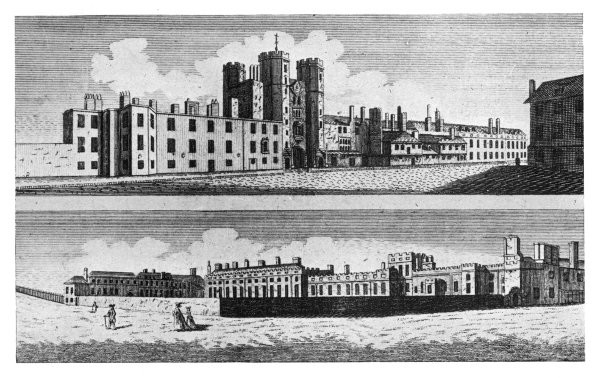
St. James's Palace, from Pall Mall and from the Park.
An earlier hall had been built on the same site by Archbishop Boniface in 1244.
From the library we pass by a flight of stairs to the guard room, now used as the dining hall. The chief feature is the excellent series of oil portraits of the occupants of the primatial See of Canterbury, beginning in the year 1504. The mere mention of the principal names recalls prominent events in our national history.
There is Warham painted by Holbein. He was also Lord Chancellor, and the last of the mediæval episcopate. There is Cranmer, burnt at Oxford, March 21, 1555. There is Cardinal Pole, the cousin and favourite of Queen Mary. There is Matthew Parker, the friend of Queen Elizabeth, well skilled in learning and a great collector of manuscripts, now for the most part in the library of Corpus Christi College, Cambridge. There is William Laud, painted by Van Dyck, the favourite Counsellor and Adviser of Charles I. At the age of 71 he was beheaded by order of the House of Commons—an act of vengeance, not of justice. There is William Juxon, who stood by Charles I. on the scaffold, and heard the ill-fated King utter his last word on earth, "Remember." But we cannot even briefly recount all the famous portraits to be found at Lambeth. The above selection must suffice.
The chapel, also, is a building of singular interest. Beneath is an ancient crypt said to have been erected by Archbishop Herbert Fitzwalter, while the chapel itself was built by Archbishop Boniface of Savoy between 1249 and 1270. The lancet windows are elegant, and were filled with stained glass by Archbishop Laud, all of which was duly broken to pieces during the Commonwealth. The supposed Popish character of this glass was made an article of impeachment against Laud at the trial at which he was sentenced to death. Here the majority of the archbishops have been consecrated since the reign of King Henry III. Archbishop Parker was both consecrated and also buried in the chapel, but his tomb was desecrated and his bones scattered by Scot and Hardyng, who possessed the palace under Oliver Cromwell. On the restoration they were re-interred by Sir William Dugdale. At the west end is a beautiful Gothic confessional, high up on the wall, erected by Archbishop Chicheley. Archbishop Laud presented the screen, and Archbishop Tait restored the whole of this sacred edifice, which measures 12 feet by 25 feet. Formerly the archbishops lived in great state. Thus, Cranmer's household comprised a treasurer, comptroller, steward, garnator, clerk of the kitchen, caterer, clerk of the spicery, yeoman of the ewery, bakers, pantlers, yeoman of the horse, yeoman ushers, besides numerous other less important officials.
Cardinal Pole possessed a patent from Queen Mary, authorising a household of 100 servants. The modern part of the palace was built by Archbishop Howley in the Tudor style. He held the See from 1828 to 1848, and was the last prelate to maintain the archiepiscopal state of the olden time.
ELIZABETHAN LONDON
By T. Fairman Ordish, F.S.A.
The leading feature of Elizabethan London was that it was a great port. William Camden, writing in his Britannia, remarked that the Thames, by its safe and deep channel, was able to entertain the greatest ships in existence, daily bringing in so great riches from all parts "that it striveth at this day with the Mart-townes of Christendome for the second prise, and affoordeth a most sure and beautiful Roade for shipping" (Holland's translation). Below the great bridge, one of the wonders of Europe, we see this shipping crowding the river in the maps and views of London belonging to the reign of Queen Elizabeth. The Tower and the bridge were the city's defences against attack by water. Near the Tower was the Custom House, where peaceful commerce paid its dues; and between the Custom House and the bridge was the great wharf of Billingsgate, where goods were landed for distribution. Near the centre of the bridge was a drawbridge, which admitted vessels to another great wharf, Queenhithe, at a point midway between London Bridge and Blackfriars. Between the bridge and Queenhithe was the Steelyard, the domain of the merchants of the Hanseatic League. Along the river front were numerous other wharves, where barges and lighters unloaded goods which they brought from the ships in the road, or from the upper reaches of the Thames. For the river was the great highway of London. It answered the needs of commerce, and it furnished the chief means of transit. The passenger traffic of Elizabethan London was carried on principally by means of rowing-boats. A passenger landed at the point nearest to his destination, and then walked; or a servant waited for him with a saddle-horse. The streets were too narrow for coaches, except in two or three main arteries.
The characteristic of present-day London, at which all foreigners most marvel, is the amount of traffic in the streets. In Elizabethan London this characteristic existed in the chief highway—the Thames. The passenger-boats were generally described as "wherries," and they were likened by Elizabethan travellers to the gondolas of Venice; for instance, by Coryat, in his Crudities, who thought the playhouses of Venice very beggarly compared with those of London, but admired the gondoliers, because they were "altogether as swift as our rowers about London." The maps of the period reveal the extraordinary number of "stairs" for landing passengers along both banks of the river, besides the numerous wharves for goods. John Stow, the author of the Survey of London, published first in 1598, and again in a second edition in 1603, describes the traffic on the river. "By the Thames," he says, "all kinds of merchandise be easily conveyed to London, the principal storehouse and staple of all commodities within this realm. So that, omitting to speak of great ships and other vessels of burthen, there pertaineth to the cities of London, Westminster, and borough of Southwark, above the number, as is supposed, of 2,000 wherries and other small boats, whereby 3,000 poor men at the least be set on work and maintained." Many of these watermen were old sailors, who had sailed and fought under Drake. The Armada deliverance was recalled by Drake's ship, which lay in the river below the bridge. The voyage of the Earl of Essex to Spain, the expeditions to Ireland and to the Low Countries, formed the staple of the gossip of these old sailors who found employment in the chief means of locomotion in Elizabethan London.
There was only the single bridge, but there were several ferries. The principal ferry was from Blackfriars and the Fleet river to a point opposite on the Surrey side, called Paris Garden stairs—nearly in a line with the present Blackfriars Bridge. At Westminster was another, from the Horseferry Road to a point a little west of Lambeth Palace—almost in the line of the present Lambeth Bridge. The river was fordable at low tide at this point; horses crossed here—whence the name Horseferry—and possibly other cattle, when the tide was unusually low.
The sea is the home of piety. Coast towns, ports, and havens, reached after voyages of peril, are invariably notable for their places of worship, and for customs which speak touchingly—like the blessing of fishermen's nets, for instance—of lives spent in uncertainty and danger. Thus, the leading characteristic of Elizabethan London being its association with the sea and its dependence on the river, we find that its next most striking characteristic was the extraordinary number of churches it contained. The great cathedral predominated more pronouncedly than its modern successor. From the hill on which it was based it reared its vast bulk; its great spire ascended the heavens, and the multitude of church towers and spires and belfries throughout the city seemed to follow it. The houses were small, the streets were narrow; but to envisage the city from the river, or from the Surrey side, was to have the eye led upwards from point to point to the summit of St. Paul's. The dignity and piety of London were thus expressed, in contradiction to human foibles and failings so conspicuous in Elizabethan drama. The spire of St. Paul's was destroyed by lightning early in the reign of Elizabeth; and the historian may see much significance in the fact that it was not rebuilt, even in thanksgiving and praise for the deliverance from the Great Armada. The piety of London dwindled until it flamed forth anew in the time of the Puritan revolt.
The bridge was carried on nineteen arches. It had a defensive gate at the Southwark end, and another gateway at the northern end. In the centre was a beautiful chapel, dedicated to Thomas à Becket, and known as St. Thomas of the Bridge. Houses were built on the bridge, mostly shops with overhanging signs, as in the streets of the city. Booksellers and haberdashers predominated, but other trades were carried on also. After the chapel, the most conspicuous feature of the bridge was "Nonesuch House," so called to express the wonder that it was constructed in Holland entirely of wood, brought over the water piece by piece, and put together on the bridge by dovetailing and pegs, without the use of a single metal nail. Adjoining the northern gateway was an engine for raising water by means of a great wheel operated by the tide. Near the Southwark end were corn-mills, worked on the same principle, below the last two arches of the bridge. The gateway at the Southwark end, so well shown in Visscher's view of London, was finished in 1579, and the traitors' heads, which formerly surmounted a tower by the drawbridge, were transferred to it. Travellers from the south received this grim salutation as they approached the bridge, which led into the city; and when they glanced across the river, the Tower frowned upon them, and the Traitors' Gateway, like teeth in an open mouth, deepened the effect of warning and menace.
But these terrors loomed darkling in the background for the most part. They belonged rather to the time when the sovereign's palaces at Westminster and at the Tower seemed to hold London in a grip. The palace at Westminster now languished in desuetude; the Tower was a State prison, and—with some ironical intent, perhaps—also the abode of the royal beasts, lions, tigers, leopards, and other captives. The Queen passed in her royal barge down the river with ceremonious pageantry from her palace of Whitehall; the drawbridge raised, the floating court passed the Tower as with lofty indifference on its way to "Placentia," Her Majesty's palace at Greenwich. Out of the silence of history a record speaks like a voice, and tells us that here, in 1594, Shakespeare and his fellows performed at least two comedies or interludes before Her Majesty, and we know even the amounts that were paid them for their services.
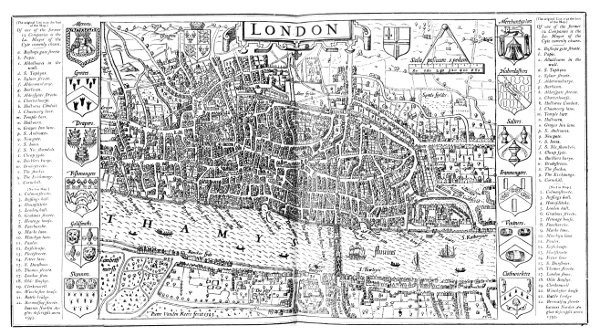
View larger version.
Plan of London in the time of Queen Elizabeth (1563).
In the Survey of John Stow we have three separable elements: the archæology and history of London, Stow's youthful recollections of London in the time of Henry the Eighth, and Stow's description of the great change which came over London after the dissolution of the religious houses, and continued in process throughout his lifetime. The mediæval conditions were not remote. He could remember when London was clearly defined by the wall, like a girdle, of which the Tower was the knot. No heroic change had befallen; the wall had not been cast down into its accompanying fosse to form a ring-street, as was done when Vienna was transformed from the mediæval state. London had simply filled up the ditch with its refuse; its buildings had simply swarmed over the wall and across the dike; shapeless and haphazard suburbs had grown up, till the surrounding villages became connected with the city. Even more grievous, in the estimation of Stow, was the change which he had witnessed within the city itself. The feudal lords had departed, and built themselves mansions outside the city. The precincts of the dissolved religious establishments had been converted into residential quarters, and a large proportion of the old monastic gardens had been built upon. The outlines of society had become blurred. Formerly, the noble, the priest, and the citizen were the defined social strata. Around each of these was grouped the rest of the social units in positions of dependence. A new type of denizen had arisen, belonging to none of the old categories—the typical Elizabethan Londoner.
The outward aspect of Elizabethan London reflected this social change. On the south of the city, along the line of Thames Street, the wall had entirely disappeared. On the east and west it was in decay, and was becoming absorbed in fresh buildings. Only on the north side of the city, where it had been re-edified as late as 1474, did the wall suggest its uses for defence. In the map of Agas, executed early in the reign of Elizabeth, this portion of the wall, with its defensive towers and bastions, appears singularly well preserved. Thus the condition of the wall suggested the passing of the old and the coming of the new order. The gates which formerly defended the city, where the chief roadways pierced the wall, still remained as monuments, and they were admirably adapted to the purpose of civic pageantry and ceremonial shows. Indeed, the gateway on the Oxford road was rebuilt in 1586, and called Newgate, "from the newness thereof," and it was the "fairest" of all the gates of London. It is reckoned that this was the year that Shakespeare came to London from Stratford-on-Avon; and the assumption is generally allowed that he entered the city by Newgate, which would be his direct road. A new gate, of an artistic and ornamental character, set in the ancient wall, was a sign and a symbol of the new conditions in London, of which Shakespeare himself was destined to become the chief result.
With the characteristics of London as a great mart and port is included the foreign elements in its population. In Lombard Street the merchants of Lombardy from early mediæval times had performed the operations of banking and foreign exchange; and around them were assembled the English merchants of all qualities and degrees. Business was conducted in the open street, and merchants merely adjourned into the adjoining houses to seal their bonds and make their formal settlements. Henry VIII. tried to induce the city to make use of the great building of Leadenhall for this purpose; but the innovation was resisted, and Lombard Street continued to be the burse of London till long after the accession of Elizabeth. The name of Galley Key remained in Tower Street ward to mark the spot on the river bank "where the galleys of Italy and other parts did discharge their wines and merchandises brought to this city." The men of the galleys lived as a colony by themselves in Mincing Lane; the street leading to their purlieus was called, indifferently, Galley Row and Petit Wales. Here was a great house, the official territorium of the Principality. The original of Shakespeare's "Fluellen" may very possibly have been a denizen of this quarter.
Above the bridge, in Thames Street, was the territorium of the Hanse merchants, alluded to by Stow as "the merchants of Almaine," and by Camden as "the Easterlings or Dutch merchants of the Steelyard." Their position in the city was one of great importance: the export trade of the country in woollen goods was chiefly in their hands, and they had their own Guildhall in Upper Thames Street, called the Gilda Teutonicorum. The special privileges accorded to this foreign commercial community carried the obligation to maintain Bishopsgate in repair, and "to defend it at all times of danger and extremity." When the house of the Augustine Friars, Old Broad Street, was dissolved, and its extensive gardens became cut up and built upon, the Dutch colony settled there in residence, and the church of Austin Friars was specially assigned to them by Edward VI. Towards the end of the reign of Elizabeth the privileges of the Hanse merchants were revoked, and their guildhall was confiscated to the use of the navy. But the Dutch element continued as a part of the commercial life of the city, and the church of Austin Friars is still the "church of the Dutch nation in London."
West of the Steelyard was the Vintry. Here the merchants of Bordeaux had been licensed to build their warehouses of stone, at the rear of a great wharf, on which were erected cranes for unloading the lighters and other boats which brought the casks from the ships below bridge. The trade of these foreign merchants gave the name of Vintry Ward to one of the divisions of the city. In Bishopsgate Ward, near the church of St. Botolph, was a French colony, their purlieus forming a quadrant, called Petty France.
Elizabethan London was more cosmopolitan than many European capitals. In Lombard Street the merchants of Germany, France, and Italy were conspicuously differentiated by the varieties of costume. On the site of the present Royal Exchange, Sir Thomas Gresham laid the first stone of his great Bourse in 1566; the design was in imitation of the Bourse at Antwerp; the materials of its construction were imported from Flanders; the architect and builder was a Fleming, named Henryke. The opening of this building by Queen Elizabeth in state in January, 1571, when Her Majesty commanded it to be proclaimed by herald and trumpet that the Bourse should be called The Royal Exchange from that time henceforth, is a familiar story, because it is, in fact, one of the most striking and significant events in the history of London. The trumpet of that herald, on January 23rd, 1571, announced a new era.
The building was a quadrangle, enclosing an open space. The sides formed a cloister or sheltered walk; above this was a corridor, or walk, called "the pawn," with stalls or shops, like the Burlington Arcade of the present day; above this again was a tier of rooms. The great bell-tower stood on the Cornhill front; the bell was rung at noon and at six in the evening. On the north side, looking towards St. Margaret's, Lothbury, was a tall Corinthian column. Both tower and column were surmounted by a grasshopper—the Gresham crest. The inscription on the façade of the building was in French, German, and Italian. The motley scene of Lombard Street had been transferred to the Royal Exchange. The merchants of Amsterdam, of Antwerp, of Hamburg, of Paris, of Bordeaux, of Venice and Vienna, distinguishable to the eye by the dress of the nations they represented, and to the ear by the differences of language, conducted their exchanges with English merchants, and with each other, in this replica of the Bourse of Antwerp, the rialto of Elizabethan London.[1]
Cheapside was called West Cheap in Elizabethan London, in contradistinction to East Cheap, famous for ever as the scene of the humours of "Dame Quickly" and "Falstaff." The change in West Cheap since the mediæval period was chiefly at the eastern end, on the north side. Here a large space opposite the church of St. Mary-le-Bow was formerly kept clear of building, although booths and stalls for market purposes occupied the ground temporarily. The space was otherwise reserved for the mediæval jousts, tournaments, and other civic pageantry. The site of Mercers' Hall was occupied by the Militia Hospitalis, called, after Thomas à Becket, St. Thomas of Acon. After the Dissolution this establishment was granted by Henry to the Mercers' Company, who adapted the existing buildings to the purposes of their hall, one of the principal features of Cheap in Elizabethan times. The district eastward of Mercers' Hall had become filled up with building, and the making of Cheap as a thoroughfare was now complete. The original road westward was from the top of New Fish Street, by East Cheap, Candlewick or Cannon Street, past London Stone (probably the Roman Milliarium), along Budge Row and Watling Street, to the site of St. Paul's, where it is conjectured a temple of Diana stood in Roman times. But Cheap, or West Cheap, was the chief traffic way westward in Elizabethan London; it was filled with shops and warehouses, a thriving business centre, the pride of the city. The name of "Cheap" was derived from the market, and several of the streets leading into it yet bear names which in Elizabethan times were descriptive of the trades there carried on. Thus the Poultry was the poulterers' market; ironmongers had their shops in Ironmonger Lane, as formerly they had their stalls in the same area; in Milk Street were the dairies; and towards the west end of Cheap was Bread Street, the market of the bakers, and Friday Street, where fishmongers predominated. Lying between these two streets, with frontages in both, was the Mermaid Tavern, the chief resort of "the breed of excellent and choice wits," included by Camden among the glories of Elizabethan London. Stow does not refer to the Mermaid by name, but possibly he had it in mind when he wrote the following passage: "Bread Street, so called of bread sold there, as I said, is now wholly inhabited by rich merchants; and divers fair inns be there, for good receipt of carriers and other travellers to the city." The trades kept themselves in their special localities, although they did not always give the name to the street they occupied. Thus, to return to the eastern end of Cheap, there was Bucklersbury, where the pepperers or grocers were located, having given up their former quarters in Sopars' Lane to the cordwainers and curriers. With the grocers were mingled apothecaries and herbalists; and hence the protest of Falstaff, in the Merry Wives of Windsor, that he was not "like a many of these lisping hawthorn-buds, that come like women in men's apparel, and smell like Bucklesbury in simple time." In the midst of Cheap, at a point between Mercers' Hall and Old Jewry, opposite the end of Bucklersbury, was the water conduit—in the words of Stow, "The great conduit of sweet water, conveyed by pipes of lead underground from Paddington for the service of this city, castellated with stone, and cisterned in lead." Around the conduit stood the great jars used by the water-carriers to convey the water to the houses. The water-carrier, as a type of Elizabethan London, is preserved by Ben Jonson in the character of Cob in Every Man in his Humour. Going westward from the Conduit, another object stood out in the roadway—the Standard, a tall pillar at which the public executions of the city jurisdiction took place. Still further west, in the midst of Cheap, stood the Eleanor Cross, one of the most beautiful monuments in London at this time.
The Guildhall stood where it stands to-day, accessible from Cheap by Ironmonger Lane and St. Lawrence Lane. Only the walls and the crypt of the original building remain; but the features of this great civic establishment, as well as its sumptuous character and beautiful adornments, were practically the same in the days of Gresham as at the present time. Stow describes the stately porch entering the great hall, the paving of Purbeck marble, the coloured glass windows, and, alas! the library which had been "borrowed" by the Protector Somerset in the preceding reign. Near the Guildhall was the church of St. Mary Aldermanbury, the predecessor of the existing edifice. In this parish dwelt Hemmings and Condell, "fellows" of Shakespeare—that is to say, players of his company, whom he remembered in his will. These men conferred a benefit on all future ages by collecting the poet's plays, seven years after his death, and publishing them in that folio edition which is one of the most treasured volumes in the world. In the churchyard a monument to their memory was erected in 1896. It is surmounted by a bust of the poet, who looks forth serenely greeting the passer-by from beneath the shade of trees in this quiet old churchyard in modern London.
To return to Cheap, it remains to speak of a feature which attracted Queen Elizabeth, and was, indeed, one of the marvels of London. Here are the ipsissima verba of Stow's contemporary description:
"Next to be noted, the most beautiful frame of fair houses and shops that be within the walls of London, or elsewhere in England, commonly called Goldsmiths' Row, betwixt Bread Street end and the cross in Cheap ... the same was built by Thomas Wood, goldsmith, one of the sheriffs of London, in the year 1491. It containeth in number ten fair dwelling-houses and fourteen shops, all in one frame, uniformly built four stories high, beautified towards the street with the Goldsmiths' arms and the likeness of woodmen, in memory of his name, riding on monstrous beasts, all which is cast in lead, richly painted over and gilt. These he gave to the goldsmiths, with stocks of money, to be lent to young men having those shops. This said front was again new painted and gilt over in the year 1594; Sir Richard Martin being then mayor, and keeping his mayoralty in one of them."
Beyond Goldsmiths' Row was the old Change; the name and the street both still exist. Beyond old Change were seven shops; then St. Augustine's Gate, leading into St. Paul's Churchyard; and then came Paternoster Row. Between Paternoster Row and Newgate Street stood the Church of St. Michael-le-Querne, stretching out into the middle of Cheap, where the statue of Sir Robert Peel now stands. Stretching out from the east end of the church, still further into the street, was a water conduit, which supplied all the neighbourhood hereabout, called "The Little Conduit," not because it was little, but to distinguish it from the great conduit at the other end of Cheap.
We are concerned in this place not with the history of old St. Paul's, nor with the technique of its architecture, but with the great cathedral as a religious and social institution, the centre of Elizabethan London. Here the streams of life were gathered, and hence they radiated. It was the official place of worship of the Corporation; the merchants of the city followed. The monarch on special occasions attended the services; the nobility followed the royal example. The typical Elizabethan made the middle aisle his promenade, where he displayed the finery of his attire and the elegance of his deportment. The satirists found a grand opportunity in the humours of Paul's Walk; but the effect of the cathedral is not to be derived from such allusions in the literature of the time. All classes were attracted by the beautiful organ and the anthems so exquisitely sung by the choir. The impressive size and noble proportions of the building, the soaring height of the nave, the mystery of the open tower, where the ascending vision became lost in gathering obscurity, and where the chords from the organ died away; these spiritual associations, these appeals to the imagination, were uplifting influences so powerful that the vanities of Paul's Walk were negligible by comparison. As with the gargoyle on the outer walls, the prevailing effect was so sublime, that it was merely heightened by this element of the grotesque.[2]
The cathedral stood in the midst of a churchyard. In the mediæval period this was enclosed by a wall. In the reign of Elizabeth the wall still existed, but, as Stow observes, "Now on both sides, to wit, within and without, it be hidden with dwelling-houses." In 1561 the great steeple was struck by lightning and destroyed by fire, but the tower from which the spire arose remained. The tower was 260 feet high, and the height of the spire was the same, so that the pinnacle was 520 feet from the base.[3] Surmounting the pinnacle, in this earlier portion of Elizabeth's reign, was a weathercock, an object of curiosity to which Stow devotes a minute description. In the midst of the churchyard stood Paul's Cross—"a pulpit cross of timber, mounted upon steps of stone and covered with lead, in which are sermons preached every Sunday in the forenoon." Many of the monastic features of the establishment had disappeared; others were transformed and adapted to other uses. The great central fabric remained, and the school flourished—"Paul's School," in the east part of the churchyard, endowed by Dean Colet in 1512, and rebuilt in the later years of Elizabeth, where one hundred and fifty-three poor men's children were given a free education under a master, an usher, and a chaplain.
Newgate Street, Cheapside, Cornhill, Leadenhall, and Aldgate formed (as they do still) nearly a straight line, east and west. From this line to the wall on the north, in Plantagenet and early Tudor times, the city was largely composed of open spaces: chiefly the domains of religious houses; while south of the dividing line to the river the ground was thickly built over. After the Dissolution the transformation of the northern area began.
Considerable building took place in the reign of Edward VI.; but at the time of Elizabeth's accession the generally open character of this area, as compared with the more southerly part of the city, still subsisted. The increase of population, however, due very largely to people who flocked to London from all parts of the country, led to rapid building, which produced the Queen's famous proclamation to stay its further progress. To evade the ordinance, and to meet the ever-increasing demand, large houses were converted into tenements, and a vast number of people were thus accommodated who lived chiefly out-of-doors and took their meals in the taverns, inns, and ordinaries which abounded in all parts of the city. The pressure of demand continued, and the open spaces became gradually built over. The Queen and her government, aghast at the incessant tide of increase, in terror of the plague, recognised the futility of further prohibition, and avoided communication with the city as much as possible. At the slightest hint of plague Her Majesty would start off on one of her Progresses, or betake herself to Richmond, to Hampton Court, or to Greenwich.
Some of these transformations of ancient monastic purlieus may be briefly instanced. Within Newgate was the house and precinct of the Grey Friars. After the Dissolution the whole precinct was presented by Henry to the citizens of London, and here Edward VI. founded the school for poor fatherless children, which became famous as Christ's Hospital, "the Bluecoat school."
Let a short passage from Stow describe this change from the old order to the new:
"In the year 1552 began the repairing of the Greyfriars house for the poor fatherless children; and in the month of November the children were taken into the same, to the number of almost four hundred. On Christmas Day, in the afternoon, while the Lord Mayor and Aldermen rode to Paules, the children of Christ's Hospital stood from St. Lawrence Lane end in Cheape towards Paules, all in one livery of russet cotton, three hundred and forty in number; and in Easter next, they were in blue at the Spittle, and so have continued ever since."
The Greyfriars or Bluecoat school was one of the largest buildings in London. Its demesne extended to the city wall, in which there was a gate communicating with the grounds of St. Bartholomew's Hospital, the famous foundation of Rahere. The wall ran northward from the New Gate, the ground between the school and the wall on that side had been built over. There was a continuous line of building along Newgate Street to St. Martin's le Grand. The shambles or meat market occupied the centre of the street, called St. Nicholas Shambles, from a church which had been demolished since the Reformation.
From Newgate Street and the top of Cheapside to St. Anne's Lane was formerly the territory of the Collegiate Church and Sanctuary of St. Martin's le Grand. The college was dismantled after the edict of dissolution, but the sanctuary remained.
Some of the collegiate buildings had been converted into tenements, and other houses had been erected. These were occupied by "strangers born"—i.e., denizens who were not born Londoners—although within the walls the civic jurisdiction did not extend over this territory. Certain trades were carried on here outside the regulated industry of the city—e.g., tailoring and lace-making. The district became one of the resorts of the Elizabethan ruffler; and under the ægis of the ancient right of sanctuary a kind of Alsatia came into existence, the scene of many exciting episodes when debtors and fugitives from justice evaded their pursuers, and succeeded in reaching these precincts.
In Broad Street the ancient glory of the Augustine Friars was still a memory, and much of their spacious domain had been divided into gardens. The beautiful church remained, but the spire was becoming ruinous from neglect. Stow described the gardens, the gates of the precinct, and the great house which had been built here by William Paulet, first Marquis of Winchester, Lord Treasurer of England, "in place of Augustine friar's house, cloister, gardens, etc." There is an admirable irony in the recital of Stow at this point:
"The friars church he pulled not down, but the west end thereof, inclosed from the steeple and choir, was in the year 1550 granted to the Dutch nation in London, to be their preaching place: the other part—namely, the steeple, choir, and side aisles to the choir adjoining—he reserved to household uses, as for stowage of corn, coal and other things; his son and heir, Marquis of Winchester, sold the monuments of noblemen there buried in great number, the paving stone and whatsoever (which cost many thousands) for one hundred pounds, and in place thereof made fair stabling for horses. He caused the lead to be taken from the roofs, and laid tile in place thereof; which exchange proved not so profitable as he looked for, but rather to his disadvantage."
Between Broad Street and Bishopsgate Street the space was chiefly composed of gardens. One of the houses fronting Bishopsgate Street was the residence of Sir Thomas Gresham (perhaps his house in Lombard Street was reserved for business purposes).
On the opposite side of Bishopsgate Street was Crosby Hall and the precinct of the dissolved nunnery of St. Helen, extending towards St. Mary Axe and the church of St. Andrew Undershaft. At the further end of St. Mary Axe was the "Papye," a building which had been a hospital for poor priests before the Reformation. In the year 1598 Shakespeare was living in the St. Helen's precinct, within the shadow of Crosby Hall, and John Stow, in his home near the church of St. Andrew Undershaft, had just corrected the proofs of the first edition of his Survey of London. Stow tells us about Gresham's House and about Crosby Hall. He tells us that Sir Francis Walsingham, the Secretary of State, resided at the Papye. He describes the church of St. Andrew Undershaft, where his own monument may be seen at the present day; he describes, too, the ancient church of the nunnery of St. Helen, in which a memorial window now commemorates Shakespeare. But he failed to mention the fact, which has since been recovered from the subsidy-roll in the Record Office, that William Shakespeare was a denizen of the precinct in 1598. Had Shakespeare built a water conduit in the neighbourhood, or endowed an almshouse, he might have been celebrated in the pages of John Stow.
They were neighbours, and may have been acquainted. The district had been familiar to Stow from childhood, and he may have entertained the poet as he entertains us in his Survey with recollections of the changes he had witnessed in his long lifetime. Describing Tower Hill, he recalls the abbey of nuns of the order of St. Clare, called the Minories, and after giving the facts of its history, proceeds:
"In place of this house of nuns is now built divers fair and large storehouses for armour and habiliments of war, with divers workhouses serving to the same purpose: there is a small parish church for inhabitants of the close, called St. Trinities. Near adjoining to this abbey, on the south side thereof, was sometime a farm belonging to the said nunnery; at the which farm I, myself, in my youth, have fetched many a half-penny worth of milk, and never had less than three ale pints for a half-penny in the summer, nor less than one ale quart for a half-penny in the winter, always hot from the kine, as the same was milked and strained. One Trolop, and afterwards Goodman, were the farmers there, and had thirty or forty kine to the pail. Goodman's son being heir to his father's purchase, let out the ground, first for grazing of horses, and then for garden-plots, and lived like a gentleman thereby."
Here we have the source of the name Goodman's Fields, a point of some interest for us; but how vastly more interesting to have rambled with Stow in Elizabethan London, listening to such stories of the old order which had passed, giving place to the new!
We have strayed outside the wall, but not far. This road between Aldgate and the Postern Gate by the Tower, running parallel with the wall, is called the Minories, after the nunnery. Setting our faces towards Aldgate, to retrace our steps, we have the store-houses for armour and habiliments of war on our right; the wide ditch on our left has been filled up, and partly enclosed for cultivation. There are trees, and cows browsing, although the farm which Stow remembered no longer existed. Before us, just outside Aldgate, is the church of St. Buttolph, with its massive tower, standing in a spacious churchyard. Owing to the extensive building and development which had taken place outside the wall since the Reformation, it had been necessary to construct lofts and galleries in this church to accommodate the parishioners. At Aldgate the line of the wall turns westward towards Bishopsgate. Parallel to it a road has been made along the bank of the ditch, and leads into Bishopsgate Street. This is Houndsditch. The houses stand thickly along one side of the way looking towards the wall; the ditch has been filled up, and the wide surface is used for cattle pens or milking stalls.
We will not go along Houndsditch, but turning sharply to the left from St. Buttolph's we pass through Aldgate. In doing so we immediately find ourselves in the midst of the remains of the great priory of Holy Trinity. The road leads southward into Fenchurch Street, branching off on the west into Leadenhall Street. At the junction of these streets stood the hospitium of the priory. Between Leadenhall Street and the city wall, from Aldgate nearly up to St. Andrew Undershaft, lies the ground-plan of the establishment of the Canons Regular, known as Christchurch, or the priory of Holy Trinity, the grandest of all the monastic institutions in Middlesex except Westminster. The heads of the establishment were aldermen of the City of London, representing the Portsoken Ward.
"These priors have sitten and ridden amongst the aldermen of London, in livery like unto them, saving that his habit was in shape of a spiritual person, as I, myself, have seen in my childhood; at which time the prior kept a most bountiful house of meat and drink, both for rich and poor, as well within the house as at the gates, to all comers, according to their estates" (Stow).
In 1531 the King took possession of Christchurch; the canons were sent to other houses of the same order—St. Bartholomew the Great, Smithfield; St. Mary Overies, Southwark; and St. Mary Spital—"and the priory, with the appurtenances, King Henry gave to Sir Thomas Audley, newly knighted, and after made Lord Chancellor" (Stow). So extensive and so solid was the mass of building that Audley was at a loss to get the space cleared for the new house he wished to build here. He offered the great church of the priory to any one who would take it down and cart away the materials. But as this offer met with no response, Audley had to undertake the destruction himself. Stow could remember how the workmen employed on this work, "with great labour, beginning at the top"—the tower had pinnacles at each corner like the towers at St. Saviour's and St. Sepulchre's—"loosed stone from stone, and threw them down, whereby the most part of them were broken, and few remained whole; and those were sold very cheap, for all the buildings then made about the city were of brick and timber. At that time any man in the city might have a cart-load of hard stone for paving brought to his door for sixpence or sevenpence, with the carriage." Thus, in place of the priory and its noble church, was built the residence of Thomas, Lord Audley, and here he lived till his death in 1544. By marriage of his only daughter and heiress, the house passed into the possession of Thomas Howard, Duke of Norfolk, and was then called Duke's Place.
Turning our backs upon Duke's Place and continuing a little further along the way by which Stow used to fetch the milk from the farm at the Minories to his father's house on Cornhill, we come to Leadenhall, a great building which served as a public granary in ancient times, and later as the chief market hall of the city. Leaving aside all the particulars of its history which Stow gives, let us note what he tells us from his own recollections:
"The use of Leadenhall in my youth was thus:—In a part of the north quadrant, on the east side of the north gate, were the common beams for weighing of wool and other wares, as had been accustomed; on the west side the gate were the scales to weigh meal; the other three sides were reserved, for the most part, to the making and resting of the pageants showed at Midsummer in the watch; the remnant of the sides and quadrants was employed for the stowage of wool sacks, but not closed up; the lofts above were partly used by the painters in working for the decking of pageants and other devices, for beautifying of the watch and watchmen; the residue of the lofts were letten out to merchants, the wool winders and packers therein to wind and pack their wools. And thus much for Leadenhall may suffice."
The celebration of the Nativity of St. John and the civic pageantry of Midsummer Eve belonged to the past; but Stow could remember the assembly of the citizens arrayed in parti-coloured vestments of red and white over their armour, their lances coloured and decorated to distinguish the various wards they represented, their torches borne in cressets on long poles. He could remember the processions as they passed the bonfires which burned in the open spaces of the city thoroughfares, and the throng of faces at the open windows and casements as they appeared in the fitful glare. The pageantry had disappeared with the suppression of the religious houses; but the military organization was merely changed. The musters of the city soldiers when they were reviewed by Queen Elizabeth at the coming of the Armada was a recent memory.
And so we turn into Bishopsgate Street again, and walk along to Crosby Hall, the ancient palace of Richard III. In the middle of the roadway, opposite the junction of Threadneedle Street with Bishopsgate Street, stands a well, with a windlass, which probably existed here before the conduit was made near the gateway in the time of Henry VIII. We enter the precinct of St. Helen's: the wall of Crosby's great chamber is on our right hand; before us is the church of the nunnery. The spirit of the place is upon us. The barriers of time are removed; past and present mingle in the current of our meditation. Lo! one bids us a courteous farewell: it is Master Stow, our cicerone, who goes away in the direction of St. Andrew Undershaft. The presence of another influence continues to be felt. We enter the dim church, and shadows of kneeling nuns seem to hover in the twilight of the northern nave. Invisible fingers touch the organ-keys; the strains of evensong arise from the choir. Our reverie is broken, an influence recedes from us. But turning our eyes towards the painted picture of Shakespeare which fills the memorial window in this ancient church, we join in the hymn of praise and thanksgiving.
What chiefly impressed the Elizabethan was the newness of London, and the rapidity with which its ancient features were being obliterated. John Stow felt it incumbent upon him to make a record of the ancient city before it was entirely swept away and forgotten. In what was new to him we find a similar interest.
Through Bishopsgate northward lies Shoreditch. The old church which stood here in Elizabethan times has disappeared, but on the site stands another church with the same dedication, to St. Leonard. The sweet peal of the bells from the old belfry, so much appreciated by the Elizabethans, is to be heard no more; but the muniment chest of the modern church contains the old registers, in which we may read the names of Tarleton, Queen Elizabeth's famous jester, of Burbage, and the colony of players who lived in this parish, in the precinct of the dissolved priory of Holywell. The road from Shoreditch to the precinct still exists, known as Holywell Lane.
The priory of St. John Baptist, called Holywell, a house of nuns, had been rebuilt, in the earlier period of the reign of Henry VIII., by Sir Thomas Lovel, K.G., of Lincoln's Inn. He endowed the priory with fair lands, extended the buildings, and added a large chapel. He also built considerably in Lincoln's Inn, including the fine old gateway in Chancery Lane, which still stands as one of the few remaining memorials of ancient London. Sir Thomas figures as one of the characters in Shakespeare's play of Henry VIII. When he died he was duly buried in the large chapel which he had added to Holywell Priory, in accordance with his design; but a few years later, in 1539, the priory was surrendered to the King and dissolved. Stow tells us that the church was pulled down—it is doubtful if Lovel's chapel was spared—and that many houses were built within the precinct "for the lodgings of noblemen, of strangers born, and others."
In the first edition of his Survey Stow added:—
"And near thereunto are builded two publique houses for the acting and shewe of comedies, tragedies and histories, for recreation. Whereof one is called the Courtein, and the other the Theatre; both standing on the south west side towards the field."
This passage was omitted from the second edition of the book published in 1603; but the whole extensive history of these playhouses, which was won from oblivion by the research of J. O. Halliwell-Phillipps, proceeded from this brief testimony of Stow.
Against the background of the ancient priory this precinct of Holywell presented a perfect picture of the new conditions which constituted what was distinctively Elizabethan London. It comprehended the conditions of freedom required by the new life. Outside the jurisdiction of the city, but within the protection of the justices of Middlesex; lying open to the common fields of Finsbury, where archery and other sports were daily practised; its two playhouses affording varied entertainment in fencing matches, wrestling matches, and other "sports, shows, and pastimes," besides stage-plays performed by the various acting companies which visited them; this precinct of Holywell presented a microcosm of Elizabethan London society. The attraction of the plays brought visitors from all parts of the city. On the days when dramatic performances were to be given flags were hoisted in the morning over the playhouses; and after the early midday dinner the stream of playgoers began to flow from the gates. On horseback and on foot, over the fields from Cripplegate and Moorgate, or along the road from Bishopsgate, came men and women, citizens and gallants, visitors from the country, adventurers and pickpockets. All classes and conditions mingled in the Theatre or the Curtain, in the "common playhouses," as they were called, which only came into existence in 1576, after the players had been banished from the city. It was all delightfully new and modern; the buildings were gorgeously decorated; the apparel of the players was rich and dazzling; the music was enthralling; the play was a magic dream.
Some of the plays of Marlowe were performed at these Holywell theatres; and in 1596 a play by the new poet, William Shakespeare, called Romeo and Juliet, was produced at the Curtain, and caused a great sensation in Elizabethan London. The famous balcony scene of this play was cleverly adapted to the orchestra gallery above the stage. The stage itself projected into the arena, and the "groundlings" stood around it. Above were three tiers of seated galleries, and near the stage were "lords' rooms," the precursors of the private boxes of a later time.
After the Theatre and Curtain had become a feature of Elizabethan London at Shoreditch, other playhouses came into existence on the other side of the river; first at Newington, outside the jurisdiction of the city, in conditions corresponding to those of Shoreditch. For the sports and pastimes of Finsbury Fields, in the neighbourhood of the playhouses, there were the sports and pastimes of St. George's Fields in the neighbourhood of the Newington Theatre. Playgoers from the city took boat to Paris Garden stairs and witnessed the bear-baiting on Bankside, or proceeded by road on horseback or on foot to St. George's Fields and Newington; or they went thither over the bridge all the way by road, walking or riding. The use of coaches was very limited, owing to the narrow roads and imperfect paving of Elizabethan London.
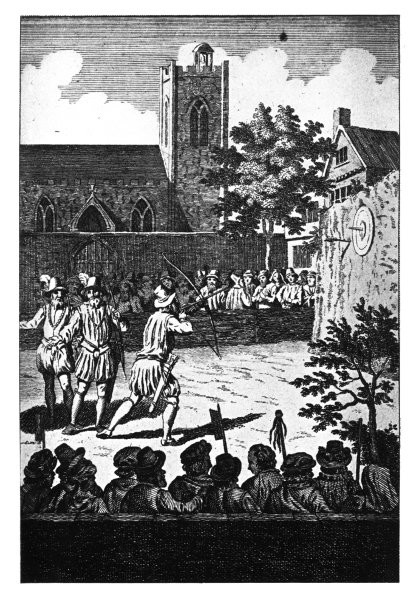
Shooting Match by the London Archers in the Year 1583.
At Newington the proprietor and manager of the playhouse was Philip Henslowe, whose diary is the chief source of what information we have concerning the earlier period of Elizabethan drama. He was a man of business instinct, who conducted his dramatic enterprise on purely commercial lines. In 1584 he secured the lease of a house and two gardens on Bankside, and here, in the "liberty" of the Bishop of Winchester, nearer to the city but outside the civic jurisdiction, he erected his playhouse, called the Rose, in 1591. Henslowe thus brought the drama nearer to the city than it had been since the edict of 1575 abolished the common stages which until then had been set up in inn yards or other convenient places in the city. The flag of the playhouse could be seen across the river; and from all points came the tide of playgoers, whose custom was a harvest to Henslowe and the Thames watermen.
Midway between these two points of theatrical attraction—Holywell, Shoreditch on the north, and Newington and Bankside on the south—Shakespeare lodged in the precinct of St. Helen's, Bishopsgate. The company of players with whom he had become finally associated was that of the Lord Chamberlain. They derived their profits from three sources—from performances at court, from theatrical tours, and from performances at the Theatre and the Curtain. The Theatre was the property of the family of James Burbage, who had built it in 1576—his son Richard Burbage, the famous actor, and others. The interest of the proprietors may have suffered from Henslowe's enterprise in setting up a playhouse on Bankside; and they were in dispute with the ground landlord of their playhouse in regard to the renewal of their lease. In these circumstances the Burbages, with the co-operation of other members of the company, secured a site in the Winchester Liberty on Bankside, not far from the Rose but nearer the Bridge. They then took down their building in Holywell, vacated the land, and re-erected the playhouse on the other side of the river. Those who participated in this enterprise became "sharers," or partners, in the new playhouse. Shakespeare was one of these, and the name by which it was called—the Globe—was symbolical of the genius which reached its maturity in plays presented in this theatre during the closing years of the reign of Elizabeth and the first decade of the reign of her successor. "Totus mundus agit histrionem" was the inscription over the portal of the Globe. "All the world's a stage," said Shakespeare's Jaques in As You Like It. The life of Elizabethan London found its ultimate expression in that playhouse, which became celebrated then as "the glory of the Bank," and now is famous in all parts of the world where the glory of English literature is cherished.
There were many reminiscences of mediæval times on the Surrey side. At Bermondsey were to be seen the extensive remains of the great abbey of St. Saviour. After the Dissolution its name became transferred to the church near the end of London Bridge, formerly known as St. Mary Overies, the splendid fane which in our time has worthily become the cathedral of Southwark. Between this church and the church of St. George were many inns, among them the Tabard, where travellers to and from Canterbury and Dover, or Winchester and Southampton, introduced an element of novelty, change, and bustle; where plays were performed in the inn yards before the playhouses were built on Bankside. At the end of Bankside, looking towards the church of St. Saviour, stood Winchester House, the London residence of the Bishop of Winchester since the twelfth century. Here Cardinal Beaufort and Stephen Gardiner, Bishop of Winchester, had lived in great state. The site, including the park, which extended parallel with the river as far as Paris Garden, was formerly the property of the priory of Bermondsey. This area was under the separate jurisdiction of the Bishops of Winchester, and was called their "Liberty." Here, in the early years of Queen Elizabeth, were two amphitheatres—one for bull-baiting, the other for bear-baiting. There were also ponds for fish, called the Pike Ponds.[4] The great Camden records an anecdote of these ponds or stews, "which are here to feed Pikes and Tenches fat, and to scour them from the strong and muddy fennish taste." All classes delighted in the cruel sport of bear-baiting on the Bankside: ambassadors and distinguished foreigners were always conducted to these performances; on special occasions the Queen had them at the palace.
In 1583 one of the amphitheatres fell down, and when re-erected it was built on the model of the playhouses.[5] It then became known as the Bear Garden; the bull-baiting amphitheatre dropped out of existence; perhaps it was reconstructed by Henslowe as his Rose theatre. The point is not of much importance, except as regards the evolution of the playhouse.
The second playhouse built on the Surrey side after the Rose was the Swan, opened in 1596. This was erected on a site in the manor of Paris Garden, separated only by a road from the Liberty of Winchester. The playhouse was in a line with the landing-stairs, opposite Blackfriars.
After the Globe playhouse was built in 1599, the other playhouses—Henslowe's Rose and Langley's Swan—ceased to flourish. Here the outward facts corresponded with the inward: a lovely flower had opened into bloom on the Bankside; what was unnecessary to its support drooped earthward like a sheath.
Opposite Paris Garden, across the river, was Blackfriars; and here the change from the ancient order to what was distinctively Elizabethan London was most manifest. The ancient monastery had existed here from 1276, when the Dominican or Black Friars moved hither from Holborn, until 1538, when the establishment was surrendered to King Henry VIII. It possessed a magnificent church, a vast palatial hall, and cloisters. Edward VI. had granted the whole precinct, with its buildings, to Sir Thomas Cawarden, the Master of the Revels. It became an aristocratic residential quarter; and in the earlier period of Queen Elizabeth's reign plays were performed here, probably in the ancient hall of the monastery, by the children of Her Majesty's chapel and the choir-boys of St. Paul's. At a later period—viz., in 1596—James Burbage, who built the theatre in Shoreditch, built a new playhouse in the precinct, or more probably adapted an existing building—the hall or part of the church—to serve the purpose of dramatic representation. This playhouse, consequently, was not open to the weather at the top like the common playhouses, and it was distinguished as the "private" theatre at Blackfriars.
The west wall of the precinct was built along the bank of the Fleet river. Across the river opposite was the royal palace of Bridewell, which Edward VI. had given to the city of London to be a workhouse for the poor and a house of correction. This contiguity of a house for the poor and the remains of a monastery suggests a reflection on the social problem of Elizabethan London.
Before the Reformation the religious houses were the agencies for the relief of the poor, the sick, the afflicted. The unemployed were assisted with lodging and food on their way as they journeyed in search of a market for their labour, paying for their entertainment at the religious houses by work either on the roads in the neighbourhood or on the buildings or in the gardens and fields, according to their trades and skill. It would seem that King Henry did not realise the importance and extent of this feature in the social economy, because, after he had suppressed the religious establishments, he complained very reproachfully of the number of masterless men and rogues that were everywhere to be found, especially about London. The good Bishop Ridley, in an eloquent appeal addressed to William Cecil, represented the poor and sick and starving in the streets of London in the person of Christ, beseeching the king to succour the poor and suffering Christ in the streets of London by bestowing his palace of Bridewell to be a home for the homeless, the starving, and the sick, where erring ones could be corrected and the good sustained. The good young monarch granted the bishop's request, and Bridewell Hospital was thus founded to do the social work in which Blackfriars monastery on the other side of the Fleet river had formerly borne its share. But single efforts of this kind were quite unequal to cope with the social difficulty; and early in the reign of Elizabeth the first Poor Law was passed and a system of relief came into operation.
To meet the difficulty of unemployment, it was part of the policy of Queen Elizabeth's Government to encourage new industries, whether due to invention and discovery or to knowledge gained by visiting foreign countries to learn new processes and manufactures; the inventor or the introducer of the novelty was rewarded with a monopoly, and he received a licence "to take up workmen" to be taught the methods of the new industry. One of the manufactures which had been thus stimulated was glass-making; and in the precinct of Blackfriars was a famous glass-house or factory, a reminiscence of which still exists in the name Glasshouse Yard. It has been shown how the crafts and trades of Elizabethan London gravitated to separate areas: Blackfriars precinct was famous as the abode of artists; one may hazard the guess that some of the portraits of Elizabethan and Jacobean players in the Dulwich Gallery may have been painted here. In the reign of Charles I. Vandyke had his studio in Blackfriars, where the king paid him a visit to see his pictures. The precinct was famous also as the abode of glovers; and in the reigns of James and Charles it became a notorious stronghold of Puritans. The existing name of Playhouse Yard, at the back of The Times newspaper office, affords some indication of the site of the theatre; and the name Cloister Court is the sole remnant of the cloisters of Blackfriars monastery.
The eastern boundary of the precinct was St. Andrew's Hill, which still exists. On the site of the present church of St. Andrew in the Wardrobe stood a church of the same dedication in Elizabethan London. Stow wrote of "the parish church of St. Andrew in the Wardrobe, a proper church, but few monuments hath it." Near the church (the site being indicated by the existing court called the Wardrobe) was a building of State, which Stow calls "the King's Great Wardrobe." The Elizabethan use of the Wardrobe is described by Stow thus: "In this house of late years is lodged Sir John Fortescue, knight, master of the wardrobe, chancellor and under-treasurer of the exchequer, and one of her majesty's most honorable privy Council."
Near the top of St. Andrew's Hill and within the precinct of Blackfriars was a house which Shakespeare purchased in 1613. It is described in the extant Deed of Conveyance as "now or late being in the tenure or occupation of one William Ireland ... abutting upon a street leading down to Puddle Wharf on the east part, right against the Kinges Majesties Wardrobe." Curiously enough, the name of this occupier survives in the existing Ireland Yard.

ENVOY
The omissions in this imperfect sketch of Elizabethan London are many and obvious. The design has been to show the tangible setting of a jewel rather than the jewel itself; the outward conditions in which the life of a new age was manifested. The background of destruction has been inevitably emphasised; but in Elizabethan London historic memorials existed on every hand. Nothing has been said of Baynard's Castle, its Norman walls rising from the margin of the river to the south of Blackfriars, or of St Bartholomew the Great, or the Charterhouse, or St. Giles's, Cripplegate; although an account of them would have completed the outer ring of our perambulation of the London described by Stow. The whole region westward—Holborn, Fleet Street, the Strand, and Westminster—has been left for another occasion. Here and there, however, we have been able to glance at historic buildings which had survived from earlier ages to witness the changes in London after the Reformation. It was those changes that led to the making of the playhouse and brought the conditions which enfolded the possibility realised in Shakespeare. This has been the point of view in the foregoing pages. A study of characteristics rather than a detailed account has been offered for the consideration of the reader.
[1] Thomas Dekker, the pamphleteer and dramatist, describes the Exchange as it was in 1607, when "at every turn a man is put in mind of Babel, there is such a confusion of languages"; and as late as 1644 the picturesque dresses of the foreign merchants appear in an engraving by Hollar.
[2] Camden speaks of "this so stately building," and in his terse fashion conveys the effect of the interior: "The west part, as also the Cross-yle, are spacious, high-built, and goodly to be seene by reason of the huge Pillars and a right beautiful arched Roof of stone."
[3] This is Stow's figure. Camden gives the measurement as 534 feet.
[4] The name survives in Pike Gardens, Bankside.
[5] See the "Bear-house" near the "Play-house" (i.e., the Rose) in Norden's plan, 1593.
PEPYS'S LONDON
By Henry B. Wheatley, F.S.A.
The growth of population in London was almost stationary for many centuries; as, owing to the generally unhealthy condition of ancient cities, the births seldom exceeded the deaths, and in the case of frequent pestilences the deaths actually exceeded the births. Thus during its early history the walls of London easily contained its inhabitants, although at all times in its history London will be found to have taken a higher rank for healthy sanitary conditions than most of its continental contemporaries. In the later Middle Ages the city overflowed its borders, and its liberties were recognized and marked by Bars. Subsequently nothing was done to bring the further out-growths of London proper within the fold, and in Tudor times we first hear of the suburbs as disreputable quarters, a condemnation which was doubtless just, as the inhabitants mostly consisted of those who were glad to escape the restrictions of life within the city walls.
The first great exodus westwards of the more aristocratic inhabitants of London took place in the reigns of James I. and Charles I.—first to Lincoln's Inn Fields and its neighbourhood, and then to Covent Garden, and both these suburbs were laid out by Inigo Jones, the greatest architect of beautiful street fronts that England has ever produced. It is an eternal disgrace to Londoners that so many of his noble buildings in Lincoln's Inn Fields have been destroyed. The period of construction of these districts is marked by the names of Henrietta and King Streets in Covent Garden, and Great Queen Street, Lincoln's Inn Fields.
After the Restoration modern London was founded. During the Commonwealth there had been a considerable stagnation in the movement of the population, and when the Royalists returned to England from abroad they found their family mansions in the city unfitted for their habitation, and in consequence established themselves in what is now the city of Westminster. Henry Jermyn, first Earl of St. Albans, began to provide houses for some of them in St. James's Square, and buildings in the district around were rapidly proceeded with.
We have a faithful representation of London, as it appeared at the end of the Commonwealth period, in Newcourt and Faithorne's valuable Plan of London, dated 1658. A long growth of houses north of the Thames is seen stretching from the Tower to the neighbourhood of Westminster Abbey. Islington is found at the extreme north of the plan unconnected with the streets of the town, Hoxton connected with the city by Shoreditch, Bethnal Green almost alone, and Stepney at the extreme north-east. South of the Thames there are a few streets close to the river, and a small out-growth from London Bridge along the great southern road containing Southwark and Bermondsey. There is little at Lambeth but the Archbishop's Palace and the great marsh.
On this plan we see what was the condition of the Haymarket and Piccadilly before the Restoration. This was soon to be changed, for between the years 1664 and 1668 were erected three great mansions in the "Road to Reading" (now Piccadilly), viz., Clarendon House (where Bond and Albemarle Streets now stand), Berkeley House (on the site now occupied by Devonshire House), and Burlington House. Piccadilly was the original name of the district after which Piccadilly Hall was called. The latter place was situated at the north-east corner of the Haymarket, nearly opposite to Panton Square, and close by Panton Street, named after Colonel Thomas Panton, the notorious gamester, who purchased Piccadilly Hall from Mrs. Baker, the widow of the original owner.
There is much to be said in favour of associating the name of some well-known man with the London of his time, and thus showing how his descriptions illustrate the chief historical events of his time, with many of which he may have been connected. In the case of Samuel Pepys, we can see with his eyes many of the incidents of the early years of the Restoration period, and thus gain an insight into the inner life of the times. Pepys lived through some of the greatest changes that have passed over London, and in alluding to some of these we may quote his remarks with advantage. His friend, John Evelyn, also refers to many of the same events, and may also be quoted, more particularly as he was specially engaged at different periods of his life in improving several parts of London.
We are truly fortunate in having two such admirable diarists at hand to help us to a proper understanding of the course of events and of the changes that took place in London during their long lives.
When Pepys commenced his Diary on January 1st, 1660, we find him living in a small house in Axe Yard, Westminster, a place which derived its name from a brewhouse on the west side of King Street, called "The Axe." He was then clerk to Mr. (afterwards Sir George) Downing, one of the Four Tellers of the Receipt of the Exchequer, from whom Downing Street obtained its name. Pepys was in the receipt of £50 a year, and his household was not a large one, for it consisted of himself, his wife, and his servant Jane. He let the greater part of the house, and his family lived in the garrets. About 1767 Axe Yard was swept away, and Fludyer Street arose on its site, named after Sir Samuel Fludyer, who was Lord Mayor in 1761. Nearly a century afterwards (1864-65) this street also was swept away (with others) to make room for the Government offices, consisting of the India, Foreign and Colonial Offices, etc., so that all trace of Pepys's residence has now completely passed away.
Macaulay, in the famous third chapter of his History, where he gives a brilliant picture of the state of England in 1685, and clearly describes London under the later Stuarts, writes: "Each of the two cities which made up the capital of England had its own centre of attraction." We may take this sentence as our text, and try to illustrate it by some notices of London life in the city and at the Court end of town. The two extremes were equally familiar to Pepys, and both were seen by him almost daily when he stepped into his boat by the Tower and out of it again at Westminster.
To take the court life first, let us begin with the entry of the King into London on his birthday (May 29th, 1660). The enthusiastic reception of Charles II. is a commonplace of history, and from the Tower to Whitehall joy was exhibited by all that thronged the streets. Evelyn was spectator of the scene, which he describes in his Diary:—
"May 29th. This day his Majestie Charles the Second came to London after a sad and long exile and calamitous suffering both of the King and Church, being 17 yeares. This was also his birthday, and with a triumph of above 20,000 horse and foote, brandishing their swords and shouting with inexpressible joy; the wayes strew'd with flowers, the bells ringing, the streetes hung with tapissry, fountaines running with wine; the Maior, Aldermen and all the Companies in their liveries, chaines of gold and banners; Lords and nobles clad in cloth of silver, gold and velvet; the windowes and balconies all set with ladies; trumpets, music and myriads of people flocking, even so far as Rochester, so as they were seven houres in passing the citty, even from 2 in ye afternoon till 9 at night.
"I stood in the Strand and beheld it, and bless'd God. And all this was done without one drop of blood shed, and by that very army which rebell'd against him; but it was ye Lord's doing, for such a restauration was never mention'd in any history antient or modern, since the returne of the Jews from the Babylonish captivity; nor so joyfull a day and so bright ever seene in this nation, this hapning when to expect or effect it was past all human policy."
One of the brilliant companies of young and comely men in white doublets who took part in the procession was led by Simon Wadlow, the vintner and host of the "Devil" tavern. This was the son of Ben Jonson's Simon Wadlow, "Old Simon the King," who gave his name to Squire Western's favourite song. From Rugge's curious MS. Diurnal we learn how the young women of London were not behind the young men in the desire to join in the public rejoicings:—
"Divers maidens, in behalf of themselves and others, presented a petition to the Lord Mayor of London, wherein they pray his Lordship to grant them leave and liberty to meet his Majesty on the day of his passing through the city; and if their petition be granted that they will all be clad in white waistcoats and crimson petticoats, and other ornaments of triumph and rejoicing."
Pepys was at sea at this time with Sir Edward Montagu, where the sailors had their own rejoicings and fired off three guns, but he enters in his Diary: "This day, it is thought, the King do enter the city of London."
Charles, immediately on his arrival in London, settled himself in the Palace of Whitehall, which was his chief place of residence during the whole of his reign, but although he was very much at home in it, he felt keenly the inconveniences attending its situation by the river side, which caused it frequently to be flooded by high tides.
The King alludes to this trouble in one of his amusingly chatty speeches to the House of Commons on March 1st, 1661-62, when arrangements were being made for the entry of Katharine of Braganza into London. He said:—
"The mention of my wife's arrival puts me in mind to desire you to put that compliment upon her, that her entrance into the town may be with more decency than the ways will now suffer it to be; and for that purpose, I pray you would quickly pass such laws as are before you, in order to the amending those ways, and that she may not find Whitehall surrounded by water."
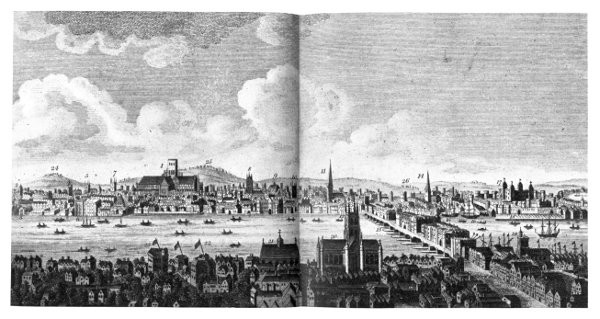
View larger version.
A View of London as it appeared before the Great Fire.
From an old print.
1
St. Paul's.
2
St. Dunstan's.
3
Temple.
4
St. Bride's.
5
St. Andrew's.
6
Baynard's Castle.
7
St. Sepulchre's.
8
Bow Church.
9
Guildhall.
10
St. Michael's.
11
St. Laurence, Poultney.
12
Old Swan.
13
London Bridge.
14
St. Dunstan's East.
15
Billingsgate.
16
Custom House.
17
Tower.
18
Tower Wharf.
19
St. Olave's.
20
St. Saviour's.
21
Winchester House.
22
The Globe.
23
The Bear Garden.
24
Hampstead.
25
Highgate.
26
Hackney.
In the following year we read in Pepys's Diary a piquant account of the putting out of Lady Castlemaine's kitchen fire on a certain occasion when Charles was engaged to sup with her:—
"October 13th, 1663. My Lady Castlemaine, I hear, is in as great favour as ever, and the King supped with her the very first night he came from Bath: and last night and the night before supped with her; when there being a chine of beef to roast, and the tide rising into their kitchen that it could not be roasted there, and the cook telling her of it, she answered, 'Zounds! she must set the house on fire, but it should be roasted!' So it was carried to Mrs. Sarah's husband's, and there it was roasted."
The last sentence requires an explanation. Mrs. Sarah was Lord Sandwich's housekeeper, and Pepys had found out in November, 1662, that she had just been married, and that her husband was a cook. We are not told his name or where he lived.
Lord Dorset, in the famous song, "To all you ladies now on land," specially alludes to the periodical inundations at the Palace:—
"The King, with wonder and surprise, Will swear the seas grow bold; Because the tides will higher rise Than e'er they did of old; But let him know it is our tears Bring floods of grief to Whitehall stairs."
Pepys was a constant visitor to Whitehall, and the Index to the Diary contains over three pages of references to his visits. He refers to Henry VIII.'s Gallery, the Boarded Gallery, the Matted Gallery, the Shield Gallery, and the Vane Room. Lilly, the astrologer, mentions the Guard Room. The Adam and Eve Gallery was so called from a picture by Mabuse, now at Hampton Court. In the Matted Gallery was a ceiling by Holbein, and on a wall in the Privy Chamber a painting of Henry VII. and Henry VIII., with their Queens, by the same artist, of which a copy in small is preserved at Hampton Court. On another wall was a "Dance of Death," also by Holbein, of which Douce has given a description; and in the bedchamber of Charles II. a representation by Joseph Wright of the King's birth, his right to his dominions, and miraculous preservation, with the motto, Terras Astræa revisit.
All these rooms, and most of the lodgings of the many residents, royal and non-royal, were in the portion of the Palace situated on the river side of the road, now known as Whitehall. This road was shut in by two gates erected by Henry VIII. when he enlarged the borders of the Palace after he had taken it from Wolsey. The one at the Westminster end was called the King Street gate, and the other, at the north end, designed by Holbein, was called by his name, and also Whitehall or Cock-pit gate.
It is necessary to remember that Whitehall extended into St. James's Park. The Tilt Yard, where many tournaments and pageants were held in the reigns of Henry VIII., Elizabeth, and James I., fronted the Banqueting House, and occupied what is now the Horse Guards' Parade. On the south side of the Tilt Yard was the Cockpit, where Monk, Duke of Albemarle, lived for a time. His name was given to a tavern in the Tilt Yard ("The Monk's Head").
On the north side was Spring Gardens, otherwise the King's Garden, but it subsequently became a place of public entertainment, and after the Restoration it was styled the Old Spring Garden; then the ground was built upon, and the entertainments removed to the New Spring Garden at Lambeth, afterwards called Vauxhall.
The Cockpit was originally used for cock-fighting, but it cannot be definitely said when it ceased to be employed for this cruel sport. It was for a considerable time used as a royal theatre, and Malone wrote:—
"Neither Elizabeth, nor James I., nor Charles I., I believe, ever went to the public theatre, but they frequently ordered plays to be performed at Court, which were represented in the royal theatre called the Cockpit."
Malone is probably incorrect in respect to Elizabeth's use of the Cockpit, for certainly cock-fighting was practised here as late as 1607, as may be seen from the following entry in the State Papers:—
"Aug. 4th, 1607. Warrant to pay 100 marks per annum to William Gateacre for breeding, feeding, etc., the King's game cocks during the life of George Coliner, Cockmaster."[6]
It is, of course, possible that the players and the cocks occupied the place contemporaneously.
The lodgings at the Cockpit were occupied by some well-known men. Philip Herbert, Earl of Pembroke and Montgomery, saw Charles I. pass from St. James's to the scaffold at the Banqueting House from one of his windows, and he died in these apartments on January 23rd, 1650. Oliver Cromwell, when Lord-Lieutenant of Ireland, was given, by order of Parliament, "the use of the lodgings called the Cockpit, of the Spring Garden and St. James's House, and the command of St. James's Park," and when Protector, and in possession of Whitehall Palace, he still retained the Cockpit. When in 1657 he relaxed some of the prohibitions against the Theatre, he used the Cockpit stage occasionally for instrumental and vocal music.
A little before the Restoration the apartments were assigned to General Monk, and Charles II. confirmed the arrangement. Here he died, as Duke of Albemarle, on January 3rd, 1670. In 1673 George Villiers, second Duke of Buckingham, became a resident, and at the Revolution of 1688 the Princess Anne was living here.
There has been some confusion in respect to the references to the Cockpit in Pepys's Diary, as two distinct theatres are referred to under this name. The references before November, 1660, are to the performances of the Duke's Company at the Cockpit in Drury Lane. Here Pepys saw the "Loyal Subject," "Othello," "Wit without Money," and "The Woman's Prize or Tamer Tamed." The subsequent passages in which the Cockpit is referred to apply to the royal theatre attached to Whitehall Palace. Here Pepys saw "The Cardinal," "Claricilla," "Humorous Lieutenant," "Scornful Lady," and the "Valiant Cid." It is useful to remember that the performances at Whitehall were in the evening, and those at the public theatre in the afternoon.
The buildings of the Old Whitefriars Palace by the river side were irregular and unimposing outside, although they were handsome inside. The grand scheme of Inigo Jones for rebuilding initiated by James I., and occasionally entertained by Charles I. and II. and William III., came to nothing, but the noble Banqueting House remains to show what might have been.
The Rev. Dr. Sheppard, in his valuable work on The Old Palace of Whitehall (1902), refers to Grinling Gibbons's statue of James II., which for many years stood in the Privy Garden, and is one of the very few good statues in London. He refers to the temporary removal of the statue to the front of Gwydyr House, and writes: "Since the statue has been removed to its present position an inscription (there was none originally) has been placed on its stone pedestal. It runs as follows:—
JACOBUS SECUNDUS
DEI GRATIA ANGLIÆ SCOTIÆ FRANCIÆ
ET HIBERNIÆ REX.
FIDEI DEFENSOR. ANNO MDCLXXXVI."
This, however, is a mistake, and the inscription runs as follows:—
JACOBUS SECUNDUS
DEI GRATIÆ
ANGLIÆ SCOTIÆ
FRANCIÆ ET
HIBERNIÆ
REX
FIDEI DEFENSOR
ANNO MDCLXXXVI
in capitals, and without any stops.
The present writer remembers well being taken as a little boy to read the inscription and find out the error in the Latin. The statue has since been removed to the front of the new buildings of the Admiralty between the Horse Guards' Parade and Spring Gardens, a very appropriate position for a Lord High Admiral. I am happy to see that the inscription has not been altered, and the incorrect "Dei gratiæ" appears as in my youth.
James Duke of York, after the Restoration, occupied apartments in St. James's Palace, and his Secretary of the Admiralty, Sir William Coventry, had lodgings conveniently near him. The Duke sometimes moved from one palace to the other, as his father, Charles I., had done before him. Henrietta Maria took a fancy to the place, and most of their children were born at St. James's, the Duke being one of these.
James's changes of residence are recorded in Pepys's Diary as follows:—
"Jan. 23rd, 1664-65. Up and with Sir W. Batten and Sir W. Pen to White Hall; but there finding the Duke gone to his lodgings at St. James's for alltogether, his Duchesse being ready to lie in, we to him and there did our usual business."
"May 3rd, 1667. Up and with Sir J. Minnes, W. Batten and W. Pen in the last man's coach to St. James's, and thence up to the Duke of York's chamber, which as it is now fretted at the top, and the chimney-piece made handsome, is one of the noblest and best-proportioned rooms that ever, I think, I saw in my life."
"May 20th, 1668. Up and with Colonell Middleton in a new coach he hath made him, very handsome, to White Hall, where the Duke of York having removed his lodgings for this year to St. James's we walked thither; and there find the Duke of York coming to White Hall, and so back to the Council Chamber, where the Committee of the Navy sat."
In November, 1667, James fell ill of the smallpox in St. James's Palace, when the gallery doors were locked up. On March 31st, 1671, Anne Duchess of York, the daughter of Clarendon, died here. The Princess Mary was married to William Prince of Orange in November, 1677, at eleven o'clock at night, in the Chapel Royal, and on July 28th, 1683, Princess Anne to Prince George of Denmark, when the pair took up their residence at St. James's.
When James came to the crown he went to live at Whitehall Palace, but he frequently stayed at St. James's. On June 9th, 1688, Queen Mary of Modena was taken to the latter place, and on the following day James Francis Edward, afterwards known as "The Pretender," was born in the Old Bedchamber. This room was situated at the east end of the south front. It had three doors, one leading to a private staircase at the head of the bed, and two windows opposite the bed.[7]
The room was pulled down previous to the alterations made in the year 1822.
The anecdote of Charles II. and the chaplains of the Chapel Royal is often quoted, but it is worth repeating, as it shows the ready wit of the great preacher, Dr. South. A daily dinner was prepared at the Palace for the chaplains, and one day the King notified his intention of dining with them. There had been some talk of abolishing this practice, and South seized the opportunity of saying grace to do his best in opposition to the suggestion; so, instead of the regular formula, which was "God save the King and bless the dinner," said "God bless the King and save the dinner." Charles at once cried out, "And it shall be saved."
The Duke of York and the King were fond of wandering about the park at all hours, and as Charles often walked by himself, even as far as the then secluded Constitution Hill, James having expressed fears for his safety, the elder brother made the memorable reply: "No kind of danger, James, for I am sure no man in England will take away my life to make you king."
Pepys tells us on March 16th, 1661-2, that while he was walking in the park he met the King and Duke coming "to see their fowl play."
Cosmo III., Grand Duke of Tuscany (then Hereditary Prince), made a "Tour through England" in 1669, and it will be remembered that Macaulay found the account of his travels a valuable help towards obtaining a picture of the state of England in the middle of the seventeenth century. Cosmo thus describes St. James's Park:—
"A large park enclosed on every side by a wall, and containing a long, straight, and spacious walk, intended for the amusement of the Mall, on each side of which grow large elms whose shade render the promenade in that place in summer infinitely pleasant and agreeable; close to it is a canal of nearly the same length, on which are several species of aquatic birds, brought up and rendered domestic—the work of the Protector Cromwell; the rest of the park is left uncultivated, and forms a wood for the retreat of deer and other quadrupeds."
His Highness was not quite correct in giving the credit of the collection of wild-fowl to Cromwell, as the water-fowl appear to have been kept in the park from the reign of Elizabeth, and the ponds were replenished after the Restoration.
Evelyn gives a long account in his Diary of the zoological collections (February 9th, 1664-65). He says:
"The parke was at this time stored with numerous flocks of severall sorts of ordinary and extraordinary wild fowle, breeding about the Decoy, which for being neere so greate a citty, and among such a concourse of souldiers and people, is a singular and diverting thing. There were also deere of several countries, white; spotted like leopards; antelopes, an elk, red deere, roebucks, staggs, guinea goates, Arabian sheepe, etc. There were withy pots or nests for the wild fowle to lay their eggs in, a little above ye surface of ye water."
Charles II. was a saunterer by nature, and he appears to have been quite happy in the park either chatting with Nell Gwyn, at the end of the garden of her Pall Mall house, in feeding the fowl, or in playing the game of Mall.
This game was popular from the end of the sixteenth to the beginning of the eighteenth century, and then went out of fashion. At one time there were few large towns without a mall, or prepared ground where the game could be played. There is reason to believe that the game was introduced into England from Scotland on the accession of James VI. to the English throne, because the King names it in his "Basilicon Dōron" among other exercises as suited for his son Henry, who was afterwards Prince of Wales, and about the same time Sir R. Dallington, in his Method of Travel (1598), expresses his surprise that the sport was not then introduced into England.
The game was played in long shaded alleys, and on dry gravel walks. The mall in St. James's Park was nearly half a mile in length, and was kept with the greatest care. Pepys relates how he went to talk with the keeper of the mall, and how he learned the manner of mixing the earth for the floor, over which powdered cockle-shells were strewn. All this required such attention that a special person was employed for the purpose, who was called the cockle-strewer. In dry weather the surface was apt to turn to dust, and consequently to impede the flight of the ball, so that the cockle-strewer's office was by no means a sinecure. Richard Blome, writing in 1673, asserts that this mall was "said to be the best in Christendom," but Evelyn claims the pre-eminence for that at Tours, with its seven rows of tall elms, as "the noblest in Europe for length and shade." The game is praised by Sir R. Dallington "because it is a gentlemanlike sport, not violent, and yields good occasion and opportunity of discourse as they walke from one marke to the other," and Joseph Lauthier, who wrote a treatise on the subject, entitled Le Jeu de Mail, Paris, 1717 (which is now extremely scarce), uses the same form of recommendation.
The chief requisites for the game were mallets, balls, two arches or hoops, one at either end of the mall, and a wooden border marked so as to show the position of the balls when played. The mallets were of different size and form to suit the various players, and Lauthier directs that the weight and height of the mallet should be in proportion to the strength and stature of the player. The balls were of various sizes and weights, and each size had its distinct name. In damp weather, when the soil was heavy, a lighter ball was required than when the soil was sandy. A gauge was used to ascertain its weight, and the weight of the mallet was adjusted to that of the ball. The arch or pass was about two feet high and two inches wide. The one at the west end of St. James's Park remained in its place for many years, and was not cleared away until the beginning of the reign of George III. In playing the game, the mallet was raised above the head and brought down with great force so as to strike the ball to a considerable distance. The poet Waller describes Charles II.'s stroke in the following lines:—
"Here a well-polished Mall gives us joy, To see our prince his matchless force employ. No sooner has he touch'd the flying ball, But 'tis already more than half the Mall; And such a fury from his arm has got, As from a smoking culverin 'twere shot."
Considerable skill and practice were required in the player, who, while attempting to make the ball skate along the ground with speed, had to be careful that he did not strike it in such a manner as to raise it from the ground. This is shown by what Charles Cotton writes:—
"But playing with the boy at Mall (I rue the time and ever shall), I struck the ball, I know not how, (For that is not the play, you know), A pretty height into the air."
This boy was, perhaps, a caddie, for it will be seen that the game was a sort of cross between golf and croquet.
Lauthier describes four ways of playing at pall mall, viz.:—(1) the rouet, or pool game; (2) en partie, a match game; (3) à grands coups, at long shots; and (4) chicane, or hockey. Moreover, he proposes a new game to be played like billiards.
We may now pass from St. James's Park to Hyde Park, which became a place of public resort in the reigns of James I. and Charles I. It was then considered to be quite a country place. Ben Jonson mentions in the Prologue to his comedy, The Staple of News (1625), the number of coaches which congregated there, and Shirley describes the horse-races in his comedy entitled Hide Parke (1637).
The park, being Crown property, was sold by order of Parliament in 1652 for about £17,000 in three lots, the purchasers being Richard Wilcox, John Tracy, and Anthony Deane. Cromwell was a frequent visitor, and on one occasion when he was driving in the park his horses ran away, and he was thrown off his coach.
After the Restoration the park was the daily resort of all the gallantry of the court, and Pepys found driving there very pleasant, although he complained of the dust. The Ring, which is described in Grammont's Memoirs as "the rendezvous of magnificence and beauty," was a small enclosure of trees round which the carriages circulated.
Pepys writes April 4th, 1663:—
"After dinner to Hide Park ... At the Park was the King and in another coach my Lady Castlemaine, they greeting one another at every tour."
This passage is illustrated in Wilson's Memoirs, 1719, where we are told that when the coaches "have turned for some time round one way, they face about and turn t'other."
John Macky, in his Journey through England (1724), affirms that in fine weather he had seen above three hundred coaches at a time making "the Grand Tour."
Cosmo tells of the etiquette which was observed among the company:—
"The King and Queen are often there, and the duke and duchess, towards whom at the first meeting and no more all persons show the usual marks of respect, which are afterwards omitted, although they should chance to meet again ever so often, every one being at full liberty, and under no constraint whatever, and to prevent the confusion and disorder which might arise from the great number of lackies and footmen, these are not permitted to enter Hyde Park, but stop at the gate waiting for their masters."
Oldys refers to a poem, printed in sixteen pages, which was entitled "The Circus, or British Olympicks: a Satyr on the Ring in Hyde Park." He says that the poem satirizes many well-known fops under fictitious names, and he raises the number of coaches seen on a fine evening from Macky's three hundred to a thousand. The Ring was partly destroyed at the time the Serpentine was formed by Caroline, Queen of George II.
Although the Ring has disappeared, Hyde Park has remained from the Restoration period until the present day the most fashionable place in London, but now the whole park has been utilized.
Charles II., in reviving the Stage, specially patronised it himself, and it may be referred to here from its connection with the Court. It has already been noticed that previous monarchs did not visit the public theatres.
Pepys was an enthusiastic playgoer, and the Diary contains a mass of information respecting the Stage not elsewhere to be found, so that we are able to trace the various advances made in the revival of the Stage from the incipient attempt of Davenant before the Restoration to the improvements in scenery introduced by the rivalry of the two managers, Davenant and Killigrew. Immediately after the Restoration two companies of actors were organized, who performed at two different houses. One theatre was known as the King's House, called by Pepys "The Theatre," and the other as the Duke's House, called by Pepys "The Opera." Sir William Davenant obtained a patent for his company as "The Duke's Servants," named after the Duke of York, and Thomas Killigrew obtained one for "The King's Servants."
Killigrew's Company first performed at the "Red Bull," Clerkenwell, and on November 8th removed to Gibbons's Tennis Court in Bear Yard, which was entered from Vere Street, Clare Market. Here the Company remained till 1663, when they removed to Drury Lane Theatre, which had been built for their reception, and was opened on May 7th.
Davenant's Company first performed at the Cockpit, Drury Lane. They began to play at Salisbury Court Theatre on November 13th, 1660, and went to Cobham House, Blackfriars, on the site afterwards occupied by Apothecaries' Hall, in January, 1661. They then removed to the theatre in Portugal Row, built on the site of Lisle's Tennis Court. Rhodes, a bookseller, who had formerly been wardrobe keeper at the Blackfriars, had managed in 1659 to obtain a licence from the State, and John Downes affirms that his company acted at the Cockpit, but apparently he was acting at the Salisbury Court Theatre before Davenant went there. Killigrew, however, soon succeeded in suppressing Rhodes. Davenant planned a new building in Dorset Gardens, which was close to Salisbury Court, where the former theatre was situated. He died, however, before it was finished, but the company removed there in 1671, and the theatre was opened on the 9th of November with Dryden's play, Sir Martin Mar-all, which he had improved from a rough draft by the Duke of Newcastle. Pepys had seen it seven times in the years 1667-68. The Lincoln's Inn Fields Theatre remained shut up until February, 1672, when the King's Company, burnt out of Drury Lane Theatre, made use of it till March, 1674, by which time the new building in Brydges Street, Covent Garden, was ready for their occupation.
When Tom Killigrew died in 1682 the King's and the Duke's companies were united, and the Duke's servants removed from Dorset Gardens to Drury Lane. The two companies performed together for the first time on November 16th.
These constant changes are very confusing, and the recital of them is not very entertaining, but it is necessary to make the matter clear for the proper understanding of the history of the time. The plan of the old theatres, with their platform stage, was no longer of use for the altered arrangements introduced at the Restoration. Successive improvements in the form of the houses were made, but we learn from Pepys that it was some time before the roofing of the building was water-tight.
The public theatres were open in the afternoon, three o'clock being the usual hour for performance, and the plays were therefore partly acted in the summer by daylight. It was thus necessary to have skylights, but these were so slight that heavy rain came and wetted those below. On June 1st, 1664, Pepys wrote:—
"Before the play was done it fell such a storm of hail that we in the middle of the pit were fain to rise, and all the house in a disorder."
Davenant was the original planner of the modern stage and its scenery, but Killigrew did his part in the improvement carried out. He was somewhat jealous of his brother manager, and on one occasion he explained to Pepys what he himself had done:—
"Feb. 12th, 1666-67. The stage is now by his pains a thousand times better and more glorious than ever heretofore. Now, wax candles, and many of them; then not above 3 lbs. of tallow: now all things civil, no rudeness anywhere; then as in a bear garden: then two or three fiddlers, now nine or ten of the best: then nothing but rushes upon the ground, and everything else mean; and now all otherwise; then the Queen seldom and the King never would come; now, not the King only for State but all civil people do think they may come as well as any."
Killigrew complained that "the audience at his house was not above half as much as it used to be before the late fire," but in the following year (February 6th, 1667-8) there were crowds at the other house. Pepys relates:—
"Home to dinner, and my wife being gone before, I to the Duke of York's playhouse; where a new play of Etheridge's called 'She Would if she Could,' and though I was there by two o'clock, there were 1,000 people put back that could not have room in the pit."
Pepys's criticisms on the plays he saw acted at these theatres were not always satisfactory, and often they were contradictory. At the same time he was apparently judicious in the disposal of praise and blame on the actors he saw. Betterton was his ideal of the perfect actor, and, so far as it is possible to judge as to one who lived so long ago, public opinion formed by those capable of judging from contemporary report seems to be in agreement with that of Pepys.
Pepys was a great frequenter of taverns and inns, as were most of his contemporaries. There are about one hundred and thirty London taverns mentioned in the Diary, but time has swept away nearly all of these houses, and it is difficult to find any place which Pepys frequented.
These taverns may be considered as a link between the Court end of London and the city, for Pepys distributed his favours between the two places. King Street, Westminster, was full of inns, and Pepys seems to have frequented them all. Two of them—the "Dog" and the "Sun"—are mentioned in Herrick's address to the shade of "Glorious Ben":—
"Ah, Ben! Say how or when Shall we thy guests Meet at these feasts Made at the Sun, The Dog, the Triple Tunne? Where we such clusters had As made us nobly wild, not mad! And yet such verse of thine Outdid the meate, outdid the frolic wine."
The "Three Tuns" at Charing Cross, visited by Pepys, was probably the same house whose sign Herrick changes to "Triple Tun."
Among the Westminster taverns may be mentioned "Heaven" and "Hell," two places of entertainment at Westminster Hall; the "Bull Head" and the "Chequers" and the "Swan" at Charing Cross; the "Cock" in Bow Street and the "Fleece" in York Street, Covent Garden; the "Canary" house by Exeter Change; and the "Blue Balls" in Lincoln's Inn Fields.
The majority of these taverns patronised by Pepys were, however, in the city. There were several "Mitres" in London, but perhaps the most interesting one was that kept in Fenchurch Street by Daniel Rawlinson, a staunch royalist, who, when Charles I. was executed, hung his sign in mourning. Thomas Hearne says that naturally made him suspected by the Roundheads, but "endeared him so much to the Churchmen that he throve amain and got a good estate." His son, Sir Thomas Rawlinson, was Lord Mayor in 1700, and President of Bridewell Hospital. His two grandsons, Thomas and Richard Rawlinson, hold an honourable place in the roll of eminent book collectors. The "Samson" in St. Paul's Churchyard was another famous house, as also the "Dolphin" in Tower Street, a rendezvous of the Navy officers, which provided very good and expensive dinners.
The "Cock" in Threadneedle Street was an old-established house when Pepys visited it on March 7th, 1659-60, and it lasted till 1840, when it was cleared away. In the eighteenth century it was a constant practice for the frequenters of the "Cock" to buy a chop or steak at the butcher's and bring it to be cooked, the charge for which was one penny. Fox's friend, the notorious Duke of Norfolk, known as "Jockey of Norfolk," often bought his chop and brought it here to be cooked, until his rank was discovered.
The meetings of the Royal Society were held at Gresham College in Bishopsgate Street, and then at Arundel House in the Strand, which was lent to the Society by Henry Howard of Norfolk, afterwards Duke of Norfolk. Cosmo of Tuscany visited the latter place for a meeting of the Royal Society, and he gives in his Travels an interesting account of the manner in which the proceedings were carried out.
There are many references in Pepys's Diary to the Lord Mayor and the Rulers of the City, and of the customs carried out there.
The Lord Mayor, aldermen, and common councilmen visited Cosmo, who was staying at Lord St. Alban's mansion in St. James's Square. His Highness, having dined with the King at the Duke of Buckingham's, kept the city magnates waiting for a time, but Colonel Gascoyne, "to make the delay less tedious, had accommodated himself to the national taste by ordering liquor and amusing them with drinking toasts, till it was announced that His Highness was ready to give them audience." The description of the audience is very interesting.
Pepys lived in the city at the Navy Office in Seething Lane (opposite St. Olave's, Hart Street, the church he attended) during the whole of the time he was writing his Diary, but when he was Secretary of the Admiralty he went, in 1684, to live at the end of Buckingham Street, Strand, in a house on the east side which looks on to the river.
Mr. John Eliot Hodgkin possesses the original lease (dated September 30th, 1687) from the governor and company of the New River for a supply of water through a half-inch pipe, and four small cocks of brass led from the main pipe in Villiers Street to Samuel Pepys's house in York Buildings, also a receipt for two quarters' rent for the same.[8]
Two of the greatest calamities that could overtake any city occurred in London during the writing of the Diary, and were fully described by Pepys—viz., the Plague of 1665 and the Fire of 1666. Defoe's most interesting history of the plague year was written in 1722 at second hand, for the writer was only two years old when this scourge overran London. Pepys wrote of what he saw, and as he stuck to his duty during the whole time that the pestilence continued, he saw much that occurred.
England was first visited with the plague in 1348-49, which, since 1833 (when Hecker's work on the Epidemics of the Middle Ages was first published in English), has been styled the Black Death—a translation of the German term "Der Schwarze Tod." This plague had the most momentous effect upon the history of England on account of the fearful mortality it caused. It paralysed industry, and permanently altered the position of the labourer. The statistics of the writers of the Middle Ages are of little value, and the estimates of those who died are various, but the statement that half the population of England died from the plague is probably not far from the truth. From 1348 to 1665 plague was continually occurring in London, but it has not appeared since the last date, except on a small scale. Dr. Creighton gives particulars of the visitations in London in 1603, 1625, and 1665, from which it appears that the mortality in 1665 was more than double that in 1603, and about a third more than that in 1625.
On the 7th of June, 1665, Pepys for the first time saw two or three houses marked with the red cross, and the words "Lord, have mercy upon us" upon the doors, and the sight made him feel so ill-at-ease that he was forced to buy some roll tobacco to smell and chew.[9] On the 27th of this month he writes: "The plague encreases mightily."
According to the Bills of Mortality, the total number of deaths in London for the week ending June 27th was 684, of which number 267 were deaths from the plague. The number of deaths rose week by week until September 19th, when the total was 8,297, and the deaths from the plague 7,165. On September 26th the total had fallen to 6,460, and deaths from the plague to 5,533. The number fell gradually, week by week, till October 31st, when the total was 1,388, and the deaths from the plague 1,031. On November 7th there was a rise to 1,787 and 1,414 respectively. On November 14th the numbers had gone down to 1,359 and 1,050 respectively. On December 12th the total had fallen to 442, and deaths from plague to 243. On December 19th there was a rise to 525 and 281 respectively. The total of burials in 1665 was 97,306, of which number the plague claimed 68,596 victims. Most of the inhabitants of London who could get away took the first opportunity of escaping from the town, and in 1665 there were many places that the Londoner could visit with considerable chance of safety. The court went to Oxford, and afterwards came back to Hampton Court before venturing to return to Whitehall. The clergy and the doctors fled with very few exceptions, and several of those who stayed in town doing the duty of others, as well as their own, fell victims to the scourge.
Queen Elizabeth would have none of these removals. Stow says that in the time of the plague of 1563, "a gallows was set up in the Market-place of Windsor to hang all such as should come there from London."
Dr. Hodges, author of Loimologia, enumerates among those who assisted in the dangerous work of restraining the progress of the infection were the learned Dr. Gibson, Regius Professor at Cambridge; Dr. Francis Glisson, Dr. Nathaniel Paget, Dr. Peter Barwick, Dr. Humphrey Brookes, etc. Of those he mentions eight or nine fell in their work, among whom was Dr. William Conyers, to whose goodness and humanity he bears the most honourable testimony. Dr. Alexander Burnett, of Fenchurch Street, one of Pepys's friends, was another of the victims.
Of those to whom honour is due special mention must be made of Monk, Duke of Albemarle, Evelyn, Pepys, Edmond Berry Godfrey; and there were, of course, others.
The Duke of Albemarle stayed at the Cockpit; Evelyn sent his wife and family to Wotton, but he remained in town himself, and had very arduous duties to perform, for he was responsible for finding food and lodging for the prisoners of war, and he found it difficult to get money for these purposes. He tells in his Diary how he was received by Charles II. and the Duke of York on January 29th, 1665-6, when the pestilence had partly abated and the court had ventured from Oxford to Hampton Court. The King
"... ran towards me, and in a most gracious manner gave me his hand to kisse, with many thanks for my care and faithfulnesse in his service in a time of such greate danger, when everybody fled their employment; he told me he was much obliged to me, and said he was several times concerned for me, and the peril I underwent, and did receive my service most acceptably (though in truth I did but do my duty, and O that I had performed it as I ought!) After that his Majesty was pleased to talke with me alone, neere an houre, of severall particulars of my employment and ordered me to attend him againe on the Thursday following at Whitehall. Then the Duke came towards me, and embraced me with much kindnesse, telling me if he had thought my danger would have been so greate, he would not have suffered his Majesty to employ me in that station."
Pepys refers, on May 1st, 1667, to his visit to Sir Robert Viner's, the eminent goldsmith, where he saw "two or three great silver flagons, made with inscriptions as gifts of the King to such and such persons of quality as did stay in town [during] the late plague for keeping things in order in the town, which is a handsome thing." Godfrey was a recipient of a silver tankard, and he was knighted by the King in September, 1666, for his efforts to preserve order in the Great Fire. The remembrance of his death, which had so great an influence on the spread of the "Popish Plot" terror, is greater than that of his public spirit during the plague and the fire.
Pepys lived at Greenwich and Woolwich during the height of the plague, but he was constantly in London. How much these men must have suffered is brought very visibly before us in one of the best letters Pepys ever wrote:
"To Lady Casteret, from Woolwich, Sept. 4, 1655. The absence of the court and emptiness of the city takes away all occasion of news, save only such melancholy stories as would rather sadden than find your ladyship any divertissement in the hearing. I have stayed in the city till about 7,400 died in one week, and of them above 6,000 of the plague, and little noise heard day or night but tolling of bells; till I could walk Lumber Street and not meet twenty persons from one end to the other, and not fifty on the Exchange; till whole families have been swept away; till my very physician, Dr. Burnett, who undertook to secure me against any infection, having survived the month of his own house being shut up, died himself of the plague; till the nights, though much lengthened, are grown too short to conceal the burials of those that died the day before, people thereby constrained to borrow daylight for that service; lastly, till I could find neither meat nor drink safe, the butchers being everywhere visited, my brewer's house shut up, and my baker, with his whole family, dead of the plague."
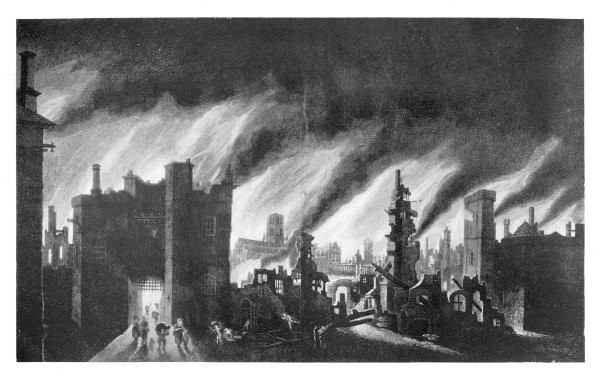
The Great Fire of London.
The view shows Ludgate in the foreground, and in the distance St. Paul's Cathedral and the Tower of St. Mary-le-Bow.
Before the first calamity of pestilence was ended the second calamity of fire commenced. On the night of September 1st, 1666, many houses were destroyed. At three o'clock in the morning of the 2nd (Sunday) his servant Jane awoke Pepys to tell him that a great fire was raging. Not thinking much of the information, he went to sleep again, but when he rose at seven he found that about 300 houses had been burned in the night. He went first to the Tower, and saw the Lieutenant. Then he took boat to Whitehall to see the King. He tells of what he has seen, and says that, unless His Majesty will command houses to be pulled down, nothing can stop the fire. On hearing this the King instructs him to go to the Lord Mayor (Sir Thomas Bludworth) and command him to pull down houses in every direction. The Mayor seems to have been but a poor creature, and when he heard the King's message
"... he cried like a fainting woman, 'Lord! what can I do? I am spent: people will not obey me. I have been pulling down houses, but the fire overtakes us faster than we can do it.'"
Fortunately, most of the Londoners were more vigorous than the Mayor. The King and the Duke of York interested themselves in the matter, and did their best to help those who were busy in trying to stop the fire. Evelyn wrote on September 6th:—
"It is not indeede imaginable how extraordinary the vigilance and activity of the King and the Duke was, even labouring in person, and being present to command, order, reward, or encourage workmen, by which he showed his affection to his people and gained theirs."
Sir William Penn and Pepys were ready in resource, and saw to the blowing up of houses to check the spread of the flames, the former bringing workmen out of the dockyards to help in the work. During the period when it was expected that the Navy Office would be destroyed, Pepys sent off his money, plate, and most treasured property to Sir W. Rider, at Bethnal Green, and then he and Penn dug a hole in their garden, in which they put their wine and parmezan cheese.
On the 10th of September, Sir W. Rider let it be known that, as the town is full of the report respecting the wealth in his house, he will be glad if his friends will provide for the safety of their property elsewhere.
On September 5th, when Evelyn went to Whitehall, the King commanded him
"... among the rest to looke after the quenching of Fetter Lane end, to preserve if possible that part of Holborn, whilst the rest of ye gentlemen tooke their several posts, some at one part, some at another (for now they began to bestir themselves and not till now, who hitherto had stood as men intoxicated with their hands acrosse) and began to consider that nothing was likely to put a stop but the blowing up of so many houses as might make a wider gap than any had yet been made by the ordinary method of pulling them downe with engines."
The daily records of the fire and of the movements of the people are most striking. Now we see the river crowded with boats filled with the goods of those who are houseless, and then we pass to Moorfields, where are crowds carrying their belongings about with them, and doing their best to keep these separate till some huts can be built to receive them. Soon paved streets and two-storey houses were seen in Moorfields, the city authorities having let the land on leases for seven years.
The wearied people complained that their feet were "ready to burn" through walking in the streets "among the hot coals."
(September 5th, 1666.) Means were provided to save the unfortunate multitudes from starvation, and on this same day proclamation was made
"... ordering that for the supply of the distressed persons left destitute ... great proportions of bread be brought daily, not only to the former markets, but to those lately ordained. Churches and public places were to be thrown open for the reception of poor people and their goods."
Westminster Hall was filled with "people's goods."
On September 7th Evelyn went towards Islington and Highgate
"... where one might have seen 200,000 people of all ranks and degrees dispers'd and lying along by their heapes of what they could save from the fire, deploring their losse, and tho' ready to perish for hunger and destitution yet not asking one penny for reliefe, which to me appear'd a stranger sight than any I had yet beheld."
The fire was fairly got under on September 7th, but on the previous day Clothworkers' Hall was burning, as it had been for three days and nights, in one volume of flame. This was caused by the cellars being full of oil. How long the streets remained in a dangerous condition may be guessed by Pepys's mention, on May 16th, 1666-7, of the smoke issuing from the cellars in the ruined streets of London.
The fire consumed about five-sixths of the whole city, and outside the walls a space was cleared about equal to an oblong square of a mile and a half in length and half a mile in breadth. Well might Evelyn say, "I went againe to ye ruines for it was no longer a citty" (September 10th, 1666).
The destruction was fearful, and the disappearance of the grand old Cathedral of St. Paul's was among the most to be regretted of the losses. One reads these particulars with a sort of dulled apathy, and it requires such a terribly realistic picture as the following, by Evelyn, to bring the scene home to us in all its magnitude and horror:
"The conflagration was so universal, and the people so astonish'd, that from the beginning I know not by what despondency or fate, they hardly stirr'd to quench it, so that there was nothing heard or seene but crying out and lamentation, running about like distracted creatures without at all attempting to save even their goods; such a strange consternation there was upon them, so as it burned both in breadth and length, the churches, public halls, Exchange, hospitals, monuments and ornaments, leaping after a prodigious manner, from house to house, and streete to streete, at greate distances one from ye other; for ye heat with a long set of faire and warm weather had even ignited the aire and prepared the materials to conceive the fire, which devour'd after an incredible manner houses, furniture, and every thing. Here we saw the Thames cover'd with goods floating, all the barges and boates laden with what some had time and courage to save, as, on ye other, ye carts, &c., carrying out to the fields, which for many miles were strew'd with moveables of all sorts, and tents erecting to shelter both people and what goods they could get away. Oh the miserable and calamitous spectacle! Such as haply the world had not seene since the foundation of it, nor be outdon till the universal conflagration thereof. All the skie was of a fiery aspect, like the top of a burning oven, and the light seene above 40 miles round about for many nights. God grant mine eyes may never behold the like, who now saw above 10,000 houses all in one flame; the noise and cracking and thunder of the impetuous flames, ye shrieking of women and children, the hurry of people, the fall of towers, houses and churches was like a hideous storme and the aire all about so hot and inflam'd that at the last one was not able to approach it, so that they were forc'd to stand still and let ye flames burn on, which they did neere two miles in length and one in breadth. The clouds also of smoke were dismall and reach'd upon computation neer 50 miles in length. Thus I left it this afternoone burning, a resemblance of Sodom, or the last day. It forcibly call'd to mind that passage—non enim hic habemus stabilem civitatem: the ruines resembling the picture of Troy. London was, but is no more."—(Sept. 3rd, 1666.)
Can we be surprised at the bewildered feelings of the people? Rather must we admire the practical and heroic conduct of the homeless multitude. It took long to rebuild the city, but directly anything could be done the workers were up and doing.
An Act of Parliament was passed "for erecting a Judicature for determination of differences touching Houses burned or demolished by reason of the late Fire which happened in London" (18 and 19 Car. II., cap. 7), and Sir Matthew Hale was the moving spirit in the planning it and in carrying out its provisions when it was passed. Burnet affirms that it was through his judgment and foresight "that the whole city was raised out of its ashes without any suits of law" (History of his Own Time, Book ii.). By a subsequent Act (18 and 19 Car. II., cap. 8) the machinery for a satisfactory rebuilding of the city was arranged. The rulings of the judges appointed by these Acts gave general satisfaction, and after a time the city was rebuilt very much on the old lines, and things went on as before.[10] At one time it was supposed that the fire would cause a westward march of trade, but the city asserted the old supremacy when it was rebuilt.
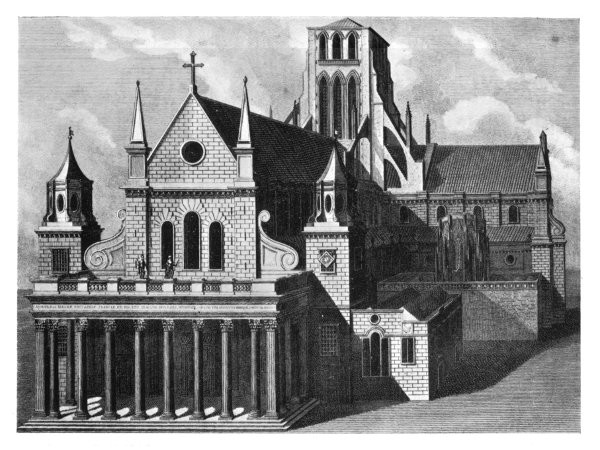
South-West View of Old St. Paul's.
Three great men, thoroughly competent to give valuable advice on the rebuilding of the city, viz., Wren, Robert Hooke, and Evelyn, presented to the King valuable plans for the best mode of arranging the new streets, but none of these schemes was accepted. One cannot but regret that the proposals of the great architect were not carried out.
With the reference to the Plague and the Great Fire we may conclude this brief account of the later Stuart London. The picturesque, but dirty, houses were replaced by healthier and cleaner ones. The West End increased and extended its borders, but the growth to the north of Piccadilly was very gradual. All periods have their chroniclers, but no period has produced such delightful guides to the actual life of the town as the later half of the seventeenth century did in the pages of Evelyn and Pepys. It must ever be a sincere regret to all who love to understand the more intimate side of history that Pepys did not continue his Diary to a later period. We must, however, be grateful for what we possess, and I hope this slight and imperfect sketch of Pepys's London may refresh the memories of my readers as to what the London of that time was really like.
[6] Cal. State Papers, 1603-10, p. 367.
[7] During the time that the Jacobites were formidable, and long after, it was firmly believed that the Old Pretender was brought into this room as a baby in a warming pan, and plans of the room were common to show how the fraud was committed.
[8] Rariora, vol. i., p. 17.
[9] Originally the crosses were of a blue colour, but Dr. Creighton says that the colour was changed to red before the plague of 1603.
[10] A full account of the fire and of the rebuilding of the city has still to be written, and the materials for the latter are to hand in the remarkable "Fire Papers" in the British Museum. I have long desired to work on this congenial subject, but having been prevented by other duties from doing so, I hope that some London expert will be induced to give the public a general idea of the contents of these valuable collections.
THE OLD LONDON BRIDGES
By J. Tavenor-Perry
"London Bridge is broken down, Dance o'er my Lady Lee. London Bridge is broken down With a gay Ladee."
At the beginning of the last century only three bridges spanned the Thames in its course through London, and of these two were scarcely fifty years old; but before the century closed there were no less than thirteen bridges across the river between Battersea and the Pool. The three old bridges have been rebuilt, and even some of the later ones have been reconstructed, whilst one has been removed bodily, and now spans the gorge of the Avon at Bristol. Of all these bridges unfortunately only two are constructed wholly of stone, and can lay claim to any architectural merit; and even one of these two has recently had the happy effect of its graceful arches destroyed by the addition of overhanging pathways. Of the rest, some are frankly utilitarian—mere iron girder railway bridges, with no attempt at decoration beyond gilding the rivets—whilst the others have their iron arches and construction disguised with coarse and meaningless ornaments. One only of the iron bridges is in anyway worthy of its position; in its perfect simplicity and the bold spans of its three arches, Southwark Bridge bears comparison with the best in Europe, but the gradients and approaches are so inconvenient that it is even now threatened with reconstruction.
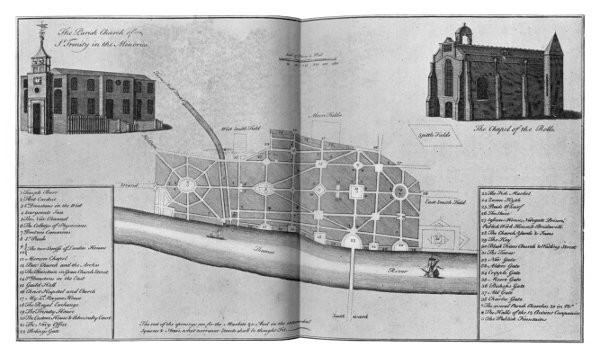
View larger version.
Sir John Evelyn's Plan for Rebuilding London after the Great Fire.
Exactly when the first bridge was built across the Thames at London we can only surmise, for even tradition is silent on the subject, and we only know of the existence of one at an early date by very casual references, which, however, do not help us to realise the character of the work. Though no evidence remains of a Roman bridge, it seems unlikely, having regard to the importance of London, and to the fact that the great roads from the south coast converged on a point opposite to it, on the other side of the river, that they should have been left to end there without a bridge to carry them over. The difficulties of building across a great tidal river had not prevented the Romans from bridging the Medway at Rochester, as remains actually discovered have proved; and if no evidences of Roman work were actually met with in the rebuilding of London Bridge or the removal of the old one, this may be due to the fact that each successive bridge—and there have been at least three within historical times—was built some distance further up the stream than its predecessor.
We know, however, with certainty that a bridge was standing in the reign of King Ethelred from the references made to it, and we may fairly assume that this must have been the Roman bridge, at least so far as its main construction was concerned; and, like other Roman bridges standing at that time in Gaul and in other parts of England, it would have consisted merely of piers of masonry, with a wooden roadway passing from one to the other. It was still standing, of sufficient strength for resistance, when the Danes under Canute sailed up the river, who, being unable to force a passage, tradition says—and antiquaries have imagined they could discover traces of it—cut a ship canal through the Surrey marshes from Bermondsey to Battersea, and passed their fleet through that way.
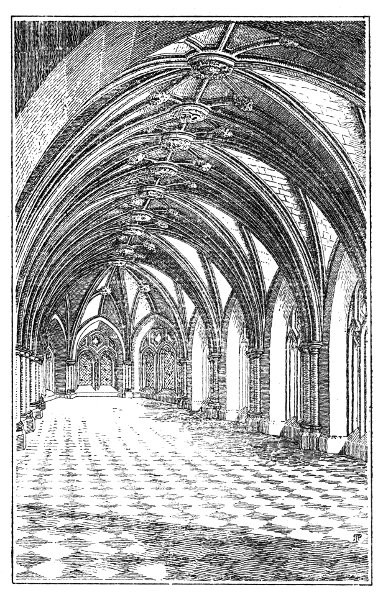
Fig. 1—The Undercroft of St. Thomas of Canterbury on the Bridge.
The history of the bridge only opens with the beginning of the twelfth century. According to tradition, the convent of St. Mary Overie, Southwark, had been originally endowed with the profits of a ferry across the river, and had in consequence undertaken the duty of maintaining the bridge in a proper state of repair when a bridge was built. This convent was refounded in 1106 as a priory of Austin Canons; and it is not a little remarkable, having regard to the duties it had undertaken, that of its founders, who were two Norman Knights, one was William de Pont de l'Arche. At the Norman town, where stood his castle and from which he took his name, was a bridge of twenty-two openings, erected, it was said, by Charles the Bald, but most likely a Roman work, across the Seine at the highest point reached by the tide. It is a further curious coincidence that this same William appears as a witness to a deed executed by Henry I., excusing the manor of Alciston, in Sussex, from paying any dues for the repairs of London Bridge.
It is recorded that in 1136 the bridge was burnt, which may perhaps merely mean that the deck was destroyed, whilst the piers remained sufficiently uninjured to allow of the structure being repaired; but in 1163 it had become so dangerous that Peter of Colechurch undertook the erection of a new bridge, which he constructed of elm timber. This sudden emergence of Peter from obscurity to carry out so important an engineering work is as dramatic as is that of St. Bénezet, who founded the confraternity of Hospitaliers pontifices, which undertook the building of bridges and the establishment of ferries. According to legend, this saint, although then only a young shepherd, essayed to bridge the Rhone at Avignon, and the ruined arches of his great work are still among the sights of that city. Peter may have possessed many more qualifications for building than a shepherd could have acquired, as large ecclesiastical works were in progress in London throughout his life, which he must have observed and perhaps profited by; but this is only surmise, as of his history, except in connection with his great work, we know no more than the fact that he was the chaplain of St. Mary Colechurch. His contemporary, Randulphus de Decito, Dean of London, says that he was a native of the city, so that it is scarcely likely that he had acquired his skill abroad; but we are told that he traversed the country to collect the moneys for his undertaking, and he may thus have obtained some knowledge of the many Roman bridges which still survived, or even have seen the great bridge which Bishop Flambard had recently erected across the Wear at Durham. His selection as the architect of the earlier bridge of 1163 may perhaps not be due in any way to his especial engineering skill, but rather to some intimate connection with the priory of St. Mary Overie, whose canons were primarily responsible for the bridge repairs; indeed, since he is merely described as the chaplain of his church, he may himself have been one of the canons. But be the cause what it may—and it was not his success in erecting this first bridge, for it soon became dilapidated—thirteen years after its erection he started afresh, on a site further up the river, to erect a bridge of stone. In 1176, two years before St. Bénezet began his great bridge at Avignon, he commenced his work, and thirty-three years passed before its completion. Whether the delay was due to lack of funds or the incapacity of the architect we do not know, though probably to both, for before Peter's death King John, who had manifested considerable interest in the new bridge, had urged Peter's dismissal, and, under the advice of the Archbishop of Canterbury, suggested the appointment of Isembert of Saintes to complete the work. This Isembert was credited with the erection of the great bridge across the Charante at Saintes, although that bridge was undoubtedly a Roman one, and all he appears to have done was to turn arches between the original piers, and make it a stone bridge throughout. The same master was said to have built another bridge at La Rochelle, and had evidently gained much experience in such engineering work; and it is perhaps a misfortune that the King's advice was neglected, as a skilled architect, which Peter certainly was not, might have saved the city of London much eventual loss and trouble. Peter was, however, suffered to continue the bridge until his death in 1205, when a commission of three city merchants completed the work in four years.
The bridge which these many years of labour had produced was in every way unsuitable to its position, and mean as compared to similar buildings erected elsewhere. Lacking the skill to form proper foundations, Peter had spread them out into wide piers, which formed an almost continuous dam, through the openings in which the water rushed like a mill-race. The result was that the scour soon affected the stability of the piers, which had to be protected round by masses of masonry and chalk in the form of sterlings, which still further contracted the narrow waterways. The passage of the bridge by boat—"shooting the bridge," it was called—was always a dangerous operation; and a writer of the last century speaks of "the noise of the falling waters, the clamours of the water-men, and the frequent shrieks of drowning wretches," in describing it. So imperfectly built was the bridge that within four years of its completion King John again interfered, and called upon the Corporation properly to repair it; and from this time, or perhaps from Peter's death, when the three merchants were elected to complete the work, the Corporation appears to have taken over the responsibility of the bridge; and for this purpose they were endowed with certain properties, which became the nucleus of the present "Bridge House Estates." The increasing dilapidation of the bridge, the debris of fallen arches, and the rubbish and waste material which was suffered to accumulate, still further impeded the natural flow of the water, and little effort at improvement was ever made. Of the three widest arches of the bridge, which were called the navigable locks, the most important had been the one nearest to the city end, which became known as the "Rock Lock," and it acquired that name on account of a popular delusion that in its fairway was a growing and vegetating rock, which was nothing more than an accumulation of fallen ruins, which caught and held the floating refuse carried to and fro by the tides. And thus year after year the river dam became more solid, and the waterfall increased in height until it was said by one who knew them both that it was almost as safe to attempt the Falls of Niagara as to shoot London Bridge.
As years went by, not only did the waterways become congested, but the roadway above began to be encroached on by houses and other buildings, for which a bridge was most unfitted. Two edifices, however, from the first formed necessary, or at least customary, adjuncts to such a building—the bridge gate and the bridge chapel. It was a Roman custom to erect gates at one end, or in the centre of their bridges—not triumphal arches, but twin gates, such as they built to their walled towns, and such as stood at the end of the bridge at Saintes, when it was altered by Isembert. Such gates as survived in mediæval times were generally fortified, and formed the model for imitation by mediæval builders; and such a gate was erected at the Southwark end of London, which, under its name of Bridge Gate, became one of the principal gates of the city. It was erected directly on one of the main piers, and was therefore of a substantial character, but suffered much in the various attacks made upon London from the Kentish side. In 1436 it collapsed, together with the Southwark end of the bridge, but was rebuilt at the cost of the citizens, chief among whom was Sir John Crosby, the builder of Crosby House; and although the gate was again in great part destroyed by the attack on London made in 1471 by Fauconbridge, one of the towers of Crosby's gate survived until the eighteenth century. In 1577 the tower which stood at the north end of the bridge, and on which were usually displayed the heads of traitors, became so dilapidated that it was taken down, and the heads then on it were transferred to the Bridge Gate, henceforward known as "Traitors' Gate." It was upon the earlier gate that the head of Sir Thomas More was affixed, when heads were so common that even his, as we know from its adventures until buried in the Roper vault at Canterbury, was thrown into the river to make room for a crowd of successors.
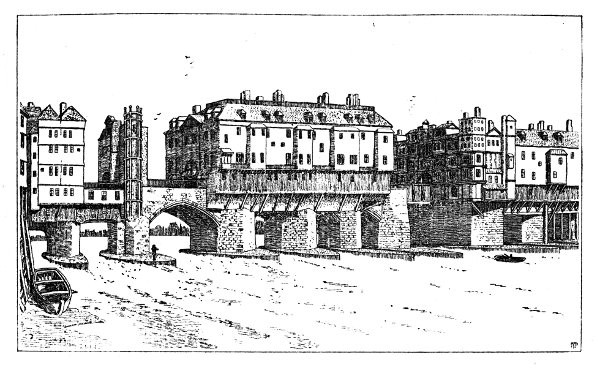
Fig. 2—The Surrey End of London Bridge.
Of the chapel, which the founder of the bridge is said to have erected, no account survives; and although it was believed at the time of the destruction of the bridge that his remains were discovered, no satisfactory evidence of their identity was forthcoming. The first chapel must have perished in one of the early misfortunes which befel the fabric, as no trace of any detail which could be referred to the thirteenth century was discovered when the pier on which the chapel stood was removed. The drawings made by Vertue before the last remains were cleared away show a structure which may be assigned to a date but little later than the Chapel Royal of St. Stephen at Westminster, to which, in many particulars, it must have borne a considerable resemblance. It consisted of two storeys, both apparently vaulted, measuring some sixty by twenty feet, with an apsidal termination. The undercroft was nearly twenty feet high, and our illustration (fig. 1) of a restoration of it, prepared from Vertue's drawings and dimensions, will give some idea of its beauty. The upper chapel seems to have been similar, but much more lofty, and had an arcade running round the walls under the windows. The buttresses of the exterior were crowned with crocketted pinnacles, and the effect of the whole, standing high above the surging waters of the river, must have been as striking as it was beautiful. The chapel was built on the centre pier of the bridge, on the east side, and the chapels were entered from the roadway, the lower one by a newel staircase, on which was found the holy-water stoup when the bridge was destroyed in the last century. At the Reformation the church was converted into a warehouse, but, thanks to the solidity of its construction, it remained almost intact till it was swept away with the houses in 1756.
Of the other buildings on the bridge there is little to say, for, although they made up a picturesque composition, they were of a most flimsy character, and wanting at the last in any architectural merit. Our illustration (fig. 2), taken from an oil painting by Scott, belonging to the Fishmongers' Company, gives the principal group on the Surrey side, and in the sixth plate of Hogarth's Marriage a la Mode we get a view through the open window of another part in the last stage of dilapidation. There was, however, one exception to the commonplace among them, in a timber house, made in Holland, which was known as "Nonsuch House." It was erected, it was said, without nails, and placed athwart the roadway, hanging at the ends far over the river, with towers and spires at the angles, and over the great gate the arms of Queen Elizabeth. The top of the main front was surmounted, at a later date, with a pair of sundials, which bore the, for once, appropriate motto—"Time and Tide wait for no man."
Had old London Bridge survived to this day, its waterfalls would doubtless have been utilized to generate electricity, and the idea of setting the Thames on fire realized in lighting the streets of London by its means; but the value of the force of the falling water was not overlooked by our ancestors. As early as 1582 one Peter Corbis, a Dutchman, erected an engine, worked by the stream, which lifted the water to a reservoir, whence it was distributed by means of leaden pipes through the city. With many alterations and improvements, these water works continued in use until the last century, and it was stated before the House of Commons, in 1820, that more than 26 millions of hogsheads of the pellucid waters of the river were thus daily delivered to the city householders for their domestic use.
Such, shortly, is the history of the fabric, which, after enduring for more than six hundred years, was swept away to make room for the present structure. For any accounts of the many stirring events which occurred on it, or about it, we have no space here. Are they not written in the chronicles of England?
In the Fishmongers' Hall is preserved a valuable memorial of the ancient structure, of which we give an illustration (fig. 3) by permission of the Worshipful Company. It consists of a chair with a seat of Purbeck marble, reminiscent in its arrangements of the coronation chair, on which is engraved this inscription:—
"I am the first stone that was put down for the foundation of old London Bridge in June 1176 by a priest named Peter who was vicar of Colechurch in London and I remained there undisturbed safe on the same oak piles this chair is made from till the Revd. William John Jollife curate of Colmer Hampshire took me up in July 1832 when clearing away the old bridge after new London Bridge was completed."
The framework of the chair gives a pictorial chronicle of the city bridges; the top rail of the back shows old London Bridge after the removal of the houses, below which are new London Bridge, Southwark and old Blackfriars Bridges. The arms of the city are carved at the top, whilst the monogram of Peter of Colechurch and the device of the Bridge House Estates complete the decoration. This device, which appears to have been also the old badge of Southwark, was sometimes displayed upon a shield, thus:—Az., an annulet ensigned with a cross patée, Or; interlaced with a saltire enjoined in base, of the second. We give an illustration of this in figure 5.
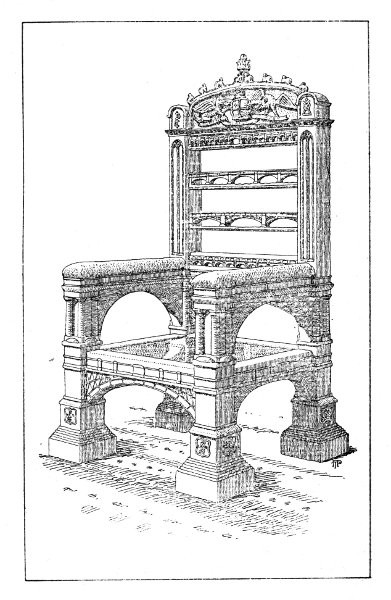
Fig. 3—The Foundation Stone Chair.
At the Fishmongers' Hall.
Westminster Bridge seems a very recent structure as compared to that of London, but it is the next in point of date. The growing importance of Westminster as the seat of the Court and Parliament had made the necessity for an approach to the south side of the Thames, independent of the circuitous and narrow ways of London, long apparent. In the reign of Charles II. the question was seriously considered, to the alarm of the Mayor and Corporation of the city, who feared that their vested interests were endangered, and "that London would be destroyed if carts were allowed to cross the Thames elsewhere"; but, knowing their man, they devoted some of their ample funds to secure that monarch's successful opposition to the scheme. In the middle of the eighteenth century, however, when there was no Stuart to buy off, the idea was revived, and in 1739, one Monsieur Labelye, a Swiss engineer—English engineers having, apparently, not sufficient experience—commenced a new stone bridge. His mode of putting in his foundations may have been scientific, but was certainly simple. The bridge piers were partly built in floating barges moored above the place where they were to be permanently erected. The barges were then sunk, their sides knocked out, and the piers completed. It is needless to say that the result was not satisfactory, and for years before the old bridge was pulled down many of its arches were filled up with a picturesque, but inconvenient, mass of shoring. Whether Henry, Earl of Pembroke, who laid the foundation stone, and of whom it was said no nobleman had a purer taste in architecture, was in any way responsible for the design, we cannot tell; but a French traveller of discrimination, who criticised the work after its completion, came to the conclusion that the peculiarly lofty parapets with which the bridge was adorned were so designed that they might check an Englishman's natural propensity to suicide by giving him time for reflection while surmounting such an obstacle. It will be noticed in our illustration (fig. 4), which is also taken from a painting by Scott, that the piers are crowned by alcoves, which provided a shelter from the blasts which blew over the river and from the mud scattered from the roadway. These were, doubtless, a survival of the spaces left above the cutwaters of mediæval bridges as refuges for pedestrians from vehicles when the roadways were very narrow, and those who remember the old wooden bridges of Battersea and Putney can appreciate their value.
The city Corporation, which had so strenuously opposed the erection of a bridge at Westminster as unnecessary, set to work, as soon as that became an accomplished fact, to improve their own communications across the river. First, as we have seen, they cleared away the houses and other obstructions on old London Bridge, and next they started to build themselves a new bridge at Blackfriars. The land on both sides of the river at the point selected was very low and most unsuitable for the approaches, that on the north side being close to the mouth of the Fleet ditch, which there formed a creek large enough, in 1307, to form a haven for ships. The new bridge was begun in 1760, from the designs of Robert Mylne, a Scotch architect, who made an unsuccessful attempt to give an architectural effect to the structure by facing the piers with pairs of Ionic columns, standing on the cutwaters. The steep gradients of the bridge, necessitated by the lowness of the banks, made such a decoration peculiarly unsuitable, as each pair of columns had to be differently proportioned in height, although the cornice over them remained of the same depth throughout. But, in spite of its appearance of lightness, the structure was too heavy for its foundations, and for years this bridge rivalled that of Westminster in the picturesqueness of its dilapidation. The piers had been built on platforms of timber, so that when London Bridge was rebuilt, and the river flowed in an unchecked course, these became exposed to the scour and were soon washed out.
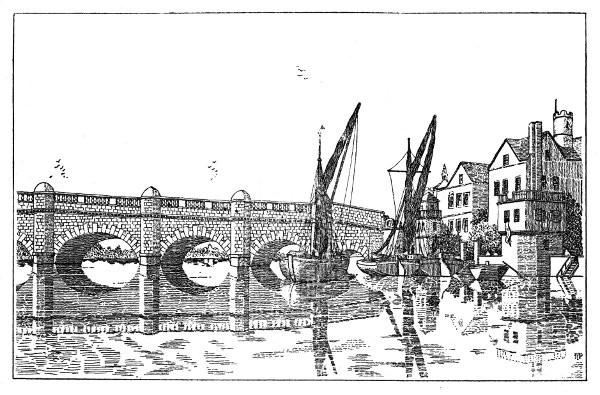
Fig. 4—Old Westminster Bridge.
Waterloo Bridge was completed in 1817, and still remains unaltered and as sound as when its builders left it. It is fortunate that the approach on the north side was an easy one, as but a short interval occurred between the Strand, at almost its highest point, and the river bank, which it was easy to fill up, with the result that the bridge passes across the river at a perfect level. The foundations of the piers were properly constructed by means of coffer-dams, and no sign of failure has ever shown itself in its superstructure. The architect repeated the use of the orders, as at Blackfriars, but with a more fortunate result, as, the work being straight throughout, no variations in the proportions were required, and he was wise enough to select the Doric order as more suitable to his purpose, and as suggesting more solidity.
Londoners profess to be somewhat proud of Waterloo Bridge, and it is a tradition among them that Canova, when he saw it, said that it was worth a journey across Europe to see. It, therefore, seems the more incredible that the grandchildren of those who could build such a bridge and appreciate such a man, could have erected, and even affect to admire, such a monstrosity as the Tower Bridge.
The last of the older bridges to be built was that of Southwark, which was the speculation of a private company, who hoped to profit by the continuously congested state of London Bridge; but the steepness of the gradients and the inconvenience of the approaches from the city made it from the first a failure. It was the first bridge in London to be constructed in iron; its model being the great single-span bridge across the Wear at Sunderland. It is in three great arches, the centre one being 240 feet across, or four feet more than that at Sunderland, and the mass of metal is such that an ordinary change of temperature will raise the arches an inch, and summer sunshine much more.
Of the more recent bridges there is nothing to say worth the saying. The Thames, which was the busy and silent highway of our forefathers, is still silent, but busy no longer, and the appearance of its bridges is now no one's concern, since no one sees them. So long as they will safely carry the tramcar or the motor 'bus from side to side, they may become uglier even than they now are, if only that make them a little more cheap.
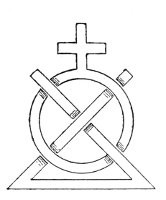
Fig. 5—Badge of Bridge House Estates.
THE CLUBS OF LONDON
By Sir Edward Brabrook, C.B., F.S.A.
These are of many kinds. We suppose they are all more or less the lineal descendants of the taverns and coffee-houses that we associate with the memory of Ben Jonson, Dryden, Addison, and Samuel Johnson.
"Souls of poets dead and gone, What elysium have ye known, Happy field or mossy cavern, Choicer than the Mermaid tavern?"
The wits' coffee-house, where Claud Halcro carried a parcel for Master Thimblethwaite in order to get a sight of glorious John Dryden. Button's coffee-house, where the "Guardian" set up his Lion's Head. The Cock and the Cheshire Cheese, which resound with Johnson's sonorous echoes. If, indeed, the tavern has developed into the club, that palace of luxury, one can only say, as in the famous transmutation of alphana to equus, "C'est diablement changé sur la route."
Intermediate is the host of clubs meeting occasionally, as the Breakfast Club, and the numerous dining clubs, one of which, the Royal Naval Club, established in 1765, is said to be a renewal of an earlier one dating from 1674. "The Club," which comes down from the time of Johnson and Reynolds, and still uses a notification to a new member drawn up by Gibbon; the Royal Society Club; the X Club, which consisted of ten members of the Athenæum; the Society of Noviomagus, and the Cocked Hat Club, consisting of members of the Society of Antiquaries; the Cosmos Club of the Royal Geographical Society; the Colquhoun Club of the Royal Society of Literature; and a host of others in connection with learned societies, most of which are content to add the word "club" to the name of the society. Of another, but cognate, kind is the famous "Sublime Society of Beef Steaks," which was founded in 1735, and died (of inanition) in 1867. The members were not to exceed twenty-four in number. Beef steaks were to be the only meat for dinner. The broiling began at 2.0, and the tablecloth was removed at 3.30. In 1785 the Prince of Wales, in 1790 the Duke of York, in 1808 the Duke of Sussex, became members. It had a laureate bard in the person of Charles Morris, elected a member in 1785, who died in 1838 at the age of 93 years. In early times the members appeared in the uniform of a blue coat and buff waistcoat, with brass buttons bearing a gridiron and the motto "Beef and Liberty." The hour of meeting became later gradually, till in 1866 it was fixed at 8 o'clock; then the club quickly died out. Founded by John Rich, harlequin and machinist at Covent Garden, it had counted among its members William Hogarth, David Garrick, John Wilkes, John Kemble, William Linley, Henry Brougham (Lord Chancellor), and many other distinguished men. The Ettrick Shepherd gave an account, in 1833, of a visit he paid to this club:—
"They dine solely on beefsteaks—but what glorious beefsteaks! They do not come up all at once—no, nor half-a-dozen times; but up they come at long intervals, thick, tender, and as hot as fire. And during these intervals the members sit drinking their port, and breaking their wicked wit on each other, so that every time a new service of steaks came up, we fell to them with much the same zest as at the beginning. The dinner was a perfect treat—a feast without alloy."
Another somewhat similar club, though on a more modest scale, deserves a cursory notice, inasmuch as it had to do with a state of things that has passed away beyond hope of recovery. About 1870 the August Society of the Wanderers was established with the motto, "Pransuri vagamur." It selected all the remaining old inns at which a dinner could be obtained, and dined at each in succession. It also had a bard, Dr. Joseph Samuel Lavies, and, like the Beefsteaks, has left a poetic record of its convivialities. Of all such records, however, the salt quickly evaporates, and it is as well to leave them unquoted.
Our main object in this chapter is to state a few incidents in the history of some of the great London clubs. The oldest existing club appears to be White's, founded in 1697. Boodle's, Brooks's, the Cocoa Tree, and Arthur's date from 1762 to 1765. Most of the others belong to the nineteenth century. The Guards' Club, which was the first of the service clubs, dates from 1813, but that is confined to officers of the Brigade of Guards. It was soon, however, followed by the establishment of a club for officers of other branches of military service.
We have it on good authority that before that club was founded officers who came to London had no places of call but the old hotels and coffee-houses. On May 31st, 1815, General Lord Lynedoch, Viscount Hill, and others united in the establishment of a General Military Club. On the 24th January, 1816, it was extended to the Navy, and on the 16th February in the same year it adopted the name of the United Service Club. On the 1st March, 1817, the foundation stone of its house in Charles Street was laid. In November, 1828, it entered into occupation of its present house in Pall Mall, and handed over the Charles Street house to the Junior United Service Club. Its premises in Pall Mall were largely extended in 1858-59, and have recently been greatly improved at a cost of £20,000. The Club holds a lease from the Crown to 4th January, 1964. It has a fine collection of eighty-two pictures and busts, many of them of great merit as works of art, others of interest as the only portraits of the originals. The library contains several splendid portraits of Royal personages. The King is the patron of the Club, and, as Prince of Wales, was a member of it. The Prince of Wales, the Duke of Connaught, and Prince Christian, are now members. Ten high officers of state and persons of distinction are honorary members. Twelve kings and thirty princes are foreign honorary members. The number of ordinary members is 1,600, but officers below the rank of Commander in the Royal Navy, or Major in the Army, are not eligible. The entrance fee is £30, and the annual subscription £10. Members have the privilege of introducing guests. Games of hazard are not allowed to be played, or dice to be used. Play is not to exceed 2s. 6d. points at whist, or 10s. per hundred at bridge.
As we have seen, this club shortly became full, and a Junior United Service Club was formed in April, 1827, on the same lines, under the patronage of the Duke of Wellington, but admitted officers of junior rank, and in 1828 entered into occupation of the premises in Charles Street, vacated by the Senior, on payment of £15,000. It erected its new house in 1856 at a cost of £81,000. The entrance fee is £40, and annual subscription eight guineas. It was not many years after its establishment that the list of candidates for membership of the Junior Club became so long that the necessity for the establishment of a third service club was felt. Sir E. Barnes and a few officers, just returned from India, joined in the movement, and in 1838 the Army and Navy Club was opened at the corner of King Street and St. James's Square—the house memorable as the scene of the party given by Mrs. Boehm on the night the news of the Battle of Waterloo arrived. Sir E. Barnes, who was its first president, died the same year. In 1851 the club moved to its present stately building, the site of which includes that of a house granted by Charles II. on the 1st of April, in the seventeenth year of his reign, to Nell Gwynne, where Evelyn saw him in familiar discourse with her. The club possesses a mirror that belonged to her, and a portrait by Sir Peter Lely, which was supposed to be of her, until it was discovered to be one of Louise de Querouaille, Duchess of Portsmouth, and is also rich in pictures, statuary, and other works of art—among them, two fine mantelpieces carved by Canova, and a miniature of Lady Hamilton found in Lord Nelson's cabin after his death; it has also autograph letters of Nelson and Wellington. It derives its popular name of the "Rag and Famish" from a tradition that Captain Duff came late one night asking for supper, and being discontented with the bill of fare, called it a rag and famish affair. In memory of the event he designed a button which used to be worn by many members, and bore the device of a ragged man devouring a bone. Napoleon III. was an honorary member of the club, and frequently used it. He presented it with a fine piece of Gobelin tapestry in 1849. The regular number of members is 2,400. The club has a scheme for granting annuities or pensions to its servants.
Of the group of social clubs bearing names derived from the original proprietors of the club-houses—as White's, Boodle's, Brooks's, and Arthur's—Brooks's may be taken as a specimen. A roll of its members from the date of its foundation in 1764 to 1900 has recently been published under the title Memorials of Brooks's, and contains much interesting information. The editors, Messrs. V. A. Williamson, S. Lyttelton and S. Simeon, state that the first London Clubs were instituted with the object of providing the world of fashion with a central office for making wagers, and a registry for recording them. In their early days gambling was unlimited. Brooks's was not political in its origin. The twenty-seven original members included the Dukes of Roxburgh, Portland, and Gordon. In the 136 years 3,465 members have been admitted.
The original house was on or near the site of the present Marlborough Club, and Almack was the first manager or master. About 1774 he was succeeded by Brooks, from whom the club derives its name. He died in 1782, and was succeeded by one Griffin. In 1795 the system was altered, and six managers were appointed. The present house in St. James' Street was constructed in 1889-90, when 2, Park Place, was incorporated with it. The entrance fee in 1791 was five guineas, and was raised successively in 1815, 1881, 1892, and 1901, to nine, fifteen, twenty-five and thirty guineas. The subscription was at first four guineas, raised in 1779 to eight guineas, and in 1791 to ten guineas.
An offshoot of Brooks's is the Fox Club, a dining club, probably a continuation of an earlier Whig Club. Up to 1843 it met at the Clarendon Hotel, and since then at Brooks's. It is said to have been constituted for the purpose of paying Fox's debts, for which his friends, in 1793, raised £70,000. Sir Augustus Keppel Stephenson was the secretary of this club from 1867 until his death in 1904. He was the son of a distinguished member of Brooks's, who had joined that club in 1818, the Fox Club in 1829, was secretary of the Sublime Society of Beef Steaks, and the last man to wear Hessian boots.
The Travellers' Club dates from 1819, the Union from 1821, and the United University from 1822.
The Union Club is composed of noblemen, members of Parliament, and gentlemen of the first distinction and character who are British subjects, and has 1,250 members. Election is by open voting in the committee. Foreign and Colonial persons of distinction may be made temporary honorary members. The entrance fee is twenty-one guineas; the annual subscription ten guineas.
The United University Club has 1,000 members, of whom 500 belong to Oxford and 500 to Cambridge. The King is a member. Cabinet ministers, bishops, judges, etc., may be admitted without ballot. All members of either University are qualified to be candidates, but only graduates, persons who have resided in college or hall for two years, holders of honorary degrees, and students in civil law of above three years' standing, are qualified to be members. The club has recently rebuilt its house at the corner of Suffolk Street and Pall Mall East.
The Athenæum was originated by Mr. John Wilson Croker, after consultation with Sir Humphry Davy, president of the Royal Society, and was founded in 1824 for the association of individuals known for their scientific or literary attainments, artists of eminence in any class of the fine arts, and noblemen and gentlemen distinguished as liberal patrons of science, literature, or the arts. It is essential to the maintenance of the Athenæum, in conformity with the principles upon which it was originally founded, that the annual introduction of a certain number of persons of distinguished eminence in science, literature, or the arts, or for public services, should be secured. Accordingly, nine persons of such qualifications are elected by the committee each year. The club entrusts this privilege to the committee, in the entire confidence that they will only elect persons who shall have attained to distinguished eminence in science, literature, or the arts, or for public services. The General Committee may also elect princes of the blood Royal, cabinet ministers, bishops, speakers of the House of Commons, judges, and foreign ambassadors, or ministers plenipotentiary of not less than three years' residence at the Court of St. James's, to be extraordinary members; and may invite, as honorary members during temporary residence in England, the heads of foreign missions, foreign members of the Royal Society, and not more than fifteen other foreigners or colonists of distinction. The ordinary members of the club are 1,200 in number. The entrance fee is thirty guineas, and the annual subscription eight guineas. The presidents for the time being of the Royal Society, of the Society of Antiquaries, and of the Royal Academy of Arts, if members, are ex-officio members of the General Committee. An Executive Committee of nine is selected from the General Committee to manage the domestic and other ordinary affairs of the club. No elected member can remain on the General Committee more than three consecutive years, unless he is a member of the Executive Committee, in which case he may be re-elected for a second term of three years. No higher stake than half-a-guinea points shall be played for. No game of mere chance shall be played in the house for money. No member shall make use of the club as an address in any advertisement.
The history of the club has been told by the Rev. J. G. Waugh in an interesting book printed for private circulation in 1900. Its first house was 12, Waterloo Place, where it remained until 1827, when it obtained its present site. Its success was so great that within four months of the preliminary meeting in 1824 it had a list of 506 members, including the then Prime Minister and seven persons who afterwards became Prime Ministers. By 1827 it was full, and had a list of 270 candidates waiting for election. The present house was planned by Decimus Burton, and an attic storey was added to it in 1899-1900. It is a successful building, striking attention by the statue of Minerva over the porch, the frieze, and the noble hall and grand staircase. The hall was re-decorated in 1891 under the direction of Sir L. Alma Tadema. Originally, a soirée was held every Wednesday, to which ladies were admitted. That has long been discontinued, and, as a satirical member observed, "Minerva is kept out in the cold, while her owls are gorging within." Among the members of the club have been the following great actors: Macready, Mathews, Kemble, Terry, Kean, Young, and Irving.
The Oriental Club was also established in 1824, at a meeting held eight days after that at which the Athenæum had been established. Sir John Malcolm presided. The club was intended for the benefit of persons who had been long resident abroad in the service of the Crown, or of the East India Company. By May, 1826, it had 928 members, and in that year it took possession of the site of 18, Hanover Square, and employed Mr. B. D. Wyatt as the architect of its house. Its history has been written by Mr. Alexander F. Baillie, in a book published in 1901. Mr. Wyatt provided a grand staircase, but no smoking-room, and only one billiard-room. At that time and until 1842 the club provided its members gratuitously with snuff at a cost of £25 per year. In 1874 the present smoking-room was opened; and now the handsome drawing-room is a place where those can retire who desire solitude, and the smoking-room and billiard-rooms are overcrowded. The club has a fine library. It claims among its members the prototype of Colonel Newcome. The members have a custom of securing a table for dinner by inverting a plate upon it.
In 1855 the Oriental Club agreed to take over, without entrance fee, the members of the Alfred Club, which had been established in 1808, and was then being dissolved. Nearly 400 members availed themselves of the offer. The history of that club has some points of interest. It was largely intended for literary men, but it is said that Canning, vexed at overhearing a member asking who he was, gave it the nickname of the "Half-read" Club, which stuck to it. Its early career was prosperous, and by 1811 it had 354 candidates and only six vacancies; but its popularity waned. The real cause of its dissolution was the firm conservatism of the committee. They would not recognise the growing demand of accommodation for smokers. The clubhouse, No. 23, Albemarle Street, had been built and arranged in the days when no such accommodation had been considered necessary, and the committee resolutely refused to make any concession to the members who desired to smoke.
The Garrick Club was founded in 1831. It was instituted for the general patronage of the drama; for the purpose of combining the use of a club on economical principles with the advantage of a literary society; for bringing together the supporters of the drama; and for the foundation of a national library, with works on costume. The number of members is limited to 650, who pay an entrance fee of twenty guineas, and an annual subscription of ten guineas. The club is more than usually hospitable, as it allows a member to invite three visitors to dinner, and admits the public to see its magnificent collection of dramatic pictures daily from 10 to 1.
The Carlton Club was established in 1832. It is famous as the rallying ground for the Conservative party, the temple of Toryism. From it, and its resources, candidates in that interest derive much encouragement and support, and it may not unreasonably be inferred that some of that encouragement and support is material as well as moral.
The Reform Club was established in 1837, and then held the same position towards the Liberal party. It was instituted for the purpose of promoting the social intercourse of the Reformers of the United Kingdom. All candidates are to declare themselves to be reformers, but no definition of a "reformer" is given. If, however, a member is believed not to be a reformer, fifty members may call a general meeting for his expulsion. Members of Parliament and peers may be admitted by general ballot, with priority of election. The committee elect each year two gentlemen of distinguished eminence for public service, or in science, literature, or arts. The Political Committee of fifty members elect each year two persons who have proved their attachment to the Liberal cause by marked and obvious services. Other members are elected by general ballot, one black ball in ten excluding. The club has 1,400 members. It has a fine library. It has liberal regulations as to the admission of guests, and ladies may be admitted to view the club from 11.0 a.m. to 5.0 p.m. Members may inspect the books and accounts and take extracts from them. The admission fee is £40, and the annual subscription ten guineas.
The Conservative Club was established in 1840, and the National Club in 1845. The object of the National Club is to promote Protestant principles, and to encourage united action among Protestants in political and social questions by establishing a central organisation to obtain and spread information on such questions, by affording facilities for conference thereon, and by providing in the metropolis a central place of meeting to devise the fittest means for promoting the object in view. Its members must hold the doctrines and principles of the reformed faith, as revealed in Holy Scripture, asserted at the Reformation, and generally embodied in the Articles of the Church of England. It has a general committee, house committee, library committee, prayer and religious committee, wine committee, finance committee, and Parliamentary committee. The General Committee has power to elect as honorary members of the club not more than twenty persons distinguished by their zeal and exertions on behalf of the Protestant cause; these are mostly clergymen. All meetings of committees are to be opened with prayer. The household are to attend the reading of the Word of God and prayers morning and evening in the committee room. The Parliamentary committee are to watch all proceedings in Parliament and elsewhere affecting the Protestant principles of the club. Its fundamental principles are declared to be:
(1) The maintenance of the Protestant constitution, succession, and faith.
(2) The recognition of Holy Scripture in national education.
(3) The improvement of the moral and social condition of the people.
The club is singular in having these definite religious purposes, and no doubt has in its time done much for the Protestant cause; but there is a little incongruity between the earnestness of its purpose and the self-indulgence which club life almost necessarily implies; and religious opinion, which claims to be the most stable of all things, is really one of the most fluid. Most men, who think at all, pass through many phases of it in their lives. It would not be surprising if this early earnestness had somewhat cooled down.
Another group of clubs consists of those the members of which are bound together by a common interest in some athletic sport or pursuit—as the Marylebone Cricket Club, which dates from 1787; the Alpine Club, which was founded in 1857; the Hurlingham Club, in 1868; and to these may perhaps be added, as approximating to the same class, the Bath Club, 1894.
The gradual filling up of old clubs, which we observed in the case of the service clubs, and the congested state of their lists of candidates, leading to long delay before an intending member had the chance of election, has led to the establishment of junior clubs; thus, in 1864, the Junior Athenæum and the Junior Carlton were founded.
A further development has been the establishment of clubs for women. The Albemarle Club, founded in 1874, admits both men and women, and adjusts its lists of candidates so as to provide for the election of nearly equal numbers of both.
The Marlborough Club should also be mentioned specially, as it was founded by the King, and no person can be admitted a member except upon His Majesty's special approval.
The Authors' Club was established in 1891 by the late Sir Walter Besant, and is especially noted for its house dinners, at which some person of distinction is invited to be the guest of the club.
Altogether, the clubs of London are very numerous, and we have only been able to draw attention to the peculiarities of a few of them. Like every other human institution, they are subject to continual change, and there are pessimists who go about saying that they are decaying and losing their popularity and their usefulness. The long lists of candidates on the books of the principal clubs do not lend much colour to this suggestion. Social habits alter with every generation of men, and it is possible that many men do not use their clubs in the same way that the founders did, but the fact remains that they do use them, and that clubs still form centres of pleasure and convenience to many.
One particular in which the change of social habits is especially noticeable is with respect to gaming. This, as we have seen, was almost the raison d'être of some of the early clubs, and there are numerous tales of the recklessness with which it was pursued, and the fortunes lost and won at the gaming table. We have quoted from one or two clubs the regulations which now prevail, and similar regulations are adopted in most of the other clubs. Games of chance are wholly prohibited; and limits are provided to the amount that may be staked on games of cards. Each club has also a billiard room.
With respect to smoking, the habitués of clubs have experienced a great change. Formerly the smoking room, if any, was small and far away; now the luxury of the club is concentrated in it, and the question is rather in what rooms smoking is not to be allowed. Very few clubs retain the old tradition that smoking is a thing to be discouraged and kept out of sight.
Other signs of change are the increase in the cost of membership and the later hours for dining. It need hardly be said that the clubs pay great attention to their kitchens. We have it on the authority of Major A. Griffiths (Fortnightly Review, April, 1907) that the salary of the chef is between £200 and £300 a year.
The customs of the clubs with regard to the admission of visitors vary. At one end of the scale is the Athenæum, which will not allow its members to give a stranger even a cup of cold water, and allows of conversation with strangers only in the open hall or in a small room by the side of the doorway. At the other end are clubs which provide special rooms for the entertainment of visitors, and encourage their members to treat their friends hospitably, and to show them what the club is able to do in the matter of cooking and wines.
The social ethics of clubs vary in like manner. In some clubs, notably those of the Bohemian type, but including several which would claim not to belong to that group, mere membership of the club is a sufficient introduction to justify a member in addressing another, and conversation in the common rooms of the club becomes general. This is delightful—within limits: it is not always possible to create by the atmosphere of the club a sentiment that will restrain all its members from sometimes overstepping those bounds of mutual courtesy and consideration which alone can make such general conversation altogether pleasant. The greater clubs go to the opposite extreme, and members of them may meet day after day for many years in perfect unconsciousness of the existence of each other; yet, even in these, the association of those who know each other outside the club, but without its opportunities would rarely meet, though they have similar interests and pursuits, is a very desirable and useful thing. Many an excellent measure, originating in the mind of one member, has been matured by conversation with others, to the general good. So may the Clubs of London continue to prosper and flourish.
THE INNS OF OLD LONDON
By Philip Norman, LL.D.
To write a detailed account of London inns and houses of entertainment generally would require not a few pages, but several volumes. The inns, first established to supply the modest wants of an unsophisticated age, came by degrees to fulfil the functions of our modern hotels, railway stations, and parcel offices; they were places of meeting for business and social entertainment—in short, they formed a necessary part of the life of all Londoners, and of all who resorted to London, except the highest and the lowest. The taverns, successors of mediæval cook-shops, were frequented by most of the leading spirits of each generation from Elizabethan times to the early part of the nineteenth century, and their place has now been taken by clubs and restaurants. About these a mass of information is available, also on coffee-houses, a development of the taverns, in which, for the most part, they were gradually merged. As to the various forms of public-house, their whimsical signs alone have amused literary men, and perhaps their readers, from the time of The Spectator until now. In this chapter I propose to confine my remarks to the inns "for receipt of travellers," so often referred to by John Stow in his Survey of London, which, largely established in the fifteenth and sixteenth centuries, continued on the same sites, mostly until years after the advent of railways had caused a social revolution. These inns, with rare exceptions, had a galleried courtyard, a plan of building also common on the Continent, which came perhaps originally from the East. In such courtyards, as we shall see, during Tudor times theatrical performances often took place, and in form they probably gave a hint to the later theatres.
Before the fifteenth century it was usual for travellers to seek the hospitality of religious houses, the great people being lodged in rooms set apart for them, while the poorer sort found shelter in the guest-house. But as time went on this proved inadequate, and inns on a commercial basis came into existence, being frequented by those who could hardly demand special consideration from the religious houses, and were not fitting recipients of charity. Naturally enough, these inns, when once their usefulness became recognised, were soon to be found in the main thoroughfares leading out of the metropolis, and they were particularly plentiful in Southwark on each side of what we now call the Borough High Street, extending for a quarter of a mile or more from London Bridge along the main road to the south-eastern counties and the Continent. The first thus established, and one of the earliest in this country, had to some extent a religious origin—namely, the
"Gentle hostelrye That hight the Tabard, fasté by the Belle,"
about which and about the Southwark inns generally I propose now to say a few words, for although well known, they are of such extreme interest that they demand a foremost place in an account of this kind. From the literary point of view the "Tabard" is immortalized, owing to the fact that Chaucer has selected it as the starting-point of his pilgrims in The Canterbury Tales. Historically, it may be mentioned that as early as the year 1304 the Abbot and Convent of Hyde, near Winchester, purchased in Southwark two tenements, on the sites of which he built for himself a town dwelling, and at the same time, it is believed, a hostelry for the convenience of travellers. In 1307 he obtained license to build a chapel at or by the inn, and in a later deed we are told that "the abbott's lodginge was wyninge to the backside of the Tabarde and had a garden attached." From that time onwards frequent allusions can be found to this house, the sign of which (a sleeveless coat, such as that worn by heralds) got somehow corrupted into the Talbot, a species of dog, by which it was known for a couple of centuries or more, almost to the time of its final destruction. Although the contrary has been asserted, the inn was undoubtedly burnt in the Great Southwark Fire of 1676, but was rebuilt soon afterwards in the old fashion, and continued to be a picturesque example of architecture until 1875, when the whole was swept away, hop merchants' offices and a modern "old Tabard" now occupying the site.
Equal in interest to the last-named inn was the "White Hart." At the one Chaucer gave life and reality to a fancied scene; at the other occurred an historical event, the bald facts of which Shakespeare has lighted up with a halo of romance. The White Hart appears to have dated from the latter part of the fourteenth century, the sign being a badge of Richard II., derived from his mother, Joan of Kent. In the summer of 1450 it was Jack Cade's headquarters while he was striving to gain possession of London. Hall, in his Chronicle, records this, and adds that he prohibited "murder, rape and robbery by which colour he allured to him the hartes of the common people." It was here, nevertheless, that "one Hawaydyne of sent Martyns was beheaded," and here, during the outbreak, a servant of Sir John Fastolf, who had property in the neighbourhood, was with difficulty saved from assassination. His chattels were pillaged, his wife left with "no more gode but her kyrtyll and her smook," and he thrust into the forefront of a fight then raging on London Bridge, where he was "woundyd and hurt nere hand to death." Cade's success was of short duration; his followers wavered, he said, or might have said, in the words attributed to him by Shakespeare (2 Henry VI., act iv., scene 8), "Hath my sword therefore broken through London gate that you should leave me at the White Hart in Southwark?" The rebellion collapsed, and our inn is not heard of for some generations. Want of space prevents our recording the various vicissitudes through which it passed, and the historic names connected with it, until the time of the Southwark Fire of 1676, when, like the "Tabard," it was burnt down, but rebuilt on the old foundations. In 1720 Strype describes it as large and of considerable trade, and it so continued until the time when Dickens, who was intimately acquainted with the neighbourhood, gave his graphic description of Sam Weller at the White Hart in the tenth chapter of Pickwick. In 1865-66 the south side of the building was replaced by a modern tavern, but the old galleries on the north and east sides remained until 1889, being latterly let out in tenements.
There were several other galleried inns in Southwark, dating at least from the time of Queen Elizabeth, which survived until the nineteenth century, but we only have space briefly to allude to three. The "King's Head" and the "Queen's Head" was each famous in its way. The former had been originally the "Pope's Head," the sign being changed at the Reformation. In 1534 the Abbot of Waverley, whose town house was not far off, writes, apparently on business, that he will be at the "Pope's Head" in Southwark—eight years afterwards it appears as the "King's Head." In a deed belonging to Mr. G. Eliot Hodgkin, F.S.A., the two names are given. In the sixteenth and seventeenth centuries the house belonged to various noteworthy people; among the rest, to Thomas Cure, a local benefactor, and to Humble, Lord Ward. It was burnt in the Great Southwark Fire, and the last fragment of the galleried building, erected immediately afterwards, was pulled down in January, 1885.
The "Queen's Head" was the only one of the Southwark houses we are describing that escaped the Fire of 1676, perhaps owing to the fact that, by way of precaution, a tenement was blown up at the gateway. It stood on the site of a house called the "Crowned or Cross Keys," which in 1529 was an armoury or store-place for the King's harness. In 1558 it had a brew-house attached to it, and had lately been rebuilt. In 1634 the house had become the "Queen's Head," and the owner was John Harvard, of Emmanuel College, Cambridge, who afterwards migrated to America, and gave his name to Harvard University, Massachusetts. About this time it was frequented by carriers, as we learn from John Taylor, "the water-poet." The main building, destroyed in 1895, was found to be of half-timbered construction, dating perhaps from the sixteenth century. A galleried portion, also of considerable age, survived until the year 1900.
Of another Southwark inn, the "George," we can fortunately speak in the present tense. It seems to have come into existence in the early part of the sixteenth century, and is mentioned with the sign of "St. George" in 1554:—
"St. George that swindg'd the Dragon, and e'er since Sits on his horseback at mine hostess' door."
The owner in 1558 was Humfrey Colet, or Collet, who had been Member of Parliament for Southwark. Soon after the middle of the seventeenth century, in a book called Musarum Deliciæ, or the Muses' Recreation, compiled by Sir John Mennes (Admiral and Chief Comptroller of the Navy) and Dr. James Smith, appeared some lines, "upon a surfeit caught by drinking bad sack at 'the George' in Southwark." Perhaps the landlord mended his ways; in any case, the rent was shortly afterwards £150 a year—a large sum for those days. The "George" was a great coaching and carriers' inn. Only a fragment of it, but a picturesque one, now exists; it is still galleried, and dates from shortly after the Southwark Fire of 1676. The rest of the building was pulled down in 1889-90. All the inns to which allusion has been made were clustered together on the east side of the Borough High Street, the gateways of those most distant from each other being only about 140 yards apart.
Another leading thoroughfare from London to the east was the road through Aldgate to Whitechapel. Here, though the houses of entertainment were historically far less interesting than those of Southwark, they flourished for many years. Where a modern hotel with the same sign now stands, next to the Metropolitan railway station on the north side of Aldgate High Street, there was once a well-known inn, the "Three Nuns," so called, perhaps, from the contiguity of the nuns of St. Clare, or sorores minores, who gave a name to the Minories. The "Three Nuns" inn is mentioned by Defoe in his Journal of the Plague, which, though it describes events that happened when he was little more than an infant, has an air of authenticity suggesting personal experience. We are told by him that near this inn was the "dreadful gulf—for such it was rather than a pit"—in which, during the Plague of 1665, not less than 1,114 bodies were buried in a fortnight, from the 6th to the 20th of September. Throughout the eighteenth and the early part of the nineteenth centuries this house was much frequented by coaches and carriers. The late Mr. Edwin Edwards, who etched it in 1871, was told by the landlord that a four-horse coach was then running from there to Southend during the summer months. A painting of the holy nuns still appeared on the sign-board. The house was rebuilt soon after the formation of the Metropolitan Railway. A short distance west of the "Three Nuns," at 31, Aldgate High Street, the premises of Messrs. Adkin and Sons, wholesale tobacconists, occupy the site of the old "Blue Boar" coaching inn, which they replaced in 1861. The sculptured sign of the "Blue Boar," let into the wall in front, was put up at the time of the rebuilding. The former inn, described on a drawing in the Crace collection as the oldest in London, is held by some to be the same as that referred to in an order of the Privy Council to the Lord Mayor, dated from St. James's, September 5th, 1557, wherein he is told to "apprehende and to comitt to safe warde" certain actors who are about to perform in "a lewde Playe called a Sacke full of Newse" at the "Boar's Head" without Aldgate.
A few years ago, at No. 25, the entrance might still be seen of another famous inn called the "Bull," formerly the "Black Bull." Above the gateway was a fine piece of ironwork, and the old painted sign was against the wall of the passage. This house flourished greatly a little before the advent of railways, when Mrs. Anne Nelson, coach proprietor, was the landlady, and could make up nearly two hundred beds there. Most of her business was to Essex and Suffolk, but she also owned the Exeter coach. She must have been landlady on the memorable occasion when Mr. Pickwick arrived in a cab after "two mile o' danger at eightpence," and it was through this very gateway that he and his companions were driven by the elder Weller when they started on their adventurous journey to Ipswich. The house is now wholly destroyed and the yard built over.
A common sign in former days was the "Saracen's Head." We shall have occasion to refer to several in London. One of them stood by Aldgate, just within the limits of the city. Here a block of old buildings is in existence on the south side, which once formed the front of a well-known coaching inn, with this sign. The spacious inn yard remains, the house on the east side of its entrance having fine pilasters. From the "Saracen's Head," Aldgate, coaches plied to Norwich as long ago as 1681, and here there is, or was quite recently, a carrier's booking office.
Another thoroughfare which, within the memory of some who hardly admit that they are past middle age, contained several famous inns, was that leading to the north, and known in its various parts as Gracechurch Street and Bishopsgate Street Within and Without. One of the best known was the "Cross Keys" in Bishopsgate Street, mentioned in the preface to Dodsley's Old Plays as a house at which theatrical performances took place. It was here that, in the latter part of the sixteenth century, Bankes exhibited the extraordinary feats of his horse Marocco. One of them, if we may believe an old jest-book, was to select and draw forth Tarlton with its mouth as "the veriest fool in the company." In more modern times, until the advent of railways, the "Cross Keys" was a noted coaching and carriers' establishment. Destroyed in the Great Fire, and again burnt down in 1734, but rebuilt in the old style, it was still standing on the west side of the street, immediately south of Bell Yard, when Larwood and Hotten published their History of Signboards in 1866. Another inn with this sign stood appropriately near the site of St. Peter's Church in Wood Street, Cheapside, and was pulled down probably about the same time as the more famous house in Gracechurch Street.
Of equal note was the "Spread Eagle," the site of which has mostly been absorbed by the extension of Leadenhall Market. Like the "Cross Keys," it was burnt in the Great Fire, but rebuilt in the old style with an ample galleried yard. In the basement some mediæval arches still remained. At the "Spread Eagle" that original writer George Borrow had been staying with his future wife, Mrs. Mary Clarke, and various friends, when they were married at St. Peter's Church, Cornhill, on April 23rd, 1840, her daughter, Henrietta, signing the register. Before its destruction in 1865 it had been for some time a receiving office of Messrs. Chaplin and Horne. The site, of about 1,200 square feet, was sold for no less a sum than £95,000. Another Gracechurch inn, the "Tabard," which long ago disappeared, had, like the immortal hostelry in Southwark, become the "Talbot," and its site is marked by Talbot Court.
In Bishopsgate Street Within three galleried inns lingered long enough to have been often seen by the writer. These were the "Bull," the "Green Dragon," and the "Four Swans," each with something of a history, and to them might be added the picturesque, though less important, "Vine" and the "Flower Pot," from which last house a seventeenth century trade token was issued. The "Bull," the most southern of these inns, all of which were on the west side of the highway, was at least as old as the latter part of the fifteenth century, for in one of the chronicles of London lately edited by Mr. C. L. Kingsford, I find it, under the date 1498, associated with a painful incident—namely, the execution of the son of a cordwainer, "dwellyng at the Bulle in Bisshoppesgate Strete," for calling himself the Earl of Warwick. Hall gives his name as Ralph Wilford. Anthony Bacon, elder brother of Francis, during the year 1594 hired a lodging in Bishopsgate Street, but the fact of its being near the "Bull," where plays and interludes were performed, so troubled his mother that for her sake he removed to Chelsea. Shortly afterwards, as may be learnt from Tarlton's Jests, the old drama called "The Famous Victories of Henry the Fifth" was here played, "wherein the judge was to take a boxe on the eare, and because he was absent that should take the blow, Tarlton himselfe, ever forward to please, tooke upon him to play the judge, besides his own part of the clown." The "Bull" was the house of call of old Hobson, the carrier, to whose rigid rule about the letting of his saddle horses we are supposed to owe the phrase, "Hobson's Choice." Milton wrote his epitaph in the well-known lines beginning:—
"Here lies old Hobson; Death hath broke his girt, And here, alas! hath laid him in the dirt."
In his second edition of Milton's Poems, p. 319, Wharton alludes to Hobson's "portrait in fresco" as having then lately been in existence at the inn, and it is mentioned in The Spectator, No. 509. There is a print of it representing a bearded old man in hat and cloak with a money bag, which in the original painting had the inscription, "The fruitful mother of an hundred more." He bequeathed property for a conduit to supply Cambridge with water; the conduit head still exists, though not in its original position. In 1649, by a Council of War, six Puritan troopers were condemned to death for a mutiny at the "Bull." The house remained till 1866.
Further north, at No. 86, was the "Green Dragon," the last of the galleried inns that survived in Bishopsgate Street. It is mentioned in De Laune's Present State of London, 1681, as a place of resort for coachmen and carriers, and I have before me an advertisement sheet of the early nineteenth century, showing that coaches were then plying from here to Norwich, Yarmouth, Cambridge, Colchester, Ware, Hertford, Brighton, and many other places. There is a capital etching of the house by Edwin Edwards. It was closed in 1877, its site being soon afterwards built over. At the sale of the effects eleven bottles of port wine fetched 37s. 6d. each. The "Four Swans," immediately to the north of the inn last named, although it did not survive so long, remained to the end a more complete specimen of its class, having three tiers of galleries perfect on each side, and two tiers at the west end. The "water-poet" tells us that in 1637 "a waggon or coach" came here once a week from Hertford. Other references to it might be quoted from books of the seventeenth and eighteenth centuries, but the story told on an advertisement sheet issued by a former landlord about a fight here between Roundheads, led by Ireton, and a troop of Royalists, is apocryphal.
Not far off, in Bishopsgate Street Without, there was until lately a "Two Swan" inn yard, and a "One Swan" with a large yard—an old place of call for carriers and waggons. These lingered on until the general clearance by the Great Eastern Railway Company a few years ago, when the remains of Sir Paul Pindar's mansion, latterly a tavern, were also removed; the finely-carved timber front and a stuccoed ceiling finding their way into the Victoria and Albert Museum. Another old Bishopsgate house was the "White Hart," near St. Botolph's Church, a picturesque building with projecting storeys, and in front the date 1480, but the actual structure was probably much less ancient. It was drawn by J. T. Smith and others early in the nineteenth century, and did not long survive. The site is still marked by White Hart Court. On the opposite side of the way was an inn, the "Dolphin," which, as Stow tells us, was given in 1513 by Margaret Ricroft, widow, with a charge in favour of the Grey Friars. It disappeared in the first half of the eighteenth century. The old "Catherine Wheel," a galleried inn hard by, mentioned by De Laune in 1681, was not entirely destroyed till 1894.
Another road out of London richly furnished with inns was that from Newgate westward. The first one came to was the "Saracen's Head" on Snow Hill, an important house, to which the late Mr. Heckethorn assigned a very early origin. Whether or not it existed in the fourteenth century, as he asserts, it was certainly flourishing when Stow in his Survey described it as "a fair and large inn for receipt of travellers." It continued for centuries to be largely used, and here Nicholas Nickleby and his uncle waited on Squeers, the Yorkshire schoolmaster, whom Dickens must have modelled from various real personages. In a Times advertisement for January 3rd, 1801, I read that "at Mr. Simpson's Academy, Wodencroft Lodge, near Greta Bridge, Yorkshire, young gentlemen are boarded and accurately instructed in the English, Latin, and Greek languages, writing, arithmetic, merchants' accounts, and the most useful branches of the mathematics, at 16 guineas per annum, if under nine years of age, and above that age 17 guineas; French taught by a native of France at 1 guinea extra. Mr. Simpson is now in town, and may be treated with from eleven till two o'clock every day at the 'Saracen's Head,' Snow Hill." In the early part of last century the landlady was Sarah Ann Mountain, coach proprietor, and worthy rival of Mrs. Nelson, of the "Bull" Inn, Aldgate. The "Saracen's Head" disappeared in the early part of 1868, when this neighbourhood was entirely changed by the formation of the Holborn Viaduct. Another Snow Hill inn was the "George," or "George and Dragon," mentioned by Strype as very large and of considerable trade. A sculptured sign from there is in the Guildhall Museum.
In Holborn there were once nine or ten galleried inns. We will only allude to those still in existence within the memory of the writer. The most famous of them, perhaps, was the "George and Blue Boar," originally the "Blue Boar," the site of which is covered by the Inns of Court Hotel. The house is named in the burial register of St. Andrew's, Holborn, as early as 1616, but it is chiefly known from a story related by the Rev. Thomas Morrice, in his Memoir of Roger Earl of Orrery (1742), that Cromwell and Ireton, in the disguise of troopers, here intercepted a letter sewn in the flap of a saddle from Charles I. to his Queen, in which he wrote that he was being courted by the Scotch Presbyterians and the army, and that he thought of closing with the former. Cromwell is supposed to have said, "From that time forward we resolved on his ruin." The writer ventured to ask that excellent historian, Dr. Samuel Gardiner, what he thought of the statement. In August, 1890, he most kindly replied by letter as follows:—"The tale has generally been repudiated without enquiry, and I am rather inclined to believe, at least, in its substantial accuracy. The curious thing is, that there are two lines of tradition about intercepted letters, as it seems to me quite distinct." We may, therefore, without being over credulous, cherish the belief that the picturesque incident referred to was one that actually occurred. There is an advertisement of December 27th, 1779, offering the lease of the "George and Blue Boar," which helps us to realize the value and capacity of an important inn of that period. We are told that it contains forty bedrooms, stabling for fifty-two horses, seven coach-houses, and a dry ride sixty yards long; also that it returns about £2,000 a year. In George Colman the younger's "Heir at Law," act i., scene 2, this house is said by one of the characters to be "in tumble downish kind of a condition," but it survived until 1864, when it made way for the Inns of Court Hotel.
A group of inns which remained more recently were Ridler's "Bell and Crown," the old "Bell," and the "Black Bull," all on the north side of Holborn. Of these, the most picturesque was the "Bell," about which I have been able to ascertain some curious facts. The earliest notice of it that has come to light was on the 14th of March, 1538, when William Barde sold a messuage with garden called the "Bell," in the parish of St. Andrew, Holborn, to Richard Hunt, citizen and girdler. The latter, who died in 1569, gave thirty sacks of charcoal yearly for ever, as a charge on the property, to be distributed to thirty poor persons of the parish. After various changes of ownership, in 1679-80 it passed into the hands of Ralph Gregge, and his grandson sold it in 1722 to Christ's Hospital. In the deed of sale three houses are mentioned and described as "formerly one great mansion-house or inn known as the Bell or Blue Bell." About two years before, the front of the premises facing Holborn had been rebuilt, when the sculptured arms of Gregge were let into the wall in front; these arms are now at the Guildhall Museum. The "Bell" became a coaching house of considerable reputation, that part of the business being about the year 1836 in the hands of Messrs. B. W. and H. Horne, who, as coach proprietors, were second only to William Chaplin. For many years, until finally closed in September, 1897, the house was managed by the Bunyer family. It was the last galleried inn on the Middlesex side of the water, the galleries being perhaps as old as the reign of Charles II. A still older portion was a cellar built of stone immediately to the left of the entrance, which might almost have been mediæval. The rest of the building seems to have dated from the early part of the eighteenth century. There is a sympathetic reference to the old "Bell" by William Black in his Strange Adventures of a Phæton. Another noteworthy "Bell" Inn was that in Carter Lane, whence Richard Quyney wrote in 1598 to his "loveing good ffrend and contreyman Mr. Willm Shackespere," the only letter addressed to our greatest poet which is known to exist. There is still a Bell yard connecting Carter Lane with Knightrider Street. The first scene of the Harlot's Progress, by Hogarth, is laid in front of an inn, with the sign of the "Bell" in Wood Street. Above the door are chequers.
A short distance west of the Holborn house was the "Crown" Inn, latterly Ridler's "Bell and Crown," destroyed about 1899. It had been a coaching centre, but years ago the yard was built over, and it flourished to the end as a quiet family hotel. Next to the "Bell" on the east side was the "Black Bull," the front of which, with the carved sign of a bull in a violent state of excitement, remained after the rest of the inn had disappeared, outliving its neighbour for a brief period. It was in existence for a couple of hundred years or more, but future generations will probably only remember it as the house where Mr. Lewson was taken ill, and placed under the tender mercies of Betsy Prig and Mrs. Gamp; whence also, when convalescent, he was assisted into a coach, Mould the undertaker eyeing him with regret as he felt himself baulked of a piece of legitimate business.
A few short years ago if, on leaving this group of Holborn inns, we had turned down Fetter Lane in the direction of Fleet Street, after passing two or three gabled buildings still standing on the right hand side, we should have come to another old hostelry called the "White Horse," of which there is a well-known coloured print from a drawing made by Pollard in 1814, with a coach in front called the Cambridge Telegraph. It gradually fell into decay, became partly a "pub" and partly a common lodging-house, and with its roomy stabling at the back was swept away in 1897-98. Most of the structure was of the eighteenth century, but there were remains of an earlier wooden building. Its northern boundary touched the precinct of Barnard's Inn, an inn of chancery, now disestablished and adapted for the purposes of the Mercers' School.
Continuing our course southward, a short walk would formerly have taken us to the "Bolt-in-Tun," I think the only coaching establishment in Fleet Street, which possessed so many taverns and coffee-houses. The inn was of ancient origin, the White Friars having had a grant of the "Hospitium vocatum Le Bolt en ton" as early as the year 1443. The sign is the well-known rebus on the name of Bolton, the bird-bolt through a tun or barrel, which was the device of a prior of St. Bartholomew's, Smithfield, and may still be seen in the church there, and at Canonbury, where the priors had a country house. The City Press for September 12th, 1882, announces the then impending destruction of the "Bolt-in-Tun," and in the following year we are told that although a remnant of it in Fleet Street exists as a booking office for parcels, by far the larger portion, represented chiefly by the Sussex Hotel, Bouverie Street, which bore on it the date 1692, has just disappeared.
Further east, on Ludgate Hill, La Belle Sauvage Yard, where Messrs. Cassell & Co. carry on their important business, marks the site of an historic house, and perpetuates an error of nomenclature. Its original title, as proved by a document of the year 1452, was "Savage's" Inn, otherwise called the "Bell on the Hoop," but in the seventeenth century a trade token was issued from here, having on it an Indian woman holding a bow and arrow, and in 1676 "Bell Sauvage" Inn, on Ludgate Hill, consisting of about forty rooms, with good cellarage and stabling for about one hundred horses, was to be let. The mistake is repeated in The Spectator, No. 28, where we are told of a beautiful girl who was found in the wilderness, and whose fame was perpetuated in a French romance. As we learn from Howe, in his continuation of Stow's Annals, on a seat outside this inn Sir Thomas Wyat rested, after failing in an attempt to enter the city during his ill-advised rebellion in the reign of Mary Tudor. From Lambarde we gather that this was one of the houses where plays were performed before the time of Shakespeare. Writing in 1576, he says, "Those who go to Paris Garden, the Bell Savage, or the Theatre to behold bear-baiting, interludes, or fence play, must not account of any pleasant spectacle unless first they pay one pennie at the gate, another at the entrie of the scaffold, and a third for quiet standing." Here, as at the "Cross Keys," Gracechurch Street, Bankes exhibited his horse, and here, in 1683, "a very strange beast called a Rhynoceros—the first that ever was in England," could be seen daily. Stow affirms the inn to have been given to the Cutlers' Company by Isabella Savage; but, in fact, the donor was John Craythorne, who conveyed the reversion of it to them in 1568. The sculptured elephant and castle representing their crest is still on a wall in La Belle Sauvage Yard. The inn, which has left its mark in the annals of coaching, was taken down in 1873.
A thoroughfare, formerly containing several fine mansions and various inns for travellers, was Aldersgate Street, the continuation of St. Martin's-le-Grand. There are allusions in print to the "Bell," the "George" (previously the "White Hart"), and to the "Cock" Inn, where, after years of wandering, Fynes Moryson arrived one Sunday morning in 1595; but these all passed away long ago. The last to linger in the neighbourhood was the "Bull and Mouth," St Martin's-le-Grand, finally called the "Queen's" Hotel, absorbed by the General Post Office in 1886. The name is generally supposed to be a corruption of Boulogne Mouth, the entrance to Boulogne Harbour, that town having been taken by Henry VIII. George Steevens, the Shakespearean commentator, seems to have suggested this, and his idea has been generally accepted; but it is more likely that our inn was identical with the house called in 1657 "the Mouth near Aldersgate in London, then the usual meeting-place for Quakers," to which the Body of John Lilburne was conveyed in August of that year. We learn from Ellwood's Autobiography that five years afterwards he was arrested at the "Bull and Mouth," Aldersgate. The house was at its zenith as a coaching centre in the early years of the nineteenth century, when Edward Sherman had become landlord. He rebuilt the old galleried house in 1830. When coaching for business purposes ceased to be, the gateway from St. Martin's-le-Grand was partially blocked up and converted into the main entrance, the inn continuing under its changed name for many years. The sculptured signs were not removed until the destruction of the building. One, which was over the main entrance, is a statuette of a Bull within a gigantic open Mouth; below are bunches of grapes; above, a bust of Edward VI. and the arms of Christ's Hospital, to which institution the ground belonged. Beneath is a tablet inscribed with the following doggerel rhyme:—
"Milo the Cretonian an ox slew with his fist, And ate it up at one meal, ye Gods what a glorious twist."
Another version of the sign, the Mouth appearing below the Bull, was over what had been a back entrance to the yard in Angel Street. These signs are now both in the Guildhall Museum. I had almost overlooked one house, the "Castle and Falcon," Aldersgate, closed within the last few months, and now destroyed. The structure was uninteresting, but it stood on an old site—that of John Day's printing-house in the reign of Queen Elizabeth. At the present inn on April 12th, 1799, was founded the Church Missionary Society; here also its centenary was celebrated.
Besides being plentiful in the main thoroughfares, important inns, like the churches, were often crammed away in narrow and inconvenient lanes. This was the case with the "Oxford Arms" and the "Bell," both in Warwick Lane. The former was approached by a passage, being bounded on the west by the line of the old city wall, or by a later wall a few feet to the east of it, and touching Amen Corner on the south. It was a fine example of its kind. As was said by a writer in The Athenæum of May 20th, 1876, just before it was destroyed:
"Despite the confusion, the dirt and the decay, he who stands in the yard of this ancient inn may get an excellent idea of what it was like in the days of its prosperity, when not only travellers in coach or saddle rode into or out of the yard, but poor players and mountebanks set up their stage for the entertainment of spectators, who hung over the galleries or looked on from their rooms—a name by which the boxes of a theatre were first known."
The house must have been rebuilt after the Great Fire, which raged over this area. That it existed before is proved by the following odd advertisement of March, 1672-73:
"These are to give notice that Edward Bartlet, Oxford Carrier, hath removed his inn in London from the Swan at Holborn Bridge to the Oxford Arms in Warwick Lane, where he did Inn before the Fire. His coaches and waggons going forth on their usual days, Mondays, Wednesdays, and Fridays. He hath also a hearse and all things convenient to carry a Corps to any part of England."
The "Bell" Inn, also galleried, was on the east side of Warwick Lane. There Archbishop Leighton died in 1684. As Burnet tells us, he had often said that "if he were to choose a place to die in it should be an Inn; it looked like a pilgrim's going home, to whom this world was all as an Inn, and who was weary of the noise and confusion in it." Thus his desire was fulfilled. There is a view of the old house in Chambers' Book of Days, vol. i., p. 278. It was demolished in 1865, when the value of the unclaimed parcels, some of which had been there many years, is said to have been considerable. According to one statement, the jewellery was worth £700 or £800.
The few remaining inns to which reference will be made may best perhaps be taken in alphabetical order. The old "Angel" Inn, at the end of Wych Street, Strand, already existed in February, 1503, when a letter was directed to Sir Richard Plumpton "at the Angell behind St. Clement's Kirk." From this inn Bishop Hooper was taken to Gloucester in 1554 to be burnt at the stake. A trade token was issued there in 1657. Finally, the business, largely dependent on coaches, faded away; the building was rased to the ground in 1853, and the set of offices called Danes Inn built on the site. These in their turn have now succumbed. The "Axe" in Aldermanbury was a famous carriers' inn. It is mentioned in drunken Barnabee's Journal, and from there the first line of stage waggons from London to Liverpool was established about the middle of the seventeenth century. It took many days to perform the journey.
In Laurence Lane, near the Guildhall, was a noteworthy house called "Blossoms" Inn, which, according to Stow, had "to sign St. Laurence the Deacon in a border of blossoms of flowers." In 1522, when the Emperor Charles V. came to visit Henry VIII. in London, certain inns were set apart for the reception of his retinue, among them "St. Laurence, otherwise called Bosoms Yn, was to have ready XX beddes and a stable for LX horses." In Ben Jonson's Masque of Christmas, presented at Court in 1616, "Tom of Bosomes Inn," apparently a real person, is introduced as representing Mis-rule. That the house was early frequented by carriers is shown in the epistle dedicatory to Have at you at Saffron Walden, 1596:—"Yet have I naturally cherisht and hugt it in my bosome, even as a carrier at Bosome's Inne doth a cheese under his arm." A satirical tract about Bankes and his horse Marocco gives the name of the authors as "John Dande the wiredrawer of Hadley, and Harrie Hunt head ostler of Bosomes inn." There is a view of this famous hostelry in the Crace collection, date 1855; the yard is now a depôt for railway goods.
In 1852 London suffered a sad loss architecturally by the removal of the fine groined crypt of Gerard's Hall, Basing Lane, which dated perhaps from the end of the thirteenth century, and had formed part of the mansion of a famous family of citizens, by name Gysors. In Stow's time it was "a common hostrey for receipt of travellers." He gives a long account of it, mixing fact with fiction. The house and hall were destroyed in the Great Fire, but the crypt escaped, and on it an inn was built with, in front, a carved wooden effigy of that mythical personage, Gerard the Giant, which is now in the Guildhall Museum. On the removal of the crypt the stones were numbered and presented to the Crystal Palace Company, with a view to its erection in their building or grounds. It is said, however, that after a time the stones were used for mending roads.
A rather unimportant-looking inn was the "Nag's Head," on the east side of Whitcomb Street, formerly Hedge Lane, but it is worthy of mention for one or two reasons. We learn from a manuscript note-book, which was in the possession of the late Mr. F. Locker Lampson, that Hogarth in his later days, when he set up a coach and horses, kept them at the "Nag's Head." He was then living on the east side of Leicester Square. According to a pencil note on an old drawing, which belongs to the writer, "this inn did the posting exclusively for the Royal family from George I. to William IV." It was latterly used as a livery stable, but retained its picturesque galleries until, the lease having come to an end, it was closed in 1890. The space remained vacant for some years, and is now covered by the fine publishing office of Messrs. Macmillan & Co.
Two "Saracen's Head" inns have already been described, and though one feels how imperfect this account must of necessity be, and that some houses of note are altogether omitted, I am tempted to mention a third—the house with that sign in Friday Street. It came into the hands of the Merchant Taylors' Company as early as the year 1400, and after several rebuildings was finally swept away in 1844. The adjoining house, said by tradition to have been occupied by Sir Christopher Wren, was destroyed at the same time.
It was in the early thirties of last century that coaching reached its zenith, and perhaps the greatest coaching centre in London was the "Swan with Two Necks," Lad Lane. It was an old inn, mentioned by Machyn as early as 1556. In 1637 carriers from Manchester and other places used to lodge there, but it will be best remembered as it appears in a well-known print during the heyday of its prosperity, the courtyard crowded with life and movement. The gateway was so narrow that it required some horsemanship to drive a fast team out of the said courtyard, and some care on the part of the guard that his horn or bugle basket was not jammed against the gate-post. The proprietor of this establishment was Mr. William Chaplin who, originally a coachman, became perhaps the greatest coach proprietor that ever lived. About 1835 he occupied the yards of no fewer than five famous and important inns in London, to all of which allusion has been made—the "Spread Eagle" and "Cross Keys" in Gracechurch Street, the "Swan with Two Necks," the "White Horse," Fetter Lane, and the "Angel" behind St. Clement's. He had 1,300 horses at work on various roads, and about that time horsed fourteen out of the twenty-seven coaches leaving London every night. When the railways came he bowed to the inevitable, and, in partnership with Mr. Horne, established the great carrying business, which still flourishes on the site of the old "Swan with Two Necks." In 1845 Lad Lane was absorbed by Gresham Street. The origin of the sign has been often discussed, but it is perhaps well to conclude this chapter by adding a few words about it. The swans on the upper reaches of the Thames are owned respectively by the Crown and the Dyers and the Vintners' Company, and, according to ancient custom, the representatives of these several owners make an excursion each year up the river to mark the cygnets. The visitors' mark used to consist of the chevron or letter V and two nicks on the beak. The word nicks has been corrupted into necks, and as the Vintners were often tavern-keepers, the "Swan with Two Necks" became a common sign.
THE OLD LONDON COFFEE-HOUSES
By G. L. Apperson, I.S.O.
For something like a century and a half the coffee-houses formed a distinctive feature of London life. The first is said to have been established by a man named Bowman, servant to a Turkey merchant, who opened a coffee-house in St. Michael's Alley, Cornhill, in 1652. The honour of being the second has been claimed for the "Rainbow" in Fleet Street, by the Inner Temple Gate, opposite Chancery Lane. Aubrey, speaking of Sir Henry Blount, a beau in the time of Charles II., says: "When coffee first came in, he was a great upholder of it, and had ever since been a constant frequenter of coffee-houses, especially Mr. Farre's, at the 'Rainbow,' by Inner Temple Gate." But according to The Daily Post of May 15th, 1728, "Old Man's" Coffee-house, at Charing Cross, "was the Second that was set up in the Cities of London and Westminster." The question of priority, however, is of no importance. It is quite certain that in a surprisingly short space of time coffee-houses became very numerous. A manuscript of 1659, quoted in The Gentleman's Magazine for 1852 (Part I., pp. 477-9), says that at that date there was
"a Turkish drink to be sould almost in eury street, called Coffee, and another kind of drink called Tee, and also a drink called Chocolate, which was a very harty drink."
Tea made its way slowly; but coffee took the town by storm.
The coffee-houses, as resorts for men of different classes and occupations, survived till the early years of the nineteenth century; but their palmy days were over some time before the end of the eighteenth century. They were at the height of their fame and usefulness from the Restoration till the earlier years of George III.'s reign.
From the description given in The Spectator and other contemporary writings—such as "facetious" Tom Brown's Trip through London of 1728, and the like—it is easy to reconstruct in imagination the interior of one of these resorts as they appeared in the time of Queen Anne. Occasionally the coffee-room, as at the famous "Will's" in Russell Street, Covent Garden, was on the first floor. Tables were disposed about the sanded floor—the erection of boxes did not come in until a later date—while on the walls were numerous flaming advertisements of quack medicines, pills and tinctures, salves and electuaries, which were as abundant then as now, and of other wares which might be bought at the bar. The bar was at the entrance to the temple of coffee and gossip, and was presided over by the predecessors of the modern barmaids—grumbled at in The Spectator as "idols," who there received homage from their admirers, and who paid more attention to customers who flirted with them than to more sober-minded visitors; and described by Tom Brown as "a charming Phillis or two, who invite you by their amorous glances into their smoaky territories."
At the bar messages were left and letters taken in for regular customers. In the early days of Swift's friendship with Addison, Stella was instructed to address her letters to the former under cover to Addison at the "St. James's" Coffee-house, in St. James's Street; but as the friendship between the two men cooled the cover was dispensed with, and the letters were addressed to Swift himself at the coffee-house, where they were placed, doubtless with many others, in the glass frame behind the bar. Stella's handwriting was very like that of her famous correspondent, and one day Harley, afterwards Earl of Oxford, seeing one of Stella's letters in the glass frame and thinking the writing was Swift's, asked the latter, when he met him shortly afterwards, how long he had learned the trick of writing to himself. Swift says he could hardly persuade him that he was mistaken in the writing.
The coffee-houses were the haunts of clubs and coteries almost from the date of their first establishment. Steele, in the familiar introduction to The Tatler, tells us how accounts of gallantry, pleasure and entertainment were to come from "White's" Chocolate-house; poetry from "Will's" Coffee-house; learning from the "Grecian"; and foreign and domestic news from the "St. James's." Nearly fifty years later, Bonnell Thornton, in the first number of The Connoisseur, January 31st, 1754, similarly enumerates some of the leading houses. "White's" was still the fashionable resort; "Garraway's" was for stock-jobbers; "Batson's" for doctors; the "Bedford" for "wits" and men of parts; the "Chapter" for book-sellers; and "St. Paul's" for the clergy. Mackay, in his Journey through England, published in 1724, says that
"about twelve the beau-monde assembles in several chocolate and coffee-houses, the best of which are the Cocoa Tree and White's Chocolate-houses, St. James's, the Smyrna, and the British Coffee-houses; and all these so near one another that in less than an hour you see the company of them all.... I must not forget to tell you that the parties have their different places, where, however, a stranger is always well received; but a Whig will no more go to the Cocoa Tree or Ozinda's than a Tory will be seen at the coffee-house of St. James's. The Scots go generally to the British, and a mixture of all sorts to the Smyrna. There are other little coffee-houses much frequented in this neighbourhood—Young Man's for officers, Old Man's for stock-jobbers, paymasters, and courtiers, and Little Man's for sharpers."
It was only natural that people of similar occupations or tastes should gravitate in their hours of leisure to common social centres, and no one classification, such as that just quoted, can exhaust the subject.
The devotees of whist had their own houses. The game began to be popular about 1730, and some of those who first played scientific whist—possibly including Hoyle himself—were accustomed to meet at the "Crown" Coffee-house in Bedford Row. Other groups soon met at other houses. A pirated edition of Hoyle's Whist, printed at Dublin in 1743, contains an advertisement of "A Short Treatise on the Game of Whist, as play'd at Court, White's, and George's Chocolate-houses, at Slaughter's, and the Crown Coffee-houses, etc., etc." At "Rawthmell's" Coffee-house in Henrietta Street, Covent Garden, the Society of Arts was founded in 1754. "Old Slaughter's" in St. Martin's Lane was a great resort in the second half of the eighteenth century of artists. Here Roubillac the sculptor, Hogarth, Bourguignon or Gravelot the book illustrator, Moser the keeper of the St. Martin's Lane Academy, Luke Sullivan the engraver, and many others of the fraternity were wont to foregather. Near by was "Young Slaughter's," a meeting-place for scientific and literary men.
R. L. Edgeworth, in his Memoirs (p. 118, Ed. 1844), says:—
"I was introduced by Mr. Keir into a society of literary and scientific men, who used formerly to meet once a week at Jack's Coffee-house [i.e., circa 1780] in London, and afterwards at Young Slaughter's Coffee-house. Without any formal name, this meeting continued for years to be frequented by men of real science and of distinguished merit. John Hunter was our chairman. Sir Joseph Banks, Solander, Sir A. Blagden, Dr. George Fordyce, Milne, Maskelyne, Captain Cook, Sir G. Shuckburgh, Lord Mulgrave, Smeaton and Ramsden, were among our members. Many other gentlemen of talents belonged to this club, but I mention those only with whom I was individually acquainted."
A favourite resort of men of letters during the middle and later years of the eighteenth century was the "Bedford" Coffee-house, under the Piazza, in Covent Garden. This house, it may be said, inherited the tradition from Button's, which that famous coffee-house had taken over from Will's. To the "Bedford" came Fielding, Foote, Garrick, Churchill, Sheridan, Hogarth, and many another man of note. Another haunt of literary men, as well as of book-sellers, was the "Chapter" Coffee-house in Paternoster Row. Chatterton wrote to his mother in May, 1770: "I am quite familiar at the 'Chapter' Coffee-house, and know all the geniuses there." Goldsmith was one of its frequenters. It was here that he came to sup one night as the invited guest of Churchill's friend, Charles Lloyd. The supper was served and enjoyed, whereupon Lloyd, without a penny in his pocket to pay for the meal he had ordered, coolly walked off and left Goldsmith to discharge the reckoning. It was at the same house that Foote, one day when a distressed player passed his hat round the coffee-room circle with an appeal for help, made the malicious remark: "If Garrick hear of this he will certainly send in his hat."
Close by was the "St. Paul's" Coffee-house, where, according to Bonnell Thornton, "tattered crapes," or poor parsons, were wont to ply "for an occasional burial or sermon, with the same regularity as the happier drudges who salute us with the cry of 'Coach, sir,' or 'Chair, your honour.'" The same writer relates how a party of bucks, by a hoaxing proffer of a curacy, "drew all the poor parsons to 'St. Paul's' Coffee-house, where the bucks themselves sat in another box to smoke their rusty wigs and brown cassocks."
Business men gathered at "Jonathan's" and "Garraway's," both in Exchange Alley, where the sale and purchase of stocks and bonds and merchandise of every kind formed the staple talk. The former house was a centre of operations for both bubblers and bubbled in the mania year of 1720. "Lloyd's" Coffee-house was for very many years a famous auction mart.
"Then to Lloyd's coffee-house he never fails, To read the letters, and attend the sales,"
says the author of The Wealthy Shopkeeper, published in 1700. Addison, in No. 46 of The Spectator, tells how he was accustomed to make notes or "minutes" of anything likely to be useful for future papers, and of how one day he accidentally dropped one of these papers at "Lloyd's Coffee-house, where the auctions are usually kept." It was picked up and passed from hand to hand, to the great amusement of all who saw it. Finally, the "boy of the coffee-house," having in vain asked for the owner of the paper, was made "to get up into the auction pulpit and read it to the whole room." The "Jerusalem" Coffee-house, in Exchange Alley, was for generations the resort of merchants and traders interested in the East.
The doctors met at "Batson's" or "Child's." The pseudonymous author of Don Manoel Gonzales' Voyage to Great Britain, 1745, speaking of the London physicians, says: "You find them at Batson's or Child's Coffee-house usually in the morning, and they visit their patients in the afternoon." The Jacobites had two well-known houses of call—"Bromefield's" Coffee-house in Spring Gardens, and, later, the "Smyrna" in Pall Mall. Mr. J. H. MacMichael, in his valuable book on Charing Cross, 1906, quotes an order "given at their Majesties' Board of Green Cloth at Hampton Court" in 1689, to Sir Christopher Wren, Surveyor of Their Majesties' Works, to have "bricked or otherwise so closed up as you shall judge most fit for the security of their Majesties' Palace of Whitehall" a certain door which led out of Buckingham Court into Spring Garden, because Bromefield's Coffee-house in that court was resorted to by "a great and numerous concourse of Papists and other persons disaffected to the Government." Mr. MacMichael suggests that probably "Bromefield's" was identical with the coffee-house known as "Young Man's." "The Smyrna," in Pall Mall, was the Jacobite resort in Georgian days. It was also a house of many literary associations. Thomson, the poet, there received subscriptions for his Seasons; Swift and Prior and Arbuthnot frequented it. In 1703 Lord Peterborough wrote to Arbuthnot from Spain:—"I would faine save Italy and yett drink tea with you at the Smirna this Winter." But it is impossible to catalogue fully all the different coffee-house centres. The "Grecian" in Devereux Court, Strand, was devoted to learning; barristers frequented "Serle's," at the corner of Serle and Portugal Streets, Lincoln's Inn Fields; the Templars went to "Dick's," and later to the "Grecian"; and so the list might be prolonged.
In the earlier days of the coffee-houses the coterie or club of regular frequenters foregathered by the fire, or in some particular part of the general room, or in an inner room. At "Will's" in Russell Street, Covent Garden, where Mr. Pepys used to drop in to hear the talk, Dryden, the centre of the literary circle which there assembled, had his big arm-chair in winter by the fireside, and in summer on the balcony. Around him gathered many men of letters, including Addison, Wycherley, Congreve, and the juvenile Pope, and all who aspired to be known as "wits." On the outskirts of the charmed circle hovered the more humble and modest frequenters of the coffee-room, who were proud to obtain the honour even of a pinch of snuff from the poet's box. Across the road at "Button's," a trifle later, Addison became the centre of a similar circle, though here the tone was political quite as much as literary. Whig men of letters discussed politics as well as books. Steele, Tickell, Budgell, Rowe, and Ambrose Phillips were among the leading figures in this coterie. Pope was of it for a time, but withdrew after his quarrel with Addison.
Whig politicians met at the "St. James's"; and Addison, in a Spectator of 1712, pictures the scene. A rumour of the death of Louis XIV. had set the tongues going of all the gossips and quidnuncs in town; and the essayist relates how he made a tour of the town to hear how the news was received, and to catch the drift of popular opinion on so momentous an event. In the course of his peregrinations the silent gentleman visited the "St. James's," where he found the whole outer room in a buzz of politics. The quality of the talk improved as he advanced from the door to the upper end of the room; but the most thorough-going politicians were to be found "in the inner room, with the steam of the coffee-pot," and in this sanctum, says the humorist, "I heard the whole Spanish monarchy disposed of, and all the line of Bourbon provided for, in less than a quarter of an hour."
In later days coffee-house clubs became more exclusive. The members of a club or coterie were allotted a room of their own, to which admission ceased to be free and open, and thus was marked the beginning of the transition from the coffee-house of the old style to the club-house of the new. In The Gentleman's Magazine for 1841 (Part II., pp. 265-9) is printed a paper of proposals, dated January 23rd, 1768, for enlarging the accommodation for the club accustomed to meet at Tom's Coffee-house, Great Russell Street, Covent Garden, by taking into the coffee-room the first floor of the adjoining house. Admission to this club was obtained by ballot.
Coffee-houses were frequented for various purposes besides coffee, conversation, and business—professional or otherwise. The refreshments supplied were by no means confined to such innocuous beverages as tea and coffee and chocolate. Wines and spirits were freely consumed—"laced" coffee, or coffee dashed with brandy, being decidedly popular. Swift relates how on the occasion of his christening the child of Elliot, the proprietor of the "St. James's," he sat at the coffee-house among some "scurvy companions" over a bowl of punch so late that when he came home he had no time to write to Stella. The prolonged sittings and too copious libations of the company at Button's Coffee-house gave the feeble and delicate Pope many a headache; and Addison, who was notoriously a hard drinker, did not, we may feel sure, confine himself during those prolonged sittings to coffee.
The coffee-houses were also public reading-rooms. There could be read the newspapers and other periodical publications of the day. When Sir Roger de Coverley entered "Squire's," near Gray's Inn Gate, he "called for a clean pipe, a paper of tobacco, a dish of coffee, a wax candle, and The Supplement."
Mackay, in his Journey through England, already quoted, says that "in all the Coffee-houses you have not only the foreign prints, but several English ones with the Foreign Occurrences, besides papers of morality and party disputes." Swift, writing to Stella, November 18th, 1711, says, "Do you read the Spectators? I never do; they never come in my way; I go to no coffee-houses"; and when The Tatler had disappeared, a little earlier, Gay wrote that "the coffee-houses began to be sensible that the Esquire's lucubrations alone had brought them more customers than all their other newspapers put together." Periodical publications were filed for reference; and at all the better houses The London Gazette, and, during the session, the Parliamentary Votes could be seen. At least one house possessed a library. This was the "Chapter," in Paternoster Row, already referred to as a literary haunt. Dr. Thomas Campbell, the author of a Diary of a Visit to England in 1775, which was published at Sydney in 1854, says that he had heard that the "Chapter" was remarkable for a large collection of books and a reading society.
The coffee-houses served as writing-rooms as well as reading-rooms. Many of Steele's numerous love-letters to "dear Prue," the lady who became his wife, the lovely Mary Scurlock, written both before and after his marriage, are dated from the "St. James's," the "Tennis Court," "Button's," or other coffee-house. But a popular coffee-room could hardly have been an ideal place for either reading or writing. A poet of 1690 says that
"The murmuring buzz which thro' the room was sent, Did bee-hives' noise exactly represent, And like a bee-hive, too, 'twas filled, and thick, All tasting of the Honey Politick Called 'News,' which they all greedily sucked in."
And many years later, Gilly Williams, in a letter to George Selwyn, dated November 1st, 1764, says: "I write this in a full coffee-house, and with such materials, that you have good luck if you can read two lines of it."
A curious proof of the close and intimate way in which the coffee-houses were linked with social life is to be seen in the occasional references, both in dramatic and prose literature, to some of the well-known servants of the coffee-houses. Steele, in the first number of The Tatler, refers familiarly to Humphrey Kidney, the waiter and keeper of book debts at the "St. James's"—he "has the ear of the greatest politicians that come hither"—and when Kidney resigned, it was advertised that he had been "succeeded by John Sowton, to whose place of caterer of messages and first coffee-grinder William Bird is promoted, and Samuel Bardock comes as shoe-cleaner in the room of the said Bird." "Robin, the Porter who waits at Will's Coffee-house," plays a prominent part in a little romance narrated in No. 398 of The Spectator. He is described as "the best man in the town for carrying a billet; the fellow has a thin body, swift step, demure looks, sufficient sense, and knows the town." A waiter of the same name at Locket's, in Spring Gardens, is alluded to in Congreve's The Way of the World, where the fashionable Lady Wishfort, when she threatens to marry a "drawer" (or waiter), says, "I'll send for Robin from Locket's immediately."
The coffee-houses were employed as agencies for the sale of many things other than their own refreshments. Most of them sold the quack medicines that were staringly advertised on their walls. Some sold specific proprietary articles. A newspaper advertisement of 1711 says that the water of Epsom Old Well was "pumped out almost every night, that you may have the new mineral every morning," and that "the water is sold at Sam's Coffee-house in Ludgate Street, Hargrave's at the Temple Gate, Holtford's at the lower end of Queen's Street near Thames Street, and nowhere else in London." A "Ticket of the seal of the Wells" was affixed, so that purchasers "might not be cheated in their waters." The "Royal" Coffee-house at Charing Cross, which flourished in the time of Charles II., sold "Anderson's Pills"—a compound of cloves, jalap, and oil of aniseed. At the same house were to be had tickets for the various county feasts, then popular, which were an anticipation of the annual dinners of county associations so common nowadays.
Razor-strops of a certain make were to be bought in 1705 at John's Coffee-house, Exchange Alley. In 1742 it was advertised that "silver tickets" (season tickets) for Ranelagh Gardens were to be had at any hour of the day at Forrest's Coffee-house, near Charing Cross. "All Sorts of the newest fashion'd Tye Perukes, made of fresh string, Humane Hair, far exceeding any Country Work," were advertised in 1725 as to be bought at Brown's Coffee-house in Spring Gardens.
House agents, professional men, and other folk of more questionable kind, were all wont to advertise that they could be seen by clients at this or that coffee-house. The famous and impudent Mrs. Mapp, "the bone-setter," drove into town daily from Epsom in her own carriage, and was to be seen (and heard) at the "Grecian." Most of the houses were willing to receive letters in answer to advertisements, and from the nature of the latter must often, it is pretty certain, have been assisting parties to fraud and chicanery of various kind. At some houses, besides those like Lloyd's specially devoted to auction business, sales were held. A black boy was advertised to be sold at Denis's Coffee-house in Finch Lane in 1708. In the middle of the eighteenth century sales were often held at the "Apollo" Coffee-house, just within Temple Bar, and facing Temple Gate. Picture sales were usually held at coffee-houses. The catalogue of one such sale, held at the "Barbadoes" Coffee-house in February, 1689/90, contains a glowing address on the art of painting by Millington, the Auctioneer, written in the style made famous later by George Robins. Says the eloquent Millington:
"This incomparable art at the same time informs the Judgment, pleases the Fancy, recreates the Eye, and touches the Soul, entertains the Curious with silent Instruction, by expressing our most noble Passions, and never fails of rewarding its admirers with the greatest Pleasures, so Innocent and Ravishing, that the severest Moralists, the Morosest Stoicks cannot be offended therewith,"
and so on and so on.
Many of the early book sales, too, were held at coffee-houses. The third book auction in England, that of the library of the Rev. William Greenhill, was held on February 18th, 1677/78, "in the House of Ferdinand Stable, Coffee-Seller, at the Sign of the 'Turk's Head,'" in Bread Street. When sales were held elsewhere, catalogues could usually be had at some of the leading coffee-houses.
Besides serving as reading, writing and sale rooms, they seem sometimes to have been used as lecture rooms. William Whiston, in his Memoirs written by himself (1749), says:
"Mr. Addison, with his friend Sir Richard Steele, brought me upon my banishment from Cambridge, to have many astronomical lectures at Mr. Button's coffee-house, near Covent Garden, to the agreeable entertainment of a great number of persons, and the procuring me and my family some comfortable support under my banishment."
Some of the houses, as an additional attraction to visitors, offered exhibitions of collections of curiosities. The most famous collection of this kind was that to be seen for many years at Don Saltero's Coffee-house at Chelsea. Don Saltero, by the way, was simply plain James Salter disguised. Some of his exhibits were supplied by his former master, Sir Hans Sloane, and by other scientific friends and patrons. But mixed with things of genuine interest were to be seen all sorts of rubbish. Steele made fun of the collection in The Tatler. But people came to see the "piece of nun's skin tanned," "Job's tears, which grow on a tree, and of which anodyne necklaces are made," a "waistcoat to prevent sweating," and the many other strange articles which were shown side by side with the wooden shoe (of doubtful authenticity, one would think) which was placed under Mr. Speaker's chair in the time of James II., the King of Morocco's tobacco pipe, Oliver Cromwell's sword, and the like "historical" curiosities; and Mr. Salter had no reason to be dissatisfied with the results of his ingenuity. The most interesting association of this coffee-house, perhaps, is Pennant's story of how it was frequented by Richard Cromwell, the quondam Lord Protector, described in his peaceful age as "a little and very neat old man, with a most placid countenance, the effect of his innocent and unambitious life."
Not far from Don Saltero's was the old Chelsea Bun-house, which also contained a museum. The last relics of this collection were sold in April, 1839, and included a few pictures, plaster casts, a model of the bun-house, another, in cut paper, of St. Mary Redcliff Church, and other things of a still more trumpery character.
Richard Thoresby tells us that when he was in London, in the summer of 1714, he met his "old friend Dr. Sloane at the coffee-house of Mr. Miers, who hath a handsome collection of curiosities in the room where the virtuosi meet." As the name of the proprietor only is given, it is not easy to identify this house, but possibly it was the "Grecian" in Devereux Court, which was a favourite resort of the learned. It was at the "Grecian," by the way, that Goldsmith, in the latter years of his life, was often the life and soul of the Templars who were wont to meet there. In their company he sometimes amused himself with the flute, or with whist—"neither of which he played very well." When he took what he called a "Shoemaker's holiday," Goldsmith, after his day's excursion, "concluded by supping at the 'Grecian' or 'Temple-Exchange' Coffee-house, or at the 'Globe' in Fleet Street."
A word must be said as to the manners of the frequenters of coffee-houses. The author of A Trip through London, 1728, tells of fops who stare you out of countenance, and describes one man as standing with his back to the fire "in a great coffee-house near the Temple," and there spouting poetry—a remarkable specimen, indeed, of the bore; but on the whole the evidence goes to show that bad manners were usually resented by the rest of the company, and that good humour and good manners were marked characteristics of coffee-house life. There were exceptional incidents, of course. A fatal duel once resulted from a heated argument at the "Grecian" about a Greek accent. One day, soon after the first appearance of The Tatler, two or three well-dressed men walked into the coffee-room of the "St. James's," and began in a loud, truculent manner to abuse Steele as the author of that paper. One of them at last swore that he would cut Steele's throat or teach him better manners. Among the company present was Lord Forbes, with two friends, officers of high rank in the army. When the cut-throat had uttered his threat, Lord Forbes said significantly, "In this country you will find it easier to cut a purse than to cut a throat," and with the aid of the military gentlemen the bullies were ignominiously turned out of the house. Many years later, in 1776, the "St. James's" was the scene of a singular act of senseless violence. It is tersely described in a letter from Lord Carlisle to George Selwyn. He writes:
"The Baron de Lingsivy ran a French officer through the body on Thursday for laughing in the St. James's Coffee-house. I find he did not pretend that he himself was laughed at, but at that moment he chose that the world should be grave. The man won't die, and the baron will not be hanged."
Incidents of this kind, however, were of rare occurrence.
But it is impossible to attempt to exhaust the subject of the Old London Coffee-houses in one brief chapter. For a hundred years they focussed the life of the town. Within their hospitable walls men of all classes and occupations, independently, or in clubs and coteries, met not only for refreshment, but for social intercourse—to read and hear the news, to discuss the topics of the day, to entertain and be entertained. This was the chief end they served. Incidentally, as we have seen, they served a number of other subsidiary and more of less useful purposes. They died slowly. Gradually the better-class houses became more exclusive, and were merged in clubs of the modern kind. The inferior houses were driven from public favour by the taverns and public-houses, or, degenerating from their former condition, lingered on as coffee-houses still, but of the lower type, which is not yet quite extinct.
THE LEARNED SOCIETIES OF LONDON
By Sir Edward Brabrook, C.B., F.S.A.
In a sense some of the City Guilds are entitled to be called "learned societies"—as the Apothecaries, the Parish Clerks, the Stationers, and the Surgeons—but they are dealt with under their proper head. By the learned societies of London, we mean here those voluntary bodies existing with or without royal patronage, but relying wholly for support on the contributions of their members, which have taken upon themselves the promotion of knowledge in one or more of its branches. The earliest which we have been able to trace is that Society of Antiquaries which was founded in 1572, the fourteenth year of Queen Elizabeth, at the house of Sir Robert Cotton, under the presidency of Archbishop Parker. It counted among its members Lancelot Andrewes, Bishop of Winchester, William Camden, Sir William Dethicke, Garter, William Lambarde, James Ley, Earl of Marlborough, John Stow, Mr. Justice Whitelock, and other antiquaries of distinction. It is said that James I. became alarmed for the arcana of his Government and, as some thought, for the established Church, and accordingly put an end to the existence of the society in 1604.
His grandson, Charles II., founded the Royal Society of London for improving natural knowledge in the year 1660, and thus gave effect to a project which had been in the minds of many learned men for some time, is expounded by Bacon in his scheme of Solomon's house, and is perhaps best embodied in a letter which was addressed by John Evelyn to the Hon. Robert Boyle on September 1, 1659. The first meeting recorded in the journals of the society was held on November 28, 1660, and Evelyn was elected a member on December 26 of that year. Sir R. Moray was the first president. Graunt aptly called the society "The King's Privy Council for Philosophy." Statutes were duly framed by the society, and received the King's approval in January, 1662-3. For many years it held its meetings at Gresham College, with an interval of about four years (1669-1673), when it occupied Chelsea College. Its charters (dated 1662, 1663, and 1669) gave it many privileges, among others that of using a mace, and it was formerly said that the one used by the society was the identical mace or "bauble" of the Long Parliament, but that is an error. The society began in 1663 the excellent practice, which has continued to the present day, of celebrating the anniversary by dining together on St. Andrew's Day (November 30). It began on February 21, 1665-6, the formation of its museum, a catalogue of which was published in 1681. Many of its meetings were devoted to practical experiment; thus, on November 14, 1666, the operation of the transfusion of blood from one dog to another was performed in the presence of the members. In 1671 Isaac Newton sent his reflecting telescope to the society, and on January 11, 1671-2, he was elected a fellow. On April 28, 1686, the manuscript of his Principia was presented to the society, and it was published by the society in the following year. Many great men have been presidents of the society. Among them may be mentioned Sir Christopher Wren, elected president January 12, 1680-1; Samuel Pepys, 1684; Lord Somers, Chancellor of England, 1698; Isaac Newton, 1703; Sir Hans Sloane, on the death of Newton, 1726-7; Martin Folkes, who was also a well-remembered President of the Society of Antiquaries, 1741; the Earl of Macclesfield, 1753; succeeded on his death by the Earl of Morton, 1764; James West, 1768; James Barrow, and shortly afterwards, Sir John Pringle, 1772; Sir Joseph Banks, 1777; Wollaston, 1820; Davies Gilbert, 1826. In 1830, a contested election took place between the Duke of Sussex and Herschel the astronomer, when His Royal Highness was elected by 119 votes to 111.
The Government have frequently availed themselves of the existence of the Royal Society to entrust it with important public duties. On December 12, 1710, the fellows of the society were appointed visitors of the Royal Observatory. On February 7, 1712/3, the King requested the society to supply enquiries for his ambassadors. In 1742, and afterwards, it assisted in the determination of the standards. In 1780 its public services were recognised by the grant of apartments in Somerset House. In 1784 it undertook a geodetical survey. Recently it has been entrusted by Parliament with a sum of £4,000 a year, which it allots towards encouraging scientific research. It has promoted many public movements, such as Arctic expeditions, magnetic observations, and the like. Originally its members were drawn from two classes—the working-men of science and the patrons of science; and the idea is even now maintained by certain privileges in respect of election given to privy councillors and peers; but the recent tendency has been to restrict its fellowship to persons eminent in physical science. The Royal Society Club was founded in 1743, and still flourishes.
After the summary proceedings of James I., in 1604, the antiquaries seem to have allowed the whole of the seventeenth century to pass without any further attempt at organisation, though we learn from Mr. Ashmole that on July 2, 1659, an antiquaries' feast was held, and many renowned antiquaries, such as Dugdale, Spelman, Selden, and Anthony à Wood flourished at that time. On November 5, 1707, three antiquaries met at the "Bear" Tavern in the Strand, and agreed to hold a weekly meeting at the same place on Fridays at 6 o'clock, "and sit till ten at farthest." Other antiquaries joined them, and they removed next year to the "Young Devil" Tavern in Fleet Street, where Le Neve became their president.
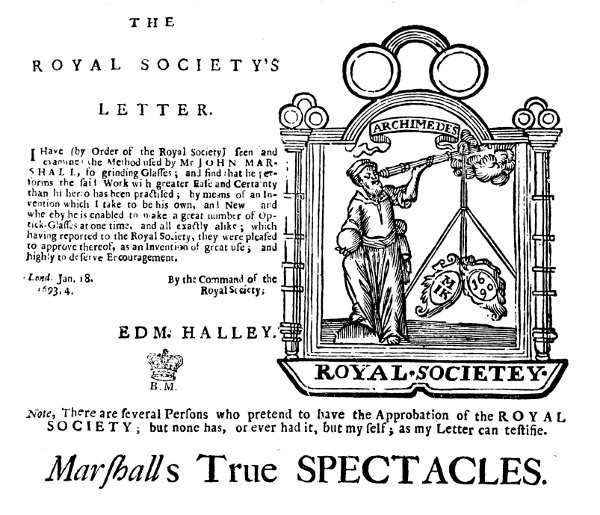
THE
ROYAL SOCIETY'S
LETTER.
I have (by Order of the Royal Society) seen and examined the Method used by Mr JOHN MARSHALL, for grinding Glasses; and find that he performs the said Work with greater Ease and Certainty than hitherto has been practised; by means of an Invention which I take to be his own, and New; and whereby he is enabled to make a great number of Optick-Glasses at one time, and all exactly alike; which having reported to the Royal Society, they were pleased to approve thereof, as an Invention of great use; and highly to deserve Encouragement.
Lond. Jan. 18.
1693, 4.
By the Command of the
Royal Society.
EDM. HALLEY.
Note, There are several Persons who pretend to have the Approbation of the ROYAL SOCIETY; but none has, or ever had it, but my self; as my Letter can testifie.
Marshalls True SPECTACLES.
An Early Letter of the Royal Society, dated January 18th, 1693-4.
In 1717 they resolved to form themselves into a society, which is the Society of Antiquaries now existing. Its minutes have been regularly kept since January 1, 1718. The first volume bears the motto:
"Nec veniam antiquis, sed honorem et præmia posci.
"Stukeley, secr., 1726";
and the whole of the volume appears to be in Stukeley's autograph.
In a quaint preliminary memorandum, he enumerates the "antient monuments" the society was to study, as:
"Old Citys, Stations, Camps, public Buildings, Roads, Temples, Abbys, Churches, Statues, Tombs, Busts, Inscriptions, Castles, Ruins, Altars, Ornaments, Utensils, Habits, Seals, Armour, Pourtraits, Medals, Urns, Pavements, Mapps, Charts, Manuscripts, Genealogy, Historys, Observations, Emendations of Books, already published, and whatever may properly belong to the History of Bryttish Antiquitys."
The earlier publications of the society consisted of a series of fine prints engraved by George Vertue. In 1747 it began the issue of Vetusta Monumenta, and in 1770 the first edition of the first volume of Archæologia, or Miscellaneous Tracts relating to Antiquity, appeared. The Society's resources were modest. In the year 1736 its income was only £61, but its expenditure was not more than £11, and its accumulated funds amounted to £134. In 1752 it obtained from George II., who declared himself to be the founder and patron of the society, a Royal Charter of Incorporation, reciting that:
"the study of Antiquity and the History of former times, has ever been esteemed highly commendable and usefull, not only to improve the minds of men, but also to incite them to virtuous and noble actions, and such as may hereafter render them famous and worthy examples to late posterity."
The qualifications of a fellow are thus defined in the charter:—
"By how much any persons shall be more excelling in the knowledge of the Antiquities and History of this and other nations; by how much the more they are desirous to promote the Honour, Business, and Emoluments of this Society; and by how much the more eminent they shall be for Piety, Virtue, Integrity, and Loyalty: by so much the more fit and worthy shall such person be judged of being elected and admitted into the said Society."
Like the Royal Society, the Society of Antiquaries was to have and employ a sergeant-at-mace, and apartments were allotted to it in Somerset House. From this close neighbourhood grew an intimate association between the two societies. Many persons belonged to both, and although the paths of the two societies have since diverged, that is still so in the case of about twenty fellows. A practice grew up of attending each other's meetings. For more than forty years that agreeable form of interchange has ceased, and the societies contemplate each other from opposite corners of the quadrangle of Burlington House. The Fellows of the Society of Antiquaries dined together for many years on St. George's Day, April 23, the day prescribed for their anniversary by the charter; but after a while the custom fell into disuse, and it has only been revived of late years.
In 1753 the Society for the Encouragement of Arts, Manufactures, and Commerce, now called the Royal Society of Arts, was established. It held its first public meeting in March, 1754. It was incorporated by Royal Charter in 1847, and has for its objects:—
"the encouragement of the arts, manufactures, and commerce of the country, by bestowing rewards for such productions, inventions, or improvements as tend to the employment of the poor, to the increase of trade, and to the riches and honour of the kingdom; and for meritorious works in the various departments of the fine arts; for discoveries, inventions and improvements in agriculture, chemistry, mechanics, manufactures, and other useful arts; for the application of such natural and artificial products, whether of home, colonial, or foreign growth and manufacture, as may appear likely to afford fresh objects of industry, and to increase the trade of the realm by extending the sphere of British commerce; and generally to assist in the advancement, development, and practical application of every department of science in connection with the arts, manufactures, and commerce of this country."
Between 1754 and 1783 it distributed £28,434 by way of premiums for inventions. For more than a century and a half the society has devoted itself with unabated zeal to the promotion of its objects—by meetings, examinations, exhibitions, and in many other ways.
On January 13, 1800, the Royal Institution was founded. In the words of one of its most distinguished professors, it has been a fertile source of the popularity of science. By means of its lectures, its laboratories, its libraries, and its rewards for research, it greatly stimulated public interest in scientific pursuits when there were few other bodies in existence capable of doing so. It continues to perform the same useful function, notwithstanding the great increase in the number of specialist societies since it was established. A feature of its lectures is the annual course "adapted to a juvenile auditory." It has appointed as its professors some of the most illustrious scientific men, such as Sir Humphry Davy (up to 1812), Brande (1813 to 1852, and afterwards as honorary professor), Faraday (1852), and Tyndall (1853). The late Prince Consort (Albert the Good) took great interest in its work, and frequently presided at its weekly meetings. It has a Board of Managers, and also a Committee of Visitors, annually elected, and the visitors make an annual report on the state of the institution. After some early pecuniary difficulties it entered on a career of steady prosperity.
In 1807 the Geological Society was founded. The science of geology was very much opposed to popular notions derived from a literal interpretation of the Hebrew cosmogony, and was accordingly unpopular among those who held those notions; but the society steadily pursued its object, and can now look back upon the hundred years of its existence with pride and satisfaction. In one of his presidential addresses Sir Charles Lyell quoted the observation of Hutton, that "We can see neither the beginning nor the end of that vast series of phenomena which it is our business as geologists to investigate." Leonard Horner, another distinguished president, claimed that the society had been a "powerful instrument for the advancement of geological science, a centre of good fellowship, and a band of independent scientific men, who steadily and fearlessly promote the cause of truth." The society grants an annual medal, founded in memory of Wollaston, which has been frequently awarded to foreign geologists of distinction; and it also administers a fund bequeathed by him to promote useful researches in geology.
In November, 1820, Dr. Burgess, the Bishop of St. David's, obtained an audience of King George IV., and laid before him a plan for the establishment of a Royal Society of Literature. The King took so warm an interest in the project as to assign out of his privy purse an annual sum of 1,100 guineas, out of which pensions of 100 guineas each were awarded to ten royal associates of the society, and two medals annually granted to distinguished literary men. Among the royal associates were Samuel Taylor Coleridge, T. R. Malthus, William Roscoe, and Sharon Turner. Among the medallists were Dugald Stewart, Walter Scott, Robert Southey, Washington Irving, and Henry Hallam. Upon September 15, 1825, the society received its Charter of Incorporation, in which its object is defined to be:—
"the advancement of literature by the publication of inedited remains of ancient literature, and of such works as may be of great intrinsic value, but not of that popular character which usually claims the attention of publishers; by the promotion of discoveries in literature; by endeavouring to fix the standard, as far as is practicable, and to preserve the purity of the English language; by the critical improvement of English lexicography; by the reading at public meetings of interesting papers on history, philosophy, poetry, philology, and the arts, and the publication of such of those papers as shall be approved of; by the assigning of honorary rewards to works of great literary merit, and to important discoveries in literature; and by establishing a correspondence with learned men in foreign countries for the purpose of literary enquiry and information."
The first method, the publication of inedited and other works, has been greatly promoted by a bequest to the society of £1,692 from the Rev. Dr. Richards. Out of the income of this fund the Orations of Hyperides, edited by the Rev. Churchill Babington; the Discourses of Philoxenus, by Dr. E. A. Wallis Budge; the Chronicle of Adam of Usk, by Sir E. Maunde Thompson; Coleridge's Christabel, by E. H. Coleridge; and other valuable works have been provided. The Transactions of the society also contain many important papers. On the death of George IV. the annual gift of 100 guineas to each of the ten royal associates was withdrawn. The society now acknowledges literary merit by the award of the diploma of Honorary Fellow. In this capacity many distinguished authors, both in this country and abroad, have been and are associated with the society.
In its early years the society was hotly attacked by Macaulay, who held that its claim to be an appreciator of excellence in literature involved a claim to condemn literature of which it disapproved, and was equivalent to the establishment of a literary star-chamber. He illustrated this by a rather feeble apologue, and nothing in the subsequent history of the society has shown that his apprehensions had any foundation. It has been very modest in the exercise of the functions conferred upon it by its charter, which included the foundation of a college and the appointment of professors. At one time it did appoint a professor of English archæology and history, and it called upon every royal associate on his admission to select some branch of literature on which it should be his duty, once a year at least, to communicate some disquisition or essay. The subject chosen by Coleridge was a characteristic one:—
"The relations of opposition and conjunction, in which the poetry (the Homeric and tragic), the religion, and the mysteries of ancient Greece stood each to the other; with the differences between the sacerdotal and popular religion; and the influences of theology and scholastic logic on the language and literature of Christendom from the 11th century."
In pursuance of this undertaking he communicated a disquisition on the "Prometheus" of Æschylus.
In 1827 the Royal Asiatic Society was founded. As its title implies, it devotes itself to the study of the languages, the literature, the history, and the traditions of the peoples of Asia, especially of those inhabiting our Indian dependency. It has enrolled in its ranks many, if not all, the great Indian administrators and the most distinguished Asiatic scholars. Daughter societies have been established in the three Presidencies, and have contributed to the collection of materials for its work. Its transactions are of acknowledged value and authority. In its rooms at Albemarle Street a library and museum have been collected. Its latest publication is a collection of Baluchi poems by Mr. Longworth Dames, which has also been issued to the members of the Folk-lore Society.
On September 26, 1831, the British Association for the Advancement of Science held its first meeting at York. It originated in a letter addressed by Sir David Brewster to Professor Phillips, as secretary to the York Philosophical Society. The statement of its objects appended to its rules, as drawn up by the Rev. William Vernon Harcourt, is as follows:—
"The Association contemplates no interference with the ground occupied by other institutions. Its objects are:—To give a stronger impulse and a more systematic direction to scientific inquiry—to promote the intercourse of those, who cultivate science in different parts of the British Empire, with one another and with foreign philosophers—to obtain a more general attention to the objects of science, and a removal of any disadvantages of a public kind which impede its progress."
The association was well described by the late Mr. Spottiswoode as "general in its comprehensiveness; special in its sectional arrangement." The general business of its meetings consists (1) in receiving and discussing communications upon scientific subjects at the various sections into which it is divided; (2) in distributing, under the advice of a Committee of Recommendations, the funds arising from the subscriptions of members and associates; and (3) in electing a council upon whom devolves the conduct of affairs until the next meeting. Although the meetings are held in all parts of the United Kingdom, and have been held in Canada and South Africa, the British Association may be correctly described as a London learned society, as its headquarters are in London, where the council meets and directs its continuous activities. One principal feature of its work, that of the Research Committees, which, either with or without a grant of money, pursue special enquiries with the view of reporting to the next annual meeting, continues throughout the year. The original designation of what are now the sections was "Committees of Sciences," and these were—(1) mathematics and general physics, (2) chemistry and mineralogy, (3) geology and geography, (4) zoology and botany, (5) anatomy and physiology, (6) statistics. The sectional arrangement was begun in 1835, and the sections are now constituted as follows—(a) mathematical and physical science, (b) chemistry, (c) geology, (d) zoology, (e) geography, (f) economic science and statistics, (g) engineering, (h) anthropology, (i) physiology, (k) botany, (l) educational science. At each annual meeting, which lasts a week, the president of the next meeting is chosen, but the previous president remains in office until the first day (Wednesday) of that meeting, when he introduces his successor, who delivers an address. Many memorable addresses have been delivered by the distinguished men who have held that office. Each section has also a president, chosen for the year, and he delivers an address at the opening of the proceedings of his section. These addresses usually relate to the progress during the year, or during recent years, of the science dealt with by the section, or to some interesting matter developed by the personal researches of the president himself. Men of eminence in the various sciences are generally selected for and willingly accept the office of Sectional President. The meetings of the British Association have been called a "Parliament of Science," and its influence in promoting scientific movements and rendering science popular has been very great.
In 1833 the Royal Geographical Society was founded. It may fairly be called the most popular of all the special societies, having about 4,000 members. It is also one of the most wealthy, having an income of about £10,000 a year. It has accumulated a fine series of maps, and a large library of geographical literature. Its quarterly journal is a store-house of the most recent information relating to geographical exploration. By medals and other rewards to explorers, by prizes awarded in schools and training colleges, by the loan of instruments to travellers, by the preparation of codes of instruction for their use, and in many other ways, it applies its resources to the extension of geographical knowledge. It has taken an active part in the promotion of Arctic and Antarctic exploration. As geographical researches are matters of great public interest, its meetings are sometimes important social functions, as on a recent occasion, when a foreign prince was the lecturer, and our King attended and spoke.
On March 15, 1834, the Statistical Society (now Royal Statistical) was founded. It was one of the first fruits of the activity of the British Association, which established a Statistical Committee at the Cambridge meeting in 1833, with Babbage as president. Their report recommended the formation of a society for the careful collection, arrangement, discussion, and publication of facts bearing on or illustrating the complex relations of modern society in its social, economical, and political aspects, especially facts which can be stated numerically and arranged in tables. The first president was the Marquis of Lansdowne, and among his successors have been many statesmen, such as Lord John Russell, Mr. Gladstone, and Lord Goschen; authorities on finance, as Lord Overstone, Mr. Newmarch, and Lord Avebury; and eminent writers on statistics, as Dr. Farr, Sir Robert Giffen, and the Right Hon. Charles Booth. As becomes the orderly mind of a statistician, the society has been very regular in its publications, having for seventy years issued a yearly volume in quarterly parts, which form a veritable mine of statistical information.
The society presents a Guy medal (in memory of Dr. W. A. Guy) to the authors of valuable papers or to others who have promoted its work, and a Howard medal (in memory of the great philanthropist) to the author of the best essay on a prescribed subject, generally having relation to the public health. It has accumulated a fine library of about 40,000 volumes of a special character, containing the statistical publications of all civilised countries. It has conducted some special enquiries—as into medical charities, the production and consumption of meat and milk, and the farm school system of the Continent—upon which it has published reports.
Among recent developments of statistical method in which the society has taken part may be mentioned the use of index-numbers for affording a standard of comparison between statistics of different years, and a means of correction of errors that would otherwise arise; and the increasing use of the higher mathematical analysis in determining the probabilities of error and defining the curves of frequency in statistical observations. Professor Edgeworth, Messrs. Bowley, Yule, Hooker, and others, have made contributions to the Journal of the society on these matters.
In 1844 an Ethnological Society was established, under the presidency of Sir Charles Malcolm. Dr. Richard King, the founder, became its secretary. In 1846 Dr. J. C. Prichard became president, and he and Dr. King fulfilled respectively the same functions in an ethnological sub-section of the section of zoology of the British Association, which then met for the first time. In Prichard's first anniversary address to the society, he defines ethnology as "the history of human races or of the various tribes of men who constitute the population of the world. It comprehends all that can be learned as to their origin and relations to each other." Prichard died in 1848, and Sir C. Malcolm resumed the presidency, which he held until his death on November 12, 1851. In that year ethnology was transferred from the zoological to the geographical section of the British Association. Sir B. C. Brodie became the next president of the society. He retired in 1854, and was succeeded by Sir James Clark. The fourth and last volume of the first series of the society's Journal was published in 1856, and a series of Transactions begun in 1861. At that time Mr. John Crawfurd was president of the society, and he retained the office until his death in 1868, when he was succeeded by Professor Huxley.
In 1862 Dr. James Hunt, the Honorary Foreign Secretary of the Ethnological Society, withdrew from it, and founded the Anthropological Society of London, which held its first meeting on February 24, 1863, under his presidency. In his inaugural address, he defined anthropology as the science of the whole nature of man, and ethnology as the history or science of nations or races. The new society was active and aggressive. It published translations of works of such writers as Broca, Pouchet, Vogt, and Waitz, and of the famous treatise of Blumenbach. Some of the papers read before it attracted much attention, and were thought to have a political bias. Many men whose names were well known in the scientific world adhered to the Ethnological Society, and that society, under Mr. Crawfurd, entered upon a more active career. The rivalry between the two societies was prosecuted with great vigour until January, 1871, when Professor Huxley effected an amalgamation between them.
The title of the combined societies was agreed upon as the "Anthropological Institute of Great Britain and Ireland," to which, in 1907, has been added by the King's command the prefix "Royal." In 1871 the department of ethnology in the section of biology in the British Association became the department of anthropology, and in 1884 anthropology became a section of itself. This was the final recognition by the Parliament of Science that Hunt had fought for twenty years before. In the interval, the claim of anthropology to this recognition had been established by many great works, such as Huxley's Man's Place in Nature, Darwin's Descent of Man, Tylor's Early History of Mankind, and Lubbock's Prehistoric Times. Besides its annual Journal, the Anthropological Institute publishes a monthly periodical entitled Man, and it has issued several separate monographs. In 1878 the branch of anthropology, aptly termed "Folk-lore" by the late Mr. W. J. Thoms, became so popular as to call for the establishment of a separate society, which publishes a quarterly journal entitled Folk-lore, and has annually issued one or more volumes of collections of folk-lore.
In 1844 a new departure was taken by the establishment of the British Archæological Association, a body which was intended to take the same place with regard to archæology that the British Association occupied with regard to science, holding meetings in various parts of the country where there existed objects of specially archæological interest. It held its first meeting at Canterbury, under the presidency of Lord Albert Conyngham (afterwards Lord Londesborough), and arranged its work in four sections—primæval, mediæval, architectural, and historical. Before a second meeting could be held, violent dissensions arose, and the association split into two. In the result honours were divided between the two bodies, those who retained the leadership of Lord Albert retaining also the title of British Archæological Association; while those who had for their president the Marquis of Northampton retained the control of the Archæological Journal, and adopted the title of "Archæological Institute of Great Britain and Ireland," to which has since been prefixed the word "Royal." Both bodies still exist, though the causes of controversy have long died out.
Shortly afterwards, County Archæological Societies in London and greater London began to be formed. In 1846 the Sussex Society, in 1853 the Essex Society, in 1854 the Surrey Society, in 1855 the London and Middlesex Society, and in 1857 the Kent Society were established. Each of these societies has published transactions and other works of solid value. In each the annual or more frequent excursion to places of archæological interest within the county is an essential feature, tending to the dissemination of knowledge and to the preservation of antiquities, and affording the advantages of social intercourse. Societies have also been established for the like purposes within more restricted areas, as in Hampstead, Battersea, Balham, Lewisham, Whitechapel, and elsewhere.
Of merely publishing societies, the Percy, the Camden, the Shakespeare, and the Arundel have run their course; but many others, as the Roxburgh, the Harleian, the New Palæographic, and the Palæontological still exist to delight their subscribers with the reproduction of rare works.
In this summary account of the principal Learned Societies of London it has not been possible to include many societies of great importance, such as the Colleges of Physicians and Surgeons, the numerous societies connected with other professional pursuits, the Linnæan, Zoological, Botanical, and other societies devoted to natural history; the Royal Astronomical Society, which has important public functions; the Royal Academy, and other institutions devoted to art. The roll of Learned Societies is being constantly increased. Among recent additions may be mentioned the British Academy for Historical Studies, and the Sociological Society.