


автордың кітабын онлайн тегін оқу The Shores of the Adriatic / The Austrian Side, The Küstenlande, Istria, and Dalmatia
Project Gutenberg's The Shores of the Adriatic, by F. Hamilton Jackson
This eBook is for the use of anyone anywhere at no cost and with
almost no restrictions whatsoever. You may copy it, give it away or
re-use it under the terms of the Project Gutenberg License included
with this eBook or online at www.gutenberg.org
Title: The Shores of the Adriatic
The Austrian Side, The Küstenlande, Istria, and Dalmatia
Author: F. Hamilton Jackson
Release Date: November 26, 2009 [EBook #30548]
Language: English
*** START OF THIS PROJECT GUTENBERG EBOOK THE SHORES OF THE ADRIATIC ***
Produced by Thanks to, Marilynda Fraser-Cunliffe, and the
Online Distributed Proofreaders Europe Europe at
http://dp.rastko.net. ( This book was produced from scanned
images of public domain material from the Digital &
Multimedia Center, Michigan State University Libraries.)
THE SHORES OF THE ADRIATIC
THE AUSTRIAN SIDE
THE KÜSTENLANDE, ISTRIA, AND DALMATIA
By F. HAMILTON JACKSON, R.B.A.
Vice-President Of The Institute Of Decorative Designers Cantor Lecturer, Etc.
FULLY ILLUSTRATED WITH PLANS. DRAWINGS BY THE AUTHOR,
AND PHOTOGRAPHS TAKEN SPECIALLY FOR THIS WORK
LONDON JOHN MURRAY, ALBEMARLE STREET, W. 1908
PRINTED BY HAZELL, WATSON AND VINEY, LD., LONDON AND AYLESBURY.
PREFACE
This volume is complementary to that dealing with the Italian side of the Adriatic, and follows much the same lines. It has not been thought necessary to repeat what appeared there about the sea itself, but some further details on the subject have been added in an introductory chapter. The concluding chapter treats of the influence which the two coasts exerted on each other, and contains some hints as to certain archæological problems of great interest, which deserve fuller and more individual treatment than they can receive in such a work as the present.
In a country which still contains so much that is unfamiliar, so many mediæval survivals in customs and costume, and so much that is fine in scenery, architecture, and the decorative arts, the picturesque aspect of the country has been dwelt upon more than was the case in dealing with the Italian side, and the meticulous description of buildings has to a great extent been abandoned, except in cases where it was necessary for the full understanding of the deductions drawn from existing details. At the same time, matters of archæology have not been neglected, and the rich remains of mediæval goldsmiths' work have received special attention. The costume, the customs, and the folk-lore of the Morlacchi are also treated of in considerable detail.
The determination of the Croat majority to stamp out the Italian language by insisting upon instruction in the schools being given solely in Croat will, in the course of a generation, make Italian a foreign language understood by few; and it seems wise for those who desire to visit Dalmatia to do so soon, while it is still understood and before Italian culture is forgotten.
The present work does not pretend to in any way rival Mr. T.G. Jackson's classic volumes on the architecture of the country, in completeness of historical treatment or architectural detail. Though Sir Gardner Wilkinson had published a book on the country, and the brothers Adam's full description of Diocletian's Palace was well known to connoisseurs, he may be said to have practically discovered Dalmatia for the Englishman; and it is a proof of the excellence of his work that, though twenty years have elapsed since it was published, it has never been surpassed, and its value remains undiminished. To these volumes the author desires to acknowledge his indebtedness, as well as to the "Mittheilungen" of the Austrian Central Commission for the Conservation of Historical Monuments; the "Bullettino di Storia Dalmata," conducted by Mgr. Bulić at Spalato; the "Atti" of the Istrian "Società di Archeologia e Storia Patria," published at Parenzo; and the "Archeografo Triestino," published at Trieste, all chronicling discoveries as they were made, and containing articles giving interesting and reliable information upon the history and antiquities of the coast. In addition, the following works have been consulted:
Freeman's "Subject Lands of Venice"; Munro's "Rambles and Studies in Bosnia and Herzegovina"; Neale's "Travels in Dalmatia"; Villari's "Ragusa"; Benussi's "L'Istria"; Bianchi's "Zara Cristiana" and "Antichità Romane e mediævale di Zara"; Mgr. Bulić's "Guide to Spalato and Salona"; Caprin's "Il Trecento a Trieste," "Alpi Gulie," and "L'Istria noblissima"; Carrara's "La Dalmazia descritta"; Chiudina's "Le Castella di Spalato"; Fabianich's "La Dalmazia nè primi cinque secoli del Cristianesimo"; Fosco's "La Cathedrale di Sebenico"; Franceschi's "L'Istria"; Gelcich's "Memorie storiche delle Bocche di Cattaro" and "Dello Sviluppo civile di Ragusa"; Lago's "Memorie sulla Dalmazia"; Lucio's "History of Dalmatia and Traù"; Ludwig and Molmenti's "Vittore Carpaccio"; Mantegazza's "L'Altra Sponda"; Modrich's "La Dalmazia"; Pasini's "Il Tesoro di S. Marco in Venezia"; Cav. G.B. di Rossi's "La Capsella Argentea africana," &c., and the two series of "Bullettino di Archeologia Cristiana"; Sabalich's "Guida Archeologica di Zaza"; Tamaro's "Le Citta dell' Istria"; and volumes of the Zara "Annuario Dalmatico"; Bamberger's "Blaues Meer und Schwarze Berge"; Danilo's "Dalmatien"; "Die Monarchic in Wort und Bild"; Eitelberger von Edelberg's "Gesammelte Kunsthistorischen Schriften"; Hauser's "Spalato und die monumente Dalmatiens"; Heider's "Mittelaltliche Kunst denkmale des Œsterreichischen Kaiserstaates"; Passarge's "Dalmatien und Montenegro"; Petermann's "Führer durch Dalmatien"; Tomasin's "Die Volkstamme im Gebiete von Triest und in Istrien"; Von Warsberg's "Dalmatien"; and Count Lanckoronski's magnificent monograph of the Cathedral of Aquileia.
A small portion of the matter of this volume has appeared in The Builder and The Guardian, but has been revised and, to a great extent, rewritten. The author's thanks are due to the proprietors for permission to republish these articles. He desires to express his thanks also to the Austrian Government especially, and to the ecclesiastical authorities, for special facilities very kindly afforded him for prosecuting his studies; to the Central Commission, for the loan of clichés of most of the plans; to the directorate of the Archeografo Triestino, for permission to reproduce the plan of the cathedral, Trieste; to the Istrian Archæological Society, for the plan of the three cathedrals of Parenzo, and for permission, very courteously given by the president, Dr. Amoroso, to use anything published by them on the subject; to Mgr. Bulić, Sig. Maionica, Curator of the Museum, Aquileia, and to Sig. Puschi, of the Museum, Trieste, for much information kindly given by word of mouth; and to Mr. Palmer, Librarian of the Art Library, South Kensington, for calling his attention to several books which were exceedingly useful.
The photographs (as in the Italian volume) are from the excellent negatives of Mr. Cooper Ashton, the travelling companion of many foreign archæological expeditions.
CONTENTS
PAGE
Preface v Lists of Illustrations and Plans xi-xvI.
Introductory Chapter 1II.
The Races and their Customs 6III.
Aquileia 23IV.
Grado 41V.
Grado to Trieste 54VI.
Historical Sketch of Istria 69VII.
Muggia to Pirano 79VIII.
Umaco to Parenzo 104IX.
Parenzo 107X.
To Pola by Sea 127XI.
To Pola by Land 133XII.
Pola 143XIII.
Characteristics of the Istrian Coast 160XIV.
Fiume and Veglia 163XV.
Ossero and Cherso 180XVI.
Historical Sketch of Dalmatia 187XVII.
Arbe 192XVIII.
Zara 205XIX.
Sebenico 245XX.
Traù and the Riviera dei Sette Castelli 262XXI.
Spalato 292XXII.
The Southern Group of Islands 316XXIII.
Ragusa 333XXIV.
The Bocche di Cattaro 369XXV.
The Reciprocal Influences of the Two Shores 397 Index 409ILLUSTRATIONS
I. FROM PHOTOGRAPHS
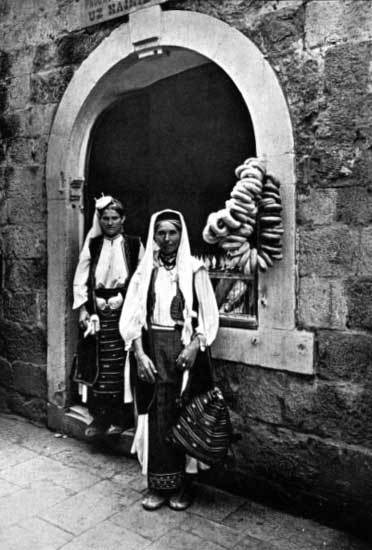
Herzegovinian Women at a Baker's Shop in Ragusa
FrontispieceStatue of Venus, Museum, Aquileia
36Pulpit in the Cathedral, Grado
45Shipping at Trieste: the Canal, with the Greek Church and Sant' Antonio
57Pirano, from near the Cathedral
97Marble Capital of the Sixth Century, Parenzo
113High-altar, Parenzo, from the South Aisle
116Wine-boats in the Fiumara Canal, Fiume
163South Portion of Choir-screen, Cathedral, Veglia
173The Harbour of Besca Nova
176Chimneys at Besca Nova
178Monstrance in Colleggiata, Ossero
184Smergo Fishermen
186Ascent to the Ramparts, Zara
205Carving on Right Jamb of West Door, Cathedral, Traù
272Interior of the Cathedral, Traù
276Door of the "Atrio Rotondo", Palace of Diocletian, Spalato
294Interior of the Cathedral, Spalato
296Panel from Guvina's Doors of the Cathedral, Spalato
299Stall-backs in Choir, Cathedral, Spalato
300A Morlacco Family, between Salona and Clissa
314Travelling at ease: among the Islands
329Herzegovinian Charcoal Porter, Gravosa
334Reliquary of the Head of S. Blaise, Cathedral Treasury, Ragusa
343Cloister of the Dominican Convent, Ragusa
349Lavabo in Sacristy of Franciscan Convent, Ragusa
353Loggia of Rector's Palace, Ragusa
354Capital from the Loggia, Rector's Palace, Ragusa
355Æsculapius Capital, Rector's Palace, Ragusa
356Fountain of Onofrio di La Cava, Ragusa
357Reliquary of the Head of S. Trifone, Cattaro
384Albanian Horse-dealers, Cattaro
388II. FULL-PAGE LINE DRAWINGS
Narthex of the Cathedral, Aquileia
35A Corner in Grado
42The Patriarch's Throne, Cathedral, Grado
46Choir-screen and Ambo, Muggia Vecchia
81The "Fontico" and S. Giacorno, Capodistria
90The Piazza da Ponte, Capodistria
92The Inner Harbour, Pirano
94Opus Sectile in the Apse, Cathedral, Parenzo
114The Atrium and Western Façade, Cathedral, Parenzo
119View across the Nave, Cathedral, Parenzo
121An Istrian Farm-house
133Interior of the Basilica, San Lorenzo in Pasenatico
134Entrance to the Castle, Pisino
137An Angle of the Castle, San Vincenti
139Arch of the Sergii, Pola
145The Amphitheatre, Pola
146West Doorway, S. Francesco, Pola
154Interior of the Cathedral, Veglia
171In the Harbour, Besca Nova
175The Main Street, Besca Nova
177Lussin Grande
181West Door of the Colleggiata, Ossero
183The Landing-place, Arbe
193The Porta Marina, Zara
207North Door of Western Façade, Cathedral, Zara
220Apse of S. Crisogono, Zara
230Entrance to the Town of Nona
239Eastern End of Cathedral, Sebenico
248Late Venetian-Gothic Doorway, Sebenico
253South-east Portion of Choir, Cathedral, Sebenico
254Belfry of Greek Church, Sebenico
257The Porta Marina and Custom House, Traù
265The Porta S. Giovanni, Traù
266A Decayed Palace, Traù
282The Quay, Castel Vecchio
287The Porta Aurea, Spalato
293Italian Fruit and Vegetable Boats, Spalato
303Cloister of S. Francesco, Spalato
305Osteria at Salona
310Basilica of the Christian Cemetery, Salona
312Porta Pile, Ragusa
336Torre Menze and Fort S. Lorenzo, Ragusa
337La Sponza and Onofrio's Fountain, Ragusa
359The Ruined Bastion, Castelnuovo, Bocche di Cattaro
373Dobrota, Bocche di Cattaro
378Ciborium of S. Trifone, Cattaro
383S. Luka, Cattaro
385The Scuola Nautica, Cattaro
386III. LINE DRAWINGS IN TEXT
Knocker of the Rector's Palace, Ragusa
On TitleAntique Statue in the Museum, Aquileia
37Figure of S. Giusto, Campanile of the Cathedral, Trieste
63Arco di Riccardo, Trieste
65West End of the Church, Muggia Vecchia
80Knocker on Palazzo Tacco, Capodistria
91Greek Benedictional Cross, Parenzo
117Sarcophagus of S. Eufemia, Rovigno
130Wayside Chapel outside San Vincenti
140Stall on the Wine-quay, Fiume
164Veglia, showing the Castle Towers
172Reliquary of the Head of Sant Christopher
196Arbe, from the Shore
203Morlacco Girl, Zara
212Going to Market, Zara
213Altar of Sant' Anastasia, Zara
225Reliquary of Sant' Orontius, Zara
226Reliquary of the Clothes of Our Lord, S. Maria Nuova, Zara
234Costume of Sebenico
257Late Gothic Lintel at Traù
283A Quaint Costume, Traù
286Reliquaries and Chalice, Treasury, Spalato Cathedral
297Morse in the Treasury, Spalato Cathedral
298Porta Maggiore, Lesina
319West Door of the Cathedral, Curzola
326Head Reliquary in Cathedral, Ragusa
345Reliquary of the Jaw of S. Stephen of Hungary
346A Corner of the Walls, Cattaro
388Montenegrins in the Market, Cattaro
392Early Greek Ship, from Millingen's Vases
TailpieceIV. PLANS AND SECTIONS
Plan of the Cathedral, Aquileia
28Plan of the Cathedral, Trieste
60Plan of Pulpit, Muggia Vecchia
82Plan of the Three Basilicas, Parenzo
109Plan of S. Maria Formosa, Pola
148Plans of S. Donate, Zara
214Plans and Section of S. Lorenzo, Zara
Between pages 216-217Plan of Foundations discovered on the Riva Nuova, Zara
218Plan of the Cathedral, Zara
223Plan of Cathedral Crypt, Zara
224Plan of S. Nicolò, Nona
242Plan and Sections, S. Barbara, Traù
268Plan of the Cathedral, Traù
271Plan of Cathedral and Campanile, Spalato
295Plan of the Dominican Convent, Ragusa
348Plan and Elevation of one Bay of Cloister, Dominican Convent, Ragusa
352Plan of La Sponza, Ragusa
358Plan of the Cathedral, Cattaro
381Map of Istria and Dalmatia
At end of bookI
INTRODUCTORY CHAPTER
The two shores of the Adriatic are totally different in their natural characteristics; the western being almost islandless and destitute of harbours, while the eastern is fringed by an almost continuous chain of islands and possesses several magnificent harbours which communicate with the open sea by narrow channels easily fortified, the rocks rising precipitously from the water along the greater part of the coast, whereas on the Italian side there is an equally continuous strip of alluvial plain between the foothills and the sea.
The Adriatic was once bounded by a kind of ridge stretching from Monte Gargano to Albania. North of this line the depth is much less than in the Ionian Sea. When the surface of the earth sank, the Dalmatian islands were formed by the letting in of the sea. The depth near Parenzo is about 120 ft.; in the Quarnero, near Fiume, 195 ft.; between Cherso and Arbe, 335 ft.; and south-west of the island Zuri (some 24 miles from the mainland), about 700 ft. Depths as great as 335 ft. to 490 ft. are, however, not very common within nine miles of the mainland. In the Bocche di Cattaro the depth near the mouth is 165 ft., but half a mile west of the Punta d'Ostro, 335 ft. North of the line from Monte Gargano to Pelagosa, Cazza, and Curzola it is never as much as 780 ft.; south-east of this line the bottom sinks so much that between Cattaro and Brindisi it reaches a depth of over 5,000 ft. The tide is scarcely perceptible, and the currents are very slight. The land is still sinking, as is proved by the Roman sarcophagi found beneath the water at Vranjic and the submerged roads between Aquileia and Grado; while there are records of the destruction of ancient towns from sudden subsidences, as that of Cissa, near Rovigno. The subsidence has been calculated as about a yard in 1,000 years. Cluverius proves from Ptolemy that in antiquity the name Adriatic only applied to that part of the gulf which lay to the north of a line between Monte Gargano and Durazzo. A passage of Strabo, describing the people of Epirus, runs: "The Adriatic being ended, the Ionian commences, the first shore of which is in the neighbourhood of Epidamnus and Apollonia." When Venice conquered Durazzo the limits of the Adriatic were extended, and it was thenceforth called the Gulf of Venice. In 1859 the almost incredible fact is recorded that it was frozen for several days!
The Austrian provinces which lie along the coast are, commencing at the north, the Küstenlande, Istria, and Dalmatia. In the first the Julian Alps form a great boundary wall to the plain of the Isonzo, from which the ground rises between Monfalcone and Nabresina to the stony district of the Karst. The Istrian ranges are spurs from this lofty plateau, the chain culminating in Monte Maggiore, north-west of Fiume. All these heights belong to the Julian Alps. Beyond Fiume, southwards, there are three principal mountain chains, all of which have much the same formation of limestone, pale brownish or grey in colour, with fossils and streaks of other colours. The first is the Dinaric Alps or Velebits, a continuation of the Julian Alps. These separate Dalmatia from Bosnia as far as Imoschi, where they enter Herzegovina, finally joining the Montenegrin chain. The chain of the shore commences on the left bank of the Kerka and extends to the Narenta, which cuts it. It runs as far as Trebinje, beyond the river. The Montenegrin mountains, which are so impressive above the Bocche di Cattaro, joining with those of the Herzegovina, make the third chain. The islands and rocks in the sea appear to be submarine branches of the littoral chain; the strata lie in the same direction—in the North Dalmatian islands to the north-west, in the Southern to the west. On the peninsula of Sabbioncello they lie partly in one and partly in the other direction. The former connection between the islands and the mainland is proved by the remains of rhinoceros, horse, and stag in the diluvial bone breccias of Lesina, and the survival of the jackal in Giuppana, Curzola, and Sabbioncello. Geologists hold that the deeply cut bays of Sabbioncello and Gravosa, as well as of the Bocche di Cattaro, and the step-shaped sinkings of the northern and eastern limestone mountains towards the Adriatic basin are signs of the tearing away of the islands from the mainland, perhaps through the destruction of the permeable strata.
These generally show in their forms the craggy and stony character of the Dinaric Alps, rising perpendicularly from the water on the side of the prevailing wind, and without vegetation. On the other side are softer hills and plains with southern vegetation, the aromatic scents from which are carried by the breeze. There are about twenty large islands, some of which are over 30 miles long; but the number may be raised to a hundred by counting in the small ones. They are generally in groups or chains, though some are isolated. The water is generally deep up to the shore, so there are very few sandbanks.
The greater portion of the naked surface of the land is formed of limestone and dolomites, which are closely related: there are also, on the lower levels, grey or red sands, among which schistous loams of uniform colour predominate. These two formations stretch from one end of the province to the other in sloping beds. They are interrupted here and there by loam and schistous clay and horizontal beds of a kind of limestone: below these are lignites and chalky limestone, in which shells are found belonging to a later formation. The oldest formations are the volcanic mountains near Knin and on Lissa. Next follow the trias strata, as under the Velebits and westwards from Sinj, then the sandstone beds, the different eocene beds and alluvial strata, as in the plain of Dernis, north of the Vrana Lake, by Nona and Imoski. The principal characteristic of the Karst district (to which Dalmatia belongs geologically) is the way the water flows, sometimes above, sometimes under ground. Where the woods were cut down to supply the Romans and Venetians with material for constructing their fleets, and where natural afforestation has been stopped by the feeding of sheep and goats, the red earth has either been washed away by the rains or blown away by the winds, so that it is only in the hollows that cultivation can be carried on.
The bitter north wind, the Bora, is the curse of the district. In the island of Arbe it sometimes blows even in June and July, stripping the vineyards as if hundreds of men had been at work, and carrying the salt spray all over the island, to the great detriment of vegetation. It is sometimes strong enough to upset pedestrians, and it is said that if it were not for it, there would be neither winter nor cold in the Dalmatian littoral. On the heights winter begins in November and lasts till April, with heavy snowfalls; but on the coast spring begins in February, and winter only at the beginning of December. The summer, which commences in May, is usually rainless, with the heat tempered by sea-breezes, though at the end of August heavy rains commence, and in autumn the frequent changes of temperature are dangerous. The flora consists of nearly 2,500 species, described by Visiani in his "Flora Dalmatica." The aquatic flora contains nearly 700 varieties, many of the seaweeds being exclusively Dalmatian. Views on the coast of Ragusa, or at Castelnuovo, in the Bocche, resemble those of Sardinia and Sicily. On one side may be seen green meadows, fruit trees, flowing water, cornfields, beechwoods, &c.; on the other, olive groves, thickets of arbutus, hedge plants the height of a tree, myrtles, and bay; on the naked rock aloes grow and the opuntia; in gardens, dwarf and date-palms, unprotected cycas revoluta, and orange and lemon trees; and wide valleys are filled with lofty carob trees—so close are the boundaries between the flora of middle Europe and of the Mediterranean. Almonds flower in December, and peas and beans are often gathered at Christmas. At Cannosa the date-palm ripens its fruit, and flowers are always to be seen. The Euphorbia Dendroides grows as high as in Crete, and rosemary bushes are frequently up to the shoulder of a man. In August the Syrian hibiscus is violet-red and the scarlet-red arbutus fruit hangs till Christmas. On Monte Marjan, near Spalato, where Diocletian had his parks, the sheltered aspect creates a tropical climate. Wild aloes grow 6 ft. high, and in midwinter numbers of field flowers may be picked as if it were spring.
II
THE RACES AND THEIR CUSTOMS
The people of Istria and Dalmatia are a very mixed race, as might be expected from the history of the countries. On these shores and islands were Greek colonies and Roman municipia, which have left their trace in the names of places and families. Greek colonies were at Issa (Lissa), Pharia (Lesina), Epetium (Stobreč), Tragurium (Traù), Melita (Meleda), Corcyra (Curzola), Buta (Budua), and Ambrachia (Brazza), to name some of those which have survived as towns to the present day. Roman family names occur especially round Spalato, such as Lutia (Lucio), Cæpia (Cippico), Valeria (Valeri), Junia (Giunio), Coceia (Coceich), Marcia (Marce), Cassia (Cassio), Cælia (Celio), and Statilia (Statileo). Byzantine names testify to the rule of Byzantium, such as Paleologo, Lascaris, Andronico, Grisogono, Catacumano. In Istria there is a considerable admixture of German blood; on the rocks of Zara the Crusaders abandoned sick Frenchmen; whilst thither and to Spalato also came Ghibellines in exile. Franks, Croats, Bosniaks, Hungarians, Genoese, Neapolitans, and above all, Venetians have held sway over portions of the coast at different times. Families of Hungarian and Bosnian gentlemen established the free commune of Poglizza; exiles from Spain, Jews, for the most part driven out in 1492, established themselves at Spalato and Ragusa; Lombards descended upon the coasts and islands; and Venetians commenced to establish themselves in Dalmatia in the eleventh century, Istria coming even earlier more or less under their influence. In 1552, in the Council of Zara, out of seventeen noble families more than two-thirds were of Italian descent; and at Lesina the proportion was even greater. At Zara the Italians still preponderate, but the Slav element is in the majority in the greater part of Dalmatia, and even in the country parts of Istria. There are also many French, Hungarians, Bosniaks, Herzegovinians, Germans, Swiss, and gypsies, the Slav majority increasing towards the south.
In Istria the present inhabitants may be divided into Italians, Roumanians, and Slavs: to the last division belong the Morlacchi, the Tschitsches, Slovens, and Croats. The Italians are the most intelligent portion of the population, and are craftsmen, large occupiers of land, merchants, and sailors. They are the descendants of those who were subjects of Venice from the fourteenth century till the fall of the Republic. The Slovens were in Istria as early as the eighth century, and Paulus Diaconus mentions them as being near Cividale. Records exist of Croats raids in the tenth century, whilst further south there were two great immigrations—the first, in the seventh century, by the "Belocroats," called by Porphyrogenitus, Croats, from the banks of the Elbe, descendants of whom may to-day be found in the islands; and the second, in the fourteenth century, by the people of Rascia, who now inhabit much of the interior and are known as "Morlacchi," a name derived from the Slav "Mauro vlach," the black Wallachs.
According to Lucio, who refers to William of Tyre, all Dalmatians used the Roman language until 1200. After the Croats came down, the name of "Dalmatian," strictly speaking, belonged only to the cities of Zara, Traù, Spalato, and Ragusa, to the western islands of Dalmatia, and to Lissa and Lagosta—Eastern Dalmatia was a Servian province; Western, a Croatian. It is known that Slavs came in 1463 to Salvore, in 1526 to the district of Rovigno, in 1549 to the district of Cittanova, Montona, Parenzo, and Pola, in 1595 to Fontane, in 1624 and 1634 (the plague years) to Fillipano, 1647 to near Pola, and 1650 to Peroi, near Fasano. Those now there came from the Bocche and Montenegro, settled in 1658-1659 by Doge Giovanni Pesaro, after the great plague. The women still wear the ancient costume. The Slavs are most numerous between Dragogna and Trieste. Procopius gives an interesting description of them worth quoting: "The two nations of the Autars and the Slavs know no monarchical government; but from ancient times live freely in common fashion. They take all questions of great importance or difficulty to a common national council. The customs of the two nations are alike in everything else. These barbarians believe, by an article of faith transmitted from their ancestors, that, among many, there is one sole master of all things, whom they look upon as the author of the thunder; and to him they sacrifice bulls and other victims. They do not know what the goddess Fortune may be, nor believe that she has any influence on human affairs. When they feel themselves threatened by death, either by illness or wounds given in battle, they are told to promise a sacrifice to God if they escape the danger. Then, if they soon get about again, they fulfil the vow, firmly persuaded that by it they have recovered their health. They offer worship to woods, to nymphs, and other genii, immolating victims to them, and prophesying in the act. They live in rough huts far away from each other, and often change the situation. The greater part of them fight on foot, armed with shield and with darts, but without corslet. Some of them do not wear their ordinary clothes in battle, but draperies which scarcely reach to the thigh, and so they present themselves to the enemy. They all speak the same barbarous tongue, nor differ much in appearance, but are all tall and powerful. The colour of the flesh and the hair is neither vermilion nor brown, but reddish. They live a somewhat fatiguing life, somewhat neglected and uncultivated, like the Massagetae, and, like them, on sordid food. They are not cunning, nor evildoers, but follow the customs of the Huns in sacking and rapine. They possess vast lands and occupy the greater part of the further bank of the Danube." They have retained many characteristics of an earlier age, though not of the period of Procopius.
The men are tall and muscular, with strongly marked features. Their eyes are generally either grey or blue, the forehead broad and prominent, the teeth white and strong, the hair sometimes blonde, but ranging through all shades to black, and the countenance intelligent and expressive. The boys herd the flocks barefoot and half naked, so that their skin is always bronzed, and the men generally have bare breasts. Their sight and hearing are remarkably keen, and in Dalmatia they can make themselves heard from one hill to another, a feat which is partly owing to the quality of the air. Their excellent health enables them to support all kinds of hardships; they sleep out of doors (covering the head), except in winter, at which season they stay a good deal by the fire, though they may be seen in the city with icicles on their hairy chests. They have neither stoves, chimneys, nor glass in the windows. A case of a monk has been recorded, who, at the age of 105, made watches and read with the naked eye, ate and drank, walked and "wept" like a boy of twenty. The costume is distinctive and, with slight variations, is worn throughout Dalmatia. In Istria there are considerable differences both in colour and form. "The Morlacco in full dress has on his head the kapa, a cap of scarlet cloth, with black embroidery on the border and hanging fringe on one side; in some districts bordering on Bosnia a rich band of silk or coloured wools is twisted round it. Over the skirt of rough linen (the kosulja), open to show the breast, is the krozet, a waistcoat crossed on the breast with flat buttons of silver, or tin, and embroidery; it is bound to the sides with a girdle (pas) made of red strings. The trousers (benevrechi) are of a coarse blue cloth fitting to the legs and very tight at the calf, below which they are split up and fastened by sponje, copper or silver hooks. The stockings (nazubei) are of wool of various patterns. The shoes (opanci) have a sole of ox-leather and uppers of strips of dried sheeps' skin (opute); a longer oputa passes several times round the ankle and holds the shoe firm; it turns up at the toe and looks quite Oriental. Instead of the krozet, or over it, some wear the jacerma, a sleeveless red cloth jacket, covered in front with little discs of tin (siliki), or large balls of silver (toke), or by rows of coins. And over the pas they have the pasnjaca, a band of red leather covering part of the abdomen, with various divisions, in which they used to carry their rich arms, pistols, knives, &c., now filled with the pipe, pipe-cleaner, britva, a very small scimitar with a bone handle, and a small knife in a sheath. Finally, there is the koporan, a jacket with sleeves of blue cloth, with embroidery on the elbows and back; but few Morlacchi wear it.
"The women have a large handkerchief (jačmak) on their heads, embroidered on the borders; instead of the kosulja, or above it, they have the oplece—that is, the coverer of the shoulders; it is closed at the neck, embroidered on the breast, and on the ample sleeves also. Round the neck is the gerdan, several strings of glass beads of different colours; it is bound at the stomach by the litar, a long band of leather a couple of inches wide covered with little tin discs and very heavy. From the litar hang the britva and a lot of keys, by chains, which are sometimes costly. The gown (vustan) is of blue cloth, but in summer of linen, reaching to the middle of the calf. The apron (prejaca, or, in Venetian, travesa) is always a chef-d'œuvre of workmanship, which the Morlacca thinks a deal of. The footwear is composed of three parts: bicve, of blue cloth reaching up to the knee, tightly laced up with little hooks, and finishing at the ankle in a ring; over them the true stockings (nazubei) of rough wool, with patterns in vivid colours and opanci, or filare, like the men's. The girl does not have the litar; on her head is no jačmak, but a red cloth cap, sparkling with antique or modern coins of silver, and occasionally of gold. In some places the girl has on her bosom the gendar, several rows of coins which hang from the neck, sometimes below the stomach, tinkling at every step; this is her dowry, and sometimes worth as much as £50. When she is married she puts off the gendar and sparkling kapa. The men used to have a pigtail, of which they were very proud. The wife used to comb it twice a month, anoint it with butter, and tie up the end with ribbons and amulets. It was the only time when a Morlacco addressed his wife affectionately. In barracks and in prison the hair is cut, so the pigtail is rarely seen now. To complete the toilet the torba and torbak must be mentioned: the first of red wool, with embroidery, worn by both men and women on the back, laced round the shoulders; the second generally of skin, worn only by the men, and hanging crosswise by a broad band of leather on the left hip."
I have given this detailed description of the costume (quoted from Signor Modrich's "Dalmazia"), thinking it would be of interest; but descriptions of the costumes as they appear to the ordinary traveller will be found in the sections dealing with the various places on the coast.
The Dalmatians are very fond of music and are constantly singing. They have a proverb: "He who sings thinks not of evil." Tomaseo thought their folk-songs richer than those of any other nation, ranging as they do over all manner of subjects. They are generally heroical or amorous in character, divided into short verses and sung in two parts; the bass delivers a kind of recitative, and the baritone joins in, the long final note with which each finishes dying away in a full chord. It is extraordinary how serious the men are over it, even when singing over their wine, in which they sometimes exceed. At Traù one Sunday afternoon we saw a party of eight or ten sitting round a table in a café as serious as if at a funeral, with wine before them, and enjoying their melancholy music. On this occasion the alto part was flat, and the effect was not as good as it is out of doors. Later we came across more than one group of four, standing where two streets met, and singing without looking at each other. In the narrow ancient streets the notes sounded quite in character with the surroundings and with the quaint dresses of the singers. Modrich says that they use the svirala, a kind of bagpipe with two canes, one with four and the other with three holes, and suggests that the long-drawn terminating notes of the songs are in imitation of its sound; but we neither saw nor heard this instrument, all the singing being unaccompanied. The principal occupations of the people are agriculture, cattle-raising, and fishing, or sea-faring. They are exceedingly religious, devoted to church and priest, and observe the great festivals with feasting and rejoicing, and with ceremonies many of which are evidently survivals of heathen observances. The greatest festival is Christmas. In preparation all clothes are washed and mended, house and yard cleaned, and better and richer food than they usually have is provided. On the Eve they work hard; before sunrise house and yard are decked with bay or olive branches or some other evergreen, which they think protects from lightning. On this day the sun, which the ancient Slavs worshipped, woke from sleep, as one may say, and the days began to lengthen perceptibly.
The father of the sun was Perun, the thunder-god. To this god the oak was dedicated. In the folk-songs he is replaced by S. Elias, and to this day a great log of oak is placed on the fire on Christmas Eve, and kindled for the preparation of the evening meal. It burns all night and the whole of the following day, and in many places is kept smouldering for eight days. The customs observed are as follows. The head of the family bares his head and says: "Blessed be thou, O log; God preserve thee!" and sprinkles wine upon it crosswise. Then corn is thrown over it, and he invokes every blessing from heaven for the health of those belonging to the house, present or absent, for the success of domestic undertakings, and for the harvest, to which the others present reply "Amen," fire off guns in sign of joy, and say: "Welcome to the evening of the log." Then they sit down to table in the kitchen, even if other rooms are available, which suggests a survival of the practice of eating by the ancient family altar, the hearth. In the centre of the table are three candles twisted together in honour of the Trinity, lighted, and stuck into a great loaf ornamented with ivy. This loaf is afterwards broken up and given to the sheep and cows when bringing forth, or when sick. A little of every kind of food is thrown on to the burning log. If there are three logs (as in some places), the right-hand one must be the biggest—the Father, the Son to the left, and the Spirit in the middle, the aspersion being made in this order. Boccaccio, in the "Genealogy of the Gods," refers to a similar custom in his day in Florence, evidently the survival, or transmutation, of some heathen rite. After supper the hymn "Es wurde geboren der Himmels König von der unbefleckten Jungfrau Maria" is sung, and then the young people usually play Christmas games. Little houses are made of flour or bran, with a piece of money in one, which belongs to the person who selects that house. On Christmas Day they visit neighbours and relations, married daughters come with husband and children to the midday meal, bringing two loaves—one of finer quality for the mother, one of the usual kind as big as possible for the father. During the octave groups of young people (and sometimes of men also) go singing carols from house to house, and are rewarded with money and wine in return for wishing the donors a rich wine, olive, and fruit crop. On New Year's Day the three tapers of Christmas Eve are re-lighted. Before drinking at the meal the head of the house uses the following formula: "I wish you a good New Year; may you enjoy it in health and happiness, neither offend God, nor lose your soul, but have every tender joy and celestial glory." Then he drinks in undiluted wine three times, and blesses those present in the name of the Father, Son, and Spirit, and pours the remainder of the wine on the candles to extinguish them. If by chance one remains alight it is considered an augury of long life to the person in front of whom it stands. The holy water of the Vigil of the Epiphany, called "water of the Three Kings," and used by the priests to bless every dwelling, is preserved to sprinkle the fields and the sick also, and is thought to be specific against the temptations of the devil at the hour of death. It is said to remain uncorrupted for as long as twenty-five years. Children go about on New Year's Day with a branch of rosemary stuck in an apple in which are kreuzer or ten-kreuzer pieces, wishing good fortune and collecting gifts. In Trieste and some of the Istrian towns, girls and boys go about throughout the octave of Epiphany with little lanterns, kneel on the steps of the houses, sing a song in honour of the three Holy Kings, and then, knocking, ask for money. The song tells how Christ was born poor, lived poor, and died on the Cross, and then goes on to wish friendly donors as many angels to take them to heaven as a sieve has holes; for the hard-hearted as many devils to take them as nails stuck in the door! In some neighbourhoods children are taken into the vineyards on Innocents' Day, when they strike the vines with switches and sing: "Bear, bear fruit, pretty vine, else will I cut thy head off."
Great preparations are made for Easter, when young lambs and turkeys are slain, which the folk-songs tell us used to be offered to the sun-god. Roasted lamb, cooked eggs, cheese, and bread and salt are carried early to the church to be blessed by the priest. When the bearers return, the table is blessed by the head of the family, and God thanked for the well-completed Lenten fast, after which they sit cheerfully down to their meal, burning all fragments left, since the food has been blessed, and taking care not to let anything fall to the ground. In Lent, and during other fasts, they eat neither flesh nor eggs, nor any kind of milk food. They have a saying that it is less culpable to kill a person in vendetta than to eat rich food in Lent. S. John the Baptist's Day is one of their principal feasts. On the Eve the shepherds light fires on all the hills. On the morning they swim for the first time in the year, or wash from head to foot, and also wash all their animals. The girls and boys make garlands of flowers and broom, set them on their heads, and dance "with devotional joy." This is no doubt part of the ancient heathen festival of midsummer. Another festival which has nothing to do with the Church is the "Fasching" or "Pust," on Monday during Carnival. Groups of masked male dancers go through the villages with horns on their heads, or with bells at their girdles weighing several pounds, in one hand a strong stick, in the other a bag of ashes. They dance, jest, fight with other bands, and throw ashes over the women and children who run away. One of them generally carries a clothed figure like a man—the "Pust"—which next day, or on Ash Wednesday, is burnt or buried. This is a relic of the heathen custom of destroying Morana or Mora, the goddess of night, of darkness, winter, and death, who, the country-folk say, sits on men at night and drinks their blood, and of Mrak (twilight), her helper, who brings little children to her by twilight. The priest, who used to be an oracle to his flock, was asked first to every festivity, and consulted in every difficulty. "The priest says so" put an end to all questioning. With their religious feeling, superstition goes hand in hand. They believe in vampires, nightmares, witches, and "Vilen." The vampire is an evil spirit which appears by night to frighten men, in the guise of a lately dead man or woman "who had not lived piously." It is a human skin filled with blood, covered with a shroud, and shows itself at crossways and on bridges, in caves and graveyards, but also rattles window-shutters and throws down tiles from the roof. It is not safe to call to it; if it reaches out to any one three times that is taken as a sign that it is a good spirit from purgatory asking for help. For protection a thorn-stick is carried, with which the vampire is thrust through. The "Alp" (the nightmare) is an evil old maid who sits on the back or breast of sleepers, holds their hands and feet, and stops their mouth so that they cannot cry for help; therefore they never sleep on the back, but on the right side, and keep near the bed an open bottle-gourd, of which the "Alp" or "Mora" is afraid. It generally wears a white dress and black bodice, with a white veil over loose hair. Witches only appear in bad weather, and hold their assemblies under walnut-trees or on certain hills. Excessive hail is supposed to be their work. They can be killed by firing with three grains of corn and the Paschal wax-candle at the lightning before the thunder sounds. If this can be done, the witch dies. "Vilen" are maidens with horses' hoofs. They are found in caves and collect in woods, at the sources of streams or springs. The name comes from the Slav "bijela," the white; they are not regarded as evil spirits. In the neighbourhood of Spalato they think that new-born children, if strong and handsome, are likely to be taken away by "Vilen," and therefore watch the infants most carefully till they are baptized. These maidens busy themselves with rope-making, spinning, and gold and silver embroidery, and have the power of changing stones and coal to gold and silver. In summer, when hail falls on the vineyards, peasants may still be seen to turn to the black clouds and throw up salt and shredded garlic. It is said that the devil can be seen if one stand at the church door in such weather with a priest, treading with the right foot upon the priest's right. He is like a great dragon spreading his claws and reaching to the upper clouds from the earth; but the priests never allow the trial, for fear the man should die of fright at the sight. This reminds one of the Chinese and Japanese storm-dragon.
The peasants practise astrology to find lucky times to commence undertakings. Falling stars are considered to be the opening of heaven, and anything asked for at that moment will be granted. Thunders are the rumbling which S. Elias makes with his car. Amulets are worn, especially near the Turkish border. It is considered lucky to spill wine on oneself. To meet a snake, a viper in the house, or a centipede crawling over the walls is also lucky. On the other hand, misfortune attends crackling wood, the birth of black lambs, the entering a house left foot first, sitting at table seven or thirteen in number, giving drink with the left hand, spilling oil or salt, and leaving two rods or knife and spoon crosswise. A crowing hen means domestic misfortune—she must be killed to avoid it; and the baying of a dog or hooting of an owl at night imports the death of a neighbour. Their customs are patriarchal. The father has full authority over his sons, and their wives are merely fresh daughters of the house. Every boy is held to be worth more than the women, from the age of eight, and girls and women who meet a man are expected to salute him. In some places, in the middle of the last century, this salutation was accompanied with a kiss. The oldest man in the house (stareshina) was the only one who could leave anything by will. He said prayers morning and evening, blessed the table, welcomed the guests, sat with them at table, and hurried the service of his family. He arranged the work of each member of the household, carried on all commercial transactions, and disposed of the results as he pleased. If he found the duties too heavy for him he transferred the responsibility to some other male member. The stopanjica (the mistress) was the directress of the house, and the other women worked under her orders. These people are exceedingly honest, and in some of the villages no locks are to be found either on door or chest.
They have a ceremony by which two persons swear friendship before the altar, and are then called half-brothers or half-sisters. At one time the usage was also practised between persons of different sex. They are also tenacious in prosecuting a vendetta, and, till about seventy years ago, there was but one way in which a blood feud could be extinguished. It was called the Karvarina, or price of blood, and its acceptance was preceded by several very curious ceremonies. The relations dipped the murdered man's shirt in his blood, and kept it till he was avenged, or the price of blood was arranged. The family of the murderer asked for a truce of several weeks, and sent a solemn embassy of twelve young women with their babies. Arrived at the house, the babies were put down, and the women wept, asking for peace and pity in the name of S. John the Baptist, and the putting away of anger for pity of the little ones. After a time the people of the house picked up the children and promised to bring to the font twelve of their children yet unborn to be attendants at the marriage of as many girls, and gave the mothers a piece of silver, a veil, and a cloth in sign of peace. Then the relations of the slain chose twenty-four judges, who were entreated by the other side to serve, and could not refuse, nor might they receive payment. To the preliminaries of the judgment on the appointed day the "dance of blood" succeeded. The criminal, with joined hands, and with the fatal sword at his neck, extricated himself from the slow, melancholy dance, and cried three times: "Pardon!" The nearest relation ordered the principal judge to drive him ignominiously away. The judge obeyed, and struck him to the earth with his foot, but as soon as his forehead touched the ground he turned and cried again: "In the Name of God, pardon me!" The dancing stopped, and the dancers burst into tears. The embittered relative of the murdered man went to him, raised him, embraced him, and kissed him on the forehead, and, turning to the rest, cried out: "This man has been my enemy hitherto, but shall be my friend—my brother—henceforward, to me and to you all also, and to any who were blood-relations of our dear friend who was killed," and then broke a silver coin in two, giving him one half. Then the oldest of the judges read the sentence imposing the price of blood, from 50 to 140 zecchins of gold. Part of the money went to the Church, a third to the expenses of the judgment, and the rest to the family, who generally applied it to some pious use.
The story told by Fortis is as follows: "Venice was exchanging prisoners-of-war with the Turks, and gave several Turkish soldiers for each Dalmatian. A deputy of the Porte observed that this was scarcely fair, to whom a Morlacco of Sinj replied fiercely: 'Know that our prince willingly gives many asses for a horse.'"
The sea façade is about 550 ft. long, the north about 530 ft., the east and west some 620 ft. The external walls are double throughout, of worked stone filled in with concrete, the thickness being 6 ft. 6 in., and the height from 60 to 80 ft. On the three land façades are double-arched windows 20 ft. from the ground, 6 ft. 6 in. broad, and a little over 11 ft. high. Only three of the angle towers remain, the fourth having fallen in 1555. The principal gateway is towards Salona, and is known as the Porta Aurea. Above the gate itself is an open arch flanked by niches on each side; above them are brackets which sustained the columns of a higher row of seven niches, the whole forming a grandiose architectural composition, of which the illustration shows the effect. The passage-way is 13 ft. high by 11 ft. 3 in. wide. The other gates are known as the Porta Ferrea and Porta Argentea. The latter has practically disappeared; the former is over 14 ft. high, and the same width as the Porta Aurea, but without its architectural magnificence. These gates gave entrance to streets which divided the palace into quarters, that from the Porta Aurea leading to the great peristyle, around and beyond which were the public buildings and the imperial apartments, while the women's quarter was probably to the west of this street, and the officials' rooms to the east, the street at right angles separating them from the more important parts of the palace.
central place, and above the door (which is rather later in style) is a long dedicatory inscription in an ornamented panel space.
Some forty minutes away, on a small island to the east, is the Franciscan convent, La Badia, a building of the fifteenth century for the most part, containing a rather pretty cloister of white marble erected in 1477. The arches are stilted, pointed, and trefoiled, arranged in groups of three, with wider slightly segmental openings with cuspings for entrances. The spandrils are filled with Gothic leafage, the bases and caps to the columns are early Renaissance, and the frieze is quite plain, with a dentilled cornice. The church is not interesting architecturally; the western façade is imitated from the cathedral, but it contains a crucifix brought from Bosnia by refugees after the battle of Kossovo.
monogram of Euphrasius. On the north the soffits of the arches retain the original stucco ornaments, all different; on the south they have disappeared.
From Cattaro it is but a short distance to the southern boundary of the Austrian Empire on the Adriatic. A stone column between Spizza and Antivari marks the line. Two telegraphic wires are attached to this stone, one belonging to Austria, and one to Montenegro. The Bay of Antivari is said to be the most picturesque place on the Albanian coast, surrounded as it is by lofty mountains, with trees almost hiding the minarets of the town, while, to the north, Spizza is perched on red rocks rising steeply from the water. There is a great waterfall, which appears to fall sheer into the sea, with a mill just at its foot. Budua, which is fifteen miles from Cattaro, is something like Arbe in situation, crowning a projecting peninsula, and with grey mountains towering above it. It was a Roman fortress, known as Buta, and one of the keys to the interior. It was sacked by Saracen pirates in the ninth century, and in 1571 the Turks fell on it and burnt it. In 1687 it was defended against them by a Cornaro, but contains nothing of sufficient importance to repay the trouble of a visit.
we were assured that we had seen everything of interest. One contains the head of S. Giacomo Interciso, a martyr of the fifth century. It has a domed top, and round the ring is an inscription: "✠ Ego Bosna ivssi fieri anch capsam ad onorem scs iacobi martiris ob remedivm anime chasei viri mei et anime mee." On the lid in round medallions are six figures—Christ with the monograms IC and XC, "Jachbus, martyr," Judas, Simon, Johannes, and Maria. Round the drum is an arcade supported on twisted, fluted, or diapered columns, under which are the figures of nine Apostles, named SS. Petrus, Paulus, Andreas, Jacobus, Tomas, Jacobus again, Filippus, Bartolomeus, and Mateus. The ground is plain silver; the figures are gilded. On the summit is a classic head with flying hair, a relief which did not form part of the original work. The letters are like those of the monument to Vekenega, who died in IIII; and Bianchi says there was a prior named Chaseus or Chaseo in 1096. An arm reliquary bears the inscription in raised Lombardic letters: "Ego Chacia usor Dimitrii feci fieri hoc opus." It is of plain metal enriched with filigree, and set with
approached on the south side by a portico. In front was an oblong court. The walls are all of Roman work, and the outer apse has an arcade on pilasters, with large arched windows. A few years ago repairs to the roof led to the discovery of windows in the inner apse. The work round the doors is Euphrasian. The corridors were spanned by arches, which are now built up, and thus make small rooms. There was a second story, which was the bishop's palace; but the second floor of the west wing is mediæval, and it is probable that the great hall was made at that period by dividing the basilica horizontally on the level of the second story. After the custom of anointing the newly baptized in the consignatorium was abandoned, it became the chapel of S. Nicolò, then of S. Mary Magdalene, and the original use was quite forgotten. The campanile is of the fifteenth century and uninteresting.
CHOIR-SCREEN AND AMBO, MUGGIA VECCHIA
The production of the Statthalter's letter which I carried with me satisfied them that we had no nefarious designs, and it was returned to me with the remark (made rather regretfully, I thought) that it was all "in order." Travellers will find it advantageous to obtain some kind of "permit" if their tastes are likely to lead to the exhibition of unusual curiosity in relation to buildings and their surroundings.
The Romans made the hill of S. Giusto the centre of their colony, adding to the defensive works the temple of the Capitoline divinities, reconstructed with a magnificence worthy of the increased importance of the city by Clodius Quirinale, prefect of the fleet of Ravenna. Remains of it are the seven columns within the campanile (built in 1337 and restored in 1556), still bearing architrave, frieze, and cornice, and fragments of architectural carving and inscriptions encrusted in its walls, or preserved in the civic Museo Lapidario. There was an antique theatre at Trieste also; its shape only can be traced, though the name of the street is still "Rena Vecchia."
interest to a small crowd of impertinent boys. Our principal objective was the ancient church on the hill where Muggia Vecchia once stood. We found on inquiry that it was closed as being in a dangerous state. This entailed visits to the municipio and to the parish priest, under escort of a uniformed official, who then conducted us by a steep and stony path up the hill Monte Michele, towards the summit of which, higher than the church, prehistoric graves have been found, consisting of stone slabs set roughly together, making a kind of chest which opens on to the hillside. The church stands amid fragments of ruined walls, the remains of the town destroyed by the Genoese in 1354. To the west is a stony space where wild irises grow and bloom profusely in the crevices of the rocks, and from which
necessary to raise the springing of the arches, when they were made round to match the levels of the ends which were not destroyed. The carved string-course above and the Gothic windows of the piano nobile are also remains of the earlier building. There was a castle on the site of the palace from the days of the establishment of the Slav colony on Monte Sergio, which, together with the marshy inlet which then occupied the site of the Stradone, afforded sufficient protection to make sudden attack on the part of the Slavs inadvisable; when the two settlements were joined together by a common line of defences it became the seat of government.
mentioned, which was buried beneath the altar. A fine processional cross, a sixteenth-century filigreed chalice, a monstrance, and several reliquaries are also preserved in the place; and here is also the mausoleum of Bishop Zmajević of Antivari, who took the Albanians to Borgo Erizzo near Zara, and was a Perastine by birth. It lies at the foot of Monte Cassone (about 2,900 ft. high), upon which is Fort S. Croce. From its base the Bay of Ljuta stretches away south-eastwards towards Dobrota, with Orohovac at its foot. The two Stolivos beneath the lofty Vrmac, and Perzagno may be seen on the opposite shore. This last-named place stands finely on a promontory, with a large domed church (an unfinished shell with gaping window-openings) crowning the eminence, whilst many houses, of the same date as those at Perasto, and with fine angle balconies, are scattered about the road along the shore, from which there are delightful views. A late Renaissance church has a rather pretty rose-window with radiating shafts recalling the Romanesque.
there are three villages besides the two Lussins. They are Neresine, Chiunschi, and S. Giacomo. At Neresine we were told that there was an English-speaking landlady. So we looked her up at the "Gasthaus Amicorum." We found that she and her husband had been in America, and were told several strange stories of curious occurrences which she had known of while there, especially with regard to the drugging of drinks, which made one think she must find her life rather lacking in excitement in this little out-of-the-way place where she was apparently going to end her days. There is a Franciscan convent here with a handsome campanile looking much more ancient than its date (1590-1604), with double lights and a balustrade round the top. In the church are pictures attributed to Girolamo da Santa Croce and the younger Palma. The ascent of Monte Ossero may be made from here (1,900 ft.). The top is a bare, stony wilderness like the backbone of Veglia.
SARCOPHAGUS OF S. EUFEMIA, ROVIGNO
seats for senators on great fête days. In 1462 there was another fire, so that only fragments of Onofrio's work remain—the hall on the ground floor with the seventeenth-century wooden ceiling, several of the caps of the loggia, and the courtyard within, the great door and the windows of the first floor. This is all that appears to have been preserved. The great council then called in Michelozzo the Florentine and George of Sebenico. The former was at Ragusa in 1463, looking after the building of the walls of the city; and on February 11, 1464, it was ordered "that the palace be rebuilt" after his designs; but, in the following June, George of Sebenico was appointed, working, no doubt, on the general lines laid down by Michelozzo. The great hall was burnt during the French siege, and very little remains inside worthy of note. There are two tolerable pictures, one an early copy of the Paris Bordone in the National Gallery, the Venus and Adonis, and the other, a Baptism of Christ, in the manner of Paduan work of the fifteenth century. Both have been restored. The courtyard has an arcade of round arches, resting on cylindrical columns with Renaissance caps, and an upper arcade resting on twin columns and piers, two arches to each bay, both stories being vaulted with sustaining arches, but without ribs. The loggia in front has ribs and bosses at the intersections. A small staircase to the right contains other remains of Onofrio's building—a bracket, on which is carved a figure of Justice holding a label, and with a mutilated lion on each side of her; opposite to it is a capital, on which is carved the Rector administering justice; neither of them in their original place. The main doorway is pointed with a richly carved moulding and caps, which belong to Onofrio's work; above it is S. Biagio in a Renaissance niche, and between the caps and the arch a shallow frieze is interposed, on which
restoration there were galleries on the columns, both below and above.
were allowed to return safely to the mainland. The count then began to threaten those of his subjects who had been in favour of the Hungarians, and many fled in fear. The captain-general of the Venetians, as corrective, published an order authorising the inhabitants to kill any of the count's people who molested them. Count Giovanni bit his lips, determining to be revenged when the captain-general had gone, but never had the chance, as he was carried off to Venice, at which the Veglians rang the bells for joy. The Venetians set matters in order; but the count wrote letters saying that he would soon return to Veglia and punish all traitors; in consequence of which the Veglians assured the governor that, should he do so, they would either call in the Turks or leave the island waste and uninhabited. To solve the difficulty the Venetians pensioned him off. He became, however, soon dissatisfied with the amount and fled from Venice, his disappearance being regretted by no one. He was an abominable character, and among the evil deeds of which he was guilty was the making of false seals to enable him to forge documents.
FIGURE OF S. GIUSTO, CAMPANILE OF THE CATHEDRAL, TRIESTE
In the train we had as fellow traveller an engineer who spoke English well. He said that all over Istria nothing could be obtained to eat (except, of course, in the more important towns). He had been constructing a new line near Divača, where nothing was obtainable, and he and his companions had been obliged to take a cook and all supplies with them. He appeared to have a very bad opinion of the Triestines, whom he characterised as drunken swine, which we had not observed ourselves. He said that beer was too dear for the majority, so they got drunk on black wine and brandy—a statement which sounded strange to our English ears. The smaller boats, being for the use of the country people, are very inconvenient for tourists, since they generally start so as to arrive at Trieste early in the day, thus allowing of return the same night with the purchases made. Baedeker advises an excursion to Muggia and on to Capodistria and Isola and Pirano, "returning by boat in the evening"; but the last boat from Pirano leaves at 1.30 p.m., and the last one from Capodistria at 4.0 (by which, by-the-bye, we paid twice as much as we paid for the same journey in the morning), and after that the traveller is dependent upon the little railway, which lands him in Trieste after 10.0 p.m., at the S. Andrea Station, rather late to obtain a meal.
The baptistery is 32 ft. long and 29 ft. broad, with pilasters at the angles. It was probably prostyle, with a pediment in front which has gone; under the cornice is a rich frieze with symbols denoting a dedication to Jupiter. The door is richly ornamented, and is nearly 20 ft. high by a little more than 8ft. broad. The building has a wagon vault of three courses, carved with cofferings and rosettes above a magnificent cornice. Resting against the wall are the fine doors of the cathedral, carved with twenty-eight subjects in panels divided by scroll-work; amongst the scrolls, animals, birds, and figures appear, and traces of colour and gilding may be discovered, the design showing by style the influence of Byzantine models. Here are also several early sarcophagi—that of Archbishop Giovanni (☦680), that of Archbishop Lorenzo (☦1097), and that of the two daughters of Bela IV. of Hungary, which used to be over the door of the cathedral.
penalties inflicted. The statute was revised in 1291 and 1303 by the first Venetian Count, M. Morosini, who collected the chapters into three volumes. The town physician was not allowed to leave the town without permission from the count under a fine of twenty-five lire di piccoli. No one could go about at night without a light, and a fine of forty soldi was incurred by gambling anywhere except in the piazza. Spinning was forbidden to the saleswomen on the loggia—fine, five soldi. A servant who stole from his lord had his nose cut off, or lost one or both eyes if the value was ten to twenty-five lire. If the value was greater the thief was hung up till he died. In Traù there was neither bridge-playing nor company-promoting.
at 20 per cent., and Jews were allowed to charge no more. This people enjoyed considerable liberties, as in Venice, and corresponding concessions were made to them. With the establishment of a "Monte di Pietà" their occupation was gone, and they migrated to Trieste. The commune paid a chief bombardier, a captain of ordnance, a palace chaplain, two doctors and a surgeon, a canon of the Community, a master of arithmetic, a professor of humanities and rhetoric, and a preacher for Lent.
the Sutorina valley fulfilled the same function. Both were handed over to Turkey in 1699 at the peace of Carlowitz with the assistance of Spain, and were only incorporated with Austria in 1878.
ownia in flower. Outside the Porta Terra Ferma a large bastion has been made into a public park, named after General Blazekovic, who created it in 1888-1890. The fortifications, commenced by Sanmichele in 1533, were finished ten years later by his nephew Giovanni Girolamo: a drawing for the Porta Terra Ferma exists in the Uffizj at Florence, showing the whole depth to the bottom of the ditch, which much improves the proportion. It was approached diagonally across a wooden bridge; the road is now direct, and the ditch filled up. The isthmus joining the peninsula to the land had been cut through to strengthen the older fortifications, of which one tower, the pentagonal Bo d'Antona, alone remains. When the new works were carried out, as a stronger defence against the Turks, the suburbs were destroyed, and the ditch was subsequently turned into the cisterns below the Cinque Pozzi. This great reservoir, made in 1574, was provided with an elaborate system of filtering-beds, the water being collected from the roofs until the aqueduct was opened in 1838. The sand was renewed once in a hundred years.
On Saturday, June 10, 1501, Canon Johannes Baptista, the chancellor, used the Roman rite in the cathedral for the first time, a fact noted as remarkable in several documents. In Aquileia itself the form continued in use till 1585, and in S. Mark's, Venice, till the fall of the Republic. In Trieste confraternities were established very early. That of S. Giusto is mentioned in 1072.
the Holy Dove, with an inscription round the edge: "Hic est filius meus," &c.
STATUE OF VENUS, MUSEUM. AQUILEIA
discovered in 1893 close to the road, consisting of three little apsed buildings close together, a larger one with a small one contiguous, with buildings belonging to the original villa which occupied that site at the end of the first or beginning of the second century. A coin of Vespasian was found at the time, and a ring with a palm engraved on it. There are several tombs of the kind in Rome belonging to the fourth century. The mosaics found in the fifth building are now in the baptistery. It is believed that these buildings were memorial chapels erected over the tombs of the Parentine martyrs, and that the greater part of the materials was used in the erection of the church of S. Eleutherius near, after the translation of the relics to the cathedral.
Frangipani; and at the top of the hill above the Porto di Martinschizza (called "Solin"), the remains of another Roman fortress, which protected the city to the east, commanding the ravine of La Draga, a mile and a half from Tarsatto. Tarsatica was destroyed in 799 by Charlemagne.
chains attached. On their heads, tied round the base of the skull, they had white handkerchiefs, sometimes with ornamented borders. Over the bodice a kind of loose waistcoat was worn.
The castle hill was the capitol of the Roman city, and the streets ran round it, with others diverging like the ladders of a spider's web. A canal isolating the city from the land existed to the east. Of the land gates two still remain—the Porta Gemina (anciently the Porta Jovia) and the Porta Ercole; the arch of the Sergii formed the interior face of a third (of which a portion of the lower courses remain), the Porta Aurea, so called probably from its having had grilles of gilded bronze. There were also seven gates in the walls towards the sea. The forum was twice the size of the present piazza, which occupies part of its site, and had twin temples at one end, with the comitium between them, of which one remains in good preservation, and a portion of the back part of the other. There was a temple of Jupiter Conservatorius, upon the site of which the cathedral stands; and one to Minerva, afterwards the site of the destroyed basilica of S. Maria in Canneto. The theatre was near the Porta Aurea, and is now marked only by the excavation of its curve in the hillside and a few ruined arches in a private garden. The destruction of ancient Pola is largely due to Venice, who appeared to think that when the communes gave themselves to her she acquired the right of removing any of the monuments to beautify herself; and it even went so far as for a patrician to seriously propose to bear the cost of transporting the amphitheatre to Venice, and re-erecting it on the site of the present public gardens!
Between San Vincenti and Pola are Valle and Dignano. At the former the fortifications are earlier than the fourteenth century, heavy and imposing, with five lofty towers (two of which are embattled), so that projectiles were dangerous rather from the force of gravity than from the impulse given. A portion of them is ruined, and one of the towers is now the communal cistern. In the crypt of the church are fragments of ninth-century carving, cut up disgracefully and made into a modern altar, and there is a sarcophagus of the same period in the cemetery. The campanile is considered to be the oldest in Istria. In the treasury are a silver-gilt monstrance with many pinnacles and Renaissance scrolls on the foot, a cross and a chalice of silver-gilt with medallions on the foot, which once had an enamel ground. The most interesting thing, however, is a chasuble of the fifteenth century, with embroidered figures of silver-gilt thread in high relief upon the cross. At the back, on the upright part, is a half-length of our Lord in a chalice, and two saints, all three beneath canopies, and on the arms SS. Peter and Paul. On the front are two figures and an Annunciation on the arms; the Virgin on one side, and the angel on the other. The flesh is painted.
The inside was altered in the eighteenth century and the beginning of the nineteenth. The nave arcade, which continues to the apse, consists of ten round arches on each side resting alternately on columns and piers with columns attached which have cushion caps. Some of the columns are spirally fluted and have decadent antique caps. Some are cipollino, and two are apparently cut from antique columns, one having four shafts attached to the central cylindrical mass, and the corresponding one on the other side being panelled, with octagonal colonnettes attached. The pier at the choir steps has two small columns instead of one. Two bays of the aisles equal one bay of the nave, and pilasters run up from the piers, dividing the triforium arches into groups of six, on the tops of which figures stand. The triforium arcade has round arches with coupled colonnettes of red marble on the face and varied caps; the voussoirs are alternately red and grey; and a string with carved leaf pattern, much like that at Traù, runs along the triforium, between the nave arcade and the balustrade. The nave arcade terminates at each end with a single arch. The apse has a marble seat running round it, with the bishop's seat in the centre raised on several steps. It has exactly the same ornament on its sides as is on the font in the baptistery. The wall is sheeted with red marble. The ciborium has pointed arches resting upon Corinthianising caps and columns of cipollino carved in coffered patterns or spiral and zigzag channelling; a cornice of acanthus-leaves runs above the arches. It was erected by Archbishop Butuane, consecrated in 1332, and restored in 1901-1902. The presbytery pavement is of 1336. The stalls, once painted and gilt, are very fine examples of Venetian-Gothic wood carving, and were partly made for Archbishop Biagio Molin in 1420-1427, whose arms are carved on them; but those of his predecessor and successor, and those of Valaresso, under whom the work was probably completed, also appear. Between the stalls, elaborately pierced and carved scroll-work runs up to the canopy level, where little figures stand in niches. Above the canopies, which are slightly pointed fluted shells, and separated from them by curious ogee-shaped gables, are thirty-six half-length figures of prophets, emergent from scrolls and holding labels. Above one of the side altars are six small Carpaccios on panel much repainted—the one with the figure of S. Martin bears his signature; also a Palma Giovine and an Andrea Schiavone.
Zara Vecchia, formerly Alba or Belgrad, is some eighteen miles down the coast. Here Coloman of Hungary, nephew of S. Ladislas, was crowned in 1102. The "porto d'oro" is all that remains of a palace built by Bishop Valaresso, with its foundations in the sea. Mention of the place is infrequent. Towards the middle of the eleventh century Crescimeno Pietro, third king of Croatia, assigned a prebend to the Benedictines of Zara Vecchia. In 1092 Busita, daughter of Roger I., Count of Sicily and Durazzo, and wife of Coloman, king of Hungary, came here accompanied by Geoffrey Malaterra. In 1114 Ordelaffo Faliero took it, and in 1115 it was destroyed to the foundations by Domenico Michieli. Some of the inhabitants, with the bishop and clergy, fled to Scardona; the rest, with the notables, to Sebenico. The nuns escaped to Zara, and the Benedictines crossed to Tkon in the island of Pasman, where they still are.
with the date 1363. Higher up the hill is another cloister, long and narrow, with round arches resting on square piers, and a well under a picturesque penthouse roof. Here it was that the herbs and simples were grown. By the side of the steep stair (which goes up still higher) a little rill of water flows, I suppose, to the lower cloister. The convent cost 28,000 ducats to the public treasury, besides much given by generous donors, the Ghent merchants especially contributing largely. The top of the campanile was replaced after the earthquake of 1667. In the sacristy are some stall-fronts and cupboards ornamented with intarsia of arabesques and figures of saints of the Order, the latter rather rough in workmanship. Also a pretty, early Renaissance lavabo in Istrian stone. The church plate, including a fine monstrance, is kept in a Gothic cupboard painted with the arms of the Bona family. In the church is a great crucifix which came from Stagno, painted in tempera, with the symbols of the Evangelists. The library is rich in literary documents, and in the convent, upstairs, is a picture which shows Ragusa as it was before the earthquake.
be eleventh-century, but the bulk of it is fourteenth-century in style, and that is the date of the three inscriptions inserted in the walls. It is a pleasant little cloister, with a school attached to it, and the church is crowded with the poor at service time.
The cross of Uros I. (1275-1320) is over an altar in a room within the sacristy, the door of which is kept double-locked. It is not very interesting from the point of view of craft. It is a patriarchal cross with piercings at the crossings, and rosettes at the ends of the arms, which are probably later additions. The material is silver, parcel-gilt.
The island of Lacroma is beyond Ragusa, and can be easily visited from that place. It is the last Austrian island of any importance, and will be described in the next chapter.
and one, which has hollows for inlays of squares and diamonds, bounded by the leaf shapes, is exactly like one in the pergola of the director's house at Salona, which came from the campanile, Spalato. There is a fine early Renaissance choir-screen with an ambo at each side, made of the red variegated marble of the island; an angel of white marble supports the book-rest. To the north of this screen is a rather late Gothic chapel with apse of three sides and lierne vaulting. It has octagonal wall shafts and shields as bosses, with devices upon them, and the arms of the Frangipani. The place of the altar still shows on the pavement, and it has been suggested that the silver pala belonged to this chapel. Two more chapels open from the south aisle through Venetian slightly ogee arches, with saints at the top emergent from leaves, and a cable moulding within and dentils without. In one, the columns have been replaced by Renaissance half-columns; in the other, the fourteenth-century shafts still remain. In the choir are two fine Gothic tomb slabs, commemorating a fourteenth-century bishop and an arch-priest (1494), and other slabs with coats of arms in high relief.
PLANS OF S. DONATO, ZARA
of two stories. In 1500 it was inhabited by the Scarpaza family, and before that they possessed a little farm in the locality called San Vittore; but the Capodistrian tradition as to Vittore's birthplace is erroneous, since he was born at Venice of a family of Mazzorbo, record of which has been found by Signor Molmenti. Lazzaro Sebastiani is also claimed as Capodistrian, and memorials of two other painters exist, Cleriginus de Justinopoli, who was living in 1471, and Giorgio Vincenti. A Mag. Domenico di Capodistria began the pretty octagonal chapel at Vicovaro above Tivoli.
flashing and mingling of varied colours; while, above the houses of the Piazza Tartini, other houses and towers climb to the battlemented walls which crown the hill above a space filled with the grey of olives and green of the grass beneath them. Within the town the streets are narrow and often arched over, producing striking effects of light and shade; and there are external stairs to some of the houses and many balconies.
seats here and there. Aloes grow plentifully on the rocks to the south-west.
octagonal stage. The enlargement of the church and convent was executed by the architect Pasqualis Michaelis, just referred to.
them all for the sack of Zara. This seems, however, a legend, since the new building was not consecrated till May 27, 1285, the Archbishop Lorenzo Periandro officiating, assisted by the Metropolitan of Spalato and the suffragan bishops of both dioceses. On the vault of the ciborium and on the jamb of the main door are inscriptions, dated respectively 1332 and 1324, recording their erection by "Joannis de Bvtvane, archiep: Jadren." Certain portions show by their style that additions and alterations were made, still later. The length is 170 ft. and the width 65 ft.
The question of the part played by Giorgio in the construction of the cathedral is difficult to decide, being complicated by the mixture of styles and the possibly later insertion of several of the coats of arms of the rectors and bishops. The western piers of the crossing are considered to be part of the earlier work, because of the close resemblance of the carved foliage to Venetian-Gothic ornament; but it must be remembered that Giorgio was trained in Venice, just as Massegna was, and would be familiar with such work. Foliage of similar style occurs in domestic work at Traù, and in other places along the coast, so that it is scarcely safe to consider it the sign-manual of any one sculptor. The time from 1441, when he signed a contract for six years, to 1443 was spent in widening the street to allow of the eastward extension of the church. On June 16, 1442, the demand for the rebuilding of the façade of the count's palace (which was on the other side) was formally made for the bishop, procurators, and chapter. This additional space was necessitated by the design of the apse, &c., as laid down in Giorgio's plan, and still existing.[2] The Gothic character of the domestic doorway illustrated, with the late form of shield in the tympanum, shows that such forms lingered late in Dalmatia. The same may be said of the design of the rose-window, finished in 1531, and of similar details which occur in undoubted work by Giorgio in Ancona.
Parenzo is poor in records of craftsmen, and its only artist of repute is Bernardo of Parenzo, who was much employed in his day; pictures by him are preserved in the Accademia at Venice, the Doria Gallery, Rome, in the Louvre, and at Modena. He studied at Padua with Mantegna, under Squarcione, and executed frescoes and chiaroscuro arabesques in the cloister of S. Giustina in that city. When the Austrians converted the convent to military uses the paintings were plastered over, and, although again uncovered in 1895, they were found to be in a much damaged condition. Bernardo died in 1531.
aromatic scent, oleanders, lemons, lofty palms, carob and bay trees are continually met with, and aloes are often used for hedges. It was the island Pharos of the Greeks, a colony from the Ægean Paros, founded in 385 B.C., and a free republic. Coins which have been found are similar to the most ancient ones of Greece and Asia Minor, and the remains of walls appear to be Pelasgic. From 221 B.C. it belonged to the Roman province of Dalmatia, and shared the fate of its neighbour Brazza. The Illyrian pirates mastered it, and under their lordship the celebrated Demetrios was born, who was like a condottiere of the Middle Ages and Renaissance, and whose treachery led to the destruction of the Greek city. Many Christian martyrs were buried here, and it became known as "the Holy." The population is Slav, and the Greek name "Pharia" is preserved to some extent in the Slav name "Hvar." It is the longest of the Dalmatian islands, being 70 kilometres long by 10 broad.
The bitter north wind, the Bora, is the curse of the district. In the island of Arbe it sometimes blows even in June and July, stripping the vineyards as if hundreds of men had been at work, and carrying the salt spray all over the island, to the great detriment of vegetation. It is sometimes strong enough to upset pedestrians, and it is said that if it were not for it, there would be neither winter nor cold in the Dalmatian littoral. On the heights winter begins in November and lasts till April, with heavy snowfalls; but on the coast spring begins in February, and winter only at the beginning of December. The summer, which commences in May, is usually rainless, with the heat tempered by sea-breezes, though at the end of August heavy rains commence, and in autumn the frequent changes of temperature are dangerous. The flora consists of nearly 2,500 species, described by Visiani in his "Flora Dalmatica." The aquatic flora contains nearly 700 varieties, many of the seaweeds being exclusively Dalmatian. Views on the coast of Ragusa, or at Castelnuovo, in the Bocche, resemble those of Sardinia and Sicily. On one side may be seen green meadows, fruit trees, flowing water, cornfields, beechwoods, &c.; on the other, olive groves, thickets of arbutus, hedge plants the height of a tree, myrtles, and bay; on the naked rock aloes grow and the opuntia; in gardens, dwarf and date-palms, unprotected cycas revoluta, and orange and lemon trees; and wide valleys are filled with lofty carob trees—so close are the boundaries between the flora of middle Europe and of the Mediterranean. Almonds flower in December, and peas and beans are often gathered at Christmas. At Cannosa the date-palm ripens its fruit, and flowers are always to be seen. The Euphorbia Dendroides grows as high as in Crete, and rosemary bushes are frequently up to the shoulder of a man. In August the Syrian hibiscus is violet-red and the scarlet-red arbutus fruit hangs till Christmas. On Monte Marjan, near Spalato, where Diocletian had his parks, the sheltered aspect creates a tropical climate. Wild aloes grow 6 ft. high, and in midwinter numbers of field flowers may be picked as if it were spring.
have disappeared. The first mention of it occurs in the eleventh century, when Bishop Dabrana or Domana (1080-1086) brought it forth with prayers and hymns to deliver Arbe from an attacking horde which had besieged the city for a month. A great stone fell from heaven into the camp of the besiegers on that occasion, and the missiles which they shot recoiled upon them. In Arbe, S. Christopher's Day is kept on May 9, the day of this discomfiture, instead of July 25 as elsewhere. Other deliverances took place in 1097 from Coloman of Hungary, and in 1105 from a Hungarian Count Sergius, according to tradition. The shrine appears to be work of the twelfth century, and is based on the antique, but betrays Byzantine influence also. It is decorated with gilded reliefs upon a ground of silver. It is a rectangular wooden box with a pyramidal lid, to which the silver plates are nailed. The subjects upon the four sides are: 1. A seated king and an archer shooting at S. Christopher, who is bound to a stake; the arrows fall deflected and broken by the hand of God, which appears by the saint's head. Above is a canopy supported on
the town of Veglia, the Slav liturgy, granted by Pope John VIII. (872-882), is in use.
The patriarchate reached the zenith of its power under Volfkertis of Cologne, known to the Italians as Volchero. He was elected in 1204, and ruled till 1218. His dioceses included seventeen bishoprics of Venice on terra firma, stretching as far as Como and Trent, and six in Istria. The Venetian island bishoprics, by the convention of 1180, were under the Patriarch of Grado. In 1208 his dominions were so much increased that they almost exceeded those of the Pope in extent. He held the duchies of Carniola and Friuli, as well as the marquisate of Istria. He struck his own coins, of which there are two types, one closely resembling those of Aix-la-Chapelle and Cologne, and governed constitutionally with the assistance of a parliament of three estates.
round the base of the cup. Also a monstrance of the same period with very elaborate and beautiful architectural ornament and figures of angels in adoration. In two elaborate silver-gilt crosses of the sixteenth century there is a curious mixture of Gothic and Renaissance details.
circular arches above the broader arch below. The second story is lighted by four little square windows, and above are three quatrefoils to give air to the roof timbers. On the end wall are two angels in relief, holding "I.H.S." within a garland. The two arcades are vaulted simply, the caps on the first floor have good foliage, and the stories are divided by moulded string-courses. Names of saints are inscribed over the doors of the warehouses opening from the lower cloister.
columns, and at the angles of the cella are four channelled pilasters; between these and the four columns of the façade is a similar column on each side. The roof is modern. Within it and around are collected numerous sculptured fragments, antique and of the early mediæval period for the most part, which would be the better for spacing and arranging. The other temple is of a later date. They both stood upon a platform twelve steps above the forum, themselves raised further by seven steps and a stylobate. The rostra were on the forum side of the comitium.
portable altar, an old Bruges picture, which the envoys took with them when they went to Constantinople every three years to pay the tribute. The subject is the Adoration of the Magi. In the centre the Virgin is seated with the Child on her lap. He is kneeling, and extending His hand to the oldest of the three kings, who has placed sceptre and gifts at the Saviour's feet. Behind him is another king; through arches a landscape is seen at the back. On the left wing are the third king, a Moor, with a group of figures and landscape behind. On the right wing is a bald-headed man in a rich robe, and in the background a castle. The centre panel is 2 ft. 9 in. high by 1 ft. 9 in. broad. It is in the style of Memling. There are also several Padovaninos and pictures ascribed to Titian and others, a Palma Vecchio, and a fine head of Christ by Pordenone.
CLAMOSVS MAG PVER ET SVCCESSA P[edes] C[entum]
FELICISSIMVS CVM SVIS P[edes] C[entum].
between the body of the cathedral and the baptistery in a rather evil-smelling vault, which opens into the latter building. The most ancient reliquary, once belonging to the cathedral at Grado, is that of Sant' Orontius; it contains a portion of his head, and is work of the eleventh century, material of an earlier date having been used in its construction. Upon the sides and front is an arcade with alternate twisted and fluted columns, beneath which are figures of saints robed in the Greek manner, and holding Benedictional crosses. The names of the saints, inscribed in mixed Latin and Greek letters, are Sabinianus, Felix, Vitalis, Satorus, Repositus, Septimus, Januarius, Arotatius, Onoratus, and Fortunatianus. On the back is a plate inscribed in Roman letters: "✠ Sergivs F. Mai Nepos zallae fecit hanc capsam sco capiti Arontii Martins."
Six miles beyond Ragusa is Ragusa Vecchia, the ancient Epidaurus, which became a Roman colony in 10 A.D. under the Consul Cornelius Dolabella, and was destroyed by the Avars. Near here is the grotto of Æsculapius, on Mount Snienitza, thought to be the Mons Cadmæus of antiquity, entered by a hole 8 ft. across in the living rock. The cave is in the form of a cross, 92 ft. long and 164 ft. broad, with stalactites and stalagmites. In the middle is a pond called "The Nymph's Bath," with slightly acidulated and intensely cold water. A legend, which goes back to the tenth century, says that a dragon lived here, going out at night and slaughtering men and women. The hermit S. Hilarion attacked and burnt it, calling on the people to thank God, and declaring that it was the Devil. According to one tradition Æsculapius was born in Epidaurus of a beautiful Dalmatian, Jupiter being his father. His statue, in the form of a serpent, was erected there, but was taken to Rome in 393 B.C., during a visitation of plague, which then ceased.
The descent from the high land to the coast level is very fine, the eye ranging far over the blue water, headland projecting beyond headland, paler and more diaphanous, till the historic point of Salvore fades into the distance scarcely distinguishable. Below the blue is stained by the smoke of steamers and flecked with the many-coloured sails of other craft, while in the middle-distance populous Trieste stretches round the curve of the bay, with many vessels at its wharves, and the smoke from the Lloyd-Arsenal mingling with that from the iron-works at Muggia beyond S. Servolo across the bay; or, if it should be night, lines of lights define the long stretch of quays and streets like strings of pearls, and sparkle up the heights which the houses climb in several directions. Prosecco is passed, which gives its name to a celebrated wine much esteemed in Trieste; Miramar, with its memories of the ill-fated Maximilian of Mexico, who delighted in its beautiful situation and splendour of appointment; then comes Barcola, where excavations have proved the existence of Roman villas, which have enriched the museum of Trieste with many interesting objects; and at last the train slackens and stops at the west end of the town, in the fine station built with that disregard for economy of space and lavish expenditure of material which the Englishman finds remarkable in Continental railway management.
CARVING ON RIGHT JAMB OF WEST DOOR, CATHEDRAL, TRAÙ
flights of stairs from the sides of the choir. It is of an irregular shape, about 70 ft. long, 23 ft. broad, and 15 ft. high. Eastwards it suddenly broadens out to a width of 33 ft. and terminates in a semicircle. In this apse there are three windows. Two rows of nine columns extend to just above the point where the change in width begins, and four more follow the external curve of the wall. These support quadripartite vaulting. The columns have heavy square caps and square bases. In one is a grated aperture as if for relics. The sarcophagus altar has a much worn representation of the Martyrdom of Sant' Anastasia, with her name inscribed in Lombardic letters between two foliage scrolls. Fragments of early work are visible here and there, pointing to the reconstruction of the crypt. It is very dark, and is now used as a store, having become too damp for ritual purposes.
The ravages of the plague were fearful, and practically depopulated the province, returning again and again till 1631. In the fourteenth century it decimated the Brioni Islands; no less than five Benedictine convents were abandoned—three in Pola and one near Barbana d'Arsia, as well as that on the Brioni Islands. In Muggia an inscription states that half the population died in 1347. In 1361 Ossero was so devastated that two years later the bishop abandoned it and went to live in Zara. In 1371 the country round Pola was so afflicted that of seventy-two towns only eleven preserved their names, the rest disappearing without leaving any trace. In Cittanova in 1643 there were only ten inhabitants left, the bishop abandoned it to live in Buie or Verteneglio, and in 1686, as there were not enough citizens to constitute a council, they had to add strangers to make a quorum. Angelo Morosini, podestà of Capodistria in 1646, described it as "Goddess of desolation and refuge of solitude itself." Parenzo was so severely smitten that only thirty persons remained. At Pola in 1631 there were but 300 persons left, including the garrison of foreigners, and of the citizens but three families. This was the last visitation.
At one time there were twenty-one churches in the city. Those of S. Nicolò and S. Barbara are early. S. Nicolò (formerly S. Doimo) was founded in 1064 by Giovanni Orsini for ladies of noble descent, but little remains to show its age. There is said to be a Greek fragment of the third century B.C. in the court of the convent. Two early caps in the entrance portico appear to belong to the period of foundation.
cumulus clouds, which are heaped in sharply defined masses against the blue of the upper sky and rise in threatening billows like exhalations from some vast cauldron, soon to fade away innocuously in the late afternoon.
small yellow piece of silk with blood-spots on it. The sacristan asserted that there were also twelve golden statuettes a span high, and some smaller silver vases; but all the reliquaries have disappeared except two, which have been preserved at Vienna since 1888. The more important of the two is an hexagonal box with an ogee-shaped lid and a little rosette on the apex; on the sides are repoussé figures, the upper parts of which are repeated with some modifications on the lid. These figures are: Christ, between SS. Peter and Paul, and three single figures, two of which hold symbols, a roll, and a tau-cross. The Christ is youthful, without a nimbus, and holds an open book in the left hand. The draperies are all antique in style, and the work is believed to be of the first or second century. A hasp is attached to the lid, but there is no sign of hinge or corresponding button. The smaller casket is rectangular, resembling that found at Grado. On the lid is a cross in dark-blue enamel with surroundings of filigree.
and the ancient walls remain on the land side. The loggia is a simple seventeenth-century building supported on six stone piers; in the back wall are encrusted two inscriptions—one Roman, one mediæval. The cathedral was burnt in 1827, but the west door still remains, very closely resembling that of Ossero. A picture by Alvise Vivarini is preserved in the priest's house—a Madonna with SS. Sebastian and Catherine, and SS. Christopher and Cosmas.
novi, and it was founded in 1373 by the Bosniak king Tvarko I., Kotromanovic. In 1483 it was enlarged and raised to the position of principal place in the dukedom of Herzegovina, founded by Duke Stephan Sandalj (1435-1466). It lies on the slopes of Monti Dobrastica and Radostak, piling up most picturesquely above the little harbour, with great bastions split with wide cracks and deformed by the loss of pieces which have fallen into the sea, but clothed with ivy which hides much of the ruin. It has often changed its masters. After the death of Stephen Sandalj it became Turkish; in 1538 the Turks were driven out by the Spaniards and Venetians. At that time the Spaniards built the fort which crowns the hill to the north of the town. It was the only part of Dalmatia ever held by the Spaniards. Next year the Sardinian renegade, Hassan Barbarossa, put the whole garrison to the sword, and also conquered Risano. The Turks retained possession of Castelnuovo till 1687, when, by the assistance of the Knights of Malta, it again became Venetian. Three Turkish inscriptions still remain; one over the door of the Spanish fort, which was restored by the Turks, a second of 1660 over the Porta Terra Ferma, and a third on the well in the piazza.
The altar of Euphrasius was retained till the time of Bishop Folcherius (1208-1220), who substituted a larger one to contain more relics. A few years after, Bishop Adalpert raised the level of the choir about eight inches, and the altar to correspond, reconsecrating it May 8, 1233. The present ciborium was put up in 1277 by Bishop Otho, using the old columns and caps. It has slightly pointed arches, with Venetian dentil borderings, and mosaics in the spandrils. On the west side is the Annunciation, and on the other three sides heads of saints in circles; the vault is also covered with mosaic. A long inscription in Lombardic letters gives the date and the name of the donor.
In 1466 the see was divided from the patriarchate of Venice by Paul II., Francesco Contarini being made bishop, and was enriched by the gift of the property of the suppressed bishopric of Equilium. Fifty years before leave was granted to the then bishop to sell wine grown in his vineyards outside the territory.
that it has been restored more than once, probably after the fires of 1547 and 1706.
discovered with a pagan mosaic of the second or third century, representing the poetess Sappho and the nine muses. The ambulatory is also floored with mosaic, in which is this inscription:
Greek. They record the gift of so many feet of pavement, as at Parenzo; and one donor, Laurentius the Viscount Palatine, seems to have been generous to both cathedrals. A long inscription leaves no doubt as to the date, and that it was laid down under the Patriarch Elias (571-585); it runs: "Atria quae cernis vario formata decore squallida sub picto caelatur marmore tellus longa vetustatis senio fuscaverat ætas prisca en cesserunt magno novitatis honori praesulis Haeliae studio praestante beati haec sunt tecta pio semper devota timori."
terned, and each figure has a nimbus formed of a gilded patterned roll. The background is of silver, with little angels supporting the Virgin's nimbus, and there is a curious frame of filigree arabesques of tinsel set in wire and standing free.
At a little chapel with an early Renaissance façade some way outside the town, the Angelus bell hung outside just below the gable termination, without any visible means of being rung, and we wondered how this was done, until we happened one day to be within sight at the Angelus hour, when we saw a man bring out a ladder and ascend to within reach of a short cord hanging from the clapper, which he seized and agitated!
There are also six arm reliquaries of the usual pattern, two of which have little doors of niello, two or three heads, and an ostensory, at the top of which is a thorn from the crown of thorns.
On other occasions we went by boat, reaching Spalato in the evening. After the Punta Planka, the ancient Promontorium Syrtis is passed, where the water is often rough, since there is no protecting screen of islands, the campanili and towers of Traù come into sight, between which and Bua there is a swing bridge across the channel. Beyond this the boat passes under the lee of Bua, on the shore of which is a solitary white monastery; whilst on the opposite shore the buildings of the Castelli throw long tremulous reflections across the water, and boats with sails painted in various colours and patterns pass to right and left, flushed with the rays of the setting sun, and leaving trails of light or dark behind them according as the water reflects the land or the sky. As the sun sinks lower, leaving the sea in shadow, the glow upon the hills becomes more and more roseate, till at last it fades, as the strait is passed and the harbour opens. The smoke from a cement factory hangs in the air like evening mists in an English valley; and, as we approach still nearer, the long line of buildings upon the quays, dominated by the great campanile and the colonnade of Diocletian's palace, gradually grows more impressive in the failing light.
Castelnuovo, Castel Vecchio, Castel Vitturi, Castel Cambio, and Castel Abbadessa follow, and Castel Sućurac is the nearest to Spalato and Clissa. These are the Sette Castelli, but there are several others—Stafileo, Andreis, Cega, Quarco, and Dragazzo.
S. Lucia, some distance away, is the earliest Glagolitic inscription known. Our driver appeared to be on familiar terms with most of the population, and was continually calling out greetings to people some distance from the road.
have been beautified; and again, in the second half of the tenth, under Vitalis. It is related that the relics were then provided with fresh receptacles and inscriptions. The choir occupies three bays of the nave, with a modern enclosure raised by several steps. Just outside the rail, by the fourth column on the left, stands the interesting pulpit, which has a later canopy, but itself appears to be of the ninth century, judging by the columns, two of which are twisted, and by the carving of the symbols of the Evangelists, which seems to be rather later. On the other hand, there is a square O in the inscription on S. John's book, of which other instances occur at Cattaro in an inscription of the ninth century, and in one of the seventh at Spalato. The pulpit is sexfoil in plan; one side is open, and one has a large cross carved upon it. The canopy has six fourteenth or fifteenth-century octagonal colonnettes, supporting ogee trefoiled arches with a domical termination, coloured in red and white chequers, and with scrolls and rosettes of red on the spandrils of the arches below. The shape and decoration show Arab influence strongly.
the Venetian provveditore the palace was restored and modernised. It is a Venetian building of 1562, with a clock-tower which was restored in 1798; the clock itself was put up in 1807.
repeating their melancholy song and waving adieus; while all along the tops of the hills which flank both sides of the harbour figures silhouetted against the sky, waved in response, and stood watching the boat as long as we could distinguish them.
The rock above the town, called Stirovnik, has a chapel upon it, the Madonna della Salute, now used as an ossuary, which has a piece of Lombard carving inserted in the tympanum above the door. The present cathedral was built about the middle of the twelfth century. A great effort was made, contributions were invited, and a tax of three per cent, on legacies was imposed. Success crowned the effort, and on June 19, 1166, Bishop Malone consecrated the altars, amid the rejoicings of the Bocchesi. The head of S. Trifone, stolen in 968, was brought from Constantinople in 1227 by Matteo Bonascio. At first deposited in S. Pietro, it was brought to the cathedral on December 20, with great pomp. In return, he was given the field of S. Theodore, and his family was exempted from communal taxes in perpetuity.
KNOCKER ON PALAZZO TACCO, CAPODISTRIA
By the middle of the fourteenth century Lewis of Hungary had acquired the whole of Dalmatia from Zara to Cattaro. In 1409-1420 Venice bought the territory from Hungary, with the exception of Ragusa, which for some fifty years remained under Hungarian protection, but after 1467 was protected by Turkey. In the sixteenth century the Cross and the Crescent were bitterly opposed; Austria became the Christian champion in place of Venice towards the end of the seventeenth century, and at the fall of the Republic Istria and Dalmatia were given to her in 1797 by the treaty of Passerino. From 1806 till 1814 they were French; but the peace of Vienna settled their destiny as forming part of the Austrian dominions, in which they have remained till the present day.
westward angles of the aisles also have rectangular rooms walled off. The whole surface was covered with mosaic, of which a great deal is still preserved, consisting of geometrical pattern work for the most part, without inscriptions, though there is one panel showing a vase with scrolls issuing from it. A large drawing to scale has been made of it, which is in the communal palace. It took a full year's labour to complete. The basilica was built between 425 and 443, but there was a villa there previously, of which considerable remains were discovered in 1890, at the same time that the first sarcophagi came to light.
The formalities for opening the treasure caused us some trouble. We arrived just as the usual weekly exhibition was over, and I was told that it was impossible for it to be opened again for seven days. I explained that I had a special permission from the Government to see such things, but that I preferred asking Monsignore (and the little Canon who opened the treasury) to be good enough to give me the facilities which I desired. He asked to have the statthalter's letter to show the bishop. I knew, of course, that he wanted to take it to the municipio, to see if it was authentic, and therefore consented, on his engaging to return it; and so we parted. The next day I was allowed to enter the treasury, thereby obliging a rich American family, who would otherwise have found the doors shut, and had a test of my knowledge applied by being asked the period to which a reliquary belonged of which the date was known. Having passed my examination satisfactorily, I had the pleasure of handling any of the objects which I desired to examine, and, further, of being asked to oblige Monsignore by telling him the period when certain of the objects were made. Some of the photographs of the reliquaries were not quite successful, and the next year we returned to make others, taking with us some copies which we had promised to send to the bishop. I was rather amused to be greeted effusively as "Carissimo"; it was such a contrast to our first reception.
and was nearly 170 ft. high before the restoration, which has been going on ever since 1882. It was largely built of ancient material, and at the sides were two sphinxes, one of which (headless) has been removed into the museum, the head being built into a house in the Ulica Ghetto; it bears an inscription showing that it is of the epoch of Amenhotep III.; the other, of granite of Syene, is still among the scaffolding which surrounds the campanile. Lions crouch at each side of the stairs on the level of the top step; and on the side towards the church are interesting reliefs by Mag. Otto, probably a Benedictine. They represent SS. Doimus and Anastasius and S. Peter, and probably formed part of an altar; above is the Nativity, in two panels, of a later date. A third relief shows the Annunciation, and round the arch of the façade are roughly carved struggling figures and animals, and also the Sacrifice of Abraham. The building is generally believed to have been commenced by Queen Mary of Naples (1270-1323), but an inscription found in the cornice of the first story shows that it had reached that height in 1257. The major part is due to the Spalatine Tvrdoj, who signed a contract in 1416 to construct it, and probably took it up to the third story. The upper part is much later, and the octagonal pyramid was not completed till the eighteenth century.
ascribed to Vivarini and Basaiti, which I understood were in the town, but he knew nothing about them. The Vivarini is a Madonna enthroned with two child angels at her feet, with three saints on either side of her and angels holding the baldacchino.
The town is on an oval peninsula on the north-east coast, united to the mass of the island by a low isthmus. The main street runs along the ridge from the land gate to the cathedral piazza. From the sea the walls appear almost perfect, but there is a wide quay all round the town, and the houses stretch a long way along the shore. There is not a street within the walls through which a vehicle could pass, all the thoroughfares (which are mainly alleys and staircases) rising steeply to the cathedral. The buildings remain much as when the Morosini and Faliero ruled, but comparatively few of the three hundred or so of houses within the walls are inhabited; most of the ruined palaces are of the period of the Ducal Palace, Venice, and some of them have been architecturally remarkable. The walls and towers are in the main of 1420, but were strengthened by the Venetians. The towers which remain are the Merlata Barbarigo of 1485, Merlata Tiepolo of about the same date, Merlata dell' Aspello, erected as a defence against the Turks in 1570, the gate-tower on the Piazzetta of 1649, and the Gothic Torre Lombardo of 1448, near the land gate. The walls can be walked round in a quarter of an hour, and are dominated by the Fort S. Biagio, erected by the English.
their own shores. It will be remembered that Stephen IV. of Servia gave a silver altar to the church of S. Nicola, Bari, in 1322, the work of Abrado of Cattaro.
THE QUAY, CASTEL VECCHIO
The south door is simpler, but in the same round-arched style. It has square orders with rolls laid in the reveals, of which the inner one resembles a cable, and the outer chain mail. In the semicircular tympanum is a round window enclosing a quatrefoil surrounded by an inscription with the date 1213 and the name of Bishop Treguanus. The side walls are divided into five spaces by piers; an arched corbelled cornice terminating in mouldings runs along them, and returns up the slope of the east wall. Above it is a curious little loggia with very squat pillars and brackets imitating the wood forms of Venetian courtyards, but cut in stone. The alteration in the slope of the east end shows that it is a later addition. The same kind of cornice finishes the east gable and the nave walls, and also runs round the apses, but with richer mouldings above it, especially round the central one. The curious Dalmatian square-leaf enrichment, channelled in six radiating striæ, and terminating in a small volute at the top corner occurs here. There are two shafts to each small apse dividing the wall space, and one window, but the central apse has four twisted shafts and three windows, of which the central one is largest. In the gable is a rose-window. On the roof of the northern aisle the lines of the plan and elevation of parts of the campanile are cut, working drawings for the masons. Heads of beasts project beneath the aisle cornice as gargoyles. Above the ground story the tower is Gothic, and has two Gothic windows of two lights on the south side, with octagonal shafts and traceried heads. The other sides have arcading divided into two panels. Here there is an inscription giving the date of 1422, and the names of the Masters Mateus and Stefanus, probably the Matteo Goyković who contracted for the repair of church and campanile with the "operarius" of the church in 1421. The stage above has tall square-headed windows, with reticulated tracery in the heads of cusped circles or quatrefoils, and two lights below with central colonnette. The angles have shafts, and there is a pointed trefoiled cornice with carved mouldings and cornice above. The third story is Renaissance, finished in 1598 by Trifon Boccanich. Gothic details still appear as in the shafted two-light windows, with the pierced quatrefoils above and the twisted shafts at the angles. The whole finishes with a pyramidal spire, imitating the Venetian campanile. The gable above the portico has an enormous wheel-window of sixteen divisions, which had a door beneath it.
Ragusa is one of the most charming spots in Dalmatia, and one can quite understand the action of the inhabitants who refused to leave it notwithstanding the ruin wrought by the earthquake of 1667, when it was proposed to move the community to a safer situation. The grey town upon its rocky seat, lighted by the brilliant sun, contrasts with the blue of the sea and the green of the luxuriant vegetation (much of it tropical), amidst which villas nestle picturesquely, and from the cliffs on either side at morning and evening the glow of the sun's level rays, or the characteristic silhouettes of town and rock are equally effective, according to the position of the spectator. But the sea, which is generally calm and blue, can be lashed to fury when scirocco blows, so strongly sometimes that it is difficult to keep one's feet, and, though storms do not usually last many days, the spray has been known to fly right over Fort S. Lorenzo, situated on an isolated rock 100 ft. above the water.
NARTHEX OF THE CATHEDRAL, AQUILEIA
The cathedral, however, is the glory of Traù. It replaces an earlier building, reported to have dated from the sixth century, but destroyed by the Saracens in 1123. At this time the Traùrines fled to Spalato, and apparently did not venture back till 1152. The builder of the main part of the cathedral was Bishop Treguanus, a Florentine who came from Hungary, and was bishop from 1206 till about 1256. The south door bears the date 1213, the great west door 1240, but the west gable has the arms of Bishop Casotti (1362-1371) upon it, and the campanile was not finished till 1598. The plan shows a nave and aisles five bays in length, terminating in three apses, while to the west is a broad and lofty porch, above one end of which the tower rises. This porch is entered by an arch at the south end, but there is another opposite the great west door; and at the further end is the fifteenth-century baptistery. Round it runs a low seat with arcaded panelling, which serves as base to all the shafts. It is vaulted in three bays, with twisted colonnettes in the angles of the piers. The vaulting is quadripartite, with ribs and two arches three feet broad repeating the divisions of the nave, all the arches being round. The central compartment rises like a dome upon the surface of the terrace above. In the aisle walls are two pierced circular windows, Romanesque in design. In one, two dragons are represented devouring a man; in the other are two lions rearing against a twisted pillar on which is a cup. The bodies are broken, and the tails, which remain, encroach upon the wall surface.
Between Grado and Aquileia is a little island with a celebrated church, S. Maria di Barbana. In the early centuries of the Christian era legend says that a picture of the Virgin floated hither on a springtide, and was caught in the branches of a little tree, which lived till the middle of the nineteenth century when a great storm destroyed it. The picture and the church which contains it are the object of an annual pilgrimage on the Feast of the Assumption; people from all around accompany a sacred picture from Grado to visit it. On this day the lagoon is alive with numberless craft, the priests' boat leading, with banners and tapers and fully vested ecclesiastics; and the air resounds with simple church melodies. At Barbana the Virgin's picture waits on the pier to greet that from Grado; and report says that it has been observed to nod at the moment the sister picture reached the shore!
same style, but has foolish-looking lions on brackets beneath the columns outside the door, with figures of Adam and Eve interposed between the columns and the canopied tabernacles above, which bear great resemblance to those in a similar position at Traù. The pointed and cusped cornice of interlacing arches, surmounted by a cable moulding, which continues to the end of the transept wall, seems to show that the building had advanced as far as this point when Giorgio appeared upon the scene in 1441. The arms of the Venetian rectors also afford indications of the progress and intermissions of the work.
After dinner we strolled along the quay to the south of Sebenico. There was no moon, and the stars were not as brilliant as they sometimes are in these southerly latitudes, making it rather difficult to pick one's way among the mysterious darknesses, which meant obstacles of one kind or another. As we rounded a corner a lamp or two flashed in our eyes from the other side of a little cove, and sparkled in broken lights upon the uneasy wavelets which splashed and tinkled against the sides of several coasting-vessels moored near at hand. The semi-silence of the night was broken by musical sounds, scarcely melody, but an uneven kind of chant, commencing in unison, and dying away in a prolonged melancholy, wailing chord, swelling and falling, almost like the notes produced by an Æolian harp as the wind sweeps over its strings. The glow of light which showed the door of a wine-shop across the water marked where the singers were enjoying their melancholy music, which, in its formlessness and dying cadences, was in strange harmony with the shapeless undulating dark masses, which by day were rocky islands sparsely clad with trees, now only relieved by the glimmer of the paler water, whose lapping formed an undertone to the stronger notes of the voices.
sculpture, with the motif of an ornamented cross beneath an arch fastened with clamps. The chroniclers of the seventeenth century record that near this place several drums of columns projected from the earth, and that two entire pillars were erect and united by a piece of the architrave. One was moved to S. Simeone, near to which Mr. T.G. Jackson saw in 1884 the base of a Roman arch excavated beneath the level of the piazza. Other similar fragments have been used in the foundations of S. Donato.
The cathedral is entered from an archway beneath the campanile; on the other side of the arch is the church of S. Quirinus, a Romanesque building in two stories. The lower portion is now a wine-store; the upper, reached by steps, is vaulted like a crypt, nine spans resting on four low columns. It has been modernised, but the three apses are untouched externally, crowned with a corbelled arcuated cornice, the centre one being the largest. The cathedral has a doorway on the south side not now used; the round arch has a torus moulding, pilaster strips, and caps beneath a gabled hood, made of the local marble and bleached by the sun to a delightful varied yellow.
as some say. The houses along this street are all of the same character, and were, no doubt, built after the great earthquake of 1667. Many of them have shops beneath an arch, half of which is filled by the counter, while on the wall outside hang draperies of ravishing colours, or embroideries or metal-work, sparkling in the sun, or cases containing jewellery, brightly coloured leather-work, &c. Above the roof-cornices quaint dormers and strangely fashioned chimneys rise, producing a most picturesque sky-line.
The castle at the end of the quay, the Castel del Camerlengho, was built in 1424. It is very well preserved. The three smaller angle towers have been altered for cannon. It is now a store-house for sand and such things, with a small garden and a few almond-trees. In the corner is a little chapel nearly covered by the sand, and I was told there was a shallow cistern in the middle. The round tower to the north-west dates from 1378, when the Dalmatian towns were allied with Genoa against Venice, and Traù was the rendezvous. The walls are battlemented, the octagonal angle towers have had machicolations (tolerably well preserved on one of them), and above each of the two entrances is a projecting defensive work of the same kind.
of the Venetian dominion was brought about by the appeal for help against Cresimir which the Spalatines made to Venice by advice of Basil and Constantine, emperors of Byzantium. Pietro Orseolo received the homage of the citizens in the cathedral, defeated Cresimir, and made peace at Traù on the understanding that Zara and Spalato were to be Venetian thenceforth; but the Croat kings assumed the title of King of Dalmatia and obtained the assent of the Pope to their holding the dignity till the Hungarian dynasty succeeded them. In 1401 all Dalmatia, except the Bocche and Ragusa, became Neapolitan; and Ladislas was crowned by a papal emissary king of Hungary and Dalmatia at Zara. His viceroy built a palace at Spalato, of which remains exist between the Marina and the Piazza dell' Erbe; to which the Venetians added the octagonal tower for the defence of the port, so conspicuous from the sea. Turkish raids were frequent. In 1570 the garrison of Clissa nearly took the city; but twenty-six years later the Spalatines retaliated by surprising and massacring the garrison of Clissa in a night attack, led by the archdeacon, who, with three canons, was left on the field. Their leader dead, they were not able to retain possession of the fortress. Under Venice, Spalato was the principal place for trade with Persia and the Indies, and many noble Venetian families established themselves there.
The high-altar stands under the niche which has been opened to give access to the choir. At each side of it are the altars of S. Ranier and S. Anastasius, the latter made by George of Sebenico in 1448 to match the former, made in 1427 by the Milanese Gasparo Bonino, and both Gothic. To the left is the very beautiful pulpit shown in the illustration. It bears considerable resemblance to that at Traù, but is superior to it both in design and execution. The lower capitals are worked as if in wood, which makes the tradition all the more probable that Guvina (who made the beautiful doors in 1214) had to do with the making of it. The very original stalls in the choir, with their curious combination of Eastern and Western motifs, have also been ascribed to him; brought hither, as is thought, from S. Stefano de Pinis when it was destroyed.
with figures in high relief. One is entitled S. Barbara—the first on the left. Then come a king with a double cross, S. Luke's ox, S. Marcella, S. Matthew's angel, the Virgin and Child, S. Mark's lion, S. Ambrose, S. John's eagle, and a queen with a lily in her hand. The eleventh compartment is not recognisable.
pedestals, a sarcophagus and steles, the inscriptions from the jambs of the campanile, &c. The collection is mainly due to Dr. Dom. di Rossetti, who, in 1830, erected the monument to Winckelmann (murdered here in 1768), which is against one of the walls. Near the Jesuit church, half-way down the slope of the hill, is a half-buried Roman arch of the time of Severus, ornamented equally on both sides, perhaps a memorial of one of the ancient gates. It is known as the Arco di Riccardo, from some fancied connection with Richard Cœur de Lion.
The double girdle of walls of the castle, with well-preserved battlemented towers, is the principal factor in the effect. The gateways are pointed: outside the walls, towards Castel Parentino, is the pedestal for the municipal standard; on the other side is an illegible inscription in which the date 1475 may be deciphered. The more important church, S. Sofia, still has its outside walls, the three apses, with traces of frescoes in the central one, and the walls of the sacristy. At the beginning of the fourteenth century it appears to have belonged to the Castropola, and then to the Count of Gorizia; but in 1420 the Venetians appointed a podestà. In 1616 the Uscocs sacked the place, and the plague of 1630-1631 slew many of the remaining inhabitants. The district grew malarious; and at the beginning of the next century the rector, the ministers, the chapter, and the few people who remained took the precious things which the church still retained and moved to S. Silvestro, Canfanaro. S. Sofia was abandoned on June 7, 1714. The fourteenth-century pulpit, brought with them, is hexagonal, with subjects in the panels, and supported on six columns. In one panel a female figure holds two triple-towered castles of the same shape as those in the arms of Muggia. Malaria still keeps the district clear of houses, though the land is cultivated.
The proverb "Wine of the Castelli, honey of Solta, and milk of Bua" is still justified; and agents for wine merchants, especially French, bargain for the wines before the grapes are ripe. Enormous hogsheads are shipped on the boats, and the transhipping them is often a dangerous business, if we may judge from our own experiences. At Castel Vecchio we were nearly spectators of a serious accident when a cord slipped, and we observed that the men crossed themselves each time one was safely lowered into the hold.
PLAN OF THE CATHEDRAL, AQUILEIA
A path skirts the wall of Salona to the Porta Andetria upon the Clissa road, which climbs the hillside in well-graded curves. To the north the ridge of Kozjak rises to the height of 2,000 ft.; across the gap up which the Roman Via Gabiniana ran, the course of which the modern road follows, beyond Clissa, the still higher crests of Mosor frown. The isolated rock on which the fortress stands appears to have been an outwork of Salona in Roman times, and some assume that it was Andetrium, which others place farther off; the Byzantines called it Clausura. It is the key between Sinj and Spalato, its possession effectually closing the pass to an enemy. The Avars took it in 640 by stratagem, disguising themselves as Romans. It was Turkish from 1537 till 1669, except for a short period, and one of the attempts of the Spalatines to possess themselves of it has been referred to. The fort has three terraces, and retains a characteristic building, a mosque of Turkish times, now used as an ammunition store. Round arches which sustain the dome spring from stalactite-shaped brackets. There is also a Venetian wall-fountain, but considerable additions have been made to the buildings in modern times by the Austrian military authorities, who have held the place since 1813; and permission from the command at Spalato is necessary to enter the fort. To the south-east are the ruins of the Roman camp.
return tickets, and, as they were not taken on leaving the station at Salona, supposed I had them. In the train the guard told us as we were returning that they were not available, and that we must therefore pay a fine of a florin! I, of course, protested, detailed the circumstances, and pleaded the ignorance of a foreigner; and on arrival at Spalato the matter was referred to a higher official, who was graciously pleased to refund the fine, and accept the fare for a single journey. The traveller in Austria must not calculate on paying his fare on the train, as he would do on the Italian light railways.
rounded by scaffolding, and there were some remains of colour on the figures; but I should not like to assert that it was original, since I understand that the reliefs were painted to imitate marble, and the figures gilded about the middle of the last century. The silver pala is said to be fixed on the wall of the apse during the completion of the restoration; it certainly was not there when I visited the cathedral, and I have not seen it.
APSE OF S. CRISOGNO, ZARA
is sometimes girded with the sash, leggings, and the usual raw-hide shoes. On the head is a black silk cap with a magenta centre embroidered with gold thread. The women wear a coat of the same shape, but of lighter material, and sleeveless, over a kind of jacket, and on the head the same shaped cap with a handkerchief draped over it and hanging down at the back.
A few miles south of Canfanaro is the little town of San Vincenti, in which is one of the best preserved of the Istrian castles, showing indeed little sign of ruin externally. It occupies one side of the main piazza. At right angles to it is the church, with a façade recalling the work of the Lombardi, and there is a loggia and a public cistern, made in 1808 to ensure a good supply of drinking-water. In this piazza a joust was held as late as June 24, 1713. There Maria Radoslavich was hung and then burnt as a witch on February 25, 1632.
Map
INDEX
bigger hotels are at Lussin Piccolo, where the larger harbour allows the steamers to call. It has become a winter residence for Russians and Austrians; and the keeper of the largest café told us that many of the former came, instancing an officer of the guards who stayed six months, and told him he was better off there than in St. Petersburg, or indeed Manchuria, where he expected to be sent if he returned! The harbour is called Val d'Augusto, because the fleet of the Emperor Augustus is said to have remained at anchor there for a whole winter. It may be true, for at the battle of Actium his fleet was principally manned by Dalmatians. From above the town the view looking towards Ossero is rather fine, the summits of the hills along the spine of the island rising one beyond the other, culminating in Monte Ossero, paling and getting bluer with greater distance. The sea, of a blue quite different in its quality, runs into the land in many little inlets, while beyond are Veglia and the mainland mountains often capped with clouds.
being employed to a great extent. The fact that two of the bases have angle claws and are manifestly not in their original position supports this theory. The altar to the left is part of a Roman sarcophagus with a funerary inscription in letters of the Imperial period:
The castle is quadrilateral with a round and an octagonal tower at the angles of the northern face. The opposite side has a square tower at the angle to the right, and to the left the house of the governor just beyond the entrance-gate; the walls splay out widely to the bottom of the ditch. The slits for the chains of the drawbridge are on each side of a little grated window, and above the door are the date 1485 and the arms of Marino Grimani, with an inscription recording a restoration in 1589 after a fire in 1586. On a small door inside is the date 1728, showing that the castle underwent restorations and rebuildings. In the middle of the cornice is an arch for the castle-bell. The town was part of the feud of S. Apollinare, and was destroyed in 1330 by the soldiers of the Patriarch Pagano della Torre. The castle belonged first to the Castropola, then to the Morosini, and finally to the Grimani. It was dismantled by Bernardo Tiepolo after the war of Gradisca (during which Loredano used it as his quarters general), with the object of freeing the people from forced service of various kinds. Low buildings used as harness and store-rooms, &c., still remain against the walls inside, but the stair to the suite of principal rooms is ruinous. It is external, and led to a terrace beneath which were prisons, and from which another flight rose to a door of entrance, walled up but still traceable, at a considerable height. Other prisons were in the towers, which were bound together by the gallery which ran round the interior. The ground floor of the seventeenth-century house which occupies the ancient keep was arranged as guard-rooms and soldiers' lodgings; an internal stair conducts to a few rooms which look into the courtyard; the floors of the rest have been destroyed. Externally there is no opening for half the height; then there are two pointed windows with a considerable space between; above these in the middle is a large loggia with two pointed doors, at the sides quadrangular windows, and higher up, beneath the eaves, four more small window-openings. Some of the towers are ivy-grown.
erection of the second and the regular use of the first basilica. The inscription found beneath the high-altar, already referred to, mentions two churches, and states that the first was repaired by the prayers of S. Maurus, and that his body was transferred to that place; and calls him bishop and confessor. Till 1354 his relics remained there, when the Genoese admiral, Pagano Doria, took them to Genoa as booty when he had sacked the city, placing them in the abbey church belonging to his family. The Marquis Doria soon returned them. In mediæval documents the district of the city of Parenzo is called "territorio, terra di S. Mauro."
The popular tradition of the destruction of the Castropola (who had made themselves lords of Pola) runs thus: Andrea di Tonata, the head of the popular faction, arranged a conspiracy to free the city. The moment chosen was the evening of Good Friday, during the annual procession called "of the wood of the Holy Cross," which went round the city, starting from the cathedral. Near the church of S. Stefano (which was within the walls at the foot of the castle hill) the conspirators, disguised in the dress of members of the Confraternity of S. Stephen, drawing their daggers at a given signal, threw themselves upon the Castropola, who were in a separate group in the procession, not thinking of danger, and killed them. Then, calling on the people to rise, the conspirators led them to the assault of the neighbouring castle, which they took by surprise, killing any of the family or their adherents whom they met. Only one child escaped, owing his life to the devotion of a servant who hid him when the crowd had actually entered the castle, and let him down by a cord into the Franciscan convent just below, from which a monk took him secretly out of the city to one of the country places belonging to the family. This tradition is not historical, for the family continued in Pola till the fall of the Signory, and flourished afterwards in Venice and Treviso; but there was certainly a rising then in which the houses of certain of their adherents were sacked. Two members of the aristocracy were appointed captains of the people, but after a month they decided to give themselves to Venice; by the Act of Dedition the Castropola were banished from Pola, Istria, Friuli, and Schiavonia, though they were allowed to retain their property. Their principal adherents were also banished. In 1334 an attempt to regain the Signory caused the Polese to ask the Senate to dismantle the castle, which was done, and the houses of the two heads of the family were also destroyed. So Pola became a mere appanage of Venice.
Near the cathedral is the little church of S. Barbara; the bell-turret on the wall is used as its campanile. In the north wall is an ogee-headed window, deeply splayed and with pretty tracery; below it a little shrine to the Virgin is set most oddly, with an arch projecting up into the window space. A little higher up the street is the fine Venetian door illustrated a few pages back, with columns and pinnacles, and returning wall with elaborately shaped battlements. At the church of S. Giovanni Battista is a fine external stair of fourteenth-century Venetian type, a double flight returning on itself, with a landing at the change of direction. The balustrade is continued round the side of the church and the tower, but with square unmoulded shafts in place of the colonnettes. The trefoiled heads are cut in the rail with the carved spandrils between. There are many pieces of sculpture of the Venetian period, windows, balconies, &c., in the walls here and there, and wheel-windows occur with quatrefoils filling the heads of the spaces next the circumference.
Marriage customs vary slightly. About Pola and Parenzo the country people make a great display, and go through ceremonies pointing to the capture or purchase of the bride. The cortège is headed by a standard-bearer, an unmarried relation, carrying a linen flag of different colours, and on it a wheel-shaped loaf with a great apple on the point of a long pole. The guests knock loudly at the door: after a time a voice asks who they are and what they want. The oldest man answers: "A rose out of the garden," or "A hind out of the thicket." After some debate, first an old woman is brought out, then a younger, then the bridesmaids. They take them all, but want another—"A barefoot girl is still there." At last the bride appears. "That is the right one; we will take her away," all cry, and the bride-leader asks for her stockings and fine shoes, which generally contain a silver coin. These she herself puts on. The bridegroom gives shoes or some other gift to the mother and all the home people. Then one of the guests fires at an apple on a stick fixed to the roof, or on a tree-top, and it is considered a disgrace to all if he misses. Now the bride comes down, garlanded and with one or two apples in her hand, which she throws at the bridegroom, who tries to cover her with the flag. Whether struck or not, he picks the apples up, to eat with his bride after the ceremony. Then they go off to church. Other customs accompany the journey home.
The Morlacchi are very hospitable; if any one approaches one of their houses they ask him in, and will not let him go without his tasting bread and wine. They are exceedingly loyal and devoted to their native land. They are very fond of proverbs, of which I quote a few: "The empty sack does not stand upright"; "Penitence does not make the madman well again"; "If you will not be a thief I will not watch"; "You can't shut out the sun with the palm of your hand"; "Be married by your ears and not your eyes"; "There is most milk in other people's cows"; "He who cries most loudly works the least"; "Promises console the foolish"; "He who has been bitten by a viper fears the lizard"; "The wolf changes his skin, but not his habits"; "As the mother spins, so the daughter weaves"; "Horses by their pace, maidens by their stock."
They are a powerful and a proud race, as the following story from Fortis shows, and will without doubt leave their mark on European history when their culture equals their physical powers; but the present race-animosity between Croat and Italian is deplorable. The Croats, being in the majority, are using their power to oppress the Italian-speaking portion of the population. The schools are now all Croat, and the Italians have no means of instruction for their children in their own language except at Zara. At Spalato the race-feeling is especially bitter; it is the only city in Dalmatia in which the anniversary of the Italian defeat at Lissa is fêted with display of flags and music by the municipio. The Italian theatre was burnt down some years ago, and the Croat majority on the council voted a large sum of money (stated to have been £60,000) to build a new Croat theatre to replace it; and this they refused to let to Italian companies. But there are no Croat companies ready to bear the expense of coming to Spalato, so the theatre remains closed!
The story told by Fortis is as follows: "Venice was exchanging prisoners-of-war with the Turks, and gave several Turkish soldiers for each Dalmatian. A deputy of the Porte observed that this was scarcely fair, to whom a Morlacco of Sinj replied fiercely: 'Know that our prince willingly gives many asses for a horse.'"
III
AQUILEIA
The city of Aquileia, called by the Greeks Chrysopolis, because it was one of the largest and richest cities of the empire, is now represented by a cluster of houses, a cathedral, and a museum in which the greater part of the objects found by excavating are housed. It is easily reached by carriage from either Villa Vicentina or Cervignano, a pleasant drive of an hour or so; and it gives one some idea of the size of the ancient city to remember that the whole of the ground passed over, at least from Villa Vicentina, was originally included in its suburbs. The city stretched 16 miles along the shore, but the ground has sunk some five feet, and much of ancient Aquileia now lies beneath the lagoon. The inscriptions show that most of the inhabitants were foreigners. At present the environs are malarious; but at the time when the naval station was established here the climate must have been much more healthy; on account, probably, of the great pine-forest which stretched along the shore, and of which there are still some small remains towards the Belvedere. At that time the Natisone debouched close to the town, and there was ample anchorage for ships. In the eleventh century the great port and arsenal were at Morrano and S. Marco al Belvedere, which were then still islands. The sea-mouth was between Grado and S. Pietro d'Oro, where the pharos was.
The city was founded in 181 B.C., and its name is said to have originated in the appearance of an eagle which was seen while the plan was being laid out. It was the centre from which numerous roads diverged. Here Vespasian was hailed emperor by his legion. In 238 Maximin and his son were killed beneath its walls. Alaric besieged it, and Attila destroyed it in 452. Forty years later Theodoric took the lordship of Italy from Odoacer on the banks of the Isonzo, and in 552 the citizens who had returned were again driven away to the deltas of other rivers by Alboin, who was, it is said, called from Pannonia by Narses to wreak his vengeance on the son of Justinian.
Christianity was planted in Aquileia in apostolic times. According to tradition S. Mark was sent by S. Peter from Rome to the city, and there wrote or translated his gospel into Greek. S. Hermagoras, who was Aquileian by birth, followed him as overseer of the Church. He was consecrated the first bishop of Italy in Rome, the diocese ranking next to the Roman see as being the most ancient after that city. There is no doubt possible as to the existence of Christianity here at the end of the third century. There were churches in the time of Constantine, and a baptistery as early as 270, in the days of Aurelian. In Constantinian times it was a centre of Catholic life. SS. Jerome and Ambrose lived within its walls, and towards the end of the fourth century the bishops of Como, Venetia, Istria, Noricum, Pannonia, and even Augsburg, as some say, were under Valerian the bishop. Till Carolingian times the patriarchs were Italians, Greeks, or Friulians; but, with the establishment of the Holy Roman Empire, the patriarchs of Aquileia politically were attached to it, and were friends of the emperors, who often stayed in the city on their journeys to and from Italy. All the names are German from the end of the tenth century to the middle of the thirteenth. The patriarchate was exceedingly prosperous under Poppo (1019-1045), who had been chancellor to Henry II. He moved his seat back to Aquileia from Cividale, built a fine palace (of which the two isolated pillars and the ruined walls to the south of the cathedral remain) and the existing cathedral, using portions of an earlier one as material.
As at Parenzo, excavations have revealed the plan of earlier buildings upon and around the site of the cathedral. This was the Capitol of the ancient city, and probably a street ran between the baptistery and the cathedral. To the north lay the forum and the cattle-market, as inscriptions prove. The discovery of drains proves that there were dwelling-houses as well as temples near; but the wall of the original city was just east of the cathedral, and beyond it a branch of the Natisone flowed, affording additional protection. The river was canalised and navigable for seven miles. The piers of a bridge still remain near Monastero.
A large antique building of some kind, perhaps a prison or courts-of-law, connected with the martyrdom of SS. Hermagoras and Fortunatus, was used in the construction of the first cathedral, and portions of imperial work are to be seen in the lower parts of the eastern wall and the paving of the crypt. The baptistery, which rises to the west, also is on the base of a heathen temple. In the year 348 a new church was so far ready that a great meeting could be held in it, at which the emperor's brother was present, Athanasius tells us. It was finished in 381, when a council was held in it. The destruction wrought by Attila appears to have been complete, for no inscriptions have been found of his date, nor any Lombard objects, and at the time of the Lombard invasion the patriarch fled to Grado with all the church valuables, and moved his seat thither.
The foundations show that there were two basilicas side by side, with a narthex common to both and a passage between them up to the transept. To the south the narthex terminated in an apse nearly 20 ft. across, and there was a hall, probably open to the sky, between the narthex and the baptistery, with others to the north and south of it. The basilica to the north of the present cathedral extended under the campanile and the graveyard, and mosaics of its floor have been found on two levels, sunken in part by the weight of the campanile. The lower mosaic has been found over a space of more than 120 ft., but the excavations could not be made complete owing to the ground being used as a cemetery. One pattern is purely geometrical; another has birds, dogs, hares, baskets of flowers, and floral scrolls in octagons and squares set diagonally between them; both marble and vitreous pastes are used, as well as gold tesseræ. Inscriptions were also found in letters of the third or beginning of the fourth century: "***ore Felix hic crevisti hic Felix" and "Cyriacus vivas." The former is held to prove that there was a domestic basilica here at that period. The bottom of the wall was painted with geometrical patterns imitating marble plating. The mosaic runs right under the campanile. There is a door to the south, and two pillars parallel to the face of the wall, and one to the left, opposite the north angle. The upper building has a double row of bases of columns, nine or ten in number, with an external wall 19 ft. 6 in. from the present basilica, and with the western wall of the narthex level with the present narthex, beneath the piazza. Antique fragments were used in the foundations. The lower part of the wall of the existing building is of the same materials and thickness, and probably of the same date. The much simpler mosaic patterns of the floor are at the same level both inside and outside—viz. 2 ft. 9 in. below the present pavement. Near the round building in the north aisle a fish mosaic was found on which the sarcophagus of Poppo stood. Signs of a conflagration—fragments of charcoal, &c.—were also found on this pavement. The colours used in the mosaics are white, blue, grey, palish green-grey, yellow, brown, black, several blues and reds, and two greens. The finest fragment has a figure of a peacock with tail displayed, which was in the narthex in front of the door to the church, and is now in the museum. On the pavement coins were found, most of which belonged to the third and fourth centuries; but there were also one Greek coin of Marcianopolis, two so-called Consular coins, one Augustan, three of the second century, one Ostrogothic of Ravenna, and several Aquileian of 1400. In the eighteenth century sarcophagi were disinterred bearing fourth-century crosses, of an earlier date than Attila, at all events.
There appears to have been a restoration in the sixth century, probably under Narses; the use of super-abaci and the caps in the transept suggest this. Perhaps the council of 557 may have had something to do with it. Twin basilicas occur elsewhere in Istria, though they were not always of the same date, as at Trieste, S. Michele in Monte, Pola, and probably at Ossero, where the seven-naved basilica of which Mr. T.G. Jackson gives the plan would be easily explained by the supposition.
The original east end was square. The semicircular apse within it is of a later date, probably of the ninth century, of which period there are other remains—viz. the beautiful slabs of the choir now in the south transept, with the remains of the bases of the pillars of the screen above. Two of the patterns are exactly like some at Muggia Vecchia; others resemble ornamented pillars of the door of S. Ambrogio, Milan; others are very like the fragments preserved at S. Maria in Valle, Cividale; whilst a band of interlacings resembles one which occurs on an Assyrian cylinder, not only in its forms, but in its irregularities. A piece of antique fluted pilaster now does duty as a base. The ornament on the steps of the throne is also of this period, probably executed under either Paulinus (☨802) or Maxentius (☨833) by Comacines, who probably went on to Rome to work in S. Maria in Cosmedin. The Liber Pontificalis under Hadrian I. mentions the "tres apsides in ea constituens" of that church as if they were something new.
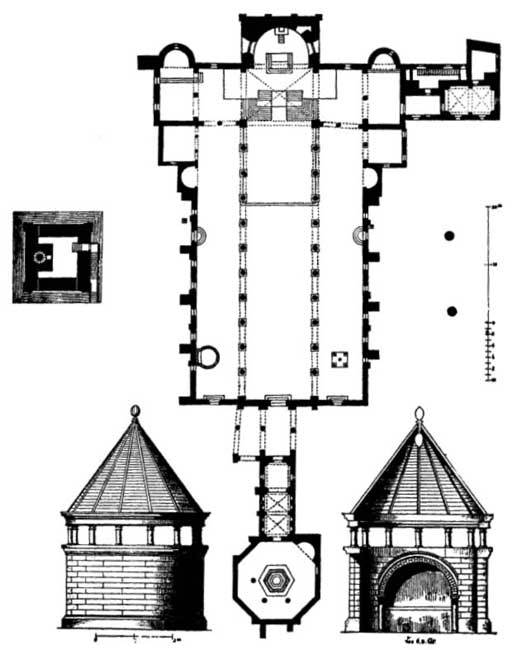
The cathedral was much damaged by the earthquake of 998, and Poppo began to rebuild it after the Latcran Council of 1027 had declared the see of Aquileia first in Italy after Rome, It was sufficiently finished in 1031 for it to be consecrated by him on the festival of the patron saint (July 13), two Roman cardinal-bishops and twelve bishops being present, as a later inscription states. Of this building the greater part remains, though with considerable alterations and additions made in the fourteenth century, after the earthquake of 1348, and in the fifteenth century. The twenty columns of the nave arcade, some of which are granite and some Istrian limestone, show by their different heights and thickness that they came from other buildings. Some of them are in more than one piece. The bases are Attic of different heights and are of Poppo's time, as the caps appear to be also. Two similar caps are in the churchyard; and one, hollowed out, is used as a holy-water basin. Some of the same character were found at Monastero under another basilica. The central nave is 39 ft. broad, and the aisles 26 ft. The transept is about 136 ft. long, with an apse 32 ft. 6 in. broad opening from it, 21 ft. deep. The exterior length of the building is 218 ft. The round arches from the aisles to the transepts are older than the nave arcade. The columns are antique; that on the south has also a Corinthian cap, but the base is Romanesque. The base of the northern column is a shapeless block; the cap is like those of the nave, but the super-abacus is plain. Across the transepts two round arches are thrown in a line with the aisle walls, resting on very thin columns of cipollino; that on the south is of several pieces not belonging to each other. The caps vary in design. North and south of these arches are the chapels, with their apses. The arch of the apse is round, with two antique granite columns; it had three small round windows in it. The bishop's throne is from the earlier church. Beneath the late-Gothic seats round the apse are the seats of Poppo's time, with remains of inscriptions: the pavement of marble slabs and mosaic patterns is also due to him.
In 1896 frescoes of the eleventh century were discovered beneath the rococo plaster-work in the semi-dome. In the centre is the Madonna and Child enthroned in a vesica above six saints, and surrounded by the symbols of the Evangelists. The saints to the spectator's right are SS. Hermagoras, Fortunatus, and Euphemia; to the left are SS. Mark, Hilarus, and Titianus. Among them are persons on a smaller scale—Poppo holding his church, the emperor (Conrad II.) and the empress, an unnamed person, and a boy "Einricus" (afterwards Henry III.); a border of medallions, with heads and peacocks alternately, surrounds the field. Below, between the three windows, are six more saints, three on each side. Two different hands can be traced. In the crypt are also paintings of the eleventh and twelfth centuries, the difference in technique being marked. On the vaults are the legends of SS. Hermagoras and Fortunatus; in the lunettes the life of the Virgin, angels, Apostles, and saints, and on the soffits of the arches; and painted hangings in outline with figure-subjects upon them, on the lower part of the wall. There is one subject from the life of S. Mark. Two kinds of intonaco are used, one hard and white, the other grey and sandier. There are two rows of pillars in the crypt, six in the wall round the apse, and two (Renaissance) at the sides of the westward niche, which looks like a western apse with altar in front of it. The roof is a wagon vault pierced with cross-vaults, but not truly quadripartite, and the caps a curious combination of badly cut foliage and scrolls and round-arched arcading. Iron grilles of 1500 isolate the space within the columns where the sarcophagus stands. There were doorways to the triangular spaces left between the apse and the rectangular external form, which were walled up at a later date. The stairs to the crypt go through the side wings of the Renaissance tribune above with a crookedly set room on each side, with little windows in the walls, one of which is blocked by the marble sheeting, while those towards the crypt are also walled up, showing that the structure is early, and is probably Poppo's. The doors are of iron, with lions' heads on the south side and man-headed animals on the other.
The Patriarch Raimondo della Torre (who died in 1299) built the chapel of SS. Ambrogio and Margherita, which was used as the sepulchral chapel of the family. It opens to the nave, with two pointed arches with an oculus above. In the middle of the side wall, between two sarcophagi of white marble, is that of Allegranza di Rho, second wife of Moschino della Torre and mother of the Patriarch Gastone. She died July 23, 1300, and her sarcophagus is the only one of the five in the chapel inscribed. On the front are reliefs, and on the sloping cover her effigy. One of those at her side has a figure of a person in subdeacon's dress, with a key, no doubt Rainaldo della Torre, treasurer to the church and brother of Gastone. His will of March 31, 1332, gives a precise description of the monument he wished to have erected to him. There was to be an archivolt over it, but if it was erected it must have fallen in the earthquake of 1348, as there are no traces of it. One of red marble, with a patriarch fully robed, with pallium and mitre, standing on a dragon between a processional cross and a crozier, with censing angels on each side of the head, is that of either Raimondo or Pagano. It also bears a relief of the Annunciation. On the front of another are three circular plaques with the Agnus Dei in the centre and crosses in the others; in the spaces between are flatly treated towers, the arms of the family. In the north transept a sarcophagus front, or altar, stands against the wall supported on pillars. It has five ogee trefoil niches with saints within them, and a framing of late Gothic foliage, with half-lengths of angels in the spandrils. The central saint is accompanied by two small kneeling donors; the other four are the Aquileian virgins. In the south transept is a sarcophagus on four Romanesque columns with twisted pillars at the corners, and the sides of the central subject (S. Hermagoras, with the four virgins small, on their knees, and the hand of God above). The spaces between are inlaid with red marble. The caps appear to be of the fourteenth century, the period of the foliage cornice.
As a consequence of the earthquake of January 25, 1348, a good part of the church fell down on October 19. Constant wars prevented the patriarch from having money to spend on its restoration. A document of 1354 reveals a lamentable state of things—the population was but 100—worshippers did not come, and the clergy had fled to save themselves from sickness and death; no one came to the services of Holy Week because the roads were under water, &c.; with a final request that Udine might be named as the seat of the patriarchate. The rebuilding was commenced under Lodovico della Torre (1360) and finished under Marquard da Randeck (1365-1380), the architect being unknown. At this time the nave arcade was made pointed, and some of the super-abaci carved with Gothic foliage. After Venice had expropriated the patriarch (in 1420) money was spent upon the cathedral. In 1479 the choir seats were renewed. In 1493, under Nicolò Donato, the winter choir was renewed. In 1495 the high-altar was erected, upon which Antonio di Osteno, Bernardino di Bissone, and Domenico di Udine were employed. Work was also done in the crypt, in connection with the better preservation of the relics of some saints. In 1498 the tribune appears to have been made, under Domenico Grimani. This is a very decorative arrangement, with a central feature, flanked by two flights of steps, and side platforms furnished with a balustrade, which project some way into the transepts, and are carved elaborately with graceful arabesques. In the centre below is a niche with shell-head and grated window, through which the inside of the crypt is visible. To the right is a ciborium altar, with a relief of Christ in the tomb half-length, supported by the Virgin and S. John, flanked by two scroll-bearing angels. An inscription describes it as an oratory, where relics of the saints are venerated. The pillars bear an architrave—a shell-he ad beneath, an arch above, and a gable termination of early Renaissance shape—above a shallow cornice. The effect is heavy. The left side was used as a singing-gallery. In the apse hangs a picture by Pellegrino di S. Daniele (which was put up in 1503), a good deal repainted—a Risen Christ with SS. Peter and Herniagoras. The fine frame was carved by Giovanni Pietro di Udine in 1500, and gilded two years later by Antonio de' Tironi of Bergamo. Before 1484 the floor was of beaten earth; at that time a pavement of red Veronese marble was commenced, completed in 1544. The aisles are at a slightly higher level than the nave. The Gothic roof was remade on the pattern of those of SS. Zeno and Fermo, Verona, in 1526 (signed Giuliano q Vivente of Udine), and restored in 1560. It is now painted in chequers. Beams resting on corbels beneath the windows cross the nave, while the aisles have a flat panelled roof, with bosses at the intersections of the framing.
The font is supported by four small pillars surrounding a larger central one. In the north aisle is a circular building with a conical wooden roof supported upon a little colonnade—work of the fifteenth century in its present form. There was, however, a "sepolcro"—a copy of the Holy Sepulchre—here, with a flat cupola, mentioned in 1077, and described as being near the grave of Patriarch Sigeard, and in 1085 an altar was consecrated within it by Patriarch Frederick II. The ceremony of carrying the Host thither on Good Friday and locking and sealing the door, from which it was brought out on Easter Day, lasted till the suppression of the patriarchate in 1751.
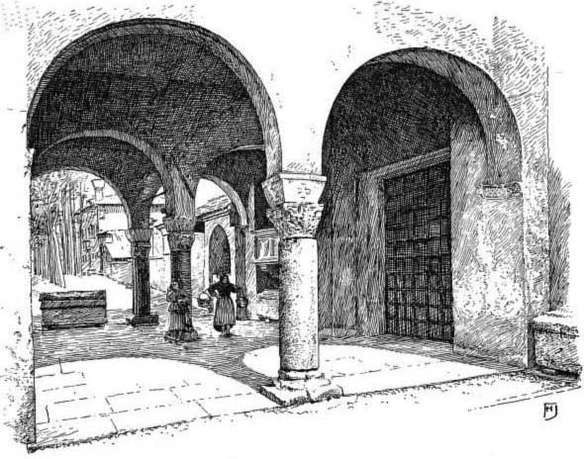
At that time the treasure and archives were divided between the bishoprics of Görz and Udine. The precious objects were stolen from Udine, and have disappeared, but at Görz there still remain several. There is a bishop's crozier of the end of the twelfth century, Romanesque in style, decorated with seven pieces of rock-crystal arranged diagonally, and with a knop of the same, set at a later date. The crook is set with precious stones, rubies, turquoises, aquamarine, and lapis lazuli. Within is the Lamb holding a cross; under it the whorl finishes with a dragon. A much older bishop's staff is of worm-eaten wood—set in metal at a later date to preserve it from destruction—said to have been given to S. Hermagoras by S. Peter or S. Mark. There is also a great crucifix of gilded silver on a wood basis worked with a rough naturalism free from Byzantine influence. The cross is made into a tree, from which grapes hang; the nimbus is set with large amethysts and small rubies. Of the same period is a fine book-cover of gilded silver with the subject of the Ascension. Christ enthroned in a vesica is supported by two angels; below is the Madonna as orante, surrounded by the Apostles. The border consists of fine leaf-scrolls, late twelfth century in character. A silver statuette of the Madonna and Child is of the fourteenth century. The Child is nude, tall, and thin, and wears a crown decorated with pearls and trefoils. The naked portions are matt silver, the draperies are gilded. It stands on a pedestal of three ornamented steps. The fate of the precious objects is reversed in the case of the documents. Those sent to Görz have disappeared, whilst Udine still preserves a considerable number. At Aquileia the only object remaining from the treasury is a statue of the Madonna and Child, of Istrian marble, heavily painted. The work resembles in style the carving at S. Giovanni in Fonte, Verona.
The campanile must have been built by Poppo, although the base looks like Roman masonry, since the mosaics go right under it, but it was added to later, and the octagonal bell-chamber is inscribed: "MD · XLVIII TADEVS · LVRANVS · HOC · O · FECIT." It is 39 ft. square and the walls are over 7 ft. thick. The entrance is approached by 27 steps. It is 70 ft. to the floor of the bell-chamber.
The narthex has three thick antique pillars, part granite and part marble, with heavy early Christian Corinthian caps and super-abaci with crosses upon them. The baptistery lies to the west of the narthex, united to it by a building known as the Chiesa dei Pagani. This consists of three bays with a descent of three steps from the first, over which there was once a cupola. The other bays are cross-vaulted, and there are several round-headed windows. In the pavement is a curious pierced stone. It has a cross with the Agnus Dei in the centre (pierced), and four little window shapes in the angles with round-headed tympana and oblong piercings below. There was a second story; part of the wall of this remains, constructed of ancient tiles, which were much used in Aquileia in the Middle Ages; an inscription records a restoration in 1738. The baptistery was originally a Roman building, square externally and octagonal within, with four niches, one of which is partially preserved. Remains of the others have been found outside the octagon. There was an hexagonal font in the centre, and in the angles of the walls are the springings of vaults; there are also six pillar-stumps of different thicknesses. Most of the present building is modern, the result of several restorations. On each side of the baptistery and Chiesa dei Pagani were halls with mosaic floors of the Christian period, of which that to the south was least damaged when discovered; it had three patterned fields, with borders. The open hall between was stone-paved—a bit of the paving was found a foot deeper than the original floor of the baptistery.
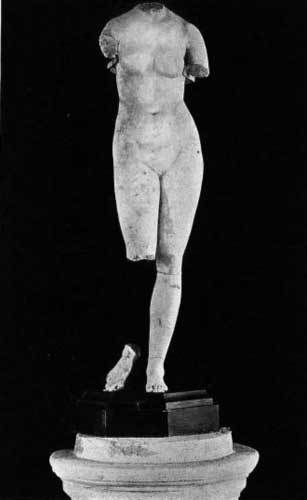
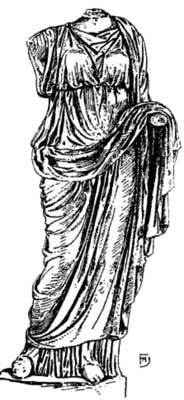
ANTIQUE STATUE IN THE MUSEUM, AQUILEIA
The museum contains a quantity of exceedingly interesting objects, the fruit of excavations, which the director, Signor Maionica, most kindly piloted me through, calling attention to the various objects of special interest and giving me details about them of which otherwise I should have been ignorant. The collection of objects in amber, many of them stained a fine red, is the finest in existence, though the most splendid examples have gone to the British Museum, to Udine and Görz. The sculptured objects include a very beautiful youthful Venus, a girl apparently of about 17, a draped statue of the Emperor Claudius in Greek costume, one of Tiberius as Pontifex Maximus (both found near the theatre), one of Livia, showing the arrangement of the back hair, and marble wigs to place upon the heads of statues to keep them in the fashion. There is also a draped Venus with a Cupid hiding beneath her robe, a copy of the Aura (Spring-rain) of Scopas, of which another is in the museum at Trieste, and a most interesting sculptor's model for use in the studio, showing how arms and legs of other pieces of marble were affixed to statues. A pedestal shows the life of Priapus, from his birth in the spring to his winter's inactivity; others have winged Cupids bearing torches and bestriding dolphins, the idea being of a voyage to the Islands of the Blest. A panel shows Bacchanalian Cupids; one desires to drink, one is drinking from a crater, another, supported away, inebriated; the robed master of the feast bears a sceptre and is playing the Pan-pipes. Another relief represents a banquet in a triclinium. One man sounds a double pipe, another carries food to the guests, one of whom is singing an obscene song, which disgusts the women, who make the sign of displeasure at him. In a relief of the time of Heliogabalus a meteoric stone is seen carried in procession, preceded by duumvirs, lictors, &c.—an evidence of an Oriental cult practised in Aquileia. Five great medallions from the same building show busts in very high relief of Jupiter, Mercury, Vulcan, Venus, and Minerva. A stone table with a sundial and windrose engraved upon it has a low seat on three sides, but the fourth free, so that the hour may be seen at all times of the day without the annoyance of dodging one's shadow. The letters of the inscription point to the second century A.D. as the date of its production. Many sarcophagi come from the north-east of Aquileia near Columbara, where a monument was found much resembling those of Petra and Baalbek in its forms. Inscriptions name clothiers, fullers, joiners, linen-weavers, builders and servants, purple-dyers, pikesmiths, a silver-worker, an Oriental pearl merchant with a sign of the city of Rome, &c. In the eighteenth century the Mint was discovered, with bars of silver and baskets of coin. A fine plate of beaten silver, with the story of Triptolemus, found here is now at Vienna.
Many pieces of ornament are preserved, often very finely modelled and also with traces of colour. The larger pieces, many of which are coarse in workmanship, are housed under a long shed in the open; among them are slabs of ninth-century ornament, lead coffins, and pipes with pointed covers to keep the sand out, urns for ashes, &c. There appears to have been a Roman rococo at Aquileia, earlier than at Spalato or Florence. Here, too, are some of the early Christian mosaics found during the excavations in and around the cathedral. Especially beautiful are the fragments with peacocks and other birds, and lambs, with freely growing scrolls of vine. An asbestos net, found at Monastero, used to wrap round the body during cremation and so keep the bones together, is interesting, as are lachrymatories misshapen by the flames, small bottles of rock-crystal beautifully cut, a few enamelled objects and carvings in ivory, principally children's toys. Rings set with gems were made of gold for the nobles and of iron for the citizens, who at a later period used silver and even gold. Over 40,000 coins have been found in the course of the excavations, and lamps bearing no less than 800 different makers' marks. The marks are the same as those found all through Istria, Dalmatia, and the islands, proving a large export trade. The most important were those of C. Vibio Pansa, whose stamp (or those of his successors) is found in conjunction with imperial names till the time of Constantine. In the delta of the Isonzo, near Monfalcone, a portion was called "Insula Pansiana" even in the Middle Ages. A river in the bay of Monfalcone is still called Panzano, and near there is a place of the same name. There were also glass works at S. Stefano, Aquileia, where fragments of coloured glass have been found.
Ruskin refers to a curious ceremony, instituted in the twelfth century, which was observed in Venice till 1549 "in memorial of the submission of Woldaric, patriarch of Aquileia, who, having taken up arms against the patriarch of Grado, and being defeated and taken prisoner by the Venetians, was sentenced, not to death, but to send every year on 'Giovedi Grasso' sixty-two large loaves, twelve fat pigs, and a bull, to the Doge; the bull being understood to represent the patriarch and the twelve pigs his clergy; and the ceremonies of the day consisting in the decapitation of these representatives, and a distribution of their joints among the senators; together with a symbolic record of the attack on Aquileia, by the erection of a wooden castle in the rooms of the Ducal Palace, which the Doge and the Senate attacked and demolished with clubs." Mutinelli quotes the decree.
The patriarchate reached the zenith of its power under Volfkertis of Cologne, known to the Italians as Volchero. He was elected in 1204, and ruled till 1218. His dioceses included seventeen bishoprics of Venice on terra firma, stretching as far as Como and Trent, and six in Istria. The Venetian island bishoprics, by the convention of 1180, were under the Patriarch of Grado. In 1208 his dominions were so much increased that they almost exceeded those of the Pope in extent. He held the duchies of Carniola and Friuli, as well as the marquisate of Istria. He struck his own coins, of which there are two types, one closely resembling those of Aix-la-Chapelle and Cologne, and governed constitutionally with the assistance of a parliament of three estates.
IV
GRADO
From Aquileia a steam-launch plies back and forth to Grado, a distance of some six or seven miles, at first along a canal with grassy banks plentifully besprinkled with giant snowdrops in the spring, then through wide stretches of lagoon along a channel, marked by piles, sometimes approaching the fishermen's huts, which occupy the summit of slight elevations rising but little above the surface of the water. These huts are mere shelters of reeds, and, one would think, quite unfit for human habitation, but close by them the nets may be seen drying, and perhaps food in course of preparation over an open fire, while the boat, thrust into a creek or tied to a stake, occupies the foreground. These wide-spreading lagoons, the resort of many kinds of water-fowl in their passage from north to south and vice versâ, are very pictorial. The enclosures in which fish brought in by the tide are retained, the beds of reeds and rushes with yellow water-lilies, the figures of women and children wading and seeking fishy treasures, provide excellent material for the artist. Occasionally a boat passes in which a woman is taking fish to Aquileia, leaving behind it a long trail of ripples. The two great campanili, of Grado which we are nearing, and of Aquileia passing into the distance behind us, each with its cluster of low buildings around, are prominent against the horizon showing dark against the fine cumulus clouds, which are heaped in sharply defined masses against the blue of the upper sky and rise in threatening billows like exhalations from some vast cauldron, soon to fade away innocuously in the late afternoon.
Grado is on one of the islands of which a chain stretches from the mouth of the Isonzo to that of the Brenta right across the northern border of the Adriatic. Its port was one of the harbours of Aquileia, at first for purposes of war, but later for those of commerce. The town was square in plan, walled, and full of people. Cassiodorus speaks of its material conditions. The modern town is most picturesque, with narrow streets and numerous courtyards, with outside staircases, quaint shops, and fascinating plays of light and shade, and so much of the life of the people passes in the open air that there is always interesting matter for observation. It is a seaside resort, visited a good deal for bathing during the summer months, and there is also, as at Rovigno, an establishment for scrofulous children. But its chief attraction for us is archæological, for it contains early Christian antiquities of considerable importance.
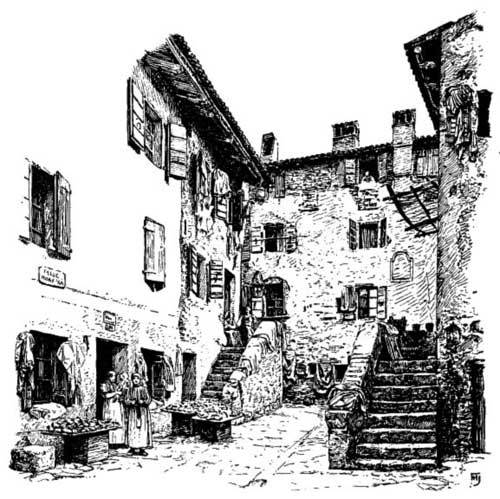
Its greatest prosperity was between the time of the great wanderings of the peoples and the descent of the barbarians into Italy. Its patriarch took the lead in establishing the government of the islands from which the Venetian Republic sprang. In 460 Nicetas called all the bishops, clergy, and leading officials of the islands together to deliberate on the question of government, and, after discussion, they agreed to establish one under the directorship of Tribunes. The first tribune was to live at Grado, with three others, called "maggiori," but depending upon him, one for Rivoalto, one for Candeana, and one for Dorsea, living at Rialto, Eraclea, and Torcello respectively. They had charge of the administration of justice, presided over the execution of the laws, enforced discipline, and met at times in council to discuss propositions laid before them. Grado lost its supremacy in 696, when the assembly held at Eraclea gave it to that city, though the Patriarch of Grado, Cristoforo, was given equality with the three tribunes which Eraclea then had. The next year the first doge, Paolo Lucio Anafesto, was elected. It was by means of Fortunatus of Trieste, Patriarch of Grado (803-825), that the cry of the Istrians, oppressed by the Frankish duke and his supporters, came to the ears of Charlemagne, with the result that after a strict inquiry held at Risano in 804, when the representatives of the cities and castella exposed the odious proceedings of the bishop, the duke, and their adherents, they obtained redress. In 875 the Saracens attacked Grado, but were repulsed. The next year a similar attack was made by the Slavs of Croatia and Dalmatia, but the Doge Orso met them, defeated them, and gave back to several Istrian towns objects of which they had been robbed.
Between Grado and Aquileia there was a constant struggle for supremacy, which was in reality a contest between Venice and the empire, Aquileia standing for the latter and Grado for the former. A formal peace was concluded between them during the Lateran Council of 1180, by which the Patriarch of Grado renounced all claims over the Istrian bishoprics, except as regards the hundred amphoras of wine sent by Capodistria from 1075, given as a personal honour to the Doge Pietro Candiano, and by him handed over to the Patriarch of Grado. In 452 the Patriarch of Aquileia fled to Grado from the Huns, returning after they had passed, and in 578, when Aquileia had become Lombard, Paulinus transferred his seat to Grado, thus putting himself under Byzantine protection. In 579 a synod was held in the church. From 607 there were two patriarchs—one in Grado and one in Aquileia—established for political reasons by the Lombards; they were schismatical, that is to say, adherents of the "three chapters." During the continuance of this schism, in 610, three Istrian bishops were taken from their very churches by the military, and carried off to Grado, where they were compelled to bend to the Imperial will in the matter. Gregory III. sanctioned the division of the two patriarchates in 731, both having become orthodox, Aquileia in 698 and Grado in 715. In 1451 the patriarchate of Grado was transferred to Venice, where the patriarch had been living for a long time.
The foundations of the cathedral were laid under Nicetas (456) by the architect Paulus, who was sent to him by Pope Leo I. The plan is Romanesque, a basilica with nave and aisles and no transept, the nave terminating in an apse eastward. It has two western doors, which open into a portico of almost the whole breadth of the church, part being cut off by the campanile, which is nearly 20 ft. square and over 160 ft. high. The clerestory and low-pitched wooden roof of the nave are supported by two piers and ten columns on each side. The columns are antique, but of varied material—cipollino, white and black and white-veined marble, and granite; and there is one of a rosy and white breccia. The caps vary both in design and size, and have been repaired with stucco. Some of them are decadent Roman and the rest Byzantine: the bases are hidden by a square wooden boxing. The eleven arches of the nave arcade are round. The round-headed windows of both nave and aisles had pierced slabs of stone in them, but in 1740 the openings were made lunette-shaped. One pierced slab of the ninth century has been found, and is now placed high up in the apse above the patriarch's throne. Under Fortunatus and John the Younger, about the beginning of the ninth century, the church appears to have been beautified; and again, in the second half of the tenth, under Vitalis. It is related that the relics were then provided with fresh receptacles and inscriptions. The choir occupies three bays of the nave, with a modern enclosure raised by several steps. Just outside the rail, by the fourth column on the left, stands the interesting pulpit, which has a later canopy, but itself appears to be of the ninth century, judging by the columns, two of which are twisted, and by the carving of the symbols of the Evangelists, which seems to be rather later. On the other hand, there is a square O in the inscription on S. John's book, of which other instances occur at Cattaro in an inscription of the ninth century, and in one of the seventh at Spalato. The pulpit is sexfoil in plan; one side is open, and one has a large cross carved upon it. The canopy has six fourteenth or fifteenth-century octagonal colonnettes, supporting ogee trefoiled arches with a domical termination, coloured in red and white chequers, and with scrolls and rosettes of red on the spandrils of the arches below. The shape and decoration show Arab influence strongly.
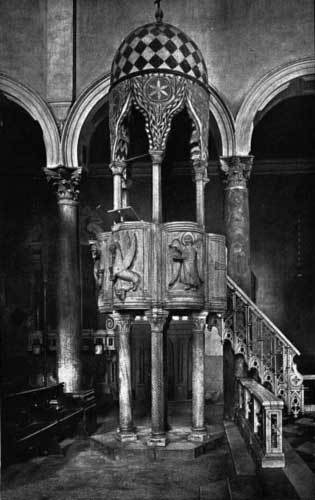
PULPIT IN THE CATHEDRAL, GRADO
In the pavement is still preserved a great deal of that laid down by Elias in the sixth century. It filled the nave, being entirely worked in tesseræ of very few colours—black, a green-grey, red, yellow, and white. From the west door a pattern, surrounded by a border, stretches as far as the fifth pair of columns. It consists of a central band of a wavy pattern, interrupted by inscriptions and medallions; the easternmost one is blank and has a running border, with the corners of the square (cut off by the band of inscriptions) filled with scroll-work. The side portions are cut up into squares by bands of open interlacings, with ivy leaves in the interstices, and different designs within the squares, or with inscriptions, most of them in Latin, but one in Greek. They record the gift of so many feet of pavement, as at Parenzo; and one donor, Laurentius the Viscount Palatine, seems to have been generous to both cathedrals. A long inscription leaves no doubt as to the date, and that it was laid down under the Patriarch Elias (571-585); it runs: "Atria quae cernis vario formata decore squallida sub picto caelatur marmore tellus longa vetustatis senio fuscaverat ætas prisca en cesserunt magno novitatis honori praesulis Haeliae studio praestante beati haec sunt tecta pio semper devota timori."
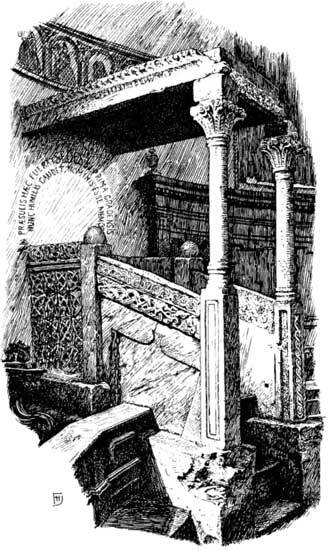
THE PATRIARCH'S THRONE. CATHEDRAL, GRADO
The flat ceilings and the rococo stucco-work are due to the restorations of 1740. The apse contains remains of mediæval painting—a seated Christ of colossal size surrounded by the symbols of the four Evangelists, with raised right hand and a closed book in the left; on one side S. John the Baptist holding an open scroll, and on the other a saint in green, with gold-shot stole and nimbus, but no attribute—both larger than life. The corners are occupied by the patron saints, Hermagoras and Fortunatus. Round the apse, just above the patriarch's seat, runs a row of portraits of bishops of later date, half-lengths, beneath a round-arched arcade on a gold ground. On the left nave pier, near the door, are the remains of a painting of S. Helena, who has nimbus, cross, and book. In the centre of the apse is the ancient patriarch's seat, with an inscription upon the wall commemorating the ancient supremacy of the see: it is mainly composed of mutilated ninth-century carved slabs, probably portions of the chancel of that date. Other slabs with similar designs and portions of a ciborium are preserved in a little collection of marbles under a shed behind the apse, where are also several sarcophagi and other antique fragments.
In the treasury are two early reliquaries of silver, found beneath the high-altar in August, 1871. One is cylindrical, with a convex lid, upon which is represented in relief the Virgin enthroned, with the Babe at her breast. Her right hand holds a cross-headed sceptre, and behind her head is a nimbus with the usual monogram, MΗ ΘT. The cylinder has no decoration but two bands of names of saints in Roman capital letters. These are: "Sanc. Maria, Sanc. Vitvs, Scs. Cassianvs, Sanc. Pancrativs, Sanc. Ypolitvs, Sanc. Apollinaris, Sanc. Martinvs." Within is a central cylinder and six compartments radiating from it, which contained a small cylindrical vase of gold with rings round it, a little glass flask, closed up and containing water, a little gold box with crosses and a leaf pattern on the outside, and a cross of dark-green enamel on the cover, a small slab of chalk or cement with a Greek cross imprinted on it, and several thin gold plates with the names of saints upon them. Several of the printed accounts of the discovery of this treasure say that there were six of these plates in the casket; but the glass case which encloses it and its contents has eleven, with the names as follows: "Domna Maria, Scs. Cassianvs, Sc. Martinvs, Sc. Brancativs, Scs. Troteomvs, Sca. Agnes, Scs. Bitvs, Scs. Apolinnaris, Scs. Hyppolitvs, Scs. Sabastianvs, Scs. Severvs." Dr. Kandler thought that it came from the church of S. Niceta in Aquileia, and was brought to the island with other treasures in 452, for safety, from Attila. De Rossi thought that the appellative "Domna" distinguishing the Virgin was an argument against such high antiquity; but in a later number of his "Bullettino" he described an inscription of about 457 at Loja, in Spain, in which the title "Domnus" or "Domna" is applied to all the saints, including the Virgin. There is a legend that "When Paul was patriarch of Aquileia the priest Geminianus was told in a vision to go to the destroyed city of Trieste to find the bodies of 42 martyrs buried between the wall of the church dedicated to them and the city wall. Going thither with many other Venetians he found the holy bodies in the specified place, covered over with marble slabs, and, taking them, went to the destroyed city of Aquileia, where he added to the relics the bodies of Cantius, Cantianus, Cantianilla, and the virgins Euphemia, Dorothea, Thecla, and Erasma, and then took them all to Grado." Paul is Paulinus I. (557-569), and the occurrence took place after the Lombards had gone by in 568. The forty-two martyrs were laid side by side in the church of S. Vitale, and Paul died the next year.
The other reliquary is elliptical, and has upon its sides reliefs and inscriptions bordered with a rough leaf-moulding. Round the middle are eight medallions with male and female heads, divided into two groups of five and three by palm-trees. Above and below is a row of names; those of the top row being: "☦ Sanctvs Cantivs, Sanc. Cantianvs, Sancta Cantianilla, Santvs Qvirinvs, Santvs Latinv." The lower row runs: "☦ S. Lavrentivs, vs loannes, vs Niceforvs Santisreddedidbotvm" (vir spectabilis, &c., reddidit votum). The use of b for v is characteristic of the period of the Patriarch Elias. The cover is slightly domical; upon it are two lambs, and between them a gemmed cross. They stand on a hill from which the four rivers of Paradise flow. Within was a second silver casket filled with water, and some remains of relics. At Pola some reliquaries of somewhat the same kind were found, of which a description will be given later.
In the Museo Sacro of the Vatican library is a similar capsella found at Aïn Beida in Tunisia. It is oval, and has the same bands of ornament; round the body are reliefs. On one side is a lamb with a cross above his back, and on either side four sheep (with tufted tails, a Tunisian variety) coming towards him from an arched and pillared building. On the other is the Labarum monogram with ornamental terminations on a hill from which the four Paradise streams flow; a stag on either side kneels to drink. On the cover stands a saint, on the four Paradise streams, between two lighted tapers in candlesticks, holding a crown; whilst the hand of God holds another over his head. There are no nimbi. The reliquary was empty and without any compartments. De Rossi pronounced it to be of the sixth century, or the end of the fifth.
The treasury also contains an oblong fourteenth-century casket and two Limoges gemellions, as well as a good deal of late silver work, and an interesting altar frontal. The gemellions are champlevé on copper, with engraved backs showing traces of gilding. A central circle on the face contains a shield with a rampant lion, enamelled in blue; round it is a quatrefoil made by four larger circles which overlap at the reentering angle. The spandril spaces are filled with dragon-like monsters on a green ground. The ring and the shield show metal. The quatrefoil is outlined with white, and filled with scrolls and figures fighting with each other or with beasts. The corner pieces have a little tower and scrolls, the windows and cornice are red enamel, the ground is green. The outside edge has a zigzag of blue enamel. The hole through which the water was poured over the hands has a spout representing an animal's head. I believe these basins to be the only examples of Limoges work to be found along the coast.
The altar-frontal is inscribed: "☦ MCCCLXII de Settembrio in lo tempo del nobele Miser Andrea Contarini Doxe di Vanesia e Miser Francesco Contarini Conte de' Grado fo fatta questa palla e Donado Macalorso da Vinesia me fece." It is of silver-gilt, 4 ft. 7 in. high and 7 ft. 4 in. long, with twenty-one divisions, in three rows of seven panels, the bars being covered with leaf scrolls and with medallion half-lengths of Greek saints at the crossings. In the upper row, in the middle panel, is a half-length "Ecce Homo," right and left are the symbols of the Evangelists, and the outer corners have the Annunciation—the Virgin on the right, and the angel on the left. In the centre of the second row Christ sits in the attitude of blessing, with raised right hand, and holding an open book in the left. On its pages is inscribed: "Ego sum lux mundi qui in me crediderit non morietur in æternum Amen." On the right are SS. John, Paul, and Fortunatus; on the left, SS. Felix, Peter, and Martha. In the lowest row the centre shows a chalice with the Host; on the right, SS. Hermagoras, Thecla, and Erasma; on the left, SS. Dorothea, Euphemia, and another Fortunatus.
The patriarchal seat given by Heraclius to the Patriarch Primigenius was taken in 1520 to S. Mark's, Venice, where it may still be seen in the treasury. Pasini says it is certainly of Egyptian manufacture, in proof of which both the character of the ornaments and tradition are invoked. The Chronicles of the Acts of S. Mark in Aquileia, which are earlier than the eleventh century, say that it was covered with ivory plaques, "utique antiquo," but the large amount of carving upon it leaves little space for the attachment of further ornament. Its history seems quite clear. Heraclius brought it from Alexandria to Constantinople about 630, and between 1520 and 1534 it was behind the high-altar of S. Mark's. In the latter year it was moved into the baptistery on to the altar, where it stayed till taken into the treasury.
It is made of Oriental cipollino. The medallion at the top is cemented on. On it is a crux ansata, with two figures at the sides, both in front and behind, believed to be the four Evangelists. On the exterior of the arms are ten lighted tapers, thought to symbolise the ten churches founded in Africa by SS. Matthew and Mark. Below the medallion in front is a Lamb on a hill, from which the rivers of Paradise flow, and on which is either a vine or a fig-tree. On the back are an eagle and a lion, each with six wings. The background is starred, there are two palms at the bottom, and a Tree of Life in the space between the lion's lower wings. Above the eagle's head is a crescent. Beneath the tapers on the outside is a bull with six wings on a starred background, and on the other side an angel, also with six wings, with two palms below, and two little two-winged trumpeting angels in the top corners, on a similarly starred ground. These three sides have a band of lattice-work at the base; the front has a panel with zigzag lines. The inscription on the front has puzzled paleographists. It has been read as Hebrew and as stating that it is the chair of S. Mark. A hole in the back and another in the side are thought to have perhaps held the débris of the wooden chair which he actually used.
Herr Graeven believes that he has identified several plaques of ivory which belonged to the chair in different museums. They all display the type of head afterwards used for S. Paul in Western art, which Dr. Strzygowski has identified as representing S. Mark in Alexandrian ivories.
The octagonal baptistery, to the north of the cathedral, shows no sign of its age, which must no doubt be considerable; near to it is the church of S. Maria delle Grazie, which has fragments of similar paving to that in the cathedral, including the inscriptions. In the floor in front of the altar are also several pieces of ninth-century ciborium heads, and bits of twelfth-century carving. It is possible that the baptistery once had a canopy such as still exists at Cividale, and that the fragments here and at the cathedral formed part of it. The nave has six bays, with five antique columns on each side, of cipollino, granite, white and black, and white-veined marble. The caps are very varied. Some are Byzantine of the type of those at S. Apollinare in Classe; two are truncated reversed pyramids with roughly cut scrolls on the surface, and one of these has a super-abacus. Two of them are queer, rough things, with brackets at the angles in place of volutes, and a deep abacus sloping back, with a cross upon it. The bases of the pillars are boxed in, as at the cathedral. An antique base serves as support to the holy-water basin. The floor has been mended with slabs of red and white marble and tiles, and the mosaic goes on into the rooms which flank the apse, at the ends of the aisles. This arrangement of the plan is exactly the same as that in a church at Kanytelides not far from Tarsus, the plan of which Miss Lowthian Bell gives in her book on Cilicia and Lycaonia; it also occurs in the church of Bir-Umm-Ali in Tunisia. De Vogué gives two plans closely resembling it, and Mr. H.C. Butler describes some very similar plans near Is-Sanemên in the Northern Haurân (the ancient Ære), which are probably Constantinian. It seems certain that it is an Oriental importation, especially in connection with the fact that the free-standing apse, as in the earlier church at Parenzo and at Salona, occurs quite frequently in Cilicia and Lycaonia, as Miss Lowthian Bell shows.
Between Grado and Aquileia is a little island with a celebrated church, S. Maria di Barbana. In the early centuries of the Christian era legend says that a picture of the Virgin floated hither on a springtide, and was caught in the branches of a little tree, which lived till the middle of the nineteenth century when a great storm destroyed it. The picture and the church which contains it are the object of an annual pilgrimage on the Feast of the Assumption; people from all around accompany a sacred picture from Grado to visit it. On this day the lagoon is alive with numberless craft, the priests' boat leading, with banners and tapers and fully vested ecclesiastics; and the air resounds with simple church melodies. At Barbana the Virgin's picture waits on the pier to greet that from Grado; and report says that it has been observed to nod at the moment the sister picture reached the shore!
V
GRADO TO TRIESTE
There is a small steamer which plies from Grado to Trieste, going one day and returning the next, but fine weather is very necessary for that mode of travel, as the sea can be very rough between Venice and Trieste. We did not hit the day of its sailing, so retraced our steps to Villa Vicentina and went viâ Monfalcone and Nabresina. Between these two places the railway rises steadily, giving fine views over the sea and plain. Looking forward and back the pale-grey line of the viaducts winds round and about the slopes like some gigantic snake, or like the aqueducts of the Campagna of Rome. Here the grey limestone breaks through the vegetation more and more, for the line is approaching the lofty stony plateau of the Karst, and enormous heaps of débris accentuate the position of the numerous quarries. They are very extensive, going far into the rock, which is also pierced by many great hollows, like entrances to an unknown under-world. All over Istria these memorials of sunken river channels occur—a maze of holes and paths, in which the water is still sinking deeper through the porous stone as through a sieve. Curious funnel-shaped depressions often occur amid uniform slopes, several hundred feet across and sometimes 200 ft. deep, as if worn by ancient whirlpools, and many of the rivers become subterranean, sometimes coming to the surface again many miles away. The river Rjeka, for instance, enters into the grottoes of S. Canzian, near Divača—a succession of narrow abysses, hollows, pits, waterfalls, and stalactite grottoes, with pools in them; and other examples will be noted farther down the coast.
The Castle of Duino has been called "The pearl of the Coastlands." It stands finely upon its rock, just where the diluvial plain meets the lime or sandstone formation. In a couple of hundred paces or so the vegetation changes its character from that of upper Italy to the softness of the southern islands, the sheltered slope to the sea being like an evergreen garden. Aloes root in the rocks as at Sorrento, and even in winter the purple cyclamen may be found in flower. Its name in antiquity was Castrum Pucinum. Here Augustus had a villa, whence the best wine for his table was brought. From the line, too, the campanili of Grado and Aquileia are visible, far away over the plain, dark against lagoon or sky in the evening, or flashing white in the morning sun.
At Monfalcone we took corner seats in an unoccupied carriage, but while we were arranging our things an old man, rather infirm, got in and made me to understand that he wanted mine. German was the language which he spoke. I thought perhaps I was intruding, though there was nothing on the seat to show that it was taken, so gave it up. We had two nice youths, who were talking Italian, at the other end of the compartment, cadets of some kind in uniform, going home for the Easter holidays. The old man was very short-sighted and gazed at the landscape through a little telescope. When we left Nabresina and went the other way to run down to Trieste, the views changed to the other side of the carriage, and to my astonishment the selfish old fellow moved across and turned one of the youths out of his place! to which he submitted quite meekly.
The descent from the high land to the coast level is very fine, the eye ranging far over the blue water, headland projecting beyond headland, paler and more diaphanous, till the historic point of Salvore fades into the distance scarcely distinguishable. Below the blue is stained by the smoke of steamers and flecked with the many-coloured sails of other craft, while in the middle-distance populous Trieste stretches round the curve of the bay, with many vessels at its wharves, and the smoke from the Lloyd-Arsenal mingling with that from the iron-works at Muggia beyond S. Servolo across the bay; or, if it should be night, lines of lights define the long stretch of quays and streets like strings of pearls, and sparkle up the heights which the houses climb in several directions. Prosecco is passed, which gives its name to a celebrated wine much esteemed in Trieste; Miramar, with its memories of the ill-fated Maximilian of Mexico, who delighted in its beautiful situation and splendour of appointment; then comes Barcola, where excavations have proved the existence of Roman villas, which have enriched the museum of Trieste with many interesting objects; and at last the train slackens and stops at the west end of the town, in the fine station built with that disregard for economy of space and lavish expenditure of material which the Englishman finds remarkable in Continental railway management.
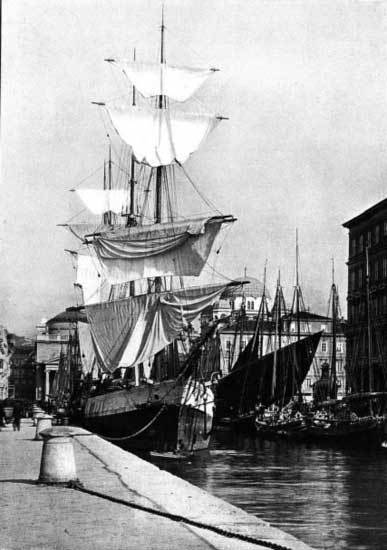
SHIPPING AT TRIESTE: THE CANAL, WITH THE GREEK CHURCH AND SANT' ANTONIO
Trieste is primarily a modern town, and the people are very proud of the important buildings which adorn it, as they have every right to be. The post office, for instance, is palatial, and round and near to the Piazza Grande are large and showy edifices which include the Town Hall and the Lloyd Palace, while the Greek church is a fine building in the Byzantine style, decorated with mosaics, and the church of Sant' Antonio makes a very effective termination to the Canale Grande. The broad quays are thronged with people of many nationalities and varied costumes, from the ships which lie along them flaunting ensigns of all kinds—red and white crosses, blue, yellow, and black stripes, moons and stars—Italian, Norwegian, Greek, Turkish, French, and Montenegrin, as well as Istrian and Dalmatian. The Greek ships generally lie in the Canal, the Norwegian by the Molo S. Carlo (so called from a warship which was sunk in 1737), and beyond the health office for the port at the Molo Giuseppino, where many others also lie, and the various passenger steamers in definite berths—the big English steamers at the end of the projecting quays. From a Sicilian ship hundreds of chests of oranges and lemons may be seen unloading; from a Venetian trabarcolo great heaps of onions and ropes of garlic; an Istrian boat disgorges a small mountain of green water-melons; from a Dalmatian cutter barrel after barrel of wine is rolled out, much of which goes on to Bordeaux (!); and the same from a Greek schooner near, while its neighbour from the Levant lands grapes and chests of raisins, and the Norwegian ship brings train oil or wood. Many Turkish and Albanian costumes lighten up the crowd with their brilliant colours and quaint shapes, Bosniaks and Montenegrins are occasionally seen, and a fair number of Morlacchi, though fewer than lower down the coast. The weather-beaten Chioggian fishermen, too, with their red caps and waist-scarves, black curly hair and great rings in their ears, are very picturesque, though less unusual. The Triestines themselves are abandoning the old costume of the countryman, the "mandriere," described as consisting of a long waistcoat with great silver buttons hanging on it, short black hose open at the knee, and a short black, close-fitting jacket. In summer he wore a broad, flapping hat; in winter a costly cap of so-called beaver-skin, which he had probably inherited from his grandfather. The women had broad frocks with coloured borders, and a short, heavy cloth jacket; and on their heads a white linen cloth hanging down behind, with costly lace upon it. The girl of the people, the "sessolotta," and the seamstress, the "sartorella," both go bareheaded, and are proud of their hair; they are fond of flowers and songs, and spend much of their time in the open air. I quote a Gradese song, which is also sung at Trieste, and must be of some antiquity, since it names the gondola, which is not now seen either at Grado or Trieste.
Lisetta guarda, bella è la luna
Argento piove sulla laguna,
Non è una nuvola; quieto è il mar—
Lisetta, in gondola ti voi menar?
La bavisella che va soffiando
Con quel bel viso di quando in quando
I biondi boccoli te li fa far—
Lisetta, in gondola ti voi menar?
The markets are rich with colour and well looked after. Officials go round constantly testing the articles of food sold, while the women (who are generally the sellers) look on with anxiety. A dozen or more, men and women, will bring in their wares on a cart, 10 or 15 ft. long, each putting a hand to the work.
The city existed in antiquity. Strabo knew it as a Carnian market-town. Various derivations of the Latin name "Tergeste" have been suggested, of which perhaps the most probable is from the Celtic "twr," water or sea, and "geste," colony, establishment. The fact that it was the only city held by the Carni on the sea-coast increases the probability. A Roman colony was established here in 129 B.C. The amount of tribute paid by the various cities is an index of their importance; both Pola and Parenzo paid more than Trieste. The Triestines were enrolled in the tribe Pupinia. The city was the landing-place for Roman troops, as was the case in Trajan's campaign against the Dacians. The fulling establishments of both Trieste and Pola were known far and wide.
The Romans made the hill of S. Giusto the centre of their colony, adding to the defensive works the temple of the Capitoline divinities, reconstructed with a magnificence worthy of the increased importance of the city by Clodius Quirinale, prefect of the fleet of Ravenna. Remains of it are the seven columns within the campanile (built in 1337 and restored in 1556), still bearing architrave, frieze, and cornice, and fragments of architectural carving and inscriptions encrusted in its walls, or preserved in the civic Museo Lapidario. There was an antique theatre at Trieste also; its shape only can be traced, though the name of the street is still "Rena Vecchia."
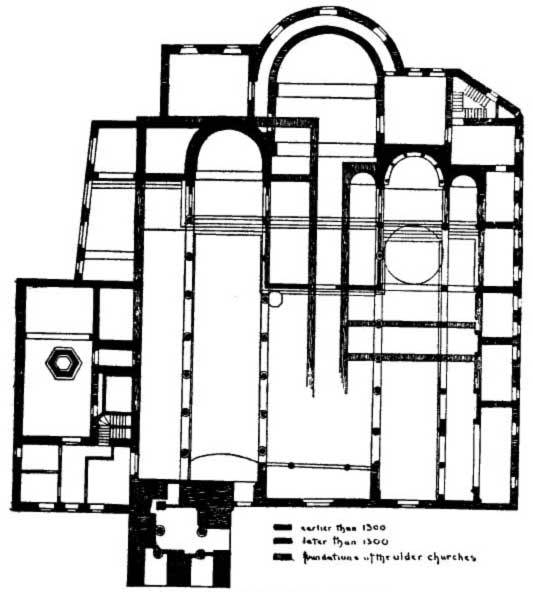
PLAN OF THE CATHEDRAL, TRIESTE
S. Hermagoras is said to have planted a church here about 50 A.D., by means of missionaries sent from Aquileia. S. Giusto, one of the patron saints of the city, probably died about 303. The other two are S. Sergio, a soldier, whose halberd still appears in the arms of the town, and S. Servolo, a pious youth who lived at one time in a grotto not far from this place, where they both were martyred. There is said to have been a bishop in the fourth century, but the list of authentic bishops begins with Frugiferus in the sixth. When Christianity triumphed, a church was built on the Capitol on the ruins of the ancient temple of Jupiter, Juno, and Minerva, dedicated to the Virgin of the Assumption. This was the part to the north of the present church (see plan), now the nave of the Holy Sacrament, "del Santissimo," in the apse of which are the mosaics of the twelve Apostles, probably earlier than the sixth century; while those in the vault, together with the border, are later. Till some twenty years ago a difference in the level of the floor between the three columns farthest east on each side (where the pulpit stands) marked the place of the original choir. The walled-up clerestory windows of the right side are ancient. The fourteen columns have been plastered over to make them uniform, but are evidently of different thicknesses, suggesting the use of older material. The caps are for the most part rough imitations of Corinthian, and the bases are stilted Attic in type. Of the baptistery nothing remains but the hexagonal font of marble in the chapel of S. John the Baptist, where there is also an ancient well and the apparatus for baptism by ablution, not now used. In the time of Justinian, the second, smaller, church (probably dedicated to SS. Giusto and Servolo) was erected at the south side by Bishop Frugiferus, about 550, as the monogram at the left of the apse shows. The mosaics in the apse are late Byzantine. Four great columns support a cupola in front of the presbytery, by means of four round arches, pendentives, and a drum, round which is an arcade of sixteen stilted round arches with foliated caps and prominently projecting abaci, which it is thought may belong to the original building, though the cupola itself is later. The small apse of the south aisle, with vaulted roof, also belonged to the first building. In front of the apses is a solea with a wagon vault, except in front of the small aisle apse, where it is quadripartite. The aisle is raised a step above the nave. The arcades are uniformly round-arched and stilted, and the caps generally have super-abaci. The north aisle has pointed arches at intervals and a flat roof; the nave of the Santissimo also has a flat roof with beams and brackets. There is a triumphal arch and one blocked window in the apse, with mosaic on the splay of the jamb.
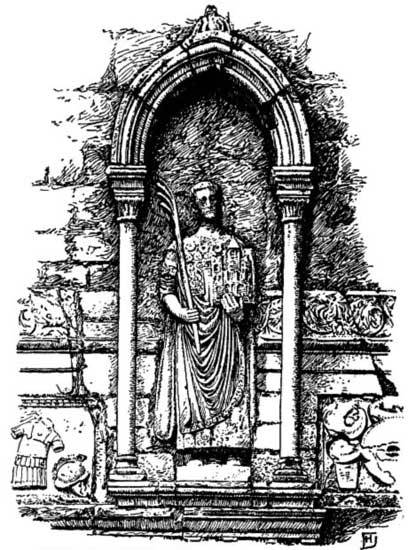
The mosaic in the semi-dome is probably an eleventh-century restoration of an older work, itself very carefully restored in 1863. The Virgin, robed in blue and holding the Divine Child to her bosom, is enthroned between the archangels Michael and Gabriel, who hold lilies and are robed in priestly costume. The Child blesses with the right hand in the Greek fashion. Below, on the wall, are figures of the Apostles, of a very early date, for SS. Peter and Paul are without their usual attributes, and the white draperies shaded with pale colours are early Christian in arrangement. Between the figures are palm-trees and conventional plant ornaments. The church is very dark, but the details of the mosaics may be studied in the careful copies in the museum. Above the altar of S. Giusto, to the right, in the semi-dome, SS. Giusto and Servolo stand on each side of our Saviour, beneath whose feet are two monsters, asp and basilisk. The central apse was reconstructed in the seventeenth century. The main reconstruction took place in the fourteenth century. The aisle walls of the two churches were demolished, and a nave built reaching from the pillars of one church to those of the other, thus uniting them under one roof, the western wall being placed contiguous to the campanile, and chapels added at each side. The memorial of the Gens Barbia was sawn in two and used as jambs for the west door, and inscriptions from the pedestals of statues and classical ornamental fragments were used in the campanile, both round the openings and close to the niche which encloses the statue of S. Giusto holding a model of the cathedral and castle. The consecration took place in 1385, Bishop Henry of Wildenstein officiating. Below the S. Giusto mosaics are wall-paintings of the fourteenth century, in niches of a much earlier date, with slender antique columns of precious marbles; in the centre the saint stands with a model of the city in his hand—the earliest record of its appearance extant; the other niches show his sufferings. In the niche of S. Apollinaris are remains of frescoes of two dates found in 1892, and thought to belong to the sixth and the tenth centuries; other remains of the fourteenth or fifteenth century, found under whitewash, prove that the whole church was ornamented with painting as the "Acts" relate. When the roof was raised the exterior of the drum of S. Giusto was enclosed within the church. The trilobate roof of the nave was mediæval, but has lately been restored. The façade also was restored in 1843, and the gravestones ranged along its base were then removed from the floor.
In the sacristy is a picture signed Tommaso Giottino, and dated 1313; it is thought to have belonged to the high-altar. There is a picture by Benedetto Carpaccio, of the Madonna, between SS. Giusto and Servolo, in the right-hand portion of the church. The treasury is kept in the chapel of S. Antonio Abate, to the north of the apse of the Santissimo; it is closed with a very fine late Renaissance German iron grille, with elaborate projecting floral bosses. It contains a thirteenth-century processional cross, with a repoussé Christ on a ground of gilded silver.
The original wheel-window of the façade is in the Museo Lapidario, just below the cathedral, where a good many well-heads of Venetian type are also preserved, and a few fragments of eighth and ninth-century carving, as well as the usual antique columns, bases, and inscriptions, one expects to find. There are also stone balista balls, relics of ancient sieges, many cinerary urns, and a few mutilated figures, grouped under the trees and upon the terraces which descend to the little temple in which the better pieces are housed. These include the lower half of a female figure, graceful in pose, and, in the folds of the drapery, a decree of the Decurions' College of Trieste in honour of the quæstor and Senator Fabius Severus (of the time of Antoninus Pius), engraved on one of two large pedestals, a sarcophagus and steles, the inscriptions from the jambs of the campanile, &c. The collection is mainly due to Dr. Dom. di Rossetti, who, in 1830, erected the monument to Winckelmann (murdered here in 1768), which is against one of the walls. Near the Jesuit church, half-way down the slope of the hill, is a half-buried Roman arch of the time of Severus, ornamented equally on both sides, perhaps a memorial of one of the ancient gates. It is known as the Arco di Riccardo, from some fancied connection with Richard Cœur de Lion.
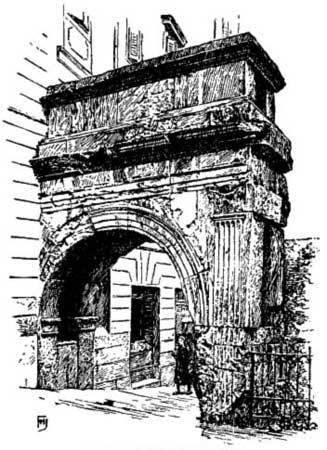
ARCO DI RICCARDO, TRIESTE
The finest objects in the Civic Museum are two pieces of antique Greek metal-work found at Taranto. One is a bronze jug, upon which are represented two griffins, facing each other by the sides of a palmette, with a flowing band of vine-leaves surrounding the body above. The relief is very delicate, and the design beautiful. The other is a rhyton of silver which is almost unique. The motif is the head of a young deer. The ears, which project at right angles, are riveted on; the rest is repoussé in one piece. It is so finely modelled and so accurate in its detail, that it has been recognised as a representation of the Cervus Dama, which was formerly common in South Italy. The interior of the ears and the lip of the cup have been gilt, and in the nostrils is niello. Round the neck is a band with four small figures, probably representing the nuptials of Poseidon and Saturia, daughter of Minos, from which sprang Taras, the mythical founder of Taranto. Two of the figures are seated, two standing; their draperies are gilded. The handle curves gracefully to the back of the jawbones, where it is attached to a palmette. The work may be of the fourth century B.C., the doe's head being much finer than the figures, which are possibly a later addition. The only similar piece of silver-work known is the bull's-head rhyton in the Hermitage Collection, St. Petersburg. In this also the figures (which are of barbarians) are inferior to the animal forms.
There are various sculptures discovered at Barcola, the finest of which is a male torso with the greater part of the legs, prehistoric objects, coins, a personification of Istria, things found at Pirano, and three splendid large Chinese bronzes. The copies of the mosaics of the Apostles from S. Giusto are on the ceiling of the upper room. A seal of the city of the fourteenth century bears three towers and the inscription: "Sistilianum · publica · Casiilir · mare · Certos · dat · michi · fines." Sistiana was on the north of Trieste; Castilir, the river Risano, was the southern boundary. The present arms were given by Frederick IV., 1464—a black two-headed eagle on gold on the first of three horizontal fields, and on the lowest the halberd of S. Sergius, on the colours of the archduchy of Austria.
The bishopric of Trieste corresponded to the Roman municipium in its boundaries. The bishops gradually became temporal lords of the city, and in 1295 the commune bought its freedom from Brissa di Toppo for two hundred marks. At this time the first communal palace was built. The first statute, however, dates from 1313-1319. It provides for a foreign podestà, a greater and lesser council, and the usual officials from the noble families. The title of Count of Trieste was first taken by Antonio di Negri (1350-1370). During his time Venice besieged the city for eleven months, conquering it in 1368, notwithstanding the attempted succour of Leopold of Austria. They then built a fort on the hill of S. Giusto and another on the shore called Amarina. Trieste made overtures to the dukes of Austria, and war continued between them and Venice till 1370, when it was ended by the peace of Kaisach, by which Venice agreed to pay 75,000 florins of gold, and to give up the castle of Vragna, as well as to relinquish all claim to Trieste and her territory. The Venetian forts were demolished, and in 1382 the city gave itself to the Habsburgs to make itself secure. In 1470 Frederick III. built the castle to control the factions which had been indulging in civil war, and Trieste lost a good deal of her liberty. The mediæval city formed a triangle on the north-west slope of the castle. Till the middle of the eighteenth century it was a small town of 6,000 inhabitants, but the gift of free harbour rights by Charles VI., in 1719, soon made it prosperous. Italian, German, and Swiss merchants settled in numbers, and the population grew till it is now over 160,000.
The bishop of Trieste was subject to the Patriarch of Aquileia, and a special form of worship was used, invented by the Patriarch Paulinus. This is still in existence, partly printed and partly in MS.
On Saturday, June 10, 1501, Canon Johannes Baptista, the chancellor, used the Roman rite in the cathedral for the first time, a fact noted as remarkable in several documents. In Aquileia itself the form continued in use till 1585, and in S. Mark's, Venice, till the fall of the Republic. In Trieste confraternities were established very early. That of S. Giusto is mentioned in 1072.
VI
HISTORICAL SKETCH OF ISTRIA
The name "Istria" is derived from the Istro, confounded by the ancient geographers with the Danube (Ister), and therefore supposed to be a branch of it. Considering the testimony of ancient writers as to the migration of Thracians, it appears probable that the Istrians were of these people, a band who left Pontic Istria by ascending the rivers Danube, Save, and Lubiana, crossed the Julian Alps, and descended to the Adriatic. Some such migration may be at the root of the story of the passage of the Argonauts, pursued by the Colchians. In the ninth century B.C. Ionians from Miletus settled colonies in Istria, who were followed by Corinthians in 735 B.C. It has been claimed that the name "Adriatic" is derived from Adar, the Asiatic sun-god, or god of fire. Plenty of stone implements and other prehistoric objects have been found in caves and burial places, and there are many Celtic place-names; the Celts arrived in the fourth or fifth century B.C., and contested the country with the older immigrants. Under Roman rule the two races ultimately intermixed, the Celts being in the majority.
The oldest inhabitants thus appear to have been of Pelasgic stock, Celto-Thracian. The Carnians were a branch of those of Lycaonia and Acarnania, who also settled in Gaul, and, according to Livy, mixed with the Etruscans during the reign of Tarquinius Priscus. They were sailors and merchants, but also pirates. When the Romans founded Aquileia they were forced to take measures to ensure safe navigation and to prevent danger to the new colony. Therefore, in 178 B.C., an expedition against the Istrians was undertaken under the Consul Aulus Manlius Vulso, but without the authorisation of the Senate, the army being transported by ship to the environs of Muggia. The Istrians attacked the camp in a fog, and, having driven the Romans to the shore, sat down to eat—and drink. While they were incapacitated in consequence, the Romans returned and killed most of them. The following year they entered Istria again, sacking and devastating the country. In the battle which followed, 4,000 Istrians were left on the field, and the rest took refuge in the cities, and asked for peace. The negotiations were broken off owing to the Consul Claudius proceeding in an irregular manner, and Nesactium was vigorously besieged with two fresh legions. A stream which defended the walls and supplied drinking-water was diverted by the Romans; its failure convinced the inhabitants that their gods were either powerless or angry, and during the final assault the despairing Istrians killed their women and children to save them from slavery, and threw their bodies over the walls. Epulus, the king, fell upon his sword when he saw the enemy within the walls; the rest either perished or were made slaves. Mutila and Faveria were also attacked and levelled with the ground, and quiet reigned in Istria. Livy says that at that time 5,622 persons were sold into slavery, the authors of the war were beaten and then decapitated, and Istria was garrisoned with Roman troops. In 129 B.C. the Istrians rose in revolt when Rome was occupied with the Gepid war. The Consul Caius Sempronius Tuditanus crushed this revolt, and after that colonies were established at Ægida (Capodistria), Æmonia (Cittanova), Albona, Parentium, Piquentum, Pola, Tergeste, and probably in other places. Many Istrians fled into the Karst region, and for a long time the land was unsafe. Julius Cæsar had to take measures to protect Tergeste from raids.
The Italianising of the country proceeded apace. Many Slav names occur in Roman inscriptions; but in 127 B.C. 14,000 Roman colonists arrived, and year by year more came, until the time of Augustus, both plebeians and patricians. Many of the latter of Istrian birth occupied important posts outside Istria; and, according to an ancient Aquileian breviary quoted by Dr. Kandler, many of the Christian martyrs belonged to patrician families. The names of SS. Euphemia, Thecla, Apollinaris, Lazarus, Justina, Zeno, Sergius, Bacchus, Servulus, and Justus may be quoted. The towns benefited in material ways, aqueducts were constructed to supply them with water, and fine roads, such as the consular road from Pola to Aquileia and Venetia, with its many branches, provided easy and rapid communication. There was traffic in wines, wood, marble, and granite. Istrian acorns nourished a fine breed of pigs which were exported to Rome. The purple-dyeing factories of Cissa near Rovigno, the fulling works of Pola and Trieste, and the potteries of Aquileia were known far and wide. Nor were philanthropic works neglected. Under some of the later Pagan emperors foundling hospitals and schools were established in separate provinces for orphans and poor children.
Under the just and wise rule of Theodoric the province flourished; but the people always regarded the Goths as barbarians, and when the Byzantines attacked Istria in 539-544 and 552 the troops of Vitalius, Belisarius, and Narses were welcomed. They called the Greek Government "Sancta Respublica," and erected basilicas in gratitude for the freeing of the land from the Arian Goths. Justinian re-established the Roman constitution with certain alterations, among which was the power of appeal to the court of the bishop, which gave him control and surveillance over the municipal functionaries. His power was not supreme, however, the military defence of the frontier being equally important. For some sixty years the "Schism of the Three Chapters" rent this part of Christendom, and caused a great deal of ill-feeling and many questionable actions. It arose from the Emperor Justinian in 544 condemning (1) the writings of Theodore, bishop of Mopsnestia, who anticipated the heresy of Nestorius; (2) the writings of Theodoret, bishop of Cyrus, against the twelve anathemas of S. Cyril of Alexandria, and the decrees of the Council of Ephesus; and (3) the letter of Ibas, bishop of Edessa, to Maris the Persian. The Latin Church, with Vigilius the pope at its head, declined to accept the Imperial decree, which was in contradiction to the Council of Chalcedon of 451. In 548 the pope, while at Constantinople, was induced to repudiate them; but, on finding how strong the opposition was, revoked his agreement in 550, and induced the emperor to summon a council, which met in 553 and condemned the three chapters and their authors. The pope returned to Rome, and died there in 554, having confirmed the decision of the Council of Constantinople, and anathematised those who refused to accept it. Notwithstanding this, the bishops of Lombardy, Venice, and Istria, with the Aquileian patriarch Macedonius at their head, and other bishops, refused, and this refusal produced the "Istrian schism," or schism of the "Tre Capitoli." Paulinus, who succeeded Macedonius, called a synod at Aquileia in 557, which repudiated the decision of the Council of Constantinople. Pelagius II., who was then pope, called in the secular arm, but the descent of the Lombards in 568 stopped the discussion. Euphrasius of Parenzo was one of the principal supporters of Macedonius, and the pope did not hesitate to make the most disgraceful charges against him. In 578 Paulinus transferred the patriarchate to Grado, so putting himself under Byzantine protection. Elias of Grado held the same opinions as his predecessor, even excommunicating his adversaries. His successor, Severus, holding the same views, Smaragdus the Exarch made an expedition to Grado in 588, took Severus and the bishops of Parenzo and Trieste to Ravenna, and kept them there in prison for a twelvemonth, till they agreed to condemn the three chapters. When they returned they found their clergy would not go with them, so a synod was convened at Marano, and there they revoked their condemnation. Smaragdus, exarch again in 603, so arranged matters that on the death of Severus (who had preached revolt) Candidiano was appointed patriarch, a man who was devoted to the papal authority, and who reconciled himself with Rome, thus ending the schism. It had caused grievous disorders, the bishops being sometimes for and sometimes against it, and the clergy sometimes in strife among themselves and sometimes with the Patriarch of Grado; but the mode in which it was ended was quite as disgraceful as any of the deeds done during its course. In 610 armed Byzantine soldiers entered the basilicas and dragged three Istrian bishops from the altars, with menaces and vituperation, compelling them to accompany them to Grado, where they were forced to bend to the Imperial commands and reconsecrate Candidiano patriarch.
The Lombards re-established the patriarchate of Aquileia, electing Abbot John, who was opposed to the pope, and thus there was a double patriarchate. The Aquileian patriarchs only became reconciled to the papacy in 698 when the Lombards had ceased to be Arians. The Istrian bishops obeyed the Patriarch of Grado until the Council of Mantua (827), which decided that they should return to Aquileia. Istria was Lombard only from 751 to 788.
When Charlemagne conquered the country in 789 feudalism was substituted for the Roman autonomy with the co-operation of the higher clergy. The Frank duke was supreme, and his underlings had arbitrary power. Public property was confiscated for the benefit of the duke and his supporters, and all kinds of arbitrary and exorbitant imposts and restraints were imposed upon the people, even to the prohibition of fishing! The result was great discontent, and at last, in 804, by the intervention of Fortunatus, Patriarch of Grado, an inquiry was held at Risano, the acts of which were embodied in the "placito" of Risano. The envoys of Charlemagne restored the communal property and the jurisdiction over foreigners, exempted freemen from servile tasks, suppressed arbitrary imposts, and restored the tribunes and other Byzantine magistrates, whom the people were allowed to select freely according to the ancient custom. In 952 Istria became a German fief by gift of Otho I. of Germany (who had conquered Italy the year before) in feud to his brother Henry, duke of Bavaria, together with Verona and Friuli. Documents show the presence of large numbers of persons of German origin during the tenth century; but the maritime cities, depending upon commerce, were forced into connection with Venice by the necessity of making arrangements for mutual defence against Slav and Saracen Corsairs, and thus the foundations were laid for the Republic's later supremacy.
Great part of the history of Istria relates to incursions by the barbarians, either beaten off, or successful, with the destruction of towns, and the carrying off of slaves and booty. The descent of the Lombards was followed by a raid of the Avars in 599, but they were beaten off. Three years later they came again in company with Slavs and Lombards. In 611 the Huns or Slovens descended on Istria, in 670 they were defeated near Cividale by Duke Vetturi, and in 718 were conquered in three battles near Lauriana by Duke Pemmo. His son Ratchis copied the bad example of the Huns, sacking and killing far into Carniola. Between 620 and 630 the Serbo-Croats descended from the Carpathians and crossed the Danube by suggestion of Heraclius, driving the Avars from Dalmatia and taking their place. The result of these constant barbarian raids was the concentration of the population in the towns on the sea-coast.
The pirates in the Adriatic were first the Narentans and next the Saracens, who devastated the coasts of Dalmatia in 840, fruitlessly besieging Ragusa for fifteen months, and afterwards taking Taranto and Bari. In 842 they defeated the Venetians at Taranto, and, on the octave of Easter, took Ossero and burnt it. They then passed on to Ancona and Adria, and as they returned captured a whole Venetian squadron. In 876 the Slavs of Croatia and Dalmatia raided the Istrian coast towns, but were defeated at Grado. The Emperor Basil occupied Dalmatia in 877 on the pretext of Slav piracy. He gave the tribute from the Roman cities of Dalmatia to the Croats and Narentans, so that Spalato, Zara, Traù, Arbe, and the Byzantine cities of Veglia and Ossero had to pay tribute to the Croats. The successful expedition of Pietro Orseolo II. against the Narentan pirates tended to the greater security of the coast towns and strengthened the bond which Venice was weaving.
In 933 a solemn treaty of peace was signed at Rialto between Istria and Venice by the Marquis of Istria, the bishops of Pola and Cittanova, two "locopositi," two "scabini," and twelve other trustees from Pola, Capodistria, Muggia, and Pirano, there convened. A fresh treaty was made in 977 with Capodistria, giving Venice special advantages, and these negotiations were carried on without reference to the Imperial authority, the nominal feudal lord. Walking thus warily, avoiding offence to the Emperor of Germany, Venice took 200 years of continuous political action to acquire the Istrian cities. By 1145 Venice had obtained for herself liberty of commerce in most of the Istrian towns and complete exemption from any kind of taxation; she had established at Pola and Capodistria a representative, to look after the punctual execution of treaties, and to protect Venetians from injustice, and had also made the Istrian cities pay her a tribute, either in money or products, obtaining also assistance for her navy from them whenever it was fighting beyond Zara and Ancona. The importance attached by Venice to these concessions is proved by the triumph which was given to the squadron of Morosini and Gradonico when returning victorious from Istrian waters. It was then that the doge assumed the title of "dux totius Istriæ," but the dates of the dedition of the several cities are much later. The re-organisation of the communes took place between 1150 and 1180. The podestà had a council of assessors, the "consiglio minore"; the larger "consiglio del popolo" was called together for the more important matters, such as declaration of war, conclusion of peace, legislation, imposition of taxes, election of podestà and consuls, &c.; while many documents show that the whole body of citizens was summoned to a "parlamento" for the publication of new laws, very important deliberations requiring practical unanimity, the installation of fresh magistrates, &c. The "statute" was apparently drawn up when a foreign podestà succeeded to native consuls as an assertion of the ancient judicial custom. That of Capodistria, the earliest, is of 1238-1239; that of Pola, 1264. As soon as the communes began to extend their work of domestic supervision a "fontico" was established, a place where corn was sold at little above cost price. Everything was supervised—the time of vintage and of selling the new wine was fixed, the amount of bread to be baked in each oven was prescribed, the justices tasted the wine before the taverners began to sell, cut off the tails of fish unsold by the evening, and generally looked after the strict fulfilment of the regulations affecting food. As the vintage approached, the guards in the vineyards were doubled, and, from August 3, dogs were tethered to a stake to intimidate thieves. The prices of foreign goods were fixed and, before commencing to sell, merchants were obliged to expose their wares on the quays or in the piazza for three days. Standard measures were cut in stone in conspicuous places, and at Albona the various imposts were carved on the clock-tower in the piazza. Armed men were not allowed to enter the cities, and the officials interested themselves in everything going on, an example of which may be quoted from Pirano. When S. Francesco was built in 1301, the podestà carried the first stone on his shoulder, and set it in the ground before the assembled people. Venice succeeded the patriarch as overlord of the Istrian communes in 1420, and after this the history of Istria is merged in that of the Republic.
The ravages of the plague were fearful, and practically depopulated the province, returning again and again till 1631. In the fourteenth century it decimated the Brioni Islands; no less than five Benedictine convents were abandoned—three in Pola and one near Barbana d'Arsia, as well as that on the Brioni Islands. In Muggia an inscription states that half the population died in 1347. In 1361 Ossero was so devastated that two years later the bishop abandoned it and went to live in Zara. In 1371 the country round Pola was so afflicted that of seventy-two towns only eleven preserved their names, the rest disappearing without leaving any trace. In Cittanova in 1643 there were only ten inhabitants left, the bishop abandoned it to live in Buie or Verteneglio, and in 1686, as there were not enough citizens to constitute a council, they had to add strangers to make a quorum. Angelo Morosini, podestà of Capodistria in 1646, described it as "Goddess of desolation and refuge of solitude itself." Parenzo was so severely smitten that only thirty persons remained. At Pola in 1631 there were but 300 persons left, including the garrison of foreigners, and of the citizens but three families. This was the last visitation.
VII
MUGGIA TO PIRANO
From Trieste steamers, large and small, ply to most of the places on the coast, and the islands down to Fiume. Though there is railway communication with a few places, travelling by water is much pleasanter in fine weather, and the towns are more easily accessible from the seaside. The country people throng to market in the early hours of the morning, and are ready to return by the time the average English tourist has finished his breakfast and sets out sightseeing.
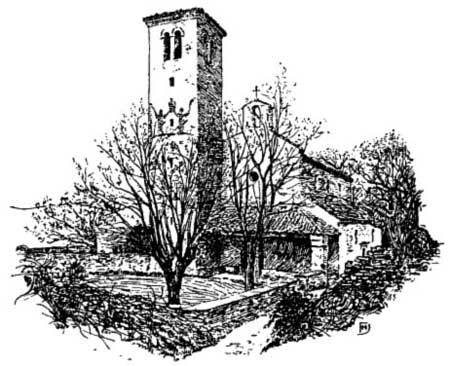
WEST END OF THE CHURCH, MUGGIA VECCHIA
We went to Muggia about midday by one of the little steamboats which round the Punta S. Andrea, and, passing the Lloyd-Arsenal, cross the bay, the Vallone di Muggia. The boat was full of belated contadini, for the most part rugged and picturesque, among whom was an old woman with a few long candles, which she vainly offered for sale to every person on the boat; a boy with nuts and sweets was more fortunate, and lessened his stock considerably. The deck was lumbered up with baskets, milk-cans, &c., which had been full in the early morning, and most of the passengers had bundles and parcels containing their purchases. Some thirty minutes were sufficient in the fine weather with which we were favoured to take us across, and, passing the smoky iron-works which are the principal industry of modern Muggia, we disembarked at the little quay, and immediately became objects of interest to a small crowd of impertinent boys. Our principal objective was the ancient church on the hill where Muggia Vecchia once stood. We found on inquiry that it was closed as being in a dangerous state. This entailed visits to the municipio and to the parish priest, under escort of a uniformed official, who then conducted us by a steep and stony path up the hill Monte Michele, towards the summit of which, higher than the church, prehistoric graves have been found, consisting of stone slabs set roughly together, making a kind of chest which opens on to the hillside. The church stands amid fragments of ruined walls, the remains of the town destroyed by the Genoese in 1354. To the west is a stony space where wild irises grow and bloom profusely in the crevices of the rocks, and from which there is a fine view over the sea northwards to the highlands of the Karst. Between this flowery wilderness and the church is an open grassy space enclosed by a wall, and with a few trees round its edges, which was probably the atrium. Opening upon this is the narthex, an open portico level with the tower which stands at the west end of the north aisle, with a stone seat running round the wall. Two steps lead down into the nave, and there is a door in the south aisle, which has two windows, the clerestory having four; though on the north side, where the graveyard lies, there are none. The building consists of a nave and aisles divided by an arcade of five round arches upon rectangular piers without caps, the two eastern bays being enclosed by dwarf walls with framings of marble slabs upon which interlacing patterns of the ninth century are carved. They return across the ends of the aisles, in each of which is an altar beneath a wagon vault, though there is no apse. The central apse is vaulted with a semi-dome, but does not show externally. The choir is raised two steps above the nave, and the altar is approached by a third. The ambo or pulpit stands outside the screen on four columns, approached by steep steps from within; an octagonal column of coloured marble supports a slab for a book-rest, facing eastwards at the foot of the steps. In plan the ambo somewhat resembles that at Grado, with six half-colonnettes projecting from the curved form, two of them terminating in heads on each side of the book-rest, itself supported on an octagonal shaft which dies into its underside with very flat vine or oak leaves spread over the surface. The whole has been so plentifully whitewashed that detail is nearly obliterated, but there is sufficient difference between the styles of various parts to make it probable that a reconstruction took place at some period, older material being employed to a great extent. The fact that two of the bases have angle claws and are manifestly not in their original position supports this theory. The altar to the left is part of a Roman sarcophagus with a funerary inscription in letters of the Imperial period:
C. IVLIO
NICOSTRATO
FILIO · PIISSIMO
ANN · XVIII · M · VIIII · D · XII
IVLIVS · NICOSTRATVS.
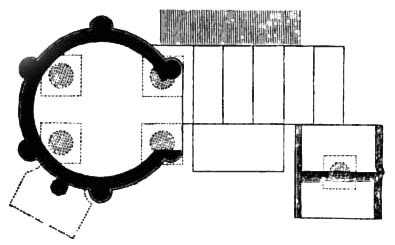
PLAN OF PULPIT, MUGGIA VECCHIA
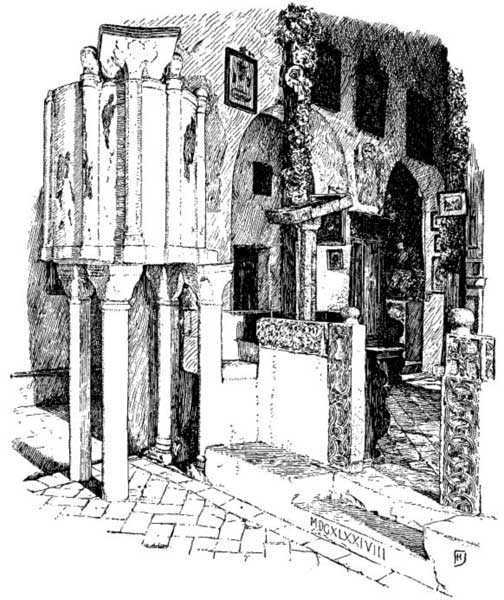
Upon the piers and walls are remains of paintings of various dates. On the first pier to the left is S. Catherine, vested as a Byzantine empress. Further to the east are the Madonna "Blacherniotissa" and S. Dominic, and near the ambo figures of the four Evangelists; the last apparently of the period of the foundation of the church, the ninth or early tenth century. On the last pier, which is broader than the others, and suggests a later addition (perhaps in the thirteenth century), is a gigantic S. Christopher, roughly painted, and with the well-known inscription stating that whoso looks at it will not die a sudden death that day. The aisles have lean-to roofs, and the nave roof we found shored up, the supporting timbers being wreathed with garlands of artificial flowers. The dedication is to SS. Peter and Paul.
As we descended the hill our guide, observing that flowers interested us, made a sudden dive through the gate of a garden full of wallflowers and picked a bunch for us, presenting it with as much grace as if they had been his own! a proceeding to which the rightful owners appeared to have no objection. The more modern town lay below us with its walls and towers, some of them ruinous and some restored, and looked picturesque enough except for the ancient castle which has been turned into a modern house by its latest purchaser, who has tried with more zeal than judgment to copy the style of the older portions. Through the postern by which we had left the town a number of workmen from the iron-works straggled, grimy and weary; in their modern dress and employment marking a contrast with their surroundings. Muggia Nuova first appears in history in 1235. When Paganino Doria destroyed Monticula (Muggia Vecchia) in 1354, the port Vicuna Lauri (now Muggia) increased, and twenty years later was surrounded with walls by the Patriarch Marquand da Randeck after his triumphal entry. It had nine square towers, a bastioned keep on the east, and a barbican with unequal sides, which covered the Porta a Mare, or of S. Rocco. Three other gates, the Porta Grande, which faced to the country, the Porta S. Francesco or Del Castello, and the Portizza, which joined the Imperial road of Zaule with a drawbridge, added to the defences, and a chain closed the port.
The nave of the church is of the eighteenth century, the apse twelfth, and the façade of the fifteenth century, with a wheel window of 1467 above the west door, and a gable of an ogee-trefoil shape. In the centre of the rose of sixteen rays is a little relief of the Virgin and Child; the tracery is like that of the cathedral at Trieste. The door is square-headed, with a cable moulding on the inner and a dentil on the outer edge, and with a slightly ogee tympanum above, in which are an enthroned God the Father with Christ in His lap, two kneeling figures with palms at the sides, and two little angels on the uprights of the throne. On the architrave is an Agnus Dei. Two windows, slightly ogee-headed, flank the door. Coats of arms and inscriptions give the date. The treasury contains a late Gothic ostensory with Renaissance patterns on the foot, a chalice which has portions of several dates, and a seventeenth-century processional cross. The contemporary municipal palace is now made into dwelling-houses, though the lion of S. Mark, with closed book and the date 1444, still looks down from the wall, and the shapes of the windows reveal a mediæval building.
While we were on the hill the few children had become a crowd, and our proceedings were much hampered, although our friendly guard adopted very rough measures more than once to keep them in order. The people have always been turbulent and unruly, and no doubt there is still an hereditary disposition among them to resist authority, though one must acknowledge that it was only among the young that we ourselves observed it.
Muggia Vecchia is first mentioned in a diploma of Ugo and Lothair, king of Italy, in 971, by which the Castello was given to the church of Aquileia. In 1202, when the Venetians were on their way to the Holy Land, they subjected the coast towns under the pretext of enforcing the patriarch's rights. Doge Enrico Dandolo disembarked at Muggia with part of his troops, and was received by clergy and people with the ringing of bells. The citizens being collected swore fealty and subjection to the Republic, promising not to help pirates, and to pay each S. Martin's Day twenty-five "orne" of good wine. From this date till 1420 the city was ruled by a podestà elected every six months by the council and confirmed by the patriarch. There were three judges and several "anziani," who formed the lesser council, to attend to daily business. In the thirteenth century it had its own statute, and at that time the commune paid a doctor, a surgeon, and a schoolmaster. The crest is a turreted castle, seen on the campanile of the old church borne by two figures. It was sometimes under Venice and sometimes under the patriarch till 1420. At one time four noble hostages were confined for the latter in Cividale, who were obliged to prove their presence every day; at another the procurator swore fealty to Venice and received the standard of S. Mark with much pomp. In 1371 the council decided to elect every year two upright men who should do their best to settle disputes and quarrels among the citizens, and in case of failure to report to the council, when extraordinary measures were to be taken. The next year Raffaello Steno attacked the city at the head of the exiles and killed many supporters of the patriarch, sacking their houses and proscribing his followers; and it was only at the end of 1374 that he succeeded in retaking the town, coming in person to do so. After his triumphal entry in that year a castle was built to keep the people in subjection, and a castellan with a garrison was left in it; but the town rebelled again in 1377.
Capodistria is at the head of the next bay to the south-west, on rising ground which was once an island, though now joined to the mainland. From the sea the most conspicuous building is a great yellow prison. There is also a naval school there, the cadets from which have to endure a certain amount of chaff when they acknowledge having spent five years at Capodistria. According to Dandolo the city was founded on the island of Capraria, and named in honour of Justin II. (565-578) Justinopolis; the fact of its having been free of money taxes during the Byzantine dominion makes some such origin probable; but it occupies the site of the Roman colony of Ægida, founded in 128 B.C., and a few antique fragments have been found, such as the restored statue of Justice on the communal palace, a Roman work of the Lower Empire, and the reliefs of an ox and a female dancer encrusted in the wall of a garden. In the church of S. Clemente there is also a little round antique altar, used as a holy-water basin.
Under Pietro Orseolo a treaty was made between Venice and Capodistria in 977, under which the hundred amphoras of wine (which had been sent since 932 as an annual present to the doge, and handed by him to the Patriarch of Grado) were made obligatory and a perpetual tribute, while a Venetian officer resided in Capodistria to look after it. Another stipulation was that the city should always be at peace with Venice, even if the rest of Istria were at war. The Venetian representative or consul had the right to sit with the Capodistrian judges whenever a Venetian had cause to appear before them. In 1145, envoys had to go to Venice to swear on the Gospels true and loyal fidelity to S. Mark, the Doge Polano, and all his successors, and to the commune of Venice, undertaking to renew the oath on the election of each new doge. In 1186 the commune was represented by a podestà and four consuls, the year in which the bishopric was founded on the strength of their promise to provide sufficient income. Eight years later they were obliged to decree that if any one did not pay his dues by the usual time he should have his vineyard taken away, and if the tithe of oil was not paid by the Purification, it should be doubled. It was the first Istrian city with a fully formed commune, and the notice of the meeting of the council on July 5, 1186, is the earliest notice preserved of such a meeting. The first statute appears in 1238-1239.
When Venice had acquired the city the senate commanded Tommaso Gritti and Piero Gradenigo to build Castel Leone; it was constructed astride the road which crossed the marshes, so that all travellers and vehicles entering or leaving the city had to pass through it. The walls, for which the Patriarch Gregorio Montelungo was responsible, were damaged in 1278, when the city swore fealty to Venice, and were thrown down on the sea side after the insurrection of 1348. They were not completely repaired till the sixteenth century. In 1550 Michele Sanmicheli, and subsequently his nephew Alvise Brignoli and others were sent by the senate to report, and finally the repair of the walls of many of the Istrian towns was committed to Constantine and Francesco Capi. A hundred years later they were in such a state that Stefano Capello reported that it was useless to guard the gates, for entrance was easy through the ruinous part of the walls. The only portion now remaining is the Porta della Muda, built by Sebastian Contarini in the seventeenth century. It bears an inscription of 1701 stating that the sea then no longer flowed round it.
The Palazzo Comunale was burnt after the revolt of 1348, when the city had to surrender unconditionally, the clergy carrying crosses, and the citizens in procession, followed by the soldiers and the other foreigners, meeting the army outside the gates. Fifty of the persons most compromised were sent to Venice for trial, and the city was punished by increase of taxation and modification of some of the chapters of the statute. A few years after it rebelled again, and was then deprived of all municipal rights. The burnt portion of the palace was ordered to be restored in 1353, but it had to be pulled down afterwards, and in 1385 the senate gave orders to the Podesti Leonardo Bembo to level it and rebuild. It bears resemblance in some of its details to palaces of the Bembo family in Venice. It was not completed till 1447, under Domenico Diedo. The right wing was altered in 1481, and further damaging alterations were made in 1664 by Vincenzo Bembo, who was so proud of his work that he put up a pompous inscription. There are numerous coats of arms of podestàs and busts on the façade, the earliest of which is dated 1432. Under the portico were the "bocche del leone" for secret denunciations, and, though the masks are gone, the chests within are still in position.
At right angles to the Palazzo Comunale is the cathedral, with the campanile projecting and flanking the façade to the south. It has a ground story of Gothic, three pointed arches, the central one pierced by a doorway with clustered pillars, and figures beneath niches above them, and an upper story with classic pilasters and cornice, the central space pierced by a circular window. These are somewhat the characteristics of the cathedral at Cividale, of which two Capodistrians, Bartolommeo Costa and Giovanni Sedula, were architects. It was reconsecrated in 1445, but the upper part was not finished till 1598. The side doors, with beautiful arabesques carved on the jambs, were constructed with material from the tribune in which the big Carpaccio was housed. It was destroyed in 1714 during the restoration of the cathedral. There is a terra-cotta medallion of Constantino Copronymus on the façade. The present campanile is of 1480. The great bell was cast in 1333 by two sons of the celebrated bell-founder, Jacopo da Venezia. Under the bell-chamber of the older campanile was an iron cage in which ecclesiastics guilty of grievous crime were exposed, a punishment abolished in 1497.
The interior of the church, considered the finest of the period in Istria, was recast in 1741 by the Venetian engineer Giorgio Massari. Under the last arch of the nave to the right is a picture by Vittore Carpaccio, signed and dated 1516—a Madonna and Child enthroned upon a damask-hung seat raised on five steps, which are covered with an Oriental carpet. Upon the steps saints are ranged, SS. Jerome, Roch, and an old man to the left—perhaps Zacchariah or Joseph; SS. Sebastian, George, and a bishop to the right—probably S. Louis of Toulouse: at the bottom a little lute-playing angel sits, flanked by two amorini on a lower level with white drapery. The Virgin is seated in an arched vestibule with a flat ceiling through which the sky and trees are seen. It was restored in 1829. Another picture from S. Nicolò near the port shows the Virgin with SS. Nicholas of Bari and John the Baptist. The organ wings were painted by Vittore's son Benedetto in 1538, and two other pictures of his are affixed to the west wall. The subjects are the Slaughter of the Innocents and the Presentation in the Temple. Other pictures by him are a Coronation of the Virgin, in the communal palace, signed and dated 1537, his earliest known picture; the Virgin between SS. James and Bartholomew, 1538; and the town damaged by a sea-storm. In Santa Anna is a picture of the Name of Jesus adored by SS. Paul, John the Baptist, Francis, and Bernardino, and surrounded by cherubs' heads. In the communal palace an indifferent picture of the entrance of a podestà escorted by the councillors (dated 1517) is ascribed to Vittore Carpaccio, who has been claimed as a Capodistrian, as his son Benedetto certainly was. He lived in the Largo di Porta S. Martino, in an old house of two stories. In 1500 it was inhabited by the Scarpaza family, and before that they possessed a little farm in the locality called San Vittore; but the Capodistrian tradition as to Vittore's birthplace is erroneous, since he was born at Venice of a family of Mazzorbo, record of which has been found by Signor Molmenti. Lazzaro Sebastiani is also claimed as Capodistrian, and memorials of two other painters exist, Cleriginus de Justinopoli, who was living in 1471, and Giorgio Vincenti. A Mag. Domenico di Capodistria began the pretty octagonal chapel at Vicovaro above Tivoli.
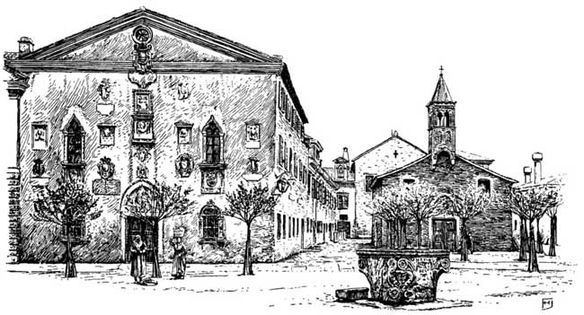
THE "FONTICO" AND S. GIACOMO, CAPODISTRIA
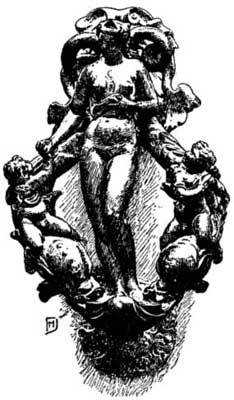
In the choir of the church of Santa Anna is a picture by Cima da Conegliano in the original frame made by Vittore da Feltre. In the central arched compartment the Virgin sits enthroned with the Child on her knees and angels at her sides; on the steps below are two child angels with mandoline and fiddle. The lower range of panels has full-length figures of SS. Anna, Mary Magdalene, Joachim, and Catherine. In the upper are half-lengths of SS. Chiara, Francis, Jerome, and Nazario, with Christ between SS. Peter and Andrew in the centre. It has been restored. There is also an altar-frontal of cut and gilded leather.
The lions from the ancient cathedral doors are now in the atrium of the high-school. The ancient baptistery is close to the north side of the cathedral; it has suffered Renaissance alteration inside, but outside still shows the early arrangement of pilaster-strips and corbel-tables. It is circular in plan, and has several round-headed, unmoulded windows built up, as well as a pointed-arched door with fourteenth-century shields in the tympanum.
In the large piazza which stretches to the south-east of the cathedral are two well-heads and the "fontico" or place where corn was sold cheaply to the poor, a building of 1432, restored in 1529, plentifully studded with coats of arms. Opposite the Palazzo Comunalelis the Loggia, now a café, built in 1464 for a literary academy. It has seven pointed and traceried arches in front and two at the side, a Madonna and Child decorates the south-west angle, and coats of arms are between the windows of the upper story. Here the Compagnia della Calza was instituted in 1478 in imitation of that of Venice. A few houses have remains of late Gothic painting, and in others something of the mediæval arrangement may still be seen. Upon the Palazzo Tacco is a very beautiful knocker, ascribed to Sansovino, now happily the property of the commune; and the Casa del Bello has a fine negro's head as handle, rather worn by use, and an elaborate knocker, probably of German work. The Casa Borisi also has a handle with the head and shoulders of a child emergent from leaves, and a knocker of similar design.
In the cathedral treasury is a late fifteenth-century silver-gilt chalice with elaborately worked knop and stem; on the knop are saints under canopies, and angels with outspread wings emerge from scroll-work round the base of the cup. Also a monstrance of the same period with very elaborate and beautiful architectural ornament and figures of angels in adoration. In two elaborate silver-gilt crosses of the sixteenth century there is a curious mixture of Gothic and Renaissance details.
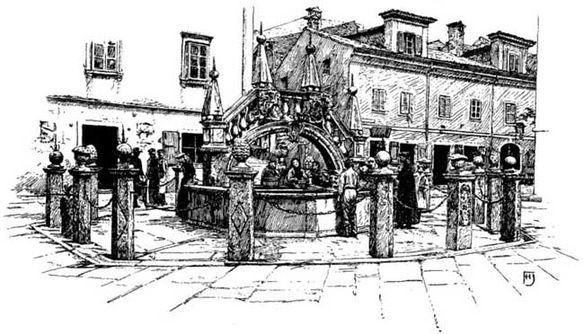
THE PIAZZA DA PONTE, CAPODISTRIA
There is also a Byzantine civil casket at Capodistria, with traces of ancient gilding upon it. It has the usual rosettes in the borders, and small plaques with figure subjects. On the front there are three gods and goddesses, separated by a repetition of the border pattern. The handle and fastenings are later in date.
Just inside the Porta della Muda is the Piazza da Ponte, so called after the Podestà Lorenzo da Ponte, who in 1666 had the very curious fountain erected, in which he imagined a further memorial of himself by the punning design of the bridge, so unsuitable for its position. In front of the Palazzo Tacco is a column with a statue of S. Giustina, set up to commemorate the battle of Lepanto, at which Domenico di Tacco commanded a ship fitted out at his own expense.
In the churches on Good Friday a crucifix was laid on the chancel steps. Women and children knelt round and kissed it. In one or two of them a dead Christ, life-size and painted, was exhibited behind glass. There was also the "tomba," a custom to which one is used in Italy. A few men joined in the devotion. The Good Friday procession is over half a mile long, and takes two hours to get round the town, starting from the cathedral west door at twilight. It is formed in great part of the ancient confraternities (among which that of S. Maria is mentioned as early as 1082), who carry some 200 implements and standards, torches, candelabra, wax tapers, figures of saints, and lanterns. At the end of the procession a rich baldacchino is borne aloft above the priest who carries the Host. "Mazzieri" (from the mace which they carry as sign of authority) keep order. Other processions by daylight take place on Corpus Domini and S. Nazario (June 19). The people have always been fond of such displays, and till the seventeenth century there was a great function at the departure of the rector, who was solemnly bidden farewell by one of the syndics or nobles in the cathedral. These Istrian coast towns have always shown enlightenment in the matter of education. In 1699 a school was opened in Capodistria for the sons of citizens and patricians, in which Latin, Greek, Italian, mathematics, rhetoric, and physics were taught. And, in order that poor and talented young men should not be cut off from the possibility of learning, this town, and, after its example, Isola, Muggia, Parenzo, Pola, and Trieste established scholarships at the University of Padua, where Istrian professors became rectors. But, even in the fourteenth century, there were already school teachers in Pirano, Muggia, and Capodistria.
It is Pirano on its headland, with the cathedral standing out against the sea, and with its crown of battlemented towers among cypresses and other trees which terminates the land as seen from the railway descending from Nabresina to Trieste; for, though the Point of Salvore stretches actually farther out, it is low, and does not catch the eye as Pirano does, especially when its characteristic silhouette is emphasised by the blue shadow of a passing cloud. The headland upon which the cathedral is built, with its arched buttresses below, hides the town, except for the fortified cresting high above the trees; but, when the point is rounded and the harbour entered, one is tempted to assert that there are few places so picturesque. The quays are crowded with fishing-boats, which are backed by the brilliantly white buildings. The green water reflects boats, buildings, and sky with a bewildering flashing and mingling of varied colours; while, above the houses of the Piazza Tartini, other houses and towers climb to the battlemented walls which crown the hill above a space filled with the grey of olives and green of the grass beneath them. Within the town the streets are narrow and often arched over, producing striking effects of light and shade; and there are external stairs to some of the houses and many balconies.
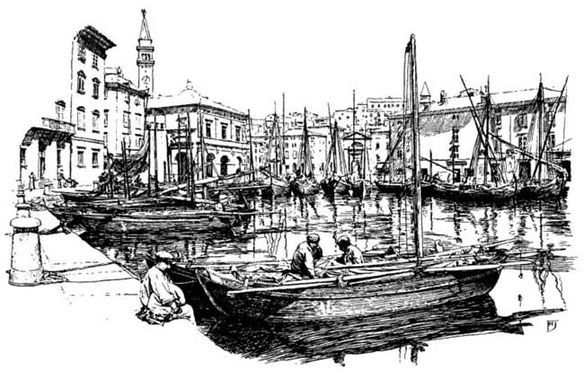
THE INNER HARBOUR, PIRANO
It is an ancient town, and may have been founded by Celtic immigrants, since the word "pyrn" (a possible derivation for its name) means "top of the hill" in Celtic. It certainly was inhabited in Roman times, for the foundations of a Roman house have been found, as well as inscriptions, bronzes, and other objects now preserved in the museums of Trieste, Parenzo, and Pola. The names of a good many places near are of Roman derivation, but the first definite mention of Pirano is made by the anonymous Ravennese chronicler. In the tenth century the Istrians attacked the possessions of the Patriarch of Grado and of Venice, under the Marquis Winter, who governed for Ugo, king of Italy. The doge retaliated by prohibiting all commerce with Pirano, Trieste, Muggia, Capodistria, Cittanova, and Pola, and this soon brought them to their knees, finally resulting in the treaty of 933.
A castle, the residence of the count or burgrave, was built nearly opposite the cathedral, with a wall falling sheer to the sea; this wall was still in existence in 1483, and was seen by Sanudo, but it was destroyed soon after. Venice gradually laid a heavier hand on this part of the eastern shore of the Adriatic, and, though the citizens struggled to retain their independence, the year 1283 saw the dedition of Pirano. Yet it always retained the right of displaying its own standard of S. George in the Piazza by the side of that of S. Mark. The existing bases for the support of these standards date from 1464 and 1466, and bear the figure of S. George on one, and S. Mark's lion on the other, with the arms of the podestàs who ruled in those years. On the base of the Venetian standard the measures of length then in use are engraved. The standards for measures of capacity were three hollows sunk in a stone which once stood at the foot of the stair of the communal palace. This palace was demolished in 1877. It was a building erected in 1291, outside the circuit of the walls as it then existed, "to show that a new spirit ought to animate the citizens to forget their ancient divisions," as a chronicler says. From 1264 Venice practically had control of the government, being the principal customer for the salt, which was (and is still) the chief product of the place.
The city is an irregular triangle in plan, and is divided into four sections, known as "Porte"—Porta Muggia, Porta Domo, Porta Misana, and Porta Campo. Walls enclosed each of these sections, which were thrown down by Venice at the same time that many of the nobles' towers were destroyed; but some portions remain here and there, utilised for the erection of later houses. Round the "Punta," the most ancient part of the city, are remains of early walls, thought to be late Roman. The Venetians allowed only one wall for protection, and the present towered portion, so conspicuous along the crest of the hill, was finished in 1488. The suburb, the Borgo Marzana, which stretched along the shore, was also enclosed within their circuit by 1533. They recall those of Soave and Marostica in North Italy, where the houses cluster round the piazza below, and the hillside is covered with olives, through and above which the line of battlements may be traced high above the tops of the campanili. The harbour was once larger than it now is, the Piazza Tartini occupying the site of part of it. In 1320 the Venetians sent three engineers to construct a port, but all that was done was to strengthen the inner harbour as then existing. The chain which closed it was replaced by a drawbridge in 1578, shown in a picture in the cathedral, but this was demolished in 1894.
In 1379 the Genoese fleet of fifteen galleys demanded the surrender of Pirano. Reply was made with cannon-shots which sank three large ships, and the others sailed away. It was the only Istrian city which thus repelled the Genoese attack, and the incident is also interesting as showing that the Venetians used bombards before the war of Chioggia.
The statute is more ancient than those of most of the neighbouring cities, and gives curious details as to pains and penalties and municipal regulations. The penalty for mutilation was a corresponding mutilation unless the fine prescribed was paid. The making of false money was punished with death. The false witness, if insolvent, lost his right nostril, and his name was published as a perjurer on the stair of the communal palace. He who destroyed the property of another lost his right hand. But there was no public executioner; and there are many records of the flight of guilty persons, though an intention to make "the punishment fit the crime" is evident. No one was allowed to build a house close to the walls, and thatch was forbidden. A blasphemer was pilloried for a day (a list of illegal words and phrases is attached to this section). Workmen were forbidden to receive more than the wage prescribed, butchers had to accept the price fixed for meat by the justices, and the times and places for fishing were specified. The commune had an inn "let to an honest man," with six good beds, which he had to provide. No one else was allowed to let rooms till 1469, when the payment of a tax of three ducats a year entitled the payer to a license. In 1484 interest on loans was fixed at 20 per cent., and Jews were allowed to charge no more. This people enjoyed considerable liberties, as in Venice, and corresponding concessions were made to them. With the establishment of a "Monte di Pietà" their occupation was gone, and they migrated to Trieste. The commune paid a chief bombardier, a captain of ordnance, a palace chaplain, two doctors and a surgeon, a canon of the Community, a master of arithmetic, a professor of humanities and rhetoric, and a preacher for Lent.
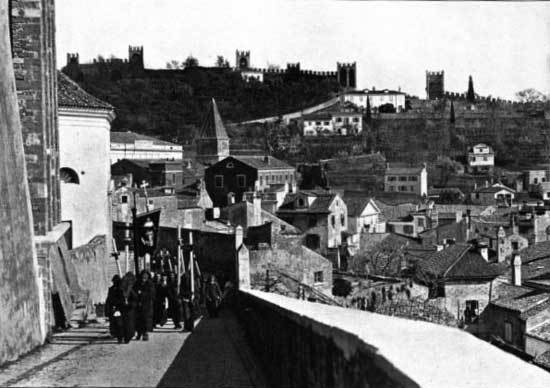
PIRANO, FROM NEAR THE CATHEDRAL
An academy, called "Dei Virtuosi," was also sustained at the public expense, and by it public festivals were organised, with the accompaniment of decorations and music, &c. The festival of Corpus Domini is still celebrated with the hanging of cloths and paintings on the walls of the houses, and with stretching awnings, like the Florentine mediæval "cieli," across the streets, which are strewn with flowers and ornamented with altars and fountains. Processions also still accompany funerals and marriages, when garlands, flowers, and confetti are thrown upon the cortège as it passes. The banner and pall are black, with white embroidery, and the members of a red-clothed confraternity attend the funerals, bearing a crucifix and tapers. Many of them are quite old men, and they raise a quavering chant as they climb the steep ascent to the cathedral, which is a late Renaissance building, and not interesting, though finely placed. The campanile is an evident copy of that of S. Mark at Venice.
In 1572, under an altar in the cathedral, a fine Byzantine civil casket of ivory was found. Presented in 1884 to the Emperor by the municipality, it is now in the Court museum at Vienna. It has a sliding lid, the usual borders of rosettes, and long panels of subjects imitated from the antique. In the library above the sacristy are several early paintings in carved and gilt frames. The most important represents a long arcade with four saints on each side of a broader central panel, on which are the Virgin and Child enthroned. The figures have small heads and meagre limbs. There is also a Crucifixion, which, from its shape, was probably the top panel of a large picture in compartments. These are of the fourteenth century. A later example shows four saints in trefoil-headed panels, with a cornice above, composed of a series of shell-headed tops of niches. These originally formed the doors of a cupboard. There are also said to be a psalter and antiphonary of the fourteenth century, and a Bull of Urban V. relating to the Crusades of 1365. The ancient baptistery stood opposite the cathedral, if one may trust the views in Carpaccio's picture, and in one by Domenico Tintoretto in the town-hall. The modern one is on the slope of the hill, just below the campanile. It contains an early rectangular font. On the side facing the door is a carving similar to that on the font at Venzone—a naked youth astride of a sea-monster, said to typify the control of the bodily appetites by the reason. The other sides are much damaged.
The other important church is that of S. Francesco, which has a good early Renaissance doorway and a cloister, some seventeenth-century carved chairs, several Venetian pictures, and an early altar-piece. On the façade a curious inscription is set in the wall, which states that the church was dedicated on S. Mark's Eve, 1344, and that seven altars were then consecrated by seven bishops—nine being mentioned, however—Justinoplensis (Capodistria), Enonensis (Cittanova), Parentinus, Polensis, Petenesinus (Pisino), Capiolensis, Evelinensis (Buie), Domatensis, Soaralensis. The lion of the church is, however, the fine Carpaccio in the chapel to the left at the bottom of the nave, dated 1518, and signed "Victoris Charpatii Veneti opus," considered by some his best work. It represents the Virgin seated, and holding the Child to her breast. He has two cherries in His left hand; to His right are three saints—S. Francis with a cross, S. George, and S. Louis of Toulouse; to the left, S. Anthony, Santa Chiara, and S. Louis of France. At the feet of the Virgin are two angels with lute and violin on each side of a pot of lilies; a pillared hall, with a view of Pirano in the distance, forms the background. The chapel has pilasters with very beautiful arabesques. The design of the architecture and of the picture agrees perfectly, and it is evident that it was intended that the painted architecture should continue the effect of perspective, which commences with the reality of carved and built-up marble.
In the office of the salt-works is a picture by Carpaccio's son Benedetto, signed and dated 1541, which came from S. Lucia di Val di Fasano. It shows the Virgin seated with the Child in a little shirt, in the act of blessing. On the left is S. Lucy, on the right S. George standing, with their heads on the same level as the Virgin, and therefore on a smaller scale. The throne has a very shallow step. The figure of S. George is a repetition of that by Benedetto's father in S. Francesco.
In the Piazza Tartini, near a fourteenth-century house of Venetian Gothic, once the palace of the family of del Bello, is a modern statue of Tartini the violinist (1692-1770), who here commenced the study of music, which led him to extraordinary executive triumphs and the production of the celebrated "Trillo del diavolo."
Outside the walls, on the road to Porto Rose, are the ruins of the monastery of S. Bernardino, founded in 1450 by S. Giovanni da Capistrano, to whom the ruined convent on the island opposite Rovigno is also due. It once possessed a Vivarini, a Madonna with a sleeping Child, which was sent to Vienna in 1803. In the church of S. George is a fragment of a carved stall with a figure of the saint, which should be mentioned.
The town of Salvore seems to have been under the jurisdiction of Pirano, and the commune held a fair there on S. John the Baptist's Day, to celebrate the naval battle in 1177, in which Frederick Barbarossa was conquered in the deep bay between it and Pirano. The jousts, boat-races, and hunts which were held then and on the feasts of Pentecost and S. Orligo were so sumptuous that the provveditore limited the expenditure.
The last boat for Trieste left Pirano at 1.30 p.m., an hour so ridiculously early, that we determined to walk to Isola and proceed thence by train. We started off bravely up the steep road which led to the fifteenth-century Porta di Raspo, obtaining fine views down the alleys and through garden doors as we ascended the hill. High above our heads the battlements towered, and as we approached the walls we realised what a business it must have been to attack a town so protected before the invention of gunpowder. Soon the road bent away to the right, which was not the direction in which we wished to go, but a path led to some brick-works, and there we found an idle workman, who advised us to go along the shore as being much shorter. So we plunged and slid about among rocks of a considerable size, and skirted the base of slippery cliffs, and ploughed through sand and shingle for some miles, rejoicing when we met the road again in a flat piece of land where there were salt-pans. From this point it made a long sweep inland and then rose in wide curves up the shoulder of a hill which divided us from Isola. Here we saw a train draw up to take on board two gentlemen and a little boy; there was no sign of station or halting-place, and we wondered whether all that was necessary was to stand by the line and wave one's hand to the driver in order to be taken up! A stony path led us to the summit—another short cut, which happily called for less exertion than our previous jaunt along the shore—and a charming view amply repaid us for our labours. In the foreground the stony path dropped between steep banks, the soil being occupied by vines and olives, with a little shrine perched on one of the banks. In the middle distance Isola lay like a jewel upon the sea, opalescent with delicate blue shadows and the indescribable tints of grey stone buildings at a distance in sunlight; with the campanile crowning the slight elevation of the clustered houses. Beyond were the horns of the Bay of Capodistria and the highlands of the Julian Alps, blue in the shadow of the declining sun. A few lighter houses scattered along the peninsula served to soften the transition from the grey town to the green country.
The town is at least as old as the beginning of the eleventh century, for in 1041 it was ceded to the monastery of Aquileia; at this time it was probably unwalled, for in 1165 the Abbess Valperta allowed the inhabitants to remove to Monte Albuciano and build fresh houses there, as they did not feel secure. After the dedition to Venice in 1280 it was strengthened; but that did not prevent a body of the patriarch's troops scaling the walls and taking it on August 25, 1379, to be driven out a few days after by the podestàs of Capodistria, Pirano, and Umago. Since 1411 it has been joined to the Capodistria road by a bridge, and no one would now suppose that it was originally—as its name denotes—an island. Nine square towers defended the walls, and the principal gate was protected by a barbican. The ditch was so useful to the people in peaceful times that the commune threatened with severe penalties those who went by night to deposit in it the refuse of their houses and stables. No trace of these works now remains.
The Colleggiata is a late Renaissance building, but contains some interesting things, including a picture by Girolamo Santa Croce of the Madonna enthroned, with SS. Nicholas and Joseph, and a child angel with a violin on the plinth, signed and dated 1537, but restored. The treasury contains a fine monstrance of silver, Gothic in design, with bands of pierced work and tabernacles at the sides on twisted columns. It has a spire-like top with windows and pinnacles between round its base, a feature which is repeated on the knop. In the seventeenth century several figures were added or replaced and the stem repaired. The Scuola dei Battuti, built in 1451, has a door with a frescoed tympanum beneath a pointed arch on brackets, a good deal weather-worn—Madonna sheltering the penitents beneath her cloak—and pretty arabesque scrolls on the soffit.
Isola is delightful from outside; but inside there is much dirt, and little food for the traveller. All that we could obtain was bread and rough red wine. While waiting for the train, as the sun set and twilight fell, we saw many of the contadini returning from their work, most of them on donkeys or ponies—a father with a little son before or behind him, a man in a black cloak with panniers laden with branches of trees, which hid the saddle, and, in the semi-obscurity, made them look like some monstrous beast of strange form, another perched upon a great bundle of hay or grass, and so on, all passing rapidly from the malaria of the fields to the safety of the malodorous town.
It reminded one of the return of the townspeople within the walls at nightfall necessitated by the mediæval custom of closing the gates an hour after "Ave Maria," after which none could enter or leave the cities; and how the lamps of the shrines were the only illumination of the streets, about which none were allowed to go without carrying a light.
In the train we had as fellow traveller an engineer who spoke English well. He said that all over Istria nothing could be obtained to eat (except, of course, in the more important towns). He had been constructing a new line near Divača, where nothing was obtainable, and he and his companions had been obliged to take a cook and all supplies with them. He appeared to have a very bad opinion of the Triestines, whom he characterised as drunken swine, which we had not observed ourselves. He said that beer was too dear for the majority, so they got drunk on black wine and brandy—a statement which sounded strange to our English ears. The smaller boats, being for the use of the country people, are very inconvenient for tourists, since they generally start so as to arrive at Trieste early in the day, thus allowing of return the same night with the purchases made. Baedeker advises an excursion to Muggia and on to Capodistria and Isola and Pirano, "returning by boat in the evening"; but the last boat from Pirano leaves at 1.30 p.m., and the last one from Capodistria at 4.0 (by which, by-the-bye, we paid twice as much as we paid for the same journey in the morning), and after that the traveller is dependent upon the little railway, which lands him in Trieste after 10.0 p.m., at the S. Andrea Station, rather late to obtain a meal.
VIII
UMAGO TO PARENZO
The next place along the coast, after passing the Promontory of Salvore and turning south, is Umago. It is sheltered behind a shoal, upon which the Chronicles say that the ship laden with the relics of S. Mark struck during a storm on its way to Venice. It was given as a feud to the bishop of Trieste in 929, at Pavia, by Ugo of Provence, king of Italy, and to the bishop of Cittanova in 1029 or 1038 by the Emperor Conrad. It had been sacked by the Slavs of Croatia and Dalmatia in 876, at the same time with Cittanova, Rovigno, and Sipar (at which last place very early wall-paintings are said to exist). It swore fealty to Venice in 1269; but very little is known of its history, the English apparently having burnt the archives in the piazza early in the nineteenth century. At that period no one seems to have thought that such things could be of any value; indeed at Portole, about 1850, the podestà actually sold all the communal deeds to the grocer of the place, thinking them useless rubbish, and at Cittanova the parchments were used by the citizens to mend windows!
Cittanova lies at the mouth of the Quieto valley which, commencing at Pinguente, passes Montona on its isolated hill (visible from the coast like lofty Buie), and terminates in a marsh seven or eight miles long. The mouth is known as Porto Torre, from a little place on the Parenzo side of the river. The city was a Roman colony with the name Æmonia, and the seat of an early Istrian bishop. A few years ago some seventy carved slabs of the eighth or ninth century were discovered face downwards in the pavement of the crypt of the basilica, which appear to have belonged to the font and choir enclosure. Among them are several archivolt pieces, very much like those of the font of Calixtus at Cividale, which show by a mutilated inscription that they were due to Bishop Maurizio, apparently a bishop suspected of being on the side of the Franks, and therefore blinded by the Byzantines in 781. The slabs are all of Istrian stone, except one, which is of marble, and the carvings therefore may possibly to some extent be of local workmanship, though we know that Comacines from Cividale were employed in Croatia. They have the characteristic Lombard furrows and interweavings, and other details met with in different parts of Italy. There are no mouldings, but a slight bead and reel along the interior edge of the arches. One slab shows two birds drinking from a vase in the upper part, and, below, two others apparently going to divide a fish—at each side vine scrolls springing from vases; another is carved with figures of griffins. There are two window-slabs with pierced patterns: one has simple rhomboidal forms; the other a central stem, with curling branches terminating in trefoils of much more advanced type, suggesting the panels in the later tomb of the Dogaressa Michieli in the atrium of S. Mark's, Venice. The basilica was restored in 1409-1414, and in the sixteenth century, with the assistance of Venice, at which time the baldacchino was destroyed. The church stands on the edge of the land, and has a small round-arched arcade on the façade divided by the doorway, which is covered with a pointed hood on brackets. In the gable is an oculus. The campanile resembles S. Mark's, Venice, as is usual. Within, a Venetian Madonna and Child is preserved, Mantegnesque in style, and therefore ascribed to Mantegna or John Bellini. In the eighteenth century a picture by the latter was sent to Venice to be restored, and, if this is the picture, the restoration was very thorough. The baptistery, destroyed in 1780, had a vestibule like that at Concordia. It was octagonal, with four little round-headed windows, and the hexagonal font was built up from the floor, the rim being level with the top-most of the three steps which surrounded the building. Three steps also descended into it.
The city swore fealty to Venice in 1270. It still retains a portion of its ancient battlemented walls, which have a curious feature—a projecting spur, which runs out into the sea a long way, and was probably intended to make the sea-front secure at low water. The commune was very zealous in its preparations for war, and, according to the statute, a citizen who wounded or killed a spectator during military evolutions or practice was able to secure immunity from punishment!
In 1466 the see was divided from the patriarchate of Venice by Paul II., Francesco Contarini being made bishop, and was enriched by the gift of the property of the suppressed bishopric of Equilium. Fifty years before leave was granted to the then bishop to sell wine grown in his vineyards outside the territory.
IX
PARENZO
The next town along the coast, Parenzo, is celebrated for its fine sixth-century cathedral, the pride of the whole of Istria "the land of basilicas," and is the headquarters of the Istrian Archæological Society, several of whose members have devoted much time and money to the elucidation of the history, construction, and decoration of the building.
The excavations undertaken by the late Monsignore P. Deperis, Parroco Decano, showed that there have been four main epochs of construction, as well as restorations and embellishments: (1) Roman, or Early Christian, (2) Byzantine, (3) Gothic, and (4) Modern. There was a primitive Christian basilica to the north of the present one; and Euphrasius, in the sixth century, built his church upon the foundations of a second, which had succeeded it. The site of the first was used as a cemetery till the end of the eighteenth century, and was then made into the garden of the bishop's palace. It was oblong in shape, like the most ancient Christian churches, and had no apse, being 75 ft. 6 in. long and 55 ft. 9 in. wide. It had one main door of entrance, and the altar was at the eastern end of the northern portion. The pavement is 5 ft. 9 in. below the level of the basilica of Euphrasius. In the south wall of the portion first discovered (one half of the total area) a door, the cill of which is still preserved, led to an oratory. On the mosaic pavement is this inscription in black letters on a white ground:
[Lu]picinvs
[et Pa]scasia
[cum r]everentia pa[mula]
Fe[cerunt pedes] c[entum].
The remains of this pavement are good in design and execution, and the colours are well distributed. The nave was surrounded by a broad white band, within which was another still broader, sown with starred crosses. The panels with subjects were also surrounded by a similar band. In the first panel from the door is a crown formed of a triple row of leaves within a double circle; the outer one has an octagon formed of meanders, and the inner a circular treatment of the same kind. Outside are lilies and other flowers within geometrical forms, and the whole is bordered with interlaced lines. In the small circle is a portion of an inscription, the right part of which has been destroyed by a tomb:
INFAN[tius]
ET INNOC[entia]
EX SVO P[alatio]
BASI[licam et]
TES[sellati]
P[edes].
The middle panel is square; within it is a handled crater with a high foot. Two branches spring from it, which are bursting into flowers and leaves; they fill the whole space with their convolutions. At the top is an inscription:
[Lu]PICINVS ET PASCASIA P[edes] CCCC F[ecerunt]; and at the bottom another:
CLAMOSVS MAG PVER ET SVCCESSA P[edes] C[entum]
FELICISSIMVS CVM SVIS P[edes] C[entum].
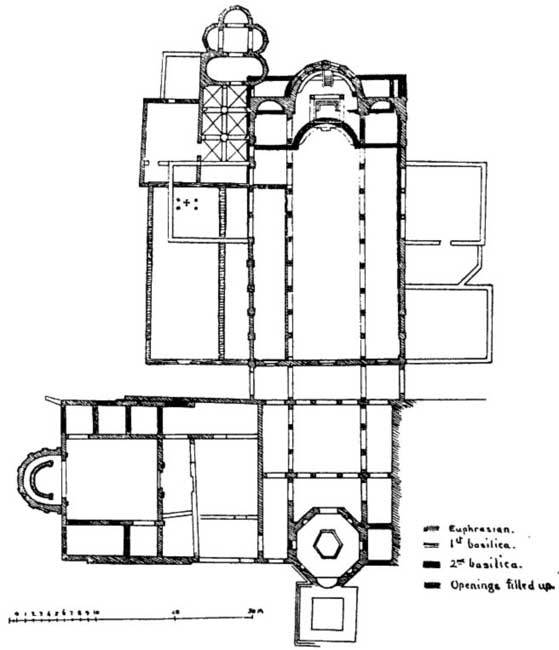
PLAN OF THE THREE BASILICAS, PARENZO
This inscription is interesting as showing that there was a school attached to the basilica before the fourth century. The third panel surrounded the altar, the rectangle of which is marked by the sunken places in the marble slab where the columns stood. A piece of marble of the same size as the sinkings was found not far away. At the right is a square of about 3 ft. 3 in., with a framing of white bands and triangles of colour 10 in. broad, reducing the internal square to 19 in. In the centre is a portion of a cross based on the swastika, and a fish. On the left a cross, formed by the intersection of two oval rings, appears above the fish. These symbolic crosses point to a very early date. The doorstep of the oratory shows signs of considerable wear, and the mosaic has been roughly repaired near the word picinvs. The fishes are apparently insertions, later in date than the original mosaic (which has the structural characteristics of the second century). This suggests that the first basilica may have been a portion of the house of a Christian of position, of which examples occur in Rome. It was probably burnt when Diocletian ordered the destruction of all Christian churches in 303 A.D., since charcoal was found amongst the masonry. The pavement, much broken up by tombs and by the old cistern constructed in the garden, extended under the north aisle of the present building; and the site of the altar is shown by lifting a trap-door in the chapel in the north arm of the cross, for the present basilica was made cruciform in plan in 1846-1847, by the erection of two chapels. The mosaics found in the garden have been completely excavated; they are covered over with glazed outhouses, and can be easily seen. Later excavations made in 1900 have proved that this first basilica had two equal naves, and remains of a marble chancel recalled the phrase in the S. Maurus inscription found beneath the high-altar in 1846: "ideo in honorem duplicatus est locus."
The second basilica was probably Constantinian. The present one coincides with it, except that the apse is polygonal and projects towards the east, and that the lines of the walls bend a little to the left from a line drawn across between the modern chapels. The floor of this basilica is about 2 ft. 9 in. below that of the present one. The mosaic pavement is well preserved nearly all over the surface; and the sacristan opens numerous trap-doors, and puts down tapers, to show the most interesting portions. The cills of two of the doors still remain 9 in. higher and much worn by traffic; the third was destroyed to place a sarcophagus against the wall of the church. Between the two pavement levels several unfinished caps and columns of limestone were found, and also two pedestals and one base among the foundations of the present nave arcade.
Beneath the presbytery is a choir and presbytery of the form used in the most ancient Constantinian basilicas. A sloping platform led up to the step upon which the bishop's seat stood at the centre of the semicircle, flanked by seats on each side for presbyters, the places being marked by red lines painted upon the fine plaster which covers the low wall, rising about 8 in. above the floor, itself 2 ft. 3½ in. above the level of that of the nave. The diameter of the semicircle is about 18 ft., and it is floored with mosaic. Outside runs a white band 6 in. wide, within which is a band of ornament with two black lines at each side; one of them dentilled. This feature is 20 in. wide, with a waving stem with volutes and leaves of ivy occupying the central 12 in., black and grey on white. In the centre of all are other black leaves and scrolls in red, damaged by a mediæval tomb. Three steps led down to the choir, for the singers, sub-deacons, and deacons. It has a plaster floor of a porphyry purple colour, and reaches as far as the third column of the present nave, counting from the east. It was afterwards extended on a lower level, reached by steps on each side, one of which is still in place. The mosaic pavement of this lower nave continues as far as a line which cuts across the central apse, appearing outside the ends of the aisles, as well as outside the semicircle of the presbytery just described, as at S. Maria, Grado. The presbytery wall is rough masonry, as if it had been external, and there are no signs of its having been decorated in any way; but the oblong plan with the apse some way within is found also at Salona, and in Syria and North Africa. Traces of a wall parallel to that of the north aisle, and beyond it, suggest the existence of rooms to the north.
An excavation in front of the door of the sacristy discovered a square mosaic on this level with inscription—
THEOFRASTVS [et]
IANVARIVS DIAC
FEC · P · CCC
—which commenced beneath the chord of the existing apse and terminated in a line with the end of the wall of the earlier presbytery. West of it, and separated by a smooth and even division, as if a wall or screen had been there, mosaics previously discovered stretched to the west door. On the south side a similar division of the mosaic was found, a bit of a colonnette and a few fragments as of a balustrade or cancellum. The spaces thus marked off were probably prothesis and diaconicon, the latter being to the left, where the two deacons gave the pavement. In the left aisle were five different designs given by as many donors. The right aisle was simpler. In the nave an inscription was found mentioning the Clamosus who was named on the earlier pavement, but in conjunction with Victorina, either his daughter or a second wife. This proves that no great time intervened between the erection of the second and the regular use of the first basilica. The inscription found beneath the high-altar, already referred to, mentions two churches, and states that the first was repaired by the prayers of S. Maurus, and that his body was transferred to that place; and calls him bishop and confessor. Till 1354 his relics remained there, when the Genoese admiral, Pagano Doria, took them to Genoa as booty when he had sacked the city, placing them in the abbey church belonging to his family. The Marquis Doria soon returned them. In mediæval documents the district of the city of Parenzo is called "territorio, terra di S. Mauro."
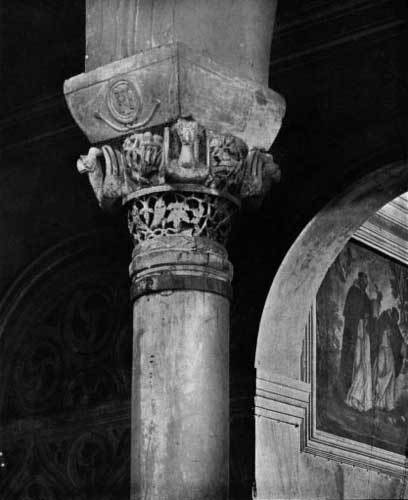
MARBLE CAPITAL OF THE SIXTH CENTURY, PARENZO
The present cathedral was erected by Euphrasius between 531 and 542. This is proved by his mosaic inscription, which states that "in the eleventh year of his episcopate" (543) he had endowed it; for the endowment would naturally come after the building. He found the second basilica likely to fall, with the roof only kept up by chains. The columns are of Greek cipollino, like those at S. Vitale, Spirito Santo, S. Francesco, SS. Apollinare Nuovo and in Classe, Ravenna, and in S. Maria, Pomposa, and were worked by the same workmen in the Proconesos workshops: for on columns at S. Vitale and Parenzo, and also at Pomposa, are found the same mason's marks, monograms uniting the letters ΠΤΕ for Petrus and Ιω for Joannes. The bases are Attic, as at Ravenna and SS. Sergius and Bacchus, Constantinople; and, of the eighteen caps in the nave, six are exactly similar to those of the lower arcade of S. Vitale, several are like others at Grado, two are like a damaged one at Pomposa, and others are much like some at Otranto and Rome. At Venice, too, capitals of the same types occur in considerable number. The super-abaci are of Greek marble, with a circular plaque bearing the monogram of Euphrasius. On the north the soffits of the arches retain the original stucco ornaments, all different; on the south they have disappeared.
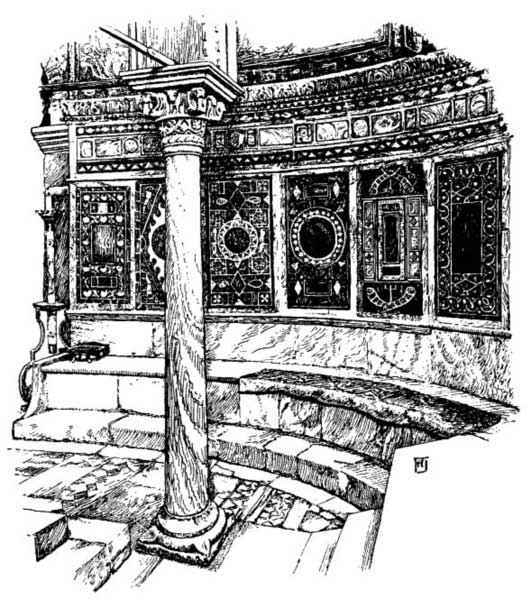
OPUS SECTILE IN THE APSE, CATHEDRAL, PARENZO
The mosaics in the apse closely resemble those of the Arian baptistery at Ravenna in style. The figure of S. Maurus might almost have been worked from the cartoon of one of the Apostles there. In the centre of the semi-dome is a figure of the Virgin with the Infant Saviour, clothed in white and gold. Above, a hand holding a crown emerges from clouds. On each side are an angel and three large figures; on the left are Archbishop Claudius, Euphrasius the bishop, with a small figure of his son, and S. Maurus, holding a jewelled urn; Euphrasius holds his church. The three figures on the other side are unnamed; one bears a book, and the other two crowns. The ground is gold, and below, at the springing of the dome, is the long dedicatory inscription in gold letters on a blue ground. On the wall below are mosaics between the windows. An angel occupies the central pier, and on the piers on either side is a saint, probably SS. Maurus and John the Baptist. On the wide wall spaces beyond the windows are the Annunciation on the north, and the Salutation on the south. The soffit of the triumphal arch has medallions of female saints within wreaths, and at the summit an Agnus Dei. The lower part of the wall is separated from the mosaics by an ornamental plaster moulding, and is decorated with a remarkably fine series of panels in opus sectile, eight designs in couples answering to each other on either side, with a single design above the bishop's seat in the centre, on which the monogram of Euphrasius again occurs. The colours and materials used are green and red porphyry, two blues, a green vitreous paste, a dull-red marble, and a bluish-green marble which has perished a good deal and is now preserved under glass plates cut to fit the shapes, occasional spots of a beautiful orange colour, like a marble used in inlays at S. Vitale, a very dark blue, almost black, a pale yellow-green, and a pale purple like chocolate powder. The white is generally mother-of-pearl, or marble, veined with a pale grey, and a good deal of Oriental alabaster is used. The panel above the simple bishop's throne has a hill, with a golden cross on a green ground diapered with mother-of-pearl, and with tall panels at the sides with the seven golden candlesticks. On a lower level than the throne a marble seat runs round the apse, terminated by two slabs carved with dolphins.
The architect, Signor Tommaso Natale, discovered a mosaic above the triumphal arch a few years ago, which had been hidden by the late Renaissance "improvements." It consisted of a long strip of gold, on which the Apostles stood, clothed in white robes gemmed with crosses, six on each side of a central figure of Christ, robed in purple and seated on the globe. He has a cruciferous nimbus, and is blessing with the right hand, whilst with the left He holds an open book inscribed "Ego svm lvx vera." On the right are S. Peter with the keys, S. Andrew with a book, S. James with a crown, SS. Bartholomew and Thomas with books, and S. Simon with a crown; on the left S. Paul with two scrolls, S. John with a crown, SS. Philip and Matthew with books, S. James Alpheus with a crown, and S. Jude with a book. The names are inscribed above the figures, and a band of dark red with golden gems surrounds the whole. The heads of Christ and SS. Bartholomew and Matthew were damaged by brackets belonging to the roof. The whole of these mosaics have been restored by a Roman mosaicist, Signor Bornia.
The altar of Euphrasius was retained till the time of Bishop Folcherius (1208-1220), who substituted a larger one to contain more relics. A few years after, Bishop Adalpert raised the level of the choir about eight inches, and the altar to correspond, reconsecrating it May 8, 1233. The present ciborium was put up in 1277 by Bishop Otho, using the old columns and caps. It has slightly pointed arches, with Venetian dentil borderings, and mosaics in the spandrils. On the west side is the Annunciation, and on the other three sides heads of saints in circles; the vault is also covered with mosaic. A long inscription in Lombardic letters gives the date and the name of the donor.
The pala was made in 1452, and cost 600 ducats of gold, half of which the commune contributed by selling useless church objects, while half was paid by Bishop Giovanni, a Parentine by birth. It is a fine work in the style of the early Renaissance, with a Virgin and Child in the centre, S. Mark to the right, and S. Peter to the left, and outside of them a bishop with an elaborate crozier, and a deacon holding a model of the town—SS. Maurus and Eleutherius. The figures are within classical niches, the sides of which vanish in perspective towards the central point. Along the cornice runs a series of small medallions with busts of the Apostles. In the chapel of the Sacrament are some stalls to which the same date (1452) is given. They are quite Gothic as to the ornament and structure, and even the figures present considerable contrast with those of the pala. There are five seats with backs, canopy, and ends at each side of the altar. At each end are well-executed figures among foliage scrolls, which are out of scale—on one side, a Virgin and Child and a bishop; on the other, two saints, one of whom is an ecclesiastic. The uprights between the seats are faced with twisted colonnettes, and the backs have a quatrefoil pattern made by cutting the bars of a rectangular framing ornamentally.
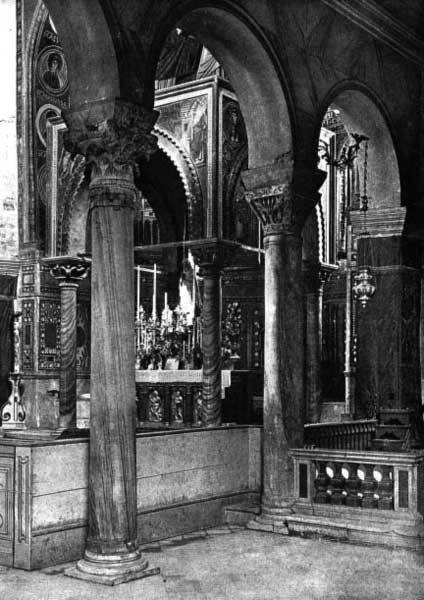
HIGH-ALTAR, PARENZO, FROM THE SOUTH AISLE
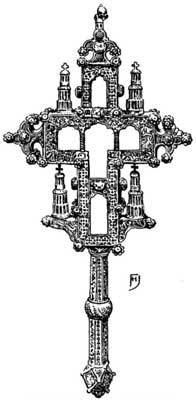
GREEK BENEDICTIONAL CROSS, PARENZO
In the sacristy is a picture by Antonio da Murano in the original frame. Both frame and picture are in a bad state, the gesso having scaled off in places. In the centre is the Madonna and Child, flanked by two full-length saints on each side, SS. Francis and Nicholas, S. Simeon, and another male saint; above the Virgin is a half-length of the dead Christ; and, above the other saints, half-lengths of SS. Mary Magdalene and Christopher, Catherine and Anthony. It is signed "Antonius de Muriano, 1448." In the treasury is a Greek Benedictional cross, with subjects carved in wood, and a silver-gilt enamelled case. There are five subjects on each face, well carved and traditional in their design. On one side is the Annunciation at the top; in the centre, the Baptism, with angels assisting; at each end, an Evangelist seated; below, Christ as Judge between two saints, and at His feet men in the abyss. On the other side is the Presentation in the Temple at the top; in the centre, the Crucifixion, with the thieves, the Virgin, and holy women. Two Evangelists are seated in the arms, and below is either the Resurrection, or the Harrowing of Hell. The case has jewels and pearls inserted plentifully, and is decorated with floral enamelled ornament in green, blue, and red enamel. It is made to take to pieces. The handle bears the name of the maker, "Ezechiel, monk of the monastery of Laura." It is ascribed to the thirteenth century, but is very like those at Kloster Savina in the Bocche, which are seventeenth-century, the character of the floral design agreeing well with that period.
In 1847 Bishop Peteani made considerable alterations, which included the re-arrangement of the high-altar to face the east; and at that time the relics of SS. Julian and Demetrius were found in a square chest of white marble inscribed with the date of consecration and the name of the maker, Adalpert. The ambo in the right aisle, made up of columns and carved slabs of the sixth century, is due to him, as are the chapels to right and left of the nave. The present pavement was laid down in 1880, when some inscriptions of the Euphrasian period were removed to the baptistery. The triapsidal chapel, entered through an elliptical ante-room, beyond the sacristy, was probably a relic chapel, and is of the sixth century—a mosaic of that date was found here five feet below the surface; but the vaulted passage by which it is approached is of the thirteenth century, while the superstructure of the chapel is Venetian, added to assist in the defence of the place from this side, for the sea is quite close. To the east of the city towards Torre Nuova a Christian cemetery was discovered in 1893 close to the road, consisting of three little apsed buildings close together, a larger one with a small one contiguous, with buildings belonging to the original villa which occupied that site at the end of the first or beginning of the second century. A coin of Vespasian was found at the time, and a ring with a palm engraved on it. There are several tombs of the kind in Rome belonging to the fourth century. The mosaics found in the fifth building are now in the baptistery. It is believed that these buildings were memorial chapels erected over the tombs of the Parentine martyrs, and that the greater part of the materials was used in the erection of the church of S. Eleutherius near, after the translation of the relics to the cathedral.
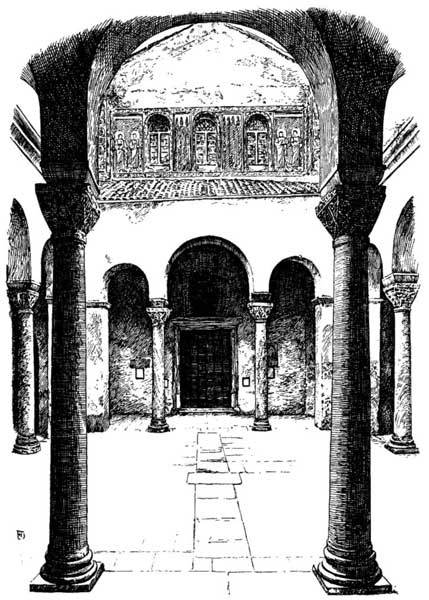
THE ATRIUM AND WESTERN FAÇADE, CATHEDRAL, PARENZO
The plan of the atrium of the cathedral is Roman, not Byzantine like those at Grado, Ravenna, and Constantinople, which have a portico and the baptistery at the side, separate from the basilica. In this case the pavement of the atrium was seven or eight inches above that of the narthex. Along the façade a herring-bone pattern pavement of white and red tesseræ was found which continued farther to the north. The gable of the church was decorated with mosaic; between the windows the seven Apocalyptic candlesticks were represented, and there were figures at the sides, all within a containing border. This has been restored. Above, in the centre, the feet of a figure of Christ seated on the globe may be traced, and folds of the draperies of figures at the sides. Scarcely any of the tesseræ remain, but the lights of the drawing appear in relief. A certain test of the age of the different parts of the building is afforded by the quality of the mortar used. By this it is proved that the eastern apse is due purely to Euphrasius, the foundations being set in mortar of the kind used by him; and also that he kept the atrium pretty much as it was, only adding the columns with Byzantine caps. The baptistery on the other side also was very little altered. It had a floor of stucco, and was circular internally; enough was found between the campanile and the door from the piazza into the atrium to develop the whole curve. Euphrasius made it octagonal, and surrounded the font with marble slabs, the marks of which still remain; a few fragments were found, together with some gilded and coloured tesseræ, showing that it had mosaic enrichments. It is now used to store discarded portions of the early buildings. Here is the Euphrasian altar, standing on a slab of marble with sunk squares in the corners for the bases of the ciborium columns, and enough panels and colonnettes to make a restoration of the chancel of the choir, though it is equally likely that they belonged to a baldacchino above the font, similar to that which still exists at Cividale, and once existed at Pola and at Cittanova. Here are also two caps from the fourth-century church, fragments of mosaic pavement found in mediæval tombs, and a good many pieces of eighth and ninth-century carving.
The survival of the Constantinian plan is explained by the slight alterations made by Euphrasius. The walled-up doors in the baptistery show that it was not an isolated building. They probably gave entrance to dressing-rooms for the two sexes attached to it, waiting-rooms for the baptized and their relations, &c.; and an arch of the fourth century, near to which the herring-bone pavement runs, was probably the entrance to a portico joining the basilica with the baptistery, or the consignatorium, where the bishop anointed the neophytes directly after baptism, before they made their solemn entry into the church. This latter building still exists as the "cantina" of the bishop's palace—a true basilica, with a nave almost square, and with a double-walled apse on the north, and corridors east and west, approached on the south side by a portico. In front was an oblong court. The walls are all of Roman work, and the outer apse has an arcade on pilasters, with large arched windows. A few years ago repairs to the roof led to the discovery of windows in the inner apse. The work round the doors is Euphrasian. The corridors were spanned by arches, which are now built up, and thus make small rooms. There was a second story, which was the bishop's palace; but the second floor of the west wing is mediæval, and it is probable that the great hall was made at that period by dividing the basilica horizontally on the level of the second story. After the custom of anointing the newly baptized in the consignatorium was abandoned, it became the chapel of S. Nicolò, then of S. Mary Magdalene, and the original use was quite forgotten. The campanile is of the fifteenth century and uninteresting.
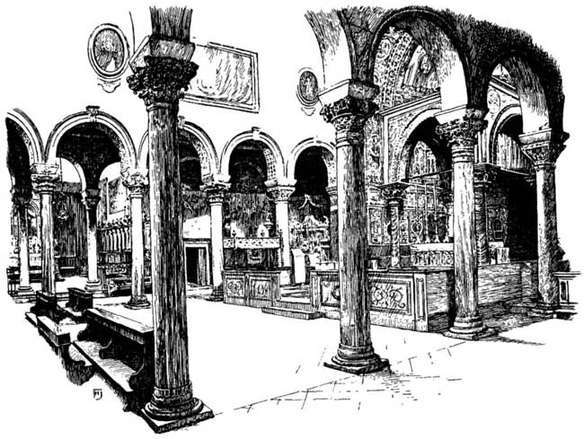
VIEW ACROSS THE NAVE, CATHEDRAL, PARENZO
It was Easter Eve on the occasion of our first visit to Parenzo, and while we were studying the architecture women were constantly bringing their Easter cakes and other food to be blessed at the altar of S. Maurus in the north aisle. Later there was a Resurrection service with a fine procession, with many men and boys robed in scarlet carrying long candles. A crucifer in purple bore the capitular cross, followed by canons in violet and other officials, the bishop's coachman in a long blue buttoned coat, two little acolytes in surplices, with cloths embroidered with crosses on their shoulders and censers, deacons in dalmatics of cloth of gold, a suffragan bishop in cope of cloth of gold and a white mitre, and the bishop similarly robed. A large painted flag of red silk was carried in the procession, and two small painted figures of our Lord, one on the cross, and the other, a half-length, emergent from the tomb. The bishop, fully robed, went first into the capitular chapel and then to the chapel of the Holy Sacrament, where the dead Christ was laid out in a tomb, took the Host and brought it out, being then bareheaded beneath a canopy. The procession then filed out into the atrium, leaving it by the bishop's door at the side of the baptistery, and, passing through the street, regained the atrium by the usual entrance. The Host was then placed on the high-altar, and a kind of benediction service held, in which a fine bass sang several solos. The church was thronged by a devout crowd of both sexes and all classes.
The city was called "Julia Parentium" under the Romans, from the colony of legionaries sent by Augustus. The tribute to Rome was as much as that paid by Pola, the capital of the province. There were temples to Mars and Neptune, of which there are some remains, drums of a few of the columns and a portion of the podium and steps, now used as the lower courses of poor houses. The buildings were destroyed in the fifteenth century, the materials being used to construct the quay. The main street leading from this part of the town to the Porta a Terra may be the Via Decumana of a Roman camp. The site of the amphitheatre is indicated by the curved line of the houses built on its foundations, but there are no remains of Roman work visible. Reliefs of the tenth century are encrusted in the wall of a house on the site of the ancient church of S. Peter; and the Casa dei Santi in the Via Predol, which probably occupies part of the area of the convent and church of S. Cassiano, has two figures on brackets between the windows of the first floor, apparently late eleventh-century work. The Canonica, built in 1251, a fine piece of Romanesque domestic architecture, has six two-light windows on the first floor, and shell-headed niches round the door, with a cross and inscriptions. It was burnt in 1488, and in the eighteenth century was converted by the chapter into a store for the tithes of wine, corn, oil, and fruit, but has been restored, together with the adjoining entrance to the atrium. There are several Venetian palaces in the main street. One, of the fourteenth century, is especially fine. It has big cable string-courses and brackets of lions' heads and necks, and a large and imposing window on the first floor.
There have been three enceintes: (a) Roman; (b) that completed about 1250 under Patriarch Warner of Gillach; (c) a third commenced in the fifteenth century on the same lines, but a little larger. In the eighteenth century the circuit of the walls was about a mile. There were two principal gates—the Porta a Mare and the Porta a Terra—and two posterns made for the convenience of the inhabitants. The city was divided into four Rioni—Pusterla, Porta Nuova, Marafor, and Predol. The existing square tower flanking the Porta a Terra was erected in 1447 under Nicolò Lion; he signs it with initials, and there is a coat of arms beneath the panel of the lion of S. Mark. At the bottom of the frame are the date and an inscription giving the name of the architect, "Mag. Johannes de Pari Tergestinus," and of his son Lazarus, the sculptor. His name occurs on the architrave of the rebuilt church of S. John the Baptist of Volciana on the Carso, with the date 1429. The round tower dates from after the incursion of the Turks into the Carso in 1470, built under Pietro da Mula, 1474. On the Porta della Campana the length of the dagger which was allowed is marked, and the town still preserves one of the "Bocche de' leoni" which were used for secret denunciations. The communal palace was built in 1270, one year before Parenzo gave herself to Venice. Games of cards and dice were allowed under its portico and in the loggia, where the players were under the eyes of the guards.
During the latter half of the thirteenth century Parenzo was in constant contest with her bishop, resisting the financial demands of the ecclesiastical authority with threats and violence. A podestà, at the head of the people, broke into the cathedral, burst open the treasury, and seized the precious objects. In 1270 Marco Michiel, in the name of the commune, forbad the citizens to pay tithe, proclaimed liberty of fishing and pasturage, and took possession of several of the church properties, saying that they had returned to those to whom they properly belonged. In 1278 Bishop Otho excommunicated them for refusing to pay tithe, and because of a rising, in which the palace was invaded and all the authentic privileges and documents thrown into the sea; but the citizens were the stronger, and bishop and canons were driven away from the city. In 1280 there was a delimitation of the land belonging to church and commune. The next bishop, Boniface, renewed the episcopal pretensions denying freehold to both commune and individual citizens. The podestà, Jacopo Soranzo, the commune, and citizens were so enraged that the bishop, in fear of his life, fled to Rovigno, and from thence to Venice. The podestà lodged soldiers in his palace during the war; and in 1284 Boniface fulminated a comprehensive excommunication from Venice against podestà and city. Matters were arranged and he returned to Parenzo, but only to renew his claims. In 1293 the podestà, Jacopo Querini, was disputing with him over a feud at Cervera which he claimed, though it had been in the possession of others for eighty years, and both lost their tempers. The podestà turned to the bishop and said: "I promise you that when my term of office is over I will do you all the harm I can, both publicly and privately; and I pray God and His saints to let me live long enough to see with my own eyes the prophecies fulfilled of the destruction of the Church of Rome, for one may well see that the time is near." On September 14, 1296, the podestà, Giovanni Soranzo, attacked the bishop's palace at the head of the armed populace, intending, as the bishop asserted, to kill him. The prelate took refuge in the Franciscan convent, and escaped by ship to Pirano. Thence he went again to Venice, and excommunicated the whole of his opponents. The podestà threatened to cut off hand and foot from whoever published or executed the ban; and Boniface ordered the prepositum of Pisino to send it to the clergy, which was done next year, but without the desired effect. He acted in the same way with other podestàs, and was often absent from his seat in consequence, thus incurring reproofs from the patriarchs Raimondo and Pietro Gerra. The latter went so far as to attack and destroy the castle of Orsera, where the bishop took refuge.
The people of Parenzo now are more concerned with developing their commerce than with insisting upon their rights, and the quay presents a busy scene when the wine-boats are lading. The casks are so large that two are a load for a yoke of oxen. The cart has sloping sides, and a bed of fresh-cut boughs and hay acts as springs. One of the sides of the cart (of wicker or staves) is removed at the quay, and the casks are rolled down an inclined plane. There were much excitement and some danger as the lumbering weight was turned at right angles to its former course, which was towards the water. The fishermen were busy too; they catch spider-crabs with long spears ending in five prongs, at right angles to the shaft, and forming a kind of cage, which the crabs find it difficult to negotiate when they are raked out of the crannies of the rocks. There was a semi-lunar implement in the boats also, with four internal prongs, at the end of a long shaft, used for catching cuttle-fish.
At the hotel in which we stayed on our first visit there was a green-and-yellow parrot which was very tame. His accomplishments included the saying "Marietta, padrona, and hello" quite clearly, singing and laughing. Its mistress made it flirt with a highly coloured young lady on a poster in a very diverting fashion. At Fiume we saw two parrots of the same kind on perches outside a shop; and my friend, recollecting the friendly bird at Parenzo, made overtures to them, which were not received in the proper spirit, and I am sorry to say that his finger was sore for days after.
There is record of a joust held at Parenzo as late as February 14, 1745. There must have been diverting incidents on that occasion, since the combatants contended with unfamiliar weapons which had been long out of use!
Parenzo is poor in records of craftsmen, and its only artist of repute is Bernardo of Parenzo, who was much employed in his day; pictures by him are preserved in the Accademia at Venice, the Doria Gallery, Rome, in the Louvre, and at Modena. He studied at Padua with Mantegna, under Squarcione, and executed frescoes and chiaroscuro arabesques in the cloister of S. Giustina in that city. When the Austrians converted the convent to military uses the paintings were plastered over, and, although again uncovered in 1895, they were found to be in a much damaged condition. Bernardo died in 1531.
X
TO POLA BY SEA
From Parenzo Pola may be reached either by land or sea, the latter being the more convenient way. The only place of importance passed is Rovigno, though the Canal di Leme, an arm of the sea 7-½ miles long, from 70 to 100 ft. deep, and some 500 yds. broad, which affords accommodation for much more shipping than ever makes use of it, leads up towards Due Castelli, now ruinous, but at one time a thriving and important town. On the way, near Orsera, the little island of "Scoglio Orlandino" is passed, rocky and divided into two portions by a chasm or crack. Legend says that Orlando, passing that way, made a slash at it and left it as it now is.
Rovigno is thought to be the ancient Arupenum or Rubinum, but is first mentioned by the anonymous Ravennese chronicler, and was probably founded in the third or fourth century. In the walls of the principal church are fragments of sixth-century work. There is a tradition that it was founded when Cissa sank into the sea in the seventh century. The site of this city was near the modern lighthouse, and remains of its buildings are believed to be recognisable beneath the water at the point called Barbariga, on the further side of the Bay of S. Pelagio. The large beds of murex shells in certain places are an indication that there were purple dye-works here, an industry for which Cissa was celebrated. Rovigno is situated upon a rock, and was surrounded with walls. Within their area the houses, as seen from the sea or from the railway station behind the town, seem to be piled one over the other, and culminate very picturesquely in the campanile at the top. Beyond the railway station on the Bay of S. Pelagio are the Berlin aquarium for the study of the marine fauna of the Adriatic, and a sanatorium for scrofulous children, opened in 1888. The neighbourhood being fever-stricken the peasants live in the city, going and returning to their work morning and evening. Their Sunday costume consists of ornamented leather shoes, tight white hose of wool, a broad-sleeved white shirt with a frill in front, dark waistcoat, and flat black cap. They have the curious custom of wearing one large earring in the left ear. Rovigno is a good market for wine—considered the best in Istria—olives, sardines, and hazel-nuts which are reputed the finest in the world. Consequently, amongst the inhabitants are many merchants, and the fishers' guild is very numerous; but the steep streets are narrow and, in wet weather, noisome, and the children do not look as healthy as in many other places. During our stay we saw two funerals in the Colleggiata within a few hours, both attended by a red-robed confraternity which included boys and men. The spectacle in the darkening nave (for it was late afternoon) of the two rows of red-robed figures holding lighted tapers, with two or three ensigns or symbols in the background, was impressive, but marred by atrocious singing. The officiating priest was a fine man; and, as the cortège departed to the cemetery just below the church on the seaward side, there was an impression of solemnity which is often lacking in English funerals. A few late Venetian palaces, with fine loggias at the top to catch the sea-breezes, show above the other houses, and the arch between the fish-market and the Piazza S. Damiano, erected in 1680 under Daniele Balbi, still stands, with the Venetian lion holding a book proudly inscribed: "Victoria tibi Marce Evangelista meus"; but the walls have entirely disappeared, with the exception of one ruinous tower, the "Torre del Boraso," which has been in that state since the sixteenth century. At the beginning of the fourteenth century it belonged to the bishop of Pola; the Colleggio dei Cinque Savi acquired it in 1332, and ordered its occupation by the captain of the Pasenatico and the podestà of Rovigno, asking whether it was best to preserve or destroy it, the former course being determined on.
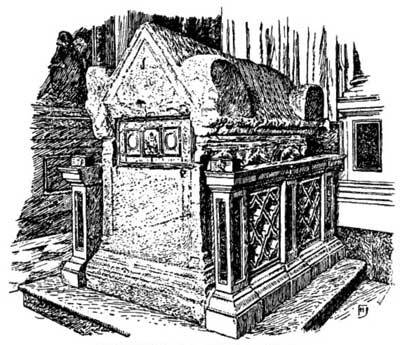
A curious heptagonal building, the Oratory of the Trinity, which stands some distance outside the ancient walls, appears to be rather early in date. It has a polygonal drum rising from the roof of the lower portion, and two curious little pierced and carved windows about three feet high; one of them is too much broken to make out the design. The other has a crucifix with half-length figures, and consecration cross among the piercings, very roughly cut. The head is slightly pointed. The Colleggiata has been rebuilt in late Renaissance style; and the campanile, crowned by a figure of S. Eufemia, the patron saint of the town, is a copy of that of S. Mark's, Venice. The chapel to the right of the high-altar contains the shrine of the saint, a large unfinished sarcophagus of Greek marble. It has two arches on the side with figures scarcely begun, and an octagonal tablet with curved sides in the middle. The legend is that the body of the saint floated over the waves in the great sarcophagus, and was driven by a storm into a little inlet called the "Armo di S. Eufemia," a short way from the pier, where a square pillar with an inscription of 1720 and the communal arms marks the place where it grounded. Some fishers who went out at dawn were attracted by the miraculous light which shone around it. Several days passed before the heavy sarcophagus could be moved. A certain pious widow, with the suggestive name of "Astuta," had a dream, as a consequence of which a pair of bullocks was yoked to it by her little son, and so it went up the hill to the summit at such a rate as to run over one of the bystanders, who was nearly killed, and fainted. When he revived he revealed the name of the saint, and her bones were found within the sarcophagus together with the history of her martyrdom. From that time the hill has had the name of S. Eufemia. The relics were taken by the Genoese in 1380 and carried to Chioggia. The Venetians rescued them, but carried them to S. Canciano, Venice, where they stayed for thirty years. On their return to Rovigno in 1410 a storm drove the ship to the salt-works in the Canal di Leme, where certain cattle-boats were sheltering. The cattle jumped into the water and danced round the ship! So, at least, a manuscript in the capitular archives relates. Scenes from this legend are painted on the walls of the chapel. In the sacristy is a fourteenth or fifteenth-century picture on a gold ground—a figure of S. John the Baptist, with incidents from his life. It came from a church dedicated to him which was destroyed in 1839.
Rovigno and the neighbourhood have suffered much from piracy. In 965 the Slavs sacked the city. Into the harbour the Uscocs entered one night at the beginning of 1597, and sacked a galley and ten ships laden with rich merchandise belonging to Venice. In the port of Vestre (the birthplace of Maximian of Ravenna), about three miles from Rovigno, an Uscoc ship, with 150 men, attacked a ship of Cattaro which carried letters from the doge of Venice, 6,000 ducats of public money and 4,000 of private, with valuable merchandise. They took everything and also stripped the other Venetian ships in the harbour, leaving the sailors nothing but their shirts!
The Canal of Fasana, between the Brioni Islands and the mainland, a little to the south, was the scene of the crushing defeat of the Venetians by the Genoese in 1379. The quarries in these islands, together with those of Rovigno, provided stone for the ducal and other palaces, the Procuratie at Venice, the murazzi at Chioggia, and the mole at Malamocco. It is but a short distance hence to the entrance to the magnificent harbour of Pola.
Craftsmen of Rovigno have made the name of the town celebrated, such as the sculptors Lorenzo and Antonio del Vescovo, who worked in 1468 at the Camaldulan church of Murano, and Taddeo da Rovigno, who did much decorative carving in Venetian palaces. A more distinguished man was Fra Sebastiano da Rovigno, the lame Slavonian (il Zoppo Schiavone), the teacher of the still more celebrated intarsiatore, Fra Damiano of Bergamo. Some of his works are in the choir and sacristy of S. Mark's, Venice. The name of Donato of Parenzo is also coupled with these Rovignese craftsmen.
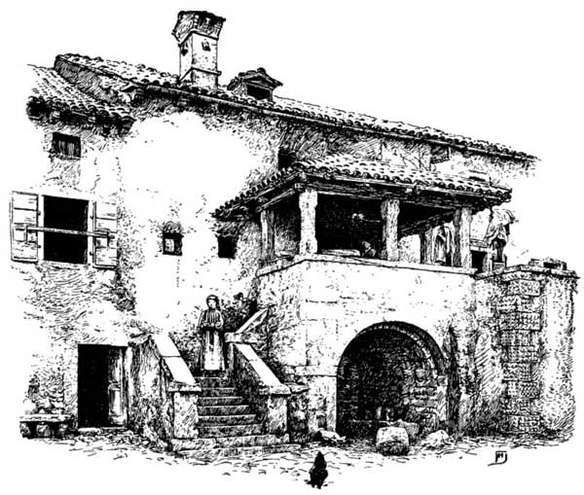
AN ISTRIAN FARM-HOUSE
XI
TO POLA BY LAND
One Easter Sunday we drove in lovely weather from Parenzo to S. Lorenzo in Pasenatico, and on to Canfanaro. By the road we passed every now and then farmers' houses, such as the one illustrated, and met groups of peasants going into Parenzo to the festa. As we got further from the city the men were collected in groups, talking, smoking, or playing bowls; whilst the women also by themselves, in knots of as many as twenty, were seated together enjoying a gossip. The landscape was pleasant, but rather featureless, except for the bulk of Monte Maggiore blue to the south-east. We reached S. Lorenzo at the moment of the elevation of the Host, and found the ancient basilica crowded with worshippers, while several men knelt with rosary in clasped hands outside the open doors, their eyes fixed intently upon the altar. After a time the congregation poured out, dressed in most picturesque costumes, and evidently found our appearance quite as interesting and strange as we found theirs. The men had one big earring (as at Rovigno), and wore white shirts with full sleeves, sometimes embroidered, hose of woven wool, a jacket hung loosely over the shoulders, and a little black cap on the head. The women had full skirts of beautiful tertiary colours, rows of coral round their necks, and large silver-gilt brooches, and rosette ornaments on their breasts with chains attached. On their heads, tied round the base of the skull, they had white handkerchiefs, sometimes with ornamented borders. Over the bodice a kind of loose waistcoat was worn.
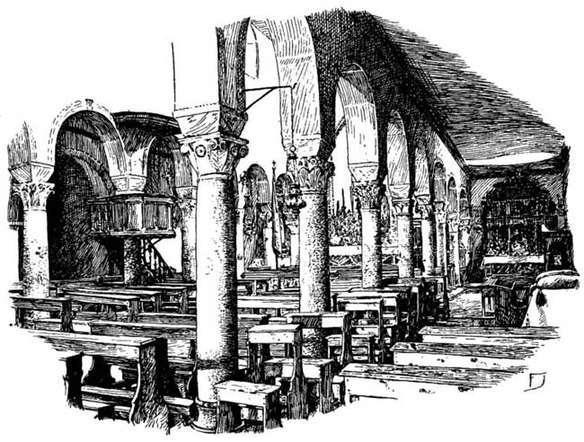
INTERIOR OF THE BASILICA, SAN LORENZO IN PASENATICO
The church is a basilica with nave and aisles, all terminated by semicircular apses, with an arcade of nine arches of unequal width, owing perhaps partly to the obliquity of the west wall, itself caused by the close proximity of the palace of the Count, which was still in existence till 1833. The three easternmost bays are enclosed as presbytery, and this and other alterations are the work of the seventeenth century; but two of the original pierced window-slabs are still in position in the side apses, traces of the small clerestory windows are visible, and in a wall to the left of the façade are encrusted several fragments of carving which apparently formed part of the original chancel of the ninth or early tenth century. The style of the caps of the nave arcade, the irregularity in their size, and in that of the plain super-abaci above them, also point to the same period. The apses have shallow arcading outside; the campanile is an addition built on to the tower of one of the town gates, the exterior arch of which is stopped; about the height of the nave cornice two great brackets project. Another of the wall-towers near at hand still retains the staircase by which it was ascended. Along the south wall of the church runs a loggia supported on slender columns, and in the piazza in front is the base of the flagstaff which once supported the standard of S. Mark. A gateway with a very pointed arch at the bottom of this piazza forms the entrance to the town. The walls are all of the early Venetian period, and a well-head ordered to be carved in 1331 by Giovanni Contarini has a rampant winged lion half-length, crowned and nimbed, and with a closed book.
The city swore fealty to Venice in 1271, and became in 1304 the seat of the captain of the Pasenatico, an officer who had charge of the fortresses and town walls throughout Istria, and the duty of enlisting foot soldiers, sailors, and oarsmen. Marco Soranzo was the first captain. Fifty-two years after his time a second captaincy was created in Umago, afterwards transferred to Grisignana. At some time between 1312 and 1328 Marino Faliero was governor here. In 1394 the captaincy was removed to Raspo, and subsequently to Pinguente. In 1595 it was given to the podestà and captain of Capodistria, except as regarded Pirano.
The church is said to contain the bodies of SS. Victor and Corona, taken from Due Castelli during the war of Chioggia. The "Chronicle" relates that a Genoese squadron was in the Canal di Leme, and the people of S. Lorenzo sent a deputation suggesting co-operation in an attack on Due Castelli, between which town and itself there were rivalry and hatred. The enterprise was successful, and Due Castelli was sacked and burnt. Tommasini records that the marks of fire were visible in his time. The bodies of the saints were carried off as spoil; but it seems probable that it was a Venetian and not a Genoese fleet which co-operated with the men of S. Lorenzo, since Due Castelli belonged to the patriarch, who was allied to the Genoese.
The road from S. Lorenzo to Canfanaro crosses the Draga valley (which is 600 or 700 ft. deep) by long zigzags, from which the ruins of Due Castelli are seen towards the west. They can be visited from Canfanaro. Where the valley narrows upon two projecting spurs, nearly opposite to each other, were Monte Castello, or Moncastello, and Castello Parentino, given to the church of Parenzo by Otho II., but entirely destroyed long ago. These were the "Due Castelli" (two castles). The sea is five kilometres away. The walls and towers (which were built about 1616 by the provveditore, Marco Loredan) from a distance appear well preserved, but the only buildings remaining within are two churches and the castle.
The double girdle of walls of the castle, with well-preserved battlemented towers, is the principal factor in the effect. The gateways are pointed: outside the walls, towards Castel Parentino, is the pedestal for the municipal standard; on the other side is an illegible inscription in which the date 1475 may be deciphered. The more important church, S. Sofia, still has its outside walls, the three apses, with traces of frescoes in the central one, and the walls of the sacristy. At the beginning of the fourteenth century it appears to have belonged to the Castropola, and then to the Count of Gorizia; but in 1420 the Venetians appointed a podestà. In 1616 the Uscocs sacked the place, and the plague of 1630-1631 slew many of the remaining inhabitants. The district grew malarious; and at the beginning of the next century the rector, the ministers, the chapter, and the few people who remained took the precious things which the church still retained and moved to S. Silvestro, Canfanaro. S. Sofia was abandoned on June 7, 1714. The fourteenth-century pulpit, brought with them, is hexagonal, with subjects in the panels, and supported on six columns. In one panel a female figure holds two triple-towered castles of the same shape as those in the arms of Muggia. Malaria still keeps the district clear of houses, though the land is cultivated.
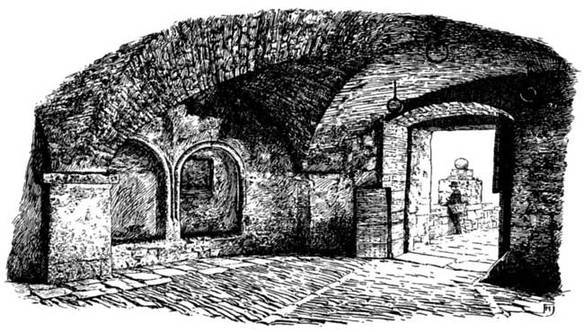
ENTRANCE TO THE CASTLE, PISINO
A few miles from Canfanaro to the north-west is Pisino, the capital of Istria, situated upon and about the rock beneath which the river Foiba disappears. The railway winds round the sides of green and wooded hills, rising with each curve till it is some height above the city. The landscape is more striking than is usual in Istria, hills of some size appearing on the horizon, while in the middle distance the Foiba meanders through a fruitful valley, occasionally broken by a low waterfall. The copses which clothe the hillsides here and there are vocal with the song of birds, and nightingales may be heard in plenty in the spring. The situation is magnificent. The town stands upon the summit of a promontory spreading out like the fingers of a hand, and at its base the river foams and rushes, entering a deep winding ravine and plunging beneath a rocky precipice several hundred feet high, on the top of which a few houses appear. The steep sides are green with trees to a certain height, and then the grey rock appears scantily covered with grass in places; above the abyss swallows dart and hawks hover. On all sides the rushing of water is heard, and fountains in the streets betoken an unusual supply, for Istria is generally a thirsty land. The castle is so close to the chasm that from one of the windows a stone can be tossed into the water. The dwarf wall shown in the illustration runs along the top of the precipice. Upon the door the date of 1785 is cut, but the greater part of the walls with their machicolations belongs to a reconstruction of the ancient castle in the fifteenth century. It is still inhabited, and part of it is used for district offices, but there is little of archæological interest in city or castle. In the courtyard is a well on a platform ornamented with stone balls to which twelve steps ascend, a rather curious arrangement. The place for the bar which fastened the doors is still there, but in these peaceful times they appear to stand open day and night; at all events they were open when we reached the place about 7 a.m., having left Pola soon after 5. In the cathedral are a silver processional cross with figures of saints, and a tabernacle of 1543, rich of its kind, also a picture by Girolamo da S. Croce.
There was a cattle-fair on the day we were in the town; the place was full of contadini, and the roads were thronged with cattle being driven in for sale. The lambs were slung on donkeys' backs in couples, confined in sacks with their heads out of the mouths, and one lively little black fellow escaped and caused much excitement before he was caught and reimprisoned. The type of the peasants is quite different from that of those lower down the coast; the head is long, the nose aquiline, and the countenance seamed with many deep wrinkles. The older men wore one large earring in the right ear, hose of a thick whitish woollen material, or brown or blue trousers which sometimes reached but a little below the knee, a white shirt, and a brown jacket hung over the shoulder. The daughter of the house, who served us at a rough restaurant where we had déjeuner together with some of the country folk, was anxious to know whether the language we were speaking together was Russian. I fancy English travellers are very rare in that part of the country.
A few miles south of Canfanaro is the little town of San Vincenti, in which is one of the best preserved of the Istrian castles, showing indeed little sign of ruin externally. It occupies one side of the main piazza. At right angles to it is the church, with a façade recalling the work of the Lombardi, and there is a loggia and a public cistern, made in 1808 to ensure a good supply of drinking-water. In this piazza a joust was held as late as June 24, 1713. There Maria Radoslavich was hung and then burnt as a witch on February 25, 1632.
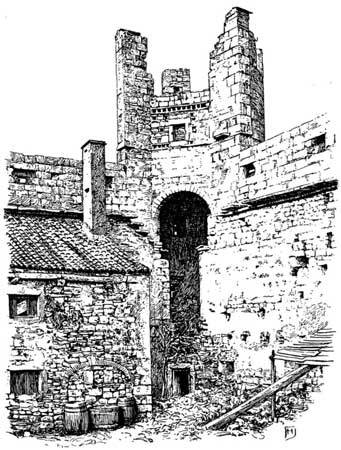
AN ANGLE OF THE CASTLE, SAN VINCENTI
The castle is quadrilateral with a round and an octagonal tower at the angles of the northern face. The opposite side has a square tower at the angle to the right, and to the left the house of the governor just beyond the entrance-gate; the walls splay out widely to the bottom of the ditch. The slits for the chains of the drawbridge are on each side of a little grated window, and above the door are the date 1485 and the arms of Marino Grimani, with an inscription recording a restoration in 1589 after a fire in 1586. On a small door inside is the date 1728, showing that the castle underwent restorations and rebuildings. In the middle of the cornice is an arch for the castle-bell. The town was part of the feud of S. Apollinare, and was destroyed in 1330 by the soldiers of the Patriarch Pagano della Torre. The castle belonged first to the Castropola, then to the Morosini, and finally to the Grimani. It was dismantled by Bernardo Tiepolo after the war of Gradisca (during which Loredano used it as his quarters general), with the object of freeing the people from forced service of various kinds. Low buildings used as harness and store-rooms, &c., still remain against the walls inside, but the stair to the suite of principal rooms is ruinous. It is external, and led to a terrace beneath which were prisons, and from which another flight rose to a door of entrance, walled up but still traceable, at a considerable height. Other prisons were in the towers, which were bound together by the gallery which ran round the interior. The ground floor of the seventeenth-century house which occupies the ancient keep was arranged as guard-rooms and soldiers' lodgings; an internal stair conducts to a few rooms which look into the courtyard; the floors of the rest have been destroyed. Externally there is no opening for half the height; then there are two pointed windows with a considerable space between; above these in the middle is a large loggia with two pointed doors, at the sides quadrangular windows, and higher up, beneath the eaves, four more small window-openings. Some of the towers are ivy-grown.
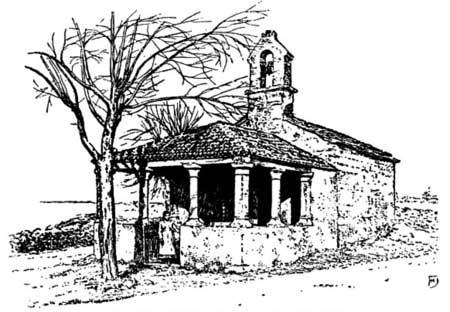
WAYSIDE CHAPEL OUTSIDE SAN VINCENTI
In the church in the piazza is a S. Sebastian ascribed to Schiavone. The most ancient church is, however, in the cemetery to the north, a simple nave with pointed windows. The little chapel illustrated, at a crossing of the ways, is characteristic of this part of Istria. The people still speak Venetian Italian, though there are a good many Slav contadini, brought from Dalmatia by the Grimani in 1628. The type has regular and marked features, with dark eyes and hair. The costume is not quite that of the Morlacchi, being all black except the shoes, which are of natural leather. The women have short skirts, black stockings, and shiny shoes, many chains round the neck, and earrings, and on festas have a coronal of pins in their carefully arranged hair, like the women of the Brianza. Their weddings are celebrated amid great gatherings of friends; two pipers, with instruments timed in thirds, march first, playing a kind of tarantella; then follows a company of contadini two and two, not arm-in-arm, but with a coloured handkerchief from one head to the other. The bride has a kind of turban of brilliant colours on her head, from which masses of vari-coloured silken ribbons hang, covering her to the shoulders and breast except for her eyes, nose, and mouth. Her chemise is finely pierced and embroidered on neck, bosom, and cuffs, and her stockings are of open work, while her shoes are almost like sandals. Rows of coral deck her neck, and her fingers have as many gold rings on them as possible. The bridegroom's hat bears a crown of artificial flowers, as does that of the best man; all the friends have a similar bunch in their hands or caps. After the marriage the pipers play, and the whole of the company form up in a straight line outside the church. Then the best man comes forward with a kind of cake, which, after various feints, he throws among the crowd of children which quickly collects, and they scramble for it. Then the husband and wife, with the best man, go to the goldsmith's to buy the marriage present. Later there is a dance. The men and women face each other in line. They pace rapidly back and forth without moving forward. Then the couples advance, the man raises his right arm and opens the hand to the woman, who grasps it, and turns herself under the arch of the two arms. Then the man passes his arm round his partner's waist and they go round in measured walk.
Between San Vincenti and Pola are Valle and Dignano. At the former the fortifications are earlier than the fourteenth century, heavy and imposing, with five lofty towers (two of which are embattled), so that projectiles were dangerous rather from the force of gravity than from the impulse given. A portion of them is ruined, and one of the towers is now the communal cistern. In the crypt of the church are fragments of ninth-century carving, cut up disgracefully and made into a modern altar, and there is a sarcophagus of the same period in the cemetery. The campanile is considered to be the oldest in Istria. In the treasury are a silver-gilt monstrance with many pinnacles and Renaissance scrolls on the foot, a cross and a chalice of silver-gilt with medallions on the foot, which once had an enamel ground. The most interesting thing, however, is a chasuble of the fifteenth century, with embroidered figures of silver-gilt thread in high relief upon the cross. At the back, on the upright part, is a half-length of our Lord in a chalice, and two saints, all three beneath canopies, and on the arms SS. Peter and Paul. On the front are two figures and an Annunciation on the arms; the Virgin on one side, and the angel on the other. The flesh is painted.
XII
POLA
The town and arsenal of Pola lie at the head of one of those convenient inlets which provide the Austrian coast so plentifully with fine harbours. As the steamer passes between Cape Compare and Monte Grosso the naval port appears to the right with many powerful ships-of-war anchored in the bay: beyond and above the island of Olivi, occupied by part of the arsenal, rises the town, its buildings climbing the hill towards the castle which crowns the summit. To the left is the ample commercial port with its long quays stretching towards the railway station, the imposing mass of the amphitheatre dominating the whole of that side of the picture. These two structures, the amphitheatre and the arsenal, show the chief interests of Pola—the glory of antiquity, and modern utility devoted to defence; for the monuments of mediæval times are few in the city, and the destruction wrought alternately by Venice and Genoa left it poor, and in many parts ruinous, till the modern revival, with the transference of the headquarters of the Austrian navy from Venice in 1861. The mouth of the harbour is less than half a mile across and is over 100 ft. deep. The eastern portion has a depth of 20 ft. against the quays, which are all constructed on made ground. The quarries on the Brioni Islands have afforded excellent material close at hand for the buildings and fortifications both in antiquity and in modern times.
The castle hill was the capitol of the Roman city, and the streets ran round it, with others diverging like the ladders of a spider's web. A canal isolating the city from the land existed to the east. Of the land gates two still remain—the Porta Gemina (anciently the Porta Jovia) and the Porta Ercole; the arch of the Sergii formed the interior face of a third (of which a portion of the lower courses remain), the Porta Aurea, so called probably from its having had grilles of gilded bronze. There were also seven gates in the walls towards the sea. The forum was twice the size of the present piazza, which occupies part of its site, and had twin temples at one end, with the comitium between them, of which one remains in good preservation, and a portion of the back part of the other. There was a temple of Jupiter Conservatorius, upon the site of which the cathedral stands; and one to Minerva, afterwards the site of the destroyed basilica of S. Maria in Canneto. The theatre was near the Porta Aurea, and is now marked only by the excavation of its curve in the hillside and a few ruined arches in a private garden. The destruction of ancient Pola is largely due to Venice, who appeared to think that when the communes gave themselves to her she acquired the right of removing any of the monuments to beautify herself; and it even went so far as for a patrician to seriously propose to bear the cost of transporting the amphitheatre to Venice, and re-erecting it on the site of the present public gardens!
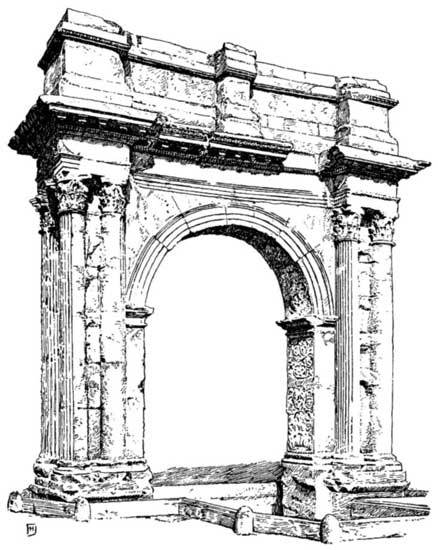
ARCH OF SERGII, POLA
The Porta Gemina consists of twin arches, beneath a simple frieze and more elaborate cornice supported by modillions, which rest upon three engaged composite columns raised upon pedestal blocks. The key-stones are flat, and the piercing of some holes in them suggests that metal enrichments were affixed. It was an important gate, being the direct way to the amphitheatre from the Capitol, and also the starting-point of the military road towards the Arsa and Albona. By it also the aqueduct passed into the city. The Porta Ercole is simpler, and probably older; it bears the names of two duumvirs, Lucius Cassius Longinus and Lucius Calphurnius Piso, and some rough carving. Of the Porta Aurea itself, which had a central gate for chariots and two side gates for pedestrians, little remains. Beneath the arch of the Sergii the ancient pavement has been uncovered, bearing wheelmarks made many centuries ago, and the lower courses of the gateway adjacent, but all the part above the present street-level has disappeared. The carving on the arch of the Sergii shows a curious economy. Since the gate was so close to it only a portion of the coupled Corinthian columns could be seen; the fluting, therefore, was carried only a third of the way round, and the capitals were left merely roughed out, as were also the mouldings of the attic which would be hidden by the cornice, except in the portions visible from the external sides. The soffit of the arch is carved, and the face of the pilaster below has a very rich and graceful vine arabesque upon it. The other side is fully decorated with victories in the spandrils, festoons and chariot-races on the frieze, and the attic develops three pedestals for statues, inscribed to members of the family of Salvia Postumia, who erected it in honour of her husband, Lucius Sergius, his father of the same name, and his uncle Cnæus Sergius. Lucius Sergius was tribune of the 29th Legion. The work is probably of the time of Augustus.
The finely proportioned temple was erected at a later period during his lifetime by the grateful Polese; such adulation could be tolerated only in Asia, and Augustus declined to allow the dedication without the addition of "Rome." The façade has four Corinthian columns, and at the angles of the cella are four channelled pilasters; between these and the four columns of the façade is a similar column on each side. The roof is modern. Within it and around are collected numerous sculptured fragments, antique and of the early mediæval period for the most part, which would be the better for spacing and arranging. The other temple is of a later date. They both stood upon a platform twelve steps above the forum, themselves raised further by seven steps and a stylobate. The rostra were on the forum side of the comitium.
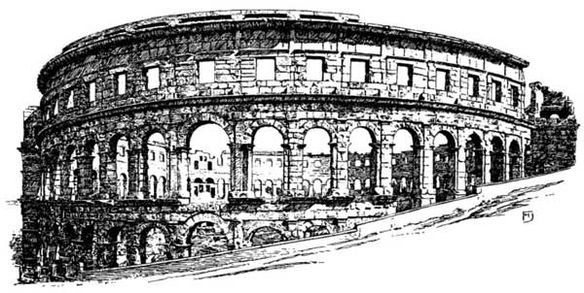
THE AMPHITHEATRE, POLA
Till 1875 the amphitheatre—which was built in 198-211 in honour of Septimius Severus (who had been governor of Illyria) and of Caracalla—lay open to the street. It was then railed round, and since that time systematic excavations have disclosed the plan of the sub-structures. The circuit, which is nearly perfect, consists of seventy-two arches, and the elevation has a basement and a principal story, with an attic of square windows to light the promenade, and a finishing cornice through which the masts for the Velarium passed, resting upon stone blocks above the cornice of the main story. The arches at the extremities of the long diameter are wider than the rest, and therefore cut into the frieze above, an unusual licence. There are four towers, two towards the sea and two towards the hill, which probably contained double staircases, but no sign of them remains, though the doorways and grilles of pierced stone testify to their usefulness. Excavations have brought to light forty or fifty pieces of the steps of the auditorium, upon some of which the seats are marked by dividing lines and by letters. The podium of the arena shows by its lowness that fights with wild beasts did not take place in it. Until the fourteenth century the interior remained nearly complete, the patriarch having forbidden the removal of stones. At that time the seats were taken to repair the town walls, and a great deal of the material was subsequently sold to Venice. The stone of which the amphitheatre is built has taken on a beautiful warm colour from the suns of centuries, and glows in the sunset light as if it were the marble which makes so many Italian buildings lovely in colour.
The most important church in Pola was S. Maria Formosa, or del Canneto (of the marsh), built on the foundations of the temple of Minerva. It was founded by Maximian, archbishop of Ravenna, the friend of Justinian, who was born at Vistro, now Porto Vestre, a village to the south of Rovigno. He came to Pola to consecrate it in 546. He also founded a Benedictine monastery near, which soon became the richest in Istria by its connection with Ravenna, endowed the convent of S. Andrea, and built a house for the rector of the basilica. The site of the abbey is now occupied by the buildings of the Hotel Central and other houses in the parallel streets Via Minerva and Via Abbazia. It was a basilican church with nave, and aisles raised two steps above it. There were ten columns on each side, with varied capitals. The aisles were vaulted, and the semi-dome of the apse was decorated with mosaics on a gold ground. The high-altar was under a baldacchino; there was a throne for the abbot, and seats in the choir for the monks. The windows were small and round-headed, filled with pierced slabs. The ancient door of entrance is between Nos. 27 and 33, Via Abbazia—a round arch simply moulded, with a dentil round the tympanum and a lintel below. The nave stretched along the space now occupied by the stable-yard of the hotel, and the wall of the north aisle forms part of the stables. It has external pilaster strips opposite to the places where the columns of the nave arcade stood. The apse, with triumphal arch, still exists, and two round chapels which flanked it and were entered from the aisles; one of them was dedicated to the Madonna del Carmelo, and the other to S. Andrew.
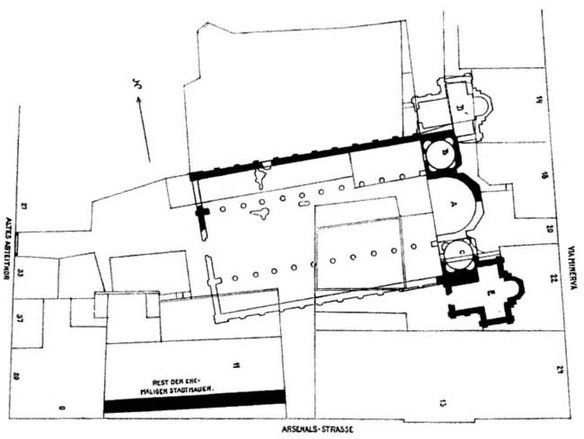
PLAN OF S. MARIA FORMOSA, POLA
The S. Maria del Canneto of to-day is a cruciform chapel which lay to the right, and has an apsidal eastern end. The entrance is past the kitchen of the hotel; and from a window of an upstairs corridor one can "assist" at Mass when it is performed, for the church is entirely enclosed in the hotel buildings. The arms of the cross have wagon vaults; at the crossing is a quadripartite vault with ribs and central oculus on a higher level; rough projections along the ribs suggest the copying of leaf ribs of early mosaics. It is about 22 ft. 6 in. high, and there is a window in each wall. The roof shows ancient material and in some parts the ancient manner of using tiles. On the face of the bell-turret a piece of eighth-century carving is fixed. The walls are now whitewashed, and the floor covered with red tiles. The round chapel to the left of the apse has a cupola with an oculus and a lantern at the top. There are still remains of the mosaic pavement of the apse in No. 20, Via Minerva: in 1898, when building the stables, some fragments were found near to the aisle wall, which, with others unearthed in 1902, are now in the municipal museum. The patterns are a guilloche border with fishes, enclosing a field of plant sprigs, and a lotus border with a more conventional pattern within. The colours used are two reds, two greens, black and white, and pale blue occasionally. The cloister lay between the church and Via Abbazia; the houses 39, 37, and 35, stand on its site. The last notices of the church occur in the middle of the thirteenth century; later mention refers only to the ruins. The destruction appears to have taken place when Pola was sacked by the Venetians under Giacomo Tiepolo and Leonardo Querini in 1243, though some think that it was in one of the later sackings by the Genoese, of which there were three in the fourteenth century—1354, 1376, and 1380. In 1600 a number of the pillars were still upright, and mosaics and sculptures were visible; at that time they tried to raise a chapel within its walls. It is certain that the Venetians gradually despoiled it of everything of value, with the consent of the Polese. Much of the material was used in the seventeenth century for the restoration and rebuilding of the communal palace, and two at least of the pillars of the ciborium of S. Mark's, Venice, as well as the four of Oriental alabaster, which the tourist is told came from the Temple of Solomon, were spoils from this splendid church, the latter annexed in 1605, and the former by Giacomo Tiepolo in 1243.
In 1545 Sansovino was sent by the Senate to bring away the marble columns to Venice. The African marble on the landings of the Libreria Vecchia also came from Pola, and the shaft of the holy-water basin in S. Mark's, with dolphins and tridents, once belonged to a temple of Neptune there. The Polese presented the four central columns to S. Maria della Salute, from the theatre on Monte Zaro. In 1632 the Venetian Senate ordered the provveditore of the castle, Pola, to inform himself as to the number and quantity of the columns of "noble architecture" which were in one of the ruinous churches, and on August 21, 1638, praised the diligence of Bragadin in sending marbles for S. Maria della Salute. He had sent fourteen columns in April, and information of others at Parenzo.
Several other early churches in and around Pola were destroyed while constructing the fortifications. On the island of S. Caterina was a cemetery church, the plan of which indicated early Byzantine origin; on that of S. Andrea were a cloister and church of the sixth century; and on the hill whence the Tegethoff monument now looks over the harbour the double basilica of S. Michele in Monte, partly dating from the seventh century and partly from the eleventh. The grave of Salomon, king of Hungary, who died here in 1087 and was canonised shortly after, whose body had been venerated in the cathedral from the fifteenth century, was then found. The sarcophagus is now in the museum.
The original cathedral appears to have been contemporary with that of Parenzo, but it was restored in the ninth century. In 1884 the floor of the presbytery was lowered, and near the high-altar, at a depth of two feet, Roman fragments and ninth-century carvings were found, with an inscription of the fifteenth century; lower still were Roman inscriptions and sculptures, and then a semicircular mosaic floor of 13 ft. radius, with a lily border on a black and red ground (grey, yellow, and white tessera? also being used), with an inscription mentioning Donatian, and small medallions with cross and square. Under the first step of the demolished stairs was a second much damaged mosaic resembling the early one at Parenzo. It may be seen by lifting a trap-door, A bronze medal of Agrippina was found at the same time. Three rectangular windows were also discovered, a large one in the centre and two smaller towards the sides, the former filled with a pierced slab now preserved in the presbytery. The triumphal arch is round, with early caps and impost mouldings; other early caps and columns are visible in the walls of the choir in hollows made to expose them. The theory is that there was a confessional behind the apse instead of below it, of which these fragments are the remains. Encrusted in the outer wall of the south aisle is an inscription which runs thus: "In the year 857, fifth indiction, under Ludovicus, Emperor of Italy, Handegis was elected and consecrated bishop on Whit Sunday, and occupied the seat for five years." It is thought that he was the restorer of the building. Some of the ninth-century carvings are in the museum. Several small windows high in the nave walls still retain the slabs pierced with ninth-century patterns, and two unbroken ciborium or baptistery archivolts still exist, one in the courtyard of the Beata Vergine della Miscricordia, and the other in the Piazza S. Giovanni, where it is made up into a little shrine with two fourteenth-century caps, and a Renaissance pediment with two uprights of a chancel of Lombard work, with three furrowed scrolls and crosses of the usual Syrian derivation.
The church was subsequently much altered, the transepts and apse have vanished, and stones found which bear the marks of fire suggest that it was burnt, either by the Venetians in 1243 or by the Genoese in 1379, when they took the bronze doors away and burnt the archives. An inscription on the front of the reliquary tomb, which is to the right of the high-altar, and claims to contain the bodies of SS. Basil, Demetrius, George, and Theodore, and of Salomon, king of Hungary, states that Bishop Biagio Molin rebuilt the church in 1417. To this building the retable of the high-altar, dedicated in 1469 and now in the north aisle, belongs, still called La Madonna del Coro. It has figures of saints in the upper row, half length, and full length in the lower row, in high relief; the Madonna in the centre, and above her Christ over His tomb, showing His wounds, and attended by the Virgin and S. John, with fine tabernacle work and pierced pinnacles, all gilded except the flesh, which is painted, and the ground behind the pinnacles, which is blue. It is rather over-restored and looks quite new. The ciborium has cipollino columns, antique caps, pointed arches, and Venetian dentil enrichments with marble inlays. The nave arcade, of nine columns, has slightly pointed arches, unmoulded except for a simple hood-mould and a kind of engrailed crown above the abacus. The caps are for the most part late fourteenth century in character, but some are antique. The columns have been made up to the same size with plaster, and painted to imitate granite, only a few having escaped. The last one on the south has a ring round the centre; one base looks antique, many of them have spurs. The restorations of 1640 and 1712 have obliterated all appearance of antiquity. Bishop Giuseppe Maria Bottari, the last restorer, used so many inscribed slabs in repairing the interior and building the campanile that he was nicknamed "the sexton of inscriptions." There was a cruciform baptistery to the west, the remains of which were destroyed in 1850 in connection with the harbour works. To the north of the cathedral is the communal cistern, which covers a great part of the site of the early church of S. Thomas. In 1860 some reliquaries were found here between the cistern and the cathedral sacristy, where the centre of the apse probably was, and further investigations disclosed the steps to the presbytery, remains of the apse, and stones carved with ornament. In 1332 this church was used for service in place of the ruined cathedral, and as late as 1812 some remains of the walls were visible. The reliquaries were contained in a stone chest some three feet below the ground level. Within it was another smaller chest of Greek marble, with Byzantine ornament, and a gable roof with an inlaid cross of green stone. This was preserved in the cathedral for some time, but has now disappeared. Within it the workmen found a flat rectangular casket, described as being divided into sixteen compartments, which held silver reliquaries, and in the middle a small golden box, in which were two little finger-bones. In another was a small yellow piece of silk with blood-spots on it. The sacristan asserted that there were also twelve golden statuettes a span high, and some smaller silver vases; but all the reliquaries have disappeared except two, which have been preserved at Vienna since 1888. The more important of the two is an hexagonal box with an ogee-shaped lid and a little rosette on the apex; on the sides are repoussé figures, the upper parts of which are repeated with some modifications on the lid. These figures are: Christ, between SS. Peter and Paul, and three single figures, two of which hold symbols, a roll, and a tau-cross. The Christ is youthful, without a nimbus, and holds an open book in the left hand. The draperies are all antique in style, and the work is believed to be of the first or second century. A hasp is attached to the lid, but there is no sign of hinge or corresponding button. The smaller casket is rectangular, resembling that found at Grado. On the lid is a cross in dark-blue enamel with surroundings of filigree.
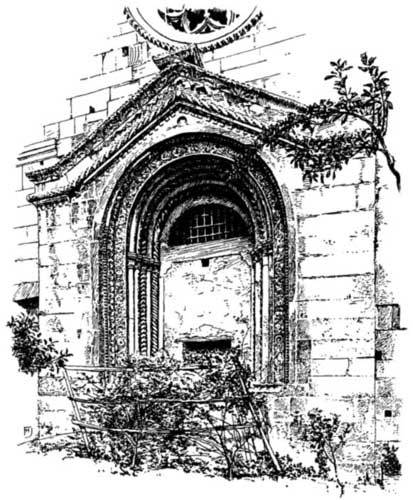
WEST DOORWAY, S. FRANCESCO, POLA
The church of S. Francesco is halfway up the hill to the castle, and is now used as a military magazine. Towards the road the wall terminates in a gable, with two pointed openings for bells; below is a red cross inlaid within an enclosing moulding. A ramping cornice of shallow arches with dentils above it finishes the wall, the centre portion of which is pierced with a two-light trefoiled window blocked up below, while a chapel to the north is lighted by simple-pointed windows. The fine entrance door, with its rich mouldings, twisted columns, and round arch, looks rather older than 1314, which is the date of the first certain mention of the church; but in Istria and Dalmatia styles lingered late. It is said to have been built by the Castropola in 1285, and a half-obliterated inscription by the door records the date of 1406, when a provincial Franciscan council was held in the church. On each side of the door is a window of two trefoiled lights with slender shafts, and above it a rose with Gothic tracery. The interior has a simple unvaulted nave, a choir of one bay with cross vaulting, and a small chapel, probably the sepulchral chapel of the Castropola, since their arms are on the windows. The only remaining piece of the cloister serves as entrance portico. The little garden outside the principal door has a bowling-alley beneath a vine pergola, from which there is a beautiful view over the bay; and in it grow trees of euonymus and oleander with thick trunks, and an aloe, besides the usual roses, peaches, and mulberries.
The communal palace was built in 1296; the back portion is part of the second temple. Some portions of the ancient building remain on the right flank. It was the palace of the Margrave of Istria, and later of the Venetian rectors or counts of Pola. According to Kandler, the figure of a knight upon it represents Albert II., Count of Istria. The Genoese damaged the palace in 1390, but it was restored the next year. After the façade fell in 1651, it was rebuilt in its present form, with material from S. Maria Formosa, but it was not finished till 1703. During the last years of the Republic the count lived in the back portion, had his stables in the temple of Augustus and his kitchen in the other temple.
The castle was built on the ruins of the Capitol, probably about 1200. Within was the habitation of the count, a three-naved chapel, arsenal, lodging for two hundred soldiers, &c. The Sergii seized it in 1271 and became known as Castropolæ. Here the captains of the people lived, who ruled Pola for the sixty-three years before 1328. The count was a civil governor, and after 1331, when the Polese gave themselves to Venice, had authority in the lower city; but a provveditore was appointed for the castle, who had a captain, a sergeant, two lieutenants, and eighty soldiers under his command. In 1638 the two offices were united. The new castle was commenced after the plague of 1632 from the designs of the Frenchman Deville, who used the material of the theatre. Kandler says that he remembered this castle, which had double walls with four towers to each, and one larger tower towards Monte Maggiore. The present castle is quite modern, and one is warned off when approaching it. The mediæval walls were demolished in 1848. They appear to have been generally in a bad state of repair, and records of their restoration are frequent. The sea-walls were thrown down by the Venetians, who did not like the cities under their sway to have defences on the water-side, though they were sometimes obliged to permit something of the sort. For instance, in 1351, the Polese were allowed to build a wall 10 ft. high towards the sea, which was a sufficient defence against a sudden raid, but of little use in the case of a strong attack. As a matter of fact, the Genoese broke it down in 1380, sacked the city, and put all opponents to the sword.
At the beginning of the fifteenth century Pola was surrounded by a number of carefully built polygonal towers. There were eight gates with machicolated defences above them, and the arms of fifteen rectors in different places showed that the walls had been long in building. In 1610 the Uscocs sacked the city, entering through certain holes in the walls, which, as Fra Paolo Sarpi relates, rendered the closing of the great gates useless. The neglect of the Venetians in the matters of pay and provision of war material in the seventeenth century reduced the defences to a farce.
The laws of many of the cities prescribed penalties for crossing the wall. Pola, 1442: "No person shall dare to pass over the walls of the city of Pola in any manner, neither going nor returning, neither with nor without a ladder, and neither shall they enter nor leave the gates of the city, neither below nor above, under penalty of 50 lire di piccoli and three months in prison." The inhabitants of walled places had little liberty. Besides the duty of guarding the gates, a citizen could neither enter nor leave except between certain fixed hours; if he reached the opposite side of the ditch after the evening bell he found the drawbridge raised, and had to seek a bed outside, or climb the wall, in which case he ran the risk of being surprised and punished.
The communal museum contains many very interesting things belonging to different periods of Polese history. Here are some very ancient stones with Mycenean whorls cut upon Istrian material, perhaps by some prisoner taken by Istrian pirates; also stones with these whorls half obliterated, and hollows sunk here and there, which, it is thought, were a kind of star map made by shepherds when Istria was wooded, to direct them in driving their flocks. Here are two inscriptions mentioning an entirely unknown god and goddess, and the inscription of Gordian in which the name of Nesactium occurs, the discovery of which fixed the site of the most important of the Istrian cities, the scene of the massacre of the women and children by the hands of their husbands and fathers, to prevent them from being taken by the Romans.
Many things found there are also in the museum—skulls, an ivory spindle, fragments of pottery and glass, and two curious statues, very archaic in style, from a tomb-building. One is a nude rider upon a horse, the other an unclothed woman suckling a child, thought to be the indigenous god Melescos and one of the goddess mothers. There are also a prehistoric oven, bronze vases found in the well at Tivoli, near Pola, fragments from S. Maria in Canneto and other destroyed churches; and here also the chapter of the cathedral has deposited portions of the cathedral ciborium and other architectural fragments.
Pola was founded as a Roman colony in 129 B.C., at the same time as Trieste. It fought for Pompey, and was punished by destruction, but was restored in 33 B.C. as "Pietas Julia"; and in 27 B.C. Augustus raised the Istrian cities to the rank of municipia by adding the province to Italy. The Polese were inscribed in the tribe Valeria. Pola was also called Polentia in honour of the mother of Vespasian, and Herculanea in honour of Commodus. It had been the judicial capital under the Republic, and was prosperous under the Empire, being the place where two lines of traffic crossed, that from Rome through Ancona and so to the Danube, and that from Britain to Constantinople, and also had agricultural riches and manufactures of its own. It was the base of operations during the reconquest of Italy from the Goths, both for Belisarius and for Narses, and was made the principal city and harbour on the east coast of the Adriatic. It was also the granary of the Exarchate, owing to the Lombard destruction in Italy, and had a population of some 25,000. During the plague of 1348, which lasted for several months, a fifth of the population died, fifty patrician families became entirely extinct, and privileges were offered to foreigners to induce them to re-people the city. At the downfall of the Venetian Republic the population barely amounted to 600 souls.
The popular tradition of the destruction of the Castropola (who had made themselves lords of Pola) runs thus: Andrea di Tonata, the head of the popular faction, arranged a conspiracy to free the city. The moment chosen was the evening of Good Friday, during the annual procession called "of the wood of the Holy Cross," which went round the city, starting from the cathedral. Near the church of S. Stefano (which was within the walls at the foot of the castle hill) the conspirators, disguised in the dress of members of the Confraternity of S. Stephen, drawing their daggers at a given signal, threw themselves upon the Castropola, who were in a separate group in the procession, not thinking of danger, and killed them. Then, calling on the people to rise, the conspirators led them to the assault of the neighbouring castle, which they took by surprise, killing any of the family or their adherents whom they met. Only one child escaped, owing his life to the devotion of a servant who hid him when the crowd had actually entered the castle, and let him down by a cord into the Franciscan convent just below, from which a monk took him secretly out of the city to one of the country places belonging to the family. This tradition is not historical, for the family continued in Pola till the fall of the Signory, and flourished afterwards in Venice and Treviso; but there was certainly a rising then in which the houses of certain of their adherents were sacked. Two members of the aristocracy were appointed captains of the people, but after a month they decided to give themselves to Venice; by the Act of Dedition the Castropola were banished from Pola, Istria, Friuli, and Schiavonia, though they were allowed to retain their property. Their principal adherents were also banished. In 1334 an attempt to regain the Signory caused the Polese to ask the Senate to dismantle the castle, which was done, and the houses of the two heads of the family were also destroyed. So Pola became a mere appanage of Venice.
XIII
CHARACTERISTICS OF THE ISTRIAN COAST
Istria is in great part a dry and stony land, but there are valleys with streams and woods. It slopes to the west and south with a tolerably continuous declivity, so that the base of the triangular peninsula is on the whole the highest part. Much of the vegetation is greyish, and the rocks also are generally a pale grey. It is divided into three districts, named, from, the prevailing colour of the ground, white, yellow, and red. The first is the stony portion, the grey limestone of the Karst; next the yellow sandstone formation which begins at Trieste and extends through middle Istria; and then the southern portion where the white limestone is underneath, and clay of a red ochreous colour occurs in streaks. Round Pisino and Pinguente and between them are fields, meadows, and even woods, with plenty of streams which burst from the sandstone, while limestone hills jut out here and there. Pisino lies on the edge of "yellow" Istria, and hills rise around it; on the south side is a hill of the red land; and the houses are on an outcrop of the white limestone. The Foiba runs along the junction of the two formations. Middle Istria undulates from about 1,200 ft. to 900 ft. above the sea, while Lower Istria is but 500 ft. The hills are lower and less steep, there is more cultivation, and the villages and towns look more prosperous.
COAST TOWNS
The shore (except for the deltas of a few streams) has no flat portions, and the banks (scarcely cliffs), though generally perpendicular and difficult to climb, are not at all lofty. The coast is broken into bays by projecting tongues of land, making harbours of differing degrees of safety, with an enormous number of small islands, many of which are mere rocks, obliging the steamers to keep some considerable distance from the land. The first navigable passage between them and the coast is the Canal of Fasana, within the Brioni Islands. The view from the sea shows rough steep stretches of bank with picturesque harbour towns; the stone walls and towers, the tall campanile, generally reminiscent of that of S. Marco, Venice, the white houses, the grey of the bare shores and the varied greens of the surrounding country, with its woods, fields and gardens, harmonise pleasantly, especially in the afternoon and evening light. Nearly every town has an upper or more ancient portion built for security on a hill which was once an island, and a newer part close to the water. From the outer harbour the "mandracchio," the inner harbour, opens with the fish-market close by. The "piazza," in and near which are the municipio, the loggia, and the patricians' palaces, is generally approached by one of the steep streets, many of which are on the natural rock and impassable for wheeled vehicles. Above the coastline the hills of the interior rise in bluer distance, with here and there a town crowning a lesser elevation. Montona appears, cresting its isolated hill above the Quieto, and Buie, the look-out of Istria, while to the south-east the blue mass of Monte Maggiore is hidden or disclosed as the clouds gather and disperse.
Beyond the harbour of Pola is the low point of Promontore, where the coastline turns and runs north-east. All around the harbour forts are seated on points of vantage, some older, some very modern; and little villages occupy those elevations left vacant by the military authorities. To the south are the large islands of Cherso and Veglia. At the mouth of the Bado valley lies the little port of that name, around which are many tiny islands. From Caorano, near the mouth of the canal of the Arsa, the land begins to rise, and with Punta Nera, an outlying spur of the chain of Monte Maggiore, the coast becomes rocky and precipitous, from 950 ft. to 3,200 ft. high, furrowed by valleys running down to the sea. The villages are high above the water, and there is little green except in the lower parts, the grey of the rock being varied only with brushwood. Albona may be taken as a typical example of the situation of these villages, being high above its harbour, Rabaz. As the boat approaches nearer the shore the range of cliffs plunging down into the green water is impressive. Towards Abbazia the red soil becomes more abundant, the hills are terraced, and vegetation is more luxuriant, great chestnuts and bay-trees appear, and cypresses when Lovrana is reached. This north shore of the Quarnero, stretching to Fiume, is the Riviera of Austria. The Dinaric Alps surround it from Monte Maggiore, and the Liburnian Karst to the Velebits. In this district hedges of bay flourish, and in the Villa Angiolina park may be seen many varieties of trees in blossom or fruit, which luxuriate in the sheltered situation. The view from the harbour at Fiume in the afternoon is delightful, the mass of Monte Syss on Cherso guarding the entrance to the Quarnero on one side, while the many spurs of the Monte Maggiore range on the other troop to the sea, blue in the shadow, and paling and lowering with greater distance.
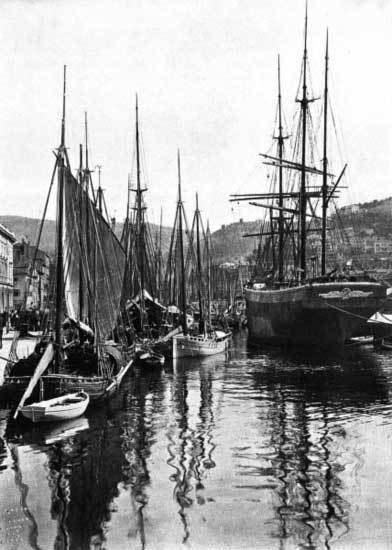
WINE-BOATS IN THE FIUMARA CANAL, FIUME
XIV
FIUME AND VEGLIA
Fiume is one of the few towns along the coast in which the Italians are in the majority. It lies at the north-eastern end of the Bay of the Quarnero, and is the chief seaport of Hungary, to which it has belonged in the main since the beginning of the twelfth century; and permanently since 1870. Though it was a thriving town in the Middle Ages, and existed in Roman times, there is very little to be seen older than the period of the late Renaissance. It is a busy modern town, and for the archæologist is merely a convenient place of departure for other more interesting sites, though there is some picturesqueness of costume and situation about it; and the Englishman is pleased to see many ships with the national flag, and to know that one of the great industries of the place is the Whitehead torpedo factory. The Tarsia, as the Rjeka was called, gave the name of Tarsatica to the ancient Liburnian city. The Romans built a castle on the bank of the stream to rein in the ferocious Gepids. Round this castle the ancient Tarsatica grew up. The only Roman remains existing are: a triumphal arch said to have been erected in honour of the Emperor Claudius II., Gothicus (268-270), which resembles the Arco di Riccardo, Trieste, in its situation on the side of the hill in the old city, but is much less ornamented and more dilapidated; some remains of Roman construction in the Castle of the Frangipani; and at the top of the hill above the Porto di Martinschizza (called "Solin"), the remains of another Roman fortress, which protected the city to the east, commanding the ravine of La Draga, a mile and a half from Tarsatto. Tarsatica was destroyed in 799 by Charlemagne.
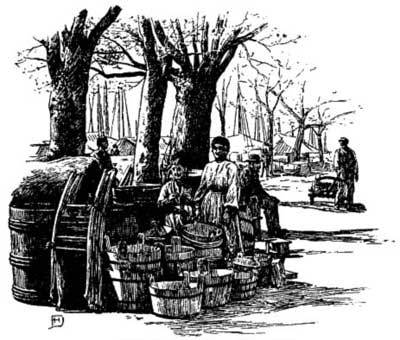
STALL ON THE WINE-QUAY, FIUME
The wine-quay, by the Porto Canale, Fiumara, is shaded pleasantly with trees, and always busy with its own particular trade, supplemented by stalls at which various goods are offered for sale. Close by is a street, which in the spring is bright with Judas-trees in flower. The ravine down which the stream flows has always been the boundary of the Croatian kingdom. On the further side is the ascent of 410 steps to the pilgrimage church of the Madonna del Tarsatto, on one of the spurs of the hills which surround the city; an ascent which devout pilgrims are said to have negotiated on their knees. A chronogram over the church door gives the date 1730, but it was founded in 1453 by one of the Frangipani counts on the site once occupied by the Nazareth House now at Loreto, the tradition being that this rested here for three years and seven months, from 1291 to 1294; and in a dark passage behind the high-altar a room is still shown said to be a part of it.
The church contains a picture of the Madonna and Child, ascribed as usual to S. Luke, of which a little copy hangs by the choir arch in the aisle; the two heads and hands are painted. The rest is covered with silver-gilt plates modelled in low relief to represent the drapery, nimbi, &c. Near the high-altar are frescoes with Latin inscriptions, of no great interest, also two great silver candlesticks and portions of Turkish harness, gifts of the Emperor Leopold I. The pillars are hung with the votive offerings of rescued mariners. The church has only one aisle, to the north. At the west end is an organ gallery on slight columns with fifteenth-century carving. The choir has a fine seventeenth-century wrought-iron grille with two amorini, a crown and heart, &c., interwoven with scrolls, gilded and painted. The beaten work is mixed with scrolls of flat thin material between strong uprights and cross pieces. At the height of the face of a kneeling figure is a row of small balusters. The upper portion is painted white.
In front of the church is an avenue of horse-chestnuts, and on a spur of hill to the left is the Castle of Tarsatto, once belonging to the Frangipani, now in the possession of Count Nugent, and completely restored. In the castle is a collection of statues from Minturnum, a gift of Ferdinand I. of Naples to Field-Marshal Nugent. From it a flight of steps conducts to a pleasant field-path which rounds the shoulder of the next hill and brings one back to the steps by which the church is reached. The view from the plateau is very extensive, the islands of Veglia and Cherso, in conjunction with the spurs of Monte Maggiore, seeming almost to enclose the sea, while to the south the Velebit range towers, generally cloud-capped.
The church of SS. Vito and Modesto was built in 1631 after the pattern of S. Maria della Salute. In the wall by the entrance is a cannon-ball, a memento of the English bombardment of 1813. On the quays there is to be seen much the same mixture of types and costumes as at Trieste. The country people wear a black loose coat with sleeves, over a kind of sweater which hangs below it; the trousers resemble broad breeches with a bit of loose stocking showing above the shoe. The rawhide shoes are of the same kind as those worn at Grado, at Monte S. Angelo across the water, and all over the country further south, pointed in shape and turned up at the toes, generally brown, with the upper part covered with lacing. On the men's heads are little caps, black, brown, or red.
While we were having dinner in the Piazza Adamich a military band came and played two morceaux; after which they marched off to the accompaniment of music, looking very picturesque, with the light from candles in lanterns hanging from staves flashing from the brazen instruments and lighting up the coloured uniforms against the dim background of garden and distant house.
The islands of Cherso and Veglia divide the Quarrero into three channels: that between Istria and Cherso, the Canale di Farasina; between Cherso and Veglia, the Canale di Mezzo (becoming the Quarnerolo further south); and between Veglia and the Croatian mainland, the Canale di Maltempo or della Morlacca, in front of which the little island of S. Marco lies. The scenery of the last-named channel is much finer than the Quarnerolo, and its interest is enhanced because the steamer passes Segna or Zengg, the rocky nest of the Uscocs, the pirates who were so troublesome in the sixteenth and seventeenth centuries; but its first name, the Canal of Evil Weather, is an accurate description of what may be expected, since here the "Bora" blows with the greatest fury, making it the most dangerous part of the whole coast. There is scarcely enough of interest in the town itself to make it worthy of a visit, since the picturesque and horrible exploits of its savage inhabitants (which are its chief title to fame) may be read in the histories of the Uscocs. They were refugees from Bosnia and Herzegovina, driven out by the Turks; the word "Scochi" in Slav meaning exiles or fugitives. Their first establishment was at Clissa, near Spalato, under Pietro Crussich, lord of Lupoglavo in Istria. From this place they made raids on the Turks, who at last collected an army and besieged the place for a year. The castellan was killed in a sortie, and the castle surrendered in 1537. They then retired to Segna, where they were received and paid by the Emperor. The original band numbered only five or six hundred, but they had with them many assistants, Dalmatians banished by the Venetians or escaped from the galleys, and brigands of other nations, as well as indigenous camp-followers. At first they only attacked the Turks, more or less straightforwardly, but gradually became mere pirates. The Venetians fought fruitlessly against them for some time, and finally became embroiled with Austria over the question. They were most daring in their enterprises. On January 19, 1599, eight hundred of them disembarked at Portolungo and assaulted Albona. They had entered the suburb, when the citizens rushed to arms, led by the valiant parish priest Don Priamo Luciani Cristoforo Negri, and succeeded in beating them off. They then retired on Fianona, which they took by surprise, established themselves there, hoisted the Austrian flag, and obliged the inhabitants to swear fealty to Austria. One man who refused, Gaspare Calovanich, they flayed alive! Many other outrages were committed, shipping was attacked, and sailors robbed. The war which followed only ended with the peace of Madrid, September 26, 1617, by the provisions of which the Uscocs were to be interned and scattered over the Austrian provinces, and their ships destroyed; whilst the Venetians were to restore conquered places to Austria. A few of the Uscocs who were left at Segna went on in their evil ways, and in February, 1619, took a Venetian ship with 4,000 zecchins-worth of cargo. The Republic made a claim, and Austria punished them with death and restored the booty. This was the last of their raids. Sir Gardner Wilkinson says that out of a number hanged in 1618 nine were Englishmen, of whom six were gentlemen.
They are described as being without discipline, but ready to follow their captains blindly. They feared no fatigue, climbed the rocks like cats, slept in the open air, preferred tactics of surprise, and cared for nothing but the satisfaction of their cupidity. Some were dressed gipsy-fashion, with arms and breast bare. The bulk, however, wore a dress resembling that of the Morlacchi—tight hose, shoes of cord or rawhide, a red-brown waistcoat without sleeves, and a red felt cap on the head. They wore their hair in long locks, with wild-looking moustaches, had earrings of iron or silver, and their weapons were semicircular axes, and knives which they carried in their girdles. Altogether a fearsome crew to have to do with!
Segna belonged to the Counts Frangipani, whose eyrie was fixed at Castel Muschio on the island of Veglia. It is near the northern end above a wide bay on the sea side of a broken plateau, partly crowned with fortress-walls, in front of which a few houses sparkle white in the sun. Only one tower remains, with doors on first and second-floor level and a S. Mark's lion in relief. The island was the ancient Curicta, near which there was a sea-fight between the ships of Cæsar and Pompey in 49 B.C., when the Istrians took the part of the latter. The Cæsarian fleet under Dolabella was destroyed, and Caius Antonius, Cæsar's general, was shut up in Veglia, where he was encamped with two legions. The soldiers constructed three rafts made of two rows of boats fastened together with chains, and with a platform of beams upon them, and a great tower at one end, by means of which the rowers were to be protected and the enemy attacked. Octavian, Pompey's admiral, retired behind Cherso, but left the channel fouled with ropes and chains fastened to the rocks. In the afternoon the rafts which had been launched reached the narrow part of the strait. The two smaller ones got through, but the largest stuck. Octavian then attacked. On the big raft were one thousand Opitergian colonists, under the captaincy of the tribune Vulteius. They fought till night, when, seeing that their case was hopeless, they determined to die rather than surrender. At dawn the struggle recommenced, the Istrians joining in the attack. The end was the suicide of Vulteius and his followers, and the surrender of the cohorts on the island.
From 1126 the islands of the Quarnero belonged to Venice, but the peace of Zara in 1358 ceded Dalmatia to Hungary and Veglia with it; and, when Ladislas sold Dalmatia to Venice in 1409, Veglia was excluded, being formally ceded by the last Count Giovanni in 1480. Nicholas Frangipani, who was count in 1409, had nine sons, and left his property equally divided among them, so that there were nine counts of Veglia at the same time. Giovanni, the eldest, to make himself secure against his brothers, put himself under the protection of Venice in 1452, married a daughter of Paolo Morosini, and published his will in 1453, by which he left the island to the Republic if he died without issue, thus making it clear to his brothers that he was determined that they should never have the island, and that if they tried to take it by force he would be protected by Venice. At the same time he swore to the inhabitants to preserve their ancient laws and customs. He had no intention of keeping his word in any particular, and played off Matthias Corvinus, king of Hungary, against Venice in the most unblushing manner, making traitorous suggestions to both sides alike, and attacking the towns of either party alternately. His subjects, being much oppressed, invited the Hungarian general, Magiar Blas, to invade the island in 1480, saying that he would be received as a Messiah. He came and attacked Castel Muschio; but the count invoked the protection of Venice. A few days later Veglia was bombarded by the Hungarians, the Venetian galleys not being able to render much assistance. The people refused to fight, saying that they preferred to have even Turks as rulers rather than their count. After consultation with the Venetian officers they were summoned to the Palazzo Pubblico; and the count told them that he was the servant of Venice, and that they must swear fealty to the Republic and would be protected. Accordingly the oath was taken by all, and the Hungarians were obliged to make terms. They were allowed to return safely to the mainland. The count then began to threaten those of his subjects who had been in favour of the Hungarians, and many fled in fear. The captain-general of the Venetians, as corrective, published an order authorising the inhabitants to kill any of the count's people who molested them. Count Giovanni bit his lips, determining to be revenged when the captain-general had gone, but never had the chance, as he was carried off to Venice, at which the Veglians rang the bells for joy. The Venetians set matters in order; but the count wrote letters saying that he would soon return to Veglia and punish all traitors; in consequence of which the Veglians assured the governor that, should he do so, they would either call in the Turks or leave the island waste and uninhabited. To solve the difficulty the Venetians pensioned him off. He became, however, soon dissatisfied with the amount and fled from Venice, his disappearance being regretted by no one. He was an abominable character, and among the evil deeds of which he was guilty was the making of false seals to enable him to forge documents.
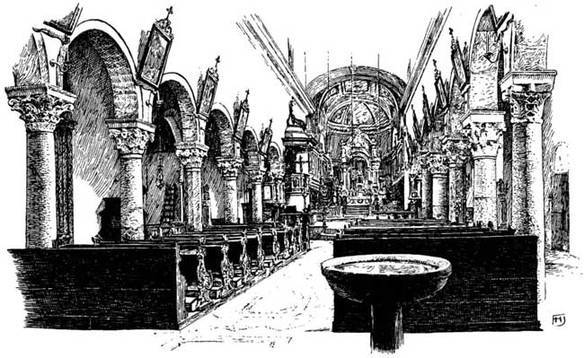
INTERIOR OF THE CATHEDRAL, VEGLIA
A considerable portion of the walls built by the Venetians round the town still remains, overgrown with ivy, and the city is still entered by the old gate-openings, the Porta di Su and the Porta Pisani, though the actual gateways have disappeared. On one of the towers guarding the latter is a rather fine relief of the Venetian lion. Close to the cathedral is the castle of the Frangipani, two of the towers being within the bishop's garden. The sea washes the rocks on which they are built, and in time of storm the spray flies over the curtain wall.
Our prowlings around the walls attracted the attention of two guards, who, after following us for some time, stopped us to question our proceedings. The production of the Statthalter's letter which I carried with me satisfied them that we had no nefarious designs, and it was returned to me with the remark (made rather regretfully, I thought) that it was all "in order." Travellers will find it advantageous to obtain some kind of "permit" if their tastes are likely to lead to the exhibition of unusual curiosity in relation to buildings and their surroundings.
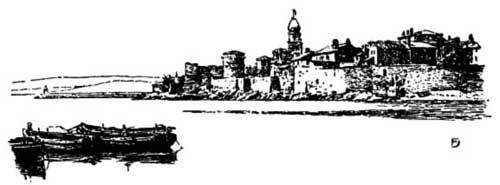
VEGLIA, SHOWING THE CASTLE TOWERS
The cathedral, erected in 1133 in thanksgiving for a great victory over Corsairs gained with the assistance of Venice, was therefore dedicated to S. Mark. It consists of nave and aisles with an apse of five sides of an octagon, which bears the date of 1688. The nave arcade is semicircular, the arches varying in height, some being stilted, and rests upon sixteen columns of granite, Istrian stone, red marble of the island, and pavonazzetto. Several are in more than one piece, one or two are made up to the requisite height with another stone, and two are octagonal. Most of them have but the slightest projection for base, the level of the pavement having apparently been raised. Most of the caps have Byzantine thistly acanthus worked with great use of the drill, one has quaint gambolling beasts and birds within arched forms in place of foliage, which show imitation of Oriental ornamental forms, and one, which has hollows for inlays of squares and diamonds, bounded by the leaf shapes, is exactly like one in the pergola of the director's house at Salona, which came from the campanile, Spalato. There is a fine early Renaissance choir-screen with an ambo at each side, made of the red variegated marble of the island; an angel of white marble supports the book-rest. To the north of this screen is a rather late Gothic chapel with apse of three sides and lierne vaulting. It has octagonal wall shafts and shields as bosses, with devices upon them, and the arms of the Frangipani. The place of the altar still shows on the pavement, and it has been suggested that the silver pala belonged to this chapel. Two more chapels open from the south aisle through Venetian slightly ogee arches, with saints at the top emergent from leaves, and a cable moulding within and dentils without. In one, the columns have been replaced by Renaissance half-columns; in the other, the fourteenth-century shafts still remain. In the choir are two fine Gothic tomb slabs, commemorating a fourteenth-century bishop and an arch-priest (1494), and other slabs with coats of arms in high relief.
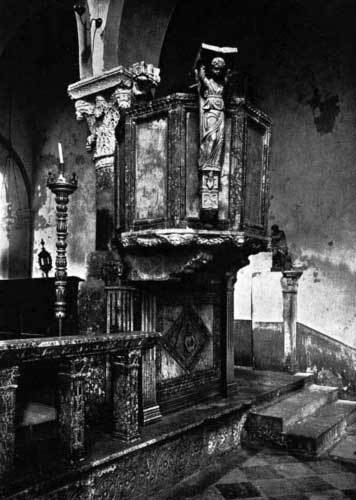
SOUTH PORTION OF CHOIR-SCREEN, CATHEDRAL, VEGLIA
The silver pala is preserved just within the west door upon the south wall, behind glass in tolerably large sheets, so that it can be easily studied. The present parroco replaced the old heavy wooden framing by one of lighter construction. It is thought to have been a triptych originally. Each of the wings has ten figures in two rows of five, one above the other—twenty in all. On the right S. Peter occupies the middle of the top row with S. John the Baptist below; on the left are S. Paul and S. Nicholas in the corresponding places. All the figures stand on brackets. The upper centre is occupied by the Madonna and Child standing on the crescent moon; below is the Coronation of the Virgin; the other four niches have figures of angels, three half-lengths in each, one above the other. SS. Jerome and George are recognisable among the other saints. The heads are much too large, and the figure-work is coarse. The niches are trefoiled and ogee-headed, with crockets and finials and octagonal colonnettes between, springing from corbels, and crowned with imbricated pinnacles; they have piercings resembling window tracery, with rosettes between each repetition. The bar which divides the two ranges of figures, and the frame have very beautiful triple rows of vine-scrolling in exceedingly low relief, which is quite lost at a little distance. An inscription gives the name of Peter Grimani and the date of 1742; but this must refer to a restoration, as the style suggests the fifteenth century, and would agree quite well with the date 1405, when one of the Frangipani is recorded to have established the chapel of S. Vito in the cathedral. The treasury now contains nothing of importance—at least, inquiries only produced a showy processional cross of the seventeenth century.
The cathedral is entered from an archway beneath the campanile; on the other side of the arch is the church of S. Quirinus, a Romanesque building in two stories. The lower portion is now a wine-store; the upper, reached by steps, is vaulted like a crypt, nine spans resting on four low columns. It has been modernised, but the three apses are untouched externally, crowned with a corbelled arcuated cornice, the centre one being the largest. The cathedral has a doorway on the south side not now used; the round arch has a torus moulding, pilaster strips, and caps beneath a gabled hood, made of the local marble and bleached by the sun to a delightful varied yellow.
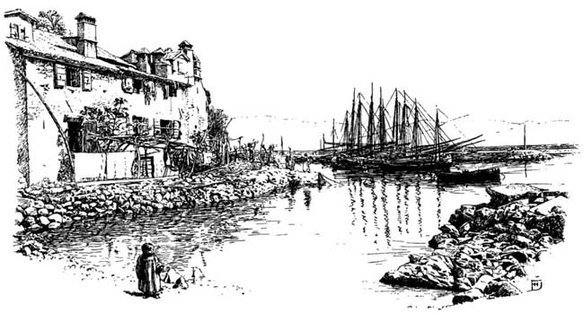
IN THE HARBOUR, BESCA NOVA
Close to the Porta di Su is another Romanesque church—S. Maria. The interior has been modernised, though a few caps resembling those in the cathedral remain; but the tower (at the west end) has two stories, with two circular-headed windows with buttress between unspoilt. At the other side of the road is S. Francesco, which has a tower of five stories near the east end, and long trefoil-headed windows. The high-altar-piece in this church (a Madonna with saints) is ascribed to Pordenone (1531), and there is an interesting pulpit with five marquetry panels, S. Francis receiving the stigmata in the centre, and personifications of four Christian graces in the others, good work of the seventeenth century.
The Venetian clock-tower, now a café, bears the date 1493 on a panel of the winged lion above the pointed arch, but must be earlier than that date, as it also bears the Frangipani escutcheon. The loggia was behind it. In this piazza are carved panels from a Venetian well or fountain, with an inscription of 1558 ascribing its erection to Antonio Gradenigo, swags of flowers and fruit, a S. Mark's lion with a tower by the sea, &c.; and in the walls here and there are encrusted a few antique inscriptions.
A walk of about forty minutes brings one to the shore of Val Cassione, a nearly semicircular bay with only a narrow entrance from the Quarnerolo. The water is generally smooth like a pond, the mountain of Treskavac, which rises to the north-east, sheltering it. The island of Zoccolante, girdled with ilex and maples, lies opposite the village of Ponte, and on it is the Franciscan monastery of Cassione. A pergola shelters the path from the boat-house to the porch, and the cloister is full of flowers and bushes. The church has an altar-piece by Girolamo da S. Croce, signed and dated 1535, and a Raffaellesque Virgin and sleeping Child. The library contains a few early printed books. Throughout the island, except in this convent and in the town of Veglia, the Slav liturgy, granted by Pope John VIII. (872-882), is in use.
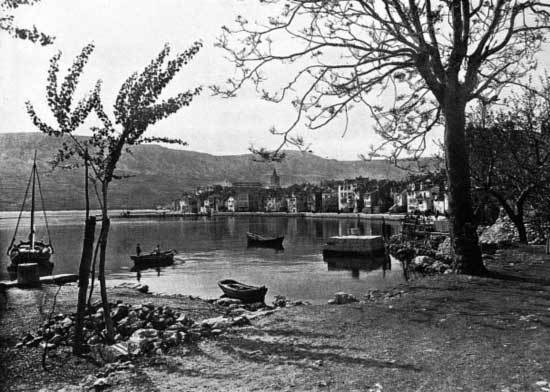
THE HARBOUR OF BESCA NOVA
The usual route to Castel Muschio and Veglia is from Fiume, but one of our visits was made from Arbe to Besca Nova, a most picturesque and equally evil-smelling port, sheltered by widely stretching rocky points (one of which bears the appropriate name of Punta Scoglia), which rise to mountainous masses behind the little town, with a modern cemetery chapel on one of the lower spurs. The houses straggle round the curve of the shore, with groups of trees here and there, and little creeks running up into the land, crossed by narrow bridges; the streets, mere alleys often, scarcely permitting two persons to pass each other, rise to a church round which they cluster more thickly. At this end of the town the houses cling to the side of the hill above and below the street, and are approached by steps which descend to the front, though there are also doors on the street level convenient for elopements, and wonderful great chimneys of great originality and variety. There were a good many boats in the harbour, and we had an excellent opportunity of seeing it from all points of view, for the pier at which the steamer stops is at one horn of the bay, and it is a walk of a quarter of an hour to the indifferent inn. We asked a couple of gentlemen who were coming out if we could get anything to eat there, and they replied: "Oh yes, if you go at once." We found, however, that we must order what we wanted and wait until it was cooked, so we left the civil padrona to her labours, and immediately were mobbed by a crowd of children to whom strangers were a godsend. A gendarme approached and asked for our credentials, but, being satisfied that we were not dangerous, offered to assist us in any way he could, and we found that the children disappeared for a time. I made inquiries of him as to a couple of pictures ascribed to Vivarini and Basaiti, which I understood were in the town, but he knew nothing about them. The Vivarini is a Madonna enthroned with two child angels at her feet, with three saints on either side of her and angels holding the baldacchino.
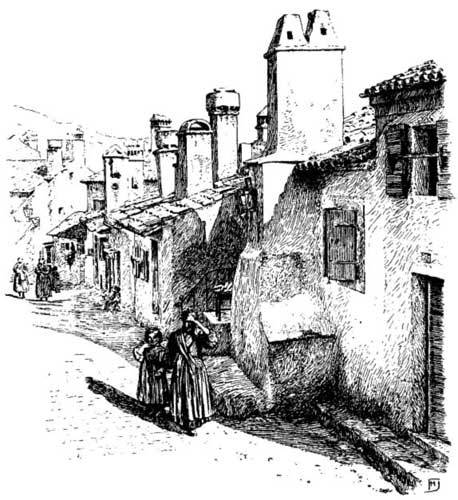
THE MAIN STREET, BESCA NOVA
On our return to the inn the question of a carriage to Veglia engaged our attention. There was an officer of some kind in the room, who had taken one of the three carriages which appear to compose the transport of Besca Nova and declined to share it. The second was under repair, one of its wheels being in the hands of the wheelwright on the ground in front of the inn. The third had been engaged by two Italian gentlemen, father and son, and its appearance suggested doubts as to whether it would take five persons and our luggage over the backbone of the island. There was a diligence, but it started at 2 a.m., and the drivers tried to persuade us to sleep at Besca, saying they could take us on at 6 a.m. The déjeuner we had had, however, inspired so little confidence that we determined to get on to Veglia that night, sharing the third carriage with the Italians, though in the end we did not benefit very much by the arrangement. As the shadows began to lengthen, the horses were put to, the harness being supplemented with bits of rope in some places, and we packed ourselves and our belongings into the carriage, finding our fellow-travellers very pleasant companions. The narrow road runs up a rocky valley, at first with a considerable space of cultivated land on each side, vineyards and grain occupying the greater part; and before long Besca Valle came in sight, a barbarous-looking village, with curious reed-thatched huts for styes and cart-hovels, and with whitewashed walls to the houses which stood upon unparapeted terraces supported on great arches used for storage of different kinds. In the church of S. Lucia, some distance away, is the earliest Glagolitic inscription known. Our driver appeared to be on familiar terms with most of the population, and was continually calling out greetings to people some distance from the road.
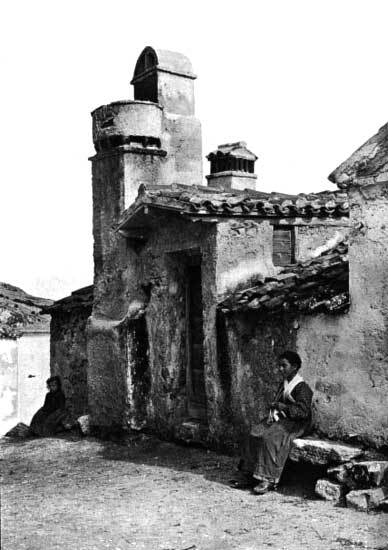
CHIMNEYS AT BESCA NOVA
The valley narrowed and the rocks rose higher, the clear bright green Fiumera foamed and tumbled in its rocky bed, and we passed a picturesque mill astride of it, backed up with trees. Soon the driver called our attention to a great rock hanging from the cliff which seemed as if its fall from the height was merely a matter of moments, but which had looked so, he said, for years. The continuous climb was interrupted by a wooded depression through which the road wound; it then crossed the stream and commenced a long ascent continuing for more than a mile, which we negotiated on foot. As we rose higher the view expanded, and we found it pleasant to turn and gaze at it, warm in the sunset-glow. The Velebit Mountains, with their summits hidden in the clouds, blushed a beautiful warm rose colour, while Arbe and the nearer island of Pervicchio which shelters the harbour, rather more orange in colour, contrasted with the pale sapphire of the sea, each increasing the brilliancy of the other. The shadowed valley at our feet, with mill, stream, and dark trees, enhanced the brightness of the distance and of the final glow upon Besca Nova, where the curve of its houses embraced the bay with chains of orange and cream colour.
A solitary horseman passed us while we were surmounting the stony waste through which the higher portion of the road winds, a greyish and reddish variegated marble used in buildings in the island, and just at the summit we met the diligence on its way to Besca. The sunset was superb, the glow of the sky reflected in the sea, with Cherso dark against it and the shores of Veglia laid out below us, showing Ponte and the Convent of Cassione, and Veglia beyond almost hidden in trees. As we descended the long slope the colour faded from the sky, and long before we reached the town of Veglia nothing could be discerned but the silhouettes of branch and leaf against the sky.
XV
OSSERO AND CHERSO
On one of our journeys we went by boat from Trieste to Lussin Piccolo, stopping only at Pola. It was just before Easter, and many sailors from the fleet were going home for a holiday. The quay was crowded with passengers, and a queerly shaped engine, belching forth thick smoke, with train attached, was drawn up behind them. This we thought a fair subject for a snap-shot, but the production of the camera attracted the attention of a policeman who would not be satisfied until it was put away, though the arsenal was behind us. The sailors swarmed on board and filled the whole fore part of the boat—fine-looking fellows for the most part, and very good-humoured. Their kits were done up in handkerchiefs with the map of Europe printed on them in red, blue, or buff. They were full of jokes, and were, in fact, just like a lot of big schoolboys. Some of them gathered in a ring and sang in parts for some time; the music sounded better a little way off than near. There were also Montenegrins on board who had been working on some railway in course of construction. One of them had two pairs of corduroy trousers on, the upper whitish, the under the usual brown-green.
Lussin Piccolo lies at the head of a deep bay, and climbs the ridge along which the road runs to Lussin Grande, a place which is now much smaller than its neighbour, but more picturesque and pleasant. The bigger hotels are at Lussin Piccolo, where the larger harbour allows the steamers to call. It has become a winter residence for Russians and Austrians; and the keeper of the largest café told us that many of the former came, instancing an officer of the guards who stayed six months, and told him he was better off there than in St. Petersburg, or indeed Manchuria, where he expected to be sent if he returned! The harbour is called Val d'Augusto, because the fleet of the Emperor Augustus is said to have remained at anchor there for a whole winter. It may be true, for at the battle of Actium his fleet was principally manned by Dalmatians. From above the town the view looking towards Ossero is rather fine, the summits of the hills along the spine of the island rising one beyond the other, culminating in Monte Ossero, paling and getting bluer with greater distance. The sea, of a blue quite different in its quality, runs into the land in many little inlets, while beyond are Veglia and the mainland mountains often capped with clouds.
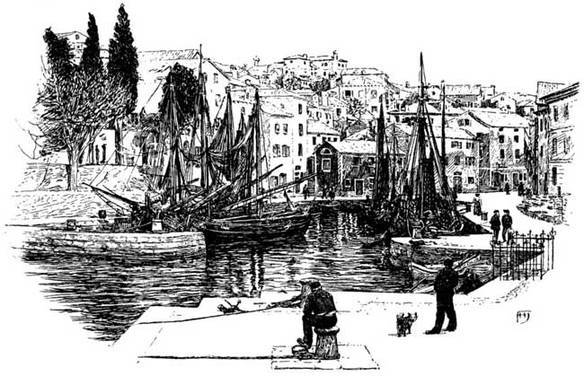
LUSSIN GRANDE
The road to Lussin Grande runs along the slope of the hills, rounding tree-clad spurs and diving into hollows, with frequent peeps down into little coves where boats are drawn up. In one of these a little fellow was paddling himself about in a tub. On seeing us looking at him, he raised the usual boatman's cry, "Barca, barca, Signori, per Lussin Grande," and burst into a peal of laughter, in which we joined. The port is delightfully picturesque; at the entrance is a church approached by a flight of steps, with a terrace and cypresses, towards which nuns were wending their way for "benediction"; the sun glowed upon white walls, dark trees, and tiled roofs; while the harbour in shadow, full of boats rich with the colour of nets and sails, and the reflections of the blue sky upon its rippled surface, afforded an attractive contrast. One round tower of the walls remains, built of stone, with machicolations and Ghibelline battlements added in brick and plastered; a modern slab over the door gives the date 1455. A kind of public garden called the Piazza del Pozzo, from an old rope-worn well within it, contains many different kinds of flowering and shady trees with seats beneath them, and aloes grow on the rocks above the entrance to the harbour on both sides. The town contains several fine houses, and in the churches are a few interesting pictures, though architecturally they are not very noticeable. One of them has a curious tiled ogee-shaped dome over the sanctuary. The pictures are: in S. Nicolò, a Byzantine Madonna and Child with S. Joseph; in S. Maria degli Angeli, a Bartolommeo Vivarini—God the Father above, surrounded by angels; below, an enthroned Madonna with SS. Augustine, Catherine, and Cicely on one side; on the other, SS. Agnes, Jerome, and Lucy: the picture is dated 1475. There are also a Pietro della Vacchia called a Titian, and a few others.
The women wear a curious head-dress something like a turban with a long end hanging down the back; they generally have a loose sleeveless jacket over a white full-sleeved blouse and a skirt in many pleats and often of many colours, and an apron; sometimes a handkerchief is thrown over the head instead of the head-dress. They also wear elaborate earrings, a number of rings fastened together with a drop below, all of metal.
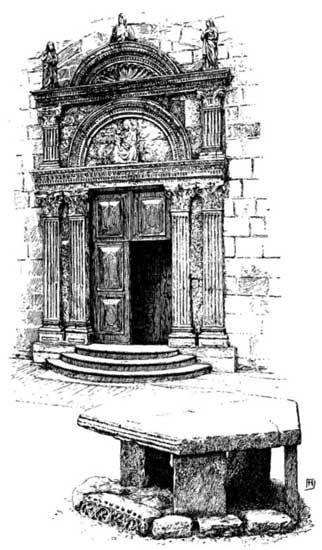
WEST DOOR OF THE COLLEGGIATA, OSSERO
From Lussin Piccolo we drove in the opposite direction to Ossero, the ancient Apsoros or Auxerrum, following a narrow road through olive-yards, along the shore or some way up the hill among a bewildering variety and luxuriance of vegetation. On the island, which is about eighteen miles long, though nowhere more than two in breadth and seldom more than one, there are three villages besides the two Lussins. They are Neresine, Chiunschi, and S. Giacomo. At Neresine we were told that there was an English-speaking landlady. So we looked her up at the "Gasthaus Amicorum." We found that she and her husband had been in America, and were told several strange stories of curious occurrences which she had known of while there, especially with regard to the drugging of drinks, which made one think she must find her life rather lacking in excitement in this little out-of-the-way place where she was apparently going to end her days. There is a Franciscan convent here with a handsome campanile looking much more ancient than its date (1590-1604), with double lights and a balustrade round the top. In the church are pictures attributed to Girolamo da Santa Croce and the younger Palma. The ascent of Monte Ossero may be made from here (1,900 ft.). The top is a bare, stony wilderness like the backbone of Veglia.
The weather was lovely, and we constantly came upon subjects which would tempt the artist to stop and sketch—a monk seated under an olive-tree in the shade; cattle and sheep tethered to the grey trunks, grouping themselves as they clustered for company; a boat under sail seen through the branches of the trees against a headland on the more distant hills of Arbe and the mainland; and so on. The hillside was clothed with bushes and plants in flower, among which we recognised the oleander, white rose, juniper, laurustinus, fig-trees, ilex, cypress, strawberry arbutus, a small-leaved myrtle, grape hyacinths thick on the ground, giant and quite small spurges, a euphorbia with thorny trailing stems and heart-shaped leaves, great ericas as high as a man, in some places cyclamen in clumps by the wayside like daisies, a bush trifolium something like cytisus but scentless, thyme, and a kind of sage, while the bay-trees were so fully in bloom that they looked a pale yellowish green instead of their usual colour. Just before we reached the bridge connecting the islands of Ossero and Cherso, which has to be crossed before the town of Ossero is reached, great banks of spurge made the roadside as yellow as fields full of charlock in England.
In a wall at the entrance of the town the S. Mark's lion still watches, though the two fortresses which report says were here are no longer traceable. The cathedral is Lombardesque in style, built by Bishop Antonio Palcić (1465-1474), and has a rather pretty doorway ascribed to George of Sebenico, who was certainly employed by him upon other works, and a massive campanile of 1675, which dominates the place. The nave is five bays long, the arcade is round-arched with pretty caps and ornamented archivolts, and the floor is paved with red and white marble in chequers. The holy-water basins are simple, and the columns of the ciborium rest on two red marble caps of the fourteenth century upside down, one base of the same and one of the Lombardi period, showing the use of older material. The church still retains a line monstrance, one or two other pieces of silver-work, and some embroidered vestments, though no longer the seat of a bishop, and over the high-altar is a picture of the school of Titian. The monstrance is late Gothic, with a foot added in the seventeenth century. It is decorated with many niches and figures, and a fine cresting round the domical top. The curved surfaces above and below the glass tube have scroll-work upon a blue enamel ground, part of which has come away. In these places there is no sign of pattern upon the silver, but only a general cross-patching showing that the arabesques and other patterns were not soldered to the ground beneath, but only arranged with the enamel flux before firing. The architectural details are gilded, the rest is silver.
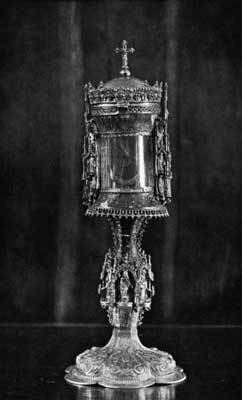
MONSTRANCE IN COLLEGGIATA, OSSERO
There are some remains of Roman walls still traceable, between which and the mediæval walls is the site of a large seven-aisled church, perhaps a pair of twin basilicas. Upon the ruins of the seventh aisle the present church of S. Maria was erected, and within it the ancient bishop's throne, constructed of fragments of ninth-century carved slabs, was still preserved till a few years ago. It was only after persistent inquiries that we found it in a store-shed with other fragments of ninth-century carving and some Roman antiquities thought of little importance, though the inscriptions and other marble fragments and the stone funerary urns are in their company. In the show museum are Roman fragments, lamps, Pansiana pottery stamps, bronze vessels and utensils, iron fragments, glass phials, &c. On the hill, not far off, prehistoric tombs with interesting objects have been found; but the greater part of the finds have been sent to more important museums.
The sea-passage, which is crossed by a swing bridge, is called the "Cavanella di Ossero"; through it a strong current runs. The island of Cherso, the ancient Apsirtide, is a miniature of Monte Maggiore, with some fine mountain scenery in it, and a curious fresh-water lake, the surface of which is only 50 ft. above sea-level, though it is 225 ft. deep in some parts. The finest mountain scenery is near Smergo, where the rock rises sheer from the water to the height of 1,000 ft. Here is the "Dirupo di Smergo," a cave with a domed top. At one time the sea broke into it, laying bare the interior, which is like a giant amphitheatre with ribbed roof and sides. The fragments then detached lie at the foot of the rock, making a wall between the sea and the cave. The city of Cherso is best reached from Pola or Fiume. It lies at the head of a winding inlet, protected by a round tower at the point, a relic of the fortifications of an earlier period. It belonged to Venice from 1126 or 1130 till 1358, becoming finally Venetian in 1409, and was granted in feud to various patrician families, so that all the objects of art in the city show distinct traces of Venetian influence. The piazza by the harbour is triangular in shape, the narrow streets, with many picturesque houses in them, climb the hillside from the water, and the ancient walls remain on the land side. The loggia is a simple seventeenth-century building supported on six stone piers; in the back wall are encrusted two inscriptions—one Roman, one mediæval. The cathedral was burnt in 1827, but the west door still remains, very closely resembling that of Ossero. A picture by Alvise Vivarini is preserved in the priest's house—a Madonna with SS. Sebastian and Catherine, and SS. Christopher and Cosmas.
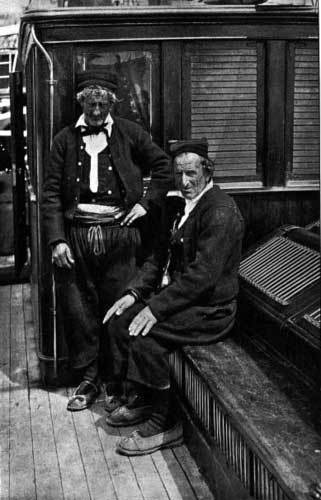
SMERGO FISHERMEN
In the chapel of the Mother of God is a Byzantine Madonna and Child on a gold ground. The carnations are brownish; there is a cross on the breast and on both sides of the head, with the Greek monogram ΜΗ Θϒ. There are also some fine stalls in the church of the Franciscan monastery; but there is not very much of interest in the town except the numerous Venetian houses.
XVI
HISTORICAL SKETCH OF DALMATIA
The history of Dalmatia is obscure and confused for a great part of its course. That there were Greek and Phœnician colonies along the coast and on the islands is certain; the earliest of the former was that founded by the Syracusans in Issa (Lissa) in 390 B.C. A Cyclopean building, the so-called Gradina Gate at Gelsa, is attributable either to this colony or to that of 385 B.C. in the ancient Pharia (Lesina). Tragurium (Traù) and Epetium (Stobreć) were daughter colonies of Issa. The largest number of inscriptions and coins have been found on Lesina and Lissa. Celts were in the country from about the same period. The Roman conquest was brought about by the appeal of the people of Issa for help against the powerful native queen Teuta. Illyria, south of the Narenta, became a Roman province in 168 B.C., though war with the inland tribes continued till 34 B.C., when Augustus took the ships of the pirates of Curzola and Meleda and the Liburnians, and conquered the inland tribes at Promona—eight long and disastrous campaigns in all. There was, however, another revolt in 6 A.D., when the danger to Rome was so great (800,000 men being in rebellion) that Augustus sent seven legions under such generals as Tiberius, Germanicus, and Postumius, who took several years to overcome their resistance, so that it was not till 12 A.D. that Tiberius enjoyed his triumph. Some of the cities were made municipia, and some colonies, and from this time Dalmatia was loyal to Rome. The Antonines erected important buildings in Jadera and Burnum, and they also fortified Salona.
Roman Dalmatia included the whole coast from Istria to the Drina, part of Albania, all Montenegro, Herzegovina, Croatia, Servia, almost all Bosnia, and some of the islands of the Quarnero. The legions for the most part remained near the coast, which gradually increased in commercial prosperity and civilisation; broad and safe roads were made to the interior uniting the Save and the Danube on one side, and the Drina on the other. From Burnum a road by way of Petrovac reached the basin of the Save; from Salona a fan of carriage-roads spread out—one across the Dinaric Alps by Æquum and the hill of Prolog to the Danube, another by the same hill to Livno and Kupres, a third between Delminum and Serajevo. From Narona (Vid) the great Roman Road of the Narenta started, and in Albania was the Via Ignatia from Durazzo and Vallona to Salonica. The great coast-road from Zara went past Scardona and Salona to Narona and Scodra; the inner land route commenced at Tarsatico (Fiume) and went by Zengg over the Velebits to Clambeta (near Obrovazzo) and Zara, then by Nadinum, Asseria (Podgradje), Burnum, Promona, Municipium Magnum, and Andetrium to Salona.
Illyricum was divided into Liburnia, from Istria to the river Kerka, the people belonging to the juridical Convent of Scardona, which settled the business of eighty-nine cities; from the Kerka to the Narenta they sent their representatives to Salona; and Illyris Græca, from the Narenta to Drilone in Epirus, which belonged to the juridical Convent of Narona. With the successive Eastern invasions and the consequent race differentiations, maritime and inland Dalmatia were separated, and the Turkish conquest made the Dinaric Alps into a bulwark not to be crossed.
The Illyrians furnished the Romans with many distinguished soldiers, of whom Claudius Gothicus, Aurelian, Septimius, Probus, and Carus of Narona were soldier emperors. Diocletian was the most celebrated. More than sixty Roman settlements are known. For about seventy years the country was ruled by the Goths. After the recovery of Italy by Belisarius and Narses it belonged to Byzantium from 537, and was ruled from Ravenna by a catapan at Salona. The war with Chosroes in 600-614 strained the Byzantine resources and thus denuded the coast of soldiers, so that the Avar and Slav inroads met with little resistance under Heraclius (610-640), who had called in the latter to drive out the Avars; Narona, Salona, Epidaurus, Burnum, and Rhizinium were destroyed. In 641 Pope John IV., a Dalmatian by birth, sent Abbot John to Istria and Dalmatia to ransom prisoners and collect relics.
The Croats and Serbs exterminated the Avars in the middle of the seventh century and delivered the province, the Croats occupying the west to the river Cetina, the Serbs the east from the Cetina to Albania. Under the Serbs the southern portion was divided into four zupanje, of which the only name which has survived is Trebinia, which reached from Cattaro to Ragusa and included the mountain regions. The Croat dukes recognised the sovereignty of the Carlovingians, as is proved by the oldest inscription extant, that of Tripimir (852), being dated by the rule of the Emperor Lothair. The title of king was assumed by Muncimir in 914. Two or three of the kings resided at Nona in the eleventh century—Stepan ([symbol: dagger] 1052), Peter Cresimir and Svinimir ([symbol: dagger] 1089). The widow of the last invited her brother Ladislas of Hungary to take the kingdom. In 1097 Coloman I. of Hungary married the daughter of Roger of Sicily. Under Coloman II. (1102-1113) the coast towns from Zara to Spalato were Hungarian, while Ragusa and Cattaro remained under the protection of Byzantium.
The government of the Dalmatian cities was democratic to a considerable extent, the oligarchy embracing a large proportion of the inhabitants, and the monasteries were expected to contribute to the common needs and share in the defence of the town. The supreme official was called prior; judges and tribunes also are mentioned in contemporary documents. A certain dependence upon the Greek Empire was recognised, for in Zara the strategos, the catapan, and the proconsul of Dalmatia appear even after the time of the Croatian kings. The Venetian doge had the title of King of Dalmatia given him by the Emperor of Constantinople about the end of the eleventh century in return for the help given by the fleet against the Normans.
During the whole of the twelfth century Venice and Hungary contested the possession of Dalmatia, victory inclining to Venice, who, by policing the Adriatic, made her protection valuable to the coast cities. The pirate raids from which the coasts suffered were of varied nationality—Saracen and Turk, Uscoc and bands of native pirates. Of these latter the Narentans were the most powerful. They remained pagan till near the end of the ninth century, and beat off an attack by Doge Pietro Candiano in 887, killing him. He was buried in the atrium at Grado. For one hundred and sixty-eight years they carried on the contest with Venice, being most powerful during the tenth century, when Otho I. sought their alliance. They had then become Christian, and assisted in driving the Saracens from Monte Gargano. In 992 the confederate Dalmatian cities asked for the protection of Venice, in response to which the expedition under Orseolo II. was fitted out, and broke their power. The population of the Narenta valley is now but 12,000, in spite of the facts that Metkovič, near the mouth, is the terminus of the railway from Serajevo and Mostar, and that the government has spent much money in dredging and embankment works at the mouth of the river. The boundary of Herzegovina is but a mile from Metkovič, for which it serves as port. Vid, a few miles away, is the ancient Narona. A good many inscriptions and antique fragments have been found there, and are now encrusted in the wall of a house. For many years Vid was a bulwark of Christianity against the Turks, and the minarets of a little Turkish village, Liubuski, in which half the population, male and female, wear Turkish costume may be seen not far away.
By the middle of the fourteenth century Lewis of Hungary had acquired the whole of Dalmatia from Zara to Cattaro. In 1409-1420 Venice bought the territory from Hungary, with the exception of Ragusa, which for some fifty years remained under Hungarian protection, but after 1467 was protected by Turkey. In the sixteenth century the Cross and the Crescent were bitterly opposed; Austria became the Christian champion in place of Venice towards the end of the seventeenth century, and at the fall of the Republic Istria and Dalmatia were given to her in 1797 by the treaty of Passerino. From 1806 till 1814 they were French; but the peace of Vienna settled their destiny as forming part of the Austrian dominions, in which they have remained till the present day.
XVII
ARBE
It was very early in the morning when we arrived at Arbe the first time; so early, in fact, that the innkeeper was still in bed and had to be interviewed from his chamber-window, and we had to deposit our belongings at the door before commencing our explorations breakfastless. On this occasion we were unfortunate. The skull of S. Christopher was exposed on the altar, but the shrine was locked up, and the parroco had gone into the country to visit a sick man, with the key in his pocket, while the ciborium was swathed in festival draperies. We therefore determined to satisfy ourselves with a cursory inspection, and arranged to return the next year; for the steamboats are not like suburban trains, missing one of which merely means a slight delay. Many of the islands have but one or two services in the week; and staying for the next boat may derange the plan of a whole tour.
The city looks most attractive from the sea as one approaches. It occupies a long tongue of land midway along the western coast, and the walls drop into the water both towards the harbour and the open sea. They are nearly complete in their circuit, but have lost their battlements and some portions of their substance. There is a good deal of ruin within them, which makes the foregrounds uninteresting and squalid. To the west is a public garden planted with fir-trees, and with seats here and there. Aloes grow plentifully on the rocks to the south-west.
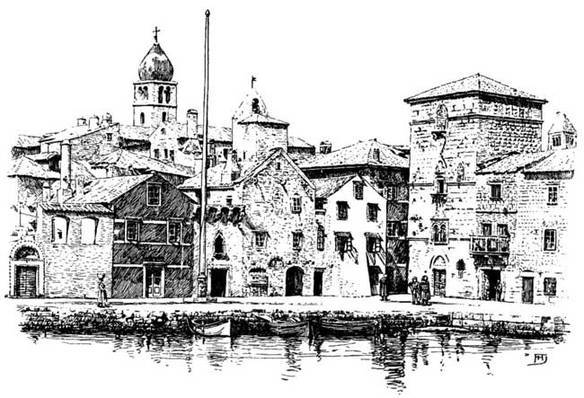
THE LANDING-PLACE, ARBE
In the early Middle Ages Arbe was prosperous owing to its trade and its position on the high-road between Venice and the East. The plague of 1456 depopulated it, and all the richer people fled except the bishop, Johannes Scaffa, and five canons. In 1463 Bosniaks flying from the Turks came to increase the population and were well received, but the town never recovered its prosperity. The empty streets and ruined houses and churches near the cathedral testify to the desolation. The style of the houses is Venetian for the most part, as might be expected, since it was the port of call for those going to Greece or the Holy Land. Some of them are very interesting and beautiful. The quay has several fronting on to it, specially a lofty tower-like building of the fourteenth century with later windows and balconies inserted. Many marble coats of arms may be seen here and there, and the windows and door-jambs often have charming carved ornaments. The Palazzo Nemira shows a pleasing combination of late Gothic and Renaissance detail in pierced panels and balustrading; and the parroco lives in a house which has a good doorway of the usual Venetian-Gothic type. The house in which Archbishop De Dominis was born (for some time Dean of Windsor, and celebrated for his scientific attainments), a palace of somewhat later date, is now a kind of club and reading-room, in which the innkeeper apparently has the right of serving his patrons with meals. The families of De Dominis and De Hermolais gave many bishops to the see between the twelfth and fifteenth centuries. The loggia is well preserved or has been well restored. Overlooking it is a window from which a parrot screams insulting remarks to passers-by.
Arbe was known to the ancients as part of Liburnia. Pliny mentions it, and so does Porphyrogenitus. There was a second city in the island in antiquity called Colento, of which every trace has disappeared. The island belonged sometimes to the Croats, sometimes to Byzantium, and sometimes to Hungary, but from 1115 was mainly under the influence of Venice. The history of the Church goes back to the tenth century, but the first bishops' names are uncertain. A Zaraitan record of 986 mentions a Bishop Petrus. In 1062 a Bishop Dragus is named as being at the consecration of S. Pietro in Valle, the oldest Benedictine convent in Arbe. In the communal archives are preserved the oldest MSS. of the kings of Dalmatia and Croatia of the tenth century.
The cathedral is a basilica with nave and aisles. The main apse is octagonal outside and semicircular within; the apse to the north aisle also exists; that of the south aisle has been replaced by a square chapel. The nave arcade consists of six bays of round arches, resting on five pairs of columns which, though they are made up with plaster and painted, are probably antique, since the caps differ enormously in height and column and cap frequently do not fit. Some of the capitals might be late Roman, but most of them are very rude imitations. Super-abaci are used. The ciborium is hexagonal and rests on six columns of Greek cipollino, with the top and bottom mouldings worked on them; the caps are Byzantine of the sixth or seventh century, but without super-abaci. The front arches have huge Renaissance swags in the spandrils and a moulded cornice with classic enrichments; at the back are three ninth-century panels with arch and spandril in one piece, carved with ornament similar to that on the baptistery of Calixtus at Cividale; the pyramidal roof terminates in a carved finial. The greater part of the building is of the thirteenth century. The church, having become ruinous in 1237, was restored in 1287, and again in 1438 and 1490. It is now the chief parish church of the diocese of Veglia. The west door belongs to the last restoration; in the tympanum is a poorly carved Pietà. It is flanked by some remains of a flat arcading. The wheel-window above, though Romanesque in design, bears the date 1439. A pink marble is used in this façade with very good effect. In the north wall is a square marble panel with an enthroned Christ, of Byzantine type, like the ciborium and the nave columns a relic of an earlier building. The stalls are fine of their kind, and we were told that an offer of 50,000 florins and a new set had been made for them and refused. They are dated 1445, and are elaborately carved with figures and the usual nerveless foliage of the period, of which other good examples occur at Zara and Parenzo. In a chapel in the north aisle is a polygonal Renaissance font of rather pleasing design, with S. John the Baptist in the central panel and fruit, &c., hanging in the others. In the apse of the north aisle is an early Madonna with the Child, robed in red and blue with golden diaper patterns; and over an altar in the south aisle is an interesting tempera picture in a frame of the fourteenth century, painted on a gold ground, with Greek inscriptions and technique. In the central panel is a Crucifixion, on the left is S. Matthew, and on the right S. Christopher.
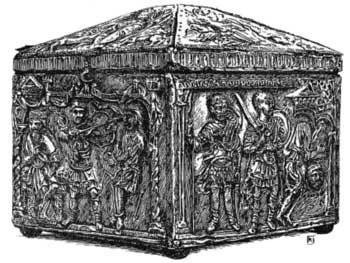
RELIQUARY OF THE HEAD OF S. CHRISTOPHER
S. Christopher was patron of the town and diocese, and the greatest relic is his head, now that those of Shadrach, Meshech, and Abednego have disappeared. The first mention of it occurs in the eleventh century, when Bishop Dabrana or Domana (1080-1086) brought it forth with prayers and hymns to deliver Arbe from an attacking horde which had besieged the city for a month. A great stone fell from heaven into the camp of the besiegers on that occasion, and the missiles which they shot recoiled upon them. In Arbe, S. Christopher's Day is kept on May 9, the day of this discomfiture, instead of July 25 as elsewhere. Other deliverances took place in 1097 from Coloman of Hungary, and in 1105 from a Hungarian Count Sergius, according to tradition. The shrine appears to be work of the twelfth century, and is based on the antique, but betrays Byzantine influence also. It is decorated with gilded reliefs upon a ground of silver. It is a rectangular wooden box with a pyramidal lid, to which the silver plates are nailed. The subjects upon the four sides are: 1. A seated king and an archer shooting at S. Christopher, who is bound to a stake; the arrows fall deflected and broken by the hand of God, which appears by the saint's head. Above is a canopy supported on twisted columns. 2. The saint is beheaded beneath a canopy; the hand of God again appears by the headless trunk. Two soldiers in Roman costume stand by, one with lance, and the other with raised sword. 3. Three holy men holding scrolls, barefoot and robed in tunic and toga. 4. Three holy women, two holding a cross; the heads have been restored. All these figures have large heads, especially those standing under the round-arched arcade, with alternate twisted and ringed colonnettes. The lid has repoussé subjects upon all four surfaces: 1. Christ enthroned, blessing and holding a book, with the monograms IC and XC; in the corners the lion and eagle with books. 2. S. John with the eagle and monogram IONS. 3. S. Christopher, beardless, as a standard-bearer, and with a royal
S.XPO
mantle, with inscription FOR; at his feet a male
VS
and a female figure—donors probably. 4. The Virgin standing with monograms ΜΗ Θϒ. An angel with a book stands near. The skull is surrounded by a double crown, the outer of gold set with precious stones, the inner of silver ornamented with lilies. The tradition is that the reliquary was the gift of Queen Elizabeth of Hungary.
In the sacristy are also three strips of champlevé enamel from a destroyed reliquary, with figures of eight of the Apostles—Matthew, James, Bartholomew, Andrew, Thomas, Philip, Thaddeus, and Svhon (Simon)—seated and holding symbols in one hand and churches in the other (which have central domes sometimes, and pediments over the doors, while the roofs and towers look much later than the thirteenth century, to which they are generally ascribed). The colours used are blue, green, yellow, white, and red, and the style resembles that of the Maestricht school. Eitelberger describes another plaque on which SS. Peter, John, Mark, and three others were represented. This seems to have disappeared since his time, as it was not shown me with the others.
The campanile of the cathedral is one of the finest in Dalmatia, and is older than the year 1212, in which year there is mention of it. It is 20 ft. square and more than 100 ft. high, with four stories separated by ornamented string courses, a base and a pyramidal top. The base has a door and eight windows, two on each side, on a higher level. The lowest story has also two windows on each side, but beneath three corbelled arches. In the next the windows are each coupled, with a central colonnette and an arch above springing from the central and angle pilaster strips. In the third the windows have three lights and coupled colonnettes beneath a similar arch, but the story is loftier. In the top story (which is as deep as two of those below) there are four lights with coupled colonnettes and a square framing round them; a cornice slightly projecting and a balustrade complete the perpendicular part. All the arches are round and the window shafts have neither cap nor base. The leaf ornament of the strings imitates the antique. The pyramidal top is octagonal, and bears an inscription recording its restoration after damage by lightning; the lower portion seems to be original.
Four of five other churches have campaniles, of which S. Andrea is the best, apparently twelfth-century work, as are the three apses at the eastern end. S. Giustina has a curious bulbous top, plastered and painted red. The churches generally have a semicircular apse and flat wooden ceilings; those without campanili have bell-turrets on the west wall, many of them no longer in use. S. Andrea was rebuilt in the middle of the fifteenth century, and has a good Venetian Renaissance doorway. In S. Antonio, just beyond the cathedral is a fifteenth-century altar-piece with carved and painted figures. In S. Andrea is a woefully repainted Bart. Vivarini, signed and dated 1485, and in the Franciscan convent of S. Eufemia, some way outside the walls, there are said to be two pictures by the same artist.
Of S. Giovanni Battista, which was so interesting for the construction of its apse and ambulatory, scarcely anything remains—just the exterior wall of the apse and north wall of the nave, with remains of one door with an inscription. The obliging owner or renter of the ground showed us a piece of the mosaic pavement in rather bad repair, which he said the Duke of S. Stefano wished to buy, but it was impossible to get it up from the grass which had grown round it, apart from the difficulty of the three permessi required from the bishop, the authorities, and the proprietor. He had the earth swept off the piece which we saw, and there was no grass growing just there. The patterns are interweavings rather Roman in design, the colours used being black, red, rose-pink, and white. The church is said to have been the first cathedral; later it belonged to a Franciscan convent which was used as the palace of the bishop some seventy years ago. Round the cloister were two stories of rooms, with a curious chapter-house in the corner. The site is now laid out as a garden, with pergolas and a terrace-walk looking over the sea; amid these are still a good many architectural fragments lying about, some of which appear to go back to the tenth century. Four boxes full of such fragments were sent to the Museum of S. Donato at Zara without any claim being made for expenses, but were refused.
One ought not to omit mentioning the chapel of the Campo Santo, which has a strange façade with three great conventional shell forms above a rose-window, and a carved architrave with Renaissance motifs above the door. It was restored in 1867; the adjoining ruinous building has 1657 over its door.
S. Pietro in Valle is some six miles from Arbe, and is as yet undescribed. Signor Rismondo, whose kindness I have just referred to, offered to drive us out to it, an attractive offer which I was exceedingly sorry to have to decline; but the times of sailing of the boats are not elastic, and it would have meant spending four days more on the island, an amount of time which I could not spare. He also wanted to take us to below Loparo, where he said the geological formations are strange and impressive. The cliffs facing the mainland are riven into detached pinnacles estimated to be as high as the campanile of the cathedral, and the scenery is savage in the extreme.
Our second visit to Arbe was made from Zara, which we left in rather stormy weather, the waves outside the harbour flashing with little white caps, while flaws of rain constantly hid the island of Ugljan on the other side of the channel. The boat was rather a small one, belonging to the Zaratina company, with a crew which consisted of a captain, who also acted as supercargo, an engineer, a stoker, a cook, one deck-hand, and a cock. The cock's name was Nero, and he had voyaged with the boat for two months (as the engineer testified) without suffering even from the most tempestuous weather. There was an awning over the central portion of the boat and flapping pieces of sailcloth, apparently intended to shield the very varied merchandise which was being brought on board, and we found that it was possible to shelter beneath it by observing the direction of the wind and keeping to leeward. The crew comforted some women who feared the roughness of the waves (one of whom carried a new hat in a large paper-bag, which became rather dilapidated under the attentions of the wind and the frequent showers) by saying it would be all right when we got round the point behind which Nona lies; and as the boat was very buoyant and seaworthy we found it possible to enjoy the passage notwithstanding the doubtful weather. As we turned down the bay to Val Cassione, however, the wind shifted a point and blew dead against us, and we began to think that the boat was very small for such a sea. The women and a child had to disembark here, and were almost in tears, and the length of time that the boatmen took to make up their minds to come out from the harbour and face the choppy sea did not reassure them. Nero marched bravely up and down the deck, giving vent every now and then to a rather cracked crow, and we wondered how he escaped being blown overboard! Fortunately he carried very little sail, only two feathers remaining in his dilapidated tail; but his spirit was high, and he was always ready to respond to the challenges of the engineer.
As we rounded the point after leaving Val Cassione the wind shifted again and the weather improved as if by magic. The clouds gradually melted away, and the blue of the sky palpitated through the grey; the sun shone warm upon the barren, featureless coast, adding colour to the dispiriting grey of the limestone spotted with the dark green of shrubs, a characteristic of most of the Dalmatian islands, and the Velebit Mountains became clear, in some places to the summits, though the greater part of the chain was still cloud-capped and barred with heavy purple shadows.
The party at lunch consisted of the captain, the engineer, and a priest who was now the one passenger beside ourselves. We comfortably filled the table in the little cabin. The captain said that since the phylloxera damaged the vines two-thirds of the Dalmatians (the country people) had emigrated. He seemed to hold them in slight estimation, perhaps because he was a sailor, which he said none of them are in that part of the country (a statement we had an opportunity of verifying, for we noticed that a very slight motion of the boat makes them sick), and so ignorant "that it would require 2,000 years of teaching to civilise them!" The captain himself belonged to one of the outlying islands, where his wife and family lived and where he spent two nights in each week; and he took a gloomy view of the prospects of the "Dalmati," as the Italian-speaking Dalmatians call themselves. He said when he was a boy the language used in the schools generally was Italian, then it was changed to German for a time, but Croat is now universal, so that in twenty years Italian will no longer be understood along the eastern littoral; which will be bad for the culture of the country, almost the whole of which is Italian, and has been so for centuries.
Our priest left us at a little convent with a chapel and two houses standing close to the water's edge; and at Novaglia we took on board a party of emigrants, some of whom were quite boys, while one was grey-headed. Most of them wore the picturesque costume of the Morlacchi; but the next day we saw them again, clad in the characterless, sack-like slop-suit which seems to be thought a mark of civilisation, having lost much of their individuality without gaining anything in exchange. A number of friends lingered on the shore to see them off; but there was no such singing as we heard next day at Loparo beyond Arbe, the birthplace of the founder of the Republic of S. Marino, where some twenty or more were waiting for us on a barge in the pretty bay, singing a farewell song which wailed over the water as we approached. As they boarded the steamboat they kissed their friends on both cheeks, and crowded to the side as we got under way again, repeating their melancholy song and waving adieus; while all along the tops of the hills which flank both sides of the harbour figures silhouetted against the sky, waved in response, and stood watching the boat as long as we could distinguish them.
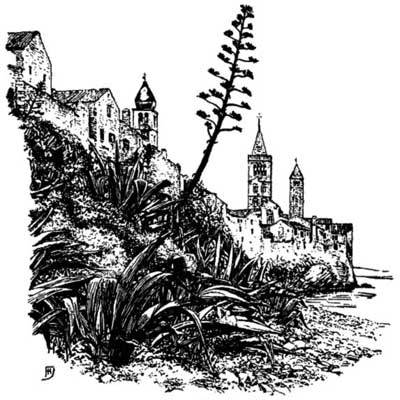
ARBE FROM THE SHORE
When we reached Arbe, cresting its rocky point with a picturesque confusion of walls, campanili, and house-roofs that seemed to grow out of the rocks, so well do they harmonise with them, the afternoon was sunny and delightful, though the roads showed signs of the rain which had recently fallen. At sunset we climbed again to the public garden and enjoyed the well-remembered view of towers and walls grey against the glowing sky, the most beautiful grouping of one of the most picturesque places that I know, intensified by the charm of the changing colours as the glow gradually faded, and the opalescent sea by slow degrees took its place in the quiet harmonies of twilight.
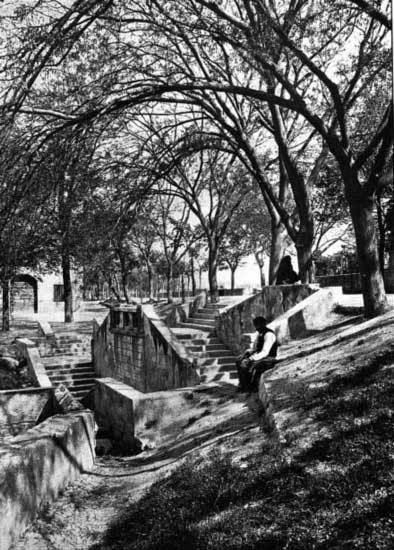
ASCENT TO THE RAMPARTS, ZARA
XVIII
ZARA
The continuation of the Canale della Morlacca, which washes the mainland, is the Canale della Montagna, on the west side of which is the island of Pago, the Gissa of the ancients. The city of the same name was founded by the Venetians, and was originally a defensive military post against the Uscocs. The bay upon which it is situated lies open to the "Bora," and therefore cannot always be entered in winter. For this reason Val Cassione, on the west side of the narrow island, is the usual port. A road over a slight hill conducts to the south end of the bay and the city, in front of which the water is so narrow that it is bridged over. On the near side are the celebrated salt-works, the richest in Dalmatia. There are a few Roman remains, including those of a camp; and near Novaglia is a tunnel 300 yards long, lighted by pierced apertures, said to have belonged to a Roman aqueduct. The scenery outside the island of Pago is uninteresting; the islands have little elevation, beauty of form or colour, nor is there sufficient vegetation to disguise the dull grey of the rocks, though, as the boat turns to the west to gain the mouth of the Canal of Zara, the Velebit Mountains behind may become imposing under certain circumstances. The first time we went to Zara the sun was setting at this part of the voyage, and the sky effect was fine, while the Velebits flushed a pinkish purple with blue-purple shadows, the silhouette only showing in places beneath heavy masses of cloud, in which some of the summits were hidden. Falling showers here and there softened and veiled the strong light and shade, relieved by the prismatic hues of a rainbow. As the sun sank lower the mountains and clouds gradually became a pallid grey, while the sky to westward passed through many gradations of colour and tone as the clouds slowly dispersed and night fell. Far away over the darkening water the electric lights of Zara flashed and glittered, reflected in chains of sparkles which grew longer as we approached.
The boat turned to the left into the old port, and thus we escaped the ordeal of the dogana to which passengers landing at the new quay are subjected, and entered the town through the Porta Marina, the entrance for all travellers arriving by water until, in 1868, the walls towards the sea were thrown down, and the Riva Nuova constructed. It is proposed to extend this fine promenade to Borgo Erizzo eventually. In making it some remains of Roman walls were found. The city was declared "open," and the cannon were transported to the arsenal. On the other side of the water is the island of Ugljan, with its conspicuous Venetian castle of S. Michele, to which the peasants make a pilgrimage on Michaelmas Day. From the height which it crowns, the second Canal of Zara may be seen, and the islands of Incoronata, Isole Grosse, and the open sea beyond. It is said that the coast of Italy can be seen with a telescope on a fine day. The remaining portions of the fortifications have been planted with trees, or turned into gardens, and form pleasant promenades both during the day, when the shade of the trees is acceptable, and at evening, when the sea breeze blows cool from off the water. Among the trees are found palms and Paulownia in flower. Outside the Porta Terra Ferma a large bastion has been made into a public park, named after General Blazekovic, who created it in 1888-1890. The fortifications, commenced by Sanmichele in 1533, were finished ten years later by his nephew Giovanni Girolamo: a drawing for the Porta Terra Ferma exists in the Uffizj at Florence, showing the whole depth to the bottom of the ditch, which much improves the proportion. It was approached diagonally across a wooden bridge; the road is now direct, and the ditch filled up. The isthmus joining the peninsula to the land had been cut through to strengthen the older fortifications, of which one tower, the pentagonal Bo d'Antona, alone remains. When the new works were carried out, as a stronger defence against the Turks, the suburbs were destroyed, and the ditch was subsequently turned into the cisterns below the Cinque Pozzi. This great reservoir, made in 1574, was provided with an elaborate system of filtering-beds, the water being collected from the roofs until the aqueduct was opened in 1838. The sand was renewed once in a hundred years.
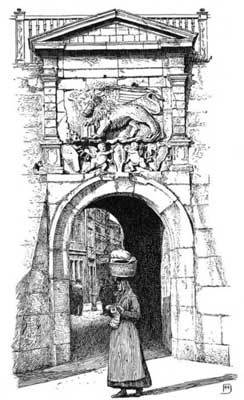
THE PORTA MARINA, ZARA
The inner portion of the other gate, the Porta Marina, was, according to local tradition, brought from Ænona. It is part of a triumphal arch erected by a Roman lady, Melia Anniana, to her husband, Læpicius Bassus, with additions of the period of the Renaissance. It bears a long Latin inscription referring to the battle of Lepanto, October 5, 1571, and on the water side has a pretty, early Renaissance upper part, with the lion of S. Mark and amorini supporting a shield within an architectural framing.
Zara (anciently Jadera) is traditionally the capital of the Liburnians. It became a Roman colony in 78 B.C., and many Roman fragments have been found which attest its splendour and prosperity under the Empire. Trajan built an aqueduct, of which traces have been found through Borgo Erizzo to and beyond Makarska. Stone pipes of the same kind were found on the shore at Zara Vecchia, in the ruins of the Templars' castle on the hill Kastel; above the lake of Vrana, and in the marshes through which the road from Vrana to Benkovac passes. It is believed that the source was a spring at Biba on this hill. Salona, during the time of its prosperity, was of more importance than Zara; but after its destruction by the Avars in 639 the latter again became of first importance in Dalmatia, the Byzantine fleet being stationed there when Ravenna was taken by the Lombards in 752, and the town becoming the dwelling of the "strategos." In 804 Donatus, bishop of Zara, acted as envoy with the doge of Venice in concluding peace between Charlemagne and the Byzantine Emperor Nicephorus. In the tenth century it was known as Diadora. In 991 it became Venetian for the first time, but without severing its relations with Byzantium; and Orso Orseolo fortified it in 1018. Somewhat later, the Venetians made it their principal city, putting the bishoprics of Arbe, Veglia, and Ossero under the metropolitan in 1154, and making Domenico Morosini, son of the doge, Count of Zara. The inscription on the nuns' church of S. Maria records the fact that Coloman entered Zara in 1105; from that date the Hungarian period commences, though apparently the Venetians still had rule over maritime Dalmatia. The sacking of the city by the French in 1202 appears to have been due to the greed of the Venetians, and to their desire to get even with the Hungarians also. Between 1169 and 1201 a Pisan fleet, probably allied with Hungary, took Pola from the Venetians; but it was retaken before long, and the discords between Henry or Emeric, son of Bela of Hungary, and his brother Andrew facilitated the taking of Zara. It is recorded that Andrew had most of the magnates on his side; but Emeric went alone and unarmed to the malcontents, saying: "Now I wish to see who of you will dare to raise his hand against his king"; and all quietly and in silence let him pass. He then took his brother, led him out, and imprisoned him in a certain castle. The magnates fell at his feet asking pardon. Truly in those days divinity did hedge the king!
The French Crusaders had engaged the Venetians to take them to the Holy Land, but did not assemble at Venice at the time appointed, nor had they the money ready to pay for their transport. The Venetians, being men of business, demanded cash down; and so the favourable time for reaching Syria was allowed to pass without the expedition setting forth. Provisions and ships had been prepared, and the Venetians, wishing to use them, with the consent of Doge Enrico Dandolo, proposed to the French an attack on Zara, part of the booty to be used to pay for their passage. The attack took place on November 10, 1202, and the French stayed till April 7, 1203. The Venetians took all the booty, and threw down the wall on the seaward side, but it was restored shortly after. They also sent colonists to Zara after a rebellion and a reconquest in 1243.
The Venetian counts were generally citizens of Venice, and had no defined term of rule. In 1311 the city again returned to the Hungarians, and the result was the siege of 1312-1313, which ended in the condottiere Dalmasio, who was besieging, being offered the countship by the ban of Dalmatia and Croatia. To prevent this the Venetians offered to leave the Zaratines free to choose their own count, only reserving the right of confirmation. In 1345 Zara rebelled for the seventh time, when Andrea Dandolo was doge, and in consequence a long siege commenced on August 12. The Venetians had at Nona 20,000 men, horse and foot, who devastated the fields for three days and set fire to the villages; the countrymen fled to the city, so that there were more than 20,000 within the walls, of whom 6,000 only were armed. On August 30 they closed the port with a chain made of thirteen beams, and on September 1 sent an envoy to Andrew, king of Naples, to ask for aid. On the 8th they received letters from the King of Hungary promising help, and raised the Hungarian flag. The king sent the bani of Bosnia and Croatia to help them, but the Venetian senate bought the rescuers off! In January, 1346, the Venetians took the Castle of S. Damian and broke the chain of the port. The Venetian trenches consisted of a bastion 200 yards long and 100 yards broad built of wood on three sides. On the east it had ten towers, as many on the west, and fourteen on the north, being open on the south towards the fleet. They now controlled 25,000 men. On June 2, Ladislas of Hungary came to help the besieged, and encamped at Zemonico, seven miles away, with 100,000 cavalry. On July 10 he advanced close to the city with 2,000 of his best men. The citizens welcomed him with much joy, and the next day sent legates with great solemnity to offer him the keys of the city. On the 16th he attacked the bastion. On the 20th, Bernardo, patriarch of Aquileia, entered the city; but the king held aloof. The Venetians tried in vain to make terms, and the Zaratines attacked the bastion with good heart, burning one of the towers; but the Hungarians only looked on while the Venetians repelled the assault. The king's behaviour is mysterious. On July 30 he returned to Vrana, and so to Hungary; and, although his promised envoys went to Venice, they went for other purposes. He appears to have been using Zara as a pawn in some great game. Famine obliged the Zaratines to surrender, and the Venetians entered the city on December 21, 1347, the war having lasted two years and six months, and having cost the Republic from 40,000 to 60,000 ducats a month for soldiers' pay alone, without counting the shipping. Eleven years later Zara again became Hungarian, but was finally ceded to Venice in 1413 by the peace of Trieste.
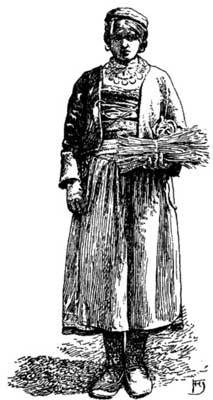
MORLACCA GIRL, ZARA
The dialect spoken in the city is pure Venetian, and the municipality is the only Italian one in Dalmatia. Zara is still the capital, and the diet meets in the city. Here, too, are the only Italian schools in the province, the Slav majority in most places exercising its power to veto everything Italian. The only flourishing industry is the manufacture of maraschino, of which 300,000 bottles are exported annually. The cherries, which are the raw material, are imported from Sebenico, Almissa, and Poljica, near Spalato. The streets are narrow and impossible for carriage traffic; merchandise is put upon long narrow carts, with long poles projecting in front and cross-pieces at the end; the cart is then pushed and pulled by several men. The population is 13,000, and is increased by many country people in the mornings, who come to market, so that the streets and piazzas are crowded with a most distracting variety of costumes. Both men and girls from the country wear little red caps. The men have great light-coloured woollen coats which they throw over their shoulders without putting their arms in, light shirts, sometimes with an embroidered jacket, trousers with embroidery round the pocket-holes (which are in front of the thigh) and a split at the lower part of the side which is buttoned up. They sometimes have a sash round the waist with a knife. The women wear leggings woven roughly in patterns like the wrong side of a tapestry curtain, and shoes somewhat the shape of gondolas, thick skirts with patterned aprons, and small waistcoat-like jackets. Their hair is plaited round the head. The dress of the townspeople is less individual; the head is covered with a white or coloured kerchief, the dress is frequently black, and the modern blouse is sometimes seen. It is interesting to watch the boatloads of country-folk arriving either by the Porta Terra Ferma, close to which are steps and a small harbour, or on the quay by the Porta Marina. Lambs and kids are brought alive and killed and skinned on the quay, the women holding pots or jugs to catch the blood, which they seem to think valuable. The wall of the quay was being rebuilt when we were there the second time, and a diver was working at it. It looked odd to see the stones and buckets of cement lowered into the water with ropes.
There are two antique columns still erect: one, fluted, is in the Piazza S. Simeone, set up in 1729, and the other is in the Piazza dell' Erbe; it was used as a pillory, and the chains with the iron collars still hang to it, having, by centuries of friction, cut deep-curved grooves in the marble with swinging to and fro. This column also has sockets for the insertion of flagstaffs, and attached to it is a much-worn piece of eighth-century sculpture, with the motif of an ornamented cross beneath an arch fastened with clamps. The chroniclers of the seventeenth century record that near this place several drums of columns projected from the earth, and that two entire pillars were erect and united by a piece of the architrave. One was moved to S. Simeone, near to which Mr. T.G. Jackson saw in 1884 the base of a Roman arch excavated beneath the level of the piazza. Other similar fragments have been used in the foundations of S. Donato.
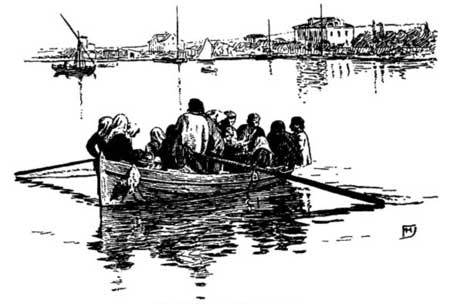
GOING TO MARKET, ZARA
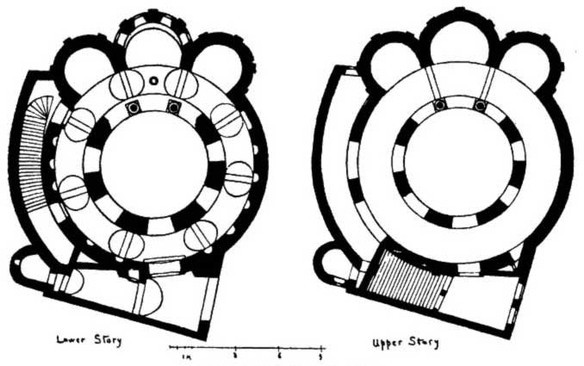
In the year 380 a bishop of Zara (Felix) is mentioned for the first time. S. Donatus is reckoned the fourth bishop, Andrew and Sabinianus (who are shown on a reliquary with Felix) traditionally preceding him. As his episcopate lasted into the ninth century it is evident that the list is not complete. His diplomatic mission took him either to Diedenhofen or Aachen and then to Constantinople, where he had the relics of S. Anastasia given him. It is probable that the sight of the great churches which he saw during his journeys suggested the plan of S. Donato, which was originally dedicated to the Holy Trinity. Porphyrogenitus compares it to S. Sophia, Constantinople, which seems strange in a Byzantine. It is circular in plan, about 60 ft. in diameter. Six gigantic piers, wider than the arches which rest upon them, placed ten feet from the wall, sustain a barrel vault, about 28 ft. high, over the ambulatory, which has strengthening arches. The piers of the upper story sustained the drum of a cupola which no longer exists. Opposite the entrance are three vaulted apses, the central one larger and deeper than the others and with four windows, the others having but one each; and these apses are repeated above, without the windows. In front of them are two smooth columns of Oriental yellow marble 7 ft. round, in place of piers, and thinner columns cut short occupy the same relative place above. The caps are antique and a good deal damaged. Three are composite like the arch of Septimius Severus, and one is Corinthian. The roof is now tiled. A Roman inscription on the fourth pilaster seems to indicate that there was a great temple to Augusta Livia, wife of Augustus, here; and when the floor level was lowered in 1888 a number of inscriptions were found, and portions of carved friezes and pillars used as foundation material and simply laid on the pavement of the Roman forum. Among these were portions of columns resembling both of the two still upright. Part of a flight of steps was also found, which may have been part of the sub-structure of the temple. Fragments of four different buildings have been recognised. Two stairs have served the upper story of the church—an early one with carved hood mould of the ninth century to the external door, now blocked up, and a second from the interior, which lands in a vestibule where some early mediæval carvings are arranged. The upper portion is a double flight, arranged, perhaps, to use when this stair was a "Scala Santa" ascended by the faithful on their knees, whereby they gained the same indulgences as were attached to the Scala Santa at Rome. The building was a military magazine in 1649, again from 1798 to 1877, and then a wine-store till, in 1888, the museum was founded. In 1890-1891 the ancient entrance-door was found behind the eighteenth-century additions. It is a simple square-headed door with semicircular opening above, made of Roman uncarved material, with consecration-crosses sunk in the lintel and base of the right-hand jamb; to the right and left of the lintel a little above it are two simple brackets with crosses on them. The lintel itself is double, and treated as if it were wood. The cill was two feet below the ground level.
The museum contains Roman and pre-Roman antiquities, inscriptions, lamps, carved fragments, coins, bronze and glass vessels, pottery, &c.; mediæval fragments, carved and gilded panels, lanterns and ensigns from Venetian galleys, a crozier of Limoges work of the thirteenth century found under the pavement of S. Crisogono, arms and carvings of the Renaissance period, &c. But perhaps the most interesting things are the plans of the early churches which have either been destroyed or very much altered, and the early mediæval carvings; among these are two very curious slabs with figures under arches, one of which was found under the pavement of S. Crisogono, while the other, closely resembling it in style, came from S. Domenico. The former shows the Flight into Egypt and the Massacre of the Innocents; the latter the Nativity and Adoration of the Kings. They probably formed part of a chancel enclosure. There are also fragments of ciboria, altar frontals, or sarcophagi, while a column sawn in two has furnished decorated jambs to the door of the upper church. On a lintel of the early church of S. Lorenzo is a Christ in a mandorla, supported by angels with a sacred tree on each side and a griffin beyond; a rough astragal moulding surrounds the subject. The jambs have a rough arabesque scroll, terminating in a two-headed bird. These carvings are all of the ninth century.
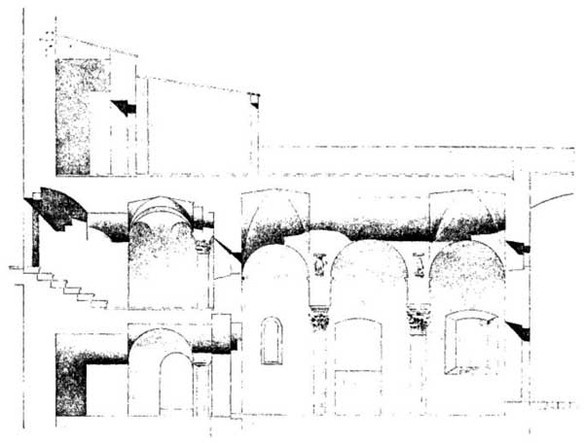
SECTION OF S. LORENZO, ZARA
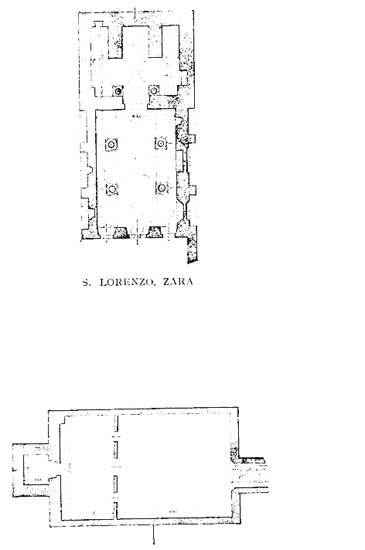
S. LORENZO, ZARA—TOP STORY
The church of S. Lorenzo is in the courtyard of the military command building on the Piazza dei Signori. The sides are in courts entered from the Calle Larga and Via del Teatro Vecchio. It has a nave and aisles about 21 ft. long and about 14 ft. broad, with four pillars, springing from which are three unmoulded arches. The arches are stilted, and at the height of the real springing an impost projects in profile. The central compartment has a wagon vault, the other two quadripartite vaults. The aisles have semi-domes running north and south, resting on cross arches, with squinches in the corners. The choir has two stories, the lower with three square-ended apses, and entered by a door flanked by pillars. The walls which separate the apses ran up to a tower. The vault is a transverse wagon pierced by wagon vaults at right angles. The architecture is very simple, and shows Byzantine influence, but the construction is hidden by plastering. The nave caps are debased Corinthian, with ornamented volutes and one row of flat acanthus-leaves, the abacus being square. The front leaf in each shows a half-length of a male figure with nimbus, his arms raised as if in prayer, the body hidden by a shorter loaf. The columns are of different sizes, but the caps are all the same. The entrance door towards the Calle Larga has a simply moulded round arch; the other has been mentioned as being in S. Donato. The upper story of the choir has pillars with carved caps supporting an arch of two orders, now built up, formerly no doubt an oratory. The church is mentioned in a document of 919.
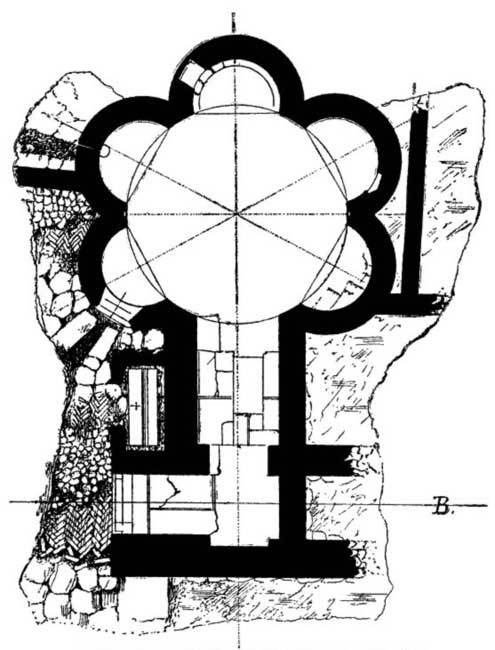
PLAN OF FOUNDATIONS DISCOVERED ON THE RIVA NUOVA, ZARA
S. Domenico (which no longer exists) was of somewhat the same character; but the choir was without dividing walls, and thus became an upper church. It was only 21 ft. square and had three columns on each side, the last close to the wall. The vaults were domically quadripartite, springing from pilasters which rested on the caps. The arcade was round-arched, the central and right-hand apses were square-ended, and the left had a semicircular niche. The under church was wagon-vaulted without architectural features. The foundation of a chapel was found on the Riva Nuova with five niches of a six-niched circle and an entrance passage in the sixth, which turned at right angles to the north to reach the street. In the angle thus formed between the entrance and the main building a sarcophagus stood. This circular-niched plan occurs elsewhere in Dalmatia, as in the baptistery here, and SS. Trinita at Spalato, and the dimensions are generally so nearly the same as to suggest some common original design. S. Pietro Vecchio is considered to be the oldest church in Zara. It is now desecrated, but was used as a sacristy to the fourteenth-century church of S. Andrea, belonging to the Fishers' Confraternity, the sixteenth-century apse of which projected into the nave as far as the first pillar. It was cleared out by order of the Central Commission in 1886. It is about 38 ft. long by 19 ft. broad, and is built of ancient fragments with very little architectural character. One of the two columns bears a Roman inscription, and both have crosses cut in them. One of the caps is a damaged antique; the other is an antique base upside down; neither column has any base. The church is an irregular rectangle in plan, divided into two naves which end in apses by two pillars and a pier. The pilasters are not upright, the arches are deformed, and the two altar niches have half-cupola vaults on a rectangular plan, with arches thrown across the corners. There are two original doors, both built up. The pier between the two apses has a round-arched niche in it. The church is mentioned in 918 in the will of Prior Andrea.
There was a cathedral here in very early times, referred to in a will of 908 as S. Anastasia. It was originally S. Pietro, and the dedication was changed when the relics of S. Anastasia which S. Donato brought from Constantinople and placed in the church of the Holy Trinity were transferred to the cathedral. This church was destroyed by the Venetians in 1202, but probably portions of it were worked up in the new building which the Crusaders are said to have erected as a votive church after the pope had excommunicated them all for the sack of Zara. This seems, however, a legend, since the new building was not consecrated till May 27, 1285, the Archbishop Lorenzo Periandro officiating, assisted by the Metropolitan of Spalato and the suffragan bishops of both dioceses. On the vault of the ciborium and on the jamb of the main door are inscriptions, dated respectively 1332 and 1324, recording their erection by "Joannis de Bvtvane, archiep: Jadren." Certain portions show by their style that additions and alterations were made, still later. The length is 170 ft. and the width 65 ft.
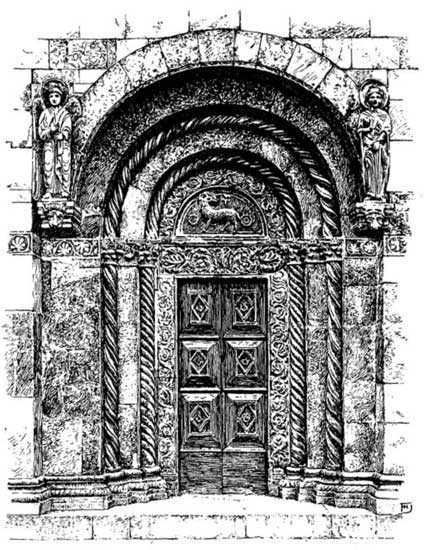
NORTH DOOR OF WESTERN FAÇADE, CATHEDRAL, ZARA
The façade has three doors, and is divided by pilaster strips which emphasise the width of the nave; at either side of the central door is a shallow recess filling the space between it and the pilaster strips. The door itself has spiral and simple colonnettes in the jambs, with corresponding arch moulds of four orders. In the tympanum is a later relief of the Virgin and Child enthroned, with two saints, beneath a pointed trefoil arcade; and on brackets at the sides are four figures of Apostles. On the side doors the tympana have the Agnus Dei, and that to the left has the Annunciation on brackets, one figure on each side of the door. The colonnettes and arch moulds are both twisted in this door; in that to the right they are plain; the figures on brackets are similar. The lintels and jambs have elaborate arabesque scrolls, which remind one of Provençal Romanesque ornament. The lower part of the wall has courses of pinkish marble among the white, and bands of inlaid ornament decorate both the wall and the campanile. Above the string course over the doorways is a Romanesque-looking arcade with another which fills the slope of the aisle walls, with animals standing at the ends. The central portion has a restored wheel-window with radiating colonnettes and round arches, and above it in the gable is another with cusped tracery of a later date; round this an arcading ramps as at the end of the aisles, and the lower rose is flanked by arcading in two stages arched only in the upper one. Both of these arcadings have coupled colonnettes, and are manifestly much later than the lower part of the façade. The walls of the north aisle have an arcading separated into groups by pilasters, echoing the internal divisions, with a gallery above, like S. Nicola, Bari, and others of the Apulian churches. A cornice of corbelled arches crowns the nave wall. The campanile was commenced in 1449 by Archbishop Lorenzo Venier, and carried up by Archbishop Matteo Valaresso in 1460 to the height from which Mr. T.G. Jackson completed it. It has five stories and an octagonal pyramidal termination. The three upper stories have two window openings in each, the lowest being single lights, while the upper two have a central colonnette and two stilted round arches beneath a containing arch. A string with corbelled arches below divides the stories, and the square portion terminates with a balustrade in the usual manner.
The inside was altered in the eighteenth century and the beginning of the nineteenth. The nave arcade, which continues to the apse, consists of ten round arches on each side resting alternately on columns and piers with columns attached which have cushion caps. Some of the columns are spirally fluted and have decadent antique caps. Some are cipollino, and two are apparently cut from antique columns, one having four shafts attached to the central cylindrical mass, and the corresponding one on the other side being panelled, with octagonal colonnettes attached. The pier at the choir steps has two small columns instead of one. Two bays of the aisles equal one bay of the nave, and pilasters run up from the piers, dividing the triforium arches into groups of six, on the tops of which figures stand. The triforium arcade has round arches with coupled colonnettes of red marble on the face and varied caps; the voussoirs are alternately red and grey; and a string with carved leaf pattern, much like that at Traù, runs along the triforium, between the nave arcade and the balustrade. The nave arcade terminates at each end with a single arch. The apse has a marble seat running round it, with the bishop's seat in the centre raised on several steps. It has exactly the same ornament on its sides as is on the font in the baptistery. The wall is sheeted with red marble. The ciborium has pointed arches resting upon Corinthianising caps and columns of cipollino carved in coffered patterns or spiral and zigzag channelling; a cornice of acanthus-leaves runs above the arches. It was erected by Archbishop Butuane, consecrated in 1332, and restored in 1901-1902. The presbytery pavement is of 1336. The stalls, once painted and gilt, are very fine examples of Venetian-Gothic wood carving, and were partly made for Archbishop Biagio Molin in 1420-1427, whose arms are carved on them; but those of his predecessor and successor, and those of Valaresso, under whom the work was probably completed, also appear. Between the stalls, elaborately pierced and carved scroll-work runs up to the canopy level, where little figures stand in niches. Above the canopies, which are slightly pointed fluted shells, and separated from them by curious ogee-shaped gables, are thirty-six half-length figures of prophets, emergent from scrolls and holding labels. Above one of the side altars are six small Carpaccios on panel much repainted—the one with the figure of S. Martin bears his signature; also a Palma Giovine and an Andrea Schiavone.
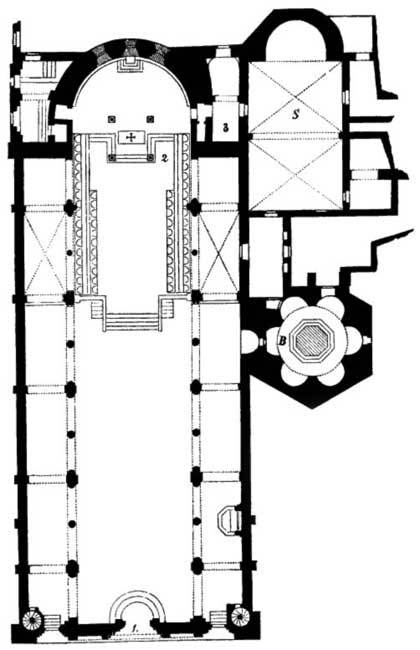
PLAN OF THE CATHEDRAL, ZARA
Beneath the step of the high-altar is the sarcophagus of Oriental marble, with porphyry cover, of the three saints, Agape, Chionia, and Irene, whose remains are interred in the crypt. The crypt is entered by two flights of stairs from the sides of the choir. It is of an irregular shape, about 70 ft. long, 23 ft. broad, and 15 ft. high. Eastwards it suddenly broadens out to a width of 33 ft. and terminates in a semicircle. In this apse there are three windows. Two rows of nine columns extend to just above the point where the change in width begins, and four more follow the external curve of the wall. These support quadripartite vaulting. The columns have heavy square caps and square bases. In one is a grated aperture as if for relics. The sarcophagus altar has a much worn representation of the Martyrdom of Sant' Anastasia, with her name inscribed in Lombardic letters between two foliage scrolls. Fragments of early work are visible here and there, pointing to the reconstruction of the crypt. It is very dark, and is now used as a store, having become too damp for ritual purposes.
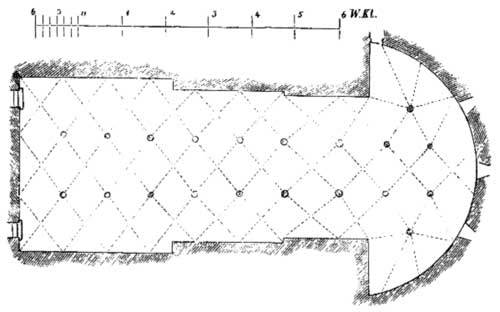
PLAN OF CATHEDRAL CRYPT, ZARA
The treasury contains some exceedingly interesting objects, and is rich in reliquaries. It is kept in the wall between the body of the cathedral and the baptistery in a rather evil-smelling vault, which opens into the latter building. The most ancient reliquary, once belonging to the cathedral at Grado, is that of Sant' Orontius; it contains a portion of his head, and is work of the eleventh century, material of an earlier date having been used in its construction. Upon the sides and front is an arcade with alternate twisted and fluted columns, beneath which are figures of saints robed in the Greek manner, and holding Benedictional crosses. The names of the saints, inscribed in mixed Latin and Greek letters, are Sabinianus, Felix, Vitalis, Satorus, Repositus, Septimus, Januarius, Arotatius, Onoratus, and Fortunatianus. On the back is a plate inscribed in Roman letters: "✠ Sergivs F. Mai Nepos zallae fecit hanc capsam sco capiti Arontii Martins."[1]
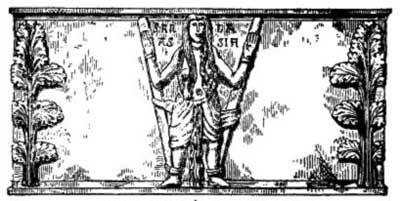
ALTAR OF SANT' ANASTASIA, ZARA
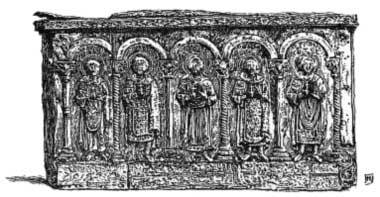
RELIQUARY OF SANT' ORONTIUS, ZARA
On the top are the escutcheon of Archbishop Pesaro (1505-1530) and two quatrefoils. The casket has been mended with strips of stamped silver of various periods. Two reliquaries of the twelfth century described by Eitelberger and Mr. T.G. Jackson were not shown to us, though we were assured that we had seen everything of interest. One contains the head of S. Giacomo Interciso, a martyr of the fifth century. It has a domed top, and round the ring is an inscription: "✠ Ego Bosna ivssi fieri anch capsam ad onorem scs iacobi martiris ob remedivm anime chasei viri mei et anime mee." On the lid in round medallions are six figures—Christ with the monograms IC and XC, "Jachbus, martyr," Judas, Simon, Johannes, and Maria. Round the drum is an arcade supported on twisted, fluted, or diapered columns, under which are the figures of nine Apostles, named SS. Petrus, Paulus, Andreas, Jacobus, Tomas, Jacobus again, Filippus, Bartolomeus, and Mateus. The ground is plain silver; the figures are gilded. On the summit is a classic head with flying hair, a relief which did not form part of the original work. The letters are like those of the monument to Vekenega, who died in IIII; and Bianchi says there was a prior named Chaseus or Chaseo in 1096. An arm reliquary bears the inscription in raised Lombardic letters: "Ego Chacia usor Dimitrii feci fieri hoc opus." It is of plain metal enriched with filigree, and set with stones and patterned cloisonné enamels, and stands upon a triangular cast base with three feet; on each side is a winged figure with sceptre and orb amid twelfth-century scroll-work. Bianchi says Demetrius, husband of Chacia, was prior in 1162. An interesting reliquary inscribed "Hic est spongia dni quo potat fuit in patibulo crucis" is supported by four dragons without wings, but with raised tails. It is a tube of crystal, surmounted by a crucifix, below which is a band of natural leaves with birds. Between this and the foot is a cube of crystal surrounded by cast and pierced metal—a figure of a man in civilian dress blowing a horn, alternately with a knight tilting and carrying a falcon through a wood, typified by a tree behind him.
The treasury contains many interesting things of a later date, of which the reliquary of S. Crisogono is perhaps the most attractive, showing earlier enamels in a good fourteenth-century setting. On the front are two square enamels of SS. Zoilus and Anastasia, with little chapels at their sides supported on slender twisted columns. Upon the lid are three similar vesica-shaped medallions—S. Crisogono in the middle, S. John the Baptist on the left, and S. John the Evangelist on the right. Cypress-trees are on each side of the figures, enamelled dark green. S. Crisogono is robed as a king, crowned, and holding a cross before his breast; angels at each side of his head hold tapers. The material is silver. The figures are delicately drawn, and the ground is filled in with deep blue enamel, red and green also appearing. The borders show good vine-leaf scrolls. The ends have a rough sexfoil rose, which is repeated on the back between modern scrolls imitating the old. The inscription is round the lid in Lombardic letters of silver on a ground of red enamel: "Hoc op fvit fact tvr nobiliv viror viti cadvl vvlcin martinvsii et Pavli de Galcign ann D. MCCCXXVI." An ugly head reliquary of S. Mary Magdalene, dated 1332, is inscribed with the same name, Volcine de Martinusio, who was one of the three rectors or judges of Zara. It has flowing hair down to the shoulders. Several arm reliquaries of late fourteenth century are up to the usual standard. One is of S. Crisogono; one of S. Donate, with many jewels and a pierced band of quatrefoils with some of a larger number representing the opening of the sleeve; one with plaques of translucent enamel and vine scrolls said to contain a finger of S. John the Baptist, &c. An hexagonal pyx on a stem has on the knop and foot a half-length of our Lord erect in the tomb. A foot of S. Crisogono in a shoe-shaped reliquary with jewelled bands has a pretty flowing scroll pattern of the early Renaissance in low relief. A casket reliquary of S. Daniel (which, according to Bianchi, also encloses relics of SS. Peter and Paul and Martin) is rather coarser work of the Renaissance (1496) upon the same lines as the early reliquaries. It has figures of a Risen Christ and SS. Anatasia, Donato, and Daniel. On the sides and top are double-headed eagles with "Μ" on the breast. Bishop Valaresso's pastoral staff is also preserved here—a fine work of 1460, 6 ft. 6 in. high. It is hexagonal, divided into eight sections by bands, of which every other one is broader and more decorated. These bear a pierced pattern and projecting triangles, serving as spandrils to the trefoiled arches, which are incised on the spaces between. The knop is an elaborately niched and pinnacled architectural feature of two stories with figures in the niches and beneath the canopies. It terminates in a foliated form (a later addition), from which the crook springs. Round the outside of this are half-lengths of prophets emerging from foliage, facing in two directions, with a statuette of Christ on the summit. Within are two figures, a crowned woman holding a book, and a mitred male figure, probably intended for the Virgin and Valaresso himself.
The baptistery is an hexagonal building with niches in each side within, vaulted without ribs in wagon divisions, and with four windows above the niches. Altars stand in two niches, a confessional-box in another, and through the remaining three there are doors. In the centre is the octagonal font raised on three circular steps. It is 6 ft. 6 in. broad and 3 ft. 3 in. high, and has an enclosure in the centre. It is panelled on the sides, sometimes with two panels, each of which has round-headed sinkings like windows, sometimes with one panel containing three such sinkings, separated by coupled colonnettes; the cornice and base are moulded. The material is red Veronese marble like that used at Grado. A white marble basin, quatrefoil in shape, upon a fourteenth-century cap, holds the baptismal water, very green and slimy, and there is water at the bottom of the font itself.
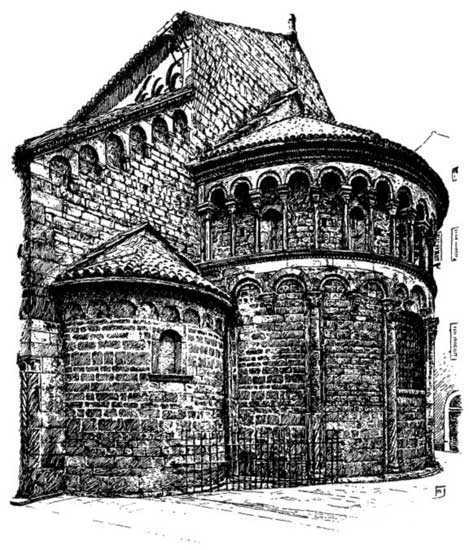
The sacristy, a Gothic building with two bays of cross vaults, was the ancient church of S. Barbara, in which the Zaratines swore fealty to the Hungarian crown on the arm of S. Crisogono on July 8, 1384. In 1794 a mosaic pavement was found beneath the existing pavement. Between it and the apse is a little wagon-vaulted room, perhaps the ancient sacristy.
S. Crisogono belongs to the most ancient Benedictine convent in Dalmatia. The church was originally S. Antonio Abate; but when the body of S. Crisogono was brought from Aquileia it was deposited here, and the dedication was changed. In 906 the church and monastery were recorded under the name of S. Crisogono, and as being ruined by barbarian invasion. In 986 Majo, rector of Zara and proconsul of Dalmatia, rebuilt both, and made Madius, a monk from Monte Cassino, abbot. The standard of the city then bore S. Crisogono on horseback, added to the earlier white cross on a red ground. Destroyed by the Venetians, the church was rebuilt in 1032, and in 1056 the buried relics were re-discovered. The final rebuilding was in the twelfth century, and it was consecrated on May 4, 1175, by the first archbishop, Lampridius, though additions were made at a later date. The central portion of the west front, though Romanesque in style, is nothing like as fine as the eastern apses, and may be work of the end of the fourteenth century, since a consecration is recorded in 1407, though Bianchi states that the inscription in his time gave the date 1298. It has a central door with three unmoulded orders and a sunk tympanum beneath a gable. Above this is a heavy string course from which two pilaster strips spring, a window flanked by four arches on slender coupled columns, with semicircular niches, filling the space between them; above, a space from which it is cut by a second string forms the next stage; over it is another string and two small windows beneath a gable cornice of corbelled arches, the same cornice raking over the aisles. Beasts project at the gable angles, and the summit it crowned by a finial. All the arches are round, and the little arcade has red and grey voussoirs. To the left is a large squat campanile which was built in 1546-1562, and was then higher. A fire damaged it in 1645. The north aisle wall has an arcade of twelve arches with twisted columns, and the cast end has three apses, the central one larger and with a fine open arcade beneath the cornice; above its roof in the gable is a cross which had scodelle in the arms and centre. The interior has an arcade of seven arches, arranged three, two, and two, between piers, with a flat pilaster running up to what was once the wall plate. The columns are antique, as are some of the caps. The horizontal moulding above the nave arcade is the same as that above the apse arcade, and is ornamented with beasts' heads, &c. A twelfth-century mosaic in the apse was destroyed in 1791. The pavement of the presbytery is of coloured marbles, and on the aisle wall hangs a great painted crucifix which was once in S. Domenico, and recalls the work of the early Tuscans. The church was the burial-place of many distinguished Zaratines, and the body of Elizabeth of Hungary, who was killed in the castle of Novigrad by Giovanni Palisna, prior of Vrana, in 1386, was buried here for some years. When the church was restored, nineteen historic gravestones were set in the outer wall. At the same time a relief of S. Crisogono, remains of an early ciborium or chancel, and traces of a crypt were found, also the Limoges pastoral staff now in the museum. The cloister has been pulled down, and a school erected on the site.
S. Maria is first mentioned in 906. It was given in 1066 by the Benedictine monks of S. Crisogono to nuns of their order. It is called in the deed "Ecclesiola S. Mariæ minoris ante portam Beltatam." The street opposite the lesser door led to the ancient city gate, Porta Bellata or Belluata, by which animals were brought into the city. The convent was rebuilt and enlarged by Cicca the abbess, who took the veil after the murder of her husband, and who was sister to Cresimir the younger, king of Dalmatia; and it was consecrated on October 28, 1072, by Andrea, bishop of Zara, five other bishops and four abbots being present, when Andrea and the President Drago gave the island of Selve to it. The fine tower was built in 1105 by order of Coloman, to commemorate his entry into Zara as king of Dalmatia, as an inscription states. Of this period is the chapter-house containing the tomb of Vekenega, the repudiated wife of the monarch, and daughter of Cicca, who died in IIII. A window in the north aisle of the church communicates with it, but is only opened when a nun professes, or when one dies. The nuns' choir is above the main door on the level of the side galleries, shut off by a gilded grating inscribed: "Placida abbatissa fieri fecit anno MCCCVI." Within are the stalls made or altered by Giovanni da Curzola in 1495. The façade of the church, which faces on to a small courtyard, is of the period of the Lombardi. At the side of the high-altar towards the sacristy Bishop Andrea was buried, and here are also the remains of Coloman, brought in 1117 from Zara Vecchia, where he died. Cicca died in 1096. Just within the door to the right is a Christ crowned with thorns, and the Virgin lamenting—a good picture of the school of Titian, if not by the master. There is also a SS. Peter and Paul by Palma Vecchio.
The treasury is above an altar at the end of the north aisle. The sacristan, who told us that he had filled that position for fifty years, lighted candles before opening the doors, kissed each reliquary before returning it to its place, and insisted upon the authenticity of each relic. The objects are scarcely so interesting as those at the cathedral, but include several fine fourteenth-century reliquaries as well as one or two which were made, or remade, in Renaissance times. The reliquary of S. Gregory has on the front Christ enthroned between standing figures of SS. Mark and John beneath a round-arched arcade on twisted columns. Three more saints are at the back, and at the ends are the subjects of the Annunciation and the Visitation. Upon the sloping parts of the lid are medallions of angels writing between scroll-work, and at the top is a figure of S. Gregory. It was a votive offering of Catherine, wife of Sandalius, Voivode of Bosnia, who died between 1433 and 1436. A reliquary of an unknown saint (which Bianchi speaks of as S. Zoilus) has on the front a fine equestrian figure of a knight with lance in rest, said to be S. Crisogono, between two figures of ecclesiastics (SS. Zoilus and Donato), all three in high relief. Upon the pyramidal cover are medallions of the symbols of the Evangelists in lower relief, with bands of running ornament along all the angles. At the back are figures of Christ and two saints, and at each end three saints. The reliquary of S. Quirinus, another work of much the same period, has saints under a pointed trefoiled arcade on twisted and horizontally ringed columns, with foliage in the spandrils. In the centre at the back is a figure of our Lord; on the lid are an angel, Gethsemane, S. Peter sleeping, and the winged lion, between scrolls. A panel of S. Gregory, with low mitre, and inscription in Lombardic letters, holding a dragon-headed crozier, and with his bird at the other side, has a stamped border of thirteenth-century character; and a fine relief of the Madonna and Child, with decorated nimbi upon a ground which has once been blue enamel, has a gabled top with a border of relics in roundels with jewels in the interstices. It must once have been used as a door, as the hinges, still attached to the wood, testify.
The reliquary of the clothes of Our Lord is of good early Renaissance design, but some of the figures appear to be of an earlier date. In the centre is an oblong panel with the Madonna "del Parto" in the centre, and S. John the Baptist and S. Paul in high relief. Outside, on brackets, are the Angel Gabriel and the Virgin; at the back are S. Anthony and another saint. Above is a medallion containing three relics from the manger at Bethlehem, from the house at Nazareth, and from the clothes of Our Lord, crowned by a crucifix and flanked by figures of the Virgin and S. John on brackets. On the foot are four medallions in niello amid arabesques. There are also six arm reliquaries of the usual pattern, two of which have little doors of niello, two or three heads, and an ostensory, at the top of which is a thorn from the crown of thorns.
[1] Mgr. Bianchi has found the names of Madius and Zella in documents of 1067 and 1096, and that of "Sergius tribunus" in one of 1091.
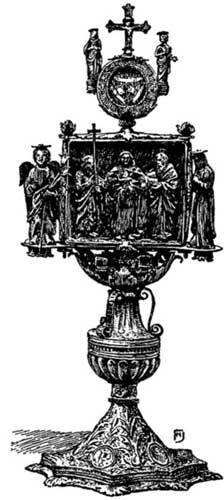
RELIQUARY OF THE CLOTHES OF OUR LORD, S. MARIA NUOVA, ZARA
The church of S. Simeone was a "Colleggiata," instituted in 1150 by Archbishop Lampridius, and dedicated to S. Stephen. It was subsequently called the Madonna della Pace, because the Madonna so called was deposited in it in 1567 from the suburban church of S. Matteo. The body of S. Simeon was brought here in 1632, having been in Zara since 1280, when it was brought from Jerusalem by Bishop Periandro. The celebrated "arca" was in the collegiate church of S. Maria to the north, destroyed in the middle of the sixteenth century to make room for the fortifications, a small chapel only being left standing, in which the wooden arca was kept, the silver one being consigned to the care of the nuns. In 1632 a new chancel was added to the church now S. Simeone; the arca was repaired and placed in its present position. The campanile was built in 1707. In the nave on one side are antique fluted columns with Corinthian caps, which belonged to S. Stefano. The area is of cypress wood, covered with silver plates, which are fastened with silver screws. It cost 28,000 ducats, and was supported on four angels of silver. These were melted down at the time of the war between Venice and Cyprus, and have been replaced by two of stone and two of bronze made from cannon taken from the Turks and given to Zara by Venice in 1647. On the lid a figure of the saint nearly life-size lies, and on the sides and ends are subjects referring to the history of the relics, and an inscription giving the date of 1380, and the names of the Queen of Hungary as the donor, and the goldsmith Franciscus of Milan as the artist. On the roof is a panel showing the artist at work on it. There is a reproduction in the Victoria and Albert Museum. In the treasury is a chalice also given by Queen Elizabeth the younger, late Gothic in style, with Renaissance additions, made of silver, parcel gilt, with niello and a little enamel; it has an octagonal knop with coats of arms reversed on quatrefoil ends and on the sexfoil foot. Upon the base of the cup are subjects in outline, the Crucifixion and figures of saints in petal-like forms. The treasury also contains some curious rococo painted vestments, apparently in water-colour on silk. To the right of the choir, in a chapel just outside the sacristy, is a reredos of repoussé silver—two big angels kneeling below, and God the Father above a Madonna and Child with painted faces, the rest of the figures being in relief. The frame is flanked by S. Michael and a saint, with a little angel flying below and holding a book, also with the heads only painted. These figures and the Virgin and Child have a good deal of gilding about them, and may be of the fifteenth century, since they look earlier than the rest, which is late sixteenth or early seventeenth. In the chapel to the left is a Byzantine-looking relief gilded all over except the hands and faces, which are painted pink, mounted on a polished slab of black marble. The subject is the Virgin and Child standing, the Child draped. A half-finished building not far off is all that was completed of a magnificent church designed to house the arca of S. Simeon. It was commenced in 1572, but abandoned in 1600.
Beyond the cathedral, and not far from the walls, is the church and convent of S. Francesco, consecrated in 1282 by Archbishop Lorenzo Periandro, according to an inscription on a pilaster in the choir. The choir contains a very fine set of stalls, made in 1394 by "Maestro Giovanni quondam Giacomo da Borgo San Sepolcro in Venezia," at a cost of 456 ducats of gold. They used to be in front of the altar, but were moved in 1808 when the new altar was put up. In the Cappella del Crocifisso is a large Carpaccio, an allegory of the militant and triumphant Church, with a row of portrait figures. It is in rather a bad state, painted in tempera on panel. In the sky is a pretty Madonna and Child in a vesica surrounded by angels. The rest of the sky has rows of angels in it, and below, on the earth, kneeling bishops, potentates, and others, with some nice little children in front. Between the two divisions is a landscape with a shrine in the centre, and the whole composition is contained in an upright oval, the corners being filled up with later painting. The usual white dog appears with a red collar-ribbon. The frame is well carved, but not architectural. In a side chapel is a S. Francis by Palma Giovane. The chapel of S. Carlo, once called degli Innocenti, can be entered either from the cloister or the church. In it is an enormous painted crucifix of wood in relief, with the Virgin and S. John half-length painted at the ends of the cross, and an angel above. It bears inscriptions in Greek and Latin, "ICTAVPωCIC" and "Rex Ivdeorvm," and, below the arms of Christ, "In me credentes ad me concvrrite gentes." It is believed to be of the tenth century, or even earlier. In the sacristy is a picture of 1430 on a gold ground in the original frame, restored at the emperor's expense. In the centre is the Madonna with the Child and little angels; on one side are SS. Jerome, Simeon, and James; on the other, SS. Peter Martyr, Nicholas, and Francis. A predella shows the twelve Apostles, with Christ in the centre. Above, in the centre, is Christ half-length, flanked by smaller nearly full-lengths of the Virgin and S. John; at each side three half-lengths of saints—left, SS, Martin, Stephen, and John the Baptist; right, a warrior, a bishop, and a man with green robe, and hat turned up in four pieces. The frame is fine, a blue ground and gilded arabesques. The church possesses four chalices of silver-gilt of the fourteenth or early fifteenth century. Two of them have elaborate knops with crocketed niches with figures, and one has the symbols of the Evangelists in high relief on the foot, with leaf-scrolls and big stars, the plan being octofoil. The finest has a sexfoil foot, and there are angular projections in both between the foils, and a pierced perpendicular band below. Upon the foot are six roundels, with Christ and saints in low relief, as if for basse-taille enamel. The third has a knop with window tracery, pinnacles, and flying buttresses; on the foot, of a later date, are graceful leaf-arabesques, rather like the work of Aldegrever. The fourth is smaller and less elaborate. There are also some fifteenth-century psalters and antiphonaries. One of the three bells in the modern campanile is the oldest in Zara, dated 1328, and signed "Magister Beloa Viccentius." The tradition runs that S. Francis, going to or returning from the Holy Land in 1212, visited Dalmatia, and founded this monastery among others.
The church of S. Domenico (anciently S. Michele) has a pointed Venetian door, with a relief in the tympanum of S. Michael weighing souls, with the Devil pulling the scale down, an armed angel at one side, and a woman with a lighted taper at the other. On the lintel are a Virgin and Child, and several saints in little panels also spreading beyond on to the wall.
The Greek church, S. Elia, which the Servian orthodox Christians have had since the French invasion, is nearly opposite the cathedral. One year we were at Zara at the time when they were preparing to keep Easter. In front of the iconostasis was an "Entombment," surrounded with young grass amid which little lamps shone. The whole was covered with a canopy similar to that carried over the Host. It was delicate and pretty, and a great contrast to "Tombe," which we had seen in years gone by in Italy, and a few days before at Capodistria.
There were thirty churches in Zara, fifteen of which have been destroyed or given to different bodies. Seven are now Catholic, and four preserve their outward shape, but are secularised.
The Loggia, the open hall of justice, ascribed to Sanmichele in its original form, was restored shortly before the end of the Venetian rule. It is now the Paravia library. It has three arches between coupled Doric columns, and is still quite well preserved. The Palace of the Priors, the former rulers of the town, was enlarged by the addition of private houses for the residencas of the Venetian Count and the provveditore; while the commune had to be content with the corn-magazine, near S. Simeone, which is still the communal palace. When the Austrian governor followed the Venetian provveditore the palace was restored and modernised. It is a Venetian building of 1562, with a clock-tower which was restored in 1798; the clock itself was put up in 1807.
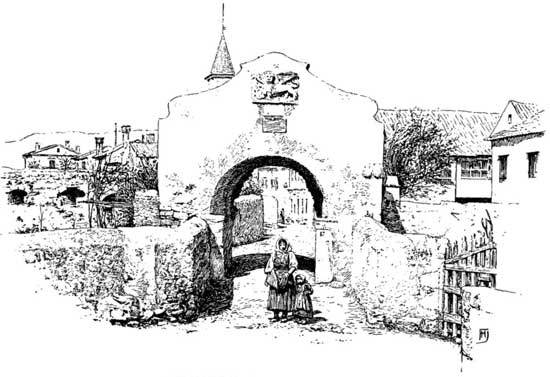
ENTRANCE TO THE TOWN OF NONA
Nona is some hour-and-a-half's drive from Zara, for the greater part of the way over stony uplands with very little vegetation, but with extensive views over land and sea when the weather is fine. We were troubled by showers and a bitter wind, against which our overcoats were an insufficient protection; and we looked with some wonder at the herd boys and girls and other peasants whom we met, many of them barefoot and with no additional clothing to what they had found sufficient in the market the day before when the sun shone strongly. The town is now a mere village of some 500 inhabitants, and, though a few antique fragments may be seen, and the ruins of several churches of different periods, it is difficult to realise that it was once one of the most important towns in Dalmatia. It appears to have been a Roman port, and the head of one of the roads to Byzantium across Dalmatia—an ancient Liburnian city, the great prosperity of which, at the end of the first century A.D., is attested by the coins found here. It was called Ænona and Ænonium by Pliny and Ptolemy, Nona by Porphyrogenitus. Destroyed by the Slavs in the seventh century, re-occupied and restored by another branch, the dukes and kings of Croatia made it one of the thirteen Dalmatian "zupanje." Later it belonged at intervals to the King of Hungary and to Venice, and after 1409 remained in the power of the latter. In 1357 Count Giustiniani valiantly but vainly defended it against the Hungarians, when the garrison was reduced to such straits by famine that they had to eat their horses. It was twice burnt to prevent it from falling into Turkish hands and being utilised as an outpost, in 1571 and 1646. The harbour has silted up, and only a small piece of the walls is traceable. Of the Venetian dominion the only remains are the entrance gateway, with the lion of S. Mark above it, and the "Stabilimento," founded in 1786 by Girolamo Manfrin for the cultivation of tobacco, but ruined by a fire, and no longer used for that purpose.
The Christian Church in Nona is said to have been founded by S. Anselm in 117 A.D. Under the Croats it had a bishop and a chapter. The ancient church of S. Croce was the cathedral, a small cruciform church with three apses in the eastward wall, and a dome over the crossing. It is 30 ft. long, and each arm of the cross is 10 ft. wide. The dome has a flat-pointed vault and windows, while the nave and transepts have wagon vaults terminating in half-cupolas. To the west is a lintelled door, with consecration crosses on the jambs and carving of the ninth century on the lintel. A Slavonic inscription upon it (inside) has been read "Godeslav Juppano Ch[risto] Domo Co[nservat]." The breaking of the upper angles of the carved portion, and the difference in the character of the crosses on lintel and jambs indicate the use of early material in a later rebuilding; but the church is considered one of the oldest in Dalmatia. From 1697 it served as an oratory to the Count of Nona, being near his palace. Its bell (hung in the gable above the west door) served to call the people together for public meetings, &c. The eastern apse has a blank arcading on its exterior, which is square, and the same kind of ornament occurs on the drum which conceals the dome. There are three windows in the west wall, and others in the transept walls and gable. The church was restored some seven or eight years ago, as well as the somewhat similar church of S. Nicolò outside the town.
The parish church of S. Anselmo was the mediæval cathedral, rebuilt during the eighteenth century. Close to it is another church, once dedicated to S. Ambrogio, and now to the Madonna. In the treasury are various interesting pieces of goldsmith's work kept in a marble chest with glazed front and gilded metal door. When we were there the priest was enjoying his siesta, and, though we were in charge of an official from the town-hall, we were unsuccessful in rousing him from his slumbers. I therefore take the description of them from Bianchi, as I was not able to examine them critically. There are two caskets of silver-gilt with the heads of S. Anselm and his sister, S. Marcella, made by the same goldsmith. On the front are Christ, the Virgin, and S. John in relief, with a frieze of a hunting subject, the figures beneath trefoiled arches on twisted columns; on the back, SS. Anselm, Ambrose, and Marcella; on the ends, SS. Peter and Paul, and a king and queen. Bianchi says these are thirteenth century; Mr. T.G. Jackson says fifteenth, which is more likely. On the lids are the symbols of the Evangelists. Two other reliquaries contain the shoulder-blades of S. Anselm. On the front are figures of the three protectors full-length. An arm reliquary has pagan subjects in relief, and is set with precious stones. An inscription gives the name of Simeon the goldsmith, and the Bano Paolo (Lord of Bosnia also at the end of the thirteenth and beginning of the fourteenth centuries). Two reliquaries of the feet of S. Anselm, given by Radoslav Utusano, chancellor of the Bano Paolo, and zupan of the church of Nona, are dated 1309. There are two other reliquaries: one of SS. Giacomo and Orontius, with three medallions of saints; and the other with the Evangelists' symbols. Mr. T.G. Jackson also saw two crosses and a sixteenth-century chalice. I particularly regretted being unable to see the wooden area of S. Marcella, which is a very remarkable example of early Christian art. Bianchi says that it is varnished, and has eleven compartments, with figures in high relief. One is entitled S. Barbara—the first on the left. Then come a king with a double cross, S. Luke's ox, S. Marcella, S. Matthew's angel, the Virgin and Child, S. Mark's lion, S. Ambrose, S. John's eagle, and a queen with a lily in her hand. The eleventh compartment is not recognisable.
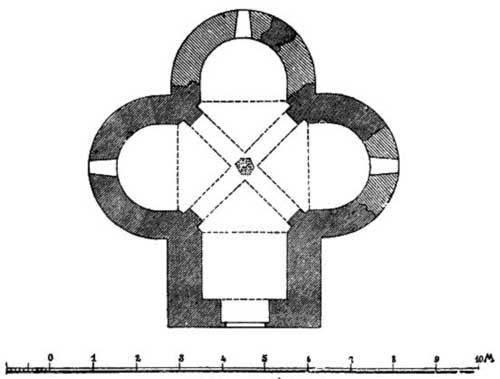
PLAN OF S. NICOLÒ, NONA
North of the parish church are remains of a Roman temple, and an antique cap or two may be seen. In a private house are remains of a bath and a mosaic pavement. The ruined church of S. Michele stands on the site of the Roman arena. Antique fragments are also recognisable in the walls of S. Nicolò. There are several ruined churches which appear to be of the thirteenth or fourteenth centuries. Some of them have been altered at a later period, but they contain nothing of first-rate interest. Nona had sixteen in the Middle Ages. We walked out to S. Nicolò, an early church, which crowns a hillock thickly sown with asphodels in blossom, some little distance from the road and a mile or so from Nona. It is cruciform in plan, with apsidal terminations to three arms, the west being square, and having a door with a semicircular tympanum above it internally. Squinches in the angles serve as transition to the semi-dome which covers each arm. From the pilasters between the apses cross arches spring beneath a domical vault with a pendant at their intersection; in the left pilaster by the apse is a recess. The central tower is octagonal and turreted; beneath the apse eaves are rough corbels, the door has a semicircular tympanum externally, little brackets supporting nothing, and the jambs and lintel are put together rather as if the material were wood. The church is probably of the eleventh century.
Borgo Erizzo, an Albanian village, lies but a short distance from Zara. In the eighteenth century the atrocities of Mehmed Begovich, pasha of Albania, perpetrated on the Catholics, being very great, some of them emigrated, seeking the protection of Vincenzo Zmajevich, bishop of Antivari, who was living at his native city of Perasto. A little later (1726) he became archbishop of Zara, and brought twenty-seven families of Albanians with him, recommending them to the protection of Count Erizzo, commandant of the fortress, who assigned them land near the city, where they flourished and increased. There are now about 3,000 of them. The church, which appears to be in a dangerous condition, was built for them by Zmajevich. The girls work in the factories till they marry, after which they remain at home. The men are agriculturists, and some own fields and vineyards seven or eight miles away, to which they walk or go in carts. The village is dirty and not very picturesque. They get their drinking-water from the Kaiser Brunnen, a spring covered with a dome close to the sea, said to be a Roman erection. Sailors also water there. Before the aqueduct was restored, in years of drought Zara had to import water, and in 1828, 1834, and 1835 it was brought from the Kerka by Scardona.
Zara Vecchia, formerly Alba or Belgrad, is some eighteen miles down the coast. Here Coloman of Hungary, nephew of S. Ladislas, was crowned in 1102. The "porto d'oro" is all that remains of a palace built by Bishop Valaresso, with its foundations in the sea. Mention of the place is infrequent. Towards the middle of the eleventh century Crescimeno Pietro, third king of Croatia, assigned a prebend to the Benedictines of Zara Vecchia. In 1092 Busita, daughter of Roger I., Count of Sicily and Durazzo, and wife of Coloman, king of Hungary, came here accompanied by Geoffrey Malaterra. In 1114 Ordelaffo Faliero took it, and in 1115 it was destroyed to the foundations by Domenico Michieli. Some of the inhabitants, with the bishop and clergy, fled to Scardona; the rest, with the notables, to Sebenico. The nuns escaped to Zara, and the Benedictines crossed to Tkon in the island of Pasman, where they still are.
FOOTNOTES:
[1] Mgr. Bianchi has found the names of Madius and Zella in documents of 1067 and 1096, and that of "Sergius tribunus" in one of 1091.
XIX
SEBENICO
Sebenico lies within a fine harbour at the mouth of the Kerka, some six hours from Zara. The entrance to the bay is defended by the strong fort S. Nicolò, which bears the lion of S. Mark upon the landward side, showing that Venice ruled when it was built in 1540 (according to tradition, from Sanmichele's designs), though the actual sculpture is a replacement of 1824 of the original thrown into the sea by the French in 1813. During the Italian struggle for freedom and unity many patriots were shut up in the damp dungeons of this fort by the Austrians. Within the strait, the Canale di S. Antonio, there is shelter for a large fleet; and it is reported that the Austrian Government intends to make it into a naval arsenal (of which the commencement may be seen in some very ugly buildings to the left of the town). Sebenico is commanded by three castles, from the highest of which, that of S. Giovanni, constructed in 1646, a splendid view over town, bay, and islands rewards the labour of the climb. The next is Fort Barone, so named after Baron Degenfeldt, the gallant defender of the city against 20,000 Turks in 1647. It is now abandoned and in ruins. The third is Fort S. Anna, which crowns the hill just above the houses. This is thought to occupy the site of a king's castle mentioned in 1066. Fort S. Giovanni and the walls, of which a great portion of the circuit still remains, were restored in 1837. These walls are for the most part the work of kings of Hungary, though the Venetians added to them. The sea suburb the Borgo di Mare is probably the oldest portion of the place; that on the land side, the Borgo di Terra, grew up with the need for the shelter of the fortress during the Turkish wars.
In 1117 the town was taken and destroyed by Ordelaffo Faliero; but in 1127, when Zara Vecchia was razed to the ground by Domenico Michieli, and the bishop and clergy were removed to Scardona, the bulk of the population took refuge at Sebenico. It was a pirate city, and there was continual strife between it and Traù. Until 1167 it was only a small place, but in that year Stephen III. of Hungary gave it the title of "city." Lago, however, says that it was only a "castello" till 1298, when the bishopric was established by Boniface VIII. in consequence of the representations of the archbishops of Zara and Spalato, and of Queen Maria of Hungary. The first bishop was Martin of Arbe. When he was consecrated, the ceremony took place in the piazza, because the church was not large enough. In 1412 the chapter was allowed to choose its own bishop; and the town and church authorities became responsible for law and order throughout certain defined territories. The city seals bear either an angel with nimbus standing on a dragon, and holding in his right hand an upright sword, and in his left an orb, or a half-length of a similar angel, holding an orb in his left hand and a sloping sceptre in his right, with the sun on one side, and a crescent moon on the other; above a city with a central gate and two side towers, with windows on each side.
Sebenico owes its chief celebrity perhaps to its cathedral, the chef d'œuvre of Giorgio Orsini, known as George of Sebenico, an architect of exceptional genius, whose work may also be seen at Spalato, Ragusa, probably at Ossero, and at Ancona on the other side of the Adriatic. His father was known as Matteo of Zara, and was also a stonemason, as George proudly announced himself to be when he carved upon the door of his house a mallet and chisels hung with garlands which are supported in the centre of the lintel by the bear, the cognizance of the noble house which acknowledged his grandson as a relation.
When it was determined to rebuild the cathedral on a larger scale in 1402, the bishop and council of forty-five nobles made provision in various ways for the work. The territory of Vodizze was assigned for the purpose, the bishop gave half of the tithes, fines inflicted were to go to the fund, notaries were charged to remind testators to leave something to the fabric, &c. If the community of Sebenico went back from their promises they were to be fined 1,000 golden ducats. When the towers protecting the mouth of the port were rebuilt in 1409 the Venetians seized the stone prepared for the cathedral, but subsequently paid 80 ducats of gold as compensation. The city became Venetian in 1412. In 1430, after some wavering, it was decided to add the bishop's palace and the street between it and the church to the cathedral site. The building was commenced in 1431, under Antonio, son of Pietro Paolo Massegna, in the Gothic style as understood by the Venetians; but in 1441 he was superseded by Giorgio Orsini with a six years' engagement, on the strength of a design which he had made showing how he proposed to complete the building. The west door with its scroll-work of exaggerated curvature, its pinnacled canopies supported on twisted columns, and figures of various degrees of excellence, shows Antonio's capacity and his limitations. The side door, which is rather simpler and in better proportion, is in much the same style, but has foolish-looking lions on brackets beneath the columns outside the door, with figures of Adam and Eve interposed between the columns and the canopied tabernacles above, which bear great resemblance to those in a similar position at Traù. The pointed and cusped cornice of interlacing arches, surmounted by a cable moulding, which continues to the end of the transept wall, seems to show that the building had advanced as far as this point when Giorgio appeared upon the scene in 1441. The arms of the Venetian rectors also afford indications of the progress and intermissions of the work.
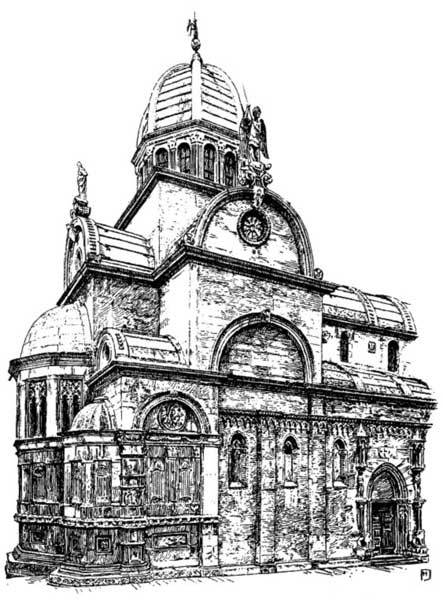
EASTERN END OF CATHEDRAL, SEBENICO
In the tracery of the windows of the central apse a modification of a graceful Gothic pattern has been employed, resembling patterns used in the campanile at Traù, combined with classic pilasters and colonnette forms, but the greater part of the rest of the building is early Renaissance. The aisles are roofed with a half-wagon vault above the quadripartite pointed vaulting, forming a kind of triforium, which is, however, inaccessible; the chapels at the sides of the choir have the semicircular form of the roof of the nave and choir, perhaps suggested by the temple at Spalato, now known as the baptistery; and the east end is tri-apsidal, the apses being polygonal, but roofed with a semi-dome. All these forms are evident externally, the joints of the roofing slabs being covered by an ornamented band answering to the internal supporting rib. The external sculpture is in the main restrained and delicate, and the general proportions are excellent. The angle pier at the north-east of the north transept has the simplicity of its outline destroyed to provide place for figure sculpture and the dedicatory inscription, and the string dividing the stylobate from the principal stage bears a curious decoration of heads in the round; but these are slight blemishes amid much beauty. The heads have a good deal of character, and some may be portraits of the architect's assistants. The same motif occurs round the square-headed door of S. Francesco alle Scale, Ancona. The construction of the semi-domes and of the roofs shows that Giorgio was a competent constructor; but the inventive and beautiful treatment of the decoration of the choir shows him as something more. The graceful singing-galleries at each side, terminating in the curved ambos attached to the main piers of the dome, are very delicate and beautiful; the lofty proportions of the nave and choir are impressive; and the little baptistery, with its curious mingling of Gothic and Renaissance forms, is quaint and ingenious, if not very pure in style.
In 1444 Giorgio went to Spalato to build the chapel of S. Ranier in the church of S. Benedetto, which was to have been finished in two years, but it was nearly four before the donor was satisfied. The price was 306 ducats of gold. It no longer exists. After his first contract expired at Sebenico, where the work apparently progressed very slowly, he went again to Spalato in 1448 to make the chapel of S. Anastasius in the cathedral. Here he had to compete with the work of Gaspare Bonino of Milan, who had made the corresponding chapel on the other side in 1427. They are both rather late Gothic in style. In 1449 he returned to Sebenico, his contract with the chapter having been renewed in 1446 for ten years at an advance of five ducats. The first contract was for six years, at a salary of 115 ducats. In a notice of 1450 from Zara, he is thus referred to: "Mistro Zorzi, taglia pietra, proto alia fabbrica della chiesa di S. Giacomo di Sebenico." The contract for the sacristy is dated March I, 1452. It cost 600 ducats. He was at Ancona in 1451, when he undertook the façade of the Loggia de' Mercanti, an ornate work, which took eight years to build, and has several details resembling those parts of the cathedral, Sebenico, which are ascribed to Massegna. In 1556 it was burnt, and was restored by Tipaldi. Barnabei, a contemporary writer, states that Giorgio also built the adjoining Palazzo Benincasa. He must have gone backwards and forwards between Italy and Dalmatia, for in 1455, while he was under contract with the Sebenico authorities, he completed the fine façade of S. Francesco alle Scale, Ancona, receiving a bonus of 70 ducats above the price, according to Lando Feretti. The church was built in 1323. The monastery is now half barracks and half hospital. Between 1455 and 1459, the façade of S. Agostino in the same town was built as an addition to a church of 1338, which also is now a barrack. The foliage, twisted columns, and canopies are a good deal like the earlier work at Sebenico. In 1460, Giorgio returned to Sebenico, but in 1464 and 1465 was at Ragusa, where he helped in building the Torre Menze, and in restoring the palace of the Rectors. The next year he was at Pago, improving and enlarging the courtyard of the bishop's palace. It was the Bishop of Ossero, who thought he was going to obtain the removal of the see to Pago, but failed to do so. The façade of the cathedral at Ossero has been ascribed to him, and there is nothing in its design to make his authorship impossible. In the next year he undertook work on the façade of the Cappella Grande of the parish church at Pago. In 1470 he went to Rome, where his compatriot Giovanni Dalmato, the sculptor, of Traù, was at work on the monument of Paul II. He went as representative of the procurators to Paul II., in reference to certain charities left by Bishop Vignacco, who died at Porto, near Rome. In 1472 it is stated that he had let all the houses which he had in the Venetian dominions. In this year he commenced the façade of S. Maria, Cittanova, in the Marche. During his frequent absences from home, his Venetian wife Elizabeth looked after his affairs, apparently having a power of attorney. He had many pupils, some of whom continued to work on the cathedral at Sebenico after his death in 1476.
The cost of the building is stated to have been 80,000 Venetian ducats of gold. It was thoroughly restored between 1843 and 1860; seven out of the fourteen caps of the nave arcade have been replaced, and a good deal of the framing of the panelling of red marble above. At each side of the west door are monuments to bishops, and also at each side of the choir steps. The slabs are sloping, and bear figures in relief. That on the right of the door is Bishop Sisgoreo's, made under Giorgio's direction, with an inscription added in 1874 by a descendant. The tomb of Lucio Stafileo (☦1557). under whom the cathedral was reconsecrated, is to the north. Those at the entrance to the choir are Luca Spignaroli (☦1589) to the left, and Domenico Calegari (☦1722) to the right. The choir is raised six steps above the level of the nave, and the sanctuary seven steps higher still.
At the time of Giorgio's death the work had progressed as far as the roofing in of the apses, if one may trust the arms of Bishop de Tollentis (elected in 1468), placed above the upper arch of the transept; while upon the external arch to the north are those of Count Captain Piero Canal, who left in 1470; and on the arch of the central apse inside, behind the sculptured bust representing God the Father, are those of Count Captain Girolamo Pesaro, who began to rule in 1476. At that time, therefore, the nave and cupola remained to be completed. Upon the cupola there are no arms. Those of Count Nicolò Mulla on the clerestory north wall show that it was finished to the cornice in 1491-1493. Those of Nicolò Navager, who died 1489, fastened with iron clamps in the same place, suggest that it was not completed at his death, though it was probably in course of construction. The arms of Count Andrea Gritti, captain in 1534-1537, on the summit of the façade, show that the western end of the vault was completed by Giovanni Masticevich in 1536. The western rose (at which Giacomo, son of Matteo da Mestre, capo mastro, 1528-1535, was working in 1531) has Gothic cusped arches to the radiating bars, but the mouldings round are Renaissance, as are the angle pilasters to the nave wall and the pateræ decorating the quarter-circles of the aisles. The fluted pilasters of the dome are in harmony with the pilasters of the open gallery above the nave arcade. The pointed arches, which were certainly finished in 1444, are probably Massegna's work, though the leafy cornice above bears great resemblance to carving for which Giorgio was responsible at Ancona.
The baptistery is a queer little building at the eastern end of the south aisle, and one of the entrances to the cathedral is through it. The font has a bowl and base of variegated marble, like that used at Veglia, very flat in shape and unmoulded, supported by three amorini, carved in Istrian stone, who stand round the supporting stem. The plan of the building is cruciform, the arms of the cross being semicircular niches which have shell-heads. The wall above them has Gothic tracery, on the eastern side pierced to give light. The ribs at the angles are supported on engaged columns, above which are Gothic figures beneath canopies, of which two, David and Simeon, remain; the other two were destroyed or stolen, I understand, by thieves who broke into the building. The figures bend forward awkwardly beneath the curve of the vault, which becomes domical, with angels and cherubs upon it. The boss in the centre bears a head of God the Father and the Holy Dove, with an inscription round the edge: "Hic est filius meus," &c.
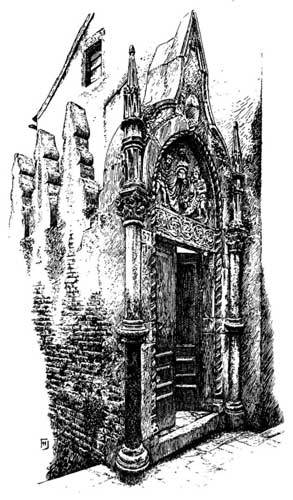
LATE VENETIAN-GOTHIC DOORWAY, SEBENICO
The question of the part played by Giorgio in the construction of the cathedral is difficult to decide, being complicated by the mixture of styles and the possibly later insertion of several of the coats of arms of the rectors and bishops. The western piers of the crossing are considered to be part of the earlier work, because of the close resemblance of the carved foliage to Venetian-Gothic ornament; but it must be remembered that Giorgio was trained in Venice, just as Massegna was, and would be familiar with such work. Foliage of similar style occurs in domestic work at Traù, and in other places along the coast, so that it is scarcely safe to consider it the sign-manual of any one sculptor. The time from 1441, when he signed a contract for six years, to 1443 was spent in widening the street to allow of the eastward extension of the church. On June 16, 1442, the demand for the rebuilding of the façade of the count's palace (which was on the other side) was formally made for the bishop, procurators, and chapter. This additional space was necessitated by the design of the apse, &c., as laid down in Giorgio's plan, and still existing.[2] The Gothic character of the domestic doorway illustrated, with the late form of shield in the tympanum, shows that such forms lingered late in Dalmatia. The same may be said of the design of the rose-window, finished in 1531, and of similar details which occur in undoubted work by Giorgio in Ancona.
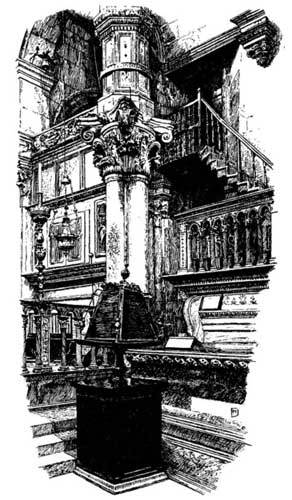
SOUTH-EAST PORTION OF CHOIR, CATHEDRAL, SEBENICO
The door of the lions in the north aisle is quite Gothic in character, yet the arms above it are those of Leonardo Vernier (1453-1454), Bishop George Sisgoreo (☦1453), and of Bishop Vignacco (elected 1454), apparently fixing its date thirteen years after Massegna had received his congé. If it be contended that these arms are a later insertion, which the arrangement of the masonry makes possible, the value of all the coats of arms as fixing the dates of the portions of the building on which they occur must be discounted. The design of the lowest portions of the shafts in the right-hand jamb is different and apparently later than the rest of the work, and the foliage on the brackets beneath the lions also is very different from the fine caps to the west of the crossing, so that one scarcely likes to assume that they are by the same hand. Upon the pier, above one of the capitals attributed to Giorgio, which has been compared disparagingly with the caps last named, is the date 1524. This is below the level of the door of the sacristy, which we know Giorgio built, and one would assume that the pier must be anterior to the door, as the construction of the sacristy would scarcely precede the roofing in of the aisle from which it is entered. Moreover, the baptistery is beneath the apse which terminates this aisle, and it was certainly completed in 1452, since it is mentioned in the contract for the sacristy. The mixture of Gothic and Renaissance forms is characteristic of Giorgio's work throughout; and it is difficult to agree wholly either with Mgr. Fosco or Mr. T.G. Jackson in the different conclusions on this subject which they draw from the same data. The fact of Massegna having been dismissed on the definite ground of errors made and defects discovered, with the additional complaint of the throwing away of money upon ornament, suggests that the earlier portion was not left as we now see it by the first architect, of whom Mr. Jackson says: "To us there seems no fault in the design of Antonio." The design of the western pair of caps of the piers at the crossing is as different from that of the nave caps, which are certainly Massegna's, as from that of the two eastern piers. Mr. Jackson says, probably quite rightly, that the torus moulding decorated with the laurel above the leaf cornice of the nave marks the commencement of Giorgio's work in that part; the same moulding occurs in the same relative position in the ambos to which he assigns the date of 1547: and one does not quite understand why the same detail should not have the same origin in both places. The only contract of 1547, quoted by Mgr. Fosco, is one with "Checcus" of Padua for 350 squared paving-stones and for laying them.
Whatever part George of Sebenico had in the construction he must be classed with the great architectural designers. Leo Battista Alberti commenced the recasing of S. Francesco, Rimini, which is generally quoted as the earliest Renaissance work in Italy, in 1446, and the stone for the work was imported from Istria. In that year Giorgio's first contract was renewed for ten years. The Lombardi were then only commencing their work. S. Zaccaria at Venice was built by Martino in 1456, and the Scuola di S. Marco in 1485. Pietro was engaged on the Madonna dei Miracoli in 1483. So that Giorgio's work antedates theirs by some years. He had numerous pupils, whose names have been recorded; the other workmen came from Durazzo, Curzola, and Spalato. The best known of them, Andrea Alexis, the Albanian of Durazzo, was much employed in Spalato, Arbe, and Traù.
The votive church of S. Salvatore, just inside the Porta Pile, Ragusa, built in 1522 after the earthquake of 1520, and designed by Bartolommeo da Mestre, master mason at Sebenico in 1528, bears considerable resemblance to the cathedral.
The door of Giorgio's house is beyond that of the sacristan, in a narrow street, the Contrada S. Gregorio. To reach it, one leaves the piazza by a slope beyond the Loggia, the ancient palace of the council of the Nobles, a building of 1522, now a social club. The slope affords a view of the enclosure in which the "vere" of the communal wells still remain, four circular well-heads, with the symbols of the Evangelists and coats of arms in roundels upon them, surrounded by cable mouldings, four on each. Sebenico now has a fine water-supply brought from the Kerka, twelve miles away, and they are no longer in use. The aqueduct—the first constructed in Dalmatia in modern times—is named the Lott-Brunnen, in commemoration of the clever engineer who designed it.
Near the cathedral is the little church of S. Barbara; the bell-turret on the wall is used as its campanile. In the north wall is an ogee-headed window, deeply splayed and with pretty tracery; below it a little shrine to the Virgin is set most oddly, with an arch projecting up into the window space. A little higher up the street is the fine Venetian door illustrated a few pages back, with columns and pinnacles, and returning wall with elaborately shaped battlements. At the church of S. Giovanni Battista is a fine external stair of fourteenth-century Venetian type, a double flight returning on itself, with a landing at the change of direction. The balustrade is continued round the side of the church and the tower, but with square unmoulded shafts in place of the colonnettes. The trefoiled heads are cut in the rail with the carved spandrils between. There are many pieces of sculpture of the Venetian period, windows, balconies, &c., in the walls here and there, and wheel-windows occur with quatrefoils filling the heads of the spaces next the circumference.
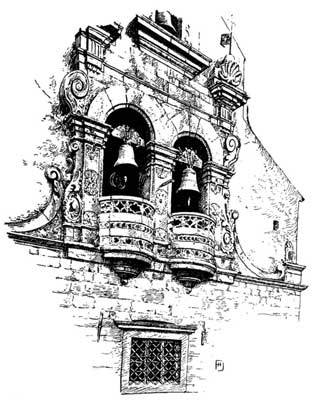
BELFRY OF GREEK CHURCH, SEBENICO
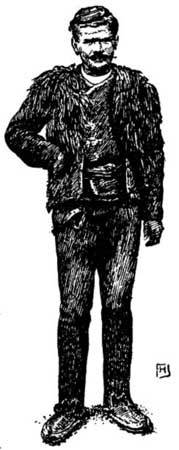
COSTUME OF SEBENICO
There are also a few pictures to be seen. In the cathedral is an Andrea Schiavone (who died here in 1582), "The Adoration of the Three Kings." In S. Domenico alla Marina there are said to be fine Renaissance altars, and pictures by Lorenzo Lotto, Palma Giovane, and Marco Vecellio. We did not see them, as, on the occasion of both our visits to Sebenico, the church was being restored or rebuilt. The interior of S. Francesco is harmonious. It was in the archives of this convent that Mgr. Bulić discovered a gradual written on parchment of the ninth or tenth century, which had been brought from S. Maria di Bribir in 1527.
The Greek church has a very interesting belfry of late Renaissance style in the gable; two arches with projecting semicircular pierced balustrades for the ringers, and the bells (which are clappered) hanging in the free space beneath the arch above. A third bell is in a higher arch without the balustrading. The Greek Christians celebrate the Church festivals with processions about the town, treated with great respect by their Roman Catholic fellow-citizens, of which one held on the Assumption may be described as typical. Boys and girls with garlands led the way, followed by women with coloured aprons and voluminous draperies. Then came a band in gay uniforms and plumed head-gear, then priests in vestments of cloth of gold, swinging silver censers, or bearing holy pictures; they were big men of fine appearance, with religious earnestness in their faces. In the middle, under a silken canopy with gold fringes, a higher ecclesiastic walked, a venerable figure, with long silver hair and beard, bearing the most holy object and looking like a high-priest, surrounded as he was with clouds of incense. After the priests came a long line of men in country costume, powerful figures with flashing eyes, and faces full of character. They held themselves upright like soldiers, and bore large white tapers fastened four together. The sides of the narrow streets were lined with Roman Catholics who looked on with sympathetic interest at the religious ceremonies of their fellow-citizens of a different creed, an example which might be commended to sects nearer home.
The people are hospitable, and very generous, but proud, and, like the Spaniards, easily moved both to acts of violence and kindness. There is no nobility, the patrician families being either extinct or impoverished, partly owing to a severe epidemic of smallpox which smote the town in 1872. The men wear a ridiculous small red cap, like that worn at Zara, but smaller, often requiring an elastic round the back of the head to keep it on, and waistcoats and coats ornamented with large silver buttons of filigree work (older examples of which are works of art, but the modern mere articles of commerce). The collar is curious, with a facing of red or black worsted, apparently intended to imitate fur (shown in the drawing of the costume). The trousers are dark blue, with a slit towards the ankle, laced up with silver wire, and strong shoes are worn with turned-up toes covered with hide lacings. The women have a white head-dress, a cloth twisted round and fastened to the hair in the manner of that worn at Lussin Piccolo. One of the waiters at the restaurant who came from Spalato, but whose side-whiskers stamped him as an Austrian, told us he had been in Glasgow and other British towns—a rather unusual thing with the men of his class, though many of the sailors are acquainted with British ports. The dustmen reminded one of the days of one's childhood when in England; they went round ringing a bell and calling "Dust-ooh!" At the sound all kinds of refuse were brought out to the cart, which went slowly along the narrow street.
Sebenico was the birthplace of the celebrated Nicolò Tommaseo, to whom a statue has been erected in the public garden below the piazza, where Sanmichele's gate stands. He was born in 1802, and was philologist, philosopher, historian, poet, novelist, critic, psychologist, statist, politician, and orator, leaving behind him, when he died in 1874, some two hundred works. In its time of prosperity the city owned several islands, of which Zlarin is the most populous and the richest.
Sebenico is the usual starting-point for the excursion to the Kerka falls; and, on the arrival of the boat, tourists make arrangements to share carriages. It is a drive of about twelve miles, through a barren, stony land, till one reaches the park-like country along the banks of the river. The falls can also easily be reached from Scardona, to which a little steamboat runs in the morning; but there is none back in the afternoon, so those who are pressed for time generally drive. Scardona is an ancient city mentioned by Pliny as a principal market-town of Liburnia. The ruins which remain are late Roman. In the Middle Ages, Venice, Hungary, and Turkey all coveted it, and it suffered accordingly. In 1411 it became Venetian, in 1522 was sacked by the Turks, and retaken by the Venetians in 1537. The fortifications were destroyed, and the town abandoned and afterwards burnt; but the Turks held it till 1684, when they finally evacuated it. The falls are about three-quarters of an hour's walk away up the river, which was the ancient boundary between Liburnia and Dalmatia. They form its final plunge to sea level, for two tributaries join it, one on each side of Scardona, where it virtually becomes an estuary. The water precipitates itself over five terraces some 300 ft. wide, a magnified artificial cascade with a fall of 150 ft. The main fall occupies the centre of the stream, and is slightly horseshoe in shape; to the right and left are numerous smaller cascades with a little island between. Many partly artificial channels conduct the water to flour and fulling mills on both sides of the stream, of which there are some fifty, the sound of the mill-wheels and the fulling-hammers mingling with the rush of the waters. On the Sebenico side are a mill for insect-powder made from the pyrethrum, and the pumping-house for the water-supply of the city, the power for the electric lighting being also generated here. The mills are not so busy as they used to be, for the Hungarian and Russian flour is driving the home product out of the market. The spray from the falls rises high in the air, and bathes the overhanging trees and reeds, keeping the neighbouring rocks clothed with ferns.
After dinner we strolled along the quay to the south of Sebenico. There was no moon, and the stars were not as brilliant as they sometimes are in these southerly latitudes, making it rather difficult to pick one's way among the mysterious darknesses, which meant obstacles of one kind or another. As we rounded a corner a lamp or two flashed in our eyes from the other side of a little cove, and sparkled in broken lights upon the uneasy wavelets which splashed and tinkled against the sides of several coasting-vessels moored near at hand. The semi-silence of the night was broken by musical sounds, scarcely melody, but an uneven kind of chant, commencing in unison, and dying away in a prolonged melancholy, wailing chord, swelling and falling, almost like the notes produced by an Æolian harp as the wind sweeps over its strings. The glow of light which showed the door of a wine-shop across the water marked where the singers were enjoying their melancholy music, which, in its formlessness and dying cadences, was in strange harmony with the shapeless undulating dark masses, which by day were rocky islands sparsely clad with trees, now only relieved by the glimmer of the paler water, whose lapping formed an undertone to the stronger notes of the voices.
[2] Mgr. Fosco states that Giorgio submitted a plan of his proposed work, with cupola, apses, and transepts, with the little choirs—possibly a model, such as we know he prepared at the time the contract for the sacristy was signed.
The treasury contains some exceedingly interesting objects, and is rich in reliquaries. It is kept in the wall between the body of the cathedral and the baptistery in a rather evil-smelling vault, which opens into the latter building. The most ancient reliquary, once belonging to the cathedral at Grado, is that of Sant' Orontius; it contains a portion of his head, and is work of the eleventh century, material of an earlier date having been used in its construction. Upon the sides and front is an arcade with alternate twisted and fluted columns, beneath which are figures of saints robed in the Greek manner, and holding Benedictional crosses. The names of the saints, inscribed in mixed Latin and Greek letters, are Sabinianus, Felix, Vitalis, Satorus, Repositus, Septimus, Januarius, Arotatius, Onoratus, and Fortunatianus. On the back is a plate inscribed in Roman letters: "✠ Sergivs F. Mai Nepos zallae fecit hanc capsam sco capiti Arontii Martins."[1]
FOOTNOTES:
[2] Mgr. Fosco states that Giorgio submitted a plan of his proposed work, with cupola, apses, and transepts, with the little choirs—possibly a model, such as we know he prepared at the time the contract for the sacristy was signed.
XX
TRAÙ AND THE RIVIERA DEI SETTE CASTELLI
From Sebenico, Spalato can be reached either by boat or by rail. On our first visit we chose the train, since it gave us greater choice of times for making the journey. The railway stations are generally far away from the piers; we had observed this at Pola and Parenzo, and the same thing occurs at Sebenico. The hotel porters are not allowed to carry baggage to and from the steamers or the station; we were told there was a law against it, which a man sitting by said was just enough, for the odd-job men must live! The retrospect from the railway is fine. The southern end of the inlet is in the foreground, with a training-ship upon it; the city on its hill lies to the right, crowned by Fort S. Anna, and higher still the Fort S. Giovanni; while to the left is the other portion of the inlet which stretches towards Scardona and to the entrance, dotted with islands and terminated by low hills. A bright sun illumined the whole scene, increasing the lustre of the rocks and buildings, which contrasted sharply with the colour of the sea, blue as the luminous over-arching sky it reflected.
The line climbs slowly up the slopes of Monte Dinara, towards Perkovic-Slivno, the junction for Knin through a rather stony landscape above rich and well-cultivated valleys. The hills in the middle-distance look barren, but the foreground is interesting on account of the variety of broken forms caused by projecting rocks and stones. It is starred with green humps, and there are trees in places. The humps are stunted growths of juniper, sloe, bramble, hawthorn, or a trifoliate plant, with grass growing in the shadow. The trees are hawthorns, ilex, olive, fig, almond, chestnut, mountain ash, hornbeam, or elm, and I thought I saw oak, though it is said that it does not grow in Dalmatia. Colour was added by many flowers, orchids, iris, yellow daisies, asphodel, and fields of pink pyrethrum; while the dresses of groups of peasants on their way to or from Mass gave brilliant patches of reds and blues. Vines grew in pockets of earth among the rocks from which loose stones had been collected to build rough terrace walls.
At Perkovic-Slivno, the song ol nightingales beguiled the tedium of waiting, shut within a barrier, for the train from Knin, for one is not allowed to stray about until the train arrives. After a little further climbing, the summit of the range was pierced, and the lovely Riviera of the Castelli lay spread before us far below. The long island of Bua stretched towards the strait, by which the ancient port of Salona was approached; a land-locked bay, from the other side of which above the peninsula of Monte Marjan rose the campanile of the cathedral of Spalato, swathed in the scaffolding of its long-continuing restoration; beyond was the sea, with the southern islands in the distance, and the littoral chain growing pale in aerial perspective. It formed an enchanting whole, equalling views which have a world-wide reputation, opalescent in the morning sunlight, with pale purples, blues, and greens thrown like a veil over the rich soil and the grey limestone of the mountains. The line descends rapidly, too rapidly for one's desires, and approaches the shore near the fourth of the castelli, rounds the bay in which Vranjic lies, passing beneath Salona, and, crossing the Jader, arrives at the Spalato station through cuttings which prevent one from seeing anything of the palace wall.
On other occasions we went by boat, reaching Spalato in the evening. After the Punta Planka, the ancient Promontorium Syrtis is passed, where the water is often rough, since there is no protecting screen of islands, the campanili and towers of Traù come into sight, between which and Bua there is a swing bridge across the channel. Beyond this the boat passes under the lee of Bua, on the shore of which is a solitary white monastery; whilst on the opposite shore the buildings of the Castelli throw long tremulous reflections across the water, and boats with sails painted in various colours and patterns pass to right and left, flushed with the rays of the setting sun, and leaving trails of light or dark behind them according as the water reflects the land or the sky. As the sun sinks lower, leaving the sea in shadow, the glow upon the hills becomes more and more roseate, till at last it fades, as the strait is passed and the harbour opens. The smoke from a cement factory hangs in the air like evening mists in an English valley; and, as we approach still nearer, the long line of buildings upon the quays, dominated by the great campanile and the colonnade of Diocletian's palace, gradually grows more impressive in the failing light.
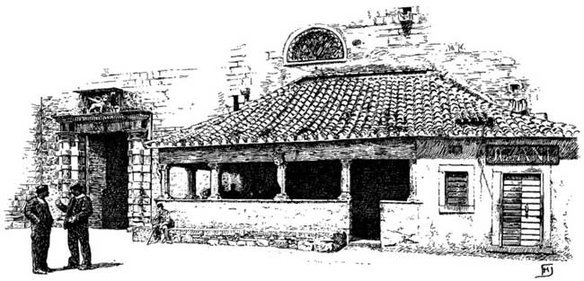
THE PORTA MARINA AND CUSTOM HOUSE, TRAÙ
It is distinctly asserted by Strabo that Traù, the ancient Tragurium, was founded in the fourth century B.C.. by Greek Sicilians from Lissa. At a later date it was certainly a Roman colony. After the fall of the Western empire it was subject to the emperors of Byzantium, and for forty years or so in the ninth century to the Franks, after which Hungarians, Byzantines, Genoese, and Croats struggled for it, till in 1420 it was taken by Venice. Its first privilege was granted by Coloman of Hungary in 1108, renewed and amplified by Stephen in 1124, Geysa III. in 1151, and Bela III. in 1182. Bela IV., with his family, treasures, and a brilliant following, took refuge here in 1241 from the Tartar hordes. He was received with due honours, and conceded in return the confirmation of ancient privileges, &c. The city was mainly Slav during the Middle Ages, and, on the whole, was happy and peaceful under Hungarian rule, though sacked by the Saracens in 1123, and by the Venetians in 1194, under the leadership of Vitale Michiele. Between 1322 and 1358 it belonged to the Venetians.
Under Venetian rule the walls of Dalmatian cities, towards the sea were weak, and often formed merely by houses and towers belonging to private persons. Those of Traù are no earlier than the thirteenth century, and only small portions of that date remain by the tower of the nuns of S. Nicolò. In 1289 a wall was commenced round the suburbs; and Law XX. of the first book of the Statutes obliged each count to build ten "canne" of wall in the suburb each year, as Lucio states. Notwithstanding this regulation, it was not finished till 1404, and one tower even was not completed till 1412. The suburb was called Citta Nova, and the dividing wall was subsequently demolished. In 1290 Stefano d'Ugerio of Ancona, podestà, was freed from the obligation of paving fifty paces of the street between the two main gates, which was laid on every podestà, so one may suppose that the paving was completed. In Venetian times Traù had seven gates. Of these three remain—a plain pointed arch near S. Nicolò, the Porta Marina, and the Porta a Terra. This latter is also known as Porta S. Giovanni from the figure of S. Giovanni Orsino which crowns it, and before which a lamp continually burns. The gate is Renaissance, with the S. Mark's lion in an oblong panel above the arch. From the middle of the base of this panel a little cypress grew, which remained the same size for generations. The country people believed that its growth was due to the wonder-working power of the saint, and that its colour foretold scarcity or a fruitful year. When I was there the second time, in 1906, the podestà told me it had died. The sea gate is also Renaissance; from the jambs still hang the ancient doors thickly studded with iron nails, and behind the door is a S. Mark's lion with the book closed, though they say it was open till the fall of the Republic. Above the gate is another lion with an inscription of 1642. Close by is the custom-house, which groups picturesquely with the gateway.
The castle at the end of the quay, the Castel del Camerlengho, was built in 1424. It is very well preserved. The three smaller angle towers have been altered for cannon. It is now a store-house for sand and such things, with a small garden and a few almond-trees. In the corner is a little chapel nearly covered by the sand, and I was told there was a shallow cistern in the middle. The round tower to the north-west dates from 1378, when the Dalmatian towns were allied with Genoa against Venice, and Traù was the rendezvous. The walls are battlemented, the octagonal angle towers have had machicolations (tolerably well preserved on one of them), and above each of the two entrances is a projecting defensive work of the same kind.
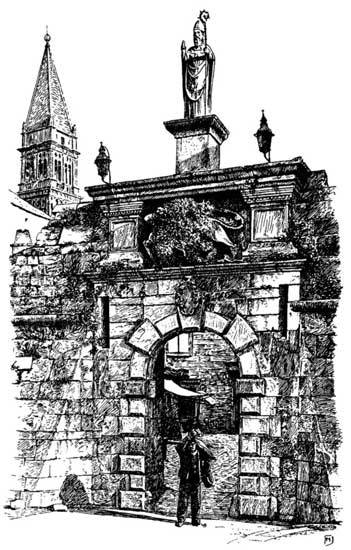
THE PORTA S. GIOVANNI, TRAÙ
A few discoveries have been made of pre-mediæval things. In 1899, some half-mile towards Spalato, two terra-cotta urns were found, one of which had been mended with straps of lead. It contained seven bits of a statuette of Bacchus, which have been put together, and three bits of a larger figure. They are now in the museum at Spalato. In 1903, remains of an early church were excavated on the mainland, close to the wooden bridge which crosses the isolating arm of the sea, bringing to light a mosaic pavement, part of the apse, and one column. It was probably part of a cemetery basilica of the fifth or sixth century, just outside the ancient wall of Tragurium. Two Christian inscriptions of the fifth century have been found near, upon one of which are the words "sancta ecclesia"; and close by was discovered the torso of a prisoner of war, apparently Roman work. Close to the cistern is the reversed cover of an antique sarcophagus, and part of the front of another with a sixth-century cross. A curious custom still existing suggests a traditional memory of the site of the ancient cemetery. On Holy Thursday the Confraternity, after visiting the churches in the town, and that of the cemetery (about half a mile away), returns to the cistern, and, gathering round it, prays for the dead.
At one time there were twenty-one churches in the city. Those of S. Nicolò and S. Barbara are early. S. Nicolò (formerly S. Doimo) was founded in 1064 by Giovanni Orsini for ladies of noble descent, but little remains to show its age. There is said to be a Greek fragment of the third century B.C. in the court of the convent. Two early caps in the entrance portico appear to belong to the period of foundation.
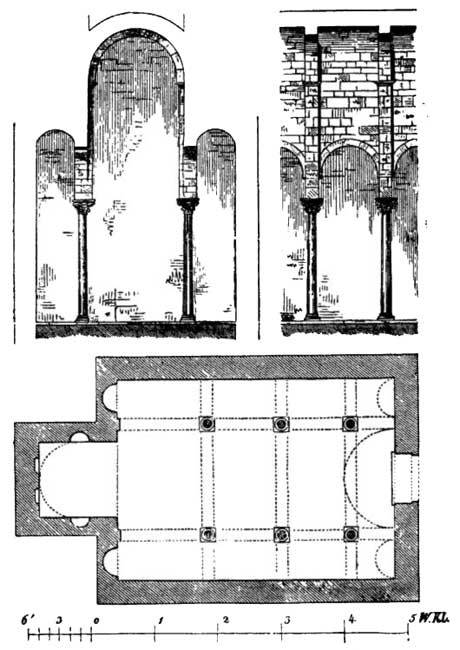
PLAN AND SECTIONS, S. BARBARA, TRAÙ
S. Barbara was originally dedicated to S. Martin, but the name was changed when the altar from the church of S. Barbara was brought here during the Turkish siege of 1537; it is mentioned in 1194. It is the most ancient church in Traù, and the lintel of the door has an inscription upon it with diamond-shaped O's, as used in the eighth century. The ornamental carving also is consistent with that period in its design, with crosses of interlaced work in the centre and at the ends, two griffins with tails entwined in a circle, one on each side of a central feature, with a rosette within a cable moulding, and rough trefoils filling up gaps. The interior has nave and aisles, with four stilted arches resting upon columns on each side, and three apses (of which the central one is larger and longer than the others) with two niches in the wall, covered by a semi-dome on squinches, the plan being square. The caps and columns appear to be antique for the most part, and just outside is a shallow cap of the same pattern as one at Kairouan. The aisles are very narrow, and are vaulted with cross-vaulting without ribs, but with strengthening arches thrown across to the wall. The nave has a barrel vault with pilaster strips running up to the springing of the strengthening arches, which are all round and unmoulded. A moulding with three projecting corbels runs round the base of the apse vault. It is said that there was once a central cupola. The east window still retains a lattice-pierced slab. The church is now a store-house for odds and ends, with a floor halfway up over the western part, but the podestà told me that they hoped to clear it out and make it into a museum.
S. Domenico retains portions of Gothic work. The building was finished in 1372. A rough relief in the tympanum shows a Virgin and Child, and on the right a local saint, Augustino Cassioti, canonised by Pope John XXII. (1313-1334), with mitre and pectoral, and on the left S. Mary Magdalene. At the feet of the saint kneels the foundress, his sister Bitcula. A Gothic inscription gives her name, and that of the sculptor, "Maiste Nicolai de te dito cervo d Venecia fecit hoc opvs." Within are a picture of the Circumcision by Palma Giovane, with a pretty Virgin, the marble sarcophagus of the family Sobota, a grandiose Renaissance production, and six panels of saints on gold ground, rather like the Gubbio school in style, arranged in threes on the wall of the choir.
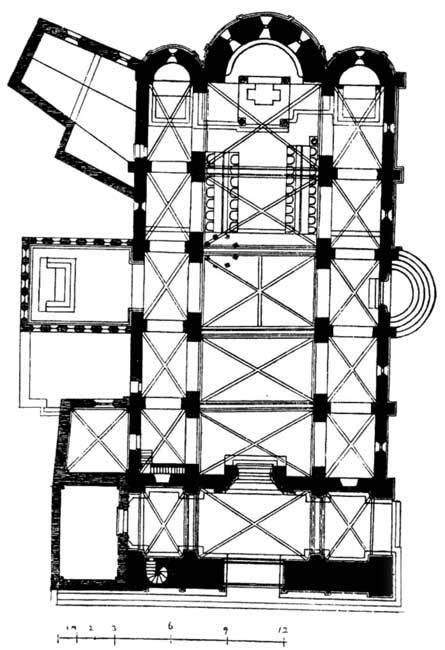
PLAN OF THE CATHEDRAL, TRAÙ
The cathedral, however, is the glory of Traù. It replaces an earlier building, reported to have dated from the sixth century, but destroyed by the Saracens in 1123. At this time the Traùrines fled to Spalato, and apparently did not venture back till 1152. The builder of the main part of the cathedral was Bishop Treguanus, a Florentine who came from Hungary, and was bishop from 1206 till about 1256. The south door bears the date 1213, the great west door 1240, but the west gable has the arms of Bishop Casotti (1362-1371) upon it, and the campanile was not finished till 1598. The plan shows a nave and aisles five bays in length, terminating in three apses, while to the west is a broad and lofty porch, above one end of which the tower rises. This porch is entered by an arch at the south end, but there is another opposite the great west door; and at the further end is the fifteenth-century baptistery. Round it runs a low seat with arcaded panelling, which serves as base to all the shafts. It is vaulted in three bays, with twisted colonnettes in the angles of the piers. The vaulting is quadripartite, with ribs and two arches three feet broad repeating the divisions of the nave, all the arches being round. The central compartment rises like a dome upon the surface of the terrace above. In the aisle walls are two pierced circular windows, Romanesque in design. In one, two dragons are represented devouring a man; in the other are two lions rearing against a twisted pillar on which is a cup. The bodies are broken, and the tails, which remain, encroach upon the wall surface.
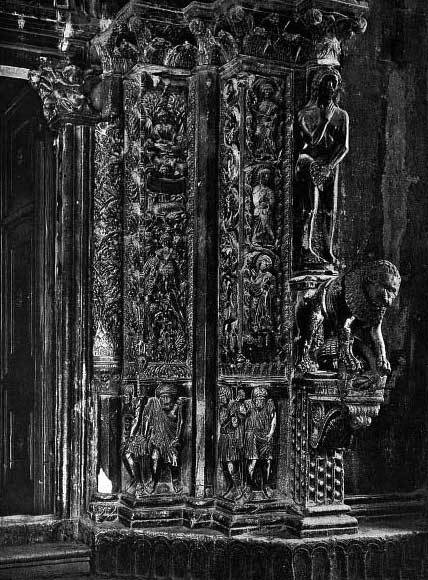
The great west door is the pride of all Dalmatia, and is unsurpassed in the elaborate richness of its carving. It is dated in the lintel inscription 1240, and signed Raduanus, a Slav name Radovan latinised. There are two orders and a tympanum with octagonal shafts in the angles, those nearest the door apparently having fragments of highly carved work inserted, since the plain octagonal shaft is visible both above and below the carving. A flattish gable surmounts it, with a kind of tabernacle work at each end above the figures of Adam and Eve, and a cresting of crockets shaped like eighth-century crockets in a similar situation. In the centre is a little niche with a later figure of S. Laurence, the patron saint. The tympanum is occupied by the subject of the Nativity, arranged in two stages. In the centre above is a curtained recess, with the Virgin in bed, and the Child in a kind of cradle, above which the heads of the ox and ass appear. Over them are two angels, one of whom holds a star from which rays stream down on the Child, whilst the other speaks to the shepherds. Below are Joseph and two women, one of whom pours water into a tub, while the other washes the Child in it. Behind Joseph is a shepherd (these two figures are named). On the left are the shepherds and their flocks; on the right the three kings ride up. "Guasper" and "Balthssar" are also named. The arches above are unmoulded, but carved on the face. On the outside order at the top is the Crucifixion, with the Virgin and S. John and two kneeling figures. Commencing from the bottom on the left the subjects run: the Flight into Egypt; the Entry into Jerusalem; the Marriage of Cana, or the Feast at Simon's House; the Scourging of our Lord; the Watchers at the Grave, or the Resurrection; the Temptation, or Casting out of Devils; and the Baptism of Christ. Some of the reliefs are damaged. The inner order has at the top the Adoration of the Kings (Joseph stands behind Madonna's throne); at the base the Annunciation (the Virgin spinning on one side, and Gabriel with a long staff on the other). This and the cupola on the building behind the Virgin suggest a Byzantine model, as well as the incorrect monogram, which is ϒΘ. The rest of the arch is filled with censing angels. The jambs bear four-feet figures of Adam and Eve outside the orders of the arch, holding fig-leaves in the same manner as the figures at Sebenico, which they much resemble. Below Eve is a lioness with two cubs under her, and a lamb in her claws; below Adam a lion with a dragon in its claws; very decorative in their effect, and standing upon brackets with channelled supports enriched with balls. The pilasters are not quite homogeneous, and indeed scarcely agree even with their fellows on the opposite side. Next to Adam are three figures of Apostles with nimbi, in panels made by the crossing of foliated stems; next to Eve are also three figures without nimbi, but smaller, though the panels are similar; two have small canopies. On the other face are foliage scrolls with animals within them; on Eve's side an ass, horse, camel, elephant, hippopotamus, and the Oriental motif of a griffin stooping over its prey; on Adam's side a woman riding on a horse, a centaur with a dart, a mermaid, a sea-horse, and at the bottom a griffin devouring a scroll, with a human head attached. Below the ornament are semi-nude caryatid figures on one side; on the other they have turbans and shoes, and one has ankle band-ages. In the angle is an octagonal shaft of green marble which continues round the arch. The reliefs on Eve's side in the next order show details of burgher life and agriculture, probably labours of the months or seasons—pruning leafless trees, the preparation of leather, a man seated by a fire on which is a cauldron, whilst a woman fills his cup from a skin over her shoulder, behind hang sausages. Above is a pig which a man is about to kill. The other side is similar. Above are shepherds shearing sheep in a wood; then comes a figure holding a scroll upon which there is no inscription; below is a warrior with sword, baton, and shield, below him a nude man with flying hair, both among twining branches. Upon the other face are spirals of leaf ornament with heads of men and beasts, resembling a piece of antique carving at Spalato, finished with extraordinary care and mastery. Caryatid figures support this order also, turbaned and clothed with tunic and cloak. The carved portions of the inner columns are of a white limestone, while the octagonal shafts are of green marble; and this gives some support to the legend that they were brought from Bihać, a castle of the kings of Croatia and Dalmatia, and later of the kings of Hungary, a short distance away, of which scarcely a sign now remains.[3] These shafts have elaborate scrolls of intertwining branches and leaves, with animals, including some not found in Dalmatia. The hunter has a greyhound. There are a stag, a bear, a sow, hares dragged out by peasants, &c.; here there is a female centaur; there a girl seated on an ox, a wood-devil with two horns, &c. On the other side are lions and bears, figures fighting, a young man with a falcon, loose dogs, &C., all most carefully carved. Beneath the lintel two caps with amorini of the fifteenth or sixteenth century have been inserted.
The south door is simpler, but in the same round-arched style. It has square orders with rolls laid in the reveals, of which the inner one resembles a cable, and the outer chain mail. In the semicircular tympanum is a round window enclosing a quatrefoil surrounded by an inscription with the date 1213 and the name of Bishop Treguanus. The side walls are divided into five spaces by piers; an arched corbelled cornice terminating in mouldings runs along them, and returns up the slope of the east wall. Above it is a curious little loggia with very squat pillars and brackets imitating the wood forms of Venetian courtyards, but cut in stone. The alteration in the slope of the east end shows that it is a later addition. The same kind of cornice finishes the east gable and the nave walls, and also runs round the apses, but with richer mouldings above it, especially round the central one. The curious Dalmatian square-leaf enrichment, channelled in six radiating striæ, and terminating in a small volute at the top corner occurs here. There are two shafts to each small apse dividing the wall space, and one window, but the central apse has four twisted shafts and three windows, of which the central one is largest. In the gable is a rose-window. On the roof of the northern aisle the lines of the plan and elevation of parts of the campanile are cut, working drawings for the masons. Heads of beasts project beneath the aisle cornice as gargoyles. Above the ground story the tower is Gothic, and has two Gothic windows of two lights on the south side, with octagonal shafts and traceried heads. The other sides have arcading divided into two panels. Here there is an inscription giving the date of 1422, and the names of the Masters Mateus and Stefanus, probably the Matteo Goyković who contracted for the repair of church and campanile with the "operarius" of the church in 1421. The stage above has tall square-headed windows, with reticulated tracery in the heads of cusped circles or quatrefoils, and two lights below with central colonnette. The angles have shafts, and there is a pointed trefoiled cornice with carved mouldings and cornice above. The third story is Renaissance, finished in 1598 by Trifon Boccanich. Gothic details still appear as in the shafted two-light windows, with the pierced quatrefoils above and the twisted shafts at the angles. The whole finishes with a pyramidal spire, imitating the Venetian campanile. The gable above the portico has an enormous wheel-window of sixteen divisions, which had a door beneath it.
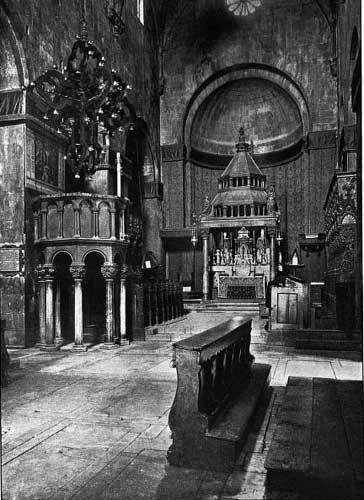
INTERIOR OF THE CATHEDRAL, TRAÙ
The nave is 19 ft. 6 in. broad. Its piers vary in width, and the round-arched arcade is irregular in its spacing. The north aisle is broader than the south. The piers and arches are unmoulded; the arches have two orders, carved imposts, and a very small base. The main arches of the vault have mouldings at each side of a fiat surface, and are pointed; the lesser ribs are twisted. The central bay only has a rib running east and west at the summit of the arch. The aisles are vaulted in the same manner, but with semicircular section. All the vaults are domical, and those of the nave spring from corbels carved in the style of Venetian fifteenth-century work. This agrees with the statement that the vaulting dates from 1427-31, and was strengthened by chains and iron anchors in 1440. The central bay has the south door on one side of it, the chapel of S. Giovanni Orsini to the north; and the pulpit against the north-eastern pier marks the commencement of the choir, which is raised two steps above the level of the nave. A stone bench runs round the apse, but there is no sign of an episcopal seat in the centre. The ciborium is somewhat of the type used by the Roman marble-workers in the twelfth century, but the proportions resemble those at S. Nicola, Bari, more than the other Italian examples. It is of grey marble, and bears upon the western angles of the square portion figures of the Virgin and the Angel Gabriel, the latter kneeling, for which the change to octagonal plan for the upper portion leaves room. The figures are fifteenth-century in character, and on the bases are the names of the artist and of the overseer—on that of the Virgin, "Mavrvs me fecit"; on the angels', "Bitalis qda Martini oprarii," in Lombardic letters. The "operarii" were generally nobles, and had control of the church works. A gilded inscription on the front of the architrave gives the angelic greeting. The columns are of cipollino; the caps, once gilded, are very like those of the pulpit, which seems to be of the same date. It is octagonal and surrounded by round-arched arcading, two arches to a side, with coupled columns on the sides and three at the angles, above single arches resting upon shafts of precious marbles with elaborate caps which also at one time were gilded. The design suggests the copying of a metal original in the treatment of the foliage scrolls and the heads of the monsters, and contrasts with the pulpit at Spalato, in which a wood treatment of the capitals is suggested. The column for the book-rest stands on a little lion bracket; of the eagle which once surmounted it only the claws remain. Beneath it William, son of Baldwin, emperor of Constantinople, was buried in 1242. The choir stalls are of the fourteenth-century Gothic type, like those at Arbe and Zara, touched with colour and gilding. They cost eighteen ducats of gold each, and were restored in 1757 and 1852. The carved portions are added, not cut out of the solid. The chapel of S. Jerome at the west end on the north was built in 1458. It has a qua trefoil wooden grille, made by cutting triangles out of the uprights and cross-pieces equal in size to the angles remaining. On the west wall is a little relief of a Virgin and Child, S. Jerome, and a saint with halberd, beneath early Renaissance niches and channelled pilasters. On the nave piers are paintings, most of them of little value. A S. Jerome and S. John the Baptist show decorative feeling in the landscape and its combination with the figure; and on the second pier on each side is a row of nine saints and angels, small figures as if from a predella, which show a combination of Peruginesque and Florentine design and colour. Eitelberger says the paintings above the side altar are ascribed to the younger Palma. The cross of lamps which hangs in the nave recalls S. Mark's, Venice, as do the harmonious tone of the interior and the colonnettes of precious marbles of the pulpit. The great crucifix was brought from Venice in 1508. The organ was made by Frater Urbinus in 1485. Its wings, painted in 1489 by Giovanni Bellini, are now on the first pier. In 1767 another organ replaced it. The sacristy, an irregular building of 1444-1452, cost 4,020 zecchins. It has a pointed barrel vault, and contains a very fine row of cupboards worked by Gregorio di Vido in 1452, made of walnut, carved and inlaid, and costing 125 ducats. The treasury was once the richest in Dalmatia, but now only contains a few objects—arm reliquaries, ostensory, and a silver-gilt ewer, &c. The most interesting things are some embroideries and a MS. of the ninth or tenth century, with very beautiful script. The embroideries are the centre of a cope, with S. Martin dividing his cloak, in high relief (the horse, drapery, and crown in seed pearls, the hair in gold, and the canopy ornamented with gilded discs and seed pearls) of the beginning of the fifteenth century, and a mitre said to have been Bishop Casotti's, with the Virgin and Child standing in the centre (at each side Byzantine roundels painted on gold, the whole set in jewels and with seed pearls).
The chapel of S. Giovanni Orsini and the baptistery remain to be described. S. Giovanni was the greatest of the bishops who rilled the see of Traù, and was canonised in 1192. He came to the city with the legate John of Toledo in the time of the Croatian king Cresimir. The papacy desired to unify the ritual of the Church, substituting the Latin language and the Roman use for the national liturgies, as it had done in Spain, in Milan, and Aquileia. At this time there was no bishop of Traù. The piety and strict life of S. Giovanni were soon noised abroad, and the people desired him for their bishop. In this they were supported by the legate, and he was consecrated in 1064 by Archbishop Laurentius of Spalato. He dismissed his servants, and went through long night-watches, lying naked on straw spread on the floor, to mortify the flesh. The fame of miraculous occurrences accompanied his austerities. His hand on the wine-press produced abundance of juice; he escaped dry-shod from a wreck near Sebenico; and destroyed by his words the war-engines of Coloman in 1105, when he was attacking Zara. A white dove which settled on his head when in conference with the king at Castell, near Sebenico, was taken as a spiritual symbol. He prophesied his own death and the destruction of Sebenico, and miracles were performed at his grave. The body was found in Bua after the Traùrines returned from Spalato in 1152, though another account says that it was discovered within the area of the cathedral, near the high-altar where there is now a well. In 1174 he is reported to have appeared above the building in the form of a shining star; and after that the commune adopted a comet as the arms of the city. The chapel stands on the site of the more ancient double chapel of SS. Doimus and Anastasius. It was begun under Bishop Turlon in 1468, the architects being Masters Nicolò Fiorentino and Andrea Alexci of Durazzo, the stipulated price being 3,300 ducats, and the work occupying six years. The chapel is rectangular, with a barrel vault. Round the walls a seat runs, the front of which is ornamented with diamond forms filled with foliage. Above it is a kind of stylobate with pilasters supporting the columns of the next stage, the spaces between them decorated with reliefs of torch-bearing putti, who are represented as issuing from partly open double doors, some of which are very pretty. Each side contains six arches, two of which are pierced with windows, the others having shell-headed niches divided by channelled pilasters or twisted columns, and tenanted by statues nearly life-size. Those which are named are "S. Tomas, S. Ioannes Evangelista, S. Pavlvs, and S. Filippo." Others recognisable by their attributes are S. John the Evangelist as an old man, with the eagle at his feet, S. Mark with his lion, Madonna and S. John the Baptist on the end wall, with our Lord in the centre. Vasari says that Alessandro Vittoria did four Apostles in the church of Traù, and it is suggested that the named figures are these four. The architects carved the first figure, that of S. John the Evangelist, in 1482, at a cost of twenty-five ducats. Between the heads of the niches little children stand on the capitals, and above the cornice is a space pierced by oculi between pilasters. The ceiling is coffered with a cherub's head in each panel, except the central one, which is four times the area of the others, and contains a half-length of Christ, surrounded by a wreath, holding an orb, and blessing. On the lunette is the Coronation of the Virgin. Above the altar is the ancient tomb of the saint, upon the lid of which is his effigy, with silver-plated mitre, and crozier, gloves and shoes. It is of red marble, the front being divided into three panels by twisted colonnettes, once gilt, with statuettes at the corners, and bears an inscription giving the date 1348. The angels are modern. On the pier opposite the side door an inscription records the gift of the right femur of "B. Jo. Ursinus" to Benedict XIII. by the Venetian senate in 1724.
The baptistery is of the same date as the chapel, and was founded by the same bishop, who belonged to the Anconitan family of Turglonia. The door externally is square-headed, and has an architrave with sculptured della Robbia like fruits. Over it is a Baptism of Christ, with God the Father and the Dove above. Within is a frieze of putti bearing garlands, with shell-head niches and channelled pilasters below. Above this is a band of Venetian-Gothic leaves, and in the coffered ceiling are rosettes. This ceiling is a pointed wagon vault, cut from two great blocks of marble, which meet in the centre. A round window in the west gable lights well a life-sized figure of S. Jerome above the altar, the warm brown tint of a portion of the stone being cunningly used to give the effect of shadow on the upper part of the figure. A seat runs round the base of the wall as in the chapel. An inscription gives the name of Andreas Alexius of Durazzo, and the date 1467. The cost was 4,980 zecchins. The resemblance of this baptistery to portions of the cathedral at Sebenico is striking.
The Loggia faces the cathedral at the other side of the piazza. One of the shorter ends is open; the other is closed by the clock-tower, and on this wall is elaborate carved ornamentation, behind the seat of the judges. The floor is three feet above the piazza, and is approached by five semicircular steps. Towards the piazza, five marble pillars (in several pieces) support moulded brackets, upon which an architrave beam rests, and there is one on the shorter side. The caps are of different dates, and for the most part come from older buildings, one indeed being antique. Between the columns is an early Renaissance balustrade. Stone benches run along the walls. Above the judges' seat the wall is panelled. In the central top panel is a figure of Justice seated upon a winged globe; right and left of her are half-lengths of winged figures with inscribed scrolls, laudatory of Justice, emergent from circles. Below Justice is a great lion of S. Mark, and below the other figures are S. Giovanni Orsini with a model of Traù, and S. Laurence with his gridiron. At each side is a long panel with a candelabrum very like those in panels in the chapel in the cathedral, which make it pretty certain that the carving is by the same hand, especially as the date 1471 appears in one of the inscriptions. There are other inscriptions with the dates 1513 and 1606, and later coats of arms. On the corner shaft are the arms of Pietro Loredano. By the judges' seat is a piece of iron which marks the place where the criminal was chained when his crime was announced. The restoration was carried out in 1892 by Professor Hauser. Right of the steps three standard measures stood till 1843.
It is interesting to note a few of the pains and penalties inflicted. The statute was revised in 1291 and 1303 by the first Venetian Count, M. Morosini, who collected the chapters into three volumes. The town physician was not allowed to leave the town without permission from the count under a fine of twenty-five lire di piccoli. No one could go about at night without a light, and a fine of forty soldi was incurred by gambling anywhere except in the piazza. Spinning was forbidden to the saleswomen on the loggia—fine, five soldi. A servant who stole from his lord had his nose cut off, or lost one or both eyes if the value was ten to twenty-five lire. If the value was greater the thief was hung up till he died. In Traù there was neither bridge-playing nor company-promoting.
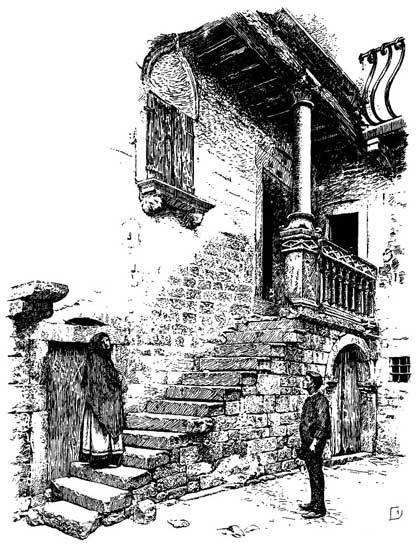
A DECAYED PALACE, TRAÙ
Traù is tolerably rich in the remains of ancient houses, of which the drawing shows an example. The most celebrated is the Casa Cippico facing the cathedral, of late Venetian-Gothic verging on Renaissance. The court inside was built in 1457. In the entrance hall are preserved two wooden prow ensigns taken from the Venetian galleys during war between Traù and Spalato; one is in the form of a cock standing on a clenched hand, the other a fragment of a small figure of a man. Also an inscription flanked by two shields with rampant lions, which are good. Opposite the Loggia, on the other side of the street, is a highly decorative lintel, which appears to have belonged to a palace of the Cippico, with two contemplative lions and half-length angels in roundels with scrolls. The caps have the same kind of foliage as is seen at Curzoia and Sebenico. The Austrian-Lloyd office is on the ground floor of a tower of the Venetian period, now a nunnery. It has a trefoiled ogee-window and a great balcony above it, with trellises behind which the nuns can take the air without being seen, recalling those of Sicilian nunneries. All the other openings are square-headed.
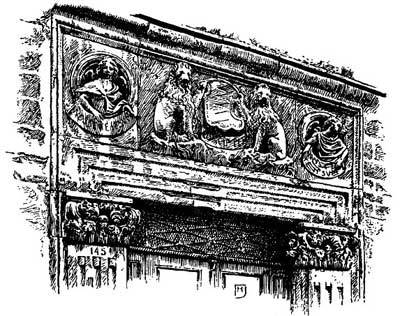
LATE GOTHIC LINTEL AT TRAÙ
The ruined church of S. Giovanni, formerly belonging to a Benedictine nunnery, has exactly the same patterns about it as the cathedral, and must be of the same date. Along the nave walls, and ramping up the gables, is a double-arched corbel cornice with pilasters at the angles, and a bell turret consisting of a prolongation of the nave wall, gabled and with three pointed arched openings, two below, and one above. In the tympanum of the door is a pierced roundel with the Agnus Dei.
The Palazzo Comunale has been rebuilt, preserving the portions which were of special interest, and also pieces of architectural carving from other parts of the city. Its interest is therefore rather that of a museum now. I was fortunate enough, on one of my visits, to have the guidance of the podestà, Commendatore Madirazza, to whom I had been introduced by Professor Bulić at Spalato. I have to thank him for showing me several things I should otherwise have missed.
From Bua (Bavo or Boa), an island used by the Romans as a place of exile, a comprehensive view of Traù may be obtained, with towers and campanile breaking the line of the houses, with the strait in the foreground, and with boats drawn up on the shore. In a private garden is a palm-tree said to be the most northerly specimen in Dalmatia, though there are several at Lussin Piccolo, which is much farther north.
Our first visit to Traù was made by carriage from Spalato, and occupied the whole of a most delightful day, for we did not get back till long after dark. The excellent road is due to the French, but follows the line of that made by the Romans or before their time, passing quite near the Castelli, some of which we were able to visit. It was spring: the vines were making long shoots, and the fields and banks were gemmed with flowers; on one side, the sapphire sea; on the other, the mountain slopes, with scented breezes to cool the ardour of the sun. For the most part the peasants, men and women, were busy in the fields, or washing by the stream, and appeared well-to-do, though we passed one man half naked, searching his garments upon a heap of stones. But he, we gathered from a gendarme near, was considered weak in the head. Long before the town is approached, the towers of Traù are silhouetted against the horizon, emphasising the point of land which they terminate, grey walls and dark trees running together into a mass, but contrasting with each other on a nearer view. We started on our return a little before sunset, while the sun's level rays cast long simplifying shadows across the landscape, and enjoyed the glow upon flowery hillside and purple crag, from which the houses flashed out like jewels, and the water beneath changed its colour with the changing sky. The twilight faded while we were passing Salona, and in the long climb to the crest of the rising ground above Spalato we had only the light of the carriage lamps, finally alighting outside the northern wall of the palace (for carriages cannot enter within the town) weary, but filled with delightful impressions and recollections. Another time we went by boat, starting at 6 o'clock, and enjoying the early morning freshness of effect. In this trip also we had the opportunity of visiting some of the Castelli, which are interesting generally rather for their picturesqueness than for archæological reasons. In the chapter dealing with Spalato will be found some details as to remains of the early Croatian period found along the coast and in the environs. At Castel Vecchio we saw on the wall of the churchyard a cross with a much damaged antique cap as base, and another antique base on a larger scale beneath it. It was 6.40 a.m., and along the shore, a little way off, a procession was passing with a tinkling bell, two banners, and processional crosses, preceding a figure in a cope of white and gold beneath a canopy. It was Low Sunday (called Piccola Pasqua in Dalmatia), and the priest was bearing the Host either to some sick person or to a neighbouring church. Such sights are frequent in the country places, where religious observances are more evident than in the towns.
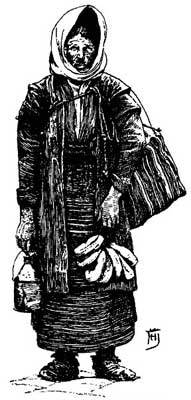
A QUAINT COSTUME, TRAÙ
Whichever way Traù is visited from Spalato (given pleasant weather) the day may be looked forward to as giving a constant succession of delightful experiences, of which the central point will be the mediæval-looking city with its magnificent cathedral and glorious west door, though the quaintness of the costume of the country people, very individual and unlike other Morlacchi costumes, will count for something.
The Castelli were built as defences against Turkish raids. Starting from Traù the first is Castel Papali; Castelnuovo, Castel Vecchio, Castel Vitturi, Castel Cambio, and Castel Abbadessa follow, and Castel Sućurac is the nearest to Spalato and Clissa. These are the Sette Castelli, but there are several others—Stafileo, Andreis, Cega, Quarco, and Dragazzo.
Castel Papali, or Nehaj, is three-quarters of an hour from Traù, and was built in 1548 by Lodovico and Giovanni Celio. It was then called Celio or Lodi. In 1680 it passed to the family of Francesco Papali, the Celi having failed of heirs male. It now belongs to Count Fanfogna-Garagnin of Traù.
Castel Stafileo was built in 1500 by Stefano Stafileo, of a family established in Traù coming from Candia. He separated it from the mainland, and it was entered by a drawbridge; the ditch is now filled up. The concession is dated 1484.
Castel Dragazzo, or Dracic, founded by Matteo Dragazzo in 1543, on a concession from the Venetian senate, was never finished, in consequence of his death. The material of the walls was used to construct the port of Castelnuovo. The Dragazzi appear in 1389. They were originally butchers, but for about three centuries gave the country men of intellect and valour.
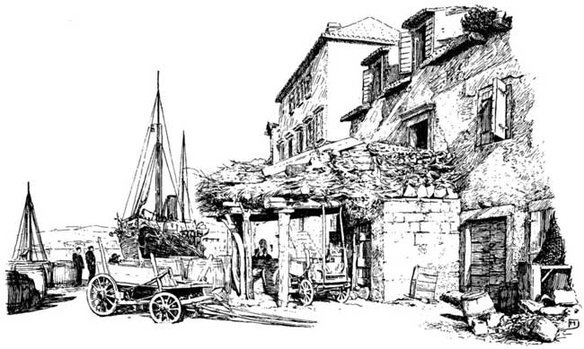
Castel Quarco "in Bile," of which very little is left, was built in 1588 by Giovanni Quarco with a walled courtyard. The site was granted to Matteo Dragazzo, who ceded it to Quarco.
The church at Castelnuovo inherited with the title of S. Pietro the rights of S. Pietro di Klobučac, a little inland on the slope of the hill (where remains of a monastery or palace of the ninth to the eleventh century have been found). It was demolished in 1420. According to tradition some of the objects there preserved came from the older church. The pala of the high-altar, a panel painting on gesso ground, the Virgin and Child seated, on the right S. Peter with the keys, on the left S. John the Baptist with scroll "Ecce Agnus Dei," half-length, is one thing. The inscriptions are in Roman capitals. Also two Romanesque-looking bronze candlesticks. The Castello has a square tower, which has lost the balcony which surrounded it at the height of the first floor. In the piazza is the Loggia, rebuilt in 1795, as an inscription states. It was burnt in 1523 together with most of the houses. The provveditore granted materials for rebuilding, but it was again burnt in 1575. Until recently this Castello belonged to the Cippico. It was the birthplace of the historian Katalinić, born here in 1779.
Castel Vecchio was founded in 1481 by Coriolanus Cippico, with booty gained in the war against Mahomet II. in 1471, as is testified by the inscription over the gate, "Triremis ex manubiis Asiaticis hanc villam ædificavit," with date 1481. Tradition says that a house on the left of the eastern gate with a walled courtyard was also his work. He died here in 1493, leaving it to his sons Alvise, bishop of Famagosta, and Zuanne, archbishop of Zara. Over a door in the courtyard is the Cippico crest with the motto "Omnia exalto." Opposite is a chapel dedicated to S. Joseph and the Virgin, built by Coriolanus's son Lælius, according to the inscription, with the incredibly late date of 1695. In 1480 Nicolò Pisani, count of Traù, received a "ducale" from Giovanni Mocenigo, in which Cippico was promised munitions of war and men-at-arms to preserve the Castello, and, by the assurance of security, to attract cultivators to the fertile country "for greater public usefulness." This seems to support Karaman's statement that the Castello was founded in 1476. An inscription of 1492 above the arch between the court and main street records its ruin by fire and restoration by the senate. In 1500 the Venetian Government completed Cippico's work at a cost of 500 ducats. It was called Castel Vecchio because it was the first of the Castelli founded.
Castel Vitturi, built in 1487 by Girolamo and Nicolò Vitturi of Traù, by concession from Count Carlo di Pesaro, is now without drawbridge or ditch. The founder of the family, Lampridio, son of Giacomo Vitturi, a Venetian noble, came to Traù in 1213, and married Bona Cega. The Castello is square, with two gates, one to the sea, and the other to the north, apparently entirely rebuilt in 1563, except the north side, which still has two turrets flanking the gate pierced for musketry, and traces of the holes through which the chains of the drawbridge passed, also of a balcony which was probably for defence.
The next one is Castel Rosani (Rušinac), built in 1482 by Michele Rosani, under a concession from Count Francesco Ferro. The village was surrounded with walls; but, fearing that they would not be able to beat off the Turks, the inhabitants dismantled them, and sought refuge in Castel Vitturi, which was larger and better fortified. It is still in good preservation, however, with its little church, which contains the tomb of the unfortunate lovers whose story has been told by Marco di Casotti.
Castel Cambio (Kambelovac) was built in 1566 by Francesco Cambi of Spalato. It is still partly preserved. At one time it formed one parish with the adjacent Castel Abbadessa (Gomilica). It belonged to the lordship of Sučurac, which embraced nine villages. The nuns in the sixteenth century erected the Castello on an island, and here the abbesses were wont to come for the summer; hence the name. The nuns built the little church at the entrance of the village on the right of the road; it was dedicated to SS. Cosmo and Damian, and consecrated by Assalone, archbishop of Spalato, 1159-1160. It is suggested that the Slav name Gomilica ("masses of masonry") comes from the fact that the newer houses were built with the ruins of the village of Kozice, destroyed by the Turks.
Castel Sučurac is the nearest of the Castelli to Spalato, the first to which the Turks would come, descending from Clissa. The position and the Roman remains found here are held to prove that it was a suburb of Salona. It took its name from S. Giorgio, a little chapel upon the hill, which in Croat is called Sut Juraj, corrupted into Sučuraj. The church was built by the great zupan Miroslav; and the ruined walls which surround the present chapel, showing a foot above the soil, are supposed to be the remains of that church, since there are amongst them a few pieces of carved stone. The most ancient Croat document existing is a deed of gift of this place and church to the Archbishop of Spalato, Pietro III., by the King Trpimir, in 837, in exchange for £11 given by the archbishop for the construction of the church and monastery of S. Peter, between the ruins of Salona and the fortress of Klis. In 1076 King Zvonimir confirmed the gift. One of the finest buildings in the village is the palace of the archbishop, dated 1488 by an inscription over the door. The Castello and walls round the village were built by Andrea Gualdo, archbishop in 1392, by concession of Valchio, ban of Croatia. In 1489 Archbishop Bartolommeo Averoldo of Brescia, built a second wall. In 1503 it was further strengthened; but two years later the Turks burnt it. In 1646, after being repulsed from Spalato, they attacked Sučurac again, but were unsuccessful. The first summer palace of the archbishops was in Vranjic; it was destroyed by the Venetian fleet in 1204.
Castel Cega was built by Andrea di Celio Cega in 1487, and rebuilt by Paolo Andreis. The Celio were an ancient family of Traù, said to date from Roman times, and had many branches, one of which (extinct in 1511) was called Celio-Morte, because a member of it had the habit of threatening opponents with death, and used a skull for his crest.
The following privileges were enjoyed by the nobles of the Castelli, or founders of the towns. The right to special contributions from the country people, and the jus patronato of the churches. The sacristan, without their assent, could not give the third signal of the Mass, nor of Vespers on festival days, a usage which is still observed at Castel Cambio and Castel Vitturi. In the church they had their own benches, and the space they occupied could not be taken by any one else, not even for the erection of new altars. When the provveditore was present at solemn functions a bench was placed for him and the "padroni," as well as for the authorities of the Castelli and the colonel of the district. They were the first to receive incense after the priest at Mass; and there were numerous other similar customs. If a child of the "padrone" died, all the bells rang; if an adult, they were clappered; and all the confraternities had to be present at the funeral, whether in the village, at Spalato, or at Traù. The "padrone" was the medium of communication between the higher authorities and the village headman, who had to close the gates at night, and take him the key. He received the tolls paid for living in the village; and there was a kind of corvée of forced work. Moreover, he had the right to buy the houses of those who sold them, at a third less than their real value, to sell again to fresh inhabitants. The oil-mills belonged to him, and a fifth of the produce was divided between him and the customs. If the olives were taken elsewhere a tenth of the oil was paid to him all the same. Wine-presses were also his property; the oven, too, and a proportion of the wine made and bread baked went to him. Nothing could be bought or sold without his license. He received all the tongues of oxen killed, and the heads of pigs. He covered the cistern in time of drought, and water could only be drawn when he took the cover off. The streets were ordered to be kept clean, and slops taken to the sea, not thrown out of the window! At Christmas and Easter the country people still bring presents to their lords.
The proverb "Wine of the Castelli, honey of Solta, and milk of Bua" is still justified; and agents for wine merchants, especially French, bargain for the wines before the grapes are ripe. Enormous hogsheads are shipped on the boats, and the transhipping them is often a dangerous business, if we may judge from our own experiences. At Castel Vecchio we were nearly spectators of a serious accident when a cord slipped, and we observed that the men crossed themselves each time one was safely lowered into the hold.
[3] The last king to visit it was Sigismund in 1387.
The question of the part played by Giorgio in the construction of the cathedral is difficult to decide, being complicated by the mixture of styles and the possibly later insertion of several of the coats of arms of the rectors and bishops. The western piers of the crossing are considered to be part of the earlier work, because of the close resemblance of the carved foliage to Venetian-Gothic ornament; but it must be remembered that Giorgio was trained in Venice, just as Massegna was, and would be familiar with such work. Foliage of similar style occurs in domestic work at Traù, and in other places along the coast, so that it is scarcely safe to consider it the sign-manual of any one sculptor. The time from 1441, when he signed a contract for six years, to 1443 was spent in widening the street to allow of the eastward extension of the church. On June 16, 1442, the demand for the rebuilding of the façade of the count's palace (which was on the other side) was formally made for the bishop, procurators, and chapter. This additional space was necessitated by the design of the apse, &c., as laid down in Giorgio's plan, and still existing.[2] The Gothic character of the domestic doorway illustrated, with the late form of shield in the tympanum, shows that such forms lingered late in Dalmatia. The same may be said of the design of the rose-window, finished in 1531, and of similar details which occur in undoubted work by Giorgio in Ancona.