автордың кітабын онлайн тегін оқу Digital transformation for chiefs and owners. Volume 2. Systems thinking
Dzhimsher Chelidze
Digital transformation for chiefs and owners. Volume 2. Systems thinking
Fonts by «ParaType»
© Dzhimsher Chelidze, 2024
There is an opinion that the use of digital technologies alone can improve business efficiency and solve all problems. But this is a misconception, because technology is powerless where chaos reigns.
This book will introduce you to the author’s systematic approach to business management and show how a competent combination of technology, psychology and management allows you to minimize risks, achieve success and carry out digitalization even with a lack of resources.
ISBN 978-5-0064-2488-3 (т. 2)
ISBN 978-5-0064-2489-0
Created with Ridero smart publishing system
Contents
Foreword
If you are reading this book, you probably already understand what digital transformation is, why it is needed, and you have the realization that change is indispensable.
As I said in the first book, digital transformation is a management tool and a global redesign of the business model and the entire management system.
But what do you think I face personally in life? It is banal with the fact that there is no system, but there is either complete chaos and dependence on personalities (at best), or bureaucracy with the suppression of any personalities.
The book will focus on the implementation of a systems approach to management, without which any transformation will be a simulation.
I do not insist on the truth in the last instance, but every time such an approach was applied at least partially, the result amazed even me!
Do you think it’s possible from a community where no one wants anything to build a team with exemplary discipline to triple their productivity in three months? I will answer «yes» because I have achieved this result.
But to do that, first person involvement is needed. And without accumulated dissatisfaction with the situation and political will, all other manipulations and tools are meaningless.
We will go through the areas of the system approach, find out what key tools are needed for its implementation, what global practices already exist, and explore practical cases.
Therefore, what is the systemic approach I am promoting?
It is built on a combination of:
— Lean Manufacturing
Its mission is to continuously improve, eliminate losses, including through the use of digital technologies. Allows you to determine the objectives of the implementation of the figure, to build tactics.
— Project Management
Allows to minimize risks and budget.
— Using the product approach
Digital transformation must be accompanied by the creation of new products. Additionally, without the basic tools of food management, it’s almost a guaranteed failure. Additionally, then you won’t just be disappointed, you might end up on the verge of bankruptcy.
— System constraint theories
It allows for prioritization so that efficiency gains can be achieved with less investment. For example, a project for 3 million rubles, aimed at increasing productivity by 3 times, when applying the theory of system limitations, allows to reduce the budget to 1 million rubles, while receiving a 2.5-fold increase in productivity.
— Introduction of Changes
Digital transformation is about people and processes. The application of the main tools for implementing changes minimizes risks, resistance and the likelihood of a setback.
— Managing communication between units
Communication between units is a secret ingredient of both success and failure. Digital transformation is absolutely about the same — the ability to sit down, negotiate, hear each other. In my practice, all crises or problem projects / companies have one problem on the basis — cannot agree or do not hear each other, especially the top managers of their subordinates.
In general, working with SEO’s is very difficult. As a rule, these are people so-called «E-type» by Adises: entrepreneurs, bright and strong personalities, authoritarian, do not tolerate opinions different from their own.
These qualities help build companies, overcome the first problems — thanks to stubbornness, perseverance, authoritarianism, but then it begins to hinder business growth.
From this there is such a principle in management: centralization of power is needed at the start and at the collapse of the system, but for development decentralization is needed.
Which means the decision maker needs to change. However, when this man reaches the heights, he becomes stale, loses his former flexibility: he has gone the way, proved his worth, and now it is very difficult to recognize the need to change for further growth or the correctness of others’ opinions.
Now, can you imagine how a strong person like that would learn to detach from manual control?
— Using Digital Technologies and Data for Decision-Making
The first book was essentially devoted to this section. Digital transformation involves the active use of digital tools and analytics to minimize risks, create new products.
— Regular management practices
Digital technology will not fix chaotic controls, blurred targets, toxic communication, lack of control points. These are only tools that need the master’s hands.
— Working with strategy, organizational structure and business processes
Organizational structure and business processes are the foundation of an organization that supports the achievement of strategic goals. But they (structure, processes, strategy) are not eternal and must change over time.
Digitalization and digital transformation must become your strategic goal in order to «top» initiate all other changes.
Org. The structure aims to achieve the goals of the company by providing the necessary people with resources and dividing areas of responsibility.
When changing goals, strategies, available technologies (resources), you need to change the structure, allocation of resources and authority.
Therefore, you can shape the book’s message: digital transformation is one of the tools to achieve the goal; you can’t just implement one tool and hope that it will dramatically improve efficiency — you need integrated work.
Is it possible to master the whole approach one person? With due perseverance and consistency for 10—15 years — yes. Of course, no one has that much time, so the only way is to form a team with the right competencies.
Therefore, this book will be useful for both top managers of large organizations that can build work with middle managers, and managers of small companies.
P.S. This is the second edition of the book. In addition to minor adjustments to the original material, it is supplemented by two new chapters — what to teach staff and to what level, and a roadmap for digitalization and digital transformation. Practical examples of sharing systems approach tools have also been added.
Chapter 1. Organizational Structure and Business Processes
We will start with the organizational structure and work with business processes. If you translate into everyday language, org. The structure is the skeleton of the company, and the described, streamlined and efficient business processes are the nervous system.
The organizational structure is the basis for the management system. It achieves the company’s goals by providing resources to needed people and delineating areas of responsibility.
Additionally, when you have new technologies, changing goals, the company «matures» and moves to a new level, then business processes with organizational structure should change.
A clear and visualized organizational structure is a MUST. In my practice, there has never been a single case of a company operating smoothly without the organizational structure described, accessible and understandable to all.
Most often I observe the following:
1. There is no organizational structure. This is acceptable if you are 2—3 people, you are a strong manager and you have a strong team, you know how to negotiate among themselves. Otherwise, it is a realm of chaos. Even if you have the processes described.
2. The organizational structure is on paper, but in life quite differently. As they say, «waiting is reality».
3. There is an organizational structure, but it has no information about functions, powers, responsibilities. It’s not synchronized with the company’s goals, it’s not confined to team-building.
You can work without a description of business processes, but if there is a clear structure, with a description of functionality, key indicators and target product, it allows to radically improve efficiency and productivity, to establish a team relationship. Here the business processes described will allow to achieve even more efficiency, and subsequently to engage in automation and digitalization.
However, the business processes described will not work without a clear and understandable organizational structure, because you will not have a skeleton.
Types of organizational structures
It is now customary to identify several types of organizational structures:
— linear;
— functional;
— linear-functional or linear-stacked;
— divisional;
— market;
— matrix;
— food.
We’ll tear down each of them.
Linear
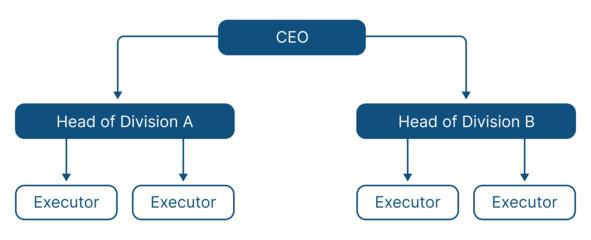
The simplest model: straight and hierarchical. Key decisions are made from the top, and they go down without any separate functions: sales, marketing, production. Suitable for small companies with simple manufacturing technology and minimal need for additional features.
Pros:
— simplicity and speed of management decision-making;
— quick reaction to instructions and orders;
— a clear allocation of responsibilities and responsibilities;
— discipline.
Cons:
— overload of managers;
— concentration of a large amount of non-core work on managers;
— weak relationships between the performers;
— with the growth of the organization, the number of management levels increases rapidly, which reduces the flexibility of the company and the speed of response to changes.
Functional
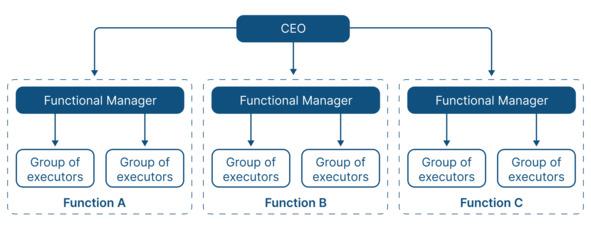
The division of responsibilities is based on the functions performed: production, sale, marketing, accounting and tax accounting, financial management. At the end of the day, everyone takes his own direction. Optimal for small companies that work with one product, but require already more complex production organization.
Pros:
— narrow specialization of directions — increase of productivity and quality;
— a clear allocation of responsibilities;
— exempting line managers from functions outside their competence;
— no duplication of functions (if business processes are built).
Disadvantage — the larger the company and the larger structure, the more difficult it is to organize the division and communication between the departments, while retaining the team interaction. Bureaucracy is beginning to flourish.
Linear-functional
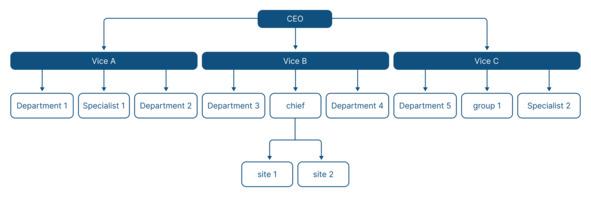
The combination of distribution of linear and functional problems. In line management, there are production units where the manager is responsible for everything and support functions are performed by functional managers.
An example is a production hall with a technical director who is responsible for the work and discipline of the staff, the state of technology, productivity — in general, for everything. At the same time, there is a management apparatus, headquarters, where all support functions are carried out: procurement, search for contractors, travel arrangements and so on.
It is the most common among medium and large organizations, where people from a few hundred to a couple of thousand. Optimum in a stable environment: standard production processes, stable demand and external environment, without the need to implement a large number of projects and create new products.
Pros:
— narrow specialization of directions — increase of productivity and quality;
— the ease and speed of managerial decision making;
— quick reaction to instructions and orders;
— minimizing duplication of work.
Disadvantages:
— high, sometimes unjustified, administrative staff costs;
— the growth of bureaucracy when functional managers are more interested in their security than in overall success.
Divisional / Market / Grocery
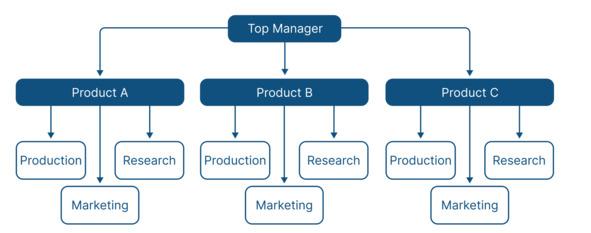
Similar to the linear structure, but the divisions are structured according to the principles of product or market separation. Optimal for companies with a large number of markets and heterogeneous products. For such enterprises it is necessary to create individual basic business processes for each product / region: supply, production, marketing, sales.
Pros:
— flexibility — individual strategies and business processes can be developed for each product / region;
— easy coordination and coordination of management decisions;
— high speed of response to emerging problems;
— high performance and management quality thanks to specialization.
Cons:
— as in previous models, there may not be a common goal, each for himself;
— unhealthy competition between structures and directions, growing political differences;
— different productivity;
— low budget efficiency.
Matrix
It is a complex model designed primarily for project implementation. A staff member may have multiple supervisors, and project and resource management is entrusted to the project manager / office.
Sometimes attempts are made to create hybrids of linear-functional and matrix models, where the implementation of projects is entrusted to functional managers. For example, an industrial safety system is being introduced and the head of the industrial safety department becomes.
Pros:
— is responsible for the implementation of a manager with high professional competence;
— the project manager can influence the situation at his own discretion, without unnecessary control (but this is rare).
Disadvantages:
— complexity in the implementation of projects and allocation of responsibilities, conflicts of interest, requires a high level of competence at the manager;
— low performance;
— duplicate functions.
I will give an example of the implementation of this approach.
Integrated corporation with central apparatus in Moscow and a large number of regional units with linear-functional structure.
The central office initiates the implementation of a complex IT system that covers a large number of business processes and requires the inclusion of both technical and financial and HR. In each regional division a responsible manager is appointed and fun starts… The manager is responsible for the whole project, but the resources and authority to manage other people’s (financial, HR) blocks are not, and the desire of others to change at will is even more so. The curator in the central apparatus is not all-powerful and is also located within the functional subdivision. In general, to implement such a project — a hell of a quest.
Matrix structures can also be divided into weak, strong and balanced.
The weak
Weak matrix structures are used when there are many projects, but they are small and not routine, not critical for the company.
In a weak matrix, the members of the project team are managed by functional managers (Chief of Industrial Safety, Repair Planning, Procurement) whose authority is limited: each is responsible for his or her direction.
There has to be a project manager who reports to management or, in this case, central office, gets his tasks. Tasks are then decomposed into smaller tasks and assigned to functional staff. But in fact, it has no powers and no resources. It is fertile ground for conflict.
It is also possible to have «forwarders». These are people in functional areas who disseminate information but have no authority — informal leaders of opinion.
As we can see, this approach is not applicable to our large-scale project. Unless we have very charismatic and strong project managers on the ground.
The strong
Differ in that the implementation of such a project may not be one, but several managers, or the manager and team, and they have much more authority. They can now not simply hand over tasks, but also give orders, require tasks and project reporting from functional managers. In addition, the project team may not be a permanent part of the functions, that is, it is possible that they will deal only with the project, plus they can search for contractors or order raw materials.
For our conditional IT system implementation project, this approach may be redundant. Although, perhaps, it will increase the chances of success, but such implementation comes out very expensive.
Balanced
In this case, the project manager is appointed from among the staff and, better, from the functional managers. Here he can set tasks and monitor their performance. However, it is likely not to be exempt from its operational tasks and to be unable to manage its own resources.
It is worth noting that this is the most difficult option to implement, as it involves the largest number of assigned roles, moreover, there may also be issues with subordination and, consequently, matrix conflicts.
Summary
We have dismantled the main types of org. structures. It would seem, choose the right, suitable for your company, and everything will be fine. Alas, it is not so. It is important to distribute functions and powers correctly, to identify a key product of the activity, to choose the people for whom this work is suitable psychologically, and also to build communication between them. That is why I always speak of a systems approach: it is impossible to implement any one tool — integration is needed.
Besides, as we can see, already at org level. The structure is related to the number and size of the projects implemented, that is, there is a close interweaving of work with the organization. structures and project management, they become inseparable.
To consolidate all practice, I propose to look at one real example with two structures of the same type, but with a completely different substance. Since the organizational structure in the book is almost impossible to display, everything will be available via QR and the link below.

Additionally, it should be remembered that with the development and organization. structure, and distribution of functions should change.
In addition, there is a trend in the world to avoid large bureaucratic structures. Why? In addition to economic factors and long transmission chains, this is a breeding ground of irresponsibility. As a result, there are a lot of people in charge, but all are formally covered up, and Ivan’s locksmith is to blame.
Here is a practical example: the repair of industrial equipment has been exceeded due to a chain of events: could not form a brigade because one of its members failed the exam because the head of the service could not form a commission for the exam, because two people on the commission were on vacation… Additionally, nobody seems to blame, but in the end, the object is worth… Until the Chief Engineer, in a terrible curse, corrects the situation in the simplest but not the most obvious way for all listed.
This case isn’t really just about an organizational structure where, under the guise of collective responsibility, the mess is going on. It is also about the corporate culture, which is based on the direct execution of rules (the culture of rules), and formed it the same chief engineer and his predecessors.
Could even in this structure avoid these problems? Of course! With proper work of managers, building of control points, informal communication, leadership qualities of this situation would not be. Additionally, here the main thesis that will go through the book — it is impossible to build an effective business system with one tool.
Main approaches to modelling and description of business processes
Introduction
In addition to organizational structures, there is another key area — business processes.
A complete list of almost all approaches to description with illustrations, display examples and videos available IT-solutions is provided by QR-code and link below.

Here I will consider the most common ones, answer who they are, show what I observe in life, use it myself, and summarize — what is more important: structure or business processes?
I understand that all this may seem boring, but in practice I have learned one simple rule — there is nothing worse than arguments «it is so clear», «it is too simple». Always, when I have met such arguments, this has not boded well. These theses are harbingers of chaos and disorderly problems. So, I chose this structure: first a little bit of general theory, then practice and working principles.
Basic approaches to the description of business processes
A business process is a certain algorithm of interrelated actions of people and IT systems, which is aimed at transformation of «raw materials» into «product» or result.
For example, the business procurement process involves the following stages: requisition, sourcing, solicitation, delivery of materials, delivery to the requisitioner. But each stage is also broken down into separate business processes. Therefore, you need to understand that the description of business processes is almost infinite task, and you will need to choose the level of detail, at which you say «all, enough». The lower the level of command competence, the more detailed should be made the description. Or you need to train the team, but then you have to grow as a leader. Smart personnel will not tolerate treatment as fools.
Conventionally there are several approaches to the description of business processes:
— Value Chain Diagrams (value added chain diagram, VAD);
— SIPOC;
— Event-driven process chain (EPC);
— BPMN 2.0 (Business Process Model and Notation 2.0);
— Flow Charting (Process and Procedure notations);
— IDEF (Integrated Definition Language);
— UML (Unified Modeling Languages);
— VSM (Value Stream Mapping);
— ARIS;
— DFD.
Value Chain Diagrams (VAD)
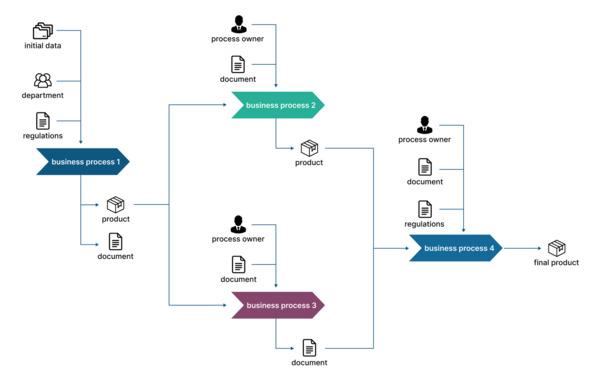
An approach that allows you to describe at the highest level the key activities of the company and departments, show the relationships between them. Here the focus is on graphical display of business processes that create value for the client.
That is, it is a kind of «master model», which gives the whole team an understanding of how its work affects the company as a whole.
Rules of construction of VAD-model of the value-added process:
— To begin with, it is necessary to identify the key tasks of the company or division that characterize its activities.
— Their logical relationship is then constructed.
— The owner and the unit responsible for the process shall be identified and specified.
— The main documents regulating the business process are indicated.
— Additional information and resources required to complete the business process are indicated.
— Links to lower-level diagrams (VAD or EPC) are attached to each upper-level business process.
SIPOC
Approach to the description of business processes, which is a tool in lean production. The title reflects the whole essence of the approach, which focuses on five components:
— Supplier (supplier) — person or company that supply resources for the execution of the business process (production, money, materials, data);
— Input (input) — resources for business process: materials, money, production capacity, data);
— Process (process) — all those tasks that allow the result of the work to convert the raw material into the final product;
— Output (output) — products of business process activity;
— Customer (customer) — recipients of services, those who use the product of the business process.
The SIPOC business process is described from the end:
— Identify the customer of the business process;
— Describe the final product (output) that the customer needs;
— Highlight 5—7 key business process operations;
— Identify the necessary resources (input) for the business process;
— Identify the providers of these resources
The key advantage is the speed of description, the ability to identify unnecessary steps that do not create value. This approach is somewhat similar to VAD and is a top-level description. Allows to identify the most obvious losses.
Process Event Chain (EPC)
This approach describes business processes in the form of individual stages/steps of the process and events that initiate these steps, that is, the structure of the «event — function — event» is obtained. This method is well suited for standardizing business processes and analysing the flow of documents and necessary information throughout the business process.
Main elements of the description:
— An event is something that creates the need for action.
— Function is an action to get the desired result, in response to an event.
— Performers are those who perform the function, including approving, coordinating, etc.
— Resources are all that are necessary for the implementation of the function: money, information systems or individual modules, documents, operational risks.
Unlike the previous approach, where the beginning was on the left and the finish on the right, everything starts from the top and goes down.
Description algorithm:
— Determine what we have and what we want — boundary events.
— Describe intermediate events that are inside this process and what tasks need to be performed / to implement functions.
— We add all the necessary information on implementers and resources.
— Analysis of the completeness and quality of the scheme, whether it takes into account all variations and sub-processes. If necessary, make additional schemes for sub-processes. However, here I recommend always remember the rule from the first book — one scheme, one sheet or screen.
Plus, the approach — the ability to then create clear rules in the form of text or table. This notation is quite common, especially in large organizations, because on the one hand it standardizes the description and on the other it is quite flexible. For example, it is often used to configure ERP systems.
BPMN 2.0 (Business Process Model and Notation 2.0)
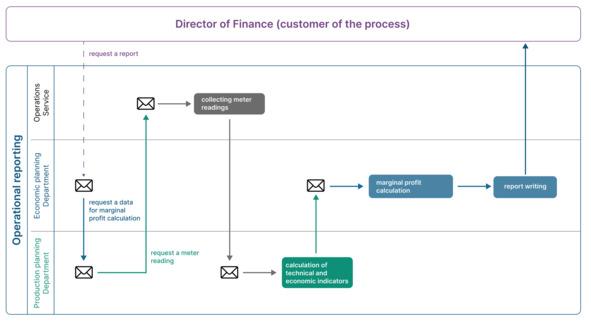
BPMN — today a de facto standard in the description of business processes with a wide set of graphical elements for modelling. If for ordinary users and managers this is not the most convenient approach, then for business analysts it is a mandatory tool: to describe within this approach a fairly large process on one sheet will be difficult, in addition, the approach is quite strict, However, this is more detailed and it is easier to identify local errors.
An example of the description in this notation below.
What I observe in life and apply myself
Unfortunately, in 99% of companies or no description of business processes, no top-level or even more detailed, or it is formally and made to tick, and in life everything works differently. Additionally, as long as the organization is small, 5—10 people, it is not scary. But after it begins to grow, chaos becomes more expensive pleasure.
In my life I adjust to the task, the level of maturity of the company and employees. It is mainly a hybrid of EPC and Notation Procedure (more on QR code at the beginning of a section), and sometimes a simple flowchart.
Summary 1 of the chapter and recommendations
More importantly: organizational structure or business processes described? Where to start? This is a perennial discussion. My personal opinion: as long as the company is small, it is becoming or restructuring, the selection of the business model that will give a result, you can do without business processes. If you have an organizational structure, clearly defined functions, a key product and, preferably, metrics (I do not make this a must, because I have seen isolated cases of a qualitatively developed system of key indicators), then you will not drown in chaos. People will be able to communicate and negotiate among themselves, which is a key element. I would even say that it is a useful exercise to first teach people to work together, sharing power, responsibility and resources, and then to implement process management. As a result, the work with the Org. structure will create a skeleton of the management system, including:
— ensure efficient use of resources;
— increase productivity;
— minimize the need for regulations, rules, detailed descriptions of each business process, in general, in the work with paper;
— minimize risks to the company, especially those related to dependence on individuals;
— reduce people’s congestion and turnover. Instead of one or two universal «working horses» there will be a distribution of tasks, the uncertainty that causes stress and burnout will be reduced;
— unload yourself as a leader: you do not have to often interfere with processes and understand conflicts, as the system will become transparent, everyone will understand their area of responsibility. It’ll be easier to pick up people and prepare job descriptions.
In addition, in the early stages, including the start of digitalization, your business processes will change too often, and constantly change and update them — too expensive a pleasure. Additionally, if you describe and «freeze», you lose the main advantage of the young team — its flexibility. The exception is critical processes with high risks and back-office processes, they are often stable and better dealt with initially.
However, after the initial stage is completed, it is necessary to engage in business processes. It is not necessary to fix everything and detail, but the most critical processes, where the risks are high, where problems begin to occur, should be described at least at the upper levels. Top-level approaches have the main advantage — speed and simplicity. And this will have an effect, and therefore, resources and motivation for in-depth work.
For grown-up companies there is another problem — bureaucracy. There is already a reverse approach — simplification of business processes. In general, as always, the search for a balance between chaos and entrepreneurship and order with bureaucracy.
As I said earlier, the right org is important. structure, proper distribution of authority, resources, responsibility and people, taking into account their psychology, system and personality balance. Additionally, if you listen to the classic science of Peter Drucker’s administration, you have to initially describe who you need, and then you have to choose the person for these tasks. This is the key message of his work «Effective Leader». But I have a slightly different opinion here.
This approach in a pure form is viable in an already mature company, where the requirements for candidacy are grounded, and the structure is balanced. In addition, such a company is attractive in the market due to the decent payment and the established reputation. If you are still young, you do not have a balanced system and/or you do not have a queue of applicants, then a certain flexibility is required. Yes, it is better to base on the principle of Peter Drucker, but the organizational structure needs to be adapted to the available resources and people, their psychological qualities, soft skills and competencies. That is, as usual, remember how to, but seek balance with what is.
This is basically the basic rule of life, and there is no ideal solution or methodology for either organizational structures, business processes, or project management approaches and so on. It is impossible to get rid of the psychology of people and technologies or tools to solve all problems, but to strive for an effective and autonomous system is necessary.
If you decide to approach the search for a new employee systematically: describe the functionality, requirements, its KPI, what characteristics should have, it does not mean that you will find the ideal, but it means that you are likely to find someone who will be useful to the company, will be suitable for its culture, although in some details will differ from the image of the ideal candidate.
How to build a suitable organizational structure? And how often to revise it?
I recommend the following algorithm:
— Define the goals of the company, its strategy: rapid growth, smooth, holding positions, scaling to new markets. It also determines which areas of the organization to focus on.
— Evaluate a company: what industry and its potential, what product, what technology lies at the core, and how often will have to implement projects, what markets.
— Assess available technologies and resources, including digital ones.
— Choose a structure and describe for each unit and position 4—6 key functions, target product, required competencies (professional, personal) and, where possible, available resources.
— Describe the main business processes, starting with the VAD-approach. Here you need to see the main stages of product creation, understand which of the participants in the process creates value and what.
— Assess: Do all these people and units create value? Where are the losses? What can be abandoned with digital technology or outsourced? If you only build a company, it will provide minimal costs, and if you transform, you will release resources to priorities.
Another recommendation: When goals are achieved or after the introduction and mastery of new technologies, revise your organization. structure. Or make it a rule every 6 to 12 months.
With regard to business processes, I can make the following recommendations:
— initially make a VAD-scheme throughout the company;
— prepare a process registry (first, second and third level processes, process owner, process participants);
— then take advantage of product management and system restriction theory to select priority business processes;
— it is also important to describe those business processes that are stable and are the best practice for others. Or, conversely, useful description of problematic business processes;
— does not need to describe every business process, only those tasks that are either standard or carry risks for business;
— begin to describe processes with approaches that you understand and who will use them;
— describe business processes so that they fit on one sheet A4 if you want to start the process, and in the notation BPMN if you want to analyse and optimize the process. Additionally, only after optimization do IDEF to deal with automation;
— describe the processes and prepare instructions or memos as if all the employees will leave tomorrow, and the replacement will come fools or 8-year-old children.
At the beginning of the book, I said that digital transformation should be your strategic goal, and therefore, this role should have a place in the organizational structure. Simply put, someone has to be responsible.
In general, I believe it is necessary to proceed from:
— your scale and availability of resources;
— the current level of digitalization and readiness;
— the limitations of the system (which will be discussed in the next chapter), global goals (to overcome the crisis, to ensure growth conditions, active growth) and objectives (to restore order, create new products, improve product supply).
There are many variations, and therefore, and possible structures. That is, to begin with, you need to pass a diagnosis. It is as with health: before treatment, it is better to undergo an examination and make a diagnosis, from which there will be a plan of treatment or recovery. But given that digitalization and digital transformation are strategic tasks, and the price of error may be too high, it should always be its driver.
If you are an entrepreneur or owner of a small business, it is better to find an experienced mentor who will help you to manage this direction, giving to outsource only some tasks on automation and software implementation. You can also find a team from the outside that deals with digitalization and turn-key digital transformation, with all the skills and necessary experience. The second option suits medium-sized businesses. But in any case, you have to understand automation, digitalization and digital transformation at least on a basic level.
If your business has grown from small to medium, in connection with which there are signs of chaos and lack of work with data, then you need to restore order and eliminate losses (in the chapter on thrifty production talk about this concept), remove internal restrictions, CDO 1.0 and 2.0 in data management. To do this, it is better to give the role of the leader of digitization to the operating director.
If the problem is a weak food supply, then this function should be given to the commercial director. In this case, it should be remembered that in any case to oversee this task as strategically important will be the director and/or the owner.
In any case, it is necessary to organize comprehensive training for a commercial or operational director. If digitalization is the responsibility of the Business Director, it will be commercially calibrated and aimed at increasing sales, which means that it will generate additional resources rather than processes and introduce a conditional electronic workflow just because it is necessary (by the way, the EDO can really bring huge benefits and eliminate just internal chaos and costs).
Well, if you’re a top corporate manager with resources, it’s best to have a separate division led by a CDTO (Digital Transformation Manager), which will build the methodology of the system approach and act as a centre of expertise in digital technology, processes, project management, product development. The team should necessarily include: a process specialist / business analyst (better couple), a data specialist, system analyst/architect, an IS specialist (to this we will dedicate the next book), a portfolio manager (if you train the staff, one is enough, if not, the project manager to each unit). If you put them in different units, these people will have to build horizontal links and matrix interactions. And this is longer and suitable only for mature companies, with respect in communications. If the company is less mature, it will result in an increase in the time. A weak system requires centralized control.
Key, I strongly advise against giving the digitalization and digital transformation function to the Director of Information Technology. After all, a rather limited number of IT directors can engage in process re-engineering (which is the core of transformation), approaches to project implementation, product development, has a customer focus, including to the employees of their company. For them, such concepts as UX|UI design of solutions and processes are distant.
It is necessary to pay attention to the IT departments themselves — to describe their structure and processes. Otherwise, with the increase in the number of IT tools, they will stop coping. You will either have to inflate their numbers, and they will become less organized (people will not understand who is doing what, there will be no training and commissioning processes). And/or everything will work randomly, especially technical support. And this is a direct way to discredit digitalization.
As a result, the main advantage of working with business processes and organizational structure — the opportunity to abandon expensive professionals, including IT developers. You will be able to focus on the selection of analysts (business and system) and trainees, who will grow under your company, and who will be 2—3 times cheaper than experienced experts. At the same time, it will be easier to manage them. At the same time, it will be easier to manage them, and the return from IT is higher, the cost is lower. You will also be able to build your work with data: what data is generated by the company, what is needed, who and why, and work with data is key in all digitization and digital transformation.
Chapter 2. Systems limitation theory
The second tool I want to share, and without which it is impossible to do business, is Eliyahu Goldratt’s restrictive theory.
The essence of the theory is to find bottlenecks, system constraints and eliminate them, while increasing the performance of the entire system. This approach also warns of the danger of excessive productivity of one element, i.e., at times the overall success requires reducing the productivity of individual units.
To understand the principle of this tool, consider two practical examples.
Practical examples
Example one.
You need to increase the productivity of the factory, let’s say, on the production of metal doors. You can approach this issue in two ways:
— reducing internal costs and losses by organizing lean production;
— through modernization and technical re-equipment, i.e. there is by removing technological restrictions.
Suppose the arrangements had exhausted their potential. You’ve digitized and visualized your processes, eliminated all the losses, and then you’ve measured the performance of the units, and you’ve discovered that the system’s limitations are now the paint shop.
Then you went to the production manager, and he brought you a list of things to upgrade.
According to preliminary calculations, 200 million rubles are needed for the modernization of the workshop, which will lead to an increase in productivity by 40% and a reduction in the proportion of rejects by 80%. Together, this will increase total productivity by 60%.
You then visualized the flows in production, modeled all the scenarios depending on the product line, and found the system’s limitations inside the shop. Help in this lean production (circle Tahiti Ono, elimination of losses) and mathematical modeling.
As a result, you saw that you can invest only 10 million rubles, and the productivity of the shop will increase by 35%, and the share of rejects will decrease by the same 80%. The total productivity of the enterprise will grow by 53—55%.
This is the principle of system constraint theory.
The second practical example.
A business venture where sales are more than successful. But its limitation is production capacity: production does not have time to process and release all the orders taken, and raw materials are purchased for them. As a result, we get:
— the stock of raw materials and semi-finished products is being overloaded, and storage capacity needs to be increased. This increases the cost of rent or new construction, requires additional staff, also increases the risk of damage to raw materials;
— the raw material begins to be stored longer in stock, which leads to an increase in frozen working capital and future losses. Some of it will go into marriage.
All these are losses in terms of economical production. Additionally, in the language of economists, it is frozen circulating funds, which is also very unpleasant. In addition, there are other effects:
— cancellations of orders, which are reputational losses, risks of penalties, plus raw materials need to be sent to recycling or «perpetual storage» due to the inability to apply it to other orders;
— deterioration of the KPI sales department and managers, which leads to conflicts between departments;
— will start to appear «urgent» and important orders, which is already interference in the production cycle and even more reduced productivity with an avalanche effect;
— increased pressure from owners on production, a further deterioration of the climate and an increase in staff turnover.
As you can see, a huge number of losses are generated, which we will talk about in the next chapter. They lead to a «perfect storm» and crisis.
This example is taken from real life. The company changed 8 managers and 90% of the production staff for the year, there were risks of penalties of 20 million rubles. And the limitation here was in the managers. Yes, the restrictions are not always technological, we will consider a detailed list below.
As a result, it was necessary to reduce the productivity of the sales department, to restructure production processes, and then to develop commerce again.
In terms of digitalization, the system constraint theory will help us to understand where the digit is originally implemented. And this will allow you to quickly feel the effect for a little money, which in turn will remove resistance from the team and will increase the amount of finance available for further changes.
In transforming and increasing efficiency, it is not only changes and technologies that are important, but also the point of focus. Additionally, eventually, it will increase net profits.
If we go back to the instrument, there are five so-called «focus stages» in the constraint theory.
5 steps — the essence of the whole tool
Step 1 — Finding a constraint.
Constraint is a weak link (resource, people, technology, materials) that hampers the effectiveness of the entire system. It comes in two types: internal and external. Example of the first — the capacity of the equipment, the competence of employees. External factors are the market, its competitiveness, saturation, capacitance, seasonality, purchasing power.
At this stage we identify key constraints. Tools that can help: brainstorming, TRIZ, simulation and flowcharts, mental maps.
Step 2 — decide how to make the most of the limitation.
To demonstrate this approach, let us take the example above of capacity constraints.
How can productivity be increased without large investments?
First, we introduced operational planning a day in advance. From the morning everyone knew what to produce and in what order. Secondly, we began to organize the importation of raw materials for the day shift in advance, as a result of which people immed