


автордың кітабын онлайн тегін оқу Amusements in Mathematics
Transcribers note: Many of the puzzles in this book assume a familiarity with the currency of Great Britain in the early 1900s. As this is likely not common knowledge for those outside Britain (and possibly many within,) I am including a chart of relative values.
The most common units used were:
the Penny,
abbreviated:
d. (from the Roman penny, denarius)
the Shilling,
abbreviated:
s.
the Pound,
abbreviated: £
There was 12 Pennies to a Shilling and 20 Shillings to a Pound, so there was 240 Pennies in a Pound.
To further complicate things, there were many coins which were various fractional values of Pennies, Shillings or Pounds.
Farthing
¼
d.
Half-penny
½
d.
Penny
1
d.
Three-penny
3
d.
Sixpence (or tanner)
6
d.
Shilling (or bob)
1
s.
Florin or two shilling piece
2
s.
Half-crown (or half-dollar)
2
s. 6
d.
Double-florin
4
s.
Crown (or dollar)
5
s.
Half-Sovereign
10
s.
Sovereign (or Pound)
£1 or 20
s.
This is by no means a comprehensive list, but it should be adequate to solve the puzzles in this book.
AMUSEMENTS IN MATHEMATICS
by
HENRY ERNEST DUDENEY
In Mathematicks he was greater Than Tycho Brahe or Erra Pater: For he, by geometrick scale, Could take the size of pots of ale; Resolve, by sines and tangents, straight, If bread or butter wanted weight; And wisely tell what hour o' th' day The clock does strike by algebra.
BUTLER'S Hudibras.
1917
PREFACE
In issuing this volume of my Mathematical Puzzles, of which some have appeared in periodicals and others are given here for the first time, I must acknowledge the encouragement that I have received from many unknown correspondents, at home and abroad, who have expressed a desire to have the problems in a collected form, with some of the solutions given at greater length than is possible in magazines and newspapers. Though I have included a few old puzzles that have interested the world for generations, where I felt that there was something new to be said about them, the problems are in the main original. It is true that some of these have become widely known through the press, and it is possible that the reader may be glad to know their source.
On the question of Mathematical Puzzles in general there is, perhaps, little more to be said than I have written elsewhere. The history of the subject entails nothing short of the actual story of the beginnings and development of exact thinking in man. The historian must start from the time when man first succeeded in counting his ten fingers and in dividing an apple into two approximately equal parts. Every puzzle that is worthy of consideration can be referred to mathematics and logic. Every man, woman, and child who tries to "reason out" the answer to the simplest puzzle is working, though not of necessity consciously, on mathematical lines. Even those puzzles that we have no way of attacking except by haphazard attempts can be brought under a method of what has been called "glorified trial"—a system of shortening our labours by avoiding or eliminating what our reason tells us is useless. It is, in fact, not easy to say sometimes where the "empirical" begins and where it ends.
When a man says, "I have never solved a puzzle in my life," it is difficult to know exactly what he means, for every intelligent individual is doing it every day. The unfortunate inmates of our lunatic asylums are sent there expressly because they cannot solve puzzles—because they have lost their powers of reason. If there were no puzzles to solve, there would be no questions to ask; and if there were no questions to be asked, what a world it would be! We should all be equally omniscient, and conversation would be useless and idle.
It is possible that some few exceedingly sober-minded mathematicians, who are impatient of any terminology in their favourite science but the academic, and who object to the elusive x and y appearing under any other names, will have wished that various problems had been presented in a less popular dress and introduced with a less flippant phraseology. I can only refer them to the first word of my title and remind them that we are primarily out to be amused—not, it is true, without some hope of picking up morsels of knowledge by the way. If the manner is light, I can only say, in the words of Touchstone, that it is "an ill-favoured thing, sir, but my own; a poor humour of mine, sir."
As for the question of difficulty, some of the puzzles, especially in the Arithmetical and Algebraical category, are quite easy. Yet some of those examples that look the simplest should not be passed over without a little consideration, for now and again it will be found that there is some more or less subtle pitfall or trap into which the reader may be apt to fall. It is good exercise to cultivate the habit of being very wary over the exact wording of a puzzle. It teaches exactitude and caution. But some of the problems are very hard nuts indeed, and not unworthy of the attention of the advanced mathematician. Readers will doubtless select according to their individual tastes.
In many cases only the mere answers are given. This leaves the beginner something to do on his own behalf in working out the method of solution, and saves space that would be wasted from the point of view of the advanced student. On the other hand, in particular cases where it seemed likely to interest, I have given rather extensive solutions and treated problems in a general manner. It will often be found that the notes on one problem will serve to elucidate a good many others in the book; so that the reader's difficulties will sometimes be found cleared up as he advances. Where it is possible to say a thing in a manner that may be "understanded of the people" generally, I prefer to use this simple phraseology, and so engage the attention and interest of a larger public. The mathematician will in such cases have no difficulty in expressing the matter under consideration in terms of his familiar symbols.
I have taken the greatest care in reading the proofs, and trust that any errors that may have crept in are very few. If any such should occur, I can only plead, in the words of Horace, that "good Homer sometimes nods," or, as the bishop put it, "Not even the youngest curate in my diocese is infallible."
I have to express my thanks in particular to the proprietors of The Strand Magazine, Cassell's Magazine, The Queen, Tit-Bits, and The Weekly Dispatch for their courtesy in allowing me to reprint some of the puzzles that have appeared in their pages.
THE AUTHORS' CLUB
March 25, 1917
CONTENTS
PREFACE v ARITHMETICAL AND ALGEBRAICAL PROBLEMS. 1 Money Puzzles. 1 Age and Kinship Puzzles. 6 Clock Puzzles. 9 Locomotion and Speed Puzzles. 11 Digital Puzzles. 13 Various Arithmetical and Algebraical Problems. 17 GEOMETRICAL PROBLEMS. 27 Dissection Puzzles. 27 Greek Cross Puzzles. 28 Various Dissection Puzzles. 35 Patchwork Puzzles 46 Various Geometrical Puzzles. 49 POINTS AND LINES PROBLEMS. 56 MOVING COUNTER PROBLEMS. 58 UNICURSAL AND ROUTE PROBLEMS. 68 COMBINATION AND GROUP PROBLEMS. 76 CHESSBOARD PROBLEMS. 85 The Chessboard. 85 Statical Chess Puzzles. 88 The Guarded Chessboard. 95 Dynamical Chess Puzzles. 96 Various Chess Puzzles. 112 MEASURING, WEIGHING, AND PACKING PUZZLES. 109 CROSSING RIVER PROBLEMS 112 PROBLEMS CONCERNING GAMES. 114 PUZZLE GAMES. 117 MAGIC SQUARE PROBLEMS. 119 Subtracting, Multiplying, and Dividing Magics. 124 Magic Squares of Primes. 125 MAZES AND HOW TO THREAD THEM. 127 THE PARADOX PARTY. 137 UNCLASSIFIED PROBLEMS. 142 SOLUTIONS. 148 INDEX. 253AMUSEMENTS IN MATHEMATICS.
ARITHMETICAL AND ALGEBRAICAL PROBLEMS.
"And what was he?
Forsooth, a great arithmetician."
Othello, I. i.
The puzzles in this department are roughly thrown together in classes for the convenience of the reader. Some are very easy, others quite difficult. But they are not arranged in any order of difficulty—and this is intentional, for it is well that the solver should not be warned that a puzzle is just what it seems to be. It may, therefore, prove to be quite as simple as it looks, or it may contain some pitfall into which, through want of care or over-confidence, we may stumble.
Also, the arithmetical and algebraical puzzles are not separated in the manner adopted by some authors, who arbitrarily require certain problems to be solved by one method or the other. The reader is left to make his own choice and determine which puzzles are capable of being solved by him on purely arithmetical lines.
MONEY PUZZLES.
"Put not your trust in money, but put your money in trust." OLIVER WENDELL HOLMES.
1.—A POST-OFFICE PERPLEXITY.
In every business of life we are occasionally perplexed by some chance question that for the moment staggers us. I quite pitied a young lady in a branch post-office when a gentleman entered and deposited a crown on the counter with this request: "Please give me some twopenny stamps, six times as many penny stamps, and make up the rest of the money in twopence-halfpenny stamps." For a moment she seemed bewildered, then her brain cleared, and with a smile she handed over stamps in exact fulfilment of the order. How long would it have taken you to think it out?
2.—YOUTHFUL PRECOCITY.
The precocity of some youths is surprising. One is disposed to say on occasion, "That boy of yours is a genius, and he is certain to do great things when he grows up;" but past experience has taught us that he invariably becomes quite an ordinary citizen. It is so often the case, on the contrary, that the dull boy becomes a great man. You never can tell. Nature loves to present to us these queer paradoxes. It is well known that those wonderful "lightning calculators," who now and again surprise the world by their feats, lose all their mysterious powers directly they are taught the elementary rules of arithmetic.
A boy who was demolishing a choice banana was approached by a young friend, who, regarding him with envious eyes, asked, "How much did you pay for that banana, Fred?" The prompt answer was quite remarkable in its way: "The man what I bought it of receives just half as many sixpences for sixteen dozen dozen bananas as he gives bananas for a fiver."
Now, how long will it take the reader to say correctly just how much Fred paid for his rare and refreshing fruit?
3.—AT A CATTLE MARKET.
Three countrymen met at a cattle market. "Look here," said Hodge to Jakes, "I'll give you six of my pigs for one of your horses, and then you'll have twice as many animals here as I've got." "If that's your way of doing business," said Durrant to Hodge, "I'll give you fourteen of my sheep for a horse, and then you'll have three times as many animals as I." "Well, I'll go better than that," said Jakes to Durrant; "I'll give you four cows for a horse, and then you'll have six times as many animals as I've got here."
No doubt this was a very primitive way of bartering animals, but it is an interesting little puzzle to discover just how many animals Jakes, Hodge, and Durrant must have taken to the cattle market.
4.—THE BEANFEAST PUZZLE.
A number of men went out together on a bean-feast. There were four parties invited—namely, 25 cobblers, 20 tailors, 18 hatters, and 12 glovers. They spent altogether £6, 13s. It was found that five cobblers spent as much as four tailors; that twelve tailors spent as much as nine hatters; and that six hatters spent as much as eight glovers. The puzzle is to find out how much each of the four parties spent.
5.—A QUEER COINCIDENCE.
Seven men, whose names were Adams, Baker, Carter, Dobson, Edwards, Francis, and Gudgeon, were recently engaged in play. The name of the particular game is of no consequence. They had agreed that whenever a player won a game he should double the money of each of the other players—that is, he was to give the players just as much money as they had already in their pockets. They played seven games, and, strange to say, each won a game in turn, in the order in which their names are given. But a more curious coincidence is this—that when they had finished play each of the seven men had exactly the same amount—two shillings and eightpence—in his pocket. The puzzle is to find out how much money each man had with him before he sat down to play.
6.—A CHARITABLE BEQUEST.
A man left instructions to his executors to distribute once a year exactly fifty-five shillings among the poor of his parish; but they were only to continue the gift so long as they could make it in different ways, always giving eighteenpence each to a number of women and half a crown each to men. During how many years could the charity be administered? Of course, by "different ways" is meant a different number of men and women every time.
7.—THE WIDOW'S LEGACY.
A gentleman who recently died left the sum of £8,000 to be divided among his widow, five sons, and four daughters. He directed that every son should receive three times as much as a daughter, and that every daughter should have twice as much as their mother. What was the widow's share?
8.—INDISCRIMINATE CHARITY.
A charitable gentleman, on his way home one night, was appealed to by three needy persons in succession for assistance. To the first person he gave one penny more than half the money he had in his pocket; to the second person he gave twopence more than half the money he then had in his pocket; and to the third person he handed over threepence more than half of what he had left. On entering his house he had only one penny in his pocket. Now, can you say exactly how much money that gentleman had on him when he started for home?
9.—THE TWO AEROPLANES.
A man recently bought two aeroplanes, but afterwards found that they would not answer the purpose for which he wanted them. So he sold them for £600 each, making a loss of 20 per cent, on one machine and a profit of 20 per cent, on the other. Did he make a profit on the whole transaction, or a loss? And how much?
10.—BUYING PRESENTS.
"Whom do you think I met in town last week, Brother William?" said Uncle Benjamin. "That old skinflint Jorkins. His family had been taking him around buying Christmas presents. He said to me, 'Why cannot the government abolish Christmas, and make the giving of presents punishable by law? I came out this morning with a certain amount of money in my pocket, and I find I have spent just half of it. In fact, if you will believe me, I take home just as many shillings as I had pounds, and half as many pounds as I had shillings. It is monstrous!'" Can you say exactly how much money Jorkins had spent on those presents?
11.—THE CYCLISTS' FEAST.
'Twas last Bank Holiday, so I've been told, Some cyclists rode abroad in glorious weather. Resting at noon within a tavern old, They all agreed to have a feast together. "Put it all in one bill, mine host," they said, "For every man an equal share will pay." The bill was promptly on the table laid, And four pounds was the reckoning that day. But, sad to state, when they prepared to square, 'Twas found that two had sneaked outside and fled. So, for two shillings more than his due share Each honest man who had remained was bled. They settled later with those rogues, no doubt. How many were they when they first set out?
12.—A QUEER THING IN MONEY.
It will be found that £66, 6s. 6d. equals 15,918 pence. Now, the four 6's added together make 24, and the figures in 15,918 also add to 24. It is a curious fact that there is only one other sum of money, in pounds, shillings, and pence (all similarly repetitions of one figure), of which the digits shall add up the same as the digits of the amount in pence. What is the other sum of money?
13.—A NEW MONEY PUZZLE.
The largest sum of money that can be written in pounds, shillings, pence, and farthings, using each of the nine digits once and only once, is £98,765, 4s. 3½d. Now, try to discover the smallest sum of money that can be written down under precisely the same conditions. There must be some value given for each denomination—pounds, shillings, pence, and farthings—and the nought may not be used. It requires just a little judgment and thought.
14.—SQUARE MONEY.
"This is queer," said McCrank to his friend. "Twopence added to twopence is fourpence, and twopence multiplied by twopence is also fourpence." Of course, he was wrong in thinking you can multiply money by money. The multiplier must be regarded as an abstract number. It is true that two feet multiplied by two feet will make four square feet. Similarly, two pence multiplied by two pence will produce four square pence! And it will perplex the reader to say what a "square penny" is. But we will assume for the purposes of our puzzle that twopence multiplied by twopence is fourpence. Now, what two amounts of money will produce the next smallest possible result, the same in both cases, when added or multiplied in this manner? The two amounts need not be alike, but they must be those that can be paid in current coins of the realm.
15.—POCKET MONEY.
What is the largest sum of money—all in current silver coins and no four-shilling piece—that I could have in my pocket without being able to give change for a half-sovereign?
16.—THE MILLIONAIRE'S PERPLEXITY.
Mr. Morgan G. Bloomgarten, the millionaire, known in the States as the Clam King, had, for his sins, more money than he knew what to do with. It bored him. So he determined to persecute some of his poor but happy friends with it. They had never done him any harm, but he resolved to inoculate them with the "source of all evil." He therefore proposed to distribute a million dollars among them and watch them go rapidly to the bad. But he was a man of strange fancies and superstitions, and it was an inviolable rule with him never to make a gift that was not either one dollar or some power of seven—such as 7, 49, 343, 2,401, which numbers of dollars are produced by simply multiplying sevens together. Another rule of his was that he would never give more than six persons exactly the same sum. Now, how was he to distribute the 1,000,000 dollars? You may distribute the money among as many people as you like, under the conditions given.
17.—THE PUZZLING MONEY-BOXES.
Four brothers—named John, William, Charles, and Thomas—had each a money-box. The boxes were all given to them on the same day, and they at once put what money they had into them; only, as the boxes were not very large, they first changed the money into as few coins as possible. After they had done this, they told one another how much money they had saved, and it was found that if John had had 2s. more in his box than at present, if William had had 2s. less, if Charles had had twice as much, and if Thomas had had half as much, they would all have had exactly the same amount.
Now, when I add that all four boxes together contained 45s., and that there were only six coins in all in them, it becomes an entertaining puzzle to discover just what coins were in each box.
18.—THE MARKET WOMEN.
A number of market women sold their various products at a certain price per pound (different in every case), and each received the same amount—2s. 2½d. What is the greatest number of women there could have been? The price per pound in every case must be such as could be paid in current money.
19.—THE NEW YEAR'S EVE SUPPERS.
The proprietor of a small London café has given me some interesting figures. He says that the ladies who come alone to his place for refreshment spend each on an average eighteenpence, that the unaccompanied men spend half a crown each, and that when a gentleman brings in a lady he spends half a guinea. On New Year's Eve he supplied suppers to twenty-five persons, and took five pounds in all. Now, assuming his averages to have held good in every case, how was his company made up on that occasion? Of course, only single gentlemen, single ladies, and pairs (a lady and gentleman) can be supposed to have been present, as we are not considering larger parties.
20.—BEEF AND SAUSAGES.
"A neighbour of mine," said Aunt Jane, "bought a certain quantity of beef at two shillings a pound, and the same quantity of sausages at eighteenpence a pound. I pointed out to her that if she had divided the same money equally between beef and sausages she would have gained two pounds in the total weight. Can you tell me exactly how much she spent?"
"Of course, it is no business of mine," said Mrs. Sunniborne; "but a lady who could pay such prices must be somewhat inexperienced in domestic economy."
"I quite agree, my dear," Aunt Jane replied, "but you see that is not the precise point under discussion, any more than the name and morals of the tradesman."
21.—A DEAL IN APPLES.
I paid a man a shilling for some apples, but they were so small that I made him throw in two extra apples. I find that made them cost just a penny a dozen less than the first price he asked. How many apples did I get for my shilling?
22.—A DEAL IN EGGS.
A man went recently into a dairyman's shop to buy eggs. He wanted them of various qualities. The salesman had new-laid eggs at the high price of fivepence each, fresh eggs at one penny each, eggs at a halfpenny each, and eggs for electioneering purposes at a greatly reduced figure, but as there was no election on at the time the buyer had no use for the last. However, he bought some of each of the three other kinds and obtained exactly one hundred eggs for eight and fourpence. Now, as he brought away exactly the same number of eggs of two of the three qualities, it is an interesting puzzle to determine just how many he bought at each price.
23.—THE CHRISTMAS-BOXES.
Some years ago a man told me he had spent one hundred English silver coins in Christmas-boxes, giving every person the same amount, and it cost him exactly £1, 10s. 1d. Can you tell just how many persons received the present, and how he could have managed the distribution? That odd penny looks queer, but it is all right.
24.—A SHOPPING PERPLEXITY.
Two ladies went into a shop where, through some curious eccentricity, no change was given, and made purchases amounting together to less than five shillings. "Do you know," said one lady, "I find I shall require no fewer than six current coins of the realm to pay for what I have bought." The other lady considered a moment, and then exclaimed: "By a peculiar coincidence, I am exactly in the same dilemma." "Then we will pay the two bills together." But, to their astonishment, they still required six coins. What is the smallest possible amount of their purchases—both different?
25.—CHINESE MONEY.
The Chinese are a curious people, and have strange inverted ways of doing things. It is said that they use a saw with an upward pressure instead of a downward one, that they plane a deal board by pulling the tool toward them instead of pushing it, and that in building a house they first construct the roof and, having raised that into position, proceed to work downwards. In money the currency of the country consists of taels of fluctuating value. The tael became thinner and thinner until 2,000 of them piled together made less than three inches in height. The common cash consists of brass coins of varying thicknesses, with a round, square, or triangular hole in the centre, as in our illustration.
A country "grocer and draper" had two rival assistants, who prided themselves on their rapidity in serving customers. The young man on the grocery side could weigh up two one-pound parcels of sugar per minute, while the drapery assistant could cut three one-yard lengths of cloth in the same time. Their employer, one slack day, set them a race, giving the grocer a barrel of sugar and telling him to weigh up forty-eight one-pound parcels of sugar While the draper divided a roll of forty-eight yards of cloth into yard pieces. The two men were interrupted together by customers for nine minutes, but the draper was disturbed seventeen times as long as the grocer. What was the result of the race?
But Mr. Bloggs refused to hear any more. Can the reader show how this extraordinary triple relationship might have come about?
One of the big clocks in the Cogitators' Club was found the other night to have stopped just when, as will be seen in the illustration, the second hand was exactly midway between the other two hands. One of the members proposed to some of his friends that they should tell him the exact time when (if the clock had not stopped) the second hand would next again have been midway between the minute hand and the hour hand. Can you find the correct time that it would happen?
The inhabitants of Slocomb-on-Sea were greatly excited over the visit of a certain flying man. All the town turned out to see the flight of the wonderful hydroplane, and, of course, Dobson and his family were there. Master Tommy was in good form, and informed his father that Englishmen made better airmen than Scotsmen and Irishmen because they are not so heavy. "How do you make that out?" asked Mr. Dobson. "Well, you see," Tommy replied, "it is true that in Ireland there are men of Cork and in Scotland men of Ayr, which is better still, but in England there are lightermen." Unfortunately it had to be explained to Mrs. Dobson, and this took the edge off the thing. The hydroplane flight was from Slocomb to the neighbouring watering-place Poodleville—five miles distant. But there was a strong wind, which so helped the airman that he made the outward journey in the short time of ten minutes, though it took him an hour to get back to the starting point at Slocomb, with the wind dead against him. Now, how long would the ten miles have taken him if there had been a perfect calm? Of course, the hydroplane's engine worked uniformly throughout.
It is required to place arithmetical signs between the nine figures so that they shall equal 100. Of course, you must not alter the present numerical arrangement of the figures. Can you give a correct solution that employs (1) the fewest possible signs, and (2) the fewest possible separate strokes or dots of the pen? That is, it is necessary to use as few signs as possible, and those signs should be of the simplest form. The signs of addition and multiplication (+ and ×) will thus count as two strokes, the sign of subtraction (-) as one stroke, the sign of division (÷) as three, and so on.
Three Dutchmen, named Hendrick, Elas, and Cornelius, and their wives, Gurtrün, Katrün, and Anna, purchase hogs. Each buys as many as he (or she) gives shillings for one. Each husband pays altogether three guineas more than his wife. Hendrick buys twenty-three more hogs than Katrün, and Elas eleven more than Gurtrün. Now, what was the name of each man's wife?
Puzzles have infinite variety, but perhaps there is no class more ancient than dissection, cutting-out, or superposition puzzles. They were certainly known to the Chinese several thousand years before the Christian era. And they are just as fascinating to-day as they can have been at any period of their history. It is supposed by those who have investigated the matter that the ancient Chinese philosophers used these puzzles as a sort of kindergarten method of imparting the principles of geometry. Whether this was so or not, it is certain that all good dissection puzzles (for the nursery type of jig-saw puzzle, which merely consists in cutting up a picture into pieces to be put together again, is not worthy of serious consideration) are really based on geometrical laws. This statement need not, however, frighten off the novice, for it means little more than this, that geometry will give us the "reason why," if we are interested in knowing it, though the solutions may often be discovered by any intelligent person after the exercise of patience, ingenuity, and common sagacity.
143.—TWO CROSSES FROM ONE.
Finally, I give an example from the many curious paradoxes that one happens upon in manipulating Tangrams. I show designs of two dignified individuals (15 and 16) who appear to be exactly alike, except for the fact that one has a foot and the other has not. Now, both of these figures are made from the same seven Tangrams. Where does the second man get his foot from?
The diagram herewith represents two separate pieces of linoleum. The chequered pattern is not repeated at the back, so that the pieces cannot be turned over. The puzzle is to cut the two squares into four pieces so that they shall fit together and form one perfect square 10×10, so that the pattern shall properly match, and so that the larger piece shall have as small a portion as possible cut from it.
212.—THE BURMESE PLANTATION.
The puzzle is to remove two children who are occupying adjoining chairs and place them in two empty chairs, making them first change sides; then remove a second pair of children from adjoining chairs and place them in the two now vacant, making them change sides; and so on, until all the boys are together and all the girls together, with the two vacant chairs at one end as at present. To solve the puzzle you must do this in five moves. The two children must always be taken from chairs that are next to one another; and remember the important point of making the two children change sides, as this latter is the distinctive feature of the puzzle. By "change sides" I simply mean that if, for example, you first move 1 and 2 to the vacant chairs, then the first (the outside) chair will be occupied by 2 and the second one by 1.
In this case I give a rough plan of a river with an island and five bridges. On one side of the river is a monastery, and on the other side is seen a monk in the foreground. Now, the monk has decided that he will cross every bridge once, and only once, on his return to the monastery. This is, of course, quite easy to do, but on the way he thought to himself, "I wonder how many different routes there are from which I might have selected." Could you have told him? That is the puzzle. Take your pencil and trace out a route that will take you once over all the five bridges. Then trace out a second route, then a third, and see if you can count all the variations. You will find that the difficulty is twofold: you have to avoid dropping routes on the one hand and counting the same routes more than once on the other.
During a heavy gale a chimney-pot was hurled through the air, and crashed upon the pavement just in front of a pedestrian. He quite calmly said, "I have no use for it: I do not smoke." Some readers, when they happen to see a puzzle represented on a chessboard with chess pieces, are apt to make the equally inconsequent remark, "I have no use for it: I do not play chess." This is largely a result of the common, but erroneous, notion that the ordinary chess puzzle with which we are familiar in the press (dignified, for some reason, with the name "problem") has a vital connection with the game of chess itself. But there is no condition in the game that you shall checkmate your opponent in two moves, in three moves, or in four moves, while the majority of the positions given in these puzzles are such that one player would have so great a superiority in pieces that the other would have resigned before the situations were reached. And the solving of them helps you but little, and that quite indirectly, in playing the game, it being well known that, as a rule, the best "chess problemists" are indifferent players, and vice versa. Occasionally a man will be found strong on both subjects, but he is the exception to the rule.
Well, the captain says that if a spirited lion crosses your path in the desert it becomes lively, for the lion has generally been looking for the man just as much as the man has sought the king of the forest. And yet when they meet they always quarrel and fight it out. A little contemplation of this unfortunate and long-standing feud between two estimable families has led me to figure out a few calculations as to the probability of the man and the lion crossing one another's path in the jungle. In all these cases one has to start on certain more or less arbitrary assumptions. That is why in the above illustration I have thought it necessary to represent the paths in the desert with such rigid regularity. Though the captain assures me that the tracks of the lions usually run much in this way, I have doubts.
"Of course you wouldn't play to lose or draw!"
The puzzle is to find the shortest way of performing the feat, which in itself is not difficult. Remember, a person cannot help himself by hanging on to the rope, the only way being to go down "with a bump," with the weight in the other basket as a counterpoise.
"It is a glorious game!" an enthusiast was heard to exclaim. "At the close of last season, of the footballers of my acquaintance four had broken their left arm, five had broken their right arm, two had the right arm sound, and three had sound left arms." Can you discover from that statement what is the smallest number of players that the speaker could be acquainted with?
"Here are thirty matches," he said. "I divide them into three unequal heaps. Let me see. We have 14, 11, and 5, as it happens. Now, the two players draw alternately any number from any one heap, and he who draws the last match loses the game. That's all! I will play with you, Wilson. I have formed the heaps, so you have the first draw."
The illustration shows eighteen dominoes arranged in the form of a square so that the pips in every one of the six columns, six rows, and two long diagonals add up 13. This is the smallest summation possible with any selection of dominoes from an ordinary box of twenty-eight. The greatest possible summation is 23, and a solution for this number may be easily obtained by substituting for every number its complement to 6. Thus for every blank substitute a 6, for every 1 a 5, for every 2 a 4, for 3 a 3, for 4 a 2, for 5 a 1, and for 6 a blank. But the puzzle is to make a selection of eighteen dominoes and arrange them (in exactly the form shown) so that the summations shall be 18 in all the fourteen directions mentioned.
The fourth diagram is a dividing magic square. The constant 6 is here obtained by dividing the second number in a line by the first (in either direction) and the third number by the quotient. But, again, the process is simplified by dividing the product of the two extreme numbers by the middle number. This square is also "associated" by multiplication. It is derived from the multiplying square by merely reversing the diagonals, and the constant of the multiplying square is the cube of that of the dividing square derived from it.
Before Mr. Beauchamp Cholmondely Marjoribanks set out on his tour in the Far East, he prided himself on his knowledge of magic squares, a subject that he had made his special hobby; but he soon discovered that he had never really touched more than the fringe of the subject, and that the wily Chinee could beat him easily. I present a little problem that one learned mandarin propounded to our traveller, as depicted on the last page.
I will now give three mazes that are simply puzzles on paper, for, so far as I know, they have never been constructed in any other way. The first I will call the Philadelphia maze (Fig. 22). Fourteen years ago a travelling salesman, living in Philadelphia, U.S.A., developed a curiously unrestrained passion for puzzles. He neglected his business, and soon his position was taken from him. His days and nights were now passed with the subject that fascinated him, and this little maze seems to have driven him into insanity. He had been puzzling over it for some time, and finally it sent him mad and caused him to fire a bullet through his brain. Goodness knows what his difficulties could have been! But there can be little doubt that he had a disordered mind, and that if this little puzzle had not caused him to lose his mental balance some other more or less trivial thing would in time have done so. There is no moral in the story, unless it be that of the Irish maxim, which applies to every occupation of life as much as to the solving of puzzles: "Take things aisy; if you can't take them aisy, take them as aisy as you can." And it is a bad and empirical way of solving any puzzle—by blowing your brains out.
Now, as my friend was an artist, and as I thought an amusing puzzle might be devised on the lines of his question, I asked him to make me a drawing according to some directions that I gave him, and I have pleasure in presenting his production to my readers. It will be seen that the picture shows six men and six ladies: Nos. 1, 3, 5, 7, 9, and 11 are ladies, and Nos. 2, 4, 6, 8, 10, and 12 are men. These twelve individuals represent six married couples, all strangers to one another, who, in walking aimlessly about, have got mixed up. But we are only concerned with the man that is wearing a straw hat—Number 10. The puzzle is to find this man's wife. Examine the six ladies carefully, and see if you can determine which one of them it is.

These are strung on wires like buttons. Supposing that eleven coins with round holes are worth fifteen ching-changs, that eleven with square holes are worth sixteen ching-changs, and that eleven with triangular holes are worth seventeen ching-changs, how can a Chinaman give me change for half a crown, using no coins other than the three mentioned? A ching-chang is worth exactly twopence and four-fifteenths of a ching-chang.
26.—THE JUNIOR CLERK'S PUZZLE.
Two youths, bearing the pleasant names of Moggs and Snoggs, were employed as junior clerks by a merchant in Mincing Lane. They were both engaged at the same salary—that is, commencing at the rate of £50 a year, payable half-yearly. Moggs had a yearly rise of £10, and Snoggs was offered the same, only he asked, for reasons that do not concern our puzzle, that he might take his rise at £2, 10s. half-yearly, to which his employer (not, perhaps, unnaturally!) had no objection.
Now we come to the real point of the puzzle. Moggs put regularly into the Post Office Savings Bank a certain proportion of his salary, while Snoggs saved twice as great a proportion of his, and at the end of five years they had together saved £268, 15s. How much had each saved? The question of interest can be ignored.
27.—GIVING CHANGE.
Every one is familiar with the difficulties that frequently arise over the giving of change, and how the assistance of a third person with a few coins in his pocket will sometimes help us to set the matter right. Here is an example. An Englishman went into a shop in New York and bought goods at a cost of thirty-four cents. The only money he had was a dollar, a three-cent piece, and a two-cent piece. The tradesman had only a half-dollar and a quarter-dollar. But another customer happened to be present, and when asked to help produced two dimes, a five-cent piece, a two-cent piece, and a one-cent piece. How did the tradesman manage to give change? For the benefit of those readers who are not familiar with the American coinage, it is only necessary to say that a dollar is a hundred cents and a dime ten cents. A puzzle of this kind should rarely cause any difficulty if attacked in a proper manner.
28.—DEFECTIVE OBSERVATION.
Our observation of little things is frequently defective, and our memories very liable to lapse. A certain judge recently remarked in a case that he had no recollection whatever of putting the wedding-ring on his wife's finger. Can you correctly answer these questions without having the coins in sight? On which side of a penny is the date given? Some people are so unobservant that, although they are handling the coin nearly every day of their lives, they are at a loss to answer this simple question. If I lay a penny flat on the table, how many other pennies can I place around it, every one also lying flat on the table, so that they all touch the first one? The geometrician will, of course, give the answer at once, and not need to make any experiment. He will also know that, since all circles are similar, the same answer will necessarily apply to any coin. The next question is a most interesting one to ask a company, each person writing down his answer on a slip of paper, so that no one shall be helped by the answers of others. What is the greatest number of three-penny-pieces that may be laid flat on the surface of a half-crown, so that no piece lies on another or overlaps the surface of the half-crown? It is amazing what a variety of different answers one gets to this question. Very few people will be found to give the correct number. Of course the answer must be given without looking at the coins.
29.—THE BROKEN COINS.
A man had three coins—a sovereign, a shilling, and a penny—and he found that exactly the same fraction of each coin had been broken away. Now, assuming that the original intrinsic value of these coins was the same as their nominal value—that is, that the sovereign was worth a pound, the shilling worth a shilling, and the penny worth a penny—what proportion of each coin has been lost if the value of the three remaining fragments is exactly one pound?
30.—TWO QUESTIONS IN PROBABILITIES.
There is perhaps no class of puzzle over which people so frequently blunder as that which involves what is called the theory of probabilities. I will give two simple examples of the sort of puzzle I mean. They are really quite easy, and yet many persons are tripped up by them. A friend recently produced five pennies and said to me: "In throwing these five pennies at the same time, what are the chances that at least four of the coins will turn up either all heads or all tails?" His own solution was quite wrong, but the correct answer ought not to be hard to discover. Another person got a wrong answer to the following little puzzle which I heard him propound: "A man placed three sovereigns and one shilling in a bag. How much should be paid for permission to draw one coin from it?" It is, of course, understood that you are as likely to draw any one of the four coins as another.
31.—DOMESTIC ECONOMY.
Young Mrs. Perkins, of Putney, writes to me as follows: "I should be very glad if you could give me the answer to a little sum that has been worrying me a good deal lately. Here it is: We have only been married a short time, and now, at the end of two years from the time when we set up housekeeping, my husband tells me that he finds we have spent a third of his yearly income in rent, rates, and taxes, one-half in domestic expenses, and one-ninth in other ways. He has a balance of £190 remaining in the bank. I know this last, because he accidentally left out his pass-book the other day, and I peeped into it. Don't you think that a husband ought to give his wife his entire confidence in his money matters? Well, I do; and—will you believe it?—he has never told me what his income really is, and I want, very naturally, to find out. Can you tell me what it is from the figures I have given you?"
Yes; the answer can certainly be given from the figures contained in Mrs. Perkins's letter. And my readers, if not warned, will be practically unanimous in declaring the income to be—something absurdly in excess of the correct answer!
32.—THE EXCURSION TICKET PUZZLE.
When the big flaming placards were exhibited at the little provincial railway station, announcing that the Great —— Company would run cheap excursion trains to London for the Christmas holidays, the inhabitants of Mudley-cum-Turmits were in quite a flutter of excitement. Half an hour before the train came in the little booking office was crowded with country passengers, all bent on visiting their friends in the great Metropolis. The booking clerk was unaccustomed to dealing with crowds of such a dimension, and he told me afterwards, while wiping his manly brow, that what caused him so much trouble was the fact that these rustics paid their fares in such a lot of small money.
He said that he had enough farthings to supply a West End draper with change for a week, and a sufficient number of threepenny pieces for the congregations of three parish churches. "That excursion fare," said he, "is nineteen shillings and ninepence, and I should like to know in just how many different ways it is possible for such an amount to be paid in the current coin of this realm."
Here, then, is a puzzle: In how many different ways may nineteen shillings and ninepence be paid in our current coin? Remember that the fourpenny-piece is not now current.
33.—A PUZZLE IN REVERSALS.
Most people know that if you take any sum of money in pounds, shillings, and pence, in which the number of pounds (less than £12) exceeds that of the pence, reverse it (calling the pounds pence and the pence pounds), find the difference, then reverse and add this difference, the result is always £12, 18s. 11d. But if we omit the condition, "less than £12," and allow nought to represent shillings or pence—(1) What is the lowest amount to which the rule will not apply? (2) What is the highest amount to which it will apply? Of course, when reversing such a sum as £14, 15s. 3d. it may be written £3, 16s. 2d., which is the same as £3, 15s. 14d.
34.—THE GROCER AND DRAPER.
A country "grocer and draper" had two rival assistants, who prided themselves on their rapidity in serving customers. The young man on the grocery side could weigh up two one-pound parcels of sugar per minute, while the drapery assistant could cut three one-yard lengths of cloth in the same time. Their employer, one slack day, set them a race, giving the grocer a barrel of sugar and telling him to weigh up forty-eight one-pound parcels of sugar While the draper divided a roll of forty-eight yards of cloth into yard pieces. The two men were interrupted together by customers for nine minutes, but the draper was disturbed seventeen times as long as the grocer. What was the result of the race?
35.—JUDKINS'S CATTLE.
Hiram B. Judkins, a cattle-dealer of Texas, had five droves of animals, consisting of oxen, pigs, and sheep, with the same number of animals in each drove. One morning he sold all that he had to eight dealers. Each dealer bought the same number of animals, paying seventeen dollars for each ox, four dollars for each pig, and two dollars for each sheep; and Hiram received in all three hundred and one dollars. What is the greatest number of animals he could have had? And how many would there be of each kind?
36.—BUYING APPLES.
As the purchase of apples in small quantities has always presented considerable difficulties, I think it well to offer a few remarks on this subject. We all know the story of the smart boy who, on being told by the old woman that she was selling her apples at four for threepence, said: "Let me see! Four for threepence; that's three for twopence, two for a penny, one for nothing—I'll take one!"
There are similar cases of perplexity. For example, a boy once picked up a penny apple from a stall, but when he learnt that the woman's pears were the same price he exchanged it, and was about to walk off. "Stop!" said the woman. "You haven't paid me for the pear!" "No," said the boy, "of course not. I gave you the apple for it." "But you didn't pay for the apple!" "Bless the woman! You don't expect me to pay for the apple and the pear too!" And before the poor creature could get out of the tangle the boy had disappeared.
Then, again, we have the case of the man who gave a boy sixpence and promised to repeat the gift as soon as the youngster had made it into ninepence. Five minutes later the boy returned. "I have made it into ninepence," he said, at the same time handing his benefactor threepence. "How do you make that out?" he was asked. "I bought threepennyworth of apples." "But that does not make it into ninepence!" "I should rather think it did," was the boy's reply. "The apple woman has threepence, hasn't she? Very well, I have threepennyworth of apples, and I have just given you the other threepence. What's that but ninepence?"
I cite these cases just to show that the small boy really stands in need of a little instruction in the art of buying apples. So I will give a simple poser dealing with this branch of commerce.
An old woman had apples of three sizes for sale—one a penny, two a penny, and three a penny. Of course two of the second size and three of the third size were respectively equal to one apple of the largest size. Now, a gentleman who had an equal number of boys and girls gave his children sevenpence to be spent amongst them all on these apples. The puzzle is to give each child an equal distribution of apples. How was the sevenpence spent, and how many children were there?
37.—BUYING CHESTNUTS.
Though the following little puzzle deals with the purchase of chestnuts, it is not itself of the "chestnut" type. It is quite new. At first sight it has certainly the appearance of being of the "nonsense puzzle" character, but it is all right when properly considered.
A man went to a shop to buy chestnuts. He said he wanted a pennyworth, and was given five chestnuts. "It is not enough; I ought to have a sixth," he remarked! "But if I give you one chestnut more." the shopman replied, "you will have five too many." Now, strange to say, they were both right. How many chestnuts should the buyer receive for half a crown?
38.—THE BICYCLE THIEF.
Here is a little tangle that is perpetually cropping up in various guises. A cyclist bought a bicycle for £15 and gave in payment a cheque for £25. The seller went to a neighbouring shopkeeper and got him to change the cheque for him, and the cyclist, having received his £10 change, mounted the machine and disappeared. The cheque proved to be valueless, and the salesman was requested by his neighbour to refund the amount he had received. To do this, he was compelled to borrow the £25 from a friend, as the cyclist forgot to leave his address, and could not be found. Now, as the bicycle cost the salesman £11, how much money did he lose altogether?
39.—THE COSTERMONGER'S PUZZLE.
"How much did yer pay for them oranges, Bill?"
"I ain't a-goin' to tell yer, Jim. But I beat the old cove down fourpence a hundred."
"What good did that do yer?"
"Well, it meant five more oranges on every ten shillin's-worth."
Now, what price did Bill actually pay for the oranges? There is only one rate that will fit in with his statements.
AGE AND KINSHIP PUZZLES.
"The days of our years are threescore years and ten." —Psalm xc. 10.
For centuries it has been a favourite method of propounding arithmetical puzzles to pose them in the form of questions as to the age of an individual. They generally lend themselves to very easy solution by the use of algebra, though often the difficulty lies in stating them correctly. They may be made very complex and may demand considerable ingenuity, but no general laws can well be laid down for their solution. The solver must use his own sagacity. As for puzzles in relationship or kinship, it is quite curious how bewildering many people find these things. Even in ordinary conversation, some statement as to relationship, which is quite clear in the mind of the speaker, will immediately tie the brains of other people into knots. Such expressions as "He is my uncle's son-in-law's sister" convey absolutely nothing to some people without a detailed and laboured explanation. In such cases the best course is to sketch a brief genealogical table, when the eye comes immediately to the assistance of the brain. In these days, when we have a growing lack of respect for pedigrees, most people have got out of the habit of rapidly drawing such tables, which is to be regretted, as they would save a lot of time and brain racking on occasions.
40.—MAMMA'S AGE.
Tommy: "How old are you, mamma?"
Mamma: "Let me think, Tommy. Well, our three ages add up to exactly seventy years."
Tommy: "That's a lot, isn't it? And how old are you, papa?"
Papa: "Just six times as old as you, my son."
Tommy: "Shall I ever be half as old as you, papa?"
Papa: "Yes, Tommy; and when that happens our three ages will add up to exactly twice as much as to-day."
Tommy: "And supposing I was born before you, papa; and supposing mamma had forgot all about it, and hadn't been at home when I came; and supposing——"
Mamma: "Supposing, Tommy, we talk about bed. Come along, darling. You'll have a headache."
Now, if Tommy had been some years older he might have calculated the exact ages of his parents from the information they had given him. Can you find out the exact age of mamma?
41.—THEIR AGES.
"My husband's age," remarked a lady the other day, "is represented by the figures of my own age reversed. He is my senior, and the difference between our ages is one-eleventh of their sum."
42.—THE FAMILY AGES.
When the Smileys recently received a visit from the favourite uncle, the fond parents had all the five children brought into his presence. First came Billie and little Gertrude, and the uncle was informed that the boy was exactly twice as old as the girl. Then Henrietta arrived, and it was pointed out that the combined ages of herself and Gertrude equalled twice the age of Billie. Then Charlie came running in, and somebody remarked that now the combined ages of the two boys were exactly twice the combined ages of the two girls. The uncle was expressing his astonishment at these coincidences when Janet came in. "Ah! uncle," she exclaimed, "you have actually arrived on my twenty-first birthday!" To this Mr. Smiley added the final staggerer: "Yes, and now the combined ages of the three girls are exactly equal to twice the combined ages of the two boys." Can you give the age of each child?
43.—MRS. TIMPKINS'S AGE.
Edwin: "Do you know, when the Timpkinses married eighteen years ago Timpkins was three times as old as his wife, and to-day he is just twice as old as she?"
Angelina: "Then how old was Mrs. Timpkins on the wedding day?"
Can you answer Angelina's question?
44—A CENSUS PUZZLE.
Mr. and Mrs. Jorkins have fifteen children, all born at intervals of one year and a half. Miss Ada Jorkins, the eldest, had an objection to state her age to the census man, but she admitted that she was just seven times older than little Johnnie, the youngest of all. What was Ada's age? Do not too hastily assume that you have solved this little poser. You may find that you have made a bad blunder!
45.—MOTHER AND DAUGHTER.
"Mother, I wish you would give me a bicycle," said a girl of twelve the other day.
"I do not think you are old enough yet, my dear," was the reply. "When I am only three times as old as you are you shall have one."
Now, the mother's age is forty-five years. When may the young lady expect to receive her present?
46.—MARY AND MARMADUKE.
Marmaduke: "Do you know, dear, that in seven years' time our combined ages will be sixty-three years?"
Mary: "Is that really so? And yet it is a fact that when you were my present age you were twice as old as I was then. I worked it out last night."
Now, what are the ages of Mary and Marmaduke?
47—ROVER'S AGE.
"Now, then, Tommy, how old is Rover?" Mildred's young man asked her brother.
"Well, five years ago," was the youngster's reply, "sister was four times older than the dog, but now she is only three times as old."
Can you tell Rover's age?
48.—CONCERNING TOMMY'S AGE.
Tommy Smart was recently sent to a new school. On the first day of his arrival the teacher asked him his age, and this was his curious reply: "Well, you see, it is like this. At the time I was born—I forget the year—my only sister, Ann, happened to be just one-quarter the age of mother, and she is now one-third the age of father." "That's all very well," said the teacher, "but what I want is not the age of your sister Ann, but your own age." "I was just coming to that," Tommy answered; "I am just a quarter of mother's present age, and in four years' time I shall be a quarter the age of father. Isn't that funny?"
This was all the information that the teacher could get out of Tommy Smart. Could you have told, from these facts, what was his precise age? It is certainly a little puzzling.
49.—NEXT-DOOR NEIGHBOURS.
There were two families living next door to one another at Tooting Bec—the Jupps and the Simkins. The united ages of the four Jupps amounted to one hundred years, and the united ages of the Simkins also amounted to the same. It was found in the case of each family that the sum obtained by adding the squares of each of the children's ages to the square of the mother's age equalled the square of the father's age. In the case of the Jupps, however, Julia was one year older than her brother Joe, whereas Sophy Simkin was two years older than her brother Sammy. What was the age of each of the eight individuals?
50.—THE BAG OF NUTS.
Three boys were given a bag of nuts as a Christmas present, and it was agreed that they should be divided in proportion to their ages, which together amounted to 17½ years. Now the bag contained 770 nuts, and as often as Herbert took four Robert took three, and as often as Herbert took six Christopher took seven. The puzzle is to find out how many nuts each had, and what were the boys' respective ages.
51.—HOW OLD WAS MARY?
Here is a funny little age problem, by the late Sam Loyd, which has been very popular in the United States. Can you unravel the mystery?
The combined ages of Mary and Ann are forty-four years, and Mary is twice as old as Ann was when Mary was half as old as Ann will be when Ann is three times as old as Mary was when Mary was three times as old as Ann. How old is Mary? That is all, but can you work it out? If not, ask your friends to help you, and watch the shadow of bewilderment creep over their faces as they attempt to grip the intricacies of the question.
52.—QUEER RELATIONSHIPS.
"Speaking of relationships," said the Parson at a certain dinner-party, "our legislators are getting the marriage law into a frightful tangle, Here, for example, is a puzzling case that has come under my notice. Two brothers married two sisters. One man died and the other man's wife also died. Then the survivors married."
"The man married his deceased wife's sister under the recent Act?" put in the Lawyer.
"Exactly. And therefore, under the civil law, he is legally married and his child is legitimate. But, you see, the man is the woman's deceased husband's brother, and therefore, also under the civil law, she is not married to him and her child is illegitimate."
"He is married to her and she is not married to him!" said the Doctor.
"Quite so. And the child is the legitimate son of his father, but the illegitimate son of his mother."
"Undoubtedly 'the law is a hass,'" the Artist exclaimed, "if I may be permitted to say so," he added, with a bow to the Lawyer.
"Certainly," was the reply. "We lawyers try our best to break in the beast to the service of man. Our legislators are responsible for the breed."
"And this reminds me," went on the Parson, "of a man in my parish who married the sister of his widow. This man——"
"Stop a moment, sir," said the Professor. "Married the sister of his widow? Do you marry dead men in your parish?"
"No; but I will explain that later. Well, this man has a sister of his own. Their names are Stephen Brown and Jane Brown. Last week a young fellow turned up whom Stephen introduced to me as his nephew. Naturally, I spoke of Jane as his aunt, but, to my astonishment, the youth corrected me, assuring me that, though he was the nephew of Stephen, he was not the nephew of Jane, the sister of Stephen. This perplexed me a good deal, but it is quite correct."
The Lawyer was the first to get at the heart of the mystery. What was his solution?
53.—HEARD ON THE TUBE RAILWAY.
First Lady: "And was he related to you, dear?"
Second Lady: "Oh, yes. You see, that gentleman's mother was my mother's mother-in-law, but he is not on speaking terms with my papa."
First Lady: "Oh, indeed!" (But you could see that she was not much wiser.)
How was the gentleman related to the Second Lady?
54.—A FAMILY PARTY.
A certain family party consisted of 1 grandfather, 1 grandmother, 2 fathers, 2 mothers, 4 children, 3 grandchildren, 1 brother, 2 sisters, 2 sons, 2 daughters, 1 father-in-law, 1 mother-in-law, and 1 daughter-in-law. Twenty-three people, you will say. No; there were only seven persons present. Can you show how this might be?
55.—A MIXED PEDIGREE.
Joseph Bloggs: "I can't follow it, my dear boy. It makes me dizzy!"
John Snoggs: "It's very simple. Listen again! You happen to be my father's brother-in-law, my brother's father-in-law, and also my father-in-law's brother. You see, my father was——"
But Mr. Bloggs refused to hear any more. Can the reader show how this extraordinary triple relationship might have come about?
56.—WILSON'S POSER.
"Speaking of perplexities——" said Mr. Wilson, throwing down a magazine on the table in the commercial room of the Railway Hotel.
"Who was speaking of perplexities?" inquired Mr. Stubbs.
"Well, then, reading about them, if you want to be exact—it just occurred to me that perhaps you three men may be interested in a little matter connected with myself."
It was Christmas Eve, and the four commercial travellers were spending the holiday at Grassminster. Probably each suspected that the others had no homes, and perhaps each was conscious of the fact that he was in that predicament himself. In any case they seemed to be perfectly comfortable, and as they drew round the cheerful fire the conversation became general.
"What is the difficulty?" asked Mr. Packhurst.
"There's no difficulty in the matter, when you rightly understand it. It is like this. A man named Parker had a flying-machine that would carry two. He was a venturesome sort of chap—reckless, I should call him—and he had some bother in finding a man willing to risk his life in making an ascent with him. However, an uncle of mine thought he would chance it, and one fine morning he took his seat in the machine and she started off well. When they were up about a thousand feet, my nephew suddenly——"
"Here, stop, Wilson! What was your nephew doing there? You said your uncle," interrupted Mr. Stubbs.
"Did I? Well, it does not matter. My nephew suddenly turned to Parker and said that the engine wasn't running well, so Parker called out to my uncle——"
"Look here," broke in Mr. Waterson, "we are getting mixed. Was it your uncle or your nephew? Let's have it one way or the other."
"What I said is quite right. Parker called out to my uncle to do something or other, when my nephew——"
"There you are again, Wilson," cried Mr. Stubbs; "once for all, are we to understand that both your uncle and your nephew were on the machine?"
"Certainly. I thought I made that clear. Where was I? Well, my nephew shouted back to Parker——"
"Phew! I'm sorry to interrupt you again, Wilson, but we can't get on like this. Is it true that the machine would only carry two?"
"Of course. I said at the start that it only carried two."
"Then what in the name of aerostation do you mean by saying that there were three persons on board?" shouted Mr. Stubbs.
"Who said there were three?"
"You have told us that Parker, your uncle, and your nephew went up on this blessed flying-machine."
"That's right."
"And the thing would only carry two!"
"Right again."
"Wilson, I have known you for some time as a truthful man and a temperate man," said Mr. Stubbs, solemnly. "But I am afraid since you took up that new line of goods you have overworked yourself."
"Half a minute, Stubbs," interposed Mr. Waterson. "I see clearly where we all slipped a cog. Of course, Wilson, you meant us to understand that Parker is either your uncle or your nephew. Now we shall be all right if you will just tell us whether Parker is your uncle or nephew."
"He is no relation to me whatever."
The three men sighed and looked anxiously at one another. Mr. Stubbs got up from his chair to reach the matches, Mr. Packhurst proceeded to wind up his watch, and Mr. Waterson took up the poker to attend to the fire. It was an awkward moment, for at the season of goodwill nobody wished to tell Mr. Wilson exactly what was in his mind.
"It's curious," said Mr. Wilson, very deliberately, "and it's rather sad, how thick-headed some people are. You don't seem to grip the facts. It never seems to have occurred to either of you that my uncle and my nephew are one and the same man."
"What!" exclaimed all three together.
"Yes; David George Linklater is my uncle, and he is also my nephew. Consequently, I am both his uncle and nephew. Queer, isn't it? I'll explain how it comes about."
Mr. Wilson put the case so very simply that the three men saw how it might happen without any marriage within the prohibited degrees. Perhaps the reader can work it out for himself.
CLOCK PUZZLES.
"Look at the clock!"
Ingoldsby Legends.
In considering a few puzzles concerning clocks and watches, and the times recorded by their hands under given conditions, it is well that a particular convention should always be kept in mind. It is frequently the case that a solution requires the assumption that the hands can actually record a time involving a minute fraction of a second. Such a time, of course, cannot be really indicated. Is the puzzle, therefore, impossible of solution? The conclusion deduced from a logical syllogism depends for its truth on the two premises assumed, and it is the same in mathematics. Certain things are antecedently assumed, and the answer depends entirely on the truth of those assumptions.
"If two horses," says Lagrange, "can pull a load of a certain weight, it is natural to suppose that four horses could pull a load of double that weight, six horses a load of three times that weight. Yet, strictly speaking, such is not the case. For the inference is based on the assumption that the four horses pull alike in amount and direction, which in practice can scarcely ever be the case. It so happens that we are frequently led in our reckonings to results which diverge widely from reality. But the fault is not the fault of mathematics; for mathematics always gives back to us exactly what we have put into it. The ratio was constant according to that supposition. The result is founded upon that supposition. If the supposition is false the result is necessarily false."
If one man can reap a field in six days, we say two men will reap it in three days, and three men will do the work in two days. We here assume, as in the case of Lagrange's horses, that all the men are exactly equally capable of work. But we assume even more than this. For when three men get together they may waste time in gossip or play; or, on the other hand, a spirit of rivalry may spur them on to greater diligence. We may assume any conditions we like in a problem, provided they be clearly expressed and understood, and the answer will be in accordance with those conditions.
57.—WHAT WAS THE TIME?
"I say, Rackbrane, what is the time?" an acquaintance asked our friend the professor the other day. The answer was certainly curious.
"If you add one quarter of the time from noon till now to half the time from now till noon to-morrow, you will get the time exactly."
What was the time of day when the professor spoke?
58.—A TIME PUZZLE.
How many minutes is it until six o'clock if fifty minutes ago it was four times as many minutes past three o'clock?
59.—A PUZZLING WATCH.
A friend pulled out his watch and said, "This watch of mine does not keep perfect time; I must have it seen to. I have noticed that the minute hand and the hour hand are exactly together every sixty-five minutes." Does that watch gain or lose, and how much per hour?
60.—THE WAPSHAW'S WHARF MYSTERY.
There was a great commotion in Lower Thames Street on the morning of January 12, 1887. When the early members of the staff arrived at Wapshaw's Wharf they found that the safe had been broken open, a considerable sum of money removed, and the offices left in great disorder. The night watchman was nowhere to be found, but nobody who had been acquainted with him for one moment suspected him to be guilty of the robbery. In this belief the proprietors were confirmed when, later in the day, they were informed that the poor fellow's body had been picked up by the River Police. Certain marks of violence pointed to the fact that he had been brutally attacked and thrown into the river. A watch found in his pocket had stopped, as is invariably the case in such circumstances, and this was a valuable clue to the time of the outrage. But a very stupid officer (and we invariably find one or two stupid individuals in the most intelligent bodies of men) had actually amused himself by turning the hands round and round, trying to set the watch going again. After he had been severely reprimanded for this serious indiscretion, he was asked whether he could remember the time that was indicated by the watch when found. He replied that he could not, but he recollected that the hour hand and minute hand were exactly together, one above the other, and the second hand had just passed the forty-ninth second. More than this he could not remember.
What was the exact time at which the watchman's watch stopped? The watch is, of course, assumed to have been an accurate one.
61.—CHANGING PLACES.

The above clock face indicates a little before 42 minutes past 4. The hands will again point at exactly the same spots a little after 23 minutes past 8. In fact, the hands will have changed places. How many times do the hands of a clock change places between three o'clock p.m. and midnight? And out of all the pairs of times indicated by these changes, what is the exact time when the minute hand will be nearest to the point IX?
62.—THE CLUB CLOCK.
One of the big clocks in the Cogitators' Club was found the other night to have stopped just when, as will be seen in the illustration, the second hand was exactly midway between the other two hands. One of the members proposed to some of his friends that they should tell him the exact time when (if the clock had not stopped) the second hand would next again have been midway between the minute hand and the hour hand. Can you find the correct time that it would happen?

63.—THE STOP-WATCH.

We have here a stop-watch with three hands. The second hand, which travels once round the face in a minute, is the one with the little ring at its end near the centre. Our dial indicates the exact time when its owner stopped the watch. You will notice that the three hands are nearly equidistant. The hour and minute hands point to spots that are exactly a third of the circumference apart, but the second hand is a little too advanced. An exact equidistance for the three hands is not possible. Now, we want to know what the time will be when the three hands are next at exactly the same distances as shown from one another. Can you state the time?
64.—THE THREE CLOCKS.
On Friday, April 1, 1898, three new clocks were all set going precisely at the same time—twelve noon. At noon on the following day it was found that clock A had kept perfect time, that clock B had gained exactly one minute, and that clock C had lost exactly one minute. Now, supposing that the clocks B and C had not been regulated, but all three allowed to go on as they had begun, and that they maintained the same rates of progress without stopping, on what date and at what time of day would all three pairs of hands again point at the same moment at twelve o'clock?
65.—THE RAILWAY STATION CLOCK.
A clock hangs on the wall of a railway station, 71 ft. 9 in. long and 10 ft. 4 in. high. Those are the dimensions of the wall, not of the clock! While waiting for a train we noticed that the hands of the clock were pointing in opposite directions, and were parallel to one of the diagonals of the wall. What was the exact time?
66.—THE VILLAGE SIMPLETON.
A facetious individual who was taking a long walk in the country came upon a yokel sitting on a stile. As the gentleman was not quite sure of his road, he thought he would make inquiries of the local inhabitant; but at the first glance he jumped too hastily to the conclusion that he had dropped on the village idiot. He therefore decided to test the fellow's intelligence by first putting to him the simplest question he could think of, which was, "What day of the week is this, my good man?" The following is the smart answer that he received:—
"When the day after to-morrow is yesterday, to-day will be as far from Sunday as to-day was from Sunday when the day before yesterday was to-morrow."
Can the reader say what day of the week it was? It is pretty evident that the countryman was not such a fool as he looked. The gentleman went on his road a puzzled but a wiser man.
LOCOMOTION AND SPEED PUZZLES.
"The race is not to the swift."—Ecclesiastes ix. II.
67.—AVERAGE SPEED.
In a recent motor ride it was found that we had gone at the rate of ten miles an hour, but we did the return journey over the same route, owing to the roads being more clear of traffic, at fifteen miles an hour. What was our average speed? Do not be too hasty in your answer to this simple little question, or it is pretty certain that you will be wrong.
68.—THE TWO TRAINS.
I put this little question to a stationmaster, and his correct answer was so prompt that I am convinced there is no necessity to seek talented railway officials in America or elsewhere.
Two trains start at the same time, one from London to Liverpool, the other from Liverpool to London. If they arrive at their destinations one hour and four hours respectively after passing one another, how much faster is one train running than the other?
69.—THE THREE VILLAGES.
I set out the other day to ride in a motor-car from Acrefield to Butterford, but by mistake I took the road going via Cheesebury, which is nearer Acrefield than Butterford, and is twelve miles to the left of the direct road I should have travelled. After arriving at Butterford I found that I had gone thirty-five miles. What are the three distances between these villages, each being a whole number of miles? I may mention that the three roads are quite straight.
70.—DRAWING HER PENSION.
"Speaking of odd figures," said a gentleman who occupies some post in a Government office, "one of the queerest characters I know is an old lame widow who climbs up a hill every week to draw her pension at the village post office. She crawls up at the rate of a mile and a half an hour and comes down at the rate of four and a half miles an hour, so that it takes her just six hours to make the double journey. Can any of you tell me how far it is from the bottom of the hill to the top?"
71.—SIR EDWYN DE TUDOR.

In the illustration we have a sketch of Sir Edwyn de Tudor going to rescue his lady-love, the fair Isabella, who was held a captive by a neighbouring wicked baron. Sir Edwyn calculated that if he rode fifteen miles an hour he would arrive at the castle an hour too soon, while if he rode ten miles an hour he would get there just an hour too late. Now, it was of the first importance that he should arrive at the exact time appointed, in order that the rescue that he had planned should be a success, and the time of the tryst was five o'clock, when the captive lady would be taking her afternoon tea. The puzzle is to discover exactly how far Sir Edwyn de Tudor had to ride.
72.—THE HYDROPLANE QUESTION.
The inhabitants of Slocomb-on-Sea were greatly excited over the visit of a certain flying man. All the town turned out to see the flight of the wonderful hydroplane, and, of course, Dobson and his family were there. Master Tommy was in good form, and informed his father that Englishmen made better airmen than Scotsmen and Irishmen because they are not so heavy. "How do you make that out?" asked Mr. Dobson. "Well, you see," Tommy replied, "it is true that in Ireland there are men of Cork and in Scotland men of Ayr, which is better still, but in England there are lightermen." Unfortunately it had to be explained to Mrs. Dobson, and this took the edge off the thing. The hydroplane flight was from Slocomb to the neighbouring watering-place Poodleville—five miles distant. But there was a strong wind, which so helped the airman that he made the outward journey in the short time of ten minutes, though it took him an hour to get back to the starting point at Slocomb, with the wind dead against him. Now, how long would the ten miles have taken him if there had been a perfect calm? Of course, the hydroplane's engine worked uniformly throughout.
73.—DONKEY RIDING.
During a visit to the seaside Tommy and Evangeline insisted on having a donkey race over the mile course on the sands. Mr. Dobson and some of his friends whom he had met on the beach acted as judges, but, as the donkeys were familiar acquaintances and declined to part company the whole way, a dead heat was unavoidable. However, the judges, being stationed at different points on the course, which was marked off in quarter-miles, noted the following results:—The first three-quarters were run in six and three-quarter minutes, the first half-mile took the same time as the second half, and the third quarter was run in exactly the same time as the last quarter. From these results Mr. Dobson amused himself in discovering just how long it took those two donkeys to run the whole mile. Can you give the answer?
74.—THE BASKET OF POTATOES.
A man had a basket containing fifty potatoes. He proposed to his son, as a little recreation, that he should place these potatoes on the ground in a straight line. The distance between the first and second potatoes was to be one yard, between the second and third three yards, between the third and fourth five yards, between the fourth and fifth seven yards, and so on—an increase of two yards for every successive potato laid down. Then the boy was to pick them up and put them in the basket one at a time, the basket being placed beside the first potato. How far would the boy have to travel to accomplish the feat of picking them all up? We will not consider the journey involved in placing the potatoes, so that he starts from the basket with them all laid out.
75.—THE PASSENGER'S FARE.
At first sight you would hardly think there was matter for dispute in the question involved in the following little incident, yet it took the two persons concerned some little time to come to an agreement. Mr. Smithers hired a motor-car to take him from Addleford to Clinkerville and back again for £3. At Bakenham, just midway, he picked up an acquaintance, Mr. Tompkins, and agreed to take him on to Clinkerville and bring him back to Bakenham on the return journey. How much should he have charged the passenger? That is the question. What was a reasonable fare for Mr. Tompkins?
DIGITAL PUZZLES.
"Nine worthies were they called." DRYDEN: The Flower and the Leaf.
I give these puzzles, dealing with the nine digits, a class to themselves, because I have always thought that they deserve more consideration than they usually receive. Beyond the mere trick of "casting out nines," very little seems to be generally known of the laws involved in these problems, and yet an acquaintance with the properties of the digits often supplies, among other uses, a certain number of arithmetical checks that are of real value in the saving of labour. Let me give just one example—the first that occurs to me.
If the reader were required to determine whether or not 15,763,530,163,289 is a square number, how would he proceed? If the number had ended with a 2, 3, 7, or 8 in the digits place, of course he would know that it could not be a square, but there is nothing in its apparent form to prevent its being one. I suspect that in such a case he would set to work, with a sigh or a groan, at the laborious task of extracting the square root. Yet if he had given a little attention to the study of the digital properties of numbers, he would settle the question in this simple way. The sum of the digits is 59, the sum of which is 14, the sum of which is 5 (which I call the "digital root"), and therefore I know that the number cannot be a square, and for this reason. The digital root of successive square numbers from 1 upwards is always 1, 4, 7, or 9, and can never be anything else. In fact, the series, 1, 4, 9, 7, 7, 9, 4, 1, 9, is repeated into infinity. The analogous series for triangular numbers is 1, 3, 6, 1, 6, 3, 1, 9, 9. So here we have a similar negative check, for a number cannot be triangular (that is, (n²+n)/2) if its digital root be 2, 4, 5, 7, or 8.
76.—THE BARREL OF BEER.
A man bought an odd lot of wine in barrels and one barrel containing beer. These are shown in the illustration, marked with the number of gallons that each barrel contained. He sold a quantity of the wine to one man and twice the quantity to another, but kept the beer to himself. The puzzle is to point out which barrel contains beer. Can you say which one it is? Of course, the man sold the barrels just as he bought them, without manipulating in any way the contents.
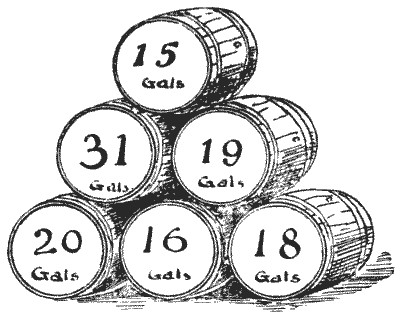
77.—DIGITS AND SQUARES.
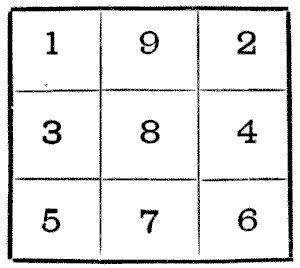
It will be seen in the diagram that we have so arranged the nine digits in a square that the number in the second row is twice that in the first row, and the number in the bottom row three times that in the top row. There are three other ways of arranging the digits so as to produce the same result. Can you find them?
78.—ODD AND EVEN DIGITS.
The odd digits, 1, 3, 5, 7, and 9, add up 25, while the even figures, 2, 4, 6, and 8, only add up 20. Arrange these figures so that the odd ones and the even ones add up alike. Complex and improper fractions and recurring decimals are not allowed.
79—THE LOCKERS PUZZLE.
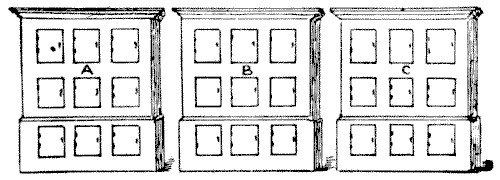
A man had in his office three cupboards, each containing nine lockers, as shown in the diagram. He told his clerk to place a different one-figure number on each locker of cupboard A, and to do the same in the case of B, and of C. As we are here allowed to call nought a digit, and he was not prohibited from using nought as a number, he clearly had the option of omitting any one of ten digits from each cupboard.
Now, the employer did not say the lockers were to be numbered in any numerical order, and he was surprised to find, when the work was done, that the figures had apparently been mixed up indiscriminately. Calling upon his clerk for an explanation, the eccentric lad stated that the notion had occurred to him so to arrange the figures that in each case they formed a simple addition sum, the two upper rows of figures producing the sum in the lowest row. But the most surprising point was this: that he had so arranged them that the addition in A gave the smallest possible sum, that the addition in C gave the largest possible sum, and that all the nine digits in the three totals were different. The puzzle is to show how this could be done. No decimals are allowed and the nought may not appear in the hundreds place.
80.—THE THREE GROUPS.
There appeared in "Nouvelles Annales de Mathématiques" the following puzzle as a modification of one of my "Canterbury Puzzles." Arrange the nine digits in three groups of two, three, and four digits, so that the first two numbers when multiplied together make the third. Thus, 12 × 483 = 5,796. I now also propose to include the cases where there are one, four, and four digits, such as 4 × 1,738 = 6,952. Can you find all the possible solutions in both cases?
81.—THE NINE COUNTERS.

I have nine counters, each bearing one of the nine digits, 1, 2, 3, 4, 5, 6, 7, 8 and 9. I arranged them on the table in two groups, as shown in the illustration, so as to form two multiplication sums, and found that both sums gave the same product. You will find that 158 multiplied by 23 is 3,634, and that 79 multiplied by 46 is also 3,634. Now, the puzzle I propose is to rearrange the counters so as to get as large a product as possible. What is the best way of placing them? Remember both groups must multiply to the same amount, and there must be three counters multiplied by two in one case, and two multiplied by two counters in the other, just as at present.
82.—THE TEN COUNTERS.
In this case we use the nought in addition to the 1, 2, 3, 4, 5, 6, 7, 8, 9. The puzzle is, as in the last case, so to arrange the ten counters that the products of the two multiplications shall be the same, and you may here have one or more figures in the multiplier, as you choose. The above is a very easy feat; but it is also required to find the two arrangements giving pairs of the highest and lowest products possible. Of course every counter must be used, and the cipher may not be placed to the left of a row of figures where it would have no effect. Vulgar fractions or decimals are not allowed.
83.—DIGITAL MULTIPLICATION.
Here is another entertaining problem with the nine digits, the nought being excluded. Using each figure once, and only once, we can form two multiplication sums that have the same product, and this may be done in many ways. For example, 7x658 and 14x329 contain all the digits once, and the product in each case is the same—4,606. Now, it will be seen that the sum of the digits in the product is 16, which is neither the highest nor the lowest sum so obtainable. Can you find the solution of the problem that gives the lowest possible sum of digits in the common product? Also that which gives the highest possible sum?
84.—THE PIERROT'S PUZZLE.
The Pierrot in the illustration is standing in a posture that represents the sign of multiplication. He is indicating the peculiar fact that 15 multiplied by 93 produces exactly the same figures (1,395), differently arranged. The puzzle is to take any four digits you like (all different) and similarly arrange them so that the number formed on one side of the Pierrot when multiplied by the number on the other side shall produce the same figures. There are very few ways of doing it, and I shall give all the cases possible. Can you find them all? You are allowed to put two figures on each side of the Pierrot as in the example shown, or to place a single figure on one side and three figures on the other. If we only used three digits instead of four, the only possible ways are these: 3 multiplied by 51 equals 153, and 6 multiplied by 21 equals 126.
85.—THE CAB NUMBERS.
A London policeman one night saw two cabs drive off in opposite directions under suspicious circumstances. This officer was a particularly careful and wide-awake man, and he took out his pocket-book to make an entry of the numbers of the cabs, but discovered that he had lost his pencil. Luckily, however, he found a small piece of chalk, with which he marked the two numbers on the gateway of a wharf close by. When he returned to the same spot on his beat he stood and looked again at the numbers, and noticed this peculiarity, that all the nine digits (no nought) were used and that no figure was repeated, but that if he multiplied the two numbers together they again produced the nine digits, all once, and once only. When one of the clerks arrived at the wharf in the early morning, he observed the chalk marks and carefully rubbed them out. As the policeman could not remember them, certain mathematicians were then consulted as to whether there was any known method for discovering all the pairs of numbers that have the peculiarity that the officer had noticed; but they knew of none. The investigation, however, was interesting, and the following question out of many was proposed: What two numbers, containing together all the nine digits, will, when multiplied together, produce another number (the highest possible) containing also all the nine digits? The nought is not allowed anywhere.
86.—QUEER MULTIPLICATION.
If I multiply 51,249,876 by 3 (thus using all the nine digits once, and once only), I get 153,749,628 (which again contains all the nine digits once). Similarly, if I multiply 16,583,742 by 9 the result is 149,253,678, where in each case all the nine digits are used. Now, take 6 as your multiplier and try to arrange the remaining eight digits so as to produce by multiplication a number containing all nine once, and once only. You will find it far from easy, but it can be done.
87.—THE NUMBER CHECKS PUZZLE.
Where a large number of workmen are employed on a building it is customary to provide every man with a little disc bearing his number. These are hung on a board by the men as they arrive, and serve as a check on punctuality. Now, I once noticed a foreman remove a number of these checks from his board and place them on a split-ring which he carried in his pocket. This at once gave me the idea for a good puzzle. In fact, I will confide to my readers that this is just how ideas for puzzles arise. You cannot really create an idea: it happens—and you have to be on the alert to seize it when it does so happen.
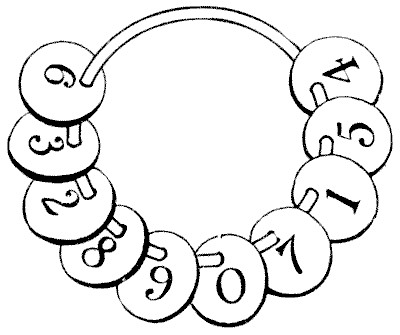
It will be seen from the illustration that there are ten of these checks on a ring, numbered 1 to 9 and 0. The puzzle is to divide them into three groups without taking any off the ring, so that the first group multiplied by the second makes the third group. For example, we can divide them into the three groups, 2—8 9 7—1 5 4 6 3, by bringing the 6 and the 3 round to the 4, but unfortunately the first two when multiplied together do not make the third. Can you separate them correctly? Of course you may have as many of the checks as you like in any group. The puzzle calls for some ingenuity, unless you have the luck to hit on the answer by chance.
88.—DIGITAL DIVISION.
It is another good puzzle so to arrange the nine digits (the nought excluded) into two groups so that one group when divided by the other produces a given number without remainder. For example, 1 3 4 5 8 divided by 6 7 2 9 gives 2. Can the reader find similar arrangements producing 3, 4, 5, 6, 7, 8, and 9 respectively? Also, can he find the pairs of smallest possible numbers in each case? Thus, 1 4 6 5 8 divided by 7 3 2 9 is just as correct for 2 as the other example we have given, but the numbers are higher.
89.—ADDING THE DIGITS.
If I write the sum of money, £987, 5s. 4½d.., and add up the digits, they sum to 36. No digit has thus been used a second time in the amount or addition. This is the largest amount possible under the conditions. Now find the smallest possible amount, pounds, shillings, pence, and farthings being all represented. You need not use more of the nine digits than you choose, but no digit may be repeated throughout. The nought is not allowed.
90.—THE CENTURY PUZZLE.
Can you write 100 in the form of a mixed number, using all the nine digits once, and only once? The late distinguished French mathematician, Edouard Lucas, found seven different ways of doing it, and expressed his doubts as to there being any other ways. As a matter of fact there are just eleven ways and no more. Here is one of them, 91 5742/638. Nine of the other ways have similarly two figures in the integral part of the number, but the eleventh expression has only one figure there. Can the reader find this last form?
91.—MORE MIXED FRACTIONS.
When I first published my solution to the last puzzle, I was led to attempt the expression of all numbers in turn up to 100 by a mixed fraction containing all the nine digits. Here are twelve numbers for the reader to try his hand at: 13, 14, 15, 16, 18, 20, 27, 36, 40, 69, 72, 94. Use every one of the nine digits once, and only once, in every case.
92.—DIGITAL SQUARE NUMBERS.
Here are the nine digits so arranged that they form four square numbers: 9, 81, 324, 576. Now, can you put them all together so as to form a single square number—(I) the smallest possible, and (II) the largest possible?
93.—THE MYSTIC ELEVEN.
Can you find the largest possible number containing any nine of the ten digits (calling nought a digit) that can be divided by 11 without a remainder? Can you also find the smallest possible number produced in the same way that is divisible by 11? Here is an example, where the digit 5 has been omitted: 896743012. This number contains nine of the digits and is divisible by 11, but it is neither the largest nor the smallest number that will work.
94.—THE DIGITAL CENTURY.
1 2 3 4 5 6 7 8 9 = 100.
It is required to place arithmetical signs between the nine figures so that they shall equal 100. Of course, you must not alter the present numerical arrangement of the figures. Can you give a correct solution that employs (1) the fewest possible signs, and (2) the fewest possible separate strokes or dots of the pen? That is, it is necessary to use as few signs as possible, and those signs should be of the simplest form. The signs of addition and multiplication (+ and ×) will thus count as two strokes, the sign of subtraction (-) as one stroke, the sign of division (÷) as three, and so on.
95.—THE FOUR SEVENS.

In the illustration Professor Rackbrane is seen demonstrating one of the little posers with which he is accustomed to entertain his class. He believes that by taking his pupils off the beaten tracks he is the better able to secure their attention, and to induce original and ingenious methods of thought. He has, it will be seen, just shown how four 5's may be written with simple arithmetical signs so as to represent 100. Every juvenile reader will see at a glance that his example is quite correct. Now, what he wants you to do is this: Arrange four 7's (neither more nor less) with arithmetical signs so that they shall represent 100. If he had said we were to use four 9's we might at once have written 999/9, but the four 7's call for rather more ingenuity. Can you discover the little trick?
96.—THE DICE NUMBERS.
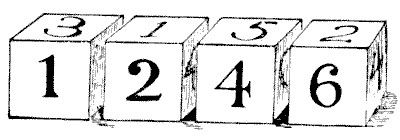
I have a set of four dice, not marked with spots in the ordinary way, but with Arabic figures, as shown in the illustration. Each die, of course, bears the numbers 1 to 6. When put together they will form a good many, different numbers. As represented they make the number 1246. Now, if I make all the different four-figure numbers that are possible with these dice (never putting the same figure more than once in any number), what will they all add up to? You are allowed to turn the 6 upside down, so as to represent a 9. I do not ask, or expect, the reader to go to all the labour of writing out the full list of numbers and then adding them up. Life is not long enough for such wasted energy. Can you get at the answer in any other way?
VARIOUS ARITHMETICAL AND ALGEBRAICAL PROBLEMS.
"Variety's the very spice of life, That gives it all its flavour." COWPER: The Task.
97.—THE SPOT ON THE TABLE.
A boy, recently home from school, wished to give his father an exhibition of his precocity. He pushed a large circular table into the corner of the room, as shown in the illustration, so that it touched both walls, and he then pointed to a spot of ink on the extreme edge.

"Here is a little puzzle for you, pater," said the youth. "That spot is exactly eight inches from one wall and nine inches from the other. Can you tell me the diameter of the table without measuring it?"
The boy was overheard to tell a friend, "It fairly beat the guv'nor;" but his father is known to have remarked to a City acquaintance that he solved the thing in his head in a minute. I often wonder which spoke the truth.
98.—ACADEMIC COURTESIES.
In a certain mixed school, where a special feature was made of the inculcation of good manners, they had a curious rule on assembling every morning. There were twice as many girls as boys. Every girl made a bow to every other girl, to every boy, and to the teacher. Every boy made a bow to every other boy, to every girl, and to the teacher. In all there were nine hundred bows made in that model academy every morning. Now, can you say exactly how many boys there were in the school? If you are not very careful, you are likely to get a good deal out in your calculation.
99.—THE THIRTY-THREE PEARLS.
"A man I know," said Teddy Nicholson at a certain family party, "possesses a string of thirty-three pearls. The middle pearl is the largest and best of all, and the others are so selected and arranged that, starting from one end, each successive pearl is worth £100 more than the preceding one, right up to the big pearl. From the other end the pearls increase in value by £150 up to the large pearl. The whole string is worth £65,000. What is the value of that large pearl?"
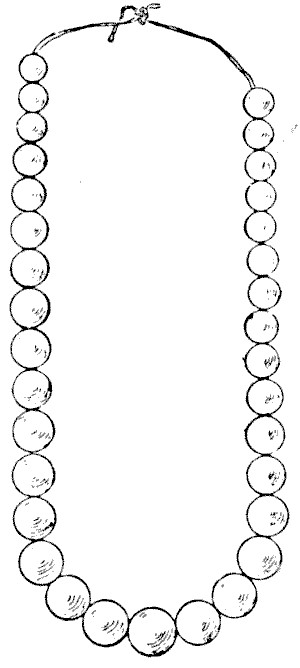
"Pearls and other articles of clothing," said Uncle Walter, when the price of the precious gem had been discovered, "remind me of Adam and Eve. Authorities, you may not know, differ as to the number of apples that were eaten by Adam and Eve. It is the opinion of some that Eve 8 (ate) and Adam 2 (too), a total of 10 only. But certain mathematicians have figured it out differently, and hold that Eve 8 and Adam a total of 16. Yet the most recent investigators think the above figures entirely wrong, for if Eve 8 and Adam 8 2, the total must be 90."
"Well," said Harry, "it seems to me that if there were giants in those days, probably Eve 8 1 and Adam 8 2, which would give a total of 163."
"I am not at all satisfied," said Maud. "It seems to me that if Eve 8 1 and Adam 8 1 2, they together consumed 893."
"I am sure you are all wrong," insisted Mr. Wilson, "for I consider that Eve 8 1 4 Adam, and Adam 8 1 2 4 Eve, so we get a total of 8,938."
"But, look here," broke in Herbert. "If Eve 8 1 4 Adam and Adam 8 1 2 4 2 oblige Eve, surely the total must have been 82,056!"
At this point Uncle Walter suggested that they might let the matter rest. He declared it to be clearly what mathematicians call an indeterminate problem.
100.—THE LABOURER'S PUZZLE.
Professor Rackbrane, during one of his rambles, chanced to come upon a man digging a deep hole.
"Good morning," he said. "How deep is that hole?"
"Guess," replied the labourer. "My height is exactly five feet ten inches."
"How much deeper are you going?" said the professor.
"I am going twice as deep," was the answer, "and then my head will be twice as far below ground as it is now above ground."
Rackbrane now asks if you could tell how deep that hole would be when finished.
101.—THE TRUSSES OF HAY.
Farmer Tompkins had five trusses of hay, which he told his man Hodge to weigh before delivering them to a customer. The stupid fellow weighed them two at a time in all possible ways, and informed his master that the weights in pounds were 110, 112, 113, 114, 115, 116, 117, 118, 120, and 121. Now, how was Farmer Tompkins to find out from these figures how much every one of the five trusses weighed singly? The reader may at first think that he ought to be told "which pair is which pair," or something of that sort, but it is quite unnecessary. Can you give the five correct weights?
102.—MR. GUBBINS IN A FOG.
Mr. Gubbins, a diligent man of business, was much inconvenienced by a London fog. The electric light happened to be out of order and he had to manage as best he could with two candles. His clerk assured him that though both were of the same length one candle would burn for four hours and the other for five hours. After he had been working some time he put the candles out as the fog had lifted, and he then noticed that what remained of one candle was exactly four times the length of what was left of the other.
When he got home that night Mr. Gubbins, who liked a good puzzle, said to himself, "Of course it is possible to work out just how long those two candles were burning to-day. I'll have a shot at it." But he soon found himself in a worse fog than the atmospheric one. Could you have assisted him in his dilemma? How long were the candles burning?
103.—PAINTING THE LAMP-POSTS.
Tim Murphy and Pat Donovan were engaged by the local authorities to paint the lamp-posts in a certain street. Tim, who was an early riser, arrived first on the job, and had painted three on the south side when Pat turned up and pointed out that Tim's contract was for the north side. So Tim started afresh on the north side and Pat continued on the south. When Pat had finished his side he went across the street and painted six posts for Tim, and then the job was finished. As there was an equal number of lamp-posts on each side of the street, the simple question is: Which man painted the more lamp-posts, and just how many more?
104.—CATCHING THE THIEF.
"Now, constable," said the defendant's counsel in cross-examination," you say that the prisoner was exactly twenty-seven steps ahead of you when you started to run after him?"
"Yes, sir."
"And you swear that he takes eight steps to your five?"
"That is so."
"Then I ask you, constable, as an intelligent man, to explain how you ever caught him, if that is the case?"
"Well, you see, I have got a longer stride. In fact, two of my steps are equal in length to five of the prisoner's. If you work it out, you will find that the number of steps I required would bring me exactly to the spot where I captured him."
Here the foreman of the jury asked for a few minutes to figure out the number of steps the constable must have taken. Can you also say how many steps the officer needed to catch the thief?
105.—THE PARISH COUNCIL ELECTION.
Here is an easy problem for the novice. At the last election of the parish council of Tittlebury-in-the-Marsh there were twenty-three candidates for nine seats. Each voter was qualified to vote for nine of these candidates or for any less number. One of the electors wants to know in just how many different ways it was possible for him to vote.
106.—THE MUDDLETOWN ELECTION.
At the last Parliamentary election at Muddletown 5,473 votes were polled. The Liberal was elected by a majority of 18 over the Conservative, by 146 over the Independent, and by 575 over the Socialist. Can you give a simple rule for figuring out how many votes were polled for each candidate?
107.—THE SUFFRAGISTS' MEETING.
At a recent secret meeting of Suffragists a serious difference of opinion arose. This led to a split, and a certain number left the meeting. "I had half a mind to go myself," said the chair-woman, "and if I had done so, two-thirds of us would have retired." "True," said another member; "but if I had persuaded my friends Mrs. Wild and Christine Armstrong to remain we should only have lost half our number." Can you tell how many were present at the meeting at the start?
108.—THE LEAP-YEAR LADIES.
Last leap-year ladies lost no time in exercising the privilege of making proposals of marriage. If the figures that reached me from an occult source are correct, the following represents the state of affairs in this country.
A number of women proposed once each, of whom one-eighth were widows. In consequence, a number of men were to be married of whom one-eleventh were widowers. Of the proposals made to widowers, one-fifth were declined. All the widows were accepted. Thirty-five forty-fourths of the widows married bachelors. One thousand two hundred and twenty-one spinsters were declined by bachelors. The number of spinsters accepted by bachelors was seven times the number of widows accepted by bachelors. Those are all the particulars that I was able to obtain. Now, how many women proposed?
109.—THE GREAT SCRAMBLE.
After dinner, the five boys of a household happened to find a parcel of sugar-plums. It was quite unexpected loot, and an exciting scramble ensued, the full details of which I will recount with accuracy, as it forms an interesting puzzle.
You see, Andrew managed to get possession of just two-thirds of the parcel of sugar-plums. Bob at once grabbed three-eighths of these, and Charlie managed to seize three-tenths also. Then young David dashed upon the scene, and captured all that Andrew had left, except one-seventh, which Edgar artfully secured for himself by a cunning trick. Now the fun began in real earnest, for Andrew and Charlie jointly set upon Bob, who stumbled against the fender and dropped half of all that he had, which were equally picked up by David and Edgar, who had crawled under a table and were waiting. Next, Bob sprang on Charlie from a chair, and upset all the latter's collection on to the floor. Of this prize Andrew got just a quarter, Bob gathered up one-third, David got two-sevenths, while Charlie and Edgar divided equally what was left of that stock.
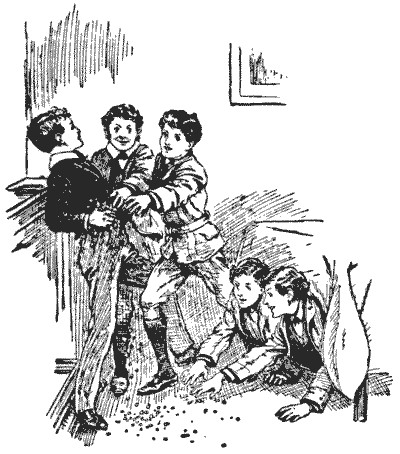
They were just thinking the fray was over when David suddenly struck out in two directions at once, upsetting three-quarters of what Bob and Andrew had last acquired. The two latter, with the greatest difficulty, recovered five-eighths of it in equal shares, but the three others each carried off one-fifth of the same. Every sugar-plum was now accounted for, and they called a truce, and divided equally amongst them the remainder of the parcel. What is the smallest number of sugar-plums there could have been at the start, and what proportion did each boy obtain?
110.—THE ABBOT'S PUZZLE.
The first English puzzlist whose name has come down to us was a Yorkshireman—no other than Alcuin, Abbot of Canterbury (A.D. 735-804). Here is a little puzzle from his works, which is at least interesting on account of its antiquity. "If 100 bushels of corn were distributed among 100 people in such a manner that each man received three bushels, each woman two, and each child half a bushel, how many men, women, and children were there?"
Now, there are six different correct answers, if we exclude a case where there would be no women. But let us say that there were just five times as many women as men, then what is the correct solution?
111.—REAPING THE CORN.
A farmer had a square cornfield. The corn was all ripe for reaping, and, as he was short of men, it was arranged that he and his son should share the work between them. The farmer first cut one rod wide all round the square, thus leaving a smaller square of standing corn in the middle of the field. "Now," he said to his son, "I have cut my half of the field, and you can do your share." The son was not quite satisfied as to the proposed division of labour, and as the village schoolmaster happened to be passing, he appealed to that person to decide the matter. He found the farmer was quite correct, provided there was no dispute as to the size of the field, and on this point they were agreed. Can you tell the area of the field, as that ingenious schoolmaster succeeded in doing?
112.—A PUZZLING LEGACY.
A man left a hundred acres of land to be divided among his three sons—Alfred, Benjamin, and Charles—in the proportion of one-third, one-fourth, and one-fifth respectively. But Charles died. How was the land to be divided fairly between Alfred and Benjamin?
113.—THE TORN NUMBER.
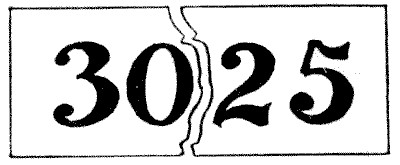
I had the other day in my possession a label bearing the number 3 0 2 5 in large figures. This got accidentally torn in half, so that 3 0 was on one piece and 2 5 on the other, as shown on the illustration. On looking at these pieces I began to make a calculation, scarcely conscious of what I was doing, when I discovered this little peculiarity. If we add the 3 and the 2 5 together and square the sum we get as the result the complete original number on the label! Thus, 30 added to 25 is 55, and 55 multiplied by 55 is 3025. Curious, is it not? Now, the puzzle is to find another number, composed of four figures, all different, which may be divided in the middle and produce the same result.
114.—CURIOUS NUMBERS.
The number 48 has this peculiarity, that if you add 1 to it the result is a square number (49, the square of 7), and if you add 1 to its half, you also get a square number (25, the square of 5). Now, there is no limit to the numbers that have this peculiarity, and it is an interesting puzzle to find three more of them—the smallest possible numbers. What are they?
115.—A PRINTER'S ERROR.
In a certain article a printer had to set up the figures 54 × 23, which, of course, means that the fourth power of 5 (625) is to be multiplied by the cube of 2 (8), the product of which is 5,000. But he printed 54 × 23 as 5 4 2 3, which is not correct. Can you place four digits in the manner shown, so that it will be equally correct if the printer sets it up aright or makes the same blunder?
116.—THE CONVERTED MISER.
Mr. Jasper Bullyon was one of the very few misers who have ever been converted to a sense of their duty towards their less fortunate fellow-men. One eventful night he counted out his accumulated wealth, and resolved to distribute it amongst the deserving poor.
He found that if he gave away the same number of pounds every day in the year, he could exactly spread it over a twelvemonth without there being anything left over; but if he rested on the Sundays, and only gave away a fixed number of pounds every weekday, there would be one sovereign left over on New Year's Eve. Now, putting it at the lowest possible, what was the exact number of pounds that he had to distribute?
Could any question be simpler? A sum of pounds divided by one number of days leaves no remainder, but divided by another number of days leaves a sovereign over. That is all; and yet, when you come to tackle this little question, you will be surprised that it can become so puzzling.
117.—A FENCE PROBLEM.
The practical usefulness of puzzles is a point that we are liable to overlook. Yet, as a matter of fact, I have from time to time received quite a large number of letters from individuals who have found that the mastering of some little principle upon which a puzzle was built has proved of considerable value to them in a most unexpected way. Indeed, it may be accepted as a good maxim that a puzzle is of little real value unless, as well as being amusing and perplexing, it conceals some instructive and possibly useful feature. It is, however, very curious how these little bits of acquired knowledge dovetail into the occasional requirements of everyday life, and equally curious to what strange and mysterious uses some of our readers seem to apply them. What, for example, can be the object of Mr. Wm. Oxley, who writes to me all the way from Iowa, in wishing to ascertain the dimensions of a field that he proposes to enclose, containing just as many acres as there shall be rails in the fence?
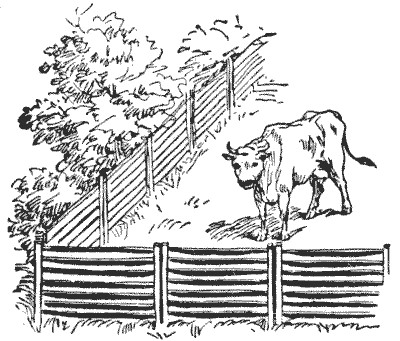
The man wishes to fence in a perfectly square field which is to contain just as many acres as there are rails in the required fence. Each hurdle, or portion of fence, is seven rails high, and two lengths would extend one pole (16½ ft.): that is to say, there are fourteen rails to the pole, lineal measure. Now, what must be the size of the field?
118.—CIRCLING THE SQUARES.
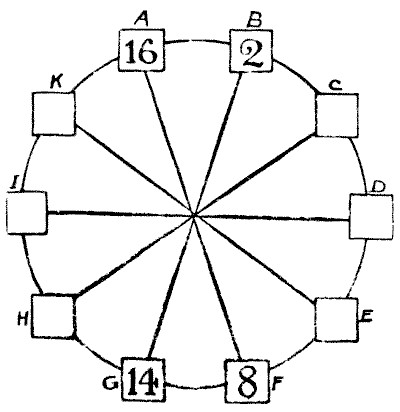
The puzzle is to place a different number in each of the ten squares so that the sum of the squares of any two adjacent numbers shall be equal to the sum of the squares of the two numbers diametrically opposite to them. The four numbers placed, as examples, must stand as they are. The square of 16 is 256, and the square of 2 is 4. Add these together, and the result is 260. Also—the square of 14 is 196, and the square of 8 is 64. These together also make 260. Now, in precisely the same way, B and C should be equal to G and H (the sum will not necessarily be 260), A and K to F and E, H and I to C and D, and so on, with any two adjoining squares in the circle.
All you have to do is to fill in the remaining six numbers. Fractions are not allowed, and I shall show that no number need contain more than two figures.
119.—RACKBRANE'S LITTLE LOSS.
Professor Rackbrane was spending an evening with his old friends, Mr. and Mrs. Potts, and they engaged in some game (he does not say what game) of cards. The professor lost the first game, which resulted in doubling the money that both Mr. and Mrs. Potts had laid on the table. The second game was lost by Mrs. Potts, which doubled the money then held by her husband and the professor. Curiously enough, the third game was lost by Mr. Potts, and had the effect of doubling the money then held by his wife and the professor. It was then found that each person had exactly the same money, but the professor had lost five shillings in the course of play. Now, the professor asks, what was the sum of money with which he sat down at the table? Can you tell him?
120.—THE FARMER AND HIS SHEEP.
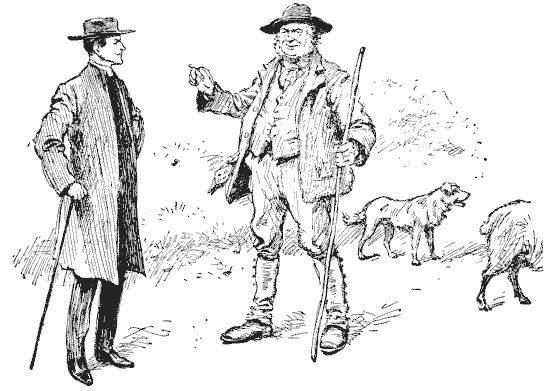
Farmer Longmore had a curious aptitude for arithmetic, and was known in his district as the "mathematical farmer." The new vicar was not aware of this fact when, meeting his worthy parishioner one day in the lane, he asked him in the course of a short conversation, "Now, how many sheep have you altogether?" He was therefore rather surprised at Longmore's answer, which was as follows: "You can divide my sheep into two different parts, so that the difference between the two numbers is the same as the difference between their squares. Maybe, Mr. Parson, you will like to work out the little sum for yourself."
Can the reader say just how many sheep the farmer had? Supposing he had possessed only twenty sheep, and he divided them into the two parts 12 and 8. Now, the difference between their squares, 144 and 64, is 80. So that will not do, for 4 and 80 are certainly not the same. If you can find numbers that work out correctly, you will know exactly how many sheep Farmer Longmore owned.
121.—HEADS OR TAILS.
Crooks, an inveterate gambler, at Goodwood recently said to a friend, "I'll bet you half the money in my pocket on the toss of a coin—heads I win, tails I lose." The coin was tossed and the money handed over. He repeated the offer again and again, each time betting half the money then in his possession. We are not told how long the game went on, or how many times the coin was tossed, but this we know, that the number of times that Crooks lost was exactly equal to the number of times that he won. Now, did he gain or lose by this little venture?
122.—THE SEE-SAW PUZZLE.
Necessity is, indeed, the mother of invention. I was amused the other day in watching a boy who wanted to play see-saw and, in his failure to find another child to share the sport with him, had been driven back upon the ingenious resort of tying a number of bricks to one end of the plank to balance his weight at the other.
As a matter of fact, he just balanced against sixteen bricks, when these were fixed to the short end of plank, but if he fixed them to the long end of plank he only needed eleven as balance.
Now, what was that boy's weight, if a brick weighs equal to a three-quarter brick and three-quarters of a pound?
123.—A LEGAL DIFFICULTY.
"A client of mine," said a lawyer, "was on the point of death when his wife was about to present him with a child. I drew up his will, in which he settled two-thirds of his estate upon his son (if it should happen to be a boy) and one-third on the mother. But if the child should be a girl, then two-thirds of the estate should go to the mother and one-third to the daughter. As a matter of fact, after his death twins were born—a boy and a girl. A very nice point then arose. How was the estate to be equitably divided among the three in the closest possible accordance with the spirit of the dead man's will?"
124.—A QUESTION OF DEFINITION.
"My property is exactly a mile square," said one landowner to another.
"Curiously enough, mine is a square mile," was the reply.
"Then there is no difference?"
Is this last statement correct?
125.—THE MINERS' HOLIDAY.
Seven coal-miners took a holiday at the seaside during a big strike. Six of the party spent exactly half a sovereign each, but Bill Harris was more extravagant. Bill spent three shillings more than the average of the party. What was the actual amount of Bill's expenditure?
126.—SIMPLE MULTIPLICATION.
If we number six cards 1, 2, 4, 5, 7, and 8, and arrange them on the table in this order:—
1 4 2 8 5 7
We can demonstrate that in order to multiply by 3 all that is necessary is to remove the 1 to the other end of the row, and the thing is done. The answer is 428571. Can you find a number that, when multiplied by 3 and divided by 2, the answer will be the same as if we removed the first card (which in this case is to be a 3) From the beginning of the row to the end?
127.—SIMPLE DIVISION.
Sometimes a very simple question in elementary arithmetic will cause a good deal of perplexity. For example, I want to divide the four numbers, 701, 1,059, 1,417, and 2,312, by the largest number possible that will leave the same remainder in every case. How am I to set to work Of course, by a laborious system of trial one can in time discover the answer, but there is quite a simple method of doing it if you can only find it.
128.—A PROBLEM IN SQUARES.
We possess three square boards. The surface of the first contains five square feet more than the second, and the second contains five square feet more than the third. Can you give exact measurements for the sides of the boards? If you can solve this little puzzle, then try to find three squares in arithmetical progression, with a common difference of 7 and also of 13.
129.—THE BATTLE OF HASTINGS.
All historians know that there is a great deal of mystery and uncertainty concerning the details of the ever-memorable battle on that fatal day, October 14, 1066. My puzzle deals with a curious passage in an ancient monkish chronicle that may never receive the attention that it deserves, and if I am unable to vouch for the authenticity of the document it will none the less serve to furnish us with a problem that can hardly fail to interest those of my readers who have arithmetical predilections. Here is the passage in question.
"The men of Harold stood well together, as their wont was, and formed sixty and one squares, with a like number of men in every square thereof, and woe to the hardy Norman who ventured to enter their redoubts; for a single blow of a Saxon war-hatchet would break his lance and cut through his coat of mail.... When Harold threw himself into the fray the Saxons were one mighty square of men, shouting the battle-cries, 'Ut!' 'Olicrosse!' 'Godemitè!'"
Now, I find that all the contemporary authorities agree that the Saxons did actually fight in this solid order. For example, in the "Carmen de Bello Hastingensi," a poem attributed to Guy, Bishop of Amiens, living at the time of the battle, we are told that "the Saxons stood fixed in a dense mass," and Henry of Huntingdon records that "they were like unto a castle, impenetrable to the Normans;" while Robert Wace, a century after, tells us the same thing. So in this respect my newly-discovered chronicle may not be greatly in error. But I have reason to believe that there is something wrong with the actual figures. Let the reader see what he can make of them.
The number of men would be sixty-one times a square number; but when Harold himself joined in the fray they were then able to form one large square. What is the smallest possible number of men there could have been?
In order to make clear to the reader the simplicity of the question, I will give the lowest solutions in the case of 60 and 62, the numbers immediately preceding and following 61. They are 60 × 42 + 1 = 312, and 62 × 82 + 1 = 632. That is, 60 squares of 16 men each would be 960 men, and when Harold joined them they would be 961 in number, and so form a square with 31 men on every side. Similarly in the case of the figures I have given for 62. Now, find the lowest answer for 61.
130.—THE SCULPTOR'S PROBLEM.
An ancient sculptor was commissioned to supply two statues, each on a cubical pedestal. It is with these pedestals that we are concerned. They were of unequal sizes, as will be seen in the illustration, and when the time arrived for payment a dispute arose as to whether the agreement was based on lineal or cubical measurement. But as soon as they came to measure the two pedestals the matter was at once settled, because, curiously enough, the number of lineal feet was exactly the same as the number of cubical feet. The puzzle is to find the dimensions for two pedestals having this peculiarity, in the smallest possible figures. You see, if the two pedestals, for example, measure respectively 3 ft. and 1 ft. on every side, then the lineal measurement would be 4 ft. and the cubical contents 28 ft., which are not the same, so these measurements will not do.
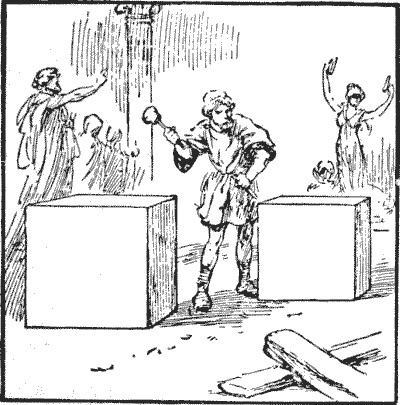
131.—THE SPANISH MISER.
There once lived in a small town in New Castile a noted miser named Don Manuel Rodriguez. His love of money was only equalled by a strong passion for arithmetical problems. These puzzles usually dealt in some way or other with his accumulated treasure, and were propounded by him solely in order that he might have the pleasure of solving them himself. Unfortunately very few of them have survived, and when travelling through Spain, collecting material for a proposed work on "The Spanish Onion as a Cause of National Decadence," I only discovered a very few. One of these concerns the three boxes that appear in the accompanying authentic portrait.
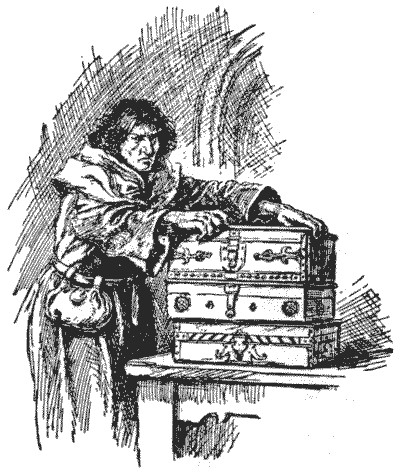
Each box contained a different number of golden doubloons. The difference between the number of doubloons in the upper box and the number in the middle box was the same as the difference between the number in the middle box and the number in the bottom box. And if the contents of any two of the boxes were united they would form a square number. What is the smallest number of doubloons that there could have been in any one of the boxes?
132.—THE NINE TREASURE BOXES.
The following puzzle will illustrate the importance on occasions of being able to fix the minimum and maximum limits of a required number. This can very frequently be done. For example, it has not yet been ascertained in how many different ways the knight's tour can be performed on the chess board; but we know that it is fewer than the number of combinations of 168 things taken 63 at a time and is greater than 31,054,144—for the latter is the number of routes of a particular type. Or, to take a more familiar case, if you ask a man how many coins he has in his pocket, he may tell you that he has not the slightest idea. But on further questioning you will get out of him some such statement as the following: "Yes, I am positive that I have more than three coins, and equally certain that there are not so many as twenty-five." Now, the knowledge that a certain number lies between 2 and 12 in my puzzle will enable the solver to find the exact answer; without that information there would be an infinite number of answers, from which it would be impossible to select the correct one.
This is another puzzle received from my friend Don Manuel Rodriguez, the cranky miser of New Castile. On New Year's Eve in 1879 he showed me nine treasure boxes, and after informing me that every box contained a square number of golden doubloons, and that the difference between the contents of A and B was the same as between B and C, D and E, E and F, G and H, or H and I, he requested me to tell him the number of coins in every one of the boxes. At first I thought this was impossible, as there would be an infinite number of different answers, but on consideration I found that this was not the case. I discovered that while every box contained coins, the contents of A, B, C increased in weight in alphabetical order; so did D, E, F; and so did G, H, I; but D or E need not be heavier than C, nor G or H heavier than F. It was also perfectly certain that box A could not contain more than a dozen coins at the outside; there might not be half that number, but I was positive that there were not more than twelve. With this knowledge I was able to arrive at the correct answer.
In short, we have to discover nine square numbers such that A, B, C; and D, E, F; and G, H, I are three groups in arithmetical progression, the common difference being the same in each group, and A being less than 12. How many doubloons were there in every one of the nine boxes?
133.—THE FIVE BRIGANDS.
The five Spanish brigands, Alfonso, Benito, Carlos, Diego, and Esteban, were counting their spoils after a raid, when it was found that they had captured altogether exactly 200 doubloons. One of the band pointed out that if Alfonso had twelve times as much, Benito three times as much, Carlos the same amount, Diego half as much, and Esteban one-third as much, they would still have altogether just 200 doubloons. How many doubloons had each?
There are a good many equally correct answers to this question. Here is one of them:
A
6
×
12
=
72
B
12
×
3
=
36
C
17
×
1
=
17
D
120
×
½
=
60
E
45
×
1/
3=
15
200
200
The puzzle is to discover exactly how many different answers there are, it being understood that every man had something and that there is to be no fractional money—only doubloons in every case.
This problem, worded somewhat differently, was propounded by Tartaglia (died 1559), and he flattered himself that he had found one solution; but a French mathematician of note (M.A. Labosne), in a recent work, says that his readers will be astonished when he assures them that there are 6,639 different correct answers to the question. Is this so? How many answers are there?
134.—THE BANKER'S PUZZLE.
A banker had a sporting customer who was always anxious to wager on anything. Hoping to cure him of his bad habit, he proposed as a wager that the customer would not be able to divide up the contents of a box containing only sixpences into an exact number of equal piles of sixpences. The banker was first to put in one or more sixpences (as many as he liked); then the customer was to put in one or more (but in his case not more than a pound in value), neither knowing what the other put in. Lastly, the customer was to transfer from the banker's counter to the box as many sixpences as the banker desired him to put in. The puzzle is to find how many sixpences the banker should first put in and how many he should ask the customer to transfer, so that he may have the best chance of winning.
135.—THE STONEMASON'S PROBLEM.
A stonemason once had a large number of cubic blocks of stone in his yard, all of exactly the same size. He had some very fanciful little ways, and one of his queer notions was to keep these blocks piled in cubical heaps, no two heaps containing the same number of blocks. He had discovered for himself (a fact that is well known to mathematicians) that if he took all the blocks contained in any number of heaps in regular order, beginning with the single cube, he could always arrange those on the ground so as to form a perfect square. This will be clear to the reader, because one block is a square, 1 + 8 = 9 is a square, 1 + 8 + 27 = 36 is a square, 1 + 8 + 27 + 64 = 100 is a square, and so on. In fact, the sum of any number of consecutive cubes, beginning always with 1, is in every case a square number.
One day a gentleman entered the mason's yard and offered him a certain price if he would supply him with a consecutive number of these cubical heaps which should contain altogether a number of blocks that could be laid out to form a square, but the buyer insisted on more than three heaps and declined to take the single block because it contained a flaw. What was the smallest possible number of blocks of stone that the mason had to supply?
136.—THE SULTAN'S ARMY.
A certain Sultan wished to send into battle an army that could be formed into two perfect squares in twelve different ways. What is the smallest number of men of which that army could be composed? To make it clear to the novice, I will explain that if there were 130 men, they could be formed into two squares in only two different ways—81 and 49, or 121 and 9. Of course, all the men must be used on every occasion.
137.—A STUDY IN THRIFT.
Certain numbers are called triangular, because if they are taken to represent counters or coins they may be laid out on the table so as to form triangles. The number 1 is always regarded as triangular, just as 1 is a square and a cube number. Place one counter on the table—that is, the first triangular number. Now place two more counters beneath it, and you have a triangle of three counters; therefore 3 is triangular. Next place a row of three more counters, and you have a triangle of six counters; therefore 6 is triangular. We see that every row of counters that we add, containing just one more counter than the row above it, makes a larger triangle.
Now, half the sum of any number and its square is always a triangular number. Thus half of 2 + 22 = 3; half of 3 + 32 = 6; half of 4 + 42 = 10; half of 5 + 52= 15; and so on. So if we want to form a triangle with 8 counters on each side we shall require half of 8 + 82, or 36 counters. This is a pretty little property of numbers. Before going further, I will here say that if the reader refers to the "Stonemason's Problem" (No. 135) he will remember that the sum of any number of consecutive cubes beginning with 1 is always a square, and these form the series 12, 32, 62, 102, etc. It will now be understood when I say that one of the keys to the puzzle was the fact that these are always the squares of triangular numbers—that is, the squares of 1, 3, 6, 10, 15, 21, 28, etc., any of which numbers we have seen will form a triangle.
Every whole number is either triangular, or the sum of two triangular numbers or the sum of three triangular numbers. That is, if we take any number we choose we can always form one, two, or three triangles with them. The number 1 will obviously, and uniquely, only form one triangle; some numbers will only form two triangles (as 2, 4, 11, etc.); some numbers will only form three triangles (as 5, 8, 14, etc.). Then, again, some numbers will form both one and two triangles (as 6), others both one and three triangles (as 3 and 10), others both two and three triangles (as 7 and 9), while some numbers (like 21) will form one, two, or three triangles, as we desire. Now for a little puzzle in triangular numbers.
Sandy McAllister, of Aberdeen, practised strict domestic economy, and was anxious to train his good wife in his own habits of thrift. He told her last New Year's Eve that when she had saved so many sovereigns that she could lay them all out on the table so as to form a perfect square, or a perfect triangle, or two triangles, or three triangles, just as he might choose to ask he would add five pounds to her treasure. Soon she went to her husband with a little bag of £36 in sovereigns and claimed her reward. It will be found that the thirty-six coins will form a square (with side 6), that they will form a single triangle (with side 8), that they will form two triangles (with sides 5 and 6), and that they will form three triangles (with sides 3, 5, and 5). In each of the four cases all the thirty-six coins are used, as required, and Sandy therefore made his wife the promised present like an honest man.
The Scotsman then undertook to extend his promise for five more years, so that if next year the increased number of sovereigns that she has saved can be laid out in the same four different ways she will receive a second present; if she succeeds in the following year she will get a third present, and so on until she has earned six presents in all. Now, how many sovereigns must she put together before she can win the sixth present?
What you have to do is to find five numbers, the smallest possible, higher than 36, that can be displayed in the four ways—to form a square, to form a triangle, to form two triangles, and to form three triangles. The highest of your five numbers will be your answer.
138.—THE ARTILLERYMEN'S DILEMMA.

"All cannon-balls are to be piled in square pyramids," was the order issued to the regiment. This was done. Then came the further order, "All pyramids are to contain a square number of balls." Whereupon the trouble arose. "It can't be done," said the major. "Look at this pyramid, for example; there are sixteen balls at the base, then nine, then four, then one at the top, making thirty balls in all. But there must be six more balls, or five fewer, to make a square number." "It must be done," insisted the general. "All you have to do is to put the right number of balls in your pyramids." "I've got it!" said a lieutenant, the mathematical genius of the regiment. "Lay the balls out singly." "Bosh!" exclaimed the general. "You can't pile one ball into a pyramid!" Is it really possible to obey both orders?
139.—THE DUTCHMEN'S WIVES.
I wonder how many of my readers are acquainted with the puzzle of the "Dutchmen's Wives"—in which you have to determine the names of three men's wives, or, rather, which wife belongs to each husband. Some thirty years ago it was "going the rounds," as something quite new, but I recently discovered it in the Ladies' Diary for 1739-40, so it was clearly familiar to the fair sex over one hundred and seventy years ago. How many of our mothers, wives, sisters, daughters, and aunts could solve the puzzle to-day? A far greater proportion than then, let us hope.
Three Dutchmen, named Hendrick, Elas, and Cornelius, and their wives, Gurtrün, Katrün, and Anna, purchase hogs. Each buys as many as he (or she) gives shillings for one. Each husband pays altogether three guineas more than his wife. Hendrick buys twenty-three more hogs than Katrün, and Elas eleven more than Gurtrün. Now, what was the name of each man's wife?
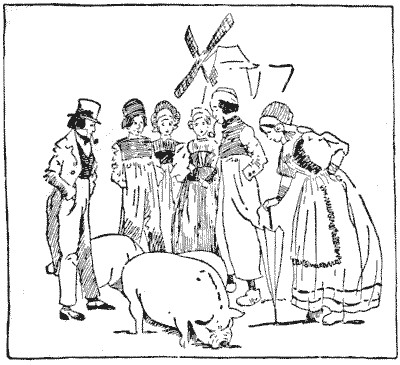
140.—FIND ADA'S SURNAME.
This puzzle closely resembles the last one, my remarks on the solution of which the reader may like to apply in another case. It was recently submitted to a Sydney evening newspaper that indulges in "intellect sharpeners," but was rejected with the remark that it is childish and that they only published problems capable of solution! Five ladies, accompanied by their daughters, bought cloth at the same shop. Each of the ten paid as many farthings per foot as she bought feet, and each mother spent 8s. 5¼d. more than her daughter. Mrs. Robinson spent 6s. more than Mrs. Evans, who spent about a quarter as much as Mrs. Jones. Mrs. Smith spent most of all. Mrs. Brown bought 21 yards more than Bessie—one of the girls. Annie bought 16 yards more than Mary and spent £3, 0s. 8d. more than Emily. The Christian name of the other girl was Ada. Now, what was her surname?
141.—SATURDAY MARKETING.
Here is an amusing little case of marketing which, although it deals with a good many items of money, leads up to a question of a totally different character. Four married couples went into their village on a recent Saturday night to do a little marketing. They had to be very economical, for among them they only possessed forty shilling coins. The fact is, Ann spent 1s., Mary spent 2s., Jane spent 3s., and Kate spent 4s. The men were rather more extravagant than their wives, for Ned Smith spent as much as his wife, Tom Brown twice as much as his wife, Bill Jones three times as much as his wife, and Jack Robinson four times as much as his wife. On the way home somebody suggested that they should divide what coin they had left equally among them. This was done, and the puzzling question is simply this: What was the surname of each woman? Can you pair off the four couples?
GEOMETRICAL PROBLEMS.
"God geometrizes continually." PLATO.
"There is no study," said Augustus de Morgan, "which presents so simple a beginning as that of geometry; there is none in which difficulties grow more rapidly as we proceed." This will be found when the reader comes to consider the following puzzles, though they are not arranged in strict order of difficulty. And the fact that they have interested and given pleasure to man for untold ages is no doubt due in some measure to the appeal they make to the eye as well as to the brain. Sometimes an algebraical formula or theorem seems to give pleasure to the mathematician's eye, but it is probably only an intellectual pleasure. But there can be no doubt that in the case of certain geometrical problems, notably dissection or superposition puzzles, the æsthetic faculty in man contributes to the delight. For example, there are probably few readers who will examine the various cuttings of the Greek cross in the following pages without being in some degree stirred by a sense of beauty. Law and order in Nature are always pleasing to contemplate, but when they come under the very eye they seem to make a specially strong appeal. Even the person with no geometrical knowledge whatever is induced after the inspection of such things to exclaim, "How very pretty!" In fact, I have known more than one person led on to a study of geometry by the fascination of cutting-out puzzles. I have, therefore, thought it well to keep these dissection puzzles distinct from the geometrical problems on more general lines.
DISSECTION PUZZLES.
"Take him and cut him out in little stars."
Romeo and Juliet, iii. 2.
Puzzles have infinite variety, but perhaps there is no class more ancient than dissection, cutting-out, or superposition puzzles. They were certainly known to the Chinese several thousand years before the Christian era. And they are just as fascinating to-day as they can have been at any period of their history. It is supposed by those who have investigated the matter that the ancient Chinese philosophers used these puzzles as a sort of kindergarten method of imparting the principles of geometry. Whether this was so or not, it is certain that all good dissection puzzles (for the nursery type of jig-saw puzzle, which merely consists in cutting up a picture into pieces to be put together again, is not worthy of serious consideration) are really based on geometrical laws. This statement need not, however, frighten off the novice, for it means little more than this, that geometry will give us the "reason why," if we are interested in knowing it, though the solutions may often be discovered by any intelligent person after the exercise of patience, ingenuity, and common sagacity.
If we want to cut one plane figure into parts that by readjustment will form another figure, the first thing is to find a way of doing it at all, and then to discover how to do it in the fewest possible pieces. Often a dissection problem is quite easy apart from this limitation of pieces. At the time of the publication in the Weekly Dispatch, in 1902, of a method of cutting an equilateral triangle into four parts that will form a square (see No. 26, "Canterbury Puzzles"), no geometrician would have had any difficulty in doing what is required in five pieces: the whole point of the discovery lay in performing the little feat in four pieces only.
Mere approximations in the case of these problems are valueless; the solution must be geometrically exact, or it is not a solution at all. Fallacies are cropping up now and again, and I shall have occasion to refer to one or two of these. They are interesting merely as fallacies. But I want to say something on two little points that are always arising in cutting-out puzzles—the questions of "hanging by a thread" and "turning over." These points can best be illustrated by a puzzle that is frequently to be found in the old books, but invariably with a false solution. The puzzle is to cut the figure shown in Fig. 1 into three pieces that will fit together and form a half-square triangle. The answer that is invariably given is that shown in Figs. 1 and 2. Now, it is claimed that the four pieces marked C are really only one piece, because they may be so cut that they are left "hanging together by a mere thread." But no serious puzzle lover will ever admit this. If the cut is made so as to leave the four pieces joined in one, then it cannot result in a perfectly exact solution. If, on the other hand, the solution is to be exact, then there will be four pieces—or six pieces in all. It is, therefore, not a solution in three pieces.

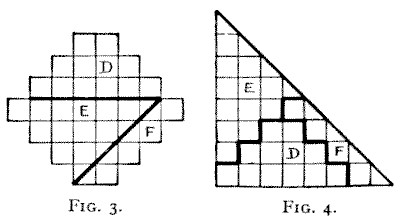
If, however, the reader will look at the solution in Figs. 3 and 4, he will see that no such fault can be found with it. There is no question whatever that there are three pieces, and the solution is in this respect quite satisfactory. But another question arises. It will be found on inspection that the piece marked F, in Fig. 3, is turned over in Fig. 4—that is to say, a different side has necessarily to be presented. If the puzzle were merely to be cut out of cardboard or wood, there might be no objection to this reversal, but it is quite possible that the material would not admit of being reversed. There might be a pattern, a polish, a difference of texture, that prevents it. But it is generally understood that in dissection puzzles you are allowed to turn pieces over unless it is distinctly stated that you may not do so. And very often a puzzle is greatly improved by the added condition, "no piece may be turned over." I have often made puzzles, too, in which the diagram has a small repeated pattern, and the pieces have then so to be cut that not only is there no turning over, but the pattern has to be matched, which cannot be done if the pieces are turned round, even with the proper side uppermost.
Before presenting a varied series of cutting-out puzzles, some very easy and others difficult, I propose to consider one family alone—those problems involving what is known as the Greek cross with the square. This will exhibit a great variety of curious transpositions, and, by having the solutions as we go along, the reader will be saved the trouble of perpetually turning to another part of the book, and will have everything under his eye. It is hoped that in this way the article may prove somewhat instructive to the novice and interesting to others.
GREEK CROSS PUZZLES.
"To fret thy soul with crosses."
SPENSER.
"But, for my part, it was Greek to me."
Julius Cæsar, i. 2.
Many people are accustomed to consider the cross as a wholly Christian symbol. This is erroneous: it is of very great antiquity. The ancient Egyptians employed it as a sacred symbol, and on Greek sculptures we find representations of a cake (the supposed real origin of our hot cross buns) bearing a cross. Two such cakes were discovered at Herculaneum. Cecrops offered to Jupiter Olympus a sacred cake or boun of this kind. The cross and ball, so frequently found on Egyptian figures, is a circle and the tau cross. The circle signified the eternal preserver of the world, and the T, named from the Greek letter tau, is the monogram of Thoth, the Egyptian Mercury, meaning wisdom. This tau cross is also called by Christians the cross of St. Anthony, and is borne on a badge in the bishop's palace at Exeter. As for the Greek or mundane cross, the cross with four equal arms, we are told by competent antiquaries that it was regarded by ancient occultists for thousands of years as a sign of the dual forces of Nature—the male and female spirit of everything that was everlasting.


The Greek cross, as shown in Fig. 5, is formed by the assembling together of five equal squares. We will start with what is known as the Hindu problem, supposed to be upwards of three thousand years old. It appears in the seal of Harvard College, and is often given in old works as symbolical of mathematical science and exactitude. Cut the cross into five pieces to form a square. Figs. 6 and 7 show how this is done. It was not until the middle of the nineteenth century that we found that the cross might be transformed into a square in only four pieces. Figs. 8 and 9 will show how to do it, if we further require the four pieces to be all of the same size and shape. This Fig. 9 is remarkable because, according to Dr. Le Plongeon and others, as expounded in a work by Professor Wilson of the Smithsonian Institute, here we have the great Swastika, or sign, of "good luck to you "—the most ancient symbol of the human race of which there is any record. Professor Wilson's work gives some four hundred illustrations of this curious sign as found in the Aztec mounds of Mexico, the pyramids of Egypt, the ruins of Troy, and the ancient lore of India and China. One might almost say there is a curious affinity between the Greek cross and Swastika! If, however, we require that the four pieces shall be produced by only two clips of the scissors (assuming the puzzle is in paper form), then we must cut as in Fig. 10 to form Fig. 11, the first clip of the scissors being from a to b. Of course folding the paper, or holding the pieces together after the first cut, would not in this case be allowed. But there is an infinite number of different ways of making the cuts to solve the puzzle in four pieces. To this point I propose to return.

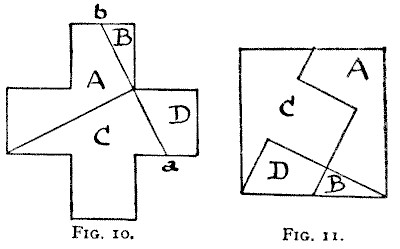
It will be seen that every one of these puzzles has its reverse puzzle—to cut a square into pieces to form a Greek cross. But as a square has not so many angles as the cross, it is not always equally easy to discover the true directions of the cuts. Yet in the case of the examples given, I will leave the reader to determine their direction for himself, as they are rather obvious from the diagrams.
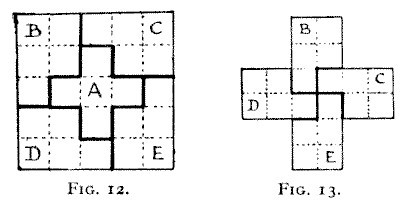
Cut a square into five pieces that will form two separate Greek crosses of different sizes. This is quite an easy puzzle. As will be seen in Fig. 12, we have only to divide our square into 25 little squares and then cut as shown. The cross A is cut out entire, and the pieces B, C, D, and E form the larger cross in Fig. 13. The reader may here like to cut the single piece, B, into four pieces all similar in shape to itself, and form a cross with them in the manner shown in Fig. 13. I hardly need give the solution.
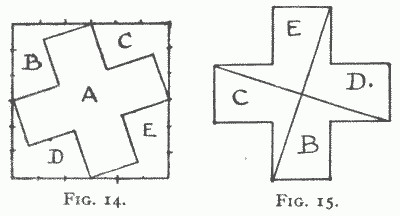
Cut a square into five pieces that will form two separate Greek crosses of exactly the same size. This is more difficult. We make the cuts as in Fig. 14, where the cross A comes out entire and the other four pieces form the cross in Fig. 15. The direction of the cuts is pretty obvious. It will be seen that the sides of the square in Fig. 14 are marked off into six equal parts. The sides of the cross are found by ruling lines from certain of these points to others.
I will now explain, as I promised, why a Greek cross may be cut into four pieces in an infinite number of different ways to make a square. Draw a cross, as in Fig. 16. Then draw on transparent paper the square shown in Fig. 17, taking care that the distance c to d is exactly the same as the distance a to b in the cross. Now place the transparent paper over the cross and slide it about into different positions, only be very careful always to keep the square at the same angle to the cross as shown, where a b is parallel to c d. If you place the point c exactly over a the lines will indicate the solution (Figs. 10 and 11). If you place c in the very centre of the dotted square, it will give the solution in Figs. 8 and 9. You will now see that by sliding the square about so that the point c is always within the dotted square you may get as many different solutions as you like; because, since an infinite number of different points may theoretically be placed within this square, there must be an infinite number of different solutions. But the point c need not necessarily be placed within the dotted square. It may be placed, for example, at point e to give a solution in four pieces. Here the joins at a and f may be as slender as you like. Yet if you once get over the edge at a or f you no longer have a solution in four pieces. This proof will be found both entertaining and instructive. If you do not happen to have any transparent paper at hand, any thin paper will of course do if you hold the two sheets against a pane of glass in the window.
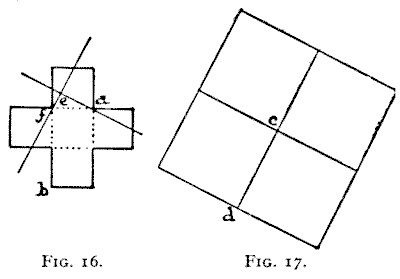
It may have been noticed from the solutions of the puzzles that I have given that the side of the square formed from the cross is always equal to the distance a to b in Fig. 16. This must necessarily be so, and I will presently try to make the point quite clear.
We will now go one step further. I have already said that the ideal solution to a cutting-out puzzle is always that which requires the fewest possible pieces. We have just seen that two crosses of the same size may be cut out of a square in five pieces. The reader who succeeded in solving this perhaps asked himself: "Can it be done in fewer pieces?" This is just the sort of question that the true puzzle lover is always asking, and it is the right attitude for him to adopt. The answer to the question is that the puzzle may be solved in four pieces—the fewest possible. This, then, is a new puzzle. Cut a square into four pieces that will form two Greek crosses of the same size.
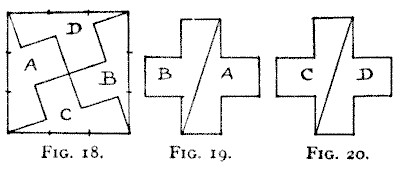
The solution is very beautiful. If you divide by points the sides of the square into three equal parts, the directions of the lines in Fig. 18 will be quite obvious. If you cut along these lines, the pieces A and B will form the cross in Fig. 19 and the pieces C and D the similar cross in Fig. 20. In this square we have another form of Swastika.
The reader will here appreciate the truth of my remark to the effect that it is easier to find the directions of the cuts when transforming a cross to a square than when converting a square into a cross. Thus, in Figs. 6, 8, and 10 the directions of the cuts are more obvious than in Fig. 14, where we had first to divide the sides of the square into six equal parts, and in Fig. 18, where we divide them into three equal parts. Then, supposing you were required to cut two equal Greek crosses, each into two pieces, to form a square, a glance at Figs. 19 and 20 will show how absurdly more easy this is than the reverse puzzle of cutting the square to make two crosses.
Referring to my remarks on "fallacies," I will now give a little example of these "solutions" that are not solutions. Some years ago a young correspondent sent me what he evidently thought was a brilliant new discovery—the transforming of a square into a Greek cross in four pieces by cuts all parallel to the sides of the square. I give his attempt in Figs. 21 and 22, where it will be seen that the four pieces do not form a symmetrical Greek cross, because the four arms are not really squares but oblongs. To make it a true Greek cross we should require the additions that I have indicated with dotted lines. Of course his solution produces a cross, but it is not the symmetrical Greek variety required by the conditions of the puzzle. My young friend thought his attempt was "near enough" to be correct; but if he bought a penny apple with a sixpence he probably would not have thought it "near enough" if he had been given only fourpence change. As the reader advances he will realize the importance of this question of exactitude.
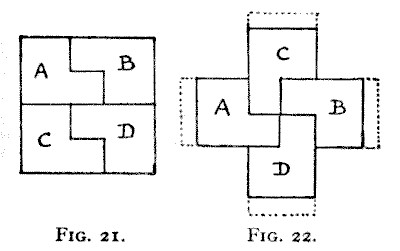
In these cutting-out puzzles it is necessary not only to get the directions of the cutting lines as correct as possible, but to remember that these lines have no width. If after cutting up one of the crosses in a manner indicated in these articles you find that the pieces do not exactly fit to form a square, you may be certain that the fault is entirely your own. Either your cross was not exactly drawn, or your cuts were not made quite in the right directions, or (if you used wood and a fret-saw) your saw was not sufficiently fine. If you cut out the puzzles in paper with scissors, or in cardboard with a penknife, no material is lost; but with a saw, however fine, there is a certain loss. In the case of most puzzles this slight loss is not sufficient to be appreciable, if the puzzle is cut out on a large scale, but there have been instances where I have found it desirable to draw and cut out each part separately—not from one diagram—in order to produce a perfect result.
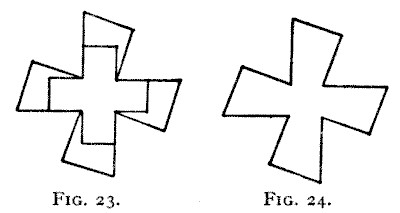
Now for another puzzle. If you have cut out the five pieces indicated in Fig. 14, you will find that these can be put together so as to form the curious cross shown in Fig. 23. So if I asked you to cut Fig. 24 into five pieces to form either a square or two equal Greek crosses you would know how to do it. You would make the cuts as in Fig. 23, and place them together as in Figs. 14 and 15. But I want something better than that, and it is this. Cut Fig. 24 into only four pieces that will fit together and form a square.
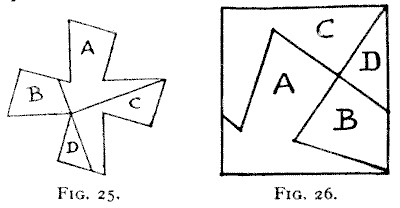
The solution to the puzzle is shown in Figs. 25 and 26. The direction of the cut dividing A and C in the first diagram is very obvious, and the second cut is made at right angles to it. That the four pieces should fit together and form a square will surprise the novice, who will do well to study the puzzle with some care, as it is most instructive.
I will now explain the beautiful rule by which we determine the size of a square that shall have the same area as a Greek cross, for it is applicable, and necessary, to the solution of almost every dissection puzzle that we meet with. It was first discovered by the philosopher Pythagoras, who died 500 B.C., and is the 47th proposition of Euclid. The young reader who knows nothing of the elements of geometry will get some idea of the fascinating character of that science. The triangle ABC in Fig. 27 is what we call a right-angled triangle, because the side BC is at right angles to the side AB. Now if we build up a square on each side of the triangle, the squares on AB and BC will together be exactly equal to the square on the long side AC, which we call the hypotenuse. This is proved in the case I have given by subdividing the three squares into cells of equal dimensions.
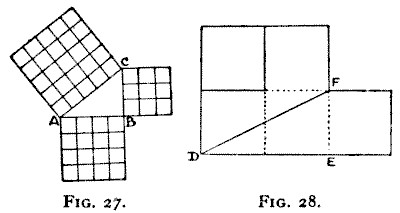
It will be seen that 9 added to 16 equals 25, the number of cells in the large square. If you make triangles with the sides 5, 12 and 13, or with 8, 15 and 17, you will get similar arithmetical proofs, for these are all "rational" right-angled triangles, but the law is equally true for all cases. Supposing we cut off the lower arm of a Greek cross and place it to the left of the upper arm, as in Fig. 28, then the square on EF added to the square on DE exactly equals a square on DF. Therefore we know that the square of DF will contain the same area as the cross. This fact we have proved practically by the solutions of the earlier puzzles of this series. But whatever length we give to DE and EF, we can never give the exact length of DF in numbers, because the triangle is not a "rational" one. But the law is none the less geometrically true.
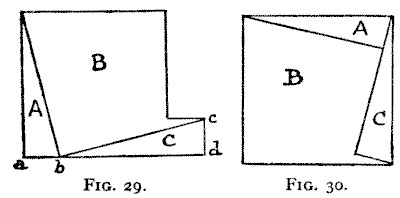
Now look at Fig. 29, and you will see an elegant method for cutting a piece of wood of the shape of two squares (of any relative dimensions) into three pieces that will fit together and form a single square. If you mark off the distance ab equal to the side cd the directions of the cuts are very evident. From what we have just been considering, you will at once see why bc must be the length of the side of the new square. Make the experiment as often as you like, taking different relative proportions for the two squares, and you will find the rule always come true. If you make the two squares of exactly the same size, you will see that the diagonal of any square is always the side of a square that is twice the size. All this, which is so simple that anybody can understand it, is very essential to the solving of cutting-out puzzles. It is in fact the key to most of them. And it is all so beautiful that it seems a pity that it should not be familiar to everybody.
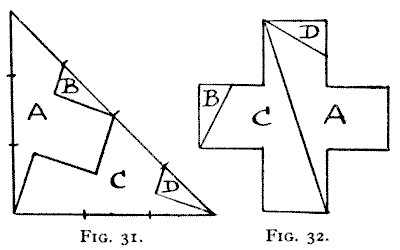
We will now go one step further and deal with the half-square. Take a square and cut it in half diagonally. Now try to discover how to cut this triangle into four pieces that will form a Greek cross. The solution is shown in Figs. 31 and 32. In this case it will be seen that we divide two of the sides of the triangle into three equal parts and the long side into four equal parts. Then the direction of the cuts will be easily found. It is a pretty puzzle, and a little more difficult than some of the others that I have given. It should be noted again that it would have been much easier to locate the cuts in the reverse puzzle of cutting the cross to form a half-square triangle.

Another ideal that the puzzle maker always keeps in mind is to contrive that there shall, if possible, be only one correct solution. Thus, in the case of the first puzzle, if we only require that a Greek cross shall be cut into four pieces to form a square, there is, as I have shown, an infinite number of different solutions. It makes a better puzzle to add the condition that all the four pieces shall be of the same size and shape, because it can then be solved in only one way, as in Figs. 8 and 9. In this way, too, a puzzle that is too easy to be interesting may be improved by such an addition. Let us take an example. We have seen in Fig. 28 that Fig. 33 can be cut into two pieces to form a Greek cross. I suppose an intelligent child would do it in five minutes. But suppose we say that the puzzle has to be solved with a piece of wood that has a bad knot in the position shown in Fig. 33—a knot that we must not attempt to cut through—then a solution in two pieces is barred out, and it becomes a more interesting puzzle to solve it in three pieces. I have shown in Figs. 33 and 34 one way of doing this, and it will be found entertaining to discover other ways of doing it. Of course I could bar out all these other ways by introducing more knots, and so reduce the puzzle to a single solution, but it would then be overloaded with conditions.
And this brings us to another point in seeking the ideal. Do not overload your conditions, or you will make your puzzle too complex to be interesting. The simpler the conditions of a puzzle are, the better. The solution may be as complex and difficult as you like, or as happens, but the conditions ought to be easily understood, or people will not attempt a solution.
If the reader were now asked "to cut a half-square into as few pieces as possible to form a Greek cross," he would probably produce our solution, Figs. 31-32, and confidently claim that he had solved the puzzle correctly. In this way he would be wrong, because it is not now stated that the square is to be divided diagonally. Although we should always observe the exact conditions of a puzzle we must not read into it conditions that are not there. Many puzzles are based entirely on the tendency that people have to do this.
The very first essential in solving a puzzle is to be sure that you understand the exact conditions. Now, if you divided your square in half so as to produce Fig. 35 it is possible to cut it into as few as three pieces to form a Greek cross. We thus save a piece.

I give another puzzle in Fig. 36. The dotted lines are added merely to show the correct proportions of the figure—a square of 25 cells with the four corner cells cut out. The puzzle is to cut this figure into five pieces that will form a Greek cross (entire) and a square.
The solution to the first of the two puzzles last given—to cut a rectangle of the shape of a half-square into three pieces that will form a Greek cross—is shown in Figs. 37 and 38. It will be seen that we divide the long sides of the oblong into six equal parts and the short sides into three equal parts, in order to get the points that will indicate the direction of the cuts. The reader should compare this solution with some of the previous illustrations. He will see, for example, that if we continue the cut that divides B and C in the cross, we get Fig. 15.
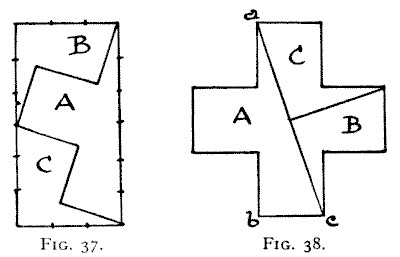
The other puzzle, like the one illustrated in Figs. 12 and 13, will show how useful a little arithmetic may sometimes prove to be in the solution of dissection puzzles. There are twenty-one of those little square cells into which our figure is subdivided, from which we have to form both a square and a Greek cross. Now, as the cross is built up of five squares, and 5 from 21 leaves 16—a square number—we ought easily to be led to the solution shown in Fig. 39. It will be seen that the cross is cut out entire, while the four remaining pieces form the square in Fig. 40.
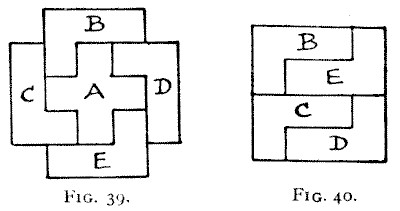
Of course a half-square rectangle is the same as a double square, or two equal squares joined together. Therefore, if you want to solve the puzzle of cutting a Greek cross into four pieces to form two separate squares of the same size, all you have to do is to continue the short cut in Fig. 38 right across the cross, and you will have four pieces of the same size and shape. Now divide Fig. 37 into two equal squares by a horizontal cut midway and you will see the four pieces forming the two squares.
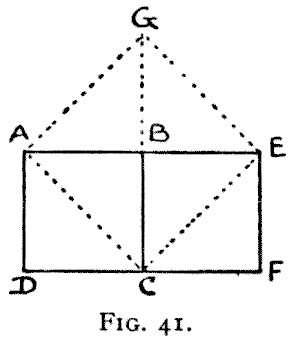
Cut a Greek cross into five pieces that will form two separate squares, one of which shall contain half the area of one of the arms of the cross. In further illustration of what I have already written, if the two squares of the same size A B C D and B C F E, in Fig. 41, are cut in the manner indicated by the dotted lines, the four pieces will form the large square A G E C. We thus see that the diagonal A C is the side of a square twice the size of A B C D. It is also clear that half the diagonal of any square is equal to the side of a square of half the area. Therefore, if the large square in the diagram is one of the arms of your cross, the small square is the size of one of the squares required in the puzzle.

The solution is shown in Figs. 42 and 43. It will be seen that the small square is cut out whole and the large square composed of the four pieces B, C, D, and E. After what I have written, the reader will have no difficulty in seeing that the square A is half the size of one of the arms of the cross, because the length of the diagonal of the former is clearly the same as the side of the latter. The thing is now self-evident. I have thus tried to show that some of these puzzles that many people are apt to regard as quite wonderful and bewildering, are really not difficult if only we use a little thought and judgment. In conclusion of this particular subject I will give four Greek cross puzzles, with detached solutions.
142.—THE SILK PATCHWORK.
The lady members of the Wilkinson family had made a simple patchwork quilt, as a small Christmas present, all composed of square pieces of the same size, as shown in the illustration. It only lacked the four corner pieces to make it complete. Somebody pointed out to them that if you unpicked the Greek cross in the middle and then cut the stitches along the dark joins, the four pieces all of the same size and shape would fit together and form a square. This the reader knows, from the solution in Fig. 39, is quite easily done. But George Wilkinson suddenly suggested to them this poser. He said, "Instead of picking out the cross entire, and forming the square from four equal pieces, can you cut out a square entire and four equal pieces that will form a perfect Greek cross?" The puzzle is, of course, now quite easy.
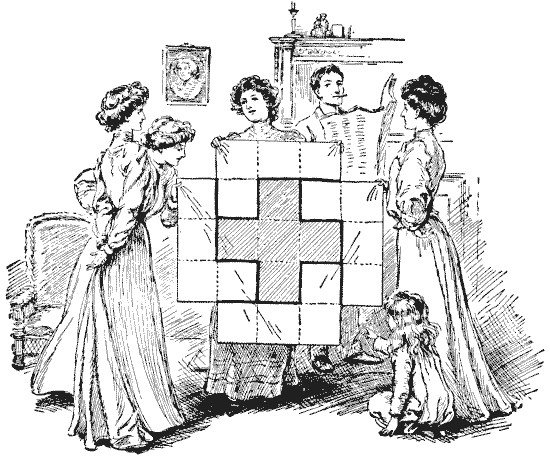
143.—TWO CROSSES FROM ONE.
Cut a Greek cross into five pieces that will form two such crosses, both of the same size. The solution of this puzzle is very beautiful.
144.—THE CROSS AND THE TRIANGLE.
Cut a Greek cross into six pieces that will form an equilateral triangle. This is another hard problem, and I will state here that a solution is practically impossible without a previous knowledge of my method of transforming an equilateral triangle into a square (see No. 26, "Canterbury Puzzles").
145.—THE FOLDED CROSS.
Cut out of paper a Greek cross; then so fold it that with a single straight cut of the scissors the four pieces produced will form a square.
VARIOUS DISSECTION PUZZLES.
We will now consider a small miscellaneous selection of cutting-out puzzles, varying in degrees of difficulty.
146.—AN EASY DISSECTION PUZZLE.
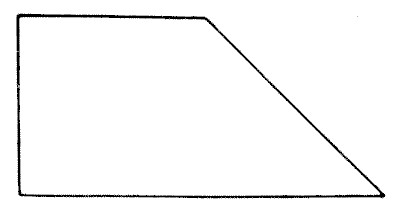
First, cut out a piece of paper or cardboard of the shape shown in the illustration. It will be seen at once that the proportions are simply those of a square attached to half of another similar square, divided diagonally. The puzzle is to cut it into four pieces all of precisely the same size and shape.
147.—AN EASY SQUARE PUZZLE.

If you take a rectangular piece of cardboard, twice as long as it is broad, and cut it in half diagonally, you will get two of the pieces shown in the illustration. The puzzle is with five such pieces of equal size to form a square. One of the pieces may be cut in two, but the others must be used intact.
148.—THE BUN PUZZLE.

The three circles represent three buns, and it is simply required to show how these may be equally divided among four boys. The buns must be regarded as of equal thickness throughout and of equal thickness to each other. Of course, they must be cut into as few pieces as possible. To simplify it I will state the rather surprising fact that only five pieces are necessary, from which it will be seen that one boy gets his share in two pieces and the other three receive theirs in a single piece. I am aware that this statement "gives away" the puzzle, but it should not destroy its interest to those who like to discover the "reason why."
149.—THE CHOCOLATE SQUARES.

Here is a slab of chocolate, indented at the dotted lines so that the twenty squares can be easily separated. Make a copy of the slab in paper or cardboard and then try to cut it into nine pieces so that they will form four perfect squares all of exactly the same size.
150.—DISSECTING A MITRE.
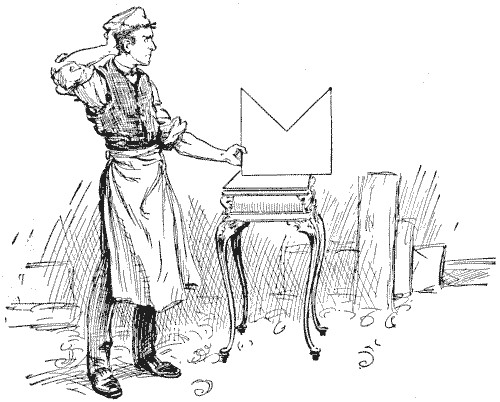
The figure that is perplexing the carpenter in the illustration represents a mitre. It will be seen that its proportions are those of a square with one quarter removed. The puzzle is to cut it into five pieces that will fit together and form a perfect square. I show an attempt, published in America, to perform the feat in four pieces, based on what is known as the "step principle," but it is a fallacy.

We are told first to cut oft the pieces 1 and 2 and pack them into the triangular space marked off by the dotted line, and so form a rectangle.
So far, so good. Now, we are directed to apply the old step principle, as shown, and, by moving down the piece 4 one step, form the required square. But, unfortunately, it does not produce a square: only an oblong. Call the three long sides of the mitre 84 in. each. Then, before cutting the steps, our rectangle in three pieces will be 84×63. The steps must be 10½ in. in height and 12 in. in breadth. Therefore, by moving down a step we reduce by 12 in. the side 84 in. and increase by 10½ in. the side 63 in. Hence our final rectangle must be 72 in. × 73½ in., which certainly is not a square! The fact is, the step principle can only be applied to rectangles with sides of particular relative lengths. For example, if the shorter side in this case were 615/7 (instead of 63), then the step method would apply. For the steps would then be 102/7 in. in height and 12 in. in breadth. Note that 615/7 × 84= the square of 72. At present no solution has been found in four pieces, and I do not believe one possible.
151.—THE JOINER'S PROBLEM.
I have often had occasion to remark on the practical utility of puzzles, arising out of an application to the ordinary affairs of life of the little tricks and "wrinkles" that we learn while solving recreation problems.
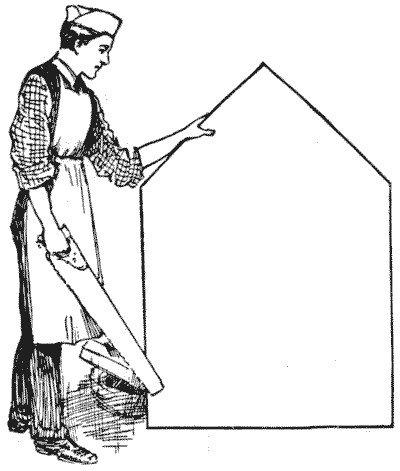
The joiner, in the illustration, wants to cut the piece of wood into as few pieces as possible to form a square table-top, without any waste of material. How should he go to work? How many pieces would you require?
152.—ANOTHER JOINER'S PROBLEM.

A joiner had two pieces of wood of the shapes and relative proportions shown in the diagram. He wished to cut them into as few pieces as possible so that they could be fitted together, without waste, to form a perfectly square table-top. How should he have done it? There is no necessity to give measurements, for if the smaller piece (which is half a square) be made a little too large or a little too small it will not affect the method of solution.
153.—A CUTTING-OUT PUZZLE.
Here is a little cutting-out poser. I take a strip of paper, measuring five inches by one inch, and, by cutting it into five pieces, the parts fit together and form a square, as shown in the illustration. Now, it is quite an interesting puzzle to discover how we can do this in only four pieces.
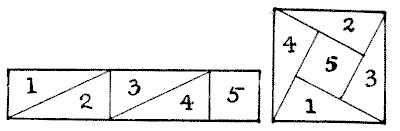
154.—MRS. HOBSON'S HEARTHRUG.

Mrs. Hobson's boy had an accident when playing with the fire, and burnt two of the corners of a pretty hearthrug. The damaged corners have been cut away, and it now has the appearance and proportions shown in my diagram. How is Mrs. Hobson to cut the rug into the fewest possible pieces that will fit together and form a perfectly square rug? It will be seen that the rug is in the proportions 36 × 27 (it does not matter whether we say inches or yards), and each piece cut away measured 12 and 6 on the outside.
155.—THE PENTAGON AND SQUARE.
I wonder how many of my readers, amongst those who have not given any close attention to the elements of geometry, could draw a regular pentagon, or five-sided figure, if they suddenly required to do so. A regular hexagon, or six-sided figure, is easy enough, for everybody knows that all you have to do is to describe a circle and then, taking the radius as the length of one of the sides, mark off the six points round the circumference. But a pentagon is quite another matter. So, as my puzzle has to do with the cutting up of a regular pentagon, it will perhaps be well if I first show my less experienced readers how this figure is to be correctly drawn. Describe a circle and draw the two lines H B and D G, in the diagram, through the centre at right angles. Now find the point A, midway between C and B. Next place the point of your compasses at A and with the distance A D describe the arc cutting H B at E. Then place the point of your compasses at D and with the distance D E describe the arc cutting the circumference at F. Now, D F is one of the sides of your pentagon, and you have simply to mark off the other sides round the circle. Quite simple when you know how, but otherwise somewhat of a poser.
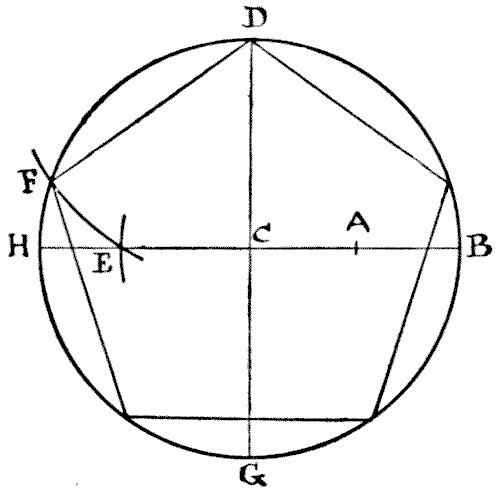
Having formed your pentagon, the puzzle is to cut it into the fewest possible pieces that will fit together and form a perfect square.
156.—THE DISSECTED TRIANGLE.

A good puzzle is that which the gentleman in the illustration is showing to his friends. He has simply cut out of paper an equilateral triangle—that is, a triangle with all its three sides of the same length. He proposes that it shall be cut into five pieces in such a way that they will fit together and form either two or three smaller equilateral triangles, using all the material in each case. Can you discover how the cuts should be made?
Remember that when you have made your five pieces, you must be able, as desired, to put them together to form either the single original triangle or to form two triangles or to form three triangles—all equilateral.
157.—THE TABLE-TOP AND STOOLS.
I have frequently had occasion to show that the published answers to a great many of the oldest and most widely known puzzles are either quite incorrect or capable of improvement. I propose to consider the old poser of the table-top and stools that most of my readers have probably seen in some form or another in books compiled for the recreation of childhood.
The story is told that an economical and ingenious schoolmaster once wished to convert a circular table-top, for which he had no use, into seats for two oval stools, each with a hand-hole in the centre. He instructed the carpenter to make the cuts as in the illustration and then join the eight pieces together in the manner shown. So impressed was he with the ingenuity of his performance that he set the puzzle to his geometry class as a little study in dissection. But the remainder of the story has never been published, because, so it is said, it was a characteristic of the principals of academies that they would never admit that they could err. I get my information from a descendant of the original boy who had most reason to be interested in the matter.
The clever youth suggested modestly to the master that the hand-holes were too big, and that a small boy might perhaps fall through them. He therefore proposed another way of making the cuts that would get over this objection. For his impertinence he received such severe chastisement that he became convinced that the larger the hand-hole in the stools the more comfortable might they be.
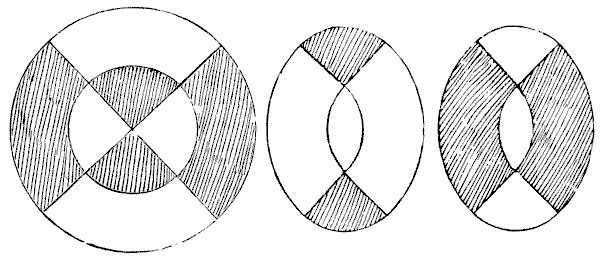
Now what was the method the boy proposed?
Can you show how the circular table-top may be cut into eight pieces that will fit together and form two oval seats for stools (each of exactly the same size and shape) and each having similar hand-holes of smaller dimensions than in the case shown above? Of course, all the wood must be used.
158.—THE GREAT MONAD.

Here is a symbol of tremendous antiquity which is worthy of notice. It is borne on the Korean ensign and merchant flag, and has been adopted as a trade sign by the Northern Pacific Railroad Company, though probably few are aware that it is the Great Monad, as shown in the sketch below. This sign is to the Chinaman what the cross is to the Christian. It is the sign of Deity and eternity, while the two parts into which the circle is divided are called the Yin and the Yan—the male and female forces of nature. A writer on the subject more than three thousand years ago is reported to have said in reference to it: "The illimitable produces the great extreme. The great extreme produces the two principles. The two principles produce the four quarters, and from the four quarters we develop the quadrature of the eight diagrams of Feuh-hi." I hope readers will not ask me to explain this, for I have not the slightest idea what it means. Yet I am persuaded that for ages the symbol has had occult and probably mathematical meanings for the esoteric student.
I will introduce the Monad in its elementary form. Here are three easy questions respecting this great symbol:—
(I.) Which has the greater area, the inner circle containing the Yin and the Yan, or the outer ring?
(II.) Divide the Yin and the Yan into four pieces of the same size and shape by one cut.
(III.) Divide the Yin and the Yan into four pieces of the same size, but different shape, by one straight cut.
159.—THE SQUARE OF VENEER.
The following represents a piece of wood in my possession, 5 in. square. By markings on the surface it is divided into twenty-five square inches. I want to discover a way of cutting this piece of wood into the fewest possible pieces that will fit together and form two perfect squares of different sizes and of known dimensions. But, unfortunately, at every one of the sixteen intersections of the cross lines a small nail has been driven in at some time or other, and my fret-saw will be injured if it comes in contact with any of these. I have therefore to find a method of doing the work that will not necessitate my cutting through any of those sixteen points. How is it to be done? Remember, the exact dimensions of the two squares must be given.

160.—THE TWO HORSESHOES.
Why horseshoes should be considered "lucky" is one of those things which no man can understand. It is a very old superstition, and John Aubrey (1626-1700) says, "Most houses at the West End of London have a horseshoe on the threshold." In Monmouth Street there were seventeen in 1813 and seven so late as 1855. Even Lord Nelson had one nailed to the mast of the ship Victory. To-day we find it more conducive to "good luck" to see that they are securely nailed on the feet of the horse we are about to drive.
Nevertheless, so far as the horseshoe, like the Swastika and other emblems that I have had occasion at times to deal with, has served to symbolize health, prosperity, and goodwill towards men, we may well treat it with a certain amount of respectful interest. May there not, moreover, be some esoteric or lost mathematical mystery concealed in the form of a horseshoe? I have been looking into this matter, and I wish to draw my readers' attention to the very remarkable fact that the pair of horseshoes shown in my illustration are related in a striking and beautiful manner to the circle, which is the symbol of eternity. I present this fact in the form of a simple problem, so that it may be seen how subtly this relation has been concealed for ages and ages. My readers will, I know, be pleased when they find the key to the mystery.

Cut out the two horseshoes carefully round the outline and then cut them into four pieces, all different in shape, that will fit together and form a perfect circle. Each shoe must be cut into two pieces and all the part of the horse's hoof contained within the outline is to be used and regarded as part of the area.
161.—THE BETSY ROSS PUZZLE.
A correspondent asked me to supply him with the solution to an old puzzle that is attributed to a certain Betsy Ross, of Philadelphia, who showed it to George Washington. It consists in so folding a piece of paper that with one clip of the scissors a five-pointed star of Freedom may be produced. Whether the story of the puzzle's origin is a true one or not I cannot say, but I have a print of the old house in Philadelphia where the lady is said to have lived, and I believe it still stands there. But my readers will doubtless be interested in the little poser.
Take a circular piece of paper and so fold it that with one cut of the scissors you can produce a perfect five-pointed star.
162.—THE CARDBOARD CHAIN.
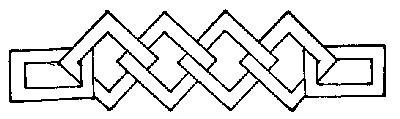
Can you cut this chain out of a piece of cardboard without any join whatever? Every link is solid; without its having been split and afterwards joined at any place. It is an interesting old puzzle that I learnt as a child, but I have no knowledge as to its inventor.
163.—THE PAPER BOX.
It may be interesting to introduce here, though it is not strictly a puzzle, an ingenious method for making a paper box.
Take a square of stout paper and by successive foldings make all the creases indicated by the dotted lines in the illustration. Then cut away the eight little triangular pieces that are shaded, and cut through the paper along the dark lines. The second illustration shows the box half folded up, and the reader will have no difficulty in effecting its completion. Before folding up, the reader might cut out the circular piece indicated in the diagram, for a purpose I will now explain.
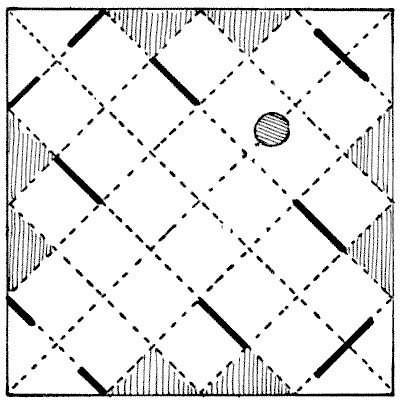
This box will be found to serve excellently for the production of vortex rings. These rings, which were discussed by Von Helmholtz in 1858, are most interesting, and the box (with the hole cut out) will produce them to perfection. Fill the box with tobacco smoke by blowing it gently through the hole. Now, if you hold it horizontally, and softly tap the side that is opposite to the hole, an immense number of perfect rings can be produced from one mouthful of smoke. It is best that there should be no currents of air in the room. People often do not realise that these rings are formed in the air when no smoke is used. The smoke only makes them visible. Now, one of these rings, if properly directed on its course, will travel across the room and put out the flame of a candle, and this feat is much more striking if you can manage to do it without the smoke. Of course, with a little practice, the rings may be blown from the mouth, but the box produces them in much greater perfection, and no skill whatever is required. Lord Kelvin propounded the theory that matter may consist of vortex rings in a fluid that fills all space, and by a development of the hypothesis he was able to explain chemical combination.
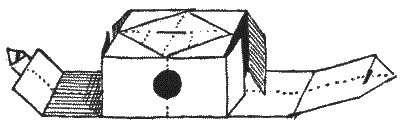
164.—THE POTATO PUZZLE.
Take a circular slice of potato, place it on the table, and see into how large a number of pieces you can divide it with six cuts of a knife. Of course you must not readjust the pieces or pile them after a cut. What is the greatest number of pieces you can make?
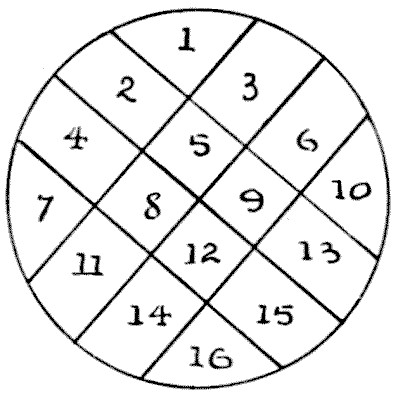
The illustration shows how to make sixteen pieces. This can, of course, be easily beaten.
165.—THE SEVEN PIGS.
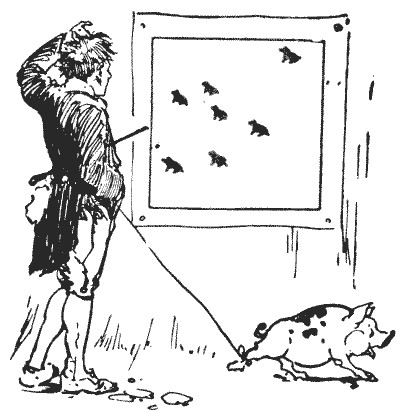
Here is a little puzzle that was put to one of the sons of Erin the other day and perplexed him unduly, for it is really quite easy. It will be seen from the illustration that he was shown a sketch of a square pen containing seven pigs. He was asked how he would intersect the pen with three straight fences so as to enclose every pig in a separate sty. In other words, all you have to do is to take your pencil and, with three straight strokes across the square, enclose each pig separately. Nothing could be simpler.
The Irishman complained that the pigs would not keep still while he was putting up the fences. He said that they would all flock together, or one obstinate beast would go into a corner and flock all by himself. It was pointed out to him that for the purposes of the puzzle the pigs were stationary. He answered that Irish pigs are not stationery—they are pork. Being persuaded to make the attempt, he drew three lines, one of which cut through a pig. When it was explained that this is not allowed, he protested that a pig was no use until you cut its throat. "Begorra, if it's bacon ye want without cutting your pig, it will be all gammon." We will not do the Irishman the injustice of suggesting that the miserable pun was intentional. However, he failed to solve the puzzle. Can you do it?
166.—THE LANDOWNER'S FENCES.
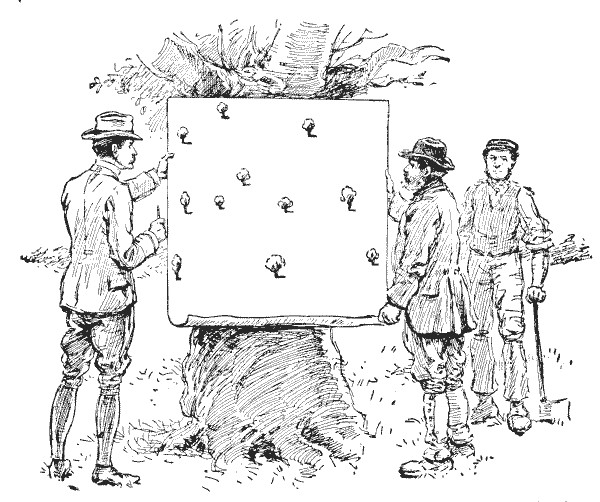
The landowner in the illustration is consulting with his bailiff over a rather puzzling little question. He has a large plan of one of his fields, in which there are eleven trees. Now, he wants to divide the field into just eleven enclosures by means of straight fences, so that every enclosure shall contain one tree as a shelter for his cattle. How is he to do it with as few fences as possible? Take your pencil and draw straight lines across the field until you have marked off the eleven enclosures (and no more), and then see how many fences you require. Of course the fences may cross one another.
167.—THE WIZARD'S CATS.
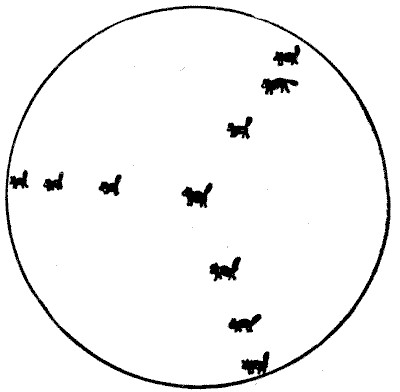
A wizard placed ten cats inside a magic circle as shown in our illustration, and hypnotized them so that they should remain stationary during his pleasure. He then proposed to draw three circles inside the large one, so that no cat could approach another cat without crossing a magic circle. Try to draw the three circles so that every cat has its own enclosure and cannot reach another cat without crossing a line.
168.—THE CHRISTMAS PUDDING.
"Speaking of Christmas puddings," said the host, as he glanced at the imposing delicacy at the other end of the table. "I am reminded of the fact that a friend gave me a new puzzle the other day respecting one. Here it is," he added, diving into his breast pocket.
"'Problem: To find the contents,' I suppose," said the Eton boy.
"No; the proof of that is in the eating. I will read you the conditions."
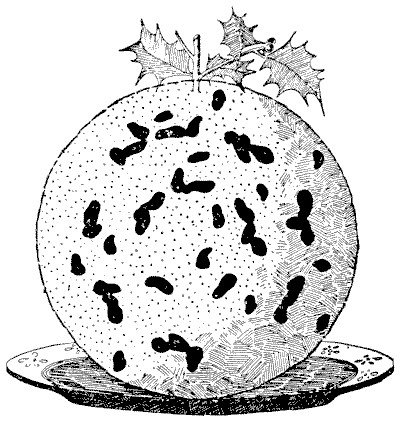
"'Cut the pudding into two parts, each of exactly the same size and shape, without touching any of the plums. The pudding is to be regarded as a flat disc, not as a sphere.'"
"Why should you regard a Christmas pudding as a disc? And why should any reasonable person ever wish to make such an accurate division?" asked the cynic.
"It is just a puzzle—a problem in dissection." All in turn had a look at the puzzle, but nobody succeeded in solving it. It is a little difficult unless you are acquainted with the principle involved in the making of such puddings, but easy enough when you know how it is done.
169.—A TANGRAM PARADOX.
Many pastimes of great antiquity, such as chess, have so developed and changed down the centuries that their original inventors would scarcely recognize them. This is not the case with Tangrams, a recreation that appears to be at least four thousand years old, that has apparently never been dormant, and that has not been altered or "improved upon" since the legendary Chinaman Tan first cut out the seven pieces shown in Diagram I. If you mark the point B, midway between A and C, on one side of a square of any size, and D, midway between C and E, on an adjoining side, the direction of the cuts is too obvious to need further explanation. Every design in this article is built up from the seven pieces of blackened cardboard. It will at once be understood that the possible combinations are infinite.
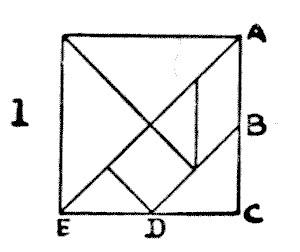
The late Mr. Sam Loyd, of New York, who published a small book of very ingenious designs, possessed the manuscripts of the late Mr. Challenor, who made a long and close study of Tangrams. This gentleman, it is said, records that there were originally seven books of Tangrams, compiled in China two thousand years before the Christian era. These books are so rare that, after forty years' residence in the country, he only succeeded in seeing perfect copies of the first and seventh volumes with fragments of the second. Portions of one of the books, printed in gold leaf upon parchment, were found in Peking by an English soldier and sold for three hundred pounds.
A few years ago a little book came into my possession, from the library of the late Lewis Carroll, entitled The Fashionable Chinese Puzzle. It contains three hundred and twenty-three Tangram designs, mostly nondescript geometrical figures, to be constructed from the seven pieces. It was "Published by J. and E. Wallis, 42 Skinner Street, and J. Wallis, Jun., Marine Library, Sidmouth" (South Devon). There is no date, but the following note fixes the time of publication pretty closely: "This ingenious contrivance has for some time past been the favourite amusement of the ex-Emperor Napoleon, who, being now in a debilitated state and living very retired, passes many hours a day in thus exercising his patience and ingenuity." The reader will find, as did the great exile, that much amusement, not wholly uninstructive, may be derived from forming the designs of others. He will find many of the illustrations to this article quite easy to build up, and some rather difficult. Every picture may thus be regarded as a puzzle.
But it is another pastime altogether to create new and original designs of a pictorial character, and it is surprising what extraordinary scope the Tangrams afford for producing pictures of real life—angular and often grotesque, it is true, but full of character. I give an example of a recumbent figure (2) that is particularly graceful, and only needs some slight reduction of its angularities to produce an entirely satisfactory outline.

As I have referred to the author of Alice in Wonderland, I give also my designs of the March Hare (3) and the Hatter (4). I also give an attempt at Napoleon (5), and a very excellent Red Indian with his Squaw by Mr. Loyd (6 and 7). A large number of other designs will be found in an article by me in The Strand Magazine for November, 1908.


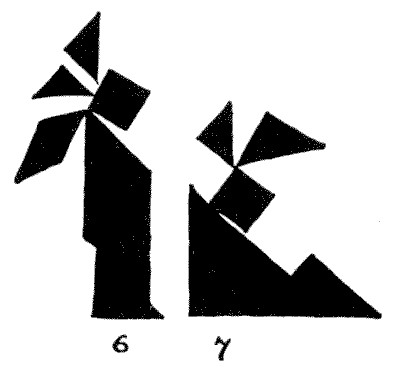
On the appearance of this magazine article, the late Sir James Murray, the eminent philologist, tried, with that amazing industry that characterized all his work, to trace the word "tangram" to its source. At length he wrote as follows:—"One of my sons is a professor in the Anglo-Chinese college at Tientsin. Through him, his colleagues, and his students, I was able to make inquiries as to the alleged Tan among Chinese scholars. Our Chinese professor here (Oxford) also took an interest in the matter and obtained information from the secretary of the Chinese Legation in London, who is a very eminent representative of the Chinese literati."
"The result has been to show that the man Tan, the god Tan, and the 'Book of Tan' are entirely unknown to Chinese literature, history, or tradition. By most of the learned men the name, or allegation of the existence, of these had never been heard of. The puzzle is, of course, well known. It is called in Chinese ch'i ch'iao t'u; literally, 'seven-ingenious-plan' or 'ingenious-puzzle figure of seven pieces.' No name approaching 'tangram,' or even 'tan,' occurs in Chinese, and the only suggestions for the latter were the Chinese t'an, 'to extend'; or t'ang, Cantonese dialect for 'Chinese.' It was suggested that probably some American or Englishman who knew a little Chinese or Cantonese, wanting a name for the puzzle, might concoct one out of one of these words and the European ending 'gram.' I should say the name 'tangram' was probably invented by an American some little time before 1864 and after 1847, but I cannot find it in print before the 1864 edition of Webster. I have therefore had to deal very shortly with the word in the dictionary, telling what it is applied to and what conjectures or guesses have been made at the name, and giving a few quotations, one from your own article, which has enabled me to make more of the subject than I could otherwise have done."
Several correspondents have informed me that they possess, or had possessed, specimens of the old Chinese books. An American gentleman writes to me as follows:—"I have in my possession a book made of tissue paper, printed in black (with a Chinese inscription on the front page), containing over three hundred designs, which belongs to the box of 'tangrams,' which I also own. The blocks are seven in number, made of mother-of-pearl, highly polished and finely engraved on either side. These are contained in a rosewood box 21/8 in. square. My great uncle, ——, was one of the first missionaries to visit China. This box and book, along with quite a collection of other relics, were sent to my grandfather and descended to myself."
My correspondent kindly supplied me with rubbings of the Tangrams, from which it is clear that they are cut in the exact proportions that I have indicated. I reproduce the Chinese inscription (8) for this reason. The owner of the book informs me that he has submitted it to a number of Chinamen in the United States and offered as much as a dollar for a translation. But they all steadfastly refused to read the words, offering the lame excuse that the inscription is Japanese. Natives of Japan, however, insist that it is Chinese. Is there something occult and esoteric about Tangrams, that it is so difficult to lift the veil? Perhaps this page will come under the eye of some reader acquainted with the Chinese language, who will supply the required translation, which may, or may not, throw a little light on this curious question.
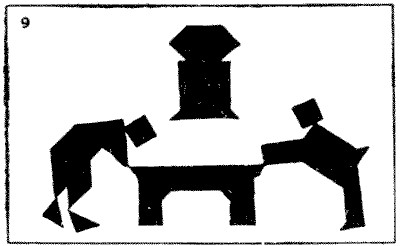
By using several sets of Tangrams at the same time we may construct more ambitious pictures. I was advised by a friend not to send my picture, "A Game of Billiards" (9), to the Academy. He assured me that it would not be accepted because the "judges are so hide-bound by convention." Perhaps he was right, and it will be more appreciated by Post-impressionists and Cubists. The players are considering a very delicate stroke at the top of the table. Of course, the two men, the table, and the clock are formed from four sets of Tangrams. My second picture is named "The Orchestra" (10), and it was designed for the decoration of a large hall of music. Here we have the conductor, the pianist, the fat little cornet-player, the left-handed player of the double-bass, whose attitude is life-like, though he does stand at an unusual distance from his instrument, and the drummer-boy, with his imposing music-stand. The dog at the back of the pianoforte is not howling: he is an appreciative listener.
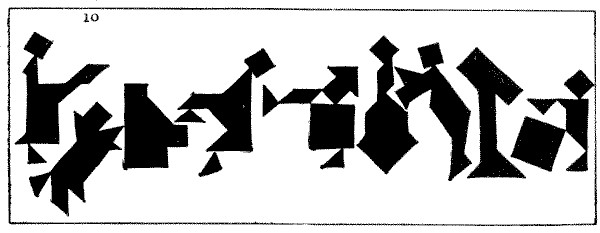
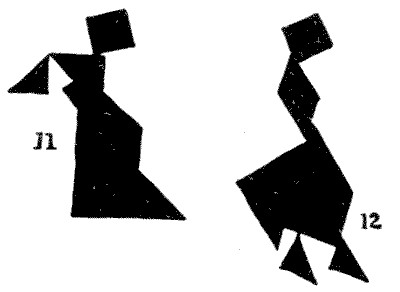
One remarkable thing about these Tangram pictures is that they suggest to the imagination such a lot that is not really there. Who, for example, can look for a few minutes at Lady Belinda (11) and the Dutch girl (12) without soon feeling the haughty expression in the one case and the arch look in the other? Then look again at the stork (13), and see how it is suggested to the mind that the leg is actually much more slender than any one of the pieces employed. It is really an optical illusion. Again, notice in the case of the yacht (14) how, by leaving that little angular point at the top, a complete mast is suggested. If you place your Tangrams together on white paper so that they do not quite touch one another, in some cases the effect is improved by the white lines; in other cases it is almost destroyed.
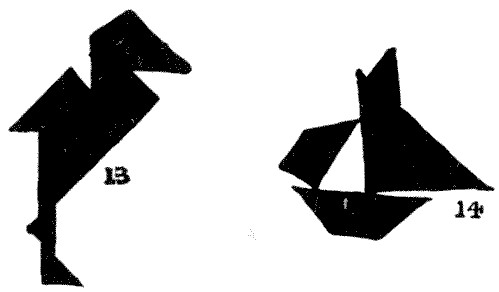
Finally, I give an example from the many curious paradoxes that one happens upon in manipulating Tangrams. I show designs of two dignified individuals (15 and 16) who appear to be exactly alike, except for the fact that one has a foot and the other has not. Now, both of these figures are made from the same seven Tangrams. Where does the second man get his foot from?

PATCHWORK PUZZLES.
"Of shreds and patches."—Hamlet, iii. 4.
170.—THE CUSHION COVERS.
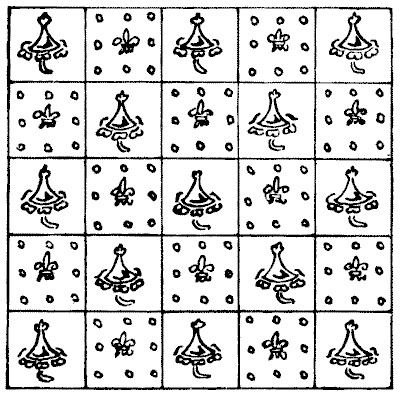
The above represents a square of brocade. A lady wishes to cut it in four pieces so that two pieces will form one perfectly square cushion top, and the remaining two pieces another square cushion top. How is she to do it? Of course, she can only cut along the lines that divide the twenty-five squares, and the pattern must "match" properly without any irregularity whatever in the design of the material. There is only one way of doing it. Can you find it?
171.—THE BANNER PUZZLE.
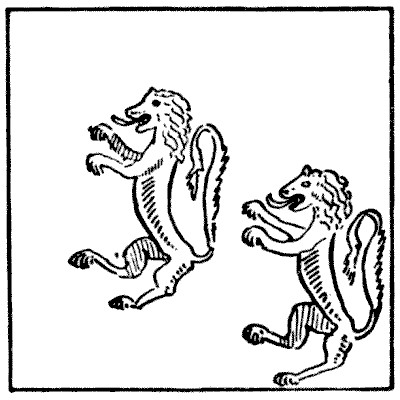
A Lady had a square piece of bunting with two lions on it, of which the illustration is an exactly reproduced reduction. She wished to cut the stuff into pieces that would fit together and form two square banners with a lion on each banner. She discovered that this could be done in as few as four pieces. How did she manage it? Of course, to cut the British Lion would be an unpardonable offence, so you must be careful that no cut passes through any portion of either of them. Ladies are informed that no allowance whatever has to be made for "turnings," and no part of the material may be wasted. It is quite a simple little dissection puzzle if rightly attacked. Remember that the banners have to be perfect squares, though they need not be both of the same size.
172.—MRS. SMILEY'S CHRISTMAS PRESENT.
Mrs. Smiley's expression of pleasure was sincere when her six granddaughters sent to her, as a Christmas present, a very pretty patchwork quilt, which they had made with their own hands. It was constructed of square pieces of silk material, all of one size, and as they made a large quilt with fourteen of these little squares on each side, it is obvious that just 196 pieces had been stitched into it. Now, the six granddaughters each contributed a part of the work in the form of a perfect square (all six portions being different in size), but in order to join them up to form the square quilt it was necessary that the work of one girl should be unpicked into three separate pieces. Can you show how the joins might have been made? Of course, no portion can be turned over.

173.—MRS. PERKINS'S QUILT.

It will be seen that in this case the square patchwork quilt is built up of 169 pieces. The puzzle is to find the smallest possible number of square portions of which the quilt could be composed and show how they might be joined together. Or, to put it the reverse way, divide the quilt into as few square portions as possible by merely cutting the stitches.
174.—THE SQUARES OF BROCADE.
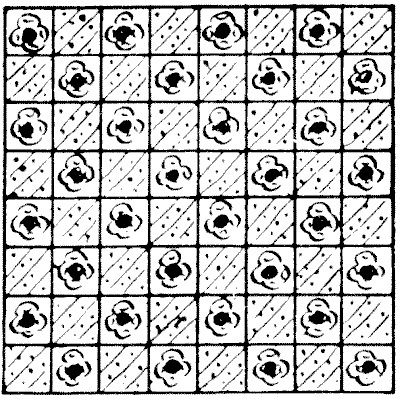
I happened to be paying a call at the house of a lady, when I took up from a table two lovely squares of brocade. They were beautiful specimens of Eastern workmanship—both of the same design, a delicate chequered pattern.
"Are they not exquisite?" said my friend. "They were brought to me by a cousin who has just returned from India. Now, I want you to give me a little assistance. You see, I have decided to join them together so as to make one large square cushion-cover. How should I do this so as to mutilate the material as little as possible? Of course I propose to make my cuts only along the lines that divide the little chequers."

I cut the two squares in the manner desired into four pieces that would fit together and form another larger square, taking care that the pattern should match properly, and when I had finished I noticed that two of the pieces were of exactly the same area; that is, each of the two contained the same number of chequers. Can you show how the cuts were made in accordance with these conditions?
175.—ANOTHER PATCHWORK PUZZLE.
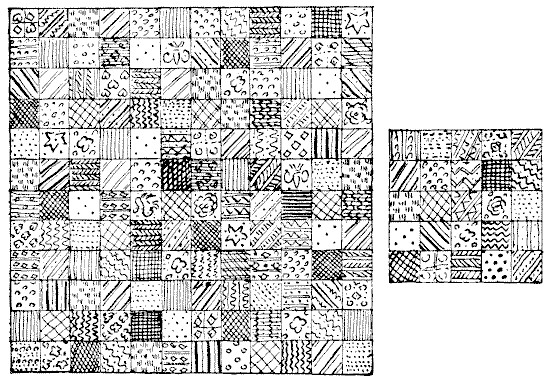
A lady was presented, by two of her girl friends, with the pretty pieces of silk patchwork shown in our illustration. It will be seen that both pieces are made up of squares all of the same size—one 12x12 and the other 5x5. She proposes to join them together and make one square patchwork quilt, 13x13, but, of course, she will not cut any of the material—merely cut the stitches where necessary and join together again. What perplexes her is this. A friend assures her that there need be no more than four pieces in all to join up for the new quilt. Could you show her how this little needlework puzzle is to be solved in so few pieces?
176.—LINOLEUM CUTTING.
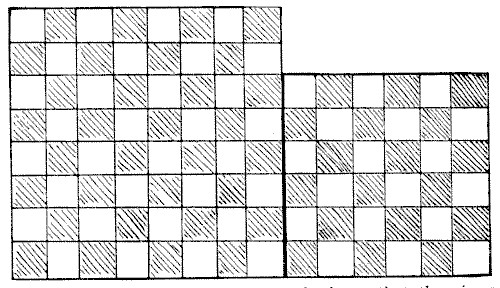
The diagram herewith represents two separate pieces of linoleum. The chequered pattern is not repeated at the back, so that the pieces cannot be turned over. The puzzle is to cut the two squares into four pieces so that they shall fit together and form one perfect square 10×10, so that the pattern shall properly match, and so that the larger piece shall have as small a portion as possible cut from it.
177.—ANOTHER LINOLEUM PUZZLE.

Can you cut this piece of linoleum into four pieces that will fit together and form a perfect square? Of course the cuts may only be made along the lines.
VARIOUS GEOMETRICAL PUZZLES.
"So various are the tastes of men."
MARK AKENSIDE.
178.—THE CARDBOARD BOX.
This puzzle is not difficult, but it will be found entertaining to discover the simple rule for its solution. I have a rectangular cardboard box. The top has an area of 120 square inches, the side 96 square inches, and the end 80 square inches. What are the exact dimensions of the box?
179.—STEALING THE BELL-ROPES.
Two men broke into a church tower one night to steal the bell-ropes. The two ropes passed through holes in the wooden ceiling high above them, and they lost no time in climbing to the top. Then one man drew his knife and cut the rope above his head, in consequence of which he fell to the floor and was badly injured. His fellow-thief called out that it served him right for being such a fool. He said that he should have done as he was doing, upon which he cut the rope below the place at which he held on. Then, to his dismay, he found that he was in no better plight, for, after hanging on as long as his strength lasted, he was compelled to let go and fall beside his comrade. Here they were both found the next morning with their limbs broken. How far did they fall? One of the ropes when they found it was just touching the floor, and when you pulled the end to the wall, keeping the rope taut, it touched a point just three inches above the floor, and the wall was four feet from the rope when it hung at rest. How long was the rope from floor to ceiling?
180.—THE FOUR SONS.
Readers will recognize the diagram as a familiar friend of their youth. A man possessed a square-shaped estate. He bequeathed to his widow the quarter of it that is shaded off. The remainder was to be divided equitably amongst his four sons, so that each should receive land of exactly the same area and exactly similar in shape. We are shown how this was done. But the remainder of the story is not so generally known. In the centre of the estate was a well, indicated by the dark spot, and Benjamin, Charles, and David complained that the division was not "equitable," since Alfred had access to this well, while they could not reach it without trespassing on somebody else's land. The puzzle is to show how the estate is to be apportioned so that each son shall have land of the same shape and area, and each have access to the well without going off his own land.
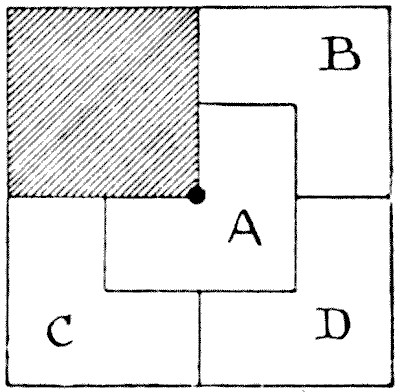
181.—THE THREE RAILWAY STATIONS.
As I sat in a railway carriage I noticed at the other end of the compartment a worthy squire, whom I knew by sight, engaged in conversation with another passenger, who was evidently a friend of his.
"How far have you to drive to your place from the railway station?" asked the stranger.
"Well," replied the squire, "if I get out at Appleford, it is just the same distance as if I go to Bridgefield, another fifteen miles farther on; and if I changed at Appleford and went thirteen miles from there to Carterton, it would still be the same distance. You see, I am equidistant from the three stations, so I get a good choice of trains."
Now I happened to know that Bridgefield is just fourteen miles from Carterton, so I amused myself in working out the exact distance that the squire had to drive home whichever station he got out at. What was the distance?
182.—THE GARDEN PUZZLE.
Professor Rackbrain tells me that he was recently smoking a friendly pipe under a tree in the garden of a country acquaintance. The garden was enclosed by four straight walls, and his friend informed him that he had measured these and found the lengths to be 80, 45, 100, and 63 yards respectively. "Then," said the professor, "we can calculate the exact area of the garden." "Impossible," his host replied, "because you can get an infinite number of different shapes with those four sides." "But you forget," Rackbrane said, with a twinkle in his eye, "that you told me once you had planted this tree equidistant from all the four corners of the garden." Can you work out the garden's area?
183.—DRAWING A SPIRAL.
If you hold the page horizontally and give it a quick rotary motion while looking at the centre of the spiral, it will appear to revolve. Perhaps a good many readers are acquainted with this little optical illusion. But the puzzle is to show how I was able to draw this spiral with so much exactitude without using anything but a pair of compasses and the sheet of paper on which the diagram was made. How would you proceed in such circumstances?
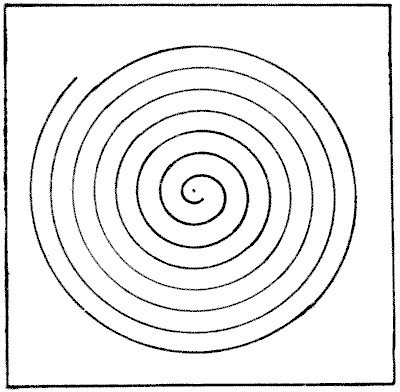
184.—HOW TO DRAW AN OVAL.
Can you draw a perfect oval on a sheet of paper with one sweep of the compasses? It is one of the easiest things in the world when you know how.
185.—ST. GEORGE'S BANNER.
At a celebration of the national festival of St. George's Day I was contemplating the familiar banner of the patron saint of our country. We all know the red cross on a white ground, shown in our illustration. This is the banner of St. George. The banner of St. Andrew (Scotland) is a white "St. Andrew's Cross" on a blue ground. That of St. Patrick (Ireland) is a similar cross in red on a white ground. These three are united in one to form our Union Jack.
Now on looking at St. George's banner it occurred to me that the following question would make a simple but pretty little puzzle. Supposing the flag measures four feet by three feet, how wide must the arm of the cross be if it is required that there shall be used just the same quantity of red and of white bunting?
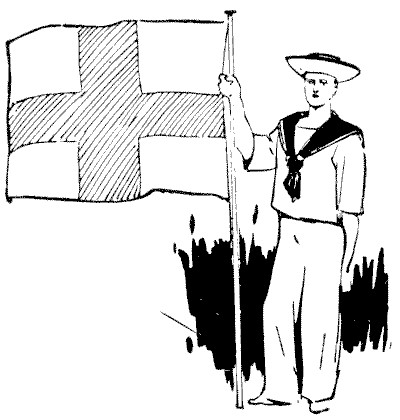
186.—THE CLOTHES LINE PUZZLE.
A boy tied a clothes line from the top of each of two poles to the base of the other. He then proposed to his father the following question. As one pole was exactly seven feet above the ground and the other exactly five feet, what was the height from the ground where the two cords crossed one another?
187.—THE MILKMAID PUZZLE.
Here is a little pastoral puzzle that the reader may, at first sight, be led into supposing is very profound, involving deep calculations. He may even say that it is quite impossible to give any answer unless we are told something definite as to the distances. And yet it is really quite "childlike and bland."

In the corner of a field is seen a milkmaid milking a cow, and on the other side of the field is the dairy where the extract has to be deposited. But it has been noticed that the young woman always goes down to the river with her pail before returning to the dairy. Here the suspicious reader will perhaps ask why she pays these visits to the river. I can only reply that it is no business of ours. The alleged milk is entirely for local consumption.
"Where are you going to, my pretty maid?"
"Down to the river, sir," she said.
"I'll not choose your dairy, my pretty maid."
"Nobody axed you, sir," she said.
If one had any curiosity in the matter, such an independent spirit would entirely disarm one. So we will pass from the point of commercial morality to the subject of the puzzle.
Draw a line from the milking-stool down to the river and thence to the door of the dairy, which shall indicate the shortest possible route for the milkmaid. That is all. It is quite easy to indicate the exact spot on the bank of the river to which she should direct her steps if she wants as short a walk as possible. Can you find that spot?
188.—THE BALL PROBLEM.
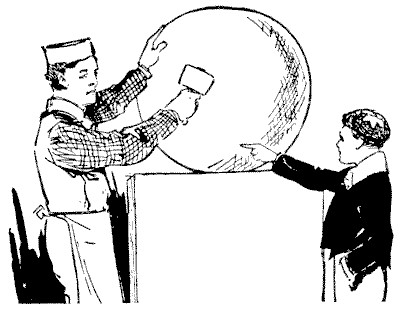
A stonemason was engaged the other day in cutting out a round ball for the purpose of some architectural decoration, when a smart schoolboy came upon the scene.
"Look here," said the mason, "you seem to be a sharp youngster, can you tell me this? If I placed this ball on the level ground, how many other balls of the same size could I lay around it (also on the ground) so that every ball should touch this one?"
The boy at once gave the correct answer, and then put this little question to the mason:—
"If the surface of that ball contained just as many square feet as its volume contained cubic feet, what would be the length of its diameter?"
The stonemason could not give an answer. Could you have replied correctly to the mason's and the boy's questions?
189.—THE YORKSHIRE ESTATES.
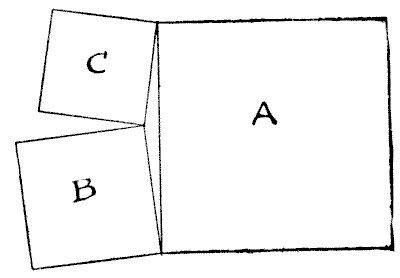
I was on a visit to one of the large towns of Yorkshire. While walking to the railway station on the day of my departure a man thrust a hand-bill upon me, and I took this into the railway carriage and read it at my leisure. It informed me that three Yorkshire neighbouring estates were to be offered for sale. Each estate was square in shape, and they joined one another at their corners, just as shown in the diagram. Estate A contains exactly 370 acres, B contains 116 acres, and C 74 acres.
Now, the little triangular bit of land enclosed by the three square estates was not offered for sale, and, for no reason in particular, I became curious as to the area of that piece. How many acres did it contain?
190.—FARMER WURZEL'S ESTATE.

I will now present another land problem. The demonstration of the answer that I shall give will, I think, be found both interesting and easy of comprehension.
Farmer Wurzel owned the three square fields shown in the annexed plan, containing respectively 18, 20, and 26 acres. In order to get a ring-fence round his property he bought the four intervening triangular fields. The puzzle is to discover what was then the whole area of his estate.
191.—THE CRESCENT PUZZLE.
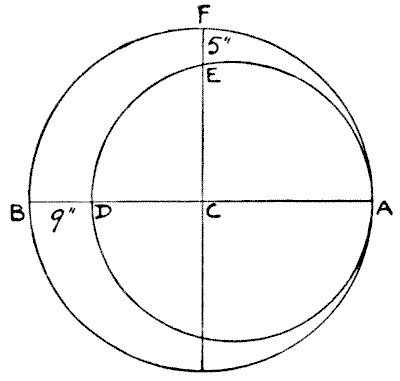
Here is an easy geometrical puzzle. The crescent is formed by two circles, and C is the centre of the larger circle. The width of the crescent between B and D is 9 inches, and between E and F 5 inches. What are the diameters of the two circles?
192.—THE PUZZLE WALL.
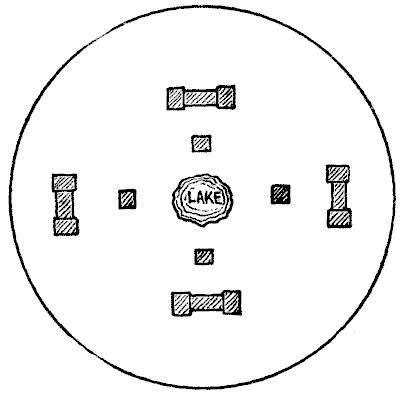
There was a small lake, around which four poor men built their cottages. Four rich men afterwards built their mansions, as shown in the illustration, and they wished to have the lake to themselves, so they instructed a builder to put up the shortest possible wall that would exclude the cottagers, but give themselves free access to the lake. How was the wall to be built?
193.—THE SHEEP-FOLD.
It is a curious fact that the answers always given to some of the best-known puzzles that appear in every little book of fireside recreations that has been published for the last fifty or a hundred years are either quite unsatisfactory or clearly wrong. Yet nobody ever seems to detect their faults. Here is an example:—A farmer had a pen made of fifty hurdles, capable of holding a hundred sheep only. Supposing he wanted to make it sufficiently large to hold double that number, how many additional hurdles must he have?
194.—THE GARDEN WALLS.
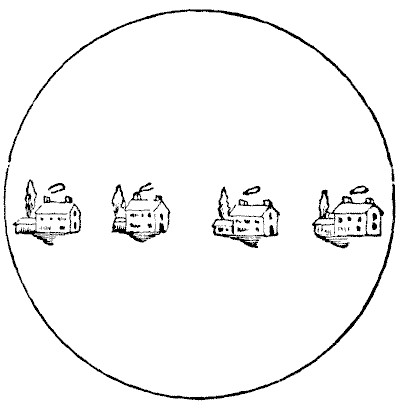
A speculative country builder has a circular field, on which he has erected four cottages, as shown in the illustration. The field is surrounded by a brick wall, and the owner undertook to put up three other brick walls, so that the neighbours should not be overlooked by each other, but the four tenants insist that there shall be no favouritism, and that each shall have exactly the same length of wall space for his wall fruit trees. The puzzle is to show how the three walls may be built so that each tenant shall have the same area of ground, and precisely the same length of wall.
Of course, each garden must be entirely enclosed by its walls, and it must be possible to prove that each garden has exactly the same length of wall. If the puzzle is properly solved no figures are necessary.
195.—LADY BELINDA'S GARDEN.
Lady Belinda is an enthusiastic gardener. In the illustration she is depicted in the act of worrying out a pleasant little problem which I will relate. One of her gardens is oblong in shape, enclosed by a high holly hedge, and she is turning it into a rosary for the cultivation of some of her choicest roses. She wants to devote exactly half of the area of the garden to the flowers, in one large bed, and the other half to be a path going all round it of equal breadth throughout. Such a garden is shown in the diagram at the foot of the picture. How is she to mark out the garden under these simple conditions? She has only a tape, the length of the garden, to do it with, and, as the holly hedge is so thick and dense, she must make all her measurements inside. Lady Belinda did not know the exact dimensions of the garden, and, as it was not necessary for her to know, I also give no dimensions. It is quite a simple task no matter what the size or proportions of the garden may be. Yet how many lady gardeners would know just how to proceed? The tape may be quite plain—that is, it need not be a graduated measure.
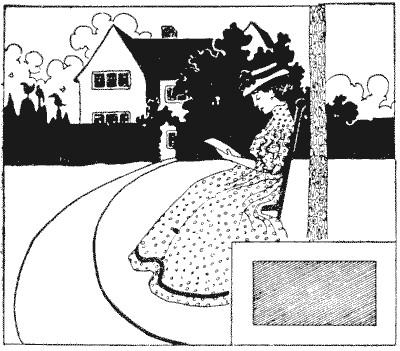
196.—THE TETHERED GOAT.

Here is a little problem that everybody should know how to solve. The goat is placed in a half-acre meadow, that is in shape an equilateral triangle. It is tethered to a post at one corner of the field. What should be the length of the tether (to the nearest inch) in order that the goat shall be able to eat just half the grass in the field? It is assumed that the goat can feed to the end of the tether.
197.—THE COMPASSES PUZZLE.
It is curious how an added condition or restriction will sometimes convert an absurdly easy puzzle into an interesting and perhaps difficult one. I remember buying in the street many years ago a little mechanical puzzle that had a tremendous sale at the time. It consisted of a medal with holes in it, and the puzzle was to work a ring with a gap in it from hole to hole until it was finally detached. As I was walking along the street I very soon acquired the trick of taking off the ring with one hand while holding the puzzle in my pocket. A friend to whom I showed the little feat set about accomplishing it himself, and when I met him some days afterwards he exhibited his proficiency in the art. But he was a little taken aback when I then took the puzzle from him and, while simply holding the medal between the finger and thumb of one hand, by a series of little shakes and jerks caused the ring, without my even touching it, to fall off upon the floor. The following little poser will probably prove a rather tough nut for a great many readers, simply on account of the restricted conditions:—
Show how to find exactly the middle of any straight line by means of the compasses only. You are not allowed to use any ruler, pencil, or other article—only the compasses; and no trick or dodge, such as folding the paper, will be permitted. You must simply use the compasses in the ordinary legitimate way.
198.—THE EIGHT STICKS.
I have eight sticks, four of them being exactly half the length of the others. I lay every one of these on the table, so that they enclose three squares, all of the same size. How do I do it? There must be no loose ends hanging over.
199.—PAPA'S PUZZLE.
Here is a puzzle by Pappus, who lived at Alexandria about the end of the third century. It is the fifth proposition in the eighth book of his Mathematical Collections. I give it in the form that I presented it some years ago under the title "Papa's Puzzle," just to see how many readers would discover that it was by Pappus himself. "The little maid's papa has taken two different-sized rectangular pieces of cardboard, and has clipped off a triangular piece from one of them, so that when it is suspended by a thread from the point A it hangs with the long side perfectly horizontal, as shown in the illustration. He has perplexed the child by asking her to find the point A on the other card, so as to produce a similar result when cut and suspended by a thread." Of course, the point must not be found by trial clippings. A curious and pretty point is involved in this setting of the puzzle. Can the reader discover it?
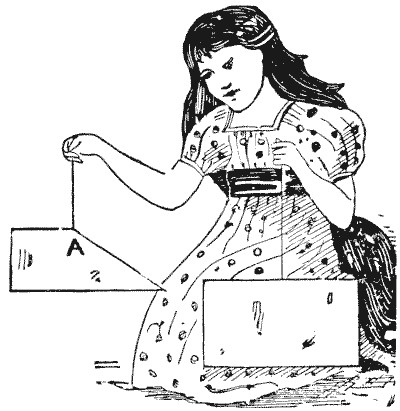
200.—A KITE-FLYING PUZZLE.
While accompanying my friend Professor Highflite during a scientific kite-flying competition on the South Downs of Sussex I was led into a little calculation that ought to interest my readers. The Professor was paying out the wire to which his kite was attached from a winch on which it had been rolled into a perfectly spherical form. This ball of wire was just two feet in diameter, and the wire had a diameter of one-hundredth of an inch. What was the length of the wire?
Now, a simple little question like this that everybody can perfectly understand will puzzle many people to answer in any way. Let us see whether, without going into any profound mathematical calculations, we can get the answer roughly—say, within a mile of what is correct! We will assume that when the wire is all wound up the ball is perfectly solid throughout, and that no allowance has to be made for the axle that passes through it. With that simplification, I wonder how many readers can state within even a mile of the correct answer the length of that wire.
201.—HOW TO MAKE CISTERNS.

Our friend in the illustration has a large sheet of zinc, measuring (before cutting) eight feet by three feet, and he has cut out square pieces (all of the same size) from the four corners and now proposes to fold up the sides, solder the edges, and make a cistern. But the point that puzzles him is this: Has he cut out those square pieces of the correct size in order that the cistern may hold the greatest possible quantity of water? You see, if you cut them very small you get a very shallow cistern; if you cut them large you get a tall and slender one. It is all a question of finding a way of cutting put these four square pieces exactly the right size. How are we to avoid making them too small or too large?
202.—THE CONE PUZZLE.
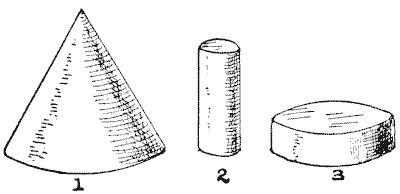
I have a wooden cone, as shown in Fig. 1. How am I to cut out of it the greatest possible cylinder? It will be seen that I can cut out one that is long and slender, like Fig. 2, or short and thick, like Fig. 3. But neither is the largest possible. A child could tell you where to cut, if he knew the rule. Can you find this simple rule?
203.—CONCERNING WHEELS.

There are some curious facts concerning the movements of wheels that are apt to perplex the novice. For example: when a railway train is travelling from London to Crewe certain parts of the train at any given moment are actually moving from Crewe towards London. Can you indicate those parts? It seems absurd that parts of the same train can at any time travel in opposite directions, but such is the case.
In the accompanying illustration we have two wheels. The lower one is supposed to be fixed and the upper one running round it in the direction of the arrows. Now, how many times does the upper wheel turn on its own axis in making a complete revolution of the other wheel? Do not be in a hurry with your answer, or you are almost certain to be wrong. Experiment with two pennies on the table and the correct answer will surprise you, when you succeed in seeing it.
204.—A NEW MATCH PUZZLE.
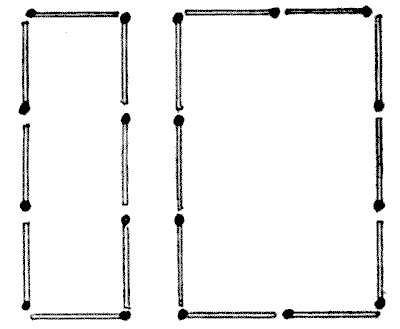
In the illustration eighteen matches are shown arranged so that they enclose two spaces, one just twice as large as the other. Can you rearrange them (1) so as to enclose two four-sided spaces, one exactly three times as large as the other, and (2) so as to enclose two five-sided spaces, one exactly three times as large as the other? All the eighteen matches must be fairly used in each case; the two spaces must be quite detached, and there must be no loose ends or duplicated matches.
205.—THE SIX SHEEP-PENS.
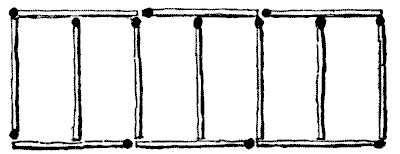
Here is a new little puzzle with matches. It will be seen in the illustration that thirteen matches, representing a farmer's hurdles, have been so placed that they enclose six sheep-pens all of the same size. Now, one of these hurdles was stolen, and the farmer wanted still to enclose six pens of equal size with the remaining twelve. How was he to do it? All the twelve matches must be fairly used, and there must be no duplicated matches or loose ends.
POINTS AND LINES PROBLEMS.
"Line upon line, line upon line; here a little and there a little."—Isa. xxviii. 10.
What are known as "Points and Lines" puzzles are found very interesting by many people. The most familiar example, here given, to plant nine trees so that they shall form ten straight rows with three trees in every row, is attributed to Sir Isaac Newton, but the earliest collection of such puzzles is, I believe, in a rare little book that I possess—published in 1821—Rational Amusement for Winter Evenings, by John Jackson. The author gives ten examples of "Trees planted in Rows."

These tree-planting puzzles have always been a matter of great perplexity. They are real "puzzles," in the truest sense of the word, because nobody has yet succeeded in finding a direct and certain way of solving them. They demand the exercise of sagacity, ingenuity, and patience, and what we call "luck" is also sometimes of service. Perhaps some day a genius will discover the key to the whole mystery. Remember that the trees must be regarded as mere points, for if we were allowed to make our trees big enough we might easily "fudge" our diagrams and get in a few extra straight rows that were more apparent than real.
206.—THE KING AND THE CASTLES.
There was once, in ancient times, a powerful king, who had eccentric ideas on the subject of military architecture. He held that there was great strength and economy in symmetrical forms, and always cited the example of the bees, who construct their combs in perfect hexagonal cells, to prove that he had nature to support him. He resolved to build ten new castles in his country all to be connected by fortified walls, which should form five lines with four castles in every line. The royal architect presented his preliminary plan in the form I have shown. But the monarch pointed out that every castle could be approached from the outside, and commanded that the plan should be so modified that as many castles as possible should be free from attack from the outside, and could only be reached by crossing the fortified walls. The architect replied that he thought it impossible so to arrange them that even one castle, which the king proposed to use as a royal residence, could be so protected, but his majesty soon enlightened him by pointing out how it might be done. How would you have built the ten castles and fortifications so as best to fulfil the king's requirements? Remember that they must form five straight lines with four castles in every line.

207.—CHERRIES AND PLUMS.
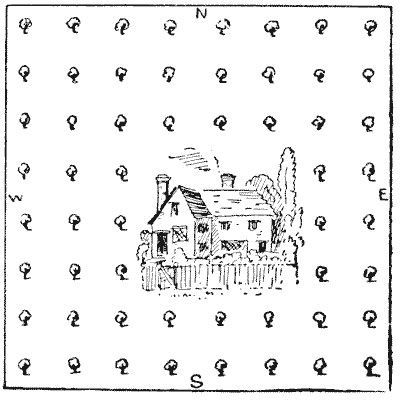
The illustration is a plan of a cottage as it stands surrounded by an orchard of fifty-five trees. Ten of these trees are cherries, ten are plums, and the remainder apples. The cherries are so planted as to form five straight lines, with four cherry trees in every line. The plum trees are also planted so as to form five straight lines with four plum trees in every line. The puzzle is to show which are the ten cherry trees and which are the ten plums. In order that the cherries and plums should have the most favourable aspect, as few as possible (under the conditions) are planted on the north and east sides of the orchard. Of course in picking out a group of ten trees (cherry or plum, as the case may be) you ignore all intervening trees. That is to say, four trees may be in a straight line irrespective of other trees (or the house) being in between. After the last puzzle this will be quite easy.
208.—A PLANTATION PUZZLE.
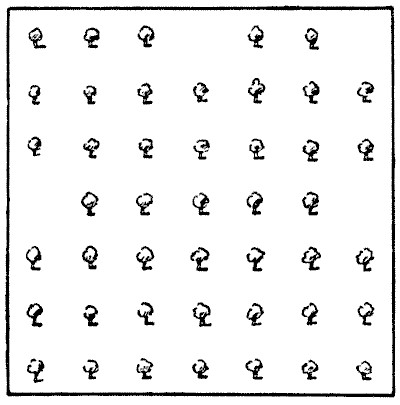
A man had a square plantation of forty-nine trees, but, as will be seen by the omissions in the illustration, four trees were blown down and removed. He now wants to cut down all the remainder except ten trees, which are to be so left that they shall form five straight rows with four trees in every row. Which are the ten trees that he must leave?
209.—THE TWENTY-ONE TREES.
A gentleman wished to plant twenty-one trees in his park so that they should form twelve straight rows with five trees in every row. Could you have supplied him with a pretty symmetrical arrangement that would satisfy these conditions?
210.—THE TEN COINS.
Place ten pennies on a large sheet of paper or cardboard, as shown in the diagram, five on each edge. Now remove four of the coins, without disturbing the others, and replace them on the paper so that the ten shall form five straight lines with four coins in every line. This in itself is not difficult, but you should try to discover in how many different ways the puzzle may be solved, assuming that in every case the two rows at starting are exactly the same.
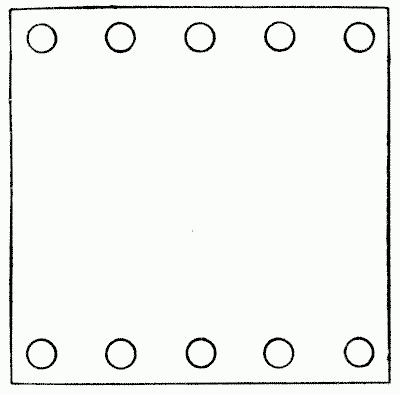
211.—THE TWELVE MINCE-PIES.
It will be seen in our illustration how twelve mince-pies may be placed on the table so as to form six straight rows with four pies in every row. The puzzle is to remove only four of them to new positions so that there shall be seven straight rows with four in every row. Which four would you remove, and where would you replace them?
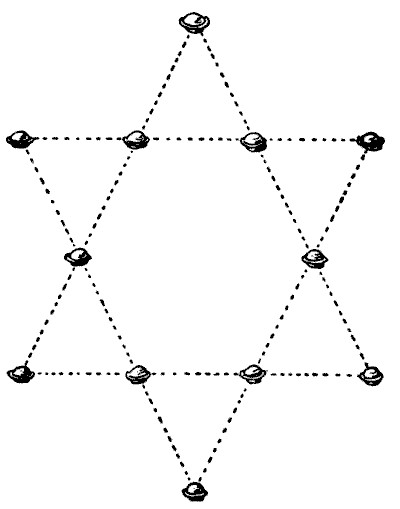
212.—THE BURMESE PLANTATION.
A short time ago I received an interesting communication from the British chaplain at Meiktila, Upper Burma, in which my correspondent informed me that he had found some amusement on board ship on his way out in trying to solve this little poser.
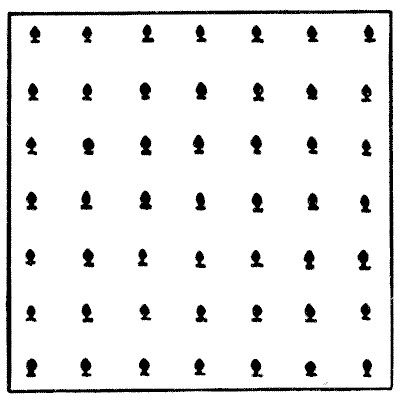
If he has a plantation of forty-nine trees, planted in the form of a square as shown in the accompanying illustration, he wishes to know how he may cut down twenty-seven of the trees so that the twenty-two left standing shall form as many rows as possible with four trees in every row.
Of course there may not be more than four trees in any row.
213.—TURKS AND RUSSIANS.
This puzzle is on the lines of the Afridi problem published by me in Tit-Bits some years ago.
On an open level tract of country a party of Russian infantry, no two of whom were stationed at the same spot, were suddenly surprised by thirty-two Turks, who opened fire on the Russians from all directions. Each of the Turks simultaneously fired a bullet, and each bullet passed immediately over the heads of three Russian soldiers. As each of these bullets when fired killed a different man, the puzzle is to discover what is the smallest possible number of soldiers of which the Russian party could have consisted and what were the casualties on each side.
MOVING COUNTER PROBLEMS.
"I cannot do't without counters."
Winter's Tale, iv. 3.
Puzzles of this class, except so far as they occur in connection with actual games, such as chess, seem to be a comparatively modern introduction. Mathematicians in recent times, notably Vandermonde and Reiss, have devoted some attention to them, but they do not appear to have been considered by the old writers. So far as games with counters are concerned, perhaps the most ancient and widely known in old times is "Nine Men's Morris" (known also, as I shall show, under a great many other names), unless the simpler game, distinctly mentioned in the works of Ovid (No. 110, "Ovid's Game," in The Canterbury Puzzles), from which "Noughts and Crosses" seems to be derived, is still more ancient.
In France the game is called Marelle, in Poland Siegen Wulf Myll (She-goat Wolf Mill, or Fight), in Germany and Austria it is called Muhle (the Mill), in Iceland it goes by the name of Mylla, while the Bogas (or native bargees) of South America are said to play it, and on the Amazon it is called Trique, and held to be of Indian origin. In our own country it has different names in different districts, such as Meg Merrylegs, Peg Meryll, Nine Peg o'Merryal, Nine-Pin Miracle, Merry Peg, and Merry Hole. Shakespeare refers to it in "Midsummer Night's Dream" (Act ii., scene 1):—
"The nine-men's morris is filled up with mud;
And the quaint mazes in the wanton green,
For lack of tread, are undistinguishable."
It was played by the shepherds with stones in holes cut in the turf. John Clare, the peasant poet of Northamptonshire, in "The Shepherd Boy" (1835) says:—"Oft we track his haunts .... By nine-peg-morris nicked upon the green." It is also mentioned by Drayton in his "Polyolbion."
It was found on an old Roman tile discovered during the excavations at Silchester, and cut upon the steps of the Acropolis at Athens. When visiting the Christiania Museum a few years ago I was shown the great Viking ship that was discovered at Gokstad in 1880. On the oak planks forming the deck of the vessel were found boles and lines marking out the game, the holes being made to receive pegs. While inspecting the ancient oak furniture in the Rijks Museum at Amsterdam I became interested in an old catechumen's settle, and was surprised to find the game diagram cut in the centre of the seat—quite conveniently for surreptitious play. It has been discovered cut in the choir stalls of several of our English cathedrals. In the early eighties it was found scratched upon a stone built into a wall (probably about the date 1200), during the restoration of Hargrave church in Northamptonshire. This stone is now in the Northampton Museum. A similar stone has since been found at Sempringham, Lincolnshire. It is to be seen on an ancient tombstone in the Isle of Man, and painted on old Dutch tiles. And in 1901 a stone was dug out of a gravel pit near Oswestry bearing an undoubted diagram of the game.
The game has been played with different rules at different periods and places. I give a copy of the board. Sometimes the diagonal lines are omitted, but this evidently was not intended to affect the play: it simply meant that the angles alone were thought sufficient to indicate the points. This is how Strutt, in Sports and Pastimes, describes the game, and it agrees with the way I played it as a boy:—"Two persons, having each of them nine pieces, or men, lay them down alternately, one by one, upon the spots; and the business of either party is to prevent his antagonist from placing three of his pieces so as to form a row of three, without the intervention of an opponent piece. If a row be formed, he that made it is at liberty to take up one of his competitor's pieces from any part he thinks most to his advantage; excepting he has made a row, which must not be touched if he have another piece upon the board that is not a component part of that row. When all the pieces are laid down, they are played backwards and forwards, in any direction that the lines run, but only can move from one spot to another (next to it) at one time. He that takes off all his antagonist's pieces is the conqueror."
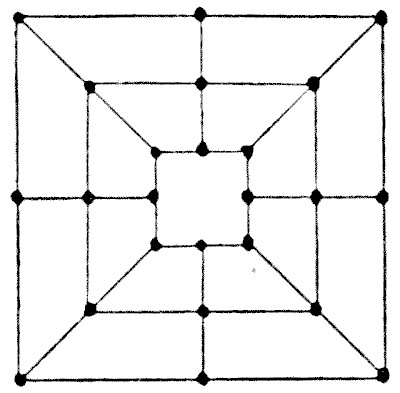
214.—THE SIX FROGS.

The six educated frogs in the illustration are trained to reverse their order, so that their numbers shall read 6, 5, 4, 3, 2, 1, with the blank square in its present position. They can jump to the next square (if vacant) or leap over one frog to the next square beyond (if vacant), just as we move in the game of draughts, and can go backwards or forwards at pleasure. Can you show how they perform their feat in the fewest possible moves? It is quite easy, so when you have done it add a seventh frog to the right and try again. Then add more frogs until you are able to give the shortest solution for any number. For it can always be done, with that single vacant square, no matter how many frogs there are.
215.—THE GRASSHOPPER PUZZLE.
It has been suggested that this puzzle was a great favourite among the young apprentices of the City of London in the sixteenth and seventeenth centuries. Readers will have noticed the curious brass grasshopper on the Royal Exchange. This long-lived creature escaped the fires of 1666 and 1838. The grasshopper, after his kind, was the crest of Sir Thomas Gresham, merchant grocer, who died in 1579, and from this cause it has been used as a sign by grocers in general. Unfortunately for the legend as to its origin, the puzzle was only produced by myself so late as the year 1900. On twelve of the thirteen black discs are placed numbered counters or grasshoppers. The puzzle is to reverse their order, so that they shall read, 1, 2, 3, 4, etc., in the opposite direction, with the vacant disc left in the same position as at present. Move one at a time in any order, either to the adjoining vacant disc or by jumping over one grasshopper, like the moves in draughts. The moves or leaps may be made in either direction that is at any time possible. What are the fewest possible moves in which it can be done?
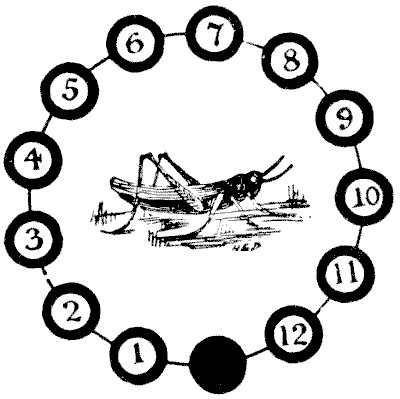
216.—THE EDUCATED FROGS.
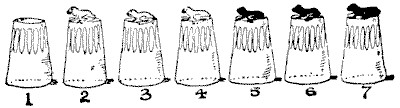
Our six educated frogs have learnt a new and pretty feat. When placed on glass tumblers, as shown in the illustration, they change sides so that the three black ones are to the left and the white frogs to the right, with the unoccupied tumbler at the opposite end—No. 7. They can jump to the next tumbler (if unoccupied), or over one, or two, frogs to an unoccupied tumbler. The jumps can be made in either direction, and a frog may jump over his own or the opposite colour, or both colours. Four suecessive specimen jumps will make everything quite plain: 4 to 1, 5 to 4, 3 to 5, 6 to 3. Can you show how they do it in ten jumps?
217.—THE TWICKENHAM PUZZLE.

In the illustration we have eleven discs in a circle. On five of the discs we place white counters with black letters—as shown—and on five other discs the black counters with white letters. The bottom disc is left vacant. Starting thus, it is required to get the counters into order so that they spell the word "Twickenham" in a clockwise direction, leaving the vacant disc in the original position. The black counters move in the direction that a clock-hand revolves, and the white counters go the opposite way. A counter may jump over one of the opposite colour if the vacant disc is next beyond. Thus, if your first move is with K, then C can jump over K. If then K moves towards E, you may next jump W over C, and so on. The puzzle may be solved in twenty-six moves. Remember a counter cannot jump over one of its own colour.
218.—THE VICTORIA CROSS PUZZLE.
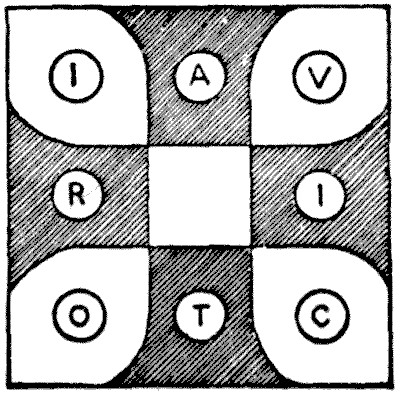
The puzzle-maker is peculiarly a "snapper-up of unconsidered trifles," and his productions are often built up with the slenderest materials. Trivialities that might entirely escape the observation of others, or, if they were observed, would be regarded as of no possible moment, often supply the man who is in quest of posers with a pretty theme or an idea that he thinks possesses some "basal value."
When seated opposite to a lady in a railway carriage at the time of Queen Victoria's Diamond Jubilee, my attention was attracted to a brooch that she was wearing. It was in the form of a Maltese or Victoria Cross, and bore the letters of the word VICTORIA. The number and arrangement of the letters immediately gave me the suggestion for the puzzle which I now present.
The diagram, it will be seen, is composed of nine divisions. The puzzle is to place eight counters, bearing the letters of the word VICTORIA, exactly in the manner shown, and then slide one letter at a time from black to white and white to black alternately, until the word reads round in the same direction, only with the initial letter V on one of the black arms of the cross. At no time may two letters be in the same division. It is required to find the shortest method.
Leaping moves are, of course, not permitted. The first move must obviously be made with A, I, T, or R. Supposing you move T to the centre, the next counter played will be O or C, since I or R cannot be moved. There is something a little remarkable in the solution of this puzzle which I will explain.
219.—THE LETTER BLOCK PUZZLE.

Here is a little reminiscence of our old friend the Fifteen Block Puzzle. Eight wooden blocks are lettered, and are placed in a box, as shown in the illustration. It will be seen that you can only move one block at a time to the place vacant for the time being, as no block may be lifted out of the box. The puzzle is to shift them about until you get them in the order—
A B C
D E F
G H
This you will find by no means difficult if you are allowed as many moves as you like. But the puzzle is to do it in the fewest possible moves. I will not say what this smallest number of moves is, because the reader may like to discover it for himself. In writing down your moves you will find it necessary to record no more than the letters in the order that they are shifted. Thus, your first five moves might be C, H, G, E, F; and this notation can have no possible ambiguity. In practice you only need eight counters and a simple diagram on a sheet of paper.
220.—A LODGING-HOUSE DIFFICULTY.
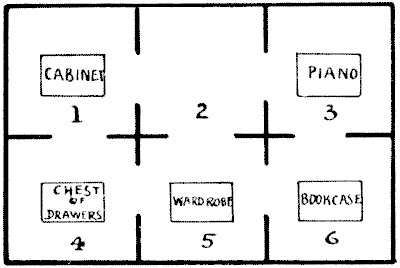
The Dobsons secured apartments at Slocomb-on-Sea. There were six rooms on the same floor, all communicating, as shown in the diagram. The rooms they took were numbers 4, 5, and 6, all facing the sea. But a little difficulty arose. Mr. Dobson insisted that the piano and the bookcase should change rooms. This was wily, for the Dobsons were not musical, but they wanted to prevent any one else playing the instrument. Now, the rooms were very small and the pieces of furniture indicated were very big, so that no two of these articles could be got into any room at the same time. How was the exchange to be made with the least possible labour? Suppose, for example, you first move the wardrobe into No. 2; then you can move the bookcase to No. 5 and the piano to No. 6, and so on. It is a fascinating puzzle, but the landlady had reasons for not appreciating it. Try to solve her difficulty in the fewest possible removals with counters on a sheet of paper.
221.—THE EIGHT ENGINES.
The diagram represents the engine-yard of a railway company under eccentric management. The engines are allowed to be stationary only at the nine points indicated, one of which is at present vacant. It is required to move the engines, one at a time, from point to point, in seventeen moves, so that their numbers shall be in numerical order round the circle, with the central point left vacant. But one of the engines has had its fire drawn, and therefore cannot move. How is the thing to be done? And which engine remains stationary throughout?

222.—A RAILWAY PUZZLE.

Make a diagram, on a large sheet of paper, like the illustration, and have three counters marked A, three marked B, and three marked C. It will be seen that at the intersection of lines there are nine stopping-places, and a tenth stopping-place is attached to the outer circle like the tail of a Q. Place the three counters or engines marked A, the three marked B, and the three marked C at the places indicated. The puzzle is to move the engines, one at a time, along the lines, from stopping-place to stopping-place, until you succeed in getting an A, a B, and a C on each circle, and also A, B, and C on each straight line. You are required to do this in as few moves as possible. How many moves do you need?
223.—A RAILWAY MUDDLE.
The plan represents a portion of the line of the London, Clodville, and Mudford Railway Company. It is a single line with a loop. There is only room for eight wagons, or seven wagons and an engine, between B and C on either the left line or the right line of the loop. It happened that two goods trains (each consisting of an engine and sixteen wagons) got into the position shown in the illustration. It looked like a hopeless deadlock, and each engine-driver wanted the other to go back to the next station and take off nine wagons. But an ingenious stoker undertook to pass the trains and send them on their respective journeys with their engines properly in front. He also contrived to reverse the engines the fewest times possible. Could you have performed the feat? And how many times would you require to reverse the engines? A "reversal" means a change of direction, backward or forward. No rope-shunting, fly-shunting, or other trick is allowed. All the work must be done legitimately by the two engines. It is a simple but interesting puzzle if attempted with counters.

224.—THE MOTOR-GARAGE PUZZLE.

The difficulties of the proprietor of a motor garage are converted into a little pastime of a kind that has a peculiar fascination. All you need is to make a simple plan or diagram on a sheet of paper or cardboard and number eight counters, 1 to 8. Then a whole family can enter into an amusing competition to find the best possible solution of the difficulty.
The illustration represents the plan of a motor garage, with accommodation for twelve cars. But the premises are so inconveniently restricted that the proprietor is often caused considerable perplexity. Suppose, for example, that the eight cars numbered 1 to 8 are in the positions shown, how are they to be shifted in the quickest possible way so that 1, 2, 3, and 4 shall change places with 5, 6, 7, and 8—that is, with the numbers still running from left to right, as at present, but the top row exchanged with the bottom row? What are the fewest possible moves?
One car moves at a time, and any distance counts as one move. To prevent misunderstanding, the stopping-places are marked in squares, and only one car can be in a square at the same time.
225.—THE TEN PRISONERS.
If prisons had no other use, they might still be preserved for the special benefit of puzzle-makers. They appear to be an inexhaustible mine of perplexing ideas. Here is a little poser that will perhaps interest the reader for a short period. We have in the illustration a prison of sixteen cells. The locations of the ten prisoners will be seen. The jailer has queer superstitions about odd and even numbers, and he wants to rearrange the ten prisoners so that there shall be as many even rows of men, vertically, horizontally, and diagonally, as possible. At present it will be seen, as indicated by the arrows, that there are only twelve such rows of 2 and 4. I will state at once that the greatest number of such rows that is possible is sixteen. But the jailer only allows four men to be removed to other cells, and informs me that, as the man who is seated in the bottom right-hand corner is infirm, he must not be moved. Now, how are we to get those sixteen rows of even numbers under such conditions?

226.—ROUND THE COAST.
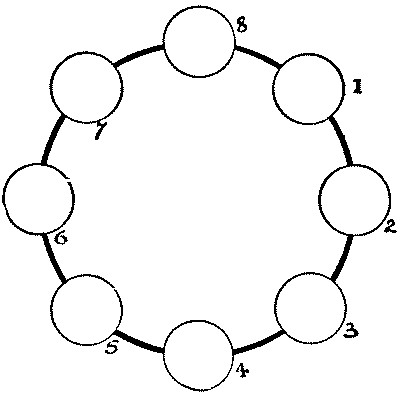
Here is a puzzle that will, I think, be found as amusing as instructive. We are given a ring of eight circles. Leaving circle 8 blank, we are required to write in the name of a seven-lettered port in the United Kingdom in this manner. Touch a blank circle with your pencil, then jump over two circles in either direction round the ring, and write down the first letter. Then touch another vacant circle, jump over two circles, and write down your second letter. Proceed similarly with the other letters in their proper order until you have completed the word. Thus, suppose we select "Glasgow," and proceed as follows: 6—1, 7—2, 8—3, 7—4, 8—5, which means that we touch 6, jump over 7 and and write down "G" on 1; then touch 7, jump over 8 and 1, and write down "l" on 2; and so on. It will be found that after we have written down the first five letters—"Glasg"—as above, we cannot go any further. Either there is something wrong with "Glasgow," or we have not managed our jumps properly. Can you get to the bottom of the mystery?
227.—CENTRAL SOLITAIRE.

This ancient puzzle was a great favourite with our grandmothers, and most of us, I imagine, have on occasions come across a "Solitaire" board—a round polished board with holes cut in it in a geometrical pattern, and a glass marble in every hole. Sometimes I have noticed one on a side table in a suburban front parlour, or found one on a shelf in a country cottage, or had one brought under my notice at a wayside inn. Sometimes they are of the form shown above, but it is equally common for the board to have four more holes, at the points indicated by dots. I select the simpler form.
Though "Solitaire" boards are still sold at the toy shops, it will be sufficient if the reader will make an enlarged copy of the above on a sheet of cardboard or paper, number the "holes," and provide himself with 33 counters, buttons, or beans. Now place a counter in every hole except the central one, No. 17, and the puzzle is to take off all the counters in a series of jumps, except the last counter, which must be left in that central hole. You are allowed to jump one counter over the next one to a vacant hole beyond, just as in the game of draughts, and the counter jumped over is immediately taken off the board. Only remember every move must be a jump; consequently you will take off a counter at each move, and thirty-one single jumps will of course remove all the thirty-one counters. But compound moves are allowed (as in draughts, again), for so long as one counter continues to jump, the jumps all count as one move.
Here is the beginning of an imaginary solution which will serve to make the manner of moving perfectly plain, and show how the solver should write out his attempts: 5-17, 12-10, 26-12, 24-26 (13-11, 11-25), 9-11 (26-24, 24-10, 10-12), etc., etc. The jumps contained within brackets count as one move, because they are made with the same counter. Find the fewest possible moves. Of course, no diagonal jumps are permitted; you can only jump in the direction of the lines.
228.—THE TEN APPLES.
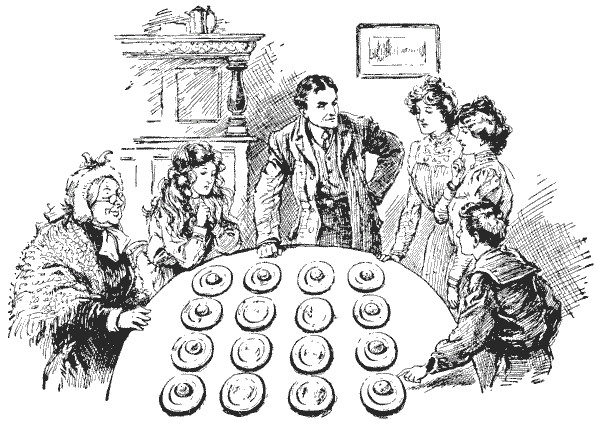
The family represented in the illustration are amusing themselves with this little puzzle, which is not very difficult but quite interesting. They have, it will be seen, placed sixteen plates on the table in the form of a square, and put an apple in each of ten plates. They want to find a way of removing all the apples except one by jumping over one at a time to the next vacant square, as in draughts; or, better, as in solitaire, for you are not allowed to make any diagonal moves—only moves parallel to the sides of the square. It is obvious that as the apples stand no move can be made, but you are permitted to transfer any single apple you like to a vacant plate before starting. Then the moves must be all leaps, taking off the apples leaped over.
229.—THE NINE ALMONDS.
"Here is a little puzzle," said a Parson, "that I have found peculiarly fascinating. It is so simple, and yet it keeps you interested indefinitely."
The reverend gentleman took a sheet of paper and divided it off into twenty-five squares, like a square portion of a chessboard. Then he placed nine almonds on the central squares, as shown in the illustration, where we have represented numbered counters for convenience in giving the solution.
"Now, the puzzle is," continued the Parson, "to remove eight of the almonds and leave the ninth in the central square. You make the removals by jumping one almond over another to the vacant square beyond and taking off the one jumped over—just as in draughts, only here you can jump in any direction, and not diagonally only. The point is to do the thing in the fewest possible moves."
The following specimen attempt will make everything clear. Jump 4 over 1, 5 over 9, 3 over 6, 5 over 3, 7 over 5 and 2, 4 over 7, 8 over 4. But 8 is not left in the central square, as it should be. Remember to remove those you jump over. Any number of jumps in succession with the same almond count as one move.

230.—THE TWELVE PENNIES.
Here is a pretty little puzzle that only requires twelve pennies or counters. Arrange them in a circle, as shown in the illustration. Now take up one penny at a time and, passing it over two pennies, place it on the third penny. Then take up another single penny and do the same thing, and so on, until, in six such moves, you have the coins in six pairs in the positions 1, 2, 3, 4, 5, 6. You can move in either direction round the circle at every play, and it does not matter whether the two jumped over are separate or a pair. This is quite easy if you use just a little thought.

231.—PLATES AND COINS.
Place twelve plates, as shown, on a round table, with a penny or orange in every plate. Start from any plate you like and, always going in one direction round the table, take up one penny, pass it over two other pennies, and place it in the next plate. Go on again; take up another penny and, having passed it over two pennies, place it in a plate; and so continue your journey. Six coins only are to be removed, and when these have been placed there should be two coins in each of six plates and six plates empty. An important point of the puzzle is to go round the table as few times as possible. It does not matter whether the two coins passed over are in one or two plates, nor how many empty plates you pass a coin over. But you must always go in one direction round the table and end at the point from which you set out. Your hand, that is to say, goes steadily forward in one direction, without ever moving backwards.
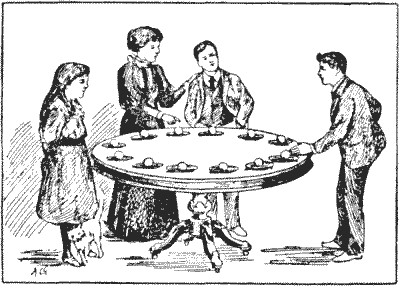
232.—CATCHING THE MICE.

"Play fair!" said the mice. "You know the rules of the game."
"Yes, I know the rules," said the cat. "I've got to go round and round the circle, in the direction that you are looking, and eat every thirteenth mouse, but I must keep the white mouse for a tit-bit at the finish. Thirteen is an unlucky number, but I will do my best to oblige you."
"Hurry up, then!" shouted the mice.
"Give a fellow time to think," said the cat. "I don't know which of you to start at. I must figure it out."
While the cat was working out the puzzle he fell asleep, and, the spell being thus broken, the mice returned home in safety. At which mouse should the cat have started the count in order that the white mouse should be the last eaten?
When the reader has solved that little puzzle, here is a second one for him. What is the smallest number that the cat can count round and round the circle, if he must start at the white mouse (calling that "one" in the count) and still eat the white mouse last of all?
And as a third puzzle try to discover what is the smallest number that the cat can count round and round if she must start at the white mouse (calling that "one") and make the white mouse the third eaten.
233.—THE ECCENTRIC CHEESEMONGER.
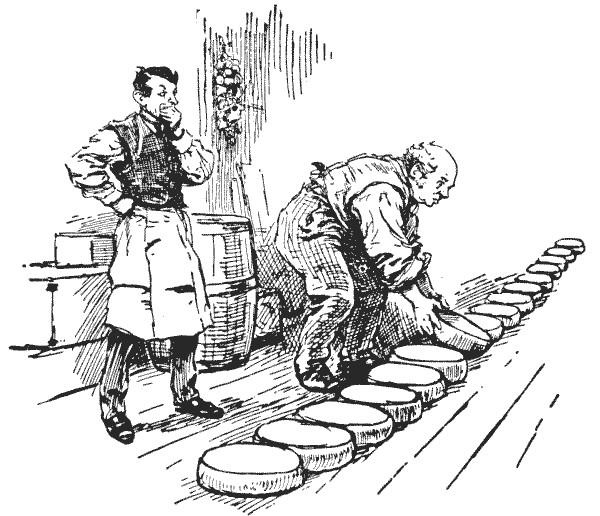
The cheesemonger depicted in the illustration is an inveterate puzzle lover. One of his favourite puzzles is the piling of cheeses in his warehouse, an amusement that he finds good exercise for the body as well as for the mind. He places sixteen cheeses on the floor in a straight row and then makes them into four piles, with four cheeses in every pile, by always passing a cheese over four others. If you use sixteen counters and number them in order from 1 to 16, then you may place 1 on 6, 11 on 1, 7 on 4, and so on, until there are four in every pile. It will be seen that it does not matter whether the four passed over are standing alone or piled; they count just the same, and you can always carry a cheese in either direction. There are a great many different ways of doing it in twelve moves, so it makes a good game of "patience" to try to solve it so that the four piles shall be left in different stipulated places. For example, try to leave the piles at the extreme ends of the row, on Nos. 1, 2, 15 and 16; this is quite easy. Then try to leave three piles together, on Nos. 13, 14, and 15. Then again play so that they shall be left on Nos. 3, 5, 12, and 14.
234.—THE EXCHANGE PUZZLE.
Here is a rather entertaining little puzzle with moving counters. You only need twelve counters—six of one colour, marked A, C, E, G, I, and K, and the other six marked B, D, F, H, J, and L. You first place them on the diagram, as shown in the illustration, and the puzzle is to get them into regular alphabetical order, as follows:—
A
B
C
D
E
F
G
H
I
J
K
L
The moves are made by exchanges of opposite colours standing on the same line. Thus, G and J may exchange places, or F and A, but you cannot exchange G and C, or F and D, because in one case they are both white and in the other case both black. Can you bring about the required arrangement in seventeen exchanges?
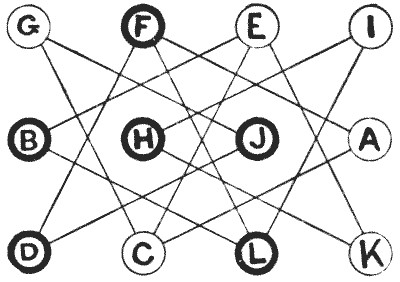
It cannot be done in fewer moves. The puzzle is really much easier than it looks, if properly attacked.
235.—TORPEDO PRACTICE.
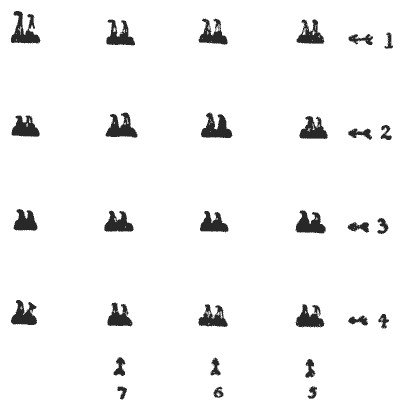
If a fleet of sixteen men-of-war were lying at anchor and surrounded by the enemy, how many ships might be sunk if every torpedo, projected in a straight line, passed under three vessels and sank the fourth? In the diagram we have arranged the fleet in square formation, where it will be seen that as many as seven ships may be sunk (those in the top row and first column) by firing the torpedoes indicated by arrows. Anchoring the fleet as we like, to what extent can we increase this number? Remember that each successive ship is sunk before another torpedo is launched, and that every torpedo proceeds in a different direction; otherwise, by placing the ships in a straight line, we might sink as many as thirteen! It is an interesting little study in naval warfare, and eminently practical—provided the enemy will allow you to arrange his fleet for your convenience and promise to lie still and do nothing!
236.—THE HAT PUZZLE.
Ten hats were hung on pegs as shown in the illustration—five silk hats and five felt "bowlers," alternately silk and felt. The two pegs at the end of the row were empty.

The puzzle is to remove two contiguous hats to the vacant pegs, then two other adjoining hats to the pegs now unoccupied, and so on until five pairs have been moved and the hats again hang in an unbroken row, but with all the silk ones together and all the felt hats together.
Remember, the two hats removed must always be contiguous ones, and you must take one in each hand and place them on their new pegs without reversing their relative position. You are not allowed to cross your hands, nor to hang up one at a time.
Can you solve this old puzzle, which I give as introductory to the next? Try it with counters of two colours or with coins, and remember that the two empty pegs must be left at one end of the row.
237.—BOYS AND GIRLS.
If you mark off ten divisions on a sheet of paper to represent the chairs, and use eight numbered counters for the children, you will have a fascinating pastime. Let the odd numbers represent boys and even numbers girls, or you can use counters of two colours, or coins.
The puzzle is to remove two children who are occupying adjoining chairs and place them in two empty chairs, making them first change sides; then remove a second pair of children from adjoining chairs and place them in the two now vacant, making them change sides; and so on, until all the boys are together and all the girls together, with the two vacant chairs at one end as at present. To solve the puzzle you must do this in five moves. The two children must always be taken from chairs that are next to one another; and remember the important point of making the two children change sides, as this latter is the distinctive feature of the puzzle. By "change sides" I simply mean that if, for example, you first move 1 and 2 to the vacant chairs, then the first (the outside) chair will be occupied by 2 and the second one by 1.

238.—ARRANGING THE JAMPOTS.
I happened to see a little girl sorting out some jam in a cupboard for her mother. She was putting each different kind of preserve apart on the shelves. I noticed that she took a pot of damson in one hand and a pot of gooseberry in the other and made them change places; then she changed a strawberry with a raspberry, and so on. It was interesting to observe what a lot of unnecessary trouble she gave herself by making more interchanges than there was any need for, and I thought it would work into a good puzzle.
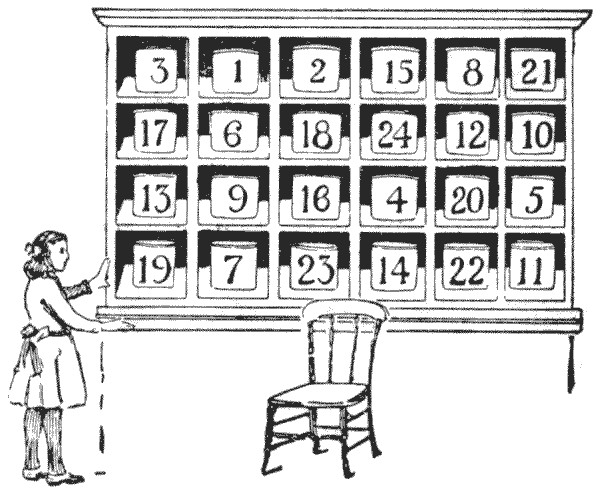
It will be seen in the illustration that little Dorothy has to manipulate twenty-four large jampots in as many pigeon-holes. She wants to get them in correct numerical order—that is, 1, 2, 3, 4, 5, 6 on the top shelf, 7, 8, 9, 10, 11, 12 on the next shelf, and so on. Now, if she always takes one pot in the right hand and another in the left and makes them change places, how many of these interchanges will be necessary to get all the jampots in proper order? She would naturally first change the 1 and the 3, then the 2 and the 3, when she would have the first three pots in their places. How would you advise her to go on then? Place some numbered counters on a sheet of paper divided into squares for the pigeon-holes, and you will find it an amusing puzzle.
UNICURSAL AND ROUTE PROBLEMS.
"I see them on their winding way."
REGINALD HEBER.
It is reasonable to suppose that from the earliest ages one man has asked another such questions as these: "Which is the nearest way home?" "Which is the easiest or pleasantest way?" "How can we find a way that will enable us to dodge the mastodon and the plesiosaurus?" "How can we get there without ever crossing the track of the enemy?" All these are elementary route problems, and they can be turned into good puzzles by the introduction of some conditions that complicate matters. A variety of such complications will be found in the following examples. I have also included some enumerations of more or less difficulty. These afford excellent practice for the reasoning faculties, and enable one to generalize in the case of symmetrical forms in a manner that is most instructive.
239.—A JUVENILE PUZZLE.
For years I have been perpetually consulted by my juvenile friends about this little puzzle. Most children seem to know it, and yet, curiously enough, they are invariably unacquainted with the answer. The question they always ask is, "Do, please, tell me whether it is really possible." I believe Houdin the conjurer used to be very fond of giving it to his child friends, but I cannot say whether he invented the little puzzle or not. No doubt a large number of my readers will be glad to have the mystery of the solution cleared up, so I make no apology for introducing this old "teaser."
The puzzle is to draw with three strokes of the pencil the diagram that the little girl is exhibiting in the illustration. Of course, you must not remove your pencil from the paper during a stroke or go over the same line a second time. You will find that you can get in a good deal of the figure with one continuous stroke, but it will always appear as if four strokes are necessary.

Another form of the puzzle is to draw the diagram on a slate and then rub it out in three rubs.
240.—THE UNION JACK.
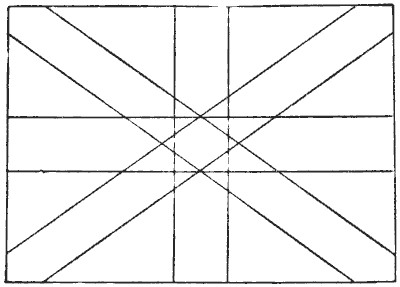
The illustration is a rough sketch somewhat resembling the British flag, the Union Jack. It is not possible to draw the whole of it without lifting the pencil from the paper or going over the same line twice. The puzzle is to find out just how much of the drawing it is possible to make without lifting your pencil or going twice over the same line. Take your pencil and see what is the best you can do.
241.—THE DISSECTED CIRCLE.
How many continuous strokes, without lifting your pencil from the paper, do you require to draw the design shown in our illustration? Directly you change the direction of your pencil it begins a new stroke. You may go over the same line more than once if you like. It requires just a little care, or you may find yourself beaten by one stroke.

242.—THE TUBE INSPECTOR'S PUZZLE.
The man in our illustration is in a little dilemma. He has just been appointed inspector of a certain system of tube railways, and it is his duty to inspect regularly, within a stated period, all the company's seventeen lines connecting twelve stations, as shown on the big poster plan that he is contemplating. Now he wants to arrange his route so that it shall take him over all the lines with as little travelling as possible. He may begin where he likes and end where he likes. What is his shortest route?
Could anything be simpler? But the reader will soon find that, however he decides to proceed, the inspector must go over some of the lines more than once. In other words, if we say that the stations are a mile apart, he will have to travel more than seventeen miles to inspect every line. There is the little difficulty. How far is he compelled to travel, and which route do you recommend?

243.—VISITING THE TOWNS.
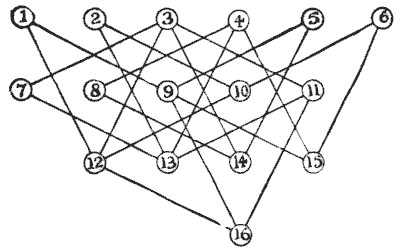
A traveller, starting from town No. 1, wishes to visit every one of the towns once, and once only, going only by roads indicated by straight lines. How many different routes are there from which he can select? Of course, he must end his journey at No. 1, from which he started, and must take no notice of cross roads, but go straight from town to town. This is an absurdly easy puzzle, if you go the right way to work.
244.—THE FIFTEEN TURNINGS.
Here is another queer travelling puzzle, the solution of which calls for ingenuity. In this case the traveller starts from the black town and wishes to go as far as possible while making only fifteen turnings and never going along the same road twice. The towns are supposed to be a mile apart. Supposing, for example, that he went straight to A, then straight to B, then to C, D, E, and F, you will then find that he has travelled thirty-seven miles in five turnings. Now, how far can he go in fifteen turnings?

245.—THE FLY ON THE OCTAHEDRON.
"Look here," said the professor to his colleague, "I have been watching that fly on the octahedron, and it confines its walks entirely to the edges. What can be its reason for avoiding the sides?"
"Perhaps it is trying to solve some route problem," suggested the other. "Supposing it to start from the top point, how many different routes are there by which it may walk over all the edges, without ever going twice along the same edge in any route?"
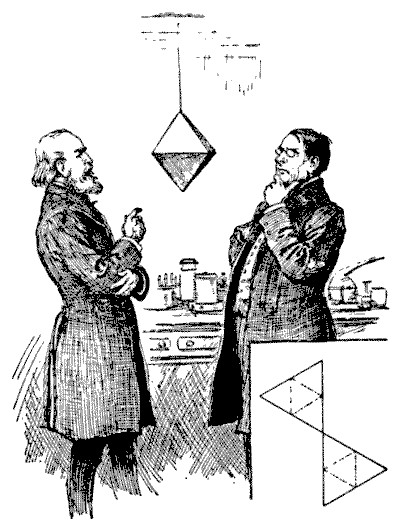
The problem was a harder one than they expected, and after working at it during leisure moments for several days their results did not agree—in fact, they were both wrong. If the reader is surprised at their failure, let him attempt the little puzzle himself. I will just explain that the octahedron is one of the five regular, or Platonic, bodies, and is contained under eight equal and equilateral triangles. If you cut out the two pieces of cardboard of the shape shown in the margin of the illustration, cut half through along the dotted lines and then bend them and put them together, you will have a perfect octahedron. In any route over all the edges it will be found that the fly must end at the point of departure at the top.
246.—THE ICOSAHEDRON PUZZLE.
The icosahedron is another of the five regular, or Platonic, bodies having all their sides, angles, and planes similar and equal. It is bounded by twenty similar equilateral triangles. If you cut out a piece of cardboard of the form shown in the smaller diagram, and cut half through along the dotted lines, it will fold up and form a perfect icosahedron.
Now, a Platonic body does not mean a heavenly body; but it will suit the purpose of our puzzle if we suppose there to be a habitable planet of this shape. We will also suppose that, owing to a superfluity of water, the only dry land is along the edges, and that the inhabitants have no knowledge of navigation. If every one of those edges is 10,000 miles long and a solitary traveller is placed at the North Pole (the highest point shown), how far will he have to travel before he will have visited every habitable part of the planet—that is, have traversed every one of the edges?
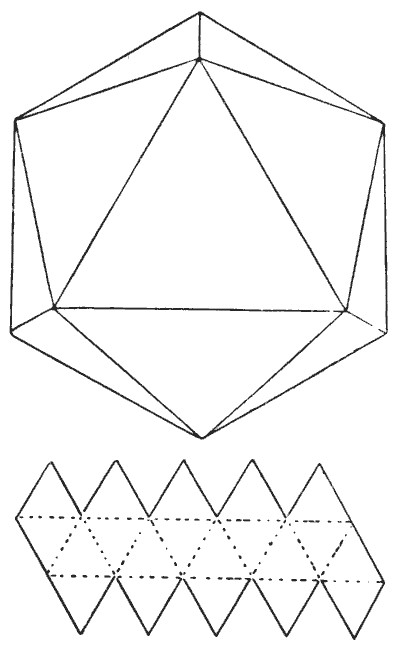
247.—INSPECTING A MINE.
The diagram is supposed to represent the passages or galleries in a mine. We will assume that every passage, A to B, B to C, C to H, H to I, and so on, is one furlong in length. It will be seen that there are thirty-one of these passages. Now, an official has to inspect all of them, and he descends by the shaft to the point A. How far must he travel, and what route do you recommend? The reader may at first say, "As there are thirty-one passages, each a furlong in length, he will have to travel just thirty-one furlongs." But this is assuming that he need never go along a passage more than once, which is not the case. Take your pencil and try to find the shortest route. You will soon discover that there is room for considerable judgment. In fact, it is a perplexing puzzle.
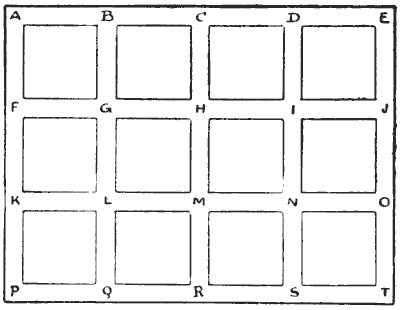
248.—THE CYCLISTS' TOUR.
Two cyclists were consulting a road map in preparation for a little tour together. The circles represent towns, and all the good roads are represented by lines. They are starting from the town with a star, and must complete their tour at E. But before arriving there they want to visit every other town once, and only once. That is the difficulty. Mr. Spicer said, "I am certain we can find a way of doing it;" but Mr. Maggs replied, "No way, I'm sure." Now, which of them was correct? Take your pencil and see if you can find any way of doing it. Of course you must keep to the roads indicated.

249.—THE SAILOR'S PUZZLE.
The sailor depicted in the illustration stated that he had since his boyhood been engaged in trading with a small vessel among some twenty little islands in the Pacific. He supplied the rough chart of which I have given a copy, and explained that the lines from island to island represented the only routes that he ever adopted. He always started from island A at the beginning of the season, and then visited every island once, and once only, finishing up his tour at the starting-point A. But he always put off his visit to C as long as possible, for trade reasons that I need not enter into. The puzzle is to discover his exact route, and this can be done with certainty. Take your pencil and, starting at A, try to trace it out. If you write down the islands in the order in which you visit them—thus, for example, A, I, O, L, G, etc.—you can at once see if you have visited an island twice or omitted any. Of course, the crossings of the lines must be ignored—that is, you must continue your route direct, and you are not allowed to switch off at a crossing and proceed in another direction. There is no trick of this kind in the puzzle. The sailor knew the best route. Can you find it?
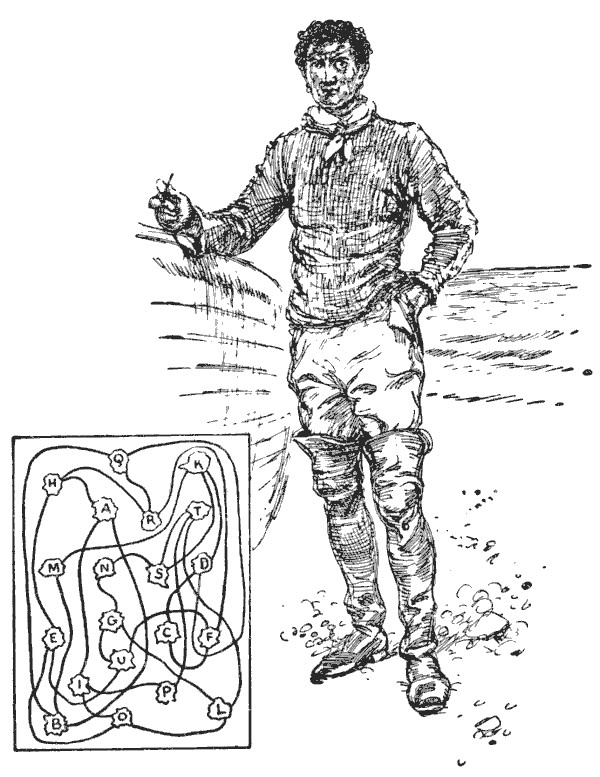
250.—THE GRAND TOUR.
One of the everyday puzzles of life is the working out of routes. If you are taking a holiday on your bicycle, or a motor tour, there always arises the question of how you are to make the best of your time and other resources. You have determined to get as far as some particular place, to include visits to such-and-such a town, to try to see something of special interest elsewhere, and perhaps to try to look up an old friend at a spot that will not take you much out of your way. Then you have to plan your route so as to avoid bad roads, uninteresting country, and, if possible, the necessity of a return by the same way that you went. With a map before you, the interesting puzzle is attacked and solved. I will present a little poser based on these lines.
I give a rough map of a country—it is not necessary to say what particular country—the circles representing towns and the dotted lines the railways connecting them. Now there lived in the town marked A a man who was born there, and during the whole of his life had never once left his native place. From his youth upwards he had been very industrious, sticking incessantly to his trade, and had no desire whatever to roam abroad. However, on attaining his fiftieth birthday he decided to see something of his country, and especially to pay a visit to a very old friend living at the town marked Z. What he proposed was this: that he would start from his home, enter every town once and only once, and finish his journey at Z. As he made up his mind to perform this grand tour by rail only, he found it rather a puzzle to work out his route, but he at length succeeded in doing so. How did he manage it? Do not forget that every town has to be visited once, and not more than once.

251.—WATER, GAS, AND ELECTRICITY.
There are some half-dozen puzzles, as old as the hills, that are perpetually cropping up, and there is hardly a month in the year that does not bring inquiries as to their solution. Occasionally one of these, that one had thought was an extinct volcano, bursts into eruption in a surprising manner. I have received an extraordinary number of letters respecting the ancient puzzle that I have called "Water, Gas, and Electricity." It is much older than electric lighting, or even gas, but the new dress brings it up to date. The puzzle is to lay on water, gas, and electricity, from W, G, and E, to each of the three houses, A, B, and C, without any pipe crossing another. Take your pencil and draw lines showing how this should be done. You will soon find yourself landed in difficulties.

252.—A PUZZLE FOR MOTORISTS.
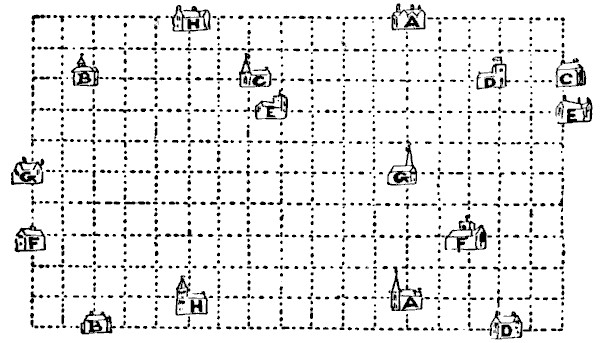
Eight motorists drove to church one morning. Their respective houses and churches, together with the only roads available (the dotted lines), are shown. One went from his house A to his church A, another from his house B to his church B, another from C to C, and so on, but it was afterwards found that no driver ever crossed the track of another car. Take your pencil and try to trace out their various routes.
253.—A BANK HOLIDAY PUZZLE.
Two friends were spending their bank holiday on a cycling trip. Stopping for a rest at a village inn, they consulted a route map, which is represented in our illustration in an exceedingly simplified form, for the puzzle is interesting enough without all the original complexities. They started from the town in the top left-hand corner marked A. It will be seen that there are one hundred and twenty such towns, all connected by straight roads. Now they discovered that there are exactly 1,365 different routes by which they may reach their destination, always travelling either due south or due east. The puzzle is to discover which town is their destination.

Of course, if you find that there are more than 1,365 different routes to a town it cannot be the right one.
254.—THE MOTOR-CAR TOUR.
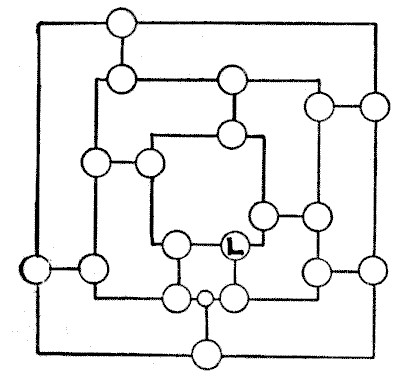
In the above diagram the circles represent towns and the lines good roads. In just how many different ways can a motorist, starting from London (marked with an L), make a tour of all these towns, visiting every town once, and only once, on a tour, and always coming back to London on the last ride? The exact reverse of any route is not counted as different.
255.—THE LEVEL PUZZLE.

This is a simple counting puzzle. In how many different ways can you spell out the word LEVEL by placing the point of your pencil on an L and then passing along the lines from letter to letter. You may go in any direction, backwards or forwards. Of course you are not allowed to miss letters—that is to say, if you come to a letter you must use it.
256.—THE DIAMOND PUZZLE.
IN how many different ways may the word DIAMOND be read in the arrangement shown? You may start wherever you like at a D and go up or down, backwards or forwards, in and out, in any direction you like, so long as you always pass from one letter to another that adjoins it. How many ways are there?

257.—THE DEIFIED PUZZLE.
In how many different ways may the word DEIFIED be read in this arrangement under the same conditions as in the last puzzle, with the addition that you can use any letters twice in the same reading?
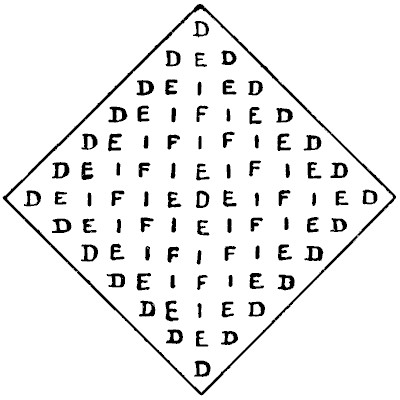
258.—THE VOTERS' PUZZLE.
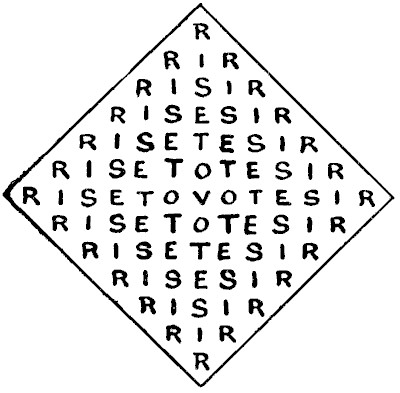
Here we have, perhaps, the most interesting form of the puzzle. In how many different ways can you read the political injunction, "RISE TO VOTE, SIR," under the same conditions as before? In this case every reading of the palindrome requires the use of the central V as the middle letter.
259.—HANNAH'S PUZZLE.
A man was in love with a young lady whose Christian name was Hannah. When he asked her to be his wife she wrote down the letters of her name in this manner:—
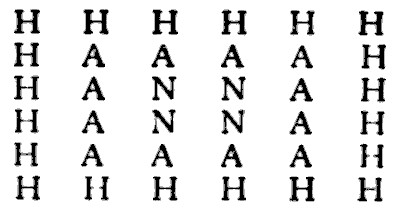
and promised that she would be his if he could tell her correctly in how many different ways it was possible to spell out her name, always passing from one letter to another that was adjacent. Diagonal steps are here allowed. Whether she did this merely to tease him or to test his cleverness is not recorded, but it is satisfactory to know that he succeeded. Would you have been equally successful? Take your pencil and try. You may start from any of the H's and go backwards or forwards and in any direction, so long as all the letters in a spelling are adjoining one another. How many ways are there, no two exactly alike?
260.—THE HONEYCOMB PUZZLE.
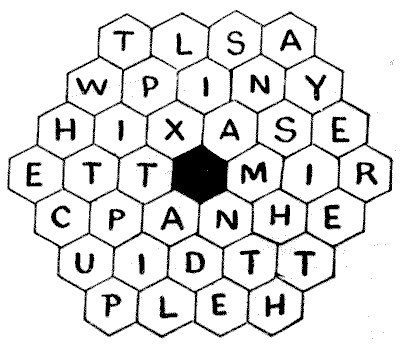
Here is a little puzzle with the simplest possible conditions. Place the point of your pencil on a letter in one of the cells of the honeycomb, and trace out a very familiar proverb by passing always from a cell to one that is contiguous to it. If you take the right route you will have visited every cell once, and only once. The puzzle is much easier than it looks.
261.—THE MONK AND THE BRIDGES.
In this case I give a rough plan of a river with an island and five bridges. On one side of the river is a monastery, and on the other side is seen a monk in the foreground. Now, the monk has decided that he will cross every bridge once, and only once, on his return to the monastery. This is, of course, quite easy to do, but on the way he thought to himself, "I wonder how many different routes there are from which I might have selected." Could you have told him? That is the puzzle. Take your pencil and trace out a route that will take you once over all the five bridges. Then trace out a second route, then a third, and see if you can count all the variations. You will find that the difficulty is twofold: you have to avoid dropping routes on the one hand and counting the same routes more than once on the other.
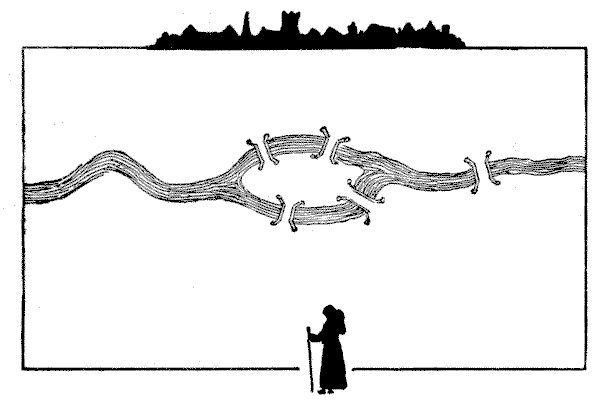
COMBINATION AND GROUP PROBLEMS.
"A combination and a form indeed."
Hamlet, iii. 4.
Various puzzles in this class might be termed problems in the "geometry of situation," but their solution really depends on the theory of combinations which, in its turn, is derived directly from the theory of permutations. It has seemed convenient to include here certain group puzzles and enumerations that might, perhaps, with equal reason have been placed elsewhere; but readers are again asked not to be too critical about the classification, which is very difficult and arbitrary. As I have included my problem of "The Round Table" (No. 273), perhaps a few remarks on another well-known problem of the same class, known by the French as La Problême des Ménages, may be interesting. If n married ladies are seated at a round table in any determined order, in how many different ways may their n husbands be placed so that every man is between two ladies but never next to his own wife?
This difficult problem was first solved by Laisant, and the method shown in the following table is due to Moreau:—
4
0
2
5
3
13
6
13
80
7
83
579
8
592
4738
9
4821
43387
10
43979
439792
The first column shows the number of married couples. The numbers in the second column are obtained in this way: 5 × 3 + 0 - 2 = 13; 6 × 13 + 3 + 2 = 83; 7 × 83 + 13 - 2 = 592; 8 × 592 + 83 + 2 = 4821; and so on. Find all the numbers, except 2, in the table, and the method will be evident. It will be noted that the 2 is subtracted when the first number (the number of couples) is odd, and added when that number is even. The numbers in the third column are obtained thus: 13 - 0 = 13; 83 - 3 = 80; 592 - 13 = 579; 4821 - 83 = 4738; and so on. The numbers in this last column give the required solutions. Thus, four husbands may be seated in two ways, five husbands may be placed in thirteen ways, and six husbands in eighty ways.
The following method, by Lucas, will show the remarkable way in which chessboard analysis may be applied to the solution of a circular problem of this kind. Divide a square into thirty-six cells, six by six, and strike out all the cells in the long diagonal from the bottom left-hand corner to the top right-hand corner, also the five cells in the diagonal next above it and the cell in the bottom right-hand corner. The answer for six couples will be the same as the number of ways in which you can place six rooks (not using the cancelled cells) so that no rook shall ever attack another rook. It will be found that the six rooks may be placed in eighty different ways, which agrees with the above table.
262.—THOSE FIFTEEN SHEEP.
A certain cyclopædia has the following curious problem, I am told: "Place fifteen sheep in four pens so that there shall be the same number of sheep in each pen." No answer whatever is vouchsafed, so I thought I would investigate the matter. I saw that in dealing with apples or bricks the thing would appear to be quite impossible, since four times any number must be an even number, while fifteen is an odd number. I thought, therefore, that there must be some quality peculiar to the sheep that was not generally known. So I decided to interview some farmers on the subject. The first one pointed out that if we put one pen inside another, like the rings of a target, and placed all sheep in the smallest pen, it would be all right. But I objected to this, because you admittedly place all the sheep in one pen, not in four pens. The second man said that if I placed four sheep in each of three pens and three sheep in the last pen (that is fifteen sheep in all), and one of the ewes in the last pen had a lamb during the night, there would be the same number in each pen in the morning. This also failed to satisfy me.
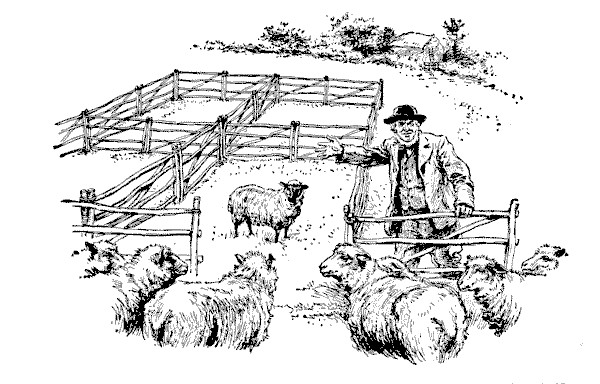
The third farmer said, "I've got four hurdle pens down in one of my fields, and a small flock of wethers, so if you will just step down with me I will show you how it is done." The illustration depicts my friend as he is about to demonstrate the matter to me. His lucid explanation was evidently that which was in the mind of the writer of the article in the cyclopædia. What was it? Can you place those fifteen sheep?
263.—KING ARTHUR'S KNIGHTS.
King Arthur sat at the Round Table on three successive evenings with his knights—Beleobus, Caradoc, Driam, Eric, Floll, and Galahad—but on no occasion did any person have as his neighbour one who had before sat next to him. On the first evening they sat in alphabetical order round the table. But afterwards King Arthur arranged the two next sittings so that he might have Beleobus as near to him as possible and Galahad as far away from him as could be managed. How did he seat the knights to the best advantage, remembering that rule that no knight may have the same neighbour twice?
264.—THE CITY LUNCHEONS.
Twelve men connected with a large firm in the City of London sit down to luncheon together every day in the same room. The tables are small ones that only accommodate two persons at the same time. Can you show how these twelve men may lunch together on eleven days in pairs, so that no two of them shall ever sit twice together? We will represent the men by the first twelve letters of the alphabet, and suppose the first day's pairing to be as follows—
(A B) (C D) (E F) (G H) (I J) (K L).
Then give any pairing you like for the next day, say—
(A C) (B D) (E G) (F H) (I K) (J L),
and so on, until you have completed your eleven lines, with no pair ever occurring twice. There are a good many different arrangements possible. Try to find one of them.
265.—A PUZZLE FOR CARD-PLAYERS.
Twelve members of a club arranged to play bridge together on eleven evenings, but no player was ever to have the same partner more than once, or the same opponent more than twice. Can you draw up a scheme showing how they may all sit down at three tables every evening? Call the twelve players by the first twelve letters of the alphabet and try to group them.
266.—A TENNIS TOURNAMENT.
Four married couples played a "mixed double" tennis tournament, a man and a lady always playing against a man and a lady. But no person ever played with or against any other person more than once. Can you show how they all could have played together in the two courts on three successive days? This is a little puzzle of a quite practical kind, and it is just perplexing enough to be interesting.
267.—THE WRONG HATS.
"One of the most perplexing things I have come across lately," said Mr. Wilson, "is this. Eight men had been dining not wisely but too well at a certain London restaurant. They were the last to leave, but not one man was in a condition to identify his own hat. Now, considering that they took their hats at random, what are the chances that every man took a hat that did not belong to him?"
"The first thing," said Mr. Waterson, "is to see in how many different ways the eight hats could be taken."
"That is quite easy," Mr. Stubbs explained. "Multiply together the numbers, 1, 2, 3, 4, 5, 6, 7, and 8. Let me see—half a minute—yes; there are 40,320 different ways."
"Now all you've got to do is to see in how many of these cases no man has his own hat," said Mr. Waterson.
"Thank you, I'm not taking any," said Mr. Packhurst. "I don't envy the man who attempts the task of writing out all those forty-thousand-odd cases and then picking out the ones he wants."
They all agreed that life is not long enough for that sort of amusement; and as nobody saw any other way of getting at the answer, the matter was postponed indefinitely. Can you solve the puzzle?
268.—THE PEAL OF BELLS.
A correspondent, who is apparently much interested in campanology, asks me how he is to construct what he calls a "true and correct" peal for four bells. He says that every possible permutation of the four bells must be rung once, and once only. He adds that no bell must move more than one place at a time, that no bell must make more than two successive strokes in either the first or the last place, and that the last change must be able to pass into the first. These fantastic conditions will be found to be observed in the little peal for three bells, as follows:—
1
2
3
2
1
3
2
3
1
3
2
1
3
1
2
1
3
2
How are we to give him a correct solution for his four bells?
269.—THREE MEN IN A BOAT.
A certain generous London manufacturer gives his workmen every year a week's holiday at the seaside at his own expense. One year fifteen of his men paid a visit to Herne Bay. On the morning of their departure from London they were addressed by their employer, who expressed the hope that they would have a very pleasant time.
"I have been given to understand," he added, "that some of you fellows are very fond of rowing, so I propose on this occasion to provide you with this recreation, and at the same time give you an amusing little puzzle to solve. During the seven days that you are at Herne Bay every one of you will go out every day at the same time for a row, but there must always be three men in a boat and no more. No two men may ever go out in a boat together more than once, and no man is allowed to go out twice in the same boat. If you can manage to do this, and use as few different boats as possible, you may charge the firm with the expense."
One of the men tells me that the experience he has gained in such matters soon enabled him to work out the answer to the entire satisfaction of themselves and their employer. But the amusing part of the thing is that they never really solved the little mystery. I find their method to have been quite incorrect, and I think it will amuse my readers to discover how the men should have been placed in the boats. As their names happen to have been Andrews, Baker, Carter, Danby, Edwards, Frith, Gay, Hart, Isaacs, Jackson, Kent, Lang, Mason, Napper, and Onslow, we can call them by their initials and write out the five groups for each of the seven days in the following simple way:
1
2
3
4
5
First Day:
(ABC)
(DEF)
(GHI)
(JKL)
(MNO).
The men within each pair of brackets are here seen to be in the same boat, and therefore A can never go out with B or with C again, and C can never go out again with B. The same applies to the other four boats. The figures show the number on the boat, so that A, B, or C, for example, can never go out in boat No. 1 again.
270.—THE GLASS BALLS.
A number of clever marksmen were staying at a country house, and the host, to provide a little amusement, suspended strings of glass balls, as shown in the illustration, to be fired at. After they had all put their skill to a sufficient test, somebody asked the following question: "What is the total number of different ways in which these sixteen balls may be broken, if we must always break the lowest ball that remains on any string?" Thus, one way would be to break all the four balls on each string in succession, taking the strings from left to right. Another would be to break all the fourth balls on the four strings first, then break the three remaining on the first string, then take the balls on the three other strings alternately from right to left, and so on. There is such a vast number of different ways (since every little variation of order makes a different way) that one is apt to be at first impressed by the great difficulty of the problem. Yet it is really quite simple when once you have hit on the proper method of attacking it. How many different ways are there?

271.—FIFTEEN LETTER PUZZLE.
ALE
FOE
HOD
BGN
CAB
HEN
JOG
KFM
HAG
GEM
MOB
BFH
FAN
KIN
JEK
DFL
JAM
HIM
GCL
LJH
AID
JIB
FCJ
NJD
OAK
FIG
HCK
MLN
BED
OIL
MCD
BLK
ICE
CON
DGK
The above is the solution of a puzzle I gave in Tit-bits in the summer of 1896. It was required to take the letters, A, B, C, D, E, F, G, H, I, J, K, L, M, N, and O, and with them form thirty-five groups of three letters so that the combinations should include the greatest number possible of common English words. No two letters may appear together in a group more than once. Thus, A and L having been together in ALE, must never be found together again; nor may A appear again in a group with E, nor L with E. These conditions will be found complied with in the above solution, and the number of words formed is twenty-one. Many persons have since tried hard to beat this number, but so far have not succeeded.
More than thirty-five combinations of the fifteen letters cannot be formed within the conditions. Theoretically, there cannot possibly be more than twenty-three words formed, because only this number of combinations is possible with a vowel or vowels in each. And as no English word can be formed from three of the given vowels (A, E, I, and O), we must reduce the number of possible words to twenty-two. This is correct theoretically, but practically that twenty-second word cannot be got in. If JEK, shown above, were a word it would be all right; but it is not, and no amount of juggling with the other letters has resulted in a better answer than the one shown. I should, say that proper nouns and abbreviations, such as Joe, Jim, Alf, Hal, Flo, Ike, etc., are disallowed.
Now, the present puzzle is a variation of the above. It is simply this: Instead of using the fifteen letters given, the reader is allowed to select any fifteen different letters of the alphabet that he may prefer. Then construct thirty-five groups in accordance with the conditions, and show as many good English words as possible.
272.—THE NINE SCHOOLBOYS.
This is a new and interesting companion puzzle to the "Fifteen Schoolgirls" (see solution of No. 269), and even in the simplest possible form in which I present it there are unquestionable difficulties. Nine schoolboys walk out in triplets on the six week days so that no boy ever walks side by side with any other boy more than once. How would you arrange them?
If we represent them by the first nine letters of the alphabet, they might be grouped on the first day as follows:—
A
B
C
D
E
F
G
H
I
Then A can never walk again side by side with B, or B with C, or D with E, and so on. But A can, of course, walk side by side with C. It is here not a question of being together in the same triplet, but of walking side by side in a triplet. Under these conditions they can walk out on six days; under the "Schoolgirls" conditions they can only walk on four days.
273.—THE ROUND TABLE.
Seat the same n persons at a round table on
(n - 1)(n - 2)
2
occasions so that no person shall ever have the same two neighbours twice. This is, of course, equivalent to saying that every person must sit once, and once only, between every possible pair.
274.—THE MOUSE-TRAP PUZZLE.

This is a modern version, with a difference, of an old puzzle of the same name. Number twenty-one cards, 1, 2, 3, etc., up to 21, and place them in a circle in the particular order shown in the illustration. These cards represent mice. You start from any card, calling that card "one," and count, "one, two, three," etc., in a clockwise direction, and when your count agrees with the number on the card, you have made a "catch," and you remove the card. Then start at the next card, calling that "one," and try again to make another "catch." And so on. Supposing you start at 18, calling that card "one," your first "catch" will be 19. Remove 19 and your next "catch" is 10. Remove 10 and your next "catch" is 1. Remove the 1, and if you count up to 21 (you must never go beyond), you cannot make another "catch." Now, the ideal is to "catch" all the twenty-one mice, but this is not here possible, and if it were it would merely require twenty-one different trials, at the most, to succeed. But the reader may make any two cards change places before he begins. Thus, you can change the 6 with the 2, or the 7 with the 11, or any other pair. This can be done in several ways so as to enable you to "catch" all the twenty-one mice, if you then start at the right place. You may never pass over a "catch"; you must always remove the card and start afresh.
275.—THE SIXTEEN SHEEP.
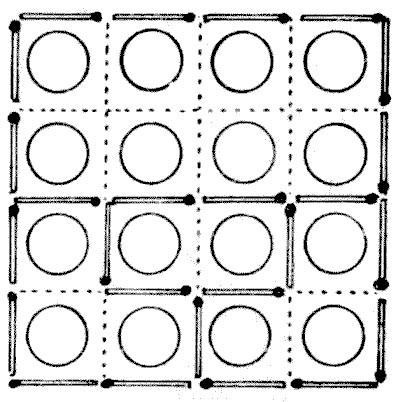
Here is a new puzzle with matches and counters or coins. In the illustration the matches represent hurdles and the counters sheep. The sixteen hurdles on the outside, and the sheep, must be regarded as immovable; the puzzle has to do entirely with the nine hurdles on the inside. It will be seen that at present these nine hurdles enclose four groups of 8, 3, 3, and 2 sheep. The farmer requires to readjust some of the hurdles so as to enclose 6, 6, and 4 sheep. Can you do it by only replacing two hurdles? When you have succeeded, then try to do it by replacing three hurdles; then four, five, six, and seven in succession. Of course, the hurdles must be legitimately laid on the dotted lines, and no such tricks are allowed as leaving unconnected ends of hurdles, or two hurdles placed side by side, or merely making hurdles change places. In fact, the conditions are so simple that any farm labourer will understand it directly.
276.—THE EIGHT VILLAS.
In one of the outlying suburbs of London a man had a square plot of ground on which he decided to build eight villas, as shown in the illustration, with a common recreation ground in the middle. After the houses were completed, and all or some of them let, he discovered that the number of occupants in the three houses forming a side of the square was in every case nine. He did not state how the occupants were distributed, but I have shown by the numbers on the sides of the houses one way in which it might have happened. The puzzle is to discover the total number of ways in which all or any of the houses might be occupied, so that there should be nine persons on each side. In order that there may be no misunderstanding, I will explain that although B is what we call a reflection of A, these would count as two different arrangements, while C, if it is turned round, will give four arrangements; and if turned round in front of a mirror, four other arrangements. All eight must be counted.
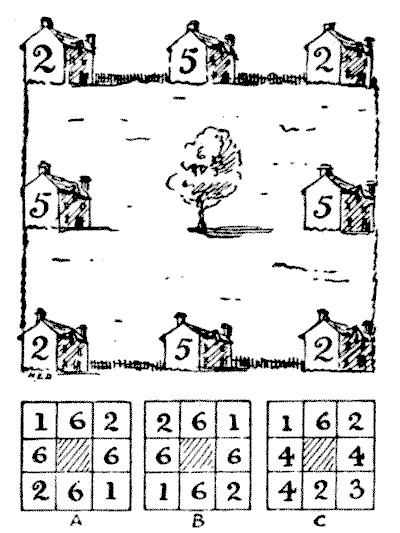
277.—COUNTER CROSSES.
All that we need for this puzzle is nine counters, numbered 1, 2, 3, 4, 5, 6, 7, 8, and 9. It will be seen that in the illustration A these are arranged so as to form a Greek cross, while in the case of B they form a Latin cross. In both cases the reader will find that the sum of the numbers in the upright of the cross is the same as the sum of the numbers in the horizontal arm. It is quite easy to hit on such an arrangement by trial, but the problem is to discover in exactly how many different ways it may be done in each case. Remember that reversals and reflections do not count as different. That is to say, if you turn this page round you get four arrangements of the Greek cross, and if you turn it round again in front of a mirror you will get four more. But these eight are all regarded as one and the same. Now, how many different ways are there in each case?

278.—A DORMITORY PUZZLE.
In a certain convent there were eight large dormitories on one floor, approached by a spiral staircase in the centre, as shown in our plan. On an inspection one Monday by the abbess it was found that the south aspect was so much preferred that six times as many nuns slept on the south side as on each of the other three sides. She objected to this overcrowding, and ordered that it should be reduced. On Tuesday she found that five times as many slept on the south side as on each of the other sides. Again she complained. On Wednesday she found four times as many on the south side, on Thursday three times as many, and on Friday twice as many. Urging the nuns to further efforts, she was pleased to find on Saturday that an equal number slept on each of the four sides of the house. What is the smallest number of nuns there could have been, and how might they have arranged themselves on each of the six nights? No room may ever be unoccupied.
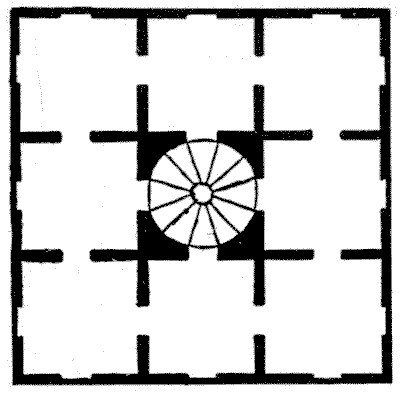
279.—THE BARRELS OF BALSAM.

A merchant of Bagdad had ten barrels of precious balsam for sale. They were numbered, and were arranged in two rows, one on top of the other, as shown in the picture. The smaller the number on the barrel, the greater was its value. So that the best quality was numbered "1" and the worst numbered "10," and all the other numbers of graduating values. Now, the rule of Ahmed Assan, the merchant, was that he never put a barrel either beneath or to the right of one of less value. The arrangement shown is, of course, the simplest way of complying with this condition. But there are many other ways—such, for example, as this:—
1
2
5
7
8
3
4
6
9
10
Here, again, no barrel has a smaller number than itself on its right or beneath it. The puzzle is to discover in how many different ways the merchant of Bagdad might have arranged his barrels in the two rows without breaking his rule. Can you count the number of ways?
280.—BUILDING THE TETRAHEDRON.
I possess a tetrahedron, or triangular pyramid, formed of six sticks glued together, as shown in the illustration. Can you count correctly the number of different ways in which these six sticks might have been stuck together so as to form the pyramid?
Some friends worked at it together one evening, each person providing himself with six lucifer matches to aid his thoughts; but it was found that no two results were the same. You see, if we remove one of the sticks and turn it round the other way, that will be a different pyramid. If we make two of the sticks change places the result will again be different. But remember that every pyramid may be made to stand on either of its four sides without being a different one. How many ways are there altogether?
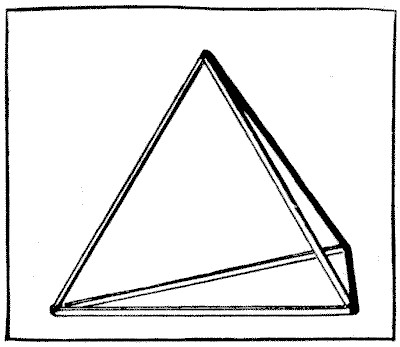
281.—PAINTING A PYRAMID.
This puzzle concerns the painting of the four sides of a tetrahedron, or triangular pyramid. If you cut out a piece of cardboard of the triangular shape shown in Fig. 1, and then cut half through along the dotted lines, it will fold up and form a perfect triangular pyramid. And I would first remind my readers that the primary colours of the solar spectrum are seven—violet, indigo, blue, green, yellow, orange, and red. When I was a child I was taught to remember these by the ungainly word formed by the initials of the colours, "Vibgyor."
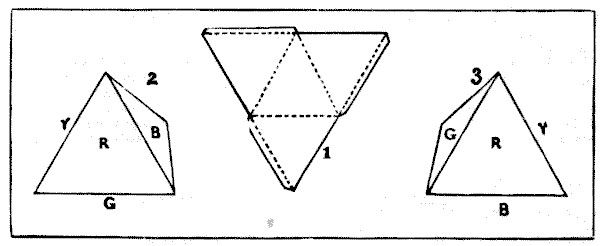
In how many different ways may the triangular pyramid be coloured, using in every case one, two, three, or four colours of the solar spectrum? Of course a side can only receive a single colour, and no side can be left uncoloured. But there is one point that I must make quite clear. The four sides are not to be regarded as individually distinct. That is to say, if you paint your pyramid as shown in Fig. 2 (where the bottom side is green and the other side that is out of view is yellow), and then paint another in the order shown in Fig. 3, these are really both the same and count as one way. For if you tilt over No. 2 to the right it will so fall as to represent No. 3. The avoidance of repetitions of this kind is the real puzzle of the thing. If a coloured pyramid cannot be placed so that it exactly resembles in its colours and their relative order another pyramid, then they are different. Remember that one way would be to colour all the four sides red, another to colour two sides green, and the remaining sides yellow and blue; and so on.
282.—THE ANTIQUARY'S CHAIN.
An antiquary possessed a number of curious old links, which he took to a blacksmith, and told him to join together to form one straight piece of chain, with the sole condition that the two circular links were not to be together. The following illustration shows the appearance of the chain and the form of each link. Now, supposing the owner should separate the links again, and then take them to another smith and repeat his former instructions exactly, what are the chances against the links being put together exactly as they were by the first man? Remember that every successive link can be joined on to another in one of two ways, just as you can put a ring on your finger in two ways, or link your forefingers and thumbs in two ways.
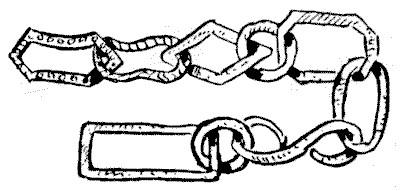
283.—THE FIFTEEN DOMINOES.
In this case we do not use the complete set of twenty-eight dominoes to be found in the ordinary box. We dispense with all those dominoes that have a five or a six on them and limit ourselves to the fifteen that remain, where the double-four is the highest.
In how many different ways may the fifteen dominoes be arranged in a straight line in accordance with the simple rule of the game that a number must always be placed against a similar number—that is, a four against a four, a blank against a blank, and so on? Left to right and right to left of the same arrangement are to be counted as two different ways.
284.—THE CROSS TARGET.

In the illustration we have a somewhat curious target designed by an eccentric sharpshooter. His idea was that in order to score you must hit four circles in as many shots so that those four shots shall form a square. It will be seen by the results recorded on the target that two attempts have been successful. The first man hit the four circles at the top of the cross, and thus formed his square. The second man intended to hit the four in the bottom arm, but his second shot, on the left, went too high. This compelled him to complete his four in a different way than he intended. It will thus be seen that though it is immaterial which circle you hit at the first shot, the second shot may commit you to a definite procedure if you are to get your square. Now, the puzzle is to say in just how many different ways it is possible to form a square on the target with four shots.
285.—THE FOUR POSTAGE STAMPS.

"It is as easy as counting," is an expression one sometimes hears. But mere counting may be puzzling at times. Take the following simple example. Suppose you have just bought twelve postage stamps, in this form—three by four—and a friend asks you to oblige him with four stamps, all joined together—no stamp hanging on by a mere corner. In how many different ways is it possible for you to tear off those four stamps? You see, you can give him 1, 2, 3, 4, or 2, 3, 6, 7, or 1, 2, 3, 6, or 1, 2, 3, 7, or 2, 3, 4, 8, and so on. Can you count the number of different ways in which those four stamps might be delivered? There are not many more than fifty ways, so it is not a big count. Can you get the exact number?
286.—PAINTING THE DIE.
In how many different ways may the numbers on a single die be marked, with the only condition that the 1 and 6, the 2 and 5, and the 3 and 4 must be on opposite sides? It is a simple enough question, and yet it will puzzle a good many people.
287.—AN ACROSTIC PUZZLE.
In the making or solving of double acrostics, has it ever occurred to you to consider the variety and limitation of the pair of initial and final letters available for cross words? You may have to find a word beginning with A and ending with B, or A and C, or A and D, and so on. Some combinations are obviously impossible—such, for example, as those with Q at the end. But let us assume that a good English word can be found for every case. Then how many possible pairs of letters are available?
CHESSBOARD PROBLEMS.
"You and I will goe to the chesse."
GREENE'S Groatsworth of Wit.
During a heavy gale a chimney-pot was hurled through the air, and crashed upon the pavement just in front of a pedestrian. He quite calmly said, "I have no use for it: I do not smoke." Some readers, when they happen to see a puzzle represented on a chessboard with chess pieces, are apt to make the equally inconsequent remark, "I have no use for it: I do not play chess." This is largely a result of the common, but erroneous, notion that the ordinary chess puzzle with which we are familiar in the press (dignified, for some reason, with the name "problem") has a vital connection with the game of chess itself. But there is no condition in the game that you shall checkmate your opponent in two moves, in three moves, or in four moves, while the majority of the positions given in these puzzles are such that one player would have so great a superiority in pieces that the other would have resigned before the situations were reached. And the solving of them helps you but little, and that quite indirectly, in playing the game, it being well known that, as a rule, the best "chess problemists" are indifferent players, and vice versa. Occasionally a man will be found strong on both subjects, but he is the exception to the rule.
Yet the simple chequered board and the characteristic moves of the pieces lend themselves in a very remarkable manner to the devising of the most entertaining puzzles. There is room for such infinite variety that the true puzzle lover cannot afford to neglect them. It was with a view to securing the interest of readers who are frightened off by the mere presentation of a chessboard that so many puzzles of this class were originally published by me in various fanciful dresses. Some of these posers I still retain in their disguised form; others I have translated into terms of the chessboard. In the majority of cases the reader will not need any knowledge whatever of chess, but I have thought it best to assume throughout that he is acquainted with the terminology, the moves, and the notation of the game.
I first deal with a few questions affecting the chessboard itself; then with certain statical puzzles relating to the Rook, the Bishop, the Queen, and the Knight in turn; then dynamical puzzles with the pieces in the same order; and, finally, with some miscellaneous puzzles on the chessboard. It is hoped that the formulæ and tables given at the end of the statical puzzles will be of interest, as they are, for the most part, published for the first time.
THE CHESSBOARD.
"Good company's a chessboard."
BYRON'S Don Juan, xiii. 89.
A chessboard is essentially a square plane divided into sixty-four smaller squares by straight lines at right angles. Originally it was not chequered (that is, made with its rows and columns alternately black and white, or of any other two colours), and this improvement was introduced merely to help the eye in actual play. The utility of the chequers is unquestionable. For example, it facilitates the operation of the bishops, enabling us to see at the merest glance that our king or pawns on black squares are not open to attack from an opponent's bishop running on the white diagonals. Yet the chequering of the board is not essential to the game of chess. Also, when we are propounding puzzles on the chessboard, it is often well to remember that additional interest may result from "generalizing" for boards containing any number of squares, or from limiting ourselves to some particular chequered arrangement, not necessarily a square. We will give a few puzzles dealing with chequered boards in this general way.
288.—CHEQUERED BOARD DIVISIONS.
I recently asked myself the question: In how many different ways may a chessboard be divided into two parts of the same size and shape by cuts along the lines dividing the squares? The problem soon proved to be both fascinating and bristling with difficulties. I present it in a simplified form, taking a board of smaller dimensions.
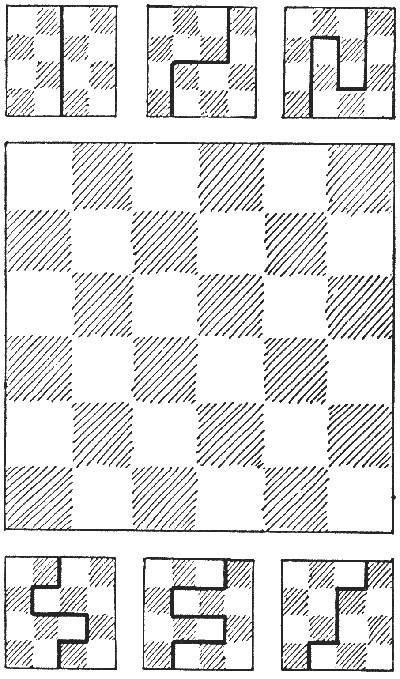
It is obvious that a board of four squares can only be so divided in one way—by a straight cut down the centre—because we shall not count reversals and reflections as different. In the case of a board of sixteen squares—four by four—there are just six different ways. I have given all these in the diagram, and the reader will not find any others. Now, take the larger board of thirty-six squares, and try to discover in how many ways it may be cut into two parts of the same size and shape.
289.—LIONS AND CROWNS.
The young lady in the illustration is confronted with a little cutting-out difficulty in which the reader may be glad to assist her. She wishes, for some reason that she has not communicated to me, to cut that square piece of valuable material into four parts, all of exactly the same size and shape, but it is important that every piece shall contain a lion and a crown. As she insists that the cuts can only be made along the lines dividing the squares, she is considerably perplexed to find out how it is to be done. Can you show her the way? There is only one possible method of cutting the stuff.
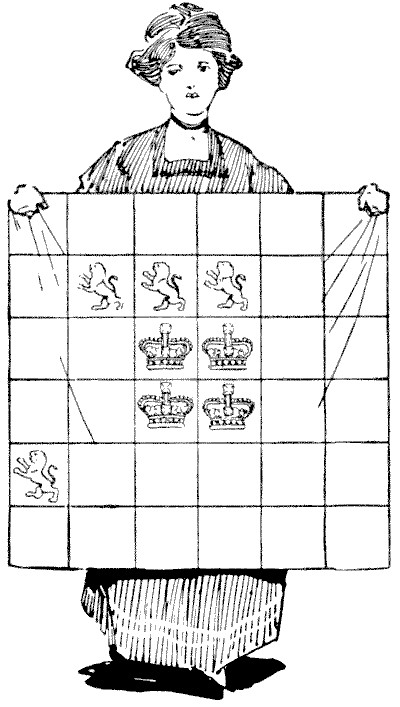
290.—BOARDS WITH AN ODD NUMBER OF SQUARES.
We will here consider the question of those boards that contain an odd number of squares. We will suppose that the central square is first cut out, so as to leave an even number of squares for division. Now, it is obvious that a square three by three can only be divided in one way, as shown in Fig. 1. It will be seen that the pieces A and B are of the same size and shape, and that any other way of cutting would only produce the same shaped pieces, so remember that these variations are not counted as different ways. The puzzle I propose is to cut the board five by five (Fig. 2) into two pieces of the same size and shape in as many different ways as possible. I have shown in the illustration one way of doing it. How many different ways are there altogether? A piece which when turned over resembles another piece is not considered to be of a different shape.

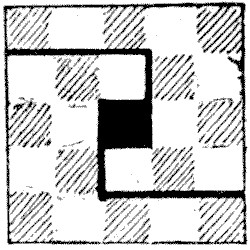
291.—THE GRAND LAMA'S PROBLEM.
Once upon a time there was a Grand Lama who had a chessboard made of pure gold, magnificently engraved, and, of course, of great value. Every year a tournament was held at Lhassa among the priests, and whenever any one beat the Grand Lama it was considered a great honour, and his name was inscribed on the back of the board, and a costly jewel set in the particular square on which the checkmate had been given. After this sovereign pontiff had been defeated on four occasions he died—possibly of chagrin.

Now the new Grand Lama was an inferior chess-player, and preferred other forms of innocent amusement, such as cutting off people's heads. So he discouraged chess as a degrading game, that did not improve either the mind or the morals, and abolished the tournament summarily. Then he sent for the four priests who had had the effrontery to play better than a Grand Lama, and addressed them as follows: "Miserable and heathenish men, calling yourselves priests! Know ye not that to lay claim to a capacity to do anything better than my predecessor is a capital offence? Take that chessboard and, before day dawns upon the torture chamber, cut it into four equal parts of the same shape, each containing sixteen perfect squares, with one of the gems in each part! If in this you fail, then shall other sports be devised for your special delectation. Go!" The four priests succeeded in their apparently hopeless task. Can you show how the board may be divided into four equal parts, each of exactly the same shape, by cuts along the lines dividing the squares, each part to contain one of the gems?
292.—THE ABBOT'S WINDOW.
Once upon a time the Lord Abbot of St. Edmondsbury, in consequence of "devotions too strong for his head," fell sick and was unable to leave his bed. As he lay awake, tossing his head restlessly from side to side, the attentive monks noticed that something was disturbing his mind; but nobody dared ask what it might be, for the abbot was of a stern disposition, and never would brook inquisitiveness. Suddenly he called for Father John, and that venerable monk was soon at the bedside.
"Father John," said the Abbot, "dost thou know that I came into this wicked world on a Christmas Even?"
The monk nodded assent.
"And have I not often told thee that, having been born on Christmas Even, I have no love for the things that are odd? Look there!"
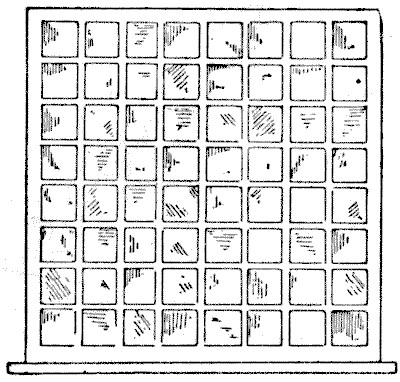
The Abbot pointed to the large dormitory window, of which I give a sketch. The monk looked, and was perplexed.
"Dost thou not see that the sixty-four lights add up an even number vertically and horizontally, but that all the diagonal lines, except fourteen are of a number that is odd? Why is this?"
"Of a truth, my Lord Abbot, it is of the very nature of things, and cannot be changed."
"Nay, but it shall be changed. I command thee that certain of the lights be closed this day, so that every line shall have an even number of lights. See thou that this be done without delay, lest the cellars be locked up for a month and other grievous troubles befall thee."
Father John was at his wits' end, but after consultation with one who was learned in strange mysteries, a way was found to satisfy the whim of the Lord Abbot. Which lights were blocked up, so that those which remained added up an even number in every line horizontally, vertically, and diagonally, while the least possible obstruction of light was caused?
293.—THE CHINESE CHESSBOARD.
Into how large a number of different pieces may the chessboard be cut (by cuts along the lines only), no two pieces being exactly alike? Remember that the arrangement of black and white constitutes a difference. Thus, a single black square will be different from a single white square, a row of three containing two white squares will differ from a row of three containing two black, and so on. If two pieces cannot be placed on the table so as to be exactly alike, they count as different. And as the back of the board is plain, the pieces cannot be turned over.
294.—THE CHESSBOARD SENTENCE.

I once set myself the amusing task of so dissecting an ordinary chessboard into letters of the alphabet that they would form a complete sentence. It will be seen from the illustration that the pieces assembled give the sentence, "CUT THY LIFE," with the stops between. The ideal sentence would, of course, have only one full stop, but that I did not succeed in obtaining.
The sentence is an appeal to the transgressor to cut himself adrift from the evil life he is living. Can you fit these pieces together to form a perfect chessboard?
STATICAL CHESS PUZZLES.
"They also serve who only stand and wait."
MILTON.
295.—THE EIGHT ROOKS.
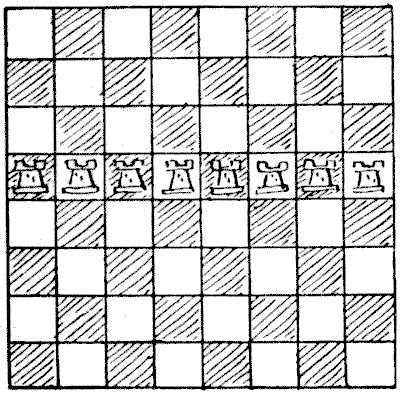
It will be seen in the first diagram that every square on the board is either occupied or attacked by a rook, and that every rook is "guarded" (if they were alternately black and white rooks we should say "attacked") by another rook. Placing the eight rooks on any row or file obviously will have the same effect. In diagram 2 every square is again either occupied or attacked, but in this case every rook is unguarded. Now, in how many different ways can you so place the eight rooks on the board that every square shall be occupied or attacked and no rook ever guarded by another? I do not wish to go into the question of reversals and reflections on this occasion, so that placing the rooks on the other diagonal will count as different, and similarly with other repetitions obtained by turning the board round.

296.—THE FOUR LIONS.
The puzzle is to find in how many different ways the four lions may be placed so that there shall never be more than one lion in any row or column. Mere reversals and reflections will not count as different. Thus, regarding the example given, if we place the lions in the other diagonal, it will be considered the same arrangement. For if you hold the second arrangement in front of a mirror or give it a quarter turn, you merely get the first arrangement. It is a simple little puzzle, but requires a certain amount of careful consideration.
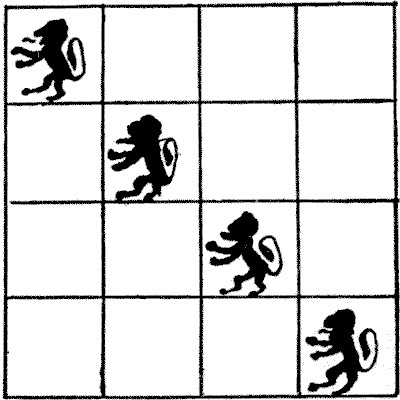
297.—BISHOPS—UNGUARDED.
Place as few bishops as possible on an ordinary chessboard so that every square of the board shall be either occupied or attacked. It will be seen that the rook has more scope than the bishop: for wherever you place the former, it will always attack fourteen other squares; whereas the latter will attack seven, nine, eleven, or thirteen squares, according to the position of the diagonal on which it is placed. And it is well here to state that when we speak of "diagonals" in connection with the chessboard, we do not limit ourselves to the two long diagonals from corner to corner, but include all the shorter lines that are parallel to these. To prevent misunderstanding on future occasions, it will be well for the reader to note carefully this fact.
298.—BISHOPS—GUARDED.
Now, how many bishops are necessary in order that every square shall be either occupied or attacked, and every bishop guarded by another bishop? And how may they be placed?
299.—BISHOPS IN CONVOCATION.
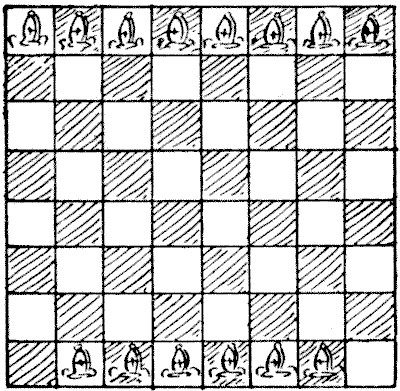
The greatest number of bishops that can be placed at the same time on the chessboard, without any bishop attacking another, is fourteen. I show, in diagram, the simplest way of doing this. In fact, on a square chequered board of any number of squares the greatest number of bishops that can be placed without attack is always two less than twice the number of squares on the side. It is an interesting puzzle to discover in just how many different ways the fourteen bishops may be so placed without mutual attack. I shall give an exceedingly simple rule for determining the number of ways for a square chequered board of any number of squares.
300.—THE EIGHT QUEENS.
The queen is by far the strongest piece on the chessboard. If you place her on one of the four squares in the centre of the board, she attacks no fewer than twenty-seven other squares; and if you try to hide her in a corner, she still attacks twenty-one squares. Eight queens may be placed on the board so that no queen attacks another, and it is an old puzzle (first proposed by Nauck in 1850, and it has quite a little literature of its own) to discover in just how many different ways this may be done. I show one way in the diagram, and there are in all twelve of these fundamentally different ways. These twelve produce ninety-two ways if we regard reversals and reflections as different. The diagram is in a way a symmetrical arrangement. If you turn the page upside down, it will reproduce itself exactly; but if you look at it with one of the other sides at the bottom, you get another way that is not identical. Then if you reflect these two ways in a mirror you get two more ways. Now, all the other eleven solutions are non-symmetrical, and therefore each of them may be presented in eight ways by these reversals and reflections. It will thus be seen why the twelve fundamentally different solutions produce only ninety-two arrangements, as I have said, and not ninety-six, as would happen if all twelve were non-symmetrical. It is well to have a clear understanding on the matter of reversals and reflections when dealing with puzzles on the chessboard.
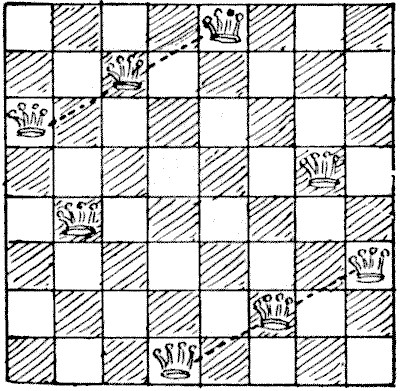
Can the reader place the eight queens on the board so that no queen shall attack another and so that no three queens shall be in a straight line in any oblique direction? Another glance at the diagram will show that this arrangement will not answer the conditions, for in the two directions indicated by the dotted lines there are three queens in a straight line. There is only one of the twelve fundamental ways that will solve the puzzle. Can you find it?
301.—THE EIGHT STARS.
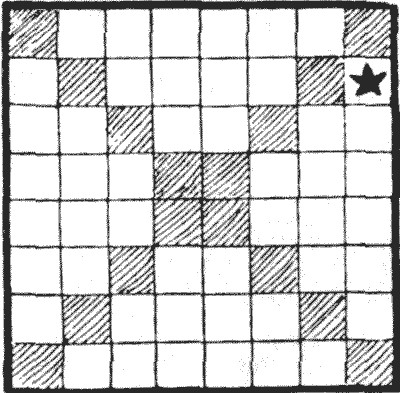
The puzzle in this case is to place eight stars in the diagram so that no star shall be in line with another star horizontally, vertically, or diagonally. One star is already placed, and that must not be moved, so there are only seven for the reader now to place. But you must not place a star on any one of the shaded squares. There is only one way of solving this little puzzle.
302.—A PROBLEM IN MOSAICS.
The art of producing pictures or designs by means of joining together pieces of hard substances, either naturally or artificially coloured, is of very great antiquity. It was certainly known in the time of the Pharaohs, and we find a reference in the Book of Esther to "a pavement of red, and blue, and white, and black marble." Some of this ancient work that has come down to us, especially some of the Roman mosaics, would seem to show clearly, even where design is not at first evident, that much thought was bestowed upon apparently disorderly arrangements. Where, for example, the work has been produced with a very limited number of colours, there are evidences of great ingenuity in preventing the same tints coming in close proximity. Lady readers who are familiar with the construction of patchwork quilts will know how desirable it is sometimes, when they are limited in the choice of material, to prevent pieces of the same stuff coming too near together. Now, this puzzle will apply equally to patchwork quilts or tesselated pavements.
It will be seen from the diagram how a square piece of flooring may be paved with sixty-two square tiles of the eight colours violet, red, yellow, green, orange, purple, white, and blue (indicated by the initial letters), so that no tile is in line with a similarly coloured tile, vertically, horizontally, or diagonally. Sixty-four such tiles could not possibly be placed under these conditions, but the two shaded squares happen to be occupied by iron ventilators.

The puzzle is this. These two ventilators have to be removed to the positions indicated by the darkly bordered tiles, and two tiles placed in those bottom corner squares. Can you readjust the thirty-two tiles so that no two of the same colour shall still be in line?
303.—UNDER THE VEIL.
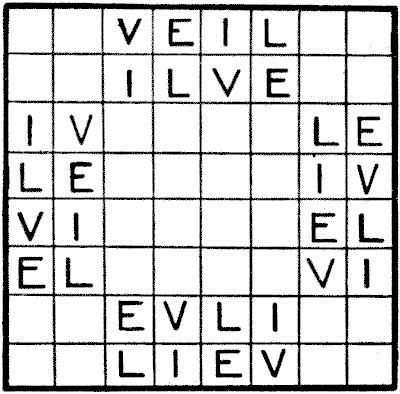
If the reader will examine the above diagram, he will see that I have so placed eight V's, eight E's, eight I's, and eight L's in the diagram that no letter is in line with a similar one horizontally, vertically, or diagonally. Thus, no V is in line with another V, no E with another E, and so on. There are a great many different ways of arranging the letters under this condition. The puzzle is to find an arrangement that produces the greatest possible number of four-letter words, reading upwards and downwards, backwards and forwards, or diagonally. All repetitions count as different words, and the five variations that may be used are: VEIL, VILE, LEVI, LIVE, and EVIL.
This will be made perfectly clear when I say that the above arrangement scores eight, because the top and bottom row both give VEIL; the second and seventh columns both give VEIL; and the two diagonals, starting from the L in the 5th row and E in the 8th row, both give LIVE and EVIL. There are therefore eight different readings of the words in all.
This difficult word puzzle is given as an example of the use of chessboard analysis in solving such things. Only a person who is familiar with the "Eight Queens" problem could hope to solve it.
304.—BACHET'S SQUARE.
One of the oldest card puzzles is by Claude Caspar Bachet de Méziriac, first published, I believe, in the 1624 edition of his work. Rearrange the sixteen court cards (including the aces) in a square so that in no row of four cards, horizontal, vertical, or diagonal, shall be found two cards of the same suit or the same value. This in itself is easy enough, but a point of the puzzle is to find in how many different ways this may be done. The eminent French mathematician A. Labosne, in his modern edition of Bachet, gives the answer incorrectly. And yet the puzzle is really quite easy. Any arrangement produces seven more by turning the square round and reflecting it in a mirror. These are counted as different by Bachet.
Note "row of four cards," so that the only diagonals we have here to consider are the two long ones.
305.—THE THIRTY-SIX LETTER BLOCKS.
The illustration represents a box containing thirty-six letter-blocks. The puzzle is to rearrange these blocks so that no A shall be in a line vertically, horizontally, or diagonally with another A, no B with another B, no C with another C, and so on. You will find it impossible to get all the letters into the box under these conditions, but the point is to place as many as possible. Of course no letters other than those shown may be used.
306.—THE CROWDED CHESSBOARD.
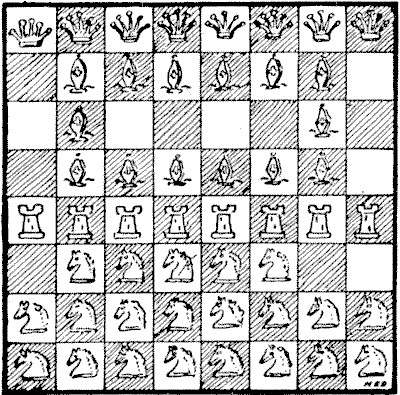
The puzzle is to rearrange the fifty-one pieces on the chessboard so that no queen shall attack another queen, no rook attack another rook, no bishop attack another bishop, and no knight attack another knight. No notice is to be taken of the intervention of pieces of another type from that under consideration—that is, two queens will be considered to attack one another although there may be, say, a rook, a bishop, and a knight between them. And so with the rooks and bishops. It is not difficult to dispose of each type of piece separately; the difficulty comes in when you have to find room for all the arrangements on the board simultaneously.
307.—THE COLOURED COUNTERS.

The diagram represents twenty-five coloured counters, Red, Blue, Yellow, Orange, and Green (indicated by their initials), and there are five of each colour, numbered 1, 2, 3, 4, and 5. The problem is so to place them in a square that neither colour nor number shall be found repeated in any one of the five rows, five columns, and two diagonals. Can you so rearrange them?
308.—THE GENTLE ART OF STAMP-LICKING.
The Insurance Act is a most prolific source of entertaining puzzles, particularly entertaining if you happen to be among the exempt. One's initiation into the gentle art of stamp-licking suggests the following little poser: If you have a card divided into sixteen spaces (4 × 4), and are provided with plenty of stamps of the values 1d., 2d., 3d., 4d., and 5d., what is the greatest value that you can stick on the card if the Chancellor of the Exchequer forbids you to place any stamp in a straight line (that is, horizontally, vertically, or diagonally) with another stamp of similar value? Of course, only one stamp can be affixed in a space. The reader will probably find, when he sees the solution, that, like the stamps themselves, he is licked He will most likely be twopence short of the maximum. A friend asked the Post Office how it was to be done; but they sent him to the Customs and Excise officer, who sent him to the Insurance Commissioners, who sent him to an approved society, who profanely sent him—but no matter.
309.—THE FORTY-NINE COUNTERS.
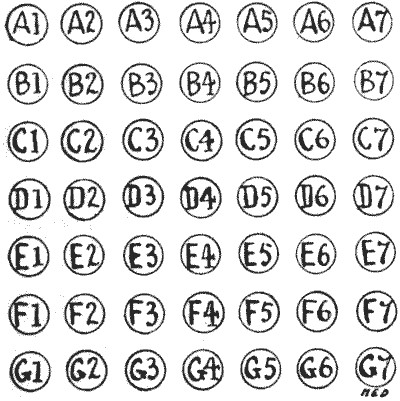
Can you rearrange the above forty-nine counters in a square so that no letter, and also no number, shall be in line with a similar one, vertically, horizontally, or diagonally? Here I, of course, mean in the lines parallel with the diagonals, in the chessboard sense.
310.—THE THREE SHEEP.
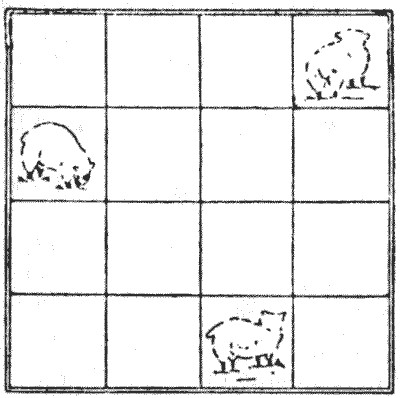
A farmer had three sheep and an arrangement of sixteen pens, divided off by hurdles in the manner indicated in the illustration. In how many different ways could he place those sheep, each in a separate pen, so that every pen should be either occupied or in line (horizontally, vertically, or diagonally) with at least one sheep? I have given one arrangement that fulfils the conditions. How many others can you find? Mere reversals and reflections must not be counted as different. The reader may regard the sheep as queens. The problem is then to place the three queens so that every square shall be either occupied or attacked by at least one queen—in the maximum number of different ways.
311.—THE FIVE DOGS PUZZLE.
In 1863, C.F. de Jaenisch first discussed the "Five Queens Puzzle"—to place five queens on the chessboard so that every square shall be attacked or occupied—which was propounded by his friend, a "Mr. de R." Jaenisch showed that if no queen may attack another there are ninety-one different ways of placing the five queens, reversals and reflections not counting as different. If the queens may attack one another, I have recorded hundreds of ways, but it is not practicable to enumerate them exactly.
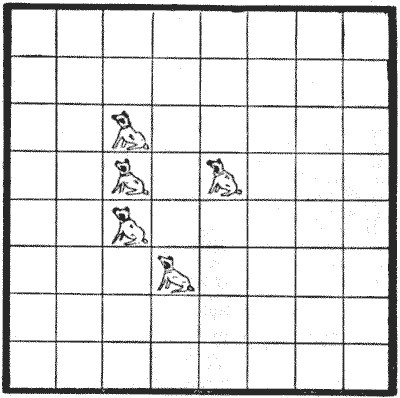
The illustration is supposed to represent an arrangement of sixty-four kennels. It will be seen that five kennels each contain a dog, and on further examination it will be seen that every one of the sixty-four kennels is in a straight line with at least one dog—either horizontally, vertically, or diagonally. Take any kennel you like, and you will find that you can draw a straight line to a dog in one or other of the three ways mentioned. The puzzle is to replace the five dogs and discover in just how many different ways they may be placed in five kennels in a straight row, so that every kennel shall always be in line with at least one dog. Reversals and reflections are here counted as different.
312.—THE FIVE CRESCENTS OF BYZANTIUM.
When Philip of Macedon, the father of Alexander the Great, found himself confronted with great difficulties in the siege of Byzantium, he set his men to undermine the walls. His desires, however, miscarried, for no sooner had the operations been begun than a crescent moon suddenly appeared in the heavens and discovered his plans to his adversaries. The Byzantines were naturally elated, and in order to show their gratitude they erected a statue to Diana, and the crescent became thenceforward a symbol of the state. In the temple that contained the statue was a square pavement composed of sixty-four large and costly tiles. These were all plain, with the exception of five, which bore the symbol of the crescent. These five were for occult reasons so placed that every tile should be watched over by (that is, in a straight line, vertically, horizontally, or diagonally with) at least one of the crescents. The arrangement adopted by the Byzantine architect was as follows:—

Now, to cover up one of these five crescents was a capital offence, the death being something very painful and lingering. But on a certain occasion of festivity it was necessary to lay down on this pavement a square carpet of the largest dimensions possible, and I have shown in the illustration by dark shading the largest dimensions that would be available.
The puzzle is to show how the architect, if he had foreseen this question of the carpet, might have so arranged his five crescent tiles in accordance with the required conditions, and yet have allowed for the largest possible square carpet to be laid down without any one of the five crescent tiles being covered, or any portion of them.
313.—QUEENS AND BISHOP PUZZLE.
It will be seen that every square of the board is either occupied or attacked. The puzzle is to substitute a bishop for the rook on the same square, and then place the four queens on other squares so that every square shall again be either occupied or attacked.
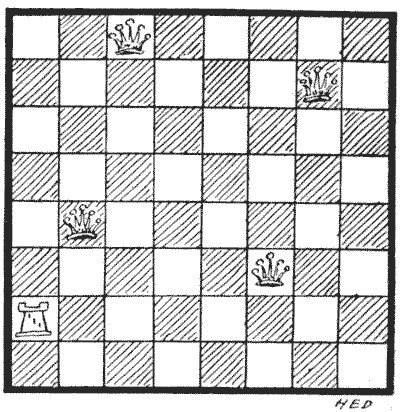
314.—THE SOUTHERN CROSS.
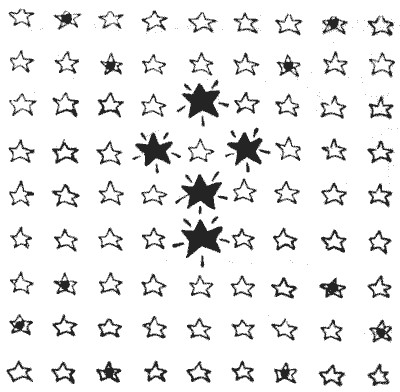
In the above illustration we have five Planets and eighty-one Fixed Stars, five of the latter being hidden by the Planets. It will be found that every Star, with the exception of the ten that have a black spot in their centres, is in a straight line, vertically, horizontally, or diagonally, with at least one of the Planets. The puzzle is so to rearrange the Planets that all the Stars shall be in line with one or more of them.
In rearranging the Planets, each of the five may be moved once in a straight line, in either of the three directions mentioned. They will, of course, obscure five other Stars in place of those at present covered.
315.—THE HAT-PEG PUZZLE.
Here is a five-queen puzzle that I gave in a fanciful dress in 1897. As the queens were there represented as hats on sixty-four pegs, I will keep to the title, "The Hat-Peg Puzzle." It will be seen that every square is occupied or attacked. The puzzle is to remove one queen

to a different square so that still every square is occupied or attacked, then move a second queen under a similar condition, then a third queen, and finally a fourth queen. After the fourth move every square must be attacked or occupied, but no queen must then attack another. Of course, the moves need not be "queen moves;" you can move a queen to any part of the board.
316.—THE AMAZONS.

This puzzle is based on one by Captain Turton. Remove three of the queens to other squares so that there shall be eleven squares on the board that are not attacked. The removal of the three queens need not be by "queen moves." You may take them up and place them anywhere. There is only one solution.
317.—A PUZZLE WITH PAWNS.
Place two pawns in the middle of the chessboard, one at Q 4 and the other at K 5. Now, place the remaining fourteen pawns (sixteen in all) so that no three shall be in a straight line in any possible direction.
Note that I purposely do not say queens, because by the words "any possible direction" I go beyond attacks on diagonals. The pawns must be regarded as mere points in space—at the centres of the squares. See dotted lines in the case of No. 300, "The Eight Queens."
318.—LION-HUNTING.

My friend Captain Potham Hall, the renowned hunter of big game, says there is nothing more exhilarating than a brush with a herd—a pack—a team—a flock—a swarm (it has taken me a full quarter of an hour to recall the right word, but I have it at last)—a pride of lions. Why a number of lions are called a "pride," a number of whales a "school," and a number of foxes a "skulk" are mysteries of philology into which I will not enter.
Well, the captain says that if a spirited lion crosses your path in the desert it becomes lively, for the lion has generally been looking for the man just as much as the man has sought the king of the forest. And yet when they meet they always quarrel and fight it out. A little contemplation of this unfortunate and long-standing feud between two estimable families has led me to figure out a few calculations as to the probability of the man and the lion crossing one another's path in the jungle. In all these cases one has to start on certain more or less arbitrary assumptions. That is why in the above illustration I have thought it necessary to represent the paths in the desert with such rigid regularity. Though the captain assures me that the tracks of the lions usually run much in this way, I have doubts.
The puzzle is simply to find out in how many different ways the man and the lion may be placed on two different spots that are not on the same path. By "paths" it must be understood that I only refer to the ruled lines. Thus, with the exception of the four corner spots, each combatant is always on two paths and no more. It will be seen that there is a lot of scope for evading one another in the desert, which is just what one has always understood.
319.—THE KNIGHT-GUARDS.
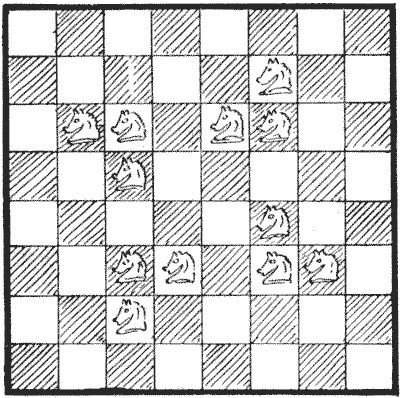
The knight is the irresponsible low comedian of the chessboard. "He is a very uncertain, sneaking, and demoralizing rascal," says an American writer. "He can only move two squares, but makes up in the quality of his locomotion for its quantity, for he can spring one square sideways and one forward simultaneously, like a cat; can stand on one leg in the middle of the board and jump to any one of eight squares he chooses; can get on one side of a fence and blackguard three or four men on the other; has an objectionable way of inserting himself in safe places where he can scare the king and compel him to move, and then gobble a queen. For pure cussedness the knight has no equal, and when you chase him out of one hole he skips into another." Attempts have been made over and over again to obtain a short, simple, and exact definition of the move of the knight—without success. It really consists in moving one square like a rook, and then another square like a bishop—the two operations being done in one leap, so that it does not matter whether the first square passed over is occupied by another piece or not. It is, in fact, the only leaping move in chess. But difficult as it is to define, a child can learn it by inspection in a few minutes.
I have shown in the diagram how twelve knights (the fewest possible that will perform the feat) may be placed on the chessboard so that every square is either occupied or attacked by a knight. Examine every square in turn, and you will find that this is so. Now, the puzzle in this case is to discover what is the smallest possible number of knights that is required in order that every square shall be either occupied or attacked, and every knight protected by another knight. And how would you arrange them? It will be found that of the twelve shown in the diagram only four are thus protected by being a knight's move from another knight.
THE GUARDED CHESSBOARD.
On an ordinary chessboard, 8 by 8, every square can be guarded—that is, either occupied or attacked—by 5 queens, the fewest possible. There are exactly 91 fundamentally different arrangements in which no queen attacks another queen. If every queen must attack (or be protected by) another queen, there are at fewest 41 arrangements, and I have recorded some 150 ways in which some of the queens are attacked and some not, but this last case is very difficult to enumerate exactly.
On an ordinary chessboard every square can be guarded by 8 rooks (the fewest possible) in 40,320 ways, if no rook may attack another rook, but it is not known how many of these are fundamentally different. (See solution to No. 295, "The Eight Rooks.") I have not enumerated the ways in which every rook shall be protected by another rook.
On an ordinary chessboard every square can be guarded by 8 bishops (the fewest possible), if no bishop may attack another bishop. Ten bishops are necessary if every bishop is to be protected. (See Nos. 297 and 298, "Bishops unguarded" and "Bishops guarded.")
On an ordinary chessboard every square can be guarded by 12 knights if all but 4 are unprotected. But if every knight must be protected, 14 are necessary. (See No. 319, "The Knight-Guards.")
Dealing with the queen on n2 boards generally, where n is less than 8, the following results will be of interest:—
1 queen guards 22 board in 1 fundamental way.
1 queen guards 32 board in 1 fundamental way.
2 queens guard 42 board in 3 fundamental ways (protected).
3 queens guard 42 board in 2 fundamental ways (not protected).
3 queens guard 52 board in 37 fundamental ways (protected).
3 queens guard 52 board in 2 fundamental ways (not protected).
3 queens guard 62 board in 1 fundamental way (protected).
4 queens guard 62 board in 17 fundamental ways (not protected).
4 queens guard 72 board in 5 fundamental ways (protected).
4 queens guard 72 board in 1 fundamental way (not protected).
NON-ATTACKING CHESSBOARD ARRANGEMENTS.
We know that n queens may always be placed on a square board of n2 squares (if n be greater than 3) without any queen attacking another queen. But no general formula for enumerating the number of different ways in which it may be done has yet been discovered; probably it is undiscoverable. The known results are as follows:—
Where n = 4 there is 1 fundamental solution and 2 in all.
Where n = 5 there are 2 fundamental solutions and 10 in all.
Where n = 6 there is 1 fundamental solution and 4 in all.
Where n = 7 there are 6 fundamental solutions and 40 in all.
Where n = 8 there are 12 fundamental solutions and 92 in all.
Where n = 9 there are 46 fundamental solutions.
Where n = 10 there are 92 fundamental solutions.
Where n = 11 there are 341 fundamental solutions.
Obviously n rooks may be placed without attack on an n2 board in n! ways, but how many of these are fundamentally different I have only worked out in the four cases where n equals 2, 3, 4, and 5. The answers here are respectively 1, 2, 7, and 23. (See No. 296, "The Four Lions.")
We can place 2n-2 bishops on an n2 board in 2n ways. (See No. 299, "Bishops in Convocation.") For boards containing 2, 3, 4, 5, 6, 7, 8 squares, on a side there are respectively 1, 2, 3, 6, 10, 20, 36 fundamentally different arrangements. Where n is odd there are 2½(n-1) such arrangements, each giving 4 by reversals and reflections, and 2n-3 - 2½(n-3) giving 8. Where n is even there are 2½(n-2), each giving 4 by reversals and reflections, and 2n-3 - 2½(n-4), each giving 8.
We can place ½(n2+1) knights on an n2 board without attack, when n is odd, in 1 fundamental way; and ½n2 knights on an n2 board, when n is even, in 1 fundamental way. In the first case we place all the knights on the same colour as the central square; in the second case we place them all on black, or all on white, squares.
THE TWO PIECES PROBLEM.
On a board of n2 squares, two queens, two rooks, two bishops, or two knights can always be placed, irrespective of attack or not, in ½(n4 - n2) ways. The following formulæ will show in how many of these ways the two pieces may be placed with attack and without:—
300.—THE EIGHT QUEENS.
295.—THE EIGHT ROOKS.—solution
297.—BISHOPS—UNGUARDED.
298.—BISHOPS—GUARDED.
319.—THE KNIGHT-GUARDS.
296.—THE FOUR LIONS.
299.—BISHOPS IN CONVOCATION.