



автордың кітабын онлайн тегін оқу Choice Readings for the Home Circle
E-text prepared by Roger Frank
and the Project Gutenberg Online Distributed Proofreading Team
(http://www.pgdp.net/)
Home, Sweet Home
CHOICE READINGS
FOR THE HOME CIRCLE
I know not where his islands lift
Their fronded palms in air,I only know I can not drift
Beyond his love and care.—
WhittierPublished By
M. A. VROMAN
2123 24th Ave. N.
Nashville, Tenn.
WESTERN OFFICES:
1650 San Jose Ave., San Francisco, Calif.
617 Chestnut St., Glendale, Calif.
Entered, according to Act of Congress, in the year 1905,
by M. A. Vroman, in the Office of the Librarian of
Congress, Washington, D.C. All Rights Reserved.
Copyright 1916, by Martin A. Vroman.
PREFACE.
The compiler of this volume has been gathering a large amount of moral and religious reading, from which selections have been made, admitting only those which may be read with propriety on the Sabbath.
This volume will be found to contain the best lessons for the family circle, such as will inculcate principles of obedience to parents, kindness and affection to brothers and sisters and youthful associates, benevolence to the poor, and the requirements of the gospel. These virtuous principles are illustrated by instances of conformity to them, or departure from them, in such a manner as to lead to their love and practice.
Great care has been taken in compiling this volume to avoid introducing into it anything of a sectarian or denominational character that might hinder its free circulation among any denomination, or class of society, where there is a demand for moral and religious literature. The illustrations were made especially for this book, and are the result of much careful study.
The family circle can be instructed and impressed by high-toned moral and religious lessons in no better way during a leisure hour of the Sabbath, when not engaged in the solemn worship of God, than to listen to one of their number who shall read from this precious volume. May the blessing of God attend it to every home circle that shall give it a welcome, is the prayer of the
Publisher.
NOTE TO THE PUBLIC
This is the same book formerly known as "Sabbath Readings for the Home Circle," the subject matter remaining unchanged.
We believe all who read this book will heartily accord with us in our desire to see it placed in every home in the land, and will do their part toward this good end.
The stories and poems it contains cover nearly all phases of life's experiences. Each one presents lessons which can but tend to make the reader better and nobler.
This decidedly valuable and interesting work now enters upon its sixth edition, one hundred thirty thousand copies, with the demand rapidly increasing.
Many have joined us in canvassing for it, and it has proved to be not only a noble work and a service to the people, but it brings good financial returns. Many students have worked their way through school by using their vacations in this work.
The publisher's name and address is on the title page, and he will see that all orders are promptly and carefully filled, and all letters of inquiry cheerfully answered. Address nearest office.
Believing that the "Choice Readings for the Home Circle" will be appreciated by all lovers of the true and beautiful, and that the book will make for itself not only a place, but a warm welcome, in thousands of homes during the coming year, it is cheerfully and prayerfully sent on its mission by
The Publisher.
Contents
Affecting Scene in a Saloon
388A Good Lesson Spoiled
192A Kind Word
67A Life Lesson
178A Mountain Prayer-meeting
144An Instructive Anecdote
214Another Commandment
71A Retired Merchant
90A Rift in the Cloud
286Be Just Before Generous
99Benevolent Society
199Bread Upon the Waters
280Caught in the Quicksand
112Christ Our Refuge
47Company Manners
36Effect of Novel Reading
95Evening Prayer
342Every Heart Has Its Own Sorrow
324Grandmother's Room
230Hard Times Conquered
185Herrings for Nothing
275How It Was Blotted Out
166Live Within Your Means
127Look to Your Thoughts
397Lyman Dean's Testimonials
251Make It Plain
83"My House" and "Our House"
138Nellie Alton's Mother
393Never Indorse
170Only a Husk
151Out of the Wrong Pocket
131Over the Crossing
304Put Yourself in My Place
312Richest Man in the Parish
296Ruined at Home
157Speak to Strangers
360Story of School Life
221Success if the Reward of Perseverance
291Susie's Prayer
32The Belle of the Ballroom
40The Fence Story
310The Happy New Year
346The Indian's Revenge
11The Infidel Captain
319The Little Sisters
368The Major's Cigar
363The Premium
58The Record
25The Right Decision
29The Scripture Quilt
354The Ten Commandments
81The Widow's Christmas
374The Young Musician
244Tom's Trial
50Unforgotten Words
263With a Will, Joe
385"What Shall It Profit?"
115Why He Didn't Smoke
217Poems
A Christian Life
89Alone
341An Infinite Giver
137Believe and Trust
39Consolation
111Did You Ever Think?
279Do With Your Might
387Forgive and Forget
318Good-Bye—God Bless You!
165Life That Lasts
213Loving Words
362Mother
28"Once Again"
114Our Neighbors
66Our Record
373Reaping
216Song of the Rye
156Stop and Look Around!
309The Dark First
130The Father Is Near
285The Lord's Prayer
342The Master's Hand
49The Shadow of the Cross
46The Way to Overcome
169To-Day's Furrow
98Walking With God
303Watch Your Words
177What Counts
57What to Mind
367Your Call
274List of Illustrations
Home, Sweet Home
FrontispieceWhile He Slept His Enemy Came and Sowed Tares Among the Wheat
44Christ Blessing Little Children
76Christ the Good Shepherd
124Paul at Athens
172Pure Religion Is Visiting the Fatherless and Widows in Their Affliction
207Grandmother's Room
240Come Unto Me
278Christ in the Home of Mary and Martha
300He Is Not Here; He Is Risen
336God Be Merciful to Me a Sinner
354Announcement to Shepherds
376Pledges
Against the use of Liquor and Tobacco
391THE SABBATH
Sabbaths, like way-marks, cheer the pilgrim's path,
His progress mark, and keep his rest in view.
In life's bleak winter, they are pleasant days,
Short foretaste of the long, long spring to come.
To every new-born soul, each hallowed morn
Seems like the first, when everything was new.
Time seems an angel come afresh from heaven,
His pinions shedding fragrance as he flies,
And his bright hour-glass running sands of gold.
—
Carlos Wilcox.
The Indian's Revenge
The beautiful precept, "Do unto others as you would that they should do unto you," is drawn from our Lord's sermon on the mount, and should be observed by all professing Christians. But unless we are truly his children, we can never observe this great command as we ought.
History records the fact that the Roman emperor Severus was so much struck with the moral beauty and purity of this sentiment, that he ordered the "Golden Rule," to be inscribed upon the public buildings erected by him. Many facts may be stated, by which untutored heathen and savage tribes in their conduct have put to shame many of those calling themselves Christians, who have indeed the form of godliness, but by their words and actions deny the power of it. One such fact we here relate.
Many years ago, on the outskirts of one of our distant new settlements, was a small but neat and pretty cottage, or homestead, which belonged to an industrious young farmer. He had, when quite a lad, left his native England, and sought a home and fortune among his American brethren. It was a sweet and quiet place; the cottage was built upon a gently rising ground, which sloped toward a sparkling rivulet, that turned a large sawmill situated a little lower down the stream. The garden was well stocked with fruit-trees and vegetables, among which the magnificent pumpkins were already conspicuous, though as yet they were wanting in the golden hue which adorns them in autumn. On the hillside was an orchard, facing the south, filled with peach and cherry-trees, the latter now richly laden with their crimson fruit. In that direction also extended the larger portion of the farm, now in a high state of cultivation, bearing heavy crops of grass, and Indian corn just coming into ear. On the north and east, the cottage was sheltered by extensive pine woods, beyond which were fine hunting-grounds, where the settlers, when their harvests were housed, frequently resorted in large numbers to lay in a stock of dried venison for winter use.
At that time the understanding between the whites and the Indians, was not good; and they were then far more numerous than they are at the present time, and more feared. It was not often, however, that they came into the neighborhood of the cottage which has been described, though on one or two occasions a few Minateree Indians had been seen on the outskirts of the pine forests, but had committed no outrages, as that tribe was friendly with the white men.
It was a lovely evening in June. The sun had set, though the heavens still glowed with those exquisite and radiant tints which the writer, when a child, used to imagine were vouchsafed to mortals to show them something while yet on earth, of the glories of the New Jerusalem. The moon shed her silvery light all around, distinctly revealing every feature of the beautiful scene which has been described, and showed the tall, muscular figure of William Sullivan, who was seated upon the door-steps, busily employed in preparing his scythes for the coming hay season. He was a good-looking young fellow, with a sunburnt, open countenance; but though kind-hearted in the main, he was filled with prejudices, acquired when in England, against Americans in general, and the North American Indians in particular. As a boy he had been carefully instructed by his mother, and had received more education than was common in those days; but of the sweet precepts of the gospel he was as practically ignorant as if he had never heard them, and in all respects was so thoroughly an Englishman, that he looked with contempt on all who could not boast of belonging to his own favored country. The Indians he especially despised and detested as heathenish creatures, forgetful of the fact that he who has been blessed with opportunities and privileges, and yet has abused them, is in as bad a case, and more guilty in the sight of God, than these ignorant children of the wilds.
So intent was he upon his work, that he heeded not the approach of a tall Indian, accoutred for a hunting excursion, until the words:—
"Will you give an unfortunate hunter some supper, and a lodging for the night?" in a tone of supplication, met his ear.
The young farmer raised his head; a look of contempt curling the corners of his mouth, and an angry gleam darting from his eyes, as he replied in a tone as uncourteous as his words:—
"Heathen Indian dog, you shall have nothing here; begone!"
The Indian turned away; then again facing young Sullivan, he said in a pleading voice:—
"But I am very hungry, for it is very long since I have eaten; give only a crust of bread and a bone to strengthen me for the remainder of my journey."
"Get you gone, heathen hound," said the farmer; "I have nothing for you."
A struggle seemed to rend the breast of the Indian hunter, as though pride and want were contending for the mastery; but the latter prevailed, and in a faint voice he said:—
"Give me but a cup of cold water, for I am very faint."
This appeal was no more successful than the others. With abuse he was told to drink of the river which flowed some distance off. This was all that he could obtain from one who called himself a Christian, but who allowed prejudice and obstinacy to steel his heart—which to one of his own nation would have opened at once—to the sufferings of his redskinned brother.
With a proud yet mournful air the Indian turned away, and slowly proceeded in the direction of the little river. The weak steps of the native showed plainly that his need was urgent; indeed he must have been reduced to the last extremity, ere the haughty Indian would have asked again and again for that which had been once refused.
Happily his supplicating appeal was heard by the farmer's wife. Rare indeed is it that the heart of woman is steeled to the cry of suffering humanity; even in the savage wilds of central Africa, the enterprising and unfortunate Mungo Park was over and over again rescued from almost certain death by the kind and generous care of those females whose husbands and brothers thirsted for his blood.
The farmer's wife, Mary Sullivan, heard the whole as she sat hushing her infant to rest; and from the open casement she watched the poor Indian until she saw his form sink, apparently exhausted, to the ground, at no great distance from her dwelling. Perceiving that her husband had finished his work, and was slowly bending his steps toward the stables with downcast eyes—for it must be confessed he did not feel very comfortable—she left the house, and was soon at the poor Indian's side, with a pitcher of milk in her hand, and a napkin, in which was a plentiful meal of bread and roasted kid, with a little parched corn as well.
"Will my red brother drink some milk?" said Mary, bending over the fallen Indian; and as he arose to comply with her invitation, she untied the napkin and bade him eat and be refreshed.
When he had finished, the Indian knelt at her feet, his eyes beamed with gratitude, then in his soft tone, he said: "Carcoochee protect the white dove from the pounces of the eagle; for her sake the unfledged young shall be safe in its nest, and her red brother will not seek to be revenged."
Drawing a bunch of heron's feathers from his bosom, he selected the longest, and giving it to Mary Sullivan, said: "When the white dove's mate flies over the Indian's hunting-grounds, bid him wear this on his head."
He then turned away; and gliding into the woods, was soon lost to view.
The summer passed away; harvest had come and gone; the wheat and maize, or Indian corn, was safely stored in the yard; the golden pumpkins were gathered into their winter quarters, and the forests glowed with the rich and varied tints of autumn. Preparations now began to be made for a hunting excursion, and William Sullivan was included in the number who were going to try their fortune on the hunting-grounds beyond the river and the pine forests. He was bold, active, and expert in the use of his rifle and woodman's hatchet, and hitherto had always hailed the approach of this season with peculiar enjoyment, and no fears respecting the not unusual attacks of the Indians, who frequently waylaid such parties in other and not very distant places, had troubled him.
But now, as the time of their departure drew near, strange misgivings relative to his safety filled his mind, and his imagination was haunted by the form of the Indian whom in the preceding summer he had so harshly treated. On the eve of the day on which they were to start, he made known his anxiety to his gentle wife, confessing at the same time that his conscience had never ceased to reproach him for his unkind behavior. He added, that since then all that he had learned in his youth from his mother upon our duty to our neighbors had been continually in his mind; thus increasing the burden of self-reproach, by reminding him that his conduct was displeasing in the sight of God, as well as cruel toward a suffering brother. Mary Sullivan heard her husband in silence. When he had done, she laid her hand in his, looking up into his face with a smile, which was yet not quite free from anxiety, and then she told him what she had done when the Indian fell down exhausted upon the ground, confessing at the same time that she had kept this to herself, fearing his displeasure, after hearing him refuse any aid. Going to a closet, she took out the beautiful heron's feather, repeating at the same time the parting words of the Indian, and arguing from them that her husband might go without fear.
"Nay," said Sullivan, "these Indians never forgive an injury."
"Neither do they ever forget a kindness," added Mary. "I will sew this feather in your hunting-cap, and then trust you, my own dear husband, to God's keeping; but though I know he could take care of you without it, yet I remember my dear father used to say that we were never to neglect the use of all lawful means for our safety. His maxim was, 'Trust like a child, but work like a man'; for we must help ourselves if we hope to succeed, and not expect miracles to be wrought on our behalf, while we quietly fold our arms and do nothing." "Dear William," she added, after a pause, "now that my father is dead and gone, I think much more of what he used to say than when he was with me; and I fear that we are altogether wrong in the way we are going on, and I feel that if we were treated as we deserve, God would forget us, and leave us to ourselves, because we have so forgotten him."
The tears were in Mary's eyes as she spoke; she was the only daughter of a pious English sailor, and in early girlhood had given promise of becoming all that a religious parent could desire. But her piety was then more of the head than of the heart; it could not withstand the trial of the love professed for her by Sullivan, who was anything but a serious character, and like "the morning cloud and the early dew," her profession of religion vanished away, and as his wife she lost her relish for that in which she once had taken such delight. She was very happy in appearance, yet there was a sting in all her pleasures, and that was the craving of a spirit disquieted and restless from the secret though ever-present conviction that she had sinned in departing from the living God. By degrees these impressions deepened; the Spirit of grace was at work within, and day after day was bringing to her memory the truths she had heard in childhood and was leading her back from her wanderings by a way which she knew not. A long conversation followed; and that night saw the young couple kneeling for the first time in prayer at domestic worship.
The morning that witnessed the departure of the hunters was one of surpassing beauty. No cloud was to be seen upon the brow of William Sullivan. The bright beams of the early sun seemed to have dissipated the fears which had haunted him on the previous evening, and it required an earnest entreaty on the part of his wife to prevent his removing the feather from his cap. She held his hand while she whispered in his ear, and a slight quiver agitated his lips as he said, "Well, Mary dear, if you really think this feather will protect me from the redskins, for your sake I will let it remain." William then put on his cap, shouldered his rifle, and the hunters were soon on their way seeking for game.
The day wore away as is usual with people on such excursions. Many animals were killed, and at night the hunters took shelter in the cave of a bear, which one of the party was fortunate enough to shoot, as he came at sunset toward the bank of the river. His flesh furnished them with some excellent steaks for supper, and his skin spread upon a bed of leaves pillowed their heads through a long November night.
With the first dawn of morning, the hunters left their rude shelter and resumed the chase. William, in consequence of following a fawn too ardently, separated from his companions, and in trying to rejoin them became bewildered. Hour after hour he sought in vain for some mark by which he might thread the intricacy of the forest, the trees of which were so thick that it was but seldom that he could catch a glimpse of the sun; and not being much accustomed to the woodman's life, he could not find his way as one of them would have done, by noticing which side of the trees was most covered with moss or lichen. Several times he started in alarm, for he fancied that he could see the glancing eyeballs of some lurking Indian, and he often raised his gun to his shoulder, prepared to sell his life as dearly as he could.
Toward sunset the trees lessened and grew thinner, and by and by he found himself upon the outskirts of an immense prairie, covered with long grass, and here and there with patches of low trees and brushwood. A river ran through this extensive tract, and toward it Sullivan directed his lagging footsteps. He was both faint and weary, not having eaten anything since the morning. On the bank of the river there were many bushes, therefore Sullivan approached with caution, having placed his rifle at half-cock, to be in readiness against any danger that might present itself. He was yet some yards from its brink, when a rustling in the underwood made him pause, and the next instant out rushed an enormous buffalo. These animals usually roam through the prairies in immense herds, sometimes amounting to many thousands in number; but occasionally they are met with singly, having been separated from the main body either by some accident, or by the Indians, who show the most wonderful dexterity in hunting these formidable creatures. The buffalo paused for a moment, and then lowering his enormous head, rushed forward toward the intruder. Sullivan took aim; but the beast was too near to enable him to do so with that calmness and certainty which would have insured success, and though slightly wounded, it still came on with increased fury. Sullivan was a very powerful man, and though weakened by his long fast and fatiguing march, despair gave him courage and nerved his arm with strength, and with great presence of mind he seized the animal as it struck him on the side with its horn, drawing out his knife with his left hand, in the faint hope of being able to strike it into his adversary's throat. But the struggle was too unequal to be successful, and the buffalo had shaken him off, and thrown him to the ground, previous to trampling him to death, when he heard the sharp crack of a rifle behind him, and in another instant the animal sprang into the air, then fell heavily close by, and indeed partly upon, the prostrate Sullivan. A dark form in the Indian garb glided by a moment after, and plunged his hunting-knife deep into the neck of the buffalo, though the shot was too true not to have taken effect, having penetrated to the brain; but the great arteries of the neck are cut, and the animal thus bled, to render the flesh more suitable for keeping a greater length of time.
The Indian then turned to Sullivan, who had now drawn himself from under the buffalo, and who, with mingled feelings of hope and fear, caused by his ignorance whether the tribe to which the Indian belonged was friendly or not, begged of him to direct him to the nearest white settlement.
"If the weary hunter will rest till morning, the eagle will show him the way to the nest of his white dove," was the reply of the Indian, in that figurative style so general among his people; and then taking him by the hand he led him through the rapidly increasing darkness, until they reached a small encampment lying near the river, and under the cover of some trees which grew upon its banks. Here the Indian gave Sullivan a plentiful supply of hominy, or bruised Indian corn boiled to a paste, and some venison; then spreading some skins of animals slain in the chase, for his bed, he signed to him to occupy it, and left him to his repose.
The light of dawn had not yet appeared in the east when the Indian awoke Sullivan; and after a slight repast, they both started for the settlement of the whites. The Indian kept in advance of his companion, and threaded his way through the still darkened forest with a precision and a rapidity which showed him to be well acquainted with its paths and secret recesses. As he took the most direct way, without fear of losing his course, being guided by signs unknown to any save some of the oldest and most experienced hunters, they traversed the forest far more quickly than Sullivan had done, and before the golden sun had sunk behind the summits of the far-off mountains, Sullivan once more stood within view of his beloved home. There it lay in calm repose, and at a sight so dear he could not restrain a cry of joy; then turning toward the Indian, he poured forth his heartfelt thanks for the service he had rendered him.
The warrior, who, till then, had not allowed his face to be seen by Sullivan, except in the imperfect light of his wigwam, now fronted him, allowing the sun's rays to fall upon his person, and revealed to the astonished young man the features of the very same Indian whom, five months before, he had so cruelly repulsed. An expression of dignified yet mild rebuke was exhibited in his face as he gazed upon the abashed Sullivan; but his voice was gentle and low as he said: "Five moons ago, when I was faint and weary, you called me 'Indian dog,' and drove me from your door. I might last night have been revenged; but the white dove fed me, and for her sake I spared her mate. Carcoochee bids you to go home, and when hereafter you see a red man in need of kindness, do to him as you have been done by. Farewell."
He waved his hand, and turned to depart, but Sullivan sprang before him, and so earnestly entreated him to go with him, as a proof that he had indeed forgiven his brutal treatment, that he at last consented, and the humbled farmer led him to his cottage. There his gentle wife's surprise at seeing him so soon was only equaled by her thankfulness at his wonderful escape from the dangers which had surrounded him, and by her gratitude to the noble savage who had thus repaid her act of kindness, forgetful of the provocation he had received from her husband. Carcoochee was treated not only as an honored guest, but as a brother; and such in time he became to them both.
Many were the visits he paid to the cottage of the once prejudiced and churlish Sullivan, now no longer so, for the practical lesson of kindness he had learned from the untutored Indian was not lost upon him. It was made the means of bringing him to a knowledge of his own sinfulness in the sight of God, and his deficiencies in duty toward his fellow men. He was led by the Holy Spirit to feel his need of Christ's atoning blood; and ere many months passed, Mary Sullivan and her husband both gave satisfactory evidence that they had indeed "passed from death unto life."
Carcoochee's kindness was repaid to him indeed a hundred fold. A long time elapsed before any vital change of heart was visible in him; but at length it pleased the Lord to bless the unwearied teaching of his white friends to his spiritual good, and to give an answer to the prayer of faith. The Indian was the first native convert baptized by the American missionary, who came about two years after to a station some few miles distant from Sullivan's cottage. After a lengthened course of instruction and trial the warrior, who once had wielded the tomahawk in mortal strife against both whites and redskins, went forth, armed with a far different weapon, "even the sword of the Spirit, which is the word of God," to make known to his heathen countrymen "the glad tidings of great joy," that "Christ Jesus came into the world to save sinners." He told them that "whosoever believeth on him should not perish, but have everlasting life," whether they be Jews or Gentiles, bond or free, white or red, for "we are all one in Christ." Many years he thus labored, until, worn out with toil and age, he returned to his white friend's home, where in a few months he fell asleep in Jesus, giving to his friends the certain hope of a joyful meeting hereafter at the resurrection of the just.
Many years have passed since then. There is no trace now of the cottage of the Sullivans, who both rest in the same forest churchyard, where lie the bones of Carcoochee; but their descendants still dwell in the same township. Often does the gray-haired grandsire tell this little history to his rosy grandchildren, while seated under the stately magnolia which shades the graves of the quiet sleepers of whom he speaks. And the lesson which he teaches to his youthful hearers, is one which all would do well to bear in mind, and act upon; namely, "Whatsoever ye would that men should do to you, do ye even so to them."
Affecting Scene In A Saloon
A Good Lesson Spoiled
A Kind Word.
A Life Lesson
A Mountain Prayer Meeting
An Instructive Anecdote
Another Commandment
A Retired Merchant
A Rift in the Cloud.
Be Just Before Generous.
Benevolent Society.
Bread Upon The Waters
Caught In The Quicksand
Christ Our Refuge
Company Manners.
Effect Of Novel Reading
Evening Prayer.
Every Heart Has Its Own Sorrow
Grandmother's Room.
Hard Times Conquered.
Herrings for Nothing.
How It Was Blotted Out
Live Within Your Means.
Look to Your Thoughts.
Lyman Dean's Testimonials.
Make It Plain.
"My House" and "Our House."
Nellie Alton’s Mother
Never Indorse.
Only a Husk.
Out Of The Wrong Pocket
Over The Crossing
Put Yourself in My Place.
Richest Man in the Parish.
Ruined at Home.
Speak To Strangers
Story Of School Life
Success Is The Reward Of Perseverance
Susie's Prayer
The Belle of the Ballroom.
The Fence Story
The Happy New Year
The Indian's Revenge
The Infidel Captain
The Little Sisters
The Major's Cigar
The Premium.
The Record
The Right Decision.
The Scripture Quilt
THE TEN COMMANDMENTS.
The Widow’s Christmas
The Young Musician
Tom's Trial.
Unforgotten Words
With A Will, Joe
"What Shall It Profit?"
Why He Didn't Smoke.
A CHRISTIAN LIFE.
"A Christian life, have you ever thought
How much is in that name?A life like Christ, and all he taught
We must follow, to be the same.How little of ease the Saviour knew
With his life of labor and love!And if we would walk in his footsteps too,
We must look not to earth, but above.The darkest hour the Christian knows
Is just before the dawn;For as the night draws to its close,
It will bring in the morn.So if you trust, though shadows fall,
And dark your pathway be,The light, which shines from heaven for all,
Will surely fall on thee."ALONE.
"Alone with God!" the keynote this
Of every holy life,The secret power of fragrant growth,
And victory over strife."Alone with God!" in private prayer
And quietness we feelThat he draws near our waiting souls,
And doth himself reveal."Alone with God!" earth's laurels fade,
Ambition tempts not there;The world and self are judged aright,
And no false colors wear."Alone with God!" true knowledge gained,
While sitting at his feet;We learn life's greatest lessons there,
Which make for service meet.AN INFINITE GIVER.
Think you, when the stars are glinting,
Or the moonlight's shimmering gleamPaints the water's rippled surface
With a coat of silvered sheen—Think you then that God, the Painter,
Shows his masterpiece divine?That he will not hang another
Of such beauty on the line?Think you, when the air is trembling
With the birds' exultant song,And the blossoms, mutely fragrant,
Strive the anthem to prolong—Think you then that their Creator,
At the signal of his word,Fills the earth with such sweet music
As shall ne'er again be heard?He will never send a blessing
But have greater ones in store,And each oft recurring kindness
Is an earnest of still more.If the earth seems full of glory
As his purposes unfold,There is still a better country—
And the half has not been told!BELIEVE AND TRUST.
Believe and trust. Through stars and suns,
Through life and death, through soul and sense,His wise, paternal purpose runs;
The darkness of his providence Is star-lit with benign intents.O joy supreme! I know the Voice,
Like none beside on earth and sea;Yea, more, O soul of mine, rejoice!
By all that he requires of me I know what God himself must be.—
Whittier.
CONSOLATION.
"Unto those who sit in sorrow, God has sent this precious word:
Not an earnest prayer or impulse of the heart ascends unheard.
He who rides upon the tempest, heeds the sparrow when it falls,
And with mercies crowns the humblest, when before the throne he calls."
DID YOU EVER THINK?
Did you ever think what this world would be
If Christ hadn't come to save it?His hands and feet were nailed to the tree,
And his precious life—he gave it.But countless hearts would break with grief,
At the hopeless life they were given,If God had not sent the world relief,
If Jesus had stayed in heaven.Did you ever think what this world would be
With never a life hereafter?Despair in the faces of all we'd see,
And sobbing instead of laughter.In vain is beauty, and flowers' bloom,
To remove the heart's dejection,Since all would drift to a yawning tomb,
With never a resurrection.Did you ever think what this world would be.
How weary of all endeavor,If the dead unnumbered, in land and sea,
Would just sleep on forever?Only a pall over hill and plain!
And the brightest hours are dreary,Where the heart is sad, and hopes are vain,
And life is sad and weary.Did you ever think what this world would be
If Christ had stayed in heaven,—No home in bliss, no soul set free,
No life, or sins forgiven?But he came with a heart of tenderest love,
And now from on high he sees us,And mercy comes from the throne on high;
Thank God for the gift of Jesus!DO WITH YOUR MIGHT.
Whatsoe'er you find to do,
Do it, boys, with all your might!Never be a
littletrue,
Or a little in the right. Trifles even Lead to heaven,Trifles make the life of man;
So in all things, Great or small things,Be as thorough as you can.
FORGIVE AND FORGET.
Forgive and forget, it is better
To fling all ill feeling asideThan allow the deep, cankering fetter
Of revenge in your breast to abide;For your step o'er life's path will be lighter,
When the load from your bosom is cast,And the glorious sky will seem brighter,
When the cloud of displeasure has passed.Though your spirit swell high with emotion
To give back injustice again,Sink the thought in oblivion's ocean,
For remembrance increases the pain.O, why should we linger in sorrow,
When its shadow is passing away,—Or seek to encounter to-morrow,
The blast that o'erswept us to-day?Our life's stream is a varying river,
And though it may placidly glideWhen the sunbeams of joy o'er it quiver,
It must foam when the storm meets its tide.Then stir not its current to madness,
For its wrath thou wilt ever regret;Though the morning beams break on thy sadness,
Ere the sunset, forgive and forget.—
Robert Gray.GOOD-BYE—GOD BLESS YOU!
I love the words—perhaps because
When I was leaving mother,Standing at last in solemn pause,
We looked at one another;And I—I saw in mother's eyes
The love she could not tell me,A love eternal as the skies,
Whatever fate befell me.She put her arms about my neck,
And soothed the pain of leaving,And though her heart was like to break,
She spoke no word of grieving;She let no tear bedim her eye,
For fear that might distress me;But, kissing me, she said good-bye,
And asked our God to bless me.LIFE THAT LASTS.
They err who measure life by years
With false or thoughtless tongue.Some hearts grow old before their time;
Others are always young.'Tis not the number of the lines
On life's fast-filling page,'Tis not the pulse's added throbs
Which constitute their age.Some souls are serfs among the free,
While others nobly thrive;They stand just where their fathers stood,
Dead, even while they live.Others, all spirit, heart, and sense,
Theirs the mysterious powerTo live in thrills of joy or woe
A twelve-month in an hour.He liveth long who liveth well!
All other life is short and vain;He liveth longest who can tell
Of living most for heavenly gain.He liveth long who liveth well!
All else is being flung away;He liveth longest who can tell
Of true things truly done each day.LOVING WORDS.
Loving words are rays of sunshine,
Falling on the path of life,Driving out the gloom and shadow
Born of weariness and strife.Often we forget our troubles
When a friendly voice is heard,They are banished by the magic
Of a kind and helpful word.Keep not back a word of kindness
When the chance to speak it comes;Though it seems to you a trifle,
Many a heart that grief benumbsWill grow strong and brave to bear it,
And the world will brighter grow,Just because the word was spoken;
Try it—you will find it so.MOTHER.
The silvery hairs are weaving
A crown above her brow,But surely mother never seemed
One-half so sweet as now!The love-light beams from out her eyes
As clear, as sweet and true,As when, with youthful beauty crowned,
Life bloomed for her all new.No thought of self doth ever cast
A cloudlet o'er the lightThat shines afar from out her soul,
So steadfast, pure, and bright.Her love illumes the darkest hour,
Smooths all the rugged way,Makes lighter every burden,
Cheers through each weary day.More precious than the rarest gem
In all the world could be;More sweet than honor, fame, and praise,
Is mother's love to me."ONCE AGAIN."
Lord, in the silence of the night,
Lord, in the turmoil of the day;In time of rapture and delight,
In hours of sorrow and dismay;Yea, when my voice is filled with laughter,
Yea, when my lips are thinned with pain;For present joy, and joy hereafter,
Lord, I would thank thee once again.—
Elmer James Bailey.OUR NEIGHBORS.
"Somebody near you is struggling alone
Over life's desert sand;Faith, hope, and courage together are gone;
Reach him a helping hand;Turn on his darkness a beam of your light;
Kindle, to guide him, a beacon fire bright;
Cheer his discouragement, soothe his affright,
Lovingly help him to stand.Somebody near you is hungry and cold;
Send him some aid to-day;Somebody near you is feeble and old,
Left without human stay.Under his burdens put hands kind and strong;
Speak to him tenderly, sing him a song;
Haste to do something to help him along
Over his weary way.Dear one, be busy, for time fleeth fast,
Soon it will all be gone;Soon will our season of service be past,
Soon will our day be done.Somebody near you needs now a kind word;
Some one needs help, such as you can afford;
Haste to assist in the name of the Lord;
There may be a soul to be won."OUR RECORD.
We built us grand, gorgeous towers
Out toward the western sea,And said in a dream of the summer hours,
Thus fair should our record be.We would strike the bravest chords
That ever rebuked the wrong;And through them should tremble all loving words
That would make the weary strong.There entered not into our thought
The dangers the way led through,We saw but the gifts of the good we sought,
And the good we would strive to do.Here trace we a hurried line,
There blush or a blotted leaf;And tears, vain tears, on the eyelids shine,
That the record is so brief.REAPING.
While the years are swiftly passing,
As we watch them come and go,Do we realize the maxim,
We must reap whate'er we sow?When the past comes up before us,
All our thoughts, our acts and deeds,Shall they glean for us fair roses,
Or a harvest bear of weeds?Are we sowing seeds to blossom?
We shall reap some day,—somewhere,Just what here we have been sowing,
Worthless weeds or roses fair.All around us whispering ever,
Hear the voice of Nature speak,Teaching all the self-same lesson,
"As you sow so shall you reap."Though there's pardon for each sinner
In God's mercy vast and mild,Yet the law that governs Nature,
Governs e'en fair Nature's child.SONG OF THE RYE.
I was made to be eaten,
And not to be drank;To be thrashed in a barn,
Not soaked in a tank.I come as a blessing
When put through a mill,As a blight and a curse
When run through a still.Make me up into loaves,
And the children are fed;But if into drink,
I'll starve them instead.In bread I'm a servant,
The eater shall rule;In drink I am master,
The drinker a fool.STOP AND LOOK AROUND!
Life is full of passing pleasures
That are never seen or heard,Little things that go unheeded—
Blooming flower and song of bird;Overhead, a sky of beauty;
Underneath, a changing ground;And we'd be the better for it
If we'd stop and look around!Oh, there's much of toil and worry
In the duties we must meet;But we've time to see the beauty
That lies underneath our feet.We can tune our ears to listen
To a joyous burst of sound,And we know that God intended
We should stop and look around!Drop the care a while, and listen
When the sparrow sings his best;Turn aside, and watch the building
Of some little wayside nest;See the wild flower ope its petals,
Gather moss from stump and mound;And you'll be the better for it
If you stop and look around!THE DARK FIRST.
Not first the glad and then the sorrowful—
But first the sorrowful, and then the glad;Tears for a day—for earth of tears is full:
Then we forget that we were ever sad.Not first the bright, and after that the dark—
But first the dark, and after that the bright;First the thick cloud, and then the rainbow's arc:
First the dark grave, and then resurrection light.—
Horatius Bonar.
THE FATHER IS NEAR.
A wee little child in its dreaming one night
Was startled by some awful ogre of fright,
And called for its father, who quickly arose
And hastened to quiet the little one's woes.
"Dear child, what's the matter?" he lovingly said,
And smoothed back the curls from the fair little head;
"Don't cry any more, there is nothing to fear,
Don't cry any more, for your papa is here."
Ah, well! and how often we cry in the dark,
Though God in His love is so near to us! Hark!
How His loving words, solacing, float to the ear,
Saying, "Lo! I am with you: 'tis I, do not fear."
God is here in the world as thy Father and mine,
Ever watching and ready with love-words divine.
And while erring oft, through the darkness I hear
In my soul the sweet message: "Thy Father is near."
"Our Father."
THE MASTER'S HAND.
"In the still air the music lies unheard;
In the rough marble beauty hides unseen;To make the music and the beauty needs
A master's touch, the sculptor's chisel keen.Great Master, touch us with Thy skilled hand:
Let not the music that is in us die!Great Sculptor, hew and polish us, nor let
Hidden and lost, Thy form within us lie!Spare not the stroke! Do with us as thou wilt!
Let there be naught unfinished, broken, marred;Complete Thy purpose, that we may become
Thy perfect image, Thou our God and Lord!"THE SHADOW OF THE CROSS.
"Aye, and the race is just begun,
The world is all before me now,
The sun is in the eastern sky,
And long the shadows westward lie;
In everything that meets my eye
A splendor and a joy I mind
A glory that is undesigned."
Ah! youth, attempt that path with care,
The shadow of the cross is there.
"I've time," he said, "to rest awhile,
And sip the fragrant wine of life,
My lute to pleasure's halls I'll bring
And while the sun ascends I'll sing,
And all my world without shall ring
Like merry chiming bells that peal
Not half the rapture that they feel."
Alas! he found but tangled moss,
Above the shadow of the cross.
THE WAY TO OVERCOME.
When first from slumber waking,
No matter what the hour,If you will say, "Dear Jesus,
Come, fill me with thy power,"You'll find that every trouble
And every care and sinWill vanish, surely, fully,
Because Christ enters in.It may be late in morning,
Or in the dark before,When first you hear his knocking;
But open wide the door,And say to him, "Dear Jesus,
Come in and take the throne,Lest Satan with his angels
Should claim it for his own."For we are weak and sinful,
"Led captive at his will."But thou canst "bind the strong man,"
Our heart with sweetness fill.So would we have "thy presence"
From our first waking hour;All through the swift day's moments,
Dwell thou with us in power.TO-DAY'S FURROW.
Sow the shining seeds of service
In the furrows of each day,Plant each one with serious purpose,
In a hopeful, tender way.Never lose one seed, nor cast it
Wrongly with an hurried hand;Take full time to lay it wisely,
Where and how thy God hath planned.This the blessed way of sharing
With another soul your gains,While, though losing life, you find it
Yielding fruit on golden plains;For the soul which sows its blessings
Great or small, in word or smile,Gathers as the Master promised,
Either here or afterwhile.WALKING WITH GOD.
Walking with God in sorrow's dark hour,
Calm and serene in his infinite power;
Walking with him, I am free from all dread,
Filled with his Spirit, O! softly I tread.
Walking with God, O! fellowship sweet,
Thus to know God, and in him be complete;
Walking with him whom the world can not know,
O! it is sweet through life thus to go.
Walking with God in sorrow's dark hour,
Soothed and sustained by his infinite power;
O! it is sweet to my soul thus to live,
Filled with a peace which the world can not give.
Walking with God, O! may my life be
Such that my Lord can walk always with me;
Walking with him, I shall know, day by day,
That he is my Father, and leads all the way.
WATCH YOUR WORDS.
Keep a watch on your words, my darling,
For words are wonderful things;They are sweet like the bee's fresh honey—
Like the bees, they have terrible stings;They can bless, like the warm, glad sunshine,
And brighten a lonely life;They can cut in the strife of anger,
Like an open two-edged knife.Let them pass through your lips unchallenged,
If their errand is true and kind—If they come to support the weary,
To comfort and help the blind;If a bitter, revengeful spirit
Prompt the words, let them be unsaid;They may flash through a brain like lightning,
Or fall on a heart like lead.Keep them back, if they are cold and cruel,
Under bar and lock and seal;The wounds they make, my darling,
Are always slow to heal.May peace guard your life, and ever,
From the time of your early youth,May the words that you daily utter
Be the words of beautiful truth.WHAT COUNTS.
Did you tackle the trouble that came your way,
With a resolute heart and cheerful,Or hide your face from the light of day
With a craven face and fearful.O, a trouble's a ton, or a trouble's an ounce.
A trouble is what you make it.It isn't the fact that you're hurt that counts,
But only, HOW DID YOU TAKE IT?You are beaten to the earth? Well, what of that?
Come up with a smiling face.It's nothing against you to fall down
flat;
But to LIE THERE—that's disgrace.The harder you're thrown, the higher you'll bounce,
Be proud of your blackened eye.It isn't the fact that you're licked that counts,
But, HOW did you fight, and WHY?And though you be down to death, what then?
If you battled the best that you could,If you played your part in the world of men,
The Critic will call it good.Death comes with a crawl, or comes with a pounce,
And whether he's slow or spry,It isn't the fact that you're DEAD that counts,
But only HOW DID YOU DIE?—
Cooke.
WHAT TO MIND.
Mind your tongue!Don't let it speak
An angry, an unkind,A cruel, or a wicked word;
Don't let it, boys—now, mind! Mind eyes and ears!Don't ever look
At wicked books or boys.From wicked pictures turn away—
All sinful acts despise. And mind your lips!Tobacco stains;
Strong drink, too, keep away;And let no bad words pass your lips—
Mind everything you say. Mind hands and feet!Don't let them do
A single wicked thing;Don't steal or strike, don't kick or fight,
Don't walk in paths of sin.YOUR CALL.
The world is dark, but you are called to brighten
Some little corner, some secluded glen;Somewhere a burden rests that you may lighten,
And thus reflect the Master's love for men.Is there a brother drifting on life's ocean,
Who might be saved if you but speak a word?Speak it to-day. The testing of devotion
Is our response when duty's call is heard.While He Slept His Enemy Came and Sowed Tares Among the Wheat
Christ Blessing Little Children
Christ the Good Shepherd.
Paul at Athens
Pure Religion Is Visiting the Fatherless and Widows in Their Affliction
Grandmother’s Room
Come Unto Me.
Christ in the Home of Mary and Martha
He Is Not Here; He Is Risen
God Be Merciful to Me a Sinner.
Announcement to Shepherds
Against Liquor
Recognizing in alcoholic beverages a deadly enemy to the delicate functions of the human system, a menace to the home, and their use as a drink an outrage against society, the State and the Nation, I hereby promise to not only abstain from them myself, but to use my influence against their manufacture, sale, and consumption.
Name______________________________
Address___________________________
Date______________________________
Against Tobacco
Acknowledging smoking, chewing, or snuffing tobacco to be always detrimental to the human system, an enemy to perfect health and happiness, and an offense against good form and respectable society, I hereby express myself against the use of this vile poison. I shall also endeavor to discourage its use among my friends and associates.
Name_________________________
Address______________________
Date_________________________
"If any man defile the temple of God, him shall God destroy; for the temple of God is holy, which temple ye are." I Cor. 3:17.
"Be not deceived: neither fornicators, nor idolators, nor adulterers, nor effeminate, nor abusers of themselves with mankind, nor thieves, nor covetous, nor drunkards, nor revilers, nor extortioners, shall inherit the kingdom of God." I Cor. 6:9, 10.
Speak not harshly—learn to feel
Another's woes, another's weal;
Of malice, hate, and guile, instead,
By friendship's holy bonds be led;
For sorrow is man's heritage
From early youth to hoary age.
The Record
"The hours are viewless angels, that still go gliding by,
And bear each moment's record up to Him that sits on high."
A mother wrote a story about her daughter in which she represented her as making some unkind and rude remarks to her sister. Julia was a reader of the newspapers, and it did not escape her notice. The incident was a true one, but it was one she did not care to remember, much less did she like to see it in print.
"Oh! mother, mother," she exclaimed, "I do not think you are kind to write such stories about me. I do not like to have you publish it when I say anything wrong."
"How do you know it is you? It is not your name." Julia then read the story aloud.
"It is I. I know it is I, mother. I shall be afraid of you if you write such stories about me, I shall not dare to speak before you."
"Remember, my child, that God requireth the past, and nothing which you say, or do, or think, is lost to him."
Poor Julia was quite grieved that her mother should record the unpleasant and unsisterly words which fell from her lips. She did not like to have any memorial of her ill-nature preserved. Perhaps she would never have thought of those words again in this life; but had she never read this passage of fearful import, the language of Jesus Christ: "But I say unto you that for every idle word that men shall speak, they shall give account thereof in the day of judgment"? Julia thought that the careless words which had passed her lips would be forgotten, but she should have known that every word and act of our lives is to be recorded and brought to our remembrance.
I have known children to be very much interested, and to be influenced to make a great effort to do right, by an account-book which was kept by their mothers. When such a book is kept at school, and every act is recorded, the pupils are much more likely to make an effort to perform the duties required of them. So it is in Sabbath-schools. I recently heard a Sabbath-school superintendent remark that the school could not be well sustained unless accounts were kept of the attendance, etc., of the pupils.
Many years ago a man, brought before a tribunal, was told to relate his story freely without fear, as it should not be used against him. He commenced to do so, but had not proceeded far before he heard the scratching of a pen behind a curtain. In an instant he was on his guard, for by that sound he knew that, notwithstanding their promise, a record was being taken of what he said.
Silently and unseen by us the angel secretaries are taking a faithful record of our words and actions, and even of our thoughts. Do we realize this? and a more solemn question is, What is the record they are making?
Not long ago I read of a strange list. It was an exact catalogue of the crimes committed by a man who was at last executed in Norfolk Island, with the various punishments he had received for his different offenses. It was written out in small hand by the chaplain, and was nearly three yards long.
What a sickening catalogue to be crowded into one brief life. Yet this man was once an innocent child. A mother no doubt bent lovingly over him, a father perhaps looked upon him in pride and joy, and imagination saw him rise to manhood honored and trusted by his fellow-men. But the boy chose the path of evil and wrong-doing regardless of the record he was making, and finally committed an act, the penalty for which was death, and he perished miserably upon the scaffold.
Dear readers, most of you are young, and your record is but just commenced. Oh, be warned in time, and seek to have a list of which you will not be ashamed when scanned by Jehovah, angels, and men. Speak none but kind, loving words, have your thoughts and aspirations pure and noble, crowd into your life all the good deeds you can, and thus crowd out evil ones.
We should not forget that an account-book is kept by God, in which all the events of our lives are recorded, and that even every thought will be brought before us at the day of judgment. In that day God will judge the secrets of men: he will bring to light the hidden things of darkness, and will make manifest the counsels of the heart.
There is another book spoken of in the Bible. The book of life, and it is said that no one can enter heaven whose name is not written in the Lamb's book of life.
Angels are now weighing moral worth. The record will soon close, either by death or the decree, "He that is unjust, let him be unjust still, and he which is filthy, let him be filthy still; and he that is righteous, let him be righteous still; and he that is holy let him be holy still." We have but one short, preparing hour in which to redeem the past and get ready for the future. Our life record will soon be examined. What shall it be!
MOTHER.
The silvery hairs are weaving
A crown above her brow,But surely mother never seemed
One-half so sweet as now!The love-light beams from out her eyes
As clear, as sweet and true,As when, with youthful beauty crowned,
Life bloomed for her all new.No thought of self doth ever cast
A cloudlet o'er the lightThat shines afar from out her soul,
So steadfast, pure, and bright.Her love illumes the darkest hour,
Smooths all the rugged way,Makes lighter every burden,
Cheers through each weary day.More precious than the rarest gem
In all the world could be;More sweet than honor, fame, and praise,
Is mother's love to me.The Right Decision.
It was the beginning of vacation when Mr. Davis, a friend of my father, came to see us, and asked to let me go home with him. I was much pleased with the thought of going out of town. The journey was delightful, and when we reached Mr. Davis' house everything looked as if I were going to have a fine time. Fred Davis, a boy about my own age, took me cordially by the hand, and all the family soon seemed like old friends. "This is going to be a vacation worth having," I said to myself several times during the evening, as we all played games, told riddles, and laughed and chatted merrily as could be.
At last Mrs. Davis said it was almost bedtime. Then I expected family prayers, but we were very soon directed to our chambers. How strange it seemed to me, for I had never before been in a household without the family altar. "Come," said Fred, "mother says you and I are going to be bedfellows," and I followed him up two pair of stairs to a nice little chamber which he called his room; and he opened a drawer and showed me a box, and boat, and knives, and powder-horn, and all his treasures, and told me a world of new things about what the boys did there. He undressed first and jumped into bed. I was much longer about it, for a new set of thoughts began to rise in my mind.
When my mother put my portmanteau into my hand, just before the coach started, she said tenderly, in a low tone, "Remember, Robert, that you are a Christian boy." I knew very well what that meant, and I had now just come to a point of time when her words were to be minded. At home I was taught the duties of a Christian child; abroad I must not neglect them, and one of these was evening prayer. From a very little boy I had been in the habit of kneeling and asking the forgiveness of God, for Jesus' sake, acknowledging his mercies, and seeking his protection and blessing.
"Why don't you come to bed, Robert?" cried Fred. "What are you sitting there for?" I was afraid to pray, and afraid not to pray. It seemed that I could not kneel down and pray before Fred. What would he say? Would he not laugh? The fear of Fred made me a coward. Yet I could not lie down on a prayerless bed. If I needed the protection of my heavenly Father at home, how much more abroad. I wished many wishes; that I had slept alone, that Fred would go to sleep, or something else, I hardly knew what. But Fred would not go to sleep.
Perhaps struggles like these take place in the bosom of every one when he leaves home and begins to act for himself, and on his decision may depend his character for time, and for eternity. With me the struggle was severe. At last, to Fred's cry, "Come, boy, come to bed," I mustered courage to say, "I will kneel down and pray first; that is always my custom." "Pray?" said Fred, turning himself over on his pillow, and saying no more. His propriety of conduct made me ashamed. Here I had long been afraid of him, and yet when he knew my wishes he was quiet and left me to myself. How thankful I was that duty and conscience triumphed.
That settled my future course. It gave me strength for time to come. I believe that the decision of the "Christian boy," by God's blessing, made me the Christian man; for in after years I was thrown amid trials and temptations which must have drawn me away from God and from virtue, had it not been for my settled habit of secret prayer.
Let every boy who has pious parents, read and think about this. You have been trained in Christian duties and principles. When you go from home do not leave them behind you. Carry them with you and stand by them, and then in weakness and temptation, by God's help, they will stand by you. Take a manly stand on the side of your God and Saviour, of your father's God. It is by abandoning their Christian birthright that so many boys go astray, and grow up to be young men dishonoring parents, without hope and without God in the world.
Yes, we are boys, always playing with tongue or with pen,
And I sometimes have asked, shall we ever be men?
Will we always be youthful, and laughing and gay,
Till the last dear companions drop smiling away?
Then here's to our boyhood, its gold and its gray,
The stars of its winter, the dews of its May.
And when we have done with our life-lasting toys,
Dear Father, take care of thy children, the boys.
—
Oliver Wendell Holmes.
Susie's Prayer
It was a half-holiday. The children were gathered on the green and a right merry time they were having.
"Come, girls and boys," called out Ned Graham, "let's play hunt the squirrel."
All assented eagerly, and a large circle was formed with Ned Graham for leader, because he was the largest.
"Come, Susie," said one of the boys, to a little girl who stood on one side, and seemed to shrink from joining them.
"Oh, never mind her!" said Ned, with a little toss of his head, "she's nobody, anyhow. Her father drinks."
A quick flush crept over the child's pale face as she heard the cruel, thoughtless words.
She was very sensitive, and the arrow had touched her heart in its tenderest place.
Her father was a drunkard, she knew, but to be taunted with it before so many was more than she could bear; and with great sobs heaving from her bosom, and hot tears filling her eyes, she turned and ran away from the playground.
Her mother was sitting by the window when she reached home, and the tearful face of the little girl told that something had happened to disturb her.
"What is the matter, Susie?" she asked, kindly.
"Oh mother," Susie said, with the tears dropping down her cheeks, as she hid her face in her mother's lap, "Ned Graham said such a cruel thing about me," and here the sobs choked her voice so that she could hardly speak; "He said that I wasn't anybody, and that father drinks."
"My poor little girl," Mrs. Ellet said, very sadly. There were tears in her eyes, too.
Such taunts as this were nothing new.
"Oh, mother," Susie said, as she lifted her face, wet with tears, from her mother's lap, "I can't bear to have them say so, and just as if I had done something wicked. I wish father wouldn't drink! Do you suppose he'll ever leave it off?"
"I hope so," Mrs. Ellet answered, as she kissed Susie's face where the tears clung like drops of dew on a rose. "I pray that he may break off the habit, and I can do nothing but pray, and leave the rest to God."
That night Mr. Ellet came home to supper, as usual. He was a hard-working man, and a good neighbor. So everybody said, but he had the habit of intemperance so firmly fixed upon him that everybody thought he would end his days in the drunkard's grave. Susie kissed him when he came through the gate, as she always did, but there was something in her face that went to his heart—a look so sad, and full of touching sorrow for one so young as she!
"What ails my little girl?" he asked as he patted her curly head.
"I can't tell you, father," she answered, slowly.
"Why?" he asked.
"Because it would make you feel bad." Susie replied.
"I guess not," he said, as they walked up to the door together. "What is it, Susie?"
"Oh, father," and Susie burst into tears again as the memory of Ned Graham's words came up freshly in her mind, "I wish you wouldn't drink any more, for the boys and girls don't like to play with me, 'cause you do."
Mr. Ellet made no reply. But something stirred in his heart that made him ashamed of himself; ashamed that he was the cause of so much sorrow and misery. After supper he took his hat, and Mrs. Ellet knew only too well where he was going.
At first he had resolved to stay at home that evening, but the force of habit was so strong that he could not resist, and he yielded, promising himself that he would not drink more than once or twice.
Susie had left the table before he had finished his supper, and as he passed the great clump of lilacs by the path, on his way to the gate, he heard her voice and stopped to listen to what she was saying.
"Oh, good Jesus, please don't let father drink any more. Make him just as he used to be when I was a baby, and then the boys and girls can't call me a drunkard's child, or say such bad things about me. Please, dear Jesus, for mother's sake and mine."
Susie's father listened to her simple prayer with a great lump swelling in his throat.
And when it was ended he went up to her, and knelt down by her side, and put his arm around her, oh, so lovingly!
"God in Heaven," he said, very solemnly, "I promise to-night, never to touch another drop of liquor as long as I live. Give me strength to keep my pledge, and help me to be a better man."
"Oh, father," Susie cried, her arms about his neck, and her head upon his breast, "I'm so glad! I shan't care about anything they say to me now, for I know you won't be a drunkard any more."
"God helping me, I will be a man!" he answered, as, taking Susie by the hand he went back into the house where his wife was sitting with the old patient look of sorrow on her face.—the look that had become so habitual.
I cannot tell you of the joy and thanksgiving that went up from that hearthstone that night. I wish I could, but it was too deep a joy which filled the hearts of Susie and her mother to be described.
Was not Susie's prayer answered?
There is never a day so dreary,
But God can make it bright.And unto the soul that trusts him
He giveth songs in the night.There is never a path so hidden,
But God will show the way,If we seek the Spirit's guidance,
And patiently watch and pray.Company Manners.
"Well," said Bessie, very emphatically, "I think Russell Morton is the best boy there is, anyhow."
"Why so, pet?" I asked, settling myself in the midst of the busy group gathered around in the firelight.
"I can tell," interrupted Wilfred, "Bessie likes Russ because he is so polite."
"I don't care, you may laugh," said frank little Bess; "that is the reason—at least, one of them. He's nice; he don't stamp and hoot in the house—and he never says, 'Halloo Bess,' or laughs when I fall on the ice."
"Bessie wants company manners all the time," said Wilfred. And Bell added: "We should all act grown up, if she had her fastidiousness suited."
Bell, be it said in passing, is very fond of long words, and has asked for a dictionary for her next birthday present.
Dauntless Bessie made haste to retort, "Well, if growing up would make some folks more agreeable, it's a pity we can't hurry about it."
"Wilfred, what are company manners?" interposed I from the depths of my easy chair.
"Why—why—they're—It's behaving, you know, when folks are here, or we go a visiting."
"Company manners are good manners," said Horace,
"Oh yes," answered I, meditating on it. "I see; manners that are too good—for mamma—but just right for Mrs. Jones."
"That's it," cried Bess.
"But let us talk it over a bit. Seriously, why should you be more polite to Mrs. Jones than to mamma? You don't love her better?"
"Oh my! no indeed," chorused the voices.
"Well, then, I don't see why Mrs. Jones should have all that's agreeable; why the hats should come off, and the tones soften, and 'please,' and 'thank you,' and 'excuse me,' should abound in her house, and not in mamma's."
"Oh! that's very different."
"And mamma knows we mean all right. Besides, you are not fair, cousin; we were talking about boys and girls—not grown up people."
Thus my little audience assailed me, and I was forced to a change of base.
"Well, about boys and girls, then. Can not a boy be just as happy, if, like our friend Russell, he is gentle to the little girls, doesn't pitch his little brother in the snow, and respects the rights of his cousins and intimate friends? It seems to me that politeness is just as suitable to the playground as to the parlor."
"Oh, of course; if you'd have a fellow give up all fun," said Wilfred.
"My dear boy," said I, "that isn't what I want. Run, and jump, and shout as much as you please; skate, and slide, and snowball; but do it with politeness to other boys and girls, and I'll agree you will find just as much fun in it. You sometimes say I pet Burke Holland more than any of my child-friends. Can I help it? For though he is lively and sometimes frolicsome, his manners are always good. You never see him with his chair tipped up, or his hat on in the house. He never pushes ahead of you to get first out of the room. If you are going out, he holds open the door; if weary, it is Burke who brings a glass of water, places a chair, hands a fan, springs to pick up your handkerchief—and all this without being told to do so, or interfering with his own gaiety in the least.
"This attention isn't only given to me as the guest, or to Mrs. Jones when he visits her, but to mamma, Aunt Jennie, and little sister, just as carefully; at home, in school, or at play, there is always just as much guard against rudeness. His courtesy is not merely for state occasions, but a well-fitting garment worn constantly. His manliness is genuine loving-kindness. In fact, that is exactly what real politeness is; carefulness for others, and watchfulness over ourselves, lest our angles shall interfere with their comfort."
It is impossible for boys and girls to realize, until they have grown too old to easily adopt new ones, how important it is to guard against contracting carelessness and awkward habits of speech and manners. Some very unwisely think it is not necessary to be so very particular about these things except when company is present. But this is a grave mistake, for coarseness will betray itself in spite of the most watchful sentinelship.
It is impossible to indulge in one form of speech, or have one set of manners at home, and another abroad, because in moments of confusion or bashfulness, such as every young person feels sometimes who is sensitive and modest, the habitual mode of expression will discover itself.
It is not, however, merely because refinement of speech and grace of manners are pleasing to the sense, that our young friends are recommended to cultivate and practice them, but because outward refinement of any sort reacts as it were on the character and makes it more sweet and gentle and lovable, and these are qualities that attract and draw about the possessor a host of kind friends. Then again they increase self-respect.
The very consciousness that one prepossesses and pleases people, makes most persons feel more respect for themselves, just as the knowledge of being well dressed makes them feel more respectable. You can see by this simple example, how every effort persons make toward perfecting themselves brings some pleasant reward.
BELIEVE AND TRUST.
Believe and trust. Through stars and suns,
Through life and death, through soul and sense,His wise, paternal purpose runs;
The darkness of his providence Is star-lit with benign intents.O joy supreme! I know the Voice,
Like none beside on earth and sea;Yea, more, O soul of mine, rejoice!
By all that he requires of me I know what God himself must be.—
Whittier.
The Belle of the Ballroom.
"Only this once," said Edward Allston, fixing a pair of loving eyes on the beautiful girl beside him—"only this once, sister mine. Your dress will be my gift, and will not, therefore, diminish your charity fund; and besides, if the influences of which you have spoken, do, indeed, hang so alluringly about a ballroom, should you not seek to guard me from their power? You will go, will you not? For me—for me?"
The Saviour, too, whispered to the maiden, "Decide for me—for me." But her spirit did not recognize the tones, for of late it had been bewildered with earthly music.
She paused, however, and her brother waited her reply in silence.
Beware! Helen Allston, beware! The sin is not lessened that the tempter is so near to thee. Like the sparkle of the red wine to the inebriate are the seductive influences of the ballroom. Thy foot will fall upon roses, but they will be roses of this world, not those that bloom for eternity. Thou wilt lose the fervor and purity of thy love, the promptness of thy obedience, the consolation of thy trust. The holy calm of thy closet will become irksome to thee, and thy power of resistance will be diminished many fold, for this is the first great temptation. But Helen will not beware. She forgets her Saviour. The melody of that rich voice is dearer to her than the pleadings of gospel memories.
Two years previous to the scene just described, Helen Allston hoped she had been converted. For a time she was exact in the discharge of her social duties, regular in her closet exercises, ardent, yet equable, in her love. Conscious of her weakness, she diligently used all those aids, so fitted to sustain and cheer. Day by day, she rekindled her torch at the holy fire which comes streaming on to us from the luminaries of the past—from Baxter, Taylor, and Flavel, and many a compeer whose names live in our hearts, and linger on our lips. She was alive to the present also. Upon her table a beautiful commentary, upon the yet unfulfilled prophecies, lay, the records of missionary labor and success. The sewing circle busied her active fingers, and the Sabbath-school kept her affections warm, and rendered her knowledge practical and thorough. But at length the things of the world began insensibly to win upon her regard. She was the child of wealth, and fashion spoke of her taste and elegance. She was very lovely, and the voice of flattery mingled with the accents of honest praise. She was agreeable in manners, sprightly in conversation, and was courted and caressed. She heard with more complacency, reports from the gay circles she had once frequented, and noted with more interest the ever-shifting pageantry of folly. Then she lessened her charities, furnished her wardrobe more lavishly, and was less scrupulous in the disposal of her time. She formed acquaintances among the light and frivolous, and to fit herself for intercourse with them, read the books they read, until others became insipid.
Edward Allston was proud of his sister, and loved her, too, almost to idolatry.
They had scarcely been separated from childhood, and it was a severe blow to him when she shunned the amusements they had so long shared together. He admired indeed the excellency of her second life, the beauty of her aspirations, the loftiness of her aims, but he felt deeply the want of that unity in hope and purpose which had existed between them. He felt, at times, indignant, as if something had been taken from himself. Therefore, he strove by many a device to lure her into the path he was treading. He was very selfish in this, but he was unconscious of it. He would have climbed precipices, traversed continents, braved the ocean in its wrath, to have rescued her from physical danger, but, like many others, thoughtless as himself, he did not dream of the fearful importance of the result; did not know that the Infinite alone could compute the hazard of the tempted one. Thus far had he succeeded, that she had consented to attend with him a brilliant ball.
"It will be a superb affair," he said, half aloud, as he walked down the street. "The music will be divine, too. And she used to be so fond of dancing! 'T was a lovely girl spoiled, when the black-coated gentry preached her into their notions. And yet—and yet—pshaw!—all cant!—all cant! What harm can there be in it? And if she does withstand all this, I will yield the point that there is something—yes, a great deal in her religion."
So musing, he proceeded to the shop of Mrs. Crofton, the most fashionable dressmaker in the place, and forgot his momentary scruples in the consultation as to the proper materials for Helen's dress, which was to be a present from him, and which he determined should be worthy her grace and beauty.
The ball was over, and Helen stood in her festal costume, before the ample mirror in her chamber, holding in one hand a white kid glove she had just withdrawn. She had indeed been the belle of the ballroom. Simplicity of life, and a joyous spirit, are the wonder-workers, and she was irresistibly bright and fresh among the faded and hackneyed of heated assembly rooms. The most delicate and intoxicating flattery had been offered her, and wherever she turned, she met the glances of admiration. Her brother, too, had been proudly assiduous, had followed her with his eyes so perpetually as to seem scarcely conscious of the presence of another; and there she stood, minute after minute, lost in the recollections of her evening triumph.
Almost queenlike looked she, the rich folds of her satin robe giving fullness to her slender form, and glittering as if woven with silver threads. A chain of pearls lay on her neck, and gleamed amid the shading curls, which floated from beneath a chaplet of white roses. She looked up at length, smiled at her lovely reflection in the mirror, and then wrapping herself in her dressing-gown, took up a volume of sacred poems. But when she attempted to read, her mind wandered to the dazzling scene she had just quitted. She knelt to pray, but the brilliant vision haunted her still, and ever as the wind stirred the vines about the window, there came back that alluring music.
She rose with a pang of self-reproach. Instead of the confidence, the consciousness of protection, the holy serenity with which she usually sought her pillow, she experienced an excitement and restlessness which nothing could allay. She attempted to meditate, but with every thought of duty came memories of the festal garlands, and the blazing lamps, and the flitting figures of the merry dancers.
An open Bible lay on the window-seat and as she passed it she read: "Another parable put he forth unto them, saying: The kingdom of heaven is likened to a man which sowed good seed in his field. But while he slept, his enemy came and sowed tares among the wheat, and went his way."
Tears sprang to her eyes, and she exclaimed, "In the field of my heart also hath the enemy sown tares." She took up the book, and read again; then too soulful to remain quiet, she rapidly paced the chamber. Resolutely and carefully she reviewed the past, back to her first faint trembling hope. Rigorously, as in the presence of her Maker, she scanned her first departure from the narrow path; and if her earlier convictions were pungent, tenfold more intense was the agony of this her second awakening.
In the solitude of his chamber, Edward thought with less elation of his successful plan. He believed that Helen would have yielded to no ordinary temptation, and felt that he had been scarcely generous to enlist her affections against her principles. His repeated, "It is but a trifle," did not satisfy him; and when he had listened hour after hour to her footfall, he could no longer restrain his inclination to soothe her emotion. In vain he assayed all the arguments, all the sophistry, which the world employs to attract the lukewarm professor.
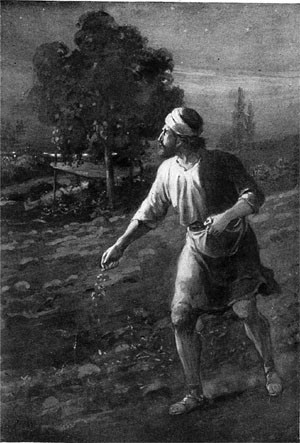
While He Slept His Enemy Came and Sowed Tares Among the Wheat
"Do not seek to console me," said Helen, "for such tears are salutary, my dear brother. I have virtually said that the joys of religion are fading and unsatisfactory; I must sometimes seek for others. I have quieted more than one uneasy conscience, by throwing the influence of a professing Christian into the scale of the world. I have wandered from my Father's side to the society of his rebel subjects. And yet I have cause to mourn less for this one transgression, than for the alienation of heart, which led the way to it. Had I not fallen far, very far, from the strength and purity of my earlier love, even your pleadings could not have moved me."
"But the Bible says nothing about such amusements, Helen."
"Not in words, perhaps, but in effect. Put the case to your own heart, Edward. Would you have me choose for my companions those who treat you with neglect? Would you wish me to frequent places, whence I should return, careless and cold in my manner toward you? Ah, brother! I loved God once. I saw his hand in everything around me. I felt his presence perpetually, and trusted, childlike, to his protecting arm. But now I regard him less, pray less, read less, and give less." And then she revealed to her brother her beautiful experience—beautiful till she grew negligent and formal—with a truth, an earnestness, a loving simplicity, that for the first time gave him some insight into the nature of true piety.
"And now, dear Edward," she said, "read to me Christ's prayer to the people, that I may feel sure that they prayed for me."
As she listened, the varying expressions of countenance indicated many and varied emotions. Submission, sorrow, love, and faith—all were there. When Edward had finished they knelt together, and Helen sorrowfully, yet hopefully, poured out her full soul in confession, and most touchingly she besought the divine compassion upon her erring brother.
The carol of the birds went up with the whispered amen of the penitent, the blossoms of the climbing honeysuckle sent in her fragrance, and the morning sun smiled on them as they rose from prayer. The face of Helen reflected her inward gladness, and restored peace shone in her dark eyes and tranquil countenance. "Thou art happier than I," said Edward, as he turned from the chamber.
THE SHADOW OF THE CROSS.
"Aye, and the race is just begun,
The world is all before me now,
The sun is in the eastern sky,
And long the shadows westward lie;
In everything that meets my eye
A splendor and a joy I mind
A glory that is undesigned."
Ah! youth, attempt that path with care,
The shadow of the cross is there.
"I've time," he said, "to rest awhile,
And sip the fragrant wine of life,
My lute to pleasure's halls I'll bring
And while the sun ascends I'll sing,
And all my world without shall ring
Like merry chiming bells that peal
Not half the rapture that they feel."
Alas! he found but tangled moss,
Above the shadow of the cross.

Christ Our Refuge
There were six cities in the land of Canaan which were set apart as places of refuge, to which a man might flee if he had, either by accident or design, killed another. These cities were easy of access. Three were on the west side of the river Jordan, and three on the east side. Every year the roads leading to them were examined, to see that they were in good condition, and that there was nothing in the way to stop the manslayer as he was running from his pursuer. At different points there were the guide-boards, and on them were written, Refuge! Refuge!
If any man by accident killed another, and reached one of these cities before his pursuer, he was allowed to stay there until the death of the high-priest who was then living. But if in anger a man had purposely killed another, then, although he sought refuge in one of these cities, he was given up to the avenger of blood to be slain. You will find more about these cities and their names if you will read the thirty-fifth chapter of Numbers, the nineteenth chapter of Deuteronomy, and the twentieth chapter of Joshua.
But what interest can boys and girls and all older persons have in these cities?
I will try to tell you. God has different ways of teaching. A great many things about which we read in the Old Testament are what is called types. A type, in scripture language, means a pattern or a likeness to a person who is to come, or to an event which is to take place. It is supposed to point forward to something more valuable than itself. Thus, for example, the blood of the lamb which was slain on the Jewish altar was a type, or a foreshowing, of the crucifixion of Jesus Christ for our salvation. Hence John the Baptist pointing to the Saviour, said to his disciples, "Behold the Lamb of God, which taketh away the sin of the world." John 1:29. The paschal lamb, which was slain to commemorate the deliverance of the Jews from the bondage of Egypt, and the lamb which was offered daily, both morning and evening, in the service of the temple, were representations of the greater sacrifice which Christ came from heaven to make for our salvation.
So the land of Canaan was a type of heaven. The lifting up of the brazen serpent on a pole was a type of our Saviour's crucifixion; and the cities of refuge were a beautiful type of Jesus Christ, who is the sinner's refuge.
You know, my dear children, that we have all sinned, and that we all need a place of safety. The avenger says, "Thou shalt surely die." Escape for thy life. But that we may not die eternally, God has given us the Bible as our guide-board; and the Bible is constantly pointing to Jesus Christ as the sinner's refuge. He is our hiding-place. It is to him Isaiah refers when he says, "And a man shall be as a hiding-place from the wind, and a covert from the tempest; as rivers of water in a dry place, as the shadow of a great rock in a weary land."
The way to our city of refuge is plain. "I am the way," is the Saviour's own direction. The gate is always open, and the assurance is, "Him that cometh to me I will in no wise cast out."
I want you to remember, dear children, that it is a great deal easier to run to this city of refuge when you are young, than it will be if you put it off until you are older. The promise of the Saviour is, "Those that seek me early shall find me." Will you not seek him when he may be found? How sad it will be if you neglect to do so. You will need a refuge when the tempest of God's judgments shall burst upon the wicked. Oh, then how glad you will be if you can say, as David said of his trust in God, "Thou art my hiding-place; thou shalt preserve me from trouble; thou shalt compass me about with songs of deliverance."
THE MASTER'S HAND.
"In the still air the music lies unheard;
In the rough marble beauty hides unseen;To make the music and the beauty needs
A master's touch, the sculptor's chisel keen.Great Master, touch us with Thy skilled hand:
Let not the music that is in us die!Great Sculptor, hew and polish us, nor let
Hidden and lost, Thy form within us lie!Spare not the stroke! Do with us as thou wilt!
Let there be naught unfinished, broken, marred;Complete Thy purpose, that we may become
Thy perfect image, Thou our God and Lord!"Tom's Trial.
It was a pleasant day in that particularly pleasant part of the summer time, which the boys call "vacation," when Tiger and Tom walked slowly down the street together. You may think it strange that I mention Tiger first, but I assure you Tom would not have been in the least offended by the preference. Indeed, he would have assured you that Tiger was a most wonderful dog, and knew as much as any two boys, though this might be called extravagant.
Nearly a year ago, on Tom's birthday, Tiger arrived as a present from Tom's uncle, and as he leaped with a dignified bound from the wagon in which he made his journey, Tom looked for a moment into his great, wise eyes, and impulsively threw his arms around his shaggy neck. Tiger, on his part, was pleased with Tom's bright face, and most affectionately licked his smooth cheeks. So the league of friendship was complete in an hour.
Tom had a pleasant, round face, and you might live with him a week, and think him one of the noblest, most generous boys you ever knew. But some day you would probably discover that he had a most violent temper. You would be frightened to see his face crimson with rage, as he stamped his feet, shook his little sister, spoke improperly to his mother, and above all, displeased his great Father in heaven.
Now I am going to tell you of one great trial on this account, which Tom never forgot to the end of his life. Tiger and Tom were walking down the street together, when they met Dick Casey, a school-fellow of Tom's.
"O Dick!" cried Tom, "I'm going to father's grain store a little while. Let's go up in the loft and play."
Dick had just finished his work in his mother's garden, and was all ready for a little amusement. So the two went up together, and enjoyed themselves highly for a long time. But at last arose one of those trifling disputes, in which little boys are so apt to indulge. Pretty soon there were angry words, then (Oh, how sorry I am to say it!), Tom's wicked passions got the mastery of him, and he beat little Dick severely. Tiger, who must have been ashamed of his master, pulled hard at his coat, and whined piteously, but all in vain. At last Tom stopped, from mere exhaustion.
"There, now!" he cried, "which is right, you or I?"
"I am," sobbed Dick, "and you tell a lie."
Tom's face flushed crimson, and darting upon Dick, he gave him a sudden push. Alas! he was near to the open door. Dick screamed, threw up his arms, and in a moment was gone. Tom's heart stood still, and an icy chill crept over him from head to foot. At first he could not stir; then—he never knew how he got there, but he found himself standing beside his little friend. Some men were raising him carefully from the hard sidewalk.
"Is he dead?" almost screamed Tom.
"No," replied one, "we hope not. How did he fall out?"
"He didn't fall," groaned Tom, who never could be so mean as to tell a lie, "I pushed him out."
"You pushed him, you wicked boy," cried a rough voice. "Do you know you ought to be sent to jail, and if he dies, maybe you'll be hung."
Tom grew as white as Dick, whom he had followed into the store, and he heard all that passed as if in a dream.
"Is he badly hurt?" cried some one.
"Only his hands," was the answer. "The rope saved him, he caught hold of the rope and slipped down; but his hands are dreadfully torn—he has fainted from pain."
Just then Tom's father came in, and soon understood the case. The look he gave at his unhappy son, so full of sorrow, not unmingled with pity, was too much for Tom, and he stole out, followed by the faithful Tiger. He wandered to the woods, and threw himself upon the ground. One hour ago he was a happy boy, and now what a terrible change! What has made the difference? Nothing but the indulgence of this wicked, violent temper. His mother had often warned him of the fearful consequences. She had told him that little boys who would not learn to govern themselves, grew up to be very wicked men, and often became murderers in some moment of passion. And now, Tom shuddered to think he was almost a murderer! Nothing but God's great mercy in putting that rope in Dick's way, had saved him from carrying that load of sorrow and guilt all the rest of his life. But poor Dick, he might die yet—how pale he looked—how strange! Tom fell upon his knees, and prayed God to "spare Dick's life," and from that time forth, with God's help, he promised that he would strive to conquer this wicked passion.
Then, as he could no longer bear his terrible suspense, he started for Widow Casey's cottage. As he appeared at the humble door, Mrs. Casey angrily ordered him away, saying: "You have made a poor woman trouble enough for one day." But Dick's feeble voice entreated, "O mother, let him come in; I was just as bad as he."
Tom gave a cry of joy at hearing these welcome tones, and sprang hastily in. There sat poor Dick with his hands bound up, looking very pale, but Tom thanked God that he was alive.
"I should like to know how I am to live now," sighed Mrs. Casey. "Who will weed the garden, and carry my vegetables to market? I am afraid we shall suffer for bread before the summer is over," and she put her apron to her eyes.
"Mrs. Casey," cried Tom, eagerly, "I will do everything that Dick did. I will sell the potatoes and beans, and will drive Mr. Brown's cows to pasture."
Mrs. Casey shook her head incredulously, but Tom bravely kept his word. For the next few weeks Tom was at his post bright and early, and the garden was never kept in better order. And every morning Tiger and Tom stood faithfully in the market-place with their baskets, and never gave up, no matter how warm the day, till the last vegetable was sold, and the money placed faithfully in Mrs. Casey's hand.
Tom's father often passed through the market, and gave his little son an encouraging smile, but he did not offer to help him out of his difficulty, for he knew if Tom struggled on alone, it would be a lesson he would never forget. Already he was becoming so gentle and patient, that every one noticed the change, and his mother rejoiced over the sweet fruits of his repentance and self-sacrifice.
After a few weeks the bandages were removed from Dick's hands, but they had been unskilfully treated, and were drawn up in very strange shapes. Mrs. Casey could not conceal her grief. "He will never be the help he was before," she said to Tom, "he will never be like other boys, and he wrote such a fine hand, now he can no more make a letter than that little chicken in the garden."
"If we only had a great city doctor," said a neighbor, "he might have been all right. Even now his fingers might be helped if you should take him to New York."
"Oh, I am too poor, too poor," said she, and burst into tears.
Tom could not bear it, and again rushed into the woods to think what could be done, for he had already given them all his quarter's allowance. All at once a thought flashed into his head, and he started as if he had been shot. Then he cried in great distress:—
"No, no, anything but that, I can't do that!"
Tiger gently licked his hands, and watched him with great concern. Now came a great struggle. Tom stroked him backward and forward, and although he was a proud boy, he sobbed aloud. Tiger whined, licked his face, rushed off into dark corners, and barked savagely at some imaginary enemy, and then came back, and putting his paws on Tom's knees, wagged his tail in anxious sympathy. At last Tom took his hands from his pale, tear-stained face, and looking into the dog's great honest eyes, he cried with a queer shake of his voice:—
"Tiger, old fellow! dear old dog, could you ever forgive me if I sold you?"
Then came another burst of sorrow, and Tom rose hastily, as if afraid to trust himself, and almost ran out of the woods. Over the fields he raced, with Tiger close at his heels, nor rested a moment till he stood at Major White's door, nearly two miles away.
"Do you still want Tiger, sir?"
"Why yes," said the old man in great surprise, "but do you want to sell him?"
"Yes, please," gasped Tom, not daring to look at his old companion. The exchange was quickly made, and the ten dollars in Tom's hand. Tiger was beguiled into a barn, and the door hastily shut, and Tom was hurrying off, when he turned and cried in a choking voice—
"You will be kind to him, Major White, won't you? Don't whip him, I never did, and he's the best dog—"
"No, no, child," said Major White, kindly; "I'll treat him like a prince, and if you ever want to buy him back, you shall have him." Tom managed to falter, "Thank you," and almost flew out of hearing of Tiger's eager scratching on the barn door.
I am making my story too long, and can only tell you in a few words that Tom's sacrifice was accepted. A friend took little Dick to the city free of expense, and Tom's money paid for the necessary operation. The poor crooked fingers were very much improved, and were soon almost as good as ever. And the whole village loved Tom for his brave, self-sacrificing spirit, and the noble atonement he had made for his moment of passion.
A few days after Dick's return came Tom's birthday, but he did not feel in his usual spirits. In spite of his great delight in Dick's recovery, he had so mourned over the matter, and had taken Tiger's loss so much to heart, that he had grown quite pale and thin. So, as he was permitted to spend the day as he pleased, he took his books and went to his favorite haunt in the woods.
"How different from my last birthday," thought Tom. "Then Tiger had just come, and I was so happy, though I didn't like him half so well as I do now." Tom sighed heavily; then added more cheerfully, "Well, I hope some things are better than they were last year. I hope I have begun to conquer myself, and with God's help I will never give up trying while I live. Now if I could only earn money enough to buy back dear old Tiger." While Tom was busied with these thoughts he heard a hasty, familiar trot, a quick bark of joy, and the brave old dog sprang into Tom's arms.
"Tiger, old fellow," cried Tom, trying to look fierce, though he could scarcely keep down the tears, "how came you to run away, sir?"
Tiger responded by picking up a letter he had dropped in his first joy, and laying it in Tom's hand:—
"My Dear Child: Tiger is pining, and I must give him a change of air. I wish him to have a good master, and knowing that the best ones are those who have learned to govern themselves, I send him to you. Will you take care of him and greatly oblige
"Your old friend, Major White."
Tom then read through a mist of tears—
"P. S. I know the whole story. Dear young friend, 'Be not weary in well-doing.'"
WHAT COUNTS.
Did you tackle the trouble that came your way,
With a resolute heart and cheerful,Or hide your face from the light of day
With a craven face and fearful.O, a trouble's a ton, or a trouble's an ounce.
A trouble is what you make it.It isn't the fact that you're hurt that counts,
But only, HOW DID YOU TAKE IT?You are beaten to the earth? Well, what of that?
Come up with a smiling face.It's nothing against you to fall down
flat;
But to LIE THERE—that's disgrace.The harder you're thrown, the higher you'll bounce,
Be proud of your blackened eye.It isn't the fact that you're licked that counts,
But, HOW did you fight, and WHY?And though you be down to death, what then?
If you battled the best that you could,If you played your part in the world of men,
The Critic will call it good.Death comes with a crawl, or comes with a pounce,
And whether he's slow or spry,It isn't the fact that you're DEAD that counts,
But only HOW DID YOU DIE?—
Cooke.
The Premium.
"I think I am sure of one premium at least," said Edward, as he placed himself upon the form among his school-fellows.
It was examination day, and many a young heart was beating quick with the hope of approbation and reward, or with the fear of disgrace. Some had looked forward to this day, and applied to their tasks, knowing how carefully they should be examined, and commended or punished according to their deservings. Others had chosen to forget that such a day must come, and idled away the time which they would now have given a great deal to have at their disposal again.
In the center of the schoolroom was placed a long table, covered with books of various sizes and of different value. There were Bibles and Testaments, both large and small, the histories of Rome, of Greece, and of England. There were volumes elegantly bound and pamphlets just stitched together. The school was extensive, and it was wished that every one who had exerted himself to the best of his ability, however little that might be, should carry home with him some mark of encouragement, to remind him that diligence and perseverance were not overlooked.
Like the servants to whom the Lord entrusted the talents, some had five, and some had but one, yet these last could not be excused for hiding and neglecting it because it was small; even the youngest and the simplest child at school may make something of the reason and opportunities which the Lord has given him to improve.
With anxious hearts and busy faces the boys arranged themselves around the table; and were examined with great care and patience by their teachers, as to the progress they had made in their studies.
Now, Edward had set his heart on one particular premium, the Roman History, neatly bound, and making two very pretty volumes, which he thought would handsomely fill up a vacant space on his little book-shelves. He allowed himself to think of this until no other prize was of any value in his sight, a great fault, often committed by children, and grown people, too; who instead of thankfully receiving whatever the bounty of Providence assigns them, would choose for themselves; and become discontented and unhappy in the midst of blessings, because the wisdom of God sees fit to withhold some one thing that their folly deems necessary to their happiness.
Edward passed his examination with much credit, and one of the first premiums was adjudged to him; but instead of the Roman History, a very neat Bible, in excellent large type, was placed in his hands. Many of his schoolmates had wished for that Bible, but Edward regarded it not; and the eyes of the foolish boy filled with tears, as he saw the elegant history of Rome presented to another, who, perhaps, would gladly have exchanged with him.
The next day Edward returned home and related his disappointment to his parents, who thought his desire for the Roman History a mark of great learning and taste; but since he had distinguished himself so well they did not much care what prize he received.
Edward's father lived in the country, not far from the seaside, in a most delightful and healthy situation; and at this time his mother's brother, who was in a very sickly state, had just arrived there to enjoy the benefit of the sea-breezes, and rest a little from the toil and bustle of his employments in London.
Mr. Lewis was a young man of the most pleasing manners and appearance. He was very gentle and serious, but not at all gloomy or severe. His bad health only served to show forth his patience in enduring it without a murmuring word or discontented look; and Edward, who was really a kind-hearted and affectionate boy, soon became very much attached to his uncle, who had not seen him since he was an infant, and who was much pleased at the attentions his nephew delighted to pay him.
Young hearts are soon won; and it was only three days after Edward's return from school, that he went bounding over the grounds in search of his uncle, whose society he already preferred to his hoop and ball.
Mr. Lewis was seated under a fine old oak-tree, the high and knotted roots of which served as a seat; while the soft moss, interspersed with many delicate little flowers, was like a carpet beneath his feet. A rich and extensive tract of country lay spread before his eyes; and, at a distance the mighty ocean bounded the prospect, whose deep green waters were seen in beautiful contrast with the pale yellow cliff, that with a graceful, yet abrupt curve, interrupted the view to the right. Thin clouds were floating past the sun every now and then, and threw all the varieties of light and shade upon the lovely scene below.
Mr. Lewis had a book in his hand, into which he frequently looked, and then raised his eyes again to gaze upon the varieties that surrounded him; and so intent he seemed, that Edward doubted whether he ought to disturb him, until his uncle, seeing him at some little distance, kindly beckoned him to come near.
"Is not this a pretty place, uncle?" said Edward, as he seated himself beside him; "and do you not find the breeze from the water very refreshing?"
"It is beautiful indeed, my dear boy; and I am deriving both refreshment and instruction while I look around me."
"Is that a Bible, uncle?"
"Yes. It is God's word, which I always find the best commentary upon his works; they explain each other."
"I love the Bible too, uncle," said Edward, "and I got much credit for my answering on Scripture questions last half-year."
"And which, Edward, afforded you the greater satisfaction, the Scriptures, or the credit you got for studying them?"
Edward looked a little embarrassed and did not immediately reply.
"It is quite right to take pleasure in the well-earned approbation of your teachers," continued Mr. Lewis, "and I was glad to hear that you obtained a premium at the last examination also."
"Yes, uncle, but not the prize I wished for. There was a Roman History that I should have liked better, and it was just of equal value with the Bible that I got."
"How of equal value, Edward?"
"I mean that it was not reckoned a higher prize, and it would have been a nicer book for me."
"Then you had a Bible already?"
"Why, no, uncle, not of my own, but it is easy to borrow one on the Sabbath; and I had gone through all my Scripture proofs, and do not want it on other days."
"Read these four verses for me," said Mr. Lewis, pointing to the sixth chapter of Deuteronomy "commencing with the sixth verse."
Edward read: "And these words which I command thee this day, shall be in thine heart; and thou shalt teach them diligently unto thy children, and shalt talk of them when thou sittest in thine house, and when thou walkest by the way, and when thou liest down, and when thou risest up; and thou shalt bind them for a sign upon thine hand, and they shall be as frontlets between thine eyes, and thou shalt write them upon the posts of thine house, and on thy gates."
"To whom was this command given, Edward?"
"To the Jews, uncle."
"Yes; and the word of God, which cannot pass away, is as much binding on us as on them, in everything excepting the sacrifices and ceremonies, which foreshowed the coming of the Lord Jesus Christ, and which were done away with, by his death's fulfilling all those types and shadows."
"Then," said Edward, "we are commanded to write the Bible on our hands and on our door-posts."
"No, my dear boy, not literally, but in a figure of speech; as the Lord, when declaring he never will forget Zion, says, 'I have graven thee upon the palms of my hands; thy walls are continually before me.' The meaning of the passage you first read is that we must have the word of God as continually present to our minds as anything written on our hands, and on every object around us, would be to our bodily sight. And how are we to get our thoughts so occupied by it, Edward?"
"By continually reading it, I suppose," replied Edward, rather sullenly.
"By reading it often, and meditating on it much," said his uncle; "and that we can do without interfering with our other business. Without prayer you cannot obtain any spiritual blessing, nor maintain any communion with God; and without reading the Scriptures you will have but little desire to pray. We are like people wandering in the dark, while the Bible is as a bright lamp held out to direct us in the only safe path. You cannot be a child of God if you do not his will; you cannot do it unless you know it, and it is by the Bible he is pleased to communicate that knowledge. Do you begin to see, Edward, that the Bible is more suitable to be an every-day book than your profane history?"
"Why, yes, uncle; but the Bible is a grave book, and if I read it so constantly I never should be merry."
"There is no merriment among the lost, Edward; and that dreadful lot will be your portion if you neglect the great salvation which the Scriptures set forth. Besides, there is no foundation for what you suppose to be the effect of reading the Bible. I have known people naturally melancholy and discontented, to become cheerful and happy by studying it; but I never in my life saw an instance of a person's becoming unhappy because he had a good hope of going to heaven."
Edward paused a moment, and then said, "Uncle, I remember it is written concerning wisdom, that 'her ways are ways of pleasantness, and all her paths are peace.'"
"Most true, my dear boy, 'quietness and assurance forever' is the portion of God's people. 'Rejoice in the Lord always, and again I say, rejoice.' 'The ransomed of the Lord shall return, and come to Zion with songs and everlasting joy upon their heads; they shall obtain joy and gladness; and sorrow and sighing shall flee away.' Are such expressions as these likely to make us gloomy, Edward?"
"O, no, uncle; and I often wonder that you, who suffer so much pain, and read the Bible constantly, are not melancholy."
"How can I be melancholy, Edward, when the Bible tells me that all these things are working together for my spiritual good? that He who spared not his own Son, but delivered him up for us all, will with him also freely give us all things? When I think of what my sins deserve, and see the Lamb of God bearing the chastisement that should fall on me, how can I be melancholy? When I feel that the Spirit of God is bringing these things to my remembrance, and enabling me to love the Lord Jesus, who has done so much for me, must I not rejoice? I know that in me, that is, in my flesh, dwelleth no good thing; and since God has promised forgiveness to all who seek that blessing through his Son; and since I feel assured that I have sought that blessing, and feel peace and joy in believing, surely the song of praise, not the moan of lamentation, becomes me. Yet I do lament, Edward, daily lament, my many offenses against God; but I am assured that Christ's blood cleanseth from all sin, and that in him I have a powerful and all-prevailing Advocate with the Father. I know in whom I have believed, and that he will never cast off nor forsake me. I am sinking into the grave, but I do not shrink from that prospect, because the bitterness of death is taken away by my Saviour, who died for my sins, and rose again for my justification; and though this body returns to dust, I shall live again, and enter into the presence of my Redeemer, and rejoice there evermore."
Edward looked at the animated countenance of his uncle, and then cast down his eyes; they were full of tears. At last he said, "Uncle, indeed I am a very sinful boy, neglecting the Bible, because I know it would show me my sin, and the consequences of it. But I will trifle no more with God's displeasure. I will get that precious Bible, worth a thousand Roman histories, and I will read it daily, with prayer, that I may be wise unto salvation."
Mr. Lewis did not live long after this. He died, rejoicing in hope of eternal life; and as often as Edward was permitted to return home from his school, he was to be seen under the old oak, with the Bible in his hand, from which he learned more and more the will of his God and Saviour—the utter sinfulness of his own nature—his inability to help himself; and from this holy word he learned to place all his dependence on the righteousness of his Saviour—to follow the example of his Saviour, in prayer, in resignation, and in doing good to the poor around him.
He often thought of his dear uncle, and counted that day happy when he sat to listen to his kind advice, which, as a means, brought him to a knowledge of himself and of his heavenly Father.
OUR NEIGHBORS.
"Somebody near you is struggling alone
Over life's desert sand;Faith, hope, and courage together are gone;
Reach him a helping hand;Turn on his darkness a beam of your light;
Kindle, to guide him, a beacon fire bright;
Cheer his discouragement, soothe his affright,
Lovingly help him to stand.Somebody near you is hungry and cold;
Send him some aid to-day;Somebody near you is feeble and old,
Left without human stay.Under his burdens put hands kind and strong;
Speak to him tenderly, sing him a song;
Haste to do something to help him along
Over his weary way.Dear one, be busy, for time fleeth fast,
Soon it will all be gone;Soon will our season of service be past,
Soon will our day be done.Somebody near you needs now a kind word;
Some one needs help, such as you can afford;
Haste to assist in the name of the Lord;
There may be a soul to be won."A Kind Word.
Within each soul the God above
Plants the rich jewel,—human love.
The fairest gem that graces youth
Is love's companion,—fearless truth.
William and Henry were clerks in a large wholesale establishment. They met one morning on their way to the store and proceeded together. After talking awhile on various subjects, the following dialogue took place:—
"By the way, William," said Henry, "I understand you were last evening at ——'s," naming a fashionable billiard saloon.
"A mistake, Henry. I was never in a billiard saloon."
"Well, I thought it very strange when I heard it."
"Why so?"
"Why?" said Henry in astonishment. "Why, because you are a religious young man and a church member."
"Do you ever visit such places, Henry?"
"Oh, yes; but that is quite a different matter. I don't profess to be a Christian, you know."
"You would think it wrong for me to be there?"
"Of course I should."
"And right for you?"
"Well, yes; there's no harm in my being there."
"Why not?"
"Why, because—because I do not profess to be bound by the same obligations that you are."
"And who has released you from those same obligations and imposed them upon me?"
"Oh, well, now, there's no use in talking, William; you know that Christians do not and ought not to engage in what they consider pernicious amusements."
"I certainly do know that they ought not; but I wish to know why it is wrong for them and right for others."
"You know the fact that it is so."
"No, I do not know that it is; and I wish to call your attention to the truth that the obligation to refrain from evil rests upon every rational human being in a Christian land, for God has commanded all men to love and obey him; also, to the fact that the difference between the Christian and the sinner is that one acknowledges the obligation, while the other denies it; and that the denial does not remove the obligation. God has not invited you to love him if you prefer to do so; but he has absolutely commanded you and me to love and obey him. I have the right, if you have, to engage in any kind of amusement, and to follow my inclinations in all things; and it is your duty, equally with mine, to honor our Master's law by shunning every wicked way. Think of this, friend Henry, I entreat you, and acknowledge the responsibility which you cannot remove; and from which, after accepting, you will not desire to be released."
They had arrived at the store, and each went to his own department. These young men had entered the employment of A. B. & Sons at the same time, about two years before the above conversation occurred. William had gained the confidence of his employers, and had risen in position. The senior partner intended retiring from business, and was looking about for a Christian young man of ability and energy to propose as a partner for his sons; and had lately been thinking of William as a suitable person. He had observed him closely, and thought he saw in him the habits and qualifications necessary to make a successful business man.
He had also been watching Henry's course. He had heard of him at places where a young man who aspires to positions of truth and honor will never be seen, and was about proposing his discharge to the other members of the firm. He knew that a clerk whose style of living requires more money than his salary gives him will be very likely, indeed almost sure, to resort to dishonest practices to make up the deficiency. Instances of this kind are every day occurring in our cities; and as long as we meet, as we may every morning and evening in the Broadway stages, dainty looking young men, dressed in finer and fresher broadcloth than their employers wear, with heavy gold chains, fine chronometers, and diamond pins and rings, we may expect to hear of a great many more.
That morning's conversation made a deep impression upon Henry's mind. The subject had never been presented to him in that light before. He had imagined, as young persons are apt to suppose, that no moral responsibility rested upon him till he assumed it publicly by uniting with the church. Henry did not mean to die a sinner. Oh, no; he fully intended, after he had enjoyed what he considered the pleasures of youth, to settle down into Christian manhood. After this talk with William he could not get rid of the idea of accountability to his God. His wicked amusements and extravagant habits appeared to him as they never had done before, and he began to see their inevitable tendency. The result was an entire change in his aims and conduct. This was so marked that it very soon became known to all of his associates, and, of course, to his employers.
He remained in that house; gradually rising to the highest clerkship, and, finally, becoming the junior partner of the firm of which William had for some time been a member. His happiness and prosperity he always attributed to the word kindly spoken at the right time by his fellow clerk. He has been successful not only as a merchant, but as a Christian, exerting a powerful influence for good upon all about him, but particularly upon the young men employed in his house.
"Live for something! All created
Nature doth reciprocateHer kindness. Should the animated
This great law invalidate?Rather show thy grateful praises
To thy God who reigns above,In acts that Sorrow's soul releases—
'Words of kindness,' 'deeds of love.'"
Another Commandment
A new presiding elder, Mr. N., was expected in the district; and as all the ministers stopped with Brother W. and his wife, every preparation was made to give him a cordial reception. The honest couple thought that religion in that part consisted in making parade, and therefore the parlor was put in order, a nice fire was made, and the kitchen replenished with cake, chickens, and every delicacy, preparatory to cooking. While Mr. W. was out at the wood-pile, a plain-looking, coarsely dressed, but quiet-like pedestrian, came along and asked the distance to the next town. He was told it was three miles. Being very cold, he asked permission to enter and warm himself. Assent was given very grudgingly, and both went into the kitchen. The wife looked daggers at this untimely intrusion, for the stranger had on cowhide boots, an old hat, and a threadbare, but neatly patched coat. At length she gave him a chair beside the Dutch oven which was baking nice cakes for the presiding elder, who was momentarily expected, as he was to preach the next day at the church a mile or two beyond.
The stranger, after warming himself, prepared to leave, but the weather became inclement, and as his appetite was aroused by the viands about the fire, he asked for some little refreshment ere he set out for a cold walk to the town beyond. Mrs. W. was displeased, but on consultation with her husband, cold bacon and bread were set out on an old table, and he was somewhat gruffly told to eat. It was growing dark, and hints were thrown out that the stranger had better depart, as it was three long miles to town.
The homely meal was at last concluded—the man thanked him kindly for the hospitality he had received, and opened the door to go. But it was quite dark and the clouds denoting a storm filled the heavens.
"You say it is full three miles to D——?"
"I do," said Mr. W. coldly. "I said so when you first stopped, and you ought to have pushed on, like a prudent man. You could have reached there before it was quite dark."
"But I was cold and hungry, and might have fainted by the way."
His manner of saying this touched the farmer's feelings a little.
"You have warmed and fed me, for which I am thankful. Will you now bestow another act of kindness upon one in a strange place, who if he goes out into the darkness, may lose himself and perish in the cold?"
The particular form in which this request was made, and the tone in which it was uttered, put it out of the farmer's heart to say no.
"Go in there and sit down," he answered, pointing to the kitchen, "and I will see my wife and hear what she says."
And Mr. W. went into the parlor where the supper table stood, covered with snow-white cloth, and displaying his wife's set of blue-sprigged china, that was brought out only on special occasions.
The tall mold candles were burning thereon, and on the hearth blazed a cheerful fire.
"Hasn't that old fellow gone yet?" asked Mrs. W. She heard his voice as he returned from the door.
"No, and what do you suppose, he wants us to let him stay all night."
"Indeed, we will do no such thing. We cannot have the likes of him in the house now. Where could he sleep?"
"Not in the best room, even if Mr. N. did not come."
"No, indeed!"
"But really I don't see, Jane, how we can turn him out of doors. He doesn't look like a strong man, and it's full three miles to D——."
"It's too much; he ought to have gone on while he had daylight, and not lingered here, as he did, till it got dark."
"We can't turn him out of doors, Jane, and it's no use to think of it. He'll have to stay somehow."
"But what can we do with him?"
"He seems like a decent man at least; and doesn't look as if he had anything bad about him. We might make a bed on the floor."
When Mr. W. returned to the kitchen, where the stranger had seated himself before the fire, he informed him that he had decided to let him stay all night. The man expressed in few words his grateful sense of their kindness, and then became silent and thoughtful. Soon after the farmer's wife, giving up all hope of Mr. N.'s arrival, had supper taken up, which consisted of coffee, warm short-cake, and broiled chicken. After all was on the table, a short conference was held as to whether it would do not to invite the stranger to take supper. It was true they had given him as much bread and bacon as he could eat, but then, as long as he was going to stay all night, it looked too inhospitable to sit down to the table and not ask him to join them. So, making a virtue of necessity, he was kindly asked to come to supper—an invitation which he did not decline. Grace was said over the meal by Mr. W., and the coffee poured, and the bread helped, and the meat carved.
There was a fine little boy, six years old, at the table, who had been brightened up and dressed in his best, in order to grace the minister's reception. Charles was full of talk, and the parents felt a mutual pride in showing him off, even before their humble guest, who noticed him particularly, though he had not much to say. "Come, Charley," said Mr. W., after the meal was over, and he sat leaning in his chair, "can't you repeat the pretty hymn mamma taught you last Sabbath?"
Charley started off without any further invitation, and repeated very accurately two or three verses of a camp-meeting hymn, that was then popular.
"Now let us hear you say the commandments, Charley," spoke up the mother, well pleased with her son's performance.
And Charley repeated them with a little prompting.
"How many commandments are there?" asked the father.
The child hesitated, and then looking at the stranger, near whom he sat, said innocently:—
"How many are there?"
The man thought for some moments, and said, as if in doubt,
"Eleven, are there not?"
"Eleven!" ejaculated Mrs. W. in unfeigned surprise.
"Eleven?" said her husband with more rebuke than astonishment in his voice. "Is it possible, sir, that you do not know how many commandments there are? How many are there, Charley? Come, tell me—you know, of course."
"Ten," replied the child.
"Right, my son," returned Mr. W., looking with a smile of approval on the child. "Right, there isn't a child of his age in ten miles who can't tell you there are ten commandments."
"Did you ever read the Bible, sir?" addressing the stranger.
"When I was a boy I used to read it sometimes. But I am sure I thought that there were eleven commandments. Are you not mistaken about there being ten?"
Sister W. lifted her hands in unfeigned astonishment, and exclaimed:—
"Could any one believe it? such ignorance of the Bible!"
Mr. W. did not reply, but rose, and going to the corner of the room where the good book lay upon the stand, he put it on the table before him, and opened to that portion in which the commandments are recorded.
"There," he said, placing his finger upon the proof of the stranger's error, "There, look for yourself."
The man came around from his side of the table and looked over the stranger's shoulder.
"There, do'ye see?"
"Yes, it does say so," replied the man, "and yet it seems to me there are eleven. I'm sure I always thought so."
"Doesn't it say ten here?" inquired Mr. W. with marked impatience in his voice.
"It does, certainly."
"Well, what more do you want? Can't you believe the Bible?"
"Oh, yes, I believe the Bible; and yet it strikes me somehow that there must be eleven commandments. Hasn't one been added somewhere else?"
Now this was too much for Brother and Sister W. to bear. Such ignorance of sacred matters they felt to be unpardonable. A long lecture followed, in which the man was scolded, admonished, and threatened with divine indignation. At its close he modestly asked if he might have the Bible to read for an hour or two before retiring for the night. This request was granted with more pleasure than any of the preceding ones.
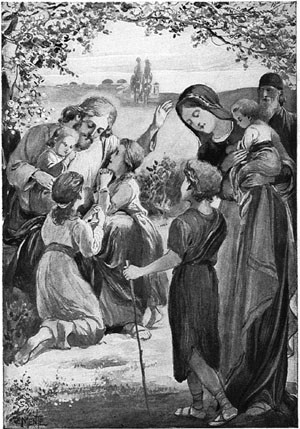
Christ Blessing Little Children
Shortly after supper the man was conducted to the little spare room, accompanied by the Bible. Before leaving him alone, Mr. W. felt it to be his duty to exhort him to spiritual things, and he did so most earnestly for ten or fifteen minutes. But he could not see that his words made much impression, and he finally left his guest, lamenting his obduracy and ignorance.
In the morning he came down, and meeting Mr. W., asked if he would be so kind as to lend him a razor, that he might remove his beard, which did not give his face a very attractive appearance. His request was complied with.
"We will have prayers in about ten minutes," said Mr. W., as he handed him the razor and shaving box.
The man appeared and behaved with due propriety at family worship. After breakfast he thanked the farmer and his wife for their hospitality, and parting went on his journey.
Ten o'clock came, but Mr. N. had not arrived. So Mr. and Mrs. W. started for the meeting-house, not doubting they would find him there. But they were disappointed. A goodly number of people were inside the meeting-house, and a goodly number outside, but the minister had not arrived.
"Where is Mr. N——?" inquired a dozen voices, as a crowd gathered around the farmer.
"He hasn't come yet. Something has detained him. But I still look for him—indeed, I fully expected to find him here."
The day was cold, and Mr. W., after becoming thoroughly chilled, concluded to keep a good lookout for the minister from the window near which he usually sat. Others, from the same cause, followed his example, and the little meeting-house was soon filled, and one after another came dropping in. The farmer, who turned towards the door each time it was opened, was a little surprised to see his guest of the previous evening enter, and come slowly down the aisle, looking on either side, as if searching for a vacant seat, very few of which were now left. Still advancing, he finally got within the little enclosed altar, and ascended to the pulpit, took off his old grey overcoat and sat down.
By this time Mr. W. was by his side, and had his hand upon his arm.
"You mustn't sit here. Come down and I will show you a seat," he said, in an excited tone.
"Thank you," replied the man in a composed voice. "It is very comfortable here." And the man remained immovable.
Mr. W., feeling embarrassed, went down, intending to get a brother "official" to assist him in making a forcible ejection of the man from the place he was desecrating. Immediately upon his doing so, however, the man rose, and standing up at the desk, opened the hymn-book. His voice thrilled to the finger ends of Brother W. as in a distinct and impressive manner he gave out the hymn beginning:
"Help us to help each other, Lord,
Each other's cross to bear;Let each his friendly aid afford,
And feel a brother's care."The congregation rose, after the stranger had read the entire hymn, and had repeated the first two lines for them to sing. Brother W. usually started the tunes. He tried this time, but went off on a long meter tune. Discovering his mistake at the second word, he balked and tried it again, but now he stumbled on short meter. A musical brother came to his aid and led off with a tune that suited the measure in which the hymn was written. After singing, the congregation knelt, and the minister—for no one doubted his real character—addressed the throne of grace with much fervor and eloquence. The reading of a chapter in the Bible succeeded. Then there was a deep pause throughout the room in anticipation of the text, which the preacher prepared to announce.
The dropping of a pin might have been heard. Then the fine, emphatic tones of the preacher filled the room:—
"A new commandment I give unto you, that ye love one another."
Brother W. had bent forward to listen, but now he sunk back in his seat. This was the eleventh commandment.
The sermon was deep, searching, yet affectionate and impressive. The preacher uttered nothing that could in the least wound the brother and sister of whose hospitality he had partaken, but he said much that smote upon their hearts, and made them painfully conscious that they had not shown as much kindness to the stranger as he had been entitled to receive on the broad principles of humanity. But they suffered more from mortification of feeling. To think that they had treated the presiding elder of the district after such a fashion was deeply humiliating; and the idea of the whole affair getting abroad interfered sadly with their devotional feelings throughout the whole period of service.
At last the sermon was over, the ordinance administered and the benediction pronounced. Brother W. did not know what was best for him to do. He never was more at a loss in his life. Then Mr. N. descended from the pulpit; but he did not step forward to meet him. How could he do that? Others gathered around him, but still he lingered and held back.
"Where is Brother W.?" he at length heard asked. It was the voice of the minister.
"Here he is," said one or two, opening the way to where the farmer stood.
The preacher advanced, and catching his hand, said:—
"How do you do, Brother W., I am glad to see you. And where is Sister W.?"
Sister W. was brought forward, and the preacher shook hands with them heartily, while his face was lit up with smiles.
"I believe I am to find a home with you," he said, as if it was settled.
Before the still embarrassed brother and sister could make reply, some one asked:—
"How came you to be detained so late? You were expected last night. And where is Brother R.?"
"Brother R. is sick," replied Mr. N., "and I had to come alone. Five miles from this my horse gave out, and I had to come the rest of the way on foot. But I became so cold and weary, that I found it necessary to ask a farmer not far from here, to give me a night's lodging, which he was kind enough to do. I thought I was still three miles off, but it happened that I was very much nearer my journey's end than I supposed."
This explanation was satisfactory to all parties, and in due time the congregation dispersed, and the presiding elder went home with Brother and Sister W.
THE TEN COMMANDMENTS.
I
Thou shalt have no other gods before me.
II
Thou shalt not make unto thee any graven image, or any likeness of any thing that is in heaven above, or that is in the earth beneath, or that is in the water under the earth: thou shalt not bow down thyself to them, nor serve them: for I the Lord thy God am a jealous God, visiting the iniquity of the fathers upon the children unto the third and fourth generation of them that hate me; and showing mercy unto thousands of them that love me, and keep my commandments.
III
Thou shalt not take the name of the Lord thy God in vain; for the Lord will not hold him guiltless that taketh his name in vain.
IV
Remember the Sabbath day, to keep it holy. Six days shalt thou labor, and do all thy work; but the seventh day is the Sabbath of the Lord thy God: in it thou shalt not do any work, thou, nor thy son, nor thy daughter, thy manservant, nor thy maidservant, nor thy cattle, nor thy stranger that is within thy gates: for in six days the Lord made heaven and earth, the sea, and all that in them is, and rested the seventh day: wherefore the Lord blessed the Sabbath day, and hallowed it.
V
Honor thy father and thy mother: that thy days may be long upon the land which the Lord thy God giveth thee.
VI
Thou shalt not kill.
VII
Thou shalt not commit adultery.
VIII
Thou shalt not steal.
IX
Thou shalt not bear false witness against thy neighbor.
X
Thou shalt not covet thy neighbor's house, thou shalt not covet thy neighbor's wife, nor his manservant, nor his maidservant, nor his ox, nor his ass, nor any thing that is thy neighbor's.
Make It Plain.
On the sixteenth day after the battle of Gettysburg, I entered the room where a young wounded colonel was apparently near to death. As I entered, he was roused from his stupor and beckoned me to his bedside, and threw his feeble arms around my neck.
"O my father, how glad I am to see you. I was afraid you would not come till it was too late. I am too feeble to say much, though I have a great many things to say to you; you must do all the talking. Tell me all about dear mother and sister."
I soon perceived by the appearance of those in the house, that there was no hope entertained of his recovery. But as I could no longer endure the agony of suspense, I at last inquired of the doctor, "Doctor, what do you think of my son's case?"
"Entirely hopeless."
"But is there nothing more that can be done to save him?"
"No, sir. Every thing that human skill and kindness can do has been done. Your son has been a brave and very successful officer; has been a great favorite in the army; has won the highest esteem of all who have known him, but he now must die. Immediately after the amputation the gangrene set in, and defies all efforts to arrest it."
"Well, Doctor, how long do you think he can live?"
"Not more than four days. He may drop away at any hour. We are constantly fearing that an artery will give way, and then it is all over with the colonel. What you wish to do in reference to his death, you had better do at once."
"Have you, or has any one, told him of his real condition?"
"No. We have left that painful duty for you to do, as we have been expecting your arrival for several days."
As I entered the room with the dreadful message of death pressing on my heart, the eyes of my son fastened on me.
"Come, sit by my side, father. Have you been talking with the doctor about me?"
"Yes."
"What did he tell you? Does he think I shall recover?"
There was a painful hesitation for a moment.
"Don't be afraid to tell me just what he said."
"He told me you must die."
"How long does he think I can live?"
"Not to exceed four days, and that you may drop away any hour,—that an artery may slough at any moment which you cannot survive."
With great agitation he exclaimed,
"Father, is that so? Then I must die! I cannot. I must not die! Oh! I am not prepared to die now. Do tell me how I can get ready? Make it so plain that I can get hold of it. Tell me, in a few words, if you can, so that I can see it plainly. I know you can, father, for I used to hear you explain it to others."
'T was no time now for tears, but for calmness and light, by which to lead the soul to Christ, and both were given.
"My son, I see you are afraid to die."
"Yes, I am."
"Well, I suppose you feel guilty."
"Yes, that is it. I have been a wicked young man. You know how it is in the army."
"You want to be forgiven, don't you?"
"Oh, yes! That is what I want. Can I be, father?"
"Certainly."
"Can I know it before I die?"
"Certainly."
"Well now, father, make it so plain that I can get hold of it."
At once, an incident which occurred during the school days of my son, came to my mind. I had not thought of it before for several years. Now it came back to me, fresh with its interest, and just what was wanted to guide the agitated heart of this young inquirer to Jesus.
"Do you remember while at school in —— you came home one day, and I having occasion to rebuke you, you became very angry and abused me with harsh language?"
"Yes, father, I was thinking it all over a few days ago, as I thought of your coming to see me, and felt so bad about it, that I wanted to see you, and once more ask you to forgive me."
"Do you remember, how, after the paroxysm of your anger had subsided, you came in, and threw your arms around my neck, and said, 'My dear father, I am sorry I abused you so. It was not your loving son that did it. I was very angry. Won't you forgive me?'"
"Yes, I remember it very distinctly."
"Do you remember what I said to you as you wept upon my neck?"
"Very well. You said, 'I forgive you with all my heart,' and kissed me. I shall never forget those words."
"Did you believe me?"
"Certainly. I never doubted your word."
"Did you then feel happy again?"
"Yes, perfectly; and since that time I have loved you more than ever before. I shall never forget how it relieved me when you looked upon me so kindly, and said, 'I forgive you with all my heart.'"
"Well, now, this is just the way to come to Jesus. Tell him you are sorry just as you told me, and ten thousand times quicker than a father's love forgave you, will he forgive you. He says he will. Then you must take his word for it, just as you did mine."
"Why, father, is this the way to become a Christian?"
"I don't know of any other."
"Why, father, I can get hold of this. I am so glad you have come to tell me how."
He turned his head upon his pillow for rest. I sank into my chair and wept freely, for my heart could no longer suppress its emotions. I had done my work, and committed the case to Christ. He, too, I was soon assured had done his. The broken heart had made its confession, had heard what it longed for, "I forgive you," and believed it. It was but a few moments of silence, but the new creation had taken place, the broken heart had made its short, simple prayer, and believed, and the new heart had been given. A soul had passed out from nature's darkness into marvelous light, and from the power of sin and Satan unto God.
I soon felt the nervous hand on my head, and heard the word "father," in such a tone of tenderness and joy, that I knew the change had come.
"Father, my dear father, I don't want you to weep any more, you need not. I am perfectly happy now. Jesus has forgiven me. I know he has, for he says so, and I take his word for it, just as I did yours. Wipe your tears. I am not afraid to die now. If it is God's will, I should like to live to serve my country, and take care of you and mother, but if I must die, I am not afraid to now, Jesus has forgiven me. Come, father, let us sing,—
"'When I can read my title clear,'"
And we did sing.
"Now, father, I want you should pray, and I will follow you."
We did pray, and Jesus heard us.
"Father, I am very happy. Why, I believe I shall get well. I feel much better."
From that hour all his symptoms changed—pulse went down, and countenance brightened. The current of life had changed.
The doctor soon came in and found him cheerful and happy—looked at him—felt his pulse, which he had been watching with intense anxiety, and said,—
"Why, Colonel, you look better."
"I am better, Doctor. I am going to get well. My father has told me how to become a Christian, and I am very happy. I believe I shall recover, for God has heard my prayer. Doctor, I want you should become a Christian, too. My father can tell you how to get hold of it."
In the evening three surgeons were in consultation, but saw no hope in the case, and one of them took his final leave of the colonel.
Next morning the two surgeons, who had been in constant attendance, came in and began as usual to dress the wound.
On opening the bandage, they suddenly drew back, and throwing up their arms, exclaimed,—
"Great God, this is a miracle! The gangrene is arrested, and the colonel will live! God has heard your prayers!"
"Why, Doctor," replied the colonel, "I told you yesterday, that I believed I should get well, for I asked Jesus that I might live to do some good. I knew he heard my prayer, and now you see he has. Bless the Lord with me, Doctor."
Meanwhile, "Our son must die," had gone over the wires, and made sadness at home. Next day, "Our son will live, and is happy in Christ," followed, and joy came again to the loved ones.
After his recovery, the colonel returned to the people whose sons he had led with honor through fifteen hard-fought battles. They, in return, gave him the best office in the gift of a loyal and grateful people. Among them he now lives in prosperity and honor, he is a member of the church of Christ, and the father of a happy family growing up around him, and consecrated to the service of his Redeemer.
I, too, was made a better man and better minister by that scene, where this dear son, struggling with his guilt and fear of death, was led to Jesus, and found the pardon of his sins. I there resolved never to forget that charge he made me, in his extremity: "Make it so plain that I can get hold of it."
I have made this the motto of every sermon I have preached, and God has blessed the effort.
A CHRISTIAN LIFE.
"A Christian life, have you ever thought
How much is in that name?A life like Christ, and all he taught
We must follow, to be the same.How little of ease the Saviour knew
With his life of labor and love!And if we would walk in his footsteps too,
We must look not to earth, but above.The darkest hour the Christian knows
Is just before the dawn;For as the night draws to its close,
It will bring in the morn.So if you trust, though shadows fall,
And dark your pathway be,The light, which shines from heaven for all,
Will surely fall on thee."
A Retired Merchant
A London merchant engaged in Mediterranean commerce, had successfully prosecuted his business, and amassed what all merchants desire, an ample fortune. His, indeed, was a princely one. He had purchased a large and beautiful estate in the country, and had built and furnished a splendid mansion in town, on the Surrey side of the river, and now that he was verging towards sixty, he concluded to retire and enjoy the remnant of his life in peaceful leisure.
He negotiated for the sale of his abundance-making business, and sold it for another fortune. He then retired. He was a bachelor. He had his halls, his parlors, dining-rooms, and drawing-rooms, his library and cabinets of curiosities. The floors were covered with the most mosaic specimens of Brussels and Turkey carpetings, the furniture was of the most complete and exquisite selections, the walls were adorned with splendid mirrors and with classic paintings, and fine linen decorated all.
Carriages, horses, grooms, and servants were at his command. Books, pictures, and engravings were at hand to interest him. The daily and the weekly papers, and the periodicals, brought to his table all the news of the great world, and his friends and his acquaintances paid him homage. How happy must the man be who has all this!
He was not happy. He had no aim, no motive. The zest with which he read the papers when he was a merchant, he had lost now he had ceased to be engaged in commerce. A storm, a fleet, a pestilence along the Mediterranean shores, was full of interest to him before, because he had investments there. Now, they were of no consequence to him. The views and aims of government were watched by him before with searching scrutiny, because his destiny was bound up with theirs. The parliamentary debates were of the greatest consequence before, as indicating British policy; but that to him now ceased to be an object of importance. His fortune was achieved, his course was run, his destiny fulfilled.
Soon, every thing and place appeared to him one uniform and universal blank. His beautiful apartments were unused, his carriage and horses unemployed, his books unread, his papers unopened, his meals untasted, and his clothes unworn. He had lost all enjoyment of life, and contemplated suicide.
Saturday night arrived, and he resolved on Sunday morning early, before the busy populace were stirring, he would make his way to Waterloo bridge and jump into the river, or tumble off.
At three o'clock, he set out on his final expedition, and had nearly reached the bridge, the shadows of the night protecting him from observation, when a figure stood before him. Amazed at being seen by any one, he turned out of the path, when the figure crouching low before him, revealed a tattered, miserable man, baring his head in abjectness.
"What are you doing here?" inquired the retired merchant.
"I have a wife and family, whom I can't help from starving, and I am afraid to go and see them. Last night I knew they would be turned into the streets," replied the man.
"Take that," replied the merchant, giving him his purse, with gold and silver in it—thinking to himself, "how much more useful this will be to him, than in my pockets in the water."
"God bless you, sir—God bless you, sir," exclaimed the man several times, kneeling before the astonished merchant.
"Stop," said the merchant, "do not overwhelm me so with your thanksgivings—but tell me where you live."
"In Lambeth, sir."
"Then why are you here this morning?" said the merchant.
"I do not like to tell you," said the man. "I am ashamed to tell a gentleman like you."
"Why so?" replied the merchant.
"Well, sir," replied the man, "as I had not a single penny, and did not know how to get one, I came here to drown myself, although I knew 't was wicked!"
The merchant was astonished and appalled, and after a long silence, said, "Sir, I am overwhelmed with wealth, and yet I am so miserable that I came here this morning for the same purpose as yourself. There's something more in this than I can understand at present. Let me go with you to see your family."
The man made every excuse to hinder the merchant, but he would go.
"Have you lost your character?" said the merchant.
"No, sir," replied the man, "but I am so miserably poor and wretched—and, for anything I know, my wife and children may be turned into the street."
"Why are you out of work and pay?" resumed the merchant.
"I used to groom the horses of the stage-coaches," said the man, "but since the railroads are come up the coaches are put down, and many men, like me, have no employment."
They plodded on their way, two miles of brick and mortar piled on either side. At last they came to a third-rate house, when a rough, common-looking woman opened the door and shutter. As soon as she saw the man, she let loose her tongue upon him for all the villainy in the world, but something which passed from his hand to hers hushed her in an instant; and observing the merchant, she courtesied to him civilly.
The man ran up-stairs, leaving the merchant and woman together, which gave the former an opportunity to make inquiries. Having satisfied himself that want was the crime of the family, he told the woman who he was, promised to see her paid, and induced her to set on and cook a breakfast for the family, and supply them with any thing which they needed.
The man returned, and the merchant went up-stairs to see, for the first time, the wretched family in rags, dirt, and misery. He comforted them with hope of better days, and bidding the man take a hasty meal below, took him with him, and helped with his own hands to load a cart with bed, bedding, clothes, furniture, and food for the family.
The man was gone, and the merchant for the first moment, reflected on all that had passed. He was relieved of his misery by doing something for another, and out of mere selfishness he resolved on doing good to others, to prevent the necessity for drowning himself.
He employed the man in his stable, removed the family near, and placed them in a cottage, sending the children to school. Soon he sought out misery to relieve, and was led to consider the cause of all misery—sin. He turned to God and found him, and sought to turn his fellow sinners.
He aided every good word and work, and was the humble teller of his own humbling story. He had been a merchantman seeking goodly pearls, and having found the pearl of great price, he went and sold all that he had, and bought it; and the retired earthly merchant became an active heavenly merchant.
"Better the valley with peace and love
Than the desolate heights some souls attain;Lonely is life on the hills above
The valley lands and the sunny plain.What is fame to love? Can it satisfy
The longing and lonely hearts of men?On the heights they must hunger and starve and die,
Come back to the valley of peace again!"
Effect Of Novel Reading
On the romantic borders of a beautiful river, in one of our Northern States, there is situated an elegant mansion. Spacious grounds surround the dwelling, and, what is not usual in this country, it has a terraced garden. This is a hill, situated at the side of the house, presenting a mass of living verdure. You ascend gradually, step by step, each platform, as it were, richly embroidered with brilliant flowers.
In this retreat of elegance and retirement, lived Mr. and Mrs. M., their daughter, and a French governess. No expense or labor had been spared to make this daughter an accomplished woman; but not one thought was ever bestowed upon the immortal interests of her soul. At the age of sixteen, she was beautiful and intelligent, but utterly destitute of all religious principle. Enthusiastically fond of reading, she roamed her father's spacious library, and selected whatever books best pleased her. Of an imaginative turn, earnest and impassioned, hers was the very mind that required the strong, controlling hand of a matured judgment. Yet it was left to feed at will upon the poisoned fruits that lie scattered around. She naturally turned to the novels that stored the library shelves; and at sixteen was as much at home in the pages of Bulwer as she was in her French grammar. The ridiculous romances of Mrs. Radcliffe were laid aside with disgust, and Bulwer, James, and others, took their place. But she descended a step, many steps lower, and, supplied by the governess, eagerly devoured the very worst fictions of Eugene Sue and George Sand. Next she was heard discussing and excusing the most heinous crimes of which human nature can be guilty.
Her parents heard with horror her freely expressed sentiments, and wondered where she had inhaled such lax ideas. They never thought of looking into her library for the cause, or at the unprincipled governess. The poison began to do its work; she could no longer live this tame life; she must have something more exciting, more exhilarating. The resolution was formed; with a beating heart she collected her mother's jewels; took one long look at her indulgent parents; bade a silent farewell to the scenes of her happy childhood, and left the house forever. No warning voice implored her to return; no hand was stretched out to save. On, on she went, until she reached the far-off city. Its lights dazzled her, its noise confused her, but she never regretted the peaceful home she had so culpably deserted. Her plan was to go on the stage, and become a renowned actress, like the heroine of one of her French novels. But this was not so easily achieved as she imagined; and after a most unsuccessful attempt, she was compelled to act only in subordinate parts. She had lost home, happiness, and respectability, and had not gained that fame for which she had sacrificed so much.
But it would be too painful to follow her through all her wretched life, and tell how each succeeding year she grew more degraded and more miserable, until at length having run a fearful career of vice she sank into a dishonored and early grave. No mother's hand wiped the cold death-dew from her brow; no kind voice whispered hope and consolation. Alone, poor, degraded, utterly unrepentant, she will appear before the judgment-seat of Christ; we pause; for we dare not follow it further.
The sound of her name never echoed through the halls of her childhood. Her father, stern and silent, buried all memories of his guilty child deep within his heart; whilst the mother, wan, broken-hearted, hopeless, wept in secret those tears of bitter agony whose fountain was perpetually welling afresh.
It is "to point a moral" that we have opened these annals of the past; and we would have the young ponder well the lesson that this history teaches. There is a danger in novel reading; it vitiates the taste, enervates the understanding, and destroys all inclination for spiritual enjoyment. The soul that is bound in fetters of this habit, cannot rise to the contemplation of heavenly things. It has neither the inclination nor the power. We knew one, who, even with death in view, turned with loathing away from the only Book that could bring her peace and salvation, to feed greedily on the pages of a foolish romance. It matters not that some of the finest minds have given their powers to this style of writing; that bright gems of intellect flash along their pages. The danger is so much the greater; for the jewels scattered by Genius, blind even while they dazzle. "Some of the greatest evils of my life," said a remarkable woman, "I trace to the eager perusal of what are called 'well-written novels.' I lived in a world of delusion. I had no power to separate the false from the real. My Bible lay covered with dust; I had no desire for its pages." Oh, then, if the young would reach a heavenly haven; if they would be guided unto "the still waters" of everlasting bliss, let them avoid the dangerous rock of novel reading, upon which so many souls have been shipwrecked and utterly lost.
TO-DAY'S FURROW.
Sow the shining seeds of service
In the furrows of each day,Plant each one with serious purpose,
In a hopeful, tender way.Never lose one seed, nor cast it
Wrongly with an hurried hand;Take full time to lay it wisely,
Where and how thy God hath planned.This the blessed way of sharing
With another soul your gains,While, though losing life, you find it
Yielding fruit on golden plains;For the soul which sows its blessings
Great or small, in word or smile,Gathers as the Master promised,
Either here or afterwhile.Be Just Before Generous.
My friend Peyton was what is called a "fine, generous fellow." He valued money only as a means of obtaining what he desired, and was always ready to spend it with an acquaintance for mutual gratification. Of course, he was a general favorite. Every one spoke well of him, and few hesitated to give his ears the benefit of their good opinion. I was first introduced to him when he was in the neighborhood of twenty-two years of age. Peyton was then a clerk in the receipt of six hundred dollars a year. He grasped my hand with an air of frankness and sincerity, that at once installed him in my good opinion. A little pleasure excursion was upon the tapis, and he insisted on my joining it. I readily consented. There were five of us, and the expense to each, if borne mutually, would have been something like one dollar. Peyton managed everything, even to paying the bills; and when I offered to pay him my proportion, he said:—
"No, no!"—pushing back my hand—"nonsense!"
"Yes; but I must insist upon meeting my share of the expense."
"Not a word more. The bill's settled, and you needn't trouble your head about it," was his reply; and he seemed half offended when I still urged upon him to take my portion of the cost.
"What a fine, generous fellow Peyton is!" said one of the party to me, as we met the next day.
"Did he also refuse to let you share in the expense of our excursion?" I asked.
"After what he said to you, I was afraid of offending him by proposing to do so."
"He certainly is generous—but, I think, to a fault, if I saw a fair specimen of his generosity yesterday."
"We should be just, as well as generous."
"I never heard that he was not just."
"Nor I. But I think he was not just to himself. And I believe it will be found to appear in the end, that, if we are not just to ourselves, we will, somewhere in life, prove unjust to others. I think that his salary is not over twelve dollars a week. If he bore the whole expense of our pleasure excursion, it cost him within a fraction of half his earnings for a week. Had we all shared alike, it would not have been a serious matter to any of us."
"Oh! as to that, it is no very serious matter to him. He will never think of it."
"But, if he does so very frequently, he may feel it sooner or later," I replied.
"I'm sure I don't know anything about that," was returned. "He is a generous fellow, and I cannot but like him. Indeed, every one likes him."
Some days afterwards I fell in with Peyton again, and, in order to retaliate a little, invited him to go and get some refreshments with me. He consented. When I put my hand in my pocket to pay for them, his hand went into his. But I was too quick for him. He seemed uneasy about it. He could feel pleased while giving, but it evidently worried him to be the recipient.
From that time, for some years, I was intimate with the young man. I found that he set no true value upon money. He spent it freely with every one; and every one spoke well of him. "What a generous, whole-souled fellow he is!" or, "What a noble heart he has!" were the expressions constantly made in regard to him. While "Mean, stingy fellow!" and other such epithets, were unsparingly used in speaking of a quiet, thoughtful young man, named Merwin, who was clerk with him in the same store. Merwin appeared to set a due value upon time and money. He rarely indulged himself in any way, and it was with difficulty that he could ever be induced to join in any pleasures that involved much expense. But I always observed that when he did so, he was exact about paying his proportion.
About two years after my acquaintance with Peyton began, an incident let me deeper into the character and quality of his generosity. I called one day at the house of a poor widow woman who washed for me, to ask her to do up some clothes, extra to the usual weekly washing. I thought she looked as if she were in trouble about something, and said so to her.
"It's very hard, at best," she replied, "for a poor woman, with four children to provide for, to get along, if she has to depend upon washing and ironing for a living. But when so many neglect to pay her regularly"—
"Neglect to pay their washerwoman!" I said, in a tone of surprise, interrupting her.
"Oh, yes. Many do that!"
"Who?"
"Dashing young men, who spend their money freely, are too apt to neglect these little matters, as they call them."
"And do young men for whom you work really neglect to pay you?"
"Some do. There are at least fifteen dollars now owed to me, and I don't know which way to turn to get my last month's rent for my landlord, who has been after it three times this week already. Mr. Peyton owes me ten dollars and I can't"—
"Mr. Peyton? It can't be possible!"
"Yes, it is though. He used to be one of the most punctual young men for whom I washed. But lately he never has any money."
"He's a very generous-hearted young man."
"Yes, I know he is," she replied. "But something is wrong with him. He looks worried whenever I ask him for money; and sometimes speaks as if half angry with me for troubling him. There's Mr. Merwin—I wish all were like him. I have never yet taken home his clothes, that I didn't find the money waiting for me, exact to a cent. He counts every piece when he lays out his washing for me, and knows exactly what it will come to; and then, if he happens to be out, the change is always left with the chambermaid. It's a pleasure to do anything for him."
"He isn't liked generally so well as Mr. Peyton is," said I.
"Isn't he? It's strange!" the poor woman returned, innocently.
On the very next day, I saw Peyton riding out with an acquaintance in a buggy.
"Who paid for your ride yesterday?" I said to the latter, with whom I was quite familiar, when next we met.
"Oh, Peyton, of course. He always pays, you know. He's a fine, generous fellow. I wish there were more like him."
"That you might ride out for nothing a little oftener, hey?"
My friend colored slightly.
"No, not that," said he. "But you know there is so much selfishness in the world; we hardly ever meet a man who is willing to make the slightest sacrifice for the good of others."
"True. And I suppose it is this very selfishness that makes us so warmly admire a man like Mr. Peyton, who is willing to gratify us at his own charge. It's a pleasant thing to ride out and see the country, but we are apt to think twice about the cost before we act once. But if some friend will only stand the expense, how generous and whole-souled we think him! It is the same in everything else. We like the enjoyment, but can't afford the expense; and he is a generous, fine-hearted fellow, who will squander his money in order to gratify us. Isn't that it, my friend?"
He looked half convinced, and a little sheepish, to use an expressive Saxonism.
On the evening succeeding this day, Peyton sat alone in his room, his head leaning upon his hand, and his brow contracted. There was a tap at his door. "Come in." A poorly clad, middle-aged woman entered. It was his washerwoman.
The lines on the young man's brow became deeper.
"Can't you let me have some money, Mr. Peyton? My landlord is pressing hard for his rent, and I cannot pay him until you pay me."
"Really, Mrs. Lee, it is quite impossible just now. I am entirely out of money. But my salary will be due in three weeks, and then I will pay you up the whole. You must make your landlord wait until that time. I am very sorry to put you to this trouble. But it will never happen again."
The young man really did feel sorry, and expressed it in his face as well as in the tone of his voice.
"Can't you let me have one or two dollars, Mr. Peyton? I am entirely out of money."
"It is impossible—I haven't a shilling left. But try to wait three weeks, and then it will all come to you in a lump, and do you a great deal more good than if you had it a dollar at a time."
Mrs. Lee retired slowly, and with a disappointed air. The young man sighed heavily as she closed the door after her. He had been too generous, and now he could not be just. The buggy in which he had driven out with his friend on that day had cost him his last two dollars—a sum which would have lightened the heart of his poor washerwoman.
"The fact is, my salary is too small," said he, rising and walking about his room uneasily. "It is not enough to support me. If the account were fully made up, tailor's bill, bootmaker's bill, and all, I dare say I should find myself at least three hundred dollars in debt."
Merwin received the same salary that he did, and was just three hundred dollars ahead. He dressed as well, owed no man a dollar, and was far happier. It is true, he was not called a "fine, generous fellow," by persons who took good care of their own money, while they were very willing to enjoy the good things of life at a friend's expense. But he did not mind this. The want of such a reputation did not disturb his mind very seriously.
After Mrs. Lee had been gone half an hour, Peyton's door was flung suddenly open. A young man, bounding in, with extended hand came bustling up to him.
"Ah, Peyton, my fine fellow! How are you? how are you?" And he shook Peyton's hand quite vigorously.
"Hearty!—and how are you, Freeman?"
"Oh, gay as a lark. I have come to ask a favor of you."
"Name it."
"I want fifty dollars."
Peyton shrugged his shoulders.
"I must have it, my boy? I never yet knew you to desert a friend, and I don't believe you will do so now."
"Suppose I haven't fifty dollars?"
"You can borrow it for me. I only want it for a few days. You shall have it back on next Monday. Try for me—there's a generous fellow!"
"There's a generous fellow," was irresistible. It came home to Peyton in the right place. He forgot poor Mrs. Lee, his unpaid tailor's bill, and sundry other troublesome accounts.
"If I can get an advance of fifty dollars on my salary to-morrow, you shall have it."
"Thank you! thank you! I knew I shouldn't have to ask twice when I called upon Henry Peyton. It always does me good to grasp the hand of such a man as you are."
On the next day, an advance of fifty dollars was asked and obtained. This sum was lent as promised. In two weeks, the individual who borrowed it was in New Orleans, from whence he had the best of reasons for not wishing to return to the North. Of course, the generous Henry Peyton lost his money.
An increase of salary to a thousand dollars only made him less careful of his money. Before, he lived as freely as if his income had been one-third above what it was; now, he increased his expenses in like ratio. It was a pleasure to him to spend his money—not for himself alone, but among his friends.
It is no cause of wonder, that in being so generous to some, he was forced to be unjust to others. He was still behindhand with his poor washerwoman—owed for boarding, clothes, hats, boots, and a dozen other matters—and was, in consequence, a good deal harassed with duns. Still, he was called by some of his old cronies, "a fine, generous fellow." A few were rather colder in their expressions. He had borrowed money from them, and did not offer to return it, and he was such a generous-minded young man, that they felt a delicacy about calling his attention to it.
"Can you raise two thousand dollars?" was asked of him by a friend, when he was twenty-seven years old. "If you can, I know a first-rate chance to get into business."
"Indeed! What is the nature of it?"
The friend told him all he knew, and he was satisfied that a better offering might never present itself. But two thousand dollars were indispensable.
"Can't you borrow it?" suggested the friend.
"I will try."
"Try your best. You will never again have such an opportunity."
Peyton did try, but in vain. Those who could lend it to him considered him "too good-hearted a fellow" to trust with money; and he was forced to see that tide, which if he could have taken it at the flood, would have led him on to fortune, slowly and steadily recede.
To Merwin the same offer was made. He had fifteen hundred dollars laid by, and easily procured the balance. No one was afraid to trust him with money.
"What a fool I have been!" was the mental exclamation of Peyton, when he learned that his fellow-clerk had been able, with his own earnings, on a salary no larger than his own, to save enough to embrace the golden opportunity which he was forced to pass by. "They call Merwin mean and selfish—and I am called a generous fellow. That means, he has acted like a wise man, and I like a fool, I suppose. I know him better than they do. He is neither mean nor selfish, but careful and prudent, as I ought to have been. His mother is poor, and so is mine. Ah, me!" and the thought of his mother caused him to clasp both hands against his forehead. "I believe two dollars of his salary have been sent weekly to his poor mother. But I have never helped mine a single cent. There is the mean man, and here is the generous one. Fool! fool! wretch! He has fifteen hundred dollars ahead, after having sent his mother one hundred dollars a year for five or six years, and I am over five hundred dollars in debt. A fine, generous fellow, truly!"
The mind of Peyton was, as it should be, disturbed to its very center. His eyes were fairly opened, and he saw just where he stood, and what he was worth as a generous man.
"They have flattered my weakness," said he, bitterly, "to eat and drink and ride at my expense. It was very easy to say, 'how free-hearted he is,' so that I could hear them. A cheap way of enjoying the good things of life, verily! But the end of all this has come. One year from to-day, if I live, I will owe no man a dollar. My kind old mother, whom I have so long neglected, shall hear from me at once—ten dollars every month I dedicate to her. Come what will, nothing shall touch that. This agreement with myself I solemnly enter into in the sight of Heaven, and nothing shall tempt me to violate it."
"Are you going to ride out this afternoon, Peyton?" inquired a young friend, breaking in upon him at this moment.
"Yes, if you'll hire the buggy," was promptly returned.
"I can't afford that."
"Nor I either. How much is your salary?"
"Only a thousand."
"Just what mine is. If you can't, I am sure I cannot."
"Of course, you ought to be the best judge. I knew you rode out often, and liked company."
"Yes, I have done so; but that's past. I've been a 'fine, generous fellow' long enough to get into debt and mar my prospects for life, perhaps; but I am going to assume a new character. No doubt the very ones who have had so many rides, oyster suppers, and theater tickets at my expense, will all at once discover that I am as mean and selfish as Merwin, who has refrained from not only injurious, expensive indulgences, but even denied himself many innocent pleasures to save time and money for better purposes. I now wish I had been as truly noble and generous in the right direction as he has been."
Peyton went to work in the matter of reform in right good earnest, but he found it hard work; old habits and inclinations were very strong. Still he had some strength of mind, and he brought this into as vigorous exercise as it was possible for him to do, mainly with success, but sometimes with gentle lapses into self-indulgence.
His mother lived in a neighboring town, and was in humble circumstances. She supported herself by keeping a shop for the sale of various little articles. The old lady sat behind her counter, one afternoon, sewing, and thinking of her only son.
"Ah, me!" she sighed, "I thought Henry would have done something for himself long before this; but he is a wild, free-hearted boy, and spends everything as he goes."
"Here's a letter for you at last, Mrs. Peyton," said the well-known voice of the postman, breaking in upon her just at this moment.
With trembling hands, Mrs. Peyton broke the seal; a bank-bill crumpled in her fingers as she opened the letter. A portion of its contents read:—
"Dear Mother: I have had some very serious thoughts of late about my way of living. You know I never liked to be considered mean; this led me to be, what seemed to everybody, very generous. Everybody was pleased to eat, and drink, and ride at my expense; but no one seemed inclined to let me do the same at his expense. I have been getting a good salary for six or seven years, and for a part of that time, as much as a thousand dollars. I am ashamed to say that I have not a farthing laid by; nay, what is worse, I owe a good many little bills. But, dear mother, I think I have come fairly to my senses. I have come to a resolution not to spend a dollar foolishly; thus far I have been able to keep my promise to myself, and, by the help of Heaven, I mean to keep it to the end. My first thought, on seeing my folly, was of my shameful disregard to my mother's condition. In this letter are ten dollars. Every month you will receive from me a like sum—more, if you need it. As soon as I can lay by a sufficient amount, I will look around for some means of entering into business, and, as soon after as possible, make provision for you, that your last days may be spent in ease and comfort."
"God bless the dear boy!" exclaimed Mrs. Peyton, dropping the letter, while the tears gushed from her eyes. The happy mother wept long for joy. With her trembling hand she wrote a reply, and urged him, by the tenderest and most sacred considerations, to keep to his good resolutions.
At the end of a year Peyton examined his affairs and found himself freed from debt; but for nearly one hundred dollars of his wages he could not account. He puzzled over it for two or three evenings, and made out over fifty dollars spent foolishly.
"No doubt the rest will have to be passed to that account," said he at last, half angry with himself. "I'll have to watch closer than this. At the end of the next year, I'll not be in doubt about where one hundred dollars have gone."
It was but rarely, now, that you would hear the name of Peyton mentioned. Before, everybody said he was a "fine, generous fellow;" everybody praised him. Now, he seemed to be forgotten, or esteemed of little consideration. He felt this; but he had started to accomplish a certain end, and he had sufficient strength of mind not to be driven from his course.
In a few years he entered into business and succeeded beyond his expectations. He provided a home for his mother, and no one who saw her during the remaining ten years of her life would have called her unhappy.
I know Peyton still. He is not now, by general reputation, "a fine, generous fellow." But he is a good and respected citizen, and was a good son while his mother lived with him. He has won the means of really benefiting others, and few are more willing than he is to do it, when it can be done in the right way. He is still "generous"—but wisely so.
CONSOLATION.
"Unto those who sit in sorrow, God has sent this precious word:
Not an earnest prayer or impulse of the heart ascends unheard.
He who rides upon the tempest, heeds the sparrow when it falls,
And with mercies crowns the humblest, when before the throne he calls."
Caught In The Quicksand
Victor Hugo gives the following impressive description of a death in the quicksand off certain coasts of Brittany, or Scotland. He says:—
It sometimes happens that a man, traveler or fisherman, walking on the beach at low tide, far from the bank, suddenly notices that for several minutes he has been walking with some difficulty. The strand beneath his feet is like pitch; his soles stick to it; it is sand no longer—it is glue.
The beach is perfectly dry, but at every step he takes, as soon as he lifts his foot the print which it leaves fills with water. The eye, however, has noticed no change; the immense strand is smooth and tranquil; all the sand has the same appearance; nothing distinguishes the surface which is solid from that which is no longer so; the joyous little cloud of sand fleas continue to leap tumultuously over the wayfarer's feet. The man pursues his way, goes forward, inclines to the land, endeavors to get nearer the upland. He is not anxious. Anxious about what? Only he feels somehow as if the weight of his feet increases with every step he takes. Suddenly he sinks in.
He sinks in two or three inches. Decidedly he is not on the right road; he stops to take his bearings. All at once he looks at his feet. They have disappeared. The sand covers them. He draws them out of the sand; he will retrace his steps; he turns back; he sinks in deeper. The sand comes up to his ankles; he pulls himself out and throws himself to the left; the sand is half-leg deep. He throws himself to the right; the sand comes up to his shins. Then he recognizes with unspeakable terror that he is caught in the quicksand, and that he has beneath him the fearful medium in which man can no more walk than the fish can swim. He throws off his load if he has one, lightens himself like a ship in distress; it is already too late; the sand is above his knees. He calls, he waves his hat or his handkerchief; the sand gains on him more and more. If the beach is deserted, if the land is too far off, if there is no help in sight, it is all over.
He is condemned to that appalling burial, long, infallible, implacable, and impossible to slacken or to hasten, which endures for hours, which seizes you erect, free, and in full health, and which draws you by the feet, which at every effort that you make, at every shout you utter, drags you a little deeper, sinking you slowly into the earth while you look upon the horizon, the sails of the ships upon the sea, the birds flying and singing, the sunshine and the sky. The victim attempts to sit down, to lie down, to creep; every movement he makes inters him; he straightens up, he sinks in; he feels that he is being swallowed. He howls, implores, cries to the clouds, despairs.
Behold him waist deep in the sand. The sand reaches his breast; he is now only a bust. He raises his arm, utters furious groans, clutches the beach with his nails, would hold by that straw, leans upon his elbows to pull himself out of this soft sheath, sobs frenziedly; the sand rises. The sand reaches his shoulders; the sand reaches his neck; the face alone is visible now. The mouth cries, the sand fills it; silence. The eyes still gaze, the sand shuts them; night. Now the forehead decreases, a little hair flutters above the sand; a hand comes to the surface of the beach, moves, and shakes, and disappears. It is the earth-drowning man. The earth filled with the ocean becomes a trap. It presents itself like a plain, and opens like a wave.
Could anything more graphically describe the progress of a young man, from the first cup of wine to the last?
"ONCE AGAIN."
Lord, in the silence of the night,
Lord, in the turmoil of the day;In time of rapture and delight,
In hours of sorrow and dismay;Yea, when my voice is filled with laughter,
Yea, when my lips are thinned with pain;For present joy, and joy hereafter,
Lord, I would thank thee once again.—
Elmer James Bailey."What Shall It Profit?"
"Why, Archie Allen, you are not ready for church yet; we shall surely be late," said the young wife as she entered the elegant library where her husband sat reading a choice volume of poetry. It was Clara's first Sabbath in her new home. She had but lately left the sheltering roof of a kind great-uncle, who had taken her to his home when a lonely orphan, and reared her very tenderly, surrounding her with every comfort and many of the elegancies of life. A gentleman some years her senior had won her heart's affection, and now she was installed as mistress of his beautiful city home. Six months before she had publicly professed her love for the Saviour, but she was yet in the morning of her religious life. She needed the fostering care of an experienced, devoted Christian. Would she meet with such aid from him who was to be her future companion and protector? "Marry only in the Lord," was the advice of an aged friend to the young girl.
"Archie is not a professor of religion," she reasoned with herself; "but he respects religion, I know, and who can tell what influence I may exert over him?"
"You are not really going to church to-day, Clara, dear, cold as it is?" said the young man dropping his book and looking up with a smile.
"Why, who ever heard of such a thing as staying at home from church unless one was ill!"
"I think I am not very well, Clara. Won't you stay at home and take care of me? Read me some poetry and sing a few of your sweet songs."
Clara looked at him a moment a little incredulously and then replied, "You are quite well, I know by your laughing. I think it is very wrong to stay at home from church; indeed I do, Archie. Won't you go with me?"
"But where shall we go, my good wife?"
"Wherever you are accustomed to."
"I am accustomed to attend that cozy little brick church down by your uncle's, and I thought I had done duty so well there I should be considered religious enough for the rest of my days. But don't look so sad, Clara. I will go anywhere to please you. I know of a splendid marble church on the Avenue. We will drive there if you like, though I really have no idea of what persuasion it is. I will order the carriage and be ready in a few minutes," and he left the room gaily humming the fragment of an opera air.
It was an elegant, stately church. The brilliant light which flowed through the stained windows almost dazzled the sight of the young girl, accustomed only to the plain green shades of the humble village church. The voice of the deep-toned organ rolled through the marble hall and then burst forth into a light, gay air, which, to her unaccustomed ears, sounded strangely in a house of worship. God seemed nearer in the little church at home, which, nestled down among the grassy mounds and moss-grown headstones, seemed always pointing to a life beyond.
When the minister arose she marked well his graceful air, the polished words and sentences which flowed so smoothly from his lips as he read them from the page before him. But, alas!
"So coldly sweet, so deadly fair,
We start, for soul is wanting there."
Clara felt that her soul had not been fed, as the carriage rolled away from the marble church; but there was much around her to attract the gaze of one who had never before spent a Sabbath in the city. Her husband was glad to be released from the sound of "the prosy old doctor's essay," and was in quite good humor with himself for his act of self-denial in going to church. So the drive home was quite a pleasant one, though considerably longer than the one to church.
When they reached home a note was brought in containing an invitation from a fashionable friend of Mr. Allen's to take a little drive out to the new park grounds that afternoon. The carriage would call at three o'clock.
Clara was greatly shocked at such a disregard of the sanctity of God's holy day, and her husband employed a great deal of skilful rhetoric and much more subtle sophistry before she could be brought even to entertain such a project.
"You know I went to church to please you this morning. I am sure you will be kind enough to oblige me by accepting my friend's invitation. I know he would be seriously offended if we did not."
Alas for youth, when the counselors it relies on "counsel to do wickedly"! Clara yielded, though with sad misgivings, and dressed herself for the ride.
The lady beside her was very courteous and attentive, and the gay conversation turned on various frivolous worldly subjects, till in the pleasant excitement of the drive Clara almost forgot the day. When they turned back again Mrs. Harvey insisted that they should dine with her, and the carriage stopped at their residence. A gay evening was spent, Clara being prevailed upon to play some of her choicest music and join her new acquaintance in singing some popular songs, which she did with most exquisite grace and expression. Her dark eye grew brighter and her fair cheek flushed softly, as she felt the proud, admiring glance of her husband bent upon her. But underneath all her pleasure was a dull sense of pain and a consciousness of wrong-doing, which was a very serpent trail among her fragrant flowers. When she reached her home again a flood of regretful sorrow overwhelmed her heart, and she wept bitterly. Her husband sought most tenderly to soothe her grief, and secretly resolved to undermine the "superstition which caused the dear girl so much unhappiness."
"You have done nothing wrong, dear Clara, that you should reproach yourself so bitterly. You have only spent a pleasant afternoon and evening with a friend. We must have dined somewhere, and what difference whether at their house or our own! what is life given us for except to make it just as full of happiness as we can, and to make others around us happy! Just think how much pleasure your sweet singing gave my friends and me. Harvey said it was better than the finest opera he ever heard. Religion ought to make people happy. I am afraid yours has not to-day, Clara, so I cannot think it is just the right sort for you. Now, really, did not the drive to and from church do you more good than the sermon? I am quite sure it did; so I always intend to take a good long road to church in the future."
It was some consolation to know that her husband intended to go to church with her in the future; so Clara dried her eyes and listened to a little gem of poetry he had selected to read to her that morning.
Little by little the rock of her faith was worn away, and she was fast learning to look on happiness as the true end of existence instead of holiness, "without which no man shall see the Lord." And, alas! many whose associations are far less worldly make this mistake, and look mainly for a great deal of joy and exalted happiness in their religious life. Because they do not attain it they go mourning all their days, looking with weeping eyes on those whom they regard as more favored of God, because the light of gladness shines upon their pathway. Desponding heart! there is no true happiness in religion where that alone is the end you seek. Holiness must be the end and aim of your whole course, or your joy will be like the "hope of the hypocrite, but for a moment." "Be ye holy, for I am holy," is the divine command.
How strange that a truly loving heart could enter upon such a task as that which Mr. Allen now commenced—the work of loosing a trusting nature from its only safe moorings, leaving it to drift without a compass or a guiding star upon a sea abounding with fearful rocks and angry breakers. But such is the hatred of the natural heart to the humbling doctrine of the cross and salvation alone through Him who was crucified upon it.
Clara was fond of reading, and her husband took care to place in her way certain fascinating writers, then quite popular, whose frequent merry flashes and sarcastic allusions to the "orthodoxy" tended more surely than serious reasoning would have done to make her think lightly of the faith in which she had been trained. The old-fashioned Bible was skilfully tortured out of its plainest meaning by these so-called reformers, or utterly ignored where it could not be distorted to suit their views. What their opinions of its inspiration were could never be clearly seen by others, if, indeed, they had ever given such a trifling matter any consideration whatever. Instead of the sure foundation which has Jesus Christ for its corner-stone, and a religion which teaches faith, humility, self-denial, earnest labor for souls, and all lowly virtues, they profess to throw wide open the doors of a "broad church," which should gather in all mankind as brothers, which should teach them the dignity and excellence of humanity, and give every one a free pass at last on the swift train over the celestial railway. In their great harvest-field they claimed the tares to be as valuable as the wheat, and never gave thought to the "harvest day." But, alas! calling the tares wheat will not avail when "the Lord of the harvest" comes and the command is given, "Bind them in bundles to burn them."
But the form in which the fatal error was clothed was fair and pleasing, especially so when her husband would
"Lend to the charm of the poet
The music of his voice."There was one favorite writer who seemed to possess a magic power in painting every shady nook and mossy wayside spring of the human heart. No old, gray rock or fathomless shadow of feeling seemed to escape that observing eye. And there were clear, bold strokes sometimes which showed a strength not often given to a woman's hand. Through all her writings ran a thread of light reflected from God's word, though bent out of its own right line by the prism through which it flowed. Much was said of the love and tender mercy of God, but the fact that he is also a just God, and will in nowise clear the guilty, was set aside as a hard doctrine. The gay scoffer, the one who despises Christ's tender offers of love and pardon, provided he is amiable and pleasant among his friends and associates, must not be given over to a just retribution. God is too loving a Father to see such a lovely scorner perish. It is "so incongruous" to think of the one with whom we have had such pleasant converse here being forever lost. The sophistry gradually wrought its work; the more readily, as poor Clara, in the whirl of fashion and gaiety, failed to bring it to the test of "the law and the testimony."
Time rolled on, and Clara was becoming more thoughtful and studious. Various philosophical works which her husband admired, and which he often read and discussed with her, were becoming favorite volumes. There was something grand in the old philosopher's views of life and its little ills and joys. There was something wonderful in their curious speculations respecting the mysteries of the world beyond. Her husband delighted in leading her mind through all their fantastic windings as they groped for the truth so clearly revealed to us. He praised his wife for her appreciation of such intellectual food, and rejoiced that he had been so successful in winning the affection of a truly intellectual woman. Her self-love was gratified, and her diligence in diving deeper into his favorite works daily increased.
In her own home circle her heart had room to expand its choicest tendrils. A noble boy three summers old was prattling at her feet, and all the demands of fashion could not make her forget a mother's duties. Still they were only the duties that pertained to his temporal welfare, for the flame of devotion had smoldered to ashes on the hearthstone of her heart.
The rain was dashing against the closed shutters one November night as an anxious group gathered in Mrs. Allen's chamber. They were standing on either side of a beautiful rosewood crib, whose hangings of azure gauze were closely drawn aside. There lay a little form tossing and restless, his little face and throat seemed scarlet as they rested on the snowy pillow, and his little hand moved restlessly to and fro, as if vainly striving to cool the burning heat. It was the mother's hand that tirelessly bathed the scarlet brow and burning limbs. Servants were constantly in waiting, but no hand but her husband's was allowed to take her place.
"Do you think there is hope, doctor?" was the question she longed to ask, but could not frame it into words. It came at length from her husband's lips. The answer was only a straw to grasp at.
"He is in a very critical state, indeed. If I had been at home when he was first taken ill I think the fever would not have reached such a height. But everything almost depends on the first steps. We must do what we can now to make up for lost hours."
But all that the best medical skill could do proved useless. The little sufferer lingered through the long night watch, and when the morning dawned seemed once more to know them all. "My mamma," were the first words which fell from his lips, sending a thrill of joy to all their hearts. It was bliss to see the smile of recognition light once more those sweet blue eyes, and the parents grasped each other's hand in silent joy. The old physician alone looked grave and sorrowful. The little light was fast fading out, and this was its dying flicker.
"Mamma, please take Bertie," said the little one, holding up the dimpled hands. Very tenderly was he lifted up and laid in her arms.
"Good night, papa, it's most dark now; Bertie is going to sleep."
His mother's tearful face bent over him, and as the strange hand of Death was laid upon his heart-strings he clasped her closely about the neck, as if she were a refuge from every danger.
They took the little one gently from her arms and laid him on his couch again. Her husband could not even strive to comfort her. He saw the joy and pride of his existence, the heir of his name and fortune, around whom so many fair hopes clustered, "taken away by a stroke," and his soul seemed crushed within him. He bowed his head upon his hands, and, regardless of other eyes, the proud man groaned, and sobbed, and wept as never in his life he had done before. Both were too deeply stricken to utter words of comfort. Clara felt her bleeding heart torn from her bosom. Yet no tears came to her relief. Her brain seemed bursting with the pressure upon it. Where was the sustaining power of boasted philosophy in this hour of darkness?
Ah, when the afflictions of life come home to "the bone and marrow of our own households" they are far different to us from those which concern only our neighbors. It is an easy thing to look on pleasure philosophically, or even the afflictions of others, but when our turn to suffer comes we shall feel our need of a strong staff to lean upon, a sure support that can keep us in perfect peace, even in the furnace. Clara had sought to pray when the agony of fear was upon her, but God seemed too far away to listen.
"I cannot give him up, my husband!" was the agonized cry of the mother as they stood for the last time by his side before he was to be taken forever from their chamber. "I cannot give him up," was the despairing language of both their hearts. There can be no true resignation where a loving Father's hand is not recognized in the affliction; where this poor world is allowed to bound the spirit's vision. But at last the precious dust was borne away to be seen no more by mortal eye till the resurrection morning.
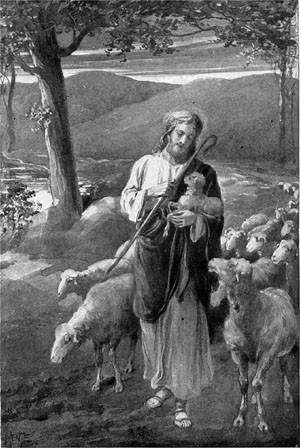
Christ the Good Shepherd.
Time, the great healer, wore away the sharpness of the bereavement, but Clara could never again delight in her former pursuits. How like very dust and ashes seemed the food she had been seeking to nourish her soul upon! A softened melancholy rested upon her heart, and she would wander about her house looking at the relics of her lost one. And day by day the roses faded from her cheek, her step grew lighter on the stair, and she rapidly declined, till at length she was startled at the shadowy form and face her mirror revealed to her. Her long-neglected Bible was once more sought for, and she read with all the desperate eagerness of a drowning man, who catches at every chance of safety. It was her mother's Bible, and along the margin were delicate pencil tracings, pointing to many precious passages. How eagerly she read them over! and when she was too weary herself, she gave the book into her husband's hand. Still he could give her no advice in her spiritual distress, and looked upon it with compassion as the result of her disease. He gave her the tenderest worldly consolation, but it brought no peace to her anxious soul. Was there no one to offer a word of true counsel? From a very humble source came the advice she so much needed. The kind nurse, Margaret, whom little Bertie had loved next to his parents, was an earnest, humble Christian. It was from her lips he had learned to lisp his morning and evening prayer, and her low, gentle voice that told him over and over the sweet story he never tired of hearing—the story of the Babe of Bethlehem.
Plainly and simply she pointed Clara's mind to the Lamb of God as the only Saviour, praying hourly in her heart that God would bring home the truth with power to her.
At length a little light broke in upon her mind. "It may be he will receive even such a wandering sheep as I," she said, "oh, I will cast myself upon his mercy only, for I can do nothing to make myself better!"
The thin hands were folded over the Bible, the eyes closed wearily, a faint motion of the lips told of the silent prayer her heart was offering, as gently she breathed her life away.
A few months later Mr. Allen became a wanderer in many lands.
Do you ever sigh and disquiet your heart, Christian pilgrim, because God has not given you wealth and worldly ease? Remember the words of One who never gave a needless caution nor spoke an untruthful word—"How hardly shall they that have riches enter into the kingdom of heaven!"
It is a dangerous step indeed for a young heart to form a life-long union with one who is a stranger to its hopes of heaven. "Be ye not unequally yoked together with unbelievers," is a command which may not be lightly broken. Where all of this world, and very probably the world to come, are at stake, the cost should be well counted. "What shall it profit a man if he gain the whole world and lose his own soul?" Even the most devoted affection the world can bestow will be no substitute for God's loving favor. "What shall a man give in exchange for his soul?"
"Jesus, my all in all thou art,
My rest in toil, my ease in pain;The healing of my broken heart,
In strife my peace, in loss my gain;My smile beneath the tyrant's frown,
In shame my glory and my crown."
Live Within Your Means.
"This is pleasant!" exclaimed a young husband, taking his seat in the rocking-chair as the supper things were removed. The fire glowing in the grate, revealed a pretty and neatly furnished sitting-room, with all the appliances of comfort. The fatiguing business of the day was over, and he sat enjoying what he had all day been anticipating, the delights of his own fireside. His pretty wife, Esther, took her work and sat down by the table.
"It is pleasant to have a home of one's own," he again said, taking a satisfactory survey of his little quarters. The cold rain beat against the windows, and he thought he felt really grateful for all his present comforts.
"Now if we only had a piano!" exclaimed the wife.
"Give me the music of your own sweet voice before all the pianos in creation," he observed, complimentarily; but he felt a certain secret disappointment that his wife's thankfulness did not happily chime with his own.
"Well, we want one for our friends," said Esther.
"Let our friends come to see us, and not to hear a piano," exclaimed the husband.
"But, George, everybody has a piano now-a-days—we don't go anywhere without seeing a piano," persisted the wife.
"And yet I don't know what we want one for—you will have no time to play on one, and I don't want to hear it."
"Why, they are so fashionable—I think our room looks nearly naked without one."
"I think it looks just right."
"I think it looks very naked—we want a piano shockingly," protested Esther emphatically.
The husband rocked violently.
"Your lamp smokes, my dear," said he, after a long pause.
"When are you going to get a camphene lamp? I have told you a dozen times how much we need one," said Esther pettishly.
"These are very pretty lamps—I never can see by a camphene lamp," said her husband. "These lamps are the prettiest of the kind I ever saw."
"But, George, I do not think our room is complete without a camphene lamp," said Esther sharply. "They are so fashionable! Why, the Morgans, and Millers, and many others I might mention, all have them; I am sure we ought to."
"We ought not to take pattern by other people's expenses, and I don't see any reason in that."
The husband moved uneasily in his chair.
"We want to live as well as others," said Esther.
"We want to live within our means, Esther," exclaimed George.
"I am sure we can afford it as well as the Morgans, and Millers, and Thorns; we do not wish to appear mean."
George's cheek crimsoned.
"Mean! I am not mean!" he cried angrily.
"Then we do not wish to appear so," said the wife. "To complete this room, and make it look like other people's we want a piano and camphene lamps."
"We want—we want!" muttered the husband, "there's no satisfying woman's wants, do what you may," and he abruptly left the room.
How many husbands are in a similar dilemma? How many houses and husbands are rendered uncomfortable by the constant dissatisfaction of a wife with present comforts and present provisions! How many bright prospects for business have ended in bankruptcy and ruin in order to satisfy this secret hankering after fashionable superfluities! Could the real cause of many failures be known, it would be found to result from useless expenditures at home—expenses to answer the demands of fashion and "what will people think?"
"My wife has made my fortune," said a gentleman of great possessions, "by her thrift, and prudence, and cheerfulness, when I was just beginning."
"And mine has lost my fortune," answered his companion, "by useless extravagance and repining when I was doing well."
What a world does this open to the influence which a wife possesses over the future prosperity of her family! Let the wife know her influence, and try to use it wisely and well.
Be satisfied to commence on a small scale. It is too common for young housekeepers to begin where their mothers ended. Buy all that is necessary to work skilfully with; adorn your house with all that will render it comfortable. Do not look at richer homes, and covet their costly furniture. If secret dissatisfaction is ready to spring up, go a step further and visit the homes of the suffering poor; behold dark, cheerless apartments, insufficient clothing, and absence of all the comforts and refinements of social life, and then turn to your own with a joyful spirit. You will then be prepared to meet your husband with a grateful heart, and be ready to appreciate the toil of self-denial which he has endured in the business world to surround you with the delights of home; and you will be ready to co-operate cheerfully with him in so arranging your expenses, that his mind will not be constantly harassed with fears lest his family expenses may encroach upon public payments. Be independent; a young housekeeper never needed greater moral courage than she does now to resist the arrogance of fashion. Do not let the A.'s and B.'s decide what you must have, neither let them hold the strings of your purse. You know best what you can and ought to afford. It matters but little what people think, provided you are true to yourself and family.
THE DARK FIRST.
Not first the glad and then the sorrowful—
But first the sorrowful, and then the glad;Tears for a day—for earth of tears is full:
Then we forget that we were ever sad.Not first the bright, and after that the dark—
But first the dark, and after that the bright;First the thick cloud, and then the rainbow's arc:
First the dark grave, and then resurrection light.—
Horatius Bonar.

Out Of The Wrong Pocket
Mr. Taggard frowned as he observed the pile of bills by his plate, placed there by his prudent, economical wife, not without an anxious flutter at the heart, in anticipation of the scene that invariably followed. He actually groaned as he read the sum total.
"There must be some mistake, Mary" he said, pushing back his plate, with a desperate air: "it is absolutely impossible for us to have used all these things in one month!"
"The bills are correct, John," was the meek response; "I looked them over myself."
"Then one thing is certain, provisions are either wasted, thrown out the window, as it were, or stolen. Jane has relatives in the place, and I haven't the least doubt but that she supports them out of what she steals."
Mrs. Taggard's temper was evidently rising; there were two round crimson spots upon her cheeks, and she tapped her foot nervously upon the floor.
"I am neither wasteful, nor extravagant, John. And as for Jane, I know her to be perfectly honest and trustworthy."
"It is evident that there is a leak somewhere, Mary; and it is your duty as a wife, to find out where it is, and stop it. Our bills are perfectly enormous; and if this sort of thing goes on much longer, I shall be a bankrupt."
Mrs. Taggard remained silent, trying to choke down the indignant feelings that struggled for utterance.
"You will have to order some coal," she said, at last; "we have hardly sufficient for the day."
"Is there anything more, Mrs. Taggard?" inquired her husband; ironically.
"Yes; neither I nor the children are decently or comfortably clothed; all need an entire new outfit."
"Go on, madam. As I am a man of unlimited means, if you have any other wants, I hope you won't be at all backward about mentioning them."
"I don't intend to be," was the quiet, but spirited reply. "I wouldn't do for another what I do for you, for double my board and clothing. Both the parlor and sitting-room need refurnishing; everything looks so faded and shabby, that I am ashamed to have any one call. And the stairs need recarpeting, the blinds and gate need repairing, and the fence needs painting."
"That can't be all, Mrs. Taggard. Are you sure that there isn't something else?"
"I don't think of anything else just now, Mr. Taggard; though if there should be a few dollars over and above what these will cost, they won't come amiss. I should like to have a little change in my pocket, if only for the novelty of the thing. You needn't fear its being wasted."
Mr. Taggard was evidently not a little astonished at this sudden outbreak in his usually quiet and patient wife, but who, like most women of that stamp, had considerable spirit when it was aroused.
"Now that you are through, Mrs. Taggard, perhaps you will let me say a word. Here is all the money I can spare you this month; so you can make the most of it."
Laying a roll of bills on the table, Mr. Taggard walked to the door; remarking, just before he closed it, that he should leave town on the next train, to be absent about a week.
The reverie into which Mrs. Taggard fell, as she listened to the sound of his retreating steps, was far from being a pleasant one. Aside from her natural vexation, she felt grieved and saddened by the change that had come over her once kind, indulgent husband. He seemed to be entirely filled with the greed of gain, the desire to amass money—not for the sake of the good that it might enable him to enjoy, or confer, but for the mere pleasure of hoarding it. And this miserly feeling grew upon him daily, until he seemed to grudge his family the common comforts of life. And yet Mrs. Taggard knew that he was not only in receipt of a comfortable income from his business, but had laid by a surplus, yearly, ever since their marriage.
She had taxed her ingenuity to save in every possible way, but when the monthly bills were presented the same scene was enacted, only it grew worse and worse.
And this penuriousness extended to himself. He grudged himself, as well as wife and children, clothing suitable to his means and station, and went about looking so rusty and shabby that Mrs. Taggard often felt ashamed of him, inwardly wondering if he could be the same man who had wooed and won her.
With a heavy sigh Mrs. Taggard took up the roll of bills upon the table, hoping to find enough to pay what was already due—she did not look for more.
An ejaculation of astonishment burst from her lips as she unrolled the paper in which it was folded. It contained $500 in bills, and a check for $500 more.
With a look of quiet determination in her eyes, Mrs. Taggard arose to her feet. "The family should now have some of the comforts to which they were entitled, if they never did again."
First, she settled every bill; a heavy weight being lifted from her heart as she did so; besides getting a fresh supply of fuel and other comforts. Her next move was to order new furniture for the sitting-room and parlor, have the hall recarpeted and papered, the broken door-step mended, and the fence and blinds repaired and painted. She then took the children out, and got them new garments from hats to shoes. She bought herself three new dresses; a neat gingham for morning wear, a delaine for afternoons, and something nicer for best. And before going home she took the children into a toy-shop; delighting the boy with the skates he had so often asked for, and giving the girl the chief wish of her heart, a doll and doll's wardrobe—not forgetting some blocks for the baby. For, like a wise, as well as kind, mother, Mrs. Taggard desired to make their childhood a happy one; something to look back upon with pleasure through their whole life. Neither was John forgotten; by the aid of some old garments, for a pattern, she got him an entire new suit, together with stuff for dressing-gown and slippers.
The day on which Mrs. Taggard expected her husband's return was a very busy one; but at last the carpets were down, the paper hung, and everything in the best of order.
He was expected on the five o'clock train, and Mrs. Taggard set the children, attired in their pretty new dresses, at the window to watch for papa, while she went below to assist Jane in preparing something extra for supper. She had just returned when Mr. Taggard was seen approaching the house.
It looked so different from what it did when he left, that he stared at it in amazement, and would have hesitated about entering, had it not been for the name on the newly burnished door-plate. But he was still more astonished when he entered.
"Am I in my own house, or somebody else's?" he ejaculated, as he looked around the bright and pleasant room.
"It is the new furniture I have been buying," said his wife, smiling. "How do you like it?"
"Have you been running me in debt, Mary?"
"Not in the least, John, it was all bought with the money you so generously left me when you went away."
Mr. Taggard clapped his hand into one of his pockets.
"My goodness!" he exclaimed, in an agitated tone and manner, "I gave it to you out of the wrong pocket!"
Mrs. Taggard did not look at all astonished or disturbed at this announcement; on the contrary, her countenance wore a very smiling and tranquil aspect.
"You don't mean to say that you've spent it?" inquired Mr. Taggard, desperately.
"Why, what else should I do with it, John? You told me to make the most of it; and I rather think I have."
"I am a ruined man!" groaned Mr. Taggard.
"Not a bit of it, my dear husband," said his wife, cheerfully, "you wouldn't be ruined if you had given me twice that amount. Besides, I have saved enough for our housekeeping expenses, for three months, at least. I think you had better give me an allowance for that purpose in future; it will save us both much annoyance."
The children, who had been led to consider what their mother had bought them as "presents from papa," now crowded eagerly around him.
Mr. Taggard loved his children, and it would be difficult for any one having the kind and tender heart that he really possessed, to turn away from the innocent smiles and caresses that were lavished upon him.
It was a smiling group that gathered round the cheerful supper-table. And as Mr. Taggard glanced from the gleeful children to the smiling face of his wife, who certainly looked ten years younger, attired in her new and becoming dress, he came to the conclusion that though it might cost something to make his family comfortable, on the whole, it paid.
We do not mean to say that Mr. Taggard was entirely cured; a passion so strong is not so easily eradicated. But when the old miserly feeling came over him, and he began to dole out grudgingly the means with which to make his family comfortable, his wife would pleasantly say: "You are taking it out of the wrong pocket, John!"—words which seemed to have a magical effect upon both heart and purse-strings.
"Let us not deprive ourselves of the comforts of life," she would often say, "nor grudge our children the innocent pleasures natural to youth, for the purpose of laying up for them the wealth that is, too often, a curse rather than a blessing."
AN INFINITE GIVER.
Think you, when the stars are glinting,
Or the moonlight's shimmering gleamPaints the water's rippled surface
With a coat of silvered sheen—Think you then that God, the Painter,
Shows his masterpiece divine?That he will not hang another
Of such beauty on the line?Think you, when the air is trembling
With the birds' exultant song,And the blossoms, mutely fragrant,
Strive the anthem to prolong—Think you then that their Creator,
At the signal of his word,Fills the earth with such sweet music
As shall ne'er again be heard?He will never send a blessing
But have greater ones in store,And each oft recurring kindness
Is an earnest of still more.If the earth seems full of glory
As his purposes unfold,There is still a better country—
And the half has not been told!"My House" and "Our House."
These houses are opposite each other in a beautiful suburban town. "My house" is large and handsome, with a cupola, and has a rich lawn before it. It is surrounded by a broad piazza, and graced and shaded by ancestral elms and huge button-wood trees. Its barns and stables are large and well-filled; its orchards are gorgeous with fruit, in the season, and the fields around it seem alive with golden grain that waves in the wind. Everything about the place tells of long-continued prosperity. The rich old squire who lives there rides about with fine horses, and talks a great deal to his neighbors about "my house, my orchards, and my horses."
His wife is evidently the lady of the region. She was a model housekeeper and dairywoman in the days when they worked the farm, and is now an oracle on many questions. She, too, talks of "my house, my horses, and my estate."
These persons each brought property to the other, and the two interests have, unfortunately, never flowed together and formed one estate as they should have done; so there are always two separate interests in the house.
Of course the property belongs, legally, to both; but as each has a snug little fund laid away, the question is always to be settled, if repairs are to be made, or horses or furniture bought, who shall pay for it.
It seems but proper to the husband that carpets, and sofas, etc., shall be bought by his wife; also the cows, as the lady is at the head of the house. But she says, "You walk on the carpets, sit on the sofas, and eat the cream and butter just as much as I do, and I see no reason why you should not, at least, help to pay for them."
Such discussions often occur, but, on the whole, each upholds the interest of the other against outsiders, and gets along without open rupture. They ride about in better dress than their neighbors, they receive and return visits, and are called the leading family in town.
But "my house," as some have named the great square mansion, is nobody's house but its owners'. No guest who can not return hospitality in equal style is asked to tarry for a night there. All ministers sojourning in the place are directed by them to the humble parsonage for entertainment. Every weary, homeless wanderer is pointed to the distant almshouse; and a neighbor's horse or cow which has strayed from its own enclosure, is at once put into the pound by the squire's man.
If an appeal is made for any benevolent object the squire says, "Go to my house and ask my wife to give you something." She, in turn, points the applicant to the field or the orchard, and says, "Go down there and ask my husband to give you something." So one puts it on the other, and nothing is given; and neither the town nor the world is the better for their living.
This is the way things are done at "my house."
Across the street, under the shadow of two wide-spreading elms, stands a very modest cottage nestled in vines and flowers, with curtains drawn up to let in the light of God's blessed sun, and an ever-open door with a great chair in full view, holding out its time-worn arms, as if to invite and welcome in the weary passer-by. The birds are always remembered here in their times of scarcity, and so in token of their gratitude, they gather in the trees and carol out sweet and merry songs by way of paying their bills.
God's peace, as well as his plenty, rests on this place, and while its owners call it, in their hearts, "God's house," they speak of it to others, always as "our house."
Twenty-five years ago a sturdy, brave-hearted young mechanic bought this one acre of land, and with his own hands dug and walled a cellar, at times when he had no work to do for others. When he had earned an additional hundred or two dollars he bought lumber and began to build a house. People asked him what he was going to do with it, and he replied that if he should live to finish it, he was going to live in it.
Well, in two years the house was finished, to the last nail and hook. Then he went away, as it was thought, for a wife. In a week he returned, bringing with him some neat household furniture, and three persons instead of only one.
He did bring a wife—a bright-eyed, merry-hearted young girl—and also two aged women, "our mothers," as he called them.
The first night in the house they dedicated their humble home—"our house" to God, and in the name of the Lord they set up their banner, praying that ever after this his banner over them might be love.
Many a family moves into a new home and asks God to come in and prosper them, and take up his abode there; but they do nothing to draw him thither. They begin for self, and go on for self; and sometimes God leaves them to themselves.
But the young owners of "our house"—the children of "our mothers"—made their little home His home and the home of His poor and feeble ones. "Our mothers" now laid down the weapons of toil over which they had grown gray, and came out of the vale of honest poverty into the sunshine of plenty. Their hearts grew warm in this gift of double love. They renewed their youth.
In their first days at their children's home, one of "our mothers" spoke of "Henry's new house," when he checked her, saying, "Never call this my house again. I built it for God and for all of you, and I want it always called 'our house.' There is yet one thing I want done here before I shall feel that I have made my thank-offering to God for the health and strength and the work which have enabled me to build and pay for this house. I promised then that no stranger or wanderer should ever go hungry or weary from this door. You have made sure of a neat and sunny room for our friends. Now I want a bed, a chair, and a table put in the shed-chamber for such strangers as we cannot ask into the house. I want also to fill the little store-closet under the back stairway with provisions to give the needy. They will then not be our own; and if at any time we should be short of money, we will not be tempted to say, 'I have nothing to give.' I want to live for more than self, and I know you all share the feeling. I want to feel that God is here, and to live as if we saw him and were all under his actual guidance and care, and to realize that he sees and approves our way in life."
Thus was "our house" opened, and thus was it kept—a home sanctified to humanity and to God.
The years rolled away, not without changes, but peace and plenty still reign in the modest home whose owners are looked up to by all the town's people—rich as well as poor—as friends and benefactors; for all men alike need human sympathy and comfort.
The young carpenter of twenty-five years ago, is now a prosperous builder in the great city near his home. He could afford to erect and occupy a house worth four times what the cottage cost. But he loves the place, and cannot tear himself from it. He has added more than one L to it, and he has refurnished it, and brought into it many articles of taste and luxury.
When asked why he does not build a house more in accordance with his means, he replies:—
"No house could be built which would be like 'our house.' I can never forget the night we and our mothers dedicated it to God in prayer and simple trust; and ever since that night I have felt as if we were dwelling in the secret of his tabernacle, under the shadow of the Almighty. We might have a larger and more fashionable house, but it would bring a weight of care on its mistress, and steal the time she has made sacred to others. No other house could have the memories this one has; no other house be hallowed as this house has been by the prayers of the holy and the blessings of the poor."
And so the family still live on and are happy in "our house." Still the pastor's weary wife is relieved of church company, for, from force of habit, all ministers and others on errands of good, draw up their horses before the well-filled stable, and ring, for themselves, at this open door. Still the poor are fed from that store-closet under the back stairway; still the wanderer—though he be a wanderer in a double sense—rests his weary head in that shed-chamber.
The squire wonders at the builder, because he lives in such a modest way compared with his means, and says, "If I were he, I'd be ashamed of that cottage which was all well enough when he was a young journeyman."
The builder wonders what the squire does with all that great house, and why, when half a dozen rooms are empty there, he doesn't allow himself the pleasure of company, and of sheltering strangers and getting the blessing they bring.
The squire's wife peeps through her fine curtains, and says, "I wonder that pretty and intelligent woman hasn't more taste. She might live like a lady if she pleased, and dress as I do; but she pokes on just as she began, and dresses no better than the minister's wife, and has a rabble of poor, forlorn creatures whom I wouldn't let into my house, nor into my wood-shed, running after her for food and clothing, and nobody knows what."
So you see, "my house" is literally "my house," and "our house" is God's house.
A Mountain Prayer Meeting
"Will you go to meeting with me this afternoon, Mabel? Come; this is your last day here; do go once before you leave the White Mountains." "What do you do in 'meeting'?" asked the gay, beautiful, "High Church" New York belle, with just a shade of contemptuous inflection in her voice.
"Well,—there will be no sermon; there never is in the afternoon. The good minister sits in the aisle, in front of the pulpit, and invites any one he likes to make a prayer. Any other one, who feels the need of it, may request that he or she be mentioned personally in the petition; and those who wish it may relate their experience."
"How very funny! All the old women 'speakin' in meetin',' and scaring themselves dreadfully. I'll go. I dare say I shall have a good laugh, if I don't fall asleep."
So we walked through the long, hilly street of Bethlehem, in the pleasant hour before sunset, in the sweet, warm, hazy air of early autumn. The glory of the Lord shone round about us; for all the mountains were burnished, splendid, gorgeous, in purple and crimson and gold. Mabel's deep gray eyes grew large and luminous as her artist-soul drank in the ineffable beauty.
The building was so crowded with the villagers and many visitors that it was with difficulty we obtained seats, apart from each other. Mabel found a place next to a young, sweet-faced country woman, and looked, with her flower-like face and French costume, like some rare exotic by the side of a humble mountain daisy.
The minister opened the services with a few fervent, simple words, and then said, "Brother——, will you lead in prayer?"
A plain old country farmer knelt in the aisle before us. His prayer—sincere, and, I doubt not, as acceptable, because sincere, as if it had been offered in polished language—made Mabel shake with laughter.
He rose, and there was utter silence for a moment. Then a high, sweet woman's voice, far in front of us, sang out, clear as a bell,—
"Sweet hour of prayer! sweet hour of prayer!
That calls me from a world of care,
And bids me at my Father's throne,
Make all my wants and wishes known."
The congregation joined in; only one verse was sung, and again the strange, solemn silence fell upon us.
It was broken by the sudden rising of a lank, awkward boy, who uttered a few words in a frightened nasal whine.
This time Mabel was convulsed with laughter; but the sweet singer, who saw in this utterance only the contrite soul of the speaker, burst forth triumphantly with—
"Oh, gift of gifts! oh, grace of faith!
My God, how can it beThat thou, who hast discerning love,
Shouldst give that gift to me?"Only one verse, as before. Then the pure notes, high above all the other voices, died away, and a strange-looking woman arose.
"I haven't any gift of language," said she, "but I want to give in my testimony. I've always been a wicked woman; I've always gone against my conscience. I've made my folks at home miserable for many a long year; and that's the reason God poured trouble after trouble down on me, till I was about to take my own life, when some one—it must have been one of God's angels—went singing through the woods. Shall I ever forget the words?—
"'With tearful eyes I look around;
Life seems a dark and stormy sea;—'"She stopped, her voice breaking into a hoarse sob, when the other sweet voice immediately went on—
"Yet, mid the gloom, I hear a sound,—
A heavenly whisper,—'Come to me.'"Oh, voice of mercy! voice of love!
In conflict, grief, and agony,Support me, cheer me from above!
And gently whisper—'Come to me.'"I looked at Mabel. She was not laughing. A strange, awed expression rested upon her features; her head was bowed down as the sweet-faced woman at her side rose and, turning to the last speaker, said, in a low, gentle voice,—
"My sister, we all thank our heavenly Father that he put his strong arm of protection about you while it was yet time; and since you have joined with us in profession of your faith, there has been no one more earnest in those good works without which faith is nothing."
Then reverently kneeling, she prayed that God would strengthen her dear sister, and give them all love and charity, one for another, and his peace, which passeth all understanding.
Out rang the sweet voice,—
"Haste thee on, from grace to glory,
Armed by faith, and winged by prayer!Heaven's eternal day's before thee,
God's own hand shall guide thee there."Mabel was now silently crying, and big tears were blinding my eyes, when a grand old man rose from his seat. Bent and feeble now, I could see that he had once been tall and stately, looking as the Puritan fathers must have looked when they first stepped upon "the stern and rock-bound coast" at Plymouth. Fine, clean-cut features, and eyes still blue and piercing remained, but his voice trembled painfully as he said,—
"I am ninety-four years old, and most of those I love have gone to the graveyard before me; I have lived all these years in Bethlehem, and, boy and man, have tried to serve the Lord: and I owe my blessed hope in my Saviour to the teaching and example of my good and pious mother." Then, with aged, trembling hands uplifted, he prayed that all the children present might be brought up in the nurture and admonition of the Lord.
Near us was a handsome, well-dressed man, past middle age, who had listened with absorbed attention to all that had been said, and who now seemed strangely agitated. In a moment he arose, and then he spoke.
"I presume that no one here remembers a poor boy who nearly fifty years ago left this place to seek his fortune. Fatherless, motherless, with no claim upon any one here, I wandered away with a heavy heart to earn my bread. Many a time have I been exhausted, discouraged, almost hopeless; but my mother had taught me to pray—her dying gift to me was her own Bible. It has gone round the world with me, and God has never forsaken me. I have long been a rich man, and I have come once more to these grand hills—my childhood's home—to testify my gratitude to my Maker for all his goodness. I never intended to speak as I am now doing; but after what I have heard and witnessed, I should be most ungrateful if I did not give my testimony and belief in the abounding love and mercy of God. O friends! take me back! Let me be one with you in this most sweet and touching service, and when I leave you, pray that I may never be ungrateful for the earthly blessings he has heaped upon me, and for the far more priceless gift of his Son, Jesus Christ."
Every one had listened to the stranger in deep silence. Every heart had thrilled responsive to his words. It seemed as if the very breath of Heaven had entered into the little church, cleansing and purifying each soul present, and filling it with inexpressible devotion, when, like a soft, trembling wave, the pure young voice came floating down the aisles, and we heard the solemn acknowledgment,—
"A charge to keep I have,
A God to glorify;A precious, blood-bought soul to save,
And fit it for the sky."She sang alone; a feeling too deep for utterance had prevented the rest from joining in, and many heads were bent in silent prayer and thanksgiving.
But oh! what did I see? Pale as death, her eyes dilated, her whole frame quivering like an aspen, Mabel arose and essayed to speak. The muscles of her mouth refused to obey her will, but with a painful effort she faltered in low, broken tones, "Pray for me," and sank down upon her knees.
It was the voice of God that spoke in those three little words, "Pray for me," uttered so low, yet distinctly heard in every part of the church. Joyful tears were streaming down many women's faces, as for the first time the singer's voice trembled, broke, and at last sobbed through the humble entreaty,—
"Just as I am—without one plea,
But that thy blood was shed for me,
And that thou bid'st me come to thee,
O Lamb of God, I come."As she finished, a young minister who was living in the same house with us, and whose life had been nearly sacrificed in missionary labors, bowed in prayer. The radiance of Heaven was upon his face, and God spoke through him to the awakened soul of Mabel in a way I had never heard before. The words poured out in an inspired flood, carrying her soul resistless upon its mighty waves to repentance, faith, prayer, praise, love, joy, peace, and at last heaven!
With a solemn benediction the services were ended; and when we had come out, it seemed as if the very heavens were rejoicing over the tidings which had gone up of the soul that day redeemed. All that was gorgeous and beautiful in color had taken possession of the sky. The clouds, like great gold and crimson banners, were moving high over our heads, furling and unfurling, as if carried by exultant angels, marching and singing their triumphant allelujahs.
And Mabel, still white as an Easter lily, but with her deep gray eyes full of a new happiness, a steadfast resolution to live henceforth for Christ, walked by my side, watching the great glory of the heavens, with her arm lovingly entwined in mine. We did not speak; we had no need, for our thoughts were in perfect accord. I had witnessed the wonderful mystery of her instantaneous "change of heart;" I knew it was well with her.
Beautiful, gay, fashionable, the pet of society, I knew her also to be a staunch upholder of all that was noble, good, and pure, and I felt a thorough conviction that she had indeed given herself up body and soul to Him who had chosen to send his Holy Spirit into her heart, as she was going out of the little village which bore the blessed name of Bethlehem.
However it be, it seems to me,
'Tis only noble to be good.Kind hearts are more than coronets,
And simple faith than Norman blood.Only a Husk.
Tom Darcy, yet a young man, had grown to be a very hard one. Although naturally kind-hearted, active, and intelligent, he lacked strength of will to resist temptation, and had therefore fallen a victim to intemperance. He had lost his place as foreman of the great machine-shop, and what money he now earned came from odd jobs of tinkering which he was able to do here and there at private houses; for Tom was a genius as well as a mechanic, and when his head was steady enough, he could mend a clock or clean a watch as well as he could set up and regulate a steam-engine, and this latter he could do better than any other man ever employed by the Scott Falls Manufacturing Company.
One day Tom was engaged to mend a broken mowing-machine and reaper, for which he received five dollars; and on the following morning he started for his old haunt, the village tavern. He knew that his wife sadly needed the money, and that his two little children were absolutely suffering for want of clothing, and that morning he held a debate with the better part of himself, but the better part had become weak, and the demon of appetite carried the day.
So away to the tavern Tom went, where, for two or three hours, he felt the exhilarating effects of the alcoholic draught, and fancied himself happy, as he could sing and laugh; but, as usual, stupefaction followed, and the man died out. He drank while he could stand, and then lay down in a corner, where his companions left him.
It was almost midnight, when the landlord's wife came to the barroom to see what kept her husband up, and she quickly saw Tom.
"Peter," said she, not in a pleasant mood, "why don't you send that miserable Tom Darcy home? He's been hanging around here long enough."
Tom's stupefaction was not sound sleep. The dead coma had left his brain, and the calling of his name stung his senses to keen attention. He had an insane love of rum, but he did not love the landlord. In other years, Peter Tindar and he had wooed the same maiden,—Ellen Goss,—and he had won her, leaving Peter to take up with the sharp-tempered damsel who had brought him the tavern, and Tom knew that lately the tapster had gloated over the misery of the woman who had once discarded him.
"Why don't you send him home?" demanded Mrs. Tindar, with an impatient stamp of her foot.
"Hush, Betsey, he's got money. Let him be, and he'll be sure to spend it before he goes home. I'll have the kernel of that nut, and his wife may have the husk."
Betsey turned away, and shortly afterward Tom Darcy lifted himself up on his elbow.
"Ah, Tom, are you awake?"
"Yes."
"Then rouse up and have a warm glass."
Tom got upon his feet and steadied himself.
"No; I won't drink any more to-night."
"It won't hurt you, Tom—just one glass."
"I know it won't!" said Tom, buttoning up his coat by the solitary button left. "I know it won't!"
And with this he went out into the chill air of midnight. When he got away from the shadow of the tavern, he stopped and looked up at the stars, and then he looked down upon the earth.
"Aye," he muttered, grinding his heel in the gravel, "Peter Tindar is taking the kernel, and leaving poor Ellen the worthless husk,—a husk more than worthless! and I am helping him do it. I am robbing my wife of joy, robbing my dear children of honor and comfort, and robbing myself of love and life—just that Peter Tindar may have the kernel, and Ellen the husk! We'll see!"
It was a revelation to the man. The tavern-keeper's speech, not meant for his ears, had come on his senses as fell the voice of the Risen One upon Saul of Tarsus.
"We'll see!" he said, setting his foot firmly upon the ground; and then he wended his way homeward.
On the following morning he said to his wife, "Ellen, have you any coffee in the house?"
"Yes, Tom." She did not tell him that her sister had given it to her. She was glad to hear him ask for coffee, instead of the old, old cider.
"I wish you would make me a cup, good and strong."
There was really music in Tom's voice, and the wife set about her work with a strange flutter at her heart.
Tom drank two cups of the strong fragrant coffee, and then went out, with a resolute step, and walked straight to the great manufactory, where he found Mr. Scott in his office.
"Mr. Scott, I want to learn my trade over again."
"Eh, Tom, what do you mean?"
"I mean that it's Tom Darcy come back to the old place, asking forgiveness for the past, and hoping to do better in the future."
"Tom," cried the manufacturer, starting forward and grasping his hand, "are you in earnest? Is it really the old Tom?"
"It's what's left of him, sir, and we'll have him whole and strong very soon, if you'll only set him at work."
"Work! Aye, Tom, and bless you, too. There is an engine to be set up and tested to-day. Come with me."
Tom's hands were weak and unsteady, but his brain was clear, and under his skilful supervision the engine was set up and tested; but it was not perfect. There were mistakes which he had to correct, and it was late in the evening when the work was complete.
"How is it now, Tom?" asked Mr. Scott, as he came into the testing-house and found the workmen ready to depart.
"She's all right, sir. You may give your warrant without fear."
"God bless you, Tom! You don't know how like music the old voice sounds. Will you take your old place again?"
"Wait till Monday morning, sir. If you will offer it to me then, I will take it."
At the little cottage, Ellen Darcy's fluttering heart was sinking. That morning, after Tom had gone, she found a dollar bill in the coffee-cup. She knew that he left it for her. She had been out and bought tea and sugar, and flour and butter, and a bit of tender steak; and all day long a ray of light had been dancing and glimmering before her,—a ray from the blessed light of other days. With prayer and hope she had set out the tea-table, and waited; but the sun went down and no Tom came. Eight o'clock—and almost nine.
Hark! The old step! quick, strong, eager for home. Yes, it was Tom, with the old grime upon his hands, and the odor of oil upon his garments.
"I have kept you waiting, Nellie."
"Tom!"
"I did not mean to, but the work hung on."
"Tom! Tom! You have been to the old shop!"
"Yes, and I'm bound to have the old place, and——"
"Oh, Tom!"
And she threw her arms around his neck, and pressed a kiss upon his lips.
"Nellie, darling, wait a little, and you shall have the old Tom back again."
"Oh, I have him now! God bless you, my husband!"
It was a banquet, that supper—with the bright angels of peace, and love, and joy, spreading their wings over the board.
On the following Monday morning, Tom resumed his place at the head of the great machine-shop, and those who thoroughly knew him had no fear of his going back into the slough of joylessness.
A few days later, Tom met Peter Tindar on the street.
"Eh, Tom, old boy, what's up?"
"I am up, right side up."
"Yes, I see; but I hope you haven't forsaken us, Tom."
"I have forsaken only the evil you have in store, Peter. The fact is, I concluded that my wife and little ones had fed on husks long enough, and if there was a good kernel left in my heart, or in my manhood, they should have it."
"Ah, you heard what I said to my wife that night."
"Yes, Peter; and I shall be grateful to you for it as long as I live. My remembrance of you will always be relieved by that tinge of warmth and brightness."
SONG OF THE RYE.
I was made to be eaten,
And not to be drank;To be thrashed in a barn,
Not soaked in a tank.I come as a blessing
When put through a mill,As a blight and a curse
When run through a still.Make me up into loaves,
And the children are fed;But if into drink,
I'll starve them instead.In bread I'm a servant,
The eater shall rule;In drink I am master,
The drinker a fool.Ruined at Home.
"It is at home that the ruin of a soul begins."
"At home!" We hear the response in tones of pained surprise or indignant denial from many voices. "It is a hard saying and cruel."
"It may hurt like a blow many sad hearts; but if it be true—what then?"
"It is not true! I can point to you a dozen cases within my own range of observation to disprove the assertion—to young men who have gone astray in spite of the careful training and good example of religious homes—in spite of all the best of mothers and the wisest of fathers could do."
Yes, we hear such things said every day; but feel certain there is an error somewhere, a defect in your observation. Were you in the homes of these young men from the beginning? Did you observe the personal bearing of their parents toward them—know their walk and conversation? If nay, then you are not competent, with your instances, to disprove our assertion.
A small error at the beginning of a series of calculations in applied mechanics may lead to a great disaster; the slightest variation from a right line at the beginning will throw a projectile hundreds of yards away from its object. It is in the little things at home, the almost unnoticed departures from order and good government, the neglects arising from parental self-indulgence, the weakness of love that fails to nip a fault in the bud; and many other things that might be instanced, which turn the young feet into ways of life that, as the years go by, lead farther and farther from safety and happiness.
The Bible, experience, and reason all declare that the future of a child depends upon his early training. If this is bad, the chances are nearly all against him.
"But," we hear it said, "children raised under the worst influences often make good and useful men."
The cases are exceptional, and stand out in strong contrast to the general rule. And so we go back to what was declared in the beginning, that the ruin of a soul begins at home. How many instances crowd upon the memory! Let us take a few at this time for their lesson and their warning.
Not long ago, in one of our principal cities, an almost broken-hearted mother parted from her son in the courthouse, and was taken fainting to her home, while he was thrust into a van and conveyed to prison. His crime was stealing. Society held up its hands in pity and amazement, for the young man's father and mother were highly respectable people, and good church members, as the saying is. The father's business reputation stood high. People said of him: "His word is as good as his bond." And yet his son was a condemned thief. He had stolen from his employer.
Did the ruin in this case begin at home?—Yes! It was at home the son learned to be dishonest, and he learned it from his mother! Let us rehearse a few of the lessons, in precept and example, that were given to the boy. We begin when he was just five years of age. The boy, Karl, was standing near his mother, Mrs. Omdorff, one day, when he heard her say to his aunt: "Barker has cheated himself. Here are four yards of ribbon, instead of three. I asked for three yards, and paid for only three; but this measures full four yards."
The boy listened and waited for what was to come next. He loved his mother, and trusted in her.
"What are you going to do about it?" inquired the aunt.
"Keep it, of course," answered Mrs. Omdorff; "Barker will never be the wiser. He makes enough out of us, dear knows." And she rolled the ribbon about her fingers.
Karl was a little surprised. It did not seem like his mother, nor in accordance with what she had often said to him about truth and honesty, but he had faith in her, and was sure that she could do nothing wrong. His Aunt Ruth, of whom he was very fond, and who had great influence over him, was a weak woman in some respects, and much more inclined to take the current of other's opinions than to give herself the trouble of opposition. Her innate sense of honor was a little disturbed at her sister's views of the case; but she failed to say the right words which were in her thoughts, and which, if spoken, might have helped the boy to see what was just and right.
A day or two afterward, Karl heard his mother say: "I saved a car ticket this morning."
"How?" inquired her sister.
"The conductor forgot to ask for it."
"Why didn't you give it to him, mamma?" asked Karl.
"It was his business to look after his passengers," replied Mrs. Omdorff, who felt rather uncomfortable at this question from her little boy. "It will teach him a lesson."
Karl thought a moment, and then said: "But he won't know anything about it."
"Oh, you're too sharp!" exclaimed his mother, with a laugh. "I wasn't talking to you, anyhow."
"Little pitchers have big ears," said Aunt Ruth, echoing her sister's laugh.
And so the matter was pushed aside, neither mother nor aunt imagining that the bright and beautiful boy they both loved so tenderly had received a lesson in dishonesty not soon to be forgotten.
"I do believe," said Mrs. Omdorff, not long afterward, as she sat counting over some money, "that Poole has given me the wrong change."
Karl was in the room and heard her remark.
"Let me see," she added, going over the money again. "Two and a half, three, four and three-quarters. It's a fact; I gave him a ten-dollar bill, and here are four and three-quarters change."
"What did the goods amount to?" asked her sister.
"There were eleven yards of muslin at eighteen; that's a dollar and ninety-eight cents. Two yards of silk at a dollar and a half, and an eighth of a yard of velvet one dollar—making just five dollars and ninety-eight cents. If it had come to six dollars, my right change would have been four; but he has given me four and three-quarters."
Then, in a tone of satisfaction, she added: "I'm that much richer, you see, Ruth."
Her sister smiled, but did not utter the disapproval that was in her heart. Karl listened and took all in. A little while afterward Mrs. Omdorff got up and rang the bell, saying, as she did so, with a short gurgling laugh, that seemed ashamed of itself: "I guess we'll have a little ice-cream—at Poole's expense."
Aunt Ruth shook her finger, and said feebly: "Oh, that's too bad!" But Karl was not able to see whether she approved or disapproved. The ice-cream was sent for, and enjoyed by the child. While the sweet taste was yet on his tongue, he heard his mother say: "I'm very much obliged to Poole for his treat—it's delicious."
Is it strange that the boy's perception of right and wrong should be obscured? or that, in a day or two afterward, he should come in from the street with an orange in his hand, and, on being questioned about it, reply: "A woman let it drop from her basket, and I picked it up. She didn't see it drop, mamma."
"But why didn't you call after her?" asked Aunt Ruth.
"'Cause I didn't want to," answered the child. "She dropped it. I didn't knock it off."
Mrs. Omdorff was not satisfied with the conduct of her child; and yet she was amused at what she called his cuteness, and laughed instead of reproving him for an act that was in spirit a theft.
So the child's education for crime was begun—his ruin initiated. The low moral sense of his mother was perpetually showing itself in some disregard for others' rights. A mistake made in her favor was never voluntarily corrected, and her pleasure at any gain of this kind was rarely concealed. "He cheated himself," was a favorite saying, heard by Karl almost every week; and as he grew older he understood its meaning more clearly.
Mr. Omdorff was a man of higher integrity than his wife and just in dealing to the smallest fraction. "Foolish about little things—more nice than wise," as she often said, when he disapproved of her way of doing things, as was sometimes the case. Mrs. Omdorff had learned to be guarded in her speech when he was at home; and so he remained in ignorance of the fatal perversions going on in the mind of his child.
As the boy grew up his father's supervision became more direct. He was careful about his associates, and never permitted him to be away from home without knowing where and with whom he was. He knew but too well the danger of evil association; and guarded his boy with jealous solicitude.
Alas! he dreamed not of the evil influences at home; never imagined that the mother was destroying in her son that nice sense of honor without which no one is safe; nor that she had taught him to disregard the rights of others, to take mean advantages, and to appropriate what did not belong to him whenever it could be done with absolute certainty of concealment.
We do not mean to say that such were the direct and purposed teachings of his mother. She would have been horror stricken at the mere suggestion. But she had so taught him by example. In heart she was not honest; and in many of her transactions she was as much a thief as if she had robbed a till. Retaining what belongs to another, simply because it has come into our hands by mistake, is as much a theft in its spirit as purposed stealing; and the fine lady who keeps the change to which she is not entitled, or the yard of ribbon measured to her in error, is just as criminal, as the sneak-thief who gets into her hall through a neglected door and steals her husband's overcoat. The real quality of an act lies in the intent.
Is it any wonder that amid such home influences the boy did not show, as he advanced toward maturity, a high sense of honor? That he should be mean and selfish and dishonest in little things? "As the twig is bent the tree is inclined." Evil seed will produce evil fruit.
Society punished and execrated the unhappy young man, and pitied his wretched mother, little dreaming that by her hand his prison doors had been opened.
Another instance of the baneful influence that may exist at home is to be found in the ruin of a young man who recently died in one of the lowest and vilest haunts of the city. He had been well educated, and grew to manhood with a fine sense of honor. His mother was a woman of rare culture, and beloved by every one in the circle where she moved. All the moral sentiments of her son had been carefully fostered and developed, and when he reached manhood no one showed a fairer promise.
But it was not long before a shadow fell across his life. He had learned one thing at home that was destined to work his ruin—he had learned to love the taste of wine.
His father belonged to a class of men who considered wine drinking a mark of good breeding. He knew all about wines, and had a weak vanity in being thought a connoisseur. If he had a friend to dinner, he would bring out two or three kinds, and discuss them through half the meal. He called the men who were ranging themselves against the terrible evil of intemperance, and seeking to stay its baleful course, "poor fanatics." He talked of pure wines and liquors as harmless, and gave them to his son at suitable times and occasions, moderately; only guarding him by warnings against excess.
But these warnings went for nothing as appetite increased. At twelve years of age the boy was content with a single glass of light wine at his dinner; at eighteen he wanted two glasses, and at twenty-one three. By this time he had acquired convivial habits, and often drank freely with other young men of his age. His mother was the first to take the alarm; but his father was slow to believe that his son was in danger. The sad truth broke upon him at last in a painful humiliation. At a large party in his own house the young man became so badly intoxicated that he had to be removed from the company.
From that unhappy period wine was banished from the father's table. But it was too late! The work of ruin had progressed too far. At twenty-seven the wretched young man died, as we have said, in one of the lowest and vilest dens of the city.
We could give many instances like this. Here, at home, is the chief source of that wide-spread ruin by intemperance, that is every year robbing society of thousands of young men, who, by education, culture, and social standing are fitted for useful and honorable positions. They are ruined at home. Not in one case in ten does a young man acquire the taste for drink in a saloon or tavern, but at home—if not in his own home, in that of some friend. We fear that the drinking saloons men set up in their drawing-rooms, and to which they invite the young and old of both sexes, do more to deprave the taste and lead to intemperance than all the licensed taverns in the land. It is here that the appetite is formed and fostered—here that the apprenticeship to drunkenness is served. Year by year the sons of our wealthiest and most intelligent and influential citizens are tempted and led astray by the drinking customs of society—ruined at home. How few of the sons of successful men rise to the level their fathers have gained. How many, alas! sink so far below this level that the eyes ache to look down upon them!
GOOD-BYE—GOD BLESS YOU!
I love the words—perhaps because
When I was leaving mother,Standing at last in solemn pause,
We looked at one another;And I—I saw in mother's eyes
The love she could not tell me,A love eternal as the skies,
Whatever fate befell me.She put her arms about my neck,
And soothed the pain of leaving,And though her heart was like to break,
She spoke no word of grieving;She let no tear bedim her eye,
For fear that might distress me;But, kissing me, she said good-bye,
And asked our God to bless me.
How It Was Blotted Out
For many years I had been a follower of strange gods, and a lover of this world and its vanities. I was self-righteous, and thought I had religion of my own which was better than that of the Bible. I did not know God, and did not serve him. Prayer was forgotten, public worship neglected; and worldly morality was the tree which brought forth its own deceptive fruit.
But when I shared parental responsibility, and our boy was growing up, our love for him made us anxious about his welfare and future career. His questions often puzzled me, and the sweet and earnest manner in which he inquired of his poor sinful father to know more about his Heavenly Father, and that "happy land, far, far away," of which his nurse had taught him, proved to me that God had given me a great blessing in the child.
A greater distrust of myself, and a greater sense of my inability to assure my boy of the truth contained in the simple little prayers that I had learned from my mother in childhood, gradually caused me to reflect. Still, I never went to church; had not even a Bible in the house. What was I to teach my boy,—Christ and him crucified, or the doctrines I had tried to believe?
One of his little friends died, then another, then his uncle. All these deaths made an impression on the boy. He rebelled against it; wanted to know "why God had done it?" It was hard that God should take away his friends; he wished he would not do it. I, of course, had to explain the best I could. One evening he was lying on the bed partly undressed; my wife and I were seated by the fire. She had been telling me that Willie had not been a good boy that day, and I had reproved him for it. All was quiet, when suddenly he broke out in a loud crying and sobbing, which surprised us. I went to him, and asked him what was the matter.
"I don't want it there, father; I don't want it there," said the child.
"What, my child, what is it?"
"Why, father, I don't want the angels to write down in God's book all the bad things I have done to-day. I don't want it there; I wish it could be wiped out;" and his distress increased. What could I do? I did not believe, but yet I had been taught the way. I had to console him, so I said,—
"Well, you need not cry; you can have it all wiped out in a minute if you want."
"How, father, how?"
"Why, get down on your knees, and ask God for Christ's sake, to wipe it out, and he will do it."
I did not have to speak twice. He jumped out of bed, saying, "Father, won't you come and help me?"
Now came the trial. The boy's distress was so great, and he pleaded so earnestly, that the man who had never once bowed before God in spirit and in truth, got down on his knees beside that little child, and asked God to wipe away his sins; and perhaps, though my lips did not speak it, my heart included my own sins too. We then rose, and he lay down in his bed again. In a few moments more he said,—
"Father, are you sure it is all wiped out?"
Oh, how the acknowledgment grated upon my unbelieving heart, as the words came to my mouth,—"Why, yes, my son; the Bible says that if from your heart you ask God for Christ's sake to do it, and if you are really sorry for what you have done, it shall be all blotted out."
A smile of pleasure passed over his face, as he quietly asked,—
"What did the angel blot it out with? With a sponge?"
Again was my whole soul stirred within me, as I answered,—
"No, but with the precious blood of Christ. The blood of Christ cleanseth from all sin."
The fountains had at last burst forth. They could not be checked, and my cold heart was melted within me. I felt like a poor guilty sinner, and, turning away, said,—
"My dear wife, we must first find God, if we want to show him to our children. We cannot show them the way, unless we know it ourselves."
And in the silent hour of the night I bowed beside that dear boy, and prayed, "Lord, I believe, help thou mine unbelief!" My wife, too, united with me, and we prayed jointly for ourselves and our child. And God heard our prayers, and received us, as he always does those who seek him with the whole heart.
THE WAY TO OVERCOME.
When first from slumber waking,
No matter what the hour,If you will say, "Dear Jesus,
Come, fill me with thy power,"You'll find that every trouble
And every care and sinWill vanish, surely, fully,
Because Christ enters in.It may be late in morning,
Or in the dark before,When first you hear his knocking;
But open wide the door,And say to him, "Dear Jesus,
Come in and take the throne,Lest Satan with his angels
Should claim it for his own."For we are weak and sinful,
"Led captive at his will."But thou canst "bind the strong man,"
Our heart with sweetness fill.So would we have "thy presence"
From our first waking hour;All through the swift day's moments,
Dwell thou with us in power.Never Indorse.
I shall not soon forget the family of Israel Day, who lived neighbor to my father when I was a boy. Mr. Day was working out as a laborer, and as he had a large family dependent upon his earnings for support, and sometimes it was difficult in our neighborhood to find employment, the family was poor, and the strictest economy had to be practiced to furnish the bare necessities of life.
I often wondered how it happened that such a man as Mr. Day should be so poor. He had no intemperate or extravagant habits, and was a man of more than common education, and there was an air of intelligence and refinement about the entire family that commanded the respect of their neighbors. Mr. Day was industrious, but always seemed to me a man who had no ambition in life, and who expected and desired no more than a mere subsistence for his family. No one in the neighborhood knew anything of his history. The family had come from another State a few years previous, and while polite and friendly, they were very uncommunicative as to their former life, and there was something about them that forbade inquisitiveness.
I was at this time sixteen years old, and on very intimate terms with Mr. Day's family. At the time of my story he was helping my father on the farm for a few days and boarding with us. One day when we came in from our forenoon work, we found 'Squire Black was to take dinner with us, and as he was reputed to be the wealthiest man in the township, we felt quite honored. He was a very genial man and an excellent talker, and had an adroit way of flattering and making every one feel easy in his company.
On this occasion he made himself very agreeable; he praised the neat appearance of the farm and buildings, complimented mother on her good cooking, called me a fine, manly fellow, gave some small change to the children, and by the time dinner was over had gained the good will of the entire family.
After dinner Mr. Black asked to see the stock and examine the arrangement of the barn and outbuildings, and as father took pride in having good, well-fed stock and one of the most conveniently arranged barns in the county, he was glad to show him around, and was much pleased with the hearty commendation which Mr. Black bestowed upon them.
He finally made known the object of his visit; he had found a piece of very desirable property for sale, low, so that there was no question that within less than a year he could clear several thousand dollars on it, but he must pay all cash down and he lacked two thousand dollars of having enough money to pay for it. He wished father to become security for him for one year, as he had found a party who was willing to lend him the amount if his signature could be had to the note.
He did not give father time to think or scarcely to answer his questions, but took out his pocketbook and handed him a paper, supposing it to be the note which he had drawn up, and signed by himself, all ready for father's signature. I verily believe that if the paper had been what Squire Black thought it to be, father could not have refused to sign it; but it so happened that he had made a mistake and left the note at home and had substituted for it another paper.
A shade of vexation passed over the 'Squire's face when he discovered the mistake, but he at once recovered his good humor and said, "Never mind; I will call again this evening," and hastily mounted his horse and rode away.
Father looked troubled, and turning to me, said, "I do not like to indorse for any one, but 'Squire Black will be insulted if I refuse, and as he is rich I suppose there can be no risk about it. It is only complying with a legal form, and I suppose I shall be obliged to do it; but I wish he had not asked me to do so."
Before I could reply, the barn door opened and Mr. Day came out; he was pale and deeply agitated, and when he spoke I should not have recognized his voice. Calling my father by name, he said, "I believe that you are in danger, and if you will listen to me I will give you a chapter from my own history that I had never intended should be known to any in this neighborhood."
Father motioned for me to leave, thinking that Mr. Day wished to speak to him alone. He noticed it, however, and said, "No, let him stay, for one cannot learn too soon the lesson that my experience teaches. I would be willing that it should be published to the world if thereby some could be saved from my bitter experience. I overheard, as you know, what 'Squire Black said to you. Listen to my story and then decide as to whether you will put your name on his note."
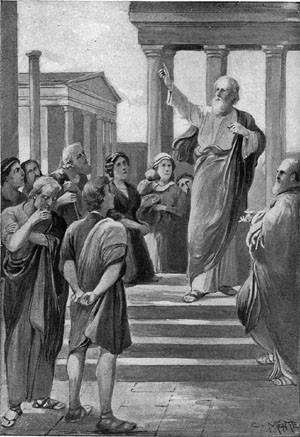
Paul at Athens
"Fifteen years ago, when I was married, I was not the poor man that you now know me to be. My father gave me as my share of his property two thousand dollars, which I had increased to three, and my wife received as her wedding portion one thousand dollars. We were both strong and willing to work, and ambitious to succeed in the world, and we bought a good farm, running in debt a few hundred dollars. For several years we were greatly prospered. We had good health, and the seasons were favorable, so that we grew heavy crops and obtained fair prices for them.
"At the end of five years we had paid off our debt and had nearly one thousand dollars in the bank, and we felt that it would be safe to build a new house, although we expected to put more than the amount of money on hand into it.
"In the meantime there had come into the neighborhood one of the most companionable men I ever met. He was familiarly known as Capt. Cole. He had been a lawyer, but had been appointed by the General Government to a lucrative office which he held for some years, and had the reputation of being very wealthy. He lived in good style, and was a general favorite in all the community.
"When my house was finished I found myself in debt seven hundred dollars, and as I had given the contract to a carpenter, he to furnish everything, he needed all his money. I went to the bank to borrow the amount until I could find some one who would let me have it for one or two years, and not being accustomed to borrow money, it did not occur to me that an indorser would be necessary, until the cashier of the bank informed me that it was their invariable custom to require security. Capt. Cole, who happened to be in at the time, overheard the conversation and came forward with a pleasant 'Good morning,' saying, 'I shall be only too happy to indorse for my friend, Mr. Day.' I felt both grateful and flattered, and when a few months later I happened to be in the bank when he wanted an indorser, I was glad to return the favor.
"We had two years of prosperity, and I paid the debt on my house. I now determined to build a fine barn, and as I had always paid my debts easily and could not well get along with my old barn until I had saved the money to build the new one, I determined to borrow one thousand dollars, and happening to meet Capt. Cole, I asked him if he knew where I could get that amount for three years. He told me he did, and offered to become my security. The money was borrowed and my barn begun.
"A few weeks later Capt. Cole called to see me. Like 'Squire Black to-day, he seemed delighted with everything he saw. His flattery put me in the best possible humor, and when he asked me to indorse a note of $5,000 for sixty days, and assured me that he could meet it (or even twice as much) promptly, to the day, I consented against my better judgment, and affixed my signature to the note. That act ruined me. Before the sixty days expired I learned that he was bankrupt. My farm was sold at a sacrifice, under the hammer, and when I paid the thousand dollars which I had borrowed to build the barn with, I was left penniless.
"With my history in your possession, do you wonder that I was alarmed to-day when I saw you about to fall into the same trap? I tell you I have a right to feel deeply on this subject. Would that I could make my voice heard by every young man in the land. I would say to him, shun as you would a serpent this evil which has brought ruin to so many families. I realize fully what it means to put my name on another man's paper, and it is just this—that I assume all the risks of his business, without any voice in its management or any possible chance of profit if he is successful; but with a fearful certainty that if from any cause he makes a failure, my earnings must make it good, even though it reduces my family to beggary. Since my own misfortune I have made this a matter of study, and I find that a very large per cent. of the business failures, of the country (and nearly all among farmers) are due to this practice."
The remainder of my story is soon told. My father was deeply impressed by Mr. Day's story, and before night I was dispatched to 'Squire Black's with a note from father stating that after carefully considering the matter he had decided not to sign the note. In less than a year after this 'Squire Black was declared a bankrupt, and in the final settlement of his business it did not pay ten cents on the dollar.
Father felt that he owed a debt of gratitude to Mr. Day, and he presented him with a good team and helped him to rent a farm. This encouraged him, and he worked so industriously and managed so prudently that in a few years he was able to buy a small farm and has since been able to support his family comfortably.
Many years have passed since these events occurred, and I am now past middle life, but I have never ceased to be thankful for the lesson taught me by Mr. Day, and in fulfilling his wish I would repeat the lesson which the story teaches—never indorse.
WATCH YOUR WORDS.
Keep a watch on your words, my darling,
For words are wonderful things;They are sweet like the bee's fresh honey—
Like the bees, they have terrible stings;They can bless, like the warm, glad sunshine,
And brighten a lonely life;They can cut in the strife of anger,
Like an open two-edged knife.Let them pass through your lips unchallenged,
If their errand is true and kind—If they come to support the weary,
To comfort and help the blind;If a bitter, revengeful spirit
Prompt the words, let them be unsaid;They may flash through a brain like lightning,
Or fall on a heart like lead.Keep them back, if they are cold and cruel,
Under bar and lock and seal;The wounds they make, my darling,
Are always slow to heal.May peace guard your life, and ever,
From the time of your early youth,May the words that you daily utter
Be the words of beautiful truth.
A Life Lesson
Albert Moore, at the age of twenty-five, took Alice Warren for his wife. He had been in the army—fought through from Bull's Bluff to Richmond—had come out with a captain's commission. He had come from the army with but little money; but he had a good trade, a stout pair of hands, and had borrowed no trouble for the future. Alice had saved up a few hundred dollars from her wages as a teacher, and when the twain had become husband and wife they found, upon a careful inventory, that they had enough to furnish a small house comfortably. Albert proposed that they should hire a tenement in the city; but Alice thought they had better secure a pretty cottage in the suburbs—a cottage which they might, perhaps, in time, make their own.
Albert had no disposition to argue the question, so the cottage was found and secured. It was a pleasant, rural location, and so connected with the city by rail, that Albert found no difficulty in going to and from his workshop.
During her five years' experience in school-teaching Alice had learned many things, and having been an orphan from an early age, she had made the problems of real life one of her chief studies; and what she had learned in this latter department served her well in her new station. After marriage she found Albert to be just the man she had known him to be in other years. He was kind to a fault; free-hearted and generous; ready always to answer the call of friendship; and prone to pluck the flowers that bloom to-day, regardless of what may be nurtured to bloom to-morrow.
They had been married but a few months when Alice found he was cutting his garments according to his daily supply of cloth. Not a shred was he likely to save up from the cuttings for an extra garment for a rainy day to come.
"Albert," she said to him one evening, "do you know we ought to be laying up a little something?"
Albert looked up from his paper and waited for his wife to explain.
"I think I heard you tell Mr. Greenough that you had no money—that you had paid out your last dollar this very afternoon?"
"Exactly, my dear; but you know to-morrow is pay-day."
"And you have spent your last month's earnings?"
"Yes."
A brief silence ensued, which Albert broke.
"Come, Alice, you've got something on your mind. Out with it—I'll listen."
And then Alice, in a smiling, pleasant way, went on to tell her husband that they ought to be laying up something.
Albert smiled in turn, and asked how such a thing could be done when it cost all he earned to live.
"You earn three dollars and a half a day," said Alice.
"Yes."
"George Summers earns only three dollars a day."
"You are right."
"And yet he lives and does not run in debt."
"But he is forced to deny himself many little comforts which we enjoy."
"And the one great comfort which we might enjoy we are throwing away."
"How is that, Alice."
"The comfort of a little sum in the bank, which we should see growing toward the answering of future wants."
Albert could not see how it was to be done; and Alice feared that a lesson of empty words might be wasted. She knew that his ambition needed a substantial prop. Never, of his own accord, would he commence to save by littles. He did not estimate money in that way. Had some kind fairy dropped into his hand a five-twenty bond for five hundred dollars, he would have put it away gladly; and with such a nest-egg in the start, he might have sought to add to the store. But he could see no hope in a dollar bill, and much less could he discover the nucleus of a grand saving in a fifty-cent piece.
With Alice it was different. From her meager earnings as school-teacher she had in less than five years, saved up three hundred dollars; and the first saving she had put by was a silver dime. She knew what little by little could do, and she was determined to show it to her husband. She must be patient and persevering, and these qualities she possessed in an eminent degree. It was to be the grand undertaking of the first years of her married life, and to do it she would bend every available energy. She planned that if possible she would get hold of that fifty cents every day; or, if she could not do that she would do the best she could.
Generous, frank, loyal, and loving, Albert was an easy prey to the wiles of a wife loyal and loving as himself. He gave her money when she asked for it; and she asked for it when she thought he had any to give.
And here let me say that Alice knew her husband would not run in debt. That was an evil they both arrayed themselves against in the outset. When Albert's purse was empty he bought nothing; but when it was full he was apt to buy more than he needed. Alice knew all this and governed herself accordingly.
"I think," said Alice, one evening, "that I must fix over my old brown cashmere for winter, I should like a new one, but I don't suppose you can afford it."
Albert looked grieved. The idea that he could not afford his wife a new dress!
But such a one as she wanted would cost twenty-five or thirty dollars.
"If you want it, get it," said Albert emphatically. "I will let you have twenty dollars from this month's pay, and the balance you shall have next month."
Alice got the thirty dollars, but she did not get the new dress. By the outlay of five dollars for new trimmings she contrived to fix over the brown cashmere so that it looked every bit as good as new.
And so Alice worked. Sometimes she asked her husband for ten cents, sometimes for fifty cents, sometimes for a dollar, and sometimes for more, and at the end of a year, upon carefully reckoning up, she found that she had managed to get hold of rather more than fifty cents a day; but she had done it by denying herself of many things, some of which seemed really needful.
The result of the first year's effort inspired Alice with new life and vigor. She had saved one hundred and fifty dollars, and had invested it in government funds. Through the influence of a dear friend who was in a banking establishment, and to whom she had confided her secret, she was enabled to get the bonds at their face value.
It was only a little at a time—sometimes a very little—but those littles multiplied by other littles, grew amazingly. The husbandman who would sit himself down by a hill of corn, and wait to see the tender blades put forth would be disheartened; but he knows if he plants the tiny seed, and cultivates it as he ought, the harvest of golden grain will come at length.
Albert and Alice were married in the spring of 1865. It was on an evening of August, 1870, that Albert came home. He had been notified that they must leave the cottage. They must give up the pleasant home, and lose the little garden they had cultivated with so much fondness and care.
"The owner wishes to sell," he exclaimed; "and has an offer. He asks two thousand dollars, and must have five hundred down."
Alice's eyes gleamed with radiant delight.
She had been thinking for some time that she must let her husband into her secret. It had begun to wear upon her. And now the time had come as by providential interposition.
She got up and went away to her cabinet, and when she came back she brought a little book in her hand.
"Albert!" said she, "lets you and I buy the cottage."
Albert looked at her in amazement; and directly it flashed upon him that there was too much solemnity in her look and tone for badinage. Something that he had noticed during the past few months came back to him, and he trembled with the weight of suspense that fell upon him.
Alice then showed her book—that she had more than eight hundred dollars in the bank. The ice was broken—she told her story in glowing words. She told how she had saved up little by little, and how she had at length found herself able to purchase a fifty-dollar bond. And then she told how her uncle in the banking-house had taken charge of her investment; and how, under his management, the interest had accrued in amazing volume.
But the grand result was not the chief thing. The chief thing was the beginning—was the very little which had been religiously saved until the second little could be added to it.
And now, as a result of his wife's careful and tireless working, Albert found something upon which his ambition could take a fair start. He never could himself, from so small a commencement, have reared the pile; but with the structure started, and its proportions all blocked out, he could help on the work. He could see how it was done—and not only that, but the demonstration was before him that the thing could be done.
One year has elapsed since Albert Moore received the lesson from his wife, and joining hands with her, and bending his energies in the same direction, he has accomplished during the twelve months what would have seemed to him a marvel in the earlier time. He has laid by more than fifty cents a day; and the cigars, and the beer, and the other condiments of life which he has surrendered to the work, are not missed—rather, he holds they are so many enemies conquered. And Albert can improve his home with cheerful heart, and he can set out new trees and vines in his garden with bright promises, because he sees, day by day, the pretty cottage growing more and more his own. The end approaches a little at a time—little by little it approaches, but surely, nevertheless; and there is a great and satisfying joy even in the labor and in the anticipation.
O deem not they are blest alone
Whose lives a peaceful tenor keep;For God, who pities man, hath shown
A blessing for the eyes that weep.The light of smiles shall fill again
The lids that overflow with tears,And weary hours of woe and pain
Are promises of happier years.For God has marked each sorrowing day,
And numbered every secret tear,And heaven's long age of bliss shall pay
For all his children suffer here.—
William Cullen Bryant.Hard Times Conquered.
About seventy years ago, a physician with a young family springing up about him, consulting his wife, as all good husbands find it prudent to do, bought a large farm in one of our New England States, where every farmer truly earns his living by the sweat of his brow. Both felt that nowhere could their children be trained to industry and frugality so thoroughly as on a good farm.
The doctor was obliged to "run in debt" for this property, and he gave a mortgage on the place. The payments were to be made quarterly, and promptly, or the whole would be forfeited and revert to the original owner. In those days physicians were not likely to become millionaires, and though Dr. Mason's practice was large, the pay was small, and not always sure. He therefore looked to the farm for the means to release him from the bondage of debt; and the children, even to the youngest, were taught to labor for, and look forward eagerly to, the time "when we have paid for the farm!"
The creditor was the doctor's father-in-law, through his first wife, and while the good old gentleman lived, if by any mishap or overpress of business the quarterly payment had been delayed, it would have been kindly excused. But for the ten or fifteen years that he lived after the sale of the farm, there had not been one delay in payment, though now and then there would come a time when it was very hard to secure the needed sum in time, for even in the olden days "hard times" were often experienced, to the terror of our hard-working New England farmers. But little by little, the heavy debt was diminishing, and the doctor's family were looking forward hopefully to the year of jubilee, when they could sit under their own vine and fig-tree with none to molest and make them afraid.
At this period the father-in-law died. He had but two children,—daughters. The younger, the doctor's wife, died childless. The elder married a hard, close, scheming man who lost no opportunity of remarking that he would, no doubt, soon come in possession of Dr. Mason's farm, as the latter, with his large family, must fail by and by.
The financial troubles which the war of 1812 had caused, as all wars are sure to do, were not yet adjusted. Money was scarce, and payments very difficult. Ten children now filled the old house with merriment and gladness; but they were to be clothed and educated.
Let us see how successfully they had been taught to make their high spirits and resolute wills cheerful auxiliaries in lifting the burden, which, since their grandfather's death, was pressing upon their parents.
At the time of which we write, among other crops, rye was extensively raised. It was used for food among the farmers quite as much as wheat, and was also valuable for other purposes. When full-grown, but still in the milk, large quantities were cut to be used for "braiding." The heads were used for "fodder;" the stalks, after being soaked in strong hot soap-suds, were spread on the grass for the sun to whiten. When sufficiently bleached and ready for use, they were cut at each joint, and the husk stripped off, and the straw thus prepared was then tied in pound bundles for sale.
Bonnets, then, meant something more than a small bit of silk or velvet with a flower or feather attached, and the "straw braid" for making them was in great demand. Boys and girls were alike taught to braid, and the long winter evenings were not spent idly. Dr. Mason raised large crops of rye, and each child, almost as soon as he could walk, was taught to braid, and was soon able to do much by it toward clothing himself. At six years of age a dollar a week was easily earned; at eight, three dollars; and in something of that proportion up to the eldest.
Does any one think that such a life, with such an object in view, was hard or cruel? Never was there a greater mistake. It was of great value to those young spirits. They had something real, that they could understand, to labor for. There was life and courage and true heroism in it. It was an education—with here and there, to be sure, some rough places to pass over—which was worth more to them than all the money millionaires bequeath their sons and daughters; an education which prepared them in after-life to be courageous and self-helpful.
It is this kind of training that has made New England's sons and daughters strong and self-reliant, and the lack of it which makes these hard times such a horror that we hear of many who seek death by their own hands as preferable to the struggle for better times.
In the long winter evenings, when the labor of the day was over, the children home from school, and the "chores" all finished, the candles were lighted and the evening work began. The mother in her corner was busy making and mending for her large family. The doctor, if not with the sick, read and studied opposite her. The children gathered around the long table in the middle of the room, where lay the school-books and straw previously prepared for braiding, while the old fireplace, heaped with blazing logs of hickory, oak, and fragrant birch, made the room warm and cheerful. Here, with their books before them and fastened open to the next day's lessons, the children with nimble fingers plaited the straw and studied at the same time. For children taught to be industrious, usually carry into the schoolroom the principles thus developed, and are ambitious to keep as near the head of the class as possible.
Such a family as this was well equipped to meet and conquer adversity. For several days Dr. Mason had been unusually grave and silent. All noticed it, but no remarks were made until evening, when he came to supper, so unmistakably worried and despondent that his wife inquired if he were not well.
"Yes, well enough. But, Lucy, I have so far been unable to collect money for our quarterly payment. So much is due me that I had no fears but that enough would be promptly paid to save me any trouble."
"How much is there lacking?"
"Not quite a hundred dollars; but it might as well be thousands for any chance I now see of getting it in season. There is now so much sickness about, that, as you know, I have had no rest, and little time to collect money. If not ready before midnight to-morrow, we are ruined. I have kept it from you as long as I dared, still hoping that those who ought to pay me would do so."
"Have you told them how very important it is that you should have the money?"
"No; I did not wish to speak of it. Mr. H. is watching greedily for a 'slip,' and we need expect no mercy at his hands. Under our hard labor and good care, this farm has risen greatly in value—too much so for him to spare us an hour, if he can once get hold of it. I am about discouraged. It is the darkest time we have seen yet. But I must be off, and will probably be kept out all night. To think there are not forty-eight hours between us and ruin! And my hands are so tied by several severe cases, that I may not find one hour to make up the little that is needed."
For a few minutes after the doctor left, the children stood silent and sad, watching their mother. At last she said,—
"Children, we can help father through this, and save our home, if you are willing to submit to some little self-denial. No; I should have said to great self-denial. Each of you has worked diligently to buy new garments for winter. You need them and deserve them, and I should be happy and proud to see you all neat and comfortable. But to help father, are you willing to let me try to clean, mend, or make over your old clothes, and use what you have earned to help brighten this dark day? The braid you have on hand, and what is now due at the store, is all your own, or to be expended for your own clothes, and if each one of you is not perfectly willing, I don't wish you to give it up."
It was a beautiful sight to see those eager faces watching their mother, ready to answer the moment she had finished; for in the olden time children were taught that it was disrespectful to interrupt any one when speaking, even when, as in this case, it was difficult to keep silent. But the reply, when given, was prompt, enthusiastic, as she had confidently looked for it to be.
"Thanks, dear children? Now, then, hasten. First bring me all your braid, and let us see how much it will come to."
The braid, in ten-yard rolls, was brought, and its value estimated.
"With that which is now due us at the store, we have nearly sixty dollars! Well done, for all these little fingers! But now we must devise a way to make up the remainder. Your father spoke last night of a large quantity of straw, which, if cut, would bring in something. He will be away all night. If you work well, we can cut many pounds before midnight. Now, girls, help me wash the dishes, while your brothers bring, before dark, the straw we can cut to-night."
By the time the candles were lighted, all was ready to begin.
The younger children were excused at their usual bedtime, but the others worked with their mother till the tall clock in the corner struck one. Then all retired for a few hours' rest.
Dr. Mason returned home in season for breakfast, and his wife inquired if the eldest son could drive her over to the neighboring town to dispose of some braid for the children. He replied that he must be gone again nearly all day, and neither son nor team could well be spared from important work at home. But a strange thing followed this implied refusal. Mrs. Mason, who never allowed her plans or wishes to interfere with her husband's, now repeated her request, and urged it till he yielded, apparently from sheer surprise that his wife could be so persistent.
The doctor went his usual round, and the mother and her son departed on their mysterious errand. Their business accomplished, they returned well satisfied and ready for supper when the father arrived.
A deeper gloom was on his face when he entered; but no word was spoken till all were seated at the table. Then in a slightly agitated voice his wife inquired,—
"Have you been successful in obtaining the money?"
He shook his head, but remained silent. Each young quivering face was turned first toward him, then with earnest, questioning glance to the mother.
"Be not discouraged, dear, even at this late hour."
"Are you wild, Lucy? There are but six hours between us and ruin. Can you talk of hope now? I have none."
With a warning gesture to the children, she rose, stepped to her husband's chair, and passing her arm round his neck, said, gently,—
"Yet still hope on, my husband; God will not forsake us."
He moved impatiently from under her arm; but as he did so, she dropped a roll into his bosom and turned toward her chair.
"Lucy! Lucy! what is this? Where did you get it?"
All was wild with excitement. Each child laughing, sobbing, shouting, but one glance from that strong but gentle mother quelled the confusion, and she replied,—
"It is our children's offering, and is sufficient to make up the needed sum. I persisted in going away this morning against your wish, because I saw no escape. We cut the straw last night—many willing hands made quick work; I sold it, and their braid added to it, with what was already due them, completed the sum."
Those who witnessed that scene will never forget it; Dr. Mason with his arm around his wife, and both in tears, calling her all happy names; the children clinging about their parents, so joyful that home was saved, and they had helped to save it.
"Put Charlie into the wagon, quick. If he fails me not, the six miles between here and M—— will be the shortest I ever rode. I shall be home before bedtime to thank you all. I cannot now. I hope we shall never come so near ruin again."
And they never did. In two years the last dollar was paid, and then Dr. Mason resolved he would never again owe any one a cent. He kept his resolution.
It is easy enough to be pleasant
When life flows by like a song,But the man worth while is the one who will smile
When everything goes dead wrong.
A Good Lesson Spoiled
A darkened room, spacious and handsomely furnished—being, in fact, the chamber of Mrs. Wilcox, the mother of the little fellow who occupied the wide bed. He lay there in lugubrious state, the rosy face stained with much crying, just showing above the edge of the counterpane; his tangle of yellow curls crushed upon the bolster. Below these was a white mound, stretched along the middle of the bed, just the length of Robby, aged seven and a half, the youngling of the Wilcox family. Two big blue eyes, glazed with tears, wandered from one to another of the two faces gazing at him from opposite sides of the horizontal pillory. Both were kindly, both loving, both sad. They belonged to the parents of Robby, and he had been convicted, sentenced, and punished for telling a lie.
His mother had sent him to the fruit-store with twenty-five cents and an order for two lemons. The tempter, in the form of a "street-boy," waylaid him at the corner with a challenge to a competitive show for tops. The silver "quarter" was in the same pocket with Robby's new air top and card, the pride of his soul. He may have drawn it out with his handkerchief when he wiped his face after the game. The tempter may have known more about it than the tempted suspected. At any rate, the money was not to be found, and he was close by and ready with his proposition when Robby discovered the loss.
"Mamma will certainly scold me this time," he subjoined, turning every pocket inside out, and staring distractedly up and down the street. "I lost ten cents last week, and she told me to be more careful."
"Don't tell her! And don't pay for the lemons. When the bill comes in, your mamma will have forgotten all about sending you for them, or she will think the lemon-feller made a mistake. I know lots of real gamey fellers who get out of scrapes that way. It's only milk-sops who run to mammy with every little bother."
The experiment thus suggested and urged, was a success until mamma demanded the change.
"He said there wasn't any!" faltered the errand-boy.
"No change! out of twenty-five cents!" Then with a searching look at the scarlet face painfully averted—"Robby!"
The "milk-sop" bethought himself of the "gamey fellers."
"Honest-true, mamma!" he plucked up courage to say.
"Put on your hat, my son, and go with me to the store where you bought the lemons. There is something wrong when my boy cannot look me in the eyes!"
Thus came about the tragedy that darkened the June day for the whole Wilcox household. It was at nine o'clock on Saturday morning that the falsehood was detected. At two P.M. Mrs. Wilcox brought up the prisoner's dinner. Only bread and water! He had smelled the savory soup and roast lamb, and the cook had hinted at strawberry short-cake when he passed, whistling, through the kitchen, turning the silver quarter over in his pocket. That was almost five hours ago, and he was to lie here until supper-time, alone! When he had eaten the bread of affliction, seasoned with tears of self-pity and remorse, mamma re-appeared with papa.
"My son!" said the latter, "I would rather have you die in your innocent boyhood than grow up a liar! Tell the straight, simple truth always and everywhere. No brave man will lie. Papa does not want his boy to be a coward. No honest man will deceive or tell a falsehood. Papa does not want his boy to be a cheat!"
Mrs. Wilcox sat down on the bed when her husband had gone. All the mother-heart in her was crying out and tearing itself with longing and pity ineffable. Arms and heart ached to enfold the precious little sinner so grievously worsted in the battle with temptation. "Mamma is very sorry that her darling has been so naughty!" she said, bowing her head upon the pillow beside the mat of curls dampened by the rain from the culprit's eyes.
"Mamma! Indeed, I will never tell another lie—not the leastest fib!" he sobbed.
"God help you to keep your word, my son. Every falsehood is like a drop of ink upon snow to your soul!"
She stroked back his hair and comforted herself by giving him, one after another, the passionate kisses withheld through all these miserable hours. Holding the chubby fingers in hers, she talked to him a few minutes longer of his sin, and to whom he should look for forgiveness; then bending over him, she prayed in simple words and few for the little one who had stumbled to his own hurt. "Lie still and think it all over, dear!" was her parting injunction.
At the tea-table, Robby was not disposed to talk. He noted and understood the grave gentleness of his father's countenance and demeanor; the chastened loveliness of his mother's look; the quiet tone caught by the other children from the grown-up sister who sat next to him. His transgression had affected the spirits of the whole party. The very avoidance of all direct reference to it was significant and impressive. It was something too disgraceful for table-talk. A blackened soul! soiled lips! These were the figures most distinct to his imagination as he crept after supper into the library, and sat down at the alcoved window looking upon a side street. The boys were playing noisily in the warm twilight. Robby watched them, curled up on the window bench, one foot tucked under him, his face more sober each minute. He was sure his mother would shake her head sadly were he to request permission to join the joyous group of his fellows. Nor did he care—very much—to go out. The recollection of sin and consequent suffering was too fresh.
Nettie, the grown-up sister, had a visitor, and mamma had joined the girls, and was chatting cheerfully with them—not at all as she looked at the cowering little liar under the counterpane up-stairs.
"Mamma," suddenly exclaimed the daughter, "there are old Mr. and Mrs. Bartol! I do believe you are to be honored by a call from them."
"I sincerely hope not," was the answer. "Papa and I had planned a walk on this lovely evening, and our friends the Bartols are given to long sittings."
"Besides being insufferably prosy," interpolated plain-spoken Nettie. "They are coming in. Milly, you and I can run away!" and they fluttered through the back-parlor door.
Mamma's face was overcast with genuine vexation. Her sigh, "How provoking!" reached the alcoved auditor. Then she advanced to meet a fat old lady, and a fatter, bald old gentleman.
"Is this really you, Mr. Bartol? It is an age since I have met you. I am happy to see you both. Pray be seated."
"Oh, good gracious!" said Robby, under his breath, sinking back into his corner, actually sick and trembling.
When he could listen and think again, papa had been sent for, and Mr. Bartol was apologizing for mingling business with a friendly visit. He wanted to buy a house owned by Mr. Wilcox, situated near his—Mr. Bartol's—home. The play of negotiation, of parry and thrust, was courteous, as befitted actors and scene, but Mr. Bartol's intention to buy cheap, and his host's desire to sell dear, were palpable to the unworldly eavesdropper.
"I am sorry you hold the property at so high a figure!" finally remarked Mr. Bartol, rising to take leave. "I must consult the friend who commissioned me to make inquiries, before I can say anything definite."
Mr. Wilcox was the impersonation of smiling indifference. "The truth is, my dear sir, I do not care to sell at all. The property is rising in value, and I may remove to that part of the city myself next year. I should lose on it were I to take less than the price I have named."
When the guests had gone, Mr. Wilcox turned laughingly to his wife:
"Well, my love, you have lost your walk, but your husband has made four thousand dollars—clear!"
"You think he will buy the place, then?"
"I know he will! He wants to settle his daughter there. She is to be married next month. I had a hint to that effect some days since. I had the game in my hands from the first. I bought the property, three years ago, at a low figure. The rent has covered interest, taxes, etc. I shall never live there myself. It would not be convenient for my business. I have been anxious this great while to sell. I am already carrying more real estate than I ought to hold."
"I am afraid Robby is less impressed by the lesson of to-day than we could desire," observed Mrs. Wilcox sorrowfully to her husband at bedtime. "He strode off to bed without saying 'Good night' to any one, and pretended to be asleep when I looked into his room just now, answering gruffly after I told him I knew he was awake. What shall I do if my child becomes an habitual deceiver?"
"We must watch his associations narrowly," replied the judicious father. "Everything depends upon the examples and impressions of early life."
Benevolent Society.
In the snug, cozy barroom of the "Farmers' Inn," at Madisonville, sat six young men. It was a cold, bleak evening in December; and the wind that howled and drove without, drifting the snow and rattling the shutters, gave to the blazing fire and steaming kettle additional charms and comforts. There was Peter Hobbs, a youth of five and twenty, who seemed to be the leader, par excellence, of the party. He was a good-natured, intelligent, frank-looking man, and was really a noble-hearted citizen. Then there was John Fulton, a youth of the same age, who worked with Hobbs, both being journeyman carpenters. Samuel Green was a machinist; Walter Mason, a tin worker; Lyman Drake, a cabinet maker; and William Robinson, a clerk. They ranged, in age, from twenty-three to twenty-eight, and were really industrious youths, receiving good wages, and maintaining good characters for honesty, sobriety, and general good behavior. Yet they were looked upon by some as ungodly youths, and given over to perdition. True, they belonged to no church; and, amid the various conflicting creeds by which they were surrounded, they had not yet settled down upon any one in particular, believing that there was good in all of them, and evil among the members of each.
On the present occasion, they were all of them smoking, and the empty mugs which stood upon the table near them, showed pretty conclusively that they had been drinking something besides water. The subject of the cold winter had been disposed of; the quality of the warm ale and cigars had been thoroughly discussed, and at length the conversation turned upon the missionary meeting, which had been held in the town on the previous Sabbath.
"I don't know but this missionary business is all right," said Sam Green, knocking the ashes from his cigar with his little finger, "but at the same time, I don't believe in it. Them Hindoos and South Sea Islanders may be savage and ignorant, by our scale of measuring folks; but that is no reason why we folks should send all our money off there, while our own folks are starving at home."
"Did you put anything into the box?" asked Lyman Drake.
"No, I didn't. When they shoved it into my face, I told 'em I'd left all my money at home—and so I had."
"You're about right, Sam," said Bill Robinson. "But I did more than you did. When the box was handed to me, I spoke right out, so that everybody around me heard. I told the old deacon if he'd take up a subscription to help the poor in our town, I'd put in something."
"What did he say to that?"
"Why—he said, 'Souls are of more consequence than bodies.' So I just said back that I guessed he'd find it hard work to save a soul out of a starving body. But you see that isn't the thing. They won't try to save the souls, or the bodies either, of their own townfolks. Now when Squire Truman came here to settle, they tried quick enough to save his soul. Ye see his body was already salted down with ten thousand dollars, so his soul was worth something to 'em. Why don't they try to save poor old Israel Trask's soul, and his wife's too?"
"Wasn't there a committee of the church that visited old Israel last month?" queried Drake.
"Yes—there was," answered Sam, giving his cigar an indignant shake; "and what did they do? They went there—four on 'em—and found the old folks suffering for want of food and clothing. They tried to make the old man believe their religion was the only true one in the world, but he would not. So they gave him three tracts and a little cheap book, and then went away. That's what they did. Afore I'd give a cent to such chaps to send off to feed their missionaries in Baugwang and Slapflam Islands, I'd throw it into the fire."
"But these missionaries are honest people, and do some good," remarked Peter Hobbs, who had not before spoken on the subject.
"Of course they do," responded Sam. "But wouldn't it look better of 'em to begin some of their charities at home? I judge of a man's order by the way his own shop looks, and not by the way he may fuss around on another man's premises. And just so with those philanthropists. I'd rather see how much their religion does toward keeping the Gentiles of their own town, than to go away off to the other end of the earth to look for the fruits of their Christianity. Them's my sentiments."
"And mine too," uttered Walter Mason, who had just thrown away the stump of one cigar, and was about lighting another. "Just think; they collected, last Sunday, to send off to the Hindoos, over two hundred dollars. Now, that would have made half the poor families in this town—and I don't know but all—comfortable for the winter. There was Mr. Netherly—worth forty thousand dollars—he put in a ten-dollar bill. It was a great, new bill, and he opened it, and held it up, and even turned it round, so't everybody could see it before he let it drop. Then at the end, when the box was carried up into the pulpit, the deacon whispered to the minister; and the minister got up, and, said, taking hold of the corner of the rich man's bill: 'Here is ten dollars from one brother. Let that brother be assured that his deed is remembered of him in heaven.' Yes, that's what was said; and Mr. Netherly held up his head, bowed very low, and then looked around at the rest of the congregation, as much as to say, 'that's me.' Now I know of another thing that I guess'll be remembered in heaven, alongside of this one. Last week, poor old Trask—Uncle Israel—called at Netherly's with some baskets. You know the old man gets out stuff in the summer, and then in the winter makes it up. Well, he went there, and asked Netherly if he wouldn't buy a basket. No; he didn't want one. Then the old man told him how he and his poor old wife were suffering, and he asked him if he couldn't help him in some way; and what do you think Netherly said?—Why, he said that he had to pay taxes to help support a poorhouse, and told Uncle Israel that he'd find help there, if he'd only apply to the selectmen! Now what d'ye think of that, eh?"
"Why," returned Sam, "I think if he's got an account in heaven, he'll find a balance against him, when he comes to settle up."
"So he will," responded three or four of the others.
For some moments after this, the party smoked in silence. Peter Hobbs had been pondering very deeply upon something, and at length he spoke:
"Now look here, boys," he said, throwing his half-smoked cigar into the fire, "there's a good deal of truth in what's been said—in fact, it's all true; but, before we blame others, we ought to do something ourselves. Now I'm ready to form a regular benevolent society. Let us six go at the work, and see what we can do toward alleviating some of the distress about us. What say you?"
The other five looked on in wonder.
"But," said Sam, "how are we to do it? We arn't among the favored ones. We weren't born with silver spoons in our mouths."
"I should like to do it," added Drake, "but what's the use? We couldn't do much any way—not enough to amount to anything."
And so the others expressed their opinions in like manner. They all "would like," but "where was the money to come from?"
"Listen," said Peter; and they all turned toward him with real deference, for they knew he never wore a cloak over his heart, and that when he spoke in earnest, his meaning had depth to it. "Now I have formed a plan. There is old Uncle Israel and his wife; then there is the widow Manley, with four little children, suffering for want of the actual necessaries of life; and then there is Mrs. Williams—she is very poor. Her son Philip, who is her mainstay, was sick all the summer and fall, and is sick now; so the woman got nothing from her little patch of land, and is now absolutely reduced to beggary, with herself and sick son to support. Now let us take these three cases in hand, and support them."
"But how?" asked three or four voices, anxiously, for they really and fully sympathized with the noble plan.
"I'll tell you," resumed Peter. "Here, Tim," he called, turning to the bar-keeper, "what's our bill?"
"Let's see," responded the worthy, coming up. "There's two cigars apiece, three cents each—that's thirty-six. Then the ale—three pints—eighteen cents; and wine—three gills—that's eighteen more—makes just thirty-six more; and twice thirty-six is—is—seventy-two—seventy-two cents in all."
"Come, boys," said Peter, "let's pay an equal share to-night. Let's give him ninepence apiece."
So the "boys" paid up, and after Tim had gone, Peter resumed:
"Now see what we've spent to-night for nothing. I'll begin with you, Sam. How much do you suppose you spend each day for cigars and ale? Now reckon fairly."
"Let's see," was Sam's response after gazing into the face of his interlocutor until he had fairly got hold of the idea. "I certainly average four—no, five cigars a day, and I suppose they average three cents apiece. Then comes my ale—but I could not tell how much that amounts to, for I don't drink it regularly, but perhaps six cents a day."
"That's just twenty-one cents a day, utterly wasted," said Peter; "and I'll own up to wasting twenty-five cents a day. How is it with you, John?"
"I'll say twenty-five."
"And you, Walter?"
"Just about the same."
"Lyman?"
"The same."
"Bill?"
"The same."
"Now look at it. Here we are, a little worse than wasting about a dollar and a half a day. But let us put our loss at a shilling each—"
"No, no," cried Sam, who saw through the whole plan. "Let's give honest measure. I'll own up to the twenty-five. Let's go the whole, if any."
"Very well," returned Peter; "then let us commence and pledge ourselves not to smoke, or drink ale, for one month from this date. Every night we will lay away a quarter of a dollar, and at the end of the week we'll put our savings all together, and then go on our mission. What say you?"
With one voice the other five joined in the plan. The novelty of the thing may have pleased them; but the real incentives lay deeper down in the natural goodness of their hearts. There was no written pledge, but they took a more speedy method. Peter laid his hand upon the table, and said:
"Here's my hand, pledged to the work."
"And mine too," cried Sam, laying his broad palm atop of Peter's.
"And mine," "and mine," "and mine," chimed the rest, placing their hands atop of the other until the six right hands lay upon the table in a pyramid.
"This is Tuesday," resumed Peter. "Will we meet next Saturday?"
"Yes," answered Sam, "and call it a week. Let's throw in two days."
And so the week was begun.
On the next day, as Sam Green sat atop of his bench after dinner, he felt rather lost without his cigar, and for awhile he argued the question with himself, whether it wouldn't be just as well for him to put an extra quarter into his box and have his cigars as usual. But he remembered his pledge. He looked forward to Saturday, when he should find himself an ambassador of mercy to the sick and needy—and his resolution grew strong again. That was his last real hesitation, though it must be confessed he had some trials and hankerings.
And so with the rest, they had some moments of doubt and mental warfare with appetite and habit, but conquered, and were true.
Saturday came, and the six youths left their work at noon, having done more than enough overwork to make up for the loss of the half day.
"Must have a time once in awhile, eh?" said Sam's boss, as the young man pointed to the work he had done, and informed him that he should not work the rest of the day.
"Some sort of a time," replied Sam.
"Very well, but you're too good a fellow to go very deep into dissipation."
"I'll be up bright in the morning, sir;" and with this he left.
The new Benevolent Society met at Walter Mason's tin-shop. Each took out his money and they had in all nine dollars, it being in thirty-six silver quarters.
"Now," says Peter, "let's visit the three families we have taken under our charge. We'll go together, and expend the money as we see it is most needed. Let us go to Uncle Israel's first."
So off they went to Uncle Israel Trask's. The old couple lived in a small hut at the edge of the village, which was reached by a narrow lane, and here the six philanthrophists found the old lady, who was now in her eightieth year, suffering with a severe attack of the rheumatism, while the old man sat crouched over the fire, shivering with cold.
"Good day, good day, Uncle Israel."
"Aha, good day, boys, good day," cried the old man, trying to smile. "Can ye find seats? Sit down somewhere and make yourselves at home. But ye see it's a poor home that old Israel can offer ye to-day."
"But how are you getting along?" asked Peter, after the party had found seats.
"Ah, God a'mercy, I won't complain, for he is taking meself and Molly home fast. Only cold and hunger are not kind helpmates, Mr. Hobbs, ye ken that, eh?"
"Right well, Uncle Israel. And we have come to help you. Do you want any medicine?"
"Nay, nay, the old 'ooman's got a' the medicine laid up we want. It's only the food an' heat we need. I can't wade through the drifting snow as I could once."
"Suppose we send you a dollar's worth of other things, such as butter, flour, potatoes and the like—could you live a week on it?"
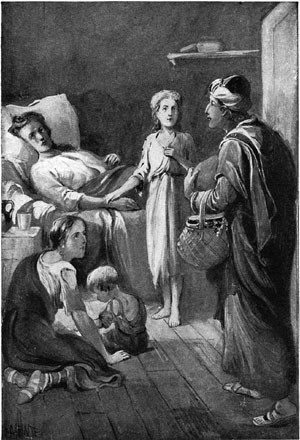
Pure Religion Is Visiting the Fatherless and Widows in Their Affliction
"Ah, yes, yes, boys, meself and Molly'd live a long, long while on that. But ye'll not do it for us."
"Yes, we will."
"Ah, it's too much."
"No, no," cried Sam, "we've got to do it, Uncle Israel, for we six have sworn to help you through the winter. So spunk up."
"D'ye mean that?" uttered the old man, clasping his thin, tremulous hands.
"We do," they all answered, and then Sam added, "and while one of us lives, you shall not suffer the want of what one of us can give."
A moment the old man bowed his snow-white head, and then while the big tears streamed down his face, he raised his eyes and murmured:—
"Oh! God's blessin' be on ye, ye noble boys. If me heart was gold, an' I could take it out an' give it ye—for it's yours all, all your own!"
In a little while the six went away, promising to send or come back soon, and even after they had reached the yard they could hear the voices of Israel and his wife, both raised to God in blessings upon their heads.
"I say, Sam," said Peter, "this is better than cigars and ale."
"Don't say a word now," replied Sam, "for my heart's full, and I can't bear any more."
Next, they drove through the biting wind and snow to the humble cot of Widow Manley. They found her in the only habitable room of her dwelling, sitting by a fire of chips and fagots, with a babe asleep in her lap, and engaged in sewing a coarse frock. Three other children were crouched by the fire, the eldest not yet eight years old.
Mr. Manley had been one of the many unfortunates who are swept off by rum, and in the prime of early manhood he had gone, leaving a young wife with four children in absolute penury.
"Ah, good day, Mrs. Manley."
The woman would have arisen, but Sam Green placed his hand upon her shoulders to keep her down.
"We have come," said Peter, seeing that she was anxious and fearful, "to see how you get along, and see if we can help you."
"Help me, sir?" uttered the widow with amazement.
"Yes; now tell us plainly how you are situated."
The woman was silent for a few moments, but at length she seemed to regain her self-control, and replied:—
"Ah, gentlemen, it is all comprised in three short words: Hunger, cold, and nakedness!"
"And if we will supply you with food and fuel for a week, can you manage to get along until that time without more clothing?"
"Oh—h—yes—sirs. But what is it? Who can help us? Who can care for the—"
"We can, we will," cried the energetic Sam, not so good to plan as Peter, but good at execution. "We six have pledged ourselves to see you safe through the winter. So cheer up and take hope, for neither you nor your children shall suffer while we can help it."
The widow's hands were clasped and her eyes wandered vacantly from one to the other of her strange visitors. She saw tears of goodness in their eyes, and her own soul's flood burst forth.
"O God bless you—bless you always."
"And we shall have something good to eat, mamma, and something to make us warm?" asked the eldest girl, clasping her mother's knees.
"Yes, yes, you shall," exclaimed Drake, catching the child and kissing her clean, pale face. "You shall have it before supper time, too."
The widow gradually realized the whole object of her visitors, and she tried to express her gratitude in words, but they failed her, and streaming tears had to tell the tale of thanks.
After this our society went to see Widow Williams. Hers was a neat cot, but they found suffering painful enough inside. Philip, a youth of about their own age, sat in a large stuffed chair, looking pale and thin, and wasted away almost to a skeleton, and his great blue eyes peered at them wonderingly as they entered. The mother, too, looked careworn and sick, and the dry, hacking cough that sounded in her throat told how much she needed proper food and care.
The youths made their business known as before, and with about the same result. The widow and her son could hardly realize that such a blessing had dawned upon them, but when they did realize it their joy and gratitude knew no bounds.
"Look here," said Sam Green, as soon as they had reached the road, "it strikes me that we are just about a week behind hand. We ought to have commenced this work just one week earlier than we did, for our nine dollars won't quite bring matters all up square to the present time. But if they were square now, they'd keep so with our weekly allowance."
"You're right, Sam," said Fulton, gleefully.
"Then let's commence back two weeks, eh?"
"I think so," said Peter.
And all the rest said so, too. So they had eighteen dollars instead of nine.
First, our party went and bought three half cords of wood, which they sent at once to their respective destinations, and they agreed that when the other matters were attended to they would go and work it up. Then they went to the stores and purchased such articles of provisions and comfort as they could agree were best adapted to meet the wants of their charges, and, having done this, they separated into three parties of two each, so as to have each family provided for with as little delay as possible. Besides carrying provisions enough to last a week, they left with each about a dollar in change.
When the poor people saw the promised blessing—when they thus met the fruition of their newly raised hopes, their joy was almost painful. The noble youths were blessed over and over again.
The wood was sawed and split, and put under cover, and then the society returned to the village, as happy as happy could be. On the next day, they went to the church and heard how many heathen had been converted to the peculiar isms of the preachers; and on the day following that, they commenced another week of their newly found Christianity.
"Sam," said the owner of the machine-shop, "what were you and the rest of your party doing last Saturday afternoon?"
"Converting the heathen," answered Sam.
His employer was a church member, and in for foreign missions, and moreover had often tried to induce Sam into the mysteries.
It was some time before Sam would tell the secret, but his boss became so earnest that he at length told the whole story. For awhile the employer gazed upon his journeyman with wonder, but gradually, as a sense of the fact came over him, he hung his head.
"Sam," he said at length, earnestly, and with a tear in his eye, "let me join your society."
"But how'll you raise the money?" inquired Sam.
"Money?" echoed the boss. "Look at my bank-book."
"Ah, but that won't answer. You must save the money by depriving yourself of some superfluity, or luxury you now enjoy."
"Is that the rule?"
"It is most rigidly. Our cigars and ale furnish us."
"And won't you smoke again?"
"Never, while within the reach of my influence there's a human being in want!"
"Then I'll throw away my tobacco and beer; may I join at that?"
"I'll propose you."
And the master machinist was proposed and admitted.
Another week passed away, and the new Christians went again on their mission, and there were more tears of joy, more prayers, and more blessings. Mr. Boothby, the machinist, had gained a new ray of light on the subject of Christian missions.
At length it became known that the poor families of Madisonville had found friends. People were wonder-struck when they discovered how happy and joyous these once miserable wretches had become; and more still when, one Sunday they saw Uncle Israel and his wife, and Mrs. Manley with her two elder children, enter the church.
Of course the truth leaked out, and we can imagine where the public eye of sympathy and appreciation was turned. Before a month was out, more than fifty people had engaged indirectly in the work, by placing money, food, and clothing in the hands of the original six, for them to distribute as they deemed proper.
But there was one rule to which the "society" adhered. They would not receive a cent in money which was not the result of a cutting off of some superfluity, and thus they showed to the people how simple and easy in its work is true charity, and also how many professed Christians not only lose sight of duty, but really lose the greatest joy of Christian life.
It was a glorious day for Madisonville when those six young mechanics met in the village barroom and concocted the plan for their society. And the good has worked in two ways. The members find themselves happier, healthier, and stronger, for having given up their pipes and cups; and the poor unfortunate ones of the town are once again basking in the sunlight of peace, content, and plenty.
How very many professed Christian churches there are in our land which would be benefited by following the example of the six noble youths who still stand at the head of the Madisonville Benevolent Society.
LIFE THAT LASTS.
They err who measure life by years
With false or thoughtless tongue.Some hearts grow old before their time;
Others are always young.'Tis not the number of the lines
On life's fast-filling page,'Tis not the pulse's added throbs
Which constitute their age.Some souls are serfs among the free,
While others nobly thrive;They stand just where their fathers stood,
Dead, even while they live.Others, all spirit, heart, and sense,
Theirs the mysterious powerTo live in thrills of joy or woe
A twelve-month in an hour.He liveth long who liveth well!
All other life is short and vain;He liveth longest who can tell
Of living most for heavenly gain.He liveth long who liveth well!
All else is being flung away;He liveth longest who can tell
Of true things truly done each day.
An Instructive Anecdote
Most young people are very fond of display in dress. Rings, breastpins, and similar superfluities, are in great demand among them. We have known a girl to spend a month's wages for a single article of this kind, and a young man to run in debt for a cane when he had scarcely clothing enough to appear respectable. The following story of a successful merchant will show to such how these things look to sensible people. Said he:
"I was seventeen years old when I left the country store where I had 'tended' for three years, and came to Boston in search of a place. Anxious, of course, to appear to the best advantage, I spent an unusual amount of time and solicitude upon my toilet, and when it was completed, I surveyed my reflection in the glass with no little satisfaction, glancing lastly and approvingly upon a seal ring which embellished my little finger, and my cane, a very pretty affair, which I had purchased with direct reference to this occasion. My first day's experience was not encouraging. I traveled street after street, up one side and down the other, without success. I fancied, toward the last, that the clerks all knew my business the moment I opened the door, and that they winked ill-naturedly at my discomfiture as I passed out. But nature endowed me with a good degree of persistency, and the next day I started again. Toward noon I entered a store where an elderly gentleman was talking with a lady near by the door. I waited until the visitor had left and then stated my errand.
"'No sir,' was the answer, given in a crisp and decided manner. Possibly I looked the discouragement I was beginning to feel, for he added in a kindlier tone, 'Are you good at taking a hint?'
"'I don't know,' I answered, and my face flushed painfully.
"'What I wished to say is this,' said he, looking me in the face and smiling at my embarrassment, 'If I were in want of a clerk, I would not engage a young man who came seeking employment with a flashy ring upon his finger, and swinging a cane.'
"For a moment, mortified vanity struggled against common sense, but sense got the victory, and I replied, with rather shaky voice, 'I'm very much obliged to you,' and then beat a hasty retreat. As soon as I got out of sight, I slipped the ring into my pocket, and walking rapidly to the Worcester depot I left the cane in charge of the baggage-master 'until called for.' It is there now, for aught I know. At any rate, I never called for it. That afternoon I obtained a situation with the firm of which I am now a partner. How much my unfortunate finery had injured my prospects on the previous day I shall never know, but I never think of the old gentleman and his plain-dealing with me, without always feeling, as I told him at the time, 'very much obliged to him.'"
REAPING.
While the years are swiftly passing,
As we watch them come and go,Do we realize the maxim,
We must reap whate'er we sow?When the past comes up before us,
All our thoughts, our acts and deeds,Shall they glean for us fair roses,
Or a harvest bear of weeds?Are we sowing seeds to blossom?
We shall reap some day,—somewhere,Just what here we have been sowing,
Worthless weeds or roses fair.All around us whispering ever,
Hear the voice of Nature speak,Teaching all the self-same lesson,
"As you sow so shall you reap."Though there's pardon for each sinner
In God's mercy vast and mild,Yet the law that governs Nature,
Governs e'en fair Nature's child.Why He Didn't Smoke.
The son of Mr. Jeremy Lord, aged fourteen, was spending the afternoon with one of his young friends, and his stay was prolonged into the evening, during which some male friends of the family dropped in. The boys withdrew into the recess of the bay window, at the end of the room, and the men went on chatting about the most important matters of the day, politics, etc. Still apparently entertaining each other, the two boys yet kept their ears open, as boys will, and, taking their cue from the sentiments expressed by their elders, indorsed one or the other as they happened to agree with them.
"Gentlemen, will you smoke?" asked Mr. Benedict, the host. A simultaneous "Thank you," went round, and a smile of satisfaction lighted all faces but one. Not that he was gloomy, or a drawback on the rest, but his smile was not one of assent. A box of cigars was soon forthcoming, costly and fragrant, as the word goes.
"Fine cigar," said one, as he held it to his nose, before lighting. "What, Linton, you don't smoke?" "I'm happy to say I do not," was the firm rejoinder.
"Well, now, you look like a smoking man, jolly, care free, and all that. I'm quite surprised," said another.
"We are hardly doing right, are we," asked a rubicund-visaged man, who puffed away heartily "to smoke in the parlor? I condone that much to my wife's dislike of the weed. She makes a great ado about the curtains, you know."
"For my part, that's a matter I don't trouble myself about," said the host, broadly. "There's no room in this house too good for me and my friends to smoke in. My wife has always understood that, and she yields, of course."
"But you don't know how it chokes her," said young Hal Benedict. "Yes, indeed, it gets all through the house, you know, and she almost always goes into Aunt Nellie's when there are two or three smoking. There she goes now," he added, as the front door closed.
"Why, it's absolutely driving her out of the house, isn't it?" asked Johnny. "Too bad!"
"Why don't you smoke, Dalton?" queried one of the party. "'Fraid of it? Given it up lately? It don't agree with some constitutions."
"Well, if you want to know why I don't smoke, friend Jay," was the answer, "I will tell you, I respect my wife too much."
"Why, you don't mean—" stammered his questioner.
"I mean simply what I said. When I was married I was addicted to the use of cigars. I saw that the smoke annoyed her, though she behaved with the utmost good taste and forbearance, and cut down my cigars so as to smoke only when going and returning from business. I then considered what my presence must be to a delicate and sensitive woman, with breath and clothes saturated with the odor, and I began to be disgusted with myself, so that I finally dropped the habit, and I can't say I'm sorry."
"I shouldn't be, I know," said another, admiringly. "I'm candid enough to own it, and I think your wife ought to be very much obliged to you."
"On the contrary, it is I who ought to be obliged to my wife," said Mr. Dalton, while the host smoked on in silence, very red in the face, and evidently wincing under the reproof that was not meant.
"I say that Dalton is a brick," whispered young Benedict.
"He's splendid!" supplemented Johnny, who was thinking his own thoughts while the smoke was really getting too much for him, and presently he took his leave.
The next day Johnny was thoughtful, so quiet, indeed, that everybody noticed it, and in the evening, when his father lighted his pipe with its strong tobacco, Johnny seemed on thorns.
"I can't think that you don't respect mother," he blurted out, and then his face grew scarlet.
"What do you mean?" asked his father, in a severe voice. "I say, what do you mean, sir?"
"Because mother hates the smoke so; because it gets into the curtains and carpet—and—and because I heard Mr. Dalton last night give as a reason that he did not smoke that he respected his wife too much."
"Pshaw! Your mother don't mind my smoking—do you, mother?" he asked, jocularly, as his wife entered just then.
"Well—I—I used to rather more than I do now. One can get accustomed to anything, I suppose, so I go on the principle that what can't be cured must be endured."
"Nonsense! you know I could stop to-morrow if I wanted to," he laughed.
"But you won't want to," she said, softly.
I don't know whether Johnny's father gave up the weed. Most likely not; but if you want to see what really came of it, I will give you a peep at the following paper, written some years ago, and which happens to be in my possession.
"I, John Lord, of sound mind, do make, this first day of January, 1861, the following resolutions, which I pray God I may keep:—
"First. I will not get married till I own a house, for I expect my uncle will give me one, one of these days; mother says he will.
"Second. I will never swear, because it is silly, as well as wicked.
"Third. I will never smoke and so make myself disagreeable to everybody who comes near me, and I will always keep these words as my motto after I am married:
"'I don't smoke, because I respect my wife.' Mr. Dalton said that, and I will never forget it.
"(Signed) John Lord."
And Johnny kept his word like a hero.
The world will never adjust itself
To suit your whims to the letter.
Some things must go wrong your whole life long,
And the sooner you know it the better.
—
Ella Wheeler Wilcox
Story Of School Life
"Oh, girls! I shall just die, I know I shall!" exclaimed Belle Burnette, going off into a hysterical fit of laughter, which she vainly tried to smother behind an elegant lace-edged handkerchief.
"What is it, you provoking thing? Why don't you tell us, so we can laugh too?"
"Well—you—see," she gasped out at last, "we've got a new pupil—the queerest looking thing you ever saw. I happened to be in Madam's room when she arrived. She came in the stage, and had a mite of an old-fashioned hair trunk, not much bigger than a bandbox, and she came into Madam's room with a funny little basket in her hand, and sat down as if she had come to stay forever. She said, 'Are you Madam Gazin?' 'Yes,' she replied, 'that is my name.' 'Well, I've come to stay a year at your school.' And then she pulled a handkerchief out of her basket, and unrolled it till she found an old leather wallet, and actually took out $250 and laid it in Madam's hand, saying, 'That is just the amount, I believe; will you please give me a receipt for it?' You never saw Madam look so surprised. She actually didn't know what to say for a minute, but she gave her the receipt, asked a few questions, and had her taken to No. 10, and there she is now, this very minute."
"Well, what was there so funny about all that?"
"Why this: she has red hair, tucked into a black net, and looks just like a fright, every way. She had on a brown delaine dress, without a sign of a ruffle, or trimming of any kind, and the shabbiest hat and shawl you ever saw. You'll laugh, too, when you see her."
Belle Burnette was an only child, and her wealthy father was pleased to gratify her every whim. So, besides being far too elegantly dressed for a schoolgirl, she was supplied with plenty of pocket-money, and being very generous, and full of life and fun, she was the acknowledged leader among Madam's pupils.
When the tea-bell rang, the new-comer was escorted to the dining-room, and introduced to her schoolmates as Miss Fannie Comstock. She had exchanged her brown delaine for a plain calico dress, with a bit of white edging about the neck. She did look rather queer, with her small, thin, freckled face, and her red hair brushed straight back from her face, and hidden as much as possible under a large black net, and but for the presence of Madam her first reception would have been exceedingly unpleasant. She was shy and awkward, and evidently ill at ease among so many strangers. As soon as possible she hastened back to the seclusion of her own room. The next day she was examined, and assigned to her place in the different classes, and to the surprise of all she was far in advance of those of her age. But this did not awaken the respect of her schoolmates as it should have done. On the contrary, Belle Burnette and her special friends were highly incensed about it, and at once commenced a series of petty annoyances, whenever it was safe to do so, which kept poor Fannie miserable, indeed, although she seemed to take no notice of it. A few weeks passed by. Her lessons were always perfectly recited. She made no complaint of the slights and sneers of her companions, but kept out of their way as much as possible. Her thin face grew paler, however, and there were dark rings about her eyes. A watchful friend would have seen that all these things were wearing cruelly upon her young life. One Saturday the very spirit of wickedness seemed let loose among them. Madam was away, and the other teachers were busy in their rooms. Fannie had been out for a walk and was near the door of her room when a dozen or more of the girls surrounded her, clasping hands together so she was a prisoner in their midst. For a moment she begged piteously to be released, but they only laughed the more, and began going around, singing something which Belle had composed—cruel, miserable, insulting words. She stood for an instant pale and still, then, with a piercing cry, she burst through the ring, and rushed into her room, closed and locked the door. Through their wild peals of laughter the girls heard a strange moan and a heavy fall.
"I believe she has fainted," said Belle.
"What shall we do?" said another.
For a moment they stood there sober enough; then one of them ran for the matron and told her that Fannie Comstock had fainted in her room and the door was locked.
She had a long ladder put to the window, and sent the janitor to see if it was true. Fortunately the window was open, and in a few moments he had unlocked the door from the inside. The girls were huddled together in a frightened group, while Madam lifted the poor girl and laid her upon her bed. She was in violent spasms. The doctor was sent for, but when the spasms ceased, alarming symptoms set in, and he pronounced it a serious case of brain fever. It is impossible to tell the shame and remorse of the conscience stricken girls. They were not brave enough to confess their guilt, but hung around the sick room, offering their services, vainly wishing that they might atone for it in some way. But their presence only excited the poor sufferer, so that they were all sent away. Day after day passed, and still she raved in violent delirium. The little hair trunk was searched to find some clue to her friends, but there was nothing found in it but the plainest, scantiest supply of clothes. Day after day the doctor came, looking grave and anxious, and at last the crisis came. For many hours she lay as if dead, and not a noise was permitted to disturb the awful silence while they waited to see if she would live or die. At last she opened her eyes; and the suspense was relieved by an assuring word from the doctor, that with careful nursing she would soon be well again. But her convalescence was slow and tedious.
Her former tormentors dared not speak of what they had done, but they sent daily little bouquets of fragrant flowers and other delicacies to tempt her returning appetite. Her eyes would light up with surprise and pleasure at the little gifts. And amidst all her wild ravings not a word of complaint at the ill treatment she had received ever escaped her lips.
One day Madam was sitting by her side, and as Fannie seemed to be much stronger, she ventured to ask after her friends.
"I have no friends, Madam, only Cousin John, who has a large family of his own, and has never cared for me. Mother died when I was born. I had a step-mother, but father died five years after, and I've taken care of myself ever since."
"And you are only fifteen now?"
"Yes, ma'am."
"How did you get money enough to pay for a year's board and tuition here?"
"I earned it all, Madam, every cent of it. As soon as I was big enough I went into a factory, and earned two dollars a week at first, and finally $3.50; and I worked for my board nights and mornings."
"Poor child!"
"Oh no, ma'am, I was very glad to do it."
"But how did you keep along so well with your studies?"
"I used to fix a book open on my loom, where I could catch a sentence now and then, and the overseer did not object, because I always did my work well. You see, Madam, I wanted to be a teacher some time, and I'd have a better chance to learn here than anywhere else, so I determined to do it."
"What are your plans for the long vacation?"
"I must go back to the factory and earn enough to get some warmer clothes for the winter. You see, Madam, why I can't afford to dress better."
Madam's heart was full. She bent over the white, thin little face, and kissed it reverently.
That evening, when the girls gathered in the chapel for worship, she told Fannie's story. There was not a dry eye in the room. The moment Madam finished, Belle Burnette sprang up with the tears pouring down her cheeks, and said:
"Oh, Madam! We have been awfully cruel and wicked to that poor girl. We have made fun of her from the first, and she would not have been sick as she was if we had not tormented her almost to death. I was the most to blame. It was I that led on the rest, and we have suffered terribly all these weeks, fearing she might die. You may expel me, or punish me in any way you please; for I deserve it; and I shall go down on my knees to ask her pardon, as soon as you will let me see her."
"My child, I am shocked to hear this. I can scarcely believe that any of my pupils would ill-treat a companion because she was so unfortunate as to be plain and poor. But you have made a noble confession, and I forgive you as freely as I believe she will, when she knows how truly you have repented of your unkindness." By degrees, as she was able to bear it, one after another went to Fannie and begged her forgiveness, which was freely granted. She said, "I don't wonder you made fun of me. I know I was poorly dressed, and awful homely. I would have pulled every hair out of my head long ago, only I knew it would grow out as red as ever. But, oh! if I could have felt that I had just one friend among you all, I could have borne it; but somehow it just broke my heart to have you all turn against me."
After this she gained rapidly, and one fine morning the doctor said she might join the girls in the drawing-room for an hour before tea. There had been a vast deal of whispering and hurrying to and fro of late, among the girls, of which Fannie had been totally unconscious in the quiet seclusion of her room.
At the appointed time, Madam herself came to assist her, and leaning upon her strong arms, the young girl walked feebly through the long hall and down the stairs.
"My dear, the girls have planned a little surprise for you, to make the hour as pleasant as possible."
She opened the door and seated Fannie in an easy chair, and the girls came gliding in, with smiling faces, singing a beautiful song of welcome. At its close Belle Burnette approached and placed a beautiful wreath of flowers upon her head, saying: "Dear Fannie, we crown you our queen to-day, knowing well how far above us all you are in His sight, who looketh upon the heart instead of the outward appearance. You have taught us a lesson we shall never forget, and we beg you to accept a token of sincere love and repentance for our treatment of you in the past, which you will find in your room on your return."
Fannie's eyes were full of tears, and she tried to say a word in reply, but Madam spoke for her, and after another song they followed their newly crowned queen to the dining-room, where a most tempting feast was laid in honor of the occasion. Fannie was quietly, tearfully happy through it all, yet so wearied with the unusual excitement that Madam said she must not see the girls' "peace-offering" that night. The first thing she saw the next morning was a fine large trunk, and lying upon it a card, "For Miss Fannie Comstock, from her teacher and schoolmates." Having opened it, she saw it was packed full of newly folded garments, but she had no time to examine the contents, until after breakfast, when they left her alone with her wonderful gifts. There were pretty dresses and sacques, a fine new parasol, gloves and ribbons, cuffs and collars in abundance—indeed, everything that a young schoolgirl could possibly need. Every one of Madam's two hundred and ten pupils had contributed from their choicest and best, to furnish a complete outfit for their less favored mate. At the bottom was a well-filled writing-desk, an album containing all their pictures, and a pretty purse containing five dollars, and the following note from Madam:
"My dear Child: This shall be a receipt in full for all expenses, during whatever time you may choose to remain in the seminary, which I present to you as a sincere token of my love and respect.
"Jeannette Gazin."
They found her at dinner time on the floor, surrounded by her new treasures, crying like a baby; but it did her good. She was soon able to resume her studies, and was ever afterward treated with kindness and consideration, even though all her hair came out and left her head bald as her face, so she had to wear a queer, cap-like wig for many weeks.
When the long vacation arrived, Belle carried her off to her beautiful home on the Hudson, where for the first time in her life she was surrounded with beauty and luxury on every side, and was treated as a loved and honored guest. It was not long before the hateful wig was cast aside, and Fannie's head was covered with a profusion of dark auburn curls, which were indeed a crown of glory that made her plain face almost beautiful.
Gentle, loving, and beloved by all, she remained in the seminary until she graduated with honor, after which Madam offered her the position of head teacher, with a most liberal salary, which she gratefully accepted.
There are loyal hearts, there are spirits brave,
There are souls that are pure and true,Then give to the world the best you have,
And the best will come back to you.Give love, and love to your life will flow,
A strength in your utmost need.Have faith, and a score of hearts will show
Their faith in your word and deed.Give truth, and your gift will be paid in kind,
And honor will honor meet,And a smile that is sweet
Will surely find a smile that is just as sweet.For life is the mirror of old king slave;
'Tis just what we say or do,Then give to the world the best you have,
And the best will come back to you.Grandmother's Room.
John Lyman was what his neighbors and townsfolk called a "hard-fisted" man; and he had earned the name by dint of persevering stinginess from boyhood up. He and his good wife Phœbe had accumulated a snug little property, besides the many-acred farm which was to be his when "grandmother" should relinquish her claim to all earthly possessions. So he was really able to live in comfort; but, instead of that, the old red farmhouse, which was his father's before him, was a model of angularity, unadorned and unattractive, both inside and out, only preserving a decent aspect through Phœbe's thrift and neatness.
Six little ones made music in the old house, save when their father was there. His presence always seemed to send a chill to their little warm hearts; for he made them feel that they were "bills of expense," and whenever they clamored for pretty things he told them that they "cost money," and sent them away with a reproof for their desires.
And yet John Lyman claimed that he was just. "Don't I pay the minister two dollars every single year?" he would say when the puzzled collectors came to him, bank-book in hand. Of course he did; and, if the reverend gentleman was a smart preacher, he added a peck of beans to his annual subscription, although this came a little hard when the harvest was poor. Not being a church member, he didn't feel called to give to the "heathen," as he was wont to style all benevolent objects of whatever character; and it was generally understood that the two dollars were given on grandmother's account.
Dear Grandmother Lyman! Known and loved by everybody in Peltonville, she was peacemaker, adviser, and, in fact, condensed sunshine in John's household from January to December. She was a Christian, too; and John was glad of that, for he believed that she and the Bible were good in case of sickness or death; and, to tell the truth, he had a vague idea that she would see that he had a place in heaven sometime, after he had grown old and tired of this world. But Grandmother Lyman knew better than this; and morning, noon, and night, her prayers ascended for him, her only remaining child, and his family.
One would suppose that such a mother would have every want supplied, even by a penurious son. But Oh! the love of gain had so eaten into John's best affections that it sometimes seemed as if he had forgotten all claims upon him! So it was very trying to ask a favor of him, and his mother denied herself many a necessity before doing it.
Something more than usually important troubled her mind, however, on one bright spring morning as she sat by the kitchen fire. All the funny little wrinkles in her dear old face, which were generally only telegraph lines for smiles to run over, were sobered by some weighty consideration. Her knitting-work lay idle in her lap; and she did not even notice that little Tillie had pulled two of the needles out, nor that mischievous Nick was sawing away on the back of her chair with his antiquated pocket-knife. Whatever the problem was, it troubled her all the forenoon; but after dinner she followed John to the door, and, said she, "I've been thinking, John, couldn't I have a little room somewhere all to myself? I'm going on seventy-eight now, you know, and the children get pretty noisy sometimes; and I thought, maybe, if it wouldn't be too much trouble—" "Hem! Well, really, grandma'm," taking off his hat and scratching his head dubiously, "the children do make a precious hubbub here, that's a fact. But I declare! Well, I'll see." And John went to the field.
As result of the "seeing," on the next rainy day there was heard the noise of hammer and saw in a chamber over the kitchen. This chamber had never been finished or used save as a place in which to store old rubbish of all kinds, and was a gloomy, out-of-the-way room at best. Grandmother Lyman looked rather sober over the prospect; and Phœbe wanted to interfere, but as that was against the rules of the house, John worked on in his own way, until, at the end of two days, and after Phœbe had made several journeys up and down the back-stairs, grandmother was told that her room was ready. The dear old lady dragged herself up to the little chamber, while two little tots came scrambling after, bearing her Bible, hymn-book, Wesley's Sermons, and knitting-work. But it was no "palace of beauty" which she found awaiting her. The room was low, slanting on one side, unpapered, uncarpeted, and only lighted by two little dormer-windows, which did their best to admit pure daylight in spite of the dark gingham curtains so trimly hung before them. A bed stood in one corner, before which was a braided rug, while a stove with two good legs occupied the center of the room.
Grandmother looked out at the windows, but the view was not pleasant; two barns, the watering trough, and the fashionable summer resort of the ducks and geese, that was all. She was not one to complain; but she sadly missed the grand sweep of mountain and valley which had greeted her eyes from the "fore-door" ever since she was brought there a happy bride. Turning to arrange her books on the little table, she sang, in her wavering way,
"Thus far the Lord hath led me on;"
and, before the verse was finished, her heart was at peace again. "Doin to stay up here all 'lone, g'anma?" said wee Tillie in pitying accents. "O no! I guess you and Nick will come up real often, won't you?" "I dess so; but 'taint very pitty," said the little one, as she trotted down-stairs again.
Meanwhile, John, as he followed the plow, was thinking of the five dollars expended in repairing the room, and trying to persuade himself that he was indeed a worthy son. "Five dollars! It aint every one that would do as much for his mother as I do for mine," he soliloquized. "Too old to go up-stairs! Oh well, when she once gets up she is more out of the way; and she wants quiet, you know."
Be it known that John sometimes found it necessary to reason with himself in order to assure his conscience that everything was as it should be in her domain; and sometimes, as on this occasion, she asked so many questions that he was obliged to talk the livelong afternoon.
He retired that night thinking, "Five dollars for grandma'm's room and the mare lame in both forefeet!" But while these dismal thoughts filled his mind, his body seemed to be very suddenly transported to the kitchen below. He was not alone, however, for a woman was there before him, walking the floor with a child in her arms. Back and forth she paced, carefully holding the pale-faced boy in the same position while he slept.
"Ruth," said a voice from an adjoining room, "that little chap will wear you all out. Can't I take him a little while?" "O no," was the reply. "He likes to have me carry him so, poor little fellow." "Ah," said John to himself, "that's the way mother carried me six nights, when I got scalded so terribly." The scene changed, and he saw himself again. A crushed foot this time, demanding his mother's untiring care. Again and again incidents of his life were re-enacted before him, but always with his mother there, comforting, working, watching, or praying. Whether sick in body or in mind, he saw how, all through his life, a mother's tender love had surrounded him. And then he stood once more beside his father's death-bed, and heard again the solemn charge: "Be kind to your mother, John, and make her old age pleasant. She is all you've got now." With these words ringing in his ears John Lyman awoke to find the perspiration standing on his forehead, and a strange, weird sensation resting on him like a spell, which he tried in vain to throw aside. He tried to compose his mind, and again to sleep; but though nothing peculiarly frightful had troubled his slumber, he trembled from head to foot. In fact, Conscience so long soothed and stifled, had with a terrible effort freed herself, and determined to make one more effort for John's soul. She lashed him unmercifully. She showed him how his soul was growing smaller and meaner every day—how he was just a plague-spot on God's fair earth. He saw himself in a mirror that reflected the inmost recesses of his heart, and he was horrified at sight of the foulness so long concealed.
As the hours wore slowly on toward the day, John grew to hate himself more and more, until, almost stifled in-doors, he rose and went out. Everything wore that unreal look that the first faint twilight gives. Mysterious and still the mists lay along the foot of the mountain, while the stars twinkled in the sky that seemed very, very far away.
From force of habit John Lyman strode into the yard where the cattle were; but they only stared at him sleepily, as they lay tranquilly chewing the cud; so he wandered out and down the path that led into the little maple grove, which had been a playground for three generations. As he passed slowly along under the solemn trees, his boyhood days came back to him so fresh that the twoscore years of hard, grinding toil, flew away as by magic. Oh, that happy, careless boyhood! How had its golden promises been fulfilled! A blush of shame rose to the man's cheek as he thought how hard and cold his heart had grown. Hundreds of times he had stood beside the little stream which he had now reached, without noticing a trace of beauty; but now, as the sun lighted the distant mountain-top with a glow that crept over its sides, a gladdening, awakening glow, seen only in the spring, it seemed as though he had never looked upon the scene before. So new, so beautiful! And a wonderful sense of God's nearness stole over him, such as he had not felt before for years, and, at the same time, a new love for his mother, who had so long been the only Bible he read, filled his heart, like a fresh revelation from the Father. The lowing of the cattle recalled him to himself, and he turned homeward, passed up the lane into the barn, and was soon throwing hay into the mangers below. Suddenly he stopped, thrust his pitchfork deep into the hay, and said: "My mother shall have a better room than that if it costs five hundred dollars! Now that's so! Hurrah!" Good once more had triumphed over evil, as the experience of the morning culminated in this worthy resolution.
Soon the patter of childish feet was heard, and Tillie cried, "Pa, pa, mother wants to know where you be, 'cause she's been worryin' about you, fear you's sick, and breakses is all gettin' cold this minute. Boiled eggs, too, aint it, Ruth?"
"I'll be in directly," came the answer from the high mow; so happy, chattering, Tillie and quiet Ruth climbed down the high steps and started toward the house. Their father overtook them as they stopped to look at the ducks taking their morning bath, and catching Tillie up, he put her on his shoulder, then drew down the little face and kissed the fresh, sweet lips. "How natural!" one may say. No, not natural for John Lyman, whose children feared far more than they loved him.
Tillie was astonished and half frightened, and as she began to wriggle uneasily, her father set her gently down.
In a trice she was beside Ruth, and pulling her head down she whispered in her ear, "Pa just kissed me all his own self, Ruth." "Did he?" said Ruth, opening her eyes very wide. Then she hurried on and walked close by her father's side, while at her little heart fluttered the hope that she too might receive a kiss. But she was not noticed; and very much grieved she shrank away wondering if he loved Tillie best.
"I dreamed of your father last night, John," said grandmother while they were at breakfast, "and you can't think how good and natural he looked." John didn't say anything. During the forenoon John had a long conference with his wife which seemed to be satisfactory, for as he left her he said, "Well, then, you take the things out this afternoon, and Johnson shall come over to do the painting to-morrow." Before night the cheerful little spare room which adjoined the parlor was empty, and the old-fashioned paper, with its ever-recurring pictures of a shepherdess, a hunter, and Rebecca at the well, stripped from the walls.
Silence was imposed upon the children, for "grandma'm mustn't know," and the little things went round the house fairly aching with the importance of their secret, and holding on to themselves for fear they might tell. Mysterious trips were taken in the old market-wagon, and a suspicious smell of new things filled the air; but when grandmother inquired what was going on down-stairs, Ruth clapped both hands over her mouth and Tillie screamed, "O nuffin, grandma, on'y—O Ruthie, come down, quick!"
One bright May afternoon, however, the work was finished, and John, jealous of the privilege, donned his Sunday coat and stumbled up to his mother's room in the most awkward manner to break the news. "Mother, can you come down below a few minutes now?" said he, trying to appear unconcerned.
"Why, la me!" smoothing her "front" and refolding her neckerchief, "has the minister come? I aint fixed up one bit."
"No, no, mother, there's no occasion for fixin' up. It aint much of anything, only me—that is,—well, perhaps you'd better come now."
"John," said the old lady solemnly, laying her hand on his arm, "if it's bad news, just tell me right away. The Lord will give me strength to bear it, just as he has the dispensations all along."
Poor John! how to acquaint the old lady with this "dispensation" he didn't know; but Tillie came to the rescue.
"O g'anma," said she, seizing one of the wrinkled hands, "we can't wait another minute. It's all splendid; and Nick, and Ruth, and baby, and I have all got our clean aprons on, and Wesley, he's in, so come straight down," and timing her impatient hops to the tottering footsteps she guided, Tillie soon had grandmother in the midst of a smiling group, while the relieved father brought up the rear.
"Now, g'anma," said Ruth, seizing the free hand, "shut up your eyes tight till we say open 'em," and then the delighted children, followed by the rest of the family, drew her into the old spare room. "Now, now, g'anma, open, open! and what do you see?" they cried, dancing and clapping their hands. Grandmother looked around her in perfect amazement. Truly a wondrous change had been wrought! Beautiful light paper covered the walls, and a bright, soft carpet the floor, while pretty shades hung before the four great windows, whose tassels swung back and forth in the sweet May air like bells, dumb for joy.
"John, John, what does this mean?"
"It's your room, g'anma," shouted a chorus of voices.
"Why, this is good enough for a queen! You can't mean it all for a poor old creature like me," and the darling old lady's eyes began to run over with happy tears, while John tried in vain to find voice to answer, and dear, patient Phœbe sobbed outright.
"Why, g'anma," shouted little Nick at the top of his voice, "I shouldn't think you'd cry, 'cause this is the cutest room in the house; and when me and Wes comes in, we've got to take off our boots and talk real soft. And Oh, just look at this table-cloth and this rug! It feels like velvet! and this stool—do you see?—it's got a cat's foot on every one of its legs. That's to put you foot on, you know; and, O say, can't we play puss in the corner sometimes if we're easy?" "G'anma, I can almost smell the roses," said Ruth, patting the paper.
So with the help of the children the room was christened, everything examined and praised, and at last the noisy little troop withdrew. Then Grandmother Lyman, with a sense of exquisite comfort, sank into the nice, new arm-chair close to the window.
"Like it pretty well, do you?" queried John, as he took another chair near her.
"Like it? It seems too good to be real. I've thought sometimes that perhaps in my mansion—heavenly, you know—I should find everything soft, and bright, and cozy like; but to have a room like this here on earth, why, John, I can't tell you how thankful I feel. 'Twas lonesome up garret there, and yesterday I dragged in the old cradle and the little wheel to make it seem more social like; but the cradle was empty and broken, and the wheel brought back the old days when I used to sit and spin, while your father husked corn; so they didn't cheer me up much. But I never mistrusted what you was doing down here for me. John, I believe nothing but the Spirit of God could have coaxed you into this. Don't you think I'll see you a Christian yet before I die?" and the anxious mother laid her trembling hand on her son's big brown one.
"Well, mother, I don't know;" then came a long pause, for the farmer, almost as silent habitually as the fields he tilled, could find no words to express his feelings.
"I've been feelin' kind of queer lately, and seems as if everything has changed wonderfully. 'Twas a shabby trick, my putting you up in that old room, and it troubled me considerably one night, and then other things kept coming up, till—well—I believe I'm the worst man on earth. Speaking of being a Christian, I guess likely I might fly about as easy. I wish I was an out-and-out one; but I tell you what, mother, there aint a man in town but that would think I pretended it all so's to make a dollar out of somebody;" and John drew his hand across his eyes, as though there were tears starting somewhere which must be warned to keep away from the windows.
Grandmother didn't care if the tears did come in her eyes, for they were joyful ones.
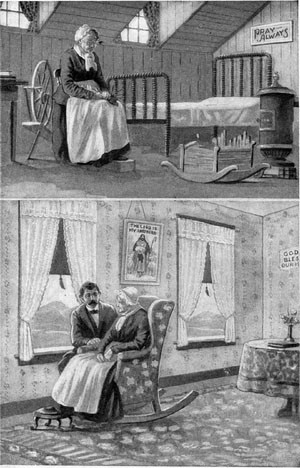
Grandmother’s Room
"Well, the Lord would know better," said she comfortingly, "and by and by others would. It'll be your works, as well as your words, that will tell if you're in earnest."
"That's so, mother, that's so; the minister said that very thing last Sabbath. He's been preaching right at me this two months, and it made me mad at first. I thought I wouldn't give him a cent this year, but I guess he told the truth."
"Yes, of course he did. That's what he's made for. But now, John, you won't give up seeking until you get the blessing, will you? Promise me this and one thing more. Don't let the love of this world, and the deceitfulness of riches, tempt you to give way to Satan for one minute."
"Well, I'll see what I can do, but it looks like a great task before me." And John really felt as though he was preparing for a stern conflict. He went out to his work again, while Grandmother Lyman knelt down on the soft, bright carpet, the sunset light falling around her, and sent a prayer up to the Father's throne so full of thanksgiving and love that the answer was not delayed, but came, bringing peace and joy to her trusting heart.
Pretty soon Phœbe came stealing in with a look of apprehension resting upon her countenance.
"Mother," said she, sinking into the first chair she reached, "I'm afraid John's going to die."
"My child, what do you mean?" queried the old lady, pushing her spectacles to the top of her head.
"Because he's changed so lately. Fixing up this room, you know, and being so gentle like—what can it mean unless he's going to die?"
"Don't worry, Phœbe, John's just getting ready to live. I tell you, daughter, he's experiencing religion."
A flash of joy lighted up Phœbe's worn face as she spoke.
"Do you think so, mother? Oh, if it only could be true!"
A cry from the kitchen called her thither again, but her heart was light, and old hymns sprang unbidden to her lips, all tuned to the upgushing happiness within. The little ones caught the infection, and capered up and down the old kitchen, until wearied out they dropped off to sleep and to bed.
That day saw the beginning of true happiness in the old red farmhouse. Not but that John passed through many fierce struggles, for the world acquires a strong hold in forty-five years, but with God's help he gained the victory; and humble and happy, one week later he called his little family together, and told them of his new hopes and purposes. We can not describe that scene, but surely the angels saw and rejoiced over it. Then once more, before his friends and neighbors in prayer-meeting, with trembling voice he related his experience. Tears and "amens" greeted it, all testifying to the spirit of true brotherly love. Some, to be sure, there were who said, "Can the leopard change his spots?" But when, Sabbath after Sabbath, they saw that the head of the "Lyman pew" neither pretended to be asleep, nor to have forgotten his wallet when the much-abused green contribution bag swung along, but instead deposited therein the freshest scrip, they said, "Truly, this is the Lord's doings, and is marvelous in our eyes."
Perhaps the story of the change at home is about as Tillie whispered it in the ear of a confidential friend. "You see pa asks a blessin' now 'fore we eats; and then we read the Bible; and he prays the Lord to keep us good all the day long; and so we grow gooder and gooder. Pa bought mother a new black silk dress the other day, and Oh, he's so much lovinger than he ever was before!" Yes, he was "lovinger," as Tillie called him, for truly he had passed from death unto life.
The old homestead, too, soon began to change visibly. The shades of ugliness that had so long hung over it vanished away. Its very angles seemed to grow less acute, and never, in its palmiest days, had it rejoiced in such bright coats of paint. But, with all the brightening up without and within, there was one most cozy place of all where the family was wont to assemble each Sabbath evening. "Seem's though it's always full of rainbows," Nick said; but that must have been owing to the blessed influence of her who sat there, for this dearest of all nooks was "grandmother's room."
God has not promised skies ever blue,
Flower-strewn pathways always to you;
God has not promised sun without rain,
Joy without sorrow, peace without pain;
But God has promised strength from above,
Unfailing sympathy, undying love.
The Young Musician
Jonas Johnson was the youngest son of an organ-builder in New England. He was a small, quiet boy, in no way remarkable except in his passion for harmonies. So great was his love for music, that from his most tender years he could not listen unmoved to the singing of his sisters as they went about their homely work; and if the voices happened to be discordant he ran shuddering from the sound. The choir of untutored singers in church services made tears fall from his eyes upon his hymn-book while he joined his small voice with theirs.
Although Jonas let his tears fall unwittingly, the organ-builder saw them and treasured them in his heart. When the boy had reached his eleventh year the family left the country town and came to live in New York. Here the father determined to let his son learn the organ.
"Remember, Jonas," said he, "I am a poor man, and can ill afford to go into this expense unless you do the work before you manfully and patiently. I give you this profession instead of a trade because I believe it to be your wish."
Jonas was entirely satisfied, and his slim fingers quivered in the anticipation of one day being able to move those mysterious white and black keys to the sound and measure of Te Deums and chants. A teacher was selected whose manner of educating was thorough and profound. At the first lesson Jonas became unequivocally assured that the business was a serious one, when after a third time striking G instead of G-sharp, the heavy, quick blow of the master's stick hummed and stung across his hands as they hovered over the organ keys. Poor little fingers! they could work no more that day—they were stiffened and red. He wept so profusely that he was requested to retire and to return in two days.
All the way home he sobbed, and held his hands suspended from the wrists, a most pitiable object. "Ah! you old ruffian!" soliloquized the tearful pupil, "won't my father give it to you for this?"
He found his father in the workshop.
"Well," cried the organ-builder, "how went the lesson?" He saw there had been trouble.
Jonas with fresh tears showed his chafed fingers and told the event. The father listened with darkened brow, and when the sad tale was ended he solemnly led his son into a back room, and after inflicting a thorough corporal punishment, warned him in a terrible voice never again to complain of his master.
Our hero felt for a while that this was almost beyond human endurance, and for several hours he lay upon a pile of shavings plotting vengeance upon those he considered his worst enemies, when a sudden thrill shot through him at the sound of the rich organ tones. They came from his father's wareroom. Evidently a master hand was there. Jonas sat up and listened. It was the portion of a prelude by Sebastian Bach, and the marvelous harmonies seemed to speak to Jonas as the voice of a spirit. He rose upon his feet, and his whole soul trembled with the wonderful words it spoke to him, though as yet he hardly understood their meaning. He went to the door and gently opened it. The back of the high organ stood opposite to him. He did not wish to be observed, and he passed quietly along at the end of the large room until he saw the musician. Could it be the master? Yes, Jonas recognized the long curling beard, and even the baton as it lay upon a chair. Amidst the glowing chords the boy contrived to pass on unnoticed. He remembered that in two days he must again present himself. Could that terrible personage be confronted with an imperfect scale? The very thought was a shudder. Besides, Jonas felt an inspiration now. He again burned to be a musician. The revengeful spirit had left him—he thought only of Sebastian Bach.
A small organ had been placed in the little garret where Jonas slept. Thither he repaired, and commenced the work that ever since he has performed so well.
The dreaded master found no fault with the next lesson, and as Jonas advanced and he perceived that he studied with a zeal, an earnestness quite unusual in a boy, his stern manner relaxed, and he dared allow all the warmth of his heart to cheer his now beloved pupil.
At the end of five months Jonas met with a great misfortune. His master, after a short and sudden illness, died—which so cut him down that the organ-builder feared for his son's health. The boy stoutly refused to work under any other teacher, assuring the family that he felt able now to go on alone. Early morning and late evening found the young musician at his organ in the garret. Those who read this biography will scarcely believe how great was his progress. But I state facts.
Just after he had entered his twelfth year he happened to overhear two men, in a music store, conversing about a church in the upper part of the city, where the organist was to leave in a few weeks. Jonas listened.
"He plays in too operatic a style to suit the congregation," said one.
"Yes," said the other, "the simpler the playing the better they are pleased."
"Where is the church?" asked Jonas.
"It is Saint C——'s, in —— Street."
Jonas returned to his organ, swelling with a new and great idea. The following Sabbath morning he went very early to the church. No person had arrived except the organist who was arranging music in the loft. Jonas stepped up the stairway and came round in front where he could see the selections. The organist turned at the intrusion.
"What do you want here, Sir?" said he.
"I heard there was to be a vacancy, Sir."
"And do you know of one who wishes to occupy it?"
"I should like it."
"You?"
"Yes, I am an organist."
This simple reply brought a smile to the lips of the questioner. He pointed to a page in the service, and said "Play that." And giving up his seat to Jonas, he went to the side to blow the bellows. Feeling nervous and anxious, Jonas began—at first tremulously, but gaining courage with every chord, he successfully accomplished the task, while the organist ran from the bellows to the music, and from the music to the bellows again in surprise. At the conclusion they both drew a long breath.
"Well, that is remarkable!" said the organist. "And you want the vacancy?"
"Very much," replied Jonas, trembling with pleasure.
"Then come here this afternoon, just before church, and I will take you to the minister. He makes all these arrangements."
The boy went home overflowing with great anticipations. He said nothing to his father on the subject. He dared not trust himself yet. Never did hours pass so slowly as those between dinner and church that afternoon. But the good time came and Jonas was true to his appointment, as was the organist, who took him into the vestry-room, and introduced him as an applicant for the vacancy.
Tall, white-haired, and benign the minister stood as Jonas told him his desire.
"Yes, my boy, the present organist will leave in three weeks. Will that give you time to become acquainted with our service?"
"Yes, Sir."
"Then I have only to hear you play before deciding. Will you take the organist's place this afternoon? He will show you the forms."
The proposal was sudden and unexpected, and made Jonas' heart quake; but he felt that all depended on his courage, and he accepted.
He took his seat before the great organ with a brave but serious spirit. The bell ceased tolling; the minister entered; and Jonas pressed his slight fingers upon the first chord of the voluntary, which, extemporaneous as it was, may be considered the corner-stone of his life.
The music that afternoon was simple and pure as the heart from which it flowed. Again Jonas presented himself before the minister, who received him in a most affectionate manner.
"Keep to this simple style," said he, "and we shall never wish to change. How much salary have you fixed upon?"
"Indeed, Sir, I never thought of it. I only wished to play in a church."
The minister sat down at a table, and taking pen and paper, went on: "You shall receive what we have always paid—the sum of one hundred and fifty dollars a year. I will draw the agreement. Come now, and sign your name."
"Your chirography is not equal to your organ-playing," continued the minister, smiling, as he saw the childlike, uneven signature of Jonas Johnson: "but one cannot expect everything of such a little fellow. Here, then, is the contract. Take care of it."
Jonas took leave of his friend and hurried home. When the family of the organ-builder gathered about the hearthstone that evening, the youngest came to the father and drew forth his contract.
"What is this, my son?"
Jonas made no answer, but waited while the spectacles were adjusted on the respective noses of both parents—waited till they had read the agreement, and his father had taken two turns across the floor, and said, "He's going to be a great master, wife. God bless him!" And then he could wait no longer, but ran up to his little garret, and throwing himself upon the cot, gave vent to his welling heart in sobs of joy, and hope, and ambition.
The organ-builder's prophecy came true. The world is now indebted to Jonas for some of its best church music. As a composer and teacher he is "great." Those who are as fortunate as the writer of this sketch in having him as a teacher to their children can truly say they know a "great master" of music.
Jonas' perseverance to become a musician, notwithstanding the severe discipline to which he was subjected, was rewarded by success. And not only was his perseverance commendable in accomplishing a musical education, but in securing a position in which to be useful. And every boy and girl should take this as a lesson, that by their own energy and perseverance may be laid the foundation of their success in life.
Lyman Dean's Testimonials.
I do not believe two more worthy, excellent people could be found than Gideon Randal and his wife. To lift the fallen, and minister to the destitute was their constant habit and delight, so that often they shortened their own comforts for the good of others. Mr. Randal's friends urged him to reduce his charities, as such generous giving might mar his fortune and bring him to want; but his unfailing reply was:—
"I think there's enough left to carry Martha and me through life, and some over. What we give to the poor, we lend to the Lord, and if a dark day comes, He will provide."
A dark day did come, but it was not till after he had reached threescore and ten years. As old age advanced, his little farm had become less productive, and debts accumulated. Being forced to raise money, he had borrowed a thousand dollars of Eugene Harrington, giving him a mortgage on his house for security. The interest was regularly paid, and with this Esquire Harrington was well satisfied; but he died suddenly, and his son, a merciless, grasping man, wrote to Mr. Randal, demanding payment of the mortgage. The old man asked for an extension of the time, but he pressed the demand, and threatened if it was not settled within a given time, to deprive him of his home. Mr. Randal was greatly distressed.
"Martha," he said to his wife, "young Harrington is a hard man. He has me in his power now, and I fear he will not scruple to ruin me. I think I had better go and talk with him, and tell him how little I have. It may be he'll pity two old people, and allow us better terms."
"But husband, you are not used to traveling, and Harrowtown is a hundred miles away, and you are old and feeble, too."
"True, wife, but I can say to him a great deal more than I can write, and besides, Luke Conway lives there. I took an interest in him when he was a poor boy. Perhaps he'll advise and help me, now that I'm in trouble."
At last, seeing he felt that he must go, Martha reluctantly consented, and fitted him out with wifely care.
The next morning was warm and sunny for November, and Mr. Randal started for Harrowtown.
"Gideon," called Mrs. Randal, as he walked slowly down the road, "be sure and take tight hold of the railing when you get in and out of the cars."
"I'll be careful. You take good care of yourself, Martha;" and, with a parting look, the old man hastened on to take the stage, which was to convey him to the railroad station. But misfortune met him at the very outset of his journey. The stage was heavily loaded, and on the way, one of the wheels broke down, which caused such a detention that Mr. Randal missed the morning train, and the next did not come for several hours.
It was afternoon when he finally started. He was anxious and weary from long waiting; and after three stations were passed, he began to ask questions.
"How long before we get to Harrowtown?" he inquired, stopping the busy conductor.
"We get there at half past eight."
Another question was upon Mr. Randal's lips, but the conductor had hurried on. He looked around as if to appeal to some one else, but turned back, talking to himself. "Not get there till into the evening," he said, "and pitch dark, for there's no moon now. I shan't know where to go." The poor old man was sorely troubled.
Presently the conductor came back, and as he passed his seat, he stopped him again.
"Mr. Conductor, how shall I know when to get out? I've never been to Harrowtown, and I don't want to get out at the wrong place."
"Give yourself no concern," was the polite reply. "I'll tell you when we come to Harrowtown. I won't forget you."
Soothed by this assurance, Mr. Randal's mind grew tranquil, and he finally went to sleep.
In the seat behind him sat a tall, handsome boy. His name was Albert Gregory. He was bright and intelligent, but his well-featured face was spoiled by a wicked-looking eye and a hard, cruel mouth.
He saw the aged passenger fall asleep, and nudged his seat-fellow.
"Look there, John. By and by, I'll play a joke on that old country greeny, and you'll see fun."
On rushed the swift express; mile after mile was passed; daylight faded and the lamps were lit in the cars, and still the aged man slept, watched by his purposed tormentor, and the other boy who waited to "see fun."
At length the speed of the train began to slacken, coming near a stopping-place. Albert sprang up and shook Mr. Randal violently.
"Wake up! Wake up!" he called, sharply, putting his mouth close to his ear. "This is Harrowtown. You must get off here."
The old man, thus roughly roused, started from his seat and gazed around him, bewildered. The change from day to night, the unaccustomed waking on a moving train, the glare of the lights, added tenfold to his confusion.
"Wh—what did you say boy?" he asked helplessly.
"This is Harrowtown. The place where you want to stop. You must get off. Be quick or you'll be carried by."
The noise of the brakes, and the distracted attention of the passengers on reaching a new station, possibly ignorance of the real locality on the part of those near enough to have heard him, prevented any correction of the boy's cruel falsehood. Mr. Randal knew it was not the conductor who had aroused him; but, supposing Albert to be some employee of the road, he hurried to the car door with tottering steps. The name of the station was called at the other end, as unlike as possible to the name of "Harrowtown," but his dull ears did not notice it. He got off upon the platform, and before he could recover himself or knew his error, the train was in motion again.
Albert was in ecstasies over the success of his "joke," and shook all over with laughter, in which, of course, his companion joined. "Oh dear! that's too good for anything!" he cried, "aint it, John?"
John assented that it was very funny indeed.
Neither of the boys noticed that the seat lately occupied by poor, deceived Mr. Randal had just been taken by a fine-looking middle-aged man, wrapped in a heavy cloak, who appeared to be absorbed in his own thoughts, but really heard every word they said.
They kept up a brisk conversation, Albert speaking in quite a loud tone, for he was feeling very merry. "Ha, ha, ha!—but I did think the old fool would hear the brakeman call the station, though. I didn't suppose I could get him any further than the door. To think of his clambering clear out on the platform, and getting left! He believed every word I told him. What a delicious old simpleton!"
And having exhausted that edifying subject for the moment, he presently began to brag of his plans and prospects.
"I don't believe you stand much of a chance there; they say Luke Conway is awful particular," the middle-aged stranger heard John remark.
"Pooh! shut up!" cried Albert. "Particular! That's just it, and makes my chance all the better. I've brought the kind of recommendation that a particular man wants, you see."
"But there'll be lots of other fellows trying for the place."
"Don't care if there's fifty," said Albert, "I'd come in ahead of 'em all. I've got testimonials of character and qualifications from Professor Howe, Rev. Joseph Lee, Dr. Henshaw, and Esquire Jenks, the great railroad contractor. His name alone is enough to secure me the situation."
At this juncture, the strange gentleman turned around and gave Albert a quick, searching glance. But the conceited boy was too much occupied with himself to notice the movement, and kept on talking. Now and then the thought of the victim whom he had fooled seemed to come back and tickle him amazingly. "Wonder where the old man is now. Ha, ha! Do you suppose he has found out where Harrowtown is? Oh, but wasn't it rich to see how scared he was when I waked him up? And how he jumped and scrambled out of the car! 'Pon my word, I never saw anything so comical."
Here the stranger turned again and shot another quick glance, this time from indignant eyes, and his lips parted as if about to utter a stern reproof. But he did not speak. Some hidden motive withheld him.
We will now leave Albert and his fellow travelers, and follow good Gideon Randal.
It was quite dark when he stepped from the cars, and he inquired of a man at the station, "Can you tell me where I can find Mr. Aaron Harrington?"
"There's no such man living here, to my knowledge," was the reply.
"What, isn't this Harrowtown?" asked Mr. Randal in great consternation.
"No, it is Whipple Village."
"Then I got out at the wrong station. What shall I do?" in a voice of deep distress.
"Go right to the hotel and stay till the train goes in the morning," said the man, pleasantly.
There was no alternative, Mr. Randal passed a restless night at the hotel, and at an early hour he was again at the station, waiting for the train. His face was pale, and his eye wild and anxious. "The stage broke down, and I missed the first train," thought he, "and then that boy told me to get out here. I've made a bad beginning, and I'm afraid this trip will have a bad ending."
There were other passengers walking to and fro on the platform, waiting for the cars to come.
One was a plain-featured, honest-looking boy, who had been accompanied to the station by his mother. Just before his mother bade him good by, she said, "Lyman, look at that pale, sad, old man. I don't believe he is used to traveling. Perhaps you can help him along."
Soon a loud, prolonged whistle was heard. The cars were coming.
"Allow me to assist you, sir," said Lyman Dean to Mr. Randal, as the train stopped; and he took hold of his arm, and guided him into a car to a seat.
"Thank you, my boy. I'm getting old and clumsy, and a little help from a young hand comes timely. Where are you going, if I may ask?"
"To Harrowtown, sir. I saw an advertisement for a boy in a store, and I'm going to try to get the situation. My name is Lyman Dean."
"Ah? I'm sure I wish you success, Lyman, for I believe you're a good boy. You are going to the same place I am. I want to find Aaron Harrington, but I've had two mishaps. I don't know what's coming next."
"I'll show you right where his office is. I've been in Harrowtown a good many times."
Half an hour later, the brakeman shouted the name of the station where they must stop. Lyman assisted Mr. Randal off the train, and walked with him to the principal street. "Here's Mr Harrington's office," said he.
"Oh, yes, thank you kindly. And now could you tell me where Mr. Luke Conway's place of business is?"
"Why, that's the very gentleman I'm going to see," said Lyman. "His place is just round the corner, only two blocks off."
Fifteen minutes after found Lyman waiting in the counting-room of Luke Conway's store. Albert Gregory had just preceded him. The merchant was writing, and he had requested the boys to be seated a short time, till he was at leisure. Before he finished his work, a slow, feeble step was heard approaching, and an old man stood in the doorway.
"Luke, don't you remember me?" The merchant looked up at the sound of the voice. Then he sprang up from his chair and grasped the old man's hands in both his own. "Mr. Randal! Welcome, a thousand times welcome, my benefactor!" he exclaimed. And seating his guest on the office lounge beside him, Mr. Conway inquired after his health and comfort, and talked with him as a loving son. It was evident to the quick perception of the merchant that the good old man's circumstances had changed, and he soon made it easy for him to unburden his mind.
"Yes, Luke, I am in trouble. Aaron Harrington owns a mortgage on my farm, and I can't pay him, and he threatens to take my home," said Mr. Randal, with a quivering lip. "I went to his office, but didn't find him, and I thought may be you'd advise me what to do."
"Mr. Randal," answered the merchant, laying his hand on the old man's shoulder, "almost thirty years ago when I was cold, and hungry, and friendless, you took me in and fed me. Your good wife—God bless her!—made me a suit of clothes with her own hands. You found me work, and you gave me money when I begun the world alone. Much if not all that I am in life I owe to your sympathy and help, my kind old friend. Now I am rich, and you must let me cancel my debt. I shall pay your mortgage to-day. You shall have your home free again."
Mr. Randal wiped great hot tears from his cheeks, and said in a husky voice, "It is just as I told Martha. I knew if we lent our money to the Lord, when a dark day came, he would provide."
The reader can imagine the different feelings of the two boys, as they sat witnesses of the scene. The look of derision, that changed to an expression of sickly dismay, on Albert's face, when the old man came in and was so warmly greeted by the merchant, was curiously suggestive. But his usual assurance soon returned. He thought it unlikely that Mr. Randal would recognize him in the daylight, and he determined to put on a bold front.
For a minute the two men continued in conversation. Mr. Conway called up pleasant reminiscences of "Aunt Martha," his boy-life on the farm, and the peace and stillness of the country town. He thought a railway ride of a hundred miles must be a hardship for a quiet old man. "It was a long way for you," he said, "Did you have a comfortable journey?"
"Well, I can't quite say that. First, the stage broke down and delayed me. Then I slept in the cars, and a boy played a trick on me, and waked me up, and made me get out at the wrong station, so I had to stay over night in Whipple Village. To tell the truth I had a good deal of worriment with one thing and another, getting here; but it's all bright now," he added with a radiant face.
"You shall go with me to my house and rest, as soon as I have dismissed these boys," said Mr. Conway, earnestly; and turning to Albert and Lyman, who anxiously waited, he spoke to them about their errand.
"I suppose you came because you saw my advertisement?"
"Yes, sir," replied both, simultaneously.
"Very well. I believe you came in first. What is your name?"
"I am Albert Gregory, sir. I think I can suit you. I've brought testimonials of ability and character from some of the first men—Esquire Jenkins, Rev. Joseph Lee, Dr. Henshaw, and others. Here are my letters of recommendation," holding them out for Mr. Conway to take.
"I don't want to see them," returned the merchant, coldly. "I have seen you before, I understand your character well enough for the present."
He then addressed a few words to Lyman Dean.
"I should be very glad of work," said Lyman. "My mother is poor, and I want to earn my living, but I hav'n't any testimonials."
"Yes, you have," said old Mr. Randal, who was waiting for an opportunity to say that very thing. And then he told the merchant how polite and helpful Lyman had been to him.
Mr. Conway fixed his eyes severely upon the other boy. The contrast between him and young Dean was certainly worth a lesson.
"Albert Gregory," said the merchant, "I occupied the seat in the car in front of you last evening. I heard you exulting and wickedly boasting how you had deceived a distressed old man. Mr. Randal, is this the boy who lied to you, and caused you to get out at the wrong station?"
Mr. Randal looked earnestly at Albert. "I declare! Now I remember him. It is! I'm sure it is."
It was useless for Albert to attempt any vindication of himself. His stammered excuses stuck in his throat, and he was glad to hide his mortification by an early escape. Crestfallen, he slunk away, taking all his "testimonials" with him.
"Lyman," said Mr. Conway, kindly, "I shall be very glad to employ you in my store. You shall have good pay if you do well, and I am sure you will. You may begin work at once."
Lyman's eyes danced with joy as he left the counting-room to receive his instructions from the head clerk.
Mr. Conway paid to Mr. Harrington the money owed him by Mr. Randal, and a heavy load was lifted from the good old farmer's heart. He remained a visitor two or three days in Mr. Conway's house, where he was treated with the utmost deference and attention. Mr. Conway also purchased for him a suit of warm clothes, and an overcoat, and sent his confidential clerk with him on his return journey to see him safely home. Nor was good Mrs. Randal forgotten. She received a handsome present in money from Mr. Conway, and a message full of grateful affection. Nothing ever after occurred to disturb the lives of the aged and worthy pair.
Albert Gregory obtained an excellent situation in New York, but his false character, and his wanton disregard of others' feelings and rights, made him as hateful to his employers as to all his associates, and he soon found it desirable to seek another place.
He has changed places many times since, and his career has been an unhappy one—another example of the penalty of frivolous habits and a heartless nature.
Lyman Dean is now a successful merchant, a partner of Mr. Conway, and occupies a high position in society, as an honorable, enterprising man.
What is it that gives to the plainest face
The charm of the noblest beauty?Not the thought of the duty of happiness,
But the happiness of duty.
Unforgotten Words
"Have you examined that bill, James?"
"Yes, sir."
"Anything wrong?"
"I find two errors."
"Ah, let me see."
The lad handed his employer a long bill that had been placed on his desk for examination.
"Here is an error in the calculation of ten dollars, which they have made against themselves; and another of ten dollars in the footing."
"Also against themselves?"
"Yes, sir."
The merchant smiled in a way that struck the lad as peculiar.
"Twenty dollars against themselves," he remarked in a kind of pleasant surprise. "Trusty clerks they must have!"
"Shall I correct the figures?" asked the lad.
"No, let them correct their own mistakes. We don't examine bills for other people's benefit," replied the merchant. "It will be time to rectify those errors when they find them out. All so much gain as it now stands."
The boy's delicate moral sense was shocked at so unexpected a remark. He was the son of a poor widow, who had given him to understand that to be just was the duty of man.
Mr. Carman, the merchant in whose employment he had been for only a few months, was an old friend of his father, and a person in whom he reposed the highest confidence. In fact, James had always looked upon him as a kind of model man; and when Mr. Carman agreed to take him into his store, he felt that great good fortune was in his way.
"Let them correct their own mistakes." These words made a strong impression on the mind of James Lewis. When first spoken by Mr. Carman, and with the meaning then involved, he felt, as we have said, shocked; but as he turned them over again in his thoughts, and connected their utterance with a person who stood so high in his mother's estimation, he began to think that perhaps the thing was fair enough in business. Mr. Carman was hardly the man to do wrong. A few days after James had examined the bill, a clerk from the house by which it had been rendered, called for settlement. The lad, who was present, waited with interest to see whether Mr. Carman would speak of the error. But he made no remark. A check for the amount of the bill rendered, was filled up, and a receipt taken.
"Is that right?" James asked himself this question. His moral sense said no; but the fact that Mr. Carman had so acted, bewildered his mind.
"It may be the way in business"—so he thought to himself—"but it don't look honest. I wouldn't have believed it of him."
Mr. Carman had a kind of way with him that won the boy's heart, and naturally tended to make him judge of whatever he might do in a most favorable manner.
"I wish he had corrected that error," he said to himself a great many times when thinking in a pleased way of Mr. Carman, and his own good fortune in having been received into his employment. "It don't look right, but it may be in the way of business."
One day he went to the bank and drew the money for a check. In counting it over he found that the teller had paid him fifty dollars too much, so he went back to the counter and told him of his mistake. The teller thanked him, and he returned to the store with the consciousness in his mind of having done right.
"The teller overpaid me by fifty dollars," he said to Mr. Carman, as he handed him the money.
"Indeed," replied the latter, a light breaking over his countenance; and he hastily counted the bank bills.
The light faded as the last bill left his fingers.
"There's no mistake, James." A tone of disappointment was in his voice.
"Oh, I gave him back the fifty dollars. Wasn't that right?"
"You simpleton!" exclaimed Mr. Carman. "Don't you know that bank mistakes are never corrected? If the teller had paid you fifty dollars short he would not have made it right."
The warm blood mantled the cheek of James under this reproof. It is often the case that more shame is felt for a blunder than a crime. In this instance the lad felt a sort of mortification at having done what Mr. Carman was pleased to call a silly thing, and he made up his mind that if they should ever overpay him a thousand dollars at the bank, he should bring the amount to his employer, and let him do as he pleased with the money.
"Let people look after their own mistakes," said Mr. Carman.
James Lewis pondered these things in his heart. The impression they made was too strong ever to be forgotten. "It may be right," he said, but he did not feel altogether satisfied.
A month or two after the occurrence of that bad mistake, as James counted over his weekly wages, just received from Mr. Carman, he discovered that he was paid half a dollar too much.
The first impulse of his mind was to return the half-dollar to his employer, and it was on his lips to say, "You have given me half a dollar too much, sir," when the unforgotten words, "Let people look after their own mistakes," flashing upon his thoughts, made him hesitate. To hold a parley with evil is to be overcome.
"I must think about this," said James, as he put the money in his pocket. "If it is true in one case, it is true in another. Mr. Carman don't correct mistakes that people make in his favor, and he can't complain when the rule works against him."
But the boy was very far from being in a comfortable state. He felt that to keep half a dollar would be a dishonest act. Still he could not make up his mind to return it, at least not then.
James did not return the half-dollar, but spent it to his own gratification. After he had done this it came suddenly into his head that Mr. Carman had only been trying him, and he was filled with anxiety and alarm.
Not long after Mr. Carman repeated the same mistake. James kept the half-dollar with less hesitation.
"Let him correct his own mistakes," said he resolutely; "that's the doctrine he acts on with other people, and he can't complain if he gets paid in the same coin he puts in circulation. I just wanted half a dollar."
From this time the fine moral sense of James Lewis was blunted. He had taken an evil counselor into his heart, stimulated a spirit of covetousness—latent in almost every mind—which caused him to desire the possession of things beyond his ability to obtain.
James had good business qualifications, and so pleased Mr. Carman by his intelligence, industry, and tact with customers, that he advanced him rapidly, and gave him, before he was eighteen years of age, the most reliable position in the store. But James had learned something more from his employer than how to do business well. He had learned to be dishonest. He had never forgotten the first lesson he had received in this bad science; he had acted upon it, not only in two instances, but in a hundred, and almost always to the injury of Mr. Carman. He had long since given up waiting for mistakes to be made in his favor, but originated them in the varied and complicated transactions of a large business in which he was trusted implicitly.
James grew sharp, cunning, and skilful; always on the alert; always bright, and ready to meet any approaches towards a discovery of his wrong-doing by his employer, who held him in the highest regard.
Thus it went on until James Lewis was in his twentieth year, when the merchant had his suspicions aroused by a letter that spoke of the young man as not keeping the most respectable company, and as spending money too freely for a clerk on a moderate salary.
Before this time James had removed his mother into a pleasant house, for which he paid a rent of four hundred dollars; his salary was eight hundred, but he deceived his mother by telling her it was fifteen hundred. Every comfort that she needed was fully supplied, and she was beginning to feel that, after a long and painful struggle with the world, her happier days had come.
James was at his desk when the letter was received by Mr. Carman. He looked at his employer and saw him change countenance suddenly. He read it over twice, and James saw that the contents produced disturbance. Mr. Carman glanced towards the desk, and their eyes met; it was only for a moment, but the look that James received made his heart stop beating.
There was something about the movements of Mr. Carman for the rest of the day that troubled the young man. It was plain to him that suspicion had been aroused by that letter. Oh, how bitterly now did he repent, in dread of discovery and punishment, the evil of which he had been guilty! Exposure would disgrace and ruin him, and bow the head of his widowed mother even to the grave.
"You are not well this evening," said Mrs. Lewis, as she looked at her son's changed face across the table, and noticed that he did not eat.
"My head aches."
"Perhaps a rest will make you feel better."
"I'll lie down on the sofa in the parlor for a short time."
Mrs. Lewis followed him into the parlor in a little while, and, sitting down on the sofa on which he was lying, placed her hand upon his head. Ah, it would take more than the loving pressure of a mother's hand to ease the pain from which he was suffering. The touch of that pure hand increased the pain to agony.
"Do you feel better?" asked Mrs. Lewis. She had remained some time with her hand on his forehead.
"Not much," he replied, and rising as he spoke, he added, "I think a walk in the open air will do me good."
"Don't go out, James," said Mrs. Lewis, a troubled feeling coming into her heart.
"I'll walk only a few squares." And James went from the parlor and passed into the street.
"There is something more than headache the matter with him," thought Mrs. Lewis.
For half an hour James walked without any purpose in his mind beyond the escape from the presence of his mother. At last his walk brought him near Mr. Carman's store, and at passing he was surprised at seeing a light within.
"What can this mean?" he asked himself, a new fear creeping, with its shuddering impulse, into his heart.
He listened by the door and windows, but he could hear no sound within.
"There's something wrong," he said, "what can it be? If this is discovered what will be the end of it? Ruin! ruin! My poor mother!"
The wretched young man hastened on, walked the streets for two hours, when he returned home. His mother met him when he entered, and with unconcealed anxiety, asked him if he were better. He said yes, but in a manner that only increased the trouble she felt, and passed up hastily to his own room.
In the morning the strangely altered face of James, as he met his mother at the breakfast table, struck alarm into her heart. He was silent, and evaded all her questions. While they sat at the table the door-bell rang loudly. The sound startled James, and he turned his head to listen, in a nervous way.
"Who is it?" asked Mrs. Lewis.
"A gentleman who wishes to see Mr. James," replied the girl.
James rose instantly and went out into the hall, shutting the dining-room door as he did so. Mrs. Lewis sat waiting her son's return. She heard him coming back in a few moments; but he did not enter the dining-room. Then he returned along the hall to the street door and she heard it shut. All was silent. Starting up, she ran into the passage, but James was not there. He had gone away with the person who called.
Ah, that was a sad going away. Mr. Carman had spent half the night in examining the accounts of James, and discovered frauds of over six thousand dollars. Blindly indignant, he sent an officer to arrest him early in the morning; and it was with this officer that he went away from his mother, never to return.
"The young villain shall lie in the bed he has made for himself!" exclaimed Mr. Carman, in his bitter indignation. And he made the exposure completely. At the trial he showed an eager desire to have him convicted, and presented such an array of evidence that the jury could not give any other verdict than guilty.
The poor mother was in court, and audibly in the silence that followed came her convulsed sobs upon the air. The presiding judge addressed the culprit, and asked if he had anything to say why the sentence should not be pronounced against him. All eyes were turned upon the pale, agitated young man, who rose with an effort, and leaned against the railing by which he stood, as if needing the support.
"Will it please your honors," he said, "to direct my prosecutor to come a little nearer, so that I can look at him and your honors at the same time?"
Mr. Carman was directed to come forward to where the boy stood. James looked at him steadily for a few moments, and turned to the judges.
"What I have to say to your honors is this [he spoke calmly and distinctly], and it may in a degree extenuate, though it cannot excuse, my crime. I went into that man's store an innocent boy, and if he had been an honest man I would not have stood before you to-day as a criminal!"
Mr. Carman appealed to the court for protection against an allegation of such an outrageous character; but he was peremptorily ordered to be silent. James went on in a firm voice,—
"Only a few weeks after I went into his employment I examined a bill by his direction, and discovered an error of twenty dollars."
The face of Mr. Carman crimsoned.
"You remember it, I see," remarked James, "and I shall have cause to remember it as long as I live. The error was in favor of Mr. Carman. I asked if I should correct the figures, and he answered 'No; let them correct their own mistakes. We don't examine bills for other people's benefit.' It was my first lesson in dishonesty. I saw the bill settled, and Mr. Carman take twenty dollars that was not his own. I felt shocked at first; it seemed such a wrong thing. But soon after he called me a simpleton for handing back a fifty-dollar bill to the teller of a bank, which he had overpaid me on a check, and then—"
"May I ask the protection of the court," said Mr. Carman.
"Is it true what the lad says?" asked the presiding judge.
Mr. Carman hesitated and looked confused. All eyes were on his face; and judges and jury, lawyers and spectators, felt certain that he was guilty of leading the unhappy young man astray.
"Not long afterward," resumed Lewis, "in receiving my wages I found that Mr. Carman had paid me fifty cents too much. I was about to give it back to him, when I remembered his remark about letting people correct their own mistakes, and said to myself, 'Let him correct his own errors,' and dishonestly kept the money. Again the same thing happened, and I kept the money that did not of right belong to me. This was the beginning of evil, and here I am. If he had shown any mercy, I might have kept silent and made no defense."
The young man covered his face with his hands, and sat down overpowered with his feelings. His mother who was near him sobbed aloud, and bending over, laid her hands on his head, saying:—
"My poor boy! my poor boy!"
There were few eyes in the court-room undimmed. In the silence that followed Mr. Carman spoke out:—
"Is my character to be thus blasted on the word of a criminal, your honors? Is this right?"
"Your solemn oath that this charge is untrue," said the judge, "will place you in the right." It was the unhappy boy's only opportunity, and the court felt bound in humanity to hear him.
James Lewis stood up again instantly, and turned his white face and dark, piercing eyes upon Mr. Carman.
"Let him take his oath if he dare!" he exclaimed.
Mr. Carman consulted with his counsel, and withdrew.
After a brief conference with his associates, the presiding judge said, addressing the criminal:—
"In consideration of your youth, and the temptation to which in tender years you were unhappily subject, the court gives you the slightest sentence, one year's imprisonment. But let me solemnly warn you against any further steps in the way you have taken. Crime can have no valid excuse. It is evil in the sight of God and man, and leads only to suffering. When you come forth again after your brief incarceration, may it be with the resolution to die rather than commit crime!"
And the curtain fell on that sad scene in the boy's life. When it was lifted again, and he came forth from prison a year afterwards, his mother was dead. From the day her pale face faded from his vision as he passed from the court-room, he never looked upon her again.
Ten years afterward a man was reading a newspaper in a far western town. He had a calm, serious face, and looked like one who had known suffering and trial.
"Brought to justice at last!" he said to himself, as the blood came to his face; "convicted on the charge of open insolvency, and sent to State prison. So much for the man who gave me in tender years the first lessons in ill-doing. But, thank God! the other lessons have been remembered. 'When you come forth again,' said the judge, 'may it be with the resolution to die rather than commit a crime!' and I have kept this injunction in my heart when there seemed no way of escape except through crime; and God helping me, I will keep it to the end."
YOUR CALL.
The world is dark, but you are called to brighten
Some little corner, some secluded glen;Somewhere a burden rests that you may lighten,
And thus reflect the Master's love for men.Is there a brother drifting on life's ocean,
Who might be saved if you but speak a word?Speak it to-day. The testing of devotion
Is our response when duty's call is heard.Herrings for Nothing.
The darkness was coming on rapidly, as a man with a basket on his head turned the corner of a street in London. He cried loudly as he went, "Herrings! three a penny, red herrings, good and cheap, at three a penny!"
Soon he came close to me and commenced conversation.
"Governor, why can't I sell these herrings? I have walked two miles along this dismal place, offering them; and nobody will buy."
"The people have no work at all to do, and they are starving; there are plenty of houses round here that have not had a penny in them for many a day," was my reply.
"Ah! then, governor," he rejoined, "if they haven't the half-pence, they can't spend 'em, sure enough; so there's nothing for me but to carry 'em elsewhere."
"How much will you take for the lot?" I inquired.
"I'll be glad to get four shillin'."
I put my hand in my pocket, produced that amount and transferred it to him.
"Right! governor, thank'ee! what'll I do with 'em?" he said, as he quickly transferred the coins to his own pocket.
"Go round this corner into the middle of the street, shout with all your might,—
'HERRINGS FOR NOTHING!'
and give three to every man, woman, and child, that comes to you, till the basket is emptied."
So he proceeded into the middle of the street, and went along shouting, "Herrings for nothing! good red herrings for nothing!"
I stood at the corner to watch his progress; and soon he neared the house where a tall woman stood at the first floor window looking out upon him.
"Here you are missus," he cried, "herrings for nothing! come an' take 'em."
The woman shook her head unbelievingly, and left the window.
"Vot a fool!" said he; "but they won't all be so. Herrings for nothing!" A little child came out to look at him, and he called to her, "Here, my dear, take these in to your mother, and tell her how cheap they are—herrings for nothing." But the child was afraid of him and them, and ran in-doors. So, down the street, in the snow, slush, and mud, went the cheap fish, the vender crying loudly as he went, "Herrings for nothing!" and then adding savagely, "Oh, you fools." Thus he reached the end of the street; and then turning to retrace his steps, he continued his double cry as he came.
"Well," I said to him calmly, as he reached me at the corner.
"Well!" he repeated, "if yer think so! When yer gave me the money for herrings as yer didn't want, I thought you was training for a lunatic 'sylum! Now I thinks all the people round here are fit company for yer. But what'll I do with the herrings if yer don't want 'em, and they won't have 'em?"
"We'll try again together," I replied; "I will go with you and we'll both shout."
Into the road we both went, and he shouted once more, "Herrings for nothing!"
Then I called out loudly also, "Will any one have some herrings for tea?"
They heard my voice, and they knew it well; and they came out at once, in twos and threes and sixes, men and women and children, all striving to reach the welcome food. As fast as I could take them from the basket, I handed three to each eager applicant, until all were speedily disposed of. When the basket was empty, the hungry crowd that had none was far greater than that which had been supplied; but they were too late, there were no more "herrings for nothing!"
Foremost among the disappointed was a tall woman of a bitter tongue, who began vehemently, "Why haven't I got any? aint I as good as they? aint my children as hungry as theirs?"
Before I had time to reply, the vender stretched out his arm toward her, saying, "Why, governor, that's the very woman as I offered 'em to first, and she turned up her nose at 'em."
"I didn't," she rejoined passionately, "I didn't believe you meant it!"
"Yer goes without for yer unbelief!" he replied. "Good-night, and thank'ee, governor!"
I told this story upon the sea-beach, to a great crowd gathered there on a summer Sabbath day. They looked at each other; first smiled, then laughed outright, and at length shouted with laughter.
It was my time then; and I said, "You cannot help laughing at the quaint story, which is strictly true. But are you sure you would not have done as they did, and been as unbelieving as they? Their unbelief cost them only a hungry stomach a little longer; but what may your unbelief cost you? God has sent his messengers to you for many years to offer
PARDON FOR NOTHING!
peace for nothing! salvation for nothing! He has sent to you the most loving and tender offers that even an almighty God could frame; and what have you replied? Have you taken the trouble to reply at all? Have you not turned away in utter scornful unbelief, like the woman? or ran away in fear, like the child? You are still without a hope on earth, or a hope in heaven, because you will not believe God's messengers when they offer you all that you need for time and eternity—FOR NOTHING.
"Take warning by that disappointed crowd of hungry applicants. When they were convinced that the offer was in good faith, and would gladly have shared with their fellows, they were too late!
"Let it not be so with you! Do not be in that awfully large crowd of disappointed ones, who will be obliged to believe when belief will not help them; whose knowledge, when it comes, will only increase the sorrow that they put off believing until it was too late."
As I looked earnestly upon that vast crowd, the laughter was entirely gone, and an air of uneasy conviction was plainly traceable upon many faces.
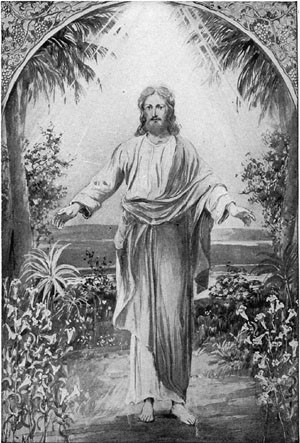
Come Unto Me.
"Will you not come to Jesus now?" I entreated. "He is waiting, pleading with you! Here is salvation, full, free, and eternal; help, guidance, and blessing,—all for nothing! without money and without price."
DID YOU EVER THINK?
Did you ever think what this world would be
If Christ hadn't come to save it?His hands and feet were nailed to the tree,
And his precious life—he gave it.But countless hearts would break with grief,
At the hopeless life they were given,If God had not sent the world relief,
If Jesus had stayed in heaven.Did you ever think what this world would be
With never a life hereafter?Despair in the faces of all we'd see,
And sobbing instead of laughter.In vain is beauty, and flowers' bloom,
To remove the heart's dejection,Since all would drift to a yawning tomb,
With never a resurrection.Did you ever think what this world would be.
How weary of all endeavor,If the dead unnumbered, in land and sea,
Would just sleep on forever?Only a pall over hill and plain!
And the brightest hours are dreary,Where the heart is sad, and hopes are vain,
And life is sad and weary.Did you ever think what this world would be
If Christ had stayed in heaven,—No home in bliss, no soul set free,
No life, or sins forgiven?But he came with a heart of tenderest love,
And now from on high he sees us,And mercy comes from the throne on high;
Thank God for the gift of Jesus!
Bread Upon The Waters
"Ah! Jacob, now you see how all your hopes are gone. Here we are worn out with age—all our children removed from us by the hand of death, and ere long we must be the inmates of the poorhouse. Where now is all the bread you have cast upon the waters?"
The old, white-haired man looked up at his wife. He was, indeed, bent down with years, and age sat tremblingly upon him. Jacob Manfred had been a comparatively wealthy man, and while fortune had smiled upon him he had ever been among the first to lend a listening ear and a helping hand to the call of distress. But now misfortune was his. Of his four boys not one was left. Sickness and failing strength found him with but little, and had left him penniless. An oppressive embargo upon the shipping business had been the first weight upon his head, and other misfortunes came in painful succession. Jacob and his wife were all alone, and gaunt poverty looked them coldly in the face.
"Don't repine, Susan," said the old man. "True we are poor, but we are not yet forsaken."
"Not forsaken, Jacob? Who is there to help us now?"
Jacob Manfred raised his trembling finger toward heaven.
"Ah! Jacob, I know God is our friend, but we should have friends here. Look back and see how many you have befriended in days long past. You cast your bread upon the waters with a free hand, but it has not returned to you."
"Hush, Susan, you forget what you say. To be sure I may have hoped that some kind hand of earth would lift me from the cold depths of utter want; but I do not expect it as a reward for anything I may have done. If I have helped the unfortunate in days gone by, I have had my full reward in knowing that I have done my duty to my fellows. Oh! of all the kind deeds I have done to my suffering fellows, I would not for gold have one of them blotted from my memory. Ah! my fond wife, 'tis the memory of the good done in life that makes old age happy. Even now, I can hear again the warm thanks of those whom I have befriended, and again I can see their smiles."
"Yes, Jacob," returned the wife, in a lower tone, "I know you have been good, and in your memory you can be happy; but, alas! there is a present upon which we must look—there is a reality upon which we must dwell. We must beg for food or starve!"
The old man started, and a deep mark of pain was drawn across his features.
"Beg!" he replied, with a quick shudder. "No, Susan, we are—"
He hesitated, and a big tear rolled down his furrowed cheek.
"We are what, Jacob?"
"We are going to the poorhouse!"
"O God! I thought so!" fell from the poor wife's lips, as she covered her face with her hands. "I have thought so, and I have tried to school myself to the thought; but my poor heart will not bear it!"
"Do not give up," softly urged the old man, laying his hand upon her arm. "It makes but little difference to us now. We have not long to remain on earth, and let us not wear out our last days in useless repinings. Come, come."
"But when—when—shall we go?"
"Now—to-day."
"Then God have mercy on us!"
"He will," murmured Jacob.
That old couple sat for a while in silence. When they were aroused from their painful thoughts it was by the stopping of a wagon in front of the door. A man entered the room where they sat. He was the keeper of the poorhouse.
"Come, Mr. Manfred," he said, "the selectmen have managed to crowd you into the poorhouse. The wagon is at the door, and you can get ready as soon as possible."
Jacob Manfred had not calculated the strength he should need for this ordeal. There was a coldness in the very tone and manner of the man who had come for him that went like an ice-bolt to his heart, and with a deep groan he sank back in his seat.
"Come, be in a hurry," impatiently urged the keeper.
At that moment a heavy covered carriage drove up to the door.
"Is this the house of Jacob Manfred?"
This question was asked by a man who entered from the carriage. He was a kind-looking man, about forty years of age.
"That is my name," said Jacob.
"Then they told me truly," uttered the new-comer. "Are you from the almshouse?" he continued, turning toward the keeper.
"Yes."
"Then you may return. Jacob Manfred goes to no poorhouse while I live."
The keeper gazed inquisitively into the face of the stranger, and left the house.
"Don't you remember me?" exclaimed the new-comer, grasping the old man by the hand.
"I can not call you to my memory now."
"Do you remember Lucius Williams?"
"Williams?" repeated Jacob, starting up and gazing earnestly into the stranger's face. "Yes, Jacob Manfred—Lucius Williams, that little boy whom, thirty years ago, you saved from the house of correction; that poor boy whom you kindly took from the bonds of the law, and placed on board your own vessels."
"And are you—"
"Yes—yes, I am the man you made. You found me a rough stone from the hand of poverty and bad example. It was you who brushed off the evil, and who first led me to the sweet waters of moral life and happiness. I have profited by the lesson you gave me in early youth, and the warm spark which your kindness lighted up in my bosom has grown brighter and brighter ever since. With an affluence for life I have settled down to enjoy the remainder of my days in peace and quietness. I heard of your losses and bereavements. Come, I have a home and a heart, and your presence will make them both warmer, brighter, and happier. Come, my more than father—and you my mother, come. You made my youth all bright, and I will not see your old age doomed to darkness."
Jacob Manfred tottered forward and sank upon the bosom of his preserver. He could not speak his thanks, for they were too heavy for words. When he looked up again he sought his wife.
"Susan," he said, in a choking, trembling tone, "my bread has come back to me!"
"Forgive me, Jacob."
"No, no, Susan. It is not I who must forgive—God holds us in his hand."
"Ah!" murmured the wife, as she raised her streaming eyes to heaven, "I will never doubt him again."
All my griefs by Him are ordered
Needful is each one for me,Every tear by Him is counted,
One too much there cannot be;And if when they fall so thickly,
I can own His way is right,Then each bitter tear of anguish
Precious is in Jesus' sight.Far too well my Saviour loved me
To allow my life to beOne long, calm, unbroken summer,
One unruffled, stormless sea;He would have me fondly nestling
Closer to His loving breast,He would have that world seem brighter
Where alone is perfect rest.Though His wise and loving purpose,
Once I could not clearly see,I believe with faith unshaken,
All will work for good to me;Therefore when my way is gloomy,
And my eyes with tears are dim,I will go to God, my Father,
And will tell my griefs to Him.THE FATHER IS NEAR.
A wee little child in its dreaming one night
Was startled by some awful ogre of fright,
And called for its father, who quickly arose
And hastened to quiet the little one's woes.
"Dear child, what's the matter?" he lovingly said,
And smoothed back the curls from the fair little head;
"Don't cry any more, there is nothing to fear,
Don't cry any more, for your papa is here."
Ah, well! and how often we cry in the dark,
Though God in His love is so near to us! Hark!
How His loving words, solacing, float to the ear,
Saying, "Lo! I am with you: 'tis I, do not fear."
God is here in the world as thy Father and mine,
Ever watching and ready with love-words divine.
And while erring oft, through the darkness I hear
In my soul the sweet message: "Thy Father is near."
A Rift in the Cloud.
Andrew Lee came home at evening from the shop where he had worked all day, tired and out of spirits; came home to his wife, who was also tired, and dispirited.
"A smiling wife, and a cheerful home—what a paradise it would be!" said Andrew to himself as he turned his eyes from the clouded face of Mrs. Lee, and sat down with knitted brow, and a moody aspect.
Not a word was spoken by either. Mrs. Lee was getting supper, and she moved about with a weary step.
"Come," she said at last, with a side glance at her husband.
There was invitation in the word only, none in the voice of Mrs. Lee.
Andrew arose and went to the table. He was tempted to speak an angry word, but controlled himself, and kept silence. He could find no fault with the chop, nor the sweet home-made bread, and fresh butter. They would have cheered the inward man if there had only been a gleam of sunshine on the face of his wife. He noticed that she did not eat. "Are you not well Mary?" The words were on his lips, but he did not utter them, for the face of his wife looked so repellent, that he feared an irritating reply. And so in moody silence, the twain sat together until Andrew had finished his supper. As he pushed his chair back, his wife arose, and commenced clearing off the table.
"This is purgatory!" said Lee to himself, as he commenced walking the floor of their little breakfast-room, with his hands clasped behind him, and his chin almost touching his breast.
After removing all the dishes and taking them into the kitchen, Mrs. Lee spread a green cover on the table, and placing a fresh trimmed lamp thereon, went out and shut the door, leaving her husband alone with his unpleasant feelings. He took a long, deep breath as she did so, paused in his walk, stood still for some moments, and then drawing a paper from his pocket, sat down by the table, opened the sheet and commenced reading. Singularly enough the words upon which his eyes rested were, "Praise your wife." They rather tended to increase the disturbance of mind from which he was suffering.
"I should like to find some occasion for praising mine." How quickly his thoughts expressed the ill-natured sentiment. But his eyes were on the page before him, and he read on.
"Praise your wife, man, for pity's sake, give her a little encouragement; it wont hurt her."
Andrew Lee raised his eyes from the paper and muttered, "Oh, yes. That's all very well. Praise is cheap enough. But praise her for what? For being sullen, and making your home the most disagreeable place in the world?" His eyes fell again to the paper.
"She has made your home comfortable, your hearth bright and shining, your food agreeable; for pity's sake, tell her you thank her, if nothing more. She don't expect it; it will make her eyes open wider than they have for ten years; but it will do her good for all that, and you, too."
It seemed to Andrew as if these sentences were written just for him, and just for the occasion. It was the complete answer to his question, "Praise her for what?" and he felt it also as a rebuke. He read no farther, for thought came too busy, and in a new direction. Memory was convicting him of injustice toward his wife. She had always made his home as comfortable as hands could make it, and had he offered the light return of praise or commendation? Had he ever told her of the satisfaction he had known, or the comfort experienced? He was not able to recall the time or the occasion. As he thought thus, Mrs. Lee came in from the kitchen, and taking her work-basket from the closet, placed it on the table, and sitting down without speaking, began to sew. Mr. Lee glanced almost stealthily at the work in her hands, and saw it was the bosom of a shirt, which she was stitching neatly. He knew it was for him that she was at work.
"Praise your wife." The words were before the eyes of his mind, and he could not look away from them. But he was not ready for this yet. He still felt moody and unforgiving. The expression on his wife's face he interpreted to mean ill-nature, and with ill-nature he had no patience. His eyes fell on the newspaper that spread out before him, and he read the sentence:—
"A kind cheerful word, spoken in a gloomy home, is like the rift in the cloud that lets the sunshine through."
Lee struggled with himself a while longer. His own ill-nature had to be conquered first; his moody, accusing spirit had to be subdued. But he was coming right, and at last got right, as to will. Next came the question as to how he should begin. He thought of many things to say, yet feared to say them, lest his wife should meet his advances with a cold rebuff. At last, leaning towards her, and taking hold of the linen bosom upon which she was at work, he said, in a voice carefully modulated with kindness:—
"You are doing the work very beautifully, Mary."
Mrs. Lee made no reply. But her husband did not fail to observe that she lost, almost instantly, that rigid erectness with which she had been sitting, nor that the motion of her needle had ceased. "My shirts are better made, and whiter than those of any other man in our shop," said Lee, encouraged to go on.
"Are they?" Mrs. Lee's voice was low, and had in it a slight huskiness. She did not turn her face, but her husband saw that she leaned a little toward him. He had broken through the ice of reserve, and all was easy now. His hand was among the clouds, and a few feeble rays were already struggling through the rift it had made.
"Yes, Mary," he answered softly, "and I've heard it said more than once, what a good wife Andrew Lee must have."
Mrs. Lee turned her face towards her husband. There was light it it, and light in her eye. But there was something in the expression of the countenance that puzzled him a little.
"Do you think so?" she asked quite soberly.
"What a question!" ejaculated Andrew Lee, starting up and going around to the side of the table where his wife was sitting.—"What a question, Mary!" he repeated, as he stood before her.
"Do you?" It was all she said.
"Yes, darling," was the warmly-spoken answer, and he stooped down and kissed her.—"How strange that you should ask me such a question!"
"If you would only tell me so now and then, Andrew, it would do me good." And Mrs. Lee arose, and leaning against the manly breast of her husband, stood and wept.
What a strong light broke in upon the mind of Andrew Lee. He had never given to his faithful wife even the small reward of praise for all the loving interest she had manifested daily, until doubt of his love had entered her soul, and made the light thick darkness. No wonder that her face grew clouded, nor that what he considered moodiness and ill-nature took possession of her spirit.
"You are good and true, Mary. My own dear wife. I am proud of you—I love you—and my first desire is for your happiness. Oh, if I could always see your face in sunshine, my home would be the dearest place on earth."
"How precious to me are your words of love and praise, Andrew," said Mrs. Lee, smiling up through her tears into his face. "With them in my ears, my heart can never lie in shadow."
How easy had been the work for Andrew Lee. He had swept his hand across the cloudy horizon of his home, and now the bright sunshine was streaming down, and flooding that home with joy and beauty.

Success Is The Reward Of Perseverance
If a person has ambition to engage in any enterprise, he desires to succeed in his undertaking. It is generally right that he should prosper in all that is truly good or great; and the fact that success is attainable by continued effort, we have all verified so many times in our pursuit of different objects, that we feel sure we can accomplish almost any purpose if we with patient perseverance bend all our energies in the right direction. If there is much to be gained, we may make apparently slow progress; but if we apply ourselves closely, and do not let little things discourage us we shall eventually succeed. There are always plenty of little things in the way of the accomplishment of any good or great thing. These must be gotten out of the way; and if, in our first attempt, we fail to win the prize, we must make another effort, varying the manner of our labor as circumstances shall suggest.
It takes only a little at a time to accomplish a great deal if we work long enough. Perhaps most of you have read of the little girl whose mother was presented with a ton of coal by a charitable neighbor. She took her little fire-shovel, and began to take up the coal, a shovelful at a time, and carry it into the cellar. A friend, who was passing by, said to the child, "Do you expect to get all that coal in with that little shovel?" "Yes, sir," said the little girl, dipping her shovel again into the heap, "I'll do it if I work long enough." She possessed the right spirit.
The true spirit of success is not to look at obstacles, but to keep the eye on the many ways in which to surmount them. This may be illustrated by the incident of the little factory girl who had one of her fingers so badly mangled in the machinery that she was obliged to have it cut off. Looking at the wounded hand, she said, "That is my thimble finger; but I must learn to sew with my left hand." She did not think of her loss, but of what she still possessed with which to work.
We may prosper in the several schemes in which it is lawful for Christians to take part, but, if we fail to win the strife for eternal life, we shall have lived in vain. To make life a success, the glory of God must be the ruling motive to actuate us in all the walks of life. If we do really glorify him in our lives, success will surely crown our efforts—everlasting life will be our reward.
Another instance of perseverance, against apparently insurmountable difficulties, is given in an anecdote, not generally known out of Russia, connected with a church spire of St. Petersburg, which place is remarkable for its spires. The loftiest is the church of St. Peter and St. Paul.
The spire, which is properly represented in an engraving as fading away almost into a point in the sky, is in reality terminated by a globe of considerable dimensions, on which an angel stands supporting a large cross. This angel fell into disrepair; and some suspicions were entertained that he designed visiting, uninvoked, the surface of the earth. The affair caused some uneasiness, and the government at length became greatly perplexed. To raise a scaffolding to such a height would cost more money than all the angels of this description were worth; and in meditating fruitlessly on these circumstances, without being able to resolve how to act, a considerable time was suffered to elapse.
Among the crowd of gazers below, who daily turned their eyes and their thoughts toward the angel, was a mujik called Telouchkine. This man was a roofer of houses (a slater, as he would be called in countries where slates are used), and his speculations by degrees assumed a more practical character than the idle wonders and conjectures of the rest of the crowd. The spire was entirely covered with sheets of gilded copper, and presented to the eye a surface as smooth as if it had been one mass of burnished gold. But Telouchkine knew that the sheets of copper were not even uniformly closed upon each other; and, above all, that there were large nails used to fasten them, which projected from the side of the spire.
Having meditated upon these circumstances till his mind was made up, the mujik went to the government and offered to repair the angel without scaffolding, and without assistance, on condition of being reasonably paid for the time expended in the labor. The offer was accepted; for it was made in Russia, and by a Russian.
On the day fixed for the adventure, Telouchkine, provided with nothing more than a coil of ropes, ascended the spire in the interior to the last window. Here he looked down at the concourse of people below, and up at the glittering "needle," as it is called, tapering far above his head. But his heart did not fail him, and stepping gravely out upon the window, he set about his task.
He cut a portion of the cord in the form of two large stirrups, with a loop at each end. The upper loops he fastened upon two of the projecting nails above his head, and placed his feet in the other. Then digging the fingers of one hand into the interstices of the sheets of copper, he raised up one of the stirrups with the other hand, so as to make it catch a nail higher up. The same operation he performed on behalf of the other leg, and so on alternately. And thus he climbed, nail by nail, step by step, and stirrup by stirrup, till his starting-point was undistinguished from the golden surface, and the spire had dwindled in his embrace till he could clasp it all around.
But Telouchkine was not dismayed. He was prepared for the difficulty, and the means by which he essayed to surmount it exhibited the same astonishing simplicity as the rest of the feat.
Suspending himself in his stirrups, he girded the needle with a cord, the ends of which he fastened around his waist; and, so supported, he leaned gradually back, till the soles of his feet were planted against the spire. In this position, he threw, by a strong effort, a coil of cord over the ball; and so coolly and accurately was the aim taken, that at the first trial it fell in the required direction, and he saw the end hang down on the opposite side.
To draw himself into his original position, to fasten the cord firmly around the globe, and with the assistance of his auxiliary to climb to the summit, were now easy portions of his task; and in a few moments more Telouchkine stood by the side of the angel, and listened to the shout that burst like sudden thunder from the concourse below, yet came to his ear only like a faint and hollow murmur.
The cord, which he had an opportunity of fastening properly, enabled him to descend with comparative facility; and the next day he carried up with him a ladder of ropes, by means of which he found it easy to effect the necessary repairs.
This person must have put forth all the energies of his being to accomplish what he did. If we will strive as hard for the society of good angels as he did to reach the artificial one, we shall be sure of their society and a place in the new earth.
The golden sun shone brightly down the world,
Soft shadows gathered on the twilight track;The day is gone; with all our sighs and tears
We can not call one little moment back.Ah, soul, what loss is thine! awaken now!
Let not the moments slip unheeded by;For just such moments make the golden hours
That bring us nearer to eternity.Richest Man in the Parish.
The richest man in our parish was the squire. He dwelt in a great house on the hill that overlooked, with its broad white face, the whole of the village below, with its clustering cottages and neat farmers' houses, and seemed to say proudly, as it looked down, "I have my eyes on you all, and intend to keep you in order." And in truth, a great many eyes it had, with its rows of high windows brightly reflecting the summer sun, from early morning till evening, when not unfrequently the last flush in the west left them glowing as with red fire. When strangers looked up at the great house, and inquired about it, the people of our parish used to tell them with some awe what treasures of grand furniture, and pictures, and choice specimens of art, the squire had collected in its many handsome rooms; what was the worth of one picture alone, that he had refused thousands of pounds for, and the number of others that were beautiful enough, and valuable enough, to have adorned a palace.
They were very proud to be able to say that so rich a man belonged to them, and lived among them, and to point out his crimson-lined and curtained pew at church, and the great tombstone that stood behind the pathway in the churchyard, recording the virtues of his ancestors, and testifying, as well as it could, to his own riches.
I suppose the squire knew the homage that was paid to him, and liked it, and was proud in his turn, not of his neighbors, but of himself, and of the wealth he possessed. Whenever he rode abroad, he met with bows and smiles from rich and poor, everybody made way for him, everybody courted him. A man with so much money, and so much land, and such fine furniture, and pictures, and statues, and gardens, was not to be pushed in a corner and thought little of, and he knew it, as he went along the lanes and roads on his thorough-breds, and nodded to this man, and "good-morninged" that, with some degree of condescension. He knew that he was courted, and admired, and deferred to, because of his riches, and was quite satisfied that it should be so. He did not wish to be thought ill-natured, so he gave, every year, a treat to his workpeople, and sent money, and coal, and blankets to the poor at Christmas, but he thought little more about them. They were poor, and he was rich; those two words, "poor" and "rich," indicated a great difference, and he was quite well pleased there should be such a difference.
One summer morning, he was taking a ride through the woods that skirted one side of his estate. It was very hot, and in the lanes the sun and the flies teased both him and his horse, so when they turned in beneath the shadows of the oaks and beeches, it was a great relief to both. The squire gave Dandy the rein, and went along softly. He was soon thinking of other things than oaks and beeches. Perhaps the glitter of the sunshine here and there, as it lay upon a cluster of trembling leaves, or turned to richer red the tall heads of the willow herb beside his path, suggested the crimson draperies and gilded ornaments of his home, for he was thinking of a sight he had seen there only the day before; when there had been at the birthday of his eldest son a grand gathering of friends, and a feast such as a rich man makes to the rich, with dainties, and spices, and wines, served in gold, and silver, and rarest china, in the utmost profusion, and with the greatest display. He remembered the hilarity of the guests, the healths drank, the speeches made, the compliments so freely given and taken; and with some pride he remembered, too, it had been said, that within the memory of man, no one had given so grand a feast in the parish as he had done that day.
Dandy's feet fell softly, and made little noise on the soft carpet of grass and last year's leaves, that covered and hid the stout roots of the oaks. It was no wonder, then, that presently the squire heard a gentle sound not far away. He became aware that some other human being than himself was in the wood, and checking his horse, he listened a moment, as words, half prayer, half praise, met his ears. "Who can be praying here?" he asked himself, and as the voice was near, he pushed aside a bough or two, and stretched his head, till he could see into a little shady hollow not far from the roadside, and discovered the strange wood-guest.
Ah! it was only an old man, a pauper, or next door to one, whom he had frequently seen before, breaking stones by the highway.
But what was the deaf old man about? "Praying!" With his eyes shut, and his head uplifted, and his hat just taken off, held in his toil-swollen fingers, while before him was spread out his dinner—a piece of dry bread, part of a small loaf, and a can of water by his side—bread and water, nothing else; but the old man was thanking God for it, and was content. More than content. An expression of happy praise was on his uplifted face. Such an expression the squire had not seen on any face at his own loaded table for many years. And he was thanking God for bread and water, and was happy! The old man was a sincere Christian.
The richest man in the parish did not understand how, when the soul loves God, the least mercies from his hands are felt to be priceless blessings; how bread and water, with a thankful heart, are sweeter to the taste than any food without it; and he felt humiliated. What right had that old man to thank God for bread and water, when he never thanked him for all his great possessions?
The woods closed in on him again, he left the stone-breaker behind, and his face soon assumed its usual self-satisfied expression. But during that morning's ride, again and again returned to him the picture he had seen in the green hollow, of the man who had thanked God for bread and water, and the thought of his own great riches did not give him quite its usual satisfaction. Had those riches ever made him as happy as that old man looked to be over his poor meal? He was obliged to confess to himself that they had not, and it was to him a sad confession. His pride was sorely touched, and his heart disquieted, and the farther he rode, the more he felt a sense of discomfort and discontent, that was strangely new to him.
Presently the bright sun became overcast, great clouds gathered, and the woods looked dark and gloomy. Dandy walked along untroubled by nervous fears and fancies, but an influence came over the squire for which he could not account. A strange sinking was at his heart, and an impression of coming calamity. Then a voice struck his inward ear, a voice not of this world, one of those voices God sends sometimes to be heard for our good and guidance, and the words it uttered were terrible to him. That voice spoke to him clearly and distinctly, "This night the richest man in the parish will die." Strange and fearful were these words. He did not look round to know whence they proceeded; he knew it was an inward and spiritual voice that spoke, and he believed what it said. With a shudder he remembered the parable of the rich man in the Gospel, to whom had come the same terrible warning—"This night thy soul shall be required of thee."
"What shall it profit a man if he gain the whole world, and lose his own soul? and what shall a man give in exchange for his soul?" were words that haunted him now, and a cold perspiration covered him from head to foot. He felt that he had been an unwise merchant, who had exchanged his soul for very little. Unable at length to bear his own reflections, he galloped home.
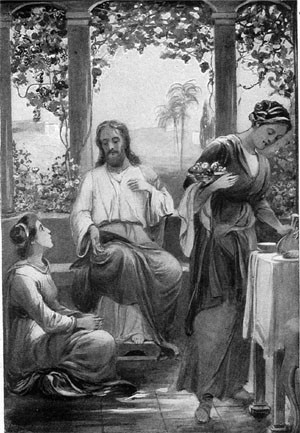
Christ in the Home of Mary and Martha
There he arrived in a state of great agitation, and alarmed his wife and family by sending at once for a physician. To all inquiries he gave the answer that he was about to die, and must prepare for it. In vain they tried to persuade him that his health was as good as ever, that he was only the subject of a nervous fancy. The physician arrived, and laughed at his fears, but he heeded neither ridicule nor entreaties. Death was not a thing to be laughed or entreated away, and to death he was doomed. What did it signify what the world said about it? He must make ready for it. His solicitor was called in, and his worldly affairs settled. Wife and children were all provided for, houses and lands were portioned out to his beloved ones, then he had nothing to do but prepare himself for the great change; that, however, he found impossible. In great perturbation of mind he awaited the coming of his great enemy, Death. When night drew on, his fears increased; every time the great hall clock sounded the hour he shuddered, not knowing if he might ever hear it again. The physician and lawyer remained with him at his request, but they could not bring calm to his agitated mind. They could only listen to what he said, as to the ravings of a madman, for mad they judged him to be.
Hour after hour went by, and the richest man in the parish, lying in his splendid bed, expecting Death every moment, found how poor he had become, and of how little real use all his vast possessions were to him now. Midnight passed away, early morning came, light dawned upon the hills. A faint color came into the sky, and with it color once more stole back into the cheeks of the squire, and hope returned to his heart. Death had not arrived as he had feared; he was still living. The night was passed, the morning was come, and the prophecy of the mysterious voice was not accomplished. His family gathered about him, and with smiles congratulated him, advising him to take his rest, now the danger was past. But how could he rest after such a night, such an upturning of all the cherished thoughts and aims of his life, such a revelation of the poverty of riches? He chose rather to walk abroad, and with thoughtful face and slow steps proceeded towards the village. There he heard that Death had indeed been a visitor in one house during the night, but instead of appearing in his own grand mansion, he had entered the poorest cottage in the place—the old stone-breaker had died during the night. With a still more thoughtful face he returned home, for his heart smote him. He remembered the old man's simple dinner; he saw again the uplifted face, on which God's sunshine rested in a double sense; he heard again the words of his thankful prayer, and his own laugh of derision, and he was again humiliated, but this time to better purpose.
His wife met him at the threshold of his house, with a smiling face, glad to see him once more, "clothed and in his right mind," for she, too, had feared for his reason. She accompanied him in, and then, when seated at his side, gently chided him for his last night's fears, and what she called "superstitious fancies." "I hope now," she added, "you are quite satisfied that there was no truth in what that mysterious voice told you. The night is past, and you are alive, and as well as ever."
"True, my dear," he replied, "the night is past, and I am alive and well. But nevertheless the richest man in the parish has died. If you will take the trouble to inquire in the village, you will find it is so."
"How is that?" she asked, and as she spoke she looked round somewhat proudly, as though a rival to her grandeur had appeared. "Who can be richer here than you?"
"The man who can say to God, 'Whom have I in heaven but thee, and there is none upon earth that I desire beside thee.' I cannot say that, for I have desired many things and persons besides God, and almost all things more than God. But there was a poor stone-breaker alive yesterday, who in possessing God possessed all things. I call him poor after the manner of the world, but he was really rich—an heir of the kingdom of heaven. Last night I was shown his riches and my poverty. People will tell you he is dead, and I dare say that he did not leave a shilling to pay for his burial; but he was 'the richest man in the parish.'"
