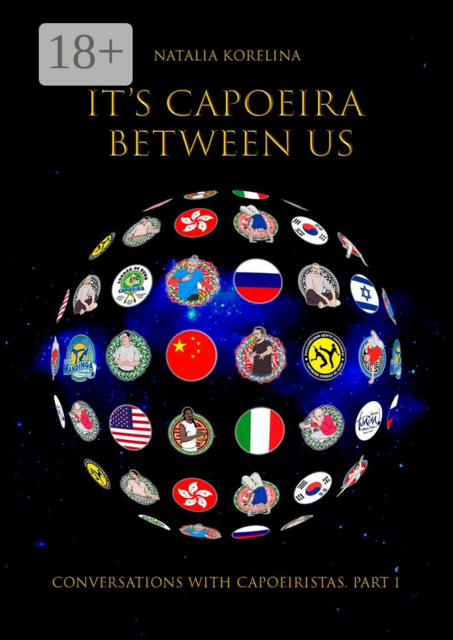
It’s capoeira between us. Conversations with capoeiristas. Part 1
Қосымшада ыңғайлырақҚосымшаны жүктеуге арналған QRRuStore · Samsung Galaxy Store
Huawei AppGallery · Xiaomi GetApps

автордың кітабын онлайн тегін оқу  It’s capoeira between us. Conversations with capoeiristas. Part 1

Natalia Korelina

It’s capoeira between us

Conversations with capoeiristas. Part 1

Fonts by «ParaType»


Editor Kadia Parker

Illustration designer Ivan Kopylov


Contents

Foreword

When I started this book, I had no idea what the result would be. My designs were ambitious — to collect interviews from people who, in their country or region outside of Brazil, influenced the course of capoeira’s history. Some of whom initiated this historic act, some have already become legends in the capoeira world, while others live quietly and do what they love.

Interviews per se, questions and answers, are not so interesting if the context is unknown. It would not be clear to me what questions to ask without context, and for you, dear readers, it would not be such an interesting read. Therefore, I decided to speak only with people:

— I know personally and who share similar vibe with Cordão de Ouro[1] world.

— Who have several years of teaching experience in the country and have an actual capoeira group.

— Who are currently working with capoeira.

I needed this context to know what kinds of questions to ask. For the readers, I have prepared the context of my own life, and a map of my travels and notes about amazing cultures and incredible adventures in the countries where the heroes of this book live and work.

My idea took shape during the course of my work, changed, and evolved until it was finally settled on the pages of my first book. Writing a book is not easy, but writing about the lives of others is an even bigger challenge. I leave it up to you to decide if I have succeeded.

I tend to trust people, sometimes even too much, so I have only checked the words, names and dates that the heroes of this book have mentioned, during my interviews with them, where there were cases of obvious inconsistencies or where there were seeming doubts in the voice of the respondents, to specific questions. Please keep this in mind, when you read the interview, as well as the fact that this book does not claim to be a textbook on the history of capoeira. Nevertheless, I urge critics to share with me their additions and corrections if you find herein questionable information.

“It is capoeira between us” is the main idea of this book. It may well be that among the heroes, or between the reader and the hero, there is nothing that ties us, except capoeira. I approached my heroes with the greatest of respect and an open heart, ready for any answers, trying not to judge them in any way, because these are their stories, their opinions, and they have the right to both have and express them.

I ask you to treat everything that you read here with the same respect, and to not forget that there are varied points of view in the world about a given truth, or a specific situation, and all of them can be correct, even if right now you don’t understand how this could even be possible.

 Golden cord (Portuguese)

 Golden cord (Portuguese)

Introduction

What is capoeira? It is a large information field covering all inhabited continents of the Earth. Capoeira is the soul. Or does capoeira itself have a soul? I do not know. But when you connect to it, you feel oneness with everything around you, or at least, with those in your sight. This is such a natural, joyful feeling, one that I both love and treasure.

It is felt when you see a person for the first time, you look into each other’s eyes, shake hands, smile and start a dialogue without even saying a word; a few more strangers nearby are playing instruments, singing, clapping, watching your every move, but you are not scared at all, because you are at home.

Here is another one: you are in another city or country, you are taking the subway to a capoeira event, or you are walking down the street, looking for an entrance to the location, and then someone walks by with a four-strand bracelet on their backpack, and just by viewing that, you immediately become so calm and confident. You do not know the name of this person, but you know that you are family. You come up, smile, ask a question or ask for help, and they answer you, they help you.

Or you are passing through a foreign city, you do not know anyone, so you find a coach’s contact on the Internet; you introduce yourself and speak of your desire to meet and practice capoeira, and they offer you a stay at their home if you have not yet found an overnight stay.

Or when you meet up with a person once a year at seminars, but you have a feeling that during these times you have somehow become closer? This is a wow!

I would call all this a miracle, a utopia, a fairy tale, but no, it all happened to me and to many boys and girls around the world. And why? Because capoeira links us. It is between us when we are close, and when far away, it is always between us, if we choose it to be. Capoeira unites us, connects us to the information field, and we, without noticing, soon begin to add to and enrich this field ourselves.

Who teaches capoeira? What kind of people are they? In different parts of the world, they conduct their work, call themselves capoeiristas[1], show ginga[2], kicks and escapes, and explain the culture of exotic Brazil to their students. They were born and raised in different families, they belong to different cultures and social strata. They could have lived their entire lives on different continents, not knowing about each other’s existence! But no, once they drank from the source, they wanted to share their joy with others. And one day a leaflet from one of these people entered my life and landed on my table.

Then there I was, in capoeira. When I came to the first class, I didn’t really understand the world I had entered. But having entered this world, its art has influenced my life path in many ways.

Several times in my life, several persons have encouraged me to write a book about all my adventures, but it always seemed so pointless to me.

Сapoeira, to my surprise, gave meaning and impetus to this idea as well.

It happened in South Korea in 2019, as walked around a lake, in the mountains, early one morning. At that time, I had been practicing capoeira for only 4 years, and I could already speak Portuguese very well. I had already been to Brazil twice, as well as to Israel and many places in Russia.

While walking, I was thinking about all those people who showed capoeira to the world and brought it to different cities and countries. Some of them had already become living legends, while others were still young, but had already managed to leave their “fingerprints” in the history of capoeira.

I became anxious to learn more about them. I had an irresistible desire to talk to them personally, to learn their stories, their motives, in order to have a complete picture of capoeira the world over.

Capoeira has travelled beyond the borders of Brazil; it has fallen into the framework of other cultures, and has taken root in foreign mentalities. How did it happen? How has capoeira changed in these countries? What kinds of people choose capoeira in this or that country? What difficulties do coaches face? What do Brazilian masters think of capoeira being practiced outside of Brazil? These questions ignited my curiosity!

And it was on that morning, in South Korea, that I decided to write about these people and to share my work with the world.

 The main basic movement in capoeira.

 A person who practices capoeira.

 A person who practices capoeira.

 The main basic movement in capoeira.

About the Author

My name is Natalia Korelina. My name in capoeira is Curiosa[1].

I started doing capoeira in August 2015 in Rostov-on-Don, Russia. I was 20 years old. That year I finished my second year at university and decided to quit because I didn’t like the process itself. I started doing capoeira with monitor[2] Brasileiro[3].

When I came to the first class, I only knew that capoeira was from Brazil and that it was somehow influenced by and resembled fighting and dancing. I came and they showed me ginga and a couple of kicks. They also showed a rhythm on a “drum”. In fact, it was the drum that made me come to the second class.

I did well, I made friends. The group was small: 6—8 people. After 3 months, everyone began to vigorously discuss an event, a master and belts. I had not been encouraged much to participate, no one bothered to explain the whole master and belt concept. And then the gloomiest and most taciturn guy named Tough Guy said to me, with eyes shining, “Be sure to come, it will be very cool, this is motivation for the whole year!”

And I did go. I borrowed money and came to take part in it. There was a master Papa-Leguas[4] and a bunch of strangers from different cities. Nobody in the group, not even my coach, spoke Portuguese. Only I and another guy could speak English, and he translated the class on the first day.

The master was irresistible. Confidence and calmness emanated from him; he knew exactly what he was doing. Then I saw real capoeira for the first time, heard the true voice of our instruments and fell in love with it all. After one class, I plucked up the courage and started talking to him, I no longer remember about what. I think I asked if he lived in England, and he said that he lived in Brazil. Then he asked if I would receive the belt the next day. I was hearing about it for the first time and told him that I had only been training for 3 months, and that I was not ready, but he informed me that everything was fine, and that I could already receive the belt.

When I was leaving the coach caught me and said that I would receive the belt the next day, period.

On my way to the ceremony, the following day, I was reading Wikipedia in order to finally find more about capoeira and how Batizado[5] worked. Yes, no one told me about it, and I actually did not ask.

The master himself gave me the belt. At that seminar, I naively asked him, “Are you the only master who travels like this, or are there many of you in the world?”

If only I knew then how many wonderful capoeira masters there were in this world!

Soon regular classes were not enough for me. In the first year, I went 3 times to Krasnodar, once to Moscow and St. Petersburg, and also spent a month in Israel, where I miraculously got to an event with Grande Mestre[6] Suassuna and Mestre Ivan.

During that year, I learned that I was training in the group called Cordāo de Ouro, and that this large and friendly family, which existed the world over, was waiting for me with open arms. Then, I have met almost all the YouTube legends. It got to the point where Mestre Cueca said that he was seeing me more often than his mother, and Suassuna kissed me on both cheeks and said that I was beautiful. I was happy. But I had plans. I was going to work on a cruise ship. I was supposed to get a second belt on the eve of my departure, but I learned with bitterness that the seminar had been postponed and I had to leave without the new belt.

I left for 7 months, trying in vain to keep practicing on my own. I even managed to take time off from work once and train with a group in Miami. And then I decided to catch up on lost time in Brazil. So, having seen my master only once, I wrote to him and said that I wanted to come and train with him. I didn’t even know that receiving guests was a common practice for him.

After a short visit home, I hit the road again. I stopped over in Rio de Janeiro for a little rest and spent some time at a local school, learning Portuguese. Following this, I bought a ticket to the small town of Patos de Minas, where Papa-Leguas lived with his family.

He met me at the bus station at 5 am. I was embarrassed, because he is a master! I was supposed to stay with his student, but she had left for 2 days, and the master offered me a stay at his house until she returned. I met his wife and children; it was like in a dream. I was at my master’s house! What an honor! What a delight! But despite getting close to him and his family, he is still like a rock star to me.

And so, the training routine began; I got acquainted with his instructors and the history of capoeira in Patos de Minas. Traces of this story are scattered all over the world: Mestre Chicote[7], Mestre Parente[8], Mestre Piolho[9] and, of course, Mestre Papa-Leguas — they all once trained together, started together, and now live in Europe.

On that trip, I also travelled to the event of world significance — Dia de Ouro[10], where golden threads[11] appeared in the masters’ belts. And this journey ended at Mestre Suassuna’s home, where I met groups from Russia, South Africa, Miami and other countries at the same time. The geography of our group is vast, but I noticed one trend — all stories lead to Brazil and Israel.

Here, I propose to my readers to go on a trip and find out how capoeira began and is being practiced in different countries. I’ll start with the country where I got the idea to write a book — South Korea.
 A louse.

 Golden day or a day of gold.

 The highest belt according to the CDO system is white, and the white and gold belts were given to the first masters who have been in the group since its creation in order to acknowledge their merits.

 A relative.

 A whip.

 (Great) master.

 Capoeirista initiation ceremony.

 The Road Runner

 Brasilian

 Monitor (a) — a person who has a blue-yellow belt in CDO school.

 Curious.

 Curious.

 Monitor (a) — a person who has a blue-yellow belt in CDO school.

 Brasilian

 The Road Runner

 Capoeirista initiation ceremony.

 (Great) master.

 A whip.

 A relative.

 A louse.

 Golden day or a day of gold.

 The highest belt according to the CDO system is white, and the white and gold belts were given to the first masters who have been in the group since its creation in order to acknowledge their merits.