


автордың кітабын онлайн тегін оқу Applied narratology. Theory, Methods, and Analysis of Social and Political Narratives: How Stories Shape Power, Identity, and Reality
Arsen Avetisov
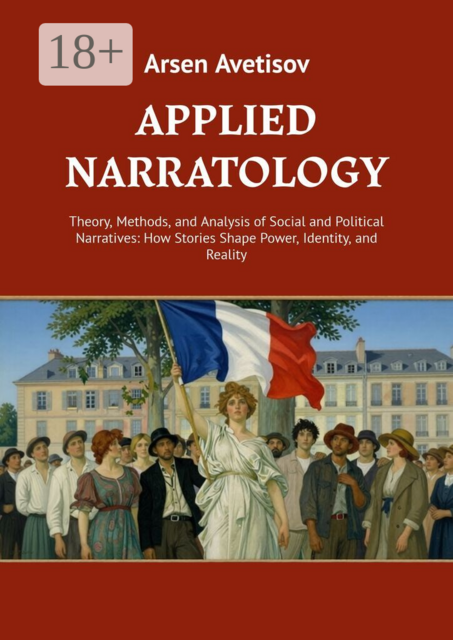
Applied narratology
Theory, Methods, and Analysis of Social and Political Narratives: How Stories Shape Power, Identity, and Reality
Fonts by «ParaType»
Translator Gregory Attaryan
© Arsen Avetisov, 2026
© Gregory Attaryan, translation, 2026
«Applied Narratology» is a book about how stories shape thought, power, and social reality. It moves from narrative theory to the practices of political, cultural, and everyday storytelling. The book demonstrates how narratives construct identities, legitimise decisions, and define the boundaries of the possible — in politics, society, and human life. The next volumes in the series are «French Narratives» and «Political Narratology.»
ISBN 978-5-0069-9564-2
Created with Ridero smart publishing system
Contents
FROM THE AUTHOR
(A Very Personal Note)
When I was beginning these books, I was far from certain I would be able to see them through. Not for a lack of knowledge or material — there was plenty of that, sometimes even too much. But rather because the narrative I was writing about also lived within me. And at times, it resisted.
Every time I sat down to write a new chapter, it felt as though I was explaining things to myself. I was searching for words that might help me understand my own decisions, my own doubts, my own reactions just a little better. Sometimes I felt again like a surgeon learning to operate by making the incision in my own skin.
At some point, I realised: you cannot write about narratives while staying on the sidelines. You cannot explain how stories change if you are afraid to change your own. You cannot speak of meaning while remaining indifferent. You cannot write about attention if you yourself are constantly turning away from what truly matters.
And so these books became both a study and a journey — an internal journey, not always comfortable, but always honest.
I discovered that my own stories also demanded transformation; that some convictions had lived on in me for too long merely by inertia; that some fears had long since become voices that no longer felt like my own; that I uttered certain words automatically, without ever stopping to think where they had come from.
And I realised: we are all far more alike than we appear. Yes, each of us has our own dates, our own people, our own geographies, but the mechanisms are universal. We make mistakes in the same ways. We love in the same ways. We defend ourselves in the same ways. Our sincere desire to be ourselves — that, too, is the same.
I wrote these books hoping they would help you discover something new about yourself and the world around you. But I did not expect just how much they would reveal to me. For that, I am grateful to you, the reader. Because writing is always a dialogue, and you are its most essential participant.
I do not know where you are in your own story right now. At a turning point? At a moment of choice, or a moment of exhaustion? At the beginning of something big, or the close of something important?
But I do know this: no story is ever final. It yields to the movements of the soul, it responds to attention, it changes when a person decides to look at themselves through the lens of possibility, that very possibility which is always near, yet not always in focus.
If you manage, even just a little, to draw closer to the place where you can hear your own voice more clearly than the noise of external expectations; if you allow yourself one new interpretation that lifts an unnecessary burden; if you sense that your story might be open to a new continuation, then none of this will have been in vain.
Thank you for being willing to walk this path with me. Thank you for your trust, your attention, and the inner stillness with which you will read. Thank you for allowing these books to become a part of your story, if only for a short while.
And as for your own story, keep going. With more gentleness. More courage. More honesty. And in a way no one has done before you.
Because no one can live it better than you.
ACKNOWLEDGEMENTS
These books emerged from years of observing how people explain the world to themselves and how those explanations come to govern their decisions, their fears, their hopes, and the forms of their life together.
I am grateful to those authors, thinkers, and researchers whose work — from philosophy and anthropology to political theory and the cognitive sciences — has made it possible to speak of narrative as a real social mechanism. Their ideas have provided the background, the foundation, and a constant point of dialogue throughout the work on these books.
Special thanks are due to those practitioners in politics, management, media, and culture who, whether consciously or not, demonstrate the power of narrative every day. Their decisions, their speeches, their pauses, their formulations, and their silences have provided essential empirical material for analysis.
I am also indebted to the readers, interlocutors, and critics whose questions, doubts, and disagreements helped sharpen the formulations and maintain a necessary distance between analysis and conviction.
None of this work would have been possible without the space for observation, reflection, and doubt — and without the people who reminded me that every story deserves not only belief, but also attention.
PREFACE
Humans think in stories, and we try to make sense of the world by telling stories.
Yuval Noah Harari
Relevance, or The Era of New Specialisms
We live in an age of rapid transformation — artificial intelligence, neural networks, biotechnologies, and the metaverse are changing not only the economy but the very nature of human work. And with work, the entire fabric of people’s lives is changing.
Automation is taking over everything that can be formalised. But the more tasks algorithms assume, the greater the value of what remains irreducibly human: sensation, feeling, imagination, the ability to see connections and create meaning. There is no doubt that the future will belong to hybrid professions at the intersection of technology, psychology, art, and communication. These roles demand not just new tools — they demand a new way of thinking. Consider a few: creators of spaces that unite logical and emotional principles; architects who design digital cities, environments for learning and interaction where people want to live, not merely exist online; specialists who interpret biodata through neural interfaces, helping us understand why we act as we do. The list could go on…
But perhaps the most crucial are the specialists who shape the direction of thinking for communities, media, and companies. They help us see what matters, build context, connect facts, ideas, and values — data, language, and emotion — into meaningful narratives. Those who control attention, control civilisation. These are narratologists — creators of meaningful narratives capable of guiding the behaviour of thousands within a company or millions across entire nations.
Their core value lies in being guides, helping society hold its course by forging meaning from chaos through simple stories.
The future of work is not about technology. Technology is a tool, not a goal. The real future belongs to those who can connect the rational with the human, code with meaning, intelligence with imagination.
It is these people — the creators of meaningful narratives — who will shape the face and behaviour of society ten years from now. Because they do not compete with machines, they make machines part of human evolution.
True success lies not in repetition or in stubbornly chasing change. True success lies in anticipating change, in being ready for it, or in becoming that change.
Why Narrative Is Not a Story, But a Form of Life
We live in an age of unprecedented information, yet also in an age of meaning scarcity. Never before have people known so many facts, received so much data, yet never before have they been so disoriented by the question: which of this actually matters to me?
We are accustomed to explaining what happens to us by external causes: economics, politics, technology, biology, chance. We speak of crises, trends, epochs, markets, algorithms. But behind all these words lies something far more fundamental — the way a person connects events into a coherent picture of the world. This process is rarely conscious, yet it determines how we make decisions, what we consider possible, what we fear, what we will fight for, and what we live for.
This process is called narrative.
For a long time, narratology remained an academic discipline, concerned with literature, texts, and the structures of storytelling. But in reality, narrative long ago escaped the confines of the library. It lives in politics, economics, media, education, marketing, in personal decisions and collective fears. It has become the universal mechanism for organising human experience.
Narrative is the internal logic that transforms scattered facts and events into a story with a beginning, a direction, and an anticipated end. It is the structure through which the past explains the present, and the present justifies or denies the imagined future. A person may be unable to articulate their story in words, but they always live inside one.
We do not act because things are ‘objectively so,’ but because that is how they appear to us.
We choose not from reality, but from its interpretation.
We react not to events, but to the meanings we have assigned to them or found in them, often long before those events have even occurred.
This is the key problem of our time: the world has become more complex, faster, and more uncertain, yet our internal stories have become more inertial, simpler, and often already obsolete. We live in the twenty-first century while relying on narratives formed in childhood, in a different cultural reality, under different conditions of survival. We use new technologies, but explain ourselves and the world in the language of the past.
Hence, chronic anxiety, a sense of pointless strain, disorientation, social conflict, polarisation, the manipulability of the masses, and the inner feeling that life is somehow ‘passing us by,’ even when outwardly everything looks fine.
It is remarkable how attached a person is to their own story. Even when that story hinders them, they cling to it tightly, because it is close and familiar. And strangely, it is precisely in this attachment (and this contradiction) that the possibility of change arises. If a story influences behaviour, then by changing the story, we can change behaviour. This is not magic, not self-persuasion, not an attempt to invent a new biography or alter the past; it is a precise and careful working with the meanings a person invests in their life and their surroundings.
These books are about that kind of work. About how to see the plot and meaning that govern decisions and life. How to hear the familiar phrases behind which lie limitations or potential. How to change the elements of a story so that they begin to lead forward, not backward. And, crucially, how to do this safely, honestly, and effectively.
We approach narrative as a tool. It is a technical approach. An applied one. It does not dismiss emotion or ignore biography. It provides a way to act.
What These Books Are For
These books continue a line of inquiry begun in the works The Power of Narrative Intelligence and Homo Narrare. Those works laid down the basic thesis: the human being is not merely a rational subject, but a creature that organises experience, decisions, and identity through storytelling. The present books develop this approach, moving from a general understanding of the role of narrative intelligence to its applied use — in life, in management, and in culture. From Theoretical Narratology and Applied Narratology to French Narratives.
The next step in this series is a book entitled Political Narratology, in which these same mechanisms will be examined at the level of collective stories, power, and social systems. Thus, all the works form a single conceptual framework: from the individual narrative to the cultural, and onwards to the political. These are not separate books, but successive levels of a single investigation into how stories shape reality and how we can work with this consciously.
They are for those who want to remain relevant now and in ten years’ time. For those who feel they are playing someone else’s role. For those who sense that recurring problems are not a matter of chance. For those seeking a way to restructure their life and environment not through force and strain, but through logic and meaning. For those who work with people — leaders and managers, coaches, teachers and parents, PR professionals and communicators. For those who want to learn to create the future as confidently as they plan their week. Plots are the primary internal interface. Change the interface, and you change the system.
What the Books Will Contain
The first book, Theoretical Narratology, is the foundation. It lays the groundwork: what is a life narrative, why does it arise, what are its basic elements? We will analyse the mechanisms by which meaning is formed, and examine the interplay of personal, familial, and cultural plots. This knowledge is the anchor. Without it, the practical part becomes a jumble of random techniques.
The second book, Applied Narratology, is the practical one. Here are the tools. Methods of analysis and diagnosis: how to hear hidden stories, how to work with recurring episodes, how to separate facts from meanings. Techniques of transformation: how to change the angle of vision, how to adjust roles, how to restructure the line of the future. The exercises provided will be step-by-step, clear, and immediately applicable.
The third book, French Narratives, is a practical case study. The history of France and the French way of life as a model of narrative balance. France is a country where plots develop contrastingly and distinctly: freedom, equality, style, resistance. French culture is an excellent space for seeing how narratives shape behaviour and how historical lines can become a metaphor for everyone’s life.
The book Political Narratology is about the moment when someone else’s story becomes mandatory. It is about what happens when a narrative ceases to be personal or cultural and becomes political. When the story begins to speak on behalf of millions and turns into an instrument of power.
Why We Compare Different Schools
To work effectively with a story, one must understand three existing scholarly perspectives.
Classical narratology studies the structure of the text. It explains the mechanics of plot, the roles, the order of events.
Cognitive narratology studies how the brain constructs stories, why a person sees connections where none exist, how memory links facts.
Applied narratology, which forms the basis of this book, takes both these perspectives and turns them into a tool for action. Its task is not to explain a story, but to provide the means to change it.
We will draw on all three approaches. But the primary one is applied, connecting elements of narrative theory with strategic thinking.
What These Books Are Definitely Not About
We are not creating fictional versions of the past; we work with reality. We do not erase, but reinterpret; we do not force life into a beautiful plot, but select a story that supports real forward movement.
The books do not promise instant transformations. Narrative is a complex mechanism. It needs to be analysed and unfolded over time, gradually. But if you work methodically, the effect accumulates. The narrative approach is not therapy, not trauma treatment — it is working with meaning.
Why France?
France is a fortunate example of a country where narratives do not merely exist, but dominate. Here, culture lives through plots, politics lives through plots, individuals live through plots. A French person can argue about food as if it were philosophy, defend style as a political stance, live as if every episode were part of a grand film.
French history itself offers four particularly powerful narratives, easily seen and transferable to personal life: freedom as the right to be oneself; community and equality as the striving for justice; style as a form of self-expression; resistance as the inner engine that lifts a person after every defeat.
These four narratives we will use as a model for life balance.
How to Work with the Books
Best to read them in order. But you can also do the reverse: first find inspiration in the French journey of the third book, and then return to the theory and practice. The books can be read quickly, but you need to work with them slowly. Do the exercises, write down your answers, and compare them after a week. Repeat the methods and techniques on several different situations, adapting them to your environment and circumstances.
What You Will Gain
By studying this book, you will be able to:
— understand why some ideas captivate millions while others die;
— grasp why facts no longer persuade and how identities are formed;
— perceive your own story and the stories of those around you as a system;
— analyse and diagnose the narratives imposed upon you;
— recognise the stories that hold you back and prevent you from developing;
— identify the stories that have become centres of distortion;
— transform story elements without inventing a ‘new life’, and shape a future plot as a strategy;
— maintain a balance between key life narratives.
These books are about how meanings are born. About how they govern us, and how we can learn to work with them consciously — to act in such a way that a new story becomes reality.
BOOK I. THEORETICAL NARRATOLOGY
PART ONE
CHAPTER 1. THE RELEVANCE OF THE PROBLEM
The doer is merely a fiction added to the deed — the deed is everything.
Friedrich Nietzsche
In their book Story Intelligence, Richard Stone and Scott Livengood cite research data indicating that four out of ten people in the United States do not find a full-fledged purpose in life, and a quarter have no clear idea of what makes life meaningful.
The celebrated French neurologist and psychiatrist Boris Cyrulnik, also known as the ‘father of resilience’, argues that the capacity to make life meaningful stems from the ability to sublimate the pain of experience through creativity, including artistic creativity. The primary effective tool in Cyrulnik’s professional practice was narrative. In other words: one who does not know how to be the author of their own story loses life’s meaning.
The ability to make one’s own life and the lives of those around us meaningful, to set compelling goals, to uncover meanings and initiate actions — all these are functions of narrative intelligence, and the field that studies this subject is narratology.
According to the Sapir – Whorf hypothesis, the system of concepts existing in a person’s mind, and consequently their thinking, is determined by their language. On average, men and women utter around sixteen thousand words a day. When thinking, they articulate roughly five times more words internally.
Human behaviour, ultimately, is the result of these internal conversations, judgments, representations, and ideas. They are, in a sense, stories — programs that people follow depending on circumstances. They determine how people perceive, imagine, and act. They lend clarity to life’s meaning and help them move forward, into the future. It is clear that the relevance of studying this language of narrative — the language that programmes human behaviour — can hardly be overstated.
The ability to learn effectively, to influence, to manage, and to survive in the twenty-first century depends on knowledge of narratology. People must be prepared to unlearn and relearn as technologies and living conditions on the planet change. As teachers of themselves, they are either living proof that their narratives are capable of change, or they remain ignorant, unable to change themselves or their surroundings, simply because they do not know how.
Buckminster Fuller once said, ‘You never change things by fighting the existing reality. To change something, build a new model that makes the existing model obsolete.’ Narratives are precisely the ‘assembly point’ for this model of a new reality — a model of how a person perceives the world and their own behaviour within it. Ultimately, a person themselves is a collection of their stories, moving through space and time. Although this movement itself is also a story, one that we call life.
Narratives determine almost everything a person ‘consciously’ perceives, feels, and does. What they did yesterday, what they are doing right now, and what they will do tomorrow. They are the living tissue of their worldview: what they believe, how they see their future, who they interact with, whom they love, and how they engage with the world around them. Narratives determine where and how they work, why they are there, whether they like their situation or not. And even what they believe will happen when they die.
In effect, narratives govern, explain, and plan a person’s life. The execution of these explanatory and governing programmes is carried out through their internal interpretation in the mind. People remember such interpretations and accept them as possible or necessary responses under given circumstances. Each time they internally recount to themselves a sequence of actions and their meaning, they reinforce them to the point where they follow them without noticing. At the same time, people can equally follow their own programmes and carry out both their own and those that their environment has interpreted for them.
And here lies that ‘subtle’ and dangerous moment: the brain, following its unwavering strategy of conserving energy, is more inclined to use ready-made stories than to create new ones. Due to the incredible density of information, there are now as many of these ready-made programmes around a person as there are foreign interests. Choosing from among them the ones that are appropriate and essential for life has become a genuine problem. Today, technology is capable of transforming a choice that is dubious for a person’s own life into an obvious choice for their consciousness.
This is the greatest problem for any individual and the greatest window of opportunity for those around them.