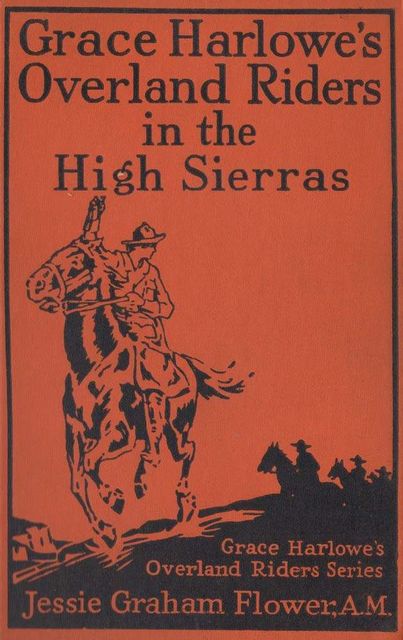



Онлайн кітапты тегін оқу Grace Harlowe's Overland Riders in the High Sierras

“I’m Hit! Good Night!”
Grace Harlowe’s Overland Riders
in the High Sierras
by
Jessie Graham Flower, A. M.
Illustrated
THE SAALFIELD PUBLISHING COMPANY
Akron, Ohio New York
Made in U. S. A.
Copyright MCMXXIII
By THE SAALFIELD PUBLISHING COMPANY
CONTENTS
Chapter I—Old Friends Get Together
Overlanders plan for their summer’s vacation in the saddle. Emma Dean “dotes on mysteries.” Hippy Wingate gets a hard blow. Stacy amazes his new friends by his dramatic entrance. Shots and yells startle the Overland Riders.
Chapter II—An Interrupted Sleep
The traveling salesman entertains his fellow passengers with tales of wrecks and hold-ups. Chunky makes the passengers laugh. Emma Dean has an attack of “nerves.” Sheriff Ford is suspicious. The “Red Limited” comes to a jolting stop. “Robbers!” screams a woman.
Chapter III—The Hold-up of the Red Limited
An ominous silence settles over the transcontinental express. The sheriff calls for volunteers to drive off the train bandits. Overland girls offer their services. The treasure car cut off. Stacy, in his pajamas, joins the defenders.
Chapter IV—In a Lively Skirmish
“Dynamite!” exclaims Sheriff Ford. Defenders give battle. Stacy Brown shoots and talks. Hippy goes on a desperate mission. Bandit guards are outwitted. Lieutenant Wingate caught in a tight place. “I know you!” yells the Overland Rider.
Chapter V—On the Trail of the Missing
Sheriff Ford starts a search for Lieutenant Wingate. A clue at last. “Captured by the bandits!” exclaims Tom Gray. Chunky helps himself to a plum pudding. “Suffering cats! You’re it!”
Chapter VI—Chunky Meets the Bandits
The fat boy stampedes the outlaws’ horses. “Oh, wow! I’ve lost my biscuit.” A pony that knew the way. “I suppose I emptied twelve saddles,” boasts Stacy. Shots arouse the sheriff’s camp. “Lie low, everybody!”
Chapter VII—Bandits Catch a Tartar
Lieutenant Wingate, unconscious, is carried away on a pony’s back. A cruel blow. A pin-prick saves the day. The escape of the Overland captive. “Cease firing! It’s Hippy!” The traveling salesman in a new rôle.
Chapter VIII—Headed for the High Country
Woo Smith joins the Overland outfit. Stacy declares that his pony can climb a tree. “I want food!” is the fat boy’s plaint. The Overlanders are introduced to a “kyack.” Packs are “thrown” and the journey to the Sierras is begun.
Chapter IX—Their Slumbers Disturbed
“All aboard for the High Sierras!” The Chinaman proves to be a rare find. “You leave it to Smith,” advises Hippy. Stories of rattlesnakes in campers’ blankets set the Overland girls’ nerves on edge. Woo savvies “transmigration.”
Chapter X—“Boots and Saddles”
The Overland camp in an uproar. “Snakes! Oh, wow!” howls the fat boy. “Me savvy somebody pull queue,” wails Woo Smith. The dark mystery is finally solved. Stacy Brown proves to be an unwilling “wrangler.”
Chapter XI—Ponies Get a Bad Fright
Hippy uses a pea-shooter with disastrous results. The fat boy awakens in a wild rose bush. Suspicion becomes a certainty. Overlanders make a perilous descent. “The ponies are stampeding!” shouts Lieutenant Wingate.
Chapter XII—Amid the Giant Sequoias
“Look! Oh, look,” cries Emma Dean. Lieutenant Wingate shoots a cinnamon bear. “Uncle Hippy never misses what he hits.” Stopped by a rattler. Tom Gray lost in the great forest. Watched over by trees centuries old.
Chapter XIII—The Camp at the “Lazy J”
A surprise in the High Sierras. Overland Riders entertained at a mountain ranch. Stacy tries to shoe a horse. The white mare gets into action. Warned against the High Country. “Keep away from the ‘Crazy Lake’ section,” advises the foreman.
Chapter XIV—Woo’s Eyes Are Keen
The Chinaman sights a “buck in lelet.” Hippy misses a “sure shot.” “Why don’t you use a pea-shooter?” jeers Stacy. A rifle that had been tampered with. “I—I just wanted to get even with you.” A shot that reached the mark.
Chapter XV—Following the Aerial Trail
The Overland Riders enjoy a venison dinner. Elfreda Briggs is reminded of Coney Island. Crossing a perilous mountain ridge. Emma Dean is afraid and doesn’t care who knows it. The white mare meets with sudden disaster.
Chapter XVI—Going to Bed in the Clouds
Kitty gives her masters a perilous job. Stacy offers to get a derrick. A scene to be remembered. Getting up in the world. Tom Gray makes up the Overlanders’ beds with a pick. Stacy objects to being buried so soon after supper.
Chapter XVII—In the Land of Pink Snows
Woo loses a “piecee kettle” over the brink. The campfire disappears in the clouds. Camping in the valley of the blue lupines. A trail that was difficult to find. Elfreda becomes suddenly light-headed.
Chapter XVIII—At the “Top of the World”
The mystery of the “pink snows” is finally solved by Tom. A snowball battle above the clouds. On the peak of the High Sierras. The Overland Riders go to sleep in a snowbank. “Girls, this is an ideal summer resort.”
Chapter XIX—Bowling in Nature’s Alley
Hippy Wingate gives his companions a delightful surprise. The Overlanders withdraw their threat to throw him off the mountain. A mysterious lake is discovered. Emma Dean scores a hit. Bullets stop the highest bowling game on record.
Chapter XX—Lead and Mystery in the Air
Overland Riders suddenly find themselves under fire. Stacy “creeps” to safety. “Get up and walk, you tenderfoot!” The Aerial Lake lives up to its reputation. Woo Smith savvies trouble. “Discovered!” exclaims Hippy.
Chapter XXI—The Face in the Waters
The guide informs the Overlanders that a woman has been spying on the camp. Stacy feels like a snowbird. Prowlers leave a trail. Lieutenant Wingate meets with an unpleasant surprise. The pool of the mountain trout and what Grace Harlowe saw there.
Chapter XXII—The Mystery of Aerial Lake
Grace Harlowe flees from a hideous face. The Overland girls are eager to solve the mountain mystery. Stacy Brown discovers an “ark” and goes out for a sail. The fat boy mysteriously missing. Woo consults the skies. The lost boy returns with an appetite.
Chapter XXIII—The Lair of the Bad Men
Chunky laughs at his companions’ distress. Lieutenant Wingate invites his nephew out for a “paddle.” Stacy makes an important discovery. Plunder found in the bandits’ cave. The log that was chained down. Bullets drive the Overlanders from their quest.
Chapter XXIV—Making a Last Stand
The Overland Riders are fired on by the mountain ruffians. Imprisoned by dynamite in the robbers’ cave. A battle that came to a sudden end. Sheriff Ford to the rescue. Mother Jones’ career is ended.
GRACE HARLOWE’S OVERLAND RIDERS IN THE HIGH SIERRAS
CHAPTER I
OLD FRIENDS GET TOGETHER
“Who is this Stacy Brown that you girls are speaking of?” questioned Emma Dean as the Overland girls sat down to dinner in Grace Harlowe’s hospitable Haven Home.
“He is my Hippy’s nephew,” Nora Wingate informed her. “You will like ‘Chunky,’ as he is known to his friends, and I promise you that he will keep this outfit from getting lonely,” added Nora laughingly.
“He was one of the members of the Pony Rider Boys’ outfit,” volunteered Grace. “You know we have heard of them several times on our journeyings. They used to go out in search of adventure every summer, so Stacy is a seasoned campaigner. We shall need him where we are going, too.”
“By the way, where are we going, Grace?” spoke up Elfreda Briggs. “I believe our destination is to be in the nature of a surprise—a mystery, as it were.”
“I just dote on mysteries,” bubbled Emma. “Of course I could have learned all about it had I not been too conscientious.”
“That is characteristic of your sex,” replied Hippy Wingate soberly. “May I ask you how you could have found out?”
“I thank you for the compliment, and regret exceedingly that I cannot return the compliment in kind. How could I have found out? Why, by the transmigration of thought.”
“The what?” cried Elfreda laughingly. “Is this some new freak, Emma Dean?”
“It may be new with me, but the principle is as old as the ages. I belong to the Society for the Promotion of Thought Transmigration. Our great and Most Worthy Master lives in Benares, India, where numbers of the faithful journey for instruction and inspiration once every two years.”
“Do you mean to say that you belong to that fool outfit?” wondered Hippy.
“I am happy to say that I do. I joined last winter, and, novice that I am, I have realized some remarkable results,” replied Emma.
“Nora, we ought to take her to a specialist before we start on our journey. It won’t do to have a crazy person with us. She might get us into no end of trouble,” suggested Hippy.
“Humph! I’d much prefer to be crazy than to have a bungalow head,” retorted Emma scornfully.
“A bungalow head?” exclaimed the girls.
“Yes. A bungalow has no upper story, you know.”
“Ouch!” cried Hippy Wingate, clapping both hands to his head. “Now that our Sage of India has spoken, suppose Grace and Tom enlighten us as to where we are going this summer. In view of the fact that this is my treat—that I have offered to pay the expenses of the Overland Riders on this journey—it might not be inappropriate for me to inquire where we are going. Elfreda’s question in that direction is as yet unanswered.”
Tom Gray nodded to his wife.
“I had intended to wait until Stacy Brown arrived, but as he is not a member of our little organization, there is no reason why our business matters should be discussed with him,” said Grace. “Dear friends, we are going to the High Sierras, the great snow-clad peaks of the far west. Adventure, hardship and health are awaiting us there. It will be a long journey before we reach the beginning of our real objective, but I believe you folks will agree with me that the preliminary journey is well worth while.”
“You say that Hippy is paying the bills?” interjected Emma.
“He has so said. However, Tom will not have it that way, so we have agreed that Tom and Hippy shall share equally in the expense of the journey. Both feel quite rich now since they cleaned up on their big lumber deal in the North Woods,” replied Grace.
Elfreda said that such an arrangement would not please her at all, declaring that she would pay her own expenses.
“You have nothing to say about it,” laughed Tom. “The subject is closed. So far as our having Stacy Brown as our guest, is concerned, you all agreed to that when Grace wrote to you about his wish to join us on our summer outing. Are you still of the same mind?”
“Yes,” answered the girls in chorus.
“What about a guide? Is that arranged for?” asked Miss Briggs.
“Not yet,” answered Grace. “We thought we would leave that until we reached our destination. Oh, girls, I have some of the loveliest trips in mind for several seasons ahead, but I’m not going to tell you a word about them now. In the meantime, anyone that has a suggestion to offer will please offer it.”
“I have no suggestions to offer, but I should like to ask further light on this new dope that Emma Dean has sprung on us. What is it, and how does it work?” asked Hippy.
“If you won’t make fun of me I’ll tell you,” replied Emma. “The transmigration of thought is ‘tuning-in’ one’s mind to receive messages from the mind of another person, just as a wireless operator ‘tunes-in’ his instrument to catch the message being sent by another operator far away. In other words, persons so attuned to each other may converse, read each other’s thoughts and hold communion, even though separated by thousands of miles of sea or land or both.”
“Marvelous!” breathed Hippy. “For instance, please tune-in your mind and tell me what I am thinking about. Let’s see you do that, if you can,” he declared triumphantly.
“Our minds never could be in perfect accord, Theophilus Wingate. We are as far apart as the poles, but our range being so short, I can easily tell you what you are thinking about. Not being a deep thinker, you are as transparent as a piece of clear crystal.”
“Emma, don’t you say that about my Hippy,” protested Nora indignantly. “My Hippy has a mind as big as his heart, and—”
“You are thinking,” interjected Emma gravely, “what a shallow little butterfly I am, but what you do not know is that that thought is merely the reflection of your own mentality. You are, in other words, seeing yourself as others see you, Hippy Wingate.”
A peal of laughter from the Overland girls greeted Emma’s retort. Hippy flushed, then joined in the laughter.
“This is so sudden,” he murmured. “I’ll tell you what you do. Wait until Stacy arrives, then you just practice your transmigration stuff on him. Stacy will make a wonderful subject for you. He is so temperamental, so spiritual, that I am positive you and he will get wonderful results.” Hippy winked at Nora as he said it.
None of the others had ever seen Stacy Brown, so they had not the least idea what was in store for them from the comedian of the Pony Rider Boys’ outfit. Stacy was an old campaigner, however, and Hippy knew that he would prove a valuable member of their party on the ride into the High Sierras. Stacy knew the open, and with his companions had experienced many exciting adventures in the wilder parts of the country. The Overland Riders, too, had had their full share of thrilling adventure, first as members of the Overton College Unit in France during the great war, where Hippy Wingate had won honors as a fighting air pilot, and Tom Gray at the front as a captain of engineers. However, they had a new phase of excitement to experience in “Chunky” Brown, and the first of those experiences was near at hand.
A shot suddenly broke the summer stillness of Haven Home, a shot that brought the Overland Riders to their feet.
“Bang, bang, bang!”
“Merciful Heaven! Are we attacked?” cried Elfreda Briggs.
“Whoop! Yeo-o-o-o-o-w!”
Three more shots were fired, followed by a succession of startling whoops and yells.
“What does it mean? I’m afraid!” cried Emma.
The Overlanders ran out of the dining room to the veranda, but no one was in sight.
“Chunky has arrived. Don’t be afraid, girls,” laughed Hippy Wingate. “He is on the other side of the house. There he comes!”
A short, fat young fellow, riding a gray bronco and perched high on his saddle, at this juncture dashed around the end of the house, firing two shots into the air as he passed the amazed group. Just as he swept past, his sombrero fell off, but Chunky did not stop. In a minute or two he was back, and, making a graceful dip from the saddle, reached down for the hat. As he did so, the pony swerved and Stacy Brown landed on the grass of Haven Home, flopped over on his back, and after a few dazed seconds got up and shook himself.
Stacy made a low bow to the spectators gathered on the veranda.
“Oh, my dear, my dear! Are you hurt?” begged Nora, running to him.
“Hurt? Of course not. I always fall off before dinner. It puts a keen edge on my appetite. Hulloa, folks! Glad to meet ye. Hey, Bismarck! Come here,” he ordered.
His dusty gray pony trotted to him and nosed Stacy’s cheek affectionately.
“Got anything loose around the house? I’m half starved,” urged Chunky. “Uncle Hip, introduce me to these beautiful young ladies. I’ve heard of you folks, and so has Bismarck. You’ll find him right friendly, especially the front end of him, but I shouldn’t advise you to get too close to the tail end. He is very light there. Let him browse in the yard while I feed the inner man.”
“Indeed not,” objected Grace. “I am not going to have my flowers trampled down after all my hard work on them this spring. Tom, please lead Stacy’s pony around to the stables. I will put something on the table for you at once, Stacy. Come right in. We were just finishing dinner when you arrived so violently. Oh! Pardon me. You haven’t yet been introduced to the girls.”
“Thanks!” bowed Stacy. “Thanks for the invitation, but come to think of it don’t introduce me until after dinner. I never like to meet strangers on an empty stomach.”
“This is Miss Elfreda Briggs, a rising young lawyeress, and here is the life of our Overland party, Miss Emma Dean. We address each other by our first names, so you may call her Emma. Come now, Stacy.”
“You’re a funny fellow, aren’t you?” said Emma, surveying the newcomer curiously as they walked towards the house.
“Then we are a pair of ’em, eh?” chuckled the fat boy.
“I am not a boy, thank my lucky stars and all the saints,” objected Emma. “I’ll have you understand that, sir.”
“Let the dove of peace rest over your touchy spirit, Emma,” laughed Grace chidingly.
“It isn’t a dove. It’s a crow,” corrected Chunky. “A thousand pardons, Emma dear. I—”
“I’m not your dear,” answered Emma with considerable heat.
“Yes, you are, but you don’t know it. To realize it you will have to emerge from the unconscious state in which you now so sweetly repose,” teased Stacy, amid the laughter of the others.
“I should prefer to be unconscious all the time,” flung back Emma.
“Ah! The food does smell good. Food always has a strange effect on me, and really, I haven’t smelled any in almost a thousand years—not since breakfast this morning. By the way, where do we go and when do we start?”
“To the Sierras,” answered Tom Gray. “How are you, Chunky?” he added, extending a hand.
“Starved. How’s yourself?”
“I think after we go back to the dining room and after I have my dessert that I shall feel fit as a fiddle,” replied Tom. “To answer the rest of your question, we expect to start tomorrow forenoon. The ponies will be shipped in a car that is now on the siding at Oakdale.”
“Girls, what do you think of my nephew?” cried Hippy jovially, as they again seated themselves at the table.
“So far as I am concerned, I think that he is another of those bungalow fellows just like yourself, Hippy,” answered Emma. “Mr. Brown, may I ask if you ever have had any experience with mental transmigration?” she asked, turning to Chunky.
Chunky, his mouth full of food, surveyed her solemnly.
“Uh-huh!” he replied thickly. “I met one of those animals once in the Rocky Mountains. You see it was this way. We had been riding far into the night to find a suitable camping place, when we were suddenly halted by a savage growl just ahead of us. I went on ahead, with my trusty rifle ready, to slay the beast whatever it might be. Suddenly I saw him. He was the most terrible looking object that I’ve ever come up with in all my mountain experience. I threw up my rifle and shot the beast dead in his tracks.”
“Wonderful!” breathed Emma. “But what has that to do with mental transmigration?”
“I’m coming to that. It is wonderful—I mean it was. Will you believe it, that terrible beast came to life. Yes, sir, he rose right up and made for us. My pony bolted, and I fell off—just as I ordinarily do before meal time. My feet at the moment chanced to be out of the stirrups and I fell off. Well, I might have been killed—I surely would have been killed, but I wasn’t, just because of that stunt that you mentioned. I transmigrated myself out of that vicinity with a speed that left that terrible object so far behind that he just lay down and died again,” finished Stacy Brown solemnly, amid shouts of laughter, in which all but Emma Dean joined.
Stacy gave her a quick sidelong glance, and Hippy Wingate, observing the look, knew that war had been declared between Stacy Brown and Emma Dean.
CHAPTER II
AN INTERRUPTED SLEEP
“Right at this point,” said the traveling salesman impressively, “a train left the track and plunged into that ravine down there.”
“Any loss of life?” questioned Tom Gray.
“A great many. I was in that wreck myself. I was shaken up a bit, that’s all. You see I know how to take care of myself. We commercial travelers have to or we should soon be out of business. Nearly the whole train went into that ravine, and the car in which I was riding stood on end. I clung to the air-brake cord and thus was miraculously saved.”
“Humph!” muttered Stacy, hunching his fat shoulders forward. “You don’t look to be light enough to perch on an air-brake cord.”
The Overland girls glanced amusedly at Chunky and the traveling salesman. The entire party was enjoying the late afternoon mountain air from the rear platform of the observation car on the transcontinental train known as the Red Limited. Just inside the door sat other passengers, who had been enjoying the frequent passages-at-arms between Stacy Brown and Emma Dean. The train had been rumbling over bridges and lurching through narrow cuts, affording the passengers brief views of a swiftly moving scenic panorama of interest and attractiveness.
“As I was saying, the rope, in all probability, saved my life, as I was the only person in the car that came out alive,” continued the traveling salesman. “I’m in ladies’ fine shoes, you know.”
Stacy and Emma regarded the speaker’s large feet, glanced at each other and grinned.
“I’ll bet you couldn’t transmigrate them,” whispered the fat boy.
Emma elevated her nose, but made no reply to the trivial remark.
“I mean that I am selling ladies’ fine shoes, young man,” added the salesman, he having observed the fat boy’s grin. “My card.” He passed business cards to those nearest to him, and from them the Overlanders learned that he was William Sylvester Holmes, traveling for a Denver shoe firm. “My trade call me ‘Bill,’” he explained.
“Hello, Bill!” muttered Hippy, nudging Nora.
“May I ask what car you were in?” questioned a tall, bronzed passenger in a mild, apologetic voice.
“The same as this one.”
“Hm-m-m! That’s odd. I do not recall having seen you. However, I was in the other end of the car, which perhaps accounts for it,” said the stranger in a more humble voice.
William Sylvester flushed. Instead of being overcome, however, he shifted his conversation to another train wreck that he said had occurred a few miles further on at a place called Summit.
The faces of the Overland Riders expanded into discreet smiles at the mild way in which the tall man had rebuked the loquacious traveler. Grace and Elfreda, in particular, found themselves much interested in this big man. Grace asked a fellow passenger who the man was, and learned that he was Bill Ford, for some years sheriff of Sonora County. Ford had been observing the traveling salesman through mild blue eyes in which there appeared an expression of more than casual interest.
“It was that Summit wreck that nearly did me up,” resumed Holmes. “We went over an embankment there. Being in a berth in a sleeping car I was unable to grab hold of anything. The car played football with me, but I came off with nothing more serious than a broken arm. Oh, I have had my experiences! Were you in that wreck, too?” he asked, turning quickly to the sheriff.
“Never heard of it,” answered Ford carelessly.
“All that saved us was the fact that the cars were made of steel. We’ll pass Summit within the hour, and I’ll show you where we went off the rails that time.”
“Tell us about something that happened when the train didn’t leave the rails,” urged Stacy.
“With pleasure. I remember, some two years ago—it was this very train, I do believe—when a party of bandits held up a train on this line. That occurred between Summit and Gardner. They uncoupled the express car and, after compelling the engineer to haul it up the track a short distance, dynamited the car and robbed it of the treasure it was carrying.”
“They’ve been cutting up that same kind of caper quite lately,” nodded the sheriff.
“Di—id they rob the passengers?” stammered Emma Dean.
“In some of the cars, yes. In my car they did not. I held them off with my revolver. I——”
“That was very careless of you. Why, sir, you might have shot yourself,” cried Stacy.
Mr. Holmes gave the fat boy a withering glance and resumed his story.
“After my display of courage the other passengers got brave, and with their assistance I drove the bandits off. However, I should not advise it. For the average person, the safe course is to sit still and take his medicine. Gentlemen, never offer resistance when a gang of bandits orders you to put up your hands, but put them up as fast as you can and let them stay put,” he added, fixing his gaze on Tom Gray who smiled and nodded.
“Yes, sir,” agreed Chunky. “That’s the way I always do.”
“Were you ever held up?” questioned the salesman.
“Many times. I put up my hands too, but there was a gun in both of ’em,” answered Stacy amid much laughter.
At this juncture a passenger asked the storyteller to tell them more about the hold-up, which he did without urging.
“The train in question was carrying a treasure, just as this one no doubt is. The bandits had obtained information of this fact from a confederate. They were right on the job when the train came along. After stopping the train they placed men at the car door to take up a collection from the passengers. All submitted tamely, as they should have done, except in the car where I was, and—we are approaching Summit now. From that point we go down grade for twenty miles or so, then we begin to climb again. We stop at Summit.”
“Isn’t it terrible, all that banditry. I’m afraid,” shivered Emma when a little later the party had gone to the dining car for supper.
“For one who can transmigrate as well as you can, there should be no fear,” suggested Hippy. “Just transmigrate the bandits to some other train.”
“I think we should transmigrate ourselves in the event of such a thing occurring,” vouchsafed Elfreda Briggs.
Sheriff Ford came into the dining car shortly after the train had left Summit, and nodded at the party in a friendly fashion.
“What has become of our story-telling friend, sir?” asked Grace.
“I saw him go into the smoking car ahead as the train was leaving Summit. He sent two telegrams before leaving. This shoe business requires a lot of telegraphing, it appears,” added the sheriff dryly.
“How do you know it was about shoe business?” demanded Stacy.
“Because I happened to see the last telegram.”
Tom Gray eyed the sheriff inquiringly, but the mild blue eyes of Mr. Ford conveyed nothing to him.
After a pleasant evening, during which they saw no more of the traveling salesman, the Overland party retired to their berths for sleep. Forward, near the express car, rode the Overlanders’ ponies in as much comfort as is possible to provide for animals en route. At every stop during the day one of the men of the party had run forward to look over the car of “stock,” as the riders called their saddle animals. Now, however, all were too soundly asleep to think of ponies, and above the rumble of the train might be heard the rasping snores of Stacy Brown and Hippy Wingate.
It was shortly after one o’clock in the morning when many of the sleepers were awakened by a sudden disconcerting jolt caused by an abrupt application of the air brakes. The train slowly settled down to a slow crawl, the hiss of the air from the brakes being plainly audible to those who had been awakened.
The train stopped. Nothing of an alarming nature seemed to have occurred, so the nervous passengers again settled down into their blankets, for the night air was chill and penetrating. Others lay awake, but there was nothing to hear except the snores which continued without interruption.
A few moments of this and then a subdued murmur of voices was heard just ahead of the Overlanders’ car. A brief period of silence followed the murmur, then a man’s voice, agitated and full of alarm, was raised so high that almost every person in the car was awake on the instant.
“What is it?” cried a woman’s voice from behind berth curtains.
“We’re held up! The train is held up!” cried the man.
“Robbers! Robbers!” screamed the woman who had asked the question; and a chorus of frightened voices took up the refrain.
CHAPTER III
THE HOLD-UP OF THE RED LIMITED
“Take it easy! Don’t lose your heads. We are safe for the moment,” urged a voice that sounded like Sheriff Ford’s. Whoever it was, his words brought a measure of quiet to the excited passengers who were shivering in the aisle in scant attire.
The passengers then sought their berths again and began dressing, for there would be no more sleep for them that night. Outside of the car there was not the slightest indication that anything out of the ordinary was occurring. An ominous stillness enshrouded the scene. Some one, more curious than the rest, stepped to the front platform of the sleeping car and, opening the vestibule door, looked out. The Overlanders learned later that it was Mr. Ford.
A rifle shot roared out, whereupon the sheriff prudently stepped back and closed the door. Several smothered screams were heard, and then silence once more settled over the car.
Up to the present time not a word had been heard from the Overland Riders. The curtains of their berths hung motionless, and Stacy Brown’s snores were louder than ever. Perhaps they were all asleep, but how that could be possible in the circumstances it would be difficult to understand.
The voice of Sheriff Ford once more focused the attention of the passengers on him.
“Men,” he said, addressing the passengers from one end of the car, “this train is being held up, but it does not look as if the passengers will be disturbed. If they are not, it means that the bandits are after the express car, in which, as I happen to know, there is a large amount of gold for shipment to the Pacific Coast for export. I am an officer of the law. The fact that I am not in my own county is sufficient excuse for my sitting down and letting the bandits have their own way, but I’m not that kind of a critter. I’m going out to take a hand in this affair, and I ask all the men in this car, who have weapons, to join me. Provided we get help from the other cars of the train, we can, perhaps, drive the robbers off. How many of you men are with me?”
Two passengers stepped out from their berths. The curtains of the berths occupied by Lieutenant Theophilus Wingate and Captain Tom Gray were thrust aside, the curtain hooks rattling on the rods overhead, and they were revealed clad in shirts, trousers and boots, each with a revolver strapped on, sitting quietly on the edge of his berth.
“Isn’t there another man in this car?” questioned Ford sarcastically.
At this juncture Grace Harlowe, Elfreda Briggs, Nora Wingate and Emma Dean stepped out into the aisle, each wearing a revolver at her side, and Emma very pale and shaking in the chill air.
“We are not men, but we are ready to do whatever you wish, Mr. Ford,” announced Grace.
Ford smiled and nodded.
“I thought so,” he said. “This appears to be about all we can depend upon. As for you young women, my hat is off to you, but this is no job for women. It’s a man’s job. What you can do, however, is to mount guard over this car and protect the other women. Can you all shoot?”
Grace said they could.
“Very well. Guard the vestibules, but in no circumstances open the vestibule door. The other passengers will please remain in their berths to avoid the possibility of being shot, and you young women will be careful that you do not shoot the train crew. Challenge first, then shoot, if you are not positive as to who any person is. Have you men ammunition?”
“Yes,” answered Hippy. “Lead us to it. We haven’t had any action in so long that we are going stale.”
“We will go out by the rear door,” announced the sheriff. “Please do not use your weapons until you are ordered to do so. The most we can hope to accomplish is to drive the bandits off—make them think they are attacked by a posse. There isn’t much chance of our being able to capture the gang or any of them, much as I should like to do so. Yet I’m going to try to get hold of at least one. All ready!”
“Be careful, Hippy darling,” begged Nora as the little party moved towards the rear of the car.
“You watch my smoke,” chuckled Hippy.
“Good luck,” smiled Grace, waving a kiss to Tom as he turned to nod in return for her parting words.
Ford stepped out into the rear vestibule and peered through the window into the darkness.
“I’ll go first,” he said. “You follow when I give the signal. Not a word from any of you. Wait!” Lifting the trap-door in the vestibule floor, the sheriff let himself down on the steps, then cautiously stood up on the outside, revolver in hand for use in case of trouble.
“Come out!” he commanded in a low voice. “There appears to be no one here. There goes the express car!” he added as a slight jolt of the train was heard. “They’ve cut out that car and are going to pull it up the track a piece and force it open. We’ll have to hurry.”
Ford started on a run, the others falling in behind him.
Up to this time no one had given Stacy Brown a thought, but as the party was leaving the sleeper something awakened him. Then Stacy heard someone say, “robbers!” The fat boy tumbled out into the aisle in his pajamas.
“Wha—what is it?” he demanded sleepily.
“The train is held up,” answered Grace.
“Oh! Wow!”
“Yes, and Tom, Hippy and Mr. Ford, with two other passengers, have just gone out by the rear door to see what they can do to help us out,” announced Miss Briggs. “You are a fine brave fellow to sleep through all this uproar.”
“They have gone to capture the bandit outfit and get their heads shot off for their pains,” jeered the voice of a male passenger from the forward end of the car.
“You’re a brave man, aren’t you?” chided Emma, directing her remark at Stacy.
The fat boy blinked sleepily, then all of a sudden he woke up to a fuller realization of the situation. Emma’s remark had passed unnoticed, but the taunt of the cowardly passenger had sent the blood pounding to Stacy’s temples. The boy snatched his revolver from his grip and buckled on the holster, starting for the rear door at a run.
“We can’t all be heroes,” he flung back at the passenger who had jeered at the Overlanders. “Some of us are born cowards with a stripe of yellow a yard wide through us. Go to sleep, children! I’ll bag the lot of ’em and fetch ’em back for you to look at.”
Stacy fell through the opening in the platform, the trap-door still being open. In the fall, he bumped all the way from the platform to the ground, where he fetched up heavily in a sitting posture.
“Hey, you fellows! Where are you? Wait for me, I’m on the way,” he bellowed. “I’ve got the medicine with me. Sing out where you are.”
The fat boy started to run along the side of the train. He could not see his companions, but he was positive that they could not be far in advance of him.
“W-a-i-t!” he shouted.
“Who’s that?” demanded Ford sharply.
“It sounds like Brown of our party,” laughed Hippy.
“For goodness sake, go back and stop his noise or we’ll have the robbers down on us,” urged Ford. “Run for it!”
Hippy started back at a brisk trot, on the alert for the presence of bandit sentries. He nearly collided with Stacy, and, knowing that the fat boy was impulsive, Hippy feared that Stacy might take him for a train robber and shoot, so he dropped down the instant he discovered his companion.
“Stop that noise! Do you want to get hurt?” demanded Hippy sternly.
“’Course I don’t. I want to hurt a robber. Where are they?”
“You will find out soon enough if you don’t keep quiet.”
“That’s what I’m making a noise about. I want to call ’em out; then you’ll see what Stacy Brown and his little gun can do.”
“You are not to use your revolver until Mr. Ford gives you permission to do so. He is in command of our party. The bandits are supposed to be somewhere ahead of us. Come along, but don’t you dare make a sound. Where have you been all the time?”
“Sleeping. Isn’t that what folks buy sleeping car tickets for?”
“Hurry,” urged Hippy, who ran on, followed by Stacy, stumbling and grunting, making enough noise to be heard several car-lengths away. The two came up with the others of their party at the front end of the forward car, where Ford had halted.
“Where are they?” demanded Stacy. “I’m ready to capture the whole bunch. All I want now is to be shown. I’m a wild-cat for trouble when I get stirred up.”
“Silence, young man! I’ll do all the talking necessary. You will get your wish for action soon enough, and I reckon you’ll get some of the brag taken out of you, too,” retorted Ford sarcastically.
“Not if I see ’em first,” gave back Stacy belligerently.
“What is the order, Mr. Ford?” questioned Tom Gray.
“We will go off to one side. It won’t do to follow the railroad tracks. To do so would surely draw the fire of the bandits. There are several on guard not far from us,” he added in a whisper, having been observing closely as he talked. “I think I now know the lay of the land. Be careful, all of you. If you will look sharp you will see that the bandits have the treasure car near the mouth of the ravine that leads up into the mountains.”
“They’ve taken our stock car too,” groaned Stacy.
“That’s so. The ponies are gone, Ford,” whispered Lieutenant Wingate.
“I reckon they count on making a get-away on your horses,” answered the sheriff. “We’ll be able to block that game, I hope. Come!”
After having walked some distance parallel with the tracks, the sheriff’s party slowed down at a signal from their leader. Lanterns were seen moving about beside the tracks a short distance ahead of the sheriff. The safety valve of the engine was blowing off steam, the blow-off growing to a deafening roar that died down only when the engine pulled away from the express, baggage and stock cars. The locomotive came to a stop a short distance from the three cars, then the sound of a heavy object beating against the side door of one of the cars, was heard.
“They’re trying to smash in the door of the express car,” whispered Ford.
A volley of shots was fired at the car door by the bandits and was promptly answered by shots from within the car. The men in the express car appeared to be vigorously resisting the attack. They were firing at the band outside with such good effect that the robbers soon ceased their attempts to beat in the door with the section of a telegraph pole that they were using for the purpose. A period of silence followed while the bandits were holding a hurried consultation; then followed a movement among them.
“Let me shoot! They’re getting away, I tell you,” urged Stacy excitedly.
“Not yet, young man. Those fellows are up to more mischief, and I think I know what it is,” answered Ford in a tense voice. “Men, we must get in and get in at once or we shall be too late. It is time to move. Listen to me, then obey promptly.”
CHAPTER IV
IN A LIVELY SKIRMISH
“We will crawl across the tracks between the engine and the cars,” whispered the sheriff. “Once on the other side we must get to the rear of the bandits, and as soon as we find cover there we shall begin to shoot. I hope we may be in time. When we reach the other side of the rails I wish you men to spread out, but I want to know where every man of our party is.”
Ford started at a run, the others following, fully as eager as the sheriff to get into action. They had barely reached the rails when there occurred a sudden, blinding flash, followed by a heavy report.
“Dynamite!” exclaimed Ford. “I expected that.”
“Our poor ponies,” groaned Tom Gray.
“If they get near my Bismarck he’ll kick the everlasting daylights out of them,” growled Stacy Brown.
“Can’t we do something?” urged Hippy.
“Yes. We’re going to do something and do it right quick,” answered Ford grimly. “Fellows, remember that the bandits have rifles, while we have only our revolvers. You look out for those rifles, is my best advice to you.”
They reached the other side of the railroad tracks without loss of time and without attracting attention to themselves, and it was soon evident to the sheriff’s party that the dynamite had not accomplished its purpose. The explosive had not been well placed, and the express car had been little damaged, though a hole had been dug out beside the tracks from the force of it.
“When I give the word, shoot, but shoot over their heads,” commanded Ford incisively. “Spread out and get down on your stomachs when you have taken your positions. Get going!”
The men of the party crept along, skulking through the bushes that grew on the mountain side along the railroad right of way. One by one the members of the party dropped down and lay awaiting the word of command. Every now and then a shot would be fired from the interior of the express car, answered in each instance by a volley from the bandits.
The preparations of Sheriff Ford up to this time had been made swiftly. The signal agreed upon for beginning the attack on the train bandits was two quick shots from Ford’s revolver.
The thin line of assailants waited in tense silence for the beginning of hostilities. The members of the little party were steady, although their pulses beat high, for no one deluded himself into the belief that this affair was going to be wholly one-sided.
Two sharp reports from Ford’s revolver, even though eagerly looked for, came so unexpectedly that every member of the party was startled, but their panic lasted for only a few seconds. Six heavy revolvers answered the signal. Three bullets sped harmlessly over the heads of the men who were trying to rob the express car. Three other bullets from the weapons of Ford, Tom and Hippy, by arrangement at the last moment before the party spread out, had been fired low enough to reach the legs of the bandits.
Of course there could be no fine shooting on account of the darkness, but the sheriff and the two men with him did very well indeed, if the yells of rage that came from the bandits could be depended upon as indication of hits.
“Down!” warned Ford when the revolvers had been emptied. Every man in the party well knew what was coming.
The expected was not long in arriving. A volley of heavy rifle shots ripped over the heads of the sleeping-car party. Ford’s party quickly reloaded as they lay; then began firing as rapidly as they could pull the triggers of their weapons, aiming whenever they saw anything to aim at.
During all this firing the orders of the sheriff were implicitly followed. Tom Gray and Lieutenant Wingate were as steady as rock, for they had been through skirmishes before. Stacy was a little excited, but more from eagerness to be up and at the bandits than from fear. The bandits were getting desperate. On account of the interruption there had been no opportunity to explode another charge of dynamite under the express car, and they were now too fully engaged to proceed with that work.
The desperadoes knew very well from the sound that the attackers were using small arms instead of rifles, thus leaving the advantage with the bandits so far as weapons were concerned. The robbers now began creeping stealthily up the slope, firing at every flash from a revolver, but Ford’s party was keeping so low that there was no great danger of any one being hit except as they changed positions and ran for fresh cover, which they always did following a volley from the bandits’ rifles. The sheriff’s party was giving ground slowly, constantly changing positions under his orders, the officer himself now and then running along the line, giving quick low-spoken orders, without regard to his own safety.
The bandits had been drawn away from the tracks for some distance when Ford dropped down beside Hippy Wingate, who was firing from behind a small boulder.
“What is it, Sheriff?” questioned Hippy.
“I have a plan,” answered Ford.
“Good! What is it?”
“Our revolvers won’t hold them back much longer. Should they rush us someone is certain to get hit. In any event we shall then have to run for it. I don’t like to do that.”
“Not yet,” answered Hippy with emphasis.
“I think we may be able to save your horses and the express car if you are willing to take a long chance.”
“I have taken so many already that chances no longer are a novelty. What is it you wish me to do?” demanded Hippy.
“Go to the engineer and tell him to back up. Tell him to hit those three cars as hard as he dares—hit them as fast as he can without throwing them from the rails or injuring the horses. Having done that, let him back down the grade as quietly as possible so those fellows won’t notice him. When he hits the express car he is to keep on backing until he reaches the train, which he is to push back a full half mile, and then stop and wait for us to finish our job. When we have done that we will fire a signal—three shots at intervals. I reckon the moon will soon be up so we can see what we are doing. Tell the engineer, too, that we will fire the same signal if we approach him, but, should he see anybody coming up who does not give that signal, he is to start up his engine and reverse for all he’s worth. Get me?”
“I get you, Buddy.”
“I would go myself, but I am needed here. When the time comes we shall have to make a sharp get-away ourselves, but if we save the train that will be enough. Do you think you can reach the locomotive?”
“Surest thing you know, old top,” answered Hippy laughingly.
“Be careful! You will find that the engine is guarded, but I don’t believe there will be more than two men guarding it, and perhaps this firing may have drawn them away, though I hardly think so.”
“Leave it to me.”
“Should you miss us on your return, make for the train as fast as you can. You’re the right sort, Lieutenant. Pick your own trail and the best o’ luck.”
Lieutenant Wingate was off a few seconds later, running cautiously, now and then flattening himself on the ground to avoid the occasional volley. Hippy had no fear of the bullets that whistled over him, though he had a sufficiently intimate acquaintance with such missiles to hold them in high respect. That was why he dropped to the ground when firing was resumed. In a few moments he was out of range of the firing. He then straightened up and ran with all speed, parallel with the tracks, but keeping several rods to one side.
As he neared the locomotive Hippy proceeded with more caution. The night was now sufficiently light to enable him to see the figures of two men sitting on the bank beside the tracks on the right side of the engine. There was no special need for vigilance on their part now, for ahead of the locomotive a telegraph pole had been felled across the tracks, while to its rear were the cars and the bandits. All this made the guards somewhat careless so that they failed to see a figure dart across the tracks a few rods back of the locomotive tender.
Lieutenant Wingate crept along under the overhang of the tender, on the side opposite from the two guards. He did not know but there might be men on that side also, but soon discovered that there were not. He had crawled to the running board, by which entrance is gained to the locomotive cab, before he was discovered by the fireman.
“Sh-h-h-h!” warned Hippy just in time to check an exclamation that was on the lips of the fireman. “Lean over. I have a message for you—for the engineer. Don’t make a quick move, but just settle down. You might fire up the boiler a little. With the glare from the fire in their eyes those two fellows won’t see quite so clearly.”
The fireman, after a whispered word to the engineer, opened the fire door and threw in fresh coal, then crouched down with his ear close to the Overland Rider, whereupon Hippy briefly explained Sheriff Ford’s plan, at the same time acquainting the fireman with the situation to the rear.
Another whispered conversation across the boiler between engineer and fireman followed, with Hippy Wingate clinging on the step of the locomotive in tense expectancy. A sudden hiss of steam from the cylinders on both sides of the engine startled him, and the big drive wheels began slipping on the rails.
“Hey there! What are ye up to?” yelled a guard, making a leap for the running board.
The fireman responded by hieing a chunk of coal, which caught the bandit in the stomach, laying the fellow flat in the ditch beside the tracks. The remaining guard fired point-blank without effect at the engineer’s window, but the driver’s head was below the level of the cab window at that instant. The wheels gained a foothold, the engine began backing rapidly while the guard continued to shoot at the reversing hulk of steel.
“Good for you, Buddies!” cried Hippy enthusiastically.
The engineer did not slow down as he approached the scene of the hold-up, knowing that there were no persons in the way.
Hippy had dropped off before the engine gained much headway, and rolled over into the ditch and soon heard the tender hit the express car.
The bandits had heard the engine rumbling down the grade, but they were too busy shooting at Sheriff Ford’s party to be able to spare the time to interfere. In the meantime a new note had been added to the battle. The train crew, now taking courage, had gone to the assistance of the Sheriff, armed with revolvers, shot guns, iron bars and whatever else they could lay their hands on.
Grace Harlowe and her friends, in the meantime, however, remained on guard, and not even the trainmen could have got into her sleeping car without giving an account of themselves to the Overland girls.
The firing now grew fast and furious. Hippy heard it, listened attentively and realized that his little party was being assisted.
“I must get back and take a hand,” he muttered, making a wide detour with the intention of coming in to the rear of Sheriff Ford and his men. To do this he ran up the ravine from the railroad, near where the attack had been made.
Lieutenant Wingate had not proceeded far before he heard what sounded like hoof-beats. At first he feared that the ponies of his outfit had been taken; then he realized that this could not be the case.
The ravine in which he found himself was now fairly well lighted by the rising moon, and discovery was certain, the banks on either side being so steep that the Overlander knew that he could not look for escape that way. Not caring to be caught in a trap, Hippy turned and began to retreat down the ravine, then halted abruptly, as he discovered a horseman coming up the ravine at a gallop. A man was running just ahead of the rider, the latter calling orders to the runner.
At this juncture, Lieutenant Wingate unlimbered his revolver and waited. The two men saw him, and the runner pointed to him, then dashed right past Hippy, shielding his face with a hand. As he passed, the runner fired a shot at Hippy.
“I know you!” yelled the Overlander, sending a bullet into the ground behind the runner. “I know your game, you scoundrel!”
Hippy, for the moment, apparently had forgotten the man on horseback, who was now to the rear of him, for Lieutenant Wingate, upon discovering the identity of the man on foot, was so amazed that all other thoughts took flight.
All at once the Overland Rider remembered. He wheeled like a flash and fired at the figure that was now towering over him. A blow, crushing in its force, came down on the head of the Overland Rider, felling him to the ground. The butt of a rifle in the hands of the horseman was the instrument that caused Hippy’s undoing.
In the meantime, while Hippy was carrying Ford’s message to the engineer of the Red Limited, the hot reception they were getting led the bandits to give up the fight and scatter. It was one of the fleeing train-robbers who had struck Lieutenant Wingate down.
CHAPTER V
ON THE TRAIL OF THE MISSING
“Have the train draw up here and wait for us,” Sheriff Ford directed, as the trainmen were about to return to their train after the bandits had finally been driven off. “Those ruffians have had enough, and won’t come back. Some of them are wounded, too.”
“Aren’t you coming with us?” asked a trainman.
“No. I’m going to look for Lieutenant Wingate. He may be on the train, but, if he is not, have the engineer give us three whistles.”
“Hippy wouldn’t go back without us,” declared Tom Gray with emphasis.
“Go back to your train, men, while we look for our friend,” urged Sheriff Ford.
The train crew lost no time in following Ford’s advice, being eager to get away from that locality. Stacy Brown was sent back with them to put on his clothes. Stacy was shivering in his pajamas, but the fat boy had done his duty as steadily as any of his companions, and fully proven his courage, thus winning the admiration of Sheriff Ford and Tom Gray. The two other volunteer passengers, one a salesman for a Chicago grocery house, the other a Colorado ranchman, announced their intention of remaining with the sheriff to assist him in his search.
Shortly after the departure of the trainmen, three long blasts of the locomotive whistle told the party that Lieutenant Wingate had not returned to the train.
“That settles it, men. It is up to us to get to work,” declared the sheriff. Ford divided his forces and sent parties in various directions to search for the missing Hippy Wingate, hoping, and partly believing, that the lieutenant had probably met up with the bandits on their retreat into the mountains after abandoning their attack on the train, and secreted himself somewhere in the vicinity of the attempted hold-up.
The Overlanders were now in the Sierras, and the country all about them was wild and uninhabited. After surveying his surroundings with critical eyes, Ford took to the ravine up which Hippy had gone in attempting to get back to his companions, and soon found the place where the bandits had staked down their horses.
Two warning whistles, the engineer’s regular signal that the train was about to start ahead, caused the sheriff to run down the ravine to the railroad, at the same time firing three shots to recall his companions.
“Get aboard in a hurry!” shouted the conductor, leaning from the engine cab as the train came back to the scene of the attempted robbery.
“Wait! Has Lieutenant Wingate returned?” demanded Ford.
“No!” shouted Stacy Brown from the platform of the smoking car. “Didn’t you find him?”
“Are you positive, Stacy?” called Tom Gray, running up at this juncture.
“He is not on the train, Tom,” answered Grace Harlowe from a vestibule doorway. “The engineer said he dropped off just as the engine began backing down. Tom, you must search for Hippy. Nora is nearly wild from worry over him.”
“We are going to find him, little woman,” answered Captain Gray.
“Are you folks going to get aboard?” demanded the conductor insistently.
“No. We’re not going to leave that man here by a long shot,” retorted Ford.
“All right. Stay if you want to. We’re going ahead,” snapped the conductor.
“Stop!” ordered the sheriff. “You hold this train until I give you leave to move it. I am an officer of the law, and in command here for the present. Captain Gray, what do you wish to do?”
“Find the lieutenant, Sheriff.”
“Then, would it not be a good idea to unload your ponies?” asked Ford. “We may have to be here until tomorrow, and perhaps make a long journey into the interior, which we cannot well do on foot.”
“Yes. We will unload enough animals to carry your party,” answered Tom.
“Pull your train up to the mouth of the ravine and stop,” commanded Ford, clambering aboard the locomotive. “Get aboard there, boys.”
The train promptly pulled ahead while the sheriff had his final argument with the conductor in the locomotive cab. The argument was brief, but heated, the sheriff laying down the law to the angry conductor, who, by the time his train had reached the mouth of the ravine, was wholly subdued.
The Overland Riders stepped off the train to watch the unloading of the ponies and to get instructions from Tom and Mr. Ford.
“We are about twenty-five miles from Gardner,” said the sheriff, addressing Grace. “You people, I believe, intend to detrain there. Have someone unload your stock and then wait until we return. You will find a very fair little hotel at Gardner.”
“We will wait,” answered Grace composedly.
Ford called upon the train crew to assist in unloading the ponies. Unloading boards were obtained from the baggage car with which a rather substantial gangway was constructed, and down it the light-footed ponies—five of them—were led without the least difficulty. Rifles and light equipment for the party were unloaded, the rest of the Overlanders’ property and two ponies being left on the train.
While the unloading was in progress Tom Gray went to the dining car and purchased provisions, consisting of canned goods, pork and beans and a side of bacon. Stacy Brown, who had gone back to the sleeping car for something he wanted from his suitcase, dropped in while Tom was bartering, and helped his companion carry back their purchases. By the time they reached the head of the train all was in readiness for the departure.
Ford waved the lantern that he had borrowed from the conductor.
“Go ahead,” he called to the conductor. “Mrs. Gray, don’t forget to report to Gardner what has become of us. If we are not back in two days have them send a posse for us.”
“I understand,” answered Grace Harlowe.
“I say, you! You might have Emma do a little transmigrating for us while we’re away. I reckon we’ll be needing it,” called back Stacy.
As the train pulled out, the passengers, including the girls of the Overland party, were gathered on the platforms cheering. The searching party now consisted, besides Sheriff Ford, of Tom Gray, Stacy Brown and the two passengers who had been with them from the first, making five in all.
“Now, sir, what is your plan?” demanded Tom after they had saddled and made ready to start.
“I think we will follow up the ravine for a little way,” answered the sheriff. “Your man went this way. I know because the fireman saw him take to the ravine. One of you lead my horse; I’m going ahead on foot with the lantern.”
“If you have no objection, I will go with you,” offered Tom.
Ford nodded, and the two started away, the others, on the ponies, keeping well to the rear.
The two men in advance finally reached the point in the ravine where Lieutenant Wingate had been struck down. With lantern held close to the ground, the sheriff went over it on hands and knees, examining every foot of the ground.
“Stand where you are until I come back,” he directed, addressing Tom Gray. “Do you recognize this?” he asked, holding up a hat, upon his return a few moments later.
“It is the lieutenant’s hat,” answered Tom promptly, and Stacy Brown agreed with him.
“What’s the use of a hat without a head to wear it?” demanded Stacy.
“This!” replied Ford. “I have proved one thing. Our man came this way, but beyond this point the only trace of him is the hat. Unless I am much mistaken, he left here on the back of a horse, and he went that way.” The sheriff pointed up the ravine. “It is fair to assume that he did not go voluntarily. The only inference possible, then, is that he has been taken.”
“Captured by the bandits!” exclaimed Tom.
Ford nodded.
“For what reason?”
“Candidly, I don’t know, Captain. We have got to find out, and it is advisable for us to go in search of the answer to that question as fast as we can. We will mount and move on.”
“I suppose I am the one who will have to furnish the brains for this party and find the missing man,” declared Stacy pompously, but no one laughed at his sally.
A minute later they were mounted and on their way up the ravine, the sheriff still carrying the lantern, which he held low, keeping his gaze constantly on the trail, which still was fairly plain and easy for an experienced man to follow. Stacy dropped behind a little way and produced a plum pudding can from his pocket. Opening the can, he calmly proceeded to eat the pudding.
“What’s that you’re eating?” demanded one of the two passengers.
“Pudding. A plum one.”
“Where did you get it?”
“Oh, back there in the diner,” answered Stacy carelessly.
“You stole a pudding, eh?” laughed the questioner.
“Oh, my; no, sir. How could you think such a thing? Don’t you know I wouldn’t do anything like that?”
“Oh! You paid for it,” nodded the passenger.
“I did not. Captain Gray did. You see it was this way. The captain paid for six cans of baked beans, but they gave him only five cans. The colored gentleman in the diner cheated us out of one can, and probably pocketed the difference, so I sort of helped myself to a pudding to even things up.”
“Humph! You are a young man of unusual ability. You should have been a lawyer.”
“I know it,” admitted Chunky.
An exclamation from Ford interrupted the conversation. The sheriff had picked up a handkerchief which Tom thought belonged to Hippy Wingate. They believed that the lieutenant had dropped it purposely, knowing full well that pursuit would follow promptly when his friends discovered that he was missing.
“We are on the trail all right,” cried the sheriff. “Look sharp and don’t make much noise about it, either.”
Daybreak found the outfit still in the saddle. Now that they could see, Ford threw away the lantern, and, after watering their ponies at a mountain spring, they pressed on with all speed. The men ate a cold breakfast in the saddle, there being no time to waste in halting to cook breakfast. Further, the smoke from a camp-fire would be a danger signal to the men for whom they were searching.
About nine o’clock in the morning the sheriff and Tom found a split-trail. The two trails led up a steep incline to a small plateau. There they discovered the remains of a camp-fire. Ford dismounted and ran his fingers through the ashes.
“There has been a fire here within a few hours,” he announced.
“And the trail has gone to pieces,” added Stacy Brown who had got down from his pony and begun nosing about.
“The bandits have taken different directions from here, haven’t they?” questioned the sheriff, glancing up.
“Yes. I’ll tell you what let’s do. Let’s shut our eyes and let the ponies decide which trail to take,” suggested Chunky gravely. “My Bismarck can follow the trail of a squirrel.”
“This is not a squirrel trail,” answered Ford briefly. “There are five of us men here. Four will take separate trails while one remains here. Let each man follow his trail for, say, three hours, then, whether or not he has discovered anything, he will return to this point. We can then decide upon further action.”
“I have an idea that the bandits discovered that they were being followed,” suggested one of the two passengers. “Otherwise, why should they split up and take different trails?”
“Yes. I agree with you,” nodded the sheriff. Mr. Ford decided that one of the passenger volunteers should remain behind, then assigned the other passenger and Tom, Stacy and himself to follow the bandits’ trails, Ford selecting what seemed to be the most promising trail for himself.
Full understanding of what each one was to do was had, then the four rode away, leaving their guard where he could see, yet remain hidden.
The four trails led on for five miles without a break. Stacy, full of importance because of the duty assigned to him, was watching his trail closely, and, had he been less observant, he might have missed the point where the trail again split. Discovering this, he halted and sat regarding the two trails with solemn eyes.
“Sharp trick,” he nodded. “It doesn’t fool Stacy Brown, though.” He decided that the left-hand trail swung over towards the one that Tom Gray was riding, perhaps joining it a short distance from the junction where Stacy was at that moment. Having come to this conclusion, the fat boy had a bright idea. He would take a short cut across country. He knew that this was a risky thing to do, but he had several mountain peaks for landmarks and did not believe that he could go astray, so he started full of confidence, leaving both trails behind him.
An hour-and-a-half passed. Stacy still had thirty minutes to ride before it would be time for him to turn back towards the starting point, as he learned by consulting his watch, and he decided to make the most of those thirty minutes.
“There! Didn’t I tell you?” he cried as he rode out into an open space and instantly discovered the hoof-prints of several horses on the soft ground. “I was positive that I couldn’t be wrong. My time is up, but I have found the spot where the rascals got together. Now I’ll just turn about and follow it home. This is the trail we must follow to find Uncle Hip. Yes, I’ll go back and report.”
Stacy Brown’s intentions were good, and, well satisfied with what he had accomplished, he rode along humming softly to himself, now and then confiding his opinions to his pony. The little animal wiggled its ears as if it understood.
“Hulloa! There goes the sun. Seven o’clock! Who would have thought it? According to my watch I’ve been back at the forks for a quarter of an hour. I wonder if I really have?” Stacy regarded his surroundings narrowly. “No. I never saw any of you mountain-peak fellows before. I must have made a mistake in my reckonings, but I’ve got a biscuit in my pocket, and we’ll be able to go quite a distance on one biscuit, especially on this kind of a biscuit. Some biscuits go a great deal farther than others. This is one of the farther kind,” finished Chunky, performing a series of contortions as he tried to break off a piece of biscuit with his teeth.
The pony was laboring up a steep incline, the stirrup straps creaking in rhythm with the animal’s quick, short steps, Stacy’s body, from the belt up, bobbing upwards and backwards with monotonous regularity. The reins lay over the saddle pommel, thus giving the pony’s head full play and enabling it to snatch a mouthful of greens here and there.
Suddenly the little animal threw its head up and snorted. Stacy Brown ceased munching and sat staring wide-eyed.
“Suffering cats! You’re IT, Stacy Brown!” he gasped.
Jerking his rifle from the saddle-boot he fired three quick shots over the head of his pony.
CHAPTER VI
CHUNKY MEETS THE BANDITS
The pony had nosed its way around the base of a high rock, fetching up on a meadow, when Stacy made the discovery that startled him. What he saw was a group of men sitting about a cook-fire, hurriedly eating a meal while their ponies grazed on the mountain grass some distance from the fire.
The boy knew instantly that he had stumbled upon the bandits. He realized, too, in those brief seconds, that he must be a long way from the place where he was to meet his companions.
The desperadoes saw the intruder about the time that Chunky saw them. Used to emergencies and quick action, the men sprang for their rifles, which were standing against a boulder near at hand. Chunky also saw that Lieutenant Wingate was not with them. Had the boy thought twice he would have held his fire, but, as it turned out, his shots served a good purpose. It startled the bandits, causing momentary confusion, which gave Stacy an opportunity to head in an opposite direction, which he was not slow in doing.
“Ye-o-o-o-ow!” howled the fat boy in a shrill, piercing voice. The shots and the yells startled the bandits’ ponies as it had their owners. The horses threw up their heads, snorted and galloped into the mountain meadow, fully twenty rods from the camp, while the boy threw himself on the neck of his pony, fully expecting a shot or a volley from them, and dashed around the base of a high rock at a perilous pace. He had no more than reached the protection of the rock than the pock, pock of rifle bullets, as they hit the rock to his rear, reached his ears.
“Oh, wow!” howled Chunky. “I lost my biscuit.” In ordinary circumstances he would have gone back to look for the biscuit, but just now Stacy was in somewhat of a hurry. Fortunately for the boy, it took the bandits fully twenty minutes to round up their horses, by which time the fat boy was far in the lead, riding like mad. He had lost all sense of direction, but perhaps the pony had not. The little animal had taken affairs into its own control and was laying out its own trail.
The bandits, instead of following, rode with all speed farther into the mountains, but Chunky continued on at his same perilous pace, even though darkness had now overtaken him.
“Whoa, Bismarck!” commanded Chunky finally, reining in his pony. “Do you know where you’re going, or don’t you?”
The pony rattled the bit between its teeth, tossed its head up and down, and uttered a loud whinny.
“You said ‘yes,’ didn’t you? All right, if you know where you are, go along. You surely can’t know any less about it than I do.”
Rider and mount resumed their journey at a somewhat slower pace, and rode on until Stacy was brought to a sudden stop by a sharp, gruff word of command.
“Halt!” ordered a voice just ahead of him. The pony gave a startled jump that nearly unhorsed its rider.
“Oh, wow!” howled Chunky, and on the impulse of the moment he fired two quick shots at the sound.
“Stop it! It’s Tom Gray. Haven’t you any more sense than to blaze away before you know at what you are shooting?”
“Oh, fiddlesticks! Had you been through what I have you would shoot at the drop of the hat. Are you lost, too?”
“Lost? I am not lost. Don’t you know where you are?”
“No. I might be in the suburbs of Chillicothe for all I know.”
“The camp is only a few rods away,” Tom Gray informed him.
“You don’t say?” wondered Chunky.
“We heard you coming, and thought it might be Mr. Ford. How did you happen to come in over that trail?”
“Ask Bismarck. He knows all about it. I don’t. Got any news about Uncle Hip?”
“No. Of course you saw nothing of either him or the bandits.”
“I not only found the robbers, but I had a battle with them,” answered Stacy.
“What’s that? Don’t trifle, Brown. This is a serious matter,” rebuked Tom.
“I’m telling you the truth. It was this way. I was riding along, peaceful like, when, all of a sudden, biff, boom, bang! It seemed to me that fifty or a hundred men burst from the bushes.”
“So many as that?” laughed Tom.
“Well, something like that. I may be a dozen or so out of the way, but you see I didn’t stop to count them. I raised my trusty rifle and—well, to make a long story short, I fired right into that howling bunch of bandits. I suppose I emptied as many as twelve saddles.”
“Wait a moment,” urged one of the travelers who had joined them. “How many times did you reload?”
“Not at all. I didn’t have time.”
“Captain Gray, he emptied twelve saddles, so he must have shot two men with each bullet, as his magazine holds only six cartridges. I call that some shooting.”
“Is that so? Then I must have done as you say. Wonderful, wasn’t it?”
At this juncture, Sheriff Ford rode into camp and was quickly told of what Stacy had discovered. Mr. Ford, after a few quick questions, realized that the boy really had stumbled on the right trail and discovered the bandits.
“You did well, young man,” he complimented. “I thought I had struck a lead, but the trail pinched out. Can you take us to the place where you came on those ruffians?”
“No, but the pony can, or you can follow my trail. I reckon I left a pretty plain one. I know Uncle Hip better than you do, and if he has been able to get away from the fellows who captured him I’ll guarantee that he will find us. He would know we wouldn’t go away and leave him. For that reason I suggest that we build a fire to attract Uncle Hip’s attention, should he be in this vicinity.”
One of the men protested, saying it would be dangerous, but the sheriff agreed with Stacy.
“We will have a fire and will post guards to protect ourselves,” he said. “We shall not be bothered by the bandits to-night; I am positive of that. They know that the alarm has been given and that, in all probability, a posse is already on their trail. If nothing develops during the night—if we get no news from Lieutenant Wingate—we will start for Gardner in the morning and organize a big searching party to comb the mountains for him.”
After all phases of the situation had been discussed, the sheriff’s plan was agreed to, and a fire was built up. It had been blazing for some time when, in a lull in the conversation, Stacy was reminded that he had not finished telling about his meeting with the bandits.
“Yes. You left off with shooting two men with each bullet,” laughed Tom Gray.
“In the excitement of meeting up with the villains,” resumed Stacy, without an instant’s hesitation, “I wheeled the pony—spun him about on his hind feet like a top, set him down on all fours and dashed away. We didn’t gallop, we simply dashed. You know it wasn’t that I was afraid. Anyone who knows me knows that nothing can scare me. I—”
“Bang, bang, bang!”
“Oh, wow!” howled the fat boy, diving head first into a clump of bushes where he crouched wide-eyed, the chill creepers chasing up and down his spinal column. The others of the party sprang up and snatched their rifles, Ford kicking the blazing wood of the camp-fire aside, and Tom Gray dousing it with a pail of water.
“Lie low, everybody, till I find out what this means!” commanded the sheriff sharply.
“Are—are we attacked? Have the scoundrels come back?” chattered Chunky.
“Be quiet!” Mr. Ford crept out into the darkness, the others waiting in tense expectancy listening for a rifle volley.
Tom thought the shots they had heard were signals, but no one else believed such to be the case.
The flash of a revolver, a sharp report close at hand, was followed by a shout from Stacy Brown and two shots from his own weapon at a shadowy moving figure skulking behind a clump of bushes.
CHAPTER VII
BANDITS CATCH A TARTAR
The blow on the head had left Lieutenant Wingate unconscious. Without loss of a minute he was thrown over the back of the horse, in front of the rider, like a sack of meal on its way home from the mill, then the horse started away at a trot.
After a few moments of violent jolting, consciousness began to return to Hippy and he groped for something to take hold of to relieve the strain of his trying position. His fingers finally gripped the boot of his captor.
Quick as a flash, the bandit brought down the butt of his revolver on the captive’s head, whereupon Hippy went to sleep again, the blood trickling from nose and mouth. Other riders, in the meantime, had caught up with and passed the rider who was carrying him away. From what was said it was apparent that Hippy’s captor was the leader of the party, for the others deferred to his commands, and, riding on ahead, soon disappeared. The trail grew more and more rugged. On the right a solid granite wall rose sheer for several hundred feet, while on the left, the side over which Hippy’s head was hanging, the ground dropped away sharply for fully three hundred feet.
Lieutenant Wingate again began to recover consciousness. It seemed to him as if all the blood in his body were concentrated in his aching head and neck. He did not realize at the moment how the arms and hands were smarting from being dragged through bushes and against the rough edges of rocks, but he did discover that two large lumps had been raised on his head, one well down towards the base of the brain. Had the second blow been an inch farther down, it probably would have killed him.
His head becoming clearer, Hippy began to consider his situation—to think what he could do to extricate himself from his uncomfortable and perilous position. His train of thought was suddenly interrupted by an exclamation from the bandit and a sharp pressure of a spur against the pony’s side. Hippy could feel the rider’s leg contract as the spur was driven home. The pony reared and threatened to buck, but, evidently changing its mind, started away at a jolting trot.
The interruption had served one good purpose: it had given Hippy an opportunity to get one hand up to his shirt, where the hand fumbled for a few perilous seconds, then dropped cautiously to its former position. That hand now held a pin. Miserable as he was, Hippy smiled grimly and pricked the pony’s side with the pin.
The bandit roared as the animal jumped, and again applied the spur, followed instantly by a jab of Hippy’s new weapon, the pin. A lively few seconds ensued, and the pony bucked so effectively that its rider had all he could do to stick to the saddle, and at the same time manage his captive and the reins. Hippy jabbed the pin in again and again, though every buck of the animal nearly broke the Overlander in two.
A few seconds of this treatment and the end came suddenly. With a final humping of its back in a buck that lifted all four feet from the ground, the pony went up into the air with arching back and with head held stiffly close to its forefeet. The bandit threw all the strength of one hand into an effort to jerk that stubborn head back where it belonged, while the other hand grabbed desperately for the body of the captive, which was slowly slipping away. The bandit, as a result, came a cropper over the pony’s head. Hippy wriggled and slipped off, shooting head first down the sharp incline of smooth rocks that fell away from the left side of the trail. The pony galloped away a few rods; then, halting, gazed about him uneasily.
The bandit, after a few dazed seconds, got up and started for his mount, then halting suddenly began searching for his captive. Hippy Wingate was nowhere in sight, though his captor found where his body had crushed down the bushes as it slipped from the trail. The bandit finally gave it up, and, catching his pony, quickly rode away.
“No use. He’s done for,” growled the man before leaving the scene. “He’s gone clear to the bottom, mashed flat as a flapjack.”
The hoof-beats of the pony had no sooner died away than Hippy Wingate’s head was cautiously raised from behind the roots of a tree that clung to the side of the mountain, gripped into a deep crevice for anchorage.
“I’m not a flapjack just yet, old top,” he muttered. “I may be if I am not careful how I move about. I suppose I ought to hang on here till daylight, but those fellows may come back. They can’t afford to let me get away. I know too much.”

“No Use. He’s Done For!”
Hippy began crawling cautiously toward the trail, and finally gaining it, sat down to think over what he had better do next. He felt for his revolver and was relieved to find that it had not been taken from him, and thus fortified, he decided that the prudent course would be to find a hiding place and wait there for daylight, so he started away, taking the back track, which he followed until it had so widened that he was unable to keep to the trail. He then branched off to the right, holding as straight a course as possible. The trickle of water caught his ear, and, a moment later, Hippy was flat on his stomach, drinking long, deep draughts from a tiny mountain stream. He then bathed his face and head and his smarting, swollen arms. He knew that he ought to be moving, but what direction to take was the question. Being a good woodsman, he knew that to wander aimlessly about in the night surely would result in losing himself completely.
After searching about for some time, Lieutenant Wingate found a high rock suited to his purpose. He climbed up and sat down.
“The scoundrels will have to move quickly if they get me this time,” he muttered. “They’ll—” Hippy’s head drooped, and he sank slowly to the rock fast asleep.
When he again opened his eyes the sun was shining down into them, and his cheeks felt as if they were on fire.
“Morning! Who would think it?” he exclaimed.
Without wasting time, he made his way back to the stream where he drank and bathed. Now came the question as to the course he should follow.
“It is probable that some of my outfit will remain by the railroad where the hold-up occurred,” he reflected. “That’s where I am going.”
After a final look at the sun, Hippy started back briskly. He did not follow the trail, believing that he could find a more direct course, and that such a course eventually would lead him to the railroad a short distance to the west of where he had been the previous evening.
It was nearly noon when Hippy first began to realize that he was hungry. He had not thought of breakfast, nor would it have done him any good had he thought of it. An hour later he found a berry bush and ate all the fruit it held. That helped a little and he again plodded on. About four o’clock that afternoon he reached the railroad, and, not long after that, he was trotting around the bend to the scene of the hold-up. The place was deserted. Hippy fired a signal from his revolver and listened. There was no reply. A rabbit hopped across the tracks. He fired twice at it, missing each time.
“There goes my supper!” he exclaimed ruefully. “Next time I sight game I’ll throw a stone at it. I reckon I can throw stones better than I can shoot. I should have thought my friends would wait for me.”
Hippy did discover where the Overland ponies had been unloaded, then he understood that his companions had gone in search of him. This knowledge heartened him up a great deal, and he immediately set himself to work to discover which way the party had gone. What he was looking for was the trail of his own pony, whose shoeprints he believed he would be able to identify instantly. Hippy picked up the trail in a remarkably short time.
“Here I go. I’ve got to travel some if I am to catch them before dark,” he cried, starting away.
Darkness found Lieutenant Wingate wandering aimlessly near the place where the trail forked and where his companions were now discussing their further plans for the morrow. He concluded that he would have to spend another night in the open and alone, and had just ensconced himself on the highest ledge he could find when he caught sight of the light from Sheriff Ford’s camp-fire. Hippy gazed at it for some moments, then raised his revolver and fired three shots.
The camp-fire was suddenly blotted out.
“There! I’ve shot out the fire,” he grumbled. “Just the same, I don’t believe it is the bandit camp, and I’m going down.”
Moving with extreme caution, Hippy crept down the mountain-side until he believed that he was near the place where he had seen the fire.
“I reckon there’s nothing doing, boys,” Ford was saying. “Light the fire, but keep a sharp lookout.”
Hippy got up. Stacy’s keen eyes discovered him and the fat boy fired.
“Hi, there! Cut the firing! It’s Hippy,” called Lieutenant Wingate, ducking.
“Oh, wow!” howled Chunky.
A shout went up from the searching party when Hippy called out his warning, and he was fairly dragged into camp where Sheriff Ford hurriedly started a cook-fire and put over coffee as a starter. While this was being done, Lieutenant Wingate briefly related the story of his capture and escape.
“You say you know the man who was on foot when you were taken?” asked Tom Gray.
“Yes, I know him.”
“Give me one guess and see if I can name him,” spoke up Sheriff Ford, straightening up, frying-pan in hand.
“It’s yours. Who is he?” laughed Lieutenant Wingate.
“Our story-telling friend of the Red Limited, William Sylvester Holmes,” replied Ford confidently.
“You win,” chuckled Hippy. “How did you guess it?”
“I was suspicious of him all the time. At Summit my suspicions were, in a way, confirmed. He sent telegrams from there that, I now believe, informed the gang about the treasure car.”
“Was there really a treasure car on the train, Ford?” asked Tom.
“You might call it that. There was nearly three million dollars in gold on that car. Pretty good haul, eh? I reckon the authorities of this county will be glad to hear what you have to tell them. I will go to Gardner with you and we’ll have a confab with the sheriff there, if you will spare the time.”
“Sure we will,” spoke up Stacy. “We riders have to keep busy, you know.”
“It strikes me that you have been rather busy since I first met you,” returned the sheriff.
“What are your wishes, to go through to-night or wait until morning and get an early start?” he asked the two passengers.
“I’ll flag a train for myself down by the bend and you men can ride through. You can’t miss the way. There is a good trail all the way from here to Gardner, and you should be there by early afternoon.”
The two passengers said that, if the sheriff would flag the train for them, they would prefer to go by train too, as they were in haste to reach their destination on the coast, important business awaiting them there.
“All right. I’ll flag the next train after we get to the rails and put you two men aboard. I can then ride through with these three Overland men. I’d prefer a hoss to a Pullman any time.”
The party made themselves as comfortable as they could, sleeping on the ground, and before daylight next morning Mr. Ford had breakfast ready. Hippy was stiff and his hat hurt his head, but he made light of his discomfiture and was ready for the start which was made before sunup. Ford made good his word to stop the next train, which proved to be a local, and there was not so much grumbling by the train crew as there would have been had the train been a limited one.
The horseback ride that day was a hard one, but all were used to the saddle, and Sheriff Ford, himself a “rough-rider,” was interested in the riding of the three Overlanders. By this time he had grown to understand Stacy Brown better, and his laughter at the boy’s sallies was loud and appreciative. Late in the afternoon the delayed party rode into Gardner where a warm welcome awaited them from the Overland girls, who had already arranged for a posse to go out to look for the missing ones.
The authorities were keenly interested in the information that Sheriff Ford and the three Overland men had to offer, and declared their intention of starting out in an effort to round up the gang. That evening there was a genuine reunion of the Overlanders at which their further plans were discussed. It was left to Hippy to find a guide, while Stacy was to select the pack animals, and the girls the food and other equipment for the journey. The results of their quests were destined to furnish much amusement on the following day.
CHAPTER VIII
HEADED FOR THE HIGH COUNTRY
“I have found a guide,” announced Hippy next morning, walking into the post office where he found all the other members of his party writing postal cards to friends in the east.
“That’s good. Where is he?” asked Tom Gray.
“If you will look up you will see him.”
The Overlanders looked. Just to the rear of Hippy Wingate stood a grinning Chinaman, both hands hidden in the ends of his flowing sleeves. The Oriental was bowing and scraping, his queue animatedly bobbing up and down. Stacy uttered a loud “Ha, ha!”
“Permit me to introduce to you the Honorable Woo Smith whom I have selected, subject to your approval, to accompany us on our journey to the High Sierras,” announced Hippy Wingate.
“But surely, Hippy, this man cannot be a guide,” protested Elfreda Briggs. “We need a guide!”
“Perhaps he isn’t, but you can’t find anything else with a magnifying glass in this burg. Should you folks think best not to accept him, we’ll go it alone. I’ve done the best I can. Remember, too, that I’m a sick man, that I’ve been mauled and keelhauled by a bunch of bandits and—”
“Do you speak English?” interrupted Grace Harlowe.
“Les. Me speak English velly fine.”
“You say his name is Woo Smith?” questioned Emma.
“The Honorable Woo Smith,” Hippy informed her.
“What has he done in the way of mountain work?” persisted Grace.
“I am informed that he has made frequent journeys to the mountains with prospecting parties and hunters as cook, guide and general handy man. At one time he was out with a government survey party.”
“As cook or guide?” interjected Nora Wingate.
“The former, I believe.”
“This outfit needs a good cook,” suggested Chunky.
“Woo, do you know horses?” asked Tom Gray.
“Les.”
“That reminds me, Chunky, what have you done about the pack animals?” demanded Lieutenant Wingate.
“Got three dandies. I have learned that we must travel light. They say that the trails are very rough in the High Country, and further, that we must depend upon the country for our food, generally speaking. I don’t know what Uncle Hip and I are going to do if it comes to short rations. Of course, as a last resort we can eat the pack-horses. They eat horses in France, so why shouldn’t we do the same, if we’re hungry enough.”
“That reminds me. One of the men out with us on our search for Hippy declared that our ponies would not be suitable for this journey, and that it requires animals accustomed to the peculiarities of the Sierras,” averred Tom Gray.
“Oh, pooh!” grunted the fat boy. “My pony could climb a tree.”
“How much money do you wish, Woo?” questioned Tom.
“Five dollah a week.”
“What do you say, good people?” asked Grace.
“I don’t care what you do,” exclaimed Hippy. “I want food and I want someone who knows how to cook it fit for human consumption, that’s all.”
“I second the motion,” agreed Stacy. “We can’t all live on soul-transmigration stuff. I’d get mental indigestion on that food in thirty seconds by the watch.”
“We had a Chinaman on our journey across the Great American Desert, and he was an excellent man,” declared Elfreda Briggs. “I move that we take this one.”
The others agreed with her, and Grace, turning to Woo, told him that he was engaged.
“What has been done about the general equipment?” asked Tom.
Grace said that experienced men had advised against the Overlanders burdening themselves with tents or any heavy equipment.
“We have slept in the open many times before, so I think we shall be able to get along very nicely,” she added.
Stacy Brown protested vigorously. He declared that he would not sleep out of doors where bugs and other undesirable things could get at him, but, after discussing the matter further, every one agreed that the tents would prove an unnecessary encumbrance. They went over their list critically, eliminating several articles that they thought they could do without.
“I have an idea!” exclaimed Stacy.
“Keep it,” urged Emma. “They seem to be reasonably scarce with you.”
“At least I don’t transmigrate them,” retorted Chunky. “As I was about to remark when interrupted, I have an idea that this outfit will have to browse with the horses if it wishes food.”
“It would be a great flesh-reducer,” murmured Emma, giving Chunky a sidelong glance.
Elfreda suggested that they have a look at the pack-horses selected by Stacy, so they all walked over to the corral, and expressed themselves as well satisfied with Stacy’s selections. One white, mischievous little animal, with a circle of delicate pink about each eye, they named Kitty. The name seemed to fit her. The other two animals they, decided to name later on after learning their peculiarities.
“I’ve ordered pack saddles for them,” announced Hippy, “and a pair of kyacks for each horse.”
“What is a kyack? Something good to eat?” questioned Stacy.
“A kyack is an alforgas,” Emma Dean informed him. “I am amazed at your ignorance.”
“I agree with you, Emma. For once I do,” nodded Hippy. “For your information, Stacy, a kyack is a packing outfit. These are made either of heavy canvas or of rawhide, shaped square and dried over boxes. After drying, the boxes are removed, leaving the stiff rawhide or canvas, like small trunks, open at the top. They are in reality sacks—”
“Me savvy klyack,” chuckled the Chinaman, rubbing his palms together gleefully.
“Mr. Smith knows,” nodded Hippy.
“The explanation is not satisfactory. Once more I rise to ask if this kyack thing is some sort of dried beef that we are expected to eat when real food is scarce?” insisted Chunky.
“You and I, lad, would have to be pretty hungry to eat a kyack,” laughed Hippy. “The loops of the kyack are slung on each side of the horse. They are used to pack belongings over the mountains. I have also ordered sawbuck trees for the pack-saddles, together with pack-cinch, and pack-rope for each animal. I also took the liberty of buying blankets from which to make saddle-pads. It will be cheaper than trying to get along with horses with sore backs, I think. Then there are hobbles for the horses, a couple of cow bells—”
“Are we going to take cows along with us?” wondered Chunky, opening his eyes a little wider.
“Not quite. Only a calf or two,” murmured Emma Dean.
“The bells are for the horses, so that they may be easily found in the morning,” spoke up Tom Gray. “I thought you had been out before.”
“I have, but never with such an outfit as this, especially the transmigration end of it,” retorted Stacy, giving Emma a quick look to see if his shot had gone home. “I see,” he added. “But every time I hear the bells a-ringing, I shall think of home and a pitcherful of warm milk.”
“Perfectly proper food for the species to which I so recently referred,” observed Emma airily. “However, from all accounts, you will have nothing more nourishing than snow-water from the tall peaks of the Sierras.”
“Br-r-r-r!” shivered Stacy.
At Hippy’s direction, the Honorable Woo Smith led the pack-horses over to the general store, and there, with Stacy to assist him, Hippy began packing their equipment, throwing a diamond hitch about each pack. The girls, observing the work, discovered that Stacy Brown was quite as familiar with “throwing packs” as was his Uncle Hippy.
“Mister Brown is not quite the fool he would have us believe,” declared Elfreda Briggs. “It is my opinion that he believes in putting his worst foot forward, keeping the other one hidden behind it.”
A group of mountaineers were standing near, observing the operations with interest. One stepped up and examined the much-worn saddle on Hippy Wingate’s pony.
“Son,” said he, “do ye reckon on climbin’ mountains with that thing?”
“Why not?” demanded Hippy.
“I reckon it might be all right for the Rockies, but yer saddle’ll be on the critter’s tail afore ye git half way to the top of the Big Sierras.”
Hippy stroked his chin reflectively.
“You mean I ought to have a double-cinch on the riding saddles? Is that it?”
“I reckon.”
“Thanks, Buddy. I’ll fix it. I should have thought of that, but I am not at all familiar with the lay of the land up here.”
“Ye will be, pardner, after ye’ve fell off it a few thousand times. The landscape in these here parts be rather sudden in spots,” drawled the mountaineer.
A yell from the Honorable Woo Smith interrupted the dialogue. Kitty, the mischievous pack-horse, had playfully seized the queue of Woo Smith between her teeth and was jerking her head up and down, and, with each jerk, the Chinaman was jolted backwards, howling lustily, chattering in volleys in his native tongue. The street, near the village store, filled with cowboys and citizens as if by magic. They set up yells, shouts and cat-cries that smothered the chatter of the new guide.
Grace, being nearest to the mischievous animal, sprang forward and gave the white pack-horse a smart slap with the flat of her hand on Kitty’s plump stomach. The mare instantly dropped the howling Chinaman, and, whirling on Grace with wide open mouth, looked as if she were about to devour the Overland Rider. The girl never flinched.
“Aren’t you ashamed of yourself, Kitty?” she chided. “If ever I see you do a thing like that again I’ll surely have you punished. Do you understand?”
The mare’s mouth closed slowly, her upper lip quivered, she nibbled gingerly at Grace Harlowe’s sleeve, and looked as meek as was possible for a mischievous pony to look. The cowboys grunted disgustedly. They were disgruntled that Grace had spoiled their fun, disappointed that the white mare had not taken a large slice, either out of the Chinaman or Grace Harlowe herself.
“Grace, do you know, you have given us a most remarkable demonstration of the transmigration of thought,” declared Emma. “It was your thought, transmitted to the mentality of the white mare, that caused her to desist, to beg of you to forgive and—”
“Yeo-o-o-o-ow!” howled Chunky.
“Young man, your rudeness is inexcusable,” rebuked Emma.
“That’s what the white mare wanted to say to Grace,” retorted Stacy.
While all this was taking place, Tom and Elfreda were talking with the mountaineers, getting all the information they could about trails and conditions in the mountains. The result of the information gleaned was that the Overland Riders decided that they would take the “Cold Stream Trail” for the High Country, a section seldom visited, but which Woo Smith declared he knew all about. The spectators were inclined to make sport of the explorers, and especially of the idea that women could ride the Sierras. Even the postmaster sought to dissuade them from making the attempt.
“It’s a bad country,” he confided to Tom. “With that bunch of gals on your hands, you’ll starve to death, sure’s you’re a foot high.”
“There is plenty of game there, is there not?” questioned Tom.
“Yes, for them that knows how to shoot.”
“Then I reckon we will not starve. What other objection is there?”
“The Jones Boys. You watch out right smart for them.”
“Who are they?” demanded Elfreda, who had been an interested listener to the conversation between Tom and the postmaster.
The postmaster glanced about him apprehensively before replying, then, leaning towards Tom, spoke in a half-whisper.
“Outlaws!” he said. “I reckon you’ve heard of them. It is suspected that they’re the fellows that held up the Red Limited the other night. I reckon you know something about that affair.” The postmaster squinted knowingly at Tom, who nodded.
“So, that’s it, eh?”
“Yes. Better look out for them. They have their hang-out somewhere in the mountains, but nobody has ever been able to trail them to it, and I don’t reckon no one ever will—and come back to tell about it. A squad of Pinkerton detectives went into the mountains looking for those fellows, but not one of that bunch of detectives has ever been heard from since.”
“It sounds shivery, doesn’t it?” spoke up Elfreda. “However, we have no especial reason to fear the bandits because there could be no object in their interfering with us. We do not carry money with us—not enough to make it worth their while to try to rob us—nor are we looking for trouble.”
“No object!” exploded the postmaster. “Lady, those fellows would kill you for two bits and a piece of string.”
In his own mind, Tom Gray was not so positive that the bandits had no reason for interfering with them. On the contrary, if the Jones Boys knew that it was the Overland Riders who had assisted in driving them from the scene of the attempted train robbery, the Overlanders might confidently look for some stirring times in the High Sierras.
CHAPTER IX
THEIR SLUMBERS DISTURBED
“All aboard for the High Sierras!” called Stacy Brown, swinging to his saddle a few minutes later. The others, one by one, mounted and sat awaiting the order to start.
Woo Smith had gone on ahead. Scorning the use of a pony to ride, he had trotted on, shooing the pack-horses along, the departure of the Overlanders having been deferred until about an hour after he had left them. Woo said that he would make camp at a good place and have supper ready upon their arrival.
The Overlanders finally started away, waving their hands to the curious natives, and soon reached the trail that led towards the High Country. The trail was an old one, but so seldom used that it could hardly be dignified by the name of trail. Woo plainly was familiar with it, for he had reached it by the most direct course, marking the beginning of it by breaking over branches of bushes, a trick that he had learned from white men with whom he had explored the mountains at some previous time.
Very good time was made that day, and when about eighteen miles from Gardner they saw the smoke of Woo’s camp-fire. Half an hour later they reached it and found that the guide had selected an ideal camping place. There was water and good feed for the horses. Woo already had turned out the pack-horses, which were grazing out of sight of the camp, and the cowbells on two of them could be heard tinkling in the distance.
“I reckon I drew a prize,” declared Hippy pompously, referring to Woo.
“Time will tell,” answered Emma Dean.
“I agree with you,” answered Elfreda Briggs. “One shouldn’t jump at conclusions, as Grace Harlowe says.”
Saddles were quickly removed, and, before doing anything else, the men of the party washed the backs of the ponies to prevent the animals becoming saddle-sore. By the time they had finished and turned out the ponies to browse, the guide had supper ready for them. The air was hot and motionless, for they were not yet high enough in the mountains to catch the cool breezes from the snow-clad tops, and all felt the heat.
The Chinaman had prepared a supper that won golden words of praise from the girls of the Overland party, and Stacy and Hippy ate until it seemed as if they must pop open. The flapjacks fairly melted in the mouths of the Riders and the coffee they pronounced to be delicious.
“Won’t it be fine not to have to do any cooking on this trip?” smiled Emma.
“Yes. I feel as if a great load had been lifted from my shoulders,” agreed Stacy. “I did most of the cooking for our Pony Rider outfit. Ordinarily I would rather cook than do most anything that I know of.”
“I am sincerely glad that you are not cooking for this party,” declared Emma Dean with emphasis.
“You are congratulating yourselves too early,” interjected Nora Wingate. “We are all going to do work just as we always have done.”
Grace and Elfreda agreed with her.
“You don’t mean that we’ve got to get up in the dewy morning and rustle grub for the outfit, do you?” demanded Chunky.
“Yes, of course,” answered Grace.
“That is the fun of camping,” said Miss Briggs. “We should soon forget all we knew had we servants to do the work for us. He is an industrious fellow, though, I must say,” added Elfreda, glancing at Woo, who was busily at work washing dishes and singing “Hi-lee, hi-lo!”
“He is a song-bird, too,” observed Stacy.
“Woo, you must be saving of the provisions,” called Grace. “Remember we must make our supplies go a long way, for we shall not get any more for some time.”
“Don’t wolly till to-mollow. Hi-lee, hi-lo; hi-lee, hi-lo!” sang the guide.
“What’s that he says?” demanded Tom Gray.
“He says, ‘Don’t worry until to-morrow,’” interpreted Emma.
“Ha, ha!” laughed Chunky, and the Overland Riders joined in the laughter.
“You savvy plenty to-mollow. Me savvy glub to-mollow,” added Woo, chuckling to himself.
“He speaks hog Latin quite fluently, doesn’t he?” observed Stacy solemnly.
“You leave it to Smith. I found Smith, you know,” reminded Hippy Wingate pridefully.
“Hi-lee, hi-lo!” sang the Chinaman, continuing with his work, while the Overlanders, having finished their supper, gathered about the campfire, and forgot the heat of the California night in its cheerful glow. It seemed good to them to be out in the open once more, to be where they were obliged to depend almost wholly on their own resourcefulness for their food and lodging, if not for their lives, for they were going into perilous places, places fraught with dangers.
Woo, having completed his work, and having hung his frying-pans and other equipment to nails driven in a tree, sat down on his haunches by the fire, and, after composing himself, lost his long yellow fingers in the mysterious depths of his wide-flowing sleeves.
“Me savvy plenty fine night,” he observed, gazing blissfully up into the sky. “You savvy plenty fine night, too?” he asked, looking soulfully at Miss Briggs.
“I savvy the same as you do, Woo,” replied Elfreda soberly. “It is going to be a fine night for sleep, but I think the air will be cooler later on.”
Woo nodded wisely, and Stacy glanced up with quickened interest.
“Are we going to sleep on the ground?” he asked.
“Yes,” answered Tom Gray. “You ought to be used to that.”
“Are there snakes up here?” questioned the fat boy apprehensively.
“Me savvy plenty snake,” the guide informed them.
“What kind?” wondered Emma.
“Lattlers.”
“He means rattlers,” interpreted Grace Harlowe.
“Oh, wow!” muttered the fat boy. “I think I’ll climb a tree.”
“You will take pot luck on the ground with the rest of us,” answered Tom rather severely.
“Me savvy lattler in blanket once,” declared the guide. “Lattler sleep plenty in blanket. Go away in molning. Lattler no hurt Chinaman,” explained Woo.
Signs of uneasiness were observable among the girls of the Overland party, and in Stacy Brown as well. Tom declared that Woo was “drawing the long bow,” and said that he never had heard anything of the sort about the Sierra trails.
“I have,” announced Hippy. “There are snakes all about here, but we are not going to lose any sleep over it. Besides, Stacy is getting the wiggles.”
“Yes. For goodness sake, drop the subject. You folks give me the willyjiggs,” shivered Emma Dean.
“I’m not getting the wiggles,” protested Stacy. “I reckon I’m not afraid of anything that walks.”
“We were not speaking of that kind,” reminded Nora. “We were speaking of reptiles.”
“How long do you figure that it will take us to get into the High Country?” asked Grace by way of changing the subject.
“Me savvy eight days,” answered Woo. “You savvy mebby pony him no climb?”
“Yes, they can, too,” objected Stacy indignantly. “Our ponies can go where a bird can. Don’t you forget that.”
“Me savvy plenty snake, too,” added Woo.
“For goodness sake, stop that snake conversation,” cried Emma. “I shall surely dream about snakes if you go on that way.”
Smith grinned happily, then proceeded, with the utmost composure, to relate experiences with big rattlers in the Sierras. He told of waking up in the morning and finding one coiled in his blanket, under his arm, or, perhaps, nestled close to his neck for warmth from the chill night air of the higher altitudes, until Stacy was on the verge of a panic, and Emma Dean was shivering.
“Mr. Smith,” she said, after regarding him inquiringly for some moments. “Have you ever had any experience with transmigration of thought?” she asked.
“Tlans—tlans—”
“Transmigration,” assisted Hippy.
“Tlansmiglation! Les. Me savvy. Me savvy one time big hunter shoot one in mountains. Woo savvy bad medicine and run away,” chuckled the Chinaman.
“I reckon that will be about all for you this evening, Emma,” observed Hippy Wingate, amid peals of laughter from the Overland girls.
Tom got out the bedding, consisting of a blanket apiece, and a tarpaulin for a cover, while Woo busied himself with cutting browse which he placed on the ground and laid blankets on it. It was not a particularly soft bed at that. While they were preparing their beds, Stacy poked about with a stick, covering a radius of several rods.
“What in the world are you doing?” demanded Nora Wingate.
“He is beating up the landscape to drive out the serpents,” answered Emma. “You are a tenderfoot, aren’t you?”
“I don’t like the fleas to get next to my skin,” explained the fat boy lamely. “They tell me that these California fleas are awful.”
“Were I as tough as you, I do not believe I should worry about a little thing like that,” retorted Emma.
Stacy made no reply, but poked the fire savagely, then piled on more wood, occupying all the time he could before preparing for bed, and the others had turned in long before he was ready.
“Stop that fussing and come to bed!” ordered Hippy.
“Yes, for goodness sake, do,” added Miss Briggs. “Woo Smith, aren’t you ready to turn in?”
“Les. Me savvy glub first.”
“You might fetch Uncle Hip and myself a bite to eat while you are on the food question,” suggested Stacy.
“No food until breakfast,” admonished Grace.
After idling about and grumbling for fifteen minutes more, Stacy finally crawled in under the tarpaulin, uttering dismal groans and complaints about the hardness of his bed. All were lying with feet towards the fire. The smoke and the blaze drove away insects, and the warmth was pleasant, even though the night was sultry, and it was not long after that when the Overlanders dropped off to sleep.
Woo, chuckling to himself and muttering, crept cautiously to the men’s side of the fire, surveyed the layout, then crawled in under the tarpaulin beside Stacy Brown. A few moments later, Hippy, who lay next to Stacy, was aroused by the fat boy’s mutterings. Stacy was dreaming about snakes. Hippy knew because he heard his fat nephew say, “Snakes!”
“I’ll teach that boy a lesson and make him dream of something worth while,” decided Hippy. Rising on one elbow, Lieutenant Wingate glanced over the row of heads just visible above the top of the tarpaulin. He could barely make out their features in the faint light, but when his gaze finally came to rest on the face of the sleeping Chinaman, Hippy Wingate was suddenly possessed of a brilliant idea. Woo lay flat on his back, both hands snugly tucked into the wide-flowing sleeves.
“I have it,” chuckled Hippy.
Reaching over Chunky very cautiously, he lifted the long black queue of the guide, held it for a moment, then softly dropped it across the face of the sleeping, snoring Stacy. Chunky muttered and stirred restlessly. Hippy waited, then began slowly drawing the queue over Stacy’s face.
The fat boy awakened suddenly, but he did not move at once, for he was fairly paralyzed with terror. Something cold and soft was wriggling over his face. Uttering a mighty yell, Stacy grabbed that wriggling queue, at the same time giving it a tug.
It was now Woo Smith’s turn to yell, and yell he did, as he struggled and fought to free himself.
Stacy, hurling the thing from him, leaped to his feet, howling lustily. He stepped on Woo and went over backwards, landing on Hippy’s stomach, struggling and fighting, and finally finishing up by fastening his fingers in Tom Gray’s hair.
The camp was instantly in an uproar, and none was more loud in his protestations than Hippy Wingate himself.