автордың кітабын онлайн тегін оқу Blessed Edmund Campion
E-text prepared by Emmy, MWS,
and the Online Distributed Proofreading Team
(http://www.pgdp.net)
from page images generously made available by
Internet Archive
(https://archive.org)
Note:
Images of the original pages are available through Internet Archive. See
https://archive.org/details/blessededmundcam00guinrichBlessed Edmund Campion

Edited by the Rev. Dom Bede Camm, O.S.B.
——————————————————————————————
BLESSED EDMUND
CAMPION
“Go seek thy peace in war:
Who falls for love of God, shall rise a star!”
Ben Jonson

Nihil Obstat.
D. Beda Camm
Censor Deputatus
Imprimatur:

Vicarius Generalis
Westmonasterii,
die 14 Januarii, 1908.
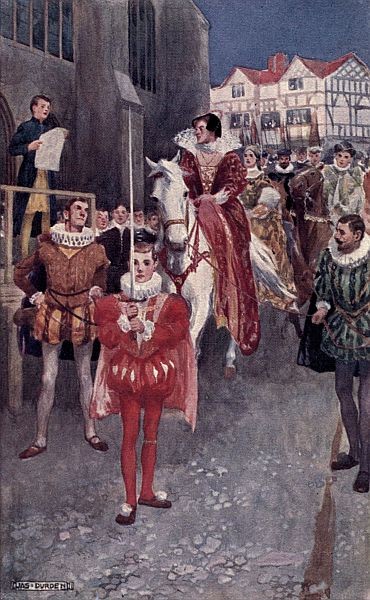
Campion reading an Address of Welcome to Queen Mary. p. 3.
BLESSED EDMUND CAMPION
BY
LOUISE IMOGEN GUINEY
R. & T. WASHBOURNE, LTD.
PATERNOSTER ROW, LONDON
AND AT MANCHESTER, BIRMINGHAM, AND GLASGOW
1914 All rights reserved
Campiani Fratribus
e Provincia Angliæ Societatis Jesu Tribus
opusculum suum
grato affectu
Scriptor
PREFATORY NOTE
This little book leans much, as every modern work on the subject must do, upon Mr. Richard Simpson’s monograph: Edmund Campion, Jesuit Protomartyr of England. In many points supplementing or contradicting that splendid though biased narrative, the present writer has gratefully taken advantage of the researches of the Rev. John Hungerford Pollen, S.J. It may also be useful to state that the contemporary citations, when not otherwise specified, are from two invaluable witnesses, Parsons and Allen. The translated passages have been compared with the originals, and sometimes newly rendered.
L. I. G.
St. Ives, Cornwall: Epiphany, 1908.
CONTENTS
CHAP. PAGEI.
Youth: London, Oxford: 1540-1566 1II.
The Hour of Unrest: Oxford, Dublin: 1566-1570 14III.
Steps Forward: Ireland: 1571 27IV.
Cheyney Again: Douay: 1571 40V.
The Call to Come up Higher: Douay, Prague: 1571-1573 53VI.
The Wished-for Dawn: Bohemia: 1573-1579 64VII.
A Long March: Rome, Geneva, Rheims: 1580 75VIII.
Inhospitable Home: 1580 88IX.
Skirmishing: the English Counties: 1580 100X.
Many Labours: and a Book: 1580 112XI.
At Lyford Grange, and After: 1581 129XII.
The Thick of the Fray: 1581 141XIII.
Victory: December 1, 1581 166LIST OF ILLUSTRATIONS
Campion reading an Address of Welcome to Queen Mary
FrontispieceCampion in his Proctor’s Robes. Gateway of St. John’s College, Oxford, in Background
to face p.
16‘P[ater] Edmundus Campianus, Martyr’
”
80‘We have not broken through here!’
”
128Campion before Queen Elizabeth
”
144‘Not Guilty!’
”
160During these years Campion read a great deal of theology, as in his position he was bound to do, according to University rules. Where everything else except his inmost heart inclined him to heresy, the Fathers drove him back upon the fulness of revealed truth. The day which he spent with St. Augustine, or St. Jerome, or St. John Chrysostom, was a day on which (to catch up the phrase of his friend and biographer, Fr. Robert Parsons, himself a Balliol man) he was ready “to pull out this thorn of conscience.” But on the morrow returned the old spirit of obstinacy and delay. Meanwhile the Anglican influence was gaining for Campion’s dearest friend of many, Richard Cheyney, the Lord Bishop of Gloucester, was drawing him on towards his own ideals, which were “Catholic-minded,” if not Catholic. The learned, gentle and lovable Cheyney withstood with zest the risen Puritan party, and in his hold on sound doctrine stood apart from all his colleagues on the Episcopal Bench. He had been brought up as a Catholic, and ordained according to the full Catholic ritual, in 1534. The reminder is sometimes needed that Protestants did not shoot up full-grown, that all original Protestantism was made up of human material once Catholic. From first to last, however, Cheyney could not be forced to coerce the Church which he had abandoned. In this he stood not, as has been stated, quite alone among the Elizabethan Bishops, for Downham of Chester and Ghest of Rochester shared his honourable abstinence, though in less degree. The moment Cheyney was out of the way, the Catholics on his diocesan ground, hitherto safe, were mercilessly harried. He had been made a Bishop against his will, displacing the true occupant of the See, when his friend Edmund Campion was two-and-twenty. In most matters Cheyney followed Luther; Cranmer’s more heretical doctrines, which prevailed on all sides in England, he thoroughly hated. He longed always for a reconciliation which was never to be, and never can be. He longed to see the Catholics (against the well-thought-out and oft-repeated prohibition of their leaders, between 1562 and 1606) do a little evil to procure a great good: namely, smooth matters over, escape their terribly severe penalties, and in the end become able to leaven the lump of English error, by the mere preliminary of attendance at the service of Common Prayer according to law, in their own old parish churches. The Book of Common Prayer, as he would remind them, was expressly designed to suit persons of various and even contradictory religious views: Catholic; not-so-very Catholic; ex-Catholic; non-Catholic; anti-Catholic! Campion often rode over the hills to Gloucester to sit by the episcopal hearth-fire, book on knee, and hear such theories as this, and sympathize with the lonely old man who “saw visions,” and had little else in his vexed life to content him. His strong double desire was to save by his own effort for the Church of England separated from Rome, that great body of ancient belief and practice sure otherwise to be lost in the flood of invited Calvinism; and to secure Edmund Campion himself as his intellectual coadjutor and successor, as one of high gifts likely to “drink in his thoughts and become his heir.” The two were together, not only in matters of dogma, but in all minor points. Cheyney shared with Campion dislike of politics, telling the Council that in such matters he was “a man of small experience and little observation.” He kept his old priestly ideals, and would never marry. Campion, too, chose to be a celibate. If he gave his heart to either Church, he saw even then that it must be an undivided heart. To him, with his underlying tenderness towards the ancient faith, and his dream of peacemaking through compromise, which is so English, and just in these matters so mistaken, the mission thus opened out appealed. Half reluctantly, yet not realizing the disloyalty of his act (as he himself tells us), he allowed himself to receive from Cheyney’s hands Deacon’s orders in the Church of England.
The roads were bad beyond any modern idea of badness, and it poured rain for the first nine or ten days. Campion, the least robust of the party, and the most poorly clad, fell ill under such combined discomforts, and while crossing the Apennines had to be lifted into the saddle of one of the very few horses which had been brought along for the sake of the infirm. As soon as he was well enough he resumed his daily habit of saying Mass very early, and of walking on, in the later morning hours, till he was a mile ahead of the rest, to make his meditation, read his Office, and say the Litany of the Saints, before he should be overtaken. He and his comrades planned their spiritual life, day by day, with the most careful regularity. Their talk was always of souls: “the Harvest” was their word for England, or else “the Warfare.” In the chilly spring twilights Campion would push on ahead again, “to make his prayers alone, and utter his zealous affections to his Saviour without being heard or noted.”
The outcry redoubled, now that he had again succeeded in catching public attention. Fresh and monstrously cruel measures were therefore taken against all Papists. “Naught is lacking,” wrote to Acquaviva the tender soul who too well knew himself to be the cause of many sorrows, “but that to our books written with ink should succeed others daily published, and written in blood.” Fr. Parsons prudently ordered him back to the North. The two heard each other’s confessions and renewal of vows at Stonor, and said good-bye, exchanging hats as a parting gift, after the friendly fashion of their time. Campion was to ride straightway into Lancashire to get his manuscript and notes, left behind, his former companion Ralph Emerson going with him; and he was then to betake himself to the fresh mission field in Norfolk. As it fell out, he soon spurred back after Parsons to tell him of a letter that moment received. It was from a gentleman named Yate, then a prisoner for his religion, earnestly begging Campion to visit Lyford Grange in Berkshire, the gentleman’s own estate, hard by, where his wife and mother still were, together with Edward Yate, and part of a proscribed community of English Brigittine nuns, driven back into England by troubles in the Low Countries. Fr. Parsons, knowing the house to be a conspicuous one, and already supplied with chaplains, was unwilling to grant the permission. But eventually he gave in, warning the two others not to tarry beyond one night or one day, and as a precaution, putting Campion under the lay brother’s care and obedience. Parsons parted from him not without a rueful and affectionate word. “You are too easy-going by far,” he said to his friend and fellow-soldier, purposely giving its least heroic name to that intentionally prodigal zeal for souls. “I know you, Father Edmund; if they once get you there, you will never break away!”
The chief count against the defendant was the old, old one of the Bull of Deposition, and the denied authority of the Queen in spirituals: that wretched family skeleton trotted out once more! “You refused to swear to the Supremacy, a notorious token of an evil willer to the Crown.” Campion, who was surely what Antony Wood quaintly calls him, “a sweete Disposition, and a well-polish’d Man,” stated his position once more, lucidly, and with perfect temper. He began by referring to what passed at the Earl of Leicester’s London house. “Not long since it pleased her Majesty to demand of me whether I did acknowledge her to be my Queen or no. I answered that I did acknowledge her Highness not only as my Queen, but also as my most lawful governess. And being further required by her Majesty whether I thought the Pope might lawfully excommunicate her or no, I answered: ‘I confess myself an insufficient umpire between her Majesty and the Pope for so high a controversy, whereof neither the certainty is yet known, nor the best divines in Christendom stand fully resolved! . . . I acknowledge her Highness as my governor and sovereign; I acknowledge her Majesty both in fact and by right to be Queen; I confess an obedience due to the Crown as to my temporal head and primate.’ This I said then; so I say now. If then I failed in aught, I am now ready to supply it. What would you more? I will willingly pay to her Majesty what is hers; yet I must pay to God what is His. Then as for excommunicating her Majesty, it was exacted of me (admitting that excommunication were of effect, and that the Pope had sufficient authority so to do), whether then I thought myself discharged of my allegiance or no? I said that this was a dangerous question, and that they that demanded this demanded my blood. Admitting (why admitting?) I would admit his authority, and then he should excommunicate her, I would then do as God should give me grace: but I never admitted any such matter, neither ought I to be wrested with any such suppositions.” To all this no rejoinder was made. It was the identical position taken up by many another harassed martyr. The prosecution next turned to the remaining prisoners, using the same weak, wrong, skirmishing tactics,—Campion often putting in a word to hearten one, to defend another, to guide a third. At a certain point he exclaimed: “So great are the treasons that I and the others have wrought, that the gaoler who has us in charge told me at night that would we but go to the Anglican services they would pardon us straightway!” Serrano, who reports this, adds: “They answered things in general.” At the close of the proceedings, their issue being prearranged, Campion was allowed to make a speech to the jurors. He eloquently begged them to seek for certainties, and to remember the character of the “evidence” brought before them. Alas! he was appealing to bought men, who dared not be true.
BLESSED
EDMUND CAMPION
I
YOUTH: LONDON, OXFORD: 1540-1566
THE Campion family seem to have been both gentlefolk and yeomen, and to have been widely scattered over the land: in Northamptonshire, Warwickshire, Essex, Sussex, and Devon. Nothing is definitely known, at present, as to which branch of the Campion family the Blessed Edmund belonged. Unlike many of the martyrs of Tudor and Stuart times, he was what is called a “born” Catholic: in more accurate phrase, a born heathen, as we all are! but baptized in his parents’ religion soon after his birth in London, on the Feast of St. Paul the Apostle, January 25, in the year 1540, New Style. Edmund had two brothers, and a sister, none of whom played any great part in his after life. By the time he entered the Society of Jesus his father and mother were both dead: his written expression is that he had “hopes” they died in full communion with the Church; but evidently he did not know, being abroad, how it had fared with them in those terribly stormy days for Christian souls.
Edmund Campion, senior, was a book-seller, evidently in good standing, but not well to do. Some rich London guildsmen (probably of the Grocers’ Company, for it was they who maintained him later), befriended the promising little boy at just the right moment, when his father was reluctantly going to apprentice him to a trade; and he was sent, at their joint expense, to a good Grammar School. Afterwards, under the same patrons, he entered Christ Hospital, then lately set up in Newgate Street (out of confiscated Franciscan funds and the generosity of Londoners), as the “foundation” of the sixteen-year-old king, Edward VI. Here the small Edmund, full of life and laughter, banded and belted, ran about in now extinct yellow petticoats, and one of the earliest pairs of those historic yellow stockings. He was thirteen, and quite famous already in the school-boy world of London for his learning and his attractive presence and speech, when Queen Mary Tudor, who had just succeeded to the English throne, entered her city in state. Out of many hundred eligible youngsters it was he who was chosen to stand up before her on a street platform, under the shadow of the old St. Paul’s Cathedral, and shrilly welcome her in the Latin tongue. The Queen sat on a white horse, robed in gold-embroidered dark velvet, crimson or purplish, with the great sword carried before her by the boyish Earl of Surrey, with eight thousand mounted lords and gentlemen on either side, all the glittering ambassadors, and a bevy of beautifully apparelled ladies. On certain figures in that splendid and noisy pageant the child might have looked with pensive eyes, had he been able to forecast his own future; as it was, he cannot have failed to observe the Queen’s younger sister, the thin, watchful, spirited girl who was known as the Lady Elizabeth. Another was there, of high office, though not of high descent, who was all goodness, piety and generosity, and may well have been drawn to notice Edmund Campion for the first time on that sunshiny afternoon in August, 1553. This was Sir Thomas White, then Lord Mayor of London, a staunch Catholic. He was an unlearned man and childless, who became, later, co-founder of the Merchant Taylors’ School, and enricher of many towns. By 1555 he had opened his College of St. John Baptist, once a Cistercian house, at Oxford. The Grocers’ Company at once approached him to admit their Blue-coat ward as a scholar; this he did, and conceived, almost as soon, a marked attachment to him; and two years later (when Edmund was not yet eighteen!) he made him a Senior Fellow. Campion’s other early friends at the University were his first tutor, John Bavand, and Gregory Martin, a Foundation Scholar like himself. These two showed towards him a lifelong devotion.
Mary’s troubled reign had covered the five most susceptible years of his youth, and restored to the country, despite its legal excesses, a definitely Catholic tone. Things were soon to change. War by statute against the Mass was first declared in 1559. Edmund Campion had left Oxford by the time that St. John’s, deprived of President after President by the Royal Commissioners, was swept clean of all the dons who favoured, or in any degree tolerated, the jurisdiction of that Apostolic See which safeguarded the doctrine and honour of the Blessed Eucharist. But while he lived in his University world, he lived untouched. He was not looked upon as a Catholic. Nor was he such, if his heart could be fully judged by his outward actions. Buried in literature, philosophy, and pleasant tutorial work, he had become, in his cultured indifference, what St. Jerome’s accusing vision called a “Ciceronian,” and not a Christian: a skin-deep Ciceronian, however. There is only a bare possibility that, on proceeding M.A. in 1564, he escaped taking the wretched Oath of Supremacy, and thereby acknowledging the Queen as Head in spirituals as well as temporals within her realm of England. He stretched his conscience, as many were doing, thinking to help along the unity of faith, thereby defeating that unity for good and all. An almost unprecedented vogue at Oxford had served to blind him: he was so happy, so busy, so needed, so much at home there. Friends encouraged him; undergraduates flocked about him, and imitated his very gait and tone as they never have imitated any one else except Newman.
Campion was a famous Latin scholar; and he was a good Grecian and a good Hebraist: Greek and Hebrew were studies newly revived just before he was born. He spoke as well as he wrote. The flamboyant art of oratory, now almost extinct in our more quiet-coloured century, was then much studied and admired; and Campion was famous for debates and addresses and encomiums. When only twenty, he had been called upon to preach, though a layman, at the re-burial of poor Amy Robsart, Lord Dudley’s young wife, in the University church of St. Mary-the-Virgin; and this he did with great grace and animation, and with no small display of tact, for rumours of a murder with a motive had already got abroad. Such prominence may have come to Campion through Sir Thomas White’s request: Sir Thomas had his associations with Cumnor. Four years later, Edmund Campion was able to put sincere love and sincere grief into a funeral oration (this time a Latin, not an English one) for the good and dear Founder himself, whose body was solemnly interred in the Chapel of his College.
In September, 1566, Queen Elizabeth made the first and happier of her two visits to Oxford. In the Queen’s train was Dudley; also a quieter, plainer, less noticed man, but one out of all comparison with him for astute power: this was Sir William Cecil, the Prime Minister, afterwards known far and wide as Lord Burghley. There were farces and tragedies for the Queen at Oxford, there were musical performances, theological disputations, and other academic sports. In front of the vast assemblage stood forth Master Campion of St. John’s, alone in his ruff, hood and gown. As representative of the University, he welcomed smiling royalty, and Dudley, now Earl of Leicester, Chancellor of the University, and royalty’s magnificent favourite. Campion shone, as well, in the absurd discussions in natural science which followed. The Queen and Dudley marked him, as they could not fail to do; for nothing could exceed the courtliness with which he had performed his task. The Chancellor sent for him in private, and expressed the Queen’s good-will, whereby Campion might bid, through him, for whatever preferment he chose. But Campion, always truly modest and full of ironic humour as well, would ask of his patron nothing, he said, but his continued regard. The young bookman had a real liking for the vicious worldling, liked by several sensitively good men, then and since. Sir William Cecil also took instinctive interest in Campion and his eager dialectics. Altogether, there was no more popular man in Oxford or elsewhere. Campion was on the hilltop of professional and personal success.
In all this beautiful fountain-play of “the things which are seen,” he was running the very gravest risk of spiritual ruin. Perhaps he could not know, in his leaf-hung hermitage, what a tremendous muster of souls was going on, now that the ancient Church and a new statecraft were to fight it out in England. Queen Elizabeth’s quarrel with the Pope was hardly more doctrinal than her royal father’s had been: she, too, would have been quite content to live all her days as a Catholic, provided that Catholicism would prove her slave. The battle was not between two known religions. On one side was conservative England with a belief; on the other the strong spirit of secularism, plus a few fanatics formed not by the English, but the Continental Reformation. Religion in itself troubled the Court party as little as anything could possibly do. It was because the spirit of Catholicism seemed to them to threaten their particular kind of national pride, and to interfere with their particular kind of worldly prosperity, that Cromwell in one great Tudor reign, Burghley in the other, tried to put it down. They wished to get good citizenship acknowledged not as an ideal, but as the supreme ideal, and they cared not how much else was shovelled out of the way. Their only use for religion was to bring it well under the authority of the law and the supremacy of the Crown. They had no objection to high respectability, but a most violent objection to the supernatural life, because that gives to those who practise it a dangerous independence. Elizabeth wanted unity and peace. Her subjects were to be forced by statute to pray less and to pray all alike; and to be thereby trained, somehow, to put Sacraments and Saints and the Papacy out of their heads. English humankind were to forsake their happy wild life, as it were, in the Church Universal, and all become, as if by magic, one large tame pet lying in a ribboned collar on the royal hearth. This is a vision which has appealed to many another head of a commonwealth as desirable, though unaccountably difficult! Some worthy persons have brought themselves to believe that nothing to speak of happened at the Reformation. But at the time, everybody understood in the clearest fashion that an old moral system which would not come to terms had been dropped, and a more satisfactory one created. It was a working theory of that age, all over Europe, that a governor had the right to fix the belief of subjects. What was wanted in England was made to order, out of the rags of ruined doctrine and discipline. Foreign Protestants raged over its externals, as having too much of the old thing, but the bullying State, riding roughshod over Convocation and the laity, was perfectly at ease, knowing that there was more than enough of the new thing to colour the whole, and to colour it once and for ever. There was no affection for “continuity” in those days except among the “Romans.” The attitude of their persecutors was that of men in a fury that any Englishman should dare to connect himself either with the world at large, or with his country’s own disclaimed yesterday. The State Trials, for instance, bear this out in a score of places. Many an official answer resembles the one made to that interesting character Blessed Ralph Sherwin, when he said truly that his coming back to his own land was to persuade the people to Catholic Unity. “You well know,” so the Counsel reproved him in Westminster Hall, “that it was not lawful for you to persuade the Queen’s subjects to any other religion than by her Highness’s instructions is already professed.” The “received religion,” or, as it was quite as often called, the “Queen’s religion,” was simply the new idea of nationalism torn away from relationship to the arch-idea of nations, which is the law of God. It was, in practice, no adoring angel at the Altar, but a capable parish beadle at the door. Now this was never the Catholic conception of what religion has been, or is meant to be. Happily, many thoroughly patriotic Englishmen felt that no least jot of Christian revelation, however much it stood in the way of Cæsar, could, with their consent, be put by; and to keep it free they were willing to make themselves very disagreeable indeed to their revered sovereign, and to their more easy-going countrymen. With that rude definiteness which is ever their chief family trait, the better Catholics threw their full force against the Oaths of Supremacy and Acts of Uniformity, as soon as they understood their meaning. The centuries passed since then prove that they succeeded in holding asunder what the Queen would join together. Was it unreasonable that she punished the men who tried to spoil her dream? And almost the chief of these men Edmund Campion was destined to be, though years were to pass before he lent his whole heart to the work God willed him to do.
II
THE HOUR OF UNREST: OXFORD, DUBLIN:
1566-1570
THOUSANDS who were comfortably placed in life, and conscientious, too, had a great deal to suffer until things were made plain. Edmund Campion began to fret, and argue, and ponder, and pray for light in secret, for several years going about “that most ingeniose Place” (as a later lover called Oxford) with heavy thoughts. Oxford itself, despite the Ecclesiastical Commission fixed there to worry it, was more Catholic in spirit than any other city in England. Nevertheless Campion’s temptation to conform was very great. We must remember that many of his first impressions and memories were Anglican. He was brought up during his early school life on the new Liturgy, which came into operation before his tenth year. He knew now, in manhood, that to change about, and forsake the State religion for the only Church which is as exacting as her Master, would be to see the ruin of his happy career. His strong point, in the beginning, was not what is called brute courage. His was the nervous, Hamlet-like temper, natural to students and recluses, which, by a fatal error, puts endless thinking into what needs only to be done.
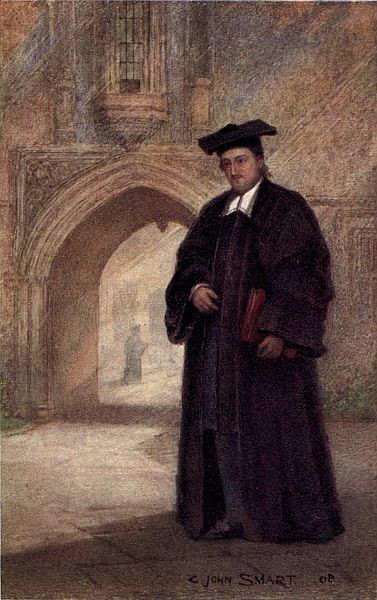
Bld. Edmund Campion in Proctor’s robes.
(Gateway of St. John’s College, Oxford, in background)
During these years Campion read a great deal of theology, as in his position he was bound to do, according to University rules. Where everything else except his inmost heart inclined him to heresy, the Fathers drove him back upon the fulness of revealed truth. The day which he spent with St. Augustine, or St. Jerome, or St. John Chrysostom, was a day on which (to catch up the phrase of his friend and biographer, Fr. Robert Parsons, himself a Balliol man) he was ready “to pull out this thorn of conscience.” But on the morrow returned the old spirit of obstinacy and delay. Meanwhile the Anglican influence was gaining for Campion’s dearest friend of many, Richard Cheyney, the Lord Bishop of Gloucester, was drawing him on towards his own ideals, which were “Catholic-minded,” if not Catholic. The learned, gentle and lovable Cheyney withstood with zest the risen Puritan party, and in his hold on sound doctrine stood apart from all his colleagues on the Episcopal Bench. He had been brought up as a Catholic, and ordained according to the full Catholic ritual, in 1534. The reminder is sometimes needed that Protestants did not shoot up full-grown, that all original Protestantism was made up of human material once Catholic. From first to last, however, Cheyney could not be forced to coerce the Church which he had abandoned. In this he stood not, as has been stated, quite alone among the Elizabethan Bishops, for Downham of Chester and Ghest of Rochester shared his honourable abstinence, though in less degree. The moment Cheyney was out of the way, the Catholics on his diocesan ground, hitherto safe, were mercilessly harried. He had been made a Bishop against his will, displacing the true occupant of the See, when his friend Edmund Campion was two-and-twenty. In most matters Cheyney followed Luther; Cranmer’s more heretical doctrines, which prevailed on all sides in England, he thoroughly hated. He longed always for a reconciliation which was never to be, and never can be. He longed to see the Catholics (against the well-thought-out and oft-repeated prohibition of their leaders, between 1562 and 1606) do a little evil to procure a great good: namely, smooth matters over, escape their terribly severe penalties, and in the end become able to leaven the lump of English error, by the mere preliminary of attendance at the service of Common Prayer according to law, in their own old parish churches. The Book of Common Prayer, as he would remind them, was expressly designed to suit persons of various and even contradictory religious views: Catholic; not-so-very Catholic; ex-Catholic; non-Catholic; anti-Catholic! Campion often rode over the hills to Gloucester to sit by the episcopal hearth-fire, book on knee, and hear such theories as this, and sympathize with the lonely old man who “saw visions,” and had little else in his vexed life to content him. His strong double desire was to save by his own effort for the Church of England separated from Rome, that great body of ancient belief and practice sure otherwise to be lost in the flood of invited Calvinism; and to secure Edmund Campion himself as his intellectual coadjutor and successor, as one of high gifts likely to “drink in his thoughts and become his heir.” The two were together, not only in matters of dogma, but in all minor points. Cheyney shared with Campion dislike of politics, telling the Council that in such matters he was “a man of small experience and little observation.” He kept his old priestly ideals, and would never marry. Campion, too, chose to be a celibate. If he gave his heart to either Church, he saw even then that it must be an undivided heart. To him, with his underlying tenderness towards the ancient faith, and his dream of peacemaking through compromise, which is so English, and just in these matters so mistaken, the mission thus opened out appealed. Half reluctantly, yet not realizing the disloyalty of his act (as he himself tells us), he allowed himself to receive from Cheyney’s hands Deacon’s orders in the Church of England.
His interior struggle, from this day forth, went from bad to worse. With the unaffected simplicity of his character, he talked over his difficulties not only with Cheyney, but with any one at Oxford who seemed able to help him. As a consequence, the Grocers’ Company, whose exhibition he still held, heard rumours, grew uneasy, and began to suspect him, ending in 1568 by inviting Campion up to London to save his credit by preaching at Paul’s Cross, and publicly “favouring,” as they expressed it, “the religion now authorized.” He begged for time, and that being granted, for more time. He attended a court of the Company in order to plead engagements, and to say that he was not his own man, while deep in academic duties and at the service of undergraduates: “divers worshipful men’s children,” he calls them. He was Public Orator and Proctor, in fact, by now, as well as Fellow and Tutor of his College. (He never resided long enough to take his Doctor’s degree.) He exacted from the Company a written statement of the dogmas he was expected to avow; and finding it impossible to subscribe to the hot heterodoxy thus laid down, he cut his first tether by resigning his exhibition.
His most brilliant colleague at St. John’s, Gregory Martin, who had protested in vain against Campion’s diaconate (which was to cause the recipient extreme remorse for a long time), had become a convert to Catholicism, and sacrificed all his secular prospects. He wrote to his dear friend to warn him against ambition, and to urge on him escape from moral bondage. “Come!” the fervent letter cried; “if we two can but live together, we can live on nothing. If this be too little, I have money; and if this also fails, one thing is left: ‘they that sow in tears shall reap in joy!’” Such earnest words, though seeming wasted, had their share in shaking Edmund Campion’s rest.
With the summer term of 1570 his Proctorate expired. He spent the Long Vacation in tutoring the eight-years-old Harry Vaux, eldest son of Lord Vaux of Harrowden, who afterwards beautifully redeemed his childish promise. The end of Michaelmas term found Campion face to face for the last time with that life which he had so loved, and in which, with his scientific enthusiasm for letters, he had been such a wonderful inspiration to young men. There was no conscious motive in his heart deeper than a thirst for such freedom as had become difficult in a Puritanizing University, when he cut himself loose, slipped out of it for good, and took ship for Ireland.
In the new move he had the approbation of Leicester, and the companionship of a much-attached Oxford disciple, Richard Stanihurst, who is remembered by posterity only for his grotesque translation of Virgil. Campion may well have left home with the understanding that he should have a clear educational field in Dublin, but he arrived a little too late. The outlook had been very bright. Some good men then in power were eager for the revival of the extinct University of Dublin, an ancient Papal foundation, but ruined, as all the great Schools were (most of them permanently, some only temporarily), by the religious changes. The chief supporters of the plan were enthusiastic, far-sighted, and most liberally inclined towards Catholics. Fear and prejudice therefore stepped in, in the person of Elizabeth’s Irish Bishops. The Lord Chancellor, Dr. Weston, wrote privately to the Queen, deploring the popularity of the scheme, and begging her to take the unborn foundation “into her merciful, motherly care.” She followed that advice. In token thereof, in due season arose Trinity College, Dublin, as a complete checkmate to the earlier project, quite safe for evermore from Papist blight. Thus was Campion cheated of a continuance of his natural vocation, in serving upon the staff of the new University. Two of his friends who had most concern in it were James Stanihurst, father of Richard, and Sir Henry Sidney, then Lord Deputy of Ireland, who had proffered it lands and money. Leicester would have provided Campion with a letter of introduction to Sir Henry, his own brother-in-law. The latter’s young son, Philip, was at this time a student in Oxford, where his governor, Thomas Thornton of Christ Church, afterwards Vice-Chancellor, had been constantly in Campion’s society. Sir Henry Sidney always bore himself most kindly towards Campion. The latter lived, a more than welcome guest, under the roof of James Stanihurst, then Recorder of Dublin, and Speaker of the local House of Commons. Stanihurst was the head of an Anglo-Irish family not openly Catholic since Queen Mary’s reign. Indeed, in his public capacity, he had often sided against Catholicism, although he was as friendly as Sidney himself to those who professed it. In the midst of this temporizing household, Campion, himself a temporizer, came during the winter to be doubted by certain bigots outside. Very possibly he was too free-spoken. Campion “came to Ireland believing in practically all Catholic dogmas, even in the Eucharist, and in the authority of the Council of Trent.” The impression may have got abroad that his then unknown variety of Anglicanism differed little from the dangerous creed of times past, lately discovered to be the proper business of the police! Whatever the reason, Campion began to be a marked man. Sir Henry Sidney told Stanihurst with heat, that so long as he was Governor he would see to it that “no busy knave of them all should trouble him,” on Campion’s account. Under this unpleasant circumstance of espial, added to the disappointment he had just undergone, the sensitive exile presently fell ill, and got a most affectionate nursing from the Stanihursts, till his strength revived. He started as soon to write a treatise on a subject of which his mind, up to now, had been full: the character and aim of the ideal youth at the Universities. This De Juvene Academico reminds us of a theme by another great Oxonian who was in Dublin three hundred years later, and had also to face the heartbreaking failure of an Irish University dreamed of, and not to be. Campion afterwards recast his fine little work, and under its second form it is to be found among the few Opuscula published after his death. His comely face and gracious manner were quickly taken into favour in his Dublin circle. While he was gaining a contrary repute on hearsay, the few who had access to him nicknamed him “the Angel.”
Meanwhile, hating idleness, and bent on redeeming what may have looked like a foolish absence from Oxford, Campion planned the composition of a brief History of Ireland. Friends helped him in “inquiring out antiquities of the land.” He was what we should call a thorough “researcher,” a bird by no means common in those early days. He went here and there among musty manuscript records of the city, and from library to library in the country, happily gathering in his materials for work. He had been some three months in Ireland when on a March midnight there came a sudden warning from the faithful Lord Deputy, who was on the point of leaving for England. Campion learned thereby that Weston the Chancellor had pursuivants ready to arrest him the next morning! The Stanihursts acted at once, and hurried their friend into the care of Sir Christopher Barnewall and Dame Marion Sherry, his wife, of Turvey House, in the parish of Donabate, eight miles away. There, breathless with the sudden flight through the dark, the three devoted escorts left him in safety.