


автордың кітабын онлайн тегін оқу A History of Champagne, with Notes on the Other Sparkling Wines of France
Original Book Cover
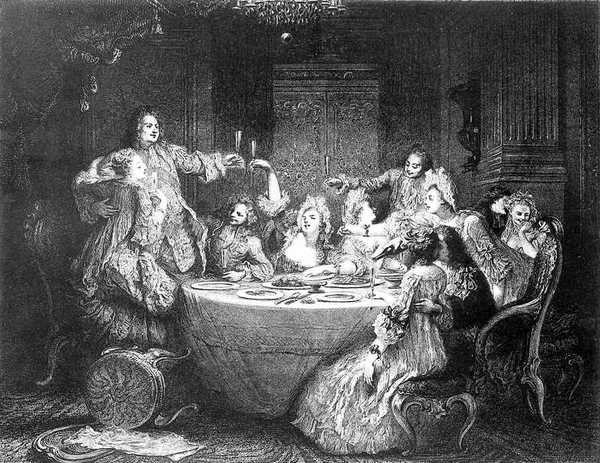
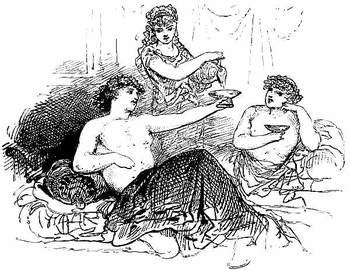
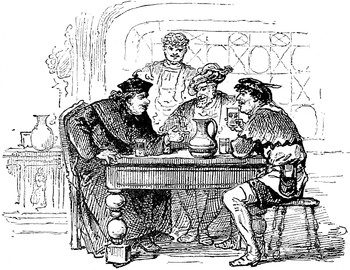
A SUPPER UNDER THE REGENCY.
Click here to view the original title page
A HISTORY
OF
CHAMPAGNE
WITH NOTES ON
THE OTHER SPARKLING WINES OF FRANCE.
BY HENRY VIZETELLY,
CHEVALIER OF THE ORDER OF FRANZ-JOSEF, AUTHOR OF ‘THE WINES OF THE WORLD CHARACTERISED AND CLASSED,’ ‘FACTS ABOUT PORT AND MADEIRA,’ ‘FACTS ABOUT CHAMPAGNE AND OTHER SPARKLING WINES,’ ‘FACTS ABOUT SHERRY,’ ETC.
ILLUSTRATED WITH 350 ENGRAVINGS.
LONDON:
VIZETELLY & CO., 42 CATHERINE STREET, STRAND.
SCRIBNER & WELFORD, NEW YORK. 1882.
LONDON:
ROBSON AND SONS, PRINTERS, PANCRAS ROAD, N.W.
Condensed Table of Contents
(added by the transcriber)
PREFACE. iv PART I. I.Early Renown of the Champagne Wines
1 II.The Wines of the Champagne from the Fourteenth to the Seventeenth Century.
12 III.Invention and Development of Sparkling Champagne.
34 IV.The Battle of the Wines.
47 V.Progress and Popularity of Sparkling Champagne.
57 VI.Champagne in England.
83 PART II. I.The Champagne Vinelands—The Vineyards of the River.
117 II.The Champagne Vinelands—The Vineyards of the Mountain.
130 III.The Vines of the Champagne and the System of Cultivation.
140 IV.The Vintage in the Champagne.
148 V.he Preparation of Champagne.
154 VI.Reims and its Champagne Establishments.
168 VII.Reims and its Champagne Establishments (
continued).
179 VII.Reims and its Champagne Establishments (
continued).
188 IX.Epernay.
195 X.The Champagne Establishments of Epernay and Pierry.
205 XI.Some Champagne Establishments at Ay and Mareuil.
217 XII.Champagne Establishments at Avize and Rilly.
229 XIII.Sport in the Champagne.
235 PART III. I.Sparkling Saumur and Sparkling Sauternes.
241 II.The Sparkling Wines of Burgundy, the Jura, and the South of France.
251 III.Facts and Notes Respecting Sparkling Wines.
258 APPENDIX. 265 Advertisements. 268PREFACE.
The present is the first instance in which the history of any wine has been traced with the same degree of minuteness as the history of the still and sparkling wines of the Champagne has been traced in the following pages. And not only have the author’s investigations extended over a very wide range, as will be seen by the references contained in the footnotes to this volume, but during the past ten years he has paid frequent visits to the Champagne—to its vineyards and vendangeoirs, and to the establishments of the chief manufacturers of sparkling wine, the preparation of which he has witnessed in all its phases. Visits have, moreover, been made to various other localities where sparkling wines are produced, and more or less interesting information gathered regarding the latter. In the pursuit of his researches, the author’s position as wine juror at the Vienna and Paris Exhibitions opened up to him many sources of information inaccessible to others less favourably circumstanced, and these his general knowledge of wine, acquired during many years’ careful study, enabled him to turn to advantageous account.
The numerous illustrations scattered throughout the present volume have been derived from every available source that suggested itself. Ancient MSS., early-printed books, pictures and pieces of sculpture, engravings and caricatures, all of greater or less rarity, have been laid under contribution; and in addition, nearly two hundred original sketches have been made under the author’s immediate superintendence, with the object of illustrating the principal localities and their more picturesque features, and depicting all matters of interest connected with the growth and manipulation of the various sparkling wines which are here described.
In the preparation of this work, and more particularly the historical portions of it, the author has been largely assisted by his nephew, Mr. Montague Vizetelly, to whom he tenders his warmest acknowledgments for the valuable services rendered by him.
It should be stated that portions of the volume, relating to the vintaging and manufacture of sparkling wines generally, have been previously published under the title of Facts about Champagne and other Sparkling Wines, but they have been subjected to considerable extension and revision before being permitted to reappear in their present form.
St. Leonards-on-Sea, February 1882.
CONTENTS.
PART I.
I.
EARLY RENOWN OF THE CHAMPAGNE WINES.
P
AGEThe vine in Gaul—Domitian’s edict to uproot it—Plantation of vineyards under Probus—Early vineyards of the Champagne—Ravages by the Northern tribes repulsed for a time by the Consul Jovinus—St. Remi and the baptism of Clovis—St. Remi’s vineyards—Simultaneous progress of Christianity and the cultivation of the vine—The vine a favourite subject of ornament in the churches of the Champagne—The culture of the vine interrupted, only to be renewed with increased ardour—Early distinction between ‘Vins de la Rivière’ and ‘Vins de la Montagne’—A prelate’s counsel respecting the proper wine to drink—The Champagne desolated by war—Pope Urban II., a former Canon of Reims Cathedral—His partiality for the wine of Ay—Bequests of vineyards to religious establishments—Critical ecclesiastical topers—The wine of the Champagne causes poets to sing and rejoice—‘La Bataille des Vins’—Wines of Auviller and Espernai le Bacheler
1II.
THE WINES OF THE CHAMPAGNE FROM THE FOURTEENTH TO THE SEVENTEETH CENTURY.
Coronations at Reims and their attendant banquets—Wine flows profusely at these entertainments—The wine-trade of Reims—Presents of wine from the Reims municipality—Cultivation of the vineyards abandoned after the battle of Poitiers—Octroi levied on wine at Reims—Coronation of Charles V.—Extension of the Champagne vineyards—Abundance of wine—Visit to Reims of the royal sot Wenceslaus of Bohemia—The Etape aux Vins at Reims—Increased consumption of beer during the English occupation of the city—The Maid of Orleans at Reims—The vineyards and wine-trade alike suffer—Louis XI. is crowned at Reims—Fresh taxes upon wine followed by the Mique-Maque revolt—The Rémois the victims of pillaging foes and extortionate defenders—The Champagne vineyards attacked by noxious insects—Coronation of Louis XII.—François Premier, the Emperor Charles V., Bluff King Hal, and Leo the Magnificent all partial to the wine of Ay—Mary Queen of Scots at Reims—State kept by the opulent and libertine Cardinal of Lorraine—Brusquet, the Court Fool—Decrease in the production of wine around Reims—Gifts of wine to newly-crowned monarchs—New restrictions on vine cultivation—The wine of the Champagne crowned at the same time as Louis XIII.—Regulation price for wine established at Reims—Imposts levied on the vineyards by the Frondeurs—The country ravaged around Reims—Sufferings of the peasantry—Presents of wine to Marshal Turenne and Charles II. of England—Perfection of the Champagne wines during the reign of Louis XIV.—St. Evremond’s high opinion of them—Other contemporary testimony in their favour—The Archbishop of Reims’s niggardly gift to James II. of England—A poet killed by Champagne—Offerings by the Rémois to Louis XIV. on his visit to their city
12III.
INVENTION AND DEVELOPMENT OF SPARKLING CHAMPAGNE.
The ancients acquainted with sparkling wines—Tendency of Champagne wines to effervesce noted at an early period—Obscurity enveloping the discovery of what we now know as sparkling Champagne—The Royal Abbey of Hautvillers—Legend of its foundation by St. Nivard and St. Berchier—Its territorial possessions and vineyards—The monks the great viticulturists of the Middle Ages—Dom Perignon—He marries wines differing in character—His discovery of sparkling white wine—He is the first to use corks to bottles—His secret for clearing the wine revealed only to his successors Frère Philippe and Dom Grossart—Result of Dom Perignon’s discoveries—The wine of Hautvillers sold at 1000 livres the queue—Dom Perignon’s memorial in the Abbey-Church—Wine flavoured with peaches—The effervescence ascribed to drugs, to the period of the moon, and to the action of the sap in the vine—The fame of sparkling wine rapidly spreads—The Vin de Perignon makes its appearance at the Court of the Grand Monarque—Is welcomed by the young courtiers—It figures at the suppers of Anet and Chantilly, and at the orgies of the Temple and the Palais Royal—The rapturous strophes of Chaulieu and Rousseau—Frederick William I. and the Berlin Academicians—Augustus the Strong and the page who pilfered his Champagne—Horror of the old-fashioned gourmets at the innovation—Bertin du Rocheret and the Marshal d’Artagnan—System of wine-making in the Champagne early in the eighteenth century—Bottling of the wine in flasks—Icing Champagne with the corks loosened
34IV.
THE BATTLE OF THE WINES.
Temporary check to the popularity of sparkling Champagne—Doctors disagree—The champions of Champagne and Burgundy—Péna and his patient—A young Burgundian student attacks the wine of Reims—The Faculty of Reims in arms—A local Old Parr cited as an example in favour of the wines of the Champagne—Salins of Beaune and Le Pescheur of Reims engage warmly in the dispute—A pelting with pamphlets—Burgundy sounds a war-note—The Sapphics of Benigné Grenan—An asp beneath the flowers—The gauntlet picked up—Carols from a coffin—Champagne extolled as superior to all other wines—It inspires the heart and stirs the brain—The apotheosis of Champagne foam—Burgundy, an invalid, seeks a prescription—Impartially appreciative drinkers of both wines—Bold Burgundian and stout Rémois, each a jolly tippling fellow—Canon Maucroix’s parallel between Burgundy and Demosthenes and Champagne and Cicero—Champagne a panacea for gout and stone—Final decision in favour of Champagne by the medical faculty of Paris—Pluche’s opinion on the controversy—Champagne a lively wit and Burgundy a solid understanding—Champagne commands double the price of the best Burgundy—Zealots reconciled at table
47V.
PROGRESS AND POPULARITY OF SPARKLING CHAMPAGNE.
Sparkling Champagne intoxicates the Regent d’Orléans and the roués of the Palais Royal—It is drunk by Peter the Great at Reims—A horse trained on Champagne and biscuits—Decree of Louis XV. regarding the transport of Champagne—Wine for the petits cabinets du Roi—The petits soupers and Champagne orgies of the royal household—A bibulous royal mistress—The Well-Beloved at Reims—Frederick the Great, George II., Stanislas Leczinski, and Marshal Saxe all drink Champagne—Voltaire sings the praises of the effervescing wine of Ay—The Commander Descartes and Lebatteux extol the charms of sparkling Champagne—Bertin du Rocheret and his balsamic molecules—The Bacchanalian poet Panard chants the inspiring effects of the vintages of the Marne—Marmontel is jointly inspired by Mademoiselle de Navarre and the wine of Avenay—The Abbé de l’Attaignant and his fair hostesses—Breakages of bottles in the manufacturers’ cellars—Attempts to obviate them—The early sparkling wines merely crémant—Saute bouchon and demi-mousseux—Prices of Champagne in the eighteenth century—Preference given to light acid wines for sparkling Champagne—Lingering relics of prejudice against vin mousseux—The secret addition of sugar—Originally the wine not cleared in bottle—Its transfer to other bottles necessary—Adoption of the present method of ridding the wine of its deposit—The vine-cultivators the last to profit by the popularity of sparkling Champagne—Marie Antoinette welcomed to Reims—Reception and coronation of Louis XVI. at Reims—‘The crown, it hurts me!’—Oppressive dues and tithes of the ancien régime—The Fermiers Généraux and their hôtel at Reims—Champagne under the Revolution—Napoleon at Epernay—Champagne included in the equipment of his satraps—The Allies in the Champagne—Drunkenness and pillaging—Appreciation of Champagne by the invading troops—The beneficial results which followed—Universal popularity of Champagne—The wine a favourite with kings and potentates—Its traces to be met with everywhere
57VI.
CHAMPAGNE IN ENGLAND.
The strong and foaming wine of the Champagne forbidden his troops by Henry V.—The English carrying off wine when evacuating Reims on the approach of Jeanne Darc—A legend of the siege of Epernay—Henry VIII. and his vineyard at Ay—Louis XIV.’s present of Champagne to Charles II.—The courtiers of the Merry Monarch retain the taste for French wine acquired in exile—St. Evremond makes the Champagne flute the glass of fashion—Still Champagne quaffed by the beaux of the Mall and the rakes of the Mulberry Gardens—It inspires the poets and dramatists of the Restoration—Is drank by James II. and William III.—The advent of sparkling Champagne in England—Farquhar’s Love and a Bottle—Mockmode the Country Squire and the witty liquor—Champagne the source of wit—Port-wine and war combine against it, but it helps Marlborough’s downfall—Coffin’s poetical invitation to the English on the return of peace—A fraternity of chemical operators who draw Champagne from an apple—The influence of Champagne in the Augustan age of English literature—Extolled by Gay and Prior—Shenstone’s verses at an inn—Renders Vanbrugh’s comedies lighter than his edifices—Swift preaches temperance in Champagne to Bolingbroke—Champagne the most fashionable wine of the eighteenth century—Bertin du Rocheret sends it in cask and bottle to the King’s wine-merchant—Champagne at Vauxhall in Horace Walpole’s day—Old Q. gets Champagne from M. de Puissieux—Lady Mary’s Champagne and chicken—Champagne plays its part at masquerades and bacchanalian suppers—Becomes the beverage of the ultra-fashionables above and below stairs—Figures in the comedies of Foote, Garrick, Coleman, and Holcroft—Champagne and real pain—Sir Edward Barry’s learned remarks on Champagne—Pitt and Dundas drunk on Jenkinson’s Champagne—Fox and the Champagne from Brooks’s—Champagne smuggled from Jersey—Grown in England—Experiences of a traveller in the Champagne trade in England at the close of the century—Sillery the favourite wine—Nelson and the ‘fair Emma’ under the influence of Champagne—The Prince Regent’s partiality for Champagne punch—Brummell’s Champagne blacking—The Duke of Clarence overcome by Champagne—Curran and Canning on the wine—Henderson’s praise of Sillery—Tom Moore’s summer fête inspired by Pink Champagne—Scott’s Muse dips her wing in Champagne—Byron’s sparkling metaphors—A joint-stock poem in praise of Pink Champagne—The wheels of social life in England oiled by Champagne—It flows at public banquets and inaugurations—Plays its part in the City, on the Turf, and in the theatrical world—Imparts a charm to the dinners of Belgravia and the suppers of Bohemia—Champagne the ladies’ wine par excellence—Its influence as a matrimonial agent—‘O the wildfire wine of France!’
83PART II.
I.
THE CHAMPAGNE VINELANDS—THE VINEYARDS OF THE RIVER.
The vinelands in the neighbourhood of Epernay—Viticultural area of the Champagne—A visit to the vineyards of ‘golden plants’—The Dizy vineyards—Antiquity of the Ay vineyards—St. Tresain and the wine-growers of Ay—The Ay vintage of 1871—The Mareuil vineyards and their produce—Avernay; its vineyards, wines, and ancient abbey—The vineyards of Mutigny and Cumières—Damery and ‘la belle hôtesse’ of Henri Quatre—Adrienne Lecouvreur and the Maréchal de Saxe’s matrimonial schemes—Pilgrimage to Hautvillers—Remains of the Royal Abbey of St. Peter—The ancient church—Its quaint decorations and monuments—The view from the heights of Hautvillers—The abbey vineyards and wine-cellars in the days of Dom Perignon—The vinelands of the Côte d’Epernay—Pierry and its vineyard cellars—The Moussy, Vinay, and Ablois St. Martin vineyards—The Côte d’Avize—Chavot, Monthelon, Grauves, and Cuis—The vineyards of Cramant and Avize, and their light delicate white wines—The Oger and Le Mesnil vineyards—Vertus and its picturesque ancient remains—Its vineyards planted with Burgundy grapes from Beaune—The red wine of Vertus a favourite beverage of William III. of England
117II.
THE CHAMPAGNE VINELANDS—THE VINEYARDS OF THE MOUNTAIN.
The wine of Sillery—Origin of its renown—The Maréchale d’Estrées a successful Marchande de Vin—The Marquis de Sillery the greatest wine-farmer in the Champagne—Cossack appreciation of the Sillery produce—The route from Reims to Sillery—Henri Quatre and the Taissy wines—Failure of the Jacquesson system of vine cultivation—Château of Sillery—Wine-making at M. Fortel’s—Sillery sec—The vintage at Verzenay and the vendangeoirs—Renown of the Verzenay wine—The Verzy vineyards—Edward III. at the Abbey of St. Basle—Excursion from Reims to Bouzy—The herring procession at St. Remi—Rilly, Chigny, and Ludes—The Knights Templars’ ‘pot’ of wine—Mailly and the view over the Champagne plains—Wine-making at Mailly—The village in the wood—Château and park of Louvois, Louis le Grand’s War Minister—The vineyards of Bouzy—Its church-steeple, and the lottery of the great gold ingot—Pressing grapes at the Werlé vendangeoir—Still red Bouzy—Ambonnay—A pattern peasant vine-proprietor—The Ambonnay vintage—The vineyards of Ville-Dommange and Sacy, Hermonville and St. Thierry—The still red wine of the latter
130III.
THE VINES OF THE CHAMPAGNE AND THE SYSTEM OF CULTIVATION.
A combination of circumstances essential to the production of good Champagne—Varieties of vines cultivated in the Champagne vineyards—Different classes of vine-proprietors—Cost of cultivation—The soil of the vineyards—Period and system of planting the vines—The operation of ‘provenage’—The ‘taille’ or pruning, the ‘bêchage’ or digging—Fixing the vine-stakes—Great cost of the latter—Manuring and shortening back the vines—The summer hoeing around the plants—Removal of the stakes after the vintage—Precautions adopted against spring frosts—The Guyot system of roofing the vines with matting—Forms a shelter from rain, hail, and frost, and aids the ripening of the grapes—Various pests that prey upon the Champagne vines—Destruction caused by the Eumolpe, the Chabot, the Bêche, the Cochylus, and the Pyrale—Attempts made to check the ravages of the latter with the electric light
140IV.
THE VINTAGE IN THE CHAMPAGNE.
Period of the Champagne vintage—Vintagers summoned by beat of drum—Early morning the best time for plucking the grapes—Excitement in the neighbouring villages at vintage-time—Vintagers at work—Mules employed to convey the gathered grapes down the steeper slopes—The fruit carefully examined before being taken to the wine-press—Arrival of the grapes at the vendangeoir—They are subjected to three squeezes, and then to the ‘rébêche’—The must is pumped into casks and left to ferment—Only a few of the vine-proprietors in the Champagne press their own grapes—The prices the grapes command—Air of jollity throughout the district during the vintage—Every one is interested in it, and profits by it—Vintagers’ fête on St. Vincent’s-day—Endless philandering between the sturdy sons of toil and the sunburnt daughters of labour
148V.
THE PREPARATION OF CHAMPAGNE.
The treatment of Champagne after it comes from the wine-press—The racking and blending of the wine—The proportions of red and white vintages composing the ‘cuvée’—Deficiency and excess of effervescence—Strength and form of Champagne bottles—The ‘tirage’ or bottling of the wine—The process of gas-making commences—Details of the origin and development of the effervescent properties of Champagne—The inevitable breakage of bottles which ensues—This remedied by transferring the wine to a lower temperature—The wine stacked in piles—Formation of sediment—Bottles placed ‘sur pointe’ and daily shaken to detach the deposit—Effect of this occupation on those incessantly engaged in it—The present system originated by a workman of Madame Clicquot’s—‘Claws’ and ‘masks’—Champagne cellars—Their construction and aspect—Raw recruits for the ‘Regiment de Champagne’—Transforming the ‘vin brut’ into Champagne—Disgorging and liqueuring the wine—The composition of the liqueur—Variation in the quantity added to suit diverse national tastes—The corking, stringing, wiring, and amalgamating—The wine’s agitated existence comes to an end—The bottles have their toilettes made—Champagne sets out on its beneficial pilgrimage round the world
154VI.
REIMS AND ITS CHAMPAGNE ESTABLISHMENTS.
The city of Reims—Its historical associations—The Cathedral—Its western front one of the most splendid conceptions of the thirteenth century—The sovereigns crowned within its walls—Present aspect of the ancient archiepiscopal city—The woollen manufactures and other industries of Reims—The city undermined with the cellars of the great Champagne firms—Reims hotels—Gothic house in the Rue du Bourg St. Denis—Renaissance house in the Rue de Vesle—Church of St. Jacques: its gateway and quaint weathercock—The Rue des Tapissiers and the Chapter Court—The long tapers used at religious processions—The Place des Marchés and its ancient houses—The Hôtel de Ville—Statue of Louis XIII.—The Rues de la Prison and du Temple—Messrs. Werlé & Co., successors to the Veuve Clicquot-Ponsardin—Their offices and cellars on the site of a former Commanderie of the Templars—Origin of the celebrity of Madame Clicquot’s wines—M. Werlé and his son—Remains of the Commanderie—The forty-five cellars of the Clicquot-Werlé establishment—Our tour of inspection through them—Ingenious dosing machine—An explosion and its consequences—M. Werlé’s gallery of paintings—Madame Clicquot’s Renaissance house and its picturesque bas-reliefs—The Werlé vineyards and vendangeoirs
168VII.
REIMS AND ITS CHAMPAGNE ESTABLISHMENTS (continued).
The house of Louis Roederer founded by a plodding German named Schreider—The central and other establishments of the firm—Ancient house in the Rue des Elus—The gloomy-looking Rue des Deux Anges and prison-like aspect of its houses—Inside their courts the scene changes—Handsome Renaissance house and garden, a former abode of the canons of the Cathedral—The Place Royale—The Hôtel des Fermes and the statue of the ‘wise, virtuous, and magnanimous Louis XV.’—Birthplace of Colbert in the Rue de Cérès—Quaint Adam and Eve gateway in the Rue de l’Arbalète—Heidsieck & Co.’s central establishment in the Rue de Sedan—Their famous ‘Monopole’ brand—The firm founded in the last century—Their extensive cellars inside and outside Reims—The matured wines shipped by them—The Boulevard du Temple—M. Ernest Irroy’s cellars, vineyards, and vendangeoirs—Recognition by the Reims Agricultural Association of his plantations of vines—His wines and their popularity at the best London clubs—Various Champagne firms located in this quarter of Reims—The Rue du Tambour and the famous House of the Musicians—The Counts de la Marck assumed former occupants of the latter—The Brotherhood of Minstrels of Reims—Périnet & Fils’ establishment in the Rue St. Hilaire—Their cellars of three stories in solid masonry—Their soft, light, and delicate wines—A rare still Verzenay—The firm’s high-class Extra Sec
179VIII.
REIMS AND ITS CHAMPAGNE ESTABLISHMENTS (continued).
La Prison de Bonne Semaine—Mary Queen of Scots at Reims—Messrs. Pommery & Greno’s offices—A fine collection of faïence—The Rue des Anglais a former refuge of English Catholics—Remains of the old University of Reims—Ancient tower and grotto—The handsome castellated Pommery establishment—The spacious cellier and huge carved cuvée tuns—The descent to the cellars—Their great extent—These lofty subterranean chambers originally quarries, and subsequently places of refuge of the early Christians and the Protestants—Madame Pommery’s splendid cuvées of 1868 and 1874—Messrs. de St. Marceaux & Co.’s new establishment in the Avenue de Sillery—Its garden-court and circular shaft—Animated scene in the large packing hall—Lowering bottled wine to the cellars—Great depth and extent of these cellars—Messrs. de St. Marceaux & Co.’s various wines—The establishment of Veuve Morelle & Co., successors to Max Sutaine—The latter’s ‘Essai sur le Vin de Champagne’—The Sutaine family formerly of some note at Reims—Morelle & Co.’s cellars well adapted to the development of sparkling wines—The various brands of the house—The Porte Dieu-Lumière
188IX.
EPERNAY.
The connection of Epernay with the production of wine of remote date—The town repeatedly burnt and plundered—Hugh the Great carries off all the wine of the neighbourhood—Vineyards belonging to the Abbey of St. Martin in the eleventh, twelfth, and thirteenth centuries—Abbot Gilles orders the demolition of a wine-press which infringes the abbey’s feudal rights—Bequests of vineyards in the fifteenth century—Francis I. bestows Epernay on Claude Duke of Guise in 1544—The Eschevins send a present of wine to their new seigneur—Wine levied for the king’s camp at Rethel and the strongholds of the province by the Duc de Longueville—Epernay sacked and fired on the approach of Charles V.—The Charles-Fontaine vendangeoir at Avenay—Destruction of the immense pressoirs of the Abbey of St. Martin—The handsome Renaissance entrance to the church of Epernay—Plantation of the ‘terre de siége’ with vines in 1550—Money and wine levied on Epernay by Condé and the Duke of Guise—Henri Quatre lays siege to Epernay—Death of Maréchal Biron—Desperate battle amongst the vineyards—Triple talent of the ‘bon Roy Henri’ for drinking, fighting, and love-making—Verses addressed by him to his ‘belle hôtesse’ Anne du Puy—The Epernay Town Council make gifts of wine to various functionaries to secure their good-will—Presents of wine to Turenne at the coronation of Louis XIV.—Petition to Louvois to withdraw the Epernay garrison that the vintage may be gathered in—The Duke and Duchess of Orleans at Epernay—Louis XIV. partakes of the local vintage at the maison abbatiale on his way to the army of the Rhine—Increased reputation of the wine of Epernay at the end of the seventeenth century—Numerous offerings of it to the Marquis de Puisieux, Governor of the town—The Old Pretender presented at Epernay with twenty-four bottles of the best—Sparkling wine sent to the Marquis de Puisieux at Sillery, and also to his nephew—Further gifts to the Prince de Turenne—The vintage destroyed by frost in 1740—The Epernay slopes at this epoch said to produce the most delicious wine in Europe—Vines planted where houses had formerly stood—The development of the trade in sparkling wine—A ‘tirage’ of fifty thousand bottles in 1787—Arthur Young drinks Champagne at Epernay at forty sous the bottle—It is surmised that Louis XVI., on his return from Varennes, is inspired by Champagne at Epernay—Napoleon and his family enjoy the hospitality of Jean Remi Moët—King Jerome of Westphalia’s true prophecy with regard to the Russians and Champagne—Disgraceful conduct of the Prussians and Russians at Epernay in 1814—The Mayor offers them the free run of his cellars—Charles X., Louis Philippe, and Napoleon III. accept the ‘vin d’honneur’ at Epernay—The town occupied by German troops during the war of 1870–1
195X.
The CHAMPAGNE ESTABLISHMENTS OF EPERNAY AND PIERRY.
Early records of the Moët family at Reims and Epernay—Jean Remi Moët, the founder of the commerce in Champagne wines—Extracts from old account-books of the Moëts—Jean Remi Moët receives the Emperor Napoleon, the Empress Josephine, and the King of Westphalia—The firm of Moët & Chandon constituted—Their establishment in the Rue du Commerce—The delivery and washing of new bottles—The numerous vineyards and vendangeoirs of the firm—Their cuvée made in vats of 12,000 gallons—The bottling of the wine—A subterranean city, with miles of streets, cross-roads, open spaces, tramways, and stations—The ancient entrance to these vaults—Tablet commemorative of the visit of Napoleon I.—The original vaults known as Siberia—Scene in the packing-hall—Messrs. Moët & Chandon’s large and complete staff—The famous ‘Star’ brand of the firm—Perrier-Jouët’s château, offices, and cellars—Classification of the wine of the house—The establishment of Messrs. Pol Roger & Co.—Their large stock of the fine 1874 vintage—The preparations for the tirage—Their vast fireproof cellier and its temperature—Their lofty and capacious cellars—Pierry becomes a wine-growing district consequent upon Dom Perignon’s discovery—Esteem in which the growths of the Clos St. Pierre were held—Cazotte, author of Le Diable Amoureux, and guillotined for planning the escape of Louis XVI. from France, a resident at Pierry—His contest with the Abbot of Hautvillers with reference to the abbey tithes of wine—The Château of Pierry—Its owner demands to have it searched to prove that he is not a forestaller of corn—The vineyards and Champagne establishment of Gé-Dufaut & Co.—The reserves of old wines in the cellars of this firm—Honours secured by them at Vienna and Paris
205XI.
SOME CHAMPAGNE ESTABLISHMENTS AT AY AND MAREUIL.
The bourgade of Ay and its eighteenth-century château—Gambling propensities of a former owner, Balthazar Constance Dangé-Dorçay— Appreciation of the Ay vintage by Sigismund of Bohemia, Leo X., Charles V., Francis I., and Henry VIII.—Bertin du Rocheret celebrates this partiality in triolets—Estimation of the Ay wine in the reigns of Charles IX. and Henri III.—Is a favoured drink with the leaders of the League, and with Henri IV., Catherine de Medicis, and the courtiers of that epoch—The ‘Vendangeoir d’Henri Quatre’ at Ay—The King’s pride in his title of Seigneur d’Ay and Gonesse—Dominicus Baudius punningly suggests that the ‘Vin d’Ay’ should be called ‘Vinum Dei’—The merits of the wine sung by poets and extolled by wits—The Ay wine in its palmy days evidently not sparkling—Arthur Young’s visit to Ay in 1787—The establishment of Deutz & Geldermann—Drawing off the cuvée there—Mode of excavating cellars in the Champagne—The firm’s new cellars, vineyards, and vendangeoir—M. Duminy’s cellars and wines—The house founded in 1814—The new model Duminy establishment—Picturesque old house at Ay—Messrs. Pfungst Frères & Co.’s cellars—Their finely-matured dry Champagnes—The old church of Ay and its numerous decorations of grapes and vine-leaves—The sculptured figure above the Renaissance doorway—The Montebello establishment at Mareuil—The château formerly the property of the Dukes of Orleans—A titled Champagne firm—The brilliant career of Marshal Lannes—A promenade through the Montebello establishment—The press-house, the cuvée-vat, the packing-room, the offices, and the cellars—Portraits and relics at the château—The establishment of Bruch-Foucher & Co.—The handsome carved gigantic cuvée-tun—The cellars and their lofty shafts—The wines of the firm
217XII.
CHAMPAGNE ESTABLISHMENTS AT AVIZE AND RILLY.
Avize the centre of the white grape district—Its situation and aspect—The establishment of Giesler & Co.—The tirage and the cuvée—Vin Brut in racks and on tables—The packing-hall, the extensive cellars, and the disgorging cellier—Bottle stores and bottle-washing machines—Messrs. Giesler’s wine-presses at Avize and vendangeoir at Bouzy—Their vineyards and their purchases of grapes—Reputation of the Giesler brand—The establishment of M. Charles de Cazanove—A tame young boar—Boar-hunting in the Champagne—M. de Cazanove’s commodious cellars and carefully-selected wines—Vineyards owned by him and his family—Reputation of his wines in Paris and their growing popularity in England—Interesting view of the Avize and Cramant vineyards from M. de Cazanove’s terraced garden—The vintaging of the white grapes in the Champagne—Roper Frères’ establishment at Rilly-la-Montagne—Their cellars penetrated by roots of trees—Some samples of fine old Champagnes—The principal Châlons establishments—Poem on Champagne by M. Amaury de Cazanove
229XIII.
SPORT IN THE CHAMPAGNE.
The Champagne forests the resort of the wild-boar—Departure of a hunting-party in the early morning to a boar-hunt—Rousing the boar from his lair—Commencement of the attack—Chasing the boar—His course is checked by a bullet—The dogs rush on in full pursuit—The boar turns and stands at bay—A skilful marksman advances and gives him the coup de grâce—Hunting the wild-boar on horseback in the Champagne—An exciting day’s sport with M. d’Honnincton’s boar-hounds—The ‘sonnerie du sanglier’ and the ‘vue’—The horns sound in chorus ‘The boar has taken soil’—The boar leaves the stream, and a spirited chase ensues—Brought to bay, he seeks the water again—Deathly struggle between the boar and a full pack of hounds—The fatal shot is at length fired, and the ‘hallali’ is sounded—As many as fifteen wild-boars sometimes killed at a single meet—The vagaries of some tame young boars—Hounds of all kinds used for hunting the wild-boar in the Champagne—Damage done by boars to the vineyards and the crops—Varieties of game common to the Champagne
235PART III.
I.
SPARKLING SAUMUR AND SPARKLING SAUTERNES.
The sparkling wines of the Loire often palmed off as Champagne—The finer qualities improve with age—Anjou the cradle of the Plantagenet kings—Saumur and its dominating feudal Château and antique Hôtel de Ville—Its sinister Rue des Payens and steep tortuous Grande Rue—The vineyards of the Coteau of Saumur—Abandoned stone-quarries converted into dwellings—The vintage in progress—Old-fashioned pressoirs—The making of the wine—Touraine the favourite residence of the earlier French monarchs—After a night’s carouse at the epoch of the Renaissance—The Vouvray vineyards—Balzac’s picture of La Vallée Coquette—The village of Vouvray and the Château of Moncontour—Vernou, with its reminiscences of Sully and Pépin-le-Bref—The vineyards around Saumur—Remarkable ancient Dolmens—Ackerman-Laurance’s establishment at Saint-Florent—Their extensive cellars, ancient and modern—Treatment of the newly-vintaged wine—The cuvée—Proportions of wine from black and white grapes—The bottling and disgorging of the wine and finishing operations—The Château of Varrains and the establishment of M. Louis Duvau aîné—His cellars a succession of gloomy galleries—The disgorging of the wine accomplished in a melodramatic-looking cave—M. Duvau’s vineyard—His sparkling Saumur of various ages—Marked superiority of the more matured samples—M. E. Normandin’s sparkling Sauternes manufactory at Châteauneuf—Angoulême and its ancient fortifications—Vin de Colombar—M. Normandin’s sparkling Sauternes cuvée—His cellars near Châteauneuf—Recognition accorded to the wine at the Concours Régional d’Angoulême
241II.
THE SPARKLING WINES OF BURGUNDY, THE JURA, AND THE SOUTH OF FRANCE.
Sparkling wines of the Côte d’Or at the Paris Exhibition of 1878—Chambertin, Romanée, and Vougeot—Burgundy wines and vines formerly presents from princes—Vintaging sparkling Burgundies—Their after-treatment in the cellars—Excess of breakage—Similarity of proceeding to that followed in the Champagne—Principal manufacturers of sparkling Burgundies—Sparkling wines of Tonnerre, the birthplace of the Chevalier d’Eon—The Vin d’Arbanne of Bar-sur-Aube—Death there of the Bastard de Bourbon—Madame de la Motte’s ostentatious display and arrest there—Sparkling wines of the Beaujolais—The Mont-Brouilly vineyards—Ancient reputation of the wines of the Jura—The Vin Jaune of Arbois beloved of Henri Quatre—Rhymes by him in its honour—Lons-le-Saulnier—Vineyards yielding the sparkling Jura wines—Their vintaging and subsequent treatment—Their high alcoholic strength and general drawbacks—Sparkling wines of Auvergne, Guienne, Dauphiné, and Languedoc—Sparkling Saint-Péray the Champagne of the South—Valence, with its reminiscences of Pius VI. and Napoleon I.—The ‘Horns of Crussol’ on the banks of the Rhône—Vintage scene at Saint-Péray—The vines and vineyards producing sparkling wine—Manipulation of sparkling Saint-Péray—Its abundance of natural sugar—The cellars of M. de Saint-Prix, and samples of his wines—Sparkling Côte-Rotie, Château-Grillé, and Hermitage—Annual production and principal markets of sparkling Saint-Péray—Clairette de Die—The Porte Rouge of Die Cathedral—How the Die wine is made—The sparkling white and rose-coloured muscatels of Die—Sparkling wines of Vercheny and Lagrasse—Barnave and the royal flight to Varennes—Narbonne formerly a miniature Rome, now noted merely for its wine and honey—Fête of the Black Virgin at Limoux—Preference given to the new wine over the miraculous water—Blanquette of Limoux, and how it is made—Characteristics of this overrated wine
251III.
FACTS AND NOTES RESPECTING SPARKLING WINES.
Dry and sweet Champagnes—Their sparkling properties—Form of Champagne glasses—Style of sparkling wines consumed in different countries—The colour and alcoholic strength of Champagne—Champagne approved of by the faculty—Its use in nervous derangements—The icing of Champagne—Scarcity of grand vintages in the Champagne—The quality of the wine has little influence on the price—Prices realised by the Ay and Verzenay crus in grand years—Suggestions for laying down Champagnes of grand vintages—The improvement they develop after a few years—The wine of 1874—The proper kind of cellar in which to lay down Champagne—Advantages of Burrow’s patent slider wine-bins—Increase in the consumption of Champagne—Tabular statement of stocks, exports, and home consumption from 1844–5 to 1877–8—When to serve Champagne at a dinner-party—Charles Dickens’s dictum that its proper place is at a ball—Advantageous effect of Champagne at an ordinary British dinner-party
258
PART I.
I.
EARLY RENOWN OF THE CHAMPAGNE WINES.
The vine in Gaul—Domitian’s edict to uproot it—Plantation of vineyards under Probus—Early vineyards of the Champagne—Ravages by the Northern tribes repulsed for a time by the Consul Jovinus—St. Remi and the baptism of Clovis—St. Remi’s vineyards—Simultaneous progress of Christianity and the cultivation of the vine—The vine a favourite subject of ornament in the churches of the Champagne—The culture of the vine interrupted, only to be renewed with increased ardour—Early distinction between ‘Vins de la Rivière’ and ‘Vins de la Montagne’—A prelate’s counsel respecting the proper wine to drink—The Champagne desolated by war—Pope Urban II., a former Canon of Reims Cathedral—His partiality for the wine of Ay—Bequests of vineyards to religious establishments—Critical ecclesiastical topers—The wine of the Champagne causes poets to sing and rejoice—‘La Bataille des Vins’—Wines of Auviller and Espernai le Bacheler.
ALTHOUGH the date of the introduction of the vine into France is lost in the mists of antiquity, and though the wines of Marseilles, Narbonne, and Vienne were celebrated by Roman writers prior to the Christian era, many centuries elapsed before a vintage was gathered within the limits of the ancient province of Champagne. Whilst the vine and olive throve in the sunny soil of the Narbonnese Gaul, the frigid climate of the as yet uncultivated North forbade the production of either wine or oil.[1] The ‘forest of the Marne,’ now renowned for the vintage it yields, was then indeed a dark and gloomy wood, the haunt of the wolf and wild boar, the stag and the auroch; and the tall barbarians of Gallia Comata, who manned the walls of Reims on the approach of Cæsar, were fain to quaff defiance to the Roman power in mead and ale.[2] Though Reims became under the Roman dominion one of the capitals of Belgic Gaul, and acquired an importance to which numerous relics in the shape of temples, triumphal arches, baths, arenas, military roads, &c., amply testify; and though the Gauls were especially distinguished by their quick adoption of Roman customs, it appears certain that during the sway of the twelve Cæsars the inhabitants of the present Champagne district were forced to draw the wine, with which their amphoræ were filled and their pateræ replenished, from extraneous sources. The vintages of which Pliny and Columella have written were confined to Gallia Narboniensis, though the culture of the vine had doubtless made some progress in Aquitaine and on the banks of the Saône, when the stern edict of the fly-catching madman Domitian, issued on the plea that the plant of Bacchus usurped space which would be better filled by that of Ceres, led (A.D. 92) to its total uprooting throughout the Gallic territory.
For nearly two hundred years this strange edict remained in force, during which period all the wine consumed in the Gallo-Roman dominions was imported from abroad. Six generations of men, to whom the cheerful toil of the vine-dresser was but an hereditary tale, and the joys of the vintage a half-forgotten tradition, had passed away when, in 282, the Emperor Probus, a gardener’s son, once more granted permission to cultivate the vine, and even exercised his legions in the laying-out and planting of vineyards in Gaul.[3] The culture was eagerly resumed, and, as with the advancement of agriculture and the clearance of forests the climate had gradually improved, the inhabitants of the more northern regions sought to emulate their southern neighbours in the production of wine. This concession of Probus was hailed with rejoicing; and some antiquaries maintain that the triumphal arch at Reims, known as the Gate of Mars, was erected during his reign as a token of gratitude for this permission to replant the vine.[4]
By the fourth century the banks of the Marne and the Moselle were clothed with vineyards, which became objects of envy and desire to the yellow-haired tribes of Germany,[5] and led in no small degree to the predatory incursions into the territory of Reims so severely repulsed by Julian the Apostate and the Consul Jovinus, who had aided Julian to ascend the throne of the Cæsars, and had combatted for him against the Persians. Julian assembled his forces at Reims in 356, before advancing against the Alemanni, who had established themselves in Alsace and Lorraine; and ten years later the Consul Jovinus, after surprising some of the same nation bathing their large limbs, combing their long and flaxen hair, and ‘swallowing huge draughts of rich and delicious wine,’[6] on the banks of the Moselle, fought a desperate and successful battle, lasting an entire summer’s day, on the Catalaunian plains near Châlons, with their comrades, whom the prospect of similar indulgence had tempted to enter the Champagne. Valerian came to Reims in 367 to congratulate Jovinus; and the Emperor and the Consul (whose tomb is to-day preserved in Reims Cathedral) fought their battles o’er again over their cups in the palace reared by the latter on the spot occupied in later years by the church of St. Nicaise.
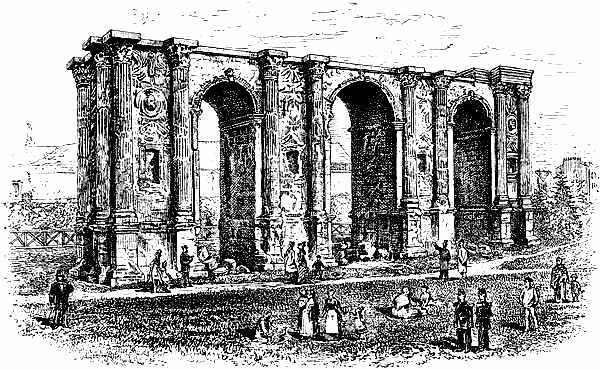
THE GATE OF MARS AT REIMS.
The check administered by Jovinus was but temporary, while the attraction continued permanent. For nearly half a century, it is true, the vineyards of the Champagne throve amidst an era of quiet and prosperity such as had seldom blessed the frontier provinces of Gaul.[7] But when, in 406, the Vandals spread the flame of war from the banks of the Rhine to the Alps, the Pyrenees, and the ocean, Reims was sacked, its fields ravaged, its bishop cut down at the altar, and its inhabitants slain or made captive; and the same scene of desolation was repeated when the hostile myriads of Attila swept across north-western France in 451.
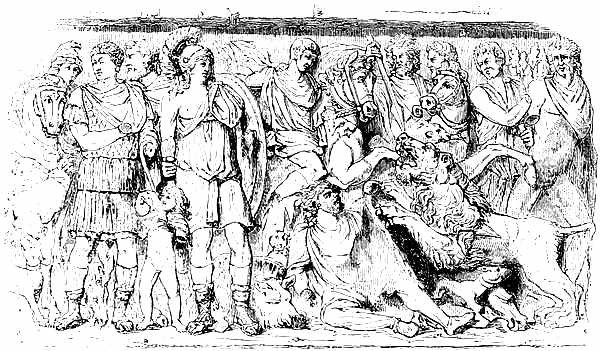
TOMB OF THE CONSUL JOVINUS, PRESERVED IN REIMS CATHEDRAL.
Happier times were, however, in store for Reims and its bishops and its vineyards, the connection between the two last being far more intimate than might be supposed. When Clovis and his Frankish host passed through Reims by the road still known as the Grande Barberie, on his way to attack Syagrius in 486, there was no doubt a little pillaging, and the famous golden vase which one of the monarch’s followers carried off from the episcopal residence was not left unfilled by its new owner. But after Syagrius had been crushed at Soissons, and the theft avenged by a blow from the king’s battle-axe, Clovis not only restored the stolen vase, and made a treaty with the bishop St. Remi or Remigius, son of Emilius, Count of Laon, but eventually became a convert to Christianity, and accepted baptism at his hands. Secular history has celebrated the fight of Tolbiac—the invocation addressed by the despairing Frank to the God of the Christians; the sudden rallying of his fainting troops, and the last desperate charge which swept away for ever the power of the Alemanni as a nation. Saintly legends have enlarged upon the piety of Queen Clotilda; the ability of St. Remi; the pomp and ceremony which marked the baptism of Clovis at Reims in December 496; the memorable injunction of the bishop to his royal convert to adore the cross he had burnt, and burn the idols he had hitherto adored; and the miracle of the Sainte Ampoule, a vial of holy oil said to have been brought direct from heaven by a snow-white dove in honour of the occasion. A pigeon, however, has always been a favourite item in the conjuror’s paraphernalia from the days of Apolonius of Tyana and Mahomet down to those of Houdin and Dr. Lynn; and modern scepticism has suggested that the celestial regions were none other than the episcopal dovecot. Whether or not the oil was holy, we may be certain that the wine which flowed freely in honour of the Frankish monarch’s conversion was ambrosial; that the fierce warriors who had conquered at Soissons and Tolbiac wetted their long moustaches in the choicest growths that had ripened on the surrounding hills; and that the Counts and Leudes, and, judging from national habits, the King himself, got royally drunk upon a cuvée réservée from the vineyard which St. Remi had planted with his own hands on his hereditary estate near Laon, or the one which the slave Melanius cultivated for him just without the walls of Reims.
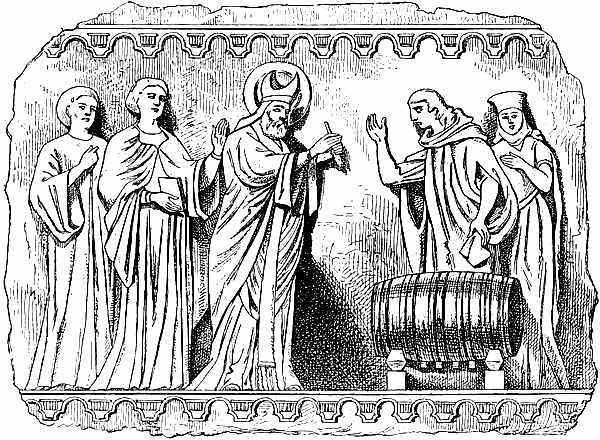
For the saint was not only a converter of kings, but, what is of more moment to us, a cultivator of vineyards and an appreciator of their produce. Amongst the many miracles which monkish chroniclers have ascribed to him is one commemorated by a bas-relief on the north doorway of Reims Cathedral, representing him in the house of one of his relatives, named Celia, making the sign of the cross over an empty cask, which, as a matter of course, immediately became filled with wine. That St. Remi possessed such an ample stock of wine of his own as to have been under no necessity to repeat this miracle in the episcopal palace is evident from the will penned by him during his last illness in 530, as this shows his viticultural and other possessions to have been sufficiently extensive to have contented a bishop even of the most pluralistic proclivities.[8]
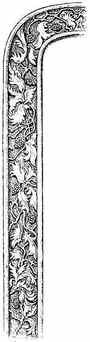
It is curious to note the connection between the spread of viticulture and that of Christianity—a connection apparently incongruous, and yet evident enough, when it is remembered that wine is necessary for the celebration of the most solemn sacrament of the Church. Christianity became the established religion of the Roman Empire about the first decade of the fourth century, and Paganism was prohibited by Theodosius at its close; and it is during this period that we find the culture of the grape spreading throughout Gaul, and St. Martin of Tours preaching the Gospel and planting a vineyard coevally. Chapters and religious houses especially applied themselves to the cultivation of the vine, and hence the origin of many famous vineyards, not only of the Champagne but of France. The old monkish architects, too, showed their appreciation of the vine by continually introducing sculptured festoons of vine-leaves, intermingled with massy clusters of grapes, into the decorations of the churches built by them. The church of St. Remi, for instance, commenced in the middle of the seventh century, and touched up by succeeding builders till it has been compared to a school of progressive architecture, furnishes an example of this in the mouldings of its principal doorway; and Reims Cathedral offers several instances of a similar character.
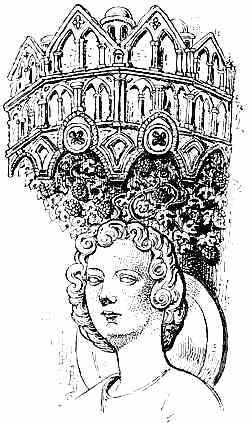
FROM THE NORTH DOORWAY OF REIMS CATHEDRAL.
Amidst the anarchy and confusion which marked the feeble sway of the long-haired Merovingian kings, whom the warlike Franks were wont to hoist upon their bucklers when investing them with the sovereign power, we find France relapsing into a state of barbarism; and though the Salic law enacted severe penalties for pulling up a vine-stock, the prospect of being liable at any moment to a writ of ejectment, enforced by the aid of a battle-axe, must have gone far to damp spontaneous ardour as regards experimental viticulture. The tenants of the Church, in which category the bulk of the vine-growers of Reims and Epernay were to be classed, were best off; but neither the threats of bishops nor the vengeance of saints could restrain acts of sacrilege and pillage. During the latter half of the sixth century Reims, Epernay, and the surrounding district were ravaged several times by the contending armies of Austrasia and Neustria; and Chilperic of Soissons, on capturing the latter town in 562, put such heavy taxes on the vines and the serfs that in three years the inhabitants had deserted the country. Matters improved, however, during the more peaceful days of the ensuing century, which witnessed the foundation of numerous abbeys, including those of Epernay, Hautvillers, and Avenay; and the planting of fresh vineyards in the ecclesiastical domains by Bishop Romulfe and his successor St. Sonnace, the latter, who died in 637, bequeathing to the church of St. Remi a vineyard at Villers, and to the monastery of St. Pierre les Dames one situate at Germaine, in the Mountain of Reims.[9] The sculptured saint on the exterior of Reims Cathedral, with his feet resting upon a pedestal wreathed with vine-leaves and bunches of grapes, may possibly have been intended for one of these numerous wine-growing prelates.
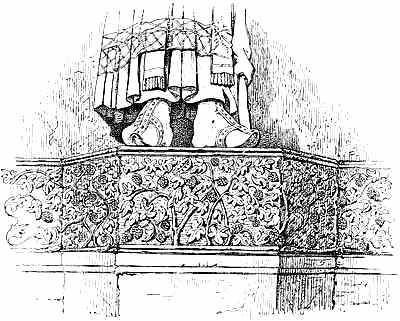
FROM THE NORTH DOORWAY OF REIMS CATHEDRAL.
The mighty figure of Charlemagne, overshadowing the whole of Europe at the commencement of the ninth century, appears in connection with Reims, where, begirt with paladins and peers, he entertained the ill-used Pope Leo III. right royally during the ‘festes de Noel’ of 805. The monarch who is said to have clothed the steep heights of Rudesheim with vines was not indifferent to good wine; and the vintages of the Champagne doubtless mantled in the magic goblet of Huon de Bordeaux, and brimmed the horns which Roland, Oliver, Doolin de Mayence, Renaud of Montauban, and Ogier the Dane, drained before girding on their swords and starting on their deeds of high emprise—the slaughter of Saracens, the rescue of captive damsels, and the discomfiture of felon knights—told in the fables of Turpin and the ‘chansons de geste.’ That the cultivation of the grape, and above all the making of wine, had been steadily progressing, is clear from the fact that the distinction between the ‘Vins de la Rivière de Marne’ and the ‘Vins de la Montagne de Reims’ dates from the ninth century.[10]
This era is, moreover, marked by the inauguration of that long series of coronations which helped to spread the popularity of the Champagne wines throughout France by the agency of the nobles and prelates taking part in the ceremony. Sumptuous festivities marked the coronation of Charlemagne’s son Louis in 816; and the officiating Archbishop Ebbon may have helped to furnish the feast with some of the produce from the vineyard he had planted at Mont Ebbon, generally identified with the existing Montebon, near Mardeuil. It is of this vineyard that Pardulus, Bishop of Laon, speaks in a letter addressed by him to Ebbon’s successor, the virtuous Hincmar, who assumed the crozier in 845, proffering him counsels as to the best method of sustaining his failing health. After telling him to avoid eating fish on the same day that it is caught, insisting that salted meat is more wholesome than fresh, and recommending bacon and beans cooked in fat as an excellent digestive, he proceeds: ‘You must make use of a wine which is neither too strong nor too weak—prefer, to those produced on the summit of the mountain or the bottom of the valley, one that is grown on the slopes of the hills, as towards Epernay, at Mont Ebbon; towards Chaumuzy, at Rouvesy; towards Reims, at Mersy and Chaumery.’ The Champagne vineyards suffered grievously from the internal convulsions which marked the period when the sceptre of France was swayed by the feeble hands of the dregs of the Carlovingian race. The Normans, who threatened Reims and sacked Epernay in 882, swept over them like devouring locusts; and their annals during the following century are written in letters of blood and flame.
Times were indeed bad for the peaceful vine-dressers in the tenth century, when castles were springing up in every direction; when might made right, and the rule of the strong hand alone prevailed; and when the firm belief that the end of the world was to come in the year 1000 led men to live only for the present, and seek to get as much out of their fellow-creatures as they possibly could. Such natural calamities as that of 919, when the wine-crop entirely failed in the neighbourhood of Reims, were bad enough; but the continual incursions of the Hungarians, whose arrows struck down the peasant at the plough and the priest at the altar, and the memory of whose pitiless deeds yet survives in the term ‘ogre;’ the desperate contest waged for ten years by Heribert of Vermandois to secure the bishopric of Reims for his infant son, during which hardly a foot of the disputed territory remained unstained by blood; the repeated invasions of Otho of Germany; and the struggle between Hugh Capet and Charles of Lorraine for the titular crown of France,—left traces harder to be effaced. Reims underwent four sieges in about sixty years; and Epernay, that most hapless of towns, was sacked at least half a score of times, and twice burnt, one of the most conscientiously executed pillagings being that performed in 947 by Hugh the Great, who, as it was vintage-time, completely ravaged the whole country, and carried off all the wine.[11]
Under the rule of the Capetian race matters improved as regarded foreign foes, though the archbishops had in the early part of the eleventh century to abandon Epernay, Vertus, Fismes, and their dependencies to the family of Robert of Vermandois, who had assumed the title of Counts of Champagne, to be held by them as fiefs. The fame of the schools of Reims, where future popes and embryo emperors met as class-mates; the festive gatherings which marked the coronation of Henry I. and Philip I.; the great ecclesiastical council held by Leo IX., which procured for the city the nickname of ‘little Rome;’ and the growing importance of the Champagne fairs, the great meeting-places throughout the Middle Ages of the merchants of Spain, Italy, and the Low Countries,—favoured the prosperity of the district and the production of its wine. Urban II., a native of Châtillon, who wore the triple crown from 1088 to the close of the century, was, prior to his elevation to the chair of St. Peter, a canon of Reims, under the name of Eudes or Odo, and, tippling there in company with his fellow-clerics, acquired a taste for the wine of Ay, which he preferred to all others in the world.[12] Pilgrims to Rome found penance light and pardon easily obtained when they bore with them across the Alps, in addition to staff and scrip, a huge ‘leathern bottel’ of that beloved vintage which warmed the pontiff’s heart and whetted his wit for the delivery of those soul-stirring orations at Placentia and Clermont, wherein he appealed to the chivalry of Western Europe to hasten to the rescue of the Holy Sepulchre from the hands of the infidel.
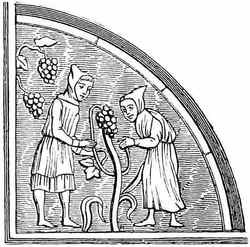
VINE-DRESSERS—THIRTEENTH CENTURY
(From a window of Chartres Cathedral).
The result of these appeals was felt by the vine-cultivators of the Champagne in more ways than one, and their case recalls that of the petard-hoisted engineer. The virtuous, the speculative, and the enthusiastic who followed Peter the Hermit and Walter the Penniless to the plains of Asia Minor suffered at the hands of the vicious, the prudent, and the practical, who remained at home and passed their time in pillaging the estates of their absent neighbours. The abbatial vineyards suffered like the others; and the monks of St. Thierry, in making peace with Gerard de la Roche and Alberic Malet in 1138, complained bitterly of wine violently extorted during two years from growers on the ecclesiastical estate and of a levy made upon their vineyard.[13]
The efforts of Henry of France, a warlike prelate, who built fortresses and attacked those of the robber-nobles, and of Louis VII., who avenged the wrongs of the church of Reims on the Counts of Roucy, served to improve matters; and we may be sure that whenever the monks did get hold of a repentant or dying sinner, they made him pay pretty dearly for peace with them and Heaven. Colin Musset, the early Champenois poet, thought that the best use to which money could be put was to spend it in good wine.[14] Churchmen, however, managed to secure the desired commodity without any such outlay, for numerous charters of the twelfth and thirteenth centuries show lords, sick or about starting for the crusades, making large gifts to abbeys and monasteries; and many a strip of fair and fertile vineland was thus added, thanks to a judicious pressure on the conscience, to the already extensive possessions of the two great monasteries of Reims, St. Remi and St. Nicaise, and also to that of St. Thierry. The Templars, too, whose reputation as wine-bibbers was only inferior to that of the monks, if we may credit the adage which runs,
‘Boire en templier, c’est boire à plein gosier;
Boire en cordelier, c’est vuider le cellier,’
and who, prior to the catastrophe of 1313, had a commandery at Reims, possessed either vineyards, or droits de vinage, at numerous spots, including Epernay, Hermonville, Ludes, and Verzy; while the separate community of these ‘Red Monks’ installed at Orilly had estates at Ay, Damery, and Mareuil. The hospital of St. Mary at Reims also reckoned amongst its possessions vineyards at Moussy, bequeathed by Canon Pontius and Tebaldus Papelenticus. The wine, which in 1215 the treasurer of the chapter of Reims Cathedral obtained from that body an acknowledgment of his right to on the anniversaries of the deaths of Bishops Ebalus and Radulf, and that to which the sub-treasurer and carpenter were severally entitled, was no doubt in part derived from the vineyard planted in 1206 by Canon Giles at the Porte Mars and bequeathed by him to the chapter, and the one which Canon John de Brie had purchased at Mareuil and had similarly bequeathed.[15] Although papal bulls and archiepiscopal warrants had forbidden the levying of the droit de vinage on wine vintaged by religious communities, in 1252 Pope Innocent IV. had to reprove the barons for interfering with the monastic vintages in the neighbourhood of Reims, and to threaten them with excommunication if they repeated their offence.[16]
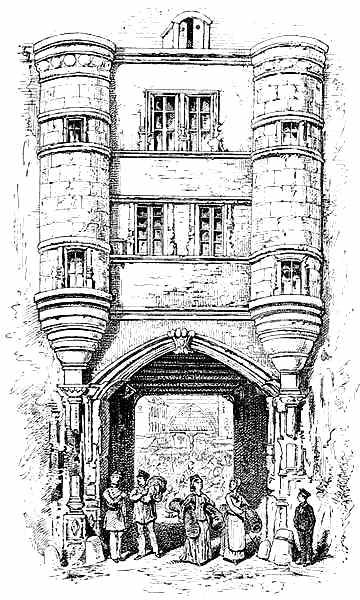
GATEWAY OF THE CHAPTER COURT AT REIMS.
These ecclesiastical topers, as a rule, were sufficiently critical of the quality of the liquor meted out to them, and an agreement respecting the dietary of the Abbey of St. Remi, at Reims, drawn up in 1218 between the Abbot Peter and a deputation of six monks representing the rest of the brethren, provides that the wine procured for the latter should be improved by two-thirds of the produce of the Clos de Marigny being set apart for their exclusive use. Ten years later, to put a stop to further complaints on the part of these worthy rivals of Rabelais’ Frère Jean des Entonnoirs, Abbot Peter was fain to agree that two hundred hogsheads of wine should be annually brought from Marigny to the abbey to quench the thirst of his droughty flock, and that if the spot in question failed to yield the required amount the deficiency should be made up from his own private and particular vineyards at Sacy, Villers-Aleran, Chigny, and Hermonville.[17]
We can readily picture these
‘jolly fat friars
Sitting round the great roaring fires
With their strong wines;’
or the cellarer quietly chuckling to himself as he loosened the spiggot of the choicest casks—
‘Between this cask and the abbot’s lips
Many have been the sips and slips;
Many have been the draughts of wine,
On their way to his, that have stopped at mine.’
The monks were in the habit of throwing open their monasteries to all comers, under pretext of letting them taste the wine they had for sale, until, in 1233, an ecclesiastical council at Beziers prohibited this practice on account of the scandal it created. Petrarch has accused the popes of his day of persisting in staying at Avignon when they could have returned to Rome, simply on account of the goodness of the wines they found there. Some similar reasons may have led to the selection of Reims, during the twelfth century, as a place for holding great ecclesiastical councils presided over by the sovereign pontiff in person; and no doubt ‘Bibimus papaliter’ was the motto of Calixtus, Innocent, and Eugenius when the labours of the day were done, and they and their cardinals could chorus, apropos of those of the morrow,
‘Bonum vinum acuit ingenium
Venite potemus.’
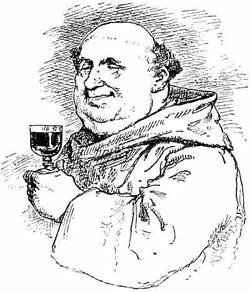
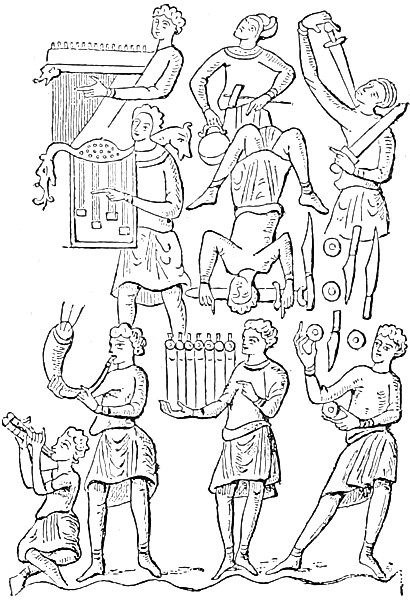
The kings of France may have preferred the wines of the Orleanais and the Isle of France, and the monarchs of England have been content to vary the vintages of their patrimony of Guienne with an occasional draught of Rhenish; but the wines of the river Marne certainly found favour at Troyes, where the Counts of Champagne, to whom Epernay had been ceded as a fief, held a court little inferior in state to that of a sovereign prince. The native vintage mantled in the goblets and beakers that graced the board where they sat at meat amidst their knights and barons, whilst minstrels sang and jongleurs tumbled and glee-maidens danced at the lower end of the hall. It fired the fancy of the poet Count Thibault, to whom tradition has ascribed the introduction of the Cyprus grape into France on his return from the Crusades,[18] and helped the flow of the amorous strains which he addressed to Blanche of Castille. Nor was he the only versifier of the time who could exclaim, with his compatriot Colin Musset, that ‘good wine caused him to sing and rejoice.’[19] Other local songsters, such as Doete de Troyes, Eustache le Noble, and Guillaume de Machault, sought inspiration at their native Helicon, and were equally ready with Colin Musset to appreciate a gift of
‘barrelled wine,
Cold, strong, and fine,
To drink in hot weather,’ [20]
in return for their rhymes. It was this wine that the gigantic John Lord of Joinville, Seneschal of Champagne under Thibault, and chronicler of the Seventh Crusade, was in the habit of consuming warm and undiluted, by the advice of his physicians, on account, as he himself mentions, of his ‘large head and cold stomach;’ a practice which seems to have scandalised that pious and ascetic monarch St. Louis, who was careful to temper his own potations with water. The king was most likely not unacquainted with the wine, as a roll of the expenses incurred at his coronation at Reims, in 1226, shows that 991 livres were spent in wine on that occasion, when, in consequence of the vacancy of the archiepiscopal see, the crown was placed upon his head by Jacques de Bazoche, Bishop of Soissons.
Henry of Andelys, a compatriot of the engineer Brunel, who flourished, if a poet can be said to flourish, in the latter half of the thirteenth century, has extolled the wines of Epernay and Hautvillers, and mentioned that of Reims, in his poem entitled the ‘Bataille des Vins.’ He informs us at the outset that ‘the great King Philip Augustus,’ whom state records prove to have had a score of vineyards in different parts of France,[21] was very fond of ‘good white wine.’ Anxious to make a choice of the best, he issued invitations to all the most renowned crûs, French and foreign, and forty-six different vintages responded to this appeal; amongst them Hautvillers and Epernay, described as ‘vin d’Auviler’ and ‘vin d’Espernai le Bacheler.’ The king’s chaplain, an English priest, makes a preliminary examination, resulting in the summary rejection of many competitors, till at length, as Argenteuil—‘clear as oil’—and Pierrefitte are disputing as to their respective merits, Epernay and Hautvillers simultaneously exclaim, ‘Argenteuil, thou wishest to degrade all the wines at this table. By God, thou playest too much the part of constable. We excel Châlons and Reims, remove gout from the loins, and support all kings.’[22] But lo, up jumps the ‘vin d’Ausois,’ the ‘Osey’ of so many of our English mediæval poets, with the reproach, ‘Epernay, thou art too disloyal; thou hast not the right of speaking in court;’[23] and enumerates the blessings which he and his demoiselle ‘la Mosele’ confer upon the Germans.[24] La Rochelle in turn reproves Ausois, and extols the strength of his own wines, and those of Angoulême, Bordeaux, Saintes, and Poitou, and boasts of the welcome accorded to them in the northern states of Europe, including England, to which the districts he mentions then belonged.[25]
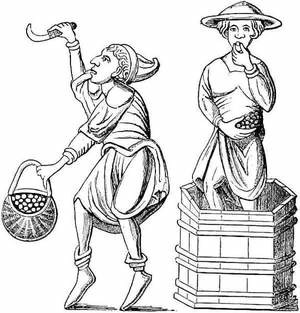
VINTAGERS OF THE THIRTEENTH CENTURY
(From a MS. of the Dialogues de St. Grégoire).
The vintages of the then little kingdom of France put in a counter-claim for finesse and flavour as opposed to strength, and maintain that they do not harm those who drink them. The dispute becomes general, and the wines, heated with argument, exhale a perfume of ‘balsam and amber,’ till the hall where they are met resembles a terrestial paradise. The chaplain, after conscientiously tasting the whole of them, formally excommunicated with bell, book, and candle all the beer brewed in England and Flanders, and then went incontinently to bed, and slept for three days and three nights without intermission. The king thereupon made an examination himself, and named the wine of Cyprus pope, and that of Aquilat[26] cardinal, and created of the remainder three kings, five counts, and twelve peers, the names of which, unfortunately, have not been preserved.
II.
THE WINES OF THE CHAMPAGNE FROM THE FOURTEENTH TO THE SEVENTEENTH CENTURY.
Coronations at Reims and their attendant banquets—Wine flows profusely at these entertainments—The wine-trade of Reims—Presents of wine from the Reims municipality—Cultivation of the vineyards abandoned after the battle of Poitiers—Octroi levied on wine at Reims—Coronation of Charles V.—Extension of the Champagne vineyards—Abundance of wine—Visit to Reims of the royal sot Wenceslaus of Bohemia—The Etape aux Vins at Reims—Increased consumption of beer during the English occupation of the city—The Maid of Orleans at Reims—The vineyards and wine-trade alike suffer—Louis XI. is crowned at Reims—Fresh taxes upon wine followed by the Mique-Maque revolt—The Rémois the victims of pillaging foes and extortionate defenders—The Champagne vineyards attacked by noxious insects—Coronation of Louis XII.—François Premier, the Emperor Charles V., Bluff King Hal, and Leo the Magnificent all partial to the wine of Ay—Mary Queen of Scots at Reims—State kept by the opulent and libertine Cardinal of Lorraine—Brusquet, the Court Fool—Decrease in the production of wine around Reims—Gifts of wine to newly-crowned monarchs—New restrictions on vine cultivation—The wine of the Champagne crowned at the same time as Louis XIII.—Regulation price for wine established at Reims—Imposts levied on the vineyards by the Frondeurs—The country ravaged around Reims—Sufferings of the peasantry—Presents of wine to Marshal Turenne and Charles II. of England—Perfection of the Champagne wines during the reign of Louis XIV.—St. Evremond’s high opinion of them—Other contemporary testimony in their favour—The Archbishop of Reims’s niggardly gift to James II. of England—A poet killed by Champagne—Offerings by the Rémois to Louis XIV. on his visit to their city.
THE coronations at Reims served, as already remarked, to attract within the walls of the old episcopal city all that was great, magnificent, and noble in France. The newly-crowned king, with that extensive retinue which marked the monarch of the Middle Ages; the great vassals of the crown scarcely less profusely attended; the constable, the secular and ecclesiastical peers, and the host of knights and nobles who assisted on the occasion, were wont at the conclusion of the ceremony to hold high revelry in the spacious temporary banqueting-hall reared near the cathedral. It is to be regretted that the menus of these banquets have not been handed down to us in their entirety; but a few fragmentary excerpts show that from a comparatively early period there was no lack of wine, at any rate. A remonstrance addressed to Philip the Fair, after his coronation in 1286, by the archbishop and burghers, asks that they may be relieved of a certain proportion of the sum levied on them for the cost of the ceremony, on the ground that there still remained over for the king’s use no less than seven score tuns of wine from the banquet. Some idea may be formed of the quantity of wine brought regularly into the city from the circumstance of the king having Reims surrounded by walls in 1294, and levying a duty on the wine imported to pay for them, and by the value attached to the ‘rouage’[27] of the Mairie St. Martin, claimed by the chapter of Reims Cathedral in 1300.
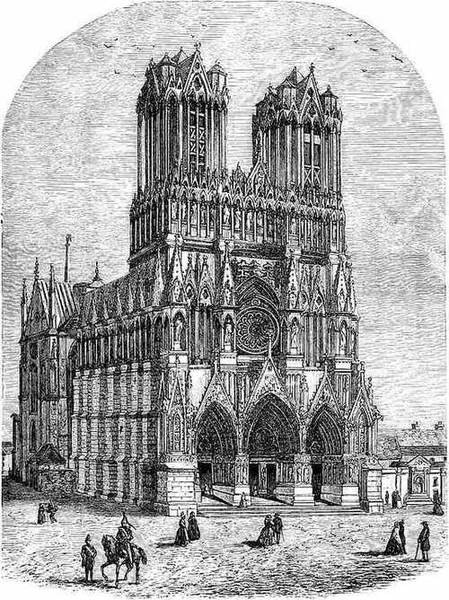
REIMS CATHEDRAL, WEST FRONT.
At the coronation of Charles IV., in 1322, wine flowed in rivers. Amongst the unconsumed provisions returned by the king’s pantler, Pelvau dou Val, to the burghers, ‘vin de Biaune et de Rivière’—that is, of Beaune and of the Marne—figures for a value of 384 livres 5 sols 2 deniers.[28] The arrangements of the coronation had been intrusted to the minister of finances, Pierre Remi, who certainly played the part of the unjust steward. In the first place, he made the cost of the ceremony amount to 21,000 livres, whereas none of his predecessors had spent more than 7,000 livres. His opening move had been to seize upon the greater part of the corn and all the ovens in Reims ‘for the king’s use,’ and to sell bread to the townsfolk and visitors at his own price for a fortnight prior to the coronation. After the ceremony he appropriated in like manner all the plate and napery, and all the cooking utensils and kitchen furniture, together with whatever had been left over, in the shape of wine, wax, fish, bullocks, pigs, and similar trifles. The wine thus taken was estimated at 1500 livres, part of which he sold to two bourgeois of Reims, and kept the rest, together with forty-four out of the fifty muids, or hogsheads, of salt provided.[29] Retributive justice overtook him, for the chronicler of his ill-doings chuckles over the fact that he was hanged as high as Haman on a gibbet he had himself erected at Paris. Things went off better at the coronation of King Philip, in 1328, when the total amount expended in the three hundred poinçons of the wine of Beaune, St. Pourçain, and the Marne consumed was 1675 livres 2 sols 3 deniers.[30] Part of this flowed through the mouth of the great bronze stag before which criminals condemned by the archiepiscopal court used to be exposed, but which at coronation times was placed in the Parvis Notre Dame, and spouted forth the ‘claré dou cerf,’ for the preparation of which the town records show that the grocer O. la Lale received 16 livres.[31]
[1] Diodorus.
[2] Idem.
[3] Max Sutaine’s Essai sur le Vin de Champagne.
[4] This arch is said to have been called after the God of War from the circumstance of a temple dedicated to Mars being in the immediate neighbourhood. The sculptures still remaining under the arcades have reference to the months of the year, to Romulus and Remus, and to Jupiter and Leda. Reims formerly abounded with monuments of the Roman domination. According to M. Brunette, an architect of the city, who made its Roman remains his especial study, a vast and magnificent palace formerly stood nigh the spot now known as the Trois Piliers; while on the right of the road leading to the town were the arenas, together with a temple, among the ruins of which various sculptures, vases, and medals were found, and almost immediately opposite, on the site of the present cemetery, an immense theatre, circus, and xystos for athletic exercises. Then came a vast circular space, in the centre of which arose a grand triumphal arch giving entrance into the city. The road led straight to the Forum,—the Place des Marchés of to-day,—and along it were a basilica, a market, and an exedra, now replaced by the Hôtel de Ville. The Forum, bordered by monumental buildings, was of gigantic proportions, extending on the one side from half way down the Rue Colbert to the Place Royale, and on the other from near the Marché à la Laine, parallel with the Rue de Vesle, up to the middle of the Rue des Elus, where it terminated in a vast amphitheatre used for public competitions.
[5] Henderson’s History of Ancient and Modern Wines.
[6] Gibbon’s Decline and Fall of the Roman Empire.
[7] Gibbon’s Decline and Fall of the Roman Empire.
[8] According to this document, published in Marlot’s Histoire de Reims, he leaves to Bishop Lupus the vineyard cultivated by the vine-dresser Enias; to his nephew Agricola, the vineyard planted by Mellaricus at Laon, and also the one cultivated by Bebrimodus; to his nephew Agathimerus, a vineyard he had himself planted at Vindonisæ, and kept up by the labour of his own episcopal hands; to Hilaire the deaconess, the vines adjoining her own vineyard, cultivated by Catusio, and also those at Talpusciaco; and to the priests and deacons of Reims, his vineyard in the suburbs of that city, and the vine-dresser Melanius who cultivated it. The will is also noteworthy for its mention of a locality destined to attain a high celebrity in connection with the wine of Champagne, namely, the town of Sparnacus or Epernay, which a lord named Eulogius, condemned to death for high treason in 499 and saved at the bishop’s intercession, had bestowed upon his benefactor, and which the latter left in turn to the church of Reims. To this church he also left estates in the Vosges and beyond the Rhine, on condition of furnishing pitch every year to the religious houses founded by himself or his predecessors to mend their wine-vessels, a trace of the old Roman custom of pitching vessels used for storing wine.
[9] Marlot’s Histoire de Reims.
[10] Henderson’s History of Ancient and Modern Wines.
[11] Victor Fievet’s Histoire d’Epernay.
[12] Bertin du Rocheret’s Mélanges.
[13] Varin’s Archives Administratives de Reims.
[14] ‘Bien met l’argent qui en bon vin l’emploie.’ Poems of Colin Musset, 1190 to 1220.
[15] Varin’s Archives Administratives de Reims.
[16] Ibid.
[17] Ibid.
[18] J. Gondry du Jardinet’s Agréable Visite aux Grands Crûs de France.
[19] ‘Chanter me fait bon vin et rejouir.’
[20]
‘Le vin en tonel,
Froit et fort et finandel,
Pour boivre à la grant chaleur.’
[21] Legrand d’Aussy’s Vie Privée des Français.
[22]
‘Espernai dist et Auviler,
Argenteuil, trop veus aviler
Très-tos les vins de ceste table.
Par Dieu, trop t’es fait conestable.
Nous passons Chaalons et Reims,
Nous ostons la goûte des reins,
Nous estaignons totes les rois.’
[23]
‘Espernai, trop es desloiaus;
Tu n’as droit de parler en cour.’
[24] The ‘vin d’Ausois,’ or ‘vin d’Aussai’ (for it is spelt both ways in the poem), is not, as might be supposed, the wine of Auxois, an ancient district of Burgundy now comprised in the arrondissements of Sémur (Côte d’Or) and Avallon (Yonne), and still enjoying a reputation for its viticultural products. MM. J. B. B. de Roquefort and Gigault de la Bedollière, in their notes on Henri d’Andelys’ poem, have clearly identified it with the wine of Alsace, that province having been known under the names in question during the Middle Ages. This explains its connection in the present instance with the Moselle.
[25] An incidental proof that the English taste for strong wine was an early one. As late as the close of the sixteenth century the Bordeaux wines are described in the Maison Rustique as ‘thick, black, and strong.’
[26] Probably either Aquila in the Abruzzi, or Aquiliea near Friuli.
[27] The ‘rouage’ was a duty of 2 sous on each cart and 4 sous on each wagon laden with wine purchased by foreign merchants and taken out of the town. It was only one of many dues.
[28] The old livre was about equal to the present franc; the sol was the twentieth part of a livre; and the denier the twelfth part of a sol, or about 1⁄24 d. English.
[29] Varin’s Archives Administratives de Reims.
[30] The Beaune cost 28 livres the tun of two queues; the St. Pourçain, a wine of the Bourbonnais, very highly esteemed in the Middle Ages, 12 livres the queue; and the wine of the district, white and red, 6 to 10 livres the queue of two poinçons. A poinçon, or demi-queue, of Reims was about 48 old English, or 40 imperial, gallons; while the demi-queue of Burgundy was over 45 imperial gallons.
[31] Varin’s Archives Administratives de Reims.
The importance of the wine-trade of Reims at the commencement of the fourteenth century is evidenced by the fact of there being at this epoch courtiers de vin, or wine-brokers, the right of appointing whom rested with the eschevins—a right which, vainly assailed by the archbishop in 1323, was confirmed to the municipal power by several royal decrees.[32] The burghers of Reims were fully cognisant of the merits of their wine, and certainly spared no trouble to make others acquainted with them. When the eschevins dined with the archbishop in August 1340 they contributed thirty-two pots of wine as their share of the repast, in addition to sundry partridges, capons, and rabbits. All visitors to the town on business, and all persons of distinction passing through it, were regaled with an offering of from two to four gallons from the cellars of Jehan de la Lobe, or Petit Jehannin, or Raulin d’Escry, or Baudouin le Boutellier, or Remi Cauchois, the principal tavern-keepers. The provost of Laon, the bailli and the receveur of Vermandois, the eschevins of Châlons, the Bishop of Coustances, Monseigneur Thibaut de Bar, Monseigneur Jacques la Vache (the queen’s physician), the Archdeacon of Reims, and the ‘two lords of the parliament deputed by the king to examine the walls,’ were a few of the recipients of this hospitality, which was also extended to such inferior personages as a varlet of Verdun and the varlet of the eschevins of Abbeville.
Two ‘flasks,’ purchased for threepence-halfpenny from Petit Jehannin, served to warm the eloquence of Maistre Baudouin de Loingnis when he pleaded for the town on the subject of the fortifications in 1345; and when, in 1340, the Archbishop of Narbonne, the Bishop of Poitiers, and sundry other dignitaries passed through Reims with heavy hearts on their way to St. Omer, to negotiate a truce with Edward of England after the fatal battle of Sluys, the municipality expended five shillings and threepence in a poinçon of wine to cheer them on their way. There was probably plenty to spare, since on the outbreak of hostilities with England the town-crier had received one penny for making proclamation that no one should remove any wine from the town during the continuance of the contest. The advent of a messenger of Monseigneur Guillaume Pinson, who brought ‘closed letters’ to the eschevins informing them of the invasion of King Edward, does not seem to have spoilt the digestion of those worthy gentlemen, since they partook of their annual gift of wine and their presentation lamb at Easter 1346; but there were sore hearts in the old city when one Jenvier returned from Amiens with the tidings that their best and bravest had fallen under the banner of John de Vienne, their warlike prelate, on the field of Crécy. Perhaps to the state of depression that followed is due the fact that there are no records of festivities at the coronation of King John the Good in 1350, though we find the citizens seeking two years later to propitiate the evil genius of France, Charles the Bad of Navarre, by the gift of a queue of wine costing five crowns.
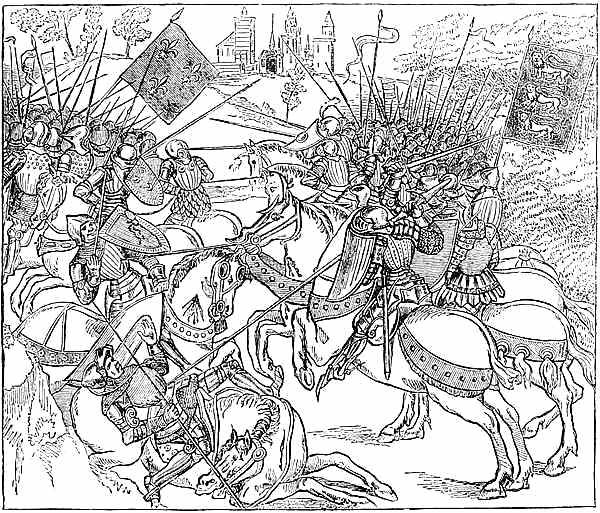
THE BATTLE OF CRÉCY
(From a MS. of Froissart’s Chronicles).
During the frightful anarchy prevailing after the battle of Poitiers, when the victorious English and the disbanded forces of France made common cause against the hapless peasants, the fields and vineyards of Reims remained uncultivated for three years,[33] and the people of the archbishopric would have perished of hunger had they not been able to get food and wine from Hainault. Despite the prohibitions of the regent, the nobles pillaged the country around Reims and ravaged the vineyards from June to August 1358, and the havoc they wrought exceeded even that accomplished during the Jacquerie. Nor were matters improved by the advent of the English king, Edward III., when, on the wet St. Andrew’s-day of 1359, he sat down before the town with his host, which starved and shivered throughout the bitter and tempestuous winter, despite the comfort derived from the ‘three thousand vessels of wine’ captured by Eustace Dabreticourt in ‘the town of Achery, on the river of Esne.’[34] But the Rémois stood firm behind the fortifications reared by Gaucher de Châtillon till the following spring, when the victor of Crécy drew off his baffled forces, consoling them with the promise of bringing them back during the ensuing vintage, and made a reluctant peace at Bretigny.[35]
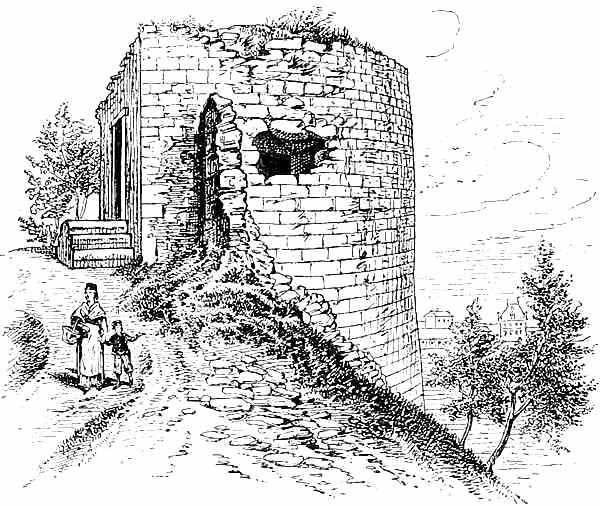
ANCIENT TOWER BELONGING TO THE FORTIFICATIONS OF REIMS.
Yet, though plague and famine in turn almost depopulated the city, the importance of its vineyards augmented from this time forward. In 1361 the citizens, who had already been in the habit of granting ‘aides’ to the king out of the dues levied on the wine sold in the town, obtained leave to impose an octroi on wine, in order to maintain their fortifications. Henceforward the connection between the wines and the walls of Reims became permanent. The octroi was from time to time renewed or modified in various ways by different monarchs; but their decrees always commenced with a preliminary flourish concerning the necessity of keeping the walls of so important a city in good order, and the admirable opportunity afforded of so doing by the ever-increasing prosperity of the trade in wine. Conspicuous amongst the few existing fragments of the circuit of walls and towers with which Reims was formerly begirt is the tower of which a view is here given.[36]
The Rémois, although willing enough to tax themselves for the defence of their city, submitted the reverse of cheerfully to the preliminary levies of provisions, wines, meats, and other things necessary, made by the king’s ‘maistres d’hôtel’ for the coronation of Charles V., which took place on the 19th May 1364, at a cost to the town of 7712 livres 15 sols 5 deniers parisis.[37] The citizens had, however, something to gaze at for their money, if that were any consolation. The king and his queen (Jeanne de Bourbon) were accompanied by King Peter of Cyprus; Wenceslaus, King of Bohemia and Duke of Brabant; the Dukes of Burgundy and Anjou; the Counts of Eu, Dampmartin, Tancarville, and Vaudemont, and many other prelates and lords, who did full justice to the good cheer provided for the great feasts and solemnities taking place during the five days of the royal sojourn.[38] The crown, borne by Philip of Burgundy, the king’s youngest brother, having been placed upon Charles’s head by the Archbishop Jean de Craon, that prelate proceeded to smear the royal breast and brow with what the irreverent Republicans of the eighteenth century designated ‘sacred pomatum,’ from the Sainte Ampoule presented to him by the Bishop of Laon, amidst the enthusiastic applause of nobles and prelates.[39]
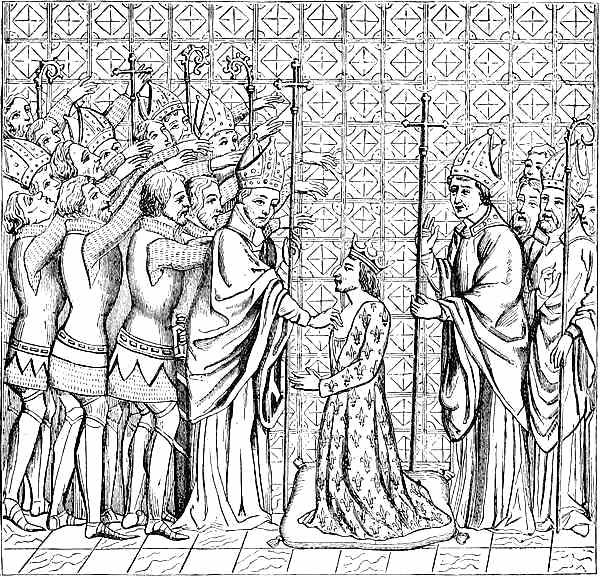
CORONATION OF CHARLES V. AT REIMS
(From a MS. Histoire de Charles V.).
The great planting of vines in the Champagne district plainly dates from the last quarter of the fourteenth century, at which epoch large exports of wine to the provinces of Hainault and Flanders, and especially to the ports of Sluys, are noted. In a list of the revenues of the archbishopric of Reims, drawn up by Richard Pique towards 1375, are included patches of vineland and annual payments of wine from almost every village and hamlet within twenty miles of Reims; though it is only fair to mention that many of the places enumerated produce to-day wines of very ordinary character, which, although they have a local habitation, have certainly failed to secure themselves a name.[40] A general return of church property made to the Bailli of Vermandois, the king’s representative in 1384, at a time when Charles VI. was busily engaged in confiscating whatever he could lay hands on, shows that the religious establishments of Reims were equally well endowed with vineyards. These were mostly situate to the north-east and south-west of Reims, or in the immediate vicinity of the city; and according to their owners, whose object was of course to offer as few temptations as possible to the monarch, they frequently cost more to dress than they brought in.[41] In the return furnished by the archbishop in the following year, he complains that, owing to the great plantation of vines throughout the district, the right of licensing the brewing of ale and beer had failed to bring him in any revenue for the past three years. This prelate, by the way, seems to have loved his liquor like many of his predecessors, judging from the inventory made after his death, in 1389, of the contents of his cellars.[42] All this abundance of wine was not without its fruits; and we find the clerk of Troyes asserting that liars swarm in Picardy as drunkards do in Champagne, where a man not worth a rap will drink wine every day;[43] and a boast in the chanson of the Comte de Brie to the effect that the province abounded in wheat, wine, fodder, and litter.[44]
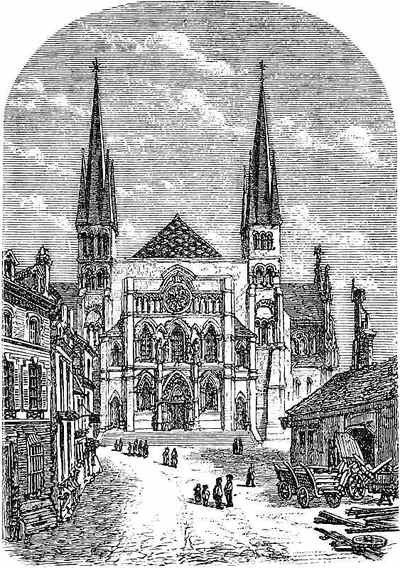
CHURCH OF ST. REMI, REIMS.
Under these circumstances it is not at all surprising that that renowned vinous soaker, King Wenceslaus (surnamed the Drunkard) of Bohemia, found ample opportunities for self-indulgence when he visited Reims to confer with Charles VI. on the subject of the schism of the popes of Avignon, then desolating the Church—certainly a very fit subject for a drunkard and a madman to put their heads together about. No sooner had the illustrious visitor alighted at the Abbey of St. Remi—to-day the Hôtel Dieu—where quarters had been assigned him, than he expressed a wish to taste the wine of the district, with the quality of which he had long been acquainted. The wine was brought, and tasted again and again in such conscientious style that when the Dukes of Bourbon and Berri came to escort him to dinner with the king they found him dead-drunk and utterly unfit to treat of affairs of State, still less those of the Church. The same kind of thing went on daily—the ‘same old drunk,’ as the nigger expressed it, lasting week after week; and the French monarch, who must have surely had a lucid interval, resolved to profit by his guest’s weakness. Accordingly he gave special orders to the cup-bearers, at a grand banquet at which matters were to be finally settled, to be particularly attentive in filling the Bohemian king’s goblet. This they did so frequently that the royal sot, overcome by wine, yielded during the discussion following the repast whatever was asked of him; whilst his host probably returned special thanks to St. Archideclin, the supposed bridegroom of the marriage of Cana, whom the piety of the Middle Ages had transformed into a saint and created the especial patron of all appertaining to the cellar. This triumph of wine over diplomacy occurred in 1397.[45]
A charter of Charles VI., dated July 1412, which gave the municipal authorities of Reims the sole right of appointing sworn wine-brokers, expressly mentions that the trade of the town was chiefly based upon the wine grown in the environs.[46] The wine, the charter states, when stored in the cellars of the town, was customarily sold by brokers, who of their own authority were in the habit of levying a commission of twopence, and even more, per piece, selling it to the person who offered them most, and taking money from both buyer and seller. To remedy this state of things, from which it was asserted the trade had begun to suffer, it was decreed that every broker should take an oath, before the Captain of Reims and the eschevins, to act honestly and without favour, and not to receive more than one penny commission. In the case of his receiving more, both he and the seller of the wine were to forfeit two-pence-halfpenny to the town.
The sales of wine mainly took place at the Etape aux Vins, where most of the wine-merchants were established, the busiest time being during the three great annual fairs, when no duties were levied. The old Etape aux Vins is now the Rue de l’Etape, jocularly styled the Rue de Rivoli of Reims, on account of the arcades formed by the projecting upper floors of its fifteenth-and sixteenth-century houses, which rest upon wooden and stone pillars. To-day the casino and the principal restaurants of the city are installed here; still the locality retains much the same aspect as it presented in the days when Remi Cauchois and Huet Hurtaut stood here and chaffered with the peasants who had brought their casks of wine on creaking wains into the city; when S. de Laval glided in search of a customer among the long-gowned fur-capped merchants of the Low Countries; when bargains were closed by a God’s-penny and wetted with a stoup of Petit Jehannin’s best; and when files of wine-laden wagons rolled forth from the northern gates of the city to gladden the thirsty souls of Hainault and Flanders.
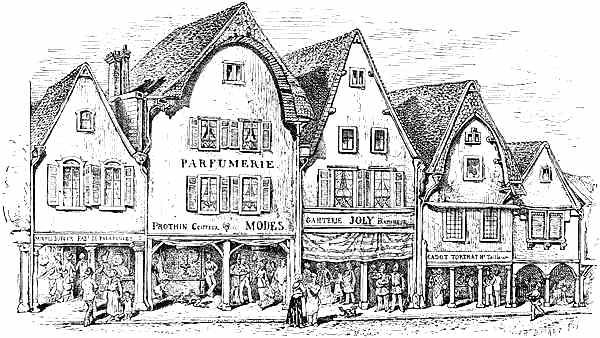
RUE DE L’ETAPE, REIMS.
Some of the wine had, however, a nobler destination. An order of payment addressed by the town council to the receiver, and dated March 23, 1419, commands him to pay Jacques le Vigneron the sum of 78 livres 12 sols for six queues of ‘vin blanc et clairet,’ presented to the fierce Duke of Burgundy, Jean sans Peur, at the high price of about 11 s. each.[47] Nor did his son Philip, the self-styled ‘Prince of the best wines in Christendom,’ disdain to draw bridle in order to receive eleven poinçons of ‘vin claret’ when hastening,
‘Bloody with spurring, fiery red with speed,’
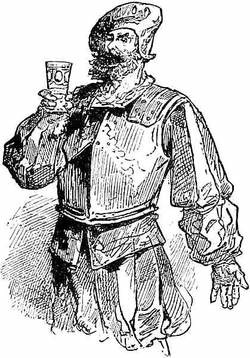
through Reims to avenge his father’s murder at the Bridge of Montereau.[48] The devastating results of the terrible struggle for supremacy waged between the Armagnacs and Burgundians, and of the invasion of Henry V. of England, are evidenced in the facts that when, in fear and trembling, the Reims council resolved to allow Duke Philip to enter the town in 1425, at the head of four thousand horse, they could only offer him one queue of Beaune, one queue of red, and one queue of white wine; and to the duchess the following year one queue of Beaune and one of French wine; and that wine sent to l’Isle Adam, at the siege of Nesle, cost as much as 19 livres, or nearly 16 s., the queue.
Reims had passed under the sway of England by the Treaty of Troyes in 1420, the Earl of Salisbury becoming governor of the Champagne. The scarcity of wine, and the liking of the new possessors for their national beverage, is shown by a prohibition issued by the town council in 1427 against using wheat for making beer; and a statement of Gobin Persin, that he had sold more treacle—a famous medicinal remedy in the Middle Ages—during the past half year than in the four years previous, owing to people complaining that they were swollen up from drinking malt liquor. The English, however, at their abrupt departure from the city on the arrival of Charles and the Maid of Orleans, proved their partiality for the wine of Reims by carrying off as many wagonloads of it as they could manage to lay their hands on.
The gallant knights and patriot nobles who followed the Maid of Orleans to Reims, and witnessed the coronation of Charles VII. in 1429, despised, of course, the drink of their island foes, and moistened throats grown hoarse with shouting ‘Vive le roi’ with the choice vintage of the neighbouring slopes, freely drawn forth from the most secret recesses of the cellars of the town in honour of the glorious day. And no doubt Dame Alice, widow of Raulin Marieu, and hostess of the Asne royé (the Striped Ass), put a pot of the very best before the father of ‘Jehane la Pucelle,’ and did not forget, either, to score it down in the little bill of twenty-four livres which she was paid out of the deniers communs for the old fellow’s entertainment.[49] For the next ten years, however, the note of war resounded through the country, the hill-sides bristled with lances in lieu of vine-stakes, and instead of money spent for wine for presentation to guests of a pacific disposition, the archives of the town display a long list of sums expended in the purchase of arms, artillery, and ammunition, for the especial accommodation of less pleasant visitors, in repairing fortifications, and in payments to men charged with watching day and night for the coming of the foe.
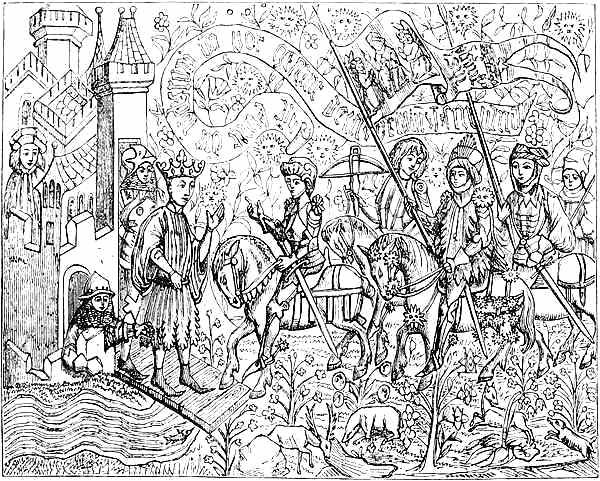
JEANNE DARC’S FIRST INTERVIEW WITH CHARLES VII.
(From a tapestry of the fifteenth century).
The excesses of the licentious followers of Potton de Xaintrailles and Lahire were worse than those of the English and Burgundians, spite of the four hundred and five livres which had been paid to men-at-arms and archers from the neighbouring garrisons, ‘engaged by the city of Reims to guard the surrounding country, in order that the wine might be vintaged and brought into the said city and the vineyards dressed,’[50] and bitter were the complaints addressed in 1433 to the king on the falling off of the wine trade which had resulted therefrom. The ravages of the terrible ‘Escorcheurs’ led, in 1436, to fresh complaints and to an additional duty on each queue of ‘wine of Beaune, of the Marne, and of other foreign districts’ sold wholesale at Reims, the receipts to be spent in warlike preparations and on the fortifications. Some of this went to Lahire as a recompense for defending the district from ‘the great routs and companies’ that sought to invade it, he having, presumably on the principle of setting a thief to catch a thief, been made Bailli of Vermandois. In troublous times like these it was necessary to secure the good will of men in power and authority, and hence the town records comprise numerous offerings of money, fine linen cloths, and wine given to various nobles ‘out of grace and courtesy’ for their good will and ‘good and agreeable services, pleasures, and love.’ Madame Katherine de France (the widow of Henry V.), the Chancellor of France, the Constable Richemont, Lahire (Bailli of Vermandois), the bastard Dunois, the Archbishop of Narbonne, the Count de Vendôme, and many other nobles and dignitaries, were in turn recipients of such gifts; and the visit of King Charles the Victorious, in 1440, was celebrated by their profuse distribution.[51]
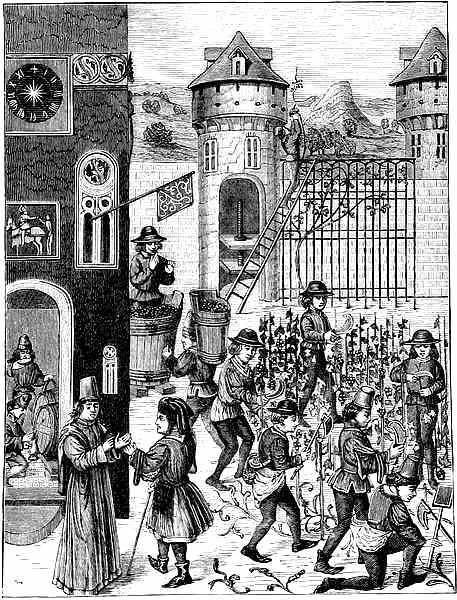
CULTIVATION OF THE VINE AND VINTAGING IN THE FIFTEENTH CENTURY
(From a MS. of the Propriétaire des Choses).
Despite the complete expulsion of the English from France, a depression in trade still continued; and in 1451 the lieutenant of the town was sent to court to complain that, owing to the exactions of the farmers of the revenue, merchants would no longer come to Reims to buy wine. Louis XI., who was crowned at Reims on 15th August 1461, entered the city in great pomp, accompanied by Philip, Duke of Burgundy, and his son the Count of Charolais, afterwards Charles the Bold; the Duke of Bourbon, the Duke of Cleves, and his brother the Lord of Ravenstein, all three nephews of Duke Philip; the Counts of St. Pol, Angoulême, Eu, Vendôme, Nassau, and Grandpré; Messire Philip of Savoy, and many others,—‘all so richly dressed that it was a noble sight to see,’ remarks Enguerrand de Monstrelet. Prior to being crowned, the king handed his sword to Duke Philip, and requested the latter to bestow upon him the honour of knighthood, which the duke did, and afterwards gave the accolade to several other persons of distinction. The coronation, with its accompaniment of ‘many beautiful mysteries and ceremonies,’ was performed by Archbishop Jean Juvénal des Ursins, assisted by the Cardinal of Constance, the Patriarch of Antioch, a papal legate, four archbishops, seventeen bishops, and six abbots. At its close the twelve peers of France[52] dined at the king’s table; and after the table was cleared the Duke of Burgundy knelt and did homage for Burgundy, Flanders, and Artois, other lords following his example.
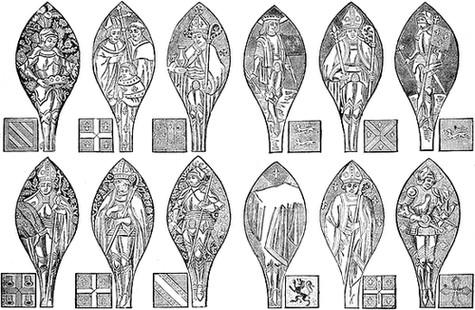
THE PEERS OF FRANCE PRESENT AT THE CORONATION OF LOUIS XI. AT REIMS
(From painted-glass windows in Evreux Cathedral).
Louis XI., on his accession, found himself in presence of an exhausted treasury, and cast about for an expedient to fill it. The wine he drunk at his coronation at Reims may have suggested the dues which, only a month afterwards, he decreed should be levied on this commodity, in conjunction with an impost on salt. The inhabitants of the archiepiscopal city found it impossible to believe in such a return for their wonted hospitality, and the vine-growers assailed the collectors furiously. The affair resulted in a general outbreak, known as the Mique-Maque, and in the final hanging, branding, mutilating, and banishing of a number of individuals, half of whom, it may fairly be presumed, were innocent. The wars between France and Burgundy were also severely felt by the Rémois, whose territory was ravaged by the followers of Charles the Bold after Montlhery, and who suffered almost as much at the hands of their friends as at those of their foes. The garrison put into the town shared amongst themselves the country for a circuit of eight leagues, the meanest archer having a couple of villages, whence he exacted, at pleasure, corn, wood, provisions, and wine, the latter in such profusion that the surplus was sold in the streets, the smallest allowance for each lance being a queue, valued at ten livres, monthly. In 1470 and the following years large subsidies of wine were, moreover, despatched from time to time to the king’s army in the field; a cartload being judiciously sent to General Gaillard, ‘as he is well disposed towards us, and it is necessary to cultivate such people.’ Complaints made in 1489 set forth that in consequence of the octroi of the river Aisne, which had been established six years previously, the merchants of Liège, Mezières, and Rethel, instead of coming to Reims to buy wine, were obtaining their supplies from Orleans. The landing of Henry VII. of England, in 1495, spread new alarms throughout the Champagne, and orders were given for all the vine-stakes within a radius of two leagues of Reims to be pulled up, so that the enemy might be prevented from cooking provisions or filling up the moats of the fortifications with them.
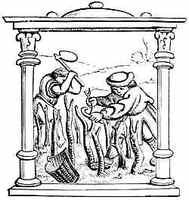
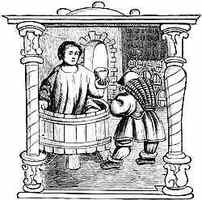
CULTURE OF THE VINE—SIXTEENTH CENTURY
(From a
MS.Calendar).
TREADING GRAPES—SIXTEENTH CENTURY
(From a
MS.Calendar).
Pillaging foes and extortionate defenders were bad enough, but the vine-growers had yet other enemies, to wit, certain noxious little insects, which were in the habit of feeding on the young buds, though there is no record that they were ever so troublesome at Reims as they were in other parts of the Champagne, notably at Troyes, where on the Friday after Pentecost 1516 they were formally and solemnly enjoined by Maître Jean Milon to depart within six days from the vineyards of Villenauxe, under pain of anathema and malediction.[53] A century and a half later these insects renewed their ravages, and were exorcised anew by the rural dean of Sézanne, on the order of the Bishop of Troyes.
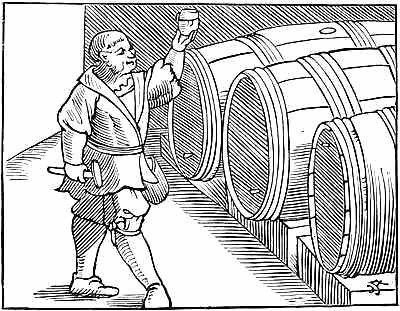
BUTLER OF THE SIXTEENTH CENTURY
(Facsimile of a woodcut in the Cosmographie Universelle, 1549).
The close of the fifteenth century witnessed another coronation, that of the so-styled ‘Father of his People,’ Louis XII., celebrated with all due splendour in May 1498. The six ecclesiastical peers—principal among whom was the Cardinal Archbishop of Reims, Guillaume Briconnet, in rochet and stole, mitre and crozier; and the six representatives of the secular peerages, Burgundy, Normandy, Aquitaine, Flanders, Toulouse, and Champagne—solemnly invested their sovereign with sword, spurs, ring, orb, sceptre, crown, and all the other outward symbols of royalty; whilst the vaulted roof rang with the acclamations of the people assembled in the nave, and the triumphant peals from the heralds’ silver trumpets, on the banneroles of which was emblazoned the monarch’s favourite badge, the hedgehog. Trumpet-blowing and shouting being both provocative of thirst, peers and people did ample justice to the wine freely provided for all comers on this occasion.
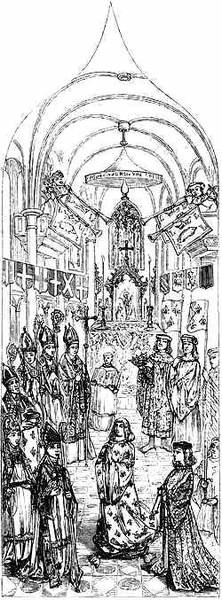
CORONATION OF LOUIS XII. AT REIMS
(From a painting on wood of the fifteenth century).
Francis I. was crowned at Reims in January 1515; and on the occasion of his visiting the city sixteen years afterwards, twenty poinçons of wine were offered to him and sixty to his suite, so that this bibulous monarch had a good opportunity of comparing various growths of the Mountain and the River with the wine from his own vineyards at Ay; and possibly the Emperor Charles V. did his best to institute similar comparisons on his self-invited incursion into the district in 1544. For not only did these two great rivals, but also our own Bluff King Harry and the magnificent Leo X., have each their special commissioner stationed at Ay to secure for them the finest vintages of that favoured spot, the renown of which thenceforward has never paled. The wine despatched for their consumption was most likely sent direct from the vineyards in carefully-sealed casks; but the bulk of the river growths came to Reims for sale, and helped to swell the importance of the town as an emporium of the wine-trade. When Mary Queen of Scots came to Reims, a mere child, in 1550, four poinçons of good wine, with a dozen peacocks and as many turkeys, were presented to her. There are no records, however, of any further offerings to her when, as the widowed queen of Francis II., she visited Reims at Eastertide in 1561, and again during the summer of the same year, shortly before her final departure from France. On these occasions she was the guest, by turns, of her aunt Renée de Lorraine, at the convent of St. Pierre les Dames,—to-day a woollen factory,—and of her uncle, the ‘opulent and libertine’ Charles de Lorraine, Cardinal and Archbishop of Reims, at the handsome archiepiscopal palace, where this powerful prelate resided in unwonted state. As the rhyme goes—
‘Bishop and abbot and prior were there,
Many a monk and many a friar,
Many a knight and many a squire,
With a great many more of lesser degree
Who served the Lord Primate on bended knee.
Never, I ween,
Was a prouder seen,
Read of in books, or dreamt of in dreams,
Than the Cardinal Lord Archbishop of Reims.’
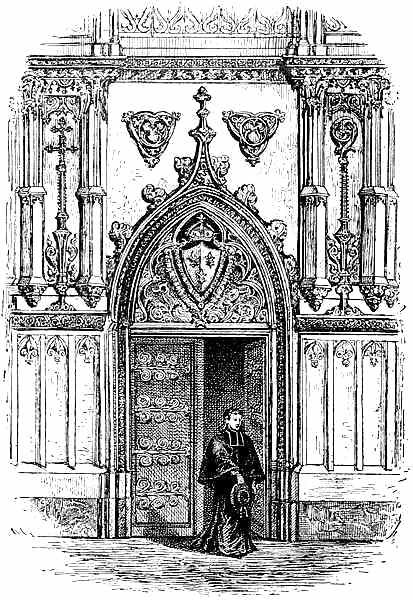
DOORWAY IN THE ARCHIEPISCOPAL PALACE AT REIMS.
Brusquet, the court fool of Henry II., Francis II., and Charles IX., was a great favourite with this princely prelate, and accompanied him several times on his embassies to foreign states. Brusquet’s wit was much appreciated by the cardinal, and has been highly extolled by Brantome; but most of the specimens handed down to us will not bear repetition, much less translation, from their coarseness. When the cardinal was at Brussels in 1559, negotiating the peace of Cateau Cambresis with Philip II., Brusquet one day at dessert jumped on to the table, and rolled along the whole length, wrapping himself up like a mummy in the cloth, with all the knives, forks, and spoons, as he went, and rolling over at the further end. The emperor, Charles V., who was the host, was so delighted that he told him to keep the plate himself. Brusquet had great dread of being drowned, and objected one day to go in a boat with the cardinal. ‘Do you think any harm can happen to you with me, the pope’s best friend?’ said the latter. ‘I know that the pope has power over earth, heaven, and purgatory,’ said Brusquet; ‘but I never heard that his dominion extended over water.’ It is not unlikely that the effigy forming one of the corbels beneath the chapter court gateway, and representing a fool in the puffed and slashed shoes and bombasted hose of the Renaissance, with his bauble in his hand, may be intended for Brusquet; for in the Middle Ages the ecclesiastical councils had forbidden dignitaries of the Church to have fools of their own.[54]
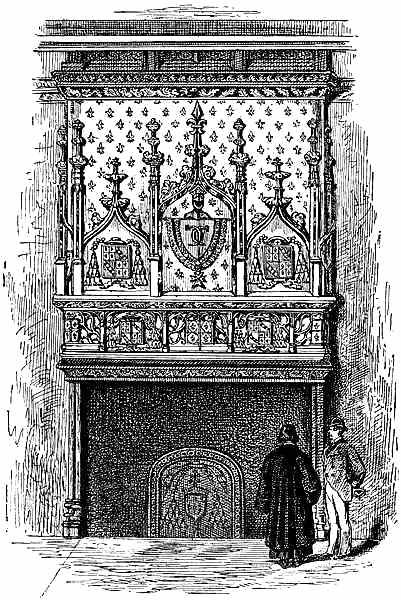
CHIMNEYPIECE IN THE BANQUETING HALL OF THE ARCHIEPISCOPAL PALACE AT REIMS.
It was in the grand hall of the archiepiscopal palace of Reims—an apartment which is very little changed from the days when Charles Cardinal de Lorraine entertained Henry II., Francis II., and Charles IX. in succession—that the coronation banquets at this epoch used to take place. Of the richness and beauty of the internal decorations of this interesting edifice some idea may be gained from the accompanying illustrations.
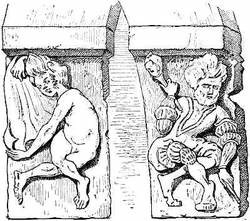
CORBELS, FROM THE CHAPTER
COURT GATEWAY, REIMS.
The stock of wine at Reims at the period of Mary’s first visit must have been very low, owing to the continued requisitions of it for armies in the field, for ‘German reiters at Attigny,’ and ‘Italian lansquenets at Voulzy;’ and no doubt its production subsequently decreased to some extent from the orders issued to the surrounding villagers to destroy all their ladders and vats lest they should fall into the hands of the enemy, at the epoch of the threatened approach of the German Emperor in 1552.
At the coronation of Francis II. in 1559, and at that of Charles IX. (the future instigator of the massacre of St. Bartholomew) two years later, the citizens of Reims presented the newly-crowned monarchs with the customary gifts of Burgundy and Champagne wines.[55] In the latter instance, however, the gift met with an unexpected return, inasmuch as the king, after the fashion of Domitian, issued an edict in 1566, ordering that vines should only occupy one-third of the area of a canton, and that the remaining two-thirds should be arable and pasture land. When the forehead of Henry III., the last of the treacherous race of Valois, was touched with the holy oil by the Cardinal de Guise, the wine of Reims for the first time was alone used to furnish forth the attendant banquet, and the appreciative king modified his brother’s edict to a simple recommendation to the governors of provinces to see that the planting of vines did not lead to a neglect of other labours. During this reign the wine of Ay reached the acme of renown, and came to be described as ‘the ordinary drink of kings and princes.’[56]
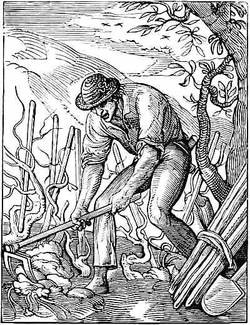
VIGNERON OF THE SIXTEENTH CENTURY
(Facsimile of a woodcut of the period).
In the troubles which followed the death of Henry III., when the east of France was laid desolate in turn by Huguenots and Leaguers, Germans and Spaniards; when Reims became a chief stronghold of the Catholics, who formed a kind of Republic there, and the remaining towns and villages of the district changed masters almost daily, the foragers of the party of Henry of Navarre and that of the League caused great tribulation amongst the vine-dressers and husbandmen of the Montagne and of the Marne. In 1589 very little wine could be vintaged around Reims ‘through the affluence of enemies,’ dolefully remarks a local analist.[57] After the battle of Ivry, Reims submitted to the king, but many of the surrounding districts, Epernay among the number, still sided with his opponents. Epernay fell, however, in 1592, after a cruel siege; and in the autumn of the same year the leaders of the respective parties met at the church of St. Tresain, at Avenay, and agreed to a truce during the ensuing harvest, in order that the crops of corn and wine might be gathered in—a truce known as the Trève des Moissons. The yield turned out to be of very good quality, the new wine fetching from 40 to 70 livres the queue.[58]
The system of cultivation prevailing in the French vineyards at this epoch must have been peculiar, since the staple agricultural authority of the day states that, to have an abundant crop and good wine, all that was necessary was for the vine-dresser to wear a garland of ivy, and for crushed acorns and ground vetches to be put in the hole at the time of planting the vine-shoots; that, moreover, grapes without stones could be obtained by taking out the pith of the young plant, and wrapping the end in wet paper, or sticking it in an onion when planting; that to get grapes in spring a vine-shoot should be grafted on a cherry-tree; and that wine could be made purgative by watering the roots of the vine with a laxative, or inserting some in a cleft branch.[59]
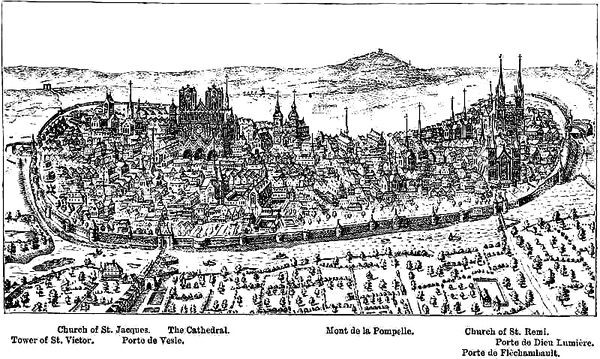
THE CITY OF REIMS IN 1635
(From an engraving of the period).
In the seventeenth century the still wine of the province of Champagne was destined, like the setting sun, to gleam with well-nigh unparalleled radiance up to the moment of its almost total eclipse. Continual care and untiring industry had resulted in the production of a wine which seems to have been renowned beyond all others for a delicate yet well-developed flavour peculiarly its own, but of which the wonderful revolution effected by the invention of sparkling wine has left but few traces. In 1604 the yield was so abundant that the vintagers were at their wits’ end for vessels to contain their wine; but three years later so poor a vintage took place as had not been known within the memory of man. During the winter the cold was so intense that wine froze not only in the cellars, but at table close to the fire, and by the ensuing spring it had grown so scarce that the veriest rubbish fetched 80 livres the queue at Reims.[60] In 1610, at the banquet following the coronation of Louis XIII., the only wine served was that of Reims, at 175 livres, or about 7 l., the queue; and the future raffinés of the Place Royale who assisted at that ceremony were by no means the men to forget or neglect an approved vintage after once tasting it. Champagne, it has been said, was crowned at the same time with the king, and of the two made a better monarch. Five years later a complaint, addressed to the king on the subject of the fermiers des aides trying to levy duties on goods sold at the fairs, asserted it was notorious that the chief commerce of Reims consisted of wines. According to the police ordinances of 1627, the price of these was fixed three times a year, namely, at Martinmas, Mid-Lent, and Midsummer; and tavern-keepers were bound to have a tablet inscribed with the regulation price fixed outside their houses, and were not allowed to sell at a higher rate, under a penalty of 12 livres for the first, and 24 livres for the second offence. Moreover, to encourage the production of the locality, they were strictly forbidden to sell in their taverns any other wine than that of the ‘cru du pays et de huit lieues es environs,’ under pain of confiscation and a fine, the amount of which was arbitrary. The vine-dressers too, in the same ordinances, were enjoined to kill and burn all vine-slugs and other vermin, which during 1621 and the two succeeding years had caused much damage.[61]
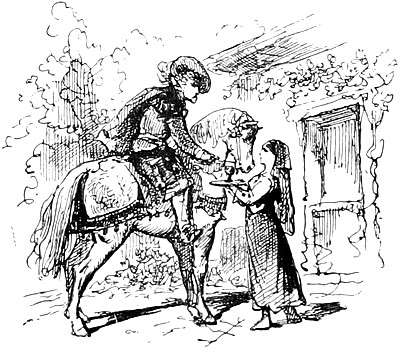
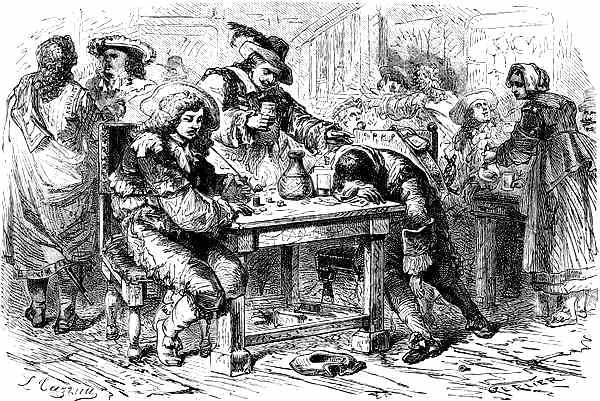
This rule must have been perforce relaxed during the troubles of the Fronde, when for two years the troops of the Marshal du Plessis Praslin lived as in a conquered country, indulging in drinking carousals in the wine-shops of the towns, or marching in detachments from village to village throughout the district, in order to prevent all those who neglected to pay the contributions imposed from working in their vineyards; when their leader, on the refusal of the Rémois to supply him with money, ravaged the vineyards of the plains of les Moineaux and Sacy; and when Erlach’s foreigners at Verzy sacked the whole of the Montagne from March until July 1650. As a consequence, people in the following year were existing on herbs, roots, snails, blood, bread made of bran, cats, dogs, &c., or dying by hundreds through eating bread made of unripe wheat harvested in June; the ruin of the citizens being completed, according to an eyewitness, at the epoch of dressing the vines, owing to the lack of men to do the work.[62] A contemporary writer, however, asserts that the vineyards still continued ‘to cover the mountains and to encircle the town of Reims like a crown of verdure;’ and that their produce not only supplied all local wants, but, transported beyond the frontier, caused the gold of the Indies to flow in return into the town, and spread its reputation afar.[63]
[32] A few examples of the retail price of wine throughout the century at Reims may here be noted. For instance, a judgment of 1303 provided that all tavern-keepers selling wine at a higher rate than six deniers, or about a farthing per lot, the rate fixed by ancient custom, were to pay a fine of twenty-two sous. The lot or pot, for the two terms are indifferently used, was about the third of an old English gallon, four pots making a septier, and thirty-six septiers a poinçon or demi-queue, equal to about forty-eight gallons. The queue was therefore about ninety-six gallons at Reims, but at Epernay not more than eighty-five gallons. Not only had every district its separate measures,—those of Paris, for instance, differing widely from those of Reims,—but there were actually different measures used in the various lay and ecclesiastical jurisdictions into which Reims was divided.
[33] Froissart’s Chronicles.
[34] Idem.
[35] Idem.
[36] What with one kind of assessment being adopted for wine sold wholesale and another for that disposed of by retail, with one class of dues being levied on wine for export and another on that for home consumption, and with the fact of certain duties being in some cases payable by the buyer and in others by the seller, any attempt to summarise this section of the story of the wines of Reims would be impossible. The difficulty is increased when it is remembered that in the Middle Ages Reims was divided into districts, under the separate jurisdictions of the eschevins, the archbishop, the chapter of the cathedral, the Abbeys of St. Remi and St. Nicaise, and the Priory of St. Maurice, in several of which widely varying measures were employed down to the sixteenth century, and between which there were continual squabbles as to the rights of vinage, rouage, tonnieu, &c.
[37] Varin’s Archives Administratives de Reims.
[38] Froissart’s Chronicles.
[39] Baron Taylor’s Reims; la Ville de Sacres.
[40] Amongst the better known are Chamery, where the archbishop had a house, vineyard, and garden, let for 3 s. per annum, about five jours of vineyard and two jours of very good vineland; Mareuil, whence he drew ten hogsheads of wine annually; Rilly, Verzenay, Sillery, Attigny, &c. The jour cost from 5 to 8 livres per annum for cultivation, and the stakes for the vines 4 sols, or 2 d., a hundred.
[41] The chapter of the Cathedral, the church of Notre Dame, the abbeys of St. Remi and St. Nicaise, had vineyards or ‘droits de vin’ at Hermonville, Rounay les Reims, Montigny, Serzy, Villers Aleran, Maineux devant Reims, Mersy, Sapiecourt, Sacy en la Montagne, Flory en la Montagne, Prouilly, Germigny, Saulx, Bremont, Merfaud, Trois Pins, Joucheri sur Vesle, Villers aux Neux, &c.; the last named also possessing a piece of ‘vingne gonesse’ at ‘a place called Mont Valoys in the territory of Reims.’
[42] At his château at the Porte Mars were forty-four queues of red and white wine, nineteen of new red and white wine, and four of old wine, valued, on an average, at 36 sols or 1 s. 6 d. the queue; at Courville there were fifty queues of new wine (valued at 30 sols the queue), twenty of old wine (worth nothing), and four ‘cuves’ for wine-making; and at Viellarcy, eighteen tuns of new wine, valued at 60 sols or 2 s. 6 d. per tun. To take charge of all these, Jehan le Breton, the defunct prelate’s assistant butler, was retained by the executors for half a year, at the wages of 74 sols or 3 s. 2 d. At the funeral feast there were consumed three queues of the best wine in the cellars, valued at 2 s. 7 ½ d. per queue, three others at 1 s. 3 d., and five pots of Beaune at 1 ⅔ d. English per pot, showing it to have been four times as valuable as native growths.
[43]
‘En Picardie sont li bourdeur,
Et en Champagne li buveur....
Telz n’a vaillant un Angevin
Qui chascun jor viant boire vin.’
[44]
‘Champagne est la forme de tout bien
De blé, de vin, de foin, et de litière.’
[45] Mss. de Rogier, Max Sutaine’s Essai sur le Vin de Champagne, &c.
[46] This wine, no doubt, came from a considerable distance round, for we find P. de la Place, a mercer of Reims, seeking in 1409 to recover the value of five queues and two poinçons ‘of wine from the cru of the town of Espernay, on the river of Esparnay,’ delivered at Reims to J. Crohin of Hainault, the origin of the same being certified by S. de Laval, a sworn wine-broker, ‘who knows and understands the wines of the country around Reims.’
[47] Varin’s Archives Administratives de Reims.
[48] Max Sutaine’s Essai sur le Vin de Champagne.
[49] Varin’s Archives Administratives de Reims. The Hôtel de la Maison Rouge occupies to-day the site of the old hostelry at which the parents of Jeanne Darc were housed.
[50] Varin’s Archives Administratives de Reims.
[51] The cost of the wine thus presented seems to have averaged from 2 ¼ d. to 3 d. per gallon. In 1477 a queue of old wine was valued at no less than 30 s.
[52] The twelve peers of France first appear at the coronation of Philip Augustus. There were six lay peers and six ecclesiastical peers:
[53] The following is the full text of this singular sentence. The injunction at the end, respecting the payment of tithes without fraud, shows that even in a matter like this the Church did not lose sight of its own interests.
[54] It has been asserted that the Champagne, and notably the town of Troyes, enjoyed the dubious honour of furnishing fools to the court of France. There is certainly a letter of Charles V. to the notables of Troyes, asking them, ‘according to custom,’ for a fool to replace one named Grand Jehan de Troyes, whom he had had buried in the church of St. Germain l’Auxerrois, and who has been immortalised by Rabelais. But Brusquet was a Provençal; Triboulet, his predecessor, immortalised by Victor Hugo in the ‘Roi s’amuse,’ a native of Blois; Chicot the Jester, the fool of Henry III., and the favourite hero of Dumas, a Gascon; and Guillaume, his successor, a Norman.
[55] The wine of Reims provided at the coronation of Francis II., in 1559, cost from 11 s. 8 d. to 15 s. 10 d. per queue of ninety-six gallons, and the Burgundy 16 s. 8 d. per queue, which, allowing for the cost of transport, would put them about on an equality. At the coronation of Charles IX., in 1561, Reims wine cost from 23 s. 4 d. to 28 s. 4d.; and at that of Henry III., in 1575, from 45 s. to 62 s. 6 d. per queue,—a sufficient proof of the rapidly-increasing estimation in which the wine was held.
[56] Paulmier’s treatise De Vino et Pomaceo (Paris, 1588).
[57] Jehan Pussot’s Mémorial du Temps.
[58] Ibid. Many details respecting the yield of the vines and vineyards of the Mountain and the River are preserved in this Mémorial, which extends from 1569 to 1625, and the author of which was a celebrated builder of Reims. During the last thirty years of the century the vines seem to have suffered greatly from frost and wet. Sometimes the wine was so bad that it was sold, as towards the end of 1579, at 5 s. 6 d. the queue; at others it was so scarce that it rose, as at the vintage of 1587, to 126 s. 8 d. the queue. At the vintage of 1579 the grapes froze on the vines, and were carried to the press in sacks. At the commencement of the vintage the new wine fetched from 12 s. to 16 s. the queue, but it turned out so bad that by Christmas it was sold at 5 s. 6 d.
[59] Maison Rustique (1574).
[60] Jehan Pussot’s Mémorial du Temps.
[61] During the first twenty-five years of the century Pussot shows the new wine to have averaged from about 23 s. to 46 s. the queue, according to quality. In 1600 and 1611 it was as low as 16 s., and in 1604 fetched from merely 12 s. to 32 s. On the other hand, in 1607, it fetched from 57 s. to 95 s., and in 1609 from 79 s. to 95 s.
[62] Feillet’s La Misère aux temps de la Fronde.
[63] Dom Guillaume Marlot’s Histoire de Reims.
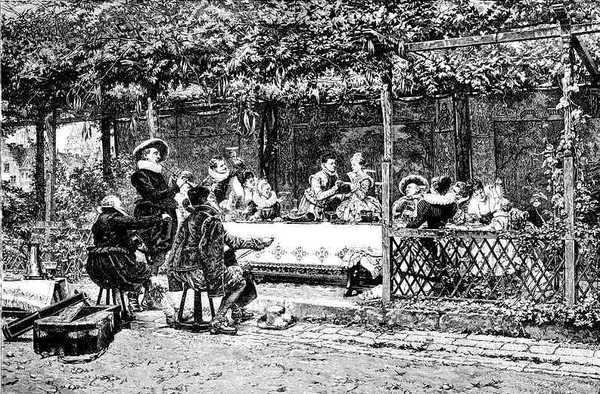
A BETROTHAL BANQUET IN THE SEVENTEENTH CENTURY.
Such was the repute of the Champagne wines when Louis XIV. was crowned at Reims in 1654, that all the great lords present on the occasion were exceedingly anxious to partake of them, and no doubt regarded with envious eyes the huge basket containing a hundred bottles of the best which the deputies from Epernay had brought with them as a present to the gallant Turenne. He at least was no stranger to the merits of the wine, for the records of Epernay show that many a caque had found its way to his tent during the two preceding years, when he was defending the Champagne against Condé and his Spanish allies. In the same year (1654), the Procureur de l’Echevinage speaks of the chief trade of Reims as consisting in the sale of wine, of which the inhabitants collect large quantities, both from the Montagne de Reims and the Rivière de Marne, through the merchants who make this their special trade—a trade sorely interrupted by the incursions of Montal and his Spaniards in 1657 and 1658. Guy Patin too, writing in 1666, mentions the fact of Louis XIV. making a present to Charles II. of England of two hundred pièces of excellent wine—Champagne, Burgundy, and Hermitage; and three years later is fain himself to exclaim, ‘Vive le pain de Gonesse, vive le bon vin de Paris, de Bourgogne, de Champagne!’ whilst Tavernier the traveller did his best to spread the fame of the Champagne wine by presenting specimens to all the sovereigns whom he had the honour of saluting during his journeyings abroad.[64]
It was about the eighth decade of this century, when the renown of the Grand Monarque was yet at its apogee, and when for many years the soil of the province had not been profaned by the foot of an invader, that the still wine of the Champagne attained its final point of perfection. The Roi Soleil himself, we are assured by St. Simon, never drank any other wine in his life till about 1692, when his physician, the austere Fagon, condemned his debilitated stomach to well-watered Burgundy, so old that it was almost tasteless, and the king consoled himself with laughing at the wry faces pulled by foreign nobles who sought and obtained the honour of tasting his especial tipple.[65] An anonymous Mémoire[66] written early in the ensuing century (1718) states that, although their red wine had long before been made with greater care and cleanliness than any other wine in the kingdom, the Champenois had only studied to produce a gray, and indeed almost white, wine, within the preceding fifty years. This would place about 1670 the first introduction of the new colourless wine, obtained by gathering grapes of the black variety with the utmost care at early dawn, and ceasing the vintage at nine or ten in the morning, unless the day were cloudy. Despite these precautions a rosy tinge—compared to that lent by a dying sunset to the waters of a clear stream—was often communicated to the wine, and led to the term ‘partridge’s eye’ being applied to it. St. Evremond, the epicurean Frenchman—who emigrated to the gay court of Charles II. at Whitehall to escape the gloomy cell designed for him in the Bastille—and the mentor of the Count de Grammont, writing from London about 1674, to his brother ‘profès dans l’ordre des coteaux,’[67] the Count d’Olonne, then undergoing on his part a species of exile at Orleans for having suffered his tongue to wag a little too freely at court, says: ‘Do not spare any expense to get Champagne wines, even if you are at two hundred leagues from Paris. Those of Burgundy have lost their credit amongst men of taste, and barely retain a remnant of their former reputation amongst dealers. There is no province which furnishes excellent wines for all seasons but Champagne. It supplies us with the wines of Ay, Avenay, and Hautvillers, up to the spring; Taissy, Sillery, Verzenai, for the rest of the year.’[68] ‘The wines of the Champagne,’ elsewhere remarks this renowned gourmet, ‘are the best. Do not keep those of Ay too long; do not begin those of Reims too soon. Cold weather preserves the spirit of the River wines, hot removes the goût de terroir from those of the Mountain.’ Writing also in 1701, he alludes to the care with which the Sillery wines were made forty years before.
Such a distinction of seasons would imply that wine, instead of being kept, was drunk within a few months of its manufacture; though this, except in the case of wine made as ‘tocane,’ which could not be kept, would appear to be a matter rather of taste than necessity. This custom of drinking it before fermentation was achieved, and also the natural tendency of the wine of this particular region to effervesce—a tendency since taken such signal advantage of by the manufacturers of sparkling Champagne—are treated of in a work of the period,[69] the author of which, after noting the excellence of certain growths of Burgundy, goes on to say that, ‘If the vintage in the Champagne is a successful one, it is thither that the shrewd and dainty hasten. There is not,’ continues he, ‘in the world a drink more noble and more delicious; and it is now become so highly fashionable that, with the exception of those growths drawn from that fertile and agreeable district which we call in general parlance that of Reims, and particularly from St. Thierry, Verzenay, Ay, and different spots of the Mountain, all others are looked upon by the dainty as little better than poor stuff and trash, which they will not even hear spoken of.’ He extols the admirable sève of the Reims wine, its delicious flavour, and its perfume, which with ludicrous hyperbole he pronounces capable of bringing the dead to life. Burgundy and Champagne, he says, are both good, but the first rank belongs to the latter, ‘when it has not that tartness which some debauchees esteem so highly, when it clears itself promptly, and only works as much as the natural strength of the wine allows; for it does not do to trust so much to that kind of wine which is always in a fury, and boils without intermission in its vessel.’
Such wine, he maintains, is quite done for by the time Easter is over, and only retains of its former fire a crude tartness very unpleasant and very indigestible, which is apt to affect the chest of those who drink it. He recommends that Champagne should be drunk at least six months after the end of the year, and that the grayest wines should always be chosen as going down more smoothly and clogging the stomach less, since, however good the red wine may be as regards body, from its longer cuvaison, it is never so delicate, nor does it digest so promptly, as the others. He concludes, therefore, that it is better to drink old wine, or at any rate what then passed as old wine, as long as one can, in order not to have to turn too soon to the new ones, ‘which are veritable head-splitters, and from their potency capable of deranging the strongest constitutions.’ Above all, he urges abstinence from such ‘artificial mummeries’ as the use of ice, ‘the most pernicious of all inventions’ and the enemy of wine, though at that time, he admits, very fashionable, especially amongst certain ‘obstreperous voluptuaries,’ ‘who maintain that the wine of Reims is never more delicious than when it is drunk with ice, and that this admirable beverage derives especial charms from this fatal novelty.’ Ice, he holds, not only dispels the spirit and diminishes the flavour, sève, and colour of the wine, but is most pernicious and deadly to the drinker, causing ‘colics, shiverings, horrible convulsions, and sudden weakness, so that frequently death has crowned the most magnificent debauches, and turned a place of joy and mirth into a sepulchre.’ Wherefore let all drinkers of Champagne frappé beware.
Here we have ample proof of the popularity of the wines of the Champagne, a popularity erroneously said to be due in some measure to the fact that both the Chancellor le Tellier, father of Louvois, and Colbert, the energetic comptroller-general of the state finances, and son of a wool-merchant of Reims, possessed large vineyards in the province.[70] Lafontaine, who was born in the neighbourhood, declared his preference for Reims above all cities, on account of the Sainte Ampoule, its good wine, and the abundance of other charming objects;[71] and Boileau, writing in 1674, depicts an ignorant churchman, whose library consisted of a score of well-filled hogsheads, as being fully aware of the particular vineyard at Reims over which the community he belonged to held a mortgage.[72] James II. of England was particularly partial to the wine of the Champagne. When the quinquennial assembly of the clergy was held in 1700, at the Château of St. Germain-en-Laye, where he was residing, Charles Maurice le Tellier, brother to Louvois and Archbishop of Reims, who presided, ‘kept a grand table, and had some Champagne wine that was highly praised. The King of England, who rarely drank any other, heard of it, and sent to ask some of the archbishop, who sent him six bottles. Some time afterwards the king, who found the wine very good, sent to beg him to send some more. The archbishop, more avaricious of his wine than of his money, answered curtly that his wine was not mad, and therefore did not run about the streets, and did not send him any.’[73] Du Chesne, who, when Fagon became medical attendant to Louis XIV., succeeded him as physician to the ‘fils de France,’ and who died at Versailles in 1707, aged ninety-one, in perfect health, ascribed his longevity to his habit of eating a salad every night at supper, and drinking only Champagne, a régime which he recommended to all.[74]
The wine was nevertheless the indirect cause of the death of the poet Santeuil, who, although a canon of St. Victor, was very much fonder of Champagne and of sundry other good things than he ought to have been. A wit and a bon vivant, he was a great favourite of the Duc de Bourbon, son of the Prince de Condé, whom he accompanied in the summer of 1697 to Dijon. ‘One evening at supper the duke amused himself with plying Santeuil with Champagne, and going on from joke to joke, he thought it funny to empty his snuff-box into a goblet of wine, and make Santeuil drink it, in order to see what would happen. He was pretty soon enlightened. Vomiting and fever ensued, and within forty-eight hours the unhappy wretch died in the torments of the damned, but filled with the sentiments of great penitence, with which he received the sacraments and edified the company, who, though little given to be edified, disapproved of such a cruel experiment.’[75] Of course nothing was done, or even said, to the duke.
‘Sire,’ said the president of a deputation bringing specimens of the various productions of Reims to the Grand Monarque when he visited the city in 1666, ‘we offer you our wine, our pears, our gingerbread, our biscuits, and our hearts;’ and Louis, who was a noted lover of the good things of this life, answered, turning to his suite, ‘There, gentlemen, that is just the kind of speech I like.’ To this day Reims manufactures by the myriad the crisp finger-shaped sponge-cakes called ‘biscuits de Reims,’ which the French delight to dip in their wine; juvenile France still eagerly devours its pain d’épice, and the city sends forth far and wide the baked pears which have obtained so enviable a reputation. But the production of such wine as that offered to the king has long since almost ceased, while its fame has been eclipsed tenfold by wine of a far more delicious kind, the origin and rise of which has now to be recounted. This is the sparkling wine of Champagne, which has been fitly compared to one of those younger sons of good family, who, after a brilliant and rapid career, achieve a position far eclipsing that of their elder brethren, whose fame becomes merged in theirs.[76]
III.
INVENTION AND DEVELOPMENT OF SPARKLING CHAMPAGNE.
The ancients acquainted with sparkling wines—Tendency of Champagne wines to effervesce noted at an early period—Obscurity enveloping the discovery of what we now know as sparkling Champagne—The Royal Abbey of Hautvillers—Legend of its foundation by St. Nivard and St. Berchier—Its territorial possessions and vineyards—The monks the great viticulturists of the Middle Ages—Dom Perignon—He marries wines differing in character—His discovery of sparkling white wine—He is the first to use corks to bottles—His secret for clearing the wine revealed only to his successors Frère Philippe and Dom Grossart—Result of Dom Perignon’s discoveries—The wine of Hautvillers sold at 1000 livres the queue—Dom Perignon’s memorial in the Abbey-Church—Wine flavoured with peaches—The effervescence ascribed to drugs, to the period of the moon, and to the action of the sap in the vine—The fame of sparkling wine rapidly spreads—The Vin de Perignon makes its appearance at the Court of the Grand Monarque—Is welcomed by the young courtiers—It figures at the suppers of Anet and Chantilly, and at the orgies of the Temple and the Palais Royal—The rapturous strophes of Chaulieu and Rousseau—Frederick William I. and the Berlin Academicians—Augustus the Strong and the page who pilfered his Champagne—Horror of the old-fashioned gourmets at the innovation—Bertin du Rocheret and the Marshal d’Artagnan—System of wine-making in the Champagne early in the eighteenth century—Bottling of the wine in flasks—Icing Champagne with the corks loosened.
A SYBARITE of our day has remarked that the life of the ancient Greeks would have approached the perfection of earthly existence had they only been acquainted with sparkling Champagne. As, however, amongst the nations of antiquity the newly-made wine was sometimes allowed to continue its fermentation in close vessels, it may be conceived that when freshly drawn it occasionally possessed a certain degree of briskness from the retained carbonic acid gas. [77] Virgil’s expression,
‘Ille impiger hausit
Spumantem pateram,’[78]
demonstrates that the Romans—whose patera, by the way, closely resembled the modern champagne-glass—were familiar with frothy and sparkling wines, although they do not seem to have intentionally sought the means of preserving them in this condition.[79]
The early vintagers of the Champagne can hardly have helped noting the natural tendency of their wine to effervesce, the difficulty of entirely overcoming which is exemplified in the precautions invariably taken for the production of Sillery sec; indeed tradition claims for certain growths of the Marne, from a period of remote antiquity, a disposition to froth and sparkle.[80] Local writers profess to recognise in the property ascribed by Henry of Andelys to the wine of Chalons, of causing both the stomach and the heels to swell,[81] a reference to this peculiarity.[82] The learned Baccius, physician to Pope Sixtus V., writing at the close of the sixteenth century of the wines of France, mentions those ‘which bubble out of the glass, and which flatter the smell as much as the taste,’[83] though he does not refer to any wine of the Champagne by name. An anonymous author, some eighty years later,[84] condemns the growing partiality for the ‘great vert which certain debauchees esteem so highly’ in Champagne wines, and denounces ‘that kind of wine which is always in a fury, and which boils without ceasing in its vessel.’ Still he seems to refer to wine in casks, which lost these tumultuous properties after Easter. Necessity being the mother of invention, the inhabitants of the province had in the sixteenth century already devised and put in practice a method of allaying fermentation, and obtaining a settled wine within four-and-twenty hours, by filling a vessel with ‘small chips of the wood called in French sayette,’ and pouring the wine over them.[85]
With all this, a conscientious writer candidly acknowledges that, despite minute and painstaking researches, he cannot tell when what is now known as sparkling Champagne first made its appearance. The most ancient references to it of a positive character that he could discover are contained in the poems of Grenan and Coffin, printed in 1711 and 1712; yet its invention certainly dates prior to that epoch,[86] and earlier poets have also praised it. It seems most probable that the tendency to effervescence already noted became even more marked in the strong-bodied gray and ‘partridge-eye’ wines, first made from red grapes about 1670, than in the yellowish wine previously produced, like that of Ay, from white grapes,[87] and recommended, from its deficiency in body, to be drunk off within the year.[88] These new wines, when in a quasi-effervescent state prior to the month of March, offered a novel attraction to palates dulled by the potent vintages of Burgundy and Southern France;[89] and their reputation quickly spread, though some old gourmets might have complained, with St. Evremond, of the taste introduced by faux delicats.[90] They must have been merely cremant wines—for glass-bottle making was in its infancy, and corks as yet unknown[91]—and doubtless resembled the present wines of Condrieu, which sparkle in the glass on being poured out, during their first and second years, but with age acquire the characteristics of a full-bodied still wine. The difficulty of regulating their effervescence in those pre-scientific days must have led to frequent and serious disappointments. The hour, however, came, and with it the man.
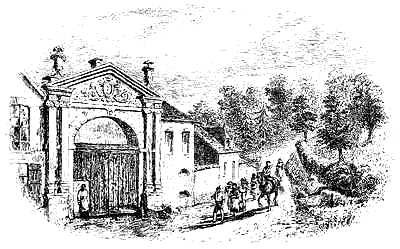
GATEWAY OF THE ABBEY OF HAUTVILLERS.
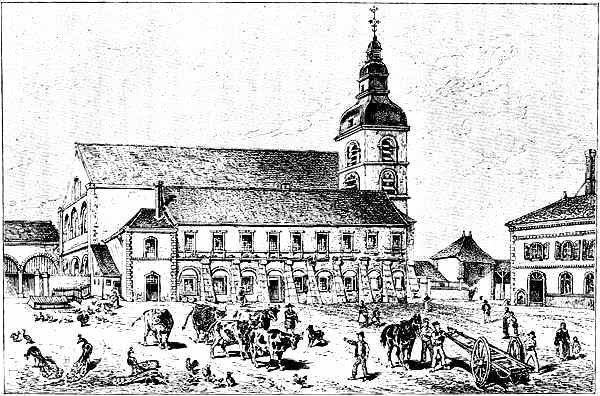
THE CHURCH OF HAUTVILLERS, WITH THE REMAINS OF THE ABBEY.
In the year 1670, among the sunny vineyard slopes rising from the poplar-fringed Marne, there stood in all its pride the famous royal Abbey of St. Peter at Hautvillers. Its foundation, of remote antiquity, was hallowed by saintly legend. Tradition said that about the middle of the seventh century St. Nivard, Bishop of Reims, and his godson, St. Berchier, were seeking a suitable spot for the erection of a monastery on the banks of the river. The way was long, the day was warm, and the saints but mortal. Weary and faint, they sat down to rest at a spot identified by tradition with a vineyard at Dizy, to-day belonging to Messrs. Bollinger, but at that time forming part of the forest of the Marne. St. Nivard fell asleep, with his head in St. Berchier’s lap, when the one in a dream, and the other with waking eyes, saw a snow-white dove—the same, firm believers in miracles suggested, which had brought down the holy oil for the anointment of Clovis at his coronation at Reims—flutter through the wood, and finally alight afar off on the stump of a tree. Such an omen could no more be neglected by a seventh-century saint than a slate full of scribble by a nineteenth-century spiritualist, and accordingly the site thus miraculously indicated was forthwith decided upon. Plans for the edifice were duly drawn out and approved of, and the abbey rose in stately majesty, the high altar at which St. Berchier was solemnly invested with the symbols of abbatial dignity being erected upon the precise spot occupied by the tree on which the snow-white dove had alighted.[92] As time rolled on and pious donations poured in, the abbey waxed in importance, although it was sacked by the Normans when they ravaged the Champagne, and was twice destroyed by fire—once in 1098, and again in 1440—when each time it rose phœnix-like from its ashes.
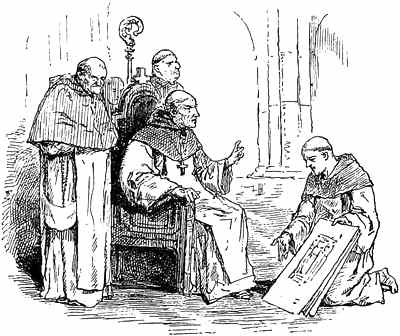
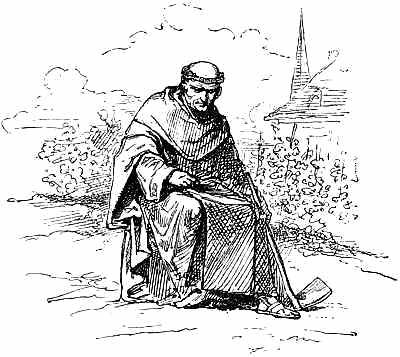
In 1670 the abbey was, as we have said, in all its glory. True, it had been somewhat damaged a century previously by the Huguenots, who had fired the church, driven out the monks, sacked the wine-cellars, burnt the archives, and committed sundry other depredations inherent to civil and religious warfare; but the liberal contributions of the faithful, including Queen Marie de Medicis, had helped to efface all traces of their visit. The abbey boasted many precious relics rescued from the Reformers’ fury, the most important being the body of St. Helena, the mother of Constantine the Great, which had been in its possession since 844, and attracted numerous pilgrims. The hierarchical status of the abbey was high; for no less than nine archbishops had passed forth through its stately portal to the see of Reims, and twenty-two abbots, including the venerable Peter of Cluny, to various distinguished monasteries. Its territorial possessions were extensive; for its abbot was lord of Hautvillers, Cumières, Cormoyeux, Bomery, and Dizy la Rivière, and had all manner of rights of fourmage, and huchage, vinage, and pressoir banal, and the like,[93] to the benefit of the monks and the misfortune of their numerous dependents. Its revenues were ample, and no small portion was derived from the tithes of fair and fertile vinelands extending for miles around, and from the vineyards which the monks themselves cultivated in the immediate neighbourhood of the abbey.
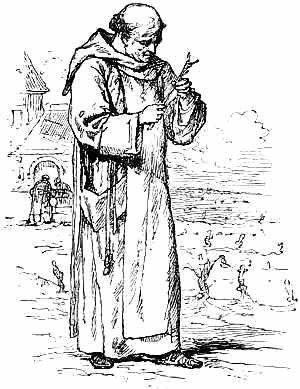
It should be remembered that for a lengthy period—not only in France, but in other countries—the choicest wines were those produced in vineyards belonging to the Church, and that the vinum theologium was justly held superior to all others. The rich chapters and monasteries were more studious of the quality than of the quantity of their vintages; their land was tilled with particular care, and the learning, of which in the Middle Ages they were almost the sole depositaries, combined with opportunities of observation enjoyed by the members of these fraternities by reason of their retired pursuits, made them acquainted at a very early period with the best methods of controlling the fermentation of the grape and ameliorating its produce.[94] To the monks of Bèze we owe Chambertin, the favourite wine of the first Napoleon; to the Cistercians of Citaulx the perfection of that Clos Vougeot which passing regiments saluted tambour battant; and the Benedictines of Hautvillers were equally regardful of the renown of their wines and vineyards. In 1636 they cultivated one hundred arpents themselves,[95] their possessions including the vineyards now known as Les Quartiers and Les Prières at Hautvillers, and Les Barillets, Sainte Hélène, and Cotes-à-bras at Cumières, the last named of which still retains a high reputation.
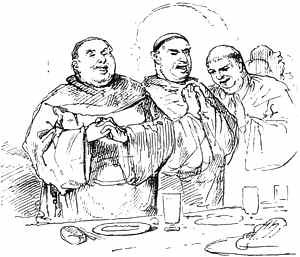
Over these vineyards there presided in 1670 a worthy Benedictine named Dom Perignon, who was destined to gain for the abbey a more world-wide fame than the devoutest of its monks or the proudest of its abbots. His position was an onerous one, for the reputation of the wine was considerable, and it was necessary to maintain it. Henry of Andelys had sung its praises as early as the thirteenth century; and St. Evremond, though absent from France for nearly half a score years, wrote of it in terms proving that he had preserved a lively recollection of its merits. Dom Perignon was born at Sainte Ménehould in 1638, and had been elected to the post of procureur of the abbey about 1668, on account of the purity of his taste and the soundness of his head. He proved himself fully equal to the momentous task, devotion to which does not seem to have shortened his days, since he died at the ripe old age of seventy-seven. It was Dom Perignon’s duty to superintend the abbey vineyards, supervise the making of the wine, and see after the tithes, paid either in wine or grapes[96] by the neighbouring cultivators to their seignorial lord the abbot. The wine which thus came into his charge was naturally of various qualities; and having noted that one kind of soil imparted fragrance and another generosity, while the produce of others was deficient in both of these attributes, Dom Perignon, in the spirit of a true Benedictine, hit upon the happy idea of ‘marrying,’ or blending, the produce of different vineyards together,[97] a practice which is to-day very generally followed by the manufacturers of Champagne. Such was the perfection of Dom Perignon’s skill and the delicacy of his palate, that in his later years, when blind from age, he used to have the grapes of the different districts brought to him, and, recognising each kind by its flavour, would say, ‘You must marry the wine of this vineyard with that of such another.’[98]
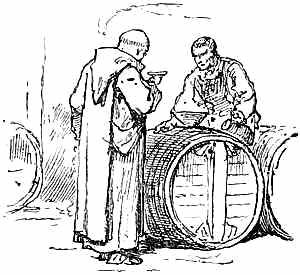
But the crowning glory of the Benedictine’s long and useful life remains to be told. He succeeded in obtaining for the first time in the Champagne a perfectly white wine from black grapes, that hitherto made having been gray, or of a pale-straw colour.[99] Moreover, by some happy accident, or by a series of experimental researches—for the exact facts of the discovery are lost for ever—he hit upon a method of regulating the tendency of the wines of this region to effervesce, and by paying regard to the epoch of bottling, finally succeeded in producing a perfectly sparkling wine, that burst forth from the bottle and overflowed the glass, and was twice as dainty to the palate, and twice as exhilarating in its effects, as the ordinary wine of the Champagne. A correlative result of his investigations was the present system of corking bottles, a wisp of tow dipped in oil being the sole stopper in use prior to his time.[100] To him, too, we owe not only sparkling Champagne itself, but the proper kind of glass to drink it out of. The tall, thin, tapering flute was adopted, if not invented, by him, in order, as he said, that he might watch the dance of the sparkling atoms.[101] The exact date of Dom Perignon’s discovery of sparkling wine seems to be wrapped in much the same obscurity as are the various attendant circumstances. It was certainly prior to the close of the seventeenth century; as the author of an anonymous treatise, printed at Reims in 1718, remarked that for more than twenty years past the taste of the French had inclined towards sparkling wines, which they had ‘frantically adored,’ though during the last three years they had grown a little out of conceit with them.[102] This would place it at 1697, at the latest.
To Dom Perignon the abbey’s well-stocked cellar was a far cheerfuller place than the cell. Nothing delighted him more than
‘To come down among this brotherhood
Dwelling for ever underground,
Silent, contemplative, round, and sound;
Each one old and brown with mould,
But filled to the lips with the ardour of youth,
With the latent power and love of truth,
And with virtues fervent and manifold.’
Ever busy among his vats and presses, barrels and bottles, Perignon found out a method of clearing wine, so as to preserve it perfectly limpid and free from all deposit, without being obliged, like all who sought to rival him in its production, to dépoter the bottles—that is, to decant their contents into fresh ones.[103] This secret, which helped to maintain the high reputation of the wine of Hautvillers when the manufacture of sparkling Champagne had extended throughout the district, he guarded even better than he was able to guard the apple of his eye. At his death, in 1715, he revealed it only to his successor, Frère Philippe, who, after holding sway over vat and vineyard for fifty years, died in 1765, imparting it with his latest breath to Frère André Lemaire. Revoked perforce from his functions by the French Revolution, he in turn, before his death about 1795, communicated it to Dom Grossart, who exults over the fact that whilst the greatest Champagne merchants were obliged to dépoter, the monks of Hautvillers had never done so.[104] Dom Grossart, who had counted the Moëts amongst his customers, died in his turn without making any sign, so that the secret of Perignon perished with him. Prior to that event, however, the present system of dégorgeage was discovered, and eventually dépotage was no longer practised.[105]
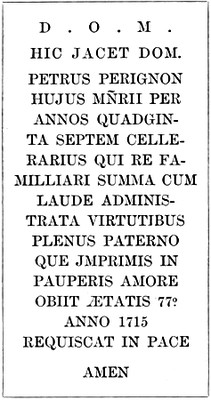
The material result of Dom Perignon’s labours was such that one of the presses of the abbey bore this inscription: ‘M. de Fourville, abbot of this abbey, had me constructed in the year 1694, and that same year sold his wine at a thousand livres the queue.’[106] Their moral effect was so complete that his name became identified with the wine of the abbey. People asked for the wine of Perignon, till they forgot that he was a man and not a vineyard,[107] and within a year of his death his name figures amongst a list of the wine-producing slopes of the Champagne.[108] His reputation has outlasted the walls within which he carried on his labours, and his merits are thus recorded, in conventual Latin of the period, on a black-marble slab still to be seen within the altar-steps of the abbey-church of Hautvillers.[109]
The anonymous Mémoire of 1718 gives, with an amount of preliminary flourish which would imply a doubt as to the accuracy of the statement made, the secret mode said to have been employed by Dom Perignon to improve his wine, and to have been confided by him a few days before his death to ‘a person worthy enough of belief,’ by whom it was in turn communicated to the writer. According to this, a pound of sugar-candy was dissolved in a chopine of wine, to which was then added five or six stoned peaches, four sous’ worth of powdered cinnamon, a grated nutmeg, and a demi septier of burnt brandy; and the whole, after being well mixed, was strained through fine linen into a pièce of wine immediately after fermentation had ceased, with the result of imparting to it a dainty and delicate flavour. Dom Grossart, however, in his letter to M. Dherbès, distinctly declares that ‘we never did put sugar into our wine.’[110] This collature, in which peaches play a part, was probably made use of by some wine-growers; and the peach-like flavour extolled by St. Evremond in the wine of Ay may have been due to it, or to the practice then and long afterwards followed of putting peach-leaves in the hot water with which the barrels were washed out, under the idea that this improved the flavour of the wine.[111]
Opinions were widely divided as to the cause of the effervescence in the wines of Hautvillers, for the connection between sugar and fermentation was then undreamt of, although Van Helmont had recognised the existence of carbonic acid gas in fermenting wine as early as 1624. Some thought it due to the addition of drugs, and sought to obtain it by putting not only alum and spirits of wine, but positive nastinesses, into their wine.[112] Others ascribed it to the greenness of the wine, because most of that which effervesced was extremely raw; and others again believed that it was influenced by the age of the moon at the epoch of bottling. Experience undoubtedly showed that wine bottled between the vintage and the month of May was certain to effervesce, and that no time was more favourable for this operation than the end of the second quarter of the moon of March. Nevertheless, as the wines, especially those of the Mountain of Reims, were not usually matured at this epoch, it was recommended, in order to secure a ripe and exquisite sparkling wine, to defer the bottling until the ascent of the sap in the vine between the tenth and fourteenth day of the moon of August; whereas, to insure a non mousseux wine, the bottling ought to take place in October or November.[113]
The fame of the new wine, known indifferently as vin de Perignon, flacon pétillant, flacon mousseux, vin sautant, vin mousseux, saute bouchon, &c., and even anathematised as vin du diable—for the present term, vin de Champagne, was confined as yet to the still or quasi-still growths—quickly spread. Never, indeed, was a discovery more opportune. At the moment of its introduction the glory of France was on the wane; Colbert, Louvois, and Luxembourg were dead; the Treaty of Ryswick had been signed; famine and deficit reared their threatening heads, and lo, Providence offered this new consolation for all outward and inward ills. With the King it could only find scant favour. The once brilliant Louis was now a bigoted and almost isolated invalid. His debilitated stomach, ruined by long indulgence, could scarcely even support the old Burgundy—so old that it was almost tasteless—which Fagon had prescribed as his sole beverage some years before;[114] and the popping of sparkling Champagne corks would have scandalised the quiet tête-à-tête repasts which he was wont to partake of with the pious Madame de Maintenon.[115]
[64] Pluche’s Spectacle de la Nature.
[65] St. Simon’s Mémoires.
[66] Mémoire sur la manière de cultiver la vigne et de faire le vin en Champagne.
[67] Lavardin, Bishop of Le Mans, and himself a great gourmet, was one day at dinner with St. Evremond, and began to rally the latter on the delicacy of himself and his friends the Marquis de Bois Dauphin and the Comte d’Olonne. ‘These gentlemen,’ said the prelate, ‘in seeking refinement in everything carry it to extremes. They can only eat Normandy veal; their partridges must come from Auvergne, and their rabbits from La Roche Guyon, or from Versin; they are not less particular as to fruit; and as to wine, they can only drink that of the good coteaux of Ay, Hautvillers, and Avenay.’ St. Evremond having repeated the story, he, the marquis, and the count were nicknamed ‘the three coteaux.’ Hence Boileau, in one of his satires, describes an epicurean guest as ‘profès dans l’ordre des coteaux.’
[68] St. Evremond’s Works (London, 1714).
[69] L’Art de bien traiter ... mis en lumière, par L. S. R. (Paris, 1674).
[70] Brossette’s notes to Boileau’s Works (1716). Bertin du Rocheret, in correcting this error in the Mercure of January 1728, points out that neither the family of Colbert nor that of Le Tellier ever owned a single vinestock of the River, and that their holdings on the Mountain were very insignificant.
[71]
‘Il n’est cité que je préfère à Reims,
C’est l’ornement et l’honneur de la France;
Car sans conter l’ampoule et les bons vins,
Charmants objets y sont en abondance.’ Les Rémois.
[72]
‘Sur quelle vigne à Reims nous avons hypothèque;
Vingt muids, rangés chez moi, font ma bibliothèque.’
Le Lutrin, chant iv. 1674.
[73] St. Simon’s Mémoires.
[74] Ibid.
[75] Ibid.
[76] Max Sutaine’s Essai sur le Vin de Champagne, 1845.
[77] Henderson’s History of Ancient and Modern Wines.
[78] Æneid, i. 738.
[79] Henderson’s History of Ancient and Modern Wines.
[80] Max Sutaine’s Essai sur le Vin de Champagne.
[81]
————‘Petars de Chaalons,
Qui le ventre enfle et les talons.’
[82] Louis Perrier’s Mémoire sur le Vin de Champagne, 1865.
[83] De Naturali Vinorum Historiâ. Rome, 1596.
[84] L’Art de bien traiter, &c.
[85] Maison Rustique, 1574.
[86] Max Sutaine’s Essai sur le Vin de Champagne.
[87] Pluche’s Spectacle de la Nature.
[88] Idem and Maison Rustique, 1582. M. Louis Perrier, in his Mémoire sur le Vin de Champagne, says that the Ay wines yield but little mousse.
[89] Max Sutaine’s Essai sur le Vin de Champagne.
[90] St. Evremond’s letter to the Comte d’Olonne, already noticed. In another epistle to Lord Galloway, dated 29th August 1701, he observes: ‘As to M. de Puisieux (Roger Brulart, Marquis de Puisieux et de Sillery and Governor of Epernay), in my opinion he acts very wisely in falling in with the bad taste now in fashion as regards Champagne wine, in order the better to sell his own. I could never have thought that the wines of Reims could have been changed into wines of Anjou, from their colour and their harshness (verdeur). There ought to be a harshness (vert) in the wine of Reims, but a harshness with a colour, which turns into a sprightly tartness (sêve) when it is ripe; ... and it is not to be drunk till the end of July.... The wines of Sillery and Roncières used to be kept two years, and they were admirable, but for the first four months they were nothing but verjuice. Let M. de Puisieux make a little barrel (cuve) after the fashion in which it was made forty years ago, before this depravity of taste, and send it to you.’ St. Evremond’s Works, English edition of 1728.
[91] Max Sutaine’s Essai sur le Vin de Champagne.
[92] Dom Guillaume Harlot’s Histoire de Reims.
[93] Ibid.
[94] Henderson’s History of Ancient and Modern Wines.
[95] Letter of Dom Grossart to M. Dherbès of Ay. The measurement of the arpent varied from an acre to an acre and a half.
[96] Varin’s Archives Administratives de Reims.
[97] Pluche’s Spectacle de la Nature.
[98] Letter of Dom Grossart to M. Dherbès of Ay.
[99] Ibid.
[100] Ibid.
[101] Bertall’s La Vigne. Paris, 1878.
[102] Mémoire sur la Manière de cultiver la Vigne et de faire le Vin en Champagne. This work is believed to have been written by Jean Godinot, a canon of Reims, born in 1662. Godinot was at the same time a conscientious Churchman, a skilled viticulturist, and a clever merchant, who enriched himself by disposing of the wine from his vineyards at Bouzy, Taissy, and Verzenay, and distributed his gains amongst the poor. He died in 1747, after publishing an enlarged edition of the Mémoire in 1722, in which the phrase ‘for the last three years’ becomes ‘the last seven or eight years.’ Godinot’s friend Pluche used the Mémoire as the basis for the section ‘Wine’ in his Spectacle de la Nature.
[103] Letter of Dom Grossart to M. Dherbès of Ay.
[104] Ibid.
[105] Louis Perrier’s Mémoire sur le Vin de Champagne.
[106] Letter of M. le Pescheur, 1706.
[107] Pluche’s Spectacle de la Nature.
[108] In Brossette’s notes to his edition of Boileau’s Works of 1716.
[109] The inscription above given is an exact transcript from the black-marble slab, and any errors in orthography are due either to the original author or to the mason who incised it.
[110] The following account of Dom Perignon and his discoveries is contained in a letter dated 25th October 1821, and addressed from Montier-en-Der, Haute Marne, to M. Dherbès of Ay, by Dom Grossart, the last procureur of the Abbey of Hautvillers. Dom Grossart, who had fled from France during the troublous times of the Revolution, was at the date of the letter in his seventy-fourth year.
[111] Louis Perrier’s Mémoire sur le Vin de Champagne.
[112] Mémoire of 1718.
[113] Ibid. Pluche, in his Spectacle de la Nature, 1732, also says: ‘If the wine be drawn off towards the end of March, when the sap begins to rise in the vine, it will froth to such a degree as to whiten like milk, to the very bottom of the glass, the moment it is poured out. Wine will sometimes acquire this quality if it be drawn off during the ascent of the sap in August, which makes it evident that the froth is occasioned by the operation of the air and sap, which then act with vigour in the wood of the vine, and likewise in the liquor it produced. This violent ebulition, which is so agreeable to some persons, is thought by connoisseurs to be inconsistent with the goodness of the wine, since the greenest may be made to whiten into a froth, and the most perfect wines seldom discover this quality.’ In an article in the Journal de Verdun of November 1726, the following passage occurs: ‘A wine merchant of Anjou having written some time back to a celebrated magistrate in Champagne, Bertin du Rocheret, begging him to forward the secret of making vin mousseux during the vintage, the magistrate answered, “That vin mousseux was not made during the vintage; that there was no special soil for it; that the Anjou wines were suitable, since poor wine froths as well as the most excellent, frothing being a property of thin poor wine. That to make wine froth, it was necessary to draw it off as clear as could be done from the lees, if it had not been already racked; to bottle it on a fine clear day in January or February, or in March at the latest; three or four months afterwards the wine will be found effervescent, especially if it has some tartness and a little strength. When the wine works (like the vine) your wine will effervesce more than usual; a taste of vintage and of fermentation will be found in it.” The excellent wines of Ay and our good Champagne wines do not froth, or very slightly; they content themselves with sparkling in the glass.’
[114] St. Simon’s Mémoires.
[115] Ibid.
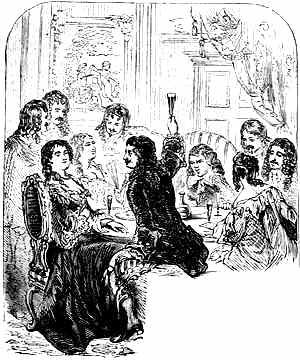
But the men who were to be the future roués of the Regency were in the flower of youthful manhood in 1698, and the recommendation of Comus had with them more weight than the warnings of Æsculapius. At the joyous suppers of Anet, where the Duc de Vendôme laid aside the laurels of Mars to wreathe his brows with the ivy of Bacchus; at the Temple, where his brother, the Grand Prior, nightly revived the most scandalous features of the orgies of ancient Rome; at the Palais Royal, where the future Regent was inaugurating that long series of petits soupers which were ultimately to cost the lives of himself and his favourite daughter; and at Chantilly, where the Prince de Conti sought successfully to reproduce a younger and brighter Versailles, the pear-shaped flasks, ‘ten inches high, including the four or five of the neck,’[116] stamped with the arms of the noble hosts, and secured with Spanish wax,[117] were an indispensable adjunct to the festivities of the table. A story is told of the Marquis de Sillery, who had turned his sword into a pruning-knife, and applied himself to the cultivation of the paternal vineyards, having first introduced the sparkling wine bearing his name at one of the Anet suppers, when, at a given signal, a dozen of blooming young damsels, scantily draped in the guise of Bacchanals, entered the room, bearing apparently baskets of flowers in their hands, but which, on being placed before the guests, proved to be flower-enwreathed bottles of the new sparkling wine.[118] If ever a beverage was intended for the pleasures of society, it was certainly this one, which it was said Nature had made especially for the French,[119] who found in its discovery a compensation for the victories of Marlborough.
Chaulieu, the poetic abbé, and the favourite of both the Vendômes, hailed this new product of his native province in rapturous strophes. In an invitation to supper addressed to his friend, the Marquis de la Fare, in 1701, he describes how
‘Of fivescore clear glasses the number and brightness
Make up for of dishes the absence and lightness,
And the foam, sparkling pure,
Of fresh delicate wine
For Fortune’s frail lure
Blots out all regret in this memory of mine.’[120]
In a letter to St. Evremond, he mentions sundry wonderful things that should happen ‘if the Muses were as fond of the wine of Champagne as the poet who writes this to you;’ and, in one to the Marquis de Dangeau, jestingly remarks that
‘St. Maur’s harsher muse
All flight will refuse,
Unless you sustain
Her wings with Champagne.’[121]
Replying to an invitation to Sonning’s house at Neuilly on July 20, 1707, he says that when he comes it will be wonderful to see how the Champagne will be drained from the tall glasses known as flutes.[122] That the Champagne he extols was a sparkling wine is established in a poetical epistle to Madame D., in answer to her complaint that the wine he had sent her did not froth as when they supped together, and in this he also speaks of its newness.
His brother-rhymster, Jean Baptiste Rousseau, who must not be confounded with the philosophic Jean Jacques, invited Chaulieu to join him at Neuilly, in mingling the water of Hippocrene with the wine of Hautvillers,[123] and announced to the Champagne-loving Marquis d’Ussé, apropos of the latter’s favourite source of inspiration, that even
‘Phœbus will no more go climbing
For water up Helicon’s mount,
But admit, as a source of good rhyming,
Champagne excels Hippocrene’s fount.’[124]
Such general attention did the subject attract that Frederick William II. of Prussia actually proposed to the Academy of Arts and Sciences at Berlin the question, ‘Why does Champagne foam?’ for solution. The Academicians, with unexpected sharpness, petitioned the King for a supply of the beverage in question on which to experiment. But the parsimonious monarch was equal to the occasion, and a solitary dozen of the wine was all he would consent to furnish them with. His ally, Augustus the Strong of Saxony, was the hero of a ludicrous adventure connected with sparkling Champagne. At a banquet given to him at Dresden, a page, who had surreptitiously appropriated a bottle of this costly beverage, and hidden it in the breast of his coat, had to approach the King. The heat and motion combined had imparted briskness to the wine, out popped the cork, and the embroidered garments and flowing periwig of Mr. Carlyle’s ‘Man of Sin’ were drenched with the foaming liquid. The page fell on his knees and roared for mercy, and the King, as soon as he recovered from his bursts of laughter, freely forgave him his offence.
The success of Dom Perignon’s wine caused a revolution in the wine-production of the province, and gave rise to numerous imitations, despite the outcry raised against sparkling wine by many gourmets, and even by the wine-merchants themselves, who complained that they had to pander to what they regarded as a depraved taste. The elder Bertin du Rocheret, father of the lieutenant criminel and a notable dealer in wine, was much opposed to it.[125] Marshal de Montesquiou d’Artagnan, the gallant assailant of Denain, had ordered some wine of him, and he writes in reply, on November 11, 1711: ‘I have chosen three poinçons of the best wine of Pierry at 400 francs the queue, not to be drawn off as mousseux—that would be too great a pity. Also a poinçon to be drawn off as mousseux at 250 francs the queue; or, if you will only go as far as 180 francs, it will froth just as well, or better. Also a poinçon of tocane of Ay to be drunk this winter—that is to say, it should be drunk by Shrovetide—at 300 francs the queue: this wine is very fine.’[126]
On the 27th December 1712 the Marshal writes: ‘With regard to my wine being made mousseux, many prefer that it should be so; and I should not be vexed, provided it does not in any way depreciate its quality.’ On the 18th October of the following year the stern laudator temporis acti describes how the bottling has been carried out, ‘in order that your wines might be mousseux, without which I should not have done it, and perhaps you would have found it better, but it would not have had the merit of being mousseux, which in my opinion is the merit of a poor wine, and only proper to beer, chocolate, and whipped cream. Good Champagne should be clear and fine, should sparkle in the glass, and should flatter the palate, as it never does when it is mousseux, but has a smack of fermentation; hence it is only mousseux because it is working.’
The converted Marshal replies on October 25th: ‘I was in the wrong to ask you to bottle my wine so that it might be mousseux; it is a fashion that prevails everywhere, especially amongst young people. For my own part, I care very little about it; but I wish the wine to be clear and fine, and to have a strong Champagne bouquet.’ In the following December Bertin, in answer to the Marshal’s request for three quartaux of wine, says: ‘Will you kindly let me know at what date you propose to drink this wine? If it is to be drunk as mousseux, I shall not agree with you.’
The allusion to the time of year at which the wine was to be drunk throws a light upon a practice of the day, confirmed by other passages in this correspondence. Much of the wine made was drunk as vin bourru fined, but not racked off, at the beginning of the year, or as tocane, which was apt to go off if kept beyond Shrovetide. This speedy consumption and the careful choice made of the grapes intended for vin mousseux militated against the formation in the bottles of that deposit, which, up to the commencement of the present century, when the system of dégorgeage was introduced, could only be remedied by dépotage,[127] though, as we have seen, the Abbey of Hautvillers had a secret method, carefully guarded, of checking its formation.[128]
It is singular that the presence of a natural liqueur—the consequence of a complete but not excessive ripeness of the grape, and at present considered one of the highest qualities of the wine—was, at the commencement of the eighteenth century, regarded as a disease. The Mémoire of 1718 states that when the wine has any liqueur, however good it may otherwise be, it is not esteemed, and recommends the owner to get rid of this ‘bad quality’ forthwith by putting a pint of new milk warm from the cow into each pièce, stirring it well, letting it rest three days, and then racking the wine off. At this epoch the wine of the Champagne seems to have been preferred perfectly dry.[129] In June 1716 the Marshal d’Artagnan reproached Bertin du Rocheret for sending him Hautvillers wine of the preceding vintage which had turned out liquoreuse. However, in August he felt forced to write that it had become excellent, and similar experiences seem to have soon removed all prejudices against this liqueur character. Bertin, in 1725, speaks of it as one of the qualities of wine, and charges for it in proportion; and six years later remarks that the English are as mad for liqueur and colour in their wines as the French.[130]
IV.
THE BATTLE OF THE WINES.
Temporary check to the popularity of Sparkling Champagne—Doctors disagree—The champions of Champagne and Burgundy—Péna and his patient—A young Burgundian student attacks the Wine of Reims—The Faculty of Reims in arms—A local Old Parr cited as an example in favour of the Wines of the Champagne—Salins of Beaune and Le Pescheur of Reims engage warmly in the dispute—A pelting with pamphlets—Burgundy sounds a war-note—The Sapphics of Benigné Grenan—An asp beneath the flowers—The gauntlet picked up—Carols from a Coffin—Champagne extolled as superior to all other wines—It inspires the heart and stirs the brain—The apotheosis of Champagne foam—Burgundy, an invalid, seeks a prescription—Impartially appreciative drinkers of both wines—Bold Burgundian and stout Rémois, each a jolly tippling fellow—Canon Maucroix’s parallel between Burgundy and Demosthenes and Champagne and Cicero—Champagne a panacea for gout and stone—Final decision in favour of Champagne by the medical faculty of Paris—Pluche’s opinion on the controversy—Champagne a lively wit and Burgundy a solid understanding—Champagne commands double the price of the best Burgundy—Zealots reconciled at table.
BY a strange fatality the popularity of the sparkling wine of the Champagne, which had helped to dissipate the gloom hanging over court and capital during the last twenty years of the reign of Louis Quatorze,[131] began to wane the year preceding that monarch’s death.[132] Dom Perignon too, as though stricken to the heart by this, forthwith drooped and died. The inhabitants of the province once more turned their attention to their red wines, which continued to enjoy a high reputation during the first half of the century,[133] despite the sweeping assertion that they were somewhat dry, rather flat, and possessed a strong flinty flavour,[134] the goût de terroir alluded to by St. Evremond.
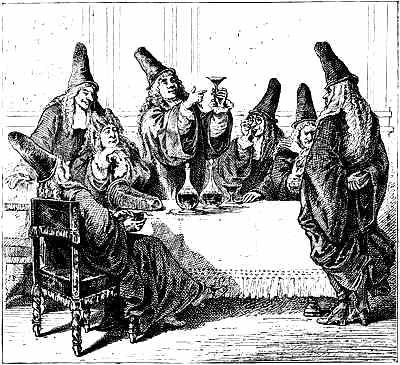
These red wines were not only sent to Paris in large quantities by way of the Marne,[135] but commanded an important export trade, those of the Mountain, which were better able to bear the journey than the growths of the River, gracing the best-appointed tables of London, Amsterdam, Copenhagen, and the North,[136] and especially of Flanders, where they were usually sold as Burgundy.[137] It must not be lost sight of that the yield of white sparkling wine from the crûs d’élite was for a long time comparatively small, especially when contrasted with that of to-day.[138] At a later period the manufacture of vin mousseux increased, notably in the districts south of the Marne,[139] and drove out almost entirely the still red wine; the place of the latter being supplied, as regards Holland, Belgium, and Northern France, by the growths of Bordeaux, which were found to keep better in damp climates.[140]
LOUIS XIV.
(From a portrait of the time).
One cause of this falling off in the popularity of the sparkling wine arose from the great battle which raged for many years respecting the relative merits of Champagne and Burgundy. It was waged in the schools, and not in the field; for the combatants were neither dashing soldiers, brilliant courtiers, nor even gay young students, but potent, grave, and reverend physicians—the wigged, capped, and gowned pedants of the Diaphorus type whom Molière so piteously pilloried. The only blood shed was that of the grape, excepting when some enthusiastic Sangrado was impelled by a too conscientious practical examination into the qualities of the vintage he championed to a more than ordinary reckless use of the lancet. The contending armies couched pens instead of lances, and marshalled arguments in array in place of squadrons. They hurled pamphlets and theses at each others’ heads in lieu of bombshells, and kept up withal a running fire of versification, so that the rumble of hexameters replaced that of artillery.
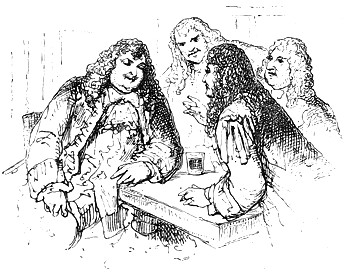
National pride, and perhaps a smack of envy at the growing popularity of the still red wines of the Champagne, had, as far back as 1652, led a hot-headed young Burgundian, one Daniel Arbinet, to select as the subject of a thesis, maintained by him before the schools of Paris, the proposition that the wine of Beaune was more delicious and more wholesome than any other wine,[141] the remaining vintages of the universe being pretty roughly handled in the thesis in question. The Champenois contented themselves for the time being with cultivating their vineyards and improving their wines, till in 1677, when these latter had acquired yet more renown, M. de Révélois of Reims boldly rushed into print with the assertion that the wine of Reims was the most wholesome of all.[142] Though the first to write in its favour, he was not the first doctor of eminence who had expressed an opinion favourable to the wine of Champagne. Péna, a leading Parisian physician of the seventeenth century, was once consulted by a stranger. ‘Where do you come from?’ he inquired. ‘I am a native of Saumur.’ ‘A native of Saumur. What bread do you eat?’ ‘Bread from the Belle Cave.’ ‘A native of Saumur, and you eat bread from the Belle Cave. What meat do you get?’ ‘Mutton fed at Chardonnet.’ ‘A native of Saumur, eating bread from the Belle Cave and mutton fed at Chardonnet. What wine do you drink?’ ‘Wine from the Côteaux.’[143] ‘What! You are a native of Saumur; you eat bread from the Belle Cave, and mutton fed at Chardonnet, and drink the wine of the Côteaux, and you come here to consult me! Go along; there can be nothing the matter with you!’[144]
Burgundy remained silent in turn for nearly twenty years, when, lo, in 1696—probably just about the time when the popping of Dom Perignon’s corks began to make some noise in the world—a yet more opinionated young champion of the Côte d’Or, Mathieu Fournier, a medical student, hard pressed for the subject of his inaugural thesis, and in the firm faith that
‘None but a clever dialectician
Can hope to become a good physician,
And that logic plays an important part
In the mystery of the healing art,’
propounded the theory that the wines of Reims irritated the nerves, and caused a predisposition to catarrh, gout, and other disorders, owing to which Fagon, the King’s physician, had forbidden them to his royal master.[145]
ANCIENT TOWER OF
REIMS UNIVERSITY.
Shocked at these scandalous assertions, the entire Faculty of Medicine at the Reims University rose in arms in defence of their native vintage. Its periwigged professors put their learned heads together to discuss the all-important question, ‘Is the wine of Reims more agreeable and more wholesome than the wine of Burgundy?’ and in 1700 Giles Culotteau embodied their combined opinions in a pamphlet published under that title.[146] After extolling the liquid purity, the excellent brightness, the divine flavour, the paradisiacal perfume, and the great durability of the wines of Ay, Pierry, Verzy, Sillery, Hautvillers, &c., as superior to those of any growth of Burgundy, he instanced the case of a local Old Parr named Pierre Pieton, a vigneron of Hautvillers, who had married at the age of 110, and reached that of 118 without infirmity, as a convincing proof of the material advantages reaped from their consumption.
Salins, the doyen of the Faculty of Medicine of Beaune, was intrusted with the task of replying, and in 1704 bitterly assailed Culotteau’s thesis in a ‘Defence of the Wine of Burgundy against the Wine of Champagne,’ which ran to five editions in four years. M. le Pescheur, a doctor of Reims, vigorously attacked each of these editions in succession, maintaining amongst other things that the wine of Reims owed its renown to the many virtues discovered in it by the great lords who had accompanied Louis XIV. to his coronation; and that if the King, on the advice of his doctors, had renounced its use, his courtiers had certainly not. He also asserted that England, Germany, and the North of Europe consumed far more Champagne than they did Burgundy, and that it would be transported without risk to the end of the world, Tavernier having taken it to Persia, and another traveller to Siam and Surinam.
The partisanship quickly spread throughout the country, and the respective admirers of Burgundy and Champagne pitilessly pelted each other in prose and verse; for the two camps had their troubadours, who, like those of old, excited the courage and ardour of the combatants. The first to sound the warlike trumpet was Benigné Grenan, professor at the college of Harcourt, who, with the rich vintage of his native province bubbling at fever-heat through his veins, sought in 1711 to crush Champagne by means of Latin sapphics, a sample of which has been thus translated:
‘Lift to the skies thy foaming wine,
That cheers the heart, that charms the eye;
Exalt its fragrance, gift divine,
Champagne, from thee the wise must fly!
A poison lurks those charms below,
An asp beneath the flowers is hid;
In vain thy sparkling fountains flow
When wisdom has their lymph forbid.
’Tis, but when cloyed with purer fair
We can with such a traitress flirt;
So following Beaune with reverent air,
Let Reims appear but at dessert.’[147]
The gauntlet thus contemptuously thrown down was promptly and indignantly picked up by the Rector of the University of Beauvais, the learned Dr. Charles Coffin, a native of Buzancy, near Reims, who in the quiet retirement of the Picardian Alma Mater had evidently not forgotten to keep up his acquaintance with the vintage of his native province. The Latin poem he produced in reply, under the title of Campania vindicata,[148] had nothing in common with his lugubriously sepulchral name, as may be seen by the following somewhat freely translated extracts from it. After invoking the aid of a bottle of the enlivening liquor whose praises he is about to sing, he exclaims:
‘As the vine, although lowly in aspect, outshines
The stateliest trees by the produce it bears,
So midst all earth’s list of rich generous wines,
Our Reims the bright crown of preëminence wears.
The Massica, erst sang by Horace of old,
To Sillery now must abandon the field;
Falernian, nor Chian, could ne’er be so bold
To rival the nectar Ay’s sunny slopes yield.
As bright as the goblet it sparklingly fills
With diamonds in fusion, it foaming exhales
An odour ambrosial, the nostril that thrills,
Foretelling the flavour delicious it veils.
At first with false fury the foam-bells arise,
And creamily bubbling spread over the brim,
Till equally swiftly their petulance dies
In a purity that makes e’en crystal seem dim.’[149]
Praising the flavour of this nectar, which he declares is in every way worthy of its appearance, he stoutly defends the wine from the charge of unwholesomeness adduced against it by Grenan:
‘Despite the tongue of malice,
No poison in thy chalice
Was ever found, Champagne!
Simplicity most loyal
Was e’er thy boast right royal,
And this thy wines retain.
No harm lurks in the fire
That helps thee to inspire
The heart and spur the brain.’[150]
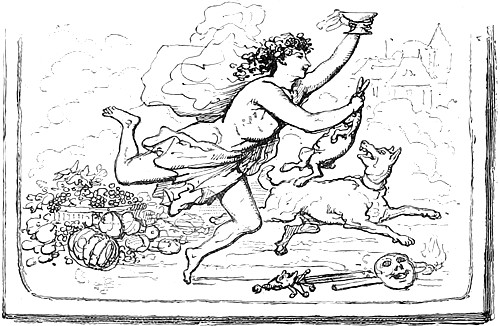
So far from causing inconvenience, he claims for Champagne the property of keeping off both gout and gravel, neither of which, he says, is known in Reims and its neighbourhood, and continues:
‘When on the fruit-piled board,
Thy cups, with nectar stored,
Commence their genial reign,
The wisest, sternest faces
Of mirth display the traces,
And to rejoice are fain.
As laughter’s silv’ry ripple
Greets every glass we tipple.
Away fly grief and pain.’[151]
The jovial old rector with the sepulchral appellation then proceeds, according to the most approved method of warfare, to carry the campaign into the enemy’s territory. He admits the nutritive and strengthening properties of Burgundy, but demands what it possesses beyond these, which are shared in common with it by many other vintages. He then prophesies, with the return of peace,[152] the advent of the English to buy the wine of Reims; and concludes by wishing that all who dispute the merits of Champagne may find nothing to drink but the sour cider of Normandy or the acrid vintage of Ivri. The citizens of Reims, thoroughly alive to the importance of the controversy, were enchanted with this production; they did not, however, crown the poet with laurel, but more wisely and appropriately despatched to him four dozen of their best red and gray wines, by the aid of which he continued to tipple and to sing.
Grenan, resuming the offensive in turn, at once addressed an epistle in Latin verse, in favour of Burgundy against Champagne, to Fagon, the King’s physician.[153] Complaining that the latter wine lays claim unjustly to the first rank, he allows it certain qualities—brilliancy, purity, limpidity, a subtle savour that touches the most blunted palate, and an aroma so delicious that it is impossible to resist its attractions. But he objects to its pretensions.
‘Its vinous flood, with swelling pride
In foaming wavelets welling up,
Pours forth its bright and sparkling tide,
Bubbling and glittering in the cup.’[154]
He goes on to accuse the Champenois poet of being unduly inspired by this wine, the effects of which he finds apparent in his inflated style and his attempts to place Champagne in the first rank, and make all other vintages its subjects; and he reiterates his allegations that, unlike Burgundy, it affects both the head and the stomach, and is bound to produce gout and gravel in its systematic imbibers. He concludes by begging Fagon to pronounce in his favour, as having proved the virtues of Burgundy on the King himself, whose strength had been sustained by it. The retort was sharp and to the point, taking the form of a twofold epigram from an anonymous hand:
‘To the doctor to go
On behalf of your wine
Is, as far as I know,
Of its sickness a sign.
Your cause and your wine
Must be equally weak,
Since to check their decline
A prescription you seek.’[155]
Nor was the poet of the funereal cognomen backward in stepping into the field; for he published a metrical decree, supposed to be issued by the faculty of the island of Cos in the fourth year of the ninety-first Olympiad,[156] in which, though a verdict is nominally given in favour of Burgundy, Grenan’s pleas on behalf of this wine are treated with withering sarcasm.
But whilst these enthusiastic partisans thus belaboured one another, there were not wanting impartial spirits who could recognise that there were merits on both sides. Bellechaume, in an ode jointly addressed to the two combatants,[157] adjures them to live at peace on Parnassus, and, remembering that Horace praised both Falernian and Massica, to jointly animate their muse with Champagne and Burgundy:
‘To learn the difference between
The wine of Reims and that of Beaune,
The fairest plan would be, I ween,
To drink them both, not one alone.’[158]
Another equally judicious versifier called also on the Burgundian champion[159] to cease the futile contest, since
‘Bold Burgundian ever glories
With stout Remois to get mellow;
Each well filled with vinous lore is
Each a jolly tippling fellow.’[160]
And the learned Canon Maucroix of Reims exhibited a similar conciliatory spirit in the ingenious parallel which he drew between the two greatest orators of antiquity and the wines of the Marne and the Côte d’Or. ‘In the wine of Burgundy,’ he observes, ‘there is more strength and vigour; it does not play with its man so much, it overthrows him more suddenly,—that is Demosthenes. The wine of Champagne is subtler and more delicate; it amuses more and for a longer time, but in the end it does not produce less effect,—that is Cicero.’[161]
REMAINS OF THE GATE OF BACCHUS, NEAR REIMS UNIVERSITY.
The national disasters which marked the close of the reign of Louis XIV. diverted public attention in some degree from the nugatory contest;[162] and though Fontenelle sought to prove that a glass of Champagne was better than a bottle of Burgundy,[163] the impartially appreciative agreed with Panard that
‘Old Burgundy and young Champagne
At table boast an equal reign.’[164]
But the doctors continued to disagree, and new generations of them still went on wrangling over the vexed questions of supremacy and salubrity. In 1739 Jean François carried the war into the enemy’s camp by maintaining at Paris that Burgundy caused gout; and a little later Robert Linguet declared the wine of Reims to be as healthy as it was agreeable. In 1777 Xavier, Regent of the Faculty of Medicine at the Reims University, affirmed that not only did the once vilified vin mousseux share with the other wines of the Champagne the absence of the tartarous particles which in many red wines are productive of gout and gravel, but that the gas it contained caused it to act as a dissolvent upon stone in the human body, and was also invaluable, from its antiseptic qualities, in treating putrid fevers.[165] Further, the appropriately named Champagne Dufresnay established, to his own satisfaction and that of his colleagues, that the wine was superior to any other growth, native or foreign.[166] At length, in 1778, when the bones of the original disputants were dust, and their lancets rust, on the occasion of a thesis being defended before the Faculty of Medicine of Paris, a verdict was formally pronounced by this body in favour of the wine of the Champagne.[167]
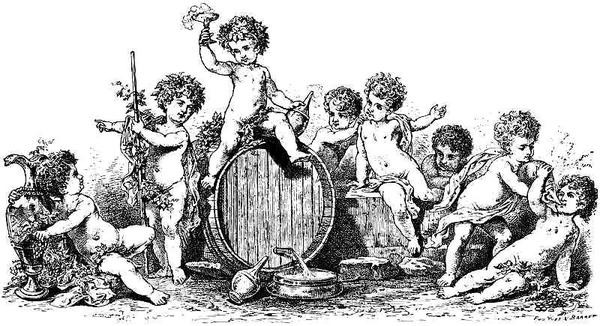
V.
PROGRESS AND POPULARITY OF SPARKLING CHAMPAGNE.
Sparkling Champagne intoxicates the Regent d’Orléans and the roués of the Palais Royal—It is drunk by Peter the Great at Reims—A horse trained on Champagne and biscuits—Decree of Louis XV. regarding the transport of Champagne—Wine for the petits cabinets du Roi—The petits soupers and Champagne orgies of the royal household—A bibulous royal mistress—The Well-Beloved at Reims—Frederick the Great, George II., Stanislas Leczinski, and Marshal Saxe all drink Champagne—Voltaire sings the praises of the effervescing wine of Ay—The Commander Descartes and Lebatteux extol the charms of sparkling Champagne—Bertin du Rocheret and his balsamic molecules—The Bacchanalian poet Panard chants the inspiring effects of the vintages of the Marne—Marmontel is jointly inspired by Mademoiselle de Navarre and the wine of Avenay—The Abbé de l’Attaignant and his fair hostesses—Breakages of bottles in the manufacturers’ cellars—Attempts to obviate them—The early sparkling wines merely crémant—Saute bouchon and demi-mousseux—Prices of Champagne in the eighteenth century—Preference given to light acid wines for sparkling Champagne—Lingering relics of prejudice against vin mousseux—The secret addition of sugar—Originally the wine not cleared in bottle—Its transfer to other bottles necessary—Adoption of the present method of ridding the wine of its deposit—The vine-cultivators the last to profit by the popularity of sparkling Champagne—Marie Antoinette welcomed to Reims—Reception and coronation of Louis XVI. at Reims—‘The crown, it hurts me!’—Oppressive dues and tithes of the ancien régime—The Fermiers Généraux and their hôtel at Reims—Champagne under the Revolution—Napoleon at Epernay—Champagne included in the equipment of his satraps—The Allies in the Champagne—Drunkenness and pillaging—Appreciation of Champagne by the invading troops—The beneficial results which followed—Universal popularity of Champagne—The wine a favourite with kings and potentates—Its traces to be met with everywhere.
[116] Mémoire of 1718.
[117] Ibid.
[118] Antony Réal’s Ce qu’il y a dans une Bouteille de Vin.
[119] Legrand d’Aussy’s Vie Privée des Français.
[120]
‘Là le nombre et l’éclat de cent verres bien nets
Répare par les yeux la disette des mets;
Et la mousse petillante
D’un vin délicat et frais
D’une fortune brillante
Cache à mon souvenir les fragiles attraits.’
[121]
‘Quant à la muse de St. Maur
Que moins de douceur accompagne.
Il lui faut du vin de Champagne
Pour lui faire prendre l’essor.’
[122]
‘Alors, grand’ merveille, sera
De voir flûter vin de Champagne.’
[123]
‘Sur ce rivage emaillé,
Où Neuillé borde la Seine,
Reviens au vin d’Hautvillé
Mêler les eaux d’Hypocrène.’
[124]
‘Phébus adonc va se désabuser
De son amour pour la docte fontaine,
Et connoîtra que pour bon vers puiser
Vin champenois vaut mieux qu’eau d’Hippocrène.’
[125] The father, Adam Bertin du Rocheret, was born in 1662, and died in 1736; his son, Philippe Valentin, the lieutenant criminel at Epernay, was born in 1693, and died in 1762. Both owned vineyards at Epernay, Ay, and Pierry, and were engaged in the wine-trade, and both left a voluminous mass of correspondence, &c., extracts from which have been given by M. Louis Perrier in his Mémoire sur le Vin de Champagne. The Marshal was an old customer. At the foot of a letter of his of the 20th December 1705, asking for ‘two quartaux of the most excellent vin de Champagne, and a pièce of good for ordinary drinking,’ Bertin has written, ‘I will send you, as soon as the river, which is strongly flooded, becomes navigable, the wine you ask for, and you will be pleased with it; but as the best new wine is not of a quality to be drunk in all its goodness by the spring, I should think that fifty flasks of old wine, the most exquisite in the kingdom that I can furnish you with, together with fifty other good ones, will suit you instead of one of the two caques.’
[126] Tocane was a light wine obtained, like the best Tokay, from the juice allowed to drain from grapes slightly trodden, but not pressed. It had a flavour of verdeur, which was regarded as one of its chief merits, and would not keep more than six months. Though at one time very popular, and largely produced in Champagne, it is now no longer made. The wine of Ay enjoyed a high reputation as tocane.
[127] Louis Perrier’s Mémoire sur le Vin de Champagne.
[128] Letter of Dom Grossart.
[129] Louis Perrier’s Mémoire sur le Vin de Champagne.
[130] Ample details of the systems of viticulture and wine-making pursued in the Champagne at the commencement of the eighteenth century are to be found in the anonymous Mémoire published in 1718. These are reproduced to a great extent in the Spectacle de la Nature of Noel Antoine Pluche, a native of Reims, who composed this work (published in 1732) for the benefit of the son of Lord Stafford, to whom he was tutor. The Abbé Pluche, after being professor of humanity and rhetoric at the University of Reims, was about to enter into holy orders, but being denounced as an opponent of the Bull Unigenitus, abandoned all ideas of preferment, and devoted himself to private tuition and the composition of his great work, the Spectacle de la Nature. This last is a perfect encyclopædia, in the form of a series of dialogues, recalling those in Mrs. Barbauld’s Evenings at Home, the interlocutors being the Count, the Countess, the Chevalier, and the Prior; and the style may be best judged from the following extracts from the contemporary translation of Mr. Samuel Humphries.
[131] Max Sutaine’s Essai sur le Vin de Champagne.
[132] Mémoires of 1718 and 1722.
[133] Ibid.
[134] Max Sutaine’s Essai sur le Vin de Champagne.
[135] Mémoire of 1718. The perils to which it was exposed during this transit are pointed at in a letter to the elder Bertin from a customer in Paris in 1689: ‘I thought it better to wait before giving you any news of the wine you sent me until it was fit to drink. I tapped it yesterday, and found it poor. I can hardly believe but that the boatmen did not fall-to upon it whenever they had need, and took great care to fill it up again, for it could not have been fuller than they delivered it.’
[136] Pluche’s Spectacle de la Nature, 1732.
[137] Mémoire of 1718.
[138] Louis Perrier’s Mémoire sur le Vin de Champagne. In the Mémoire of 1718, Ay, Epernay, Hautvillers, and Cumières are alone classed as Vins de Rivière; Pierry, Fleury, Damery, and Venteuil being reckoned only as Petite Rivière; and there being no mention of Avize and the neighbouring vineyards.
[139] As at Vertus, where the red wine, so highly esteemed by William III. of England, was replaced by sparkling wine.
[140] Max Sutaine’s Essai sur le Vin de Champagne.
[141] Ergo vinum Belnense potuum est suavissimus, ita et saluberrimus.
[142] An vinum Remense sit omnium saluberrimum.
[143] Of Ay, Avenay, and Hautvillers (note of Tallemant’s editor).
[144] Tallemant des Réaux’s Historiettes.
[145] Champagne has been accused of producing not only gout, but stone, gravel, and rheumatism. As to the first-named complaint, Bertin du Rocheret disposes of it by noting, in a list compiled by him of all the deaths of any moment at Epernay, from 1644 downwards, the decease, at the age of seventy-five, on January 1, 1733, of Jeanne Maillard, ‘the only person in the district ever attacked by the gout.’ His brother-in-law, Dr. Jacques de Reims, in a letter to Helvetius in 1730, asserts that this complaint is only known by name in the Champagne; and that, as regards the stone, not more than ten people were affected therewith within a radius of ten leagues. He maintained that the non-mousseux white wine of the Champagne, drunk at maturity and tempered with water, was the best of all beverages for preserving general health; and the eminent Dr. Camille Falconnet held the same opinion. Arthur Young, moreover, furnishes spontaneous testimony with regard to rheumatism. Extolling the sparkling wine of Reims in 1787, he says, ‘I suppose fixed air is good for the rheumatism; I had some writhes of it before I entered Champagne, but the vin mousseux has absolutely banished it;’ and on reaching Ove, he regrets that ‘the vin de Champagne, which is forty sous at Reims, is three livres here, and execrably bad; so there is an end of my physic for the rheumatism’ (Travels in France in 1787–9).
[146] An vinum Remense Burgundico suavius et salubrius.
[147] In his ode entitled Vinum Burgundum, the passage aspersing the wines of Reims runs as follows:
[148] Campania vindicata; sive laus vini Remensis a poeta Burgundo eleganter quidam, sed immerito culpati. Offerebat civitati Remensi Carolus Coffin. Anno Domini MDCCXII.
[149]
‘Quantum superbas vitis, humi licet
Prorepat, anteit fructibus arbores
Tantum, orbe quæ toto premuntur
Vina super generosiora
Remense surgit. Cedite, Massica
Cantata Flacco Silleriis; neque
Chio remixtum certet audax
Collibus Aïacis Falernum.
Cernis micanti concolor ut vitro
Latex in auras, gemmeus aspici,
Scintellet exultim; utque dulces
Naribus illecebras propinet.
Succi latentis proditor halitus
Ut spuma motu lactea turbido
Crystallinum lætis referre
Mox oculis properet nitorem.’
La Monnoye renders this as follows:
‘Autant que, sans porter sa tête dans les cieux,
La vigne par son fruit est au-dessus du chêne;
Autant, sans affecter une gloire trop vaine,
Reims surpasse les vins les plus délicieux.
Qu’Horace du Falerne entonne les louanges
Que de son vieux Massique il vante les attraits;
Tous ces vins fameux n’égaleront jamais
Du charmant Silleri les heureux vendanges.
Aussi pur que la verre ou la main l’a versé,
Les yeux les plus perçants l’en distinguent à peine;
Qu’il est doux de sentir l’ambre de son haleine
Et de prévoir le goût par l’odeur annoncé,
D’abord à petits bonds une mousse argentine
Etincelle, petille et bout de toutes parts,
Un éclat plus tranquille offre ensuite aux regards
D’un liquide miroir la glace cristalline.’
[150]
‘Non hæc malignus quidlibet obstrepat
Livor; nocentes dissimulant dolos
Leni veneno. Vina certant
Inguenuos retinere Gentis
Campana mores. Non stomacho movent
Ægro tumultum; non gravidum caput
Fulagine infestant opacâ.’
Bellechaume renders these lines in the Recueil as follows:
‘Il n’a point, quoiqu’on insinue
De poison parmi ses douceurs,
Et de sa province ingénue
La Champagne a gardé les mœurs.
Il n’excite point de tempête
Dans les estomacs languissants;
Son feu léger monte à la tête,
Eveille et réjouit les sens.’
La Monnoye gives them thus:
‘Taisez-vous envieux dont la langue cruelle
Veut qu’ici sous les fleurs se cache le venin;
Connaissez la Champagne, et respectez un vin
Qui des mœurs du climat est l’image fidèle.
Non, ce jus qu’à grand tort vous osez outrager
De images fâcheux ne trouble point la tête,
Jamais dans l’estomac n’excite de tempête;
Il est tendre, il est net, délicat et léger.’
[151]
‘Ergo ut secundis (parcere nam decet
Karo liquori) se comitem addidit
Mensis renidens Testa; frontem,
Arbitra lætitiæ, resolvit
Austeriorum. Tune cyathos juvat
Siccare molles: tunc hilaris jocos
Conviva fundit liberales;
Tunc procul alterius valere.’
Bellechaume has rendered this:
‘Sitôt que sur de riches tables
De ce nectar avec le fruit
On sert les coupes délectables,
De joie il s’élève un doux bruit;
On voit, même sur le visage
Du plus sévère et du plus sage,
Un air joyeux et plus serein:
Le ris, l’entretien se reveille;
Il n’est plus de liqueur pareille
A cet élixir souverain.’
La Monnoye’s version is as follows:
‘Vers la fin du repas, à l’approche du fruit,
(Car on doit ménager une liqueur si fine),
Aussitôt que parait la bouteille divine,
Des Grâces à l’instant l’aimable chœur la suit
Parmi les conviés, s’élève un doux murmure;
Le plus stoïque alors se deride le front.’
[152] That of Utrecht, concluded the following year, 1713.
[153] Ad clarissimum virum Guidonem-Crescentium Fagon regi a secretoribus consiliis, archiatrorum comitem; ut suam Burgundo vino prestantiam adversus Campanum vinum asserat.
[154] The original lines and the translation, published by Bellechaume the same year in his Recueil, prove, as do the extracts already quoted from Coffin, that a sparkling wine was meant. The former run thus—
[155] These epigrams and their translation are given anonymously, as follows, in Bellechaume’s Recueil:
[156] Decretum medica apud insulam Coon facultatis super poetica lite Campanum inter et Burgundum vinum ortâ post editum a poeta Burgundo libellum supplicem. By several writers this poem has been ascribed to Grenan; but M. Philibert Milsaud, in his Procés poétique touchant les Vins de Bourgogne et de Champagne (Paris, 1866), clearly shows that, although in favour of Burgundy, the judgment is an ironical one, and that the signature C. C. R. stands for Carolus Coffin Remensis.
[157] Ode à Messieurs Coffin et Grenan, Professeurs de Belles Lettres, sur leurs Combats poétiques au sujet des Vins de Bourgogne et de Champagne, in Bellechaume’s Recueil.
[158]
‘Pour connaître la différence
Du nectar de Beaune et de Reims,
Il faut mettre votre science
A bien goûter de ces deux vins.’
[159] In an anonymous letter addressed to Grenan on February 1712, and published in the Recueil.
[160]
‘Un franc Bourguignon se fait gloire
D’être avec un Remois à boire;
Ils sont tous deux bons connaisseurs,
Et ne sont pas moins bons buveurs.’
[161] Les Célébrités du Vin de Champagne. Epernay, 1880. Maucroix died in his ninetieth year in 1708.
[162] Henderson’s History of Ancient and Modern Wines.
[163] In the Journal des Savants.
[164]
‘Vieux Bourguignon, jeune Champagne
Font l’agrément de nos festins.’
From La Critique, an opera of Panard’s, produced in 1742.
[165] ‘With what vivacity,’ he exclaims, with a strange blending of poetry and science, ‘does this divine liquid burst forth in sparkling foam-bells! And what an agreeable impression it produces upon the olfactory organs! What a delicious sensation it creates upon the delicate fibres of the palate! ... It is fixed air which, by its impetuous motion, forms and raises up that foam, the whiteness of which, rivalling that of milk, soon offers to our astonished eye the lustre of the most transparent crystal. It is this same air that, by its expansion and the effervescence it produces, develops the action of the vinous spirit of which it is the vehicle, in order that the papillæ of the nerves may more promptly receive the delicious impression.... Vainly calumny spreads the report on all sides that the sparkle of our wines is injurious; vainly it asserts that they have only a hurtful fire and a worthless flavour. Incapable of hiding under an insidious appearance a perfidious venom, they will always present a faithful image of the ingenuousness of their native province.’
[166] Max Sutaine’s Essai sur le Vin de Champagne.
[167] Henderson’s History of Ancient and Modern Wines. Pluche, in his Spectacle de la Nature, notices the controversy regarding the respective merits of the wines of the Marne and the Côte d’Or in the following terms:
WHILST doctors went on shaking their periwigged heads, and debating whether sparkling Champagne did or did not injure the nerves and produce gout, the timid might hearken to their counsels, but there were plenty of spirits bold enough to let the corks pop gaily, regardless of all consequences. The wine continued in high favour with the viveurs of the capital, and especially with the brilliant band of titled scoundrels who formed the Court of Philippe le Débonnaire. ‘When my son gets drunk,’ wrote, on the 13th August 1716, the Princess Charlotte Elizabeth of Bavaria, the Regent’s mother, ‘it is not with strong drinks or spirituous liquors, but pure wine of Champagne;’[168] and as the pupil of the Abbé Dubois very seldom went to bed sober,[169] he must have consumed a fair amount of the fluid in question in the course of his career. Even his boon companion, the Duke de Richelieu, is forced to admit that there was a great deal more drunkenness about him than was becoming in a Regent of France; and that, as he could not support wine so well as his guests, he often rose from the table drunk, or with his wits wool-gathering. ‘Two bottles of Champagne,’ remarks the duke in his Chronique, ‘had this effect upon him.’
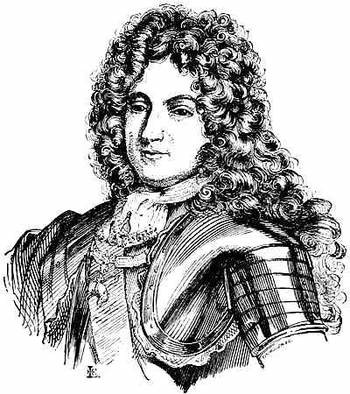
THE REGENT D’ORLÉANS
(From the picture by Santerre).
Desirous, seemingly, that such enjoyments should not be confined to himself alone, he abolished in 1719 sundry dues on wine in general, whilst his famous, or rather infamous, suppers conduced to the vogue of that sparkling Champagne which was an indispensable accompaniment of those décolleté repasts. It unloosed the tongues and waistcoats of the roués of the Palais Royal, the Nocés, Broglios, Birons, Brancas, and Canillacs; it lent an additional sparkle to the bright eyes of Mesdames de Parabère and de Sabran, and inspired the scathing remark from the lips of one of those fair frail ones, that ‘God, after having made man, took up a little mud, and used it to form the souls of princes and lackeys.’ It played its part, too, at the memorable repast at which the Regent and his favourite daughter so scandalised their hostess, the Duchess of Burgundy, and at the fatal orgie shared by the same pair on the terrace of Meudon.
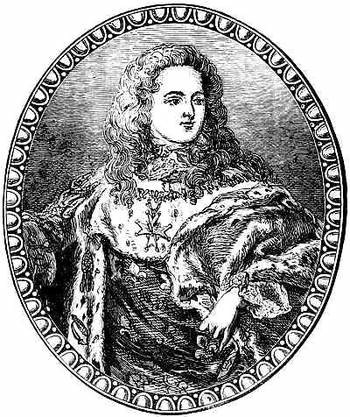
LOUIS XV. WHEN YOUNG
(From a picture of the epoch).
The example set in such high quarters could not fail to be followed. Champagne fired the sallies of the wits and versifiers whom the Duchess of Maine gathered around her at Sceaux, and stimulated the madness which seized upon the whole of Paris at the bidding of the financier Law. It frothed, too, in the goblets which Bertin du Rocheret had the honour of filling with his own hand for Peter the Great, on the passage of the Northern Colossus through Reims in June 1717; and its consumption was increased by a decree of 1728, which especially provided that people proceeding to their country seats might take with them for their own use a certain quantity of this wine free of duty.
A curious purpose to which the wine was applied appeared from a wager laid by the Count de Saillans—one of the most famous horsemen of his day, and already distinguished by similar feats—to the effect that he would ride a single horse from the gate of Versailles to the Hôtel des Invalides within an hour. His wife, fearing the dangerous descent from Sèvres towards Paris, prevailed on the King to prohibit him from riding in person; but a valet, whose neck was of course of no moment, was allowed to act as his deputy in essaying the feat. The horse selected was carefully fed for some days beforehand on biscuits and Champagne. Crowds assembled to witness the attempt, which was made on May 9, 1725, and resulted in the valet’s coming in two and a half minutes behind time. Whether this was due to the badness of the roads, as was alleged, or to the singular régime adopted for the animal selected, remains a moot question.[170]
Champagne won equal favour in the eyes of Louis XV., as in those of the curious compound of embodied vices who had watched over the welfare of the kingdom during his minority, though it is true that at a comparatively early age—in the year 1731—he had, on representations that over-production of wine was lowering its value, prohibited the planting of fresh vineyards without his permission under a penalty of 3000 francs, and had renewed this prohibition the year following.[171]
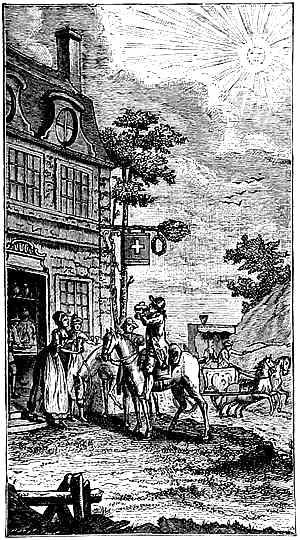
A FRENCH COUNTRY INN OF THE EIGHTEENTH CENTURY
(From the ‘Routes de France’).
The royal repasts at La Muette, Marly, and Choissy were, however, enlivened with wine from the Champagne; for we find Bertin du Rocheret in 1738 despatching thirty pieces of the still wine to M. de Castagnet for the petits cabinets du Roi,[172] and the eldest of the fair sisters La Nesle, Madame de Mailly, the ‘Queen of Choissy’ and maîtresse en titre, in 1740 reforming the cellar management, and suppressing the petits soupers and Champagne orgies of the royal household.[173] Her conduct in this respect seems, however, not to have been dictated by motives of virtue, but rather by the conviction that the wine was too precious to be consumed by inferiors. We are assured that the countess loved wine, and above all that of Champagne, and that she could hold her own against the stoutest toper. ‘She has been reproached with having imparted this taste to the King, but it is probable that his Majesty was naturally inclined that way.’[174]
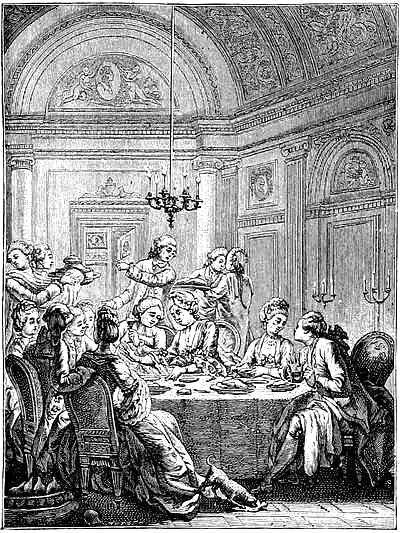
UN PETIT SOUPER OF THE EIGHTEENTH CENTURY
(From the collection of the ‘Chansons de Laborde’).
When, in 1741, the ‘Well-Beloved’ passed through Reims, Dom Chatelain, after rejoicing over the year’s vintage having been a very fine one, adds that it was drunk to a considerable extent and with the greatest joy in the world during the ten days that the King remained in the city. ‘It was no longer a question,’ he exclaims exultingly, ‘of sending for Burgundy or Laon wine.’ Three years later, when traversing the Champagne, on his way to Metz, he again halted at Reims; and after hearing mass, ‘retired to the Archevêché, where the Corps de la Ville presented his Majesty with the wines of the town, which he ordered to be taken to his apartments.’[175] Wine was also presented to the Prince de Soubise, Governor of the Champagne; the Duke de Villeroy, M. d’Argenson, and the Count de Joyeuse; whilst, for the benefit of the populace, four fountains of the same fluid flowed at the corners of the Place de l’Hôtel de Ville.[176] In like manner, at the inauguration of that ‘brazen lie,’ the statue of this same Louis XV., in 1767, wine flowed in rivers from the different fountains of the city.[177]
The satyr-like sovereign of France was by no means the only monarch of his time who appreciated sparkling Champagne. Frederick the Great has praised its consoling powers in the doggerel which Voltaire was engaged to turn into poetry; and George II. of England at St. James’s, and Stanislas Leczinski of Poland at Nancy, both quaffed of the same vintage of Ay despatched in 1754 from the cellars of Bertin du Rocheret. Marshal Saxe, during his sojourn in 1745 at Brussels, where he held a quasi-royal court, of which Mademoiselle de Navarre was the bright particular star, drew an ample supply of Champagne from the cellars of that lady’s father, Claude Hevin de Navarre of Avenay, who had established himself as a wine merchant in the Belgian capital.[178] Despite, too, the continued outcry of some connoisseurs,[179] the vin mousseux became the universal source of inspiration for the cabaret-haunting poets of that graceless witty epoch.[180] Voltaire, all unmoved by the excellent still Champagne with which he and the Duke de Richelieu had been regaled at Epernay by Bertin du Rocheret in May 1735, persisted in singing the praises of the effervescing wine of Ay, in the sparkling foam of which he professed to find the type of the French nation:[181]
‘Chloris and Eglé, with their snowy hands,
Pour out a wine of Ay, whose prisoned foam,
Tightly compressed within its crystal home,
Drives out the cork; ’midst laughter’s joyous sound
It flies, against the ceiling to rebound.
The sparkling foam of this refreshing wine
The brilliant image of us French does shine.’
The Commander Descartes seems not to have been afraid to extol the charms of the sparkling wine to the younger Bertin du Rocheret, as stern a decrier of its merits as his father had previously been. In a letter dated December 1735, asking for ‘one or two dozen bottles of sparkling white wine, neither vert nor liquoreux, “I should like,” he says, “some
Of that delectable white wine
Which foams and sparkles in the glass,
And seldom mortal lips does pass;
But cheers, at festivals divine,
The gods to whom it owes its birth,
Or else the great, our gods on earth.”’[182]
Amongst other versifiers of this epoch enamoured with the merits of the wine may be cited Charles Lebatteux, professor of rhetoric at Reims University, who in 1739 composed an ode, ‘In Civitatem Remensam,’ containing the following invocation to Bacchus:
‘’Tis not on the icy-topped mountains of Thrace,
Or those of Rhodope, thy favours I trace—
Not there to invoke thee I’d roam.
No! Reims sees thee reign sovereign lord o’er her hills;
There I offer my vows, and the nectar that thrills
To my soul I will seek close at home.
Whether Venus-like rising midst foam sparkling white,
Or wrapped in a mantle of rose rich and bright,
Thou seekest my senses to fire,
Come aid me to sing, for my Muse is full fain
To owe on this day each melodious strain
To the fervour ’tis thine to inspire.’[183]
Bertin du Rocheret, who by no means shared his friend Voltaire’s admiration for the sparkling vintage of Ay, sang the praises of the still wine of the Champagne after the following fashion in 1741:
‘No, such blockheads do not sip
Of that most delicious wine;
Soul of love and fellowship,
Sweet as truly ’tis benign.
No, their palate, spoilt and worn,
Craves adult’rate juice to drain;
Poison raw which we should scorn,
Beverage fit for frantic brain.
Let us, therefore, hold as fools
Such as now feign to despise
Those balsamic molecules
Horace used to sing and prize.
No, such blockheads do not sip
Of that most delicious wine;
Soul of joy and fellowship,
Sweet as truly ’tis benign.
Of that wine, so purely white,
Which the sternest mood makes pass,
And which sparkles yet more bright
In your eyes than in my glass.
Drink, then, drink; I pledge you, dear,
In the nectar old we prize;
Sparkling in our glasses clear,
But more brightly in your eyes.’[184]
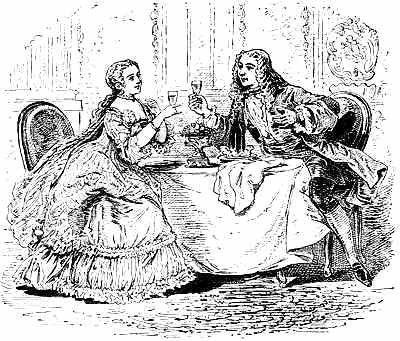
Marmontel, the author of Bélisaire and editor of the Mercure de France, found inspiration in his youthful days in the sparkling wine of Champagne. He describes, in somewhat fatuous style, the results of an invitation he received from Mademoiselle de Navarre to pass some months with her in 1746 at Avenay, where her father owned several vineyards, and where, she added, ‘It will be very unfortunate if with me and some excellent vin de Champagne you do not produce good verses.’ He tells how, in stormy weather, she insisted, on account of her fear of lightning, on dining in the cellars, where, ‘in the midst of fifty thousand bottles of Champagne, it was difficult not to lose one’s head;’ and how he was accustomed to read to her the verses thus jointly inspired when seated together on a wooded hillock, rising amidst the vineyards of Avenay.[185]
The foregoing in some degree recalls the circumstances under which Gluck, whose fame began to be established about this epoch, was accustomed to seek his musical inspirations. The celebrated composer of Orpheus and Iphegenia in Aulis was wont, when desirous of a visit from the ‘divine afflatus,’ to seat himself in the midst of a flowery meadow with a couple of bottles of Champagne by his side. By the time these were emptied, the air he was in search of was discovered and written down.
The lively and good-humoured Abbé de l’Attaignant, whose occupations as a canon of Reims Cathedral seem to have allowed him an infinite quantity of spare time to devote to versifying, addressed some rather indifferent rhymes to Madame de Blagny on the cork of a bottle of Champagne exploding in her hand;[186] and in some lines to Madame de Boulogne, on her pouring out Champagne for him at table, he maintains that the nectar poured out by Ganymede to Jupiter at his repasts must yield to this vintage.[187]
That boon convivialist Panard—who flourished at the same epoch, and was one of the chief songsters of the original Caveau, and a man of whom it was said that, ‘when set running, the tide of song flowed on till the cask was empty’—has not neglected sparkling Champagne in his Bacchanalian compositions. The ‘La Fontaine of Vaudeville,’ as Marmontel dubbed him, does not hesitate to admit that he preferred the popping of Champagne corks to the martial strains of drum and trumpet.[188] The wine, moreover, furnishes him with frequent illustrations for his code of careless philosophy.
‘Doctor for vintner vials fills
Most carefully, with lymph of wells.
Champagne, that grew on Nanterre’s hills,
Vintner in turn to doctor sells.
So still we find, as on we jog
Throughout the world, ’tis dog bite dog.’[189]
Elsewhere Panard gives expression to the Bacchanalian sentiment, which he seems to have made his rule of life, in the following terms:
‘Let’s quit this vain world, with its pleasures that cloy,
A destiny tranquil and sweet to enjoy:
Descend to my cellar, and there taste the charms
Of Champagne and Beaune;
Our pleasure will there be without the alarms
Of any joy queller;
For the ennui that often mounts up to the throne
Will never descend to the cellar.’[190]
The poet appears to have rivalled one of the characters in his piece, Les Festes Sincères (represented on the 5th October 1744 on the occasion of the King’s convalescence), who, after describing how wine was freely proffered to all comers, said that he had contented himself with thirty glasses, ‘half Burgundy and half Champagne.’
In a piece of verse entitled ‘La Charme du Vaudeville à Table,’ Panard sketches in glowing colours the inspiriting effect of sparkling Champagne upon such a joyous company of periwigged beaux and patched and powdered beauties as we may imagine to be assembled at the hospitable board of some rich financier of the epoch.
‘’Tis then some joyous guest
A flask, filled with the best
Of Reims or Ay, securely sealed, holds up;
He deftly cuts the string,
Aloft the cork takes wing;
The rest with eager eyes
Thrust glasses t’wards the prize,
And watch the nectar foaming o’er the cup.
They sip, they drink, they laugh,
And then anew they quaff
Their bumpers, crowned above the brim with foam
That gives to laughter birth,
And makes fresh bursts of mirth.
Its spirit and its fire
Unto the brain aspire,
And rouse the wit of which this is the home.’[191]
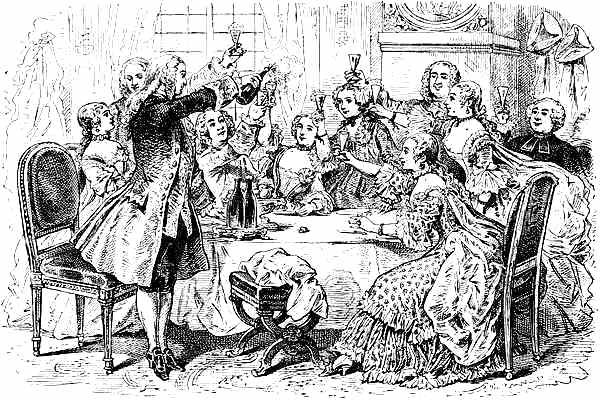
To its praise he also devotes a poetic tour de force, the concluding verses of which may thus be rendered:
‘Thanks to the bowl
That cheers my soul,
No care can make me shrink.
The foam divine
Of this gray wine,[192]
I think,
When it I drain,
Gives to each vein
A link.
Source of pure joy,
Without alloy,
Come, dear one, fain I’d drink!
Divine Champagne,
All grief and pain
In thee I gladly sink.
All ills agree
Away from thee
To slink.
Sweet to the nose
As new-blown rose
Or pink.
With gifts that ease
And charms that please,
Come, dear one, fain I’d drink!’[193]
Despite the success achieved by the vin mousseux, merchants, owing to the excessive breakage of the bottles—of the cause of which and of the means of stopping it they were equally ignorant—often saw their hopes of fortune fly away with the splintered fragments of the shattered glass.[194] The following passages from the MS. notes of the founder of one of the first houses of Reims, written in 1770, would imply some knowledge of the fact that a liquoreux wine was likely to lead to a destructive casse, and also that the importance of the trade in sparkling Champagne was far greater during the first half of the eighteenth century than is usually supposed.[195] The MS. in question says: ‘In 1746 I bottled 6000 bottles of a very liquoreux wine; I had only 120 bottles of it left. In 1747 there was less liqueur; the breakage amounted to one-third of the whole. In 1748 it was more vinous and less liquoreux; the breakage was only a sixth. In 1759 it was more rond, and the breakage was only a tenth. In 1766 the wine of Jacquelet was very rond; the breakage was only a twentieth.’[196]
The writer then proceeds to recommend, as a means of preventing breakage, that the wine should not be bottled till the liqueur had almost disappeared, and that, if necessary, fermentation should be checked by well beating the wine. But as at that epoch there was really no means of effectually testing this disappearance, and as the beating theory was an utterly fallacious one, the followers of his precepts remained with the sad alternative of producing in too many instances either mousses folles and their inevitable accompaniment of disastrous breakage, or wine so mature as to be incapable of continuing its fermentation in bottle, and producing mousse at all.[197]
It is therefore evident that much of the sparkling wine drunk at the commencement of the last century was what we should call crémant, or, as it was then styled, sablant,[198] as otherwise the breakage would have been something frightful. Bertin du Rocheret plainly indicates after 1730 a difference between the fiercely frothing kinds, to which the term saute bouchon or pop-cork was applied, and wine that was merely mousseux.[199] The price of the former is the highest, ranging up to 3 livres 6 sols, whilst that of the bon mousseux does not exceed 50 sols, the difference in the two being no doubt based to a certain extent on the loss by breakage.[200]
Hence, too, a partiality for weak sour growths for making vin mousseux, as, although science could give no reason, experience showed that with these the breakage would be less than with those of a saccharine nature.[201] Thus Bertin writes in 1744 that the vineyards of Avize, planted for the most part in 1715, and almost entirely with white grapes, only produced a thin wine, with a tartness that caused it to be one of the least esteemed in the district; but that ‘since the mania for the saute bouchon, that abominable beverage, which has become yet more loathsome from an insupportable acidity,’ the Avize wines had increased in value eightfold.[202] To this acidity the Abbé Bignon refers in a poem of 1741, in which, protesting against the partiality for violently effervescing wines, he says:
‘Your palate is a cripple
Worn out by fiery tipple,
Or else it would prefer juice
Of grapes to fizzing verjuice.’[203]
This serves to explain the preference so long accorded by gourmets to the finer non mousseux wines, full of aroma and flavour, and often sugary and liquoreux, but looked upon by the general public up to the close of the eighteenth century as inferior to those which were sharp, strong, and even sourish, but which effervesced well.[204] Lingering relics of prejudice against sparkling wine existed as late as 1782, when that conscientious observer, Legrand d’Aussy, remarked that since it had been known that sparkling wines were green wines bottled in spring, when the universal revolution of Nature causes them to enter into fermentation, they had not been so much esteemed, the gourmets of that day preferring those which did not sparkle.[205]
It was not till the close of the eighteenth century that any attempt was openly made to improve sparkling Champagne by the addition of sugar.[206] Science then came forward to prove that such an addition was not contrary to the nature of wine, and that fermentation converted the saccharine particles of the must into alcohol, and increased the vinosity.[207] Several growers began to profit by this discovery of Chaptal, though, as a rule, those who followed his recommendations in secret were loudest in asserting that Providence alone had rendered their wine better than that of their neighbours.[208] M. Nicolas Perrier of Epernay, an ex-monk of Prémontré, pointed out, at the beginning of the present century, that up to that period sugar was only regarded as a means of rendering the wine more pleasant to drink, and had always been added after fermentation, and as late as possible. This practice was favoured by the tyrannical routine reigning among the peasants of not tasting the wine till December or January, when in 1800 a decisive experience confirmed the value of the new discoveries. Numerous demands for wine during the vintage led to anticipations of a brisk and speedy sale, and sugar was thereupon added at the time of the first fermentation, merely with the view, however, of bringing the wine more forward for the buyer to taste. The result went beyond the expectations entertained; and at Ay wines of the second class, commonly called vins de vignerons, rose to a price previously unheard of.[209]
The present system of clearing the wine in bottles was not practised formerly. People were then not so particular about its perfect limpidity; besides which the wine consumed at the beginning of the year[210] had not time to deposit, and that bottled as mousseux, owing to its being originally made from carefully-selected grapes, formed very little sediment in the flask.[211] The method of collage employed at the Abbey of Hautvillers is said to have preserved the wines from this evil. Whether this method transpired, or other people discovered it, is unknown; but certainly Bertin du Rocheret transmitted it, or something very similar, in July 1752 to his correspondent in London, who bottled Champagne wines regularly every year.[212]
The necessity of ridding the wine of the deposit which deprived it of its limpidity was, however, recognised later on. At first no other method suggested itself, excepting to dépoter it—that is, to decant it into another bottle; a plan fraught, in the case of sparkling wines, with several disadvantages. At the commencement of the present century, however, the system of dégorgeage was substituted.[213] As at first practised, each bottle was held neck downwards, and either shaken or tapped at the bottom to detach the sediment, the operation being constantly repeated until the deposit had settled in the neck, when it was driven out by the force of the explosion which followed upon the removal of the cork. Somewhat later the plan now followed of placing the bottles in sloping racks and turning them every day was adopted, to the great saving of time and labour. Its discovery has been popularly attributed to Madame Clicquot; but the fact is the suggestion emanated from a person in her employ named Müller. The idea is said to have simultaneously occurred to a workman in Marizet’s house of the name of Thommassin.
Although the advent of such a delectable beverage as sparkling Champagne proved of much benefit to the world in general, and the wine-merchants of Reims and Epernay in particular, those most immediately concerned in its production had little or no reason to rejoice over its renown. The hapless peasants, from whose patches of vineyard it was to a great extent derived, were the last to profit by its popularity. Bidet, writing in 1759, foreshadows the misery which marked the last thirty years of the ancien régime.[214] Speaking of the important trade in wine carried on by the city of Reims, he urges that this would in reality be benefited by the old decrees, prohibiting the planting of new vineyards in the Champagne, being enforced to the letter. Extensive plantations of vines in land suitable for the growth of corn had doubled and even tripled the value of arable land, and caused a rise in the price of wheat. Manure, so necessary to bring these new plantations into bearing, and wood, owing to the demand for vine-stakes, barrel-staves, &c., had risen to thrice their former value. Recent epidemics had cost the lives of a large number of vine-dressers, and public corvées occupied the survivors a great part of the year, and hence a considerable increase in the cost of cultivation, landowners having to pay high wages to labourers from a distance. ‘Putting together all these excessive charges, with the crushing dues levied in addition upon vine-land as well as upon the sale and transport of wine, the result will infallibly be that the more profitable the wine-trade formerly was to Reims and to the vineyards of the environs, the more it will languish in the end, till it becomes a burden to all the vineyard owners.’ Happily these gloomy forebodings have since been completely falsified.
THE ARMS OF REIMS ON THE PORTE DE PARIS.
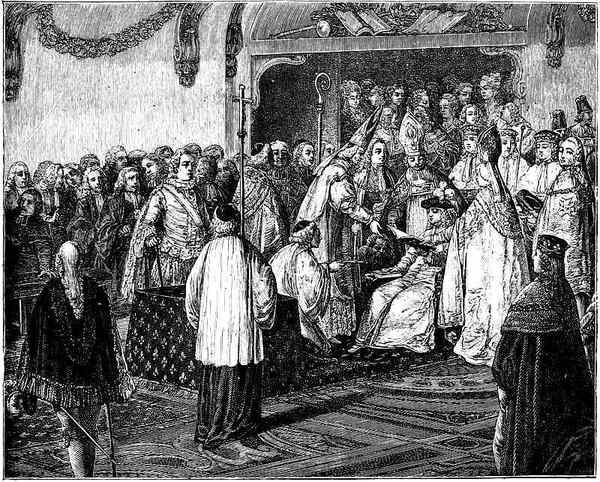
LOUIS XVI. TAKING THE CORONATION OATH AT REIMS
(From a painting by Moreau).
Reims accorded an enthusiastic welcome to the youthful and ill-fated Marie Antoinette, on her passage through the city on May 12, 1770, shortly after her arrival in France;[215] and five years subsequently the Rémois were regaled with the splendours of a coronation, when the young King, Louis XVI., and his radiant Queen passed beneath the elaborately wrought escutcheon surmounting the Porte de Paris, expressly forged by a blacksmith of Reims in honour of the occasion,[216] and received from the hands of the Lieutenant des Habitans the three silver keys of the city.[217] The King was crowned on the 11th June by the Cardinal Archbishop of Reims, Charles Antoine de la Roche Aymon, a prelate who had previously baptised, confirmed, and married him, when the six lay peers were represented by Monsieur (the Count of Provence), the Count d’Artois, the Dukes of Orleans, Chartres, and Bourbon, and the Prince de Condé. The royal train was borne by the Prince de Lambesq; the Marshal de Clermont Tonnerre officiated as Constable; and the sceptre, crown, and hand of justice were carried respectively by the Marshals de Contades, de Broglie, and de Nicolai.[218] How the ill-fated King exclaimed, as the crown of Charlemagne was placed upon his brow, ‘It hurts me,’ even as Henri III. had cried, under the same circumstances, ‘It pricks me,’ and how his natural benevolence led him to slur over that portion of the coronation oath in which he ought to have bound himself to exterminate all heretics, are matters of history. An innovation to be noted is, that at the banquet at the archiepiscopal palace, after the ceremony, the youthful sovereign did not sit alone in solitary state beneath a canopy of purple velvet, ornamented with golden fleurs de lis, with his table encumbered by the great gold nef, the crown and the sceptres, the Constable, sword in hand, close by him, and the Grand Echanson and Ecuyer Tranchant tasting his wine and cutting his food,[219] circumstances under which ‘the roast must be without savour and the Ai without bouquet.’[220] The King on this occasion admitted his brothers to his board; and the ecclesiastical peers, the lay peers, the ambassadors, and the great officers of the crown formed, as usual, four groups at the remaining tables, whilst the Queen and her ladies witnessed the gustatory exploits from a gallery.
The frightful oppression of tailles, aides, corvées, gabelles, and other dues that crushed the hapless peasant in the pre-Revolutionary era, weighed with especial severity upon the vigneron. In virtue of the droit de gros, the officers could at any hour make an inventory of his wine, decree how much he might consume himself, and tax him for the remainder.[221] The fermiers généraux, who farmed the taxes of the province, became his sleeping partners, and had their share in his crop.[222] In a vineyard at Epernay, upon four pieces of wine, the average produce of an arpent, and valued at 600 francs, the ferme levied first 30 francs, and then when the pieces were sold 75 francs more.[223] The ecclesiastical tithe was also a heavy burden, at Hautvillers the eleventh of the wine being taken as dismes, at Dizy the twelfth, and at Pierry the twentieth.[224] The result was one continuous struggle of trickery on the part of the grower, and cunning on that of the officers.[225] The visits of the latter were paid almost daily, and their registers recorded every drop of wine in the cellars of the inhabitants.[226]
But the wine had by no means acquitted all its dues. The merchant buying it had to pay another 75 francs to the ferme before despatching it to the consumer. When he did despatch it, the ferme strictly prescribed the route it was to take, any deviation from this being punished by confiscation; and it had to pay at almost every step. Transport by water was excessively onerous from constantly recurring tolls, and by land whole days were lost in undergoing examinations and verifications and making payments.[227] The commissionnaire charged with the conveyance of Bertin du Rocheret’s wine to Calais from Epernay had from 70 to 75 francs per poinçon. Despite all these drawbacks, the export trade must have been considerable, for we are told that prior to the Revolution the profits on supplying two or three abbeys of Flanders were sufficient to enable a wine-merchant of Reims to live in good style.[228]
[168] Letters, &c. Hamburg and Paris, 1788. The translator adds, as a note, ‘People do not any longer get drunk on Champagne.’
[169] Mémoires du Duc de St. Simon.
[170] Journal de Barbier.
[171] A curious proof of the popularity of sparkling Champagne, and of the singular system of provincial government into which France was broken up during the reign of Louis XV., is found in a decree of the Council of State, dated May 25, 1728. The decree in question begins by setting forth that, by the Ordonnance des aides de Normandie, wine was forbidden to be brought into Rouen or its suburbs in bottles, jugs, or any less vessels than hogsheads and barrels—with the exception of vin de liqueur packed in boxes—under pain of confiscation and one hundred livres’ fine, and that carriers were prohibited from conveying wine in bottles in the province without leave from the fermier des aides. Nevertheless, petitions had been presented by the maire and échevins of Reims, stating ‘that the trade in the gray wines of Champagne had considerably increased for some years past, through the precautions taken at the place of production to bottle them during the first moon of the month of March following the vintage, in order to render them mousseux; that those who make use of the gray wine of Champagne prefer that which is mousseux to that which is not; and that this gray wine cannot be transported in casks into the interior of the kingdom or to foreign countries without totally losing its qualities,’—a statement probably intentionally overdrawn, since Bertin du Rocheret used to export it in casks to England. Yet the fermiers des aides de Normandie claimed to prohibit the transport of wines in bottle; and if their pretension held good, the trade in the gray wine of Champagne would be destroyed. ‘Shifting the cause, as a lawyer knows how,’ the decree recapitulates the plea of the fermiers that the transport of wine in bottles offered facilities for defrauding the revenue, since a carrier with a load could easily leave some of it en route with innkeepers, and these in turn could hide bottles holding a pinte de Paris from the officers in chests, cupboards, &c., and sell them subsequently, to the detriment of the droits de détail.
[172] ‘To be drunk as nouveau or bottled,’ says M. Louis Perrier in his Mémoire sur le Vin de Champagne.
[173] D’Argenson’s Mémoires.
[174] Bois-Jourdain’s Mélanges Historiques. The editor of the Journal de Barbier observes in a note to a passage referring to the King’s suppers at La Muette with Madame de Mailly, under the date of November 1737: ‘These suppers were drinking bouts. It was there that the King acquired a taste for Champagne.’
[175] Clauteau’s Relation de ce qui s’est passé au Passage du Roi. Reims, 1744.
[176] Ibid.
[177] Varin’s Archives Administratives de Reims.
[178] Louis Paris’ Histoire de l’Abbaye d’Avenay.
[179] Amongst these may be cited the Abbé Bignon, who, in a letter to Bertin du Rocheret dated January 1734, says: ‘The less the wine is mousseux and glittering, and the more, on the contrary, it shows at the outset of what you style liqueur, and I, in chemical terms, should rather call balsamic parts, the better I shall think of it.’
[180] Louis Perrier’s Mémoire sur le Vin de Champagne.
[181]
‘Chloris, Eglé me versent de leur main
D’un vin d’Ay dont la mousse pressée,
De la bouteille avec force élancée,
Comme un éclair fait voler son bouchon.
Il part, on rit; il frappe le plafond:
De ce vin frais l’écume pétillante
De nos Français est l’image brillante.’
[182]
‘De ce vin blanc délicieux
Qui mousse et brille dans le verre,
Dont les mortels ne boivent guères;
Et qu’on ne sert jamais qu’à la table des dieux
Ou des grands, pour en parler mieux,
Qui sont les seuls dieux de la terre.’
[183] Desaulx, a canon of Reims Cathedral, rendered Lebatteux’s ode as follows:
[184]
‘Non, telles gens ne boivent pas
De cette sève délectable,
L’âme et l’amour de nos repas,
Aussi bienfaisante qu’aimable.
Leur palais corrompu, gâté,
Ne veut que du vin frelaté,
De ce poison vert, apprêté,
Pour des cervelles frénétiques.
Si, tenons-nous pour hérétiques
Ceux qui rejettent la bonté
De ces corpusculs balsamiques
Que jadis Horace a chantés.
Non, telles gens ne boivent pas
De cette sève délectable,
L’âme et l’honneur de nos repas,
Aussi bienfaisante qu’aimable.
De ce vin blanc délicieux,
Qui désarme la plus sévère;
Qui pétille dans vos beaux yeux
Mieux qu’il ne brille dans mon verre.
Buvons, buvons à qui mieux mieux,
Je vous livre une douce guerre;
Buvons, buvons de ce vin vieux,
De ce nectar délicieux,
Qui pétille dans vos beaux yeux
Mieux qu’il ne brille dans mon verre.’
The above was set to music by M. Dormel, organist of St. Geneviève.
[185] Marmontel’s Mémoires d’un Père pour l’instruction de ses Enfants. M. Louis Paris, in his Histoire de l’Abbaye d’Avenay, identifies this spot as one known indifferently as Le Fay or Feuilly. He furnishes some interesting details respecting Mademoiselle de Navarre, who, after being the mistress of Marshal Saxe, married the Chevalier de Mirabeau, brother to the Ami des Hommes and uncle of the celebrated orator, and then goes on to say: ‘In the seventeenth and eighteenth centuries the wines of Avenay shared with those of Hautvillers the glory of rivalling the best of Ay. “Avenay, les bons raisins,” was the popular saying inscribed on the banner of its chevaliers de l’Arquebuse (a corps of local sharpshooters). La Bruyère, St. Evremond, Boileau himself, Coulanges, L’Atteignant, and many others had celebrated the tender and delicate wines of our vineyards; and that of Madame l’Abbesse especially had acquired such a reputation, that several great families, strangers to the locality, thought it the right thing to have a vendangeoir at Avenay, and to pass part of the autumn in the renowned Val d’Or.’
[186]
‘Vois ce nectar charmant
Sauter sous ces beaux doigts;
Et partir à l’instant;
Je crois bien que l’amour en ferait tout autant.
Et quoi sous ces beaux doigts
Bouchon a donc sauté pour la première fois?
Croyez-vous que l’amour
Leur fit un pareil tour?’
[187]
‘Le jus que verse Ganimède
A Jupiter dans ses repas
A ce vin de Champagne cède,
Et nous sommes mieux ici bas.’
From the edition of his Poesies published in 1757.
[188]
‘Et quand je décoiffe un flacon
Le liège qui pette
Me fait entendre un plus beau son
Que tambour et trompette.’
Panard’s Œuvres, Paris, 1763.
[189]
‘Diaphorus au marchand de vin
Vend bien cher un extrait de rivière;
Le marchand vend au médecin
Du Champagne arrivé de Nanterre,
Ce qui prouve encor ce refrain-ci
A trompeur, trompeur et demi.’
[190]
‘Pour jouir d’un destin plus tranquille et plus doux
De ce bruyant séjour, amis, éloignons nous,
Allons, dans mon cellier, du Champagne et du Beaune
Goûter les doux appas.
Les plaisirs n’y sont pas troublés par l’embarras,
Et le funeste ennui qui monte jusqu’au trône
Dans les caveaux ne descend pas.’
[191]
‘C’est alors qu’un joyeux convive,
Saississant un flacon scellé,
Qui de Reims ou d’Ai tient la liqueur captive,
Fait sauter jusqu’à la solive
Le liège deficellé;
Tout le cercle attentif porte un regard avide
Sur cet objet qui les ravit;
Ils présentent leur verre vide,
Le nectar pétillant aussitôt les remplit.
On boit, on goûte, on applaudit,
On redouble et par l’assemblée
La mousse Champenoise à plein verre est sablée.
De là naissent les ris, les transports éclatans,
La sève et tout son feu, jusqu’au cerveau montants,
Font naître des débats, des querelles polies
Qui réveillent l’esprit de tous les assistants.’
[192] An allusion to the vin gris of the Champagne.
[193]
‘Grâce à la liqueur
Qui lave mon cœur,
Nul souci ne me consume.
De ce vin gris
Que je chéris
L’écume,
Lorsque j’en boi
Quel feu chez moi
S’allume!
Nectar enchanteur,
Tu fais mon bonheur;
Viens, mon cher ami! Que j’t’hume!
Champagne divin,
Du plus noir chagrin
Tu dissipes l’amertume.
Tu sais mûrir,
Tu sais guérir
Le rhume.
Quel goût flatteur
Ta douce odeur
Parfume!
Pour tant de bienfaits
Et pour tant d’attraits;
Viens, mon cher ami! Que j’t’hume!’
[194] Max Sutaine’s Essai sur le Vin de Champagne.
[195] M. Sutaine observes that in 1780 a merchant of Epernay bottled 6000 bottles, and that the importance of this tirage was noted as something remarkable; and this statement has been repeated by every other writer on Champagne. Yet here is a tirage of 6000 bottles taking place thirty-four years previously. The extent of the bottled-wine trade is confirmed by Arthur Young, who in 1787 visited Ay, where M. Lasnier had 60,000 bottles in his cellar, and M. Dorsé from 30,000 to 40,000. Marmontel in 1716 mentions Henin de Navarre’s cellars at Avenay as containing 50,000 bottles of Champagne.
[196] E. J. Maumené’s Traité du Travail des Vins, 1874.
[197] Ibid. The casse of 1776 has never been forgotten at Epernay; and M. Perrier, in a letter of August 1801, mentions a recent one at Avize amounting to 85 per cent. That of 1842 flooded the cellars throughout the Champagne. Even in 1850 M. Maumené mentions a casse in a Reims cellar which had reached 98 per cent at his visit, and was still continuing.
[198] Max Sutaine’s Essai sur le Vin de Champagne. The Abbé Bignon confirms this in a letter of December 20, 1736, to Bertin du Rocheret, respecting wine received from him. ‘The wine sealed with a cipher in red wax,’ he observes, ‘seemed to me very delicate, but having as yet some liqueur which time may get rid of, though after that I am afraid there will not remain much strength. Another, also sealed with red wax, but with a coat-of-arms, seems to have more quality and vinosity, though also very delicate and very light, both sablant perfectly, though they cannot be called mousseux. As to that which is sealed with black, the people who esteem foam would bestow the most magnificent eulogies upon it. It would be difficult to find any that carries this beautiful perfection further. Three spoonfuls at the bottom of the glass is surmounted with the strongest foam to the very brim; on the other hand, I found in it a furious vert, and not much vinosity.’
[199] In 1734 he speaks of his mousseux sablant, and forwards to the Marquis de Polignac both mousseux and petillant. In 1736 he offers M. Véron de Bussy his choice of demi-mousseux, bon mousseux, and saute bouchon; and the following year distinguishes his Ay mousseux from his saute bouchon.
[200] Respecting the price of sparkling Champagne during the first half of the eighteenth century, a few instances from the correspondence of Bertin du Rocheret may here he quoted. In 1716 he offers Marshal d’Artagnan 1500 bottles at 35 sols, cash down, and taken at Epernay. In 1725 he offers flacons blancs mousseux liqueur at from 30 to 50 sols, and ambrés non mousseux, sablant, at 25 sols. Ten years later saute bouchon is quoted by him at 40 and 45 sols, and in 1736 at 3 livres, demi-mousseux ranging from 36 to 40 sols, and bon mousseux from 45 to 50 sols. The following year saute bouchon fetched 3 livres 6 sols, and mousseux 42 sols. In 1736 he insisted upon his flacons holding a pinte; and a royal decree of March 8, 1755, which regulated the weight and capacity of sparkling-wine bottles, required these to weigh 25 ounces, and to hold a pinte de Paris, or about 1.64 imperial pint. They were, moreover, to be tied crosswise on the top of the cork, with a string of three strands well twisted. Their cost was 15 livres per hundred in 1734 and 1738, and from 17 to 19 livres in 1754.
[201] Louis Perrier’s Mémoire sur le Vin de Champagne.
[202] It would appear from Bidet that the wines of the Mountain had not been transformed into vin mousseux as late as 1752, as, in his book on wine published during that year, he only includes in the list of places producing sparkling wine Ay, Avenay, Mareuil, Dizy, Hautvillers, Epernay, Pierry, Cramant, Avize, and Le Mesnil.
[203]
‘Votre palais, usé, perclus
Par liqueur inflammable,
Préfère de mousseux verjus
Au nectar véritable.’
[204] Louis Perrier’s Mémoire sur le Vin de Champagne. In the thesis in favour of Champagne, written by Dr. Xavier of Reims in 1777, the acidulous character of the wine is confirmed by the author, who naïvely remarks that it is as efficacious in preventing putrefaction as are other acids. He also compares it to acidulated waters.
[205] Legrand d’Aussy’s Vie privée des Français, 1782.
[206] Louis Perrier’s Mémoire sur le Vin de Champagne. The pretended secret of Dom Perignon, quoted from the Mémoire of 1718, and mentioning the addition of sugar to the wine of Hautvillers, is flatly contradicted by Dom Grossart’s letter to M. Dherbès (see page 41 ante). But it is probable that the suggestion thus made public was acted upon, though at first only timidly.
[207] Chaptal’s Art de faire du Vin. As Minister of the Interior, he forwarded the results of his experiments to the préfets, with the recommendation to spread them throughout their departments.
[208] Louis Perrier’s Mémoire sur le Vin de Champagne.
[209] Letter of M. Nicolas Perrier to M. Cadet-Devaux, dated August 1801.
[210] As bourru, tocane, and en nouveau.
[211] Louis Perrier’s Mémoire sur le Vin de Champagne.
[212] The letter in which he mentions this is extant, but the secret which was enclosed in it is missing.
[213] Dom Grossart, who had retired to Montier-en-Der in 1790, was unacquainted with this plan when he wrote to M. Dherbès in 1821, although it had been practised for twenty years past.
[214] In a MS. quoted in Varin’s Archives Administratives de Reims.
[215] The gifts presented by the municipality on this occasion included flowers, pears, and gingerbread, Reims being as famed for the latter as for its wines. The guild of gingerbread-makers at Reims was established in the sixteenth century, and from that time forward was engaged in continual squabbles with the bakers and pastrycooks of the city, who could not be brought to understand that they had not the right to make gingerbread. Countless reams of paper were scribbled over by the lawyers of the two contending interests; but though the Bailli of Reims on several occasions pronounced a formal verdict, to the effect that no one but a sworn and accepted gingerbread-maker should have act or part in the making of the indigestible delicacy, the contumacious bakers continued to treat his edicts as naught. Eventually a royal edict of 1776, which suppressed the privileges of the majority of the guilds in France, deprived the Reims gingerbread-makers for ever of the right of figuring with swords by their sides and three-cornered hats on their heads at all local ceremonies, civil or religious, and threw their trade open to all.
[216] This escutcheon shows the arms of Reims, which at first consisted of rinçeaux or branches; subsequently a cross and a crozier, placed saltire-wise, and a sainte Ampoule, were added. When the government of the city passed from the archbishop, the entwined olive-branches and chief strewn with fleurs de lis were adopted, the old motto, ‘Dieu en soit garde,’ being retained. The iron gates of the Porte de Paris were removed to their present position in 1843, to allow of the passage of the canal.
[217] From the days of Charles VIII. to those of Louis XIV., it was customary on these occasions for the keys to be presented by a young girl styled the Pucelle de Reims; and J. M. C. Leber, in his work Des Cérémonies du Sacre, is of opinion that this custom arose in some way from the visit of Joan of Arc. Louis XV. was the first who received them from the lieutenant.
[218] Baron Taylor’s Reims, la Ville de Sacres.
[219] N. Menin’s Traité du Sacre et Couronnement des Rois.
[220] P. Tarbé’s Reims, ses Rues et ses Monuments.
[221] H. Taine’s L’Ancien Régime.
[222] Ibid.
[223] Arthur Young’s Travels in France in 1787–9.
[224] Ibid. Another grievance alleged against the monasteries was the presence of the innumerable fishponds belonging to them scattered throughout the country. The Cahier des Plaintes, Doléances, et Remontrances du Tiers Etat du Baillage de Reims, on the Assembly of the States General under Louis XVI., ask that ‘all fishponds situate outside woods and, above all, those which lie close to vineyards, may be suppressed, as hurtful to agriculture.’
[225] H. Taine’s L’Ancien Régime.
[226] Instructions of local directeurs des aides, quoted from the Archives Nationales by Taine.
[227] H. Taine’s L’Ancien Régime.
[228] Les Célébrités du Vin de Champagne, Epernay, 1880.
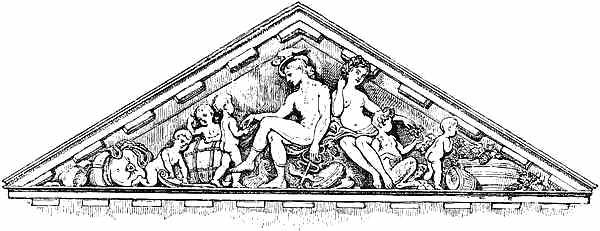
BAS-RELIEF ON THE ANCIENT HÔTEL DES FERMES AT REIMS.
On arriving at the town where it was to be drunk, the wine was subject to a fresh series of charges—octroi, droit de détail, le billot, le cinquième en sus l’impôt, jaugeage, courtage, gourmettage, &c.—frequently ranging up to 60 or 70 francs.[229] All this really affected the grower; for if the retail consumer, inhibited by high prices, could not buy, the former was unable to sell. At this epoch vine-grower and pauper were synonymous terms.[230] In certain districts of the Champagne the inhabitants actually threw their wine into the river to avoid paying the duties, and the Provincial Assembly declared that ‘in the greater part of the province the slightest increase in duty would cause all the husbandmen to abandon the soil.’[231] It is scarcely to be wondered at that under such a system of excessive taxation the fermiers généraux, who all made good bargains with the State, should have amassed immense fortunes, whilst denying themselves no kind of luxury and enjoyment. They built themselves princely hotels, rivalled the nobility and even the Court in the splendour of their entertainments, grasped at money for the sensual gratification it would purchase, and loved pleasure for its own sake, and women for their beauty and complaisance. The fermiers généraux of the province of Champagne had their bureaux, known as the Hôtel des Fermes, at Reims, and, after the town-hall, this was the handsomest civil edifice in the city. Erected in 1756 from designs by Legendre, it occupies to-day the principal side of the Place Royale. On the pediment of the façade is a bas-relief of Mercury, the god of commerce, in company with Penelope and the youthful Pan, surrounding whom are children engaged with the vintage and with bales of wool, typical of the staple trades of the capital of the Champagne.
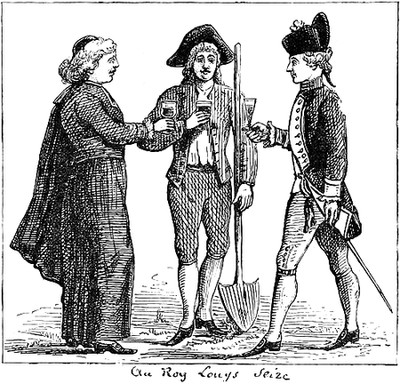
L’ACCORD FRATERNEL
(From a print published at the commencement of the Revolution).
The revolutionary epoch presents a wide gap in the written history of sparkling Champagne which no one seems to have taken the trouble of filling, though this hiatus can be to some extent bridged over by a glance at the caricatures of the period. It is evident from these that Champagne continued to be the fashionable wine par excellence. We can comprehend it was de rigueur to ‘fouetter le Champagne’[232] at the epicurean repasts held at the petits maisons of the rich fermiers généraux, and that the talons rouges of the Court of Louis Seize were not averse to the payment of 3 livres 10 sols for a bottle of this delightful beverage[233] when regaling some fair émule of Sophie Arnould or Mademoiselle Guimard in the coulisses. One evening Mademoiselle Laguerre appeared on the stage as Iphigenia unmistakably intoxicated. ‘Ah,’ interjected the lively Sophie, ‘this is not Iphigenia in Tauris, but Iphigenia in Champagne.’ A proof of the aristocratic status of the wine is furnished by a print entitled L’Accord Fraternel, published at the very outset of the revolutionary movement, when it was fondly hoped that the Three Orders of the States General would unite in bringing about a harmonious solution to the evils by which France was sorely beset. In this the burly well-fed representative of the clergy holds out a bumper of Burgundy; the peasant—not one of the lean scraggy labourers, with neither shirt nor sabots,[234] prowling about half naked and hunger-stricken in quest of roots and nettle-tops, but a regular stage peasant in white stockings and pumps—grips a tumbler well filled with vin du pays; while the nobleman, elaborately arrayed in full military costume, with sword, cockade, and tie-wig all complete, delicately poises between his finger and thumb a tall flute charged with sparkling Champagne. Moreover, we can plainly trace the exhilarating influence of the wine upon the ‘feather-headed young ensigns’ at the memorable banquet given to the officers of the Régiment de Flandre by the Gardes du Corps at Versailles, on the 2d Oct. 1789.[235]
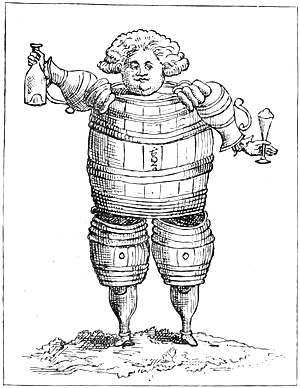
MIRABEAU TONNEAU
(From a sketch by Camille Desmoulins).
Conspicuous amongst the titled topers of this period was the Viscount de Mirabeau—the younger brother of the celebrated orator and a fervent Royalist—nicknamed Mirabeau Tonneau, or Barrel Mirabeau, ‘on account of his rotundity, and the quantity of strong liquor he contains.’[236] In a caricature dated ‘An 1er de la liberté,’ and ascribed to Camille Desmoulins,[237] with whom the viscount long waged a paper war, his physical and bibacious attributes are very happily hit off. His body is a barrel; his arms, pitchers; his thighs, rundlets; and his legs inverted Champagne flasks; whilst in his left hand he holds a foam-crowned flute, and in his right another of those flasks, two of which he was credited with emptying at each repast.[238]
We have seen that the origin of many of the most famous crûs of France was due to monkish labours, and that at Reims, as elsewhere, a large proportion of the ecclesiastical revenue was derived, either directly or indirectly, from the vineyards of the district. This was happily hit off in Le Nouveau Pressoir du Clergé, or New Wine-Press for the Clergy, published in 1789. A man of the people and a representative of the Third Estate, the latter in the famous slouched hat and short cloak, are working the levers of a press, under the influence of which a full-faced abbé is rapidly disgorging a shower of gold. A yet more portly ecclesiastic, worthy to be the Archbishop of Reims himself, is being led forward, in fear and trembling, to undergo a like operation; whilst in the background a couple of his compeers, reduced to the leanness of church-rats, are making off with gesticulations of despair.
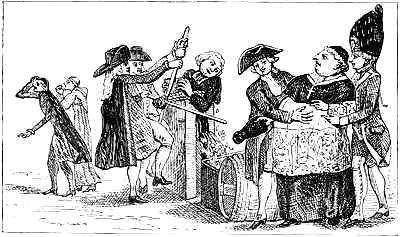
LE NOUVEAU PRESSOIR DU CLERGÉ, 1789
(From a caricature of the epoch).
The chief personal traits of Louis Seize, as depicted in numerous contemporary memoirs, seem to have been a passion for making locks and a gross and inordinate appetite. High feeding usually implies deep drinking, and one may suppose that a wine so highly esteemed at Court as Champagne was not neglected by the royal gourmand. Still there seems to have been nothing in the unfortunate monarch’s career to justify the cruel caricature wherein he is shown with the ears and hoofs of a swine wallowing in a wine-vat, with bottles, flasks, pitchers, cups, goblets, glasses, and flûtes of every variety scattered around him; whilst Henri Quatre, who has just crossed the Styx on a visit to earth, exclaims in amazement, ‘Ventre St. Gris! is this my grandson Louis?’ In another caricature, entitled ‘Le Gourmand,’ and said to represent an incident in the flight of the royal family from Paris, Louis XVI. is shown seated at table—surrounded by stringed flasks of Champagne, with the customary tall glasses—engaged in devouring a plump capon. His Majesty is evidently annoyed at being interrupted in the middle of his repast, but it is difficult to divine who the intruder is intended for. He can scarcely be one of the commissioners despatched by the National Assembly to secure the king’s return to Paris, as the German hussars drawn up in the doorway are inconsistent with this supposition. The female figure before the looking-glass is of course intended for Marie Antoinette, whilst the ungainly young cub in the background is meant for the Dauphin in an evident tantrum with his nurse.[239]
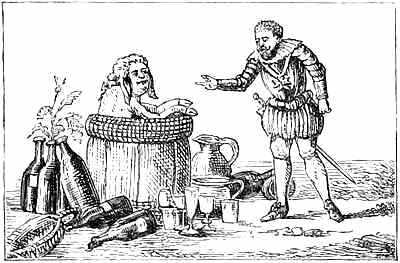
HENRI QUATRE AND LOUIS SEIZE.
‘Ventre St. Gris! Is this my grandson Louis?’
(Facsimile of a woodcut of the time.)
As to the pamphleteers, who advocated the Rights of Man and aspersed Marie Antoinette; the poets, who addressed their countless airy trifles to Phyllis and Chloe; the penniless disciples of Boucher and Greuze; and the incipient demagogues, briefless advocates, unbeneficed abbés, discontented bourgeois, whose eloquence was to shatter the throne of the Bourbons, they were fain for the time being to content themselves with the petit bleu of Argenteuil or Suresnes, consumed in company with Manon or Margot, in one of the dingy smoky cabarets which the café was so soon in a great measure to replace. When, however, their day did come, we may be sure they denied themselves no luxury, and sparkling Champagne would certainly have graced Danton’s luxurious repasts, and may possibly have played its part at the last repast of the condemned Girondins. In ’93, we find Champagne of 1779—the still wine, of course—announced for sale at Lemoine’s shop in the Palais Royal; while a delectable compound, styled crême de fleur d’orange grillée au vin de Champagne, was obtainable at Théron’s in the Rue St. Martin.[240] The sparkling wine can scarcely have failed to figure on the carte of the sumptuous repasts furnished by the restaurateurs, Méot and Beauvillers, to the de facto rulers of France,[241] although in 1795 the price of wine generally in Paris had increased tenfold.[242] Ex-procureurs of the defunct Parliament carefully hoarded all that remained of the Champagne formerly lavished upon them by their ex-clients;[243] whilst the latter had to content themselves with tea at London and beer at Coblenz.[244]
Although details respecting the progress of the Champagne wine-trade at home and abroad at the outset of the present century are somewhat scanty, we readily gather that the great popularity of the sparkling wine throughout Europe dates from an event which, at the time of its occurrence, the short-sighted Champenois looked upon as most disastrous. This was the Allied invasion of 1814–15. Consumption, so far as the foreign market was concerned, had been grievously interrupted by the great upset in all commercial matters consequent upon the wars of the Revolution and the Empire. It appears that the white wines of Champagne were sent to Paris, Normandy, Italy, and, ‘when circumstances permitted of it,’ to England, Holland, Sweden, Denmark, Russia, Spain, Portugal, and ‘beyond the seas.’ But the trade had suffered greatly during the wars with Austria and Russia in 1806 and 1807; and in the following years the consumption of white wine had fallen considerably, and a large number of wine-merchants had found themselves unable to meet their engagements.[245]
The wine which Napoleon I. preferred is said to have been Chambertin; still, his intimacy with the Moëts of Epernay could scarcely fail to have led to a supply of the best sparkling Champagne from the cellars he had deigned to visit in person. His satraps, who travelled with the retinue of sovereign princes, included the wine in their equipment wherever they went, and the popping of its mimic artillery echoed in their tents the thunder of their victorious cannon. But comparatively few foreign guests met at their tables; and as their foes had on their side few victories to celebrate in a similar style, the knowledge of sparkling Champagne outside France was confined to the comparatively small number of persons of wealth and position able to pay an extravagant price for it.
At length the fatal year, 1814, arrived, and the Allies swarmed across the frontier after the ‘nations’ fight’ at Leipzig. The Champagne lying directly on the way to Paris saw some hard fighting and pitiless plundering. The Prussians of Baron von Tromberg got most consumedly drunk at Epernay. The Cossacks ravaged Rilly, Taissy, and the other villages of the Mountain; and not being able to carry off all the wine they found at Sillery, ‘added to their atrocities,’ in the words of an anonymous local chronicler,[246] by staving in the barrels and flooding the cellars. The Russians, under the renegade St. Priest, seized on Reims, whetted their thirst with salt herrings till the retail price of these dainties rose from 5 liards a pair to 3 sous apiece, and then set to work to quench it with Champagne to such an extent that when Napoleon suddenly swooped down upon the city like his own emblematic eagle, a large number of them, especially among the officers, were neither in a condition to fight nor fly.[247]
The immense body of foreign troops who remained quartered in the east of France after the downfall of the Empire continued to pay unabated devotion to the dive bouteille. Tradition has especially distinguished the Russians, and relates how the Cossacks used to pour Champagne into buckets, and share it with their horses. But the walking sand-beds of North Germany, the swag-bellied warriors of Baden and Bavaria, and the stanch topers of Saxony and Swabia must of a surety have distinguished themselves. The votaries of Gambrinus, the beer king, strove whether they could empty as many bottles of Champagne at a sitting as they could flagons filled with the amber-hued beverage of their native province; while the inhabitants of those districts where the grape ripens sought to institute exhaustive comparisons between the vintages they gathered at home and the growths of the favoured region in which they now found themselves.
LES RUSSES À PARIS
(From a coloured print of the time).
The Berliner was fain to acknowledge the superiority of the foam engendered by Champagne over that crowning his favourite weissbier, his own beloved kuhle blonde, and the beer-topers of Munich and Dresden to give the preference to the exhilaration produced by quaffing the wine of Reims and Epernay over that due to the consumption of bockbier. The Nassauer and the Rhinelander had to admit certain intrinsic merits in the vintages produced on the slopes of the Marne, and found to be lacking in those grown on the banks of the Rhine, the Ahr, the Main, and the Moselle. The Austrian recognised the superiority of the wines of the Mountain over those of Voslau or the Luttenberg; and the Magyar had to allow that the crûs of the River possessed a special charm which Nature had denied to his imperial Tokay. Even the red-coated officers who followed ‘Milord Vilainton’ to the great review at Mont Aimé, near Epernay, proved faithless to that palladium of the British mess-table, their beloved ‘black strop.’ Claret might in their eyes be only fit for boys and Frenchmen, and Port the sole drink for men; but they were forced to hail Champagne as being, as old Baudius had already phrased it, ‘a wine for gods.’
LE DÎNER DE MILORD GOGO, 1816
(After a coloured print of the time).
The officers of the Allied armies quartered in Paris after the Hundred Days supplemented the charms of the Palais Royal—then in the very apogee of its vogue as the true centre of Parisian life, with its cafés, restaurants, theatres, gambling-houses, and Galeries de Bois—with an abundance of sparkling Champagne. Royalty itself set the example by indicating a marked preference for the wine, Louis Dixhuit, according to a statement made by Wellington to Rogers, drinking nothing else at dinner. To celebrate the victories of Leipsic and Waterloo or a successful assault on the bank at Frascati’s, to console for the loss of a grosse mise at No. 113 or of a comrade transfixed beneath a lamp in the Rue Montpensier by a Bonapartist sword-blade, to win the smiles of some fickle Aspasia of the Palais Royal Camp des Tartares or to blot out the recollection of her infidelity, to wash down one of the Homeric repasts in which the English prototypes of the ‘Fudge Family Abroad’ indulged, the wine was indispensable; until, as a modern writer has put it, ‘Waterloo was avenged at last by the gros bataillons of the bankers at roulette and trente et quarante, and by the sale to the invaders of many thousand bottles of rubbishing Champagne at twelve francs the flask.’[248] The rancorous enmity prevailing between the officers of Bonapartist proclivities placed on half-pay and the returned émigrés who had accepted commissions from Louis XVIII., resulted, as is well known, in numerous hostile meetings. Captain Gronow has dwelt upon the bellicose exploits of a gigantic Irish officer in the gardes du corps, named Warren, who, when ‘excited by Champagne and brandy,’[249] was prepared to defy an army; and he tells us that at Tortoni’s there was a room set apart for such quarrelsome gentlemen, where, after these meetings, they indulged in riotous Champagne breakfasts.[250] At home, the British Government were being twitted on their parsimony in limiting the supply of Champagne for the table of the exiled Emperor at St. Helena to a single bottle per diem, a circumstance which led Sir Walter Scott to protest against the conduct of Lord Bathurst and Sir Hudson Lowe in denying the captive ‘even the solace of intoxication.’
As is not unfrequently the case, out of evil came good. The assembled nations had drunk of a charmed fountain, and it had excited a thirst which could not be quenched. The Russians had become acquainted with Champagne, which Talleyrand had styled ‘le vin civilisateur par excellence,’ and to love this wine was with them a very decided step towards a liberal education. Millions of bottles, specially fortified to the pitch of strength and sweetness suited for a hyperborean climate, were annually despatched to the great northern empire from the house of Clicquot; and later on the travellers of rival firms, eager to secure a portion of this patronage, traversed the dominions of the autocrat throughout their length and breadth, and poured their wines in wanton profusion down the throats of one and all of those from whom there appeared a prospect of securing custom.
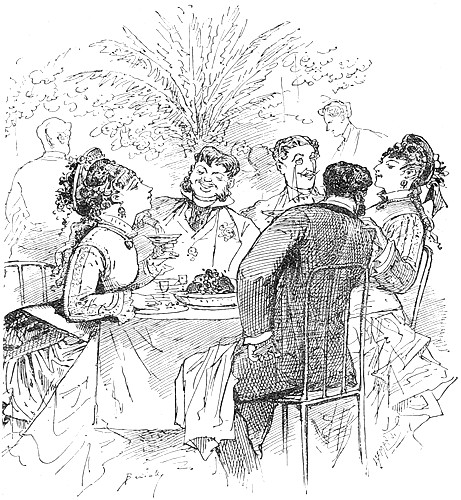
From this influx of sparkling wine into the frozen empire of the Czar the acceptance of civilisation—of rather a superficial character, it is true—may be said to date. Had Peter the Great only preferred Champagne to corn-brandy, the country would have been Europeanised long ago. As it is, the wine has to-day become a recognised necessity in higher class Russian society, and scandal even asserts that whenever it is given at a dinner-party, the host is careful to throw the windows open, in order that the popping of the corks may announce the fact to his neighbours. Abroad the Russians are more reserved in their manners; and though ranking amongst the best customers of the Parisian restaurateurs for high-class wines, it is only now and then that some excited Calmuck is to be seen flooding the glasses of his companions with Champagne in a public dining-room. The Russians, it should be noted, have sought, and not unsuccessfully, to produce sparkling wines of their own, more especially in the country of the Don Cossacks and near the Axis.
Béranger might exclaim, with a poet’s license, that he preferred a Turkish invasion to seeing the wines of the Champagne profaned by the descendants of the Alemanni;[251] but the merchants of Reims and Epernay were of a different opinion. Les militaires have always affected Champagne; and a military aristocracy like that of the Fatherland, in the cruel days when peace forbade any more free quarters and requisitions, became as large purchasers of the wine as their somewhat scanty revenues allowed of. Their example was followed to a considerable extent by the self-made members of that plutocratic class which modern speculation has caused to spring into life in Germany. Advantage was speedily taken of this taste by their own countrymen, who aimed at supplanting Champagne by sparkling wines grown on native slopes. Nay more, the Germans, as a military nation, felt bound to carry the war into the enemy’s territory, and hence it is that many important houses at Reims and Epernay are of German origin. Across the Rhine patriotism has had to yield to popularity, and the stanchest native topers have been forced to acknowledge, after due comparison in smoky wein stuben and gloomy keller, that, though the sparkling wines of the Rhine and the Moselle are in their own way most excellent, there is but one Champagner-wein, with Reims for its Mecca and Epernay for its Medina.
Of England we shall elsewhere speak at length; but the speculative trade of her colonies, with its sharp bargains, dead smashes, and large profits could hardly be carried on without the wheels of the car of Commerce and the tongues of her votaries being oiled with Champagne. The Swiss have only proved the truth of the proverb that imitation is the sincerest form of flattery by producing tolerable replicas of Champagne at Neufchâtel, Vevay, and Sion. Northern, or, to speak by the map, Scandinavian, Europe takes its fair share of the genuine article; and although the economic Belgian is apt to accept sparkling Saumur and Vouvray as a substitute, both he and his neighbour, the Dutchman, can to the full appreciate the superiority of the produce of the Marne over that of the Loire.
The Italian and the Spaniard may affect to outwardly despise a liquor which they profess not to be able to recognise as wine at all; but the former has to allow, per Bacco, that it excels in its particular way his extolled Lacryma Christi, while the latter does not carry his proverbial sobriety so far as to exclude the wine from repasts in the upper circles of Peninsular society. Moreover, of recent years they have both commenced making sparkling wines of their own. The Austrian also produces sparkling wines from native vintages, notably at Voslau, Graz, and Marburg; still this has not in any way lessened his admiration for, or his consumption of, Champagne. The Greek is ready enough to ‘dash down yon cup of Samian wine,’ provided there be a goblet of Champagne close at hand to replace it with; and boyards and magnates of the debateable ground of Eastern Europe not only imbibe the sparkling wines of the Marne ostentatiously and approvingly, but several of them have essayed the manufacture of vin mousseux on their own estates.
The East, the early home of the vine, and the first region to impart civilisation, is perhaps the last to receive its reflux in the shape of sparkling wine. But, the prohibition of the Prophet notwithstanding, Champagne is to be purchased on the banks of the Golden Horn, and has been imported extensively into Egypt in company with opéra-bouffe, French figurantes, stock-jobbing, and sundry other matters of foreign extraction under the régime of the late Khedive. The land of Iran has beheld with wonderment its sovereign freely quaffing the fizzing beverage of the Franks in place of the wine of Shiraz. The East Indies consume Champagne in abundance; for it figures not only on the proverbially hospitable tables of the merchants and officials of Calcutta, Bombay, and Madras, but at the symposia of most of the rajahs, princes, nawabs, and other native rulers. The almond-eyed inhabitant of ‘far Cathay,’ reluctant to abandon that strange civilisation so diametrically opposed in all its details to our own, continues to drink his native vintages, warm and out of porcelain cups, and to regard the sparkling drink of the Fanquis as a veritable ‘devils’ elixir.’ But his utterly differing neighbour, the Japanese, so eager to welcome everything European, has gladly greeted the advent of Champagne, and freely yielded to its fascination.
Turning to the undiscovered continent, we find sable sovereigns ruling at the mouths of the unexplored rivers of Equatorial Africa fully acquainted with Champagne, though disposed, from the native coarseness of their taste, to rank it as inferior to rum; whilst the Arab, filled with wonderment at the marvels of European civilisation which meet his eye at Algiers, bears back with him to the douar, wrapped up in the folds of his burnous, a couple of bottles of the wondrous effervescing drink of the Feringhees as a testimony, even as Othere brought the walrus-tooth to Alfred. One enthusiastic Algerian colonist has gone so far as to prophesy the advent of the day when the products of the native vineyards shall eclipse Champagne.[252] Let us hope, however, in the interest of Algerian digestions, that this day is as yet far distant.
With respect to the consumption of Champagne in the Western world, the United States’ exceeds that of any European country, England and France alone excepted, despite the competition of sparkling Catawba and of a certain diabolical imitation, the raw material of which, it is asserted, is furnished not by the grapes of the Carolinas, the peaches of New Jersey, or the apples of Vermont, but by the oil-wells of Pennsylvania—in fact, petroleum Champagne. The cabinet particulier seems to be an institution as firmly established in the leading cities of the States as in Paris; and rumour says that drinking from a Champagne-glass touched by a fair one’s lips has replaced the New England pastime of eating the same piece of maple-candy till mouths meet. As regards the South American Republics, the popping of musketry at each fresh pronunciamento is certain to be succeeded by that of Champagne-corks in honour of the success of one or the other of the contending parties.
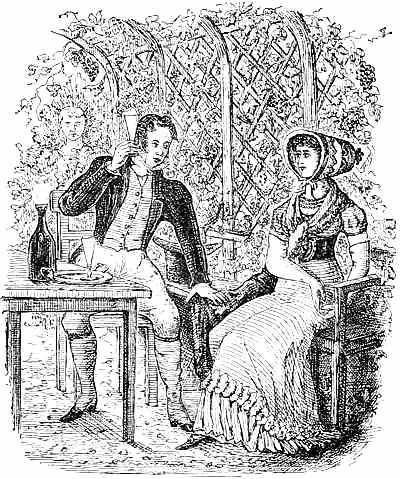
‘SOUS LA TONNELLE’
(From a print of the time of the Restoration).
In Europe Champagne has continued to be, from the days of Paulmier and Venner downwards, the drink of kings, princes, and great lords as they described it. Take a list of the potentates of the present century, and the majority of them will be found to have evinced at some time or other a partiality for the wine. Louis XVIII. drank nothing else at table. The late ruler of Prussia, Frederick William IV., had such a penchant for Champagne of a particular manufacture, that he obtained the cognomen of King Clicquot. The predecessor of Pio Nono, Gregory XVI., rivalled him in this appreciation, and, terrible to relate, so did the Commander of the Faithful, Abdul Medjid. The latter might, however, have pleaded the excuse put forward by Abd-el-Kader, that although the Prophet had forbidden wine, yet Champagne came into the category of aerated waters, concerning which he had said nothing, a remark justifying the title given to this wit-inspiring beverage of being ‘the father of bons mots.’ Prince Bismarck, in the stormy period of his youth, was in the barbarous habit of imbibing Champagne mixed with porter; but at present he judiciously alternates it with old Port. Marshal MacMahon and the King of the Belgians are said to drink the pink variety of the vin mousseux by preference.
‘AU BEAU SEXE!’
Naturally, in France as elsewhere, the sparkling vintage of the Marne maintains its claims to be reckoned the wine of beauty and fashion, and more especially in beauty’s gayer hours. A glass of Champagne and a biscuit de Reims has been a refection which, though often verbally declined, was in the end pretty sure to be accepted from the days of the merveilleuses and incroyables, through those of the lionnes, down to the present epoch of the cocodettes de la haute gomme. Neither at ceremonial banquets nor at ordinary dinner-parties among our neighbours does Champagne hold, however, so prominent a place as amongst ourselves, owing to the great variety of other wines—all capable of appreciation by trained palates—entering into the composition of these festive repasts. In fact, a repas de noces is the only occasion on which Champagne flows in France with anything like the freedom to which we are accustomed; and then it is that its exhilarating effect is marked, as some portly old boy rises with twinkling eye to propose the health of the bride, or of that beau sexe to which he feels bound to profess himself deeply devoted. At such open-air gatherings as the races at Longchamps and Chantilly, the buffet will be besieged by a succession of frail fair ones in the most elaborate toilettes de courses, seeking to nerve themselves to witness a coming struggle, or to console themselves for the defeat of the horse backed by their favoured admirer. And, when writing of this wine, it is altogether impossible to omit a reference to those tête-à-tête repasts en cabinet particulier, of which it is the indispensable adjunct. Its mollifying influence on the feminine heart on occasions such as these has been happily hit off by Charles Monselet in his Polichinelle au Restaurant:
‘POLICHINELLE AU RESTAURANT.
I.
In a cabinet of Vachette,
Pomponnette
Listens to the pressing lover;
Who, before they’ve done their soup,
Cock-a-hoop,
Dares his passion to discover.
II.
Elbows resting on the cloth,
Partly wrath—
So much do his words astound—
Resolute she to resist
Being kissed,
Draws her mantle closer round.
III.
Whilst in vain his cause he pressed,
A third guest,
Who in ice-pail by them slumbered,
Rears above his wat’ry bed
Silver head
And long neck with ice encumbered.
IV.
’Tis Champagne, who murmurs low,
“Don’t you know
That when once you set me flowing,
This fair rebel to Love’s dart
In her heart
Soon will find soft passion glowing?
V.
This, if you will list to me,
You shall see;
Cease to swear by flames and fire,
Cast aside each angry thought,
As you ought,
And at once cut through my wire,
VI.
For I am the King Champagne,
And I reign
Over e’en the sternest lasses,
When midst maddening song and shout
I gush out,
Flooding goblets, bumpers, glasses.
VII.
As thus spoke the generous wine,
Its benign
Influence her heart ’gan soften.
Who seeks such a cause to gain,
To Champagne
His success finds owing often.’[253]
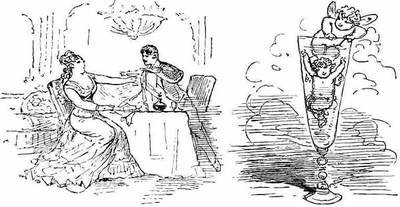
VI.
CHAMPAGNE IN ENGLAND.
The strong and foaming wine of the Champagne forbidden his troops by Henry V.—The English carrying off wine when evacuating Reims on the approach of Jeanne Darc—A legend of the siege of Epernay—Henry VIII. and his vineyard at Ay—Louis XIV.’s present of Champagne to Charles II.—The courtiers of the Merry Monarch retain the taste for French wine acquired in exile—St. Evremond makes the Champagne flute the glass of fashion—Still Champagne quaffed by the beaux of the Mall and the rakes of the Mulberry Gardens—It inspires the poets and dramatists of the Restoration—Is drank by James II. and William III.—The advent of sparkling Champagne in England—Farquhar’s Love and a Bottle—Mockmode the Country Squire and the witty liquor—Champagne the source of wit—Port-wine and war combine against it, but it helps Marlborough’s downfall—Coffin’s poetical invitation to the English on the return of peace—A fraternity of chemical operators who draw Champagne from an apple—The influence of Champagne in the Augustan age of English literature—Extolled by Gay and Prior—Shenstone’s verses at an inn—Renders Vanbrugh’s comedies lighter than his edifices—Swift preaches temperance in Champagne to Bolingbroke—Champagne the most fashionable wine of the eighteenth century—Bertin du Rocheret sends it in cask and bottle to the King’s wine-merchant—Champagne at Vauxhall in Horace Walpole’s day—Old Q. gets Champagne from M. de Puissieux—Lady Mary’s Champagne and chicken—Champagne plays its part at masquerades and bacchanalian suppers—Becomes the beverage of the ultra-fashionables above and below stairs—Figures in the comedies of Foote, Garrick, Coleman, and Holcroft—Champagne and real pain—Sir Edward Barry’s learned remarks on Champagne—Pitt and Dundas drunk on Jenkinson’s Champagne—Fox and the Champagne from Brooks’s—Champagne smuggled from Jersey—Grown in England—Experiences of a traveller in the Champagne trade in England at the close of the century—Sillery the favourite wine—Nelson and the ‘fair Emma’ under the influence of Champagne—The Prince Regent’s partiality for Champagne punch—Brummell’s Champagne blacking—The Duke of Clarence overcome by Champagne—Curran and Canning on the wine—Henderson’s praise of Sillery—Tom Moore’s summer fête inspired by Pink Champagne—Scott’s Muse dips her wing in Champagne—Byron’s sparkling metaphors—A joint-stock poem in praise of Pink Champagne—The wheels of social life in England oiled by Champagne—It flows at public banquets and inaugurations—Plays its part in the City, on the Turf, and in the theatrical world—Imparts a charm to the dinners of Belgravia and the suppers of Bohemia—Champagne the ladies’ wine par excellence—Its influence as a matrimonial agent—‘O the wildfire wine of France!’
SO great a favourite as Champagne now is with all classes in England, the earliest notice of it in connection with our history nevertheless represents it in a somewhat inimical light. For, according to an Italian writer of the fifteenth century, ‘the strong and foaming wine of Champagne was found so injurious that Henry V. was obliged, after the battle of Agincourt, to forbid its use in his army, excepting when tempered with water.’[254] Although this may be the earliest mention of the wine of the Champagne by name in association with our own countrymen, opportunities had been previously afforded to them of becoming acquainted with its assumed objectionable qualities. The prelates who crossed ‘the streak of silver sea’ with Thurstan of York to attend the ecclesiastical councils held at ‘little Rome,’ as Reims was styled in the twelfth century, and the knights and nobles who swelled the train of Henry II. when he did homage to Philip Augustus at the latter’s coronation, may be regarded as exceptionally fortunate, or unfortunate, in this respect, since the bulk of the English wine-drinkers of that day had to content themselves with the annual shipments of Anjou and Poitevin wines from Nantes and La Rochelle.[255] But the stout men-at-arms and death-dealing archers who followed the third Edward to the gates of Reims in the days when
[229] H. Taine’s L’Ancien Régime. At Rethel a poinçon of the jauge de Reims paid 50 to 60 francs for the droit de détail alone.
[230] Arthur Young’s Travels in France in 1787–9.
[231] H. Taine’s L’Ancien Régime.
[232] Crebillon the younger’s Les Bijoux Indiscrets.
[233] A MS. account of the wine culture of Poligny in the Jura states that in 1774 attempts were made to imitate the gray and pink wines of the Champagne, then selling at 3 livres 10 sous the bottle.
[234] Erckmann-Chatrian’s Histoire d’un Paysan.
[235] ‘Suppose Champagne flowing,’ says Carlyle, when describing this banquet in his French Revolution.
[236] Carlyle’s French Revolution.
[237] The date ‘An 1er de la liberté’ may possibly refer to the ‘Year One’ of the Republican calendar (1792), in which Mirabeau fell in a duel at Fribourg. But an earlier edition of the same caricature seems to have been published, according to De Goncourt in the Journal de la Mode et du Goût, in May 1790.
[238]
‘Malgré les calembours, les brocards, les dictons,
Je veux à mes repas vuider mes deux flacons,’
are the lines assigned to him in Le Vicomte de Barjoleau, ou le Souper des Noirs, a two-act comedy of the epoch.
[239]
LE GOURMAND: AN INCIDENT OF LOUIS XVI.’S FLIGHT FROM PARIS
(From a caricature of the period).
This caricature, which is neither signed nor dated, is simply entitled ‘Le Gourmand;’ though Jaime, in his Histoire de la Caricature, states that it represents Louis XVI. at Varennes. According to Carlyle, however, the king reached Varennes at eleven o’clock at night, was at once arrested in his carriage, and taken to Procureur Sausse’s house. Here he ‘demands refreshments, as is written; gets bread-and-cheese, with a bottle of Burgundy, and remarks that it is the best Burgundy he ever drunk.’ At six o’clock the following morning he left Varennes, escorted by ten thousand National Guards. Very likely there may have been a story current at the time to the effect that the arrest was due to the king’s halting to gratify his appetite. Or the caricature may represent some incident that occurred, during his return to Paris, as he passed through the Champagne district, and halted at the Hôtel de Rohan at Epernay.
[240] De Goncourt’s Société Française pendant la Révolution.
[241] Ibid.
[242] St. Aubin’s Expédition de Don Quichotte.
[243] Aux voleurs! aux voleurs! quoted by De Goncourt.
[244] Lettres du Père Duchêne, quoted by De Goncourt.
[245] Les Célébrités du Vin de Champagne, Epernay, 1880.
[246] Journal de ce qui s’est passé d’intéressant à Reims en 1814.
[247] Ibid.
[248] G. A. Sala’s Paris Herself Again.
[249] Gronow’s Celebrities of London and Paris, 1865.
[250] Gronow’s Reminiscences, 1862.
[251]
‘J’aime mieux les Turcs en campagne
Que de voir nos vins de Champagne
Profanés par des Allemands.’
Béranger’s Chansons.
[252]
‘Rôtis sur la haute montagne
Tout flamme et miel, le Médéah,
Le Mascara, le Milianah
Feront pâlir le gai Champagne.’
Poésies de J. Boese, de Blidah.
[253]
‘Il a conduit Pomponnette
Chez Vachette,
Dans le cabinet vingt-deux;
Et là, même avant la bisque,
Il se risque
A lui déclarer ses feux.
Elle demeure accoudée,
Obsédée,
Résolue à résister,
Inexorable et charmante
Dans sa mante,
Qu’elle ne veut pas quitter.
Un troisième personnage,
A la nage
Dans un seau d’argent orné,
Se soulève sur la hanche,
Tête blanche,
Cou de glace environné.
C’est le Champagne; il susurre:
“Chose sûre!
Quand mon bouchon partira,
Tout à l’heure, cette belle
Si rebelle
Mollement s’apaisera.
Bientôt tu verras, te dis-je,
Ce prodige
Cesse d’invoquer l’enfer;
Ton courroux est trop facile;
Imbécile,
Arrache mon fil de fer!
Car je suis maître Champagne,
Qu’accompagne
Le délire aux cent couplets;
Je dompte les plus sévères.
A moi, verres,
Coupes, flûtes et cornets!”
Aussi dit le vin superbe,
Moins acerbe,
La femme se sent capter.
C’est une cause que gagne
Le Champagne;
Son bouchon vient de sauter.’
Le Parfait Vigneron, Paris, 1870.
[254] Titi Livii Foro-Juliensis Vita Henrici Quinti. The author was a protégé of Duke Humphrey of Gloucester.
[255] Francisque Michel’s Histoire du Commerce et de la Navigation à Bordeaux. It was not till the marriage of Henry III. with Eleanor of Aquitaine that we began to import Guienne wine from Bordeaux.
‘’Twas merry, ’twas merry in France to go,
A yeoman stout with a bended bow,
To venge the King on his mortal foe,
And to quaff the Gascon wine,’
no doubt found consolation for some of the hardships they endured during their wet and weary watches in the bitter winter of 1365 in the familiarity they acquired with the vintages of the Mountain and the Marne.
And, their sovereign’s prohibition notwithstanding, there is every reason to believe that the heroes of Agincourt drank pottle-deep of the forbidden beverage. The grim Earl of Salisbury bore no love to the burghers of Reims;[256] but there is little likelihood that his aversion extended to the wine of the province he ruled as governor, and the garrisons of its various strongholds over which the red cross of St. George triumphantly floated revelled on the best of ‘the white wyne and the rede.’ In the days of hot fighting and keen foraging which marked the close of Bedford’s regency, there is ample evidence to show that our countrymen had acquired and retained a very decided taste for these growths. When Charles VII. entered Reims in triumph, with Jeanne Darc by his side and the chivalry of France around him, the retreating English garrison bore forth with them on the opposite side of the city a string of wains piled high with casks of wine, the pillage of the burghers’ cellars.[257]
Tradition tells, too, how the English, besieged in the town of Epernay, had gathered there great store of wine, and how this suggested to their captain a cunning stratagem. Having caused a number of wagons to be laden with casks of wine, he despatched them with a feeble escort through the gate furthest from the beleaguering forces, as though destined to Chalons as a place of safety. The French commander marked this, and as soon as the convoy was well clear of the walls, a body of horse came spurring after it in hot haste. The wagon-train halted; there was a brief attempt to turn the laden vehicles homewards, and then, seeing the hopelessness of this, the escort galloped back into the town, and down swooped the Frenchmen on their prize. The ride had been sharp; the day was hot, and the road dusty. So a score of the captured casks were quickly broached; and as the generous fluid flowed freely down the throats of the captors, it soon began to produce an effect. Some of them, overcome by the heat and the wine, loosened their armour, and stretched themselves at length on the ground; whilst others, grouped around some fast emptying barrel, continued to quaff from their helmets and other improvised drinking vessels confusion to the ‘island bull-dogs.’ When lo, the gate of the town flew open; an English trumpet rang out its note of defiance; and, with lances levelled, the flower of the garrison poured forth like a living avalanche upon the startled Frenchmen. Before they could make ready to fight or fly, the foe was upon them, and their blood was soon mingling on the dusty highway with the pools of wine which had gushed forth from the abandoned casks. Hardly one escaped the slaughter; but local tradition chuckles grimly as it notes that in revenge thereof every man of the garrison was put to the edge of the sword on the subsequent capture of the town by the French.[258]
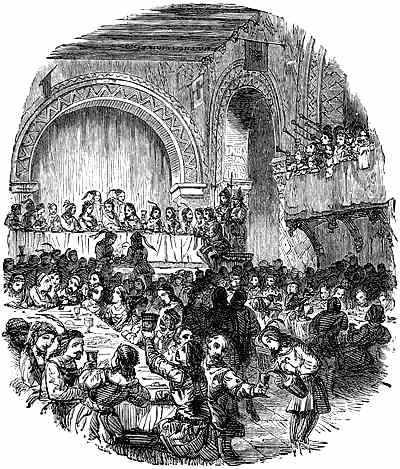
At the close of the fruitless struggle against the growing power of Charles the Victorious, we were fain to fall back, as of old, upon the strong wines of south-western France, the vintages of Bergerac, Gaillac, and Rabestens, shipped to us from the banks of the Garonne,[259] and the luscious malmseys of the Archipelago, to which were subsequently added the growths of southern Spain. The taste of the wine of the Champagne must have been almost forgotten amongst us when the growing fame of the vineyards of Ay attracted the notice of Bluff King Hal. Most likely he and Francis I. swore eternal good fellowship at the Field of the Cloth of Gold over a beaker of this regal liquor. Once alive to its merits, the King, whose ambassadors, pace John Styles, seem to have had standing orders to keep an equally sharp look out for wines or wives likely to suit the royal fancy, neglected no opportunity of securing it in perfection. Like his contemporaries, Charles V., Francis I., and Leo X., he stationed a commissioner at Ay intrusted with the onerous duty of selecting a certain number of casks of the best growths, and despatching them, carefully sealed, to the cellars of Whitehall, Greenwich, and Richmond. The example set by the monarch was, however, too costly a one to be followed by his subjects, and the very name of Champagne probably remained unknown to them for years to come. The poets and dramatists of the Elizabethan era, who have left us so accurate a picture of the manners of their day, and make such frequent allusions to the wines in vogue, do not even mention Champagne; Gervase Markham preserves a like silence in his Modern Housewife,[260] while the passages in Surflet’s Maison Rustique extolling the wine of Ay are merely translations from the original French edition.[261] And though Venner speaks of these wines as excelling all others, he is careful to attribute their consumption to the King and the nobles of France.[262]
The captive Queen of Scots, whose consumption of wine elicited dire lament from one of her lordly jailers,[263] may have missed at Fotheringay the vintage she had tasted in early life when enjoying the hospitality of her uncle, Cardinal Charles of Lorraine, at Reims; but to the half-hearted pedant, her son, the name of Epernay recalled no convivial associations—it was merely the title of a part of his slaughtered mother’s appanage. Spanish influence and Spanish wine ruled supreme at his Court; and though Rhenish crowned the goblets of many of the high-souled cavaliers who rallied round King Charles and Henrietta Maria, the bulk of the English nation remained faithful, till the close of the Commonwealth, to their old favourites of the south of Spain and the fragrant produce of the Canaries.
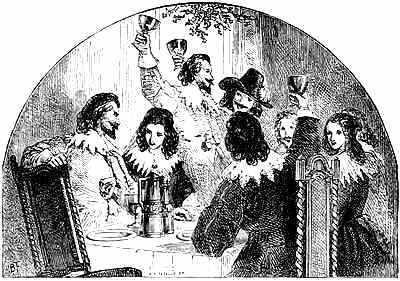
All this was altered when ‘the King enjoyed his own again;’ for the Restoration made Champagne—that is, the still red wine of the province—the most fashionable, if not the most popular, wine in England. At the Court of Louis XIV. the future Merry Monarch and his faithful followers had acquired a taste for the wines of France, and they brought back this taste,[264] together with sundry others of a far more reprehensible character, with them to England. One of the first and most acceptable gifts of Louis to his brother-sovereign on the latter’s recall was ‘two hundred hogsheads of excellent wine—Champagne, Burgundy, and Hermitage.’[265] Returning home more French than the French themselves, the late exiles ruminated on the flesh-pots of Egypt, and sighed; and we can readily picture a gallant who had seen hot service under Condé or Turenne exclaiming to his friend and fellow-soldier:
‘Ah, Courtine, must we be always idle? Must we never see our glorious days again? When shall we be rolling in the lands of milk and honey, encamped in large luxuriant vineyards, where the loaded vines cluster about our tents, drink the rich juice just pressed from the plump grape?’[266]
And that friend replying:
‘Ah, Beaugard, those days have been; but now we must resolve to content ourselves at an humble rate. Methinks it is not unpleasant to consider how I have seen thee in a large pavilion drowning the heat of the day in Champagne wines—sparkling sweet as those charming beauties whose dear remembrance every glass recorded—with half a dozen honest fellows more.’[267]
Demand created supply, until, in 1667, a few years after the Restoration, France furnished two-fifths of the amount of wine consumed in the kingdom;[268] and the taste of the royal sybarite for the light-coloured wines of the Marne seems to be hinted at in Malagene’s exclamation:
‘I have discovered a treasure of pale wine.... I assure you ’tis the same the King drinks of.’[269]
St. Evremond, who, though not precisely cast by Nature from ‘the mould of form,’ fulfilled for many years the duties of arbiter elegantiarum at Charles’s graceless Court, decidedly did his best to render the Champagne flûte ‘the glass of fashion.’ Ever ready to speak in praise of the wines of Ay, Avenay, and Reims,[270] the mentor of the Count de Grammont strove by example as well as by precept to win converts to his creed. In verse he declares that the beauties of the country fail to console him for the absence of Champagne; regrets that the season of the wines of the Marne is over, and that the yield of those of the Mountain had failed; and shudders at the prospect of being obliged to have recourse to the Loire, to Bordeaux, or to Cahors for the wine he will have to drink.[271]
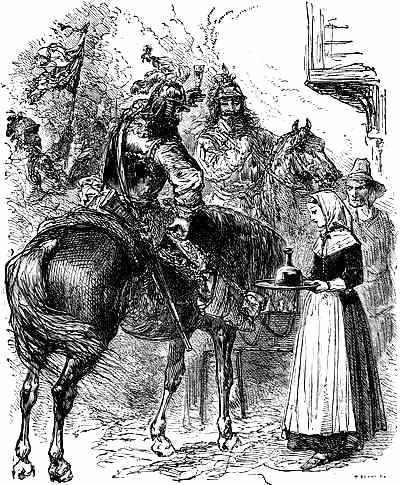
The lively Frenchman found plenty of native writers to reëcho him. Champagne sparkles in all the plays of the Restoration, and seems the fitting inspiration of their matchless briskness of dialogue. The Millamours and Bellairs, the Carelesses and Rangers, the Sir Joskin Jolleys and Sir Fopling Flutters, the beaux of the Mall and the rakes of the Mulberry and New Spring Gardens, the gay frequenters of the Folly on the Thames and the habitués of Pontack’s Ordinary, whom the contemporary dramatists transferred bodily to the stage of the King’s or the Duke’s, are constantly tossing off bumpers of it. Their lives would seem to have been one continuous round of love-making and Champagne-drinking, to judge from the following ‘catch,’ sung by four merry gentlemen at a period when, according to Redding, ten thousand tuns of French wine were annually pouring into England:
‘The pleasures of love and the joys of good wine,
To perfect our happiness, wisely we join;
We to Beauty all day
Give the sovereign sway,
And her favourite nymphs devoutly obey.
At the plays we are constantly making our court,
And when they are ended we follow the sport
To the Mall and the Park,
Where we love till ’tis dark;
Then sparkling Champaign[272]
Puts an end to their reign;
It quickly recovers
Poor languishing lovers;
Makes us frolic and gay, and drowns all our sorrow;
But, alas, we relapse again on the morrow.’[273]
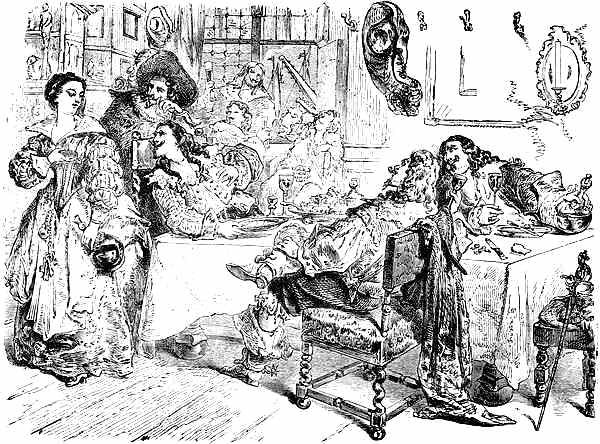
We learn, indeed, that under the influence of
‘powerful Champaign, as they call it, a spark can no more refrain running into love than a drunken country vicar can avoid disputing of religion when his patron’s ale grows stronger than his reason.’[274]
Probably it was owing to this quality of inspiring a tendency to amativeness that ladies were sometimes expected to join in such potations.
‘She’s no mistress of mine
That drinks not her wine,
Or frowns at my friends’ drinking motions;
If my heart thou wouldst gain,
Drink thy flask of Champaign;
’Twill serve thee for paint and love-potions,’[275]
is the sentiment enunciated in chorus by four half-fuddled topers in the New Spring Gardens. At the Mulberry Gardens we find that
‘Jack Wildish sent for a dozen more Champaign, and a brace of such girls as we should have made honourable love to in any other place.’[276]
With such manners and customs can we wonder at one gentleman complaining how another
‘came where I was last night roaring drunk; swore—d—him!—he had been with my Lord Such-a-one, and had swallowed three quarts of Champaign for his share;’[277]
or have any call to feel surprised that such boon companions should
‘come, as the sparks do, to a playhouse too full of Champaign, venting very much noise and very little wit’?[278]
Champagne remains ignored in such books as the Mystery of Vintners;[279] but although technical works may be silent, the poets vie with the dramatists in extolling its exhilarating effects—effects surely perceptible in the witty, careless, graceful verse with which the epoch abounds. John Oldham—who, after passing his early years as a schoolmaster, was lured into becoming, in the words of his biographer, ‘at once a votary of Bacchus and Venus’ by the patronage of Rochester, Dorset, and Sedley in 1681, and who realised the fable of the pot of brass and the pot of earthenware by dying from the effects of the company he kept two years later—has given a list of the wines in vogue in his day:
‘Let wealthy merchants, when they dine,
Run o’er their witty names of wine:
Their chests of Florence and their Mont Alchine,
Their Mants, Champaigns, Chablees, Frontiniacks tell;
Their aums of Hock, of Backrag [Bacharach] and Mosell.’[280]
He gives the wines of our ‘sweet enemy’ a high position, too, in his Dithyrambick, spoken by a Drunkard, who is made to exclaim,
‘Were France the next, this round Bordeau shall swallow,
Champaign, Langou [L’Anjou], and Burgundy shall follow.’[281]
Butler makes the hero of his immortal satire prepared to follow the old Roman fashion with regard to his lady’s name, and to
‘Drink ev’ry letter on’t in stum,
And make it brisk Champaign become;’[282]
and speaks of routed forces having
‘Recovered many a desperate campaign
With Bordeaux, Burgundy, and Champaign.’[283]
And Sir Charles Sedley, in an apologue written towards the close of the century, tells how a doctor of his day was sorely troubled by the unreasonable lives led by his patients, until
‘One day he called ’em all together,
And, one by one, he asked ’em whether
It were not better by good diet
To keep the blood and humours quiet,
With toast and ale to cool their brains
Than nightly fire ’em with Champains.’[284]
In 1679 the peculiar ideas of political economy then prevailing led to a formal prohibition of the importation of French wines, and the consequent substitution in their place of those of Portugal. One can imagine the consternation of the ‘beaux’ and ‘sparks’ at this fatal decree, and the satisfaction of the few vintners whose cellars chanced to be well stored with the forbidden vintages of France—with
‘The Claret smooth, red as the lips we press
In sparkling fancy while we drain the bowl;
The mellow-tasted Burgundy, and, quick
As is the wit it gives, the gay Champagne.’[285]
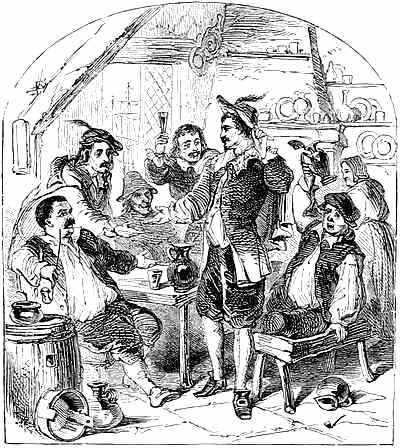
But, Port wine and prohibitions notwithstanding, men of fashion of that epoch were not entirely obliged to abandon their favourite potations, since five thousand hogsheads of French wine were surreptitiously landed on the south-west coast of England in a single year.[286] Fortunately, too, for them, the Government came to the conclusion that it was for the time being futile to fight against popular tastes, and in 1685 the obnoxious prohibition was removed, with the result that, two years later, the imports of French wine were registered as fifteen thousand tuns—that is, sixty thousand hogsheads.[287]
On the outbreak of hostilities with France in 1689, the import of French wines received a serious check, and as they vanished from the revenue returns, so Champagne began to disappear from the social board and the literature of the day. Strange to say, however, it was not only the favourite wine of William III., but of his dethroned father-in-law, James II. The red wines of the province of Champagne had always found a ready sale in Flanders and the Low Countries,[288] and quickened the minds of the stout seamen who fought against Blake and Rupert. The variety produced from the Beaune grape at Vertus was the one patronised by Macaulay’s pet hero, the hook-nosed Dutchman,[289] whilst the exile of St. Germain seems to have been more catholic in his tastes.[290]
Eagerly must the gourmets of the day, when, ‘if we did not love the French, we coveted their wines,’[291] have hailed the return of a peace which permitted them not only to indulge in their old favourites, but to welcome a new attraction in the shape of sparkling Champagne. The term ‘sparkling’ as applied to wine did not at the outset necessarily mean effervescing, as in one of Farquhar’s comedies we find Roebuck comparing himself to ‘a bumper of Claret, smiling and sparkling.’[292] Towards the close of the century, however, we meet with sure proof of the advent of the delectable beverage with which the worthy cellarer of Hautvillers was the first to endow droughty humanity. The contemporary dramatists were ever on the alert to shoot Folly as she flew. The stage was really the mirror of that time, and those who wrote for it seized on every passing whim, fashion, or fancy of the day. The introduction of a new wine was certainly not to be missed by them, and the recently discovered vin mousseux of Dom Perignon is plainly referred to in Farquhar’s aptly-named comedy, Love and a Bottle, produced in 1698, just after the Peace of Ryswick had allowed the reopening of trade with France.
The second scene of act ii. represents the lodgings of Mockmode, the country squire, who aims at being ‘a beau,’ and who is discovered in close confabulation with his landlady, the Widow Bullfinch:
‘Mock. But what’s most modish for beverage now? For I suppose the fashion of that always alters with the clothes.
W. Bull. The tailors are the best judges of that; but Champaign, I suppose.
Mock. Is Champaign a tailor? Methinks it were a fitter name for a wig-maker. I think they call my wig a campaign.
W. Bull. You’re clear out, sir—clear out. Champaign is a fine liquor, which all great beaux drink to make ’em witty.
Mock. Witty! O, by the universe, I must be witty! I’ll drink nothing else; I never was witty in my life. Here, Club, bring us a bottle of what d’ye call it—the witty liquor.’
The Widow having retired, Club, Mockmode’s servant, reënters with a bottle and glasses.
‘Mock. Is that the witty liquor? Come, fill the glasses.... But where’s the wit now, Club? Have you found it?
Club. Egad, master, I think ’tis a very good jest.
Mock. What?
Club. Why, drinking. You’ll find, master, that this same gentleman in the straw doublet, this same Will o’ the Wisp, is a wit at the bottom. Here, here, master, how it puns and quibbles in the glass![293]
Mock. By the universe, now I have it; the wit lies in the jingling! All wit consists most in jingling. Hear how the glasses rhyme to one another.... I fancy this same wine is all sold at Will’s Coffee-house.’
Here we have a palpable hit at the source of inspiration indulged in by many of the wits and rhymesters who gathered round ‘glorious John Dryden’ within the hallowed walls of that famous rendezvous. And likely enough, when they
‘were all at supper, all in good humour, Champaign was the word, and wit flew about the room like a pack of losing cards.’[294]
Farquhar seems, above all others, to have hailed the new wine with pleasure. We all remember the ‘red Burgundy’ which saves Mirabel from his perilous position in the cut-throats’ den; but the flighty hero of the Inconstant is equally enthusiastic over sparkling wine when he exclaims:
‘Give me the plump Venetian, brisk and sanguine, that smiles upon me like the glowing sun, and meets my lips like sparkling wine, her person shining as the glass, and spirit like the foaming liquor.’[295]
The benignant influence of the beverage is, moreover, referred to by Farquhar in his epilogue to the Constant Couple, where, in alluding to the critics, it is said that
‘To coffee some retreat to save their pockets,
Others, more generous, damn the play at Locket’s;
But there, I hope, the author’s fears are vain,
Malice ne’er spoke in generous Champain.’[296]
Further, he makes Benjamin Wouldbe exclaim:
‘Show me that proud stoick that can bear success and Champain; philosophy can support us in hard fortune, but who can have patience in prosperity?’[297]
Farquhar shows his usual keen observation of the minutest features of the life of his day in his allusion to the flask—the pear-shaped flacon in which Champagne made its entrée into fashionable life.[298] Archer, in his ditty on ‘trifles,’ thus warbles:
‘A flask of Champaign, people think it
A trifle, or something as bad;
But if you’ll contrive how to drink it,
You’ll find it no trifle, egad!’[299]
Congreve, in evident reference to the still wine, thus writes to Mr. Porter, husband of the celebrated actress, from Calais, August 11, 1700:
‘Here is admirable Champaign for twelvepence a quart, as good Burgundy for fifteenpence; and yet I have virtue enough to resolve to leave this place to-morrow for St. Omers, where the same wine is half as dear again, and may be not quite so good.’[300]
Champagne suffered like other French wines from the War of Succession and the Methuen Treaty, by which the Government strove to pour Port wine down the throats of the people. The poets and satirists, supported by Dean Aldrich, ‘the Apostle of Bacchus;’ the miserly Dr. Ratcliffe, who ascribed all diseases to the lack of French wines, and imputed the badness of the vintages he was wont to place upon his table to the difficulty he experienced in obtaining them; the jovial Portman Seymour; the rich ‘smell-feast’ Pereira and General Churchill, Marlborough’s brother, together with a host of ‘bottle companions,’ lawyers, and physicians, united to fight against this attempt.[301] They would drink their old favourites, in spite of treaties, and would praise them as they deserved; and means were found to gratify their wishes. According to official returns, the nominal importation of French wines fell in 1701 to a trifle over two thousand tons; and though this quantity was only once exceeded up to 1786, the influence of a steady demand, a short sea-passage, an extensive coast-line, and a ridiculously inefficient preventive service in aid of the high duty need to be taken into consideration. The contraband traders of the beginning of the century smuggled French wine into England, just as they continued to do at a later period into Scotland and Ireland, when the taste for ardent spirits which sprang up in the Georgian era rendered the surreptitious import of ‘Nantz’ and ‘Geneva’ the more profitable transaction as regarded England. Farquhar throws light on one method pursued when Colonel Standard hands Alderman Smuggler his pocket-book, which he had dropped, with the remark:
‘It contains an account of some secret practices in your merchandising, amongst the rest, the counterpart of an agreement with a correspondent at Bordeaux about transporting French wine in Spanish casks.’[302]
That the Champenois were themselves aware of the appreciation in which their wine was held in England is shown by a passage in Coffin’s Campania vindicata. Writing in 1712, the year before the ratification of the Treaty of Utrecht, he calls on the Britons in presence of returning peace to cross the seas, and instead of lavishing their wealth to pleasure blood-stained Mars, to fill their ships with the treasures of the Remois Bacchus, and bear home these precious spoils instead of fatal trophies.[303]
Addison, referring to one source whence French wines were derived, remarks:
‘There is in this City a certain fraternity of Chymical Operators who work underground, in holes, caverns, and dark retirements, to conceal their mysteries from the eyes and observation of mankind. These subterraneous Philosophers are daily employed in the Transmigration of Liquors, and, by the power of Magical Drugs and Incantations, raise under the streets of London the choicest products of the hills and valleys of France. They can squeeze Bourdeaux out of a Sloe, and draw Champagne from an Apple.’[304]
He tells us that
‘the person who appeared against them was a Merchant, who had by him a great magazine of wines, that he had laid in before the war: but these Gentlemen (as he said) had so vitiated the nation’s palate, that no man could believe his to be French, because it did not taste like what they sold for such.’
For the defence it was urged that
‘they were under a necessity of making Claret if they would keep open their doors, it being the nature of Mankind to love everything that is Prohibited.’[305]
The enquiry,
‘And where would your beaux have Champaign to toast their mistresses were it not for the merchant?’[306]
is from a panegyrist of the more legitimate school of trade.
Altogether it is tolerably certain that Champagne—genuine or fictitious, from grape or gooseberry—played a more important part in the conviviality of the early portion of the eighteenth century than might be supposed from the imports of the epoch, whilst there is little doubt but that it helped to inspire some of the finest productions of the Augustan age of English literature.
Gay places it first amongst the wines offered to a party of guests entering a tavern, making the drawer exclaim:
‘Name, sirs, the wine that most invites your taste,
Champaign or Burgundy, or Florence pure,
Or Hock antique, or Lisbon new or old,
Bourdeaux, or neat French wine, or Alicant.’[307]
This reference to Champagne most likely relates to the still wine; but it is probably the sparkling variety which is alluded to in the verses which Gay addressed to Pope on the completion of the Iliad in 1720, and wherein he represents General Wilkinson thus apostrophising as the ship conveying the poet passes Greenwich:
‘Come in, my friends, here shall ye dine and lie;
And here shall breakfast and shall dine again,
And sup and breakfast on (if ye comply),
For I have still some dozens of Champaign.’[308]
Witty Mat Prior, poet and diplomatist, was always ready to manifest his contempt for the heavy fluid with which the Methuen treaty deluged our island in place of the light fresh-tasting wines of France that had cheered and inspired his earlier sallies. Writing whilst in custody on a charge of treason between 1715 and 1717, and referring to the mind under the name of Alma, he tells us how
‘By nerves about our palate placed,
She likewise judges of the taste,
Else (dismal thought!) our warlike men
Might drink thick Port for fine Champagne.’[309]
He likewise inculcates a lesson of philosophy, especially suited to his own situation at that moment, when he remarks of fortune:
‘I know we must both fortunes try,
And bear our evils, wet or dry.
Yet, let the goddess smile or frown,
Bread we shall eat, or white or brown;
And in a cottage or a court
Drink fine Champagne or muddled Port.’[310]
There were many, no doubt, ready to emulate the hero of one of his minor pieces, and
‘from this world to retreat
As full of Champagne as an egg’s full of meat.’[311]
Shenstone gives expression to much the same sentiment as Prior when he found ‘his warmest welcome at an inn,’ and wrote on the window-pane at Henley:
‘’Tis here with boundless power I reign,
And every health which I begin
Converts dull Port to bright Champagne;
Such freedom crowns it at an inn.’[312]
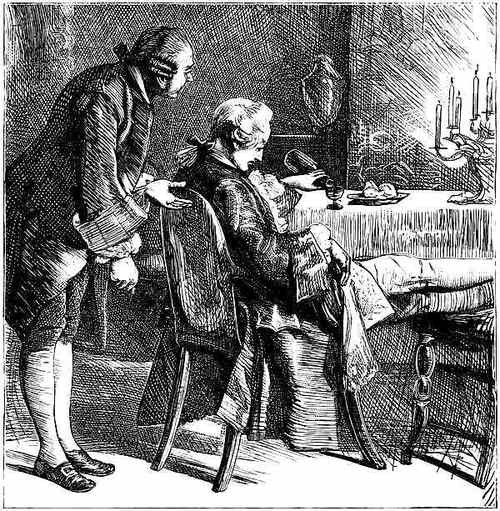
Vanbrugh, whose writings were of a decidedly lighter character than the edifices he erected, probably had recourse to Champagne to assist him in the composition of the former, and neglected it when planning the designs for the latter. These, indeed, would seem to have been conceived under the influence of some such ‘heavy muddy stuff’ as the ‘Norfolk nog,’ which Lady Headpiece reproaches her husband for allowing their son and heir to indulge in, saying:
‘Well, I wonder, Sir Francis, you will encourage that lad to swill such beastly lubberly liquor. If it were Burgundy or Champaign, something might be said for’t; they’d perhaps give him some art and spirit.’[313]
Swift has given in his Journal to Stella extensive information as to the wines in vogue in London in 1710–13. He seems for his own part to have been, as far as nature permitted him, an accommodating toper, indulging, in addition to Champagne, in Tokay, Portugal, Florence, Burgundy, Hermitage, ‘Irish wine,’ i.e. Claret, ‘right French wine,’ Congreve’s ‘nasty white wine’ that gave him the heartburn, and Sir William Read’s ‘admirable punch.’ He acknowledges that the more fashionable beverages of the day were not to his taste. ‘I love,’ writes he, ‘white Portugal wine better than Claret, Champaign, or Burgundy. I have a sad vulgar appetite.’[314] Still, while observing due moderation, he did not entirely shun the lighter potations with which the table of the luxurious and licentious St. John was so freely supplied. On one occasion he writes:
‘I dined to-day by appointment with Lord Bolingbroke; but they fell to drinking so many Spanish healths in Champaign, that I stole away to the ladies and drank tea till eight.’[315]
And on another we find him refusing to allow his host to
‘drink one drop of Champaign or Burgundy without water.’[316]
Our countrymen do not appear to have taken heed of the controversy regarding the respective merits of Champagne and Burgundy, but thankfully accepted the goods that the gods and the sunny soil of France provided them. The accusation, however, banded about by the partisans of these rival vintages, of their tendency to produce gout, had apparently been accepted as gospel truth over here in the first decade of the century. Thus the Dean notes that he
‘dined with Mr. Secretary St. John, and staid till seven, but would not drink his Champaign and Burgundy, for fear of the gout.’[317]
When suffering from a rheumatic pain he displays commendable caution at dinner with Mr. Domville, only drinking
‘three or four glasses of Champaign by perfect teasing,’[318]
for fear of aggravating his suffering. He is prompt, however, to acknowledge himself mistaken:
‘I find myself disordered with a pain all round the small of my back, which I imputed to Champaign I had drunk, but find it to have been only my new cold.’[319]
The Dean does not appear to have been the only sufferer, for we find him writing:
‘I called this evening to see Mr. Secretary, who had been very ill with the gravel and pains in his back, by Burgundy and Champaign, added to the sitting up all night at business; I found him drinking tea, while the rest were at Champaign, and was very glad of it.’[320]
Even Pope, the perforcedly abstemious, was lured into similar excesses by the young Earl of Warwick and Colley Cibber, during his visits to London, whilst engaged on his translation of the Iliad, and writes to Congreve,
‘I sit up till two o’clock over Burgundy and Champagne.’[321]
A proof of the popularity of French wines at this period is found in the fact that in 1713, the year of the Peace of Utrecht, the registered imports, despite high duties, reached 2551 tuns, an amount not exceeded till 1786. The Treaty of Commerce, with which Bolingbroke (whose partiality to Champagne we have seen) and M. de Torcy sought to supplement that of Peace, having fallen through, the tavern-keepers put such a price on these wines that it was only members of the fashionable world who could afford to have what was termed ‘a good Champagne stomach.’[322] Their vogue is confirmed by the order given to her servant by a lady aspiring to take a leading position in the beau monde to
‘go to Mr. Mixture, the wine-merchant, and order him to send in twelve dozen of his best Champaign, twelve dozen of Burgundy, and twelve dozen of Hermitage,’[323]
as the entire stock for her cellar. ‘Good wine’ was indeed, in those days, ‘a gentleman.’
[256] Varin’s Archives Administratives de Reims.
[257] Ibid.
[258] Victor Fiévet’s Histoire d’Epernay.
[259] Francisque Michel’s Histoire du Commerce et de la Navigation à Bordeaux.
[260] Published in 1615.
[261] That of 1574. Surflet’s translation appeared in 1600.
[262] Venner’s Via recta ad longam Vitam, 1628.
[263] Writing to Sir Walter Mildmay in 1569, the Earl of Shrewsbury, who had charge of the royal prisoner, complains that his regular allowance of wine duty free is not enough. ‘The expenses I have to bear this year on account of the Queen of the Scots are so considerable as to compel me to beg you will kindly consider them. In fact, two butts of wine a month hardly serve for our ordinary use; and besides this, I have to supply what is required by the Princess for her baths and similar uses.’
[264] Clarendon’s Memoirs.
[265] Letter of Guy Patin, 1660.
[266] Otway’s Soldier’s Fortune, act iv. sc. 1, 1681.
[267] Ibid.
[268] Redding’s History and Description of Modern Wines.
[269] Otway’s Friendship in Fashion, 1678.
[270]
‘Nous parler toujours des vins
D’Ay, d’Avenet, et de Reims.’
Œuvres de Saint-Evremond.
[271]
‘Perdre le goût de l’huitre et du vin de Champagne
Pour revoir la leur d’un débile soleil
Et l’humide beauté d’une verte campagne,
N’est pas à mon avis un bonheur sans pareil,
La faveur de la Marne, hélas, est terminée,
Et notre montagne de Reims,
Qui fournit tant d’excellens vins,
A peu favorisé nostre goût cette année.
O triste et pitoyable sort!
Faut-il avoir recours aux rives de la Loire,
Ou pour le mieux au fameux port,
Dont Chapelle nous fait l’histoire!
Faut-il se contenter de boire
Comme tous les peuples du Nord?
Non, non, quelle heureuse nouvelle!
Monsieur de Bonrepaus arrive, il est icy,
Le Champagne pour lui tousjours se renouvelle,
Fuyez, Loire, Bordeaux! fuyez, Cahors, aussy!’
Œuvres de Saint-Evremond:
Sur la Verdure qu’on met aux cheminées en Angleterre.
In these verses we trace the custom, elsewhere spoken of, of drinking the Marne wines when new. St. Evremond himself, in a passage of his prose works, says that the wines of Ay should not be kept too long, or those of Reims drunk too soon.
[272] Sparkling is not used here in the modern sense of effervescing: see page 90.
[273] Sir George Etherege’s Man of the Mode, or Sir Fopling Flutter, act iv. sc. 1, 1676.
[274] Otway’s Friendship in Fashion, act ii. sc. 1, 1678.
[275] Etherege’s She wou’d if she cou’d, act iv. sc. 2, 1668.
[276] Sir Charles Sedley’s Mulberry Garden, act ii. sc. 2, 1668.
[277] Otway’s Friendship in Fashion, act i. sc. 1, 1678.
[278] Shadwell’s Virtuoso, act ii. sc. 2, 1676.
[279] By Dr. Charleton, and published as late as 1692.
[280] Oldham’s Paraphrases from Horace, book i. ode xxxi., 1684.
[281] Oldham’s Works, &c., 1684.
[282] Butler’s Hudibras, part ii. canto i., 1664. Stum is unfermented wine; and the term brisk applied to Champagne is here employed not to denote effervescence, but to indicate the contrast between the thick immature fluid and the clear carefully-made wines of the Champagne.
[283] Butler’s Hudibras, part iii. canto iii., 1678.
[284] Sedley’s The Doctor and his Patients. No date, but Sedley died in 1701.
[285] Thomson’s Poems.
[286] Cyrus Redding’s evidence before the Parliamentary Committee on the Wine-Duties, 1851.
[287] Redding’s French Wines.
[288] Varin’s Archives Administratives de Reims.
[289] Louis Perrier’s Mémoire sur le Vin de Champagne.
[290] St. Simon’s Mémoires.
[291] Redding’s French Wines.
[292] Farquhar’s Love and a Bottle, act ii. sc. 2, 1698.
[293] An evident allusion to its effervescence; whilst the words ‘straw doublet’ most likely refer to the covering of the flask.
[294] Cibber’s Love makes a Man, act i. sc. 1, 1700.
[295] Farquhar’s The Inconstant, or the Way to win Him, act i. scene 2, 1703.
[296] Epilogue to the Constant Couple, or a Trip to the Jubilee of Farquhar, spoken by Wilks in 1700. Locket’s tavern, which stood on the site now occupied by Drummond’s bank at Charing Cross, was especially famous for its Champagne. In the Quack Vintners, a satire against Brooke and Hilliers, published in 1712, we read:
[297] Farquhar’s Twin Rivals, act v. sc. 1, 1705.
[298] Several other writers, who speak of ‘bottles’ of other wines, use the word ‘flask’ when referring to Champagne.
[299] Farquhar’s Beaux’ Stratagem, act iii. sc. 3, 1706.
[300] Memoir, prefixed to Leigh Hunt’s edition of Congreve’s works.
[301] Cunninghame’s History of Britain from the Revolution to the Hanover Succession.
[302] Farquhar’s The Constant Couple, or a Trip to the Jubilee, act v. sc. 1, 1700. M. Francisque Michel, in his Histoire du Commerce et de la Navigation à Bordeaux, clearly establishes that from the beginning to the middle of the eighteenth century all the best growths of the Médoc were bought and shipped for England. It was not until after 1755 that any went to Paris.
[303]
‘Vos, ô Britanni (fœdera nam sinunt
Incœpta pacis) dissociabilem
Tranate pontum. Quid cruento
Perdere opes juvat usque Marte.
Lætis Remensam quam satius fuit
Stipare Bacchum navibus; et domum
Anferre funestis trophæis
Exuvias pretiosiores!’
Coffin’s Campania vindicata, 1712. The force of the reference to England is better understood when it is mentioned that no other nation is alluded to as purchasing the wines of the Champagne.
[304] A practice not lost sight of at a later date, to judge from Borachio’s observation, ‘I turn Alicant into Burgundy and sour cider into Champagne of the first growth of France.’ Jephson’s Two Strings to your Bow, act i. sc. 2.
[305] The Tatler, No. 131, Feb. 9, 1709.
[306] Mrs. Centlivre’s A Bold Stroke for a Wife, act v. sc. 1, 1718.
[307] Gay’s poem On Wine, published in 1708.
[308] Gay’s Welcome from Greece.
[309] Prior’s Alma, or the Progress of the Mind.
[310] Prior’s Alma, or the Progress of the Mind.
[311] Prior’s Bibo and Charon.
[312] Shenstone’s Verses written at a Tavern at Henley.
[313] Vanbrugh’s Journey to London, act i. sc. 2. Left unfinished at his death in 1726.
[314] Swift’s Journal to Stella, March 12, 1712–13.
[315] Ibid. Feb. 20, 1712–13.
[316] Ibid. April 9, 1711.
[317] Ibid. March 18, 1710.
[318] Ibid. March 29, 1711–12.
[319] Ibid. Dec. 21, 1711.
[320] Ibid. April 7, 1711.
[321] Letter to Mr. Congreve, April 7, 1715.
[322] Mrs. Centlivre’s A Bold Stroke for a Wife, act i. sc. 1, 1718.
[323] Fielding’s The Miser, 1732.
‘GOOD WINE A GENTLEMAN.’
The unvarying rule that the fashions set by the most select are inevitably aped by the most degraded, so far as lies in their power, is exemplified in the Tavern Scene of Hogarth’s Rake’s Progress, where the table at which the hero and his inamoratas are seated is set out with the tall wine-glasses wherein
‘Champaign goes briskly round.’[324]
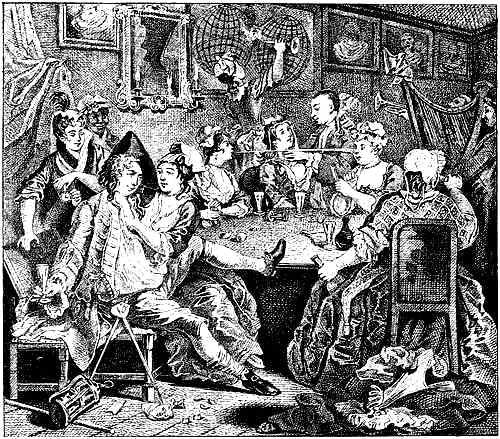
TAVERN SCENE FROM ‘THE RAKE’S PROGRESS.’
The Jacobites, faithful to their traditional ally, continued to toast ‘the King over the water’ by passing glasses charged with the sparkling wine of France across a bowl filled to the brim with the pure element. The middle classes clung to their beer, or at most indulged in Port and punch; whilst the lower orders seem to have become seized with that insane passion for ardent spirits which Hogarth satirised in his ‘Gin Lane,’ and hailed with glee Sir Robert Walpole’s
‘attempt,
Superior to Canary or Champagne,
Geneva salutiferous to enhance.’[325]
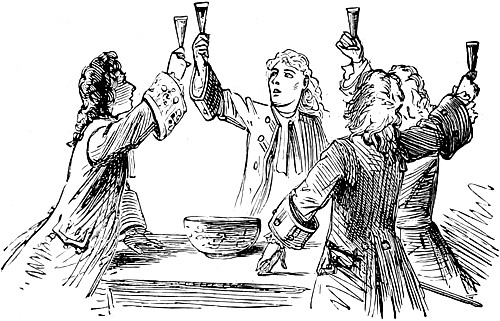
‘THE KING OVER THE WATER.’
The registered imports of the wines of France—though figures in this respect are, we admit, exceedingly deceptive—show a continuous falling off, which reached its lowest ebb in 1746, during war time; and we may be certain that when, after supper,
‘Champagne was the word for two whole hours by Shrewsbury clock,’[326]
it was at the cost of a pretty penny. Although the recorded imports of French wines show but little improvement with the return of peace in 1748, we gather from other sources that the Champagne of 1749 met with a ready market over here, and find Bertin du Rocheret writing exultingly to his friend, the Marquis de Calvières, that the Champenois were making the English pay the cost of the war.
The voluminous correspondence of Bertin du Rocheret gives some curious information as to the manner in which the Champagne trade was carried on with England during the second quarter of the eighteenth century. From 1725 to 1754 he was in constant communication with Mr. James Chabane, who seems to have been the Court wine-merchant, and to whom he despatched at first ten, but during the latter portion of their transactions seldom more than four, pièces of wine annually during the winter months.[327] As regards the particular vintage consumed in England, a preference evidently existed for that of Ay, though it really appears as if Bertin was wont to introduce under this name the then far cheaper growths of Avize. Such, at any rate, seems to have been the case with the parcel of wine divided, in 1754, between King George in London and King Stanislas at Nancy. Referring to the wines of Hautvillers and Sillery, Bertin writes to Chabane in 1731, that a year’s notice must be given in advance to obtain them. A liquoreux wine was then preferred, as in 1732 he remarks, respecting the yield of the preceding year, that the English are as mad after liqueur as the French; and it is evident that the taste continued, as in 1744 he announces the departure for London of eleven poinçons liquoreux.
Not only was Chabane accustomed to bottle these wines, but while doing so was able to insure to them a semi-sparkling character. With this view Bertin tells him, in 1731, that he must not keep them in cask after the three sèves, or motions of the sap of April, June, or August, except in the case of a pièce from ‘the clos’ reserved ‘for the supply of the Court,’ and intended to be drunk as still wine. Some wine despatched in 1754 is recommended to be bottled during the first quarter of the moon.[328] In addition to the wine thus sent in casks, Bertin was also accustomed to send his correspondent a certain quantity in bottles. In 1725 he quotes for him ‘flacons blancs mousseux liqueur,’ at from 30 to 50 sols, and ‘ambrés non-mousseux sablant,’ at 25 sols. These flasks were all despatched to Dunkirk or into Holland, whence they were smuggled to their ultimate destination, for the introduction of wine in bottles into England was rigidly prohibited until the close of 1745, when it was legalised by Act of Parliament.[329]
SCENE AT VAUXHALL GARDENS
(From an engraving after a drawing by Gravelot).
Horace Walpole, who deals with men rather than manners, with sayings rather than doings, and whose forte is epigram and not description, has little to tell us about the drinking customs of his day. The strictly temperate regimen that marked his later years, and rendered him unfit for mere convivial gatherings, extended to his writings, and he seldom permits his pen to expatiate on those pleasures in which he sought no share. Even in his letters from Reims, written in 1739, when he was doing the grand tour, he omits all mention of the wine for which that city is famed. Still he incidentally furnishes a few instances of the esteem in which Champagne was held by the upper classes in the middle of the eighteenth century. In a letter to George Montague, dated June 23, 1750, he describes how Lord Granby joined his party at Vauxhall whilst suffering considerably under the influence of the Champagne he had consumed at ‘Jenny’s Whim,’ a noted tavern at Chelsea; and writing to Sir Horace Mann, a year later, he says that the then chief subjects of conversation in London were the two Miss Gunnings and an extravagant dinner at White’s.
‘The dinner was a frolic of seven young men, who bespoke it to the utmost extent of expense; one article was a tart made of duke cherries, from a hothouse; and another, that they tasted but one glass out of each bottle of Champagne. The bill of fare has got into print, and with good people has produced the apprehension of another earthquake.’[330]
The Earl of March, afterwards ‘Old Q,’ in a letter to Walpole’s friend, George Selwyn, in November 1766, writes: ‘I have not yet received some Champaign that Monsieur de Prissieux has sent me.’[331] And we find Horace Walpole’s fair foe, that eighteenth-century exemplar of strong-minded womanhood, Lady Mary Wortley Montague, whose letters indicate a penchant for Burgundy, acknowledging in verse the exhilarating effects of Champagne. Of the beaux of 1721 she says that
‘They sigh, not from the heart but from the brain,
Vapours of vanity and strong Champagne.’[332]
Better known by far are her oft-quoted lines,
‘But when the long hours of the public are past,
And we meet with Champagne and a chicken at last,
May every fond pleasure that moment endear,
Be banished afar both discretion and fear,’[333]
which drew from Byron the terror-stricken comment, ‘What say you to such a supper with such a woman?’[334]
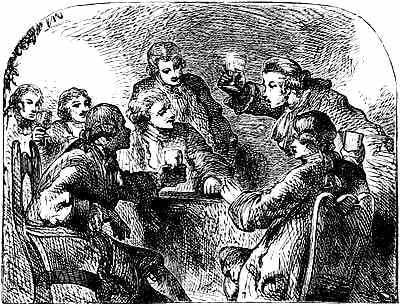
During the third quarter of the eighteenth century a cloud dims the lustre of Champagne. It was then looked upon by a vast majority as only a fit accompaniment to masquerades, ridottos, ultra-fashionable dinners, and Bacchanalian suppers. ‘The Champaign made some eyes sparkle that nothing else could brighten,’[335] says the contemporary account of one of those scenes of shameless revelry held under the title of masquerades at the Pantheon, and the orgies that, under the auspices of Mrs. Cornelys, disgraced Carlisle House were mainly inspired by the consumption of the same wine. The citizens of the Georgian era, who had lost the tastes of their fathers, hated French wines simply because they were French; and the hundred thousand gallons imported on an average annually from 1750 to 1786 were entirely consumed amongst the upper or the dissipated classes. Though smuggling was still looked upon as patriotic, if not loyal, those engaged in it had discovered that, thanks to the combined effects of duty and demand, Nantes brandy and Hollands gin paid better. What, indeed, is to be thought of the taste of an era that produced poets whose muse sought inspiration in punch, and who had the sublime audacity to extol the rum of the West Indies above the produce of ‘Marne’s flowery banks’?[336] Only a few of the higher-class men, however, engaged in literature and art seem to have retained a preference for French wine. The accounts of the Literary Club established by Sir Joshua Reynolds show the average consumption at each sitting to have been half a bottle of Port and a bottle of Claret per head. Johnson drank Port mixed with sugar from about 1752 to 1764; became a total abstainer until 1781, and then seems to have given the preference to Madeira.
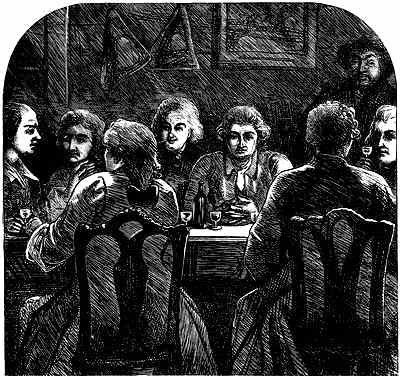
THE LITERARY CLUB.
In contemporaneous comedy we are pretty sure to find the mirror held up to fashion, if not to Nature; and turning to the playwrights of that day, it is easy to cull a few confirmatory excerpts. Thus we have Sterling, the ambitious British merchant, in order to do honour to his noble guests, preparing to
‘give them such a glass of Champaign as they never drank in their lives; no, not at a duke’s table.’[337]
While Lord Minikin, the peer of fashion, makes his entrance on the stage, exclaiming:
‘O my head! I must absolutely change my wine-merchant; I cannot taste his Champaigne without disordering myself for a week.’[338]
On Miss Tittup inquiring if his depression is due to losses at cards, he replies,
‘No, faith, our Champaigne was not good yesterday.’[339]
Jessamy, his lordship’s valet, profits of course by so aristocratic an example; and when speaking of his exploits at the masquerade, says,
‘I was in tip-top spirits, and had drunk a little too freely of the Champaigne, I believe.’[340]
With Philip the butler, ‘Burgundy is the word,’ and from the choicest vintages of his master’s cellar he places on the table ‘Claret, Burgundy, and Champaign; and a bottle of Tokay for the ladies;’[341] while Port is characterised by the Duke’s servant as ‘only fit for a dram.’[342] Mrs. Circuit presses the guests at a clandestinely-given repast to ‘taste the Champagne;’ and her husband, the Sergeant, is surprised on his return home to find that they have been so indulging:
‘Delicate eating, in truth; and the wine [Drinks] Champagne, as I live! Must have t’other glass ... delicate white wine, indeed! I like it better every glass.’[343]
Such is his comment.
The effects of the wine are characterised in the following fashion by Garrick, when Sparkish, entering, according to the stage directions, ‘fuddled,’ declares that
‘when a man has wit, and a great deal of it, Champaign gives it a double edge, and nothing can withstand it; ’tis a lighted match to gunpowder; the mine is sprung, and the poor devils are tossed heels uppermost in an instant.’[344]
LORD MINIKIN.
We greet, too, what was perhaps the first appearance of a joke now grown venerable in its antiquity in a farce of Foote’s, the scene of which is laid at Bath. He introduces us to a party of pseudo-invalids devoting their whole time and attention to conviviality, recruiting their debilitated stomachs with turtle and venison, and alternating Bath waters with the choicest vintages, so that the hero Racket is fain to observe to one of them,
‘My dear Sir Kit, how often has Dr. Carawitchet told you that your rich food and Champaigne would produce nothing but poor health and real pain?’[345]
And how many gentlemen in difficulties have not since followed the example set by Harry Dornton in the spunging-house, and ordered, as a consolation,
‘a bottle of Champagne and two rummers’![346]
Turning from fancy to fact, we find Sir Edward Barry furnishing some particulars respecting the Champagne wines consumed in England during the latter half of the last century.[347] He informs us at the outset that
‘the wines of Champaign and Burgundy are made with more care than any other French wines; and the vaults in which the former are preserved are better than any other in France. These wines, from their finer texture and peculiar flavour, cannot be adulterated without the fraud being easily discovered, and are therefore generally imported pure, or by proper care may be certainly procured in that state.’
His remarks evidently refer to the still wines, as he proceeds to explain that ‘the Champaign River Wines are more delicate and pale than those which are distinguished from them by the name of Mountain gray Wines,’ the latter being more durable and better suited for exportation, whilst the former, if allowed to remain too long in the cask, acquire a taste from the wood, although keeping in flasks from four to six years without harm. Referring to the taste of the day, he explains that
‘among the River Wines the Auvillers and Epernay are most esteemed, and among the Mountain Wines the Selery and St. Thyery, and in general such as are of the colour of a partridge’s eye. These are likewise distinguished for their peculiar grateful pungency and balsamic softness, which is owing to the refined saline principle which prevails more in them than in the Burgundy Wines, on which account they are less apt to affect the head, communicate a milder heat, and more freely pervade and pass through the vessels of the body.... To drink Champaign Wines in the greatest perfection, the flask should be taken from the vault a quarter of an hour before it is drunk, and immersed in ice-water, with the cork so loose in it as is sufficient to give a free passage to the air, and yet prevent too great an evaporation of its spirituous parts.’
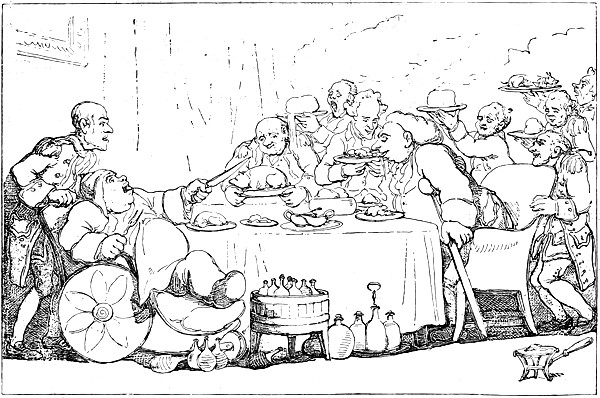
HIGH LIVING AT BATH
(After Rowlandson, in the New Bath Guide).
The foregoing practice still obtains with Sillery, classed by Barry as the first of the Mountain growths, and in the highest favour in England throughout the remainder of the century. Regarding sparkling wine, of which he was evidently no admirer, he adds:
‘For some years the French and English have been particularly fond of the sparkling frothy Champaigns. The former have almost entirely quitted that depraved taste, nor does it now so much prevail here. They used to mix some ingredients to give them that quality; but this is unnecessary, as they are too apt spontaneously to run into that state; but whoever chooses to have such Wines may be assured that they will acquire it by bottling them any time after the vintage before the month of the next May; and the most sure rule to prevent that disposition is not to bottle them before the November following. This rule has been confirmed by repeated experiments.’
On the signature of the Treaty of Peace with France in 1783, it had been stipulated that a Treaty of Commerce should likewise be concluded; and in 1786, under the auspices of Pitt, a treaty of this character was made, the first article providing that ‘The wines of France imported directly from France into Great Britain shall in no case pay any higher duties than those which the wines of Portugal now pay.’ Pitt, spite of his well known penchant for Port, had yet a sneaking liking for Champagne, arising no doubt from his early familiarity with the wine when he went to Reims to study, after leaving the University of Cambridge. It was with Champagne that he was primed on the memorable occasion when he, Lord Chancellor Thurlow, and Mr. Secretary Dundas galloped after dusk through an open turnpike-gate without paying toll, and only just missed receiving the contents of a loaded blunderbuss, which the turnpike man, fancying they were highwaymen, fired after them. The party had been dining with the President of the Board of Trade at Addiscombe, and a rhymester of the epoch commemorated the incident in the following lines:
‘How as Pitt wandered darkling o’er the plain,
His reason drowned in Jenkinson’s Champagne,
A rustic’s hand, but righteous fate withstood,
Had shed a premier’s for a robber’s blood.’
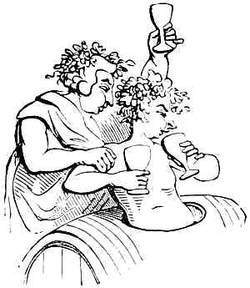
DUNDAS AND PITT AS SILENUS AND BACCHUS
(After Gilray).
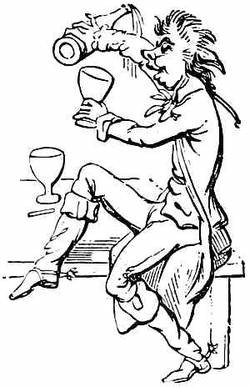
WILLIAM PITT
(After Gilray).
Tickell has noted the appreciation of Brooks’ Champagne shown by Pitt’s great rival in the lines addressed to Sheridan, and purporting to be an invitation to supper from Fox. The illustrious member for Westminster promises his guest that
‘Derby shall send, if not his plate, his cooks,
And know I’ve bought the best Champaign from Brooks.’[348]
Brooks’ Club enjoyed a high reputation for its Champagne, and we find Fighting Fitzgerald emptying three bottles there without assistance, the same evening on which he bullied the members into electing him.[349]
The year after the Treaty of Commerce was signed, we have an anonymous writer remarking[350] that in time of peace the English drew large quantities of wine from Bordeaux and Nantes, and that the other French wines they were in the habit of consuming were those of Mantes, Burgundy, and Champagne, shipped respectively from Rouen, Dunkirk, and Calais. Arthur Young, writing at the same time, remarks, apropos of Champagne, that the trade with England ‘used to be directly from Epernay; but now the wine is sent to Calais, Boulogne, Montreuil, and Guernsey, in order to be passed into England they suppose here by smuggling. This may explain our Champagne not being so good as formerly.’[351] It is to be hoped that neither Arthur Young nor other connoisseurs of Champagne had been enticed into drinking as the genuine article any of the produce of the vineyard which the Hon. Charles Hamilton had planted with the Auvernat grape near Cobham, in Surrey, and which was said to yield a wine ‘resembling Champagne.’[352]
The reduction of duty consequent upon the treaty as a matter of course largely increased the importation of French wine. Respecting the taste for Champagne then prevailing in England, and the price the wine commanded, a few interesting particulars are afforded by the early correspondence and account-books of Messrs. Moët & Chandon of Epernay, which we have courteously been permitted to inspect. From these we find that in October 1788 the Chevalier Colebrook, writing in French to the firm from Bath, asks that seventy-two bottles of Champagne may be sent to his friend, the Hon. John Butler of Molesworth-street, Dublin, ‘who, if content with the wine, will become a very good customer, being rich, keeping a good house, and receiving many amateurs of vin de Champagne.’ The writer is no doubt the ‘M. Collebrock’ to whom the firm shortly afterwards forward fifty bottles of ‘vin non mousseux, 1783,’ on his own account. Messrs. Carbonnell, Moody, & Walker, predecessors of the well-known existing firm of Carbonnell & Co., London, in a letter dated November 1788, and also written in French, say: ‘If you can supply us with some Champagne of a very good body, not too much charged with liqueur, but with an excellent flavour, and not at all moussu, we beg you to send two ten dozen baskets. Also, if you have any dry Champagne of very good flavour, solidity, and excellent body, send two baskets of the same size.’
The taste of the day was evidently for a full-bodied non-sparkling wine; and this is confirmed by Jeanson, Messrs. Moët’s traveller in England, who writes from London in May 1790: ‘How the taste of this country has altered within the last ten years! Almost everywhere they ask for a dry wine; but they want a wine so vinous and so strong, that there is hardly anything but Sillery that will satisfy them.’ Additional confirmation is found in a letter, written from London in May 1799 to Messrs. Moët, by a Mr. John Motteux, complaining of delay in the delivery of a parcel of wine said to have been sent off by way of Havre, and very likely destined to be surreptitiously introduced into England viâ Guernsey. He asks for a further supply of Sillery, if its safe arrival can be guaranteed, and remarks, ‘There is nothing to be compared to Sillery when it is genuine; it must not have the least sweetness nor mousse.’[353]
During the great French war, patriotism and increased duties might have been expected to check the import of French wines; yet, if statistics are worth anything, the reverse would appear to have been the case. The registered imports, which from 1770 to 1786 had fluctuated between 80,000 and 125,000 gallons, rose during the last fourteen years of the century to an average of 550,000 gallons per annum. In those fighting, rollicking, hard-drinking times, when it was a sacred social duty to toast ‘great George our King’ on every possible occasion, Champagne continued to be ‘the wine of fashion.’ The sparkling variety was terribly costly, no doubt, and was often doled out, as Mr. Walker relates, ‘like drops of blood.’[354] But whilst the stanch admirers of Port might profess to despise Champagne as effeminate, and the ‘loyal volunteers’ condemn it as the produce of a foeman’s soil, there were plenty to sing in honour of ‘The Fair of Britain’s Isle:’
‘Fill, fill the glass, to beauty charge,
And banish care from every breast;
In brisk Champaign we’ll quick discharge,
A toast shall give the wine a zest.’[355]
Indeed, the greatest of England’s naval heroes was not insensible to the attractions of this gift from ‘our sweet enemy France.’ In October 1800 Nelson, together with Sir William and Lady Hamilton, was a guest of Mr. Elliot, the British Resident at Dresden. At dinner Lady Hamilton drank more Champagne than the narrator of this little incident imagined it was possible for a woman to consume, and inspired thereby, insisted on favouring the company with her imitations of classical statuary. Nelson thereupon got uproarious, and went on emptying bumper after bumper of the same fluid in honour of the fair Emma, and swearing that she was superior to Siddons. The host kept striving ‘to prevent the further effusion of Champagne,’ but did not succeed till Sir William in his turn had astonished all present with a display of his social talents. The grave diplomatist lay down on his back, with his arms and legs in the air, and in this position bounded all round the room like a ball, with his stars and ribbons flying around him.[356]
If we may give credit to Tom Moore, ‘the best wigged prince in Christendom,’ who was subsequently to ‘d—— Madeira as gouty,’ and bring Sherry into fashion, preferred stronger potations than those produced on the banks of the Marne. In one of the poet’s political skits the Prince is introduced soliloquising à la Jemmy Thompson—
‘O Roman Punch! O potent Curaçoa!
O Maraschino! Maraschino O!
Delicious drams’[357]—
and describing his favourite luncheon as ‘good mutton cutlets and strong curaçoa.’[358] Nevertheless, the First Gentleman in Europe did consume Champagne; but it was concentrated in the form of punch, especially devised for him, and indulged in by him in company with Barrymore, Hanger, and their fellows.[359]
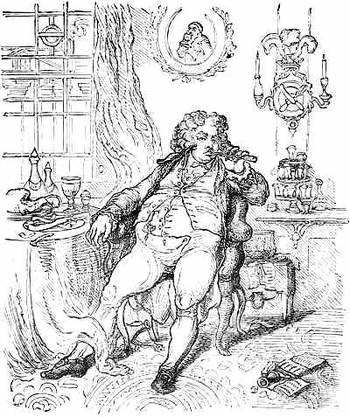
THE PRINCE REGENT
(After Gilray).
His sometime model and subsequent victim, poor Brummell, is said to have put the wine to a still more ignoble use. One day a youthful beau approached the great master in the arts of dress and deportment, and said, ‘Permit me to ask you where you get your blacking?’ ‘Ah,’ replied Brummell, gazing complacently at his boots, ‘my blacking positively ruins me. I will tell you in confidence it is made with the finest Champagne.’[360] Probably the great dandy was merely quizzing his interlocutor, though such an act of extravagance would have been a pull on even the longest purse in those days, ‘your bottle of Champagne in the year 1814 costing you a guinea.’[361]
As to the Prince Regent’s brothers, we know that the Duke of York was such a powerful toper, that ‘six bottles of Claret after dinner scarce made a perceptible change in his countenance,’[362] and remember the Duke of Clarence making his appearance at the table of the Royal household at Windsor, and getting so helplessly drunk on Champagne as to be utterly incapable of keeping his promise to open the ball that evening with his sister Mary.[363] Two prominent orators of that day are credited with mots upon Champagne. Curran said, apropos of the rapid but transient intoxication produced by this wine, that ‘Champagne made a runaway rap at a man’s head;’ while Canning maintained that any man who said he really liked dry Champagne simply lied.
After Waterloo, although a few gourmets continued to prefer the still wine, sparkling Champagne became the almost universally accepted variety. Nevertheless, Henderson, while noting that ‘by Champagne wine is usually understood a sparkling or frothy liquor,’ gives the foremost place to the wine of Sillery, which, he remarks, ‘has always been in much request in England, probably on account of its superior strength and durable quality.’ He extols the Ay wine as ‘an exquisite liquor, lighter and sweeter than the Sillery, and accompanied by a delicate flavour and aroma somewhat analogous to that of the pine-apple.’[364]
The poets of the first half of the present century have hardly done justice to Champagne. Tom Moore, the most Anacreontic of them all, although ready, like his Grecian prototype, to ‘pledge the universe in wine,’ the merits of which he was continually chanting in the abstract, has seldom been so invidious as to particularise any especial vintage. Champagne, the wine of all others best fitted to inspire his bright and sparkling lyrics, has received but scant attention in his earlier productions. Bob Fudge, writing from Paris in 1818, is made to speak approvingly of Beaune and Chambertin, but only mentions Champagne as a vehicle in which to sauter kidneys;[365] and in the Sceptic it is simply brought in to point a moral respecting the senses:
‘Habit so mars them, that the Russian swain
Will sigh for train-oil while he sips Champagne.’[366]
In two instances only the poet who sang in such lively numbers of woman and wine pointedly refers to the vintage of the Champagne. One is when he says:
‘If ever you’ve seen a party
Relieved from the presence of Ned,
How instantly joyous and hearty
They’ve grown when the damper was fled.
You may guess what a gay piece of work,
What delight to Champagne it must be,
To get rid of its bore of a cork,
And come sparkling to you, love, and me.’[367]
And his description of a summer fête is indeed
‘a mere terrestrial strain
Inspired by naught but pink Champagne;’[368]
such as might be penned
‘While as the sparkling juice of France
High in the crystal brimmers flowed,
Each sunset ray, that mixed by chance
With the wine’s diamond, showed
How sunbeams may be taught to dance;’[369]
with the final result that
‘Thus did Fancy and Champagne
Work on the sight their dazzling spells,
Till nymphs that looked at noonday plain
Now brightened in the gloom to belles.’[370]
Moore’s Diary, however, proves that if he did not care to praise the wine in verse, it was not for want of opportunities of becoming acquainted with it. Witness his ‘odd dinner in a borrowed room’ at Horace Twiss’s in Chancery-lane, with the strangely incongruous accompaniments of ‘Champagne, pewter spoons, and old Lady Cork.’[371]
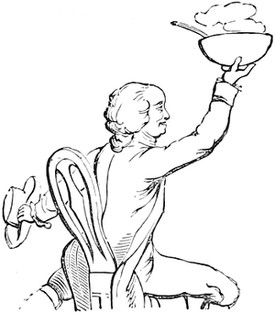
CAPTAIN CHARLES MORRIS
(After Gilray).
As to that most convivial of songsters, Captain Charles Morris, poet-laureate of the Ancient Society of Beefsteaks, he labours under a similar reproach. Though he has filled several hundred octavo pages of his Lyra Urbanica with verses in praise of wine, the liquor with which he crowns ‘the mantling goblet,’ ‘the fancy-stirring bowl,’ or ‘the soul-subliming cup,’ usually figures under some such fanciful designation as ‘the inspiring juice,’ ‘the cordial of life,’ or ‘Bacchus’ balm.’ Champagne he evidently ignores as a beverage of Gallic origin, utterly unfitted for the praise of so true a Briton as himself; and the only vintage which he does condescend to mention with approbation is the favourite one of our beef-eating, hard-drinking, frog-hating forefathers, ‘old Oporto’ from ‘the stout Lusitanian vine.’
Strange as it may seem, the manlier Muse of Scott used at times to dip her wing into the Champagne cup, although she has failed to express any verbal gratitude to this source of inspiration. ‘In truth,’ says his biographer, ‘he liked no wines except sparkling Champaign and Claret; but even as to this last he was no connoisseur, and sincerely preferred a tumbler of whisky-toddy to the most precious liquid ruby that ever flowed in the cup of a prince. He rarely took any other potation when alone with his family; but at the Sunday board he circulated the Champaign briskly during dinner, and considered a pint of Claret each man’s fair share afterwards.’[372] Scott himself, wearied with a round of London festivities, is impelled to write, ‘I begin to tire of my gaieties. I wish for a sheep’s head and whisky-toddy against all the French cookery and Champaign in the world.’[373] Lockhart, in his Life of Scott, notes the excellent flavour of some Champagne sent to Abbotsford by a French admirer of the Northern Wizard in return for a set of his works, and more than once incidentally refers to the presence of the wine at Scott’s table on festive gatherings.
Byron, who furnished in the course of his career a practical exemplification of the maxim that
[324] The Rake’s Progress, or the Humours of Drury Lane: a poem published in 1735, to accompany a set of prints pirated from Hogarth’s.
[325] Blunt’s Geneva: a poem dedicated to Sir R. Walpole, 1729.
[326] Hoadley’s Suspicious Husband, act iv. sc. 1, 1747.
[327] This wine, though sometimes sent by way of Dunkirk, was usually forwarded viâ Calais, by the intermediary of a Sieur Labertauche, a commission-agent at that port, the cost of transport from Epernay to Calais being from 70 to 75 livres per queue. A bobillon of wine was sent with each lot of casks for filling up. Moreover, from 1731 Bertin annually despatches a certain quantity of cream of tartar, destined to cure the ropiness to which all white wines were especially subject before the discovery that tannin destroys the principle engendering this disease.
[328] Chabane appears to have been fully cognisant of the method of collage and soutirage (fining and racking) practised in the Champagne; and Bertin, in one of his letters dated July 1752, mentions the enclosure of a receipt for a kind of collage, by following which all necessity to dépoter the bottles is obviated. This enclosure is unfortunately lost.
[329] Ms. correspondence of Bertin du Rocheret, quoted by M. Louis Perrier in his Mémoire sur le Vin de Champagne. M. Perrier states that the prohibition was removed by an act of the 1st Nov. 1745; and a letter of Bertin to Chabane, the following year, bears this out. It is therefore singular to find the following entry in Bubb Doddington’s Diary, under the date of Feb. 1, 1753: ‘Went to the House to vote for liberty to import Champaign in bottles. Lord Hillsborough moved it; Mr. Fox seconded it. We lost the Motion. Ayes, 74; Noes, 141.’
[330] Letter to Sir Horace Mann, June 18, 1751.
[331] Jesse’s Selwyn and his Contemporaries. It is very probable that the name printed as Prissieux is really Puissieux, a title of the Sillery family.
[332] Lady Mary Wortley Montague’s Letter from Arthur Grey, the Footman, to Mrs. Murray. Written in the autumn of 1721.
[333] Lady M. W. Montague’s The Lover. This is generally designated ‘a ballad to Mr. Congreve,’ but is headed in Lady Mary’s note-book, ‘To Molly,’ and, as Mr. Moy Thomas has suggested, was probably addressed to Lord Hervey, Pope’s ‘Lord Fanny.’
[334] Note to his Letter on Bowles.
[335] Westminster Magazine, 1774.
[336] Grainger’s The Sugar Cane, 1764.
[337] Coleman and Garrick’s Clandestine Marriage, act i. sc. 2, 1766.
[338] Garrick’s Bon Ton, or High Life above Stairs, act i. sc. 2, 1775.
[339] Ibid.
[340] Ibid. act ii. sc. 1.
[341] Townley’s High Life below Stairs, act ii. sc. 1, 1759.
[342] So in Mrs. Cowley’s Which is the Man? Burgundy is extolled and ‘vile Port’ denounced; and in Cumberland’s The Fashionable Lover (1772) a sneer is levelled at a ‘paltry Port-drinking club.’ Burgundy, too, is in favour in Holcroft’s The Road to Ruin, 1792.
[343] Foote’s The Lame Lover, act iii. sc. 1, 1770.
[344] Garrick’s The Country Girl, act v. sc. 1.
[345] Foote’s The Fair Maid of Bath, act i. sc. 1, 1771.
[346] Holcroft’s The Road to Ruin, act iv. sc. 2, 1792.
[347] Sir Edward Barry’s Observations, Historical, Critical, and Medical, on the Wines of the Ancients, and the analogy between them and Modern Wines, 1775.
[348] Tickell’s Poems.
[349] Timbs’ Clubs and Club Life.
[350] In the Encyclopédie Méthodique.
[351] Arthur Young’s Travels in France in the Years 1787–9.
[352] Sheen’s Wine and other fermented Liquors.
[353] Amongst other English customers of the firm in 1788, 1789, and 1790 were ‘Milords’ Farnham and Findlater, the latter of whom was supplied with 120 bottles of the vintage of 1788; Manning, of the St. Alban’s Tavern, London, who ordered 130 bottles of vin de Champagne, at 3 livres or 2 s. the bottle, to be delivered in the autumn by M. Caurette; Messrs. Felix Calvert & Sylvin, who took two sample bottles at 5 s.; and Mr. Lockhart, banker, of 36 Pall Mall, who in 1790 paid 3 s. per bottle for 360 bottles of the vintage of 1788. The high rate of exchange in our favour is shown by the 54 l. covering this transaction being taken as 1495 livres 7 sols 9 deniers, or about 28 livres per pound sterling.
[354] Walker’s The Original.
[355] ‘The Fair of Britain’s Isle’ (Convivial Songster, 1807).
[356] Diary of Mrs. Colonel St. George, written during her Sojourn amongst the German Courts in 1799 and 1800.
[357] Moore’s The Twopenny Post-bag, 1813.
[358] Moore’s Parody of a Celebrated Letter.
[359] The compound known as ‘the Regent’s Punch’ was made out of 3 bottles of Champagne, 2 of Madeira, 1 of hock, 1 of curaçoa, 1 quart of brandy, 1 pint of rum, and 2 bottles of seltzer-water, flavoured with 4 lbs. bloom raisins, Seville oranges, lemons, white sugar-candy, and diluted with iced green tea instead of water (Tovey’s British and Foreign Spirits).
[360] Captain Gronow’s Reminiscences.
[361] Ibid.
[362] Prince Puckler Muskau’s Letters.
[363] Miss Burney’s Memoirs.
[364] Henderson’s History of Ancient and Modern Wines, 1824. Henderson, who appears to have visited the Champagne in 1822, remarks of the remaining crûs of the province: ‘The wines of the neighbouring territories of Mareuil and Dizy are of similar quality to those of Ay, and are often sold as such. Those of Hautvillers, on the other hand, which formerly equalled, if not surpassed, the growths just named, have been declining in repute since the suppression of the monastery, to which the principal vineyard belonged.’
[365] Moore’s The Fudge Family Abroad, 1818.
[366] Moore’s The Sceptic.
[367] Moore’s Illustration of a Bore.
[368] Moore’s The Summer Fête, 1831.
[369] Ibid.
[370] Ibid.
[371] Moore’s Diary, June 1819.
[372] Lockhart’s Life of Sir Walter Scott.
[373] Scott’s Diary, November 15, 1826.