


автордың кітабын онлайн тегін оқу The Haunter of the Ring
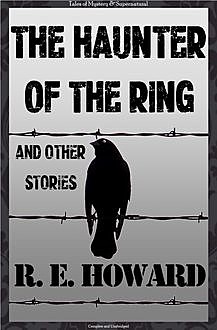
The Haunter of the Ring
and Other Tales
Robert E. Howard

with an Introduction by M. J. Elliott

WORDSWORTH CLASSICS
The Haunter of the Ring first published by Wordsworth Editions Limited in 2008
Introduction © M. J. Elliott 2008
Published as an ePublication 2014
ISBN 978 1 84870 506 7
Wordsworth Editions Limited 8B East Street, Ware, Hertfordshire SG12 9HJ
Wordsworth® is a registered trademark of Wordsworth Editions Limited
Wordsworth Editions
is the company founded in 1987 by
MICHAEL TRAYLER
All rights reserved. This publication may not be reproduced, distributed, or transmitted in any form or by any means, or stored in a database or retrieval system, without the prior written permission of the publishers.
Readers interested in other titles from Wordsworth Editions are invited to visit our website at
www.wordsworth-editions.com
For our latest list of printed books, and a full mail-order service contact
Bibliophile Books, Unit 5 Datapoint, South Crescent, London E16 4TLTel: +44 020 74 74 24 74 Fax: +44 020 74 74 85 89 orders@bibliophilebooks.comwww.bibliophilebooks.com
For my husbandANTHONY JOHN RANSON with love from your wife, the publisher Eternally grateful for your unconditional love, not just for me but for our children, Simon, Andrew and Nichola Trayler
Contents
Introduction
The Haunter of the Ring and Other Stories
In the Forest of Villefore
Wolfshead
The Dream Snake
The Hyena
Sea Curse
Skull-Face
The Fearsome Touch of Death
The Children of the Night
The Black Stone
The Thing On the Roof
The Horror from the Mound
People of the Dark
The Cairn on the Headland
Black Talons
Fangs of Gold
Names in the Black Book
The Haunter of the Ring
Graveyard Rats
Black Wind Blowing
The Fire of Asshurbanipal
Pigeons from Hell
For Gill
Introduction
Robert E. Howard and Conan the Barbarian – associating the author’s name with that of his most famous creation is an automatic response, like connecting Sir Arthur Conan Doyle with Sherlock Holmes or Ian Fleming with James Bond. But though Howard’s greatest literary achievement is certainly deserving of recognition, such familiarity comes at a cost; namely, that the Texan author’s many other works are almost always overlooked. This volume is dedicated to redressing that balance to some degree.
Spear and Fang, Howard’s first story for Weird Tales, was published in their July 1925 issue. The pulp magazine proudly described the author as one of their ‘literary discoveries’, and his suicide in 1936 at the age of 30 left a void no other contributor could fill.
In the Forest of Villefore and Wolfshead are the first two stories in a trilogy concerning the character of reluctant werewolf de Montour. The last part of the saga, Wolfsdung, was not published until many decades after Howard’s premature death. Though they appeared eight months apart in Weird Tales during the mid-1920s, Villefore serves as little more than a prologue for Wolfshead, which may go some way towards explaining its surprisingly abrupt ending. When de Montour comes to explain the events of the earlier chapter to the narrator of Wolfshead, note that for some reason the forest’s name has changed from Villefore to Villefere.
For the second de Montour story, Howard was granted the front-cover illustration of Weird Tales for the first time, but this honour came at an unexpectedly high price – artist E. M. Stevenson had the only copy of the manuscript, necessitating a complete rewrite from memory.
Howard had an inexplicable fondness for certain character names, and used them throughout his writings. Thus you will find within these pages more than one heroic Steve, and several individuals bearing the surname Gordon. The French werewolf Le Loup from In the Forest of Villefore bestows his name upon a bandit who appears in Howard’s first Solomon Kane adventure, Red Shadows (aka Solomon Kane).
Several of R. E. H.’s stories wear their influences upon their sleeves. The Hyena, from the March 1928 issue of Weird Tales, is suggestive of the works of Edgar Rice Burroughs and H. Rider Haggard, while Skull-Face – serialised in Weird Tales from the October to the December of 1929 – is clearly inspired by the Fu Manchu novels of Sax Rohmer, one of Howard’s favourite authors. Here, Kathulos, the Skull-Faced criminal mastermind of the title, takes the place of the villainous Fu Manchu (though rather than being Chinese, Kathulos is an Atlantean posing as an Egyptian). The fair Zuleika mirrors Rohmer’s heroine Karamaneh. Similarly, John Gordon is surely Sir Denis Nayland Smith by another name; even Gordon’s job description matches that of Fu Manchu’s arch-enemy: ‘My position with the British government is a unique and peculiar one,’ Gordon states. ‘I hold what might be called a roving commission – an office created solely for the purpose of suiting my special needs.’ The character of Li Kung no doubt obtained his name in a spooneristic manner from Kai Lung, the Chinese traveller and storyteller featured in six novels by Ernest Bramah.
The hero of Skull-Face, recovering opium addict Stephen Costigan, should not be confused with another Howard character, Sailor Steve Costigan, of over 30 boxing tales including Fist and Fang, Circus Fists, Texas Fists and Waterfront Fists. It is interesting (and somewhat disturbing) to read Stephen Costigan’s contemplation of suicide, given his creator’s own fate some seven years later. Howard/Costigan writes: ‘Naught remained now but to drown this dream as I had drowned all my others – swiftly and with hope that I should soon attain that Ultimate Ocean which lies beyond all dreams.’ The villain Kathulos likens Costigan to a barbarian, an accurate description given that Howard once claimed: ‘My study of history has been a continual search for newer barbarians, from age to age.’ The unfinished Gordon and Costigan story The Return of Skull-Face (aka Taveral Manor) was completed by Richard A. Lupoff in 1977.
In May 1928, the same year in which Howard’s Puritan adventurer Solomon Kane made his first appearance, the second instalment in his Faring Town saga, Sea Curse, appeared in the pages of Weird Tales. The first in the cycle of strange stories concerning the coastal district is a poem entitled The Legend of Faring Town. Of the two others chapters, little is known about The Horror at the Window, while another, Out of the Deep, first saw print in the Magazine of Horror over 30 years after Howard’s death.
Published in Weird Tales over the April and May of 1931, The Children of the Night is Howard’s first real reincarnation story, doubtless drawing inspiration from Jack London’s 1915 novel The Star Rover (known in the UK as The Jacket). R. E. H. would continue to explore the theme of a twentieth-century narrator experiencing a previous – and bloodier – existence throughout his writing career, each time with a significant twist. He also used it as the basis of his James Allison series (not to be confused with Jim Allison from 1936’s Graveyard Rats, boxer Kid Allison, or cowboy Steve Allison, alias the Sonora Kid). The earlier The Dream Snake (Weird Tales, February 1928), falls somewhere between past-life and premonition, and in The Black Stone (Weird Tales, November 1931) the protagonist witnesses an unholy ritual of a bygone age which, surprisingly, turns out not to be a case of regression.
The Children of the Night is the first of several Howard stories to incorporate references to H. P. Lovecraft’s Cthulhu Mythos – R. E. H. was put in touch with his fellow Weird Tales scribe in 1930, and the two became regular correspondents. Howard penned Children in the same month that he wrote to Lovecraft about his birthplace, Dark Valley Creek, Texas. The story begins with a discussion on genealogy, a subject close to Lovecraft’s heart, and includes men-tion of one of H. P. L.’s favourite authors, the British fantasist Arthur Machen. Howard presents a roster of ‘Great Old Ones’ – the ancient and impossibly powerful beings who once ruled our planet and may yet do so again – including Cthulhu, Yog-Sothoth, Tsathoggua, and Gol-goroth. No Lovecraft pastiche would be complete without reference to Lovecraft’s all-purpose forbidden tome the Necronomicon. Oddly, Howard refers to the volume being read in ‘the original Greek’, when, as any Mythos addict will tell you, it was written by the mad Arab Abdul Alhazred (Lovecraft’s childhood alias). The error is corrected in the later The Fire of Asshurbanipal. To this already tangled web, Howard adds his own ancient and mysterious volume Unaussprechlichen Kulten (also to be found in the 1931 story The Black Stone), written by Friedrich Wilhelm Von Junzt, whose fate is similar to that suffered by Abdul Alhazred in Lovecraft’s famous essay The History of the Necronomicon. H. P. L. returned Howard’s compliment by incorporating Unaussprechlichen Kulten into several of his own works, including The Man of Stone, The Shadow Out of Time and Dreams in the Witch-House. In the latter tale, H. P. L. suggested an English translation of Von Junzt’s title might be Nameless Cults. After reading it, Howard wrote to Lovecraft: ‘I feel honored that you should refer to Von Junzt’s accursed document and thanks for the German of Nameless Cults which I’ll use in referring to it.’
Children of the Night is one of two stories in this volume to feature academics John Kirowan and Eliot O’Donnel, both of which bear significant connections to Howard’s ancient fantasy sagas. The Pictish king Bran Mak Morn, also known as ‘The Dark Man’ (the title of a yarn from the issue of Weird Tales for December 1931) does not actually appear in Children, but the story is nevertheless accepted as a part of the Bran canon. Lovecraft made a sly reference to Bran in his 1930 science fiction/Mythos tale The Whisperer in Darkness.
The Haunter of the Ring (Weird Tales, June 1934), is tied to the Conan series via the evil sorcerer, Thoth-Amon. In his first appearance in 1932’s The Phoenix on the Sword, he is described as ‘Thoth-Amon of the Ring’. The ring in question is the Serpent Ring of Set, discovered by Thoth-Amon ‘in a nighted tomb a league beneath the earth, forgotten before the first man crawled out of the slimy sea’ and used by its fiendish owner to gain influence over King Ctesphon of Stygia. Here, the ring plays a sinister part in a tale of modern marital disharmony. Many pastiche writers have presented Thoth-Amon as an arch-enemy for the famous barbarian, but Phoenix marks his only proper appearance in the Conan series; he is mentioned briefly in The God in the Bowl and the only Conan novel, The Hour of the Dragon.
Despite its close connections to the Cthulhu Mythos, it is unlikely that the excessively prudish Lovecraft would have described the erotic ritual from The Black Stone in such detail as his equally famous pen-friend. The essential plot is familiar to Lovecraft devotees – an unnamed narrator (who might or might not be John Kirowan) goes in search of an ancient legend, only to find that it is in fact the literal truth and that a cult of worshippers has built up around an aquatic beast. Indeed, this would serve as a description of both Howard’s The Black Stone and Lovecraft’s The Call of Cthulhu (a story praised by the characters in Children of the Night). In a letter to H. P. L., Howard said of The Black Stone: ‘The story sounds as if I were trying, in my feeble and blunderingly crude way, to deliberately copy your style. Your literary influence on that particular tale, while unconscious on my part, was nonetheless strong. And indeed, many writers of the bizarre are showing your influence in their work, not only in Weird Tales but in other magazines as well; earlier evidence of an influence which will grow greater as time goes on, for it is inevitable that your work and art will influence the whole stream of American weird literature, and eventually the weird literature of the world’. Of the same story, he said to author August Derleth: ‘The Black Stone and other kindred yarns of mine . . . were written more as experiments than anything else, and I soon saw that they were not my natural style.’
1932 was a difficult year for Howard, with Fight Stories and Action Stories, one of the regular venues for his work, folding. Unsurprisingly, The Thing on the Roof – a sequel of sorts to The Black Stone – appeared in the February edition of Weird Tales, which at least published his fiction with incredible regularity, although they were not so reliable when it came to making payments. The story was initially rejected by editor Farnsworth Wright as ‘too erudite for the general reader’, though in truth it was Wright’s habit to turn down a submission before purchasing it at a later date. Three months later, the magazine presented its readers with Howard’s The Horror from the Mound, a far more personal work incorporating both the writer’s own background and a vivid description of his phobia concerning snakes. In a letter to Lovecraft written a month before its publication, he claimed ‘I’m trying to invest my native regions with surreal atmosphere, etched against a realistic setting.’ The story falls into the category of Howard’s ‘Weird Southwest’ sequence, along with Pigeons From Hell, an elaboration on the ‘spooky old house’ theme touched upon in The Fearsome Touch of Death (aka simply The Touch of Death – Weird Tales, February 1930). Pigeons, published two years after Howard’s death is, to date, the only one of Howard’s non-sword-and-sorcery works to have been adapted for the screen, in this case as an episode of the 1961 TV series Thriller, hosted by Boris Karloff.
After seeing Dark Valley again as an adult, Howard wrote perhaps his most famous and important reincarnation story, People of the Dark, which appeared not in his usual arena, but in Strange Tales magazine for June 1932. Editor Harry Bates purchased from Howard both People and another reincarnation story, The Cairn on the Headland (published in January 1933), and unlike Weird Tales, Bates’s title paid extremely well, ‘although,’ R. E. H. complained, ‘they kept me waiting awhile for the dough.’ People of the Dark is sometimes erroneously considered as a Conan story in the way that Children of the Night is a Bran Mak Morn story, but ‘Conan of the Reavers’, the barbarian in whose body the narrator finds himself during his past-life experience, is certainly not the Conan of Howard’s famous series. It is interesting, however, that upon his first appearance in The Phoenix on the Sword (written in March of 1932, and printed by Weird Tales in the December of that same year), Conan the Cimmerian is described in the opening paragraph as ‘a reaver’. The reptilian race featured here is clearly the same race described by Howard in both The Children of the Night and the Cthulhu-esque Bran Mak Morn story Worms of the Earth, published over a year later in the pages of Weird Tales, and described by H. P. Lovecraft in his essay In Memoriam: Robert Ervin Howard as a ‘macabre masterpiece’.
In the spring of 1933, Otis Adelbert Kline became Howard’s agent, and advised the young writer to attempt stories in different styles, in the hope of breaking new markets. Though not a lover of the detective genre, the writer nevertheless turned his hand to it, always, of course, incorporating an exotic twist of the sort common to his fantasy and horror tales. The effort paid off – Black Talons, aka Talons in the Dark, ran in the December 1933 issue of Strange Detective Stories. Steve Harrison, a tough cop with a Chinatown beat, appears in ten Howard detective tales, three of which are included in this edition. Fangs of Gold (aka People of the Serpent) was published in the February 1934 edition of Strange Detective Stories. Another Harrison mystery, known both as The Tomb’s Secret and Teeth of Doom, appeared in the same pulp title credited to ‘Patrick Ervin’. Like the earlier Skull-Face, Names in the Black Book (the May 1934 issue of Super-Detective Stories) has much in common with the Fu Manchu adventures, with the equally mysterious Erlik Khan taking the place of Kathulos as lord of the criminal underworld. Peculiarly, Names is a sequel to a story which had not appeared in print; Howard sold Lord of the Dead to Strange Detective, but the publication folded before it could appear. Thus, Erlik Khan (who has no apparent connection to Howard’s 1934 Oriental adventure The Daughter of Erlik Khan) is back from the dead, despite the fact that readers had not witnessed his apparent demise.
In Black Wind Blowing (Thrilling Mystery, June 1936), heroic farmer Emmett Glanton takes on the worshippers of Ahriman, the evil god of Mazdaism or Zoroastrianism (also known as angra mainyu). In the novel The Hour of the Dragon, Conan seeks the magical jewel known as the Heart of Ahriman, guarded in the 1984 film Conan the Destroyer by the wizard Thoth-Amon.
With its striking Weird Tales cover illustration by J. Allen St John, The Cthulhu Mythos story The Fire of Asshurbanipal (December 1936) could not be more different in mood and setting from Black Wind Blowing, but where Glanton’s strange experience has a tenuous link to R. E. H.’s Conan series, Steve Clarney’s lost city adventures might easily be mistaken for one of the Cimmerian’s outings, its shopping-list of Lovecraftian elements notwithstanding. L Sprague de Camp, author and Howard expert, rewrote a number of Howard’s historical and Oriental adventure tales – The Three-Bladed Doom, The Trail of the Bloodstained God, Hawks Over Shem – as Conan stories, and it is somewhat surprising that Asshurbanipal did not receive the same treatment since it resembles to some extent the final Conan tale, Red Nails.
It seems inevitable, then, that any consideration of Howard’s fiction must include reference to his most famous creation. This is only fitting, as Conan is one of the iconic characters of twentieth-century fiction. However, as a result the Conan stories tend to overshadow the author’s other work, its range and imagination, and to do a disservice to his readers, who have for far too long been unaware of the many other worlds and works of Robert E. Howard.
M. J. Elliott
M. J. Elliott is a member of the Crime Writers Association of Great Britain. His articles, fiction and reviews have appeared in SHERLOCK Magazine, Scarlet Street and Total D VD. For the radio, he has scripted episodes of The Further Adventures of Sherlock Holmes, The Classic Adventures of Sherlock Holmes, The Father Brown Mysteries, Raffles the Gentleman Thief, The Adventures of Harry Nile and Kincaid the Strangeseeker. He is the creator of The Hilary Caine Mysteries, which first aired in 2005. For Wordsworth, he has also edited The Whisperer in Darkness and The Loved Dead by H. P. Lovecraft, and The Right Hand of Doom by Robert E. Howard.
http://www.myspace.com/matthewjelliott
The Haunter of the Ringand Other Tales
In the Forest of Villefore
The sun had set. The great shadows came striding over the forest. In the weird twilight of a late summer day, I saw the path ahead glide on among the mighty trees and disappear. And I shuddered and glanced fearfully over my shoulder. Miles behind lay the nearest village . . . miles ahead the next.
I looked to left and to right as I strode on, and anon I looked behind me. And anon I stopped short, grasping my rapier, as a breaking twig betokened the going of some small beast. Or was it a beast?
But the path led on and I followed, because, forsooth, I had naught else to do.
As I went I bethought me, ‘My own thoughts will rout me, if I be not aware. What is there in this forest, except perhaps the creatures that roam it, deer and the like? Tush, the foolish legends of those villagers!’
And so I went and the twilight faded into dusk. Stars began to blink and the leaves of the trees murmured in the faint breeze. And then I stopped short, my sword leaping to my hand, for just ahead, around a curve of the path, someone was singing. The words I could not distinguish, but the accent was strange, almost barbaric.
I stepped behind a great tree, and the cold sweat beaded my forehead. Then the singer came in sight, a tall, thin man, vague in the twilight. I shrugged my shoulders. A man I did not fear. I sprang out, my point raised.
‘Stand!’
He showed no surprise. ‘I prithee, handle thy blade with care, friend,’ he said.
Somewhat ashamed, I lowered my sword.
‘I am new to this forest,’ I quoth, apologetically. ‘I heard talk of bandits. I crave pardon. Where lies the road to Villefore?’
‘Corbleu, you’ve missed it,’ he answered. ‘You should have branched off to the right some distance back. I am going there myself. If you may abide my company, I will direct you.’
I hesitated. Yet why should I hesitate?
‘Why, certainly. My name is de Montour, of Normandy.’
‘And I am Carolus le Loup.’
‘No!’ I started back.
He looked at me in astonishment.
‘Pardon,’ said I; ‘the name is strange. Does not loup mean wolf?’
‘My family were always great hunters,’ he answered. He did not offer his hand.
‘You will pardon my staring,’ said I as we walked down the path, ‘but I can hardly see your face in the dusk.’
I sensed that he was laughing, though he made no sound.
‘It is little to look upon,’ he answered.
I stepped closer and then leaped away, my hair bristling.
‘A mask!’ I exclaimed. ‘Why do you wear a mask, m’sieu?’
‘It is a vow,’ he exclaimed. ‘In fleeing a pack of hounds I vowed that if I escaped I would wear a mask for a certain time.’
‘Hounds, m’sieu?’
‘Wolves,’ he answered quickly; ‘I said wolves.’
We walked in silence for awhile and then my companion said, ‘I am surprised that you walk these woods by night. Few people come these ways even in the day.’
‘I am in haste to reach the border,’ I answered. ‘A treaty has been signed with the English, and the Duke of Burgundy should know of it. The people at the village sought to dissuade me. They spoke of . . . a wolf that was purported to roam these woods.’
‘Here the path branches to Villefore,’ said he, and I saw a narrow, crooked path that I had not seen when I passed it before. It led in amid the darkness of the trees. I shuddered.
‘You wish to return to the village?’
‘No!’ I exclaimed. ‘No, no! Lead on.’
So narrow was the path that we walked single file, he leading. I looked well at him. He was taller, much taller than I, and thin, wiry. He was dressed in a costume that smacked of Spain. A long rapier swung at his hip. He walked with long easy strides, noiselessly.
Then he began to talk of travel and adventure. He spoke of many lands and seas he had seen and many strange things. So we talked and went farther and farther into the forest.
I presumed that he was French, and yet he had a very strange accent, that was neither French nor Spanish nor English, not like any language I had ever heard. Some words he slurred strangely and some he could not pronounce at all.
‘This path is often used, is it?’ I asked.
‘Not by many,’ he answered and laughed silently. I shuddered. It was very dark and the leaves whispered together among the branches.
‘A fiend haunts this forest,’ I said.
‘So the peasants say,’ he answered, ‘but I have roamed it oft and have never seen his face.’
Then he began to speak of strange creatures of darkness, and the moon rose and shadows glided among the trees. He looked up at the moon.
‘Haste!’ said he. ‘We must reach our destination before the moon reaches her zenith.’
We hurried along the trail.
‘They say,’ said I, ‘that a werewolf haunts these woodlands.’
‘It might be,’ said he, and we argued much upon the subject.
‘The old women say,’ said he, ‘that if a werewolf is slain while a wolf, then he is slain, but if he is slain as a man, then his half-soul will haunt his slayer forever. But haste thee, the moon nears her zenith.’
We came into a small moonlit glade and the stranger stopped.
‘Let us pause a while,’ said he.
‘Nay, let us be gone,’ I urged; ‘I like not this place.’
He laughed without sound. ‘Why,’ said he, ‘this is a fair glade. As good as a banquet hall it is, and many times have I feasted here. Ha, ha, ha! Look ye, I will show you a dance.’ And he began bounding here and there, anon flinging back his head and laughing silently. Thought I, the man is mad.
As he danced his weird dance I looked about me. The trail went not on but stopped in the glade.
‘Come,’ said I, ‘we must on. Do you not smell the rank, hairy scent that hovers about the glade? Wolves den here. Perhaps they are about us and are gliding upon us even now.’
He dropped upon all fours, bounded higher than my head, and came toward me with a strange slinking motion.
‘That dance is called the Dance of the Wolf,’ said he, and my hair bristled.
‘Keep off!’ I stepped back, and with a screech that set the echoes shuddering he leaped for me, and though a sword hung at his belt he did not draw it. My rapier was half out when he grasped my arm and flung me headlong. I dragged him with me and we struck the ground together. Wrenching a hand free I jerked off the mask. A shriek of horror broke from my lips. Beast eyes glittered beneath that mask, white fangs flashed in the moonlight. The face was that of a wolf.
In an instant those fangs were at my throat. Taloned hands tore the sword from my grasp. I beat at that horrible face with my clenched fists, but his jaws were fastened on my shoulders, his talons tore at my throat. Then I was on my back. The world was fading. Blindly I struck out. My hand dropped, then closed automatically about the hilt of my dagger, which I had been unable to get at. I drew and stabbed. A terrible, half-bestial bellowing screech. Then I reeled to my feet, free. At my feet lay the werewolf.
I stooped, raised the dagger, then paused, looked up. The moon hovered close to her zenith. If I slew the thing as a man its frightful spirit would haunt me for ever. I sat down waiting. The thing watched me with flaming wolf eyes. The long wiry limbs seemed to shrink, to crook; hair seemed to grow upon them. Fearing madness, I snatched up the thing’s own sword and hacked it to pieces. Then I flung the sword away and fled.