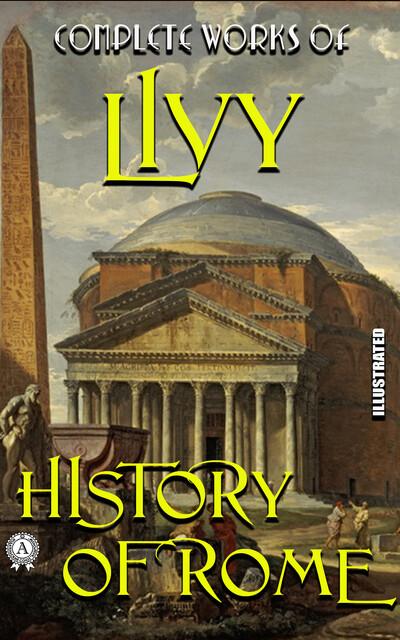



автордың кітабын онлайн тегін оқу Complete Works of Livy. History of Rome. Illustrated
THE COMPLETE WORKS OF TITUS LIVIUS PATAVINUS
HISTORY OF ROME
Illustrated
Livy wrote a monumental history of Rome and the Roman people, titled Ab Urbe Condita, ''From the Founding of the City''.
Seneca the Younger gives brief mention that he was also known as an orator and philosopher and had written some treatises in those fields from a historical point of view.
Livy also produced other works, including an essay in the form of a letter to his son, and numerous dialogues, most likely modelled on similar works by Cicero.
THE TRANSLATIONS
HISTORY OF ROME
Translated by B. O. Foster (Books 1 to 22) and William A. McDevitte (Books 23 to Fragments)
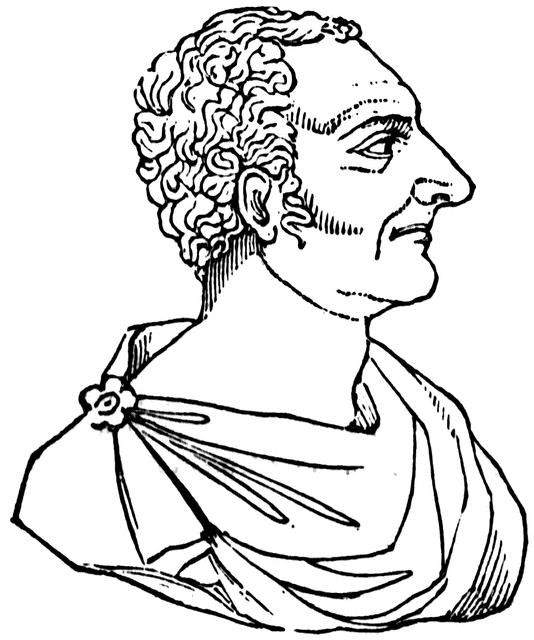
Ab urbe condita libri, Livy’s only surviving work, was commenced midway through the historian’s career, c. 27 BC, and completed when he left Rome for Padua in old age, following the death of Augustus, during the reign of Tiberius. It is a monumental history of ancient Rome, spanning the time from the stories of Aeneas, the earliest legendary period, before the city’s founding in c. 753 BC, to Livy’s own times in the reign of the emperor Augustus, up to 9 BC, finishing with the death of Drusus. The Latin title can be literally translated as “Books since the city’s founding”. Less literally in English, it is now known as ‘History of Rome’. Sadly only 25% of the work survives, though summaries of the missing books have survived from antiquity. Books 11 to 20 and books 46 to 140 are lost, leaving only 35 books extant, with 105 lost in total.
The first book of Ab urbe condita libri starts with Aeneas landing in Italy and the founding of Rome by Romulus and Remus, culminating with Lucius Junius Brutus and Lucius Tarquinius Collatinus being elected as consuls in 502 BC according to Livy’s own chronology (509 BCE according to more traditional chronology). There are a number of chronologies; these two dates represent an approximate range. Books 2 to 10 deal with the history of the Roman Republic to the Samnite Wars, while books 21 to 45 concern the Second Punic War and finish with the war against Perseus of Macedon. Books 46 to 70 deal with the time up to the Social War in 91 BC. Book 89 includes the dictatorship of Sulla in 81 BC and book 103 contains a description of Julius Caesar’s first consulship. Book 142 concludes with the death of Nero Claudius Drusus in 9 BC. Though the first ten books concern a period of over 600 years, once Livy started writing about the 1st century BC, he devoted almost a whole book to each year.
Livy’s style can be viewed as a mixture of annual chronology and narrative, where he often interrupts a story to announce the elections of new consuls. His history therefore is an expansion of the fasti, the official public chronicle kept by the magistrates, which was a primary source for Roman historians. Those who seem to have been more influenced by the method have been termed annalists. Nevertheless, Livy was criticised for contradicting himself in his History and for becoming repetitious and verbose in the later books. One particular infamous digression in Book 9 suggested that the Romans would have beaten Alexander the Great if he had lived longer and had turned west to attack the Romans, causing much wry amusement for modern critics.
The first five books of the Ab urbe condita libri were published between 27 and 25 BC. Livy continued to work on the project for much of the rest of his life, publishing new material by popular demand. This necessity explains why the work falls naturally into 12 packets, mainly groups of 10 books, or decades, sometimes of five books (pentads) and the rest without any packet order. The scheme of dividing it entirely into decades is a later innovation of copyists. The second pentade was not released until c. 9 BC, some 16 years following the first pentade.
The subject material of Livy’s history can vary from mythical or legendary stories at the beginning to detailed and authentic accounts of apparently real events toward the end of the great work. He himself noted the difficulty of finding information about events some 700 years or more removed from the author. Of his material on early Rome he said, “The traditions of what happened prior to the foundation of the City or whilst it was being built, are more fitted to adorn the creations of the poet than the authentic records of the historian.” Nonetheless, according to the tradition of history writing at the time, Livy felt compelled to relate what he read without passing judgement as to its truth or untruth. One of the problems of modern scholarship is to ascertain where in the work the line is to be drawn between legends and true historic events. The traditional modern view is that buildings, inscriptions, monuments and libraries prior to the sack of Rome in 387 BC by the Gauls under Brennus were destroyed by that sack and made unavailable to Livy and his sources. His credible history therefore is likely to begin with that date.
Ab urbe condita libri was enormously successful. Livy became so famous that a man from Cadiz reportedly travelled to Rome just to see the historian and once he had met with him, returned home. The popularity of the work continued through the entire classical period. A number of Roman authors used Livy as a basis for their own works, including Aurelius Victor, Cassiodorus, Eutropius, Festus, Florus, Granius Licinianus and Orosius.
PREFACE
THE Latin text of this volume has been set up from that of the ninth edition (1908) of Book I., and the eighth edition (1894) of Book II., by Weissenborn and Müller, except that the Periochae have been reprinted from the text of Rossbach (1910). But the spelling is that adopted by Professors Conway and Walters in their critical edition of Books I.-V. (Oxford, 1914), which is the source also of a number of readings which differ from those given in the Weissenborn-Müller text, and has furnished, besides, the materials from which the textual notes have been drawn up. I have aimed to indicate every instance where the reading printed does not rest on the authority of one or more of the good MSS., and to give the author of the emendation. The MSS. are often cited by the symbols given in the Oxford edition, but for brevity’s sake I have usually employed two of my own, viz. ω and ς. The former means “ such of the good MSS. as are not cited for other readings,” the latter “one or more of the inferior MSS. and early printed editions.” Anyone who wishes more specific information regarding the source of a variant will consult the elaborate apparatus of the Oxford text, whose editors have placed all students of the first decade under lasting obligations by their thorough and minute report of the MSS. With the publication of their second volume there will be available for the first time an adequate diplomatic basis for the criticism of Books I.-X.
I have utilized throughout the translations by Philemon Holland, George Baker, and Canon Roberts, and have occasionally borrowed a happy expression from the commentaries of Edwards, Conway, and others, mentioned in the introduction. The unpretentious notes in the college edition of my former teacher, the late Professor Greenough, have been particularly useful in pointing out the significance of the word-order.
Acknowledgments are also due to my colleagues, Professors Fairclough, Hempl, Cooper, and Briggs, and to Professor Noyes of the University of California, each of whom has given me some good suggestions.
B. O. F. Stanford University, California. 1919.
INTRODUCTION
I
From entries in Jerome’s re-working of the Chronicle of Eusebius we learn that Titus Livius the Patavian was born in 59 B.C., the year of Caesar’s first consulship, and died in his native town (the modern Padua) in 17 A.D. Of his parents nothing is known. They were presumably well-to-do, for their son received the training in Greek and Latin literature and in rhetoric which constituted the standard curriculum of that time, and was afterwards able to devote a long life to the unremunerative work of writing. That he was by birth an aristocrat is no more than an inference from his outstanding sympathy with the senatorial party. Livy’s childhood witnessed the conquest of Gaul and Caesar’s rapid rise to lordship over the Roman world. These early years he doubtless passed in his northern home. Patavium laid claim to great antiquity. Livy tells us himself in his opening chapter the legend of its founding by the Trojan Antenor, and elsewhere describes with unmistakable satisfaction the vain attempt of the Spartan Cleonymus (in 302 B.C.) to subdue the Patavians. They defended themselves with equal vigour and success against the aggressions of the Etruscans and the inroads of the Gauls, and in the war with Hannibal cast in their lot with Rome. In 49 B.C., when Livy was ten years old, the town became a Roman municipality and its citizens were enrolled in the Fabian tribe. The place was a great centre of trade, especially in wool, and under Augustus was perhaps the wealthiest city in Italy, next to Rome, to which in some respects it presented a striking contrast, since the Patavians maintained the simple manners and strict morality which had long gone out of fashion in the cosmopolitan capital. We cannot say how old Livy was when he left Patavium, but it is probable that his tastes and character had been permanently influenced by the old-world traditions of his native town. Did he go to Rome with the intention of pursuing there the career of a rhetorician and subsequently become interested in historical studies? It may have been so. Perhaps he had already resolved to write history and wished to make use of the libraries and other sources of information which were lacking in a provincial town. Certain passages in his earlier books indicate that he was already familiar with the City when he began his great work, about 27 B.C., and a reference to a conversation with Augustus in Book IV. seems to argue that it was not long till he was on a friendly footing with the Emperor. He doubtless continued to reside in Rome, with occasional visits to Patavium and other places in Italy, till near the end of his long life.
Livy seems never to have held any public office, but to have given himself up entirely to literature. Seneca says that he wrote dialogues which one might classify under history as well as under philosophy, besides books which were professedly philosophical. And Quintilian quotes a letter from Livy to his son which was very likely an essay on the training of the orator, for in the passage cited he advises the young man to read Demosthenes and Cicero, and then such as most nearly resembled them. So, in another place, Quintilian tells us that he finds in Livy that there was a certain teacher who bade his pupils obscure what they said. It may have been in this same essay that he made the criticism on Sallust which seemed to the elder Seneca to be unjust, — that he had not only appropriated a sentence from Thucydides but had spoilt it in the process. And there is another passage in Seneca where Livy is credited with having quoted approvingly a mot of the rhetorician Miltiades against orators who affected archaic and sordid words, which may also be an echo of the letter. If Livy was about thirty-two years old when he began to write history it is probable that this essay was composed some years later, for it is unlikely to have been written before the son was about sixteen. We may therefore think of the historian as putting aside his magnum opus for a season, to be of use in the education of the boy, who, whether or no he profited by his father’s instructions in rhetoric, at all events became a writer, and is twice named by the elder Pliny as one of his authorities, in Books V. and VI. of the Natural History, which deal with geography. In a sepulchral inscription found in Padua, which may be that of our Livy, two sons are named — Titus Livius Priscus and Titus Livius Longus, — and their mother’s name is given as Cassia. The only other item of information we possess about the family is supplied by the elder Seneca, who mentions a son-inlaw, named Lucius Magius, as a declaimer who had some following for a time, though men rather endured him for the sake of his father-in-law than praised him for his own.
Of Livy’s social life in Rome we know nothing more than that he enjoyed the friendship of Augustus, and probably, as we have seen, from an early date in his stay in Rome. The intimacy was apparently maintained till the end of the Emperor’s life, for it cannot have been much before A.D. 14 that Livy, as related by Suetonius, advised his patron’s grand-nephew Claudius (born 9 B.C.) to take up the writing of history. The good relations subsisting between the Emperor and the historian do honour to the sense and candour of both. Livy gloried in the history of the republic, yet he could but acquiesce in the new order of things. And the moral and religious reforms of Augustus, his wish to revive the traditions of an elder day, his respect for the forms inherited from a time when Rome was really governed by a senate, must have commanded Livy’s hearty approval. On the other side, when Livy’s great history was appealing to men’s patriotism and displaying the ideal Rome as no other literary work (with the possible exception of the contemporaneous Aeneid) had ever done, it was easy for the Emperor to smile at the scholar’s exaggerated admiration of Pompey, and even to overlook the frankness of his query whether more of good or of harm had come to the state from the birth of Julius Caesar. Livy died three years after Augustus, in 17 A.D., at the ripe age of 76. If he continued working at his history up to the last he had devoted more than 40 years to the gigantic enterprise. Jerome says that he died in Patavium. We can only conjecture whether he was overtaken by death while making a visit to his old home, or had retired thither, with the coming in of the new regime, to spend his declining years. The latter is perhaps the more likely assumption. The character of Tiberius can have possessed little claim to the sympathy of Livy, and life in Rome may well have lost its charm for him, now that his old patron was no more.
II
Livy seems to have called his history simply Ab Urbe Condita, “From the Founding of the City,” just as Tacitus was later to call his Annals Ab Excessu Divi Augusti, “From the death of the Divine Augustus.” He began with the legend of Aeneas, and brought his narrative down to the death of Drusus (and the defeat of Quintilius Varus? ) in 9 B.C. There is no reason to think that Livy intended, as some have supposed, to go on to the death of Augustus. In the preface to one of the lost books he remarked that he had already earned enough of reputation and might have ceased to write, were it not that his restless spirit was sustained by work. He probably toiled on till his strength failed him, with no fixed goal in view, giving his history to the public in parts, as these were severally completed. The following table, taken from Schanz, is an attempt to reconstruct these instalments:
● Books I.-V. From the founding of the City to its conquest by the Gauls (387-386 B.C.).
● VI.-XV. To the subjugation of Italy (265 B.C.).
● XVI.-XX. The Punic wars to the beginning of the war with Hannibal (219 B.C.).
● XXI.-XXX. The war with Hannibal (to 201 B.C.).
● XXXI.-XL. To the death of King Philip of Macedon (179 B.C.).
● XLI.-LXX. To the outbreak of the Social War (91 B.C.).
● LXXI.-LXXX. The Social War to the death of Marius (86 B.C.).
● LXXXI.-XC. To the death of Sulla (78 B.C.).
● XCI.-CVIII. From the war with Sertorius to the Gallic War (58 B.C.).
● CIX.-CXVI. From the beginning of the Civil Wars to the death of Caesar (44 B.C.).
● CXVII.-CXXXIII. To the death of Antony and Cleopatra (30 B.C.).
● CXXXIV-CXLII. The principate of Augustus to the death of Drusus (9 B.C.).
It will be noticed that certain portions fall natureally into decades (notably XXI.-XXX.), or pentads (e.g. I.-V.). Elsewhere, and particularly in that part of the work which deals with the writer’s own times, no such symmetry is discernible. Later however it became the uniform practice of the copyists to divide the history into decades. This is clearly seen in the wholly distinct and independent MS. tradition of the several surviving sections.
Only about a quarter of the whole work has been preserved. We have the Preface and Books I.-X., covering the period from Aeneas to the year 293 B.C.; Books XXI.-XXX. describing the Second Punic War; and Books XXXI.-XLV., which continue the story of Rome’s conquests down to the year 167 B.C. and the victories of Lucius Aemilius Paulus.
For the loss of the other books the existence from the first century of our era of a handy abridgment is no doubt largely responsible. It is to this Martial alludes in the following distich (XIV. cxc.):
Pellibus exiguis artatur Livius ingens, Quem mea non totum bibliotheca capit.
If we had this Epitome it would be some slight compensation for the disappearance of the original books, but we have only a compend of it, the so-called Periochae, and certain excerpts thought to have been made from another summary of it, no longer extant, which scholars refer to as the Chronicon, to wit, the fragments of the Oxyrhynchus Papyrus, the Prodigiorum Liber of Obsequens, and the consular lists of Cassiodorius.
The Periochae, or summaries of the several Books (only CXXXVI. and CXXXVII. are wanting), are the most valuable of these sources for supplying the gaps in our text of Livy. Their author narrates briefly what seem to him the leading events in each book, adding a reference to other matters treated in the original. The Periochae are thus a kind of compromise between a book of excerpts for the use of readers who for any reason could not or would not go to the unabridged Livy, and a table of contents for the convenience of those who did. They are usually printed with editions of Livy, and are included in this one. It may be noted here that Per. I exists in a double recension, of which B appears from its style to be of a piece with those of all the other books, while A is thought to have come from the Chronicon.
In 1903 a papyrus was discovered at Oxyrhynchus which contained fragments of a compend of Roman history which was based on Livy, though it seems not to have been taken from Livy directly but from the Chronicon, which was also, as we have said, the source of Obsequens and Cassiodorius. The MS. is assigned to the third century, and the book must therefore have been composed in that or a still earlier period. It contains eight columns of uncial writing. Of these 1-3 preserve a selection of the events recorded in Livy, Books XXXVII.-XL., (which we have), while 4-8 deal with the subjectmatter of Books XLVIII.-LV. But there is a column gone between column 6 and column 7, which treated of the years 143 and 142 B.C.
Magnus Aurelius Cassiodorius Senator lived about 480 to 575, and was Consul in 514, under Theodoric. Among his writings was a chronicle, from Adam to A.D. 519. For the earlier periods he used Eusebius and Jerome, but from the expulsion of Tarquinius to A.D. 31 he names as his authorities Titus Livius and Aufidius Bassus. His list of consuls for this period shows kinship with the Oxyrhynchus Papyrus and Obsequens.
In his Prodigiorum Liber Julius Obsequens enumerates in chronological order the portents which occurred from the year 190 to the year 12 B.C. In its original form the catalogue probably began, as the title in the MS. indicates, with the year 249. The little book is of unknown date: Schanz thinks it is a product of the fourth century of our era, when paganism made its last struggle against Christianity. Rossbach inclines to a somewhat earlier date. In any case Rossbach has shown that the author was a believer in prodigies, and therefore a pagan.
III
In his preface to the whole work Livy gives a satisfactory account of his conception of history and the ends he himself had in view. He begins with an apology for adding to the already large number of Roman histories. Those who attempt this theme hope, he says, to surpass their predecessors either in accuracy or style, and it is doing Livy no injustice to infer that in his own case it was the belief that he could make the story of Rome more vivid and readable than anyone had yet done which gave him the courage to undertake the task. But whether he succeeds or not, he will be glad, he tells us, to have done what he could for the memory of the foremost people of the world. He recognizes the immense labour which confronts him, in consequence of the more than seven hundred years which he must deal with, and admits that it will be labour thrown away on most of his readers, who will have little patience with the earlier history in their eagerness to be reading of the civil wars and the events of their own generation. “I myself, on the contrary,” he continues — and the sentiment reveals at once the man’s romantic spirit— “shall seek in this an additional reward for my toil, that I may turn my back upon the evils which our age has witnessed for so many years, so long at least as I am absorbed in the recollection of the brave days of old.” He refers to the marvellous tales which were associated with the founding of the City as to matters of no great consequence. He declines to vouch for their authenticity, though he means to set them down as he finds them; and he apparently regards them as possessing a certain symbolic truth, at least. But the really important thing in Rome’s history is the way her power was founded on morality and discipline, waxed mighty with the maintenance of these, and was now fallen upon evil days through their decay. For the use of historical study lies in its application to life. The story of a great people is fraught with examples and warnings, both for the individual and for the state. And no nation is better worth studying than Rome, for in none did righteousness and primitive simplicity so long resist the encroachments of wealth and luxury.
It was the ethical aspect of history then that chiefly appealed to Livy, and he chose Rome for his subject because the rise of the Roman empire seemed to him the best example of the fruition of those qualities which he wished to inculcate. To do this he must first of all win the interest of his readers, and if morality is his goal style is certainly the road by which he hopes to lead men towards it. We must therefore fix our attention on these two things if we would approach Livy’s work in the spirit of his ancient readers, and understand their almost unqualified approval of it.
For Livy’s success was both immediate and lasting. I have already referred to the frank way in which he himself recognized his fame, in the preface to one of the books of his History, and the younger Pliny tells a delightful story of an enthusiastic Spanish admirer who travelled from Cadiz to Rome solely to behold the great writer, and having gratified his curiosity returned forthwith to his home. Livy’s magnanimity was warmly praised by the elder Seneca, who said that he was by nature a most candid judge of all great talents, and it is a striking testimony to the justice of this observation that the modern reader’s admiration for Hannibal is largely a reflection of Livy’s, which all his prejudice against Rome’s most formidable enemy could not altogether stifle. Tacitus too admired Livy, whom he considered the most eloquent of the older historians, as Fabius Rusticus was of the more recent. Quintilian compared him with Herodotus, and spoke of the wonderful fascination of his narrative, his great fairness, and the inexpressible eloquence of the speeches, in which everything was suited not only to the circumstances but to the speaker. Quintilian also praised his representation of the emotions, particularly the gentler ones, in which field he said he had no superior. Livy shared with Virgil the honour of being the most widely read of Latin writers, and in consequence incurred the resentment of the mad Caligula, who lacked but little of casting out their works and their portraits from all the libraries, alleging of Livy that he was verbose and careless. Even Quintilian could tax him with prolixity, though he seems to have owned that it was but the defect of a quality, for he elsewhere speaks of his “milky richness.” The only other jarring note in the general chorus of admiration is sounded by the critic Asinius Pollio, who reproached Livy’s style with “ Patavinity,” by which he perhaps meant that it was tainted with an occasional word or idiom peculiar to the historian’s native dialect. Owing chiefly to its intrinsic excellence, but partly no doubt to the accidental circumstance that it covered the whole field of Roman History, Livy’s work became the standard source-book from which later writers were to draw their materials. We have already seen how it was epitomized and excerpted. Other writers who took their historical data from Livy were Lucan and Silius Italicus, Asconius, Valerius Maximus, Frontinus, Florus, and the Greeks Cassius Dio and Plutarch. Avienus, in the fourth century, turned Livy into iambic senarii, a tour deforce which has not come down to us. In the fifth he is cited by Pope Gelasius, and the grammarian Priscian used him in the sixth. Comparatively little read in the Middle Ages, Livy found a warm admirer in Dante, who used him in the second book of his De Monarchia, and in the Divina Commnedia refers to him naively as “ Livio , . . che non erra.” The Italians of the Renaissance seized upon Livy’s History with avidity. The poet Beccadelli sold a country-place to enable him to purchase a copy by the hand of Poggio. Petrarch was among those who hoped for the recovery of the lost decades, and Pope Nicholas V. exerted himself without avail to discover them. With the emendations in Books XXI.-XXVI. by Laurentius Valla the critical study of the text was inaugurated. The year 1469 saw the first printed edition of the History, which was produced in Rome. Early in the sixteenth century Machiavelli wrote his famous Discorsi sul Primo Libro delle Deche di Tito Livio. It is not too much to say that from the Revival of Learning to the present time Livy has been generally recognized as one of the world’s great writers. The English scholar Munro pronounced him owner of what is “perhaps the greatest prose style that has ever been written in any age or language,” and his history seemed to Niebuhr a “a colossal masterpiece.”
The qualities which gave Livy his lofty place in literature are easily discovered. He was a high-minded patriot, inspired with a genuine desire to promote the welfare of his country. An idealist of the most pronounced type, he was endowed — as not all idealists are — with a breadth of sympathy which enabled him to judge men with charity, and to discern in the most diverse characters whatever admirable traits they might possess. In him a passionate love of noble deeds and a rare insight into the workings of the mind and heart were united with a strength of imagination which enabled him to clothe the shadowy names of Rome’s old worthies with the flesh and blood of living men. Finally, his mastery of all the resources of language is only equalled by his never-failing tact and sense of fitness in the use of them. It is difficult to describe in a few words so complex an instrument as Livy’s style. Perhaps it might fairly be said that it is distinguished by the attributes of warmth and amplitude. The Livian period, less formal and regular than that of Cicero, whom Livy so greatly admired, is fully as intricate, and reveals an amazing sensitiveness to the rhetorical possibilities inherent in word-order. To the first decade, and especially Book I., Livy has, consciously no doubt, given a slightly archaic and poetical colour, in keeping with the subject-matter ; and his extraordinary faculty for visualizing and dramatizing the men and events of Roman story reminds us even more insistently of Quintilian’s dictum that history is a kind of prose poetry.
Yet despite his many remarkable gifts it is only too clear that Livy was deficient in some of the most essential qualifications for producing such a history of Rome as would satisfy the standards of our own day. Neither well informed nor specially interested in politics or the art of war, and lacking even such practical knowledge of constitutional matters as scores of his contemporaries must have gained from participating in the actual business of the state, he undertook to trace the development of the greatest military power (save one) that the world has ever seen, and the growth of an empire which has taught the principles of organization and government to all succeeding ages. Nor was this lack of technical knowledge the only or indeed the heaviest handicap that Livy was compelled to carry. His mind was fundamentally uncritical, and he was unable to subject his authorities to such a judicial examination as might have made it possible for him to choose the safer guides and reject the less trustworthy. Towards original documents he manifests an almost incredible indifference. As regards the earlier period, he himself remarks that the Gauls in burning Rome had swept away the “pontifical commentaries” and pretty much all the other public and private records, but there is nothing to indicate that he made much use of even such shreds of evidence as survived the fire, or that he referred, in writing of a later period, to so important a source as the Annales Maximi, though they had been published in 123 B.C., in eighty books, by P. Mucius Scaevola. He excuses himself from transcribing the expiatory hymn composed by Livius Andronicus, and publicly sung, in the year 207 B.C., by a chorus of girls, as a thing too uncouth for modern taste. He seems never to have bothered to examine the terrain of so important a battle as Cannae, and his account of the operations there shows that he had no very clear notion of the topography of the field. It would be easy to multiply instances. There is an example at ii. xli. 10, where he refers to an inscription, but without having himself consulted it, as his contemporary, Dionysius of Halicarnassus, did.
Livy’s history supplanted the works of the annalists, which have consequently perished, so that it is impossible to ascertain with exactness his relation to his sources. His own references to them are rather casual. He makes no attempt to indicate his authorities systematically, but cites them in certain cases where they conflict with one another, or where he is sceptical of their statements and does not choose to assume the responsibility for them. Often he does not give names, but contents himself with a phrase like, “men say,” or “ I find in certain writers.” For the first decade he derived his materials from a number of annalists. The oldest were Q. Fabius Pictor and L. Cincius Alimentus. Both men wrote in Greek and lived in the time of the war with Hannibal, in which both men fought. Another was L. Calpurnius Piso Frugi, who opposed the Gracchi and was consul in 133. Cato’s valuable history, the Origines, he seems not to have used until he came to treat of the events in which Cato himself played a part. It was to writers who lived nearer his own day, whose style caused Livy to rank them above their less sophisticated but no doubt far more trustworthy predecessors that he mainly resorted. Such were Valerius Antias, whose seventy-five books were certainly the most abundant source available, and are thought to have covered the history of Rome to the death of Sulla; C. Licinius Macer, tribune of the plebs in 73, who wrote from the democratic standpoint; and Q. Aelius Tubero, who took part in the Civil War on the side of Pompey, and brought down his annals to his own times.
For the third decade Livy used Polybius, though whether directly or through a Roman intermediary, and whether for the whole or only a part of the ten books, are questions still sub iudice. For this decade he also drew upon L. Coelius Antipater, a writer whose treatise on the Second Punic War in seven books had introduced into Roman literature the genre of the historical monograph.
In the fourth and fifth decades Livy’s main reliance seems to have been Polybius, in describing eastern affairs, and the annalists Q. Claudius Quadrigarius and Valerius Antias, in treating of Italy and Spain. A recent critic has found reason for thinking that Livy used Valerius as his chief authority for western matters (controlling his statements however by those of Claudius) until, coming to the prosecution of Scipio (see Book XXXVIII), he found so much in Valerius that was incredible that his mistrust, which had hitherto been confined to that annalist’s reports of numbers (see e.g. XXXIII. x. 8.) caused him to take Claudius thenceforth for his principal guide.
This unscientific attitude towards the sources was the product partly of Livy’s own characteristics, partly of the conception of history as a means of edification and entertainment prevalent in ancient times. Another shortcoming, which would have to be insisted on if we were criticising him as though he were a contemporary, is his inability to clear his mind of ideas belonging to his own day in considering the men and institutions of the past, — though this again is a limitation which he shares with his age.
It is evident that the student of history must use Livy with caution, especially in those portions of his work where his statements cannot be tested by comparison with those of Polybius. Yet, quite apart from his claims upon our attention as a supreme literary artist, it would be hard to overrate his importance as an historian, which is chiefly of two sorts. In the first place, uncritical though he is, we have no one to put in his place, and his pages are our best authority for long stretches of Roman history. In the second place he possesses a very positive excellence to add to this accidental one, in the fidelity and spirit with which he depicts for us the Roman’s own idea of Rome. Any one of half a dozen annalists would have served as well as Livy to tell us what the Romans did, but it required genius to make us realize as Livy does what the Romans were. No mere critical use of documents could ever make the Roman character live again as it lives for us in his “ pictured page.” The People and the State are idealized no doubt by the patriotic imagination of this extraordinary writer, — but a people’s ideals are surely not the least significant part of their history.
IV
We have seen that each of the extant decades was handed down in a separate tradition. The manuscripts of the later portions will be briefly described in introductory notes to the volumes in which they are contained. Books I.-X. are preserved in a twofold MS. tradition. One family is represented by a single MS., the Verona palimpsest (V). The portion of this codex which contains the Livy consists of sixty leaves, on which are preserved fragments of Books III.-VI., written in uncial characters of the fourth century. These fragments were deciphered and published by Mommsen in 1868. The other family is the so-called Nichorachean. This edition, as it may be called, of the first decade was produced under the auspices of Q. Aurelius Symmachus, who was consul in 391 A.D. He appears to have commissioned Tascius Victorianus to prepare an amended copy of Books I.-X., and the latter’s subscription (Victorianus emendabam dominis Symmachis) is found after every book as far as the ninth. In Books VI.-VIII. the subscription of Victorianus is preceded by one of Nichomachus Flavianus, son-inlaw of Symmachus (Nichomachus Flavianus v. c. III. Praefect, urbis emendavi apud Hennam), and in Books III.-V. by one of Nichomachus Dexter, a son of Flavianus (Titi Livi Nichomachus Dexter v.c. emendavi ab urbe condita), who adds the information, in subscribing Book V., that he had used the copy of his kinsman Clementianus. To this origin all the MSS. now extant are referred, with the exception of the Veronensis. The most famous member of the family is the Mediceus, a minuscule codex of the tenth or eleventh century containing the ten books and written with great fidelity — even in absurdities — to its exemplar. It has been shown to be the work of at least three scribes. The MS. abounds with dittographies and other errors, but is possibly the most valuable of its class, because of its honesty. For a full description of this and the other Nichomachean MSS. the reader should consult the Oxford edition of Livy, Books I.-V., by Conway and Walters. A list of all the MSS. used in that edition is given at the end of this introduction.
The editio princeps, edited by Andreas, afterwards Bishop of Aleria, was issued in Rome in 1469. In 1518 came the Aldine edition. The first complete edition of all the books now extant was also brought out at Rome, in 1616, by Lusignanus. Of modern editions may be mentioned those of Gronovius, Leyden, 1645 and 1679; Drakenborch (with notes of Duker and others, and the supplements of Freinsheimius), Leyden, 1738-1746; Alschefski, Berlin, 1841-1846 (critical edition of Books I.-X. and XXI.-XXIII.), and Berlin, 1843-44 (text of Books I.-X. and XXI.-XXX.); Madvig and Ussing, Copenhagen4, 1886 if. (Madvig’s Emendationes Livianae — a classic of criticism — had appeared at Copenhagen in 1860); Hertz, Leipsic, 1857-1863; Weissenborn (Teubner text, revised by M. Müller and W. Heraeus) Leipsic, 1881 if.; Luchs, Books XXI.-XXV. and XXVI.-XXX., Berlin, 1888-1889 (best critical apparatus for third decade); Zingerle, Leipsic, 1888 — 1908; Weissenborn and H. J. Müller, Berlin, 1880 — 1909 (best explanatory edition of the whole of Livy, with German notes; the several volumes are more or less frequently republished in revised editions); M. Müller, F. Luterbacher, E. Wolfflin, H. J. Müller, and F. Friedersdorff (Books I.-X. and XXI.-XXX., separate volumes, with German notes) Leipsic, various dates; Books I. and II. are in their second edition (II. by W. Heraeus).
Of the numerous editions of parts of the first decade which are provided with English notes may be cited: Book I. by Sir J. Seeley, Oxford, 1874; by H. J. Edwards, Cambridge, 1912; Books I. and II. by J. B. Greenough, Boston, 1891; Book II. by R. S. Conway, Cambridge, 1901; Books II. and III. by H. M. Stephenson, London, 1882; Book III. by P. Thoresby Jones, Oxford, 1914; Book IV. by H. M. Stephenson, Cambridge, 1890; Books V.-VII. by A. R. Cluer and P. E. Matheson, Oxford, 1904.2; Book IX. by W. B. Anderson, Cambridge, 1909.
For the first decade the critical edition by Conway and Walters, of which the first half was published by the Oxford University Press in 1914, is the standard.
There are translations of the whole of Livy by Philemon Holland, London, 1600; by George Baker, London, 1797; and by Rev. Canon Roberts, now in course of publication in Everyman’s Library, London, 1912 ff. Books XXI.-XXV. have been done by A. J. Church and W. J. Brodribb, London, 1890.
Of books concerned wholly or in part with Livy the following may be mentioned: H. Taine, Essai sur Tile Live, Paris, 1856; J. Wight Duff, A Literary History of Rome, London and New York, 1909; O. Riemann, Etudes sur la Langue et la Grammaire de Tite-Live, Paris, 1885; C. Wachsmuth, Einleitung in das Studium der alien Geschichte, Leipsic, 1895; H. Darnley Naylor, Latin and English Idiom, an Object Lesson from Livy’s Preface, and More Latin and English Idiom, Cambridge, 1909 and 1915.
For further information about the bibliography of Livy, including the great mass of pamphlets and periodical articles, the student may consult Schanz, Geschichte der rimischen Litteratur ii. 1.3, Munich, 1911 (in Iwan von Muller’s Handbuch der Klassischen Altertumswissenschaft) and the various Jahresberichte, by H. J. Müller and others, which Schanz lists on .
See also: Commentary on Books I.-V. by R. M. Ogilvie, Oxford, 1965; Complete Text of Livy by Conway, Walters, Johnson, MacDonald, Oxford, still in progress.
The Manuscripts
V=Veronensis, 4th century.
F=Floriacensis, 9th century.
P=Parisiensis, 10th century.
E=Einsiedlensis, 10th century.
H=Harleianus prior; 10th century.
B=Bambergensis, 10th or 11th century.
M=Mediceus, 10th or 11th century.
Vorm.=Vormatiensis (as reported by Rhenanus).
R=Romanus, 11th century.
U=Upsaliensis, 11th century.
D=Dominicanus, 11th or 12th century.
L=Leidensis, 12th century.
A=Aginnensis, 13th century.
M1 M2 etc. denote corrections made by the original scribe or a later corrector. When it is impossible to identify the corrector Mx is employed.
ω=all or some of the above MSS.
a = later part of A, 14th century.
ς=one or more of the inferior MSS and early editions.
Abbreviations
Ald. (or ed. Ald.) = the Aldine edition, Venice, 1518.
Cassiod. = Cassiodorius.
Class. Quart. = The Classical Quarterly, London, 1907 ff.
C.I.L. = Corpus Inscriptionum Latinarum, vol. i.2 Berlin, 1893-5.
Diod. = Diodorus Siculus.
Dion. Hal. = Dionysius of Halicarnassus.
BOOK I
Translated by B. O. Foster
1. Whether I am likely to accomplish anything worthy of the labour, if I record the achievements of the Roman people from the foundation of the city, I do not really know, nor if I knew would I dare to avouch it; [2] perceiving as I do that the theme is not only old but hackneyed, through the constant succession of new historians, who believe either that in their facts they can produce more authentic information, or that in their style they will prove better than the rude attempts of the ancients. [3] Yet, however this shall be, it will be a satisfaction to have done myself as much as lies in me to commemorate the deeds of the foremost people of the world; and if in so vast a company of writers my own reputation should be obscure, my consolation would be the fame and greatness of those whose renown will throw mine into the shade. [4] Moreover, my subject involves infinite labour, seeing that it must be traced back above seven hundred years, and that proceeding from slender beginnings it has so increased as now to be burdened by its own magnitude; and at the same time I doubt not that to most readers the earliest origins and the period immediately succeeding them will give little pleasure, for they will be in haste to reach these modern times, in which the might of a people which has long been very powerful is working its own undoing. [5] I myself, on the contrary, shall seek in this an additional reward for my toil, that I may avert my gaze from the troubles which our age has been witnessing for so many years, so long at least as I am absorbed in the recollection of the brave [6] days of old, free from every care which, even if it could not divert the historian’s mind from the truth, might nevertheless cause it anxiety.
[7] Such traditions as belong to the time before the city was founded, or rather was presently to be founded, and are rather adorned with poetic legends than based upon trustworthy historical proofs, I purpose neither to affirm nor to refute. It is the privilege of antiquity to mingle divine things with human, and so to add dignity to the beginnings of cities; [8] and if any people ought to be allowed to consecrate their origins and refer them to a divine source, so great is the military glory of the Roman People that when they profess that their Father and the Father of their Founder was none other than Mars, the nations of the earth may well submit to this also with as good a grace as they submit to Rome’s dominion. [9] But to such legends as these, however they shall be regarded and judged, I shall, for my own part, attach no great importance. Here are the questions to which I would have every reader give his close attention — what life and morals were like; through what men and by what policies, in peace and in war, empire was established and enlarged; then let him note how, with the gradual relaxation of discipline, morals first gave way, as it were, then sank lower and lower, and finally began the downward plunge which has brought us to the present time, when we can endure neither our vices nor their cure.
[10] What chiefly makes the study of history wholesome and profitable is this, that you behold the lessons of every kind of experience set forth as on a conspicuous monument; from these you may choose for yourself and for your own state what to imitate, from these mark for avoidance what is shameful in the conception and shameful in the result. [11] For the rest, either love of the task I have set myself deceives me, or no state was ever greater, none more righteous or richer in good examples, none ever was where avarice and luxury came into the social order so late, or where humble means and thrift were so highly esteemed and so long held in honour. [12] For true it is that the less men’s wealth was, the less was their greed. Of late, riches have brought in avarice, and excessive pleasures the longing to carry wantonness and licence to the point of ruin for oneself and of universal destruction.
But complaints are sure to be disagreeable, even when they shall perhaps be necessary; let the beginning, at all events, of so great an enterprise have none. [13] With good omens rather would we begin, and, if historians had the same custom which poets have, with prayers and entreaties to the gods and goddesses, that they might grant us to bring to a successful issue the great task we have undertaken.
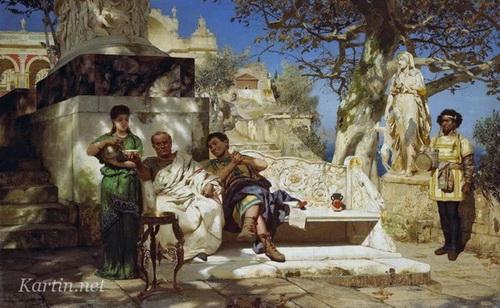
1. First of all, then, it is generally agreed that when Troy was taken vengeance was wreaked upon the other Trojans, but that two, Aeneas and Antenor, were spared all the penalties of war by the Achivi, owing to long-standing claims of hospitality, and because they had always advocated peace and the giving back of Helen. [2] They then experienced various vicissitudes. Antenor, with a company of Eneti who had been expelled from Paphlagonia in a revolution and were looking for a home and a leader — for they had lost their king, Pylaemenes, at Troy — came to the inmost bay of the Adriatic. [3] There, driving out the Euganei, who dwelt between the sea and the Alps, the Eneti and Trojans took possession of those lands. And in fact the place where they first landed is called Troy, and the district is therefore known as Trojan, while the people as a whole are called the Veneti. [4] Aeneas, driven from home by a similar misfortune, but guided by fate to undertakings of greater consequence, came first to Macedonia; thence was carried, in his quest of a place of settlement, to Sicily; and from Sicily laid his course towards the land of Laurentum. This place too is called Troy. [5] Landing there, the Trojans, as men who, after their all but immeasurable wanderings, had nothing left but their swords and ships, were driving booty from the fields, when King Latinus and the Aborigines, who then occupied that country, rushed down from their city and their fields to repel with arms the violence of the invaders. From this point the tradition follows two lines. Some say that Latinus, having been defeated in the battle, made a peace with Aeneas, and later an alliance of marriage. [6] Others maintain that when the opposing lines had been drawn up, Latinus did not wait for the charge to sound, but advanced amidst his chieftains and summoned the captain of the strangers to a parley. [7] He then inquired what men they were, whence they had come, what mishap had caused them to leave their home, and what they sought in landing on the coast of Laurentum. [8] He was told that the people were Trojans and their leader Aeneas, son of Anchises and Venus; that their city had been burnt, and that, driven from home, they were looking for a dwelling-place and a site where they might build a city. Filled with wonder at the renown of the race and the hero, and at his spirit, prepared alike for war or peace, he gave him his right hand in solemn pledge of lasting friendship. [9] The commanders then made a treaty, and the armies saluted each other. Aeneas became a guest in the house of Latinus; there the latter, in the presence of his household gods, added a domestic treaty to the public one, by giving his daughter in marriage to Aeneas. [10] This event removed any doubt in the minds of the Trojans that they had brought their wanderings to an end at last in a permanent and settled habitation. [11] They founded a town, which Aeneas named Lavinium, after his wife. In a short time, moreover, there was a male scion of the new marriage, to whom his parents gave the name of Ascanius.
2. War was then made upon Trojans and Aborigines alike. Turnus was king of the Rutulians, and to him Lavinia had been betrothed before the coming of Aeneas. Indignant that a stranger should be preferred before him, he attacked, at the same time, both Aeneas and Latinus. [2] Neither army came off rejoicing from that battle. The Rutulians were beaten: the victorious Aborigines and Trojans lost their leader Latinus. [3] Then Turnus and the Rutulians, discouraged at their situation, fled for succour to the opulent and powerful Etruscans and their king Mezentius, who held sway in Caere, at that time an important town. Mezentius had been, from the very beginning, far from pleased at the birth of the new city; he now felt that the Trojan state was growing much more rapidly than was altogether safe for its neighbours, and readily united his forces with those of the Rutulians. [4] Aeneas, that he might win the goodwill of the Aborigines to confront so formidable an array, and that all might possess not only the same rights but also the same name, called both nations Latins; and from that time on the Aborigines were no less ready and faithful than the Trojans in the service of King Aeneas. [5] Accordingly, trusting to this friendly spirit of the two peoples, which were growing each day more united, and, despite the power of Etruria, which had filled with the glory of her name not only the lands but the sea as well, along the whole extent of Italy from the Alps to the Sicilian Strait, Aeneas declined to defend himself behind his walls, as he might have done, but led out his troops to battle. [6] The fight which ensued was a victory for the Latins: for Aeneas it was, besides, the last of his mortal labours. He lies buried, whether it is fitting and right to term him god or man, on the banks of the river Numicus; men, however, call him Jupiter Indiges.
3. Ascanius, Aeneas’ son, was not yet ripe for authority; yet the authority was kept for him, unimpaired, until he arrived at manhood. Meanwhile, under a woman’s regency, the Latin State and the kingdom of his father and his grandfather stood unshaken — so strong was Lavinia’s character — until the boy could claim it. [2] I shall not discuss the question — for who could affirm for certain so ancient a matter? — whether this boy was Ascanius, or an elder brother, born by Creusa while Ilium yet stood, who accompanied his father when he fled from the city, being the same whom the Julian family call lulus and claim as the author of their name. [3] This Ascanius, no matter where born, or of what mother — it is agreed in any case that he was Aeneas’ son — left Lavinium, when its population came to be too large, for it was already a flourishing and wealthy city for those days, to his mother, or stepmother, and founded a new city himself below the Alban Mount. [4] This was known from its position, as it lay stretched out along the ridge, by the name of Alba Longa. From the settlement of Lavinium to the planting of the colony at Alba Longa was an interval of some thirty years. [5] Yet the nation had grown so powerful, in consequence especially of the defeat of the Etruscans, that even when Aeneas died, and even when a woman became its regent and a boy began his apprenticeship as king, neither Mezentius and his Etruscans nor any other neighbours dared to attack them. [6] Peace had been agreed to on these terms, that the River Albula, which men now call the Tiber, should be the boundary between the Etruscans and the Latins. [7] Next Silvius reigned, son of Ascanius, born, as it chanced, in the forest. He begat Aeneas Silvius, and he Latinus Silvius. By him several colonies were planted, and called the Ancient Latins. [8] Thereafter the cognomen Silvius was retained by all who ruled at Alba. From Latinus came Alba, from Alba Atys, from Atys Capys, from Capys Capetus, from Capetus Tiberinus. [9] This last king was drowned in crossing the River Albula, and gave the stream the name which has been current with later generations. Then Agrippa, son of Tiberinus, reigned, and after Agrippa Romulus Silvius was king, having received the power from his father. Upon the death of Romulus by lightning, the kingship passed from him to Aventinus. This king was buried on that hill, which is now a part of the City of Rome, and gave his name to the hill. [10] Proca ruled next. He begat Numitor and Amulius; to Numitor, the elder, he bequeathed the ancient realm of the Silvian family. Yet violence proved more potent than a father’s wishes or respect for seniority. Amulius drove out his brother and ruled in his stead. [11] Adding crime to crime, he destroyed Numitor’s male issue; and Rhea Silvia, his brother’s daughter, he appointed a Vestal under pretence of honouring, her, and by consigning her to perpetual virginity, deprived her of the hope of children.
4. But the Fates were resolved, as I suppose, upon the founding of this great City, and the beginning of the mightiest of empires, next after that of Heaven. [2] The Vestal was ravished, and having given birth to twin sons, named Mars as the father of her doubtful offspring, whether actually so believing, or because it seemed less wrong if a god were the author of her fault. [3] But neither gods nor men protected the mother herself or her babes from the king’s cruelty; the priestess he ordered to be manacled and cast into prison, the children to be committed to the river. [4] It happened by singular good fortune that the Tiber having spread beyond its banks into stagnant pools afforded nowhere any access to the regular channel of the river, and the men who brought the twins were led to hope that being infants they might be drowned, no matter how sluggish the stream. [5] So they made shift to discharge the king’s command, by exposing the babes at the nearest point of the overflow, where the fig-tree Ruminalis — formerly, they say, called Romularis — now stands. [6] In those days this was a wild and uninhabited region. The story persists that when the floating basket in which the children had been exposed was left high and dry by the receding water, a she-wolf, coming down out of the surrounding hills to slake her thirst, turned her steps towards the cry of the infants, and with her teats gave them suck so gently, that the keeper of the royal flock found her licking them with her tongue. [7] Tradition assigns to this man the name of Faustulus, and adds that he carried the twins to his hut and gave them to his wife Larentia to rear. Some think that Larentia, having been free with her favours, had got the name of “she-wolf” among the shepherds, and that this gave rise to this marvellous story. [8] The boys, thus born and reared, had no sooner attained to youth than they began — yet without neglecting the farmstead or the flocks — to range the glades of the mountains for game. [9] Having in this way gained both strength and resolution, they would now not only face wild beasts, but would attack robbers laden with their spoils, and divide up what they took from them among the shepherds, with whom they shared their toils and pranks, while their band of young men grew larger every day.
5. They say that the Palatine was even then the scene of the merry festival of the Lupercalia which we have to-day, and that the hill was named Pallantium, from Pallanteum, an Arcadian city, and then Palatium. [2] There Evander, an Arcadian of that stock, who had held the place many ages before the time of which I am writing, is said to have established the yearly rite, derived from Arcadia, that youths should run naked about in playful sport, doing honour to Lycaean Pan, whom the Romans afterwards called Inuus. [3] When the young men were occupied in this celebration, the rite being generally known, some robbers who had been angered by the loss of their plunder laid an ambush for them, and although Romulus successfully defended himself, captured Remus and delivered up their prisoner to King Amulius, even lodging a complaint against him. [4] The main charge was that the brothers made raids on the lands of Numitor, and pillaged them, with a band of young fellows which they had got together, like an invading enemy. [5] So Remus was given up to Numitor to be punished. From the very beginning Faustulus had entertained the suspicion that they were children of the royal blood that he was bringing up in his house; for he was aware both that infants had been exposed by order of the king, and that the time when he had himself taken up the children exactly coincided with that event. But he had been unwilling that the matter should be disclosed prematurely, until opportunity offered or necessity compelled. [6] Necessity came first; accordingly, driven by fear, he revealed the facts to Romulus. It chanced that Numitor too, having Remus in custody, and hearing that the brothers were twins, had been reminded, upon considering their age and their far from servile nature, of his grandsons. The inquiries he made led him to the same conclusion, so that he was almost ready to acknowledge Remus. Thus on every hand the toils were woven about the king. [7] Romulus did not assemble his company of youths — for he was not equal to open violence — but commanded his shepherds to come to the palace at an appointed time, some by one way, some by another, and so made his attack upon the king; while from the house of Numitor came Remus, with another party which he had got together, to help his brother. So Romulus slew the king. 6. At the beginning of the fray Numitor exclaimed that an enemy had invaded the city and attacked the palace, and drew off the active men of the place to serve as an armed garrison for the defence of the citadel; and when he saw the young men approaching, after they had dispatched the king, to congratulate him, he at once summoned a council, and laid before it his brother’s crimes against himself, the parentage of his grandsons, and how they had been born, reared, and recognised. [2] He then announced the tyrant’s death, and declared himself to be responsible for it. The brothers advanced with their band through the midst of the crowd, and hailed their grandfather king, whereupon such a shout of assent arose from the entire throng as confirmed the new monarch’s title and authority.
[3] The Alban state being thus made over to Numitor, Romulus and Remus were seized with the desire to found a city in the region where they had been exposed and brought up. And in fact the population of Albans and Latins was too large; besides, there were the shepherds. All together, their numbers might easily lead men to hope that Alba would be small, and Lavinium small, compared with the city which they should build. [4] These considerations were interrupted by the curse of their grandsires, the greed of kingly power, and by a shameful quarrel which grew out of it, upon an occasion innocent enough. Since the brothers were twins, and respect for their age could not determine between them, it was agreed that the gods who had those places in their protection should choose by augury who should give the new city its name, who should govern it when built. Romulus took the Palatine for his augural quarter, Remus the Aventine. 7. Remus is said to have been the first to receive an augury, from the flight of six vultures. The omen had been already reported when twice that number appeared to Romulus. Thereupon each was saluted king by his own followers, the one party laying claim to the honour from priority, the other from the number of the birds. [2] They then engaged in a battle of words and, angry taunts leading to bloodshed, Remus was struck down in the affray. The commoner story is that Remus leaped over the new walls in mockery of his brother, whereupon Romulus in great anger slew him, and in menacing wise added these words withal, “So perish whoever else shall leap over my walls!” [3] Thus Romulus acquired sole power, and the city, thus founded, was called by its founder’s name.
His first act was to fortify the Palatine, on which he had himself been reared. To other gods he sacrificed after the Alban custom, but employed the Greek for Hercules, according to the institution of Evander. [4] The story is as follows: Hercules, after slaying Geryones, was driving off his wondrously beautiful cattle, when, close to the river Tiber, where he had swum across it with the herd before him, he found a green spot, where he could let the cattle rest and refresh themselves with the abundant grass; and being tired from his journey he lay down himself. [5] When he had there fallen into a deep sleep, for he was heavy with food and wine, a shepherd by the name of Cacus, who dwelt hard by and was insolent by reason of his strength, was struck with the beauty of the animals, and wished to drive them off as plunder. But if he had driven the herd into his cave, their tracks would have been enough to guide their owner to the place in his search; he therefore chose out those of the cattle that were most remarkable for their beauty, and turning them the other way, dragged them into the cave by their tails. [6] At daybreak Hercules awoke. Glancing over the herd, and perceiving that a part of their number was lacking, he proceeded to the nearest cave, in case there might be foot-prints leading into it. When he saw that they were all turned outward and yet did not lead to any other place, he was confused and bewildered, and made ready to drive his herd away from that uncanny spot. [7] As the cattle were being driven off, some of them lowed, as usually happens, missing those which had been left behind. They were answered with a low by the cattle shut up in the cave, and this made Hercules turn back. When he came towards the cave, Cacus would have prevented his approach with force, but received a blow from the hero’s club, and calling in vain upon the shepherds to protect him, gave up the ghost. [8] Evander, an exile from the Peloponnese, controlled that region in those days, more through personal influence than sovereign power. He was a man revered for his wonderful invention of letters, a new thing to men unacquainted with the arts, and even more revered because of the divinity which men attributed to his mother Carmenta, whom those tribes had admired as a prophetess before the Sibyl’s coming into Italy. [9] Now this Evander was then attracted by the concourse of shepherds, who, crowding excitedly about the stranger, were accusing him as a murderer caught red-handed. When he had been told about the deed and the reason for it, and had marked the bearing of the man and his figure, which was somewhat ampler and more august than a mortal’s, he inquired who lie was. [10] Upon learning his name, his father, and his birth-place, he exclaimed, “Hail, Hercules, son of Jupiter! You are he, of whom my mother, truthful interpreter of Heaven, foretold to me that you should be added to the number of the gods, and that an altar should be dedicated to you here which the nation one day to [11] be the most powerful on earth should call the Greatest Altar, and should serve according to your rite.” [12] Hercules gave him his hand, and declared that he accepted the omen, and would fulfil the prophecy by establishing and dedicating an altar. Then and there men took a choice victim from the herd, and for the first time made sacrifice to Hercules. [13] For the ministry and the banquet they employed the Potitii and the Pinarii, being the families of most distinction then living in that region. It so fell out that the Potitii were there at the appointed time, and to them were served the inwards; the Pinarii came after the inwards had been eaten, in season for the remainder of the feast. [14] Thence came the custom, which persisted as long as the Pinarian family endured, that they should not partake of the inwards at that sacrifice. The Potitii, instructed by Evander, were priests of this cult for many generations, until, having delegated to public slaves the solemn function of their family, the entire stock of the Potitii died out. [15] This was the only sacred observance, of all those of foreign origin, which Romulus then adopted, honouring even then the immortality won by worth to which his own destiny was leading him.
8. When Romulus had duly attended to the worship of the gods, he called the people together and gave them the rules of law, since nothing else but law could unite them into a single body politic. [2] But these, he was persuaded, would only appear binding in the eyes of a rustic people in case he should invest his own person with majesty, by adopting emblems of authority. He therefore put on a more august state in every way, and especially by the assumption of twelve lictors. [3] Some think the twelve birds which had given him an augury of kingship led him to choose this number. For my part, I am content to share the opinion of those who derive from the neighbouring Etruscans (whence were borrowed the curule chair and purple-bordered toga) not only the type of attendants but their number as well — a number which the Etruscans themselves are thought to have chosen because each of the twelve cities which united to elect the king contributed one lictor.
[4] Meanwhile the City was expanding and reaching out its walls to include one place after another, for they built their defences with an eye rather to the population which they hoped one day to have than to the numbers they had then. [5] Next, lest his big City should be empty, Romulus resorted to a plan for increasing the inhabitants which had long been employed by the founders of cities, who gather about them an obscure and lowly multitude and pretend that the earth has raised up sons to them. In the place which is now enclosed, between the two groves as you go up the hill, he opened a sanctuary. [6] Thither fled, from the surrounding peoples, a miscellaneous rabble, without distinction of bond or free, eager for new conditions; and these constituted the first advance in power towards that greatness at which Romulus aimed. [7] He had now no reason to be dissatisfied with his strength, and proceeded to add policy to strength. He appointed a hundred senators, whether because this number seemed to him sufficient, or because there were no more than a hundred who could be designated Fathers. At all events, they received the designation of Fathers from their rank, and their descendants were called patricians.
9. Rome was now strong enough to hold her own in war with any of the adjacent states; but owing to the want of women a single generation was likely to see the end of her greatness, since she had neither prospect of posterity at home nor the right of intermarriage with her neighbours. [2] So, on the advice of the senate, Romulus sent envoys round among all the neighbouring nations to solicit for the new people an alliance and the privilege of intermarrying. [3] Cities, they argued, as well as all other things, take their rise from the lowliest beginnings. As time goes on, those which are aided by their own worth and by the favour of Heaven achieve great power and renown. [4] They said they were well assured that Rome’s origin had been blessed with the favour of Heaven, and that worth would not be lacking; their neighbours should not be reluctant to mingle their stock and their blood with the Romans, who were as truly men as they were. [5] Nowhere did the embassy obtain a friendly hearing. In fact men spurned, at the same time that they feared, both for themselves and their descendants, that great power which was then growing up in their midst; and the envoys were frequently asked, on being dismissed, if they had opened a sanctuary for women as well as for men, for in that way only would they obtain suitable wives. [6] This was a bitter insult to the young Romans, and the matter seemed certain to end in violence. Expressly to afford a fitting time and place for this, Romulus, concealing his resentment, made ready solemn games in honour of the equestrian Neptune, which he called Consualia. [7] He then bade proclaim the spectacle to the surrounding peoples, and his subjects prepared to celebrate it with all the resources within their knowledge and power, that they might cause the occasion to be noised abroad and eagerly expected. [8] Many people — for they were also eager to see the new city — gathered for the festival, especially those who lived nearest, the inhabitants of Caenina, Crustumium, and Antemnae. [9] The Sabines, too, came with all their people, including their children and wives. They were hospitably entertained in every house, and when they had looked at the site of the City, its walls, and its numerous buildings, they marvelled that Rome had so rapidly grown great. [10] When the time came for the show, and people’s thoughts and eyes were busy with it, the preconcerted attack began. At a given signal the young Romans darted this way and that, to seize and carry off the maidens. [11] In most cases these were taken by the men in whose path they chanced to be. Some, of exceptional beauty, had been marked out for the chief senators, and were carried off to their houses by plebeians to whom the office had been entrusted. [12] One, who far excelled the rest in mien and loveliness, was seized, the story relates, by the gang of a certain Thalassius. Being repeatedly asked for whom they were bearing her off, they kept shouting that no one should touch her, for they were taking her to Thalassius, and this was the origin of the wedding-cry. [13] The sports broke up in a panic, and the parents of the maidens fled sorrowing. They charged the Romans with the crime of violating hospitality, and invoked the gods to whose solemn games they had come, deceived in violation of religion and honour. [14] The stolen maidens were no more hopeful of their plight, nor less indignant. But Romulus himself went amongst them and explained that the pride of their parents had caused this deed, when they had refused their neighbours the right to intermarry; nevertheless the daughters should be wedded and become co-partners in all the possessions of the Romans, in their citizenship and, dearest privilege of all to the human race, in their children; only let them moderate their anger, and give their hearts to those to whom fortune had given their persons. [15] A sense of injury had often given place to affection, and they would find their husbands the kinder for this reason, that every man would earnestly endeavour not only to be a good husband, but also to console his wife for the home and parents she had lost. [16] His arguments were seconded by the wooing of the men, who excused their act on the score of passion and love, the most moving of all pleas to a woman’s heart.
10. The resentment of the brides was already much diminished at the very moment when their parents, in mourning garb and with tears and lamentations, were attempting to arouse their states to action. Nor did they confine their complaints to their home towns, but thronged from every side to the house of Titus Tatius, king of the Sabines; and thither, too, came official embassies, for the name of Tatius was the greatest in all that country. [2] The men of Caenina, Crustumium, and Antemnae, were those who had had a share in the wrong. It seemed to them that Tatius and the Sabines were procrastinating, and without waiting for them these three tribes arranged for a joint campaign. [3] But even the Crustuminians and Antemnates moved too slowly to satisfy the burning anger of the Caeninenses, and accordingly that nation invaded alone the Roman territory. But while they were dispersed and engaged in pillage, Romulus appeared with his troops and taught them, by an easy victory, how ineffectual is anger without strength. [4] Their army he broke and routed, and pursued it as it fled; their king he killed in battle and despoiled; their city, once their leader was slain, he captured at the first assault. [5] He then led his victorious army back, and being not more splendid in his deeds than willing to display them, he arranged the spoils of the enemy’s dead commander upon a fame, suitably fashioned for the purpose, and, carrying it himself, mounted the Capitol. Having there deposited his burden, by an oak which the shepherds held sacred, at the same time as he made his offering he marked out the limits of a temple to Jupiter, and bestowed a title upon him. [6] “Jupiter Feretrius,” he said, “to thee I, victorious Romulus, myself a king, bring the panoply of a king, and dedicate a sacred precinct within the bounds which I have even now marked off in my mind, to be a seat for the spoils of honour which men shall bear hither in time to come, following my example, when they have slain kings and commanders of the enemy.” [7] This was the origin of the first temple that was consecrated in Rome. It pleased Heaven, in the sequel, that while the founder’s words should not be in vain, when he declared that men should bring spoils thither in the after time, yet the glory of that gift should not be staled by a multitude of partakers. Twice only since then, in all these years with their many wars, have the spoils of honour been won; so rarely have men had the good fortune to attain to that distinction.
11. While the Romans were thus occupied in the City, the army of the Antemnates seized the opportunity afforded by their absence, and made an inroad upon their territory; but so swiftly was the Roman levy led against them that they, too, were taken off their guard while scattered about in the fields. [2] They were therefore routed at the first charge and shout, and their town was taken. As Romulus was exulting in his double victory, his wife Hersilia, beset with entreaties by the captive women, begged him to forgive their parents and receive them into the state; which would, in that case, gain in strength by harmony. [3] He readily granted her request. He then set out to meet the Crustuminians, who were marching to attack him. They offered even less resistance than their allies had done, for their ardour had been quenched by the defeats of the others. [4] Colonies were sent out to both places, though most of the colonists preferred to enrol for Crustumium on account of the fertility of its soil. [5] On the other hand, many persons left Crustumium and came to live in Rome, chiefly parents and kinsmen of the captured women.
The last to attack Rome were the Sabines, and this war was by far the gravest of all, for passion and greed were not their motives, nor did they parade war before they made it. [6] To their prudence they even added deception. Spurius Tarpeius commanded the Roman citadel. This man’s maiden daughter was bribed with gold by Tatius to admit armed men into the fortress: she happened at that time to have gone outside the walls to fetch water for a sacrifice. [7] Once within, they threw their shields upon her and killed her so, whether to make it appear that the citadel had been taken by assault, or to set an example, that no one might anywhere keep faith with a traitor. [8] There is also a legend that because most of the Sabines wore heavy golden bracelets on their left arms and magnificent jewelled rings, she had stipulated for what they had on their left arms, and that they had therefore heaped their shields upon her, instead of gifts of gold. [9] Some say that, in virtue of the compact that they should give her what they wore on their arms, she flatly demanded their shields and, her treachery being perceived, forfeited her life to the bargain she herself had struck.
12. Be that as it may, the Sabines held the citadel. Next day the Roman army was drawn up, and covered the ground between the Palatine Hill and the Capitoline, but the Sabines would not come down till rage and eagerness to regain the citadel had goaded their enemy into marching up the slope against them. [2] Two champions led the fighting, the Sabine Mettius Curtius on the one side, and the Roman Hostius Hostilius on the other. Hostius held the Romans firm, despite their disadvantage of position, by the reckless courage he displayed in the thick of the fray. [3] But when he fell, the Roman line gave way at once and fled towards the old gate of the Palatine. Romulus himself was swept along in the crowd of the fugitives, till lifting his sword and shield to [4] heaven, he cried, “O Jupiter, it was thy omen that directed me when I laid here on the Palatine the first foundations of my City. The fortress is already bought by a crime and in the possession of the Sabines, whence they are come, sword in hand, across the valley to seek us here. [5] But do thou, father of gods and men, keep them back from this spot at least; deliver the Romans from their terror, and stay their shameful flight! [6] I here vow to thee, Jupiter the Stayer, a temple, to be a memorial to our descendants how the City was saved by thy present help.” [7] Having uttered this prayer he exclaimed, as if he had perceived that it was heard, “Here, Romans, Jupiter Optimus Maximus commands us to stand and renew the fight!” The Romans did stand, as though directed by a voice from Heaven, Romulus himself rushing into the forefront of the battle. [8] Mettius Curtius, on the Sabine side, had led the charge down from the citadel, and driven the Romans in disorder over all that ground which the Forum occupies. He was not now far from the gate of the Palatine, shouting, “We have beaten our faithless hosts, our cowardly enemies! They know now how great is the difference between carrying off maidens and fighting with men!” While he pronounced this boast a band of gallant youths, led on by Romulus, assailed him. [9] It chanced that Mettius was fighting on horseback at the time, and was therefore the more easily put to flight. As he fled, the Romans followed; and the rest of their army, too, fired by the reckless daring of their king, drove the Sabines before them. [10] Mettius plunged into a swamp, his horse becoming unmanageable in the din of the pursuit, and even the Sabines were drawn off from the general engagement by the danger to so great a man. As for Mettius, heartened by the gestures and shouts of his followers and the encouragement of the throng, he made his escape; and the Romans and the Sabines renewed their battle in the valley that lies between the two hills. But the advantage rested with the Romans.
13. Then the Sabine women, whose wrong had given rise to the war, with loosened hair and torn garments, their woman’s timidity lost in a sense of their misfortune, dared to go amongst the flying missiles, and rushing in from the side, to part the hostile forces and disarm them of [2] their anger, beseeching their fathers on this side, on that their husbands, that fathers-in-law and sons-in-law should not stain themselves with impious bloodshed, nor pollute with parricide the suppliants’ children, grandsons to one party and sons to the other. [3] “If you regret,” they continued, “the relationship that unites you, if you regret the marriage-tie, turn your anger against us; we are the cause of war, the cause of wounds, and even death to both our husbands and our parents. It will be better for us to perish than to live, lacking either of you, as widows or as orphans.” [4] It was a touching plea, not only to the rank and file, but to their leaders as well. A stillness fell on them, and a sudden hush. Then the leaders came forward to make a truce, and not only did they agree on peace, but they made one people out of the two. [5] They shared the sovereignty, but all authority was transferred to Rome. In this way the population was doubled, and that some concession might after all be granted the Sabines, the citizens were named Quirites, from the town of Cures. [6] As a reminder of this battle they gave the name of Curtian Lake to the pool where the horse of Curtius first emerged from the deep swamp and brought his rider to safety.
The sudden exchange of so unhappy a war for a joyful peace endeared the Sabine women even more to their husbands and parents, and above all to Romulus himself. [7] And so, when he divided the people into thirty curiae, he named these wards after the women. Undoubtedly the number of the women was somewhat greater than this, but tradition does not tell whether it was their age, their own or their husbands’ rank, or the casting of lots, that determined which of them should give their names to the wards. [8] At the same time there were formed three centuries of knights: the Ramnenses were named after Romulus; the Titienses after Titus Tatius; the name and origin of the Luceres are alike obscure. From this time forth the two kings ruled not only jointly but in harmony.
14. Some years later the kinsmen of King Tatius maltreated the envoys of the Laurentians, and when their fellow-citizens sought redress under the law of nations, Titus yielded to his partiality for his relations and to their entreaties. [2] In consequence of this he drew down their punishment upon himself, for at Lavinium, whither he had gone to the annual sacrifice, a mob came together and killed him. [3] This act is said to have awakened less resentment than was proper in Romulus, whether owing to the disloyalty that attends a divided rule, or because he thought Tatius had been not unjustly slain. He therefore declined to go to war; but yet, in order that he might atone for the insults to the envoys and the murder of the king, he caused the covenant between Rome and Lavinium to be renewed.
[4] Thus with the Laurentians peace was preserved against all expectation; but another war broke out, much nearer, and indeed almost at the city gates. The men of Fidenae, perceiving the growth of a power which they thought too near themselves for safety, did not wait till its promised strength should be realized, but began war themselves. Arming the young men, they sent them to ravage the land between the City and Fidenae. [5] Thence they turned to the left — for the Tiber stopped them on the right — and by their devastations struck terror into the farmers, whose sudden stampede from the fields into the City brought the first tidings of war. [6] Romulus led forth his army on the instant, for delay was impossible with the enemy so near, and pitched his camp a mile from Fidenae. Leaving there a small guard, he marched out with all his forces. [7] A part of his men he ordered to lie in ambush, on this side and on that, where thick underbrush afforded cover; advancing with the greater part of the infantry and all the cavalry, and delivering a disorderly and provoking attack, in which the horsemen galloped almost up to the gates, he accomplished his purpose of drawing out the enemy. For the flight, too, which had next to be feigned, the cavalry engagement afforded a favourable pretext. [8] And when not only the cavalry began to waver, as if undecided whether to fight or run, but the infantry also fell back, the city gates were quickly thronged by the enemy, who poured out and hurled themselves against the Roman line, and in the ardour of attack and pursuit were drawn on to the place of ambuscade. [9] There the Romans suddenly sprang out and assailed the enemy’s flanks, while, to add to their terror, the standards of the detachment which had been left on guard were seen advancing from the camp; thus threatened by so many dangers the men of Fidenae scarcely afforded time for Romulus and those whom they had seen riding off with him to wheel about, before they broke and ran, and in far greater disorder than that of the pretended fugitives whom they had just been chasing — for [10] the flight was a real one this time — sought to regain the town. [11] But the Fidenates did not escape their foes; the Romans followed close upon their heels, and before the gates could be shut burst into the city, as though they both formed but a single army.
15. From Fidenae the war-spirit, by a kind of contagion, spread to the Veientes, whose hostility was aroused by their kinship with the Fidenates, Etruscans like themselves, and was intensified by the danger which lay in their very proximity to Rome, if her arms should be directed against all her neighbours. [2] They made an incursion into Roman territory which more resembled a marauding expedition than a regular campaign; and so, without having entrenched a camp or waited for the enemy’s army, they carried off their booty from the fields and brought it back to Veii. The Romans, on the contrary, not finding their enemy in the fields, crossed the Tiber, ready and eager for a decisive struggle. [3] When the Veientes heard that they were making a camp, and would be advancing against their city, they went out to meet them, preferring to settle the quarrel in the field of battle rather than to be shut up and compelled to fight for their homes and their town. [4] Without employing strategy to aid his forces, the Roman king won the battle by the sheer strength of his seasoned army, and routing his enemies, pursued them to their walls. But the city was strongly fortified, besides the protection afforded by its site, and he refrained from attacking it. [5] Their fields, indeed, he laid waste as he returned, more in revenge than from a desire for booty, and this disaster, following upon their defeat, induced the Veientes to send envoys to Rome and sue for peace. They were deprived of a part of their land, and a truce was granted them for a hundred years.
[6] Such were the principal achievements of the reign of Romulus, at home and in the field, nor is any of them incompatible with the belief in his divine origin and the divinity which was ascribed to the king after his death, whether one considers his spirit in recovering the kingdom of his ancestors, or his wisdom in founding the City and in strengthening it by warlike and peaceful measures. [7] For it was to him, assuredly, that Rome owed the vigour which enabled her to enjoy an untroubled peace for the next forty years. [8] Nevertheless, he was more liked by the commons than by the senate, and was preeminently dear to the hearts of his soldiers. Of these he had three hundred for a bodyguard, to whom he gave the name of Celeres, and kept them by him, not only in war, but also in time of peace.
16. When these deathless deeds had been done, as the king was holding a muster in the Campus Martius, near the swamp of Capra, for the purpose of reviewing the army, suddenly a storm came up, with loud claps of thunder, and enveloped him in a cloud so thick as to hide him from the sight of the assembly; and from that moment Romulus was no more on earth. [2] The Roman soldiers at length recovered from their panic, when this hour of wild confusion had been succeeded by a sunny calm; but when they saw that the royal seat was empty, although they readily believed the assertion of the senators, who had been standing next to Romulus, that he had been caught up on high in the blast, they nevertheless remained for some time sorrowful and silent, as if filled with the fear of orphanhood. [3] Then, when a few men had taken the initiative, they all with one accord hailed Romulus as a god and a god’s son, the King and Father of the Roman City, and with prayers besought his favour that he would graciously be pleased forever to protect his children. [4] There were some, I believe, even then who secretly asserted that the king had been rent in pieces by the hands of the senators, for this rumour, too, got abroad, but in very obscure terms; the other version obtained currency, owing to men’s admiration for the hero and the intensity of their panic. [5] And the shrewd device of one man is also said to have gained new credit for the story. [6] This was Proculus Julius, who, when the people were distracted with the loss of their king and in no friendly mood towards the senate, being, as tradition tells, weighty in council, were the matter never so important, addressed the assembly as follows: “Quirites, the Father of this City, Romulus, descended suddenly from the sky at dawn this morning and appeared to me. Covered with confusion, I stood reverently before him, praying that it might be vouchsafed me to look upon his face without sin. [7] ‘Go,’ said he, ‘and declare to the Romans the will of Heaven that my Rome shall be the capital of the world; so let them cherish the art of war, and let them know and teach their children that no human strength can resist Roman arms.’ [8] So saying,” he concluded, “Romulus departed on high.” It is wonderful what credence the people placed in that man’s tale, and how the grief for the loss of Romulus, which the plebeians and the army felt, was quieted by the assurance of his immortality.
17. The senators meanwhile were engaged in a struggle for the coveted kingship. So far it had not come to a question of any one person, for nobody stood out with special prominence in the new nation; instead, a strife of factions was waging between the two stocks. [2] Those of Sabine origin, having had no king on their side since the death of Tatius, feared that despite their equal rights they might lose their hold upon the sovereign power, and hence desired that the king should be chosen from their own body. [3] The original Romans spurned the idea of an alien king. Various, however, as were men’s inclinations, to be ruled by a king was their universal wish, for they had not yet tasted the sweetness of liberty. [4] Then the senators became alarmed, lest the state wanting a ruler and the army a leader, and many neighbouring states being disaffected, some violence might be offered from without. [5] All therefore were agreed that there should be some head, but nobody could make up his mind to yield to his fellow. And so the hundred senators shared the power among themselves, establishing ten decuries and appointing one man for each decury to preside over the administration. [6] Ten men exercised authority; only one had its insignia and lictors. Five days was the period of his power, which passed in rotation to all; and for a year the monarchy lapsed. This interval was called, as it was, an interregnum, a name which even yet obtains. [7] Murmurs then arose among the plebs that their servitude had been multiplied; that a hundred masters had been given them instead of one. No longer, it seemed, would they endure anything short of a king, and a king, too, of their own choosing. [8] Perceiving that such ideas were in the wind, the senators thought it would be well to proffer spontaneously a thing which they were on the verge of losing, and obtained the favour of the people by granting them supreme power on such terms as to part with no greater prerogative than they retained. [9] For they decreed that when the people should have named a king, their act should only be valid in case the senators ratified it. Even now, in voting for laws and magistrates, the same right is exercised, but is robbed of its significance; before the people can begin to vote, and when the result of the election is undetermined, the Fathers ratify it. [10] On the present occasion the interrex summoned the assembly and spoke as follows: “May prosperity, favour, and fortune attend our action! Quirites, choose your king. Such is the pleasure of the Fathers, who, in their turn, if your choice fall upon one worthy to be called Romulus’ successor, will confirm your election.” [11] This so pleased the plebs, that, unwilling to appear outdone in generosity, they merely resolved and ordered that the senate should decree who should be king in Rome.
18. A great reputation for justice and piety was enjoyed in those days by Numa Pompilius. Cures, a town of the Sabines, was his home, and he was deeply versed, so far as anyone could be in that age, in all law, divine and human. [2] The teacher to whom he owed his learning was not, as men say, in default of another name, the Samian Pythagoras; for it is well established that Servius Tullius was king at Rome, more than a hundred years after this time, when Pythagoras gathered about him, on the farthest coasts of Italy, in the neighbourhood of Metapontum, Heraclea, and Croton, young men eager to share his studies. [3] And from that country, even if he had been contemporary, how could his fame have reached the Sabines? Again, in what common language could he have induced anyone to seek instruction of him? Or under whose protection could a solitary man have made his way through so many nations differing in speech and customs? [4] It was Numa’s native disposition, then, as I incline to believe, that tempered his soul with noble qualities, and his training was not in foreign studies, but in the stern and austere discipline of the ancient Sabines, a race incorruptible as any race of the olden time. [5] When Numa’s name had been proposed, the Roman senators perceived that the Sabines would gain the ascendancy if a king were to be chosen from that nation; yet nobody ventured to urge his own claims in preference to those of such a man, nor the claim of any other of his faction, nor those, in short, of any of the senators or citizens. [6] And so they unanimously voted to offer the sovereignty to Numa Pompilius. Being summoned to Rome he commanded that, just as Romulus had obeyed the augural omens in building his city and assuming regal power, so too in his own case the gods should be consulted. Accordingly an augur (who thereafter, as a mark of honour, was made a priest of the state in permanent charge of that function) conducted him to the citadel and caused him to sit down on a stone, facing the south. [7] The augur seated himself on Numa’s left, having his head covered, and holding his in right hand the crooked staff without a knot which they call a lituus. [8] Then, looking out over the City and the country beyond, he prayed to the gods, and marked off the heavens by a line from east to west, designating as ‘ right’ the regions to the south, as ‘left’ those to the north, and fixing in his mind a landmark opposite to him and as far away as the eye could reach; [9] next shifting the crook to his left hand and, laying his right hand on Numa’s head, he uttered the following prayer: “Father Jupiter, if it is Heaven’s will that this man Numa Pompilius, whose head I am touching, be king in Rome, do thou exhibit to us unmistakable signs within those limits which I have set.” [10] He then specified the auspices which he desired should be sent, and upon their appearance Numa was declared king, and so descended from the augural station.
19. When he had thus obtained the kingship, he prepared to give the new City, founded by force of arms, a new foundation in law, statutes, and observances. [2] And perceiving that men could not grow used to these things in the midst of wars, since their natures grew wild and savage through warfare, he thought it needful that his warlike people should be softened by the disuse of arms, and built the temple of Janus at the bottom of the Argiletum, as an index of peace and war, that when open it might signify that the nation was in arms, when closed that all the peoples round about were pacified. [3] Twice since Numa’s reign has it been closed: once in the consulship of Titus Manlius, after the conclusion of the First Punic War; the second time, which the gods permitted our own generation to witness, was after the battle of Actium, when the emperor Caesar Augustus had brought about peace on land and sea. [4] Numa closed the temple after first securing the good will of all the neighbouring tribes by alliances and treaties. And fearing lest relief from anxiety on the score of foreign perils might lead men who had hitherto been held back by fear of their enemies and by military discipline into extravagance and idleness, he thought the very first thing to do, as being the most efficacious with a populace which was ignorant and, in those early days, uncivilized, was to imbue them with the fear of Heaven. [5] As he could not instil this into their hearts without inventing some marvellous story, he pretended to have nocturnal meetings with the goddess Egeria, and that hers was the advice which guided him in the establishment of rites most approved by the gods, and in the appointment of special priests for the service of each.
[6] And first of all he divided the year into twelve months, according to the revolutions of the moon. But since the moon does not give months of quite thirty days each, and eleven days are wanting to the full complement of a year as marked by the sun’s revolution, he inserted intercalary months in such a way that in the twentieth year the days should fall in with the same position of the sun from which they had started, and the period of twenty years be rounded out. [7] He also appointed days when public business might not be carried on, and others when it might, since it would sometimes be desirable that nothing should be brought before the people.
20. He then turned his attention to the appointment of priests, although lie performed very many priestly duties himself, especially those which now belong to the Flamen Dialis. [2] But inasmuch as he thought that in a warlike nation there would be more kings like Romulus than like Numa, and that they would take the field in person, he did not wish the sacrificial duties of the kingly office to be neglected, and so appointed a flamen for Jupiter, as his perpetual priest, and provided him with a conspicuous dress and the royal curule chair. To him he added two other flamens, one for Mars, the other for Quirinus. [3] In like manner he designated virgins for Vesta’s service — a priesthood, this, that derived from Alba and so was not unsuited to the founder’s stock. That they might be perpetual priestesses of the temple, he assigned them a stipend from the public treasury, and by the rule of virginity and other observances invested them with awe and sanctity. [4] He likewise chose twelve Salii for Mars Gradivus, and granted them the distinction of wearing the embroidered tunic and over it a bronze breastplate, and of bearing the divine shields which men call ancilia, while they proceeded through the City, chanting their hymns to the triple beat of their solemn dance. [5] He next chose as pontifex Numa Marcius, son of Marcus, one of the senators, and to him he intrusted written directions, full and accurate, for performing the rites of worship; with what victims, on what days, in what temple, sacrifices should be offered, and from what sources money was to be disbursed to pay their costs. [6] All other public and private sacrifices lie likewise made subject to the decrees of the pontifex, that there might be someone to whom the commons could come for advice, lest any confusion should arise in the religious law through the neglect of ancestral rites and the adoption of strange ones. [7] And not merely ceremonies relating to the gods above, but also proper funeral observances and the propitiation of the spirits of the dead were to be taught by the pontifex as well, and also what prodigies manifested by lightning or other visible sign were to be taken in hand and averted. With the purpose of eliciting this knowledge from the minds of the gods, Numa dedicated an altar on the Aventine to Jupiter Elicius, and consulted the god by augury, that he might learn what portents were to be regarded.
21. The consideration and disposal of these matters diverted the thoughts of the whole people from violence and arms. Not only had they something to occupy their minds, but their constant preoccupation with the gods, now that it seemed to them that concern for human affairs was felt by the heavenly powers, had so tinged the hearts of all with piety, that the nation was governed by its regard for promises and oaths, rather than by the dread of laws and penalties. [2] And while Numa’s subjects were spontaneously imitating the character of their king, as their unique exemplar, the neighboring peoples also, who had hitherto considered that it was no city but a camp that had been set up in their midst, as a menace to the general peace, came to feel such reverence for them, that they thought it sacrilege to injure a nation so wholly bent upon the worship of the gods. [3] There was a grove watered by a perennial spring which flowed through the midst of it, out of a dark cave. Thither Numa would often withdraw, without witnesses, as if to meet the goddess; so he dedicated the grove to the Camenae, alleging that they held counsel there with his wife Egeria. [4] He also established an annual worship of Faith, to whose chapel he ordered that the flamens should proceed in a two-horse hooded carriage, and should wrap up their arms as far as the fingers before sacrificing, as a sign that faith must be kept, and that even in men’s clasped hands her seat is sacred. [5] He established many other rites, as well as places of sacrifice, which the pontiffs called Argei. But of all his services the greatest was this, that throughout his reign he guarded peace no less jealously than his kingdom. [6] Thus two successive kings in different ways, one by war, the other by peace, promoted the nation’s welfare. Romulus ruled thirty-seven years, Numa forty-three. The state was not only strong, but was also well organized in the arts both of war and of peace.
22. At Numa’s death the state reverted to an interregnum. Then Tullus Hostilius, grandson of that Hostilius who had distinguished himself in the battle with the Sabines at the foot of the citadel, was declared king by the people, and the senate confirmed their choice. [2] This monarch was not only unlike the last, but was actually more warlike than Romulus had been. Besides his youth and strength, the glory of his grandfather was also an incentive to him. So, thinking that the nation was growing decrepit from inaction, he everywhere sought excuses for stirring up war. [3] It happened that the Roman rustics were driving off cattle from Alban territory, while the Albans were treating the Romans in the same way. The man who was then in power in Alba was Gaius Cluilius. [4] Each side, at about the same time, sent envoys to demand restitution. Tullus had commanded his envoys to do nothing else till they had carried out his orders; he felt convinced that the Albans would refuse his demands, in which case he could declare war with a good conscience. The Alban representatives proceeded rather laxly. [5] Received by Tullus with gracious and kindly hospitality, they attended in a friendly spirit the banquet which he gave in their honour. Meanwhile the Romans had been beforehand with them in seeking redress, and, being denied it by the Alban leader, had made a declaration of war, to take effect in thirty days. [6] Returning, they reported these things to Tullus, who thereupon invited the Alban envoys to inform him of the object of their mission. They, knowing nothing of what had happened, at first spent some time in apologies. They said they should be sorry to utter anything which might give offence to Tullus, but that they were compelled to do so by their orders; they had come to seek restitution; if it should be denied them they were commanded to declare war. [7] To this Tullus replied: “Tell your king the Roman king calls the gods to witness which people first spurned the other’s demand for redress and dismissed its envoys, that they may call down upon the guilty nation all the disasters of this war.”
23. With this answer the Albans returned to their city, and both sides prepared for war with the greatest energy — a civil war, to all intents and purposes, almost as if fathers were arrayed against sons; for both were of Trojan ancestry, since Lavinium had been planted from Troy, Alba from Lavinium, and from the line of the Alban kings had come the Romans. [2] Still, the issue of the war made the struggle less deplorable, for no battle was fought, and when only the buildings of one of the cities had been destroyed, the two peoples were fused into one. [3] The Albans were first in the field, and with a great army invaded the Roman territory. Their camp they pitched not more than five miles from the City, and surrounded it with a trench. (This was known for some centuries as the Cluilian Trench, from the name of the general, until in the course of time both trench and name disappeared.) [4] In this camp Cluilius the Alban king died, and the Albans chose as dictator Mettius Fufetius. Meantime Tullus, emboldened principally by the death of the king, and asserting that Heaven’s great powers would take vengeance upon all of the Alban name, beginning with their king himself, for their unscrupulous war, made a night march past the enemy’s camp and led his army into the country of the Albans. This move drew Mettius out from his fortifications. [5] Leading his troops the shortest way towards the enemy, he sent an envoy on ahead to say to Tullus that before they fought it was well that they should confer together; if Tullus would meet him he was confident he had that to say which would be of no less moment to the Roman state than to the Alban. Without rejecting this suggestion, Tullus nevertheless drew up his men in line of battle, in case the proposals should prove impracticable. [6] On the other side the Albans also formed up. When both armies had been marshalled, the leaders, attended by a few of their nobles, advanced to the middle of the field. [7] Then the Alban began as follows:
“Pillage and failure to make the amends demanded in accordance with our treaty I think I have myself heard named by our king, Cluilius, as the occasion of this war, and I doubt not, Tullus, but you make the same contention. But if truth is to be spoken, rather than sophistries, it is greed for dominion that is goading two kindred and neighbouring peoples into war. [8] Whether rightly or wrongly I do not attempt to determine; that is a question that may well have been considered by him who undertook the war; I am only the general appointed by the Albans to prosecute that war. But this is the point, Tullus, which I wish to suggest to you: Of the magnitude of the Etruscan power which encompasses us, and you especially, you are better aware than we, in proportion as you are nearer to that people. Great is their strength on land, exceedingly great on the sea. [9] You must consider that the instant you give the signal for battle, the Tuscans will be watching our two armies, so that, when we have become tired and exhausted, they may attack at once the victor and the vanquished. In Heaven’s name, therefore, since we are not content with unquestioned liberty, but are proceeding to the doubtful hazard of dominion or enslavement, let us adopt some plan by which we may decide the question which nation shall rule the other, without a great disaster and much carnage on both sides.”
[10] Tullus made no objection, though inclined to war by nature no less than by his anticipation of victory. While both parties were considering what to do, a plan was hit upon for the execution of which Fortune herself supplied the means.
24. It chanced that there were in each of these armies triplet brothers, not ill-matched either in age or in physical prowess. That they were Horatii and Curiatii is generally allowed, and scarcely any other ancient tradition is better known; yet, in spite of the celebrity of the affair, an uncertainty persists in regard to the names — to which people, that is, the Horatii belonged, and to which the Curiatii. The writers of history are divided. Still, the majority, I find, call the Roman brothers Horatii, and theirs is the opinion I incline to adopt. [2] To these young men the kings proposed a combat in which each should fight for his own city, the dominion to belong with that side where the victory should rest. [3] No objection was raised, and time and place were agreed on. Before proceeding with the battle, a treaty was made between the Romans and the Albans, providing that the nation whose citizens should triumph in this contest should hold undisputed sway over the other nation. One treaty differs from another in its terms, but the same procedure is always employed. [4] On the present occasion we are told that they did as follows, nor has tradition preserved the memory of any more ancient compact. The fetial asked King Tullus, “Dost thou command me, King, to make a treaty with the pater patratus of the Alban People?” Being so commanded by the king, he said, “I demand of thee, King, the sacred herb.” [5] The king replied, “Thou shalt take it untainted.” The fetial brought from the citadel an untainted plant. After this he asked the king, “Dost thou grant me, King, with my emblems and my companions, the royal sanction, to speak for the Roman People of the Quirites?” [6] The king made answer, “So far as may be without prejudice to myself and the Roman People of the Quirites, I grant it.” The fetial was Marcus Valerius; he made Spurius Fusius pater patratus, touching his head and hair with the sacred sprig. The pater patratus is appointed to pronounce the oath, that is, to solemnize the pact; and this he accomplishes with many words, expressed in a long metrical formula which it is not worth while to quote. [7] The conditions being then recited, he cries, “Hear, Jupiter; hear, pater patratus of the Alban People: hear ye, People of Alba: From these terms, as they have been publicly rehearsed from beginning to end, without fraud, from these tablets, or this wax, and as they have been this day clearly understood, the Roman People will not be the first to depart. [8] If it shall first depart from them, by general consent, with malice aforethought, then on that day do thou, great Diespiter, so smite the Roman People as I shall here to-day smite this pig: and so much the harder smite them as thy power and thy strength are greater.” [9] When Spurius had said these words, he struck the pig with a flint. In like manner the Albans pronounced their own forms and their own oath, by the mouth of their own dictator and priests.
25. When the treaty had been established, the brothers armed themselves, in accordance with the agreement. On either side the soldiers urged on their champions. They reminded them that their fathers’ gods, their native land, their parents, and all their countrymen, whether at home or with the army, had their eye only on their swords and their right hands. [2] Eager for the combat, as well owing to their native spirit as to the shouts of encouragement which filled their ears, the brothers advanced into the space between the two lines of battle. The two armies were drawn up, each in front of its own camp, no longer in any immediate danger, but their concern as great as ever; and no wonder, since empire was staked on those few men’s valour and good fortune! [3] Alert, therefore, and in suspense, they concentrated their attention upon this unpleasing spectacle. The signal was given, and with drawn steel, like advancing battle-lines, the six young men rushed to the charge, breathing the courage of great armies. Neither side thought of its own danger, but of the nation’s sovereignty or servitude, and how from that day forward their country must experience the fortune they should themselves create. [4] The instant they encountered, there was a clash of shields and a flash of glittering blades, while a deep shudder ran through the onlookers, who, as long as neither side had the advantage, remained powerless to speak or breathe. [5] Then, in the hand-to-hand fight which followed, wherein were soon exhibited to men’s eyes not only struggling bodies and the play of the sword and shield, but also bloody wounds, two of the Romans fell, fatally wounded, one upon the other, while all three of the Albans were wounded. [6] At the fall of the Romans a shout of joy burst from the Alban army, while the Roman levies now bade farewell to all their hopes; but not to their anxiety, for they were horror-stricken at the plight of the single warrior whom the three Curiatii had surrounded. [7] He happened to have got no hurt, and though no match for his enemies together, was ready to fight them one at a time. So, to divide their attack, he fled, thinking that each of them would pursue him with what speed his wounds permitted. [8] He had already run some little distance from the spot where they had fought, when, looking back, he saw that they were following at wide intervals and that one of them had nearly overtaken him. [9] Facing about, he ran swiftly up to his man, and while the Alban host were calling out to the Curiatii to help their brother, Horatius had already slain him, and was hastening, flushed with victory, to meet his second antagonist. Then with a cheer, such as is often drawn from partisans by a sudden turn in a contest, the Romans encouraged their champion, and he pressed on to end the battle. [10] And so, before the third Curiatius could come up — and he was not far off — Horatius dispatched the second. [11] They were now on even terns, one soldier surviving on each side, but in hope and vigour they were far from equal. The one, unscathed and elated by his double victory, was eager for a third encounter. The other dragged himself along, faint from his wound and exhausted with running; he thought how his brothers had been slaughtered before him, and was a beaten man when he faced his triumphant foe. What followed was no combat. [12] The Roman cried exultantly, “Two victims I have given to the shades of my brothers: the third I will offer up to the cause of this war, that Roman may rule Alban.” His adversary could barely hold up his shield. [13] With a downward thrust Horatius buried his sword in the Alban’s throat, and despoiled him where he lay. The Romans welcomed their hero with jubilations and thanksgivings, and their joy was all the greater that they had come near despairing. The burial of their dead then claimed the attention of the two armies, — with widely different feelings, since one nation was exalted with imperial power, the other made subject to a foreign sway. [14] The graves may still be seen where each soldier fell: two Roman graves in one spot, nearer Alba; those of the three Albans towards Rome, but separated, just as they had fought.
26. Before they left the field Mettius asked, in pursuance of the compact, what Tullus commanded him to do, and the Roman ordered him to hold his young men under arms, saying that he should employ their services, if war broke out with the Veientes. [2] The armies then marched home. In the van of the Romans came Horatius, displaying his triple spoils. As he drew near the Porta Capena he was met by his unwedded sister, who had been promised in marriage to one of the Curiatii. When she recognized on her brother’s shoulders the military cloak of her betrothed, which she herself had woven, she loosed her hair and, weeping, called on her dead lover’s name. [3] It enraged the fiery youth to hear his sister’s lamentations in the hour of his own victory and the nation’s great rejoicing. And so, drawing his sword and at the same time angrily upbraiding her, he ran her through the body. [4] “Begone” he cried, “to your betrothed, with your ill-timed love, since you have forgot your brothers, both the dead and the living, and forgot your country! [5] So perish every Roman woman who mourns a foe!”
Horrid as this deed seemed to the Fathers and the people, his recent service was an off-set to it; nevertheless he was seized and brought before the king for trial. The king, that he might not take upon himself the responsibility for so stern and unpopular a judgement, and for the punishment which must follow sentence, called together the council of the people and said: “In accordance with the law I appoint duumvirs to pass judgement upon Horatius for treason.” [6] The dread formula of the law ran thus: “Let the duumvirs pronounce him guilty of treason; if he shall appeal from the duumvirs, let the appeal be tried; if the duumvirs win, let the lictor veil his head; let him bind him with a rope to a barren tree; let him scourge him either within or without the pomerium.” [7] By the terms of this law duumvirs were appointed. They considered that they might not acquit, under that act, even one who was innocent, and having given a verdict of guilty, one of them pronounced the words, “Publius Horatius, I adjudge you a traitor; go, lictor, bind his hands.” [8] The lictor had approached and was about to fit the noose. Then Horatius, at the prompting of Tullus, who put a merciful construction upon the law, cried, “I appeal!” [9] And so the appeal was tried before the people. What influenced men most of all in that trial was the assertion of Publius Horatius, the father, that his daughter had been justly slain; otherwise he should have used a father’s authority and have punished his son, himself. He then implored them not to make him childless whom they had beheld a little while before surrounded by a goodly offspring. [10] So saying, the old man embraced the youth, and pointing to the spoils of the Curiatii set up in the place which is now called “the Horatian Spears,” he exclaimed, “This man you saw but lately advancing decked with spoils and triumphing in his victory; can you bear, Quirites, to see him bound beneath a fork and scourged and tortured? Hardly could Alban eyes endure so hideous a sight. [11] Go, lictor, bind the hands which but now, with sword and shield, brought imperial power to the Roman People! Go, veil the head of the liberator of this city! Bind him to a barren tree! Scourge him within the pomerium, if you will — so it be amidst yonder spears and trophies of our enemies — or outside the pomerium — so it be amongst the graves of the Curiatii! For whither can you lead this youth where his own honours will not vindicate him from so foul a punishment?” [12] The people could not withstand the father’s tears, or the courage of Horatius himself, steadfast in every peril; and they acquitted him, more in admiration of his valour than from the justice of his cause. And so, that the flagrant murder might yet be cleansed away, by some kind of expiatory rite, the father was commanded to make atonement for his son at the public cost. [13] He therefore offered certain piacular sacrifices, which were thenceforward handed down in the Horatian family, and, erecting a beam across the street, to typify a yoke, he made his son pass under it, with covered head. It remains to this day, being restored from time to time at the state’s expense, and is known as “the Sister’s Beam.” [14] Horatia’s tomb, of hewn stone, was built on the place where she had been struck down.
27. But the peace with Alba did not last long. The discontent of the people, who criticized the dictator for having confided the nation’s welfare to three soldiers, broke down his weak character, and since honest measures had proved unsuccessful, he resorted to evil ones to regain the favour of his countrymen. [2] Accordingly, just as in war he had sought peace, so now in time of peace he desired war. But seeing that his own state was richer in courage than in strength, he stirred up other tribes to make war openly after due declaration; while for his own people he reserved the part of the traitor under the disguise of friendship. [3] The men of Fidenae, a Roman colony, and the Veientes, whom they admitted to a share in their designs, were induced to commence hostilities by a promise that the Albans would go over to their side. [4] Fidenae having openly revolted, Tullus summoned Mettius and his army from Alba, and led his forces against the enemy. Crossing the Anio, he pitched his camp at the confluence of the rivers. The Veientine army had crossed the Tiber between that place and Fidenae. [5] These troops, drawn up next the river, formed the right wing; on the left the Fidenates were posted, nearer the mountains. Tullus marshalled his own men against the Veientine enemy; the Albans he posted opposite the army of Fidenae. The Alban commander was as wanting in courage as in loyalty. Not daring, therefore, either to hold his ground or openly to desert, he drew off by imperceptible degrees in the direction of the mountains. [6] Then, when he thought he had got near enough to them, he brought up his whole battle-line to an elevated position, and still irresolute, deployed his ranks with the object of consuming time. His purpose was to swing his forces to the side which fortune favoured. [7] At first the Romans posted next to the Albans were amazed when they perceived that their flank was being uncovered by the withdrawal of their allies; then a horseman galloped up to the king, and told him that the Albans were marching off. In this crisis Tullus vowed to establish twelve Salian priests, and to build shrines to Pallor and Panic. [8] The horseman he reprimanded in a loud voice, that the enemy might overhear him, and ordered him to go back and fight; there was no occasion for alarm; it was by his own command that the Alban army was marching round, that they might attack the unprotected rear of the Fidenates. [9] He also ordered the cavalry to raise their spears. This manœuvre hid the retreat of the Alban army from a large part of the Roman foot-soldiers; those who had seen it, believing what the king had been heard to say, fought all the more impetuously. The enemy in their turn now became alarmed; they had heard Tullus’s loud assertion, and many of the Fidenates, having had Romans among them as colonists, knew Latin. [10] And so, lest the Albans should suddenly charge down from the hills and cut them off from their town, they beat a retreat. Tullus pressed them hard, and having routed the wing composed of the Fidenates, returned, bolder than ever, to the Veientes, who were demoralized by the panic of their neighbours. [11] They, too, failed to withstand his attack, but their rout was stopped by the river in their rear When they had fled thus far, some basely threw away their arms and rushed blindly into the water, others hesitated on the bank and were overtaken before they had made up their minds whether to flee or resist. Never before had the Romans fought a bloodier battle.
28. Then the Alban army, which had been a spectator of the battle, was led down into the plain. Mettius congratulated Tullus on the conquest of his enemies; Tullus replied kindly to Mettius, and commanded the Albans in a good hour to join their camp to that of the Romans. [2] He then made preparations to perform, on the morrow, a sacrifice of purification. At dawn, when all things were in readiness, he issued to both armies the customary order, convoking them to an assembly. [3] The heralds, beginning at the outskirts of the camp, called out the Albans first, who being moved by the very novelty of the occasion, took their stand close to the Roman king, that they might hear him harangue his army. [4] The Roman troops, by previous arrangement, were armed and disposed around them, and the centurions were bidden to execute orders promptly. Then Tullus began as follows:
“Romans, if ever anywhere in any war you have had reason to give thanks, first to the immortal gods and then to your own valour, it was in the battle of yesterday. For you fought not only against your enemies, but a harder and more dangerous fight — against the treachery and the perfidy of your allies. [5] For, to undeceive you, I gave no orders that the Albans should draw off towards the mountains. What you heard was not my command, but a trick and a pretended command, devised in order that you might not know you were being deserted, and so be distracted from the fight; and that the enemy, thinking that they were being hemmed in on the rear, might be panic-stricken and flee. [6] And yet this guilt which I am charging does not attach to all the Albans; they but followed their general, as you, too, would have done, had I desired to lead you off anywhere. It is Mettius yonder who led this march; Mettius, too, who contrived this war; Mettius who broke the treaty between Roman and Alban. [7] Let another dare such a deed hereafter if I do not speedily visit such a punishment on him as shall be a conspicuous warning to all mankind.”
Thereupon the centurions, sword in hand, surrounded Mettius, while the king proceeded: “May prosperity, favour, and fortune be with the Roman people and myself, and with you, men of Alba! I purpose to bring all the Alban people over to Rome, to grant citizenship to their commons, to enroll the nobles in the senate, to make one city and one state. As formerly from one people the Alban nation was divided into two, so now let it be reunited into one.” [8] Hearing these words the Alban soldiers, themselves unarmed and fenced in by armed men, were constrained, however their wishes might differ, by a common fear, and held their peace. [9] Then Tullus said: “Mettius Fufetius, if you were capable of learning, yourself, to keep faith and abide by treaties, you should have lived that I might teach you this; as it is, since your disposition is incurable, you shall yet by your punishment teach the human race to hold sacred the obligations you have violated. [10] Accordingly, just as a little while ago your heart was divided between the states of Fidenae and Rome, so now you shall give up your body to be torn two ways,” He then brought up two four-horse chariots, and caused Mettius to be stretched out and made fast to them, after which the horses were whipped up in opposite directions, and bore off in each of the cars fragments of the mangled body, where the limbs held to their fastenings. [11] All eyes were turned away from so dreadful a sight. Such was the first and last punishment among the Romans of a kind that disregards the laws of humanity. In other cases we may boast that with no nation have milder punishments found favour.
29. While this was going on, horsemen had already been sent on to Alba to fetch the inhabitants to Rome, and afterwards the legions were marched over to demolish the city. [2] When they entered the gates there was not, indeed, the tumult and panic which usually follow the capture of a city, when its gates have been forced or its walls breached with a ram or its stronghold stormed, when the shouts of the enemy and the rush of armed men through the streets throw the whole town into a wild confusion of blood and fire. [3] But at Alba oppressive silence and grief that found no words quite overwhelmed the spirits of all the people; too dismayed to think what they should take with them and what leave behind, they would ask each other’s advice again and again, now standing on their thresholds, and now roaming aimlessly through the houses they were to look upon for that last time. [4] But when at length the horsemen began to be urgent, and clamorously commanded them to come out; when they could now hear the crash of the buildings which were being pulled down in the outskirts of the city; when the dust rising in different quarters had overcast the sky like a gathering cloud; then everybody made haste to carry out what he could, and forth they went, abandoning their lares and penates, and the houses where they had been born and brought up. [5] And now the streets were filled with an unbroken procession of emigrants, whose mutual pity, as they gazed at one another, caused their tears to start afresh; plaintive cries too began to be heard, proceeding chiefly from the women, when they passed the venerable temples beset by armed men, and left in captivity, as it seemed to them, their gods. [6] When the Albans had quitted the city, the Romans everywhere levelled with the ground all buildings, both public and private, and a single hour gave over to destruction and desolation the work of the four hundred years during which Alba had stood. But the temples of the gods were spared, for so the king had decreed.
30. Rome, meanwhile, was increased by Alba’s downfall. The number of citizens was doubled, the Caelian Hill was added to the City, and, that it might be more thickly settled, Tullus chose it for the site of the king’s house and from that time onwards resided there. [2] The chief men of the Albans he made senators, that this branch of the nation might grow too. Such were the Julii, the Servilii, the Quinctii, the Geganii, the Curiatii, and the Cloelii. He also built, as a consecrated place for the order he had enlarged, a senate-house, which continued to be called the Curia Hostilia as late as the time of our own fathers. [3] And that all the orders might gain some strength from the new people, he enrolled ten squadrons of knights from among the Albans, and from the same source filled up the old legions and enlisted new ones.
[4] Confiding in these forces, Tullus declared war on the Sabines, a nation second only at that time to the Etruscans in its wealth of men and arms. On either side there had been aggressions and refusals to grant satisfaction. [5] Tullus complained that at the shrine of Feronia, in a crowded fair, Roman traders had been seized; the Sabines alleged that, before this, refugees from their country had fled to the grove of sanctuary, and had been detained in Rome. [6] These were put forward as the causes of war. The Sabines, not forgetting that a portion of their own forces had been settled in Rome by Tatius and that the Roman state had recently been further strengthened by the addition of the Alban people, began themselves to look about for outside help. [7] Etruria was close by, and the nearest of the Etruscans were the Veientes. There the resentment left over from the wars was the strongest incentive to revolt, and procured them some volunteers; while with certain vagrant and poverty-stricken plebeians even the prospect of pay was effectual. Official aid there was none, and the Veientes (for there is less to surprise us in the others) held firmly to the truce they had agreed upon with Romulus. [8] While preparations for war were making on both sides with the greatest energy, and success appeared to hinge upon which should first take the field, Tullus anticipated his enemies and invaded the Sabine country. [9] A desperate battle was fought near the Silva Malitiosa, where, owing partly, it is true, to the strength of their infantry, but most of all to their newly augmented cavalry, the Roman army gained the mastery. [10] The cavalry made a sudden charge; the ranks of the Sabines were thrown into disorder, and from that moment were unable, without heavy loss, either to hold their own in the fight or to extricate themselves by a retreat.
31. After the defeat of the Sabines, when King Tullus and the entire Roman state were at a high pitch of glory and prosperity, it was reported to the king and senators that there had been a rain of stones on the Alban Mount. [2] As this could scarce be credited, envoys were dispatched to examine the prodigy, and in their sight there fell from the sky, like hail-stones which the wind piles in drifts upon the ground, a shower of pebbles. [3] They thought too that they heard a mighty voice issuing from the grove on the mountain-top, which commanded the Albans to celebrate, according to the fashion of their fathers, the sacrifices, which as though they had forsaken their gods along with their city, they had given over to oblivion, either adopting Roman rites, or in anger at their fortune, such as men sometimes feel, abandoning the worship of the gods. [4] The Romans also, in consequence of the same portent, undertook an official nine days’ celebration, whether so commanded by the divine utterance from the Alban Mount — for this too is handed down — or on the advice of soothsayers. [5] At all events it remained a regular custom that whenever the same prodigy was reported there should be a nine days’ observance.
Not very long after this Rome was afflicted with a pestilence. This caused a reluctance to bear arms, yet no respite from service was allowed by the warlike king (who believed, besides, that the young men were healthier in the field than at home) until he himself contracted a lingering illness. [6] Then that haughty spirit was so broken, with the breaking of his health, that he who had hitherto thought nothing less worthy of a king than to devote his mind to sacred rites, suddenly became a prey to all sorts of superstitions great and small, and filled even the minds of the people with religious scruples. [7] Men were now agreed in wishing to recall the conditions which had obtained under King Numa, believing that the only remedy left for their ailing bodies was to procure peace and forgiveness from the gods. [8] The king himself, so tradition tells, in turning over the commentaries of Numa discovered there certain occult sacrifices performed in honour of Jupiter Elicius, and devoted himself in secret to those rites; but the ceremony was improperly undertaken or performed, and not only was no divine manifestation vouchsafed him, but in consequence of the wrath of Jupiter, who was provoked by his faulty observance, he was struck by a thunderbolt and consumed in the flames of his house. Tullus was greatly renowned in war and reigned thirty-two years.
32. On the death of Tullus, the government reverted, in accordance with the custom established in the beginning, to the senators, who named an interrex. This official called together the comitia, and the people elected Ancus Marcius king, a choice which the Fathers ratified. Ancus Marcius was a grandson, on the mother’s side, of King Numa Pompilius. [2] When he began to rule he was mindful of his grandfather’s glory, and considered that the last reign, excellent in all else, had failed to prosper in one respect, owing to neglect or misconduct of religious observances. Deeming it therefore a matter of the utmost consequence to perform the state sacrifices as Numa had established them, he bade the pontifex copy out all these from the commentaries of the king and display them in public on a whitened table. This act led the citizens, who were eager for peace, and also the neighbouring nations, to hope that he would adopt the character and institutions of his grandfather. [3] Hence the Latins, with whom a treaty had been made in the time of Tullus, plucked up courage, and raided Roman territory, and when called on by the Romans to make restitution, returned an arrogant answer, persuaded that the Roman king would spend his reign in inactivity amid shrines and altars. But the character of Ancus was well balanced, and he honoured the memory of Romulus, as well as Numa. [4] And besides having a conviction that peace had been more necessary to his grandfather’s reign, when the nation had been both young and mettlesome, he also believed that the tranquillity, so free of attack, which had fallen to the lot of Numa would be no easy thing for himself to compass; his patience was being tried, and when proved would be regarded with contempt, and in short the times were better suited to the rule of a Tullus than a Numa. [5] In order however that, as Numa had instituted religious practices in time of peace, he might himself give out a ceremonial of war, and that wars might not only be waged but also declared with some sort of formality, he copied from the ancient tribe of the Aequicoli the law, which the fetials now have, by which redress is demanded.
[6] When the envoy has arrived at the frontiers of the people from whom satisfaction is sought, he covers his head with a bonnet — the covering is of wool — and says: “Hear, Jupiter; hear, ye boundaries of” — naming whatever nation they belong to;— “let righteousness hear! [7] I am the public herald of the Roman People; I come duly and religiously commissioned; let my words be credited,” Then he recites his demands, after which he takes Jupiter to witness: “If I demand unduly and against religion that these men and these things be surrendered to me, then let me never enjoy my native land.” [8] These words he rehearses when he crosses the boundary line, the same to what man soever first meets him, the same when he enters the city gates, the same when he has come into the market-place, with only a few changes in the form and wording of the oath. [9] If those whom he demands are not surrendered, at the end of three and thirty days — for such is the conventional number — he declares war thus: “Hear, Jupiter, and thou, Janus Quirinus, and hear all heavenly gods, and ye, gods of earth, and ye of the lower world; I call you to witness that this people” — naming whatever people it is— “is unjust, and does not make just reparation. [10] But of these matters we will take counsel of the elders in our country, how we may obtain our right.” Then the messenger returns to Rome for the consultation. [11] Immediately the king would consult the Fathers, in some such words as these: “Touching the things, the suits, the causes, concerning which the pater patratus of the Roman People of the Quirites has made demands on the pater patratus of the Ancient Latins, and upon the men of the Ancient Latins, which things they have not delivered, nor fulfilled, nor satisfied, being things which ought to have been delivered, fulfilled, and satisfied, speak,” — turning to the man whose opinion he was wont to ask first,— “what think you?” Then the other would reply: “I hold that those things ought to be sought in warfare just and righteous; and so I consent and vote.” [12] The others were then asked the question, in their order, and when the majority of those present went over to the same opinion, war had been agreed upon. [13] It was customary for the fetial to carry to the bounds of the other nation a cornet-wood spear, iron-pointed or hardened in the fire, and in the presence of not less than three grown men to say: “Whereas the tribes of the Ancient Latins and men of the Ancient Latins have been guilty of acts and offences against the Roman People of the Quirites; and whereas the Roman People of the Quirites has commanded that war be made on the Ancient Latins, and the Senate of the Roman People has approved, agreed, and voted a war with the Ancient Latins; I therefore and the Roman People declare and make war on the tribes of the Ancient Latins and the men of the Ancient Latins.” [14] Having said this, he would hurl his spear into their territory. This is the manner in which at that time redress was sought from the Latins and war was declared, and the custom has been received by later generations.
33. Ancus delegated the care of the sacrifices to the flamens and other priests, and having enlisted a new army proceeded to Politorium, one of the Latin cities. He took this place by storm, and adopting the plan of former kings, who had enlarged the state by making her enemies citizens, transferred the whole population to Rome. [2] The Palatine was the quarter of the original Romans; on the one hand were the Sabines, who had the Capitol and the Citadel; on the other lay the Caelian, occupied by the Albans. The Aventine was therefore assigned to the newcomers, and thither too were sent shortly afterwards the citizens recruited from the captured towns of Tellenae and Ficana. [3] Politorium was then attacked a second time, for having been left empty it had been seized by the Ancient Latins, and this gave the Romans an excuse for razing the town, lest it should serve continually as a refuge for their enemies. [4] In the end the Latin levies were all forced back upon Medullia, where for some time the fighting was indecisive and victory shifted from one side to the other; for the city was protected by fortifications and was defended by a strong garrison, and from their camp in the open plain the Latin army several times came to close quarters with the Romans. [5] At last, throwing all his troops into the struggle, Ancus succeeded first in defeating the enemy’s army, and then in capturing the town, whence he returned to Rome enriched with immense spoils. On this occasion also many thousands of Latins were granted citizenship. These people, in order that the Aventine might be connected with the Palatine, were made to settle in the region of the Altar of Murcia. [6] Janiculum was also annexed to the city, not from any lack of room, but lest it might some day become a stronghold of Rome’s enemies. It was decided not only to fortify it, but also to connect it with the City, for greater ease in passing to and fro, by a bridge of piles, the first bridge ever built over the Tiber. [7] The Quirites’ Ditch also, no small protection on the more level and accessible side of town, was the work of King Ancus.
[8] When these enormous additions to the community had been effected, it was found that in so great a multitude the distinction between right and wrong had become obscured, and crimes were being secretly committed. Accordingly, to overawe men’s growing lawlessness, a prison was built in the midst of the city, above the Forum. [9] And this reign was a period of growth, not only for the City, but also for her lands and boundaries. The Maesian Forest was taken from the Veientes, extending Rome’s dominion clear to the sea; at the Tiber’s mouth the city of Ostia was founded, and salt-works were established near-by; while in recognition of signal success in war the temple of Jupiter Feretrius was enlarged.
34. In the reign of Ancus one Lucumo, a man of energy and wealth, took up his residence in Rome, chiefly from ambition and the hope that he might there achieve a station such as he had found no opportunity of attaining in Tarquinii; for though he had been born there himself, his race was alien to that place also. [2] He was the son of Demaratus of Corinth, who had been driven from home by a political upheaval. Happening to settle in Tarquinii, he had married there and had two sons, named Lucumo and Arruns. Lucumo survived his father and inherited all his property; Arruns died before his father, leaving his wife with child. [3] Demaratus did not long survive Arruns, and, unaware that his son’s wife was to become a mother, he died without making provision for his grandson in his will. When the babe was born his grandfather was dead, and having no share in the inheritance, he was given the name of Egerius, in consequence of his penniless condition. [4] Lucumo, on the other hand, was heir to the whole estate. The self-confidence implanted in his bosom by his wealth was heightened by his marriage with Tanaquil, who was a woman of the most exalted birth, and not of a character lightly to endure a humbler rank in her new environment than she had enjoyed in the condition to which she had been born. [5] The Etruscans looked with disdain on Lucumo, the son of a banished man and a stranger. She could not endure this indignity, and forgetting the love she owed her native land, if she could only see her husband honoured, she formed the project of emigrating from Tarquinii. [6] Rome appeared to be the most suitable place for her purpose; amongst a new people, where all rank was of sudden growth and founded on worth, there would be room for a brave and strenuous man; the City had been ruled by Tatius the Sabine, it had summoned Numa to the sovereignty from Cures, even Ancus was the son of a Sabine mother, and could point to no noble ancestor but Numa. [7] She had no trouble in persuading a man who was eager for distinction, to whom Tarquinii was only his mother’s birthplace. [8] They therefore gathered their possessions together and removed to Rome. They had come, as it happened, as far as Janiculum, when, as they were sitting in their covered waggon, an eagle poised on its wings gently descended upon them and plucked off Lucumo’s cap, after which, rising noisily above the car and again stooping, as if sent from heaven for that service, it deftly replaced the cap upon his head, and departed on high. [9] This augury was joyfully accepted, it is said, by Tanaquil, who was a woman skilled in celestial prodigies, as was the case with most Etruscans. Embracing her husband, she bade him expect transcendent greatness: such was the meaning of that bird, appearing from that quarter of the sky, and bringing tidings from that god; the highest part of the man had been concerned in the omen; the eagle had removed the adornment placed upon a mortal’s head that it might restore it with the divine approbation. [10] Such were their hopes and their reflections as they entered the City. Having obtained a house, they gave out the name of Lucius Tarquinius Priscus. [11] The Romans regarded him with special interest, as a stranger and a man of wealth, and he steadily pushed his fortune by his own exertions, making friends wherever possible, by kind words, courteous hospitality, and benefactions, until his reputation extended even to the palace. [12] He had not long been known in this way to the king before the liberality and adroitness of his services procured him the footing of an intimate friend. He was now consulted in matters both of public and private importance, in time of war and in time of peace, and having been tested in every way was eventually even named in the king’s will as guardian of his children.
35. Ancus reigned four and twenty years, a king inferior to none of his predecessors in the arts of peace and war and in the reputation they conferred. By this time his sons were nearly grown. Tarquinius was therefore all the more insistent in urging that the comitia should be held without delay to choose a king. [2] When the meeting had been proclaimed, and the day drew near, he sent the boys away on a hunting expedition. Tarcuinius was the first, they say, to canvass votes for the kingship and to deliver a speech designed to win the favour of the commons. [3] He pointed out that it; was no new thing he sought; he was not the first outsider to aim at the sovereignty in Rome — a thing which might have occasioned indignation and astonishment, — but the third. Tatius indeed, had been not merely an alien but an enemy when he was made king; while Numa was a stranger to the City, and, far from seeking the kingship, had actually been invited to come and take it. [4] As for himself, he had no sooner become his own master than he had removed to Rome with his wife and all his property. For the greater part of that period of life during which men serve the state he had lived in Rome, and not in the city of his birth. [5] Both in civil life and in war he had had no mean instructor — King Ancus himself had taught him Roman laws and Roman rites. In subordination and deference to the king he had vied, he said, with all his hearers; in generosity to his fellow-subjects he had emulated the king himself. [6] Hearing him advance these not unwarranted claims, the people, with striking unanimity, named him king. The result was that the man, so admirable in all other respects, continued even after he had obtained the sovereignty to manifest the same spirit of intrigue which had governed him in seeking it; and being no less concerned to strengthen his own power than to enlarge the state, he added a hundred members to the senate, who were known thenceforward as Fathers of the “lesser families,” and formed a party of unwavering loyalty to the king, to whom they owed their admission to the Curia.
[7] His first war was with the Latins, whose town of Apiolae he took by storm. Returning thence with more booty than the rumours about the war had led people to expect, he exhibited games on a more splendid and elaborate scale than former kings had done. [8] It was then that the ground was first marked out for the circus now called Maximus. Places were divided amongst the Fathers and the knights where they might each make seats for themselves; these were called ‘rows.’ [9] They got their view from seats raised on props to a height of twelve feet from the ground. The entertainment was furnished by horses and boxers, imported for the most part from Etruria. From that time the Games continued to be a regular annual show, and were called indifferently the Roman and the Great Games. [10] It was the same king, too, who apportioned building sites about the Forum among private citizens, and erected covered walks and booths.
36. He was also preparing to build a stone wall around the City, when a Sabine war interrupted his plans. And so sudden was the invasion, that they had crossed the Anio before the Roman army was able to march out and stop them, so that the City was thrown into a panic. [2] The first battle was indecisive, with heavy losses on both sides. The enemy then withdrew into their camp, affording the Romans an opportunity to renew their preparations for the war. Tarquinius believed that cavalry was what he chiefly lacked. To the Ramnes, Titienses, and Luceres, the centuries which Romulus had enrolled, he therefore determined to add others, and to give them his own name as a permanent distinction. [3] But since this was a matter in which Romulus had obtained the sanction of augury before acting, it was asserted by Attus Navius, a famous augur of those days, that no change or innovation could be introduced unless the birds had signified their approval. [4] The king’s ire was aroused by this, and he is reported to have said, in derision of the science, “Come now, divine seer! Inquire of your augury if that of which I am now thinking can come to pass.” When Attus, having taken the auspices, replied that it would surely come to pass, the king said, “Nay, but this is what I was thinking of, that you should cleave a whetstone with a razor. Take them, and accomplish what your birds declare is possible!” Whereupon, they say, the augur, without a sign of hesitation, cut the whetstone in two. [5] There was a statue of Attus standing, with his head covered, on the spot where the thing was done, in the comitium, even at the steps on the left of the senate-house; tradition adds that the whetstone also was deposited in the same place, to be a memorial of that miracle to posterity. [6] However this may be, auguries and the augural priesthood so increased in honour that nothing was afterwards done, in the field or at home, unless the auspices had first been taken: popular assemblies, musterings of the army, acts of supreme importance — all were put off when the birds refused their consent. [7] Neither did Tarquinius at that time make any change in the organization of the centuries of knights. Their numerical strength he doubled, so that there were now eighteen hundred knights, in three centuries. [8] But though enrolled under the old names, the new men were called the “secondary knights,” and the centuries are now, because doubled, known as the “six centuries.”
37. When this arm of the service had been enlarged, a second battle was fought with the Sabines. And in this, besides being increased in strength, the Roman army was further helped by a stratagem, for men were secretly dispatched to light a great quantity of firewood lying on the bank of the Anio, and throw it into the river. A favouring wind set the wood in a blaze, and the greater part of it lodged against the boats and piles, where it stuck fast and set the bridge on fire. [2] This was another source of alarm to the Sabines during the battle, and upon their being routed the same thing hindered their flight, so that many of them escaped the Romans only to perish in the stream; while their shields floated down the Tiber toward the City, and, being recognized, gave assurance that a victory had been won almost sooner than the news of it could be brought. [3] In this battle the cavalry particularly distinguished themselves. They were posted on either flank of the Romans, and when the centre, composed of infantry, was already in retreat, they are said to have charged from both sides, with such effect that they not only checked the Sabine forces, which were pressing hotly forward as their enemy gave way, but suddenly put them to flight. [4] The Sabines made for the mountains in a scattered rout, and indeed a few gained that refuge. Most of them, as has been said before, were driven by the cavalry into the river. [5] Tarquinius thought it proper to follow up his victory while the other side was panic-stricken; he therefore sent the booty and the prisoners to Rome, and after making a huge pile of the captured arms and setting fire to it, in fulfilment of a vow to Vulcan, pushed forward at the head of his army into the enemy’s country. [6] Although defeat had been the portion of the Sabines, and another battle could not be expected to result in better success, still, as the situation allowed no room for deliberation, they took the field with what soldiers they could hastily muster, and being then routed a second time and fairly reduced to extremities, they sued for peace.
38. Collatia, and what land the Sabines had on the hither side of Collatia, was taken from them, and Egerius, the son of the king’s brother, was left in the town with a garrison. [2] The surrender of the Collatini took place, I understand, in accordance with this formula: the king asked, “Are you the legates and spokesmen sent by the People of Collatia to surrender yourselves and the People of Collatia?” “We are.” “Is the People of Collatia its own master?” “It is.” “Do you surrender yourselves and the People of Collatia, city, lands, water, boundary marks, shrines, utensils, all appurtenances, divine and human, into my power and that of the Roman People?” [3] “We do.” “I receive the surrender.” Upon the conclusion of the Sabine war Tarquinius returned to Rome and triumphed. [4] He then made war against the Ancient Latins. In this campaign there was no general engagement at any point, but the king led his army from one town to another until he had subdued the entire Latin race. Corniculum, Ficulea Vetus, Cameria, Crustumerium, Ameriola, Medullia, and Nomentum — these were the towns which were captured from the Ancient Latins, or from those who had gone over to the Latins. [5] Peace was then made.
From that moment the king devoted himself to peaceful undertakings with an enthusiasm which was even greater than the efforts he had expended in waging war, so that there was no more rest for the people at home than there had been in the field. [6] For he set to work to encircle the hitherto unfortified parts of the City with a stone wall, a task which had been interrupted by the Sabine war; and he drained the lowest parts of the City, about the Forum, and the other valleys between the hills, which were too flat to carry off the flood-waters easily, by means of sewers so made as to slope down toward the Tiber. [7] Finally, with prophetic anticipation of the splendour which the place was one day to possess, he laid foundations for the temple of Jupiter on the Capitol, which he had vowed in the Sabine war.
39. At this time there happened in the house of the king a portent which was remarkable alike in its manifestation and in its outcome. The story is that while a child named Servius Tullius lay sleeping, his head burst into flames in the sight of many. [2] The general outcry which so great a miracle called forth brought the king and queen to the place. One of the servants fetched water to quench the fire, but was checked by the queen, who stilled the uproar and commanded that the boy should not be disturbed until he awoke of himself. Soon afterwards sleep left him, and with it disappeared the flames. [3] Then, taking her husband aside, Tanaquil said: “Do you see this child whom we are bringing up in so humble a fashion? Be assured he will one day be a lamp to our dubious fortunes, and a protector to the royal house in the day of its distress. Let us therefore rear with all solicitude one who will lend high renown to the state and to our family.” [4] It is said that from that moment the boy began to be looked upon as a son, and to be trained in the studies by which men are inspired to bear themselves greatly. It was a thing easily accomplished, being the will of Heaven. The youth turned out to be of a truly royal nature, and when Tarquinius sought a son-in-law there was no other young Roman who could be at all compared to Servius; and the king accordingly betrothed his daughter to him. [5] This great honour, for whatever cause conferred on him, forbids us to suppose that his mother was a slave and that he himself had been in a state of servitude as a child. I am rather of the opinion of those who say, that on the capture of Corniculum, when Servius Tullius, the chief man of that city, had been slain, his wife, who was great with child, had been recognized amongst the other captive women, and on the score of her unique nobility had been rescued from slavery by the Roman queen, and had brought forth her child at Rome in the house of Priscus Tarquinius; [6] in the sequel this act of generosity led to a growing intimacy between the women, and the boy, as one reared from childhood in the palace, was held in affection and esteem; it was his mother’s misfortune, who by the capture of her native town came into the power of its enemies, which gave rise to the belief that Servius was born of a slave woman.
40. It was now about thirty-eight years since Tarquinius had begun to reign, and not only the king, but the Fathers and the commons too, held Servius Tullius in the very highest honour. [2] Now the two sons of Ancus had always considered it a great outrage that they had been ousted from their father’s kingship by the crime of their guardian, and that Rome should be ruled by a stranger whose descent was derived from a race not only remote but actually not even Italian. [3] But their indignation was vastly increased by the prospect that even after Tarquinius’ death the sovereignty would not revert to them, but, plunging down to yet baser depths, would fall into the hands of slaves; so that where, a hundred years before, Romulus, a god’s son and himself a god, had borne sway, so long as he remained on earth, in that self-same state a slave and the son of a slave woman would be king. It would be not only a general disgrace to the Roman name, but particularly to their own house, if during the lifetime of Ancus’ sons it should be open not only to strangers, but even to slaves to rule over the Romans. [4] They therefore determined to repel that insult with the sword. But resentment at their wrong urged them rather against Tarquinius himself than against Servius, not only because the king, if he survived, would be more formidable to avenge the murder than a subject would be, but because if Servius should be dispatched it seemed probable that the kingdom would be inherited by whomsoever else Tarquinius might choose to be his son-in-law. For these reasons they laid their plot against the king himself. [5] Two very desperate shepherds were selected to do the deed. Armed with the rustic implements to which they were both accustomed, they feigned a brawl in the entrance-court of the palace and, making as much noise as possible, attracted the attention of all the royal attendants; then they appealed to the king, until their shouts were heard inside the palace and they were sent for and came before him. [6] At first each raised his voice and tried to shout the other down. Being repressed by the lictor and bidden to speak in turn, they finally ceased to interrupt each other, and one of them began to state his case, as they had planned beforehand. [7] While the king, intent upon the speaker, turned quite away from the other shepherd, the latter lifted his axe and brought it down upon his head. Then, leaving the weapon in the wound, they both ran out of doors.
41. The dying Tarquinius had hardly been caught up in the arms of the bystanders when the fugitives were seized by the lictors. Then there was an uproar, as crowds hurried to the scene, asking one another in amazement what the matter was. In the midst of the tumult Tanaquil gave orders to close the palace, and ejected all witnesses. She busily got together the remedies needful for healing a wound, as if there were still hope, taking at the same time other measures to protect herself in case her hope should fail her. [2] Having hastily summoned Servius, she showed him her husband’s nearly lifeless body, and grasping his right hand, besought him not to suffer the death of his father-in-law to go unpunished, nor his mother-in-law to become a jest to her enemies. [3] “To you, Servius,” she cried, “if you are a man, belongs this kingdom, not to those who by the hands of others have committed a dastardly crime. Arouse yourself and follow the guidance of the gods, who once declared by the token of divine fire poured out upon this head that you should be a famous man. Now is the time for that heaven-sent flame to quicken you! Now wake in earnest! We, too, were foreigners, yet we reigned. Consider what you are, not whence you were born. If your own counsels are benumbed in this sudden crisis, at least use mine.” [4] When the shouting and pushing of the crowd could hardly be withstood, Tanaquil went up into the upper storey of the house, and through a window looking out upon the Nova Via — for the king lived near the temple of Jupiter the Stayer — addressed the populace. [5] She bade them be of good cheer: the king had been stunned by a sudden blow; the steel had not sunk deep into his body; he had already recovered consciousness; the blood had been wiped away and the wound examined; all the symptoms were favourable; she trusted that they would soon see Tarquinius himself; meanwhile she commanded that the people should obey Servius Tullius, who would dispense justice and perform the other duties of the king. [6] Servius went forth in the royal robe, accompanied by lictors, and sitting in the king’s seat rendered judgment in some cases, while in regard to others he gave out that he would consult the king. In this way for several days after Tarquinius had breathed his last he concealed his death, pretending that he was merely doing another’s work, while he was really strengthening his own position; then at last the truth was allowed to be known, from the lamentations which arose within the palace. Servius surrounded himself with a strong guard, and ruled at first without the authorization of the people, but with the consent of the Fathers. [7] The sons of Ancus, upon the arrest of the agents of their crime and the report that the king was alive and that Servius was so strong, had already gone into voluntary exile at Suessa Pometia.
42. Servius now took steps to assure his position by private as well as public measures. In order that the sons of Tarquinius might not show the same animosity towards himself which the sons of Ancus had felt towards Tarquinius, he married his two daughters to the young princes, Lucius and Arruns Tarquinius. [2] But he could not break the force of destiny by human wisdom; and jealousy of his power, even among the members of his household, created an atmosphere of treachery and hostility. Most opportune for the tranquil preservation of the existing state of things was a war which was undertaken against the people of Veii — for the truce had now run out — and the other Etruscans. [3] In this war the bravery and good fortune of Tullius were conspicuous; and when he had utterly defeated the vast army of his enemies, he found on returning to Rome that his title to the kingship was no longer questioned, whether he tested the feeling of the Fathers or that of the commons. [4] He then addressed himself to what is by far the most important work of peace: as Numa had established religious law, so Servius intended that posterity should celebrate himself as the originator of all distinctions among the citizens, and of the orders which clearly differentiate the various grades of rank and fortune. [5] For he instituted the census, a most useful thing for a government destined to such wide dominion, since it would enable the burdens of war and peace to be borne not indiscriminately, as heretofore, but in proportion to men’s wealth. He then distributed the people into classes and centuries according to the following scale, which was based upon the census and was suitable either for peace or war: 43. Out of those who had a rating of a hundred thousand assess or more he made eighty centuries, forty each of seniors and of juniors; these were all known as the first class; the seniors were to be ready to guard the city, the juniors to wage war abroad. [2] The armour which these men were required to provide consisted of helmet, round shield, greaves, and breast-plate, all of bronze, for the protection of their bodies; their offensive weapons were a spear and a sword. [3] There were added to this class two centuries of mechanics, who were to serve without arms; to them was entrusted the duty of fashioning siege-engines in war. [4] The second class was drawn up out of those whose rating was between a hundred thousand and seventy-five thousand; of these, seniors and juniors, twenty centuries were enrolled. The arms prescribed for them were an oblong shield in place of the round one, and everything else, save for the breast-plate, as in the class above. [5] He fixed the rating of the third class at fifty thousand; a like number of centuries was formed in this class as in the second, and with the same distinction of ages; neither was any change made in their arms, except that the greaves were omitted. [6] In the fourth class the rating was twenty-five thousand; the same number of centuries was formed, but their equipment was changed, nothing being given them but a spear and a javelin. [7] The fifth class was made larger, and thirty centuries were formed. These men carried slings, with stones for missiles. Rated with them were the horn-blowers and trumpeters, divided into two centuries. Eleven thousand was the rating of this class. [8] Those who were assessed at less than this amount, being all the rest of the population, were made into a single century, exempt from military service. When the equipment and distribution of the infantry had been thus provided for, Servius enrolled twelve centuries of knights out of the leading men of the state. [9] He likewise formed six other centuries — three had been instituted by Romulus — employing the same names which had been hallowed to their use by augury. For the purchase of horses they were allowed ten thousand asses each from the state treasury, and for the maintenance of these horses unmarried women were designated, who had to pay two thousand asses each, every year. All these burdens were shifted from the shoulders of the poor to those of the rich. [10] The latter were then granted special privileges: for manhood suffrage, implying equality of power and of rights, was no longer given promiscuously to all, as had been the practice handed down by Romulus and observed by all the other kings; but gradations were introduced, so that ostensibly no one should be excluded from the suffrage, and yet the power should rest with the leading citizens. [11] For the knights were called upon to vote first; then the eighty centuries of the first class: if there were any disagreement there, which rarely happened, it was provided that the centuries of the second class should be called; and they almost never descended so far as to reach the lowest citizens. [12] Nor ought it to cause any surprise that the present organization, which exists since the increase of the tribes to thirty-five, and the doubling of their number in the matter of the junior and senior centuries, does not correspond with the total established by Servius Tullius. [13] For, having divided the City according to its inhabited regions and hills into four parts, he named them “tribes,” a word derived, I suppose, from “tribute”; for this likewise the same king planned to have apportioned equitably, on the basis of the census; nor had these tribes anything whatever to do with the distribution or the number of the centuries.
44. Upon the completion of the census, which had been expedited by fear of a law that threatened with death and imprisonment those who failed to register, Servius issued a proclamation calling on all Roman citizens, both horse and foot, to assemble at daybreak, each in his own century, in the Campus Martius. [2] There the whole army was drawn up, and a sacrifice of a pig, a sheep, and a bull was offered by the king for its purification. This was termed the “closing of the lustrum,” because it was the last act in the enrolment. Eighty thousand citizens are said to have been registered in that census; the most ancient of the historians, Fabius Pictor, adds that this was the number of those capable of bearing arms. [3] To meet the wants of this population it was apparent that the City must expand, and so the king added two hills, the Quirinal and the Viminal, after which he proceeded to enlarge the Esquiline, going there to live himself, that the place might obtain a good reputation. He surrounded the City with a rampart, trenches, and a wall, and so extended the “pomerium.” [4] This word is interpreted by those who look only at its etymology as meaning “the tract behind the wall,” but it signifies rather “the tract on both sides of the wall,” the space which the Etruscans used formerly to consecrate with augural ceremonies, where they proposed to erect their wall, establishing definite limits on either side of it, so that they might at the same time keep the walls free on their inward face from contact with buildings, which now, as a rule, are actually joined to them, and on the outside keep a certain area free from human uses. [5] This space, which the gods forbade men to inhabit or to till, was called “pomerium” by the Romans, quite as much because the wall stood behind it as because it stood behind the wall; and as the city grew, these consecrated limits were always pushed out for as great a distance as the walls themselves were to be advanced.
45. When the king had promoted the grandeur of the state by enlarging the City, and had shaped all his domestic policy to suit the demands of peace as well as those of war, he was unwilling that arms should always be the means employed for strengthening Rome’s power, and sought to increase her sway by diplomacy, and at the same time to add something to the splendour of the City. [2] Even at that early date the temple of Diana at Ephesus enjoyed great renown. It was reputed to have been built through the cooperation of the cities of Asia, and this harmony and community of worship Servius praised in superlative terms to the Latin nobles, with whom, both officially and in private, he had taken pains to establish a footing of hospitality and friendship. [3] By dint of reiterating the same arguments he finally carried his point, and a shrine of Diana was built in Rome by the nations of Latium conjointly with the Roman People. This was an admission that Rome was the capital — a point which had so often been disputed with force of arms. But though it seemed that the Latins had lost all interest in this contention after the repeated failure of their appeals to war, there was one man amongst the Sabines who thought that he saw an opportunity to recover the empire by a shrewd plan of his own. [4] In the Sabine country, on the farm of a certain head of a family, there was born a heifer of extraordinary size and beauty; [5] a marvel to which the horns afterwards bore testimony, for they were fastened up for many generations in the vestibule of Diana’s temple. [6] This heifer was regarded as a prodigy, as indeed it was; soothsayers prophesied that the state whose citizens should sacrifice the animal to Diana would be the seat of empire, and this prediction had reached the ears of the priest of Diana’s shrine. On the earliest day which seemed suitable for the sacrifice, the Sabine drove the heifer to Rome, and bringing her to the shrine of Diana, led her up to the altar. There the Roman priest, moved by the great size of the victim, which had been much talked of, and recalling the prophecy, asked the Sabine, “What is this that you are doing, stranger? Would you sacrifice, unpurified, to Diana? Not so! First bathe in a running stream; the Tiber flows by in the bottom of the valley.” [7] The stranger, touched by a scruple and wishing to do everything according to ritual, that the prodigy might be answered by the event, at once descended to the Tiber. Meanwhile the Roman offered the heifer to Diana, an act which was exceedingly acceptable to the king and the citizens.
46. Servius had by this time a definite prescriptive right to the supreme power. Still, hearing that the young Tarquinius now and then threw out a hint that he was reigning without the consent of the people, he proceeded to gain the goodwill of the commons by dividing among all the citizens the land obtained by conquest from the enemy; after which he made bold to call upon the people to vote whether he should be their ruler, and was declared king with such unanimity as none of his predecessors had experienced. [2] Yet the circumstance did not lessen Tarquinius’s hopes of obtaining the kingship. On the contrary, perceiving that the bestowal of land on the plebeians was in opposition to the wishes of the senate, he felt that he had got the better opportunity of vilifying Servius to the Fathers and of increasing his own influence in the senate-house. He was a hot-headed youth himself, and he had at hand, in the person of Tullia his wife, one who goaded on his restless spirit. [3] For the royal house of Rome produced an example of tragic guilt, as others had done, in order that loathing of kings might hasten the coming of liberty, and that the end of reigning might come in that reign which was the fruit of crime. [4] This Lucius Tarquinius — whether he was the son or the grandson of King Tarquinius Priscus is uncertain; but, following the majority of historians, I would designate him son — had a brother, Arruns Tarquinius, a youth of a gentle disposition. [5] These two, as has been said before, had married the two Tullias, daughters of the king, themselves of widely different characters. Chance had so ordered matters that the two violent natures should not be united in wedlock, thanks doubtless to the good fortune of the Roman People, that the reign of Servius might be prolonged and the traditions of the state become established. [6] It was distressing to the headstrong Tullia that her husband should be destitute of ambition and enterprise. With her whole soul she turned from him to his brother; him she admired, him she called a man and a prince: she despised her sister because, having got a man for a mate, she lacked a woman’s daring. [7] Their similarity soon brought these two together, as is generally the case, for evil is strongly drawn to evil; but it was the woman who took the lead in all the mischief. Having become addicted to clandestine meetings with another’s husband, she spared no terms of insult when speaking of her own husband to his brother, or of her sister to that sister’s husband. She urged that it would have been juster for her to be unmarried and for him to lack a wife than for them to be united to their inferiors and be compelled to languish through the cowardice of others. [8] If the gods had given her the man she deserved she would soon have seen in her own house the royal power which she now saw in [9] her father’s. It was not long before she had inspired the young man with her own temerity, and, having made room in their respective houses for a new marriage, by deaths which followed closely upon one another, they were joined together in nuptials which Servius rather tolerated than approved.
47. From that moment the insecurity of the aged Tullius and the menace to his authority increased with each succeeding day. For the woman was already looking forward from one crime to another, nor would she allow her husband any rest by night or day, lest the murders they had done before should be without effect. [2] She had not wanted a man just to be called a wife, just to endure servitude with him in silence; she had wanted one who should deem himself worthy of the sovereignty, who bethought him that he was the son of Tarquinius Priscus, who preferred the possession of the kingship to the hope of it. [3] “If you are he,” she cried, “whom I thought I was marrying, I call you both man and king; if not, then I have so far changed for the worse, in that crime is added, in your case, to cowardice. Come, rouse yourself! [4] You are not come, like your father, from Corinth or Tarquinii, that you must make yourself king in a strange land; the gods of your family and your ancestors, your father’s image, the royal palace, with its throne, and the name of Tarquinius create and proclaim you king. Else, if you have no courage for this, why do you cheat the citizens? why do you suffer yourself to be looked on as a prince? Away with you to Tarquinii or Corinth! [5] Sink back into the rank of your family, more like your brother than your father!” With these and other taunts she excited the young man’s ambition. [6] Nor could she herself submit with patience to the thought that Tanaquil, a foreign woman, had exerted her spirit to such purpose as twice in succession to confer the royal power — upon her husband first, and again upon her son-in-law — if Tullia, the daughter of a king, were to count for nothing in bestowing and withdrawing a throne. Inspired by this woman’s frenzy Tarquinius began to go about and solicit support, especially among the heads of the lesser families, whom he reminded of his father’s kindness to them, and desired their favour in return; the young men he attracted by gifts; both by the great things he promised to do himself, and by slandering the king as well, he everywhere strengthened his interest. [7] At length, when it seemed that the time for action was now come, he surrounded himself with a body of armed men and burst into the Forum. [8] Then, amidst the general consternation which ensued, he seated himself on the throne in front of the Curia, and commanded, by the mouth of a herald, that the senators should come to King Tarquinius at the senate-house. They at once assembled: some of them already prepared beforehand, others afraid that they might be made to suffer for it if they did not come; for they were astounded at this strange and wonderful sight, and supposed that Servius was utterly undone. [9] Tarquinius then went back to the very beginning of Servius’s family and abused the king for a slave and a slave-woman’s son who, after the shameful death of his own father, Tarquinius Priscus, had seized the power; [10] there had been no observance of the interregnum, as on former occasions; there had been no election held; not by the votes of the people had sovereignty come to him, not with the confirmation of the Fathers, but by a woman’s gift. [11] Such having been his birth, and such his appointment to the kingship, he had been an abettor of the lowest class of society, to which he himself belonged, and his hatred of the nobility possessed by others had led him to plunder the leading citizens of their land and divide it amongst the dregs of the populace. [12] All the burdens which had before been borne in common he had laid upon the nation’s foremost men. He had instituted the census that he might hold up to envy the fortunes of the wealthy, and make them available, when he chose to draw upon them, for largesses to the destitute.
48. In the midst of this harangue Servius, who had been aroused by the alarming news, came up and immediately called out in a loud voice from the vestibule of the Curia: “What means this, Tarquinius? [2] With what assurance have you dared, while I live, to convene the Fathers or to sit in my chair?” Tarquinius answered truculently that it was his own father’s seat he occupied; that the king’s son was a fitter successor to his kingdom than a slave was; that Tullius had long enough been suffered to mock his masters and insult them. Shouts arose from the partisans of each, and the people began to rush into the senate-house; it was clear that he would be king who won the day. [3] Tarquinius was now compelled by sheer necessity to go on boldly to the end. Being much superior to Servius in youth and strength, he seized him by the middle, and bearing him out of the senate-house, flung him down the steps. He then went back into the Curia to hold the senate together. [4] The king’s servitors and companions fled. The king himself, half fainting, was making his way home without the royal attendants, when the men whom Tarquinius had sent in pursuit of the fugitive came up with him and killed him. [5] It is believed, inasmuch as it is not inconsistent with the rest of her wickedness, that this deed was suggested by Tullia. It is agreed, at all events, that she was driven in her carriage into the Forum, and nothing abashed at the crowd of men, summoned her husband from the Curia and was the first to hail him king. [6] Tarquinius bade her withdraw from so turbulent a scene. On her way home she had got to the top of the Vicus Cyprius, where the shrine of Diana recently stood, and was bidding her driver turn to the right into the Clivus Urbius, to take her to the Esquiline Hill, when the man gave a start of terror, and pulling up the reins pointed out to his mistress the prostrate form of the murdered Servius. [7] Horrible and inhuman was the crime that is said to have ensued, which the place commemorates — men call it the Street of Crime — for there, crazed by the avenging spirits of her sister and her former husband, they say that Tullia drove her carriage over her father’s corpse, and, herself contaminated and defiled, carried away on her vehicle some of her murdered father’s blood to her own and her husband’s penates, whose anger was the cause that the evil beginning of this reign was, at no long date, followed by a similar end.
[8] Servius Tullius had ruled forty-four years, so well that even a good and moderate successor would have found it hard to emulate him. [9] But there was this to enhance his renown, that just and lawful kingship perished with him. Yet, mild and moderate though his sway was, some writers state that he had intended to resign it, as being a government by one man, had not the crime of one of his family interrupted his plans for the liberation of his country.
49. Now began the reign of Lucius Tarquinius, whose conduct procured him the surname of Superbus, or the Proud. [2] For he denied the rites of sepulture to his own father-in-law, asserting that Romulus had also perished without burial. He put to death the leading senators, whom he believed to have favoured the cause of Servius and, conscious that a precedent for gaining the kingship by crime might be found in his own career and turned against himself, he assumed a body-guard. [3] He had indeed no right to the throne but might, since he was ruling neither by popular decree nor senatorial sanction. [4] Moreover, as he put no trust in the affection of his people, he was compelled to safeguard his authority by fear. To inspire terror therefore in many persons, he adopted the practice of trying capital causes by himself, without advisers; [5] and, under the pretext thus afforded, was able to inflict death, exile, and forfeiture of property, not only upon persons whom he suspected and disliked, but also in cases where he could have nothing to gain but plunder. [6] It was chiefly the senators whose numbers were reduced by this procedure, and Tarquinius determined to make no new appointments to the order, that it might be the more despised for its very paucity, and might chafe less at being ignored in all business of state. [7] For this king was the first to break with the custom handed down by his predecessors, of consulting the senate on all occasions, and governed the nation without other advice than that of his own household. War, peace, treaties, and alliances were entered upon or broken off by the monarch himself, with whatever states he wished, and without the decree of people or senate. [8] The Latin race he strove particularly to make his friends, that his strength abroad might contribute to his security at home. He contracted with their nobles not only relations of hospitality but also matrimonial connections. [9] To Octavius Mamilius of Tusculum, a man by long odds the most important of the Latin name, and descended, if we may believe report, from Ulysses and the goddess Circe, he gave his daughter in marriage, and in this way attached to himself the numerous kinsmen and friends of the man.
50. Tarquinius had already won great influence with the Latin nobles, when he gave notice that they should assemble on a certain day at the grove of Ferentina, saying that there were matters of common interest which he wished to discuss. [2] The Latins gathered at daybreak in large numbers; Tarquinius himself, though he did indeed keep the day, arrived but a little while before sundown. There had been much talk in the council all day about various subjects. Turnus Herdonius of Aricia had inveighed violently against the absent Tarquinius. [3] He said it was no wonder he had been given the name of Superbus at Rome — for that was the name by which they already called him, secretly and in whispers, but still quite generally; — could anything be more overbearing than to flout the whole Latin race as he was doing then? [4] Their leaders had been summoned from distant homes, and the very man who had called the council was not there. He was evidently trying their patience, intending, if they submitted to the yoke, to use them as his vassals. For who could fail to see that he was aiming at sovereignty over the Latins? [5] If his own people had done well to intrust this to him, if indeed it had been intrusted to him at all, and had not been ravished by foul murder, then it was right that the Latins also should intrust it to him — nay, [6] not even then, for he was of foreign birth; but if his own subjects were weary of him, as men who, one after another, were being made to suffer death, exile, confiscation, what better prospect was held out to the Latins? If they were guided by the speaker they would depart every man to his own home, nor observe the day of meeting more than he who had proclaimed it was observing it. [7] As these words and others of the same import were being uttered by the factious and turbulent Latin, who owed to these qualities his influence amongst his own people, Tarquinius came up. [8] This was the end of the speech; all turned to salute Tarquinius. Silence was commanded, and the king, being advised by those nearest him to excuse himself for having come so late, declared that he had been chosen arbiter between a father and his son, and had been delayed by his anxiety to reconcile them. He added that since this business had used up that day, he would take up on the morrow the matters which he had meant to bring before them. [9] They say that Turnus would not suffer even this to go unchallenged, asserting that there was no question more quickly settled than one betwixt father and son, for these few words were enough to end it: “Unless you obey your father it will be the worse for you.”
51. Girding thus against the Roman king, the Arician quitted the council. Tarquinius was considerably more vexed than he appeared to be, and at once looked about him for the means of destroying Turnus, that he might inspire in the Latins the same terror with which he had broken the spirit of the Romans. [2] And since he could not openly put his man to death by virtue of sovereign right, he charged him with a crime of which he was innocent, and so destroyed him. Through the agency of certain men of the opposite party in Aricia, he bribed a slave of Turnus with gold to allow a large quantity of swords to be brought secretly into his master’s lodging. [3] Having accomplished this in a single night, Tarquinius, shortly before dawn, summoned the chief men of the Latins to his quarters, pretending to have received alarming news, and informed them that his tardiness on the preceding day, as though somehow providentially occasioned, had been the means of saving himself and them. [4] For he was told that Turnus was plotting his murder and that of the chief men of the different cities, that he might be sole ruler over the Latins. He would have attacked them the day before in the council, but had postponed the attempt because the summoner of the council, whom he chiefly aimed at, was not there. [5] That was the reason Turnus had railed at him in his absence, for his delay had balked the Arician’s expectation. Tarquinius said that he had no doubt, if his information was true, that Turnus would come at dawn, when they had assembled in the council, and would be armed and attended by a band of conspirators. [6] It was said that a great quantity of swords had been carried to his lodging; the falsity or truth of this could be ascertained immediately, and he asked them to go with him to Turnus’s quarters. [7] The charge was made plausible both by the aggressive spirit of Turnus and his speech of the day before, and by Tarquinius’s delay, since it seemed that the massacre might have been postponed on that account. The nobles went therefore with a disposition to believe the story, but still, if the swords should not be found, they were prepared to conclude the other charges false. [8] As soon as they reached the place they wakened Turnus from his sleep and surrounded him with guards; and having overpowered the slaves, who out of affection for their master would have resorted to force, they proceeded to pull out the hidden swords from every corner of the inn. There was now no doubt that Turnus was caught in the act, and he was cast into chains, while the summons was instantly sent out, amidst intense excitement, for a council of the Latins. [9] There such bitter resentment was aroused by the public display of the swords, that the accused was not permitted to plead his cause, but suffered a new kind of death, being plunged into the source of the Ferentine Water and sunk beneath a wicker crate heaped up with stones.
52. Tarquinius then called the Latins again to the place of council, and praised them for the punishment which they had justly meted out to the rebellious attempt of Turnus, in view of the treason in which he had just been taken. [2] The king then went on to say that it was in his power to proceed according to an ancient right, since all the Latins, having sprung from Alba, were included in that treaty by which, from the time of Tullus, the whole Alban state, with its colonies, had come under Rome’s dominion. [3] But the advantage of all would be better served, he thought, if that treaty were renewed and the good fortune of the Roman people were thrown open to the participation of the Latins, than if they were always to be dreading or enduring the razing of their cities and the devastation of their lands which they had suffered first in Ancus’s reign and afterward in that of the speaker’s father. [4] It was not difficult to persuade the Latins, although the Roman interest preponderated in this treaty. For the rest, they saw that the chiefs of the Latin name stood with the king and took his view of the matter, and they had just been given a demonstration of the danger they would each incur if they opposed the project. [5] So the treaty was renewed, and the Latin juniors were commanded to present themselves at the grove of Ferentina on a certain day, armed and in full force, as the treaty prescribed. [6] When they had assembled, agreeably to the king’s edict, from the different districts, Tarquinius was unwilling that they should have their own leaders, or a separate command, or their own standards; he therefore mingled Latins and Romans in the maniples, making one maniple of two and two of one, and over the maniples thus doubled he put centurions.
53. But if the king was unjust in peace, yet he was not a bad general in war. Indeed, he would have equalled in this art the kings who had gone before him, if his degeneracy in other things had not also dimmed his glory here. [2] It was he who began the war with the Volsci which was to last more than two hundred years after his time, and took Suessa Pometia from them by storm. [3] There, having sold off the booty and raised forty talents of silver, he conceived the project of a temple of Jupiter so magnificent that it should be worthy of the king of gods and men, the Roman empire, and the majesty of the site itself. The money from the captured city he put aside to build this temple.
[4] He then engaged in an unexpectedly tedious war with Gabii, a neighbouring town After first assaulting the place in vain, he laid siege to it, but this attempt was as unsuccessful as the other, for he was driven off from the walls; and he finally resorted to the policy, so unlike a Roman, of deceit and trickery. [5] For he pretended to have given up the war and to be engrossed in laying the foundations of his temple and in other city works, arranging meanwhile to let Sextus, who was the youngest of his three sons, desert to Gabii, and there complain that his father was intolerably cruel to him. [6] His father’s pride, he said, was now diverted from strangers upon his own family. Even his children were too many to please him, and the solitude which he had caused in the senate-house he wished to bring to pass in his own home also, that he might leave no descendant, no heir to his kingdom. [7] The young man said that he had himself escaped from amidst the swords and javelins of his father, and had made up his mind that there was no safety for him anywhere save with the enemies of Lucius Tarquinius. Let them not delude themselves, he said; the war which the king pretended to have abandoned was still awaiting them, and when the chance offered he would attack them unawares. [8] But if they had no room for suppliants, he was prepared to wander all over Latium, and thence seek out the Volsci and the Aequi and the Hernici, till at last he should come to people who knew how to protect a son from the cruel and wicked tortures inflicted on him by a father. [9] Possibly he might even discover some enthusiasm for war and arms against the haughtiest of kings and the most insolent of nations. [10] When it appeared that if they were indifferent he would leave them in anger and continue his flight, the Gabini bade him welcome. They told him not to be surprised if the king had been the same to his children that he had been to his subjects, to his allies; he would end by venting his cruelty upon himself if other objects failed him. [11] But for their own part, they said, they were glad of his coming, and they believed that in a short time, with his help, the seat of war would be shifted from the gates of Gabii to the walls of Rome.
54. Sextus next obtained admission to the Gabian councils of state, where, on all subjects but one, he professed a deference for the opinion of those who had long been citizens of Gabii and were better acquainted with the facts. War, however, he did take it upon himself to urge, again and again; and in so doing he assumed a special competence, as one who was acquainted with the strength of both nations, and knew that the king’s pride must necessarily be hateful to all the citizens, since even his children had not been able to put up with it. [2] In this way, little by little, he stirred up the leaders of the Gabini to reopen the war. He would himself take the boldest of the young men and go upon raids and forays. All his words and acts were calculated to deceive, and their ill-grounded confidence so increased that in the end he was chosen commander-in-chief. [3] The war began, and the people had no suspicion of what was going forward. Skirmishes took place between Rome and Gabii, in which, as a rule, the Gabini had the best of it. Thereupon their citizens, both high and low, contended who should be loudest in expressing the belief that in Sextus Tarquinius they had a heaven-sent leader. [4] And the soldiers, seeing him ever ready to share in their dangers and hardships, and ever lavish in distributing the plunder, came to love him so devotedly that the elder Tarquinius was not more truly master in Rome than was his son in Gabii. [5] And so, when Sextus saw that he had acquired strength enough for any enterprise, he despatched one of his own followers to his father in Rome, to ask what the king might please to have him do, since the gods had granted that at Gabii all power in the state should rest with him alone. [6] To this messenger, I suppose because he seemed not quite to be trusted, no verbal reply was given. The king, as if absorbed in meditation, passed into the garden of his house, followed by his son’s envoy. There, walking up and down without a word, he is said to have struck off the heads of the tallest poppies with his stick. [7] Tired of asking questions and waiting for an answer, the messenger returned to Gabii, his mission, as he thought, unaccomplished. He reported what he had said himself and what he had seen. Whether from anger, or hatred, or native pride, the king, he said, had not pronounced a single word. [8] As soon as it was clear to Sextus what his father meant and what was the purport of his silent hints, he rid himself of the chief men of the state. Some he accused before the people; against others he took advantage of the odium they had themselves incurred. Many were openly executed; some, whom it would not have looked well to accuse, were put to death in secret. [9] Some were permitted, if they chose, to leave the country; or they were driven into banishment, and once out of the way, their property was forfeited, just as in the case of those who had been put to death. [10] Thence came largesses and spoils, and in the sweetness of private gain men lost their feeling for the wrongs of the nation, until, deprived of counsel and aid, the state of Gabii was handed over unresisting to the Roman king.
55. Having got possession of Gabii, Tarquinius made peace with the Aequian nation and renewed the treaty with the Etruscans. He next turned his attention to affairs in the city. Here his first concern was to build a temple of Jupiter on the Tarpeian Mount to stand as a memorial of his reign and of his name, testifying that of the two Tarquinii, both kings, the father had made the vow and the son had fulfilled it. [2] And that the site might be free from all other religious claims and belong wholly to Jupiter and his temple, which was building there, he determined to annul the consecration of several fanes and shrines which had been first vowed by King Tatius at the crisis of the battle against Romulus, and had afterwards been consecrated and inaugurated. [3] At the very time when he began this task the gods are said to have exerted their power to show the magnitude of this mighty empire. For whereas the birds permitted that the consecrations of all the other shrines should be rescinded, they refused their consent for the shrine of Terminus. [4] This omen and augury was thus construed: the fact that the seat of Terminus was not moved, and that of all the gods he alone was not called away from the place consecrated to him, meant that the whole kingdom would be firm and steadfast. [5] When this auspice of permanence had been received, there followed another prodigy foretelling the grandeur of their empire. A human head, its features intact, was found, so it is said, by the men who were digging for the foundations of the temple. [6] This appearance plainly foreshowed that here was to be the citadel of the empire and the head of the world, and such was the interpretation of the soothsayers, both those who were in the City and those who were called in from Etruria to consider the matter. [7] This made the king all the more ready to spend money on the work. Hence the Pometian spoils, which had been destined to carry the building up to the roof, barely sufficed for the foundations. [8] This disposes me to believe the statement of Fabius (who is, besides, the earlier writer) that the spoils were only forty talents, rather than Piso’s, who writes that forty thousand pounds of silver were put aside for this work. [9] So great a sum of money could not be expected from the booty of a single city of that time, and there is no building, even among those of our own day, for the foundations of which it would not be more than enough.
56. Being intent upon completing the temple, the king called in workmen from every quarter of Etruria, and used for this purpose not only the state funds but labourers drawn from the commons. This work was far from light in itself, and was added to their military service. Yet the plebeians felt less abused at having to build with their own hands the temples of the gods, than they did when they came to be transferred to other tasks also, which, while less in show, were yet rather more laborious. [2] I mean the erection of seats in the circus, and the construction underground of the Great Sewer, as a receptacle for all the offscourings of the City, — two works for which the new splendour of these days has scarcely been able to produce a match. [3] After making the plebeians toil at these hard tasks, the king felt that a populace which had now no work to do was only a burden to the City; he wished, moreover, by sending out settlers, to extend the frontiers of his dominions. [4] He therefore sent colonists to Signia and Circei, to safeguard the City by land and sea.
While he was thus occupied, a terrible portent appeared. A snake glided out of a wooden pillar, causing fright and commotion in the palace. As for the king himself, his heart was not so much struck with sudden terror as filled with anxious forebodings. [5] Now for public prodigies none but Etruscan soothsayers were wont to be employed, but this domestic apparition, as he regarded it, so thoroughly alarmed him that he determined to send to Delphi, the most famous oracle in the world; [6] and, not daring to trust the oracle’s reply to anybody else, he sent two of his sons, through strange lands, as they were then, and over stranger seas, to Greece. [7] Titus and Arruns were the ones who went; and, to bear them company, Lucius Junius Brutus was sent too, the son of Tarquinia, sister of the king, a young man of a very different mind from that which he pretended to bear. Having heard that the leading men of the state, and among them his own brother, had been put to death by his uncle, he determined to leave nothing in his disposition which the king might justly fear, nor anything in his fortune to covet, resolving to find safety in contempt, where justice afforded no protection. [8] He therefore deliberately assumed the appearance of stupidity, and permitted himself and his property to become the spoil of the king; he even accepted the surname Brutus, that behind the screen afforded by this title the great soul which was to free the Roman People might bide its time unseen. [9] He it was who was then taken by the Tarquinii to Delphi, more as a butt than as a comrade; and he is said to have carried a golden staff inclosed within one of cornel wood, hollowed out to receive it, as a gift to Apollo, and a roundabout indication of his own character. [10] When they came there, and had carried out their father’s instructions, a desire sprang up in the hearts of the youths to find out which one of them should be king at Rome. From the depths of the cavern this answer, they say, was returned: “The highest power at Rome shall be his, young men, who shall be first among you to kiss his mother.” [11] The Tarquinii, anxious that Sextus, who had been left in Rome, might know nothing of the answer and have no share in the rule, gave orders that the incident should be kept strictly secret; as between themselves, they decided by lot which should be first, upon their return to Rome, to give their mother a kiss. [12] Brutus thought the Pythian utterance had another meaning; pretending to stumble, he fell and touched his lips to Earth, evidently regarding her as the common mother of all mortals. [13] They then returned to Rome, where preparations for war with the Rutuli were being pushed with the greatest vigour.
57. Ardea belonged to the Rutuli, who were a nation of commanding wealth, for that place and period. This very fact was the cause of the war, since the Roman king was eager not only to enrich himself, impoverished as he was by the splendour of his public works, but also to appease with booty the feeling of the common people; [2] who, besides the enmity they bore the monarch for other acts of pride, were especially resentful that the king should have kept them employed so long as artisans and doing the work of slaves. [3] An attempt was made to capture Ardea by assault. Having failed in this, the Romans invested the place with intrenchments, and began to beleaguer the enemy. [4] Here in their permanent camp, as is usual with a war not sharp but long drawn out, furlough was rather freely granted, more freely however to the leaders than to the soldiers; the young princes for their part passed their idle hours together at dinners and drinking bouts. [5] It chanced, as they were drinking in the quarters of Sextus Tarquinius, where Tarquinius Collatinus, son of Egerius, was also a guest, that the subject of wives came up. [6] Every man fell to praising his own wife with enthusiasm, and, as their rivalry grew hot, Collatinus said that there was no need to talk about it, for it was in their power to know, in a few hours’ time, how far the rest were excelled by his own Lucretia. [7] “Come! If the vigour of youth is in us let us mount our horses and see for ourselves the disposition of our wives. Let every man regard as the surest test what meets his eyes when the woman’s husband enters unexpected.” They were heated with wine. “Agreed!” [8] they all cried, and clapping spurs to their horses were off for Rome. Arriving there at early dusk, they thence proceeded to Collatia, where Lucretia was discovered very differently employed from the daughters-in-law of the king. [9] These they had seen at a luxurious banquet, whiling away the time with their young friends; but Lucretia, though it was late at night, was busily engaged upon her wool, while her maidens toiled about her in the lamplight as she sat in the hall of her house. [10] The prize of this contest in womanly virtues fell to Lucretia. As Collatinus and the Tarquinii approached, they were graciously received, and the victorious husband courteously invited the young princes to his table. It was there that Sextus Tarquinius was seized with a wicked desire to debauch Lucretia by force; not only her beauty, but her proved chastity as well, provoked him. [11] However, for the present they ended the boyish prank of the night and returned to the camp.
58. When a few days had gone by, Sextus Tarquinius, without letting Collatinus know, took a single attendant and went to Collatia. [2] Being kindly welcomed, for no one suspected his purpose, he was brought after dinner to a guest-chamber. Burning with passion, he waited till it seemed to him that all about him was secure and everybody fast asleep; then, drawing his sword, he came to the sleeping Lucretia. Holding the woman down with his left hand on her breast, he said, “Be still, Lucretia! I am Sextus Tarquinius. My sword is in my hand. Utter a sound, and you die!” In affright the woman started out of her sleep. [3] No help was in sight, but only imminent death. Then Tarquinius began to declare his love, to plead, to mingle threats with prayers, to bring every resource to bear upon her woman’s heart. [4] When he found her obdurate and not to be moved even by fear of death, he went farther and threatened her with disgrace, saying that when she was dead he would kill his slave and lay him naked by her side, that she might be said to have been put to death in adultery with a man of base condition. [5] At this dreadful prospect her resolute modesty was overcome, as if with force, by his victorious lust; and Tarquinius departed, exulting in his conquest of a woman’s honour. Lucretia, grieving at her great disaster, dispatched the same message to her father in Rome and to her husband at Ardea: that they should each take a trusty friend and come; that they must do this and do it quickly, for a frightful thing had happened. Spurius Lucretius came with Publius Valerius, Volesus’ son. [6] Collatinus brought Lucius Junius Brutus, with whom he chanced to be returning to Rome when he was met by the messenger from his wife. Lucretia they found sitting sadly in her chamber. The entrance of her friends brought the tears to her eyes, and to her husband’s question, “Is all well?” [7] she replied, “Far from it; for what can be well with a woman when she has lost her honour? The print of a strange man, Collatinus, is in your bed. Yet my body only has been violated; my heart is guiltless, as death shall be my witness. But pledge your right hands and your words that the adulterer shall not go unpunished. Sextus Tarquinius is he that last night returned hostility for hospitality, and armed with force brought ruin on me, and on himself no less — if you are men — when he worked his pleasure with me.” [8] They give their pledges, every man in turn. They seek to comfort her, sick at heart as she is, by diverting the blame from her who was forced to the doer of the wrong. [9] They tell her it is the mind that sins, not the body; and that where purpose has been wanting there is no guilt. [10] “It is for you to determine,” she answers, “what is due to him; for my own part, though I acquit myself of the sin, I do not absolve myself from punishment; not in time to come shall ever unchaste woman live through the example of Lucretia.” [11] Taking a knife which she had concealed beneath her dress, she plunged it into her heart, and sinking forward upon the wound, died as she fell. [12] The wail for the dead was raised by her husband and her father.
59. Brutus, while the others were absorbed in grief, drew out the knife from Lucretia’s wound, and holding it up, dripping with gore, exclaimed, “By this blood, most chaste until a prince wronged it, I swear, and I take you, gods, to witness, that I will pursue Lucius Tarquinius Superbus and his wicked wife and all his children, with sword, with fire, aye with whatsoever violence I may; and that I will suffer neither them nor any other to be king in Rome!” The knife he then passed to Collatinus, and from him to Lucretius and Valerius. [2] They were dumbfounded at this miracle. Whence came this new spirit in the breast of Brutus? As he bade them, so they swore. Grief was swallowed up in anger; and when Brutus summoned them to make war from that very moment on the power of the kings, they followed his lead. [3] They carried out Lucretia’s corpse from the house and bore it to the market-place, where men crowded about them, attracted, as they were bound to be, by the amazing character of the strange event and its heinousness. [4] Every man had his own complaint to make of the prince’s crime and his violence. They were moved, not only by the father’s sorrow, but by the fact that it was Brutus who chid their tears and idle lamentations and urged them .to take up the sword, as befitted men and Romans, against those who had dared to treat them as enemies. [5] The boldest of the young men seized their weapons and offered themselves for service, and the others followed their example. Then, leaving Lucretia’s father to guard Collatia, and posting sentinels so that no one might announce the rising to the royal family, the rest, equipped for battle and with Brutus in command, set out for Rome. [6] Once there, wherever their armed band advanced it brought terror and confusion; but. again, when people saw that in the van were the chief men of the state, they concluded that whatever it was it could be no meaningless disturbance. [7] And in fact there was no less resentment at Rome when this dreadful story was known than there had been at Collatia. So from every quarter of the City men came running to the Forum. No sooner were they there than a crier summoned the people before the Tribune of the Celeres, which office Brutus then happened to be holding. [8] There he made a speech by no means like what might have been expected of the mind and the spirit which he had feigned up to that day. He spoke of the violence and lust of Sextus Tarquinius, of the shameful defilement of Lucretia and her deplorable death, of the bereavement of Tricipitinus, in whose eyes the death of his daughter was not so outrageous and deplorable as was the cause of her death. [9] He reminded them, besides, of the pride of the king himself and the wretched state of the commons, who were plunged into ditches and sewers and made to clear them out. The men of Rome, he said, the conquerors of all the nations round about, had been transformed from warriors into artisans and stone-cutters. [10] He spoke of the shameful murder of King Tullius, and how his daughter had driven her accursed chariot over her father’s body, and he invoked the gods who punish crimes against parents. [11] With these and, I fancy, even fiercer reproaches, such as occur to a man in the very presence of an outrage, but are far from easy for an historian to reproduce, he inflamed the people, and brought them to abrogate the king’s authority and to exile Lucius Tarquinius, together with his wife and children. [12] Brutus himself then enrolled the juniors, who voluntarily gave in their names, and arming them set out for the camp at Ardea to arouse the troops against the king. The command at Rome he left with Lucretius, who had been appointed Prefect of the City by the king, some time before. [13] During this confusion Tullia fled from her house, cursed wherever she went by men and women, who called down upon her the furies that avenge the wrongs of kindred.
60. When the news of these events reached the camp, the king, in alarm at the unexpected danger, set out for Rome to put down the revolt. Brutus, who had perceived the king’s approach, made a circuit to avoid meeting him, and at almost the same moment, though by different roads, Brutus reached Ardea and Tarquinius Rome. [2] Against Tarquinius the gates were closed and exile was pronounced. The liberator of the City was received with rejoicings in the camp, and the sons of the king were driven out of it. Two of them followed their father, and went into exile at Caere, in Etruria. Sextus Tarquinius departed for Gabii, as though it had been his own kingdom, and there the revengers of old quarrels, which he had brought upon himself by murder and rapine, slew him.
[3] Lucius Tarquinius Superbus ruled for five and twenty years. The rule of the kings at Rome, from its foundation to its liberation, lasted two hundred and forty-four years. Two consuls were then chosen in the centuriate comitia, under the presidency of the Prefect of the City, in accordance with the commentaries of Servius Tullius. These were Lucius Junius Brutus and Lucius Tarquinius Collatinus.
SUMMARY OF BOOK I
A. Arrival of Aeneas in Italy and his deeds. Reign of Ascanius, and after him of the Silvii, at Alba. Romulus and Remus born to Mars by the daughter of Numitor. Amulius killed. The City founded by Romulus. The senate chosen. War with the Sabines. Spolia opima dedicated to Jupiter Feretrius. The people divided into wards. The Fidenates and Veientes conquered. Romulus deified.
Numa Pompilius handed on religious rites. The door of Janus’s temple closed.
Tullus Hostilius ravaged the country of the Albans. Battle of the triplets. Punishment of Mettius Fufetius. Tullus slain by a thunderbolt.
Ancus Martius conquered the Latins; founded Ostia.
Tarquinius Priscus defeated the Latins; made a circus; conquered the neighbouring peoples; built walls and sewers.
The head of Servius Tullius gave forth flames. Servius Tullius conquered the Veientes and divided the people into classes; dedicated a temple to Diana.
Tarquinius Superbus slew Tullius and seized the kingship. Tullia’s crime against her father. Turnus Herdonius killed by the machinations of Tarquinius. War with the Volsci. Gabii sacked, in consequence of the fraud of Sextus Tarquinius. The Capitol commenced. The altars of Termo and Juventa could not be moved. Lucretia slew herself. Expulsion of Superbus. The kings reigned 255 years.
B. Having beaten the Latins, he assigned them the Aventine Hill; planted a colony at Ostia; extended the boundaries and revived the ceremonies established by Numa.
It was he who is said to have asked the augur, Attus Navius, to test his skill, whether the thing he was thinking of could be accomplished and, when Attus replied that it could, to have bid him cut a whetstone in two with a razor, Attus is said forthwith to have done.
He reigned 24 years. In his reign Lucumo, son of the Corinthian Demaratus, came from Tarquinii, an Etruscan city, to Rome, and being received into the friendship of Ancus began to bear the name of Tarquinius Priscus, and after the death of Ancus succeeded to the kingship. He added a hundred members to the senate; subjugated the Latins; gave games in the circus; increased the centuries of knights; surrounded the city with a wall; made sewers. He was killed by the sons of Ancus after ruling 38 years.
His successor was Servius Tullius, son of a noblewoman, a captive from Corniculum. It is related that when he was still a babe, lying in the cradle, his head burst into flames. He conducted the first census and closed the lustrum, and it is said that 80,000 were assessed. He enlarged the pomerium; added to the city the Quirinal, Viminal, and Esquiline Hills; and with the Latins erected a temple to Diana on the Aventine. He was killed by Lucius Tarquinius, son of Priscus, on the advice of his own daughter Tullia, after reigning 44 years.
After him Lucius Tarquinius Superbus seized the kingdom, without the authorization of either Fathers or People. He kept armed men about him to protect him. He waged war with the Volsci, and out of their spoils built a temple to Jupiter on the Capitol. He brought Gabii under his sway by guile. When his sons had gone to Delphi and were consulting the oracle as to which of them should be king in Rome, answer was made that he should reign who should first kiss his mother. This response the princes themselves explained otherwise, but Junius Brutus, who had accompanied them, pretended to fall upon his face, and kissed the earth. And the outcome sanctioned his act. For when Tarquinius Superbus had brought all men to hate him by the violence of his behaviour, and finally Lucretia, whose chastity had been violated at night by the king’s son Sextus, summoned her father Tricipitinus and her husband Collatinus and, adjuring them not to leave her death unavenged, killed herself with a knife, Tarquinius was expelled, chiefly through the efforts of Brutus, after a reign of 25 years. Then the first consuls were chosen, Lucius Junius Brutus and Lucius Tarquinius Collatinus.