


автордың кітабын онлайн тегін оқу Insomvita. Psychological thriller with elements of a crime story
Oleksandr Dan
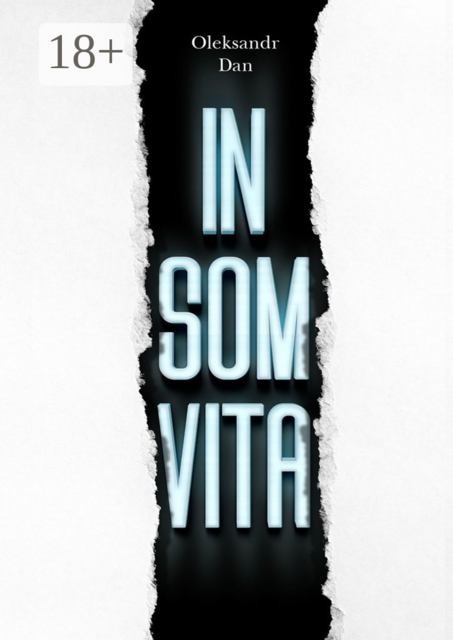
Insomvita
Psychological thriller with elements of a crime story
Fonts by «ParaType»
© Oleksandr Dan, 2021
This book tells a story of Robert Blanche, a lawyer with a life split in two — his own and the world of his dreams. Every night he sees the same dream — another life in another world. There, he is Trevor, a war correspondent.
One day, Trevor visits a psychologist, who puts him under hypnosis. Suddenly his life is turned upside-down and both he and Robert are put through the ringer as they try to find their way back to ‘normal’.
Inspired by true events.
ISBN 978-5-0053-7955-9
Created with Ridero smart publishing system
Contents

or the life and dreams of Robert Blanche
Psychological thriller with elements of a crime story
Kyiv — 2021
Author: Oleksandr Dan (Danaikanych)
Watercolor by: Tasha Torba (Natalia Cheredniuk)
Translated by: Olena Lytvynenko
Cover:
Idea: Oleksandr Dan (Danaikanych),
Design: Mykyta Mykhailov
Text copyright © 2020 by Oleksandr Danaikanych
Translation copyright © 2020 by Oleksandr Danaikanych
All rights reserved
____________________________________
Can you remember what you dreamt about today? Some people claim they do not dream at all, although in truth dreams occur every night. And sometimes when we wake up, we forget not only the dream, but also the fact that we had one. And then we ask: why?
This book tells a story of Robert Blanche, a lawyer with a life split in two – his own and the world of his dreams. Every night he sees the same dream – another life in another world. There, he is Trevor, a war correspondent, who doesn’t suspect about a life on the other side of the dream.
One day, Trevor visits a psychologist, who puts him under hypnosis. Suddenly his life is turned upside-down and both he and Robert are put through the ringer as they try to find their way back to ‘normal’.
Inspired by true events.
____________________________________
Part One
If you gaze long enough into an abyss, the abyss will gaze back into you…
Friedrich Nietzsche
Chapter 1
Tatras
24 December 2011. 03:12
A lightly dressed man, shivering from cold, stood on a precipice high over a mountain river. He seemed neither concerned nor scared at being just a half step from the edge of an abyss, since one false move could cost him his life. Rather, his gloomy silence was filled with despair and a readiness to step into the darkness filled with the roaring of the river below.
The black silhouette of the man was set sharply against the blue snow. He stared into the depths of the turbulent steam, as if looking for answers in this black vein of the mountain river.
Suddenly he spread his arms and raised his face to the sky. His lips whispered words of a prayer. Shutting his eyes, he waited for a sign from above. Perhaps a minute passed, but the heavens remained silent. The man sighed deeply, opened his eyes and stared at the winter sky with the look of someone doomed to die. No answer was forthcoming, he realized. The man smiled sadly and let his arms fall to his sides.
Clusters of bright, twinkling stars were scattered across the heavens. Here, at nearly three thousand meters above sea level, far from the bustle of the city, they seemed close enough to pick like strawberries. The silence of the icy night was broken only by the river noisily carrying its waters from somewhere near the peaks of the High Tatras.

Dense spruces covered by the thick blanket of untouched snow loomed over the land, tops aimed at those very stars, like the cover of an old Christmas card. The moonless night concealed the beauty of the mountain slopes, although the grandeur of the raw alpine nature bled through with the light of the stars. It seemed as though modern civilization had never touched this place, and that all these crests of snow and centuries-old spruces stood the same as they had two, three hundred years ago.
«If there is no answer, then the question was wrong,» the voice of the philosophy professor sounded in the man’s mind like a flashback. «To every question, there is only one correct answer, which is the truth.»
«What if there are several answers and they are all correct, and they are essentially versions of the truth?» he had asked, trying to argue with the professor.
«Remember, young man, there can be only one truth, and its versions are mistakes that generate untruth,» the professor had said without even looking at him.
But how do you find it, if the path towards this truth is darker than the blackness of this night? Where do you search, how do you determine the starting point, the thread that will eventually lead you to the truth?
To some, it might have appeared that the man was preparing to commit suicide and was just about to leap. The desire to take a single step and throw himself off the cliff into the abyss of the roaring river was checked only by the instinct of self-preservation, inherent only to a sober mind and the irresistible thirst for life. In a fit of despair, his consciousness tore fragments of the past out of his memory, as if proving the need to continue the search for answers to questions that were rending his heart.
«Could this be a solution? Could one step be all I need to get the answer,» he asked himself while peering into the inky blackness of the ravine.
From the darkness of the night, his memory once again recalled the lecture hall at the university and the voice of his philosophy professor: «What can this last step towards Azrael[1] and eternal slumber solve? Life in general is a directed movement from birth to death, avoided by nobody. The thought of ending one’s own life is driven by the desire to find some ultimate truth, but also doubt in achieving it. After all, the more you crave the ultimate, the more you realize its unattainability. It is these shifts between both extremes that lead to self-ruin.»
The professor paused, scanned the audience with unseeing eyes, took a book from his desk and, after shuffling through some pages, continued: «Sigmund Freud[2], the most renowned psychologist and psychiatrist of his time, even introduced the notion of the ’death drive’ or death instincts, since he could not otherwise explain many of the things a human being is capable of inflicting on themselves. The desire for self-destruction, it seems, is in our nature. While all living things struggle to survive, some humans, on the contrary, invest extraordinary energy into ruining their lives completely, sometimes ending them.»
The professor put the book aside and, crossing his hands across his chest, and after a small pause addressed the first row of students: «As to what pushes a certain individual to choose the path of self-destruction is a controversial issue that isn’t fully understood yet. After all, human beings have been observed and studied closely throughout the millennia, yet they remain underexplored, and something that is difficult to explore and analyze.»
The bell ending the lecture rang and the sound of whispering filled the hall. The professor, however, quickly glanced at his watch and monotonously and firmly continued in a raised voice: «In the paradigm of human history, the circumstances that have led to suicide were as different as the people who chose this path, or, more specifically, such an end to their life. This suggests that there are as many solutions in the classification of the circumstances that lead to suicide as there are people.
«However, could such a step change the circumstances that pushed a person to end their life this way? Could this change those who influenced the circumstances that caused the person to make this decision? Doubtful, as people don’t change, for the most part. They can mimic others or pretend to be better than they are under certain circumstances, and they can conceal their dominant identity, but it will inevitably surface over time, as the deception is short-lived.
«Can this step towards self-destruction change the world around us? Unlikely.» The professor paused again and glanced at the audience. «Life, my dear, will continue as before, but the person unfortunately is no longer its active participant, but most likely a passive observer.»
The man remembered this lecture by the philosophy professor at Charles University in Prague, where he studied law, and often thought about it, seeking the answer to his question when his mind was pushing him towards suicide.
There was one circumstance, however, that nullified this whole theory of a causal relationship with suicide.
What if a person is an outside observer to his own life? What if this person, even without having taken this step, is observing himself from somewhere inside his subconscious, with no power to change anything, supplement or alter himself? What if this observation, regardless of the person’s desire, is hanging over his mind like the Sword of Damocles throughout his entire conscious life? What would this last step change then? And could it change anything at all?
Not far away, a taxi with its engine running stood at the side of the road. The Indian behind the wheel was humming a simple folk melody to loud music and smiling.
«Quite the passenger I picked up today,» he mused. «He paid a thousand euro to get to this destitute, god forsaken mountain village.»
The taxi driver had not wanted to drive here, especially up the winding mountain serpentines on the icy road. But he agreed. And not only because the money was good. The taxi driver had seen how several other drivers rejected the customer’s offer and he felt genuinely sorry for this lonely, tired and lightly dressed man.
Yeah, not sensibly dressed at all, the driver thought, looking at his passenger, as he got in at the railway station.
Indeed, he was dressed strangely for this time of year. A thin cashmere coat, black, carefully ironed trousers, and autumn shoes. A thick, navy scarf twisted several times around his neck. His hair was disheveled and he had three-day stubble. And he carried no bag, which was odd for someone leaving a train station.
The road here was extremely slippery. Wet snow had fallen in the evening and turned the smooth asphalt into solid glass by midnight. The road services had not reached this area yet, and the Indian pondered for a while whether to take the trip, but the passenger paid triple the standard fare, including for the trip back, in advance.
Throughout the ride the passenger silently watched the road through the window. It was instantly clear that he did not want to talk, and the taxi driver shoved an old cassette into the player and switched it on.
A low-key, rhythmic melody to the accompaniment of a tabla[3] poured from the speakers. The Indian with a wide snow-white smile on his tanned faced looked in the rearview mirror at the passenger, but the latter paid no attention to him, immersed as he was in his own thoughts and staring gloomily at the trees covered with a thick layer of snow like a soft blanket, which would appear in the headlights and swiftly disappear again into the solemn darkness of the winter night.
Several kilometers before reaching the village, the passenger asked to stop the car.
«Please, stop here, please,» he said hoarsely, looking around. «Right, right… just here. And wait for me, please.»
The passenger exited the vehicle and confidently surged through the untouched snow. It was clear that he wasn’t new to this area, because the visibility was no more than a few dozen meters in any direction. When he confidently stepped into deep snowdrifts, the Indian shivered — he hated the cold.
Almost twenty minutes had passed and the Indian decided to leave his taxi and see where the man went.
Fifty meters from the car, the passenger stood silently on the edge of the abyss, not moving, staring into the distance with his hands in his coat pockets.
The Indian returned to the warm car and slammed the door. He looked at the fuel gauge and shook his head, smacking his lips in dissatisfaction.
The passenger continued to stand like a statue over the river, listening to the loud torrent of its dark waters.
Some weirdo I’ve come across, pondered the taxi driver, shrinking from the cold. It’s night out, freezing and snow, and this guy doesn’t seem to care. What can anyone think about in this cold?
The dark figure of the man, like a pagan idol, towered over the ravine. He tried to understand where the first time ’this’ had happened to him. It was «where’, not «when’, because the exact time was embedded in his memory forever. He also remembered the exact place where ’this’ had happened, and a hundred times he had thought back to that day in the distant past, trying to understand where ’this’ was happening, because knowing the place where everything happened did not give him the answer to the question: in which one of his lives did ’this’ happen for the first time.
He had long become used to not having the answer to the question ’where’. He tried to recreate the situation WHERE EXACTLY everything began so many times, but as soon as it seemed that the answer was attainable and the situation was becoming clearer, everything would instantly recede and become even more confusing and incomprehensible. It seemed as if he was climbing barely visible stairs towards the answer, but the stairs never ended, flowing into more steps and then swerving into the opposite direction. Every next step only made things more confusing, the thread was lost, and everything would return to the beginning.
The man was reminded of the work of the paradoxical world of Maurits Cornelis Escher[4] that hung in the hall of the first floor of Les Mondes Office on August Blanc Boulevard in the 13th arrondissement of Paris. Instead of the mannequins in the picture, where his memory took him, however, he saw himself mindlessly wandering up and down the ungodly stairs without handrails in a world where the laws of reality appeared not to work, just as in his own life. It seemed that the answer was obvious, but turn the picture ninety degrees and everything again becomes unclear and the answer to the question — further away from the truth.
No, he was not suffering from amnesia or some memory loss, or even its weakening. On the contrary, he extremely enjoyed sifting through his recollections. Sometimes a small memory from faraway childhood would surface as a result of the exercise, become supplemented with a plot, conversations, people and even feelings he had once experienced, and together serve to restore the past up to the smallest detail in his memory.
But this was something different. In his life, the laws of reality had gotten mixed up, and so in order to remain true to himself and not go crazy he had to cling to all the memories, clearly divide his life and control himself and everything that was happening to him. In time, he managed to do just that, although it was extremely hard to live in this kind of fragmented existence.
Far below, struggling through the jumble of boulders, the Vycha River streamed noisily. This small but turbulent river, this place, held many childhood memories. Some thirty years ago, here, he spent his childhood years in the like company of delinquents.
***
«Robert, time to go home!» the stern voice of his mother, who stood where the taxi now idled, calling for her son echoed as a memory in his ears and sent a warm wave to his heart. «How many times do I need to call you?! Hurry up! Let’s go home!»
His mother, a short woman with long, raven hair, dressed in a pink dress and white sandals, stood on top of the hill near the road holding a red bike and waited for her son to collect his belongings and come up to her. The wind ruffled her dark curls, while she vainly tried to cover her eyes from the sun and tame her hair disheveled by the rush of wind.
Robert… Said with the emphasis on the final syllable, as the French would pronounce it. Only his mother called him like that. For others he was simply Robbie or Bobba, which Robert really did not like.
Robert would reluctantly but quickly get ready, go to his mom, and together they would go home, carrying the bike together.
This river was almost the only joy in summer for local kids, where they could do something useful and fun: fishing and swimming in its tumultuous waters. In summer the huge boulders perched on both banks of Vycha became watercolor paintings from the dozens of big and small woolen carpets local villagers laundered, leaving them flat against the stones to dry under the scorching rays of midday sun.
The river was small. Some places could be forded by merely stepping on a string of slippery stones. In wider places, deep vortices formed, mostly behind lone boulders. And if the boulder was big, the vortex could run very deep.
In places, thick dry snags stuck out of the river, clinging to the rocks and growing into the brown silt. Bleached white, they resembled mammoth tusks rising over the water. Branches floating downstream from the mountain passes would often become their victims.
Despite the cold, ice had yet to form on the river, continuing to flow in a lively black stream between the thick, snowy white banks of the river.
Robert’s mind took him back to his childhood, when he first crossed the river as an eight-year old boy, wading, and then climbing to the top of a flat boulder warmed by the sun, where he felt very proud of his deed.
Robert pulled out a bottle of vodka from his coat and took a few gulps.
His thoughts slipped further back, immersing him in memories.
The first time it happened was on July 15, 1982.
On that day, Robert’s family gathered at a large table to celebrate his twelfth birthday.
It was a hot summer day and the air smelled of roasting bitumen. The scorching sun melted the road, turning the asphalt into a viscous mass that clung to the rubber of bicycle and car tires and to the soles of shoes. This odor was forever associated in Robert’s memory with the sensations of a hot summer.
There is a big, round, chocolate cake adorned with brown and red cream flowers on the kitchen table. On top of the cake, written in uneven letters, was the inscription: Happy Birthday — 12 years. Robert loved chocolate sponge cakes, but most of all he loved cream roll cakes, which were sold at the store near his house.
Little Robert always asked himself: why do people buy round cakes for a birthday? Why can’t they buy several roll cakes, place them on top of each other and present them to the birthday boy? And without inscriptions — the letters seemed silly, were not tasty for some reason and, in his opinion, totally unnecessary.
That day, Robert got a pair of oversized blue fabric sneakers as a gift. His parents bought almost all his clothes several sizes too large so that he could wear them longer, as his family’s income was low. His father worked from morning to night at a factory as a metal worker, while his mother was a nurse at the local hospital. To make ends meet, both parents had to take side jobs. Still, money was scarce and they lived very simply. Ice-cream and watermelon were the best desserts that were served for dinner on Sunday or for celebrations.
Robert invited only his school friend Jovan to his birthday party. His family usually did not have big, noisy parties to celebrate significant dates.
Quickly devouring the rest of the cake and washing it down with apple juice straight from a three-liter jar, the two friends climbed up into the barn that stood in the shadow of a huge old walnut tree. The roof of the barn was made of tin, and those places that were not protected by the shadow of the tree became as hot as a frying pan under the direct sun, making it impossible to sit there. Nevertheless, the roof was a place where nobody could keep the friends from idling away the hours, casually conversing, singing loudly and dreaming.
«Jovan, look, there are horses floating in the sky,» Robert said suddenly and laughed, pointing at some white clouds.
«Coooool!» Jovan said in languid surprise as he watched the clouds pass, but he suddenly perked up and said, «Let’s guess which animals they resemble. The one who finds the most animals, wins!»
There was, indeed, a huge white cloud in the shape of a floating horse. Its head turned slowly, but the thick mane transformed into the long wide tail of an enormous fish.
«Horse-fish or fish-horse?» said Robert. He squinted at the sun and…
That’s where it all happened.
The blinding sun abruptly caused his eyes to darken. Robert felt light-headed and his ears clogged. He blinked and then glanced around with a look of bewilderment. Next to him sat a stranger. He was telling him something, but Robert couldn’t understand a thing, whether from surprise or the constant ringing in his ears, he could not be certain. In fact, he did not even try to understand the language of the strange boy. It seemed as though he was seeing everything for the first time, everything was odd, unfamiliar and incomprehensible. Robert’s face exhibited genuine surprise.
He did not understand where he was, on whose roof he sat, or what he was doing there. Robert stood up and inspected his clothes. He was stunned — the clothes were new, as was the barn and, ultimately, the whole yard.
Robert could not understand what was happening to him. Everything around him was completely unfamiliar. With eyes wide from bewilderment, Robert looked up at the sky.
There, the horse with a fish tail was still floating proudly with his mane spread across the sky. Rays of sun broke like long threads through it and disappeared again. The horse appeared to be smiling.
The first thought that came to Robert was that he was delirious. He knew that sunstroke could cause a loss of consciousness, but he could not comprehend how such hallucinations could at once seem so real and unreal. His heart was threatening to burst from his chest. A primal fear was starting to overwhelm him.
The boy could not help but think that this was some mysterious, fantastic, but strikingly realistic dream. He kept looking around with an open mouth and wide eyes. He wanted to flee that roof to the ground, and without thinking he took a step. The hot roof burned his bare heel like when he was on the beach in Pattaya several days earlier, where his father had taken him and his mother to see the Gulf of Thailand. The sea had been teeming with jellyfish and Robert accidentally stepped on one.
«Jellyfish. It’s just jellyfish, nothing to worry about,» the doctor had said calmly at the local hospital where the boy was taken with the burning foot. To the child, the word jellyfish meant a sudden stinging pain. The throbbing foot was covered with bright red marks.
It lasted for just a moment. Feeling a sharp pain, Robert squeezed his eyes shut and held his breath.
«Jellyfish! It doesn’t look like a horse-fish at all!» Jovan sat next to him laughing loudly. «Look, Robbie, see — there’s the head and there’s some tentacles. Like the one in our biology textbook.»
The snapshots of a distant, hot country disappeared abruptly without a trace, like the surprise Robert’s face bore just a few minutes prior.
Robert smiled at Jovan and looked at the sky.
And yet, it was a horse that was floating in the sky, not a jellyfish, he thought.
Jovan and Robert, two inseparable friends, continued to enjoy looking at the clouds.
Meanwhile, the horse with a long fish tail continued to float across the sky, smiling.
Sigmund Freud (German Sigmund Freud), born Sigismund Schlomo Freud; 6 May 1865, Freiburg, in the Austrian Empire (now Pribor, Czech Republic) — 23 September 1939, London, was an Austrian psychologist, psychiatrist and neurologist, the founder of psychoanalysis, a therapeutic field of psychology. He developed a methodology of free association and interpretation of dreams, which was the basis of psychoanalysis and formulated the concept of personality.
1 Azrael (Arabic — Azrāīl), or Malak al-Mawt (Arabic –Angel of Death) is the Angel of Death in Islam and Judaism, who transports the souls of the dead to the other world.
Maurits Cornelis Escher (Dutch: Maurits Cornelis Escher (17 June 1898, Leeuwarden, the Netherlands — 27 March 1972, Laren, the Netherlands) was a Dutch graphic artist known for his conceptual lithographs, woodcuts and mezzotints, in which he explored plastic aspects of the notions of infinity and symmetry, and also psychological perception of complex three-dimensional objects.
Tabla (Hindi tablā; Urdu tablah) — Indian percussion instrument. It is a pair of twin drums, the main percussion instrument in Hindustani classical music, played as accompaniment with other instrument and vocals. Tabla also features in dance performances such as Kathak. It is also popular in the countries of the Indian subcontinent.
1 Azrael (Arabic — Azrāīl), or Malak al-Mawt (Arabic –Angel of Death) is the Angel of Death in Islam and Judaism, who transports the souls of the dead to the other world.
Sigmund Freud (German Sigmund Freud), born Sigismund Schlomo Freud; 6 May 1865, Freiburg, in the Austrian Empire (now Pribor, Czech Republic) — 23 September 1939, London, was an Austrian psychologist, psychiatrist and neurologist, the founder of psychoanalysis, a therapeutic field of psychology. He developed a methodology of free association and interpretation of dreams, which was the basis of psychoanalysis and formulated the concept of personality.
Tabla (Hindi tablā; Urdu tablah) — Indian percussion instrument. It is a pair of twin drums, the main percussion instrument in Hindustani classical music, played as accompaniment with other instrument and vocals. Tabla also features in dance performances such as Kathak. It is also popular in the countries of the Indian subcontinent.
Maurits Cornelis Escher (Dutch: Maurits Cornelis Escher (17 June 1898, Leeuwarden, the Netherlands — 27 March 1972, Laren, the Netherlands) was a Dutch graphic artist known for his conceptual lithographs, woodcuts and mezzotints, in which he explored plastic aspects of the notions of infinity and symmetry, and also psychological perception of complex three-dimensional objects.
Chapter 2
Geneva, Switzerland (Trevor)
17 December 2011. 09:03
Bright sunlight seeping through a crack in the curtains lit a narrow strip of a wide bed. The rest was covered in darkness. A cell phone on a glass nightstand was persistently ringing. Running water could be heard from the shower. Men’s socks, trousers and women’s underwear were scattered on the floor.
The phone went silent, but soon started ringing again. Trevor, in a bathrobe and with a towel draped over his head, approached the bed and picked it up.
«Good morning, Victor… Sure, in an hour… Thanks.»
The line went dead. Amanda’s assistant reminded Trevor about the time of the session.
Trevor dropped the phone and threw open the curtains. Light broke into the room. The windows of the Beau-Rivage Hotel on Lake Geneva revealed a fountain and the snowy mountain peaks of the Swiss Alps. On the bed, snoring softly, a young girl with long dark hair was sleeping. A gray, silk sheet enveloped her naked body like second skin. Breaking his gaze, Trevor recollected the previous evening at the nightclub he frequented whenever he was in Geneva.
Last night the club featured some band that was probably quite popular, judging by the two hundred young people who crowded the stage, singing loudly along with the vocalist to the deafening accompaniment of drums.
The thick blue and yellow beams of projectors caught the faces and hands of the fans in the crowd. Laser chasers were blinding Trevor, so he turned away from the stage and headed to the nearly deserted bar. The young bartender with short, bleached hair and a colorful tattoo took his order and poured a glass of whiskey. A girl sat alone at the other end of the bar, watching Trevor. When their eyes met she smiled and looked down. But then she looked at Trevor again with a tenacious, penetrating, somewhat inquisitive, even defiant look. Trevor slammed down his drink and confidently approached the girl.
In the morning, he could not remember her name, where she was from or what they had talked about at that club. The several glasses of whiskey he had consumed scorched his memories of that night, melting away all that was unnecessary and leaving only fragmented, disconnected shots of their embraces and kisses. Trevor could not remember how they left the nightclub, how they got to the hotel, to his room, but his memory shamelessly continued to show him moments of their lovemaking. Trevor remembered her as passionate, bathed in sweat in his arms, illuminated by a narrow ray of pale moonlight, and he smiled.
«Chloe!» The name of the stranger struck him like a bolt out of the blue. «I think that’s what she called herself? Right, it was Chloe.»
Trevor dressed and opened his wallet. A plastic window revealed an ID with PRESS written in big letters on it. He pulled out four hundred Swiss francs, placed them on the bedside table next to the girl and quickly left the room. Soon, he was outside the hotel on the street.
Christmas was fast approaching and the weather in Geneva was warm and autumnal. At night the temperature would fall to near freezing, which was unseasonably warm, but for Trevor, who had recently flown in from the Sahara, the weather was quite pleasant. The temperature in the desert at night also rarely rose above 3—4oC.
Beau-Rivage Hotel to Rue du Cendrier is about a twenty-minute walk along the city’s promenade.
Trevor felt very agitated before the second session. Until this point, he did not fully understand what had happened to him the day before. Over the past twenty hours, he kept thinking about the office of the psychologist Amanda, listening over and over to his own voice broadcast by the speakers of a small portable recorder, telling an incredible story of a part of his life that nobody knew about, hidden somewhere deep in his subconscious.
It had all started several days earlier, after an unexpected encounter and what he thought was an innocent proposal.
***
«Yes, Trevor, these are some fine rocks,» said an elderly jeweler, who was unable to roll his «r’ as he spoke, as he examined a round diamond the size of a hazelnut. «Take this one — pure perfection.»
A short gray-haired Jew with horn-rimmed glasses perched on his head had been inspecting the diamond for five minutes through a thick magnifying glass, holding it with fine tweezers in his white cotton gloves.
He carefully returned the stone and picked up another from the handful of nearly identical in size and shape diamonds scattered on a black lacquered table.
«Wonderful!» He was clearly admiring them. «The cut is amazing! The girdle on all of them is as sharp as a knife. The colors and purity are like dew from the sky…
Trevor was introduced to Lev Goldenberg, a jeweler and emigrant from the Soviet Union, by Rochefort, chief editor at Les Mondes, who often ordered jewelry from him.
Lev Goldenberg created remarkable copies of the best collections offered by the leading jewelry brands of Europe.
«Show me a photo of a masterpiece and I will make you one that is hundred times better at half the cost,» he loved to say every time potential clients approached him. Indeed, he was the finest craftsman.
«I have a client who can purchase all of these in one lot,» said the old jeweler as he eyed yet another rock. «If you negotiate well, he will pay five million right away, maybe more.»
«Lev, I wasn’t thinking of selling just yet. I just need a safe place to keep them for a while.»
«Teo, you don’t understand,» the jeweler said softly, prying his gaze from the diamond to give Trevor a piercing look. «Five million euros, not dollars. That’s a lot of money, my friend.»
«Lev, I need a safe place for a couple of days, until Christmas. I’m staying at a hotel and it would be extremely reckless of me to keep them in a safe there.»
— Tov[1], my friend, all right,» said the jeweler somewhat dejectedly. He gathered the stones in a green velvet bag. «You know you won’t find a safer place. But if you do decide to sell, just let me know and I will arrange everything within two-three hours.»
Shortly after the conversation with the jeweler, Trevor was sitting on the open terrace of a small restaurant in the heart of Geneva, sipping coffee and reading the latest newspapers.
Military service was in the past, the only reminder being a pale tattoo of a skull on his left shoulder, a device of the Reconnaissance Battalion of the Marine Brigade of the French Foreign Legion headquartered in Algeria. The department of the French Press Institute at Paris II Panthéon-Assas University was also in the past. Now, he was a special war correspondent for Les Mondes.
Trevor remembered only bits and pieces of his childhood, as the family moved around a lot. His father was from Carpathian Ruthenia[2] (territory of modern Zakarpattia region in Ukraine), a Ukrainian Ruthenian (Rusyn)[3].
However, at the beginning of the Second World War, when Zakarpattia, then a part of Czechoslovakia, was occupied by the Hungarian army, his family fled first to Prague and after the war to France, where Trevor was born in the early 1970s. His father would converse with him only in the Rusyn language so that he would remember his heritage. Trevor’s mother, a teacher of French and French literature, tried to instill in him a love for everything French.
His father, an expert in hotel construction, had traveled regularly for work to different countries, and he would often take his family with him. That was why Trevor’s childhood memories were reduced to faded color and black and white photographs against the backgrounds of public markets in India, islands and temples of Thailand, sands of the Middle East, and the endless construction sites of Hong Kong, Dubai and Bangkok. As a child, Trevor got so used to moving around and the constant changes that even when he entered adulthood, he could not imagine himself as an office employee, working at the same desk day after day. That was the reason behind his fascination with journalism.
But then the accident happened.
When the boy was twelve, his parents died in a car accident. Trevor spent nearly a month in a hospital until his mother’s older sister, Anne Frachon, became his legal guardian and took him to Paris.
Aunt Anne was unmarried and gave all his love to Trevor. She was the one who insisted that Trevor enlist and later study journalism at university.
Over the past fifteen years, Trevor had traveled to nearly all the world’s conflict zones.
He received the Prix Albert Londres war correspondent award.
His career as a journalist began in 1999 during the Yugoslav Wars. He was sent there as a young, promising reporter by the newspaper in place of an experienced correspondent, who had unexpectedly fallen ill. As a former soldier who served five years in the French Foreign Legion and had intimate knowledge of military matters, Trevor was more than ready for that kind of work.
During the assignment, he became embroiled in a scandal after he published a controversial investigation on the NATO bombing of Yugoslavia. Trevor was one of the first to reveal that the alliance had used cluster bombs prohibited by the Geneva Convention. Despite the pressure and criticism by military experts and politicians, the young journalist was noticed and recognized.
In the fall of 1999, Trevor was sent to West Africa together with a group from the BBC to prepare an investigative report on war crimes committed by Foday Sankoh, former leader of the Revolutionary United Front, who was appointed vice president of Sierra Leone in 1997, and his ties to another infamous war criminal, then president of Liberia Charles McArthur Taylor, who was later indicted for crimes against humanity thanks to the materials collected and published by Trevor. In 2000, Sankoh was also accused of being a war criminal and indicted, while Charles Taylor was apprehended and held at the International Criminal Court in 2006.
From then on, Trevor was the top journalist covering the majority of military conflicts. His insightful reports and uncompromising articles were published by most of the European press.
In 2007, Trevor was covering wars in Afghanistan, Angola, Congo, and Sierra Leone, where he investigated Viktor Woud, an arms dealer from Russia, who was suspected of illegally selling arms and munitions to the Taliban, Al-Qaeda and UN-embargoed countries.
Trevor’s colleagues from Russia had told him that Woud could be a secret dealer for the Russian state arms export agency and a big player in Russia. They warned Trevor about investigating this story, as Woud’s operations were directly linked to the newly emerging Russian mafia, which had global aspirations.
Nevertheless, he probed and published, and some of his reports were aired by top European channels.
Viktor Woud was arrested in 2008 in Thailand and extradited to the U.S. on November 16, 2010, where he was indicted. Finally, on November 2, 2011, a jury unanimously found him guilty of illegal arms dealing.
All these events were well covered by Trevor from the start of the investigation in 2007, although due to another trip to a collapsing Libya, he could only follow the trial of Woud online and through the reports of his colleagues.
His track record included reports from Baghdad during the Iraq War, Gaza Strip during the Gaza War and the Libyan cities of Benghazi and Misrata, which were nearly leveled by NATO airstrikes.
That is why Trevor was considered to be one of the most experienced journalists, the lead expert on Africa and the Middle East.
Working in the most unstable countries, Trevor needed trustworthy and reliable friends and partners.
Kate, a twenty-eight-year old journalist from Australia, was one person Trevor fully trusted. Kate was a graceful and sweet blonde with short tousled hair, a cheerful smile full of even white teeth, beautiful, full lips, as if painted by a master artist, and big green eyes. Despite appearing delicate, she always wore a light uniform and a felt hat.
Kate was one of those women who, despite approaching the age of forty, remained cute and cheery, like a teenager in appearance and behavior.
They met in early 2007 in Afghanistan.
A few days earlier, Trevor was captured by the Taliban in Musa Qala, Helmand Province. The abduction had been planned, even though he was on his way to meet one of their leaders for a special story.
There was a young blonde woman and two men, tired by the heat and hunger, already in the house where the bound prisoners were brought. Trevor gathered from the conversations he overheard that they were all journalists and that they had been held there by the militants for over a month.
A local driver and an Afghani reporter were captured together with Trevor. The next day, to intimidate others, two Afghanis were publicly executed in front of the prisoners. The Taliban were planning to demand a ransom for him and the other journalists.
For three days Trevor was brutally beaten in an attempt to break his will, but on the fourth day Mullah Saddam, a prominent Taliban field commander, arrived at the camp.
***
Musa Qala, Helmand, Afghanistan
22 February 2007 15:35
«Well, well, well. The big infidel is on his knees before the little Afghani mujahedeen?» Mullah taunted in bad English as he approached Trevor, who was lying helplessly, tied up in the dust.
«I am not a soldier; I am a journalist. And I am French,» replied Trevor, despite the agony of the ropes.
«Press?» The militant said with unconcealed malice, grabbing Trevor by the shoulder with one hand and striking his face loudly with the other. «I not ask you, dog, who you are.»
He took Trevor’s plastic ID card in his hands and inspected it with a satisfied smirk.
«Press is good. We need press, very need.»
«What do you want from me?»
«Nothing from you. What can you? You are weak and sick. You can’t anything. Your master can! He pay me. Pay a lot.»
«Nobody will pay you a dime for me. I’m not important,» Trevor said quietly. He spat blood.
«Pay, pay a lot. You make video tomorrow. You ask him to pay,» hissed the Mullah, pressing his foot against Trevor’s face. «If not pay, you go home to Paris in pieces, we send to your office.»
The Mullah gave some instructions in Pashto to some militants. Trevor was lifted and dragged not to the pit, where he was held earlier, but to a clay shed, where the other prisoners were now being kept. It was at least dry there. He was thrown into a small room, separated from the rest of the prisoners by a double plank wall. They put shackles on his wrists and ankles, chained him to a wooden beam and gave him some food and a mug of water. To the militants, Trevor seemed broken and not dangerous.
And that was the opportunity he was waiting for. The Taliban were convinced that a chained, starved, exhausted, beaten prisoner would only dream about getting some sleep, so they carelessly left only one armed mujahedeen near the shed, who as soon as it turned dark smoked some local weed and fell asleep against the wall.
Trevor had learned how to escape from any restraints during his service in the Legion. When he was sure that the camp was settled for the night, he easily freed himself from the shackles and climbed outside through a hole in the roof.
After taking out the guard and grabbing his assault rifle and grenade pouch, Trevor opened the other door of the shed and quietly ordered: «Come on out! Quick!»
However, only the girl rose and resolutely headed towards the exit.
From the darkness of the stuffy room came a coarse voice of a man: «Kate, think about it, you will be caught and executed. Don’t do it.»
But Kate confidently took a step towards the opened door and took Trevor firmly by the arm.
«Can you drive?» Trevor asked as they left the shed. He pointed to a white pickup truck and whispered, «Usually they leave the keys in the armrest. Turn on the engine and wait for me. If something goes wrong, the road to freedom is just behind that wall.»
Kate ran to the truck while Trevor poured gasoline over the other two vehicles and ammunition boxes stacked near a small tent. Alerted by the sound of the running engine, two militants rushed from a building only to be met with the blast of a grenade Trevor had thrown at their feet. Chaotic shooting burst from the building’s windows. Trevor lobbed two grenades at the building and fired at the gasoline. In an instant, everything around him lit up. After unloading a full clip at the building, Trevor threw another grenade towards the ammo boxes, jumped into the open car door and shouted: «Go!»
«Where to?» Kate asked. Her hands were shaking as she grabbed the steering wheel.
«There!» Trevor yelled. He grabbed the wheel with one hand and pressed gas pedal with his left foot together with Kate’s foot, directing the vehicle at the clay fence. «Hold on tight!»
The vehicle tore through the wall and flew onto the sandy road to the deafening roar of detonating ammunition. A bright glow of fire rose over the village, lighting the way for the escapees.
«Now you can turn on the headlights,» Trevor said quietly after some time. The burning building disappeared behind the hill. «Sangin is maybe twenty-five kilometers from here, not more. Just drive to the river without stopping. There is a British base somewhere there… A patrol should see us.»
Trevor was slurring his words. Only then did Kate notice that he was pressing his hand to the left side of his chest. Blood was dripping through his fingers.
«Are you wounded? What’s wrong?» Kate asked.
But Trevor remained silent. He lost consciousness and his body went limp.
«Please, keep talking!» Kate shouted frantically, but she received no answer. Realizing that she was now essentially alone, Kate pressed her hand against Trevor’s wound and stepped on the gas pedal.
Trevor woke up in a bed of a military hospital. Kate was sitting next to him in a white coat draped over a military uniform, with an open book in her hands, dozing.
«Where am I?» asked Trevor faintly.
«We are in Kandahar, on the US base,» Kate answered sleepily. She smiled.
«How long was I out for?»
«Almost three days. You had to have surgery, but it’s all over now.»
Trevor looked around, then glanced at Kate with a barely noticeable smile:
«I believe we haven’t had the chance to be introduced. I am Trevor Blanche.»
«I’m Kate, Kate Larsen. From Australia. I wanted to thank you for saving me.»
«No need, Kate. I am here thanks to you, so we are even.»
The next day, Trevor and Kate were transported from Afghanistan to Switzerland. In Zurich, Trevor continued to undergo treatment and spent all his free time with Kate. Trevor even tried to romance her, but after a few nights spent together Kate made it clear that she had no intention of starting a serious relationship with him, to avoid disappointment, she said, and thought it best to keep what they had uncomplicated. In truth, Kate was testing Trevor. She liked him a lot, but her female intuition told her he wasn’t into committed relationships, so she tried to instill a keeper’s instinct in him.
Trevor, however, easily accepted her terms and continued to regard Kate only as a colleague.
Initially, this irritated Kate, but she hid it well and always seemed happy to see him whenever they were set to work together.
In fact, this kind of relationship between a man and a woman should have ended once and for all after some time, but they were doing the same job. So, after two-, three-week trips, they would part and return to their respective homes, friends and families — to their own worlds.
Trevor had known Etienne, a cameraman, for more than a decade, ever since he worked in Sierra Leone. Etienne was French, but with some Scottish blood flowing in his veins, from this mother. He spent most of his childhood and adolescence at the foot of Ben Nevis, the highest mountain in Scotland, on the shore of Loch Linnhe, in the town of Fort William, where his mother was born and where her family still lived.
Etienne absorbed Scottish traditions into every cell in his body. He was extremely proud of the history of Scotland, which he deeply respected and considered his own. That was why, at the age of 35, his French heritage could only be found in a few traits on his slender face. Even the tattoo on his left shoulder bore the words of Scotland’s motto in Latin: «Nemo me impune lacessit»[4].
Etienne was not a talkative sort, or showed feelings at the drop of a hat. In fact, he was careful to hide all emotion. He even joked with a stony face, while his highest praise was a curt «Not bad».
Trevor valued his friendship with Etienne. They had worked side by side for many years. Etienne accompanied Trevor on almost all of his journeys.
In addition, Etienne has been seeing Kate for over a year; they spent a lot of time together. Trevor thought it odd to see the tall, lean Frenchman with an aquiline nose and long hands tenderly treat the small Kate, who was a foot shorter than him. Trevor had been observing them with a smile, comparing their relationship to a dance of fire and ice. It was clear that Kate’s hot heart was melting the ice that covered Etienne’s heart.
Trevor began working with Dan eighteen month ago. Dan was a short, open-hearted young man, a pacifist and a bit of a ladies man. Only twenty-five, he was accepted to Les Mondes as a promising, young and ambitious reporter immediately upon graduating from Tampere University. Rochefort, chief editor of Les Mondes, took the young reporter under his wing. Rochefort appointed Dan as Trevor’s assistant, and Dan ended up accompanying Trevor and Etienne on several trips to the Middle East. A rumor went around that Dan was a distant relative of Rochefort, or even a love child from a long abandoned liaison. Be that as it may, Rochefort was clearly concerned about the future of this young man and he was helping him to find his own place in journalism.
After Etienne and Kate made their relationship official and Kate had moved to Paris to live with him, Dan became Trevor’s buddy during his sojourns to the nightlife of Paris and Zurich.
Dan, too, was secretive about his past. He never spoke about it, but he was happy to be useful to his more experienced colleagues and closely watched Trevor, acquiring the essential skills of a hardened war correspondent. It was Dan, as Trevor’s assistant, who was lately covering the USA v. Woud trial, the scandalous case of the biggest illegal arms dealer in history, tried by the US District Court for the Southern District of New York.
Nemo me impune lacessit (Lat.). — No one attacks me with impunity.
Rusyns (Ruthenians, Rusnaks) — name of Ukrainians before the 18th century; in West Ukrainian regions — before the beginning of the 20th century. The name is still used in Zakarpattia. Initially, the word «rusyn’ was used only in singular form as a derivative of the plural form of «Rus’. Many Croatian historians identify Rusyns with White Croats, believing they are the descendants of the White Croatian tribe.
Carpathian Ruthenia (Czech Podkarpatská Rus, Země Podkarpatoruská; also Carpatho-Ukraine or Zakarpattia since September 1938 — Czech: Země Zakarpatskoukrajinská) — the name of one of five (later four) regions of the First Czechoslovak Republic 1919—1938 (from 26 October 1938 renamed Carpatho-Ukraine, an autonomous regions of the Second Czechoslovak Republic). The region is located in the modern-day Zakarpattia Region of Ukraine.
Tov (Yiddish) — good, okay.