


автордың кітабын онлайн тегін оқу Dick Merriwell's Trap: or, The Chap Who Bungled
Burt L. Standish
Dick Merriwell's Trap; Or, The Chap Who Bungled
CHAPTER I – A FARDALE VICTORY
For a moment as he lay on the ground holding the ball for Dick Merriwell to kick the goal that must win the game with Hudsonville for Fardale Military Academy, Hal Darrell, the left half-back, was seized by a strong temptation to do wrong. How easy it would be to spoil that kick! A slight shifting of the ball just as the captain of the Fardale eleven kicked, and the attempt for a goal would be ruined.
There was bitterness in Hal’s heart, for he realized that Dick was covering himself with glory, while up in the grand stand sat June Arlington, a thrilled witness to everything that had occurred during that most thrilling game.
At first Hal Darrell had refused to play on the team during this game, but because June had urged him to reconsider his determination not to play, Hal had humbled his proud spirit and offered to take part in it. But even then, to his chagrin, he was left among the substitutes until Earl Gardner, who had been given his position when he withdrew from the team, was injured so badly that he could not continue in the game. Then Dick Merriwell thought of Hal Darrell’s desertion of the team and at first wanted to punish him for it by leaving him on the substitutes’ bench, but his better nature conquered and the spirit of forgiveness reigned triumphant.
Hal knew nothing of Dick’s temptation to call out another player to take Gardner’s place, which would have humiliated and infuriated Darrell to an unspeakable degree. Hal was not aware that Dick fought the temptation down, crushed it, conquered it, and did what he believed was best for Fardale, regardless of his own inclination and feelings.
So Hal had been given his old position as half-back and had played a steady game, contributing greatly to Fardale’s success, although he made no individual play of brilliancy that distinguished him above the others.
At the same time he had seen Dick make a great run down the field, had seen him leap clean over one tackler, and had witnessed a touch-down that tied the score between Hudsonville and Fardale. If Dick kicked the goal the game would be won.
If he failed it would most certainly remain a tie, as there was not enough more playing time to enable either side to score again, unless some amazing fluke should take place.
So as Hal lay on the ground, holding the ball, he was tempted. Under any circumstances Fardale would come out of the game with flying colors. During the first half she had been outplayed by the big Hudsonville chaps, who had secured two touch-downs and a goal. Her line had been weak, and she had seemed to have very little chance of making a point. It looked like a hopeless battle against overpowering odds.
But Dick had never given up for a moment. He had kept up the courage of his men. And all through the first half Obediah Tubbs, the fat boy who played center on Fardale, had continued to hammer at Glennon, the big center of the opposing team, until finally all the fight and sand had been taken out of the fellow, and the strongest point in Hudsonville’s line became the weakest.
The cadets took advantage of that weakness in the second half. The most of their gains were made through center. Glennon, limp as a rag, asked to go out of the game; but King, the captain, angrily told him to stand up to his work, knowing it would discourage the others to lose the big fellow, who had never yet failed to play through any game he had entered.
And when Dick Merriwell had been hurt and it seemed he must leave the field, Hal had seen June Arlington – forgetting appearances, remembering only that Dick was stretched on the ground and might not rise again – run out from the grand stand and kneel to lift his head.
Standing apart, his heart beating hotly, Darrell saw her give back to Dick a locket containing her picture – a locket she had given to him once before when he had risked his life to save her from some savage dogs which attacked her on a lonely road on the outskirts of Fardale, and then demanded again after her brother had told her some untrue tales about Dick.
“She would not let me have it when I asked her for it after she got it back,” thought Hal. “But now she gives it to him again! And she does not mind who sees her!”
It seemed very strange for a proud, high-bred girl like June Arlington to do such a thing before the assembled spectators. She had been governed by her heart, not her head. Had she paused to consider, she would have been dismayed; but she scarcely knew how she reached Dick, and she seemed to come to a realization of her position first as she knelt and held his head. Then she had courage not to lose her nerve, and she gave him the locket as a “charm” to restore his good luck.
It was after this that Dick made the run that set thirty “faithful” Fardale rooters howling mad with joy. He did it even though he reeled and could scarcely stand when he rose to his feet. He did it by casting off his physical weakness and calling to his command all the astonishing reserve force of a perfectly trained young athlete. But for his training and his splendid physical condition, he would have been carried from the field, done up.
In the moment of his temptation Hal realized that Dick had trusted him perfectly in calling him to hold the ball.
“But he’s made me help him win glory in her eyes!” was the stinging thought that followed.
However, he conquered the temptation. As Dick balanced himself, Darrell carefully lowered the ball toward the ground. The seam was uppermost and everything was ready for the kick that would decide whether the game should end a tie or Fardale should leave the field victorious.
Darrell’s hand was perfectly steady as Dick advanced quickly and kicked. Fairly over the middle of the bar sailed the ball, and the “faithful” shrieked and howled and thumped one another on the back and had fits.
But they were not the only ones who had fits. Apart at one side of the field Chester Arlington, June’s brother, and a student at Fardale, walked round and round in a circle, muttering and almost frothing at the mouth. Then he started for the grand stand.
“I’ll tell her what I think!” he grated.
But he stopped and stared at the field, where Hudsonville was making a listless pretense of playing during the few moments that remained. He seemed to go into a trance and stand there until the whistle blew and the game was over. He saw the “faithful” go tearing on to the gridiron and surround Dick, and he could bear to see no more.
“I believe I’ll have to kill him yet!” he snarled, as he turned away.
He walked blindly into the rail beyond which the spectators were slowly filing out from the enclosure. Some of them stared at him wonderingly, noting his wildly glaring eyes and hearing his incoherent mutterings.
“What ails that chap?” said a man.
“Gone bughouse,” intimated another. “Who is he?”
“Don’t know. Saw him with that pretty girl who ran out on the field when Merriwell was hurt.”
“He’s a Fardale boy?”
“Yes.”
“Must be crazy with joy. Can’t blame him after seeing his team win in that way.”
Chester crawled under the rail and bumped against a man.
“Get out of the way, you old fool!” he snarled.
“Who are you talking to?” demanded the man, in astonishment and anger. “Who are you calling an old fool?”
“You! you! you! You ran into me – me, son of D. Roscoe Arlington! Do you hear?”
“You’re a crazy ass!” said the man, and walked on.
Somehow those words seemed to bring Chester to his senses in a measure.
“Brace up, old man!” he muttered huskily. “Why, I wouldn’t have Merriwell see you like this for a fortune!”
He passed out through the gate with others and started away. Then he bethought himself and turned back to where a carriage, containing a driver, waited. He got into the carriage.
“Go on,” he growled.
“But the young lady, sir,” said the driver; “your sister.”
“Oh, yes!” mumbled Chester. “I had forgotten her. We’ll wait for her. Darrell is a thundering fool!”
“I beg your pardon, sir?” said the driver.
“Nothing that concerns you,” growled Arlington, and he sat like a graven image, waiting for June.
CHAPTER II – DICK STOPS A RUNAWAY
The sweat-stained, bruised, battered, triumphant Fardale lads peeled off their football armor in the dressing-room beneath the stand. Earl Gardner was there, barely able to walk, but supremely happy. Dick was happy, too. Scudder, partly recovered from a collapse, was shaking hands with everybody.
“It was a shame!” said Ted Smart in fun. “I hated to see us do it! They were so sure of the game that it seemed like robbery to take it.”
“By Jim! I’ll be sore to-morrer!” piped Obediah Tubbs. “Never got no sech drubbin’ before sence dad used to lay me over his knee an’ swat me with the razor-strop.”
“But you put Glennon on Queer Street,” smiled Dick. “And that was the finest thing I ever saw happen to a bruiser like him.”
“He! he! he!” came from the fat boy. “I kinder thought I might git called down fer some of that business, but the empire didn’t dast say a word.”
“I should opine not,” put in Brad Buckhart, the Texan. “He permitted Glennon to start the slugging-match, and he couldn’t say anything when it became too hot for the big tough.”
“Both umpire and referee were against us,” grunted Bob Singleton.
“But we won out against all odds, fellows,” said Dick cheerily. “And I am proud of you!”
“It’s us that sus-sus-sus-should be pup-pup-pup-proud of you!” chattered Chip Jolliby, his protruding Adam’s apple bobbing as it always did when he was excited and tried to talk fast.
“That’s right! that’s right!” cried the boys. “Captain Dick was the one who turned the trick and won the game!”
“No, fellows,” said Dick earnestly. “I did what I could, but to no one individual belongs the glory of this game. It was a victory won by the splendid courage and staying qualities of the whole team. It was the kind of courage that wins great battles. It showed that this team is made up of the right kind of stuff. We were stronger at the finish than at the start, while they were weaker. It’s staying power that counts.”
Dick was right. And it is “staying power” that counts in the great game of life, just the same as in football. A fellow may have ability and be brilliant in his accomplishments, but if he has not “staying power” he will be beaten out every time by the tireless, persistent, dogged plodder.
The boys were not able to bathe and be rubbed down there, so they hustled on their clothes and prepared to make for the hotel, where they might cleanse and refresh themselves after their successful struggle.
“Thunder!” moaned Tubbs. “How hungry I be! Don’t think I ever was so hungry before in all my life.”
Then it was that some of the faithful appeared with pies of various sorts, procured at a bakery in town, and delivered them to the fat boy, who was so fond of pies that he ate all he could even while in training, the one who presented them making a humorous speech.
When the boys piled into the big carryall that was to take them to the hotel Obediah had his lap full of pies. Holding one in each hand, he proceeded to devour them, a supremely happy look on his full-moon face. Along the route he was observed with amusement, and he laughed and waved his pies at those who laughed at him.
It seemed that almost half a hundred small boys were waiting for the Fardale team to appear, and they ran after the carryall, cheering and calling to one another.
“Well, we seem to have won favor with the kids, anyhow,” said Dick.
When the hotel was reached the boys leaped out and hurried in.
Dick was ascending the steps when a carriage bearing Chester Arlington and his sister drew up. Chester was talking to June in a manner that showed his temper. When he saw Dick, he ordered the driver to drive on, but June said:
“You will stop here. I am going to get out here.”
“Not if I know it!” grated her brother, his face pale with anger. “You’ll never speak to that fellow again if I can prevent it!”
“Get down, driver,” said June firmly, “and assist me to alight, if my brother is not gentleman enough to do so.”
The driver sprang down at once, but Arlington grasped his sister’s arm to restrain her.
At this moment a big dog pounced upon another in front of the building, and the fighting, snarling animal was under the feet of the horse in a twinkling. With a snort, the animal sprang away, the reins being jerked from the hands of the driver.
Arlington had partly risen to his feet, and the sudden leap of the horse flung him backward over the seat to the ground.
June Arlington was the only occupant of the carriage as the runaway dashed wildly down the main street of the town.
Dick had witnessed this occurrence. He made a leap down the steps, but was too late to reach the horse.
Chester Arlington sat up, looking dazed and frightened.
“Stop that horse!” he cried, in genuine alarm. “A hundred dollars to the man who stops that horse!”
Even as he uttered the words, Dick Merriwell caught a bicycle from the hands of a boy who had ridden up and was standing beside his machine. On to the bicycle leaped the captain of the eleven, alighting in the saddle and catching the pedals instantly with his feet. Away he went after the runaway, somewhat slowly at first, but with swiftly increasing speed.
“Hi! hi! Runaway! Runaway!”
“Look out for that horse!”
“The girl will be hurt!”
“She may be killed!”
“Look at the fellow on the bike!”
“He can’t catch the horse!”
“Couldn’t stop him if he did!”
The crowd rushed away after the runaway, shouting loudly. Others ran out from offices and stores. In a twinkling the whole street was swarming with excited persons.
Dick bent over the handlebars and pedaled with all the strength and skill he could command. He felt that it was to be a race for life, and he set his teeth, his heart filled with the win-or-die determination that had made him remarkable on the gridiron.
A farmer turning in from another street barely reined his horse aside in time to avoid a collision. He caught a glimpse of the pale face of the girl in the carriage.
A man ran out and waved his arms at the horse, but he jumped aside when the animal came straight on without swerving.
Another dog darted after the runaway, barking furiously and adding to its terror and speed.
June turned and looked back. She saw the bicyclist coming after her, and she was not so frightened that she failed to recognize Dick Merriwell.
The dog that had barked at the horse got in Dick’s road and barely sprang aside in time. Had the wheel struck the animal Dick’s pursuit might have ended there in a twinkling.
It was astonishing how fast young Merriwell flew over the ground. He strained every nerve. Dick soon saw he was gaining. Fortunately the street was long and straight, and the runaway kept a fairly straight course. The reins were on the ground, and it seemed that the girl could do nothing to help herself. Once she partly rose, as if to spring from the carriage.
“Don’t do it!” cried Dick. “Hold on! I’ll save you!”
Did she hear him? Whether she did or not, she sank back on the seat and looked round again.
The lad on the bicycle was nearer – he was gaining. It happened that Dick had seized a racing-wheel that was geared very high. Fortunately the road was level and fairly good for his purpose.
Out of Hudsonville tore the runaway, but Dick was close to the carriage when the horse reached the outskirts of the town. He was confident then that he would soon overtake the horse. But could he stop the animal then?
Watching for the opportunity, Dick pushed the wheel along by the side of the carriage. Not a word did he speak to the girl, and she made no appeal to him.
Strange as it may seem, all the fear had departed from June, and she was watching Dick’s efforts with curiosity and confidence. Here was a fellow to be admired. She asked herself how he would stop the horse, but she believed that somehow he would succeed.
Past the carriage Dick forged. The wheel whirled beneath him. On the hard road the hoofs of the horse beat a tattoo. The wind was whistling in the lad’s ears, but he heard it not. Cold and keen, it cut his face, but he minded it not.
Nearer, nearer, nearer. Now he was at the fore quarters of the horse, and he gathered himself for a last burst of speed, fearing the creature might see him and sheer suddenly to one side. In a sudden fine spurt he was at the head of the horse. Then his hands left the handlebars. In a twinkling he had the horse by the bit with one hand, while the fingers of the other fastened on the animal’s nostrils, closing them instantly.
The bicycle went down, and the wheels of the carriage crashed over it, but Dick had swung free, and he clung like grim death to the horse.
June Arlington watched that struggle, her heart swelling at the heroism and nerve of the boy who had ridden thus to her rescue. To her it was a grand struggle, and her faith in her savior never faltered for a second.
The horse tried to fling up his head, but the weight of the boy held it down. It seemed that his feet might strike the lad and cause him to relinquish his hold. In that case, Dick would fall beneath the iron hoofs, to be maimed or killed.
But the horse could not breathe, his nostrils being closed, and this soon caused it to show signs of weakness. Its speed decreased, and Dick, clinging there desperately, felt that the battle would be won if he could hold out a little longer.
Could he? He had made up his mind that he would – that nothing on earth should prevent it. When Dick set his mind on anything like that he always won, and this case was no exception. Little by little the horse faltered. And then, with surprising suddenness, it gave out entirely and stopped.
Dick did not relinquish his hold at once. He held on, talking to the animal and trying to allay its fears. In this he succeeded wonderfully, until he soon was confident enough to let up and permit the animal to breathe.
When the creature was fully quieted and under control, young Merriwell turned to the girl in the carriage. He was hatless, flushed, triumphant, handsome.
“You are quite safe, Miss Arlington,” he said.
“Thanks to you,” she answered, in a voice that did not tremble. “But I knew you would do it!”
Dick picked up the reins from the ground when he had succeeded in quieting the horse, and climbed into the carriage.
Two men driving out of town in pursuit of the runaway met Dick Merriwell, with June Arlington at his side, serenely driving back into town.
“By thunder!” said one of the men wonderingly. “This beats the world! He’s stopped the horse and is driving the critter back as cool as you please.”
“Who is he?” asked the other man.
“Dick Merriwell, brother of Frank Merriwell, the great Yale athlete, who used to go to school at Fardale.”
“Well, he’s a good one.”
“A good one! He’s a rip-snorter! Not many boys of his years could ’a’ done that job!”
Dick spoke to them pleasantly.
“We were after the runaway,” said one of the men; “but I rather think you don’t need none of our help.”
“Thank you, no,” said Dick. “But you might drive on a short distance and pick up that bicycle. I think it is pretty badly smashed. If you’ll bring it back to the hotel I’ll be much obliged.”
“We’ll do it,” said both men.
“Good boy! Well done!” was shouted at him from all sides as he drove along the main street toward the hotel.
When he reached the hotel he found a crowd gathered there. Chester Arlington, pale as a ghost and covered with dirt, was sitting on the steps.
The Fardale crowd was on hand to cheer Dick, but he called on them to be quiet.
“This horse is nervous enough now,” he said. “Do you want to start him off again?”
“He’d be all right with you behind him,” declared Joe Savage.
“That’s Dick Merriwell!” piped a small boy, bursting with enthusiastic admiration. “Ain’t he jest a peacherino!”
“Boy, it’s marvelous!” declared a man. “You deserve great credit. It may be that you saved this girl’s life! She shouldn’t forget that.”
“I won’t!” murmured June, loud enough for Dick to hear.
The driver took the horse by the head.
“I’ll hold him,” he said, “while you get out. I don’t know how I can thank you for keeping him from smashing the carriage and injuring himself.”
“Where is my bicycle?” asked the boy from whose hands Dick had snatched the wheel.
“Here it comes,” Dick answered, noting that the two men in the team were approaching, with the ruined bicycle held before them. “But I’m afraid you’ll never ride it again.”
“Well, that’s pretty tough on me,” said the boy, sadly, yet plainly trying to keep from showing his grief. “I won that for a prize in a race at the county fair this fall. But I ain’t going to fuss over it as long as you stopped the horse and kept her from being hurt.”
“Perhaps you’ll get another one, all right,” said Dick. “I think you will, even if I have to pay for it.”
“You won’t have to do that,” declared the man who had been among the first to express his admiration over Dick’s feat. “The girl’s brother said he’d give a hundred dollars to the one who stopped the horse. That ought to buy another wheel.”
“But I didn’t mean that I’d give it to him!” said Chester Arlington weakly.
“What?” roared the man. “What’s the difference who stopped the horse? I heard you telling since the runaway started that you are the son of D. Roscoe Arlington, the great railroad man. If that’s so your father can buy a whole bicycle-factory without going broke. You’d better keep your word.”
“You mind your business!” jerked out Chester, trying to rise from the steps to meet June, who had been assisted to the ground by Dick. “It was on his account that – ”
Then Chester’s knees buckled beneath him, and he dropped in a limp heap at the foot of the steps. With a cry, June bent over him.
“He’s hurt!” she exclaimed, in great agitation. “Chester! Chester! Speak to me, brother!”
But Chester Arlington lay white and still on the ground.
“I think he has fainted, Miss Arlington,” said Dick. “Don’t be alarmed. He may not be seriously hurt at all. The fright over your danger may have brought this on. Come, fellows, let’s carry him into the hotel.”
Brad Buckhart drew back.
“Well, I don’t care about dirtying my hands on the coyote,” he muttered.
There were others, however, who were ready enough to assist Dick, and Chester was borne into the hotel, where he was attended by one of the village doctors who had joined the crowd. In a few moments he recovered.
The doctor was unable to tell just how much Chester was hurt, and he was taken to a room for further examination and treatment. June kept close to him, betraying the greatest anxiety on his account.
Chester’s back was injured, and he did not seem to have strength enough in his legs to walk. However, as he lay on the bed, he gave his sister a reproachful look, saying:
“See what you have brought me to, June! It was all on account of your obstinacy, and – ”
“Oh, hush, Chester!” she said gently. “I am very sorry anything happened to you.”
“And you came near being killed, too. If you had – ”
“Don’t talk that way! I am all right, thanks to Mr. Merriwell.”
He started as if he had been stabbed with a keen point, his face showing pain and anger.
“That fellow! that fellow!” he panted. “That he should be the one to stop the horse! Oh, I’d given anything rather than had him save you!”
“I presume you would have preferred to see me thrown out and injured or killed!” she exclaimed.
“No,” he huskily said, “no, June! Oh, you don’t know how I felt when I realized what had happened and that you might be hurt! I tried to get up and run after the horse, but I didn’t have the strength. June, you know I – I wouldn’t have harm come to you for anything. You know it! But to have him save you!”
There was no doubting Chester Arlington’s affection for his sister; but his hatred for Dick Merriwell was equally intense.
“My dear brother!” she murmured, gently touching his hair. “Don’t be silly! Don’t worry any more. It’s all right.”
“No, no; all wrong!” he groaned.
CHAPTER III – HAPPINESS AND MISERY
Dick escaped from the crowd and from his friends and took a bath, followed by a brisk rub-down. When this was over, he donned his clothes, feeling pretty well, for all of the game he had played through, for all of his exertions in pursuing the runaway, for all of the bruises received in stopping the frightened horse.
Being in perfect physical condition, he recovered swiftly. His eyes were sparkling and there was a healthy glow in his cheeks as he hurriedly packed his stuff and prepared to take the train that was to carry the triumphant cadets back to Fardale.
He could hear the boys singing in a room across the corridor. The “faithful” were having a high old time. They were packed into that room, their arms locked about one another, howling forth the old songs of their academy, “Fair Fardale,” “The Red and Black,” and “Fardale’s Way.”
“It’s no use moaning, it’s no use groaning,
It’s no use feeling sore;
Keep on staying, keep on playing,
As you’ve done before.
Fight, you sinner; you’re a winner,
If you stick and stay;
Never give in while you’re living —
That is Fardale’s way.”
Dick smiled as he heard this familiar old song roared forth by the lusty-lunged chaps who were rejoicing over the wonderful victory. It gave him a feeling of inexpressible pleasure, and it was something he would never forget as long as he lived.
Oh, these wonderful days at Fardale! It was not likely he would forget them in after years. He had learned to love the old school as Frank Merriwell loved it before him, and he was thankful that Frank had rescued him from the lonely life in far-away Pleasant Valley beneath the shadow of the Rockies and brought him to the academy.
Not that Dick’s heart had ever ceased to turn lovingly toward the hidden valley where he had lived a peaceful, happy life, with his little cousin Felicia Delores as his sole companion and playmate near his own age. True, he often thought of the days when he had wandered alone into the woods and called about him the birds and wild creatures, every one of whom seemed to know him and fear him not a bit. True it was that he realized a change had come over him so that no longer could he call the birds and the squirrels as he had done; but still he was happy and had no desire to exchange the present for the past.
“No matter where we roam in the mystic years to come,
There are days we never shall forget,
The happy days when we, in a school beside the sea,
Cast aside the past without regret;
’Twas there sweet friendship grew ’mid hearts forever true,
And our longing souls must oft turn back
With yearnings for that time in youth’s fair golden clime
When we wore the royal red and black.
“Oh, the royal red and black!
We’ll love it to the end.
True to it we’ll stand,
And true to every friend;
So rise up, boys, and cheer
For those colors bright and clear —
For the royal red and black.”
In spite of himself, Dick’s eyes filled with a mist as he heard this sweet song, in which the great chorus joined in that room packed with loyal Fardale lads. His lips smiled while there was a tear in his eye, for that tear was a pearl of happiness. They were cheering! He stopped and listened. They cheered for the red and black, and then a voice cried:
“I propose the long cheer for Captain Merriwell, the royal defender of the red and black, the greatest captain Fardale ever knew, and the finest fellow who ever breathed. Let her go!”
They did let her go! It seemed that they would raise the roof. And the cheer ended with Dick’s name three times shouted at the full capacity of their lusty, boyish lungs.
In his room Chester Arlington heard them, and he writhed with mental anguish that caused him to forget his bodily pain.
“Fools! fools!” he snarled. “Where is Darrell? Why doesn’t he come to me? Is he ashamed because he broke his promise not to play? Well, he ought to be! He swore he wouldn’t go into that game, and then he went!”
June could have told her brother that Hal offered to go into the game because she had urged him to do so, but she did not care to agitate Chester any further just then.
“You must keep still,” she said. “The doctor is going to bring back another physician and make a closer examination. You may be seriously hurt.”
“No!” snapped Chester. “I won’t have it so!”
“But I hope it is not so.”
“I won’t have it so! Why should I be hurt while he – while Dick Merriwell is all right? It isn’t possible!”
“I hope not! I think you will be all right, Chester.”
“You’re a good sister, June!” he suddenly exclaimed, looking at her. “I’m sorry you made the mistake of having anything to do with that cheap fellow Merriwell. But, June, you can never know how I felt when I saw you in that carriage and knew I could do nothing to save you. I thought I should die! But to have him save you, June – that was the bitterest pill of all!”
“Don’t keep thinking about that, Chester. Just be quiet until we find out how much you are hurt. It will kill mother if you are hurt much.”
For Chester Arlington’s mother doted on him. He was her pride and joy, and she had implicit confidence in him. She had permitted June to come to Fardale to satisfy June that Chester was in the right in his trouble with Dick Merriwell, but she had not fancied that June did not mean to let her brother know she was in town until after she had investigated and discovered the truth.
“I won’t be hurt!” exclaimed the unfortunate lad. “Why should anything like that happen to me? But it was so strange that I had no strength in my legs when I tried to stand.”
“That is what worried the doctor.”
“Worried him?”
“Yes.”
“Why?”
“He was afraid your spine had been injured.”
Chester turned still paler.
“My spine?” he whispered, a look of horror on his face. “Why, if that should be, I might become a helpless cripple.”
“Oh, I don’t think it’s anything like that!” cried the girl, regretting that she had spoken so plainly. “I am sure it isn’t.”
He lay still and stared up at the ceiling.
“A cripple!” came huskily from his lips. “What a terrible thing! And that fellow still strong and well! Nothing ever happens to him. Why is it? It’s his luck – his luck!”
June knew he was thinking of Dick Merriwell, and she thought how nearly Dick had been knocked out of the game that day, how she had rushed to him as he lay on the field, and how she had given him the little locket as a “charm” to keep away misfortune in the future.
“What made you do it, June?” whined the lad on the bed, and she started as she realized he was thinking of the same thing. “It was a shame – a disgrace!”
“I’m sorry I disgraced you, Chester!” she said, somewhat coldly.
“I’d rather given anything than to have my sister make such a spectacle of herself. All Fardale will know of it! They will say you are smitten on him – on that fellow!”
“Chester, I know how much you dislike him; but don’t you think you are somewhat in the wrong yourself?”
He started to his elbow, with a cry.
“It’s hard enough to be knocked out this way without having my sister go back on me for a dog like that!” he exclaimed fiercely.
“He is no dog, Chester! Have you forgotten that he stopped the runaway and saved me?”
“No! no! Wish I could!”
“Have you forgotten that this is the second time he has saved me? Surely I owe him something! I owe him respect, at least!”
“That’s all! You can keep away from him! June, you must stay in Fardale no longer. I’ll write mother. That is, if you do not decide to leave at once.”
“Perhaps I may not be able to leave.”
“Not able?”
“No.”
“Why not?”
“You may need me.”
“You think I am going to be as bad as that? Then that infernal doctor must have told you something he did not say to me! But I’ll fool him – I’ll fool them all! I’ll get up all right in a day or so! It’s nothing but a sprained back! Why doesn’t Darrell come to me? Has he gone back on me entirely?”
“Perhaps the doctor has told everybody to keep away.”
“Confound the doctor! June, go find Hal Darrell and tell him to come here right away. I have something to say to that fellow, and I’m going to say it while it is hot on my mind.”
“Keep still while I am gone,” she said. “Will you?”
He promised, and she left the room to look for Darrell.
CHAPTER IV – JUNE’S PROMISE
The hilarious fellows were repeating “The Red and Black” when Dick passed down-stairs in search of the boy whose bicycle had been smashed. Dick had been thinking of that lad. The boy had not raised a fuss over the destruction of his wheel, and Merriwell admired him for his behavior.
The boy was sitting on the hotel steps, mournfully trying to bend the twisted spokes back into shape. A number of his friends had gathered around him.
“It’s tough on you, Sammy,” said one of the group. “No fellow has a right to grab a chap’s wheel and smash it like that.”
“He didn’t mean to do it,” said Sammy.
“That don’t make no difference! He hadn’t any right to take it at all.”
“He did it to chase the runaway and save the girl.”
“Well, you didn’t start the runaway. You wasn’t to blame for it. Somebody oughter to pay you for your wheel.”
“The fellow whose sister he saved said he’d give anybody a hundred dollars to stop the horse. Why didn’t he keep his word? Then Dick Merriwell could pay me for my bike and have fifty dollars left.”
Dick was deeply moved by this, and he came down the steps at once. The boys looked a bit startled as they saw him and realized he might have heard some of their talk.
“So you won your bicycle in a race at a fair, Sammy?” he said.
“Yes,” said the boy, and there was a little choke in his throat. “It was the best wheel I ever had. Judge Merritt put it up as a prize for the best rider.”
“An’ he thought his son was going to git it,” put in a little fellow; “but Sammy he jest beat Arthur Merritt out at the finish an’ got the wheel, though Art was the maddest feller you ever saw.”
“Well, it’s a shame to have your wheel smashed after you worked so hard for it,” said Dick. “What did you do with your other wheel – the one you had before you got this one?”
“I sold it. It wasn’t much good, anyhow, and it only cost me nine dollars second-hand. But I earned all the money to buy it myself.”
“Did you race on your old wheel at the fair?”
“Oh, no! I never could have won on that. Fred Thurston let me have his wheel to race on.”
“Well, this bike is ruined, that’s plain,” said Dick, as he examined the ill-fated bicycle. “You’ll never ride it again.”
“I guess that’s right,” nodded Sammy sadly. “But you stopped the horse and saved the girl.”
Not a whimper, not a sign of anger, only regret for the loss of the wheel and satisfaction because Dick had been able to save June.
Young Merriwell realized that the boy was something of a hero, with a most remarkable disposition.
“Don’t worry, Sammy,” he said, smiling reassuringly. “You shall have another wheel, and I will buy it for you – a wheel just as good as this one.”
“Pardon me,” said a voice that startled Dick and caused the boys to stare as June Arlington herself came from the hotel and tripped down the steps. “I claim the privilege of buying another wheel for him. No; it is right, Mr. Merriwell! My father will gladly furnish the money when he hears how this wheel came to be broken. I’ll write him all about it this very day.”
“Hush!” grunted one of the boys doubtingly, speaking in a low tone to a companion; “that’s a big bluff! That’s jest so Sam won’t raise a row about it.”
“She’s trying to make Sam think her father has money enough to buy a fifty-dollar wheel every day if he wants to,” said the other, joining in the doubtful derision.
June was forced to smile. Sammy had risen and taken off his cap when Dick lifted his.
“It’s plain your friends haven’t much faith in my promise,” said June.
“That’s all right,” declared the owner of the wheel. “I believe it, anyhow. Of course, I feel pretty bad over my wheel, but I’m glad the horse was stopped before you was hurt.”
June’s expressive eyes glowed.
“Thank you,” she said. “Did you ever hear of D. Roscoe Arlington?”
“No; I – why, do you mean the big railroad man?”
“Yes.”
“Oh, I’ve heard of him!”
“He is my father, and I promise you that he will buy another wheel for you at – ”
“Excuse me,” put in Dick. “But I was the one who snatched the bicycle from this boy and smashed it, so it is I who should provide for the loss.”
“Not at all,” declared June, with almost haughty decision. “You did it while trying to save me from harm, and the debt is mine. I insist, and I shall be angry if you do not let me refer this matter to my father, who will certainly replace this wheel with the very best bicycle money can procure.”
Dick saw that she was very much in earnest, and it was plain that June was accustomed to have her own way in most things. He was obliged to yield gracefully.
June borrowed a pencil and piece of paper from Dick, after which she noted the answers of the boy in regard to the kind of a wheel he wanted, height of frame, gear, saddle, pedals, and so forth. She was perfectly practical in this, and when she had finished questioning Sammy she was in condition, if necessary, to go out and purchase the bicycle herself and get exactly what the lad most desired.
Dick’s admiration for June Arlington grew steadily. He noted that she was perfectly cool and self-possessed, for all of the recent adventure through which she had passed, and that, to a large extent, she was lacking in the frivolity and giggling giddiness that marred the natural charm of many girls near her age.
“If I had the money with me,” said June to Sammy, “I would pay you for your wheel right here; but I haven’t that much, and, besides, I think it possible you will get a far better machine if you permit my father to select it for you.”
“Oh, I’m willing to do that!” exclaimed the boy; “and I thank you for – ”
“I am the one to thank you,” said June. “You happened along at just the right time to aid in stopping that runaway.”
This made the boy feel very good, while some of the fellows who stood near grew jealous and tried to sneer.
June shook hands with Sammy, promising he should hear from Mr. Arlington within a week, and then she turned back into the hotel, telling Dick she wished to speak with him. The moment she entered the hotel the other boys surrounded Sammy. One of them, a raw-boned, freckled chap with dirty teeth, gave Sammy “the laugh.”
“You’re a soft mark!” he said. “Why, if you’d raised a big fuss you might have frightened her into paying for your bike right off – that is, if her father is the big gun she says he is.”
“Go on, Spike Hanlon!” exclaimed Sammy. “What do you take me for? I ain’t built that way!”
“Because you’re easy. Mebbe you’ll get another bicycle, and, then again, mebbe you won’t! Soon as she gits outer town she’ll never bother about it no more. You let her soft-soap you and fool you jest because she shook hands with ye! Yah!”
“Now, close your face!” exclaimed Sammy, flushing hotly and showing anger for the first time. “If you say anything more about her I’ll soak you in the mouth!”
Which demonstrated that Sam had temper and could be aroused to anger, for all that he had taken the smashing of his wheel so mildly.
At once the boys began to take sides. The majority were with Sammy, but two fellows sidled over and joined Spike Hanlon.
“You hit me,” said Hanlon, “and I’ll break your head with a rock! That’s what I’ll do, softie! I’m glad your old wheel was smashed. I’m glad of it, and I’ll bet you a hundred dollars you never get another one! Yah, yah! Thought you was big because you beat Art Merritt and got a fine bike, didn’t ye! Well, now you ain’t no better off than any of us! You ain’t so well off, for my brother’s got your old wheel, and he lets me ride it when I want to! Yah! yah! yah!”
But Hanlon had carefully placed himself at a distance by walking away in a sidelong fashion, and he took to his heels, whooping and laughing scornfully as Sammy made a move as if to rush at him.
“Don’t you mind, Sammy,” said one of the friends who had sided with him. “Spike’s jealous. He’s been so ever since you won your bike. And I think you’ll get a new wheel all right.”
“I know it!” said Sam, with the utmost confidence. “That girl’s all right, and I’d bet my life she’d have the wheel sent to me! Then won’t Spike feel sick!”
CHAPTER V – DICK KEEPS THE LOCKET
Up one flight in the hotel was a window in the hall at the front of the house. Dick and June passed by this window, which, although closed, did not prevent them from hearing the words of the boys below, and June laughed when Sammy declared he would soak Spike Hanlon in the mouth if Spike said anything more about her.
“That’s the kind of champion to have!” exclaimed Dick.
“They are going to fight!” exclaimed June. “That freckled boy is big and strong.”
“But I’ll bet anything Sammy does him if they come to a genuine scrap,” said Dick. “But don’t worry; there’ll be no fight. The most of the boys are on Sammy’s side, and the other fellow doesn’t want to mix in.”
They heard Spike’s taunts just before he retreated, and June muttered:
“Just you wait and see what kind of a wheel he’ll have! I’ll make father buy him the very best in the market.”
“Then that other boy will turn green with jealousy,” laughed Dick. “It will be a great triumph for Sammy.”
“He deserves it.”
“I agree with you. He is a most remarkable fellow, and I like him. Evidently he’s a poor boy. But he didn’t whimper when his wheel was smashed, and that is why I say he is remarkable. Most boys would have put up a terrible outcry over it.”
“It is strange that my brother should have been hurt so badly just from falling backward out of the carriage when the horse started,” said June.
“Is it a fact that he is badly hurt?” asked Dick.
“I fear so. The doctor told me that, at least, we had not better think of returning to Fardale before to-morrow. He said he would be able to say positively to-morrow whether Chester is badly hurt or not. He is coming back with another doctor in a short time, and they will make a more complete examination.”
“For your sake,” said Dick sincerely, “I am very sorry that your brother was hurt.”
Dick spoke with perfect truthfulness, and she understood him. It is not likely that he would have felt keen regret on Chester’s account alone, but his interest in June made it possible for him to be sorry, as the affair had caused her distress.
She thanked him, but she did not misinterpret his words in the least. She understood that her brother and Dick Merriwell were persistent and unrelenting enemies.
“I was so glad to see you win the game to-day,” she said, seeming to wish to change the subject.
“Yes, the boys did splendidly.”
“They did very well, but you – you were the one who really won the game.”
“In football every man is dependent on the others engaged in the game. Without their assistance he would be powerless to win.”
“Oh, if you put it that way, of course no fellow could stand up alone against eleven others and win a game. But that does not alter the fact that you were the one who won the game to-day. And I thought you badly hurt that time when I – when I made a sensation by running on to the field,” she finished, her face getting very red.
She was confused, and Dick’s heart beat a bit faster now. But she quickly found a way to make it appear that it was not purely from agitation over Dick that she hurried on to the gridiron.
“I was so afraid that meant failure for the team! When I saw you down and feared you would have to leave the field, I knew Fardale was in a bad scrape. Without a captain, she would have been defeated quickly.”
Dick knew well enough that it was more than fear for the result of the game that had caused her to rush pale and trembling across the field and kneel to lift his head while he lay helpless on the ground; but he pretended disappointment now, seeking to draw her out.
“I’m very sorry,” he said, watching her closely; “I fancied you were anxious on my account. I presume it was conceited of me to have such a thought.”
She looked him straight in the eyes.
“Doubtless my conduct was such that it gave you cause to think so,” she nodded, perfectly at ease.
“Your conduct – and your words,” he returned.
She remembered with some dismay that she had been greatly excited as she lifted his head and knelt on the ground. She could not recall the words she had uttered at the time, but she knew she had called him “Dick,” and she entreated the doctor to tell her he was not badly hurt. Still June retained her self-possession, although she did not repress an added bit of color that again rose to her cheeks.
“I believe you were shamming, sir!” she asserted, severely. “You seemed almost unconscious, yet you pretend that you heard what I said. I think you dreamed that you heard it.”
“Well, it was a very pleasant dream, and it quite repaid me for the jar I received in that little clash.”
She could not resist his subtle compliment, and, in spite of her self-control, she felt her pulse thrill a little. Although a girl of sixteen and usually most reserved, she was open to flattery in its finest form, as most girls are.
Dick, however, was no flatterer, and he spoke what he felt to be the simple truth and nothing more. It is possible that his sincerity impressed her.
“My locket – ” she began.
“Oh, I hope you are not going to command me to return it to you again!” he exclaimed.
“No.”
“I am thankful for that. I gave it up once, thinking you would be generous enough to hear what I had to say; but you refused to see me or to permit me to explain – ”
“Which was very unjust of me,” she frankly admitted. “I was sorry when it was too late, but you did not come again.”
“Because I did not care to receive another snub.”
“Will you pardon me?”
“Surely I will, now that I have the locket again. But I do not wish you to believe that I ever dropped that locket intentionally with the desire of having it become known that you had given it to me. I did not think you could believe such a thing of me.”
There was reproach in Dick’s words, and she felt it.
“My brother made it seem that you did,” she hastened to say; “and – and – another would not deny it.”
“Another?” exclaimed Dick. “I know who it was! It was Hal Darrell!”
“I have not said so.”
“But you cannot say it was not Darrell?”
“I will not say it wasn’t or that it was.”
“We were enemies once,” said Dick, “but I found him pretty square, and I can admire a fellow who is my enemy if he is honest. Later we became, not exactly friends, but reconciled. Somehow we could not get on real friendly terms, though I fancy we both wished to be friendly at one time. Of late he has changed, and I am satisfied that he is once more my enemy. I don’t think he will lie about me, but it is possible he might not correct the false statement of another. Miss Arlington, is it possible that, at the present time, there remains in your mind the least doubt concerning my behavior? If there is such a doubt, even though I would dearly love to keep your locket and your picture, I must beg you to take it back.”
He was grim and stern now, and for a single instant she felt a trifle awed. Then pride came to her rescue, and she exclaimed:
“If you wish to get rid of it so much, I’ll take it, sir!”
“I do not wish to get rid of it. Indeed, I wish to keep it always; but I cannot keep it knowing you might suspect me of showing it, laughing over it and boasting that it was a ‘mash.’ Do you understand?”
“I think I do,” she said quietly. “I shall let you keep it, and you may be sure there is no doubt in my mind. I believe you are a gentleman.”
Dick had triumphed. Again he was a winner, and it made him glad indeed. He thanked her earnestly and sincerely, upon which she said:
“Foolish though it may seem, I am certain now that the locket has given you good fortune. I felt sure you would win the game for Fardale to-day after I gave you the locket, and you took it. Then, with the locket still in your possession, you stopped the runaway. Keep it, and may it be the charm to give you luck as long as it remains in your possession.”
“I am sure it will!” he laughed. “As long as it contains that picture it will remain a charm for me.”
“You know I accept you as a friend, Mr. Merriwell; but my brother is angry with me, my mother will be more so, and my father will side with my mother. I tell you this as an explanation of my conduct in the future, should anything happen to make it seem that I am unfriendly.”
“I think I’ll understand you.”
“Then you will do better than most fellows,” smiled June; “for they do not understand girls at all. Hal Darrell – ”
Then she paused suddenly, for Hal himself had ascended the stairs and stopped, staring at them. His face was rather pale, and there was a glitter in his dark eyes.
“Oh, Mr. Darrell!” exclaimed June. “I have been looking for you.”
“Have you?” said Hal, his eyes on Dick.
“Yes. Brother wants to see you. He’s in room 37. Please go right up.”
Hal stood still and stared at Dick a moment longer, after which he mounted the stairs to the second story and disappeared.
CHAPTER VI – A DOUBTFUL MATTER
Chester and June Arlington remained in Hudsonville that night and the next day. On Monday they came back to Fardale, but Chester did not return to the academy. He declined to go to the house where June had been stopping, but ordered the best suite of rooms in the Fardale Hotel, and there he went comfortably to bed.
Perhaps it was a mistake to say he went comfortably to bed, for he was far from comfortable, as his back had been hurt badly, although the Hudsonville doctors consoled him with the assurance that, with rest and proper treatment, he would recover without any permanent injury.
June remained at the hotel to care for him as best she could, and Mrs. Arlington was notified of his misfortune, with the result that she lost no time in hastening to the side of her idolized son.
Dick had called at the hotel to see June a moment, and she showed him the telegram that told her that her mother was coming with all speed.
“I don’t know what will happen when mother gets here,” confessed June, “but there may be trouble. To tell the truth, I am afraid there will be, for Chester is determined to tell her I gave you that locket, unless I get it back.”
Dick’s heart sank a little, but he soon said:
“Then I suppose I shall have to give it up, for I do not wish you to get into trouble on my account.”
But she declined to take it.
“No,” she said firmly. “I gave it to you, and you are to keep it. I want you to promise to keep it, even though my mother demands it of you.”
His heart rose at once.
“You may be sure I will do so,” he said.
He was in very good spirits as he went whistling back to the academy. It was just past midday, but the autumn sun was well over into the southwest. The wind sent a flock of yellow leaves scudding along the roadside like a lot of startled birds. The woods were bare, and there was a haze on the distant hills. In spite of the bright sunshine, in spite of the satisfaction in his heart, he felt vaguely the sadness of autumn, as if the world itself were fading and growing old and feeble, like a man that has passed the prime of life and is hurrying down the hill that leads to decrepit old age and death. Always the autumn impressed Dick thus. True he saw in it much of beauty, but it was a sad beauty that made him long to fly to another clime where fallen leaves and bare woods would not remind him of winter.
Not that Dick disliked the winter, for in it he found those pleasures enjoyed by every healthful lad with a healthy mind; but it was the change from early autumn to winter days that stirred his emotions so keenly and filled him with that unspeakable longing for something that was not his.
A stream ran through the little valley, the sunshine reflected on its surface. Beyond the valley was a little grove, where a red squirrel was barking, the clear air and favorable wind bringing the chatter of the little creature to the lad’s ears. Some one had started a fire on the distant hillside, and the smoke rose till it was hurled away by the sweeping wind.
Dick’s eyes noted much of beauty in the landscape, for he was sensitive to color, and the woods were gray and brown and green, the fields were mottled with brown and green, for there remained a few places where the grass was not quite dead, late though it was; the hills were misty blue in the far distance, and the sky overhead was cloudless.
From a high point of the road he could look out on the open sea, and he heard the breakers roaring on Tiger Tooth Ledge.
The squirrel in the grove seemed calling to him, the woods seemed to beckon, and even the dull, distant roar of the sea struck a responsive chord in his heart. A sudden desire came upon him to stray deep into the woods and hills and seek to renew the old-time friendship and confidence with nature and the wild things he had once been able to call around him. Then he thought of Fardale, of the football-field, of his friends at school, and, lastly, of – June.
“No,” he muttered, “I would not give up my new friends for those I used to know. The birds and squirrels know me no longer, but I have found human friends who are dearer.”
He resumed his whistling and trudged onward with a light heart.
That afternoon Dick worked earnestly with the scrub on the field, for the weakness of the academy’s line in the recent game with Hudsonville had shown him that injury to one or two players simultaneously might cause Fardale’s defeat unless some remarkably good substitutes were ready at hand to go in. And he had come to realize that first-class substitutes were lacking.
The injured ones were improving as swiftly as could be expected, but it was certain they would not get into practice until near the end of the week, and Shannock might not be able to go on to the field for another week to come.
At the opening of the season Fardale had resolved not to play with Franklin Academy for reasons well known on both sides. A year before Franklin had permitted a Fardale man and a traitor to play with its eleven, and the traitor had dashed red pepper into Dick Merriwell’s eyes at a time when it seemed certain that the game would be won by the cadets through young Merriwell’s efforts.
Brad Buckhart “mingled in” and promptly knocked the pepper-thrower stiff, after which the fellow had been exposed.
But Franklin’s action in permitting the traitor to play on her team had angered the Fardale athletic committee so that a vote was taken not to meet her on the gridiron again. But the faculty at Franklin took a hand, offered apologies, regrets, and made promises to look after the team in the future. They felt a keen disgrace to have Fardale refuse to meet the Franklin eleven. The result was that the Fardale athletic committee finally withdrew the ban, and a date was arranged with Franklin.
This was the team Fardale had to meet on the following Saturday after the game with Hudsonville, and to Dick’s ears came a rumor that Franklin had a remarkable eleven that had been winning games in a most alarming manner.
To add to Dick’s uneasiness came a report that Franklin had hired a professional coach and that there were at least four “ringers” on the team. Dick was not inclined to believe this at first, for it did not seem possible such fellows would be permitted on the eleven after the entreaty and assurance of the Franklin faculty.
Brad Buckhart resolved to investigate. Without saying a word to Dick, who, he fancied, might object to “spying,” the Texan paid a man to find out the truth. The result was that, one day, he informed Dick there was not the least doubt but the “ringers” were to be with the Franklin team.
“I can hardly believe it now!” exclaimed Dick, when Buck had explained how he came by his knowledge. “How can they afford to do such a thing?”
“Well, pard,” said the Westerner, “I hear that they’re hot set to wipe out the disgrace of last year’s defeat, and then they won’t care a rap whether we play with them any more or not. That’s what’s doing over yon at Franklin. I opine we’d better decline to play.”
“No,” said Dick. “We have no absolute proof that there are ‘ringers’ on their team, although it is likely your man made no mistake. I shall notify their manager at once that I have heard such a report, ask concerning its correctness, and protest against the questionable men being in the game.”
“And then if they are in it just the same?”
“We’ll play them,” said Dick grimly, “and beat them. After that we can decline to have any further athletic dealings with them.”
“Partner, you’re right!” exclaimed the Texan. “The only thing I fear is that our team may not be up to its usual form. If it is, we can down ’em, ‘ringers’ or no ‘ringers.’”
No reply came to Dick’s note of protest until Friday, before the game was to come off. Then the manager answered briefly that all the men on his team were amateurs and were taking regular courses at Franklin Academy.
“That settles it,” said Dick. “I’d play him now if I had proof that he had ‘ringers’ on his team. Then I’d relieve my mind after the game.”
CHAPTER VII – SOMETHING WRONG
Dick knew Mrs. Arlington had arrived in Fardale, and after her arrival he waited in daily expectancy of hearing something from June. He learned that the injury to Chester Arlington was so serious that he might be confined to his bed for two or three weeks. And he also found out that Hal Darrell visited the hotel daily.
Ostensibly Hal went to see Chester, but Dick felt that the real reason of his going was to see June. And Dick was startled to feel a sensation of keen jealousy in his heart. He tried bravely to put it aside, telling himself that June was his friend and nothing more; but it was obstinate and declined to be crushed in such a manner, not a little to his annoyance.
On Saturday morning Dick received a brief note from June, and it fairly staggered him. This was what she said:
“Mr. Richard Merriwell: Kindly return my locket at once by the messenger who brings you this. I insist on it, and you will do so if you are a gentleman. —
June Arlington.”
A second time had this happened. Once before June had sent for her locket and Dick had returned it as requested. Then, when he sought to call for an explanation, he was snubbed at the door. He puzzled over this second note, being astonished by it. For had not June urged him to promise not to give up the locket on any condition?
“Is she so changeable?” he muttered, in great disappointment. “I could not have thought it of her! She doesn’t seem that way.”
He could not express his feeling of disappointment at June. She had seemed like an unusually sensible girl, who would not whiffle round with every shifting wind.
He understood that, without doubt, strong pressure had been brought to bear on June by her mother and brother. She had been commanded to send again for her locket. Chester Arlington was determined that Dick should not keep it, and he would rejoice if it were sent back to his sister.
But had June been influenced so that she really wished the locket returned? Rather had she not been compelled to write the request while she did not wish Dick to comply with it?
He started at this thought, and, of a sudden, he found a way to excuse June. She could not refuse to obey the command of her mother, and she had written for the locket because Mrs. Arlington commanded it. That was the explanation. The messenger was waiting outside the door. Dick turned, walked to the door, and said:
“There is no answer.”
“But the lady what give me the note said there would be one,” declared the boy. “She said I was to bring back somethin’ you’d give me.”
“Did she?”
“Yep. An’ said I was to be careful not to lose it.”
“What sort of a lady gave you this note?”
“Oh, she was pritty swell, you bet! She wore good togs, but she had gray hair, and she looked me over through a glass with a handle what she held up to her eye, and she says, says she, ‘Boy, are you honest?’ and I says, ‘I am, though I know I’ll never grow up to be a great politician or a millionaire if I stay so.’ She didn’t seem to like that much, but she finally give me the paper what I brought to you, sayin’ as how I was to bring back the thing what you would give me.”
“Well, there is nothing for you to take back,” said Dick. “But here is a quarter for you. Just say to the lady that the article is so precious that I will bring it in person, as I dare not trust it out of my hands.”
“All right. Thankee,” said the boy, and he hurried away.
A feeling of satisfaction had come to Dick.
“I was right,” he exclaimed, with a short laugh. “It is the work of June’s mother. But how can I get out of giving up the locket and the picture? June told me to keep it, but if her mother demands it of me I’ll be placed in an awkward position.”
He was soon given other things to think of, however. The Franklin team arrived in town before noon, and Buckhart, who was at the station to see them, came hustling back to the academy and sought Dick, whom he found in the gym.
“There’s no mistake about it,” said the Westerner excitedly. “One of their players is Plover, the chap who was barred from the Exeter team because he was a professional. Why, he’s nineteen years old, and he’s played the game for three or four years. He got into some kind of a mess at Exeter and left school to avoid a disgrace. He’s one of the ‘ringers.’”
“How do you know this?” asked Dick. “You do not know Plover personally, do you?”
“No, but there was a chap at the station who knew him and spoke to him.”
“Well?”
“Plover didn’t seem to like it much. He pretended not to know the fellow who spoke to him.”
“Who was the fellow?”
“Clerk in Peabody’s store, a fellow who hasn’t been here very long.”
“I’ll have to see him at once,” said Dick.
“I had a talk with him, you bet your boots!”
“Did you?”
“Sure thing, pardner. Said he knew Plover all right, and that the fellow couldn’t fool him. Said Plover was a chap who played baseball summers for money, raced for money, had been pulled up for some sort of crookedness in a running-race, had coached football-teams for money; in short, he made his living by just such things.”
“Well, he is a fine fellow for Franklin to run up against us!” exclaimed Dick. “Come, Brad, we’ll look up the manager of that team without delay.”
But the manager of the visiting team had not come to Fardale with his players, as they learned on hurrying to the hotel and making inquiries.
“He didn’t dare come!” muttered Buckhart in Dick’s ears. “He was afraid you’d get after him before the game. That’s why the onery galoot stayed away.”
Dick’s face wore a grim expression as he called for Captain Hickman. Hickman and two other Franklin fellows were found in a room. The captain of the team rose and held out his hand to Dick, crying:
“How are you, Merriwell, old man! Glad to see you again! Of course, we’ll have to trounce you this afternoon, but that is no reason why we shouldn’t be friends before the game – and afterward.”
“No, that is no reason,” admitted Dick. “As for trouncing us, that remains to be seen; but I am sure you ought to do it with the kind of team you have brought!”
“Oh, yes! we’ve got a corker this year,” laughed Hickman.
“But aren’t you out of your class a bit?” asked Dick, while Brad stood by the door, grimly waiting the clash of words he expected would come and eying the two chaps with Hickman, to have their measure in case there was an encounter.
“Do you fancy your team so very weak?” asked Hickman jokingly. “Why, you seem to be doing very well.”
“We are strong enough for a school team made up of amateurs, but we may not be able to cope with professionals.”
“And ‘ringers,’” put in Brad.
Hickman pretended to be surprised and astonished.
“Professionals?” he exclaimed. “Ringers? Why, what do you mean? It can’t be that you accuse us of having such men on our team?”
“I have information that leads me to believe you have,” said Dick grimly.
“It’s not true!” retorted the captain of the Franklin team hotly.
“It’s a lie!” said a yellow-haired chap, rising behind Hickman, and stepping forward.
“That’s exactly what it is!” agreed the third fellow, as he also rose and joined the others.
“Here’s where we get into a scrimmage!” thought Buckhart, with a glow of genuine satisfaction. “Here is where we wipe the floor with three young gents from Franklin!”
But Dick was not there to get into a row.
“Such information reached me a few days ago,” said Dick, “and I wrote at once to Mr. Rankin, your manager.”
“Well, you heard from him, didn’t you?”
“Yes; he answered that the report was untrue.”
“Well, that should have satisfied you,” said Hickman. “What more do you want?”
“To-day,” said Dick calmly, “I have been told that on your team there is a regular professional by the name of Plover.”
“Plover?”
“Yes.”
“There is no man by that name on the team,” said Hickman. “So you see that you have been led astray in this matter.”
“Of course it is possible,” admitted Dick, “But we have not forgotten last year, Mr. Hickman.”
“Last year?” said Hickman uneasily. “What do you mean by that?”
“You should remember very well.”
“Why not – ”
“Yes, your little trick you played on us. I believe a fellow by the name of Jabez Lynch played with you, and he was a Fardale man at the time. He wore a nose-guard and head-harness that so disguised him he was not recognized; but he did a piece of dirty work that exposed him before the game was over. You remember, Captain Hickman.”
Hickman forced a short laugh.
“That was a joke, Merriwell.”
“A joke!” exclaimed Dick, his eyes flashing. “Is that what you call it? It was no joke, Mr. Hickman, and you know very well that it came very near ending all athletic relations between our teams and our schools.”
“If that is what he considers as a joke,” put in Brad; “mebbe he allows it’s a joke to spring a lot of ‘ringers’ on us!”
“Who are you?” savagely asked the captain of the visiting team, glaring at Brad. “What right have you to dip into this matter?”
“Who am I? Well, I’m Brad Buckhart, the unbranded maverick of the Rio Pecos! I’m playing with Fardale, and I allow that I can dip in some. If any of you gents think not, I’m willing to argue it with you any old way you say. You hear me chirp!”
“Have you come to raise a fuss, Mr. Merriwell?” cried Hickman.
“I have come to warn you,” said Dick, with unabated grimness.
“Warn us – of what?”
“That you are making a grave mistake.”
“Are you going to squeal? Are you going to back out?”
“We shall play you this afternoon if your team is made up entirely of professionals.”
“Then what – ”
“I wish to notify you, Mr. Hickman, that a thorough investigation will be made. If we learn that you have professionals on your team, Fardale will sever relations with you. There will be no further contests between us.”
Hickman snapped his fingers.
“Do as you like,” he said. “We’ll have the pleasure of wiping you up in the last encounter, anyway.”
“Will you?” cried Dick. “Not much! Fardale will defeat you to-day, for all of tricks and crookedness!”
“Whoop-ee!” exploded Buckhart. “You bet your boots she will!”
Then both boys turned on their heels and left the room.
Dick and Brad were descending the stairs to leave the hotel when something struck Dick’s shoulder with a little tinkle and fell on the steps before him.
Dick picked it up, and glanced upward. He fancied he saw a face disappear above, and there was a rustling sound that died away almost immediately. In his hand Dick held a bit of paper that was twisted about an old-fashioned copper coin. He untwisted the paper and saw there was some writing upon it.
“I shall try to be at the game. See me a moment if possible. Have something to say to you. —
June.”
“What is it, pard?” asked Brad.
“Nothing much,” smiled Dick, folding the paper and carefully putting it in his pocket, along with the coin.
The smile left his face, as at the very door, when he was passing out, he encountered Mrs. Arlington, who had just alighted from a carriage and was coming in. She saw him, and a haughty look of anger and accusation settled on her cold face.
“So you decided to come!” she said freezingly. “It is well that you did. I have consulted a lawyer, and I have about concluded to have you arrested.”
“To have me arrested?” said Dick, in surprise.
“Exactly.”
“What for?”
“Theft!”
Dick’s face flamed crimson, while a gurgle of incredulity and astonishment came from Brad’s throat.
“Theft, madam?” said Dick warmly. “Such a thing is ridiculous!”
“Outrageous!” came from Brad.
“I sent for a piece of property belonging to my daughter and you declined to return it,” said the woman, with a crushing air of superiority.
“So it was you who sent for it?” came quickly from Dick. “I am glad to know that.”
“My daughter wrote the note, which I sent by a messenger. Your refusal to return the locket makes you a thief. But I presume you have come to your senses and decided to give it up, in which case I shall not proceed against you.”
Dick was boiling with anger, and he longed to tell the woman just what he thought; but he could not forget that she was June’s mother, which held him in check.
“I did not call to return the locket, madam,” he said. “I had another matter that brought me here.”
“Indeed?” said the woman, annoyed and surprised. “You will find it best to attend to this matter without delay if you wish to escape the unpleasantness of being arrested. To a boy of your callous nature I do not suppose arrest would seem like a disgrace, but you may fear imprisonment.”
Dick could not find words to retort to this insult, but he knew he could not restrain his outraged feelings much longer, for which reason he sought to pass the woman at once and get away from her. But Mrs. Arlington had not played all her cards. She was holding one in reserve.
“I think you were somehow concerned in stopping a horse that had become frightened in a neighboring town, and I also think my daughter was in the carriage,” she said, in the same haughty, freezing manner. “Much to my regret, I have learned that my son failed to pay you for your act, as he promised to do; but you know he was injured by falling from the carriage, which explains his failure. I have been told that he said he would give you a hundred dollars to stop the horse. I always take pains to have my son keep his word, and I shall do so in this case. When you call with the locket you shall have the hundred dollars, just as he promised.”
Dick knew she felt sure the promise of that money would cause him to hasten to bring the locket, and it but added to his outraged sense of fairness. Surely she was the most overbearing, haughty, cold-blooded woman he had ever met! But she was June’s mother!
“Madam,” he said, “if you imagine for a moment that I stopped that horse because a hundred dollars was offered to any one who would do so, you have made a great mistake. I did so because your daughter was in peril. Nothing could induce me to accept money from your son, from you, or from any one on earth for such an act!”
He managed to pass her, but Buckhart paused to say:
“Well, I should opine not! Why, confound it! I told you once that this yere pard of mine has money enough to buy up your old husband’s railroads and run ’em! Money! Why, when he comes of age he’ll have it to burn in an open grate instead of coal! Money! Don’t insult him by – ”
“Brad!” said Dick sharply; “that will do! Come!”
“All right,” said Buckhart, regretfully following young Merriwell. “But I wasn’t half done with her. I was just getting round to say over my opinion of her, and I reckon I’d sure rumpled her fur some.”
“Never mind,” said Dick. “We’ve got other things to think of besides that woman.”
“Don’t you worry none whatever about arrest,” said the Texan. “She’ll not be that big a fool.”
“I hope not,” said Dick.
As Dick said, he had other things to occupy his mind. He was bound to win the game that afternoon and teach Franklin a lesson.
Midday had passed and Dick was entering the gymnasium to prepare for the game when a boy on a bicycle hailed him. He stopped, frowning a little as the boy came up swiftly, for he half-fancied it was some one sent by Mrs. Arlington. As the lad drew near, however, Dick suddenly recognized him. It was Sammy – Sammy of Hudsonville, on a brand-new wheel! Sammy was laughing as he jumped off.
“I wanted you to see the wheel Mr. Arlington sent me in place of the old one,” he said. “I’ve ridden over here on it to thank Miss Arlington and to see the football-game. I’m going to root for you in the game. Say, ain’t this wheel a peach?”
“It is very handsome,” said Dick. “It seems to be quite as good as your other one.”
“Oh, it’s better! A machinist over in our town says it’s the best he ever saw, and he knows a good one when he sees it.”
“I congratulate you, Sammy,” said Dick. “I’m very glad you got the wheel all right and like it.”
“Oh, I like it! Say, you’re going to do them Franklin fellows, ain’t you? They beat our team, and they think they are the real stuff. I’d give anything to see you do ’em up.”
“All right,” smiled Dick. “Keep your eyes open this afternoon, Sammy.”
CHAPTER VIII – FARDALE’S WAY
In some respects the first half of the game that day was like the first half in Hudsonville. Franklin had the heavier team, and it kept the ball in Fardale’s territory fully three-fourths of the time. The first touchdown was made by Franklin with such ridiculous ease that the watching cadets groaned in despair. But Dick managed to put enough fight into his team to enable it to withstand the further assaults of the enemy, and the half ended with the ball on Fardale’s ten-yard line.
Chester Arlington was not on hand to witness the game, but the rest of the Wolf Gang, composed of cadets who hated Dick Merriwell – Mark Crauthers, Fred Stark, Sam Hogan, and Bunol, the Spanish boy – were there and rejoiced. These fellows did not dare show their satisfaction openly, but they expressed it to one another.
Sammy of Hudsonville was disappointed, but he kept up his cheering for Fardale and for Dick Merriwell right through to the end of the half.
“What are you yelling for?” asked a man roughly. “Fardale is getting beaten.”
“That’s all right,” said Sammy. “I’ve seen them fellows play before. I saw them play last Saturday, and they crawled out of a worse hole than this. You can’t keep Dick Merriwell from winning.”
“You seem to be stuck on Dick Merriwell?”
“I am. He’s all right, you bet! I’ll bet a hundred dollars he wins this game!”
“I’ll take you,” said the man. “Put up your hundred dollars.”
Sammy gasped.
“I – I ain’t got a hundred dollars,” he said; “but I’ve got a brand-new bike that cost pretty near that, and I’ll bet that.”
The man laughed.
“I don’t want to rob you of your wheel,” he said, “so we won’t bet.”
“Don’t you be afraid of robbing me!” exclaimed the boy. “But I think you need your money, so you hadn’t better bet.”
Dick had looked in vain for June Arlington. She had said she would see him that afternoon, but he was sure she was not in the stand where most of the ladies were assembled.
“Her mother would not let her come,” he decided. “I’m sorry. I believe we could do better if she were here. But we must win this game, anyhow.”
After his usual manner he talked to his men during the intermission, suggesting little things, telling them where the enemy was weak, working up their confidence and courage, and doing everything in his power to get them into proper condition of mind to go in for the game and take it.
“Plover hasn’t made no great stir so far, has he, pard?” said Buckhart. “It was Andrews made that touch-down.”
“Plover?” said Singleton. “Who is Plover?”
“The fellow playing left half-back for them.”
“Why, that’s Gray.”
“That’s the name they have given him,” confessed Brad; “but his right name is Plover, and he’s the chap who got into that bad scrape at Exeter last year.”
“Why, Plover – he’s a professional!” exclaimed big Bob.
“That’s what we’re up against to-day?” nodded Brad. “Rush and Carney, their end-men, are ‘ringers.’ Neither of them is taking a regular course at Franklin. And Wettinger, the left guard, is another. Oh, they’ve got a scabby team!”
The boys were aroused.
“Let’s beat them, hany’ow!” cried Billy Bradley.
“It would be a shame, a measly shame!” said Ted Smart.
“By Jim!” squeaked Obediah Tubbs; “if them fellers is goin’ to play that sort of a team they want to look out! Dern my picter if I don’t sail in hot an’ heavy next half!”
“Everybody sus-sus-sus-sail in!” chattered Chip Jolliby. “We can eat ’em up!”
“Eat ’em! eat ’em!” growled Harry Dare.
So the boys went back on to the field in something of a fierce mood. Franklin had fancied the cadets would be spiritless and easy toward the end of the game, but when they found the home team snappier than ever, they were amazed.
“On your taps every moment, fellows,” said Dick. “Keep them guessing.”
Fardale did keep them guessing, but Franklin seemed to recover from her first surprise and settled down for a stubborn battle. It was hot work. With the ball down for the first time on Franklin’s forty-yard line, the cadets could not make a gain, and were forced to kick. Hickman ran back in anticipation of the kick, which he took prettily, and the Fardale rushers were blocked long enough to give him a start, which he improved.
Down the field came the captain of the visiting team. Two of his men turned in with him as interferers and blocked first one and then another of the Fardale tacklers. Hickman was covering ground handsomely and had reached the middle of the field before Darrell closed with him and dragged him down,
“Great! Great work, Hal!” panted Dick, in admiration. “I was afraid you’d miss him.”
Hal said not a word.
Franklin had done a clever bit of work, and she was determined to improve it now. The ball was snapped and passed to Gray, who went across and plunged into the right wing of Fardale’s line, hitting Jolliby hard and going through for four yards.
Again Darrell was in the play and stopped the runner.
Andrews, the right half-back, took the ball next time and went at the right side of Fardale’s line.
The forwards ripped open a hole for him and he slipped through, but Dick Merriwell hooked on to his legs and pulled him down. This time, however, full five yards had been made.
“Got to stop it, fellows!” breathed Dick.
Franklin was full of confidence.
“Get ’em going, boys!” said Hickman. “They’ll never be able to stop us.”
But an attempted end run resulted in a loss of three yards, as the runner tried to dodge back to avoid a tackler. Dick was certain a plunge into the line would follow.
“20 – 23 – 2,” called Quaile, the quarter-back.
Dick was not mistaken. Hickman came plunging right into the line, and he was met and held in handsome manner. Now something must be done.
The cadet band was playing “Fardale’s Way,” and a great mass of cadets took up the song. The words seemed sufficient to encourage the desperately fighting lads.
“It’s no use groaning, it’s no use moaning,
It’s no use feeling sore;
Keep on staying, keep on playing,
As you’ve done before;
Fight, you sinner, you’re a winner
If you stick and stay;
Never give in while you’re living —
That is Fardale’s way.”
It was a song to stiffen the backs of those lads. It seemed to do its work, for again Franklin was held fast without a gain.
Singleton ran back in anticipation of a kick, which the visitors apparently prepared for. But the preparation was made to deceive, and Gray was sent with a rush into the line, which it was hoped to take unprepared.
What a roar of delight went up from the bleachers when the line held and Gray was actually flung back for a loss! The ball was Fardale’s on downs.
The cadets struck into another stanza of the song:
“It’s no use trying, it’s no use crying,
It’s no use raising Cain;
We don’t fear you, we’ll be near you
When you come again.
When you bump us, what a rumpus!
We are here to stay;
Then we’ll ram you, buck and slam you —
Good old Fardale’s way.”
“100 – 13 – 88.” It was Fardale’s signal, and the tackles’ back formation was made. The ball went to Jolliby, who tried center. Knowing what was coming, Obediah Tubbs actually butted the Franklin center over, and Jolliby went through for seven yards. This was the kind of stuff!
“20 – 102 – 21 – 44.” It was the signal for the same formation, but Kent was to take the ball this time. Kent went into center and made three yards, but Selden, Franklin’s snap-back, stood up against Tubbs in far better style.
There was a slight pause, as one of the visitors was hurt a bit. In that pause Dick glanced hopelessly toward the grand stand. He could see nothing of June.
“She will not come,” he thought. “Her mother has refused to let her.” Then he went into the game again with all the energy he could command. He was wearing her locket. If she was not there, he had her picture, and that was the next best thing.
Fardale played fiercely for a time, actually pushing the ball down the field to within twenty-five yards of Franklin’s goal, but there it was lost on a forward pass.
Franklin went into Fardale savagely, but at the very outset was set back for holding, a thing which delighted the watching cadets. But they made it up quickly by a clever crisscross and a run round Fardale’s left end, securing twelve yards.
Franklin realized that it had no snap, and the visitors strained every nerve. After that run round the end the gains were small, but Fardale was steadily pushed back to the center of the field. There something happened.
Franklin lost the ball on a fumble, and Darrell got through and caught it up like a flash. He managed to squirm out of the tangle and started for the enemy’s goal.
How it was that Dick Merriwell got through also and joined Hal no one could say, but he bobbed up just as Captain Hickman came down on Darrell with a rush.
Dick hurled himself before Hickman, who pulled him down, and Hal ran on with a clear field before him. The crowd rose up and roared like mad.
Darrell ran as if his life depended on it. Behind him the players strung out in pursuit, but they could not catch him.
Dick Merriwell had made the run and touchdown possible by blocking Hickman.
Over the line went Darrell for a touch-down. This was the stuff to thrill every watcher! Somehow Dick seemed to close behind Darrell, for all that he had been hurled to the ground, and he was laughing.
“Great!” he said again. “Now we’re in the game good and hard!”
“You blocked Hickman handsomely,” said Hal, relaxing a little. “I thought he had me. Where did you come from?”
“Oh, it was a lucky stab for me, that’s all,” said Dick, modestly declining to take credit for special cleverness.
The ball was brought out. Darrell was willing to let Dick or Singleton try the kick, but Dick declined to take the privilege away from him. So Dick held the ball, and Darrell lifted it over the bar, which tied the game.
“They can’t beat us now!” declared Dick.
Hickman was growling like a dog with a sore ear.
“Talk about rotten luck!” he said. “That was it. Why, we had them skinned to death!”
He kicked off and Singleton returned the ball with a handsome drive. There was some volleying of this sort, and then Fardale attempted a run, but the runner was pulled down promptly, and the teams lined up for the concluding struggles of the game.
Fardale fought earnestly, but the visitors were desperate, and but four yards could be made on three downs. Singleton kicked, and the ball went out of bounds, where Gray fell upon it. It was brought in for a scrimmage, and Franklin came back at the cadets. Fardale’s line seemed made of stone, and Franklin was compelled to kick.
Singleton rushed the ball back eighteen yards before being dragged to the turf. They piled upon him like a lot of tigers, and when the mass untangled big Bob lay still and stiff.
Dick advanced anxiously when he caught a sly wink from Singleton and understood that Bob was playing for time in order to give the boys a chance to freshen up for the attack. That gave Dick another opportunity to turn his eyes toward the grand stand. She was not there.
But now, at one side of the field, he saw a carriage, and standing in that carriage, waving the Fardale colors, was – June! How his heart leaped as he saw her there!
“She has kept her word! We’ll win!”
But little time was left, and he knew it. In order to win, some fast work must be done.
Dick spoke to Smart as big Bob slowly rose to his feet. Ted called for the center-back play, which was a surprise to the enemy, as Smart looked “easy fruit” when he stepped in to fill the place of the fat boy.
Singleton was behind Ted, however, and he held Selden until Tubbs came like a rushing mountain and crashed into the line. Behind Obediah were Merriwell and Darrell, pushing him on. Ahead of him were others, pulling him ahead. They seized him and sought to drag him down, but he kept on going, making full ten yards.
Three times Tubbs did this, gaining twenty-one yards in all. But the fourth attempt resulted in no gain.
Franklin had discovered how to meet the attack and check it. Dick knew it was time for something else, and so did Smart. The funnel-play was tried, and Dick was sent into the left wing of the visitors, making a gain of three yards. It was repeated, and Dick dodged out through the side of the funnel, striking right-guard and making four yards more. A third attempt was stopped with no gain.
Fardale was resorting to every stratagem. A wedge was hurled into center, Singleton carrying the ball. As the wedge went to pieces Dick caught the ball when Bob tossed it out to him. He darted to the right, to the left, bowled one man over, and on he went clean to Franklin’s thirty-yard line.
“It’s Darrell’s turn,” thought Dick. “He ought to get through for a gain. If we can only keep it up!”
But Darrell was stopped and tackled by Wettinger, who carried him back for a loss of three yards. He tried again, but lost two yards more. Then somebody gave Dick the tip that the half was almost up. It seemed that the game would end in a tie.
A word from Dick. What was going to happen? The cadets were breathless. They stood up and stared in silence. Even the band was still.
“A field-kick!” cried some one.
That was it! Franklin was preparing for it. They saw Dick Merriwell was going to try to kick a goal from the thirty-five-yard line.
“Right through there!” grated Hickman, as the Franklin players crouched and prepared to leap forward like tigers. “Spoil it! spoil it!”
The ball was snapped and passed to Dick, and the enemy slammed into Fardale’s line with the fury of so many famished wolves.
It took nerve to kick that goal, but Dick was cool as an ice-cake in the midst of the excitement. He caught the ball, turned it in his hands so it could be dropped just right, and with those ravenous wolves breaking through and coming down on him he kicked.
Hundreds of necks were craned, hundreds of hearts seemed to stop beating, twice as many eyes watched the flight of the yellow ball. On and on it went, sailing gracefully over the bar, and a noise like breakers on a lee shore rose to heaven as Fardale realized the game was won.
CHAPTER IX – DICK WINS AGAIN
Grim, dirty, triumphant, Dick sought the carriage in which he had seen June standing. She stripped off her glove as she saw him coming and held out her warm, shapely hand.
“I’m covered with dirt,” he said.
But she would shake his hand, and she gave it a squeeze that he could not mistake.
“You did it!” she said.
“No,” he answered; “it was Darrell. Did you see his wonderful run?”
“I had not reached the ground, but I heard several say that you made it possible for him to get the touchdown. I was determined to see part of the game,” she went on hurriedly. “I’m glad you did not send that locket back. You know mother compelled me to write that note.”
“I thought so.”
“I hoped you would keep the locket. You must come to the hotel this evening and see her. There is no way out of it.”
“But how am I to keep the locket and remain a gentleman? She has even threatened to have me arrested.”
“She won’t do that. Come to the hotel to-night. She will see you, and I am expected to demand the return of the locket.”
“What will you do?”
“I am going to say that I gave it to you and that I want you to keep it.”
There was no time for further talk. Dick promised to come to the hotel at a certain hour, so while Fardale Military Academy was rejoicing that evening he slipped away and set out for the village.
He was well satisfied with what the day had brought forth. Franklin had departed crestfallen, knowing that Dick would keep his word and investigate the charge of professionalism against several of her team. Had she been victorious she would not have cared so much, but now she knew a close investigation would result in the breaking off of athletic contests between the two schools, and she would be left with the bitter taste of defeat in her mouth.
Dick arrived at the hotel and had his card taken to Mrs. Arlington. There was some delay, following which the lady came sweeping haughtily into the parlor where Dick waited.
“I presume, sir,” she said frigidly, “you have come to your senses and decided to return that locket.”
“I concluded to come here and talk the matter over with you, Mrs. Arlington,” said Dick, perfectly at his ease.
“Have you brought the locket?”
“I keep it with me all the time.”
“I will take it.”
“If you wish to when you hear what I have to say. The locket was given me by your daughter. She gave it to me on the night of her second visit to this place. She attended a mask-party that night and discovered a plot to ruin my arm so that I could take no further part in football this season. It was to be done by means of a poison ring with a cutting point, which was to be worn on the hand of one of my disguised enemies. A scratch from the ring would cause something like blood-poison to set in.”
“Of what interest is this to me, sir? I – ”
“I beg your pardon, Mrs. Arlington; possibly you will be interested in a moment. Three of my enemies in school were concerned in the plot, and your son was one of them – your son, who is my bitterest enemy!”
“I will not believe it!”
“I can prove it if necessary. Your daughter begged me not to expose her brother, for she knew exposure would mean disgrace and expulsion of her brother from Fardale Academy. I promised not to expose him. She gave me the charm for luck. I have kept it, and it seemed to give me luck. If you take it from me, if you compel me to give it up, I shall consider that there is no further reason why I should not expose your son.”
“Sir,” said the woman angrily, “I do not believe a word of your preposterous story! My son is a gentleman, and – ”
“Ask your daughter.”
“It is true, mother,” said June, entering the room. “Mr. Merriwell might have disgraced Chester, but he declined to do so. I gave him the locket, and – ”
There was a sudden cry that caused her to stop. It had a most alarming sound. Then came other cries and a rush of feet.
“Fire! fire!”
Dick sprang to the parlor door. Above he saw rolling smoke and a gleam of flames.
“The hotel is afire!” he cried.
“My brother!” screamed June. “He is up there in Room 42!”
“My son!” cried Mrs. Arlington, in horror, and swayed as if about to faint. “Oh, Heaven, my son! Save him!”
Dick waited to hear no more. Up the stairs he leaped. Guests were rushing downward through the smoke. One of them struck him and nearly knocked him down. They were screaming with fear. Pandemonium reigned in the hotel. Outside the fire-whistle set up a dull, awful call to the village firemen.
“Room 42!” muttered Dick. The smoke got into his mouth and nose and nearly choked him.
A kerosene-lamp had exploded, and the fire was spreading with appalling swiftness. It was on the second floor, and Dick knew Room 42 was on the third. The fire might cut him off, but he did not hesitate to rush up the second flight of stairs, down which a screaming woman and two cursing men tumbled recklessly.
“Room 42!” he thought. “I believe I know where it is.”
There was a light in the corridor, but the upward rolling smoke made it impossible to see the numbers on the doors. He reached the front of the house and flung a door open. In the middle of the room, attired in a nightdress, stood Chester Arlington, weak and trembling.
“What is it?” he asked. “Is the hotel afire?”
“That’s what!” said Dick. “Come on lively if you want to get out alive!”
Chester started, but his knees seemed to buckle beneath him and he fell in a heap.
“I can’t walk!” he cried feebly. “My legs!”
Dick caught him up and rushed to the door. Up the stairs came a flash of fire, and it seemed that the staircase leaped into flames as he looked.
“Trapped!” he gasped, “No chance of getting down that way!”
He fell back and closed the door to stop the draft and keep out the smoke. With Arlington still in his arms, he rushed to a window at the front of the house and flung it up, calling for help.
Down the street came the village hook-and-ladder company. The truck had long ladders upon it.
“Right here!” cried Dick. “Run one of those ladders up here!”
It seemed that the men worked very slowly and awkwardly. The fire-engine came smoking and stringing sparks along the street. A crowd had gathered below. Their faces were upturned and they waved their arms.
“Don’t jump!” they cried.
Higher and higher the ladders were run. Dick watched them coolly. He was supporting Arlington, who showed nerve and waited without agitation.
At last the ladder reached the window. The young athlete lifted Chester in his arms and stepped through the window on to the ladder. Below the flames burst through a window and he gasped as smoke and heat threatened to topple him from the ladder. Still he held on and made his way downward. The crowd began to cheer.
“Who is it?”
“A cadet!”
“Why, it’s Frank Merriwell’s brother! It’s Dick Merriwell! Hurrah for Dick Merriwell!”
Down to the ground Dick bore Chester Arlington in safety. Chester’s mother was there and clasped her son in her arms. June was there, too, and she whispered in Dick’s ear:
“I think you may keep the locket now!”
CHAPTER X – A MASTER OF HIMSELF
“Here he comes!”
A carriage, drawn by a handsome pair of horses, was approaching the academy. In front of the academy was a great gathering of plebes, nearly the entire class assembling there.
On their way from the gymnasium to their room, Dick Merriwell and Brad Buckhart paused.
“What’s up?” exclaimed the Texan, in surprise. “What are the plebes doing?”
“Here he comes!” cried some one in the crowd.
Dick’s keen eyes surveyed the approaching team and the occupants of the carriage.
“I believe I know what is up,” he said, a peculiar look on his face.
“Enlighten me,” urged his companion.
“Chester Arlington is returning to the academy, and his class is out to give him a reception. You know this is the day he was to come back.”
“Well, blow me if I don’t believe you’re right!” burst forth Brad. “I opine that he’s one of those in yonder carriage. But who would have thought he could pull such a stroke, even with his own class! So help me, I believe nine-tenths of the plebes are here to give him a greeting! I do, I know!”
“It looks that way,” said Dick, with a nod. “Arlington has made himself pretty solid with his class.”
“How did he do it?” sniffed the Texan wonderingly. “They must be a lot of snobs! Just because he happens to have a father who is a big railroad magnate – ”
“No fellow who ever came to Fardale has spent half the money Chester Arlington has spent,” said Dick.
“That’s right. He’s bought his friends by blowing himself on them. Well, I’ll allow I don’t care for that kind of friendship. It’s all off when the money plays out, you bet! Partner, the old hen is in the carriage with him!”
“Mrs. Arlington is there, yes.”
“And – and his sister!”
“Yes, June is with him.”
“Has he got clean over the fall he took?”
“I hear he has almost entirely recovered.”
“He got up mighty quick, it seems to me.”
“He did recover much sooner than was expected.”
“Pard, I opine he wasn’t hurt half as much as he made out.”
“I don’t know about that. Yes, I know he did not seem to have much of any strength in his legs the night of the fire in the hotel.”
“And you never got so much as thank you from the old hen! That shows the kind of stock he sprang from! She pretends to think all creation of him, and she should have gone down on her knees to you; but she’s such a cold-blooded old fossil that she couldn’t bring herself to thank you as she ought.”
“I desire no thanks from her,” said Dick grimly.
“What? When only a bit before she was threatening to have you arrested as a thief? Well, if I’d been in your boots, pard, I’d seen that she ate a large piece of humble pie. You hear me peep! I just would! It would have done her good.”
By this time the carriage was quite near the academy. As it swung round the drive and stopped, the plebes thronged about it and greeted Chester Arlington with cheers.
Chester smiled at this outburst and waved his hand at them. He turned to his mother and said:
“You can see how popular I am here. Now you can see how it would be if I had a square show.”
“My dear boy!” she said. “It is plain enough! Something shall be done.”
June Arlington was looking around. She was dressed in a tasty and stylish manner, and she was the kind of a pretty girl to set the plebes to making “goo-goo” eyes. However, she paid no attention to them. Her eyes had discovered Dick and Brad at a little distance beneath the leafless trees, and something like a faint smile came to her face.
“What’s the matter with Arlington?” shouted a plebe, waving his cap over his head.
“He’s all right!” bellowed the others.
“Who’s all right?” questioned the first speaker.
“Arlington!” rose from the gathering in a grand shout.
Chester rose and bowed with all the grace at his command.
“Thank you, fellows,” he said. “It does me proud to have my classmates welcome me back to school in this manner. At one time I feared I could not return so soon, but, fortunately, I was not injured nearly as much as was supposed at first, and I am almost all right now.”
“We’ve just said you were all right,” reminded one of the gathering.
Chester bowed and smiled again. When he chose he could be very pleasant in his manner, and it must be confessed that he was not entirely lacking in personal magnetism. True, he regarded himself as quite a superior party, but he was wise enough to court popularity with fellows he classed as far beneath his level.
This was not the case when he first came to Fardale. At that time he had been haughty and over-bearing to almost every one, and it had seemed he would soon have nothing but enemies, even in his own class. But he had found, not a little to his surprise, that he was not gazed on in awe as a superior person, that he could not domineer over whomever he chose, and that he was likely to find himself without popularity or power if he persisted in the course he had chosen.
That was not all. He had found that Dick Merriwell seemed to be the acknowledged leader in the school, and Dick soon betrayed the fact that he had no thought of permitting Chester to order him about or even to accept advice that was not to his liking. Dick had declined to take Chester on to the football-team unless he proved his efficiency and fitness for a position. And, therefore, it was not long before Arlington became Dick Merriwell’s bitterest enemy.
Then it was that Arlington set about the task of winning as many friends and followers as possible, and he began on his own class. The plebes wanted a leader, and Chester soon secured the position, which he determined to hold at any cost.
Dick Merriwell was generous to a fault, but, not believing in bought friendship, he did not sow his money with a lavish hand. He was more like the general run of boys, and from his behavior no one would have dreamed that on arriving at age he was to come into a fortune of mammoth proportions.
On no occasion, however, did Chester fail to impress on his friends and companions the fact that his father was one of the richest men in the country.
Chester’s little speech brought forth a storm of applause, and the boys pressed around him to shake his hand as he stepped down from the carriage.
Mrs. Arlington had seen June looking in the direction of two lads who stood beyond the crowd. She adjusted her spectacles and looked in the same direction.
“Is that young Merriwell?” she asked.
“Yes, mother,” answered June. “You said you were going to thank him for what he did.”
Chester Arlington’s mother heaved a sigh of mingled regret and resignation. Her haughty face seemed to say that it was an unpleasant duty she had to perform, but that she would try to go through it bravely and with the dignity becoming a woman of her station in life. She leaned over the side of the carriage and touched her son’s shoulder with her gloved hand.
“My dear boy,” she said, “I – er – ah – I perceive that – er – that young man, Merriwell, yonder. Will you have one of your friends invite him to step over here to the carriage?”
Two or three of the plebes heard her and hurried toward Dick at once.
“Be careful, mother,” warned Chester, in a low tone. “He mustn’t think he has done too much.”
“Trust me, my son,” she said, and her face hardened somewhat as she saw Dick Merriwell advancing toward the carriage.
The plebes made room for Dick to pass. He removed his cap and bowed with grace and politeness to both Mrs. Arlington and June. June spoke, giving him a smile.
Mrs. Arlington seemed to hesitate a moment, and then she began, with that same haughty, chilling air that was offensive, to say the very least:
“I feel it my duty, Mr. Merriwell, to thank you for your action in assisting my son to escape from the burning hotel. Without doubt Chester would have been able to descend the ladder alone, but the fact that you rendered him some aid makes it necessary to thank you.”
Her words were like a slap in the face. Dick saw June turn pale, and he knew she had not anticipated this graceless act from her mother. Now, Dick Merriwell was not always cool and restrained, but on this occasion he was master of himself, even though he felt that the thanks he had received were as much an insult as anything else. He bowed again.
“If I rendered Mr. Arlington any assistance,” he said, “I am glad I was able to do so, for the sake of” – he looked at June – “those who are attached to him.”
Chester Arlington saw that glance, and it enraged him. He knew Merriwell had not helped him from the hotel because of a feeling of regard or liking for him, and he believed Dick did it purely for the purpose of playing the hero before June.
What he did not know was that Dick Merriwell would have done exactly the same had June not been concerned in any way. In such an emergency Dick would not have hesitated to go to the aid of any unfortunate human being caught in the fire-trap, casting aside all thoughts of friendship or enmity.
“Oh, I know the fellow!” thought Chester. “He can’t deceive me with his mock heroism.”
And he did not dream that he was a most ungrateful fellow to entertain such a thought.
“I trust,” said Mrs. Arlington, “that in the future there may be no further misunderstandings between you and my son. It seems that at last you must be aware of the fact that Chester is a young gentleman and that it will be to your advantage to treat him as such. I am willing to overlook the past.”
“Which is exceedingly kind of you!” said Dick, who could not entirely hide the sarcasm in his voice.
“I think you should be equally generous,” declared the woman. “You can see how exceedingly popular my son is here at the school, and it must be plain that it will be to your benefit in the future to consult the wishes of one who has such a following.”
Buckhart had drawn near, and he found it hard to keep from informing Mrs. Arlington that where her son had one real friend at Fardale Dick Merriwell had twenty.
“But it’s not my funeral,” he muttered; “and I opine Dick won’t thank me for mixing in, so I’ll keep my tongue between my teeth.”
Dick said nothing. It was impossible for him to speak the words he longed to utter, so he chose to remain silent.
“I have entertained thoughts of taking my son out of this school,” continued Mrs. Arlington; “but have finally concluded to let him remain, even though his superior abilities have not been properly recognized here. I understand that you are in a class ahead of him, and, having been here longer, you are able to use your power to retard his advancement. This I regard as quite unjust, and I hope you will cease to interfere with him in the future.”
“Don’t worry about that, madam,” said Dick. “I assure you that, in the future, as in the past, I will let him alone if he does not trouble me.”
“But he is ambitious, and his ambitions here will be readily attained, I am sure, if your influence is not brought to bear against him.”
“As long as he seeks to do me no injury, I shall let him quite alone, you may be sure of that.”
“Then I see no reason why there should be further trouble. As for this matter of football, of course Chester will be unable to play this season. In fact, I do not wish him to play at all; but he has set his heart upon it, and I never deny him anything.”
For that very reason she had spoiled her son, although he was not aware of it.
“Next year,” she went on, “he may wish to play. If he remains here, I am sure that, by that time, his superiority will be so apparent that any jealous enemy will be quite unable to balk him.”
In plain words, she meant that Dick was jealous of her son, and the idea made young Merriwell smile.
“Here, madam,” he said, “no one ever gets on the football-team without proving their fitness.”
“I am sure my son could have shown you that he had played on excellent teams in the past.”
“What any one has done before coming here does not count; it is what he proves himself able to do here. Mr. Arlington could have come out with the other candidates and tried for a place on the team; but he seemed to think he would be taken on anyhow, for some reason or other.”
“And why not?” exclaimed Mrs. Arlington. “I am sure I do not understand why Chester should be required to take the same chance as any common fellow.”
“This is the common fellow’s country, madam. If he proves himself worthy to rise he rises, and no power can hold him down. Birth or wealth cannot place one on top and keep him there unless he has the brains and ability to stay.”
“I hope you do not mean to insinuate that my son hasn’t brains?” exclaimed the indignant woman.
“I am not given to insinuating remarks. If I have anything to say, I say it plainly.”
She was offended, for this youth looked her straight in the eyes and spoke without the least symptom of cringing or fawning. Her wealth or social position did not awe or overcome him in the slightest degree. This was something to which she was not accustomed, and, therefore, it gave her great displeasure.
Chester was angry, too, and he said:
“Do not waste further words, mother. You have thanked him, and that is all that is necessary. Good-by, mother. Good-by, June. Wait till you come back to Fardale again, and you’ll find out how things stand. There will be a change.”
He said this with an insolent look toward Dick, who seemed quite unaware that he had spoken.
“Mr. Merriwell,” said June, leaning from the carriage, “I hope you will accept my sincere thanks for your many brave and generous acts. I feel that – ”
He lifted his hand, smiling.
“Don’t overwhelm me with thanks, please!” he exclaimed. “It places me in an awkward position.”
“Then I will say no more. I know you are not one to seek praise and thanks. We may not meet again for a long time, so I will say good-by.”
She held out her gloved hand.
“June!” said Chester quickly, “I wish to say a word to you.”
He stepped between Dick and his sister instantly, preventing Dick from taking the proffered hand. What he said was spoken in a low tone, and Mrs. Arlington immediately directed the driver to start. So the carriage rolled away, and all Dick received was a smile and parting wave from June’s hand. Inwardly he was boiling, and he longed to knock Arlington down.
Chester looked at him, laughed and turned to his classmates, who once more gathered about him.
Brad Buckhart came striding up.
“For the love of Heaven, pard,” he hissed in Dick’s ear, “let me soak him for you, if you can’t do it! I’ll make him think he was kicked by a mule! You hear me!”
But Dick was a complete master of himself, and he took Brad’s arm, turning once more toward the academy steps.
“We’ll go to our room,” he said, in an unruffled tone of voice.
CHAPTER XI – BOUND BY A PROMISE
A number of Dick’s friends had gathered in his room to discuss football matters. There was considerable excitement on the team.
“Hi say has ’ow it’s a blooming mistake!” excitedly declared Billy Bradley, striking an attitude in the middle of the room, “We ’ave no business to play with those ’owling toffs, don’t y’ ’now!”
“Oh, dear me!” piped up Ted Smart, who was sitting on the table. “How can you talk so, Sir William! I am surprised at you! Why, they are perfect gentlemen! Think how finely we were used the last time we were in Uniontown! It makes my heart thrill with pleasure to think of that occasion!”
“Huah!” grunted big Bob Singleton. “I suppose you mean the only time we ever were in Uniontown, and that was when we played the U. A. A. that game of baseball last spring.”
“That was a fuf-fuf-fuf-fuf-fuf – ” spluttered Chip Jolliby, and then he stamped on the floor and made wild grabs in the air in his desperate endeavor to get hold of the word he was trying to utter.
“Whistle, Chip!” cried several, laughing at his comical contortions.
“Whew!” whistled Chip. “That was a fuf-fuf-fuf – whew! – fine old time! Why, they dud-drugged Dick, and we had to fuf-fuf-fuf – whew! – fight for our lives. We all sus-sus-sus-said we’ll never go there again.”
“They’re coming here,” squeaked Obediah Tubbs. “We’ll jest wipe ’em all over the field, see if we don’t. Dern my picter! you watch me sail inter ’em!”
“I’d like to play one clean game of football!” grunted Singleton, his face wearing a look of disgust. “I’m getting sick of this rough-house business. What do you say, Captain Merriwell?”
Dick had been sitting quite still, as he listened to the talk of the others. He was standing with his elbow against the corner of the mantel-shelf.
“Fellows,” he said, “we are in for it, as the athletic committee has decided to accept Uniontown’s offer to fill Rivermouth’s engagement. We’ll have to play the game.”
“But that’s not saying what you think about it,” said big Bob. “Why were you not consulted about this change?”
Dick shook his head.
“I presume they thought it wasn’t necessary.”
“You’re the manager of the team.”
“But I do not arrange the schedule, you know.”
“All the same, you should have some say about a change of this sort. What?”
“It’s settled now,” said Dick, “and we’ll have to make the best of it. We trounced those fellows at baseball last spring, for all of their tricks.”
“Bub-bub-bub-but it was a close sus-sus-sus-shave,” put in Jolliby. “They pup-pup-pup-pup – whew! – played all kuk-kinds of dirty tricks to beat us.”
“And this ain’t no school team,” put in Tubbs. “It’s a so-called athletic club team, and they kin be as dirty as they please. I’m agin’ playing ’em.”
“And I!” repeated several others.
“It’s too late to back out now,” said Dick. “If I had known there was any talk of making this arrangement I would have gone before the committee and fought against it.”
“The committee knew what it was doing,” put in big Bob grimly. “It knew all about our trouble with the U. A. A. baseball-team, and it knew we had declared we would never have anything further to do with that association.”
“For years,” said Dick, “Fardale has desired to enter into contests with U. A. A. because of the money there is in it. Eaton has had the privilege, and this school has been very jealous of Eaton. Last spring Uniontown gave us a baseball-game to fill in an open date, and we beat their team.”
“Wasn’t it a shame!” exclaimed Smart. “We were so sorry to do it!”
“We beat them,” said big Bob; “but think of the fight we had! Uniontown is full of gamblers who bet on their team. The Union Athletic Association is not a straight amateur organization, no matter what it claims. It rings in professionals. Its members and officers make money betting on their teams and their men. That is a well-known fact.”
“No one denies it,” said Dick. “They expected to find us easy, but there was one fellow who took a fancy to put me out of the game, thinking that would make it a sure thing for Uniontown.”
“Sus-sus-so it would,” asserted Chip, “You were the only pup-pup-pup-pup – ”
“The other feller was the ‘pup,’” laughed Obediah Tubbs. “He! he! he! Wasn’t that a funny joke!”
“The only pup-pup-pitcher we had,” stuttered the lank boy, completing the sentence after a terrible struggle to give it utterance.
“Well, this thug failed to knock you out,” said Singleton. “His drug was taken by me by accident, instead of you. And then – ”
“And then,” said Smart, “he sprinkled Captain Dick on the field with one of those buttonhole-bouquet arrangements that squirts water in your eyes.”
“Only his arrangement was not filled with water,” said Dick.
“Hardly!” exclaimed Singleton. “He had something in it that made you blind, and you pitched the last inning when you could scarcely see the batter.”
“And cuc-cuc-cuc-cuc – ”
“Cut-cut-cadawcut!” cackled Smart.
“Cuc-cuc – whew! – caught a hot liner right off the bat, putting out the last man,” said Jolliby. “That was what bub-bub-broke their hearts.”
“No; it was giving up the biggest share of the gate-money that broke their hearts,” laughed Dick.
“We can do ’em again!” piped Obediah Tubbs.
“I think we can,” nodded Dick; “but, as Singleton said, this business of playing with dirty teams is becoming tiresome. Franklin had a lot of ringers, for I have learned beyond a doubt that their man Gray, as he was called, was Plover, the professional. The Trojan A. A. tried to defeat us by roughing it, and we have been up against that kind of business generally. It would be a pleasure to play one good, clean game with a school team in our class. It is this slugging, kicking, and general rough-house playing that makes so many persons down on football. At best, it is not a ladies’ game, but it is not brutal when properly played.”
“It will be a fight from start to finish with U. A. A.,” said Singleton. “Those fellows will want revenge for their defeat at baseball, and they will try to get it by knocking the stuffing out of us.”
“It’s likely you are right about that,” nodded Dick; “but we must be ready for anything. We must go into the game determined to win, and I feel confident we can do it.”
“Even if we do win,” said Bob, “it does not excuse the athletic committee for their blunder in arranging this game. How in the world they came to do it is what I cannot understand.”
“I ’eard as ’ow they were divided hon the matter,” said Bradley. “John Warwick was against hit.”
“And he isn’t sore a bit!” grinned Smart, as usual meaning exactly opposite what he said. “He’s delighted over it.”
“It may be a mistake,” said big Bob; “but the report has leaked out that the committee was divided on the matter, and that Warne, the chairman, was compelled to vote to decide it.”
There came a knock on the door,
“Come in,” called Dick.
Earl Gardner entered.
“Have you heard the latest, boys?” he asked.
“The latest joke?”
“No; the latest news. Warwick has resigned from the athletic committee.”
“No?” they exclaimed, in astonishment.
“It’s straight goods, fellows,” asserted Gardner. “He has taken himself off the committee, and says he will have nothing further to do with it. He has made his resignation in writing, too.”
“But it may not be accepted,” said Dick, who was very sorry to know that John Warwick had done such a thing.
“It has been accepted already,” said Earl. “Why, even now the fellows are beginning to discuss who shall take Warwick’s place on the committee.”
“Look out, captain!” breathed Singleton. “If they get the wrong man on that committee you’ll have no end of trouble, for it will be solid against you. It’s up to you to get busy.”
There was a heavy step in the corridor and the door flew open and admitted Brad Buckhart, who strode into the room. One glance at Brad showed that he was excited and angry.
“Say!” he growled; “do you fellows know what’s brewing round this old academy? Well, I’ll tell you. Warwick has taken himself off the committee, and already there is a candidate in the field who is working hard for the place. There is to be a meeting tonight to elect another man for the place, and the man who is after it mustn’t have it.”
“Why not? Who is he?” breathlessly asked the boys.
“He’s Chester Arlington,” said Brad; “and that is answer enough why he should not have the position. You hear me whisper!”
Naturally Buckhart was excited. The thought of having Chester on the athletic committee, where he could use his influence in running the affairs of the eleven, was enough to arouse the Texan.
Dick heard Brad’s words without the quiver of a muscle. His lips were pressed together, and there seemed a hardening of his jaw, but that was all.
An excited discussion started at once, but every fellow present seemed to feel that it would be a serious misfortune to have Arlington get on to the committee.
“He can’t git there anyhow,” squeaked Obediah Tubbs.
“He can unless the right influence is brought to bear against him,” declared Brad. “He’ll do anything to make the position. He’ll spend money like water, and he seems to have a barrel of it to spend.”
“But it cuc-cuc-can’t be the fellows here will be bub-bub-bought!” exclaimed Jolliby.
“Wait and see!” said Brad. “This galoot, Arlington, is mighty slick, and he’ll play his cards fine.”
“If he ever gets on the committee,” said Singleton, “there is going to be trouble for this football-team. He is sore because he did not make the eleven, and he will raise thunder. Merriwell, it is for your interest to see that Chet Arlington is defeated in this scheme of his.”
Still Dick was silent. He was thinking of his promise to Mrs. Arlington not to interfere with the ambition of her son, a promise that had been made in the presence of June and the gathering of plebes about the carriage.
The keenly interested boys decided to go forth immediately and find out “what was doing.” They soon left the room, only Buckhart remaining with Dick. Merriwell sat on a chair, gazing at the floor, a strange look on his handsome face. The Texan walked over and dropped a hand on Dick’s shoulder.
“Pard.”
Dick looked up.
“Well, Brad?”
“This yere is no time to squat on your haunches. You want to get right up and hustle.”
“What for?”
“What for? Whoop! Great horn spoon! Didn’t you hear me say that Chet Arlington is laying pipes to get on the athletic committee in place of Warwick, who has resigned?”
“Yes.”
“Well, burn my hide and brand me deep! Are you going to squat and let that onery varmint get on?”
“I don’t think he will succeed.”
“Then you don’t know him as well as I thought you did.”
“He’s not a truly popular fellow.”
“Is Phil Warne?”
“No.”
“Warne is chairman of the committee. Is Olf Stone?”
“No.”
“Stone is on the committee. Is Had Burrows?”
“I don’t think so.”
“He’s on the committee, and he was chairman last year.”
“But it is different with Chester Arlington.”
“How?”
“He is a thoroughbred cad.”
“Sure thing; but you saw how he stood with his own class.”
“The plebes alone cannot elect him to the committee.”
“They won’t be alone.”
“He has no popularity outside his class.”
“But he’s got money, and he’ll use it.”
“I decline to believe,” said Dick, “that the fellows here at the academy can be bought.”
“Say, when congressmen and senators can be bought at Washington you don’t want to bet your pile that fellows here at school are much different.”
“Still I will not believe it,” said Dick. “I don’t care to take any part in this affair, Brad. I have enough to think of without dipping into this. If my friends oppose Arlington they may work against him but I am going to keep out of it.”
“That’s where he wins! Why, you can go out and defeat him in an hour! Just you go to work against him and you will carry things as you like. But if you sit down and don’t do a thing, the fellows will think you are indifferent, and he’ll carry them.”
Dick was strongly tempted to take a hand in the affair, but again he thought of his promise to Mrs. Arlington, and that held him in check.
“If Chet Arlington gets on that committee,” said the Texan, “he’ll have you in a step all the time. You hear me shout! He will work against you in every possible way, and he’ll have power to hurt you. Why, you know that fellow has tried his best to injure the team! Do you regard him as a fit man for the committee?”
“You know I do not regard him as fit,” came instantly from Dick.
“Then it’s your duty to get out and hustle to keep him off!” exclaimed Buckhart. “What keeps you from it?”
“My word,” said Dick, in a low tone. “I cannot break a promise.”
“Is that it? Well, if you made any promise that keeps you from doing your duty now you ought to be lynched! That’s good and plain, if I have to fight you for it! Why, maybe your promise will lead you to stop your friends from working against the dog?”
“No; I shall not interfere with my friends if they choose to try to defeat him.”
“I’m glad to hear it!” exclaimed Brad scornfully. “Then I’m going out and get into gear. I’ll work like a tiger, and it won’t be my fault if he gets there.”
Brad strode out, slamming the door and leaving Dick to his reflections, which were not entirely pleasant.
“It was a foolish promise!” he finally exclaimed. “I should not have made it, but I did not think at the time that it might put me in a situation like this. I was thinking she meant his honest ambitions, and I would be the last fellow in the world to try to crush a chap who had sincere ambition to get along. I wonder if that promise really binds me?”
But when he had thought upon it for some time he concluded that he was bound and could not exert his influence to defeat Chester Arlington in this matter without breaking his word.
No wonder Dick was displeased and troubled over the way things were going at the academy. He felt that the committee had made a big blunder in agreeing to take the U. A. A. eleven to fill the place of Rivermouth, and he could not help being nettled because he had not been consulted at all in the matter. He knew the Uniontown team would fight like a lot of tigers for the game, which they would be satisfied to win by foul means, if they could not by fair. In his heart he was satisfied that Fardale would have to put up a fiercer struggle to hold her own than she had against any team for the season thus far, and the fear that she might be defeated by trickery or treachery was far from agreeable. But to have Chester Arlington on the athletic committee – that was what troubled him more than anything else.
“He can’t get there!” Dick finally exclaimed. “It is not possible the boys here at the academy will permit it. I’m not going to worry about it any more.”
Then he picked up a book and began studying. However, try as he might to fasten his mind on the text, he caught himself wondering if there was a possibility that Arlington would succeed. Who would run against the fellow for the position? It was important that whoever did so should be a popular man. Would the right fellow go into the contest?
At last, Dick flung the book aside and sprang up.
“I’ve got to go out and learn what is being done!” he exclaimed, seizing his cap. “Oh, June Arlington, why did you ever have such a brother! If you were not his sister it would be different.”
CHAPTER XII – A WARM MEETING
There was excitement enough that night when the meeting was called in one of the classrooms to elect a member to fill the place made vacant on the athletic committee by the resignation.
Not all the students at the academy took an active interest in athletics, but the crowd that pressed into the room filled it to an uncomfortable degree.
The friends of Chester Arlington had been hard at work that day, and they were confident that Chester would win. He had resorted to the methods of a politician, many of which are questionable. He had money, and he knew how to spend it to make an effect.
His most formidable rival was George Hardy, and Hardy had never been a popular man at Fardale. Still, it was said that Hardy would carry the day in case Dick Merriwell came out openly and took sides with him. This Dick had been urged by his friends to do.
“No,” he said, shaking his head. “Already they say I run the team as I choose, that I have worked all my friends on to it, and that it is not fair. I am going to keep out of this affair and let the boys settle it as they like.”
Brad Buckhart pulled hard for Hardy, but he found it difficult to unite Dick’s friends on that candidate. It was only by convincing them that Chester would surely win if they did not unite that he succeeded.
There was a third candidate who entered the field late in the day. It was Joe Savage.
Now, Savage was known to be friendly in his talk toward Dick Merriwell, and many of Dick’s friends regretted that he had not decided sooner to take a hand in the struggle. As it was, the most of them had been pledged to Hardy by the energetic and wily Buckhart.
Brad had grown confident as the time for the meeting drew near.
“If all the fellows who have talked favorable stand by Hardy, we’ve got that Arlington crowd buried,” he said.
But Buckhart had to learn that pledges and fair talk may not always be relied on, a fact that many a defeated politician has discovered to his sorrow.
The Arlington workers continued their efforts right up to the time the meeting was called to order.
Elmer Dow, who had managed the basket-ball team once, was chosen chairman and mounted the platform. Having called the meeting to order, he suggested that a committee of three be chosen to count the votes, for it was already settled that the candidate should be elected by written ballot.
Instantly Buckhart was on his feet, proposing the name of Dick Merriwell. Somebody hissed. That hiss was enough to start an uproar. In a twinkling it was demonstrated that Dick had plenty of friends – in fact, that the great majority of those present were his friends.
When silence was restored, Dick rose and was recognized by the chairman.
“Gentlemen,” he said quietly, “I think it will be far better to select on that committee those who are not too closely connected with the eleven. For that reason I must beg you to excuse me from serving.”
“No, no, no!” roared the cadets.
“Merriwell! Merriwell!” they stormed.
The Arlington crowd seemed silent. Chester had not failed to note that Dick had not openly entered into the contest against him, although he had expected something of the sort. However, he did not wish to see Dick on that platform.
The outcries showed that the meeting insisted on having Dick serve as chairman of the committee to count the votes.
“Mr. Merriwell,” said Dow, “I think you had better reconsider. You can plainly see that you are wanted on this committee, and you will do a favor to the meeting by serving.”
“Merriwell, Merriwell!” came from every side of the room.
“All right,” smiled Dick. “If I am chosen, I will serve, Mr. Chairman.”
Dow put the vote at once.
“All those in favor of Mr. Merriwell manifest it by a show of hands.”
“Up, up!” was the cry. “Up hands!”
“It is a vote,” said Dow, looking over the demonstration of uplifted hands.
No one doubted it, and Dick was called to the platform. Ned Stanton’s name was next proposed, and there was no opposition. Then Brad Buckhart was nominated. This raised another uproar, for Brad had plenty of enemies. A strong opposition was shown at once.
Brad said not a word, but mentally he observed:
“Well, if I’m elected you bet your boots I’m going to serve! I am, I know!”
The vote was taken by a show of hands. Brad’s friends came out strong at this, but the vote was immediately doubted. Then there was a showing of hands, while the chairman surveyed the gathering.
When he called for the contrary-minded it was seen that Brad had won, and he was called to the platform. He was given a round of applause as he took his seat with Merriwell and Stanton.
Then Dow got up and made a brief speech, in which he suggested the advisability of getting as good a man as possible for the position. A few moments later, amid the greatest excitement, the balloting began.
“Here are your Arlington votes!” cried a fellow climbing on the seats near one aisle. “Right this way for your Arlington votes.”
“Arlington, Arlington!” shouted another fellow, standing on the seats near another aisle. “The entering class must have a man on that committee. It’s no more than fair. Vote for Arlington. Here you go!”
In fact, it seemed that fellows with Arlington votes were everywhere, and these votes they urged on every one. Those who favored Hardy were not as well prepared with votes, and Buckhart grew uneasy as he sat and watched the workers for Chester Arlington getting rid of their ballots.
“If that galoot is elected, Dick can blame himself,” thought the Texan. “He might have crushed Chester Arlington with a word, but he would not say that word.”
Dow watched the voters closely as they filed past the ballot-box. He had a sharp pair of eyes, and he was looking for “stuffing” and for “repeaters.”
“Hold on!” he suddenly exclaimed, closing the box with a snap. “You have voted before, Macomber! That kind of work will not go here, and I want everybody to understand it!”
Macomber tried to pass it off as a joke.
“I believe in voting early and often,” he said.
“You may vote as early as you like, but once on a ballot is the limit,” said Dow.
Macomber passed on, and the ballot-box was reopened.
“How is it going, do you think?” asked Stanton, of Buckhart.
“Blowed if I know!” confessed Brad, in a low tone. “But I’m afraid Arlington will carry it.”
“Too bad!” said Stanton, and the Texan knew for the first time just how the third man on the committee stood.
The entire counting-committee was unfavorable to the plebe who sought a position on the athletic board.
Arlington’s friends knew this, and some of them commented on it.
“What kind of a show has Chet got with those fellows to count the votes!” said one.
“He wouldn’t have a show if Merriwell was not on the committee,” said another. “Merriwell is square, and you can bet your life Chet will get the position if he’s elected.”
The voting took some time. When it seemed all over Dow rapped on the table beside him and asked if the votes were all in.
“Hold on!” was the cry from the rear.
Into the room a fellow was dragged by three Arlington workers and rushed down the aisle. He was red in the face, but cast his vote, laughing as he did so.
“Here comes another!” shouted a voice.
Another fellow was marched down the aisle by an Arlington worker.
“Bad!” growled Buckhart. “And no one working against the fellow like that! Bad, bad!”
At last there seemed no more to vote, and the polls were declared closed. A few moments later, amid breathless silence, the counting began. Would Arlington win?
Ted Smart, Billy Bradley, Chip Jolliby, Bob Singleton, and Hugh Douglas were in a group at the rear of the room.
“Dear me!” said Ted. “How slow this is! Why, there’s nothing interesting about it!”
Singleton was watching Buckhart’s face.
“I’m afraid Arlington has won,” he said.
“What mum-mum-makes you think so?” chattered Jolliby.
“Buckhart looks worried.”
“Hi ’ave an idea it is very close, don’t y’ ’now,” said Bradley.
The votes had been sorted into three piles, and the committee went over them again. The gathering was pretty quiet now, as it was a time of great anxiety. Chester Arlington seemed confident. He was smiling and serene.
Buckhart was seen making some figures, but Dick Merriwell, who watched him, shook his head and seemed pointing out a mistake. Brad nodded, and then the slip of paper with the figures on it was passed to Dow by Merriwell. Dow rapped for order.
“Gentlemen,” he said, “you will listen to your vote. Whole number of votes cast, 238. Necessary for choice, 119. George Hardy has 102; Chester Arlington, 97; Joseph Savage, 39. Therefore, there is no choice, and another ballot – ”
The rest of his speech was drowned in the roar that rose. Chester Arlington had not won. Hardy led him by five votes.
“Fraud, fraud!” cried somebody.
Instantly there was a surging mob round the fellow who uttered the accusing cry. Arlington’s friends were disappointed. They had anticipated throwing at least a hundred and fifty votes.
“Shut up that fool who is crying fraud!” commanded Chester. “If you don’t, we’ll get it in the neck sure.”
So the one who made the cry was choked off immediately.
Another vote would have to be taken, and now the disappointed Arlington crowd set to work with redoubled earnestness. Chester went among them, assuring them that he believed the count had been fair.
“Then how can you account for our failure to poll the number we expected?” he was asked.
“Simply by the fact, as it seems, that a number of those who took votes and promised to support me failed to do so.”
A large number of cadets had remained away from the meeting, but now the workers rushed away to various rooms, determined to bring out every one who could be induced to come. Many a fellow who declined to come, or tried to beg off, was brought along by main force and rammed into the crowded classroom.
“It’s going to be a heavier vote this time,” said Dick.
“You bet,” nodded Brad, who still looked worried. “I opine Arlington will carry it on the next ballot.”
“What makes you think so?”
“I’ll bet he has twenty fellows pulling ’em in. If he doesn’t make it, I shall be relieved.”
“If he doesn’t make it this time,” said Dick, “his chance will grow slimmer.”
“What makes you think so?”
“His friends have secured this vote for him by their hard work, and they’ll have trouble to hold the fellows they have dragged in here. Arlington is not really popular.”
But Brad grew more and more nervous as the voting continued. The Arlington crowd made lots of noise, and it seemed that the majority of those present must favor him.
As before, Elmer Dow was keenly on the alert to prevent fraud, and “repeating” was not attempted. One “call down” had been given, and that was enough to make the tricky fellows wary.
After a while the voting decreased. Three times Dow asked if all the votes were in, and each time from the rear of the room came a shout for him to hold on. He waited as one last voter was hurried down the aisle by the Arlington workers, and then he declared the balloting closed.
“Arlington has carried it,” said Singleton regretfully.
“Hi don’t believe hit!” exclaimed Billy Bradley.
“I’m gosh-darn afuf-fuf-fraid of it!” admitted Chip Jolliby.
The gathering watched the counting of the votes, seeing them singled out into three piles. Then there was some figuring on paper, and Dick Merriwell was heard to say: “That’s right.”
The chairman rapped, but the meeting was silent and anxious already.
“Gentlemen,” said Dow, “listen to the vote. Whole number cast, 253.”
“Fifteen more than before,” said Smart, to his companions.
“Necessary for choice,” announced Dow, “127. Chester Arlington has 111; George Hardy, 101; Joseph Savage, 41. Therefore – ”
“No vote!” was the shout that went up.
Arlington had taken the lead on this ballot, but had not received a majority over both his opponents. Hardy had lost one vote, Savage had gained two, and Chester Arlington fourteen.
“Arlington!” was the cry.
“If Savage would withdraw in favor of Hardy,” said Ned Stanton to his companions on the committee, “it would settle things in short order and knock Arlington out.”
Dick Merriwell said nothing, but he had seen a fellow he knew as an Arlington worker approach Joe Savage and say something to him. He had seen Savage shake his head, and then the fellow said something more, upon which Savage looked startled and seemed to remonstrate. At this, the fellow snapped his fingers and walked away.
“Something doing there!” thought Dick.
He was right.
“Gentlemen,” said Elmer Dow, “the polls are again declared open. Bring in your votes.”
Dick was still watching Savage. He saw Joe falter and look round; then, of a sudden, the fellow stepped up on a bench and cried:
“Mr. Chairman and gentlemen of the meeting, as there seems to be a deadlock, and as it is plain I have very little chance of being elected, I rise to withdraw from the field. At the same time, I wish to suggest that those who have cast their votes for me now throw them for Chester Arlington, as I believe it fair and right for the entering class to have a representative on the committee.”
Then he stepped down, but he had exploded a bombshell, and there was consternation in the meeting.
Brad Buckhart had shot to his feet as he heard Savage speak Arlington’s name, and now he dropped back, gasping:
“I’ll – be – shot!”
“Arlington, Arlington!” was the mad cry that went up.
Brad turned to Dick.
“Partner, am I dreaming?” he asked. “Did I hear straight? Did that onery galoot say Arlington?”
“That’s what he said,” nodded Dick.
“And he pretends to be your friend! Well, he ought to be lynched like a horse-thief!”
Dick had been astonished, but he was master of himself, and he did not show his surprise.
“It was worked somehow,” he said. “I don’t believe Savage really wanted to withdraw in favor of Arlington, but he was driven into it.”
“Driven? Driven how?”
“I can’t say.”
“He’s just an onery, two-faced – ”
Dick’s hand fell on Brad’s arm.
“Careful!” he said. “Don’t raise your voice, old man.”
“Give me a gun,” growled the Texan, “and I’ll sure go out yon and shoot him up some!”
The balloting had begun, and Arlington’s friends were working harder than ever.
“We’ve got them now!” they sang joyously.
The voting was rushed along at a lively rate, and there was no delay to drag in any one. In a short time the chairman declared the balloting over, and then the counting of the votes began. As the members of the committee separated the votes into two piles it soon became apparent that the vote was nearly a tie.
Not all of those who had voted for Savage had swung to Arlington on the recommendation of Savage. Finally the votes were sorted, and a recount was made.
Brad Buckhart was pale.
“He’s got it, pard!” he whispered. “Got it by one vote! No, by thunder! He shall not have it!”
Then Dick saw Brad, in running over Arlington’s votes, cleverly slip two of them into his palm.
Ned Stanton, however, did not detect the trick.
“What do you make it, Stanton?” asked Dick.
“One hundred and twenty-three for Arlington.”
“That’s right,” said Buckhart huskily. “And Hardy has one hundred and twenty-four.”
“Then Hardy wins!” said Stanton, with satisfaction.
“Wait,” said Dick. “Let’s be sure of this. Let’s count them over again.”
“What for?” asked Brad.
“Because I want to make sure.”
Dick carried his point.
“Brad,” he whispered in Buckhart’s ear, without looking toward his roommate, “I want you to put back those two votes. Put them back, or I shall have to expose you!”
The Texan turned like chalk. His hands shook a little, and the counting went on.
“By George, we were wrong!” said Stanton, as they finished. “Arlington has one hundred and twenty-five! He wins by one vote.”
“Correct,” said Merriwell, and he gave the figures to the chairman, whose announcement of the result was followed by a mighty cheer for the victor.
CHAPTER XIII – THE PROMPTINGS OF CONSCIENCE
Brad Buckhart disappeared at once. When Dick reached his room he found Brad there, sitting like a wooden image and staring at the wall.
“Well, old man,” said Dick pleasantly, “that was what I call a hot meeting.”
The Texan did not stir. From his appearance, it did not seem that he was aware Dick had entered the room.
“In a trance, Brad?” asked Dick.
Still Buckhart remained motionless, staring at the wall, a hard look on his face.
“What’s the matter?” asked Dick, stopping in front of his roommate. “What ails you, old man?”
Brad looked at Dick, and there was a mingling of reproach, shame, and anger in that look.
“Why didn’t you let me alone?” he demanded. “That dirty dog won!”
“You mean – ”
“Arlington – you know whom I mean! He’s on the committee now, and he will show you in short order that he has power there. Just you wait and see what he does!”
“But he was fairly elected, Brad.”
“Was he? I’m not so sure of that.”
The Texan’s voice was harsh and his manner toward Dick new and strained. He felt deeply the shame of his position. More for Dick’s sake than his own, he had sought to keep Chester Arlington from getting on the committee. Dick had detected him in the act of filching the two ballots that gave Chester the position, and had compelled him to put them back while the votes were being counted again. No one else knew of this, but Buckhart felt that he had lowered himself in the eyes of his friend and roommate.
“I’m not so sure his election was fair,” he repeated.
“What do you mean? Why wasn’t it?”
“What made Savage pull out just when he did? What made him try to throw his votes to Arlington? There was something behind it, and you know it.”
Although Brad had not noted the incident observed by Dick, when Savage was approached by a fellow who seemed to make a demand on him, against which he rebelled at first, but to which he finally succumbed, still the Texan had sense enough to reason it out that there had been an unusual cause back of the action of Savage in stepping out in favor of Arlington at that critical juncture.
“What do you think there was behind it?” asked Dick, curious to learn Buckhart’s opinion on the matter.
“Crookedness, crookedness!” exclaimed the Westerner, rising to his feet and beginning to tramp up and down the room. “I know it! I’m sure of it! I was sure of it all the time,” he went on, eager to say something to make his own act seem less heinous. “That is why I was determined that Arlington should not win if I could help it. I could have prevented it.”
“Dishonestly! Look here, Brad, I don’t think you realized just what you were doing.”
Dick attempted to place a hand on Buckhart’s shoulder, but it was brushed aside, and the Texan continued his excited striding up and down the room.
“Yes, I did!” he declared grimly. “I knew I was cheating – I knew it! I meant to cheat! I meant to beat Chet Arlington at his own game!”
“Which would have placed you on the same level with him.”
“No! I would have beaten him! Look here, Dick, when you go against a slugging football-team, when the other side plays rough-house, how do you meet them?”
“I try to call the attention of the umpire.”
“What if the umpire will not punish them?”
“Well, as a last resort, I give the boys instructions to make the game hot in the same fashion as the other fellows.”
“As a last resort! That’s it! Do you think I’m a fellow to choose to do a dishonest thing?”
“I know you would not choose it because your inclination was that way.”
“But, in a case like this, I would choose it as a last resort. It was the last resort! It was the only way to keep Arlington from winning.”
“Then, Brad, if a man robs your chicken-coops persistently, you know he robs it, yet you cannot get proof to punish him by the aid of the law, you think it just that you should turn about and rob his chicken-coops, thus making yourself a hen-thief, just to get square with him?”
Buckhart was staggered for a moment, but he recovered quickly.
“Oh, that doesn’t apply! That is a different degree of retaliation.”
“Then your application does not fit a football-game. Brad, you know it is not right to meet dishonesty with dishonesty. That is not the way to combat it.”
“It’s about the only way to combat it successfully.”
“I don’t know about that.”
“You’ll find it is.”
“I don’t believe any fellow can afford it, Brad.”
“Afford it?”
“Yes.”
“Why, what – ”
“Every little dishonest thing a chap does weakens his moral nature. It is not often a burglar becomes a burglar at a single step. He descends to that level by degrees. He does some little crooked act in the first place; then he does something worse, and step by step he goes down the hill, until at last he is a thorough criminal.”
“Great goodness!” exploded Brad. “You didn’t fancy I was taking my first step in crime, did you?”
“No; but I knew it was not right, even to defeat an enemy. I knew you would regret it afterward.”
“Not by a blamed sight! You were plumb wrong there, Dick!”
Dick shook his head.
“I was right,” he said, with positive assurance. “I sought to save you from the secret shame you must have felt in future when you thought of it.”
“Secret shame. How do you know I – ”
“I’ll tell you how I know. Any fellow is liable to slip once. I did, Brad.”
“You?” gasped the Texan incredulously. “What are you giving me?”
“Straight goods, old man. Once on a time I did a mean and dishonest thing.”
“I can’t believe it!”
“It is true. I did it impulsively, and no one but myself ever knew about it. It was not anything of great importance, but, when my blood had cooled and I came to realize just what I had done, I felt like a criminal. I suffered such intense shame and anguish as I have never known at any other time. I resolved to make reparation, but circumstances placed it beyond my power to do so, and to this day I have the unpleasant memory of wronging a fellow being. It taught me my lesson, Brad. It does not pay for a fellow to stoop to anything of the sort, no matter how petty.”
This confession from Dick’s lips made Brad feel better. Why, here was Dick, who had detected him on the point of filching the votes – Dick had been tempted and had fallen. Dick was not holding himself coldly above Brad as his moral superior; instead, he freely acknowledged that he had stumbled.
Buckhart’s feelings about the affair began to undergo a change. A little while before he had been thinking of his roommate as looking down on him in pity from a moral height far above him; but now Dick had made it plain that he had no thought or desire to exalt himself in the least.
“You may be right,” said Brad.
“I know I am,” came positively from Dick’s lips. “You will see it in the same light when you are cooler. Besides, there was another reason why I could not afford to let you get rid of those votes.”
“What other reason?”
“I saw you – I knew what you had done.”
“Well?”
“With that knowledge, had I permitted you to work the scheme, I should have been just as guilty as you. It was to save myself from regret and shame, as well as you, that I told you you must put the votes back.”
This confession drew Brad still closer to his friend. In all these things Dick was perfectly honest with his companion, and the Texan trusted and relied in him.
“I never thought of it that way,” he said.
“But you see I am right,” said Dick. “I was compelled to ask you to put the votes back in order to save my own feelings.”
“Then, if you had not seen me – ”
Dick interrupted with a laugh.
“Why, I should have known nothing about it. But,” he added soberly, “I am glad I saw you, even though Arlington won.”
“Well,” acknowledged the Texan, brought round at last, “I believe I am glad of it, too; but it was a howling shame to have that greaser get on the committee! It was, I know!”
CHAPTER XIV – ARLINGTON SHOWS HIS HAND
The football-team soon began to feel the hand of Chester Arlington. He sent men out to practise and directed that they should be tried on the regular team. And he seemed to have the athletic committee behind him, for they backed up his demands. Two of these men, Peter Hicks and Rufus Hoyt, knew something about football and played fairly well.
Dick chafed, for he saw that serious trouble was brewing. He saw that Arlington would try to manage the team through the committee, and that was just what Dick determined he should not do.
“It’s a fight, pard,” said Brad Buckhart. “Mark what I say, you’ll have your troubles with that galoot right along.”
Phil Warne was chairman of the committee. In the past he had permitted Dick to run the team on the field just about as he pleased. Now, however, he advised a shifting about of the team and trying them in other positions.
Dick felt that this was more of Arlington’s work, for Warne was not the fellow to dip in like that without being put up to it by another.
A feeling of uncertainty and restlessness attacked the team. Dick feared the men were lacking confidence. They had relied on him in the past, and now they saw that he was being ordered about. They had talked over the game with U. A. A., and were almost unanimous on the folly of playing it. What was there to gain by it? The committee had arranged to have the game take place in Fardale. If it had been arranged to play in Uniontown on the same terms as the baseball-game was pulled off, they might have urged that winning the game would bring in a large amount of money. But they had agreed to pay U. A. A. a sum of money to come and play the game, which made it almost a settled thing that it would be a financial failure.
U. A. A. had vowed to get revenge on Fardale for defeat in the baseball-game. Now it was said that the Uniontown men were anxious to get up against the cadets and “soak ’em.”
It was not to be a game between schools, and so the school spirit was lacking. Neither team regarded the other as a rival in its class. There was no rivalry of a friendly nature.
Some of the boys threatened to rebel, but Dick talked to them and convinced them that it was best to play the game. He knew Arlington would make a great to-do about it, saying he was afraid to play, if the Fardale boys declined to meet the chaps from Uniontown.
Saturday came, and an early train brought the Uniontown players into Fardale. Some of the boys from the academy were at the station to see them arrive and to size up their antagonists. Buckhart was one of these, and he hastened back to the academy, seeking Dick, whom he found in the gymnasium.
“Pard,” he said, “guess who’s in town?”
“I thought you hailed from Texas?”
“Well, so I do.”
“But this guessing-racket is a Yankee trick.”
“You can’t guess?”
“I don’t think I can. Who is it?”
“Fred Kennedy.”
“Kennedy? Who is – ”
“Why, pard, you must remember him. He is – ”
“Not the dirty whelp who doped Singleton and blinded me when we went to Uniontown?”
“The same.”
“Where is he?”
“At the North Hotel.”
Five minutes later Dick was on his way to town, accompanied by Brad. They went direct to the North Hotel, which did all the hotel business of the place, now that Fardale House had been gutted by fire, and there they sought Kennedy.
His name was not on the register. He did not seem to be with the strangers from Uniontown. Those strangers were the “sports” who followed the U. A. A. games and bet on the Uniontown team. They were looking for bets, and they hailed the appearance of Dick Merriwell.
“Tell us where we can get some of our good money up,” said one of the team. “We’re betting two to one on U. A. A. Have you children at the academy got any dough you wish to lose?”
“No,” said Dick quietly. “Few of us bet on these games. When we do bet it is for sport, not for profit. Can any of you gentlemen tell me where I can find Mr. Kennedy?”
“Kennedy? Kennedy? What Kennedy?”
“Fred Kennedy.”
“From our place? Oh, he isn’t with us.”
Kennedy was not found, but Buckhart was still certain he had arrived in town, even after they turned back toward the academy.
“He’s here, pard,” asserted the Texan. “I never make a mistake in faces. That onery whelp stepped off the train, or I’m a Chinaman! You hear me chirp!”
“I should like to meet him!” said Dick.
“And I’d enjoy being with you, pard. There would be something doing, you bet!”
The gamblers from Uniontown found takers for their bets in Fardale, as the villagers had great confidence in the academy team, which had not met defeat while under command of Dick Merriwell. Odds of two to one seemed like a good thing and were gobbled up.
At one o’clock p. m. Dick Merriwell received a shock. He was sent for by the athletic committee, which was in session at the time. When he appeared before them, Phil Warne said:
“Mr. Merriwell, we have concluded that, while you have done splendidly with the eleven, you have not been playing the men in just the right positions. Besides,” he went on swiftly, not permitting Dick to speak, “there are two men on the team who are not strong men, and we have concluded to drop them off for this game and try the experiment of supplying their places. We do this now because this is not a game with a school eleven, and we can better afford to experiment than at any other time. If we find we have improved the team, we shall be very glad. But we insist that the team be given a fair trial as we have arranged it, no changes being made until we give you permission, save on account of injuries. Here is the line-up of the team, with the names of substitutes to be used, if substitutes are required.”
There was a strange look on Dick’s face as he took the paper from Warne’s hand and glanced over the line-up of the team. His cheeks flushed and his eyes gleamed.
“Gentlemen of the committee,” he said, his voice distinct but low, “I need not say that I am surprised at your most surprising action. I think you are making a big mistake and are exceeding the bounds of your authority. It is not necessary to call attention to the fact that Fardale has not lost a game this season. Up to this time the making up of the team has been left almost wholly to me. In taking this privilege out of my hands you have handicapped me greatly, making it impossible for me to work to the best advantage. I think the mistake is liable to prove fatal. The shifting about of these players I consider ill-advised, the dropping of Kent and Dare weakens the line, and, on the whole, the team as given here will go on the field to-day greatly weakened.”
Chester Arlington had listened, his lips curling and his eyes expressing contempt. When Dick finished, Chester turned to Hadley Burrows, observing loud enough for the captain of the eleven to hear:
“Didn’t I say he could insult the committee! He has had things his own way altogether too long.”
Instantly Dick’s anger flashed like powder to which a match has been touched.
“You, Arlington, are the cause of it all!” he exclaimed, pointing straight at Chester. “And you are doing it not for the good of the eleven, but to annoy and injure me! I know you, and I know your methods. Yet but for me you would not be on that committee now!”
“What?” cried Chester, astonished. “But for you?”
“Exactly.”
“Bah! You would have kept me off the committee had you dared! I believe you did try to! I believe you did get rid of some of my votes on the first two ballots. You knew you were watched too closely for it the last time, and you didn’t dare try it.”
Dick actually laughed.
“Why, you poor, mistaken duffer!” he exclaimed, unable to fully control his tongue. “It’s surprising how little you really know about the truth!”
“Duffer!” snarled Chester, springing up. “Gentlemen, are you going to permit this? It’s an insult to the entire committee!”
“Mr. Merriwell,” said Warne severely, “your language is offensive to us all. If you are not satisfied with what we have done, if you do not care to follow our instructions thoroughly – ”
“What then?”
“You may resign from the team. Another captain will be appointed in your place.”
In his intense anger Dick came near making a mistake and playing into the hands of Arlington. It was on the tip of his tongue to utter his resignation, when he saw Chester leaning forward, breathless, expectant, eager. Instantly the rush of blood to Dick’s head ceased, his heart seemed to stop its wild hammering, his pulse dropped back to normal, and he was master of himself.
“No, Arlington!” he exultantly thought, “I’ll not do it! You have failed in this.
“I’ll stick by the team,” he said aloud. “I could not think of deserting it now.”
Warne seemed relieved, while Arlington was plainly disappointed.
“Very well,” said the chairman, dismissing him with a gesture. “You have your instructions.”
CHAPTER XV – DETERMINED DICK
The first half of the game was over. The score at the end of the half stood U. A. A., 18; Fardale, 6.
Fardale’s one touch-down and goal had been made on a fluke.
The teams had lined up as follows:
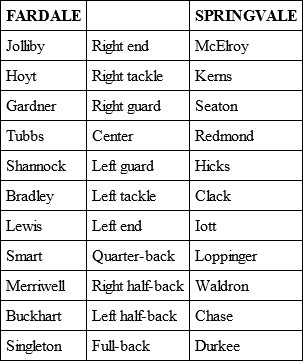
This was a great change about on the home team from the regular order. Buckhart had been taken off left end and given Darrell’s position at half-back, while Darrell was dropped entirely. Lewis, a plebe, had been substituted for Buckhart. Merriwell, Singleton, Smart, and Tubbs were the only men who held their positions. Bradley had been shifted from right guard to left tackle, Shannock had been removed from right end to left guard, Jolliby had moved over from right tackle to right end, Earl Gardner had been given Bradley’s position as right guard, and these things had served to break the team up completely, quite taking the confidence out of it.
Gardner had made the run with the ball, which he secured on a bad pass and a fumble, and his had been the glory of Fardale’s only touch-down. It seemed that Uniontown had the game “on ice.”
The visitors had played a rushing, thumping, rough-house game. At first the cadets had met them in this business, but they lost spirit when Uniontown kept the ball in the territory of the home team nearly all the time, seeming altogether too heavy and strong.
Dick was desperate. He was determined to do something to bring about a change. With the team as it was, he had small hopes of winning. Strangely enough, all through the first half, for all of the rough tactics of the visitors, no man was knocked out so that he was forced to retire from the game.
Brad walked off the field by Dick’s side when the half was over. The gym was near enough for the men to run over to it, and this they did.
“The jig is up, pard,” said Buckhart. “They’ve got us! And it is all the work of that dirty dog Arlington! He has ruined the team! I swear it would have been better if I had cheated and kept him from getting on the committee!”
Dick did not seem to hear Buckhart’s words. He was thinking swiftly just about then.
“We must win this game! I am determined to do it!” he muttered.
“No matter how determined you are,” said Brad, “you can’t do it with this team as it stands.”
Dick heard this, for he nodded. Reaching the gym, Dick found two fellows ready to give him a rubbing if he wished it.
“We’ll cut it out,” he said. “You fellows go for Hal Darrell. Bring him here.”
Then he turned to Brad, asking:
“Dare, Kent, and Bradley are with the substitutes, are they not?”
“Sure.”
Darrell was found in a minute or so, and brought into the gym.
“Hal,” said Dick, “do you want us to win this game?”
“Sure thing,” said Hal.
“Well, I want you to know that I did not drop you from the team. I was given orders by the committee to play the team just as it lined up to-day. Arlington is the man who did this.”
Hal shrugged his shoulders.
“I want you to get into your rig,” said Dick. “Will you do it?”
“Are you going to play me?”
“Yes.”
“In defiance of the committee?”
“Yes!”
“I’ll be on hand.”
Dick sent for Bradley, Dare, and Kent, with all of whom he talked.
Just as the team was leaving the gym for the field, Arlington and Warne came hurriedly into the place.
“Just in time!” exclaimed Warne.
“Go on, fellows,” said Dick. “I will be with you in a moment.”
At the same time he made a gesture to Buckhart. Brad was surprised. He did not quite understand, but he hurried the others out and followed them.
“In this final half,” said Warne, “there is one thing we want you to do, Merriwell. Of course, you can’t expect to win, as that team is much older and heavier, but – ”
“I must have dropped it in the shower-room,” said Dick, pretending to be searching for something. “I’ve got to have it. And I must be out on the field in two minutes. If you fellows have anything to say, come on and say it while I’m searching.”
He ran into the room where the boys took their shower-baths. There was a plunge in the same room.
Warne and Arlington followed. Dick seemed to be searching, looking swiftly about, his eyes on the floor.
“As I was saying – ” resumed Warne.
He got no further. Out of the room darted Dick, and the heavy door banged, shutting in Chester Arlington and the chairman of the athletic committee. Outside there was a heavy bolt, which Dick shot into place.
“Say on, Warne!” he exclaimed exultantly and defiantly; “but I can’t stop to listen. I can’t afford to be bothered by this committee during the last half of the game.”
He hurried from the now deserted gymnasium. As he was leaving he heard his astonished captives banging on the door of the bathroom and shouting for him to open it.
“Pound away! Yell away!” he said. “I think there will be sufficient noise on the field so that your cries will not be heard for a time, at least.”
He ran from the gym toward the field, and was just in time to go out with the team.
When the disappointed cadets saw the team go on the field for the second half they started up and showed interest, for there had been a big change. With a single exception, the old players were back in their regular positions.
Kent, who had not entirely recovered from injuries received in a previous game, was not at left tackle, although he was waiting among the substitutes. Gardner filled his place. Gardner was not quite large enough for guard, but he was so very fast that Dick had decided to retain him in the line. Shannock and Buckhart were again on the ends. Dare and Bradley were the guards, Jolliby was at right tackle, and Darrell assumed his old position at left half-back. Three members of the athletic committee stared and wondered.
“What does it mean?” asked Anson Day. “Why, I thought Merriwell had been given orders to – ”
“Where’s Warne?” asked Oliver Stone excitedly.
“Where’s Arlington?” exclaimed Hadley Burrows. “We must see about this!”
But they looked in vain for either Warne or Arlington.
The cadets were cheering with new life now. Everywhere the red and black was waving. What a difference there was! Confidence seemed restored.
There was a lull as the spread-out teams waited for the kick-off. In that hush and pause Dick Merriwell’s keen ears seemed to catch the sound of faint, muffled shouts coming from the direction of the gymnasium, and he smiled grimly.
Fardale went into the game with a whirl and a rush that almost swept Uniontown off her feet. The home team had snap, ginger, vim, and go to it. Every man was in the game. They played together, and they were out for victory. Getting the ball, Fardale began hammering against the enemy, at their thirty-yard line. The funnel-play was tried, and Singleton hit the left wing of the enemy, going through for five yards.
The same play was repeated, the funnel seeming pointed in the same direction. Singleton rushed ahead until near what seemed the point of assault, then suddenly darted out through the side of the funnel, where an opening had been made for him, and went through the left wing of the enemy for seven yards. Well, this was the kind of stuff! This was playing football!
A third time the ball was given to big Bob. And now he went forward protected by a wedge that hit the line in the center. The wedge pressed on steadily until the opposing team began to tear it to pieces. Bob saw a tackler coming through, and, with a deft movement, he tossed the ball out to Dick Merriwell, who had been keeping just back of him on the outside of the edge.
The next moment Singleton was dragged down. But the ball was gone, Dick had it, and he was away like a flash. To the right ran Dick, darting past Iott, who tried in vain to reach him. He circled the end and started down the field.
When Chase brought him down he had made full fifteen yards, and the cadets on the seats were mad with delight.
The Uniontown team was startled and not a little dismayed. Instead of coming out weak in the second half, the cadets were stronger and faster than they had been at the beginning of the game.
The ball was carried into Uniontown’s territory and steadily driven down toward the goal-line of the visiting team. Fardale hammered into the enemy with a dogged persistency that was admirable and told of the sand possessed by the academy lads.
Several times through the game Uniontown had resorted to slugging, and now she tried it again. Jolliby was thumped and Dare was kicked in the stomach. The umpire detected the fellow in the act of kicking and gave him a warning, but the kicker said he had not meant to violate the rules.
Still Fardale would not be stopped. Time after time she made her distance, and the ball was forced down to within ten yards of the goal of the visiting team. Then the cadets were set back for holding, and an off-side play lost them the ball when they had the taste of success on their lips. It was hard, but Dick stiffened up his team, and they prepared to hold the enemy.
Uniontown seemed to prepare for a kick. Instead of kicking, however, Uniontown gave the ball to Waldron, while her line buckled down to hold Fardale. Waldron shot forward, rose into the air, hurdled the line handsomely, and made six good yards before Darrell pulled him down. It was a very handsome play, and the visiting crowd had good cause to cheer.
Now Uniontown began to push Fardale back steadily. Now and then, when it was necessary to make a yard or two without fail and Fardale seemed to hold fast, Waldron hurdled. Repeatedly he was successful, and Fardale was driven back to her forty-yard line.
Dick saw that the hurdling was counting against them, and he determined to stop it. He watched closely, and the next time Waldron came flying at the line, the captain of the cadets charged from the opposite side.
With a flying leap, Dick shot upward and met the hurdler in the air above the line. Waldron had not expected this, and he was flung backward for a loss, Dick coming down upon him. The cadets roared their delight at this.
Twice after that Waldron was stopped in the same manner by Dick, who completely ruined the success of his hurdling.
When Fardale got the ball again she marched straight down the field and pushed it over for a touchdown without being checked at any point.
A goal was easily made.
Dick had a word to say to his men as they spread out for the next kick-off. He was determined to waste no time. Thus it happened that Fardale did not return the kick. Darrell caught the ball and ran sixteen yards with it before being grassed.
The signal was given for the center-back play. The Uniontown players were surprised to see little Smart take the place of the ponderous Tubbs, while Tubbs retired to full-back and Singleton became temporary quarter-back.
When they started to walk over Smart, however, Singleton backed Ted up, and then Tubbs, with the ball, came smashing into the line and bored his way along. They seized him and tried to drag him down, but he kept on for full ten yards before they could stop him.
“Great work!” laughed Dick. “On the jump now, fellows!”
“On the jump!” cried Ted Smart.
It was the signal for the old “ends-around” play. Fardale had never met Uniontown on the gridiron before, therefore the visitors were not on to the cadets’ little play of the previous year.
When the ball was snapped the ends and sides of the line seemed to melt backward before the assault of the enemy. The center held fast, while the ends swung round, followed by the opposing men, who were pushing. As they swung round they came in behind the man who had the ball, and he was thrust forward, a portion of the visitors working against themselves without knowing they did so.
Dick kept this play up, working it once or twice by pulling Tubbs back and letting him slam into the line, until the ball was driven down to within six yards of the goal-line. There Uniontown made a stand and held for three downs. But Dick himself went through on the last trial, and he managed to squirm forward after being dragged down so that the ball was six inches over the line when the piled-up men untangled.
Dick was pretty badly hurt, but he succeeded in getting on his feet, turning the ball over to Singleton. Darrell held the ball, and big Bob kicked the goal, tieing the score.