



автордың кітабын онлайн тегін оқу Grasshopper Green and the Meadow Mice
The Project Gutenberg eBook, Grasshopper Green and the Meadow Mice, by John Rae
This eBook is for the use of anyone anywhere at no cost and with
almost no restrictions whatsoever. You may copy it, give it away or
re-use it under the terms of the Project Gutenberg License included
with this eBook or online at www.gutenberg.org
Title: Grasshopper Green and the Meadow Mice
Author: John Rae
Release Date: January 10, 2008 [eBook #24237]
Language: English
Character set encoding: ISO-8859-1
***START OF THE PROJECT GUTENBERG EBOOK GRASSHOPPER GREEN AND THE MEADOW MICE***
E-text prepared by Sankar Viswanathan, Juliet Sutherland,
and the Project Gutenberg Online Distributed Proofreading Team
(http://www.pgdp.net)
GRASSHoPPER GREEN
and the
MEADoW-MIcE
A WORD ABOUT THIS BOOK

his is the story of the grasshopper who fiddled all summer and didn't have any place to go when the cold winter wind began to blow. "No, you can't live in my house this winter," said the hard-hearted ant, but a family of field mice took in Grasshopper Green and gave him gooseberry syrup for his cough and made him very comfortable. Eyes will grow big at the exciting climax of the story, when Grasshopper Green saves the mice children from a big black cat.
This is another one of the Sunny Books, made for the special delight of children by authors and artists who know and love them, and who leave out fear, mischief, and cruelty. The story of Grasshopper Green is full of lively humor and emphasizes the virtues of kindness and generosity without moralizing.
This book is planned for children from six to nine years old. It can be read to children of three and over.
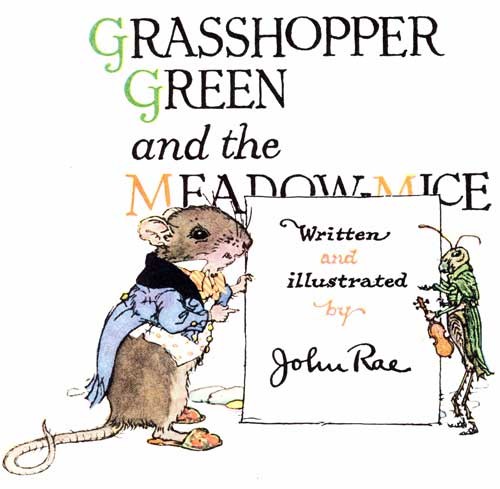
GRASSHOPPER
GREEN
and the
MEADOW-MICE
Written
and
illustrated
by
John Rae
Published by
Algonquin Publishing Company
New York
This Book is dedicated,
to Grasshoppers,
Meadow-Mice,
Fairies & Children:
especially to
Waltie,
Jackie
&
Robyn
Copyright MCMXXII
Algonquin Publishing Company
Copyright Great Britain MCMXXII
GRASSHOPPER GREEN AND
THE MEADOW-MICE

f Course you know the story of "The Grasshopper and the Ant"—how one autumn, when the winds were growing raw and cold and the nights frosty, the poor Grasshopper, who hadn't done anything but fiddle and dance all through the pleasant summer and had nothing laid by for the hard winter, went to the thrifty Ant and asked for a bite to eat and a chance to warm his toes in the chimney corner. And how the tight-fisted Ant refused and said to the shivering Grasshopper, "Keep on fiddling and dancing, it may help to keep you warm!"
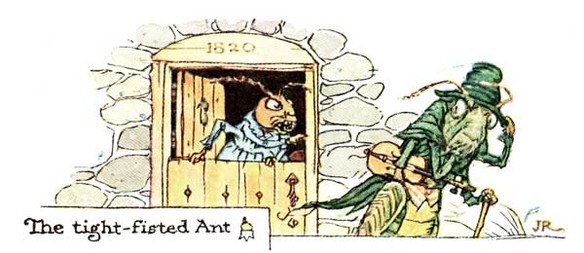
The tight-fisted Ant
This always seemed to me so cruel.
Now you've probably wondered, just as I used to, whatever finally became of that Grasshopper.
Well, dear old Great-Grandfather Goodheart, who knows all about such things, told me the story one rainy day as we sat by the open fire roasting chestnuts. I enjoyed it so much that I'm sure you will too.
Now, make yourself comfortable and cozy and listen.
After the sneering Ant had banged the door in his face, Grasshopper Green felt, as you may imagine, miserable, forlorn and friendless.
It was growing dark. He turned up the collar of his threadbare claw-hammer coat and shuffled along over the frozen ground, scarcely noticing where his benumbed feet were taking him.
He tried wrapping himself in a fallen leaf; it was red and looked as though it might be warm. But, alas! it proved to be a very thin covering against the biting, icy wind.
He tried to cheer himself up by playing on his little fiddle, but his fingers were too cold to play lively, cheerful tunes.
At last, feeling too chilled and hungry and discouraged to go any further, he sank down at the foot of an old apple tree. This was some protection at least from the wintry blasts which, by now, were moaning, "Whoo-ooh-whee-eeeh!" among the bare branches in a very disheartening way.
Poor Grasshopper Green wrapped his leaf cape tightly about him and, in spite of his chattering teeth, finally fell into an uneasy sleep.
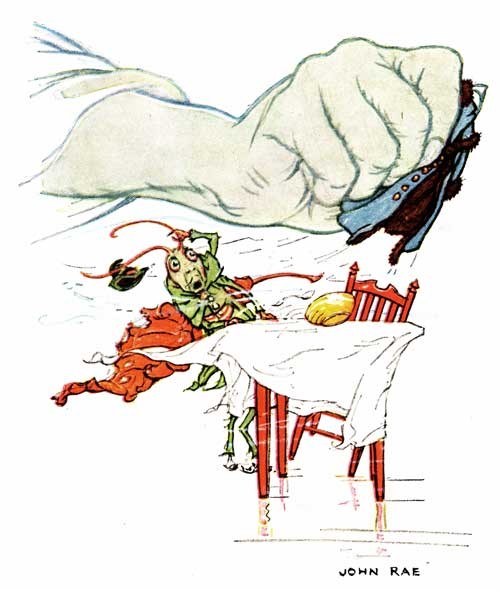
He dreamed that he was wandering over an immense field of ice. Suddenly there appeared before him a little red table, upon which was a large yellow bowl of steaming, fragrant broth! Beside the table stood a chair, over the back of which was thrown a thick, fur-lined coat.
Just as he reached for the coat, he heard a terrific howling, and the next moment a gigantic hand had swept past him, snatching away the coat and the soup, and so terrifying Grasshopper Green that he fell over backward—and awoke.
"Well, singe my whiskers, what's this? What's this?" he heard a hearty voice exclaiming, and, looking up, was astonished to find himself in the cosy home of a family of Meadow-Mice!
This is how it had happened. When Grasshopper Green sank down exhausted among the roots of the old apple tree, he had not noticed, in the darkness, that he was leaning against a small door; this was the door of the home of the Meadow-Mouse family, who lived here in a hollow part of the tree, near the roots.
An especially strong gust of wind had blown the door open and tumbled Grasshopper Green into the room.
When he sat up and looked about he was not quite sure, at first, that this was not just a part of his dream.
Father and Mother Meadow-Mouse and their four children, Long-Tail, Sharp-Eyes, Pink-Ears, and Mouseykins, had finished their supper of cornbread and cheese, and Father Meadow-Mouse was telling of two narrow escapes he had had the night before, one from a horned owl and one from Farmer Green's cat, Mouser. He had just come to the most exciting part of his adventures and all the family were listening with breathless interest, when the door, which had been left unbolted, blew open, as I have told you, and in tumbled poor Grasshopper Green.
Father and Mother Meadow-Mouse helped him over to their most comfortable chair, by the fire, for the poor fellow was so benumbed by the cold that he could hardly even stand alone.
While Grasshopper Green was explaining, in a wheezing voice, interrupted by coughs, how it was that he had burst in on them so rudely, Mother Meadow-Mouse filled a plate with food for him; then, bustling over to a corner cupboard, she got down a little jug of homemade Gooseberry syrup, poured some of it into a pannikin and set this on the fire to heat, saying as she did so, "There's nothing like warmed Gooseberry syrup to break up a cough."
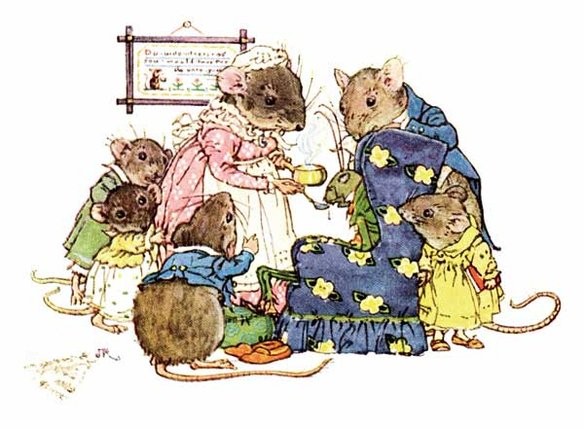
Father Meadow-Mouse would every now and then blow his nose and exclaim, "Well, singe my whiskers and twist my tail!" just to express his sympathy.
Of course the little Meadow-Mouse children looked on with the greatest interest. When they saw their mother's treasured Gooseberry juice brought out they all pretended to have coughs, and Mother Meadow-Mouse good-naturedly gave them each a few drops.
When famished Grasshopper Green had eaten all he could—which, of course, seemed like very little to the big, hearty Meadow-Mice—and when he had drunk the delicious Gooseberry juice, he sank back in the comfortable chair with a contented sigh.
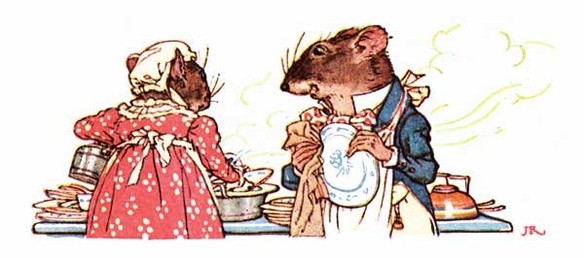
Just think how heavenly it must have seemed to him, after having been nearly frozen and starved to death, to be sitting cozily by a warm hearth after a good supper! Father Meadow-Mouse was helping Mother Meadow-Mouse to wash the supper dishes, which rattled in a very homelike way. Long-Tail, Sharp-Eyes, Pink-Ears, and Mouseykins had started droning their lessons for the next day.
"What a wonderfully cheerful place this is," said Grasshopper Green to himself, drowsily. "What beautiful blue furniture—and what a fine red tablecloth—what delightful yellow curtains—and what a good motto hanging over the mantle! 'Do—unto—others—as—you—would—have—them—do—unto—you.'" Then Grasshopper Green went fast asleep in the chair.
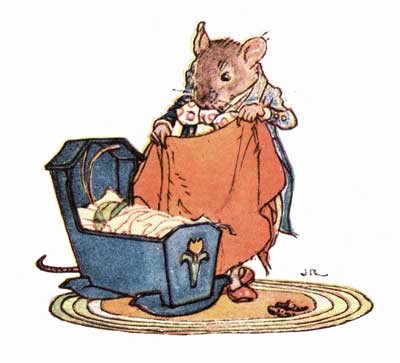
Father Meadow-Mouse carried him into the children's room, where there was an old cradle which was about the right size for him, for you see a grown-up Grasshopper is not much bigger than a baby mouse.
Good Father Meadow-Mouse then covered him up carefully with the very warmest blanket from his own bed.
Part Two

rasshopper Green felt so much better when he awoke in the morning, and a fine sunny morning it was, too, for the storm was over. The kindness of the Meadow-Mice, even mere than the food and warmth, had made him feel almost like himself again, and if you've ever been acquainted with Grasshoppers, you know, of course, how sprightly and happy they naturally are.
He was still rather weak, however; so Mother Meadow-Mouse, who was a famous nurse, made him stay in bed and took care of him as if he had been one of her own family.
She put a mustard-seed poultice on his chest, and gave him a little hot corn gruel, and a drop or two of honey every two hours for his hoarseness.
Grasshopper Green improved so rapidly that by the time the young mice got home from school he was well enough to get up. I forgot to tell you that Long-Tail, Sharp-Eyes, Pink-Ears and Mouseykins were taught by a wise old grey mouse whom they called "Uncle." "Uncle" lived in a nice stone house, a hole in the foundation of a ruined barn, near-by.
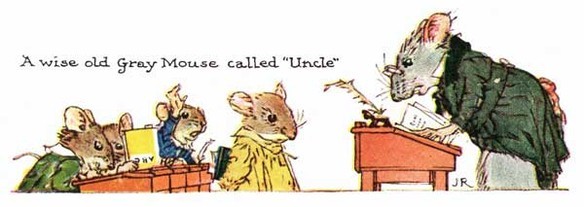
A wise old Gray Mouse called "Uncle"
They were all very merry that evening at the supper table. Jolly Father Meadow-Mouse told them a rattling good yarn about the adventures of some young water-rats who put to sea in an old pie plate and determined to become pie-rats! (Your mother will explain this little joke.)
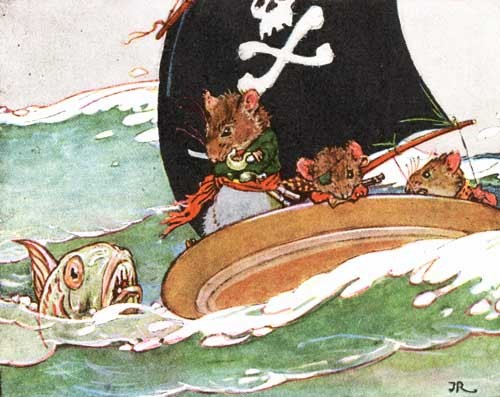
After supper, while the youngsters were doing their lessons, Grasshopper Green helped Father and Mother Meadow-Mouse with the dishes. It made him feel very sad to think that he must soon be leaving this pleasant household.
He thanked Father and Mother Meadow-Mouse for all their goodness, and started to say that he ought to be leaving the next morning, as he had nothing with which to pay for his keep, but Father Meadow-Mouse interrupted him.
"You'll do no such thing," he exclaimed heartily. "Now you just listen to me. If you want to pay us, you can do it in this way. Give us all dancing lessons, and play us a lively tune on your little fiddle now and then, for every one knows that all Grasshoppers are wonderful dancers and fiddlers."
This plan, of course, just suited Grasshopper Green. In fact he was so delighted at the prospect of spending the winter with the merry, kind-hearted Meadow-Mice that he made a tremendous leap which carried him clear to the other end of the room. A second leap almost landed him in a pan of dish-water!
In the midst of his caperings there was a knock at the door.
It was Mr. and Mrs. White-Mouse, old friends of the Meadow-Mice, who had come to make a friendly call. Grasshopper Green had never seen any White-Mice before, and he thought them very beautiful and aristocratic with their pale complexions, ruby-colored eyes and long pinky tails. (For White-Mice do look that way, you know).
He learned later that they belonged to a little boy living in a near-by farm house.[1]
[1] This boy didn't keep the White-Mice in a cage but in a fine little house with stairs like a very perfect doll's house. His father helped him make it. These White-Mice were treated so kindly that they never wanted to run away, though now and then they would go to visit friends.
Rap, tap, tap!—more guests arrived: three dainty little roadside Fairies with these funny names, Sun-Flower-Seed, Thistle-Whistle, and Ragged Sailor. (Fairies and Mice are usually very good friends; in fact, Great-Grandfather Goodheart says—but I'll tell you about that some other time.)
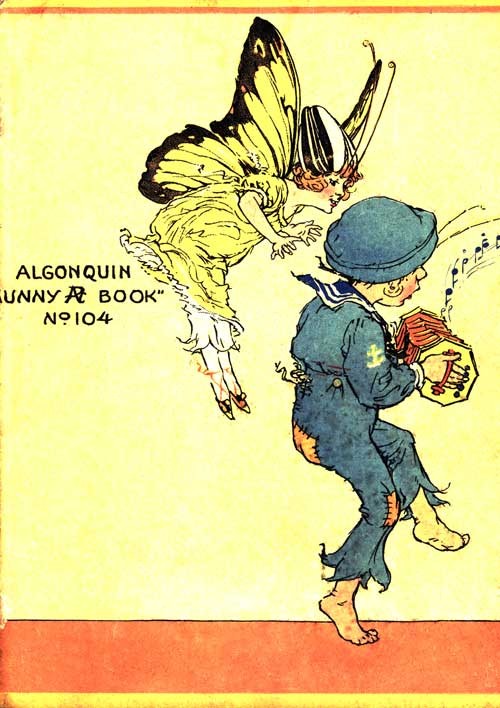
Grasshopper Green had met Ragged Sailor before. He was quite a musician and carried his tiny golden accordion in the sailor blouse he always wore.
It wasn't long before Grasshopper Green had his tiny fiddle tuned up, and Ragged Sailor got out his accordion. Then they started to play the liveliest little tunes you ever heard.
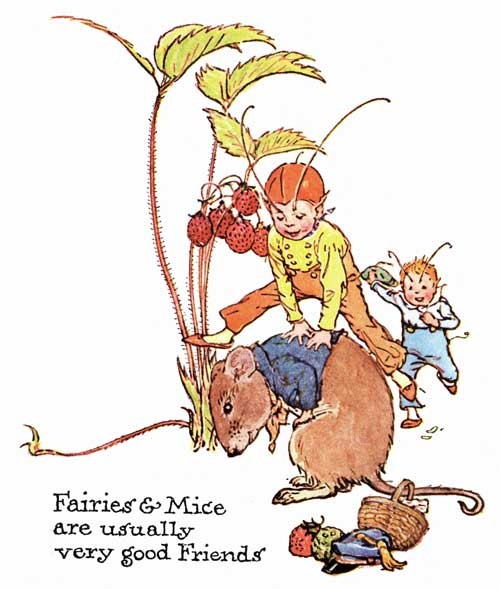
Fairies & Mice are usually very good Friends
The rest of the party pushed the chairs and table back against the wall, to make room for dancing and then—Bless your heart! What a good time they all had. I sometimes wish that I were small enough to dance with a Fairy or a Mouse. Don't you?
First they played the Pansy Petal Polka—a great favorite with the Fairies; then the Dragon Fly Dance and the Wheatfield Gavotte.[2]
[2] This is a very simple but beautiful little dance in which all the dancers stand in a circle and sway like wheat-blades when the gentle west wind passes over the field.
They danced everything they could think of, from the ridiculous Caterpillar Crawl to the lovely Moon-Moth Minuet, ending up with the Grasshopper Hornpipe. In this dance, the object was to see which dancer could leap the highest and crack his heels together oftenest before he touched the floor.

They danced everything they could think of
Sunflower Seed did this the best of all, for she had a pair of beautiful striped wings, like a butterfly's, which enabled her to stay in the air as long as she pleased.
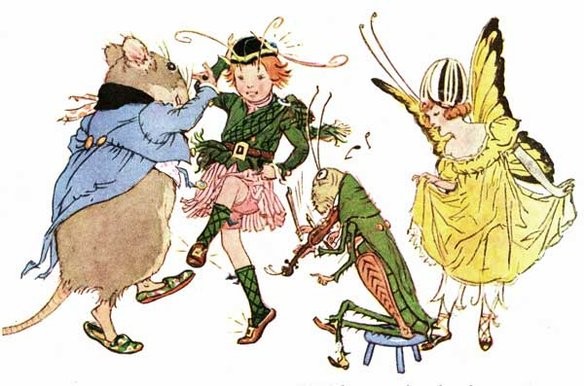
The Meadow-Mouse Children, who had gone to bed soon after the company came, were awakened by the noise of the Grasshopper Hornpipe, which was the most boisterous of all the dances.
Everybody was in such good humor that the little Meadow-Mice were allowed to stay up and come in, to join the fun.
Dancing so much had made everyone hungry; so Father Meadow-Mouse got the corn popper and they popped, and popped, and popped, and ate, and ate, and ate! I don't dare to tell you how much they ate. Especially the four youngsters. The Fairies, too, seemed very fond of the popcorn.
"It's such a nice change from rose pollen and honeysuckle juice," Thistle-Whistle remarked.
Well, finally, Mr. White-Mouse said, "We must really be going now, for it's getting very late."
"And so must we," said the Fairies, and that pleasant evening came to an end.
This, though, was only one of the many merry gatherings at the home of the Meadow-Mice.
Even when no friends dropped in they had fine cosy evenings.
Sometimes they would all play games, sometimes Father Meadow-Mouse would tell one of his entertaining stories, and sometimes Mrs. Meadow-Mouse would sing while Grasshopper Green accompanied her on his fiddle. Here's the chorus of one of her quaint little songs:
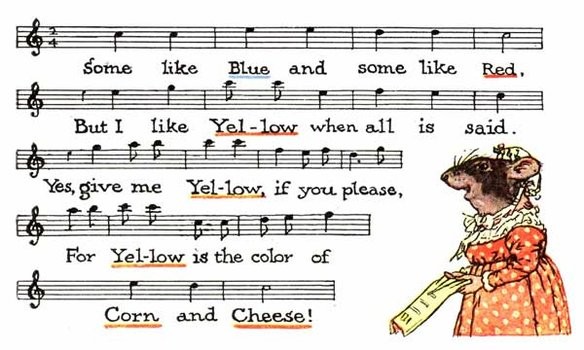
Some like Blue and some like Red.
But I like Yel-low when all is said.
Yes, give me Yel-low if you please,
For Yel-low is the color of
Corn and Cheese!
Although, during the winter, Grasshopper Green hardly ever dared to go outdoors on account of the cold, which of course is very dangerous to Grasshoppers, he had such happy times with his new friends that the months passed very quickly.
Part Three

arly one Saturday morning—it must have been about the end of February—Father Meadow-Mouse looked out of the window and saw that there had been quite a thaw during the night.
"Mother Meadow-Mouse," said he, "it is much warmer this morning, and I think the ice that filled up that hole under Farmer Green's corn-crib must be melted away. Now our larder is nearly empty; so you and I'd better go over there right away and get some corn before the squirrels wake up."
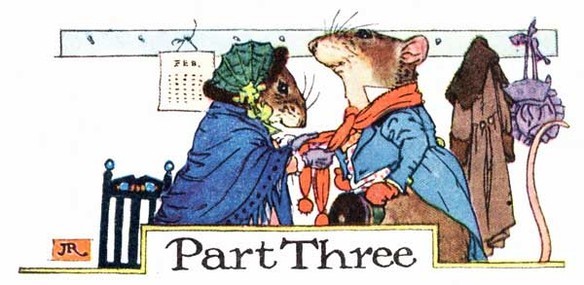
So Mother Meadow-Mouse put on her little dark blue shawl, and Father Meadow-Mouse put on his little bright red muffler, and, taking two sacks with them, they started off to get the corn.
Grasshopper Green stayed home with the children (the day being Saturday, they didn't have to go to school), for in spite of the thaw the weather was still too cold for him to safely venture out.
Making Everything spic and span
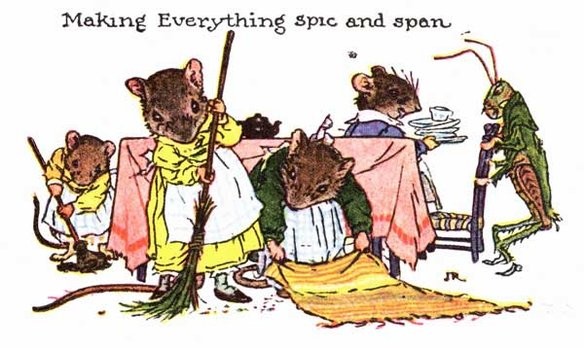
"Now, children," said Grasshopper Green, "we'll wash the breakfast dishes, and sweep and dust the room, and make everything spic and span to surprise your Mother and Father when they come back."
So Long-Tail, Sharp-Eyes, Pink-Ears and Mouseykins all put on funny little blue aprons and fell to work, and in a very short time the dishes were all washed and dried and the room was as neat as a new pin.
When all the work was done, Grasshopper Green got out his fiddle and said that it was time for a dancing lesson.
Oh, how the little Meadow-Mouse Children enjoyed dancing lessons! Of course they couldn't equal the wonderful twirling leaps of their teacher, Grasshopper Green, but they did very well, and you should have seen how gracefully they waved their tails; and that was something that Grasshopper Green couldn't do—for the reason, of course, that he hadn't any tail to wave.
The first part of the lesson was over, and Grasshopper Green was just starting to re-tune his little fiddle, when they heard a creaking sound—as if someone were cautiously trying to push open the front door, which was bolted on the inside.
Long-Tail, who happened to be standing near the little window, peeped out to see who was there, then suddenly jumped back and dived into the corner cupboard, squeaking in a trembly voice, "It's Mouser!"
Now "Mouser" was Farmer Green's big, yellow-eyed, black cat!
Father Meadow-Mouse had once said to Grasshopper Green, "Our home is so far away from the farmhouse and barn and is so well disguised that there is really no danger of that terrible Mouser ever finding it." But here he was at last!
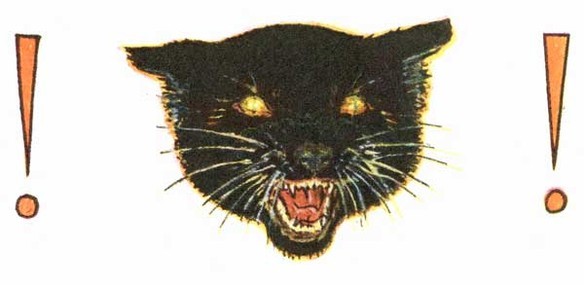
Mouser, no doubt, had heard—perhaps the weasel who lived near-by had told him—that Father and Mother Meadow-Mouse had both gone out that morning, leaving the children alone.
He probably did not know that Grasshopper Green was there with the little Meadow-Mice, though, of course, even if he had, he wouldn't have thought anything of it. And what, indeed, could a little Grasshopper do against a big cat?
There was only one thing he could do, Grasshopper Green decided, and that was to go for help without a moment's delay. Now Grasshopper Green knew that Thistle-Whistle, the Fairy, lived with some rabbits in a rabbit-hole among the briars not far away, and he was sure that Thistle-Whistle, who was quite a powerful Fairy, could in some way drive off Mouser and rescue the little Meadow-Mice.
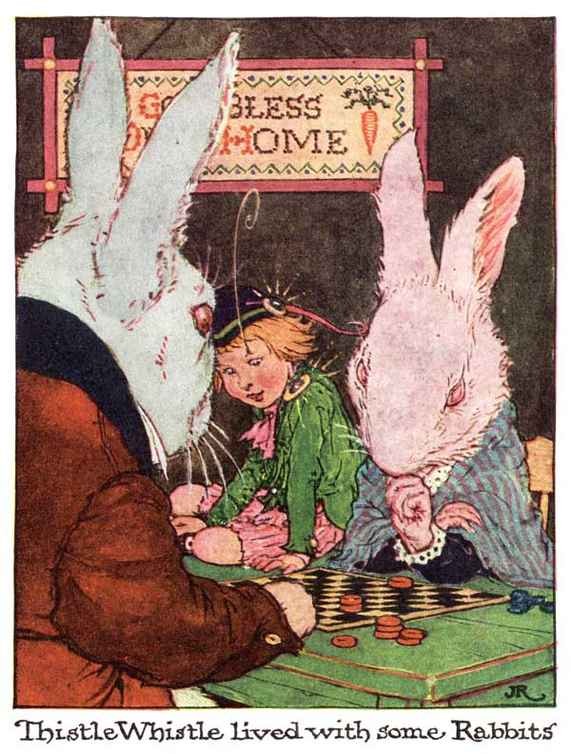
Thistle Whistle lived with some Rabbits
So, not even stopping to put on a muffler, he raised the window very quietly and hopped out.
Mouser was intent on trying to open the door by clawing and pushing, and didn't notice the window at all.
Then you should have seen Grasshopper Green's tremendous leaps! You may be sure he went faster than any Grasshopper had ever hopped before. Warmed by his excitement and exertions, he didn't feel the cold a bit.
He soon reached the rabbit-hole. Alas! The Fairy was not there. As Grasshopper Green turned to go, he spied a small chest standing near the door. At the sight of this a brilliant idea immediately popped into his head!
Now listen! In that chest were some tiny black pellets, about the size of mustard seeds.[3]
[3] Thistle-Whistle and Grasshopper Green had become great friends that winter and the Fairy had told Grasshopper Green about these Magic Pellets; you swallowed one of them and then wished yourself any size you wished to be—as small as a Flea or as big as an Elephant, or any size in between.
Snatching up two or three of the magic seeds, he jumped out of the hole and hopped back to the hollow apple tree even faster than he had come. He got in by way of the little window and immediately swallowed one of the pellets, then wished himself as large as a bull-dog!
It was fortunate for him that he didn't choose any larger size than that, for as it was, his head just bumped the ceiling.
Not more than two seconds after Grasshopper Green had changed his size, Mouser managed to burst open the door!
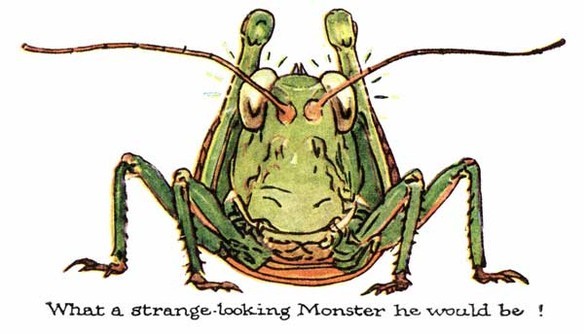
What a strange-looking Monster he would be!
At the sight that met his eyes, the Cat was nearly paralyzed with surprise. And no wonder.
Although a Grasshopper is usually a very good natured little fellow he has a really terrifying face, but we don't notice it because he's so small.
Look very closely at one sometime and then try to imagine what a strange looking monster he would be if he were as big as a dog!
Great-Grandfather Goodheart said, when he told me the story, that Mouser never stopped running until he got to the next village, five miles away, and that he shrieked out to every animal he passed on the way that he had seen a dragon!
At any rate, he was never seen about Farmer Green's place again. And that certainly was a great relief to all the Meadow-Mice, I can tell you.
As soon as Mouser had disappeared in the distance, Grasshopper Green swallowed another pellet and wished himself back to his usual size. Then he called to the Meadow-Mouse children to come out of their hiding places and told them the good news. For Long-Tail and Sharp-Eyes had been squeezed in the cupboard and Pink-Ears and Mouseykins under the bed all this time.
Pretty soon Father and Mother Meadow-Mouse returned with their sacks full of corn.
When they heard that Mouser had been so frightened that he would probably never come back to worry them, you can guess how happy they were and how they capered about.
They sent out invitations right away for a fine big party in honor of Grasshopper Green, who was, of course, the hero of the hour.
Good Night


It is the Algonquin ideal that books should make children happy and build character unconsciously and should contain nothing to cause fright, suggest fear, glorify mischief, excuse malice or condone cruelty.
The six books in the present series of Sunny Books are:
101 Little Slam Bang
An elephant child and his jungle friends meet a hungry tiger.
102 Merry Murphy
The jolly adventures of an Irish potato.
103 Honey Bear
The jolly story in rhyme of a baby and a bear who have a sticky party.
104 Grasshopper Green and the Meadow Mice
About the things that happen down in the grass.
105 The Dinky Ducklings
Two ducks go visiting, with lots of happenings on the way.
106 Sunny Bunny
Nina Wilcox Putnam tells about Sunny Bunny and his ten children, who have to find a new home.
ALGONQUIN PUBLISHING
COMPANY
NEW YORK


***END OF THE PROJECT GUTENBERG EBOOK GRASSHOPPER GREEN AND THE MEADOW MICE***
******* This file should be named 24237-h.txt or 24237-h.zip *******
This and all associated files of various formats will be found in:
http://www.gutenberg.org/2/4/2/3/24237
Updated editions will replace the previous one--the old editions will be renamed.
Creating the works from public domain print editions means that no one owns a United States copyright in these works, so the Foundation (and you!) can copy and distribute it in the United States without permission and without paying copyright royalties. Special rules, set forth in the General Terms of Use part of this license, apply to copying and distributing Project Gutenberg-tm electronic works to protect the PROJECT GUTENBERG-tm concept and trademark. Project Gutenberg is a registered trademark, and may not be used if you charge for the eBooks, unless you receive specific permission. If you do not charge anything for copies of this eBook, complying with the rules is very easy. You may use this eBook for nearly any purpose such as creation of derivative works, reports, performances and research. They may be modified and printed and given away--you may do practically ANYTHING with public domain eBooks. Redistribution is subject to the trademark license, especially commercial redistribution.
*** START: FULL LICENSE ***
THE FULL PROJECT GUTENBERG LICENSE
PLEASE READ THIS BEFORE YOU DISTRIBUTE OR USE THIS WORK
To protect the Project Gutenberg-tm mission of promoting the free
distribution of electronic works, by using or distributing this work
(or any other work associated in any way with the phrase "Project
Gutenberg"), you agree to comply with all the terms of the Full Project
Gutenberg-tm License (available with this file or online at
http://www.gutenberg.org/license).
Section 1. General Terms of Use and Redistributing Project Gutenberg-tm
electronic works
1.A. By reading or using any part of this Project Gutenberg-tm
electronic work, you indicate that you have read, understand, agree to
and accept all the terms of this license and intellectual property
(trademark/copyright) agreement. If you do not agree to abide by all
the terms of this agreement, you must cease using and return or destroy
all copies of Project Gutenberg-tm electronic works in your possession.
If you paid a fee for obtaining a copy of or access to a Project
Gutenberg-tm electronic work and you do not agree to be bound by the
terms of this agreement, you may obtain a refund from the person or
entity to whom you paid the fee as set forth in paragraph 1.E.8.
1.B. "Project Gutenberg" is a registered trademark. It may only be
used on or associated in any way with an electronic work by people who
agree to be bound by the terms of this agreement. There are a few
things that you can do with most Project Gutenberg-tm electronic works
even without complying with the full terms of this agreement. See
paragraph 1.C below. There are a lot of things you can do with Project
Gutenberg-tm electronic works if you follow the terms of this agreement
and help preserve free future access to Project Gutenberg-tm electronic
works. See paragraph 1.E below.
1.C. The Project Gutenberg Literary Archive Foundation ("the Foundation"
or PGLAF), owns a compilation copyright in the collection of Project
Gutenberg-tm electronic works. Nearly all the individual works in the
collection are in the public domain in the United States. If an
individual work is in the public domain in the United States and you are
located in the United States, we do not claim a right to prevent you from
copying, distributing, performing, displaying or creating derivative
works based on the work as long as all references to Project Gutenberg
are removed. Of course, we hope that you will support the Project
Gutenberg-tm mission of promoting free access to electronic works by
freely sharing Project Gutenberg-tm works in compliance with the terms of
this agreement for keeping the Project Gutenberg-tm name associated with
the work. You can easily comply with the terms of this agreement by
keeping this work in the same format with its attached full Project
Gutenberg-tm License when you share it without charge with others.
1.D. The copyright laws of the place where you are located also govern
what you can do with this work. Copyright laws in most countries are in
a constant state of change. If you are outside the United States, check
the laws of your country in addition to the terms of this agreement
before downloading, copying, displaying, performing, distributing or
creating derivative works based on this work or any other Project
Gutenberg-tm work. The Foundation makes no representations concerning
the copyright status of any work in any country outside the United
States.
1.E. Unless you have removed all references to Project Gutenberg:
1.E.1. The following sentence, with active links to, or other immediate
access to, the full Project Gutenberg-tm License must appear prominently
whenever any copy of a Project Gutenberg-tm work (any work on which the
phrase "Project Gutenberg" appears, or with which the phrase "Project
Gutenberg" is associated) is accessed, displayed, performed, viewed,
copied or distributed:
This eBook is for the use of anyone anywhere at no cost and with
almost no restrictions whatsoever. You may copy it, give it away or
re-use it under the terms of the Project Gutenberg License included
with this eBook or online at www.gutenberg.org
1.E.2. If an individual Project Gutenberg-tm electronic work is derived
from the public domain (does not contain a notice indicating that it is
posted with permission of the copyright holder), the work can be copied
and distributed to anyone in the United States without paying any fees
or charges. If you are redistributing or providing access to a work
with the phrase "Project Gutenberg" associated with or appearing on the
work, you must comply either with the requirements of paragraphs 1.E.1
through 1.E.7 or obtain permission for the use of the work and the
Project Gutenberg-tm trademark as set forth in paragraphs 1.E.8 or
1.E.9.
1.E.3. If an individual Project Gutenberg-tm electronic work is posted
with the permission of the copyright holder, your use and distribution
must comply with both paragraphs 1.E.1 through 1.E.7 and any additional
terms imposed by the copyright holder. Additional terms will be linked
to the Project Gutenberg-tm License for all works posted with the
permission of the copyright holder found at the beginning of this work.
1.E.4. Do not unlink or detach or remove the full Project Gutenberg-tm
License terms from this work, or any files containing a part of this
work or any other work associated with Project Gutenberg-tm.
1.E.5. Do not copy, display, perform, distribute or redistribute this
electronic work, or any part of this electronic work, without
prominently displaying the sentence set forth in paragraph 1.E.1 with
active links or immediate access to the full terms of the Project
Gutenberg-tm License.
1.E.6. You may convert to and distribute this work in any binary,
compressed, marked up, nonproprietary or proprietary form, including any
word processing or hypertext form. However, if you provide access to or
distribute copies of a Project Gutenberg-tm work in a format other than
"Plain Vanilla ASCII" or other format used in the official version
posted on the official Project Gutenberg-tm web site (www.gutenberg.org),
you must, at no additional cost, fee or expense to the user, provide a
copy, a means of exporting a copy, or a means of obtaining a copy upon
request, of the work in its original "Plain Vanilla ASCII" or other
form. Any alternate format must include the full Project Gutenberg-tm
License as specified in paragraph 1.E.1.
1.E.7. Do not charge a fee for access to, viewing, displaying,
performing, copying or distributing any Project Gutenberg-tm works
unless you comply with paragraph 1.E.8 or 1.E.9.
1.E.8. You may charge a reasonable fee for copies of or providing
access to or distributing Project Gutenberg-tm electronic works provided
that
- You pay a royalty fee of 20% of the gross profits you derive from
the use of Project Gutenberg-tm works calculated using the method
you already use to calculate your applicable taxes. The fee is
owed to the owner of the Project Gutenberg-tm trademark, but he
has agreed to donate royalties under this paragraph to the
Project Gutenberg Literary Archive Foundation. Royalty payments
must be paid within 60 days following each date on which you
prepare (or are legally required to prepare) your periodic tax
returns. Royalty payments should be clearly marked as such and
sent to the Project Gutenberg Literary Archive Foundation at the
address specified in Section 4, "Information about donations to
the Project Gutenberg Literary Archive Foundation."
- You provide a full refund of any money paid by a user who notifies
you in writing (or by e-mail) within 30 days of receipt that s/he
does not agree to the terms of the full Project Gutenberg-tm
License. You must require such a user to return or
destroy all copies of the works possessed in a physical medium
and discontinue all use of and all access to other copies of
Project Gutenberg-tm works.
- You provide, in accordance with paragraph 1.F.3, a full refund of any
money paid for a work or a replacement copy, if a defect in the
electronic work is discovered and reported to you within 90 days
of receipt of the work.
- You comply with all other terms of this agreement for free
distribution of Project Gutenberg-tm works.
1.E.9. If you wish to charge a fee or distribute a Project Gutenberg-tm
electronic work or group of works on different terms than are set
forth in this agreement, you must obtain permission in writing from
both the Project Gutenberg Literary Archive Foundation and Michael
Hart, the owner of the Project Gutenberg-tm trademark. Contact the
Foundation as set forth in Section 3 below.
1.F.
1.F.1. Project Gutenberg volunteers and employees expend considerable
effort to identify, do copyright research on, transcribe and proofread
public domain works in creating the Project Gutenberg-tm
collection. Despite these efforts, Project Gutenberg-tm electronic
works, and the medium on which they may be stored, may contain
"Defects," such as, but not limited to, incomplete, inaccurate or
corrupt data, transcription errors, a copyright or other intellectual
property infringement, a defective or damaged disk or other medium, a
computer virus, or computer codes that damage or cannot be read by
your equipment.
1.F.2. LIMITED WARRANTY, DISCLAIMER OF DAMAGES - Except for the "Right
of Replacement or Refund" described in paragraph 1.F.3, the Project
Gutenberg Literary Archive Foundation, the owner of the Project
Gutenberg-tm trademark, and any other party distributing a Project
Gutenberg-tm electronic work under this agreement, disclaim all
liability to you for damages, costs and expenses, including legal
fees. YOU AGREE THAT YOU HAVE NO REMEDIES FOR NEGLIGENCE, STRICT
LIABILITY, BREACH OF WARRANTY OR BREACH OF CONTRACT EXCEPT THOSE
PROVIDED IN PARAGRAPH F3. YOU AGREE THAT THE FOUNDATION, THE
TRADEMARK OWNER, AND ANY DISTRIBUTOR UNDER THIS AGREEMENT WILL NOT BE
LIABLE TO YOU FOR ACTUAL, DIRECT, INDIRECT, CONSEQUENTIAL, PUNITIVE OR
INCIDENTAL DAMAGES EVEN IF YOU GIVE NOTICE OF THE POSSIBILITY OF SUCH
DAMAGE.
1.F.3. LIMITED RIGHT OF REPLACEMENT OR REFUND - If you discover a
defect in this electronic work within 90 days of receiving it, you can
receive a refund of the money (if any) you paid for it by sending a
written explanation to the person you received the work from. If you
received the work on a physical medium, you must return the medium with
your written explanation. The person or entity that provided you with
the defective work may elect to provide a replacement copy in lieu of a
refund. If you received the work electronically, the person or entity
providing it to you may choose to give you a second opportunity to
receive the work electronically in lieu of a refund. If the second copy
is also defective, you may demand a refund in writing without further
opportunities to fix the problem.
1.F.4. Except for the limited right of replacement or refund set forth
in paragraph 1.F.3, this work is provided to you 'AS-IS,' WITH NO OTHER
WARRANTIES OF ANY KIND, EXPRESS OR IMPLIED, INCLUDING BUT NOT LIMITED TO
WARRANTIES OF MERCHANTIBILITY OR FITNESS FOR ANY PURPOSE.
1.F.5. Some states do not allow disclaimers of certain implied
warranties or the exclusion or limitation of certain types of damages.
If any disclaimer or limitation set forth in this agreement violates the
law of the state applicable to this agreement, the agreement shall be
interpreted to make the maximum disclaimer or limitation permitted by
the applicable state law. The invalidity or unenforceability of any
provision of this agreement shall not void the remaining provisions.
1.F.6. INDEMNITY - You agree to indemnify and hold the Foundation, the
trademark owner, any agent or employee of the Foundation, anyone
providing copies of Project Gutenberg-tm electronic works in accordance
with this agreement, and any volunteers associated with the production,
promotion and distribution of Project Gutenberg-tm electronic works,
harmless from all liability, costs and expenses, including legal fees,
that arise directly or indirectly from any of the following which you do
or cause to occur: (a) distribution of this or any Project Gutenberg-tm
work, (b) alteration, modification, or additions or deletions to any
Project Gutenberg-tm work, and (c) any Defect you cause.
Section 2. Information about the Mission of Project Gutenberg-tm
Project Gutenberg-tm is synonymous with the free distribution of
electronic works in formats readable by the widest variety of computers
including obsolete, old, middle-aged and new computers. It exists
because of the efforts of hundreds of volunteers and donations from
people in all walks of life.
Volunteers and financial support to provide volunteers with the
assistance they need, is critical to reaching Project Gutenberg-tm's
goals and ensuring that the Project Gutenberg-tm collection will
remain freely available for generations to come. In 2001, the Project
Gutenberg Literary Archive Foundation was created to provide a secure
and permanent future for Project Gutenberg-tm and future generations.
To learn more about the Project Gutenberg Literary Archive Foundation
and how your efforts and donations can help, see Sections 3 and 4
and the Foundation web page at http://www.gutenberg.org/fundraising/pglaf.
Section 3. Information about the Project Gutenberg Literary Archive
Foundation
The Project Gutenberg Literary Archive Foundation is a non profit
501(c)(3) educational corporation organized under the laws of the
state of Mississippi and granted tax exempt status by the Internal
Revenue Service. The Foundation's EIN or federal tax identification
number is 64-6221541. Contributions to the Project Gutenberg
Literary Archive Foundation are tax deductible to the full extent
permitted by U.S. federal laws and your state's laws.
The Foundation's principal office is located at 4557 Melan Dr. S.
Fairbanks, AK, 99712., but its volunteers and employees are scattered
throughout numerous locations. Its business office is located at
809 North 1500 West, Salt Lake City, UT 84116, (801) 596-1887, email
business@pglaf.org. Email contact links and up to date contact
information can be found at the Foundation's web site and official
page at http://www.gutenberg.org/about/contact
For additional contact information:
Dr. Gregory B. Newby
Chief Executive and Director
gbnewby@pglaf.org
Section 4. Information about Donations to the Project Gutenberg
Literary Archive Foundation
Project Gutenberg-tm depends upon and cannot survive without wide
spread public support and donations to carry out its mission of
increasing the number of public domain and licensed works that can be
freely distributed in machine readable form accessible by the widest
array of equipment including outdated equipment. Many small donations
($1 to $5,000) are particularly important to maintaining tax exempt
status with the IRS.
The Foundation is committed to complying with the laws regulating
charities and charitable donations in all 50 states of the United
States. Compliance requirements are not uniform and it takes a
considerable effort, much paperwork and many fees to meet and keep up
with these requirements. We do not solicit donations in locations
where we have not received written confirmation of compliance. To
SEND DONATIONS or determine the status of compliance for any
particular state visit http://www.gutenberg.org/fundraising/pglaf
While we cannot and do not solicit contributions from states where we
have not met the solicitation requirements, we know of no prohibition
against accepting unsolicited donations from donors in such states who
approach us with offers to donate.
International donations are gratefully accepted, but we cannot make
any statements concerning tax treatment of donations received from
outside the United States. U.S. laws alone swamp our small staff.
Please check the Project Gutenberg Web pages for current donation
methods and addresses. Donations are accepted in a number of other
ways including checks, online payments and credit card donations.
To donate, please visit: http://www.gutenberg.org/fundraising/donate
Section 5. General Information About Project Gutenberg-tm electronic
works.
Professor Michael S. Hart is the originator of the Project Gutenberg-tm
concept of a library of electronic works that could be freely shared
with anyone. For thirty years, he produced and distributed Project
Gutenberg-tm eBooks with only a loose network of volunteer support.
Project Gutenberg-tm eBooks are often created from several printed
editions, all of which are confirmed as Public Domain in the U.S.
unless a copyright notice is included. Thus, we do not necessarily
keep eBooks in compliance with any particular paper edition.
Each eBook is in a subdirectory of the same number as the eBook's
eBook number, often in several formats including plain vanilla ASCII,
compressed (zipped), HTML and others.
Corrected EDITIONS of our eBooks replace the old file and take over
the old filename and etext number. The replaced older file is renamed.
VERSIONS based on separate sources are treated as new eBooks receiving
new filenames and etext numbers.
Most people start at our Web site which has the main PG search facility:
http://www.gutenberg.org
This Web site includes information about Project Gutenberg-tm,
including how to make donations to the Project Gutenberg Literary
Archive Foundation, how to help produce our new eBooks, and how to
subscribe to our email newsletter to hear about new eBooks.
EBooks posted prior to November 2003, with eBook numbers BELOW #10000,
are filed in directories based on their release date. If you want to
download any of these eBooks directly, rather than using the regular
search system you may utilize the following addresses and just
download by the etext year.
http://www.gutenberg.org/dirs/etext06/
(Or /etext 05, 04, 03, 02, 01, 00, 99,
98, 97, 96, 95, 94, 93, 92, 92, 91 or 90)
EBooks posted since November 2003, with etext numbers OVER #10000, are
filed in a different way. The year of a release date is no longer part
of the directory path. The path is based on the etext number (which is
identical to the filename). The path to the file is made up of single
digits corresponding to all but the last digit in the filename. For
example an eBook of filename 10234 would be found at:
http://www.gutenberg.org/dirs/1/0/2/3/10234
or filename 24689 would be found at:
http://www.gutenberg.org/dirs/2/4/6/8/24689
An alternative method of locating eBooks:
http://www.gutenberg.org/dirs/GUTINDEX.ALL
*** END: FULL LICENSE ***
He learned later that they belonged to a little boy living in a near-by farm house.[1]
[3] Thistle-Whistle and Grasshopper Green had become great friends that winter and the Fairy had told Grasshopper Green about these Magic Pellets; you swallowed one of them and then wished yourself any size you wished to be—as small as a Flea or as big as an Elephant, or any size in between.
[1] This boy didn't keep the White-Mice in a cage but in a fine little house with stairs like a very perfect doll's house. His father helped him make it. These White-Mice were treated so kindly that they never wanted to run away, though now and then they would go to visit friends.
Now listen! In that chest were some tiny black pellets, about the size of mustard seeds.[3]
First they played the Pansy Petal Polka—a great favorite with the Fairies; then the Dragon Fly Dance and the Wheatfield Gavotte.[2]
[2] This is a very simple but beautiful little dance in which all the dancers stand in a circle and sway like wheat-blades when the gentle west wind passes over the field.


