автордың кітабын онлайн тегін оқу Caricature and Other Comic Art in All Times and Many Lands
CARICATURE
AND
OTHER COMIC ART
IN ALL TIMES AND MANY LANDS
By JAMES PARTON
WITH 203 ILLUSTRATIONS
NEW YORK
HARPER & BROTHERS, PUBLISHERS
FRANKLIN SQUARE
1877
Entered according to Act of Congress, in the year 1877, by
HARPER & BROTHERS,
In the Office of the Librarian of Congress, at Washington.
PREFACE.
In this volume there is, I believe, a greater variety of pictures of a comic and satirical cast than was ever before presented at one view. Many nations, ancient and modern, pagan and Christian, are represented in it, as well as most of the names identified with art of this nature. The extraordinary liberality of the publishers, and the skill of their corps of engravers, have seconded my own industrious researches, and the result is a volume unique, at least, in the character of its illustrations. A large portion of its contents appeared in Harper's Monthly Magazine during the year 1875; but many of the most curious and interesting of the pictures are given here for the first time; notably, those exhibiting the present or recent caricature of Germany, Spain, Italy, China, and Japan, several of which did not arrive in time for use in the periodical.
Generally speaking, articles contributed to a Magazine may as well be left in their natural tomb of "back numbers," or "bound volumes;" for the better they serve a temporary purpose, the less adapted they are for permanent utility. Among the exceptions are such series as the present, which had no reference whatever to the passing months, and in the preparation of which a great expenditure was directed to a single class of objects of special interest. I am, indeed, amazed at the cost of producing such articles as these. So very great is the expense, that many subjects could not be adequately treated, with all desirable illustration, unless the publishers could offer the work to the public in portions.
There is not much to be said upon the subject treated in this volume. When I was invited by the learned and urbane editor of Harper's Monthly to furnish a number of articles upon caricature, I supposed that the work proposed would be a relief after labors too arduous, too long continued, and of a more serious character. On the contrary, no subject that I ever attempted presented such baffling difficulties. After ransacking the world for specimens, and collecting them by the hundred, I found that, usually, a caricature is a thing of a moment, and that, dying as soon as its moment has passed, it loses all power to interest, instantly and forever. I found, too, that our respectable ancestors had not the least notion of what we call decency. When, therefore, I had laid aside from the mass the obsolete and the improper, there were not so very many left, and most of those told their own story so plainly that no elucidation was necessary. Instead of wearying the reader with a mere descriptive catalogue, I have preferred to accompany the pictures with allusions to contemporary satire other than pictorial.
The great living authorities upon this branch of art are two in number—one English, and one French—to both of whom I am greatly indebted. The English author is Thomas Wright, M.A., F.S.A., etc., whose "History of Caricature and the Grotesque" is well known among us, as well as his more recent volume upon the incomparable caricaturist of the last generation, James Gillray. The French writer is M. Jules Champfleury, author of a valuable series of volumes reviewing satiric art from ancient times to our own day, with countless illustrations. No one has treated so fully or so well as he the caricature of the Greeks and Romans. Many years ago, M. Champfleury began to illustrate this part of his subject in the Gazette des Beaux Arts, and his contributions to that important periodical were the basis of his subsequent volumes. He is one of the few writers on comic matters who have avoided the lapse into catalogue, and contrived to be interesting.
It has been agreeable to me to observe that Americans are not without natural aptitude in this kind of art. Our generous Franklin, the friend of Hogarth, to whom the dying artist wrote his last letter, replying to the last letter he ever received, was a capital caricaturist, and used his skill in this way, as he did all his other gifts and powers, in behalf of his country and his kind. At the present time, every week's issue of the illustrated periodicals exhibits evidence of the skill, as well as the patriotism and right feeling, of the humorous artists of the United States. For some years past, caricature has been a power in the land, and a power generally on the right side. There are also humorous artists of another and gentler kind, some even of the gentler sex, who present to us scenes which surprise us all into smiles and good temper without having in them any lurking sting of reproof. These domestic humorists, I trust, will continue to amuse and soften us, while the avenging satirist with dreadful pencil makes mad the guilty, and appalls the free.
There must be something precious in caricature, else the enemies of truth and freedom would not hate it as they do. Some of the worst excesses and perversions of satiric art are due to that very hatred. Persecuted and repressed, caricature becomes malign and perverse; or, being excluded from legitimate subjects, it seems as if it were compelled to ally itself to vice. We have only to turn from a heap of French albums to volumes of English caricature to have a striking evidence of the truth, that the repressive system represses good and develops evil. It is the "Censure" that debauches the comic pencil; it is freedom that makes it the ally of good conduct and sound politics. In free countries alone it has scope enough, without wandering into paths which the eternal proprieties forbid. I am sometimes sanguine enough to think that the pencil of the satirist will at last render war impossible, by bringing vividly home to all genial minds the ludicrous absurdity of such a method of arriving at truth. Fancy two armies "in presence." By some process yet to be developed, the Nast of the next generation, if not the admirable Nast of this, projects upon the sky, in the sight of the belligerent forces, a picture exhibiting the enormous comicality of their attitude and purpose. They all see the point, and both armies break up in laughter, and come together roaring over the joke.
In the hope that this volume may contribute something to the amusement of the happy at festive seasons, and to the instruction of the curious at all times, it is presented to the consideration of the public.
CONTENTS.
CHAPTER I. PAGE
Among the Romans 15
CHAPTER II.
Among the Greeks 28
CHAPTER III.
Among the Ancient Egyptians 32
CHAPTER IV.
Among the Hindoos 36
CHAPTER V.
Religious Caricature in the Middle Ages 40
CHAPTER VI.
Secular Caricature in the Middle Ages 50
CHAPTER VII.
Caricatures preceding the Reformation 64
CHAPTER VIII.
Comic Art and the Reformation 76
CHAPTER IX.
In the Puritan Period 90
CHAPTER X.
Later Puritan Caricature 105
CHAPTER XI.
Preceding Hogarth 120
CHAPTER XII.
Hogarth and his Time 133
CHAPTER XIII.
English Caricature in the Revolutionary Period 147
CHAPTER XIV.
During the French Revolution 159
CHAPTER XV.
Caricatures of Women and Matrimony 171
CHAPTER XVI.
Among the Chinese 191
CHAPTER XVII.
Comic Art in Japan 198
CHAPTER XVIII.
French Caricature 208
CHAPTER XIX.
Later French Caricature 230
CHAPTER XX.
Comic Art in Germany 242
CHAPTER XXI.
Comic Art in Spain 249
CHAPTER XXII.
Italian Caricature 257
CHAPTER XXIII.
English Caricature of the Present Century 267
CHAPTER XXIV.
Comic Art in "Punch" 284
CHAPTER XXV.
Early American Caricature 300
CHAPTER XXVI.
Later American Caricature 318
INDEX 335
LIST OF ILLUSTRATIONS.
- Page
- Pigmy Pugilists, from Pompeii 15
- Chalk Drawing by Roman Soldier in Pompeii 15
- Chalk Caricature on a Wall in Pompeii 16
- Battle between Pigmies and Geese 17
- A Pigmy Scene—from Pompeii 18
- Vases with Pigmy Designs 19
- A Grasshopper driving a Chariot 19
- From an Antique Amethyst 19
- Flight of Æneas from Troy 20
- Caricature of the Flight of Æneas 20
- From a Red Jasper 21
- Roman Masks, Comic and Tragic 22
- Roman Comic Actor, masked for Silenus 22
- Roman Wall Caricature of a Christian 25
- Burlesque of Jupiter's Wooing of Princess Alcmena 29
- Greek Caricature of the Oracle of Apollo 30
- An Egyptian Caricature 32
- A Condemned Soul, Egyptian Caricature 33
- Egyptian Servants conveying Home their Masters from a Carouse 33
- Too Late with the Basin 34
- The Hindoo God Krishna on his Travels 37
- Krishna's Attendants assuming the Form of a Bird 37
- Krishna in his Palanquin 38
- Capital in the Autun Cathedral 41
- Capitals in the Strasburg Cathedral, A.D. 1300 41
- Engraved upon a Stall in Sherborne Minster, England 43
- From a Manuscript of the Thirteenth Century 43
- From a Mass-book of the Fourteenth Century 44
- From a French Prayer-book of the Thirteenth Century 45
- From Queen Mary's Prayer-book, A.D. 1553 46
- Gog and Magog, Guildhall, London 50
- Head of the Great Dragon of Norwich 51
- Souls weighed in the Balance, Autun Cathedral 51
- Struggle for Possession of a Soul between Angel and Devil 52
- Lost Souls cast into Hell 53
- Devils seizing their Prey 54
- The Temptation 55
- French Death-crier 56
- Death and the Cripple 57
- Death and the Old Man 58
- Death and the Peddler 58
- Death and the Knight 58
- Heaven and Earth weighed in the Balance 60
- English Caricature of an Irishman, A.D. 1280 62
- Caricature of the Jews in England, A.D. 1233 63
- Luther inspired by Satan 64
- Devil fiddling upon a Pair of Bellows 65
- Oldest Drawing in the British Museum, A.D. 1320 66
- Bishop's Seal, A.D. 1300 67
- Pastor and Flock, Sixteenth Century 70
- Confessing to God; and Sale of Indulgences 72
- Christ, the True Light 73
- Papa, Doctor Theologiæ et Magister Fidei 77
- The Pope cast into Hell 77
- "The Beam that is in thine own Eye," A.D. 1540 78
- Luther Triumphant 79
- The Triumph of Riches 81
- Calvin branded 83
- Calvin at the Burning of Servetus 84
- Calvin, the Pope, and Luther 85
- Titian's Caricature of the Laocoön 89
- The Papal Gorgon 90
- Spayne and Rome defeated 94
- From Title-page to Sermon "Woe to Drunkards" 97
- "Let not the World devide those whom Christ hath joined" 99
- "England's Wolfe with Eagle's Clawes," 1647 102
- Charles II. and the Scotch Presbyterians, 1651 103
- Cris-cross Rhymes on Love's Crosses, 1640 105
- Shrove-tide in Arms against Lent 107
- Lent tilting at Shrove-tide 108
- The Queen of James II. and Father Petre 109
- Caricature of Corpulent General Galas 115
- A Quaker Meeting, 1710 116
- Archbishop of Paris 118
- Archbishop of Rheims 118
- Caricature of Louis XIV., by Thackeray 119
- "Shares! Shares! Shares!" Caricature of John Law 120
- Island of Madhead 122
- Speculative Map of Louisiana 126
- John Law, Wind Monopolist 129
- The Sleeping Congregation 134
- Hogarth's Drawing in Three Strokes 137
- Hogarth's Invitation Card 137
- Time Smoking a Picture 138
- Dedication of a Proposed History of the Arts 140
- Walpole paring the Nails of the British Lion 142
- Dutch Neutrality, 1745 142
- British Idolatry of the Opera-singer Mingotti 143
- The Motion (for the Removal of Walpole) 144
- Antiquaries puzzled 146
- Caricature designed by Benjamin Franklin 147
- Lord Bute 152
- Princess of Wales—Bute—George III 152
- The Wire-master (Bute) and his Puppets 153
- The Gouty Colossus, William Pitt 156
- The Mask (Coalition) 157
- Heads of Fox and North 158
- Assembly of the Notables at Paris 161
- Mirabeau 162
- The Dagger Scene in the House of Commons 164
- The Zenith of French Glory 165
- The Estates 166
- The New Calvary 166
- President of Revolutionary Committee amusing himself with his Art 168
- Rare Animals 169
- Aristocrat and Democrat 170
- "You frank! Have confidence in you!" 171
- Matrimony—A Man loaded with Mischief 173
- Settling the Odd Trick 174
- "Who was that gentleman that just went out?" 176
- "Now, understand me. To-morrow morning he will ask you to dinner" 177
- "Madame, your Cousin Betty wishes to know if you can receive her" 179
- A Scene of Conjugal Life 180
- A Splendid Spread 181
- American Lady walking in the Snow 183
- "My dear Baron, I am in the most pressing need of five hundred franc" 184
- "Sir, be good enough to come round in front and speak to me" 185
- "Where are the diamonds exhibited?" 185
- Evening Scene in the Parlor of an American Boarding-house 186
- "He's coming! Take off your hat!" 188
- The Scholastic Hen and her Chickens 189
- Chinese Caricature of an English Foraging Party 191
- A Deaf Mandarin 196
- After Dinner. A Chinese Caricature 197
- The Rat Rice Merchants. A Japanese Caricature 206
- Talleyrand—the Man with Six Heads 209
- A Great Man's Last Leap 210
- Talleyrand 211
- A Promenade in the Palais Royal 213
- Family of the Extinguishers 214
- The Jesuits at Court 215
- Charles Philipon 218
- Robert Macaire fishing for Share-holders 221
- A Husband's Dilemma 223
- Housekeeping 224
- A Poultice for Two 226
- Parisian "Shoo, Fly!" 227
- Three! 228
- Two Attitudes 230
- The Den of Lions at the Opera 231
- The Vulture 233
- Partant pour la Syrie 234
- Gavarni 236
- Honoré Daumier 237
- Evolution of the Piano 243
- A Corporal interviewed by the Major 244
- A Bold Comparison 245
- Strict Discipline in the Field 246
- Ahead of Time 247
- A Journeyman's Leave-taking 248
- After Sedan 250
- To the Bull-fight 251
- A Delegation of Birds of Prey 252
- "Child, you will take cold" 253
- Inconvenience of the New Collar 254
- Sufferings endured by a Prisoner of War 255
- King Bomba's Ultimatum to Sicily 259
- He has begun the Service with Mass, and completed it with Bombs 260
- The Burial of Liberty 261
- Bomba at Supper 262
- "Such is the Love of Kings" 263
- Mr. Punch 264
- Return of the Pope to Rome 265
- James Gillray 267
- Tiddy-Doll, the Great French Gingerbread Baker 268
- The Threatened Invasion of England 269
- The Bibliomaniac 270
- Hope—A Phrenological Illustration 271
- Term Time 273
- Box in a New York Theatre in 1830 276
- Seymour's Conception of Mr. Winkle 278
- Probable Suggestion of the Fat Boy 280
- A Wedding Breakfast 281
- The Boy who chalked up "No Popery!" 284
- John Leech 285
- Preparatory School for Young Ladies 286
- The Quarrel.—England and France 287
- Obstructives 290
- Jeddo and Belfast; or, a Puzzle for Japan 291
- "At the Church-gate" 292
- An Early Quibble 294
- John Tenniel 295
- Soliloquy of a Rationalistic Chicken 298
- "I'll follow thee!" 299
- Join or Die 304
- Boston Massacre Coffins 306
- A Militia Drill in Massachusetts in 1832 308
- Fight in Congress between Lyon and Griswold 312
- The Gerry-mander 316
- Thomas Nast 318
- Wholesale and Retail 319
- The Brains of the Tammany Ring 320
- "What are the wild waves saying?" 321
- Shin-plaster Caricature of General Jackson's War on the United States Bank 322
- City People in a Country Church 323
- "Why don't you take it?" 324
- Popular Caricature of the Secession War 325
- Virginia pausing 326
- Tweedledee and Sweedledum 328
- "Who Stole the People's Money?" 329
- "On to Richmond!" 330
- Christmas-time.—Won at a Turkey Raffle 331
- "He cometh not, she said" 332
CHAPTER II.
AMONG THE GREEKS.
CHAPTER III.
AMONG THE ANCIENT EGYPTIANS.
CHAPTER IV.
AMONG THE HINDOOS.
CHAPTER V.
RELIGIOUS CARICATURE IN THE MIDDLE AGES.
CHAPTER VI.
SECULAR CARICATURE IN THE MIDDLE AGES.
CHAPTER VII.
CARICATURES PRECEDING THE REFORMATION.
CHAPTER VIII.
COMIC ART AND THE REFORMATION.
CHAPTER IX.
IN THE PURITAN PERIOD.
CHAPTER X.
LATER PURITAN CARICATURE.
CHAPTER XI.
PRECEDING HOGARTH.
CHAPTER XII.
HOGARTH AND HIS TIME.
CHAPTER XIII.
ENGLISH CARICATURE IN THE REVOLUTIONARY PERIOD.
CHAPTER XIV.
DURING THE FRENCH REVOLUTION.
CHAPTER XV.
CARICATURES OF WOMEN AND MATRIMONY.
CHAPTER XVI.
AMONG THE CHINESE.
CHAPTER XVII.
COMIC ART IN JAPAN.
CHAPTER XVIII.
FRENCH CARICATURE.
CHAPTER XIX.
LATER FRENCH CARICATURE.
CHAPTER XX.
COMIC ART IN GERMANY.
CHAPTER XXI.
COMIC ART IN SPAIN.
CHAPTER XXII.
ITALIAN CARICATURE.
CHAPTER XXIII.
ENGLISH CARICATURE OF THE PRESENT CENTURY.
CHAPTER XXIV.
COMIC ART IN "PUNCH."
CHAPTER XXV.
EARLY AMERICAN CARICATURE.
CHAPTER XXVI.
LATER AMERICAN CARICATURE.
INDEX.
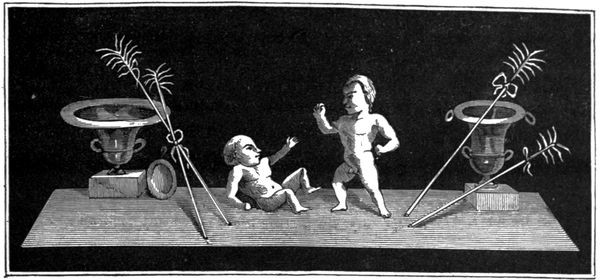
Pigmy Pugilists—from Pompeii.
CARICATURE AND COMIC ART.
CHAPTER I.
AMONG THE ROMANS.
Much as the ancients differed from ourselves in other particulars, they certainly laughed at one another just as we do, for precisely the same reasons, and employed every art, device, and implement of ridicule which is known to us.

Observe this rude and childish attempt at a drawing. Go into any boys' school to-day, and turn over the slates and copy-books, or visit an inclosure where men are obliged to pass idle days, and you will be likely to find pictures conceived in this taste, and executed with this degree of artistic skill. But the drawing dates back nearly eighteen centuries. It was done on one of the hot, languid days of August, A.D. 79, by a Roman soldier with a piece of red chalk on a wall of his barracks in the city of Pompeii.[1] On the 23d of August, in the year 79, occurred the eruption of Vesuvius, which buried not Italian cities only, but Antiquity itself, and, by burying, preserved it for the instruction of after-times. In disinterred Pompeii, the Past stands revealed to us, and we remark with a kind of infantile surprise the great number of particulars in which the people of that day were even such as we are. There was found the familiar apothecary's shop, with a box of pills on the counter, and a roll of material that was about to be made up when the apothecary heard the warning thunder and fled. The baker's shop remained, with a loaf of bread stamped with the maker's name. A sculptor's studio was strewed with blocks of marble, unfinished statues, mallets, compasses, chisels, and saws. A thousand objects attest that when the fatal eruption burst upon these cities, life and its activities were going forward in all essential particulars as they are at this moment in any rich and luxurious town of Southern Europe.
In the building supposed to have been the quarters of the Roman garrison, many of the walls were covered with such attempts at caricature as the specimen just given, to some of which were appended opprobrious epithets and phrases. The name of the personage above portrayed was Nonius Maximus, who was probably a martinet centurion, odious to his company, for the name was found in various parts of the inclosure, usually accompanied by disparaging words. Many of the soldiers had simply chalked their own names; others had added the number of their cohort or legion, precisely as in the late war soldiers left records of their stay on the walls of fort and hospital. A large number of these wall-chalkings in red, white, and black (most of them in red) were clearly legible fifty years after exposure. I give another specimen, a genuine political caricature, copied from an outside wall of a private house in Pompeii.
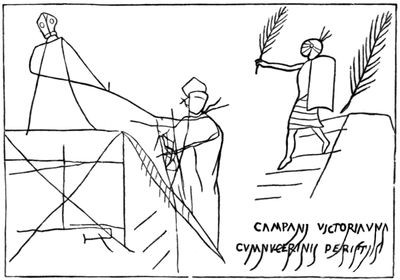
Chalk Caricature on a Wall in Pompeii.
The allusion is to an occurrence in local history of the liveliest possible interest to the people. A few years before the fatal eruption there was a fierce town-and-country row in the amphitheatre, in which the Pompeians defeated and put to flight the provincial Nucerians. Nero condemned the pugnacious men of Pompeii to the terrible penalty of closing their amphitheatre for ten years. In the picture an armed man descends into the arena bearing the palm of victory, while on the other side a prisoner is dragged away bound. The inscription alone gives us the key to the street artist's meaning, Campani victoria una cum Nucerinis peristis—"Men of Campania, you perished in the victory not less than the Nucerians;" as though the patriotic son of Campania had written, "We beat 'em, but very little we got by it."
If the idlers of the streets chalked caricature on the walls, we can not be surprised to discover that Pompeian artists delighted in the comic and burlesque. Comic scenes from the plays of Terence and Plautus, with the names of the characters written over them, have been found, as well as a large number of burlesque scenes, in which dwarfs, deformed people, Pigmies, beasts, and birds are engaged in the ordinary labors of men. The gay and luxurious people of the buried cities seem to have delighted in nothing so much as in representations of Pigmies, for there was scarcely a house in Pompeii yet uncovered which did not exhibit some trace of the ancient belief in the existence of these little people. Homer, Aristotle, and Pliny all discourse of the Pigmies as actually existing, and the artists, availing themselves of this belief, which they shared, employed it in a hundred ways to caricature the doings of men of larger growth. Pliny describes them as inhabiting the salubrious mountainous regions of India, their stature about twenty-seven inches, and engaged in eternal war with their enemies, the geese. "They say," Pliny continues, "that, mounted upon rams and goats, and armed with bows and arrows, they descend in a body during spring-time to the edge of the waters, where they eat the eggs and the young of those birds, not returning to the mountains for three months. Otherwise they could not resist the ever-increasing multitude of the geese. The Pigmies live in cabins made of mud, the shells of goose eggs, and feathers of the same bird."
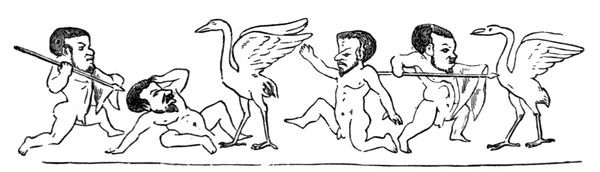
Battle between Pigmies and Geese.
Homer, in the third book of the "Iliad," alludes to the wars of the Cranes and Pigmies:
"So when inclement winters vex the plain
With piercing frosts, or thick-descending rain,
To warmer seas the Cranes embodied fly,
With noise and order through the midway sky;
To Pigmy nations wounds and death they bring,
And all the war descends upon the wing."
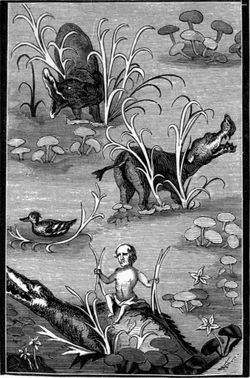
A Pigmy Scene—from Pompeii.
One of our engravings shows that not India only, but Egypt also, was regarded as the haunt of the Pigmy race; for the Upper Nile was then, as now, the home of the hippopotamus, the crocodile, and the lotus. Here we see a bald-headed Pigmy hero riding triumphantly on a mighty crocodile, regardless of the open-mouthed, bellowing hippopotamus behind him. In other pictures, however, the scaly monster, so far from playing this submissive part, is seen plunging in fierce pursuit of a Pigmy, who flies headlong before the foe. Frescoes, vases, mosaics, statuettes, paintings, and signet-rings found in the ancient cities all attest the popularity of the little men. The odd pair of vases on the following page, one in the shape of a boar's head and the other in that of a ram's, are both adorned with a representation of the fierce combats between the Pigmies and the geese.
There has been an extraordinary display of erudition in the attempt to account for the endless repetition of Pigmy subjects in the houses of the Pompeians; but the learned and acute M. Champfleury "humbly hazards a conjecture," as he modestly expresses it, which commends itself at once to general acceptance. He thinks these Pigmy pictures were designed to amuse the children. No conjecture could be less erudite or more probable. We know, however, as a matter of record, that the walls of taverns and wine-shops were usually adorned with Pigmy pictures, such subjects being associated in every mind with pleasure and gayety. It is not difficult to imagine that a picture of a pugilistic encounter between Pigmies, like the one given at the head of this chapter, or a fanciful representation of a combat of Pigmy gladiators, of which many have been discovered, would be both welcome and suitable as tavern pictures in the Italian cities of the classic period.
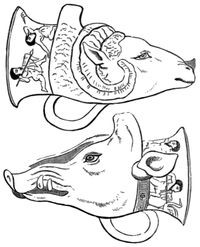
Vases with Pigmy Designs.
The Pompeians, in common with all the people of antiquity, had a child-like enjoyment in witnessing representations of animals engaged in the labors or the sports of human beings. A very large number of specimens have been uncovered, some of them gorgeous with the hues given them by masters of coloring eighteen hundred years ago. In the following cut is a specimen of these—a representation of a grasshopper driving a chariot, copied in 1802 from a Pompeian work for an English traveler.
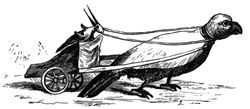
A Grasshopper driving a Chariot.
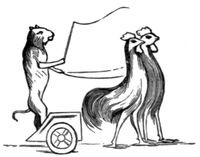
From an Antique Amethyst.
Nothing can exceed either the brilliancy or the delicacy of the coloring of this picture in the original, the splendid plumage of the bird and the bright gold of the chariot shaft and wheel being relieved and heightened by a gray background and the greenish brown of the course. The colorists of Pompeii have obviously influenced the taste of Christendom. There are few houses of pretension decorated within the last quarter of a century, either in Europe or America, which do not exhibit combinations and contrasts of color of which the hint was found in exhumed Pompeii. One or two other small specimens of this kind of art, selected from a large number accessible, may interest the reader.
Flight of Æneas from Troy.
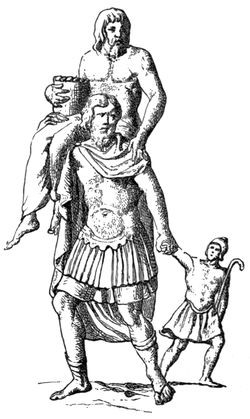
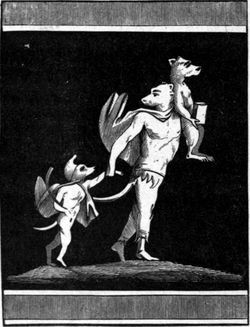
The spirited air of the team of cocks, and the nonchalant professional attitude of the charioteer, will not escape notice. Perhaps the most interesting example of this propensity to personify animals which the exhumed cities have furnished us is a burlesque of a popular picture of Æneas escaping from Troy, carrying his father, Anchises, on his back, and leading by the hand his son, Ascanius, the old man carrying the casket of household gods. No scene could have been more familiar to the people of Italy than one which exhibited the hero whom they regarded as the founder of their empire in so engaging a light, and to which the genius of Virgil had given a deathless charm:
"Thus ord'ring all that prudence could provide
I clothe my shoulders with a lion's hide
And yellow spoils; then on my bending back
The welcome load of my dear father take;
While on my better hand Ascanius hung,
And with unequal paces tripped along."
Artists found a subject in these lines, and of one picture suggested by them two copies have been found carved upon stone.
Caricature of the Flight of Æneas.
This device of employing animals' heads upon human bodies is still used by the caricaturist, so few are the resources of his branch of art; and we can not deny that it retains a portion of its power to excite laughter. If we may judge from what has been discovered of the burlesque art of the ancient nations, we may conclude that this idea, poor as it seems to us, was the one which the artists of antiquity most frequently employed. It was also common with them to burlesque familiar paintings, as in the instance given. It is not unlikely that the cloyed and dainty taste of the Pompeian connoisseur perceived something ridiculous in the too-familiar exploit of Father Æneas as represented in serious art, just as we smile at the theatrical attitudes and costumes in the picture of "Washington crossing the Delaware." Fancy that work burlesqued by putting an eagle's head upon the Father of his Country, filling the boat with magpie soldiers, covering the river with icebergs, and making the oars still more ludicrously inadequate to the work in hand than they are in the painting. Thus a caricaturist of Pompeii, Rome, Greece, Egypt, or Assyria would have endeavored to cast ridicule upon such a picture.

From a Red Jasper.
Few events of the last century were more influential upon the progress of knowledge than the chance discovery of the buried cities, since it nourished a curiosity respecting the past which could not be confined to those excavations, and which has since been disclosing antiquity in every quarter of the globe. We call it a chance discovery, although the part which accident plays in such matters is more interesting than important. The digging of a well in 1708 let daylight into the amphitheatre of Herculaneum, and caused some languid exploration, which had small results. Forty years later, a peasant at work in a vineyard five miles from the same spot struck with his hoe something hard, which was too firmly fixed in the ground to be moved. It proved to be a small statue of metal, upright, and riveted to a stone pedestal, which was itself immovably fastened to some solid mass still deeper in the earth. Where the hoe had struck the statue the metal showed the tempting hue of gold, and the peasant, after carefully smoothing over the surface, hurried away with a fragment of it to a goldsmith, intending (so runs the local gossip) to work this opening as his private gold mine. But as the metal was pronounced brass, he honestly reported the discovery to a magistrate, who set on foot an excavation. The statue was found to be a Minerva, fixed to the centre of a small roof-like dome, and when the dome was broken through it was seen to be the roof of a temple, of which the Minerva had been the topmost ornament. And thus was discovered, about the middle of the last century, the ancient city of Pompeii, buried by a storm of light ashes from Vesuvius sixteen hundred and seventy years before.
Roman Masks, Comic and Tragic.
It was not the accident, but the timeliness of the accident, which made it important; for there never could have been an excavation fifteen feet deep over the site of Pompeii without revealing indications of the buried city. But the time was then ripe for an exploration. It had become possible to excite a general curiosity in a Past exhumed; and such a curiosity is a late result of culture: it does not exist in a dull or in an ignorant mind. And this curiosity, nourished and inflamed as it was by the brilliant and marvelous things brought to light in Pompeii and Herculaneum, has sought new gratification wherever a heap of ruins betrayed an ancient civilization. It looks now as if many of the old cities of the world are in layers or strata—a new London upon an old London, and perhaps a London under that—a city three or four deep, each the record of an era. Two Romes we familiarly know, one of which is built in part upon the other; and at Cairo we can see the process going on by which some ancient cities were buried without volcanic aid. The dirt of the unswept streets, never removed, has raised the grade of Cairo from age to age.
A Roman Comic Actor masked for the Part of Silenus.
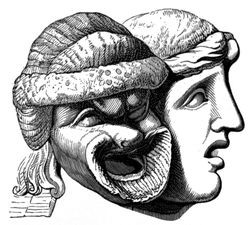
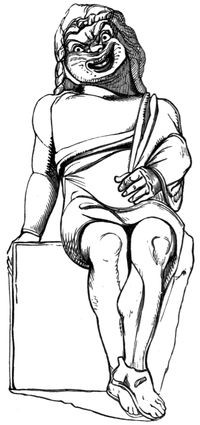
The excavations at Rome, so rich in results, were not needed to prove that to the Romans of old caricature was a familiar thing. The mere magnitude of their theatres, and their habit of performing plays in the open air, compelled caricature, the basis of which is exaggeration. Actors, both comic and tragic, wore masks of very elaborate construction, made of resonant metal, and so shaped as to serve, in some degree, the office of a speaking-trumpet. In the engravings on this page are represented a pair of masks such as were worn by Roman actors throughout the empire, of which many specimens have been found.
If the reader has ever visited the Coliseum at Rome, or even one of the large hippodromes of Paris or New York, and can imagine the attempts of an actor to exhibit comic or tragic effects of countenance or of vocal utterance across spaces so extensive, he will readily understand the necessity of such masks as these. The art of acting could only have been developed in small theatres. In the open air or in the uncovered amphitheatre all must have been vociferation and caricature. Observe the figure of old Silenus, on preceding page, one of the chief mirth-makers of antiquity, who lives for us in the Old Man of the pantomime. He is masked for the theatre.
The legend of Silenus is itself an evidence of the tendency of the ancients to fall into caricature. To the Romans he was at once the tutor, the comrade, and the butt of jolly Bacchus. He discoursed wisdom and made fun. He was usually represented as an old man, bald, flat-nosed, half drunk, riding upon a broad-backed ass, or reeling along by the aid of a staff, uttering shrewd maxims and doing ludicrous acts. People wonder that the pantomime called "Humpty Dumpty" should be played a thousand nights in New York; but the substance of all that boisterous nonsense, that exhibition of rollicking freedom from restraints of law, usage, and gravitation, has amused mankind for unknown thousands of years; for it is merely what remains to us of the legendary Bacchus and his jovial crew. We observe, too, that the great comic books, such as "Gil Blas," "Don Quixote," "Pickwick," and others, are most effective when the hero is most like Bacchus, roaming over the earth with merry blades, delightfully free from the duties and conditions which make bondmen of us all. Mr. Dickens may never have thought of it—and he may—but there is much of the charm of the ancient Bacchic legends in the narrative of the four Pickwickians and Samuel Weller setting off on the top of a coach, and meeting all kinds of gay and semi-lawless adventures in country towns and rambling inns. Even the ancient distribution of characters is hinted at. With a few changes, easily imagined, the irrepressible Sam might represent Bacchus, and his master bring to mind the sage and comic Silenus. Nothing is older than our modes of fun. Even in seeking the origin of Punch, investigators lose themselves groping in the dim light of the most remote antiquity.
How readily the Roman satirists ran into caricature all their readers know, except those who take the amusing exaggerations of Juvenal and Horace as statements of fact. During the heat of our antislavery contest, Dryden's translation of the passage in Juvenal which pictures the luxurious Roman lady ordering her slave to be put to death was used by the late Mr. W. H. Fry, in the New York Tribune, with thrilling effect:
"Go drag that slave to death! You reason, Why
Should the poor innocent be doomed to die?
What proofs? For, when man's life is in debate,
The judge can ne'er too long deliberate.
Call'st thou that slave a man? the wife replies.
Proved or unproved the crime, the villain dies.
I have the sovereign power to save or kill,
And give no other reason but my will."
This is evidently caricature. Not only is the whole of Juvenal's sixth satire a series of the broadest exaggerations, but with regard to this particular passage we have evidence of its burlesque character in Horace (Satire III., Book I.), where, wishing to give an example of impossible folly, he says, "If a man should crucify a slave for eating some of the fish which he had been ordered to take away, people in their senses would call him a madman." Juvenal exhibits the Roman matron of his period undergoing the dressing of her hair, giving the scene the same unmistakable character of caricature:
"She hurries all her handmaids to the task;
Her head alone will twenty dressers ask.
Psecas, the chief, with breast and shoulders bare,
Trembling, considers every sacred hair:
If any straggler from his rank be found,
A pinch must for the mortal sin compound.
"With curls on curls they build her head, before,
And mount it with a formidable tower.
A giantess she seems; but look behind,
And then she dwindles to the Pigmy kind.
Duck-legged, short-waisted, such a dwarf she is
That she must rise on tiptoe for a kiss.
Meanwhile her husband's whole estate is spent;
He may go bare, while she receives his rent."
The spirit of caricature speaks in these lines. There are passages of Horace, too, in reading which the picture forms itself before the mind; and the poet supplies the very words which caricaturists usually employ to make their meaning more obvious. In the third satire of the second book a caricature is exhibited to the mind's eye without the intervention of pencil. We see the miser Opimius, "poor amid his hoards of gold," who has starved himself into a lethargy; his heir is scouring his coffers in triumph; but the doctor devises a mode of rousing his patient. He orders a table to be brought into the room, upon which he causes the hidden bags of money to be poured out, and several persons to draw near as if to count it. Opimius revives at this maddening spectacle, and the doctor urges him to strengthen himself by generous food, and so balk his rapacious heir. "Do you hesitate?" cries the doctor. "Come, now, take this preparation of rice." "How much did it cost?" asks the miser. "Only a trifle." "But how much?" "Eightpence." Opimius, appalled at the price, whimpers, "Alas! what does it matter whether I die of a disease, or by plunder and extortion?" Many similar examples will arrest the eye of one who turns over the pages of this master of satire.
The great festival of the Roman year, the Saturnalia, which occurred in the latter half of December, we may almost say was consecrated to caricature, so fond were the Romans of every kind of ludicrous exaggeration. This festival, the merry Christmas of the Roman world, gave to the Christian festival many of its enlivening observances. During the Saturnalia the law courts and schools were closed; there was a general interchange of presents, and universal feasting; there were fantastic games, processions of masked figures in extravagant costumes, and religious sacrifices. For three days the slaves were not merely exempt from labor, but they enjoyed freedom of speech, even to the abusing of their masters. In one of his satires, Horace gives us an idea of the manner in which slaves burlesqued their lords at this jocund time. He reports some of the remarks of his own slave, Davus, upon himself and his poetry. Davus, it is evident, had discovered the histrionic element in literature, and pressed it home upon his master. "You praise the simplicity of the ancient Romans; but if any god were to reduce you to their condition, you, the same man that wrote those fine things, would beg to be let off. At Rome you long for the country; and when you are in the country, you praise the distant city to the skies. When you are not invited out to supper, you extol your homely repast at home, and hug yourself that you are not obliged to drink with any body abroad. As if you ever went out upon compulsion! But let Mæcenas send you an invitation for early lamp-light, then what do we hear? Will no one bring the oil quicker? Does any body hear me? You bellow and storm with fury. You bought me for five hundred drachmas, but what if it turns out that you are the greater fool of the two?" And thus the astute and witty Davus continues to ply his master with taunts and jeers and wise saws, till Horace, in fury, cries out, "Where can I find a stone?" Davus innocently asks, "What need is there here of such a thing as a stone?" "Where can I get some javelins?" roars Horace. Upon which Davus quietly remarks, "This man is either mad or making verses." Horace ends the colloquy by saying, "If you do not this instant take yourself off, I'll make a field-hand of you on my Sabine estate!"
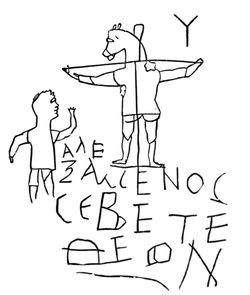
Roman Wall Caricature of a Christian.
That Roman satirists employed the pencil and the brush as well as the stylus, and employed them freely and constantly, we should have surmised if the fact had not been discovered. Most of the caricatures of passing events speedily perish in all countries, because the materials usually employed in them are perishable. To preserve so slight a thing as a chalk sketch on a wall for eighteen centuries, accident must lend a hand, as it has in the instance now given.
This picture was found in 1857 upon the wall of a narrow Roman street, which was closed up and shut out from the light of day about A.D. 100, to facilitate an extension of the imperial palace. The wall when uncovered was found scratched all over with rude caricature drawings in the style of the specimen given. This one immediately arrested attention, and the part of the wall on which it was drawn was carefully removed to the Collegio Romano, in the museum of which it may now be inspected. The Greek words scrawled upon the picture may be translated thus: "Alexamenos is worshiping his god."
These words sufficiently indicate that the picture was aimed at some member, to us unknown, of the despised sect of the Christians. It is the only allusion to Christianity which has yet been found upon the walls of the Italian cities; but it is extremely probable that the street artists found in the strange usages of the Christians a very frequent subject.
We know well what the educated class of the Romans thought of the Christians, when they thought of them at all. They regarded them as a sect of extremely absurd Jews, insanely obstinate, and wholly contemptible. If the professors and students of Harvard and Yale should read in the papers that a new sect had arisen among the Mormons, more eccentric and ridiculous even than the Mormons themselves, the intelligence would excite in their minds about the same feeling that the courtly scholars of the Roman Empire manifest when they speak of the early Christians. Nothing astonished them so much as their "obstinacy." "A man," says the Emperor Marcus Aurelius, "ought to be ready to die when the time comes; but this readiness should be the result of a calm judgment, and not be an exhibition of mere obstinacy, as with the Christians." The younger Pliny, too, in his character of magistrate, was extremely perplexed with this same obstinacy. He tells us that when people were brought before him charged with being Christians, he asked them the question, Are you a Christian? If they said they were, he repeated it twice, threatening them with punishment; and if they persisted, he ordered them to be punished. If they denied the charge, he put them to the proof by requiring them to repeat after him an invocation to the gods, and to offer wine and incense to the emperor's statue. Some of the accused, he says, reviled Christ; and this he regarded as a sure proof of innocence, for people told him there was no forcing real Christians to do an act of that nature. Some of the accused owned that they had been Christians once, three years ago or more, and some twenty years ago, but had returned to the worship of the gods. These, however, declared that, after all, there was no great offense in being Christians. They had merely met on a regular day before dawn, addressed a form of prayer to Christ as to a divinity, and bound themselves by a solemn oath not to commit fraud, theft, or other immoral act, nor break their word, nor betray a trust; after which they used to separate, then re-assemble, and eat together a harmless meal.
All this seemed innocent enough; but Pliny was not satisfied. "I judged it necessary," he writes to the emperor, "to try to get at the real truth by putting to the torture two female slaves who were said to officiate at their religious rites; but all I could discover was evidence of an absurd and extravagant superstition." So he refers the whole matter to the emperor, telling him that the "contagion" is not confined to the cities, but has spread into the villages and into the country. Still, he thought it could be checked: nay, it had been checked; for the temples, which had been almost abandoned, were beginning to be frequented again, and there was also "a general demand for victims for sacrifice, which till lately had found few purchasers." The wise Trajan approved the course of his representative. He tells him, however, not to go out of his way to look for Christians; but if any were brought before him, why, of course he must inflict the penalty unless they proved their innocence by invoking the gods. The remains of Roman literature have nothing so interesting for us as these two letters of Pliny and Trajan of the year 103. We may rest assured that the walls of every Roman town bore testimony to the contempt and aversion in which the Christians were held, particularly by those who dealt in "victims" and served the altars—a very numerous and important class throughout the ancient world.
CHAPTER II.
AMONG THE GREEKS.
Greece was the native home of all that we now call art. Upon looking over the two hundred pages of art gossip in the writings of the elder Pliny, most of which relates to Greece, we are ready to ask, Is there one thing in painting or drawing, one school, device, style, or method, known to us which was not familiar to the Greeks? They had their Landseers—men great in dogs and all animals; they had artists renowned in the "Dutch style" ages before the Dutch ceased to be amphibious—artists who painted barber-shop interiors to a hair, and donkeys eating cabbages correct to a fibre; they had cattle pieces as famous throughout the classic world as Rosa Bonheur's "Horse Fair" is now in ours; they had Rosa Bonheurs of their own—famous women, a list of whose names Pliny gives; they had portrait-painters too good to be fashionable, and portrait-painters too fashionable to be good; they had artists who excelled in flesh, others great in form, others excellent in composition; they took plaster casts of dead faces; they had varnishers and picture-cleaners. Noted pictures were spoken of as having lost their charm through an unskillful cleaner. They had their "life school," and used it as artists now do, borrowing from each model her special beauty. Zeuxis, as Pliny records, was so scrupulously careful in the execution of a religious painting that "he had the young maidens of the place stripped for examination, and selected five of them, in order to adopt in his picture the most commendable points in the form of each." And we may be sure that every maiden of them felt it to be an honor thus to contribute perfection to a Juno, executed by the first artist of the world, which was to adorn the temple of her native city.
They played with art as men are apt to play with the implements of which they are masters. Sosus, the great artist in mosaics, executed at Pergamus the pavement of a banqueting-room which presented the appearance of a floor strewed with crumbs, fragments and scraps of a feast, not yet swept away. It was renowned as the "Unswept Hall of Pergamus." And what a pleasing story is that of the contest between Zeuxis and his rival, Parrhasius! On the day of trial Zeuxis hung in the place of exhibition a painting of grapes, and Parrhasius a picture of a curtain. Some birds flew to the grapes of Zeuxis, and began to pick at them. The artist, overjoyed at so striking a proof of his success, turned haughtily to his rival, and demanded that the curtain should be drawn aside and the picture revealed. But the curtain was the picture. He owned himself surpassed, since he had only deceived birds, but Parrhasius had deceived Zeuxis.

Burlesque of Jupiter's Wooing of the Princess Alcmena.
Could comic artists and caricaturists be wanting in Athens? Strange to say, it was the gods and goddesses whom the caricaturists of Greece as well as the comic writers chiefly selected for ridicule. All their works have perished except a few specimens preserved upon pottery. We show one from a Greek vase, a rude burlesque of one of Jupiter's love adventures, the father of gods and men being accompanied by a Mercury ludicrously unlike the light and agile messenger of the gods. The story goes that the Princess Alcmena, though betrothed to a lover, vowed her hand to the man who should avenge her slaughtered brothers. Jupiter assumed the form and face of the lover, and, pretending to have avenged her brothers' death, gained admittance. Pliny describes a celebrated burlesque painting of the birth of Bacchus from Jupiter's thigh, in which the god of the gods was represented wearing a woman's cap, in a highly ridiculous posture, crying out, and surrounded by goddesses in the character of midwives. The best specimen of Greek caricature that has come down to us burlesques no less serious a theme than the great oracle of Apollo at Delphos, given on page 30.
This remarkable work owes its preservation to the imperishable nature of the material on which it was executed. It was copied from a large vessel used by the Greeks and Romans for holding vinegar, a conspicuous object upon their tables, and therefore inviting ornament. What audacity to burlesque an oracle to which kings and conquerors humbly repaired for direction, and which all Greece held in awe! Crœsus propitiated this oracle by the gift of a solid golden lion as large as life, and the Phocians found in its coffers, and carried off, a sum equal to nearly eleven millions of dollars in gold. Such was the general belief in its divine inspiration! But in this picture we see the oracle, the god, and those who consult them, all exhibited in the broadest burlesque: Apollo as a quack doctor on his platform, with bag, bow, and cap; Chiron, old and blind, struggling up the steps to consult him, aided by Apollo at his head and a friend pushing behind; the nymphs surveying the scene from the heights of Parnassus; and the manager of the spectacle, who looks on from below. How strange is this!
But the Greek literature is also full of this wild license. Lucian depicts the gods in council ludicrously discussing the danger they were in from the philosophers. Jupiter says, "If men are once persuaded that there are no gods, or, if there are gods, that we take no care of human affairs, we shall have no more gifts or victims from them, but may sit and starve on Olympus without festivals, holidays, sacrifices, or any pomp or ceremonies whatever." The whole debate is in this manner, and is at the same time a burlesque of the political discussions at the Athenian mass-meetings. What can be more ludicrous than the story of Mercury visiting Athens in disguise in order to discover the estimation in which he was held among mortals? He enters the shop of a dealer in images, where he inquires the price first of a Jupiter, then of an Apollo, and, lastly, with a blush, of a Mercury. "Oh," says the dealer, "if you take the Jupiter and the Apollo, I will throw the Mercury in."
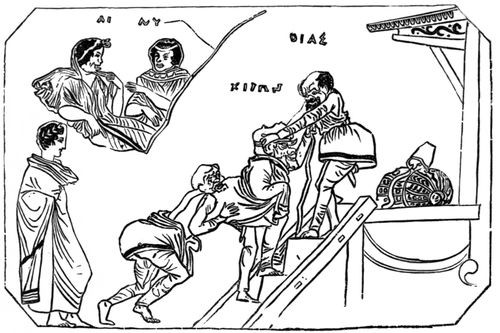
Greek Caricature of the Oracle of Apollo at Delphos.
Nor did the witty, rollicking Greeks confine their satire to the immortals. Of the famous mirth-provokers of the world, such as Cervantes, Ariosto, Molière, Rabelais, Sterne, Voltaire, Thackeray, Dickens, the one that had most power to produce mere physical laughter, power to shake the sides and cause people to roll helpless upon the floor, was the Greek dramatist Aristophanes. The force of the comic can no farther go than he has carried it in some of the scenes of his best comedies. Even to us, far removed as we are, in taste as well as in time, from that wonderful Athens of his, they are still irresistibly diverting. This master of mirth is never so effective as when he is turning into ridicule the philosophers and poets for whose sake Greece is still a dear, venerable name to all the civilized world. In his comedy of "The Frogs" he sends Bacchus down into Hades with every circumstance of riotous burlesque, and there he exhibits the two great tragic poets, Æschylus and Euripides, standing opposite each other, and competing for the tragic throne by reciting verses in which the mannerism of each, as well as familiar passages of their plays, is broadly burlesqued. Nothing in literature can be found more ludicrous or less becoming, unless we look for it in Aristophanes himself. In his play of "The Clouds" occurs his caricature of Socrates, of infinite absurdity, but not ludicrous to us, because we read it as part of the story of a sublime and affecting martyrdom. It fills our minds with wonder to think that a people among whom a Socrates could have been formed could have borne to see him thus profaned. A rogue of a father, plagued by an extravagant son, repairs to the school of Socrates to learn the arts by which creditors are argued out of their just claims in courts of justice. Upon reaching the place, the door of the "Thinking Shop" opens, and behold! a caricature all ready for the artist's pencil. The pupils are discovered with their heads fixed to the floor, their backs uppermost, and Socrates hanging from the ceiling in a basket. The visitor, transfixed with wonder, questions his companion. He asks why they present that portion of their bodies to heaven. "It is getting taught astronomy alone by itself." "And who is this man in the basket?" "Himself." "Who's Himself?" "Socrates!" The visitor at length addresses the master by a diminutive, as though he had said, "Socrates, dear little Socrates." The philosopher speaks: "Why callest thou me, thou creature of a day?" "Tell me, first, I beg, what you are doing up there." "I am walking in the air, and speculating about the sun; for I should never have rightly learned celestial things if I had not suspended the intellect, and subtly mingled Thought with its kindred Air." All this is in the very spirit of caricature. Half of Aristophanes is caricature. In characterizing the light literature of Greece we are reminded of Juvenal's remark upon the Greek people, "All Greece is a comedian."
CHAPTER III.
AMONG THE ANCIENT EGYPTIANS.
Egyptian art was old when Grecian art was young, and it remained crude when the art of Greece had reached its highest development. But not the less did it delight in caricature and burlesque. In the Egyptian collection belonging to the New York Historical Society there is a specimen of the Egyptians' favorite kind of burlesque picture which dates back three thousand years, but which stands out more clearly now upon its slab of limestone than we can engrave it here.

An Egyptian Caricature.
Dr. Abbott, who brought this specimen from Thebes, interpreted it to be a representation of a lion seated upon a throne, as king, receiving from a fox, personating a high-priest, an offering of a goose and a fan. It is probably a burlesque of a well-known picture; for in one of the Egyptian papyri in the British Museum there is a drawing of a lion and unicorn playing chess, which is a manifest caricature of a picture frequently repeated upon the ancient monuments. It was from Egypt, then, that the classic nations caught this childish fancy of ridiculing the actions of men by picturing animals performing similar ones; and it is surprising to note how fond the Egyptian artists were of this simple device. On the same papyrus there are several other interesting specimens: a lion on his hind-legs engaged in laying out as a mummy the dead body of a hoofed animal; a tiger or wild cat driving a flock of geese to market; another tiger carrying a hoe on one shoulder and a bag of seed on the other; an animal playing on a double pipe, and driving before him a herd of small stags, like a shepherd; a hippopotamus washing his hands in a tall water-jar; an animal on a throne, with another behind him as a fan-bearer, and a third presenting him with a bouquet. No place was too sacred for such playful delineations. In one of the royal sepulchres at Thebes, as Kenrick relates, there is a picture of an ass and a lion singing, accompanying themselves on the phorminx and the harp. There is also an elaborate burlesque of a battle piece, in which a fortress is attacked by rats, and defended by cats, which are visible on the battlements. Some rats bring a ladder to the walls and prepare to scale them, while others, armed with spears, shields, and bows, protect the assailants. One rat of enormous size, in a chariot drawn by dogs, has pierced several cats with arrows, and is swinging round his battle-axe in exact imitation of Rameses, in a serious picture, dealing destruction on his enemies. On a papyrus at Turin there is a representation of a cat with a shepherd's crook watching a flock of geese, while a cynocephalus near by plays upon the flute. Of this class of burlesques the most interesting example, perhaps, is the one annexed, representing a Soul doomed to return to its earthly home in the form of a pig.
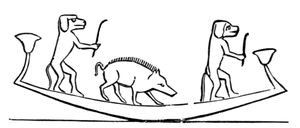
A Condemned Soul, Egyptian Caricature.
This picture, which is of such antiquity that it was an object of curiosity to the Romans and the Greeks, is part of the decoration of a king's tomb. In the original, Osiris, the august judge of departed spirits, is represented on his throne, near the stern of the boat, waving away the Soul, which he has just weighed in his unerring scales and found wanting; while close to the shore a man hews away the ground, to intimate that all communication is cut off between the lost spirit and the abode of the blessed. The animals that execute the stern decree are the dog-headed monkeys, sacred in the mythology of Egypt.
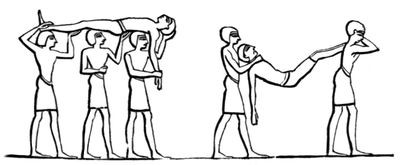
Egyptian Servants conveying Home their Masters from a Carouse.
That the ancient Egyptians were a jovial people who sat long at the wine, we might infer from the caricatures which have been discovered in Egypt, if we did not know it from other sources of information. Representations have been found of every part of the process of wine-making, from the planting of the vineyard to the storing-away of the wine-jars. In the valuable works of Sir Gardner Wilkinson[2] many of these curious pictures are given: the vineyard and its trellis-work; men frightening away the birds with slings; a vineyard with a water-tank for irrigation; the grape harvest; baskets full of grapes covered with leaves; kids browsing upon the vines; trained monkeys gathering grapes; the wine-press in operation; men pressing grapes by the natural process of treading; pouring the wine into jars; and rows of jars put away for future use. The same laborious author favors us with ancient Egyptian caricatures which serve to show that wine was a creature as capable of abuse thirty centuries ago as it is now.
Pictures of similar character are not unfrequent upon the ancient frescoes, and many of them are far more extravagant than this, exhibiting men dancing wildly, standing upon their heads, and riotously fighting. From Sir Gardner Wilkinson's disclosures we may reasonably infer that the arts of debauchery have received little addition during the last three thousand years. Even the seductive cocktail is not modern. The ancient Egyptians imbibed stimulants to excite an appetite for wine, and munched the biting cabbage-leaf for the same purpose. Beer in several varieties was known to them also; veritable beer, made of barley and a bitter herb; beer so excellent that the dainty Greek travelers commended it as a drink only inferior to wine. Even the Egyptian ladies did not always resist the temptation of so many modes of intoxication. Nor did they escape the caricaturist's pencil.
1: "Naples and the Campagna Felice." In a Series of Letters addressed to a Friend in England, in 1802, p. 104.
2: "A Popular Account of the Ancient Egyptians," by Sir J. Gardner Wilkinson, 2 vols., Harper & Brothers, 1854.
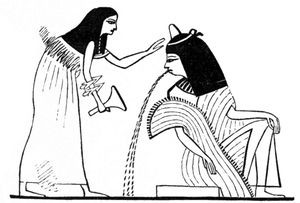
Too Late with the Basin.
This unfortunate lady, as Sir Gardner conjectures, after indulging in potations deep of the renowned Egyptian wine, had been suddenly overtaken by the consequences, and had called for assistance too late. Egyptian satirists did not spare the ladies, and they aimed their shafts at the same foibles that have called forth so many efforts of pencil and pen in later times. Whenever, indeed, we look closely into ancient life, we are struck with the similarity of the daily routine to that of our own time. Every detail of social existence is imperishably recorded upon the monuments of ancient Egypt, even to the tone and style and mishaps of a fashionable party. We see the givers of the entertainment, the master and mistress of the mansion, seated side by side upon a sofa; the guests coming up as they arrive to salute them; the musicians and dancers bowing low to them before beginning to perform; a pet monkey, a dog, or a gazelle tied to the leg of the sofa; the youngest child of the family sitting on the floor by its mother's side, or upon its father's knee; the ladies sitting in groups, conversing upon the deathless, inexhaustible subject of dress, and showing one another their trinkets.
Sir Gardner Wilkinson gives us also the pleasing information that it was thought a pretty compliment for one guest to offer another a flower from his bouquet, and that the guests endeavored to gratify their entertainers by pointing out to one another, with expressions of admiration, the tasteful knickknacks, the boxes of carved wood or ivory, the vases, the elegant light tables, the chairs, ottomans, cushions, carpets, and furniture with which the apartment was provided. This too transparent flattery could not escape such inveterate caricaturists as the Egyptian artists. In a tomb at Thebes may be seen a ludicrous representation of scenes at a party where several of the guests had been lost in rapturous admiration of the objects around them. A young man, either from awkwardness or from having gone too often to the wine-jar, had reclined against a wooden column placed in the centre of the room to support a temporary ornament. There is a crash! The ornamental structure falls upon some of the absorbed guests. Ladies have recourse to the immortal privilege of their sex—they scream. All is confusion. Uplifted hands ward off the falling masses. In a few moments, when it is discovered that no one is hurt, peace is restored, and all the company converse merrily over the incident.
It is strange to find such pictures in a tomb. But it seems as if death and funerals and graves, with their elaborate paraphernalia, were provocative of mirthful delineation. In one noted royal tomb there is a representation of the funeral procession, part of which was evidently designed to excite merriment. The Ethiopians who follow in the train of the mourning queen have their hair plaited in most fantastic fashion, and their tunics of leopard's skin are so arranged that a preposterously enormous tail hangs down behind for the next man to step upon. One of the extensive colored plates of Sir Gardner Wilkinson's larger work presents to our view a solemn and stately procession of funeral barges crossing the Lake of the Dead at Thebes on its way to the place of burial. The first boat contains the coffin, decorated with flowers, a high-priest burning incense before a table of offerings, and the female relatives of the deceased lamenting their loss; two barges are filled with mourning friends, one containing only women and the other only men; two more are occupied by professional persons—the undertaker's assistants, as we should call them—employed to carry offerings, boxes, chairs, and other funeral objects. It was in drawing one of these vessels that the artist could not refrain from putting in a little fun. One of the barges having grounded upon the shore, the vessel behind comes into collision with her, upsetting a table upon the oarsmen and causing much confusion. It is not improbable that the picture records an incident of that particular funeral.
CHAPTER IV.
AMONG THE HINDOOS.
If we go farther back into antiquity, it is India which first arrests and longest absorbs our attention—India, fecund mother of tradition, the source of almost all the rites, beliefs, and observances of the ancient nations. When we visit the collections of the India House, the British Museum, the Mission Rooms, or turn over the startling pages of "The Hindu Pantheon" of Major Edward Moor, we are ready to exclaim, Here all is caricature! This brazen image, for example, of a partly naked man with an elephant's head and trunk, seated upon a huge rat, and feeding himself with his trunk from a bowl held in his hand—surely this is caricature. By no means. It is an image of the most popular of the Hindoo deities—Ganesa, god of prudence and policy, invoked at the beginning of all enterprises, and over whose head is written the sacred word Aum, never uttered by a Hindoo except with awe and veneration. If a man begins to build a house, he calls on Ganesa, and sets up an image of him near the spot. Mile-stones are fashioned in his likeness, and he serves as the road-side god, even if the pious peasants who place him where two roads cross can only afford the rudest resemblance to an elephant's head daubed with oil and red ochre. Rude as it may be, a passing traveler will occasionally hang upon it a wreath of flowers. Major Moor gives us a hideous picture of Maha-Kala, with huge mouth and enormous protruding tongue, squat, naked, upon the ground, and holding up a large sword. This preposterous figure is still farther removed from the burlesque. It is the Hindoo mode of representing Eternity, whose vast insatiate maw devours men, cities, kingdoms, and will at length swallow the universe; then all the crowd of inferior deities, and finally itself, leaving only Brahm, the One Eternal, to inhabit the infinite void. Hundreds of such revolting crudities meet the eye in every extensive Indian collection.
But the element of fun and burlesque is not wanting in the Hindoo Pantheon. Krishna is the jolly Bacchus, the Don Juan, of the Indian deities. Behold him on his travels mounted upon an elephant, which is formed of the bodies of the obliging damsels who accompany him!
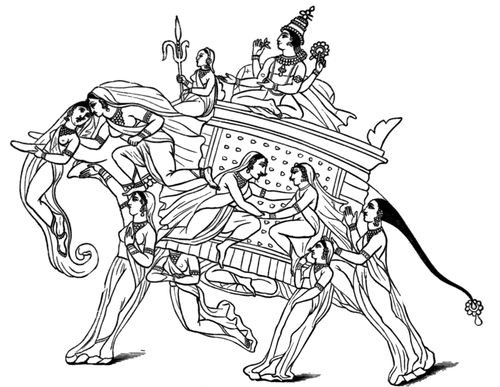
The Hindoo God Krishna on his Travels.
There is no end to the tales related of the mischievous, jovial, irrepressible Krishna. The ladies who go with him everywhere, a countless multitude, are so accommodating as to wreathe and twist themselves into the form of any creature he may wish to ride; sometimes into that of a horse, sometimes into that of a bird.
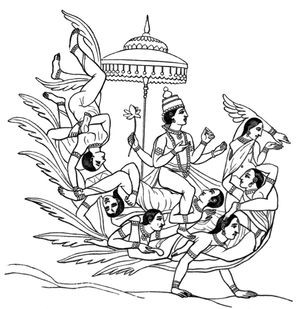
Krishna's Attendants assuming the Form of a Bird.
In other pictures he appears riding in a palanquin, which is likewise composed of girls, and the bearers are girls also. In the course of one adventure, being in great danger from the wrath of his numerous enemies, he created an enormous snake, in whose vast interior his flocks, his herds, his followers, and himself found refuge. At a festival held in his honor, which was attended by a great number of damsels, he suddenly appeared in the midst of the company and proposed a dance; and, that each of them might be provided with a partner, he divided himself into as many complete and captivating Krishnas as there were ladies. One summer, when he was passing the hot season on the sea-shore with his retinue of ladies, his musical comrade, Nareda, hinted to him that, since he had such a multitude of wives, it would be no great stretch of generosity to spare one to a poor musician who had no wife at all. "Court any one you please," said the merry god. So Nareda went wooing from house to house, but in every house he found Krishna perfectly domesticated, the ever-attentive husband, and the lady quite sure that she had him all to herself. Nareda continued his quest until he had visited precisely sixteen thousand and eight houses, in each and all of which, at one and the same time, Krishna was the established lord. Then he gave it up. One of the pictures which illustrate the endless biography of this entertaining deity represents him going through the ceremony of marriage with a bear, both squatting upon a carpet in the prescribed attitude, the bear grinning satisfaction, two bears in attendance standing on their hind-feet, and two priests blessing the union. This picture is more spirited, is more like art, than any other yet copied from Hindoo originals.
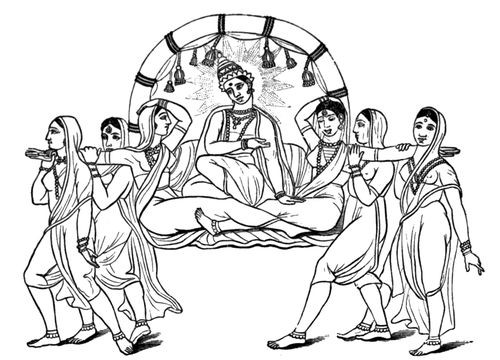
Krishna in his Palanquin.
To this day, as the missionaries report, the people of India are excessively addicted to every kind of jesting which is within their capacity, and delight especially in all the monstrous comicalities of their mythology. No matter how serious an impression a speaker may have made upon a village group, let him but use a word in a manner which suggests a ludicrous image or ridiculous pun, and the assembly at once breaks up in laughter, not to be gathered again.
In late years, those of the inhabitants of India who read the language of their conquerors have had an opportunity of becoming acquainted with their humor. Wherever a hundred English officers are gathered, there is the possibility of an illustrated comic periodical, and, accordingly, we find one such in several of the garrisoned places held by the English in remote parts of the world. Calcutta, as the Athenæum informs us, "has its Punch, or Indian Charivari," which is not unworthy of its English namesake.
CHAPTER V.
RELIGIOUS CARICATURE IN THE MIDDLE AGES.
Mr. Robert Tomes, American consul, a few years ago, at the French city of Rheims, describes very agreeably the impression made upon his mind by the grand historic cathedral of that ancient place.[3] Filled with a sense of the majestic presence of the edifice, he approached one of the chief portals, to find it crusted with a most uncouth semi-burlesque representation, cut in stone, of the Last Judgment. The trump has sounded, and the Lord from a lofty throne is pronouncing doom upon the risen as they are brought up to the judgment-seat by the angels. Below him are two rows of the dead just rising from their graves, extending to the full width of the great door. Upon many of the faces there is an expression of amazement, which the artist apparently designed to be comic, and several of the attitudes are extremely absurd and ludicrous. Some have managed to push off the lid of their tombs a little way, and are peeping out through the narrow aperture, others have just got their heads above the surface of the ground, and others are sitting up in their graves; some have one leg out, some are springing into the air, and some are running, as if in wild fright, for their lives. Though the usual expression upon the faces is one of astonishment, yet this is varied. Some are rubbing their eyes as if startled from a deep sleep, but not yet aware of the cause of alarm; others are utterly bewildered, and hesitate to leave their resting-place; some leap out in mad excitement, and others hurry off as if fearing to be again consigned to the tomb. An angel is leading a cheerful company of popes, bishops, and kings toward the Saviour, while a hideous demon, with a mouth stretching from ear to ear, is dragging off a number of the condemned toward the devil, who is seen stirring up a huge caldron boiling and bubbling with naked babies, dead before baptism. On another part of the wall is a carved representation of the vices which led to the destruction of Sodom and Gomorrah. These were so monstrously obscene that the authorities of the cathedral, in deference to the modern sense of decency, have caused them to be partly cut away by the chisel.
The first cut on the next page is an example of burlesque ornament. The artist apparently intended to indicate another termination of the interview than the one recorded by Æsop between the wolf and the stork. The old cathedral at Strasburg, destroyed a hundred years ago, was long renowned for its sculptured burlesques. We give two of several capitals exhibiting the sacred rites of the Church travestied by animals.
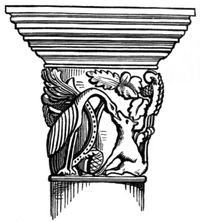
Capital in the Autun Cathedral.
It marks the change in the feelings and manners of men that, three hundred years after those Strasburg capitals were carved, with the sanction of the chapter, a book-seller, for only exhibiting an engraving of some of them in his shop window, was convicted of having committed a crime "most scandalous and injurious to religion." His sentence was "to make the amende honorable, naked to his shirt, a rope round his neck, holding in his hand a lighted wax-candle weighing two pounds, before the principal door of the cathedral, whither he will be conducted by the executioner, and there, on his knees, with uncovered head," confess his fault and ask pardon of God and the king. The pictures were to be burned before his eyes, and then, after paying all the costs of the prosecution, he was to go into eternal banishment.
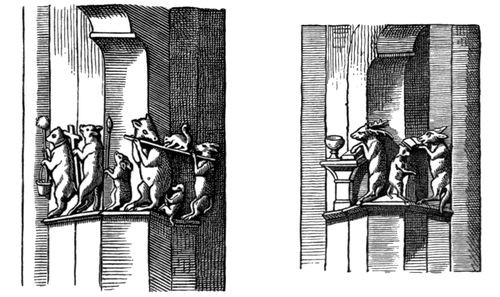
Capitals in the Strasburg Cathedral, A.D. 1300.
Other American consuls besides Mr. Tomes, and multitudes of American citizens not so fortunate as to study mediæval art at their country's expense, have been profoundly puzzled by this crust of crude burlesque on ecclesiastical architecture. The objects in Europe which usually give to a susceptible American his first and his last rapture are the cathedrals, those venerable enigmas, the glory and shame of the Middle Ages, which present so complete a contrast to the toy-temples, new, cabinet-finished, upholstered, sofa-seated, of American cities, not to mention the consecrated barns, white-painted and treeless, of the rural districts. And the cathedrals are a contrast to every thing in Europe also, if only from their prodigious magnitude. A cathedral town generally stands in a valley, through which a small river winds. When the visitor from any of the encompassing hills gets his first view of the compact little city, the cathedral looms up in the midst thereof so vast, so tall, that the disproportion to the surrounding structures is sometimes even ludicrous, like a huge black elephant with a flock of small brown sheep huddling about its feet. But when at last the stranger stands in its shadow, he finds the spell of its presence irresistible; and it is a spell which the lapse of time not unfrequently strengthens, till he is conscious of a tender, strong attachment to the edifice, which leads him to visit it at unusual times, to try the effect upon it of moonlight, of storm, of dawn and twilight, of mist, rain, and snow. He finds himself going to it for solace and rest. On setting out upon a journey, he makes a détour to get another last look, and, returning, goes, valise in hand, to see his cathedral before he sees his companions. Many American consuls have had this experience, have truly fallen in love with the cathedral of their station, and remained faithful to it for years after their return, like Mr. Howells, whose heart and pen still return to Venice and San Carlo, so much to the delight of his readers.
This charm appears to lie in the mere grandeur of the edifice as a work of art, for we observe it to be most potent over persons who are least in sympathy with the feeling which cathedrals embody. Very religious people are as likely to be repelled as attracted by them; and, indeed, in England and Scotland there are large numbers of Dissenters who have avoided entering them all their lives on principle. It is Americans who enjoy them most; for they see in them a most captivating assemblage of novelties—vast magnitude, solidity of structure only inferior to nature's own work, venerable age, harmonious and solemn magnificence—all combined in an edifice which can not, on any principle of utility, justify its existence, and does not pay the least fraction of its expenses. Little do they know personally of the state of feeling which made successive generations of human beings willing to live in hovels and inhale pollution in order that they might erect those wondrous piles. The cost of maintaining them—of which cost the annual expenditure in money is the least important part—does not come home to us. We abandon ourselves without reserve to the enjoyment of stupendous works wholly new to our experience.

Engraved upon a Stall in Sherborne Minster, England.
It is Americans, also, who are most baffled by the attempt to explain the contradiction between the noble proportions of these edifices and the decorations upon some of their walls. How could it have been, we ask in amazement, that minds capable of conceiving the harmonies of these fretted roofs, these majestic colonnades, these symmetrical towers, could also have permitted their surfaces to be profaned by sculptures so absurd and so abominable that by no artifice of circumlocution can an idea of some of them be conveyed in printable words? In close proximity to statues of the Virgin, and in chapels whose every line is a line of beauty, we know not how to interpret what M. Champfleury truly styles "deviltries and obscenities unnamable, vice and passion depicted with gross brutality, luxury which has thrown off every disguise, and shows itself naked, bestial, and shameless." And these mediæval artists availed themselves of the accumulated buffooneries and monstrosities of all the previous ages. The gross conceptions of India, Egypt, Greece, and Rome appear in the ornamentation of Christian temples along with shapes hideous or grotesque which may have been original. Even the oaken stalls in which the officiating priests rested during the prolonged ceremonials of festive days are in many cathedrals covered with comic carving, some of which is pure caricature. A rather favorite subject was the one shown above, a whipping-scene in a school, carved upon an ancient stall in an English cathedral.
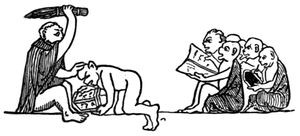
From a Manuscript of the Thirteenth Century.
It is not certain, however, that the artist had any comic intention in engraving this picture of retributive justice, with which the children of former ages were so familiar. It was a standard subject. The troops of Flemish carvers who roamed over Europe in the twelfth and thirteenth centuries, offering their services wherever a church was to be decorated, carried with them port-folios of stock subjects, of which this was one. Other carvings are unmistakable caricatures: a monk caught making love to a nun, a wife beating her husband, an aged philosopher ridden by a woman, monkeys wearing bishops' mitres, barbers drawing teeth in ludicrous attitudes, and others less describable. In the huge cathedral of English Winchester, which abounds in curious relics of the Middle Ages, there is a series of painted panels in the chapel of Our Lady, one of which is an evident caricature of the devil. He is having his portrait painted, and the Virgin Mary is near the artist, urging him to paint him blacker and uglier than usual. The devil does not like this, and wears an expression similar to that of a rogue in a modern police station who objects to being photographed. Often, however, in these old pictures the devil is master of the situation, and exhibits contempt for his adversaries in indecorous ways.
If we turn from the sacred edifices to the sacred books used in them—those richly illuminated missals, the books of "Hours," the psalters, and other works of devotion—we are amazed beyond expression to discover upon their brilliant pages a similar taste in ornamentation. The school scene on the previous page, in which monkey-headed children are playing school, dates back to the thirteenth century.
Burlesque tournaments, in the same taste, often figure in the prayer-books among representations of the Madonna, the crucifixion, and scenes in the lives of the patriarchs. The gallant hare tilts at the fierce cock of the barn-yard, or sly Reynard parries the thrust of the clumsy bear.
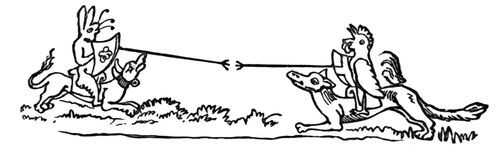
From a Manuscript Mass-book of the Fourteenth Century.
One of the most curious relics of those religious centuries is a French prayer-book preserved in the British Museum, where it was discovered and described by Mr. Malcolm, one of the first persons who ever attempted to elucidate the subject of caricature. Besides the "Hours of the Blessed Virgin," it contains various prayers and collects, the office for the dead, and some psalms, all in Latin. It is illustrated by several brilliantly colored, well-drawn, but most grotesque and incomprehensible figures, designed, as has been conjectured, to "expose the wicked and inordinate lives of the clergy, who were hated by the manuscript writers as taking away much of their business." This was the explanation given of these remarkable pictures to the trustees of the Museum by the collector of whom they bought the volume. Several of them are submitted to the reader's ingenuity on the following page.
Besides the specimens given, there is a wolf growling at a snake twisting itself round its hind-leg; there is "a grinning-match" between a human head on an animal's body and a boar's head on a monkey's body; there is a creature like a pea-hen, with two bodies, one neck, and two dogs' heads; there is an animal with four bodies and one head; there is a bearded man's face and a woman's on one neck, and the body has no limbs, but an enormous tail; there is a turret, on the top of which a monkey sits, and a savage below is aiming an arrow at him. In the British Museum—that unequaled repository of all that is curious and rare—there is the famous and splendid psalter of Richard II., containing many strange pictures in the taste of the period. On the second page, for example, along with two pictures of the kind usual in Catholic works of devotion, there is a third which represents an absurd combat within lists between the court-fool and the court-giant. The fool, who is also a dwarf, is belaboring the giant with an instrument like those hollow clubs used in our pantomimes when the clown is to be whacked with great violence. The giant shrinks from the blows, and the king, pointing at the dwarf, seems to say, "Go it, little one; I bet upon you."
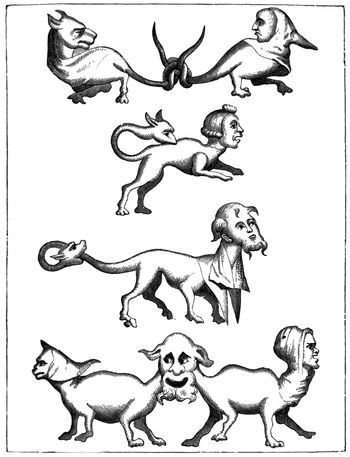
From a French Prayer-book of the Thirteenth Century, in the British Museum.
Mr. Malcolm, who copied this picture from the original, where, he says, it is most superbly finished, interprets it to be a caricature of the famous combat between David and Goliath in the presence of King Saul and his court. In the same mass-book there is a highly ridiculous representation of Jonah on board ship, with a blue Boreas with cheeks puffed out raising the tempest, and a black devil clawing the sail from the yard. In selecting a few of the more innocent pictures from the prayer-book of Queen Mary, daughter of Henry VIII. of England, Mr. Malcolm gives expression to his amazement at the character of the drawings, which he dared not exhibit to a British public! Was this book, he asks, made on purpose for the queen? Was it a gift or a purchase? But whether she bought or whether she accepted it, he thinks she must have "delighted in ludicrous and improper ideas," or else "her inclination for absurdity and caricature conquered even her religion, in defense of which she spread ruin and desolation through her kingdom."
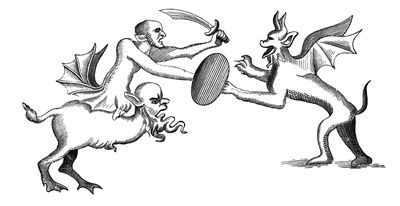
From Queen Mary's Prayer-book, A.D. 1553.
As the reader has now before his eyes a sufficient number of specimens of the grotesque ecclesiastical ornamentation of the period under consideration, he is prepared to consider the question which has perplexed so many students besides Mr. Malcolm: How are we to account for these indecencies in places and books consecrated to devotion? A voice from the Church of the fifth century gives us the hint of the true answer. "You ask me," writes St. Nilus to Olympiodorus of Alexandria, "if it is becoming in us to cover the walls of the sanctuary with representations of animals of all kinds, so that we see upon them snares set, hares, goats, and other beasts in full flight before hunters exhausting themselves in taking and pursuing them with their dogs; and, again, upon the bank of a river, all kinds of fish caught by fishermen. I answer you that this is a puerility with which to amuse the eyes of the faithful."[4] To one who is acquainted with the history and genius of the Roman Catholic Church, this very simple explanation of the incongruity is sufficient. The policy of that wonderful organization in every age has been to make every possible concession to ignorance that is compatible with the continuance of ignorance. It has sought always to amuse, to edify, to moralize, and console ignorance, but never to enlighten it. The mind that planned the magnificent cathedral at Rheims, of which Mr. Tomes was so much enamored, and the artists who designed the glorious San Carlo that kindled rapture in the poetical mind of Mr. Howells, did indeed permit the scandalous burlesques that disfigure their walls; but they only permitted them. It was a concession which they had to grant to the ignorant multitude whose unquestioning faith alone made these enormous structures possible.
We touch here the question insinuated by Gibbon in his first volume, where he plainly enough intimates his belief that Christianity was a lapse into barbarism rather than a deliverance from it. Plausible arguments in the same direction have been frequently made since Gibbon's time by comparing the best of Roman civilization with the worst of the self-torturing monkery of the early Christian centuries. In a debate on this subject in New York not long since between a member of the bar and a doctor of divinity, both of them gentlemen of learning, ability, and candor, the lawyer pointed to the famous picture of St. Jerome (A.D. 375), naked, grasping a human skull, his magnificent head showing vast capacity paralyzed by an absorbing terror, and exclaimed, "Behold the lapse from Virgil, Horace, Cicero, Seneca, the Plinys, and the Antonines!" The answer made by the clergyman was, "That is not Christianity! In the Christian books no hint of that, no utterance justifying that, can be found." Perhaps neither of the disputants succeeded in expressing the whole truth on this point. The vaunted Roman civilization was, in truth, only a thin crust upon the surface of the empire, embracing but one small class in each province, the people everywhere being ignorant slaves. Into that inert mass of servile ignorance Christianity enters, and receives from it the interpretation which ignorance always puts upon ideas advanced or new, interpreting it as hungry French peasants in 1792 and South Carolina negroes in 1870 interpreted modern ideas of human rights. The new leaven set the mass heaving and swelling until the crust was broken to pieces. The civilization of Marcus Aurelius was lost. From parchment scrolls poetry and philosophy were obliterated, that the sheets might be used for prayers and meditations. The system of which St. Jerome was the product and representative was a baleful mixture, of which nine-tenths were Hindoo and the remaining tenth was half Christian and half Plato.
The true inference to be drawn is that no civilization is safe, nor even genuine, until it embraces all classes of the community; and the promulgation of Christianity was the first step toward that.
As the centuries wore on, the best of the clergy grew restive under this monstrous style of ornamentation. "What purpose," wrote St. Bernard, about A.D. 1140, "serve in our cloisters, under the eyes of the brothers and during their pious readings, those ridiculous monstrosities, those prodigies of beauties deformed or deformities made beautiful? Why those nasty monkeys, those furious lions, those monstrous centaurs, those animals half human, those spotted tigers, those soldiers in combat, those huntsmen sounding the horn? Here a single head is fitted to several bodies; there upon a single body there are several heads; now a quadruped has a serpent's tail, and now a quadruped's head figures upon a fish's body. Sometimes it is a monster with the fore parts of a horse and the hinder parts of a goat; again an animal with horns ends with the hind quarters of a horse. Everywhere is seen a variety of strange forms, so numerous and so odd that the brothers occupy themselves more in deciphering the marbles than their books, and pass whole days in studying all those figures much more attentively than the divine law. Great God! if you are not ashamed of such useless things, how, at least, can you avoid regretting the enormity of their cost?"
How, indeed! The honest abbé was far from seeing the symbolical meaning in those odd figures which modern investigators have imagined. He was simply ashamed of the ecclesiastical caricatures; but a century or two later ingenious writers began to cover them with the fig-leaves of a symbolical interpretation. According to the ingenious M. Durand, who wrote (A.D. 1459) thirty years before Luther was born, every part of a cathedral has its spiritual meaning. The stones of which it is built represent the faithful, the lime that forms part of the cement is an emblem of fervent charity, the sand mingled with it signifies the actions undertaken by us for the good of our brethren, and the water in which these ingredients blend is the symbol of the Holy Ghost. The hideous shapes sculptured upon the portals are, of course, malign spirits flying from the temple of the Lord, and seeking refuge in the very substance of the walls! The great length of the temple signifies the tireless patience with which the faithful support the ills of this life in expectation of their celestial home; its breadth symbolizes that large and noble love which embraces both the friends and the enemies of God; its height typifies the hope of final pardon; the roof beams are the prelates, who by the labor of preaching exhibit the truth in all its clearness; the windows are the Scriptures, which receive the light from the sun of truth, and keep out the winds, snows, and hail of heresy and false doctrine devised by the father of schism and falsehood; the iron bars and pins that sustain the windows are the general councils, ecumenical and orthodox, which have sustained the holy and canonical Scriptures; the two perpendicular stone columns which support the windows are the two precepts of Christian charity, to love God and our neighbor; the length of the windows shows the profundity and obscurity of Scripture, and their roundness indicates that the Church is always in harmony with itself.
This is simple enough. But M. Jérôme Bugeaud, in his collection of "Chansons Populaires" of the western provinces of France, gives part of a catechism still taught to children, though coming down from the Middle Ages, which carries this quaint symbolizing to a point of the highest absurdity. The catechism turns upon the sacred character of the lowly animal that most needed any protection which priestly ingenuity could afford. Here are a few of the questions and answers:
Priest. "What signify the two ears of the ass?"
Child. "The two ears of the ass signify the two great patron saints of our city."
Priest. "What signifies the head of the ass?"
Child. "The head of the ass signifies the great bell, and the halter the clapper of the great bell, which is in the tower of the cathedral of the patron saints of our city."
Priest. "What signifies the ass's mouth?"
Child. "The ass's mouth signifies the great door of the cathedral of the patron saints of our city."
Priest. "What signify the four feet of the ass?"
Child. "The four feet of the ass signify the four great pillars of the cathedral of the patron saints of our city."
Priest. "What signifies the paunch of the ass?"
Child. "The paunch of the ass signifies the great chest wherein Christians put their offerings to the patron saints of our cathedral."
Priest. "What signifies the tail of the ass?"
Child. "The tail of the ass signifies the holy-water brush of the good dean of the cathedral of the patron saints of our city."
The priest does not stop at the tail, but pursues the symbolism with a simplicity and innocence which do not bear translating into our blunt English words. As late as 1750 Bishop Burnet saw in a church at Worms an altarpiece of a crudity almost incredible. It represented the Virgin Mary throwing Christ into the hopper of a windmill, from the spout of which he was issuing in the form of sacramental wafers, and priests were about to distribute them among the people. The unquestionable purpose of this picture was to assist the faith and animate the piety of the people of Worms.
CHAPTER VI.
SECULAR CARICATURE IN THE MIDDLE AGES.
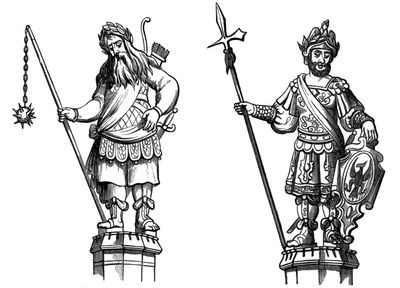
Gog and Magog, the Giants in the Guildhall of London.
If we turn from the sacred to the secular, we find the ornamentation not less barbarous. Many readers have seen the two giants that stand in the Guildhall of London, where they, or ugly images like them, have stood from time immemorial. A little book sold near by used to inform a credulous public that Gog and Magog were two gigantic brothers taken prisoners in Cornwall fighting against the Trojan invaders, who brought them in triumph to the site of London, where their chief chained them to the gate of his palace as porters. But, unfortunately for this romantic tale, Mr. Fairholt, in his work upon the giants,[5] makes it known that many other towns and cities of Europe cherish from a remote antiquity similar images. He gives pictures of the Salisbury giant, the huge helmeted giant in Antwerp, the family of giants at Douai, the giant and giantess of Ath, the giants of Brussels, as well as of the mighty dragon of Norwich, with practicable iron jaw.

Head of the Great Dragon of Norwich.
We may therefore discard learned theories and sage conjectures concerning Gog and Magog, and attribute them to the poverty of invention and the barbarity of taste which prevailed in the ages of faith.
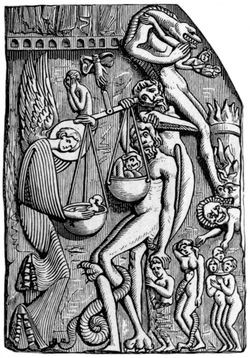
Souls Weighed in the Balance. (Bas-relief of the Autun Cathedral.)
One of the subjects most frequently chosen for caricature during this period was that cunning and audacious enemy of God and man, the devil—a composite being, made up of the Satan who tested Job, the devil who tempted Jesus, and the Egyptian Osiris who weighed souls in the balance, and claimed as his own those found wanting. The theory of the universe then generally accepted was that the world was merely a field of strife between God and this malignant spirit; on the side of God were ranged archangels, angels, the countless host of celestial beings, and all the saints on earth and in heaven, while on the devil's side were a vast army of fallen spirits and all the depraved portion of the human race. The simple souls of that period did not accept this explanation in an allegorical sense, but as the most literal statement of facts familiarly known, concerning which no one in Christendom had any doubt whatever. The devil was as composite in his external form as he was in his traditional character. All the mythologies appear to have contributed something to his make-up, until he had acquired many of the most repulsive features and members of which animated nature gives the suggestion. He was hairy, hoofed, and horned; he had a forked tail; he had a countenance which expressed the fox's cunning, the serpent's malice, the pig's appetite, the monkey's grin. As to his body, it varied according to the design of the artist, but it usually resembled creatures base or loathsome.
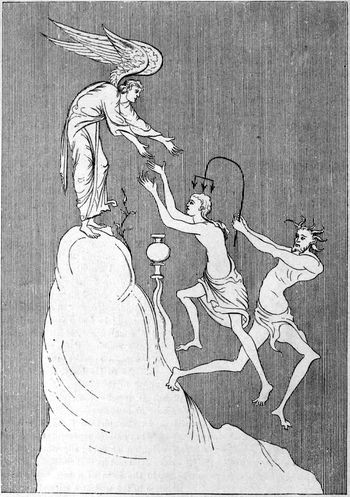
Struggle for the Possession of a Soul between Angel and Devil. (From a Psalter, 1300.)
In one picture there is a very rude but curious representation of the weighing of souls, superintended by the devil and an archangel. The devil, in the form of a hog, has won a prize in the soul of a wicked woman, which he is carrying off in a highly disrespectful manner, while casting a backward glance to see that he has fair play in the next weighing. This was an exceedingly favorite subject with the artists of the eleventh and twelfth centuries. They delighted to picture the devil, in their crude uncompromising way, as an insatiate miser of human souls, eager to seize them, demanding a thousand, a million, a billion, all; and when one appeared in the scales so void of guilt that the good angel must needs possess it, he may be seen slyly putting a finger upon the opposite scale to weigh it down, and this sometimes in spite of the angel's remonstrance. In one picture, described by M. Mérimée in his "Voyage en Auvergne," the devil plays this trick at a moment when the archangel Michael has turned to look another way.

Lost Souls cast into Hell. (From Queen Mary's Psalter.)
It is a strange circumstance that in a large number of these representations the devil is exhibited triumphant, and in others the victory is at least doubtful. In a splendid psalter preserved in the British Museum there is a large picture (an engraving of which is given on the preceding page) of a soul climbing an extremely steep and high mountain, on the summit of which a winged archangel stands with outstretched arms to receive him. The soul has nearly reached the top; another step will bring him within the archangel's reach; but behind him is the devil with a long three-pronged clawing instrument, which he is about to thrust into the hair of the ascending saint; and no man can tell which is to finally have that soul, the angel or the devil. M. Champfleury describes a capital in a French church which represents one of the minions of the devil carrying a lizard, symbol of evil, which he is about to add to the scale containing the sins; and the spectator is left to infer that fraud of this kind is likely to be successful, for underneath is written, "Ecce Diabolus!" It is as if the artist had said, "Such is the devil, and this is one of his modes of entrapping his natural prey of human souls!" From a large number of similar pictures the inference is fair that, let a man lead a spotless life from the cradle to the grave, the devil, by a mere trick, may get his soul at last. Some of the artists might be suspected of sympathizing with the devil in his triumphs over the weakness of man. Observe, for example, the comic exuberance of the above picture, in which devils are seen tumbling their immortal booty into the jaws of perdition.
It is difficult to look at this picture without feeling that the artist must have been alive to the humors of the situation. It is, however, the opinion of students of these quaint relics that the authors of such designs honestly intended to excite horror, not hilarity. Queen Mary probably saw in this picture, as she turned the page of her sumptuous psalter, an argument to inflame her bloody zeal for the ancient faith. In the writings of some of the early fathers we observe the same appearance of joyous exultation at the sufferings of the lost, if not a sense of the comic absurdity of their doom. Readers may remember the passage from Tertullian (A.D. 200) quoted so effectively by Gibbon:
"You are fond of all spectacles," exclaims this truly ferocious Christian; "expect the greatest of all spectacles, the last and eternal judgment of the universe. How shall I rejoice, how laugh, how exult, when I behold so many proud monarchs and fancied gods groaning in the lowest abyss of darkness; so many magistrates who persecuted the name of the Lord liquefying in fiercer fires than they ever kindled against Christians; so many sage philosophers blushing in red-hot flames with their deluded scholars; so many celebrated poets trembling before the tribunal; so many tragedians more tuneful in the expression of their own sufferings; so many dancers—"

Devils seizing their Prey. (Bas-relief on the Portal of a Church at Troyes.)
This is assuredly not the utterance of compassion, but rather of the fierce delight of an unregenerate Roman, when at the amphitheatre he doomed a rival's defeated gladiator to death by pointing downward with his thumb. In a similar spirit such pictures were conceived as the one given above.
The sculptor, it is apparent, is "with" the adversary of mankind in the present case. Kings and bishops carried things with a high hand during their mortal career, but the devils have them at last with a rope round their necks, crown and mitre notwithstanding!
The devil was not always victor. There was One whom neither his low cunning nor his bland address nor his blunt audacity could beguile—the Son of God, his predestined conqueror. The passages in the Gospels which relate the attempts made by Satan to tempt the Lord furnished congenial subjects to the illuminators of the Middle Ages, and they treated those subjects with their usual enormous crudity. In one very ancient Saxon psalter, in manuscript, preserved at the British Museum, there is a colossal Christ, with one foot upon a devil, the other foot about to fall upon a second devil, and with his hands delivering from the open mouth of a third devil human souls, who hold up to him their hands clasped as in prayer. In this picture the sympathies of the artist are evidently not on the side of the evil spirits. Their malevolence is apparent, and their attitude is ignominious. The rescued souls are, indeed, a pigmy crew, of woe-begone aspect; but their resistless Deliverer towers aloft in such imposing altitude that the tallest of the saints hardly reaches above his knees. In another picture of very early date, the Lord upon a high place is rescuing a soul from three scoffing devils, who are endeavoring to pull him down to perdition by cords twisted round his legs. This soul we are permitted to consider safe; but below, in a corner of the spacious drawing, a winged archangel is spearing a lost soul into the flames of hell, using the spear in the manner of a farmer handling a pitchfork.
3: "The Champagne Country," p. 34, by Robert Tomes, London, 1867.
4: Quoted in Champfleury, p. 7, from "Maxima Bibliotheca Patrum," vol. xxvii., p. 323.
5: "Gog and Magog: the Giants in Guildhall," by F. W. Fairholt, F.S.A., London, 1859.
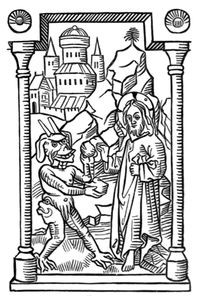
The Temptation.
These ancient attempts to exhibit the endless conflict between good and evil are too rude even to be interesting. The specimen annexed, of later date, about 1475, occurs in a Poor People's Bible (Biblia Pauperum), block-printed, in which it forms part of an extensive frontispiece. The book was once the property of George III., at the sale of whose personal effects it was bought for the British Museum, where it now is. It has the additional interest of being one of the oldest specimens of wood-engraving yet discovered.
The mountain in the background, adorned by a single tree, is the height to which the Lord was taken by the tempter, and from which the devil urged him to cast himself down.
A very frequent object of caricature during the ages when terror ruled the minds of men was human life itself—its brevity, its uncertainty, and the absurd, ill-timed suddenness with which inexorable death sometimes cuts it short. Herodotus records that at the banquets of the Egyptians it was customary for a person to carry about the table the figure of a corpse lying upon a coffin, and to cry out, "Behold this image of what yourselves shall be; therefore eat, drink, and be merry." There are traces of a similar custom in the records of other ancient nations, among whom it was regarded as a self-evident truth that the shortness of life was a reason for making the most of it while it lasted. And their notion of making the most of it was to get from it the greatest amount of pleasure. This vulgar scheme of existence vanished at the promulgation of the doctrine that the condition of every soul was fixed unalterably at the moment of its severance from the body, or, at best, after a short period of purgation, and that the only way to avoid unending anguish was to do what the Church commanded and to avoid what the Church forbade. Terror from that time ruled Christendom. Terror covered the earth with ecclesiastical structures, gave the Church a tenth of all revenues and two-fifths of all property. By every possible device death was clothed with new and vivid terrors, and in every possible way the truth was brought home to the mind that the coming of death could be as unexpected as it was inevitable and unwelcome. The tolling of the church-bell spread the gloom of the death-chamber over the whole town; and the death-crier, with bell and lantern, wearing a garment made terrible by a skull and cross-bones, went his rounds, by day or night, crying to all good people to pray for the soul just departed.[6]
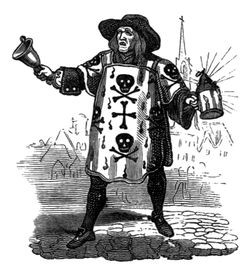
French Death-crier—"Pray for the Soul just departed."
These criers did not cease to perambulate the streets of Paris until about the year 1690, and M. Langlois informs us that in remote provinces of France their doleful cry was heard as recently as 1850.
Blessed gift of humor! Against the most complicated and effective apparatus of terror ever contrived, worked by the most powerful organization that ever existed, the sense of the ludicrous asserted itself, and saved the human mind from being crushed down into abject and hopeless idiocy. The readers of "Don Quixote" can not have forgotten the colloquy in the highway between the Knight of the Sorrowful Countenance and the head of the company of strollers.
"'Sir,' replied the Devil, politely, stopping his cart, 'we are the actors of the company of the Evil Spirit. This morning, which is the octave of Corpus Christi, we have represented the play of the Empire of Death. This young man played Death, and this one an Angel. This woman, who is the wife of the author of the comedy, is the Queen. Over there is one who played the part of an Emperor, and the other man that of a Soldier. As to myself, I am the Devil, at your service, and one of the principal actors.'"
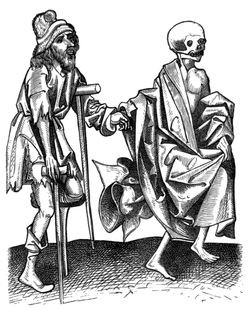
Death and the Cripple.
For centuries the comedy of Death was a standard play at high festivals, the main interest being the rude, sudden interruption of human lives and joys and schemes by the grim messenger. Art adopted the theme, and the Dance of Death began to figure among the decorations of ecclesiastical structures and on the vellum of illuminated prayer-books. No sculptor but executed his Dance of Death; no painter but tried his skill upon it; and by whomsoever the subject was treated, the element of humor was seldom wanting.
So numerous are the pictures and series of pictures usually styled Dances of Death, that a descriptive catalogue of them would fill the space assigned to this chapter; and the literature to which they have given rise forms an important class of the works relating to the Middle Ages. Two phases of the subject were especially attractive to artists. One was the impartiality of Death, noted by Horace in the familiar passage; and the other the incongruity between the summons to depart and the condition of the person summoned. When these two aspects of the subject had become hackneyed, artists pleased themselves sometimes with a treatment precisely the opposite, and represented Death dancing gayly away with the most battered, ancient, and forlorn of human kind, who had least reason to love life, but did not the less shrink from the skeleton's icy touch. Every one feels the comic absurdity of gay and sprightly Death hurrying off to the tomb a cripple as dilapidated as the one in the picture above. In another engraving we see Death, with exaggerated courtesy, handing to an open tomb an extremely old man just able to totter.
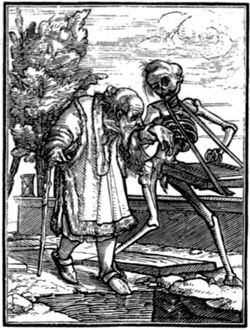
Death and the Old Man.
Another subject in the same series is Death dragging at the garment of a peddler, who is so heavily laden as he trudges along the highway that one would imagine even the rest of the grave welcome. But the peddler, too, makes a very wry face when he recognizes who it is that has interrupted his weary tramp. The triumphant gayety of Death in this picture is in humorous contrast with the lugubrious expression on the countenance of his victim.
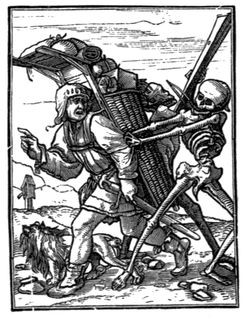
Death and the Peddler.
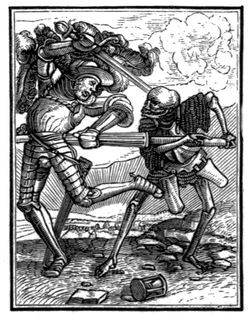
Death and the Knight.
In other series we have Death dressed as a beau seizing a young maiden, Death taking from a house-maid her broom, Death laying hold of a washer-woman, Death taking apples from an apple-stand, Death beckoning away a bar-maid, Death summoning a female mourner at a funeral, and Death plundering a tinker's basket. Death, standing in a grave, pulls the grave-digger in by the leg; seated on a plow, he seizes the farmer; with an ale-pot at his back, he throttles an inn-keeper who is adulterating his liquors; he strikes with a bone the irksome chain of matrimony, and thus sets free a couple bound by it; he mows down a philosopher holding a clock; upon a miser who has thrust his body deep down into a massive chest he shuts the heavy lid; he shows himself in the mirror in which a young beauty is looking; to a philosopher seated in his study he enters and presents an hour-glass. A pope on his throne is crowning an emperor kneeling at his feet, with princes, cardinals, and bishops in attendance, when a Death appears at his side, and another in his retinue dressed as a cardinal. Death lays his hand upon an emperor's crown at the moment when he is doing justice to a poor man against a rich; but in another picture of the same series, Death seizes a duke while he is disdainfully turning from a poor woman with her child who has asked alms of him. The dignitaries of the Church were not spared. Fat abbots, gorgeous cardinals, and vehement preachers all figure in these series in circumstances of honor and of dishonor. In most of them the person summoned yields to King Death without a struggle; but in one a knight makes a furious resistance, laying about him with a broadsword most energetically. It is of no avail. Death runs him through the body with his own lance, though in the other picture the weapon in Death's hand was only a long thigh-bone.
Mr. Longfellow, in his "Golden Legend," has availed himself of the Dance of Death painted on the walls of the covered bridge at Lucerne to give naturalness and charm to the conversation of Elsie and Prince Henry while they are crossing the river. The strange pictures excite the curiosity of Elsie, and the Prince explains them to her as they walk:
"Elsie. What is this picture?
"Prince. It is a young man singing to a nun,
Who kneels at her devotions, but in kneeling
Turns round to look at him; and Death meanwhile
Is putting out the candles on the altar!
"Elsie. Ah, what a pity 'tis that she should listen
Unto such songs, when in her orisons
She might have heard in heaven the angels singing!
"Prince. Here he has stolen a jester's cap and bells,
And dances with the queen.
"Elsie. A foolish jest!
"Prince. And here the heart of the new-wedded wife,
Coming from church with her beloved lord,
He startles with the rattle of his drum.
"Elsie. Ah, that is sad! And yet perhaps 'tis best
That she should die with all the sunshine on her
And all the benedictions of the morning,
Before this affluence of golden light
Shall fade into a cold and clouded gray,
Then into darkness!
"Prince. Under it is written,
'Nothing but death shall separate thee and me!'
"Elsie. And what is this that follows close upon it?
"Prince. Death playing on a dulcimer."
And so the lovers converse on the bridge, all covered from end to end with these caricatures of human existence, until the girl hurries with affright from what she calls "this great picture-gallery of death."
Tournaments were among the usual subjects of caricature during the century or two preceding the Reformation. Some specimens have already been given from the illuminated prayer-books (pp. 44, 46). The device, however, seldom rises above the ancient one of investing animals with the gifts and qualities of men. Monkeys mounted upon the backs of dogs tilt at one another with long lances, or monsters utterly nondescript charge upon other monsters more ridiculous than themselves.
All the ordinary foibles of human nature received attention. These never change. There are always gluttons, misers, and spendthrifts. There are always weak men and vain women. There are always husbands whose wives deceive and worry them, as there are always wives whom husbands worry and deceive; and the artists of the Middle Ages, in their own direct rude fashion, turned both into caricature. The mere list of subjects treated in Brandt's "Ship of Fools," written when Luther was a school-boy, shows us that men were men and women were women in 1490. That quaint reformer of manners dealt mild rebuke to men who gathered great store of books and put them to no good use; to women who were ever changing the fashion of their dress; to men who began to build without counting the cost; to "great borrowers and slack payers;" to fools "who will serve two lords both together;" to them who correct others while themselves are "culpable in the same fault;" to "fools who can not keep secret their own counsel;" to people who believe in "predestinacyon;" to men who attend closely to other people's business, leaving their own undone; to "old folks that give example of vice to youth;" and so on through the long catalogue of human follies. His homely and wise ditties are illustrated by pictures of curious simplicity. Observe the one subjoined, in which "a foule" is weighing the transitory things of this world against things everlasting, one being represented by a scale full of castles and towers, and the other by a scale full of stars—the earthly castles outweighing the heavenly bodies in the balance of this "foule."

Heaven and Earth weighed in the Balance. (From "The Ship of Fools.")
One of the quaint poems of the gentle priest descants upon the bad behavior of people at church. This poem has an historical interest, for it throws light upon the manners of the time, over which poetry, tradition, and romance have thrown a very delusive charm. We learn from it that while the Christian people of Europe were on their knees praying in church they were liable to be disturbed by the "mad noise and shout" of a loitering crowd; by knights coming in from the field, falcon upon wrist, with their dogs yelping at their heels; by men chaffering and bargaining as they walked up and down; by the wanton laughter of girls ogled by young men; by lawyers conferring with clients; and by all the usual noises of a crowd at a fair. The author wonders
"That the false paynyms within theyr Temples be
To theyr ydols moche more devout than we."
The worthy Brandt was not the only satirist of Church manners. The "Usurer's Paternoster," given by M. Champfleury, is more incisive than Brandt's amiable remonstrance. The usurer, hurrying away to church, tells his wife that if any one comes to borrow money while he is gone, some one must be sent in all haste for him. On his way he says his paternoster thus:
"Our Father. Blessed Lord God [Beau Sire Dieu], be favorable to me, and give me grace to prosper exceedingly. Let me become the richest money-lender in the world. Who art in heaven. I am sorry I wasn't at home the day that woman came to borrow. Really I am a fool to go to church, where I can gain nothing. Hallowed be thy name. It's too bad I have a servant so expert in pilfering my money. Thy kingdom come. I have a mind to go home to see what my wife is about. I'll bet she sells a chicken while I am away, and keeps the money. Thy will be done. It pops into my mind that the chevalier who owed me fifty francs paid me only half. In heaven. Those damned Jews do a rushing business in lending to every one. I should like very much to do as they do. As on earth. The king plagues me to death in raising taxes so often."
Arrived at church, the money-lender goes through part of the service as best he may; but as soon as sermon time comes, off he goes, saying to himself, "I must get away home: the priest is going to preach a sermon to draw money out of our purses." Doubtless the priest in those times of ignorance had to deal with many most profane and unspiritual people, who could only be restrained by fear, and to whose "puerility" much had to be conceded. In touching upon the Church manners of the Middle Ages, M. Champfleury makes a remark that startles a Protestant mind accustomed only to the most exact decorum in churches. "Old men of to-day" (1850), he says, speaking of France, "will recall to mind the gayety of the midnight masses, when buffoons from the country waited impatiently to send down showers of small torpedoes upon the pavement of the nave, to barricade the alcoves with mountains of chairs, to fill with ink the holy-water basins, and to steal kisses in out-of-the-way corners from girls who would not give them." These proceedings, which M. Champfleury styles "the pleasantries of our fathers," were among the concessions made by a worldly-wise old Church to the "puerility" of the people, or rather to the absolute necessity of occasional hilarious fun to healthy existence.
Amusing and even valuable caricatures six and seven centuries old have been discovered upon parchment documents in the English record offices, executed apparently by idle clerks for their amusement when they had nothing else to do. One of these, copied by Mr. Wright, gives us the popular English conception of an Irish warrior of the thirteenth century.
English Caricature of an Irishman, A.D. 1280.
The broad-axes of the Irish were held in great terror by the English. An historian of Edward I.'s time, while discoursing on that supreme perplexity of British kings and ministers, how Ireland should be governed after being quite reduced to subjection, expresses the opinion that the Irish ought not to be allowed in time of peace to use "that detestable instrument of destruction which by an ancient but accursed custom they constantly carry in their hands instead of a staff." The modern Irish shillalah, then, is only the residuum of the ancient Irish broad-axe—the broad-axe with its head taken off. The humanized Irishman of to-day is content with the handle of "the detestable instrument." Other pen-and-ink sketches of England's dreaded foes, the Irish and the Welsh, have been found upon ancient vellum rolls, but none better than the specimen given has yet been copied.
The last object of caricature which can be mentioned in the present chapter is the Jew—the odious Jew—accursed by the clergy as a Jew, despised by good citizens as a usurer, and dreaded by many a profligate Christian as the holder of mortgages upon his estate. When the ruling class of a country loses its hold upon virtue, becomes profuse in expenditure, ceases to comply with natural law, comes to regard licentious living as something to be expected of young blood, and makes a jest of a decorous and moral conversation, then there is usually in that country a less refined, stronger class, who do comply with natural law, who do live in that virtuous, frugal, and orderly manner by which alone families can be perpetuated and states established. In several communities during the centuries preceding the Reformation, when the nobles and great merchants wasted their substance in riotous living or in insensate pilgrimages and crusades, the Jew was the virtuous, sensible, and solvent man. He did not escape the evil influence wrought into the texture of the character by living in an atmosphere of hatred and contempt, nor the narrowness of mind caused by his being excluded from all the more generous and high avocations. But he remained through all those dismal ages temperate, chaste, industrious, and saving, as well as heroically faithful to the best light on high things that he had. Hence he always had money to lend, and he could only lend it to men who were too glad to think he had no rights which they were bound to respect.
The caricature on the next page was also discovered upon a vellum roll in the Public Record Office in London, the work of some idle clerk 642 years ago, and recently transferred to an English work[7] of much interest, in which it serves as a frontispiece.
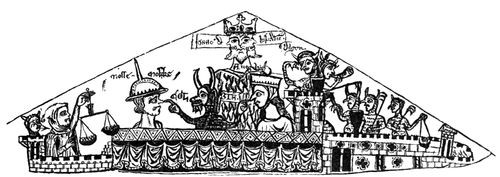
Caricature of the Jews in England, A.D. 1233.
The ridicule is aimed at the famous Jew, Isaac of Norwich, a rich money-lender and merchant, to whom abbots, bishops, and wealthy vicars were heavily indebted. At Norwich he had a wharf at which his vessels could receive and discharge their freights, and whole districts were mortgaged to him at once. He lent money to the king's exchequer. He was the Rothschild of his day. In the picture, which represents the outside of a castle—his own castle, wrested from some lavish Christian by a money-lender's wiles—the Jew Isaac stands above all the other figures, and is blessed with four faces and a crown, which imply, as Mr. Pike conjectures, that, let him look whichever way he will, he beholds possessions over which he holds kingly sway. Lower down, and nearer the centre, are Mosse Mokke, another Jewish money-lender of Norwich, and Madame Avegay, one of many Jewesses who lent money, between whom is a horned devil pointing to their noses. The Jewish nose was a peculiarly offensive feature to Christians, and was usually exaggerated by caricaturists. The figure holding up scales heaped with coin is, so far as we can guess, merely a taunt; and the seating of Dagon, the god of the Philistines, upon the turret seems to be an intimation that the Jews, in their dispersion, had abandoned the God of their fathers, and taken up with the deity of his inveterate foes.
So far as the records of those ages disclose, there was no one enlightened enough to judge the long-suffering Jews with just allowance. Luther's aversion to them was morbid and violent. He confesses, in his Table-talk, that if it had fallen to his lot to have much to do with Jews, his patience would have given way; and when, one day, Dr. Menius asked him how a Jew ought to be baptized, he replied, "You must fill a large tub with water, and, having divested a Jew of his clothes, cover him with a white garment. He must then sit down in the tub, and you must baptize him quite under the water." He said further to Dr. Menius that if a Jew, not converted at heart, were to ask baptism at his hands, he would take him to the bridge, tie a stone round his neck, and hurl him into the river, such an obstinate and scoffing race were they. If Luther felt thus toward them, we can not wonder that the luxurious dignitaries of the Church, two centuries before his time, should have had qualms of conscience with regard to paying Isaac of Norwich interest upon money borrowed.
CHAPTER VII.
CARICATURES PRECEDING THE REFORMATION.
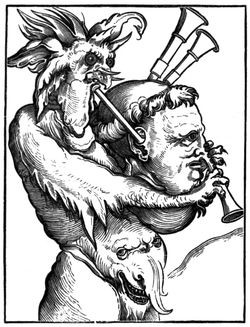
Luther inspired by Satan.
We have in this strange, rude picture[8] a device of contemporary caricature to cast ridicule upon the movement of which Martin Luther was the conspicuous figure. It is reduced from a large wood-cut which appeared in Germany at the crisis of the lion-hearted reformer's career, the year of his appearance at the Diet of Worms, when he said to dissuading friends, "If I knew there were as many devils at Worms as there are tiles upon the houses, I would go." The intention of the artist is obvious; but, in addition to the leading purpose, he desired, as Mr. Chatto conjectures, to remind his public of the nasal drawl of the preaching friars of the time, for which they were as proverbial as the Puritans of London in Cromwell's day. Such is the poverty of human invention that the idea of this caricature has been employed several times since Luther's time—even as recently as 1873, when a London draughtsman made it serve his turn in the contentions of party politics.
The best humorous talent of Christendom, whether it wrought with pencil or with pen, whether it avowed or veiled its sympathy with reform, was on Luther's side. It prepared the way for his coming, co-operated with him during his life-time, carried on his work after he was gone, and continues it to the present hour.
Recent investigators tell us, indeed, that the Reformation began in laughter, which the Church itself nourished and sanctioned. M. Viollet-le-Duc, author of the "Dictionnaire d'Architecture," discourses upon the gradual change which church decorators of the Middle Ages effected in the figure of the devil. Upon edifices erected before the year 1000 there are few traces of the devil, and upon those of much earlier date none at all; but from the eleventh century he "begins to play an important rôle," artists striving which should give him the most hideous form. No one was then audacious enough to take liberties with a being so potent, so awful, so real, the competitor and antagonist of the Almighty Lord of Heaven and Earth. But mortals must laugh, and familiarity produces its well-known effect. In the eyes of men of the world the devil became gradually less terrible and more grotesque, became occasionally ridiculous, often contemptible, sometimes silly. His tricks are met by tricks more cunning than his own; he is duped, and retires discomfited. Before Luther appeared on the scene, the painters and sculptors, not to mention the authors and poets, had made progress in reducing the devil from the grade of an antagonist of deity and arch-enemy of men to that of a cunning and amusing deceiver of simpletons. "The great devil," as the author just mentioned remarks, "sculptured over the door of the Autun Cathedral in the twelfth century is a frightful being, well designed to strike terror to unformed souls; but the young devils carved in bas-reliefs of the fifteenth century are more comic than terrible, and it is evident that the artists who executed them cared very little for the wicked tricks of the Evil Spirit." We may be sure that the artist who could sketch the devil fiddling upon a pair of bellows with a kitchen dipper had outgrown the horror which that personage had once excited in all minds. Such a sketch is here reproduced from a Flemish MS. in the library of Cambrai.
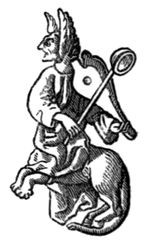
But this could not be said of the great mass of Christian people for centuries after. Luther, as the reader is aware, speaks of the devil with as absolute an assurance of his existence, activity, and nearness as if he were a member of his own household. God, he once said, mocks and scorns the devil by putting under his nose such a weak creature as man; and at other times he dwelt upon the hardness of the conflict which the devil has to maintain. "It were not good for us to know how earnestly the holy angels strive for us against the devil, or how hard a combat it is. If we could see for how many angels one devil makes work, we should be in despair." Many devils, he remarks with curious certainty, are in forests, in waters, in wildernesses, in dark pooly places, ready to hurt and prejudice people; and there are some in the thick black clouds, which cause hail, lightnings, and thunderings, and poison the air, the pastures, and grounds. He derides the philosophers and physicians who say that these things have merely natural causes; and as to the witches who torment honest people, and spoil their eggs, milk, and butter, "I should have no compassion upon them—I would burn them all." The Table-talk of the great reformer is full of such robust credulity.
Luther represented, as much as he reformed, his age and country. In these utterances of his we discern the spirit against which the humor and gayety of art had to contend, and over which it has gained a tardy victory, not yet complete. Let us keep in mind also that in those twilight ages, as in all ages, there were the two contending influences which we now call "the world" and "the church." In other words, there were people who took the devil lightly, as they did all invisible and spiritual things, and there were people who dreaded the devil in every "dark pooly place," and to whom nothing could be a jest which appertained to him. Humorous art has in it healing and admonition for both these classes.
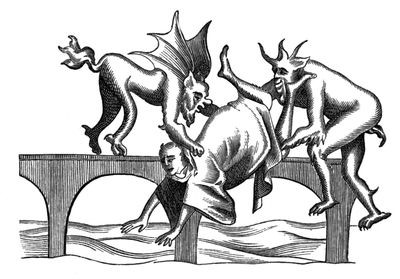
Oldest Drawing in the British Museum, A.D. 1320.
It was in those centuries, also, that men of the world learned to laugh at the clergy, and, again, not without clerical encouragement. In the brilliantly illuminated religious manuscripts of the two centuries preceding Luther, along with other ludicrous and absurd images, of which specimens have been given, we find many pictures in which the vices of the religious orders are exhibited. The oldest drawing in the British Museum, one of the only two that bear the date 1320, shows us two devils tossing a monk headlong from a bridge into a rough and rapid river, an act which they perform in a manner not calculated to excite serious thought in modern minds.
In the old Strasburg Cathedral there was a brass door, made in 1545, upon which was engraved a convent with a procession of monks issuing from it bearing the cross and banners. The foremost figure of this procession was a monk carrying a girl upon his shoulders. This was not the coarse fling of an enemy. It was not the scoff of an Erasmus, who said once, "These paunchy monks are called fathers, and they take good care to deserve the name." It was engraved on the eternal brass of a religious edifice for the warning and edification of the faithful.
Nothing more surprises the modern reader than the frequency and severity with which the clergy of those centuries were denounced and satirized, as well by themselves as by others. A Church which showed itself sensitive to the least taint of what it deemed heresy appears to have beheld with indifference the exhibition of its moral delinquencies—nay, taken the lead in exposing them. It was a clergyman who said, in the Council of Siena, fifty years before Luther was born: "We see to-day priests who are usurers, wine-shop keepers, merchants, governors of castles, notaries, stewards, and debauch brokers. The only trade which they have not yet commenced is that of executioner. The bishops surpass Epicurus himself in sensuality, and it is between the courses of a banquet that they discuss the authority of the Pope and that of the Council." The same speaker related that St. Bridget, being in St. Peter's at Rome, looked up in a religious ecstasy, and saw the nave filled with mitred hogs. She asked the Lord to explain this fantastic vision. "These," replied the Lord, "are the bishops and abbés of to-day." M. Champfleury, the first living authority on subjects of this nature, declares that the manuscript Bibles of the century preceding Luther are so filled with pictures exhibiting monks and nuns in equivocal circumstances that he was only puzzled to decide which specimens were most suitable to give his readers an adequate idea of them.
From mere gayety of heart, from the exuberant jollity of a well-beneficed scholar, whose future was secure and whose time was all his own, some of the higher clergy appear to have jested upon themselves and their office. Two finely engraved seals have been found in France, one dating as far back as 1300, which represent monkeys arrayed in the vestments of a Church dignitary. Upon one of them the monkey wears the hood and holds the staff of an abbot, and upon the other the animal appears in the character of a bishop.
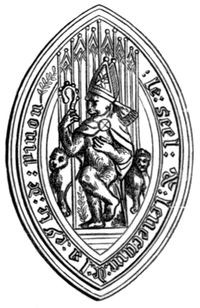
Bishop's Seal, A.D. 1300.
One of these seals is known to have been executed at the express order of an abbot. The other, a copy of which is given here, was found in the ruins of an ancient château of Picardy, and bears the inscription, "LE: SCEL: DE: LEUECQUE: DE: LA: CYTE: DE: PINON"—"The seal of the bishop of the city of Pinon." This interesting relic was at first thought to be the work of some scoffing Huguenot, but there can now be no doubt of its having been the merry conceit of the personage whose title it bears. The discovery of the record relating to the monkey seal of the abbot, showing it to have been ordered and paid for by the actual head of a great monastery, throws light upon all the grotesque ornamentation of those centuries. It suggests to us also the idea that the clergy joined in the general ridicule of their order as much from a sense of the ludicrous as from conviction of its justice. In the British Museum there is a religious manuscript of the thirteenth century, splendidly illuminated, one of the initial letters of which represents a young friar drawing wine from a cask in a cellar, that contains several humorous points. With his left hand he holds the great wine-jug, into which the liquid is running from the barrel; with his right he lifts to his lips a bowlful of the wine, and from the same hand dangle the large keys of the cellar. If this was intended as a hint to the younger brethren how they ought not to behave when sent to the cellar for wine, the artist evidently felt also the comic absurdity of the situation.
The vast cellars still to be seen under ancient monasteries and priories, as well as the kitchens, not less spacious, and supported by archways of the most massive masonry, tell a tale of the habits of the religious orders which is abundantly confirmed in the records and literature of the time. "Capuchins," says the old French doggerel, "drink poorly, Benedictines deeply, Dominicans pint after pint, but Franciscans drink the cellar dry." The great number of old taverns in Europe named the Mitre, the Church, the Chapel-bell, St. Dominic, and other ecclesiastical names, point to the conclusion that the class that professed to dispense good cheer for the soul was not averse to good cheer for the body.[9]
If the clergy led the merriment caused by their own excesses, we can not wonder they should have had many followers. In the popular tales of the time, which have been gathered and made accessible in recent years, we find the priest, the monk, the nun, the abbot, often figuring in absurd situations, rarely in creditable ones. The priest seems to have been regarded as the satirist's fair game, the common butt of the jester. In one of these stories a butcher, returning home from a fair, asks a night's lodging at the house of a priest, who churlishly refuses it. The butcher, returning, offers in recompense to kill one of his fine fat sheep for supper, and to leave behind him all the meat not eaten. On this condition he is received, and the family enjoy an excellent supper in his society. After supper he wins the favor first of the priest's concubine and afterward of the maid-servant by secretly promising to each of them the skin of the sheep. In the morning, after he has gone, a prodigious uproar arises, the priest and the two women each vehemently claiming the skin, in the midst of which it is discovered that the butcher had stolen the sheep from the priest's own flock.
From a merry tale of these ages a jest was taken which to-day forms one of the stock dialogues of our negro-minstrel bands. The story was apparently designed to show the sorry stuff of which priests were sometimes made. A farmer sends a lout of a son to college, intending to make a priest of him, and the lad was examined as to the extent of his knowledge. "Isaac had two sons, Esau and Jacob," said the examiner: "who was Jacob's father?" The candidate, being unable to answer this question, is sent home to his tutor with a letter relating his discomfiture. "Thou foole and ass-head!" exclaims the tutor. "Dost thou not know Tom Miller of Oseney?" "Yes," answered the hopeful scholar. "Then thou knowest he had two sons, Tom and Jacke: who is Jacke's father?" "Tom Miller." Back goes the youth to college with a letter to the examiner, who, for the tutor's sake, gives him another chance, and asks once more who was Jacob's father. "Marry!" cries the candidate, "I can tell you now: that was Tom Miller of Oseney."
We must be cautious in drawing inferences from the popular literature of a period, since there is in the unformed mind a propensity to circulate amusing scandal, and the satirist is apt to aim his shaft at characters and actions which are exceptional, not representative. In some of the less frequented nooks of Europe, where the tone of mind among the people has not materially changed since the fifteenth century, we still find priests the constant theme of scandal. The Tyrolese, for example, as some readers may have observed, are profuse in their votive offerings, and indefatigable in their pilgrimages, processions, and observances—the most superstitious people in Europe; but a recent writer tells us that they "have a large collection of anecdotes, humorous and scandalous, about their priests, and they take infinite delight in telling them." They are not pious, as the writer remarks, "but magpious." The Tyrolese may judge their priests correctly, but a person who believes in magpious humbug may be expected to lend greedy ears to comic scandal, and what the Tyrolese do to-day, their ancestors may have done when Luther was a school-boy.
But of late years the exact, methodical records of the past, the laws, law-books, and trials, which are now recognized to be among the most trustworthy guides to a correct interpretation of antiquity, have been diligently scrutinized, and we learn from them that it was among the commonest of criminal events for clergymen, in the time of Edward III. of England, to take part in acts of brigandage. A band of fifty men, for example, broke into the park and warren of a lady, the Countess of Lincoln, killed her game, cut down two thousand pounds' worth of timber, and carried it off. In the list of the accused are the names of two abbots and a prior. Several chaplains were in a band of knights and squires who entered an inclosure belonging to the Archbishop of Canterbury, drove off his cattle, cut down his trees, harvested his wheat, and marched away with their booty. In a band of seventy who committed a similar outrage at Carlton there were five parsons. Two parsons were accused of assisting to break into the Earl of Northampton's park and driving off his cattle. The prior of Bollington was charged with a robbery of horses, cattle, sheep, and pigs. Five clergymen were in the band that damaged the Bishop of Durham's park to the extent of a thousand pounds. These examples and others were drawn from a single roll of parchment of the year 1348; and that roll, itself one of three, is only one of many sources of information. The author of the "History of Crime" explains that the rolls of that year consist of more than one hundred and twenty skins of parchment, among which there are few that do not contain a reference to some lawless act committed by knights or priests, or by a band consisting of both.[10]
This is record, not gossip, not literature; and it may serve to indicate the basis of truth there was for the countless allusions to the dissoluteness of the clergy in the popular writings and pictures of the century that formed Luther and the Lutherans.
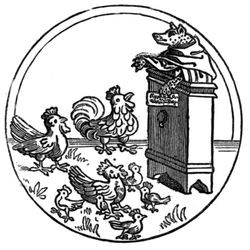
Pastor and Flock. (From the Window of a French Church, Sixteenth Century.)
It is scarcely possible in the compass of a chapter to convey an idea of the burst of laughter that broke the long spell of superstitious terror, and opened the minds of men to receive the better light. Such works as the "Decameron" of Boccaccio, which to modern readers is only interesting as showing what indecency could be read and uttered by fine ladies and gentlemen on a picnic in 1350, had one character that harmonized with the new influence. Their tone was utterly at variance with the voice of the priest. The clergy, self-indulgent, preached self-denial; practicing vice, they exaggerated human guilt. But the ladies and gentlemen of the "Decameron," while practicing virtue, made light of vice, and brought off the graceful profligate victorious. Later was circulated in every land and tongue the merry tale of "Reynard the Fox," which children still cherish among the choicest of their literary treasures. Reynard, who appears in the sculptures of so many convents and in the illuminations of so many pious manuscripts, whom monks loved better than their missal, exhibits the same moral: witty wickedness triumphant over brute strength. The fox cheats the wolf, deludes the bear, lies to King Lion, turns monk, gallops headlong up and down the commandments, only to be at last taken into the highest favor by the king and made Prime Minister. It is not necessary to discover allegory in this tale. What made it potent against the spell of priestly influence was the innocent and boisterous merriment which it excited, amidst which the gloom evoked by priestly arts began to break away. Innocent mirth, next to immortal truth, is the thing most hostile to whatever is mingled with religion which is hostile to the interests of human nature.
And "Reynard," we must remember, was only the best and gayest of a large class of similar fables that circulated during the childhood of Columbus and of Luther. In one of the Latin stories given by Mr. Wright in his "Selection," we have an account of the death and burial of the wolf, the hero of the tale, which makes a most profane use of sacred objects and rites, though it was written by a priest. The holy water was carried by the hare, hedgehogs bore the candles, goats rang the bell, moles dug the grave, foxes carried the bier, the bear celebrated mass, the ox read the gospel, and the ass the epistle. When the burial was complete, the animals sat down to a splendid banquet, and wished for another grand funeral. Mark the moral drawn by the priestly author: "So it frequently happens that when some rich man, an extortionist or a usurer, dies, the abbot or prior of a convent of beasts [i. e., of men living like beasts] causes them to assemble. For it commonly happens that in a great convent of black or white monks [Benedictines or Augustinians] there are none but beasts—lions by their pride, foxes by their craftiness, bears by their voracity, stinking goats by their incontinence, asses by their sluggishness, hedgehogs by their asperity, hares by their timidity (because they were cowardly when there was no fear), and oxen by their laborious cultivation of their land." Unquestionably this author belonged to another order than those named in his tirade.
A book with original life in it becomes usually the progenitor of a line of books. Brandt's "Ship of Fools," which was published when Luther was eleven years old, gave rise to a literature. As soon as it appeared it kindled the zeal of a noted preacher of Strasburg, Jacob Geiler by name, who turned Brandt's gentle satire into fierce invective, which he directed chiefly against the monks. The black friars, he said, were the devil, the white friars his dame, and the others were their chickens. The qualities of a good monk, he declared, were an almighty belly, an ass's back, and a raven's mouth. From the pulpit, on another occasion, he foretold a coming reformation in the Church, adding that he did not expect to live to see it, though some that heard him might. The monks taunted him with looking into the "Ship of Fools" for his texts instead of the Scripture; but the people heard him eagerly, and one of his pupils gave the public a series of his homely, biting sermons, illustrated by wood-cuts, which ran through edition after edition. Badius, a noted scholar of the time, was another who imitated the "Ship of Fools," in a series of satirical pieces entitled "The Boats of Foolish Women," in which the follies of the ladies of the period were ridiculed.
6: "Essai sur les Dances des Morts," vol. i., p. 151, par E. H. Langlois, Paris, 1852.
7: "History of Crime in England," vol. i., by Luke Owen Pike, London, 1873.
8: From "A Treatise on Wood-engraving," p. 268, by Jackson and Chatto, London, 1866.
9: "History of Sign-boards," p. 319, by Larwood and Hotten, London.
10: "History of Crime in England," p. 248, by L. O. Pike, London, 1873.
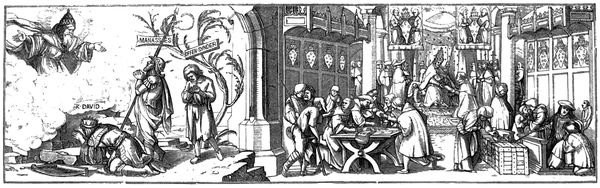
Confessing to God. (Holbein, 1520.) Sale of Indulgences.
Among the great number of works which the "Ship of Fools" suggested, there was one which directly and powerfully prepared the way for Luther. Erasmus, while residing in England, from 1497 to 1506, Luther being still a student, read Brandt's work, and was stirred by it to write his "Praise of Folly," which, under the most transparent disguise, is chiefly a satire upon the ecclesiastics of the day. We may at least say that it is only in the passages aimed at them that the author is at his best. Before Luther had begun to think of the abuses of the Church, Erasmus, in his little work, derided the credulous Christians who thought to escape mishaps all day by paying devotion to St. Christopher in the morning, and laughed at the soldiers who expected to come out of battle with a whole skin if they had but taken the precaution to "mumble over a set prayer before the picture of St. Barbara." He jested upon the English who had constructed a gigantic figure of their patron saint as large as the images of Hercules; only the saint was mounted upon a horse "very gloriously accoutred," which the people scarcely refrained from worshiping. But observe this passage in the very spirit of Luther, though written fifteen years before the reformer publicly denounced indulgences:
"What shall I say of such as cry up and maintain the cheat of pardons and indulgences? who by these compute the time of each soul's residence in purgatory, and assign them a longer or shorter continuance, according as they purchase more or fewer of these paltry pardons and salable exemptions?... By this easy way of purchasing pardon, any notorious highwayman, any plundering soldier, or any bribe-taking judge shall disburse some part of their unjust gains, and so think all their grossest impieties sufficiently atoned for.... And what can be more ridiculous than for some others to be confident of going to heaven by repeating daily those seven verses out of the Psalms?"
These "fooleries," which Erasmus calls most gross and absurd, he says are practiced not merely by the vulgar, but by "such proficients in religion as one might well expect should have more wit." He ridicules the notion of each country and place being under the special protection of a patron saint, as well as the kindred absurdity of calling upon one saint to cure a toothache, upon another to restore lost goods, upon another to protect seamen, and upon another to guard cows and sheep. Nor does he refrain from reflecting upon the homage paid to the Virgin Mary, "whose blind devotees think it manners now to place the mother before the Son." He utterly scouts and reviles the folly of hanging up offerings at the shrines of saints for their imaginary aid in getting the donors out of trouble or danger. The responsibility of all this folly and delusion he boldly assigns to the priests, who gain money by them. "They blacken the darkness and promote the delusion, wisely foreseeing that the people (like cows which never give down their milk so well as when they are gently stroked) would part with less if they knew more." If any serious and wise man, he adds, should tell the people that a pious life is the only way of securing a peaceful death, that repentance and amendment alone can procure pardon, and that the best devotion to a saint is to imitate his example, there would be a very different estimate put upon masses, fastings, and other austerities. Erasmus saw this prophecy fulfilled before many years had rolled over his head.
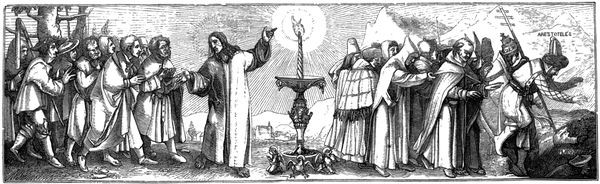
Christ, the True Light. (Holbein, about 1520.)
It is, however, in his chapters upon the amazingly ridiculous subtleties of the monastic theology of his time that Erasmus gives us his most exquisite fooling. Here he becomes, indeed, the merry Erasmus who was so welcome at English Cambridge, at Paris, at Rome, in Germany, in Holland, wherever there were good scholars and good fellows. He pretends to approach this part of his subject with fear; for divines, he says, are generally very hot and passionate, and when provoked they set upon a man in full cry, and hurl at him the thunders of excommunication, that being their spiritual weapon to wound such as lift up a hand against them. But he plucks up courage, and proceeds to discourse upon the puerilities which absorbed their minds. Among the theological questions which they delighted to discuss were such as these: the precise manner in which original sin was derived from our first parents; whether time was an element in the supernatural generation of our Lord; whether it would be a thing possible for the first person in the Trinity to hate the second; whether God, who took our nature upon him in the form of a man, could as well have become a woman, a beast, an herb, or a stone; and if he could, how could he have then preached the gospel, or been nailed to the cross? whether if St. Peter had celebrated the eucharist at the time when our Saviour was upon the cross, the consecrated bread would have been transubstantiated into the same body that remained on the tree; whether, in Christ's corporal presence in the sacramental wafer, his humanity was not abstracted from his Godhead; whether, after the resurrection, we shall carnally eat and drink as we do in this life; how it is possible, in the transubstantiation, for one body to be in several places at the same time; which is the greater sin, to kill a hundred men, or for a cobbler to set one stitch in a shoe on Sunday? Such subtleties as these alternated with curious and minute delineations of purgatory, heaven, and hell, their divisions, subdivisions, degrees, and qualities.
He heaps ridicule also upon the public preaching of those profound theologians. It was mere stage-playing; and their delivery was the very acme of the droll and the absurd. "Good Lord! how mimical are their gestures! What heights and falls in their voice! What toning, what bawling, what singing, what squeaking, what grimaces, what making of mouths, what apes' faces and distorting of their countenances!" And their matter was even more ridiculous than their manner. One of these absurd divines, discoursing upon the name of Jesus, subtly pretended to discover a revelation of the Trinity in the very letters of which the name was composed. It was declined only in three cases. That was one mysterious coincidence. Then the nominative ended in S, the accusative in M, and the ablative in U, which obviously indicated Summus, the beginning; Medius, the middle; and Ultimus, the end of all things. Other examples he gives of the same profound nature. Nor did the different orders of monks escape his lash. He dwelt upon the preposterous importance they attached to trifling details of dress and ceremonial. "They must be very critical in the precise number of their knots, in the tying-on of their sandals, of what precise colors their respective habits should be made, and of what stuff; how broad and long their girdles, how big and in what fashion their hoods, whether their bald crowns be of the right cut to a hair's-breadth, how many hours they must sleep, and at what minute rise to prayers."
In this manner he proceeds for many a sprightly page, rising from monks to bishops and cardinals, and from them to popes, "who pretend themselves Christ's vicars," while resembling the Lord in nothing. Luther never went farther, never was bolder or more biting, than Erasmus in this essay. But all went for nothing with the great leader of reform, because Erasmus refused to abandon the Church, and cast in his lot openly with the reformers. Luther calls him "a mere Momus," who laughed at Catholic and Protestant alike, and looked upon the Christian religion itself very much as Lucian did upon the Greek. "Whenever I pray," said Luther once, "I pray for a curse upon Erasmus." It was certainly a significant fact that in the heat of that contest Erasmus should have given the world a translation of Lucian. But he was a great, wise, genial soul, whose fame will brighten as that age becomes more justly and familiarly known to us.
The first place in the annals of such a warfare belongs of right to the soldiers who took their lives in their hands and went forth to meet the foe in the open field, braving torture, infamy, and death for the cause. Such were Luther and his followers. But there is a place in human memory for the philosopher and the humorist who first made the contest possible, and then rendered it shorter and easier.
CHAPTER VIII.
COMIC ART AND THE REFORMATION.
When Luther began the immortal part of his public career in 1517 by nailing to the church door his ninety-five theses against the sale of indulgences, wood-engraving was an art which had been practiced nearly a century. He found also, as we have seen, a public accustomed to satirical writings illustrated by wood-cuts. The great Holbein illustrated Erasmus's "Praise of Folly." Brandt's "Ship of Fools," as well as the litter of works which it called forth, was even profusely illustrated. Caricatures as distinct works, though usually accompanied with abundant verbal commentary, were familiar objects. Among the curiosities which Luther himself brought from Rome in 1510, some years before he began his special work, was a caricature suggested by the "Ship of Fools," showing how the Pope had "fooled the whole world with his superstitions and idolatries." He showed it to the Prince Elector of Saxony at the time. The picture exhibited a little ship filled with monks, friars, and priests casting lines to people swimming in the sea, while in the stern sat comfortably the Pope with his cardinals and bishops, overshadowed and covered by the Holy Ghost, who was looking up to heaven, and through whose help alone the drowning wretches were saved.
In talking about the picture many years after, Luther said, "These and the like fooleries we then believed as articles of faith." He had not reached the point when he could talk at his own table of the cardinals as "peevish milksops, effeminate, unlearned blockheads, whom the Pope places in all kingdoms, where they lie lolling in kings' courts among the ladies and women."
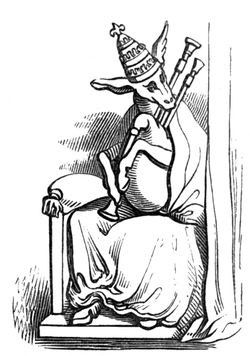
Papa, Doctor Theologiæ et Magister Fidei.
"A long-eared ass can with the Bagpipes cope
As well as with Theology the Pope."—Germany, 1545.
Finding this weapon of caricature ready-made to his hands, he used it freely, as did also his friends and his foes. He was himself a caricaturist. When Pope Clement VII. seemed disposed to meet the reformers half-way, and proposed a council to that end, Luther wrote a pamphlet ridiculing the scheme, and, to give more force to his satire, he "caused a picture to be drawn" and placed in the title-page. It was not a work describable to the fastidious ears of our century, unless we leave part of the description in Latin. The Pope was seated on a lofty throne surrounded by cardinals having foxes' tails, and seeming "sursum et deorsum repurgare." In the "Table-talk" we read also of a picture being brought to Luther in which the Pope and Judas were represented hanging to the purse and keys. "'Twill vex the Pope horribly," said Luther, "that he whom emperors and kings have worshiped should now be figured hanging upon his own picklocks." The picture annexed, in which the Pope is exhibited with an ass's head performing on the bagpipes, was entirely in the taste of Luther. "The Pope's decretals," he once said, "are naught; he that drew them up was an ass." No word was too contemptuous for the papacy. "Pope, cardinals, and bishops," said he, "are a pack of guzzling, stuffing wretches; rich, wallowing in wealth and laziness, resting secure in their power, and never thinking of accomplishing God's will."
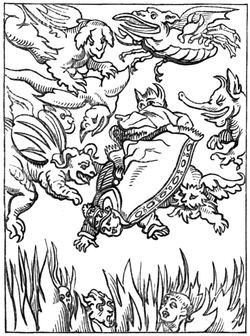
The Pope cast into Hell. (Lucas Cranach, 1521.)
The famous pamphlet of caricatures published in 1521 by Luther's friend and follower, Lucas Cranach, contains pictures that we could easily believe Luther himself suggested. The object was to exhibit to the eyes of the people of Germany the contrast between the religion inculcated by the lowly Jesus and the pompous worldliness of the papacy. There was a picture on each page which nearly filled it, and at the bottom there were a few lines in German of explanation; the engraving on the page to the left representing an incident in the life of Christ, and the page to the right a feature of the papal system at variance with it. Thus, on the first page was shown Jesus, in humble attitude and simple raiment, refusing honors and dignities, and on the page opposite the Pope, cardinals, and bishops, with warriors, cannon, and forts, assuming lordship over kings. On another page Christ was seen crowned with thorns by the scoffing soldiers, and on the opposite page the Pope wearing his triple crown, and seated on his throne, an object of adoration to his court. On another was shown Christ washing the feet of his disciples, in contrast to the Pope presenting his toe to an emperor to be kissed. At length we have Christ ascending to heaven with a glorious escort of angels, and on the other page the Pope hurled headlong to hell, accompanied by devils, with some of his own monks already in the flames waiting to receive him. This concluding picture may serve as a specimen of a series that must have told powerfully on the side of reform.[11]
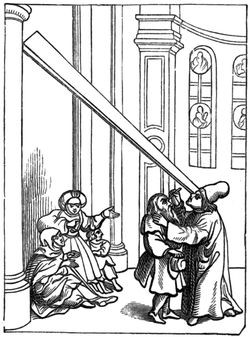
"The Beam that is in thine own Eye," A.D. 1540.
These pictorial pamphlets were an important part of the stock in trade of the colporteurs who pervaded the villages and by-ways of Germany during Luther's life-time, selling the sermons of the reformers, homely satiric verses, and broadside caricatures. The simplicity and directness of the caricatures of that age reflected perfectly both the character and the methods of Luther. One picture of Hans Sachs's has been preserved, which was designed as an illustration of the words of Christ: "I am the door. He that entereth not by the door into the sheepfold, but climbeth up some other way, the same is a thief and a robber." The honest Sachs shows us a lofty, well-built barn, with a very steep roof, on the very top of which sits the Pope crowned with his tiara. To him cardinals and bishops are directing people, and urging them to climb up the steep and slippery height. Two monks have done so, and are getting in at a high window. At the open door of the edifice stands the Lord, with a halo round his head, inviting a humble inquirer to enter freely. Nothing was farther from the popular caricaturists of that age than to allegorize a doctrine or a moral lesson; on the contrary, it was their habit to interpret allegory in the most absurdly literal manner. Observe, for example, the treatment of the subject contained in the words, "How wilt thou say to thy brother, Let me pull out the mote out of thine eye, and, behold, a beam is in thine own eye?"
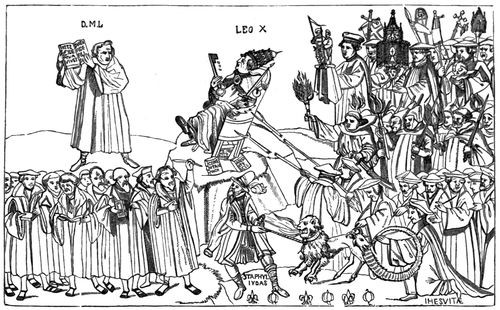
Luther Triumphant. (Paris, 1535.)
The marriage of Luther in 1525 was followed by a burst of caricature. The idea of a priest marrying excited then, as it does now in a Catholic mind, a sense of ludicrous incongruity. It is as though the words "married priest" were a contradiction in terms, and the relation implied by them was a sort of manifest incompatibility, half comic, half disgusting. The spectacle occasionally presented in a Protestant church of a clergyman ordained and married in the same hour is so opposed to the Catholic conception of the priesthood that some Catholics can only express their sense of it by laughter. Equally amazing and equally ludicrous to them is the more frequent case of missionaries coming home to be married, or young missionaries married in the evening and setting out for their station the next morning. We observe that some of Luther's nearest friends—nay, Luther himself—saw something both ridiculous and contemptible in his marriage, particularly in the haste with which it was concluded, and the disparity in the ages of the pair, Luther being forty-two and his wife twenty-six. "My marriage," wrote Luther, "has made me so despicable that I hope my humiliation will rejoice the angels and vex the devils." And Melanchthon, while doing his best to restore his leader's self-respect, expressed the hope that the "accident" might be of use in humbling Luther a little in the midst of a success perilous to his good sense. Luther was not long abased. We find him soon justifying the act, which was among the boldest and wisest of his life, as a tribute of obedience to his aged father, who "required it in hopes of issue," and as a practical confirmation of what he had himself taught. He speaks gayly of "my rib, Kate," and declared once that he would not exchange his wife for the kingdom of France or the wealth of Venice.
But the caricaturists were not soon weary of the theme. Readers at all familiar with the manners of that age do not need to be told that few of the efforts of their free pencils will bear reproduction now. Besides exhibiting the pair carousing, dancing, romping, caressing, and in various situations supposed to be ridiculous, the satirists harped a good deal upon the old prophecy that Antichrist would be the offspring of a monk and a nun. "If that is the case," said Erasmus, "how many thousands of Antichrists there are in the world already!" Luther was evidently of the same opinion, for he gave full credit to the story of six thousand infants' skulls having been found at the bottom of a pond near a convent, as well as to that of "twelve great pots, in each of which was the carcass of an infant," discovered under the cellars of another convent. But, then, Luther was among the most credulous of men.
The marriage of the monk and the nun gave only a brief advantage to the enemies of reform. The great German artists of that generation were friends of Luther. No name is more distinguished in the early annals of German art than Albert Dürer, painter, engraver, sculptor, and author. He did not employ his pencil in furtherance of Luther's cause, nor did he forsake the communion of the ancient Church, but he expressed the warmest sympathy with the objects of the reformer. A report of Luther's death in 1521 struck horror to his soul. "Whether Luther be yet living," he wrote, "or whether his enemies have put him to death, I know not; yet certainly what he has suffered has been for the sake of truth, and because he has reprehended the abuses of unchristian papacy, which strives to fetter Christian liberty with the incumbrance of human ordinances, that we may be robbed of the price of our blood and sweat, and shamefully plundered by idlers, while the sick and needy perish through hunger." These words go to the heart of the controversy.
Holbein, nearly thirty years younger than Dürer, only just coming of age when Luther nailed his theses to the castle church, did more, as the reader has already seen, than express in words his sympathy with reform. The fineness and graphic force of the two specimens of his youthful talent given on pages 72, 73,[12] every reader must have remarked. Only three copies of these pictures are known to exist. They appeared at the time when Luther had kindled a general opposition to the sale of indulgences, as well as some ill feeling toward the classic authors so highly esteemed by Erasmus. They are in a peculiar sense Lutheran pictures, and they give expression to the reformer's prejudices and convictions. A third wood-cut of Holbein's is mentioned by Woltmann, dated 1524, in which the Pope is shown riding in a litter surrounded by an armed escort, and on the other side Christ is seen on an ass, accompanied by his disciples. These three works were Holbein's contribution to the earlier stage of the movement.
This artist was soon drawn away to the splendid court of Henry VIII. of England, where, among other works, he executed his renowned paintings, "The Triumph of Riches" and "The Triumph of Poverty," in both of which there is satire enough to bring them within our subject. Of these stupendous works, each containing seventeen or more life-size figures, every trace has perished except the artist's original sketch of "The Triumph of Riches." But they made a vivid impression upon the two generations which saw them, and we have so many engravings, copies, and descriptions of them that it is almost as if we still possessed the originals. Holbein's sketch is now in the Louvre at Paris. It will convey to the reader some idea of the harmonious grandeur of the painting, and some notion of the ingenious and friendly nature of its satire upon human life.

The Triumph of Riches. (Holbein, about 1533.)
In accordance with the custom of the age, the painting bore an explanatory motto in Latin: "Gold is the father of lust and the son of sorrow. He who lacks it laments; he who has it fears." Plutus, the god of wealth, is an old, old man, long past enjoyment; but his foot rests upon sacks of superfluous coin, and an open vessel before him, heaped with money, affords the only pleasures left to him—the sight and conscious possession of the wealth he can never use. Below him Fortuna, a young and lovely woman, scatters money among the people who throng about her, among whom are the portly Sichæus, Dido's husband, the richest of his people; Themistocles, who stooped to accept wealth from the Persian king; and many others noted in classic story for the part gold played in their lives. Crœsus, Midas, and Tantalus follow on horseback, and, last of all, the unveiled Cleopatra. The careful driver of Plutus's chariot is Ratio—reason. "Faster!" cries one of the crowd, but the charioteer still holds a tight rein. The unruly horses next the chariot, named Interest and Contract, are led by the noble maidens Equity and Justice; and the wild pair in front, Avarice and Deceit, are held in by Generosity and Good Faith. In the rear, hovering over the triumphal band, Nemesis threatens.
The companion picture, "The Triumph of Poverty," had also a Latin motto, to the effect that, while the rich man is ever anxious, "the poor man fears nothing, joyous hope is his portion, and he learns to serve God by the practice of virtue." In the picture a lean and hungry-looking old woman, Poverty, was seen riding in the lowliest of vehicles, a cart, drawn by two donkeys, Stupidity and Clumsiness, and by two oxen, Negligence and Indolence. Beside her in the cart sits Misfortune. A meagre and forlorn crowd surround and follow them. But the slow-moving team is guided by the four blooming girls, Moderation, Diligence, Alertness, and Toil, of whom the last is the one most abounding in vigor and health. The reins are held by Hope, her eyes toward heaven. Industry, Memory, and Experience sit behind, giving out to the hungry crowd the means of honorable plenty in the form of flails, axes, squares, and hammers.
These human and cheerful works stand in the waste of that age of wrathful controversy and irrational devotion like green islands in the desert, a rest to the eye and a solace to the mind.
When Luther was face to face with the hierarchy at the Diet of Worms, Calvin, a French boy of twelve, was already a sharer in the worldly advantage which the hierarchy could bestow upon its favorites. He held a benefice in the Cathedral of Noyon, his native town, and at seventeen he drew additional revenue from a curacy in a neighboring parish. The tonsured boy owed this ridiculous preferment to the circumstance that his father, being secretary to the bishop of the diocese, was sure to be at hand when the bishop happened to have a good thing to give away. In all probability Jean Calvin would have died an archbishop or a cardinal if he had remained in the Church of his ancestors, for he possessed the two requisites for advancement—fervent zeal for the Church and access to the bestowers of its prizes. At Paris, however, whither he was sent by his father to pursue his studies, a shy, intense, devout lad, already thin and sallow with fasting and study, the light of the Reformation broke upon him. Like Luther, he long resisted it, and still longer hoped to see a reformation in the Church, not outside of its pale. The Church never had a more devoted son. Not Luther himself loved it more. "I was so obstinately given to the superstitions of popery," he said, long after, "that it seemed impossible I should ever be pulled out of the deep mire."
He struggled out at length. Observe one of the results of his conversion in this picture, in which a slander of the day is preserved for our inspection.[13]
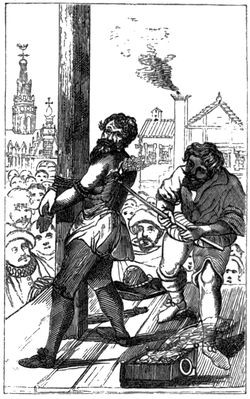
Calvin branded. (Paris.)
Gross and filthy calumny was one of the familiar weapons in the theological contests of that century. Both sides employed it—Luther and Calvin not less than others—for it belonged to that age to hate, and hence to misinterpret, opponents. "Search the records of the city of Noyon, in Picardie," wrote Stapleton, an eminent controversialist on the Catholic side, and professor in a Catholic college of Calvin's own day, "and read again that Jean Calvin, convicted of a crime" (infamous and unmentionable), "by the very clement sentence of the bishop and magistrate was branded with an iron lily on the shoulders." The records have been searched; nothing of the kind is to be found in them; but the picture was drawn and scattered over France. Precisely the same charge was made against Luther. That both the reformers died of infamous diseases was another of the scandals of the time. In reading these controversies, it is convenient to keep in mind the remark of the collector of the Calvin pictures: "When two theologians accuse one another, both of them lie." One of these calumnies drew from Calvin a celebrated retort. "They accuse me," said he, "of having no children. In every land there are Christians who are my children."
Another caricature, shown on the following page, representing Calvin at the burning of Servetus, had only too much foundation in truth.
The reformer was not indeed present at the burning, but he caused the arrest of the victim, drew up the charges, furnished part of the testimony that convicted him, consented to and approved his execution. Servetus was a Spanish physician, of blameless life and warm convictions, who rejected the doctrine of the Trinity. Catholic and Protestant equally abhorred him, and Protestant Geneva seized the opportunity to show the world its attachment to the true faith by burning a man whom Rome was also longing to burn. It was a hideous scene—a virtuous and devoted Unitarian expiring in the flames after enduring the extremest anguish for thirty minutes, and crying, from the depths of his torment, "Jesus, thou Son of the eternal God, have mercy on me!" But it was not Calvin who burned him. It was the century. It was imperfectly developed human nature. Man had not reached the civilization which admits, allows, welcomes, and honors disinterested conviction. It were as unjust to blame Calvin for burning Servetus as it is to hold the Roman Catholic Church of the present day responsible for the Inquisition of three centuries ago. It was Man that was guilty of all those stupid and abominable cruelties. Luther, the man of his period, honestly declared that if he were the Lord God, and saw kings, princes, bishops, and judges so little mindful of his Son, he would "knock the world to pieces." If Calvin had not burned Servetus, Servetus might have burned Calvin, and the Pope would have been happy to burn both.
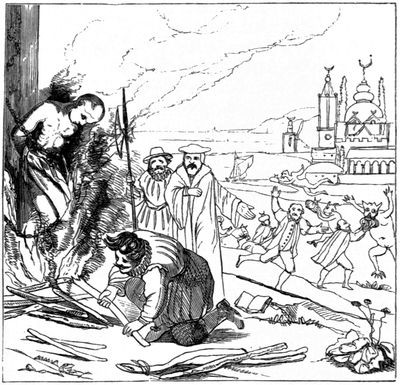
Calvin at the Burning of Servetus.
One of the best caricatures—perhaps the very best—which the Reformation called forth was suggested by the dissensions that arose between the followers of Luther and Calvin when both of them were in the grave. It might have amused the very persons caricatured. We can fancy Lutherans, Calvinists, and Catholics all laughing together at the spectacle of the two reformers holding the Pope by the ear, and with their other hands fighting one another, Luther clawing at Calvin's beard, and Calvin hurling a Bible at Luther's head.
On the same sheet in the original drawing a second picture was given, in which a shepherd was seen on his knees, surrounded by his flock, addressing the Lord, who is visible in the sky. Underneath is written, "The Lord is my Shepherd; he will never forsake me." The work has an additional interest as showing how early the French began to excel in caricature. In the German and English caricatures of that period there are no existing specimens which equal this one in effective simplicity.
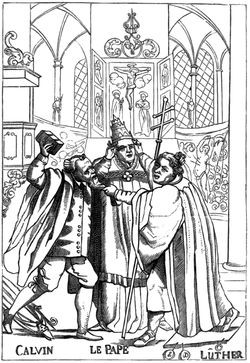
Calvin, the Pope, and Luther. (Paris, 1600.)
Perhaps the all-pervading influence of Rabelais in that age may have made French satire more good-humored. After all efforts to discover in the works of Rabelais hidden allusions to the great personages and events of his time, we must remain of the opinion that he was a fun-maker pure and simple, a court-fool to his century. The anecdote related of his convent life seems to give us the key both to his character and his writings. The incident has often been used in comedy since Rabelais employed it. On the festival of St. Francis, to whom his convent was dedicated, when the country people came in, laden with votive offerings, to pray before the image of the saint, young Rabelais removed the image from its dimly lighted recess and mounted himself upon the pedestal, attired in suitable costume. Group after group of awkward rustics approached and paid their homage. Rabelais at length, overcome by the ridiculous demeanor of the worshipers, was obliged to laugh, whereupon the gaping throng cried out, "A miracle! a miracle! Our good lord St. Francis moves!" But a cunning old friar, who knew when miracles might and might not be rationally expected in that convent, ran into the chapel and drew out the merry saint, and the brothers laid their knotted cords so vigorously across his naked shoulders that he had a lively sense of not being made of wood. That was Rabelais! He was a natural laugh-compeller. He laughed at every thing, and set his countrymen laughing at every thing. But there were no men who oftener provoked his derision than the monks. "How is it?" asks one of his merry men, "that people exclude monks from all good companies, calling them feast-troublers, marrers of mirth, and disturbers of all civil conversation, as bees drive away the drones from their hives?" The hero answers this question in three pages of most Rabelaisan abuse, of which only a very few lines are quotable. "Your monk," he says, "is like a monkey in a house. He does not watch like a dog, nor plow like the ox, nor give wool like the sheep, nor carry like the horse; he only spoils and defiles all things. Monks disquiet all their neighborhood with a tingle-tangle jangling of bells, and mumble out great store of psalms, legends, and paternosters without thinking upon or apprehending the meaning of what they say, which truly is a mocking of God." There is no single theme to which Rabelais, the favorite of bishops, oftener returns than this, and his boisterous satire had its effect upon the course of events in Europe, as well as upon French art and literature.
The English caricatures that have come down to us from the era of the Reformation betray far more earnestness than humor or ingenuity. There is one in the British Museum which figures in so many books, and continued to do duty for so many years, that the inroads of the worms in the wood-cut can be traced in the prints of different dates. It represents King Henry VIII. receiving a Bible from Archbishop Cranmer and Lord Cromwell. The burly monarch, seated upon his throne, takes the book from their hands, while he tramples upon Pope Clement, lying prostrate at his feet, the tiara broken and fallen off, the triple cross lying on the ground. Cardinal Pole, with the aid of another dignitary, is trying to get the Pope on his feet again. A monk is holding the Pope's horse, and other monks stand dismayed at the spectacle. This picture was executed in 1537, but, as we learn from the catalogue, the deterioration of the block and "the working of worms in the wood" prove that the impression in the Museum was taken in 1631.[14]
The martyrdom of the reformers in 1555, under Queen Mary of bloody memory, furnished subjects for the satiric pen and pencil as soon as the accession of Elizabeth made it safe to treat them. But there is no spirit of fun in the pictures. They are as serious and grim as the events that suggested them. In one we see a lamb suspended before an altar, which the Bishop of Winchester (Gardiner), with his wolf's head, is beginning to devour; and on the ground lie six slain lambs, named Houperus, Cranmerus, Bradfordus, Rydlerus, Rogerus, and Latimerus. Three reformers put a rope round Gardiner's neck, saying, "We will not this feloue to raigne over us;" and on the other side of him two bishops with wolves' heads mitred, and having sheepskins on their shoulders, are drinking from chalices. Behind Gardiner are several men attached by rings through their noses to a rope round his waist. The devil appears above, holding a scroll, on which is written, "Youe are my verye chyldren in that youe have slayne the prophetes. For even I from the begynning was a murtherer." On the altar lie two books, one open and the other shut. On the open book we read, "Christ alone is not sufficient without our sacrifice." The only window in the edifice, a small round one, is closed and barred. Many of the figures in this elaborate piece utter severe animadversion upon opponents; but none of them is scurrilous and indecent, except the mitred wolf, who is so remarkably plain-spoken that the compiler of the catalogue was obliged to suppress several of his words.
The English caricaturists of that age seem to have felt it their duty to exhibit the entire case between Catholic and Protestant in each broadside, with all the litigants on both sides, terrestrial and celestial, all the points in both arguments, and sometimes the whole history of the controversy from the beginning. The great expanse of the picture was obscured with the number of remarks streaming from the mouths of the persons depicted, and there was often at the bottom of the engraving prose and verse enough to fill two or three of these pages. Such extensive works call to mind the sermons of the following century, when preachers endeavored on each occasion to declare, as they said, "the whole counsel of God;" so that if one individual present had never heard the Gospel before, and should never hear it again, he would hear enough for salvation in that one discourse.
Another of these martyrdom prints may claim brief notice. Two companies of martyrs are seen, one composed of the bishops, and the other of less distinguished persons, between whom there is a heap of burning fagots. Nearly all the figures say something, and the space under the picture is filled with verses. Cranmer, with the Bible in his left hand, holds his right in the fire, exclaiming, "Burne, unworthie right hand!" Latimer cries, "Lord, Lord, receive my spirit!" Philpot, pointing to a book which he holds, says, "I will pay my vowes in thee, O Smithfield!" The other characters utter their dying words. The verses are rough, but full of the resolute enthusiasm of the age:
"First, Christian Cranmer, who (at first tho foild),
And so subscribing to a recantation,
God's grace recouering him, hee, quick recoil'd,
And made his hand ith flames make expiation.
Saing, burne faint-hand, burne first, 'tis thy due merit.
And dying, cryde, Lord Jesus take my spirit.
"Next, lovely Latimer, godly and grave,
Himselfe, Christs old tride souldier, plaine displaid,
Who stoutly at the stake did him behave,
And to blest Ridley (gone before) hee saide,
Goe on blest brother, for I followe, neere,
This day wee'le light a light, shall aye burne cleare.
"Whom when religious, reverend Ridley spide,
Deere heart (sayes hee) bee cheerful in yr Lord;
Who never (yet) his helpe to his denye'd,
& hee will us support & strength afford,
Or suage ye flame, thus, to the stake fast tide,
They, constantly Christs blessed Martyres dyde.
"Blest Bradford also comming to the stake,
Cheerfully tooke a faggott in his hand:
Kist it, &, thus, unto a young-man spake,
Wch with him, chained, to ye stake did stand,
Take courage (brother) wee shal haue this night,
A blessed supper wth the Lord of Light.
"Admir'd was Doctor Tailers faith & grace,
Who under-went greate hardship spight and spleene;
One, basely, threw a Faggot in his face,
Wch made ye blood ore all his face bee seene;
Another, barberously beate out his braines,
Whilst, at ye stake his corps was bound wth chaines."
In many of the English pictures of that period, the intention of the draughtsman is only made apparent by the explanatory words at the bottom. In one of these a friar is seen holding a chalice to a man who stretches out his hands to receive it. From the chalice a winged cockatrice is rising. There is also a man who stabs another while embracing him. The quaint words below explain the device: "The man which standeth lyke a Prophet signifieth godliness; the Fryer, treason; the cup with the Serpent, Poyson; the other which striketh with the sworde, Murder; and he that is wounded is Peace." In another of these pictures we see an ass dressed in a judge's robes seated on the bench. Before him is the prisoner, led away by a priest and another man. At one side a friar is seen in conversation with a layman. No one could make any thing of this if the artist had not obligingly appended these words: "The Asse signifieth Wrathfull Justice; the man that is drawn away, Truth; those that draweth Truth by the armes, Flatterers; the Frier, Lies; and the associate with the Frier, Perjury." In another drawing the artist shows us the Pope seated in a chair, with his foot on the face of a prostrate man, and in his hand a drawn sword, directing an executioner who is in the act of beheading a prisoner. In the distance are three men kneeling in prayer. The explanation is this: "The Pope is Oppression; the man which killeth is Crueltie; those which are a-killing, Constant Religion; the three kneeling, Love, Furtherance, and Truth to the Gospel." In one of these crude productions a parson is exhibited preaching in a pulpit, from which two ecclesiastics are dragging him by the beard to the stake outside. Explanation in this instance is not so necessary, but we have it, nevertheless: "He which preacheth in the pulpit signifieth godly zeale and a furtherer of the gospel; and the two which are plucking him out of his place are the enemies of God's Word, threatening by fire to consume the professors of the same; and that company which (sit) still are Nullifidians, such as are of no religion, not regarding any doctrine, so they may bee quiet to live after their owne willes and mindes." Another picture shows us a figure seated on a rainbow, the world at his feet, up the sides of which a pope and a cardinal are climbing. In the middle is the devil tumbling off headlong. The world is upheld by Death, who sits by the mouth of hell. This is the explanation: "He which sitteth on the raynebowe signifieth Christ, and the sworde in his hand signifieth his wrath against the wycked; the round compasse, the worlde; and those two climing, the one a pope, the other a cardinall, striving who shall be highest; and the Divell which falleth headlong downe is Lucifer, whiche through pride fel; he whiche holdeth the world is Death, standing in the entrance of hell to receyve all superbious livers."
In another print is represented a Roman soldier riding on a boar, and bearing a banner, on which is painted the Pope with his insignia. A man stabs himself and tears his hair, and behind him is a raving woman. This picture has a blunt signification: "The bore signifieth Wrath, and the man on his back Mischief; the Pope in the flag Destruction, and the flag Uncertaine Religion, turning and chaunging with every blaste of winde; the man killing himselfe, Desperation; the woman, Madness."
There are fourteen specimens in this quaint manner in the collection of the British Museum, all executed and published in the early part of the reign of Elizabeth. As art, they are naught. As part of the record of a great age, they have their value.

Titian's Caricature of the Laocoön.
Germany, England, and France fought the battle of the Reformation—two victors and one vanquished. From Italy in that age we have one specimen of caricature, but it was executed by Titian. He drew a burlesque of the Laocoön to ridicule a school of artists in Rome, who, as he thought, extolled too highly the ancient sculptures, and, because they could not succeed in coloring, insisted that correctness of form was the chief thing in art. Since Titian's day, parodies of the Laocoön have been among the stock devices of the caricaturists of all nations.
CHAPTER IX.
IN THE PURITAN PERIOD.
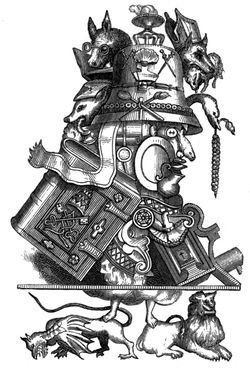
The Papal Gorgon. (Reign of Elizabeth, 1581.)
The annexed picture,[15] a favorite with the Protestants of England, Holland, and Germany for more than a century, is composed of twenty-two articles and objects, most of which are employed in the Roman Catholic worship. A church-bell forms the hat, which is decorated by crossed daggers and holy-water brushes. A herring serves for a nose. The mouth is an open wine-flagon. The eye is a chalice covered by the holy wafer, and the cheek is a paten, or plate used in the communion service. The great volume that forms the shoulders is the mass-book. The front of the bell-tiara is adorned by a mitred wolf devouring a lamb, and by a goose holding a rosary in its bill; the back, by a spectacled ass reading a book, and by a boar wearing a scholar's cap. At the bottom of the engraving the pierced feet of Christ are seen resting upon two creatures called by the artist "the Queen's badges." The whole figure of Christ is supposed to be behind this mass of human inventions; for in the original these explanatory words are given, "Christ Covered."
It was by this device that Master Batman, at the beginning of the Puritan period, sought to present to the eye a summary of what the Reformation had accomplished, and what it had still to fear. Half a century before, Henry VIII. being still the Defender of the Faith, the various articles used in Master Batman's satirical picture were objects of religious veneration throughout Great Britain. They had now become the despised but dreaded rattle-traps of a suppressed idolatry. From the field of strife one of the victors gathered the scattered arms and implements, the gorgeous ensigns and trappings of the defeated, and piled them upon the plain, a trophy and a warning.
There is no revolution that does not sweep away much that is good. The reformation in religion, chiefly wrought by Wycliffe, Huss, Luther, and Calvin, was a movement of absolute necessity to the further progress of our race. The intelligence of Christendom had reached a development which was incompatible with respect for the assumptions of the papacy, and with a belief in the fictions which the papacy had invented or adopted. The vase must have broken, or the oak planted in it must have ceased to grow. Nevertheless, those fictions had their beauty and their use. There was a good and pleasing side to that system of fables and ceremonies, which amused, absorbed, and satisfied the people of Europe for a thousand years. If we could concede that the mass of men must remain forever ignorant and very poor, we could also admit that nothing was ever invented by man better calculated to make them thoughtlessly contented with a dismal lot than the Roman Catholic Church as it existed in the fifteenth century, before the faith of the people had been shaken in its pretensions. There was something in it for every faculty of human nature except the intellect. It gave play to every propensity except the propensity of one mind in a thousand to ask radical questions. It relieved every kind of distress except that which came of using the reason. All human interests were provided for in it except the supreme interest of human advancement.
One must have been in a Catholic community, or else lived close to an important Catholic church, in order to form an idea of the great part the Church once played in the lives and thoughts of its members—the endless provision it made for the entertainment of unformed minds in the way of festivals, fasts, processions, curious observances, changes of costume, and special rites. There was always something going on or coming off. There was not a day in the year nor an hour in the day which had not its ecclesiastical name and character. In our flowery observance of Easter and in our joyous celebration of Christmas we have a faint traditional residue of festivals that once made all Christendom gay and jocund. And it was all so adapted to the limited abilities of our race! In an average thousand men, there is not more than one man capable of filling creditably the post of a Protestant minister, but there are a hundred who can be drilled into competent priests.
Consider, for example, a procession, which was formerly the great event of many of the Church festivals, gratifying equally those who witnessed and those who took part in it. In other words, it gratified keenly the whole community. And yet how entirely it was within the resources of human nature! Not a child so young, not a woman so weak, not a man so old, but could assist or enjoy it. The sick could view it from their windows, the robust could carry its burdens, the skillful could contrive its devices, and all had the feeling that they were engaged in enhancing at once the glory of God, the fame of their saint, the credit of their town, and the good of their souls. It was pleasure; it was duty; it was masquerade; it was devotion. Some readers may remember the exaltation of soul with which Albert Dürer, the first of German artists in Luther's age, describes the great procession at Antwerp, in 1520, in honor of what was styled the "Assumption" of the Virgin Mary. One of the pleasing fictions adopted by the old Church was that on the 15th of August, A.D. 45, the Virgin Mary, aged seventy-five years, made a miraculous ascent into heaven. Hence the annual festival, which was celebrated throughout Europe with pomp and splendor. The passage in the diary of Dürer has a particular value, because it affords us a vivid view of the bright side of the ancient Church just before the reformers changed its gorgeous robes into the Puritan's plain black gown, and substituted the long prayer and interminable sermon for the magnificent ceremonial and the splendid procession.
Albert Dürer was in sympathy with Luther, but his heart swelled within him as he beheld, on that Sunday morning in Antwerp, the glorious pageantry that filed past for two hours in honor of the "Mother of God's" translation. All the people of the city assembled about the Church of "Our Lady," each dressed in gayest attire, but each wearing the costume of his rank, and exhibiting the badge of his guild or vocation. Silver trumpets of the old Frankish fashion, German drums and fifes, were playing in every quarter. The trades and guilds of the city—goldsmiths, painters, masons, embroiderers, statuaries, cabinet-makers, carpenters, sailors, fishermen, butchers, curriers, weavers, bakers, tailors, shoe-makers, and laborers—all marched by in order, at some distance apart, each preceded by its own magnificent cross. These were followed by the merchants, shop-keepers, and their clerks. The "shooters" came next, armed with bows, cross-bows, and firelocks, some on horseback and some on foot. The city guard followed. Then came the magistrates, nobles, and knights, all dressed in their official costume, and escorted, as our artist records, "by a gallant troop, arrayed in a noble and splendid manner." There were a number of women in the procession, belonging to a religious order, who gained their subsistence by labor. These, all clad in white from head to foot, agreeably relieved the splendors of the occasion. After them marched "a number of gallant persons and the canons of Our Lady's Church, with all the clergy and scholars, followed by a grand display of characters." Here the enthusiasm of the artist kindles, as he recalls the glories of the day:
"Twenty men carried the Virgin and Christ, most richly adorned, to the honor of God. In this part of the procession were a number of delightful things represented in a splendid manner. There were several wagons, in which were representations of ships and fortifications. Then came a troop of characters from the Prophets, in regular order, followed by others from the New Testament, such as the Annunciation, the Wise Men of the East riding great camels and other wonderful animals, and the Flight into Egypt, all very skillfully appointed. Then came a great dragon, and St. Margaret with the image of the Virgin at her girdle, exceedingly beautiful; and last, St. George and his squire. In this troop rode a number of boys and girls very handsomely arrayed in various costumes, representing so many saints. This procession, from beginning to end, was upward of two hours in passing our house, and there were so many things to be seen that I could never describe them all even in a book."
In some such hearty and picturesque manner all the great festivals of the Church were celebrated age after age, the entire people taking part in the show. There was no dissent, because there was no thought. But the reformers preached, the Bible was translated into the modern tongues, the intelligence of Christendom awoke, and all that bright childish pageantry vanished from the sight of the more advanced nations. The reformers discovered that there was no reason to believe that the aged Virgin Mary, on the 15th of August, A.D. 45, was borne miraculously to heaven; and in a single generation many important communities, by using their reason even to that trifling extent, grew past enjoying the procession annually held in honor of the old tradition. All the old festivals fell under the ban. It became, at length, a sectarian punctilio not to abstain from labor on Christmas. The Puritan Sunday was gradually evolved from the same spirit of opposition, and life became intense and serious.
For it is not in a single generation, nor in ten, that the human mind, after having been bound and confined for a thousand years, learns to enjoy and safely use its freedom. Luther the reformer was only a little less credulous than Luther the monk. He assisted to strike the fetters from the reason, but the prisoner only hobbled from one cell into another, larger and cleaner, but still a cell. No one can become familiar with the Puritan period without feeling that the bondage of the mind to the literal interpretation of some parts of the Old Testament was a bondage as real, though not as degrading nor as hopeless, as that under which it had lived to the papal decrees. You do not make your canary a free bird by merely opening the door of its cage. It has to acquire slowly, with anguish and great fear, the strength of wing, lungs, and eye, the knowledge, habits, and instincts, which its ancestors possessed before they were captured in their native islands. It is only in our own day that we are beginning really to enjoy the final result of Luther's heroic life—a tolerant and modest freedom of thought—for it is only in our own day that the consequences of peculiar thinking have anywhere ceased to be injurious.
If there are any who can not yet forgive the Puritans for their intolerance and narrowness, it must be they who do not know the agony of apprehension in which they passed their lives. It is the Puritan age that could be properly called the Reign of Terror. It lasted more than a century, instead of a few months, and it was during that long period of dread and tribulation that they acquired the passionate abhorrence of the papal system which is betrayed in the pictures and writings of the time. There was a fund of terror in their own belief, in that awful Doubt which hung over every soul, whether it was or was not one of the Elect; and, in addition to that, it seemed to them that the chief powers of earth, and all the powers of hell, were united to crush the true believers.
11: From "A History of Caricature," p. 254, by Thomas Wright, London, 1864.
12: From "Holbein and his Time," p. 241-243, by Alfred Woltmann; translated by F. E. Bunnett, London, 1872.
13: From "Musée de la Caricature en France," Paris, 1834.
14: "Catalogue of Prints and Drawings in the British Museum," Division I., vol. i., p. 2. London, 1870.
15: From "Malcolm's Caricaturing," plate 2, and p. 23. See, also, "Catalogue of the Prints and Drawings in the British Museum," Division I., vol. ii., p. 177.
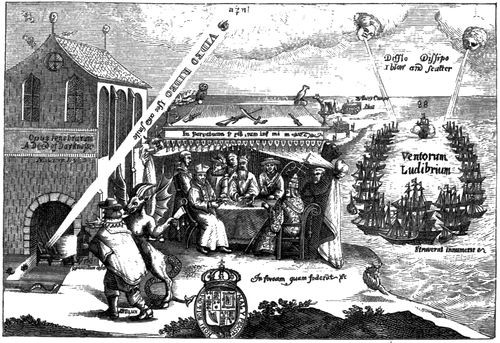
Spayne and Rome Defeated. (London and Amsterdam, 1621.)
Examine the two large caricatures, "Rome's Monster" and "Spayne and Rome Defeated," in the light of a mere catalogue of dates. The Field of the Cloth of Gold, which we may regard as the splendid close of the old state of things, occurred in 1520, three years after Luther nailed up his theses. Henry VIII. defied the Pope in 1533; and twenty years after, Bloody Mary, married to Philip of Spain, was burning bishops at Smithfield. Elizabeth's reign began in 1558, which changed, not ended, the religious strife in England. The massacre of St. Bartholomew occurred in 1572, on that 24th of August which, as Voltaire used to say, all the humane and the tolerant of our race should observe as a day of humiliation and sorrow for evermore. In 1579 began the long struggle between the New and the Old, which is called the Thirty Years' War. The Prince of Orange was assassinated in 1584, in the midst of those great events which Mr. Motley has made familiar to the reading people of both continents. Every intelligent Protestant in Europe felt that the weapon which slew the prince was aimed at his own heart. The long dread of the Queen of Scots' machinations ended only with her death in 1587. Soon after, the shadow of the coming Spanish Armada crept over Great Britain, which was not dispelled till the men of England defeated and the storm scattered it in 1588. In 1605 Guy Fawkes and the Gunpowder Plot struck such terror to the Protestant mind, that it has not, in this year, 1877, wholly recovered from it, as all may know who will converse with uninstructed people in the remoter counties of Great Britain. Raleigh was beheaded in 1618. The civil war began in 1642. In 1665 the plague desolated England, and in the next year occurred the great fire of London, good Protestants not doubting that both events were traceable to the fell influence of the Beast. The accession of James II., a Roman Catholic, filled the Puritans with new alarm in 1685, and during the three anxious years of his reign their brethren, the Huguenots, were fleeing into all the Protestant lands from the hellish persecution of the priests who governed Louis XIV.
Upon looking back at this period of agitation and alarm, it startles the mind to observe in the catalogue of dates this one: "Shakspeare died 1616." It shows us, what the ordinary records do not show, that there are people who retain their sanity and serenity in the maddest times. The rapid succession of the plays—an average of nearly two per annum—proves that there was a public for Shakspeare when all the world seemed absorbed in subjects least akin to art and humor. And how little trace we find of all those thrilling events in the plays! He was a London actor when the Armada came; and during the year of the Gunpowder Plot he was probably meditating the grandest of all his themes, "King Lear!"
The picture entitled "Spayne and Rome Defeated"[16] was one of the most noted and influential broadsheets published during the Puritan period. It may properly be termed a broadsheet, since the copy of the original in the British Museum measures 20-2/3 inches by 13. The Puritans of England saw with dismay the growing cordiality between James I. and the Spanish court, and watched with just apprehension the visit of Prince Charles to Spain, and the prospect of a marriage between the heir-apparent and a Spanish princess. At this alarming crisis, 1621, the sheet was composed in England, and sent over to Holland to be engraved and printed, Holland being then, and for a hundred and fifty years after, the printing-house and type-foundry of Northern Europe. Some of the Pilgrim Fathers of Massachusetts, then residing at Leyden, and still waiting to hear the first news of the Mayflower company, who had sailed the year before, may have borne a hand in the work. Pastor Robinson, we know, gained part of his livelihood by co-operating with brethren in England in the preparation of works designed for distribution at home.
Besides being one of the most characteristic specimens of Puritan caricature which have been preserved, it presents to us a résumé of history, as Protestants interpreted it, from the time of the Spanish Armada to that of Guy Fawkes—1588 to 1605. It appears to have been designed for circulation in Holland and Germany as well as in England, as the words and verses upon it are in English, Dutch, and Latin. The English lines are these:
"In Eighty-eight, Spayne, arm'd with potent might,
Against our peacefull Land came on to fight;
But windes and waves and fire in one conspire,
To help the English, frustrate Spaynes desire.
To second that the Pope in counsell sitts,
For some rare stratagem they strayne their witts;
November's 5th, by powder they decree
Great Brytanes state ruinate should bee.
But Hee, whose never-slumb'ring Eye did view
The dire intendments of this damned crew,
Did soone prevent what they did thinke most sure.
Thy mercyes, Lord! for evermore endure."
This interesting sheet was devised by Samuel Ward, a Puritan preacher of Ipswich, of great zeal and celebrity, who dedicated it, in the fashion of the day, thus:
"To God. In memorye of his double deliveraunce from ye invincible Navie and ye unmatcheable powder Treason, 1605."
It was a timely reminder. As we occasionally see in our own day a public man committing the absurdity of replying in a serious strain to a caricature, so, in 1621, the Spanish embassador in London, Count Gondomar, called the attention of the British Government to this engraving, complaining that it was calculated to revive the old antipathy of the English people to the Spanish monarchy. The obsequious lords of the Privy Council summoned Samuel Ward to appear before them. After examining him, they remanded him to the custody of their messenger, whose house was a place of confinement for such prisoners; and there he remained. As there was yet no habeas corpus act known among men, he could only protest his innocence of any ill designs upon the Spanish monarchy, and humbly petition for release. He petitioned first the Privy Council; and they proving obdurate, he petitioned the king. He was set free at last, and he remained for twenty years a thorn in the side of those who dreaded "Spayne and Rome" less than they hated Puritans and Parliaments.
This persecution of Samuel Ward gave his print such celebrity that several imitations or pirated editions of the work speedily appeared, of which four are preserved in the great collection of the British Museum, each differing from the original in details. Caricatures aimed directly at the Spanish embassador followed, but they are only remarkable for the explanatory words which accompany them. In one we read that the residence of Count Gondomar in England had "hung before the eyes of many good men like a prodigious comet, threatening worse effects to Church and State than this other comet," which had recently menaced both from the vault of heaven. "No ecclipse of the sunne," continues the writer, "could more damnifie the earth, to make it barraine and the best things abortive, than did his interposition." We learn also that when the count left England for a visit to his own country, in 1618, "there was an uproare and assault a day or two before his departure from London by the Apprentices, who seemed greedy of such an occasion to vent their own spleenes in doing him or any of his a mischiefe." Another picture exhibits the odious Gondomar giving an account of his conduct in England to the "Spanishe Parliament," in the course of which he attributes the British abhorrence of Spain to such men as "Ward of Ipswich," whom he describes as "light and unstayed wits," intent on winning the airy applause of the vulgar, and to raise their desperate fortunes. Nor does he refrain from chuckling over the penalty inflicted upon that enemy of Spayne and Rome: "And I think that Ward of Ipswich escaped not safely for his lewed and profane picture of '88 and their Powder Treason, one whereof, my Lord Archbishop, I sent you in a letter, that you might see the malice of these detestable Heretiques against his Holiness and the Catholic Church." This broadsheet being entitled "Vox Populi," the writer concludes his explanation by styling the embassador "Fox Populi, Count Gondomar the Great."
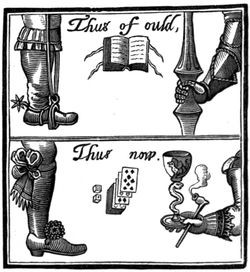
From Title-page to a Sermon, "Woe to Drunkards," by Samuel Ward, of Ipswich, 1627.
Ward of Ipswich continued to be heard from occasionally during the first years of the reign of Charles I. Ipswich itself acquired a certain celebrity as a Puritan centre, and the name was given during the life-time of Samuel Ward to a town in Massachusetts, which is still thriving. One of his sermons upon drunkenness was illustrated by a picture, of which a copy is given here,[17] designed to show the degeneracy of manners that had taken place in England in his day. Mr. Chatto truly remarks that twenty years later the picture would have been more appropriate with the inscriptions transposed.
The marriage of Charles I. with the Princess Henrietta of France, in 1625, was one of the long series of impolitic acts which the king expiated on the scaffold in 1649. It aggravated every propensity of his nature that was hostile to the liberties of the people. Under James I. the élite of the Puritans had fled to Holland, and a little company had sought a more permanent refuge on the coast of New England. During the early years of the reign of Charles, the persecution of the Puritans by his savage bishops became so cruel and so vigilant as to induce men of family and fortune, like Winthrop and his friends, accompanied by a fleet of vessels laden with virtuous and thoughtful families, to cross the ocean and settle in Massachusetts. Boston was founded when Charles I. had been cutting off the ears and slitting the noses of Puritans for five years. All that enchanting shore of New England, with its gleaming beaches, and emerald isles, and jutting capes of granite and wild roses, now so dear to summer visitors—an eternal holiday-ground and resting-place for the people of North America—began to be dotted with villages, the names of which tell us what English towns were most renowned for the Puritan spirit two hundred and fifty years ago. The satirical pictures preserved in the British Museum which relate to events in earlier reigns number ninety-nine in all; but those suggested by events in the reign of Charles I. are nearly seven hundred in number. Most of them, however, were not published until after the downfall of the king.
Several of these prints are little more than portraits of the conspicuous persons of the time, with profuse accounts on the same sheet of their sufferings or misdeeds. One such records the heroic endurance of "the Reverend Peter Smart, mr of Artes, minister of God's word at Durham," who, for preaching against popery, lost above three hundred pounds per annum, and was imprisoned eleven years in the King's Bench. The composer adds these lines:
"Peter preach downe vaine rites with flagrant harte;
Thy Guerdon shall be greate, though heare thou Smart."
Another of these portrait pieces exhibits Dr. Alexander Leighton, who spoke of Queen Henrietta as "the daughter of Hell, a Canaanite, and an idolatresse," and spared not Archbishop Laud and his confederates. For these offenses he was, as the draughtsman informs us, "clapt up in Newgate for the space of 15 weekes, where he suffered great miserie and sicknes almost to death, afterward lost one of his Eares on the pillorie, had one of his nosthrills slitt clean through, was whipt with a whip of 3 Coardes knotted, had 36 lashes therewith, was fined 1000ll., and kept prisoner in the fleet 12 yeares, where he was most cruelly used a long time, being lodged day and night amongst the most desperately wiked villaines of ye whole prison." He was also branded on the cheek with the letters S. S.—sower of sedition. Several other prints of the time record the same mark of attention paid by the "martyred" king to his Catholic wife. By-and-by, the crowned and mitred ruffians who did such deeds as these being themselves in durance, Parliament set Dr. Leighton free, and made him a grant of six thousand pounds.
A caricature of the same bloody period is entitled, "Archbishop Laud dining on the Ears of Prynne, Bastwick, and Burton." We see Laud seated at dinner, having an ear on the point of his knife and three more ears in the plate before him, the three victims of his cruelty standing about, and two armed bishops at the foot of the table. The dialogue below represents Laud as rejecting with scorn all the dainties of his table, and declaring that nothing will content him but the ears of Lawyer Prynne and Dr. Bastwick. He cuts them off himself, and orders them to be dressed for his supper.
"Canterbury. This I doe to make you examples,
That others may be more careful to please my palate.
Henceforth let my servants know, that what I will, I will have done,
What ere is under heaven's Sunne."
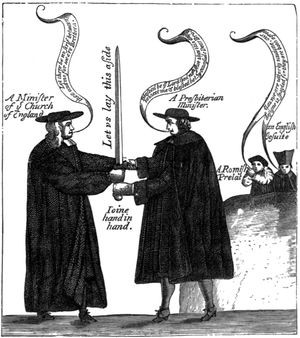
"Let not the World devide those whom Christ hath joined."
A burst of caricature heralded the coming triumph of the Puritans in 1640, the year of the impeachment of the Earl of Strafford. Many of the pictures recorded both the sufferings and the joyful deliverance of the Puritan clergymen. Thus we have in one of them a glowing account of the return of the three gentlemen whose ears furnished a repast for the Archbishop of Canterbury. They had been imprisoned for many years in the Channel Islands, from which they were conveyed to Dartmouth, and thence to London, hailed with acclamations of delight and welcome in every village through which they passed. All the expenses of their long journey were paid for them, and presents of value were thrust upon them as they rode by. Within a few miles of London they were met by such a concourse of vehicles, horsemen, and people that it was with great difficulty they could travel a mile in an hour. But when at length, in the evening, they reached the city, masses of enthusiastic people blocked the streets, crying, "Welcome home! welcome home!" and strewing flowers and rosemary before them. Thousands of the people carried torches, which rendered the streets lighter than the day. They were three hours in making their way through the crowd from Charing Cross to their lodgings in the city, a distance of a mile.
It was during the exaltation of the years preceding the civil war that such pictures appeared as the one here given, urging a union between the Church of England and the Church of Scotland against the foe of both. This is copied from an original impression in the collection of the New York Historical Society.
The caricaturists pursued Laud and Strafford even to the scaffold. The archbishop was the author of a work entitled "Canons and Institutions Ecclesiastical," in which he gave expression to his extreme High-church opinions. In 1640 the victorious House of Commons canceled the canons adopted from this work, and fined the clergy who had sat in the Convocation. A caricature quickly appeared, called "Archbishop Laud firing a Cannon," in which the cannon is represented as bursting, and its fragments endangering the clergymen standing near. Laud's committal to the Tower was the occasion of many broadsheets, one of which exhibits him fastened to a staple in a wall, with a long string of taunting stanzas below:
"Reader, I know thou canst not choose but smile
To see a Bishop tide thus to a ring!
Yea, such a princely prelate, that ere while
Could three at once in Limbo patrum fling;
Suspend by hundreds where his worship pleased,
And them that preached too oft by silence eas'd;
"Made Laws and Canons, like a King (at least);
Devis'd new oaths; forc'd men to sweare to lies!
Advanc'd his lordly power 'bove all the rest.
And then our Lazie Priests began to rise;
But painfull ministers, which plide their place
With diligence, went downe the wind apace.
"Our honest Round heads too then went to racke;
The holy sisters into corners fled;
Cobblers and Weavers preacht in Tubs for lacke
Of better Pulpits; with a sacke instead
Of Pulpit-cloth, hung round in decent wise,
All which the spirit did for their good devise.
"Barnes, Cellers, Cole-holes, were their meeting-places,
So sorely were these babes of Christ abus'd,
Where he that most Church-government disgraces
Is most esteem'd, and with most reverence us'd.
It being their sole intent religiously
To rattle against the Bishops' dignity.
"Brother, saies one, what doe you thinke, I pray,
Of these proud Prelates, which so lofty are?
Truly, saies he, meere Antichrists are they.
Thus as they parle, before they be aware,
Perhaps a Pursuivant slips in behind,
And makes 'em run like hares before the wind.
"A yeere agone 'tad been a hanging matter
T'ave writ (nay, spoke) a word 'gainst little Will;
But now the times are chang'd, men scorne to flatter;
So much the worse for Canterbury still,
For if that truth come once to rule the roast,
No mar'le to see him tide up to a post.
"By wicked counsels faine he would have set
The Scots and us together by the eares;
A Patriark's place the Levite long'd to get,
To sit bith' Pope in one of Peter's chaires.
And having drunke so deepe of Babels cup,
Was it not time, d'ee think, to chaine him up?"
In these stanzas are roughly given the leading counts of the popular indictment against Archbishop Laud. Other prints present him to us in the Tower with a halter round his neck; and, again, we see him in a bird-cage, with the queen's Catholic confessor, the two being popularly regarded as birds of a feather. In another, a stout carpenter is holding Laud's nose to a grindstone, while the carpenter's boy turns the handle, and the archbishop cries for mercy:
"Such turning will soon deform my face;
Oh! I bleed, I bleed! and am extremely sore."
But the carpenter reminds him that the various ears that he had caused to be cut off were quite as precious to their owners as his nose is to him. A Jesuit enters with a vessel of holy water with which to wash the extremely sore nose. One broadsheet represents Laud in consultation with his physician, who administers an emetic that causes him to throw off his stomach several heavy articles which had been troubling him for years. First, the "Tobacco Patent" comes up with a terrible wrench. As each article appears, the doctor and his patient converse upon it:
"Doctor. What's this? A book? Whosoever hath bin at church may exercise lawful recreations on Sunday. What's the meaning of this?
"Canterbury. 'Tis the booke for Pastimes on the Sunday, which I caused to be made. But hold! here comes something. What is it?
"Doctor. 'Tis another book. The title is, 'Sunday no Sabbath.' Did you cause this to be made also?
"Canterbury. No; Doctor Pocklington made it; but I licensed it.
"Doctor. But what's this? A paper 'tis; if I be not mistaken, a Star-Chamber order made against Mr. Prinne, Mr. Burton, and Dr. Bastwicke. Had you any hand in this?
"Canterbury. I had. I had. All England knoweth it. But, oh, here comes up something that makes my very back ake! O that it were up once! Now it is up, I thank Heaven!
"Doctor. 'Tis a great bundle of papers, of presentations and suspensions. These were the instruments, my lord, wherewith you created the tongue-tied Doctors, and gave them great Benefices in the Country to preach some twice a year at the least, and in their place to hire some journeyman Curate, who will only read a Sermon in the forenoone, and in the afternoone be drunke, with his parishioners for company."
By the same painful process the archbishop is delivered of his "Book of Canons," and finally of his mitre; upon which the doctor says, "Nay, if the miter be come, the Divell is not far off. Farewell, my good lord."
There still exist in various collections more than a hundred prints relating directly to Archbishop Laud, several of which give burlesque representations of his execution. There are some that show him asleep, and visited by the ghosts of those whom he had persecuted, each addressing him in turn, as the victims of Richard III. spoke to their destroyer on Bosworth Field. One of the print-makers, however, relented at the spectacle of an old man, seventy-two years of age, brought to the block. He exhibits the archbishop speaking to the crowd from the scaffold:
"Lend me but one poore teare, when thow do'st see
This wretched portraict of just miserie.
I was Great Innovator, Tyran, Foe
To Church and State; all Times shall call me so.
But since I'm Thunder-stricken to the Ground,
Learn how to stand: insult not ore my wound."
This one poor stanza alone among the popular utterances of the time shows that any soul in England was touched by the cruel fanatic's bloody end.
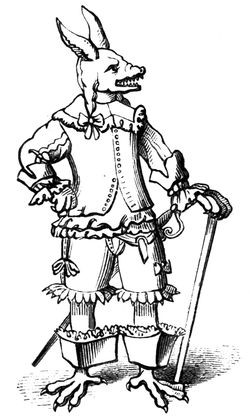
"England's Wolfe with Eagle's Clawes" (Prince Rupert), 1647.
During the civil war and the government of Cromwell, 1642 to 1660, nine in ten of all the satirical prints that have been preserved are on the Puritan side. A great number of them were aimed at the Welsh, whose brogue seems to have been a standing resource with the mirth-makers of that period, as the Irish is at present. The wild roystering ways of the Cavaliers, their debauchery and license, furnished subjects. The cruelties practiced by Prince Rupert suggested the annexed illustration, in which the author endeavored to show "the cruell Impieties of Blood-thirsty Royalists and blasphemous Anti-Parliamentarians under the Command of that inhumane Prince Rupert, Digby, and the rest, wherein the barbarous Crueltie of our Civill uncivill Warres is briefly discovered." Beneath the portrait of England's wolf are various narratives of his bloody deeds. One picture exhibits the plundering habits of the mercenaries on the side of the king in Ireland. A soldier is represented armed and equipped with the utensils that appertain to good forage: on his head a three-legged pot, hanging from his side a duck, a spit with a goose on it held in his left hand as a musket, a dripping-pan on his arm as a shield, a hay-fork in his right hand for a rest, with a string of sausages for a match, a long artichoke at his side for a sword, bottles of canary suspended from his belt, slices of toast for shoe-strings, and two black pots at his garters. This picture may have been called forth by an item in a news-letter of 1641, wherein it was stated that such "great store of pilidges" was daily brought into Drogheda that a cow could be bought there for five shillings and a horse for twelve.
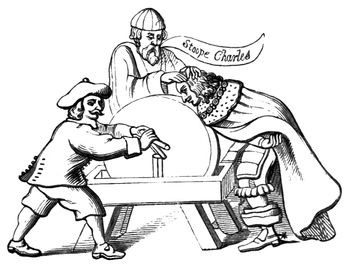
Charles II. and the Scotch Presbyterians, 1651.
"Presbyter. Come to the grinstone, Charles; 'tis now too late
To recolect, 'tis presbiterian fate.
"King. Yon Covenant pretenders, must I bee
The subject of your Tradgie Comedie?
"Jockey. I, Jockey, turne the stone of all your plots,
For none turnes faster than the turne-coat Scots.
"Presbyter. We for our ends did make thee king, be sure,
Not to rule us, we will not that endure.
"King. You deep dissemblers, I know what you doe,
And, for revenges sake, I will dissemble too."
The abortive attempt of Charles II., after the execution of his father, to unite the Scots under his sceptre, and by their aid place himself upon the throne of England, called forth the caricature annexed, in which an old device is put to a new use. A large number of verses explain the picture, though they begin by declaring:
"This Embleme needs no learned Exposition;
The World knows well enough the sad condition
Of regal Power and Prerogative.
Dead and dethron'd in England, now alive
In Scotland, where they seeme to love the Lad,
If hee'l be more obsequious than his Dad,
And act according to Kirk Principles,
More subtile than were Delphic Oracles."
In the verses that follow there is to be found one of the few explicit justifications of the execution of Charles I. that the lighter literature of the Commonwealth affords:
"But Law and Justice at the last being done
On the hated Father, now they love the Son."
The poet also taunts the Scots with having first stirred up the English to "doe Heroick Justice" on the late king, and then adopting the heir on condition of his giving their Church the same fell supremacy which Laud had claimed for the Church of England.
The Ironsides of Cromwell soon accomplished the caricaturist's prediction:
"But this religious mock we all shall see,
Will soone the downfall of their Babel be."
We find the pencil and the pen of the satirist next employed in exhibiting the young king fleeing in various ludicrous disguises before his enemies.
An interesting caricature published during the civil wars aimed to cast back upon the Malignants the ridicule implied in the nickname of Roundhead as applied to the Puritans. It contained figures of three ecclesiastics, "Sound-head, Rattle-head, and Round-head." Sound-head, a minister sound in the Puritan faith, hands a Bible to Rattle-head, a personage meant for Laud, half bishop and half Jesuit. On the other side is the genuine Round-head, a monk with shorn pate, who presents to Rattle-head a crucifix, and points to a monastery. Rattle-head rejects the Bible, and receives the crucifix. Over the figures is written:
"See heer, Malignants Foolerie
Retorted on them properly,
The Sound-head, Round-head, Rattle-head,
Well placed, where best is merited."
Below are other verses in which, of course, Rattle-head and Round-head are belabored in the thorough-going, root-and-branch manner of the time, Atheist and Arminian being used as synonymous terms:
"See heer, the Rattle-heads most Rotten Heart,
Acting the Atheists or Arminians part."
In looking over the broadsheets of that stirring period, we are struck by the absence of the mighty Name that must have been uppermost in every mind and oftenest on every tongue—that of the Lord Protector, Oliver Cromwell. A few caricatures were executed in Holland, in which "The General" and "Oliver" and "The Protector" were weakly satirized; but as most of the plates in that age were made to serve various purposes, and were frequently altered and redated, it is not certain that any of them were circulated in England during Cromwell's life-time. English draughtsmen produced a few pictures in which the Protector was favorably depicted dissolving the Long Parliament, but their efforts were not remarkable either with pen or pencil. The Protector may have relished, and Bunyan may have written, the verses that accompanied some of them:
"Full twelve years and more these Rooks they have sat
to gull and to cozen all true-hearted People;
Our Gold and our Silver has made them so fat
that they lookt more big and mighty than Paul's Steeple."
The Puritans handled the sword more skillfully than the pen, and the royalists were not disposed to satire during the rule of the Ironside chief. The only great writer of the Puritan age on the Puritan side was Milton, and he was one of the two or three great writers who have shown little sense of humor.
CHAPTER X.
LATER PURITAN CARICATURE.
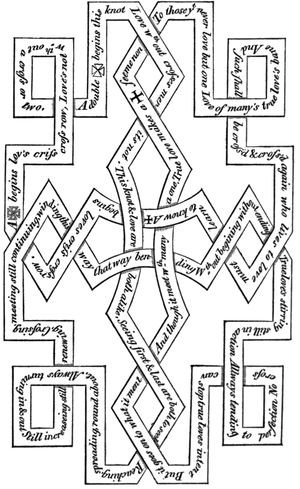
Cris-cross Rhymes on Love's Crosses, 1640. (Musarum, 306.)
What a change came over the spirit of English art and literature at the Restoration in 1660! Forty years before, when James I. was king, who loathed a Puritan, there was occasionally published a print in which Puritans were treated in the manner of Hudibras. There was one of 1612 in which a crown was half covered by a broad-brimmed hat, with verses reflecting upon "the aspiring, factious Puritan," who presumed to "overlooke his king." There was one in 1636, in the reign of Charles I., aimed at "two infamous upstart prophets," weavers, then in Newgate for heresy, which contains a description of a Puritan at church, which is entirely in the spirit of Hudibras:
"His seat in the church is where he may be most seene. In the time of the Sermon he drawes out his tables to take the Notes, but still noting who observes him to take them. At every place of Scripture cited he turnes over the leaves of his Booke, more pleased with the motion of the leaves than the matter of the Text; For he folds downe the leaves though he finds not the place. Hee lifts up the whites of his eyes towards Heaven when hee meditates on the sordid pleasures of the earth; his body being in God's Church, when his mind is in the divel's Chappell."
Again, in 1647, two years before the execution of Charles, an extensive and elaborate sheet appeared, in which the ignorant preachers of the day were held up to opprobrium. Each of these "erronious, hereticall, and Mechannick spirits" was exhibited practicing his trade, and a multitude of verses below described the heresies which such teachers promulgated.
"Oxford and Cambridge make poore Preachers;
Each shop affordeth better Teachers:
Oh blessed Reformation!"
Among the "mechannick spirits" presented in this sheet we remark "Barbone, the Lether-seller," who figures in many later prints as "Barebones." There are also "Bulcher, a Chicken man;" "Henshaw, a Confectioner, alias an Infectioner;" "Duper, a Cowkeeper;" "Lamb, a Sope-boyler," and a dozen more.
Such pictures, however, were few and far between during the twenty years of Puritan ascendency. But when the rule of the Sound-head was at an end, and Rattle-head had once more the dispensing of preferment in Church and State, the press teemed with broadsheets reviling the Puritan heroes. The gorgeous funeral of the Protector—his body borne in state on a velvet bed, clad in royal robes, to Westminster Abbey, where a magnificent tomb rose over his remains—was still fresh in the recollection of the people of London when they saw the same body torn from its resting-place, and hung on Tyburn Hill from nine in the morning until six in the evening, and then cast into a deep pit. Thousands who saw his royal funeral looked upon his body swinging from the gallows. The caricatures vividly mark the change. Cromwell now appears only as tyrant, antichrist, hypocrite, monster. Charles I. is the holy martyr. His son's flight in disguise, the hiding in the oak-tree, and other circumstances of his escape are no longer ignominious or laughable, but graceful and glorious.
A cherished fiction appears frequently in the caricatures that no man came to a good end who had had any hand in the king's execution, not even the executioner nor the humblest of his assistants. On one sheet we read of a certain drum-maker, named Tench, who "provided roapes, pullies, and hookes (in case the king resisted) to compel and force him down to the block." "This roague is also haunted with a Devill, and consumes away." There was the confession, too, of the hangman, who, being about to depart this life, declared that he had solemnly vowed not to perform his office upon the king, but had nevertheless dealt the fatal blow, trembling from head to foot. Thirty pounds had been his reward, which was paid him in half-crown pieces within an hour after the execution—the dearest money, as he told his wife, that he had ever received, for it would cost him his life, "which propheticall words were soon made manifest, for it appeared that, ever since, he had been in a most sad condition, and lay raging and swearing, and still pointing at one thing or another which he conceived to appear visible before him."
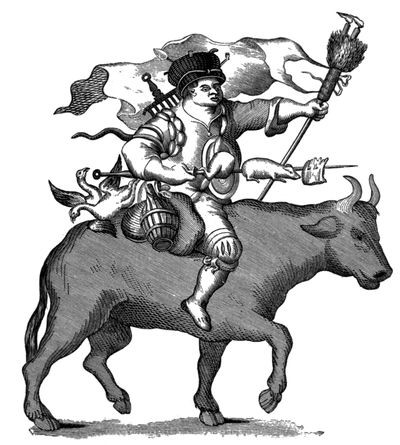
Shrove-tide in Arms against Lent, A.D. 1660.
Richard Cromwell was let off as easily by the caricaturist as he was by the king. He is depicted as "the meek knight," the mild incapable, hardly worth a parting kick. In one very good picture he is a cooper hammering away with a mallet at a cask, from which a number of owls escape, most of which, as they take their flight, cry out, "King!" Richard protests that he knows nothing of this trade of cooper, for the more he hammers, the more the barrel breaks up. Elizabeth, the wife of the Protector, figured in a ludicrous manner upon the cover of a cookery-book published in the reign of Charles II., the preface of which contained anecdotes of the kitchen over which she had presided.

Lent tilting at Shrove-tide, A.D. 1660.
Among other indications of change in the public feeling, we notice a few pictures conceived in the pure spirit of gayety, designed to afford pleasure to every one, and pain to no one. Two of these are given here—Shrove-tide and Lent tilting at one another—which were thought amazingly ingenious and comic two hundred years ago. They are quite in the taste of the period that produced them. Shrove-tide, in the calendar of Rome, is the Tuesday before Lent, a day on which many people gave themselves up to revelry and feasting, in anticipation of the forty days' fast. Shrove-tide accordingly is mounted on a fat ox, and his sword is sheathed in a pig and piece of meat, with capons and bottles of wine about his body. His flag, as we learn from the explanatory verses, is "a cooke's foule apron fix'd to a broome," and his helmet "a brasse pot." Lent, on the contrary, flings to the breeze a fishing-net, carries an angling-rod for a weapon, and wears upon his head "a boyling kettle." Thus accoutred, these mortal foes approach one another, and Lent lifts up his voice and proclaims his intention:
"I now am come to mundifie and cleare
The base abuses of this last past yeare:
Thou puff-paunch'd monster (Shrovetyde), thou art he
That were ordain'd the latter end to be
Of forty-five weekes' gluttony, now past,
Which I in seaven weekes come to cleanse at last:
Your feasting I will turn to fasting dyet;
Your cookes shall have some leasure to be quiet;
Your masques, pomps, playes, and all your vaine expence,
I'll change to sorrow, and to penitence."
Shrove-tide replies valiantly to these brave words:
"What art thou, thou leane-jawde anottamie,
All spirit (for I no flesh upon thee spie);
Thou bragging peece of ayre and smoke, that prat'st,
And all good-fellowship and friendship hat'st;
You'le turn our feasts to fasts! when, can you tell?
Against your spight, we are provided well.
Thou sayst thou'lt ease the cookes!-the cookes could wish
Thee boyl'd or broyl'd with all thy frothy fish;
For one fish-dinner takes more paines and cost
Than three of flesh, bak'd, roast, or boyl'd, almost."
This we are compelled to regard as about the best fun our ancestors of 1660 were capable of achieving with pencil and pen. Nor can we claim much for their pictures which aim to satirize the vices.
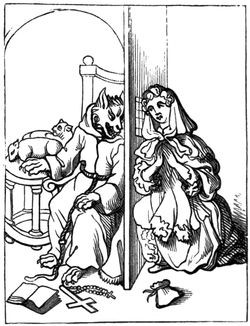
The Queen of James II. and Father Petre.
"It is a foolish sheep that makes the wolf her confessor." (1685.)
The joy of the English people at the restoration of the monarchy, which seemed at first to be as universal as it was enthusiastic, was of short duration. The Stuarts were the Bourbons of England, incapable of being taught by adversity. Within two years Charles II. alarmed Protestant England by marrying a Portuguese princess. The great plague of 1665, that destroyed in London alone sixty-eight thousand persons, was followed in the very next year by the great fire of London, which consumed thirteen thousand two hundred houses. At a moment when the public mind was reduced to the most abject credulity by such events as these, the scoundrel Titus Oates appeared, declaring that the dread calamities which had afflicted England, and others then imminent, were only parts of an awful Popish Plot, which aimed at the destruction of the king and the restoration of the Catholic religion. A short time after, 1678, Sir Edmundsbury Godfrey, the magistrate before whom Titus Oates made his deposition, was found dead in a field near London, the victim probably of some fanatic assassin of the Catholic party. The kingdom was thrown into an ecstasy of terror, from which, as before observed, it has not to this day wholly recovered. Terror may lurk in the blood of a race ages after the removal of its cause, as we find our sensitive horses shying from low-lying objects at the road-side, though a thousand generations may have peacefully labored and died since their ancestors crouched from the spring of a veritable wild beast. The broadsheets of that year, 1678, and of the troublous years following, even until William of Orange was seated on the throne of England, in 1690, have, we may almost say, but one topic—the Popish Plot. The spirit of that period lives in those sheets.
It had been a custom in England to celebrate the 17th of November, the day, as one sheet has it, on which the unfortunate Queen Mary died, and "that Glorious Sun, Queen Elizabeth, of happy memory, arose in the English horizon, and thereby dispelled those thick fogs and mists of Romish blindness, and restored to these kingdoms their just Rights both as men and Christians." The next recurrence of this anniversary after the murder of Godfrey was seized by the Protestants of London to arrange a procession which was itself a striking caricature. A pictorial representation of the procession is manifestly impossible here, but we can copy the list of objects as given on a broadsheet issued a few days after the event. This device of a procession, borrowed from Catholic times, was continually employed to promulgate and emphasize Protestant ideas down to a recent period, and has been used for political objects in our own day. How changed the thoughts of men since Albert Dürer witnessed the grand and gay procession at Antwerp, in honor of the Virgin's Assumption, one hundred and fifty-nine years before! The 17th of November, 1679, was ushered in, at three o'clock in the morning, by a burst of bell-ringing all over London. The broadsheet thus quaintly describes the procession:
"About Five o'clock in the Evening, all things being in readiness, the Solemn Procession began, in the following Order: I. Marched six Whiflers to clear the way, in Pioneers Caps and Red Waistcoats (and carrying torches). II. A Bellman Ringing, who, with a Loud and Dolesom Voice cried all the way, Remember Justice Godfrey. III. A Dead Body representing Sir Edmundbury Godfrey, in the Habit he usually wore, the Cravat wherewith he was murdered about his Neck, with spots of Blood on his Wrists, Shirt, and white Gloves that were on his hands, his Face pale and wan, riding on a White Horse, and one of his Murderers behind him to keep him from falling, representing the manner how he was carried from Somerset House to Primrose Hill. IV. A Priest in a Surplice, with a Cope Embroidered with Dead mens Bones, Skeletons, Skuls, &c., giving pardons very freely to those who would murder Protestants, and proclaiming it Meritorious. V. A Priest alone, in Black, with a large Silver Cross. VI. Four Carmelite Friers in White and Black Habits. VII. Four Grey Friars in their proper Habits. VIII. Six Jesuits with Bloody Daggers. IX. A Consort of Wind-musick, call'd the Waits. X. Four Popish Bishops in Purple and Lawn Sleeves, with Golden Crosses on their Breasts. XI. Four other Popish Bishops in their Pontificalibus, with Surplices, Rich Embroydered Copes, and Golden Miters on their Heads. XII. Six Cardinals in Scarlet Robes and Red Caps. XIII. The Popes Chief Physitian with Jesuites Powder in one hand, and a —— in the other. XIV. Two Priests in Surplices, with two Golden Crosses. Lastly, the Pope in a Lofty Glorious Pageant, representing a Chair of State, covered with Scarlet, the Chair richly embroydered, fringed, and bedeckt with Golden Balls and Crosses; at his feet a Cushion of State, two Boys in Surplices, with white Silk Banners and Red Crosses, and Bloody Daggers for Murdering Heritical Kings and Princes, painted on them, with an Incense-pot before them, sate on each side censing his Holiness, who was arrayed in a rich Scarlet Gown, Lined through with Ermin, and adorned with Gold and Silver Lace, on his Head a Triple Crown of Gold, and a Glorious Collar of Gold and precious stones, St. Peters Keys, a number of Beads, Agnus Dei's and other Catholick Trumpery; at his Back stood his Holiness's Privy Councellor, the Devil, frequently caressing, hugging, and whispering, and oft-times instructing him aloud, to destroy His Majesty, to forge a Protestant Plot, and to fire the City again; to which purpose he held an Infernal Torch in his hand. The whole Procession was attended with 150 Flambeaus and Torches by order; but so many more came in Voluntiers as made up some thousands. Never were the Balconies, Windows and Houses more numerously filled, nor the Streets closer throng'd with multitudes of People, all expressing their abhorrence of Popery with continual Shouts and Acclamations."
With slow and solemn step the procession marched to Temple Bar, then just rebuilt, and there it halted, while a dialogue in verse was sung in parts by "one who represented the English Cardinal Howard, and one the people of England." We can imagine the manner in which the crowd would come thundering in with
"Now God preserve Great Charles our King,
And eke all honest men;
And Traytors all to justice bring,
Amen! Amen! Amen!"
Fire-works succeeded the song, after which "his Holiness was decently tumbled from all his grandeur into the impartial flames," while the people gave so prodigious a shout that it was heard "far beyond Somerset House." For many years a similar pageant was given in London on the same day.
As an additional illustration of the feeling which then prevailed in Puritan circles, I will copy the rude and doleful rhymes which accompany a popular print of 1680, called "The Dreadful Apparition; or, the Pope haunted with Ghosts." Coleman, Whitebread, and Harcourt, who figure among the ghosts, had been recently executed as "popish plotters." The picture shows the Pope in bed, to whom the devil conducts Coleman, and an angel leads the spirit of Sir Edmundsbury Godfrey. Whitebread and Harcourt are in shrouds. A bishop, a cardinal, and other figures are seen. A label issuing from the mouth of each of the persons represented contains the rhymes which follow:
THE POPE IN BED.
"Away! Away! am not I Pope of Rome,
torment me not before my time is Come."
THE DEVIL, IN THE FORM OF A DRAGON.
"Your Sevt Sr! Ned Coleman doth appeare
he'll tell you all, therefore I brought him here."
COLEMAN'S GHOST.
"Sr you are Cause of my Continuall paine,
My Soul is Lost, for your Ambitious gaine."
GODFREY'S GHOST, INTRODUCED BY ——.
"Repent great Sr and be for ever blest,
in Heaven with me that happy place of rest."
ANGEL, IN A "ROMAN SHAPE."
"O Chariety! who mercy craves for those:
With Blūddy hands that ware his Cruell foes."
WHITEBREAD'S GHOST, WITH A SWORD THROUGH THE BODY.
"I am perplexed with perpetuall fright;
but who is this apeares this dreadful night."
HARCOURT'S GHOST, WITH A SWORD THROUGH THE BODY.
"'Tis Godfrey's Ghost I wish all things be well
that we may have our Pope of Rome in hell."
A BISHOP.
"Let us depart and Shun their cruell fate,
and all repent before it is to late."
CARDINAL.
"Come let us flie with all the Speed we may,
Ye Devil els will take us all away."
Below the picture are the verses subjoined:
NUNCIO.
"Horrors and Death! what dismal Sights Invade
His Nightly Slumbers, who in Blood does Trade.
The Ghostly Apparitions of the Dead;
The Bless'd by Angels; Damn'd by Demons Lead;
'Tis sure, Romes Conclave must Amazed stand,
When Souls Complaining, thus against them band;
Who All but One to please Ambitious Rome,
Have Gain'd Damnation for Their Final Doom.
Hear how They Curse Him all, but He who fell.
Great Brittains Sacrifice by Imps of Hell;
Who shew'd Their Bloody Vengeance in the Strife,
To Murther Him, who Business had for Life."
POPE.
"How do my Eye-Balls Roul, and Blood run back,
What Tortures at this sight my Conscience Rack;
Oh! Mountains now fall on me, some Deep Cave
Pitty me once, and prove my speedy Grave.
Involv'd in Darkness, from the Seated Light,
Let Me abscond in Everlasting Night.
Torment me not; you Shades, before my time,
I do confess, your Downfalls was my Crime;
To Satiate my Ambition and Revenge,
I push'd you on to this Immortal Change.
But Ah! fresh Horrors, Ah! my Power's grown weak,
What art thou Fiend? from whence? or where? O Speak;
That in this Frightful Form, a Dragon's hew
Presents One Sainted, to my Trembling View?"
FIEND.
"By Hells Grim King's Command, on whom I wait,
I've brought your Saint his Story to relate;
Who from the black Tartarian-Fire below,
So long beg'd Absence as to let you know
His Torments, and the Horrid Cheat condole,
You fix'd on him to Rob him of his Soul."
POPE.
"O! spare my Ears, I'll no such Horrors hear;"
COLEMAN.
"You must, and know your own Damnation's near:
You must ere long be Plung'd in Grizly Flame,
Which I shall laugh to see, tho, rack'd with pain
Thou Grand Deceiver of the Nations All,
Contriver of my Wretched Fate and Fall:
Thou who didst push me on to Murther Kings
Persuading me for it on Angels Wings
I should Transcend the Clouds, be ever Blest, )
And be of Al that Heav'n cou'd yield, possest, )
But these I mist, got Torment without Rest: )
For whilst on Earth I stand, a Hell within
Distracts my Conscience, pale with horrid Sin:
Instead of Mortals Pardon, One on High,
I must your Everlasting Martyr Fry;
Whilst Name of Saint I bear on Earth, below
It stirs the flames, and much Augments my Woe."
POPE.
"Horrors! 'tis Dismal, I can hear no more,
O! Hell and Furies, how I have lost my Pow'r."
SIR E. GODFREY.
"See Sir this Crimson Stain, this baleful Wound
See Murther'd me, with Joys Eternal Crown'd;
Though by the Darkest Deed of Night I fell,
Which shook Three Kingdoms, and Astonish'd Hell:
Yet rap'd above the Skyes to Mansion bright,
There to Converse with Everlasting Light;
Thence got I leave to View thy Wretched Face,
And find my Death thy Hell-born Plots did race,
And next to the Almighty Arm did Save
Great Albion's Glory from its yawning Grave;
From Sacred Bliss my Swift-Wing'd Soul did glide,
Conducted Hither by my Angel-Guide,
To let thee know thy Sands were almost run,
And that thy Thread of Life is well-nigh Spun;
Repent you then, Wash off the Bloody Stain,
Or You'll be Doom'd to Everlasting Pain."
ANGEL.
"Come Worthy of Seraphick Joys Above,
Worthy Our Converse, and Our Sacred Love;
Who hast Implor'd the Great Jehove for One )
Who Shed thy Blood, to Snatch thy Princes Throne )
In this thy Saviour's Great Examples shown: )
Come let Vs hence, and leave Him to his Fate,
When Divine Vengeance shall the Business State."
POPE.
"Chill Horror seizes me, I cannot flye;
Oh Ghastly! yet more Apparitions nigh?"
WHITEBREAD.
"Thus wandering through the Gloomy Shades, at last
I've found Thee, Traytor, that my Joys did Blast,
Whose Dam'd Injunctions, Dire Damnation Seal'd,
And Torments that were never yet Reveal'd:
Mirrihords of Plagues, Chains, Racks, Tempestuous Fire,
Sulpherian Lakes that Burn and ner Expire,
Deformed Demons, Uglier far than Hell,
The Half what We Endure, no Tongue can Tell;
This for a Bishoprick I Undergo,
But Now would give Earth's Empire wer't not so."
POPE.
"Retire, Good Ghosts, or I shall Dye with Fear."
HARCOURT.
"Nay stay Sir, first You must my Story Hear:
How could you thus Delude your Bosome-Friend?
Your Foes to Heaven, and Vs to Hell thus send;
Damnation seize You for't; ere long You'll be
Plung'd Headlong into vast Eternity;
There for to Howl, whilst We some Comfort gain, )
To see You welter in an endless Pain, )
And without Pitty, justly there Complain." )
POPE.
"Ho! Cardinals and Bishops, haste with speed,
Bell, Book, and Candle fetch, let me be free'd:
Ah! 'tis too late, by Fear Intranc'd I lye."
BISHOP.
"Heard you that Groan? with speed from hence let's flye."
CARDINAL.
"The Fiend has got Him, doubtless, lets away,
And in this Ghastly place no longer stay."
BISHOP.
"Dread Horrors seize me, Fly, for Mercy call,
Least Divine Vengeance over-whelm Vs all."
It was in this crude and lucid way that the forerunners of Gillray, Nast, Tenniel, and Leech satirized the murderous follies of their age. A volume larger than this would not contain the verse and prose that covered the broadsheets in the same style which appeared in London during the reign of Charles II. This specimen, however, suffices for any reader who is not making a special study of the period. To students and historians the collection of these prints in the British Museum is beyond price; for they show "the very age and body of the time, his form and pressure." Perhaps no other single source of information respecting that period is more valuable.
16: From Malcolm, who copied it from the original in the British Museum. See Malcolm's "Caricaturing," plate 22.
17: From Chatto's "Origin and History of Playing Cards," p. 131, London, 1848.
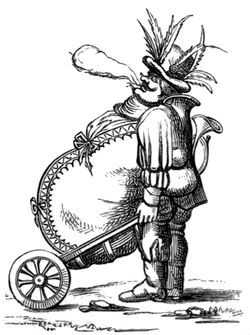
French Caricature of Corpulent General Galas, who defeated a French Convoy, 1635.
From the accession of William and Mary we notice a change in the subjects treated by caricaturists. If religion continued for a time to be the principal theme, there was more variety in its treatment. Sects became more distinct; the Quakers arose; the divergence between the doctrines of Luther and Calvin was more marked, and gave rise to much discussion; High Church and Low Church renewed their endless contest; the Baptists became an important denomination; deism began to be the whispered, and became soon the vaunted faith of men of the world; even the voice of the Jew was occasionally heard, timidly asking for a small share of his natural rights. It is interesting to note in the popular broadsheets and satirical pictures how quickly the human mind began to exert its powers when an overshadowing and immediate fear of pope and king in league against liberty had been removed by the flight of James II. and the happy accession of William III.
Political caricature rapidly assumed prominence, though, as long as Louis XIV. remained on the throne of France, the chief aim of politics was to create safeguards against the possible return of the Catholic Stuarts. The accession of Queen Anne, the career of Bolingbroke and Harley, the splendid exploits of Marlborough, the early conflicts of Whig and Tory, the attempts of the Pretenders, the peaceful accession of George I.—all these are exhibited in broadsheets and satirical prints still preserved in more than one collection. Louis XIV., his pomps and his vanities, his misfortunes and his mistresses, furnished subjects for hundreds of caricatures both in England and Holland. It was on a Dutch caricature of 1695 that the famous retort occurs of the Duc de Luxembourg to an exclamation of the Prince of Orange. The prince impatiently said, after a defeat, "Shall I, then, never be able to beat that hunchback?" Luxembourg replied to the person reporting this, "How does he know that my back is hunched? He has never seen it." Interspersed with political satires, we observe an increasing number upon social and literary subjects. The transactions of learned societies were now important enough to be caricatured, and the public was entertained with burlesque discourses, illustrated, upon "The Invention of Samplers," "The Migration of Cuckoos," "The Eunuch's Child," "A New Method of teaching Learned Men how to write Unintelligibly." There was an essay, also, "proving by arguments philosophical that Millers, though falsely so reputed, yet in reality are not thieves, with an intervening argument that Taylors likewise are not so."
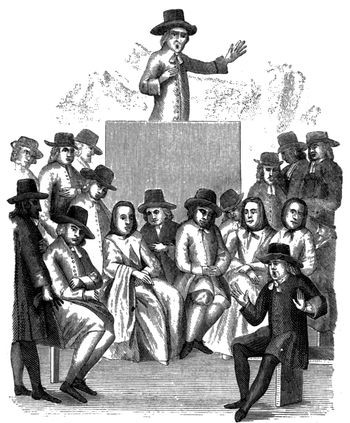
A Quaker Meeting, 1710—Aminidel exhorting Friends to support Sacheverell.
A strange episode in the conflict between Whig and Tory was the career of Sacheverell, a clergyman who preached such extreme doctrines concerning royal and ecclesiastical prerogative that he was formally censured by a Whig Parliament, and thus lifted into a preposterous importance. During his triumphal tour, which Dr. Johnson remembered as one of the events of his earliest childhood, he was escorted by voluntary guards that numbered from one thousand to four thousand mounted men, wearing the Tory badges of white knots edged with gold, and in their hats three leaves of gilt laurel. The picture of the Quaker meeting reflects upon the alliance alleged to have existed between the high Tories and the Quakers, both having an interest in the removal of disabilities, and hence making common cause. A curious relic of this brief delirium is a paragraph in the Grub Street Journal of 1736, which records the death of Dame Box, a woman so zealous for the Church that when Sacheverell was relieved of censure she clothed herself in white, kept the clothes all her life, and was buried in them. As long as Dr. Sacheverell lived she went to London once a year, and carried a present of a dozen larks to that "high-flying priest."
The flight of the Huguenots from France, in 1685 and 1686, enriched Holland, England, and the American colonies with the élite of the French people. Holland being nearest to France, and honored above all lands for nearly a century as the refuge of people persecuted for opinions' sake, received at first the greatest number, especially of the class who could live by intellectual pursuits. The rarest of all rarities in the way of caricature, "the diamond of the pictorial library," is a series of burlesque portraits, produced in Holland in 1686, of the twenty-four persons most guilty of procuring the revocation of the wise edict of Henry IV., which secured to French Protestants the right to practice their religion. The work was entitled "La Procession Monacale conduite par Louis XIV. pour la Conversion des Protestans de son Royaume." The king, accordingly, leads the way, his face a sun in a monk's cowl, in allusion to his adoption of the sun as a device. Madame De Maintenon, his married mistress, hideously caricatured, follows. Père la Chaise, and all the ecclesiastics near the court who were reputed to have urged on the ignorant old king to this superlative folly, had their place in the procession. Several of the faces are executed with a freedom and power not common in any age, but at that period only possible to a French hand. Two specimens are given on the following page.
Louis XIV., as the caricature collections alone would suffice to show, was the conspicuous man of that painful period. The caricaturists avenged human nature. No man of the time called forth so many efforts of the satiric pencil, nor was there ever a person better adapted to the satirist's purpose, for he furnished precisely those contrasts which satire can exhibit most effectively. He stood five feet four in his stockings, but his shoe-maker put four inches of leather under his heels, and his wig-maker six inches of other people's hair upon his head, which gave him an imposing altitude. The beginning of his reign was prosperous enough to give some slight excuse for the most richly developed arrogance seen in the world since Xerxes lashed the Hellespont, but the last third of his reign was a collapse that could easily be made to seem ludicrous. There were very obvious contrasts in those years between the splendors of his barbaric court and the disgraceful defeats of his armies, between the opinion he cherished of himself and the contempt in which he was held abroad, between the adulations of his courtiers and the execrations of France, between the mass-attending and the morals of the court.
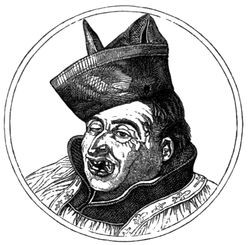
Archbishop of Paris—A Better Friend to Ladies than to the Pope. (Holland, 1686. By an Exiled Huguenot.)
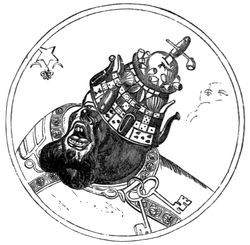
Archbishop of Rheims—Mitred Ass. (Holland, 1686. After the Expulsion of the Huguenots.)
The caricaturists made the most of these points. Every town that he lost, every victory that Marlborough won, gave them an opportunity which they improved. We have him as a huge yellow sun, each ray of which bears an inscription referring to some defeat, folly, or shame. We have him as a jay, covered with stolen plumage, which his enemies are plucking from him, each feather inscribed with the name of a lost city or fortress. We have him as the Crier of Versailles, crying the ships lost in the battle of La Hogue, and offering rewards for their recovery. He figures as the Gallic cock flying before that wise victorious fox of England, William III., and as a pompous drummer leading his army, and attended by his ladies and courtiers. He is an old French Apollo driving the sun, in wig and spectacles. He is a tiger on trial before the other beasts for his cruel depredations. He is shorn and fooled by Maintenon; he is bridled by Queen Anne. He is shown drinking a goblet of human blood. We see him in the stocks with his confederate, the Pope, and the devil standing behind, knocking their heads together. He is a sick man vomiting up towns. He is a sawyer, who, with the help of the King of Spain, saws the globe in two, Maintenon sitting aloft assisting the severance. As long as he lived the caricaturists continued to assail him; and when he died, in 1715, he left behind him a France so demoralized and impoverished that he still kept the satirists busy.

Caricature of Louis XIV., by Thackeray.
Even in our own time Louis XIV. has suggested one of the best caricatures ever drawn, and it is accompanied by an explanatory essay almost unique among prose satires for bitter wit and blasting truth. The same hand wielded both the pen and the pencil, and it was the wonderful hand of Thackeray. "You see at once," he says, in explanation of the picture, "that majesty is made out of the wig, the high-heeled shoes, and cloak, all fleurs-de-lis bespangled.... Thus do barbers and cobblers make the gods that we worship."
CHAPTER XI.
PRECEDING HOGARTH.
It was the bubble mania of 1719 and 1720, brought upon Europe by John Law, which completed the "secularization" of caricature. Art, as well as literature, learning, and science, was subservient to religion during the Middle Ages, and drew its chief nourishment from Mother Church. Since the Reformation they have all been obliged to pass through a painful process of weaning, and each in turn to try for an independent existence. The bubble frenzy, besides giving an impulse to the caricaturist's art it had not before received, withdrew attention from ecclesiastical subjects, and supplied abundant material drawn from sources purely mundane.

"Shares! Shares! Shares!"
The Night Share-crier and his Magic Lantern. A Caricature of John Law and his Bubble Schemes. (Amsterdam, 1720.)
Above all, the pictures which that mania called forth assisted to form the great satiric artist of his time and country, William Hogarth. He was a London apprentice carving coats of arms on silver plate when the early symptoms of the mania appeared; and he was still a very young man, an engraver, feeling his way to the career that awaited him, when the broadsheets satirizing John Law began to be "adapted" from Dutch originals, and shown in the shop-windows of London. Doubtless he inspected the picture of the "Night Share-crier," opposite, and noticed the cock's feather in his hat (indicating the French origin of the delusion), and the windmill upon the top of his staff. The Dutch pictures were full of that detail and by-play of which Hogarth was such a master in later years.
Visitors to New York who saw tumultuous Wall Street during the worst of our inflation period, and, following the crowd up-town, entered the Gold-room, where the wild speculation of the day was continued till midnight, may have flattered themselves that they were looking upon scenes never before exhibited in this world. What a strange intensity of excitement there was in those surging masses of young men! What fierce outcries! What a melancholy waste of youthful energies, so much needed elsewhere! But there was nothing new in all this, except that we passed the crisis with less loss and less demoralization than any community ever before experienced in circumstances at all similar.
When Louis XIV. died in 1715, after his reign of seventy-two years, he left the finances of France in a condition of inconceivable disorder. For fourteen years there had been an average annual deficit of more than fourteen millions of francs, to meet which the king had raised money by every paper device that had then been discovered. Having previously sold all the offices for which any pretext could be invented, he next sold annuities of all kinds, for one life, for two lives, for three lives, and in perpetuity. Then he issued all known varieties of promises to pay, from rentes perpétuelles to treasury-notes of a few francs, payable on demand. But there was one thing he did not do—reduce the expenditure of his enormous and extravagant court. In the midst of that deficit, when his ministers were at their wits' end to carry on the government from day to day, and half the lackeys of Paris held the depreciated royal paper, the old king ordered one more of those magnificent fêtes at Fontainebleau which had, as he thought, shed such lustre on his reign. The fête would cost four millions, the treasury was empty, and treasury-notes had fallen to thirty-five. While an anxious minister was meditating the situation, he chanced to see in his inner office two valets slyly scanning the papers on his desk, for the purpose, as he instantly conjectured, of getting news for the speculators. He conceived an idea. The next time those enterprising valets found themselves alone in the same cabinet, they were so happy as to discover on the desk the outlines of a royal lottery scheme for the purpose of paying off a certain class of treasury-notes. The news was soon felt in the street. Those notes mysteriously rose in a few days from thirty-five to eighty-five; and while they were at that point the minister, anticipating the Fiskian era, slipped upon the market thirty millions of the same notes. The king had his fête; and when next he borrowed money of his subjects, for every twenty-five francs of coin he was obliged to give a hundred-franc note.[18]
Two years after, the foolish old king died, leaving, besides a consolidated debt of bewildering magnitude, a floating debt, then due and overdue, of seven hundred and eighty-nine millions, equivalent, as M. Cochut computes, to about twice the amount in money of to-day. Coin had vanished; the royal paper was at twenty-five; the treasury was void; prices were distressingly high; some provinces refused to pay taxes; trade languished; there were vast numbers of workmen unemployed; and during the winter after the king's death a considerable number of persons died in Paris of cold and hunger. The only prosperous people were Government contractors, farmers of the revenue, brokers, and speculators in the king's paper; and these classes mocked the misery of their fellow-citizens by an ostentatious and tasteless profusion.
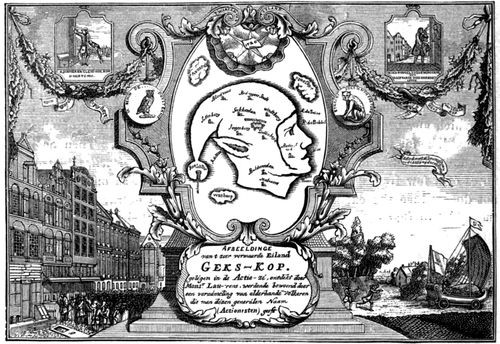
Island of Madhead.
"Picture of the very famous Island of Madhead. Situated in Share Sea, and inhabited by a multitude of all kinds of people, to which is given the general name of Shareholders." (Amsterdam, 1720.)
The natural successor of a king bigoted is a prince dissolute. The regent, who had to face this state of things on behalf of his nephew, Louis XV., a child of five, had at least the virtue and good sense to reject with indignant scorn the proposition made in his council by one member to declare France bankrupt and begin a new reign by opening a clean set of books. We, too, had our single repudiator, who fared no better than his French predecessor. But the regent's next measures were worthy of a prodigal. He called in the various kinds of public paper, and offered in exchange a new variety, called billets d'état, bearing interest at four per cent. But the public not responding to the call, the new bills fell to forty in twenty-four hours, and drew down all other public paper, until in a few days the royal promise to pay one hundred francs was worth twenty francs. The regent's coffers did not fill. That scarred veterans could not get their pensions paid was an evil which could be borne; but the regent had mistresses to appease!
Then he tried a system of squeezing the rich contractors and others of the vermin class who batten on a sick body-politic. As informers were to have half the product of the squeeze, an offended lackey had only to denounce his master, to get him tried on a charge of having made too much money. Woe to the plebeian who was convicted of this crime! Besides being despoiled of his property, Paris saw him, naked to the shirt, a rope round his neck, a penitential candle in his handcuffed hands, tied to a dirty cart and dragged to the pillory, carrying on his back a large label, "Plunderer of the People." The French pillory was a revolving platform, so that all the crowd had an equal chance to hurl mud and execration at the fixed and pallid face. Judge if there was not a making haste to compound with a government capable of such squeezing! There was also a mounting in hot haste to get out of such a France. One lucky merchant crossed the frontier, dressed as a peasant, driving a cart-load of straw, under which was a chest of gold. A train of fourteen carts loaded with barrels of wine was stopped, and in each barrel a keg of gold was found, which was emptied into the royal treasury.
The universal consternation and the utter paralysis of business which resulted from these violent spoliations may be imagined. Six thousand persons were tried, who confessed to the possession of twelve hundred millions of francs. The number of the condemned was four thousand four hundred and ten, and the sum extorted from them was, nominally, nearly four hundred millions, of which, however, less than one hundred millions reached the treasury. It was easy for a rich man to compound. A person condemned to disgorge twelve hundred thousand francs was visited by a "great lord." "Give me three hundred thousand francs," said the great lord, "and you won't be troubled for the rest." To which the merchant replied, "Really, my lord, you come too late, for I have already made a bargain with madame, your wife, for a hundred and fifty thousand." Thus the business of busy and frugal France was brought to a stand without relieving the Government. The royal coffers would not fill; the deficit widened; the royal paper still declined; the poor were hungry; and, oh, horror! the regent's mistresses pouted. The Government debased the coin. But that, too, proved an aggravation of the evil.
Such was that ancien régime which still has its admirers; such are the consequences of placing a great nation under the rule of the greatest fool in it; and such were the circumstances which gave the Scotch adventurer, John Law, his opportunity to madden and despoil France, so often a prey to the alien.
Two hundred years ago, when John Law, a rich goldsmith's son, was a boy in Edinburgh, goldsmiths were dealers in coin as well as in plate, and hence were bankers and brokers as well as manufacturers. They borrowed, lent, exchanged, and assayed money, and therefore possessed whatever knowledge of finance there was current in the world. It was in his father's counting-room that John Law acquired that taste for financial theories and combinations which distinguished him even in his youth. But the sagacious and practical goldsmith died when his son was fourteen, and left him a large inheritance in land and money. The example of Louis XIV. and Charles II. having brought the low vices into high fashion throughout Europe, it is not surprising that Law's first notoriety should have been owing to a duel about a mistress. A man of fashion in Europe in Louis XIV.'s time was a creature gorgeously attired in lace and velvet, and hung about with ringlets made of horse-hair, who passed his days in showing the world how much there was in him of the goat, the monkey, and the pig. Law had the impudence to establish his mistress in a respectable lodging-house, which led to his being challenged by a gentleman who had a sister living there. Law killed his man on the field—"not fairly," as John Evelyn records—and he was convicted of murder. The king pardoned, but detained him in prison, from which he escaped, went to the Continent, and resumed his career, being at once a man of fashion, a gambler, and a connoisseur in finance. He used to attend card-parties, followed by a footman carrying two bags, each containing two thousand louis-d'ors, and once during the life-time of the old king he was ordered out of Paris on the ground that he "understood the games he had introduced into the capital too well."
Twenty years elapsed from the time of his flight from a London prison. He was forty-four years of age, possessed nearly a million and three-quarters of francs in cash, producible on the green cloth at a day's notice, and was the most plausible talker on finance in Europe. This last was a bad symptom, indeed, for it is well known that men who remain victors in finance, who really do extricate estates and countries from financial difficulties, are not apt to talk very effectively on the subject. Successful finance is little more than paying your debts and living within your income, neither of which affords material for striking rhetoric. Alexander Hamilton, for example, talked finance in a taking manner; but it was Albert Gallatin who quietly reduced the country's debt. Fifteen days after the death of the old king, Law was in Paris with all that he possessed, and in a few months he was deep in the confidence of the regent. His fine person, his winning manners, his great wealth, his constant good fortune, his fluent and plausible tongue, his popular vices, might not have sufficed to give him ascendency if he had not added to these the peculiar force that is derived from sincerity. That he believed in his own "system" is shown by his risking his whole fortune in it. And it is to his credit that the first use he made of his influence was to show that the spoliations, the debasing of the coin, and all measures that inspired terror, and thus tightened unduly the clutch upon capital, could not but aggravate financial distress.
His "system" was delightfully simple. Bear in mind that almost every one in Paris who had any property at all held the king's paper, worth one-quarter or one-fifth of its nominal value. Whatever project Law set on foot, whether a royal bank, a scheme for settling and trading with Louisiana, for commerce with the East Indies, or farming the revenues, any one could buy shares in it on terms like these: one-quarter of the price in coin, and three-quarters in paper at its nominal value.
The system was not immediately successful, and it was only in the teeth of powerful opposition that he could get his first venture, the bank, so much as authorized. Mark how clearly one of the council, the Duc de Saint-Simon, comprehended the weakness of a despotism to which he owed his personal importance. "An establishment," said he, "of the kind proposed may be in itself good; but it is so only in a republic, or in such a monarchy as England, where the finances are controlled absolutely by those who furnish the money, and who furnish only as much of it as they choose, and in the way they choose. But in a light and changing government like that of France, solidity would be necessarily wanting, since a king or, in his name, a mistress, a minister, favorites, and, still more, an extreme necessity, could overturn the bank, which would present a temptation at once too great and too easy." Law, therefore, was obliged to alter his plan, and give his bank at first a board of directors not connected with the Government.
Gradually the "system" made its way. The royal paper beginning to rise in value, the holders were in good humor, and disposed to buy into other projects on similar terms. The Louisiana scheme may serve as an example of Law's method. Six years before, a great merchant of Paris, Antoine Crozat, had bought from the old king the exclusive right to trade with a vast unknown region in North America called Louisiana; but after five years of effort and loss he became discouraged, and offered to sell his right to the creator of the bank. Law, accepting the offer, speedily launched a magnificent scheme: capital one hundred millions of francs, in shares of five hundred francs, purchasable wholly in those new treasury-notes bearing four per cent. interest, then at a discount of seventy per cent. Maps of this illimitable virgin land were published. Pictures were exhibited, in which crowds of interesting naked savages, male and female, were seen running up to welcome arriving Frenchmen; and under the engraving a gaping Paris crowd could read, "In this land are seen mountains filled with gold, silver, copper, lead, quicksilver; and the savages, not knowing their value, gladly exchange pieces of gold and silver for knives, iron pots, a small looking-glass, or even a little brandy." One picture was addressed to pious souls; for even at that early day, as at present, there was occasionally observed a curious alliance between persons engaged in the promotion of piety and those employed in the pushing of shares. This work exhibited a group of Indians kneeling before some reverend fathers of the Society of Jesus. Under it was written, "Indian Idolaters imploring Baptism."

The excitement, once kindled, was stimulated by lying announcements of the sailing of great fleets for Louisiana laden with merchandise and colonists; of the arrival of vessels with freights worth "millions;" of the establishment of a silk-factory, wherein twelve thousand women of the Natchez tribe were employed; of the bringing of Louisiana ingots to the Mint to be assayed; of the discovery in Arkansas of a great rock of emerald, and the dispatch of Captain Laharpe with a file of twenty-two men to take possession of the same. In 1718 Law sent engineers to Louisiana, who did something toward laying out its future capital, which he named New Orleans, in honor of his patron, the regent.
The royal paper rose rapidly under this new demand. Other schemes followed, until John Law, through his various companies, seemed about to "run" the kingdom of France by contract, farming all its revenues, transacting all its commerce, and, best of all, paying all its debts! Madness, ruled the hour. The depreciated paper rose, rose, and still rose; reached par; went beyond par, until gold and silver were at a discount of ten per cent. The street named Quincampoix, the centre and vortex of this whirl of business, a mere lane twenty feet wide and a quarter of a mile long, was crowded with excited people from morning till night, and far into the night, so that the inhabitants of the quarter sent to the police a formal complaint that they could get no sleep. Nobles, lackeys, bishops, monks, merchants, soldiers, women, pickpockets, foreigners, all resorted to La Rue, "panting, yelling, operating, snatching papers, counting crowns," making up a scene of noisy confusion unexampled. One man hired all the vacant houses in the street, and made a fortune by subletting offices and desk-room, even placing sentry-boxes on some of the roofs, and letting them at a good price. The excitement spread over France, reached Holland, and drew to Paris, as was estimated at the time, five hundred thousand strangers, places in the public vehicles being engaged "two months in advance," and commanding a high premium.
There were the most extraordinary acquisitions of fortune. People suddenly enriched were called Mississippiens, and they behaved as the victims of sudden wealth, unearned, usually do. Men who were lackeys one week kept lackeys the next. A garçon of a wine-shop gained twenty millions. A cobbler, who had a stall in the Rue Quincampoix made of four planks, cleared away his traps and let his boards to ladies as seats, and sold pens, paper, and ink to operators, making two hundred francs a day by both trades. Men gained money by hiring out their backs as writing-desks, bending over while operators wrote out their contracts and calculations. One little hunchback made a hundred and fifty thousand francs by thus serving as a pupitre ambulant (strolling desk), and a broad-shouldered soldier gained money enough in the same way to buy his discharge and retire to the country upon a pretty farm. The general trade of the city was stimulated to such a degree that for a while the novel spectacle was presented of a community almost every member of which was prosperous beyond his hopes; for even in the Rue Quincampoix itself, although some men gained more money than others, no one appeared to lose any thing. And all this seemed the work of one man, the great, the incomparable "Jean Lass," as he was then called in Paris. It was a social distinction to be able to say, "I have seen him!" His carriage could with difficulty force its way through the rapturous, admiring crowd. Princes and nobles thronged his antechamber, a duchess publicly kissed his hand, and the regent made him controller-general of the finances.
This madness lasted eight months. No one needs to be told what followed it—how a chill first came over the feverish street, a vague apprehension, not confessed, but inspiring a certain wish to "realize." Dread word, REALIZE! The tendency to realize was adroitly checked by Law, aided by operators who desired to "unload;" but the unloading, once suspected, converted the realizing tendency into a wild, ungovernable rush, which speedily brought ruin to thousands, and long prostration upon France. John Law, who in December, 1719, was the idol of Paris, ready to perish of his celebrity, escaped with difficulty from the kingdom in December, 1720, hated, despised, impoverished, to resume his career as elegant gambler in the drawing-rooms of Germany and Italy.
As the "system" collapsed in France, it acquired vogue in England, where, also, it originated in the desire to get rid of the public debt by brilliant finance instead of the homely and troublesome method of paying it. In London, besides the original South Sea Company which began the frenzy, there were started in the course of a few months about two hundred joint-stock schemes, many of which, as given in Anderson's "History of Commerce," are of almost incredible absurdity. The sum called for by these projects was three hundred millions of pounds sterling, which was more than the value of all the land in Great Britain. Shares in Sir Richard Steele's "fish-pool for bringing fresh fish to London" brought one hundred and sixty pounds a share! Men paid seventy pounds each for "permits," which gave them merely the privilege of subscribing to a sail-cloth manufacturing company not yet formed. There was, indeed, a great trade in "permits" to subscribe to companies only planned. Here are a few of the schemes: for raising hemp in Pennsylvania; "Puckle's machine gun;" settling the Bahamas; "wrecks to be fished for on the Irish coast;" horse and cattle insurance; "insurance and improvement of children's fortunes;" "insurance of losses by servants;" "insurance against theft and robbery;" insuring remittances; "to make salt-water fresh;" importing walnut-trees from Virginia; improving the breed of horses; purchasing forfeited estates; making oil from sunflowers; planting mulberry-trees and raising silk-worms; extracting silver from lead; making quicksilver malleable; capturing pirates; "for importing a number of large jackasses from Spain in order to propagate a larger kind of mules;" trading in human hair; "for fatting of hogs;" "for the encouragement of the industrious;" perpetual motion; making pasteboard; furnishing funerals.
There was even a company formed and shares sold for carrying out an "undertaking which shall in due time be revealed." The word "puts," now so familiar in Wall Street, appears in these transactions of 1720. "Puts and refusals" were sold in vast amounts. The prices paid for shares during the half year of this mania were as remarkable as the schemes themselves. South Sea shares of a hundred pounds par value reached a thousand pounds. It was a poor share that did not sell at five times its original price. As in France, so in England, the long heads, like Sir Robert Walpole and Alexander Pope, began to think of "realizing" when they had gained a thousand per cent. or so upon their ventures; and, in a very few days, realizing, in its turn, became a mania; and all those paper fortunes shrunk and crumpled into nothingness.
So many caricatures of these events appeared in Amsterdam and London during the year 1720 that the collection in the British Museum, after the lapse of a hundred and fifty-five years, contains more than a hundred specimens. I have myself eighty, several of which include from six to twenty-four distinct designs. Like most of the caricatures of that period, they are of great size, and crowded with figures, each bearing its label of words, with a long explanation in verse or prose at the bottom of the sheet. As a rule, they are destitute of the point that can make a satirical picture interesting after the occasion is past. In one we see the interior of an Exchange filled with merchants running wildly about, each uttering words appropriate to the situation: "To-day I have gained ten thousand!" "Who has money to lend at two per cent.?" "A strait-jacket is what I shall want;" "Damned is this wind business." This picture, which originated in Amsterdam, is called "The Wind-buyers paid in Wind," and it contains at the bottom three columns of explanatory verse in Dutch, of which the following is the purport:
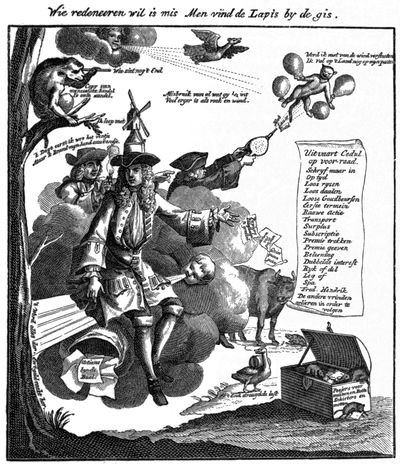
John Law, Wind Monopolist. (Amsterdam, 1720.)
"Law loquitur. The wind is my treasure, cushion, and foundation. Master of the wind, I am master of life, and my wind monopoly becomes straightway the object of idolatry. Less rapidly turn the sails of the windmill on my head than the price of shares in my foolish enterprises."
"Come, gentlemen, weavers, peasants, tailors! Whoever has relied on wind for his profit can find his picture here. They rave like madmen. See the French, the English, the Hebrew, and Jack of Bremen! Hear what a scream the absurd Dutch are making on the exchange of Europe! There is Fortune throwing down some charming wishes to silly mortals, while virtue, art, and intellect are despised and impoverished in the land; shops and counting-houses are empty; trade is ruined. All this is Quincampoix!"
The Dutch caricaturists recurred very often to the windy character of the share business. In several of their works we see a puffy wind-god blowing up pockets to a great size, inflating share-bags, and wafting swiftly along vehicles with spacious sails. The bellows play a conspicuous and not always decorous part. Jean Law is exhibited as a "wind monopolist." In one picture he appears assisting Atlas and others to bear up great globes of wind. Kites are flying and windmills revolving in several pictures. Pigeons fly away with shares in their bills. The hunchback who served as a walking desk is repeated many times. The Tower of Babel, the mad-house, the hospital, the whirligig, a garden maze, the lottery wheel, the drum, the magic lantern, the soap-bubble, the bladder, dice, the swing—whatever typifies pretense, uncertainty, or confusion was brought into the service. One Dutch broadsheet (sixteen inches by twenty), now before me, contains fifty-four finely executed designs, each of which burlesques a scene in Law's career, or a device of his finance, the whole making a pack of "wind cards for playing a game of wind."
Most of the Dutch pictures were "adapted" into English, and the adapters added verses which, in some instances, were better than the caricatures. A few of the shorter specimens may be worth the space they occupy, and give the reader a feeling of the situation not otherwise attainable. Of the pictures scarcely one would either bear or reward reduction, so large are they, so crowded with objects, and their style uninterestingly obsolete or boorishly indecent.
On Puckle's Machine Gun:
"A rare invention to destroy the crowd
Of fools at home instead of foes abroad.
Fear not, my friends, this terrible machine—
They're only wounded that have shares therein."
On the Saltpetre Company (two and sixpence a share):
"Buy petre stock, let me be your adviser;
'Twill make you, though not richer, much the wiser."
On the German Timber Company:
"You that are rich and hasty to be poor,
Buy timber export from the German shore;
For gallowses built up of foreign wood,
If rightly used, will do Change Alley good."
On the Pennsylvania Company:
"Come all ye saints that would for little buy
Great tracts of land, and care not where they lie;
Deal with your Quaking Friends; they're men of light;
Their spirit hates deceit and scorns to bite."
On the Ship-building Company:
"To raise fresh barks must surely be amusing,
When hundreds rot in docks for want of using."
On Settling the Bahamas:
"Rare, fruitful isles, where not an ass can find
A verdant tuft or thistle to his mind.
How, then, must those poor silly asses fare
That leave their native land to settle there?"
On a South Sea Speculator imploring Alms through his Prison Bars:
"Behold a poor dejected wretch,
Who kept a S—— Sea coach of late,
But now is glad to humbly catch
A penny at the prison grate.
"What ruined numbers daily mourn
Their groundless hopes and follies past,
Yet see not how the tables turn,
Or where their money flies at last!
"Fools lost when the directors won,
But now the poor directors lose;
And where the S—— Sea stock will run,
Old Nick, the first projector, knows."
On a Picture of Change Alley:
"Five hundred millions, notes and bonds,
Our stocks are worth in value;
But neither lie in goods, or lands,
Or money, let me tell ye.
Yet though our foreign trade is lost,
Of mighty wealth we vapor,
When all the riches that we boast
Consist in scraps of paper."
On a "Permit:"
"You that have money and have lost your wits,
If you'd be poor, buy National Permits;
Their stock's in fish, the fish are still in water,
And for your coin you may go fish hereafter."
On a Roomful of Ladies buying Stocks of a Jew and a Gentile:
"With Jews and Gentiles, undismayed,
Young tender virgins mix;
Of whiskers nor of beards afraid,
Nor all their cozening tricks.
"Bright jewels, polished once to deck
The fair one's rising breast,
Or sparkle round her ivory neck,
Lie pawned in iron chest.
"The gentle passions of the mind
How avarice controls!
E'en love does now no longer find
A place in female souls."
On a Picture of a Man laughing at an Ass browsing:
"A wise man laughed to see an ass
Eat thistles and neglect good grass.
But had the sage beheld the folly
Of late transacted in Change Alley,
He might have seen worse asses there
Give solid gold for empty air,
And sell estates in hopes to double
Their fortunes by some worthless bubble,
Till of a sudden all was lost
That had so many millions cost.
Yet ruined fools are highly pleased
To see the knaves that bit 'em squeezed,
Forgetting where the money flies
That cost so many tears and sighs."
On the Silk Stocking Company:
"Deal not in stocking shares, because, I doubt,
Those that buy most will ere long go without."
CHAPTER XII.
HOGARTH AND HIS TIME.
These Dutch-English pictures William Hogarth, we may be sure, often inspected as they successively courted public notice in the shops of London, as we see in his early works a character evidently derived from them. During the bubble period of 1720, he was an ambitious young engraver and sign-painter (at least willing to paint signs if a job offered),[19] much given to penciling likenesses and strange attitudes upon his thumb-nail, to be transferred, on reaching home, to paper, and stored away for future use. He was one of those quick draughtsmen who will sketch you upon the spot a rough caricature of any odd person, group, or event that may have excited the mirth of the company; a young fellow somewhat undersized, with an alert, vigorous frame, a bright, speaking eye, a too quick tongue and temper, self-confident, but honest, sturdy, and downright in all his words and ways. "But I was a good paymaster even then" he once said, with just pride, after speaking of the days when he sometimes walked London streets without a shilling in his pocket.
Hogherd was the original name of the family, which was first humanized into Hogert and Hogart, and then softened into its present form. In Westmoreland, where Hogarth's grandfather cultivated a farm—small, but his own—the first syllable of the name was pronounced like that of the domestic animals which his remote ancestors may have herded. There was a vein of talent in the family, an uncle of Hogarth's having been the song-writer and satirist of his village, and his own father emerging from remote and most rustic Westmoreland to settle in London as a poor school-master and laborious, ill-requited compiler of school-books and proof-reader. A Latin dictionary of his making existed in manuscript after the death of the artist, and a Latin letter written by him is one of the curiosities in the British Museum. But he remained always a poor man, and could apprentice his boy only to an engraver of the lowest grade known to the art. But this sufficed for a lad who could scarcely touch paper with a pencil without betraying his gift, who drew capital burlesques upon his nail when he was fifteen, and entertained Addison's coffee-house with a caricature of its landlord when he was twenty-two.
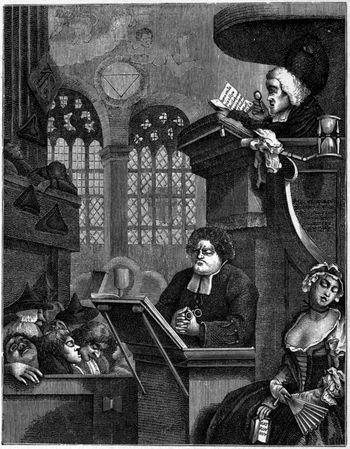
The Sleeping Congregation. (Hogarth.)
The earliest work by this greatest English artist of his century, which has been preserved in the British Museum (1720), shows the bent of his genius as plainly as the first sketch by Boz betrays the quality of Dickens. It is called "Design for a Shop-bill," and was probably Hogarth's own shop-bill, his advertisement to the public that he was able and willing to paint signs. In those days, the school-master not having yet gone "abroad," signs were usually pictorial, and sometimes consisted of the popular representation of the saint having special charge of the business to be recommended. In Hogarth's shop-bill we see a tall man holding up a newly painted sign of St. Luke with his ox and book, at which a group of persons are looking, while Hogarth himself appears to be showing the sign to them as possible customers. Along the bottom of the sign is engraved W. Hogarth, Painter. In the background is seen an artist painting at an easel and a boy grinding colors. He could not even in this first homely essay avoid giving his work something of a narrative character. He must exhibit a story with humorous details. So in his caricature of Daniel Button, drawn to ridicule the Tory frequenters of Button's coffee-house, he relates an incident as well as burlesques individuals. There stands Master Button in his professional apron, with powdered wig and frilled shirt; and opposite to him a tall, seedy, stooping scholar or poet is storming at the landlord with clinched fists, because he will not let him have a cup of coffee without the money. There is also the truly Hogarthian incident of a dog smelling suspiciously the poet's coat tail. Standing about the room are persons whom tradition reports to have been intended as portraits of Pope, Steele, Addison, Arbuthnot, and others of Button's famous customers. This drawing, executed with a brush, is also preserved in the British Museum. Daniel Button, as Dr. Johnson reports, had once been a servant in the family of the Countess of Warwick, and was placed in the coffee-house by Addison. A writer in the Spectator alludes to this haunt of the Tories: "I was a Tory at Button's and a Whig at Child's."
The South Sea delusion drew from Hogarth his first engraved caricature. Among the Dutch engravings of 1720, called forth by the schemes of John Law, there was one in which the victims were represented in a merry-go-round, riding in revolving cars or upon wooden horses, the whole kept in motion by a horse ridden by the devil. The picture presents also the usual multitude of confusing details, such as the Dutch mad-house in the distance, with a long train of vehicles going toward it. In availing himself of this device the young Londoner showed much of that skill in the arrangement of groups, and that fertility in the invention of details, which marked his later works. His whirligig revolves higher in the air than in the Dutch picture, enabling him to show his figures clear of the crowd below, and instead of the devil on horseback giving the motion, he assigns that work more justly to the directors of the South Sea Company. Thus he has room and opportunity to impart a distinct character to most of his figures. We see perched aloft on the wooden horses about to be whirled around, a nobleman with his broad ribbon, a shoe-black, an old woman, a wigged clergyman, and a woman of the town. With his usual uncompromising humor, Hogarth places these last two characters next to one another, and while the clergyman ogles the woman, she chucks him under the chin. There is a world of accessories: a devil exhaling fire, standing behind a counter and cutting pieces of flesh from the body of Fortune and casting them to a hustling crowd of Catholic, Puritan, and Jew; Self-Interest breaking Honesty upon a wheel; a crowd of women rushing pell-mell into an edifice gabled with horns, and bearing the words, "Raffling for Husbands with Lottery Fortunes in here;" Honor in the pillory flogged by Villainy; an ape wearing a sword and cap. The scene chosen by the artist for these remarkable events is the open space in which the monument stands, then fresh and new, which commemorates the Great Fire; but he slyly changes the inscription thus: "This Monument was erected in Memory of the Destruction of this City by the South Sea in 1720."
Hogarth, engraver and sign-painter though he may have been, was all himself in this amusing and effective piece. If the Dutch picture and Hogarth's could be placed here side by side, the reader would have before him an interesting example of the honest plagiarism of genius, which does not borrow gold and merely alter the stamp, but converts a piece of crude ore into a Toledo blade. Unfortunately, both pictures are too large and crowded to admit of effective reduction.
In this, his first published work, the audacious artist availed himself of an expedient which heightened the effect of most of his later pictures. He introduced portraits of living persons. Conspicuous in the foreground of the South Sea caricature, among other personages now unknown, is the diminutive figure of Alexander Pope, who was one of the few lucky speculators of the year 1720. At least, he withdrew in time to save half the sum which he once thought he had made. The gloating rake in the first picture of the "Harlot's Progress" is that typical reprobate of eighteenth-century romances, Colonel Francis Charteris, upon whom Arbuthnot wrote the celebrated epitaph, which, it is to be hoped, is itself a caricature:
18: "Law, son Système et son Époque," p. 2, par P. A. Cochut, Paris, 1853.
19: "Catalogue of Prints and Drawings in the British Museum," Division I., vol. ii., p. 566.
"Here continueth to rot
the body of Francis Charteris,
who, with an INFLEXIBLE CONSTANCY and
INIMITABLE UNIFORMITY of life,
PERSISTED,
in spite of AGE and INFIRMITIES,
in the practice of EVERY HUMAN VICE,
excepting PRODIGALITY and HYPOCRISY.
His insatiable AVARICE exempted him from the first;
his matchless IMPUDENCE from the second.
Oh, indignant reader!
think not his life useless to mankind;
Providence connived at his execrable designs
to give to after-ages a conspicuous
proof and example
of how small estimation is EXORBITANT WEALTH
in the sight of God, by His bestowing it on
the most UNWORTHY OF ALL MORTALS."
Hogarth was as much a humorist in his life as he was in his works. The invitation to Mr. King to eta beta py, given on the next page, was one of many similar sportive efforts of his pencil. He once boasted that he could draw a sergeant carrying his pike, entering an ale-house, followed by his dog, all in three strokes. He produced the following, also given on next page:
He explained the drawing thus: A is the perspective line of the door; B, the end of the sergeant's pike, who has gone in; C, the end of the dog's tail.
Hogarth's Invitation Card.

Nor was he too nice in his choice of subjects for way-side treatment. One of his fellow-apprentices used to relate an anecdote of the time when they were accustomed to make the usual Sunday excursion into the country, Hogarth being fifteen years of age. In a tap-room row a man received a severe cut upon the forehead with a quart beer-pot, which brought blood, and caused him to "distort his features into a most hideous grin." Hogarth produced his pencil and instantly drew a caricature of the scene, including a most ludicrous and striking likeness of the wounded man. There was of necessity a good deal of tap-room in all humorous art and literature of that century, and he was perfectly at home in scenes of a beery cast.
The "Five Days' Peregrination" of Hogarth and his friends, of which Thackeray discoursed to us so agreeably in one of his lectures, occurred when the artist was thirty-four years of age. But it shows us the same jovial Londoner, whose manners and pleasures, as Mr. Thackeray remarked, though honest and innocent, were "not very refined." Five friends set out on foot early in the morning from their tavern haunt in Covent Garden, gayly singing the old song, "Why should we quarrel for riches?" Billingsgate was their first halting-place, where, as the appointed historian of the jaunt records, "Hogarth made the caricature of a porter, who called himself the Duke of Puddle Dock," which "drawing was by his grace pasted on the cellar door." At Rochester, "Hogarth and Scott stopped and played at hop-scotch in the colonnade under the Town-hall." The Nag's Head at the village of Stock sheltered them one night, when, after supper, "we adjourned to the door, drank punch, stood and sat for our pictures drawn by Hogarth." In another village the merry blades "got a wooden chair, and placed Hogarth in it in the street, where he made the drawing, and gathered a great many men, women, and children about him to see his performance." The same evening, over their flip, they were entertaining the tap-room with their best songs, when some Harwich lobster-men came in and sung several sea-songs so agreeably that the Londoners were "quite put out of countenance." "Our St. John," records the scribe of the adventure, "would not come in competition, nor could Pishoken save us from disgrace." Here, too, is a Hogarthian incident: "Hogarth called me up and told me the good-woman insisted on being paid for her bed, or having Scott before the mayor, which last we did all in our power to promote." And so they merrily tramped the country round, singing, drawing, copying comic epitaphs, and pelting one another with dirt, returning to London at the end of the five days, having expended just six guineas—five shillings a day each man.
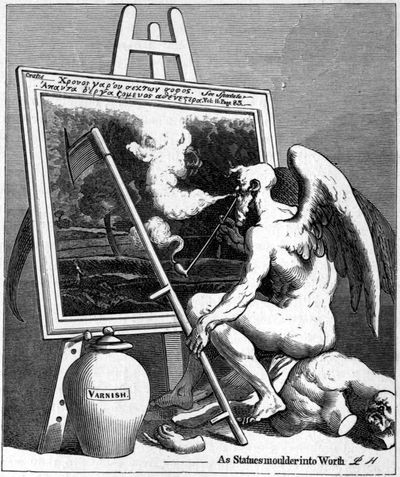
Time Smoking a Picture.
His sense of humor appears in his serious writings. One illustration which he gives in his "Analysis of Beauty," to show the essential and exhaustless charm of the waving line, is in the highest degree comic: "I once heard an eminent dancing-master say that the minuet had been the study of his whole life, and that he had been indefatigable in the pursuit of its beauties, yet at last could only say, with Socrates, he knew nothing, adding that I was happy in my profession as a painter, in that some bounds might be set to the study of it."
In his long warfare with the picture-dealers, who starved living art in England by the manufacture of "old masters," he employed ridicule and caricature with powerful effect. His masterly caricature of "Time smoking a Picture" was well seconded by humorous letters to the press, and by many a passing hit in his more elaborate writings. He maintained that a painting is never so good as at the moment it leaves the artist's hands, time having no possible effect upon it except to impair its beauty and diminish its truth. There was penned at this period a burlesque "Bill of Monsieur Varnish to Benjamin Bister," which is certainly Hogarthian, if it is not Hogarth's, and might well serve as a companion piece to the engraving. Among the items are these:
£
s.
d.
To painting and canvas for a naked Mary Magdalen, in the undoubted style of Paul Veronese
2
2
0
To brimstone, for smoking ditto
0
2
0
Paid Mrs. W—— for a live model to sit for Diana bathing, by Tintoretto
0
16
0
Paid for the hire of a layman, to copy the robes of a Cardinal, for a Vandyck
0
5
0
Paid the female figure for sitting thirty minutes in a wet sheet, that I might give the dry manner of that master
0
10
6
The Tribute-money Rendered, with all the exactness of Quintin Metsius, the famed blacksmith of Antwerp
2
12
6
The Martyrdom of St. Winifred, with a view of Holywell Bath, by old Frank
1
11
6
To a large allegorical altarpiece, consisting of men and angels, horses and river gods; 'tis thought most happily hit off for a Rubens
5
5
0
Paid for admission into the House of Peers, to take a sketch of a great character, for a picture of Moses breaking the Tables of the Law, in the darkest manner of Rembrandt, not yet finished
0
2
6
The idea of a wet sheet imparting the effect of dryness was taken from a treatise on painting, which stated that "some of the ancient masters acquired a dry manner of painting from studying after wet drapery."
This robust and downright Briton, strong in the consciousness of original and native genius, did not object merely to the manufacture of old masters, but also to the excessive value placed upon the genuine productions of the great men of old. He could not feel it to be just or favorable to the progress of art that works representing a state of feeling long ago outgrown in England should take precedence of paintings instinct with the life of the present hour. In other words, he did not enjoy seeing one of his own paintings sell at auction for fourteen guineas, and an Old Master bring a thousand. He grew warm when he denounced "the picture-jobbers from abroad," who imported continually "ship-loads of dead Christs, Holy Families, Madonnas, and other dismal, dark subjects, neither entertaining nor ornamental, on which they scrawl the terrible cramp names of some Italian masters, and fix upon us Englishmen the name of universal dupes." He imagines a scene between one of those old-master mongers and his customer. The victim says:
"'Mr. Bubbleman, that grand Venus, as you are pleased to call it, has not beauty enough for the character of an English cook-maid.' Upon which the quack answers, with a confident air: 'Sir, I find that you are no connoisseur; the picture, I assure you, is in Alesso Baldminetto's second and best manner, boldly painted, and truly sublime: the contour gracious; the air of the head in high Greek taste; and a most divine idea it is.' Then spitting in an obscure place, and rubbing it with a dirty handkerchief, takes a skip to t'other end of the room, and screams out in raptures, 'There's an amazing touch! A man should have this picture a twelvemonth in his collection before he can discover half its beauties!' The gentleman (though naturally a judge of what is beautiful, yet ashamed to be out of the fashion by judging for himself) with this cant is struck dumb, gives a vast sum for the picture, very modestly confesses he is indeed quite ignorant of painting, and bestows a frame worth fifty pounds on a frightful thing, which, without the hard name, is not worth so many farthings."
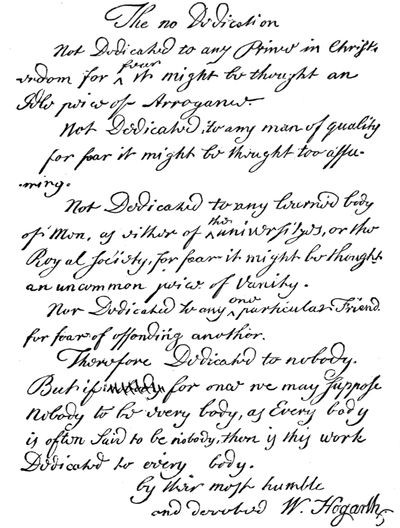
The no Dedication
Not Dedicated to any Prince in Christendom
for fear it might be thought an
Idle piece of Arrogance.
Nor Dedicated to any man of quality
for fear it might be thought too assuming.
Nor Dedicated to any learned body
of Men, as either of the universities or the
Royal Society, for fear it might be thought
an uncommon piece of Vanity.
Nor Dedicated to any one particular Friend
for fear of offending another.
Therefore Dedicated to nobody.
But if for once we may suppose
Nobody to be every body, as Every body
is often said to be nobody, then is this work
Dedicated to every body.
by their most humble and devoted W. Hogarth
Dedication of a Proposed History of the Arts. (From Hogarth's Manuscript.[20])
He gives picture-buyers a piece of advice which many of them have since taken, to the sore distress of their guests: Use your own eyes, and buy the pictures which they dwell upon with delight.
In the heat of controversy, Hogarth, as usual, went too far; but he stood manfully by his order, and defended resolutely their rights and his own. Artists owe him undying gratitude for two great services: he showed them a way to independence by setting up in business on his own account, becoming his own engraver and publisher, and retaining always the ownership of his own plates, which, indeed, constituted his estate, and supported creditably his family as long as any of them lived. He served all artists, too, by defending himself against the pirates who flooded the market with meanly executed copies of his own engravings. It was William Hogarth who obtained from Parliament the first act which secured to artists the sole right to multiply and sell copies of their works; and this right is the very corner-stone of a great national painter's independence. That act made genuine art a possible profession in England.
Such was Hogarth, the original artist of his country, an honest, valiant citizen, who stood his ground, paid his way, cheered and admonished his generation. He had the faults which belong to a positive character, trod on many toes, was often misunderstood, and had his ample share of trouble and contention. All that is now forgotten; and he was never so much valued, so frequently reproduced, so generally possessed, or so carefully studied as at the present time.
The generation that forms great satirists shines in the history of literature, but not in that of morals; for to supply with objects of satire such masters of the satiric arts as Hogarth, Swift, Pope, Gay, Steele, Arbuthnot, and Foote, there must be deep corruption in the State and radical folly in conspicuous persons. The process which has since been named "secularization" had then fairly set in. The brilliant men of the time had learned to deride the faith which had been a restraining force upon the propensities of man for fifteen centuries, but were very far from having learned to be continent, temperate, and just without its aid. "Four treatises against the miracles" Voltaire boasted of having seen during his residence in England in 1727 and 1728; but these treatises did not moderate the warmth of human passions, nor change any other element in the difficult problem of existence. Walpole bribed, Swift maligned, Bolingbroke intrigued, Charteris seduced, and Marlborough peculated just as if the New Light had not dawned and the miracles had remained intact. Do we not, even in our own time, see inquiring youth, bred in strait-laced homes, assuming that since there are now two opinions as to the origin of things, it is no longer necessary to comply with the moral laws? The splendid personages of that period seem to have been in a moral condition similar to that of such a youth. It was the fashion to be dissolute; it was "provincial" to obey those laws of our being from compliance with which all human welfare and all honest joy have come.
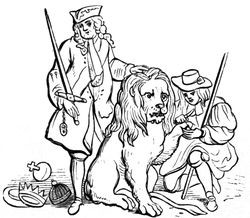
Sir Robert Walpole paring the Nails of the British Lion.
Politics were still most rudimentary. The English people were fully resolved on keeping out the dull and deadly Stuarts; but the price they had to pay for this was to submit to the rule of the dull and difficult Georges, whose bodies were in England and their hearts in Hanover. Between the king and the people stood Sir Robert Walpole—as good a man as could have held the place—who went directly to the point with members and writers, ascertained their price, and paid it. According to one of Pope's bitter notes on the "Dunciad," where he quotes a Parliamentary report, this minister in ten years paid to writers and publishers of newspapers "fifty thousand pounds eighteen shillings!" How much he paid to members of Parliament was a secret known only to himself and the king. The venality of the press was frequently burlesqued, as well as the fulsome pomp of its purchased eulogies. A very good specimen is that which appeared in 1735, during a ministerial crisis, when the opposition had high hopes of ousting the tenacious Walpoles. An "Advertisement" was published, in which was offered for sale a "neat and curious collection of well-chosen similes, allusions, metaphors, and allegories from the best plays and romances, modern and ancient, proper to adorn a panegyric on the glorious patriots designed to succeed the present ministry." The author gave notice that "all sublunary metaphors of a new minister, being a Rock, a Pillar, a Bulwark, a Strong Tower, or a Spire Steeple, will be allowed very cheap;" but celestial ones, being brought from the other world at a great expense, must be held at a higher rate. The author announced that he had prepared a collection of State satires, which would serve, with little variation, to libel a judge, a bishop, or a prime minister. "N.B.—The same satirist has collections of reasons ready by him against the ensuing peace, though he has not yet read the preliminaries or seen one article of the pacification."
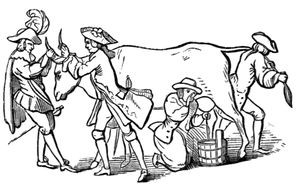
Dutch Neutrality, 1745.
There was also a burlesque "Bill of Costs for a late Tory Election in the West," in which we find such items as "bespeaking and collecting a mob," "a set of No-Roundhead roarers," "a set of coffee-house praters," "Dissenter damners," "demolishing two houses," "committing two riots," "breaking windows," "roarers of the word Church," "several gallons of Tory punch on church tombstones." It is questionable, however, if in all the burlesques of the period there was one more ridiculous than the narrative of an actual occurrence in April, 1715, when the footmen of members of the House of Commons met outside of the House, according to established custom, to elect a Speaker. The Tory footmen cast their votes for "Sir Thomas Morgan's servant," and the Whigs for "Mr. Strickland's man." A dispute arising, a fight ensued between the two parties, in the midst of which the House broke up, and the footmen were obliged to attend their masters. The next day, as soon as the House was in session, the fight was renewed, and, after a desperate struggle, the victorious Whigs carried their man three times in triumph round Westminster Hall, and then adjourned to a Whig ale-house, the landlord of which gave them a dinner, the footmen paying only for their drink.
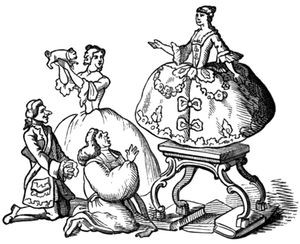
British Idolatry of the Opera-Singer Mingotti, 1756.
"Ra, ra, ra, rot ye,
My name is Mingotti.
If you worship me notti,
You shall all go to potti."
The caricatures of the Walpole period preserve the record of the first attempt to lessen by law the intemperate drinking of gin—the most pernicious of the spirituous liquors. A law was passed imposing upon this article a very heavy excise, and prohibiting its sale in small quantities. But in 1736 England had not reached, by a century and a half, the development of civilization which admits of the adequate consideration of such a measure; nor can the poor man's gin ever be limited by law while the rich man's wine flows free. This gin law appears to have been killed by ridicule. Ballads lamenting the near decease of "Mother Gin" were sung in the streets; the gin-shop signs were hung with black, and there were mock ceremonies of "Madame Geneva's Lying in State," "Mother Gin's Wake," and "Madame Gin's Funeral." Paragraphs notified the public that the funeral of Madame Gin was celebrated with great merriment, many of both sexes "getting soundly drunk," and a mob following her remains with torches. The night before the measure went into operation was one of universal revel among the gin-drinkers, and every one, we are assured, carried off as much of the popular liquor, for future consumption, as he could pay for. The law was evaded by the expedients long afterward employed in Maine, when first a serious attempt was made to enforce the "Maine Law." Apothecaries and others colored their gin, put it into phials, and labeled it "Colic Water," "Make-shift," "The Ladies' Delight," with printed "Directions" to take two or three spoonfuls three or four times a day, "or as often as the fit takes you." Informers sprung into an importance never before known, and many of them invented snares to decoy men into violations of the law. So odious did they become that if one of them fell into the hands of the mob, he was lucky to escape with only a ducking in the Thames or a horse-trough. In short, the attempt was ill-considered and premature, and after an experiment of two or three years it was given up, having contributed something toward the growing unpopularity of the ministry.
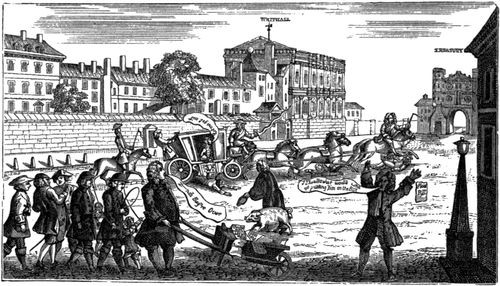
The Motion (for the Removal of Sir Robert Walpole).
The downfall of Sir Robert Walpole, after holding office for twenty years, was preceded by an animated fire of caricature, in which the adherents of Walpole held their own. The specimen given above, entitled "The Motion," was reduced from one of the most famous caricatures of the reign of George II., and one of the most finely wrought of the century.[21] Horace Walpole, son of the great minister, wrote from Florence that the picture had "diverted him extremely," and that the likenesses were "admirable." To us the picture says nothing until it is explained; but every London apprentice of the period recognized Whitehall and the Treasury, toward which the Opposition was driving with such furious haste, and could distinguish most of the personages exhibited. A few days before this caricature appeared, Sandys, who was styled the motion-maker, from the frequency of his attempts to array the House of Commons against the Walpole ministry, moved once more an address to the king, that he would be pleased to remove Sir Robert Walpole from his presence and councils forever. The debate upon this motion was long and most vehement, and though the ministry triumphed, it was one of those bloody victories which presage overthrow. On the same day a similar "motion" was made in the House of Lords by Lord Carteret, where an equally violent discussion was followed by a vote sustaining the ministry. The exultation of the Walpole party inspired this famous caricature, in which we see the Opposition peers trying to reach office in a lordly coach and six, and the Commons trudging toward the same goal on foot, their leader, Pulteney, wheeling a load of Opposition newspapers, and leading his followers by the nose. Every politician of note on the side of the Opposition is in the picture: Lord Chesterfield is the postilion; the Duke of Argyll the coachman; Lord Carteret the gentleman inside the coach, who, becoming conscious of the breakdown, cries, "Let me get out!" Bubb Dodington is the spaniel between the coachman's legs; the footman behind the coach is Lord Cobham, and the outrider Lord Lyttelton. On the side of the Commons there is Sandys, dropping in despair his favorite, often-defeated "Place Bill," and exclaiming, "I thought what would come of putting him on the box?" Much of the humor and point of the picture is lost to us, because the peculiar relations of the persons portrayed to the public, to their party, and to one another can not now be perfectly recalled.
Edition after edition of "The Motion" appeared, one of which was so arranged that it could be fitted to the frame of a lady's fan, a common device at the time. The Opposition retorted with a parody of the picture, which they styled "The Reason," in which Walpole figures as the coachman, driving the coach of state to destruction. Another parody was called "The Motive," in which the king was the passenger and Walpole the driver. Then followed "A Consequence of the Motion," "Motion upon Motion," "The Grounds," and others. The Walpole party surpassed their opponents in caricature; but caricature is powerless to turn back a genuine tide of public feeling, and a year later Sir Robert was honorably shelved in the House of Lords.
From this time forward the history of Europe is recorded or burlesqued in the comic pictures of the shop-window; not merely the conspicuous part played in it by ministers and kings, but the foibles, the fashions, the passions, the vices, the credulities, the whims, of each generation. The British rage for the Italian opera, the enormous sums paid to the singers, the bearish manners of Handel, the mania for gaming, the audacity of highwaymen, and the impositions upon popular credulity no more escape the satirist's pencil than Braddock's defeat, the Queen of Hungary's loss of Silesia, or William Pitt's timely, and also his ill-timed, fits of the gout. Nor were the abuses of the Church overlooked. One picture, entitled "The Fat Pluralist and his Lean Curates," published in 1733, exhibited a corpulent dignitary of the Church in a chariot drawn by six meagre and wretched curates. The portly priest carries under one arm a large church, and a cathedral under the other, while at his feet are two sucking pigs, a hen, and a goose, which he has taken as tithe from a farmyard in the distance. "The Church," says the pluralist, "was made for me, not I for the Church;" and under the wheels of the coach is a book marked "The Thirty-nine Articles." One starving curate cries, piteously, "Lord, be merciful to us poor curates!" to which another responds, "And send us more comfortable livings!" It required a century of satire and remonstrance to get that one monstrous abuse of the Church Ring reduced to proportions approaching decency. Corruption in the city of New York in the darkest days of Tweed was less universal, less systematic, less remote from remedy, than that of the Government of Great Britain under the least incapable of its four Georges. It was merely more decorous.
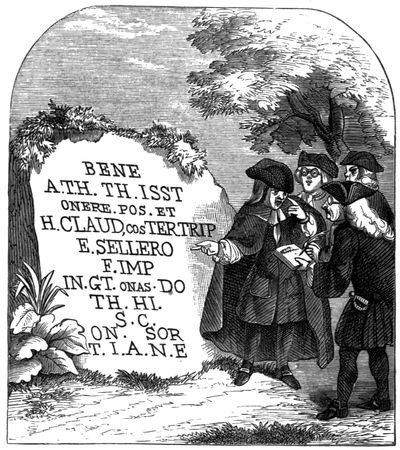
Antiquaries Puzzled. (London, 1756.)
A specimen of the harmless, good-humored satire aimed at the zealous antiquaries of the last century is given above. This picture may have suggested to Mr. Dickens the familiar scene in "Pickwick" where the roving members of the Pickwick Club discover the stone commemorative of Bill Stumps. The mysterious inscription in the picture is, "Beneath this stone reposeth Claud Coster, tripe-seller of Impington, as doth his consort Jane."
CHAPTER XIII.
ENGLISH CARICATURE IN THE REVOLUTIONARY PERIOD.
It is part of the office of caricature to assist in destroying illusions that have served their turn and become obstructive. As in Luther's time it gave important aid to the reformers in breaking the spell of the papacy, so now, when kingship broke down in Europe, the satiric pencil had much to do with tearing away the veil of fiction which had so long concealed the impotence of kings for nearly every thing but mischief.
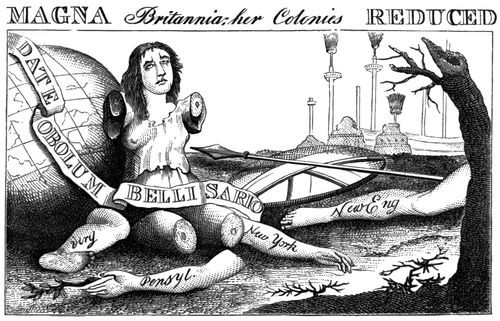
A Caricature designed by Benjamin Franklin. (London, 1774.)
Explanation by Dr. Franklin: "The Colonies (that is, Britannia's limbs) being severed from her, Britannia is seen lifting her eyes and mangled stumps to heaven; her shield, which she is unable to wield, lies useless by her side; her lance has pierced New England; the laurel branch has fallen from the hand of Pennsylvania; the English oak has lost its head, and stands a bare trunk, with a few withered branches: briers and thorns are on the ground beneath it; the British ships have brooms at their topmast heads, denoting their being on sale; and Britannia herself is seen sliding off the world (no longer able to hold its balance), her fragments overspread with the label, Date obolum Bellisario" (Give a farthing to Belisarius).
The fatal objection to the hereditary principle in the government of nations is the importance which, to use Mr. Jefferson's words, it "heaps upon idiots." Idiot is a harsh word to apply to a person so well disposed as George III., King of England, to whom the violence of the Revolutionary period was chiefly due; but when we think of the evil and suffering from which Europe could have been saved if he had known a little more or been a little less, we can not be surprised that contemporaries should have summed him up with disrespectful brevity. But for him, so far as short-sighted mortals can discern, the period of bloody revolution could have been a period of peaceful reform. After exasperating his subjects nearly to the point of rebellion, he precipitated the independence of the American colonies, which, in turn, brought on the French Revolution, and that issued in Napoleon Bonaparte, whose sins France only finished expiating at Sedan.
It is true, there must have been in Great Britain myriads upon myriads of such heads as that of King George to make his policy possible. But suppose that, instead of placing himself at the head of the dull minds in his empire, he had given the prestige of the crown to the bright and independent souls! Suppose he had taken as kindly to Chatham, Burke, Fox, Franklin, Price, Priestley, and Barré as he did to Bute, Dr. Johnson, Addington, and Eldon!
And see how this heir to the first throne in Christendom was educated. That period has been so laid bare by diaries and correspondence that we can visit the orphan boy in his home at Carlton House, and listen to his mother, the widowed Princess of Wales, as she describes his traits and laments the defects of his training. Go back to the year 1752, and imagine a drawing-room in a royal residence. The dinner hour then had only got as far toward "to-morrow" as three in the afternoon, and therefore by early candle-light of an October evening the drawing-room may be supposed to be inhabited. The Princess of Wales, born a princess of a petty German sovereignty, still a young mother, is dressed in mourning, her husband being but a few months dead. Of the duties belonging to royalty she had no ideas except those which had prevailed from time immemorial at the court of absolute German sovereigns. Her chief care was to preserve the morals of her children, and to have her eldest son a king in reality as well as in name. "Be king" (Sois roi) were favorite words with her, often repeated in the hearing of the heir to the throne. She thought it infamy in a king to allow himself to be ruled by ministers. There is no reason to doubt that she was an honorable lady and affectionate mother. Horace Walpole's insinuation that she instilled virtuous principles into the mind of her son because she "feared a mistress," and that her intimacy with Lord Bute was a criminal intrigue, dishonors Horace Walpole and human nature, but not the mother of George III.
She has company this evening—Bubb Dodington, a gentleman of great wealth and agreeable manners, who controlled six votes in the House of Commons, and passed his life in scheming to buy a peerage with them, in which, a year before his death, he succeeded, but left no heir to inherit it. He was much in the confidence of the princess, and she had sent for him to "spend the day" with her. Dinner is over, the two ladies-in-waiting are present, and now the "children" enter to play a few games of cards with their mother before going to bed. The children are seven in number, of whom the eldest was George, Prince of Wales—a boy of fourteen, of fresh complexion, sturdy and stout in form, and a countenance open and agreeable, and wearing an expression of honesty. Human nature rarely assumes a more pleasing form than that of a healthy, innocent English boy of fourteen. He was such a boy as you may still see in the play-grounds of Eton, only he was heavier, slower, and ruddier than the average, and much more shy in company. He loved his horse, and was exceedingly fond of rural sports; but when lesson-time came—but let his mother speak on that point.
The old game of "comet" was the one which the lad usually preferred. The company play at comet for small stakes, until the clock strikes nine, when "the royal children" go to bed. Then the mother leaves her ladies, and withdraws with her guest to the other end of the room, where she indulges in a long, gossipy, confidential chat upon the subject nearest her heart—her son, the presumptive heir to the throne. To show the reader how she used to talk to confidants on such occasions, I will glean a few sentences from her conversations:
"I like that the prince should amuse himself now and then at small play; but princes should never play deep, both for the example, and because it does not become them to win great sums. George's real disposition, do you ask? You know him almost as well as I do. He is very honest, but I wish he was a little more forward and less childish at his age. I hope his preceptors will improve him. I really do not know what they are teaching him, but, to speak freely, I am afraid not much. They are in the country, and follow their diversions, and not much else that I can discover."
Dodington remarked upon this that, for his part, he did not much regard books; what he most wished was that the prince should begin to acquire knowledge of the world, and be informed of the general frame and nature of the British Government and Constitution, and, without going into minutiæ, get some insight into the manner of doing public business.
"I am of your opinion," said the princess; "and his tutor, Stone, tells me that when he talks with him on those subjects, he seems to give proper attention, and makes pertinent remarks. I stick to the learning as the chief point. You know how backward the children were, and I am sure you do not think them much improved since. It may be that it is not too late to acquire a competence. I am highly sensible how necessary it is that the prince should keep company with men. I know that women can not inform him; but if his education was in my power absolutely, to whom could I address him? What company can I wish him to keep? What friendships can I desire him to contract? Such is the universal profligacy, such is the character and conduct of the young people of distinction, that I am really afraid to have them near my children. I shall even be in more pain for my daughters than I am for my sons, for the behavior of the women is indecent, low, and much against their own interest by making themselves so very cheap."
Three years passed. The prince was seventeen. Still the anxious mother deplored the neglect of his education.
"His book-learning," said she to the same friend, "I am no judge of, though I suppose it is small or useless; but I did hope he might have been instructed in the general understanding of things. I once desired Mr. Stone to inform the prince about the Constitution; but he declined it to avoid giving jealousy to the Bishop of Norwich (official educator). I mentioned it again, but he still declined it as not being his province."
"Pray, madam," asked Dodington, "what is his province?"
"I don't know, unless it is to go before the prince up-stairs, to walk with him sometimes, seldomer to ride with him, and now and then to dine with him. But when they do walk together, the prince generally takes that time to think of his own affairs and say nothing."
The youth was, indeed, extremely indolent and stupid. At school he would have been simply called a dunce, for at eleven he could not read English with any fluency, and he could never have been induced to apply his mind to study except by violence. He never had the slightest notion of what Chatham, Burke, or Fox meant when they spoke of the Constitution. If Mr. Stone had not been in dread of invading the Bishop of Norwich's province, and if the bishop had not been a verbose and wearisome formalist, their united powers could not have shown this young man the unique and prodigious happiness of a constitutional king in governing through responsible ministers. His "governor" during the last few years of his minority was Lord Waldegrave, whose too brief memoirs confirm the excellent report which contemporaries give of his mind and character. Lord Waldegrave could make nothing of him. Speaking of the prince at nineteen, he says he was "uncommonly full of princely prejudices, contracted in the nursery and improved by the society of bedchamber women and pages of the back-stairs." He found the heavy youth an insufferable bore, and he was soon, as his relation, Horace Walpole, relates, "thoroughly fatigued with the insipidity of his pupil." The prince derived from his education only two ideas, one very good and the other very bad. The first was that he must be a Good Boy and not keep a mistress; the second was that he must be a king indeed.
An indolent and ignorant monarch who will not govern by ministers must govern by favorites. He has no other alternative but abdication. A favorite was at hand in the person of a poor Scotch lord who had married one of the richest heiresses in Europe, the daughter of Lady Mary Wortley Montagu and her miserly husband. He had also, if we may believe Lord Waldegrave, "a good person, fine legs, and a theatrical air of the greatest importance." He was likewise fond of medals, engravings, and flowers; he pensioned Dr. Johnson and the dramatist Home; he really enjoyed some products of art, and was far from being either the execrable or the ridiculous personage which he was esteemed by men whom he kept from place. "Bute," said Prince Frederick, father of George III., "you would make an excellent embassador in a small, proud little court where there is nothing to do." He would have arranged the ceremonials, superintended the plays, been gracious to artists and musicians, smiled benignantly upon the court poet, bored the reigning prince, enchanted the reigning princess, amused her children, and ripened into a courtly and garrulous old Polonius, "full of wise saws and modern instances." Above all, he would have upheld the prerogative of the prince with stanch sincerity. Sois roi!
There is something in the Scotch character that causes it to relish royal prerogative. To this hour there are in Scotland families that cherish a kind of sentimental attachment to the memory of the Stuarts; and we find Scotchmen as eminent as Hume, Carlyle, Lockhart, Scott, Wilson—men of distinguished liberality in some provinces of thought—unable to widen out into liberal politics. Bute was a lord as well as a Scotchman, not as ignorant nor as vulgar as lords in that generation usually were, but still subject to the lowering influences that always beset a privileged order; predisposed, too, by temperament to the worship of the picturesque, and now the cherished sharer of the shy, proud, gloomy seclusion of the family upon which the hopes of an empire were fixed. He showed them medals and pictures, he discoursed of music and architecture—two of his most pronounced tastes—and he nourished every princely prejudice which a wise tutor would have striven to eradicate.
This unfortunate youth, dull offspring of the stimulated lust of ages, was an apt pupil in the Jacobin theory of kingly authority. He was caught one day reading the book written at the instance of the dethroned James II. to justify his arbitrary policy; and there were so many other signs of the heir to a constitutional throne being educated in unconstitutional principles that Horace Walpole drew up a formal remonstrance against it in the name of the Whig families. This document, which was privately circulated, produced no effect. Sois roi! That remained the ruling thought in the mind of this ignorant, proud, moral young man, about to fill a place which conferred more obstructive power than any other in the world. If he had only been dissolute in that most dissolute age, he could have been ruled through his vices; but being strictly moral and temperate, he was, alas! always himself; and he had at his back the great voiceless multitude, who know by instinct that morality is the first interest of civilized human nature, and who honor it supremely even in this crude, rudimentary form. "Your dad is safe on his throne," said some boon companion of George IV., "as long as he is faithful to that ugly old woman, your mother." And wise old Franklin said, "If George III. had had a bad private character and John Wilkes a good one, he might have turned the king out of his dominions." Such is the mighty power of the mere indispensable rudiments of virtue, its mere preliminary corporeal conditions. A chaste and temperate fool will carry the day nine times in ten over profligate genius.
Riding in the park on an October day in 1760, a messenger delivered to the prince a note from the valet de chambre of his grandfather, George II. The prince had coolly arranged with this valet, while yet the king seemed firm in health, that at the moment of the old man's death he should send him a note bearing a certain mark on the outside. The king, a vigorous old man of seventy-seven, fell dead in his closet at seven in the morning, and this note bore the preconcerted announcement of the fact. The moral and steady young man, quietly remarking to his groom that his horse was lame, turned about and gently rode back to Kew. Upon dismounting he said to the man, "I have said this horse is lame; I forbid you to say the contrary." At twenty-two years of age he was king. Except that he married, a few months after, a pliant, adoring German princess, his accession did not much change his mode of life. He still lived in strict seclusion, shut in against expanding influences, accessible at all times only to one man—him of the good legs and Jacobin mind, Bute, progenitor of the Pope's recent conquest, and Mr. Disraeli's hero, Lothair.

Lord Bute, 1768.

Princess of Wales—Bute—George III.
In the caricatures of the next fifty years we see the ghastly results. His first important act was to repel from his counsels humiliating superiority in the person of William Pitt, the darling of the nation, the first minister of the world, and one of the three great orators of all time. In his stead ruled a long monotony of servile incompetents, beginning with Bute himself, continuing with Grenville, and coming at last to Addington and Eldon, the king keeping far from his confidence every man in England who had a gleam of public sense, or a touch of independent spirit, or even a sound traditionary attachment to Whig principles. An immovable obstructive to the true interest of his country at every crisis, honoring the men whom the better sense of the nation did not honor, and repressing the men whom wise contemporaries loved, and whom posterity with unanimous voice pronounces the glory of England in that age, he kept the country in bad humor during most of his reign, put her wrong on every question of universal interest, lost the most valuable and affectionate colonies a country ever had, kept Europe in a broil for twenty-five years, and developed Napoleon Bonaparte into a destructive lunatic by creating for him a succession of opportunities for the display of his talent for beating armies which had no generals.
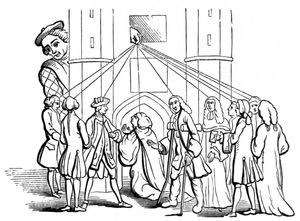
The Wire-master (Bute) and his Puppets. (London, 1767.)
"The power behind the throne greater than the throne itself."
A large proportion of the very caricatures of the period have something savage in them. A visitor to the library of the British Museum curious in such matters is shown ten huge folio scrap-books full of caricatures relating to this reign, most of them of great size and blazing with color. From a gentleman who recently inspected these volumes we learn some particulars showing the bad temper, bad manners, and bad morals of that time, all three aggravated by a king whose morals were excellent. One of the first to catch the eye of an American is a picture, of date about 1765, called "A New Method of Macarony-making, as practiced in Boston, North America," which represents two men tarring and feathering another, who has a halter round his neck. Of the pictures reflecting upon Lord Bute and the Princess of Wales nothing need be said except that they are such as might be expected from the caricaturists of that age. Many of the works of Gillray in the earlier years of George III. were of such coarseness, extravagance, and brutality that the exhibition of them nowadays would subject the vender to a prosecution by the Society for the Suppression of Vice. Our informant adds: "Their savageness and filth give one a very curious idea of the taste of our grandfathers and our great-grandfathers, only our ancestors, male and female, could hardly have been as bad as they are represented. Such hideous faces, such deformed figures, such monstrous distortion and debasement, such general ugliness and sensuality, oppress one with a feeling of melancholy rather than exhilaration. You might as well be merry over the doings of Swift's Yahoos, who are certainly not more offensive than some of Gillray's men and women. Whether in home or foreign politics, he is equally unscrupulous."
Charles James Fox was the bête noire of Gillray. He delighted in depicting him and his friends in as odious a light as possible, giving him huge beetle-brows, heavy jaws, and a swarthy complexion. The famous Westminster election, at which the beautiful Duchess of Devonshire won a vote for Fox by giving a kiss to a butcher, supplied him with a rich source of caricature. Fox is drawn riding on the back of the lady; and again, sitting in a tap-room with the duchess on his knee; and in another picture, hobnobbing with a coster-monger, while the duchess has her shoes mended by a cobbler, and pays the cobbler's wife with a purse of gold. Fox chops off the head of the king; he is a traitor, a republican, a Jacobin, a confederate with the French, a forestaller, a buyer-up of corn with which to feed the enemy, a sot, a gambler—every thing that is bad. His very death-bed forms the subject of a brutal caricature. The noblest traits of his political character are the points satirized. His great crimes apparently are that he loved freedom abroad as well as at home, that he strove for peace with France, and endeavored to do justice to Ireland. For this he is depicted as the secret ally of Bonaparte and as the instigator of Irish rebellion. The ghosts of Lord Edward Fitzgerald, Wolfe Tone, the Sheares brothers, Emmett, and other Irish martyrs are made to pass before Fox's bed, and point to him as the cause of their rebellion and their fate. When Burke went over to the Tories he then became the favorite of Gillray, who before had generally represented him as a Jesuit, because he demanded justice for the Catholics. Now he is the savior of his country, and the terror of Fox, Sheridan, and Priestley. Sheridan is depicted as a blazing meteor with an extremely rubicund nose. There is a picture of the Titans attempting to scale heaven, in which George III. figures as a comical Jupiter launching his thunder-bolts at the Whig Opposition. Queen Charlotte is shown as a miracle of ugliness. The prodigality of the Prince of Wales, who first appears as a handsome young man with long powdered hair, totally unlike the high-shouldered, curly-wigged, royal Turveydrop of later days, is contrasted in companion pictures with the alleged parsimony of his parents. He is represented reveling with inordinately fat but handsome women, who get drunk, hang round his neck, and indulge in familiarities. The popular hope that marriage would reform him suggested a large drawing, in which the slumbering prince is visited by a descending angel in the likeness of the unhappy Caroline, at whose approach a crowd of reprobates, male and female, hurry away into darkness. Thomas Paine did not escape. In a picture entitled "The Rights of Man; or, Tommy Paine, the Little American Taylor, taking the Measure of the Crown for a New Pair of Revolution Breeches," he is represented as the traditional starveling tailor, ragged and slippered, and armed with an immense pair of shears. He crouches to take the measure of an enormous crown, while uttering much irrelevant nonsense. This precious work is "humbly dedicated to the Jacobin clubs of France and England."
Bound with such pictures as these are a vast number by inferior hands, most of which are indescribable, the standard subjects being gluttony, drunkenness, incontinence, and fashion, and these in their most outrageous manifestations. They serve to show that a stupid king in that age, besides corrupting Parliament and debauching the Press, could demoralize the popular branch of art. The visitor, turning from this collection of atrocities and ferocities, finds himself relenting toward the unfortunate old king, and inclined to say that he was, after all, only the head noodle of his kingdom. Every improvement was mercilessly burlesqued—steam, gas, the purchase of the Elgin marbles; popular prejudices were nearly always flattered, seldom rebuked; so that if the caricatures were of any use at all in the promulgation of truth, they served only as part of the ordeal that tested its vitality.
We do not find in this or in any other collection many satirical pictures relating to the revolution which ended in the independence of the American colonies. There was, however, one gentleman in London during the earlier phases of the dispute who employed caricature and burlesque on behalf of America with matchless skill. He is described in the London Directory for 1770 in these words, "Franklin, Benjamin, Esq., agent for Philadelphia, Craven Street, Strand." The effective caricature placed at the beginning of this chapter was one of the best of a long series of efforts to avert the impending conflict. He loved his country with the peculiar warmth that usually animates citizens who live in a distant outlying province. His country, when he designed that caricature and wrote the well-known burlesques in a similar taste, was not Pennsylvania, nor America, nor England, but the great British Empire, to which William Pitt, within Franklin's own life-time, seemed to have given an ascendency over the nations of the earth similar to that which Rome had once enjoyed. It was, however, only on the coast of North America that Britain possessed colonies loyal and free, not won by conquest nor by diplomacy, and therefore entitled to every right secured by the British Constitution. Franklin loved and gloried in this great country of which he was born a citizen. He deplored the measures that threatened the severance of those colonies from the mother country, and would have prevented the severance if the king's folly had been any thing short of incurable. The most wonderful thing in the whole controversy was that the argument, fact, and fun which Franklin wrote and inspired, from 1765 to 1774, had only momentary influence on the course of events. "Against stupidity the gods themselves contend in vain."
20: "Hogarth's Works," frontispiece to vol. iii., by Ireland and Nichols.
21: Thomas Wright, "Caricature History of the Georges," p. 128.
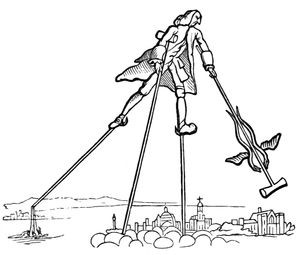
The Gouty Colossus, William Pitt (Lord Chatham), with One Leg in London and the Other in New York. (London, 1766.)
His twenty "Rules for Reducing a Great Empire to a Small One," published three years before the caricature, inculcated the same lesson. A great empire, he remarked, was in one particular like a great cake: it could be most easily diminished at the edges. The person, therefore, who had undertaken the task of reducing it should take care to begin at the remotest provinces, and not till after they were lopped off cut up the central portion. His twenty "Rules" are merely a humorous history of the British colonial policy since the accession of George III.: Don't incorporate your colonies with the mother country, quarter troops among them, appoint for their governors broken gamblers and exhausted roués, despise their voluntary grants, and harass them with novel taxes. By such measures as these "you will act like a wise gingerbread baker, who, to facilitate a division, cuts his dough half through at the places where, when baked, he would have it broken to pieces." Franklin also wrote a shorter burlesque, pompously headed, "An Edict of the King of Prussia," in which that monarch was supposed to claim sovereign rights over Great Britain on the ground that the island had been colonized by Hengist, Horsa, and others, subjects of "our renowned ducal ancestors." The edict, of course, ordains and commands precisely those absurd things which the Government of Great Britain had ordained and commanded since the planting of the colonies. Iron, as the edict duly sets forth, had been discovered in the island of Great Britain by "our colonists there," who, "presuming that they had a natural right to make the best use they could of the natural productions of their country," had erected furnaces and forges for the manufacture of the same, to the detriment of the manufacturers of Prussia. This must be instantly stopped, and all the iron sent to Prussia to be manufactured. "And whereas the art and mystery of making hats has arrived at great perfection in Prussia," and "the islanders before mentioned, being in possession of wool, beaver, and other furs, have presumptuously conceived they had a right to take some advantage thereof by manufacturing the same into hats, to the prejudice of our domestic manufacture," therefore we do hereby forbid them to do so any more.
We call this piece a burlesque, but it was burlesque only in form. Precisely such restrictions existed upon the industry of the American colonists. It was part of the protective system of the age, and not much more unjust than the parts of the same system to which the descendants of those colonists have since subjected themselves.
An ignorant man at the head of a government, however honest he may be, is liable to make fatal mistakes in the selection of his ministers. He naturally dreads the close inspection of minds superior to his own. He has always to be on his good behavior before them, which is irksome. He shares the stock prejudices of mankind, one of which is a distrust of practiced politicians. But as the poorest company of actors will get through a comedy with less discredit than the best amateurs, so an administration of "party hacks" will usually carry on a government with less odious failure than an administration composed of better men without experience in public business. George III. had, moreover, a singularly unfortunate trait for a king who had to govern by party leaders—his prejudices against individuals were inveterate. Lord Waldegrave remarked "a kind of unhappiness in his temper" while he was still a youth. "Whenever he is displeased, his anger does not break out with heat and violence, but he becomes sullen and silent, and retires to his closet, not to compose his mind by study and contemplation, but merely to indulge the melancholy enjoyment of his own ill-humor." And when he re-appeared, it was but too evident that he had not forgotten the offense. He never forgot, he seldom forgave. "The same strength of memory," as Earl Russell once wrote of him, "and the same brooding sullenness against those who opposed his will, which had been observed in the boy, were manifest in the man."
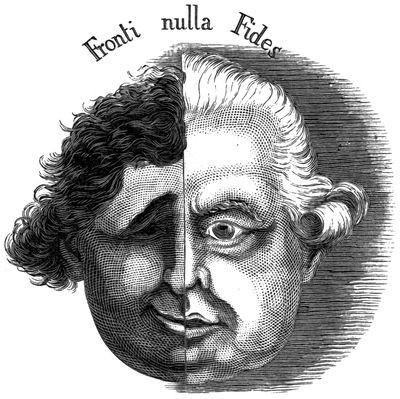
The Mask (Coalition).
This peculiarity of character always prevented the formation of a proper ministry, and shortened the duration of every ministry which was approximately proper. During the first ten years of his reign his dislike of William Pitt, the natural chief of the Whig party, confused every arrangement; and during the next twenty years the most cherished object of his policy seemed to be to keep from power the natural successor of that minister—Charles James Fox. The ascendency of both those leaders was such that to exclude them from power was to paralyze their own party, and prevent the free play of politics in the House of Commons. It reduced the poor king at last to pit against Napoleon Bonaparte a young rhetorician of defective health, William Pitt, the son of the great minister.
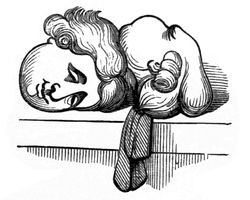
Heads of Fox and North.
"In a committee on the sense of the nation, Moved, that for preventing future disorders and dissensions, the heads of the Mutiny Act be brought in, and suffered to lie on the table to-morrow."—Fox's Motion in Parliament, February, 1784.
That renowned "coalition" between Lord North and Mr. Fox in 1783, the theme of countless caricatures and endless invective, illustrates the confusing influence of the king. During the whole period of the American Revolution, Lord North, as the head of the ministry, was obliged to execute and defend the king's policy, much of which we now know he disapproved. Naturally he would have been an ally of Fox years before, and they could either have prevented or shortened the conflict. The spell of the royal closet and the personal entreaties of the king prevailed over his better judgment, and made him the antagonist of Fox. At length, the war being at an end and North in retirement, England saw these two men, whose nightly conflicts had been the morning news for ten years, suddenly forming a "coalition," united in the administration, and pledged to the same policy. As we trace the successive steps which led to the alliance in the memoirs and diaries of the time, we discover that it was not so much the coalition as the previous estrangement that was unnatural. The public, however, could not be expected to see it in that light, and an uproar greeted the reconciliation that greatly aided the king in getting rid of the obnoxious Fox. The specimens of the caricatures to which it gave rise, presented on this and the two preceding pages, are two out of a great number still procurable.
CHAPTER XIV.
DURING THE FRENCH REVOLUTION.
In France, more conspicuously than in England, kingship broke down in that century. Louis XV., born in a private station, might have risen to the ownership of a small livery-stable, in which position his neighbors, commenting upon his character in the candid manner of French neighbors, would have epitomized him as a cross, proud pig. Those dull kings who finished kingship in Europe possessed but one trait which we usually associate with the kingly character—pride—and this was the single point of resemblance between Louis XV. and George III. Once in his life, it is related, Louis XV. uttered a few words with a vivacity approaching eloquence. "Would you believe," said he to Madame de Pompadour, "that there is a man in my court who dares to lift his eyes to one of my daughters?" He was blazing with passion at the thought of such flagrant impiety.
And was there ever, since sacred childhood first appealed for protection to the human heart, a child so unhappily placed as that baby king, an orphan, with a roué for a guardian, a smooth, insinuating priest for preceptor, and a dissolute court conspiring to corrupt him? The priest, who represented what then passed for virtue, taught him virtue out of a dreary catechism, still extant, which never yet elevated or nobly formed a human soul—a dead, false thing, with scarcely an atom in it of sound nutrition for heart or mind. But Cardinal Fleury had some success with his pupil. Thirty years after, when Pompadour was supplying him with fresh young girls of fourteen and fifteen, bought from their mothers by her for this purpose, the king's conscience would not permit him to go to bed until he had knelt down by the side of the timid victim, and required her to join him in saying the prescribed prayers.
The courtiers were not less successful in their endeavors. At the tender age of six years they provided for him an entertainment which gave the old Marquis de Dangeau the idea that they had formed the purpose of "drying up in him the very source of good feeling." They caused thousands of sparrows to be let loose in a vast hall, where they gave the boy the "divertissement" of seeing them shoot the birds, and covering all the floor with bloody, fluttering, crying victims. He doubtless enjoyed the spectacle, for at sixteen he shot in cold blood a pointer bred by himself, and accustomed to feed from his hand. So rude was he at seventeen, the chroniclers tell us, that the courtiers used all their arts to give him du goût pour les femmes, hoping thereby to render him "more polite and tractable." The precise manner in which a bevy of illustrious princesses and duchesses sought to débaucher le roi during one of the royal hunts is detailed in the diaries and satirized in the epigrams of the time.
The ladies, long frustrated by the "ferocity" of the youth, who cared only for hunting, succeeded at last, and succeeded with the applause of all the court. "Every one else has a mistress," remarks Barbier, advocate and magistrate; "why shouldn't the king?" It was a long reign of mistresses. Changes of ministry, questions of peace or war, promotions and appointments of generals and admirals, the arrest of authors and nobles—all were traceable to the will or caprice of a mistress. Frederick of Prussia styled Pompadour, Petticoat the Third, which some one was kind enough to report to her; and when Voltaire, whom she "protected," conveyed to the Prussian monarch a complimentary message, he replied, coldly, "I don't know her." Maria Theresa of Austria, a proud and high-principled lady, stooped to recognize her existence, and wrote her civil notes. If there is any truth in the printed gossip of the innermost court circles of that period, it was this difference in the treatment of the king's mistress which made France the ally of Austria in the Seven Years' War.
Would the reader like to know how affairs go on in a court governed by a mistress, then let him ponder this one sample anecdote, related by the femme de chambre of Madame de Pompadour, showing how she, femme de chambre as she was, obtained a lieutenant's commission in the army for one of her relations. She first asked "madame" for the commission; but as madame was in full intrigue to remove the Minister of War, this application did not succeed. "Pressed by my family," the femme de chambre relates, "who could not conceive that, in the position in which I was, it could be difficult for me to procure a trifling commission for a good soldier, I asked it directly from the minister himself. He received me coldly, and gave me little hope. On going out, the Marquis de V—— followed me, and said: 'You desire a commission. There is one vacant, which has been promised to a protégé of mine; but if you are willing to exchange favors with me, I will yield it to you. What I desire is to play the part of Exempt de Police in "Tartuffe" the next time madame gives it in the palace before the king. It is a rôle of a few lines only. Get madame to assign that part to me, and the lieutenancy is yours.' I told madame of this. The thing was done. I obtained my lieutenancy, and the marquis thanked madame for the rôle as warmly as if she had made him a duke."
Generals were appointed to the command of expeditions for no better reason than this. That Pompadour drew thirty-six millions of francs from the "royal treasury," i. e., from the earnings of the frugal and laborious French people, could easily have been borne. It was government by mistresses and for mistresses, the government of ignorant and idle caprice, that broke down monarchy in France and set the world on fire. Of the evils which corrupt rulers bring upon communities, the waste of the people's money (though that is a great evil in so poor a world as ours, with such crowds of poor relations and so much to be done) is among the least. It is the absence of intelligence and public spirit in the Government that brings on ruin.
"As long as I live," said Louis XV. one day to Madame de Pompadour, "I shall be the master, to do as I like. But my grandson will have trouble." Madame was of the same mind, but gave it neater expression: "After us the deluge."
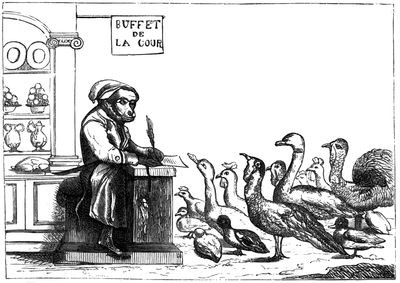
Assembly of the Notables at Paris, February 22d, 1787.[22]
"Dear objects of my care, I have assembled you to ascertain with what sauce you want to be eaten."
"But we don't want to be eaten at all."
"You are departing from the question."
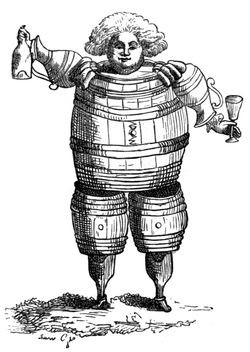
Mirabeau.[23] (Paris, 1789.)
The world is familiar with the tragic incidents of the sudden collapse of the monarchy. Except during the Reign of Terror, which was short, the caricaturists, whether with the pen or the pencil, played their usual part. It was almost impossible to caricature the abuses of the times, so monstrous was the reality. The "local hits" in Beaumarchais' "Marriage of Figaro," played with rapturous applause a hundred nights in 1784, were little more than the truth given with epigrammatic brevity. When the saucy page, Cherubin, confessed that he had behaved very badly, but rested his defense upon the fact that he had never been guilty of the slightest indiscretion in words, and so obtained both pardon and promotion, the audience must have felt the perfect congruity of the incident with the moral code of the period. In Figaro's famous discourse on the English God-dam there is, indeed, a touch of caricature: "A fine language the English; a little of it goes a great way. The English people, it is true, throw in some other words in the course of conversation, but it is very easy to see that God-dam is the basis of their language." When he descants upon politics, he rarely goes beyond the truth: "Ability advance a man in the Government bureaus! My lord is laughing at me. Be commonplace and obsequious, and you get every thing." Figaro gives the whole art of French politics in a few words: "To pretend you don't know what you do know, and to know what you don't; to hear what you understand, and not to hear what you don't understand; and especially to pretend you can do a great deal more than you can; often to have for a very great secret that there is no secret; to shut yourself up to mend pens and seem profound, when you are only empty and hollow; to play well or ill the part of a personage; to spread abroad spies and pensioned traitors; to melt seals, intercept letters, and try to ennoble the poverty of the means by the importance of the ends—may I die if that isn't all there is of politics." It is a good hit of Susan's when she says that vapors are "a disease of quality," only to be taken in boudoirs. A poor woman whose cause is coming on at court remarks that selling judgeships is a great abuse. "You are right," says the dolt of a magistrate; "we ought to get them for nothing." And how a Paris audience, in the temper of 1789, must have relished the hits at the hereditary principle: "It is no matter whence you came; the important question is, whither are you bound?" "What have you done, my lord, to merit so many advantages—rank, fortune, place? You took the trouble to be born, nothing more." We can fancy, too, how such touches as this might bring down the house: "I was thought of for an office, but unfortunately I was fit for it. An arithmetician was wanted; a dancer got it."
All men, as Mr. Carlyle observes, laughed at these jests, and none louder than the persons satirized—"a gay horse-racing Anglo-maniac noblesse loudest of all."
The first picture given in these pages relating to the French Revolution, "The Assembly of the Notables," is one of the most celebrated caricatures ever produced, and one of the best. Setting aside one or two of Thackeray's, two or three of Gillray's, and half a dozen of Mr. Nast's, it would be difficult to find its equal. It may be said, however, that the force of the satire is wholly in the words, which, indeed, have since become one of the stock jokes of French Joe Millers. The picture appeared in 1787, when the deficit in the revenue, after having widened for many years, had become most alarming, and it was at length proposed to tax the nobility, clergy, and magistrates, hitherto exempt from vulgar taxation. But the Assembly of the Notables, which was chiefly composed of the exempt, preferred to prolong inquiry into the causes of the deficit, and showed an unconquerable reluctance to impose a tax upon themselves. It was during this delay, so fatal to the monarchy, that the caricature appeared. There must have been more than one version of the work, for the one described by Mr. Carlyle in his "History of the French Revolution" differs in several particulars from that which we take from M. Champfleury. Mr. Carlyle says: "A rustic is represented convoking the poultry of his barn-yard with this opening address, 'Dear animals, I have assembled you to advise me what sauce I shall dress you with,' to which a cock responding, 'We don't want to be eaten,' is checked by, 'You wander from the point!'"
The outbreak of the Revolution in 1789 menaced Europe with one of the greatest of all evils—the premature adoption of liberal institutions. Forever vain and always fruitful of prodigious evil will be attempts to found a government by the whole people where the mass of the working population are grossly ignorant and superstitious. The reason is known to all who have had an opportunity of closely observing the workings of such minds. They can only be swayed by arts which honest intelligence can not use, and therefore they will be usually governed by men who have an interest in misleading them. Great Britain was nearer a republic than any other nation in Europe; but England, too, needed another century to get the tap-room reduced, the people's school developed in every parish, and the educated class intensely alive to the "folly of heaping importance upon idiots."
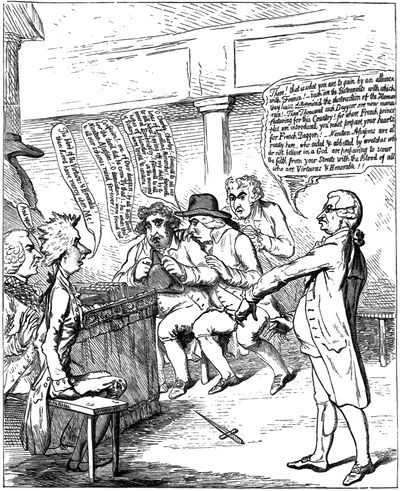
The Dagger Scene in the House of Commons. (Gillray, 1793.)
Edmund Burke was the man who, more than any other, held England back from revolution in 1792. Rational appeals to the rational faculty could not have availed. Appalled at what he saw in France, Burke, after thirty years' advocacy of liberal principles, and assisting to create a republic in America, became a fanatic of conservatism, and terrified England into standing by the monarchy. He was alarmed even at the influx of Frenchmen into England, flying from La Lanterne, and he gave vehement support to the Alien Act, which authorized the summary expulsion from the kingdom of foreigners suspected by the Government. Vehement? Some of his sentences read like lunacy. It was in the course of this debate that the celebrated dagger scene occurred which Gillray has satirized in the picture on the following page. A wild tale reached his ears of the manufacture of daggers at Birmingham for the use of French Jacobins in England, and one of them was given him as a specimen. It was an implement of such undecided form that it might have served as a dagger, a pike-head, or a carving-knife. He dashed it upon the floor of the House of Commons, almost hitting the foot of an honorable member, and proceeded to declaim against the unhappy exiles in the highest style of absurdity. "When they smile," said he, "I see blood trickling down their faces; I see their insidious purposes; I see that the object of all their cajoling is blood." A pause ensued after the orator had spoken a while in this strain. "You have thrown down a knife," said Sheridan; "where is the fork?" A shout of laughter followed this sally, which relieved the suppressed feelings of the House, but spoiled the "effect" of Mr. Burke's performance.

The Zenith of French Glory—A View in Perspective. (Gillray, London, 1793.)
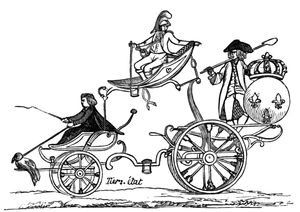
The Estates. (Paris, 1789.)
In the French caricatures that have come to us from the period of the Revolution (many hundreds in number) every phase of the struggle is exhibited with French finesse. There is even an elegance in some of their Revolutionary caricatures. How exquisite, for example, the picture which presents the first protest of the Third Estate, its first attempt to be Something in the nation which it maintained! We see a lofty and beautiful chariot or car of triumph, in which king, nobleman, and clergy gracefully ride, drawn by a pair of doves. The Third Estate is merely the beaten road on which the whole structure moves. Nothing could more elegantly satirize the sentimental stage of the Revolution, when the accumulated abuses of centuries were all to disappear amidst a universal effusion of brotherly love, while king, lords, and clergy rode airily along as before, borne up by a mute, submissive nation! When at last the Third Estate had become "Something" in the nation, a large number of sentimental pictures signalized the event. In one we see priest, noble, and peasant clasped in a fervent embrace, the noble trampling under foot a sheet of paper upon which is printed "Grandeurs," the priest treading upon "Benefices," the peasant upon "Hate." All wear the tricolor cockade, and underneath is written, "The wish accomplished. This is as I ever desired it should be." In another picture priest, noble, and peasant are playing together upon instruments—the priest upon a serpent-shaped trumpet, the noble upon a pipe, and the peasant upon the violin—the peasant in the middle, leading the performance, and exchanging looks of complacent affection with the others.

The New Calvary. (Paris, 1792.)
Louis XVI. crucified by the rebels; Monsieur and the Comte d'Artois bound by the decrees of the factions; Robespierre, mounted upon the Constitution, presents the sponge soaked in regicides' gall; the Queen, overwhelmed with grief, demands speedy vengeance; the Duchess de Polignac, etc.
But even in the moment of triumph the effusion was not universal. There are always disagreeable people who doubt the duration of a millennium as soon as it has begun. Caricatures represented the three orders dancing together. "Will it last? won't it last?" sings a by-stander, using the refrain of an old song. "It is I who must pay the fiddler," cries the noble to the priest. From being fraternal, the Third Estate became patronizing. The three orders sit together in a café, and the peasant says, familiarly, "All right; every man pays his own shot." A picture entitled "Old Times and the New Time" bore the inscription, "Formerly the most useful class carried the load, and was trodden under foot. To-day all share the burden alike." From patronizing and condescending, the Third Estate, as all the world knows, speedily became aggressive and arbitrary. "Down with taxes!" appeared on some of the caricatures of 1789, when the public treasury was running dry. An extremely popular picture, often repeated, exhibits a peasant wearing the costume of all the orders, with the well-known inscription, so false and so fatal, "A single One makes the Three." An ignorant family is depicted listening with gaping eagerness to one who reveals to them that they too are the order of which they have been hearing such fine things. "We belong to the Third Estate!" they exclaim, with the triumphant glee of M. Jourdain when he heard that he had been speaking "prose" all his life without knowing it.
But peace and plenty did not come to the poor man's cottage, and the caricaturists began to mock his dream of a better day. We see in one of the pictures of 1790 a father of a family in chains, with his eyes fixed in ecstasy upon a beam of light, labeled "Hope." In another, poor Louis XVI. is styled "The Restorer of Liberty," but underneath we read the sad question, "Eh bien, but when will that put the chicken in the pot?" A devil entering a hovel is set upon by a peasant, who pummels him with a stick, while an old man cries out, "Hit him hard, hard, my son; he is an aristocrat;" and under the whole is written, "Is the devil, then, to be always at our door?" Again, we have the three orders forging the constitution with great ardor, the blacksmith holding the book on the anvil, while the priest and noble swing the sledge-hammer. Under the picture is the French smith's refrain, "Tot-tot-tot, Battez chaud, Tot-tot-tot." From an abyss a working-man draws a bundle of papers bearing the words, "The New Constitution, the Desire of the Nation," saying, as he does so, "Ah, I shall be well content when I have all those papers!"
The popular pictures grew ill-tempered as the hopes of the people declined, and the word aristocrat became synonymous with all that is most hostile to the happiness of man. A devil attired as a priest, teaching a school of little aristocrats, extols the massacre of St. Bartholomew. Citizens and soldiers are in full cry after a many-headed monster labeled "Aristocracy." An ass presides over a court of justice, and the picture is inscribed, "The Ass on the Bench; or, the End of Old Times." The clergy came in for their ample share of ridicule and vituperation. "What do we want with monks?" exclaimed an orator from the tribune of the Assembly in 1790. "If you tell me," he continued, "that it is just to allow pious men the liberty to lead a sedentary, solitary, or contemplative life, my answer is, that every man can be sedentary, solitary, or contemplative in his own room." Another speaker said, "If England to-day is flourishing, she owes it in part to the abolition of the religious orders." The caricaturists did not delay to aim their shafts at this new game. We see nuns trying on fashionable head-dresses, and friars blundering through a military exercise. The spectacle was exhibited to Europe of a people raging with contemptuous hate of every thing which had from time immemorial been held in honor.
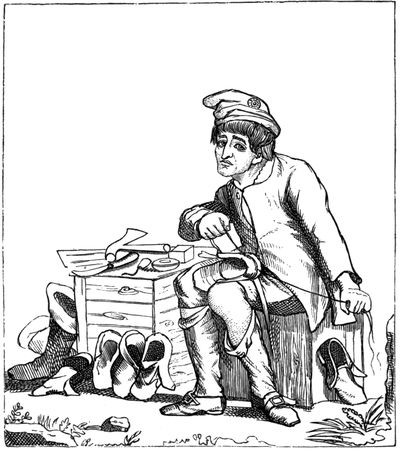
President of a Revolutionary Committee amusing Himself with his Art before the Session begins. (Paris, 1793.)
As time wore on, after every other order in the State had been in turn the object of special animosity, the royal family, the envied victims of the old state of things, became the unpitied victims of the new. Until their ill-starred attempt to escape from France in June, 1792, there remained some little respect for the king, and some tenderness for his children. The picture given elsewhere of the crucifixion of the king was published by his adherents some months before the crisis as figurative of his sufferings, not as prophetic of his fate. But there was neither respect nor pity for the unhappy man after his blundering attempt to leave the country. An explosion of caricature followed. Before that event satirical pictures had been exposed only in the print-sellers' windows, but now, as M. Bayer records, "caricatures were sold wherever any thing was sold." The Jacobin Club, he adds, as often as they had a point to carry, caused caricatures to be made, which the shop-keepers found it to their interest to keep for sale.
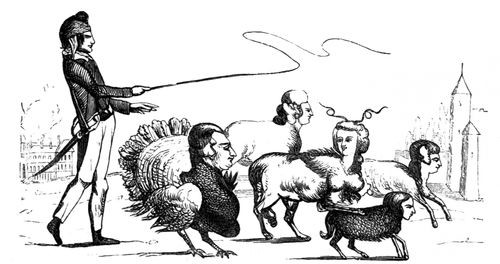
Rare Animals: or, The Transfer of the Royal Family from the Tuileries to the Temple. (Champfleury, 1792.)
A large number of the pictures which appeared during the last months of the king's life have been preserved. At an earlier stage of the movement both friends and foes of the monarchy used the satiric pencil, but now there was none to take the side of this bewildered family, and the pictures aimed at them were hard and pitiless. The reader has but to turn to the specimen here given, which was called forth by the transfer of the royal family from their home in the Tuileries to their prison in the Temple, to comprehend the spirit of those productions. In others we find the king represented as a blind man groping his way; as a baby; as an idiot who breaks his playthings and throws away his crown and sceptre. The queen excited a deeper feeling. The Parisians of 1792 appear to have had for that most unhappy of women only feelings of diabolical hate. She called forth all the tiger which, according to Voltaire, is an ingredient in the French character. The caricaturists liked to invest her with the qualities and the form of a tigress, living in a monstrous alliance with a king-ram, and becoming the mother of monsters. The foolish tale of her saying that she would quench her thirst with the blood of Frenchmen was treated by the draughtsmen of the day as though it were an unquestionable fact.
Never was a woman so hated as she was by infuriate Paris in 1792. Never was womanhood so outraged as in some of the caricatures of that period. Nothing relating to her had any kind of sacredness. Her ancestors, her country, her mother, her children, her love for her children, her attachment to her husband, were all exhibited in the most odious light as so many additional crimes against liberty. Need it be said that her person was not spared? The single talent in which the French excel all the rest of the human family is that of subtly insinuating indecency by pen and pencil. But they did not employ this talent in the treatment of Marie Antoinette when she was about to redeem a frivolous life by a dignified death. With hideous indecency they presented her to the scorn of the public, as African savages might exhibit the favorite wife of a hostile chief when they had brought her to their stinking village a captive, bound, naked, and defiled.
And so passed away forever from the minds of men the sense of the divinity that once had hedged in a king. But so congenial to minds immature or unformed is the idea of hereditary chieftainship that to this day in Europe the semblance of a king seems the easiest resource against anarchy. Yet kings were put upon their good behavior, to hold their places until majorities learn to control their propensities and use their minds.
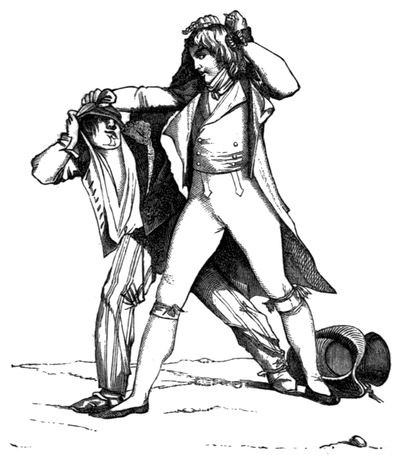
Aristocrat and Democrat. (Paris, 1793.)
Aristocrat. "Take care of your cap."
Democrat. "Look out for your queue."
CHAPTER XV.
CARICATURES OF WOMEN AND MATRIMONY.
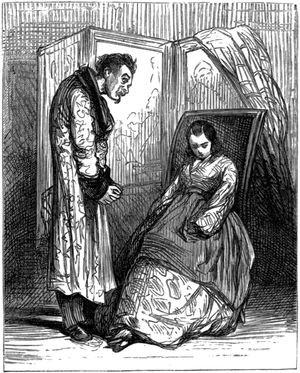
"You frank! You simple! Have confidence in you! You! Why, you would blow your nose with your left hand for nothing but the pleasure of deceiving your right, if you could!"—Gavarni, Fourberies de Femmes, Paris, 1846.
Observe this picture of man's scorn of woman, drawn by Gavarni, the most noted of French caricaturists. I place it first, because it expresses the feeling toward "the subject sex" which satiric art has oftenest exhibited, and because it was executed by the person who excelled all others in delineating what he called the fourberies de femmes. Such, in all time, has been the habitual tone of self-indulgent men toward their victims. Gavarni well represents men in this sorry business of reviling women; for in all the old civilizations men in general have done precisely what Gavarni did recently in Paris—first degraded women, then laughed at them.
The reader, perhaps, after witnessing some of the French plays and comic operas with which we have been favored in recent years—such as "Frou-Frou," "The Sphinx," "Alixe," and others—may have turned in wild amazement to some friend familiar with Paris from long residence, and asked, Is there any truth in this picture? Are there any people in France who behave and live as these people on the stage behave and live? Many there can not be; for no community could exist half a generation if the majority lived so. But are there any? The correct answer to this question was probably given the other evening by a person accustomed to Paris life: "Yes, there are some; they are the people who write such stuff as this. As for the bal masqué, and things of that kind, it is a mere business, the simple object of which is to beguile and despoil the verdant of every land who go to Paris in quest of pleasure." French plays and novels we know do most ludicrously misrepresent the people of other countries. What, for example, can be less like truth than that solemn donkey of a Scotch duke in M. Octave Feuillet's play of "The Sphinx?" The dukes of Scotland are not so numerous nor so unconspicuous a body of men that they can not be known to a curious inquirer, and it is safe to assert that, whatever their faults may be, there is not among them a creature so unspeakably absurd as the viveur infernal of this play. If the author is so far astray with his Scotch duke, he is perhaps not so very much nearer the truth with his French marquis, a personage equally foreign to his experience.
We had in New York some years ago a dozen or two of young fellows, more or less connected with the press, most of them of foreign origin, who cherished the delusion that eating a bad supper in a cellar late at night, and uttering or singing semi-drunken nonsense, was an exceedingly noble, high-spirited, and literary way of consuming a weakly constitution and a small salary. They thought they were doing something in the manner of Dr. Johnson and Charles Lamb. Any one who should have judged New York in the year 1855 by the writings of these young gentlemen would have supposed that we were wholly given up to silly, vulgar, and reckless dissipation. But, in truth, the "Bohemians," as they were proud to be styled, were both few and insignificant; their morning scribblings expressed nothing but the looseness of their own lives, and that was half pretense.
Two admiring friends have written the life of Gavarni, the incomparable caricaturist of la femme; and they tell us just how and where and when the artist acquired his "subtle and profound knowledge" of the sex. It is but too plain that he knew but one class of women, the class that lives by deluding fools. "During all one year, 1835," say these admiring biographers, "it seems that in the life, the days, the thoughts of Gavarni, there was nothing but la femme. According to his own expression, woman was his 'grand affair.'" He was in love, then? By no means. Our admiring authors proceed to describe this year of devotion to la femme as a period when "intrigues were mingled together, crossed and entangled with one another; when passing inclinations, the fancies of an evening, started into being together with new passions; when rendezvous pressed upon rendezvous; when there fell upon Gavarni a rain of perfumed notes from the loves of yesterday, from the forgotten loves of last month, which he inclosed in one envelope, as he said, 'like dead friends in the same coffin.'"[24]
The authors enlarge upon this congenial theme, describing their hero as going forth upon le pavé de Paris in quest of la femme as a keen hunter takes to the forest for the plump partridge or the bounding deer. Some he brought down with the resistless magnetism of his eye. "It was for him a veritable rapture, as well as the exertion of a power which he loved to try, to magnetize with his eye and make his own the first woman whom he chanced to meet in the throng." The substance of the chapter is that Gavarni, casting aside all the restraints of civilization and decency, lived in Paris the life of a low and dirty animal; and when, in consequence of so living, he found himself in Clichy for debt, he replenished his purse by delineating, as the fourberies de femmes, the tricks of the dissolute women who had got his money. That, at least, is the blunt American of our authors' dainty and elegant French.
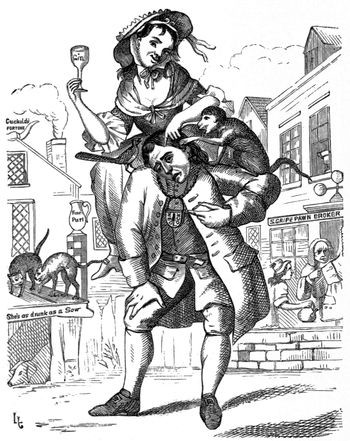
Matrimony—A Man loaded with Mischief.[25]
"A monkey, a magpie, and wife
Is the true emblem of strife."
Old English Tavern Sign.
In the records of the past, we find men speaking lightly of women whose laws and usages concede least to women.
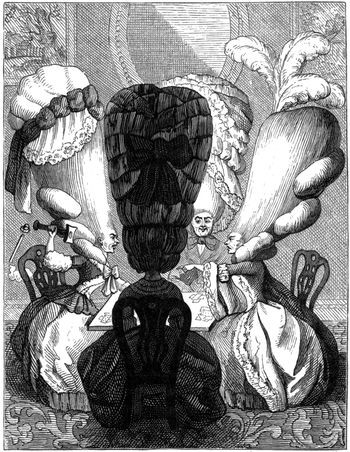
Settling the Odd Trick. (London, 1778.[26])
The oldest thing accessible to us in these modern cities is the Saturday-morning service in an unreformed Jewish synagogue, some of the observances of which date back beyond the historic period. But there is nothing in it older than the sentiment expressed by the men when they thank God for his goodness in not making them women. Only men are admitted to the synagogue as equal worshipers, the women being consigned to the gallery, spectators of their husbands' devotion. The old Jewish liturgy does not recognize their presence.
Older than the Jewish liturgy are the sacred books of the Hindoos. The famous passage of the "Padma Parana," translated by the Abbé Dubois,[27] has been part of the domestic code of the Hindoos for thousands of years. According to the Hindoo lawgiver, a woman has no god on earth but her husband, and no religion except to gratify, obey, and serve him. Let her husband be crooked, old, infirm, offensive; let him be irascible, irregular, a drunkard, a gambler, a debauchee; let him be reckless of his domestic affairs, as if possessed by a devil; though he live in the world without honor; though he be deaf or blind, and wholly weighed down by crime and infirmity—still shall his wife regard him as her god. With all her might shall she serve him, in all things obey him, see no defects in his character, and give him no cause of uneasiness. Nay, more: in every stage of her existence woman lives but to obey—at first her parents, next her husband and his parents, and in her old age she must be ruled by her children. Never during her whole life can she be under her own control.
These are the general principles upon which the life of women in India is to be conducted. The Hindoo writer was considerate enough to add a few particulars: "If her husband laughs, she ought to laugh; if he weeps, she ought to weep; if he is disposed to speak, she ought not to join in the conversation. Thus is the goodness of her nature displayed. What woman would eat till her husband has first had his fill? If he abstains, she will surely fast also; if he is sad, will she not be sorrowful? and if he is gay, will she not leap for joy? In the absence of her husband her raiment will be mean." Such has been the conception of woman's duty to man by all the half-developed races from time immemorial, and such to this day are the tacit demand and expectation of the brutalized males of the more advanced races. Gavarni, married, would have been content with no subservience much short of that.
Happily, nature has given to woman the means of a fell revenge, for she usually holds the peace of the household and the happiness of all its members in her hands. The satirical works that come to us from the Oriental lands teem with evidence that women have always known how to get a fair share of domestic authority. If they are slaves, they have ever been adepts in the arts and devices of slaves. The very squaws of our Indians often contrive to rule their brawny lords. Is not the whole history of the war between the sexes included in the little story of the manner in which Pocahontas was entrapped on board a British vessel lying in the James River two hundred and fifty years ago? The captain had promised to the aunt of this dusky princess the gift of a copper kettle if she would bring her niece to the ship; and accordingly one afternoon, when she found herself on the river-bank with her husband and Pocahontas, she was suddenly seized with a longing to go on board, saying that this was the third time the ship had been in their river, and yet she had never visited it. Her grumpy old husband refusing, she began to cry, and then, Pocahontas joining her entreaties, of course the old man had to unfasten his canoe and paddle them off to the vessel. This model couple returned to the shore poorer by a niece of uncertain character, and richer by the inestimable treasure of a copper kettle. What fine lady could have managed this delicate affair better? Is it not thus that tickets, trinkets, and dresses are won every day in the cities of the modern world?
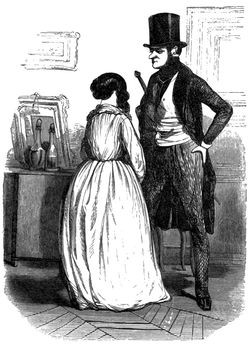
"Who was that gentleman that just went out?"
"Why, didn't he see you, after all? He called on business, and has been waiting for you these two hours. He leaves town this evening. But how warm you are, dear!"—Gavarni, Fourberies de Femmes, Paris, 1846.
An attentive study of the Greek and Roman literatures furnishes many illustrations of the remark just made, that men who degrade women deride them. Among the Greeks, who kept women in subjection and seclusion, and gave them no freedom of choice in matters of dearest concern to them, the foibles of the sex were treated very much as they now are by the dissolute caricaturists of Paris. Aristophanes's mode of representing the women of Athens is eminently Gavarnian; and nothing was more natural than that an Aristophanes should come after an Anacreon. The lyric poet depicts women as objects of desire, superior in alluring charm even to wine, rosy wine; and Aristophanes delights to exhibit the women's apartment of an Athenian house as a riotous and sensualized harem. How many expressions of utter distrust and dislike of women occur in the Greek poets!
"For this, and only this, I'll trust a woman,
That if you take life from her she will die;
And, being dead, will come to life no more.
In all things else I am an infidel."
Thus Antiphanes, who died twenty-two hundred years before Gavarni was born. Menander justifies the gods for tormenting Prometheus, though his crime was only stealing a spark of fire.
"But, O ye gods, how infinite the mischief!
That little spark gave being to a woman,
And let in a new race of plagues to curse us."
The well-known epigram of Palladas upon marriage expresses a thought which has been uttered by satirists in every form of which language is capable:
"In marriage are two happy things allowed—
A wife in wedding garb and in her shroud.
Who, then, dares say that state can be accurst
Where the last day's as happy as the first?"
22: Champfleury, "Histoire de la Caricature sous la République," etc., p. 5.
23: Champfleury, "Histoire de la Caricature sous la République," p. 81.
24: "Gavarni, l'Homme et l'Œuvre," par Edmond et Jules de Goncourt, Paris, 1873.
25: "From History of Sign-boards," by Larwood and Hotten.
26: From Wright's "Caricature History of the Georges," p. 256.
27: "Description of the Character, Manners, and Customs of the People of India," vol. i., p. 316, by J. A. Dubois, London, 1817.
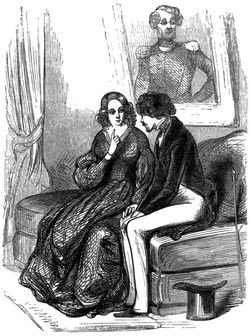
She. "Now, understand me. To-morrow morning he will ask you to dinner. If he has his umbrella with him, it will mean that he has not got his stall at the theatre. In that case, don't accept. If he has no umbrella, come to dinner."
He. "But (you know we must think of every thing) suppose it should rain to-morrow morning?"
She. "If it rains, he will get wet—that's all. If I don't want him to have an umbrella, he won't have one. How silly you are!"—Gavarni, Fourberies de Femmes, Paris, 1846.
Many others will occur to the reader who is familiar with the lighter utterances of the ancients. But in Greece, as in China, India, and Japan, and wherever else men and women have been joined in wedlock, there have been marriages in which husband and wife have lived on terms nobler than those contemplated by the law or demanded by usage. Where could we find a juster view of the duties of husband and wife than in that passage of Xenophon's dialogue on Economy where Ischomachus tells Socrates how he had taken his young wife into his confidence, and come to a clear understanding with her as to the share each should take in carrying on the household? Goethe must have had this passage in his mind when he wrote the fine tribute to the dignity of housekeeping in "Wilhelm Meister." Ischomachus had married a girl of fifteen, who came to him as wives in Greece usually came to their husbands—an absolute stranger to him. He had to get acquainted with her after marriage, as, indeed, he says, "When we were well enough acquainted, and were so familiar that we began to converse freely with one another, I asked her why she thought I had taken her for my wife." Much is revealed in that sentence. He tells her that, being married, they are now to have all things in common, and each should only strive to enhance the good of the household. She stares with wonder. Her mother had told her that her fortune would be wholly her husband's, and all that she had to do was to live virtuously and soberly. Ischomachus assents, but he proceeds to show her that, in the nature of things, husband and wife must be equal co-operators, he getting the money, she administering it; he fighting the battle of life out-of-doors, she within the house. At great length this model husband illustrates his point, and entirely in the spirit of the noble passage in Goethe. She catches the idea at length. "It will be of little avail," she says, "my keeping at home unless you send such provisions as are necessary." "True," he replies, "and of very little use my providing would be if there were no one at home to take care of what I send; it would be pouring water into a sieve."
This fine presentation of household economy, like that of the German poet, is, unhappily, only a dialogue of fiction. It was merely Xenophon's conception of the manner in which a philosopher of prodigious wisdom might deal with a girl of fifteen, whom he had married without having enjoyed the pleasure of a previous acquaintance with her. Doubtless there was here and there in ancient Greece a couple who succeeded in approximating Xenophon's ideal.
Among the Romans women began to acquire those legal "rights" to which they owe whatever advance they have ever made toward a just equality with men. It was Roman law that lifted a wife from the condition of a cherished slave to a status something higher than that of daughter. But there was still one fatal defect in her position—her husband could divorce her, but she could not divorce him. Cicero, the flower of Roman culture, put away the wife of his youth after living with her thirty years, and no remonstrance on her part would have availed against his decision. But a Roman wife had rights. She could not be deprived of her property, and the law threw round her and her children a system of safeguards which gave her a position and an influence not unlike those of the "lady of the house" at the present time. Instead of being secluded in a kind of harem, as among the Greeks, she came forward to receive her husband's guests, shared some of their festivities, governed the household, superintended the education of her children, and enjoyed her ample share of the honor which he inherited or won. "Where you are Caius, I am Caia," she modestly said, as she entered for the first time her husband's abode. He was paterfamilias, she materfamilias; and the rooms assigned to her peculiar use were, as with us, the best in the house.
To the Roman law women are infinitely indebted. Among the few hundreds of families who did actually share the civilization of Cicero, the Plinys, and Marcus Aurelius, the position of a Roman matron was one of high dignity and influence, and accordingly the general tone of the best Roman literature toward woman is such as does honor to both sexes. She was even instructed in that literature. In such a family as that of Cicero, the daughter would usually have the same tutors as the son, and the wife of such a man would familiarly use her husband's library. Juvenal, that peerless reviler of women, the Gavarni of poets, deplores the fact:
"But of all plagues the greatest is untold—
The book-learned wife in Greek and Latin bold;
The critic dame who at her table sits,
Homer and Virgil quotes, and weighs their wits,
And pities Dido's agonizing fits.
She has so far the ascendant of the board,
The prating pedant puts not in one word;
The man of law is nonplused in his suit;
Nay, every other female tongue is mute."
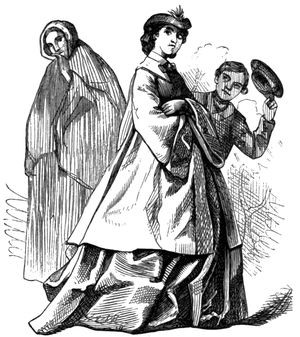
"Madame, your cousin Betty wishes to know if you can receive her."
"Impossible! Tell her that to-day I receive."—Les Tribulations de la Vie Élégante, par Girin, Paris, 1870.
The whole of this sixth satire of Juvenal, in which the Gavarnian literature of all nations was anticipated and exhausted, is a tribute to woman's social importance in Rome. No Greek would have considered woman worthy of so elaborate an effort. And as in Athens, Anacreon, the poet of sensual love, was naturally followed by Aristophanes, a satirist of women, so, in Rome, Ovid's "Art of Love" preceded and will forever explain Juvenal's sixth satire. All illustrates the truth that sensualized men necessarily undervalue and laugh at women. In all probability, Juvenal's satire was a caricature as gross and groundless as the pictures of Gavarni. The instinct of the satirist is first to select for treatment the exceptional instance of folly, and then to exaggerate that exceptional instance to the uttermost. Unhappily many readers are only too much inclined to accept this exaggerated exception as if it were a representative fact. There is a passage in Terence in which he expresses the feeling of most men who have been plagued, justly or unjustly, by a woman:
"Not one but has the sex so strong within her,
She differs nothing from the rest. Step-mothers
All hate their step-daughters, and every wife
Studies alike to contradict her husband,
The same perverseness running through them all."
The acute reader, on turning to the play of the "Mother-in-law," from which these lines are taken, will not be surprised to learn that the women in the comedy are in the right, and the men grossly in fault.
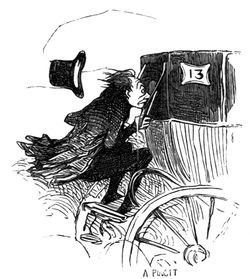
A Scene of Conjugal Life. (Daumier, Paris, 1846.)
The literature of the Middle Ages tells the same story. The popular tales of that period exhibit women as equally seductive and malevolent, silly, vain, not to be trusted, enchanting to the lover, a torment to the husband. Caricatures of women and their extravagances in costume and behavior occur in manuscripts as far back as A.D. 1150, and those extravagances may serve to console men of the present time by their enormity. Many specimens could be given, but they are generally too formless or extravagant to be interesting. There are also many rude pictures from those centuries which aimed to satirize the more active foibles of the sex. One of these exhibits a wife belaboring her husband with a broom, another pounding hers with a ladle, another with a more terrible instrument, her withering tongue, and another with the surest weapon in all the female armory—tears. In the Rouen Cathedral there are a pair of carvings, one representing a fierce struggle between husband and wife for the possession of a garment the wearing of which is supposed to be a sign of mastery, and the other exhibiting the victorious wife in the act of putting that garment on. On the portal of a church at Ploërmel, in France, there is a well-cut representation of a young girl leading an elderly man by the nose. More violent contests are frequently portrayed, and even fierce battles with bellows and pokers, stirring incidents in the "eternal war between man and woman."
The gentle German priest who wrote the moral ditties of the "Ship of Fools" ought not to have known much of the tribulations of husbands; but in his poem on the "Wrath and great Lewdnes of Wymen," he becomes a kind of frantic Caudle, and lays about him with remarkable vigor. He calls upon the "Kinge most glorious of heaven and erth" to deliver mankind from the venomous and cruel tongues of froward women. One chiding woman, he observes, "maketh greater yell than a hundred magpies in one cage;" and let her husband do what he will, he can not quiet her till "she hath chid her fill." No beast on earth is so capable of furious hate—not the bear, nor the wolf, nor the lion, nor the lioness; no, nor the cruel tigress robbed of her whelps, rushing wildly about, tearing and gnawing stock and tree.
"A wrathfull woman is yet more mad than she.
Cruell Medea doth us example shewe
Of woman's furour, great wrath and cruelty;
Which her owne children dyd all to pecis hewe."
This poet, usually so moderate and mild in his satire of human folly, is transported with rage in contemplating the faults of women, and holds them up to the abhorrence of his readers. A woman, he remarks, can wallow in wicked delights, and then, giving her mouth a hurried wipe, come forward with tranquil mind and an air of child-like innocence, sweetly protesting that she has done nothing wrong. The most virulent woman-hater that was ever jilted or rejected could not go beyond the bachelor priest who penned this infuriate diatribe upon the sex.
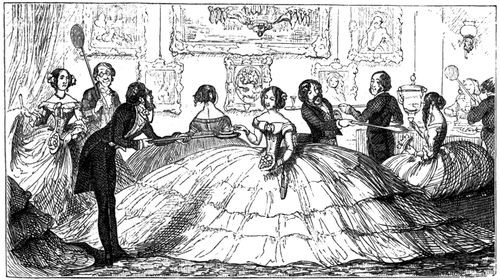
A Splendid Spread. (Cruikshank, 1850.)
Nor was Erasmus's estimate of women more favorable than Brandt's, though he expresses it more lightly and gayly, as his manner was. And curious it is to note that the foibles which he selects for animadversion are precisely those which form the staple of satire against women at the present time. In one of his Colloquies he describes the "Assembly of Women, or the Female Parliament," and reports at length the speech of one of the principal members, the wise Cornelia. This eloquent lady heartily berates the wives of tradesmen for presuming to copy the fashions of the rich and noble. Would any one believe that the following sentences were written nearly four hundred years ago?
"'Tis almost impossible by the outside," says Cornelia to her parliament of fine ladies, "to know a duchess from a kitchen-wench. All the ancient bounds of modesty have been so impudently transgressed, that every one wears what apparel seems best in her own eyes. At church and at the play-house, in city and country, you may see a thousand women of indifferent if not sordid extraction swaggering it abroad in silks and velvets, in damask and brocard, in gold and silver, in ermines and sable tippets, while their husbands perhaps are stitching Grub-street pamphlets or cobbling shoes at home. Their fingers are loaded with diamonds and rubies, for Turkey stones are nowadays despised even by chimney-sweepers' wives. It was thought enough for your ordinary women in the last age that they were allowed the mighty privilege to wear a silk girdle, and to set off the borders of their woolen petticoats with an edging of silk. But now—and I can hardly forbear weeping at the thoughts of it—this worshipful custom is quite out-of-doors. If your tallow-chandlers', vintners', and other tradesmen's wives flaunt it in a chariot and four, what shall your marchionesses or countesses do, I wonder? And if a country squire's spouse will have a train after her full fifteen ells long, pray what shift must a princess make to distinguish herself? What makes this ten times worse than otherwise it would be, we are never constant to one dress, but are as fickle and uncertain as weathercocks—or the men that preach under them. Formerly our head-tire was stretched out upon wires and mounted upon barbers' poles, women of condition thinking to distinguish themselves from the ordinary sort by this dress. Nay, to make the difference still more visible, they wore caps of ermine powdered. But they were mistaken in their politics, for the cits soon got them. Then they trumpt up another mode, and black quoiss came into play. But the ladies within Ludgate not only aped them in this fashion, but added thereto a gold embroidery and jewels. Formerly the court dames took a great deal of pains in combing up their hair from their foreheads and temples to make a tower; but they were soon weary of that, for it was not long before this fashion too was got into Cheapside. After this they let their hair fall loose about their foreheads; but the city gossips soon followed them in that."
And this game, we may add, has been kept up from that day to this; nor does either party yet show any inclination to retire from the contest.
Erasmus was, indeed, an unmerciful satirist of women. In his "Praise of Folly" he returns to the charge again and again. "That which made Plato doubt under what genus to rank woman, whether among brutes or rational creatures, was only meant to denote the extreme stupidness and folly of that sex, a sex so unalterably simple, that for any of them to thrust forward and reach at the name of wise is but to make themselves the more remarkable fools, such an endeavor being but a swimming against the stream, nay, the turning the course of nature, the bare attempting whereof is as extravagant as the effecting of it is impossible: for as it is a trite proverb, That an ape will be an ape, though clad in purple; so a woman will be a woman, i. e., a fool, whatever disguise she takes up." And again: "Good God! what frequent divorces, or worse mischief, would oft sadly happen, except man and wife were so discreet as to pass over light occasions of quarrel with laughing, jesting, dissembling, and such like playing the fool? Nay, how few matches would go forward, if the hasty lover did but first know how many little tricks of lust and wantonness (and perhaps more gross failings) his coy and seemingly bashful mistress had oft before been guilty of? And how fewer marriages, when consummated, would continue happy, if the husband were not either sottishly insensible of, or did not purposely wink at and pass over, the lightness and forwardness of his good-natured wife?"
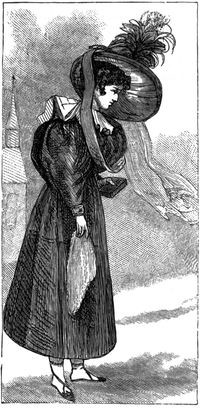
American Lady walking in the Snow.
"I have often shivered at seeing a young beauty picking her way through the snow with a pale rose-colored bonnet set on the very top of her head. They never wear muffs or boots, even when they have to step to their sleighs over ice and snow. They walk in the middle of winter with their poor little toes pinched into a miniature slipper, incapable of excluding as much moisture as might bedew a primrose."—Mrs. Trollope, Domestic Manners of the Americans, vol. ii., p. 135. 1830.
The ill opinion entertained of women by men during the ages of darkness and superstition found expression in laws as well as in literature. The age of chivalry! Investigators who have studied that vaunted period in the court records and law-books tell us that respect for women is a thing of which those records show no trace. In the age of chivalry the widow and the fatherless were regarded by lords, knights, and "parsons" as legitimate objects of plunder; and woe to the widow who prosecuted the murderers of her husband or the ravagers of her estate! The homage which the law paid to women consisted in burning them alive for offenses which brought upon men the painless death of hanging. We moderns read with puzzled incredulity such a story as that of Godiva, doubtful if so vast an outrage could ever have been committed in a community not entirely savage. Let the reader immerse himself for only a few months in the material of which the history of the Middle Ages must be composed, if it shall ever be truly written, and the tale of Godiva will seem credible and natural. She was her lord's chattel; and probably the people of her day who heard the story commended him for lightening the burdens of Coventry on such easy terms, and saw no great hardship in the task assigned to her.
People read with surprise of Thomas Jefferson's antipathy to the poems and novels of Sir Walter Scott. He objected to them because they gave a view of the past ages utterly at variance with the truth as revealed in the authentic records, which he had studied from his youth up.
"'My dear Baron, I am in the most pressing need of five hundred franc!' Must I put an s to franc?"
"No. In the circumstances it is better not. It will prove to the Baron that, for the moment, you really are destitute of every thing—even of orthography."—Ed. de Braumont, Paris, 1860.
"Madame, I have the honor—"
"Sir, be good enough to come round in front and speak to me."
"Madame, I really haven't the time. I must be off in five minutes."—Cham, Paris, 1850.
Coming down to recent times, we still find the current anecdote and proverb in all lands bearing hardly upon the sex. A few kindly and appreciative sayings pass current in Scotland; and the literatures of Germany, England, and the United States teem with the noblest and tenderest homage to the excellence of women. But most of these belong to the literature of this century, and bear the names of men who may be said to have created the moral feeling of the present moment. It is interesting to notice that in one of our latest and best dictionaries of quotation, that of Mr. M. M. Ballou, of Boston, there are one hundred and eleven short passages relating to women, of which only one is dishonorable to them, and that dates back a century and a half, to the halcyon day of the British libertine—"Every woman is at heart a rake.—Pope." So thought all the dissolute men of Pope's circle, as we know from their conversation and letters. So thought the Duc de Rochefoucauld, who said, "There are few virtuous women who are not weary of their profession;" and "Most virtuous women, like concealed treasures, are secure because nobody seeks after them." So thought Chesterfield, who told his hopeful son that he could never go wrong in flattering a woman, for women were foolish and frail without exception: "I never knew one in my life who had good sense, or who reasoned and acted consequentially for four-and-twenty hours together." And so must think every man who lived as men of fashion then lived. "If I dwelt in a hospital," said Dr. Franklin once, "I might come to think all mankind diseased."

"Where are the diamonds exhibited?"
"I haven't the least idea; but I let myself be guided by my wife. Women get at such things by instinct."—Cham, Paris, 1868.
But a man need not be a fine gentleman nor a roué to think ill of womankind. He needs only to be commonplace; and hence it is that the homely proverbs of all time bear so hardly upon women. The native land of the modern proverb is Spain, as we might guess from Sancho Panza's exhaustless repertory; and most of those homely disparaging sentences concerning women that pass current in all lands appear to have originated there. What Spain has left unsaid upon women's foibles, Italy has supplied. Most of the following proverbs are traceable to one of the two peninsulas of Southern Europe: "He that takes an eel by the tail or a woman by her word may say he holds nothing." "There is one bad wife in Spain, and every man thinks he has her." "He that loses his wife and a farthing hath great loss of his farthing." "If the mother had never been in the oven, she would not have looked for her daughter there." "He that marries a widow and three children marries four thieves." "He that tells his wife news is but newly married." "A dead wife's the best goods in a man's house." "A man of straw is worth a woman of gold." "A woman conceals what she knows not." "As great a pity to see a woman weep as to see a goose go barefoot." "A woman's mind and winter's wind change oft." "There is no mischief in the world done but a woman is always one." "Commend a wedded life, but keep thyself a bachelor." "Where there are women and geese, there wants no noise." "Neither women nor linen by candle-light." "Glasses and lasses are brittle ware." "Two daughters and a back-door are three thieves." "Women commend a modest man, but like him not." "Women in mischief are wiser than men." "Women laugh when they can and weep when they will." "Women, priests, and poultry never have enough."
Evening Scene in the Parlor of an American Boarding-house.
"Ladies who have no engagements (in the evening) either mount again to the solitude of their chamber, or remain in the common sitting-room, in a society cemented by no tie, endeared by no connection, which choice did not bring together, and which the slightest motive would break asunder. I remarked that the gentlemen were generally obliged to go out every evening on business; and, I confess, the arrangement did not surprise me."—Mrs. Trollope, Domestic Manners of the Americans, vol. ii., p. 111. 1830.
Among the simple people of Iceland similar proverbs pass current: "Praise the fineness of the day when it is ended; praise a woman when she is buried; praise a maiden when she is married." "Trust not to the words of a girl; neither to those which a woman utters, for their hearts have been made like the wheel that turns round; levity was put into their bosoms."
Among the few broadsides of Elizabeth's reign preserved in the British Museum there is one which is conceived in perfect harmony with these proverbs. It presents eight scenes, in all of which women figure disadvantageously. There is a child-bed scene, in which the mother lies in state, most preposterously dressed and adorned, while a dozen other women are idling and gossiping about the room. Women are exhibited also at the market, at the bakehouse, at the ale-house, at the river washing clothes, at church, at the bath, at the public well; but always chattering, gossiping, idling, unless they are fighting or flirting. Another caricature in the same collection, dated 1620, the year of the Mayflower and Plymouth Rock, contains seven scenes illustrative of the lines following:
"Who marieth a Wife upon a Moneday,
If she will not be good upon a Twesday,
Lett him go to ye wood upon a Wensday,
And cutt him a cudgell upon the Thursday,
And pay her soundly upon a Fryday;
And she mend not, ye divil take her a Saterday,
That he may eat his meat in peace on the Sunday."
To complete the record of man's ridicule of the sex to which he owes his happiness, I add the pictures given in this chapter, which bring that record down to date. They tell their own story. The innocent fun of English Cruikshank and Leech contrasts agreeably with the subtle depravity indicated by some of the French caricaturists, particularly by Gavarni, who surpasses all men in the art of exaggerating the address of the class of women who regard men in the light of prey. The point of Gavarni's satire usually lies in the words printed underneath his pictures, and the pictures generally consist of the two figures who utter those words. But the expression which he contrives to impart to his figures and faces by a few apparently careless lines is truly wonderful, and it can scarcely be transferred to another surface. He excels in the expression of a figure with the face turned away, the whole effect being given by the outline of the head three-quarters averted. There is one picture of his, given on the following page, of a woman and her lover, he sitting in a chair reading with his hat on, indicating the extreme of familiarity, she standing at the window sewing, and keeping an eye on the pavement below. "He's coming!" she says; "take off your hat." In the attitude of the woman there is a mingled effect of tranquillity and vigilance that is truly remarkable. In all the range of caricature it would be difficult to find a better specimen of the art than this, or a worse. The reader may be curious to see a few more of these fourberies de femmes, as evolved from the brain of the dissolute Gavarni. It is almost impossible to transfer the work of his pencil, but here are a few of his verbal elucidations:
Under a picture of a father and daughter walking arm-in-arm: "How did you know, papa, that I loved M. Léon?" "Because you always spoke of M. Paul."
Two young ladies in confidential conversation: "When I think that M. Coquardeau is going to be my husband, I feel sorry for Alexander." "And I for Coquardeau."
"He's coming! Take off your hat!"—Gavarni, Paris, 1846.
Two married ladies in conversation: "Yes, my dear, my husband has been guilty of bringing that creature into my house before my very eyes, when he knows that the only man I love in the world is two hundred leagues from here."—"Men are contemptible" (lâches).
Husband writing a note, and his wife standing behind him:
"My dear Sir,—Caroline begs me to remind you of a certain duet, of which she is extravagantly fond, and which you promised to give her. Pray be so good as to dine with her to-day, and bring your music with you. For my part, I shall be deprived of the pleasure of hearing you, for I have an engagement at Versailles. Pity me, my dear sir, and believe me always your affectionate
Coquardeau."
A young man in wild excitement reading a letter:
"On receipt of this, mount, fly; overtake in the Avenue de Neuilly a yellow cab, the steps down, gray horse, old coachman, 108, one lantern lighted! Follow it. It will stop at the side door of a house at Sablonville. A man and a woman will get out. That man—he was my lover! And that woman—she is yours!"
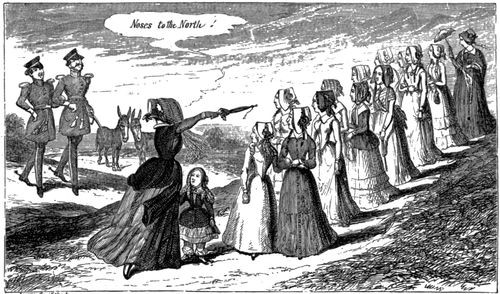
The Scholastic Hen and her Chickens. (Cruikshank, 1846.)
Miss Thimblebee loquitur. "Turn your heads the other way, my dears, for here are two horridly handsome officers coming."
Lady fainting, and a man in consternation supporting her head: "Clara, Clara! dearest, look up! Don't! Clara, I say! You don't know any nice young man! I am an ass, with my stupid jealousy. And you shall have your velvet shawl. Come, Clara! Now then, Clara, please!"
Lady dropping two letters into the post-office. First letter:
"My kind Amédée,—This evening, toward eight, at the Red Ball. Mind, now, and don't keep waiting your
Clara."
Second letter:
"My Henry,—Well-beloved, judge of my despair—I have a sore throat that is simply frightful. It will be impossible for me to go out this evening. They even talk of applying twenty leeches. Pity a great deal, and love always, your
Clara."
In these numberless satires upon women, executed by pen and pencil, there is a certain portion of truth, for, indeed, a woman powerfully organized and fully developed, but without mental culture and devoid of the sentiment of duty, can be a creature most terrific. If the possession of wealth exempts her from labor, there are four ways in which she can appease the ennui of a barren mind and a torpid conscience. One is deep play, which was, until within seventy years, the resource chiefly relied upon by women of fashion for killing the hours between dinner and bed; one is social display, or the struggle for the leadership of a circle, an ambition perhaps more pernicious than gambling; another is intrigues of love, no longer permitted in the more advanced countries, but formerly an important element in fashionable life everywhere; finally, there is the resource of excessive and ceaseless devotion, the daily mass, the weekly confession, frequent and severe fasting, abject slavery to the ritual. Of all these, the one last named is probably the most injurious, since it tends to bring virtue itself into contempt, and repels the young from all serious and elevated modes of living. Accordingly, in studying the historic families of Europe, we frequently find that the devotee and the debauchee alternate, each producing the other, both being expressions of the same moral and mental defect. But whether a mindless woman gambles, dresses, flirts, or fasts, she is a being who furnishes the satirist with legitimate material.
Equal rights, equal education, equal chances of an independent career—when women have enjoyed these for so much as a single century in any country, the foibles at which men have laughed for so many ages will probably no longer be remarked, for they are either the follies of ignorance or the vices resulting from a previous condition of servitude. Nor will men of right feeling ever regard women with the cold, critical eye of a Chesterfield or a Rochefoucauld, but rather with something of the exalted sentiment which caused old Homer, whenever he had occasion to speak of a mother, to prefix an adjective usually applicable to goddesses and queens, which we can translate best, perhaps, by our English word REVERED.
CHAPTER XVI.
AMONG THE CHINESE.
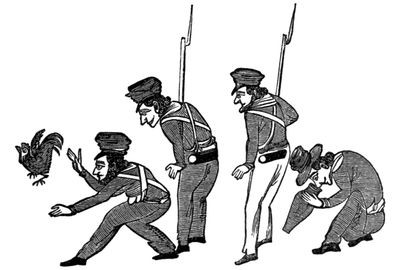
Chinese Caricature of an English Foraging Party.[28]
We are apt to think of the Chinese as a grave people, unskilled in the lighter arts of satire and caricature; but, according to that amusing traveler, M. Huc, they are the French of Asia—"a nation of cooks, a nation of actors"—singularly fond of the drama, gifted in pasquinade, addicted to burlesque, prolific in comic ideas and satirical devices. M. Huc likens the Chinese Empire to an immense fair, where you find mingled with the bustle of traffic all kinds of shows, mountebanks, actors, Cheap Jacks, thieves, gamblers, all competing continually and with vociferous uproar for the favor of the crowd. "There are theatres everywhere; the great towns are full of them; and the actors play night and day." When the British officers went ashore, in the retinue of their first grand embassy, many years ago, they were astonished to see Punch in all his glory with Judy, dog, and devil, just as they had last seen him on Ascot Heath, except that he summoned his audience by gong and triangle instead of pipes and drum. The Orient knew Punch perhaps ages before England saw him. In China they have a Punch conducted by a single individual, who is enveloped from head to foot in a gown. He carries the little theatre on his head, works the wires with his hands under the gown, executes the dialogue with his mouth concealed by the same garment, and in the intervals of performance plays on two instruments. He exhibits the theatre reduced to its simplest form, the work of the company, the band, the manager, treasurer, scene-shifter, and property-man all being done by one person.
In the very nature of the Chinese, whether men or women, there is a large element of the histrionic, even those pompous and noisy funerals of theirs being little more than an exhibition of private theatricals. The whole company gossip, drink tea, jest, laugh, smoke, and have all the air of a pleasant social party, until the nearest relation of the deceased informs them that the time to mourn has come. Instantly the conversation ceases and lamentation begins. The company gather round the coffin; affecting speeches are addressed to the dead; groans, sobs, and doleful cries are heard on every side; tears, real tears, roll down many cheeks—all is woe and desolation. But when the signal is given to cease mourning, "the performers," says M. Huc, "do not even stop to finish a sob or a groan, but they take their pipes, and, lo! they are again those incomparable Chinese, laughing, gossiping, and drinking tea."
It need not be said that Chinese women have an ample share of this peculiar talent of their race, nor that they have very frequent occasion to exercise it. Nowhere, even in the East, are women more subject or more artful than in China. "When a son is born," as a Chinese authoress remarks, "he sleeps upon a bed, he is clothed with robes, and plays with pearls; every one obeys his princely cries. But when a girl is born, she sleeps upon the ground, is merely wrapped in a cloth, plays with a tile, and is incapable of acting either virtuously or viciously. She has nothing to think of but preparing food, making wine, and not vexing her parents." This arrangement the authoress approves, because it prepares the girl to accept without repining the humiliations of her lot. It is a proverb in China that a young wife should be in her house but "a shadow and an echo." As in India, she does not eat with her husband, but waits upon him in silent devotion till he is done, and then satisfies her own appetite with inferior food.
Such is the theory of her position. But if we may judge from Chinese satires, women are not destitute of power in the household, and employ the arts of the oppressed with effect. Among the Chinese poems recently translated by Mr. G. C. Stent in the volume called "The Jade Chaplet," there are a few in the satiric vein which attest the ready adroitness of Chinese women in moments of crisis. According to an English author, "A woman takes as naturally to a lie as a rat to a hole." The author of these popular Chinese poems was evidently of the same opinion. The specimen subjoined, which has not been previously published in the United States, shows us that there is much in common between the jokes of the two hemispheres of our mundane sphere.
"FANNING THE GRAVE.
"'Twas spring—the air was redolent
With many a sweet and grateful scent;
The peach and plum bloomed side by side,
Like blushing maid and pale-faced bride;
Coy willows stealthily were seen
Opening their eyes of living green—
As if to watch the sturdy strife
Of nature struggling into life.
"One sunny morn a Mr. Chuang
Was strolling leisurely along;
Viewing the budding flowers and trees—
Sniffing the fragrance-laden breeze—
Staring at those who hurried by,
Each loaded with a good supply
Of imitation sycee shoes,
To burn—for friends defunct to use—
Of dainty viands, oil, and rice,
And wine to pour in sacrifice,
On tombs of friends who 'neath them slept.
(Twas '3d of the 3d,' when the graves are swept.)
"Chuang sauntered on. At length, on looking round,
He spied a cozy-looking burial-ground;
'I'll turn in here and rest a bit,' thought he,
'And muse awhile on life's uncertainty;
This quiet place just suits my pensive mood,
I'll sit and moralize in pleasant solitude.'
So, sitting down upon a grassy knoll,
He sighed—when all at once upon him stole
A smothered sound of sorrow and distress,
As if one wept in very bitterness.
"Mr. Chuang, hearing this, at once got up to see,
Who the sorrowing mourner could possibly be,
When he saw a young woman fanning a grave.
Her 'three-inch gold lilies'[29] were bandaged up tight
In the deepest of mourning—her clothes, too, were white.[30]
Of all the strange things he had read of or heard,
This one was by far the most strange and absurd;
He had never heard tell of one fanning a grave.
"He stood looking on at this queer scene of woe,
Unobserved, but astounded, and curious to know
The reason the woman was fanning the grave.
He thought, in this case, the best thing he could do
Was to ask her himself; so without more ado,
He hemmed once or twice, then bowing his head,
Advanced to the woman and smilingly said,
'May I ask, madam, why you are fanning that grave?'
"The woman, on this, glancing up with surprise,
Looked as though she could scarcely believe her own eyes,
When she saw a man watching her fanning the grave.
He was handsome, and might have been thirty or more;
The garb of a Taoist he tastefully wore;
His kind manner soon put her quite at her ease,
So she answered demurely, 'Listen, sir, if you please,
And I'll tell you the reason I'm fanning this grave.
"'My husband, alas! whom I now (sob, sob) mourn,
A short time since (sob) to this grave (sob) was borne;
And (sob) he lies buried in this (sob, sob) grave.'
(Here she bitterly wept.) 'Ere my (sob) husband died,
He called me (sob) once more (sob, sob) to his side,
And grasping my—(sob) with his dying lips said,
"When I'm gone (sob, sob) promise (sob) never to wed,
Till the mold is (sob) dry on the top of my grave."
"'I come hither daily to (sob) and to weep,
For the promise I gave (sob) I'll faithfully keep,
I'll not wed till the mold is (sob) dry on his grave.
I don't want to marry again (sob), I'm sure,
But poverty (sob) is so hard to endure;
And, oh! I'm so lonely, that I come (sob) to try
If I can't with my fan help the mold (sob) to dry;
And that is the reason I'm fanning his grave.'
"Hearing this, Chuang exclaimed, 'Madam, give me the fan.
I'll willingly help you as much as I can
In drying the mold on your poor husband's grave.'
She readily handed the fan up to Chuang
(Who in magic was skilled—as he proved before long),
For he muttered some words in a low under-tone,
Flicked the fan, and the grave was as dry as a bone;
'There,' said he, 'the mold's dry on the top of the grave.'
"Joy plainly was seen on the poor woman's face,
As she hastily thanked him, ere quitting the place,
For helping her dry up the mold on the grave.
Chuang watched her go off with a cynical sigh,
Thought he, 'Now suppose I myself were to die,
How long would my wife in her weeds mourn my fate?
Would she, like this woman, have patience to wait
Till the mold was well dry on her poor husband's grave?'"
There is an amusing sequel to this poem, in which Chuang is exhibited putting his wife to the test. Being a magician, endowed with miraculous power, he pretends to die; and while his body is in its coffin awaiting burial, he assumes the form of a handsome young man, and pays to his mourning wife ardent court.
"In short, they made love, and the next day were wed;
She cheerfully changing her white clothes to red.[31]
Excited by drink, they were going to bed,
When Chuang clapped his hand to his brow—
He groaned. She exclaimed, 'What! are you dying too?
One husband I've lost, and got married to you;
Now you are took bad. Oh, what shall I do?
Can I help you? If so, tell me how.'
"'Alas!' groaned the husband, 'I'm sadly afraid
The disease that I have is beyond human aid.
Oh! the sums upon sums I the doctors have paid!
There a remedy is, to be sure:
It is this: take the brains from a living man's head—
If not to be had, get, and mash up instead
Those of one who no more than three days has been dead.
'Twill effect an infallible cure!'"
The distracted widow did not hesitate. There was the coffin of her lamented husband before her, and he had not yet been dead three days:
"She grasped the chopper savagely, her brows she firmly knit,
And battered at the coffin until the lid was split.
But, oh! what mortal pen could paint her horror and her dread?
A voice within exclaimed, 'Hollo!' and Chuang popped up his head!
"'Hollo!' again repeated he, as he sat bolt-upright:
'What made you smash my coffin in?—I see, besides, you're tight!
You've dressed yourself in red, too! What means this mummery?
Let me have the full particulars, and don't try on flummery.'
"She had all her wits about her, though she quaked a bit with fear.
Said she (the artful wretch!), 'It seems miraculous, my dear!
Some unseen power impelled me to break the coffin-lid,
To see if you were still alive—which, of course, you know I did!
"'I felt sure you must be living; so, to welcome you once more,
My mourning robes I tore off, and my wedding garments wore;
But, were you dead, to guard against all noxious fumes, I quaffed,
As a measure of precaution, a disinfecting draught!'
"Said Chuang, 'Your tale is plausible, but I think you'd better stop;
Don't fatigue yourself by telling lies; just let the matter drop.
To test your faithfulness to me, I've been merely shamming dead,
I'm the youth you just now married—my widow I've just wed!'"
Appended to these two poems, there is the regulation moral, in which married ladies are warned not to be too sure of their constancy, nor judge severely the poor widows who make haste to console themselves.
"Do your best, but avoid supercilious pride,
For you never can tell what you'll do till you're tried."
We can not say much for the translation of these comic works. Mr. Stent is a high authority in the Chinese language and literature, but is not at home in English prosody. It is plain, however, from his translations, rough as they may be, that there is a comic vein in the Chinese character which finds expression in Chinese literature.
28: From "The Middle Kingdom," vol. ii., p. 177, by S. W. Williams, New York, 1871.
29: Small feet.
30: White is the color worn as mourning in China.
31: Red is worn on joyful occasions, such as weddings, etc.