автордың кітабын онлайн тегін оқу 10 Masterpieces You Have to Read Before You Die, Vol.5. Illustrated
10 Masterpieces You Have to Read Before You Die, Vol.5:
The Odyssey, The Republic, Meditations, The Divine Comedy, Faust and others
Illustrated
10 Masterpieces you have to read before you die is the book that everyone should read to understand themselves and each other. The authors and works for this book were selected, as a result of numerous studies, analysis of the texts over the past 100 years and the demand for readers. It must be read in order to understand the world around us, its history, to recognize the heroes, to understand the winged expressions and jokes that come from these literary works. Reading these books will mean the discovery of a world of self-development and self-expression for each person. These books have been around for decades, and sometimes centuries, for the time they recreate, the values they teach, the point of view, or simply the beauty of words. This volume includes:
The Odyssey by Homer
Plato The Republic
Poetics Aristotle
The Meditations Of The Emperor Marcus Aurelius Antoninus
The Prince by Niccolo Machiavelli
The Divine Comedy by Dante Alighieri
Hell or the Inferno
Purgatory
Paradise
Faust by Johann Wolfgang von Goethe
Leo Tolstoy A Confession
The Odyssey
by Homer
Book I
In a council of the Gods, Minerva calls their attention to Ulysses, still a wanderer. They resolve to grant him a safe return to Ithaca. Minerva descends to encourage Telemachus, and in the form of Mentes directs him in what manner to proceed. Throughout this book the extravagance and profligacy of the suitors are occasionally suggested.
Muse make the man thy theme, for shrewdness famed
And genius versatile, who far and wide
A Wand'rer, after Ilium overthrown,
Discover'd various cities, and the mind
And manners learn'd of men, in lands remote.
He num'rous woes on Ocean toss'd, endured,
Anxious to save himself, and to conduct
His followers to their home; yet all his care
Preserved them not; they perish'd self-destroy'd
By their own fault; infatuate! who devoured
10 The oxen of the all-o'erseeing Sun,
And, punish'd for that crime, return'd no more.
Daughter divine of Jove, these things record,
As it may please thee, even in our ears.
The rest, all those who had perdition 'scaped
By war or on the Deep, dwelt now at home;
Him only, of his country and his wife
Alike desirous, in her hollow grots
Calypso, Goddess beautiful, detained
Wooing him to her arms. But when, at length,
20 (Many a long year elapsed) the year arrived
Of his return (by the decree of heav'n)
To Ithaca, not even then had he,
Although surrounded by his people, reach'd
The period of his suff'rings and his toils.
Yet all the Gods, with pity moved, beheld
His woes, save Neptune; He alone with wrath
Unceasing and implacable pursued
Godlike Ulysses to his native shores.
But Neptune, now, the Æthiopians fought,
30 (The Æthiopians, utmost of mankind,
These Eastward situate, those toward the West)
Call'd to an hecatomb of bulls and lambs.
There sitting, pleas'd he banqueted; the Gods
In Jove's abode, meantime, assembled all,
'Midst whom the Sire of heav'n and earth began.
For he recall'd to mind Ægisthus slain
By Agamemnon's celebrated son
Orestes, and retracing in his thought
That dread event, the Immortals thus address'd.
40 Alas! how prone are human-kind to blame
The Pow'rs of Heav'n! From us, they say, proceed
The ills which they endure, yet more than Fate
Herself inflicts, by their own crimes incur.
So now Ægisthus, by no force constrained
Of Destiny, Atrides' wedded wife
Took to himself, and him at his return
Slew, not unwarn'd of his own dreadful end
By us: for we commanded Hermes down
The watchful Argicide, who bade him fear
50 Alike, to slay the King, or woo the Queen.
For that Atrides' son Orestes, soon
As grown mature, and eager to assume
His sway imperial, should avenge the deed.
So Hermes spake, but his advice moved not
Ægisthus, on whose head the whole arrear
Of vengeance heap'd, at last, hath therefore fall'n.
Whom answer'd then Pallas cærulean-eyed.
Oh Jove, Saturnian Sire, o'er all supreme!
And well he merited the death he found;
60 So perish all, who shall, like him, offend.
But with a bosom anguish-rent I view
Ulysses, hapless Chief! who from his friends
Remote, affliction hath long time endured
In yonder woodland isle, the central boss
Of Ocean. That retreat a Goddess holds,
Daughter of sapient Atlas, who the abyss
Knows to its bottom, and the pillars high
Himself upbears which sep'rate earth from heav'n.
His daughter, there, the sorrowing Chief detains,
70 And ever with smooth speech insidious seeks
To wean his heart from Ithaca; meantime
Ulysses, happy might he but behold
The smoke ascending from his native land,
Death covets. Canst thou not, Olympian Jove!
At last relent? Hath not Ulysses oft
With victims slain amid Achaia's fleet
Thee gratified, while yet at Troy he fought?
How hath he then so deep incensed thee, Jove?
To whom, the cloud-assembler God replied.
80 What word hath pass'd thy lips, Daughter belov'd?
Can I forget Ulysses? Him forget
So noble, who in wisdom all mankind
Excels, and who hath sacrific'd so oft
To us whose dwelling is the boundless heav'n?
Earth-circling Neptune-He it is whose wrath
Pursues him ceaseless for the Cyclops' sake
Polypheme, strongest of the giant race,
Whom of his eye Ulysses hath deprived.
For Him, Thoösa bore, Nymph of the sea
90 From Phorcys sprung, by Ocean's mighty pow'r
Impregnated in caverns of the Deep.
E'er since that day, the Shaker of the shores,
Although he slay him not, yet devious drives
Ulysses from his native isle afar.
Yet come-in full assembly his return
Contrive we now, both means and prosp'rous end;
So Neptune shall his wrath remit, whose pow'r
In contest with the force of all the Gods
Exerted single, can but strive in vain.
100 To whom Minerva, Goddess azure-eyed.
Oh Jupiter! above all Kings enthroned!
If the Immortals ever-blest ordain
That wise Ulysses to his home return,
Dispatch we then Hermes the Argicide,
Our messenger, hence to Ogygia's isle,
Who shall inform Calypso, nymph divine,
Of this our fixt resolve, that to his home
Ulysses, toil-enduring Chief, repair.
Myself will hence to Ithaca, meantime,
110 His son to animate, and with new force
Inspire, that (the Achaians all convened
In council,) he may, instant, bid depart
The suitors from his home, who, day by day,
His num'rous flocks and fatted herds consume.
And I will send him thence to Sparta forth,
And into sandy Pylus, there to hear
(If hear he may) some tidings of his Sire,
And to procure himself a glorious name.
This said, her golden sandals to her feet
120 She bound, ambrosial, which o'er all the earth
And o'er the moist flood waft her fleet as air,
Then, seizing her strong spear pointed with brass,
In length and bulk, and weight a matchless beam,
With which the Jove-born Goddess levels ranks
Of Heroes, against whom her anger burns,
From the Olympian summit down she flew,
And on the threshold of Ulysses' hall
In Ithaca, and within his vestibule
Apparent stood; there, grasping her bright spear,
130 Mentes[1] she seem'd, the hospitable Chief
Of Taphos' isle-she found the haughty throng
The suitors; they before the palace gate
With iv'ry cubes sported, on num'rous hides
Reclined of oxen which themselves had slain.
The heralds and the busy menials there
Minister'd to them; these their mantling cups
With water slaked; with bibulous sponges those
Made clean the tables, set the banquet on,
And portioned out to each his plenteous share.
140 Long ere the rest Telemachus himself
Mark'd her, for sad amid them all he sat,
Pourtraying in deep thought contemplative
His noble Sire, and questioning if yet
Perchance the Hero might return to chase
From all his palace that imperious herd,
To his own honour lord of his own home.
Amid them musing thus, sudden he saw
The Goddess, and sprang forth, for he abhorr'd
To see a guest's admittance long delay'd;
150 Approaching eager, her right hand he seized,
The brazen spear took from her, and in words
With welcome wing'd Minerva thus address'd.
Stranger, all hail! to share our cordial love
Thou com'st; the banquet finish'd, thou shalt next
Inform me wherefore thou hast here arrived.
So saying, toward the spacious hall he moved,
Follow'd by Pallas, and, arriving soon
Beneath the lofty roof, placed her bright spear
Within a pillar's cavity, long time
160 The armoury where many a spear had stood,
Bright weapons of his own illustrious Sire.
Then, leading her toward a footstool'd throne
Magnificent, which first he overspread
With linen, there he seated her, apart
From that rude throng, and for himself disposed
A throne of various colours at her side,
Lest, stunn'd with clamour of the lawless band,
The new-arrived should loth perchance to eat,
And that more free he might the stranger's ear
170 With questions of his absent Sire address,
And now a maiden charg'd with golden ew'r,
And with an argent laver, pouring first
Pure water on their hands, supplied them, next,
With a resplendent table, which the chaste
Directress of the stores furnish'd with bread
And dainties, remnants of the last regale.
Then, in his turn, the sewer[2] with sav'ry meats,
Dish after dish, served them, of various kinds,
And golden cups beside the chargers placed,
180 Which the attendant herald fill'd with wine.
Ere long, in rush'd the suitors, and the thrones
And couches occupied, on all whose hands
The heralds pour'd pure water; then the maids
Attended them with bread in baskets heap'd,
And eager they assail'd the ready feast.
At length, when neither thirst nor hunger more
They felt unsatisfied, to new delights
Their thoughts they turn'd, to song and sprightly dance,
Enlivening sequel of the banquet's joys.
190 An herald, then, to Phemius' hand consign'd
His beauteous lyre; he through constraint regaled
The suitors with his song, and while the chords
He struck in prelude to his pleasant strains,
Telemachus his head inclining nigh
To Pallas' ear, lest others should his words
Witness, the blue-eyed Goddess thus bespake.
My inmate and my friend! far from my lips
Be ev'ry word that might displease thine ear!
The song-the harp, — what can they less than charm
200 These wantons? who the bread unpurchased eat
Of one whose bones on yonder continent
Lie mould'ring, drench'd by all the show'rs of heaven,
Or roll at random in the billowy deep.
Ah! could they see him once to his own isle
Restored, both gold and raiment they would wish
Far less, and nimbleness of foot instead.
But He, alas! hath by a wretched fate,
Past question perish'd, and what news soe'er
We hear of his return, kindles no hope
210 In us, convinced that he returns no more.
But answer undissembling; tell me true;
Who art thou? whence? where stands thy city? where
Thy father's mansion? In what kind of ship
Cam'st thou? Why steer'd the mariners their course
To Ithaca, and of what land are they?
For that on foot thou found'st us not, is sure.
This also tell me, hast thou now arrived
New to our isle, or wast thou heretofore
My father's guest? Since many to our house
220 Resorted in those happier days, for he
Drew pow'rful to himself the hearts of all.
Then Pallas thus, Goddess cærulean-eyed.
I will with all simplicity of truth
Thy questions satisfy. Behold in me
Mentes, the offspring of a Chief renown'd
In war, Anchialus; and I rule, myself,
An island race, the Taphians oar-expert.
With ship and mariners I now arrive,
Seeking a people of another tongue
230 Athwart the gloomy flood, in quest of brass
For which I barter steel, ploughing the waves
To Temesa. My ship beneath the woods
Of Neïus, at yonder field that skirts
Your city, in the haven Rhethrus rides.
We are hereditary guests; our Sires
Were friends long since; as, when thou seest him next,
The Hero old Laertes will avouch,
Of whom, I learn, that he frequents no more
The city now, but in sequester'd scenes
240 Dwells sorrowful, and by an antient dame
With food and drink supplied oft as he feels
Refreshment needful to him, while he creeps
Between the rows of his luxuriant vines.
But I have come drawn hither by report,
Which spake thy Sire arrived, though still it seems
The adverse Gods his homeward course retard.
For not yet breathless lies the noble Chief,
But in some island of the boundless flood
Resides a prisoner, by barbarous force
250 Of some rude race detained reluctant there.
And I will now foreshow thee what the Gods
Teach me, and what, though neither augur skill'd
Nor prophet, I yet trust shall come to pass.
He shall not, henceforth, live an exile long
From his own shores, no, not although in bands
Of iron held, but will ere long contrive
His own return; for in expedients, framed
With wond'rous ingenuity, he abounds.
But tell me true; art thou, in stature such,
260 Son of himself Ulysses? for thy face
And eyes bright-sparkling, strongly indicate
Ulysses in thee. Frequent have we both
Conversed together thus, thy Sire and I,
Ere yet he went to Troy, the mark to which
So many Princes of Achaia steer'd.
Him since I saw not, nor Ulysses me.
To whom Telemachus, discrete, replied.
Stranger! I tell thee true; my mother's voice
Affirms me his, but since no mortal knows
270 His derivation, I affirm it not.
Would I had been son of some happier Sire,
Ordain'd in calm possession of his own
To reach the verge of life. But now, report
Proclaims me his, whom I of all mankind
Unhappiest deem.-Thy question is resolved.
Then answer thus Pallas blue-eyed return'd.
From no ignoble race, in future days,
The Gods shall prove thee sprung, whom so endow'd
With ev'ry grace Penelope hath borne.
280 But tell me true. What festival is this?
This throng-whence are they? wherefore hast thou need
Of such a multitude? Behold I here
A banquet, or a nuptial? for these
Meet not by contribution[3] to regale,
With such brutality and din they hold
Their riotous banquet! a wise man and good
Arriving, now, among them, at the sight
Of such enormities would much be wroth.
To whom replied Telemachus discrete.
290 Since, stranger! thou hast ask'd, learn also this.
While yet Ulysses, with his people dwelt,
His presence warranted the hope that here
Virtue should dwell and opulence; but heav'n
Hath cast for us, at length, a diff'rent lot,
And he is lost, as never man before.
For I should less lament even his death,
Had he among his friends at Ilium fall'n,
Or in the arms of his companions died,
Troy's siege accomplish'd. Then his tomb the Greeks
300 Of ev'ry tribe had built, and for his son,
He had immortal glory atchieved; but now,
By harpies torn inglorious, beyond reach
Of eye or ear he lies; and hath to me
Grief only, and unceasing sighs bequeath'd.
Nor mourn I for his sake alone; the Gods
Have plann'd for me still many a woe beside;
For all the rulers of the neighbour isles,
Samos, Dulichium, and the forest-crown'd
Zacynthus, others also, rulers here
310 In craggy Ithaca, my mother seek
In marriage, and my household stores consume.
But neither she those nuptial rites abhorr'd,
Refuses absolute, nor yet consents
To end them; they my patrimony waste
Meantime, and will not long spare even me.
To whom, with deep commiseration pang'd,
Pallas replied. Alas! great need hast thou
Of thy long absent father to avenge
These num'rous wrongs; for could he now appear
320 There, at yon portal, arm'd with helmet, shield,
And grasping his two spears, such as when first
I saw him drinking joyous at our board,
From Ilus son of Mermeris, who dwelt
In distant Ephyre, just then return'd,
(For thither also had Ulysses gone
In his swift bark, seeking some pois'nous drug
Wherewith to taint his brazen arrows keen,
Which drug through fear of the eternal Gods
Ilus refused him, and my father free
330 Gave to him, for he loved him past belief)
Could now, Ulysses, clad in arms as then,
Mix with these suitors, short his date of life
To each, and bitter should his nuptials prove.
But these events, whether he shall return
To take just vengeance under his own roof,
Or whether not, lie all in the Gods lap.
Meantime I counsel thee, thyself to think
By what means likeliest thou shalt expel
These from thy doors. Now mark me: close attend.
340 To-morrow, summoning the Grecian Chiefs
To council, speak to them, and call the Gods
To witness that solemnity. Bid go
The suitors hence, each to his own abode.
Thy mother-if her purpose be resolved
On marriage, let her to the house return
Of her own potent father, who, himself,
Shall furnish forth her matrimonial rites,
And ample dow'r, such as it well becomes
A darling daughter to receive, bestow.
350 But hear me now; thyself I thus advise.
The prime of all thy ships preparing, mann'd
With twenty rowers, voyage hence to seek
Intelligence of thy long-absent Sire.
Some mortal may inform thee, or a word,[4]
Perchance, by Jove directed (safest source
Of notice to mankind) may reach thine ear.
First voyaging to Pylus, there enquire
Of noble Nestor; thence to Sparta tend,
To question Menelaus amber-hair'd,
360 Latest arrived of all the host of Greece.
There should'st thou learn that still thy father lives,
And hope of his return, although
Distress'd, thou wilt be patient yet a year.
But should'st thou there hear tidings that he breathes
No longer, to thy native isle return'd,
First heap his tomb; then with such pomp perform
His funeral rites as his great name demands,
And make thy mother's spousals, next, thy care.
These duties satisfied, delib'rate last
370 Whether thou shalt these troublers of thy house
By stratagem, or by assault, destroy.
For thou art now no child, nor longer may'st
Sport like one. Hast thou not the proud report
Heard, how Orestes hath renown acquired
With all mankind, his father's murtherer
Ægisthus slaying, the deceiver base
Who slaughter'd Agamemnon? Oh my friend!
(For with delight thy vig'rous growth I view,
And just proportion) be thou also bold,
380 And merit praise from ages yet to come.
But I will to my vessel now repair,
And to my mariners, whom, absent long,
I may perchance have troubled. Weigh thou well
My counsel; let not my advice be lost.
To whom Telemachus discrete replied.
Stranger! thy words bespeak thee much my friend,
Who, as a father teaches his own son,
Hast taught me, and I never will forget.
But, though in haste thy voyage to pursue,
390 Yet stay, that in the bath refreshing first
Thy limbs now weary, thou may'st sprightlier seek
Thy gallant bark, charged with some noble gift
Of finish'd workmanship, which thou shalt keep
As my memorial ever; such a boon
As men confer on guests whom much they love.
Then Pallas thus, Goddess cærulean-eyed.
Retard me not, for go I must; the gift
Which liberal thou desirest to bestow,
Give me at my return, that I may bear
400 The treasure home; and, in exchange, thyself
Expect some gift equivalent from me.
She spake, and as with eagle-wings upborne,
Vanish'd incontinent, but him inspired
With daring fortitude, and on his heart
Dearer remembrance of his Sire impress'd
Than ever. Conscious of the wond'rous change,
Amazed he stood, and, in his secret thought
Revolving all, believed his guest a God.
The youthful Hero to the suitors then
410 Repair'd; they silent, listen'd to the song
Of the illustrious Bard: he the return
Deplorable of the Achaian host
From Ilium by command of Pallas, sang.
Penelope, Icarius' daughter, mark'd
Meantime the song celestial, where she sat
In the superior palace; down she came,
By all the num'rous steps of her abode;
Not sole, for two fair handmaids follow'd her.
She then, divinest of her sex, arrived
420 In presence of that lawless throng, beneath
The portal of her stately mansion stood,
Between her maidens, with her lucid veil
Her lovely features mantling. There, profuse
She wept, and thus the sacred bard bespake.
Phemius! for many a sorrow-soothing strain
Thou know'st beside, such as exploits record
Of Gods and men, the poet's frequent theme;
Give them of those a song, and let themselves
Their wine drink noiseless; but this mournful strain
430 Break off, unfriendly to my bosom's peace,
And which of all hearts nearest touches mine,
With such regret my dearest Lord I mourn,
Rememb'ring still an husband praised from side
To side, and in the very heart of Greece.
Then answer thus Telemachus return'd.
My mother! wherefore should it give thee pain
If the delightful bard that theme pursue
To which he feels his mind impell'd? the bard
Blame not, but rather Jove, who, as he wills,
440 Materials for poetic art supplies.
No fault is his, if the disastrous fate
He sing of the Achaians, for the song
Wins ever from the hearers most applause
That has been least in use. Of all who fought
At Troy, Ulysses hath not lost, alone,
His day of glad return; but many a Chief
Hath perish'd also. Seek thou then again
Thy own apartment, spindle ply and loom,
And task thy maidens; management belongs
450 To men of joys convivial, and of men
Especially to me, chief ruler here.
She heard astonish'd; and the prudent speech
Reposing of her son deep in her heart,
Again with her attendant maidens sought
Her upper chamber. There arrived, she wept
Her lost Ulysses, till Minerva bathed
Her weary lids in dewy sleep profound.
Then echoed through the palace dark-bedimm'd
With evening shades the suitors boist'rous roar,
460 For each the royal bed burn'd to partake,
Whom thus Telemachus discrete address'd.
All ye my mother's suitors, though addict
To contumacious wrangling fierce, suspend
Your clamour, for a course to me it seems
More decent far, when such a bard as this,
Godlike, for sweetness, sings, to hear his song.
To-morrow meet we in full council all,
That I may plainly warn you to depart
From this our mansion. Seek ye where ye may
470 Your feasts; consume your own; alternate feed
Each at the other's cost; but if it seem
Wisest in your account and best, to eat
Voracious thus the patrimonial goods
Of one man, rend'ring no account of all,[5]
Bite to the roots; but know that I will cry
Ceaseless to the eternal Gods, in hope
That Jove, for retribution of the wrong,
Shall doom you, where ye have intruded, there
To bleed, and of your blood ask no account.
480 He ended, and each gnaw'd his lip, aghast
At his undaunted hardiness of speech.
Then thus Antinoüs spake, Eupithes' son.
Telemachus! the Gods, methinks, themselves
Teach thee sublimity, and to pronounce
Thy matter fearless. Ah forbid it, Jove!
That one so eloquent should with the weight
Of kingly cares in Ithaca be charged,
A realm, by claim hereditary, thine.
Then prudent thus Telemachus replied.
490 Although my speech Antinoüs may, perchance,
Provoke thee, know that I am not averse
From kingly cares, if Jove appoint me such.
Seems it to thee a burthen to be fear'd
By men above all others? trust me, no,
There is no ill in royalty; the man
So station'd, waits not long ere he obtain
Riches and honour. But I grant that Kings
Of the Achaians may no few be found
In sea-girt Ithaca both young and old,
500 Of whom since great Ulysses is no more,
Reign whoso may; but King, myself, I am
In my own house, and over all my own
Domestics, by Ulysses gained for me.
To whom Eurymachus replied, the son
Of Polybus. What Grecian Chief shall reign
In sea-girt Ithaca, must be referr'd
To the Gods' will, Telemachus! meantime
Thou hast unquestionable right to keep
Thy own, and to command in thy own house.
510 May never that man on her shores arrive,
While an inhabitant shall yet be left
In Ithaca, who shall by violence wrest
Thine from thee. But permit me, noble Sir!
To ask thee of thy guest. Whence came the man?
What country claims him? Where are to be found
His kindred and his patrimonial fields?
Brings he glad tidings of thy Sire's approach
Homeward? or came he to receive a debt
Due to himself? How swift he disappear'd!
520 Nor opportunity to know him gave
To those who wish'd it; for his face and air
Him speak not of Plebeian birth obscure.
Whom answered thus Telemachus discrete.
Eurymachus! my father comes no more.
I can no longer now tidings believe,
If such arrive; nor he'd I more the song
Of sooth-sayers whom my mother may consult.
But this my guest hath known in other days
My father, and he came from Taphos, son
530 Of brave Anchialus, Mentes by name,
And Chief of the sea-practis'd Taphian race.
So spake Telemachus, but in his heart
Knew well his guest a Goddess from the skies.
Then they to dance and heart-enlivening song
Turn'd joyous, waiting the approach of eve,
And dusky evening found them joyous still.
Then each, to his own house retiring, sought
Needful repose. Meantime Telemachus
To his own lofty chamber, built in view
540 Of the wide hall, retired; but with a heart
In various musings occupied intense.
Sage Euryclea, bearing in each hand
A torch, preceded him; her sire was Ops,
Pisenor's son, and, in her early prime,
At his own cost Laertes made her his,
Paying with twenty beeves her purchase-price,
Nor in less honour than his spotless wife
He held her ever, but his consort's wrath
Fearing, at no time call'd her to his bed.
550 She bore the torches, and with truer heart
Loved him than any of the female train,
For she had nurs'd him in his infant years.
He open'd his broad chamber-valves, and sat
On his couch-side: then putting off his vest
Of softest texture, placed it in the hands
Of the attendant dame discrete, who first
Folding it with exactest care, beside
His bed suspended it, and, going forth,
Drew by its silver ring the portal close,
560 And fasten'd it with bolt and brace secure.
There lay Telemachus, on finest wool
Reposed, contemplating all night his course
Prescribed by Pallas to the Pylian shore.
4
+Ossa+-a word spoken, with respect to the speaker, casually; but with reference to the inquirer supposed to be sent for his information by the especial appointment and providential favour of the Gods.
5
There is in the Original an evident stress laid on the word +Nêpoinoi+ which is used in both places. It was a sort of Lex Talionis which Telemachus hoped might be put in force against them; and that Jove would demand no satisfaction for the lives of those who made him none for the waste of his property.
2
Milton uses the word-Sewers and seneschals.
1
We are told that Homer was under obligations to Mentes, who had frequently given him a passage in his ship to different countries which he wished to see, for which reason he has here immortalised him.
3
+Eranos+, a convivial meeting, at which every man paid his proportion, at least contributed something; but it seems to have been a meeting at which strict sobriety was observed, else Pallas would not have inferred from the noise and riot of this, that it was not such a one.
Book II
Telemachus having convened an assembly of the Greecians, publicly calls on the Suitors to relinquish the house of Ulysses. During the continuance of the Council he has much to suffer from the petulance of the Suitors, from whom, having informed them of his design to undertake a voyage in hope to obtain news of Ulysses, he asks a ship, with all things necessary for the purpose. He is refused, but is afterwards furnished with what he wants by Minerva, in the form of Mentor. He embarks in the evening without the privity of his mother, and the Goddess sails with him.
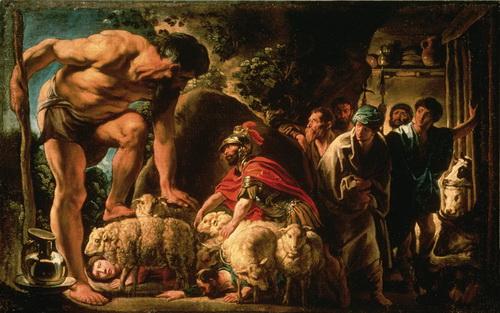
Aurora, rosy daughter of the dawn,
Now ting'd the East, when habited again,
Uprose Ulysses' offspring from his bed.
Athwart his back his faulchion keen he flung,
His sandals bound to his unsullied feet,
And, godlike, issued from his chamber-door.
At once the clear-voic'd heralds he enjoin'd
To call the Greeks to council; they aloud
Gave forth the summons, and the throng began.
When all were gather'd, and the assembly full,
10 Himself, his hand arm'd with a brazen spear,
Went also; nor alone he went; his hounds
Fleet-footed follow'd him, a faithful pair.
O'er all his form Minerva largely shed
Majestic grace divine, and, as he went,
The whole admiring concourse gaz'd on him,
The seniors gave him place, and down he sat
On his paternal Throne. Then grave arose
The Hero, old Ægyptius; bow'd with age
Was he, and by experience deep-inform'd.
20 His son had with Ulysses, godlike Chief,
On board his fleet to steed-fam'd Ilium gone,
The warrior Antiphus, whom in his cave
The savage Cyclops slew, and on his flesh
At ev'ning made obscene his last regale.
Three sons he had beside, a suitor one,
Eurynomus; the other two, employ
Found constant managing their Sire's concerns.
Yet he forgat not, father as he was
Of these, his absent eldest, whom he mourn'd
3 °Ceaseless, and thus his speech, weeping, began.
Hear me, ye men of Ithaca, my friends!
Nor council here nor session hath been held
Since great Ulysses left his native shore.
Who now convenes us? what especial need
Hath urged him, whether of our youth he be,
Or of our senators by age matured?
Have tidings reach'd him of our host's return,
Which here he would divulge? or brings he aught
Of public import on a diff'rent theme?
40 I deem him, whosoe'er he be, a man
Worthy to prosper, and may Jove vouchsafe
The full performance of his chief desire!
He ended, and Telemachus rejoiced
In that good omen. Ardent to begin,
He sat not long, but, moving to the midst,
Received the sceptre from Pisenor's hand,
His prudent herald, and addressing, next,
The hoary Chief Ægyptius, thus began.
Not far remote, as thou shalt soon thyself
50 Perceive, oh venerable Chief! he stands,
Who hath convened this council. I, am He.
I am in chief the suff'rer. Tidings none
Of the returning host I have received,
Which here I would divulge, nor bring I aught
Of public import on a different theme,
But my own trouble, on my own house fall'n,
And twofold fall'n. One is, that I have lost
A noble father, who, as fathers rule
Benign their children, govern'd once yourselves;
60 The other, and the more alarming ill,
With ruin threatens my whole house, and all
My patrimony with immediate waste.
Suitors, (their children who in this our isle
Hold highest rank) importunate besiege
My mother, though desirous not to wed,
And rather than resort to her own Sire
Icarius, who might give his daughter dow'r,
And portion her to whom he most approves,
(A course which, only named, moves their disgust)
70 They chuse, assembling all within my gates
Daily to make my beeves, my sheep, my goats
Their banquet, and to drink without restraint
My wine; whence ruin threatens us and ours;
For I have no Ulysses to relieve
Me and my family from this abuse.
Ourselves are not sufficient; we, alas!
Too feeble should be found, and yet to learn
How best to use the little force we own;
Else, had I pow'r, I would, myself, redress
80 The evil; for it now surpasses far
All suff'rance, now they ravage uncontroul'd,
Nor show of decency vouchsafe me more.
Oh be ashamed[6] yourselves; blush at the thought
Of such reproach as ye shall sure incur
From all our neighbour states, and fear beside
The wrath of the Immortals, lest they call
Yourselves one day to a severe account.
I pray you by Olympian Jove, by her
Whose voice convenes all councils, and again
90 Dissolves them, Themis, that henceforth ye cease,
That ye permit me, oh my friends! to wear
My days in solitary grief away,
Unless Ulysses, my illustrious Sire,
Hath in his anger any Greecian wrong'd,
Whose wrongs ye purpose to avenge on me,
Inciting these to plague me. Better far
Were my condition, if yourselves consumed
My substance and my revenue; from you
I might obtain, perchance, righteous amends
100 Hereafter; you I might with vehement suit
O'ercome, from house to house pleading aloud
For recompense, till I at last prevail'd.
But now, with darts of anguish ye transfix
My inmost soul, and I have no redress.
He spake impassion'd, and to earth cast down
His sceptre, weeping. Pity at that sight
Seiz'd all the people; mute the assembly sat
Long time, none dared to greet Telemachus
With answer rough, till of them all, at last,
110 Antinoüs, sole arising, thus replied.
Telemachus, intemp'rate in harangue,
High-sounding orator! it is thy drift
To make us all odious; but the offence
Lies not with us the suitors; she alone
Thy mother, who in subtlety excels,
And deep-wrought subterfuge, deserves the blame.
It is already the third year, and soon
Shall be the fourth, since with delusive art
Practising on their minds, she hath deceived
120 The Greecians; message after message sent
Brings hope to each, by turns, and promise fair,
But she, meantime, far otherwise intends.
Her other arts exhausted all, she framed
This stratagem; a web of amplest size
And subtlest woof beginning, thus she spake.
Princes, my suitors! since the noble Chief
Ulysses is no more, press not as yet
My nuptials, wait till I shall finish, first,
A fun'ral robe (lest all my threads decay)
130 Which for the antient Hero I prepare,
Laertes, looking for the mournful hour
When fate shall snatch him to eternal rest;
Else I the censure dread of all my sex,
Should he, so wealthy, want at last a shroud.
So spake the Queen, and unsuspicious, we
With her request complied. Thenceforth, all day
She wove the ample web, and by the aid
Of torches ravell'd it again at night.
Three years by such contrivance she deceived
140 The Greecians; but when (three whole years elaps'd)
The fourth arriv'd, then, conscious of the fraud,
A damsel of her train told all the truth,
And her we found rav'ling the beauteous work.
Thus, through necessity she hath, at length,
Perform'd the task, and in her own despight.
Now therefore, for the information clear
Of thee thyself, and of the other Greeks,
We answer. Send thy mother hence, with charge
That him she wed on whom her father's choice
150 Shall fall, and whom she shall, herself, approve.
But if by long procrastination still
She persevere wearing our patience out,
Attentive only to display the gifts
By Pallas so profusely dealt to her,
Works of surpassing skill, ingenious thought,
And subtle shifts, such as no beauteous Greek
(For aught that we have heard) in antient times
E'er practised, Tyro, or Alcemena fair,
Or fair Mycene, of whom none in art
160 E'er match'd Penelope, although we yield
To this her last invention little praise,
Then know, that these her suitors will consume
So long thy patrimony and thy goods,
As she her present purpose shall indulge,
With which the Gods inspire her. Great renown
She to herself insures, but equal woe
And devastation of thy wealth to thee;
For neither to our proper works at home
Go we, of that be sure, nor yet elsewhere,
170 Till him she wed, to whom she most inclines.
Him prudent, then, answer'd Telemachus.
Antinoüs! it is not possible
That I should thrust her forth against her will,
Who both produced and reared me. Be he dead,
Or still alive, my Sire is far remote,
And should I, voluntary, hence dismiss
My mother to Icarius, I must much
Refund, which hardship were and loss to me.
So doing, I should also wrath incur
180 From my offended Sire, and from the Gods
Still more; for she, departing, would invoke
Erynnis to avenge her, and reproach
Beside would follow me from all mankind.
That word I, therefore, never will pronounce.
No, if ye judge your treatment at her hands
Injurious to you, go ye forth yourselves,
Forsake my mansion; seek where else ye may
Your feasts; consume your own; alternate feed
Each at the other's cost. But if it seem
190 Wisest in your account and best to eat
Voracious thus the patrimonial goods
Of one man, rend'ring no account of all,
Bite to the roots; but know that I will cry
Ceaseless to the eternal Gods, in hope
That Jove, in retribution of the wrong,
Shall doom you, where ye have intruded, there
To bleed, and of your blood ask no account.
So spake Telemachus, and while he spake,
The Thund'rer from a lofty mountain-top
200 Turn'd off two eagles; on the winds, awhile,
With outspread pinions ample side by side
They floated; but, ere long, hov'ring aloft,
Right o'er the midst of the assembled Chiefs
They wheel'd around, clang'd all their num'rous plumes,
And with a downward look eyeing the throng,
Death boded, ominous; then rending each
The other's face and neck, they sprang at once
Toward the right, and darted through the town.
Amazement universal, at that sight,
210 Seized the assembly, and with anxious thought
Each scann'd the future; amidst whom arose
The Hero Halitherses, antient Seer,
Offspring of Mastor; for in judgment he
Of portents augural, and in forecast
Unerring, his coevals all excell'd,
And prudent thus the multitude bespake.
Ye men of Ithaca, give ear! hear all!
Though chief my speech shall to the suitors look,
For, on their heads devolved, comes down the woe.
220 Ulysses shall not from his friends, henceforth,
Live absent long, but, hasting to his home,
Comes even now, and as he comes, designs
A bloody death for these, whose bitter woes
No few shall share, inhabitants with us
Of pleasant Ithaca; but let us frame
Effectual means maturely to suppress
Their violent deeds, or rather let themselves
Repentant cease; and soonest shall be best.
Not inexpert, but well-inform'd I speak
230 The future, and the accomplishment announce
Of all which when Ulysses with the Greeks
Embark'd for Troy, I to himself foretold.
I said that, after many woes, and loss
Of all his people, in the twentieth year,
Unknown to all, he should regain his home,
And my prediction shall be now fulfill'd.
Him, then, Eurymachus thus answer'd rough
The son of Polybus. Hence to thy house,
Thou hoary dotard! there, prophetic, teach
240 Thy children to escape woes else to come.
Birds num'rous flutter in the beams of day,
Not all predictive. Death, far hence remote
Hath found Ulysses, and I would to heav'n
That, where he died, thyself had perish'd too.
Thou hadst not then run o'er with prophecy
As now, nor provocation to the wrath
Giv'n of Telemachus, in hope to win,
Perchance, for thine some favour at his hands.
But I to thee foretell, skilled as thou art
250 In legends old, (nor shall my threat be vain)
That if by artifice thou move to wrath
A younger than thyself, no matter whom,
Woe first the heavier on himself shall fall,
Nor shalt thou profit him by thy attempt,
And we will charge thee also with a mulct,
Which thou shalt pay with difficulty, and bear
The burthen of it with an aching heart.
As for Telemachus, I him advise,
Myself, and press the measure on his choice
260 Earnestly, that he send his mother hence
To her own father's house, who shall, himself,
Set forth her nuptial rites, and shall endow
His daughter sumptuously, and as he ought.
For this expensive wooing, as I judge,
Till then shall never cease; since we regard
No man-no-not Telemachus, although
In words exub'rant; neither fear we aught
Thy vain prognostics, venerable sir!
But only hate thee for their sake the more.
270 Waste will continue and disorder foul
Unremedied, so long as she shall hold
The suitors in suspense, for, day by day,
Our emulation goads us to the strife,
Nor shall we, going hence, seek to espouse
Each his own comfort suitable elsewhere.
To whom, discrete, Telemachus replied.
Eurymachus, and ye the suitor train
Illustrious, I have spoken: ye shall hear
No more this supplication urged by me.
280 The Gods, and all the Greeks, now know the truth.
But give me instantly a gallant bark
With twenty rowers, skill'd their course to win
To whatsoever haven; for I go
To sandy Pylus, and shall hasten thence
To Lacedemon, tidings to obtain
Of my long-absent Sire, or from the lips
Of man, or by a word from Jove vouchsafed
Himself, best source of notice to mankind.
If, there inform'd that still my father lives,
290 I hope conceive of his return, although
Distress'd, I shall be patient yet a year.
But should I learn, haply, that he survives
No longer, then, returning, I will raise
At home his tomb, will with such pomp perform
His fun'ral rites, as his great name demands,
And give my mother's hand to whom I may.
This said, he sat, and after him arose
Mentor, illustrious Ulysses' friend,
To whom, embarking thence, he had consign'd
300 All his concerns, that the old Chief might rule
His family, and keep the whole secure.
Arising, thus the senior, sage, began.
Hear me, ye Ithacans! be never King
Henceforth, benevolent, gracious, humane
Or righteous, but let every sceptred hand
Rule merciless, and deal in wrong alone,
Since none of all his people, whom he sway'd
With such paternal gentleness and love,
Remembers the divine Ulysses more!
310 That the imperious suitors thus should weave
The web of mischief and atrocious wrong,
I grudge not; since at hazard of their heads
They make Ulysses' property a prey,
Persuaded that the Hero comes no more.
But much the people move me; how ye sit
All mute, and though a multitude, yourselves,
Opposed to few, risque not a single word
To check the license of these bold intruders!
Then thus Liocritus, Evenor's son.
320 Injurious Mentor! headlong orator!
How dar'st thou move the populace against
The suitors? Trust me they should find it hard,
Numerous as they are, to cope with us,
A feast the prize. Or should the King himself
Of Ithaca, returning, undertake
T' expell the jovial suitors from his house,
Much as Penelope his absence mourns,
His presence should afford her little joy;
For fighting sole with many, he should meet
330 A dreadful death. Thou, therefore, speak'st amiss.
As for Telemachus, let Mentor him
And Halytherses furnish forth, the friends
Long valued of his Sire, with all dispatch;
Though him I judge far likelier to remain
Long-time contented an enquirer here,
Than to perform the voyage now proposed.
Thus saying, Liocritus dissolved in haste
The council, and the scattered concourse sought
Their sev'ral homes, while all the suitors flock'd
340 Thence to the palace of their absent King.
Meantime, Telemachus from all resort
Retiring, in the surf of the gray Deep
First laved his hands, then, thus to Pallas pray'd.
O Goddess! who wast yesterday a guest
Beneath my roof, and didst enjoin me then
A voyage o'er the sable Deep in quest
Of tidings of my long regretted Sire!
Which voyage, all in Ithaca, but most
The haughty suitors, obstinate impede,
350 Now hear my suit and gracious interpose!
Such pray'r he made; then Pallas, in the form,
And with the voice of Mentor, drawing nigh,
In accents wing'd, him kindly thus bespake.
Telemachus! thou shalt hereafter prove
Nor base, nor poor in talents. If, in truth,
Thou have received from heav'n thy father's force
Instill'd into thee, and resemblest him
In promptness both of action and of speech,
Thy voyage shall not useless be, or vain.
360 But if Penelope produced thee not
His son, I, then, hope not for good effect
Of this design which, ardent, thou pursuest.
Few sons their fathers equal; most appear
Degenerate; but we find, though rare, sometimes
A son superior even to his Sire.
And since thyself shalt neither base be found
Nor spiritless, nor altogether void
Of talents, such as grace thy royal Sire,
I therefore hope success of thy attempt.
370 Heed not the suitors' projects; neither wise
Are they, nor just, nor aught suspect the doom
Which now approaches them, and in one day
Shall overwhelm them all. No long suspense
Shall hold thy purposed enterprise in doubt,
Such help from me, of old thy father's friend,
Thou shalt receive, who with a bark well-oar'd
Will serve thee, and myself attend thee forth.
But haste, join thou the suitors, and provide,
In sep'rate vessels stow'd, all needful stores,
380 Wine in thy jars, and flour, the strength of man,
In skins close-seam'd. I will, meantime, select
Such as shall voluntary share thy toils.
In sea-girt Ithaca new ships and old
Abound, and I will chuse, myself, for thee
The prime of all, which without more delay
We will launch out into the spacious Deep.
Thus Pallas spake, daughter of Jove; nor long,
So greeted by the voice divine, remain'd
Telemachus, but to his palace went
390 Distress'd in heart. He found the suitors there
Goats slaying in the hall, and fatted swine
Roasting; when with a laugh Antinoüs flew
To meet him, fasten'd on his hand, and said,
Telemachus, in eloquence sublime,
And of a spirit not to be controul'd!
Give harbour in thy breast on no account
To after-grudge or enmity, but eat,
Far rather, cheerfully as heretofore,
And freely drink, committing all thy cares
400 To the Achaians, who shall furnish forth
A gallant ship and chosen crew for thee,
That thou may'st hence to Pylus with all speed,
Tidings to learn of thy illustrious Sire.
To whom Telemachus, discrete, replied.
Antinoüs! I have no heart to feast
With guests so insolent, nor can indulge
The pleasures of a mind at ease, with you.
Is't not enough, suitors, that ye have used
My noble patrimony as your own
410 While I was yet a child? now, grown mature,
And competent to understand the speech
Of my instructors, feeling, too, a mind
Within me conscious of augmented pow'rs,
I will attempt your ruin, be assured,
Whether at Pylus, or continuing here.
I go, indeed, (nor shall my voyage prove
Of which I speak, bootless or vain) I go
An humble passenger, who neither bark
Nor rowers have to boast my own, denied
420 That honour (so ye judg'd it best) by you.
He said, and from Antinoüs' hand his own
Drew sudden. Then their delicate repast
The busy suitors on all sides prepar'd,
Still taunting as they toil'd, and with sharp speech
Sarcastic wantoning, of whom a youth,
Arrogant as his fellows, thus began.
I see it plain, Telemachus intends
Our slaughter; either he will aids procure
From sandy Pylus, or will bring them arm'd
430 From Sparta; such is his tremendous drift.
Even to fruitful Ephyre, perchance,
He will proceed, seeking some baneful herb
Which cast into our cup, shall drug us all.
To whom some haughty suitor thus replied.
Who knows but that himself, wand'ring the sea
From all his friends and kindred far remote,
May perish like Ulysses? Whence to us
Should double toil ensue, on whom the charge
To parcel out his wealth would then devolve,
440 And to endow his mother with the house
For his abode whom she should chance to wed.
So sported they; but he, ascending sought
His father's lofty chamber, where his heaps
He kept of brass and gold, garments in chests,
And oils of fragrant scent, a copious store.
There many a cask with season'd nectar fill'd
The grape's pure juice divine, beside the wall
Stood orderly arranged, waiting the hour
(Should e'er such hour arrive) when, after woes
450 Num'rous, Ulysses should regain his home.
Secure that chamber was with folding doors
Of massy planks compact, and night and day,
Within it antient Euryclea dwelt,
Guardian discrete of all the treasures there,
Whom, thither call'd, Telemachus address'd.
Nurse! draw me forth sweet wine into my jars,
Delicious next to that which thou reserv'st
For our poor wand'rer; if escaping death
At last, divine Ulysses e'er return.
460 Fill twelve, and stop them close; pour also meal
Well mill'd (full twenty measures) into skins
Close-seam'd, and mention what thou dost to none.
Place them together; for at even-tide
I will convey them hence, soon as the Queen,
Retiring to her couch, shall seek repose.
For hence to Sparta will I take my course,
And sandy Pylus, tidings there to hear
(If hear I may) of my lov'd Sire's return.
He ceas'd, then wept his gentle nurse that sound
470 Hearing, and in wing'd accents thus replied.
My child! ah, wherefore hath a thought so rash
Possess'd thee? whither, only and belov'd,
Seek'st thou to ramble, travelling, alas!
To distant climes? Ulysses is no more;
Dead lies the Hero in some land unknown,
And thou no sooner shalt depart, than these
Will plot to slay thee, and divide thy wealth.
No, stay with us who love thee. Need is none
That thou should'st on the barren Deep distress
480 Encounter, roaming without hope or end.
Whom, prudent, thus answer'd Telemachus.
Take courage, nurse! for not without consent
Of the Immortals I have thus resolv'd.
But swear, that till eleven days be past,
Or twelve, or, till enquiry made, she learn
Herself my going, thou wilt not impart
Of this my purpose to my mother's ear,
Lest all her beauties fade by grief impair'd.
He ended, and the antient matron swore
490 Solemnly by the Gods; which done, she fill'd
With wine the vessels and the skins with meal,
And he, returning, join'd the throng below.
Then Pallas, Goddess azure-eyed, her thoughts
Elsewhere directing, all the city ranged
In semblance of Telemachus, each man
Exhorting, at the dusk of eve, to seek
The gallant ship, and from Noëmon, son
Renown'd of Phronius, ask'd, herself, a bark,
Which soon as ask'd, he promis'd to supply.
500 Now set the sun, and twilight dimm'd the ways,
When, drawing down his bark into the Deep,
He gave her all her furniture, oars, arms
And tackle, such as well-built galleys bear,
Then moor'd her in the bottom of the bay.
Meantime, his mariners in haste repair'd
Down to the shore, for Pallas urged them on.
And now on other purposes intent,
The Goddess sought the palace, where with dews
Of slumber drenching ev'ry suitor's eye,
510 She fool'd the drunkard multitude, and dash'd
The goblets from their idle hands away.
They through the city reeled, happy to leave
The dull carousal, when the slumb'rous weight
Oppressive on their eye-lids once had fall'n.
Next, Pallas azure-eyed in Mentor's form
And with the voice of Mentor, summoning
Telemachus abroad, him thus bespake.
Telemachus! already at their oars
Sit all thy fellow-voyagers, and wait
520 Thy coming; linger not, but haste away.
This said, Minerva led him thence, whom he
With nimble steps follow'd, and on the shore
Arrived, found all his mariners prepared,
Whom thus the princely voyager address'd.
Haste, my companions! bring we down the stores
Already sorted and set forth; but nought
My mother knows, or any of her train
Of this design, one matron sole except.
He spake, and led them; they, obedient, brought
530 All down, and, as Ulysses' son enjoin'd,
Within the gallant bark the charge bestow'd.
Then, led by Pallas, went the prince on board,
Where down they sat, the Goddess in the stern,
And at her side Telemachus. The crew
Cast loose the hawsers, and embarking, fill'd
The benches. Blue-eyed Pallas from the West
Call'd forth propitious breezes; fresh they curled
The sable Deep, and, sounding, swept the waves.
He loud-exhorting them, his people bade
540 Hand, brisk, the tackle; they, obedient, reared
The pine-tree mast, which in its socket deep
They lodg'd, then strain'd the cordage, and with thongs
Well-twisted, drew the shining sail aloft.
A land-breeze fill'd the canvas, and the flood
Roar'd as she went against the steady bark
That ran with even course her liquid way.
The rigging, thus, of all the galley set,
Their beakers crowning high with wine, they hail'd
The ever-living Gods, but above all
550 Minerva, daughter azure-eyed of Jove.
Thus, all night long the galley, and till dawn
Had brighten'd into day, cleaved swift the flood.
6
The reader is to be reminded that this is not an assembly of the suitors only, but a general one, which affords Telemachus an opportunity to apply himself to the feelings of the Ithacans at large.
Book III
Telemachus arriving at Pylus, enquires of Nestor concerning Ulysses. Nestor relates to him all that he knows or has heard of the Greecians since their departure from the siege of Troy, but not being able to give him any satisfactory account of Ulysses, refers him to Menelaus. At evening Minerva quits Telemachus, but discovers herself in going. Nestor sacrifices to the Goddess, and the solemnity ended, Telemachus sets forth for Sparta in one of Nestor's chariots, and accompanied by Nestor's son, Pisistratus.
The sun, emerging from the lucid waves,
Ascended now the brazen vault with light
For the inhabitants of earth and heav'n,
When in their bark at Pylus they arrived,
City of Neleus. On the shore they found
The people sacrificing; bulls they slew
Black without spot, to Neptune azure-hair'd.
On ranges nine of seats they sat; each range
Received five hundred, and to each they made
Allotment equal of nine sable bulls.
10 The feast was now begun; these eating sat
The entrails, those stood off'ring to the God
The thighs, his portion, when the Ithacans
Push'd right ashore, and, furling close the sails,
And making fast their moorings, disembark'd.
Forth came Telemachus, by Pallas led,
Whom thus the Goddess azure-eyed address'd.
Telemachus! there is no longer room
For bashful fear, since thou hast cross'd the flood
With purpose to enquire what land conceals
20 Thy father, and what fate hath follow'd him.
Advance at once to the equestrian Chief
Nestor, within whose bosom lies, perhaps,
Advice well worthy of thy search; entreat
Himself, that he will tell thee only truth,
Who will not lye, for he is passing wise.
To whom Telemachus discrete replied.
Ah Mentor! how can I advance, how greet
A Chief like him, unpractis'd as I am
In manag'd phrase? Shame bids the youth beware
30 How he accosts the man of many years.
But him the Goddess answer'd azure-eyed,
Telemachus! Thou wilt, in part, thyself
Fit speech devise, and heav'n will give the rest;
For thou wast neither born, nor hast been train'd
To manhood, under unpropitious Pow'rs.
So saying, Minerva led him thence, whom he
With nimble steps attending, soon arrived
Among the multitude. There Nestor sat,
And Nestor's sons, while, busily the feast
40 Tending, his num'rous followers roasted, some,
The viands, some, transfix'd them with the spits.
They seeing guests arrived, together all
Advanced, and, grasping courteously their hands,
Invited them to sit; but first, the son
Of Nestor, young Pisistratus, approach'd,
Who, fast'ning on the hands of both, beside
The banquet placed them, where the beach was spread
With fleeces, and where Thrasymedes sat
His brother, and the hoary Chief his Sire.
50 To each a portion of the inner parts
He gave, then fill'd a golden cup with wine,
Which, tasted first, he to the daughter bore
Of Jove the Thund'rer, and her thus bespake.
Oh guest! the King of Ocean now adore!
For ye have chanced on Neptune's festival;
And, when thou hast, thyself, libation made
Duly, and pray'r, deliver to thy friend
The gen'rous juice, that he may also make
Libation; for he, doubtless, seeks, in prayer
60 The Immortals, of whose favour all have need.
But, since he younger is, and with myself
Coeval, first I give the cup to thee.
He ceas'd, and to her hand consign'd the cup,
Which Pallas gladly from a youth received
So just and wise, who to herself had first
The golden cup presented, and in pray'r
Fervent the Sov'reign of the Seas adored.
Hear, earth-encircler Neptune! O vouchsafe
To us thy suppliants the desired effect
70 Of this our voyage; glory, first, bestow
On Nestor and his offspring both, then grant
To all the Pylians such a gracious boon
As shall requite their noble off'ring well.
Grant also to Telemachus and me
To voyage hence, possess'd of what we sought
When hither in our sable bark we came.
So Pallas pray'd, and her own pray'r herself
Accomplish'd. To Telemachus she gave
The splendid goblet next, and in his turn
80 Like pray'r Ulysses' son also preferr'd.
And now (the banquet from the spits withdrawn)
They next distributed sufficient share
To each, and all were sumptuously regaled.
At length, (both hunger satisfied and thirst)
Thus Nestor, the Gerenian Chief, began.
Now with more seemliness we may enquire,
After repast, what guests we have received.
Our guests! who are ye? Whence have ye the waves
Plough'd hither? Come ye to transact concerns
90 °Commercial, or at random roam the Deep
Like pirates, who with mischief charged and woe
To foreign States, oft hazard life themselves?
Him answer'd, bolder now, but still discrete,
Telemachus. For Pallas had his heart
With manly courage arm'd, that he might ask
From Nestor tidings of his absent Sire,
And win, himself, distinction and renown.
Oh Nestor, Neleus' son, glory of Greece!
Thou askest whence we are. I tell thee whence.
100 From Ithaca, by the umbrageous woods
Of Neritus o'erhung, by private need,
Not public, urged, we come. My errand is
To seek intelligence of the renown'd
Ulysses; of my noble father, prais'd
For dauntless courage, whom report proclaims
Conqueror, with thine aid, of sacred Troy.
We have already learn'd where other Chiefs
Who fought at Ilium, died; but Jove conceals
Even the death of my illustrious Sire
110 In dull obscurity; for none hath heard
Or confident can answer, where he dy'd;
Whether he on the continent hath fall'n
By hostile hands, or by the waves o'erwhelm'd
Of Amphitrite, welters in the Deep.
For this cause, at thy knees suppliant, I beg
That thou would'st tell me his disast'rous end,
If either thou beheld'st that dread event
Thyself, or from some wanderer of the Greeks
Hast heard it: for my father at his birth
120 Was, sure, predestin'd to no common woes.
Neither through pity, or o'erstrain'd respect
Flatter me, but explicit all relate
Which thou hast witness'd. If my noble Sire
E'er gratified thee by performance just
Of word or deed at Ilium, where ye fell
So num'rous slain in fight, oh, recollect
Now his fidelity, and tell me true.
Then Nestor thus Gerenian Hero old.
Young friend! since thou remind'st me, speaking thus,
130 Of all the woes which indefatigable
We sons of the Achaians there sustain'd,
Both those which wand'ring on the Deep we bore
Wherever by Achilles led in quest
Of booty, and the many woes beside
Which under royal Priam's spacious walls
We suffer'd, know, that there our bravest fell.
There warlike Ajax lies, there Peleus' son;
There, too, Patroclus, like the Gods themselves
In council, and my son beloved there,
140 Brave, virtuous, swift of foot, and bold in fight,
Antilochus. Nor are these sorrows all;
What tongue of mortal man could all relate?
Should'st thou, abiding here, five years employ
Or six, enquiring of the woes endured
By the Achaians, ere thou should'st have learn'd
The whole, thou would'st depart, tir'd of the tale.
For we, nine years, stratagems of all kinds
Devised against them, and Saturnian Jove
Scarce crown'd the difficult attempt at last.
150 There, no competitor in wiles well-plann'd
Ulysses found, so far were all surpass'd
In shrewd invention by thy noble Sire,
If thou indeed art his, as sure thou art,
Whose sight breeds wonder in me, and thy speech
His speech resembles more than might be deem'd
Within the scope of years so green as thine.
There, never in opinion, or in voice
Illustrious Ulysses and myself
Divided were, but, one in heart, contrived
160 As best we might, the benefit of all.
But after Priam's lofty city sack'd,
And the departure of the Greeks on board
Their barks, and when the Gods had scatter'd them,
Then Jove imagin'd for the Argive host
A sorrowful return; for neither just
Were all, nor prudent, therefore many found
A fate disast'rous through the vengeful ire
Of Jove-born Pallas, who between the sons
Of Atreus sharp contention interposed.
170 They both, irregularly, and against
Just order, summoning by night the Greeks
To council, of whom many came with wine
Oppress'd, promulgated the cause for which
They had convened the people. Then it was
That Menelaus bade the general host
Their thoughts bend homeward o'er the sacred Deep,
Which Agamemnon in no sort approved.
His counsel was to slay them yet at Troy,
That so he might assuage the dreadful wrath
180 Of Pallas, first, by sacrifice and pray'r.
Vain hope! he little thought how ill should speed
That fond attempt, for, once provok'd, the Gods
Are not with ease conciliated again.
Thus stood the brothers, altercation hot
Maintaining, till at length, uprose the Greeks
With deaf'ning clamours, and with diff'ring minds.
We slept the night, but teeming with disgust
Mutual, for Jove great woe prepar'd for all.
At dawn of day we drew our gallies down
190 Into the sea, and, hasty, put on board
The spoils and female captives. Half the host,
With Agamemnon, son of Atreus, stay'd
Supreme commander, and, embarking, half
Push'd forth. Swift course we made, for Neptune smooth'd
The waves before us of the monstrous Deep.
At Tenedos arriv'd, we there perform'd
Sacrifice to the Gods, ardent to reach
Our native land, but unpropitious Jove,
Not yet designing our arrival there,
200 Involved us in dissension fierce again.
For all the crews, followers of the King,
Thy noble Sire, to gratify our Chief,
The son of Atreus, chose a diff'rent course,
And steer'd their oary barks again to Troy.
But I, assured that evil from the Gods
Impended, gath'ring all my gallant fleet,
Fled thence in haste, and warlike Diomede
Exhorting his attendants, also fled.
At length, the Hero Menelaus join'd
210 Our fleets at Lesbos; there he found us held
In deep deliberation on the length
Of way before us, whether we should steer
Above the craggy Chios to the isle
Psyria, that island holding on our left,
Or under Chios by the wind-swept heights
Of Mimas. Then we ask'd from Jove a sign,
And by a sign vouchsafed he bade us cut
The wide sea to Euboea sheer athwart,
So soonest to escape the threat'ned harm.
220 Shrill sang the rising gale, and with swift prows
Cleaving the fishy flood, we reach'd by night
Geræstus, where arrived, we burn'd the thighs
Of num'rous bulls to Neptune, who had safe
Conducted us through all our perilous course.
The fleet of Diomede in safety moor'd
On the fourth day at Argos, but myself
Held on my course to Pylus, nor the wind
One moment thwarted us, or died away,
When Jove had once commanded it to blow.
230 Thus, uninform'd, I have arrived, my son!
Nor of the Greecians, who are saved have heard,
Or who have perish'd; but what news soe'er
I have obtain'd, since my return, with truth
I will relate, nor aught conceal from thee.
The spear-famed Myrmidons, as rumour speaks,
By Neoptolemus, illustrious son
Of brave Achilles led, have safe arrived;
Safe, Philoctetes, also son renown'd
Of Pæas; and Idomeneus at Crete
240 Hath landed all his followers who survive
The bloody war, the waves have swallow'd none.
Ye have yourselves doubtless, although remote,
Of Agamemnon heard, how he return'd,
And how Ægisthus cruelly contrived
For him a bloody welcome, but himself
Hath with his own life paid the murth'rous deed.
Good is it, therefore, if a son survive
The slain, since Agamemnon's son hath well
Avenged his father's death, slaying, himself,
250 Ægisthus, foul assassin of his Sire.
Young friend! (for pleas'd thy vig'rous youth I view,
And just proportion) be thou also bold,
That thine like his may be a deathless name.
Then, prudent, him answer'd Telemachus.
Oh Nestor, Neleus' son, glory of Greece!
And righteous was that vengeance; his renown
Achaia's sons shall far and wide diffuse,
To future times transmitting it in song.
Ah! would that such ability the Gods
260 Would grant to me, that I, as well, the deeds
Might punish of our suitors, whose excess
Enormous, and whose bitter taunts I feel
Continual, object of their subtle hate.
But not for me such happiness the Gods
Have twined into my thread; no, not for me
Or for my father. Patience is our part.
To whom Gerenian Nestor thus replied.
Young friend! (since thou remind'st me of that theme)
Fame here reports that num'rous suitors haunt
270 Thy palace for thy mother's sake, and there
Much evil perpetrate in thy despight.
But say, endur'st thou willing their controul
Imperious, or because the people, sway'd
By some response oracular, incline
Against thee? But who knows? the time may come
When to his home restored, either alone,
Or aided by the force of all the Greeks,
Ulysses may avenge the wrong; at least,
Should Pallas azure-eyed thee love, as erst
280 At Troy, the scene of our unnumber'd woes,
She lov'd Ulysses (for I have not known
The Gods assisting so apparently
A mortal man, as him Minerva there)
Should Pallas view thee also with like love
And kind solicitude, some few of those
Should dream, perchance, of wedlock never more.
Then answer thus Telemachus return'd.
That word's accomplishment I cannot hope;
It promises too much; the thought alone
290 O'erwhelms me; an event so fortunate
Would, unexpected on my part, arrive,
Although the Gods themselves should purpose it.
But Pallas him answer'd cærulean-eyed.
Telemachus! what word was that which leap'd
The iv'ry guard[7] that should have fenced it in?
A God, so willing, could with utmost ease
Save any man, howe'er remote. Myself,
I had much rather, many woes endured,
Revisit home, at last, happy and safe,
300 Than, sooner coming, die in my own house,
As Agamemnon perish'd by the arts
Of base Ægisthus and the subtle Queen.
Yet not the Gods themselves can save from death
All-levelling, the man whom most they love,
When Fate ordains him once to his last sleep.
To whom Telemachus, discrete, replied.
Howe'er it interest us, let us leave
This question, Mentor! He, I am assured,
Returns no more, but hath already found
310 A sad, sad fate by the decree of heav'n.
But I would now interrogate again
Nestor, and on a different theme, for him
In human rights I judge, and laws expert,
And in all knowledge beyond other men;
For he hath govern'd, as report proclaims,
Three generations; therefore in my eyes
He wears the awful impress of a God.
Oh Nestor, son of Neleus, tell me true;
What was the manner of Atrides' death,
320 Wide-ruling Agamemnon? Tell me where
Was Menelaus? By what means contrived
Ægisthus to inflict the fatal blow,
Slaying so much a nobler than himself?
Had not the brother of the Monarch reach'd
Achaian Argos yet, but, wand'ring still
In other climes, his long absence gave
Ægisthus courage for that bloody deed?
Whom answer'd the Gerenian Chief renown'd.
My son! I will inform thee true; meantime
330 Thy own suspicions border on the fact.
Had Menelaus, Hero, amber hair'd,
Ægisthus found living at his return
From Ilium, never on his bones the Greeks
Had heap'd a tomb, but dogs and rav'ning fowls
Had torn him lying in the open field
Far from the town, nor him had woman wept
Of all in Greece, for he had foul transgress'd.
But we, in many an arduous task engaged,
Lay before Ilium; he, the while, secure
340 Within the green retreats of Argos, found
Occasion apt by flatt'ry to delude
The spouse of Agamemnon; she, at first,
(The royal Clytemnestra) firm refused
The deed dishonourable (for she bore
A virtuous mind, and at her side a bard
Attended ever, whom the King, to Troy
Departing, had appointed to the charge.)
But when the Gods had purposed to ensnare
Ægisthus, then dismissing far remote
350 The bard into a desart isle, he there
Abandon'd him to rav'ning fowls a prey,
And to his own home, willing as himself,
Led Clytemnestra. Num'rous thighs he burn'd
On all their hallow'd altars to the Gods,
And hung with tap'stry, images, and gold
Their shrines, his great exploit past hope atchiev'd.
We (Menelaus and myself) had sailed
From Troy together, but when we approach'd
Sunium, headland of th' Athenian shore,
360 There Phoebus, sudden, with his gentle shafts
Slew Menelaus' pilot while he steer'd
The volant bark, Phrontis, Onetor's son,
A mariner past all expert, whom none
In steerage match'd, what time the tempest roar'd.
Here, therefore, Menelaus was detained,
Giving his friend due burial, and his rites
Funereal celebrating, though in haste
Still to proceed. But when, with all his fleet
The wide sea traversing, he reach'd at length
370 Malea's lofty foreland in his course,
Rough passage, then, and perilous he found.
Shrill blasts the Thund'rer pour'd into his sails,
And wild waves sent him mountainous. His ships
There scatter'd, some to the Cydonian coast
Of Crete he push'd, near where the Jardan flows.
Beside the confines of Gortyna stands,
Amid the gloomy flood, a smooth rock, steep
Toward the sea, against whose leftward point
Phæstus by name, the South wind rolls the surge
380 Amain, which yet the rock, though small, repells.
Hither with part he came, and scarce the crews
Themselves escaped, while the huge billows broke
Their ships against the rocks; yet five he saved,
Which winds and waves drove to the Ægyptian shore.
Thus he, provision gath'ring as he went
And gold abundant, roam'd to distant lands
And nations of another tongue. Meantime,
Ægisthus these enormities at home
Devising, slew Atrides, and supreme
390 Rul'd the subjected land; sev'n years he reign'd
In opulent Mycenæ, but the eighth
From Athens brought renown'd Orestes home
For his destruction, who of life bereaved
Ægisthus base assassin of his Sire.
Orestes, therefore, the funereal rites
Performing to his shameless mother's shade
And to her lustful paramour, a feast
Gave to the Argives; on which self-same day
The warlike Menelaus, with his ships
400 All treasure-laden to the brink, arrived.
And thou, young friend! from thy forsaken home
Rove not long time remote, thy treasures left
At mercy of those proud, lest they divide
And waste the whole, rend'ring thy voyage vain.
But hence to Menelaus is the course
To which I counsel thee; for he hath come
Of late from distant lands, whence to escape
No man could hope, whom tempests first had driv'n
Devious into so wide a sea, from which
410 Themselves the birds of heaven could not arrive
In a whole year, so vast is the expanse.
Go, then, with ship and shipmates, or if more
The land delight thee, steeds thou shalt not want
Nor chariot, and my sons shall be thy guides
To noble Lacedemon, the abode
Of Menelaus; ask from him the truth,
Who will not lye, for he is passing wise.
While thus he spake, the sun declined, and night
Approaching, blue-eyed Pallas interposed.
420 O antient King! well hast thou spoken all.
But now delay not. Cut ye forth the tongues,[8]
And mingle wine, that (Neptune first invoked
With due libation, and the other Gods)
We may repair to rest; for even now
The sun is sunk, and it becomes us not
Long to protract a banquet to the Gods
Devote, but in fit season to depart.
So spake Jove's daughter; they obedient heard.
The heralds, then, pour'd water on their hands,
430 And the attendant youths, filling the cups,
Served them from left to right. Next all the tongues
They cast into the fire, and ev'ry guest
Arising, pour'd libation to the Gods.
Libation made, and all with wine sufficed,
Godlike Telemachus and Pallas both
Would have return'd, incontinent, on board,
But Nestor urged them still to be his guests.
Forbid it, Jove, and all the Pow'rs of heav'n!
That ye should leave me to repair on board
440 Your vessel, as I were some needy wretch
Cloakless and destitute of fleecy stores
Wherewith to spread the couch soft for myself,
Or for my guests. No. I have garments warm
An ample store, and rugs of richest dye;
And never shall Ulysses' son belov'd,
My frend's own son, sleep on a galley's plank
While I draw vital air; grant also, heav'n,
That, dying, I may leave behind me sons
Glad to accommodate whatever guest!
450 Him answer'd then Pallas cærulean-eyed.
Old Chief! thou hast well said, and reason bids
Telemachus thy kind commands obey.
Let him attend thee hence, that he may sleep
Beneath thy roof, but I return on board
Myself, to instruct my people, and to give
All needful orders; for among them none
Is old as I, but they are youths alike,
Coevals of Telemachus, with whom
They have embark'd for friendship's sake alone.
460 I therefore will repose myself on board
This night, and to the Caucons bold in arms
Will sail to-morrow, to demand arrears
Long time unpaid, and of no small amount.
But, since he is become thy guest, afford
My friend a chariot, and a son of thine
Who shall direct his way, nor let him want
Of all thy steeds the swiftest and the best.
So saying, the blue-eyed Goddess as upborne
On eagle's wings, vanish'd; amazement seized
470 The whole assembly, and the antient King
O'erwhelmed with wonder at that sight, the hand
Grasp'd of Telemachus, whom he thus bespake.
My friend! I prophesy that thou shalt prove
Nor base nor dastard, whom, so young, the Gods
Already take in charge; for of the Pow'rs
Inhabitants of heav'n, none else was this
Than Jove's own daughter Pallas, who among
The Greecians honour'd most thy gen'rous Sire.
But thou, O Queen! compassionate us all,
480 Myself, my sons, my comfort; give to each
A glorious name, and I to thee will give
For sacrifice an heifer of the year,
Broad-fronted, one that never yet hath borne
The yoke, and will incase her horns with gold.
So Nestor pray'd, whom Pallas gracious heard.
Then the Gerenian warrior old, before
His sons and sons in law, to his abode
Magnificent proceeded: they (arrived
Within the splendid palace of the King)
490 On thrones and couches sat in order ranged,
Whom Nestor welcom'd, charging high the cup
With wine of richest sort, which she who kept
That treasure, now in the eleventh year
First broach'd, unsealing the delicious juice.
With this the hoary Senior fill'd a cup,
And to the daughter of Jove Ægis-arm'd
Pouring libation, offer'd fervent pray'r.
When all had made libation, and no wish
Remain'd of more, then each to rest retired,
500 And Nestor the Gerenian warrior old
Led thence Telemachus to a carved couch
Beneath the sounding portico prepared.
Beside him he bade sleep the spearman bold,
Pisistratus, a gallant youth, the sole
Unwedded in his house of all his sons.
Himself in the interior palace lay,
Where couch and cov'ring for her antient spouse
The consort Queen had diligent prepar'd.
But when Aurora, daughter of the dawn,
510 Had tinged the East, arising from his bed,
Gerenian Nestor issued forth, and sat
Before his palace-gate on the white stones
Resplendent as with oil, on which of old
His father Neleus had been wont to sit,
In council like a God; but he had sought,
By destiny dismiss'd long since, the shades.
On those stones therefore now, Nestor himself,
Achaia's guardian, sat, sceptre in hand,
Where soon his num'rous sons, leaving betimes
520 The place of their repose, also appeared,
Echephron, Stratius, Perseus, Thrasymedes,
Aretus and Pisistratus. They placed
Godlike Telemachus at Nestor's side,
And the Gerenian Hero thus began.
Sons be ye quick-execute with dispatch
My purpose, that I may propitiate first
Of all the Gods Minerva, who herself
Hath honour'd manifest our hallow'd feast.
Haste, one, into the field, to order thence
530 An ox, and let the herdsman drive it home.
Another, hasting to the sable bark
Of brave Telemachus, bring hither all
His friends, save two, and let a third command
Laerceus, that he come to enwrap with gold
The victim's horns. Abide ye here, the rest,
And bid my female train (for I intend
A banquet) with all diligence provide
Seats, stores of wood, and water from the rock.
He said, whom instant all obey'd. The ox
54 °Came from the field, and from the gallant ship
The shipmates of the brave Telemachus;
Next, charged with all his implements of art,
His mallet, anvil, pincers, came the smith
To give the horns their gilding; also came
Pallas herself to her own sacred rites.
Then Nestor, hoary warrior, furnish'd gold,
Which, hammer'd thin, the artist wrapp'd around
The victim's horns, that seeing him attired
So costly, Pallas might the more be pleased.
550 Stratius and brave Echephron introduced
The victim by his horns; Aretus brought
A laver in one hand, with flow'rs emboss'd,
And in his other hand a basket stored
With cakes, while warlike Thrasymedes, arm'd
With his long-hafted ax, prepared to smite
The ox, and Perseus to receive the blood.
The hoary Nestor consecrated first
Both cakes and water, and with earnest pray'r
To Pallas, gave the forelock to the flames.
560 When all had worshipp'd, and the broken cakes
Sprinkled, then godlike Thrasymedes drew
Close to the ox, and smote him. Deep the edge
Enter'd, and senseless on the floor he fell.
Then Nestor's daughters, and the consorts all
Of Nestor's sons, with his own consort, chaste
Eurydice, the daughter eldest-born
Of Clymenus, in one shrill orison
Vocif'rous join'd, while they, lifting the ox,
Held him supported firmly, and the prince
570 Of men, Pisistratus, his gullet pierced.
Soon as the sable blood had ceased, and life
Had left the victim, spreading him abroad,
With nice address they parted at the joint
His thighs, and wrapp'd them in the double cawl,
Which with crude slices thin they overspread.
Nestor burn'd incense, and libation pour'd
Large on the hissing brands, while him beside,
Busy with spit and prong, stood many a youth
Train'd to the task. The thighs consumed, each took
His portion of the maw, then, slashing well
581 The remnant, they transpierced it with the spits
Neatly, and held it reeking at the fire.
Meantime the youngest of the daughters fair
Of Nestor, beauteous Polycaste, laved,
Anointed, and in vest and tunic cloathed
Telemachus, who, so refresh'd, stepp'd forth
From the bright laver graceful as a God,
And took his seat at antient Nestor's side.
The viands dress'd, and from the spits withdrawn,
590 They sat to share the feast, and princely youths
Arising, gave them wine in cups of gold.
When neither hunger now nor thirst remain'd
Unsated, thus Gerenian Nestor spake.
My sons, arise, lead forth the sprightly steeds,
And yoke them, that Telemachus may go.
So spake the Chief, to whose commands his sons,
Obedient, yoked in haste the rapid steeds,
And the intendant matron of the stores
Disposed meantime within the chariot, bread
600 And wine, and dainties, such as princes eat.
Telemachus into the chariot first
Ascended, and beside him, next, his place
Pisistratus the son of Nestor took,
Then seiz'd the reins, and lash'd the coursers on.
They, nothing loth, into the open plain
Flew, leaving lofty Pylus soon afar.
Thus, journeying, they shook on either side
The yoke all day, and now the setting sun
To dusky evening had resign'd the roads,
610 When they to Pheræ came, and the abode
Reach'd of Diocles, whose illustrious Sire
Orsilochus from Alpheus drew his birth,
And there, with kindness entertain'd, they slept.
But when Aurora, daughter of the dawn,
Look'd rosy from the East, yoking the steeds,
They in their sumptuous chariot sat again.
The son of Nestor plied the lash, and forth
Through vestibule and sounding portico
The royal coursers, not unwilling, flew.
620 A corn-invested land receiv'd them next,
And there they brought their journey to a close,
So rapidly they moved; and now the sun
Went down, and even-tide dimm'd all the ways.
7
+Erkos odontôn+. Prior, alluding to this expression, ludicrously renders it- "When words like these in vocal breath Burst from his twofold hedge of teeth."
8
It is said to have been customary in the days of Homer, when the Greeks retired from a banquet to their beds, to cut out the tongues of the victims, and offer them to the Gods in particular who presided over conversation.
Book IV
Telemachus, with Pisistratus, arrives at the palace of Menelaus, from whom he receives some fresh information concerning the return of the Greecians, and is in particular told on the authority of Proteus, that his father is detained by Calypso. The suitors, plotting against the life of Telemachus, lie in wait to intercept him in his return to Ithaca. Penelope being informed of his departure, and of their designs to slay him, becomes inconsolable, but is relieved by a dream sent to her from Minerva.
In hollow Lacedæmon's spacious vale
Arriving, to the house they drove direct
Of royal Menelaus; him they found
In his own palace, all his num'rous friends
Regaling at a nuptial banquet giv'n
Both for his daughter and the prince his son.
His daughter to renown'd Achilles' heir
He sent, to whom he had at Troy engaged
To give her, and the Gods now made her his.
With chariots and with steeds he sent her forth
10 To the illustrious city where the prince,
Achilles' offspring, ruled the Myrmidons.
But to his son he gave a Spartan fair,
Alector's daughter; from an handmaid sprang
That son to Menelaus in his age,
Brave Megapenthes; for the Gods no child
To Helen gave, made mother, once, of her
Who vied in perfect loveliness of form
With golden Venus' self, Hermione.
Thus all the neighbour princes and the friends
20 Of noble Menelaus, feasting sat
Within his spacious palace, among whom
A sacred bard sang sweetly to his harp,
While, in the midst, two dancers smote the ground
With measur'd steps responsive to his song.
And now the Heroes, Nestor's noble son
And young Telemachus arrived within
The vestibule, whom, issuing from the hall,
The noble Eteoneus of the train
Of Menelaus, saw; at once he ran
30 Across the palace to report the news
To his Lord's ear, and, standing at his side,
In accents wing'd with haste thus greeted him.
Oh Menelaus! Heav'n descended Chief!
Two guests arrive, both strangers, but the race
Of Jove supreme resembling each in form.
Say, shall we loose, ourselves, their rapid steeds,
Or hence dismiss them to some other host?
But Menelaus, Hero golden-hair'd,
Indignant answer'd him. Boethe's son!
40 Thou wast not, Eteoneus, heretofore,
A babbler, who now pratest as a child.
We have ourselves arrived indebted much
To hospitality of other men,
If Jove shall, even here, some pause at last
Of woe afford us. Therefore loose, at once,
Their steeds, and introduce them to the feast.
He said, and, issuing, Eteoneus call'd
The brisk attendants to his aid, with whom
He loos'd their foaming coursers from the yoke.
50 Them first they bound to mangers, which with oats
And mingled barley they supplied, then thrust
The chariot sidelong to the splendid wall.[9]
Themselves he, next, into the royal house
Conducted, who survey'd, wond'ring, the abode
Of the heav'n-favour'd King; for on all sides
As with the splendour of the sun or moon
The lofty dome of Menelaus blazed.
Satiate, at length, with wonder at that sight,
They enter'd each a bath, and by the hands
60 Of maidens laved, and oil'd, and cloath'd again
With shaggy mantles and resplendent vests,
Sat both enthroned at Menelaus' side.
And now a maiden charged with golden ew'r,
And with an argent laver, pouring first
Pure water on their hands, supplied them next
With a bright table, which the maiden, chief
In office, furnish'd plenteously with bread
And dainties, remnants of the last regale.
Then came the sew'r, who with delicious meats
70 Dish after dish, served them, and placed beside
The chargers cups magnificent of gold,
When Menelaus grasp'd their hands, and said.
Eat and rejoice, and when ye shall have shared
Our nuptial banquet, we will then inquire
Who are ye both, for, certain, not from those
Whose generation perishes are ye,
But rather of some race of sceptred Chiefs
Heav'n-born; the base have never sons like you.
So saying, he from the board lifted his own
80 Distinguish'd portion, and the fatted chine
Gave to his guests; the sav'ry viands they
With outstretch'd hands assail'd, and when the force
No longer now of appetite they felt,
Telemachus, inclining close his head
To Nestor's son, lest others should his speech
Witness, in whisper'd words him thus address'd.
Dearest Pisistratus, observe, my friend!
How all the echoing palace with the light
Of beaming brass, of gold and amber shines
90 Silver and ivory! for radiance such
Th' interior mansion of Olympian Jove
I deem. What wealth, how various, how immense
Is here! astonish'd I survey the sight!
But Menelaus, golden-hair'd, his speech
O'erhearing, thus in accents wing'd replied
My children! let no mortal man pretend
Comparison with Jove; for Jove's abode
And all his stores are incorruptible.
But whether mortal man with me may vie
100 In the display of wealth, or whether not,
This know, that after many toils endured,
And perilous wand'rings wide, in the eighth year
I brought my treasures home. Remote I roved
To Cyprus, to Phoenice, to the shores
Of Ægypt; Æthiopia's land I reach'd,
Th' Erembi, the Sidonians, and the coasts
Of Lybia, where the lambs their foreheads shew
At once with horns defended, soon as yean'd.
There, thrice within the year the flocks produce,
110 Nor master, there, nor shepherd ever feels
A dearth of cheese, of flesh, or of sweet milk
Delicious, drawn from udders never dry.
While, thus, commodities on various coasts
Gath'ring I roam'd, another, by the arts
Of his pernicious spouse aided, of life
Bereav'd my brother privily, and when least
He fear'd to lose it. Therefore little joy
To me results from all that I possess.
Your fathers (be those fathers who they may)
120 These things have doubtless told you; for immense
Have been my suff'rings, and I have destroy'd
A palace well inhabited and stored
With precious furniture in ev'ry kind;
Such, that I would to heav'n! I own'd at home
Though but the third of it, and that the Greeks
Who perish'd then, beneath the walls of Troy
Far from steed-pastured Argos, still survived.
Yet while, sequester'd here, I frequent mourn
My slaughter'd friends, by turns I sooth my soul
130 With tears shed for them, and by turns again
I cease; for grief soon satiates free indulged.
But of them all, although I all bewail,
None mourn I so as one, whom calling back
To memory, I both sleep and food abhor.
For, of Achaia's sons none ever toiled
Strenuous as Ulysses; but his lot
Was woe, and unremitting sorrow mine
For his long absence, who, if still he live,
We know not aught, or be already dead.
140 Him doubtless, old Laertes mourns, and him
Discrete Penelope, nor less his son
Telemachus, born newly when he sail'd.
So saying, he kindled in him strong desire
To mourn his father; at his father's name
Fast fell his tears to ground, and with both hands
He spread his purple cloak before his eyes;
Which Menelaus marking, doubtful sat
If he should leave him leisure for his tears,
Or question him, and tell him all at large.
150 While thus he doubted, Helen (as it chanced)
Leaving her fragrant chamber, came, august
As Dian, goddess of the golden bow.
Adrasta, for her use, set forth a throne,
Alcippe with soft arras cover'd it,
And Philo brought her silver basket, gift
Of fair Alcandra, wife of Polybus,
Whose mansion in Ægyptian Thebes is rich
In untold treasure, and who gave, himself,
Ten golden talents, and two silver baths
160 To Menelaus, with two splendid tripods
Beside the noble gifts which, at the hand
Of his illustrious spouse, Helen receiv'd;
A golden spindle, and a basket wheel'd,
Itself of silver, and its lip of gold.
That basket Philo, her own handmaid, placed
At beauteous Helen's side, charged to the brim
With slender threads, on which the spindle lay
With wool of purple lustre wrapp'd around.
Approaching, on her footstool'd throne she sat,
170 And, instant, of her royal spouse enquired.
Know we, my Menelaus, dear to Jove!
These guests of ours, and whence they have arrived?
Erroneous I may speak, yet speak I must;
In man or woman never have I seen
Such likeness to another (wonder-fixt
I gaze) as in this stranger to the son
Of brave Ulysses, whom that Hero left
New-born at home, when (shameless as I was)
For my unworthy sake the Greecians sailed
180 To Ilium, with fierce rage of battle fir'd.
Then Menelaus, thus, the golden-hair'd.
I also such resemblance find in him
As thou; such feet, such hands, the cast of eye[10]
Similar, and the head and flowing locks.
And even now, when I Ulysses named,
And his great sufferings mention'd, in my cause,
The bitter tear dropp'd from his lids, while broad
Before his eyes his purple cloak he spread.
To whom the son of Nestor thus replied.
190 Atrides! Menelaus! Chief renown'd!
He is in truth his son, as thou hast said,
But he is modest, and would much himself
Condemn, if, at his first arrival here,
He should loquacious seem and bold to thee,
To whom we listen, captived by thy voice,
As if some God had spoken. As for me,
Nestor, my father, the Gerenian Chief
Bade me conduct him hither, for he wish'd
To see thee, promising himself from thee
200 The benefit of some kind word or deed.
For, destitute of other aid, he much
His father's tedious absence mourns at home.
So fares Telemachus; his father strays
Remote, and, in his stead, no friend hath he
Who might avert the mischiefs that he feels.
To whom the Hero amber-hair'd replied.
Ye Gods! the offspring of indeed a friend
Hath reach'd my house, of one who hath endured
Arduous conflicts num'rous for my sake;
210 And much I purpos'd, had Olympian Jove
Vouchsaf'd us prosp'rous passage o'er the Deep,
To have receiv'd him with such friendship here
As none beside. In Argos I had then
Founded a city for him, and had rais'd
A palace for himself; I would have brought
The Hero hither, and his son, with all
His people, and with all his wealth, some town
Evacuating for his sake, of those
Ruled by myself, and neighb'ring close my own.
220 Thus situate, we had often interchanged
Sweet converse, nor had other cause at last
Our friendship terminated or our joys,
Than death's black cloud o'ershadowing him or me.
But such delights could only envy move
Ev'n in the Gods, who have, of all the Greeks,
Amerc'd him only of his wish'd return.
So saying, he kindled the desire to weep
In ev'ry bosom. Argive Helen wept
Abundant, Jove's own daughter; wept as fast
230 Telemachus and Menelaus both;
Nor Nestor's son with tearless eyes remain'd,
Calling to mind Antilochus[11] by the son[12]
Illustrious of the bright Aurora slain,
Rememb'ring whom, in accents wing'd he said.
Atrides! antient Nestor, when of late
Conversing with him, we remember'd thee,
Pronounced thee wise beyond all human-kind.
Now therefore, let not even my advice
Displease thee. It affords me no delight
240 To intermingle tears with my repast,
And soon, Aurora, daughter of the dawn,
Will tinge the orient. Not that I account
Due lamentation of a friend deceased
Blameworthy, since, to sheer the locks and weep,
Is all we can for the unhappy dead.
I also have my grief, call'd to lament
One, not the meanest of Achaia's sons,
My brother; him I cannot but suppose
To thee well-known, although unknown to me
250 Who saw him never;[13] but report proclaims
Antilochus superior to the most,
In speed superior, and in feats of arms.
To whom, the Hero of the yellow locks.
O friend belov'd! since nought which thou hast said
Or recommended now, would have disgraced
A man of years maturer far than thine,
(For wise thy father is, and such art thou,
And easy is it to discern the son
Of such a father, whom Saturnian Jove
260 In marriage both and at his birth ordain'd
To great felicity; for he hath giv'n
To Nestor gradually to sink at home
Into old age, and, while he lives, to see
His sons past others wise, and skill'd in arms)
The sorrow into which we sudden fell
Shall pause. Come-now remember we the feast;
Pour water on our hands, for we shall find,
(Telemachus and I) no dearth of themes
For mutual converse when the day shall dawn.
270 He ended; then, Asphalion, at his word,
Servant of glorious Menelaus, poured
Pure water on their hands, and they the feast
Before them with keen appetite assail'd.
But Jove-born Helen otherwise, meantime,
Employ'd, into the wine of which they drank
A drug infused, antidote to the pains
Of grief and anger, a most potent charm
For ills of ev'ry name. Whoe'er his wine
So medicated drinks, he shall not pour
280 All day the tears down his wan cheek, although
His father and his mother both were dead,
Nor even though his brother or his son
Had fall'n in battle, and before his eyes.
Such drugs Jove's daughter own'd, with skill prepar'd,
And of prime virtue, by the wife of Thone,
Ægyptian Polydamna, giv'n her.
For Ægypt teems with drugs, yielding no few
Which, mingled with the drink, are good, and many
Of baneful juice, and enemies to life.
290 There ev'ry man in skill medicinal
Excels, for they are sons of Pæon all.
That drug infused, she bade her servant pour
The bev'rage forth, and thus her speech resumed.
Atrides! Menelaus! dear to Jove!
These also are the sons of Chiefs renown'd,
(For Jove, as pleases him, to each assigns
Or good or evil, whom all things obey)
Now therefore, feasting at your ease reclin'd,
Listen with pleasure, for myself, the while,
300 Will matter seasonable interpose.
I cannot all rehearse, nor even name,
(Omitting none) the conflicts and exploits
Of brave Ulysses; but with what address
Successful, one atchievement he perform'd
At Ilium, where Achaia's sons endured
Such hardship, will I speak. Inflicting wounds
Dishonourable on himself, he took
A tatter'd garb, and like a serving-man
Enter'd the spacious city of your foes.
310 So veil'd, some mendicant he seem'd, although
No Greecian less deserved that name than he.
In such disguise he enter'd; all alike
Misdeem'd him; me alone he not deceived
Who challeng'd him, but, shrewd, he turn'd away.
At length, however, when I had myself
Bathed him, anointed, cloath'd him, and had sworn
Not to declare him openly in Troy
Till he should reach again the camp and fleet,
He told me the whole purpose of the Greeks.
320 Then, (many a Trojan slaughter'd,) he regain'd
The camp, and much intelligence he bore
To the Achaians. Oh what wailing then
Was heard of Trojan women! but my heart
Exulted, alter'd now, and wishing home;
For now my crime committed under force
Of Venus' influence I deplored, what time
She led me to a country far remote,
A wand'rer from the matrimonial bed,
From my own child, and from my rightful Lord
330 Alike unblemish'd both in form and mind.
Her answer'd then the Hero golden-hair'd.
Helen! thou hast well spoken. All is true.
I have the talents fathom'd and the minds
Of num'rous Heroes, and have travell'd far
Yet never saw I with these eyes in man
Such firmness as the calm Ulysses own'd;
None such as in the wooden horse he proved,
Where all our bravest sat, designing woe
And bloody havoc for the sons of Troy.
340 Thou thither cam'st, impell'd, as it should seem,
By some divinity inclin'd to give
Victory to our foes, and with thee came
Godlike Deiphobus. Thrice round about
The hollow ambush, striking with thy hand
Its sides thou went'st, and by his name didst call
Each prince of Greece feigning his consort's voice.
Myself with Diomede, and with divine
Ulysses, seated in the midst, the call
Heard plain and loud; we (Diomede and I)
350 With ardour burn'd either to quit the horse
So summon'd, or to answer from within.
But, all impatient as we were, Ulysses
Controul'd the rash design; so there the sons
Of the Achaians silent sat and mute,
And of us all Anticlus would alone
Have answer'd; but Ulysses with both hands
Compressing close his lips, saved us, nor ceased
Till Pallas thence conducted thee again.
Then thus, discrete, Telemachus replied.
360 Atrides! Menelaus! prince renown'd!
Hard was his lot whom these rare qualities
Preserved not, neither had his dauntless heart
Been iron, had he scaped his cruel doom.
But haste, dismiss us hence, that on our beds
Reposed, we may enjoy sleep, needful now.
He ceas'd; then Argive Helen gave command
To her attendant maidens to prepare
Beds in the portico with purple rugs
Resplendent, and with arras, overspread,
370 And cover'd warm with cloaks of shaggy pile.
Forth went the maidens, bearing each a torch,
And spread the couches; next, the herald them
Led forth, and in the vestibule the son
Of Nestor and the youthful Hero slept,
Telemachus; but in the interior house
Atrides, with the loveliest of her sex
Beside him, Helen of the sweeping stole.
But when Aurora, daughter of the dawn,
Glow'd in the East, then from his couch arose
380 The warlike Menelaus, fresh attir'd;
His faulchion o'er his shoulders slung, he bound
His sandals fair to his unsullied feet,
And like a God issuing, at the side
Sat of Telemachus, to whom he spake.
Hero! Telemachus! what urgent cause
Hath hither led thee, to the land far-famed
Of Lacedæmon o'er the spacious Deep?
Public concern or private? Tell me true.
To whom Telemachus discrete replied.
390 Atrides! Menelaus! prince renown'd!
News seeking of my Sire, I have arrived.
My household is devour'd, my fruitful fields
Are desolated, and my palace fill'd
With enemies, who while they mutual wage
Proud competition for my mother's love,
My flocks continual slaughter, and my beeves.
For this cause, at thy knees suppliant, I beg
That thou wouldst tell me his disastrous end,
If either thou beheld'st with thine own eyes
400 His death, or from some wand'rer of the Greeks
Hast heard it; for no common woes, alas!
Was he ordain'd to share ev'n from the womb.
Neither through pity or o'erstrain'd respect
Flatter me, but explicit all relate
Which thou hast witness'd. If my noble Sire
E'er gratified thee by performance just
Of word or deed at Ilium, where ye fell
So num'rous slain in fight, oh recollect
Now his fidelity, and tell me true!
410 Then Menelaus, sighing deep, replied.
Gods! their ambition is to reach the bed
Of a brave man, however base themselves.
But as it chances, when the hart hath lay'd
Her fawns new-yean'd and sucklings yet, to rest
Within some dreadful lion's gloomy den,
She roams the hills, and in the grassy vales
Feeds heedless, till the lion, to his lair
Return'd, destroys her and her little-ones,
So them thy Sire shall terribly destroy.
420 Jove, Pallas and Apollo! oh that such
As erst in well-built Lesbos, where he strove
With Philomelides, and threw him flat,
A sight at which Achaia's sons rejoic'd,
Such, now, Ulysses might assail them all!
Short life and bitter nuptials should be theirs.
But thy enquiries neither indirect
Will I evade, nor give thee false reply,
But all that from the Antient of the Deep[14]
I have receiv'd will utter, hiding nought.
430 As yet the Gods on Ægypt's shore detained
Me wishing home, angry at my neglect
To heap their altars with slain hecatombs.
For they exacted from us evermore
Strict rev'rence of their laws. There is an isle
Amid the billowy flood, Pharos by name,
In front of Ægypt, distant from her shore
Far as a vessel by a sprightly gale
Impell'd, may push her voyage in a day.
The haven there is good, and many a ship
440 Finds wat'ring there from riv'lets on the coast.
There me the Gods kept twenty days, no breeze
Propitious granting, that might sweep the waves,
And usher to her home the flying bark.
And now had our provision, all consumed,
Left us exhausted, but a certain nymph
Pitying saved me. Daughter fair was she
Of mighty Proteus, Antient of the Deep,
Idothea named; her most my sorrows moved;
She found me from my followers all apart
450 Wand'ring (for they around the isle, with hooks
The fishes snaring roamed, by famine urged)
And standing at my side, me thus bespake.
Stranger! thou must be ideot born, or weak
At least in intellect, or thy delight
Is in distress and mis'ry, who delay'st
To leave this island, and no egress hence
Canst find, although thy famish'd people faint.
So spake the Goddess, and I thus replied.
I tell thee, whosoever of the Pow'rs
460 Divine thou art, that I am prison'd here
Not willingly, but must have, doubtless, sinn'd
Against the deathless tenants of the skies.
Yet say (for the Immortals all things know)
What God detains me, and my course forbids
Hence to my country o'er the fishy Deep?
So I; to whom the Goddess all-divine.
Stranger! I will inform thee true. A seer
Oracular, the Antient of the Deep,
Immortal Proteus, the Ægyptian, haunts
470 These shores, familiar with all Ocean's gulphs,
And Neptune's subject. He is by report
My father; him if thou art able once
To seize and bind, he will prescribe the course
With all its measured distances, by which
Thou shalt regain secure thy native shores.
He will, moreover, at thy suit declare,
Thou favour'd of the skies! what good, what ill
Hath in thine house befall'n, while absent thou
Thy voyage difficult perform'st and long.
480 She spake, and I replied-Thyself reveal
By what effectual bands I may secure
The antient Deity marine, lest, warn'd
Of my approach, he shun me and escape.
Hard task for mortal hands to bind a God!
Then thus Idothea answer'd all-divine.
I will inform thee true. Soon as the sun
Hath climb'd the middle heav'ns, the prophet old,
Emerging while the breezy zephyr blows,
And cover'd with the scum of ocean, seeks
490 His spacious cove, in which outstretch'd he lies.
The phocæ[15] also, rising from the waves,
Offspring of beauteous Halosydna, sleep
Around him, num'rous, and the fishy scent
Exhaling rank of the unfathom'd flood.
Thither conducting thee at peep of day
I will dispose thee in some safe recess,
But from among thy followers thou shalt chuse
The bravest three in all thy gallant fleet.
And now the artifices understand
500 Of the old prophet of the sea. The sum
Of all his phocæ numb'ring duly first,
He will pass through them, and when all by fives
He counted hath, will in the midst repose
Content, as sleeps the shepherd with his flock.
When ye shall see him stretch'd, then call to mind
That moment all your prowess, and prevent,
Howe'er he strive impatient, his escape.
All changes trying, he will take the form
Of ev'ry reptile on the earth, will seem
510 A river now, and now devouring fire;
But hold him ye, and grasp him still the more.
And when himself shall question you, restored
To his own form in which ye found him first
Reposing, then from farther force abstain;
Then, Hero! loose the Antient of the Deep,
And ask him, of the Gods who checks thy course
Hence to thy country o'er the fishy flood.
So saying, she plunged into the billowy waste.
I then, in various musings lost, my ships
520 Along the sea-beach station'd sought again,
And when I reach'd my galley on the shore
We supp'd, and sacred night falling from heav'n,
Slept all extended on the ocean-side.
But when Aurora, daughter of the dawn,
Look'd rosy forth, pensive beside the shore
I walk'd of Ocean, frequent to the Gods
Praying devout, then chose the fittest three
For bold assault, and worthiest of my trust.
Meantime the Goddess from the bosom wide
530 Of Ocean rising, brought us thence four skins
Of phocæ, and all newly stript, a snare
Contriving subtle to deceive her Sire.
Four cradles in the sand she scoop'd, then sat
Expecting us, who in due time approach'd;
She lodg'd us side by side, and over each
A raw skin cast. Horrible to ourselves
Proved that disguise whom the pernicious scent
Of the sea-nourish'd phocæ sore annoy'd;
For who would lay him down at a whale's side?
540 But she a potent remedy devised
Herself to save us, who the nostrils sooth'd
Of each with pure ambrosia thither brought
Odorous, which the fishy scent subdued.
All morning, patient watchers, there we lay;
And now the num'rous phocæ from the Deep
Emerging, slept along the shore, and he
At noon came also, and perceiving there
His fatted monsters, through the flock his course
Took regular, and summ'd them; with the first
550 He number'd us, suspicion none of fraud
Conceiving, then couch'd also. We, at once,
Loud-shouting flew on him, and in our arms
Constrain'd him fast; nor the sea-prophet old
Call'd not incontinent his shifts to mind.
First he became a long-maned lion grim,
Then dragon, panther then, a savage boar,
A limpid stream, and an o'ershadowing tree.
We persevering held him, till at length
The Antient of the Deep, skill'd as he is
560 In wiles, yet weary, question'd me, and said.
Oh Atreus' son, by what confed'rate God
Instructed liest thou in wait for me,
To seize and hold me? what is thy desire?
So He; to whom thus answer I return'd.
Old Seer! thou know'st; why, fraudful, should'st thou ask?
It is because I have been prison'd long
Within this isle, whence I have sought in vain
Deliv'rance, till my wonted courage fails.
Yet say (for the Immortals all things know)
570 What God detains me, and my course forbids
Hence to my country o'er the fishy Deep?
So I; when thus the old one of the waves.
But thy plain duty[16] was to have adored
Jove, first, in sacrifice, and all the Gods,
That then embarking, by propitious gales
Impell'd, thou might'st have reach'd thy country soon.
For thou art doom'd ne'er to behold again
Thy friends, thy palace, or thy native shores,
Till thou have seen once more the hallow'd flood
580 Of Ægypt, and with hecatombs adored
Devout, the deathless tenants of the skies.
Then will they speed thee whither thou desir'st.
He ended, and my heart broke at his words,
Which bade me pass again the gloomy gulph
To Ægypt; tedious course, and hard to atchieve!
Yet, though in sorrow whelm'd, I thus replied.
Old prophet! I will all thy will perform.
But tell me, and the truth simply reveal;
Have the Achaians with their ships arrived
590 All safe, whom Nestor left and I, at Troy?
Or of the Chiefs have any in their barks,
Or in their followers' arms found a dire death
Unlook'd for, since that city's siege we closed?
I spake, when answer thus the God return'd.
Atrides, why these questions? Need is none
That thou should'st all my secrets learn, which once
Reveal'd, thou would'st not long dry-eyed remain.
Of those no few have died, and many live;
But leaders, two alone, in their return
600 Have died (thou also hast had war to wage)
And one, still living, roams the boundless sea.
Ajax,[17] surrounded by his galleys, died.
Him Neptune, first, against the bulky rocks
The Gyræ drove, but saved him from the Deep;
Nor had he perish'd, hated as he was
By Pallas, but for his own impious boast
In frenzy utter'd that he would escape
The billows, even in the Gods' despight.
Neptune that speech vain-glorious hearing, grasp'd
610 His trident, and the huge Gyræan rock
Smiting indignant, dash'd it half away;
Part stood, and part, on which the boaster sat
When, first, the brainsick fury seiz'd him, fell,
Bearing him with it down into the gulphs
Of Ocean, where he drank the brine, and died.
But thy own brother in his barks escaped
That fate, by Juno saved; yet when, at length,
He should have gain'd Malea's craggy shore,
Then, by a sudden tempest caught, he flew
620 With many a groan far o'er the fishy Deep
To the land's utmost point, where once his home
Thyestes had, but where Thyestes' son
Dwelt then, Ægisthus. Easy lay his course
And open thence, and, as it pleased the Gods,
The shifted wind soon bore them to their home.
He, high in exultation, trod the shore
That gave him birth, kiss'd it, and, at the sight,
The welcome sight of Greece, shed many a tear.
Yet not unseen he landed; for a spy,
630 One whom the shrewd Ægisthus had seduced
By promise of two golden talents, mark'd
His coming from a rock where he had watch'd
The year complete, lest, passing unperceived,
The King should reassert his right in arms.
Swift flew the spy with tidings to this Lord,
And He, incontinent, this project framed
Insidious. Twenty men, the boldest hearts
Of all the people, from the rest he chose,
Whom he in ambush placed, and others charged
640 Diligent to prepare the festal board.
With horses, then, and chariots forth he drove
Full-fraught with mischief, and conducting home
The unsuspicious King, amid the feast
Slew him, as at his crib men slay an ox.
Nor of thy brother's train, nor of his train
Who slew thy brother, one survived, but all,
Welt'ring in blood together, there expired.
He ended, and his words beat on my heart
As they would break it. On the sands I sat
650 Weeping, nor life nor light desiring more.
But when I had in dust roll'd me, and wept
To full satiety, mine ear again
The oracle of Ocean thus address'd.
Sit not, O son of Atreus! weeping here
Longer, for remedy can none be found;
But quick arising, trial make, how best
Thou shalt, and soonest, reach thy home again.
For either him still living thou shalt find,
Or ere thou come, Orestes shall have slain
660 The traytor, and thine eyes shall see his tomb.
He ceas'd, and I, afflicted as I was,
Yet felt my spirit at that word refresh'd,
And in wing'd accents answer thus return'd.
Of these I am inform'd; but name the third
Who, dead or living, on the boundless Deep
Is still detain'd; I dread, yet wish to hear.
So I; to whom thus Proteus in return.
Laertes' son, the Lord of Ithaca —
Him in an island weeping I beheld,
670 Guest of the nymph Calypso, by constraint
Her guest, and from his native land withheld
By sad necessity; for ships well-oar'd,
Or faithful followers hath he none, whose aid
Might speed him safely o'er the spacious flood.
But, Menelaus dear to Jove! thy fate
Ordains not thee the stroke of death to meet
In steed-fam'd Argos, but far hence the Gods
Will send thee to Elysium, and the earth's
Extremest bounds; (there Rhadamanthus dwells,
680 The golden-hair'd, and there the human kind
Enjoy the easiest life; no snow is there,
No biting winter, and no drenching show'r,
But zephyr always gently from the sea
Breathes on them to refresh the happy race)
For that fair Helen is by nuptial bands
Thy own, and thou art son-in-law of Jove.
So saying, he plunged into the billowy waste,
I then, with my brave comrades to the fleet
Return'd, deep-musing as I went, and sad.
690 No sooner had I reach'd my ship beside
The ocean, and we all had supp'd, than night
From heav'n fell on us, and, at ease reposed
Along the margin of the sea, we slept.
But when Aurora, daughter of the dawn,
Look'd rosy forth, drawing our galleys down
Into the sacred Deep, we rear'd again
The mast, unfurl'd the sail, and to our seats
On board returning, thresh'd the foamy flood.
Once more, at length, within the hallow'd stream
700 Of Ægypt mooring, on the shore I slew
Whole hecatombs, and (the displeasure thus
Of the immortal Gods appeased) I reared
To Agamemnon's never-dying fame
A tomb, and finishing it, sail'd again
With such a gale from heaven vouchsafed, as sent
My ships swift-scudding to the shores of Greece.
But come-eleven days wait here, or twelve
A guest with me, when I will send thee hence
Nobly, and honour'd with illustrious gifts,
710 With polish'd chariot, with three princely steeds,
And with a gorgeous cup, that to the Gods
Libation pouring ever while thou liv'st
From that same cup, thou may'st remember me.
Him, prudent, then answer'd Telemachus.
Atrides, seek not to detain me here
Long time; for though contented I could sit
The year beside thee, nor regret my home
Or parents, (so delightful thy discourse
Sounds in my ear) yet, even now, I know,
720 That my attendants to the Pylian shore
Wish my return, whom thou thus long detain'st.
What boon soe'er thou giv'st me, be it such
As I may treasur'd keep; but horses none
Take I to Ithaca; them rather far
Keep thou, for thy own glory. Thou art Lord
Of an extended plain, where copious springs
The lotus, herbage of all savours, wheat,
Pulse, and white barley of luxuriant growth.
But Ithaca no level champaign owns,
730 A nursery of goats, and yet a land
Fairer than even pastures to the eye.
No sea-encircled isle of ours affords
Smooth course commodious and expanse of meads,
But my own Ithaca transcends them all!
He said; the Hero Menelaus smiled,
And stroaking tenderly his cheek, replied.
Dear youth! thy speech proclaims thy noble blood.
I can with ease supply thee from within
With what shall suit thee better, and the gift
740 Of all that I possess which most excels
In beauty, and the noblest shall be thine.
I give thee, wrought elaborate, a cup
Itself all silver, bound with lip of gold.
It is the work of Vulcan, which to me
The Hero Phædimus imparted, King
Of the Sidonians, when on my return
His house received me. That shall be thy own.
Thus they conferr'd; and now the busy train
Of menials culinary,[18] at the gate
750 Enter'd of Menelaus, Chief renown'd;
They brought him sheep, with heart-ennobling wine,
While all their wives, their brows with frontlets bound,
Came charg'd with bread. Thus busy they prepared
A banquet in the mansion of the King.
Meantime, before Ulysses' palace gate
The suitors sported with the quoit and spear
On the smooth area, customary scene
Of all their strife and angry clamour loud.
There sat Antinoüs, and the godlike youth
760 Eurymachus, superior to the rest
And Chiefs among them, to whom Phronius' son
Noëmon drawing nigh, with anxious mien
Question'd Antinoüs, and thus began.
Know we, Antinoüs! or know we not,
When to expect Telemachus at home
Again from Pylus? in my ship he went,
Which now I need, that I may cross the sea
To Elis, on whose spacious plain I feed
Twelve mares, each suckling a mule-colt as yet
770 Unbroken, but of which I purpose one
To ferry thence, and break him into use.
He spake, whom they astonish'd heard; for him
They deem'd not to Nelëian Pylus gone,
But haply into his own fields, his flocks
To visit, or the steward of his swine.
Then thus, Eupithes' son, Antinoüs, spake.
Say true. When sail'd he forth? of all our youth,
Whom chose he for his followers? his own train
Of slaves and hirelings? hath he pow'r to effect
780 This also? Tell me too, for I would learn —
Took he perforce thy sable bark away,
Or gav'st it to him at his first demand?
To whom Noëmon, Phronius' son, replied.
I gave it voluntary; what could'st thou,
Should such a prince petition for thy bark
In such distress? Hard were it to refuse.
Brave youths (our bravest youths except yourselves)
Attend him forth; and with them I observed
Mentor embarking, ruler o'er them all,
790 Or, if not him, a God; for such he seem'd.
But this much moves my wonder. Yester-morn
I saw, at day-break, noble Mentor here,
Whom shipp'd for Pylus I had seen before.
He ceas'd; and to his father's house return'd;
They, hearing, sat aghast. Their games meantime
Finish'd, the suitors on their seats reposed,
To whom Eupithes' son, Antinoüs, next,
Much troubled spake; a black storm overcharged
His bosom, and his vivid eyes flash'd fire.
800 Ye Gods, a proud exploit is here atchieved,
This voyage of Telemachus, by us
Pronounced impracticable; yet the boy
In downright opposition to us all,
Hath headlong launched a ship, and, with a band
Selected from our bravest youth, is gone.
He soon will prove more mischievous, whose pow'r
Jove wither, ere we suffer its effects!
But give me a swift bark with twenty rowers,
That, watching his return within the streights
810 Of rocky Samos and of Ithaca,
I may surprise him; so shall he have sail'd
To seek his Sire, fatally for himself.
He ceased and loud applause heard in reply,
With warm encouragement. Then, rising all,
Into Ulysses' house at once they throng'd.
Nor was Penelope left uninformed
Long time of their clandestine plottings deep,
For herald Medon told her all, whose ear
Their councils caught while in the outer-court
820 He stood, and they that project framed within.
Swift to Penelope the tale he bore,
Who as he pass'd the gate, him thus address'd.
For what cause, herald! have the suitors sent
Thee foremost? Wou'd they that my maidens lay
Their tasks aside, and dress the board for them?
Here end their wooing! may they hence depart
Never, and may the banquet now prepared,
This banquet prove your last![19] who in such throngs
Here meeting, waste the patrimony fair
830 Of brave Telemachus; ye never, sure,
When children, heard how gracious and how good
Ulysses dwelt among your parents, none
Of all his people, or in word or deed
Injuring, as great princes oft are wont,
By favour influenc'd now, now by disgust.
He no man wrong'd at any time; but plain
Your wicked purpose in your deeds appears,
Who sense have none of benefits conferr'd.
Then Medon answer'd thus, prudent, return'd.
840 Oh Queen! may the Gods grant this prove the worst.
But greater far and heavier ills than this
The suitors plan, whose counsels Jove confound!
Their base desire and purpose are to slay
Telemachus on his return; for he,
To gather tidings of his Sire is gone
To Pylus, or to Sparta's land divine.
He said; and where she stood, her trembling knees
Fail'd under her, and all her spirits went.
Speechless she long remain'd, tears filled her eyes,
850 And inarticulate in its passage died
Her utt'rance, till at last with pain she spake.
Herald! why went my son? he hath no need
On board swift ships to ride, which are to man
His steeds that bear him over seas remote.
Went he, that, with himself, his very name
Might perish from among mankind for ever?
Then answer, thus, Medon the wise return'd.
I know not whether him some God impell'd
Or his own heart to Pylus, there to hear
860 News of his Sire's return, or by what fate
At least he died, if he return no more.
He said, and traversing Ulysses' courts,
Departed; she with heart consuming woe
O'erwhelm'd, no longer could endure to take
Repose on any of her num'rous seats,
But on the threshold of her chamber-door
Lamenting sat, while all her female train
Around her moan'd, the antient and the young,
Whom, sobbing, thus Penelope bespake.
870 Hear me, ye maidens! for of women born
Coeval with me, none hath e'er received
Such plenteous sorrow from the Gods as I,
Who first my noble husband lost, endued
With courage lion-like, of all the Greeks
The Chief with ev'ry virtue most adorn'd,
A prince all-excellent, whose glorious praise
Through Hellas and all Argos flew diffused.
And now, my darling son, — him storms have snatch'd
Far hence inglorious, and I knew it not.
880 Ah treach'rous servants! conscious as ye were
Of his design, not one of you the thought
Conceived to wake me when he went on board.
For had but the report once reach'd my ear,
He either had not gone (how much soe'er
He wish'd to leave me) or had left me dead.
But haste ye, — bid my antient servant come,
Dolion, whom (when I left my father's house
He gave me, and whose office is to attend
My num'rous garden-plants) that he may seek
890 At once Laertes, and may tell him all,
Who may contrive some remedy, perchance,
Or fit expedient, and shall come abroad
To weep before the men who wish to slay
Even the prince, godlike Ulysses' son.
Then thus the gentle Euryclea spake,
Nurse of Telemachus. Alas! my Queen!
Slay me, or spare, deal with me as thou wilt,
I will confess the truth. I knew it all.
I gave him all that he required from me.
900 Both wine and bread, and, at his bidding, swore
To tell thee nought in twelve whole days to come,
Or till, enquiry made, thou should'st thyself
Learn his departure, lest thou should'st impair
Thy lovely features with excess of grief.
But lave thyself, and, fresh attired, ascend
To thy own chamber, there, with all thy train,
To worship Pallas, who shall save, thenceforth,
Thy son from death, what ills soe'er he meet.
Add not fresh sorrows to the present woes
910 Of the old King, for I believe not yet
Arcesias' race entirely by the Gods
Renounced, but trust that there shall still be found
Among them, who shall dwell in royal state,
And reap the fruits of fertile fields remote.
So saying, she hush'd her sorrow, and her eyes
No longer stream'd. Then, bathed and fresh attired,
Penelope ascended with her train
The upper palace, and a basket stored
With hallow'd cakes off'ring, to Pallas pray'd.
920 Hear matchless daughter of Jove Ægis-arm'd!
If ever wise Ulysses offer'd here
The thighs of fatted kine or sheep to thee,
Now mindful of his piety, preserve
His darling son, and frustrate with a frown
The cruelty of these imperious guests!
She said, and wept aloud, whose earnest suit
Pallas received. And now the spacious hall
And gloomy passages with tumult rang
And clamour of that throng, when thus, a youth,
930 Insolent as his fellows, dared to speak.
Much woo'd and long, the Queen at length prepares
To chuse another mate,[20] and nought suspects
The bloody death to which her son is doom'd.
So he; but they, meantime, themselves remain'd
Untaught, what course the dread concern elsewhere
Had taken, whom Antinoüs thus address'd.
Sirs! one and all, I counsel you, beware
Of such bold boasting unadvised; lest one
O'erhearing you, report your words within.
940 No-rather thus, in silence, let us move
To an exploit so pleasant to us all.
He said, and twenty chose, the bravest there,
With whom he sought the galley on the shore,
Which drawing down into the deep, they placed
The mast and sails on board, and, sitting, next,
Each oar in order to its proper groove,
Unfurl'd and spread their canvas to the gale.
Their bold attendants, then, brought them their arms,
And soon as in deep water they had moor'd
950 The ship, themselves embarking, supp'd on board,
And watch'd impatient for the dusk of eve.
But when Penelope, the palace stairs
Remounting, had her upper chamber reach'd,
There, unrefresh'd with either food or wine,
She lay'd her down, her noble son the theme
Of all her thoughts, whether he should escape
His haughty foes, or perish by their hands.
Num'rous as are the lion's thoughts, who sees,
Not without fear, a multitude with toils
960 Encircling him around, such num'rous thoughts
Her bosom occupied, till sleep at length
Invading her, she sank in soft repose.
Then Pallas, teeming with a new design,
Set forth an airy phantom in the form
Of fair Iphthima, daughter of the brave
Icarius, and Eumelus' wedded wife
In Pheræ. Shaped like her the dream she sent
Into the mansion of the godlike Chief
Ulysses, with kind purpose to abate
970 The sighs and tears of sad Penelope.
Ent'ring the chamber-portal, where the bolt
Secured it, at her head the image stood,
And thus, in terms compassionate, began.
Sleep'st thou, distress'd Penelope? The Gods,
Happy in everlasting rest themselves,
Forbid thy sorrows. Thou shalt yet behold
Thy son again, who hath by no offence
Incurr'd at any time the wrath of heav'n.
To whom, sweet-slumb'ring in the shadowy gate
980 By which dreams pass, Penelope replied.
What cause, my sister, brings thee, who art seen
Unfrequent here, for that thou dwell'st remote?
And thou enjoin'st me a cessation too
From sorrows num'rous, and which, fretting, wear
My heart continual; first, my spouse I lost
With courage lion-like endow'd, a prince
All-excellent, whose never-dying praise
Through Hellas and all Argos flew diffused;
And now my only son, new to the toils
990 And hazards of the sea, nor less untaught
The arts of traffic, in a ship is gone
Far hence, for whose dear cause I sorrow more
Than for his Sire himself, and even shake
With terror, lest he perish by their hands
To whom he goes, or in the stormy Deep;
For num'rous are his foes, and all intent
To slay him, ere he reach his home again.
Then answer thus the shadowy form return'd.
Take courage; suffer not excessive dread
1000 To overwhelm thee, such a guide he hath
And guardian, one whom many wish their friend,
And ever at their side, knowing her pow'r,
Minerva; she compassionates thy griefs,
And I am here her harbinger, who speak
As thou hast heard by her own kind command.
Then thus Penelope the wise replied.
Oh! if thou art a goddess, and hast heard
A Goddess' voice, rehearse to me the lot
Of that unhappy one, if yet he live
1010 Spectator of the cheerful beams of day,
Or if, already dead, he dwell below.
Whom answer'd thus the fleeting shadow vain.
I will not now inform thee if thy Lord
Live, or live not. Vain words are best unspoken.
So saying, her egress swift beside the bolt
She made, and melted into air. Upsprang
From sleep Icarius' daughter, and her heart
Felt heal'd within her, by that dream distinct
Visited in the noiseless night serene.
1020 Meantime the suitors urged their wat'ry way,
To instant death devoting in their hearts
Telemachus. There is a rocky isle
In the mid sea, Samos the rude between
And Ithaca, not large, named Asteris.
It hath commodious havens, into which
A passage clear opens on either side,
And there the ambush'd Greeks his coming watch'd.
12
The son of Aurora, who slew Antilochus, was Memnon.
19
This transition from the third to the second person belongs to the original, and is considered as a fine stroke of art in the poet, who represents Penelope in the warmth of her resentment, forgetting where she is, and addressing the suitors as if present.
18
+Daitymôn+-generally signifies the founder of a feast; but we are taught by Eustathius to understand by it, in this place, the persons employed in preparing it.
13
Because Pisistratus was born after Antilochus had sailed to Troy.
16
From the abruptness of this beginning, Virgil, probably, who has copied the story, took the hint of his admired exordium. Nam quis te, juvenum confidentissime, nostras. Egit adire domos.
15
Seals, or sea-calves.
14
Proteus.
11
Antilochus was his brother.
17
Son of Oïleus.
10
+Ophthalmôn te bolai+.
9
Hesychius tells us, that the Greecians ornamented with much attention the front wall of their courts for the admiration of passengers.
20
Mistaking, perhaps, the sound of her voice, and imagining that she sang.-Vide Barnes in loco.
Book V
Mercury bears to Calypso a command from Jupiter that she dismiss Ulysses. She, after some remonstrances, promises obedience, and furnishes him with instruments and materials, with which he constructs a raft. He quits Calypso's island; is persecuted by Neptune with dreadful tempests, but by the assistance of a sea nymph, after having lost his raft, is enabled to swim to Phæacia.
Aurora from beside her glorious mate
Tithonus now arose, light to dispense
Through earth and heav'n, when the assembled Gods
In council sat, o'er whom high-thund'ring Jove
Presided, mightiest of the Pow'rs above.
Amid them, Pallas on the num'rous woes
Descanted of Ulysses, whom she saw
With grief, still prison'd in Calypso's isle.
Jove, Father, hear me, and ye other Pow'rs
Who live for ever, hear! Be never King
10 Henceforth to gracious acts inclined, humane,
Or righteous, but let ev'ry sceptred hand
Rule merciless, and deal in wrong alone,
Since none of all his people whom he sway'd
With such paternal gentleness and love
Remembers, now, divine Ulysses more.
He, in yon distant isle a suff'rer lies
Of hopeless sorrow, through constraint the guest
Still of the nymph Calypso, without means
Or pow'r to reach his native shores again,
20 Alike of gallant barks and friends depriv'd,
Who might conduct him o'er the spacious Deep.
Nor is this all, but enemies combine
To slay his son ere yet he can return
From Pylus, whither he hath gone to learn
There, or in Sparta, tidings of his Sire.
To whom the cloud-assembler God replied.
What word hath pass'd thy lips, daughter belov'd?
Hast thou not purpos'd that arriving soon
At home, Ulysses shall destroy his foes?
30 Guide thou, Telemachus, (for well thou canst)
That he may reach secure his native coast,
And that the suitors baffled may return.
He ceas'd, and thus to Hermes spake, his son.
Hermes! (for thou art herald of our will
At all times) to yon bright-hair'd nymph convey
Our fix'd resolve, that brave Ulysses thence
Depart, uncompanied by God or man.
Borne on a corded raft, and suff'ring woe
Extreme, he on the twentieth day shall reach,
40 Not sooner, Scherie the deep-soil'd, possess'd
By the Phæacians, kinsmen of the Gods.
They, as a God shall reverence the Chief,
And in a bark of theirs shall send him thence
To his own home, much treasure, brass and gold
And raiment giving him, to an amount
Surpassing all that, had he safe return'd,
He should by lot have shared of Ilium's spoil.
Thus Fate appoints Ulysses to regain
His country, his own palace, and his friends.
50 He ended, nor the Argicide refused,
Messenger of the skies; his sandals fair,
Ambrosial, golden, to his feet he bound,
Which o'er the moist wave, rapid as the wind,
Bear him, and o'er th' illimitable earth,
Then took his rod with which, at will, all eyes
He closes soft, or opes them wide again.
So arm'd, forth flew the valiant Argicide.
Alighting on Pieria, down he stoop'd
To Ocean, and the billows lightly skimm'd
60 In form a sew-mew, such as in the bays
Tremendous of the barren Deep her food
Seeking, dips oft in brine her ample wing.
In such disguise o'er many a wave he rode,
But reaching, now, that isle remote, forsook
The azure Deep, and at the spacious grot,
Where dwelt the amber-tressed nymph arrived,
Found her within. A fire on all the hearth
Blazed sprightly, and, afar-diffused, the scent
Of smooth-split cedar and of cypress-wood
70 Odorous, burning, cheer'd the happy isle.
She, busied at the loom, and plying fast
Her golden shuttle, with melodious voice
Sat chaunting there; a grove on either side,
Alder and poplar, and the redolent branch
Wide-spread of Cypress, skirted dark the cave.
There many a bird of broadest pinion built
Secure her nest, the owl, the kite, and daw
Long-tongued, frequenter of the sandy shores.
A garden-vine luxuriant on all sides
80 Mantled the spacious cavern, cluster-hung
Profuse; four fountains of serenest lymph
Their sinuous course pursuing side by side,
Stray'd all around, and ev'ry where appear'd
Meadows of softest verdure, purpled o'er
With violets; it was a scene to fill
A God from heav'n with wonder and delight.
Hermes, Heav'n's messenger, admiring stood
That sight, and having all survey'd, at length
Enter'd the grotto; nor the lovely nymph
90 Him knew not soon as seen, for not unknown
Each to the other the Immortals are,
How far soever sep'rate their abodes.
Yet found he not within the mighty Chief
Ulysses; he sat weeping on the shore,
Forlorn, for there his custom was with groans
Of sad regret t' afflict his breaking heart.
Looking continual o'er the barren Deep.
Then thus Calypso, nymph divine, the God
Question'd, from her resplendent throne august.
100 Hermes! possessor of the potent rod!
Who, though by me much reverenc'd and belov'd,
So seldom com'st, say, wherefore comest now?
Speak thy desire; I grant it, if thou ask
Things possible, and possible to me.
Stay not, but ent'ring farther, at my board
Due rites of hospitality receive.
So saying, the Goddess with ambrosial food
Her table cover'd, and with rosy juice
Nectareous charged the cup. Then ate and drank
110 The argicide and herald of the skies,
And in his soul with that repast divine
Refresh'd, his message to the nymph declared.
Questionest thou, O Goddess, me a God?
I tell thee truth, since such is thy demand.
Not willing, but by Jove constrain'd, I come.
For who would, voluntary, such a breadth
Enormous measure of the salt expanse,
Where city none is seen in which the Gods
Are served with chosen hecatombs and pray'r?
120 But no divinity may the designs
Elude, or controvert, of Jove supreme.
He saith, that here thou hold'st the most distrest
Of all those warriors who nine years assail'd
The city of Priam, and, (that city sack'd)
Departed in the tenth; but, going thence,
Offended Pallas, who with adverse winds
Opposed their voyage, and with boist'rous waves.
Then perish'd all his gallant friends, but him
Billows and storms drove hither; Jove commands
130 That thou dismiss him hence without delay,
For fate ordains him not to perish here
From all his friends remote, but he is doom'd
To see them yet again, and to arrive
At his own palace in his native land.
He said; divine Calypso at the sound
Shudder'd, and in wing'd accents thus replied.
Ye are unjust, ye Gods, and envious past
All others, grudging if a Goddess take
A mortal man openly to her arms!
140 So, when the rosy-finger'd Morning chose
Orion, though ye live yourselves at ease,
Yet ye all envied her, until the chaste
Diana from her golden throne dispatch'd
A silent shaft, which slew him in Ortygia.
So, when the golden-tressed Ceres, urged
By passion, took Iäsion to her arms
In a thrice-labour'd fallow, not untaught
Was Jove that secret long, and, hearing it,
Indignant, slew him with his candent bolt.
150 So also, O ye Gods, ye envy me
The mortal man, my comfort. Him I saved
Myself, while solitary on his keel
He rode, for with his sulph'rous arrow Jove
Had cleft his bark amid the sable Deep.
Then perish'd all his gallant friends, but him
Billows and storms drove hither, whom I lov'd
Sincere, and fondly destin'd to a life
Immortal, unobnoxious to decay.
But since no Deity may the designs
160 Elude or controvert of Jove supreme,
Hence with him o'er the barren Deep, if such
The Sov'reign's will, and such his stern command.
But undismiss'd he goes by me, who ships
Myself well-oar'd and mariners have none
To send with him athwart the spacious flood;
Yet freely, readily, my best advice
I will afford him, that, escaping all
Danger, he may regain his native shore.
Then Hermes thus, the messenger of heav'n.
170 Act as thou say'st, fearing the frown of Jove,
Lest, if provoked, he spare not even thee.
So saying, the dauntless Argicide withdrew,
And she (Jove's mandate heard) all-graceful went,
Seeking the brave Ulysses; on the shore
She found him seated; tears succeeding tears
Delug'd his eyes, while, hopeless of return,
Life's precious hours to eating cares he gave
Continual, with the nymph now charm'd no more.
Yet, cold as she was am'rous, still he pass'd
180 His nights beside her in the hollow grot,
Constrain'd, and day by day the rocks among
Which lined the shore heart-broken sat, and oft
While wistfully he eyed the barren Deep,
Wept, groaned, desponded, sigh'd, and wept again.
Then, drawing near, thus spake the nymph divine.
Unhappy! weep not here, nor life consume
In anguish; go; thou hast my glad consent.
Arise to labour; hewing down the trunks
Of lofty trees, fashion them with the ax
190 To a broad raft, which closely floor'd above,
Shall hence convey thee o'er the gloomy Deep.
Bread, water, and the red grape's cheering juice
Myself will put on board, which shall preserve
Thy life from famine; I will also give
New raiment for thy limbs, and will dispatch
Winds after thee to waft thee home unharm'd,
If such the pleasure of the Gods who dwell
In yonder boundless heav'n, superior far
To me, in knowledge and in skill to judge.
200 She ceas'd; but horror at that sound the heart
Chill'd of Ulysses, and in accents wing'd
With wonder, thus the noble Chief replied.
Ah! other thoughts than of my safe return
Employ thee, Goddess, now, who bid'st me pass
The perilous gulph of Ocean on a raft,
That wild expanse terrible, which even ships
Pass not, though form'd to cleave their way with ease,
And joyful in propitious winds from Jove.
No-let me never, in despight of thee,
210 Embark on board a raft, nor till thou swear,
O Goddess! the inviolable oath,
That future mischief thou intend'st me none.
He said; Calypso, beauteous Goddess, smiled,
And, while she spake, stroaking his cheek, replied.
Thou dost asperse me rudely, and excuse
Of ignorance hast none, far better taught;
What words were these? How could'st thou thus reply?
Now hear me Earth, and the wide Heav'n above!
Hear, too, ye waters of the Stygian stream
220 Under the earth (by which the blessed Gods
Swear trembling, and revere the awful oath!)
That future mischief I intend thee none.
No, my designs concerning thee are such
As, in an exigence resembling thine,
Myself, most sure, should for myself conceive.
I have a mind more equal, not of steel
My heart is form'd, but much to pity inclined.
So saying, the lovely Goddess with swift pace
Led on, whose footsteps he as swift pursued.
230 Within the vaulted cavern they arrived,
The Goddess and the man; on the same throne
Ulysses sat, whence Hermes had aris'n,
And viands of all kinds, such as sustain
The life of mortal man, Calypso placed
Before him, both for bev'rage and for food.
She opposite to the illustrious Chief
Reposed, by her attendant maidens served
With nectar and ambrosia. They their hands
Stretch'd forth together to the ready feast,
240 And when nor hunger more nor thirst remain'd
Unsated, thus the beauteous nymph began.
Laertes' noble son, for wisdom famed
And artifice! oh canst thou thus resolve
To seek, incontinent, thy native shores?
I pardon thee. Farewell! but could'st thou guess
The woes which fate ordains thee to endure
Ere yet thou reach thy country, well-content
Here to inhabit, thou would'st keep my grot
And be immortal, howsoe'er thy wife
250 Engage thy ev'ry wish day after day.
Yet can I not in stature or in form
Myself suspect inferior aught to her,
Since competition cannot be between
Mere mortal beauties, and a form divine.
To whom Ulysses, ever-wise, replied.
Awful Divinity! be not incensed.
I know that my Penelope in form
And stature altogether yields to thee,
For she is mortal, and immortal thou,
260 From age exempt; yet not the less I wish
My home, and languish daily to return.
But should some God amid the sable Deep
Dash me again into a wreck, my soul
Shall bear that also; for, by practice taught,
I have learned patience, having much endured
By tempest and in battle both. Come then
This evil also! I am well prepared.
He ended, and the sun sinking, resign'd
The earth to darkness. Then in a recess
270 Interior of the cavern, side by side
Reposed, they took their amorous delight.
But when Aurora, daughter of the dawn,
Look'd rosy forth, Ulysses then in haste
Put on his vest and mantle, and, the nymph
Her snowy vesture of transparent woof,
Graceful, redundant; to her waist she bound
Her golden zone, and veil'd her beauteous head,
Then, musing, plann'd the noble Chief's return.
She gave him, fitted to the grasp, an ax
280 Of iron, pond'rous, double-edg'd, with haft
Of olive-wood, inserted firm, and wrought
With curious art. Then, placing in his hand
A polish'd adze, she led, herself, the way
To her isles' utmost verge, where tallest trees
But dry long since and sapless stood, which best
Might serve his purposes, as buoyant most,
The alder, poplar, and cloud-piercing fir.
To that tall grove she led and left him there,
Seeking her grot again. Then slept not He,
290 But, swinging with both hands the ax, his task
Soon finish'd; trees full twenty to the ground
He cast, which, dext'rous, with his adze he smooth'd,
The knotted surface chipping by a line.
Meantime the lovely Goddess to his aid
Sharp augres brought, with which he bored the beams,
Then, side by side placing them, fitted each
To other, and with long cramps join'd them all.
Broad as an artist, skill'd in naval works,
The bottom of a ship of burthen spreads,
300 Such breadth Ulysses to his raft assign'd.
He deck'd her over with long planks, upborne
On massy beams; He made the mast, to which
He added suitable the yard;-he framed
Rudder and helm to regulate her course,
With wicker-work he border'd all her length
For safety, and much ballast stow'd within.
Meantime, Calypso brought him for a sail
Fittest materials, which he also shaped,
And to his sail due furniture annex'd
310 Of cordage strong, foot-ropes, and ropes aloft,
Then heav'd her down with levers to the Deep.
He finish'd all his work on the fourth day,
And on the fifth, Calypso, nymph divine,
Dismiss'd him from her isle, but laved him first,
And cloath'd him in sweet-scented garments new.
Two skins the Goddess also placed on board,
One charg'd with crimson wine, and ampler one
With water, nor a bag with food replete
Forgot, nutritious, grateful to the taste,
320 Nor yet, her latest gift, a gentle gale
And manageable, which Ulysses spread,
Exulting, all his canvas to receive.
Beside the helm he sat, steering expert,
Nor sleep fell ever on his eyes that watch'd
Intent the Pleiads, tardy in decline
Bootes, and the Bear, call'd else the Wain,
Which, in his polar prison circling, looks
Direct toward Orion, and alone
Of these sinks never to the briny Deep.
330 That star the lovely Goddess bade him hold
Continual on his left through all his course.
Ten days and sev'n, he, navigating, cleav'd
The brine, and on the eighteenth day, at length,
The shadowy mountains of Phæacia's land
Descried, where nearest to his course it lay
Like a broad buckler on the waves afloat.
But Neptune, now returning from the land
Of Ethiopia, mark'd him on his raft
Skimming the billows, from the mountain-tops
340 Of distant Solyma.[21] With tenfold wrath
Inflamed that sight he view'd, his brows he shook,
And thus within himself, indignant, spake.
So then-new counsels in the skies, it seems,
Propitious to Ulysses, have prevail'd
Since Æthiopia hath been my abode.
He sees Phæacia nigh, where he must leap
The bound'ry of his woes; but ere that hour
Arrive, I will ensure him many a groan.
So saying, he grasp'd his trident, gather'd dense
350 The clouds and troubled ocean; ev'ry storm
From ev'ry point he summon'd, earth and sea
Darkening, and the night fell black from heav'n.
The East, the South, the heavy-blowing West,
And the cold North-wind clear, assail'd at once
His raft, and heaved on high the billowy flood.
All hope, all courage, in that moment, lost,
The Hero thus within himself complain'd.
Wretch that I am, what destiny at last
Attends me! much I fear the Goddess' words
360 All true, which threaten'd me with num'rous ills
On the wide sea, ere I should reach my home.
Behold them all fulfill'd! with what a storm
Jove hangs the heav'ns, and agitates the Deep!
The winds combined beat on me. Now I sink!
Thrice blest, and more than thrice, Achaia's sons
At Ilium slain for the Atridæ' sake!
Ah, would to heav'n that, dying, I had felt
That day the stroke of fate, when me the dead
Achilles guarding, with a thousand spears
370 Troy's furious host assail'd! Funereal rites
I then had shared, and praise from ev'ry Greek,
Whom now the most inglorious death awaits.
While thus he spake, a billow on his head
Bursting impetuous, whirl'd the raft around,
And, dashing from his grasp the helm, himself
Plunged far remote. Then came a sudden gust
Of mingling winds, that in the middle snapp'd
His mast, and, hurried o'er the waves afar,
Both sail and sail-yard fell into the flood.
380 Long time submerged he lay, nor could with ease
The violence of that dread shock surmount,
Or rise to air again, so burthensome
His drench'd apparel proved; but, at the last,
He rose, and, rising, sputter'd from his lips
The brine that trickled copious from his brows.
Nor, harass'd as he was, resign'd he yet
His raft, but buffetting the waves aside
With desp'rate efforts, seized it, and again
Fast seated on the middle deck, escaped.
390 Then roll'd the raft at random in the flood,
Wallowing unwieldy, toss'd from wave to wave.
As when in autumn, Boreas o'er the plain
Conglomerated thorns before him drives,
They, tangled, to each other close adhere,
So her the winds drove wild about the Deep.
By turns the South consign'd her to be sport
For the rude North-wind, and, by turns, the East
Yielded her to the worrying West a prey.
But Cadmus' beauteous daughter (Ino once,
400 Now named Leucothea) saw him; mortal erst
Was she, and trod the earth,[22] but nymph become
Of Ocean since, in honours shares divine.
She mark'd his anguish, and, while toss'd he roam'd,
Pitied Ulysses; from the flood, in form
A cormorant, she flew, and on the raft
Close-corded perching, thus the Chief address'd.
Alas! unhappy! how hast thou incensed
So terribly the Shaker of the shores,
That he pursues thee with such num'rous ills?
410 Sink thee he cannot, wish it as he may.
Thus do (for I account thee not unwise)
Thy garments putting off, let drive thy raft
As the winds will, then, swimming, strive to reach
Phæacia, where thy doom is to escape.
Take this. This ribbon bind beneath thy breast,
Celestial texture. Thenceforth ev'ry fear
Of death dismiss, and, laying once thy hands
On the firm continent, unbind the zone,
Which thou shalt cast far distant from the shore
420 Into the Deep, turning thy face away.
So saying, the Goddess gave into his hand
The wond'rous zone, and, cormorant in form,
Plunging herself into the waves again
Headlong, was hidden by the closing flood.
But still Ulysses sat perplex'd, and thus
The toil-enduring Hero reason'd sad.
Alas! I tremble lest some God design
T' ensnare me yet, bidding me quit the raft.
But let me well beware how I obey
430 Too soon that precept, for I saw the land
Of my foretold deliv'rance far remote.
Thus, therefore, will I do, for such appears
My wiser course. So long as yet the planks
Mutual adhere, continuing on board
My raft, I will endure whatever woes,
But when the waves shall shatter it, I will swim,
My sole resource then left. While thus he mused,
Neptune a billow of enormous bulk
Hollow'd into an overwhelming arch
440 On high up-heaving, smote him. As the wind
Tempestuous, falling on some stubble-heap,
The arid straws dissipates ev'ry way,
So flew the timbers. He, a single beam
Bestriding, oar'd it onward with his feet,
As he had urged an horse. His raiment, then,
Gift of Calypso, putting off, he bound
His girdle on, and prone into the sea
With wide-spread palms prepar'd for swimming, fell.
Shore-shaker Neptune noted him; he shook
450 His awful brows, and in his heart he said,
Thus, suff'ring many mis'ries roam the flood,
Till thou shalt mingle with a race of men
Heav'n's special favourites; yet even there
Fear not that thou shalt feel thy sorrows light.
He said, and scourging his bright steeds, arrived
At Ægæ, where his glorious palace stands.
But other thoughts Minerva's mind employ'd
Jove's daughter; ev'ry wind binding beside,
She lull'd them, and enjoin'd them all to sleep,
460 But roused swift Boreas, and the billows broke
Before Ulysses, that, deliver'd safe
From a dire death, the noble Chief might mix
With maritime Phæacia's sons renown'd.
Two nights he wander'd, and two days, the flood
Tempestuous, death expecting ev'ry hour;
But when Aurora, radiant-hair'd, had brought
The third day to a close, then ceas'd the wind,
And breathless came a calm; he, nigh at hand
The shore beheld, darting acute his sight
470 Toward it, from a billow's tow'ring top.
Precious as to his children seems the life
Of some fond father through disease long time
And pain stretch'd languid on his couch, the prey
Of some vindictive Pow'r, but now, at last,
By gracious heav'n to ease and health restored,
So grateful to Ulysses' sight appear'd
Forests and hills. Impatient with his feet
To press the shore, he swam; but when within
Such distance as a shout may fly, he came,
480 The thunder of the sea against the rocks
Then smote his ear; for hoarse the billows roar'd
On the firm land, belch'd horrible abroad,
And the salt spray dimm'd all things to his view.
For neither port for ships nor shelt'ring cove
Was there, but the rude coast a headland bluff
Presented, rocks and craggy masses huge.
Then, hope and strength exhausted both, deep-groan'd
The Chief, and in his noble heart complain'd.
Alas! though Jove hath given me to behold,
490 Unhoped, the land again, and I have pass'd,
Furrowing my way, these num'rous waves, there seems
No egress from the hoary flood for me.
Sharp stones hem in the waters; wild the surge
Raves ev'ry where; and smooth the rocks arise;
Deep also is the shore, on which my feet
No standing gain, or chance of safe escape.
What if some billow catch me from the Deep
Emerging, and against the pointed rocks
Dash me conflicting with its force in vain?
500 But should I, swimming, trace the coast in search
Of sloping beach, haven or shelter'd creek,
I fear lest, groaning, I be snatch'd again
By stormy gusts into the fishy Deep,
Or lest some monster of the flood receive
Command to seize me, of the many such
By the illustrious Amphitrite bred;
For that the mighty Shaker of the shores
Hates me implacable, too well I know.
While such discourse within himself he held,
510 A huge wave heav'd him on the rugged coast,
Where flay'd his flesh had been, and all his bones
Broken together, but for the infused
Good counsel of Minerva azure-eyed.
With both hands suddenly he seized the rock,
And, groaning, clench'd it till the billow pass'd.
So baffled he that wave; but yet again
The refluent flood rush'd on him, and with force
Resistless dash'd him far into the sea.
As pebbles to the hollow polypus
520 Extracted from his stony bed, adhere,
So he, the rough rocks clasping, stripp'd his hands
Raw, and the billows now whelm'd him again.
Then had the hapless Hero premature
Perish'd, but for sagacity inspired
By Pallas azure-eyed. Forth from the waves
Emerging, where the surf burst on the rocks,
He coasted (looking landward as he swam)
The shore, with hope of port or level beach.
But when, still swimming, to the mouth he came
530 Of a smooth-sliding river, there he deem'd
Safest th' ascent, for it was undeform'd
By rocks, and shelter'd close from ev'ry wind.
He felt the current, and thus, ardent, pray'd.
O hear, whate'er thy name, Sov'reign, who rul'st
This river! at whose mouth, from all the threats
Of Neptune 'scap'd, with rapture I arrive.
Even the Immortal Gods the wand'rer's pray'r
Respect, and such am I, who reach, at length,
Thy stream, and clasp thy knees, after long toil.
540 I am thy suppliant. Oh King! pity me.
He said; the river God at once repress'd
His current, and it ceas'd; smooth he prepared
The way before Ulysses, and the land
Vouchsafed him easy at his channel's mouth.
There, once again he bent for ease his limbs
Both arms and knees, in conflict with the floods
Exhausted; swoln his body was all o'er,
And from his mouth and nostrils stream'd the brine.
Breathless and speechless, and of life well nigh
550 Bereft he lay, through dreadful toil immense.
But when, revived, his dissipated pow'rs
He recollected, loosing from beneath
His breast the zone divine, he cast it far
Into the brackish stream, and a huge wave
Returning bore it downward to the sea,
Where Ino caught it. Then, the river's brink
Abandoning, among the rushes prone
He lay, kiss'd oft the soil, and sighing, said,
Ah me! what suff'rings must I now sustain,
560 What doom, at last, awaits me? If I watch
This woeful night, here, at the river's side,
What hope but that the frost and copious dews,
Weak as I am, my remnant small of life
Shall quite extinguish, and the chilly air
Breath'd from the river at the dawn of day?
But if, ascending this declivity
I gain the woods, and in some thicket sleep,
(If sleep indeed can find me overtoil'd
And cold-benumb'd) then I have cause to fear
570 Lest I be torn by wild beasts, and devour'd.
Long time he mused, but, at the last, his course
Bent to the woods, which not remote he saw
From the sea-brink, conspicuous on a hill.
Arrived, between two neighbour shrubs he crept,
Both olives, this the fruitful, that the wild;
A covert, which nor rough winds blowing moist
Could penetrate, nor could the noon-day sun
Smite through it, or unceasing show'rs pervade,
So thick a roof the ample branches form'd
58 °Close interwoven; under these the Chief
Retiring, with industrious hands a bed
Collected broad of leaves, which there he found
Abundant strew'd, such store as had sufficed
Two travellers or three for cov'ring warm,
Though winter's roughest blasts had rag'd the while.
That bed with joy the suff'ring Chief renown'd
Contemplated, and occupying soon
The middle space, hillock'd it high with leaves.
As when some swain hath hidden deep his torch
590 Beneath the embers, at the verge extreme
Of all his farm, where, having neighbours none,
He saves a seed or two of future flame
Alive, doom'd else to fetch it from afar,
So with dry leaves Ulysses overspread
His body, on whose eyes Minerva pour'd
The balm of sleep copious, that he might taste
Repose again, after long toil severe.
22
The Translator finding himself free to chuse between +audêessa+ and +êdêessa+, has preferred the latter.
21
The Solymi were the ancient inhabitants of Pisidia in Asia-Minor.