


автордың кітабын онлайн тегін оқу The Alhambra
Transcriber's Note:
Obvious typographical errors have been corrected. Inconsistent spelling and hyphenation in the original document have been preserved.
On page 357, "On the verge of great beetling bastion" was changed to "On the verge of the great beetling bastion".
On page 377, "on which occasion he have" was changed to "on which occasion he gave".
On page 388, "the talisman that hangs around my neck" was changed to the talisman that hangs around thy neck".
THE ALHAMBRA
MACMILLAN AND CO., Limited
LONDON . BOMBAY . CALCUTTA
MELBOURNE
THE MACMILLAN COMPANY
NEW YORK · BOSTON · CHICAGO
ATLANTA · SAN FRANCISCO
THE MACMILLAN CO. OF CANADA, Ltd
TORONTO
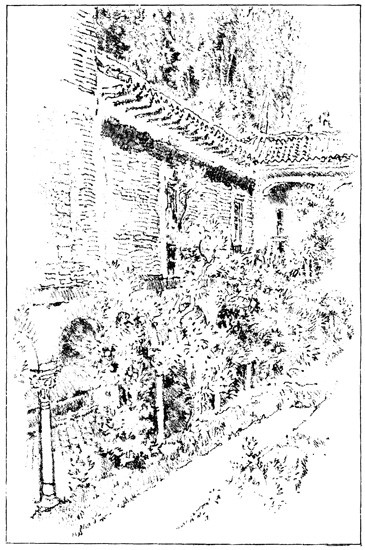
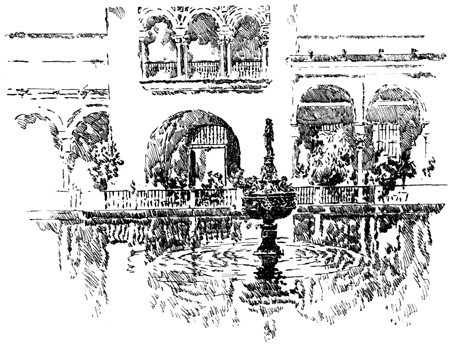
Washington Irving's rooms, overlooking the Garden of Lindaraxa.
THE ALHAMBRA
BY · WASHINGTON · IRVING
WITH AN INTRODUCTION BY
ELIZABETH ROBINS PENNELL
ILLUSTRATED WITH DRAWINGS
OF THE PLACES MENTIONED
BY JOSEPH PENNELL
LONDON: MACMILLAN AND CO., Ltd.
NEW YORK: THE MACMILLAN COMPANY
1911
Richard Clay and Sons, Limited,
BRUNSWICK ST., STAMFORD ST.,
AND BUNGAY, SUFFOLK.
First Edition (Cranford Series), 1896. Reprinted, 1906, 1911.
Pocket Classics, 1908.
INTRODUCTION
It is not possible to forget Washington Irving in the Alhambra. With a single volume, the simple, gentle, kindly American man of letters became no less a figure in the Moor's Red Palace than Boabdil and Lindaraxa of whom he wrote. And yet, never perhaps did a book make so unconscious a bid for popularity. Irving visited Granada in 1828. He returned the following year, when the Governor's apartments in the Alhambra were lent to him as lodgings. There he spent several weeks, his love for the place growing with every day and hour. It was this affection, and no more complex motive, that prompted him to describe its courts and gardens and to record its legends. The work was the amusement of his leisure moments, filling the interval between the completion of one serious, and now all but unknown, history and the beginning of the next.
Not many other men just then could write about Spain or anything Spanish so naturally. For, in 1829, while, within the walls of Alhamar and Yusef, he was listening to the prattle of Mateo and Dolores, in Paris, Alfred de Musset was writing his Contes d'Espagne, and Victor Hugo was publishing a new edition of his Orientales. A year later and the battle of Hernani was to be fought at the Comédie Française; a few more, and Théophile Gautier would be on his way across the Pyrenees. Time had passed since Châteaubriand, the pioneer of romance, could dismiss the Alhambra with a word. Hugo, in turning all eyes to the East, had declared that Spain also was Oriental, and to his disciples the journey, dreamed or made, through the land where Irving travelled in single-minded enjoyment, was an excuse for the profession of their literary faith. Irving, whatever his accomplishments, was unencumbered with a mission and innocent of pose. There is no reason to believe that he had ever heard of the Romanticists, or the part Spain was playing in the revolution; though he had been in Paris when the storm was brewing; though he returned after the famous red waistcoat had been sported in the public's face. At any rate, like the original genius of to-day, he kept his knowledge to himself.
Literary work took Irving to Spain. Several years before, in 1818, he had watched the total wreck of his brother's business. This was the second event of importance in his hitherto mild and colourless existence. The first had been the death of the girl he was to marry, a loss which left him without interest or ambition. There was then no need for him to work, and his health was delicate. He travelled a little: an intelligent, sympathetic and observant tourist. He wrote a little, discovering that he was an author with Knickerbocker. But his writing was of the desultory sort until, when he was thirty-five years old, his brother's failure forced him to make literature his profession. It was after he had published his Sketch-Book and Bracebridge Hall and Old Christmas, after their reception had been of the kind to satisfy even the present generation of writers who measure the excellence of work by the price paid for it, that some one suggested he should translate the journeys of Columbus, which Navarrete, a Spanish author, had in hand. Murray, it was thought, would give a handsome sum down for the translation. Murray himself, however, was not so sure: wanted, wise man, first to see a portion of the manuscript. This was just what could not be until Irving had begun his task. But already in Madrid, and assured of nothing, he found the rôle of translator less congenial than that of historian, and the Spanish work eventually resolved itself into his Life of Columbus. "Delving in the rich ore" of the old chronicles in the Jesuits' Library of St. Isidoro, there was one side issue in the history he was studying that enchanted him above all else. This was the Conquest of Granada, the brilliant episode which had fascinated him ever since, as a boy at play on the banks of the Hudson, his allegiance had been divided between the Spanish cavalier, in gold and silver armour, prancing over the Vega, and the Red Indian brandishing his tomahawk on the war-path. Now, occasionally, Columbus was forgotten that he might collect the materials for a new story of the Conquest to be told by himself. To consult further documents he started one spring (1828), when the almond trees were blossoming, for Andalusia; and Granada, of course, came into his journey. Thus chance brought him to the Alhambra, while (1829) the courtesy of the Governor and the kindness of old Tia Antonia put him in possession of the rooms of the beautiful Elizabeth of Parma, overlooking the oranges and fountains of the Garden of Lindaraxa.
The Alhambra reveals but half its charm to the casual visitor. I know, of my own experience, how far custom is from staling its infinite variety, how its beauty increases as day by day one watches the play of light and shadow on its walls, as day by day one yields to the indolent dreams for which it was built. There was one summer when, all through July and August, its halls and courts gave me shelter from the burning, blinding sunshine of Andalusia, and the weeks in passing strengthened the spell that held me there. For Gautier, the place borrowed new loveliness from the one night he slept in the Court of Lions. But by day and night alike, it belonged to Irving; he saw it before it had degenerated into a disgracefully managed museum and annex to a bric-à-brac shop for the tourist; and he had heard all its stories, or had had time to invent them, before he was called away by his appointment to some useless and unnecessary diplomatic post at the American Legation in London.
The book was not published until more than two years later (1832). Irving, though a hack in a manner, had too much self-respect to rush into print on the slightest provocation. Colburn and Bentley were his English publishers, their edition preceding by a few months the American, brought out by Lea and Carey of Philadelphia. The same year saw two further issues in Paris, one by Galignani, and the other in Baudry's Foreign Library, as well as a French translation from the house of Fournier. The success of The Alhambra was immediate. De Musset and Victor Hugo had left the great public in France as indifferent as ever to the land beyond the Pyrenees. Irving raised a storm of popular applause in England and America, where, of a sudden, he made Spain, which the Romanticists would have snatched as their spoils, the prey of the "bourgeois" they despised. Nor was it the general public only that applauded. There were few literary men in England who did not welcome the book with delight.
I think to-day, without suspicion of disloyalty, one may wonder a little at this success. Certainly, in its first edition, The Alhambra is crude and stilted, though, to compare it with the pompous trash which Roscoe published three years afterward, as text for the drawings of David Roberts, is to see in it a masterpiece. Irving, more critical than his readers, knew it needed revision. "It is generally labour lost," he said once in a letter to Alexander Everett, "to attempt to improve a book that has already made its impression on the public." Nevertheless, The Alhambra was all but re-written in 1857, when he was preparing a complete edition of his works for Putnam, the New York publisher, and it gained enormously in the process. It was not so much by the addition of new chapters, or the re-arrangement of the old; but rather by the changes made in the actual text—the light touch of local colour here, and there the rounding of a period, the developing of an incident. For example "The Journey," so gay and vivacious in the final version, was, at first, but a bare statement of facts, with no space for the little adventures by the way: the rest at the old mill near Seville; the glimpses of Archidona, Antiquero, Osuna, names that lend picturesque value to the ride; the talk and story-telling in the inn at Loxa. Another change, less commendable, is the omission from the late editions of the dedication to Wilkie. It was a pleasant tribute to the British painter, who, with several of his fellows—Lewis and Roberts—was carried away by that wave of Orientalism which sent the French Marilhat and Decamps, Fromentin and Delacroix to the East, and had not yet spent its force in the time of Regnault. The dedication was well-written, kindly, appreciative: an amiable reminder of the rambles the two men had taken together in Toledo and Seville, and the interest they had shared in the beauty left by the Moor to mark his passage through the land both were learning to love. As a memorial to the friendship between author and artist, it could less well have been spared than any one of the historical chapters that go to swell the volume.
Even in the revised edition it would be easy to belittle Irving's achievement, now that it is the fashion to disparage him as author. Certainly, The Alhambra has none of the splendid melodrama of Borrow's Bible in Spain, none of the picturesqueness of Gautier's record. It is very far from being that "something in the Haroun Alraschid style," with dash of Arabian spice, which Wilkie had urged him to make it. Nor are its faults wholly negative. It has its moments of dulness. It abounds in repetitions. Certain adjectives recur with a pertinacity that irritates. The Vega is blooming, the battle is bloody, the Moorish maiden is beauteous far more than once too often. Worse still, descriptions are duplicated, practically the same passage reappearing again and again, as if for the sake of padding, or else as the mere babble of the easy writer. Indeed, many of the purely historical chapters have been crowded in so obviously because they happened to be at hand, and he without better means to dispose of them, and then scattered discreetly, that there is less hesitation in omitting them altogether from the present edition. An edited Tom Jones, a bowdlerized Shakespeare may be an absurdity. But to drop certain chapters from The Alhambra is simply to anticipate the reader in the act of skipping. There is no loss, since all important facts and descriptions are given more graphically and entertainingly elsewhere in the book.
Perhaps it may seem injudicious to introduce a new edition of so popular a work by pointing out its defects. But one can afford to be honest about Irving. The Alhambra might have more serious blemishes, and its charm would still survive triumphantly the test of the harshest criticism. For, whatever subtlety, whatever elegance Irving's style may lack, it is always distinguished by that something which, for want of a better name, is called charm—a quality always as difficult to define as Lowell thought when he found it in verse or in perfume. But there it is in all Washington Irving wrote: a clue to the lavish praise of his contemporaries—of Coleridge, who pronounced The Conquest of Granada a chef d'œuvre, and Campbell, who believed he had added clarity to the English tongue; of Byron and Scott and Southey; of Dickens, whose pockets were at one time filled with Irving's books worn to tatters; of Thackeray, who likened the American to Goldsmith, describing him as "one of the most charming masters of our lighter language."
Much of this power to please is due, no doubt, to the simplicity and sincerity of Irving's style at its best. Despite a tendency to diffuseness, despite a fancy for the ornate, when there is a story to be told, he can be as simple and straightforward as the child's "Once upon a time," with which he begins many a tale: appropriately, since the legends of the Alhambra are but stories for grown-up children. And there is no question of the sincerity of his love for everything savouring of romance. For that matter, it is seldom that he does not mean what he says and does not say it so truly with his whole heart, that you are convinced, where you distrust the emotion of De Amicis, pumping up tears of admiration before the wrong thing, or of Maurice Barrès seeing all Spain through a haze of blood, voluptuousness, and death. It was the strength of his feeling for the Alhambra that led Irving to write in its praise, not the desire to write that manufactured the feeling. Humour and sentiment some of his critics have thought the predominant traits of his writing, as of his character. It is a fortunate combination: his sentiment, though it often threatens, seldom overflows into gush, kept within bounds as it is by the sense of humour that so rarely fails him. His power of observation was of still greater service. He could use his eyes. He could see things for himself. And he was quick to detect character. Occasionally one finds him slipping. In his landscape, the purple mountains of Alhama rise wherever he considers them most effective in the picture; and the snow considerately never melts from the slopes of the Sierra Nevada, which I have seen all brown at midsummer. He could look only through the magnifying glass of tradition at the hand and key on the Gate of Justice: symbols so gigantic in fiction, so insignificant in fact that one might miss them altogether, did not every book, paper, and paragraph, every cadging, swindling tout—I mean guide—in Granada bid one look for them. But these are minor discrepancies. In essentials, his observation never played him false. There may not be a single passage to equal in force and brilliance Gautier's wonderful description of the bull-fight at Malaga; but his impressions were so clear, his record of them so faithful, that the effect of his book remains, while the accomplishment of a finer artist in words may be remembered but vaguely. It is Irving who prepares one best for the stern grandeur and rugged solemnity of the country between Seville and Granada. The journey can now be made by rail. But to travel by road as he did—as we have done—is to know that his arid mountains and savage passes are no more exaggerated than the pleasant valleys and plains that lie between. For Spain is not all gaiety as most travellers would like to imagine it, as most painters have painted it, save Daumier in his pictures of Don Quixote among the barren hills of La Mancha. And if nothing in Granada and the Alhambra can be quite unexpected, it is because one has seen it all beforehand with Irving, from the high Tower of Comares and the windows of the Hall of Ambassadors, or else, following him through the baths and mosque and courts of the silent Palace, crossing the ravine to the cooler gardens of the Generalife, and climbing the Albaycin to the white church upon its summit.
There have been many changes in the Alhambra since Irving's day. The Court of Lions lost in loveliness when the roses with which he saw it filled were uprooted. The desertion he found had more picturesqueness than the present restoration and pretence of orderliness. Irving was struck with the efforts which the then Commander, Don Francisco de Serna, was making to keep the Palace in a state of repair and to arrest its too certain decay. Had the predecessors of De Serna, he thought, discharged the duties of their station with equal fidelity, the Alhambra might have been still almost as the Moor, or at least Spanish royalty had left it. What would he say, one wonders, to the Alhambra under its present management? Frank neglect is often less an evil than sham zeal. The student, watched, badgered, oppressed by red-tapeism, has not gained by official vigilance; nor is the Palace the more secure because responsibility has been transferred from a pleasant gossiping old woman to half a dozen indolent guides. The burnt roof in the ante-chamber to the Hall of Ambassadors shows the carelessness of which the new officers can be guilty; the matches and cigarette ends with which courts and halls are strewn explain that so eloquent a warning has been in vain. And if the restorer has been let loose in the Alhambra, at the Generalife there is an Italian proprietor, eager, it would seem, to initiate the somnolent Spaniard into the brisker ways of Young Italy. Cypresses, old as Zoraïde, have already been cut down ruthlessly along that once unrivalled avenue, and their destruction, one fears, is but the beginning of the end.
But whatever changes the past sixty years have brought about in Granada, the popularity of Irving's book has not weakened with time. Not Ford, nor Murray, nor Hare has been able to replace it. The tourist reads it within the walls it commemorates as conscientiously as the devout read Ruskin in Florence. It serves as text book in the Court of Lions and the Garden of Lindaraxa. It is the student's manual in the high mirador of the Sultanas and the court of the mosque where Fortuny painted. In a Spanish translation it is pressed upon you almost as you cross the threshold. Irving's rooms in the Palace are always locked, that the guide may get an extra fee for opening—as a special favour—an apartment which half the people ask to see. As the steamers "Rip Van Winkle" and "Knickerbocker" ply up and down the Hudson, so the Hotel Washington Irving rises under the shadow of the Alhambra. Even the spirits and spooks that haunt every grove and garden are all of his creation, as Spaniards themselves will be quick to tell you; though who Irving—or, in their familiar speech, "Vashington"—was, but very few of them could explain. And thus his name has become so closely associated with the place that, just as Diedrich Knickerbocker will be remembered while New York stands, so Washington Irving cannot be forgotten so long as the Red Palace looks down upon the Vega and the tradition of the Moor lingers in Granada.
Elizabeth Robins Pennell.
CONTENTS
PAGE The Journey 1 Palace of the Alhambra 46 Important Negotiations.—The Author Succeeds to the Throne of Boabdil 79 Inhabitants of the Alhambra 90 The Hall of Ambassadors 96 The Mysterious Chambers 106 Panorama View from the Tower of Comares 122 The Balcony 134 The Adventure of the Mason 144 The Court of Lions 151 Mementoes of Boabdil 163 The House of the Weathercock 172 Legend of the Arabian Astrologer 176 Visitors to the Alhambra 199 The Generalife 207 Legend of Prince Ahmed al Kamel, or, the Pilgrim of Love 217 A Ramble Among the Hills 259 Legend of the Moor's Legacy 270 The Tower of Las Infantas 293 Legend of the Three Beautiful Princesses 297 Legend of the Rose of the Alhambra 326 The Veteran 346 The Governor and the Notary 350 Governor Manco and the Soldier 359 A Fête in the Alhambra 377 Legend of the Two Discreet Statues 383 The Crusade of the Grand Master of Alcántara 401 An Expedition in Quest of a Diploma 413 The Legend of the Enchanted Soldier 417 The Author's Farewell to Granada 432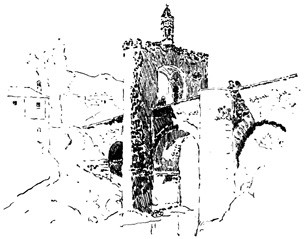
It seems that the pure and airy situation of this fortress has rendered it, like the castle of Macbeth, a prolific breeding-place for swallows and martlets, who sport about its towers in myriads, with the holiday glee of urchins just let loose from school. To entrap these birds in their giddy circlings, with hooks baited with flies, is one of the favourite amusements of the ragged "sons of the Alhambra," who, with the good-for-nothing ingenuity of arrant idlers, have thus invented the art of angling in the sky.
"The offer of the honest mason was gladly accepted; he moved with his family into the house, and fulfilled all his engagements. By little and little he restored it to its former state; the clinking of gold was no more heard at night in the chamber of the defunct priest, but began to be heard by day in the pocket of the living mason. In a word, he increased rapidly in wealth, to the admiration of all his neighbours, and became one of the richest men in Granada: he gave large sums to the Church, by way, no doubt, of satisfying his conscience, and never revealed the secret of the vault until on his death-bed to his son and heir."
I now proceed to relate still more surprising things about Aben Habuz and his palace; for the truth of which, should any doubt be entertained, I refer the dubious reader to Mateo Ximenes and his fellow-historiographers of the Alhambra.
The marvellous stories hinted at by Mateo, in the early part of our ramble about the Tower of the Seven Floors, set me as usual upon my goblin researches. I found that the redoubtable phantom, the Belludo, had been time out of mind a favourite theme of nursery tales and popular traditions in Granada, and that honourable mention had even been made of it by an ancient historian and topographer of the place. The scattered members of one of these popular traditions I have gathered together, collated them with infinite pains, and digested them into the following legend; which only wants a number of learned notes and references at bottom to take its rank among those concrete productions gravely passed upon the world for Historical Facts.
As to the alcalde and his adjuncts, they remained shut up under the great tower of the seven floors, and there they remain spellbound at the present day. Whenever there shall be a lack in Spain of pimping barbers, sharking alguazils, and corrupt alcaldes, they may be sought after; but if they have to wait until such time for their deliverance, there is danger of their enchantment enduring until doomsday.
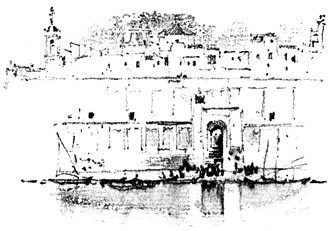
Seville
THE ALHAMBRA
THE JOURNEY
In the spring of 1829, the author of this work, whom curiosity had brought into Spain, made a rambling expedition from Seville to Granada in company with a friend, a member of the Russian Embassy at Madrid. Accident had thrown us together from distant regions of the globe and a similarity of taste led us to wander together among the romantic mountains of Andalusia.
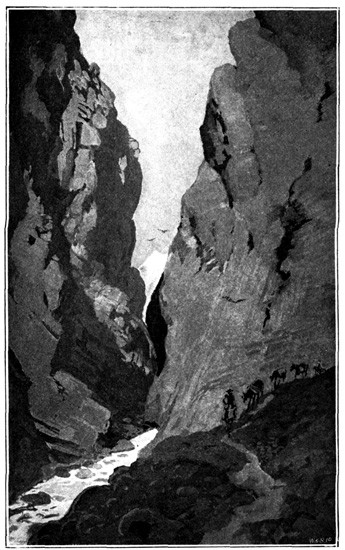
A stern melancholy country.
And here, before setting forth, let me indulge in a few previous remarks on Spanish scenery and Spanish travelling. Many are apt to picture Spain to their imaginations as a soft southern region, decked out with the luxuriant charms of voluptuous Italy. On the contrary, though there are exceptions in some of the maritime provinces, yet, for the greater part, it is a stern, melancholy country, with rugged mountains, and long sweeping plains, destitute of trees, and indescribably silent and lonesome, partaking of the savage and solitary character of Africa. What adds to this silence and loneliness, is the absence of singing-birds, a natural consequence of the want of groves and hedges. The vulture and the eagle are seen wheeling about the mountain-cliffs, and soaring over the plains, and groups of shy bustards stalk about the heaths; but the myriads of smaller birds, which animate the whole face of other countries, are met with in but few provinces in Spain, and in those chiefly among the orchards and gardens which surround the habitations of man.
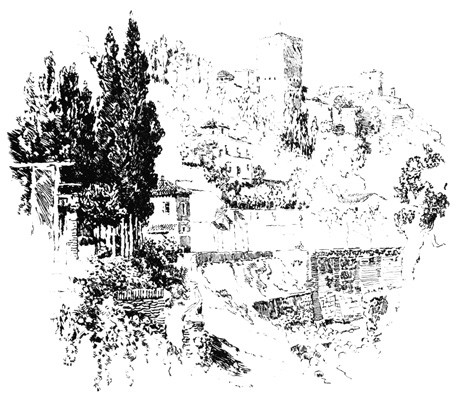
In the interior provinces the traveller occasionally traverses great tracts cultivated with grain as far as the eye can reach, waving at times with verdure, at other times naked and sunburnt, but he looks round in vain for the hand that has tilled the soil. At length he perceives some village on a steep hill, or rugged crag, with mouldering battlements and ruined watch-tower: a stronghold, in old times, against civil war, or Moorish inroad: for the custom among the peasantry of congregating together for mutual protection is still kept up in most parts of Spain, in consequence of the maraudings of roving freebooters.
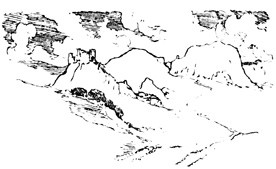
But though a great part of Spain is deficient in the garniture of groves and forests, and the softer charms of ornamental cultivation, yet its scenery is noble in its severity and in unison with the attributes of its people; and I think that I better understand the proud, hardy, frugal, and abstemious Spaniard, his manly defiance of hardships, and contempt of effeminate indulgences, since I have seen the country he inhabits.
There is something, too, in the sternly simple features of the Spanish landscape, that impresses on the soul a feeling of sublimity. The immense plains of the Castiles and of La Mancha, extending as far as the eye can reach, derive an interest from their very nakedness and immensity, and possess, in some degree, the solemn grandeur of the ocean. In ranging over these boundless wastes, the eye catches sight here and there of a straggling herd of cattle attended by a lonely herdsman, motionless as a statue, with his long slender pike tapering up like a lance into the air; or beholds a long train of mules slowly moving along the waste like a train of camels in the desert; or a single horseman, armed with blunderbuss and stiletto, and prowling over the plain. Thus the country, the habits, the very looks of the people, have something of the Arabian character. The general insecurity of the country is evinced in the universal use of weapons. The herdsman in the field, the shepherd in the plain, has his musket and his knife. The wealthy villager rarely ventures to the market-town without his trabuco, and, perhaps, a servant on foot with a blunderbuss on his shoulder; and the most petty journey is undertaken with the preparation of a warlike enterprise.
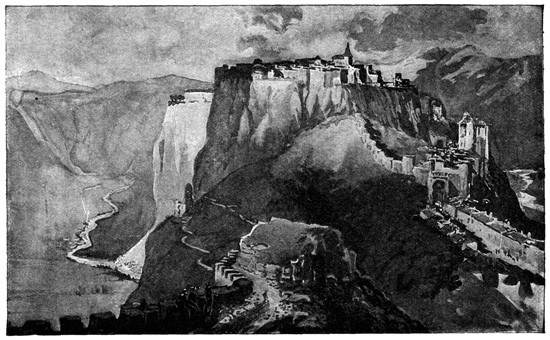
Picturesque Ronda.
The dangers of the road produce also a mode of travelling resembling, on a diminutive scale, the caravans of the East. The arrieros, or carriers, congregate in convoys, and set off in large and well-armed trains on appointed days; while additional travellers swell their number, and contribute to their strength. In this primitive way is the commerce of the country carried on. The muleteer is the general medium of traffic, and the legitimate traverser of the land, crossing the peninsula from the Pyrenees and the Asturias to the Alpuxarras, the Serrania de Ronda, and even to the gates of Gibraltar. He lives frugally and hardily: his alforjas of coarse cloth hold his scanty stock of provisions; a leathern bottle, hanging at his saddle-bow, contains wine or water, for a supply across barren mountains and thirsty plains; a mule-cloth spread upon the ground is his bed at night, and his pack-saddle his pillow. His low, but clean-limbed and sinewy form betokens strength; his complexion is dark and sunburnt; his eye resolute, but quiet in its expression, except when kindled by sudden emotion; his demeanour is frank, manly, and courteous, and he never passes you without a grave salutation: "Dios guarde à usted!" "Va usted con Dios, Caballero!" "God guard you!" "God be with you, Cavalier!"
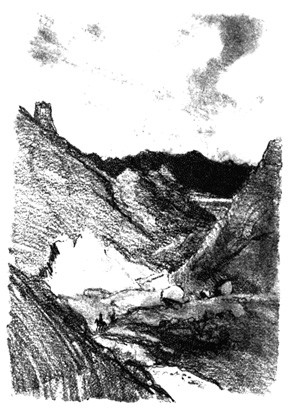
As these men have often their whole fortune at stake upon the burden of their mules, they have their weapons at hand, slung to their saddles, and ready to be snatched out for desperate defence; but their united numbers render them secure against petty bands of marauders, and the solitary bandolero, armed to the teeth, and mounted on his Andalusian steed, hovers about them, like a pirate about a merchant convoy, without daring to assault.
The Spanish muleteer has an inexhaustible stock of songs and ballads, with which to beguile his incessant wayfaring. The airs are rude and simple, consisting of but few inflections. These he chants forth with a loud voice, and long, drawling cadence, seated sideways on his mule, who seems to listen with infinite gravity, and to keep time, with his paces, to the tune. The couplets thus chanted are often old traditional romances about the Moors, or some legend of a saint, or some love-ditty; or, what is still more frequent, some ballad about a bold contrabandista, or hardy bandolero, for the smuggler and the robber are poetical heroes among the common people of Spain. Often, the song of the muleteer is composed at the instant, and relates to some local scene, or some incident of the journey. This talent of singing and improvising is frequent in Spain, and is said to have been inherited from the Moors. There is something wildly pleasing in listening to these ditties among the rude and lonely scenes they illustrate; accompanied, as they are, by the occasional jingle of the mule-bell.
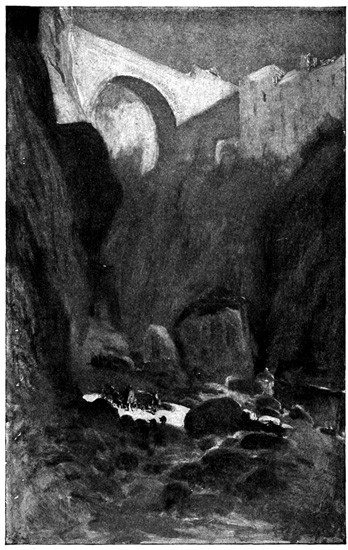
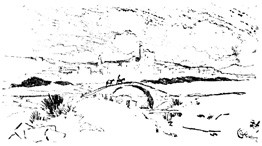
Roman Bridge, Ronda.
It has a most picturesque effect also to meet a train of muleteers in some mountain-pass. First you hear the bells of the leading mules, breaking with their simple melody the stillness of the airy height; or, perhaps, the voice of the muleteer admonishing some tardy or wandering animal, or chanting, at the full stretch of his lungs, some traditionary ballad. At length you see the mules slowly winding along the cragged defile, sometimes descending precipitous cliffs, so as to present themselves in full relief against the sky, sometimes toiling up the deep arid chasms below you. As they approach, you descry their gay decorations of worsted stuffs, tassels, and saddle-cloths, while, as they pass by, the ever ready trabuco, slung behind the packs and saddles, gives a hint of the insecurity of the road.
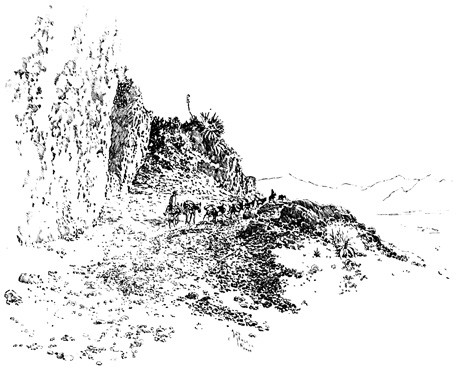
The ancient kingdom of Granada, into which we were about to penetrate, is one of the most mountainous regions of Spain. Vast sierras, or chains of mountains, destitute of shrub or tree, and mottled with variegated marbles and granites, elevate their sunburnt summits against a deep-blue sky; yet in their rugged bosoms lie ingulfed verdant and fertile valleys, where the desert and the garden strive for mastery, and the very rock is, as it were, compelled to yield the fig, the orange, and the citron, and to blossom with the myrtle and the rose.
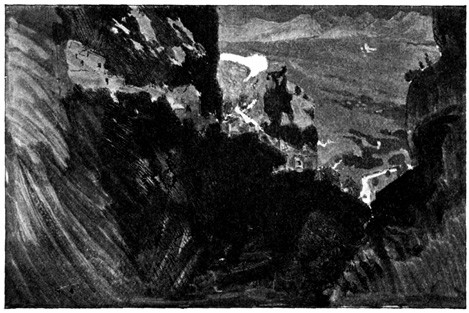
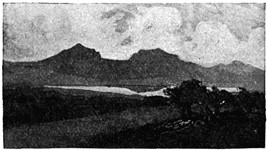
Serrania de Ronda.
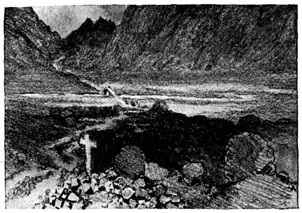
In the wild passes of these mountains the sight of walled towns and villages, built like eagles' nests among the cliffs, and surrounded by Moorish battlements, or of ruined watch-towers perched on lofty peaks, carries the mind back to the chivalric days of Christian and Moslem warfare, and to the romantic struggle for the conquest of Granada. In traversing these lofty sierras the traveller is often obliged to alight, and lead his horse up and down the steep and jagged ascents and descents, resembling the broken steps of a staircase. Sometimes the road winds along dizzy precipices, without parapet to guard him from the gulfs below, and then will plunge down steep and dark and dangerous declivities. Sometimes it struggles through rugged barrancos, or ravines, worn by winter torrents, the obscure path of the contrabandista; while, ever and anon, the ominous cross, the monument of robbery and murder, erected on a mound of stones at some lonely part of the road, admonishes the traveller that he is among the haunts of banditti, perhaps at that very moment under the eye of some lurking bandolero. Sometimes, in winding through the narrow valleys, he is startled by a hoarse bellowing, and beholds above him on some green fold of the mountain a herd of fierce Andalusian bulls, destined for the combat of the arena. I have felt, if I may so express it, an agreeable horror in thus contemplating, near at hand, these terrific animals, clothed with tremendous strength, and ranging their native pastures in untamed wildness, strangers almost to the face of man: they know no one but the solitary herdsman who attends upon them, and even he at times dares not venture to approach them. The low bellowing of these bulls, and their menacing aspect as they look down from their rocky height, give additional wildness to the savage scenery.
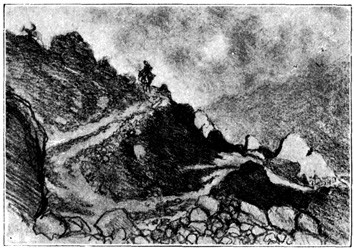
I have been betrayed unconsciously into a longer disquisition than I intended on the general features of Spanish travelling; but there is a romance about all the recollections of the Peninsula dear to the imagination.
As our proposed route to Granada lay through mountainous regions, where the roads are little better than mule-paths, and said to be frequently beset by robbers, we took due travelling precautions. Forwarding the most valuable part of our luggage a day or two in advance by the arrieros, we retained merely clothing and necessaries for the journey and money for the expenses of the road; with a little surplus of hard dollars by way of robber purse, to satisfy the gentlemen of the road should we be assailed. Unlucky is the too wary traveller who, having grudged this precaution, falls into their clutches empty-handed; they are apt to give him a sound rib-roasting for cheating them out of their dues. "Caballeros like them cannot afford to scour the roads and risk the gallows for nothing."
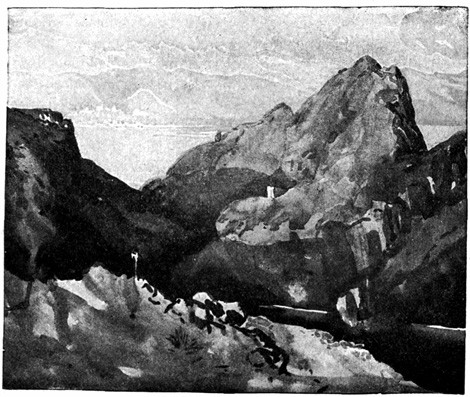
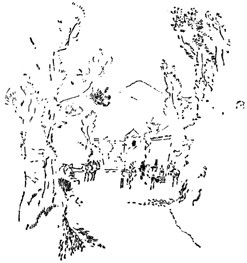
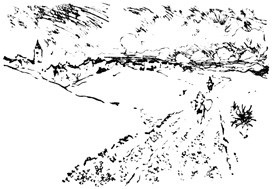
Approach to Granada. From near Elvira.
A couple of stout steeds were provided for our own mounting, and a third for our scanty luggage and the conveyance of a sturdy Biscayan lad, about twenty years of age, who was to be our guide, our groom, our valet, and at all times our guard. For the latter office he was provided with a formidable trabuco or carbine, with which he promised to defend us against rateros or solitary foot-pads; but as to powerful bands, like that of the "Sons of Ecija," he confessed they were quite beyond his prowess. He made much vainglorious boast about his weapon at the outset of the journey; though, to the discredit of his generalship, it was suffered to hang unloaded behind his saddle.
According to our stipulations, the man from whom we hired the horses was to be at the expense of their feed and stabling on the journey, as well as of the maintenance of our Biscayan squire, who of course was provided with funds for the purpose; we took care, however, to give the latter a private hint, that, though we made a close bargain with his master, it was all in his favour, as, if he proved a good man and true, both he and the horses should live at our cost, and the money provided for their maintenance remain in his pocket. This unexpected largess, with the occasional present of a cigar, won his heart completely. He was, in truth, a faithful, cheery, kind-hearted creature, as full of saws and proverbs as that miracle of squires, the renowned Sancho himself, whose name, by the by, we bestowed upon him, and, like a true Spaniard, though treated by us with companionable familiarity, he never for a moment, in his utmost hilarity, overstepped the bounds of respectful decorum.
Such were our minor preparations for the journey, but above all we laid in an ample stock of good-humour, and a genuine disposition to be pleased; determining to travel in true contrabandista style; taking things as we found them, rough or smooth, and mingling with all classes and conditions in a kind of vagabond companionship. It is the true way to travel in Spain. With such disposition and determination, what a country is it for a traveller, where the most miserable inn is as full of adventure as an enchanted castle, and every meal is in itself an achievement! Let others repine at the lack of turnpike roads and sumptuous hotels, and all the elaborate comforts of a country cultivated and civilised into tameness and commonplace; but give me the rude mountain scramble; the roving, hap-hazard, wayfaring; the half wild, yet frank and hospitable manners, which impart such a true game-flavour to dear old romantic Spain!
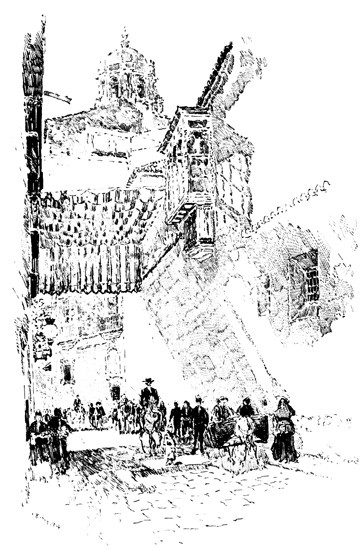
Thus equipped and attended, we cantered out of "Fair Seville city" at half-past six in the morning of a bright May day, in company with a lady and gentleman of our acquaintance, who rode a few miles with us, in the Spanish mode of taking leave. Our route lay through old Alcala de Guadaira (Alcala on the river Aira), the benefactress of Seville, that supplies it with bread and water. Here live the bakers who furnish Seville with that delicious bread for which it is renowned; here are fabricated those roscas well known by the well-merited appellation of pan de Dios (bread of God); with which, by the way, we ordered our man, Sancho, to stock his alforjas for the journey. Well has this beneficent little city been denominated the "Oven of Seville"; well has it been called Alcala de los Panaderos (Alcala of the bakers), for a great part of its inhabitants by lines of mules and donkeys laden with great panniers of loaves and roscas.
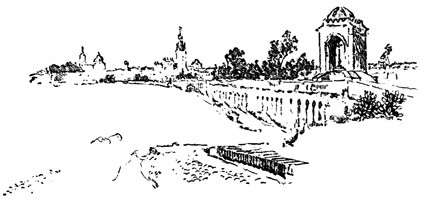
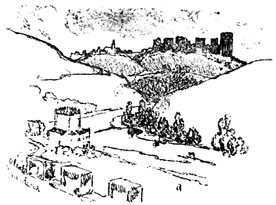
I have said Alcala supplies Seville with water. Here are great tanks or reservoirs, of Roman and Moorish construction, whence water is conveyed to Seville by noble aqueducts. The springs of Alcala are almost as much vaunted as its ovens; and to the lightness, sweetness, and purity of its water is attributed in some measure the delicacy of its bread.
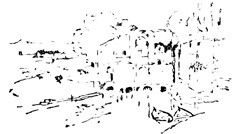
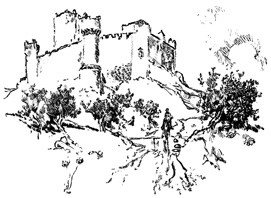
Here we halted for a time, at the ruins of the old Moorish castle, a favourite resort for picnic parties from Seville, where we had passed many a pleasant hour. The walls are of great extent, pierced with loopholes; enclosing a huge square tower or keep, with the remains of masmoras, or subterranean granaries. The Guadaira winds its stream round the hill, at the foot of these ruins, whimpering among reeds, rushes, and pond-lilies, and overhung with rhododendron, eglantine, yellow myrtle, and a profusion of wild flowers and aromatic shrubs; while along its banks are groves of oranges, citrons, and pomegranates, among which we heard the early note of the nightingale.
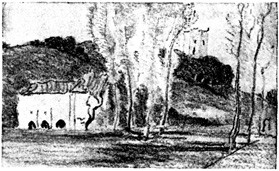
A picturesque bridge was thrown across the little river, at one end of which was the ancient Moorish mill of the castle, defended by a tower of yellow stone; a fisherman's net hung against the wall to dry, and hard by in the river was his boat; a group of peasant women in bright-coloured dresses, crossing the arched bridge, were reflected in the placid stream. Altogether it was an admirable scene for a landscape-painter.
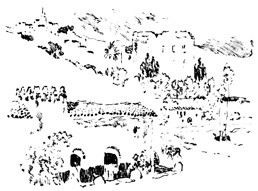
The old Moorish mills, so often found on secluded streams, are characteristic objects in Spanish landscape, and suggestive of the perilous times of old. They are of stone, and often in the form of towers with loopholes and battlements, capable of defence in those warlike days when the country on both sides of the border was subject to sudden inroad and hasty ravage, and when men had to labour with their weapons at hand, and some place of temporary refuge.
Our next halting-place was at Gandul, where were the remains of another Moorish castle, with its ruined tower, a nestling-place for storks, and commanding a view over a vast campiña or fertile plain, with the mountains of Ronda in the distance. These castles were strongholds to protect the plains from the talas or forays to which they were subject, when the fields of corn would be laid waste, the flocks and herds swept from the vast pastures, and, together with captive peasantry, hurried off in long cavalgadas across the borders.
At Gandul we found a tolerable posada; the good folks could not tell us what time of day it was, the clock only struck once in the day, two hours after noon; until that time it was guess-work. We guessed it was full time to eat; so, alighting, we ordered a repast. While that was in preparation, we visited the palace once the residence of the Marquis of Gandul. All was gone to decay; there were but two or three rooms habitable, and very poorly furnished. Yet here were the remains of grandeur: a terrace, where fair dames and gentle cavaliers may once have walked; a fish-pond and ruined garden, with grape-vines and date-bearing palm-trees. Here we were joined by a fat curate, who gathered a bouquet of roses, and presented it, very gallantly, to the lady who accompanied us.
Below the palace was the mill, with orange-trees and aloes in front, and a pretty stream of pure water. We took a seat in the shade; and the millers, all leaving their work, sat down and smoked with us; for the Andalusians are always ready for a gossip. They were waiting for the regular visit of the barber, who came once a week to put all their chins in order. He arrived shortly afterwards: a lad of seventeen, mounted on a donkey, eager to display his new alforjas or saddle-bags, just bought at a fair; price one dollar, to be paid on St. John's day (in June), by which time he trusted to have mown beards enough to put him in funds.
By the time the laconic clock of the castle had struck two we had finished our dinner. So, taking leave of our Seville friends, and leaving the millers still under the hands of the barber, we set off on our ride across the campiña. It was one of those vast plains, common in Spain, where for miles and miles there is neither house nor tree. Unlucky the traveller who has to traverse it, exposed as we were to heavy and repeated showers of rain. There is no escape nor shelter. Our only protection was our Spanish cloaks, which nearly covered man and horse, but grew heavier every mile. By the time we had lived through one shower we would see another slowly but inevitably approaching; fortunately in the interval there would be an outbreak of bright, warm, Andalusian sunshine, which would make our cloaks send up wreaths of steam, but which partially dried them before the next drenching.
Shortly after sunset we arrived at Arahal, a little town among the hills. We found it in a bustle with a party of miquelets, who were patrolling the country to ferret out robbers. The appearance of foreigners like ourselves was an unusual circumstance in an interior country town; and little Spanish towns of the kind are easily put in a state of gossip and wonderment by such an occurrence. Mine host, with two or three old wise-acre comrades in brown cloaks, studied our passports in a corner of the posada, while an Alguazil took notes by the dim light of a lamp. The passports were in foreign languages and perplexed them, but our Squire Sancho assisted them in their studies, and magnified our importance with the grandiloquence of a Spaniard. In the meantime the magnificent distribution of a few cigars had won the hearts of all around us; in a little while the whole community seemed put in agitation to make us welcome. The Corregidor himself waited upon us, and a great rush-bottomed arm-chair was ostentatiously bolstered into our room by our landlady, for the accommodation of that important personage. The commander of the patrol took supper with us: a lively, talking, laughing Andaluz, who had made a campaign in South America, and recounted his exploits in love and war with much pomp of phrase, vehemence of gesticulation, and mysterious rolling of the eye. He told us that he had a list of all the robbers in the country, and meant to ferret out every mother's son of them; he offered us at the same time some of his soldiers as an escort. "One is enough to protect you, señors; the robbers know me, and know my men; the sight of one is enough to spread terror through a whole sierra." We thanked him for his offer, but assured him, in his own strain, that with the protection of our redoubtable squire, Sancho, we were not afraid of all the ladrones of Andalusia.
While we were supping with our drawcansir friend, we heard the notes of a guitar, and the click of castanets, and presently a chorus of voices singing a popular air. In fact, mine host had gathered together the amateur singers and musicians, and the rustic belles of the neighbourhood, and, on going forth, the court-yard or patio of the inn presented a scene of true Spanish festivity. We took our seats with mine host and hostess and the commander of the patrol, under an archway opening into the court; the guitar passed from hand to hand, but a jovial shoemaker was the Orpheus of the place. He was a pleasant-looking fellow, with huge black whiskers; his sleeves were rolled up to his elbows. He touched the guitar with masterly skill, and sang a little amorous ditty with an expressive leer at the women, with whom he was evidently a favourite. He afterwards danced a fandango with a buxom Andalusian damsel, to the great delight of the spectators. But none of the females present could compare with mine host's pretty daughter, Pepita, who had slipped away and made her toilette for the occasion and had covered her head with roses; and who distinguished herself in a bolero with a handsome young dragoon. We ordered our host to let wine and refreshment circulate freely among the company, yet, though there was a motley assembly of soldiers, muleteers, and villagers, no one exceeded the bounds of sober enjoyment. The scene was a study for a painter: the picturesque group of dancers, the troopers in their half military dresses, the peasantry wrapped in their brown cloaks; nor must I omit to mention the old meagre Alguazil, in a short black cloak, who took no notice of anything going on, but sat in a corner diligently writing by the dim light of a huge copper lamp, that might have figured in the days of Don Quixote.
The following morning was bright and balmy, as a May morning ought to be, according to the poets. Leaving Arahal at seven o'clock, with all the posada at the door to cheer us off, we pursued our way through a fertile country, covered with grain and beautifully verdant; but which in summer, when the harvest is over and the fields parched and brown, must be monotonous and lonely; for, as in our ride of yesterday, there were neither houses nor people to be seen. The latter all congregate in villages and strongholds among the hills, as if these fertile plains were still subject to the ravages of the Moor.
At noon we came to where there was a group of trees, beside a brook in a rich meadow. Here we alighted to make our mid-day meal. It was really a luxurious spot, among wild flowers and aromatic herbs, with birds singing around us. Knowing the scanty larders of Spanish inns, and the houseless tracts we might have to traverse, we had taken care to have the alforjas of our squire well stocked with cold provisions, and his bota, or leathern bottle, which might hold a gallon, filled to the neck with choice Valdepeñas wine.[1] As we depended more upon these for our well-being than even his trabuco, we exhorted him to be more attentive in keeping them well charged; and I must do him the justice to say that his namesake, the trencher-loving Sancho Panza, was never a more provident purveyor. Though the alforjas and the bota were frequently and vigorously assailed throughout the journey, they had a wonderful power of repletion, our vigilant squire sacking everything that remained from our repasts at the inns to supplying these junketings by the road-side, which were his delight.
On the present occasion he spread quite a sumptuous variety of remnants on the greensward before us, graced with an excellent ham brought from Seville; then, taking his seat at a little distance, he solaced himself with what remained in the alforjas. A visit or two to the bota made him as merry and chirruping as a grasshopper filled with dew. On my comparing his contents of the alforjas to Sancho's skimming of the flesh-pots at the wedding of Camacho, I found he was well versed in the history of Don Quixote, but, like many of the common people of Spain, firmly believed it to be a true history.
"All that happened a long time ago, Señor," said he, with an inquiring look.
"A very long time," I replied.
"I dare say more than a thousand years,"—still looking dubiously.
"I dare say not less."
The squire was satisfied. Nothing pleased the simple-hearted valet more than my comparing him to the renowned Sancho for devotion to the trencher; and he called himself by no other name throughout the journey.
Our repast being finished, we spread our cloaks on the greensward under the tree, and took a luxurious siesta, in the Spanish fashion. The clouding up of the weather, however, warned us to depart, and a harsh wind sprang up from the southeast. Towards five o'clock we arrived at Osuna, a town of fifteen thousand inhabitants, situated on the side of a hill, with a church and a ruined castle. The posada was outside of the walls; it had a cheerless look. The evening being cold, the inhabitants were crowded round a brasero in a chimney-corner; and the hostess was a dry old woman, who looked like a mummy. Every one eyed us askance as we entered, as Spaniards are apt to regard strangers; a cheery, respectful salutation on our part, caballeroing them and touching our sombreros, set Spanish pride at ease; and when we took our seat among them, lit our cigars, and passed the cigar-box round among them, our victory was complete. I have never known a Spaniard, whatever his rank or condition, who would suffer himself to be outdone in courtesy; and to the common Spaniard the present of a cigar puro is irresistible. Care, however, must be taken never to offer him a present with an air of superiority and condescension: he is too much of a caballero to receive favours at the cost of his dignity.
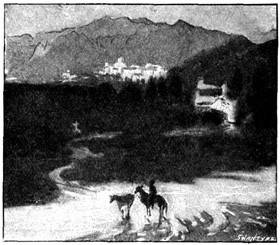
Leaving Osuna at an early hour the next morning, we entered the sierra or range of mountains. The road wound through picturesque scenery, but lonely; and a cross here and there by the roadside, the sign of a murder, showed that we were now coming among the "robber haunts." This wild and intricate country, with its silent plains and valleys intersected by mountains, has ever been famous for banditti. It was here that Omar Ibn Hassan, a robber-chief among the Moslems, held ruthless sway in the ninth century, disputing dominion even with the califs of Cordova. This too was a part of the regions so often ravaged during the reign of Ferdinand and Isabella by Ali Atar, the old Moorish alcayde of Loxa, father-in-law of Boabdil so that it was called Ali Atar's garden, and here "Jose Maria," famous in Spanish brigand story, had his favourite lurking-places.
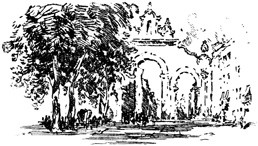
In the course of the day we passed through Fuente la Piedra, near a little salt lake of the same name, a beautiful sheet of water, reflecting like a mirror the distant mountains. We now came in sight of Antiquera, that old city of warlike reputation, lying in the lap of the great sierra which runs through Andalusia. A noble vega spread out before it, a picture of mild fertility set in a frame of rocky mountains. Crossing a gentle river we approached the city between hedges and gardens, in which nightingales were pouring forth their evening song. About nightfall we arrived at the gates. Everything in this venerable city has a decidedly Spanish stamp. It lies too much out of the frequented track of foreign travel to have its old usages trampled out. Here I observed old men still wearing the montero, or ancient hunting-cap, once common throughout Spain; while the young men wore the little round-crowned hat, with brim turned up all round, like a cup turned down in its saucer; while the brim was set off with little black tufts like cockades. The women, too, were all in mantillas and basquinas. The fashions of Paris had not reached Antiquera.
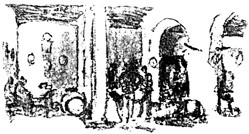
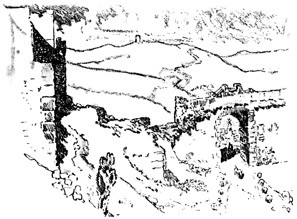
Pursuing our course through a spacious street, we put up at the posada of San Fernando. As Antiquera, though a considerable city, is, as I observed, somewhat out of the track of travel, I had anticipated bad quarters and poor fare at the inn. I was agreeably disappointed, therefore, by a supper-table amply supplied, and what were still more acceptable, good clean rooms and comfortable beds. Our man Sancho felt himself as well off as his namesake when he had the run of the duke's kitchen, and let me know, as I retired for the night, that it had been a proud time for the alforjas.
Early in the morning (May 4th) I strolled to the ruins of the old Moorish castle, which itself had been reared on the ruins of a Roman fortress. Here, taking my seat on the remains of a crumbling tower, I enjoyed a grand and varied landscape, beautiful in itself, and full of storied and romantic associations; for I was now in the very heart of the country famous for the chivalrous contests between Moor and Christian. Below me, in its lap of hills, lay the old warrior city so often mentioned in chronicle and ballad. Out of yon gate and down yon hill paraded the band of Spanish cavaliers, of highest rank and bravest bearing, to make that foray during the war and conquest of Granada, which ended in the lamentable massacre among the mountains of Malaga, and laid all Andalusia in mourning. Beyond spread out the vega, covered with gardens and orchards and fields of grain and enamelled meadows, inferior only to the famous vega of Granada. To the right the Rock of the Lovers stretched like a cragged promontory into the plain, whence the daughter of the Moorish alcayde and her lover, when closely pursued, threw themselves in despair.
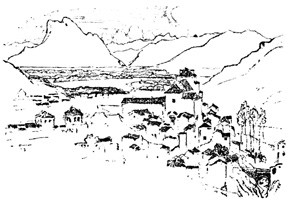
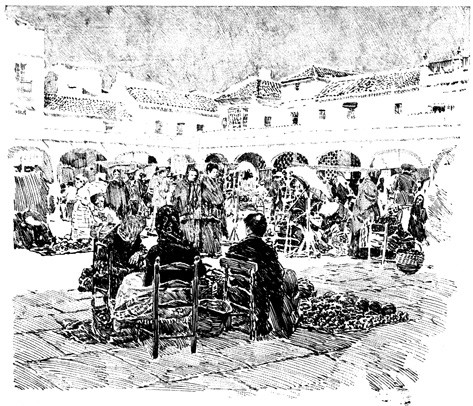
The matin peal from church and convent below me rang sweetly in the morning air, as I descended. The market-place was beginning to throng with the populace, who traffic in the abundant produce of the vega; for this is the mart of an agricultural region. In the market-place were abundance of freshly plucked roses for sale; for not a dame or damsel of Andalusia thinks her gala dress complete without a rose shining like a gem among her raven tresses.
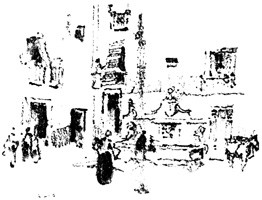
On returning to the inn I found our man Sancho in high gossip with the landlord and two or three of his hangers-on. He had just been telling some marvellous story about Seville, which mine host seemed piqued to match with one equally marvellous about Antiquera. There was once a fountain, he said, in one of the public squares called Il fuente del toro (the fountain of the bull), because the water gushed from the mouth of the bull's head, carved of stone. Underneath the head was inscribed,—
En frente del toro
Se hallen tesoro.
In front of the bull there is treasure. Many digged in front of the fountain, but lost their labour and found no money. At last one knowing fellow construed the motto a different way. It is in the forehead frente of the bull that the treasure is to be found, said he to himself, and I am the man to find it. Accordingly he came, late at night, with a mallet, and knocked the head to pieces; and what do you think he found?
"Plenty of gold and diamonds!" cried Sancho, eagerly.
"He found nothing," rejoined mine host, dryly, "and he ruined the fountain."
Here a great laugh was set up by the landlord's hangers-on; who considered Sancho completely taken in by what I presume was one of mine host's standing jokes.
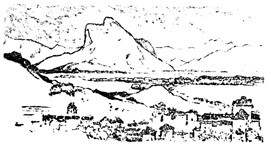
Leaving Antiquera at eight o'clock, we had a delightful ride along the little river, and by gardens and orchards fragrant with the odours of spring and vocal with the nightingale. Our road passed round the Rock of the Lovers (el peñon de los enamorados), which rose in a precipice above us. In the course of the morning we passed through Archidona, situated in the breast of a high hill, with a three-pointed mountain towering above it, and the ruins of a Moorish fortress. It was a great toil to ascend a steep stony street leading up into the city, although it bore the encouraging name of Calle Real del Llano (the royal street of the plain), but it was a still greater toil to descend from this mountain city on the other side.
At noon we halted in sight of Archidona, in a pleasant little meadow among hills covered with olive-trees. Our cloaks were spread on the grass, under an elm by the side of a bubbling rivulet; our horses were tethered where they might crop the herbage, and Sancho was told to produce his alforjas. He had been unusually silent this morning ever since the laugh raised at his expense, but now his countenance brightened, and he produced his alforjas with an air of triumph. They contained the contributions of four days' journeying, but had been signally enriched by the foraging of the previous evening in the plenteous inn at Antiquera; and this seemed to furnish him with a set-off to the banter of mine host.
En frente del toro
Se hallen tesoro
would he exclaim, with a chuckling laugh, as he drew forth the heterogeneous contents one by one, in a series which seemed to have no end. First came forth a shoulder of roasted kid, very little the worse for wear; then an entire partridge; then a great morsel of salted codfish wrapped in paper; then the residue of a ham; then the half of a pullet, together with several rolls of bread, and a rabble rout of oranges, figs, raisins, and walnuts. His bota also had been recruited with some excellent wine of Malaga. At every fresh apparition from his larder, he would enjoy our ludicrous surprise, throwing himself back on the grass, shouting with laughter, and exclaiming, "Frente del toro!—frente del toro! Ah, señors, they thought Sancho a simpleton at Antiquera; but Sancho knew where to find the tesoro."
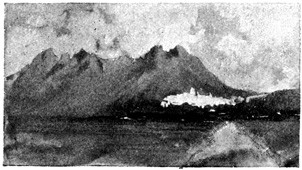
While we were diverting ourselves with his simple drollery, a solitary beggar approached, who had almost the look of a pilgrim. He had a venerable gray beard, and was evidently very old, supporting himself on a staff, yet age had not bowed him down; he was tall and erect, and had the wreck of a fine form. He wore a round Andalusian hat, a sheep-skin jacket, and leathern breeches, gaiters, and sandals. His dress, though old and patched, was decent, his demeanour manly, and he addressed us with the grave courtesy that is to be remarked in the lowest Spaniard. We were in a favourable mood for such a visitor; and in a freak of capricious charity gave him some silver, a loaf of fine wheaten bread, and a goblet of our choice wine of Malaga. He received them thankfully, but without any grovelling tribute of gratitude. Tasting the wine, he held it up to the light, with a slight beam of surprise in his eye; then quaffing it off at a draught, "It is many years," said he, "since I have tasted such wine. It is a cordial to an old man's heart." Then, looking at the beautiful wheaten loaf, "bendito sea tal pan!" "blessed be such bread!" So saying, he put it in his wallet. We urged him to eat it on the spot. "No, señors," replied he, "the wine I had either to drink or leave; but the bread I may take home to share with my family."
Our man Sancho sought our eye, and reading permission there, gave the old man some of the ample fragments of our repast, on condition, however, that he should sit down and make a meal.
He accordingly took his seat at some little distance from us, and began to eat slowly, and with a sobriety and decorum that would have become a hidalgo. There was altogether a measured manner and a quiet self-possession about the old man, that made me think that he had seen better days: his language, too, though simple, had occasionally something picturesque and almost poetical in the phraseology. I set him down for some broken-down cavalier. I was mistaken; it was nothing but the innate courtesy of a Spaniard, and the poetical turn of thought and language often to be found in the lowest classes of this clear-witted people. For fifty years, he told us, he had been a shepherd, but now he was out of employ and destitute. "When I was a young man," said he, "nothing could harm or trouble me; I was always well, always gay; but now I am seventy-nine years of age, and a beggar, and my heart begins to fail me."
Still he was not a regular mendicant: it was not until recently that want had driven him to this degradation; and he gave a touching picture of the struggle between hunger and pride, when abject destitution first came upon him. He was returning from Malaga without money; he had not tasted food for some time, and was crossing one of the great plains of Spain, where there were but few habitations. When almost dead with hunger, he applied at the door of a venta or country inn. "Perdon usted por Dios hermano!" (Excuse us, brother, for God's sake!) was the reply—the usual mode in Spain of refusing a beggar. "I turned away," said he, "with shame greater than my hunger, for my heart was yet too proud. I came to a river with high banks, and deep, rapid current, and felt tempted to throw myself in: 'What should such an old, worthless, wretched man as I live for?' But when I was on the brink of the current, I thought on the blessed Virgin, and turned away. I travelled on until I saw a country-seat at a little distance from the road, and entered the outer gate of the court-yard. The door was shut, but there were two young señoras at a window. I approached and begged;—'Perdon usted por Dios hermano!'—and the window closed. I crept out of the court-yard, but hunger overcame me, and my heart gave way: I thought my hour at hand, so I laid myself down at the gate, commended myself to the Holy Virgin, and covered my head to die. In a little while afterwards the master of the house came home: seeing me lying at his gate, he uncovered my head, had pity on my gray hairs, took me into his house, and gave me food. So, señors, you see that one should always put confidence in the protection of the Virgin."
[1] It may be as well to note here, that the alforjas are square pockets at each end of a long cloth about a foot and a half wide, formed by turning up its extremities. The cloth is then thrown over the saddle, and the pockets hang on each side like saddle-bags. It is an Arab invention. The bota is a leathern bag or bottle, of portly dimensions, with a narrow neck. It is also Oriental. Hence the scriptural caution which perplexed me in my boyhood, not to put new wine into old bottles.
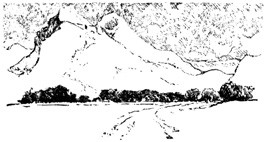
The old man was on his way to his native place, Archidona, which was in full view on its steep and rugged mountain. He pointed to the ruins of its castle. "That castle," he said, "was inhabited by a Moorish king at the time of the wars of Granada. Queen Isabella invaded it with a great army; but the king looked down from his castle among the clouds, and laughed her to scorn! Upon this the Virgin appeared to the queen, and guided her and her army up a mysterious path in the mountains, which had never before been known. When the Moor saw her coming, he was astonished, and springing with his horse from a precipice, was dashed to pieces! The marks of his horse's hoofs," said the old man, "are to be seen in the margin of the rock to this day. And see, señors, yonder is the road by which the queen and her army mounted: you see it like a ribbon up the mountain's side; but the miracle is, that, though it can be seen at a distance, when you come near it disappears!"
The ideal road to which he pointed was undoubtedly a sandy ravine of the mountain, which looked narrow and defined at a distance, but became broad and indistinct on an approach.
As the old man's heart warmed with wine and wassail, he went on to tell us a story of the buried treasure left under the castle by the Moorish king. His own house was next to the foundations of the castle. The curate and notary dreamed three times of the treasure, and went to work at the place pointed out in their dreams. His own son-in-law heard the sound of their pick-axes and spades at night. What they found, nobody knows; they became suddenly rich, but kept their own secret. Thus the old man had once been next door to fortune, but was doomed never to get under the same roof.
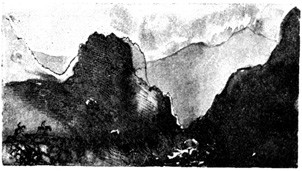
I have remarked that the stories of treasure buried by the Moors, so popular throughout Spain, are most current among the poorest people. Kind nature consoles with shadows for the lack of substantials. The thirsty man dreams of fountains and running streams; the hungry man of banquets; and the poor man of heaps of hidden gold: nothing certainly is more opulent than the imagination of a beggar.
Our afternoon's ride took us through a steep and rugged defile of the mountains, called Puerta del Rey, the Pass of the King; being one of the great passes into the territories of Granada, and the one by which King Ferdinand conducted his army. Towards sunset the road, winding round a hill, brought us in sight of the famous little frontier city of Loxa, which repulsed Ferdinand from its walls. Its Arabic name implies guardian, and such it was to the vega of Granada, being one of its advanced guards. It was the stronghold of that fiery veteran, old Ali Atar, father in-law of Boabdil; and here it was that the latter collected his troops, and sallied forth on that disastrous foray which ended in the death of the old alcayde and his own captivity. From its commanding position at the gate, as it were, of this mountain-pass, Loxa has not unaptly been termed the key of Granada. It is wildly picturesque; built along the face of an arid mountain. The ruins of a Moorish alcazar or citadel crown a rocky mound which rises out of the centre of the town. The river Xenil washes its base, winding among rocks, and groves, and gardens, and meadows, and crossed by a Moorish bridge. Above the city all is savage and sterile, below is the richest vegetation and the freshest verdure. A similar contrast is presented by the river: above the bridge it is placid and grassy, reflecting groves and gardens; below it is rapid, noisy, and tumultuous. The Sierra Nevada, the royal mountains of Granada, crowned with perpetual snow, form the distant boundary to this varied landscape, one of the most characteristic of romantic Spain.
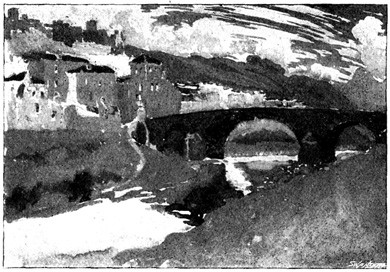
Alighting at the entrance of the city, we gave our horses to Sancho to lead them to the inn, while we strolled about to enjoy the singular beauty of the environs. As we crossed the bridge to a fine alameda, or public walk, the bells tolled the hour of orison. At the sound the wayfarers, whether on business or pleasure, paused, took off their hats, crossed themselves, and repeated their evening prayer: a pious custom still rigidly observed in retired parts of Spain. Altogether it was a solemn and beautiful evening scene, and we wandered on as the evening gradually closed, and the new moon began to glitter between the high elms of the alameda. We were roused from this quiet state of enjoyment by the voice of our trusty squire hailing us from a distance. He came up to us, out of breath. "Ah, señores" cried he, "el pobre Sancho no es nada sin Don Quixote." (Ah, señors, poor Sancho is nothing without Don Quixote.) He had been alarmed at our not coming to the inn; Loxa was such a wild mountain place, full of contrabandistas, enchanters, and infiernos; he did not well know what might have happened, and set out to seek us, inquiring after us of every person he met, until he traced us across the bridge, and, to his great joy, caught sight of us strolling in the alameda.
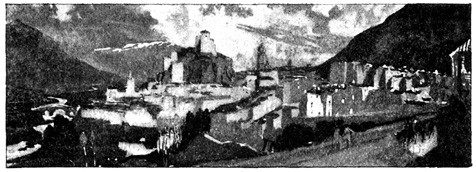
The inn to which he conducted us was called the Corona, or Crown, and we found it quite in keeping with the character of the place, the inhabitants of which seem still to retain the bold, fiery spirit of the olden time. The hostess was a young and handsome Andalusian widow, whose trim basquiña of black silk, fringed with bugles, set off the play of a graceful form and round pliant limbs. Her step was firm and elastic; her dark eye was full of fire and the coquetry of her air, and varied ornaments of her person, showed that she was accustomed to be admired.
She was well matched by a brother, nearly about her own age; they were perfect models of the Andalusian Majo and Maja. He was tall, vigorous, and well-formed, with a clear olive complexion, a dark beaming eye, and curling chestnut whiskers that met under his chin. He was gallantly dressed in a short green velvet jacket, fitted to his shape, profusely decorated with silver buttons, with a white handkerchief in each pocket. He had breeches of the same, with rows of buttons from the hips to the knees; a pink silk handkerchief round his neck, gathered through a ring, on the bosom of a neatly plaited shirt; a sash round the waist to match; bottinas, or spatterdashes, of the finest russet leather, elegantly worked, and open at the calf to show his stocking; and russet shoes, setting off a well-shaped foot.
As he was standing at the door, a horseman rode up and entered into low and earnest conversation with him. He was dressed in a similar style, and almost with equal finery; a man about thirty, square-built, with strong Roman features, handsome, though slightly pitted with the small-pox; with a free, bold, and somewhat daring air. His powerful black horse was decorated with tassels and fanciful trappings, and a couple of broad-mouthed blunderbusses hung behind the saddle. He had the air of one of those contrabandistas I have seen in the mountains of Ronda, and evidently had a good understanding with the brother of mine hostess; nay, if I mistake not, he was a favoured admirer of the widow. In fact, the whole inn and its inmates had something of a contrabandista aspect, and a blunderbuss stood in a corner beside the guitar. The horseman I have mentioned passed his evening in the posada, and sang several bold mountain romances with great spirit. As we were at supper, two poor Asturians put in, in distress, begging food and a night's lodging. They had been waylaid by robbers as they came from a fair among the mountains, robbed of a horse which carried all their stock in trade, stripped of their money, and most of their apparel, beaten for having offered resistance, and left almost naked in the road. My companion, with a prompt generosity natural to him, ordered them a supper and a bed, and gave them a sum of money to help them forward towards their home.
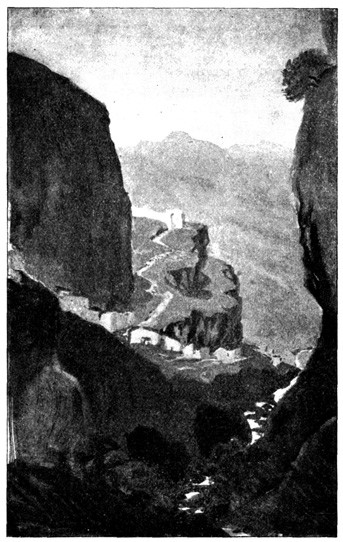
Moorish Gate, Ronda.
As the evening advanced, the dramatis personæ thickened. A large man, about sixty years of age, of powerful frame, came strolling in, to gossip with mine hostess. He was dressed in the ordinary Andalusian costume, but had a huge sabre tucked under his arm; wore large moustaches, and had something of a lofty swaggering air. Every one seemed to regard him with great deference.
Our man Sancho whispered to us that he was Don Ventura Rodriguez, the hero and champion of Loxa, famous for his prowess and the strength of his arm. In the time of the French invasion he surprised six troopers who were asleep; he first secured their horses, then attacked them with his sabre, killed some, and took the rest prisoners. For this exploit the king allows him a peseta (the fifth of a duro, or dollar) per day, and has dignified him with the title of Don.
I was amused to behold his swelling language and demeanour. He was evidently a thorough Andalusian, boastful as brave. His sabre was always in his hand or under his arm. He carries it always about with him as a child does its doll, calls it his Santa Teresa, and says, "When I draw it, the earth trembles" (tiembla la tierra).
I sat until a late hour listening to the varied themes of this motley group, who mingled together with the unreserve of a Spanish posada. We had contrabandista songs, stories of robbers, guerrilla exploits, and Moorish legends. The last were from our handsome landlady, who gave a poetical account of the infiernos, or infernal regions of Loxa,—dark caverns, in which subterranean streams and waterfalls make a mysterious sound. The common people say that there are money-coiners shut up there from the time of the Moors; and that the Moorish kings kept their treasures in those caverns.
I retired to bed with my imagination excited by all that I had seen and heard in this old warrior city. Scarce had I fallen asleep when I was aroused by a horrid din and uproar, that might have confounded the hero of La Mancha himself, whose experience of Spanish inns was a continual uproar. It seemed for a moment as if the Moors were once more breaking into the town; or the infiernos of which mine hostess talked had broken loose. I sallied forth, half dressed, to reconnoitre. It was nothing more nor less than a charivari to celebrate the nuptials of an old man with a buxom damsel. Wishing him joy of his bride and his serenade, I returned to my more quiet bed, and slept soundly until morning.
While dressing, I amused myself in reconnoitring the populace from my window. There were groups of fine-looking young men in the trim fanciful Andalusian costume, with brown cloaks, thrown about them in true Spanish style, which cannot be imitated, and little round majo hats stuck on with a peculiar knowing air. They had the same galliard look which I have remarked among the dandy mountaineers of Ronda. Indeed, all this part of Andalusia abounds with such game-looking characters. They loiter about the towns and villages; seem to have plenty of time and plenty of money; "horse to ride and weapon to wear." Great gossips, great smokers, apt at touching the guitar, singing couplets to their maja belles, and famous dancers of the bolero. Throughout all Spain the men, however poor, have a gentlemanlike abundance of leisure; seeming to consider it the attribute of a true cavaliero never to be in a hurry; but the Andalusians are gay as well as leisurely, and have none of the squalid accompaniments of idleness. The adventurous contraband trade which prevails throughout these mountain regions, and along the maritime borders of Andalusia, is doubtless at the bottom of this galliard character.
In contrast to the costume of these groups was that of two long-legged Valencians conducting a donkey, laden with articles of merchandise; their muskets slung crosswise over his back, ready for action. They wore round jackets (jalecos), wide linen bragas or drawers scarce reaching to the knees and looking like kilts, red fajas or sashes swathed tightly round their waists, sandals of espartal or bass weed, coloured kerchiefs round their heads somewhat in the style of turbans, but leaving the top of the head uncovered; in short, their whole appearance having much of the traditional Moorish stamp.
On leaving Loxa we were joined by a cavalier, well mounted and well armed, and followed on foot by an escopetero or musketeer. He saluted us courteously, and soon let us into his quality. He was chief of the customs, or rather, I should suppose, chief of an armed company whose business it is to patrol the roads and look out for contrabandistas. The escopetero was one of his guards. In the course of our morning's ride I drew from him some particulars concerning the smugglers, who have risen to be a kind of mongrel chivalry in Spain. They come into Andalusia, he said, from various parts, but especially from La Mancha; sometimes to receive goods, to be smuggled on an appointed night across the line at the plaza or strand of Gibraltar; sometimes to meet a vessel, which is to hover on a given night off a certain part of the coast. They keep together and travel in the night. In the daytime they lie quiet in barrancos, gullies of the mountains, or lonely farmhouses; where they are generally well received, as they make the family liberal presents of their smuggled wares. Indeed, much of the finery and trinkets worn by the wives and daughters of the mountain hamlets and farm-houses are presents from the gay and open-handed contrabandistas.
Arrived at the part of the coast where a vessel is to meet them, they look out at night from some rocky point or headland. If they descry a sail near the shore they make a concerted signal; sometimes it consists in suddenly displaying a lantern three times from beneath the folds of the cloak. If the signal is answered, they descend to the shore and prepare for quick work. The vessel runs close in; all her boats are busy landing the smuggled goods, made up into snug packages for transportation on horseback. These are hastily thrown on the beach, as hastily gathered up and packed on the horses, and then the contrabandistas clatter off to the mountains. They travel by the roughest, wildest, and most solitary roads, where it is almost fruitless to pursue them. The custom-house guards do not attempt it: they take a different course. When they hear of one of these bands returning full freighted through the mountains, they go out in force, sometimes twelve infantry and eight horsemen, and take their station where the mountain defile opens into the plain. The infantry, who lie in ambush some distance within the defile, suffer the band to pass, then rise and fire upon them. The contrabandistas dash forward, but are met in front by the horsemen. A wild skirmish ensues. The contrabandistas, if hard pressed, become desperate. Some dismount, use their horses as breastworks, and fire over their backs; others cut the cords, let the packs fall off to delay the enemy, and endeavour to escape with their steeds. Some get off in this way with the loss of their packages; some are taken, horses, packages, and all; others abandon everything, and make their escape by scrambling up the mountains. "And then," cried Sancho, who had been listening with a greedy ear, "se hacen ladrones legitimos,"—and then they become legitimate robbers.
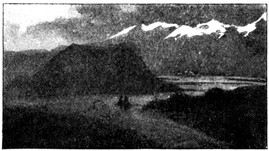
I could not help laughing at Sancho's idea of a legitimate calling of the kind; but the chief of customs told me it was really the case that the smugglers, when thus reduced to extremity, thought they had a kind of right to take to the road, and lay travellers under contribution, until they had collected funds enough to mount and equip themselves in contrabandista style.
Towards noon our wayfaring companion took leave of us and turned up a steep defile, followed by his escopetero; and shortly afterwards we emerged from the mountains, and entered upon the far-famed vega of Granada.
Our last mid-day's repast was taken under a grove of olive-trees on the border of a rivulet. We were in a classical neighbourhood; for not far off were the groves and orchards of the Soto de Roma. This, according to fabulous tradition, was a retreat founded by Count Julian to console his daughter Florinda. It was a rural resort of the Moorish kings of Granada; and has in modern times been granted to the Duke of Wellington.
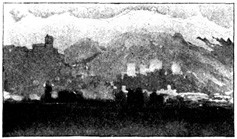
Our worthy squire made a half melancholy face as he drew forth, for the last time, the contents of his alforjas, lamenting that our expedition was drawing to a close, for, with such cavaliers, he said, he could travel to the world's end. Our repast, however, was a gay one; made under such delightful auspices. The day was without a cloud. The heat of the sun was tempered by cool breezes from the mountains. Before us extended the glorious vega. In the distance was romantic Granada surmounted by the ruddy towers of the Alhambra, while far above it the snowy summits of the Sierra Nevada shone like silver.
Our repast finished, we spread our cloaks and took our last siesta al fresco, lulled by the humming of bees among the flowers and the notes of doves among the olive-trees. When the sultry hours were passed we resumed our journey. After a time we overtook a pursy little man, shaped not unlike a toad and mounted on a mule. He fell into conversation with Sancho, and finding we were strangers, undertook to guide us to a good posada. He was an escribano (notary), he said, and knew the city as thoroughly as his own pocket. "Ah Dios, Señores! what a city you are going to see. Such streets! such squares! such palaces! and then the women—ah, Santa Maria purisima—what women!" "But the posada you talk of," said I, "are you sure it is a good one?"
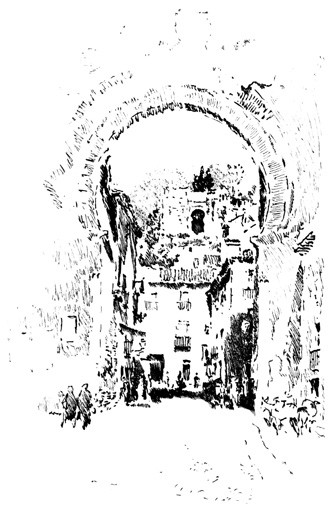
"Good! Santa Maria! the best in Granada, Salones grandes—camas de luxo—colchones de pluma (grand saloons—luxurious sleeping-rooms—beds of down). Ah, Señores, you will fare like King Chico in the Alhambra."
"And how will my horses fare?" cried Sancho.
"Like King Chico's horses. Chocolate con leche y bollos para almuerza" (chocolate and milk with sugar cakes for breakfast), giving the squire a knowing wink and a leer.
After such satisfactory accounts, nothing more was to be desired on that head. So we rode quietly on, the squab little notary taking the lead, and turning to us every moment with some fresh exclamation about the grandeurs of Granada and the famous times we were to have at the posada.
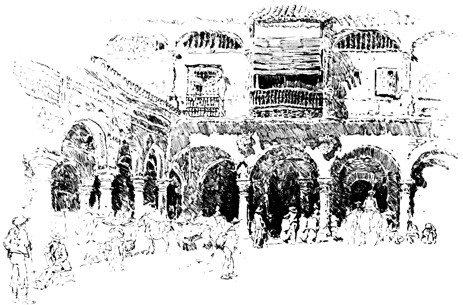
Thus escorted, we passed between hedges of aloes and Indian figs, and through that wilderness of gardens with which the vega is embroidered, and arrived about sunset at the gates of the city. Our officious little conductor conveyed us up one street and down another, until he rode into the court-yard of an inn where he appeared to be perfectly at home. Summoning the landlord by his Christian name, he committed us to his care as two cavalleros de mucho valor, worthy of his best apartments and most sumptuous fare. We were instantly reminded of the patronising stranger who introduced Gil Blas with such a flourish of trumpets to the host and hostess of the inn at Pennaflor, ordering trouts for his supper, and eating voraciously at his expense. "You know not what you possess," cried he to the innkeeper and his wife. "You have a treasure in your house. Behold in this young gentleman the eighth wonder of the world—nothing in this house is too good for Señor Gil Blas of Santillane, who deserves to be entertained like a prince."
Determined that the little notary should not eat trouts at our expense, like his prototype of Pennaflor, we forbore to ask him to supper; nor had we reason to reproach ourselves with ingratitude, for we found before morning the little varlet, who was no doubt a good friend of the landlord, had decoyed us into one of the shabbiest posadas in Granada.
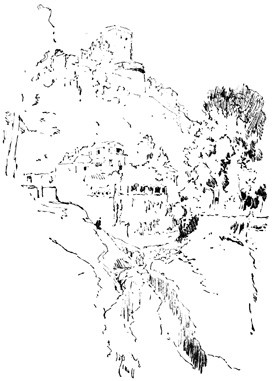
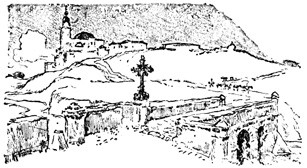
Piedralga Cassla.
PALACE OF THE ALHAMBRA
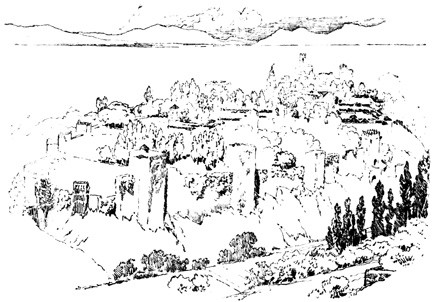
To the traveller imbued with a feeling for the historical and poetical, so inseparately intertwined in the annals of romantic Spain, the Alhambra is as much an object of devotion as is the Caaba to all true Moslems. How many legends and traditions, true and fabulous,—how many songs and ballads, Arabian and Spanish, of love and war and chivalry, are associated with this Oriental pile! It was the royal abode of the Moorish kings, where, surrounded with the splendours and refinements of Asiatic luxury, they held dominion over what they vaunted as a terrestrial paradise, and made their last stand for empire in Spain. The royal palace forms but a part of a fortress, the walls of which, studded with towers, stretch irregularly round the whole crest of a hill, a spur of the Sierra Nevada or Snowy Mountains, and overlook the city; externally it is a rude congregation of towers and battlements, with no regularity of plan nor grace of architecture, and giving little promise of the grace and beauty which prevail within.
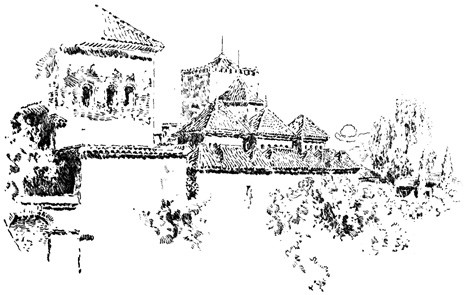
In the time of the Moors the fortress was capable of containing within its outward precincts an army of forty thousand men, and served occasionally as a stronghold of the sovereigns against their rebellious subjects. After the kingdom had passed into the hands of the Christians, the Alhambra continued to be a royal demesne, and was occasionally inhabited by the Castilian monarchs. The emperor Charles V. commenced a sumptuous palace within its walls, but was deterred from completing it by repeated shocks of earthquakes. The last royal residents were Philip V. and his beautiful queen, Elizabetta of Parma, early in the eighteenth century. Great preparations were made for their reception. The palace and gardens were placed in a state of repair, and a new suite of apartments erected, and decorated by artists brought from Italy. The sojourn of the sovereigns was transient, and after their departure the palace once more became desolate. Still the place was maintained with some military state. The governor held it immediately from the crown, its jurisdiction extended down into the suburbs of the city, and was independent of the captain-general of Granada. A considerable garrison was kept up; the governor had his apartments in the front of the old Moorish palace, and never descended into Granada without some military parade. The fortress, in fact, was a little town of itself, having several streets of houses within its walls, together with a Franciscan convent and a parochial church.
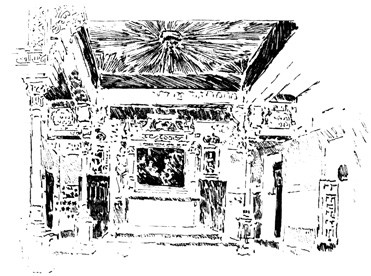
The desertion of the court, however, was a fatal blow to the Alhambra. Its beautiful halls became desolate, and some of them fell to ruin; the gardens were destroyed, and the fountains ceased to play. By degrees the dwellings became filled with a loose and lawless population: contrabandistas, who availed themselves of its independent jurisdiction to carry on a wide and daring course of smuggling, and thieves and rogues of all sorts, who made this their place of refuge whence they might depredate upon Granada and its vicinity. The strong arm of government at length interfered; the whole community was thoroughly sifted; none were suffered to remain but such as were of honest character, and had legitimate right to a residence; the greater part of the houses were demolished and a mere hamlet left, with the parochial church and the Franciscan convent. During the recent troubles in Spain, when Granada was in the hands of the French, the Alhambra was garrisoned by their troops, and the palace was occasionally inhabited by the French commander. With that enlightened taste which has ever distinguished the French nation in their conquests, this monument of Moorish elegance and grandeur was rescued from the absolute ruin and desolation that were overwhelming it. The roofs were repaired, the saloons and galleries protected from the weather, the gardens cultivated, the watercourses restored, the fountains once more made to throw up their sparkling showers; and Spain may thank her invaders for having preserved to her the most beautiful and interesting of her historical monuments.
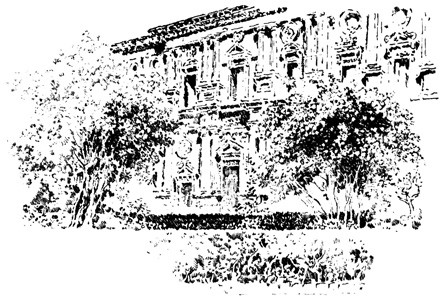
On the departure of the French they blew up several towers of the outer wall, and left the fortifications scarcely tenable. Since that time the military importance of the post is at an end. The garrison is a handful of invalid soldiers, whose principal duty is to guard some of the outer towers, which serve occasionally as a prison of state; and the governor, abandoning the lofty hill of the Alhambra, resides in the centre of Granada, for the more convenient despatch of his official duties.
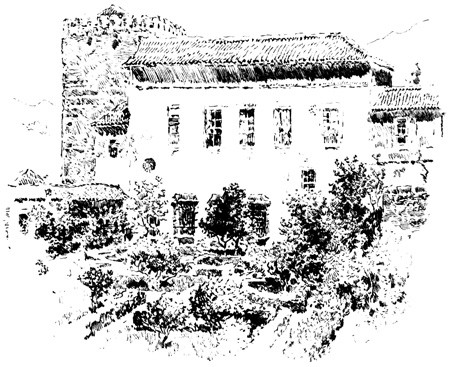
Our first object of course, on the morning after our arrival, was a visit to this time-honoured edifice; it has been so often, however, and so minutely described by travellers, that I shall not undertake to give a comprehensive and elaborate account of it, but merely occasional sketches of parts, with the incidents and associations connected with them.
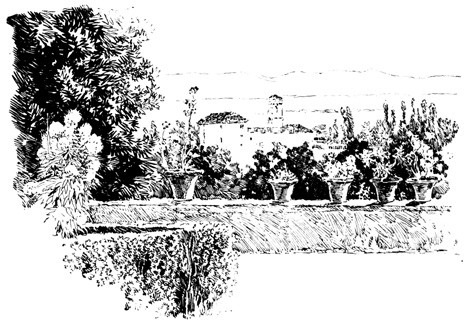
Leaving our posada, and traversing the renowned square of the Vivarrambla, once the scene of Moorish jousts and tournaments, now a crowded market-place, we proceeded along the Zacatin, the main street of what, in the time of the Moors, was the Great Bazaar, and where small shops and narrow alleys still retain the Oriental character. Crossing an open place in front of the palace of the captain-general, we ascended a confined and winding street, the name of which reminded us of the chivalric days of Granada. It is called the Calle, or street of the Gomeres, from a Moorish family famous in chronicle and song. This street led up to the Puerta de las Granadas, a massive gateway of Grecian architecture, built by Charles V., forming the entrance to the domains of the Alhambra.
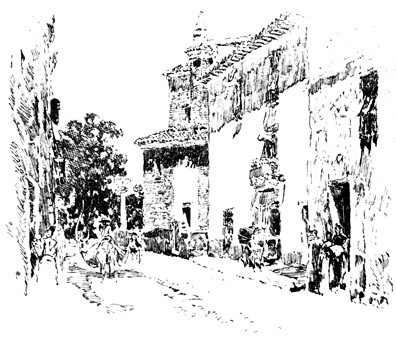
At the gate were two or three ragged superannuated soldiers, dozing on a stone bench, the successors of the Zegris and the Abencerrages; while a tall meagre varlet, whose rusty-brown cloak was evidently intended to conceal the ragged state of his nether garments, was lounging in the sunshine and gossiping with an ancient sentinel on duty. He joined us as we entered the gate, and offered his services to show us the fortress.
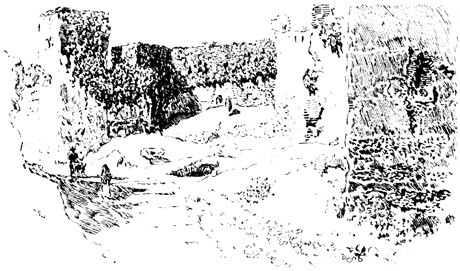
I have a traveller's dislike to officious ciceroni, and did not altogether like the garb of the applicant.
"You are well acquainted with the place, I presume?"
"Ninguno mas; pues señor, soy hijo de la Alhambra."
(Nobody better; in fact, sir, I am a son of the Alhambra!)
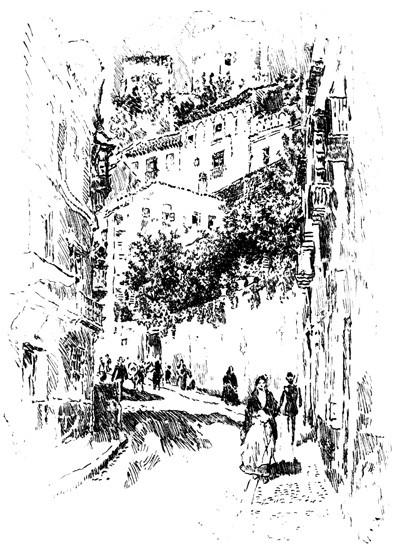
The common Spaniards have certainly a most poetical way of expressing themselves. "A son of the Alhambra!" the appellation caught me at once; the very tattered garb of my new acquaintance assumed a dignity in my eyes. It was emblematic of the fortunes of the place, and befitted the progeny of a ruin.
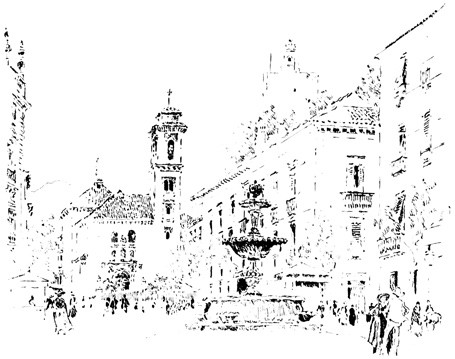
I put some further questions to him, and found that his title was legitimate. His family had lived in the fortress from generation to generation ever since the time of the Conquest. His name was Mateo Ximenes. "Then, perhaps," said I, "you may be a descendant from the great Cardinal Ximenes?"—"Dios sabe! God knows, Señor! It may be so. We are the oldest family in the Alhambra,—Christianos viejos, old Christians, without any taint of Moor or Jew. I know we belong to some great family or other, but I forgot whom. My father knows all about it: he has the coat of arms hanging up in his cottage, up in the fortress." There is not any Spaniard, however poor, but has some claim to high pedigree. The first title of this ragged worthy, however, had completely captivated me; so I gladly accepted the services of the "son of the Alhambra."
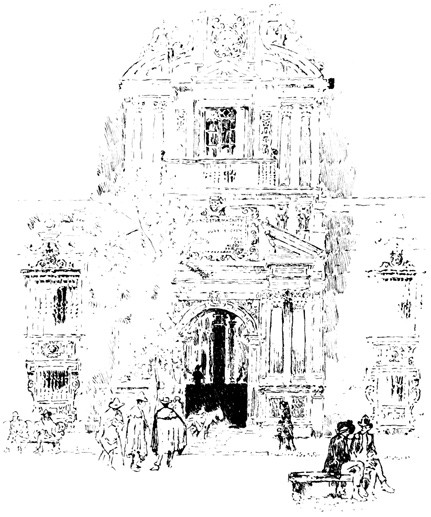
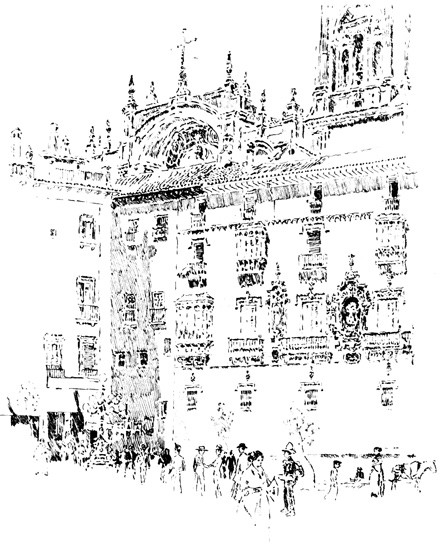
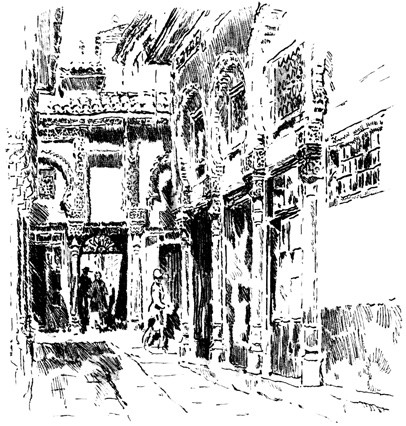
We now found ourselves in a deep narrow ravine, filled with beautiful groves, with a steep avenue, and various footpaths winding through it, bordered with stone seats, and ornamented with fountains. To our left we beheld the towers of the Alhambra beetling above us; to our right, on the opposite side of the ravine, we were equally dominated by rival towers on a rocky eminence. These, we were told, were the Torres Vermejos, or vermilion towers, so called from their ruddy hue. No one knows their origin. They are of a date much anterior to the Alhambra: some suppose them to have been built by the Romans; others, by some wandering colony of Phœnicians. Ascending the steep and shady avenue, we arrived at the foot of a huge square Moorish tower, forming a kind of barbican, through which passed the main entrance to the fortress. Within the barbican was another group of veteran invalids, one mounting guard at the portal, while the rest, wrapped in their tattered cloaks, slept on the stone benches. This portal is called the Gate of Justice, from the tribunal held within its porch during the Moslem domination, for the immediate trial of petty causes: a custom common to the Oriental nations, and occasionally alluded to in the sacred Scriptures. "Judges and officers shalt thou make thee in all thy gates, and they shall judge the people with just judgment."
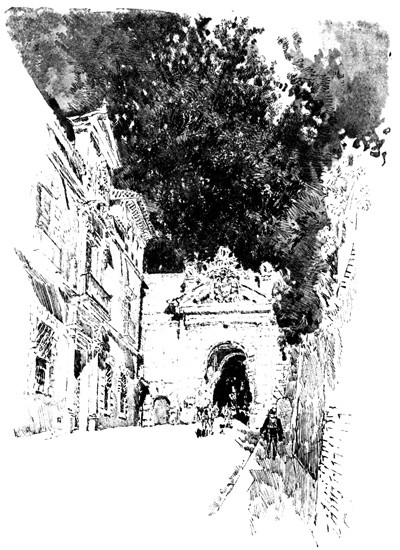
The great vestibule, or porch of the gate, is formed by an immense Arabian arch, of the horseshoe form, which springs to half the height of the tower. On the keystone of this arch is engraven a gigantic hand. Within the vestibule, on the keystone of the portal, is sculptured, in like manner, a gigantic key. Those who pretend to some knowledge of Mohammedan symbols, affirm that the hand is the emblem of doctrine; the five fingers designating the five principal commandments of the creed of Islam, fasting, pilgrimage, alms-giving, ablution, and war against infidels. The key, say they, is the emblem of the faith or of power; the key of Daoud, or David, transmitted to the prophet. "And the key of the house of David will I lay upon his shoulder; so he shall open, and none shall shut, and he shall shut, and none shall open." (Isaiah xxii. 22.) The key we are told was emblazoned on the standard of the Moslems in opposition to the Christian emblem of the cross, when they subdued Spain or Andalusia. It betokened the conquering power invested in the prophet. "He that hath the key of David, he that openeth, and no man shutteth; and shutteth, and no man openeth." (Rev. iii. 7.)
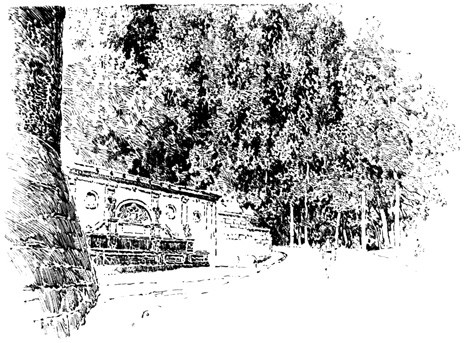
A different explanation of these emblems, however, was given by the legitimate son of the Alhambra, and one more in unison with the notions of the common people, who attach something of mystery and magic to everything Moorish, and have all kinds of superstitions connected with this old Moslem fortress. According to Mateo, it was a tradition handed down from the oldest inhabitants, and which he had from his father and grandfather, that the hand and key were magical devices on which the fate of the Alhambra depended. The Moorish king who built it was a great magician, or, as some believed, had sold himself to the devil, and had laid the whole fortress under a magic spell. By this means it had remained standing, for several years, in defiance of storms and earthquakes, while almost all other buildings of the Moors had fallen to ruin and disappeared. This spell, the tradition went on to say, would last until the hand on the outer arch should reach down and grasp the key, when the whole pile would tumble to pieces, and all the treasures buried beneath it by the Moors would be revealed.
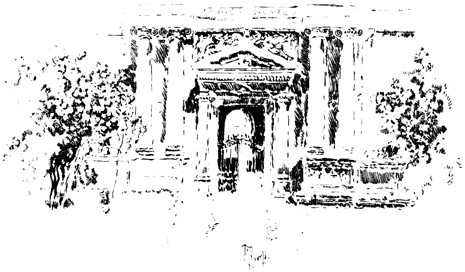
Notwithstanding this ominous prediction, we ventured to pass through the spell-bound gateway, feeling some little assurance against magic art in the protection of the Virgin, a statue of whom we observed above the portal.
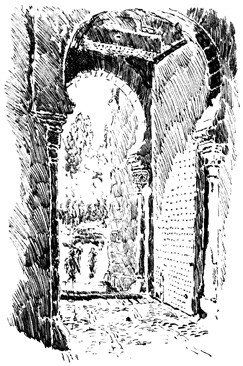
After passing through the barbican, we ascended a narrow lane, winding between walls, and came on an open esplanade within the fortress, called the Plaza de los Algibes, or Place of the Cisterns, from great reservoirs which undermine it, cut in the living rock by the Moors to receive the water brought by conduits from the Darro, for the supply of the fortress. Here, also, is a well of immense depth, furnishing the purest and coldest of water,—another monument of the delicate taste of the Moors, who were indefatigable in their exertions to obtain that element in its crystal purity.
In front of this esplanade is the splendid pile commenced by Charles V., and intended, it is said, to eclipse the residence of the Moorish kings. Much of the Oriental edifice intended for the winter season was demolished to make way for this massive pile. The grand entrance was blocked up; so that the present entrance to the Moorish palace is through a simple and almost humble portal in a corner. With all the massive grandeur and architectural merit of the palace of Charles V., we regarded it as an arrogant intruder, and passing by it with a feeling almost of scorn, rang at the Moslem portal.
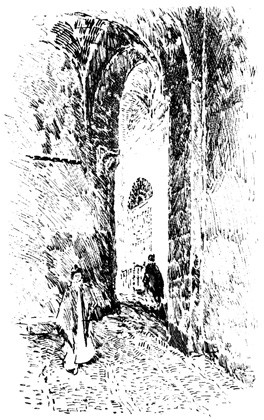
While waiting for admittance, our self-imposed cicerone, Mateo Ximenes, informed us that the royal palace was intrusted to the care of a worthy old maiden dame called Doña Antonia-Molina, but who, according to Spanish custom, went by the more neighbourly appellation of Tia Antonia (Aunt Antonia), who maintained the Moorish halls and gardens in order and showed them to strangers. While we were talking, the door was opened by a plump little black-eyed Andalusian damsel, whom Mateo addressed as Dolores, but who from her bright looks and cheerful disposition evidently merited a merrier name. Mateo informed me in a whisper that she was the niece of Tia Antonia, and I found she was the good fairy who was to conduct us through the enchanted palace. Under her guidance we crossed the threshold, and were at once transported, as if by magic wand, into other times and an oriental realm, and were treading the scenes of Arabian story. Nothing could be in greater contrast than the unpromising exterior of the pile with the scene now before us. We found ourselves in a vast patio or court, one hundred and fifty feet in length, and upwards of eighty feet in breadth, paved with white marble, and decorated at each end with light Moorish peristyles, one of which supported an elegant gallery of fretted architecture. Along the mouldings of the cornices and on various parts of the walls were escutcheons and ciphers, and cufic and Arabic characters in high relief, repeating the pious mottoes of the Moslem monarchs, the builders of the Alhambra, or extolling their grandeur and munificence. Along the centre of the court extended an immense basin or tank (estanque), a hundred and twenty-four feet in length, twenty-seven in breadth, and five in depth, receiving its water from two marble vases. Hence it is called the Court of the Alberca (from al beerkah, the Arabic for a pond or tank). Great numbers of gold-fish were to be seen gleaming through the waters of the basin, and it was bordered by hedges of roses.
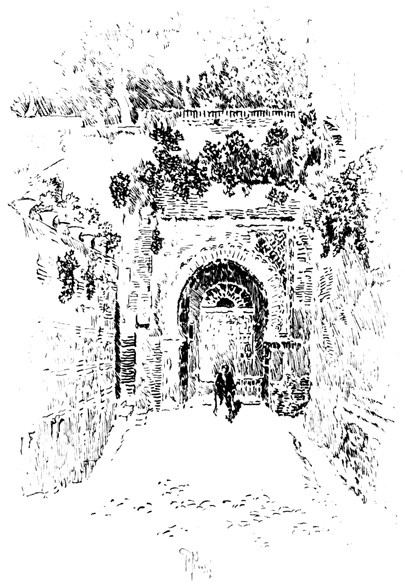
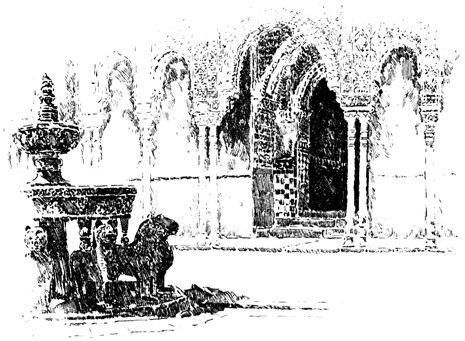
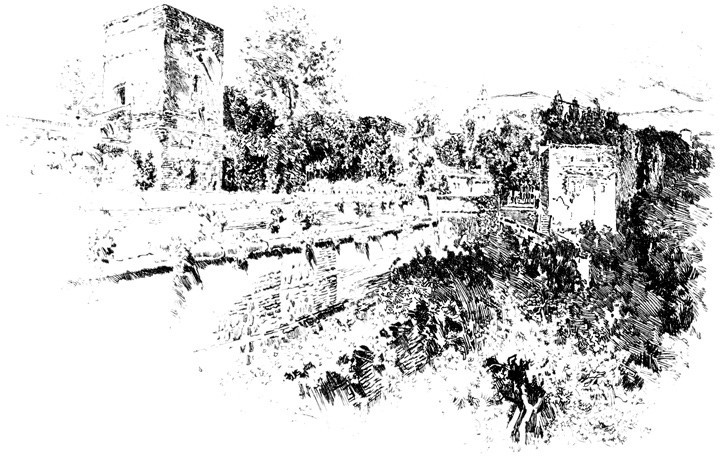
The Gardens
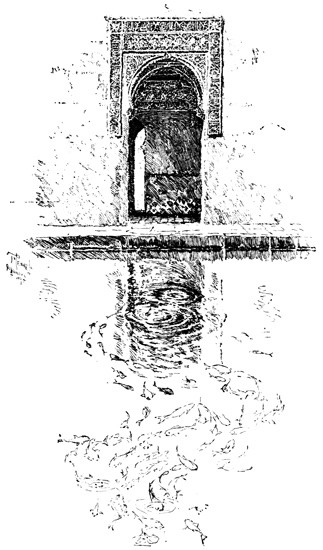
Court of the Tank.
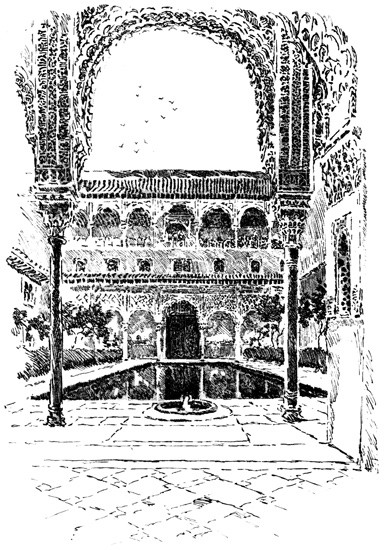
Fishponds of the Alhambra.
Passing from the court of the Alberca under a Moorish archway, we entered the renowned court of Lions. No part of the edifice gives a more complete idea of its original beauty than this, for none has suffered so little from the ravages of time. In the centre stands the fountain famous in song and story. The alabaster basins still shed their diamond drops; the twelve lions which support them, and give the court its name, still cast forth crystal streams as in the days of Boabdil. The lions, however, are unworthy of their fame, being of miserable sculpture, the work probably of some Christian captive. The court is laid out in flower-beds, instead of its ancient and appropriate pavement of tiles or marble; the alteration, an instance of bad taste was made by the French when in possession of Granada. Round the four sides of the court are light Arabian arcades of open filigree work, supported by slender pillars of white marble, which it is supposed were originally gilded. The architecture, like that in most parts of the interior of the palace, is characterised by elegance rather than grandeur, bespeaking a delicate and graceful taste, and a disposition to indolent enjoyment. When one looks upon the fairy traces of the peristyles, and the apparently fragile fretwork of the walls, it is difficult to believe that so much has survived the wear and tear of centuries, the shocks of earthquakes, the violence of war, and the quiet, though no less baneful, pilferings of the tasteful traveller: it is almost sufficient to excuse the popular tradition, that the whole is protected by a magic charm.
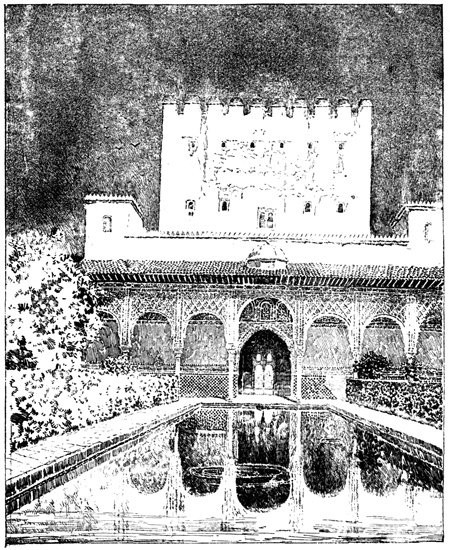
Tower of Comares.
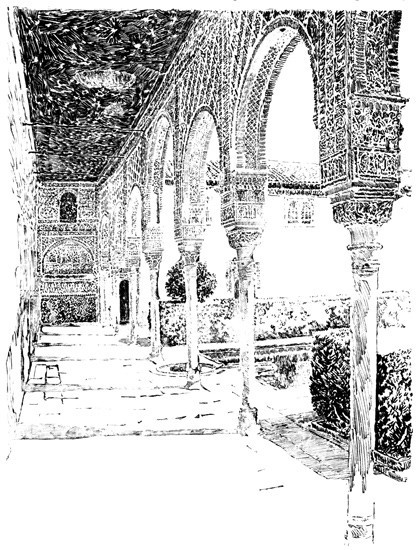
The Court of Myrtles.
On one side of the court a rich portal opens into the Hall of the Abencerrages: so called from the gallant cavaliers of that illustrious line who were here perfidiously massacred. There are some who doubt the whole story, but our humble cicerone Mateo pointed out the very wicket of the portal through which they were introduced one by one into the court of Lions, and the white marble fountain in the centre of the hall beside which they were beheaded. He showed us also certain broad ruddy stains on the pavement, traces of their blood, which, according to popular belief, can never be effaced.
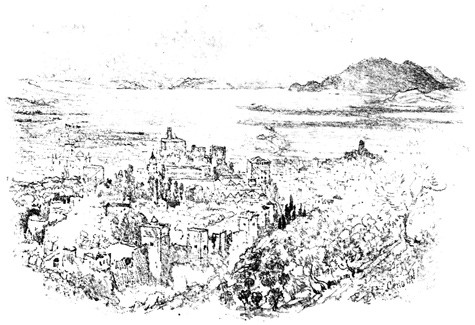
Alhambra from Mountain of the Sun.
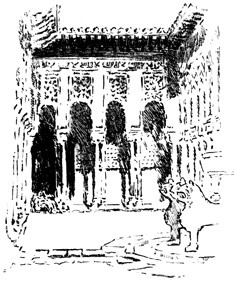
Finding we listened to him apparently with easy faith, he added, that there was often heard at night, in the court of Lions, a low confused sound, resembling the murmuring of a multitude, and now and then a faint tinkling, like the distant clank of chains. These sounds were made by the spirits of the murdered Abencerrages, who nightly haunt the scene of their suffering and invoke the vengeance of Heaven on their destroyer.
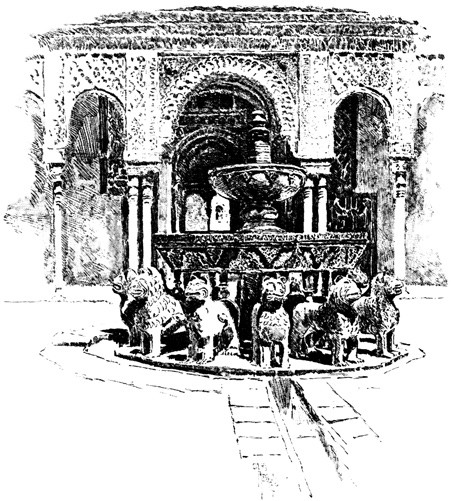
The sounds in question had no doubt been produced, as I had afterwards an opportunity of ascertaining, by the bubbling currents and tinkling falls of water conducted under the pavement through pipes and channels to supply the fountains; but I was too considerate to intimate such an idea to the humble chronicler of the Alhambra.
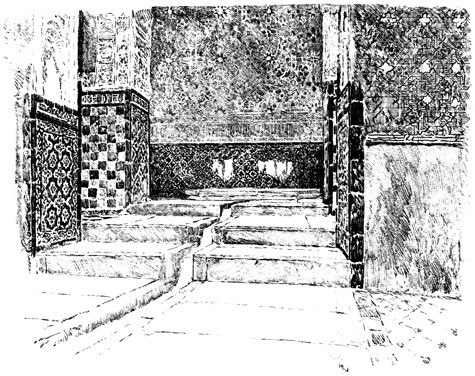
Entrance to Hall of Abencerrages.
Encouraged by my easy credulity, Mateo gave me the following as an undoubted fact, which he had from his grandfather:—
There was once an invalid soldier, who had charge of the Alhambra to show it to strangers; as he was one evening, about twilight, passing through the court of Lions, he heard footsteps on the hall of the Abencerrages; supposing some strangers to be lingering there, he advanced to attend upon them, when to his astonishment he beheld four Moors richly dressed, with gilded cuirasses and cimeters, and poniards glittering with precious stones. They were walking to and fro, with solemn pace; but paused and beckoned to him. The old soldier, however, took to flight, and could never afterwards be prevailed upon to enter the Alhambra. Thus it is that men sometimes turn their backs upon fortune; for it is the firm opinion of Mateo, that the Moors intended to reveal the place where their treasures lay buried. A successor to the invalid soldier was more knowing; he came to the Alhambra poor; but at the end of a year went off to Malaga, bought houses, set up a carriage, and still lives there, one of the richest as well as oldest men of the place; all which, Mateo sagely surmised, was in consequence of his finding out the golden secret of these phantom Moors.
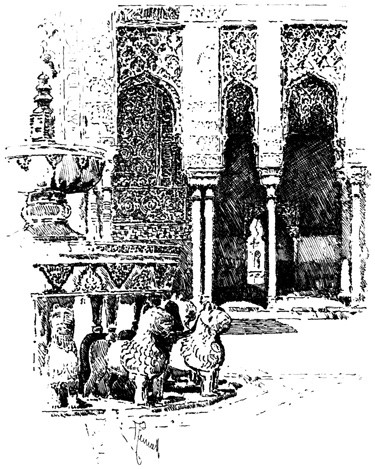
Court of Lions.
I now perceived I had made an invaluable acquaintance in this son of the Alhambra, one who knew all the apocryphal history of the place and firmly believed in it, and whose memory was stuffed with a kind of knowledge for which I have a lurking fancy, but which is too apt to be considered rubbish by less indulgent philosophers. I determined to cultivate the acquaintance of this learned Theban.
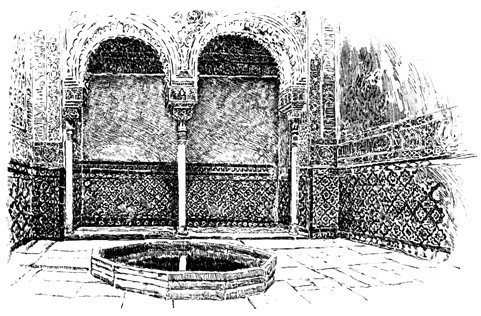
Fountain of Abencerrages.
Immediately opposite the hall of the Abencerrages, a portal, richly adorned, leads into a hall of less tragical associations. It is light and lofty, exquisitely graceful in its architecture, paved with white marble, and bears the suggestive name of the Hall of the Two Sisters. Some destroy the romance of the name by attributing it to two enormous slabs of alabaster which lie side by side, and form a great part of the pavement: an opinion strongly supported by Mateo Ximenes. Others are disposed to give the name a more poetical significance, as the vague memorial of Moorish beauties who once graced this hall, which was evidently a part of the royal harem. This opinion I was happy to find entertained by our little bright-eyed guide, Dolores, who pointed to a balcony over an inner porch, which gallery, she had been told, belonged to the women's apartment. "You see, señor," said she, "it is all grated and latticed, like the gallery in a convent chapel where the nuns hear mass; for the Moorish kings," added she, indignantly, "shut up their wives just like nuns."
The latticed jalousies, in fact, still remain, whence the dark-eyed beauties of the harem might gaze unseen upon the zambras and other dances and entertainments of the hall below.
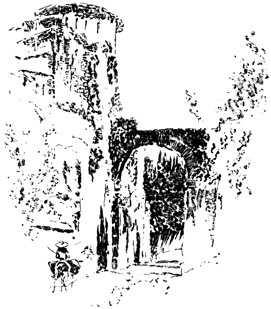
On each side of this hall are recesses or alcoves for ottomans and couches, on which the voluptuous lords of the Alhambra indulged in that dreamy repose so dear to the Orientalists. A cupola or lantern admits a tempered light from above and a free circulation of air; while on one side is heard the refreshing sound of waters from the fountain of the lions, and on the other side the soft plash from the basin in the garden of Lindaraxa.
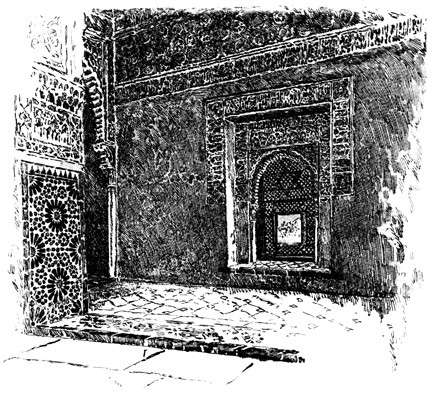
Alcove, Hall of Two Sisters.
It is impossible to contemplate this scene, so perfectly Oriental, without feeling the early associations of Arabian romance, and almost expecting to see the white arm of some mysterious princess beckoning from the gallery, or some dark eye sparkling through the lattice. The abode of beauty is here as if it had been inhabited but yesterday; but where are the two sisters, where the Zoraydas and Lindaraxas!
An abundant supply of water, brought from the mountains by old Moorish aqueducts, circulates throughout the palace, supplying its baths and fish-pools, sparkling in jets within its halls or murmuring in channels along the marble pavements. When it has paid its tribute to the royal pile, and visited its gardens and parterres, it flows down the long avenue leading to the city, tinkling in rills, gushing in fountains, and maintaining a perpetual verdure in those groves that embower and beautify the whole hill of the Alhambra.
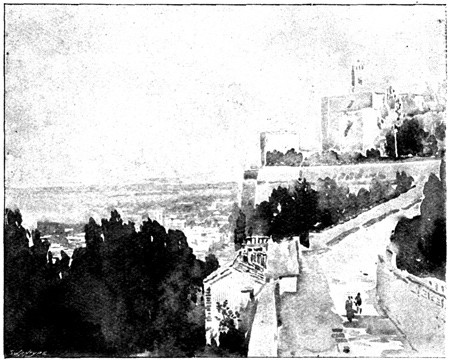
Those only who have sojourned in the ardent climates of the South can appreciate the delights of an abode combining the breezy coolness of the mountain with the freshness and verdure of the valley. While the city below pants with the noontide heat, and the parched Vega trembles to the eye, the delicate airs from the Sierra Nevada play through these lofty halls, bringing with them the sweetness of the surrounding gardens. Everything invites to that indolent repose, the bliss of southern climes; and while the half-shut eye looks out from shaded balconies upon the glittering landscape, the ear is lulled by the rustling of groves and the murmur of running streams.
I forbear for the present, however, to describe the other delightful apartments of the palace. My object is merely to give the reader a general introduction into an abode where, if so disposed, he may linger and loiter with me day by day until we gradually become familiar with all its localities.
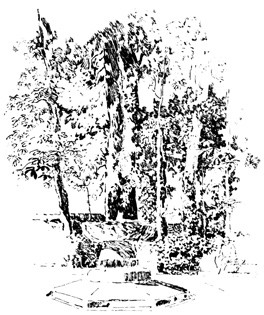
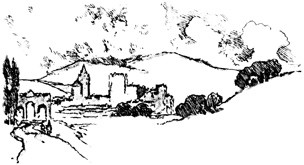
Cabra.
IMPORTANT NEGOTIATIONS.—THE AUTHOR SUCCEEDS TO THE THRONE OF BOABDIL
The day was nearly spent before we could tear ourselves from this region of poetry and romance to descend to the city and return to the forlorn realities of a Spanish posada. In a visit of ceremony to the Governor of the Alhambra, to whom we had brought letters, we dwelt with enthusiasm on the scenes we had witnessed, and could not but express surprise that he should reside in the city when he had such a paradise at his command. He pleaded the inconvenience of a residence in the palace from its situation on the crest of a hill, distant from the seat of business and the resorts of social intercourse. It did very well for monarchs, who often had need of castle walls to defend them from their own subjects. "But, señors," added he, smiling, "if you think a residence there so desirable, my apartments in the Alhambra are at your service."
It is a common and almost indispensable point of politeness in a Spaniard, to tell you his house is yours.—"Esta casa es siempre à la disposicion de Vm."—"This house is always at the command of your Grace." In fact, anything of his which you admire, is immediately offered to you. It is equally a mark of good breeding in you not to accept it; so we merely bowed our acknowledgments of the courtesy of the Governor in offering us a royal palace. We were mistaken, however. The Governor was in earnest. "You will find a rambling set of empty, unfurnished rooms," said he; "but Tia Antonia, who has charge of the palace, may be able to put them in some kind of order, and to take care of you while you are there. If you can make any arrangement with her for your accommodation, and are content with scanty fare in a royal abode, the palace of King Chico is at your service."
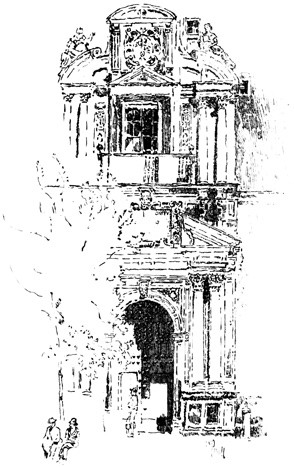
We took the Governor at his word, and hastened up the steep Calle de los Gomeres, and through the Great Gate of Justice, to negotiate with Dame Antonia,—doubting at times if this were not a dream, and fearing at times that the sage Dueña of the fortress might be slow to capitulate. We knew we had one friend at least in the garrison, who would be in our favour, the bright-eyed little Dolores, whose good graces we had propitiated on our first visit; and who hailed our return to the palace with her brightest looks.
All, however, went smoothly. The good Tia Antonia had a little furniture to put in the rooms, but it was of the commonest kind. We assured her we could bivouac on the floor. She could supply our table, but only in her own simple way;—we wanted nothing better. Her niece, Dolores, would wait upon us; and at the word we threw up our hats and the bargain was complete.
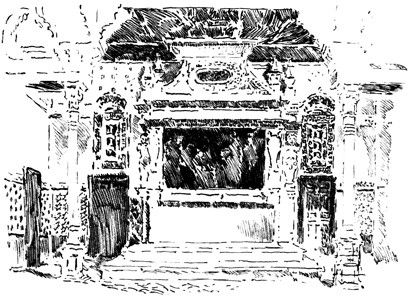
The very next day we took up our abode in the palace, and never did sovereigns share a divided throne with more perfect harmony. Several days passed by like a dream, when my worthy associate, being summoned to Madrid on diplomatic duties, was compelled to abdicate, leaving me sole monarch of this shadowy realm. For myself, being in a manner a haphazard loiterer about the world, and prone to linger in its pleasant places, here have I been suffering day by day to steal away unheeded, spell-bound, for aught I know, in this old enchanted pile. Having always a companionable feeling for my reader, and being prone to live with him on confidential terms, I shall make it a point to communicate to him my reveries and researches during this state of delicious thraldom. If they have the power of imparting to his imagination any of the witching charms of the place, he will not repine at lingering with me for a season in the legendary halls of the Alhambra.
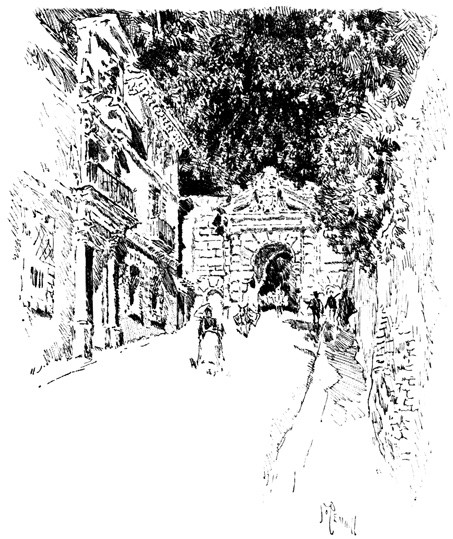
Gate of the Alhambra
And first it is proper to give him some idea of my domestic arrangements: they are rather of a simple kind for the occupant of a regal palace; but I trust they will be less liable to disastrous reverses than those of my royal predecessors.
My quarters are at one end of the Governor's apartment, a suite of empty chambers, in front of the palace, looking out upon the great esplanade called la plaza de los algibes (the place of the cisterns); the apartment is modern, but the end opposite to my sleeping-room communicates with a cluster of little chambers, partly Moorish, partly Spanish, allotted to the châtelaine Doña Antonia and her family. In consideration of keeping the palace in order, the good dame is allowed all the perquisites received from visitors, and all the produce of the gardens; excepting that she is expected to pay an occasional tribute of fruits and flowers to the Governor. Her family consists of a nephew and niece, the children of two different brothers. The nephew, Manuel Molina, is a young man of sterling worth and Spanish gravity. He had served in the army, both in Spain and the West Indies, but is now studying medicine in the hope of one day or other becoming physician to the fortress, a post worth at least one hundred and forty dollars a year. The niece is the plump little black-eyed Dolores already mentioned; and who, it is said, will one day inherit all her aunt's possessions, consisting of certain petty tenements in the fortress, in a somewhat ruinous condition it is true, but which, I am privately assured by Mateo Ximenes, yield a revenue of nearly one hundred and fifty dollars; so that she is quite an heiress in the eyes of the ragged son of the Alhambra. I am also informed by the same observant and authentic personage, that a quiet courtship is going on between the discreet Manuel and his bright-eyed cousin, and that nothing is wanting to enable them to join their hands and expectations but his doctor's diploma, and a dispensation from the Pope on account of their consanguinity.
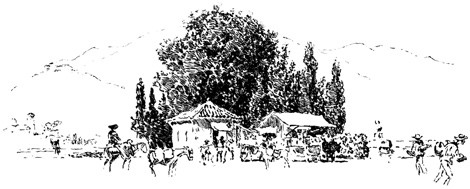
The good dame Antonia fulfils faithfully her contract in regard to my board and lodging; and as I am easily pleased, I find my fare excellent; while the merry-hearted little Dolores keeps my apartment in order, and officiates as handmaid at meal-times. I have also at my command a tall, stuttering, yellow-haired lad, named Pépe, who works in the gardens, and would fain have acted as valet; but in this he was forestalled by Mateo Ximenes, the "son of the Alhambra." This alert and officious wight has managed, somehow or other, to stick by me ever since I first encountered him at the outer gate of the fortress, and to weave himself into all my plans, until he has fairly appointed and installed himself my valet, cicerone, guide, guard, and historiographic squire; and I have been obliged to improve the state of his wardrobe, that he may not disgrace his various functions; so that he has cast his old brown mantle, as a snake does his skin, and now appears about the fortress with a smart Andalusian hat and jacket, to his infinite satisfaction, and the great astonishment of his comrades. The chief fault of honest Mateo is an over-anxiety to be useful. Conscious of having foisted himself into my employ, and that my simple and quiet habits render his situation a sinecure, he is at his wits' ends to devise modes of making himself important to my welfare. I am in a manner the victim of his officiousness; I cannot put my foot over the threshold of the palace to stroll about the fortress, but he is at my elbow, to explain everything I see; and if I venture to ramble among the surrounding hills, he insists upon attending me as a guard, though I vehemently suspect he would be more apt to trust to the length of his legs than the strength of his arms, in case of attack. After all, however, the poor fellow is at times an amusing companion; he is simple-minded and of infinite good humour, with the loquacity and gossip of a village barber, and knows all the small-talk of the place and its environs; but what he chiefly values himself on, is his stock of local information, having the most marvellous stories to relate of every tower, and vault, and gateway of the fortress, in all of which he places the most implicit faith.
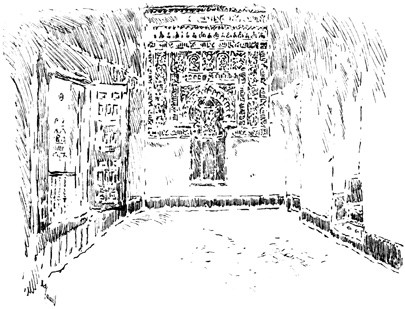
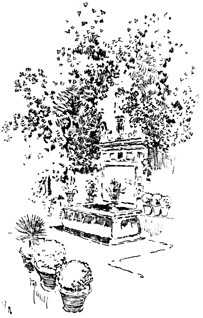
Most of these he has derived, according to his own account, from his grandfather, a little legendary tailor, who lived to the age of nearly a hundred years, during which he made but two migrations beyond the precincts of the fortress. His shop, for the greater part of a century, was the resort of a knot of venerable gossips, where they would pass half the night talking about old times, and the wonderful events and hidden secrets of the place. The whole living, moving, thinking, and acting of this historical little tailor had thus been bounded by the walls of the Alhambra; within them he had been born, within them he lived, breathed, and had his being; within them he died and was buried. Fortunately for posterity his traditionary lore died not with him. The authentic Mateo, when an urchin, used to be an attentive listener to the narratives of his grandfather, and of the gossiping group assembled round the shop-board, and is thus possessed of a stock of valuable knowledge concerning the Alhambra, not to be found in books, and well worthy the attention of every curious traveller.
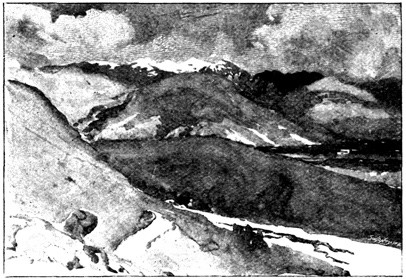
The Surrounding Hills.
Such are the personages that constitute my regal household; and I question whether any of the potentates, Moslem or Christian, who have preceded me in the palace, have been waited upon with greater fidelity, or enjoyed a serener sway.
When I rise in the morning, Pépe, the stuttering lad from the gardens, brings me a tribute of fresh-culled flowers, which are afterwards arranged in vases by the skilful hand of Dolores, who takes a feminine pride in the decoration of my chambers. My meals are made wherever caprice dictates; sometimes in one of the Moorish halls, sometimes under the arcades of the court of Lions, surrounded by flowers and fountains: and when I walk out, I am conducted by the assiduous Mateo to the most romantic retreats of the mountains, and delicious haunts of the adjacent valleys, not one of which but is the scene of some wonderful tale.
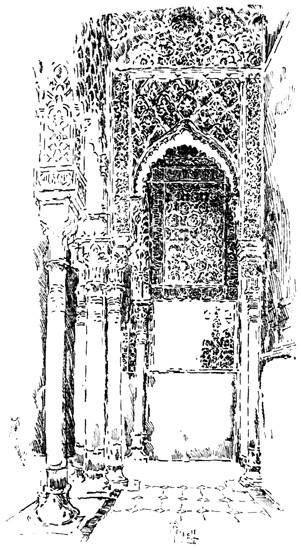
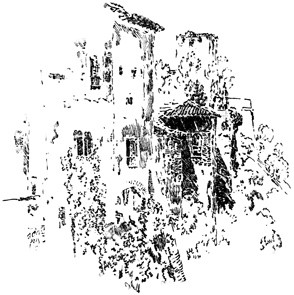
Though fond of passing the greater part of my day alone, yet I occasionally repair in the evenings to the little domestic circle of Doña Antonia. This is generally held in an old Moorish chamber, which serves the good dame for parlour, kitchen, and hall of audience, and which must have boasted of some splendour in the time of the Moors, if we may judge from the traces yet remaining; but a rude fireplace has been made in modern times in one corner, the smoke from which has discoloured the walls, and almost obliterated the ancient arabesques. A window, with a balcony overhanging the valley of the Darro, lets in the cool evening breeze; and here I take my frugal supper of fruit and milk, and mingle with the conversation of the family. There is a natural talent or mother-wit, as it is called, about the Spaniards, which renders them intellectual and agreeable companions, whatever may be their condition in life, or however imperfect may have been their education: add to this, they are never vulgar; nature has endowed them with an inherent dignity of spirit. The good Tia Antonia is a woman of strong and intelligent, though uncultivated mind; and the bright-eyed Dolores, though she has read but three or four books in the whole course of her life, has an engaging mixture of naïveté and good sense, and often surprises me by the pungency of her artless sallies. Sometimes the nephew entertains us by reading some old comedy of Calderon or Lope de Vega, to which he is evidently prompted by a desire to improve as well as amuse his cousin Dolores; though, to his great mortification, the little damsel generally falls asleep before the first act is completed. Sometimes Tia Antonia has a little levée of humble friends and dependants, the inhabitants of the adjacent hamlet, or the wives of the invalid soldiers. These look up to her with great deference, as the custodian of the palace, and pay their court to her by bringing the news of the place, or the rumours that may have straggled up from Granada. In listening to these evening gossipings I have picked up many curious facts illustrative of the manners of the people and the peculiarities of the neighbourhood.
These are simple details of simple pleasures; it is the nature of the place alone that gives them interest and importance. I tread haunted ground, and am surrounded by romantic associations. From earliest boyhood, when, on the banks of the Hudson, I first pored over the pages of old Gines Perez de Hytas's apocryphal but chivalresque history of the civil wars of Granada, and the feuds of its gallant cavaliers, Zegries and Abencerrages, that city has ever been a subject of my waking dreams; and often have I trod in fancy the romantic halls of the Alhambra. Behold for once a day-dream realised; yet I can scarce credit my senses, or believe that I do indeed inhabit the palace of Boabdil, and look down from its balconies upon chivalric Granada. As I loiter through these Oriental chambers, and hear the murmur of fountains and the song of the nightingale; as I inhale the odour of the rose, and feel the influence of the balmy climate, I am almost tempted to fancy myself in the paradise of Mahomet, and that the plump little Dolores is one of the bright-eyed houris, destined to administer to the happiness of true believers.
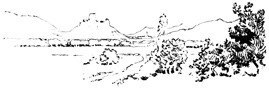
Alcandite.
A Moorish Mill.
INHABITANTS OF THE ALHAMBRA
I have often observed that the more proudly a mansion has been tenanted in the day of its prosperity, the humbler are its inhabitants in the day of its decline, and that the palace of a king commonly ends in being the nestling-place of the beggar.
The Alhambra is in a rapid state of similar transition. Whenever a tower falls to decay, it is seized upon by some tatterdemalion family, who become joint-tenants, with the bats and owls, of its gilded halls; and hang their rags, those standards of poverty, out of its windows and loopholes.
I have amused myself with remarking some of the motley characters that have thus usurped the ancient abode of royalty, and who seem as if placed here to give a farcical termination to the drama of human pride. One of these even bears the mockery of a regal title. It is a little old woman named Maria Antonia Sabonea, but who goes by the appellation of la Reyna Coquina, or the Cockle-queen. She is small enough to be a fairy; and a fairy she may be for aught I can find out, for no one seems to know her origin. Her habitation is in a kind of closet under the outer staircase of the palace, and she sits in the cool stone corridor, plying her needle and singing from morning till night, with a ready joke for every one that passes; for though one of the poorest, she is one of the merriest little women breathing. Her great merit is a gift for story-telling, having, I verily believe, as many stories at her command as the inexhaustible Scheherezade of the Thousand and One Nights. Some of these I have heard her relate in the evening tertulias of Dame Antonia, at which she is occasionally a humble attendant.
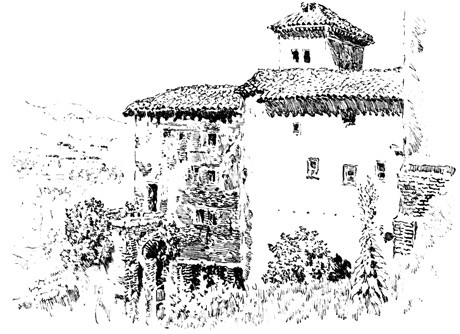
That there must be some fairy gift about this mysterious little old woman, would appear from her extraordinary luck, since, notwithstanding her being very little, very ugly, and very poor, she has had, according to her own account, five husbands and a half, reckoning as a half one a young dragoon, who died during courtship. A rival personage to this little fairy queen is a portly old fellow with a bottle-nose, who goes about in a rusty garb, with a cocked hat of oil-skin and a red cockade. He is one of the legitimate sons of the Alhambra, and has lived here all his life, filling various offices, such as deputy alguazil, sexton of the parochial church, and marker of a fives-court, established at the foot of one of the towers. He is as poor as a rat, but as proud as he is ragged, boasting of his descent from the illustrious house of Aguilar, from which sprang Gonzalvo of Cordova, the grand captain. Nay, he actually bears the name of Alonzo de Aguilar, so renowned in the history of the Conquest; though the graceless wags of the fortress have given him the title of el padre santo, or the holy father, the usual appellation of the Pope, which I had thought too sacred in the eyes of true Catholics to be thus ludicrously applied. It is a whimsical caprice of fortune to present, in the grotesque person of this tatterdemalion, a namesake and descendant of the proud Alonzo de Aguilar, the mirror of Andalusian chivalry, leading an almost mendicant existence about this once haughty fortress, which his ancestor aided to reduce; yet such might have been the lot of the descendants of Agamemnon and Achilles, had they lingered about the ruins of Troy!
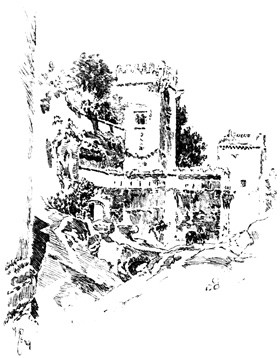
Of this motley community, I find the family of my gossiping squire, Mateo Ximenes, to form, from their numbers at least, a very important part. His boast of being a son of the Alhambra is not unfounded. His family has inhabited the fortress ever since the time of the Conquest, handing down an hereditary poverty from father to son; not one of them having ever been known to be worth a maravedi. His father, by trade a ribbon-weaver, and who succeeded the historical tailor as the head of the family, is now near seventy years of age, and lives in a hovel of reeds and plaster, built by his own hands, just above the iron gate. The furniture consists of a crazy bed, a table, and two or three chairs; a wooden chest, containing, besides his scanty clothing, the "archives of the family." These are nothing more nor less than the papers of various lawsuits sustained by different generations; by which it would seem that, with all their apparent carelessness and good-humour, they are a litigious brood. Most of the suits have been brought against gossiping neighbours for questioning the purity of their blood, and denying their being Christianos viejos, i.e. old Christians, without Jewish or Moorish taint. In fact, I doubt whether this jealousy about their blood has not kept them so poor in purse: spending all their earnings on escribanos and alguazils. The pride of the hovel is an escutcheon suspended against the wall, in which are emblazoned quarterings of the arms of the Marquis of Caiesedo, and of various other noble houses, with which this poverty-stricken brood claim affinity.
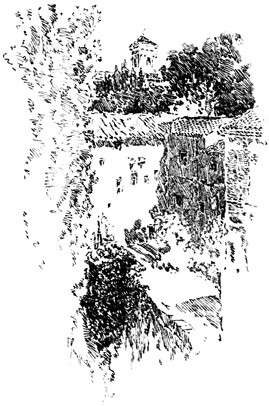
As to Mateo himself, who is now about thirty-five years of age, he has done his utmost to perpetuate his line and continue the poverty of the family, having a wife and a numerous progeny, who inhabit an almost dismantled hovel in the hamlet. How they manage to subsist, He only who sees into all mysteries can tell; the subsistence of a Spanish family of the kind is always a riddle to me; yet they do subsist, and what is more, appear to enjoy their existence. The wife takes her holiday stroll on the Paseo of Granada, with a child in her arms and half a dozen at her heels; and the eldest daughter, now verging into womanhood, dresses her hair with flowers, and dances gaily to the castanets.
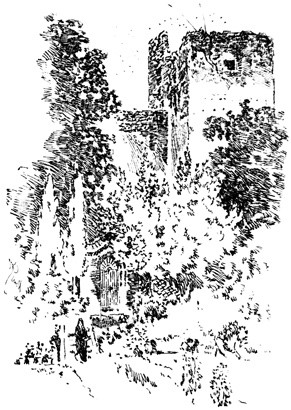
There are two classes of people to whom life seems one long holiday,—the very rich and the very poor; one, because they need do nothing; the other, because they have nothing to do; but there are none who understand the art of doing nothing and living upon nothing, better than the poor classes of Spain. Climate does one half, and temperament the rest. Give a Spaniard the shade in summer and the sun in winter, a little bread, garlic, oil, and garbances, an old brown cloak and a guitar, and let the world roll on as it pleases. Talk of poverty! with him it has no disgrace. It sits upon him with a grandiose style, like his ragged cloak. He is a hidalgo, even when in rags.
The "sons of the Alhambra" are an eminent illustration of this practical philosophy. As the Moors imagined that the celestial paradise hung over this favoured spot, so I am inclined at times to fancy that a gleam of the golden age still lingers about this ragged community. They possess nothing, they do nothing, they care for nothing. Yet, though apparently idle all the week, they are as observant of all holy days and saints' days as the most laborious artisan. They attend all fêtes and dancings in Granada and its vicinity, light bonfires on the hills on St. John's eve, and dance away the moonlight nights on the harvest-home of a small field within the precincts of the fortress, which yield a few bushels of wheat.
Before concluding these remarks, I must mention one of the amusements of the place, which has particularly struck me. I had repeatedly observed a long lean fellow perched on the top of one of the towers, manœuvring two or three fishing-rods, as though he were angling for the stars. I was for some time perplexed by the evolutions of this aërial fisherman, and my perplexity increased on observing others employed in like manner on different parts of the battlements and bastions; it was not until I consulted Mateo Ximenes that I solved the mystery.
It seems that the pure and airy situation of this fortress has rendered it, like the castle of Macbeth, a prolific breeding-place for swallows and martlets, who sport about its towers in myriads, with the holiday glee of urchins just let loose from school. To entrap these birds in their giddy circlings, with hooks baited with flies, is one of the favourite amusements of the ragged "sons of the Alhambra," who, with the good-for-nothing ingenuity of arrant idlers, have thus invented the art of angling in the sky.
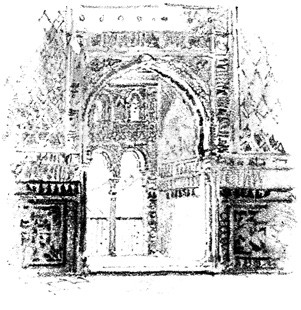
THE HALL OF AMBASSADORS
In one of my visits to the old Moorish chamber where the good Tia Antonia cooks her dinner and receives her company, I observed a mysterious door in one corner, leading apparently into the ancient part of the edifice. My curiosity being aroused, I opened it, and found myself in a narrow, blind corridor, groping along which I came to the head of a dark winding staircase, leading down an angle of the tower of Comares. Down this staircase I descended darkling, guiding myself by the wall until I came to a small door at the bottom, throwing which open, I was suddenly dazzled by emerging into the brilliant antechamber of the Hall of Ambassadors; with the fountain of the court of the Alberca sparkling before me. The antechamber is separated with the court by an elegant gallery, supported by slender columns with spandrels of openwork in the Morisco style. At each end of the antechamber are alcoves, and its ceiling is richly stuccoed and painted. Passing through a magnificent portal, I found myself in the far-famed Hall of Ambassadors, the audience chamber of the Moslem monarchs. It is said to be thirty-seven feet square, and sixty feet high; occupies the whole interior of the Tower of Comares; and still bears the traces of past magnificence. The walls are beautifully stuccoed and decorated with Morisco fancifulness; the lofty ceiling was originally of the same favourite material, with the usual frostwork and pensile ornaments or stalactites; which, with the embellishments of vivid colouring and gilding, must have been gorgeous in the extreme. Unfortunately it gave way during an earthquake, and brought down with it an immense arch which traversed the hall. It was replaced by the present vault or dome of larch or cedar, with intersecting ribs, the whole curiously wrought and richly coloured; still Oriental in its character, reminding one of "those ceilings of cedar and vermilion that we read of in the Prophets and the Arabian Nights."[2]
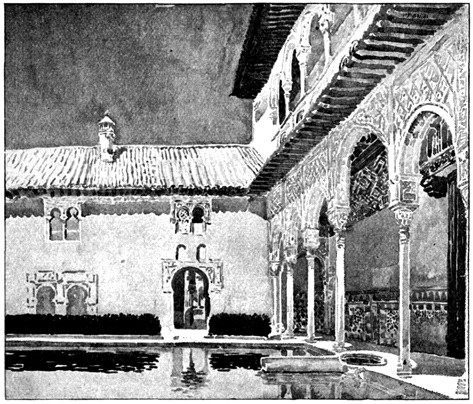
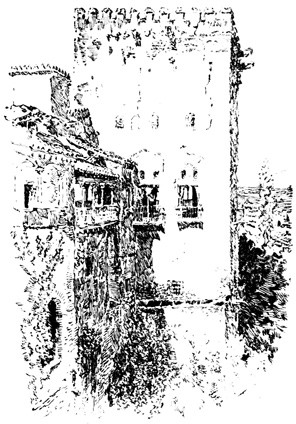
From the great height of the vault above the windows, the upper part of the hall is almost lost in obscurity; yet there is a magnificence as well as solemnity in the gloom, as through it we have gleams of rich gilding and the brilliant tints of the Moorish pencil.
The royal throne was placed opposite the entrance in a recess, which still bears an inscription intimating that Yusef I. (the monarch who completed the Alhambra) made this the throne of his empire. Everything in this noble hall seems to have been calculated to surround the throne with impressive dignity and splendour; there was none of the elegant voluptuousness which reigns in other parts of the palace. The tower is of massive strength, domineering over the whole edifice and overhanging the steep hillside. On three sides of the Hall of Ambassadors are windows cut through the immense thickness of the walls and commanding extensive prospects. The balcony of the central window especially looks down upon the verdant valley of the Darro, with its walks, its groves, and gardens. To the left it enjoys a distant prospect of the Vega; while directly in front rises the rival height of the Albaycin, with its medley of streets, and terraces, and gardens, and once crowned by a fortress that vied in power with the Alhambra. "Ill fated the man who lost all this!" exclaimed Charles V., as he looked forth from this window upon the enchanting scenery it commands.
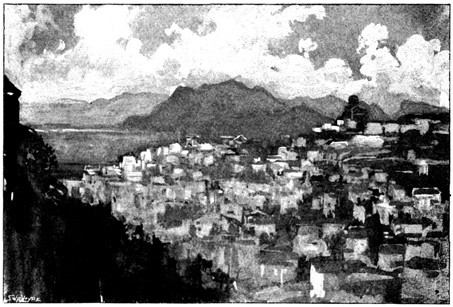
The balcony of the window where this royal exclamation was made, has of late become one of my favourite resorts. I have just been seated there, enjoying the close of a brilliant long day. The sun, as he sank behind the purple mountains of Alhama, sent a stream of effulgence up the valley of the Darro, that spread a melancholy pomp over the ruddy towers of the Alhambra; while the Vega, covered with a slight sultry vapour that caught the setting ray, seemed spread out in the distance like a golden sea. Not a breath of air disturbed the stillness of the hour, and though the faint sound of music and merriment now and then rose from the gardens of the Darro, it but rendered more impressive the monumental silence of the pile which overshadowed me. It was one of those hours and scenes in which memory asserts an almost magical power: and, like the evening sun beaming on these mouldering towers, sends back her retrospective rays to light up the glories of the past.
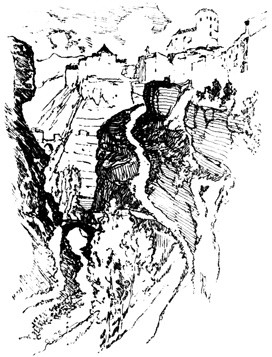
Mountains of Alhambra.
As I sat watching the effect of the declining daylight upon this Moorish pile, I was led into a consideration of the light, elegant, and voluptuous character prevalent throughout its internal architecture, and to contrast it with the grand but gloomy solemnity of the Gothic edifices reared by the Spanish conquerors. The very architecture thus bespeaks the opposite and irreconcilable natures of the two warlike people who so long battled here for the mastery of the Peninsula. By degrees I fell into a course of musing upon the singular fortunes of the Arabian or Morisco-Spaniards, whose whole existence is as a tale that is told, and certainly forms one of the most anomalous yet splendid episodes in history. Potent and durable as was their dominion, we scarcely know how to call them. They were a nation without a legitimate country or name. A remote wave of the great Arabian inundation, cast upon the shores of Europe, they seem to have all the impetus of the first rush of the torrent. Their career of conquest, from the rock of Gibraltar to the cliffs of the Pyrenees, was as rapid and brilliant as the Moslem victories of Syria and Egypt. Nay, had they not been checked on the plains of Tours, all France, all Europe, might have been overrun with the same facility as the empires of the East, and the Crescent at this day have glittered on the fanes of Paris and London.
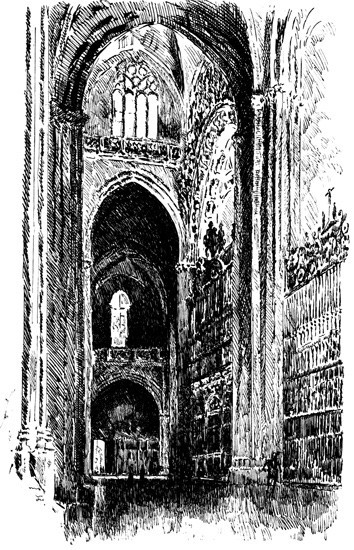
Tomb of St. Ferdinand, Seville.
Repelled within the limits of the Pyrenees, the mixed hordes of Asia and Africa, that formed this great irruption, gave up the Moslem principle of conquest, and sought to establish in Spain a peaceful and permanent dominion. As conquerors, their heroism was only equalled by their moderation; and in both, for a time, they excelled the nations with whom they contended. Severed from their native homes, they loved the land given them as they supposed by Allah, and strove to embellish it with everything that could administer to the happiness of man. Laying the foundations of their power in a system of wise and equitable laws, diligently cultivating the arts and sciences, and promoting agriculture, manufactures, and commerce, they gradually formed an empire unrivalled for its prosperity by any of the empires of Christendom; and diligently drawing round them the graces and refinements which marked the Arabian empire in the East, at the time of its greatest civilisation, they diffused the light of Oriental knowledge through the western regions of benighted Europe.
The cities of Arabian Spain became the resort of Christian artisans, to instruct themselves in the useful arts. The universities of Toledo, Cordova, Seville, and Granada were sought by the pale student from other lands to acquaint himself with the sciences of the Arabs and the treasured lore of antiquity; the lovers of the gay science resorted to Cordova and Granada, to imbibe the poetry and music of the East; and the steel-clad warriors of the North hastened thither to accomplish themselves in the graceful exercises and courteous usages of chivalry.
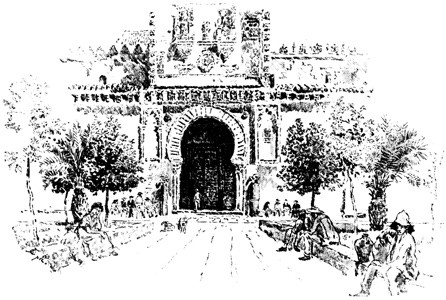
Court of Mosque, Cordova.
If the Moslem monuments in Spain, if the Mosque of Cordova, the Alcazar of Seville, and the Alhambra of Granada, still bear inscriptions fondly boasting of the power and permanency of their dominion, can the boast be derided as arrogant and vain? Generation after generation, century after century, passed away, and still they maintained possession of the land. A period elapsed longer than that which has passed since England was subjugated by the Norman Conqueror, and the descendants of Musa and Taric might as little anticipate being driven into exile across the same straits, traversed by their triumphant ancestors, as the descendants of Rollo and William, and their veteran peers, may dream of being driven back to the shores of Normandy.
With all this, however, the Moslem empire in Spain was but a brilliant exotic, that took no permanent root in the soil it embellished. Severed from all their neighbours in the West by impassable barriers of faith and manners, and separated by seas and deserts from their kindred of the East, the Morisco-Spaniards were an isolated people. Their whole existence was a prolonged, though gallant and chivalric struggle for a foothold in a usurped land.
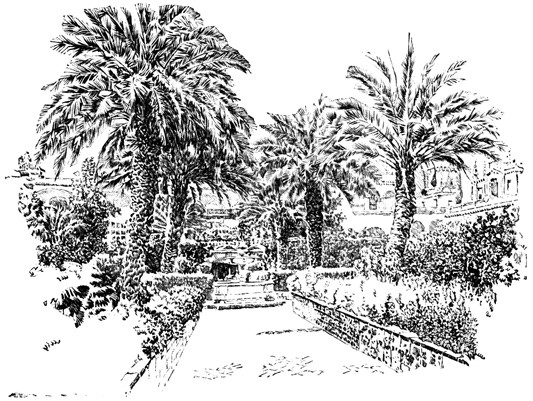
Garden of Alcazar, Seville.
They were the outposts and frontiers of Islamism. The Peninsula was the great battle-ground where the Gothic conquerors of the north and the Moslem conquerors of the East met and strove for mastery; and the fiery courage of the Arab was at length subdued by the obstinate and persevering valour of the Goth.
Never was the annihilation of a people more complete than that of the Morisco-Spaniards. Where are they? Ask the shores of Barbary and its desert places. The exiled remnant of their once powerful empire disappeared among the barbarians of Africa, and ceased to be a nation. They have not even left a distinct name behind them, though for nearly eight centuries they were a distinct people. The home of their adoption, and of their occupation for ages, refuses to acknowledge them, except as invaders and usurpers. A few broken monuments are all that remain to bear witness to their power and dominion, as solitary rocks, left far in the interior, bear testimony to the extent of some vast inundation. Such is the Alhambra;—a Moslem pile in the midst of a Christian land; an Oriental palace amidst the Gothic edifices of the West; an elegant memento of a brave, intelligent, and graceful people, who conquered, ruled, flourished, and passed away.
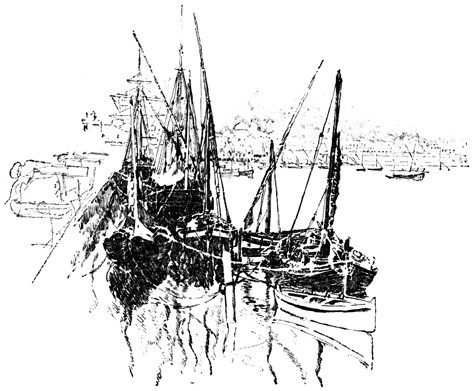
Cadiz.
[2] Urquhart's Pillars of Hercules.
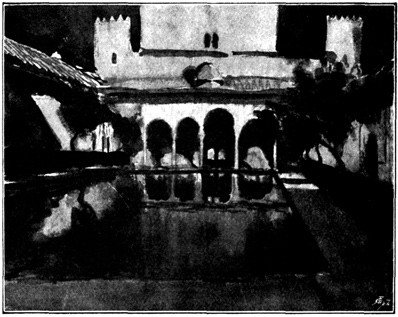
THE MYSTERIOUS CHAMBERS
As I was rambling one day about the Moorish halls, my attention was, for the first time, attracted to a door in a remote gallery, communicating apparently with some part of the Alhambra which I had not yet explored. I attempted to open it, but it was locked. I knocked, but no one answered, and the sound seemed to reverberate through empty chambers. Here then was a mystery. Here was the haunted wing of the castle. How was I to get at the dark secrets here shut up from the public eye? Should I come privately at night with lamp and sword, according to the prying custom of heroes of romance; or should I endeavour to draw the secret from Pépe the stuttering gardener; or the ingenuous Dolores, or the loquacious Mateo? Or should I go frankly and openly to Dame Antonia the chatelaine, and ask her all about it? I chose the latter course, as being the simplest though the least romantic; and found, somewhat to my disappointment, that there was no mystery in the case. I was welcome to explore the apartment, and there was the key.
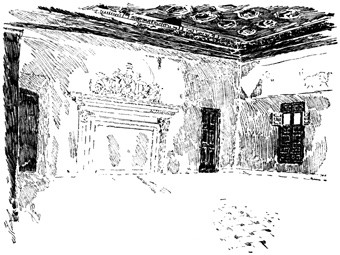
Thus provided, I returned forthwith to the door. It opened, as I had surmised, to a range of vacant chambers; but they were quite different from the rest of the palace. The architecture, though rich and antiquated, was European. There was nothing Moorish about it. The first two rooms were lofty; the ceilings, broken in many places, were of cedar, deeply panelled and skilfully carved with fruits and flowers, intermingled with grotesque masks or faces.
The walls had evidently in ancient times been hung with damask; but now were naked, and scrawled over by that class of aspiring travellers who defile noble monuments with their worthless names. The windows, dismantled and open to wind and weather, looked out into a charming little secluded garden, where an alabaster fountain sparkled among roses and myrtles, and was surrounded by orange and citron trees, some of which flung their branches into the chambers. Beyond these rooms were two saloons, longer but less lofty, looking also into the garden. In the compartments of the panelled ceilings were baskets of fruit and garlands of flowers, painted by no mean hand, and in tolerable preservation. The walls also had been painted in fresco in the Italian style, but the paintings were nearly obliterated; the windows were in the same shattered state with those of the other chambers. This fanciful suite of rooms terminated in an open gallery with balustrades, running at right angles along another side of the garden. The whole apartment, so delicate and elegant in its decorations, so choice and sequestered in its situation along this retired little garden, and so different in architecture from the neighbouring halls, awakened an interest in its history. I found on inquiry that it was an apartment fitted up by Italian artists in the early part of the last century, at the time when Philip V. and his second wife, the beautiful Elizabetta of Farnese, daughter of the Duke of Parma, were expected at the Alhambra. It was destined for the queen and the ladies of her train. One of the loftiest chambers had been her sleeping-room. A narrow staircase, now walled up, led up to a delightful belvidere, originally a mirador of the Moorish sultanas, communicating with the harem; but which was fitted up as a boudoir for the fair Elizabetta, and still retains the name of el tocador de la Reyna, or the queen's toilette.
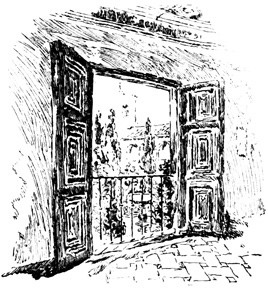
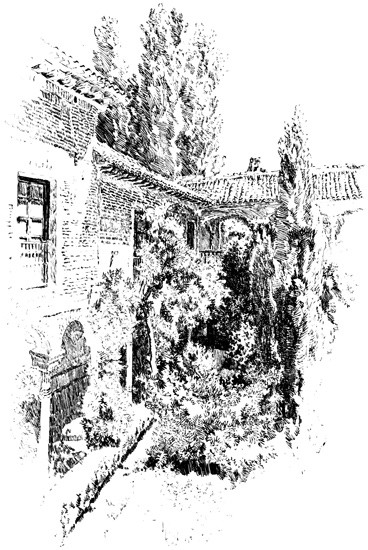
Garden of Lindaraxa
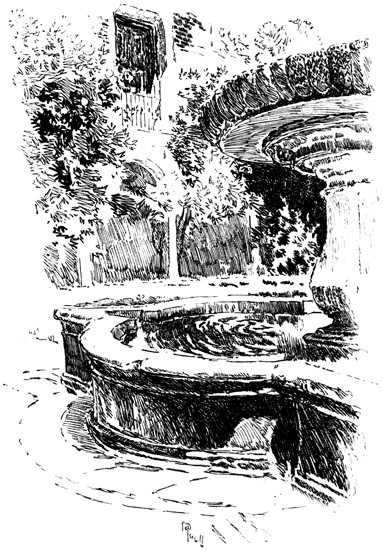
Fountain of Lindaraxa.
One window of the royal sleeping-room commanded a prospect of the Generalife and its embowered terraces; another looked out into the little secluded garden I have mentioned, which was decidedly Moorish in its character, and also had its history. It was in fact the garden of Lindaraxa, so often mentioned in descriptions of the Alhambra, but who this Lindaraxa was I had never heard explained. A little research gave me the few particulars known about her. She was a Moorish beauty who flourished in the court of Muhamed the Left-Handed, and was the daughter of his loyal adherent, the alcayde of Malaga, who sheltered him in his city when driven from the throne. On regaining his crown, the alcayde was rewarded for his fidelity. His daughter had her apartment in the Alhambra, and was given by the king in marriage to Nasar, a young Cetimerien prince descended from Aben Hud the Just. Their espousals were doubtless celebrated in the royal palace and their honeymoon may have passed among these very bowers.[3]
Four centuries had elapsed since the fair Lindaraxa passed away, yet how much of the fragile beauty of the scenes she inhabited remained! The garden still bloomed in which she delighted; the fountain still presented the crystal mirror in which her charms may once have been reflected; the alabaster, it is true, had lost its whiteness; the basin beneath, overrun with weeds, had become the lurking-place of the lizard, but there was something in the very decay that enhanced the interest of the scene, speaking as it did of that mutability, the irrevocable lot of man and all his works.
The desolation too of these chambers, once the abode of the proud and elegant Elizabetta, had a more touching charm for me than if I had beheld them in their pristine splendour, glittering with the pageantry of a court.
When I returned to my quarters, in the governor's apartment, everything seemed tame and commonplace after the poetic region I had left. The thought suggested itself: Why could I not change my quarters to these vacant chambers? that would indeed be living in the Alhambra, surrounded by its gardens and fountains, as in the time of the Moorish sovereigns. I proposed the change to Dame Antonia and her family, and it occasioned vast surprise. They could not conceive any rational inducement for the choice of an apartment so forlorn, remote, and solitary. Dolores exclaimed at its frightful loneliness; nothing but bats and owls flitting about,—and then a fox and wildcat, kept in the vaults of the neighbouring baths, roamed about at night. The good Tia had more reasonable objections. The neighbourhood was infested by vagrants: gipsies swarmed in the caverns of the adjacent hills; the palace was ruinous and easy to be entered in many places; the rumour of a stranger quartered alone in one of the remote and ruined apartments, out of the hearing of the rest of the inhabitants, might tempt unwelcome visitors in the night, especially as foreigners were always supposed to be well stocked with money. I was not to be diverted from my humour, however, and my will was law with these good people. So, calling in the assistance of a carpenter, and the ever officious Mateo Ximenes, the doors and windows were soon placed in a state of tolerable security, and the sleeping-room of the stately Elizabetta prepared for my reception. Mateo kindly volunteered as a body-guard to sleep in my antechamber; but I did not think it worth while to put his valour to the proof.
With all the hardihood I had assumed and all the precautions I had taken, I must confess the first night passed in these quarters was inexpressibly dreary. I do not think it was so much the apprehension of dangers from without that affected me, as the character of the place itself, with all its strange associations: the deeds of violence committed there; the tragical ends of many of those who had once reigned there in splendour. As I passed beneath the fated halls of the tower of Comares on the way to my chamber, I called to mind a quotation that used to thrill me in the days of boyhood:
"Fate sits on these dark battlements and frowns;
And, as the portal opens to receive me,
A voice in sullen echoes through the courts
Tells of a nameless deed!"
The whole family escorted me to my chamber, and took leave of me as of one engaged in a perilous enterprise; and when I heard their retreating steps die away along the waste antechambers and echoing galleries, and turned the key of my door, I was reminded of those hobgoblin stories, where the hero is left to accomplish the adventure of an enchanted house.
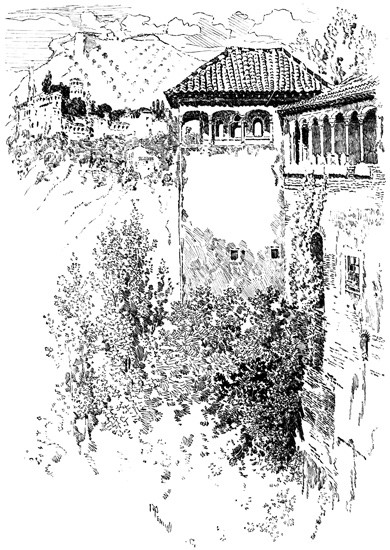
Prospect from the Hall of Ambassadors.
Even the thoughts of the fair Elizabetta and the beauties of her court, who had once graced these chambers, now, by a perversion of fancy, added to the gloom. Here was the scene of their transient gaiety and loveliness; here were the very traces of their elegance and enjoyment; but what and where were they? Dust and ashes! tenants of the tomb! phantoms of the memory!
A vague and indescribable awe was creeping over me. I would fain have ascribed it to the thoughts of robbers awakened by the evening's conversation, but I felt it was something more unreal and absurd. The long-buried superstitions of the nursery were reviving, and asserting their power over my imagination. Everything began to be affected by the working of my mind. The whispering of the wind among the citron-trees beneath my window had something sinister. I cast my eyes into the garden of Lindaraxa; the groves presented a gulf of shadows; the thickets, indistinct and ghastly shapes. I was glad to close the window, but my chamber itself became infected. There was a slight rustling noise overhead; a bat suddenly emerged from a broken panel of the ceiling, flitting about the room and athwart my solitary lamp; and as the fateful bird almost flouted my face with his noiseless wing, the grotesque faces carved in high relief in the cedar ceiling, whence he had emerged, seemed to mope and mow at me.
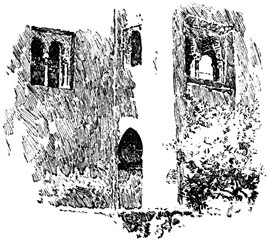
Rousing myself, and half smiling at this temporary weakness, I resolved to brave it out in the true spirit of the hero of the enchanted house; so, taking lamp in hand, I sallied forth to make a tour of the palace. Notwithstanding every mental exertion the task was a severe one. I had to traverse waste halls and mysterious galleries, where the rays of the lamp extended but a short distance around me. I walked, as it were, in a mere halo of light, walled in by impenetrable darkness. The vaulted corridors were as caverns; the ceilings of the halls were lost in gloom. I recalled all that had been said of the danger from interlopers in these remote and ruined apartments. Might not some vagrant foe be lurking before or behind me, in the outer darkness? My own shadow, cast upon the wall, began to disturb me. The echoes of my own footsteps along the corridors made me pause and look around. I was traversing scenes fraught with dismal recollections. One dark passage led down to the mosque where Yusef, the Moorish monarch, the finisher of the Alhambra, had been basely murdered. In another place I trod the gallery where another monarch had been struck down by the poniard of a relative whom he had thwarted in his love.
A low murmuring sound, as of stifled voices and clanking chains, now reached me. It seemed to come from the Hall of the Abencerrages. I knew it to be the rush of water through subterranean channels, but it sounded strangely in the night, and reminded me of the dismal stories to which it had given rise.
Soon, however, my ear was assailed by sounds too fearfully real to be the work of fancy. As I was crossing the Hall of Ambassadors, low moans and broken ejaculations rose, as it were, from beneath my feet. I paused and listened. They then appeared to be outside of the tower—then again within. Then broke forth howlings as of an animal—then stifled shrieks and inarticulate ravings. Heard in that dead hour and singular place, the effect was thrilling. I had no desire for further perambulation; but returned to my chamber with infinitely more alacrity than I had sallied forth, and drew my breath more freely when once more within its walls and the door bolted behind me. When I awoke in the morning, with the sun shining in at my window and lighting up every part of the building with his cheerful and truth-telling beams, I could scarcely recall the shadows and fancies conjured up by the gloom of the preceding night; or believe that the scenes around me, so naked and apparent, could have been clothed with such imaginary horrors.
Still, the dismal howlings and ejaculations I had heard were not ideal; they were soon accounted for, however, by my handmaid Dolores: being the ravings of a poor maniac, a brother of her aunt, who was subject to violent paroxysms, during which he was confined in a vaulted room beneath the Hall of Ambassadors.
In the course of a few evenings a thorough change took place in the scene and its associations. The moon, which when I took possession of my new apartments was invisible, gradually gained each evening upon the darkness of the night, and at length rolled in full splendour above the towers, pouring a flood of tempered light into every court and hall. The garden beneath my window, before wrapped in gloom, was gently lighted up; the orange and citron trees were tipped with silver; the fountain sparkled in the moonbeams, and even the blush of the rose was faintly visible.
I now felt the poetic merit of the Arabic inscription on the walls,—"How beauteous is this garden; where the flowers of the earth vie with the stars of heaven. What can compare with the vase of yon alabaster fountain filled with crystal water? nothing but the moon in her fulness, shining in the midst of an unclouded sky!"
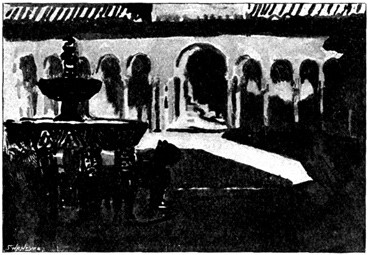
On such heavenly nights I would sit for hours at my window inhaling the sweetness of the garden, and musing on the chequered fortunes of those whose history was dimly shadowed out in the elegant memorials around. Sometimes, when all was quiet, and the clock from the distant cathedral of Granada struck the midnight hour, I have sallied out on another tour and wandered over the whole building; but how different from my first tour! No longer dark and mysterious; no longer peopled with shadowy foes; no longer recalling scenes of violence and murder; all was open, spacious, beautiful; everything called up pleasing and romantic fancies; Lindaraxa once more walked in her garden; the gay chivalry of Moslem Granada once more glittered about the Court of Lions! Who can do justice to a moonlight night in such a climate and such a place? The temperature of a summer midnight in Andalusia is perfectly ethereal. We seem lifted up into a purer atmosphere; we feel a serenity of soul, a buoyancy of spirits, an elasticity of frame, which render mere existence happiness. But when moonlight is added to all this, the effect is like enchantment. Under its plastic sway the Alhambra seems to regain its pristine glories. Every rent and chasm of time; every mouldering tint and weather-stain is gone; the marble resumes its original whiteness; the long colonnades brighten in the moonbeams; the halls are illuminated with a softened radiance,—we tread the enchanted palace of an Arabian tale!
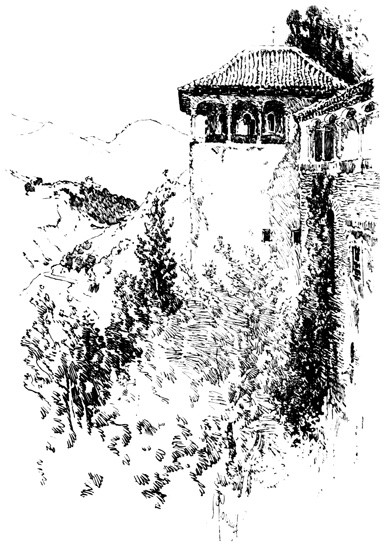
El Tocador de la Reyna.
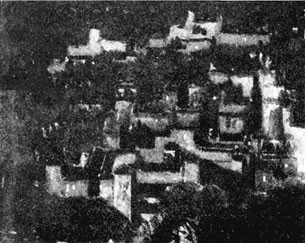
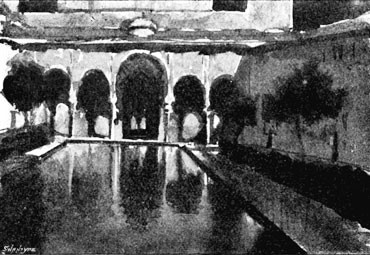
What a delight, at such a time, to ascend to the little airy pavilion of the queen's toilette (el tocador de la reyna), which, like a bird-cage, overhangs the valley of the Darro, and gaze from its light arcades upon the moonlight prospect! To the right, the swelling mountains of the Sierra Nevada, robbed of their ruggedness and softened into a fairy land, with their snowy summits gleaming like silver clouds against the deep blue sky. And then to lean over the parapet of the Tocador and gaze down upon Granada and the Albaycin spread out like a map below; all buried in deep repose; the white palaces and convents sleeping in the moonshine, and beyond all these the vapoury Vega fading away like a dreamland in the distance.
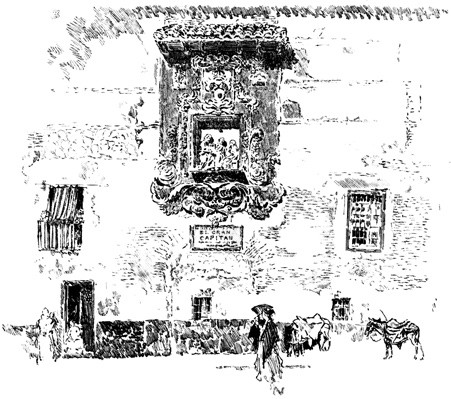
House of the Grand Captain.
Sometimes the faint click of castanets rise from the Alameda, where some gay Andalusians are dancing away the summer night. Sometimes the dubious tones of a guitar and the notes of an amorous voice, tell perchance the whereabout of some moonstruck lover serenading his lady's window.
Such is a faint picture of the moonlight nights I have passed loitering about the courts and halls and balconies of this most suggestive pile; "feeding my fancy with sugared suppositions," and enjoying that mixture of reverie and sensation which steal away existence in a southern climate; so that it has been almost morning before I have retired to bed, and been lulled to sleep by the falling waters of the fountain of Lindaraxa.
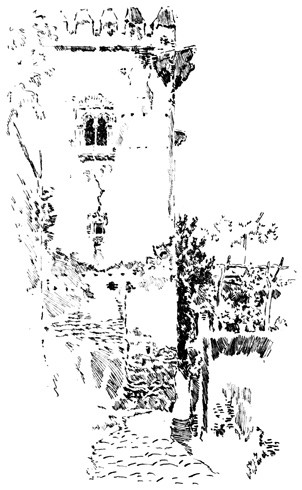
Tower of Iron
[3] Una de las cosas en que tienen precisa intervencion los Reyes Moros as en el matrimonio de sus grandes: de aqui nace que todos los señores llegadas à la persona real si casan en palacio, y siempre huvo su quarto destinado para esta ceremonia.
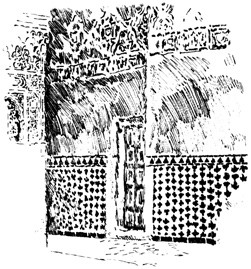
PANORAMA FROM THE TOWER OF COMARES
It is a serene and beautiful morning: the sun has not gained sufficient power to destroy the freshness of the night. What a morning to mount to the summit of the Tower of Comares, and take a bird's-eye view of Granada and its environs!
Come then, worthy reader and comrade, follow my steps into this vestibule, ornamented with rich tracery, which opens into the Hall of Ambassadors. We will not enter the hall, however, but turn to this small door opening into the wall. Have a care! here are steep winding steps and but scanty light; yet up this narrow, obscure, and spiral staircase, the proud monarchs of Granada and their queens have often ascended to the battlements to watch the approach of invading armies, or gaze with anxious hearts on the battles in the Vega.
At length we have reached the terraced roof, and may take breath for a moment, while we cast a general eye over the splendid panorama of city and country; of rocky mountain, verdant valley, and fertile plain; of castle, cathedral, Moorish towers, and Gothic domes, crumbling ruins, and blooming groves. Let us approach the battlements, and cast our eyes immediately below. See, on this side we have the whole plain of the Alhambra laid open to us, and can look down into its courts and gardens. At the foot of the tower is the Court of the Alberca, with its great tank or fishpool, bordered with flowers; and yonder is the Court of Lions, with its famous fountain, and its light Moorish arcades; and in the centre of the pile is the little garden of Lindaraxa, buried in the heart of the building, with its roses and citrons and shrubbery of emerald green.
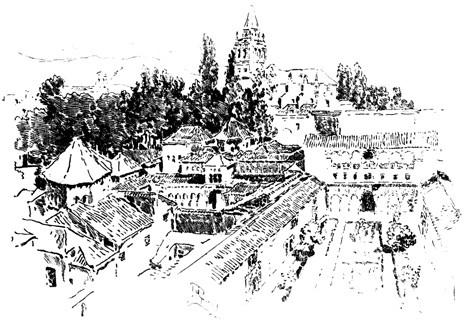
That belt of battlements, studded with square towers, straggling round the whole brow of the hill, is the outer boundary of the fortress. Some of the towers, you may perceive, are in ruins, and their massive fragments buried among vines, fig-trees, and aloes.
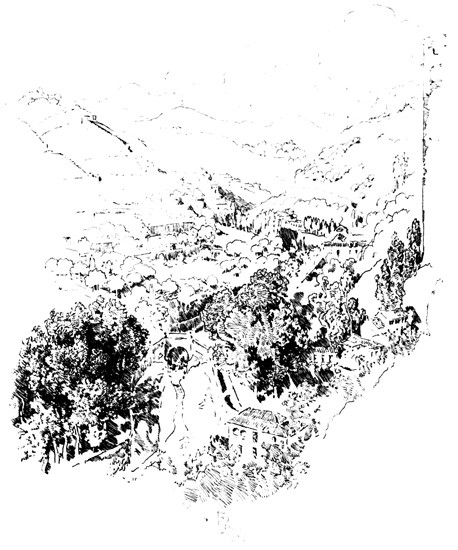
Let us look on this northern side of the tower. It is a giddy height; the very foundations of the tower rise above the groves of the steep hill-side. And see! a long fissure in the massive walls shows that the tower has been rent by some of the earthquakes which from time to time have thrown Granada into consternation; and which, sooner or later, must reduce this crumbling pile to a mere mass of ruin. The deep narrow glen below us, which gradually widens as it opens from the mountains, is the valley of the Darro; you see the little river winding its way under embowered terraces, and among orchards and flower-gardens. It is a stream famous in old times for yielding gold, and its sands are still sifted occasionally, in search of the precious ore. Some of those white pavilions, which here and there gleam from among groves and vineyards, were rustic retreats of the Moors, to enjoy the refreshment of their gardens. Well have they been compared by one of their poets to so many pearls set in a bed of emeralds.
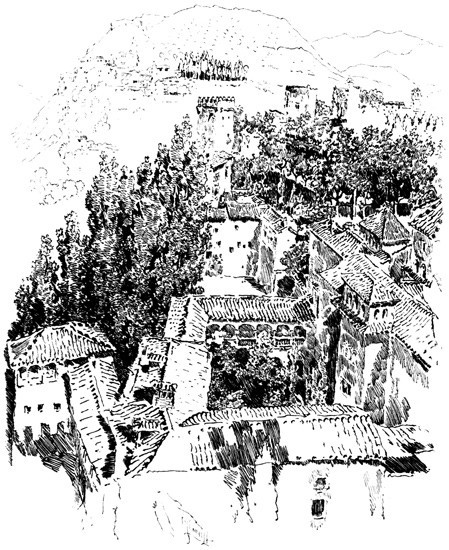
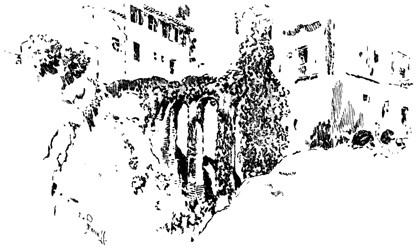
The airy palace, with its tall white towers and long arcades, which breasts yon mountain, among pompous groves and hanging gardens, is the Generalife, a summer palace of the Moorish kings, to which they resorted during the sultry months to enjoy a still more breezy region than that of the Alhambra. The naked summit of the height above it, where you behold some shapeless ruins, is the Silla del Moro, or seat of the Moor, so called from having been a retreat of the unfortunate Boabdil during the time of an insurrection, where he seated himself and looked down mournfully upon his rebellious city.
A murmuring sound of water now and then rises from the valley. It is from the aqueduct of yon Moorish mill, nearly at the foot of the hill. The avenue of trees beyond is the Alameda, along the bank of the Darro; a favourite resort in evenings, and a rendezvous of lovers in the summer nights, when the guitar may be heard at a late hour from the benches along its walks. At present you see none but a few loitering monks there, and a group of water-carriers. The latter are burdened with water-jars of ancient Oriental construction, such as were used by the Moors. They have been filled at the cold and limpid spring called the fountain of Avellanos. Yon mountain path leads to the fountain, a favourite resort of Moslems as well as Christians; for this is said to be the Adinamar (Aynu-l-adamar), the "Fountain of Tears," mentioned by Ibn Batuta the traveller, and celebrated in the histories and romances of the Moors.
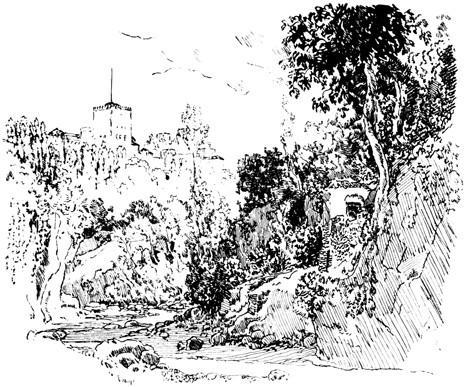
You start! 'tis nothing but a hawk that we have frightened from his nest. This old tower is a complete breeding-place for vagrant birds; the swallow and martlet abound in every chink and cranny, and circle about it the whole day long; while at night, when all other birds have gone to rest, the moping owl comes out of its lurking-place, and utters its boding cry from the battlements. See how the hawk we have dislodged sweeps away below us, skimming over the tops of the trees, and sailing up to the ruins above the Generalife!
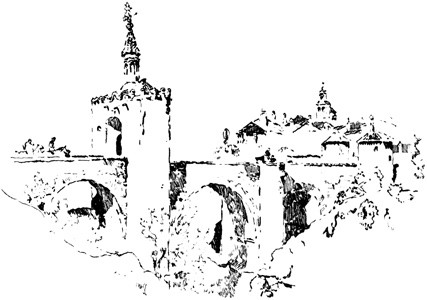
Puente Pinos.
I see you raise your eyes to the snowy summit of yon pile of mountains, shining like a white summer cloud in the blue sky. It is the Sierra Nevada, the pride and delight of Granada; the source of her cooling breezes and perpetual verdure; of her gushing fountains and perennial streams. It is this glorious pile of mountains which gives to Granada that combination of delights so rare in a southern city,—the fresh vegetation and temperate airs of a northern climate, with the vivifying ardour of a tropical sun, and the cloudless azure of a southern sky. It is this aërial treasury of snow, which, melting in proportion to the increase of the summer heat, sends down rivulets and streams through every glen and gorge of the Alpuxarras, diffusing emerald verdure and fertility throughout a chain of happy and sequestered valleys.
Those mountains may be well called the glory of Granada. They dominate the whole extent of Andalusia, and may be seen from its most distant parts. The muleteer hails them, as he views their frosty peaks from the sultry level of the plain; and the Spanish mariner on the deck of his bark, far, far off on the bosom of the blue Mediterranean, watches them with a pensive eye, thinks of delightful Granada, and chants, in low voice, some old romance about the Moors.
See to the south at the foot of those mountains a line of arid hills, down which a long train of mules is slowly moving. Here was the closing scene of Moslem domination. From the summit of one of those hills the unfortunate Boabdil cast back his last look upon Granada, and gave vent to the agony of his soul. It is the spot famous in song and story, "The last sigh of the Moor."
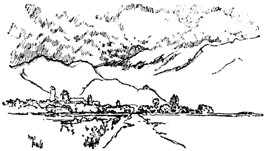
Santa Fe.
Further this way these arid hills slope down into the luxurious Vega, from which he had just emerged: a blooming wilderness of grove and garden, and teeming orchard, with the Xenil winding through it in silver links, and feeding innumerable rills; which, conducted through ancient Moorish channels, maintain the landscape in perpetual verdure. Here were the beloved bowers and gardens, and rural pavilions, for which the unfortunate Moors fought with such desperate valour. The very hovels and rude granges, now inhabited by boors, show, by the remains of arabesques and other tasteful decoration, that they were elegant residences in the days of the Moslems. Behold, in the very centre of this eventful plain, a place which in a manner links the history of the Old World with that of the New. Yon line of walls and towers gleaming in the morning sun, is the city of Santa Fe, built by the Catholic sovereigns during the siege of Granada, after a conflagration had destroyed their camp. It was to these walls Columbus was called back by the heroic queen, and within them the treaty was concluded which led to the discovery of the Western World. Behind yon promontory to the west is the bridge of Pinos, renowned for many a bloody fight between Moors and Christians. At this bridge the messenger overtook Columbus when, despairing of success with the Spanish sovereigns, he was departing to carry his project of discovery to the court of France.
Pass of Elvira.
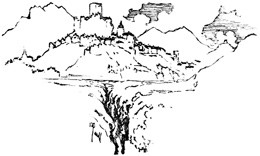
Alcala.
Above the bridge a range of mountains bounds the Vega to the west,—the ancient barrier between Granada and the Christian territories. Among their heights you may still discern warrior towns; their gray walls and battlements seeming of a piece with the rocks on which they are built. Here and there a solitary atalaya, or watchtower, perched on a mountain peak, looks down as it were from the sky into the valley on either side. How often have these atalayas given notice, by fire at night or smoke by day, of an approaching foe! It was down a cragged defile of these mountains, called the Pass of Lope, that the Christian armies descended into the Vega. Round the base of yon gray and naked mountain (the mountain of Elvira), stretching its bold rocky promontory into the bosom of the plain, the invading squadrons would come bursting into view, with flaunting banners and clangour of drum and trumpet.
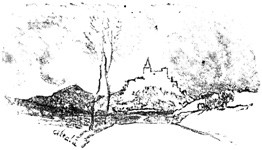
Alcaudete.
Five hundred years have elapsed since Ismael ben Ferrag, a Moorish king of Granada, beheld from this very tower an invasion of the kind, and an insulting ravage of the Vega; on which occasion he displayed an instance of chivalrous magnanimity, often witnessed in the Moslem princes; "whose history," says an Arabian writer, "abounds in generous actions and noble deeds that will last through all succeeding ages, and live for ever in the memory of man."—But let us sit down on this parapet, and I will relate the anecdote.
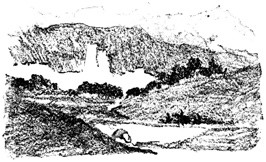
Illora.
It was in the year of Grace 1319, that Ismael ben Ferrag beheld from this tower a Christian camp whitening the skirts of yon mountain of Elvira. The royal princes, Don Juan and Don Pedro, regents of Castile during the minority of Alphonso XI., had already laid waste the country from Alcaudete to Alcalá la Real, capturing the castle of Illora, and setting fire to its suburbs, and they now carried their insulting ravages to the very gates of Granada, defying the king to sally forth and give them battle.
Ismael, though a young and intrepid prince, hesitated to accept the challenge. He had not sufficient force at hand, and awaited the arrival of troops summoned from the neighbouring towns. The Christian princes, mistaking his motives, gave up all hope of drawing him forth, and having glutted themselves with ravage, struck their tents and began their homeward march. Don Pedro led the van, and Don Juan brought up the rear, but their march was confused and irregular, the army being greatly encumbered by the spoils and captives they had taken.
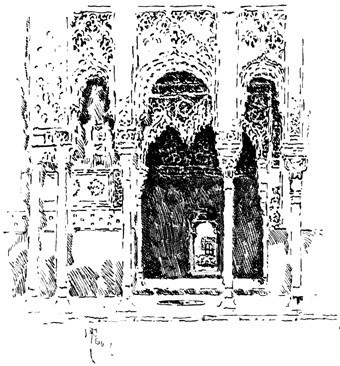
By this time King Ismael had received his expected resources, and putting them under the command of Osmyn, one of the bravest of his generals, sent them forth in hot pursuit of the enemy. The Christians were overtaken in the defiles of the mountains. A panic seized them; they were completely routed, and driven with great slaughter across the borders. Both of the princes lost their lives. The body of Don Pedro was carried off by his soldiers, but that of Don Juan was lost in the darkness of the night. His son wrote to the Moorish king, entreating that the body of his father might be sought and honourably treated. Ismael forgot in a moment that Don Juan was an enemy, who had carried ravage and insult to the very gate of his capital; he only thought of him as a gallant cavalier and a royal prince. By his command diligent search was made for the body. It was found in a barranco and brought to Granada. There Ismael caused it to be laid out in state on a lofty bier, surrounded by torches and tapers, in one of these halls of the Alhambra. Osmyn and other of the noblest cavaliers were appointed as a guard of honour, and the Christian captives were assembled to pray around it.
In the meantime, Ismael wrote to the son of Prince Juan to send a convoy for the body, assuring him it should be faithfully delivered up. In due time, a band of Christian cavaliers arrived for the purpose. They were honourably received and entertained by Ismael, and, on their departure with the body, the guard of honour of Moslem cavaliers escorted the funeral train to the frontier.
But enough; the sun is high above the mountains, and pours his full fervour on our heads. Already the terraced roof is hot beneath our feet; let us abandon it, and refresh ourselves under the Arcades by the Fountain of the Lions.