


автордың кітабын онлайн тегін оқу Polly's Southern Cruise
“YOU GET IN THAT SEAT IN DOUBLE QUICK TIME!” SAID POLLY.
POLLY’S SOUTHERN CRUISE
BY
LILLIAN ELIZABETH ROY
Author of
POLLY OF PEBBLY PIT, POLLY AND ELEANOR,
POLLY IN NEW YORK, POLLY AND HER FRIENDS ABROAD,
POLLY’S BUSINESS VENTURE
ILLUSTRATED BY
H. S. BARBOUR
NEW YORK
GROSSET & DUNLAP
PUBLISHERS
Made in the United States of America
COPYRIGHT, 1923, BY
GROSSET & DUNLAP
Table of Contents
CHAPTER I—THE PERFECTED PLANS
CHAPTER II—“THEY’RE OFF!”
CHAPTER III—THE FIRST NIGHT OUT
CHAPTER IV—THE SECOND DAY OUT
CHAPTER V—TOUCHING AT PALM BEACH
CHAPTER VI—MR. DALKEN’S PATERNAL TRAINING
CHAPTER VII—THE HAVANA RACE COURSE
CHAPTER VIII—LOST IN KINGSTON
CHAPTER IX—THE SIGHTS OF JAMAICA
CHAPTER X—SPORTS AT JAMAICA
CHAPTER XI—MEETING OLD FRIENDS IN PANAMA
CHAPTER XII—THE TALE TOLD BY THE BELGIAN
CHAPTER XIII—HIGH LIFE AT THE CANAL
CHAPTER XIV—IN AND ABOUT PANAMA
POLLY’S SOUTHERN CRUISE
CHAPTER I—THE PERFECTED PLANS
“Well, now, that’s settled!” declared Polly Brewster, as she leaned back in a comfortable arm-chair and scanned her friend who sat hunched over the papers scattered upon the table.
“Settled—but only between us. It remains to be seen how our suggestions will be received by Dalky and Mrs. Courtney,” returned Eleanor Maynard, the young lady just addressed.
“To tell the truth, Nolla,” began Polly in a lowered tone, “I’d much rather sail the seas with Dalky, in his yacht, than venture in a rented craft supervised by Mrs. Courtney—even though she is the dearest thing I ever had for a chaperone!”
Nolla was the nickname given Eleanor, and Dalky was the pet name bestowed upon Mr. Dalken by these two girls—his staunch admirers. As yet they had not discovered an appropriate title to use for their first customer and intimate friend Mrs. Courtney.
“Well, Nolla, seeing we’ve used up carloads of good paper in outlining this itinerary, and worn out the patience of all the clerks in the various Tour Offices, let us act upon our last decision: Propose the plans for our ocean picnic at the general meeting of our friends to-night.”
“It is such a radical change from the trip suggested by Mrs. Courtney, and the outlined voyage desired by Dalky, that I fear we’ll be vetoed in the final ballot,” ventured Eleanor.
“They can only say no to us!” exclaimed Polly, getting up from her chair and gathering in all the now useless sheets of paper which showed where arduous ideas had been expressed upon their white surfaces. But one sheet was left safely at the end of the table. This single sheet was picked up by Eleanor and carefully placed within her script case. The discarded sheets were torn up and thrown into the waste basket.
“We may as well go home and try out the plans on the Fabians,” said Polly, after rearranging the desk-table.
“And see that we look our best for the conquest to-night,” laughed Eleanor, looking about for her hat and coat.
Are you acquainted with Polly and Eleanor? If not, you should be. They are the two friends who were introduced to us several years ago at Pebbly Pit Ranch. Remember? At our first meeting with them these two girls were barely past fourteen; but we founded a firm friendship with them and their immediate companions, at the great Colorado ranch, and this friendship has lasted all through the interesting, and many times thrilling, adventures these girls experienced. To you, who have been denied this friendship, we will introduce our girls.
Polly Brewster, born and reared on her home ranch in the Rockies of Colorado, first met and established a friendship with Eleanor Maynard of Chicago, when Eleanor, attended by her elder sister Barbara and Anne Stewart, spent the summer with the Brewsters at Pebbly Pit Ranch. During that visit the girls, while on a mountain ride, discovered the vein of gold which later developed such amazing phases of interest and trouble for all concerned in its products.
The summer ending, the two young girls, now firm friends, won the consent of their parents to allow them to accompany Anne Stewart to New York City, where Anne was engaged to teach a very high-grade, young ladies’ school. Polly and Eleanor planned to enter this school, and take up interior decorating as an extra study.
Having been admitted to a course at Cooper Union Night Classes, the two girl friends found Mr. Fabian, the lecturer, a most valuable friend. Through Mr. Fabian the girls were enabled to attend many private exhibitions of art goods and antiques, also to go to lectures, visit gatherings where interior decorating was the subject of discussion, and in other ways reap the benefit of the many years’ experience of this gentleman.
During their school years in New York Polly and Eleanor became acquainted with a staunch friend, a Mr. Dalken; and met and became intimate friends with the Ashbys—the Ashby of the famous Ashby Shops on Fifth Avenue, where one may find any rare or antique object known to home-makers or decorators.
Through the acquaintances thus formed the two girls were invited to join the touring party about to start for Europe the year that Polly and Eleanor finished their schooling. After a summer abroad visiting interesting places and seeing all that was worth viewing, the group of Americans returned home.
That fall the two girls decided to enter business in an humble way. They secured desk-room in Mr. Ashby’s business house and ventured forth to find and purchase antiques, in order to sell them again at a reasonable profit. The amusing incidents experienced while in search of odd and old objects constitute several chapters of the book called “Polly’s Business Venture.” At the ending of that book the reader is introduced to Mrs. Courtney, who interested herself in the two young business girls and eventually invited them to accompany her on a cruise to the Southern Seas. Before any plan could be perfected, however, Mr. Dalken hinted at his plan to go on an extended yachting cruise to the Orient. Naturally, he wished a party of his old friends to accompany him; and Polly and Eleanor considered themselves part of that group.
Thus it happened that about the time the present story opens Polly and Eleanor had been planning various itineraries to place before their friends—Mr. Dalken and Mrs. Courtney. It mattered not so much to the girls whether they sailed to the Orient as the guests of Mr. Dalken, or went on a long cruise to the South Sea Islands with Mrs. Courtney, as long as they went somewhere! From this state of mind the reader can gather that the Wanderlust had implanted its germ in the consciousness of each of these girls.
Having gathered their papers together the girls left the pretty private office where they were supposed to attend to their business affairs, and started homeward to the Fabian’s domicile where they lived. It was too late, upon their arrival at the house, to discuss the tour with either Mr. or Mrs. Fabian, hence they went directly to their rooms and dressed as becomingly as possible, knowing, as they well did, that appearances play an important part in any business, be it pleasure, financial, political or just simple family matters.
Just as Polly had added a huge velvet rose to the girdle of the Parisian dress she had chosen to wear, Nancy Fabian called from the hallway:
“Girls! Are you almost ready? Daddy has been cooling his impatience in the library for the last ten minutes; and mother and I are ready to go down.”
“Coming, Nan!” called Polly in answer. “Find out if Nolla is ready, please.”
“I’m here—no need to call me,” laughed Eleanor, coming from her room as she spoke.
“Dear me!” exclaimed Nancy Fabian. “Why all the fine feathers on our bird, Nolla?”
Mrs. Fabian and Nancy looked at Eleanor’s handsome dinner dress with admiration, and Eleanor laughed as she replied to Nancy’s query:
“As long as this bird has no wish to be plucked at the argument that is certain to be started on the subject of the sea-trip, she donned her finest feathers to help her win out with Dalky.”
At this moment Polly appeared at her room door. She, too, caused Nancy to catch her breath. “Goodness me! I didn’t stop to floss up as if we were going to a Court Reception! Why didn’t you girls tell me you were going to put on your best?”
“Nancy, dear, don’t worry,” was Polly’s consoling reply. “You haven’t the diplomatic work cut out for yourself that Nolla and I have. We have to win Dalky over to a very important agreement to-night, hence these fine togs!”
Mrs. Fabian had been descending the stairs, but she heard what had just been said and she laughed lightly. Soon all four had reached the front hall where Mr. Fabian paced the floor.
“My dear girls! You know how I dislike being late to a host’s dinner party! Here it is ten minutes past the time we were to present ourselves at Dalky’s apartment.” As he spoke Mr. Fabian took his watch from his pocket and displayed its face to the tardy young ladies. But they never stopped to glance at it.
“Daddy, dear, stop scolding, and hurry out to the car,” said Nancy, giving her father a loving push towards the front door.
“There’s one consolation in knowing we won’t be the last guests at Dalky’s dinner to-night,” remarked Eleanor, as they settled themselves in the limousine which Mr. Dalken had sent for their use that evening.
“Why—what do you mean?” asked Mrs. Fabian, wonderingly.
“Mrs. Courtney! She’ll be ten minutes later than this unit,” replied Eleanor.
“How do you know that?” asked Nancy.
“Just before we left the office she called us on the telephone to ask if we had decided upon a plan for our cruise, and we replied that we had it all outlined. Then she told us she might be detained downtown where she was then, and that we were to tell Mr. Dalken not to wait dinner for her. She would come in as soon as she could, but even at that she might be half an hour after the time he mentioned in his note to her.”
As Mr. Dalken’s bachelor apartment was but a short drive from the Fabian’s residence, the chauffeur soon stopped before the door and the girls prepared to get out. A few minutes later they were being welcomed by their smiling host. Then he scolded.
“Late as usual! Not that I would include Mr. Fabian in that rebuke, because a man is never late—especially when it is a dinner. But the ladies! Ah me! So many valuable hours wasted before a mirror, and who for—tell me that! For a number of old fogies like Ashby, Fabian and myself.”
But the ladies laughed his scolding to silence. They knew their host! He was the pink of neatness himself, and he always noticed the gowns and general appearances of his lady guests.
“Who’s coming to-night, Dalky?” asked Polly, not waiting to answer his rebuke about being late.
“Oh, the Ashbys are already here; then there will be Mrs. Courtney, who will be late, of course, and my daughter Elizabeth. She ought to have been here before this.”
As he spoke he threw open the door of the guestroom and ushered his friends in; but taking Mr. Fabian by the arm to show him into his own suite of rooms.
As soon as the door of the guestroom was closed Polly glanced at her three companions who were silently exchanging looks with each other. Then Eleanor whispered her opinion:
“Elizabeth! Of all the world she is the last I should have expected here to-night. I just know her mother sent her to pry into Dalky’s plans for this cruise. Naturally, such a woman would have heard about her ex-husband’s plans for the next few months.”
Polly frowned at this declaration, but Mrs. Fabian, always anxious to give a person the benefit of a doubt, remarked kindly: “We must remember that Elizabeth is her father’s only child. Perhaps she is dining here this evening by accident—not by planning.”
But Eleanor flared up in defence of her friend Dalky. “If you knew that girl as well as Polly and I understand her from school days, you’d not take this generous view of her and her mother’s schemes. I only hope Dalky hasn’t any idea of inviting her to go with us on his yachting cruise. She’d just spoil all the fun for me!”
“With Elizabeth present at the table I’d feel embarrassed in speaking of our plan, Nolla; or of saying a word about any cruise,” added Polly, seriously.
“Yes, that’s just it: Elizabeth is a kill-joy for every one wherever she goes,” was Eleanor’s angry retort.
“Well, girls, let us not excite ourselves before we know why Elizabeth is present to-night. Plenty of time to talk over her lack of amiability when we discover she will be a member of Dalky’s party,” advised Mrs. Fabian, moving towards the door of the dressing room.
As she opened it the four friends who were ready to leave fell back because the object of their criticism stood upon the threshold.
“Oh, dear!” cried the girl with a pretty pretence of feeling surprise, as she quickly placed her hands over her heart. “I was told to leave my wraps in Daddy’s guestroom, but I was not aware that it was occupied. I’m sorry if I startled you as I have been.”
Elizabeth Dalken was the fashionable product of New York’s ultra society—at least she and her mother liked to believe they were embraced upon that clannish upper-plane. But it is doubtful if one of the Four Hundred even dreamed of there being such aspirants to recognition.
The girl was very pretty, in an appealing ingenue way, her type being of the clinging order. Her features were regular enough, but lacked all signs of confidence or character. Her hair was beautiful, being of the wavy, fluffy, gold shade of blonde. Were it not for her stylish apparel, and the lines produced by the highest-priced tailor and mantua-maker in the country, Elizabeth’s figure might have been termed awkward, and her natural carriage ungainly. But style hides a multitude of short-comings!
The Fabians, as well as Polly and Eleanor, were acquainted with Elizabeth Dalken, so, after a few words of greeting, they left the room to the new guest. Needless to add that Elizabeth found it necessary to remain in the room for four times the length of time the other four guests had occupied it. But they had not felt the need of touching up their lips, or relining their brows with a pencil, nor, indeed, to add a rosy hue to their healthy complexions. Elizabeth was about to send a last glance at the long mirror to see that her gown was faultless, when the bell summoned Mr. Dalken to his entrance door. This time the new comer called forth a chorus of merry welcomes from the group of guests in the living room, the archway of which offered a good view of the front door and the reception hall.
“Welcome, Mrs. Courtney! Glad you found it possible to get here before dinner is announced,” said Mr. Dalken, smiling upon his guest.
“Oh! I am glad, too! I thought you would be through the first course, as it is really half an hour past the time you said,” remarked Mrs. Courtney, releasing her small gloved hand from the unconscious hold of her host’s warm clasp. He had been appraising her beauty and appearance and forgot he held her hand.
“Come to the guestroom, Mrs. Courtney. My little girl Elizabeth is still there, and she will be delighted to meet you and render any little service you may need. You see, a confirmed bachelor as I am, fails to provide a maid or other necessities for ladies when they deign to dine at his rooms.” As he spoke, Mr. Dalken ushered Mrs. Courtney to the guestroom door. Then he paused and knocked upon the panel.
Elizabeth threw the door open, appearing as a radiant vision to her father, who said: “Ah, Tots! Here is a friend of mine. In the absence of a maid, I know you will be happy to assist in any way. Mrs. Courtney, my daughter Elizabeth; Totty, Mrs. Courtney.”
Without waiting to see if this meeting proved to be harmonious, Mr. Dalken closed the door upon Mrs. Courtney, and hurried to his valet-cook to say that the last guest expected had just arrived. Karl nodded his head silently, and proceeded to instruct the Japanese servant to turn up the lights in the diningroom.
At the closing of the guestroom door Elizabeth turned and purred sweetly upon the lady to whom she had just been introduced. She seemed over-eager to assist in removing the handsome evening wrap, and she stood hovering near while Mrs. Courtney stood before the dressing mirror to arrange her crushed hair. The girl babbled of many things, but with all her babbling she never lost sight of one detail of the lady’s costume and make-up, and of the possible valuation of the magnificent diamonds and pearls which adorned her person. The jewelry caused pangs of envy in Elizabeth’s soul, for she was mad over jewels.
Out in the living-room, the waiting guests amused themselves.
“Before we prepare any further arguments to win our case before the tribunal of the higher authorities, we’d better sit back and watch whether this will be a proper evening to throw the bomb,” remarked Polly, dryly, to her chum Eleanor.
“But this is the reason we are all assembled at dinner to-night!” exclaimed Eleanor, impatiently. “Dalky wants to get away from New York without further delay, you know.”
“Well, I don’t know! Only do be circumspect, Nolla, in the presence of Elizabeth. We know her, and we do not know what she might say or do to make trouble for our dear Dalky, if she once finds that he plans to take us all on a long cruise.”
“She can’t say or make any trouble for him, that I can see!” retorted Eleanor. “That woman got her divorce, all right, and is married hard and fast to that awful suitor, so what other trouble can be started after that?”
Polly did not reply, but she shook her head sympathetically. The sympathy, Eleanor understood, was all for “Poor Dalky!”
Mrs. Courtney and Elizabeth now came from the guest-room, Elizabeth smiling sweetly, and Mrs. Courtney with her well-set head held a trifle higher than was her wont, and with two bright spots of crimson touching her cheeks with the hue of restrained blood which must be dancing in her veins. Her eyes, when she looked at Polly, were shooting sparks, but these soon disappeared after she shook hands with her friends who were glad to see her.
“See that!” whispered Eleanor quickly to Polly. “That sweet little wasp has stung Mrs. Courtney with something she has said, or hinted at!”
“So it seems. I wish I knew what to do,” mused Polly.
“Just wait and keep your eyes and ears wide open. We’ll catch Elizabeth in any little plot she or her mother may have planned,” declared Eleanor.
At this moment the Japanese attendant came to the door and announced dinner. The friendly party, being so informal, grouped itself about Mr. Dalken and all moved slowly towards the dining-room—all but Elizabeth Dalken. While all her companions walked from the living-room to the diningroom, listening to her father’s account of a wonderful catch of fish in the Maine streams, she had managed to get away unseen and enter the guestroom. Behind the closed door of the room she found what she had planned to secure. Information.
Mr. Dalken designated their seats to his friends, and turning to Mrs. Courtney said, politely: “As you are a guest in my home for the first time I have assigned the seat of honor to you—at my right. Of course, I had to beg permission of Polly and Nolla before daring to trespass upon their rights,—they generally fight for this place.”
Polly smiled and tossed her head, but Eleanor vehemently denied any such weakness, while the adults in the party laughed at their host’s teasing ways. Mr. Dalken, meantime, had been searching for his daughter Elizabeth. She was not to be seen.
“Why! This is strange; did not Elizabeth come to the diningroom just now?” asked he in amazement of his guests.
The guests looked from one to another in surprise. They all believed the girl to have been present with them. Before Mr. Dalken had time to send the servant to find the missing daughter, however, she ran from the dressingroom and hurried to the diningroom.
“Pardon my absence, Daddy,” was her call before he had time to ask what was wrong. “I just had to dab my nose a bit, you know.” She laughed lightly as though it would be understood how important a deed was the powdering of a nose.
Mr. Dalken patted the fluffy yellow head as Elizabeth slid into her chair. Then the servant was signalled to serve. Polly prodded Eleanor, who sat next her at the table, with her foot under cover of the long damask cloth. And Eleanor glanced at her friend to see what she meant to convey to her.
In a very low voice Polly said: “Don’t you say a word, hear me, Nolla? Wait till we know what Elizabeth wants to know.”
Eleanor winked knowingly. At the same time Mr. Dalken tossed the conversational ball into the arena for all to catch.
“Friends and fellow-countrymen,” began he, clearing his throat impressively, “we are assembled together this evening in order that the important event of taking a trip around the world may be duly discussed. After the arguments for and against the cruise in my yacht are heard, the chairman—that is myself—will allow two minutes to the argument for or against the acceptance of Mrs. Courtney’s offer to sail to the South Seas in her craft. The meeting is now open for all members of this party.”
Mr. Dalken then rubbed his hands vigorously as if to say he was washing them of all trouble henceforth. If the members in the party came to blows over their debate it would be nothing to him! His guests, understanding his action, laughed at him and bade him sit down.
“At least, Mr. Chairman, you might tell us the names of the speakers we are supposed to hear from this evening,” laughed Mr. Fabian.
“The first speaker to be heard from this evening, is our capable globe-trotter Mr. Fabian,” retorted Mr. Dalken without hesitation. A laugh greeted this introduction, but the servant was placing the first course before the hungry guests and it was silently agreed to give the first attention to the most important matter of food.
During the next three courses there were many suggestions, and merry arguments from the friends about that board, but Elizabeth Dalken, never missing a word or look of those who were concerned in the cruise planned, kept silence. She felt that she could work better and safer by getting the viewpoints of others and not showing her cards.
With the fourth course, however, Mr. Dalken seemed to feel certain of his own cruise being the accepted one. He turned to gloat politely over Mrs. Courtney’s defeat, when Mr. Ashby spoke.
“The only reason I feel inclined to vote for the Orient in Dalken’s yacht, is a selfish one: I would like immensely to be one of the party on this merry voyage, but I would not dare go on board a yacht that is destined for the South Seas. I would have no jumping-off place, in order to get me back to New York for the busy season. Now, should you all choose Dalky’s plan to go to Japan, I can remain with you until we reach Hawaii, there I can catch a fast steamship back to San Francisco, thence speed home to New York. Them’s my sentiments, fren’s!” concluded Mr. Ashby.
By the time the salad was served every one but Polly, Eleanor and Elizabeth had been drawn into the discussion. It took great self-control for the two girl-partners to keep silence in this vital and interesting debate.
Finally, Mr. Dalken turned to Eleanor and said: “In all my experience, this is the first time I have not heard Nolla have a say after every other orator. Either she has nothing to say, or she is waiting to drop a bomb upon our heads when we have said all we know.”
Eleanor laughed. “That’s just it! When you all are through I’ll say my little piece, and I’m sure it will take away your breath.”
The friends laughed, for they understood Eleanor and liked to urge her to discuss her egotistical opinions—often they were well worth hearing, too. Polly could not help sending Elizabeth a glance. The girl kept her eyes fixed upon her plate, defying Polly’s scrutiny.
Mr. Dalken held up a hand as he commanded: “Silence in this Court. Our wise Judge will now render an opinion!”
Eleanor instantly took up his line of chaff, and, midst the laughter, bowing politely, said in a dignified manner: “I thank you, Mr. Sheriff. As the Honorable Judge of this trial at Court I wish to give my opinion, and possibly a verdict. Has the prisoner at the bar anything more to say in behalf of her plan to sail the South Seas?”
A condescending bow to Mrs. Courtney told those at the table that she must be the prisoner who committed the crime of planning an impossible voyage. Mrs. Courtney smiled and shook her head to signify she had had her say.
“Ahem!” began Eleanor; then remembering that Polly had the papers upon which they had outlined the cruise as they wished to have it, she turned and bowed in her direction. “Will the Counsel for the State kindly read the evidence in the case under argument?”
Polly laughed, but Mr. Dalken said: “What a pity I missed having such a wise judge at court in the days when I tried my cases. I am sure I might have won every case I argued.”
This brought forth a general laugh at Eleanor’s expense but little cared she, because she had an axe to grind and such an insignificant matter as a laugh cost her nothing.
Polly now opened the typewritten page she had taken from the girdle of her gown and glanced at the opening words. Then she explained: “This is a plan worked out by Nolla and myself. Before I mention the very good reasons for choosing this plan, I wish to outline the plan itself. Then Nolla will say why we selected this cruise, and tell you the points in favor of choosing it.”
Polly now read: “We decide upon Dalky’s yacht, because it is cheaper than leasing a craft; it is more luxurious than any hired boat could ever be; it is claimed to be absolutely safe to sail the most dangerous seas; and, best of all, Dalky is our sworn ally and gives Nolla and me our own way in almost everything. That’s that!”
The reasons for taking Mr. Dalken’s yacht caused a hearty laugh at his expense; but Polly continued reading without a pause, and the laugh was hushed soon in order that the audience might not lose one word of her plans.
“We agree with Dalky in choosing a voyage which will take us to the West Indies where we can visit many interesting points generally visited by other tourists; we also agree with him that a trip through the Panama Canal will be not only most instructive to us all but it will also prove to be a short cut for my plan of the continued cruise. Thus far,—that is until we reach the Pacific Ocean—we have agreed to follow Dalky’s outline of the trip.
“But once having reached the Pacific, we begin to see a fascination in sailing south—not to the Cannibal Islands, but southward as far as Peru. To those who have never visited Peru it might be told, that here is a sight worth seeing: the famous land that gave birth to the tubers known to us as potatoes; also the land of the Incas.”
Polly interrupted herself at this point to say: “Friends, you may think I copied all this from the travelogue issued by the South American Steamship Line, but I assure you I did not! The circular given the public by that steamship company never mentions the fact that Peru was the motherland that first produced the potato to the world at the time when Pizarro found himself ship-wrecked upon its shores. Hence this is original information discovered by Nolla and myself at the time of the War Famine of potatoes in this country.” Then Polly turned her attention to the reading of the paper.
“Well, having visited all the novel places to be seen in Peru, and having eaten our fill of Peruvian Bark, we resume our cruise and next stop at Valparaiso. At this point Dalky orders his Captain to take the yacht around Cape Horn, then northwards to Buenos Aires, where he might dock and wait for us to join him. We will take the Trans-Andean trip across the continental divide and thus reach Argentina. As an inducement to Dalky to agree with us to take this trip, we can offer him many fine investments at Buenos Aires—investments which promise the financier a return of a thousand per cent in six months’ time. It’s so, because I read it in a column of a South American newspaper!”
Mr. Dalken was well known to be a daring gambler in the stock market, hence this thrust caused his guests to laugh heartily at his weakness. But Elizabeth frowned at what she termed insolence on the part of Polly.
Mr. Dalken now interpolated: “From Buenos Aires we will sail to Rio de Janeiro, and remain there to visit the great Fair. Having spent five years’ allowance in seeing the buildings and going to all the bazaars at the Fair, we return to the yacht too bankrupt to tip the natives who crowd about us for pennies.”
“No, no, Dalky! There you are wrong. With Nolla and me to act as bankers there will be no danger of bankruptcy,” laughed Polly.
“All right then! As long as you agree to keep us out of bankruptcy in order that we may safely return to New York,” retorted Mr. Dalken.
“What was your next point of interest on the route?”
“Well, after doing the Fair we decided to coast along the shores of Brazil and eventually touch at Guiana, then continue to the Barbados. Thence back to little old New York!”
The guests, and Mr. Dalken as well, listened with intense interest to such a cruise, and finally, having discussed the plan from every point of view, it was unanimously agreed that such a voyage would offer the most interesting sights, and prove to be admirable in every other way. Those who wished to remain on the yacht for a short time only, could leave the tourists at Havana, Panama, or any other port where steamships are constantly sailing to New York. Those who found it impossible to leave New York as soon as the party wished to sail, could reach Havana or Panama by rail and board the yacht at the time it touched at those ports. Thus it was decided that Polly and Eleanor’s plan had been the best yet offered.
The evening had been well spent, thought Polly and Eleanor, when it was all but agreed upon that the South American cruise should be the one chosen for the Dalken party. But Elizabeth Dalken had kept absolutely silent during the discussion of the trip. Finally, her father turned and smiled upon her, and said: “Well, little girl! Do you thrill at such a wonderful voyage?”
Elizabeth shrugged her shoulders in the French way she had acquired from her mother, and remarked in a colorless tone: “It will prove to be such a bore at the Fair in Rio—this mixing with common people from all over the world! I hear the railroads and the majority of southern steamship lines are offering cheap excursions there and back to induce trades-people to take the trip. I would rather take a trip to Japan and leave South America to such a time as the common folk need not be met.”
Mr. Dalken flushed painfully. He was a genuine democrat in everything but politics, hence this attitude of his daughter’s, an attitude fostered by her society mother, hurt his feelings. However, the friends gathered with him that evening, understood perfectly why Elizabeth rendered such poor judgment, and they quickly consoled their host for the humiliation he had endured.
“Dalky, it is your privilege to decide as you please for this cruise. As invited guests we accept, without a word of condemnation or dissatisfaction, whatever you do. We firmly believe that your society and the wonderful offer of taking us with you on the cruise, no matter where it be, will reward us for any personal or selfish desire to sail elsewhere.” Thus said Mr. Ashby, the best and closest friend of Mr. Dalken.
Mr. Fabian added instantly: “And the association with such a man as we know you to be, Dalken, will soon wear away any sense of being thrown with common folk, even though we meet a few samples of ordinary tradesmen while in Rio de Janeiro. We have to suffer them in New York, more than at any other place in the world, you know. I doubt if they will cause us to regret this cruise.” As Mr. Fabian included Elizabeth in this speech to her father, it was manifest to all present that it was meant for a mild rebuke to her arrogance.
“Well, we will mull over the plan and render our verdict at an early day,” remarked Mr. Dalken, hoping to placate his daughter and win her approval for the cruise, but Elizabeth refused to be pleased, and announced with impatience: “I must be going home, now, Daddy. I promised Mother that I’d leave here before ten.”
Without another word, she crossed the living room and hurried to the guest-room for her wraps. Her father followed with an uncertain mien. Polly instantly jumped up and followed after Elizabeth. As she passed the host she remarked: “I’ll attend to Elizabeth, Dalky.”
But the girl refused to accept any attention from Polly, and soon after she had donned her hat and wrap she came forth and said good-night to the assembled guests. Mr. Dalken accompanied her to the elevator, mildly persuading her to change her mind. The lift arrived at the door, and Elizabeth pecked at her father’s chin, then left as if she had never heard one word of his persuasion.
Eleanor leaned close to Polly’s ear and murmured: “From all forecasts from the weather bureau, I should judge that we are in for nasty weather on this cruise; I am surprised that Dalky could be so short-sighted as this.”
And Polly replied in the same subdued tone: “It looks most suspicious to me, Nolla. Perhaps that mother of Elizabeth’s heard of a certain handsome woman whom I might mention, and fears, should Dalky marry again, that Elizabeth might not get her father’s fortune. You know how tender hearted is Dalky where anything concerns his daughter. If she asked him to take her to the North Pole he would try and obey her wish.”
“Then you believe that she got Dalky to invite her on this cruise?” wondered Eleanor.
“From all I heard and saw to-night, I certainly do! I think Dalky was pleased that she wished to go with him, and agreed instantly without stopping to think how such an addition might give the entire party the odd member who opposes whatever is suggested for the mutual enjoyment of all.”
“I believe you are right, Polly,” said Eleanor. “And if it turns out that Elizabeth Dalken becomes a member of our cruising party, it will behoove us to protect Mrs. Courtney from her thrusts, and spare her as many bites from the sharp tongue which we know Elizabeth wags as is possible for us to do.”
With Elizabeth gone the others in the group gathered at Mr. Dalken’s apartment felt freer to talk over plans and propositions for the yachting trip the host so magnanimously offered. Before they said good-night and departed from Mr. Dalken’s that evening, it was agreed to try out the plan presented by Polly and Eleanor. Should they find it disagreeable, by the time they reached Panama, they could continue the cruise to Japan from that point.
CHAPTER II—“THEY’RE OFF!”
The result of that evening’s discussion at Mr. Dalken’s apartment was soon revealed to those interested in the cruise. After certain sundry meetings at different places such as Ashby’s Shop where the friends grouped in Polly’s office, at Fabian’s dinner table, and at Mrs. Ashby’s home of an evening, it was decided that the trip outlined by Polly and Eleanor at Mr. Dalken’s dinner party was the most alluring of any. Hence it was agreed to follow their plan.
Once it was decided to cruise to South America the next question to decide was when to start. Unanimously it was agreed to start the following week. The yacht needed no overhauling as it was always kept in perfect order to sail at a few hours’ notice. Mr. Dalken seemed anxious to get away from the City, saying his doctor ordered him to go without delay, and the girls were more than anxious to get away.
The days following the sudden decision to start in a week’s time, were filled with hurrying, scurrying females of the party, especially Elizabeth Dalken. She shopped as if she expected to visit an Emperor and attend Court instead of going on board her father’s private Yacht for a pleasure trip to South America.
Everybody felt it necessary to advise everybody else about what to take and what not to take. It seemed to Polly that the days fairly crept by, instead of galloping past as they had been wont to do in the last three years. But everything comes to an end—even long, tedious waiting for a certain day to arrive. And then the day came—a day of unusual sunshine and balmy breezes: a perfect day for a sea voyage to begin.
To the two eager girls who waved last goodbys to the maids at the Fabian home it seemed that there never had been such a crowded week of work as the one just finished. As the auto started to the Yacht Club wharf, even Mr. Fabian, usually so peaceful and quiet, sighed as if he, too, felt thankful that the rush and confusion was over.
“Goodness me! Look at the crowd waiting on the dock to see us off!” cried Polly, looking from the window of the car.
Eleanor looked and exclaimed at the unexpected number of groups, whereas it had been expected that only a few of the young men would be present to bid the girls goodby. Mr. and Mrs. Ashby and Ruth, Mrs. Courtney and Elizabeth Dalken expected to be on board the yacht; and Eleanor Maynard’s father from Chicago had wired that he would wait at Jacksonville, Florida, for them to pick him up, as he had found it impossible to leave his banking affairs in time to start with them from New York. Polly’s father and mother were at Pebbly Pit and they wired their regrets that they could not join the merry mariners, but John and Anne expected to arrive in New York in time to say goodby to the party. Then where could these many people have come from? It was soon explained.
As the Fabian car came up close to the Dalken yacht, Mr. Fabian leaned out of the open window to try and see if he recognized the number of friends who had come to wish them bon voyage. When he drew back into the automobile he was smiling. The girls had no time to ask him the cause of his amusement, because the chauffeur stopped the car and immediately, a number of handsome young men crowded close to the door and began showering questions upon the youthful occupants.
Then Polly got out and looked around, fully expecting to find her father and mother waiting to surprise her at her sailing away for the adventure to Southern Seas. But the girls were doomed to a fall in their vanity—thinking all these persons on the dock were assembled to bid them goodby! To their chagrin they saw that the majority of merry-makers were there to see another family of friends off! not one of them had the slightest acquaintance with Mr. Dalken’s party.
In the group eagerly waiting for the last arrivals—the unit composed of Mr. and Mrs. Fabian and Nancy, Polly and Eleanor,—were to be seen our old friends Mr. and Mrs. Latimer and Tom. Tom had come all the way from the mine at Pebbly Pit in order to see Polly, and hold her hand just once before having her go so far away. There, too, were Dr. and Mrs. Evans and Kenneth; John Baxter and Mrs. Courtney. Evidently the owner of the yacht and his daughter Elizabeth were already on board, as a shout, to attract Polly’s attention to the beautiful craft, came from a number of young persons who were talking in the prow of the yacht.
“Look, Nolla! Isn’t that Paul Stewart and Pete Maynard up there with Elizabeth Dalken?” whispered Polly hurriedly, as she tried to see who were the individual members in the group.
“Well! If that doesn’t beat all! Come on, Poll—let’s run in and shake hands. I haven’t had a word with Paul for so long that my tongue cleaves to the roof of my mouth.” And Eleanor ran.
Polly was forcibly detained at the moment she started to follow Eleanor. Tom Latimer had caught hold of her coat sleeve and was saying: “Aren’t you going to wait here to see John and Anne when they arrive?”
“Oh! Aren’t we all going on board? Why not visit with John and Anne, and all the rest of you, while on the yacht?” asked Polly.
Tom always became humble when in Polly’s presence, and this occasion was no exception to the rule. He meekly followed at Polly’s heels as she led the way up the steps of the wharf to the gangplank. In another moment Polly was surrounded by her young friends and dragged to the luxurious lounging room on the deck, where wicker chairs and tables and divans invited one to sit and enjoy life.
A few moments after seating herself in one of the wide-armed chairs—chosen in order to compel Tom to select another chair and not try to squeeze close to her side as he would have done had she seated herself on the divan—Polly saw Mr. Dalken hurrying to join the group of young friends.
“Oh, Polly! I had a ’phone message from John—he says Anne and he just got in at Grand Central and would hurry here in a taxi. He must be almost here by this time, I judge, so you keep on the look-out for them, will you? I have so many other things to attend to,” was Mr. Dalken’s request.
“All right, Dalky! Go on and do your duty, but don’t kill yourself working for others—as you always do,” laughed Polly, waving a hand at him.
“There, Polly! Now you’d better come with me and stand at the rail to watch for your brother and Anne,” advised Tom, anxiously.
“Yes? and have you stand there and talk nonsense to me, eh,” laughed Polly, softly, in order that others might not hear.
Tom bit his lip. Polly knew she was uncharitable, but she rebelled at Tom’s constant tagging her when she wanted to enjoy the company of other friends, too, and she generally spoke impulsively and regretted it later.
At this crisis between the two conditional lovers, Eleanor unconsciously played the good fairy by drawing Polly’s attention to a little side-play between Elizabeth and Pete Maynard. They had quietly withdrawn from the group of young people and were now enjoying a tête-à-tête back of the funnel which acted as a partial screen for them.
“I just wanted to say that Elizabeth’s mother has trained her carefully to encourage only such young men as can show an attractive bank-roll. Totty never deigned to notice Ken and Paul, but quickly attached herself to Pete. Well, Pete is playing the same game as Elizabeth’s mother plays, and Dad knows too much to let Pete use his money for fortune hunters!” was Eleanor’s sarcastic remark.
“But you must remember, Nolla, Totty isn’t what one might call a fortune-hunter, any more than Pete is. Mr. Dalken has no other heir to his wealth, and some day Elizabeth will have more than she can use,” remonstrated Polly.
“Pooh! Mr. Dalken is a handsome youngish man, Polly, and our Mrs. Courtney is a fascinating, lonely youngish woman—there!”
At such frank match-making between the two girls, Tom Latimer gasped. The girls laughed at his shocked expression, and Eleanor added in a whisper: “Tom, old dear, why do you think Elizabeth’s mother sent her on this cruise with the father who is so heartily detested by the social moth, and has been completely ignored for years?”
“W-e-ell,” stammered Tom, innocently, “I’m sure I don’t know. Now that you mention it, I think I can see a little light.”
Eleanor laughed as she patted Tom on the back. “That’s a good boy! Go to the head of the class!”
Just as a taxi drove recklessly up to the wharf, the whistle on the yacht blew a terrific blast. Every one glanced apprehensively at the pilot house to see what this meant. Surely the Captain had no intentions of leaving then and there! Mr. Dalken was seen to hurry to the Captain’s room to inquire into the unexpected signal.
John and Anne hurried on board and were soon surrounded by welcoming friends, Polly the center of the group. All concern over the whistle was forgotten in the gossip about the gold mine and all the doings at Pebbly Pit Ranch. Anne had many packages to deliver to Polly from her mother, and John had advices galore from her father.
At a second warning call from the ear-splitting siren Mr. Dalken came hurrying from the Captain’s room. His face expressed impatience as he joined his friends. They paused in their noisy conversation to hear what he wished to say.
“Captain Blake tells me that the pilot he has on board to take us out as far as Sandy Hook declares he will leave this boat unless he can get started at once. He avers that he is losing the tide, as well as other jobs he signed up for. If he leaves us that means we will have to delay our start until to-morrow,” explained Mr. Dalken.
“Oh, no, no!” sounded from several young throats, as their owners crowded about Mr. Dalken to give good reasons why they should start at once.
“But we just got here!” cried John in a disappointed tone.
“That’s your loss—you ought to collect damages from the Twentieth Century Limited,” retorted Eleanor.
“Oh, if only John and Anne would remain on board with us and go as far as Jacksonville, where we expect to touch to pick up Nolla’s father!” exclaimed Polly, eagerly.
“Say, John, that’s a capital idea! Why not do it?” asked Mr. Dalken, quickly.
“What of my baggage at the Grand Central—and the rooms we wired to hold for us from today?” queried John.
“I’ll see to the trunk, John, and one of the others will cancel the reservation at the hotel,” offered Kenneth Evans.
During the eager talk occasioned by Polly’s suggestion, Tom Latimer seemed very thoughtful. When it was finally decided that John and his wife would remain as Mr. Dalken’s guests as far as Florida, Tom deliberately spoke up! “I’ll reconsider my refusal to be one of your party as far as Jacksonville, Mr. Dalken. John and I have so many important business matters to discuss at once, that this short voyage will give us the opportunity we need.”
Polly looked amazed, and a general smile rippled the faces of all the others present. They knew only too well what Tom’s important business matters consisted of.
“That’s too bad of you, Tom,” exclaimed Polly, daringly. “I had hoped to have a few words with my brother myself; now that all your time will be engaged in business affairs I shall have to attach my company to another champion until we reach Florida.”
Tom sulked at these words and a number of the friends in the group laughed outright. But the sudden shrill blast overhead summarily disposed of such trifles as a lover’s scene. “There!” declared Mr. Dalken. “That’s the last call he’ll give us, he said. If we don’t obey his orders he’ll leave at once.”
This rude manner of sending his guests away seemed to hurt Mr. Dalken’s gentle heart, but his friends laughed at his concern.
Midst shouts of goodbys and many advices to the would-be mariners, the visiting party hurried from the yacht, leaving Tom and John and Anne on deck with those remaining for the cruise.
Just as the friends on shore hoped to see the sailor cast off the rope which had been looped about the heavy post on the wharf, a frenzied cry from a young man seen to be racing like mad down the walk to the dock, drew all attention that way. Even the Captain watched the sprinter to see what might be wrong at the last minute.
It turned out to be Jim Latimer laden with boxes of bon bons and flowers. He had sent Ken on ahead to tell the girls he was hunting in the locality for proper little memos of his faithful love for them all, but Kenneth had forgotten to mention it.
“Heigh, there!” shouted Jim, furiously, to the man he saw grinning from the pilot house, “don’t you start until I get on with these presents!”
Jim’s father tried to prevent his son from springing on board the yacht where all hands were hastening to cast off, but Jim had not become an expert football player on Yale’s team for nothing.
In a few giant leaps he was on board and in a few more strides he joined the young people. Naturally the young contingent congratulated him upon arriving just in time, and the elders laughed tolerantly.
“Think I was going to chase all over the West Side for decent candies and flowers and then get left at the last moment?” demanded Jim, mopping his perspiring face with his handkerchief.
“You’re just in time to say goodby and get off again,” hinted his brother Tom, who felt that his temperamental younger brother might interrupt his planned tête-à-têtes with Polly that evening.
“Leave nothing!” retorted Jim. “I’ll get off where you do.” His hearers laughed.
“I’m sailing with them as far as Florida,” remarked Tom, coolly.
“Yeh! Then so am I!” was all Jim said, as he turned away to look for Mr. Dalken.
A last and final shriek from the whistle sounded, and at the same time a voice bawled out orders. The Captain was seen watching the group of young friends, but his face looked like a black thunder-cloud. It was evident to all that not only the Captain, but the owner of the yacht, as well, were in no good humor at the behavior of the pilot. But the pilot cared nothing for friendship or lovers, and he did care for his capacity to earn dollars.
Paul shouted to his companions to run for the gang-plank, when he saw two sailors stand ready to cast off. Before Paul could warn his friends of the need of haste, a loud voice bawled: “Stand ready to cast off lines!” Then quickly followed the command: “Cast off!”
At the same moment the ropes which had moored the yacht to her dock were deftly thrown, and in another minute the beautiful craft was under way. Mr. Dalken stood amazed at such action, and the young men thus trapped and about to be carried away on the voyage, began to stutter and stammer and wonder what had best be done.
The girls, considering the manner in which their gallants had been duly warned and then punished for not obeying the orders, laughed uneasily at the result of such deafness to the siren’s command. On the pier stood a group of wide-eyed, open-mouthed elders who felt on the verge of nervous collapse when they had time to remember that this departing vessel was bound for South America, and those young men were not prepared to take that trip.
Mr. Dalken ran to the Captain’s quarters and there he remained, instead of returning to the deck to comfort the troubled souls of the male admirers who had been so neatly snared.
The yacht ran smoothly through the tawny waters of the Hudson River, and headed for the Statue of Liberty. Though the girls, as well as the trapped boys, were deeply concerned over the outcome of this action on the Captain’s part, they confessed to each other that it was thrilling when one realized how neatly they had been kidnapped. And then, too, what jolly times they all might have on the days and nights of this marvellous cruise!
Tom reminded Polly, as the yacht shot past the Statue, of that experience they had shared the night that same yacht collided with the ferryboat in the fog, and the unexpected dive and swim they were given—a swim that all but ended fatally for Polly.
Elizabeth had joined the other young people by this time, and she asked to be told the circumstance of that adventure on Bedloe’s Island. While describing that thrilling incident, Tom gave his attention to Elizabeth, thus he failed to notice that Polly slipped away. She had seen Mrs. Courtney laughing and whispering with some one hidden back of the door which opened to the private corridor of the Captain’s quarters, and she believed she knew who was standing there imparting such amusing news to the lady.
Unseen by Mrs. Courtney, Polly managed to come up quite unexpectedly and overheard Mr. Dalken remarking: “So you see they will be taught a necessary lesson at the same time.”
It was too late to change the topic, or to screen the man who imparted this information, hence Mrs. Courtney laughed softly and begged Polly to keep the secret. Both she and Mr. Dalken were sure Polly had overheard all that had just been said. In truth, Polly allowed them to remain under that impression, but she knew little more than she had before she surprised them.
The three sauntered away from the Captain’s quarters, and Polly remarked: “Well, we have much to be grateful for, Dalky. Especially for the Captain’s unusual consideration for young maids’ preference for the company of young men. He shows he was young himself at one time!” Then she laughed merrily.
“Yes; that is what he said just now, when I demanded an excuse for his unwarranted action of adding all those extra appetites to my list of passengers. We’ll run short of rations long before we touch at Cuba,” said Mr. Dalken.
The anxious young men now saw their host approaching, and Tom hurried forward to meet him and ask for an explanation. Having been told how amazed Mr. Dalken felt at the manner in which the Captain had acted, the disgusted young man glanced inadvertently across the Harbor.
Polly, watching Mr. Dalken’s face for a cue to this hoax, saw him strive to bite his nether lip in order to keep from laughing outright. This instantly relieved her mind of any doubts, for she knew Mr. Dalken would not feel like laughing if the carrying off of the group of young men had been accidental. As it now seemed, the whole plan had been a trick.
The yacht skimmed on without as much as a swerve inland to denote that the Captain was softening his heart and was disposed to land his stolen passengers at any dock along the way. The men thus stolen began to frown heavily and every last one of them forgot to make the most of this opportunity to converse with the young ladies they had found so charming a short time before.
Finally the craft neared Sandy Hook. As the distance between the Station and the yacht seemed to diminish, a stranger in uniform came down from the pilot house and approached Mr. Dalken. He held out a hand and spoke in a low murmur. Mr. Dalken laughed and nodded his head.
The yacht swept up alongside a small power boat which had apparently kept the same course as the White Crest, and the uniformed stranger turned to the wondering group of young persons. “I’m going ashore in my launch, but there may be room for a few extra passengers in case any one here fears sea-sickness and prefers to return to land.”
At this unexpected invitation, a rush of eager young men fell upon the pilot and in one voice begged to be taken ashore. The laughter from Mr. Dalken and his adult guests soon explained the joke. But the host would not let the departing guests go in peace.
“I’m shocked, boys, to find you are afraid of sea-sickness and choose to go ashore rather than take a chance with us! Well, now that my girls see for themselves what your courage amounts to, they may decide to marry other young men they are sure to find in South America.”
The farewells spoken at this parting were short, and needed no more than half a minute to finish. The pilot smiled grimly as he said: “Quite different from those long-drawn-out goodbys you boys kept on saying while at the dock!”
Down in the launch, the young men who now liked to call themselves “The Castaways,” waved their hats and sang a farewell song while the little chugging craft started away for land.
Eleanor sighed as she turned away from the rail. “That was the first adventure on our outward bound itinerary. What next, I wonder?”
“Well, I can tell you something we forgot to do, because of all this excitement over those boys!” exclaimed Polly, impatiently. Then she continued in a no less angry tone: “We had planned just how we would stand at the stern of the yacht and wave our hands and sing a farewell to our dear people waiting at the end of the pier to see the very last speck of us, and then we sail away and not as much as a thought do we fling at them! I feel quite guilty when I think of all my friends watching anxiously for one last look from me!”
Polly’s voice had an audible regret in its tone as she ended her sentence, but Mrs. Courtney quickly changed the regret to merriment. “Oh, my dear! They never remembered you were on board. Every one in that crowd on the dock was so flustered over the fears of those boys being taken on this trip and then hearing from you girls that they all were married off as seemed best, that they were calling, running about for help, signaling, and what not, to cause the yacht to turn back and deposit those heart-breakers safely beside the parental authority once more.”
CHAPTER III—THE FIRST NIGHT OUT
While sampling the tiers of candies—each box vying with another in artistic decorations—and then sniffing at the pyramids of flowers sent by loving friends to the voyagers, the girls gossiped of the recent events, the first experiences of their trip South.
From this form of light conversation, the talk drifted to the discussion of the weather and the waves. The sea was not as smooth and glassy as it might have been, and the vessel these bragging maids were now on was not as firm and quiet under foot as the Oceanic or the Aquitania. In fact, every huge roller seemed to heave the dainty White Crest up at one end and let it drop at the other. This rather unpleasant tumbling created a slight sense of discomfort in the bosoms of the passengers.
Several boxes of the richest bon bons had been emptied by the group of girls before Mrs. Courtney came in to join them. The moment she saw the boxes, and the girls lounging about nibbling at the sweets, she declared anxiously: “Oh, my dears! Better not eat candy to-night, you know. If we come into smoother water before to-morrow you will have ample time to finish these boxes of candy.”
Elizabeth laughed, with the suggestion of a sneer in her tone. “Any one would think, dear Mrs. Courtney, that we were not good sailors. You might find it necessary to deprive yourself of certain good things to eat, but I have crossed several times and I am never troubled with mal de mer.”
“Polly and I never felt a qualm when we went over last year; but that was on a great gigantic steamer that felt different from this rocking.” As Eleanor spoke she dropped a tempting chocolate cream back into the box.
“I was about to remark, just as Mrs. Courtney came in, that it might be wiser for us to defer sampling the rest of the candy until to-morrow. This unusual rocking between the tops and the bottoms of the waves is a bit uncanny—don’t you agree with me?” Polly looked concerned at the sensation she felt.
Elizabeth laughed unkindly. “You are in for a lovely time, my dear child!”
“Well, I’ve crossed three times myself,” now said Nancy Fabian, “but I will admit that this upheaval of the waves is causing me to worry some over my emotions.” Her friends laughed.
“This sea-sick business is only a matter of self-control, I think!” declared Elizabeth, with a superior smile. “Naturally, if one dreads it, one will feel more uncertain of keeping up. Now I never permit myself to dwell upon the disgusting thought of such a condition, and I am as regular at the table each meal as the old sea-seasoned Captains. I have been complimented by the Captains on having good sea-going nerves.”
Mrs. Courtney listened but offered no contribution to the conversation. Polly was about to make a remark when a tap at the door drew the attention of the occupants of the room.
“Come in,” said Eleanor, who sat nearest the door. It was a uniformed boy who came to announce afternoon tea on deck. “Mr. Dalken says to tell you’se all that every one is there waitin’ fer ye’se.”
“All right, thank you. We’ll be there in a moment,” said Eleanor, then she closed the door again. “Any one here want tea? We have had so much candy that I don’t see how we can eat cake or buns.”
“We will go up and join the others, however,” added Mrs. Courtney, rising to lead the way from the state room.
“But, my dears!” exclaimed Elizabeth in shocked tones. “Surely you would not sit down to afternoon tea in these street suits?”
“Of course, Elizabeth. Your father made it very plain that this was to be a rest and pleasure voyage, and not one for dress or social customs. We were asked to live exactly as if we were at home in our own little apartments with no one but family members near,” explained Mrs. Courtney, kindly.
“Well, that may do all right for you, Mrs. Courtney, but I, for one, shall never lower my dignity and social prestige to such a degree that I would have to feel like apologizing to myself for my appearances.” With this rude explanation Elizabeth flounced from the room and went directly to her own stateroom.
Her erstwhile companions, believing she would change her dress and make an elaborate toilet before joining her father’s guests on deck, paid no further attention to her absence. But they hurried out of the room where Elizabeth had indulged in overmuch sweets and fruits, and were soon ensconced in comfortable chairs on deck with the elders who were sipping fragrant tea and enjoying tea cakes.
Tom made room on the divan for Polly, and she had not the initiative to refuse to sit beside him. She could not describe the lack of interest she felt in her friends, or the glorious sky and weather. John and Anne were laughing and exchanging their opinions with Mr. Dalken on the quality of his chef. It was the mutual vote of those present that the cook was a genuine find. John even said it was an appeal to the male to remain on the yacht and continue the trip to the Andes.
The crispy brown cakes were so tempting, and the high praise from the men sounded so alluring, that the girls helped themselves to the refreshments provided. An unusually heavy roller caused a little tremor in the minds of most of the mariners, but the sandwiches and cakes were not neglected for such a small cause.
“Why, of all things!” cried Polly, glancing at the coast line which was standing out clearly defined from the changing hues in the sky. “Here we are off Atlantic Highlands already! It seems just a moment since we passed Sandy Hook.”
“At this rate I fear we will land in Peru long before we are ready to leave the ship,” laughed Eleanor, munching on a chicken sandwich.
For the space of half an hour thereafter, the group of gourmands (self-styled as gourmands because they ate so much of the delicious viands provided by the chef) admired the setting sun and the colors reflected in the sea by the clouds. No one had missed Elizabeth as yet, because every one was busy with the tea table. But now Mr. Dalken glanced uneasily around at the faces so familiar to him, and wondered aloud: “Why, where is Totty?”
His companions glanced from one to the other, and Mrs. Courtney, fearing lest Polly in her frankness might blurt out the truth about suitable dressing for tea, explained: “Elizabeth left us to go to her own room to change her dress. She thought the tailor-made street suit rather heavy and uncomfortable for lounging about a tea table.”
Those who had heard Elizabeth’s unkind remark to Mrs. Courtney silently commended her kind interpretation of the girl’s sentence. Mr. Dalken, believing his daughter would soon appear, felt satisfied to wait for her coming. Then the sudden sinking to the horizon of the great sun-ball of red caused various exclamations of admiration, and also drew the friends to that side of the yacht where the sunset could be seen to the greatest advantage.
As the sun set the wind rose. In a short time a perfect gale was tearing across the waters, and the waves rose accordingly. In fact, so mighty became the rollers, and so uncertain the footing on board the yacht, that it was a risk for the “land-lubbers” to attempt to walk recklessly about the deck. Giant waves, every now and then, washed over the swiftly flying yacht and sprayed the voyagers with salty drops, and Mr. Dalken advised them all to go in and rest before dinner was announced.
Perhaps it was due to obeying his advice to lie down for a short time; perhaps it was the partaking of too much of the delicious viands provided by the jewel of a chef; perhaps it was just plain old sea sickness—but whatever it was, let it here be stated that only two adults appeared in the dining room that evening for dinner: Mrs. Courtney and Mr. Dalken.
Having waited and waited for the appearance of the others in their party, and having ascertained by continued perseverance of a questionnaire, in the form of a ’phone, that his guests preferred to dine in bed, Mr. Dalken finally concluded to eat. Therefore he sent word by said ’phone to ascertain how many trays would be wanted by sick friends.
The reply caused Mrs. Courtney a hearty laugh, while Mr. Dalken found ample pleasure for the next week in referring to that night’s experience, and to their curt thanks to his humanitarian impulses.
Elizabeth had not joined her father’s guests at tea that late afternoon for the very good reason that she threw herself upon the bed in her room and was glad enough to remain there for several days. She had eaten three times as much candy and fruit as any one of her companions, and now she was paying the price for self-indulgence. Where now were all her brags about being such a splendid sailor!
It was not an individual weakness on the part of Polly and Eleanor that they succumbed to the attack of sea sickness soon after they reached their small rooms. But they were not aware at the time that all adults, excepting Mr. Dalken and Mrs. Courtney, had decided against dining that night, and remained in their own rooms instead. Had the two girls dreamed of the truth, that the two pawns in their match-making game were enjoying a tête-à-tête dinner and evening together, this knowledge would have done much to console them for their weird sensations within.
As the evening advanced the gale increased, and those who felt too ill to leave their beds feared lest they might survive till morning. The yacht could not sink quick enough to please them. Elizabeth was one of this group of morbid sailors. The members of the other group who felt able to hold up their heads and take a squint at the turbulent waters and sky now and then when the craft seemed to spin about on a pivot, or suddenly soar to the sky and as quickly change its course to sink to the bottom of the sea, prayed and prayed that the shores of Florida might loom up within the next few hours—that they might go ashore.
These prayers, being selfish ones, were not answered, and the coast of Florida remained where it had been placed in the order of arranging the New World.
Having managed to drag herself across her room to the porthole, Polly looked out to see whether the moon was the next stop. She thought the yacht had been going, prow upwards, for the last hour. To her amazement she saw they were still on the sea, but such a sea! So tumbled and troubled that she wished for oil to pour upon it.
Eleanor and Polly shared one room, and now Eleanor lifted her head and wailed: “What do you see, Poll?”
“I see sea, that’s all. Oh, my head!” and Polly fell into a chair and caught her head between her hands.
In spite of her wish to die, Eleanor could not refrain from laughing at her chum. “I should have said you see saw, instead of see sea, judging from the ‘now we go up, and now we go down’ behavior of the board we are on.”
But no answering smile came from Polly’s somber face.
Eleanor, not to be discouraged in her wish to help her friend cheer up, murmured: “If we feel this way, Poll, how do you suppose precious Totty is doing?”
This struck Polly’s sense of humor at the right moment. She had to laugh in spite of her wish to ponder on death and the hereafter. The picture of Elizabeth as she bragged of her seamanship, gave cause to a duet of merriment from the two girls. This acted like a tonic, and thenceforth they began to feel easier. Then, too, the gale had spent its fury and began gradually to calm down.
A soft knock on the door of their room brought forth the command to come in. Mrs. Courtney, looking magnificent in her simple but elegant dinner gown entered with a cheerful smile for the girls.
“Well, well! Where are the seasoned ocean travelers?” said she in a quizzing tone.
“Lost! Went down off Sandy Hook!” retorted Eleanor.
“Who are these shadows in their place?” continued Mrs. Courtney, teasingly.
“Never mind who we are,” was Polly’s laughing rejoinder, “but tell us this much: where is Elizabeth, and what is she doing?”
“That I cannot say, my dears, till after Mr. Dalken comes from his daughter’s room. I left him just now about to visit her, then I came in here to see you. I understand she wishes to die without delay.”
This seemed to tickle Polly and Eleanor greatly. They actually exchanged delighted glances, and Eleanor said: “Serves her right.”
“Oh, come,” returned Mrs. Courtney, “don’t say that. The poor child has never had any real example of what is right and good, so how can one expect of her what we do of girls like you and Polly?”
“Well,” said Polly, swinging her feet out of bed, “I believe I am able to sit up and enjoy this visit. The sea must be calming down considerably from the smooth manner in which the yacht is moving.”
But Polly spoke too soon. The moment she tried to stand upon her feet she swayed uncertainly and her head spun around like a top. Mrs. Courtney sprang over and caught her arm and steadied her till she got back to bed. Eleanor giggled unmercifully.
“Better stay put, Poll, till morning. Then we’ll practice before we show off.”
All that night the waves which had caused the pitching and rolling of the vessel kept up a heavy under-swell that made the yacht shudder and tremble uncertainly. At times it seemed as if the great gaping rollers wished to gulp the small craft in one swallow. But inside the comfortable rooms of the yacht, the uncomfortable passengers waited patiently for the heavy seas to quiet down again.
After leaving his daughter’s room, Mr. Dalken went forward to find the First Mate who had said he had graduated from a medical college out west. Having found the man, Mr. Dalken called him by his title of doctor.
“I have a plan to suggest, Dr. Braxton, which ought to cure all our seasick passengers. I want you to visit each one in a professional way and diagnose their conditions. Do not find any one suffering from sea sickness, but find some light cause for their indisposition and be sure and tell them so. I have an idea that the test of changing their minds about the cause of their being in bed will change their physical conditions, too. Will you do this for me? Take your medicine chest and leave each one some melted licorice in water. Tell them to take a tablespoonful of this wonderful tonic every hour—then we’ll see.”
“Why, Mr. Dalken, you would not have me tell these poor people that they are not ill with sea sickness, would you? It would be unkind of us to do that,” objected the poor young man.
“Now listen, my good friend. I’ve heard said, over and over again, that seasickness is mostly due to fear and concern over one’s having it. The pneumogastric nerve acts with the mental condition of the patient—we all know that. And this nerve, it is claimed, is directly affected in a manner to make the ill one think he cannot move, or get up, or eat. I want to cure my friends in a hurry, and I want you to help me cure them. That is real kindness—not unkindness.”
The interested young man asked what more would be required of him, and Mr. Dalken explained. In a short time thereafter, Dr. Braxton called upon his first patient. It happened to be Mr. Fabian.
After using all the usual methods of taking pulse, looking at the tongue, feeling of the heart, and taking the temperature, the young physician said:
“I’m happy to say, Mr. Fabian, that this attack is not a case of sea-sickness at all, but acute comatose condition of the digestive glands. You might have experienced the same illness had you been at home. Now I shall leave you this wonderful remedy to take every hour, and in the morning you will feel fine. Three doses of this ought to put you right as a trivet.”
Mr. Fabian was so glad to hear he had not had an attack of sea-sickness that he thanked the doctor and said he felt sure he would be around in the morning.
Having visited all the sick-abed members of Mr. Dalken’s party, and found one suffering from a slight attack of gastritis, another with rheumatic neurosis of the abdomen, and many other queer complaints that have never been heard of before or since that night, and then having left the great cure-all medicine for each and every one stricken, the willing physician went to report to Mr. Dalken.
CHAPTER IV—THE SECOND DAY OUT
Mr. Dalken enjoyed the joke immensely and hoped it would benefit his friends as he had planned it should. During the night the sea calmed so that by dawn it presented a beautiful surface of small playful waves. Consequently the yacht danced over the waters like a happy nautilus, but the tossing had ceased.
During the night the vessel had made wonderful headway and by breakfast time the Captain said they were opposite Old Point Comfort. The information gave rise to puns, because every member in the party except Elizabeth, presented himself at the table, ready for a hearty meal, but one and all maintained that their improvement was due to Old Point Comfort.
Upon comparing notes of their illnesses, and the dark brown medicine given by the young doctor, the patients found they had been given diluted licorice; Mr. Dalken had visited his daughter several times during the night, and again in the morning, but she complained that he disturbed her rest every time he came in. Therefore he decided not to annoy her until she felt better.
When asked by Mrs. Courtney whether it would be advisable to take a light breakfast to Elizabeth and attend her, Mr. Dalken replied: “Better leave her absolutely alone for a short time. She may recover sooner.”
In spite of ravenous appetites and the temptation of the dainty dishes sent to the breakfast table, the mariners, so recently recovering from the effects of the wild waves of the night before, found a sudden relapse of well remembered conditions the moment any food touched their tongue and palate. Thus the alluring breakfast had to be sent back to the kitchen with regrets.
That day the convalescents, as Mr. Dalken persisted in calling his guests, preferred to keep quiet, amusing themselves with the periodicals liberally provided in the lounging room, or chatting on deck and watching the curling waves against the speeding yacht.
Late in the afternoon, just before tea was served on deck, Elizabeth came from her room, looking very pathetic in spite of the touch of rouge on her cheeks, and color on her lips. Mr. Dalken sprang up to assist her to a chair, but she refused his support with an impatient toss of her head. Consequently, the vessel giving a sudden graceful curve, Elizabeth was thrown head first into Mr. Ashby’s arms.
“My! It’s not often that an old man has such an armful of loveliness tossed him by the generous sea,” laughed Mr. Ashby, as he assisted Elizabeth to her feet. He understood the way to calm a young woman’s chagrin, and compliment her at the same time.
Elizabeth had not heard of the graduate physician’s visits to the other sea sick guests, nor of the dark brown medicine he had prescribed in obedience to Mr. Dalken’s orders. Hence she believed she had been the one who received all the medical attentions and the dose.
“Dear me, I have had such an attack of cerebral neuritis,” commenced she, sighing to attract sympathy. “Unfortunately, this attack came over me from the unusual excitement due to preparing for this cruise. The doctor says I need more rest and a nerve tonic. I never call in such inexperienced doctors at home, but this one seems to know exactly what to do in my case.”
Elizabeth glanced at Mrs. Courtney, then at her father, in order to assure herself that they had comprehended what she had said. Mrs. Courtney seemed to be politely intent upon the girl’s words, and Mr. Dalken smiled lovingly at his daughter. Elizabeth failed to read any suspicion of amusement in their expressions, so she proceeded.
“You know, I never am sea-sick—never! And I wondered if the rest of you would think that my indisposition might be an attack of the unpleasant sensations which generally prostrate inexperienced seafarers. It was rather disconcerting that this attack of nervous trouble should return the first day out at sea.” Elizabeth now glanced around at the faces about her. She felt a bit piqued at the hardly controlled expressions of one or two of them.
Eleanor, with her blunt honesty and impatience with any form of subterfuge, blurted out unexpectedly: “I, too, was indisposed, Elizabeth; but the wise young doctor informed me that I never could be sea-sick—my trouble was eating too much candy, and the volume of water which was playing fast and loose with the yacht. He gave me this dark brown medicine to take, and assured me that the moment the gale subsided my nausea would disappear.”
As Eleanor spoke she took a small bottle from her bag and held it out in plain view of Elizabeth and the others in the amused circle of friends.
Elizabeth looked in dismay, recognized the color of the medicine, then glanced about at the smiling faces of those who also had taken the doctor’s medicine.
“Is this a joke you wish to play on me?” demanded she.
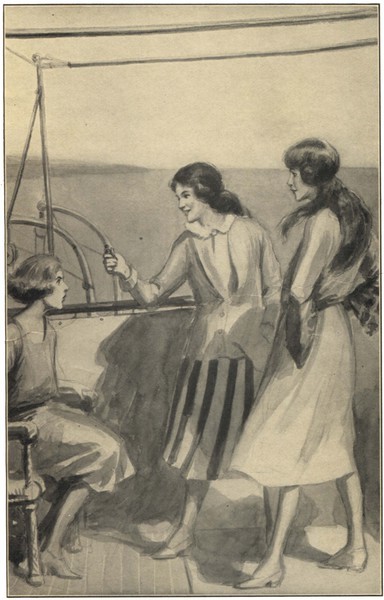
“IS THIS A JOKE YOU WISH TO PLAY ON ME?”
“It wasn’t a joke last night, I can tell you, Elizabeth,” exclaimed Polly, bringing her vial to view and shaking her head deploringly as she studied the brown liquid. “If every one on this ship felt as I did, they’d never have thought of a doctor or medicine, let alone any licorice water.”
The laugh caused by Polly’s admission failed to soothe Elizabeth. She was furious, but managed to demand: “Who of this group was ill?” In this manner she thought to detect the ones who had taken such amusement in fooling their friends.
One after another in the circle admitted the truth, but Mrs. Courtney confessed to having spent her evening with Polly and Eleanor. That left Mr. Dalken alone. He smiled as he said: “Well, I am forced to confess that I am the guilty one. I prescribed the doctor and his doses.”
As Elizabeth could not very well denounce her father for having played this practical joke on his friends as well as on herself, she merely tossed her head and turned her back upon him. He smiled to himself, then caught Polly’s glance which told him she understood the cause of his daughter’s annoyance. Also he read a sympathy in her heart for the misunderstanding so deliberately displayed by the girl.
Fortunately for the situation the boy now came forward and began preparations to serve tea. Having arranged the wicker table in front of Mrs. Courtney, without a look or word to Mrs. Fabian or Mrs. Ashby who were in the circle, he left again to fetch the tea service. Directly behind the well-bred young servant came an uncouth Scandinavian youth carrying a heavy tray of viands.
Mr. Dalken had not seen nor had anything to do with engaging the individuals in the crew on his yacht, as that was part of his Captain’s work. And up to this moment Mr. Dalken had never seen this great overgrown Swede. But the blonde giant had no intentions of being ignored, as he soon made plain.
He planked his tray forcibly upon the table beside the tea service wagon, and then turned to Mr. Dalken. No introduction was needed for him. He was too disturbed to consider aught but his injured feelings.
“Dot tea what yun Shink meks me fer supper, Oi not drink. Oi tek cuffee er Oi go home!” exclaimed he with ire.
Several of the voyagers had been quietly admiring the low-lying banks of soft cirrus clouds, and some had been engaged in absent-mindedly watching the man servant arrange the tea table, when the Swede exploded his complaint in a loud thunderous tone.
Mr. Dalken gave a start. He was too surprised at the unlooked for complaint to control the nervous action. He frowned at the ponderous youth, then waved him away. Turning to the other man he told him to serve; then he followed the wondering Swede down the promenade deck to the culinary quarters.
As Mr. Dalken disappeared to view, Elizabeth smiled a tantalizing smile and remarked, to no one in particular: “Dear me! I cannot understand why Daddy engages such inexperienced servants. He always did neglect important things.”
An ominous silence followed this information from Elizabeth, then Mr. Ashby gayly proposed a diversion which interested his friends till Mr. Dalken rejoined the group.
Not having heard his daughter’s criticism Mr. Dalken reseated himself and smiled as he began: “I investigated the cause of that young chap’s complaint, because I could not very well consent to his walking back home—not on the water, you know. And I discovered a most amusing affair back in the kitchen. Want to hear the tale?”
Every one but Elizabeth signified eagerly a desire to hear the story. She pretended indifference to her father and his experience in the kitchen. But he did not see her face and laughingly began his narrative.
“I learned that the Chef treats the crew with unusual consideration by serving the same quality tea that we drink. That poor Scandinavian lad had never before sailed with a decent crew, it seems. In the past he has been the butt for all the deep-sea sailors who sailed from their Swedish ports on tramp steamers or fishing boats.
“Captain Blake tells me that Jansen is a fine youth and very conscientious, but too blunt for his own good. In his past experiences he has only had the cheapest black coffee served, or a weak sort of bitter drink faintly colored that went by the name of tea. The Captain explained to me that such tea is made from used tea-leaves which are dried by enterprising men and stained with chemicals to produce a brown liquid with a strong flavor. Naturally, he said, such second-hand tea leaves are not any too clean. The driers do not spend time on seeing to it that the leaves are kept free from vermin and dirt. Hence it often happens that sailors find unexpected dregs mixed with their tea leaves in the bottom of the pannikins in which they receive their measure of so-called tea.”
As Mr. Dalken reached this part of his story Elizabeth gave a shudder and exclaimed in a horror-stricken tone: “Oh, Daddy! How can you be so ordinary as to speak of such horrible things? Any one would think you were just common. What does it matter to us whether these plebeian seamen drink tea or salt water, as long as we are not subjected to their coarse modes of living?”
Mr. Dalken turned to stare at Elizabeth, and his frown should have warned her of further pursuing such a line of condemnation. But Elizabeth was bent on punishing her father for having made her—so she deemed it—the laughing stock of his friends by sending in a doctor who gave her licorice water to cure a serious attack of cerebral neuritis, though Elizabeth was not quite sure what such a dreadful disease was.
“You have forgotten, I suppose, because of the recent years of your not associating with the best society, that subjects of food are not considered permissible. But the very idea of any one in my class of friends, daring to broach a story such as you just began—all about vermin—would have instantly caused him to be excluded from us,” concluded she.
Polly stared unbelievingly at the girl who dared say such things to a father; and the others in the group who considered themselves intimate friends of Mr. Dalken’s, could not but interpret the insolent girl’s speech as personal affronts: had they not been her father’s closest associates for the past few years? The society which she daringly condemned as not being good for him?
What may have been the result of this indiscreet speech from Elizabeth could not be said, but Mrs. Courtney, in her wisdom, instantly rose to the call for immediate action of some sort. The Captain had just announced a “change of watch on board.” She caught at the idea.
“Oh, oh! Mr. Dalken! The Captain is about to change the watch. Cannot you take us there and explain how this interesting act is accomplished?” As she spoke the wily woman sprang from her chair, and took two or three eager steps in the direction of the group of sailors now appearing before the Captain.
Instantly all the other members in the circle seated at the tea table sprang up, only too thankful to catch at a straw by which to save the situation. Mr. Dalken also rose and led the way down the promenade deck in the direction of the Captain. Elizabeth remained in her chair, shrugging her shoulders in a decidedly French manner.
Having heard the Captain explain how changes of watch were made on vessels, the group of friends eagerly accepted his offer to conduct them over the entire yacht. They were introduced to the chef who had been called the “Shink” by the Swedish boy. They met and felt an interest in the overgrown, inexperienced youth of fifteen who seemed like a hearty man of twenty-five. He grinned sheepishly when Polly selected him to address her admiration of his qualities of seamanship—as the Captain had explained it.
Then they were introduced to the capable young Belgian waiter, Johann, who was always well-bred and attentive.
Shink, the Chinese cook, felt so nattered by the visit of many pretty women to his domain that his rather incomprehensible manner of speaking English became choked and jumbled. Such a medley of consonants and vowels as he poured forth in a continuous flood by his twisting tongue, caused his visitors to gasp in breathless amazement. In his endeavors to show “Honorable Boss Fren’s” all the courtesy due their Most Honorable Selves, Shink bowed and chattered, even after the Most Honorable Party had gone.
Unfortunately for the Oriental’s peace of mind, and the welfare of the Swede the latter had stepped outside the kitchen to make more room for the visitors. As the group of Mr. Dalken’s guests were leaving the kitchen by another door from that entered by them, a great crash of china was heard by the excitable Shink. He leaped to the door and discovered the cause. Poor Wooden-top, as the Swedish lad was nicknamed by his associates, in turning to gaze after the receding form of Polly to whom his heart was forever lost, had stubbed his toe against the raised door sill. The heavy tray of dishes which he had been carrying aloft went flying through the door to smash as best suited each individual dish against the opposite wall.
Elizabeth was not to be seen when the inspecting party returned to the lounging place on deck. But it was soon ascertained that she had retired to her own room after her friends had left her.
That evening was a merry one. Dancing and other diversions were enjoyed by the younger members of the party, and cards were played by the older ones, to the entire satisfaction of both groups. The sea was as calm as a sheet of glass, but the Captain foretold a storm, though this was hard to believe when one gazed at the wonderful starlit sky and felt the clearness of the atmosphere.
“The Captain says we will soon be off the coast of Florida, if we keep up this speed,” ventured Polly, who had stood with the man in charge of the yacht for a long time that evening after dinner.
“And there I shall have to leave you,” whispered Tom, in a moody tone of voice.
“You should be thankful that you were granted this lovely visit with Mr. Dalken’s friends,” returned Polly, purposely misinterpreting his meaning. She hoped to steer Tom away from his constant harping on his love for her, and demanding her sympathy in his distress over it.
The temperature had become so balmy and delightful in the latitudes the yacht had reached, that it was a pleasure to sit on deck or walk about while thinking of the sleety, penetratingly cold air in New York City. Tom, anxious to make the most of his fast-ending visit on board the vessel, coaxed Polly to go with him and watch the moon rise over the quiet sea.
With a desperate glance behind—much as Lot’s wife must have given after leaving Sodom to its fate—Polly sighed and agreed. There seemed to be no other alternative. Eleanor and Ruth Ashby had vanished soon after the last dance had ended, Nancy was deep in a new novel, Elizabeth was in her own room, and the rest were playing a new game of cards proposed by Mrs. Ashby.
Tom, elated at his success in securing Polly’s undivided company upon such a glorious night, walked with her to a cosy nook he had found in the stern of the vessel. Here, seated upon luxurious chairs which he had commandeered from the lounge, he felt that any girl should be willing to watch the frothy wash of the water from the rapid cleaving of the yacht through its surface, and listen to an ardent lover who had much to say in a very short space of time.
But Polly thought otherwise. She was willing to watch the churning water thrown this side and that by the stern of the boat, and she was eager to see the moon rise from the horizon of the sea, but she was not keen about hearing, again, the oft-repeated story of Tom’s love and his heartache because she would not reciprocate such love.
Just as long as Tom kept to general topics of conversation, Polly smiled and showed an interest in him. But let him launch his love story even in the least possible manner, and she instantly sat up and changed the subject to one of the weather, the moon, or the landing at Jacksonville, where they were to find friends awaiting the yacht.
Tom finally rebelled at such treatment.
“Polly, you are cruel, and you know it! Here it has been many, many long weeks since Christmas, when you showed me enough heart to make me believe that you truly loved me. But you froze up again, the next day, and since then you try to make yourself and others believe that you consider me only in the light of a good friend. If it takes serious illness or adversity to rouse your love, I’ll do something desperate to prove you!” Tom’s threat sounded ominous.
“Tom, I really think you are mentally deranged. I’ve told you over and again, that I shall take ample time to weigh my future life. It’s not going to be a case of ‘marry in haste; repent at leisure.’ I have wanted to travel and see the world, and now that I have the opportunity, it is sheer selfishness on your part to try to dissuade me from such joy and pleasure.”
“Oh, Polly! I am the least selfish lover in the world. I tag on at your heels and never receive any mark of your affection. Why, you scarcely deign to notice me, when other admirers are at hand.”
“That’s not true, but I do try to show them the same attention and consideration that any sensible girl ought to. I have said emphatically that I am not to be considered as having been captured by you, and the fact that I have to assert myself to prove it to our friends may make you think it is as you say. It is your fault that this is so. I prefer to be impartial and not give myself all the extra trouble to act as I feel, entirely free and glad to dance or enjoy the society of other young men besides yourself.”
Tom made no reply, but sat staring gloomily out over the water. Polly sent him a side glance and thought to herself: “There, that frank statement ought to hold him for a time, at least!”
The two felt that their tête-à-tête had best end before it terminated in the usual disagreement regarding love. The sky became mottled with beautiful drifting clouds which formed slowly into the long, scaly appearance of what is known as a “mackerel sky.” The smoothness of the sea had become a choppy, complaining surface of murmuring wavelets. The color reflected from the brooding sky had turned the glassy waters into a grey ominous sheet.
Almost within the shaft of light coming from the saloon lights, Polly and Tom came face to face with the Captain. He saluted and said: “Better get ready for a turn to-night. I’ve just been warning Mr. Dalken, but he seems to think I am borrowing trouble. If you listen to me, you will tie yourselves in bed in order to spare yourselves being rolled out unceremoniously before dawn.”
Polly laughed and thanked the amiable Captain, and Tom stood for a moment after the officer had left them, and stared out at the sullen sea.
“It looks perfectly calm,” remarked Tom.
“Looks often belie the true condition underneath,” returned Polly, precociously. Tom looked at her and laughed appreciatively.
In the saloon the young people were trying some of the new popular songs of New York. But their efforts met with little success, and Tom interrupted them with his comments.
“Don’t tease the storm to descend any sooner by this wailing. The Captain says we shall all be satisfied with enough groaning and screaming from the sea and sky long before morning.”
The Captain’s warning fell unheeded, however, except by Polly who felt intuitively that the change she had seen creeping over the sky and surface of the sea foreboded no good. Therefore, she persuaded Eleanor, that night, to place ready at hand her booties and a heavy ulster. She did the same.
“But why the ulster, Polly?” asked Eleanor in amazement.
“Because, should we have a terrific blow as oft times happens in these tropical latitudes, it will be well worth going up on the deck. And we will need a heavy storm-proof coat to keep us dry.”
It was past eleven o’clock when the party on the yacht broke up and every one said good-night to every one. It was not yet twelve when Polly advised Eleanor to keep her booties and wraps at hand in case she wanted to don them in a hurry, and it was only a few minutes past twelve when, both girls, having jumped into bed, heard a strange soughing of the wind and immediately following that, the confused shouts of the Captain and his mates to the sailors on board. Both girls felt the rise of the sea by the way the yacht dipped and careened as if at the mercy of the storm.
“There! The Captain was right when he warned us of this,” murmured Polly, turning about in order to get out of her bed.
The shouting and excitement on deck continued and Eleanor decided it might be interesting for her to follow Polly’s example and dress hurriedly in order to investigate the cause of all the commotion. Before she could reach out to take her stockings and shoes, however, she was thrown violently against the wall at the back of her bed. Polly, too, was tumbled willy nilly up against the wash stand.
“Well! I neve——!” began Eleanor, but she never completed her exclamation of dismay. Such a roar and rumble from all sides, and such shouting and shrieking, drove all ideas from her active brain.
The shouts came from the officers outside, the shrieks from Elizabeth who occupied the neighboring cabin.
Hail, great volumes of water, and bits of debris were hurtled against the glass in the portholes, and at the same time the awful rolling and tossing of the vessel added dismay to braver hearts than that of the spoiled darling of a foolish mother in New York.
The storm drove the yacht straight southward, which was fortunate; also it was a fortunate matter that the Captain had foreseen this change in weather and had prepared for it in time. What he had not expected, and an unusual experience it was, was the cloud-burst which followed the advance signals of the hurricane.
Polly and Eleanor had managed to get into their heavy storm coats and shoes, and were prepared to leave their room and watch events when the sound of a heavy metal grating against the door of the corridor which opened into the living room of the yacht, made them exchange glances.
“That sounds as if we were prisoners. It must have been the iron bar that the Captain said they used when there was danger of the heavy seas breaking the doors open,” said Polly.
“All the more reason why I should wish to be out and get the benefit of such a storm,” ventured Eleanor.
“And all the more reason why I shall hold you indoors,” instantly retorted Polly.
Eleanor laughed. “Yet you were the one to suggest that I get out my coat and shoes, to be ready to hurry out and watch the storm should it come our way.”
“I had no idea that we were bound to run head first into a hurricane, or a tidal wave! I meant a simple, little old-fashioned gale.”
Suddenly the White Crest lay over on her beam ends and both girls slid helplessly down against the wall where they clutched at the smooth door, trying to hold to something firm and trustworthy. The sound of the screeching, howling wind now rose to a deafening shriek which prevented any one from hearing a word spoken, even though the speaker was close to one’s ear.
By sheer means of strength and purpose Polly managed to drag herself up to a level with the round porthole, in order to get a look outside. She steadied herself in this slanting position while holding fast to the brass hinges and knob of the heavy-framed glass.
“Oh, Nolla! It is magnificent! The waves are a mass of boiling, seething phosphorescence which actually light the whole sea! If you can hold fast, try to stand up and see.”
By dint of clinging to Polly’s legs and then holding fast to her waist, Eleanor managed to stand beside her friend just long enough to take one look at the fearsome sight of the ocean.
With a hushed cry of dismay Eleanor let go her hold and in another minute she was rolled over and over upon the floor with no means of ending the game of bowls until she had clutched the leg of her bed.
“Oh, Polly! I wish I had never looked! I’m sure we shall not be able to combat such a storm,” wailed Eleanor.
“Don’t you go and follow Elizabeth Dalken’s example of fear and cries for help,” came from Polly who still clung to the window and watched with fascinated eyes. But even her powers of endurance gave way as a monster wave, crested with such bluish, iridescent light as would have daunted the bravest nerve, rushed up against the plaything which Mr. Dalken believed to be proof against all the elements.
It struck the craft with a thundering blow and at once it seemed as if pandemonium was loose. Elizabeth yelled and screamed, other voices could be heard shouting and screaming at the top of good powerful seamen’s lungs, and the pounding of water on the deck and against the door made both girls shiver with apprehension. Polly had let go her grasp on the brass knob when the unexpected flood of water came up against the window, consequently she was shunted over against the wall beside Eleanor.
Half a dozen great seas went over the craft while Polly and Eleanor crouched against the wall in utter despair of thinking of a way to hush the nerve-racking screams from Elizabeth. When the storm seemed to reach its height, and the girls felt that they would be lost unless something happened quick, there came a sudden and awesome lull.
“Oh, thank goodness, it is over!” sighed Eleanor getting to her feet, and making an effort to reach the door of her room.
“Let’s get out and join the others, Nolla, because I have heard that such sudden lulls are merely harbingers of something worse,” advised Polly.
“There can be nothing worse than what we’ve just passed through,” said Eleanor, with a hysterical sound in her tones.
“Oh, yes, there can! Hurry into Mrs. Courtney’s room,” said Polly, pushing her friend quickly out of the room and over to the door of the room where they expected to find their friend.
The room was vacant. The girls stared at each other, and Polly thought she heard voices in Elizabeth Dalken’s room. She managed to reach it, open it, and then, before she could say a word, the lull was broken.
Both girls were tossed like cockle shells into the room where Mrs. Courtney was trying to soothe Elizabeth Dalken’s nervous hysteria. At the same time such a frightful sound of pounding waters on the deck and sides and top of the yacht drove apprehension deeper into their souls. Even courageous Mrs. Courtney showed her sense of fear.
“What is that noise?” whispered Eleanor in a weak voice.
“I don’t know, dear,” replied Mrs. Courtney, “but it sounds like a cloud burst. The moment it is over we shall be all right.”
And this is what it turned out to be. A hurricane from off shore, suddenly sweeping up gigantic clouds of water by its sheer force of velocity across the waves, and then suddenly emptying its sac of water over the defenseless craft which bravely defied the storms, endeavored to sink it.
With the pouring out of its last vial of wrath the hurricane subsided, and in half an hour all was quiet without: all but the shouting and rushing of the sailors as they ran to and fro on their duties. With the four in one small room, Elizabeth felt safer and was soon quieted. Then when the vessel seemed to resume its untroubled course, she settled down and fell asleep. Mrs. Courtney and the two girls who had been hurtled into the room, left her and closed the door softly as they went out.
“I am going to go out and see what can be seen,” ventured Polly, but Mrs. Courtney dissuaded her.
“You may be in the way of the carrying out of the Captain’s orders, Polly. Better remain satisfied with going to the saloon. I expect to find all the others there before us.”
Thence the three made their way, and true to predictions, the grown-ups were assembled there talking over the narrow escape they had just had.
“What time is it?” asked Eleanor of Tom Latimer.
“It must be near dawn,” added Polly, anxiously.
“Well, it isn’t,” replied Tom, as he took out his watch. “I had not yet taken off my coat and vest when this storm came upon us. I rushed out of my room at the first blow and offered my services to the Captain, but he had prepared, thank God! We wouldn’t be talking over events now had he not understood the forecast of the weather.”
Tom showed the two girls his watch and to their surprise they realized that all had happened in less than twenty minutes. It was but just one o’clock.
“Then we ought to get back to bed and coax our beauty sleep to soothe our nerves,” laughed Mrs. Courtney.
“So we shall, as soon as Shink sends in our hot malted milk. He claims it will soothe any nerves—the way he can concoct it. I ordered him to prepare a cauldronful for the crew, too, as they needed calming more than any one I ever saw. Not from fear or nerves, but from doing the work of ten times their number in order to keep us afloat.” Mr. Dalken seemed seriously thoughtful for a moment after he spoke, then he added:
“I am the only one here who realizes the close call we had. The Captain with his preventive measures before the storm broke, and the ready obedience of his crew, saved us this night. Not only did we run foul of one of the fiercest hurricanes that sweep over the sea at this latitude, but we also managed to get under the deluge that broke when the hurricane began to lose power and let go its hold on the great mass of water it managed to hold aloft during its swift circling about our poor little craft.
“Thank God for that Swedish lad! Had it not been for his powerful muscle in the moment of extremity, we would now be without a Captain. It all happened so suddenly that no one had time to think. The sudden cloud burst, or water spout, fell just as Captain Blake started to cross the deck, and the volume of water would have carried him overboard but for that young giant. Instead of thinking he acted. He threw an arm about the brass bar and caught hold of the Captain’s arm as he was washed past him. With a grip like steel the rescuer managed to work his way, hand over hand clutching to the water-washed rail, until he had reached safety.
“Well, such is the life of a sea-faring man!” concluded Mr. Dalken, as he sat and thought of the past danger.
CHAPTER V—TOUCHING AT PALM BEACH
Before the White Crest reached her first port, which was Jacksonville, Mr. Dalken must have regretted his invitation to his daughter Elizabeth to become one of his party for the cruise. She had not only taken every occasion to contradict her father when he made any statement, but she sneered at all he said. Naturally this superior air from a young girl deeply annoyed Polly and Eleanor who were Mr. Dalken’s sworn allies; and the friends who knew and admired their host without limitation, also felt diffident at such times as Mr. Dalken was so rudely criticised.
Said Eleanor to Polly one night before retiring: “If I were Dalky I’d take Elizabeth to the express train going to New York and I’d ship her home to her butterfly mother!”
“It’s one thing to say such a thing, but quite another matter to accomplish it,” returned Polly.
“Well, anyway, we may find some way in which to leave her behind when we touch at Jacksonville or Palm Beach.”
“Oh! Are we going to stop at Palm Beach?” exclaimed Polly.
“Why, yes! Didn’t you know? It was Elizabeth’s coaxing that caused Dalky to agree to stop over there to have dinner at the Ponce de Leon. Perhaps we shall spend the evening there and return to the ship to sleep.”
“That’s great! If Elizabeth should meet any of her New York friends at the hotel she may prefer to remain,” ventured Polly.
“I’m hoping the same thing. If only we could hypnotize people we might bring some one she likes right into her pathway,” laughed Eleanor as she jumped into bed.
The following morning the yacht reached Jacksonville where Tom Latimer was supposed to leave his friends and start back North. But John and Anne Brewster were persuaded to remain on board with their friends till they reached Palm Beach, hence Tom decided to remain too, and thence accompany his bosom friend John back to New York.
“If Tom insists upon dogging my every step as he has been doing on the yacht, I don’t see that I am going to have a good time,” pouted Polly, as she heard Eleanor’s news that Tom would go on to Palm Beach.
Eleanor laughed teasingly. “That’s what a young girl gets for having a beau who is daffy over her!”
“But, Nolla,” complained Polly, “it isn’t my fault that Tom won’t take a broad hint to mind his own business!”
“Perhaps he thinks this is his business—the business of getting the girl he has made up his mind to marry,” declared Eleanor.
“Well, then! You can just tell him from me, Nolla, that he is going about it in exactly the wrong way to interest me in himself. A girl hates to be tagged, just as a man loses interest in a girl who is forever putting herself in his way to be noticed.”
“I’ll tell him!” agreed Eleanor, laughingly.
But it was not necessary that Eleanor warn Tom of his over-zealous attentions to Polly, because a general surprise awaited the mariners when the vessel docked. Not only did Eleanor find a telegram from her father, in which he said that unexpected trouble at his bank kept him in Chicago, and prevented his joining the happy friends on the White Crest, but Mr. Dalken also found his ward, John Baxter, and his friend Raymond Ames waiting to come aboard. Every one believed Jack to be in New York.
“Well, well, boys, where did you hail from?” was Mr. Dalken’s first words as the two young men leaped upon the deck and ran to present themselves.
“Why, immediately after you sailed I met my friend Ray who was bound for a position in Panama. Being so lonesome with all you friends away, it took but little coaxing from him to persuade me to accompany him,” explained Jack.
Even while the new-comers were being overwhelmed with questions from the mariners, Mr. Dalken called a hasty council of war and discussed the advisability of going ashore to see the town, or to continue on to Palm Beach. It was unanimously decided that Jacksonville contained nothing of interest to the sailors, the three guests just arrived, having seen all they wanted to see at the city. Hence orders were given to pull up anchor and sail away to the famous winter resort where all and sundry kinds of sport might be found.
With the coming of Jack and Ray on board the yacht, the girls showed more life and interest in planning to pass the time. Tom felt so much the senior of the two young men who now vied with him for Polly’s smiles, that he joined his chum John Brewster, and held aloof from the younger members in the party. Not till Anne reminded him that he was acting the same mistaken part he had played on board the ocean liner at the time it docked at Quarantine in New York City, did he rouse himself to look pleasant and agreeable when Polly danced and laughed with the friends of her own age.
The small damage done the yacht in the hurricane, which she had braved and came out of the victor, was soon attended to by one of the mates who had been a ship’s carpenter before Mr. Dalken’s alluring salary had tempted him to join up on Captain Blake’s crew. Long before the White Crest arrived at Palm Beach the repairs had all been done and the craft was looking as pert and fresh as any millionaire’s vessel within a radius of twenty miles of the Beach.
Of all the merry-makers in that party of mariners not one cared very much what food was served for dinner at the Ponce de Leon, but every one did take a personal interest in the groups of young people, the life of society at that gay season in Palm Beach, and the fun they expected to get out of the visit to the fashionable hotel and the evening hours spent on shore.
Eleanor had hinted to Polly that it might be possible that Elizabeth Dalken would find a number of society friends from New York at the hotel, and so she did.
Naturally they came buzzing about her, and, to impress her yachting associates with her social prestige, she smiled sweetly upon the trio, and accepted their invitation to go with them. Elizabeth did not deem it necessary to ask her father’s consent to leave his party and attach herself to that of her newly-found friends from New York; neither did she hesitate to go with them minus a proper chaperone, although she had seemed very particular about criticising other girls who may have overlooked Mrs. Grundy at times.
As Mr. Dalken was not present in the group when Elizabeth took French leave, and Mrs. Courtney was not asked about a chaperone for that evening, the girl hurried away to enjoy herself as she saw best. Mr. Dalken, returning soon after her departure, seemed amazed that she had gone, but he said nothing at the time and immediately turned his full attention to the entertainment of his guests.
Polly and Eleanor had insisted that the younger members in the party dress in their very best. This called for Mrs. Courtney and her elderly friends to dress up to the standard set by the girls. And this, naturally, compelled the men to give more attention to their evening clothes and general appearances than they might have done without this spur from the ladies. Hence it happened that not a single unit of gay persons at dinner that night in the magnificent hotel could surpass the appearances of Mr. Dalken’s party. As he remarked later:
“It was to be expected of such an extraordinary bouquet of beautiful females as I conducted from my yacht. Others might have shown costlier jewels and handsomer gowns but not one could compete with my flowers where beauty was the test.”
As it mattered little at what hour the passengers went back to the yacht, they made the most of this gay evening on shore. John and Anne Brewster were to leave the party the next day and start back to New York for a week before returning to Pebbly Pit Ranch. And Tom Latimer, now that Polly expected to be away from New York for many months, felt inclined to accompany his friends back to his work at Choko Mines. Perhaps it was his salvation that Polly decided to take this cruise, otherwise he may never have found courage or inclination enough to go back to his mining interests.
Having danced herself breathless, Polly finally consented to hear Anne’s whispered suggestion that she leave a few moments to Tom before he got mad and walked back home. With a little laugh Polly sent Jack Baxter a sorry look and told him to go find Elizabeth for a dancing partner.
“But I’d rather dance with you, Polly. What is Mrs. Brewster saying to you that makes you look so remorseful?” replied he.
“I’m telling Polly of a very urgent duty, Jack, and you know, as well as I, that you must not monopolize all her time this evening,” retorted Anne.
“Well, seeing that I am going to be one of the passengers on Dalky’s yacht for a long time, I believe I will release Polly to Tom for a short time,” remarked Jack in a casual tone.
“Oh! You are not really going on the yacht, are you?” exclaimed Polly.
“Why? Do you object to my company?” demanded Jack.
“Oh, no! It will be lots livelier with Ray and you on board. But no one has mentioned it before, so I naturally thought you and Ray were here for a short visit at the Beach, then planned to go back to New York to continue your studies,” explained Polly.
“Well, I’ll tell you,” said Jack in a thoughtful manner, “I’ve convinced Dalky that the great mining interests of the Argentine need my personal investigation. You must not forget that a great deal of my fortune is invested in mining shares in South America; and these mining companies have their central offices at Buenos Aires. Dalky can tell you that a visit to these brokers, now and then, makes them sit up and take notice of you. Otherwise they might ignore your dividends, you see.”
Anne jeered at such an explanation for Jack’s hurried decision to visit South America. “I can safely vouch for your remaining in the United States, were it not for the fact that you find a bevy of pretty girls on your guardian’s yacht too alluring for you to renounce. You plan to get the most fun out of this cruise and then go your way, leaving a string of broken hearts behind you. That is the reputation you have, I find.” Anne laughed as she shook a finger at Jack.
“My reputation for drawing and then breaking hearts can never reach the championship winner and breaker that Polly is. Who can ever ignore that European tour when the subject of hearts is being discussed?” Jack shook his head in pretended sorrow for those rejected suitors on the “Other Side.”
Polly made an impatient sound with the tip of her tongue against her white little teeth, and Jack laughed.
“Just for that I am going without a single word of regret for the dances I promised you and now withhold,” said Polly, turning and running away to join the group sitting under a great palm on the balcony.
Here she found Tom moodily talking with John. But the moment Polly touched him on the shoulder and said: “Are we going for a little walk on the beach?” he brightened up wonderfully.
Polly felt that she owed Tom this short time before he would have to return west on his mining work. Also she felt that she had treated him too sternly in punishment of his short-comings. Of course, Tom had no idea that Polly considered his slavish attentions as short-comings.
As the two sauntered away from the hotel and turned in the direction of the marvellous beach, Polly began the conversation by remarking, in a cool, mature manner: “Now don’t go and talk of bosh, Tom, just because I invited you for a stroll.”
“What do you mean by bosh?” demanded Tom, ready with a chip on his shoulder.
“Oh, pooh! You know what I mean—your soft talk of love. I just won’t listen to it morning, and night, and at every moment of the day. You are the dandiest pal with Nolla and Ruth and Nancy—why not with me?”
Tom wisely held his peace. He could have answered in his own way, but he knew that would call forth a new tirade against his ideas of possession. Not having a reply from her escort with which to continue the argument, Polly found herself shut up on the subject. And wisely she, too, launched out upon an entirely opposite topic.
“Some one told Dalky not to stop at Hayti because the natives were so treacherous to white folks,” remarked Polly. “I did so want to see the Island we hear so much about. I’ve read of the voodoo religion, and the way the sacred snake charmers strike terror into the souls of their congregations, and I’d love to see them.”
“I think Dalken is absolutely right in not taking chances with you girls in landing at Hayti. Morally the Haytians are not to be trusted. All the old superstitions of barbaric Africa prevail to such an extent that no right-minded person wishes to visit there. I am surprised, Polly, that you can entertain the least desire to see what every one knows to be a deplorable condition of affairs.” Tom spoke in a fatherly way that caused Polly to smile, but he did not see her face. Perhaps he would not have continued in the same strain had he thought she was amused instead of being advised.
“Yes, Hayti is an unsafe place for civilized women to go to; not only do the authorities ignore the rights of a people under their government, but they seem to have no regard for human lives. I recently read an article in a magazine in which it stated that one unfortunate circumstance about Kingston, the capital of Jamaica, was its convenience to Hayti—all the escaping criminals and refugees from justice jumped aboard a sailing craft and in a few hours were landed upon the shores of that beautiful isle whence they could not be taken except through extradition papers.”
“How intensely thrilling to me is all this political information. I’m sure I shall never wish to see a voodoo service after hearing you speak of government and politics,” laughed Polly.
Tom now turned and stared at the girl. Was she in earnest about saying she cared nothing for Hayti now, or was she ridiculing his advices? To keep her companion in doubt as to her motive, Polly changed the subject again.
“I shall delight in visiting Jamaica, and Porto Rico, perhaps the Barbados, before we go through the Panama Canal. Dalky says that, should it be impossible for a stop at the Barbados on our way down to South America, he will see that the Captain surely stops there on our return. Have you any warnings to give concerning the natives of the Caribbean Isles?”
“I don’t know a thing about them! I never visited Hayti, you know, but I merely told you what learned and wise men say of it.” Tom’s tone was not very sweet, and Polly realized that her last words had offended his sensitive heart.
“Let’s talk of Pebbly Pit and Choko’s Mine,” said she with forced joyous anticipation in her voice. She felt sure she knew all that Tom would say in order to prove to her that she ought to marry him and live out on the ranch with her family. This time Tom disappointed her, however.
“I have nothing new to tell you about Pebbly Pit, because you know as well as I do that I have been in New York too long to be able to speak of what may be taking place out on the ranch. But one thing I can speak of, and even that is not yours or my business, I suppose, and that is the queer triangle on board the White Crest—do you get me?”
“A triangle! No, I do not get you, Tom. What is it?”
“Well, then, I know just as well as if you had told me, that Nolla and you are match-making between Dalky and Mrs. Courtney. And I might add, that I can advise you to watch your step, but of course, you will throw back your head and give me a glance of disdain, hence I will not warn you. This much I can say, nevertheless, and that is: Look out for Elizabeth Dalken, if you think Nolla and you can pull little Cupid’s bow and arrows to suit yourselves. You’ve got the third angle of the proposition when you have Elizabeth with whom to reckon. She is worldly wise and she won’t hesitate to use every bit of knowledge she possesses to thwart such a scheme for her father.”
Polly looked serious. “Did you really guess that much? How did you do it, when Nolla and I have been models of discretion? Not even Dalky or Mrs. Courtney, or the Fabians dream of the match.”
“Maybe it is because I am so miserably in love myself, that I intuitively feel for any one else who may be in the same boat.”
Tom’s tone and hopeless manner caused Polly intense amusement though she managed to hide the fact from him. However, she was in earnest now, regarding this matter about the matchmaking, and she wanted to get Tom’s valuable suggestions on the matter.
“Well,” returned Tom to her anxious questioning, “one always gets into hot water when matchmaking between two persons, especially if those two have had a taste of matrimonial troubles. But I know Nolla and you well enough to see that you will not give up a pet plan until you are driven to desperation over its failure. With Elizabeth Dalken to frustrate every tête-à-tête, or other plans to throw these two mature hoped-for lovers together, what will you do? Either come out boldly and show your cards, or call that girl’s bluff, or in some way be the means of shipping her back home.”
“Well, how can we call her bluff when she won’t admit us to her confidence?” asked Polly, eagerly.
“Watch opportunities! But it will be easier to ship her back home, if you can get her deeply interested in an objective in going north and allowing you-all to continue your voyage.”
“Show me the objective and I’ll do it! She’s getting on everybody’s nerves, as it is. And I verily believe that Dalky is heartily sorry he had her come,” declared Polly.
“One objective would be to induce her to remain at Palm Beach, now that she is here with friends, and get her father to give her a sufficient inducement in cash to tear herself away from the yacht and the prospective voyage. Another objective might be Jack Baxter. She knows he is enormously wealthy, and it is her sole aim and ambition to marry a fortune and a good family name. She would get both in Baxter, but I doubt if Jack would fall for her. However, if he could be induced to pose as a cavalier, and cut short his trip to South America, I’m sure the girl would follow—providing she had a satisfactory chaperone to give the entire proceeding Mother Grundy’s approval.”
Polly frowned down both of the propositions. “She won’t remain at Palm Beach because she has been here too often to have it afford her any novelty now. On the other hand we can’t expect Jack Baxter to place his head upon the block for execution, just to please us in ridding ourselves of the girl. Why, Elizabeth might claim Jack as a suitor, and then drive poor Jack to desperate steps in order to show he is a gentleman!”
While they were discussing such weighty matters the two had turned and were walking back again in the direction of the hotel. Neither one had seen the moonlight on the sea, nor had they realized that they had strolled across the hard beach and back again—so full of plans were they over the little plot for happiness for their two good friends. Now they came to the Palm Walk again.
“Where have you two been?” demanded Eleanor, impatiently.
“We’ve spent half an hour looking for you. Dalky wants us to find Elizabeth and start back for the yacht,” added Nancy Fabian.
“We will have no trouble in starting for the yacht, but to find Elizabeth is quite a different matter,” laughed Tom.
John Brewster now came over to Tom and spoke. “Anne and I are going to pack our bags and come back on shore to-night, as Dalken says the Captain wishes to resume the voyage early in the morning. I thought you would want to get your bag, too, and come back with us. If you prefer remaining here, Anne says she can pack the suitcase and spare you the trip.”
“No, thank you! I’ll go with you and see as much of Polly as I can, before leaving her to sail away with no certain future for me in it!” exclaimed Tom, positively. John smiled.
The bell-boys having sought about quickly in every direction of the hotel and gardens returned, one by one, with the reply that Miss Elizabeth Dalken failed to respond to their calls. Mr. Dalken tipped each page as he reported to him, and then turned to his friends. “There’s nothing for it, but that I hunt her up myself, and permit you to go on to the yacht alone. I’ll come as soon as I locate my daughter.”
Polly caught a sympathetic glance from Mrs. Courtney’s eye in the direction of the troubled host, then the guests accepted the inevitable and left the man to seek Elizabeth in every niche and corner of the vast resort.
As the group of guests from the White Crest got near to the wharf where they had left the yacht, they were astonished to see the craft gone. They looked at each other and then all around to reassure themselves that they were not dreaming. A young colored night watchman on the dock saw the wondering expressions on their faces and spoke up.
“You-all a-lookin’ foh dat white yacht from Noo Yoork?”
“Yes, my boy; what can you tell us about it?” asked Mr. Ashby.
“Why, not much; onny, ’bout a nour ago, ’long comes a fine pert missy wid a lot of swells, an’ dey gits on bo’hd. Den de skippeh what was lef to watch the boat, comes off a’fumin’ mad, an’ says he’s goin’ to see ’bout dat! I heah’s him say somefin not werry nice to free er four dudes lef’ on deck, but dey laffs and waves a han’, so off he goes threatenin’ to get the boss on de job to onct! Fust ting I knows, the yacht up and sails away. I watches, ’cuz I got a stay on dis dock till mawnin’ and keep an eye on decency, an’ sure ’nuff, dat boat goes dancing off down coast. Lots of likker at a certain port dere, yuh see, and swells heah takes a trip down ebery onct in a while.”
“And you haven’t seen a sign of the yacht since then?” demanded Mr. Ashby, red hectic spots suddenly coming to his cheeks as symbols of his ire at such high-handed treatment of his friend.
“Beggin’ yur pawdon, suh, but I knows two of dem dudes, an’ I doubts if dey kin sail that yacht back straight to-night, if dey gets what dey sets out foh gittin. F’om all I heah said, dey went foh jus’ such a time.”
At this disturbing information, Mr. Ashby joined the negro for a moment and at his advice, turned and said: “Fabian, I’m going back for Dalken, but what had you-all better do meantime?” Mr. Ashby seemed anxious to meet his friend before he should come to the dock and learn the news from others.
“We will wait here for orders. The yacht may come in while you are gone, and in that case we will try to straighten out matters, and see that Elizabeth’s friends get quickly out of the way of her father’s righteous indignation.”
The moment Mr. Ashby left, Mrs. Courtney went over to the mulatto youth and spoke in a low voice. He replied in a tone too low to be heard by any one but the lady with him. Then she slipped him some money and returned to her own party.
“I learned that no older woman was in the party with Elizabeth, but a young divorcee and the several men who seemed past forty. I had judged from Elizabeth’s uncompromising attitude to us in our disregard to little matters concerning dinner dress and social nothings, that she would have been most strict and careful in such a delicate situation as this which she has brought about.”
Mr. Ashby had secured the names of the ports where those with enough money might secure liquor in spite of the dry laws, and it was his plan to hire the fastest car to be had and drive Dalken along the shore until they found the yacht and the runaways.
In telling the story to his friend, Mr. Ashby purposely shielded Elizabeth by making it appear that she was misled by her friends. But Mr. Dalken was not to be hoodwinked. He was an experienced man of the world, and he understood present-day flapperdom perfectly.
“Why take an automobile when we might get a launch and go on their track? I’m sure the launch would prove best, and it may be possible to find a large enough power launch to accommodate our party. Then we need not return to this hateful place. We can ship back the society cads in the launch and go on our way as planned.” Mr. Dalken seemed to consider the case with more coolness and sense than his friend had done.
“What about John and Anne and Tom? They expected to go ashore here, after getting their bags. And how about the crew?”
“John and Anne and Tom can leave us at Miami as well as at Palm Beach. As for the crew; the Captain’s orders were for every man to be on hand at the yacht at twelve. It is now past the time, and doubtless they will be waiting on the dock,” explained Mr. Dalken, having looked at his watch and then slipped it back into his pocket.
As predicted, the crew were all at the dock, standing in small groups; the Captain stood with Mr. Fabian, wondering what would be the outcome of this escapade. Mr. Dalken seemed perfectly cool and self-possessed as he called to the Captain.
“Get a craft at once—large enough to take us all. You understand, Captain Blake, that price is nothing now!”
The same negro youth, who had been the informer in the first place, now spoke up. “I knows whar you-all kin hire a fine big gaserline launch—my boss rents it out ebery day. I kin sen’ yuh dere.”
Giving Captain Blake minute directions to find the boat which was not far off, the negro gladly pocketed another windfall of money from the owner of the White Crest.
In less than twenty minutes the launch came alongside the wharf and its owner stepped out. “It’s the quickest and safest boat in Florida. Many’s the trip I takes to Havana during the season.”
Thus the weary party gladly got into the launch, and its owner started on the way to seek for and find the White Crest.
CHAPTER VI—MR. DALKEN’S PATERNAL TRAINING
Conversing pleasantly, and smoking one cigar after another, Mr. Dalken offered no cause for one to think he was boiling within, or that he was contemplating a severe correction for his daughter Elizabeth. But Mr. Ashby knew him so well that he would have felt more at ease had his friend expressed a little impatience and annoyance at the unexpected trick played by the girl.
The men in the party sat with the owner who drove the great launch through the calm waters, but ever and anon he swerved suddenly to avoid, as he said, reefs of coral hidden by the wavelets. He skirted the coast because they needed to keep a watchful lookout for the yacht which might have anchored at one of the many tiny inlets along the shore, where bootleggers thrived during the great social season in the South.
The yacht’s crew sat in the stern of the boat, but the ladies were comfortably at rest in the small saloon. There was but one absorbing thought and subject for them: what would be Elizabeth’s punishment when her father could judge her heedless act?
After stopping at several small ports, where it seemed likely they would find the White Crest at anchor with other crafts from the winter resorts, the owner of the launch remarked to Captain Blake:
“If they went to Satan’s Kitchen, they must’a had some wise birds along. Only the old hands dare go there and get their drinks. And the stuff is rank pizen, at that! Nuthin’ but liquid fire. Two or three young fools got knocked out by taking this bootlegger’s vile whiskey, and one feller cashed in his checks.”
The Captain made no reply, but it was not necessary.
“Satan’s Kitchen is a coupla miles in an inlet what dips in from the shore line at Delray. We won’t be able to see the yacht from outside, but that’s whar we’re bound to find the runaways, I’m thinking.”
“All right—drive in and we’ll soon know,” ordered Mr. Dalken, taking command for the first time since leaving Palm Beach.
Shortly after this the launch made a graceful curve and chugged carefully through shallow waters until it came to the narrow inlet mentioned by the captain of the boat. Having gone a very short distance inside this inlet, those on deck soon saw the White Crest anchored near a strip of glistening sandy beach. A rough pier of old planks ran out to the deep water in order to accommodate those who wished to land. Here the launch stopped.
“No, take us to the yacht. I wish to see my guests safely on board my own boat, and the crew in their places. Then if the other party is still on shore you may carry me back to this pier,” commanded Mr. Dalken.
Without any confusion or other sound than the subdued chug of the engine of the launch, the transfer of the party was made. Only the few sailors who had been left on the yacht that evening were found on board, so Mr. Dalken got back into the launch and was about to start for the pier when Mrs. Courtney urged Mr. Ashby to go with him.
“You see, no one can tell what may happen in such a place as this Satan’s Kitchen. Dalky is cool now, but what may he be should he find cause for chastising the men who dared to plan this runaway?”
Therefore, without asking his friend’s consent, Mr. Ashby jumped back into the launch and the boat started away. Those left on board the yacht learned that the Captain had orders to start out at once, and wait about half a mile off the shore. The launch would pick up the yacht there and transfer the owner and his friend.
To the anxious group of friends on the yacht it seemed that a long time had elapsed before they could hear the chugging of the returning launch, but in reality it was hardly half an hour from the time that Mr. Dalken and his friend Ashby had left the White Crest before they returned. Elizabeth Dalken was with them, but not a sign of any one of her companions on the recent excursion was to be seen.
Elizabeth, in moody silence, ran up the steps and went directly to her room. Mr. Dalken paid the owner of the launch and said in a tone that carried its own pointed meaning: “You comprehend that I am paying you for the hire of this craft until noon to-morrow?”
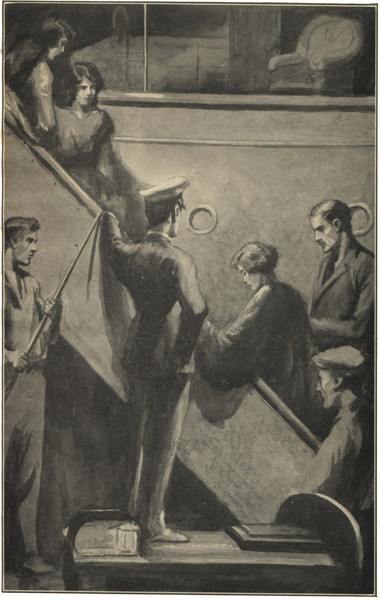
ELIZABETH, IN MOODY SILENCE, RAN UP THE STEPS.
“I get you, Boss,” returned the man, bowing seriously. “Anyway, even if you were not so generous in your pay, I have no likings for such passengers who know better but act like sots.”
“All right. Start back for Palm Beach. I’ll follow in your wake.” So saying Mr. Dalken stepped aboard his own craft and waved the owner of the launch to proceed northward on his return trip.
Mr. Ashby said not a word of explanation to the curious friends waiting on deck, but Mr. Dalken spoke freely as if they were entitled to the story.
“We found just about the sort of scene as I expected to see at that den. Those men in the party, easily ten years my senior, only used the hare-brained divorcee and the younger girls as a means to obtain their end—that of running my yacht to the place where they knew they could get all the vile liquor they craved. Once there, they never gave a thought as to how their companions might fare. Hence I took my girl and left them to work it out as they saw best. There is no trolley or other transportation method of leaving the place, other than by boat or automobile, and of the latter there was none to be hired. I may have been a bit severe on the other young women in the party, but they should have taken all favorable conditions into consideration before they consented to run away with another man’s valuable property, in order to satisfy an abnormal curiosity about a notorious locality. I am thankful to say that I have saved my property from the scandal which would be sure to follow on the heels of a scrape such as those men I saw at Satan’s Kitchen are certain to rouse at one of their orgies. Now, however, it will be necessary for me to return to Palm Beach and prove that my yacht and my friends were anchored at the wharf till morning, and that Elizabeth and I were at the hotel at the dance.”
Mr. Dalken excused himself after concluding his explanation, and went to his daughter’s room to escort her to the hotel.
The interested colored man who had given Mr. Dalken the valuable information regarding the men who had taken possession of the White Crest without the owner’s consent or knowledge, now watched curiously as Mr. Dalken and his daughter left the craft and walked in the direction of the hotel.
The crowds were already thinning out on the ball-room floor, but enough representatives of society still remained to dance to the last note of the orchestra. As fortune had it, one of Mr. Dalken’s well-known friends and his family was present and saw the financier as soon as he stepped upon the floor to dance with Elizabeth.
“There’s Dalken and his daughter—remember we had him to dinner in Washington when I first took my Seat?” whispered the gentleman to his wife.
A reporter for a New York paper stood near and overheard the remark. Instantly he made a note of it and drew nearer to his source of information. He heard the Representative speak of the White Crest and the cruise, and he decided to look up the yacht and its owner in the morning.
Not a word was spoken between Mr. Dalken and his daughter after they left the hotel and boarded the yacht. No one was in sight on deck and the owner accompanied Elizabeth to her room and went in behind her. Then he closed the door and turned to have a word with her.
He spoke tenderly at first, but she ignored him completely and refused to answer his questions. Finally he said sternly: “Elizabeth, I wish you to answer my questions in regard to this escapade.”
“Well, I don’t care if you do! I do not have to speak to you unless I wish to!” snapped she.
“I am your father, and I represent your guardian in the law. I am responsible, to a certain extent, for all your wrong-doings, hence I demand that you tell me how you came to go to that vile den where I found you with those despicable men.”
Elizabeth stared defiantly at her father, then she remarked: “You may demand, but I do not need to reply.”
Mr. Dalken then tried to show her what a risk she had taken in going to a place where a murder or other crime was apt to happen at any moment if one of the habitues became too drunk to control himself.
Elizabeth narrowed her eyelids and looked at her father in a manner that reminded him unpleasantly of her mother whenever she had been cornered in a scandalous situation. Then the girl spoke drawlingly.
“You are such a fossil when it comes to social matters! Why, there isn’t a girl I know who would not give her head to have been in my shoes to-night. But how can you know that two of those men are the finest catches of the season. Henri Aspinwall is a multi-millionaire from South America, and James Stickney is one from New York. I had both of them at my feet this evening, and then you came to ruin my prospects of a proposal!” Elizabeth actually wept tears of mortification at her father’s untimely appearance in Satan’s Kitchen.
Mr. Dalken gasped in sheer unbelief. “Do you mean to say you knew those two men? Did you know they were divorced by their wives for their disreputable living?”
“How silly you are! Reputations are nothing in these liberal times, because divorce is so convenient. Those two men have money and the most charming personalities. That is why their wives can’t live with them—they are generally so shabby looking and are fiercely jealous of the attentions paid their husbands by appreciative women. Naturally, men like Henri or James are too popular for their fogy wives, hence the divorces, you know!”
“Why, Elizabeth, you are positively shocking! I cannot believe you are not yet twenty and my own child! Where have you acquired all this nightmare of experience in such things?” Mr. Dalken’s voice trembled with emotion over the girl’s short-comings.
“Really, father, one might think you were a saint, from the way you are trying to preach to me!” sneered Elizabeth.
“Far be it from me to pose as a saint, but at least I know I am a clean-minded man, and I demand that my daughter act as a young lady should, while she is in my charge,” was Mr. Dalken’s stern reply.
“I suppose you would invite me to model my behavior after such country clods as Miss Brewster, or take for my example such flippant nobodies as Eleanor Maynard from Chicago?” scorned Elizabeth, tossing her head. “Why, I knew them both at school in New York, and I must say that not a girl in society would deign to cast a glance at either of them now. They are absolutely too impossible to stand on any rung of the social ladder, and not even the commonest plane of society in New York would consider them.”
“I am ashamed to hear you say so. It goes to prove how low the social standard has fallen. In fact, I may add, that the standard of a once decent period must have been dragged through the mire, of late times, to present such views as you entertain as its highest aspirations.” Mr. Dalken’s words were cutting and Elizabeth resented them.
“Well, I am sorry to remind you, sir, that men who can shamelessly turn their backs upon the obligations of a wife and daughter and go after such women as you prefer to call your friends, are the very ones who smirch society’s fair standard and then stand up and denounce it as having fallen.”
Sheer astonishment and shocked soul of Mr. Dalken kept him silent after Elizabeth concluded her statement. Finding he failed to reply, she added sarcastically:
“If my dear mother but knew the type of woman she might have to call her successor to such marital felicity as you deprived her of when she called herself Mrs. Dalken, she would not concern herself to save you from such a degradation!”
Finally Mr. Dalken found his powers of speech. “What under the sun are you driving at, you little vixen!”
Elizabeth tossed her head and laughed a harsh, cold laugh. “How innocent we are, eh, Dad? To hear you now, and to see you with Mrs. Courtney when others are about one would say you two were not enjoying the tête-à-têtes she so wisely plans for you. But how can one expect anything otherwise? You left mother in order to live your life of selfish pleasure, and this woman turned her back on her husband and her own country, because she could no longer appear in decent society in London, and now it seems quite natural for you two to find mutual consolation in the companionship of each other. Poor Mamma!”
As Elizabeth spoke, Mr. Dalken got upon his feet and stood with head held high. The moment she had concluded, she glanced spitefully up at him, but his expression cowed her for a moment. When he found his voice he said coldly, but with dire meaning for the girl:
“You will see to it that your luggage is ready to leave this yacht in the morning. You may return to New York to your ‘poor mamma’ as soon as possible, and tell her that no further allowances are to be expected from me, and henceforth no machinations from her will be allowed to be tried on me. I shall call upon the law to defend me from future attacks, both personally and in every other way. I will bid you good-morning, Elizabeth, and I will look for you directly after breakfast.” With that Mr. Dalken left the girl alone.
“Well, thank heavens, he is gone!” grumbled Elizabeth to herself, as the door closed upon her father’s heels. Then she calmly removed her lovely gown and threw it upon the floor and suddenly stamped upon it. Such a squall of temper in one who, a moment before had seemed calm, was surprising.
“The nasty wasp! How I hate her sweet smile and honeyed words. As if she could fool me with her acting! Why, not a woman I know pretends to be so gracious and altogether wonderful as that horrid Courtney!” But Elizabeth failed to take into consideration that, when one lived in earnest, no acting could seem as real as the genuine thing.
“Well, I shall be well rid of this Sunday-school group!” continued the girl, as she sat down and pulled off her satin slippers and beautiful, embroidered, silk stockings. “Once I get my things off the yacht and am located in one of the nice suites at the Hotel, I shall lay my plans for the conquest of James Stickney. Oh, won’t mother squeal with joy when she hears of my conquest! To be Mrs. Stickney and spend his money will be worth all the dreadful days I have had to waste on board this boat!”
Thus, as she disrobed and prepared for bed, Elizabeth smiled even while she planned her social campaign at Palm Beach during the time which would elapse until she heard from her mother.
But Elizabeth never dreamed of the actual plan she would be compelled to accept on the morrow. She had no idea that her father meant exactly what he had said when he threatened never to contribute more to her ease-loving support and the monthly bills which seemed beyond all reason to him. Hitherto he had paid all accounts without a protest.
Had she dreamed that she was to be packed off for New York under the chaperonage of Anne Brewster and her husband, with no opportunity to send word to her friends at Palm Beach, and without a dollar in her pocket with which to wire her mother of her ignominious treatment—such it was in her estimation—she might have tried to escape that very night.
Not long after nine o’clock in the morning, therefore, Mr. Dalken was asked to see the reporter and tell him such items of personal news as would interest the readers of the New York daily. Contrary to precedent, Mr. Dalken invited the man to breakfast with him while he told him a long story. How he was taking this cruise with his intimate friends for a rest and his health. How he had persuaded his daughter to accompany them as far as Palm Beach, and how he danced with her even to the last waltz at the hotel. Then he spoke regretfully of how she would have to return to New York that day, as social interests could not spare her for a continued cruise. “Oh, yes! Of course she will be accompanied on the journey. Our very dear friends, Mr. and Mrs. Brewster, part owners in Choko Gold Mines, you know, are also going North with their friend, Mr. Latimer. I had all I could do to get these three friends to come as far as Palm Beach with us. Now they and my daughter cannot give us another day.”
“The rumor got started in some strange way that a party of undesirable guests at the hotel captured your yacht and daughter and sailed away to Satan’s Kitchen last night,” ventured the reporter. “Did you know of the escapade, or were they back before you found it out?”
“My dear fellow! Of what are you speaking? I can prove conclusively that we arrived at the hotel in time for dinner and that we remained until the very last dance. Why, I met an old friend in the ball-room just as I was about to leave. Members of my party left at different times during the evening, but they are free to go and come as they choose while we are on this cruise, you know.”
Mr. Dalken was all guileless confidence with the reporter and that worthy felt sure the report had been started as a bit of scandal in high life. Then his host suddenly seemed to remember an item which might explain such a sorry story.
“Perhaps that twisted version of the matter started because we had planned to sail away after midnight, leaving the four in my party to go back to New York to-day. But they all remained dancing to such an hour that it seemed absurd for any one to pack their bags and leave the yacht at that hour, so I advised all to sleep late and the yacht would wait till at dawn as had been planned.
“You see, my friends heartily enjoyed the hospitality of your magnificent hotels to such an extent that they are all fast asleep in their rooms. I am the only early bird on deck this morning, but then I only danced a few dances with my daughter just before the orchestra said good-night.”
The reporters smiled politely and secured a few treasured items of social interest regarding the dances Mr. Dalken preferred, and the hour he left the ball-room with his friends, and anything else he might care to tell them for publication.
He shook his head. “Nothing happens when one sails on a friendly little voyage with choice companions—that is, anything of interest to society; because no one in my party belongs to society and we never bother about its concerns. But, my dear young men, I am now deeply concerned in getting off on our cruise, and you must really excuse me from continued conversation, unless you care to be carried to Havana with us.”
The reporters, having secured all the information they were after, obediently bid their host good-morning and left the yacht. Once they were safely out of the way, Mr. Dalken had the chef serve breakfast on deck for those who would get up and eat.
John and Anne Brewster, Tom Latimer and Polly, and Mrs. Courtney were the only ones to respond to the call. The former three guests were dressed for travel, and Polly was up in order to say a last goodby to her family members and to Tom. Mrs. Courtney was an early riser no matter what time she went to sleep and she now seemed as bright and fresh as if she had had the usual quota of sleep instead of but four hours at the dawning of the day.
Immediately after breakfast Mr. Dalken gave Anne a sealed letter and said impressively: “Now remember, my dear Mrs. Brewster, to follow all my instructions to the letter, whether Elizabeth wishes it or not. She is still in my charge, even though I appoint you a deputy to guard her till she is placed safely in her mother’s care once more. I do not anticipate any rebellion before she reaches New York, but she may decide to bolt once she finds herself on familiar ground again. However, I made it quite plain to her last night, that she is the arbiter of her own future if she disobeys me in one least thing after being placed in your care.”
Thus Polly learned to her amazement that Elizabeth was destined to leave the yacht and return in disgrace to her mother. But the news did not cause any regret, rather did it make her rejoice that dear Dalky would be freed from such a thorn in his side for the rest of the trip.
Mrs. Courtney maintained an inscrutable expression that defied Polly’s reading of her thoughts. Whether she had known of this plan to send Elizabeth back to New York when Anne Brewster went, or whether the news surprised her even as it had Polly, could not be said. But Polly met Tom’s eyes and saw a gleam of relief there.
The breakfast ended and a member of the crew who had been despatched on shore to ascertain exactly when the Washington Express would leave, now came on deck and saluted. He handed his employer a paper, and Mr. Dalken turned to John and Tom.
“The car is waiting at the end of the pier. I’ll get my daughter and place her in your charge, then escort you all to the automobile.”
Turning to the sailor, he added: “Jim, did the trunk get off all right?”
“Yes’sa, an’ I expressed it, myself, straight through to Noo York, sa.”
“Very good. Now wait at the foot of the steps till we come.”
Mr. Dalken went away and Polly turned to Mrs. Courtney.
“Don’t you think it will be more agreeable for Dalky if we are not here when he comes back with Elizabeth?”
“Yes, Polly, I agree with you. We will say our goodbys now, friends, and hurry away from here,” replied Mrs. Courtney.
The farewells were not prolonged, therefore, and Tom found he was short-circuited in his plans to have a lover’s tête-à-tête with the girl he adored so devotedly. John and Anne had their good hugs and kisses from Polly, and then she turned quickly to Tom and extended her hand.
“Goodby, Tom, old friend. Take good care of Anne and see that she doesn’t worry herself to a frazzle over Elizabeth Dalken and her social tricks.” With a hasty shake of his hand, Tom found Polly was running away to the rear end of the yacht where she could enter without coming face to face with any one coming from the main door.
Mrs. Courtney had said her farewells and was following Polly when Mr. Dalken came from the door which opened to the saloon. Elizabeth was closely veiled and dressed in a plain tailormade suit. Without a spoken word to any one she went directly to the stairs that led down to the wharf. The other four adults followed her and soon all were seated in the waiting limousine.
Polly could not help peeping out from her retreat at the back entrance to the companionway, and when she saw the automobile drive away she sighed with relief. “There go the two troubles of my life—one whom I despise, and one whom I am not sure about adoring or hating!”
From this honest confession of Polly’s it can be readily surmised that she was not head over heels in love with Tom.
In less than half an hour’s time Mr. Dalken came on board his yacht again and immediately gave orders to sail. Even as the Captain obeyed and placed the distance of a rod or so between the craft and the pier, a sprinting reporter reached the wharf to take a snap-shot of the White Crest.
Mr. Dalken watched him with grim satisfaction. He then murmured to himself: “Well, that’s all you got out of your run!”
Later he remarked casually to Polly and Mrs. Courtney, when they happened to be alone after luncheon: “Our friends just caught the Express as it was about to pull out. The conductor saw us making for it and he very obligingly held up the train a moment. Naturally, no one was present to interview us about this hasty departure for the North, and only one solitary reporter saw me returning in the car. He failed to reach me in time!”
But their host did not add that he had used every influence possible to insure the success of his plan: to reach the train at the very minute of departure, and then see his daughter off before she could get in touch with any friends at Palm Beach. The conductor exchanged a friendly but knowing look with the financier as the four travelers boarded the train, and Mr. Dalken stood watching it pull out.
“Well, children, now we’re off on the second lap of our adventures,” laughingly called Mr. Dalken, as he waited in vain for a remark to his last statement. His happy tone then brought forth glad and eager questionings as to Cuba, Hayti, and the other Isles of the West Indies.
CHAPTER VII—THE HAVANA RACE COURSE
As the yacht danced on its way to Havana, the voyagers began to take a renewed interest in the cruise. At first the departure of four of the party caused a dignified silence, particularly as Elizabeth Dalken’s going had been brought about by her recent disgrace and her father’s intense displeasure. It created rather an uncomfortable feeling when the guests all went on deck that noon.
John Baxter and his chum decided that this atmosphere must be dispelled immediately, hence they began their self-appointed task and soon had every one merry and eager to forget the unpleasantness of the previous night’s experience.
Havana proved to be a great fund of excitement and fun for the young members in the party; John Baxter had spent several weeks in that hospitable city and knew just where to go and what to see, hence the day was given to every kind of sightseeing. That evening Jack returned his party to the yacht, and proposed another visit to the city on the morrow. Mr. Dalken listened.
“They’re going to have one of their famous horse races at the big course to-morrow, Dalky, and I told your guests that it would be well worth seeing. Even if they do not bet on the horses, they will enjoy seeing the stunts the natives do in order to get in first. Let’s tie up to this wharf until to-morrow night, instead of going on our way to-night.”
As the vote showed the majority were inclined to stop over for the races, the Captain was notified that the yacht would not resume her trip until the next evening.
That night, after dinner had been enjoyed on deck, Mr. Dalken proposed a stroll through the “White Light Way” of Havana. This was received with acclaim and in another moment the ladies were gone for their hats and light evening wraps. Soon all were walking up the street leading from the pier, and eagerly discussing the change in the looks of the city by night.
Half the people they met were visitors from the States, and most of those were from New York, or the large cities of the Atlantic coast states. Everywhere on bill-boards, on walls of buildings, and up high on the roofs of houses, the advertising of the morrow’s horse racing was posted. Now and then the men in the party were accosted and invited to book their wagers for the races. But Mr. Dalkin shook his head and advised John and Ray to refuse all offers to double and triple their gains by booking that night.
After visiting many interesting places, the yacht-party entered a famous cafe for supper. Dancing in all of its wildest and most sensuous forms was demonstrated by Spanish beauties with little idea of propriety; the very abandon of their poses and the flashing glances they sent the American men in the visiting parties proved how faint were the ties that held them to respectability.
“Shall we try a dance?” asked Jack Baxter of Polly. She glanced at Mrs. Courtney with a questioning expression.
“Better not, Jack. These dancing girls and their Spanish cavaliers are only too willing to pick an acquaintance with any one who appears to have money. Dancing here might prepare the way for familiarity, for you actually descend to their plane in taking the floor while they are on it,” advised Mrs. Courtney.
“That sounds a little far-fetched, Lady Fair, but I will abide by your commands,” laughed Jack, though he was keen to get out on the superb floor and dance to the inspiring music.
Not five minutes later Mrs. Courtney had her quiet little revenge on Jack for his light laugh at her advice.
Ray and Eleanor had not waited to hear Mrs. Courtney’s hint about dancing, and had enjoyed the waltz to the utmost till the orchestra concluded the piece. An encore loudly continued induced the musicians to resume the waltz. But a handsome Spaniard approached Eleanor who was standing with Ray at one end of the hall, and bowing politely offered his arm to finish the dance with her.
Eleanor flushed confusedly and Ray haughtily stared at the daring young man, then turned on his heel and tried to escort Eleanor to her party which was seated at one of the balcony tables. Polly, Jack, and Mrs. Courtney were watching the episode, and Polly murmured: “Glad I wasn’t in Noll’s shoes! I’d have spoken my mind to the fellow.”
No sooner had Eleanor found her friends than Mrs. Courtney got up and said: “Are we ready to return to the White Crest?”
And those who had witnessed the incident of Eleanor’s experience with the strange Cuban man instantly followed Mrs. Courtney’s lead.
The next day proved to be one of almost unbearable tropical heat. The tourists found it necessary to drive to the race-course in rickety old carriages, because Jack had forgotten to engage automobiles for his party and other American sportsmen had anticipated the demand and had commandeered every form of auto to be found.
Mid merry jests and amused calls to each other, the girls managed to finally dispose themselves in the worn-cushioned, shaky seats of the century old victorias, and at last Jack decided they were ready to start.
As these vehicles carry but few passengers at a time, it was necessary for so large a party to have four carriages, one after the other, as in a parade. The dark drivers grinned and displayed glistening white teeth at the wind-fall which would come their way that day, in driving these New Yorkers to the races.
The Dalken party was rattled along under long avenues of bamboo trees; past crowds of native holiday makers dressed in all their gala finery, who waved and shouted joyously at every passing vehicle; through banana plantations where the road led over slight knolls, or down through woods to ford a stream where the wheels of the laden carriages threatened to sink to the hubs in sand; then up again and over a dusty road where the heavy hoofs of the lazy horses caused choking clouds of dust to settle upon the passengers crowded so uncomfortably in the small equipages.
Finally the leading carriage in which sat Jack and Polly, with Mrs. Courtney as chaperone, reached a fenced in area where a number of uniformed guards tried to keep peepers from securing their view of the races for nothing. The darky driver knew exactly where to halt, and then he held out his hand for his fee.
“You wait here where we can find you after the races,” said Jack, without a move to take any money from his pocket.
“Ah, no! You get drive here, me get money for it,” retorted the driver.
“But I hired you for the entire afternoon! You have only fulfilled part of the contract. When you deliver us at the wharf I pay in full,” explained Jack.
Meanwhile Mr. Dalken had been having the same experience, but he paid the fee without stopping to consider the reason for the untimely demand. Finally, Jack’s driver capitulated and resigned himself to the inevitable, and his three passengers hurriedly joined the rest of their party.
Jack came up just as Mr. Dalken counted out the last bill.
“Good gracious, Dalky! Don’t tell me you paid him!” called Jack, impatiently.
“The fellow was ready to call one of those ridiculous policemen over and arrest me,” explained Mr. Dalken.
“He’d have done nothing of the sort! Now you will have to walk back or crowd in with us. That rascal will hang about here until after the races end, then pick up the highest bidder for his rickety old chaise back to the city. If he had been made to wait for his fee he would have been too glad to take you back as agreed upon.”
“Never mind, Dalky, you shall sit upon my knee!” laughed Eleanor, teasingly.
“You may regret this kindly offer, Nolla, when the long dusty trip begins,” retorted Mr. Dalken.
But further argument on the situation was interrupted by a vendor of cocoanut juice. Closely following this peddler came a bookmaker who had been forbidden an entrance to the course. He was sent the way of the vendor of drinks; and then came a gayly garbed black who invited the party to win great stakes at a new game—but it was merely a decoy of the three-card monte gamble.
Accompanied on both sides by barkers for refreshments, by touts, and by every sort of vendor of anything salable, the Dalken party finally found it possible to reach the entrance gate. Soon after passing through here, the troublesome peddlers were left behind, but a new form of buzzard came to annoy. These were the professional bookmakers and licensed gamblers who hoped to turn a dishonest dollar their way.
In threading a trail to the Grand Stand, Jack led his party past family groups that sat under the trees and picnicked gayly until the gong should call all to the roped-off line that marked the course. The Grand Stand, painted white and decked in many-hued flags of friendly nations, was reached after many side-steppings and turns. Here the girls found army officers, professional men from Havana, and a tableau of fashionably dressed women with fans and parasols galore.
As the horses were paraded past the Grand Stand, and their gayly decked black jockeys acknowledged the waving hands and applause of the ladies to their favorites in the race, Polly turned to Eleanor and said: “Dear me, I wish I could bet!”
“You can,” returned Eleanor. “Let’s call Jack and tell him.”
Jack heard and grinned. “Which is your favorite, Poll?”
“See this one on the programme—his name is Will o’ the Wisp. Such a pretty name!”
“Hoh, but he is absolutely no good!” declared Jack. “He’s only entered because they need filling the list on that race. No one will bet on him. The odds are ridiculous.”
“I don’t care what they say, I’m going to bet five dollars on him,” asserted Polly.
“But, dear girl, have you seen the scrawny beast! Look out there and see him shambling along after all the others,” argued Jack.
Polly looked. Yes, she admitted that he was a sorry-looking steed for a race, but still she insisted upon her choice. A man was found who laughed scornfully as he took her bet—Polly would lose her five without a doubt. But she shook her head and said knowingly:
“No, you will be the one to lose thirty-five dollars, I’m sure!” With a sympathetic laugh the man went his way.
Eleanor’s wager was almost as bad, because she chose her favorite on account of appearances. The horse was beautiful, to be sure, but he had no record and consequently no bidding in his favor.
False starts were repeatedly made, and the impatient jockeys had to come back and begin again. Finally the judge really dropped the flag and they were off!
Then were heard excited calls, shrill cries from anxious watchers, and, as the horses circled the course, the tense urgings of men who had staked all on a favorite, became more thrilling until the home lap came in view. Then Jack’s party were treated to a real Havana picture of a race.
The jockeys in purple and gold, green and red, pink and violet, and other combinations of colors, sat humped over their mounts and urged them to the utmost. Every jockey, as he neared the Grand Stand, shouted excitedly and switched his horse into greater effort. But all eyes seemed glued to a miracle!
Will o’ the Wisp, pitied and ridiculed at the start of the races, carrying a faded-looking jockey who clung with his knees to the sides of his horse but used no whip, had crept up to his leaders before half the course had been covered. Gradually but surely he went on creeping up until he came beside the last horse in the string. But he did not stop there. He crept on until he had passed that horse and then left him at the very tail of the line. One by one he came nose to nose with and then passed all contestants in the race until he reached the leader of them all. Just as easily as he had crept up and passed the others, so he came on and passed the leader, and finally let himself out on the home run.
The mobs were breathless. Not a hurrah or cry of encouragement sounded while Will O’ the Wisp nosed ahead of the favorite in the lead, but when he loped out ahead of them all and stretched his neck to widen the distance between the favorite and himself, the excited crowds gave vent to one long shrill yell of delight! That was a race worth seeing, no matter how many dollars were lost on the books!
Polly seemed to be one of a very few who had wagered anything on Will o’ the Wisp, but her friends declared she must understand horseflesh better than they to have so quickly picked the winner.
The bookmaker who had felt sorry for the misguided girl, now came over to pay his loss, but he wore a far different expression than one he had expected to wear. Polly accepted her winnings with a serious manner, but once the bookmaker was out of hearing, she said, “I really cannot keep this money because I think it is wrong to gamble on horses that way, so I will donate it to the Havana Hospital when we get back to town.”
As Jack had feared, when they came out of the Grand Stand and emerged from the race-course, the jehu whom Mr. Dalken had paid off had found an alluring fare to take home, and the three who had come out in that vehicle found it necessary to accept the hospitality of their friends and crowded into the already crowded surreys. However it made the ride to the yacht all the merrier, and once the pier was reached the drivers found it feasible to collect heavy toll for extra passengers they had had to carry.
The tax was paid, but Jack said angrily: “I never did see such grafters as they have in Havana. One can’t lift an eye-lash without being made to pay for it!”
That evening the Captain continued his course along the coast of Cuba. The wonderful air, laden with sweet perfumes of the tropical plants that caused the indented coastline to look like a fringed garment upon the smooth silvery waters, made the tourists feel languid and only too willing to loll upon deck and watch the swiftly passing panorama of the island.
The Captain planned to pass between Cuba and Hayti, to reach the harbor at Kingston, Jamaica, the next stopping place for the travelers. But the younger members in the party clamored for a sight of Port au Prince and its motley citizens.
“You’ll find that Island anything but a desirable place to visit,” objected Mr. Fabian, when he heard the plans.
“So Tom Latimer said, but we want to see the worshippers of the sacred serpents,” said Eleanor.
“You won’t see anything of the sort,” remonstrated Mr. Dalken. “They keep all such performances secret from civilized people. About the only thing you will find, however, is a city rich in vice and unhealthy with filth. You’ll see blacks and half-breeds mince along the streets dressed in the very latest Parisian fashions, with the manners of western outlaws, and the morals of a dive dweller.”
“In other words, my girls, a place we cannot allow you to visit,” was Mrs. Courtney’s conclusive remark. So that settled all hope of visiting Hayti.
Long before the yacht reached Hayti, however, the younger members of the party were anxious to reach Kingston, where Jack described such alluring attractions. Little coaxing was necessary to persuade Mr. Dalken to anchor at Kingston for a few days in order to give the tourists ample time to visit all the places worth seeing.
Then, at last, the White Crest passed within a stone’s throw of Port-au-Prince, and leaving the Island of Hayti behind, made a straight course for Jamaica.
Skirting along the low-lying, palm-treed shores of this beautiful isle, the watching group on the yacht found it rather warm pastime on deck with the tropical sun burning blisters on the hand-rails of the boat, and reflecting in all its power the burning rays as they struck the smooth, mirror-like sea.
Suddenly, without warning of any kind, a darkness fell and the sun disappeared. Down came the rain in a regular deluge that sent everyone pell mell into the saloon for shelter. The waterfall continued for about ten minutes, then abated and suddenly, once more, the sun shone forth as hot as ever.
Exercise was intolerable in this climate, and the guests on board the White Crest found the only agreeable pastime to be a comfortable chair on deck where one could watch the flying fish, the pretty little nautilus gliding past, and the dolphin play and jump in the transparent depths of the sea. At times a hungry shark would follow the boat, looking for the garbage thrown out by the cook.
That night there was the last of the full moon, but what a different moon from that as seen in New York! A few hours after sighting the lighthouse on Morant Point, the watchers saw the first peaks of the Blue Mountains. The yacht sped past sugar plantations, low-roofed, silvery-white houses, glistening roads—glistening in the moonbeams—and wonderful groves of cocoanut or banana palms whose tall fronds waved a welcome to the girls.
Passing along six miles of the coral ridge one does not realize how near is Kingston, hidden by the strip of reef, until, quite suddenly, you discover the town. It is entirely hemmed in by its mountains, and on only one side approached by the beautiful lagoon through the waters of which the White Crest now danced to reach the mystical-looking place situated about six miles away, at the end of the harbor.
That night the yacht made fast to a wooden quay where black-faced, white-teethed men awaited the coming of the rich quarry. Not often did they have such a fine craft come to Kingston, and each and every son of the soil planned how to fleece the members of the party. But all were doomed to disappointment for that night, as the time being almost midnight, Mr. Dalken said no one would go ashore, until the morning.
CHAPTER VIII—LOST IN KINGSTON
Directly after breakfast the next morning, Mr. Dalken and his guests, having first agreed to meet on the yacht that evening at seven for dinner, made ready to start on a tour of inspection.
The girls in light summer dresses, had donned their wide-brimmed hats, and taken sun-shades for protection from the sun; and the men had dressed in white flannels and Panama hats, in order to keep as cool as possible.
“One last word,” advised Mr. Dalken, as Jack stood ready to lead his party to the wharf. “Don’t let those rascally hackmen get your money. Better walk about, while the air is cool and fresh. Later we shall have to remain on the verandah of the Spring Hotel to sip lemonade and fan ourselves.”
The friends laughed gayly and started off. The younger contingent of the touring party went first, the elders following in a leisurely manner while conversing with their host. Jack and Ray led the way across the dock to the entrance which, to their chagrin, was blocked completely by the hacks which they had been so recently warned against.
Jack looked in every direction for an opening. There were none. “Well, girls, it’s a case of taking the bull by the horns. I’ll grab one of these old nags by the head and lead him out; then you can follow through the gap and land on the other side of this mob which is after our money—that’s what it is!”
No sooner said than done; hence Ray, not caring to be considered a laggard in such a good work, followed suit and caught hold of the head of a horse next the one taken by Jack. But the men who owned these animals felt that they had a right in the matter. At the very moment that Jack caught hold of the bit of the horse, the black driver lashed the flank of his beast unmercifully, causing the horse to start and tear across the open square in front of the quay. Naturally this unexpected move dragged Jack from his feet, and in constant danger of being trampled or kicked, he found it unwise to let go his hold.
The girls stood and screamed, but Ray let go his hold on the other horse and dashed madly after his friend. He thought the horse was running away, with Jack hanging to his head. By the time Polly collected her wits enough to act, Jack was out of sight around the corner, and Ray was sprinting after the equipage which had been lost in a cloud of yellow dust.
“Here! Jump in and let’s go after them!” ordered Eleanor, as she spied a hack with a good looking horse in its shafts.
Polly sprang in and Eleanor followed, but before Ruth or Nancy could get in, the driver slammed the door and off he went, in a whirl of dust. Ruth and Nancy stood dumb and watched them go.
By this time Mr. Dalken and his friends came up. He looked around in surprise. “Why! Where is Jack and the others?”
“Oh, Dalky!” cried Ruth, “Jack’s been run away with and the two girls have been kidnapped!”
“Impossible! In broad daylight?” exclaimed many voices.
Nancy tried to explain all that had happened in so short a time, then Mr. Dalken laughed. “Exactly what I advised you against. If we had landed last night every one would have been whipped into a separate vehicle and carried off to a different hotel. These drivers are paid to drag visitors to the various houses willy-nilly, and once the tourists arrive, they are so frightened at their experience, they usually remain where they have been left. But where did the man take Polly and Eleanor?”
While he spoke, such a clamor and wrangling of drivers at the elbows of each one in the group, drove Mr. Dalken distracted. Finally he turned and held up a hand for silence. Little cared these black men for New York authority or prestige. They all wanted a fare, and that was all.
“There’s but one thing to do—each one of us get in a separate hack and tell the man to drive you to the Spring Hotel. When you arrive there tell him to wait for me—that I carry the purse. That will cool their blood and have them ready for me when I arrive.”
Mr. Fabian laughed, but it was the only solution to rid themselves of being pulled to tatters by the myriad of besieging men. Quickly then Mr. and Mrs. Fabian got in one cab, Mr. and Mrs. Ashby in another, Nancy and Ruth with Mr. Dalken got in a third, and all started off.
As far as weather went, the day was beautiful and calm. But the old rackety hacks went seesawing over the yellow road whence one could see the blue edge of the sea far out beyond the coral reefs. White bits of sail on distant little vessels made bright spots on the blue glassy horizon. Finally, after a drive of not more than ten blocks, but a trip which the wily drivers had stretched out into twenty blocks by going round about the town, the first load of shaken-up passengers reached the hotel verandah. The driver brought his horse to a sudden stop with a wild hurrah and a flourish of the limp whip. Then he sprang to the ground and demanded his money.
“You’ll have to wait for the last man to arrive. He has the money,” explained Mr. Fabian, as instructed.
Such a volley of expletives then poured from the man’s mouth that Mrs. Fabian covered her ears and ran for the hotel porch. But a diversion occurred in having the second hack arrive and crash into the first one. The Ashbys stepped out with shaking nerves and white faces.
“Oh, such a drive!” gasped Mrs. Ashby, but the driver interrupted her by demanding his money.
He received the same reply as that given to the first driver. The second man could curse even more fluently than the one who had sent Mrs. Fabian scurrying away. But Mr. Ashby quietly took one step forward and caught the whip from the darky’s hand. Instantly he cowered and bobbed as if in apology.
Then came Mr. Dalken’s equipage, with Ruth and Nancy in mortal dread of being killed before the man would stop his horse.
“Where is Jack and the other girls?” asked Mr. Dalken, looking around in wonderment. He had fully expected to find them all there.
Before any one could reply, the wrangling over the fares began again. Each driver claimed four times the usual fee, but Mr. Dalken understood them, and when at last he had settled for the regular price of a dollar a trip, they smiled politely and drove away.
“You see, in these isles, one must never pay the price demanded. The native holds the highest regard and esteem for those who know the ropes and stick to one price—generally it is four to five times less than that asked. Remember this when you go shopping, ladies,” said Mr. Dalken.
“But what will you do about Polly and Nolla—and the two lost boys?” asked Ruth, anxiously.
“We will go over on the verandah and order long cool drinks of orangeade and wait for them. They will come, all right, when the driver hears that they wish to stop at this hotel,” said Mr. Dalken.
“Aren’t you a little worried?” asked Mrs. Courtney.
“No, not in Kingston. It would have been different in Havana or Hayti. Here, every one is as honest as the drinks—and they are temperance and pure. No synthetic orangeade for your money.” The laughing tone and reassuring manner of their host made his friends feel confident that soon the lost members of their party would arrive with varied tales of adventures.
Meanwhile young Baxter had managed to cause such a drag on the horse, to which he clung like grim death, that the animal stopped on a side lane where the blinding dust measured at least ten inches in depth. Natty Jack, in his once immaculate white flannels and silk shirt, looked for all the world as if he had been purposely caked with Jamaica dust an inch thick. Even his hair and eyebrows stuck out in yellow thickness. As the horse stopped Jack let go and sat down upon the ground with a heavy sigh.
“Aigh, you-all pays me free dollahs!” demanded the driver.
The owner of the animal now stood over Jack and scowled fiercely. “Mebbe dat hoss goin’ to git heaves f’on all dis hawd wu’k. Mebbe you’se got’ta pay foh my hoss, too!”
This was too much for poor Jack! He sprang up and there, in the isolation of that Jamaica lane shadowed by over-hanging palms, he started a regular fight with the driver. The astonished man, never thinking of striking back, went flat upon his back in the same dust where his victim had been seated a moment before.
Jack jumped into the front seat of the hack, whipped up the nag with the same whip the driver had brandished over him just a minute previously, and before the amazed fellow could think, his vehicle had passed out of sight around a corner of the lane.
While this went on, Ray sprinted as swiftly as if he was running a Marathon, but he was no match for the whipped horse which carried his friend to only goodness knows where. But Ray could not keep up the pace overlong, so he quietly subsided in front of a fruit stall and paid for a reviving drink of green cocoanut milk, thereby earning himself a stool upon which to sit and rest from the frightful strain in a tropical temperature.
While he sat there slowly sipping the cooling beverage, the carriage with Polly and Eleanor seated within drove past the fruit vendor’s booth. Ray was too exhausted to jump up and follow, but he decided that the girls were on their way to the Spring Hotel. Hence he turned his attention again to the drink.
The driver of the surrey in which the two girls had climbed, had no intention of taking his fares to the well-known Spring Hotel, because he was paid extra for every guest he could deposit at a small and practically new boarding house of third-rate class. Naturally this landlady found great difficulty in securing guests, and she found it necessary to pay the hack drivers a commission for their collaboration.
Polly and Eleanor saw themselves whisked along mean streets lined on both sides with a bungalow type of houses; these dwellings apparently were filled to overflowing with people of varied shades of black and brown, down to a pale yellow. Every now and then the driver of the vehicle had to swerve out of the way for a tramcar track at street crossings. At such crossings the girls saw the business street, down which the cars had their tracks, busy with tourists and shop keepers who called from their emporiums to attract attention to their wares on sale.
“For all the world like the East Side in New York, isn’t it?” asked Eleanor, as both girls gazed with interest at all they saw.
After driving his “fares” in and out of many byways, the hack man brought his horse up before a shabby house of somewhat larger dimensions than any bungalow the girls had yet seen. Here he opened the broken-hinged door of his surrey and bowed to let them know they were to step out and pay their bill.
Several indolent guests, who plainly showed their plane of life, sat upon the rickety chairs on the narrow verandah which hung desperately to the front of the “Hotel.” The landlady, a great bulk of light yellow tint, came out to greet her new guests.
Polly glanced over the place in amazement, and Eleanor felt inclined to double up in laughter. She had to cover her mouth with her hand in order to choke back the wild shout of amusement that would demand a vent.
“Why, what do you call this place?” demanded Polly of the driver, frowning upon him in stern anger.
“Dis am de ho-tel you wants to come to,” replied he.
“I told you to drive us to the Spring Hotel, and this never is it!”
“No’m, you’se says foh me to drive you-all affer dat man what cotched hoi’ of dat hoss’s head. Well, dat hoss and man done runned away somewhere, so I jus’ brings you to the fust-class place I knows of,” explained the driver.
Eleanor now screamed with laughter at the funny experience, and was unable to help Polly in her cross-examination of the man.
“You get back in that seat and take us to the Spring Hotel, or I will hand you over to the police!” threatened Polly, but she could not help wondering if Kingston ever had a police force!
“Ef I has to take you-all another trip, it’s goin’ to cost more money,” bargained the fellow, not knowing the nature of the girl he thought he had at a disadvantage.
Polly leaned out from the door of the hack. “You get in that seat in double-quick time or you’ll find out where I came from! Did you ever hear of Colorado people who know how to shoot a fly from a swinging street lamp forty feet away? Well, that’s me!” Polly’s tone was that of a hangman’s, her expression similar to that of an Empress who is judging a criminal, her sudden wave of the hand that of a western hold-up man. The driver, never having had such a “fare” with which to deal, obeyed like a whipped puppy. He climbed back into his seat and drove away midst the jeers and hoots of the loafers on the hang-too verandah. Even the landlady of the house jeered at him.
By this time Eleanor found herself able to gasp forth a cheer for Polly. But Polly turned blazing eyes upon her friend and said: “A fine assistant you will make in time of need!”
“Oh, Polly, what could you expect of me in such a ridiculous predicament? You looked too surprised and shocked for anything!”
But Polly was really offended this time, and she would not reply to Eleanor’s attempts at making up. Not until the meek driver turned into the beautiful avenue that brought them up in front of the Spring Hotel, where all but Jack and Ray lounged in great comfortable wicker chairs and sipped orangeade, did she forgive Eleanor.
Polly gave one glance at her friends and stiffened up. “Well! Is that the way you-all trouble over the safety of Nolla and me? We might have been offered up on the altar of the voodoo worshippers for all you cared!”
“We knew you would be perfectly safe in this town—no such menace as voodooism here,” laughed Mr. Dalken, coming down the three steps to welcome his charges.
“Two sov’ren’s, please,” now demanded the driver.
“Two what?” shouted Mr. Ashby, who had joined his friend.
With not so much bravado the hackman said: “I druv dese ladies all over Kingston tryin’ to keep up wid dere young man. Now I got’ta be paid foh all dat trouble.”
“Dalky, he never did! He took us way off to a dump of a house where he tried to make us believe you would come to board. I actually had to threaten to shoot him, as we do out west, before he would condescend to bring us here,” explained Polly, her color rising ominously as she glared at the man.
“I’ll pay you exactly what all fares are from the wharf to this hotel—here’s a dollar a fare, and that makes two dollars. Now begone before this young sixshooter gets out a gun and wings your ear!” Mr. Dalken tossed the man two dollars and waved him away.
The driver caught the money with one hand, caught hold of the iron rail of the front seat with his other hand and swung himself up. In another moment he was whipping his horse and whizzing off out of range of that gun. He had never in his life delivered a fare who had such spirit as that western girl expressed, and he began to ponder whether the life of a hackman was the most delightful one now that women in the States had suffrage and could carry guns!
A coal-black waiter brought more cooling drinks to the parched guests, and when Polly had emptied a long thin glass filled with iced orangeade, she felt better. Then she explained.
The interested audience laughed, but when she demanded: “What did you do with Jack and Ray?” no one could reply.
“I’m here to answer for myself,” came a weak, quavering voice from the road. Every one jumped up and ran to the steps, and there stood poor Jack, still coated with heavy dust and painfully clambering out of the one-sided carriage.
Such a ludicrous picture did dandy Jack present to his friends that they could not restrain a shout of laughter. He looked hurt but shook his head hopelessly. “I knew what sort of friends I had!” he muttered as he limped up the steps and dropped into a chair. As he fell into its cushioned depths a choking cloud of dust rose from his form and floated over the group that now surrounded him.
Before Jack had concluded his narrative Ray came up to the steps of the hotel and joined his friends. With his appearance the others called for an explanation of his clean-looking summer garb, his cool-looking face, and the smile that told he had not had such disturbing experiences as the other three wanderers in an unknown town.
“I saw a driver whisking Polly and Eleanor past my resting place, but they went too fast for my speed.” Ray laughed as he remembered again the perplexed girls in that hack.
“Well, now that we are reunited, children, let us celebrate with another flagon of orangeade,” laughed Mr. Fabian, calling the waiter to take the order.
As they all sipped another gallon of cooling drink, they planned what to see after they had recovered from the strenuous trip from the quay to the Hotel.
“You know, we won’t be able to visit every point of interest in Jamaica, but at least we shall see those which are most worth while,” explained Mr. Dalken. Then turning to Jack, he said, “You’ve been here before, Jack—where do you advise us to take the party?”
“Well, every one ought to see the natives dive for coins—that’s one of the amusements offered here; but that can be done as we come from the yacht to-morrow morning,” said Jack. At this suggestion, Polly interpolated:
“I hope to goodness you don’t expect us to run the gauntlet of those buggy drivers again, do you?”
And Eleanor said: “Why not camp out at this hotel as long as we are here. I find it delightfully cool and restful here.”
“At least we might stay here to-night, Dalky,” added Ray.
“I’m willing. The Captain will understand if we do not return by ten o’clock to-night.”
It was therefore decided that the entire party would remain at the Spring Hotel that night and, should they find the evening entertainment alluring enough, they might remain another night.
“That means we ladies must get out and shop for requisites we will need overnight,” ventured Mrs. Fabian.
“I was wondering if it would not be wise to do some shopping this afternoon,” added Mrs. Ashby.
“We may as well do all the shopping we plan to do, as long as we are at it,” suggested Mrs. Courtney.
“Well, if you ladies are going to shop, what do you expect the male members of the party to do to kill time?” asked Ray.
“Why, go along and pay the bills, to be sure!” laughed Mr. Ashby.
“What else do you think a married man can do?” added Mr. Fabian.
About this time the gong boy came out on the verandah and made such a deafening din with the hammer and copper drum he carried that John Baxter beckoned him over.
“What’s the game now, Bo?” asked Jack.
“Lunsh’on, sah!” answered the young boy, pounding with might and main that all should hear the call to midday luncheon. But he looked at the dusty young man who questioned him, then showed his mighty disdain at the awful clothes covered with Jamaica real estate, by curling his nostrils and walking away from Jack.
Midst a merry peal of laughter at his expense, Jack got up and limped into the hotel in order to secure a room with bath where he might relieve his person of the undesirable weight of earth.
He had not been gone a minute ere a dusty, angry driver stumbled up the steps and gazed wildly at the group where his “fare” had been seated. Not seeing a man answering to the description, the man sought everywhere—inside and outside, for the man who had taken the license of using his horse and hack without permission, and left him, the owner, to walk all the way to the Spring Hotel to recover his business assets.
During the time the furious driver sought him, Jack reclined in a luxurious bath and managed to relieve himself and his hair of all the clinging dust he had accumulated in that mad race through knee-deep dust on the side-streets of Jamaica.
Mourning the loss of collecting the damages he had expected to claim from the New Yorker, the hack driver had to leave in his recovered surrey. But he made up his weak mind to find that young man when he should reappear on the quay some day to leave the town.
CHAPTER IX—THE SIGHTS OF JAMAICA
The climate of this the largest of the islands of the West Indies, was as perfect as climate can be. The heat was, of course, tropical; but that was tempered by sea-breezes forever blowing from one direction or another, and as the island is not too mountainous to obstruct these breezes, one can always find relief from the warmth of the sunshine.
The streets, where the best shops are located, are a busy sight, indeed, especially during tourists’ season, when crowds of visitors are eagerly selecting souvenirs for home-friends. These tradesmen consider a buyer, who does not bargain for his purchase, a brainless creature to be despised. In fact, one must offer the merchant just about one quarter of the price asked first if he wishes to win esteem and admiration from the native. Many times a buyer secures reverence if he turns and pretends to walk out of the booth, and then pauses to listen to the beseeching salesman to turn and take the desirable article at his own figure!
As the ladies in Mr. Dalken’s party sauntered from one shop to another, enjoying the unusual fun of driving hard bargains (as the proprietor of the hotel had warned them to do) the men attended stalls where they purchased native hats, curios, and walking sticks or umbrellas with odd handles and of splendid workmanship.
They finally wound up in the market place, but it was too late in the day to witness the thrill and thrall of marketing as is seen in the early mornings. Mr. Dalken learned that on Saturdays the country people foregathered in the great market to sell their produce and invest the returns in their own needs. The man added with a smile at the ladies:
“If you visit here on Sata’day, better wear a big bunch of strong scented flowers directly under your nose. The smells of the crowded stalls and the decaying fruit or vegetables, to say nothing of fowl and fish spread out on boards in the heat to attract the buyers but the flies as well, will not be the pleasantest scent to get.”
“I should say it will be as well to keep away from such a powerful combined odor, eh?” was Mr. Dalken’s smiling answer.
“But the sight is well worth the insult to the other sense,” retorted the man who had a sense of humor as well as wit.
“Thank you for the suggestions. If we are still in the town we will call again,” returned Mr. Dalken, lifting his hat and turning to leave the market place.
That afternoon the tourists returned to the hotel laden with purchases. Not only were the ladies almost bankrupt from spending money on hand-embroidered undergarments and basketwork ornaments, but they also had been lured into buying savage designs of jewelry and art objects. The men bought ebony paper cutters, desk outfits, wonderful whips made from lace-bark, and even fishing-rods made of bamboo, with marvelous handles mounted on a shark’s backbone. Some of the rods had handles of sandalwood, and were genuine curios in carvings.
At dinner that evening the hotel manager came over to Mr. Dalken’s table and introduced himself.
“I wish to invite you to a reception given this evening at Government House. My guests are always welcome at these entertainments; there you will meet our Jamaican society.”
Mr. Dalken thanked the host and said: “I am sure we appreciate your hospitable invitation. If the ladies wish to go we shall enjoy the reception.”
Naturally the ladies voted to go, and this necessitated a return trip to the yacht in order to dress for the evening. They had heard how particular were the aspirants to social favor, as regards the demands of proper dress at all functions. Therefore Mr. Dalken chartered a car and soon had his guests back at the quay and on board his yacht where they hurriedly arrayed themselves in evening clothes.
At the reception that evening the Americans found a mixed society. Military, civic officialdom, and those who could be classed with the Dalken group. Dress was a very important item in this gathering, and every lady present, be she pure white, milk-white (which really showed she was an octoroon) or yellow, flaunted the most gorgeous gowns. Many dresses could claim Parisian birth, and others came from the best Fifth Avenue shops in New York City. The females in the yacht party now saw the very latest ideas in style, and they were honestly amazed at such a revelation. Later they heard that style and display of their clothes constituted the main interest in life for the Kingston society ladies.
Dancing is the favorite amusement of the Jamaicans, and they take advantage of every opportunity to dance, morning, noon, or night. Hence a reception of such importance as one at Government House provides a great opportunity for dancing. The younger members in Mr. Dalken’s party found all the dancing they could stand at that time. Even the elder members were lured into dancing several seductive waltzes that evening, and Polly saw for the first time what a graceful and admirable pair Mrs. Courtney and Mr. Dalken made as dancing partners.
While they waited for the automobile which had been engaged for the evening, Polly whispered to Eleanor: “Haven’t you noticed how Dalky has bloomed since that blight of Elizabeth has been removed?”
“Yes, indeed! And I’m glad of it. Her reckless running away with those horrid persons that night really turned out to be the very best thing for our Dalky in the end. Now he can enjoy himself to his heart’s content without being spied upon,” said Eleanor.
The ladies were now crowded into the automobile, while the men went to the tram to ride as far as it carried them in the direction of the Spring Hotel. The air was cool and refreshing during the night, and the dancing had not caused any one to feel too tired or languid, as might have been expected in such a climate.
A good sleep at night and a refreshing bath with a fine breakfast in the morning, brought forth eager and energetic tourists in Mr. Dalken’s party that next morning.
“Well, what is on the bill for to-day?” demanded Jack, eagerly.
“You sound as if you knew of something,” countered Polly.
“I do. I heard of it last night from one of the officers in the Army. Do you want to hear it?”
Of course they wanted to hear it. But it was far different than anything they expected to hear.
“There is a trial in the Court House this morning at ten, of a young man who helped himself to a stick of sweets on sale by a street peddler, of which class Kingston is full and overflowing. The lieutenant is called upon as a witness of the theft, and the brown policeman who caught the fellow red-handed, is going to make the most of his claim to promotion on the force. I hear it will be as good as any vaudeville show in the city,” explained Jack.
“It seems a pity to waste a fine morning in an ill-smelling courtroom, when there are so many other interesting things to do,” argued Mr. Fabian, whose artistic instincts rebelled against a court scene as an amusement.
“Oh, I’d love to witness such a scene,” declared Eleanor, glancing at her girl-friends to see what they thought about it.
“Supposing you folks—all who wish to—go on a drive all about the country, while we youngsters attend court,” ventured Ray.
“If I thought we could trust the girls to you two scapegraces in such a place as a Kingston Court House, I’d accept the suggestion,” returned Mr. Dalken.
“I’ll go with the girls to the court, and you all can go for a sight-seeing trip,” offered Mrs. Courtney.
“Would you really care to sit out a court trial?” asked Mrs. Fabian, sympathetically for her friend.
“I think I’d prefer to be amused this morning instead of sight-seeing around the country,” answered Mrs. Courtney.
So it was hastily decided that the young people, chaperoned by Mrs. Courtney, were to attend court, while Mr. Dalken took his friends on a tram ride out into the open country of Jamaica.
Jack acted as official pilot of the contingent for the court house; as they came near the entrance door they found a crowd of all sorts of people waiting to see justice administered.
Inside, the good-looking young lieutenant was introduced to Jack’s party, and then he found seats in a desirable row where every incident could be seen, yet they would not be elbowed by the motley gathering.
The court room was nothing more than a large room with a raised platform at one end. Rude wooden benches were placed in rows for the accommodation of the audience and those who would have to report when their names were called from the roll in the clerk’s hands.
Upon the platform was the judge. He sat in an old swivel chair behind a table, and every now or then he leaned back in weary listlessness, but just as surely as he tilted back a bit too far, the treacherous pivot would squeak and the chair went back, being kept from over-turning by the clutch in the swivel. At these tilts the judge would throw out both arms and yank his body upright in order to regain his equilibrium. A deep-seated grunt announced the success of his attempts at balancing, and the trial would proceed as before the interruption. The spectators in the room dared not smile, nor even seem to be interested in the result of the tip of the magistrate’s chair, but each one maintained a serious expression as if life and limb depended upon their dignified attention to the witness on the stand. With the advent of Eleanor to the court room all this was to be reversed.
Jack whispered to the girls: “Is this bench all right for you to see the show?”
Instantly the judge ceased playing with his heavy-rimmed horn spectacles and sat upright. He glared over at the newcomers, but finding that they paid no attention to him he thumped the top of the table with a mallet: “Order in the Court!” shouted he.
The girls were seated now, and Ruth looked up with awe at the man who had just spoken. Nancy glanced around the room and wrinkled her dainty nose at the crowding of whites, yellows, and blacks in one small area. Polly watched the severe judge, but Eleanor was all eyes for the witness on the platform. Jack and Ray stood back of the bench upon which sat the girls, and watched for the fun they had been promised.
The ancient clerk, a picturesque form, now got upon his feet and read from a legal paper the name and crime of one Al Colman. Down in front of the platform sat a black giant. Fittingly his name was “Colman.” But he was not experienced in court manners so he did not answer to the call of his name.
The judge toyed impatiently with the mallet of authority, but he would not so far demean himself as to bring the prisoner to understand his lesson. Rather, he glared at the Clerk, who was a yellow-white, and demanded of him:
“Got the prisoner in the Court?” he could plainly see the nervous Al just in front of his table, but that was not justice as he weighed it out to menials.
The Clerk lowered the paper, stared over his specs at Al, and called impatiently: “Why don’ you answer when I calls yoh name, Al?” The Americans smiled at the first bit of play.
“D’ye want me to?” demanded Al Colman, wriggling uneasily. He was a ragged, ignorant black, who looked too stupid to steal.
“Shore! Got a lawyer t’ defen’ yuh?” demanded the Clerk.
“How come yuh ast me dat? Yuh knows I ain’t got nuff money to git me a moufful to eat?” retorted Al. Eleanor laughed and the judge thumped the table furiously and bawled out:
“Order in this Court!”
“Step up to the chair, Al, and be examined,” advised the Clerk.
Poor Al, getting up from his bench as if it was to be the last act on earth for him, crept up to the platform and shook as he lifted imploring eyes to the severe magistrate above him. This tickled the egotism of the judge mightily and he frowned down upon the trembling prisoner.
“Step up and answer all questions truthfully!” commanded he.
Al obeyed and after he had taken the oath to speak the “truf, the hull truf, an’ nuttin’ but de truf,” the lawyer for the plaintiff began his story.
“’N it please yuh honor, yistiddy whiles I was lookin’ over important papers, I hears a hue an’ cry outside my office window, so I jumps up and looks. Down th’ street went dis niggeh an’ a affer him went a lady of color what sells sweets on the street—she got a genuwine license from you, yuh honor,” the man interrupted himself, suddenly remembering how important such an item would be in influencing justice.
The magistrate bowed with dignity, and the plaintiff continued: “Dis Al Colman held a stick of sweets an’ was beatin’ it foh de open when I steps out and interviews de hull thing. It is a plain case of larceny, yuh honor, an’ my client claims damages an’ costs. I have an important witness to testify to de truf of dis situation, yuh honor.”
The judge glared at poor Al and the self-styled lawyer beckoned to Lieutenant Bray to step up. But Jack had already whispered to Bray to go easy on the poor black man, and call on his friends if he needed any help in dragging Al out of the ditch.
The lawyer next asked Al all sorts of questions, in order to catch him lying or attempting to get out of the claim of theft.
“Whar yuh reside, Al?” demanded the lawyer.
“Anywhar I finds a welcome,” murmured Al, his eyes fixed upon the splendor of the officer’s uniform as he came up to offer his testimony in the case.
“And what yuh works at, Al?” demanded the questioner suavely, satisfied with the reply to his first question.
“Now yuh know I does any odd job I kin git,” said Al.
“How come yuh helped yuh-self to dem sweets, Al?” was the next question.
Suddenly a voice behind Polly interrupted the proceedings: “I object to that question until you have proved that the man took them!”
Every head turned to the owner of the new voice. The girls and Jack and Ray started in surprise to find Mr. Dalken had entered unseen and was watching this unusual trial.
“Order in this Court!” thundered the judge. Then to the sheriff, he said: “Eject that man who interrupts the proceeding of the Law.”
But Mr. Dalken now stepped down to the front and said: “I am the legal representative for this Al Colman. I object to the irregular questions asked of my client.”
Al Colman’s jaw dropped and his whole body slumped in the rickety chair. The judge was so startled that he brought the swivel chair to an upright position with such suddenness that the clutch broke and dropped out, but he never knew it. He stared at the new lawyer and scowled his unwelcome.
“Who are you and why didn’t you step up aforetime?”
“I just managed to reach the Court, your Honor, and now I offer my services to this undefended man on trial for stealing sweets.” Mr. Dalken’s manner was sugary and Jack hugged himself. He anticipated great fun with the renowned New York lawyer taking a part. Even the lieutenant smiled with delight at the turn in events. Only Al seemed overwhelmed and depressed by the aspect his case was taking.
The old woman who sold sweets on the street lifted bleary eyes to her lawyer and grumbled: “I’s is losin’ all de mawnin’ trade wid dis foolin’ bout dat stick of sugar cane! Lem’me go!”
“Order in the Court!” thundered the judge, banging the table. He could let out his spleen on the table and it could not object.
The case first advanced a step, then receded a step, until Mr. Dalken brought his legal experience to bear on his colleague’s legal understanding. Thus matters drifted and were halted over and over, when a suspicious sound from the magistrate in the broken swivel chair announced that he was snoring, while the two lawyers wrangled in front of his platform. Al Colman sat in stupefied wonderment at all he heard but he was not sure whether they were going to send him to the chair, or to jail for life. Every one in the room was tittering at the discomfiture of the lawyer for the old street peddler, when a new phase occurred.
“Now, see heah, all yuh fo’kses! I done gone lost a stick of sugar yistiddy, but I lose all my pence o’ trade to-day cuz, of bein’ hauled in heah agin my will. I ain’t got no cause nohow to git Al Colman inter jail, an’ I’se discharge dis case!” As she rendered judgment in a hoarse voice which was familiar on the street as coming from a full-lung-powered huckster, she turned to leave the room.
Whether the sound of a woman usurping his rights of judgment, or whether the laughter of the crowd in the court room aroused him, cannot be determined, but the judge suddenly let go his balance in the chair in order to get up and demand order. The swivel instantly pivoted, and the clutch being gone, back went the chair, tossing His Honor upon his head behind the table.

BACK WENT THE CHAIR, TOSSING THE JUDGE UPON HIS HEAD.
Then followed such an uproar that Al made a quick escape without being seen. Out of the side door went he, and away to the open country he fled, as if the hounds of justice were upon his heels. The Clerk of the Court and the Sheriff hastened to assist their superior to an upright position, and he showed his gratitude by getting hold of the mallet and almost cracking the table in his efforts to bring about order in that Court, while he glared at his deputies.
Then scowling fiercely upon the two lawyers who had been the cause of his nap, he thundered: “The case is dismissed! No cause.”
The spectators laughed and jeered, and the two legal representatives shook hands and departed. Once outside, Jack and the lieutenant met again, and the former said to the latter: “The whole thing looked as if it had been staged for our benefit.”
And the army officer replied: “That’s a typical scene of a trial for petty larceny. There is no more apparent justice in the entire proceedings than you would find in having your hen-coop robbed and then have the man come and ask you to give him the side trimmings to his chicken dinner.”
Mr. Dalken now came up and was introduced to the officer. “Did the poor rascal really steal the sugar-stick?” asked he.
“I don’t think so, sir. But a lawyer with no cases on hand has to trump up something to advertise himself. He may have paid the old peddler a little sum to attend the court and demand a bit of justice. He may even have paid Al to permit himself to be tried for stealing, provided Al made the lawyer promise to get him scot free at the last.”
“Well, well! That scene was certainly well worth the time it took to witness it!” added Mr. Dalken, as they all moved away to the tram-cars.
Later that morning Polly said: “I haven’t a very high opinion of Kingston justice!”
“I should say not!” exclaimed Eleanor in high contempt.
“If they bungle such little cases so badly, what must they do when a really serious crime is committed?” wondered Nancy.
“I suppose they call in New York lawyers for such cases,” laughed Polly, winking at Mr. Dalken who stood with his back to the girls. But he turned at this and retorted:
“They never have really serious cases in Jamaica. I find from the records that Jamaicans are truly a law-abiding people who seldom commit a crime which necessitates such condemnation as we in New York have to administer.”