


автордың кітабын онлайн тегін оқу The Woodcraft Girls in the City
THE WOODCRAFT GIRLS IN THE CITY
This eBook is for the use of anyone anywhere at no cost and with almost no restrictions whatsoever. You may copy it, give it away or re-use it under the terms of the Project Gutenberg License included with this eBook or online at http://www.gutenberg.org/license.
Title: The Woodcraft Girls in the City
Author: Lillian Elizabeth Roy
Release Date: March 17, 2011 [EBook #35600]
Language: English
Character set encoding: UTF-8
*** START OF THIS PROJECT GUTENBERG EBOOK THE WOODCRAFT GIRLS IN THE CITY ***
Produced by Roger Frank and the Online Distributed Proofreading Team at http://www.pgdp.net.
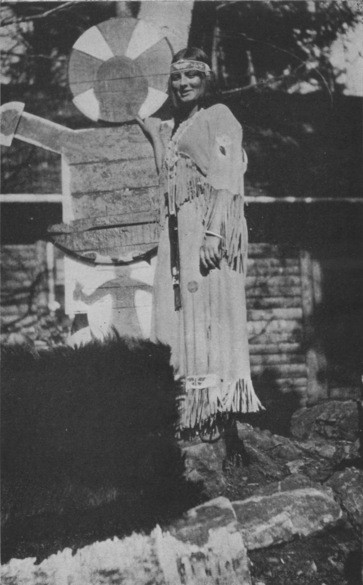
DECORATIONS FOR THE COUNCIL.
The
Woodcraft Girls
in the City
BY
LILLIAN ELIZABETH ROY
AUTHOR OF
THE WOODCRAFT GIRLS AT CAMP,
LITTLE WOODCRAFTER’S BOOK,
THE POLLY BREWSTER BOOKS, Etc.

ILLUSTRATED
NEW YORK
GROSSET & DUNLAP
PUBLISHERS
COPYRIGHT, 1918,
BY GEORGE H. DORAN COMPANY
PRINTED IN THE UNITED STATES OF AMERICA
Acknowledgments are made to Mrs. M. F. Hoisington for the photographs; to G. Shirmer, Music Publishers, for “Our America”; to W. V. Becker for the legends from his “Folk-lore Stories”; to Christian Science Sentinel for “Items of Interest,” and to other friends who co-operated to make this book interesting to young readers.
Contents
-
CHAPTER ONE—CAMPING IN THE CITY
-
CHAPTER TWO—THE NEW MEMBERS
-
CHAPTER THREE—HEARD IN THE “SCENIC FOREST”
-
CHAPTER FOUR—THE ESKIMO INDIAN LEGEND
-
CHAPTER FIVE—A PRIZE CHEST
-
CHAPTER SIX—THE LOST CAMPERS
-
CHAPTER SEVEN—CAMPING SPORTS OF A WEEK-END
-
CHAPTER EIGHT—QUIET WAYS FOR SUNDAY
-
CHAPTER NINE—A RAINY WEEK-END CAMP
-
CHAPTER TEN—IN FALLING LEAF MOON
-
CHAPTER ELEVEN—CAMP AT ALPINE FALLS
-
CHAPTER TWELVE—A BIRTHDAY COUNCIL ON HALLOW E’EN
-
CHAPTER THIRTEEN—INDOOR WOODCRAFT ENTERTAINMENT
-
CHAPTER FOURTEEN—WINTER WOODCRAFT WORK
-
CHAPTER FIFTEEN—SOME WEEK-END CAMPS
-
CHAPTER SIXTEEN—THE ADIRONDACK CAMP
CHAPTER ONE—CAMPING IN THE CITY
“Girls—guess what?” exclaimed Zan Baker, a few days after the return of the Woodcraft Band from their summer camp on Wickeecheokee Farm.
“Goodness only knows what you have to tell now!” laughed Jane Hubert, another of the five girls who founded Wako Tribe.
“Well, I got it direct, so the truth hasn’t been turned or twisted by any one of you girls before it was passed along,” retorted Zan, with a gleam of mischief in her eyes.
“Oh, is that so! Well let me tell you this much: if I had the rare imagination that you have, Zan, I’d compete with Jules Verne,” replied Hilda Alvord, the matter-of-fact member of the Band.
“Judging from the talent Zan has in telling stories it won’t surprise us very much to hear she is a popular authoress,” teased Nita Brampton, the social aspirant of the group.
“I’ll illustrate Zan’s books,” quickly added Elena Marsh, the fifth member of the Woodcrafters.
“Sort of shine in my reflected glory, eh?” laughed Zan, good-naturedly, for all the girls enjoyed this form of badinage.
“Girls, girls! This isn’t hearing the ‘wextry’ news Zan holds cornered! Give her a chance, won’t you?” begged Nita.
“It’s this: Miss Miller wants us to have tea with her, to discuss plans for our Winter Camp and to consider the advisability of admitting another Band so we can apply for a Charter of our Wako Tribe,” announced Zan, with due satisfaction.
“When is the party?” eagerly questioned her hearers.
“Friday afternoon about four; and she also said that if we cared to invite some of the other girls who are crazy to join Woodcraft to meet us in the evening to hear our Summer Reports read, she thought it might give them a fine opportunity to really understand what Woodcraft did for us during the few months we spent in Camp,” explained Zan.
“Miss Miller can count on me being there right on time!” declared Jane, with a determined bob of her head.
“Me too!” added Nita.
“It isn’t likely Hilda and I are going to be absent,” laughed Elena.
Thus it came about that promptly at four o’clock on Friday afternoon the five happy girls stood waiting at the door of the apartment occupied by their Woodcraft Guide. As Miss Miller’s professional business in life was teaching physical culture to the High School girls at the gymnasium of Clinton High, the honourary office as Guide in Woodcraft was more like play to the efficient instructor.
Immediately after the bell rang to announce the visitors, the door was opened and a cheery voice called, “Come right in, girls.”
“Dear me, Miss Miller, isn’t it just too hot for anything? And after our lovely cool Bluff down at Wickeecheokee!” sighed Nita, as soon as they were seated in the front room.
“I will admit that city life certainly is an unpleasant change from camping in the woods,” replied Miss Miller, taking the hats from her girls and handing them each a fan.
“I couldn’t sleep a wink last night in our stuffy city rooms!” exclaimed Hilda who lived with her mother and younger brother in the ordinary regulation flat.
“I didn’t either. I just gasped all night for some air,” added Elena.
“Well what are we going to do? We can’t move the Bluff to the City and we live in so-called modern homes where the only windows open front and back—all except Jane’s and my house where there is an extra city lot on the side so we can have light from additional windows on the sides,” commented Zan, thoughtfully.
“It is odd that you girls should speak of this matter the very first thing, because it is one of the things I wanted to talk over with you before any new members join our Band. If you all approve of the plan I thought out it not only will give us air enough at night but will offer the new Woodcraft members an opportunity to win their coups for sleeping out-of-doors for the required number of nights,” said the Guide.
“Oh do tell us what it is?” cried Zan.
“It must take its place in the order of business,” rejoined Miss Miller; “now let us open Council in the regular way, girls.”
“It won’t seem much like a Council in the regular way without a fire and the preliminary lighting of it,” complained Nita, who was the fault-finder of the Band but was fast out-growing such tendencies.
“Why I thought you girls all knew how to light the indoors Council Fire without the slightest danger of destroying anything about you!” commented Miss Miller, as she went to a small cabinet in the corner, where most of her Woodcraft material was kept.
Taking out a small shallow pan and an earthen bowl, the Guide displayed a squirrel’s nest and some wild-wood material in the pan. “I brought this from the farm for just such an occasion,” said she, smiling, as she placed the earthen bowl on a bread-board and handed the pan to Hilda, thus silently authorising her to help make fire for that Council.
“Does the bread-board signify anything?” laughed Jane, the tease of the group.
“Not having the logs or imitation fire-place for the centre of the Council Ring, I thought the next best thing would be a square of wood upon which to stand the dish. Then too, the bread-board gave me a good idea which I will mention later,” said the Guide.
While she explained, Miss Miller had gone to the cupboard for the rubbing sticks and the necessary block and fire-pan of wood. All being ready for the ceremony, Zan, who was Chief of the Band and Tribe, began.
The usual call to join in a Council was said and the girls sat down upon straw mats in a circle about the fire-board. Miss Miller proceeded to make fire with the rubbing sticks and as the faint spiral of smoke was seen to rise from the tiny heap of wood-powder, the Woodcrafters called “How!”
The smoke thickened and the pungent odour of balsam permeated the room. When the spark hidden under the black dust ignited the dry tinder held close to it and a tiny fork of flame shot up, the girls exclaimed, “How! How!” which is the Woodcraft sign of approval.
The fire was now placed in the earthen dish and as the wild-wood tinder, that was placed on top of the fire flared up, the dish was placed on the board.
“We will now sing the Omaha Tribal Prayer,” continued the Chief, and the girls stood up to sing while the fire burned in the centre of their Council Ring.
Elena Marsh, the artistic member of the Band and the chosen Tally Keeper, now read the reports and mentioned a few items of interest that had occurred since leaving the Camp on the Bluff.
“Now we can hear the Guide’s important plan,” said Zan, who as Chief of the Tribe, was not compelled to ask permission to address the Council as all other members have to do.
“O Chief! Even as our Guide spoke of a plan, I had a wild idea flash through my mind and I wonder if it comes anywhere near to being Miss Miller’s idea,” said Jane.
“Share it with your brethren and if it isn’t too wild to harness we may train it to do good service for us,” said Zan.
“Well, you see, there’s Nita and you and me—we all have goodly sized grass-places back of our houses. Why couldn’t we raise some tents as long as the weather is good and camp out there at night?” said Jane exultantly, for she thought she had anticipated the Guide’s plan.
“That’s all right, Jane, but maybe Hilda and Elena and Miss Miller wouldn’t care to trot from their homes every night to sleep in our back yards,” replied Zan, ludicrously as usual.
The others laughed at the picture outlined by her words, and Miss Miller added: “I think we have a more important problem than camps just now. Let us decide about the new Band first and discuss the out-door sleeping question afterward.”
“I thought you wanted us to settle the matter before the new members join us to-night?” returned Nita.
“So I do, but let us first find out who the new members will be, and then we can better judge whether they will accept this camping-out-doors idea,” answered the Guide.
“Frances and Anne Mason told me to be sure and vote them in at this meeting. They are just crazy to join,” declared Jane Hubert.
“And Eleanor Wilbur wants to join us,” said Nita.
“Mildred Howell told Fiji to tell me not to forget and propose her,” ventured Zan.
“And I know that Ethel Clifford wants to belong to our first Band,” added Elena.
“Well girls, you each have your new member to win a coup, but I haven’t much time out of school to meet the girls, as there is so much work to do at home. Jack Hubert said this noon that May Randall was asking for me before I met him. If she will let me propose her I can keep up with you on this coup,” said Hilda, whose mother was a trained nurse, thus letting most of the care of the home fall upon Hilda’s shoulders.
“She told me that that is why she wants to see you,” said Jane.
“That is very considerate of May Randall,” commended Miss Miller.
“Yes, and it recommends her for membership,” added Zan.
The other girls agreed with this suggestion, and the Guide then said: “That will make eleven girls in all—counting you five. I think that ought to be enough to work with this Fall,” and Miss Miller began to write down the names of the six members proposed.
“But there are loads of other girls who want to join us, Miss Miller,” objected Zan.
“I suppose there are, but better not add too many new members at one time, Zan; it will tend to divert your attention from your own progress, and individual work is most important to you at this period in Woodcraft. Were you all experienced or old members of the organisation, I would approve of enlisting the full number of members required for a Tribe,” explained the Guide.
“How long will we have to wait before we can be a Tribe?” asked Nita, petulantly.
“If this experiment with the new members turns out well by Christmas, I should think we might start the second Band,” replied Miss Miller.
“Goodness, can’t we start a Tribe before that?” cried Jane, impatiently.
“I thought the same as Jane—that we would be Wickeecheokee Band and the new members be Suwanee Band, and then the two Bands get the charter for Wako Tribe,” added Zan, in a disappointed tone.
“Some Woodcrafters have done that and found to their despair that the new Band knew nothing of the work or laws and were continually calling upon the first Band for help, but not being under the old Chief the first Band had nothing to say about disciplining or advising them. If the new members are subject to our Chief, they have to obey orders and can watch our methods of work for their guidance, and that will spare us many useless words and much valuable time.”
“Well, as usual, Miss Miller wins the day! Her reasons are as sensible as helpful,” commented Jane.
“Good-by Suwanee, I’ll meet you next year!” sighed Zan, wafting a kiss with the tips of her fingers to an imaginary Band.
“Girls, wherever did you find that name? I hunted through an Indian Dictionary of names but couldn’t find a thing like it,” asked Miss Miller, laughingly.
“If a simple little symbolic name like that stumps you, Miss Miller, what will happen when you join the Blackfeet Tribe?” laughed Jane.
“Miss Miller, you know the usual formula given in charades—they begin thus: ‘My first is part of a name, you see, my second is also a part, O gee!’ and so on,” explained Zan, while the other girls laughed.
The Guide puckered her brow for a few moments and the visitors watched eagerly for her to catch Zan’s meaning. Then she laughed, too.
“I see! Su—comes from Suzanne, the name of our Chief, but so seldom used that I forgot she ever had another handle to it than just ‘Zan.’ I must give up the rest of the charade, however.”
“Maybe it is buried so deep that the uninitiated cannot dig it up, but we girls thought it quite simple: ‘Su’ for the Chief, as you said; ‘Wa’ for Wako Tribe—plain enough; and ‘nee’ for all the other members who are willing to change their names from white man’s ways to the Indian’s with its wealth of meaning and beauty.”
As Zan explained, the Guide shook her head as if to admit that it certainly had been buried far beyond her power to dig.
“But it sounds pretty, girls,” said she finally.
“Mayhap we will have an improvement on that name before the Band comes into existence, who knows!” sighed Jane.
“The sooner we start with the new members, then, the quicker we will know about the second Band,” retorted Zan.
“Shall we vote now to invite the six girls mentioned?” asked Elena with Tally Book ready to inscribe the names.
The motion was made and seconded that the names of the six applicants be written on the roll and that evening they would be questioned and admitted if acceptable to the Chief and Guide.
“Now Miss Miller, if there is nothing else to consider let us hear about your idea for a camp in the city,” said Zan.
“When I came into this apartment yesterday afternoon, its stuffiness struck me much the same as you girls said: ‘Close and airless.’ The windows were all open but that didn’t seem to make any difference. While still gasping for the cool breezes of Wickeecheokee I went to my den in the back room and as I stood by the window that opens out on the roof of the extension downstairs, I made a discovery! Last night I slept as comfortably out-of-doors as if on the Bluff, and this morning the English sparrows woke me with their chattering under the eaves three stories above.”
“Miss Miller! Do tell us what you did?” exclaimed the curious girls.
“Well, first I took a crex rug from the floor and laid it on the extension roof to protect the tin from the feet of a cot-bed. Then I carried out a four-fold screen and with the smaller three-fold screen from my den, I made suitable protection about the cot. The camp-cot that I keep in case of an unexpected guest remaining over-night was small and light, and provided me a good place to rest. The whole affair, screens, cot, and mat, took up but half of the small roof and early this morning I slipped back through the open window and dressed, having enjoyed a fine cooling breeze all night.”
“Oh!” sounded the surprised five girls.
“You must have slept like a multi-millionaire on his sea-going yacht,” laughed Zan.
“I did, and without fear of going to the bottom by a torpedo from a submarine,” retorted Miss Miller.
“We have a wonderful roof on the back verandah—all decked and railed in,” remarked Jane, mentally picturing a row of tents on that desirable camp-site.
“I could use the rear porch that opens from our dining-room windows,” added Nita.
“We have a box-like porch on the second floor that has a back-stair going down from it. It is screened in and can be used for a sleeping-place, I s’pose,” murmured Elena.
“Our flat-house was built soon after Noah landed so we have no sleeping-porch, but I might hang a cot from the fire-escape—until the police make me take it down,” ventured Hilda, with a thoughtful manner.
The others shouted with merriment at the idea of big muscular Hilda swinging from a fire-escape over the street.
“I have my lodging all planned out,” now said Zan. “I shall utilise that square of side-piazza roof over the entrance to Dad’s office. It has a two-foot high coping about it and that makes it perfectly safe for me in the dark. I can use a screen, too, to hide the cot from the street.”
“You girls have all caught my last-night’s idea so suddenly that I haven’t had an opportunity to continue explaining,” interrupted Miss Miller.
“Proceed, fair lady, and we will hold our peace,” said Jane, giggling.
“As I enjoyed the reviving night-breezes and thought of you poor girls tossing in warm rooms, I wondered how we might have an out-door place and still feel secluded from prying eyes. Then I remembered the small tents we left with Bill on the farm. Those of you who have roof-space can erect a tent just outside your bed-room window. The tent-opening can be directly opposite the window so that you can slip in and out without dread of being seen by the public. What do you think of it?”
“It’s great!” exclaimed Zan, enthusiastically.
“Not for me,” grumbled Hilda.
“Nor for me,” added Nita, “’cause Mama won’t think of letting me have anything so original as a camp-tent within a mile of our house—let alone on the front roof!”
“If I speak to your father, who is so delighted at the improvement in your health, he may induce her to look at the plan with different conclusions than these you fear,” ventured the Guide.
“Maybe so; Papa said he would do anything on earth to have me keep up this Woodcraft stunt,” admitted Nita.
“Zan, do you think your father will object if we send to Bill for those small tents?” now asked Miss Miller.
“Mercy no! Dad won’t say a word if you pitch tents all along our entire roof and on the front piazza, too, just so there’s room between the canvas cots for his sick patients to find their way to his office-door.”
“The public will think Dr. Baker has opened a Sanatorium,” laughed Jane.
“Or a Fresh Air Clinic for Flat-Dwellers!” added Hilda.
The others laughed provokingly when they saw Zan flush for they all liked to tease her.
Miss Miller saw the sudden gleam of anger flash from Zan’s eyes and quickly said: “Girls, I am now going to indite that letter to Bill Sherman for the tents—what shall I say and who wants one?”
“One for Nita, one for Elena, and one for me—and of course Zan wants one,” said Jane.
“I can use the same one Fiji and Bob had at the beach this Summer,” replied Zan, brightening again. “Jane, why don’t you use Jack’s, then the extras can go to Miss Miller and Hilda.”
“But Zan, I haven’t a place to camp,” said Hilda, dolefully.
“Then I s’pose you’ll have to borrow some of my roof,” returned Zan, in a matter-of-fact voice.
“Oh Zan, really! I won’t mind walking back and forth every morning and night if you don’t mind my using the roof!” sighed Hilda with relief so great that the others laughed.
The letter for Bill Sherman, the farmer at Wickeecheokee, was given to Zan to mail if her father approved of the camp-plan, and then the Guide excused herself and went out to see if the tea was ready to serve her guests.
That evening the six girls came in and Woodcraft reports were read; then they were invited to join the Band and the conditions of membership plainly outlined. Needless to add, that everyone agreed eagerly to abide by the rules and regulations read to them.
On the way home that evening, however, Eleanor Wilbur whispered to Frances and Anne Mason who were walking with her:
“Of course this Woodcraft fun will be fine when we haven’t anything better to do, but you don’t intend losing any other fun or meeting because of it, do you?”
“Why we are going to go to the regular Councils and meet with the other girls for work or play, whether it happens when we have invitations for other parties or fun, or not,” declared Frances, the elder of the two sisters.
“Oh!” said Eleanor, a trifle disconcerted by the reply. Then after a few moments of silence she said confidentially: “Don’t you think Zan Baker takes an awful lot for granted from us girls? Just see how she took the initiative in everything to-night.”
“But Zan Baker is the Chief of the Band and has to take the lead in Tribal affairs,” explained Anne.
“Oh yes, I know that, but you don’t understand what I mean. I think she is too domineering in her office and Miss Miller certainly shows a great partiality for her. Of course everyone knows that Miss Miller bows humbly at the Doctor’s shrine just because he got her the position at High School Gym!” said Eleanor, significantly.
“Why Ella! It isn’t true! I know for a fact that Dr. Baker merely suggested to the Board that Miss Miller had resigned from college where she had taught for years. Most of us knew what a treasure she is, and the Board were only too glad to have her consider our school, because the salary is half what she was accustomed to receive,” defended Frances.
Eleanor kept silence, but Anne added: “And we girls feel sorry for Miss Miller because she gave up that college position when her mother was left alone and needed her at home!”
The afternoon following the meeting at Miss Miller’s home, Hilda fairly bounced into the gymnasium where the Guide could generally be found for some time after school-hours.
“Oh, Miss Miller, I have the loveliest camp-ground!”
“Better than the fire-escape?” laughed the Guide.
“Better than the roof of a porch! And the funny thing about it is that the janitor of our building came up himself and said: ‘Miss Hilda, I feel sorry for you these hot nights, so you can sleep on the roof if you like!’
“Miss Miller, I never breathed a word to him about a tent, but he took me up and showed me where I could pitch a small tent between the great water-tank and the square box-like place where the roof-steps come up. A stone parapet almost three feet high runs all around the roof, you know, so there isn’t any danger of my falling off even if I walked in my sleep—which I never do.”
“I think that is fine for you, Hilda,” smiled Miss Miller, but she did not add that she had spoken secretly to the janitor that morning on her way to school.
“Mother has no objections to this if I will take Paul up with me. Paul thinks the plan a dandy one so he will be benefited too. I will place a screen about his cot or mine so that I will have privacy.”
“Or you could hang a curtain from a ring at one side of the tent to one at the opposite side. Then Paul could pull or push the muslin to suit himself, and it would not be ruined by rain,” suggested Miss Miller.
“I’m so glad that we live on the top floor of the house, ’cause it will be an easy matter to run up or down the short flight of stairs going to the roof. When I told mother about it she laughed and said: ‘You always used to grumble about climbing the four flights from the street, but I know how much pleasanter it is to be on top instead of under a noisy family in a flat.’”
“Your mother is quite right, and then the air is always better the higher one goes, and the rents are lower—the last not a mean consideration, either,” added the Guide.
Jane Hubert came in just then, and her smile signified good news. “Father never made the slightest objection to the camp idea but he has a still better one for me. He says he will erect Jack’s tent on the lawn under a group of birches that grow near the high brick wall at the back of our place.”
Then Nita came in. “Miracles will never cease, Miss Miller. Not only is Mama quite reconciled to my camping on the first-story extension roof where there is a concrete flooring and a parapet to three sides, but she is taking an active part in rearranging my bed-room so that I can step in and out of the French windows without falling over cushioned window-seats and gim-cracks standing about.”
“This is the best news yet, Nita! I felt sure the other girls would have no trouble gaining permission to camp out. Now we only have to hear from Elena, as Zan started in to arrange her tent this noon, I hear.”
“Oh, Elena told me that she could have her tent on the roof of the side-verandah as planned instead of on the boxed-in porch at the back,” hurriedly informed Jane.
“Thank goodness we will be able to enjoy the Spirit’s blessing of sweet fresh air that is free for all mankind,” said Miss Miller, earnestly.
“To say nothing of enjoying a continuation of Woodcraft out-of-doors right in a great city,” added Jane.
CHAPTER TWO—THE NEW MEMBERS
Miss Miller had secured permission to use the gymnasium for the weekly Council Meetings of the Woodcrafters, so she was already there when the members of Wickeecheokee Band and the new members appeared to hold Council.
“Girls, I bought some straw mats at the ten-cent store that I thought we could use about the Council Fire,” said the Guide, as the girls all congregated about her desk.
“What about those small logs of wood we worked at so hard to bark and smooth down?” asked Nita.
“I thought we might make them presentable and then cut and paint symbolic totems on them to make them look like genuine Indian seats,” said Miss Miller.
“Aren’t they quite good enough as they are?” said Eleanor Wilbur, pushing at one of the logs with a slender foot.
“I thought they were fine when we barked them but now that we are at home and a better idea has been given us I approve of following Miss Miller’s suggestion,” replied Jane.
“Dad brought home some more of those short fire-place logs when he came back from the farm yesterday. He says we may want these thin logs for some other purpose; and besides, since enrolling our new members we haven’t enough of these present logs for all to use. They ought to be uniform so I say we use the mats until we have the thick logs ready to present the Lodge,” explained Zan.
“Girls—I have an idea!” cried Elena, the artistic.
“Hold fast to it or it’ll get away from you,” taunted Hilda, jokingly.
“S-sh!” said Zan. “Let her go, Lena.”
“About those thin logs we have on hand: Let’s build an imitation fire-place for our Council Ring to make it look as much as possible like one in a woodland camp!”
“Couldn’t we place our dish of smoking tinder inside it and make the artifice still better?” asked Jane.
“Oh I say!” shouted Zan with such emphasis that everyone jumped, and the speaker laughed.
“Where’s that red tissue paper we had for Decoration Day trimming of the school auditorium?” asked Zan.
“You’ll find it in the property-room with the other stuff,” replied Elena, who had charge of decorations at school.
“We’ll line the inside of the logs and when the fire shines through, make it look like a big blaze, eh?” asked Jane.
“No such thing!” said Zan. “We’ll get the janitor to change that electric bulb from the chandelier and drop it, by wire, down to our fire. Then it will shine as long as we need it.”
“I’ll run and see if the janitor is around. Will he do it, do you think, Miss Miller?” came from Hilda.
“I think so, he is very obliging, you know,” replied the Guide.
“And I’ll get the paper,” remarked Elena.
“You won’t need to do that, Lena, because I have orange crêpe paper in the closet that I bought when I got the mats. I had much the same idea in mind for those logs,” said Miss Miller, going to the closet while one of the girls ran for the janitor.
The care-taker of the building not only changed the bulb in a short time but assisted Miss Miller in rolling the logs from the closet to the place where the Council Ring could be arranged. The girls built up a square fire-place with a hollow opening in the middle where the electric bulb soon depended. The paper was fitted inside the square and when the electric current was turned on it looked like a glowing fire.
This done, four candles were placed at the fire—one at each corner of the square to denote the four corners of the earth.
“I purchased extra long candles so they would burn two hours, at least. Now that we have the electric bulb we need not waste the extra candles for fire-light but save them for some other occasion,” remarked Miss Miller.
“Everything ready now for Council?” asked Zan, looking around at the members.
“Everything we can think of,” responded Jane.
“Before we open the Council meeting in the usual manner I would like our Chief to read from the Woodcraft Manual for Girls on page 10, where it speaks of initiations and new members,” requested Miss Miller, handing the book to Zan.
“‘When brought into some new group such as the school or club, one is naturally anxious to begin by making a good impression on the others, by showing what one can do, proving what one is made of, and by making clear one’s seriousness in asking to be enrolled. So also those who form the group: they wish to know whether the new-comer is made of good stuff, and is likely to be a valuable addition to their number. The result is what we call initiation trials, the testing of a new-comer.
“‘The desire to initiate and be initiated is a very ancient deep-laid impulse. Handled judiciously and under the direction of a competent adult guide, it becomes a powerful force for character building, for inculcating self-control.
“‘In Woodcraft we carefully select for these try-outs such tests as demonstrate the character and ability of the new-comer, and the initiation becomes a real proof of fortitude, so that the new girl is as keen to face the trial, as the Tribe she would enter is to give it.’”
Zan finished reading and looked up to ask: “Is that all you want me to read, Miss Miller?”
“Just a moment, Zan. I now wish to speak a word to the new members about what is expected of them. We will leave the paragraph about the initiation trials for the last, then the girls will not forget what they are to do. Read now the paragraph that mentions the new work for members.”
So Zan continued. “‘After the new member has learned the Laws and taken the initiation tests, the first thing to claim her attention is that of qualifying for the rank of Pathfinder and later of Winyan, then the Achievements, each with its appropriate badge, which are described on page 327 of the Manual. In time she will have a Woodcraft suit, but this may come later.”
“Now Zan,” interrupted the Guide, “turn over to page 18 and read (the new members) what we expect a Wayseeker to do and be. A Wayseeker is the first order of a Big Lodge Girl’s membership.”
“‘To qualify for a Big Lodge—that is, to enter as a Wayseeker—one must:
“‘Be over twelve years of age.
“‘Know the twelve Laws and state the advantages of them.
“‘Take one of the initiations.
“‘Be voted in unanimously by other members of the group.
“‘Having passed this, the candidate becomes a Wayseeker and receives the Big Lodge Badge of the lowest rank, that is with two tassels on it.
“‘The next higher rank is that of Pathfinder,’” read Zan.
“So you see, girls, you six will be Wayseekers if you pass the trials and fulfil the requirements just read to you,” said the Guide. “Now Zan, will you please read from page 24—the meaning of a Council Ring? Better begin at the bottom of the page where I have marked the sentence for you.”
Zan turned over the pages till she found the place indicated and read: “‘Why do we sit in a circle around a fire? That is an old story and a new one.
“‘Then, too, a circle is the best way of seating a group. Each has her place and is so seated as to see everything and be seen by everybody. As a result each feels a very real part in the proceedings as they could not feel if there were corners in which one could hide. The circle is dignified and it is democratic. It was with this idea that King Arthur abolished the old-fashioned long table with two levels, one above the salt for the noble folk and one below for the common herd, and founded the Round Table. At his table all who were worthy to come were on the same level, were brothers, equal in dignity and responsibility, and each in honour bound to do his share. The result was a kindlier spirit, a sense of mutual dependence.
“‘These are the thoughts of our Council Ring. These are among the reasons why our Council is always in a circle and if possible around the fire. The memory of those long-gone days is brought back again with their simple reverent spirit, their sense of brotherhood, when we sit as our people used to sit about the fire and smell the wood-smoke of Council.’”
As Zan concluded, the experienced Woodcrafters cried: “How! How!”
“I suppose the new members know why we called our Band Wickeecheokee Band of Wako Tribe of Woodcrafters?” asked Miss Miller, with a slight nod in the direction of the six girls.
The new members looked at each other for the answer and the Guide continued to explain:
“Wickeecheokee is an old Indian name discovered on the ancient records of the County Seat in New Jersey where the farm owned by Dr. Baker is located. The English interpretation of the name means, ‘Crystal Waters.’ Dr. Baker’s farm where we camped last Summer has this lovely mountain stream falling down the steep side to the Bluff which is a rocky ledge over-hanging a pool of about a hundred yards wide, thence it rushes on to the Big Bridge near the turnpike road. That is why the doctor named his farm after the stream—‘Wickeecheokee.’”
“I wish to goodness we girls could have been there with you,” sighed Anne Mason.
“‘According to the Constitution of Woodcraft, our purpose is to learn the out-door life for its worth in the building up of our bodies and the helping and strengthening of our souls; that we may go forth with the seeing eye, and the “thinking hand” to learn the pleasant ways of the woods and of life, that we may be made in all wise masters of ourselves; facing life without flinching, ready to take our part among our fellows in all the problems which arise, rejoicing when some trial comes, that the Great Spirit finds us the rulers of strong souls in their worthy tabernacles.’
“Each one of you girls is past twelve years of age, so that point is covered. Now we will ascertain who of the new members know the law, who are acceptable to this Band, and who can prove worthy according to the initiation tests. You will all begin at the lowest rank if accepted in the Band—that of Wayseeker. Now Zan, read aloud the initiation test from page 11 of our Manual.”
The Chief turned back to the page mentioned and read: “‘The trial should be approved by the Council and be given to the candidate when her name is proposed for membership—that is, posted on the Totem Pole where it remains for seven suns. In camp a shorter time may be allowed at the discretion of the leaders.
1. Silence. Keep absolute silence for six hours during the daytime in camp, while mixing freely with the life of the camp. In the city keep silence from after school till bedtime.
2. Keep Good-natured. Keep absolutely unruffled for one day of twelve hours, giving a smiling answer to all.
3. Exact Obedience. For one week give prompt, smiling obedience to parents, teachers, and those who have authority over you. This must be certified to by those in question.
4. Make a Useful Woodcraft Article, such as a basket, a bench, a bed, a bow, a set of fire-sticks, etc.
5. Sleep out, without a built roof overhead, for three nights consecutively, or ten, not consecutively.’
“Now that you have heard what the tests are how many of you believe you can qualify—answer by raising your right hand and by the word of Woodcraft approval?”
The six girls raised six hands and then looked at each other sheepishly because the word “How” seemed so meaningless to them.
“I forgot to explain that this word ‘How’ means ‘yes’ or ‘thanks’ or ‘approval,’” hastily added the Guide.
Then all said “How!” and the other five girls felt that their new members were doing fine work.
“Why not teach them the Woodcraft Salute while we are at it?” asked Zan.
The Guide then demonstrated the sign and action, saying: “The hand sign of the girls is the ‘Sun in the heart, rising to the Zenith’—given by the right hand being placed over the heart, the first finger and the thumb making a circle, then swinging the forearm so the hand is level with the forehead, thus—.”
Then Miss Miller nodded to Zan to proceed with the meeting.
“In case any of you are not familiar with the Woodcraft Laws I will read them aloud to you. And Miss Miller, I would suggest right here, that the new members write to Headquarters at once and order a Girl’s Manual. They will need it daily, and I can’t spare mine, you know. We really couldn’t accomplish much without this printed Guide of rules and instruction and guides.”
Zan then read aloud for the benefit of the new members:
“‘1. Be Brave. Courage is the noblest of all gifts.
2. Be Silent, while your elders are speaking and otherwise show them deference.
3. Obey. Obedience is the first duty of the Woodcraft Girl.
4. Be Clean. Both yourself and the place you live in.
5. Understand and respect your body. It is the temple of the Spirit.
6. Be a friend of all harmless wild life. Conserve the woods and flowers, and especially be ready to fight wild-fire in forest or in town.
7. Word of Honour is sacred.
8. Play Fair. Foul play is treachery.
9. Be Reverent. Worship the Great Spirit and respect all worship of Him by others.
10. Be Kind. Do at least one act of unbargaining service every day.
11. Be Helpful. Do your share of the work.
12. Be Joyful. Seek the joy of being alive.’
These are the twelve laws that every good Woodcrafter tries to live up to. Now if the Fire Maker will make fire for our Council, I will explain the rays that shine from each of the four candles—one at each corner of the earth.”
The Chief waited for Jane, who was Fire Maker for that meeting, to take the rubbing sticks and when she stood ready to begin the fire-making, Zan said:
“Yo-hay-y Yo-hay-y-y; Meetah Kola Nahoonpo Omnee-chee-yaynee-chopi.”
The opening words of Council concluded by the Chief, Jane placed the fire sticks in their proper position and began to saw back and forth with the bow until a tiny spiral of smoke rose from the fire-block.
The Guide watching, said, “Now light we the Council Fire after the manner of the Red man, even also as the rubbing together of two trees in the storm-winds brings forth the fire from the forest wood.”
Jane blew gently upon the small pyramid of black powder in the fire-pan until the smoke grew thicker. She then waved it slowly back and forth still blowing gently until a minute spark glowed under the black dust. At that the girls all cried:
“How! How!”
Then a handful of inflammable wild-wood material was touched to the spark and as the smoke curled upward filling the immediate vicinity with an aromatic pine odour, a tiny flame shot out.
“How! How!” again chorused the Woodcrafters, and the tinder now burning brightly, was placed in the earthen dish and the dish set in the enclosure made by the logs.
With the flame bursting forth, Miss Miller quoted: “Now know we that Wakanda the Great Spirit hath been pleased to smile upon His children, hath sent down the sacred fire. By this we know He will be present at our Council, that His wisdom will be with us.”
After this Zan read again from the Manual:
“‘Four candles are there on the Shrine of this our symbol fire. And from them reach twelve rays—twelve golden strands of this the Law we hold.
From the Lamp of Fortitude are these:
Be Brave. For fear is the foundation of all ill; unflinchingness is strength.
Be Silent. It is harder to keep silence than to speak in hour of trial, but in the end it is stronger.
Obey. For Obedience means self-control, which is the sum of the law.
And these are the Rays from Beauty’s Lamp:
Be Clean. For there is no perfect beauty without cleanliness of body, soul, and estate. The body is the sacred temple of the Spirit, therefore reverence your body. Cleanliness helps first yourself, then those around you, and those who keep this law are truly in their country’s loving service.
Understand and Respect Your Body. It is the temple of the Spirit, for without health can neither strength nor beauty be.
Protect All Harmless Wild-life for the joy its beauty gives.
And these are the Rays from the Lamp of Truth:
Hold Your Word of Honour Sacred. This is the law of truth, and anyone not bound by this cannot be bound; and truth is wisdom. Play Fair. For fair play is truth and foul play is treachery.
Reverence the Great Spirit, and all worship of Him, for none have all the truth, and all who reverently worship have claims on our respect.
And these are the Rays in the Blazing Lamp of Love:
Be Kind. Do at least one act of unbargaining service every day even as ye would enlarge the crevice whence a spring runs forth to make its blessings more.
Be Helpful. Do your share of the work for the glory that service brings, for the strength one gets in serving.
Be Joyful. Seek the joy of being alive—for every reasonable gladness you can get or give is treasure that can never be destroyed, and like the spring-time gladness doubles, every time with others it is shared.’“
Zan concluded reading the interesting words of Woodcraft meaning and the girls murmured “How!”
“Now I will propose the name of each applicant in turn and the Band must second and approve her admission to this Tribe if that is their pleasure. As I call out the name will the girl please stand until the vote is taken?”
“Frances Mason is the first applicant,” said Miss Miller.
Frances stood and paid earnest attention to the next rite but Eleanor Wilbur who sat directly back of Frances as she stood up, kicked at her ankles and giggled as if the whole procedure were a huge joke. Although known to the others, the disrespect was overlooked at the time.
“Frances, is it your serious desire to become a member of this Woodcraft Band?” questioned the Chief.
“It is,” replied Frances, trying hard to keep from crying out as Eleanor pinched her leg.
“Then learn the laws of the League as well as the laws of our Band. To memorise the meaning of the Four Lesser Lights that shine from the shrine of the Great Light, the Sacred Fire. By taking the initiation tests as read for your benefit and by being acceptable to every member of Wickeecheokee Band.
“Are there any present who wish to register a complaint why Frances should not be admitted to our Band or the League?” asked Zan, as she looked around the circle.
No one complained, but a stage whisper was heard from Eleanor saying: “Everyone’s afraid to speak even if they do know something against Frances.”
The whisper was disconcerting but Eleanor tittered as if she thought herself very witty, and as Frances took her seat beside the rude girl, expecting to give her a piece of her mind, the Guide stood up.
“O Chief! While you were addressing the new member, I glanced over the Manual to see if we had omitted any necessary reading, and I find we have all made a serious blunder. Whereas we have six applicants for membership in this Band, the Manual clearly states that no Band shall have more than ten members. We will be compelled to drop one of the applicants.”
This unexpected news acted like a bucket of cold water on the girls as no one wished to be dropped. After a serious debate, the Chief announced a possible solution.
“We will post the names of the six girls on the Totem Pole and at the expiration of the period set for testing, the one who falls short of the mark must resign or, at least, wait for the second Band which will form at Christmastime.”
This plan met with approval and each new member then and there decided not to be the one left out when the enrollment came. So the six girls were admitted on probation.
“Now Chief, post the names on the Totem and we will stand it near the door where everyone coming in or going out can read who the applicants are,” said the Guide.
“I s’pose you are doing that to advertise your club,” remarked Eleanor, unpleasantly.
“Eleanor Wilbur! A Chump Mark against your credit, for you are on trial now and must not speak out of order in Council without giving the Chief the proper salute and respect,” said Zan, sternly.
“Why how ridiculous of you to give yourself such airs, Zan Baker! Anyone would think this was business and not fun!” jeered Eleanor.
“It is business I’ll have you understand, and if you wish to regard it as a butt for your insults or disobedience you can resign this very minute!” declared Zan, her eyes snapping fire.
But Eleanor had no desire to resign from the only thing she knew of where sport for the Winter days could be had. So she shrugged her shoulders and sulked.
The other girls were duly advised and then the Chief ordered the Tally Keeper to enter the record in the book and to print the paper that was to be posted on the Totem in as artistic a manner as she could think of.
“Now before we adjourn, is there any request to be made in behalf of the Band?” asked the Guide.
“O Chief! I wish to ask a question,” said Nita, standing.
“Speak, O Sister!” replied Zan.
“I talked of a plan while Elena and I were walking over here, and she thinks it is fine and dandy! It will help us to remember the woods and look forward to a camp next Summer.”
“Not that we need an incentive for that!” laughed Zan.
“No, but in Winter we’ll find it mighty funny to sit in this Gym and fancy we are Indians out in the forests. But follow Elena’s instructions and you’ll believe you’re at Wickeecheokee all Winter,” replied Nita, suggestively.
Nita sat down and Elena stood up. “O Chief! Nita and I wish to propose that we imitate the woods by scenery. We can buy some cheap cotton or canvas stuff and paint trees and rocks and the stream like those at our Summer Camp. We can even go so far as to have birds singing on the boughs and flying in the blue sky.”
Elena waited a moment to see the effect of her announcement and Zan said: “The blue sky seems to be the limit with your offer!”
The others grinned and Elena frowned momentarily. “Don’t you think it a good plan?”
“Fine plan for a house-painter. But who under the sun is willing to stay home for weeks and paint miles of scenery?” retorted Zan.
“Why it won’t be much trouble. Nita and I will offer to paint the scenes if you girls will make the uprights to fasten the stuff on when finished,” said Elena, anxiously.
“Have you figured out how much this may cost us, Nita?” asked the Guide.
“No because I don’t know how large we may need it. But any cheap cotton goods will do, you know.”
“Miss Miller, we might find out about that,” said Elena.
“The new members can begin first lessons in carpentry, too,” added Jane.
After discussing the idea, and with Elena’s added description of how beautiful it would look—to have Pine Nob showing against the sky in the distance, and Old Baldy back of Fiji’s cave, the Woodcrafters unanimously declared that they must have that scenery or lose all interest in the Winter Camp in the Gymnasium.
Miss Miller shook her head dubiously for she knew what a tremendous undertaking it would prove to be to paint nicely all the yards of material needed to enclose a Council Ring.
“Anyway it will do no harm to get prices on stuff and the necessary paint,” said Zan, and it was so decided.
“Nita and I will attend to that part of it if you girls will get the cost of lumber, etc., for the uprights,” added Elena.
“O Chief!” said Jane, thinking of a plan to save costs. “Why not use that side wall of the Gym and do away with that many uprights and stretchers?”
“O Chief! for that matter, why not use a corner of this hall and have two sides ready made and substantial, and use the uprights for the other two sides? With the scenery stretched on all four sides, who will ever know there is a solid wall of city plaster back of two sides?” suggested the Guide.
“But it will be a ‘corner in wood,’” added Zan, facetiously.
“Wah! Wah!” instantly sounded from every old Woodcrafter present. The new members looked about for an explanation.
“‘How’ is the term for approval and ‘Wah!’ for disapproval, or no,” explained the Guide, smiling at the reception given Zan’s wit.
“Corner or not, that last suggestion is all right!” declared Hilda.
“And instead of tacking the scenery on top of the poles and having it sag between each upright, why not have a wire or rope stretched taut from one pole to the next, and so on, and hang the scenery by means of hooks?” continued the Guide.
“I suppose such common commodities as clothes-pins would be spurned by Indians,” ventured Hilda.
“I should say ‘double yes’!” retorted Zan, slangily.
“It is most apparent that Zan is associating with the ‘causes’ of her slang again. She said this Summer that the habit was the fault of hearing her brothers use it so freely,” remarked Miss Miller.
“This time it was the fault of Hilda’s clothes-pins,” laughed Zan.
“Well anyway, clothes-pins are made of forest stuff and curtain pins are not!” defended Hilda.
“I will offer my services to the Band and inquire of an interior decorator I know, to see what would be the best hanger,” said the Guide.
“All right, Miss Miller, you do that and we will attend to the rest,” added Jane.
“I suppose two white-wash brushes ought to be better to paint with than camels-hair No. 0,” laughed Elena.
“Use whatever you like but for goodness’ sake, girls, don’t put your ‘atmosphere’ on too thick! It will take an age to dry out if you do,” commented Zan.
Then the Council ended with the singing of the Zuñi Sunset Song and the quenching of the Council Fire—in this case the electric current was switched off and the log fire-place taken back to the closet. When everything was in order, the girls left and went home, eagerly talking over the beautiful scenery-to-be.
CHAPTER THREE—HEARD IN THE “SCENIC FOREST”
After leaving the other girls at the corner of Maple Avenue, May Randall and Eleanor Wilbur walked on alone. May was large for her age, but most enthusiastic over Woodcraft as she was a devotee of gymnastics and all out-door exercises.
“Isn’t that Woodcraft foolishness a perfect scream?” said Eleanor, jeeringly.
May looked at her companion with surprise. “A scream! Why don’t you think it is splendid?”
“Oh, it answers well enough when one has nothing else to do, but you won’t catch me giving my time to making things or helping work just to boost a League that wants free advertising,” retorted Eleanor.
“Why Eleanor Wilbur! You know that isn’t true. Why would the Woodcraft League want advertising? They should worry whether we girls boost or not. The cost of keeping this thing going is far beyond what we pay in. That Manual alone is worth ten times the price we are charged for it. Then too, each Band has the free right to make its own individual laws and work or meet as it likes,” defended May.
“I suppose you are so mesmerised by Zan and Miss Miller, who are crazy about the thing, that you can’t see how silly the ideas of Council, or singing, or obeying laws are! Of course the camping and fun are all right!”
“If that’s the way you feel about it why not resign now before your name is posted on the Totem? You know there is one too many.”
“Why should I resign when I want some fun this Winter? Resign yourself if there is one too many! If I had the money Jane Hubert or Zan Baker have for an allowance, you wouldn’t catch me wasting time with your old Band. I’d go to a matinee every chance I’d get, and have other fun, too. But I never get enough spending-money to buy decent candy, let alone go to a good show!” complained Eleanor.
May made no reply but she looked at her companion, and Eleanor, glancing at her as she concluded, read May’s thoughts.
“I suppose you are such a Pharisee that you couldn’t think of anything so wicked as a theatre or a little supper-party,” ventured Eleanor, with a mean sneer.
“I guess I’ll turn down this street and walk home alone. I prefer it to any such company as you can offer me,” retorted May. And that sentence caused all the after trouble.
“Old hypocrite!” muttered Eleanor to herself, as she went on alone. “She thinks by pandering to the first Woodcrafters she’ll push herself in. But those five girls are too clannish to admit outsiders into their charmed circle, and that sweet pussy-footed Miller is worst of all!”
Hence Eleanor was not in the friendliest of moods when she met May at school the following morning. She pretended not to see her and only when May spoke directly to her, did she reply. May said nothing to the other girls about the conversation that took place between them on that walk home the day before, although Eleanor thought she had.
The names of the six members-to-be were posted on the Totem Pole which was placed at the entrance to the gymnasium where every scholar going in or coming out could read the notice.
At recess-time the Woodcrafters were the centre of attraction and many eager requests from other girls to be allowed to join the Tribe, was the result of the notice on the Totem Pole.
“Just can’t do it, girls! We have one too many as it is. A Band is only allowed ten members and we have eleven proposed, so one has to be dropped,” explained Zan.
“Which one?” asked Martha Wheaton, curiously.
“We won’t know until the time for testing is up. The one that falls short will have to make a graceful exit, I s’pose,” replied Jane.
“It ought to be Eleanor Wilbur, then. She’s going around telling everybody what a farce the whole business is. She acts as if she had a bone to pick with you girls. Did anything happen at the Council to antagonise her?” said Martha.
“Why—no! I thought she was enjoying herself immensely. I’ll go and ask her if she intends to drop out,” said Zan.
“But don’t tell who told you! I don’t want to get in bad with her—you know what a mean tongue she has!” hurriedly cried Martha, wishing she had kept quiet about the entire affair.
“Hey, there, Ella! Wait a minute—I want to see you!” called Zan, running after the girl who was making for the doorway.
“What do you want? I’m going in to study!” snapped Eleanor, fearing Zan meant to find fault with her about May Randall.
“I just heard something about your way of looking at our Woodcraft work, so you’d better make up your mind to-day whether you meant what you said or not. There’re piles of other girls only waiting a chance to grab what you laugh at!” Zan spoke angrily as she stood at the foot of the door-steps looking up at Eleanor.
Eleanor half-turned at the entrance door and sneered: “I read part of that poky Manual last night, and I couldn’t find a single thing there that would authorise a Chief to call down a member of the Tribe outside of Woodcraft meetings. I can do or say what I please without your over-bearing dominion of my rights!”
Zan felt like throwing her Latin book at Eleanor’s head, but Jane ran up and whispered: “Forget it! Give her rope enough and she’ll hang herself, all right!”
And as Zan turned away with Jane, Eleanor watched them and thought to herself: “I’d better not say anything that’ll get to that Miller’s ears, or she’ll remove my name from the Totem without as much as saying ‘By your leave!’ But I’ll have it out on that May Randall, all right, for tattling what she should have considered a confidential talk.”
Down in her heart, Eleanor knew she wanted to be a member of Woodcraft, not for the fun alone, but because she saw what it had done for the five girls that Summer. She longed to be a different type of girl from what she generally was, but so all-powerful was her human will that it kept her from doing or saying what she really wished to; and so cowardly was the trait to make strangers believe her charmingly perfect, that she generally found herself in trouble about one friend or another. Even at home, she praised the maid to her face and then denounced her to her mother. Had she dared she might have carried out the same hypocrisy between her mother and father, but Mr. Wilbur was the one being for whom she had any fear or respect, so she never misrepresented things to him.
It was not the real Eleanor that scoffed at Woodcraft and gossiped injuriously about it, but the weak mortal self that was the wretched counterfeit of the real and true Eleanor. The girl had not yet discovered this duality in her nature, but she had felt a growing dissatisfaction with herself and her environment since entering High School, and this unhappy state of mind aggravated her desire to belittle others or their efforts to climb to a higher plane of living.
Had Eleanor stopped to diagnose her feelings and actions she would have realised that the “misunderstandings” (as she termed the quarrels and trouble resulting from her poisoned darts of gossip) could be easily traced to the vindictive and malicious desires she entertained, while the sweet and pure and altogether attractive qualities that had been paramount in her early childhood years were becoming weaker and weaker through lack of expression. So at fourteen, at the character-forming time when a girl needs to be on guard that all undesirable tendencies are carefully eliminated to keep them from taking root for all future years, Eleanor, and those she associated with, were in a constant state of confusion and irritation created by her stubborn and selfish wilfulness.
During the week following the first Council meeting of the new members, the Band bought materials and began work on the forest scenery and wooden upright stands. Elena, Nita, and May Randall were given the roll of white duck to paint, while the other girls measured and sawed and hammered the 2 x 4 timbers to make the uprights necessary to hold the scenic walls of the woodland camp.
All that week Eleanor had been one of the first of the Woodcrafters to be on hand, but the moment the actual carpentry began, she would sigh, and scoff, and belittle the efforts of the others, or wonder why anyone spent good time on such foolish ideas!
Miss Miller had heard rumours of Eleanor’s gossip and she overheard several disturbing criticisms made during the work on the carpentry, but she said nothing at the time.
Of all the people who knew Eleanor well, Miss Miller was about the only one who studied the girl and understood the chemicalisation, so to speak, of the processes going on within the girl’s consciousness. The evil desires were fermenting and souring her nature while the sweetness and purifying elements were gradually being spoiled so that presently, a Judas-natured individual would claim the victory over the true, and the battle would be lost for the side of the divine and eternal self.
It was with a thrill of gratitude then, that the Guide recalled her deep perplexities over the waywardness of Nita, that same Summer on the Farm. How she had studied every phase of the problem and finally won out to the ever-growing betterment of the girl.
“If I can only win the slightest hold on this girl’s innate goodness and learn how to appeal to her higher self, I feel sure I can weed out the ‘tares’ even if it takes a long time. It is well worth the fight for the ‘wheat’ waiting to be garnered,” murmured Miss Miller as she reached the Gymnasium door. Which goes to show what the Guide really thought of Woodcraft and the privileges given her whereby to improve the morals and manners of the girls entrusted to her care.
“Everybody waiting for me to-day?” cheerily called the Guide as she hurried in where the girls were waiting to hold a Saturday afternoon Council.
“Yes, we’re crazy to pass judgment on the scenery. Elena makes such a secret of it that not one of us has seen it since she had it sketched out with charcoal. It’s back there in that huge roll. The boys brought it in the car a few minutes ago,” explained Zan.
“And did you finish the uprights so we can hang the duck?” asked Miss Miller.
“Everything is back in the corner where we decided to have our forest,” replied Jane.
“Then we can go right to work and place our trees and seats, and some of you can build the log fire-place in the centre for a Council,” said the energetic Guide.
A hubbub of instructions and calls and running to and fro continued after this for some time. Miss Miller tried to superintend the raising of the “huge forest timbers.”
“Say! Won’t one of you girls with nothing to do help me hook up this side of the trees?” called Elena, anxiously, as she found the weight of the duck too heavy to manage alone.
“You’ve got the trees upside-down!” laughed Jane.
“No I haven’t! That’s the way Nita painted this piece,” retorted Elena.
“Why it looks more like an early settler’s log stockade than the beautiful woodland hillside back of the Bluff,” replied surprised Jane, eyeing the painting with her head on one side.
“S-sh! Nita’ll hear you! She is so proud of it! She says it is a much better line of trees than my forest!” whispered Elena, proudly displaying her art work.
Zan came over to assist in hanging the duck and smiled behind the painting as she heard Elena explain the various “scenes” depicted on the great stretch of cotton.
“This is the flat rock where we sat telling bedtime stories; here is the swimming pool, and up there is Fiji’s cave. I tried to get in Bill’s cottage below the Bluff but my paint gave out,” explained Elena, as the three girls lifted and stretched the canvas and hung the hooks over the taut wire.
“But the way you measured and cut the scenery, we’ll have to unhook the cave and Bluff every time we need one side open. You made the other three sides all stockade, you see,” commented Zan.
“That’s so! I never thought of that. We will have to omit one whole side at times, won’t we?” responded Elena,
“Still, I think it will be easier to fold down or hang up a Bluff than to hew through a great row of giant tree-trunks, Zan,” laughed Jane.
Finding Elena too serious over her painting to laugh or enjoy a joke about it, the other two girls called that all was ready for the admiring audience.
As the group stood about the Council circle looking over the woodland scene, some smiled, some sniffed, and some looked delighted at the result. Miss Miller saw the disappointment on Nita’s face and remarked: “We joyfully accept this attempt to paint the cherished mental picture of Wickeecheokee Camp—a scene that defies all words or arts to describe.”
“But Miss Miller, you must admit that this scenery is misleading to new Woodcrafters. We have ranted of stars, and streams, and the breath of balsam pines; but where, oh where, is there any such ‘atmosphere’ to be found in this painting!” Zan cried dramatically, as she posed and threw out both arms towards the canvas.
“Atmosphere! Good gracious, Zan, can you ask for more!” laughed Jane, in response to Zan’s call. “Did you ever smell such an odour of the turpentine that comes from pine?”
The girls all laughed but Nita complained pathetically:
“If you girls knew the job it was to smear all that paint on the old stuff, you wouldn’t poke fun at the trees. Why, the duck soaked up my paint as fast as I put it on, so of course I had to use gallons of turp to make it spread at all. Even then, it dried before I could shade any bark on my trees.”
“You all say I am too matter-of-fact a cook to be an artist, but I bet I could take a handful of the superfluous paint on those trees and knead it into something resembling ‘tall timbers’,” now commented Hilda.
“No one could! Why we had to hang the duck along the wall of our attic and stand on an old library table while we painted the tops of the trees! Just try to make bark or leaves on a tree that has to be painted with a heavy kalsomine brush. Our arms got so lame before we painted an hour that we fairly cried with the ache in the bones,” said Elena, defiantly.
“Yes, and Elena’s attic is so bespattered with raw umber and ivory black that Mrs. Marsh says she will have to stain the entire floor now to make it look decent again,” added Nita.
“Well girls, we are all genuine Woodcrafters, so we hail with thanksgiving this scenery that fills our lungs with the pungent odour of the forest. I, for one, will breathe deeply of this pine product!” laughed Miss Miller, turning the criticism to fun.
“Well, all I can say is that I feel grateful for these great stout logs that will protect us from Winter’s icy winds and the hungry horde of howling wolves—the menace of pioneers in the forest!” added Zan.
“They’re all right in Winter but how about the longed for shade in Summer when the fierce rays of the sun beat upon our unprotected heads? We have no branches overhead,” remarked May, whimsically.
“Now you’ve all joshed Nita and me quite enough—let’s proceed with the Council,” said Elena, looking beseechingly toward Miss Miller.
So the meeting was opened and during the singing of the Prayer of Invocation, the Guide focussed her camera and took a snap-shot of the girls standing in the “Scenic Woodland Council.”
After the Tally of the last meeting had been read and other business disposed of, Miss Miller said:
“Is there any particular work you girls plan to do this coming week?”
“O Chief!” said Nita, jumping to salute Zan. “We really must plan some new dances for this Fall, especially if we are going to celebrate a big Hallow E’en Council and invite our friends.”
“As this is the last week of September, we haven’t any too much time, either,” added Jane.
“Well, let’s commission Nita to dig up some new and entertaining folk songs that can be acted out in a dance,” suggested Zan, looking to the Guide for approval of the idea.
“Elena, make a note in your Tally that Nita will find us some new dancing songs before next Council,” replied Miss Miller.
“O Chief!” now spake Hilda. “When we broke camp for the Summer we were all quite keen to win coups for needle-craft, carpentry, and other work. Besides, we want to secure degrees for some of the big stunts like Mrs. Remington’s Tribe have won.”
“Oh, that reminds me! Elizabeth Remington said she would gladly help us to learn how to start the pottery and carpentry work. Then too, she said her mother thought we ought to plan to have a Little Lodge attached to our Tribe, as many Big Lodges have,” cried Zan, eagerly.
“It is very good of Elizabeth to offer her time to help you girls; as for the Little Lodge, I would not think of it till your two Bands are filled and the Tribe is chartered and well under way,” replied the Guide.
“O Chief! Can’t we start the pottery work first ’cause Zan knows a lot about designing since she started that class-work in school,” suggested Hilda.
“I was not aware that Zan had graduated from the School of Design so soon. Did you really finish in two lessons, Zan?” teased the Guide.
“Oh, you know what Hilda means—she thinks that now I can find out about real designing we all can profit by it,” explained Zan.
“Instead of pottery which is a step beyond carpentry, I would suggest that the Band make some objects in wood according to the Manual rules for winning coups,” advised Miss Miller.
“Why can’t you old members wait a little while and give us new members time to win the flower, star, and tree coups such as you earned at Camp this Summer?” asked Frances Mason.
“We can all begin together on carpentry and at times when we are not together, or you new members are not in on some of the things we do, you can catch up on those easy winners,” said Zan.
So the entry was made in the Tally Book directly after the note reading: “Nita will find new folk songs for a dance before next Council.”
It read: “Begin some object in carpentry using own designs and material, suitable to claim a coup with all provisions met.”
“Now that that is off our minds let’s have Miss Miller tell us an Indian myth or story. We haven’t heard one since that last week on the farm,” petitioned Jane.
“And I happen to know that she received a package of books from the Smithsonian Institution at Washington,” added Zan.
“How! How!” chorused the other girls, so the Guide felt called upon to contribute her share to the Council meeting.
“I really had planned something so different from this, that I must have a moment in which to think,” murmured the Guide.
“Oh dear me! That’s always the way with us! We are so impatient to make Miss Miller work for her honourable position, that we generally manage to ‘cut off our noses to spite our faces,’“ sighed Elena so plaintively that the others laughed.’”
“My original idea will not spoil by delay, so I will tell the story now which is really much easier than the work I planned,” rejoined Miss Miller.
“Well, at least tell us what your plan was and let us judge of its merits,” declared Zan, coaxingly.
“I never satisfy idle curiosity if I recognise it, but I will tell you a story of what happened to some Eskimo Indian children who indulged in this undesirable inclination to their undoing.
CHAPTER FOUR—THE ESKIMO INDIAN LEGEND
“This myth is told by the Sea Lion-town People from Alaska and is called, ‘A Tale of a Red Feather,’” began Miss Miller.
“A group of children were playing ball with a woody excrescence which they had found in the bole of a tree. It had been rubbed down and polished until it was smooth and shiny as could be.
“As they knocked the ball back and forth, shouting with glee if one of their band happened to miss it, a small red feather floated down from the clouds and blew gently to and fro just over their heads. As it was wafted about in the eddying breeze, it attracted the attention of the youngsters who watched it with eager curiosity.
“It never came nearer the earth than just above the heads of the children and as they speculated concerning it, one of the boys declared it must be a magic feather. Another said it might be a prince bewitched by an evil spell-binder, and still another said it was from a Red Eagle that soared from the Happy Hunting Grounds.
“The latter idea seemed to take hold of the children and they cried ‘We want it if it fell from the Happy Hunting Grounds.’
“So most of them jumped up trying to catch it as it floated over their heads. The tallest boy, making a high leap, seized it, but instead of bringing it down to the ground with him, his hand stuck fast as if by some unseen power. He struggled but could not release himself and gradually he was drawn up from the earth.
“He screamed, and his brother seeing the awful magic working, caught hold of his hand to stay him. But he, too, was stuck fast to his brother’s hand and was lifted up against his will.
“Then another boy caught hold on to the second lad’s feet and he, too, was drawn up unwillingly. Soon, all the children, then the parents who sought to save their little ones, next the townspeople, and lastly the dogs and cats and donkeys, and every living creature in the town—all but the niece of the Town Chief were drawn up.
“This girl remained sleeping upon a couch behind a screen and was quite unaware of what was happening to her kinsmen and townspeople and the creatures that had lived in the town.
“The victims of Red Feather were carried up, up, up, to a great cloud that hung waiting to receive them. There they were kept until the waters in the cloud washed them all to bones and then bleached the bones white. But that comes later.
“The niece, strangely enough, was awakened by the great stillness. She listened and then sprang out of bed wondering what kept everyone so silent. No shouting of children, no braying of donkeys, no fighting of cats and dogs, no bargaining of townspeople!
“She peered from behind the screen and found no moving or living being, so she quickly dressed and ran out to call, but no answer came. She ran through the houses and found them vacant, and left as if they had been abandoned in a great hurry. The canoes were still tied to their posts or lying upon the beach, so it was quite evident that her people had not gone by the water-way. The great mountains back of the village offered no temptation to the villagers and the maiden knew they had not disappeared that way.
“She went home to think over this strange thing and as she thought, she feared some evil worker had succeeded in making magic against her people. Reaching this conclusion, the maiden ran out and stood near the spot where her cousins first saw the feather. She, too, saw a tiny red feather dance about her head but she was too troubled to account for her friends to give the temptation another thought.
“Having no curiosity or desire to possess the red feather gave her the power to see it as it was. As the feather still fluttered about, the girl was able to witness the whole sight of her people and every living creature of the village excepting herself, drawn up to the black cloud and left dangling there.
“Then she ran back to her tepee and wept. She wept gallons of salty tears before she became reconciled to her fate. But the tears relieved her sorrow and she went forth to seek for a memento of her brothers and sister. Where the children had been playing ball she found a shaving her brother had whittled from the wood from which he was making a spear just before he was caught up. She next found a feather from the arrow her cousin had been making. Then she found a chip of red cedar bark her brother had held, and a wild crab-apple blossom her little sister had plucked. Lastly, the maiden saw the footprints in the mud, of another brother as he had stood catching at the heels of his cousin. All these relics she gathered up carefully and placed them in a blanket.
“The blanket was securely bound by the four corners and the gallons of salty tears poured over it. Then the girl blew her nose violently to call magic, and poured the remainder of her tears over the covering that held the treasures.
“This last rite performed, the maiden carried the blanket to her couch behind the screen and sat down to wait. After many days she opened the blanket again and there she found a babe. It had a small shaving stuck to its forehead. She took the babe out and tied the blanket corners together again. Then she mothered the babe till it grew strong and as fine as her brother had been before it.
“After a time, she opened the blanket again and lo! there she found another fine child, but a bit of cedar bark was stuck to its forehead. The boy was also mothered and grew to be a fine lad.
“The third time the girl opened the blanket she found a boy with a feather stuck to his forehead. The fourth child had a clod of mud on the sole of each foot, and so on, the children came until nine fine lads had been mothered and reared, and then came a little girl who carried a crab-apple blossom in her hand.
“The ten children were carefully reared and taught many wise things that all Indians should know. They had plenty of food and clothing as every house in the town was there to take from.
“One day, the eldest lad inquired: ‘Mother, why lies yonder village so empty?’
“And she replied: ‘My child, it is your uncle’s town that lies empty because of idle curiosity. And this is what happened to everyone living in the village.’
“Then she told the children the story as I have told it to you, even the punishment that comes with curiosity and the payment demanded from any who deem they can do what others cannot.
“And the boy asked: ‘Where is the ball, mother?’
“She replied sadly: ‘Ah, my son, I may not show you the hidden place of that ball for it contains magic that brings evil to anyone touching it. Better leave skîtq! a’-ig. ādAñ in the tree where it grows.’
“But the boys were overcome with curiosity to see and try this magic they were warned against. So, secretly they found the right bole of the tree where an excrescence grew and it was cut out. They worked it smooth and round until it was polished enough to play ball with.
“The little sister had not been told of her brothers’ mischief or she would have dissuaded them—or at least, she would have warned the mother that the boys had disobeyed her wishes.
“They tossed the ball gleefully back and forth and soon a tiny red feather floated over their heads but little sister warned them not to touch it as it was the same evil magic that had drawn all their kin away from earth.
“But the oldest lad scoffed at her fears and clutched at the feather. Instantly, he was turned to mucus, right before their eyes! And this mucus was waved violently back and forth till it was stretched out into a long thread. As it was pulled up to the black cloud overhead, one end of the mucus still stuck fast to the ground and the red feather tugged and tugged to tear it loose.
“The second brother caught hold of the mucus and was turned to a shaving. But this was whirled around and around until it spun dizzily and one end of the shaving reached the cloud but the other still whirled on the ground.
“The third boy ran up and caught hold of it and was instantly turned into a strip of cedar bark. After being rolled and pulled the bark began to stretch and finally one end was up in the clouds and the other still remained upon the earth.
“When the boy with the mud soles caught hold of the red cedar chip, he was turned to mud. As this was spun out, some of it was carried up to the cloud while some of it still clung to the earth but a fine thread of mud stretched between the two mud-lumps.
“But the next boy caught the wild crab-apple blossom from his sister’s hand and stamped upon the mud from his brother’s sole that lay upon the ground. As he stamped he called to his sister: ‘I am strong! Hurry—make medicine to save us.’
“And the sister cried: ‘Be a man! Be strong and I will save you!’
“But he was turned to a crab-apple tree right before her eyes. He was being dragged up to the cloud but the red feather had great difficulty to tear it away from the earth, as the roots had quickly grown down into the ground. One strong root still held in the earth and red feather was tugging hard to loosen it from its hold when little sister ran up and jumped upon this root. She then climbed up the long-drawn-out crab-apple tree, all the while making strong medicine and slashing out with a long sharp sword.
“The red feather flew madly about and when, at a mighty slash of the sword, the evil magic fell to earth, its power was gone forever!
“Then immediately after it came the nine brothers who were not hurt for red feather had lost its magic to hurt any more.
“And on top of the children came down the whitened bones of the villagers, and last of all crashed down the remains of the dogs and cats and donkeys that had lived in the village in the long-ago.
“The wild crab-apple tree had not had its root pulled from the ground before red feather was slashed down to earth, so little sister slid down that root and reached the place where all the brothers, and villagers, and creatures lay in a heap together.
“She spat medicine upon her brothers and they each took a natural form again, and were over-joyed at seeing themselves at home. Then she spat medicine upon the bones of her kins-people and they all returned to life. Next the villagers were brought back and then the dogs, because they are man’s best friends; then the donkeys, for they help carry the burdens of man; and lastly the cats for they kill vermin but are in themselves no other good to man.
“So the people and every creature thanked little sister for the strong medicine she had made to bring them all safe back home. Then she told them that they need never have been dead or kept up in that cloud had they known themselves and their power over all evil magic.
“And from that day, the people taught their children first, above every other knowledge, ‘Know Thyself,’ then the next thing the children were taught was, ‘Know that evil has no power or magic for one who Knows Himself!’”
As Miss Miller concluded the story the Woodcrafters cried “How! How!”
“What a strange story—it sounds almost like an allegory with a deep meaning,” said Jane.
“It is, and has hidden in its fanciful pictures described, the story of the Adam creation, of the Fall of Man, the New Birth of a Saviour, and the final resurrection from the dead when evil has been thrown to earth. At least, that is what I found in it as I studied its text and realised how much was buried in the words,” replied Miss Miller.
“Miss Miller,” came from Zan warningly, “remember—I too have that book from the Smithsonian!”
The Guide laughed. “Well, what if you have?”
“I fear you will be drawn up to the black cloud by black magic unless you hasten to make amends for your deception,” threatened Zan.
“O Chief! I move that you tell us what evil deed the Guide has forced upon us!” cried Jane, watching the two eagerly.
“O Brothers—or in this case, I should say ‘O sistern,’ our hitherto revered Guide wove magic before your eyes as you did not know that her tale was but half the story in the book. Now I shall make strong medicine and you shall see the magic leave her in our power,” spoke Zan, in a thundering tone, meantime, weaving a spell in the air with her hands and fingers, to the amusement of the girls.
Miss Miller, laughing, knew Zan would give her no peace until she had accomplished her purpose—in this particular case, the conclusion of the legend. So she stood up and saluted.
“Ha! the medicine worked quickly, sistern!” laughed Zan, seating herself.
“The second half of this tale may be applied by each one here to some profit,” remarked Miss Miller, as a prelude to her legend.
“The day following the one the people had been returned to their homes and living, the boys found the little red feather in the dust where it had fallen when slashed down from the cloud.
“In great anger and spite they began to tear it to bits and throw the down hither and thither. When they could find no further evidence that the evil magic had once been powerful, they suddenly found themselves in a snow-storm.
“It snowed and snowed until everything was covered. It piled up everywhere—on houses, stalls, town, and trees—all were snowed under and no day-light could peep in at the air-holes or doorways.
“Then little sister, who had been sleeping a long time, awoke and got up. She heard the cries of her people who wanted air and light, and she knew she must make medicine to help them overcome the evil they had brought upon themselves through spite and mistaken punishment.
“So she made strong medicine and gave it to her brothers to rub on the door-posts. They did and the snow melted instantly so that they could breathe and see, but the snow still lay piled up in the streets and over the other houses. And it also covered the smoke-hole of their house so that no fire could burn to prepare the food. Still the snow fell and fell until it seemed that the doorway would again be blocked up.
“Then little sister called upon her mother for help, and together they made medicine and then called upon the birds to help.
“A blue jay soon flew over the smoke-hole of the house and dropped a ripe elder-berry down through the opening. As the berry touched the snow, the ice and sleet melted and soon vanished so that the roof was clear.
“Now little sister took the berry and wherever it touched ice or sleet or snow, the frozen magic melted and left off being.
“The blue jay flew over the other houses and dropped a berry down each smoke-hole. In many homes the berry was used as advised and these families were soon out of the ice and cold. In other places the people were too busy shoveling snow to bother with the blue jay’s berry and they remained frozen still. Some used the berry to melt a way out of the house and then wasted no more effort so the smoke-hole never worked right and nourishment was scarce.
“When the bird had dropped a berry down every smoke-hole it flew back to little sister’s home and said: ‘Now I must be on my way again. Who will come with me to visit heaven, where I go?’
“Most of the children were eager to go so they climbed upon the bird’s back or clung to his wings and feet until he came to the clouds where heaven was hidden away from earth-dwellers’ sight.
“Once in heaven, the blue jay flapped his wings and rolled the children off and told them he had to leave them for a short time to report what he had done on the earth.
“Left alone, the children walked about enjoying the novel sights, until one of the boys saw a djo’lgi sniffing about. He threw a rock at the animal and stunned it, then he ran over and tore it to bits and scattered the fragments about, although the poor djo’lgi had not done anything to merit this cruelty.
“The children now felt hungry and said they would go and seek for something to eat, as the blue jay had failed to return to help them find bread.
“As they walked, they came to a house where a woman stood looking anxiously about as if in search for someone.
“The children drew near and she said: ‘Have you seen my child playing about?’
“And they answered: ‘We saw nothing but a djo’lgi and it we killed.’
“‘Oh, oh! You bad children! You have killed my child!’ cried the woman. Then she suddenly caught the children and pushed them in through the open door and when they were all in she turned and said, ‘Door, bolt yourself.’
“Then the children trembled when they saw the door shut and bolt itself and they knew they were again in the power of black magic.
“But little sister had had nothing to do with the killing of the djo’lgi and she now whispered to the brother who had held a firm root in the earth when red feather tried to tear the crab-apple tree from the ground: ‘I will make medicine and smear some on you. That will turn you into a cinder so that you can fly up the smoke-hole and get out. Then find Blue Jay. With the medicine I smear on your head you can bring the djo’lgi back to life and let Blue Jay bring it home to the old woman. When she finds her child alive and happy she will let us all go.’
“The boy did as sister told him, and when he was outside the smoke-hole he flew about heaven until he found Blue Jay.
“So medicine was rubbed on the djo’lgi and he was brought back to life and carried home. There, a loud rap on the door made the old woman cry: ‘Who’s there?’
“And the djo’lgi answered: ‘It is your djo’lgi, mother, let me come in.’
“She ran and unbolted the door and was so happy to have her child back in her arms that she forgot to bolt the door again. Then the Blue Jay led the children forth and they all went to the big house on the Cliff where Blue Jay’s grandmother lived. Here a fine feast was spread for the visitors and after they had had all the juicy venison they could eat, Blue Jay said: ‘Come now, let us go to heaven.’
“But the grandmother said: ‘How can all these children crawl through safely when the clouds open and shut?’
“I’ll show them how and if they mind they will get in,’ replied the Blue Jay.
“Then they said good-by to the grandmother and followed after Blue Jay to the place where they had to creep in under the clouds if they wished to see the great Bill-of-Heaven who was known everywhere as the Power-of-the-shining-clouds.
“When they came to the edge of the blue sky where the clouds open and shut continually, Blue Jay dipped his feathers in the blue to make them brighter and meantime, some of the boys tried to run under the cloud and so get into heaven first. But the cloud came down and caught them, so they were turned into rain and poured down to help the earth blossom.
“Then some of the other children tried to rush through, and of these two were caught under the edge of the cloud and were turned to thunder, and the others who only got a glimpse of heaven were turned to lightning from the brightness of the glory they saw.
“Blue Jay came back after a time and was sorry to hear some of the children had not followed his advice but risked their happiness by being rude and disobedient. Then he turned to the remaining children and said: ‘I will watch for the time when you must rush in. I will call “Fly!” then all must fly back and forth along the edge of the cloud till a little rift of blue where a cloud lifts is seen. Dart through that but never try it unless you see the rift of blue.’
“The little sister was told to follow with Blue Jay as he would see her through. Then cinder brother and a few of the others waited and watched, flying back and forth until they saw a rift break through a thick cloud, and quickly they rushed through and found the glory of the sun and lived happy in heaven ever after.”
“How! How” cried the girls, some clapping their hands.
Eleanor sat and looked scornfully at the girls applauding. Then she said, “If that isn’t the silliest nonsense ever! Besides, I think it is positively sacrilegious to talk in that way about heaven!”
“Sacrilegious! Why should it be? It is the simple ancient beliefs of the Indians who had no Bible as we have, and handed down these legends from one generation to another to teach their children respect and obedience to the Great Spirit,” replied Zan.
“You certainly can’t say that calling the Power above by the name of ‘Bill-of-Heaven’ is respect! I almost shivered when I heard Miss Miller use such blasphemy!” retorted Eleanor.
“Why Eleanor, you are mistaken! The name is interpreted from the original language where the Indians never even heard the name of ‘Bill,’ so they could not use it in disrespect. In their tongue the term ‘Bill’ means an entirely different thing than in our English, so we must not condemn a thing because we are ignorant of its uses,” said the Guide, calmly.
“Tell us the germ of truth you found in that allegory, Miss Miller,” begged Jane.
“I told you before I began that you each must apply it for yourselves. I can sit down and find a suitable lesson in it for the short-comings of each one present,” laughed Miss Miller, rising to close the Council Meeting.
As the Woodcrafters left the building, Zan called after them: “Remember to bring a finished product of your carpentry for the next Council!”
CHAPTER FIVE—A PRIZE CHEST
The following week, every member of Wickeecheokee Band was busy after school, working hard on their carpentry. Some had decided to make wooden toys for the little ones, some preferred odd pieces of furniture, such as a foot-stool, a tabouret, a waste-paper-basket, etc. The older Woodcrafters were busy making more difficult things as they had had some practise in the handling of tools and wood. May Randall, not to be outdone by the older members, wanted to manufacture a Woodcraft Chest to hold the papers, beads, and other things she would collect in her Woodcraft work as time went on.
“I never dreamed this work could be so tedious,” sighed Ethel Clifford, whittling away at a bit of wood that had to dove-tail into the other section. She was making a set of fire-boards.
“One never realises how long a time hand-made articles take. That is why they always cost more than machine made objects,” added Anne Mason.
“I hope my tilting stools will look like the picture given in the Manual,” now said Mildred Howell. “If they don’t work I shall give up in despair.”
“I think they look great, Mil. Maybe you’ll get a coup,” remarked Zan, who looked up from the elaborate bead-loom she was decorating, having constructed the entire machine of wood.
“I just adore that bead-loom you made, Zan,” now said May Randall, working industriously at the chest she was etching in pyrography.
“I’ll tell you what, May! If the bead-loom you expect to make turns out half as fine as that chest, it will be better than mine,” praised Zan. “I never saw a girl handle tools as naturally and deftly as you do—for a greenhorn, too!”
May laughed in a pleased tone for honest praise is sweet.
“What is Eleanor Wilbur making, girls?” asked Hilda.
“I don’t know—she hasn’t been with us yet, you know,” replied Anne Mason, evasively.
“Is she doing anything else besides making trouble?” asked May Randall, in her blunt way.
“I’ll thank you to mind your own business, Miss May Randall,” called a voice from the door.
The girls flushed guiltily as they looked up and found Eleanor herself trembling with anger. She had stopped at Zan’s house to leave a borrowed book and the maid told her the girls were on the back-porch working. So she happened there unannounced.
“Well, are you, Eleanor?” persisted May, defiantly.
“I’ll tell you what’s troubling you, all right—you dog-in-the-manger, you! You’re afraid I’ll win out ahead of you in the test for membership, so you go to work in an underhanded way to prejudice the others against me,” declared Eleanor.
“Hardly, Miss Wilbur, for Zan just told us that Ethel handed her a letter to be read at the weekly Council. She is to go to California next month to be gone all Winter so she has withdrawn her application till Spring,” snapped May, with satisfaction.
“Then there are only five after all,” said Eleanor, a gleam of pleasure on her face.
“There may be only four—if one of the new members keeps on the undesirable pathway she has trodden since applying for membership!” taunted May, who had a sharp tongue at times.
“Pooh!” sounded from Eleanor and Jane banged her work down loudly upon the floor and said angrily:
“For pity’s sake, forget it—you two! We never had a single scrap like this when we were at Camp!”
“I’m not scrapping a bit,” defended Eleanor. “It is that hateful old thing over there. But as I am going now anyway, don’t bother to shut her up. I’m on my way to visit Miss Miller, so I will just mention the fact that Miss Randall is running the Tribe now, and she as old Guide can resign gracefully or be ousted by the new Guide!” sneered Eleanor, slamming the door as she left the porch.
“Can’t we put her out, girls! I am getting to hate her,” cried May, spitefully.
“You’re letting your anger get the best of you, May. It has already made you lose out in one test—same as Eleanor has. Besides, Eleanor may need Woodcraft more than any of us, because the work isn’t a matter of pastime as much as for improvement,” said Zan, who had had a private talk with the Guide and to her questions about ousting Eleanor, had been told some truths that made her think of Nita and the impatience the girls felt at her in Camp that Summer.
“Girls, since Zan spoke of May’s Woodcraft box I have been thinking—why can’t we have contests in work and give a prize to the one having the best product to show with the others at the exhibit?” said Elena, trying to change their current of thought.
“Let’s do it! The one to win this Saturday, to have a suitable prize awarded for the different points covered,” said Zan.
“It will be for neatness, utility, beauty, and time taken in the making,” suggested Jane.
“I wonder if Headquarters ever started contests with the Woodcrafters for certain requirements well-done?” wondered Nita.
“Let’s have Miss Miller write to find out. Maybe we can give them a new idea,” commented Hilda.
Silence followed for a few moments after that decision and Nita began humming a new Hawaiian air.
“That reminds me, Nita, did you find any new folk songs that we might adapt for dancing?” asked Jane.
“Oh, yes, I have a dandy! Want to see me do it while you take a little rest from work?” cried eager Nita.
Nita never lost an opportunity to dance, and it was her greatest delight to show her friends any new steps or figures she had improvised for a Woodcraft Folk Song or Dance, which really is true dancing from over-flowing joy in the heart—but not the so-called wanton dances in vogue at the present time.
The girls always enjoyed watching the graceful form as it bent low or whirled around in the Indian Acting Songs, so to-day they approved the suggestion to rest and be entertained by Nita.
“I shall have to sing the words in French as Miss Miller and I haven’t translated them yet. The air is familiar to most of you and you must hum it with me. Now I will sing and slowly step the bars while you try to study the action and practise it at home,” announced Nita.
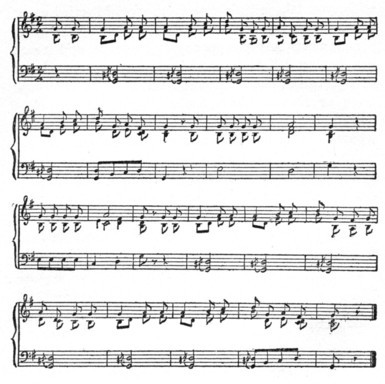
SUR LE PONT D’AVIGNON
Sur le pont d’Avignon,
Tout le mondey danse;
Sur le pont d’Avignon,
Tout le mondey danse en rond,
Les beaux messieurs font comm’ ga,
Et puis encor comm’ ga:
Sur le pont d’Avignon,
Tout le mondey danse, danse
Sur le pont d’Avignon
Tout le mondey danse en rond.
Sur le pont d’Avignon,
Tout le mondey danse, danse;
Sur le pont d’Avignon,
Tout le mondey danse en rond.
Les belles dames font comm’ ga,
Et puis encor comm’ ga:
Sur le pont d’Avignon,
Tout le mondey danse, danse
Sur le pont d’Avignon,
Tout le mondey danse en rond.
Sur le pont d’Avignon,
Tout le mondey danse, danse;
Sur le pont d’Avignon,
Tout le mondey danse en rond,
Et les capucins font comm’ ga,
Et puis encor comm’ ga,
Sur le pont d’Avignon,
Tout le mondey danse, danse
Sur le pont d’Avignon,
Tout le mondey danse en rond.
————
Thereupon Nita danced The Bridge song to the satisfaction of her audience. They applauded and encored until she laughingly consented to treat them to their favourite dances. Many of these were steps invented by Nita to improve upon the old folk dances. When the girl, breathless, finally sat down, the other girls complimented her to her heart’s content.
“I wish we could learn that bridge song and dance it for Miss Miller as a surprise,” suggested Zan.
“Let’s do it!” abetted Elena.
“We ought to complete our carpentry work first,” ventured May.
“We haven’t any extra class studies at home this week so we might carpenter in the afternoons and dance at night,” eagerly said Nita.
“Why not come over to my house at eight and I will have the rugs and furniture moved out of the living-room. Anne and I will be all alone this evening as the others are going out,” added Frances Mason.
“That’s fine! Who can meet at the Masons’ at eight to-night?” called Zan, looking about at the Woodcrafters.
“We surely will—every one of us,” accepted Hilda.
“Well, don’t waste our time making us wait for you. If someone can’t come let her telephone before meeting-time,” advised Anne Mason.
“Hoh! Anne doesn’t know us yet! Catch a Woodcrafter being late when there’s any fun going!” laughed Jane.
Every member was there before eight that night, Eleanor having been notified over the telephone. A merry evening was enjoyed with dancing and singing and most of the girls were sure the French Folk Song could be mastered for a private exhibition on Saturday if they had one more evening’s practise.
“To-morrow is Thursday and some of us are booked to go to those Burton-Holmes Lectures, but we might all meet again on Friday night?” suggested Zan.
“Some of us could meet to-morrow and practise, and then all meet Friday,” added Hilda.
“Where do you want to meet Friday—come to my house,” invited Jane.
As the Huberts had a large house with a splendid living-room, it offered excellent facilities for dancing, so the girls gladly accepted the invitation.
Shortly after nine o’clock Friday night, while the Woodcrafters were cooling off and talking about their successful dancing lesson of the French song, Mrs. Hubert opened the door and peeped in.
“When you finish dancing maybe you’ll come to the kitchen and help me make some fudge?” hinted she.
“We’re all through!” cried Zan, jumping up and running for the door.
“So we are when there’s fudge on the programme,” laughed Elena.
But fudge was not the only candy made that night. As Saturday morning was a “lazy day” for school-girls, they could sleep an hour later than usual. So there was no haste to get home and to bed that night.
“Mrs. Hubert, you always promised to give us the recipe for your fudge—it is so good!” exclaimed Elena.
“Why, I’ll tell you right now, and you can watch me make it, too,” replied Mrs. Hubert.
“Lena, write it down to enter in our Tally,” said Zan.
As Mrs. Hubert itemised the ingredients for Elena to write down, she measured out the quantities for the candy.
“One cup of granulated sugar, one cup of powdered sugar, one and a half cakes of Baker’s chocolate, a lump of butter about the size of a walnut, two-thirds of a cup of milk, and any flavour desired. I shall use vanilla to-night as most girls like that.
“Now I boil the milk and sugar, stirring all the time from when it is first placed over the fire. When it fairly hardens so as to form a ball when dropped in cold water, I remove it from the stove and add the chocolate which must be shaved very fine, or even grated as it is to-night.
“Next I add the vanilla, and the butter last. Quickly then, I beat it until it thickens but it must not sugar. Pour it in buttered tins and when it is partly hardened we can cut it into squares.
“In case any of you do not have powdered sugar in the house you can use granulated but the powdered sugar makes it creamy and there is less danger of crystallising while beating.”
The fudge was made and declared the finest ever tasted.
“Oh, but you girls say that every time I treat you,” laughed Mrs. Hubert.
“It’s true, and that shows how you improve in candy-making every time you cook it for us,” retorted Zan, quickly.
“Which interpreted means: ‘Be sure and give us fudge every time we visit you,’” laughed Mrs. Hubert.
“You’d hear no kick coming from the Woodcrafters,” added Jane.
“Jane! There you go again with your slang! I thought Miss Miller was curing you girls of that pernicious habit,” said Mrs. Hubert.
“We were cured, Mother, but you see our brothers were still ill with the despised complaint and we caught it again, didn’t we Zan?” said Jane, appealing to her competitor in slang.
Zan’s mouth was too full of fudge to reply but she nodded her head vigorously to express her feelings about slang.
“Dear, dear, such girls!” sighed Mrs. Hubert, taking a recipe book from the shelf and turning to a page of candies.
“Girls, shall I show you how to make nougat?” asked she.
Naturally they cried “yes” and Elena prepared to make another entry in the Tally.
“Always blanch the almonds or other nuts to be used. I generally keep some on hand so we won’t have to take time for that work to-night. Now some of you girls skin these nuts and some of you can chop them very fine.
“For the nougat, I melt some powdered sugar, using a dessert-spoonful of lemon juice to every pound of sugar. It takes double the weight of sugar in almonds. We have a pound of sugar, so I use two pounds of chopped nuts. They must be hot before dropping them into the sugar-syrup.
“We ought to have regular nougat moulds like confectioners use, but not having them, I have to take the flat tin we use for ginger-bread. That is why I had you chop the nuts very fine—so that the nougat when it is spread in the tin, can be cut with a knife.
“Into this buttered tin, I press the nougat with the lemon skin until it is all smoothed out flat. Then I quickly cut the bars so they can be broken apart when it is cold. If we had regular moulds we could use the nuts in much larger pieces.”
“I always thought that nougat was a dreadfully hard candy to make, but it is as simple as rolling off a log,” declared Hilda.
“I just love it, don’t you?” said Elena, sniffing the odour that rose from the pan of candy.
“You love any kind of candy. Your mother says you have a ‘sweet tooth,’” laughed Nita.
“I’ll show you how to make one other kind of candy and then it will be time for you to go home. It is ten o’clock now,” said Mrs. Hubert.
“Put a cupful of powdered sugar in a bowl and add about a quarter of a teaspoonful of cream, or at least enough to stir the spoon about in the mixture easily. Be careful not to use too much cream, though, as that will make it run and not cream itself. Now add a teaspoonful of lemon or vanilla. We will use the latter for this cream. Next stir the mixture well until all lumps are worked smooth like a paste.
“Here, Jane, stone these dates but do not break them asunder.
“Now girls, as the dates are stoned, you take enough cream to fill the opening made by the stone. Then you stick the edges of the date together again and roll in powdered sugar. They are then placed on an oiled paper to keep from sticking while drying.”
The creamed dates were soon made and tasted. Some of the Woodcrafters said they needed a much larger taste than a single date offered, and Mrs. Hubert laughed. While the girls were away from the kitchen to find their hats and coats, the hostess divided the candy left and gave each amateur confectioner a package to take home with her.
Saturday with its weekly Council found each girl, except Eleanor, more than elated with the finished article of carpentry work to exhibit at the meeting. Of the entire collection the bead-loom, tabouret, and chest were considered the best.
“I declare, girls, it is marvelous how neatly you have fitted the corners and finished the edges of the work. May’s chest is as pretty and well-made as any I have ever seen. The hinges and clasp are original and hand-made, too, I see. Did you originate the design alone, May?” said the Guide, after admiring the objects placed in a row on the table.
“Yes, and the copper hinges and clasp are cut and hammered out of an old sauce-pan mother threw away a long time ago,” replied pleased May.
“And does the key turn easily?” inquired Miss Miller, lifting the lid of the chest and examining the key-hole carefully.
“I haven’t found a key to fit yet!” laughed May.
Then the Guide’s attention was given to an investigation of the elaborate bead-loom made and decorated by Zan as her contribution to the contest.
“Does it work, Zan?” queried Miss Miller.
“Not unless it is supplied with motive-power!”
“Then you must have tried it out with a bit of your tremendous energy,” retorted the Guide, smiling at the girl’s bright face.
“Not only tried it but finished a strip of bead banding that takes the cake! I have decided to make enough trimming to decorate a new ceremonial costume that will turn every Woodcraft girl green with envy,” bragged Zan.
“That is a boast indeed! Did you include the Tribes of other Woodcrafters in that challenge?”
“Yep, everybody but Elizabeth Remington. She certainly has the loveliest beading I ever saw, but then she has had two years’ designing at the School of Art,” replied Zan.
After many comparisons and due deliberation, it was decided to present May Randall with the prize for that contest. As May was a beginner and the chest was her first piece of work, it won a point above Zan’s loom, which also was a fine piece of work. Both of these objects were excellent bits of cabinet-work and so neatly finished and beautifully decorated that it was a draw. May flushed with happiness when she heard that Zan awarded the prize to her.
“I think the plan of awarding prizes for best work is a good one but we should decide upon the prize before the contest is started each week. What have you for May to-day?” said Miss Miller.
“Well, this week we were going to present the winner a solid gold loving cup but our Wampum Keeper reported a state of bankruptcy so we had to sacrifice our wishes to conform with the exchequer,” said Zan, solemnly, while the girls giggled.
“I suggested that we take a picture of May, so I brought my camera. It can be pasted in the Tally Book and mentioned as the winner of the carpentry contest,” said Elena.
“And I thought the film could be enlarged to a size that will correspond with our cash on hand, and present it to May,” added Hilda.
“If we make a picture each week of the prize-winner and article made it will add greatly to the beauty and interest of the Tally,” ventured the Guide.
“Come on, May, and pose over by the log scenery to have your picture taken,” called Elena, starting for the Council Ring.
“Oh wait, Lena! Don’t let’s have an indoor picture. It will look so much better if posed out-doors,” cried Nita.
“Let’s go over to the fence-corner next to our back yard where the group of pines will make a pretty back-ground,” suggested Frances Mason.
“That’s fine! And we’ll stand May on some of our logs and have her look happy while holding her chest!” exclaimed Anne.
“When folks see May holding her chest in the picture, they’ll think she had a bad cold,” came from Zan, quickly.
Everyone laughed but Anne added: “Oh, you old tease, you know what I meant.”
“All right, come on and show us what you meant!”
“I wish to goodness we had a ceremonial costume here to dress May and do the picture up in a truly artistic manner,” sighed Elena.
“Hilda and May are about the same size—why not run Hilda home to get hers?” suggested Jane.
“It won’t take more’n ten minutes, Hilda, if you jump on a trolley!” added Nita, when Hilda frowned down the proposition.
A honking from an automobile horn was heard just then, and Zan jumped up to run to the door, saying: “Sounds like your machine, Jenny!”
“If it should be Jack, he could drive Hilda over for the dress,” replied Jane.
Before Zan reached the door of the gymnasium, however, the tousled head of Fiji Baker appeared at the opening and he called out ingratiatingly: “Don’t stop the show for me; ‘let joy be unconfined’ as I just dropped in for a second to see Miss Miller. Jack is out front tying the bouquets we wish to throw at the famous dancer!”
Nita laughed for she had confided in the boys and told them about the new dance scheduled for that Council Meeting.
“Oh, Fiji, you came in answer to our prayers, I’m sure. We need someone to hustle Hilda over home for a most important package she forgot, and now Jack can fly while you talk with Miss Miller,” explained Zan, pushing Hilda towards the door as she spoke.
“You’ll win a coup on this for ‘first aid,’” said Jane to Fiji.
But Fiji paid no attention as he was deeply concerned over some secret he was whispering to the Guide. Meantime Hilda was urged to order Jack to drive as fast as he dared so she could be back with the costume before the sun went down.
Before Fiji and Miss Miller had finished their engrossing conversation, Hilda returned and the girls adjourned to the scenic-screen-room to dress the prize-winner in a befitting costume.
May was posed first in one attitude, then in another, till everyone had satisfied her artistic sense of the picture to be, and perhaps they would all have had another trial had not May sighed, and cried:
“I’ll be so glad when you really click that trigger! This box grows heavier and heavier every minute. I’m sure it weighs a ton by this time.”
Several snap-shots were taken and May placed the “ton” prize-winner on the ground and stretched her arms. Then the Woodcrafters filed back to the gymnasium, where Miss Miller explained the reason of Fiji’s visit.
“Doctor Baker invites the Band to join the boys in a week-end camp near-by the city. Fiji said he and the other boys have been scouting about for some days trying to find just the right kind of a site where girls would be comfortable.” Miss Miller paused here to allow the announcement to sink in.
“Huh! I guess Dad wants our Band to act as sort of a brake on those boys’ speed,” commented Zan, nevertheless pleased at the invitation.
“Won’t it be fun?” cried Jane.
“Where will it be, Miss Miller?” asked Nita.
“Why, Fiji says they have found a wonderful place on the sea-side of Staten Island. ‘The woods almost meet the beach,’ he said.”
“Oh, can’t we try that aqua-planing Elizabeth Remington told us of?” eagerly questioned Zan.
“We haven’t any to try with,” replied Jane.
“Fred Remington told Fiji the other day that it was the easiest thing to make. Just one, two, three! and it is done!” declared Zan, snapping her fingers with each count.
“I have it! Let’s invite Elizabeth to join us in camp and then add, as an after-thought, how nice it would be if she brought her plane,” exclaimed Nita, showing that there were still some undestroyed self-motives in her character.
“Even so, there wouldn’t be any motive-power unless Zan supplied some of her boundless energy,” laughed the Guide.
“It won’t work in deep water, Miss Miller,” retorted Zan.
“If Elizabeth is invited for the plane why not ask Fred and Billy for their launch?” now suggested Jane.
“Sure enough! You tell Jack to, will you?” chorused some of the girls.
After a lively Council Meeting, the Woodcrafters started eagerly homeward for they were anticipating the camp and wanted to hear what the boys had to say about the plane and launch.
But it happened that Fiji and Jack had already thought of the launch and had invited Fred and his younger brother before the girls spoke of it. The plane was another matter and they agreed to see Elizabeth about joining them.
The campers intended starting for the trip immediately after school on Friday afternoon. Three automobiles—the Bakers’, Huberts’, and Remingtons’—would carry them and their luggage to the place selected. Fred, Billy, and Bob Baker would go in the launch, while Fiji and Jack planned to paddle their canoe around the Island to the beach where the camp was to be.
The canoe owned by the two boys was kept on the lake in Branch Brook Park when the boys were in the city, but during their vacations they usually took it with them. It now had to be transported across the city to the Passaic River. Here the boys arranged to meet the express-man and sail it from that point to Staten Island Sound, thence to the sea-beach-shore of the Island.
Fred Remington planned to sail the launch along the same route but he would start later in the day. The canoemen would start in the morning if clear. The girls in the cars would leave directly after school in the afternoon, and all expected to meet about the same time on the woodland site chosen by the boys.
The days preceding Friday afternoon were an anxious time for the Woodcrafters for they feared it might rain yet hoped that the weather would be glorious.
The camera picture of May and the chest was developed and printed and proved to be a great success. It was named “The Prize-winner,” and the film was sent away to be enlarged. Meantime, the Woodcraft Chest had been left on Miss Miller’s table in the gymnasium as she wished to show it to the scholars who were becoming interested in Woodcraft.
Tuesday afternoon, when she wished to lock the chest in her private closet, it was not to be found. She sought everywhere, asked the janitor, and telephoned the girls, but no one had seen or heard a thing about it.
Miss Miller worried herself ill over the loss, not so much because of the value of the chest but because it proved there was a dishonest scholar in that school! May was heart-broken too, as it was her first accomplishment in Woodcraft and she was so proud of it, that she had invited all her friends to be sure and call to see it as soon as it was home in her possession. And now it might never be heard from again!
CHAPTER SIX—THE LOST CAMPERS
In spite of pessimistic prognostications about the weather, Friday came and it was a perfect Autumn day. Fiji Baker and Jack Hubert were up at day-break as their express-man carted the canoe from the Park that early so it would not interfere with his regular calls and cartage for the day.
Fred and his crew started at noon in their launch, and at three o’clock the merry Woodcrafters stood about the gymnasium door waiting for the three automobiles which would have the luggage and other equipment packed in them before stopping for the girls.
While waiting, Nita showed the girls a new Flower and Butterfly dance she had invented. It was most graceful and the girls applauded heartily. Miss Miller smiled as she said:
“Nita, there is no use in trying to train you for aught else than a dancing flower in a wandering breeze, or a charming little humming-bird that lightly caresses every blossom in passing.”
“Miss Miller should have a coup for spontaneous poetry,” laughed Nita, well-pleased at the Guide’s sincere praise.
“Yes, the Tribe must hand it to its Guide for finding something religious or poetical in any prosaic thing she finds. Not that Nita is prosaic by any means, but there have been times when Miss Miller’s muse has been inspired with nothing more to base its flight upon than an ordinary dust-cloth or common potato!” laughed Zan.
The sound of approaching automobiles caused poesy and dancing to end and soon the girls were gayly seated in the cars. Such chattering and laughter as sounded from the passengers as the machines sped swiftly cross-town and reached the ferry where they had to take the boat to reach Staten Island!
“Miss Miller,” asked Anne Mason, as they waited for a ferry-boat to dock, “can we new members start to collect flowers and do some tree lessons, or birds and star knowing, to catch up with your five founders of the Band?”
“Yes, you can, but why not leave those studies and do them at odd times when the older members have other things to do? We might all work together at this camp to find many interesting things to start new collections. For instance, the shells and other marine objects.”
“I never thought of that,” replied Anne.
“The new members are so anxious to have individual Tally Books, you see, Miss Miller,” explained Zan, “and they haven’t any pressed flowers or blue prints or other things to record as we have in ours.”
“If only you would wait until we catch up with you,” sighed May Randall.
“You can soon do that, girls, by using every spare moment when not otherwise engaged, to learn about the stars, find flowers and insects, and study trees and Nature in the Park. Then we can witness and sign your honour claims at a Council,” added the Guide.
“You new girls haven’t made your Tallies yet,” said Hilda.
“That is one of the things we want you to tell us about,” said Frances Mason.
“I think I have enough pieces of tanned leather to give each girl a cover,” now offered Zan.
“And we have enough thong and beads to bind the books and tie the pages,” added Elena.
“Then the girls ought to buy the page paper and make their Tallies at once, so everything can be entered in proper order,” advised the Guide.
“Miss Miller, maybe we can try for the degree of canoeman while we camp near the water,” ventured Jane.
Miss Miller said nothing to this but smiled and shook her head. She wondered if the girls understood the experience necessary before winning a degree of that kind.
Jim, the Bakers’ chauffeur, and Alfred, the Remingtons’ chauffeur, had each been given concise directions how to find the camp-site. Bob had drawn a road-map for Jim, and Fred had sketched a rough plan of where to turn. So Jim led the three cars as they left the ferry.
After travelling several miles, he consulted Bob’s map.
“I don’t seem to quite get this clear! Master Bob’s got here ‘Good woodland road,’ but all I can find is this swamp and that wood-cutters’ trail on the far side!” said Jim.
The other two cars came up, and Alfred said: “Can you make head or tail out of the map, Jim?”
“I was jus’ sayin’ that Master Bob must have been dreamin’ about this ‘good woodland road,’” returned Jim.
“Let’s take this road—it looks fine—and see if we come to a woodland road further on,” suggested Miss Miller.
So the opposite direction was taken, hoping they might find the good road mentioned on the map. After riding for twenty minutes more, the chauffeurs suddenly found the sign-post marked on both maps.
“Now ain’t that funny! It’s the post all right, but we never came by that woodland road!” declared Jim.
“Let’s be thankful we found one land-mark they put down for us to follow!” grumbled Alfred, where-upon everyone laughed.
In vain did they seek for other land-marks or objects to correspond to those marked on the maps. They found good roads but nothing to lead them to believe they were following directions. Finally, as they all halted for another conference, Alfred stood up and looked about. He scratched his head back of the ear as if in a quandary.
“Let’s hear it, Alfred,” laughed Elizabeth.
“Well, I was thinkin’! Your maw came this very road last Spring when she camped her Tribe on Decoration Day. Why not go this way and trust to luck to bring us to the boys’ camp?”
“It would be all right for us but what about the boys?” asked Zan.
“They have to pass by your site on their way up the shore and you can hail them,” suggested Jim.
“It’s growing late, girls, and we have to pitch tents, get ready to cook supper, and lots of other work,” warned the Guide.
“Then let’s follow Alfred’s advice and take a chance on finding the boys,” agreed Elizabeth.
As they started again to cross the Island to find the camping place Mrs. Remington had used that Spring Elizabeth told them what a Paradise it was. Woods, beach, cliff for diving, spring of fine water, and everything a Woodcrafter could wish for.
Finally Alfred turned in on the hard sandy beach and in a short time stopped by a small promontory of sand that ran out like a finger into the sea. On top of this cliff and as far back as one could see, were the woods, with a clearing in the foreground that Alfred said had been used for the tents when Mrs. Remington camped there.
The Woodcrafters exclaimed in surprise at the place that seemed made to order for them, and Zan added: “Fiji’s discovery can’t be better than this!”
The chauffeurs helped carry the outfits to the clearing on top of the cliff, and when all was done, Alfred said: “I ought to be goin’, Miss ’Lizabeth, ’cause your father comes in on that six o’clock train, you know, and it takes a full hour to get there from here!”
“Oh, it can’t be five o’clock yet, Alfred,” cried Elizabeth, surprised.
“It is five of five,” replied Miss Miller, consulting her watch.
“Good gracious! Where are those boys?” cried Zan.
“We surely must be at the wrong site, but we will remain where we are for to-night, anyway,” added Jane.
“Jim, if Fiji ’phones home to ask where we are try and direct him how to find us, will you?” said Zan.
Shortly after the automobiles left, Elizabeth spied a fleck of white out on the water, and with her experienced eye saw it bob up and down.
“Zan, bring the glasses! I’m sure I see the white launch,” cried she, keeping her eye on the distant spot.
“Where? I can’t see a thing but some white-caps,” said Zan, handing the glasses to Elizabeth.
“That’s because you never spent your Summers on an Island off the Maine coast like I have,” laughed the girl, focussing the glasses.
“It’s Fred and his crew, all right!” cried Elizabeth, passing the glasses to Zan.
“Oh yes, I can see them now, but aren’t they going very slow for a motor launch?” called Zan.
“Maybe something broke down and they can’t get in,” said Eleanor Wilbur, who had been more than pleasant and obliging all that week.
“No, they are labouring against wind and tides, I guess,” remarked Elizabeth, who was busy with a long strip of linen which happened to be packed with the stores when Mrs. Remington made up the hamper.
“What are you doing?” asked one of the girls.
“I’m using this linen Mother sent for bandages if we had to use them, for a signal flag. I’ll stick it out on that dead pine tree on the cliff and Fred will surely see it.”
“And we might build a smoke-fire,” suggested Zan.
“Yes, do that. Then we can signal them that we are lost,” chuckled Jane, running to gather red pine bark.
Finally, the steam whistle on the launch signalled that the boys had seen the smoke and flag, and later the launch beached where it made a good landing-place.
The girls helped the sailors transport their luggage from the launch to the clearing on the cliff, and Zan remarked: “I see you brought the aqua-plane.”
“Bet your life! Betsy would have sent us back for it had we forgotten to bring it,” laughed Fred, as he climbed the sandy side of the cliff.
Once on top where he found the Guide and other girls making camp, he said: “Where are the other boys? Fishing?”
“No, we never met each other as planned. I think they are camping at some other spot,” said Zan.
“They’ll hunt us up quick enough when it’s time for supper. You see we brought the hampers,” laughed Jane.
Fred looked serious, however. “We had a dreadful time rounding the Island where the sea sweeps in through the Narrows. It was all we could do to stem the current. Even as it was, we had to go way out of our road to avoid the swift tide.”
“You don’t think anything could have happened to them, do you?” cried Zan, anxiously.
“I shouldn’t wonder but what they have been over-turned,” now added Eleanor, with her pessimistic propensity.
“Not that at all, girls, only they may have been swept so far out of their course that paddles couldn’t help them along very fast. Then they may have to camp wherever they are,” said Fred.
“All the same, you know as well as I do, that lots of folks are drowned off this shore—’specially boys. You can read about a death that way every day!” persisted Eleanor.
“Then they didn’t know how to swim like Fiji and Jack do. Why, they’re regular water-rats!” replied Fred, optimistically.
“Swimming won’t help much if they have cramps! That sinks you like lead!” countered Eleanor again.
Miss Miller heard the whole conversation and also saw Zan and Jane turn pale when they first thought of danger to their brothers. Until this time they thought it a great joke that they had found such a fine site and were camping with all the foodstuff.
At Eleanor’s first exclamation the Guide had frowned, for her religion was one of practical common sense and cheerful optimism. She looked about for something to interest the girls and, at the same time, stop Eleanor from talking, so when she heard the last rejoinder to Fred’s attempts at encouraging Zan and Jane, she called to Eleanor:
“Will you help me unpack these hampers, while the other girls gather fire-wood? Zan, suppose Jane and you keep the signal fires burning on that cliff’s edge. The boys will see the smoke if they are near here.”
Eleanor walked slowly over to Miss Miller, frowning as she went. But the Guide failed to notice it as she was busy with the camp dishes and pans.
“Will you put these bags of groceries over in the box that stands in my tent?” asked the Guide, holding up the paper bags.
“Why must I play kitchen-mechanic while all the other girls are having a good time in the woods?” complained Eleanor.
At the words and tone, the Guide looked up amazed.
“Good gracious, I thought you would prefer to do this to stooping and collecting old wood,” said she, vexed at the girl.
“You take particular pains to make me do the unpleasant things, I notice. Now, when I was trying to prepare Zan and Jane for the worst, you called me to get me away from them. Don’t I know?” sneered Eleanor, loftily.
“Woodcrafters never prepare for the worst! It is our rule to always wait for the best and let the worst take care of itself!” declared Miss Miller, wondering what under the sun she was to do with this undesirable character.
“Oh! you are so preachy! One never takes a turn but you have a lecture ready—generally on this Woodcraft!” cried Eleanor impatiently. “The other girls flatter you by calling it ‘poesy’ and artistic temperament, but I call ‘a spade a spade’!”
“Do you?” queried Miss Miller, suddenly making up her mind what to do. “Then you won’t object if I ‘take the bull by the horns’—another old saying!”
“You may take anything by his horns if you choose, it won’t concern me in the least!” said Eleanor, disdainfully, as well as significantly.
“Then sit down right where you are!” ordered Miss Miller with a determined manner that made Eleanor glance at her in wonderment.
“Sit down, I said!”
“Why should I obey you?” questioned Eleanor, stubbornly.
“Because I am in command of this camp and what I say goes without questioning. Either do as I bid you or take your bag and start for home at once!”
“Wh—h—y! You couldn’t do that!” gasped Eleanor.
“We can oust you from camp and send you away but it is up to you whether you return home or hang about the woods.”
Eleanor had never camped before and it was a new experience she had looked forward to because of the joys claimed by the other Woodcrafters. But to wander in the woods alone in the dark was quite a foreign plan to the one she had anticipated. She was hungry, too, and being sent away at once meant going without supper. She glanced from the corners of her eyes to see just how far Miss Miller might carry out her threat, but the Guide was watching her with a stern expression.
Eleanor, not knowing what to do at the moment, sat down to gain time. Miss Miller, who feared she might weaken in her sudden and unprecedented manner of severity, immediately spoke.
“I have watched you most carefully for the past two weeks and I have seen things you never dreamed of! Now, I am going to have it out with you!”
At this, Eleanor went white and trembled. She cowered as if she expected a blow, but she refused to look at the Guide.
“You will remember a threat you made to May Randall the day you stopped to see how the girls were progressing with their work?” asked Miss Miller, referring to the lack of interest the girl displayed in carpentry and the unkind words she used to May.
“Oh for goodness’ sake don’t say a word about that old chest! I wish to goodness I had never seen May Randall and her Woodcraft box!” cried Eleanor, as if driven to desperation.
Miss Miller was as surprised now as the girl had been a few moments before, but she rallied much quicker than the guilty one. The truth flashed over her quick mind and she changed her query accordingly.
“It is a pity that you ever gave in to temptation. You certainly can’t blame your covert acts on May or any other being. The evil we do is absolutely our own fault, for every man is a free agent to choose what he will do. Sometimes it is fear or cowardice that drives one to do an evil deed but it is the downright criminal that obeys an evil idea or plan, knowing he is doing a thing that condemns him to the world and in his own estimation, too.”
“Well, what do you want to do about it? Did you call me over here to tell me what you thought of me? Why didn’t you do it before to-day, then I wouldn’t have come?” cried Eleanor, still defiantly.
“I hadn’t the least idea of speaking to you about May’s chest until you brought it upon yourself. I was going to mention something entirely different until you compelled me to say what I did just now.”
“And you kept this secret all to yourself this week?” cried Eleanor, looking at Miss Miller with a kindlier expression.
“Eleanor,” said the Guide, catching at that tiny hope of softening the stubborn girl, “I do not think another member in the Band dreams that you had anything to do with the missing chest, and I do not think anyone but you and I suspects the truth.”
“And you let me come with the Tribe knowing this about me?” Eleanor’s gaze dropped to the ground and she sat thinking.
According to Miss Miller’s code, when one began to think earnestly over anything, or tried introspection of one’s self, it was a symptom of recovery, even though there might be a long siege of diseased conditions before perfect health was attained. So she remained silent waiting for Eleanor to think some more.
“You’re either mighty fair to me or you’re keeping this thing quiet for fear others will hear of it and so belittle your influence with the girls,” finally declared Eleanor.
“Don’t you think you are judging unfairly, after you just said ‘I was fair’? Why should I hesitate to make you resign from our Tribe for doing a dastardly trick with May’s box? No one but you and I would ever know the truth about it, and I’m sure you wouldn’t mention it to anyone, because you are heartily ashamed of the deed. If I was afraid of others’ opinions about my Band of Girls, I would make you resign before any other tricks were perpetrated by you. But I am fair and I want to see you make good, now that you have this Woodcraft opportunity, hence I am talking to you instead of sending you away.”
“Then, all I can say, is, that you’re all right!” declared Eleanor. But in another second she felt suspicious again.
“I suppose, now that I’ve admitted the deed, you’ll have me up for a public reprimand. It goes with a teacher’s ideals of training!”
The Guide could not but admire the girl’s quick mental powers and thought what a wonderful woman she would make if her character and mind were but trained properly instead of along the lines of this present example.
“I thought we might arrange it this way, if I had your word of honour that you would work hard to destroy the ‘little foxes that destroy the vines’; you can replace the chest by leaving it at my home, or send it by messenger to the gymnasium Monday noon. I will put it in the closet and send a note to May saying that the box was found but the conditions for return were that no questions were to be asked. At the same time I expect you to volunteer the information, thus clearing the school children.”
Eleanor sat glowering at the Guide for full three minutes as if to read her true reasons for this leniency, but Miss Miller understood enough of psychology to realise that this was the great crisis. In that interchange of heart-readings, Eleanor saw only truth and loving sympathy shine from the woman’s eyes, and Miss Miller saw the adamant of wilfulness break ever so little.
The Guide knew that just so much love and forbearance as she really felt in her innermost heart for this misled girl, just so much could she influence and lift her at this crucial time. So she prayed, oh, so fervently, to the Great Spirit for help and light to do exactly the right thing. And that silent prayer must have been the glorified light that shone from her eyes for it led Eleanor to melt as she had never melted before. She leaned her head over on the grass and wept bitterly.
Miss Miller rose and left the repentant girl alone, while she noisily busied herself with the pots and pans. She knew that not words or pity but silent calling upon Omnipotence for strength and faith would be the balm that would help and heal this weak reed swayed by evil’s suggestions.
As the Guide washed some potatoes she said to herself in a low murmur: “Lead us not into temptation but deliver us from evil—for Thine is the Power!”
Then: “Miss Miller,” sounded a weak little voice at her side, “shall I wipe the dishes with a clean towel?”
“Yes, dear, I wish you would.”
And that was all.
“Guess what we found, Miss Miller?” called a chorus of voices, as the fire-gatherers returned with armfuls of dry wood.
“Mushrooms?”
“Wh—hy, who told you?” cried the girls, looking about for the messenger.
“That little bird just flew by and whispered it in my ear,” laughed Miss Miller, pointing to a great sea-gull that hovered over their heads.
Everyone laughed and Jane added: “Yes, mushrooms but not enough for all. If we only had a steak they would make a fine sauce.”
“Oh gee! That reminds me I forgot my donation to the party!” cried Bob Baker, springing up from the grass where he had thrown himself, and running down to the launch.
“Bob trawled all the way and caught some pretty good sized fish. I thought all decent sized fish were driven out of these waters by the traffic and pollution from sewers, but I was mistaken,” explained Fred, watching Bob run back with his catch.
“Now we can use the mushrooms!” cried Zan.
“Fred, why don’t you cook the fish the way father taught us on Sunset Island?” asked Elizabeth.
“Just as Miss Miller says,” replied Fred, looking at the Guide.
“Miss Miller says cook the whole supper if you like, then we can take a swim. You boys have had your dip, you know,” laughed she.
“Now, how did you know that? We boys said we wouldn’t let you know it!” cried Bob.
“Really, you are uncanny, Miss Miller,” added Fred.
“Anyone could tell Bob had been in, from his damp curly pate, and Billy still has the brine sticking up about his scalp. If I should need any further evidence I might say that one of the younger boys put on Fred’s socks by mistake, or else he made a blunder when he mentioned his size to the clerk who sold them,” said the Guide, smiling.
Everyone glanced at Billy’s feet, and lo! the socks were hanging loosely down over his shoes, several sizes too large for him, while Fred’s turned-up white trousers showed socks so tight that they stopped the circulation at the top, but the tops only reached to the place where his shoes ended.
A peal of laughter rang out and echoed through the woods at the sight the three surprised boys made, and Zan said:
“Just for that, you have to cook supper while we take a dip!”
“We’re game. Not because we took a swim before we got here, but because you’ve got such an all-round fine clairvoyant!” laughed Fred, looking at Miss Miller with admiration.
“Shall we wait supper for Fiji and Jack?” asked Bob.
“They’ll be given something should they come straggling in late, but I firmly believe they went to their own camp-site and are now pitying us for not having found them,” said Miss Miller.
“And you can leave it to Jack to have something to eat! He never takes a chance on going without a square meal!” added Jane.
“We’ll keep the signal-fire going all night and when it is dark they can see it and get their bearings for us in the morning,” suggested Fred.
So the girls ran to their tents to hurry into bathing suits and take a swim before the call came for supper.
CHAPTER SEVEN—CAMPING SPORTS OF A WEEK-END
“Come ahead, boys, clean the fish and get them ready for me to cook,” called Fred, starting to dig a hole in the ground about twice the size of the fish. This he thickly lined with large sized shore pebbles which had been well washed. On top of these stones he built a good fire until it thoroughly heated the stones to a white heat.
Meantime Bob and Billy cleaned and washed the fish, then placed a thick strip of bacon inside each one. They salted, peppered, and floured the fish ready to cook.
When the fire-pit was ready, Fred raked out the cinders and put a layer of clean grass on top of the red-hot stones. He laid out the fish on this and covered them with a layer of the grass, and on top of this he spread a thin layer of sand. Then he piled in the glowing cinders and kept the fire burning fiercely on top of Nature’s sauce-pan.
The Guide returned from her bath while the fish were cooking and expressed deep interest in the new method of cooking she saw demonstrated before her. Fred explained how he built the oven and a note was made to enter the splendid idea in the Tribe’s Tally.
“Are the fish most done?” asked Elizabeth, sniffing for an odour of the cooking.
“Be ready about the same time the rest of the supper is,” replied Fred.
“That’s a new kind of a pot-hanger, Miss Miller,” said Zan, pointing to the sapling Fred had rigged up.
“I’ll tell you girls just how I made this fire-place,” offered he. “Large stones are so plentiful about here, so I took some flat ones and built the fire inside the narrow aperture made by laying the stones in two rows parallel to each other. The sauce-pans stand close over the fire and are quite firm on these flat stones, and the building does not take as long to complete as a log fire-place.
“These two green logs were found by Billy, and you can see for yourselves that the angle they make as placed, provides a resting place for various sized pots—small to large—the large ones setting on the widest opening of the angle. The fire built between the logs is easily kept clean by raking out the dead ash from the widest opening.
“Now this is a good form of pot-hanger where you want a kettle to hang directly over a fire. I found a good sapling that had a well-defined notch made by two branches. These I cut down to about three inches in length. The bottom of the sapling I trimmed to a point to drive into the ground the right distance I wanted.
“Then I trimmed another forked sapling similar to the first but much longer. This I fitted into the crotch of the upright stick, with the forked end directly over the fire, and the opposite end held firmly to the ground by means of a stump or flat stone. You see, this forked device of the end over the fire keeps the handle of the pot from slipping off, and the long end held to the ground by a weight gives the kettle enough swing to resist any extra contents.
“While you’re all here seeing me do it, let me tell you a fine stunt if the weather is bad and tents are damp, or cots cold and uncomfortable,” added Fred, as he concluded his talk on pot-hangers. “When you are through cooking dinner, you can take these red-hot fire-stones by means of a stout stick and a dishpan, and carry them to the tent. In a short time, the heat rising from the stones will dry the atmosphere. If the cots are damp and cold, place the pan of hot stones under the bed and they will soon dry and be warm as toast all night. If you want the temperature of the tent to keep warm all night, place a layer of moss or grass over the stones. The rock will retain its heat for hours after removing it from the fire.”
“Well! If Fred Remington doesn’t know everything!” sighed Elena, admiringly.
“I wish you were a member of our Tribe,” added Zan.
“Who wouldn’t be an expert Woodcrafter with such a mother! Why, she was an enthusiastic worker in the plan long before a regular League started. Besides, we spend our Summers on the Island in Maine, and what we don’t know from camping at home we ferret out from the farmers and fishermen on the Coast. My uncles own the neighbouring islands to ours and they enjoy out-door life, too. So we all have a good time experimenting with new ideas and remembering the good ones for future use,” explained Fred, eagerly.
“Fred knows so much about camping and cooking because he won a degree for Camp Cook. Besides, he and his Tribe go hiking and camping every Saturday and Fred has charge of the party. I am working for the degree this year, and I’m sure I shall win it,” said Elizabeth, who was cooking a concoction she wished to try out.
“It behooves Wako Tribe to keep on friendly terms with you, Elizabeth,” remarked the Guide, smiling at Zan.
“Oh, we found that out long ago, Miss Miller,” retorted the Chief.
“What is that stuff you are fixing, Betsy? It smells awful good,” asked Hilda, sniffing at the steam that rose from the pot Elizabeth was using for her brew.
“I call it ‘hastychowder’ and it is made this way, in case you girls want to try it sometime: To one can of corn, take four cups of potatoes cut into small dice, two ounces of salt pork, also cut fine, a small onion, and about four ounces of crackers. Fry the pork and onions brown and then add the corn and potatoes. Cover this with water and cook until the vegetables are soft. Then add the milk and some salt, and lastly the crackers. If the crackers are soaked in milk for a time before using, I think it makes the chowder better.”
“Well, whatever you call it or cook it, it smells mighty good to me,” said Jane.
“Girls, I wanted to have plain cooked rice with the fish, but how can I cook it when every pot and place is in use?” asked the Guide, looking at the array of pans and pots all holding food.
“Ha! You’d make a poor tenderfoot if you were lost on the mountains with no outfit!” laughed Fred.
“What would you do in that case?” asked the Guide.
“Watch me! May I have a bit of this birch bark the girls brought back with them from the woods?” asked Fred.
“Help yourself,” replied Zan.
Fred quickly selected a strip of bark about ten inches wide. This he folded end to end to form a round tube. The edges were stitched with wire-grass. Then he sewed a bottom on one end and it represented a bark pail. Next he plastered clay on the outside seams, and rubbed some gum from a wild cherry tree on the seams of the inside, saying: “If we had time to let the clay dry I wouldn’t use the gum on the inside, but now I need to make it water-proof.”
Then he filled this vessel with water and selected two red-hot stones of a smaller size than the others, and dropped them in the water. Instantly, the water began boiling and the rice, which Miss Miller had washed, was poured into the vessel and a cover placed over the top.
“When our dinner is ready, the rice will be steamed, too,” said Fred, placing the bark vessel on a flat stone near the fire-place.
“Well I never!” ejaculated some of the girls, while Elena hastily sketched the birch-bark holder and wrote down the rules for manufacturing it.
“Now girls, lay the cloth and have the dishes ready for the chowder,” called Elizabeth, tasting the liquid from the tip of a spoon.
“I wish those two boys were here to enjoy this scrumptious meal,” said Jane, sighing as she thought of their loss.
The chowder was dished up and eaten with sounds of many smacks and “Ahs!” Then the fish were removed from the oven and as the aroma of the flaky and sweet meat reached the nostrils of the Woodcrafters, a chorus of “Um’s!” echoed about the camp-circle.
Every morsel of that supper vanished like ice in the July sunshine and was declared the best ever tasted by the campers. The gray of evening crept over sky and sea and earth as the Woodcrafters sat about the dying embers of the camp-fire hoping for a call or signal from the two boys, which would warn them of their approach. But in spite of the torch Fred kept burning on the Cliff, nothing was heard or seen from the wanderers.
Eleanor had been very quiet and meek since her confession to the Guide, but old ingrained habits are not thrown off in one moment of repentance. When Fred returned from the Cliff with the report that he saw no sign of a fire or signal, she remarked:
“Well, you said the current was dreadfully strong just around the end of the Island. Maybe they couldn’t make it and are being carried out to sea in the canoe.”
“Oh no, they’re all right,” assured Fred, glancing at Zan and Jane.
“But they may have lost the paddles, or a dozen of any many things may have happened. Boys are always careless with an open boat,” persisted Eleanor.
“Miss Miller, we’ll put an end to this dread by going to the nearest telephone station. If the boys think we’re lost they will ’phone home sometime before morning, and then they can tell them where we are. If they have already ’phoned we will find out and rest easier for the news,” said Fred, pulling Bob up from his lounge by the fire.
“It’s too dark to see where we’re going,” grumbled Bob, who had enjoyed the chowder and fish overmuch.
“Not when my lanterns are ready. Watch me,” said Fred, picking up the two empty tins left from the corn, and slitting a hole in the side of each. The lid-ends were bent back and a candle fitted in the openings, then the jagged ends were pressed back into the tallow. The one end of the can was cut out entirely and the opposite end which had been cut open to remove the corn was bent back on the small piece of tin uncut and used as a handle for the impromptu lanterns.
Enough light reflected from the shiny tin of the inside cans to show the boys where to walk, and they started off on the hazard of finding a house or village where they could use a telephone.
“Let’s study the stars while they are gone. Who can tell us a new story or find the old planets?” suggested Zan.
So the time passed quickly until the campers heard a whoop from the woods and saw the flickering of the two lights as the boys approached the fire.
“What did you find out?” cried Jane and Zan, as they jumped up from the grass to run and meet the messengers.
“Good joke on Jack and Fiji! They just telephoned a few minutes before we did. They were wondering what had happened to you girls. They said that Bob knew well enough where to go as he saw the tree blazed as a sign for you,” said Fred.
“So I did, but the day we came over to hunt up a site, we were in the auto and to-day I came by boat, so it looked very different. Besides, both places look alike as far as woods and beach and sandy cliff go,” responded Bob.
“Did they say they would look us up to-night?” asked Zan.
“They haven’t the slightest idea where to find us in the dark, so they will remain at the camp where they are and pick us up in the morning,” explained Fred.
“Well, thank goodness, we know they are safe and sound, although I felt sure they were, right along,” sighed Jane.
“Yes, indeed, two athletic boys like Fiji and Jack would be all right,” added Eleanor, really believing her own words—such is the changeableness of a dual nature.
The tired Woodcrafters then retired and sighed as they stretched out weary bones on the cots or under the stars on soft pine beds.
“Gee! This is the life!” chuckled Bob, as he bounced up and down on the springy spruce-tip bed.
“Guess the midgets haven’t reached you yet!” grumbled Billy, as he slapped viciously at an unseen plague.
Then Fred began slapping and whipping the air, and finally Bob felt the mosquitoes and midgets bite, until all three boys jumped up again and began building a smudge fire.
“Oh boys! If you would only come over to our camp and help us build a smoke like yours! We can’t sleep a wink!” cried Zan.
Fred and his helpers soon had a number of small smudge fires burning about the tents and the girls thanked them sincerely as they felt relief from the pesky insects that make camping a trial.
The gay carolling of a few late birds woke the campers, and Miss Miller was soon out ready to start breakfast. The others all declared for a morning dip, and were soon splashing and playing in the surf. The boys preferred to go in later, however, and take the morning hour before breakfast to catch some fish.
“Maybe we’ll get enough for breakfast and dinner, too!” said Bob.
By the time the girls were dressed, the boys returned to land with three goodly sized fish and the news that they had spied a smoke rising from a campfire some two miles down the shore.
“It’s Fiji and Jack—I wish we could surprise them at breakfast,” laughed Zan.
“I have an idea!” ventured Bob. “Right after breakfast, let’s take as many as can get in the launch and start down the coast; the others can hike through the woods and meet us there. On the way back we will make the others ride home and the first batch walk.”
“I’ll ride the aqua-plane,” offered Elizabeth.
“Why don’t you let some of the other girls do that?” asked Fred.
“They don’t know how.”
“But it isn’t hard to learn. I can show them how to balance in a few trials. Do you want to try after breakfast, Zan?” returned Fred.
“Oh, I’d love it!” cried Zan.
So breakfast was quickly disposed of because the girls anticipated great sport with the plane. Billy was detailed to steer the launch while Fred showed the girls how to balance and guide the ropes to make the aqua-plane skim lightly over the waves.
After many upsets and great shouting and excitement, the girls could manage the plane quite well. Then as the young engineer increased the speed of the launch and the plane fairly flew over the water, the riders felt as if they were aviators, the sense of the rest for their feet disappearing in the dizzy pace with which they sped over the surf.
“I thought you folks wanted to hunt up the lost boys?” called Miss Miller, when she thought the girls had had enough of the drenching sport for that morning.
“So we will, now that we can take turns on the plane as we go alongshore,” called back Zan.
“We’ll have to draw lots for the pleasure—there are too many here to ride on the way down,” said Fred.
The lot was chosen by having each girl draw a blade of grass from the Guide’s hand. The shortest piece would win. It fell to Elizabeth, and the other girls all said it was a reward for her sacrifice of enjoying the fun while the others were practising.
The girls who were to hike were just ready to start out when a canoe shot around the point of the promontory and a voice bawled out:
“Well, I must say! A lot of fine friends Jack and I have!”
“I must say! You’re a nice host to lead a lot of
“Don’t tell me you never knew that! Why, everyone knows that a clam swims in with the tide and burrows down in the wet sand to sleep. If you walk over its little mound it spurts water up like a geyser,” returned Zan.
“Come on, girls, let’s make ’em spurt!” urged Billy, who was very fond of all sports, fishing included.
The launch and aqua-plane were drawn up on the beach and soon sixteen busy clam-diggers were bending over, laughing, and calling to each other, at every clam discovered. It was great fun.
After half an hour of this pastime, the Guide asked Zan and Hilda to go with her and build a fire and prepare the kettle for the chowder. But they had scarcely completed the laying of the fire-wood when Eleanor joined them.
“Oh, my back aches so! I think clamming is dreadfully hard work. How you folks can find sport in everything you do is beyond me. Now I would much rather help fix the fire and let one of you two girls take my place clamming,” remarked Eleanor.
“The fire’s all ready, and Miss Miller is going to start the chowder. But you can help collect more wood from that grove so we will have a pile on hand,” said Zan, with a frown.
Eleanor ran away and Zan looked at the Guide, but her face expressed nothing that would encourage the girl to criticise the indolent member of the Band.
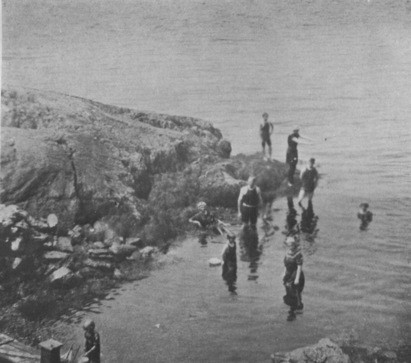
A DIP IN THE “BRINY DEEP.”
Eleanor was gone a long time without having brought in any wood when Hilda was asked to go in search of her.
“Good gracious me! Not only does Eleanor make a burden of herself for the Band but now she needs a nurse to watch and keep her from mischief!” declared Hilda, impatiently.
Hilda ran off and Zan stood watching her out of sight. Then she turned to the Guide: “Now what next?”
“I have just been thinking that we might have potatoes with fish for lunch and save that chowder for supper when the visitors are here.”
“Um—it’s very filling, I have heard,” commented Zan.
Miss Miller laughed. “Yes, and it needs a long time for cooking well. Besides, we won’t need to waste any good time over an elaborate meal with that chowder to found on.”
“Will there be fish enough to go round?” asked Zan.
“Yes, Jack brought up several fine fish that Fiji and he caught at dawn this morning, so we ought to fare very well.”
Hilda now came back with Eleanor strolling after her—Hilda carrying the heavy load of wood, and Eleanor whipping the heads from some late goldenrod with a switch.
“I found her stretched out on some moss blinking up at the blue sky!” reported Hilda, disdainfully.
“Why shouldn’t I rest after working so hard? Look at the wood I found,” retorted Eleanor.
“Why didn’t you lug it into camp? There’s no credit due you for finding a few sticks if you don’t carry out the task to fulfilment,” scorned Zan.
“Miss Miller, I’m sick of this business! I never was so hard worked in my life, and to think how everyone finds fault with me for not doing more,” said Eleanor, testily.
“I wonder if any of you girls stopped to think that you could start a list for your fish coups by knowing and studying the fish caught here. Suppose you all begin with these three kinds,” suggested Miss Miller, wisely.
“That’s so, we never thought of it,” cried Hilda.
“Dear me, why didn’t we try to place those fish this morning? Did you know them, Miss Miller?” asked Zan.
Eleanor was interested in the fish, too, and so another fatality for the new member was averted.
“I knew the white fish we had this morning, and I see here is another. That other fish I believe to be a sea-trout but we will have to verify that by asking the boys. They will know.”
“And that smaller one—if the boys know we will have three on the list already, won’t we?” said Zan, eagerly.
“Of course the boys know—they seem to imbibe knowledge of this sort by instinct. Why, a boy never has to learn to swim, he just flops in the water and sails along like a frog, while we timid females try and try again before we can get the stroke,” declared Hilda.
The clam-diggers came up with a large reward for their aching backs and sun-burn, and the plan of starting a list of fish was proposed by the Chief. Thereafter, more interest was shown in the three kinds of fish on exhibit than any of the girls could ever remember before.
While the Woodcrafters sat eating luncheon, a peculiar whistle sounded from the woods back of them.
“Sounds like a tramp signalling a pal to come and enjoy this lunch,” teased Bob.
“You seem to forget that we girls won a coup for knowing our native birds this Summer. I know what kind of a bird that is, too. Anyone else here recognise it?” said Zan.
“Don’t tell! Don’t—please. Let us new members try to place the sound and sight and begin on our bird coups,” interrupted Anne Mason.
“Come on, hurry up! We can wash dishes later,” added Frances.
“You girls go, and I will remain here with the boys to clear away the dishes and follow after you later,” offered the Guide.
So the Band ran away and shortly after Miss Miller and her helpers finished the chores and went into the woods also. About an hour was spent in interesting study and pursuit of Nature’s lore, when a sound coming from the direction of the camp reached the crowd.
“That’s a kind of bird I know at once!” laughed Zan.
“It sounds like the siren on your Dad’s machine,” ventured Jane.
“It is. I guess the company have arrived and are waiting for a welcome,” added Fiji.
At that, the Guide turned and the Band trailed after her to the camp-site where they found the doctor impolitely prying into the state of the larder, and two ladies with two children laughing at his remarks when he discovered the fragrant chowder.
“Oh, there’s Edith and Baby!” cried Elizabeth, running to greet her mother and the children.
Having saluted the Woodcrafters with great ceremony, the doctor said: “Some people have been busy this morning, judging from preparations for dinner.”
“We just had to dig to provide enough for you—when we heard you had invited yourself to dinner with us,” retorted Zan, who always enjoyed a wordy combat with her father.
“Well, I must confess, I brought my normal appetite with me, so it will be fortunate if the others have anything to eat,” replied Dr. Baker.
“If you admit your appetite is normal now, what will it be after you have had a dip in the briny?” laughed Fiji.
“To insure ourselves against emergencies I had Moses pack some of his unexcelled southern cake and pies,” answered Mrs. Remington, pointing to a huge hamper that had escaped notice.
“Oh, we know Mose!” laughed Fred, running over to investigate.
“Gee! Looka-here boys!” called Billy, as one goody after another was lifted up and displayed to the circle of gourmands.
“Come, come, Bill! Leave them in the hamper so they won’t dry or be covered with ants,” advised his mother, going over to assist him in obedience.
“Who’s ready for a sea-fight? In these days of deep-sea warfare we should have practise to be ready to swim after a U-boat, if necessary,” called the doctor, seeing the hamper once more left in order and safety.
“Me for the briny!” called Bob, running to the boys’ tent.
That morning, Fiji had discovered a deep pool directly under the sandy point of the promontory, and this offered an excellent spot for diving. While the more timid jumped about or swam nearer the beach, the older and more experienced of the party enjoyed the dives and deep water. Teddy and Edith found an impromptu pier made of drift-wood where the launch was anchored, and here they played store, having tin cans and shells for receptacles to hold sea-sand flour and sugar.
Long before the merry bathers were ready to come out, the Guide and Mrs. Baker and Mrs. Remington went to the tents and dressed. Then they began preparations for the supper-party.
The doctor always provided fun and laughter wherever he went, so the evening meal was a jolly affair that night. After the young folks declared they could laugh no more, Mrs. Baker said without a smile, “You all are most gullible.”
“Why?” demanded a chorus of voices.
“Why? Why to sit here and laugh while the doctor is making away with that chowder. I haven’t seen him pause a moment between spoonfuls while he had you all laughing too heartily to eat.”
“Then he’ll want to stay all night!” complained Bob.
Everyone laughed, for the tone said as plain as day: “I hope to goodness he won’t!”
“That is all I’ve been waiting for—an invitation,” replied the doctor.
“We can’t tuck you in anywhere. You’ll have to win a coup for sleeping out under the stars,” laughed Zan.
“Don’t worry, friends! Doctor is only teasing. He has to be back in the city at nine to-night to meet a physician and consult over a case,” explained Mrs. Baker.
“Then we’d better make the most of the time left us,” urged the doctor, jumping up ready for anything proposed.
“Shall we dance?” asked Nita.
“Oh, be considerate! Remember I enjoyed the chowder more than was reasonable and I am not in a mood to play Na-na Bo-jou!” warned the doctor.
Everyone laughed again at that, for Na-na Bo-jou is one of the most active of all energetic dances performed by Woodcrafters.
“Why not sit quietly about the fire and hear a story?” suggested Mrs. Baker.
“Let Mrs. Remington tell it—she is a regular bookful of legends and Indian lore,” quickly added the Guide.
The idea was heartily endorsed by the others and Mrs. Remington began:
“How the Weasel Got His White Breast.
“A long time ago, before there were any Indians, the world was inhabited by spirits. These spirits were the souls of all the animals and plants and things we see to-day. One of them was called Kanhlalas, the Weasel. He was little and brown and lived in a field. One day a strange thing happened to him. Listen, I will tell you about it.
“Near the field where the Weasel had his home there was a mountain. On top of the mountain lived an old man called Waida Dikit, the Speckled Trout. He felt lonely up there, so he sent for Saroki Sakahl, the Green Snake. When Saroki came Waida Dikit took him to his wigwam and said:
“‘My son, here is pipe and tobacco. Let us smoke awhile.’
“Saroki sat down by the wall and smoked. He smoked so much that soon Waida Dikit could not see across the wigwam.
“‘My son,’ said he, taking his own pipe from his mouth, ‘you are a strong smoker.’
“Saroki did not answer. After a time Waida Dikit stuck his head from the wigwam and saw that the whole world was covered with the smoke from Saroki’s pipe. Waida Dikit was frightened. He felt about on the floor for his flute.
“‘You have smoked enough,’ he said to Saroki. ‘Here is a flute. Let me hear you play.’
“Saroki took the flute and played for three days and three nights without stopping. By the end of the first day Waida Dikit could see through the smoke which was fast thinning, and he could see the other side of the wigwam.
“By the end of the third day the smoke was all gone and the blue sky could be seen once more. Then Saroki stopped playing.
“‘You are a good player,’ said Waida Dikit, ‘but I know a better one. He is Kanhlalas, the Weasel that lives down there in the field. I will send for him.’
“In a little while Kanhlalas came, bringing his own flute. When he was comfortably seated in the middle of the wigwam, Waida Dikit said to him: ‘Saroki Sakahl thinks he is a fine player. If you play he will know what a good player really is.’
“Kanhlalas took his flute, swelled out his chest, and began playing. He played all day and all night without stopping. By morning he was so out of breath that there appeared a white stripe down the middle of his breast. He merely swelled out his chest a little more and went on playing. Waida Dikit and Saroki Sakahl became frightened.
“‘Stop!’ cried both of them. ‘Something will happen. We know that you are the best player now.’
“But Kanhlalas would not listen nor would he stop playing. He only played harder and harder. By the end of the third day his breath was entirely gone and he had to stop. But it was too late!
“His whole breast was white as snow and from that day to this every weasel has had a white breast.”
As Mrs. Remington concluded the story the campers signified their disapproval of such a short tale by demanding another, but Dr. Baker declared it was time they started for home.
“But do wait and let us have one dance to pay Mrs. Remington for the story,” cried Nita, springing up ever ready to perform.
“Girls, show our visitors the dance-song of ‘Summertime,’” suggested the Guide.
The Band then performed the song to graceful steps and motions and the audience loudly applauded when it was finished.
“Mother, why can’t I stay over-night with Elizabeth and the other, girls—Zan says they can find lots of room for a little girl like me,” pleaded Edith.
“Yes, do allow the child to remain with us. It is only for one night, you know,” added Miss Miller.
“Why, you seem to have so many already, that I would not like to add to the care,” responded Mrs. Remington, doubtfully.
“I’ll be so good, mother, that it will be no care!” begged Edith.
“And we will look after her, mother,” added Elizabeth.
“I wanna stay, too!” now demanded the youthful Theodore Roosevelt Remington, aged four.
“No, no, Baby, Mother needs you at home!” quickly said Edith.
To the little girl’s delight, she was permitted to remain and the others started for home, leaving the weary hostesses to seek tents and cots where all were soon fast asleep, despite the mosquitoes.