автордың кітабын онлайн тегін оқу The Story of Norway
The Story of Norway
by Hjalmar H. Boyesen
THE STORY OF THE NATIONS
OCTAVO, ILLUSTRATED. PER VOL., $1.50
THE EARLIER VOLUMES WILL BE
THE STORY OF GREECE. By Prof. Jas. A. Harrison
THE STORY OF ROME. By Arthur Gilman
THE STORY OF THE JEWS. By Prof. Jas. K. Hosmer
THE STORY OF CHALDEA. By Z. A. Ragozin
THE STORY OF NORWAY. By Prof. H. H. Boyesen
THE STORY OF GERMANY. By S. Baring-Gould
THE STORY OF SPAIN. By E. E. and Susan Hale
THE STORY OF HUNGARY. By Prof. A. Vámbéry
THE STORY OF CARTHAGE. By Prof. Alfred J. Church
THE STORY OF THE SARACENS. By Arthur Gilman
THE STORY OF ASSYRIA. By Z. A. Ragozin
THE STORY OF THE MOORS IN SPAIN. By Stanley Lane-Poole
THE STORY OF THE NORMANS. By Sarah O. Jewett
THE STORY OF PERSIA. By S. G. W. Benjamin
THE STORY OF ALEXANDER'S EMPIRE. By Prof. J. P. Mahaffy
THE STORY OF ANCIENT EGYPT. By Geo. Rawlinson
THE STORY OF THE GOTHS. By Henry Bradley
For prospectus of the series see end of this volume
G. P. PUTNAM'S SONS NEW YORK AND LONDON

The Story of the Nations
THE
STORY OF NORWAY
BY
HJALMAR H. BOYESEN
GEBHARD PROFESSOR OF GERMAN IN COLUMBIA COLLEGE, AUTHOR OK "GOETHE &
SCHILLER," "GUNNAR," "IDYLS OF NORWAY," ETC.
NEW YORK & LONDON
G. P. PUTNAM'S SONS
The Knickerbocker Press
COPYRIGHT BY
G. P. PUTNAM'S SONS
1886
Press of
G. P. Putnam's Sons
New York
TO
CHRISTIAN BÖRS
KNIGHT OF ST. OLAF, WASA, AND THE NORTH STAR, CONSUL OF
NORWAY AND SWEDEN IN NEW YORK, THIS HISTORY
OF HIS NATIVE LAND IS DEDICATED BY HIS
FRIEND THE AUTHOR
PREFACE.
It has been my ambition for many years to write a history of Norway, chiefly because no such book, worthy of the name, exists in the English language. When the publishers of the present volume proposed to me to write the story of my native land, I therefore eagerly accepted their offer. The story, however, according to their plan, was to differ in some important respects from a regular history. It was to dwell particularly upon the dramatic phases of historical events, and concern itself but slightly with the growth of institutions and sociological phenomena. It therefore necessarily takes small account of proportion. In the present volume more space is given to the national hero, Olaf Tryggvesson, whose brief reign was crowded with dramatic events, than to kings who reigned ten times as long. For the same reason the four centuries of the Union with Denmark are treated with comparative brevity. Many things happened, no doubt, during those centuries, but "there were few deeds." Moreover, the separate history of Norway, in the time of her degradation, has never proved an attractive theme to Norse historians, for which reason the period has been generally neglected.
The principal sources of which I have availed myself in the preparation of the present volume, are Snorre Sturlasson: Norges Kongesagaer (Christiania, 1859, 2 vols.); P. A. Munch: Det Norske Folks Historie (Christiania, 1852, 6 vols.); R. Keyser: Efterladte Skrifter (Christiania, 1866, 2 vols.); Samlede Afhandlinger (1868); J. E. Sars: Udsigt over den Norske Historie (Christiania, 1877, 2 vols.); K. Maurer: Die Bekehrung des Norwegischen Stammes zum Christenthume (München, 1856, 2 vols.), and Die Entstehung des Isländischen Staates (München, 1852); G. Vigfusson: Sturlunga Saga (Oxford, 1878, 2 vols.); and Um tímatal í Islendinga sögum i fornöld (contained in Safn til sögu Islands, 1855); G. Storm: Snorre Sturlasson's Historieskrivning (Kjöbenhavn, 1878); C. F. Allen: Haandbog i Fædrelandets Historie (Kjöbenhavn, 1863); besides a large number of scattered articles in German and Scandinavian historical magazines. A question which has presented many difficulties is the spelling of proper names. To adopt in every instance the ancient Icelandic form would scarcely be practicable, because the names in their modernized forms are usually familiar and easy to pronounce, while, in their Icelandic disguises, they are to English readers nearly unpronounceable, and present a needlessly forbidding appearance. Where a name has no well-recognized English equivalent, I have therefore adopted the modern Norwegian form, which usually differs from the ancient, in having dropped a final letter. Thus Sigurdr (which with an English genitive would be Sigurdr's) becomes in modern Norwegian Sigurd, Eirikr, Erik, etc. Those surnames, which are descriptive epithets, I have translated where they are easily translatable, thus writing Harold the Fairhaired, Haakon the Good, Olaf the Saint, etc. Absolute consistency would, however, give to some names a too cumbrous look, as, for instance, Einar the Twanger of Thamb (Thamb being the name of his bow), and I have in such instances kept the Norse name (Thambarskelver).
It is a pleasant duty to acknowledge my indebtedness for valuable criticism to my friends, E. Munroe Smith, J.U.D., Adjunct Professor of History in Columbia College, and Hon. Rasmus B. Andersen, United States Minister to Denmark, without whose kindly aid in procuring books, maps, etc., the difficulties in the preparation of the present volume would have been much increased. I am also under obligation to Dr. W. H. Carpenter, of Columbia College, and to the Norwegian artist, Mr. H. N. Gausta, of La Crosse, Wis., who has kindly sent me two spirited original compositions, illustrative of peasant-life in Norway.
Hjalmar H. Boyesen.
Columbia College,
New York, April 15, 1886.

CONTENTS.
I.
PAGE
Who Were the Norsemen? 1-12
The Aryan migrations, 1-3—The physical characteristics of Norway, 4, 5—Early tribal organization and means of livelihood, 6-10—Sense of independence and aptitude for self-government, 10-12.
II.
The Religion of the Norsemen 13-24
Theories regarding the origin of the Scandinavian gods, 13-16—The Eddaic account of the creation of the world and of man, 16-18—The world-tree Ygdrasil, 18—The
Aesir, their functions and their dwellings, 19-23—Loke the Evil-Doer and his terrible children, 23, 24.
III.
The Age of the Vikings.—Origin of the Viking Cruises 25-44
The Norsemen launch forth upon the arena of history, 25—The origin of the viking cruises, 25-27—Kingship among the Scandinavian tribes, 27, 28—The three periods of the viking age, 28-30—The contribution of the vikings to the political life of Europe, 30, 31—Sigfrid of Nortmannia, 31—Godfrey the Hunter, 31, 32—-Charlemagne's prophecy in regard to the vikings, 32-34—Hasting's stratagem, 34-36—Ragnar, Asgeir, and Rörek, 36, 37—Thorgisl in Ireland, 38, 39—Olaf the White, 40, 41—The vikings in England, 41—Simeon of Durham's account of the vikings, 42—The
character of the vikings at home and abroad, 43, 44.
IV.
Halfdan the Swarthy 45-51
The descent of the Yngling race, 45—The sacrifices of Aun the Old, 45—Olaf the Wood-cutter, Halfdan Whiteleg, and Godfrey the Hunter, 46—Birth of Halfdan the Swarthy, 46 Sigurd Hjort and the
BerserkHake, 47, 48—Halfdan the Swarthy weds Ragnhild, 48—Ragnhild's dream, 48—King Halfdan's dream, 49—Birth of Harold the Fairhaired, 49—The Finn's trick, 50—King Halfdan's death, 51.
V.
Harold the Fairhaired 52-73
Harold the Fairhaired woos Gyda, 52, 53—Harold's vow, 53—Herlaug and Rollaug, 54—Harold's policy toward the conquered kings, 54, 55—The feudal state, 55—Taxation and the peasants' loss of allodial rights, 55, 56—Haakon Grjotgardsson and Ragnvald, Earl of Möre, 56—Kveld-Ulf and his sons, 56, 57—Erik Eimundsson's invasion of Norway, 57—His meeting with King Harold, 58—The battle of Hafrs-Fjord, 59—Earl Ragnvald cuts King Harold's hair, 59—Harold marries Gyda, 59, 60—Harold's treachery to Thorolf Kveld-Ulf's son, 60-62—Kveld-Ulf's vengeance and migration to Iceland, 62, 63—Duke Rollo in Norway and France, 64, 65—Emigration of discontented magnates, 65, 66—Snefrid, 67—Queen Ragnhild, 68—Erik Blood-Axe's feuds with his brothers, 69-71—Guttorm Sindre, 71, 72—Birth of Haakon the Good, 72—Haakon is sent to Ethelstan, 72, 73—Death of Harold, 73.
VI.
Erik Blood-axe 74-86
Erik's meeting with Gunhild, 74-76—Erik kills his brothers, Sigfrid and Olaf, 76—Thorolf, Bald Grim's son, 77—Egil, Bald Grim's son, kills Baard, 78—Egil kills Berg-Anund, 79, 80—Egil's pole of dishonor, 80—Egil ransoms his head by a song, 81-85—Erik is exiled, 86.
VII.
Haakon the Good 87-101
Character of Haakon, 87—Proclaimed king of Norway, 88—Legislative reforms and restoration of allodium, 89—Signal fires, 90—First attempt to introduce Christianity, 90-92—Speech of Asbjörn of Medalhus, 92—The king eats horse-flesh, 92-94—The sons of Erik Blood-Axe make war upon Norway, 94, 95—Battles of Sotoness and Agvaldsness, 95, 96—Egil Woolsark, 96, 97—Battle of Fraedö, 96-98—Failure of attempt to Christianize the country, 98—Battle of Fitje (Eyvind Scald-Spoiler), 98-101—Death of Haakon the Good, 101.
VIII.
Harold Greyfell and his Brothers 102-114
Unpopularity of the sons of Erik, 102-104—Their characters, 104—Harold Greyfell and Eyvind Scald-Spoiler, 105—Treachery of Harold toward Earl Sigurd, 105, 106—Independence of Earl Haakon, 106, 107—Murder of Tryggve Olafsson, 107, 108—Birth of Olaf Tryggvesson, 108—Adventures of Aastrid and Thoralf Lousy-Beard, 108-110—Sigurd Sleva insults Aaluf, 111—Earl Haakon's intrigues in Denmark, 111, 112—Gold-Harold slays Harold Greyfell, 112—Expulsion of the sons of Erik, 113, 114.
IX.
Earl Haakon 115-133
Earl Haakon defends Dannevirke, 115, 116—Harold Bluetooth, 117—Haakon's devastations in Sweden and in Viken, 118—Earl Erik and Tiding-Skofte, 119—The funeral feast of the Jomsvikings, 120, 121—Battle in Hjörungavaag, 121-125—The Jomsvikings on the log, 125, 126—Haavard the Hewer, 127—The power and popularity of Earl Haakon, 127, 128—Gudrun Lundarsol, 129—Revolt of the peasants, 130—The earl hides under a pigsty, 130, 131—"Why art thou so pale, Kark?" 131—Kark murders the earl, 132—Haakon's character, 132, 133.
X.
The Youth of Olaf Tryggvesson 134-142
Aastrid's flight to Russia, 134, 135—Olaf is sold for a ram,
135—He is taken to Vladimir's court, 135, 136—King Burislav and Geira, 136, 137—The wooers' market in England, 137—Marriage with Gyda, 137, 138—Olaf's warfare in England, 138, 139—Thore Klakka tries to entrap Olaf, 139, 140—Return to Norway and proclamation as king, 140-142.
XI.
Olaf Tryggvesson 143-172
Olaf Christianizes Viken, 143, 144—Character of old Germanic Christianity, 144-146—Thangbrand the pugnacious priest, 147—The chiefs of Haalogaland, 148—Ironbeard and the peasants of Tröndelag, 149, 150—The Yule-tide feast at Möre, 150-152—Olaf woos Sigrid the Haughty, 152-154—He marries Thyra, 154—Thore Hjort, Eyvind Kinriva, and Haarek of Thjotta, 154-158—Thangbrand in Iceland, 158, 159—Olaf's character, 160—Thyra's tears for her lost possessions, 161—"The Long-Serpent," 161—King Olaf sails to Wendland, 162, 163—Earl Sigvalde's treachery, 163—Battle of Svolder, 164-172—King Olaf's death. 171, 172.
XII.
The Earls Erik and Sweyn.—Ihe Discovery of Vinland 173-181
Division of Norway between the victors at Svolder, 173—Erling Skjalgsson of Sole, 174-176—Earl Erik's character, 176—And attitude toward Christianity, 176, 177—Revival of the viking spirit, 177—Earl Erik abdicates in favor of his brother and son, 178, 179—Bjarne Herjulfsson's glimpse of America, 179—Leif Eriksson's expedition to Vinland, 180, 181—Thorfinn Karlsevne and Gudrid, 181.
XIII.
Olaf the Saint 182-224
Birth and childhood of Olaf the Saint, 182, 183—Viking cruises, 183—Return to Norway, 184—He captures Earl Haakon, 185—His reception by Aastrid and Sigurd Syr, 186, 187—Family council, 187, 188—Support of the shire-kings, 188—The Trönders recognize Olaf as king, 189—Surprised
by Earl Sweyn in Nidaros, 190—Battle of Nessje, 190, 192—Earl Sweyn's flight and death, 192—Quarrel with King Olaf the Swede, 193, 194—Björn Stallare's mission, 194-196—Speech of Thorgny the Lawman, 196, 197—Olaf marries Aastrid, 198—Conspiracy of the shire-kings and their punishments, 199—The play of the sons of Sigurd Syr, 199, 200—Rörek's hard fate, 201—His attempt to murder Olaf, 202—The attitude of the tribal aristocracy toward Olaf, 202, 203—Paganism
versusChristianity, 204, 205—"Where are my ancestors?" 205—Olaf's character and appearance, 205-207—Dale-Guldbrand, 207-210—Slaying of Aasbjörn Sigurdsson, 211—Knut the Mighty bribes the Norse chieftains, 212, 213—Anund Jacob refuses the bribe, 213, 214—Battle of Helge-aa, 214, 215—Death of Erling Skjalgsson, 216—Olaf goes to Russia, 217—Björn Stallare's confession, 218—Olaf returns to Norway, 218—His vision, 220, 221—Battle of Sticklestad, 221, 222—Thormod Kolbruna-Scald, 222-224—Burial of St. Olaf, 224.
XIV.
Sweyn Alfifasson 225-229
Alfifa and the Norse chiefs, 225—Unpopular and oppressive laws, 226—King Olaf canonized, 227—Tryggve Olafsson's defeat, 228—Einar Thambarskelver rebukes Alfifa, 228—Magnus Olafsson returns from Russia, 229—Expulsion of Sweyn, 229.
XV.
Magnus the Good 230-250
Circumstances of Magnus' birth, 230—Magnus and Harthaknut, 231—Jealousies of the chieftains, 232—Magnus and Kalf Arnesson at Stiklestad, 233—Sighvat Scald's Lay of Candor, 234—Sweyn Estridsson rebels, 236, 237—Battle of Lyrskog's Heath, 237—Thorstein Side-Hall's son, 238—Einar Thambarskelver's disagreement and reconciliation with Magnus, 238, 239—Arrival of Harold Sigurdsson, 240—His adventures abroad, 240-242—Magnus' reception of Harold, 243—Harold's alliance with Sweyn Estridsson, 244—Agreement
to share the government, 245—The peasant Toke's speech, 246, 247—Expeditions of Magnus against Sweyn Estridsson, 247, 247—Death of Magnus the Good, 249, 250.
XVI.
Harold Hard-Ruler 251-272
The tribal chieftains and the hereditability of the crown, 251, 252—Harold decides to conquer Denmark, 252—Determination to break the power of the aristocracy, 253—Einar Thambarskelver's hostility, 254, 255—Harold marries Thora, 255—St. Hallvard and the founding of Oslo, 256—Burning of Heidaby, 257—Sweyn's pursuits and Harold's stratagems, 257-259—Battle of Nis-aa, 259—Peace of Götha Elv, 260—Feuds with Einar Thambarskelver, 260, 261—Harold tests the loyalty of the chieftains, 261, 262—Högne Langbjörnsson, 262, 263—Murder of Einar and his son, 264—Harold's treachery to Kalf Arnesson and Haakon Ivarsson, 265-267—Arrival of Earl Tostig in Norway, 268—Battles of Fulford and Stamford Bridge, 268-270—Styrkaar and the yeoman, 270-272—Position of the Norwegian Church, 272.
XVII.
Olaf the Quiet and Magnus Haroldsson,
273-284
Olaf and Magnus divide the country, 273—War with Sweyn Estridsson, 273, 274—Death of Magnus, 274—Character of Olaf the Quiet, 275, 276—Gradual cessation of viking cruises, 276, 277—Gradual abolition of serfdom, 278—Vikings and merchants, 278, 279—Appearance and appointments of dwellings, 280, 281—Increased splendor of the court, 281, 282—Establishment of guilds, 282, 283—Skule Tostigsson, 283—Death of Olaf the Quiet, 284.
XVIII.
Magnus Barefoot and Haakon Magnusson,
285-290
The Trönders proclaim Haakon king, 285—Magnus' expedition to Scotland and Ireland, 285, 286—Death of Haakon, 286—Punishment of his partisans, 286, 287—War-like spirit of Magnus, 287—War with Sweden, 288—War
with Ireland, 289—Death of Magnus in Ulster, 290.
XIX.
Eystein Sigurd the Crusader and Olaf Magnusson 291-305
Division of the land, 291—Sigurd's crusade, 292, 293—Eystein's meritorious activity at home, 294—Hostility of the brothers, 295—The case of Sigurd Ranesson, 295, 296—Borghild of Dal, 297—The "man-measuring," 297-301—Death of Eystein, 301—Ottar Birting, 301-303—Arrival of Harold Gille, 303—Cecilia, 303—Death of Sigurd, 304, 305.
XX.
Magnus the Blind and Harold Gille 306-310
Character of Magnus and of Harold, 306—Battle of Fyrileiv, 307—Magnus captured and maimed, 307, 308—Sigurd Slembedegn, 308—Harold Gille murdered, 309—Burning of Konghelle by the Wends, 310.
XXI.
The Sons of Harold Gille 311-321
The sons of Harold Gille proclaimed kings, 311—Sigurd Slembedegn allies himself with Magnus the Blind, 311, 312—Inge Crookback's first experience of war, 312—Battles of Krokaskogen, 312, and Holmengraa, 313—Sigurd Slembedegn's fortitude, 313—Arrival of Eystein Haroldsson, 314—Feuds between the brothers, 314-316—Character and appearance of Sigurd Mouth, 314-316—Death of Sigurd, 316—Death of Eystein, 317—Erling Skakke and Gregorius Dagsson, 318-320—Fall of Inge at Oslo, 320—The cardinal's visit, 320, 321.
XXII.
Haakon the Broad-shouldered 322-325
Christina bribes the priest, 322—Erling Skakke's intrigues, 323—Seeks aid in Denmark, 323, 324—Battle of Sekken, 324.
XXIII.
Magnus Erlingsson 326-349
Rebellion of the "Sigurd party," 326, 327—Battle of Ree,
327—Erling's alliance with Archbishop Eystein, 327—Magnus takes the land in fief from St. Olaf, 327, 328—Magnus crowned, 328—King Valdemar's expedition to Norway, 328, 329—The rebellion of the Hood-Swains, 329—Battle of Djursaa, 330—Erling accepts an earldom from Valdemar, 330—Kills his stepson Harold, 332—Eystein Meyla and the Birchlegs, 333, 334—Childhood and youth of Sverre Sigurdsson, 334-337—Sverre becomes the chief of the Birchlegs, 337—Vicissitudes and adventures of the Birchlegs, 337-341—Battle of Kalvskindet, 341-343—Death of Erling Skakke, 343—Social revolution inaugurated by Sverre, 343-345—Battle at Nordness, 346—Warfare between Birchlegs and Heklungs, 346-348—Battle of Norefjord and death of Magnus, 348, 349.
XXIV.
Sverre Sigurdsson 350-378
A dangerous precedent, 350—Erik Kingsson, 351—The lawmen and prefects, 351, 352—The new democracy, 352, 353—Rebellion of the Kuvlungs, 353, 354; the Varbelgs, 354; and the Oyeskeggs, 354-357—Sverre's controversy with the Church, 357, 358—Nicholas Arnesson, 358—Sverre is put in the ban, 359—Origin of the Bagler party, 360, 361—Nicholas shows the white feather, 361—Treason of Thorstein Kugad, 362—The Baglers besiege the block-house in Bergen, 362-365—Burning of Bergen, 365—The traitor's return, 366—The Papal bull and Sverre's defence, 366-368—The Bagler's defeated at Strindsö, 369—The great peasant rebellion, 370-373—Sverre's magnanimity, 374—Aristocracy
versusDemocracy, 374, 375—Siege and surrender of Tunsberg, 375, 376—Death of Sverre, 376, 377—His character, 377, 378.
XXV.
Haakon Sverresson 379-384
Peace with the Church, 379—Popularity of Haakon, 380—Discontent of the queen-dowager, 381—Abduction of Princess Christina, 381, 382—The fatal Yule-tide feast, 382, 383—Death of Haakon by poison, 383—Flight of Queen
Margaret, 384.
XXVI.
Guttorm Sigurdsson and Inge Baardsson,
385-399
The Bagler troop reorganized under Erling Stonewall, 385—Successful ordeal, 386—Death of Guttorm Sigurdsson by poison, 387—Inge Baardsson proclaimed king, 388—Society disorganized by the civil wars, 388, 389—Unbidden guests at the bridal feast, 389, 390—Philip Simonsson made king of the Baglers, 390—Birth and childhood of Haakon Haakonsson, 391, 392—Compromise of Hvitingsöe, 393—The intrigues of Haakon Galen, 394, 395—Helge Hvasse and the boy Haakon, 396, 397—Discontent of the Birchlegs, 398—Death of King Inge, 399.
XXVII.
Haakon Haakonsson the Old 400-432
Haakon proclaimed king, 400—Rebellion of the Slittungs, 401—Effects of the civil war, 401, 402—The intrigues of Earl Skule, 402-404—Inga of Varteig carries glowing irons, 404-406—Rebellion of the Ribbungs, 407, 408—Skule's double-dealing, 408-410—Assembly of notables in Bergen, 410—Bishop Nicholas' hypocrisy, 411—Sigurd Ribbung renews the rebellion, 412—Haakon's campaign in Vermeland, 412, 413—Duke Skule's leaky ships, 413—Death of Bishop Nicholas and Sigurd Ribbung, 414—Squire Knut as the chief of the Ribbungs, 416—Skule's "Crusade," 416, 417—Skule allies himself with Valdemar the Victorious, 417, 418—Skule called to account, 418-420—Intrigues at the Roman Curia, 420, 421—The plot revealed, 421, 422—Skule proclaims himself king, 423—Battle of Laaka, 424—Skule defeated at Oslo, 425—Death of Skule, 426, 427—Coronation of Haakon, 427-429—His power and fame at home and abroad, 429-431—Expedition to Scotland, and death, 431, 432.
XXVIII.
The Sturlungs in Iceland 433-441
Snorre Sturlasson's
Heimskringla, 433, 434—Snorre's parentage and youth, 434—Character of Snorre, 434—Reykjaholt,
436—Brother feuds, 436—Snorre's visit to Norway, 437—Plots and counterplots, 437-440—Snorre's death, 440—Sturla Thordsson, 440, 441.
XXIX.
Magnus Law-Mender 442-450
Cession of Man and the Shetland Isles to Scotland, 442—Reasons for and against the cession, 443—Condition of Icelandic society and submission of the island to Norway, 444—Magnus as a law-giver, 445-447—The tribal aristocracy and the court nobility, 447, 448—Concessions to the Church, 448, 449—Degeneracy of the old royal house, 450—Death of Magnus, 450.
XXX.
Erik Priest-Hater 451-456
The barons increase their power, 451—Quarrels with the clergy, 452—The false "Maid of Norway," 453—Depredations of "Little Sir Alf," 453, 454—War with Denmark and the Hansa, 454, 455—Capture and death of Little Sir Alf, 456—Death of King Erik, 456.
XXXI.
Haakon Longlegs 457-460
Sir Audun's treason, 457—The dukes Erik and Valdemar 458—Complications with Sweden, 459—War with Denmark, 460—Death of Haakon, 460.
XXXII.
Magnus Smek, Haakon Magnusson, and Olaf the Young 461-466
Magnus Smek becomes king of Norway and Sweden, 461—Duchess Ingeborg's unpopularity, 461, 462—Discontent with Magnus, 462—Alliance with Valdemar Atterdag, 462, 463—Magnus deposed in Sweden, 463—Haakon's war with Albrecht of Mecklenberg, 464—The power of the Hansa in Norway, 464—Death of Magnus, 465—The Black Death,
465, 466—Olaf the Young, 466.
XXXIII.
Norway During the Kalmar Union 467-474
Margaret unites the three kingdoms, 467-469—The Kalmar Union, 469, 470—Reasons for its disastrous consequences, 470-472—Death of Margaret, 472—Erik of Pomerania's misrule and extortions, 472, 473—Christopher of Bavaria, 473, 474.
XXXIV.
The Union With Denmark 475-488
The condition of Norway and Denmark during the union compared, 475, 476—Charles Knuttson elected king of Sweden, 478—Christian I.'s war with Charles Knutsson, 479, 480—Misrule in Norway, 480—The Scottish Isles pawned, 480, 481—King Hans, 481, 482—Christian II.'s accession, 482—His attempt to humble the nobility, 483—The carnage of Stockholm, 483, 484—His vain appeal to the bourgeoisie, 484, 485—Christian's flight, 485—Frederick I., 485, 486—Struggle about the succession, 486, 487—Christian III., 487, 488—Norway becomes a province of Denmark, 488.
XXXV.
Norway As a Province of Denmark 489-515
The Reformation introduced, 489, 490—The power of the Hansa broken, 490-492—Frederick II., 492-494—Christian IV.'s interest in Norway, 494—The Kalmar War, 495—Participation in the Thirty Years' War, 495, 496—The Hannibal's feud, 496—Frederick III.'s disastrous war with Sweden, 498—Absolutism introduced, 499, 500—Christian V., 500, 501—Frederick IV.'s accession, 501—The Great Northern War, 502-504—Tordenskjold, 503, 504—Christian VI., 506-508—Frederick V, 508—Christian VII., 508-512—The armed neutrality, 509, 510—Frederick VI. mounts the throne, 512—War with Sweden, 512, 513—Christian August as viceroy, 512-514—The Treaty of Paris, 513—Protest of the Norsemen, 514—Separation from Denmark, 515.
XXXVI.
Norway Recovers Her Independence 516-538
Christian Frederick as viceroy, 516-518—Constitutional convention at Eidsvold, 518-520—War with Sweden, 520, 521—Armistice at Moss, 521—Charles XIII. accepts the constitution, 522—Charles XIV. John becomes king of Norway, 522—His controversies with the
Storthing, 522-526—Henrik Wergeland, 526, 527—Count Wedel-Jarlsberg as viceroy, 527—Oscar I., 528-530—The character of the Norse peasantry, 528-530—Charles XV., 530, 531—Oscar II., and the constitutional struggle, 531-534—Impeachment of the ministry Selmer, 534—"The Pure Flag," 535—Present condition of Norway and her place among the nations, 536—Literature and science, 536-538.
LIST OF ILLUSTRATIONS.
PAGE.
STONE AXES FROM THE LATER STONE AGE
5STONE USED FOR SHAPING INSTRUMENTS
7STONE HAMMER
7STONE KNIFE
8ADZE OF ELK-HORN
9STONE WEDGE
9ROCK PICTURE OF A SHIP AT LÖKEBERG
10ROCK PICTURE AT BORGEN
11BRONZE SWORD
14LOOR OR WAR HORN OF BRONZE
15BRONZE SWORD
17BUCKLES FROM THE EARLY IRON AGE
19THE VIKING SHIP RECENTLY UNEARTHED AT SANDEFJORD
26THE VIKING SHIP, VARIOUS VIEWS OF
29ST. ANSGARIUS THE APOSTLE OF THE NORTH
33IRON IMPLEMENT—USE UNKNOWN
35TWO-EDGED SWORD
37BUCKLE FROM THE IRON AGE
39RUIN OF NORSE TOWER AT MOSÖ
43BUCKLE WITH BYZANTINE ORNAMENTATION
51GILT BUCKLE FOUND AT SKEDSMO
72CYLINDRICAL MOUNTING IN BRONZE
76IRON POINT OF SPEAR, IRON CHISEL
84FRYING-PAN OF BRONZE
89BREASTPIN OF BRONZE
91OVAL BRONZE BUCKLE
93EGIL WOOLSARK'S MONUMENT
96ORNAMENTAL BRONZE MOUNTING
97CHURCH AT EGILÖ
103SCISSORS AND ARROW-HEAD OF IRON
107HAROLD BLUETOOTH
117RUNESTONE FROM STRAND IN RYFYLKE
121OBLONG BUCKLE
133OLAF TRYGGVESSON'S ARRIVAL IN NORWAY
141OLD NORSE LOOM
145RUNIC STONE FROM GRAN IN HADELAND
153INSTRUMENT OF UNKNOWN USE
155OLD LOOM FROM THE FAEROE ISLANDS
159CHURCH AT MOSTER ISLAND
167SHUTTLES OF IRON AND WHALEBONE
175KNIVES OF IRON FOUND IN HEDEMARK AND HADELAND
208ST. OLAF FROM DRONTHEIM CATHEDRAL
219ST. OLAF AND THE TROLDS
223MAGNUS THE GOOD AND KALF ARNESSON AT STIKLESTAD
235MARBLE LION FROM THE PIRÆUS
241POMMEL OF GILT BRONZE FROM THE VIKING AGE
250THE OLD MAN OF HOY
271INTERIOR OF ORKHAUGEN
279HITTERDAL CHURCH
299VILLAGE DURING FISHING SEASON
315THE RAFT SUND IN VESTFJORD
331HORNELEN
339THORGHÄTTEN
363HÖNEFOSS
371HAAKON HAAKONSSON AND HELGE HVASSE
397WEST FRONT OF DRONTHEIM CATHEDRAL
403OLD NORSE CAPITALS
409ON THE SOGNE FJORD
415A STORM ON THE FJORD
419NORWEGIAN STABBUR OR STORE-HOUSE
431HÖRGADAL IN THE NORTH OF ICELAND
435ALMANNAGJAA WITH THE HILL OF LAWS
439QUEEN MARGARET
471CHRISTIAN I.
479BELT WRESTLING
491THE NORTH CAPE
493FREDERICK III., KING OF DENMARK AND NORWAY
497THE CAPERCAILZIE IN NORWAY
505CARVED LINTEL, STABBUR, AND BEER-MUGS
507PEASANTS DANCING
511PRINCE CHRISTIAN FREDERICK, VICEROY OF NORWAY
517CHARLES XIV. JOHN (BERNADOTTE)
521SKEE-RUNNING
525BRIDE AND GROOM
529PORTRAIT OF OSCAR II.
533BJÖRNSTJERNE BJÖRNSON
537Another notable circumstance in connection with the vikings is, that the very men whom foreign chroniclers describe as stinging wasps and savage wolves, and of whom the greatest atrocities are related during their sojourn abroad, became, as a rule, after their return home, men of weight and influence, with respect for tradition and law—men who, according to the standard of the time, were moral and honorable. There were exceptions, of course, but they go to prove the rule. The explanation is not far to seek. Religion in those days was tribal, and morality had no application outside the tribe. Every people is the chosen people of its own god or gods. As the Jews divided humanity into Jews and Gentiles, and the Greeks into Greeks and barbarians, so the Norsemen retaliated towards Jews and Greeks, by including them with all other nations in the Norse equivalent for barbarians. English, Irish, and Germans, often men of high birth, were constantly brought to Norway by the vikings as thralls, bartered and sold and forced to menial tasks. No law extended its protection to them; and yet maltreatment of thralls was, both in Iceland and Norway, regarded as unworthy of a freeman. For all that, the vikings were children of their age, and practised only the rude morality which their religion prescribed. The humanitarian sentiment which regards all men as brethren and creatures of the same God is a comparatively modern growth, and it would be unfair to judge the old Norsemen by any such advanced standard. It is therefore quite credible that the vikings may have been guilty of deeds abroad which they would not have committed at home.
When Harold the Fairhaired was eighty years old, he felt no longer able to bear the burden of the government. He therefore led Erik to his royal high-seat, and abdicated in his favor. Three years later he died (933), after having ruled over Norway for seventy-three years.
Eyvind Scald-Spoiler made a song in King Haakon's honor, called Haakonarmaal, in which he praised his virtues and described his reception in Valhalla.
A second expedition to Vinland was undertaken in 1006 by the Icelander Thorfinn Karlsevne and his wife Gudrid. Among their followers, who numbered 160, were Erik the Red's son Thorwald and his daughter Freydis. This was the first expedition which was undertaken with a view to colonizing the country. Cattle were therefore taken along, and preparations made for a permanent settlement. Thorfinn found without difficulty the booths abandoned by Leif, and himself added to their number. A strange people, whom the Norsemen called Skraellings, came to them in light boats made of skin and offered furs in exchange for cloth, ornaments, and weapons. Karlsevne, however, refused to sell them weapons; and when, during the negotiations, a bull came out of the woods and began to roar, the Skraellings became frightened and hastened away. From that time forth they became hostile to the settlers and attacked them repeatedly, killing several of their number. This perpetual state of insecurity disheartened the survivors, and after a sojourn of three years in Vinland, they returned to Greenland.
King Harold was fifty-one years old when he fell. In spite of the discontent of the chiefs, Norway took great strides, during his reign, toward a settled internal condition. The tribes were being welded into a people. In every branch of the administration the king's strong hand was felt. His wars, though in one sense disastrous, tended, on the whole, to give Norway a secure place among the nations. A long controversy which he had concerning ecclesiastical affairs with Archbishop Adalbert of Bremen ended in his triumph, and though no formal decision was made, the Norwegian Church ceased, for a while, to recognize the supremacy of the see of Bremen. If King Harold had been as noble as he was able, he would have left a greater name behind him.
In appearance Haakon resembled his grandfather. He was, like him, of middle height, and had the same large and wondrously expressive eyes. He looked taller when he sat than when he stood, but his presence was always dignified and impressive. He was fifty-nine years old when he died, and had ruled over Norway forty-six years.
Snorre's nephew, Sturla Thordsson, who at one time was a great chieftain and a defender of Icelandic independence, continued the Heimskringla in his uncle's spirit, writing the Saga of Haakon Haakonsson. This is a model biography, clearly and vigorously written, and abounding in interesting details. Another remarkable book, which was written in Norway during Haakon's reign, is the so-called King's Mirror (Konungsskuggsjá). It contains, in the shape of a dialogue between father and son, moral teachings and rules of life and conduct. Its maxims of worldly wisdom and rules of etiquette give a vivid insight into the modes of life and thought in the thirteenth century.
After the death of his first queen, King Erik had married Isabella Bruce, the sister of Robert, who later became King of Scotland. He had by this marriage a daughter, Ingeborg, who became the wife of Duke Valdemar, the brother of the Swedish king, Birger Magnusson. King Erik died at the age of thirty-one (1299), after having been king for nineteen years.
In internal affairs King Haakon exhibited, according to the ideas of his age, no mean degree of statesmanship. His administration was both prudent and vigorous. He checked the usurpations of the Hanseatic cities, which were driving native merchants out of the foreign trade, and deprived them of some of their privileges. An honest intention to do right, coupled with considerable ability, characterized both his public and private life. For all that, his despotic temper tended to alienate the people from public affairs; and thus prepared the way for the following centuries of humiliation.
Olaf, the only son of Haakon Magnusson and Margaret, was proclaimed King of Norway at his father's death. Five years earlier he had, after the death of his maternal grandfather, been elected king of Denmark. As he was yet a child, his mother Margaret and the Council of the Regency conducted the government in his name. Thus commenced the union of Norway and Denmark, which lasted without interruption for 434 years, and which proved so disastrous to the former country. Olaf died at the age of seventeen at Falsterbro in Skaane.
Archbishop Olaf, without awaiting the king's arrival, fled to Holland, taking with him the treasures of the cathedral, and died in exile.
It is a wonderful country—this land of the Norsemen. The ocean roars along its rock-bound coast, and during the long, dark winter the storms howl and rage, and hurl the waves in white showers of spray against the sky. Great swarms of sea-birds drift like snow over the waters, and circle screaming around the lonely cliffs. The aurora borealis flashes like a huge shining fan over the northern heavens, and the stars glitter with a keen frosty splendor. But in the summer all this is changed, suddenly, as by a miracle. Then the sun shines warmly, even within the polar circle; innumerable wild flowers sprout forth, the swelling rivers dance singing to the sea, and the birches mingle their light-green foliage with the darker needles of the pines. In the northern districts it is light throughout the night, even during the few hours while the sun dips beneath the horizon; the ocean spreads like a great burnished mirror under the cloudless sky, the fishes leap, and the gulls and eider-ducks rock tranquilly upon the shining waters. All along the coast there are excellent harbors, which are free of ice both winter and summer. A multitude of islands, some rocky and barren, others covered with a scant growth of grass and trees, afford hiding-places for ships and pasturage for cattle. Moreover, long arms of the ocean—the so-called fiords—penetrate far into the country, and being filled with water from the gulf-stream which strikes the western coast of Norway, tend greatly to moderate the climate. About the shores of these fiords narrow strips of arable land stretch themselves, with many interruptions, along the edge of the water, and here the early Germanic settlers built their houses and began their fight for existence. Behind them and before them the great snow-hooded mountains rose threateningly, sending down upon them avalanches, floods, and sudden whirlwinds. But, nothing daunted, they clung to the soil, explored the land and the sea, and selected the most favorable sites for their permanent dwellings.
It is tolerably certain that the Aryan settlers in Norway knew at that time very little of agriculture, but made their living by hunting, fishing, and cattle-raising. The huts which they built of logs were rude contrivances which could be easily torn down and moved. But, as at a very early period, they began to devote themselves more to the culture of the ground, their dwellings were made larger, and were built with greater care. When a horde of warriors invaded a valley their first task was to clear away the forests which grew dense and dark up over the mountain sides. Their chieftain then built a hov or temple for the gods, where sacrifices were made at certain stated times. Whether it was the chieftain's task to allot to each his share of land, or whether each one chose according to his own preference, is not known, but the former is the more probable; for the Norsemen, proud and pugnacious as they were, subordinated themselves, in historic times, readily to their local chiefs, and accorded them great honor. This sense of kinship within the tribe and willing recognition of authority was the more important in Norway, because the character of the ground there compelled the people to live far apart on scattered gaards or farms, between which communication was often difficult. It would therefore have been easy for the bönder or peasants to forget all public concerns and gradually to lapse into isolation and savagery. But here their Germanic nature, which had in it the germs of social progress, asserted itself. As the centuries passed the people were bound more strongly together by common pursuits and common interests. First of all, their religious observances brought them together, then the necessity of defence against external enemies. Life and property were in those days insecure possessions, and it was only by acting in concert, under the leadership of a valiant chief, that the scattered peasants could hope to preserve either. Men had then fiercer and more inflammable passions than they have now, and only fear of retaliation could teach them self-restraint.
It happened in this way that almost every separate valley in Norway became a little kingdom by itself. Such a diminutive kingdom was called a fylki. There was not always a king, but a chief there was always, and sometimes more than one. To the king belonged the leadership in war. He was in some district called a jarl or earl, though this name came in later times to mean not an independent ruler, but rather a land-grave, a royal governor. The king could not tax the peasants for his support, nor impose any burden upon them which they did not of their own free choice accept. As a rule, his dignity was inherited by his son, though the people were at liberty, in case they disapproved of the heir, to select another. This right was repeatedly exercised in historic times, both in Sweden and Norway. Sometimes, when the crops failed or bad weather destroyed their herds, the peasants sacrificed their king to their gods. All public misfortunes they interpreted as a sign that the gods were angry, and craved bloody atonement. If the crops were good it was evident that their king was in favor with the gods.
It thus appears that the royal dignity among the early Norsemen was burdened with unpleasant responsibilities. It involved more duties than privileges, for, besides commanding in war, the king had also to conduct the public sacrifices at the great pagan festivals. He was thus priest as well as king. In fact, as before stated, he built the hov or temple himself, and it was chiefly his ownership of this, which raised him to a dignity superior to that of other chieftains. It was by dint of this same authority that he acted as judge at the fylkis thing, or popular assembly, where all freeman met to consult concerning public and private affairs. The fylkis thing was neither a parliament nor a court of law, but both combined. Private quarrels were settled, blood-wites or fines agreed upon for homicides and other injuries, and resolutions taken concerning peace and war. It was not a representative assembly, the members of which were elected by vote, but rather a county meeting (shiremote) where every man who could bear arms had a right to make himself heard. You would scarcely wonder that where so many fierce and turbulent warriors were gathered, breaches of the peace were frequent. But when swords were drawn, it was impossible to judge and deliberate. Therefore the fylkis thing was hallowed, and to break the peace of the thing was regarded as the greatest of crimes. If a man killed another, and publicly proclaimed himself his slayer, the crime could be atoned for by money (blood-wite) paid to the nearest surviving relative of the dead man. If the relatives accepted the blood-wite, they were not at liberty to seek revenge. But in ancient times it was regarded as more honorable to refuse the money and resort to the sword. If a man slew another secretly and denied the crime he was held to be a murderer, and could not offer blood-wite. He was then outlawed, and every man who saw him was at liberty to slay him.
It thus appears that the royal dignity among the early Norsemen was burdened with unpleasant responsibilities. It involved more duties than privileges, for, besides commanding in war, the king had also to conduct the public sacrifices at the great pagan festivals. He was thus priest as well as king. In fact, as before stated, he built the hov or temple himself, and it was chiefly his ownership of this, which raised him to a dignity superior to that of other chieftains. It was by dint of this same authority that he acted as judge at the fylkis thing, or popular assembly, where all freeman met to consult concerning public and private affairs. The fylkis thing was neither a parliament nor a court of law, but both combined. Private quarrels were settled, blood-wites or fines agreed upon for homicides and other injuries, and resolutions taken concerning peace and war. It was not a representative assembly, the members of which were elected by vote, but rather a county meeting (shiremote) where every man who could bear arms had a right to make himself heard. You would scarcely wonder that where so many fierce and turbulent warriors were gathered, breaches of the peace were frequent. But when swords were drawn, it was impossible to judge and deliberate. Therefore the fylkis thing was hallowed, and to break the peace of the thing was regarded as the greatest of crimes. If a man killed another, and publicly proclaimed himself his slayer, the crime could be atoned for by money (blood-wite) paid to the nearest surviving relative of the dead man. If the relatives accepted the blood-wite, they were not at liberty to seek revenge. But in ancient times it was regarded as more honorable to refuse the money and resort to the sword. If a man slew another secretly and denied the crime he was held to be a murderer, and could not offer blood-wite. He was then outlawed, and every man who saw him was at liberty to slay him.
The Icelander Snorre Sturlasson wrote in the thirteenth century a very remarkable book, called the Heimskringla, or the Sagas of the Kings of Norway. In this book he says that Odin, the highest god of the Norsemen, was the chief who first led the Germanic tribes into Europe. He was a great warrior and was always victorious. Therefore, when he was dead, the people made sacrifices to him and prayed to him for victory. They did not believe, however, that he was actually dead, but that he had returned to his old home in Asia, whence he still watched their fortunes and occasionally visited them in person. Many tales are told in the sagas of people who had seen Odin, particularly when a great battle was to be fought. He was represented as a tall, bearded man with one eye, and clad as a warrior. He had two brothers, Vile and Ve, and many sons and daughters who were worshipped like him and became gods and goddesses. Odin and his children were called Aesir, which Snorre says means Asia-men; and their home Asgard, or Asaheim, likewise indicates their Asiatic origin. During their migrations the Aesir came in contact with another people, called the Vanir, with whom, after an indecisive battle, they formed an alliance. The Vanir then made common cause with the Aesir and were worshipped like them.
In the beginning of time there were two worlds, Muspelheim, the world of fire, whose king was Surtur, and Niflheim, the world of frost and darkness. In Niflheim was the spring Hvergelmer, where dwelt the terrible dragon Nidhögger. Between these two worlds was the yawning chasm Ginnungagap. The spring Hvergelmer sent forth twelve icy rivers, which were called the Elivagar. These gradually filled up the chasm Ginnungagap. As the wild waters rushed into the abyss, they froze and were again thawed by the sparks that were blown from the fiery Muspelheim. The frozen vapors fell as hoar-frost, and the heat imparted life to them. They took shape and fashioned themselves into the Yotun or giant Ymer, from whom descends the evil race of frost-giants. Simultaneously with Ymer the cow Audhumbla came into being. She licked the briny hoar-frost, and a mighty being appeared with the shape of a man. He was large and beautiful, and was named Bure. His son was Bör, who married the daughter of a Yotun, and got three sons, Odin, Vile, and Ve. These three brothers slew the Yotun Ymer, and in his blood all the race of Yotuns was drowned except one couple, from whom a new race of giants descended. Then Odin and his brothers dragged the huge body of Ymer into the middle of Ginnungagap, and fashioned from it the world. Out of the flesh they made the earth, the bones became stones and lofty mountains, and his blood the sea. From his hair they made the trees, and from his skull the great vault of the sky. His brain they scattered in the air, where its fragments yet float about in queer, fantastic shapes, and are called clouds. The flying sparks from Muspelheim they gathered up and fashioned them into sun, moon, and stars, which they flung up against the blue vault of the sky. Then they arranged land and water so that the ocean flowed round about the entire earth, and beyond the watery waste they fixed the abode of the Yotuns. This cold and barren realm beyond the sea is therefore called Utgard or Yotunheim. From the earth to the sky they suspended a bridge of many colors, which they named Bifrost or the rainbow. The Yotun woman Night married Delling (the Dawn) and became the mother of Day, who rode in his shining chariot across the sky, always followed by his dark mother. The latter drove a huge black horse named Hrimfaxe, from whose foamy bit dropped the dew that refreshed the grass during the hours of darkness, while Day's horse, Skinfaxe, spread from his radiant mane the glorious light over the earth. It is further told that the heat bred in Ymer's body a multitude of maggots, which assumed the shapes of tiny men and were called gnomes or dwarves. They live in caves and mountains, and know of all the treasures of gold and silver and precious stones in the secret chambers of the rocks. They also have great skill in the working of metals, but they cannot endure the light of the sun. Last of all man was created. One day when the three gods, Odin, Höner, and Lodur were walking on the shores of the sea they found two trees, and from these they made a man and a woman, named Ask and Embla (ash and elm). Odin gave them the breath of life, Höner, speech and reason, Lodur, blood and fair complexions.
The old Norsemen conceived of the world as an enormous ash tree, named Ygdrasil, the three roots of which extend, one to the gods in Asgard, another to Yotunheim, the third to Niflheim. On the third gnaws continually the dragon Nidhögger. In the top of the tree sits an eagle; among the branches four stags are running; and up and down on the trunk frisks a squirrel who carries slander and endeavors to make mischief between the eagle and the dragon. Under the root which stretches to Yotunheim is the fountain of the wise Yotun Mimer, to whom Odin gave one of his eyes in return for a draught from his fountain. For whoever drank from its water became instantly wise. Under the second root of the ash, which draws its nourishment from heaven, is the sacred fountain of Urd, whither the gods ride daily over the bridge Bifrost. Here they meet the three Norns—Urd, Verdande, and Skuld (Past, Present, and Future), the august goddesses of Fate, whose decrees not even the gods are able to change. The Norns pour the water of the fountain over Ygdrasil's root, and thereby keep the world-tree alive. They govern the fates of gods and men, giving life or death to whomever they please.
There were several reasons for this sudden warlike activity on the part of the Norsemen. They had waged war from immemorial times; because war was with them the most honorable occupation. As Tacitus says of their kinsmen, the Germans: "They deemed it a disgrace to acquire by sweat what they might obtain by blood." But previous to the viking period they had fought each other. One earl or king made foraging expeditions into the land of his neighbors, and carried away with him whatever booty he could lay hands on. But in this perpetual warfare one or the other must at length become exhausted, and the stronger would be likely to oust or vanquish the weaker. This was what happened in the north. Large tracts of land, made up of small conquered kingdoms, were united under one successful chief, who, of course, made haste to prevent depredations within his own boundaries. With the growing power of these local kings, it became more and more risky to attack them, and the field for domestic warfare thus became constantly narrower. But war was the very condition of the chieftain's existence among the early Norsemen. His honor was dependent upon the number of his followers and the splendor of their equipments, and to gain the means to entertain and to equip them he was obliged to wage war. When he could no longer do it at home, he naturally went abroad. It was neither ferocity nor excessive avarice which impelled him to draw the sword; but the desire to preserve his honor among men, which, in a warlike state, is merely another form of the instinct of self-preservation. The high-born chieftain had to make himself formidable in order to protect his life and property. He had to live in accordance with his rank, if he wished to live at all. His men-at-arms were his body-guard as well as his army. He had to behave royally toward them in order to preserve their good-will; and next to personal valor, liberality in giving was the first duty of a king. The king is therefore called the breaker of rings (large solid arm-rings of gold being used for purposes of payment) and the hater of gold.[A]
Hearing this everybody seized his weapons and hastened to the harbor; but the vikings had in the meanwhile learned that the emperor was in the city, and as they were not strong enough to fight with him, they fled to sea.
Many other vikings are mentioned in chronicles of later date, who by their incessant attacks upon the coasts, taxed the energy of the weak Carolingian kings to the utmost. One of them, named Ragnar, is said to have plundered Paris in 845, and another, named Asgeir, had four years earlier sacked and burned Rouen and the monastery Jumièges. He spent eleven years ravaging the coasts of France, and finally, in 851, sailed up the Seine, destroyed the monastery Fontenelle and burned Beauvois. On his return to the sea he was defeated by the French, and had to hide with his men in the woods, but succeeded in recapturing his ships and making good his escape. Of a third one, Rörek, it is told that about the year 862 he accepted Christianity, without, as it appears, experiencing any perceptible change of heart. After having ravaged Dorestad and Nimwegen, two flourishing cities on the Rhine, and having defended himself heroically against King Lothair, the younger, he made peace (873) with Louis the German, and refrained from further depredations.
"After many sharp fights," says an old author,[A] "he conquered in a short time all Ireland, and erected, wherever he went, high fortifications of masonry with deep moats, of which many ruins are yet to be seen in the country." At last he fell in love with the daughter of Maelsechnail, king in Meath, and demanded of him that he should send her to him, attended by fifteen young maidens. Thorgisl promised to meet her with the same number of high-born Norsemen on an island in Loch Erne. But instead of maidens Maelsechnail sent fifteen beardless young men, disguised as women and armed with daggers. When Thorgisl arrived he was attacked by these and slain. On a previous occasion Maelsechnail had asked Thorgisl what he should do to get rid of some strange and injurious birds that had got into the country. "Destroy their nests," said Thorgisl. Accordingly Maelsechnail began at once to destroy the Norse castles, while the Irish slew or chased away the Norsemen.
It is an odd circumstance that while an incessant stream of Norse vikings, during the first half of the ninth century, poured southward, devastating the shores of the Baltic and the Mediterranean, only a comparatively small number found their way to England. We hear in the Sagas of many individual warriors who visited the Saxon kings in England and took service under them, and of several who sailed up the Thames and put an embargo on the trade of the river, capturing every ship that ventured into their clutches. But as a field for conquest they left England (probably not from any fraternal consideration) to their kinsmen, the Danes, while they themselves turned their attention to France, Ireland, and the isles north of Scotland. In the Hebrides, the Orkneys, the Shetland Islands, and the Faeroe Isles, their descendants are still living, and Norse names are yet frequent.
When her time came, the queen bore a son who was named Harold. He grew rapidly in stature as in intelligence, and was much liked by all men. He was fond of manly sports and won admiration by his strength and his beauty. His mother loved him much, while his father often looked upon him with disfavor. Of his childhood many tales are told which cannot lay claim to credibility. Thus, it is said, that once, while King Halfdan was celebrating Yule-tide on Hadeland, all the dishes and the ale suddenly disappeared from the table. The guests went home, and the king, full of wrath, remained sitting. In order to find out who had dared thus to trifle with his dignity, he seized a Finn, who was a sorcerer, and tormented him. The Finn appealed to Harold, who, contrary to his father's command, rescued him and followed him to the mountains. After a while, they came to a place where a chieftain was having a grand feast with his men. There they remained until spring, and when Harold was about to take his leave, his host said to him: "Your father took it much to heart that I took some meat and beer away from him last winter; but for what you did to me I will reward you with glad tidings. Your father is now dead, and you will go home and inherit his kingdom. But some day you will be king of all Norway."
A fertile cause of disagreement among Harold's sons was their jealousy of Erik, whom their father conspicuously favored. When he was twelve years old, Erik was given five ships to command, and with a choice crew went on viking cruises. Much did the old king delight in hearing the tales of his prowess, and the daring enterprises in which he had played a part. The ominous surname "Blod-Oexe" (Blood-Axe) which the lad acquired by his deeds in battle only endeared him the more to his father. It was his love of this favorite son which induced him in his fiftieth year (900) to commit an act, whereby he virtually undid the great work of his life and brought misery upon unborn generations. He called a thing or general assembly of the people, probably at Eidsvold, and made all his sons kings, on condition that they should, after his death, acknowledge Erik as their overlord. To each he gave a province to govern, permitting him to keep one third of the revenues for himself, leaving one third for the earls, and sending one third to the sovereign. The royal title should be inherited by all his direct descendants in the male line, legitimate or illegitimate birth making no difference. To the sons of his daughters he gave earldoms. In this disastrous act of Harold, making no distinction between legitimate and illegitimate children, lies the germ of the civil wars and terrible internecine conflicts which ravaged the kingdom he had established and exhausted its powers, until for four hundred years it sank out of sight, and its name seemed to have been blotted out from among the nations. It seems incredible that the wisdom and energy which had built up a great state could be coupled with the unwisdom and the weakness which in the end broke it down again. Harold evidently looked upon the royal office as a piece of personal property which he had by his sword acquired, and which all his male descendants had an equal right to inherit. At the same time he must, after the experience he had had with his sons, have known them too well to suppose that they would peacefully acquiesce in his decision, living together in fraternal unity. If he cherished any illusion, Erik lost no time in dispelling it. He first killed Ragnvald Rettilbeine, the son of Snefrid, because he was said to be a sorcerer. Next he attacked his brother Björn the Merchant (Farmand) because he declined to pay him tribute, killed him and plundered his house. Halfdan the Swarthy (Svarte) in Drontheim resolved to avenge this outrage, concluding that none of Harold's sons were safe, as long as Erik was permitted, with impunity, to take the law into his own hands. While Erik was feasting at the farm, Selven, Halfdan surrounded the house and set fire to it. Erik succeeded in escaping with four men, and he hastened southward to complain to his father. King Harold, it is told, was greatly incensed, collected his fleet and sailed to Drontheim, where Halfdan, though with an inferior force, stood ready to meet him. The battle was about to begin, when the scald, Guttorm Sindre, reminded the two kings of a promise they had made him. Once he had sung a song in their honor, and as he refused all the gifts they offered him, they both swore that whatever he should ask of them, they would fulfil. "Now," he said, "I have come to claim the guerdon of my song."
While Harold's despotism had been civilizing and, on the whole, beneficent, that of Erik Blood-Axe was disorganizing and destructive. With him the old turbulent viking spirit ascended the throne. Power meant with him the means of gratifying every savage impulse. Brave he was, delighting in battle; cruel and pitiless; and yet not without a certain sense of fairness and occasional impulses of generosity. In person he was handsome, of stately presence, but haughty and taciturn. Unhappily he married a woman who weakened all that was good in him and strengthened all that was bad. Queen Gunhild possessed a baneful influence over him during his entire life. She was cruel, avaricious, and treacherous, and was popularly credited with all the ill deeds which her husband committed. There are strange legends about her, attributing to witchcraft the power she had over every one who came in contact with her. According to Snorre, Erik met her in Finmark, whither she had been sent by her parents to learn sorcery. For the Finns were in those days credited with a deep knowledge of the black art. The two sorcerers with whom she was staying were both determined to marry her, and like the princess in the fairy-tale, she concealed Prince Erik in her tent, and begged him to rid her of her troublesome suitors. This, in spite of many difficulties, Erik did, carried Gunhild away to his ships, and made her his wife. She was, it is said, small of stature, insinuating, and of extraordinary beauty; but she was the evil genius of her husband, egging him on to deeds of treachery and violence which made him detested by his people. It was in great part the disfavor with which she was regarded which raised rebels against Erik's authority in various parts of the country and brought popular support to his brothers in their endeavor to cast off his yoke. In spite of his father's efforts, Erik's sovereignty had not been universally recognized, and no sooner was King Harold dead than Halfdan the Swarthy declared himself to be sovereign in Tröndelag and Olaf[A] in Viken. A few years after that, however, Halfdan died suddenly, and the rumor said that he had been poisoned by Queen Gunhild. The men of Tröndelag then chose his brother Sigfrid for their king, and Erik found his kingdom gradually shrinking both from the north and the south. Being prepared for an attack from Erik, Sigfrid and Olaf determined to join their forces, and to complete all arrangements, the former went to visit the latter in Tunsberg. When Erik heard of this, he went in haste to the town with a large number of men, and surprised and killed both his brothers. Olaf's son Tryggve escaped, however, and was kept in concealment, as long as Erik was master in the land.
It was consistent with Haakon's conciliatory disposition that he did not molest or depose his nephews, Gudröd Björnsson and Tryggve Olafsson, but confirmed them as kings in Viken. It appears, however, that, nominally at least, they recognized his overlordship. Other sons and grandsons of Harold the Fairhaired he met with the same friendliness, giving to each what he considered to be his due. As soon as peace was thus established, and there was no one left to dispute his power, Haakon devoted himself energetically to the improvement of the internal administration of his kingdom. He divided the country into Thing-Unions, or judicial districts, and by the aid of wise and experienced men greatly improved the laws. One famous code, called the Gulathings-law, has particularly shed lustre upon his name, and the enlargement and improvement of the Frostathings-law is also, by some of the sagas, attributed to him. The only radical change which he introduced was the breaking up of his father's feudal state, by the restoration of the allodium to the peasants. But this one change necessitated many others. When the king relinquished his right to tax the land, he thereby deprived himself of the ability to keep an army, and had to consign, in part, to the peasants themselves the defence of their respective districts. It was naturally the sea-coast which was most exposed to attack; and in the absence of all but the most primitive means of communication it became possible for an enemy to ravage long stretches of land, before the intelligence of his presence reached the king. In order to remedy this, Haakon ordered varder or signal-fires to be lighted, at fixed intervals, all along the coast at the approach of an enemy; but he partly counteracted the good effect of the reform by the severe punishment with which he threatened those who, without adequate cause, lighted the varder. In order to obtain the means to defend the coast, he divided it into marine districts, each of which was bound, on demand, to place a fully manned and equipped ship of war at the disposal of the king. This was, of course, but another form of taxation, but was less distasteful to the peasants, because its purpose and necessity were obvious, and no degrading dependence was implied, since the people had again become the free possessors of the soil. Nevertheless there are indications that the personal tax, derisively called the nose-tax, which had been introduced by Harold, was continued, at least for a while, by Haakon; as it is expressly stated that his first ships of war were built by the income of the nose-tax.
Having arranged the military and judicial affairs of his kingdom, Haakon turned his attention to a matter which he had long had at heart. He had been christened in his childhood in England, and was an earnest votary of the Christian religion. But, coming, as he did, to the kingdom of his father, not as a conqueror, but as a candidate for the people's favor, he did not venture at once to attack the national faith. His friend, Earl Sigurd of Hlade, was a fanatical adherent of the Asa-faith, and Haakon might have counted on his enmity rather than his support, if he had exhibited an ill-considered zeal for the displacement of the old by a new religion. Haakon, therefore, temporized, and it was not until the fifteenth or sixteenth year of his reign (950-951), when his unbonded popularity seemed to warrant any venture, that he took a decisive step in behalf of Christianity. He sent to England for a bishop and a number of priests, and published a decree, forbidding the people to sacrifice to the old gods, and demanding of them that they should accept the faith in Christ. He called upon the peasants to meet him at Drontheim, where he repeated his demand. But the peasants refused to declare themselves; and begged the king to have the matter legally settled at the Frosta-thing. Here there was a great concourse of people; and when the assembly had been called to order, Haakon rose and in an earnest and dignified speech begged the peasants to forsake the old heathen gods who were but wood and stone, and to believe in the one living God and be baptized in His name. An ominous murmur ran through the crowd at these words, and the peasant Aasbjörn of Medalhus arose and answered in these words:
Loud shouts of approval greeted this speech; and it was, for a while, impossible for any one to make himself heard. At last, when the tempest had subsided, Earl Sigurd of Hlade, probably after consultation with Haakon, rose and said that the king would yield to the wishes of the peasants and would not part with their friendship. Encouraged by this first concession, the peasants now demanded that the king should participate in their sacrifices and preside at the sacrificial feast. Much against his will, Haakon was again induced to yield, but tried to pacify his conscience by making the sign of the cross over the horn consecrated to Odin. During the following year he was also compelled to eat horse-flesh at the Yule-tide sacrifice, and to omit the sign of the cross when drinking the toasts of the heathen gods. Full of wrath he departed, intimating that he would soon come back with an army large enough to punish the Trönders for the humiliation they had put upon him. There is little doubt that he would have carried out this threat, if external enemies had not directed his energies in another direction.
The sons of Erik Blood-Axe had, after their father's death, sought refuge with King Harold Bluetooth in Denmark. The two elder, Gamle and Guttorm, had roamed about as vikings, ravaged the coasts of Norway and the lands about the Baltic, while the third son, Harold, was adopted by his namesake, the Danish king, and received his education at his court. They were all valiant warriors, but were much governed by their shrewd and cruel mother, Gunhild. They naturally cherished no good-will toward their uncle Haakon, who had dispossessed them of their kingdom; and while they were not yet strong enough to wage regular war, they seized every opportunity to annoy and harass him. They fought many battles with Tryggve Olafsson, who, as king in Viken, was charged with the defence of the southern coast, and were sometimes victorious and sometimes vanquished. In the year 952, when Tryggve was absent, Haakon took occasion to deliver an effective blow at the Danish vikings who were infesting this part of the country (though the sons of Erik were not this time among them), pursued them southward, and harassed the coasts of Jutland and the Danish isles. It appears, however, that this mode of retaliation did not permanently discourage the vikings, and as long as Harold Bluetooth showed open hostility against Norway, by espousing the cause of Gunhild and her sons, it is quite natural that the warlike zeal and rapacity of the Danes should be directed against the neighboring kingdom. It is obvious, too, that Haakon, by his attack upon Danish soil, gave a more personal character to the animosity which the Danish king entertained toward him, and Gunhild lost no time in profiting by this change of feeling. From this time forth her sons appear no longer as warlike adventurers, bent upon private vengeance, but as commanders of fleets and armies, and formidable pretenders to the Norwegian throne. In 953 they defeated Tryggve Olafsson at Sotoness, and compelled him to abandon his ships and save himself by flight. When the news of this disaster reached Haakon, he hastily made peace with the Trönders who had forced him to sacrifice, and called upon Earl Sigurd to aid him with all the ships and men at his command. Earl Sigurd promptly obeyed and sailed southward to meet the king. At Agvaldsness they overtook the sons of Gunhild and vanquished them in a hotly contested battle. Haakon slew with his own hand his nephew Guttorm Eriksson, and cut down his standard. The surviving brothers fled with the remnants of their army to Denmark, and kept the peace for two years. But in 955 they returned once more with a largely increased force and surprised King Haakon at Fraedö in Nordmöre. The signal fires had not been lighted, and no intelligence of the presence of the enemy had reached the king until it was too late. He asked his men whether they preferred to stay and fight or avoid battle, until they had gathered a sufficient force. To this an old peasant named Egil Uldsaerk (Woolsark) made answer: "I have been in many battles with thy father, King Harold. Sometimes he fought with a stronger and sometimes with a weaker foe. But he was always victorious. Never have I heard him ask counsel of his friends as to whether he should run; nor will we give thee such counsel. For we think that we have in thee a brave chieftain, and trusty aid shalt thou receive from us."
When the king praised these words and declared himself ready to fight, Egil cried out joyously: "In this long season of peace I have been afraid that I should die of old age on the straw of my bed—I who never asked any thing better than to follow my chieftain and die in battle! Now, at last, I shall have my wish fulfilled."
The sons of Gunhild lost no time in taking possession of the kingdom of their fathers. It was not, however, the entire Norway to which they succeeded, but only the middle districts. In Viken, Tryggve Olafsson and Gudröd Björnsson, both grandsons of Harold the Fairhaired, ruled as independent kings, and in Tröndelag Earl Sigurd, of Hlade, refused to acknowledge the supremacy of the race of Erik Blood-Axe. Undoubtedly the brothers were only biding their time until they should be strong enough to punish these contemptuous rebels; but so bitter was the feeling against them, even in the provinces which they nominally ruled, that they had all they could do in maintaining their authority within the narrow limits which had from the beginning been assigned to them. One of the chief causes of their unpopularity was their dependence upon the Danish king, by whose aid they had gained the kingdom, and to whom they apparently stood in a relation of vassalage. As a consequence of this, they took no pains to gain the favor of the Norwegian people, but surrounded themselves with a great throng of Danish warriors who constituted their court and the main-stay of their strength. Very unfortunate, too, was the influence which their mother Gunhild exercised over them. Scarcely had she returned to Norway, when she resumed her baneful activity, egging her sons on to cruel and treacherous deeds, by which they forfeited the people's respect and undermined their own power. Misfortune had not taught her caution, nor had age softened the fierce malignity of her temper.
When the intelligence of Earl Sigurd's death reached him, Haakon called the Trönders together, and a great multitude responded to his summons. They clamored for vengeance upon the treacherous sons of Gunhild, confirmed Haakon in the dignity which his father had possessed, and declared themselves ready to follow him. With a great fleet he sailed out of the Drontheim fiord; but the sons of Gunhild fled southward and did not venture to give battle. The Trönders, having given their allegiance to Earl Haakon, refused to pay taxes to Harold Grayfell, who, after some indecisive fights, was compelled virtually to recognize his rival's independence. Haakon, however, was well aware what such a concession must have cost the haughty king, and he knew, too, that his independence would last only so long as he was able to defend it. With a view to strengthening his position, he therefore formed an alliance with the two kings in Viken, which only had the effect of speedily bringing down upon the latter the vengeance of Gunhild's sons. Harold Grayfell and his brother Gudröd made a pretence of quarrelling, and feigned a furious hostility to each other. A viking cruise which they were about to undertake together was accordingly deferred, and Gudröd, complaining of his brother's conduct, sent a friendly message to Tryggve Olafsson, begging him to accompany him on his cruise. Tryggve accepted the invitation, and on arriving at the appointed place of meeting was foully murdered with all his men. King Gudröd Björnsson (the son of Björn the Merchant) was about the same time surprised at a banquet by Harold Grayfell, and slain after a desperate resistance. After these exploits, Harold and Gudröd re-united and took possession of Viken. They hastened to King Tryggve's dwelling in the hope of exterminating his whole race. But Tryggve's widow, Aastrid, anticipating their intention, had fled with her foster-father, Thorolf Luse-skjegg, (Lousy-Beard), and a few attendants. She was then with child, and on a little islet in the Rand's fiord, where she was hiding, she bore her son Olaf Tryggvesson. Wherever she went Gunhild's spies pursued her. Hearing that she had borne a son, the wily queen spared no effort to get her in her power. During the entire summer Aastrid was compelled to remain on the solitary islet, venturing out only in the night, and hiding among the underbrush in the daytime. When toward autumn the nights began to grow darker, she went ashore with her attendants, travelling only when the darkness protected them. After many hardships she reached her father Erik Ofrestad's estate in the Oplands; but even here the wily Gunhild left her no peace. A man named Haakon was despatched with thirty armed attendants to search for her and her child; but Erik of Ofrestad got news of their mission in time to send his daughter and grandson away. Disguised as beggars, Aastrid and Thoralf Lousy-Beard travelled on foot from farm to farm, and came toward evening to the house of a man named Björn. They asked for food and shelter, but were rudely driven away by the inhospitable peasant. At a neighboring farm, however, they were kindly received by a peasant named Thorstein. Gunhild's emissaries, having searched in vain at Ofrestad, got on the track of the fugitives, and learned at the house of Björn that a handsome woman in poor attire, bearing a babe in her arms, had applied for shelter early in the evening. This conversation one of Thorstein's servants happened to overhear, and on arriving home, related it to his master. Thorstein immediately, with loud chiding and pretended wrath, roused the supposed beggars from their sleep, and drove them out into the night. This he did in order to deceive the servants and other listeners. But when Aastrid and Thoralf were well under way, he told them that Gunhild's hired assassins had arrived at the neighboring farm, and that his only desire was to save them. He also gave them a trusted attendant who could show them the best hiding-places in the forest. At the shores of a lake they concealed themselves among the tall bulrushes.
By his daring intrigue Earl Haakon had attained the goal of his desires. He had avenged his father's death, humiliated his enemies, and gained a power far beyond that of any of his ancestors. With a nature like his, however, no goal is final. The ease with which he had managed Harold Bluetooth and his nephew—using them as tools for his own ends—had, no doubt, inspired him with a supreme confidence in his ability, and a corresponding contempt of those whose shrewdness was inferior to his own. The purpose therefore soon matured in his mind to repudiate his obligations to the Danish king, and make himself the independent ruler of Norway. The opportunity for carrying this purpose into effect soon presented itself. The Emperor Otto I. of Germany, who claimed sovereignty over Denmark, died in 973, and was succeeded by his young son, Otto II. Harold Bluetooth, who had always resented the emperor's claim, even though he was forced to recognize it, made extensive preparations for a campaign against Otto II., and sent messengers to his vassal, Earl Haakon, commanding him to come to his aid with all the forces at his disposal. Earl Haakon, whatever his inclinations may have been, did not deem it advisable to disobey, and in the spring of the year 975 sailed southward with a large fleet and army. He did duty for a while in defending the wall of Dannevirke, and actually beat the emperor in a great battle. Then, feeling that his task had been accomplished, he boarded his ships and prepared to sail homeward. The emperor, however, hearing that Dannevirke was deserted by its defenders, returned for a second attack, and forced his way into Jutland. Whether Harold Bluetooth fought with him does not appear. We only know that he accepted a humiliating peace, reaffirming his vassalage, and, according to a creditable source, promising to introduce the Christian religion, both in his own kingdom and in Norway. It is probable that both Harold and his son, Sweyn Forkbeard, had been baptized before, but continued in their hearts to be devoted to the Asa faith. It was scarcely zeal for Christianity, but fear of the emperor, which induced Harold to send for Earl Haakon and force him to accept baptism and to promise to convert his countrymen to the new religion. It is strange that a man as shrewd as Haakon, after his recent desertion of Dannevirke, should have obeyed this summons. In all likelihood the victorious battle which he had fought gave him confidence in his power to justify himself; and there may also have been circumstances connected with the affair which changed its aspect to contemporaries. It is not inconceivable, however, that he really wished for a plausible pretext for rebellion, and deliberately took his chances.
It was scarcely to be expected that Harold Bluetooth should quietly accept the humiliation which Earl Haakon had put upon him. He was, indeed, getting too old himself to measure strength again with his powerful antagonist; and he therefore delegated the task of punishing him to his friends and allies. Among the latter were the celebrated Jomsvikings, who lived at Jomsborg, on the island of Wollin, at the mouth of the river Oder. These vikings were a well-disciplined company of pirates, who made war their exclusive business, living by rapine and plunder. They were bound by very strict laws to obey their chief, to spurn death and danger, to aid each other, and to endure pain uncomplainingly. Like the Italian condottieri, they were willing to serve any master with whom their chief could make satisfactory arrangements. For women they professed contempt, and no woman was permitted to enter their burgh. These formidable marauders Harold Bluetooth endeavored to stir up against his rebellious vassal. At a funeral feast which their chief, Earl Sigvalde, made in honor of his father, a great throng of warriors were present; the ale and mead flowed abundantly, and there was much good cheer in the hall. When Earl Sigvalde rose to drink the toast to Brage, he vowed that before three winters were past he would kill Earl Haakon or expel him from his realm, or himself die in the attempt. The other vikings, not wishing to be outdone by their chief, made vows scarcely less daring; and the enthusiasm rose to such a pitch that no achievement seemed beyond their strength. When they woke up the next morning, the affair wore a slightly different aspect; but having once promised, they could not retreat. So they made a virtue of necessity, and prepared in haste for the attack. The rumor of their vows had, however, preceded them, and reached Erik, the son of Earl Haakon. Disregarding his father's hostility, he hurried northward to Drontheim with all the men he could gather, and placed them at the disposal of the earl. The Jomsvikings, in the meanwhile, occupied themselves in plundering the coasts of Norway, sailing slowly northward with a well-manned fleet of sixty ships. The number of their warriors was between seven and eight thousand. They met Earl Haakon and his sons Erik, Sweyn, Sigurd, and Erling at Hjörungavaag in Söndmöre. The earl had one hundred and eighty ships, the majority of which were inferior in size and equipment to those of his enemies; and according to a probable calculation, his force amounted to ten or eleven thousand men. So many men and ships had scarcely ever before been seen together in the North, and the sagas relate that the fight in Hjörungavaag (986) was the greatest battle that has ever been fought in Norway.
Earl Haakon was the last champion of paganism upon the throne of Norway. He was a man of great natural endowment, fearless yet prudent, formidable in battle, and in his earlier years justly popular for his kindliness and liberality. It appears, however, as if the dignity and power which he conquered by his own ability intoxicated him and disturbed the fine equilibrium of his mind. Morally, he was, barring the profligacy of his later days, a legitimate product of the old Germanic paganism and the conditions of life which must of necessity prevail in a militant community. The shrewdness and faithlessness which we are apt to censure in the heroic types of this age, were, in reality, enforced by the hostile attitude of man to man and the resultant necessity for distrust and simulation. Candor and veracity were virtues which, according to the old Norse code, were only to be practised between friends, while mendacity and deceit were legitimate weapons against enemies. Earl Haakon was, however, even according to his code, culpable in not discriminating between friend and foe. He rose by faithlessness, and by faithlessness he fell.
King Olaf's first endeavor, after having ascended the throne, was to Christianize the country. He was by nature well adapted for this task, being zealous in the faith, resolute, and uncompromising. Where gentle means did not avail he had no hesitation in employing sword and fire. Vehement as he was by temperament, brooking no argument, he wasted no time in weighing the probabilities of success or failure, but in the conviction of the sanctity of his cause stormed resistlessly onward and by his impetuosity and ardor, bore down all opposition. His first appearance as the champion of the new religion was in Viken, where he called his relations and adherents together and told them, that it was his intention to convert the whole kingdom of Norway to faith in Christ the White, even though he were to lose his life in the attempt. In Viken lived at that time his mother and his step-father, Lodin, who had a large following of friends and relations. Some of these were, no doubt, already Christians, or had been primsigned, as Christianity had, twenty-five years before, been preached for a short time in this part of the country by two Germans. No particular opposition was therefore offered to the king's command, and within a brief period Olaf had the satisfaction of seeing all of Viken—the old kingdom of his father, Tryggve—nominally, at least, converted to Christianity. It is not to be inferred, however, that the converts, in accepting baptism, renounced their faith in the gods whom they had previously worshipped. On the contrary, they continued to believe in their existence, and perhaps even secretly to worship them. The Christian priests themselves professed belief in Odin and Thor, but represented them as evil powers who had been conquered by Christ and thrown into the outer darkness. As Christ had now all power in heaven and earth, it was futile to invoke the favor of the vanquished gods by sacrifice. In this practical shape the new religion unquestionably appealed to many whom otherwise it could not have reached. The relation to the old gods had been in its essence a contract for protection and good crops, in return for certain tangible values sacrificed. As Christianity was then preached, it was in many respects the same thing under a different name. Prayers formerly addressed to Odin or Frey were now addressed to Christ and the Virgin Mary, and though offerings of horses and bullocks were discontinued, the fragrant incense was still supposed to rise to the nostrils of the new god and propitiate his favor. The salient and essential difference between the old and the new faith, and the only one which the Norsemen in the beginning vividly apprehended, was the great doctrine of peace upon earth and good-will among men. While Odin and Thor took pleasure in bloodshed and rejoiced in war, Christ the White loved peace and accorded no merit to the man-slayer.
Olaf Tryggvesson's overtures, which were conducted by negotiations, she received favorably, and agreed to meet him at Konghelle, near the boundary line between Norway and Sweden. Olaf sent in advance, as a present, a large gold ring which he had taken from the door of the temple at Hlade. It was admired, but on being tested was found to be filled with copper. This incensed Sigrid, but she still concluded to keep her appointment with Olaf. They accordingly met and discussed the terms of the marriage. Olaf demanded, as an indispensable condition, that Sigrid should be baptized, to which Sigrid strenuously objected. Then the king sprang up in great wrath and struck her with his glove in the face, crying: "What do I want with thee, thou old heathen jade?" She arose, speechless with anger, but when she had reached the door she turned back, saying: "That shall be thy death."
After this brief interval, devoted to personal affairs, Olaf returned once more to the task to which he had consecrated his life. The chieftains of Haalogaland, who had prevented him from landing when he came to convert them, still remained unsubdued; and the time was now convenient for teaching them a lesson in submission. There were especially three, viz.: Thore Hjort, Eyvind Kinriva, and Haarek of Thjotta, the son of Eyvind Scald-Spoiler, who were the chieftains and leaders of the tribal aristocracy of those regions. It was natural enough that these men, who derived much of their dignity from their priesthoods and consequent identification with the old religion, should be most tenacious in their adherence to the faith which was the foundation of their power. Haarek, who descended from a daughter of Harold the Fairhaired, felt himself to be quite as great a man as King Olaf, and he was in no wise disposed to submit without a trial of strength. It so happened that two men from Haalogaland, named Sigurd and Hauk, had been captured by the king and escaped. These, pretending to be the king's enemies, sought refuge with Haarek, and were well received by him. One day they proposed a sailing tour, to which their host willingly assented. They took provisions and beer with them in the boat, set sail, and steered for Nidaros, where they delivered Haarek into the power of the king. He stubbornly refused to be baptized, but was, nevertheless, after a brief detention, given a ship and permitted to return unmolested to his home. From that day, however, Haarek, though making no pretence of friendship, acted as the ally of the king. He even helped to betray his friend, Eyvind Kinriva, into Olaf's hands. The king presented Eyvind with the usual alternative of baptism or death, but with the unusual result that the latter was preferred. Thore Hjort was now alone left; he allied himself with Raud the Strong, who had the reputation of being a wizard, and delivered a regular battle in which he was defeated by the king. Raud escaped on his fleet dragon-ship, while Thore was pursued by Olaf, who set a dog named Vige on his track, saying:
Even before he had secured the allegiance of the surviving chief of Haalogaland, Haarek of Thjotta, who, with all his household, accepted the Christian faith, he sent messengers to the Faeroe Isles, Iceland, and Greenland, and commanded the chieftains there to renounce their old religion. Sigmund Bresteson, the Earl of the Faeroe Isles, whom he summoned to him, arrived in Norway (999) and was baptized. Thangbrand, who was sent to Iceland to preach the gospel, had at first a considerable success, baptizing such important chiefs as Hall of the Side, and Gissur the White, and the great lawyer Njaal of Bergthor's knoll. The pugnacious priest, however, soon got into difficulties by his readiness to draw his sword, killed several men, was outlawed, and compelled to leave the island. In Norway, where Olaf had given him the church at Moster, he had, previous to his departure for Iceland, found it inconvenient to live on his income, and in order to increase his revenue, had been in the habit of making forays into the neighboring shires, replenishing his stores at the expense of the heathen. This freebooting propensity incensed the king, and Thangbrand's missionary expedition to Iceland was undertaken as a penance for his misbehavior. It had, however, far greater results than either Olaf or the priest could have anticipated. The public sentiment in Iceland, after Thangbrand's flight, changed with astonishing rapidity in favor of the new faith, which was legally accepted at the Althing June, A.D. 1000.
Clinging, as he did, tenaciously to the authority which Olaf Tryggvesson had conferred upon him, Erling could not avoid coming into collision with the authority of the earls. He exacted a land-tax from the peasants of Rogaland, and, as Earl Erik did the same, the poor landowners had to pay a double tax, unless they were prepared to offer resistance.
In appearance King Olaf was of middle height, large-limbed, broad-necked, of florid complexion, and inclined to corpulence. He wore a full red beard, and his eyes were piercing and of great brilliancy. In spite of his stoutness, he was brisk in his motions and of active habits. He was a good judge of men, and staunch in his friendship to those who did him faithful service. He selected Bishop Grimkel, an Englishman, though probably of Norse blood, to elaborate a Christian law, and revise the previous legislation so as to bring it into accord with the teaching of Christ. Although himself no scholar, he valued theological learning, and showed great favor to the priests whom he brought over from England to instruct the people. Such instruction was indeed needed; for during the journeys which the king undertook through the length and breadth of the land for the purpose of "inquiring into the condition of Christianity," he made the most disheartening discoveries. During his sojourn in Nidaros he ascertained that the Trönders, in spite of their assertions to the contrary, were in the habit of celebrating the old pagan festivals and offering up sacrifices to Odin and Frey for good crops. The chieftain, Oelve of Egge, who had twice deceived the king in regard to the practices of the peasants, and himself participated in them, was slain, and a great number of others who had been similarly guilty were killed, maimed, or outlawed, and their estates confiscated. In Guldbrandsdale the peasants had the hardihood to send eight hundred armed men against the king, under the leadership of Alf, son of Dale-Guldbrand, the first chieftain in the valley. The battle was, however, scarcely opened when the peasants fled, and Dale-Guldbrand invited Olaf to hold thing with them and deliberate concerning the change of faith. To the king's request that the men of Guldbrandsdale should believe in the one God and be baptized, Dale-Guldbrand replied:
He was not at first ready to accept Björn's invitation to return to his kingdom. In his forced inactivity a resolution had half matured in his mind to become a monk and go on a pilgrimage to the Holy Land. An offer from Jaroslav to accept a Russian province in fief he declined. Religious meditations occupied much of his time; and he acquired the reputation of being a holy man. While in this frame of mind, he had a vision in which he saw Olaf Tryggvesson who commanded him to go back to Norway and conquer it or die. He could now no longer hesitate. Much against the advice of Jaroslav and Ingegerd, he started out for Norway, leaving his young son Magnus at the Russian court. In Sweden he received permission from King Anund to collect whatever recruits he could; but while he accepted robbers and outlaws, if they would only be baptized, he had the courage to reject large bands of brave men who refused to renounce paganism.
With the king's death the battle was virtually at an end. The peasants remained in possession of the field. Wounded warriors of both parties crawled about among the trees and stones, and some reached a hut where a woman surgeon was busy washing and bandaging their wounds. Hither came also Thormod Kolbruna-Scald, whose left side had been pierced by an arrow. He sat down on a bench, and a man of the peasant army who stood by said to him: "Why art thou so pale? Art thou badly wounded?" He answered in verse that he had got his wound from Danish weapons—a mocking allusion to the alliance of the peasants with the Danish king. The woman, not knowing how serious his hurt was, asked him to go out and get an armful of firewood. When he returned he looked white as a ghost. She begged to see his wound, and with a pair of tongs attempted to pull out the arrow, the shaft of which was broken off. But her attempts were futile. Then the scald took from his arm the heavy gold ring which the king had given him for his song and handed it to her.
Little was lacking that Harold got into a dispute with the dying king about the throne of Denmark, which Magnus had destined for Sweyn Estridsson, and the gold which they had shared between them when they shared the government. After having distributed gifts and keepsakes to his men, King Magnus died (1047), twenty-four years old, after having governed Norway for twelve years and a half, and Denmark for five years. No sooner had he closed his eyes than Harold sent men to intercept the messengers which had been despatched to Sweyn Estridsson to inform him of his succession to the Danish throne.
The English cavalry made the first onslaught, but were repulsed. Thinking that their retreat indicated a general flight, the Norsemen started in pursuit, thus breaking up their battle array, which it was the king's intention to preserve until the expected reinforcements arrived from the ships. King Harold fought with berserkir fury, rushing into the thick of the fray and hewing savagely about him. The English ranks broke, and every thing indicated a victory for the Norsemen, when the king's throat was pierced by an arrow, and he fell from his horse dying. Tostig now assumed command, after having refused an armistice, offered by his brother. He fought bravely for a while, and the Norsemen, weary and wounded though they were, shouted their battle-cry and rushed forward once more, eager to avenge their king. Then Tostig, too, was cut down, and the wide battle-field was covered with the bodies of the slain. Just then, Eystein Orre, King Harold's brother-in-law, arrived with reinforcements, and a short and desperate combat ensued, until he, too, fell. Under cover of the twilight a small remnant of the great army succeeded in reaching the ships. One man, named Styrkaar Stallare, had got hold of a horse and dashed furiously away over the fields, arrayed in his shirt and a helmet. His clothes had been torn off him in the heat of the combat. A cold wind was blowing, and chilled him to the bone. On his way, he met an English yeoman, dressed in a warm jerkin of sheepskin. Styrkaar asked him how much he would take for the garment.
Commerce had, even previous to the reign of Olaf the Quiet, enjoyed periods of prosperity. The vikings were often merchants as well as pirates, and bought for money or goods what they could not take with the sword. Merchants, on the other hand, who were not vikings, had always to have the sword at hand to defend their cargoes. A very sharp distinction between the warrior caste and that of the merchants, did not therefore exist, and we find that great chieftains, nay even kings themselves, engaged in commerce, and were not ashamed of the profit they reaped by mercantile enterprise. Thus we hear that Olaf the Saint went into partnership, for one voyage, with the merchant Gudleik Gerdske, and Harold Hard-ruler made the trade with the Finns a royal monopoly which he farmed out to his underlings. A considerable exchange of commodities by barter took place between Norway and Denmark, Sweden and England, and as piracy declined, and the precious metals came into general use, a more regular commercial intercourse. These first effects of a more orderly social organization were beginning to be visible during the reign of Olaf the Quiet, and it is owing to this fact, that we hear so much about the promotion of commerce and the prosperity of the towns. The city of Björgvin (now Bergen) was founded by him (1070-1075) and very soon became a commercial centre of great importance.
"But I went to the Holy Land and to Africa, but there I saw thee not. I won eight battles. Thou wast not in one of them. I went to the sepulchre of Christ; there I saw thee not. I went to the River Jordan, by the same road that our Lord had gone, and I swam across; but I saw thee not there. I tied a knot for thee in the underbrush on the river-bank, and it is yet waiting for thee to untie it. I conquered the city of Sidon with the king of Jerusalem, without thy aid or counsel."
He told them, perhaps not without a humorous intention, that Sverre was their man, and advised them, in case he persisted in his refusal, to threaten him with death. Back they went, accordingly, to Sverre, and this time he yielded to their persuasions. He must then have been twenty-four or twenty-five years old. And thus, with two empty hands and seventy ragged and badly armed men, he began the fight for the crown of Norway. He started from Vermeland southward for Viken, and so many gathered about him on the way, that by the time he arrived in the Saurbygd, he had 420 men. These proclaimed him, in spite of his protest, king, and touched his sword in token of allegiance. But when he forbade them to rob and plunder the peasants, the majority grew discontented and left him. In order to test them he ordered them back to Vermeland, but by the time he reached the Eidskog, his band had shrunk to the original seventy. Sverre was now in a serious dilemma. He had announced himself as a claimant to the throne, thereby making himself fair game for any one who could slay him. And to wage war against King Magnus and Erling Skakke with seventy men was too absurd to be considered. In his extremity he sent messengers to Thelemark, where he had heard that some Birchlegs had sought refuge after the battle of Ree, and where there was said to be much dissatisfaction with King Magnus. Wherever he appeared, the peasants met him with hostile demonstrations, and many were those who wished to earn the gratitude of Earl Erling by destroying the runaway priest and his robber band. But it was in these desperate emergencies that the wonderful resources of Sverre's mind became apparent. Though he often had to live on bark and frozen berries, which were dug up from under the snow, his courage never failed him. Though in his journeys through pathless mountain wildernesses, his men dropped dead about him from exposure and hunger, and he had to cover himself with his shield and allow himself to be snowed down, he kept a stout heart in his bosom and rebuked those who talked of suicide. It is told of him that during his march from Sweden to Nidaros, he came to a large mountain lake which it was necessary to cross. Rafts were made, but the men were so exhausted, that it took them a good while to fell the logs. One by one the rafts were launched and rowed across. Sverre himself boarded the last, but it was already so heavily loaded, that the water reached above his ankle. One man, however, who was half dead with weariness, had been left. He crawled down to the edge of the water and begged the king to take him along, as otherwise he must perish. The Birchlegs grumbled loudly, but Sverre commanded them to lay to and take the man aboard. The raft then sank still deeper and the king stood in the icy water up to his knees. It looked for awhile as if they would go to the bottom. But Sverre did not change a mien. They reached, at last, the further shore, where an enormous pine had fallen into the water. The men, eager for safety, scrambled over into the tree, and Sverre was the last to leave the raft, which, the moment his foot was off it, sank. This incident was regarded by the Birchlegs as a miracle, and strengthened their faith in Sverre's mission.
"Thanks for those words, my prince," he said; "such words are better spoken than unspoken."
A greater danger than the rebellion of the Slittungs was, however, threatening King Haakon from one who called himself his friend. The rôle of intriguer and mischief-maker, which during King Inge's reign had been filled by Haakon Galen, appeared to have devolved with his other dignities upon his brother, Earl Skule. To see royal honor bestowed upon a fourteen-year-old boy, who had done nothing to merit it, galled his proud soul. Like Haakon Galen, he had long stood so near to the throne, that he could not comprehend, why it should always remain beyond his reach. After the brief campaign against the Slittungs, he began again his machinations, aided as usual by the archbishop and the clergy, who seemed yet to cherish their ancient grudge against Sverre's house. When Haakon arrived in Nidaros, two weeks before Easter (1218), the archbishop treated him with studious discourtesy, while he did every thing in his power to distinguish the earl. When the king on Palm Sunday went up to place his offering upon the altar, the prelate did not even turn toward him, or in any way appear to be conscious of his presence. When taken to task for his incivility, he replied boldly that he was acting deliberately on the advice of all the bishops and many chieftains, who, like himself, had doubts as to whether the king was the son of Haakon Sverresson. Haakon, young as he was, saw at once the plot that was here concealed. But so great was his confidence in the justice of his cause, that he consented to have his mother bear glowing irons, to prove his origin. Inga had before offered to submit to this ordeal, but had been prevented by the archbishop, who for some reason did not then desire to pronounce upon her son's claim, possibly because he had not yet arranged his terms with Skule. It was of course unheard of, that a king, actually in possession of the realm, should be put to the humiliation of proving who he was; and his friend Dagfinn Peasant expressed the general sentiment when he said: "It will be hard to show another instance of such a case; that the sons of peasants and cottagers have ventured to prescribe such humiliating terms to an absolute king. * * * I think it were just as well to bear another kind of iron, viz., cold steel, against the king's foes, and then let God judge between them."
One would have supposed that he was now ready for a decisive blow. But he hesitated again, and seemed half inclined to retrace his steps. There was always something lacking in the completeness of his preparations, and another delay was always necessary. He is, indeed, an interesting figure, this wily and ambitious intriguer, who has the courage to plot treason, nay takes pleasure in perfecting all the details of his plot, but always pauses before taking the irretrievable step. Like Schiller's Wallenstein, he fondles the thought, plays with it, utters it cautiously and hypothetically, but leaves himself always, as he supposes, a path of retreat, until his own acts spin a web about him and bar him the road back to safety. Year by year he compromises himself more irretrievably; his treasonable letters fall into the hands of the king, and when, after twenty-two years of covert treason, he drifts into open rebellion, it is because there is apparently no other alternative left to him.
What gave King Haakon, in spite of the remoteness of his country, this extraordinary influence abroad was particularly his fleet. During a brief war with Denmark in 1256 and 1257, the awe which the sight of this strong naval force inspired was so great, that it induced the Danish king, Christopher, to make peace on Haakon's terms without venturing a battle. The Icelanders, enfeebled and brutalized by perpetual internecine feuds, acknowledged his supremacy and promised to pay him tribute (1261). The few and scattered inhabitants of Greenland likewise recognized his overlordship. A dispute concerning the Orkneys and the Shetland Isles led to war with the Scottish king, Alexander III. Haakon, determined to maintain his power over these distant dependencies, which had already cost Norway so much blood and treasure, started with his fleet for Scotland (1263), but suffered severely from a storm which wrecked many of his ships. He sailed around to th western side of Scotland, ravaged the coasts of Cantire and Bute, and fought a battle at Largs (near the entrance to the Firth of Clyde), in which, according to the account of the Scots, the Norsemen were defeated, while, according to the sagas, they were victorious. At best, however, the battle afforded them no advantage. For Haakon retired, immediately after, to the Orkneys, where he determined to spend the winter, hoping to renew the campaign again in the spring. Here he was suddenly taken ill and died in Kirkevaag, December 15, 1263. During his illness he had the sagas of his ancestors read aloud to him, from Halfdan the Swarthy down to the days of his grandfather, King Sverre. During the reading of Sverre's saga he passed quietly away.
This was the famous Kalmar Union, which might have been a blessing to the brother kingdoms, but which to two of them, at least, became a curse. At first sight, it seemed a rational arrangement which promised success. The three nations were so closely akin, that they understood without effort each other's languages, which were but slight modifications of the same original tongue. If the forces which had been wasted in mutual wars and rivalries could have been combined for mutual help and common purposes, the kingdom of Scandinavia would have risen in prosperity and strength and would have taken a place among the European powers. Under a wise and far-sighted policy, the society of the three kingdoms could have been gradually amalgamated, its similarities and common interests emphasized, its differences slowly obliterated. If the kings of the Union had had the slightest conception of the task that was presented to them, and had been capable of viewing themselves apart from their Danish nationality, such results might have been achieved. But they were, with a single exception, utterly destitute of political ability and foresight. They were determined to raise the Danish to the position of a dominant nationality and to reduce Norway and Sweden to a provincial relation. Hereby they aroused again the ancient jealousies. They sent a troop of Danish and German nobles to prey upon the latter countries, which they seemed to regard as conquered territory. The Swedes complained of their being obliged to pay taxes, in order to defray the expenses of Danish wars, and they were vehement in their denunciation of the extortion of the Danish officials who plundered their provinces like Roman proconsuls.
The death of Christopher of Bavaria afforded the Swedes an opportunity to assert again their independence. The common hatred of the Danes enabled the hostile estates to forget their differences and to unite in electing Charles Knutsson Peasant king of Sweden. The Norsemen had a candidate for the throne of Norway in the regent, Sigurd Jonsson, a descendant of Agnes, the daughter of Haakon Longlegs, but they failed to support him. One party desired to make common cause with Sweden and elect Charles Knutsson, while another favored Count Christian of Oldenborg, who had just been elected in Denmark. This latter party, supported by the Danish nobles, who already wielded a great influence, was victorious. King Christian I. (1450-1481) arrived in Norway in the summer of 1450, and was crowned in the cathedral of Drontheim. At a meeting of the Council of Regency in Bergen, it was resolved that Norway was to remain eternally united with Denmark under one king, but that each kingdom should be free and the other's equal, and should be governed in accordance with its own laws and by native-born officials.
The city of Frederickstad, which was forced into existence, after the burning of the ancient Sarpsborg, bears the name of Frederick II.
Under a rattling fire from the shore batteries Tordenskjold ran into Dynekilen and attacked the hostile fleet. He was right in his supposition that the enemy had imbibed heavily. But the danger sobered them. After three hours of heavy cannonading, the Swedish admiral capitulated with 44 ships and 60 cannon. When this intelligence reached the king, he began his retreat from Norway. But he could not give up the thought of conquering a country which was so poorly equipped for defence. In 1718 he sent General Armfelt with 14,000 men against Drontheim and moved, himself, against Fredericksteen with 22,000. The outer redoubt was stormed and taken and trenches were dug toward the main fortress. In one of these trenches Charles was standing, when he was hit in the head by a bullet from the fortress and fell dead. Armfelt, on receiving this intelligence, immediately retreated toward the frontier, but lost a great number of men, who froze and starved to death upon the mountains. Thus the war was at an end, and peace was concluded in Fredensborg (1720).
Christian VI. (1730-1746) was an extreme pietist, and surrounded himself with Germans who sympathized with his morbid and lugubrious religion. He was lavish in his expenditures, built costly palaces, and introduced a rigid ceremonial at his court. The one meritorious act of his reign was the issue of a decree ordering confirmation in the Lutheran faith, and thus indirectly compelling all classes of the people to learn to read. Well-meant, but misdirected, were his efforts to encourage trade and manufactures, and positively disastrous was his decree forbidding the inhabitants of southern Norway to import grain from any other country than Denmark.
The indignation which the Peace of Kiel aroused in Norway was evidence that the Norsemen had awakened from their long hibernating torpor and meant to assert their rights. They were quite ready to give up their allegiance to Frederick VI., but contended that he had no right to dispose of it to any one else. Remembering how their country had without its own consent, contrary to law and treaties, become a dependency of Denmark, they held that the sovereignty, which Frederick renounced, reverted to the people who were thus in position to bestow it upon whom they chose. The viceroy, Christian Frederick, finding this sentiment very general, refused to abide by the decision of the powers and summoned several representative men to meet him at Eidsvold (1814). It had been his first intention to claim the crown of Norway by hereditary right and to govern as absolute monarch. But yielding to the advice of Professor Sverdrup and other patriotic men, he declared himself ready to accept the crown from the people and to govern in accordance with the constitution which the people should adopt. In order to explore the sentiment throughout the country, the prince had travelled in the middle of winter across the Dovre Mountain to Drontheim, and there were many who believed that it had been his intention to have himself crowned at once in the ancient city of kings. In Guldbrandsdale he stopped to read the inscription upon the monument, erected to commemorate the destruction of Sinclair and his Scottish mercenaries:
The representatives at Eidsvold were not unaware that the step which they had taken involved war with Sweden. For Bernadotte would scarcely regard the resolutions of a deliberative assembly as an obstacle to the possession of the prize, which he had earned by assisting in the overthrow of Napoleon. In the meanwhile, it was a happy circumstance to the Norsemen, that this overthrow had not yet taken place, and that the emperor for several months kept the army of the allies busy, thereby preventing Bernadotte from turning his immediate attention to Norway. It was a surprise to him to find the Norsemen determined to defend their rights, as he imagined that their long dependence upon Denmark had accustomed them to obedience and subordination. A letter which Charles XIII. had sent them, previous to the diet at Eidsvold, offering them a constitution and a Swedish viceroy, had been received with indignation, but after the surrender of Paris (March 31st) and the abdication of the emperor, the Napoleonic drama seemed preliminarily at an end, and there were no more foreign complications to prevent the Swedes from enforcing the paragraph in the treaty of Kiel, relating to Norway. The intelligence now arrived that the great powers had promised Bernadotte to compel Norway to accept the treaty, and envoys were sent from the various courts, commanding the Norsemen forthwith to submit themselves unconditionally to the king of Sweden. This the Norsemen refused to do, and soon after a Swedish army under Bernadotte crossed the frontier. The newly elected king now began to waver, and, being destitute of warlike spirit, he ordered the surrender of the fortress Fredericksteen to the Swedish fleet, without having fired a shot in its defence. The Norwegian army, ill-provided though it was with food and ammunition, was eager for fight, but the faint-spirited king showed his generalship chiefly in retreating. A second division of the Swedish army under Gahn was beaten in Lier by the Norwegians, under Colonel Krebs, and after a second assault at Matrand was forced to retire across the frontier. It became obvious that, without bloodshed, the conquest of the country was not to be accomplished, and as the Swedes, after their German campaign, were no less desirous of peace than the Norsemen, an armistice was concluded at Moss (August 14, 1814), in accordance with the terms of which the king should summon an extraordinary Storthing or Parliament, for the negotiation of a permanent peace. This Storthing, which met October 7th, accepted King Christian Frederick's renunciation of the Norwegian crown and elected Charles XIII. king, on condition of his recognizing the independence of Norway and governing it, in accordance with the constitution given at Eidsvold. These terms Bernadotte accepted, in behalf of the king of Sweden (November 4th), and swore allegiance to the constitution. The Swedish troops then evacuated the country, and Christian Frederick returned to Denmark, where, at the death of his cousin, he became king under the name of Christian VIII. The following year a convention was negotiated with Sweden, fixing the terms of the union (Rigsakten). The Bank of Norway was established in Drontheim, and a Supreme Court in Christiania.
The remnants of subordination in Norway's relation to Sweden were one by one removed during the reign of Charles John's son, Oscar I. (1844-1859). He gave to Norway a flag of her own, carrying, as a symbol of the union, the blended colors of both countries in the upper corner; and what was more, he practically abolished the viceroyalty, though permanently it was not abolished until 1873. Peace and prosperity reigned in the land; the population increased rapidly, and all industries were in a flourishing condition. It had, hitherto, been chiefly the official and the mercantile class which had participated in the public life, but now the peasants, too, began to assert themselves and to send representatives from their own midst to the Storthing. The political awakening penetrated to all strata of society; and many sturdy figures appeared in the halls of the legislative assembly, fresh from the plough and the harrow. Eminent among these were Ole Gabriel Ueland and Sören Jaabœk. A prudent moderation, coupled with a tough tenacity of purpose, is characteristic of these modern peasant chieftains. Good common-sense, incorruptibility, and a stern regard for the useful have enabled them to render valuable service to the nation. Eloquent they are not; nor are they, in the conventional sense, cultivated. But they have usually, by experience, accumulated a considerable store of facts, which in its application to the legislative business is more valuable than loosely acquired book-learning. Their struggles with a rough climate and a poor soil have made them economical; and they naturally apply their parsimonious habits to the business of state. Being the principal tax-payers of the country they have the right to influence its fiscal policy; and Norway has profited by their careful husbanding of her resources. They know, however, when to spend as well as when to save; and the many costly railroads, highways, schools, and other improvements, which have come into existence since the peasant party commanded a majority in the Storthing, give evidence of a prudent liberality and a well-balanced regard for the public weal, which one might scarcely have expected in people, whose chief experience is derived from the tilling of the soil. The majority of them, however, bring with them some practice in public life from home, as since the establishment of parish and municipal councils (Formandskaber), (1837), the management of local affairs is almost entirely in the hands of local tax-payers.
This struggle over the absolute veto was occasioned by the king's refusal to sanction a law, passed by three successive Storthings, admitting the cabinet ministers to participation in the debates of the house, so as to establish a closer rapport between the people and the government. This seemed especially desirable, as long as the king and a division of the cabinet were resident in Stockholm, and, accordingly, were in danger of losing sight of the needs of the people whom they were governing. The king declared himself ready to sign this law, if the ministers were given the right to vote, and the right was granted him to dissolve the Storthing at will. It seemed to him a disturbance of the balance of power to introduce one feature of English parliamentarism, giving an advantage to the legislature, without also granting the other, which enabled the executive to exert a restraining influence. The Storthing was, however, unwilling to grant this right, being of opinion that there was no need of governmental restraint, where elections were triennial. The ministry, Selmer, which maintained the attitude here ascribed to the king, was impeached by the Storthing before the high court of the realm, for having refused to promulgate the law concerning the participation of the ministers in the deliberations of the house, and for failing, in other points, to carry out the will of the Storthing.

THE STORY OF NORWAY.
CHAPTER I.
WHO WERE THE NORSEMEN?
The Norsemen are a Germanic race, and belong, accordingly, to the great Aryan family. Their next of kin are the Swedes and Danes. Their original home was Asia, and probably that part of Asia which the ancients called Bactria, near the sources of the rivers Oxus and Jaxartes. Not only the Norsemen are supposed to have come from this region, but the ancestors of all the Aryan nations which now inhabit the greater portion of the civilized world. Among the first to leave this cradle of nations were the tribes which settled upon the eastern islands and peninsulas of the Mediterranean, and, under the name of Hellenes, developed, long before the Christian era, an art and a literature which are, in some respects, yet unrivalled. The early Italic tribes, from which sprung in time the world-empire of Rome, trace their descent from the same ancestry; as do also the Kelts, who in ancient times inhabited England, Ireland, and France; the Slavs who settled in the present Russia, Bohemia, and the northern Turkish provinces; and the Germans, who occupied the great central regions of the European continent. Among Asiatic nations, the Iranians inhabiting Persia, and the Hindoos in India, have Aryan blood.
It seems almost incredible that persons differing so widely in appearance, habits, and disposition, as, for instance, a Hindoo and an Englishman, should, if you go sufficiently far back, have the same ancestry. And yet there cannot be the slightest doubt that such is the case. The question, then, naturally arises: "If they were once alike, what can have made them so different?" And the answer is: "The climate, the soil, and the general character of the countries in which they settled."
The country from which the first Aryans emigrated was mountainous, with fertile valleys, and an even, temperate climate. There was no excessive heat to make men drowsy and indolent, nor excessive cold to stunt them in their growth and paralyze their energies. The earth did not, as in the tropics, produce a luxurious vegetation which would support the inhabitants without labor, but it offered sustenance to herds of cattle which, with the proper care, would supply the simple needs of primitive men. The race, thus situated, progressed physically as well as mentally, until it became superior to all the tribes inhabiting the neighboring regions. War followed, in which the weaker succumbed. The Aryans, increasing rapidly in numbers, took possession of the conquered territories, enslaved the indigenous population, or drove it back into localities where the conditions of life were less favorable. It is not positively known when the first migration on a large scale took place; but some scholars have supposed that the Hindoos separated from the parent race as early as 1500 B.C. The dates of the Greek, Italic, Keltic, and Slavic migrations are likewise uncertain, and the period which has been fixed upon for the Aryan occupation of Germany is also conjectural. The same uncertainty prevails regarding the earliest history of the Scandinavian tribes; although there is a strong probability that their invasion of the countries which they now inhabit must have taken place during the second century preceding the Christian era. It is not unlikely that they left their Asiatic home simultaneously with the Germans, with whom they were then almost, if not entirely, identical, and that their conquering hordes spread northward, subduing the Finns and Lapps, whom they found in possession of the land, partly exterminating them, partly forcing them up into the barren mountains of the extreme North. Among the tribes whose path of conquest was turned in this direction, the Goths (Gauter), the Swedes (Svear), and the Danes (Daner) were the most prominent, though several other names are mentioned, both by native and foreign authors. The name Norseman, or Northman, is not found among these, because it refers not to any of the Aryan tribes, but is solely derived from the country in which they settled. Their country soon became known as Norway (Noregr or Norvegr), i. e., the Northern Way. It is the long strip of territory extending north and south between the mountain chain Kjölen, which separates it from Sweden and the Arctic and Atlantic oceans. It looks on the map like a big bag slung across the shoulders of Sweden.
It is a wonderful country—this land of the Norsemen. The ocean roars along its rock-bound coast, and during the long, dark winter the storms howl and rage, and hurl the waves in white showers of spray against the sky. Great swarms of sea-birds drift like snow over the waters, and circle screaming around the lonely cliffs. The aurora borealis flashes like a huge shining fan over the northern heavens, and the stars glitter with a keen frosty splendor. But in the summer all this is changed, suddenly, as by a miracle. Then the sun shines warmly, even within the polar circle; innumerable wild flowers sprout forth, the swelling rivers dance singing to the sea, and the birches mingle their light-green foliage with the darker needles of the pines. In the northern districts it is light throughout the night, even during the few hours while the sun dips beneath the horizon; the ocean spreads like a great burnished mirror under the cloudless sky, the fishes leap, and the gulls and eider-ducks rock tranquilly upon the shining waters. All along the coast there are excellent harbors, which are free of ice both winter and summer. A multitude of islands, some rocky and barren, others covered with a scant growth of grass and trees, afford hiding-places for ships and pasturage for cattle. Moreover, long arms of the ocean—the so-called fiords—penetrate far into the country, and being filled with water from the gulf-stream which strikes the western coast of Norway, tend greatly to moderate the climate. About the shores of these fiords narrow strips of arable land stretch themselves, with many interruptions, along the edge of the water, and here the early Germanic settlers built their houses and began their fight for existence. Behind them and before them the great snow-hooded mountains rose threateningly, sending down upon them avalanches, floods, and sudden whirlwinds. But, nothing daunted, they clung to the soil, explored the land and the sea, and selected the most favorable sites for their permanent dwellings.
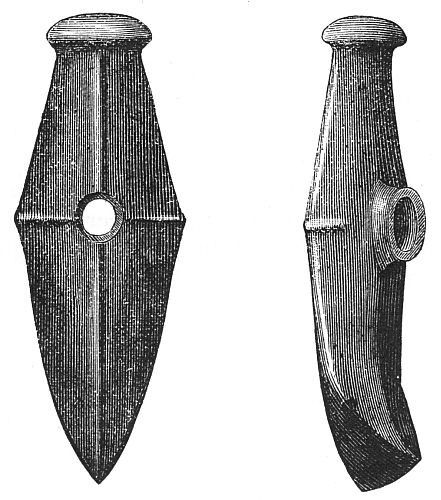
STONE AXES FROM THE LATER STONE AGE.
It is tolerably certain that the Aryan settlers in Norway knew at that time very little of agriculture, but made their living by hunting, fishing, and cattle-raising. The huts which they built of logs were rude contrivances which could be easily torn down and moved. But, as at a very early period, they began to devote themselves more to the culture of the ground, their dwellings were made larger, and were built with greater care. When a horde of warriors invaded a valley their first task was to clear away the forests which grew dense and dark up over the mountain sides. Their chieftain then built a hov or temple for the gods, where sacrifices were made at certain stated times. Whether it was the chieftain's task to allot to each his share of land, or whether each one chose according to his own preference, is not known, but the former is the more probable; for the Norsemen, proud and pugnacious as they were, subordinated themselves, in historic times, readily to their local chiefs, and accorded them great honor. This sense of kinship within the tribe and willing recognition of authority was the more important in Norway, because the character of the ground there compelled the people to live far apart on scattered gaards or farms, between which communication was often difficult. It would therefore have been easy for the bönder or peasants to forget all public concerns and gradually to lapse into isolation and savagery. But here their Germanic nature, which had in it the germs of social progress, asserted itself. As the centuries passed the people were bound more strongly together by common pursuits and common interests. First of all, their religious observances brought them together, then the necessity of defence against external enemies. Life and property were in those days insecure possessions, and it was only by acting in concert, under the leadership of a valiant chief, that the scattered peasants could hope to preserve either. Men had then fiercer and more inflammable passions than they have now, and only fear of retaliation could teach them self-restraint.
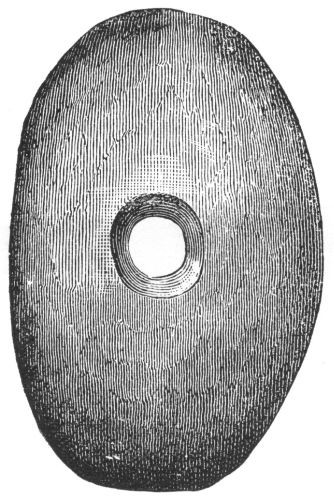
STONE HAMMER.
STONE USED FOR SHAPING IMPLEMENTS.
It happened in this way that almost every separate valley in Norway became a little kingdom by itself. Such a diminutive kingdom was called a fylki. There was not always a king, but a chief there was always, and sometimes more than one. To the king belonged the leadership in war. He was in some district called a jarl or earl, though this name came in later times to mean not an independent ruler, but rather a land-grave, a royal governor. The king could not tax the peasants for his support, nor impose any burden upon them which they did not of their own free choice accept. As a rule, his dignity was inherited by his son, though the people were at liberty, in case they disapproved of the heir, to select another. This right was repeatedly exercised in historic times, both in Sweden and Norway. Sometimes, when the crops failed or bad weather destroyed their herds, the peasants sacrificed their king to their gods. All public misfortunes they interpreted as a sign that the gods were angry, and craved bloody atonement. If the crops were good it was evident that their king was in favor with the gods.

STONE KNIFE.
It thus appears that the royal dignity among the early Norsemen was burdened with unpleasant responsibilities. It involved more duties than privileges, for, besides commanding in war, the king had also to conduct the public sacrifices at the great pagan festivals. He was thus priest as well as king. In fact, as before stated, he built the hov or temple himself, and it was chiefly his ownership of this, which raised him to a dignity superior to that of other chieftains. It was by dint of this same authority that he acted as judge at the fylkis thing, or popular assembly, where all freeman met to consult concerning public and private affairs. The fylkis thing was neither a parliament nor a court of law, but both combined. Private quarrels were settled, blood-wites or fines agreed upon for homicides and other injuries, and resolutions taken concerning peace and war. It was not a representative assembly, the members of which were elected by vote, but rather a county meeting (shiremote) where every man who could bear arms had a right to make himself heard. You would scarcely wonder that where so many fierce and turbulent warriors were gathered, breaches of the peace were frequent. But when swords were drawn, it was impossible to judge and deliberate. Therefore the fylkis thing was hallowed, and to break the peace of the thing was regarded as the greatest of crimes. If a man killed another, and publicly proclaimed himself his slayer, the crime could be atoned for by money (blood-wite) paid to the nearest surviving relative of the dead man. If the relatives accepted the blood-wite, they were not at liberty to seek revenge. But in ancient times it was regarded as more honorable to refuse the money and resort to the sword. If a man slew another secretly and denied the crime he was held to be a murderer, and could not offer blood-wite. He was then outlawed, and every man who saw him was at liberty to slay him.
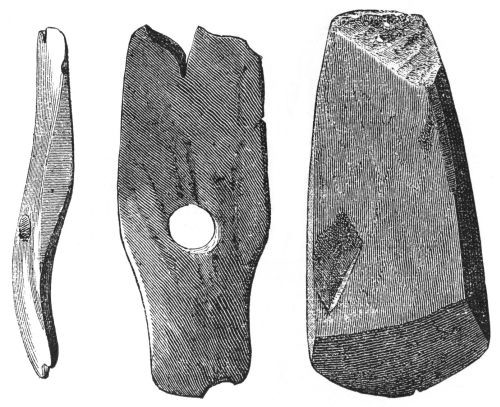
ADZE OF ELK-HORN.----- STONE WEDGE
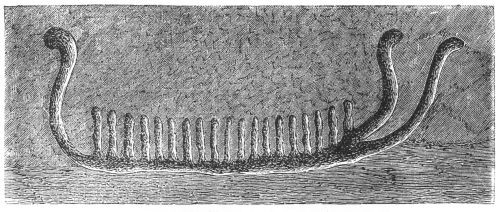
ROCK PICTURE OF A SHIP AT LOKEBERG IN BOHUSLEN.
Such were the Norsemen during the first centuries after their settlement in their present home. In spite of their violence and proneness to bloodshed, you will yet admit that they had many traits which were admirable. They could recognize authority, and yet preserve their sturdy sense of independence. Simple and imperfect as their fylkis things were, they suffice to show an aptitude for self-government, and a recognition of the people itself, as the source of authority. These tall blonde men with their defiant blue eyes, who obeyed their kings while they had confidence in them, and killed them when they had forfeited their respect, were the ancestors of the Normans who under William the Conqueror invaded England, and founded the only European state which has since reached the highest civilization and the highest liberty, through slow and even stages of orderly development.


CHAPTER II.
THE RELIGION OF THE NORSEMEN.
The Icelander Snorre Sturlasson wrote in the thirteenth century a very remarkable book, called the Heimskringla, or the Sagas of the Kings of Norway. In this book he says that Odin, the highest god of the Norsemen, was the chief who first led the Germanic tribes into Europe. He was a great warrior and was always victorious. Therefore, when he was dead, the people made sacrifices to him and prayed to him for victory. They did not believe, however, that he was actually dead, but that he had returned to his old home in Asia, whence he still watched their fortunes and occasionally visited them in person. Many tales are told in the sagas of people who had seen Odin, particularly when a great battle was to be fought. He was represented as a tall, bearded man with one eye, and clad as a warrior. He had two brothers, Vile and Ve, and many sons and daughters who were worshipped like him and became gods and goddesses. Odin and his children were called Aesir, which Snorre says means Asia-men; and their home Asgard, or Asaheim, likewise indicates their Asiatic origin. During their migrations the Aesir came in contact with another people, called the Vanir, with whom, after an indecisive battle, they formed an alliance. The Vanir then made common cause with the Aesir and were worshipped like them.

BRONZE SWORD. (Vestergötland in Sweden.)
Whether there is any basis of truth in this tradition, is difficult to determine. We know that primitive nations usually make gods of their early kings and chieftains, and worship them after death. Every year that passes makes them look greater and more mysterious. In storms and earthquakes, in thunder and lightning, they hear their voices and see the manifestations of their power. More and more they become identified with the elements which they are supposed to rule; the mighty attributes of the sun, the sky, and the sea are given to them, and to each is allotted his particular sphere of action. The chieftain who has been a valiant warrior in his life-time is supposed to give victory to those who call upon him. He who has excelled in the arts of peace continues to rule over the seasons, and to give good crops and prosperity to those who, by sacrifices, secure his good-will. This may have been the origin of the Scandinavian gods; although many scholars maintain that they were from the beginning personifications of the elements, and have never had an actual existence on earth. But whether they were originally men or sun-myths, interesting legends have been told about them which may be worth recounting.

LOOR OR WAR HORN OF BRONZE. (Skaane.)
In the beginning of time there were two worlds, Muspelheim, the world of fire, whose king was Surtur, and Niflheim, the world of frost and darkness. In Niflheim was the spring Hvergelmer, where dwelt the terrible dragon Nidhögger. Between these two worlds was the yawning chasm Ginnungagap. The spring Hvergelmer sent forth twelve icy rivers, which were called the Elivagar. These gradually filled up the chasm Ginnungagap. As the wild waters rushed into the abyss, they froze and were again thawed by the sparks that were blown from the fiery Muspelheim. The frozen vapors fell as hoar-frost, and the heat imparted life to them. They took shape and fashioned themselves into the Yotun or giant Ymer, from whom descends the evil race of frost-giants. Simultaneously with Ymer the cow Audhumbla came into being. She licked the briny hoar-frost, and a mighty being appeared with the shape of a man. He was large and beautiful, and was named Bure. His son was Bör, who married the daughter of a Yotun, and got three sons, Odin, Vile, and Ve. These three brothers slew the Yotun Ymer, and in his blood all the race of Yotuns was drowned except one couple, from whom a new race of giants descended. Then Odin and his brothers dragged the huge body of Ymer into the middle of Ginnungagap, and fashioned from it the world. Out of the flesh they made the earth, the bones became stones and lofty mountains, and his blood the sea. From his hair they made the trees, and from his skull the great vault of the sky. His brain they scattered in the air, where its fragments yet float about in queer, fantastic shapes, and are called clouds. The flying sparks from Muspelheim they gathered up and fashioned them into sun, moon, and stars, which they flung up against the blue vault of the sky. Then they arranged land and water so that the ocean flowed round about the entire earth, and beyond the watery waste they fixed the abode of the Yotuns. This cold and barren realm beyond the sea is therefore called Utgard or Yotunheim. From the earth to the sky they suspended a bridge of many colors, which they named Bifrost or the rainbow. The Yotun woman Night married Delling (the Dawn) and became the mother of Day, who rode in his shining chariot across the sky, always followed by his dark mother. The latter drove a huge black horse named Hrimfaxe, from whose foamy bit dropped the dew that refreshed the grass during the hours of darkness, while Day's horse, Skinfaxe, spread from his radiant mane the glorious light over the earth. It is further told that the heat bred in Ymer's body a multitude of maggots, which assumed the shapes of tiny men and were called gnomes or dwarves. They live in caves and mountains, and know of all the treasures of gold and silver and precious stones in the secret chambers of the rocks. They also have great skill in the working of metals, but they cannot endure the light of the sun. Last of all man was created. One day when the three gods, Odin, Höner, and Lodur were walking on the shores of the sea they found two trees, and from these they made a man and a woman, named Ask and Embla (ash and elm). Odin gave them the breath of life, Höner, speech and reason, Lodur, blood and fair complexions.

BRONZE SWORD. (Sandherred.)
The old Norsemen conceived of the world as an enormous ash tree, named Ygdrasil, the three roots of which extend, one to the gods in Asgard, another to Yotunheim, the third to Niflheim. On the third gnaws continually the dragon Nidhögger. In the top of the tree sits an eagle; among the branches four stags are running; and up and down on the trunk frisks a squirrel who carries slander and endeavors to make mischief between the eagle and the dragon. Under the root which stretches to Yotunheim is the fountain of the wise Yotun Mimer, to whom Odin gave one of his eyes in return for a draught from his fountain. For whoever drank from its water became instantly wise. Under the second root of the ash, which draws its nourishment from heaven, is the sacred fountain of Urd, whither the gods ride daily over the bridge Bifrost. Here they meet the three Norns—Urd, Verdande, and Skuld (Past, Present, and Future), the august goddesses of Fate, whose decrees not even the gods are able to change. The Norns pour the water of the fountain over Ygdrasil's root, and thereby keep the world-tree alive. They govern the fates of gods and men, giving life or death to whomever they please.

BUCKLE FROM THE EARLY IRON AGE. FOUND AT HETLAND IN STAVANGER AMT.
Odin dwells with all the other gods in Asgard, where he receives in his shining hall Valhalla all those who have died by the sword. He is therefore called Valfather, and those fallen warriors whom he chooses to be his guests, are known as einheriar, i. e., great champions. Valhalla is splendidly decorated with burnished weapons. The ceiling is made of spears, the roof is covered with shining shields, and the walls are adorned with armor and coats of mail. Hence the champions issue forth every day and fight great battles, killing and maiming each other. But every night they wake up whole and unscathed and return to Odin's hall, where they spend the night in merry carousing. The maidens of Odin—the Valkyries, who, before every battle, select those who are to be slain, wait upon the warriors, fill their great horns with mead, and give them the flesh of swine to eat.
The great gathering-place of the gods in Asgard is the plains of Ida. Here is Odin's throne, where he sits looking out over the whole world. At his side sit the two wolves—Gere and Freke, and on his shoulders the ravens, Hugin and Munin, who daily fly forth and bear him tidings from the remotest regions of the earth. If he wishes to travel, he mounts his eight-footed horse Sleipner, which carries him far and wide with wonderful speed. When the father of gods and men rides to battle he wears a helmet of gold and a suit of mail, which shines dazzlingly from afar. He carries also his spear Gungner, which he sends forth whenever he wishes to arouse men to warfare and strife. But, besides being the god of war, Odin also delights in poetry and sage counsel. He is the god of the scalds or poets; for he had drunk of Suttung's mead, which imparted the gift of song. He is well skilled in sorcery, and has taught men the art of writing runes.
Thor, the son of Odin, lives in Thrudvang. He is the strongest of all the gods, and has an enormous hammer, Mjolner, with which he carries on a ceaseless warfare against the Yotuns, or mist-giants. He rides in a cart drawn by two rams across the Gjallar bridge (the resounding bridge), which leads to Yotunheim, and the rattling of the cart and the noise of his hammer, as he hurls it at the heads of the fleeing giants, make the vault of the sky tremble. This is what men call thunder. When Thor is hungry, he kills his rams and eats their flesh, but he is always careful to gather up the bones and to throw them back into the skins. Then, the next morning, the rams are as frisky as ever and ready for service. Thor has a wife named Sif, whose hair is of gold.
Balder, the good and the beautiful, is also the son of Odin. He is wise and gentle, and kindness beams from his countenance. His wife is Nanna, and his dwelling Breidablik.
Njord is ruler of the sea, and can raise storms and calm the waves at his pleasure. He is of the race of the Vanir, but is yet worshipped as a god. He is the owner of great wealth, and can give prosperity to those who obtain his favor. Njord was married to the Yotun woman, Skade, but was again separated from her. His abode is at Noatun, from which he has wide view of the sea.
Frey, the son of Njord, rules over the seasons, and gives peace and good crops. Fields and pastures grow, and the cattle thrive in the sunshine of his favor. He lives with his wife Gerd in Alfheim. Tyr is the god of courage, whom men call upon as they are about to go into battle. He has but one hand, having thrust the other into the mouth of the Fenris-Wolf, who bit it off. Brage is the god of song, and of vows and pledges. He has a long beard, and, is possessed of wisdom and eloquence. When men drained the horn in his honor, they made vows of daring deeds which they would perform, and called the god to witness that they would keep them. Many were those who, while drunk, pledged themselves to foolhardy undertakings, and perished in the attempt to carry them out. Brage's wife is the ever-young Idun. She has in her keeping the wonderful apples, which the gods eat to preserve the beauty and vigor of an eternal youth.
The watchman of the gods is named Heimdal. His senses are so keen that nothing can escape him. He can see hundreds of miles, and he can hear the grass grow. When he blows his Gjallar horn (the resounding horn), its rousing call is heard throughout the world. Heimdal's dwelling is Himinbjarg at the Bifrost Bridge.
Among gods of less consequence may be mentioned Uller, the step-son of Thor, who is a master in running on snow-shoes; Forsete, the son of Balder, who makes peace between those who have quarrelled; Höder, the blind god, who shot Balder; and the silent Vidar.
Foremost among the goddesses is Frigg, the wife of Odin, who dwells in Fensal. She shields from danger those who call upon her. Freya, the Northern Venus, is the goddess of beauty. She is the daughter of Njord, and was forsaken by her husband Odd, and is ever hoping for his return. She travelled far and wide in search of him, and wept because she could not find him. Her tears turned into gold, and gold is therefore by the poets called the tears of Freya. Her chariot, in which she drives over the sky, is drawn by cats, though at times she flies in the guise of a swan and visits distant lands. Her necklace, Brising, made by wonder-working gnomes, is of dazzling splendor. The dwelling of Freya is Folkvang, and thither ascend the prayers of lovelorn swains and maidens. Freya's daughter, Hnos, is of marvellous beauty and a sweet disposition. Her name is still used in the nursery as a pet-name for babes.
The dominion of the sea does not belong entirely to Njord. The Yotun Aeger rules over the towering waves, and lashes them into fury, until Njord again curbs them and bids them be still. Yet Aeger is the friend of the gods, and is at times visited by them in his magnificent submarine hall, where ale and mead flow abundantly. He is himself peaceably disposed toward men, but is overruled by his terrible wife Ran, who with her nine daughters (the waves) causes shipwrecks and draws the drowned men down to her watery abode.
One dweller in Asgard is still to be mentioned, and that is the evil Loke, who disturbs the peace of the gods, and will work their final ruin. He was born among the Yotuns, but gained the confidence of Odin by his agreeable presence and his fair speech. He delighted in mischief and loved evil-doing. He had three terrible children—the wolf Fenris, the world-serpent, and Hel. As these monsters grew up, the gods foresaw that their presence in Asgard would cause trouble. The wolf Fenris was, therefore, after having broken the strongest chains, tied with a magical cord, made of the noise of cats'-paws, women's beard, roots of mountains, and other equally intangible things. This cord he could not break. The world-serpent was thrown into the ocean, where it continued to grow until it encircled all the earth and at last bit its own tail. Hel was banished to Helheim, where she became the ruler of the dead, and the goddess of the under-world.

CHAPTER III.
THE AGE OF THE VIKINGS. THE ORIGIN OF THE VIKING CRUISES.
The Norsemen had up to the middle of the eighth century played no part in the world's history. Their very existence had been unknown or but vaguely known to the rest of Europe. But towards the close of the eighth century they broke like a destructive tempest over the civilized lands, spreading desolation in their path. When their fast-sailing ships with two square sails were sighted at the river-mouths, people fled in terror, and the priests prayed in vain: "Deliver us, O Lord, from the rage of the Norsemen."
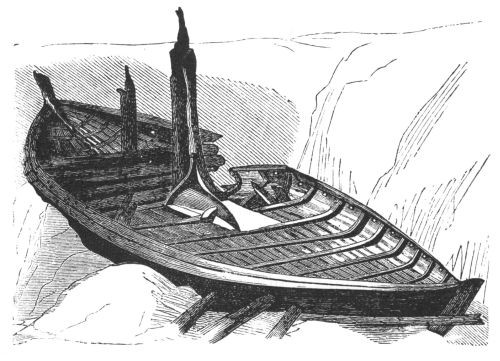
THE VIKING SHIP RECENTLY UNEARTHED AT GOGSTAD, NEAR SANDEFJORD.
There were several reasons for this sudden warlike activity on the part of the Norsemen. They had waged war from immemorial times; because war was with them the most honorable occupation. As Tacitus says of their kinsmen, the Germans: "They deemed it a disgrace to acquire by sweat what they might obtain by blood." But previous to the viking period they had fought each other. One earl or king made foraging expeditions into the land of his neighbors, and carried away with him whatever booty he could lay hands on. But in this perpetual warfare one or the other must at length become exhausted, and the stronger would be likely to oust or vanquish the weaker. This was what happened in the north. Large tracts of land, made up of small conquered kingdoms, were united under one successful chief, who, of course, made haste to prevent depredations within his own boundaries. With the growing power of these local kings, it became more and more risky to attack them, and the field for domestic warfare thus became constantly narrower. But war was the very condition of the chieftain's existence among the early Norsemen. His honor was dependent upon the number of his followers and the splendor of their equipments, and to gain the means to entertain and to equip them he was obliged to wage war. When he could no longer do it at home, he naturally went abroad. It was neither ferocity nor excessive avarice which impelled him to draw the sword; but the desire to preserve his honor among men, which, in a warlike state, is merely another form of the instinct of self-preservation. The high-born chieftain had to make himself formidable in order to protect his life and property. He had to live in accordance with his rank, if he wished to live at all. His men-at-arms were his body-guard as well as his army. He had to behave royally toward them in order to preserve their good-will; and next to personal valor, liberality in giving was the first duty of a king. The king is therefore called the breaker of rings (large solid arm-rings of gold being used for purposes of payment) and the hater of gold.[A]
[A] Munch (Det Norske Folk's Historie, 1-124) derives the word king (old Norse, konungr; Anglo-Saxon, cyning; O. H. German, chuninc and chunig) from Kun or Kon, meaning race, descent; and interprets the word as meaning (like Lat., generosus) of high birth or descent.
There is in the earliest Germanic times no sharp distinction between the titles "earl" and "king." The viking cruises, however, helped to establish a distinction. The earl who, having gathered a large number of warriors about him, went abroad for purposes of conquest, was hailed by his men as king. A number of vikings, of high birth, assumed the name of kings, when starting on warlike expeditions; but were known as sea-kings, in contra-distinction to those who ruled at home over a fixed domain. The number of these sea-kings increased (for the reasons cited above) enormously toward the close of the eighth century. They harried not only the coasts of the neighboring lands, but they crossed the North Sea and the Baltic, carrying away or slaughtering the inhabitants and destroying the cities. Churches and monasteries they plundered, scattering the bones of the saints to the four winds; all that Christian men held sacred they trod under foot. And yet we must bear in mind that all we know about these early vikings is derived from the writings of their enemies, who were smarting under the injury they had done them. That they were fierce and brutal is credible enough. The warlike state is in itself brutalizing. It arouses all the slumbering savagery in man, and smothers his gentler impulses. But certain moral qualities even their hostile chroniclers concede to them. They admit that the Norse barbarians were, as a rule, faithful to their oaths and kept their promises.
Three periods[A] are recognizable in the viking age, though there are, in point of time, no sharp divisions between them. It would, perhaps, be more correct to say that there were three kinds of vikings. The first cruises were more or less tentative and irregular. Chieftains gather about them crews for a few ships and sail over to England, Denmark, or Flanders, where they attack a city or a monastery, and return home with their booty. The second period shows an advance in the art of war and in military experience. Several vikings attack in company some exposed point, take possession of it, erect fortifications, and make forays into the surrounding country. During the third period the Norsemen abandon their character of pirates and assume the rôle of conquerors. With large fleets, counting from one to five hundred ships, they storm and sack cities, assume the government of the conquered territories, treat, as regular belligerents, with kings and emperors, and establish themselves permanently in the conquered land. Of the two first classes of vikings we have only scattered and unreliable accounts. To go on viking cruises is a recognized occupation in the Norse sagas, and it was regarded as a kind of liberal education for a young man of good birth to spend some years of his youth on such expeditions. His honor was thereby greatly increased at home, and his position in society assured. Royal youths of twelve or fifteen years often went abroad as commanders of viking fleets, in order to test their manhood and accumulate experience and knowledge of men.
[A] Sars: "Udsigt over den Norske Historie," 1-90.

1.—SIDE VIEW OF THE GOGSTAD VIKING SHIP. 2.—VIKING SHIP RESTORED. 3.—DETAILS OF VIKING SHIP.
The third class of vikings, the conquerors, have found their historians both at home and abroad; and the different narratives, though not strictly accurate, supplement and correct each other. It is these conquering vikings who have demonstrated the historic mission of Norway, and doubly indemnified the world for the misery they brought upon it. The ability to endure discipline without loss of self-respect, voluntary subordination for mutual benefit, and the power of orderly organization, based upon these qualities, these were the contributions of the Norse vikings to the political life of Europe. The feudal state, which, with all its defects, is yet the indispensable basis of a higher civilization, has its root in the Germanic instinct of loyalty—of mutual allegiance between master and vassal; and the noble spirit of independence which restrains and limits the power of the ruler, and at a later stage leads to constitutional government, is even a more distinctly Norse than Germanic characteristic. While Norway, up under the pole, has developed a democracy, Germany, coming at too early a period into contact with Rome, has developed a military despotism under constitutional forms. The breath of new life which the vikings infused into history lives to-day in Norway, in England, and in America.
Among the earliest conquests of the Norse vikings was a portion of the present Sleswick which after them was called Nortmannia. It is possible that they recognized the sovereignty of the kings of Denmark, though there is no direct evidence that they regarded themselves as vassals. The first intelligence we obtain concerning them is that their king Sigfrid, in the year 777, received hospitably the Saxon chieftain Widukind, who, when summoned to meet Charlemagne in Paderborn, fled northward and sought refuge with his Norse co-religionists. This Sigfrid belonged to the renowned race of the Ynglings, from whom descended Harold the Fairhaired, and through him a long line of Norwegian kings. A later king of Nortmannia, who also had great possessions in Norway, was Gudröd or Godfrey the Hunter. He came, through the friendship of the Saxons, repeatedly into collision with Charlemagne, and even threatened to attack the emperor in Aachen. It is told that he was killed by his own men in the year 809. He had about a year before attacked and slain the king of Agder, whose daughter Aasa he married. She bore him a son named Halfdan the Swarthy, but avenged her father's death by inducing her servant to kill her husband while he was drunk. One of Godfrey's sons, Erik, carried on an intermittent warfare with Charlemagne's son, Louis the Pious, sent embassies to Aachen, and in 845, during the reign of Louis the German, sacked and burned the city of Hamburg. St. Ansgarius, the apostle of the North, who had been established by the emperor as archbishop of Hamburg, fled with all his priests; and the church and the monastery which he had founded were utterly destroyed.
It was not only in his remote northern domains that Charlemagne came in contact with the vikings. The chronicles of the Monks of St. Gall relate that he also encountered them in his Mediterranean provinces. Once, as he was visiting a city in Gallia Narbonensis, some fast-sailing Norse ships with square sails were seen out in the harbor. Soon a message was brought to the emperor that the crews had landed and were plundering the shore. Nobody then knew to what nationality these ships belonged, some conjecturing that they were Jewish, others African, and again others that they were British merchant vessels.
"No," said Charlemagne, "these ships are not filled with merchandise, but with the most pugnacious foes."
Hearing this everybody seized his weapons and hastened to the harbor; but the vikings had in the meanwhile learned that the emperor was in the city, and as they were not strong enough to fight with him, they fled to sea.
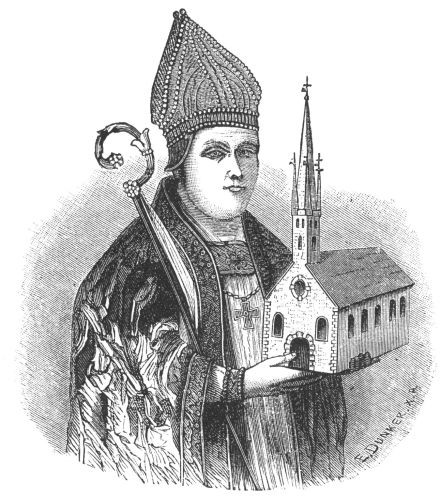
ST. ANSGARIUS, THE APOSTLE OF THE NORTH.
It is related that Charlemagne, as he stood at his window and watched their flight, wept. Remarking the wonder of his men, he said:
"I do not weep because I fear that these miscreants can do me any harm; but I am grieved that, while I am alive, they have dared to show themselves upon this coast; and I foresee with dread all the evil they will do to my descendants."[A]
[A] Munch (Det. Norske Folks Historie 1-414) questions the credibility of this story, because the Norsemen did not show themselves in the Mediterranean as early as the chronicle here indicates; in fact not before 800 A.D.
This story, endowing the emperor with prophetic vision, has a certain legendary flavor, and may be a monkish invention. Similar prophecies, dating after the event, are found in other ecclesiastical authors, and show sufficiently the feeling with which the Norsemen were regarded. It is especially one typical viking, the renowned Hasting, who figures both in sacred and profane chronicles. He sailed up the Loire in 841, with a large fleet, burned the city of Amboise, and besieged Tours. The inhabitants, however, carried the bones of their patron saint up on the walls; and, according to the story, by the intervention of the saint, the vikings were put to flight. In 845, Hasting is reported to have attacked Paris, in company with Björn Ironside, the son of Ragnar Lodbrok. To the Baltic and even to the shore of the Mediterranean this fearless marauder extended his ravages, and as success attended his banner, he grew more daring and determined to lay siege to Rome.
He even aspired to put the imperial crown upon his brow. With as large a fleet as he could muster he sailed through the Pillars of Hercules, but before he reached the mouth of the Tiber, a storm drove his ships to the city of Luna, near Carrara. Being poorly versed in geography, Hasting mistook this city for Rome, and resolved to capture it by strategem.
[A] Munch (Det Norske Folk's Historie, 1-124) derives the word king (old Norse, konungr; Anglo-Saxon, cyning; O. H. German, chuninc and chunig) from Kun or Kon, meaning race, descent; and interprets the word as meaning (like Lat., generosus) of high birth or descent.
There were several reasons for this sudden warlike activity on the part of the Norsemen. They had waged war from immemorial times; because war was with them the most honorable occupation. As Tacitus says of their kinsmen, the Germans: "They deemed it a disgrace to acquire by sweat what they might obtain by blood." But previous to the viking period they had fought each other. One earl or king made foraging expeditions into the land of his neighbors, and carried away with him whatever booty he could lay hands on. But in this perpetual warfare one or the other must at length become exhausted, and the stronger would be likely to oust or vanquish the weaker. This was what happened in the north. Large tracts of land, made up of small conquered kingdoms, were united under one successful chief, who, of course, made haste to prevent depredations within his own boundaries. With the growing power of these local kings, it became more and more risky to attack them, and the field for domestic warfare thus became constantly narrower. But war was the very condition of the chieftain's existence among the early Norsemen. His honor was dependent upon the number of his followers and the splendor of their equipments, and to gain the means to entertain and to equip them he was obliged to wage war. When he could no longer do it at home, he naturally went abroad. It was neither ferocity nor excessive avarice which impelled him to draw the sword; but the desire to preserve his honor among men, which, in a warlike state, is merely another form of the instinct of self-preservation. The high-born chieftain had to make himself formidable in order to protect his life and property. He had to live in accordance with his rank, if he wished to live at all. His men-at-arms were his body-guard as well as his army. He had to behave royally toward them in order to preserve their good-will; and next to personal valor, liberality in giving was the first duty of a king. The king is therefore called the breaker of rings (large solid arm-rings of gold being used for purposes of payment) and the hater of gold.[A]
[A] Sars: "Udsigt over den Norske Historie," 1-90.
Three periods[A] are recognizable in the viking age, though there are, in point of time, no sharp divisions between them. It would, perhaps, be more correct to say that there were three kinds of vikings. The first cruises were more or less tentative and irregular. Chieftains gather about them crews for a few ships and sail over to England, Denmark, or Flanders, where they attack a city or a monastery, and return home with their booty. The second period shows an advance in the art of war and in military experience. Several vikings attack in company some exposed point, take possession of it, erect fortifications, and make forays into the surrounding country. During the third period the Norsemen abandon their character of pirates and assume the rôle of conquerors. With large fleets, counting from one to five hundred ships, they storm and sack cities, assume the government of the conquered territories, treat, as regular belligerents, with kings and emperors, and establish themselves permanently in the conquered land. Of the two first classes of vikings we have only scattered and unreliable accounts. To go on viking cruises is a recognized occupation in the Norse sagas, and it was regarded as a kind of liberal education for a young man of good birth to spend some years of his youth on such expeditions. His honor was thereby greatly increased at home, and his position in society assured. Royal youths of twelve or fifteen years often went abroad as commanders of viking fleets, in order to test their manhood and accumulate experience and knowledge of men.
[A] Munch (Det. Norske Folks Historie 1-414) questions the credibility of this story, because the Norsemen did not show themselves in the Mediterranean as early as the chronicle here indicates; in fact not before 800 A.D.
"I do not weep because I fear that these miscreants can do me any harm; but I am grieved that, while I am alive, they have dared to show themselves upon this coast; and I foresee with dread all the evil they will do to my descendants."[A]
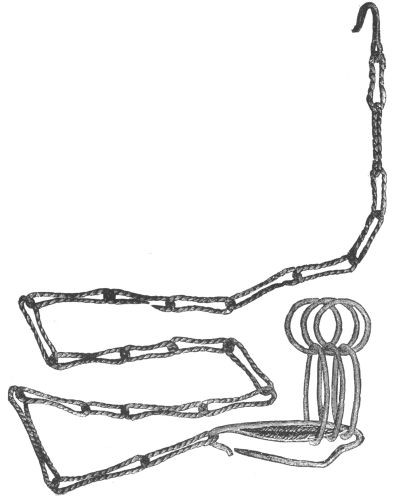
IRON IMPLEMENT OF FREQUENT OCCURRENCE; USE UNKNOWN.
He sent word to the bishop that he was very ill and desired to be baptized, so that he might die a Christian. The bishop, as well as the commander of the town, fell into the trap. Delighted at the prospect of gaining so valuable a convert, they opened the gates and invited the Norsemen to enter. These, in the meanwhile, declared, that since sending his message, Hasting had died; and with great pomp they bore his coffin, followed by a funeral procession of enormous length, into the cathedral where the bishop stood ready to read the mass for the repose of the viking's soul. Suddenly, however, as the coffin was deposited before the altar and the mass commenced, Hasting sprang up, flung away his shroud, and stood in flashing armor before the astonished populace. His men, at this signal, also flung off their mourning cloaks and drew their swords. The bishop and his priests were killed, and blood flowed in torrents through the sacred aisles. A terrible carnage ensued, and the city was captured. Having accomplished this enterprise, Hasting discovered that, while deceiving, he had himself been deceived. It was not Rome he had taken after all. Whether he accepted this as an omen or not, he lost his desire to make his entry into the eternal city. Content with the booty he had accumulated, he turned his prows toward France where he became the vassal of Charles the Bald, from whom he received valuable fiefs.[A]
[A] The Norse Sagas make no mention of Hasting, and Munch (1-429) gives several reasons for questioning whether he was an historical character.
Many other vikings are mentioned in chronicles of later date, who by their incessant attacks upon the coasts, taxed the energy of the weak Carolingian kings to the utmost. One of them, named Ragnar, is said to have plundered Paris in 845, and another, named Asgeir, had four years earlier sacked and burned Rouen and the monastery Jumièges. He spent eleven years ravaging the coasts of France, and finally, in 851, sailed up the Seine, destroyed the monastery Fontenelle and burned Beauvois. On his return to the sea he was defeated by the French, and had to hide with his men in the woods, but succeeded in recapturing his ships and making good his escape. Of a third one, Rörek, it is told that about the year 862 he accepted Christianity, without, as it appears, experiencing any perceptible change of heart. After having ravaged Dorestad and Nimwegen, two flourishing cities on the Rhine, and having defended himself heroically against King Lothair, the younger, he made peace (873) with Louis the German, and refrained from further depredations.

TWO-EDGED SWORD. HILT OF SILVER AND BRONZE.
There is a certain uniformity in the deeds of the vikings, whether they be Norsemen or Danes, which makes further description superfluous. Only a few of their more daring enterprises may be briefly alluded to.
To Ireland the Norsemen had been attracted at a comparatively early period. In the last decade of the eighth century they destroyed the monastery of Iona or Icolmkill, and between the years 810 and 830 they spread terror and devastation along the entire coast. In the year 838 they sailed with one hundred and twenty ships up to Dublin and conquered the city, under the leadership of Thorgisl, who still lives in Irish song and story under the names of Turges and Turgesius.
"After many sharp fights," says an old author,[A] "he conquered in a short time all Ireland, and erected, wherever he went, high fortifications of masonry with deep moats, of which many ruins are yet to be seen in the country." At last he fell in love with the daughter of Maelsechnail, king in Meath, and demanded of him that he should send her to him, attended by fifteen young maidens. Thorgisl promised to meet her with the same number of high-born Norsemen on an island in Loch Erne. But instead of maidens Maelsechnail sent fifteen beardless young men, disguised as women and armed with daggers. When Thorgisl arrived he was attacked by these and slain. On a previous occasion Maelsechnail had asked Thorgisl what he should do to get rid of some strange and injurious birds that had got into the country. "Destroy their nests," said Thorgisl. Accordingly Maelsechnail began at once to destroy the Norse castles, while the Irish slew or chased away the Norsemen.
[A] Giraldus Cambrensis, De Topogr. Hiberniæ, cap. 37. Quoted from Munch, 1-438.
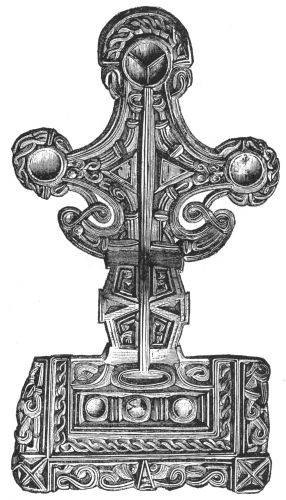
BUCKLE FROM THE IRON AGE.
It appears probable that Thorgisl's reign in Ireland lasted from 838 to 846, although a much longer period is given by the above-quoted chronicler. A more enduring sway over the country was gained by the Norse sea-king Olaf the White, who belonged to the great Yngling race. In 852 a company of Danish vikings had possession of Dublin; but Olaf defeated them and compelled them to send him hostages. He then established himself in the city, built castles, and taxed the surrounding country. Two other Norsemen, the brothers Sigtrygg and Ivar, founded about the same time kingdoms—the former in Waterford, the latter in Limerick—without, however, being able to compete with Olaf in splendor and power. The dominion of the Norsemen in Dublin is said to have lasted for three hundred and fifty years. From Irish sources a somewhat different account is derived of these remarkable events. It is told that the Norsemen often sailed up the rivers, not as warriors, but as peaceful merchants, and that the Irish found it advantageous to trade with them. They thus gained considerable possessions in the cities, and when the vikings came there was already a party in the larger cities who favored them and made their conquests easy.
From Dublin Olaf the White made two cruises to Scotland, laid siege to Dumbarton, sailed southward to England, plundering and ravaging, and returned to Dublin with two hundred ships laden with precious booty. The Orkneys, the Hebrides, and the Faroe Isles were also, during this period, repeatedly visited by the vikings, and even to Iceland expeditions were made, which did not, however, result in permanent settlement. The Irish hermits and pious monks, who had retired from the world into the Arctic solitude, were disturbed in their devotions by the unwelcome visitors, and the majority returned to Ireland, while some are said to have remained until the island was regularly settled by the Norsemen.
To England the Norsemen went for the first time with hostile intent in 787. During the reign of King Beorthric in Wessex a small flock of vikings landed in the neighborhood of Dorchester, killed some people, and were driven away again. The Anglo-Saxon chronicle[A] relates the incident in these words:
[A] Monum. Hist. Brit., pp. 336, 337. Quoted from Munch, i., 416.
"In this year (787) King Beorthric married Eadburg, daughter of King Offa. In those days came for the first time Northmen and ships from Heredhaland. The gerêfa (commander) rode down to them and wished to drive them to the king's dwelling. For he knew not who they were; but they slew him there. These were the first ships belonging to Danish men which visited England."
It is noticeable that the ships are said in the same breath to have belonged to Northmen and to Danes, and it is obvious that the chronicler supposes the terms to be synonymous. The Heredhaland from which the men came was in all probability Hardeland in Jutland, where the Norsemen had at that time a colony.
The next attack of which we have an account was directed against the coast of Northumberland, and took place in the year 794. The monk Simeon of Durham,[A] who lived in the beginning of the twelfth century, writes as follows:
[A] Simeon of Durham, Monum. Hist. Brit., p. 668. Quoted from Munch, i., 417.
"The heathen came from the northern countries to Britain like stinging wasps, roamed about like savage wolves, robbing, biting, killing not only horses, sheep, and cattle, but also priests, acolytes, monks, and nuns. They went to Lindisfarena church, destroying every thing in the most miserable manner, and trod the sanctuary with their profane feet, threw down the altars, robbed the treasures of the church, killed some of the brothers, carried others away in captivity, mocked many and flung them away naked, and threw some into the ocean. In 794 they harried King Ecgfridh's harbor, and plundered the monastery of Donmouth. But St. Cuthbert did not permit them to escape unpunished; for their chieftain was visited with a cruel death by the English and, a short time after, their ships were destroyed by a storm, and many of them perished; a few who swam ashore were killed without pity."
It is an odd circumstance that while an incessant stream of Norse vikings, during the first half of the ninth century, poured southward, devastating the shores of the Baltic and the Mediterranean, only a comparatively small number found their way to England. We hear in the Sagas of many individual warriors who visited the Saxon kings in England and took service under them, and of several who sailed up the Thames and put an embargo on the trade of the river, capturing every ship that ventured into their clutches. But as a field for conquest they left England (probably not from any fraternal consideration) to their kinsmen, the Danes, while they themselves turned their attention to France, Ireland, and the isles north of Scotland. In the Hebrides, the Orkneys, the Shetland Islands, and the Faeroe Isles, their descendants are still living, and Norse names are yet frequent.
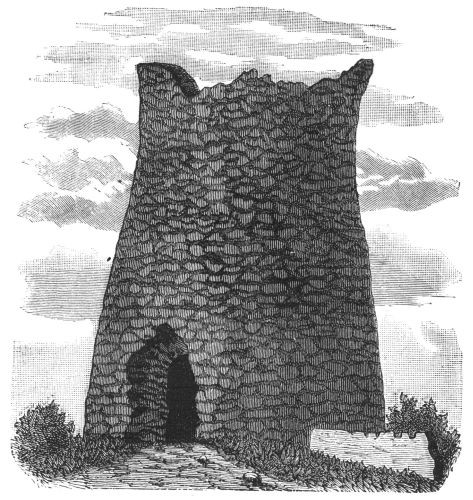
RUIN OF NORSE TOWER AT MOSÖ, SHETLAND ISLANDS.
Another notable circumstance in connection with the vikings is, that the very men whom foreign chroniclers describe as stinging wasps and savage wolves, and of whom the greatest atrocities are related during their sojourn abroad, became, as a rule, after their return home, men of weight and influence, with respect for tradition and law—men who, according to the standard of the time, were moral and honorable. There were exceptions, of course, but they go to prove the rule. The explanation is not far to seek. Religion in those days was tribal, and morality had no application outside the tribe. Every people is the chosen people of its own god or gods. As the Jews divided humanity into Jews and Gentiles, and the Greeks into Greeks and barbarians, so the Norsemen retaliated towards Jews and Greeks, by including them with all other nations in the Norse equivalent for barbarians. English, Irish, and Germans, often men of high birth, were constantly brought to Norway by the vikings as thralls, bartered and sold and forced to menial tasks. No law extended its protection to them; and yet maltreatment of thralls was, both in Iceland and Norway, regarded as unworthy of a freeman. For all that, the vikings were children of their age, and practised only the rude morality which their religion prescribed. The humanitarian sentiment which regards all men as brethren and creatures of the same God is a comparatively modern growth, and it would be unfair to judge the old Norsemen by any such advanced standard. It is therefore quite credible that the vikings may have been guilty of deeds abroad which they would not have committed at home.
CHAPTER IV.
HALFDAN THE SWARTHY.
The Yngling race traced its ancestry from the god Frey. Snorre Sturlasson, in his famous work, "The Sagas of the Kings of Norway,"[A] mentions a long line of kings who were descended from Fjölne, a son of Frey, and reigned in Sweden having their residence in Upsala. Yngve was one of the god's surnames, and Yngling means a descendant of Yngve. One of the Ynglings, named Aun the Old, sacrificed every ten years one of his sons to Odin, having been promised that for every son he sacrificed, ten years should be added to his life. When he had thus slain seven sons, and was so old that he had to be fed like an infant, his people grew weary of him and saved the eighth son, whom he was about to sacrifice. Ingjald Ill-Ruler, when he took the kingdom on the death of his father Anund, sixth in descent from Aun the Old, made a great funeral feast, to which he invited all the neighboring kings. When he rose to drink the Brage goblet,[B] he vowed that he would increase his kingdom by one half toward all the four corners of the heavens, or die in the attempt. As a preliminary step he set fire to the hall, burned his guests, and took possession of their lands. When he died, about the middle of the seventh century, he was so detested by his people that they would not accept his son, nor any of his race, as his successor. The son, whose name was Olaf, therefore gathered about him as many as would follow him, and emigrated to the great northern forests, where he felled the trees, gained much arable lands, and thereby acquired the nickname The Wood-cutter.[C] He and his people became prosperous, and a great influx of the discontented from the neighboring lands followed. In fact, so great was the number of immigrants that the country could not feed them, and they were threatened with famine. This they attributed, however, to the fact that Olaf was not in the favor of the gods, and they sacrificed him to Odin.
[A] "The Heimskringla, or the Sagas of the Kings of Norway," by the Icelander Snorre Sturlasson, was written in the twelfth century, and continued by his nephew Sturla Thordsson, is the principal source of the history of Norway up to the middle of the thirteenth century.
[B] The toast to the god Brage.
[C] Tretelgja.
His son, Halfdan Whiteleg,[A] was a great warrior. He conquered Raumarike in Norway and the great and fertile district called Vestfold, west of the fjord called Folden (now the Christiania Fjord). Here he founded a famous temple in Skiringssal, which soon became a flourishing trading station and a favorite residence of the Norwegian kings. The third in descent from him was the great viking Godfrey the Hunter, who waged war against Charlemagne, and Godfrey's son was Halfdan the Swarthy.
[A] Hvitbein.
Halfdan was but a year old in 810 when his father was killed. At the age of eighteen, he assumed the government of Agder, which he inherited from his maternal grandfather. By warfare and by marriage he also increased the great possessions he had received from his father, and, was, beyond dispute, the mightiest king in all Norway. It is told of him that he was a man of great intelligence, who loved justice and truth. He gave laws which he himself kept and compelled every one else to keep. In order that no one should with impunity tread the law under foot, he fixed a scale of fines which offenders should pay in accordance with their birth and dignity. This code was the so-called Eidsiva-Law, which had great influence in politically uniting the southern districts of Norway which Halfdan had gathered under his sway.
About King Halfdan's second marriage a story is told, which, whether originally true or not, has obviously been the subject of legendary adornment. It runs as follows:
There was a king in Ringerike whose name was Sigurd Hjort. He was a large and strong man. He had a daughter named Ragnhild, who was very beautiful, and a son named Guttorm. While Sigurd Hjort was out hunting he was attacked by the berserk[A] Hake and thirty men. He fought desperately, and slew twelve of his assailants, and cut off Hake's hand, but in the end he had to bite the dust. The berserk then rode to his house and carried away Ragnhild and Guttorm, besides much valuable property. He determined to marry Ragnhild and would have done so at once, if his wound had not grown constantly more painful. At Yule-tide, when King Halfdan came to feast in Hedemark, he heard of the outrage and resolved to punish it. He sent one of his trusted warriors, named Haarek Gand, with a hundred armed men to Hake's house; they arrived in the early morning before any one was awake. They set sentinels at all the doors, then broke into the sleeping-rooms and carried off Sigurd Hjort's children and the stolen goods. Then they set fire to the house and burned it up. Hake escaped, but seeing Ragnhild drive gayly away over the ice with King Halfdan's men, he threw himself upon his sword and perished. Halfdan the Swarthy became enamored of Ragnhild, as soon as he saw her, and made her his wife.
[A] Berserks or berserkir were champions of extraordinary strength, who in battle were possessed with a sanguinary fury which made them irresistible. Many of them were reputed to be were-wolves, and to be invulnerable.
While Queen Ragnhild was with child she dreamed marvellous dreams. Once she seemed to be standing in the garden, trying to take a thorn out of her chemise, but the thorn grew in her hand until it was like a long spindle—the one end of which struck root in the earth, while the other shot up into the air. Presently it looked like a big tree, and it grew bigger and bigger and taller and taller, until she stood in its shade and her eye could scarcely reach to the top of it. The lower part of the tree was red as blood; further up the trunk was green and fair, and the branches were radiantly white like snow. They were, however, of very unequal size, and it seemed to her that they spread out over the whole kingdom of Norway.
King Halfdan was much puzzled at hearing this dream, and perhaps a little jealous too. Why was it that his wife had such remarkable dreams, while he had none? He consulted a wise man as to the cause of this, and was by him advised to sleep in a pig-sty; then he would be sure to have remarkable dreams. The king did as he had been told, and dreamed that his hair was growing very long and beautiful. It fell in bright locks about his head and shoulders, but the locks were of unequal length and color; some seemed like little curly knots just sprouting from his scalp, while others hung down over his back, even unto the waist. But one lock there was that was brighter and more beautiful than all the rest.
The king related this dream to his sage friend, who interpreted it to mean that a mighty race of kings should spring from him, and that his descendants, though some of them should attain to great glory, should be unequal in fame. But one of them should be greater and more glorious than all the rest. The longest and brightest lock, says Snorre, was supposed to indicate Olaf the Saint.
When her time came, the queen bore a son who was named Harold. He grew rapidly in stature as in intelligence, and was much liked by all men. He was fond of manly sports and won admiration by his strength and his beauty. His mother loved him much, while his father often looked upon him with disfavor. Of his childhood many tales are told which cannot lay claim to credibility. Thus, it is said, that once, while King Halfdan was celebrating Yule-tide on Hadeland, all the dishes and the ale suddenly disappeared from the table. The guests went home, and the king, full of wrath, remained sitting. In order to find out who had dared thus to trifle with his dignity, he seized a Finn, who was a sorcerer, and tormented him. The Finn appealed to Harold, who, contrary to his father's command, rescued him and followed him to the mountains. After a while, they came to a place where a chieftain was having a grand feast with his men. There they remained until spring, and when Harold was about to take his leave, his host said to him: "Your father took it much to heart that I took some meat and beer away from him last winter; but for what you did to me I will reward you with glad tidings. Your father is now dead, and you will go home and inherit his kingdom. But some day you will be king of all Norway."
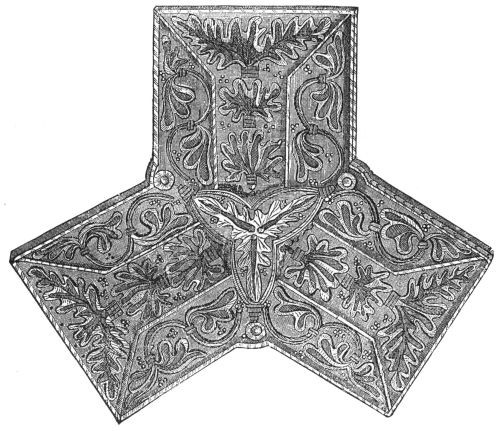
BUCKLE WITH BYZANTINE ORNAMENTATION, FOUND AT HOEN IN EKER.
When Harold returned home, he found that the chieftain had spoken the truth. His father had been drowned while driving across the ice on the Randsfjord (860). He was mourned by all his people; for there had been good crops during his reign, and he had been a wise ruler and much beloved. When it was rumored that he was to be buried in Ringerike, the men of Hadeland and of Raumarike came and demanded that the corpse be given to them for burial. For they believed that the favor of the gods would rest upon the district where the king's barrow was. At last they agreed to divide the body into four parts. The men of Ringerike kept the trunk; the head was buried at Skiringssal in Vestfold; and the rest was divided between Hadeland and Hedemark. For a long time, sacrifices were made upon these barrows, and King Halfdan was worshipped as a god.


CHAPTER V.
HAROLD THE FAIRHAIRED (860-930).
Harold was only ten years old when his father died, and the kings whom Halfdan had conquered thought that the chance was now favorable for recovering what they had lost. But Harold's guardian Guttorm, his mother's brother, conducted the government with power and ability, and assisted his nephew in his efforts to put down his enemies. A long series of battles was fought in which Harold was usually victorious. It was but natural that the young king, flushed with success, should resolve to extend his domain. He knew that there was no king in Norway whose power and resources were equal to his own, and the determination to conquer the whole country may therefore have naturally ripened in his mind. Snorre, however, tells a different story, and as it is a very pretty one, it may be worth repeating.
There was a maid named Gyda, the daughter of King Erik of Hördaland; she was being fostered by a rich yeoman in Valders. When Harold heard of her beauty, he sent his men to her and asked her to become his mistress. The maid's eyes flashed with anger while she listened to this message, and throwing her head back proudly she answered: "Tell your master that I will not sacrifice my maidenly honor for a king who has only a few counties to rule over. Strange it seems to me that there is no king here who can conquer all Norway, as King Erik has conquered Sweden and King Gorm Denmark."[A]
[A] King Gorm had not at that time conquered Denmark.
The messengers, amazed at her insolence, warned her to give a more conciliatory answer. King Harold was surely good enough for her, they thought; but she would not listen to them. When, at last, they took their leave, she followed them out and said:
"Give this message from me to King Harold. I will promise to become his wedded wife, on this condition, that he shall for my sake conquer all Norway, and rule over it as freely as King Erik rules over Sweden and King Gorm over Denmark. For only then can he be called the king of a people."[B]
[B] Tjodkonungr.
When the messengers returned, they advised the king to break the girl's pride by sending them to take her by force. But the king answered: "This maid has not spoken ill and does not deserve to be punished. On the contrary, she deserves much thanks for her words. She has put something into my mind, of which I wonder that it has not occurred to me before. But this I now solemnly vow, and call God to witness who made me and rules over all, that I will not cut or comb my hair until the day when I shall have conquered all Norway; or if I do not, I shall die in the attempt."
Guttorm praised Harold for these words, saying, that he had spoken like a king.
In accordance with his promise, the young king now set about the task which he had undertaken. He went northward with an army and conquered Orkdale and Tröndelag, the district about the Drontheim Fjord. In Naumdale, north of Drontheim, there were two kings named Herlaug and Rollaug. The former, when he heard of Harold's march of conquest, built a great barrow, into which he entered with eleven of his men and had it closed behind him. Rollaug, his brother, ordered his royal high-seat to be carried to the top of a hill, and an earl's seat to be placed below, at the foot of the hill. He seated himself in the royal seat, but when he saw Harold approaching, he rolled from the king's seat into the earl's seat, thereby declaring himself to be King Harold's vassal. Harold tied a sword about his waist, hung a shield about his neck, and made him Earl of Naumdale.
Wherever he went, Harold pursued the same policy. The old kings who acknowledged his overlordship he reinstated as his earls in their former dominions. Those who opposed him be killed or maimed. The earls were really governors or representatives of the king's authority. They administered justice in the king's name, and collected taxes, of which they were entitled to keep one third on condition of entertaining sixty warriors, subject to the king's command. Each earl had under him four or more hersir (sub-vassals), who held in fief a royal estate, of an income of twenty marks, on condition of keeping twenty warriors ready to serve the king. It will be seen that the feudal principle was the basis of Harold's state. He deprived the peasants of their allodium, and declared all land to be the property of the king. The cultivators of the soil, from having been free proprietors, became the tenants of the king, and in so far as they were permitted to retain their inherited estates, derived this privilege no more from allodial but from feudal right. It followed that the king could levy a tax on all land, and that every man who refused to pay the tax forfeited his title. Also a personal tax, which the peasants derisively called the nose-tax (because it was levied in every household according to the number of noses), is said to have been exacted by Harold, and to have caused much dissatisfaction. It is added that many of the former kings who accepted earldoms from him, found themselves in a better position, both financially and as to authority, than they had been before. And this is scarcely to be wondered at. Their royal title had conferred upon them no rights except such as their people voluntarily conceded to them, and their chief privilege amounted to a usage rather than a right to assume command in war, and conduct the public sacrifices. Still it was only in rare cases that they were willing to exchange this shadowy authority for the real power which Harold, by right of conquest, conferred upon them.
A still greater antagonism did the introduction of the feudal land tenure arouse among the free yeomanry, who in their fierce independence could not endure any relation of enforced obedience and subordination. Therefore rebellions against the royal authority, on a smaller or greater scale, were of constant occurrence during the first half of Harold's reign, and there are even indications that they continued much longer. Many of his provinces he had to conquer twice, and it was only the enormous odds in his favor, and the promptness and severity of his punishments, which at length forced the disloyal to accept his sway. It required an energy and resolution such as his to make a nation of all these scattered, predatory, and often mutually hostile tribes; and his uniform and systematic policy, as well as his uncompromising sternness, in dealing with resistance, show that he was fully conscious of the magnitude of his task.
It would be tedious to enumerate the battles he fought and the victories he won. With every year that passed he approached nearer to his goal—to be the ruler of all Norway. Many of the mightiest men in the land who had hitherto held aloof now offered him their services, and were glad to accept honors at his hands. Among these were the earl Haakon Grjotgardsson of Haalogaland, and Ragnvald, late earl of Möre, who was the father of Duke Rollo of Normandy, and through William the Conqueror the ancestor of the kings of England. Ragnvald was a brave and sagacious man, who assisted the king with counsel and with deeds, and became his most intimate friend and adviser.
Less readily did the men of the great Rafnista family accept Harold's overtures. Kveld-Ulf (Night-Wolf) pleaded old age, when the king sent messengers to him, requesting him to enter his service. This was the more disappointing to Harold, because he had counted on Kveld-Ulf's using the great influence which he wielded, in his favor. He sent messengers once more and offered Kveld-Ulf's son, Bald Grim, high dignities if he would become his vassal. But Bald Grim replied that he would accept no dignity which would raise him in rank above his father. Then the king's patience was exhausted, and he would have resorted to other arguments than verbal ones, if Kveld-Ulf's brother-in-law, Oelve Nuva, had not interceded in his behalf. Oelve finally obtained the old chieftain's consent to have his second son Thorolf enter the king's service if he saw fit. Thorolf was then out on a viking cruise with Oelve's brother, Eyvind Lambe, but he was expected home in the autumn. On their return, both accepted Harold's offer and became his men. Thorolf particularly rose rapidly in the king's favor, on account of his intelligence, beauty, and courtly manners. The old Kveld-Ulf, however, looked with suspicion upon their friendship, and hinted that he expected that nothing good would come of it.
The kings of Sweden had from of old had claims on that part of Norway which is called Viken.[A] Also Vermeland, which since the days of Olaf the Woodcutter had belonged to the Ynglings, was declared to be an integral part of Sweden, and the Swedish king, Erik Eimundsson, seized the opportunity, while Harold was occupied with his conquests in the north, to invade the latter province, besides Ranrike and portions of Vingulmark.
[A] Viken was the country about the present Christiania Fjord, and was divided into Vestfold, Vingulmark, and Ranrike (the present Bohuslen in Sweden).
When these tidings reached Harold, he hastened southward, fined and punished those of the peasants who had promised allegiance to his enemy, and finally went northward to Vermeland where, by a singular coincidence, he met the Swedish king at a great feast given by the mighty yeoman Aake. Probably to avoid bloodshed, the two kings and their warriors were entertained in separate buildings; but while Harold and his men were lodged in the new mansion and made to eat and drink out of new horns and precious dishes, Erik's party were made to enjoy their cheer in an old building, and their horns and dishes, though artfully wrought, were not new. When the time came for leaving, Aake brought his son to Harold and begged him to take him into his service. At this Erik grew very wroth and rode away. Aake hastened to accompany him; and when asked why he had made such a difference in the entertainment, he replied that it was because Erik was old, while Harold was young.
"Thou must indeed remember that thou art my man," said King Erik.
"When thou sayest that I am thy man," answered the yeoman, "then I may say with equal right that thou art my man."
This answer so angered the king that he drew his sword and killed Aake. Harold, when he heard of his death, pursued his slayer but did not succeed in overtaking him.
The princes and chieftains who had opposed Harold had, so far, accomplished nothing but their own ruin. Those who still retained their lands concluded that separately they could never hope to prevail against him, and they therefore united and met the conqueror in 872 with a great fleet in the Hafrs-Fjord.[A] The war-horns were blown, and King Harold's ship was foremost, wherever the fight was hottest. In its prow stood Thorolf, the son of Kveld-Ulf, who fought with splendid bravery, and the brothers Oelve Nuva and Eyvind Lambe. The issue seemed long doubtful, and many of the king's best men were slain; spears and stones rained down in showers, and the arrows flew hissing through the air. At last, Harold's berserks, seized with a wild fury, stormed forward, and boarded the enemies' ships. The carnage was terrible, and one by one the chieftains fell or fled. King Harold here won (as the sagas relate) one of the greatest battles that was ever fought in Norway; and there was from this day no longer any formidable opposition to him. Among the many who were wounded at Hafrs-Fjord was Thorolf, and in fact all who had stood before the mast in the king's ship, except the berserks. The scald Thorbjörn Hornklove made a song about the victory, fragments of which are still extant.
[A] Hafrs-Fjord is a little fjord in Jaederen, west of the present city of Stavanger
At a feast which shortly after the battle was given in his honor, Harold's hair was cut by Ragnvald, the earl of Möre, and all marvelled at its beauty. While he had formerly been called Harold Lufa, i. e., the Frowsy-headed, he was now named Harold the Fairhaired. Having now accomplished what he had set out to do, he married Gyda. The romance is, however, spoiled by the fact that he had some years before married Aasa, the daughter of the earl, Haakon[A] Grjotgardsson, and had by her three sons—Halfdan the White, Halfdan the Swarthy, and Sigfrid. The sons Gyda bore him were named Guttorm, Haarek, and Gudröd.
[A] The letter aa in Norwegian (Icelandic á) is pronounced like the English aw in hawk. Haakon is therefore pronounced Hawkon; Aasa, Awsa, etc. The modern Icelanders pronounce the sound like ou in out, rout. They say Houkon, Hourek, etc.
In his relations with men Harold was no more faithful than in his relations with women. He was a man of indomitable will and courage, sagacious and far-seeing; shunning no means for the accomplishment of his ends. He could not, however, endure the characteristics in others which he valued in himself. When his jealousy was once aroused, it was not easily again allayed. As is the manner of tyrants, he was apt to humiliate those the most whom he had most exalted, and his suspicion often fell upon those who least deserved it. The first victim of his jealousy was Thorolf, the son of Kveld-Ulf, who, after the battle of Hafrs-Fjord, had stood especially high in his favor.
Thorolf had by a wealthy marriage and by inheritance accumulated a large fortune and lived in princely style. His liberality and winning exterior made him hosts of friends, and his thrift and ability procured him the means to practise a magnificent hospitality. The king had made him his sysselmand, or bailiff, in Haalogaland, and Thorolf particularly distinguished himself by the energy and shrewdness which he displayed in collecting the tax from the Finns, who, as a rule, were not anxious to make contributions to the royal treasury. During a journey which Harold made through Haalogaland, Thorolf made a feast for him, the splendor of which had never been equalled in those parts of the country. There were in all eight hundred guests—five hundred of whom Thorolf had invited, while three hundred were the attendants of the king. To the astonishment of his host, Harold sat, dark and silent, in the high-seat, and seemed ill-pleased with the efforts that were made to entertain him. Toward the end of the feast he repressed his ill-humor, however, and when his host at parting presented him with a large dragon-ship with complete equipment, he seemed much pleased. Nevertheless, it was not long before he deprived him of his office as royal bailiff, then espoused the cause of his enemies, and used all sorts of contemptible slanders as a pretext for attacking him on his estate, Sandness, and burning his house. When Thorolf broke out through the burning wall, he was received with a hail-storm of spears. Seeing the king he rushed toward him, with drawn sword, and cut down his banner-bearer; then, when his foe was almost within reach of his sword, fell, crying: "By three steps only I failed." It was said that Harold himself gave him his death-wound, and he later avowed himself as his slayer to the old Kveld-Ulf. When he saw his former friend lying dead at his feet, he looked sadly at him; and when a man passed him who was busy bandaging a slight wound, he said: "That wound Thorolf did not give thee; for differently did weapons bite in his hands. It is a great pity that such men must perish."
When Kveld-Ulf heard of his son's death, his grief was so great that he had to go to bed. But when he heard that it was the king who had slain him, and that he had fallen prone at his slayer's feet, he got up and was well content. For when a dying man fell on his face, it was a sign that he would be avenged. In the meanwhile, being far from powerful enough to attack Harold openly, the old man gathered all his family and his goods and set out for Iceland; but lingered long along the coast of Norway, in the hope of finding some one of Harold's race upon whom he could wreak vengeance. In this he was successful. The two sons of Guttorm, Harold's uncle and former guardian, were sailing northward with two of the king's men. These Bald Grim and Kveld-Ulf attacked, killed the king's cousins, and captured the ship. Then, wild with exultation, Bald Grim mounted the prow and sang:
Now is the Hersir's vengeance
On the king fulfilled.
Wolf and eagle tread on
Yngling's children.
Seaward swept flew Halvard's
Lacerated corpse,
And the eagle's beak
Tears Snarfare's wounds.
From that time forth, there was a blood-feud between the Yngling race and Kveld-Ulf's descendants, and the famous saga of Egil, Bald Grim's son, tells of a long chain of bloody deeds which all had their origin in the king's treachery to Thorolf.
Kveld-Ulf and Bald Grim were not the only chieftains who sought refuge abroad from Harold's oppression. After the battle of Hafrs-Fjord, when the king proceeded with uncompromising rigor to enforce the feudal system, several thousand men, many of whom belonged to the noblest families of the land, crossed the sea, and found new homes in the Orkneys and the Hebrides, whence again many found their way to Iceland. A great number also sailed direct for the latter country, and the so-called Landnama book (the Domesday Book of Iceland) has preserved the names, and, at times, bits of the history of the most important original settlers. Much as we may sympathize with the indomitable spirit which made these men sacrifice home and country for a principle, there is also another view of the case which has to be considered. Harold the Fairhaired was founding a state, which would support a higher civilization than could possibly be developed among a loose agglomeration of semi-hostile tribes. The idea of a national unity, which was the inspiration of his work, required the enforcement of an organic system which to the independent chieftains must have appeared extremely oppressive. The payment of taxes, which to the citizen of the modern state is not apt to appear humiliating, seemed to the Norse chieftains unworthy of a freeman. When Harold commanded them to refrain from robbing and plundering expeditions within the confines of his kingdom, they felt outraged, and could see no reason why they should submit to such unwarrantable curtailment of time-honored privileges. One of them, Rolf, or Rollo, son of the king's friend, Ragnvald, Earl of Möre, defied the order, made strand-hug[A] in Viken, and was declared an outlaw. Neither his father's influence, nor his mother's prayers, could save him. Just on account of his high birth, Harold was determined to make an example of him.
[A] The Norse Sagas make no mention of Hasting, and Munch (1-429) gives several reasons for questioning whether he was an historical character.
He sent word to the bishop that he was very ill and desired to be baptized, so that he might die a Christian. The bishop, as well as the commander of the town, fell into the trap. Delighted at the prospect of gaining so valuable a convert, they opened the gates and invited the Norsemen to enter. These, in the meanwhile, declared, that since sending his message, Hasting had died; and with great pomp they bore his coffin, followed by a funeral procession of enormous length, into the cathedral where the bishop stood ready to read the mass for the repose of the viking's soul. Suddenly, however, as the coffin was deposited before the altar and the mass commenced, Hasting sprang up, flung away his shroud, and stood in flashing armor before the astonished populace. His men, at this signal, also flung off their mourning cloaks and drew their swords. The bishop and his priests were killed, and blood flowed in torrents through the sacred aisles. A terrible carnage ensued, and the city was captured. Having accomplished this enterprise, Hasting discovered that, while deceiving, he had himself been deceived. It was not Rome he had taken after all. Whether he accepted this as an omen or not, he lost his desire to make his entry into the eternal city. Content with the booty he had accumulated, he turned his prows toward France where he became the vassal of Charles the Bald, from whom he received valuable fiefs.[A]
[A] Giraldus Cambrensis, De Topogr. Hiberniæ, cap. 37. Quoted from Munch, 1-438.
"After many sharp fights," says an old author,[A] "he conquered in a short time all Ireland, and erected, wherever he went, high fortifications of masonry with deep moats, of which many ruins are yet to be seen in the country." At last he fell in love with the daughter of Maelsechnail, king in Meath, and demanded of him that he should send her to him, attended by fifteen young maidens. Thorgisl promised to meet her with the same number of high-born Norsemen on an island in Loch Erne. But instead of maidens Maelsechnail sent fifteen beardless young men, disguised as women and armed with daggers. When Thorgisl arrived he was attacked by these and slain. On a previous occasion Maelsechnail had asked Thorgisl what he should do to get rid of some strange and injurious birds that had got into the country. "Destroy their nests," said Thorgisl. Accordingly Maelsechnail began at once to destroy the Norse castles, while the Irish slew or chased away the Norsemen.
[A] Monum. Hist. Brit., pp. 336, 337. Quoted from Munch, i., 416.
To England the Norsemen went for the first time with hostile intent in 787. During the reign of King Beorthric in Wessex a small flock of vikings landed in the neighborhood of Dorchester, killed some people, and were driven away again. The Anglo-Saxon chronicle[A] relates the incident in these words:
[A] Simeon of Durham, Monum. Hist. Brit., p. 668. Quoted from Munch, i., 417.
The next attack of which we have an account was directed against the coast of Northumberland, and took place in the year 794. The monk Simeon of Durham,[A] who lived in the beginning of the twelfth century, writes as follows:
[A] "The Heimskringla, or the Sagas of the Kings of Norway," by the Icelander Snorre Sturlasson, was written in the twelfth century, and continued by his nephew Sturla Thordsson, is the principal source of the history of Norway up to the middle of the thirteenth century.
[B] The toast to the god Brage.
[C] Tretelgja.
The Yngling race traced its ancestry from the god Frey. Snorre Sturlasson, in his famous work, "The Sagas of the Kings of Norway,"[A] mentions a long line of kings who were descended from Fjölne, a son of Frey, and reigned in Sweden having their residence in Upsala. Yngve was one of the god's surnames, and Yngling means a descendant of Yngve. One of the Ynglings, named Aun the Old, sacrificed every ten years one of his sons to Odin, having been promised that for every son he sacrificed, ten years should be added to his life. When he had thus slain seven sons, and was so old that he had to be fed like an infant, his people grew weary of him and saved the eighth son, whom he was about to sacrifice. Ingjald Ill-Ruler, when he took the kingdom on the death of his father Anund, sixth in descent from Aun the Old, made a great funeral feast, to which he invited all the neighboring kings. When he rose to drink the Brage goblet,[B] he vowed that he would increase his kingdom by one half toward all the four corners of the heavens, or die in the attempt. As a preliminary step he set fire to the hall, burned his guests, and took possession of their lands. When he died, about the middle of the seventh century, he was so detested by his people that they would not accept his son, nor any of his race, as his successor. The son, whose name was Olaf, therefore gathered about him as many as would follow him, and emigrated to the great northern forests, where he felled the trees, gained much arable lands, and thereby acquired the nickname The Wood-cutter.[C] He and his people became prosperous, and a great influx of the discontented from the neighboring lands followed. In fact, so great was the number of immigrants that the country could not feed them, and they were threatened with famine. This they attributed, however, to the fact that Olaf was not in the favor of the gods, and they sacrificed him to Odin.
The Yngling race traced its ancestry from the god Frey. Snorre Sturlasson, in his famous work, "The Sagas of the Kings of Norway,"[A] mentions a long line of kings who were descended from Fjölne, a son of Frey, and reigned in Sweden having their residence in Upsala. Yngve was one of the god's surnames, and Yngling means a descendant of Yngve. One of the Ynglings, named Aun the Old, sacrificed every ten years one of his sons to Odin, having been promised that for every son he sacrificed, ten years should be added to his life. When he had thus slain seven sons, and was so old that he had to be fed like an infant, his people grew weary of him and saved the eighth son, whom he was about to sacrifice. Ingjald Ill-Ruler, when he took the kingdom on the death of his father Anund, sixth in descent from Aun the Old, made a great funeral feast, to which he invited all the neighboring kings. When he rose to drink the Brage goblet,[B] he vowed that he would increase his kingdom by one half toward all the four corners of the heavens, or die in the attempt. As a preliminary step he set fire to the hall, burned his guests, and took possession of their lands. When he died, about the middle of the seventh century, he was so detested by his people that they would not accept his son, nor any of his race, as his successor. The son, whose name was Olaf, therefore gathered about him as many as would follow him, and emigrated to the great northern forests, where he felled the trees, gained much arable lands, and thereby acquired the nickname The Wood-cutter.[C] He and his people became prosperous, and a great influx of the discontented from the neighboring lands followed. In fact, so great was the number of immigrants that the country could not feed them, and they were threatened with famine. This they attributed, however, to the fact that Olaf was not in the favor of the gods, and they sacrificed him to Odin.
The Yngling race traced its ancestry from the god Frey. Snorre Sturlasson, in his famous work, "The Sagas of the Kings of Norway,"[A] mentions a long line of kings who were descended from Fjölne, a son of Frey, and reigned in Sweden having their residence in Upsala. Yngve was one of the god's surnames, and Yngling means a descendant of Yngve. One of the Ynglings, named Aun the Old, sacrificed every ten years one of his sons to Odin, having been promised that for every son he sacrificed, ten years should be added to his life. When he had thus slain seven sons, and was so old that he had to be fed like an infant, his people grew weary of him and saved the eighth son, whom he was about to sacrifice. Ingjald Ill-Ruler, when he took the kingdom on the death of his father Anund, sixth in descent from Aun the Old, made a great funeral feast, to which he invited all the neighboring kings. When he rose to drink the Brage goblet,[B] he vowed that he would increase his kingdom by one half toward all the four corners of the heavens, or die in the attempt. As a preliminary step he set fire to the hall, burned his guests, and took possession of their lands. When he died, about the middle of the seventh century, he was so detested by his people that they would not accept his son, nor any of his race, as his successor. The son, whose name was Olaf, therefore gathered about him as many as would follow him, and emigrated to the great northern forests, where he felled the trees, gained much arable lands, and thereby acquired the nickname The Wood-cutter.[C] He and his people became prosperous, and a great influx of the discontented from the neighboring lands followed. In fact, so great was the number of immigrants that the country could not feed them, and they were threatened with famine. This they attributed, however, to the fact that Olaf was not in the favor of the gods, and they sacrificed him to Odin.
[A] Hvitbein.
His son, Halfdan Whiteleg,[A] was a great warrior. He conquered Raumarike in Norway and the great and fertile district called Vestfold, west of the fjord called Folden (now the Christiania Fjord). Here he founded a famous temple in Skiringssal, which soon became a flourishing trading station and a favorite residence of the Norwegian kings. The third in descent from him was the great viking Godfrey the Hunter, who waged war against Charlemagne, and Godfrey's son was Halfdan the Swarthy.
[A] Berserks or berserkir were champions of extraordinary strength, who in battle were possessed with a sanguinary fury which made them irresistible. Many of them were reputed to be were-wolves, and to be invulnerable.
There was a king in Ringerike whose name was Sigurd Hjort. He was a large and strong man. He had a daughter named Ragnhild, who was very beautiful, and a son named Guttorm. While Sigurd Hjort was out hunting he was attacked by the berserk[A] Hake and thirty men. He fought desperately, and slew twelve of his assailants, and cut off Hake's hand, but in the end he had to bite the dust. The berserk then rode to his house and carried away Ragnhild and Guttorm, besides much valuable property. He determined to marry Ragnhild and would have done so at once, if his wound had not grown constantly more painful. At Yule-tide, when King Halfdan came to feast in Hedemark, he heard of the outrage and resolved to punish it. He sent one of his trusted warriors, named Haarek Gand, with a hundred armed men to Hake's house; they arrived in the early morning before any one was awake. They set sentinels at all the doors, then broke into the sleeping-rooms and carried off Sigurd Hjort's children and the stolen goods. Then they set fire to the house and burned it up. Hake escaped, but seeing Ragnhild drive gayly away over the ice with King Halfdan's men, he threw himself upon his sword and perished. Halfdan the Swarthy became enamored of Ragnhild, as soon as he saw her, and made her his wife.
[A] King Gorm had not at that time conquered Denmark.
There was a maid named Gyda, the daughter of King Erik of Hördaland; she was being fostered by a rich yeoman in Valders. When Harold heard of her beauty, he sent his men to her and asked her to become his mistress. The maid's eyes flashed with anger while she listened to this message, and throwing her head back proudly she answered: "Tell your master that I will not sacrifice my maidenly honor for a king who has only a few counties to rule over. Strange it seems to me that there is no king here who can conquer all Norway, as King Erik has conquered Sweden and King Gorm Denmark."[A]
[B] Tjodkonungr.
"Give this message from me to King Harold. I will promise to become his wedded wife, on this condition, that he shall for my sake conquer all Norway, and rule over it as freely as King Erik rules over Sweden and King Gorm over Denmark. For only then can he be called the king of a people."[B]
[A] Viken was the country about the present Christiania Fjord, and was divided into Vestfold, Vingulmark, and Ranrike (the present Bohuslen in Sweden).
The kings of Sweden had from of old had claims on that part of Norway which is called Viken.[A] Also Vermeland, which since the days of Olaf the Woodcutter had belonged to the Ynglings, was declared to be an integral part of Sweden, and the Swedish king, Erik Eimundsson, seized the opportunity, while Harold was occupied with his conquests in the north, to invade the latter province, besides Ranrike and portions of Vingulmark.
[A] Hafrs-Fjord is a little fjord in Jaederen, west of the present city of Stavanger
The princes and chieftains who had opposed Harold had, so far, accomplished nothing but their own ruin. Those who still retained their lands concluded that separately they could never hope to prevail against him, and they therefore united and met the conqueror in 872 with a great fleet in the Hafrs-Fjord.[A] The war-horns were blown, and King Harold's ship was foremost, wherever the fight was hottest. In its prow stood Thorolf, the son of Kveld-Ulf, who fought with splendid bravery, and the brothers Oelve Nuva and Eyvind Lambe. The issue seemed long doubtful, and many of the king's best men were slain; spears and stones rained down in showers, and the arrows flew hissing through the air. At last, Harold's berserks, seized with a wild fury, stormed forward, and boarded the enemies' ships. The carnage was terrible, and one by one the chieftains fell or fled. King Harold here won (as the sagas relate) one of the greatest battles that was ever fought in Norway; and there was from this day no longer any formidable opposition to him. Among the many who were wounded at Hafrs-Fjord was Thorolf, and in fact all who had stood before the mast in the king's ship, except the berserks. The scald Thorbjörn Hornklove made a song about the victory, fragments of which are still extant.
[A] The letter aa in Norwegian (Icelandic á) is pronounced like the English aw in hawk. Haakon is therefore pronounced Hawkon; Aasa, Awsa, etc. The modern Icelanders pronounce the sound like ou in out, rout. They say Houkon, Hourek, etc.
At a feast which shortly after the battle was given in his honor, Harold's hair was cut by Ragnvald, the earl of Möre, and all marvelled at its beauty. While he had formerly been called Harold Lufa, i. e., the Frowsy-headed, he was now named Harold the Fairhaired. Having now accomplished what he had set out to do, he married Gyda. The romance is, however, spoiled by the fact that he had some years before married Aasa, the daughter of the earl, Haakon[A] Grjotgardsson, and had by her three sons—Halfdan the White, Halfdan the Swarthy, and Sigfrid. The sons Gyda bore him were named Guttorm, Haarek, and Gudröd.
[A] Strand-hug was an enforced provisioning of the viking fleet from the nearest inhabited country. It was the common practice of vikings to make strand-hug, wherever they might happen to be.
[A] Strand-hug was an enforced provisioning of the viking fleet from the nearest inhabited country. It was the common practice of vikings to make strand-hug, wherever they might happen to be.
Rollo is known in the Norse sagas as Rolf the Walker, because he was so tall and heavy that no horse could carry him. With a large number of followers he sailed southward to France, and after having harried the country for several years, made in 912 a compromise with King Charles the Simple, by which he was to accept Christianity and receive a large province in fief for himself and his descendants. This province was named Normandy; and has played a large rôle in the history of the world. It is told of Rollo that when he was requested to kiss the king's foot in token of fealty, he answered: "I will never bend my knee before any man; nor will I kiss any one's foot." After much persuasion, however, he permitted one of his men to perform the act of homage for him. His proxy stalked sullenly forward, and pausing before the king, who was on horse-back, seized his foot and lifted it to his lips. By this manœuvre, the king came to make a somersault, at which there was great laughter among the Norsemen. Rollo did literally, like the poor boy in the fairy tale, marry the princess and get half the kingdom. For, it is told, that Charles gave him for a bride his daughter Gisla, who, however, died childless. He ruled his duchy with a rod of iron; and he must have learned a useful lesson from King Harold, for it is said that he restrained robbery with a firm hand, and hanged the robbers. So great was the public security in his day, that the peasants could leave their ploughs and tools in the field over night without fear of losing them. Rollo's son was William Longsword, who was the father of Richard the Fearless, who again had a son of his own name. This latter Richard, surnamed the Good, had a son named Rollo, or Robert[A] the Magnificent, who was the father of William the Conqueror.
[A] The first Duke Rollo had, when he was baptized, assumed the name Robert.
The emigration of the discontented yeomen and chieftains removed the last obstacle to the organization of Harold's feudal state. According to an approximately accurate calculation, about eight hundred heads of families went with their households to Iceland, to the Scottish isles, and to Jemteland, leaving behind them estates which were promptly confiscated by the king. Those who endeavored to sell their lands met with small success; for to buy the property of emigrants was considered as an act hostile to the king. Great wealth was thus accumulated in Harold's hands, and the means of rewarding his friends at the expense of his enemies were at his disposal. The emigrants were, therefore, doubly instrumental in cementing the state which they had endeavored to destroy. A large number of officials were needed to superintend the great landed estates, and Harold chose these from his immediate dependents. The so-called Aarmaend were merely superintendents or stewards, who took charge of the crown lands, and forwarded to the king his share of the income. They were often thralls or freedmen, and were looked down upon by the yeomanry as their inferiors. The earls, on the other hand, who belonged to the old tribal aristocracy, held their land in fief, and were, in a limited sense, proprietors, though their sons could not, by any absolute right, claim to inherit them. It was, however, the custom to continue such estates from father to son. The third class of property was the land which the yeomanry had formerly held by allodial right, and which they now held with as much security and right of inheritance, as the king's nominal tenants. As long as they paid their taxes, it was of course in the king's interest to leave them unmolested.
It was natural that with his great wealth Harold should keep a court of exceptional splendor. He was fond of song and story and always kept scalds about him who sang his praise and glorified his deeds. He could be generous when the occasion demanded, and would then scatter his gold with royal liberality. But in little things he was reputed to be mean; and it was a common complaint among his courtiers that they did not get enough to eat. Some legends recounted by Snorre show that with all his stern inflexibility toward men, he was easily deceived by women. Thus, it is related that once, while he was at a Yule-tide feast, in Guldbrandsdale, a Finn came to him and persuaded him to accompany him to his tent. There he showed the king a girl named Snefrid, whose beauty made a great impression upon him. He chatted with her for a while; then drank a goblet of mead which the Finn brought him. No sooner had he swallowed the liquid than he became so enamoured of Snefrid that he refused to leave her, and demanded that she should that very day become his wife. He loved her with such abandonment and passion that he neglected the government and lived only for her. She bore him five sons in rapid succession, and then died. Harold's grief knew no bounds. He refused to have her buried, but sat staring at her beautiful corpse, night and day. For, oddly enough, it is told that Snefrid's beauty remained unchanged after death, and there was no sign of decay. All the king's men feared that he had lost his reason, and one of them finally persuaded him, on some pretext, to have the corpse moved. But the very instant it was touched, the most hideous change occurred. The flesh turned blue, and a terrible stench filled the room. The king then recovered his reason, and ordered the body to be burned. But when it was placed on the pyre, snakes, adders, toads, and horrible creeping things teemed in and about it, so that no one could endure the sight of it. Then Harold comprehended that he had been the victim of sorcery; and he grew so angry that he chased away from him the children Snefrid had borne him. And yet, strangely enough, it was this branch which endured the longest, and from which a long line of kings descended. The names of Snefrid's sons were Sigurd Rise (Giant), Gudröd Ljome, Halfdan Haalegg (Longlegs), and Ragnvald Rettilbeine.
The only one of King Harold's wives who was of royal birth was Ragnhild, the daughter of King Erik the Younger in South Jutland. She replied, when he first sent messengers to woo her, that she would not marry the mightiest king in all the world, if she had to put up with one thirtieth part of his affection. To a second message she replied that she would marry King Harold if he would put away all his other wives. This he consented to do, and made Ragnhild his queen. She lived, however, only three years after her marriage; and Harold then took back several of his former wives and mistresses. Ragnhild had left him one son, Erik, whom he loved the most of all his children.
Marriage was entirely a civil contract during the days of Germanic paganism and was in no wise associated with religion or religious ceremonies. It was an easy thing for a husband to obtain a divorce from his wife, but it was customary to go through with this formality before marrying a second. Open polygamy, as practised by Harold, was contrary to custom and must have been regarded with reprobation by the people. For all that, Harold was, during the latter part of his reign, a popular ruler and well beloved both by yeomanry and chieftains.
As his children grew up, Harold began to reap some of the disadvantages of his scattered family relations. His sons, having different mothers, and having been fostered by yeomen in different parts of the country, could scarcely be strongly conscious of their kinship. They were jealous of each other, and particularly jealous of the mighty earls who sat like little kings upon their estates ruling over land and people. It was to give vent to this feeling that Halfdan Longlegs and Gudröd Ljome, without any warning, attacked Ragnvald, the Earl of Möre, and burned him up with sixty of his men. When Harold heard of this dastardly deed, he gathered an army and resolved to punish his sons. Gudröd, who had taken possession of the earldom after Ragnvald, surrendered without fighting, while Halfdan Longlegs sailed with three ships for the Orkneys, where he chased away Turf-Einar, the son of the Earl of Möre, and made himself king of the islands. Turf-Einar returned, however, surprised Halfdan, and put him to death in a barbarous manner. Although Halfdan had been a rebel against the king's authority, and Turf-Einar in slaying him had avenged his own father, Harold had no choice but to wreak vengeance upon the slayer of his son. He accordingly sailed with a fleet for the Orkneys, opened negotiations with Turf-Einar, and accepted as "blood-atonement" sixty marks in gold. Whether it was on the same occasion that he made a cruise to Scotland, harrying the coast, is perhaps, doubtful. His chief purpose, as on a previous cruise in the same waters, was to break up the various nests of vikings, who from this convenient retreat made frequent attacks upon the coast of Norway during the summer months.
A fertile cause of disagreement among Harold's sons was their jealousy of Erik, whom their father conspicuously favored. When he was twelve years old, Erik was given five ships to command, and with a choice crew went on viking cruises. Much did the old king delight in hearing the tales of his prowess, and the daring enterprises in which he had played a part. The ominous surname "Blod-Oexe" (Blood-Axe) which the lad acquired by his deeds in battle only endeared him the more to his father. It was his love of this favorite son which induced him in his fiftieth year (900) to commit an act, whereby he virtually undid the great work of his life and brought misery upon unborn generations. He called a thing or general assembly of the people, probably at Eidsvold, and made all his sons kings, on condition that they should, after his death, acknowledge Erik as their overlord. To each he gave a province to govern, permitting him to keep one third of the revenues for himself, leaving one third for the earls, and sending one third to the sovereign. The royal title should be inherited by all his direct descendants in the male line, legitimate or illegitimate birth making no difference. To the sons of his daughters he gave earldoms. In this disastrous act of Harold, making no distinction between legitimate and illegitimate children, lies the germ of the civil wars and terrible internecine conflicts which ravaged the kingdom he had established and exhausted its powers, until for four hundred years it sank out of sight, and its name seemed to have been blotted out from among the nations. It seems incredible that the wisdom and energy which had built up a great state could be coupled with the unwisdom and the weakness which in the end broke it down again. Harold evidently looked upon the royal office as a piece of personal property which he had by his sword acquired, and which all his male descendants had an equal right to inherit. At the same time he must, after the experience he had had with his sons, have known them too well to suppose that they would peacefully acquiesce in his decision, living together in fraternal unity. If he cherished any illusion, Erik lost no time in dispelling it. He first killed Ragnvald Rettilbeine, the son of Snefrid, because he was said to be a sorcerer. Next he attacked his brother Björn the Merchant (Farmand) because he declined to pay him tribute, killed him and plundered his house. Halfdan the Swarthy (Svarte) in Drontheim resolved to avenge this outrage, concluding that none of Harold's sons were safe, as long as Erik was permitted, with impunity, to take the law into his own hands. While Erik was feasting at the farm, Selven, Halfdan surrounded the house and set fire to it. Erik succeeded in escaping with four men, and he hastened southward to complain to his father. King Harold, it is told, was greatly incensed, collected his fleet and sailed to Drontheim, where Halfdan, though with an inferior force, stood ready to meet him. The battle was about to begin, when the scald, Guttorm Sindre, reminded the two kings of a promise they had made him. Once he had sung a song in their honor, and as he refused all the gifts they offered him, they both swore that whatever he should ask of them, they would fulfil. "Now," he said, "I have come to claim the guerdon of my song."
Hard as it was, they could not break their royal promise. Peace was made, and father and son separated. Halfdan was permitted to keep his province, but had to vow solemnly that he would henceforth make no hostile demonstration against Erik. For all that the hatred between the two lasted, though curbed for a while by the fear of the king.

GILT BUCKLE FOUND AT SKEDEMO IN NEDENES AMT.
When Harold was nearly seventy years old, he took for his mistress Thora of Moster, who on account of her great height was surnamed Moster-stang (Moster-pole). She bore him a son who was named Haakon. Much dissatisfaction was there among the king's other sons when this late-comer made his appearance, and he would probably not have grown to manhood, if an incident had not occurred which removed him beyond their reach. The story told by Snorre in this connection is full of interest, but sounds incredible. Once, it is told, messengers arrived from King Ethelstan in England, bringing a precious sword to King Harold, who accepted it and returned thanks.
"Now," said the messengers, "thou hast taken the sword, as our king wished, and thou art therefore his sword-taker or vassal."
Harold was angry at having been thus tricked, but did not molest the messengers. The next year, however, he sent his young son Haakon with an embassy to Ethelstan. They found the king in London, and were well received by him. The spokesman of the embassy then placed the boy, Haakon, on Ethelstan's knee, saying, "King Harold begs thee to foster this child of his servant-maid."
Ethelstan angrily drew his sword, as if he would kill the child; but the spokesman said: "Now that thou hast once put him upon thy knee, thou mayst murder him, if it please thee; but thereby hast thou not slain all King Harold's sons."
To foster another man's child was in Norway regarded as an acknowledgment of inferiority; and Harold had thus repaid Ethelstan in his own coin. There are, however, several circumstances which make the story suspicious. In the first place Ethelstan and his ancestors had had too severe an experience of Norsemen and Danes to wish to challenge the mightiest of them by a wanton insult; and again, it is more credible that Harold sent his youngest son out of the country for his own safety,[A] than in order to play an undignified trick upon a foreign king. At all events, Haakon was treated with the greatest kindness by the English king, and won his affection.
[A] See Munch, i., 591.
When Harold the Fairhaired was eighty years old, he felt no longer able to bear the burden of the government. He therefore led Erik to his royal high-seat, and abdicated in his favor. Three years later he died (933), after having ruled over Norway for seventy-three years.

CHAPTER VI.
ERIK BLOOD-AXE (930-935).
While Harold's despotism had been civilizing and, on the whole, beneficent, that of Erik Blood-Axe was disorganizing and destructive. With him the old turbulent viking spirit ascended the throne. Power meant with him the means of gratifying every savage impulse. Brave he was, delighting in battle; cruel and pitiless; and yet not without a certain sense of fairness and occasional impulses of generosity. In person he was handsome, of stately presence, but haughty and taciturn. Unhappily he married a woman who weakened all that was good in him and strengthened all that was bad. Queen Gunhild possessed a baneful influence over him during his entire life. She was cruel, avaricious, and treacherous, and was popularly credited with all the ill deeds which her husband committed. There are strange legends about her, attributing to witchcraft the power she had over every one who came in contact with her. According to Snorre, Erik met her in Finmark, whither she had been sent by her parents to learn sorcery. For the Finns were in those days credited with a deep knowledge of the black art. The two sorcerers with whom she was staying were both determined to marry her, and like the princess in the fairy-tale, she concealed Prince Erik in her tent, and begged him to rid her of her troublesome suitors. This, in spite of many difficulties, Erik did, carried Gunhild away to his ships, and made her his wife. She was, it is said, small of stature, insinuating, and of extraordinary beauty; but she was the evil genius of her husband, egging him on to deeds of treachery and violence which made him detested by his people. It was in great part the disfavor with which she was regarded which raised rebels against Erik's authority in various parts of the country and brought popular support to his brothers in their endeavor to cast off his yoke. In spite of his father's efforts, Erik's sovereignty had not been universally recognized, and no sooner was King Harold dead than Halfdan the Swarthy declared himself to be sovereign in Tröndelag and Olaf[A] in Viken. A few years after that, however, Halfdan died suddenly, and the rumor said that he had been poisoned by Queen Gunhild. The men of Tröndelag then chose his brother Sigfrid for their king, and Erik found his kingdom gradually shrinking both from the north and the south. Being prepared for an attack from Erik, Sigfrid and Olaf determined to join their forces, and to complete all arrangements, the former went to visit the latter in Tunsberg. When Erik heard of this, he went in haste to the town with a large number of men, and surprised and killed both his brothers. Olaf's son Tryggve escaped, however, and was kept in concealment, as long as Erik was master in the land.
[A] Olaf was the son of King Harold and Svanhild, a daughter of Earl Eystein of Hedemark and Vestfold.
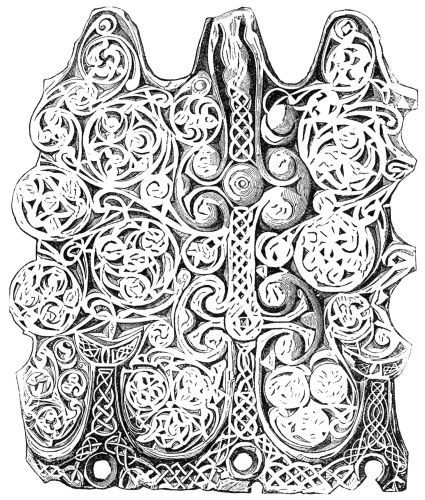
CYLINDRICAL MOUNTING OF BRONZE PROBABLY FOR THE SHAFT OF A SPEAR. FOUND NEAR STAVANGER.
Erik had now killed four of his brothers, if not five, and it was the common opinion that Gunhild would not rest until she had exterminated all the race of Harold the Fairhaired outside of her husband's line.
While Erik was a youth, he had made the acquaintance of an Icelander named Thorolf, the son of Skallagrim (Bald Grim) and nephew of Thorolf Kveld-Ulf's son, whom King Harold had treacherously slain. This Thorolf, like his uncle and namesake, was a tall and handsome man, of fine presence and winning manners. He had made Erik a present of a ship, very beautifully built and decorated, and had thereby gained his friendship. In return Erik had obtained from his father permission for Thorolf to remain unmolested in the country. The handsome Icelander made many friends in Norway, among whom two mighty men named Thore Herse and Björn the Yeoman. When he returned to Iceland he brought with him, as a gift from the king to his father, an axe with a handle of precious workmanship. But Bald Grim, though he received his son well, treated King Erik's gift with contempt, and finally, when Thorolf again made a cruise to Norway, he sang an insulting verse and begged to have it reported to Erik. The axe he also wished to have returned. Thorolf, who was determined not to revive the ancient feud, threw the axe into the ocean, and conveyed his father's thanks and greeting to the king. If he had had his way, the blood-feud would have been at an end. But he had a younger brother named Egil,[A] who insisted upon bearing him company, and he soon fanned the dying embers into flame.
[A] Pronounced Agil, "g" hard, as in gimlet, gilt, etc.
Egil was the very incarnation of the old untamable Norse spirit, the turbulent and indomitable individualism, which is incapable of considering any but personal aims, and of submitting to any kind of discipline. Like his father, Bald Grim, he was large of stature, swarthy, and ill-favored, and displayed in his childhood a fierce and revengeful spirit, but also a rare gift of song, which, no less than his foolhardy deeds, brought him fame during his long and adventurous career.
The two brothers arrived safely in Norway and became the guests of Thore Herse, between whose son Arinbjörn and Egil a warm friendship sprung up. While Thorolf went to be married to Aasgerd, the daughter of Björn the Yeoman, Egil was forced by a severe illness to remain at home. When he became convalescent, he accompanied one of Thore's overseers to a royal steward named Baard, and met there King Erik and Queen Gunhild. Baard, in his zeal to please the king, neglected the Icelander, and when the latter became unruly, at a hint from the queen, mixed soporific herbs in his beer. Egil's suspicion was aroused, however, and he poured out the beer and killed Baard. Then he ran for his life, swam out to an island in the fjord, and when the island was searched, killed some of those who had been sent to find him; whereupon he made his escape in their boat. Although King Erik was very angry, he accepted the atonement in money which Thore Herse offered for Baard's death, and was persuaded to allow Egil to remain in the land. Queen Gunhild was much incensed at his forgiving spirit, and asked if he counted the slaying of Baard as naught; to which the king replied: "For ever thou art egging me on to violence; but my word, once given, I cannot break."
As no persuasions availed, Gunhild made up her mind to use some one else as the instrument of her retaliation. It is told that she had been fond of Baard, whom Egil had slain; but as he was a man of low birth, it was scarcely this personal fondness, but rather a sense of outraged dignity which impelled her to persevere in her plans of vengeance. At a great sacrificial feast, at the temple of Gaule, she made her brother, Eyvind Skreyja, promise to kill one of Bald Grim's sons; but as no chance presented itself, he slew instead one of Thorolf's men; in return for which he was outlawed by Erik, as a vargr ī veum—i. e., wolf in the sanctuary. The two brothers now went on viking cruises, took service under Ethelstan, in England, and fought under his standard a great battle, in which Thorolf fell. Egil now married his widow, Aasgerd, and returned with her to Iceland. He had then been abroad for twelve years. Hardly had he settled down, however, when he learned that his father-in-law, Björn the Yeoman, was dead, and that one of Gunhild's favorites named Berg-Anund, had taken possession of his property. He therefore lost no time in returning to Norway, and with his friend Arinbjörn's aid pleaded his case at the Gulathing, in the presence of the king and queen. But the thing broke up in disorder, and Egil had to sail back to Iceland without having accomplished his purpose. Considerations of prudence had, however, no weight with him, and before long he started for the third time for Norway, surprised Berg-Anund, and killed not only him, but the king's son Ragnvald, who was his guest. In order to add insult to injury, he mounted a cliff, and raised what was called a shame-pole, or pole of dishonor, to Gunhild and the king. On the top of the pole he put the head of a dead horse, while he called out in a loud voice: "This dishonor do I turn against all the land-spirits[A] that inhabit this land, so that they may all stray on wildering ways, and none of them may chance or hit upon his home, until they shall have chased King Erik and Gunhild from the land."
[A] The land-spirits were genii loci; the alliterative formula which Egil pronounced was supposed to have magic power.
Thereupon he cut these words, in runes, into the pole, and sailed back to Iceland. It seemed, too, as if the curse took effect. For when Erik had been four years upon the throne, his youngest brother, Haakon, landed in Tröndelag, and the following year was made king. The news ran like wildfire through the country, and was everywhere received with jubilation. Erik made a desperate effort to raise an army, but the people turned away from him, and he was obliged to flee with his wife and children, and a few followers. Among those who remained faithful to him was Egil's friend, Arinbjörn. He now sailed about as a viking, harrying the coasts of Scotland and England, and finally accepted a portion of Northumberland in fief from King Ethelstan, on condition of defending the country against Norse and Danish vikings. It was also stipulated that he should be baptized and accept Christianity. Although the different sagas which deal with Erik's later life give somewhat conflicting accounts, it is obvious that he was no more popular in England than he had been in Norway. It appears that he was once, or probably twice, expelled from Northumberland, but again returned. By a most singular chance, a tempest here drove his mortal enemy right into his clutches.
Egil, it is told, was restless and discontented at home; and the common belief was that Gunhild by sorcery had stolen his peace of mind. He wandered uneasily along the strand and looked out for sails, and took no pleasure in his wife and children. Finally, when he could stay at home no longer, he equipped a ship and sailed southward to England. He was shipwrecked at the mouth of the Humber, lost his ship, but saved himself and his thirty warriors. From people whom he met, he learned that Erik Blood-Axe ruled over the country; and knowing that there was slight chance of escape, he rode boldly into York and sought his friend Arinbjörn. Together they went to Erik, who inquired of Egil how he could be so foolish, as to expect any thing but death at his hands. Gunhild, when she saw him demanded impatiently, that he should be killed on the spot. She had thirsted so long for his blood; she could not endure a moment's delay in her hotly-desired vengeance. Erik, however, granted the Icelander a respite until the next morning; Arinbjörn begged him, as a last bid for life, to spend the night in composing a song in honor of Erik. This Egil promised; and Arinbjörn had food and drink brought to him and bade him do his best. Being naturally anxious, he went to his friend in the night and asked him how the song was progressing. Egil replied that he had not been able to compose a line, because there was a swallow sitting in the window whose incessant screaming disturbed him, and he could not chase it away. Arinbjörn darted out into the hall, and caught a glimpse of a woman, who ran at the sight of him. At that very instant, too, the swallow disappeared. To prevent her from returning, Arinbjörn seated himself outside of Egil's door and kept watch through the night. For he knew that the swallow was none other than the queen, who by sorcery had assumed the guise of the bird.
The next morning Egil had finished his song and committed it to memory. Arinbjörn now armed all his men, and went with Egil and his warriors to the king's house. He reminded Erik of his fidelity to him, when others had forsaken him, and asked, as a reward for his services, that his friend's life be spared. Gunhild begged him to be silent; and the king made no response. Then Arinbjörn stepped forward and declared that Egil should not die, until he and his last man were dead.
"At that price," answered the king, "I would not willingly buy Egil's death, although, he has amply deserved whatever I may do to him."
Suddenly, when the king had spoken, Egil began to recite with a clear, strong voice, and instantly there was silence in the hall. This is a portion of his song:
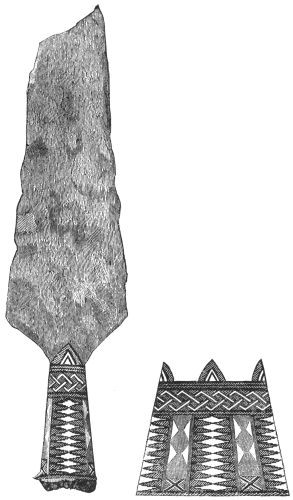
IRON POINT OF A SPEAR WITH INLAID WORK OF SILVER, FOUND AT NESNE, IN NORDLAND.

IRON CHISEL FOUND IN AAMOT PARISH, OESTERDALEN.
Westward I sailed o'er the sea.
Vidrar[A] himself gave me
The ichor of his breast,[B]
And with joy I roamed.
As the ice-floes broke,[C]
Forth I launched the oak;[D]
For my mind's hull[E]
Of thy praise was full.
For thy fame, O king,
Made me fain to sing;
And to England's shore,
Odin's mead[F] I bore.
Lo, in Erik's praise,
Loud my voice I raise.
May my song resound
The wide earth around.
List to me, my king,
Well remembering
What I sing to thee
Now, unquailingly.
For the world knows well
How men round thee fell;
Glad has Odin seen
The field where thou hast been.
Burst the shield and bayed
Deep the battle-blade.
At its ruddy draught
The Valkyrias laughed.[G]
Lo, the sword-stream swayed
Like a wild cascade.
O'er the fields away
Rang the steel's strong lay.
Men with eager feet
Sprang their foe to meet;
None thy band knew save
Heroes true and brave.
For in heart and frame
Bright burned valor's flame;
'Neath their thund'ring tread
Shook the earth with dread.
'Mid the weapons' clank
Men in death-throes sank:
From the heaps of slain
Rose thy fame amain.
[A] Odin.
[B] The gift of song.
[C] In the spring.
[D] The ship.
[E] Literally: In my mind's ship (i. e., in my breast) bore I this draught of praise.
[F] Odin's mead is the gift of poetry.
[G] The maids of Odin, the choosers of the slain, the Valkyrias, had to keep watch of Erik, to receive the souls of the many whom he slew, and conduct them to Valhalla.
Erik sat immovable while Egil sang, watching his face narrowly. When the song was at an end, the king said: "The song is excellent, and I have now considered what I will do for Arinbjörn's sake. Thou, Egil, shalt depart hence unharmed; because I will not do the dastardly deed to kill a man who gave himself voluntarily into my power. But from the moment thou leavest this hall, thou shalt never come before my eyes again, nor before the eyes of my sons. Nor is this to be regarded as a reconciliation between thee and me or my sons and kinsmen." Thus Egil bought his head by his song, and the song is therefore called "Höfudlausn," or "The Ransom of the Head."
Egil then took his leave, visited Ethelstan once more; went to Norway and had many adventures, before he returned to Iceland, where he died between 990 and 995. He was then over ninety years old.[A] Another of his poems, called Sonartorek, "The Loss of the Son," is the most beautiful poem in the Icelandic language.
[A] His life is minutely related in Saga Egils Skallagrims-sonar.
Erik Blood-Axe remained in England and suffered many vicissitudes of fate, until he fell in battle in 950 or 954. He is repeatedly mentioned by the English chroniclers under the name of Erik Haroldson. After his death Gunhild had a draapa composed in his honor, an interesting fragment of which is still extant. She then went to Denmark with her sons, and was well received by the Danish king, Harold Bluetooth (Blaatand), the son of Gorm the Old.

CHAPTER VII.
HAAKON THE GOOD (935-961).
Haakon, though he was outwardly his father's image, did not resemble him in spirit. He was of a conciliatory nature, amiable, and endowed with a charm of manner which won him all hearts. It is said that his foster-father had given him the counsel at parting never to sit glum at the festal board, and it is obvious that he took the lesson to heart. When he landed in Tröndelag, people flocked about him, and he won the chieftains for his cause by friendliness and promises which he afterwards conscientiously kept. He took part in the games of the young, and in the serious discussions of the old, excelled in all manly sports, and won admiration no less by his beauty than by his intelligence and generous disposition. The rumor of his arrival spread like fire in withered grass, and people said that old King Harold had come back once more to his people, gentler and more generous than before, but no less mighty and beautiful.
The first chieftain whose influence Haakon sought to enlist in his behalf was the powerful Sigurd, Earl of Hlade, who had been the friend and protector of his mother, and the guardian of his infancy. The earl received him well, and promised to support his claims to the kingdom. With this view he called, in Haakon's name, a great meeting of the peasants in Tröndelag, and made a speech in which he denounced the cruelty of Erik Blood-Axe and declared his allegiance to Haakon. When the earl had finished, Haakon arose and offered, in case the peasants would make him their king, to restore to them their allodium, of which his father had deprived them. This announcement was received with great rejoicing; and from all parts of the plain came cries of homage and approval. Amid joyful tumult Haakon was made king, and immediately started southward with a large train of warriors. Wherever he went, the people flocked about him and offered him allegiance. The Oplands[A] followed the example of Tröndelag, and in Viken both chieftains and peasants eagerly espoused his cause. As already related, Erik made a desperate attempt to gather an army, and, failing in this, fled with his family and a few faithful followers to the Orkneys, and thence to England.
[A] See map.
It was consistent with Haakon's conciliatory disposition that he did not molest or depose his nephews, Gudröd Björnsson and Tryggve Olafsson, but confirmed them as kings in Viken. It appears, however, that, nominally at least, they recognized his overlordship. Other sons and grandsons of Harold the Fairhaired he met with the same friendliness, giving to each what he considered to be his due. As soon as peace was thus established, and there was no one left to dispute his power, Haakon devoted himself energetically to the improvement of the internal administration of his kingdom. He divided the country into Thing-Unions, or judicial districts, and by the aid of wise and experienced men greatly improved the laws. One famous code, called the Gulathings-law, has particularly shed lustre upon his name, and the enlargement and improvement of the Frostathings-law is also, by some of the sagas, attributed to him. The only radical change which he introduced was the breaking up of his father's feudal state, by the restoration of the allodium to the peasants. But this one change necessitated many others. When the king relinquished his right to tax the land, he thereby deprived himself of the ability to keep an army, and had to consign, in part, to the peasants themselves the defence of their respective districts. It was naturally the sea-coast which was most exposed to attack; and in the absence of all but the most primitive means of communication it became possible for an enemy to ravage long stretches of land, before the intelligence of his presence reached the king. In order to remedy this, Haakon ordered varder or signal-fires to be lighted, at fixed intervals, all along the coast at the approach of an enemy; but he partly counteracted the good effect of the reform by the severe punishment with which he threatened those who, without adequate cause, lighted the varder. In order to obtain the means to defend the coast, he divided it into marine districts, each of which was bound, on demand, to place a fully manned and equipped ship of war at the disposal of the king. This was, of course, but another form of taxation, but was less distasteful to the peasants, because its purpose and necessity were obvious, and no degrading dependence was implied, since the people had again become the free possessors of the soil. Nevertheless there are indications that the personal tax, derisively called the nose-tax, which had been introduced by Harold, was continued, at least for a while, by Haakon; as it is expressly stated that his first ships of war were built by the income of the nose-tax.
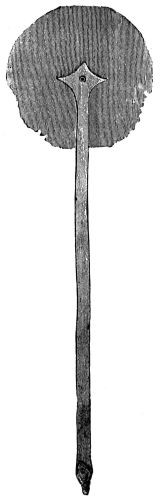
FRYING PAN OF BRONZE WITH IRON HANDLE. FROM THE VIKING AGE.
Having arranged the military and judicial affairs of his kingdom, Haakon turned his attention to a matter which he had long had at heart. He had been christened in his childhood in England, and was an earnest votary of the Christian religion. But, coming, as he did, to the kingdom of his father, not as a conqueror, but as a candidate for the people's favor, he did not venture at once to attack the national faith. His friend, Earl Sigurd of Hlade, was a fanatical adherent of the Asa-faith, and Haakon might have counted on his enmity rather than his support, if he had exhibited an ill-considered zeal for the displacement of the old by a new religion. Haakon, therefore, temporized, and it was not until the fifteenth or sixteenth year of his reign (950-951), when his unbonded popularity seemed to warrant any venture, that he took a decisive step in behalf of Christianity. He sent to England for a bishop and a number of priests, and published a decree, forbidding the people to sacrifice to the old gods, and demanding of them that they should accept the faith in Christ. He called upon the peasants to meet him at Drontheim, where he repeated his demand. But the peasants refused to declare themselves; and begged the king to have the matter legally settled at the Frosta-thing. Here there was a great concourse of people; and when the assembly had been called to order, Haakon rose and in an earnest and dignified speech begged the peasants to forsake the old heathen gods who were but wood and stone, and to believe in the one living God and be baptized in His name. An ominous murmur ran through the crowd at these words, and the peasant Aasbjörn of Medalhus arose and answered in these words:
Kveld-Ulf and Bald Grim were not the only chieftains who sought refuge abroad from Harold's oppression. After the battle of Hafrs-Fjord, when the king proceeded with uncompromising rigor to enforce the feudal system, several thousand men, many of whom belonged to the noblest families of the land, crossed the sea, and found new homes in the Orkneys and the Hebrides, whence again many found their way to Iceland. A great number also sailed direct for the latter country, and the so-called Landnama book (the Domesday Book of Iceland) has preserved the names, and, at times, bits of the history of the most important original settlers. Much as we may sympathize with the indomitable spirit which made these men sacrifice home and country for a principle, there is also another view of the case which has to be considered. Harold the Fairhaired was founding a state, which would support a higher civilization than could possibly be developed among a loose agglomeration of semi-hostile tribes. The idea of a national unity, which was the inspiration of his work, required the enforcement of an organic system which to the independent chieftains must have appeared extremely oppressive. The payment of taxes, which to the citizen of the modern state is not apt to appear humiliating, seemed to the Norse chieftains unworthy of a freeman. When Harold commanded them to refrain from robbing and plundering expeditions within the confines of his kingdom, they felt outraged, and could see no reason why they should submit to such unwarrantable curtailment of time-honored privileges. One of them, Rolf, or Rollo, son of the king's friend, Ragnvald, Earl of Möre, defied the order, made strand-hug[A] in Viken, and was declared an outlaw. Neither his father's influence, nor his mother's prayers, could save him. Just on account of his high birth, Harold was determined to make an example of him.
[A] The first Duke Rollo had, when he was baptized, assumed the name Robert.
Rollo is known in the Norse sagas as Rolf the Walker, because he was so tall and heavy that no horse could carry him. With a large number of followers he sailed southward to France, and after having harried the country for several years, made in 912 a compromise with King Charles the Simple, by which he was to accept Christianity and receive a large province in fief for himself and his descendants. This province was named Normandy; and has played a large rôle in the history of the world. It is told of Rollo that when he was requested to kiss the king's foot in token of fealty, he answered: "I will never bend my knee before any man; nor will I kiss any one's foot." After much persuasion, however, he permitted one of his men to perform the act of homage for him. His proxy stalked sullenly forward, and pausing before the king, who was on horse-back, seized his foot and lifted it to his lips. By this manœuvre, the king came to make a somersault, at which there was great laughter among the Norsemen. Rollo did literally, like the poor boy in the fairy tale, marry the princess and get half the kingdom. For, it is told, that Charles gave him for a bride his daughter Gisla, who, however, died childless. He ruled his duchy with a rod of iron; and he must have learned a useful lesson from King Harold, for it is said that he restrained robbery with a firm hand, and hanged the robbers. So great was the public security in his day, that the peasants could leave their ploughs and tools in the field over night without fear of losing them. Rollo's son was William Longsword, who was the father of Richard the Fearless, who again had a son of his own name. This latter Richard, surnamed the Good, had a son named Rollo, or Robert[A] the Magnificent, who was the father of William the Conqueror.
[A] See Munch, i., 591.
To foster another man's child was in Norway regarded as an acknowledgment of inferiority; and Harold had thus repaid Ethelstan in his own coin. There are, however, several circumstances which make the story suspicious. In the first place Ethelstan and his ancestors had had too severe an experience of Norsemen and Danes to wish to challenge the mightiest of them by a wanton insult; and again, it is more credible that Harold sent his youngest son out of the country for his own safety,[A] than in order to play an undignified trick upon a foreign king. At all events, Haakon was treated with the greatest kindness by the English king, and won his affection.
[A] Olaf was the son of King Harold and Svanhild, a daughter of Earl Eystein of Hedemark and Vestfold.
While Harold's despotism had been civilizing and, on the whole, beneficent, that of Erik Blood-Axe was disorganizing and destructive. With him the old turbulent viking spirit ascended the throne. Power meant with him the means of gratifying every savage impulse. Brave he was, delighting in battle; cruel and pitiless; and yet not without a certain sense of fairness and occasional impulses of generosity. In person he was handsome, of stately presence, but haughty and taciturn. Unhappily he married a woman who weakened all that was good in him and strengthened all that was bad. Queen Gunhild possessed a baneful influence over him during his entire life. She was cruel, avaricious, and treacherous, and was popularly credited with all the ill deeds which her husband committed. There are strange legends about her, attributing to witchcraft the power she had over every one who came in contact with her. According to Snorre, Erik met her in Finmark, whither she had been sent by her parents to learn sorcery. For the Finns were in those days credited with a deep knowledge of the black art. The two sorcerers with whom she was staying were both determined to marry her, and like the princess in the fairy-tale, she concealed Prince Erik in her tent, and begged him to rid her of her troublesome suitors. This, in spite of many difficulties, Erik did, carried Gunhild away to his ships, and made her his wife. She was, it is said, small of stature, insinuating, and of extraordinary beauty; but she was the evil genius of her husband, egging him on to deeds of treachery and violence which made him detested by his people. It was in great part the disfavor with which she was regarded which raised rebels against Erik's authority in various parts of the country and brought popular support to his brothers in their endeavor to cast off his yoke. In spite of his father's efforts, Erik's sovereignty had not been universally recognized, and no sooner was King Harold dead than Halfdan the Swarthy declared himself to be sovereign in Tröndelag and Olaf[A] in Viken. A few years after that, however, Halfdan died suddenly, and the rumor said that he had been poisoned by Queen Gunhild. The men of Tröndelag then chose his brother Sigfrid for their king, and Erik found his kingdom gradually shrinking both from the north and the south. Being prepared for an attack from Erik, Sigfrid and Olaf determined to join their forces, and to complete all arrangements, the former went to visit the latter in Tunsberg. When Erik heard of this, he went in haste to the town with a large number of men, and surprised and killed both his brothers. Olaf's son Tryggve escaped, however, and was kept in concealment, as long as Erik was master in the land.
[A] Pronounced Agil, "g" hard, as in gimlet, gilt, etc.
While Erik was a youth, he had made the acquaintance of an Icelander named Thorolf, the son of Skallagrim (Bald Grim) and nephew of Thorolf Kveld-Ulf's son, whom King Harold had treacherously slain. This Thorolf, like his uncle and namesake, was a tall and handsome man, of fine presence and winning manners. He had made Erik a present of a ship, very beautifully built and decorated, and had thereby gained his friendship. In return Erik had obtained from his father permission for Thorolf to remain unmolested in the country. The handsome Icelander made many friends in Norway, among whom two mighty men named Thore Herse and Björn the Yeoman. When he returned to Iceland he brought with him, as a gift from the king to his father, an axe with a handle of precious workmanship. But Bald Grim, though he received his son well, treated King Erik's gift with contempt, and finally, when Thorolf again made a cruise to Norway, he sang an insulting verse and begged to have it reported to Erik. The axe he also wished to have returned. Thorolf, who was determined not to revive the ancient feud, threw the axe into the ocean, and conveyed his father's thanks and greeting to the king. If he had had his way, the blood-feud would have been at an end. But he had a younger brother named Egil,[A] who insisted upon bearing him company, and he soon fanned the dying embers into flame.
[A] The land-spirits were genii loci; the alliterative formula which Egil pronounced was supposed to have magic power.
As no persuasions availed, Gunhild made up her mind to use some one else as the instrument of her retaliation. It is told that she had been fond of Baard, whom Egil had slain; but as he was a man of low birth, it was scarcely this personal fondness, but rather a sense of outraged dignity which impelled her to persevere in her plans of vengeance. At a great sacrificial feast, at the temple of Gaule, she made her brother, Eyvind Skreyja, promise to kill one of Bald Grim's sons; but as no chance presented itself, he slew instead one of Thorolf's men; in return for which he was outlawed by Erik, as a vargr ī veum—i. e., wolf in the sanctuary. The two brothers now went on viking cruises, took service under Ethelstan, in England, and fought under his standard a great battle, in which Thorolf fell. Egil now married his widow, Aasgerd, and returned with her to Iceland. He had then been abroad for twelve years. Hardly had he settled down, however, when he learned that his father-in-law, Björn the Yeoman, was dead, and that one of Gunhild's favorites named Berg-Anund, had taken possession of his property. He therefore lost no time in returning to Norway, and with his friend Arinbjörn's aid pleaded his case at the Gulathing, in the presence of the king and queen. But the thing broke up in disorder, and Egil had to sail back to Iceland without having accomplished his purpose. Considerations of prudence had, however, no weight with him, and before long he started for the third time for Norway, surprised Berg-Anund, and killed not only him, but the king's son Ragnvald, who was his guest. In order to add insult to injury, he mounted a cliff, and raised what was called a shame-pole, or pole of dishonor, to Gunhild and the king. On the top of the pole he put the head of a dead horse, while he called out in a loud voice: "This dishonor do I turn against all the land-spirits[A] that inhabit this land, so that they may all stray on wildering ways, and none of them may chance or hit upon his home, until they shall have chased King Erik and Gunhild from the land."
[A] Odin.
[B] The gift of song.
[C] In the spring.
[D] The ship.
[E] Literally: In my mind's ship (i. e., in my breast) bore I this draught of praise.
[F] Odin's mead is the gift of poetry.
[G] The maids of Odin, the choosers of the slain, the Valkyrias, had to keep watch of Erik, to receive the souls of the many whom he slew, and conduct them to Valhalla.
Westward I sailed o'er the sea.
Vidrar[A] himself gave me
The ichor of his breast,[B]
And with joy I roamed.
As the ice-floes broke,[C]
Forth I launched the oak;[D]
For my mind's hull[E]
Of thy praise was full.
For thy fame, O king,
Made me fain to sing;
And to England's shore,
Odin's mead[F] I bore.
Lo, in Erik's praise,
Loud my voice I raise.
May my song resound
The wide earth around.
List to me, my king,
Well remembering
What I sing to thee
Now, unquailingly.
For the world knows well
How men round thee fell;
Glad has Odin seen
The field where thou hast been.
Burst the shield and bayed
Deep the battle-blade.
At its ruddy draught
The Valkyrias laughed.[G]
Lo, the sword-stream swayed
Like a wild cascade.
O'er the fields away
Rang the steel's strong lay.
Men with eager feet
Sprang their foe to meet;
None thy band knew save
Heroes true and brave.
For in heart and frame
Bright burned valor's flame;
'Neath their thund'ring tread
Shook the earth with dread.
'Mid the weapons' clank
Men in death-throes sank:
From the heaps of slain
Rose thy fame amain.
Westward I sailed o'er the sea.
Vidrar[A] himself gave me
The ichor of his breast,[B]
And with joy I roamed.
As the ice-floes broke,[C]
Forth I launched the oak;[D]
For my mind's hull[E]
Of thy praise was full.
For thy fame, O king,
Made me fain to sing;
And to England's shore,
Odin's mead[F] I bore.
Lo, in Erik's praise,
Loud my voice I raise.
May my song resound
The wide earth around.
List to me, my king,
Well remembering
What I sing to thee
Now, unquailingly.
For the world knows well
How men round thee fell;
Glad has Odin seen
The field where thou hast been.
Burst the shield and bayed
Deep the battle-blade.
At its ruddy draught
The Valkyrias laughed.[G]
Lo, the sword-stream swayed
Like a wild cascade.
O'er the fields away
Rang the steel's strong lay.
Men with eager feet
Sprang their foe to meet;
None thy band knew save
Heroes true and brave.
For in heart and frame
Bright burned valor's flame;
'Neath their thund'ring tread
Shook the earth with dread.
'Mid the weapons' clank
Men in death-throes sank:
From the heaps of slain
Rose thy fame amain.
Westward I sailed o'er the sea.
Vidrar[A] himself gave me
The ichor of his breast,[B]
And with joy I roamed.
As the ice-floes broke,[C]
Forth I launched the oak;[D]
For my mind's hull[E]
Of thy praise was full.
For thy fame, O king,
Made me fain to sing;
And to England's shore,
Odin's mead[F] I bore.
Lo, in Erik's praise,
Loud my voice I raise.
May my song resound
The wide earth around.
List to me, my king,
Well remembering
What I sing to thee
Now, unquailingly.
For the world knows well
How men round thee fell;
Glad has Odin seen
The field where thou hast been.
Burst the shield and bayed
Deep the battle-blade.
At its ruddy draught
The Valkyrias laughed.[G]
Lo, the sword-stream swayed
Like a wild cascade.
O'er the fields away
Rang the steel's strong lay.
Men with eager feet
Sprang their foe to meet;
None thy band knew save
Heroes true and brave.
For in heart and frame
Bright burned valor's flame;
'Neath their thund'ring tread
Shook the earth with dread.
'Mid the weapons' clank
Men in death-throes sank:
From the heaps of slain
Rose thy fame amain.
Westward I sailed o'er the sea.
Vidrar[A] himself gave me
The ichor of his breast,[B]
And with joy I roamed.
As the ice-floes broke,[C]
Forth I launched the oak;[D]
For my mind's hull[E]
Of thy praise was full.
For thy fame, O king,
Made me fain to sing;
And to England's shore,
Odin's mead[F] I bore.
Lo, in Erik's praise,
Loud my voice I raise.
May my song resound
The wide earth around.
List to me, my king,
Well remembering
What I sing to thee
Now, unquailingly.
For the world knows well
How men round thee fell;
Glad has Odin seen
The field where thou hast been.
Burst the shield and bayed
Deep the battle-blade.
At its ruddy draught
The Valkyrias laughed.[G]
Lo, the sword-stream swayed
Like a wild cascade.
O'er the fields away
Rang the steel's strong lay.
Men with eager feet
Sprang their foe to meet;
None thy band knew save
Heroes true and brave.
For in heart and frame
Bright burned valor's flame;
'Neath their thund'ring tread
Shook the earth with dread.
'Mid the weapons' clank
Men in death-throes sank:
From the heaps of slain
Rose thy fame amain.
Westward I sailed o'er the sea.
Vidrar[A] himself gave me
The ichor of his breast,[B]
And with joy I roamed.
As the ice-floes broke,[C]
Forth I launched the oak;[D]
For my mind's hull[E]
Of thy praise was full.
For thy fame, O king,
Made me fain to sing;
And to England's shore,
Odin's mead[F] I bore.
Lo, in Erik's praise,
Loud my voice I raise.
May my song resound
The wide earth around.
List to me, my king,
Well remembering
What I sing to thee
Now, unquailingly.
For the world knows well
How men round thee fell;
Glad has Odin seen
The field where thou hast been.
Burst the shield and bayed
Deep the battle-blade.
At its ruddy draught
The Valkyrias laughed.[G]
Lo, the sword-stream swayed
Like a wild cascade.
O'er the fields away
Rang the steel's strong lay.
Men with eager feet
Sprang their foe to meet;
None thy band knew save
Heroes true and brave.
For in heart and frame
Bright burned valor's flame;
'Neath their thund'ring tread
Shook the earth with dread.
'Mid the weapons' clank
Men in death-throes sank:
From the heaps of slain
Rose thy fame amain.
Westward I sailed o'er the sea.
Vidrar[A] himself gave me
The ichor of his breast,[B]
And with joy I roamed.
As the ice-floes broke,[C]
Forth I launched the oak;[D]
For my mind's hull[E]
Of thy praise was full.
For thy fame, O king,
Made me fain to sing;
And to England's shore,
Odin's mead[F] I bore.
Lo, in Erik's praise,
Loud my voice I raise.
May my song resound
The wide earth around.
List to me, my king,
Well remembering
What I sing to thee
Now, unquailingly.
For the world knows well
How men round thee fell;
Glad has Odin seen
The field where thou hast been.
Burst the shield and bayed
Deep the battle-blade.
At its ruddy draught
The Valkyrias laughed.[G]
Lo, the sword-stream swayed
Like a wild cascade.
O'er the fields away
Rang the steel's strong lay.
Men with eager feet
Sprang their foe to meet;
None thy band knew save
Heroes true and brave.
For in heart and frame
Bright burned valor's flame;
'Neath their thund'ring tread
Shook the earth with dread.
'Mid the weapons' clank
Men in death-throes sank:
From the heaps of slain
Rose thy fame amain.
Westward I sailed o'er the sea.
Vidrar[A] himself gave me
The ichor of his breast,[B]
And with joy I roamed.
As the ice-floes broke,[C]
Forth I launched the oak;[D]
For my mind's hull[E]
Of thy praise was full.
For thy fame, O king,
Made me fain to sing;
And to England's shore,
Odin's mead[F] I bore.
Lo, in Erik's praise,
Loud my voice I raise.
May my song resound
The wide earth around.
List to me, my king,
Well remembering
What I sing to thee
Now, unquailingly.
For the world knows well
How men round thee fell;
Glad has Odin seen
The field where thou hast been.
Burst the shield and bayed
Deep the battle-blade.
At its ruddy draught
The Valkyrias laughed.[G]
Lo, the sword-stream swayed
Like a wild cascade.
O'er the fields away
Rang the steel's strong lay.
Men with eager feet
Sprang their foe to meet;
None thy band knew save
Heroes true and brave.
For in heart and frame
Bright burned valor's flame;
'Neath their thund'ring tread
Shook the earth with dread.
'Mid the weapons' clank
Men in death-throes sank:
From the heaps of slain
Rose thy fame amain.
[A] His life is minutely related in Saga Egils Skallagrims-sonar.
Egil then took his leave, visited Ethelstan once more; went to Norway and had many adventures, before he returned to Iceland, where he died between 990 and 995. He was then over ninety years old.[A] Another of his poems, called Sonartorek, "The Loss of the Son," is the most beautiful poem in the Icelandic language.
[A] See map.
The first chieftain whose influence Haakon sought to enlist in his behalf was the powerful Sigurd, Earl of Hlade, who had been the friend and protector of his mother, and the guardian of his infancy. The earl received him well, and promised to support his claims to the kingdom. With this view he called, in Haakon's name, a great meeting of the peasants in Tröndelag, and made a speech in which he denounced the cruelty of Erik Blood-Axe and declared his allegiance to Haakon. When the earl had finished, Haakon arose and offered, in case the peasants would make him their king, to restore to them their allodium, of which his father had deprived them. This announcement was received with great rejoicing; and from all parts of the plain came cries of homage and approval. Amid joyful tumult Haakon was made king, and immediately started southward with a large train of warriors. Wherever he went, the people flocked about him and offered him allegiance. The Oplands[A] followed the example of Tröndelag, and in Viken both chieftains and peasants eagerly espoused his cause. As already related, Erik made a desperate attempt to gather an army, and, failing in this, fled with his family and a few faithful followers to the Orkneys, and thence to England.
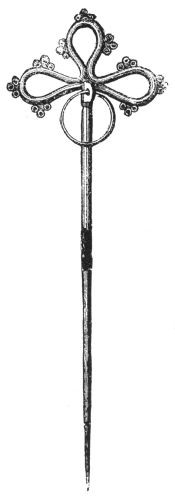
BREAST-PIN OF BRONZE. FOUND AT BY IN LOITEN.
"When thou, King Haakon, didst call thy first assembly here in Drontheim, and we took thee for our king, we believed that heaven itself had descended upon us; but now we do not know whether it was liberty we gained, or whether thou wishest to make us thralls once more, by thy strange demand that we shall forsake the faith which our fathers and all their forefathers have had before us. * * * They were sturdier men than we are; and yet their faith has done well enough for us. We have learned to love thee well, and we have allowed thee to share with us the administration of law and justice. Now, we peasants have firmly determined and unanimously agreed to keep the laws which thou didst propose here at the Frosta-thing, and to which we gave our assent. We all wish to follow thee, and to have thee for our king, as long as a single one of us peasants is alive—if only thou, king, wilt show moderation, and not demand of us things in which we cannot follow thee, and which it would be unseemly for us to do. But if thou hast this matter so deeply at heart that thou wilt try thy might and strength against ours, then we have resolved to part from thee and take another chieftain who will aid us in freely exercising the religion which pleases us. Choose now, O king, between these two conditions, before the assembly has dispersed."
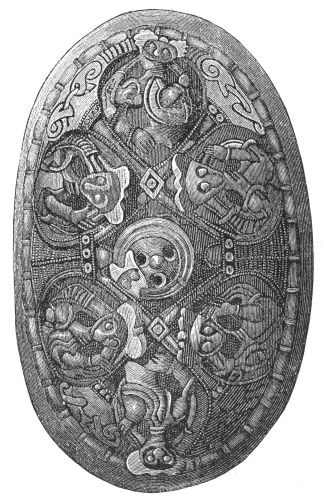
OVAL BRONZE BUCKLE.
Loud shouts of approval greeted this speech; and it was, for a while, impossible for any one to make himself heard. At last, when the tempest had subsided, Earl Sigurd of Hlade, probably after consultation with Haakon, rose and said that the king would yield to the wishes of the peasants and would not part with their friendship. Encouraged by this first concession, the peasants now demanded that the king should participate in their sacrifices and preside at the sacrificial feast. Much against his will, Haakon was again induced to yield, but tried to pacify his conscience by making the sign of the cross over the horn consecrated to Odin. During the following year he was also compelled to eat horse-flesh at the Yule-tide sacrifice, and to omit the sign of the cross when drinking the toasts of the heathen gods. Full of wrath he departed, intimating that he would soon come back with an army large enough to punish the Trönders for the humiliation they had put upon him. There is little doubt that he would have carried out this threat, if external enemies had not directed his energies in another direction.
The sons of Erik Blood-Axe had, after their father's death, sought refuge with King Harold Bluetooth in Denmark. The two elder, Gamle and Guttorm, had roamed about as vikings, ravaged the coasts of Norway and the lands about the Baltic, while the third son, Harold, was adopted by his namesake, the Danish king, and received his education at his court. They were all valiant warriors, but were much governed by their shrewd and cruel mother, Gunhild. They naturally cherished no good-will toward their uncle Haakon, who had dispossessed them of their kingdom; and while they were not yet strong enough to wage regular war, they seized every opportunity to annoy and harass him. They fought many battles with Tryggve Olafsson, who, as king in Viken, was charged with the defence of the southern coast, and were sometimes victorious and sometimes vanquished. In the year 952, when Tryggve was absent, Haakon took occasion to deliver an effective blow at the Danish vikings who were infesting this part of the country (though the sons of Erik were not this time among them), pursued them southward, and harassed the coasts of Jutland and the Danish isles. It appears, however, that this mode of retaliation did not permanently discourage the vikings, and as long as Harold Bluetooth showed open hostility against Norway, by espousing the cause of Gunhild and her sons, it is quite natural that the warlike zeal and rapacity of the Danes should be directed against the neighboring kingdom. It is obvious, too, that Haakon, by his attack upon Danish soil, gave a more personal character to the animosity which the Danish king entertained toward him, and Gunhild lost no time in profiting by this change of feeling. From this time forth her sons appear no longer as warlike adventurers, bent upon private vengeance, but as commanders of fleets and armies, and formidable pretenders to the Norwegian throne. In 953 they defeated Tryggve Olafsson at Sotoness, and compelled him to abandon his ships and save himself by flight. When the news of this disaster reached Haakon, he hastily made peace with the Trönders who had forced him to sacrifice, and called upon Earl Sigurd to aid him with all the ships and men at his command. Earl Sigurd promptly obeyed and sailed southward to meet the king. At Agvaldsness they overtook the sons of Gunhild and vanquished them in a hotly contested battle. Haakon slew with his own hand his nephew Guttorm Eriksson, and cut down his standard. The surviving brothers fled with the remnants of their army to Denmark, and kept the peace for two years. But in 955 they returned once more with a largely increased force and surprised King Haakon at Fraedö in Nordmöre. The signal fires had not been lighted, and no intelligence of the presence of the enemy had reached the king until it was too late. He asked his men whether they preferred to stay and fight or avoid battle, until they had gathered a sufficient force. To this an old peasant named Egil Uldsaerk (Woolsark) made answer: "I have been in many battles with thy father, King Harold. Sometimes he fought with a stronger and sometimes with a weaker foe. But he was always victorious. Never have I heard him ask counsel of his friends as to whether he should run; nor will we give thee such counsel. For we think that we have in thee a brave chieftain, and trusty aid shalt thou receive from us."

EGIL WOOLSARK'S MONUMENT OR BAUTASTONE AT FREINESS.
When the king praised these words and declared himself ready to fight, Egil cried out joyously: "In this long season of peace I have been afraid that I should die of old age on the straw of my bed—I who never asked any thing better than to follow my chieftain and die in battle! Now, at last, I shall have my wish fulfilled."
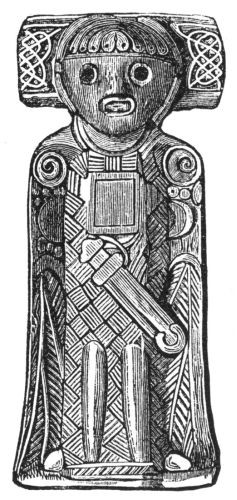
ORNAMENTAL BRONZE MOUNTING.
As soon as the sons of Erik had landed, the battle commenced. They had six men for every one of King Haakon's. Seeing that the odds were so heavily against his lord, Egil Woolsark took ten standard-bearers aside and stole up a slope of land in the rear of Gamle Eriksson's battle-array. He made them march with long intervals, so that only the tops of their standards could be seen above the slope, and not the men themselves. The Danes, spying the waving banners, supposed that a fresh force was coming to cut them off from their ships, and they raised a great cry and fled. It was in vain that Gamle, who had discovered the stratagem, shouted with a loud voice commanding them to stay. Panic had seized them, and their commander himself was swept away with the hurrying mass, until he reached the beach, where he made a final stand. Here Egil Woolsark attacked him and received his death-wound after a desperate conflict. Haakon too rushed in upon Gamle, who defended himself bravely, but having received terrible wounds, threw himself into the ocean and was drowned. The other brothers swam to their ships and returned to Denmark.
This victory secured peace to Norway for six years. Haakon had thus an opportunity to resume his efforts to Christianize the country. But his experience of the peasants' temper had apparently discouraged him. Personally he remained a Christian, and induced many of his friends to forsake the heathen faith. He lacked, however, the uncompromising vigor and the burning zeal of a martyr and propagandist. He preferred gentle to harsh measures, and shrank from antagonizing those who had been faithful to him in time of need. It is probable, too, that the counsel of his friend, Earl Sigurd, tended to cool his ardor, by emphasizing the political phase of the religious question. The result of this conciliatory policy, in connection with the good crops which prevailed during his reign, was to make King Haakon universally beloved. It is doubtful if a king has ever sat upon the throne of Norway who has been closer to the hearts of the people. Therefore, as an expression of their affection for him, they named him Haakon the Good.
In the twenty-sixth year of his reign (961) Haakon was summering with his men-at-arms on his estate Fitje in Hördaland. A large number of guests were with him, among whom the scald Eyvind Skaldespilder (Scald-Spoiler),[A] who was on his mother's side a great-grandson of Harold the Fairhaired. The king was seated at the breakfast-table, when the sentinels saw a large fleet of ships sailing in through the fjord. They called the scald Eyvind aside, and begged him to decide whether those were not hostile ships. Eyvind sprang into the hall where the king was sitting, and sang a verse, announcing the approach of the sons of Erik. Haakon arose and looked at the ships. Then he turned to his men and said: "Here many ships are coming against us, and our force is but small. It is plainly to be seen that we shall have to fight against heavier odds than ever before; for the sons of Gunhild come with a larger force to-day than on previous occasions. Loath I am to bring my best men into too great a danger; and loath I am, too, to flee, unless wise men decide that it would be foolhardy to await the foe."
[A] Skaldespilder means waster or spoiler of scalds, because no other scald could bear comparison with him.
Eyvind Scald-Spoiler replied in verse that it would ill befit a man like King Haakon to flee from the sons of Gunhild. "Manly speech is that, and in accordance with my mind," answered the king; and when the other warriors with one accord clamored for battle, he put on his armor, buckled his sword about his loins, and seized spear and shield. On his head he wore a golden helmet which flashed in the sun. Beautiful he was to behold, with his mild and noble countenance, and his bright hair streaming down over his shoulders. Upon the fields without he arranged his men in battle array, and raised his standards. The sons of Erik disembarked with a large army, commanded by the third of the brothers, Harold, and his two uncles, Eyvind Skreyja and Alf Askman. The battle which now commenced was wild and bloody. The army of the sons of Gunhild was six times as numerous as that of King Haakon. But Haakon, knowing his Norsemen well, did not lose heart. Wherever the fight was hottest, there flashed his golden helmet. He joked with Eyvind, the scald, when he passed him, and improvised a verse in reply to the one with which he was greeted. The fiercer the conflict grew, the higher rose the king's spirits. At last, when the heat oppressed him, he flung away his armor and stormed forward at the head of his men. The supply of spears and arrows soon ran short, and the hostile ranks clashed together and fought, hand to hand, with their swords. The shining helmet made the king very conspicuous, and Eyvind Scald-Spoiler noticed that it served as a target for the Danish spears. He therefore took a hood and pulled it over the helmet. Eyvind Skreyja, who was just rushing forward to meet the king, thereby lost sight of him, and he cried out: "What has become of the king of the Norsemen? Does he hide himself, or is he afraid? No more do I see the golden helmet?" "Keep on as thou art steering, if thou wishest to find the king of the Norsemen," shouted Haakon, and throwing away his shield, seized his sword with both hands, and sprang forward where all could see him. Eyvind Skreyja bounded forward with uplifted sword, but one of the king's men caught the blow upon his shield, and in the same instant Haakor, cleft Eyvind's head and neck down to the shoulders. The example of their king fired the Norsemen's courage, while the fall of their greatest champion brought confusion to the Danes. The former charged with renewed fury, while the latter were pressed down to the beach, and leaped into the ocean; many were killed or drowned, but a few, including Harold Eriksson, saved themselves by swimming, and were picked up by the ships. While pursuing the fleeing foe, Haakon was hit in his right arm by a peculiarly shaped arrow, and all efforts to staunch the blood proved in vain. It was said that Gunhild had bewitched this arrow and given it to her chamberlain, with the charge that he should shoot it off against King Haakon. As night approached, the king grew weaker and weaker, and fainted repeatedly. One of his friends offered to take his body over to England, when he was dead, so that he might be buried in Christian soil. But Haakon replied: "I am not worthy of it. I have lived like a heathen, and therefore it is meet that I should be buried like a heathen."
Thus died Haakon the Good and, as the saga says, was mourned alike by friends and foes. His last act before dying was to send a ship after the sons of Gunhild, and beg them to come back and take the kingdom; for he had himself no sons, and his only daughter, Thora, could not, according to the law, succeed to the throne.
Eyvind Scald-Spoiler made a song in King Haakon's honor, called Haakonarmaal, in which he praised his virtues and described his reception in Valhalla.

CHAPTER VIII.
HAROLD GRAYFELL AND HIS BROTHERS (961-970).
The sons of Gunhild lost no time in taking possession of the kingdom of their fathers. It was not, however, the entire Norway to which they succeeded, but only the middle districts. In Viken, Tryggve Olafsson and Gudröd Björnsson, both grandsons of Harold the Fairhaired, ruled as independent kings, and in Tröndelag Earl Sigurd, of Hlade, refused to acknowledge the supremacy of the race of Erik Blood-Axe. Undoubtedly the brothers were only biding their time until they should be strong enough to punish these contemptuous rebels; but so bitter was the feeling against them, even in the provinces which they nominally ruled, that they had all they could do in maintaining their authority within the narrow limits which had from the beginning been assigned to them. One of the chief causes of their unpopularity was their dependence upon the Danish king, by whose aid they had gained the kingdom, and to whom they apparently stood in a relation of vassalage. As a consequence of this, they took no pains to gain the favor of the Norwegian people, but surrounded themselves with a great throng of Danish warriors who constituted their court and the main-stay of their strength. Very unfortunate, too, was the influence which their mother Gunhild exercised over them. Scarcely had she returned to Norway, when she resumed her baneful activity, egging her sons on to cruel and treacherous deeds, by which they forfeited the people's respect and undermined their own power. Misfortune had not taught her caution, nor had age softened the fierce malignity of her temper.
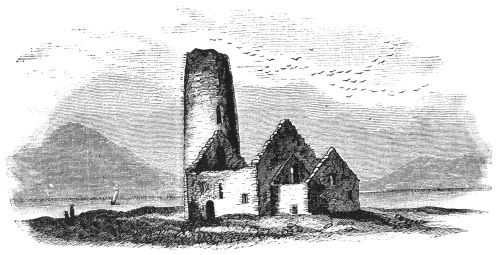
CHURCH AT EGILÖ, OR EGIL'S ISLAND (ONE OF THE ORKNEYS); SUPPOSED TO HAVE BEEN BUILT BEFORE THE VIKING AGE.
The oldest surviving brother, Harold, surnamed Graafeld (Grayfell) resembled, in appearance his father, Erik Blood-Axe. He was haughty, avaricious, and revengeful; tall of stature, finely built, and of lordly presence, but for all that a weak and vacillating character. He lacked entirely that kindliness and bonhommie which had made his uncle Haakon the Good beloved of all the people. Of the other brothers we have no definite knowledge; they seem, however, all to have inherited their share of the traits which made their parents odious. Two of them, Gudröd and Sigurd Sleva, proved themselves worthy sons of the malicious Gunhild. The others are usually spoken of collectively, and their names are variously given.
It may have been the sense of his unpopularity which induced Harold Grayfell to make overtures to the former courtiers of King Haakon. Several of them, it appears, entered his service, but felt themselves ill at ease among the foreign warriors who enjoyed his favor and confidence. Jealousies and petty bickerings were the order of the day; every allusion to King Haakon's virtues gave offence, and when the song of Eyvind Scald-Spoiler, praising his former lord, reached the king's ears, he exclaimed angrily: "You love King Haakon yet, and it is best that you follow him and become his men."
The men then departed, not suddenly, but one by one, and made the names of the sons of Gunhild still more detested throughout the land. Eyvind Scald-Spoiler in a noble verse refused to be King Harold's court poet, and after his departure made a song in which he compared Haakon with Harold, much to the latter's disadvantage. There was in that year (962) a great dearth of food in the land; crops and fisheries failed, and the cattle had to be fed with leaf-buds instead of grass. In some districts snow fell in the middle of summer. The people who believed that the gods had sent these evil times because of their anger at the kings, gave vent to their discontent in loud murmuring. Harold Grayfell and his brothers, it appears, had been baptized in their youth in England and were nominally Christians. They refrained from sacrificing, and broke down and destroyed many heathen temples. But they made no effort to enlighten the people regarding the new religion; and probably considered questions of faith as being of small moment. Surrounded, as they were, by enemies on all sides, their first ambition was naturally to re-conquer the kingdom which Harold the Fairhaired had bequeathed to their father. It became, therefore, a political necessity to break the power of Earl Sigurd of Hlade, as well as of Tryggve Olafsson and Gudröd Björnsson in Viken. To do this in open warfare was out of the question; and Gunhild, therefore, persuaded her sons to resort to treachery. By flattery and promises, Harold bribed Grjotgard Haakonsson, a younger brother of Earl Sigurd, to send him word when a favorable opportunity should present itself for killing the earl. At the same time the king sent messengers with gifts and friendly assurances to the intended victim, but failed for awhile to lead him into any trap. At last, when these repeated protestations of friendship had, perhaps, made him relax his vigilance, Harold Grayfell and his brother Erling, having received notice from Grjotgard, surprised the earl in the night, while he was away from home, and burned him and all his retinue. By this deed, however, they raised up against themselves an enemy who proved more dangerous to them than the one they had slain. Earl Sigurd's son, Haakon, was twenty-five years old, when his father died, and a man splendidly equipped in body and mind. He was a great warrior, handsome in person, sagacious, resolute, and friendly and affable in his demeanor. His family was, in some respect, as good as any king's; for he belonged to the old tribal aristocracy which had maintained its authority in Tröndelag from the earliest Germanic times. When he was born, King Haakon the Good, who happened just then to be his father's guest, had poured water upon his head and given him his own name.
When the intelligence of Earl Sigurd's death reached him, Haakon called the Trönders together, and a great multitude responded to his summons. They clamored for vengeance upon the treacherous sons of Gunhild, confirmed Haakon in the dignity which his father had possessed, and declared themselves ready to follow him. With a great fleet he sailed out of the Drontheim fiord; but the sons of Gunhild fled southward and did not venture to give battle. The Trönders, having given their allegiance to Earl Haakon, refused to pay taxes to Harold Grayfell, who, after some indecisive fights, was compelled virtually to recognize his rival's independence. Haakon, however, was well aware what such a concession must have cost the haughty king, and he knew, too, that his independence would last only so long as he was able to defend it. With a view to strengthening his position, he therefore formed an alliance with the two kings in Viken, which only had the effect of speedily bringing down upon the latter the vengeance of Gunhild's sons. Harold Grayfell and his brother Gudröd made a pretence of quarrelling, and feigned a furious hostility to each other. A viking cruise which they were about to undertake together was accordingly deferred, and Gudröd, complaining of his brother's conduct, sent a friendly message to Tryggve Olafsson, begging him to accompany him on his cruise. Tryggve accepted the invitation, and on arriving at the appointed place of meeting was foully murdered with all his men. King Gudröd Björnsson (the son of Björn the Merchant) was about the same time surprised at a banquet by Harold Grayfell, and slain after a desperate resistance. After these exploits, Harold and Gudröd re-united and took possession of Viken. They hastened to King Tryggve's dwelling in the hope of exterminating his whole race. But Tryggve's widow, Aastrid, anticipating their intention, had fled with her foster-father, Thorolf Luse-skjegg, (Lousy-Beard), and a few attendants. She was then with child, and on a little islet in the Rand's fiord, where she was hiding, she bore her son Olaf Tryggvesson. Wherever she went Gunhild's spies pursued her. Hearing that she had borne a son, the wily queen spared no effort to get her in her power. During the entire summer Aastrid was compelled to remain on the solitary islet, venturing out only in the night, and hiding among the underbrush in the daytime. When toward autumn the nights began to grow darker, she went ashore with her attendants, travelling only when the darkness protected them. After many hardships she reached her father Erik Ofrestad's estate in the Oplands; but even here the wily Gunhild left her no peace. A man named Haakon was despatched with thirty armed attendants to search for her and her child; but Erik of Ofrestad got news of their mission in time to send his daughter and grandson away. Disguised as beggars, Aastrid and Thoralf Lousy-Beard travelled on foot from farm to farm, and came toward evening to the house of a man named Björn. They asked for food and shelter, but were rudely driven away by the inhospitable peasant. At a neighboring farm, however, they were kindly received by a peasant named Thorstein. Gunhild's emissaries, having searched in vain at Ofrestad, got on the track of the fugitives, and learned at the house of Björn that a handsome woman in poor attire, bearing a babe in her arms, had applied for shelter early in the evening. This conversation one of Thorstein's servants happened to overhear, and on arriving home, related it to his master. Thorstein immediately, with loud chiding and pretended wrath, roused the supposed beggars from their sleep, and drove them out into the night. This he did in order to deceive the servants and other listeners. But when Aastrid and Thoralf were well under way, he told them that Gunhild's hired assassins had arrived at the neighboring farm, and that his only desire was to save them. He also gave them a trusted attendant who could show them the best hiding-places in the forest. At the shores of a lake they concealed themselves among the tall bulrushes.
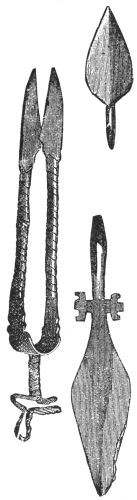
SCISSORS AND ARROW-HEADS OF IRON.
Thorstein, in the meanwhile, sent their pursuers in the opposite direction, and led them a dance through forest and field in a vain search for the fugitives. The next night, when Haakon and his men had given up the search, he sent food and clothes to Aastrid, and furnished her with an escort to Sweden, where she found a place of refuge with a friend of her father's named Haakon the Old. Gunhild, however, was not to be discouraged. She sent two embassies to King Erik of Sweden, demanding the surrender of Olaf Tryggvesson, and received each time permission to capture the child, without interference on the part of the king. But Haakon the Old was a mighty man, and determined to defend his guests. The threats of Gunhild's embassador did not frighten him. While the latter was speaking, a half-witted thrall, named Buste, seized a dung-fork, and rushed at him, threatening to strike. The embassador, fearing to be soiled, took to his heels, and was pursued by the thrall. How the queen received him on his return is not recorded.
Of the internal enemies of Gunhild's sons, Earl Haakon of Hlade now alone remained; and it was not an unnatural desire on their part to reduce him to subjection. Anticipating, as usual, their action, the earl was on the look-out for them; but having ascertained the size of their fleets, he saw the hopelessness of his cause, and forthwith sailed to Denmark, where he was well received by King Harold Bluetooth (964). It will thus be seen that the friendship between Harold Grayfell and the Danish king had not endured the strain of diverging interests. The former, as soon as he felt secure in his power, refused to recognize the latter's claim to Viken, and paid him no taxes. Harold Bluetooth, therefore, allied himself with Earl Haakon, the bitterest enemy of the sons of Gunhild, hoping, by his aid, to regain his lost dominion. What particularly encouraged him in this expectation was the continued dearth which prevailed in Norway, and the resulting unpopularity of the kings which, with every year, grew more pronounced. It was of no avail that Harold Grayfell almost every summer went on viking cruises, gaining a great fame as a warrior and bringing home rich treasures. The people hated him only less than they hated his mother Gunhild. An exploit of his brother Sigurd Sleva aroused a demonstration of wrath which came near culminating in open rebellion. Sigurd Sleva had paid a visit to a mighty yeoman named Klypp Thorsson, and had, in the absence of the master of the house, been hospitably received by his beautiful wife Aaluf. He had become enamoured of his hostess, and had grievously insulted her. Klypp, on his return, learned what had occurred; and swore to avenge the shame which had been brought upon him by Gunhild's son. When Harold Grayfell and Sigurd, in the autumn of 964, held a thing at Vors, they were attacked by the enraged peasants, and had to save themselves by flight. Klypp, with a number of his friends, pursued Sigurd, slew him with his own hand, and was himself slain by one of Sigurd's men.
Earl Haakon, who, from his Danish retreat, watched the events in Norway, heard these tidings with satisfaction. The sudden check which his ambition had received had made him ill, and for some time he appeared listless, refusing to eat and drink, or to communicate with anybody. But when his plans of vengeance were matured, he rose from his bed, strode forth with his old vigor, and proceeded to weave a complicated net of intrigues. Harold Bluetooth had at that time a difficulty with his nephew Gold-Harold, who demanded a share in the government; and, having confidence in the sagacity of the earl, he asked his advice. The earl saw here his opportunity, and had no scruple in availing himself of it. He dissuaded the king from killing his nephew, because such a deed would arouse indignation and alienate the great party in Denmark, who desired to see Gold-Harold on the throne. Far better would it be if he employed Gold-Harold to punish Harold Grayfell and his brothers, and in the end reward him with the throne of Norway. Thereby the king would increase his own power, and convert a dangerous rival into a friend and ally. This advice seemed good to Harold Bluetooth, and after some persuasion he found courage to act upon it. He sent a friendly message to his foster-son, Harold Grayfell, inviting him to come and take possession of his old fief in Denmark, the income of which he might, indeed, need during the hard times that prevailed in Norway. Harold Grayfell, after some vacillation, accepted this invitation, and sailed to Denmark with three ships and two hundred and forty men; but no sooner had he set foot upon Danish soil than he was attacked by Gold-Harold, who slew him and nearly all his men.
This was the first act in the drama which Earl Haakon had planned. The second contained a surprise. The earl went to Harold Bluetooth, and represented to him that his nephew, as king of Norway, would become a more dangerous rival than he had been before; and frankly offered to kill him, if the king would promise not to avenge his death. Furthermore, he demanded, as his reward, the kingdom of Norway in fief, under the overlordship of the king. All this seemed very tempting to Harold Bluetooth; and like all weak and vicious men, he made objections only for the purpose of having them overcome. In the end he gave his consent; and Gold-Harold was immediately attacked and killed by Earl Haakon. With a large army the two conspirators now sailed for Norway, and won the whole country without striking a blow. So great was the hatred of Gunhild and her sons, that not a man drew his sword in their defence. The two surviving brothers, Gudröd and Ragnfred, made a pretence of resistance, rallying a few followers about them; but did not venture to give battle. Seeing the hopelessness of their cause, they fled with their mother to the Orkneys (965). Ragnfred, however, returned the following year with a considerable fleet, largely made up of vikings who had gathered about him, and fought an indicisive battle with Earl Haakon. He even succeeded in reconquering four of the northwestern shires. For nearly a year Haakon made no effort to expel him. It was not until the spring of 967, that he felt himself strong enough to appeal to arms once more; and this time Ragnfred and his brother Gudröd, who in the meantime had joined him, were defeated at Dingeness, and driven into exile. According to the most reliable accounts, they went to Scotland, but continued for several years to harass the coast of Norway by sudden attacks. They were, however, no longer sufficiently formidable to cause the earl any serious inconvenience, although he was not slow to seize upon their attacks as a pretext for discontinuing the payment of the tax which he had pledged to the Danish king. Gunhild died, in all probability, either in Scotland or the Orkneys, although one of the sagas relates, that she was enticed to Denmark by Harold Bluetooth, under promise of marriage, and at his command drowned in a swamp

CHAPTER IX.
EARL HAAKON (970-995).
By his daring intrigue Earl Haakon had attained the goal of his desires. He had avenged his father's death, humiliated his enemies, and gained a power far beyond that of any of his ancestors. With a nature like his, however, no goal is final. The ease with which he had managed Harold Bluetooth and his nephew—using them as tools for his own ends—had, no doubt, inspired him with a supreme confidence in his ability, and a corresponding contempt of those whose shrewdness was inferior to his own. The purpose therefore soon matured in his mind to repudiate his obligations to the Danish king, and make himself the independent ruler of Norway. The opportunity for carrying this purpose into effect soon presented itself. The Emperor Otto I. of Germany, who claimed sovereignty over Denmark, died in 973, and was succeeded by his young son, Otto II. Harold Bluetooth, who had always resented the emperor's claim, even though he was forced to recognize it, made extensive preparations for a campaign against Otto II., and sent messengers to his vassal, Earl Haakon, commanding him to come to his aid with all the forces at his disposal. Earl Haakon, whatever his inclinations may have been, did not deem it advisable to disobey, and in the spring of the year 975 sailed southward with a large fleet and army. He did duty for a while in defending the wall of Dannevirke, and actually beat the emperor in a great battle. Then, feeling that his task had been accomplished, he boarded his ships and prepared to sail homeward. The emperor, however, hearing that Dannevirke was deserted by its defenders, returned for a second attack, and forced his way into Jutland. Whether Harold Bluetooth fought with him does not appear. We only know that he accepted a humiliating peace, reaffirming his vassalage, and, according to a creditable source, promising to introduce the Christian religion, both in his own kingdom and in Norway. It is probable that both Harold and his son, Sweyn Forkbeard, had been baptized before, but continued in their hearts to be devoted to the Asa faith. It was scarcely zeal for Christianity, but fear of the emperor, which induced Harold to send for Earl Haakon and force him to accept baptism and to promise to convert his countrymen to the new religion. It is strange that a man as shrewd as Haakon, after his recent desertion of Dannevirke, should have obeyed this summons. In all likelihood the victorious battle which he had fought gave him confidence in his power to justify himself; and there may also have been circumstances connected with the affair which changed its aspect to contemporaries. It is not inconceivable, however, that he really wished for a plausible pretext for rebellion, and deliberately took his chances.

HAROLD BLUETOOTH.
With a ship-load of priests Haakon departed from this fateful meeting with the Danish king. But no sooner was he out of Harold's sight, than he put his priests ashore, and began to harry on both sides of the Sound. On the rocky cliffs of Gautland he made a grand sacrificial feast, to counteract the effect of his recent baptism, and stood watching for a response from the old gods, that they looked upon him with favor, and would give him success in the war he was about to undertake. Then two ravens came and followed his ships, "clucking" loudly. The ravens were the birds of Odin, and Haakon saw in their flight a happy augury. A warlike fury seems now to have possessed him. With a recklessness which in so prudent a man is inconceivable (except under high religious excitement), he burned his ships, landed with his army on the coast of Sweden, and marched northward, ravaging the land with fire and sword. A broad track of blood and desolation followed his destructive progress. Even in the Norwegian province Viken, which Harold Bluetooth had given to Sweyn Forkbeard, he continued his devastations in pure wantonness, as if to advertise his defiance of the Danish king and all that belonged to him. From Viken he took his way overland to Drontheim, where he henceforth lived as an independent sovereign; though for some reason he refrained from assuming the royal title.
It was probably some time before Harold Bluetooth could raise an army strong enough to pursue the earl and defeat him in his own stronghold. There is some doubt, however, whether his campaign to Norway, for the purpose of punishing his rebellious vassal, took place in 976 or two or three years later. Following Haakon's example, he laid the land waste, killing and burning every thing in his path. In Laerdal in Sogn, he left only five houses unburned. When, however, Earl Haakon sailed southward to meet him with a numerous fleet, the king suddenly lost his courage, set sail, and made for home. It is said that Harold Bluetooth had on that occasion no less than twelve hundred ships.
Earl Haakon had now peace for some years. He had, as soon as he had conquered the sons of Gunhild, married the beautiful Thora, daughter of the powerful chieftain Skage Skoftesson: and had by her two sons, Sweyn and Heming, and a daughter, Bergljot. Considerably older than these children, was the earl's illegitimate son, Erik, who, according to one account, was born when his father was but fifteen years old. There is, however, good reason for questioning this statement. Erik was a stubborn and turbulent youth, who could not be induced to respect the authority of his father. When he was ten or eleven years old, he got into a dispute with Haakon's brother-in-law Tiding-Skofte, about the right to anchor his ship next to the earl's. Tiding-Skofte, who was a great favorite of the earl's, had been especially granted this privilege and was inclined to insist upon it. To avenge this insult Erik watched his chance and slew him a year later. He thereby incurred the hostility of his father, and fled to Viken, where Sweyn Forkbeard gave him a cordial reception.
It was scarcely to be expected that Harold Bluetooth should quietly accept the humiliation which Earl Haakon had put upon him. He was, indeed, getting too old himself to measure strength again with his powerful antagonist; and he therefore delegated the task of punishing him to his friends and allies. Among the latter were the celebrated Jomsvikings, who lived at Jomsborg, on the island of Wollin, at the mouth of the river Oder. These vikings were a well-disciplined company of pirates, who made war their exclusive business, living by rapine and plunder. They were bound by very strict laws to obey their chief, to spurn death and danger, to aid each other, and to endure pain uncomplainingly. Like the Italian condottieri, they were willing to serve any master with whom their chief could make satisfactory arrangements. For women they professed contempt, and no woman was permitted to enter their burgh. These formidable marauders Harold Bluetooth endeavored to stir up against his rebellious vassal. At a funeral feast which their chief, Earl Sigvalde, made in honor of his father, a great throng of warriors were present; the ale and mead flowed abundantly, and there was much good cheer in the hall. When Earl Sigvalde rose to drink the toast to Brage, he vowed that before three winters were past he would kill Earl Haakon or expel him from his realm, or himself die in the attempt. The other vikings, not wishing to be outdone by their chief, made vows scarcely less daring; and the enthusiasm rose to such a pitch that no achievement seemed beyond their strength. When they woke up the next morning, the affair wore a slightly different aspect; but having once promised, they could not retreat. So they made a virtue of necessity, and prepared in haste for the attack. The rumor of their vows had, however, preceded them, and reached Erik, the son of Earl Haakon. Disregarding his father's hostility, he hurried northward to Drontheim with all the men he could gather, and placed them at the disposal of the earl. The Jomsvikings, in the meanwhile, occupied themselves in plundering the coasts of Norway, sailing slowly northward with a well-manned fleet of sixty ships. The number of their warriors was between seven and eight thousand. They met Earl Haakon and his sons Erik, Sweyn, Sigurd, and Erling at Hjörungavaag in Söndmöre. The earl had one hundred and eighty ships, the majority of which were inferior in size and equipment to those of his enemies; and according to a probable calculation, his force amounted to ten or eleven thousand men. So many men and ships had scarcely ever before been seen together in the North, and the sagas relate that the fight in Hjörungavaag (986) was the greatest battle that has ever been fought in Norway.
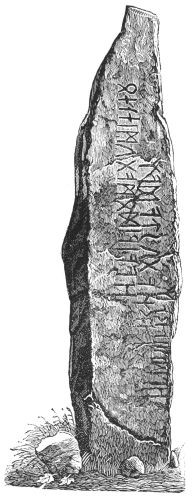
RUNESTONE FROM STRAND IN RYFYLKE. THE INSCRIPTION WHICH IS IN THE OLDEST NORSE RUNES READS AS FOLLOWS: I, HAGUSTALD, BURIED IN THIS HILL MY SON, HADULAIK.
As Earl Haakon saw the first of the Jomsvikings sailing up the sound, he disposed his own ships in battle-array. He gave his oldest son Erik command of the right wing, placed Sweyn on the left, and himself commanded the centre. Opposite to Sweyn were the ships of the famous Jomsviking Vagn Aakesson, whose impetuosity and daring had made him dreaded far and wide. The young Earl Sweyn was no match for such an antagonist, and after a gallant resistance he began to retreat. His brother Erik, seeing the imminent danger, rowed around to his wing, drove Vagn back, and forced his brother to resume his position. Then he hastened back to his own wing, and came just in time to check the progress of Bue the Big (Digre), who commanded the corresponding wing of the Jomsvikings. The battle now grew furious, and the carnage on both sides was tremendous. The spears and arrows fell in rattling showers about Earl Haakon, as he stood in the prow of his ship, and so many hit him that his shirt of mail was torn into strips, and he was forced to throw it away. The ships of the vikings were higher than those of the Norsemen, and the advantage which this afforded the former told at first heavily against the latter. Then, it is told, Earl Haakon suddenly disappeared, and the legend relates that he took his youngest son Erling, went ashore with him, and sacrificed him to the gods for victory. Instantly the skies grew black, and a violent hail-storm beat down, pelting the faces of the Jomsvikings and almost blinding them. Every grain of hail, says the saga, weighed two ounces. Some even declared that they saw the maidens of Odin, the Valkyrias, Thorgerd and Irp, standing in the prow of Earl Haakon's ship, sending forth a deadlier hail of unerring arrows. The Jomsvikings fought half blindly, fell on the slippery decks in a slush of blood and melting hail, but in spite of the twilight and confusion yet held their own. Then suddenly their chief, Earl Sigvalde, turned and fled. Vagn Aakesson, who saw him, cried out in a frenzy of rage: "Why dost thou flee, thou evil hound, and leave thy men in the lurch? That shame shall cling to thee all thy days." Earl Sigvalde made no reply; and it was well for him that he did not; for in the same instant a spear was hurled forth from Vagn's hand, transfixing the man at the helm. A moment before Vagn had seen his chieftain there, and it was for him the spear was intended. Confusion now became general; and all Earl Sigvalde's men, seeing that his standard was gone, fell out of line and fled. At last only Vagn Aakesson and Bue the Big were left. Earl Haakon pulled up alongside the ship of the latter and a combat ensued, which, in wildness and fury, has scarcely a parallel in the records of the sagas. Two great champions of the Jomsvikings, Haavard the Hewer (Huggende) and Aslak Rock-skull (Holmskalle), vaulted over the gunwale of the earl's ship and made tremendous havoc, until an Icelander seized an anvil which was used for sharpening the weapons and dashed it against Aslak's head, splitting his skull. Haavard had both his feet cut off, but fought on furiously, standing on his knees. The spears whizzed about the earl's ears and the arrows flew past him with their angry twang. His men fell and the Jomsvikings were pressing forward. Then, in the nick of time, came his son Erik, and, with a throng of his men, boarded the galley of Bue the Big. In their first onset Bue received a terrible cut across the nose. "Now," he cried, "I fear the Danish maidens will no more kiss me." Then, seeing that resistance was vain, he seized two chests full of gold and shouted: "Overboard all Bue's men," and leaped into the sea. Vagn Aakesson's galley was likewise boarded, and there was a repetition of former scenes of carnage. When all but thirty of his men were dead he at last surrendered. The captives were brought ashore and ordered to sit down in a row upon a long log. Their feet were tied together with a rope, while their hands remained free. One of Earl Erik's men, Thorkell Leira, whom Vagn at that memorable funeral feast had promised to kill, was granted the privilege to reciprocate the intended favor toward Vagn. With his axe uplifted he rushed at the captives, and, beginning at one end of the log, struck off one head after another. He meant to keep Vagn until the last, in order to increase his agony. But Vagn sat chatting merrily with his men; and there was much joking and laughter.
"We have often disputed," said one, "as to whether a man knows of any thing when his head is off. That we can now test, for if I am conscious, after having lost my head, I will stick my knife into the earth."
When his turn came all sat watching with interest. But his knife fell from his nerveless grasp, and there was no trace of consciousness. One of the vikings on the log seemed particularly in excellent spirits. He laughed and sang, as he saw the bloody heads of his comrades rolling about his feet. Just at that moment Earl Erik approached and asked him if he would like to live.
"That depends," answered the viking, "upon who it is who offers me life."
"He offers who has the power to do it," said the earl; "Earl Erik himself."
"Then I gladly accept," the viking replied.
The next in order, as the executioner walked up to him, made an equivocal pun, which, however, pleased Earl Erik so well that he set him free. Eighteen had now been beheaded and two pardoned. The twenty-first was a very young man with long, beautiful hair and a handsome countenance. As Thorkell Leira paused before him he twisted his hair into a coil and begged him not to soil it with his blood. In order to humor him, Thorkell told one of the bystanders to take hold of the coil while he struck off the head. The man consented; but just as the axe was descending, the Jomsviking pulled his head violently back, and the obliging assistant had both his hands cut off.
"Some of the Jomsvikings are alive yet," he cried, as he raised his head laughing.
Earl Erik, who had witnessed this scene, asked him his name.
"I am said to be a son of Bue," he answered.
"Very likely is that," said the earl; "do you wish to live?"
"What other choice have I?" asked the young viking.
When Thorkell Leira observed that Earl Erik was in a forgiving mood, he grew very wroth. Fearing that he might be thwarted in his vengeance on Vagn Aakesson, he sprang past the remaining men and, with his axe raised above his head, rushed toward his enemy. One of the men on the log, however, seeing his chief's danger, flung himself forward so that Thorkell stumbled over his body and dropped his axe. Instantly Vagn was on his feet, seized the axe and dealt Thorkell such a blow that the axe went through the neck, and the blade was buried in the earth. Thus Vagn Aakesson was the only one of the Jomsvikings who accomplished what he had vowed to do. Earl Erik, full of admiration of his feat, now had his bonds removed and gave him his liberty. The other prisoners who were yet alive were also set free at the earl's command.
Not far from the spot where this occurred sat Earl Haakon with many of his chieftains. Suddenly the loud twang of a bow-string was heard, and in the same instant Gissur the White, from Valders, who sat next to the earl and was more magnificently dressed than he, fell dead, pierced by an arrow. Many men hastened down to the ship whence the arrow had come, and found Haavard the Hewer, who, half dazed with loss of blood, stood on his knees with his bow in his hands. "Tell me, lads," he said, "did any one fall over there at the tree?"
He was told that Gissur the White had fallen.
"Then I was not so much in luck as I had hoped," he remarked; "for that arrow was meant for the earl."
It was plain that the favorable result of this great battle was due chiefly to the intrepidity and circumspection of Earl Erik. His father would perhaps have recognized this fact, if the son had not apparently superseded his authority in sparing the life of so important a man as Vagn Aakesson without consultation with the commander-in-chief. He did not, however, venture to disregard Earl Erik's pardon, but loudly expressed his discontent, and parted from his son in anger. Vagn followed his rescuer southward, and became his familiar friend and companion.
Earl Haakon's power was now so well confirmed that no one ventured to dispute his supremacy. Crops and fisheries were good. The people enjoyed many years of peace and contentment. The earls of the Orkneys paid Haakon tribute, as if he had been a king, and a king he was in every thing except the name. His family had always been associated with the ancient temple and earldom of Hlade; and it was a matter of pride with him to retain his ancestral dignity. This is significant when we consider how he was in all things a man of the old dispensation. At a time when heathenism was slowly crumbling away, and the faith in the old gods was losing its hold upon the upper classes, Haakon was a devout and sincere heathen. The continual intercourse of Norway with England and the lands of the South had half imperceptibly weakened the old superstitions and made the legends of Odin and Thor appear to many like nursery tales which grown-up men could scarcely be expected to believe. Repudiation of all supernaturalism and a proud reliance upon his own good sword was at this time characteristic of the Norse viking, who prided himself upon his knowledge of the world and his deeds in distant lands. For all that the Asa faith as later events will prove, had yet a sufficient number of sincere believers to make the progress of the new faith slow and sanguinary. Nevertheless so atrocious an act as the sacrifice of one's own child could not have failed to arouse indignation even among the worshippers of Odin and Thor. Such horrors were tolerated far back in the gloom of primeval antiquity, but must have been felt in the tenth century as a hideous anachronism. How much Earl Haakon's heathen fanaticism contributed to his downfall is difficult to determine. The sacrifice of Erling during the battle with the Jomsvikings, though it was generally regarded as a fact, was not the original cause of the rebellion which cost the earl his throne and his life. The vices by which he forfeited his early popularity were of a kind which assert their sway over men, irrespective of religions.
In the year 995 Earl Haakon was travelling in Gauldale, collecting taxes. His son Erlend, of whom he was very fond, lay with some ships out in the fiord, waiting to receive the treasure. One evening the earl sent a company of thralls to the house of the powerful peasant Brynjulf, commanding him to send him his wife, who was renowned for her beauty. Brynjulf refused, and the earl in great anger sent the thralls back with this message to the indignant husband, that he had the choice between death and the surrender of his wife. The peasant was obliged to yield, and with a heavy heart let his wife depart with the thralls. But no sooner was she gone than he recovered his manhood and swore vengeance. He summoned the inhabitants of the valley from far and near, and told them of the shame the earl had put upon him. All promised him their help, and resolved to hold themselves in readiness, awaiting the first opportunity for attacking the daring profligate. The earl, in the meanwhile, being quite ignorant of their designs, played into their hands. Very soon after his adventure with Brynjulf's wife, he sent a message of similar purport to Orm Lyrgja, whose wife Gudrun, on account of her beauty, was surnamed "Lundarsol" (the Sun of Lunde).[A] Orm, who was a man of great authority in his valley, sent word to all his neighbors, and after having feasted the earl's thralls, in order to detain them, refused to comply with their demand. Gudrun, who saw them depart, cried jeeringly after them: "Give the earl my greeting, and tell him that I will not go to him unless he sends Thora of Rimul to fetch me." Thora of Rimul was one of the earl's mistresses, whom his favor had made rich and powerful.
[A] Skaldespilder means waster or spoiler of scalds, because no other scald could bear comparison with him.
In the twenty-sixth year of his reign (961) Haakon was summering with his men-at-arms on his estate Fitje in Hördaland. A large number of guests were with him, among whom the scald Eyvind Skaldespilder (Scald-Spoiler),[A] who was on his mother's side a great-grandson of Harold the Fairhaired. The king was seated at the breakfast-table, when the sentinels saw a large fleet of ships sailing in through the fjord. They called the scald Eyvind aside, and begged him to decide whether those were not hostile ships. Eyvind sprang into the hall where the king was sitting, and sang a verse, announcing the approach of the sons of Erik. Haakon arose and looked at the ships. Then he turned to his men and said: "Here many ships are coming against us, and our force is but small. It is plainly to be seen that we shall have to fight against heavier odds than ever before; for the sons of Gunhild come with a larger force to-day than on previous occasions. Loath I am to bring my best men into too great a danger; and loath I am, too, to flee, unless wise men decide that it would be foolhardy to await the foe."
[A] Lund means a grove, and her name might thus be rendered: "The Sun of the Grove."
[A] Lund means a grove, and her name might thus be rendered: "The Sun of the Grove."
War-summons was now sent from farm to farm and a great band of armed peasants came together, and marched toward Medalhus where Haakon was staying. He sent in haste a message to his son Erlend, to meet him at Möre, whither he intended to go, as soon as the army of the peasants had dispersed. Then his time for vengeance would be at hand. In the meanwhile he would be obliged to dismiss his men and hide, until the excitement should have subsided. With a single thrall named Kark, whom he had received as tooth-gift[A] and who had been his playmate in his boyhood, he fled across the Gaul river, rode his horse into a hole, and left his cloak upon the ice, in order that his pursuers might believe that he had been drowned. Then he hastened to his mistress, Thora of Rimul, who hid him and the thrall in a deep ditch under her pigsty. Food, candles, and bedclothes, were given them, whereupon the ditch was covered with boards and earth, and the pigs were driven out over it. As it happened, Olaf Tryggvesson, whose young life Queen Gunhild had vainly endeavored to destroy, had just then landed in Tröndelag and had slain the earl's son Erlend. The peasants, hearing that he was of the race of Harold the Fairhaired, received him with delight and accompanied him to Rimul, where they thought it likely that the earl must be hidden.
[A] It was customary to give to infants of high birth a thrall or some other valuable gift when it got its first tooth. This gift was called a tooth-gift.
After a vain search Olaf called them together, and mounting a big stone, close to the pigsty, declared in a loud voice that he would give a great reward to him who would find the earl and slay him.
In his damp and malodorous hiding-place the earl sat, gazing anxiously at his thrall. Every word of Olaf's speech he could plainly hear, and by the light of the candle which stood on the earth between them, he saw that Kark, too, was eagerly listening.
"Why art thou now so pale?" asked the earl, "and now again as black as earth. Is it not because thou wilt betray me?"
"No," replied Kark.
"We were both born in the same night," said the earl, after a pause; "and our deaths will not be far apart."
They sat for a long time in shuddering silence, each distrusting the other. From the stillness above they concluded that night was approaching; but neither dared to sleep. At last Kark's weariness overpowered him; but he tossed and mumbled excitedly in his sleep. The earl waked him and asked him what he had been dreaming.
"I dreamed," answered Kark, "that we were both on board the same ship and that I stood at the helm."
"That must mean that thou rulest over thine own life as well as mine. Be therefore faithful to me, Kark, as behooves thee, and I will reward thee when better days come."
Once more the thrall fell asleep and labored heavily, as in a nightmare. The earl woke him again and asked him to relate his dream.
"I thought I was at Hlade," said Kark, "and Olaf Tryggvesson put a golden ring about my neck."
"The meaning of that," cried the earl, "is that Olaf Tryggvesson will put a red ring[A] about thy neck, if thou goest to seek him. Therefore, beware of him, Kark, and be faithful to me. Then thou wilt enjoy good things from me, as thou hast done before."
[A] The red ring means, of course, a ring of blood; i.e., Olaf would cut Kark's head off.
The night dragged slowly along and each sat staring at the other, with rigid, sleepy eyes, which yet dared not close. Toward morning, however, the earl fell backward and sleep overwhelmed him. But the terrors of his vigil pursued him sleeping. His soul seemed to be tossed on a sea of anguish. He screamed in wild distress, rolled about, rose upon his knees and elbows, and his face was terrible to behold. Then Kark sprang up, seized his knife and thrust it into his master's throat. Soon after he presented himself before Olaf Tryggvesson with the earl's head, claiming the reward. But Olaf verified the murdered man's prophecy. He put not a ring of gold, but one of blood about the traitor's neck (995).
Earl Haakon was the last champion of paganism upon the throne of Norway. He was a man of great natural endowment, fearless yet prudent, formidable in battle, and in his earlier years justly popular for his kindliness and liberality. It appears, however, as if the dignity and power which he conquered by his own ability intoxicated him and disturbed the fine equilibrium of his mind. Morally, he was, barring the profligacy of his later days, a legitimate product of the old Germanic paganism and the conditions of life which must of necessity prevail in a militant community. The shrewdness and faithlessness which we are apt to censure in the heroic types of this age, were, in reality, enforced by the hostile attitude of man to man and the resultant necessity for distrust and simulation. Candor and veracity were virtues which, according to the old Norse code, were only to be practised between friends, while mendacity and deceit were legitimate weapons against enemies. Earl Haakon was, however, even according to his code, culpable in not discriminating between friend and foe. He rose by faithlessness, and by faithlessness he fell.
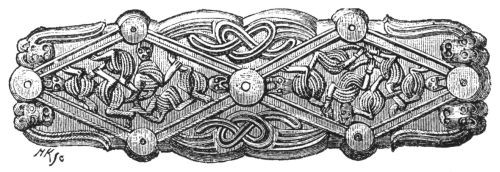
OBLONG BUCKLE. FOUND AT ROSSELAND IN LISTER AND MANDAL'S AMT.

CHAPTER X.
THE YOUTH OF OLAF TRYGGVESSON.
The story of Olaf Tryggvesson's youth, as related in the sagas, is so marvellous that it can scarcely claim absolute credibility. The wonder-loving tradition seized upon him from his very birth as its favorite hero, and adorned every incident of his career with a multitude of romantic details. To separate the framework of fact from the embellishments of fiction is, under such circumstances, no easy task. That Olaf's career, even stripped of all fanciful additions, was as remarkable as any romance, there can be no question. We have seen how Queen Gunhild with untiring vigilance tracked him through forests and wildernesses while he was an infant, and how his mother Aastrid finally found a place of refuge with Haakon the Old in Sweden. Her sense of security could scarcely have been increased when Earl Haakon succeeded the sons of Gunhild; for the earl was not of royal blood, and must fear, no less than Gunhild, a scion of the race of Harold the Fairhaired. Aastrid therefore determined to go with her son to Gardarike, or Russia, where her brother, Sigurd Eriksson, held a position of authority under King Vladimir. She took passage for herself, her son, and their attendants, upon a merchant-ship bound for a Russian port, but the ship was captured by vikings, who killed some of the passengers and sold others as slaves. The young Olaf, his foster-father Thoralf Lousy-Beard, and the latter's son Thorgills, became the property of a viking named Klerkon, who killed Thoralf because he was too old to command any price in the slave-markets. The two boys he bartered away in Esthonia for a big ram. The purchaser again disposed of them for a coat and a cape to a man named Reas, who treated Olaf kindly, while he put Thorgills to hard labor. With him Olaf remained for six years. His mother, Aastrid, in the meanwhile, had been found at a slave-market by a rich Norse merchant named Lodin, who had recognized her in spite of her miserable appearance, and offered to ransom her on condition of her becoming his wife. She had gladly given her consent and had returned with him to Norway.
One day Olaf's uncle, Sigurd Eriksson, had occasion to visit the town in Esthonia where his nephew was living. He was just riding across the market-place, when his attention was attracted to a group of boys who were playing. There was especially one of them whose appearance struck him, and he called to him and asked him his name. The boy said that his name was Olaf. Sigurd now discovered by further questioning that it was his nephew he was addressing. He made haste to buy him and his foster-brother Thorgills, and took them with him to his house. He enjoined upon Olaf to say nothing about his race and birth, and the boy promised to be silent. One day, however, when he was out walking, he caught sight of the viking Klerkon who had slain his foster-father. Without a moment's reflection, he went up and split his skull with an axe which he happened to have in his hand. Now the penalty for breaking the public peace was death, and a crowd of people rushed together, demanding that the boy should be killed. His uncle, in order to save him, took him to the queen, Olga, or Allogia, told her who he was, and implored her protection. The queen became greatly interested in the beautiful boy, and had him educated, as behooved a king's son, in the use of arms and all athletic sports. At the age of twelve he received men and ships from Vladimir, and spent some years roaming about as a viking. He is said to have done important service to his benefactor, reconquering a province which had rebelled; but the favor which he enjoyed raised him up enemies who slandered him, representing him as a dangerous rival of the king in the affections both of the queen and the people. Olaf then, at the advice of Olga, left Russia with his men and ships and went to Wendland,[A] where he was received with distinction by King Burislav. He did not, however, reveal himself as an heir to the throne of Norway, but travelled under the name Ole the Russian. Burislav's eldest daughter, or, more probably, sister, Geira, fell in love with him, and he married her, performed many valiant deeds in the service of his father-in-law, and finally, at the death of his wife, sailed once more in search of adventures. He was then twenty-one years old. A dream induced him to go to Greece and accept Christianity, and he is also said to have sent a bishop to Russia who converted Vladimir and Olga to the Christian faith. Thence Olaf went to Northumberland, Denmark, Scotland, and France, and had adventures without number. At the age of twenty-five he found himself in England, and was summoned to appear before Princess Gyda, sister of the Irish king, Olaf Kvaran. She had been the wife of an earl, but was yet a young and beautiful woman. A great many wooers were importuning her, among whom a certain Alfvine, a great champion and man-slayer. A day had been fixed on which Gyda had promised to choose a husband, and many high-born men had come together, hoping to be chosen. All were splendidly attired, and glittered in scarlet and gold. Olaf, with a few companions, came sauntering up to the market-place, and stationed themselves somewhat apart from the rest as if merely to look on. He had pulled a fur hood and cape over his head and shoulders, and was otherwise plainly clad. Gyda, after having somewhat listlessly regarded the ranks of her wooers, caught sight of the tall stranger with the fur hood. She approached him, lifted up his hood, and looked long and earnestly into his eyes.
[A] The present Baltic provinces of Prussia. The Wends were a Slavonic people, and not identical with the Vandals, with whom they have often been confounded. The latter, according to the best authority, were of Germanic origin.
"If thou wilt have me," she said, "then I choose thee for my husband."
Olaf replied that he was not unwilling to take her at her word; and their betrothal was forthwith published. Alfvine in great wrath now challenged the Norseman, fought, and was conquered. The wedding was then celebrated, and Olaf spent several years in England and Ireland. He became here more intimately acquainted with Christianity, was baptized, and became a zealous defender of the faith. In Greece, he had, according to the legend, only been primsigned—i.e., marked with the sign of the cross. This was regarded as a sort of compromise between the old faith and the new, and was supposed to secure a certain favor from Christ the White, without entirely forfeiting the good-will of the old gods.
The Anglo-Saxon annals contain repeated references to Olaf Tryggvesson, and name him as the chieftain of a great viking fleet, which, in the year 994, ravaged the coasts of Essex, Kent, Sussex, and Hampshire. He even landed with a considerable army, and put up his winter quarters in Southampton, levying supplies from the neighboring country. The unhappy proposition was then made to King Ethelred II. to buy immunity from further depredations, and the sum of £10,000 was paid to Olaf and by him apportioned among his men. Sweyn Forkbeard, the son of Harold Bluetooth, then exiled from his native land, is also named as one of the chieftains concerned in this expedition, though in the treaty of peace between King Ethelred and the vikings, which is yet preserved, his name does not occur. At the confirmation of Olaf, which took place with great pomp in the same year, King Ethelred was present, and it is said that Olaf solemnly vowed, on that occasion, that he would henceforth never more molest the inhabitants of England. This promise he appears to have kept. Sweyn, however, tempted by the great sums of money which he had extorted, returned again and again, expelled Ethelred for a time from his kingdom, and for many years was the virtual ruler of England.
The fame of Olaf Tryggvesson's deeds spread far and wide, and also reached Norway, where Earl Haakon anxiously listened to every rumor regarding him. That this daring young adventurer would, as soon as he felt himself strong enough, lay claim to his paternal kingdom, the earl could not doubt; and as his own popularity waned, he looked forward with increasing uneasiness to the conflict. He well knew the devotion of the people to the race of Harold the Fairhaired, and the thought took possession of him that his own safety demanded Olaf Tryggvesson's death. He confided his plan to his friend, Thore Klakka, and begged him to sail to Dublin, where Olaf was then staying, and either kill him, if the chance presented itself, or entice him over to Norway where he could easily destroy him. Thore Klakka accepted this mission, met Olaf in Dublin, and readily gained his confidence. The young man was eager for information concerning his native land, and the earl's emissary lost no opportunity to urge him to sail thither, the sooner the better, and take possession of his inheritance. The earl, said Thore Klakka, was indeed powerful, but if the peasants heard that a descendant of Harold the Fairhaired was in the land, they would all forsake him and join the legitimate king. Olaf was easily persuaded to believe these flattering assurances, and in the spring of the year 995 sailed with five ships for Norway. In accordance with Thore Klakka's treacherous advice, he went straight to the northwestern shires where Earl Haakon's power was the greatest, and landed on the island Moster in Hördaland. He raised his tent, planted the cross on the beach, and had the mass celebrated. Being convinced of Thore's disinterestedness, he also accepted his advice not to reveal who he was, but sail northward to Tröndelag in order to attack the earl unawares and slay him. Great must have been Thore's surprise when, on landing at the mouth of the Drontheim fjord, he found that he had truthfully represented the condition of the country. The peasants were united in open rebellion against his master, and Olaf had only to make himself known in order to secure immediate allegiance. Of his speech at Rimul, and the ignominious death of the earl, we have already spoken. All the chieftains and peasants of Tröndelag were now summoned to meet at the Oere-thing, at the mouth of the river Nid, and here Olaf Tryggvesson was formally proclaimed King of all Norway. The Trönders from this time forth reserved for themselves the right to proclaim the king in the name of the whole country, and even to this day the sovereigns of Norway are crowned in Drontheim. Nevertheless, the king was required to travel from district to district and receive the allegiance of the people. This Olaf now did, and was everywhere greeted with enthusiastic homage.
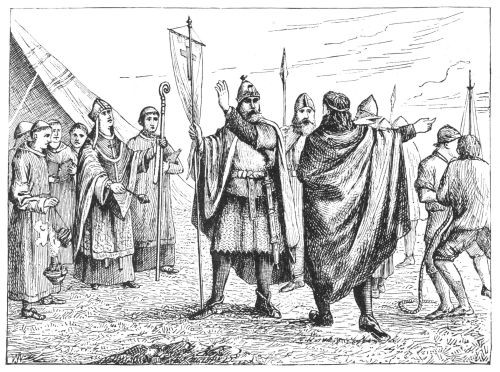
OLAF TRYGGVESSON'S ARRIVAL IN NORWAY.
The above narrative exhibits several improbabilities, which, however, do not of necessity vitiate its essential truthfulness. Of Olaf's sojourn in Russia there can be no doubt, although, to be sure, the Vladimir who at that time reigned in Novgorod had no wife named Allogia or Olga, and if it was his grandmother Olga to whom reference is made, the king's jealousy seems altogether unreasonable. Likewise Olaf's visit to Wendland and his marriage there are capable of proof from contemporary poems, while the deeds which are attributed to him in King Burislav's service have a suspiciously legendary character. The adventure with Gyda in England also conceals a framework of fact under its mythical embroidery.

CHAPTER XI.
OLAF TRYGGVESSON (995-1000).
King Olaf's first endeavor, after having ascended the throne, was to Christianize the country. He was by nature well adapted for this task, being zealous in the faith, resolute, and uncompromising. Where gentle means did not avail he had no hesitation in employing sword and fire. Vehement as he was by temperament, brooking no argument, he wasted no time in weighing the probabilities of success or failure, but in the conviction of the sanctity of his cause stormed resistlessly onward and by his impetuosity and ardor, bore down all opposition. His first appearance as the champion of the new religion was in Viken, where he called his relations and adherents together and told them, that it was his intention to convert the whole kingdom of Norway to faith in Christ the White, even though he were to lose his life in the attempt. In Viken lived at that time his mother and his step-father, Lodin, who had a large following of friends and relations. Some of these were, no doubt, already Christians, or had been primsigned, as Christianity had, twenty-five years before, been preached for a short time in this part of the country by two Germans. No particular opposition was therefore offered to the king's command, and within a brief period Olaf had the satisfaction of seeing all of Viken—the old kingdom of his father, Tryggve—nominally, at least, converted to Christianity. It is not to be inferred, however, that the converts, in accepting baptism, renounced their faith in the gods whom they had previously worshipped. On the contrary, they continued to believe in their existence, and perhaps even secretly to worship them. The Christian priests themselves professed belief in Odin and Thor, but represented them as evil powers who had been conquered by Christ and thrown into the outer darkness. As Christ had now all power in heaven and earth, it was futile to invoke the favor of the vanquished gods by sacrifice. In this practical shape the new religion unquestionably appealed to many whom otherwise it could not have reached. The relation to the old gods had been in its essence a contract for protection and good crops, in return for certain tangible values sacrificed. As Christianity was then preached, it was in many respects the same thing under a different name. Prayers formerly addressed to Odin or Frey were now addressed to Christ and the Virgin Mary, and though offerings of horses and bullocks were discontinued, the fragrant incense was still supposed to rise to the nostrils of the new god and propitiate his favor. The salient and essential difference between the old and the new faith, and the only one which the Norsemen in the beginning vividly apprehended, was the great doctrine of peace upon earth and good-will among men. While Odin and Thor took pleasure in bloodshed and rejoiced in war, Christ the White loved peace and accorded no merit to the man-slayer.
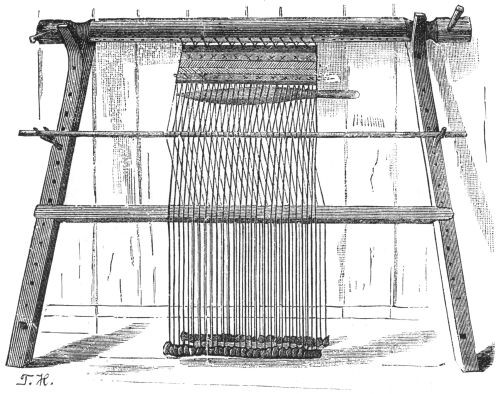
OLD NORSE LOOM. FROM FANE NEAR BERGEN.
That this doctrine, though it was slow to affect the lives of the new converts, nevertheless from generation to generation wrought a change in the moral consciousness of the Norsemen, can scarcely be questioned. The old Asa faith was inconsistent with any kind of civilization, because it meant, in the end, universal destruction. As long as killing was per se meritorious and secured the favor of the gods and honor among men, no trade but that of arms could flourish, and every peaceful industry became impossible. In Iceland, where the spirit of the old Germanic paganism survived, even long after the introduction of Christianity, internecine feuds of the most atrocious character prevailed for centuries, resulting in a gradual decadence, followed by stagnation and decay. The result in Norway, as the subsequent narrative will show, was scarcely better. A universal exhaustion followed the long carnival of bloodshed, and a heavy lethargy, lasting for four hundred years, settled upon the people.
It would be vain to pretend that Olaf Tryggvesson, when he undertook the task of destroying the Asa faith, had any conception of the superior sociological value of the new faith over the old. Not even the conception of one God, instead of many, seems to have been emphasized in the preaching of those days. On the contrary, the Christian religion was adapted, as far as possible, to the pre-existing polytheistic notions, and a new hierarchy, consisting of the Trinity, the Virgin Mary, and a host of saints, was exalted as objects of worship instead of the old gods. If the character of the religious teaching is to be inferred from the character of the teachers, it is safe to conclude that the early Germanic Christianity was ethically not far removed from the religion which it came to supplant. Thus we hear much in the Saga of Olaf Tryggvesson of a priest named Thangbrand, whose violence, pugnacity, and readiness to kill must have made him an odd exponent of the gospel of peace. Thangbrand was a Saxon, and had been sent north with many other missionaries to assist in converting the Danes. Bishop Siric, of Canterbury, presented him during a visit with a curiously wrought shield, upon which was the image of the crucified Christ. Shortly after this occurrence, Thangbrand made the acquaintance of Olaf Tryggvesson, who admired the shield greatly and desired to buy it. The priest received a munificent compensation, and finding himself suddenly rich, went and bought a beautiful Irish girl, whose charms had beguiled him. A German warrior who saw the girl claimed her, and when his demand was scornfully refused challenged the priest. A duel was fought and the German was killed. Some ill feeling was aroused against Thangbrand by this incident, and he fled to his friend, Olaf Tryggvesson, and became his court chaplain. As such he was under the authority of Bishop Sigurd, an Anglo-Saxon, probably of Norse descent, whom Olaf had brought with him from England. Bishop Sigurd was a man of grave and gentle spirit and a striking contrast to the ferocious court chaplain.
The Christianization of Viken was followed by that of Agder. Any decided opposition the king did not meet until he came to South Hördaland, where a number of mighty chieftains had gathered in the hope of intimidating him. His fearless and resolute behavior, however, impressed them so much that, after some negotiations, they accepted the faith and were baptized. In return for this concession, they demanded of the king that he should give his sister Aastrid in marriage to the young and high-born chief, Erling Skjalgsson of Sole; and as the king thought this marriage in every way desirable, he gave his consent. Encouraged by his success, Olaf hastened on to Tröndelag, where was the old and magnificent temple of Hlade, the principal sanctuary of Norse paganism. Impelled by holy zeal, and heedless of the consequences, he broke down the altar of the gods, burned their images, and carried off their treasures. The Trönders promptly responded to this challenge by sending the war-arrow[A] from house to house, and preparing to fight with the king. Olaf, who had but a small force with him, did not venture to offer them battle; but sailed northward to Haalogaland, where another armed band, under the command of Thore Hjort and Haarek of Thjotta, stood ready to receive him. As discretion was here the better part of valor, the king was in no haste to land, but returned to Tröndelag, where the peasants in the meanwhile had dispersed, and began to build a church in the place where the old temple had stood. He meant to show the Trönders that he was neither discouraged nor frightened, that neither threats nor arms could induce him to desist from his undertaking. With the desire to strengthen his power here, where it most needed strengthening, he began also the building of a royal residence, and laid the foundation of the future city of Nidaros or Drontheim (996).
[A] The war-arrow (hærör) was carried by every man to his next neighbor and stuck into his door, as a sign that war was at hand. To send or to cut the war-arrow is, therefore, to send a war message.
At the beginning of the winter he again summoned the peasants to meet him at the Frostathing, and they again responded by an armed concourse, much greater than the preceding one. When the assembly was called to order, the king rose and eloquently expounded the new faith, repeating his demand that the Trönders should accept baptism and cease to sacrifice. But he had not spoken long when the peasants began to interrupt him by angry shouts, threatening to attack him and chase him out of the country, unless he was silent. One of them, a chieftain named Skegge Aasbjörnsson or Ironbeard (Jernskjegge) was especially active in denouncing the king and exciting the people against him. Olaf came to the conclusion that nothing was to be accomplished here by persuasion, and he resolved reluctantly to postpone his propaganda until a more propitious time. He then began to talk in a more conciliatory spirit; promised the peasants to be present at their sacrificial feast at Yule-tide, and discuss further with them the change of faith. This promise was received with great satisfaction, and the assembly peacefully dispersed.
Shortly before the time appointed for the sacrifice, Olaf invited the chieftains and the most powerful peasants from all the neighboring shires, to meet him at a feast at Hlade. He placed thirty well-manned ships out in the fjord, where he could summon them in case of need. The guests were royally entertained, and as the night advanced became very drunk. In the morning the king ordered his priests to celebrate the mass, and a crowd of armed men arrived from the ships to attend the religious service. The guests, who were scarcely in a condition to profit by the worship, observed with growing uneasiness the size of the congregation. When the service was at an end, the king rose and addressed them as follows:
"When we held thing the last time, at Frosten, I demanded of the peasants that they should accept baptism; and they, on the other hand, demanded of me that I should sacrifice with them, as Haakon, Ethelstan's foster-son, had done. I made no objection to this, but promised to be present at the sacrificial feast at Möre. However, if I am to sacrifice with you, then I am minded to make a sacrifice of the biggest kind that has ever been made. I will not take thralls and criminals; but I will sacrifice the most high-born men and the mightiest peasants."
He then named six of the most powerful chieftains present, who had been his most active opponents, and declared that he meant to offer them up to Odin and Frey for good crops. Before they had time to recover from their astonishment, they were seized, and presented with the alternative of being baptized, or sacrificed to their own gods. They did not meditate long before choosing the former. When the ceremony was finished, they begged to be allowed to depart, but the king declared that he would detain them, until they had sent him their sons or brothers as hostages.
At the Yule-tide sacrifice at Möre, the king arrived with a large number of followers. The peasants, too, came in full force, armed to the teeth, and defiant as ever. Conspicuous among them was the burly form of Ironbeard, who was everywhere active and seemed the head and front of the opposition. The king endeavored to speak, but the noise was so great that nobody could hear him. After a while, however, the tumult subsided, and he repeated his former demand, that all present should accept baptism, and believe in Christ the White; to which Ironbeard haughtily responded, that the peasants were here to prevent the king from breaking the law, that sacrificing to the gods was in accordance with the law, and that Olaf, whether he would or not, would have to sacrifice, as his predecessors had done. The king listened patiently to this speech; and declared himself ready to keep his promise. Accompanied by many men he entered the temple, leaving his arms without; for no one was allowed to enter the sanctuary, bearing arms. The king carried, however, in his hand a stout stick with a gold head. He inspected the images of the gods carefully; lingering especially before that of Thor, which was adorned with rings of gold and silver. Suddenly, while all were looking at him, he raised his stick and gave the god a blow, so that he fell from his pedestal and broke into many pieces. At the very same instant his men struck down the other idols; and Ironbeard who was outside was slain. It was all evidently pre-arranged; and the peasants, who stood aghast at the magnitude of the sacrilege, scarcely knew whither to turn or how to resent it. They looked to Ironbeard to give voice to their outraged feeling, but Ironbeard was dead; and there was no one among the rest who had any desire to speak. When the king, therefore, for the third time, repeated his demand that they be baptized, or fight with him on the spot, they chose the former alternative. After having given hostages for their perseverance in the faith, and their abandonment of heathen practices, they made haste to return to their homes. For the slaying of Ironbeard, Olaf offered to pay a large "atonement" to his relatives, and to marry his daughter Gudrun. On the wedding-night, however, Gudrun attempted to murder him, and was returned to her kinsmen. He can scarcely have regretted her much, as he immediately prepared for a new matrimonial venture.
This time his attention was directed to Sigrid the Haughty, the widow of King Erik the Victorious of Sweden. Sigrid was rich and wielded a large influence, being the mother of King Olaf the Swede, and the possessor of great landed estates in Gautland. She was, therefore, much afflicted with wooers, who came from many countries to share her heart and her possessions. One descendant of Harold the Fairhaired, Harold Grönske (the Greenlander), she had burned up, in order to punish his presumption in offering himself to her.
"I'll teach little kings the risks of proposing to me," she said, as she ordered the hall where her wooers slept to be fired.
Olaf Tryggvesson's overtures, which were conducted by negotiations, she received favorably, and agreed to meet him at Konghelle, near the boundary line between Norway and Sweden. Olaf sent in advance, as a present, a large gold ring which he had taken from the door of the temple at Hlade. It was admired, but on being tested was found to be filled with copper. This incensed Sigrid, but she still concluded to keep her appointment with Olaf. They accordingly met and discussed the terms of the marriage. Olaf demanded, as an indispensable condition, that Sigrid should be baptized, to which Sigrid strenuously objected. Then the king sprang up in great wrath and struck her with his glove in the face, crying: "What do I want with thee, thou old heathen jade?" She arose, speechless with anger, but when she had reached the door she turned back, saying: "That shall be thy death."
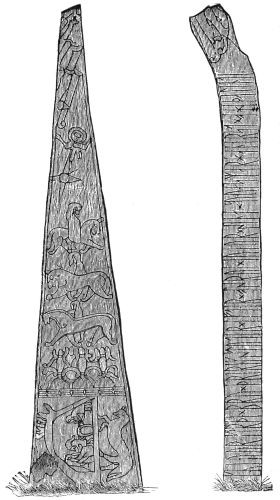
RUNIC STONE FROM GRAN IN HADELAND. THE INSCRIPTION READS IN TRANSLATION: "GUNVOR, DAUGHTER OF THIRIK, MADE A BRIDGE IN MEMORY OF AASTRID, HER DAUGHTER. SHE WAS THE FAIREST MAIDEN IN HADELAND." PROF. BUGGE READS: "THE MOST SKILLFUL MAIDEN WITH HER HANDS."
A short time after this meeting, Sigrid married Sweyn Forkbeard, of Denmark, possibly with a view to accomplishing her vengeance upon Olaf. Sweyn's sister Thyra, whom he had married against her will to the Wendic King Burislav, fled immediately after the wedding and arrived in Norway, imploring Olaf's protection. It is possible that he had met her before, and was well disposed toward her. At all events, he solved the problem by marrying her (998), although she was fully as old as Sigrid the Haughty, and had had two husbands before.
After this brief interval, devoted to personal affairs, Olaf returned once more to the task to which he had consecrated his life. The chieftains of Haalogaland, who had prevented him from landing when he came to convert them, still remained unsubdued; and the time was now convenient for teaching them a lesson in submission. There were especially three, viz.: Thore Hjort, Eyvind Kinriva, and Haarek of Thjotta, the son of Eyvind Scald-Spoiler, who were the chieftains and leaders of the tribal aristocracy of those regions. It was natural enough that these men, who derived much of their dignity from their priesthoods and consequent identification with the old religion, should be most tenacious in their adherence to the faith which was the foundation of their power. Haarek, who descended from a daughter of Harold the Fairhaired, felt himself to be quite as great a man as King Olaf, and he was in no wise disposed to submit without a trial of strength. It so happened that two men from Haalogaland, named Sigurd and Hauk, had been captured by the king and escaped. These, pretending to be the king's enemies, sought refuge with Haarek, and were well received by him. One day they proposed a sailing tour, to which their host willingly assented. They took provisions and beer with them in the boat, set sail, and steered for Nidaros, where they delivered Haarek into the power of the king. He stubbornly refused to be baptized, but was, nevertheless, after a brief detention, given a ship and permitted to return unmolested to his home. From that day, however, Haarek, though making no pretence of friendship, acted as the ally of the king. He even helped to betray his friend, Eyvind Kinriva, into Olaf's hands. The king presented Eyvind with the usual alternative of baptism or death, but with the unusual result that the latter was preferred. Thore Hjort was now alone left; he allied himself with Raud the Strong, who had the reputation of being a wizard, and delivered a regular battle in which he was defeated by the king. Raud escaped on his fleet dragon-ship, while Thore was pursued by Olaf, who set a dog named Vige on his track, saying:
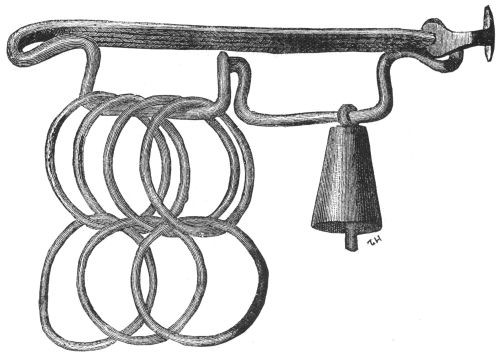
INSTRUMENT OF UNKNOWN USE, POSSIBLY A PAIR OF SCALES, FOUND IN SILGJORD, BRATSBERG AMT.
"Vige, catch thou the stag."[A]
[A] Hjort means a stag.
The dog did actually overtake Thore, and the king cut him down with his own hands. Olaf strove in vain to get on the track of Raud, but the weather was so terrible that he did not venture to go to sea. He began to suspect, after a while, that it was Raud himself who, by his witchcraft, had aroused the elements; and after having waited for several days and nights for a change in the weather, he called Bishop Sigurd to him and asked his advice. The bishop, it is told, raised up a crucifix, surrounded by lighted tapers, in the prow of the king's ship, "The Crane," and stood himself beside it, clad in sacerdotal vestments, praying and scattering holy water. Instantly the storm ceased about "The Crane," though it still roared wildly under the heavens, and the smoke of the lashed waves stood like a wall on either side. The men now seized the oars and rowed in toward the island where Raud was living, "The Crane" keeping the lead and the other ships following in the smooth water in her wake. Raud was surprised while asleep, and as he still refused to become a Christian, was tortured until he died. The king forced an adder down his throat, according to the legend; and it cut its way through his side, killing him by its poison.
There is much in this story which is obviously legendary. But there is one circumstance which stamps the adventure itself as essentially true, viz.: the detailed description of Raud's ship, "The Serpent," which the king took, and which figures later in the battle of Svolder. One may be reluctant to believe that a man so chivalrous and noble as Olaf Tryggvesson on other occasions proved himself to be, can have been guilty of the cruelty which is here attributed to him. This instance is, however, not a solitary one. Eyvind Kinriva, when he refused to be baptized, had glowing coals put upon his stomach, at the king's command, and expired under horrible tortures. Olaf's fanaticism led him to believe that praise rather than censure was due to him for thus punishing the enemies of God. It is, indeed, probable that a man of gentler calibre, and more squeamish in the selection of his means, would never have accomplished even the nominal Christianization of Norway. In fact, so great was Olaf's zeal, and so single his purpose, that he subordinated all other concerns to this one great object, the thought of which filled him with a noble enthusiasm.
Even before he had secured the allegiance of the surviving chief of Haalogaland, Haarek of Thjotta, who, with all his household, accepted the Christian faith, he sent messengers to the Faeroe Isles, Iceland, and Greenland, and commanded the chieftains there to renounce their old religion. Sigmund Bresteson, the Earl of the Faeroe Isles, whom he summoned to him, arrived in Norway (999) and was baptized. Thangbrand, who was sent to Iceland to preach the gospel, had at first a considerable success, baptizing such important chiefs as Hall of the Side, and Gissur the White, and the great lawyer Njaal of Bergthor's knoll. The pugnacious priest, however, soon got into difficulties by his readiness to draw his sword, killed several men, was outlawed, and compelled to leave the island. In Norway, where Olaf had given him the church at Moster, he had, previous to his departure for Iceland, found it inconvenient to live on his income, and in order to increase his revenue, had been in the habit of making forays into the neighboring shires, replenishing his stores at the expense of the heathen. This freebooting propensity incensed the king, and Thangbrand's missionary expedition to Iceland was undertaken as a penance for his misbehavior. It had, however, far greater results than either Olaf or the priest could have anticipated. The public sentiment in Iceland, after Thangbrand's flight, changed with astonishing rapidity in favor of the new faith, which was legally accepted at the Althing June, A.D. 1000.
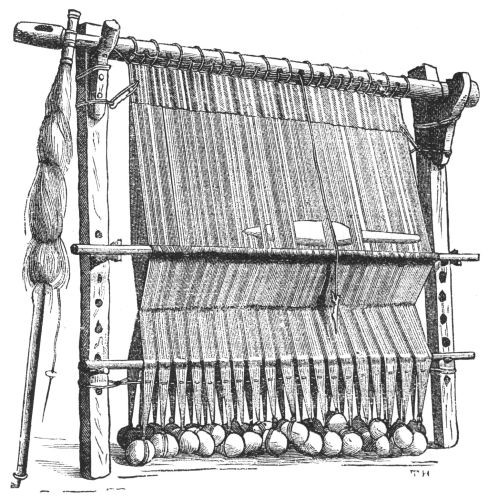
OLD LOOM FROM THE FAEROE ISLES.
Olaf's great achievement, as the first successful propagandist of Christianity on the throne of Norway, surrounded his name with a halo which dazzled his biographers and disposed them to exalt him beyond his deserts. For all that, it is a fact that his contemporaries, many of whom had small reason to love him, were no less dazzled by his brilliant personality than his biographers. In the first place, his manly beauty and his resemblance to Haakon the Good, which was frequently commented upon, predisposed the people in his favor. Secondly, his natural kindliness and winning manners attracted every one who came in contact with him. Last, but not least, his extraordinary skill in athletic sports and the use of arms was greatly admired. He could, as Snorre relates, use his right and his left hand equally well in shooting; he could play with three spears at once, so that one was always in the air; he could run forward and backward on the oars of a ship while the men were rowing. In daily intercourse he was affable and generous, fond of a joke, and easily moved to laughter and to wrath. In anger he could do things which he later regretted; and we have seen how, when fired with holy zeal, he committed acts which he ought to have regretted, though there is no evidence that he did. His love of splendor in attire and surroundings may be accounted a weakness, but it served, nevertheless, to endear him to his people.
Although surrounded by enemies on all sides, Norway suffered but little from foreign wars during the brief reign of Olaf Tryggvesson. Gudröd, the last surviving son of Erik Blood-Axe, made an attack upon Viken in the summer of 999, but was defeated and slain in the king's absence by his brothers-in-law, Thorgeir and Hyrning. Much more dangerous to King Olaf proved the hostility of Sigrid the Haughty, who was watching for an opportunity to take revenge upon him. Although he must have been well aware of the risks, he did not hesitate to furnish this opportunity. His queen, Thyra, had great estates in Wendland and Denmark, and was dissatisfied, because she was deprived of the revenues which they had formerly brought her. Whenever he spoke to her, she always contrived to bring in something about these estates, and by appeals to his vanity egg him on to war with her brother Sweyn Forkbeard, who withheld from her her rightful property. When these tactics failed, she resorted to prayers and tears, until her husband's patience was wellnigh exhausted. If only for the sake of domestic peace, an expedition to Wendland began to be discussed as an approaching possibility. One Sunday in March—it was Palm Sunday—the king met a man in the street who sold spring vegetables. He bought a bunch and brought it to the queen, remarking that these vegetables were large, considering the earliness of the season. The queen, who was, as usual, weeping for her estates in Wendland, thrust the vegetables contemptuously away, and with the tears streaming down her face, cried: "Greater gifts did my father, Harold Gormsson, give me when, as a child, I got my first teeth; he came hither to Norway and conquered it; while thou, for fear of my brother Sweyn, darest not journey through Denmark in order to get me what belongs to me, and of which I have been shamefully robbed."
To this King Olaf wrathfully replied: "Never shall I be afraid of thy brother Sweyn, and if we meet, he shall succumb."
Summons was now sent through all the shires of the land, calling upon the chieftains to join the king with as many ships as were by law required of them. He had himself just finished a ship of extraordinary size and beauty, called "The Long-Serpent," the fame of which spread through all the lands of the North. It was 56 Norwegian ells, or about 112 feet from prow to stern, had 52 oars on either side, and could accommodate 600 warriors. The crew was made up of picked men, none of whom must be over 60 and less than 20 years of age. Only one exception was permitted to this rule in the case of Einar Eindridsson surnamed Thambarskelver, who was but 18 years old, but the most skilful archer in all Norway. With his bow, called Thamb, from which he derived his surname, he could shoot a blunt arrow through a raw ox-hide, depending from a pole.
In order to distinguish "The Long-Serpent" from the dragon-ship he had taken from Raud the Strong, Olaf called the latter "The Short-Serpent." He had many other excellent ships besides, and his brothers-in-law, Erling Skjalgsson of Sole, Thorgeir, and Hyrning, joined him, each with a large and finely-equipped galley.
When he steered southward to Wendland, he had about 60 ships of war besides a similar number of smaller transports. King Burislav, in spite of his union with Thyra, received him well, possibly on account of the earlier relationship through Geira, or on account of their common hostility to Sweyn Forkbeard in Denmark. The question of the estates was amicably settled and Olaf, after having been splendidly entertained, prepared to start homeward. The rumor, in the meanwhile, had gone abroad that he was in Wendland, and his enemies, in order to gather a sufficiently large force to destroy him, employed Earl Sigvalde, the chief of the Jomsvikings, to detain him and lull him into a false security. In this the treacherous earl succeeded. He gained Olaf's confidence, scouted the thought that Sweyn Forkbeard should ever dare attack him; and finally offered to escort him on the way with his own fleet and pilot him through the dangerous waters along the Wendic coast. It was of no avail that Sigvalde's wife, Aastrid, the night before Olaf's departure, warned him against her husband as openly as she dared, and proposed to send a ship along in case of danger. A strange infatuation bound him to his false friend. At Sigvalde's advice he even permitted part of his fleet to start in advance, as the straits between the islands were narrow. The traitor, in the meanwhile, was in constant communication with King Sweyn, at whose request he agreed to separate Olaf from his main force and lead him into the trap which his foes had prepared for him. Besides King Sweyn there were Earl Erik, who had the death of his father, Earl Haakon, to avenge, and King Olaf the Swede, the son of Sigrid the Haughty. All these were lying in wait with about sixty or seventy war galleys, behind the little island of Svolder, between the island Rügen and the present Prussian province, Pomerania. From their hiding-place they looked for several days in vain for the Norse ships, and began to grow impatient. They had gone ashore with their crews in order to while away the time, and the three commanders were standing together, sweeping the horizon with their glances, when, to their delight, the Norse transport fleet hove in sight, spreading its sails before the favoring breeze.
The day was fair. The sun shone brightly, and the surface of the water barely curled into slight undulations. Gayly the proud ships stood out to the sea, one larger and finer than the other. When King Sweyn saw the beautiful ship of Erling Skjalgsson of Sole, he was sure that it must be "The Long Serpent," though it had no dragon-head in its prow. "Afraid is Olaf Tryggvesson to-day," he said, "since he dares not carry a head on his dragon." "This ship I know well by its striped sails," said Earl Erik; "it does not belong to the king, but to Erling Skjalgsson. Let it pass; for if, as I suppose, he is himself on board, we shall be best served, if he and his band are not found among those with whom we are to fight to-day."
By twos and threes the great ships of the Norse chieftains passed by, and every time the Swedish and the Danish king were sure that one of them must be "The Long Serpent." Presently Sigvalde's fleet of eleven ships became visible, and having received signals from the allied princes, turned its course suddenly around the island, to the great astonishment of Thorkill Dyrdill, who was steering the king's ship, "The Crane," right in its wake. King Sweyn, at the sight of this splendid galley, could no more be restrained, but ordered his men aboard, in spite of Earl Erik's warning. He even insinuated that the latter was a coward who had no ambition to avenge his father; to which the earl replied, that before the setting of the sun it would be seen who was the more eager for battle, the Swedes and Danes, or he and his men.
Thorkill Dyrdill dropped the sails of "The Crane," and, taking in the situation at a glance, determined to await the arrival of King Olaf. Then came "The Short Serpent," casting golden gleams across the water from its shining dragon-head; and King Sweyn cried exultingly: "Loftily shall the Serpent bear me to-night, and I shall steer her."
Earl Erik, in whom King Sweyn's recent taunt was rankling, replied: "Even if Olaf Tryggvesson had no larger ship than this, Sweyn, with all his army of Danes, could not win it from him."
When at last "The Long Serpent" reared its flaming prow against the horizon, shooting long beams in the sun, the three princes marvelled at its beauty. Many a one trembled, too, with fear, when he saw the majestic ship approaching, and the dense rows of polished shields and swords flashing from afar.
"This glorious ship," said Earl Erik, "is fitting for such a king as Olaf Tryggvesson; for it may, in sooth, be said of him, that he is distinguished above all other kings as 'The Long Serpent' above all other ships."
All King Olaf's fleet, with the exception of eleven ships, were now out of sight, and many of his chieftains advised him not to fight against such heavy odds. He would not listen to their counsel, but ordered the ships to be bound together and every thing to be prepared for battle.
"Down with the sails," he cried with a loud voice, which could be clearly heard across the waters; "never have I yet fled from any battle. God rules over my life. Never will I flee; for he is no king who shuns his foes because of fear."
The whole hostile fleet now rowed forward from behind the island, and it seemed as if the sea was covered with ships as far as the eye could reach. King Sweyn, with his sixty galleys, became first visible.
"What chieftain is that right opposite to us?" asked King Olaf.
"That is King Sweyn with the Danish army," answered one of his men.
"I have no fear of them," said the king. "Never yet have Danes beaten Norsemen, and they will not beat us to-day. But to what chieftain belong the standards there on the right?"
He was told that they belonged to Olaf, the king of the Swedes.
"The Swedes," said he, "would find it more agreeable to sit at home and lick their sacrificial bowls,[A] than to meet our arms to-day on 'The Long Serpent.' Scarcely do I think that we need be afraid of those horse-eaters. But whose are those large ships on the left side of the Danes?"
In the year 995 Earl Haakon was travelling in Gauldale, collecting taxes. His son Erlend, of whom he was very fond, lay with some ships out in the fiord, waiting to receive the treasure. One evening the earl sent a company of thralls to the house of the powerful peasant Brynjulf, commanding him to send him his wife, who was renowned for her beauty. Brynjulf refused, and the earl in great anger sent the thralls back with this message to the indignant husband, that he had the choice between death and the surrender of his wife. The peasant was obliged to yield, and with a heavy heart let his wife depart with the thralls. But no sooner was she gone than he recovered his manhood and swore vengeance. He summoned the inhabitants of the valley from far and near, and told them of the shame the earl had put upon him. All promised him their help, and resolved to hold themselves in readiness, awaiting the first opportunity for attacking the daring profligate. The earl, in the meanwhile, being quite ignorant of their designs, played into their hands. Very soon after his adventure with Brynjulf's wife, he sent a message of similar purport to Orm Lyrgja, whose wife Gudrun, on account of her beauty, was surnamed "Lundarsol" (the Sun of Lunde).[A] Orm, who was a man of great authority in his valley, sent word to all his neighbors, and after having feasted the earl's thralls, in order to detain them, refused to comply with their demand. Gudrun, who saw them depart, cried jeeringly after them: "Give the earl my greeting, and tell him that I will not go to him unless he sends Thora of Rimul to fetch me." Thora of Rimul was one of the earl's mistresses, whom his favor had made rich and powerful.
[A] It was customary to give to infants of high birth a thrall or some other valuable gift when it got its first tooth. This gift was called a tooth-gift.
War-summons was now sent from farm to farm and a great band of armed peasants came together, and marched toward Medalhus where Haakon was staying. He sent in haste a message to his son Erlend, to meet him at Möre, whither he intended to go, as soon as the army of the peasants had dispersed. Then his time for vengeance would be at hand. In the meanwhile he would be obliged to dismiss his men and hide, until the excitement should have subsided. With a single thrall named Kark, whom he had received as tooth-gift[A] and who had been his playmate in his boyhood, he fled across the Gaul river, rode his horse into a hole, and left his cloak upon the ice, in order that his pursuers might believe that he had been drowned. Then he hastened to his mistress, Thora of Rimul, who hid him and the thrall in a deep ditch under her pigsty. Food, candles, and bedclothes, were given them, whereupon the ditch was covered with boards and earth, and the pigs were driven out over it. As it happened, Olaf Tryggvesson, whose young life Queen Gunhild had vainly endeavored to destroy, had just then landed in Tröndelag and had slain the earl's son Erlend. The peasants, hearing that he was of the race of Harold the Fairhaired, received him with delight and accompanied him to Rimul, where they thought it likely that the earl must be hidden.
[A] The red ring means, of course, a ring of blood; i.e., Olaf would cut Kark's head off.
"The meaning of that," cried the earl, "is that Olaf Tryggvesson will put a red ring[A] about thy neck, if thou goest to seek him. Therefore, beware of him, Kark, and be faithful to me. Then thou wilt enjoy good things from me, as thou hast done before."
[A] The present Baltic provinces of Prussia. The Wends were a Slavonic people, and not identical with the Vandals, with whom they have often been confounded. The latter, according to the best authority, were of Germanic origin.
One day Olaf's uncle, Sigurd Eriksson, had occasion to visit the town in Esthonia where his nephew was living. He was just riding across the market-place, when his attention was attracted to a group of boys who were playing. There was especially one of them whose appearance struck him, and he called to him and asked him his name. The boy said that his name was Olaf. Sigurd now discovered by further questioning that it was his nephew he was addressing. He made haste to buy him and his foster-brother Thorgills, and took them with him to his house. He enjoined upon Olaf to say nothing about his race and birth, and the boy promised to be silent. One day, however, when he was out walking, he caught sight of the viking Klerkon who had slain his foster-father. Without a moment's reflection, he went up and split his skull with an axe which he happened to have in his hand. Now the penalty for breaking the public peace was death, and a crowd of people rushed together, demanding that the boy should be killed. His uncle, in order to save him, took him to the queen, Olga, or Allogia, told her who he was, and implored her protection. The queen became greatly interested in the beautiful boy, and had him educated, as behooved a king's son, in the use of arms and all athletic sports. At the age of twelve he received men and ships from Vladimir, and spent some years roaming about as a viking. He is said to have done important service to his benefactor, reconquering a province which had rebelled; but the favor which he enjoyed raised him up enemies who slandered him, representing him as a dangerous rival of the king in the affections both of the queen and the people. Olaf then, at the advice of Olga, left Russia with his men and ships and went to Wendland,[A] where he was received with distinction by King Burislav. He did not, however, reveal himself as an heir to the throne of Norway, but travelled under the name Ole the Russian. Burislav's eldest daughter, or, more probably, sister, Geira, fell in love with him, and he married her, performed many valiant deeds in the service of his father-in-law, and finally, at the death of his wife, sailed once more in search of adventures. He was then twenty-one years old. A dream induced him to go to Greece and accept Christianity, and he is also said to have sent a bishop to Russia who converted Vladimir and Olga to the Christian faith. Thence Olaf went to Northumberland, Denmark, Scotland, and France, and had adventures without number. At the age of twenty-five he found himself in England, and was summoned to appear before Princess Gyda, sister of the Irish king, Olaf Kvaran. She had been the wife of an earl, but was yet a young and beautiful woman. A great many wooers were importuning her, among whom a certain Alfvine, a great champion and man-slayer. A day had been fixed on which Gyda had promised to choose a husband, and many high-born men had come together, hoping to be chosen. All were splendidly attired, and glittered in scarlet and gold. Olaf, with a few companions, came sauntering up to the market-place, and stationed themselves somewhat apart from the rest as if merely to look on. He had pulled a fur hood and cape over his head and shoulders, and was otherwise plainly clad. Gyda, after having somewhat listlessly regarded the ranks of her wooers, caught sight of the tall stranger with the fur hood. She approached him, lifted up his hood, and looked long and earnestly into his eyes.
[A] The war-arrow (hærör) was carried by every man to his next neighbor and stuck into his door, as a sign that war was at hand. To send or to cut the war-arrow is, therefore, to send a war message.
The Christianization of Viken was followed by that of Agder. Any decided opposition the king did not meet until he came to South Hördaland, where a number of mighty chieftains had gathered in the hope of intimidating him. His fearless and resolute behavior, however, impressed them so much that, after some negotiations, they accepted the faith and were baptized. In return for this concession, they demanded of the king that he should give his sister Aastrid in marriage to the young and high-born chief, Erling Skjalgsson of Sole; and as the king thought this marriage in every way desirable, he gave his consent. Encouraged by his success, Olaf hastened on to Tröndelag, where was the old and magnificent temple of Hlade, the principal sanctuary of Norse paganism. Impelled by holy zeal, and heedless of the consequences, he broke down the altar of the gods, burned their images, and carried off their treasures. The Trönders promptly responded to this challenge by sending the war-arrow[A] from house to house, and preparing to fight with the king. Olaf, who had but a small force with him, did not venture to offer them battle; but sailed northward to Haalogaland, where another armed band, under the command of Thore Hjort and Haarek of Thjotta, stood ready to receive him. As discretion was here the better part of valor, the king was in no haste to land, but returned to Tröndelag, where the peasants in the meanwhile had dispersed, and began to build a church in the place where the old temple had stood. He meant to show the Trönders that he was neither discouraged nor frightened, that neither threats nor arms could induce him to desist from his undertaking. With the desire to strengthen his power here, where it most needed strengthening, he began also the building of a royal residence, and laid the foundation of the future city of Nidaros or Drontheim (996).
[A] Hjort means a stag.
"Vige, catch thou the stag."[A]
[A] This is meant as a taunt at the Swedes, who were yet heathen.
[A] This is meant as a taunt at the Swedes, who were yet heathen.
"That," answered his informant, "is Earl Erik, Earl Haakon's son."
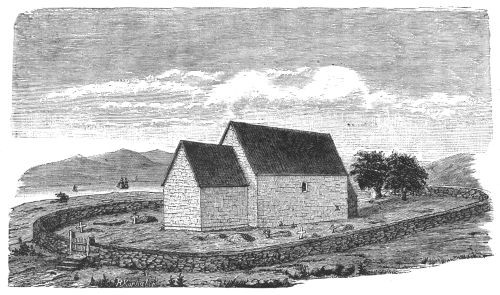
THE CHURCH AT MOSTER ISLAND (MOSTERÖ), SUPPOSED TO HAVE BEEN BUILT BY OLAF TRYGGVESSON.
"From them we may expect a hard battle; for, methinks, Earl Erik has considerable reason for attacking us; and he and his men are Norsemen like ourselves,"
While the king was speaking, Queen Thyra, who had accompanied him, came up on deck. Seeing the enormous hostile fleet before her, and the smallness of her husband's force, she burst into tears.
"Now thou must not weep," said King Olaf; "for now thou hast, indeed, gotten what was due to thee in Wendland; and to-day I mean to demand of thy brother Sweyn thy tooth-gift which thou hast so often asked me for."
King Sweyn was the first to attack, but after a short and stubborn fight was compelled to retreat. One of his galleys was disabled after the other, and there was a great carnage. King Olaf himself stood on the poop royal[A] of "The Long Serpent," where all could see him, directing the defence, and himself fighting with spears and arrows. His helmet and his shield, which were gilt, shone in the sun. Over his armor he wore a short tunic of scarlet silk. While the Danes were in full retreat, the Swedes hastened to their rescue, and they now bore for a while the brunt of the battle. For every Swede or Dane that fell there were ten ready to take his place; while the Norsemen, surrounded on all sides by hostile ships, had to endure an incessant shower of spears and arrows, and the shock of repeated onsets that had to be repelled by the sword in hand-to-hand conflicts. However tired and thirsty they were, they could give themselves no respite. Every man that fell or was disabled by wounds left a gap that could not be filled. And yet, in spite of the great numerical superiority of their foes, they would have carried the day at Svolder, if Earl Erik had not commenced a destructive attack upon the right wing, while the Swedes and the Danes were engaging the centre. In fact, the latter were again retreating in disorder before the furious bravery of King Olaf's men, when Earl Erik rowed up alongside the outermost ship on the right, with his great galley, "The Iron Ram," and made a vigorous onslaught. Here Norseman met Norseman, and the numbers had to decide. The men on the king's ship fought desperately, but were overpowered, and leaped into the sea, or saved themselves on board the next ship. The first was then cut adrift, and Erik, in accordance with a well-matured plan, engaged the next and the next. At last all of King Olaf's ships except "The Long Serpent" were cut adrift, and their defenders slain. Then a space was cleared in front of "The Iron Ram," and she was rowed forward with tremendous force, striking "The Long Serpent" amidships. The good ship creaked in all her beams; but as there was scarcely any wind no great damage was done. Einar Thambarskelver, who stood before the mast on "The Long Serpent," saw Earl Erik standing near the prow of "The Iron Ram," covered by many shields. He bent his bow and sent an arrow whizzing over his head, and in the next instant another, which flew between the earl's arm and his body. The earl, turning to the archer, Finn Eyvindsson, said: "Shoot that tall man on the forward deck."
[A] Löftingen is the elevated deck in the stern of an old war-galley, and corresponds very nearly to the poop royal of French and Spanish men-of-war of the thirteenth century.
Finn aimed an arrow at Einar just as he was bending his bow for a third shot at the earl; the arrow hit the bow in the middle, and it broke with a loud crash.
"What was it that broke?" asked Olaf.
"Norway from thy hands, my king," cried Einar.
"So great was not the breach, I hope," the king made answer; "take my bow and shoot with that."
He flung his own bow to the archer, who seized it, bent it double, and flung it back. "Too weak is the king's bow," he said.
Earl Erik was now preparing for the final attack, and he could not doubt its result.
King Olaf's men were in a desperate strait, from which no escape was possible. The king flung forth his spears, two at a time, from his station on the poop, and many men were transfixed by his keen shafts. He watched at the same time the combat on the forward deck, whither the earl was just directing his attack, and it seemed to him that his men made no headway.
"Do you wield your swords with so little strength," he cried, "since they bite so poorly?"
"No," answered a warrior; "but our swords are dull and broken."
The king then hastened to the forward deck, where there was a large chest of arms. He opened it and took out armfuls of bright, sharp swords, which he flung to his men. As he stooped down, the blood trickled down over his hands from under his armor. His men then knew that he was wounded, but it was no time then for nursing any one's wounds. The earl's men were storming forward, and the tired Norsemen fell in heaps, and could no longer keep them back. The arrows rained thick and fast about the king, and it was obvious he could not hold out much longer. He was visible to all; for he made no attempt to hide or shelter himself. One of his trusted men, Kolbjörn Stallare, who saw his danger, sprang upon the poop and placed himself at his side. His resemblance to the king had often been remarked upon; moreover, he was of the same height, and was similarly dressed. The storm of missiles was now directed against both, and, as they raised their shields, they were thickly fringed with arrows. The clash of arms, the groans of the dying, and the whizzing of flying missiles, filled the air. The king let his shield drop and looked out over the ship. There were but eight men alive, besides himself and Kolbjörn. He raised the shield above his head and leaped overboard. Kolbjörn followed his example, but was picked up by the earl's men, who mistook him for the king. That the latter was drowned, there can be no reasonable doubt, although there is a legend, which was fondly cherished, that he swam to the galley which Aastrid, Earl Sigvalde's wife, had sent out for his rescue. According to this story, he made a pilgrimage to Rome, and lived long as a hermit in the Holy Land.
King Olaf Tryggvesson was thirty-six years old when he died (1000). Queen Thyra, who, with good reason, held herself responsible for his death, was inconsolable. When she came up on deck, after the battle, and saw the destruction she had wrought she broke into lamentation. Earl Erik was moved by her sorrow and spoke kindly to her, assuring her that if she would return to Norway she would be accorded the honor which was due to her as the widow of so great a king. She thanked him for his offer, but said that she had no heart to survive her lord. On the ninth day after the battle she died.

CHAPTER XII.
THE EARLS ERIK AND SWEYN HAAKONSSON (1OOO-1015). THE DISCOVERY OF VINLAND.
After King Olaf's death at Svolder, the allied princes divided his kingdom between them. To Earl Erik were given all the shires along the western coast from Finmark to Lindesness,[A] with the exception of seven, which were allotted to King Olaf the Swede. All the shires from Lindesness, including Agder, to the Swedish boundary, with the exception of Ranrike, came into the possession of Sweyn Forkbeard. Ranrike (which is now a part of Sweden) was given to the Swedish king, who again gave it, as well as his other possessions in Norway, in fief to his brother-in-law, Earl Sweyn, the brother of Earl Erik, on condition of his paying one half of the royal revenues to his feudal overlord, and placing a specified number of troops at his disposal in case of war. On similar conditions Earl Erik received the eastern shires, Raumarike and Vingulmark, in fief from Sweyn Forkbeard.
[A] Lindesness is the southernmost point in Norway.
Though a man of ability and many noble qualities, Earl Erik never succeeded in asserting his sway over Norway as his father, Earl Haakon, had done; and Earl Sweyn could boast even less authority than his brother. In the Oplands semi-independent kings of the race of Harold the Fairhaired were still living; and in Rogaland Olaf Tryggvesson's brother-in-law, Erling Skjalgsson of Sole, refused to recognize the supremacy of either the earls or the kings whom they represented. He surrounded himself with a court which, in magnificence, equalled that of the earls, if it did not surpass it. Ninety warriors constituted his daily household, and when occasion demanded he kept 240 or more. Of thralls he kept thirty for his daily attendance, besides a large number who cultivated his lands. He was a good master, stimulating them to thrift and economy. He demanded of each a certain fixed amount of labor, and gave him a piece of land for cultivation. When the required task was over the thrall's time was his own, and he was at liberty to apply it for his own advantage. The products of his land he sold to his master at the market rates, and was thus enabled to buy his freedom within one, two, or three years. Over his freedmen Erling continued to exercise a supervising care, employing them at wages or on shares in the fisheries, in the reclaiming of land from the forests, or in other branches of industry.
Clinging, as he did, tenaciously to the authority which Olaf Tryggvesson had conferred upon him, Erling could not avoid coming into collision with the authority of the earls. He exacted a land-tax from the peasants of Rogaland, and, as Earl Erik did the same, the poor landowners had to pay a double tax, unless they were prepared to offer resistance.

SHUTTLES OF IRON AND OF WHALEBONE; AND WEIGHTS FOR THE LOOM.
But both the earl and Erling were too powerful to make such a course advisable. It is, indeed, strange that Erik, with his great connections abroad, should have tolerated the defiance of this small potentate without in some way trying to break his power. It is true, Erling had a large number of mighty kinsmen and supporters in many of the coast-shires; and he would have been able to make a strong resistance. But it is scarcely credible that he could have maintained himself against Earl Erik, if the latter had seriously resolved to punish him. In fact, Earl Erik, although his early life had been passed in the tumult of war, was essentially a conciliatory character. A mighty warrior he was when duty or diplomatic necessity forced him to fight; but he hesitated to draw his sword, except on extreme provocation. It was his misfortune, by his birth and the circumstances which brought him into power, to represent an age and a régime which were destined to pass away. It was the so-called "heroic" age—that is, the age of turbulent individualism, opposed to the modern conception of the state. It is obvious that Erik had no sympathy with the feudalism instituted by the conquests of Harold the Fairhaired; probably he did not comprehend the progressive idea which dignified King Harold's ambition and made him the conscious or unconscious agent of advancing civilization. It is proof enough of this to state, that Erik allowed the dependencies of Norway, the Orkneys, and the Shetland Isles to detach themselves from the motherland, and made no attempt to force them back to their allegiance. There was no inspiring tradition in his family, as in that of Harold the Fairhaired, demanding a great and united kingdom; but, on the contrary, a local separatistic tradition, identifying him with the greatness and fame of a special locality. To have carried out this tradition completely, the Earls Erik and Sweyn ought to have remained pagans as their father was before them. They seem, indeed, to have been conscious of a certain inconsistency in accepting Christianity, for they made not the faintest attempt to assert their faith in their relation to the people, or to check the relapse into paganism, which became very prevalent during their reign.
Quite in keeping with the general reactionary character of the earls' government, was the revival of the viking cruises which, during the reign of Olaf Tryggvesson, had been diminishing in frequency. Earl Erik himself had been a valiant viking in his youth, and probably could see no harm in the careless and predatory life in which the old Germanic paganism found its most characteristic expression. A great impetus must have been given to this mode of life by Sweyn Forkbeard's repeated expeditions to England, in which a large number of Norsemen participated. It makes little difference if the aggressors were nominally Christians; their actions were an outburst of the old, tribal pagan spirit, which respected no right but that of might.
It was natural that the earls, if they expected to make their dominion permanent, should endeavor to extend their connections beyond Tröndelag. The strength of a government in those days depended largely upon the support which it received among the chieftains or tribal aristocracy, whose sentiments were usually reflected by the peasants. It was therefore necessary in some way to conciliate the late adherents of Olaf Tryggvesson, whose influence upon public opinion could be utilized to advantage. It may have been some such consideration which restrained Earl Erik from attacking Erling Skjalgsson. It is obvious that the overtures which he made to Einar Thambarskelver had the same end in view. We have seen how the young archer came within an inch of ending the earl's days at Svolder, thereby exciting the admiration of Erik for his skill and bravery. After the battle, the earl, with his usual generosity, spared his life, and sought in many ways to secure his friendship. He married him to his sister, the high-minded Bergljot, and gave him large fiefs, so that no chieftain in Tröndelag could rival him in power.
Toward his brother, Sweyn, Earl Erik behaved with the same magnanimity that he showed toward all who had claims on him. Sweyn was dissatisfied because of the disparity in their positions; he ruling over one third of the country as the vassal of the Swedish king, while Erik held two thirds as an independent sovereign. These complaints were repeated with growing importunity, until Erik resolved to abandon the government. He called together the chieftains and the mightiest peasants of the country, and abdicated (1015) in favor of his son Haakon and his brother Sweyn, between whom he divided his share of the land in equal portions. As Haakon was not yet of full age, Einar Thambarskelver was appointed his guardian. In the autumn of the year 1015, Earl Erik set sail for England, and assisted Knut the Mighty in the subjugation of that country. He was joined later by his son Haakon, who was expelled from Norway by Olaf Haroldsson, and was compelled to swear that he would never renew his claims to the kingdom. Earl Erik died in England, from the effect of a surgical operation, in 1023 or 1024. Before their expulsion, the Earls Sweyn and Haakon made peace with Erling Skjalgsson, confirming him in the possession of the fiefs which he had received from Olaf Tryggvesson, embracing all the coast-shires from the Sogne-fiord to Lindesness. To cement their friendship, Earl Sweyn gave his daughter, Sigrid,[A] in marriage to Erling's son, Aslak.
[A] Her name is differently given as Sigrid and Gunhild.
It was during the reign of the earls that the North American continent was first visited by the Norsemen. An Icelander named Bjarne Herjulfsson, during a voyage to Greenland (986), was blown out of his course, and discovered, while sailing northward, an unknown land on his left. He concluded that it could not be Greenland, as there were no glaciers, but only low, wooded heights sloping gently toward the ocean. On his arrival in Greenland, Bjarne told of the new country he had seen, but was much ridiculed because he had not gone ashore and explored it. His story made a great impression, however, upon the adventurous Leif, son of Erik the Red. He bought Bjarne's ship, and, with a crew of thirty-five men, set sail for the unknown shore in the West (1000). The first land he saw was on his right as he sailed southward. It was full of glaciers and had no grass. He called it Helluland, because it seemed, at the foot of the glaciers, to be one flat expanse.[A] This must have been the present Labrador. Continuing his southward course, Leif came to a country which was well wooded, and had long, smooth beaches. He called it Markland (Woodland), and the supposition is that it was Nova Scotia. With a stiff northeaster, he made considerable headway, and came, after another day's voyage, to an island where a river flowed into the sea. As it was ebb-tide he could not land, but so eager were the men to explore the country, that they jumped overboard and waded ashore. The statement that the sun rose in this region, on the shortest day of the year, at half-past seven and set at half-past four, indicates a latitude of 41° 24' 10"; Leif, accordingly, must have landed somewhere in the neighborhood of Cape Cod or Fall River, Mass. He found the country possessed of many advantages. It was so mild in the winter that cattle would require no stable-feeding. The rivers abounded in salmon and the woods in game. A German, named Tyrker, became so enthusiastic over the discovery of grapes, that he relapsed into his native tongue, and was supposed, by the crew to be intoxicated. Leif and his men put up some booths and spent the winter in the new land, which they called Vinland, but set sail the following spring for Greenland.
[A] Helle, in Norwegian, means a great flat stone.
It is evident from the description here given that there is either some mistake in regard to the latitude, or the climate of New England must have grown severer during the last nine centuries. Cattle could scarcely be left in the open air in the Cape Cod region nowadays. Nor do grapes of any choice variety grow wild in the chill blasts which now gambol about the Massachusetts coast; and the tart fox grape, it seems, could scarcely rouse enthusiasm even in the breast of a German.
A second expedition to Vinland was undertaken in 1006 by the Icelander Thorfinn Karlsevne and his wife Gudrid. Among their followers, who numbered 160, were Erik the Red's son Thorwald and his daughter Freydis. This was the first expedition which was undertaken with a view to colonizing the country. Cattle were therefore taken along, and preparations made for a permanent settlement. Thorfinn found without difficulty the booths abandoned by Leif, and himself added to their number. A strange people, whom the Norsemen called Skraellings, came to them in light boats made of skin and offered furs in exchange for cloth, ornaments, and weapons. Karlsevne, however, refused to sell them weapons; and when, during the negotiations, a bull came out of the woods and began to roar, the Skraellings became frightened and hastened away. From that time forth they became hostile to the settlers and attacked them repeatedly, killing several of their number. This perpetual state of insecurity disheartened the survivors, and after a sojourn of three years in Vinland, they returned to Greenland.
CHAPTER XIII.
OLAF THE SAINT (1016-1030).
We have seen that Christianity did not advance in Norway during the mild and lax government of the earls. Olaf Tryggvesson, with all his zeal and vigor, could not in the short space of five years eradicate paganism from the Norsemen's hearts; and after his death a great number of those whom he had compelled to profess the Christian name relapsed into their former practices. It was not until King Olaf Haroldsson by his life, and still more by his death, took the imagination of the Norsemen captive, that Christianity became securely established in the land.
Olaf was the son of Harold Grönske and a grandson of Björn the Merchant, who was slain by his brother, Erik Blood-axe. It was accordingly a new branch of the race of Harold the Fairhaired who with him ascended the throne. His father, as we have seen, was burned to death by Sigrid the Haughty, whom he had the presumption to woo, regardless of the fact that he had a wife named Aasta, who was then expecting her confinement. Olaf was born in the house of his maternal grandfather and passed his childhood with Sigurd Syr, king in Ringerike, whom his mother married. Sigurd Syr was a grandson of Sigurd the Giant, a son of Harold the Fairhaired and Snefrid, and had accordingly as much right to the throne as Olaf Tryggvesson, who was then reigning. He was, however, a quiet and unpretentious man, who was contented to raise his crops and superintend his large estates, without troubling himself with ambitious projects. During the infancy of his step-son, Sigurd Syr entertained Olaf Tryggvesson at his house and was induced by him to accept Christianity. It is said that King Olaf on this occasion stood sponsor at the baptism of his namesake and kinsman.
When Olaf Haraldsson was ten years old, his step-father begged him, one day, to go and saddle his horse for him. Olaf went to the stable and put the saddle on a large billy-goat, which he led up to the door where Sigurd stood waiting. When questioned as to the meaning of this joke, he replied that the billy-goat was good enough for Sigurd, who resembled other kings about as much as the goat resembled a war-horse.
In his games Olaf was hot-tempered and imperious, proud of his birth, and determined to assert himself above every one. At the age of twelve he went on viking cruises and distinguished himself greatly by his prowess and daring. He ravaged the coasts of Sweden in order to avenge his father's death, and during a cruise to England helped the sons of Ethelred against the Danes (1008). This wild, roaming life, with its constant vicissitudes, matured his character, giving him a wide experience of men and developing his inborn faculty for leadership. The departure of Earl Erik from Norway in 1015 gave him the desired opportunity to assert his claim to the throne, and he lost no time in embarking for the land of his birth. He proceeded in this matter, however, with characteristic caution. Knowing that the sentiment of the people toward him would have to determine his action, he did not wish to commit himself without having ascertained beforehand the chances of success. He therefore left his galleys of war behind him in England and sailed across the North Sea with two merchant-ships. As he disembarked, his foot slipped and he fell upon the beach.
"There, I fell," he cried, dreading, probably, the bad omen.
"No," answered one of his men, "thou didst plant thy foot in Norway's soil."
He sailed southward along the coast, no one knowing him or suspecting his errand. One day, as he was sitting in his tent on the beach, whittling a spear handle, a peasant entered and looked hard at him.
"Who art thou?" he asked.
"I am a merchant," said Olaf.
"Likely enough," rejoined the peasant, "art thou a merchant; but I know the eyes of Olaf Tryggvesson, and I believe that thou wilt soon meet Earl Haakon and win a great victory."
"If it be true, as thou sayest," responded the prince, "thou mayst come to me and thou shalt profit by my victory."
The shrewdness of Olaf's plan to avoid all warlike display was demonstrated by the issue. In Saudung Sound he succeeded in capturing the young Earl Haakon, who, without thought of danger, was sailing along with a single ship and a small retinue. When Olaf saw him he marvelled at his beauty. The earl was but seventeen years old, tall, and well shaped. His hair fell in golden curls upon his shoulders and shone like silk. About his head he wore a fillet of gold.
"It is true what is said about you and your race," said Olaf, "you are indeed very beautiful. But now your luck has forsaken you."
"I see no sign that our luck has forsaken us," answered the youth proudly; "even if such a thing as this may happen. It is ever so, that sometimes the one is victorious and sometimes the other. I myself am young and inexperienced, and I was expecting no breach of the peace, and could therefore make no defence. Another time, perhaps, I shall do better."
"But art thou not aware," retorted Olaf, "that from this time forth there can be no question either of victory or defeat in thy case?"
"That all depends upon you," said the earl, fearlessly.
"What wilt thou do, if I let thee depart unscathed?"
"Let me know what you demand."
"Only this, that thou shalt leave the country and renounce thy dominion over it. And, moreover, thou shalt swear an oath that thou wilt never wage war against me."
The earl having no choice agreed to these terms, and forthwith sailed to his uncle, King Knut, in England.
Before taking up the combat with Earl Sweyn, Olaf found it advisable to sound the popular sentiment and to secure supporters among the powerful peasants and chieftains. To this end he visited his step-father, Sigurd Syr, in Ringerike, and asked his counsel. The story of his reception by his mother, Aasta, which is circumstantially related by Snorre, is full of vivid details, and throws a strong light upon the customs and manners of the age. When the rumor of her son's approach reached Aasta, she arose and prepared to give him a fitting reception. She ordered four maid-servants to drape the walls with hangings of cloth and likewise to cover the benches. Tables were put up and an abundance of food and beer was provided. Messengers were sent in haste to invite guests from far and near; and each was requested to appear in his best clothes; and to those who had no good clothes, fitting apparel was given. King Sigurd was, as usual, in the field superintending his laborers. It was just in the midst of the harvest, and every hour was precious. He wore a blue tunic, of coarse cloth, blue breeches, high shoes, a gray cloak, and a broad-brimmed gray hat. In his hand he carried a staff with a gilt silver head. When his wife's messengers brought him the tidings of his step-son's return, he probably did not relish the interruption. Still less was he pleased with the admonition which they brought him in her name, that he prove himself, on this occasion, as a true descendant of Harold the Fairhaired. He made a little speech in the field, in which he cloaked his ill-humor as well as he might. Then he sat down and exchanged his every-day garments for the splendid attire which Aasta had sent him. While the field-hands stood about staring, he pulled on a silken tunic, breeches to match, and Cordovan boots, with spurs of gold. A sword of beautiful workmanship was buckled about his loins, a gilt helmet put upon his head, and a scarlet cloak hung over his shoulders. Thus arrayed and with a train of thirty attendants he sallied forth to meet his step-son. As he rode down over the fields, he saw Olaf and his train of 120 warriors approaching from the other side. They marched up into the court-yard with waving banner, and there Sigurd greeted the returned viking and welcomed him home. His mother kissed him, invited him to stay with her as long as he wished, and placed all that was hers—land, people, and money—at his disposal.
In the family council that was held, after the feast of welcome was over, Sigurd Syr pledged his aid to Olaf, and promised to employ his influence in his favor. On the other hand, he cautioned him to proceed with prudence, and dissuaded him from measuring strength with Earl Sweyn, until he had a sufficient force of adherents. In the end he did not question his success.
"The multitude," he said, "always love change. Thus it proved to be, when Olaf Tryggvesson arrived. All became fond of him, although, to be sure, he did not long enjoy his kingdom."
To this the proud Aasta replied that she would rather have her son die young, after a brief and glorious career, like Olaf Tryggvesson, than die old, after a long and deedless one, like Sigurd Syr.
Among the small shire-kings, who lived like rich landholders in different parts of the Oplands, there were many who were descendants of Harold the Fairhaired. All these Sigurd Syr summoned to a meeting, made them acquainted with Olaf's design, and begged them to assist in its accomplishment. One of them, named Rörek, refused, declaring that the people and the shire-kings were usually better off the farther away the overlord was. The kings of Denmark and Sweden, in whose names the earls had governed, were very good rulers, because they were too far away to do much mischief. Rörek was, therefore, inclined to let well enough alone, and he advised the rest to do the same. His brother Ring spoke in quite a different spirit.
"I would fain once more see our race at the helm in the land," he said; * * * "if our kinsman, Olaf, becomes overlord over the kingdom, that man will be best off who has the greatest claim upon his friendship."
The other shire-kings were of the same opinion, and all pledged their kinsman their support. The people were immediately summoned to a thing, at which Olaf eloquently affirmed his right to the throne and was proclaimed king. In return he promised, according to ancient usage, to rule in accordance with the laws, and to protect the land against external enemies. A great multitude of warriors thronged forward to enroll themselves under his banner, and his following became so great as to cause him inconvenience. For food was not abundant, and the levying of supplies from the country might easily alienate the people. Again, if he meant to surprise Earl Sweyn, who was at that time sojourning at Steinker in Tröndelag, it was important to attract as little attention as possible, and to choose unfrequented routes over mountains and through wildernesses. Nevertheless, he succeeded in penetrating into Orkdale[A] with about 360 men, and to induce an army of 900 peasants, which had been sent against him by Einar Thambarskelver, to swear him allegiance. Earl Sweyn, hearing of this disaster, fled southward to Frosten and escaped only by a stratagem from falling into his pursuer's hands. The Trönders were now summoned to meet Olaf at the thing and compelled to recognize him as their king (1015). But they did this reluctantly, being strongly attached to the race of the earls of Hlade. Many of the most powerful chieftains, among them Einar Thambarskelver, were absent from the thing, preferring to make common cause with the earl.
[A] Orkdale is a part of Tröndelag.
In spite of the insecurity of his position, King Olaf determined to celebrate Christmas in Nidaros, the town founded by Olaf Tryggvesson, and later known as Drontheim. The earls, caring little for commerce, had allowed this trading-post to go to ruin; and of its former prosperity there was scarcely a vestige left. Olaf, emphasizing here as ever his rôle as the legitimate heir of his great kinsman, began to repair the dilapidated houses and arranged himself as well as he could with his retinue. He might, however, have saved himself the trouble; for no sooner had he moved his goods up from the ships than Earl Sweyn and Einar Thambarskelver descended upon him in the night with 2,400 men, and would have made an end of his career, if his sentinels had not warned him in the nick of time of the impending danger. He made his escape southward to the Oplands, where he was again well received by his step-father. His one endeavor now was to raise an army large enough to crush his rival. Sigurd Syr's popularity and influence stood him in good stead, and many chieftains who had hitherto held aloof were induced to join him. Among these was Ketil Calf of Ringeness. The remainder of the winter was occupied in ship-building and in securing resources for a decisive campaign. It was at this time that the great galley "Karlshoved" (Churl's Head) was built, the prow of which was adorned with a man's head, which the king himself had carved. In the spring, as soon as the ice broke up, he sailed out of the Folden Fjord with about twenty ships and from 1,500 to 2,000 men.
Earl Sweyn, in the meanwhile, had strained all his powers to meet the emergency. With the aid of Erling Skjalgsson of Sole and Einar Thambarskelver he had got together a fleet of forty-five well-equipped ships, manned with about 3,000 warriors. With this formidable force he met Olaf at Nessje, a head-land on the coast of Vestfold. It was Palm Sunday (March 25, 1016), and, according to the story, Olaf sent a messenger to the earl requesting him to grant a truce until the next day. The earl, however, who had no scruples on account of the holiday, refused the request, and the battle commenced. As was the custom in naval battles, the ships were tied together with ropes, "The Churl's-Head" occupying the centre and the smaller crafts the extreme wings. On board the king's ship were 120 picked men, all clad in ring armor and with French helmets on their heads. Their shields were white, with crosses of red or blue or gilt; crosses of the same colors also adorned their helmets. The king instructed his men to appear at first to act on the defensive, saving their spears until the enemy had thrown away theirs. This stratagem proved effective; for, as the king's battle-array bore down upon that of the earl, he was received with a storm of missiles. His men, however, were only at pains to protect themselves, thereby redoubling the martial zeal of their opponents, who imagined they were afraid. Then, when spears and arrows grew scarce on the earl's side, a vehement onslaught from the king met with no adequate resistance. Olaf took advantage of the momentary surprise to steer up to the earl's ship and engage him at close quarters. The fight there was long and bitter, and men fell in heaps on both sides. At last Earl Sweyn's men began to waver, and one by one the ships were cut loose and prepared to flee. But Olaf's men held them fast with boat-hooks until Sweyn ordered the prows to be cut off; even thus he would not have escaped with his life, if his brother-in-law, Einar Thambarskelver, had not flung an anchor aboard to him, and by means of the rope attached to it hauled him out of the line of battle. For all that, he managed to collect his ships further out in the fjord, and for a while it looked as if a fresh attack was imminent. Sigurd Syr urged Olaf not to let the opportunity escape of utterly destroying Erling Skjalgsson and Einar Thambarskelver.
"For," said he, "I well foresee that thou with thy character and ambition, wilt scarcely ever reach the point, when thou canst trust those magnates who are accustomed to bid defiance to chieftains."
Before Olaf had time to answer, the earl's fleet suddenly scattered, and the opportunity for destroying the chiefs was lost. The king's first act after the battle was to kneel upon the strand and thank God for the victory.
Earl Sweyn, though he had yet a large following and sufficient resources to continue the struggle, sailed eastward to Sweden where he was well received by his brother-in-law, King Olaf the Swede. He seems to have contemplated a fresh campaign against Norway, and was encouraged by the Swedish king to avenge his defeat. Instead of that, however, he undertook during the following summer a warlike expedition into Russia, probably to replenish his treasury, was taken ill and died on the way (1016).
Olaf availed himself of the earl's absence to extort oaths of allegiance from the peasantry along the coast; he hesitated, however, for some reason to attack Erling Skjalgsson and passed by the provinces which he held in fief without landing. He returned to Nidaros, rebuilt the ruined "king's hall," and the Church of St. Clement. From his sojourn abroad he had learned a lesson in regard to the advantages of commercial intercourse, and he encouraged merchants and artisans to take up their abode in the resuscitated city. He had small confidence in the good-will of the Trönders; and therefore liked to surround himself with men who were free from local ties and traditions. The death of Earl Sweyn, however, as soon as the rumor of it reached Norway, changed the situation. The Trönders, having now no chieftain of their own, began to send the king friendly messages and in various ways to court his favor. Presently he felt himself safe in summoning chiefs and peasantry to meet him at the thing, and his formal recognition as king followed in all the shires of Tröndelag. But it will be remembered that four of these shires, besides the adjacent provinces of Nordmöre, Raumsdale, and Söndmöre, had after the battle of Svolder been awarded to the king of Sweden, in whose behalf Earl Sweyn had governed them. A great wrath, therefore, possessed King Olaf the Swede, when he heard that the Trönders had sworn allegiance to "Olaf the Big." This was the nickname which he had conferred upon his opponent on account of his stoutness and burly frame. He could never refer to him except with oaths and opprobrious terms. His threats and insults, however, brought no response, and finally he determined to send a party of tax-gatherers into his former provinces. Having vainly solicited the tax, they sought an audience with King Olaf, who commanded them to go home and invite the King of Sweden to meet him at the boundary between the two countries. "Then," he said, "he may, if he chooses, come to an agreement with me, on the condition that each keeps the kingdom to which his birthright entitles him."
Twelve of the tax-gatherers who ventured to disobey his command, were captured and hanged. Such an insult the Swedish king could not allow to pass unavenged, and Olaf made preparations to receive him. He built a rude fortress on a headland projecting into the river Glommen, near the cataract Sarpen. In connection with these fortifications he founded a city called Borg or Sarpsborg, built a "king's hall," and offered protection to traders who came to settle there. The expected invasion from Sweden would naturally be directed through this district, and the site of the new city was therefore chosen chiefly for its strategic value. For a while, however, no decisive action was taken by the king of Sweden, who contented himself with killing Olaf's tax-gatherers in Jemteland in retaliation. The fact was that the feud was purely a personal one between the two kings, while their subjects, having no grudge against each other, desired peace. The king's friend and marshal, Björn Stallare, was induced to speak in the people's cause, and was finally commissioned to go as Olaf's embassador to Sweden, proposing peace on the conditions already named. But this embassy involved great danger, as Olaf the Swede, in his fury, did not even permit the name of his enemy to be mentioned in his presence. Björn therefore sent his friend, the Icelander, Hjalte Skeggesson, in advance to prepare the way for him, while he himself tarried with Ragnvald, the earl of Vestergötland, who had married the sister of Olaf Tryggvesson. Ragnvald's foster-father was the mighty peasant, Thorgny Thorgnysson, the law-man.[A] By securing the friendship of the earl, Björn accordingly assured himself of protection, in case the king should attempt violence against him. At the great winter thing in Upsala, where the king was present, he suddenly rose out of the throng of the people and said in a loud voice; so that all could hear him: "King Olaf sends me hither to offer the king of Sweden peace and the boundary which from ancient times has been between Norway and Sweden."
[A] Laga-madr is not a lawyer in the modern sense, but rather a kind of judge. The office had a slightly different significance in Sweden from what it acquired in Norway when introduced there by King Sverre.
When Olaf the Swede heard the name of King Olaf, he first supposed that the speaker referred to himself; but when he began to see the connection, he rose and called out, in great wrath, that the man who was speaking should be silent, as such speech would not be tolerated. Björn then sat down; but instantly Earl Ragnvald arose and said that his people had suffered greatly from the interruption of commercial intercourse with Norway, and were all of opinion that the king should accept the proposal of Olaf the Big; and, as guaranty of peace, give him his daughter, Ingegerd, in marriage. The king, on hearing this, declared, angrily, that he would hear of no peace; he called the earl a traitor who deserved to be driven out of the country, and berated him for having married a woman who sympathized with the king's enemies. In the hope that the matter would now be dropped, he resumed his seat. Then up rose Thorgny the Lawman. He was very large of stature, gray-haired, and broad-chested, and his beard fell like a cataract down to his girdle. The moment he was on his feet, the people thronged forward with great noise and rattle of arms. "Quite different are the kings of Sweden now," Thorogny began, "from what they were in earlier times. Thorgny, my grandfather, could remember Erik Eimundsson, and told of him that, while he was in his best years, he went in warfare every summer to different lands, and subjugated Finnland, Karelen, Esthonia, Kurland, and many other eastern lands. Men may yet see the earthworks and other great enterprises he undertook; and yet he was not too proud to listen to people who had necessary things to say to him. Thorgny, my father, was for a long time with King Björn, and knew his manner of behaving. In Björn's time, the kingdom was very powerful and suffered no loss; he was very easy to get along with, to his friends. I can myself remember King Erik the Victorious, and I was with him in many a war. He increased the realm of the Swedes and bravely defended it. He, too, accepted good counsel from us. But this king whom we now have will suffer no man to speak to him, unless he speaks that which he likes. This he insists upon with all his might; but he suffers provinces to be lost for want of briskness and enterprise. He wishes to conquer the realm of Norway—a thing which no Swedish king has hitherto desired,—and this causes many a man disquietude. Now, it is the wish of us, the peasants, that thou, King Olaf, makest peace with Olaf the Big, the King of Norway, and givest him thy daughter, Ingegerd, in marriage. * * * If thou wilt not consent to this, then we will attack thee and kill thee, and no longer suffer breach of the peace and breach of law from thee. Thus our forefathers did in days of old. They flung five kings down into a swamp at the Mora thing, because they were too inflated with pride—just as thou art. Tell us now, in this hour, which of these conditions thou wilt choose."
The peasants signified loudly, by rattle of arms, their approval of this sentiment; and the king, quite overawed, rose and said that he would yield and let the peasants have their way in this matter. The conditions of peace were thus accepted, and the time for the wedding was fixed. Björn and his men returned to Norway and received valuable gifts from King Olaf, for having successfully accomplished a difficult mission. Unhappily, however, the Swedish king, as soon as the danger was removed, began to reconsider his promise; and it gave him, no doubt, satisfaction to hear of his enemy's discomfort when, after vainly waiting for his bride on the boundary, he returned to Sarpsborg (1018). It did not occur to him that his own subjects, who had demanded the cessation of hostilities, might resent his undignified trick; and he was both surprised and alarmed when a revolt broke out, which came very near costing him his crown. Once more he had to make concessions, promise to make peace with the king of Norway, and accept his twelve-year-old son, Anund Jacob, as co-regent. King Olaf, of Norway, had, in the meanwhile, contrary to the will of her father, married Aastrid, a younger sister of Ingegerd. At the peace of Konghelle (1019), where the two kings finally met, this marriage was recognized by the king of Sweden, and friendly relations were established. The province of Jemteland remained in the possession of Olaf of Norway.
This is the first time that Norway, as an integral kingdom, treats with a foreign power. The kings of Sweden and Denmark who claimed descent from Ragnar Lodbrok and through him from the gods, had never until now recognized the descendants of Harold the Fairhaired as rulers of a united realm and their own equals in dignity. Norway was to them merely a collection of small, scattered communities which, having once been united, made haste to fall to pieces again, and had at different times recognized the overlordship of the kings of Sweden and Denmark. The reluctance of the Swedish king to give his daughter in marriage to Olaf Haroldsson is therefore quite comprehensible.
Olaf Haroldsson was, undoubtedly, the first king, since Harold the Fairhaired, who had any clear conception of a national unity. The thought may have been present in the mind of Olaf Trygvesson, but he died too soon to carry it out. Olaf Haroldsson, on the other hand, set to work with deliberate purpose to unite all Norway under the cross of Christ. With 300 armed men he travelled from shire to shire, and severely punished those who secretly or openly sacrificed to the old gods or indulged in any pagan practice. Some were outlawed and their property confiscated, others were maimed, and a few hanged or beheaded. Fugitives spread the report of the king's violence; and alarm and resentment filled the minds of all who were yet devoted to the Asa faith. Five shire-kings in the Oplands, all of whom had given allegiance to Olaf, formed a conspiracy, under the leadership of King Rörek, to murder him. But Ketil Calf of Ringeness got wind of their purpose, and hastened with the tidings to Olaf, who crossed the lake Mjösen in the night, surprised the conspirators, and captured them. Rörek was blinded, Gudröd, the king of Hadeland and Raumarike, had his tongue cut out, and the others were punished with similar severity. The death of Sigurd Syr (1018) called Olaf to Ringerike where he spent some days arranging the affairs of his widowed mother. Aasta had three sons by Sigurd Syr—Guttorm, Halfdan, and Harold. These she brought into the hall to make them acquainted with their half-brother, the king. Olaf, it is told, put Guttorm and Halfdan on his knees, and made such a fierce face at them that they grew frightened and ran away. He then took the youngest boy, Harold, and stared at him with the same stern expression. The boy, instead of running away, made a face as stern as the king's and stared back at him. Olaf, to test him further, pulled his hair; but Harold, nothing daunted, retaliated by pulling the king's beard. The next day Olaf and Aasta stood watching the boys at play. Guttorm and Halfdan had built barns and stables, and made figures representing cows and sheep; while Harold had started a fleet of chips and shavings on a pond, and delighted in seeing them drift before the wind. The king asked him what they were meant to represent.
"Ships of war," answered the boy.
"I should not wonder, kinsman," said Olaf, "if some day thou wouldst command ships of war."
Guttorm was now called and asked what he desired most of all.
"Land," he replied.
"How much?" asked the king.
"I wish," said the boy, "to sow as much every summer as would cover the headland that sticks out into the water there."
The headland included ten large farms.
"Much grain could grow there," observed the king.
Halfdan declared that what he wished most of all was cows, and so many of them that in drinking they would cover the shores of Guttorm's headland.
"But what do you wish, Harold?" asked Olaf, turning to the youngest boy.
"Men,"[A] answered Harold.
"The Swedes," said he, "would find it more agreeable to sit at home and lick their sacrificial bowls,[A] than to meet our arms to-day on 'The Long Serpent.' Scarcely do I think that we need be afraid of those horse-eaters. But whose are those large ships on the left side of the Danes?"
[A] Löftingen is the elevated deck in the stern of an old war-galley, and corresponds very nearly to the poop royal of French and Spanish men-of-war of the thirteenth century.
King Sweyn was the first to attack, but after a short and stubborn fight was compelled to retreat. One of his galleys was disabled after the other, and there was a great carnage. King Olaf himself stood on the poop royal[A] of "The Long Serpent," where all could see him, directing the defence, and himself fighting with spears and arrows. His helmet and his shield, which were gilt, shone in the sun. Over his armor he wore a short tunic of scarlet silk. While the Danes were in full retreat, the Swedes hastened to their rescue, and they now bore for a while the brunt of the battle. For every Swede or Dane that fell there were ten ready to take his place; while the Norsemen, surrounded on all sides by hostile ships, had to endure an incessant shower of spears and arrows, and the shock of repeated onsets that had to be repelled by the sword in hand-to-hand conflicts. However tired and thirsty they were, they could give themselves no respite. Every man that fell or was disabled by wounds left a gap that could not be filled. And yet, in spite of the great numerical superiority of their foes, they would have carried the day at Svolder, if Earl Erik had not commenced a destructive attack upon the right wing, while the Swedes and the Danes were engaging the centre. In fact, the latter were again retreating in disorder before the furious bravery of King Olaf's men, when Earl Erik rowed up alongside the outermost ship on the right, with his great galley, "The Iron Ram," and made a vigorous onslaught. Here Norseman met Norseman, and the numbers had to decide. The men on the king's ship fought desperately, but were overpowered, and leaped into the sea, or saved themselves on board the next ship. The first was then cut adrift, and Erik, in accordance with a well-matured plan, engaged the next and the next. At last all of King Olaf's ships except "The Long Serpent" were cut adrift, and their defenders slain. Then a space was cleared in front of "The Iron Ram," and she was rowed forward with tremendous force, striking "The Long Serpent" amidships. The good ship creaked in all her beams; but as there was scarcely any wind no great damage was done. Einar Thambarskelver, who stood before the mast on "The Long Serpent," saw Earl Erik standing near the prow of "The Iron Ram," covered by many shields. He bent his bow and sent an arrow whizzing over his head, and in the next instant another, which flew between the earl's arm and his body. The earl, turning to the archer, Finn Eyvindsson, said: "Shoot that tall man on the forward deck."
[A] Lindesness is the southernmost point in Norway.
After King Olaf's death at Svolder, the allied princes divided his kingdom between them. To Earl Erik were given all the shires along the western coast from Finmark to Lindesness,[A] with the exception of seven, which were allotted to King Olaf the Swede. All the shires from Lindesness, including Agder, to the Swedish boundary, with the exception of Ranrike, came into the possession of Sweyn Forkbeard. Ranrike (which is now a part of Sweden) was given to the Swedish king, who again gave it, as well as his other possessions in Norway, in fief to his brother-in-law, Earl Sweyn, the brother of Earl Erik, on condition of his paying one half of the royal revenues to his feudal overlord, and placing a specified number of troops at his disposal in case of war. On similar conditions Earl Erik received the eastern shires, Raumarike and Vingulmark, in fief from Sweyn Forkbeard.
[A] Her name is differently given as Sigrid and Gunhild.
Toward his brother, Sweyn, Earl Erik behaved with the same magnanimity that he showed toward all who had claims on him. Sweyn was dissatisfied because of the disparity in their positions; he ruling over one third of the country as the vassal of the Swedish king, while Erik held two thirds as an independent sovereign. These complaints were repeated with growing importunity, until Erik resolved to abandon the government. He called together the chieftains and the mightiest peasants of the country, and abdicated (1015) in favor of his son Haakon and his brother Sweyn, between whom he divided his share of the land in equal portions. As Haakon was not yet of full age, Einar Thambarskelver was appointed his guardian. In the autumn of the year 1015, Earl Erik set sail for England, and assisted Knut the Mighty in the subjugation of that country. He was joined later by his son Haakon, who was expelled from Norway by Olaf Haroldsson, and was compelled to swear that he would never renew his claims to the kingdom. Earl Erik died in England, from the effect of a surgical operation, in 1023 or 1024. Before their expulsion, the Earls Sweyn and Haakon made peace with Erling Skjalgsson, confirming him in the possession of the fiefs which he had received from Olaf Tryggvesson, embracing all the coast-shires from the Sogne-fiord to Lindesness. To cement their friendship, Earl Sweyn gave his daughter, Sigrid,[A] in marriage to Erling's son, Aslak.
[A] Helle, in Norwegian, means a great flat stone.
It was during the reign of the earls that the North American continent was first visited by the Norsemen. An Icelander named Bjarne Herjulfsson, during a voyage to Greenland (986), was blown out of his course, and discovered, while sailing northward, an unknown land on his left. He concluded that it could not be Greenland, as there were no glaciers, but only low, wooded heights sloping gently toward the ocean. On his arrival in Greenland, Bjarne told of the new country he had seen, but was much ridiculed because he had not gone ashore and explored it. His story made a great impression, however, upon the adventurous Leif, son of Erik the Red. He bought Bjarne's ship, and, with a crew of thirty-five men, set sail for the unknown shore in the West (1000). The first land he saw was on his right as he sailed southward. It was full of glaciers and had no grass. He called it Helluland, because it seemed, at the foot of the glaciers, to be one flat expanse.[A] This must have been the present Labrador. Continuing his southward course, Leif came to a country which was well wooded, and had long, smooth beaches. He called it Markland (Woodland), and the supposition is that it was Nova Scotia. With a stiff northeaster, he made considerable headway, and came, after another day's voyage, to an island where a river flowed into the sea. As it was ebb-tide he could not land, but so eager were the men to explore the country, that they jumped overboard and waded ashore. The statement that the sun rose in this region, on the shortest day of the year, at half-past seven and set at half-past four, indicates a latitude of 41° 24' 10"; Leif, accordingly, must have landed somewhere in the neighborhood of Cape Cod or Fall River, Mass. He found the country possessed of many advantages. It was so mild in the winter that cattle would require no stable-feeding. The rivers abounded in salmon and the woods in game. A German, named Tyrker, became so enthusiastic over the discovery of grapes, that he relapsed into his native tongue, and was supposed, by the crew to be intoxicated. Leif and his men put up some booths and spent the winter in the new land, which they called Vinland, but set sail the following spring for Greenland.
[A] Orkdale is a part of Tröndelag.
The other shire-kings were of the same opinion, and all pledged their kinsman their support. The people were immediately summoned to a thing, at which Olaf eloquently affirmed his right to the throne and was proclaimed king. In return he promised, according to ancient usage, to rule in accordance with the laws, and to protect the land against external enemies. A great multitude of warriors thronged forward to enroll themselves under his banner, and his following became so great as to cause him inconvenience. For food was not abundant, and the levying of supplies from the country might easily alienate the people. Again, if he meant to surprise Earl Sweyn, who was at that time sojourning at Steinker in Tröndelag, it was important to attract as little attention as possible, and to choose unfrequented routes over mountains and through wildernesses. Nevertheless, he succeeded in penetrating into Orkdale[A] with about 360 men, and to induce an army of 900 peasants, which had been sent against him by Einar Thambarskelver, to swear him allegiance. Earl Sweyn, hearing of this disaster, fled southward to Frosten and escaped only by a stratagem from falling into his pursuer's hands. The Trönders were now summoned to meet Olaf at the thing and compelled to recognize him as their king (1015). But they did this reluctantly, being strongly attached to the race of the earls of Hlade. Many of the most powerful chieftains, among them Einar Thambarskelver, were absent from the thing, preferring to make common cause with the earl.
[A] Laga-madr is not a lawyer in the modern sense, but rather a kind of judge. The office had a slightly different significance in Sweden from what it acquired in Norway when introduced there by King Sverre.
Twelve of the tax-gatherers who ventured to disobey his command, were captured and hanged. Such an insult the Swedish king could not allow to pass unavenged, and Olaf made preparations to receive him. He built a rude fortress on a headland projecting into the river Glommen, near the cataract Sarpen. In connection with these fortifications he founded a city called Borg or Sarpsborg, built a "king's hall," and offered protection to traders who came to settle there. The expected invasion from Sweden would naturally be directed through this district, and the site of the new city was therefore chosen chiefly for its strategic value. For a while, however, no decisive action was taken by the king of Sweden, who contented himself with killing Olaf's tax-gatherers in Jemteland in retaliation. The fact was that the feud was purely a personal one between the two kings, while their subjects, having no grudge against each other, desired peace. The king's friend and marshal, Björn Stallare, was induced to speak in the people's cause, and was finally commissioned to go as Olaf's embassador to Sweden, proposing peace on the conditions already named. But this embassy involved great danger, as Olaf the Swede, in his fury, did not even permit the name of his enemy to be mentioned in his presence. Björn therefore sent his friend, the Icelander, Hjalte Skeggesson, in advance to prepare the way for him, while he himself tarried with Ragnvald, the earl of Vestergötland, who had married the sister of Olaf Tryggvesson. Ragnvald's foster-father was the mighty peasant, Thorgny Thorgnysson, the law-man.[A] By securing the friendship of the earl, Björn accordingly assured himself of protection, in case the king should attempt violence against him. At the great winter thing in Upsala, where the king was present, he suddenly rose out of the throng of the people and said in a loud voice; so that all could hear him: "King Olaf sends me hither to offer the king of Sweden peace and the boundary which from ancient times has been between Norway and Sweden."
[A] The word used is hus-karler, i. e., house-carles, retainers. What the boy meant to say was that he wished to have men under his command.
[A] The word used is hus-karler, i. e., house-carles, retainers. What the boy meant to say was that he wished to have men under his command.
"How many?"
"So many that they would in a single meal eat up all my brother Halfdan's cattle."
"There, mother," said Olaf, laughing, as he turned to Aasta, "thou art fostering a king."
This prophecy was verified, for Harold Sigurdsson became king of Norway.
From Ringerike Olaf went southward to Tunsberg, where he intended to celebrate Easter. He carried the blind King Rörek with him, and seemed inclined by kindness to make him forget his hard fate. He gave him servants and money and the seat at table next to his own. But Rörek could not forget that he was of the race of Harold the Fairhaired, and that he had once been king. For a long while he disguised his feelings, appearing careless and jolly, while in his heart he was nursing plans of vengeance. First he induced his servant, Sweyn, to attempt the life of the king. But when in the critical moment the king looked hard at him, Sweyn grew pale, fell at Olaf's feet, and implored forgiveness. From that time Rörek was no longer allowed to sit at the king's table; but he continued to be well treated, although he had to submit to the company of two keepers, who were made responsible for his actions. These he killed by the aid of his friends, and made a futile effort to regain his liberty. But even after he had been brought back, the king took no vengeance upon him. On Ascension Day, 1018, Olaf attended mass, and Rörek accompanied him. When Olaf knelt down, the blind man laid his hands upon his shoulder, saying: "Thou hast ermine on to-day, kinsman." "Yes," said the king, "for to-day we celebrate a great festival in memory of Christ's ascent from earth to heaven."
"You tell me so much about Christ," said Rörek, "which I don't understand, and therefore can't remember; although, to be sure, many incredible things may have happened in ancient times."
When the mass commenced, Olaf arose, raised his hands above his head, and bowed toward the altar, so that his cloak fell from his shoulders. Swift as a flash Rörek sprang forward and made a lunge with his dagger at the place where the king had stood. The cloak was rent in twain, but the forward inclination of the king's body saved him. Rörek made a second thrust, but Olaf had by this time rushed out upon the floor, and was beyond his reach.
"Fleest thou now, Olaf the Big," shouted Rörek, "from me who am blind?"
He had put his hand on the king's shoulder merely to feel if he wore armor. The would-be murderer was now seized, but though many urged him, Olaf refused to put him to death. Being, however, compelled to protect himself from his machinations, he sent Rörek to Iceland, where, a few years later, he died. All the shire-kings had now lost their power, and for the first time in the history of Norway, no one had royal title in all the country except the king. It was as the representatives of a narrow local patriotism, which was shared by a large number of the people, that these men had been formidable, and to weld all the scattered tribes into one nation would have been impossible, without first breaking their power. But as has already been observed, to break their power, as long as the Asa faith was the national religion, was out of the question; because the old tribal chieftainships embraced also the priesthoods, and the hereditary dignity of the local priest-kings was thus hallowed by all the religious as well as the political traditions of the tribe. King Olaf's zeal for the Christianization of the country had, therefore, its political as well as its religious aspect; and it was no mere coincidence that he directed his energy simultaneously against the old gods and the men who derived the chief benefit from their worship. During the years of peace from 1020-1026 he devoted himself with unflagging ardor to this task of eradicating every vestige of heathenism, and bringing the laws and institutions of the land into conformity with the religion of Christ. It was a noble task and, if we overlook a certain tendency to violence which was in the spirit of the age, nobly performed. To perform it completely would have been a superhuman labor. The ideals and sentiments of men, of which their institutions are but the expression, do not change radically in the course of one or two generations. There are traces of a gradual change of sentiment, even before the days of Olaf Haroldsson, in favor of gentler and more peaceful ideals. Not only by bloody deeds was honor acquired, but a man could by just and honorable conduct, and particularly by insight into the law, make for himself a respected position, even if he was reluctant to unsheath the sword. Instances of this kind are, however, rare, and to draw general inferences from them would be hazardous. War was the Norseman's occupation, and his gods were war-gods. A life full of warlike achievements, and after death an honorable fame, he had been taught to regard as the worthiest objects of aspiration. Asceticism and humility he looked upon with pitying disdain, and the sublimity of self-sacrificing suffering, as revealed in Christ, could scarcely appeal to him. A god who consented to be slain by his enemies must have appeared to him quite an incomprehensible being, whose feebleness contrasted strikingly with the grandeur of the thundering Thor. The joys of Valhalla, the valkyrias with the mead-horns, the daily diet of pork, the exhilarating tumult of never-ending combat, and the glorious companionship with departed heroes, were in conformity with the ideas of happiness which his life and training had fostered; while the Christian heaven, with its prospect of unending praise, in the company of saints who had no taste for fight or craving for honor, must, by comparison, have appeared ineffably dreary. It is told of a Frisian chieftain, who was about to be baptized, that he suddenly turned to the priest and asked him where his brave forefathers were who had died unbaptized.
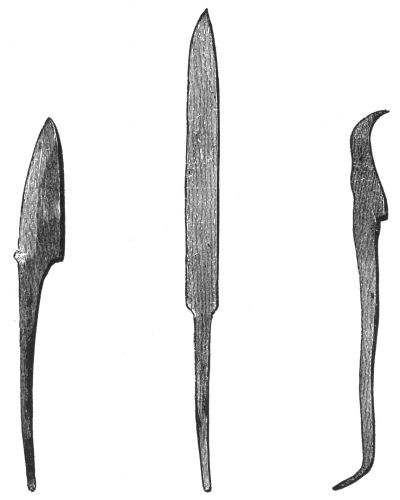
KNIVES OF IRON FOUND IN HEDEMARKEN AND HADELAND.
"They are in hell," answered the priest.
"Then," said the chief, flinging off his baptismal robe and stepping out of the water, "I will rather be in hell with Odin and my forefathers, who were brave and noble men, than in heaven with cowardly Christians and bald-headed monks."
It will be seen, then, that the relapse into paganism which followed the death of Olaf Tryggvesson was what might have been expected; and the general reaction against the new faith which set in during the reign of the earls was also quite natural. Olaf, Haroldsson, therefore, had, in a large measure, to do the work of his kinsman over again, and he did it with such energy that, in the end, he forced the expiring Asa faith, and the tribal magnates who founded their power upon it, into a mortal combat in which he himself succumbed, while the religion of Christ rose from his tomb, victorious.
King Olaf was by nature well equipped for his mission. He had a robust frame, indomitable will, and great endurance. There was something in his very build and look which indicated that he was not to be trifled with. It was not the youthful enthusiasm of an Olaf Tryggvesson which inspired his measures for the propagation of the faith; but rather a firm, dogged determination to accomplish a task, the moral and political importance of which had strongly impressed him. We need not question his sincerity because in serving God he also served himself. All his habits and actions seem to show that he was by conviction and temperament a religious man. But a fanatic he was not; and the legends which in later times clustered about his name have, by attributing to him an undue ardor, distorted his image. He was, in spite of his later sainthood, a strong-willed, ambitious, and worldly-wise man; far-seeing in his plans, business-like in his methods, relentless in his hates, ruthless in his punishments. And yet, as we have seen him in his treatment of Rörek, he was by no means devoid of pity, and could, when occasion demanded, show himself magnanimous.
His severity, which the sagas comment upon, was never wanton; but was in proportion to the magnitude of the offence. Robbers, thieves, and vikings who plundered within the land he punished with death, no matter whether their birth was high or low; because the extirpation of the old predatory spirit with its internecine feuds was the first condition for the establishment of a united nationality.
In appearance King Olaf was of middle height, large-limbed, broad-necked, of florid complexion, and inclined to corpulence. He wore a full red beard, and his eyes were piercing and of great brilliancy. In spite of his stoutness, he was brisk in his motions and of active habits. He was a good judge of men, and staunch in his friendship to those who did him faithful service. He selected Bishop Grimkel, an Englishman, though probably of Norse blood, to elaborate a Christian law, and revise the previous legislation so as to bring it into accord with the teaching of Christ. Although himself no scholar, he valued theological learning, and showed great favor to the priests whom he brought over from England to instruct the people. Such instruction was indeed needed; for during the journeys which the king undertook through the length and breadth of the land for the purpose of "inquiring into the condition of Christianity," he made the most disheartening discoveries. During his sojourn in Nidaros he ascertained that the Trönders, in spite of their assertions to the contrary, were in the habit of celebrating the old pagan festivals and offering up sacrifices to Odin and Frey for good crops. The chieftain, Oelve of Egge, who had twice deceived the king in regard to the practices of the peasants, and himself participated in them, was slain, and a great number of others who had been similarly guilty were killed, maimed, or outlawed, and their estates confiscated. In Guldbrandsdale the peasants had the hardihood to send eight hundred armed men against the king, under the leadership of Alf, son of Dale-Guldbrand, the first chieftain in the valley. The battle was, however, scarcely opened when the peasants fled, and Dale-Guldbrand invited Olaf to hold thing with them and deliberate concerning the change of faith. To the king's request that the men of Guldbrandsdale should believe in the one God and be baptized, Dale-Guldbrand replied:
"We know not of whom thou art speaking; for thou callest him a god whom neither thou canst see nor any one else. I cannot ask help of any one whom I do not see or know. Then we have a very different kind of god whom we can look at every day. The reason why he is not out to-day is that it is raining so hard. But I dare say that when you get sight of him you will be frightened, nay, quite terrified because of his might. But if there is any truth in what thou sayest, that thy God is so powerful, then let him arrange it so that to-morrow we shall have cloudy weather but no rain."
The next morning the thing again met, and the sky was overcast, but no drop of rain fell. The king ordered the mass to be celebrated by Bishop Sigurd, who preached to the peasants about the miracles which Christ had wrought when he was on earth. On the third day the people again came to the thing, this time bearing a great image of the god Thor, which they placed upon the green. The weather was still cloudy, but without rain. From out of the throng of the peasants Dale-Guldbrand arose and said:
"Where is now thy god, king? He wears his chin beard pretty low now, and methinks that thou art not so bold as thou wast yesterday, nor is the horned man at thy side who is called the bishop. For now our god has come who rules over all things, and he is looking at you with his fierce eyes. I see now that you are full of fear and scarcely dare look into his eyes. Therefore give up your folly and believe in our god who holds your fate in his hand."
To this the king replied:
"Many things thou hast spoken to us this day, and thou art wondering that thou canst not see our God. But I think he will soon come to us. Thou wishest to frighten us with thy god, who is both deaf and blind, and can save neither himself nor others; who cannot stir from the spot unless he is carried. Now I have a foreboding that he will soon come to grief. For, behold! Look eastward! There our God is coming with much light,"
Just at that moment the sun burst through the clouds, and the peasants all turned toward the east. But instantly Kolbjörn the Strong, at a sign from the king, struck the idol with his club, so that it burst into many pieces. Out leaped rats as big as cats, snakes, and lizards, which had fattened on the delicacies with which the god had daily been fed. A terrible consternation seized the peasants when they saw what their god contained. They fled to the river; but Olaf, who had foreseen this, had bored holes in their boats so that they were unable to float them. Quite subdued in spirit, they were compelled to return to the thing-meadow, where the king addressed them in these words: * * * "Now you see what power there was in your god, to whom you bore silver and gold and bread and meat, and who it was that enjoyed it all. It was mice and snakes, vipers and toads. * * * Take now your gold and ornaments, which lie scattered on the ground, and bring them home to your wives, but hang them no more on logs and stones. Now I will give you the choice of two things. Either you shall accept the Christian faith or you shall fight with me this day. He will win to whom the god in whom we trust will give victory."
The peasants were in no mood to fight; and therefore, after the discomfiture of their god, declared their faith in Christ and were baptized by the king's bishop. Priests were left behind to instruct them, and Dale-Guldbrand built the first church in Guldbrandsdale.
After having with the same firm hand put down paganism in Hedemarken and Raumarike, Olaf called a great thing at Eidsvold, where the Eidsivia law was proclaimed and adopted for all the Oplands. It was his intention to revise the laws of all the judicial districts in the same spirit, and he naturally turned his attention to the western coast-shires, which belonged under the jurisdiction of the Gula-thing's law. But these shires were part of Erling Skjalgsson's fief, which extended from Lindesness to the Sogne Fjord. Having small faith in Erling's friendship, which on a previous occasion had been pledged to him, Olaf prepared to travel with a large force through his shires; and as the crops had partly failed in the northern shires, he forbade all exportation of grain from the districts which he meant to traverse. This was merely a measure of self-protection, and though oppressive in its effect, was prompted by no unfriendly motive. Erling's nephew, the young chief Aasbjörn Sigurdsson, of Haalogaland, in spite of the prohibition, with the connivance of his uncle, bought malt and grain of the latter's thralls, and was in consequence deprived of his cargo by the king's steward, Thore Sel, at Agvaldsness. In return for this he killed the steward in the king's presence, was seized, and sentenced to death, but forcibly liberated by his uncle. Enraged by this unexampled audacity, the king came near taking summary vengeance upon Erling, but allowed himself to be persuaded by Bishop Sigurd to make peace, on condition that Aasbjörn should surrender himself to his mercy. The second sentence was, however, according to the notions of those days, severer than the first. Olaf demanded of the young chief that he should perform the service of the man he had slain. Any personal service, even under a king, was held to be degrading and unworthy of a freeman. The royal stewards were usually men of low birth; sometimes even thralls or sons of thralls. For a man of illustrious lineage to take the place of such a minion would be tantamount to accepting a badge of servitude. Aasbjörn, therefore, broke his promise, relying upon Erling Skjalgsson, and his father's brother, the powerful Thore Hund of Bjarkö, to shield him from the king's vengeance. In this, however, he made a miscalculation. For one day, as he was sailing in his fine ship along the coast, another ship passed him, from which a spear was hurled forth that transfixed him. This spear was thrown by a friend of the king. Aasbjörn's mother, Sigrid, made a great funeral feast over her son, and gave each of the guests gifts by which to remember him. Only Thore Hund of Bjarkö received no gift. But when the time came for departing, Sigrid accompanied him down to his ship and gave him a spear inscribed with strange runes.
"This spear it was," she said, "which pierced my son Aasbjörn. It is yet sticky with his blood. * * * It would be a brave deed, if thou didst part with this spear in such wise that it stuck in the heart of Olaf the Big, and I declare thee as a nithing before all men, if thou dost not avenge Aasbjörn."
Thore Hund remembered this injunction, six years later, at the battle of Stiklestad.
There could now no longer be any question of peace between Olaf and the race of Erling Skjalgsson. A decisive conflict was inevitable, and each party began to make preparations for utterly crushing the other. King Knut the Mighty, of England and Denmark, took advantage of this state of things, and by bribes and promises encouraged the discontented chieftains throughout the land to unite in revolt against the tyrannical king. Secret messengers from Knut were sent with presents to nearly all the heads of the tribal aristocracy, and the friendliest reception awaited those of them who went to England. Two of Erling Skjalgsson's sons, who visited Knut in London, were quite dazzled by the splendor and friendliness of the English king. In thus maturing the revolt, Knut's first purpose was to punish Olaf for his insolence in refusing to consider his claim to Norway, which in an embassy (1024) he had threatened to enforce. Secondly, it tallied well with his ambitious dream of uniting England and the three Scandinavian countries in one grand monarchy, which in the north might counterbalance the German and French power in the south.
Olaf did not long remain ignorant of King Knut's machinations; and he took immediate measures to protect himself. He spent the winter (1025-1026) in Sarpsborg, and not, as usual, in Nidaros; for he had learned that Knut was in Denmark and contemplated an invasion of Norway. Viken, being the province nearest Denmark, and having formerly belonged to the Danish kings, would naturally be exposed to the first attack. In order to strengthen himself further, he entered into an alliance with his brother-in-law, the Swedish King Anund Jacob, impressing upon him the probability that his own turn would come next, in case Knut gained possession of Norway. When Knut heard of this, he too sent an embassy to Anund Jacob, for the purpose of winning his friendship, or at least secure his neutrality. The embassadors supported their arguments with splendid gifts; and King Anund was no doubt sorely tempted to listen to them. First they put two candlesticks of gold on the table.
"A very pretty toy is that," said Anund, "but I will not, in order to get it, break with Olaf."
A golden platter of rare workmanship, and set with jewels, was placed before him. He gazed longingly at it; but finally cried out: "A glorious treasure is that; but I will not sell King Olaf for a dish."
The spokesman of the embassy, talking eagerly in his master's behalf, at last pulled out two gorgeous rings.
"King Knut has much shrewdness," ejaculated Anund, "for he knows that I would fain win treasure, and that I know little of courtly custom. But King Olaf I have known since I was a boy, and learned to love him so much, that I cannot now forsake him."
Possibly it was this staunch attitude of Anund Jacob which discouraged Knut from waging open war against Olaf. At all events he went (1026) as a pilgrim to Rome, not as conqueror to Norway. In the meanwhile, his brother-in-law, Earl Ulf,[A] headed a rebellion against him in Denmark, and entered into an alliance with Olaf Haroldsson and Anund Jacob. Both thought this a convenient opportunity for striking a blow at the threatening power of Knut, and gathered a fleet with which they ravaged the coasts of Halland and Skaane. They even in some places summoned the people to the thing and received their homage. These tidings reached Knut who promptly returned from his pilgrimage, and came within a hair of capturing the two kings who did not suspect that he was near. Knut's ships were so greatly superior both in size, number, and equipment, that it would have been folly to remain and await battle. Olaf and Anund, therefore, hastened along the coast of Skaane toward Swedish territory, hotly pursued by Knut. They put up in the Helge-aa, a short river, uniting a series of lakes, near what was then the boundary between Sweden and Denmark. Olaf made haste to dam up the river where it issued from the lake, and filled the river-bed with a mass of trees and other obstructions. Late in the afternoon Knut sailed into the harbor, and found it deserted. The allies lay with their fleet outside the harbor, apparently ready for battle. It was, however, too late in the day to begin the fight, and Knut left part of his fleet outside to watch them. In the night the command was given to break the dam, and an enormous volume of water rushed down upon the Danish and English fleet, which broke from its moorings, and drifted seaward in disorder. A considerable number of people were drowned, but the ships though much damaged were not wrecked. The confusion was, on the whole, less than had been anticipated, and Earl Ulf, seeing that there was a chance that Knut might save himself, turned traitor once more and went to his rescue. The Swedes and the Norsemen, perceiving that the Danish king with this accession of strength was too formidable, sailed away without making an attack (1027). Knut, instead of pursuing them further, sailed back to England, but in the following year returned with a greatly increased force. He had by his extensive system of bribes effectually secured the friendship of the disaffected Norse chiefs, and therefore steered without hesitation to Nidaros where he was proclaimed king of Norway. He appointed his nephew Earl Haakon, the son of Earl Erik, regent in his absence.
[A] Ulf Jarl, the ancestor of a long line of Danish kings, was the grandson of Thyra, the sister of Sweyn Forkbeard, by her first husband the Swedish Prince Styrbjörn. He was, accordingly, through his grandmother, a descendant of Gorm the Old, and of Ragnar Lodbrok.
For Olaf there was now really nothing to do but to leave the country. He determined, however, to make a last effort to maintain himself and sailed with a few ships, and as many men as remained faithful to him, up along the coast, hoping that he might yet be able to rally a sufficient force to expel Earl Haakon. When Erling Skjalgsson heard of his approach, he called together his household troops, and manned his fleet. The king, however, who had no desire to fight with Erling, had already slipped by, but was no further in advance than that he could easily be overtaken. Erling, accordingly, started in pursuit, but allowed himself by a stratagem to be separated from his main force, and after a heroic fight lost all his men and was captured by Olaf. As he stood alone among a heap of the slain, his gray locks falling down over his shoulders, the king called to him:
"Thou settest thy face straight against us to-day, Erling." "Face to face do eagles fight," answered Erling; "wilt thou give me peace?"
Olaf, after some deliberation, declared that he would; but on second thought half repented of his generosity. He took his axe and gently scratched the old man's cheek, saying: "Something must be done to mark the traitor to his king."
One of the king's men who stood by suddenly raised his axe and cleft Erling's skull, saying:
"This is the way to mark a traitor to his king."
Thus died the mightiest chieftain in all Norway. No representative of the tribal aristocracy, before or since, ever possessed such power as Erling Skjalgsson.
Olaf continued his voyage northward to Söndmöre where a great number of his followers left him, while at the news of Erling's death enemies blocked his way wherever he turned. He saw that his last hope was gone; and with a few friends fled through Valdalen across the mountains into Sweden, where he left his wife and daughter. Thence he travelled to Russia (1029), where he was warmly welcomed by his brother-in-law, King Jaroslav, who had married Ingegerd, the sister of Anund Jacob.
Norway was now a province of a foreign power. The separatistic tendencies of the old tribal magnates had triumphed over the national idea represented by King Olaf. It was they and not King Knut who, in order to gratify their own greed for power, had destroyed the national unity. In order to secure their own independence, each in his own shire, they sacrificed the national independence. It was natural that Knut, who based his dominion upon their support, should make them large concessions. He flattered Einar Thambarskelver, hinting that if Earl Haakon had not been his nephew he would have made Einar regent of Norway. Kalf Arnesson, the mightiest chief among the In-Trönders, he called over to England and assured him, too, that he was the man for the earl's place. For Earl Haakon, he said, was too conscientious to break his oath to Olaf Haroldsson, in case the latter should return and attempt to regain his kingdom. It may have been true that he vaguely distrusted the earl; for on a slight pretext he summoned him to England and sent him on an expedition, the nature of which is not entirely clear. From this expedition, however, Earl Haakon never returned, and it was reported that he had been drowned at sea with all his men. Björn Stallare, Olaf's friend, hastened to Russia with this intelligence, and found his old master at King Jaroslav's court. Olaf asked him for tidings of home, and how his friends had kept their oath of allegiance.
"Some well and some poorly," answered Björn, and threw himself at the king's feet, embracing his knees; "every thing is in God's power and in yours, king. I have received money from Knut's men and sworn him allegiance; but now I will follow thee and not forsake thee as long as we are both alive."
"Few men have remained faithful to me in Norway," said the king, sadly, "when such men as thou art have been led astray. * * *"
He was not at first ready to accept Björn's invitation to return to his kingdom. In his forced inactivity a resolution had half matured in his mind to become a monk and go on a pilgrimage to the Holy Land. An offer from Jaroslav to accept a Russian province in fief he declined. Religious meditations occupied much of his time; and he acquired the reputation of being a holy man. While in this frame of mind, he had a vision in which he saw Olaf Tryggvesson who commanded him to go back to Norway and conquer it or die. He could now no longer hesitate. Much against the advice of Jaroslav and Ingegerd, he started out for Norway, leaving his young son Magnus at the Russian court. In Sweden he received permission from King Anund to collect whatever recruits he could; but while he accepted robbers and outlaws, if they would only be baptized, he had the courage to reject large bands of brave men who refused to renounce paganism.
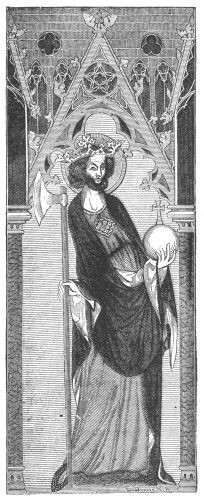
ST. OLAF, FROM THE ANTEPENDIUM OF THE ALTAR IN DRONTHEIM CATHEDRAL. REMOVED 1691 TO COPENHAGEN.
Tradition has preserved with minute fidelity a number of incidents of King Olaf's progress through Sweden to the fatal field of Vaerdalen. There is a melancholy radiance, as of the setting sun, about his figure as he returns with the gospel of Christ to his people who had rejected him. First, Bishop Sigurd came to meet him and strongly dissuaded him from entering his kingdom. But he would listen to no remonstrance. Through forests and wildernesses he broke his way; cheerful amid the greatest hardships, encouraging his people and never showing, except on a single occasion, the foreboding that cast its shadow over his soul. When he crossed the mountains between Norway and Sweden, and he caught the first glimpse of the land of his birth with its rivers, mountains, and sunny valleys, he reined his horse and sat gazing, lost in thought, on the beautiful sight. A profound sadness was expressed in his features. At last the bishop roused him from his reverie, asking him what he was thinking.
"Strange things," answered the king, "have for a while been borne past me. It seemed to me, as if I looked not only out over Drontheim, but over all Norway; and the longer the vision lasted, the wider it grew, until I surveyed the whole world, both land and ocean. Then it seemed to me that I recognized all the places where I had ever been before; even as plainly I saw places where I had never been before;—nay even some of which I had never even heard—both inhabited and uninhabited, as far as the world goes."
It is then told that the bishop, dismounting from his horse and embracing the king's foot, said: "It is a holy man whom we are following."
Among the few Norsemen of rank who had joined Olaf before he crossed the boundary, was his half-brother Harold, the son of Sigurd Syr. He was only fifteen years old, but large for his age. He led 720 men under his banner. When the king's entire army was mustered, the day before the battle, it was found to number 4,100 men; but 500 of these were sent away because they were heathen, and many of them no doubt joined the hostile army. The king woke early on the morning of the battle, and called the poet, Thormod Kolbruna-Scald, and asked him to sing to him. Thormod stood up and sang with a ringing voice the ancient Bjarkemaal, which resounded over forest and field. The army woke and was arranged in battle array on the heights of Stiklestad in Vaerdalen; the peasant army, 10,000 strong being seen approaching in the distance. With the battle-cry: "Forward, Christ's men, Crusaders, the King's men!" Olaf's warriors rushed down the hill-sides, and the peasant army stormed to meet them with the cry: "Forward, forward, peasant-men!" The fight was long indecisive, though the king's men, on account of the advantage of their position, had the upper hand in the first onset. The peasants, however, fought with dogged determination, and their superior number told, the longer the battle raged. Olaf's ranks wavered and grew thinner. Then, with desperate courage, the king broke forth from the shield-burgh that surrounded him, and followed by a small band of devoted men, dashed against the front of the peasant host. One by one his men fell about him, and again and again his standard-bearer was cut down. Severely wounded, he stood leaning against a boulder, when Thore Hund sprang forward and plunged his spear into his abdomen. In the next moment Kalf Arnesson gave him a cut across the throat, which was the immediate cause of his death, though Thore Hund's spear had already dealt him a mortal wound. Then, so runs the record, the sun grew blood-red, and a strange red sheen spread over the landscape. Darkness fell upon the fighting hosts, and the sun grew black. A great terror took possession of the peasants, who saw in the eclipse[A] an evidence of the wrath of Olaf's God.
[A] This eclipse—lasting from 1 o'clock 31' P.M. to 4 o'clock 58', Aug. 31, 1030—fixes definitely the date of the battle. It was total in Vaerdalen.
With the king's death the battle was virtually at an end. The peasants remained in possession of the field. Wounded warriors of both parties crawled about among the trees and stones, and some reached a hut where a woman surgeon was busy washing and bandaging their wounds. Hither came also Thormod Kolbruna-Scald, whose left side had been pierced by an arrow. He sat down on a bench, and a man of the peasant army who stood by said to him: "Why art thou so pale? Art thou badly wounded?" He answered in verse that he had got his wound from Danish weapons—a mocking allusion to the alliance of the peasants with the Danish king. The woman, not knowing how serious his hurt was, asked him to go out and get an armful of firewood. When he returned he looked white as a ghost. She begged to see his wound, and with a pair of tongs attempted to pull out the arrow, the shaft of which was broken off. But her attempts were futile. Then the scald took from his arm the heavy gold ring which the king had given him for his song and handed it to her.
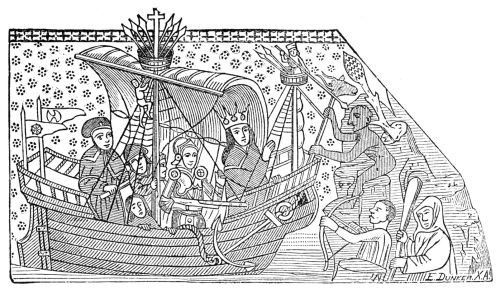
ST. OLAF AND THE TROLDS. FROM FRESCO PAINTING IN TEGELSMORA CHURCH IN UPLAND.
"It came from a good man," he said; "King Olaf gave it to me this morning."
Taking the tongs, he clenched them over the stump of the arrow and pulled it out. Pieces of flesh and red and white fibres adhered to the barbs. He looked at them for a moment and said: "The king has fed us well, for I am yet fat about the heart-roots"; then fell back and died.
The king's body was found by a peasant named Thorgils, who before the battle had promised Olaf to bury him if he fell. As later tradition reports, many miracles were wrought by the king's blood and by the mere touch of his lifeless hand. Tales without number were told of his marvellous powers in life as well as in death, and legends attributing to him the work of the Thundering Thor, have clustered luxuriantly about his name. He slew the trolds whom his church-bells annoyed, and turned them to stone. St. Olaf, with the flame-red beard, became not only the national saint, but also the national hero. The tragic circumstances of his death, no less than his valiant work for the cause of Christ, imbedded his memory deeply in the people's hearts.
CHAPTER XIV.
SWEYN ALFIFASSON (1030-1035).
King Knut could not, with his extensive possessions, devote much time to the government of Norway. He therefore had his son Sweyn proclaimed King of Norway in his stead. Sweyn's mother, who accompanied him to his new kingdom, was Aelgifa, the daughter of an ealdorman in Northampton. The Norsemen, however, called her Alfifa, and her son Sweyn Alfifasson. This was, accordingly, what the chiefs had gained by their rebellion—to be openly governed by the mistress of a foreign king and a boy who was and could be nothing but a tool in her hands. It was a humiliation which they could ill brook. If Alfifa had had the faintest comprehension of the people whom she undertook to govern, she might possibly for a time have maintained her son upon the throne; but when she proceeded to remodel the Norse legislation in the feudal spirit, she struck a blow at the very men who were the main-stay of her power. What the chiefs had desired was local independence—the right to manage their own affairs with as little interference as possible. They had hoped to obtain this liberty under a king who was too far away to trouble them. But now came Sweyn, and with him a number of Danes who became very important personages, and induced the king to modify the Norse laws so as to bring them more nearly into conformity with the laws of Denmark. It was then enacted that no one should have the right to leave the country without the king's permission, and that confiscation of property should be the punishment for transgression. Man-slaying was likewise to be punished by confiscation. So also an inheritance coming to an outlawed man should go into the king's treasury. Ships, fisheries, pasture-land, nay, even the peasant's hearthstones were taxed, and a system of extortion was instituted which was galling to the spirit of free men. Even the Christmas gifts which the peasants were to give the king, were fixed by law. The chief end of government seemed to be to transfer money from the people's pockets to those of the king. It was even asserted, though there was no law to that effect, that during Sweyn's reign the testimony of one Dane was sufficient to invalidate that of ten Norsemen.
The central principle in this legislation was the feudal idea that all land belonged to the king, and that the possessors, as his tenants, had to pay for the usufruct. It was the same appropriation by the king of all allodial rights, which was encountered for the first time during the reign of Harold the Fairhaired.
Alfifa, whom the people regarded as the author of the odious enactments, may have had her share in them; but far less than was popularly supposed. It was, no doubt, Knut who meant to crush the rebellious spirit of the Norse chiefs, by which he had himself profited, and Sweyn and Alfifa were merely his agents.
Under these circumstances it was but natural that the chieftains began to repent of their rebellion against King Olaf. Einar Thambarskelver, who prided himself on his absence from the battle of Stiklestad, was especially active in awakening regret among the Trönders at his death, and indignation at the rule of the Danes. He sent for Bishop Grimkel, who was living as an exile in Sweden, and agreed with him upon a plan of action. The bishop sent for the peasant Thorgils, who revealed the spot where he had buried the king. Permission was obtained from King Sweyn to bring the corpse to Nidaros, where it was placed in a splendid sarcophagus and interred under the altar in the Church of St. Clement (Aug. 1031). Although nearly a year had elapsed since the first burial, it was asserted that there was no trace of decay on the body and that the hair and the nails had grown. Einar and the bishop, at all events, encouraged such reports, and they grew in number and minuteness of convincing details. Grimkel now declared Olaf to be a saint, and Sweyn and Alfifa, though they raised many objections, dared no longer profess their disbelief. The 29th of July was set apart for the commemoration of his martyrdom. For the first time in their history the Norsemen felt themselves as one nation, united in their indignation against their foreign rulers and in their regret and veneration for the martyred king.
If Sweyn and Alfifa were aware of the sentiment with which they were regarded, they chose to ignore it. They were, however, not prepared for open defiance, and the events of 1033 must have taken them by surprise. In that year, a young man calling himself Tryggve, and professing to be a son of Olaf Tryggvesson and his wife Gyda, came from England or Ireland with a band of warriors and claimed the throne of Norway as his inheritance. Sweyn called upon the chiefs to aid him in punishing the pretender, but Einar Thambarskelver, Kalf Arnesson, and many other magnates, refused to follow him. With those who still recognized his authority the king sailed southward and defeated Tryggve in a short battle in Sognesund. On his return he and Alfifa met the Trönders at the thing and listened to their complaints, but could give them no satisfaction. Then Einar Thambarskelver said aloud and in the hearing of many: "I was not a friend of King Olaf; but the Trönders proved themselves to be poor merchants when they sold their king and got in his place a mare with her colt. The king cannot speak, and his mother only wishes what is bad and has the power to do it."
Alfifa rose to speak, but she could get no hearing. Einar Thambarskelver taunted her openly, and so hostile was the sentiment that she dared not take him to task. A sense of insecurity took possession of the king, and he and his whole household left Tröndelag and took up their abode in the southern part of the country. His authority had practically ceased, though in name he yet remained king. In 1034, Einar Thambarskelver, Kalf Arnesson, and several other chiefs started for Russia and invited Magnus, King Olaf's only son, to return with them and become king of Norway. They asked and received his forgiveness for their hostility to his father, and swore to be faithful to him and to shield him from all harm. Magnus, who was then ten years old, accompanied them back to his native land, and was received with enthusiastic homage at Oere-thing, where he was proclaimed king. Sweyn and Alfifa made vain efforts to raise an army, but as no one heeded their summons, were forced to flee to Denmark. Here Sweyn died in the year 1036. As his father, Knut, had died in 1035, his half-brother, Harthaknut, became the heir to his claim to Norway, and, as we shall see, soon took measures to enforce it.

CHAPTER XV.
MAGNUS THE GOOD (1035-1047).
MAGNUS OLAFSSON was an illegitimate child, his mother, Alfhild, being, according to one report, an Englishwoman of high birth; according to another, the queen's laundress. When he was born he was so small and feeble that it seemed as if he could not live many hours. It was in the middle of the night and no one dared to wake the king. His friend, Sighvat Scald, was therefore called, and he assumed the responsibility of naming the child Magnus, after Carolus Magnus, the German emperor. A priest was then found who baptized it. When the king heard of the occurrence he was very wroth, and chided the scald. There was no one in his family named Magnus, and perhaps he even suspected that Sighvat had made a mistake in selecting the Latin surname of the emperor rather than his real name, Karl. It was under these unpropitious circumstances that the boy was born who became the heir to St. Olaf's kingdom and the love which a repentant people lavished upon his memory. He was not quite eleven years old when he was proclaimed king at the Oere-thing, but well grown and intelligent. He allowed himself, during the first years of his reign, to be guided by the counsel of Einar Thambarskelver and Kalf Arnesson; but soon gained sufficient independence of judgment to assert his own will.
It was but a short time after the proclamation of Magnus as king that Harthaknut prepared to invade Norway. Magnus, who was eager to punish the race of Knut for their insidious plottings against his father, also made warlike preparations, apparently with the intention of invading Denmark. Whether any actual fighting took place is not known. It is not improbable that some insignificant skirmishing may have been done; but before any decisive battle was fought, the chieftains in both countries interfered and persuaded the two youthful combatants to make peace. At a meeting at the Brenn Islands, at the mouth of the Götha Elv, an agreement was made in accordance with which each made the other his heir and successor, in case he died, without issue (1038). This might, indeed, seem to be a remote contingency, but it actually came to pass four years later (1042) when Harthaknut died and Magnus was, without opposition, proclaimed king of Denmark at the Viborg-thing, and received the allegiance of the people. Thus Norway and Denmark were for the first time united, and the descendants of Harold the Fairhaired were recognized by the Danish branch of Ragnar Lodbrok's race as their equals, as they already had been recognized by the branch governing Sweden.
Magnus must have been aware that it was to the sainthood of his father that he owed this recognition, and he lost no opportunity to show his reverence for his memory. He commenced the erection of a church in Nidaros, which was to bear St. Olafs name, and made him a new sarcophagus, adorned with gold and silver and precious stones. It was natural enough that he should take pleasure in the society of those who had been nearest to his father and stood at his side at Stiklestad. But the hostility aroused by the battle and the events that led to it existed, in some measure, yet; and one party began to fan the smouldering embers of distrust in the king's mind and incite him to vengeance against the other. Young as Magnus was, it is scarcely to be wondered at that he allowed himself to be influenced by this evil counsel. In spite of the amnesty which he had in Russia given to those who had borne arms against St. Olaf, he began now to punish all the leaders in the rebellion with great harshness. It was the Trönders, particularly, who had to bear the brunt of his wrath; because it was they who had made common cause with Knut and had been foremost in driving the sainted king into exile. Kalf Arnesson was among the first to experience the changed temper of King Magnus. Jealousies had early arisen between him and Einar Thambarskelver, both of whom called the king their foster-son and prided themselves on possessing his confidence. Once, it is said, Kalf had seated himself in Einar's seat next to the king, whereupon Einar sat down upon Kalf's shoulder, saying:
"It behooves an old bull to be stalled before the calf."
At a party at the estate Haug, in Vaerdalen, the king uttered to Einar a desire to visit the field where his father had fallen.
"I can give you no information about that," answered Einar, "as I was not present. But let Kalf ride along with you. He can give you full particulars."
"Then thou shalt accompany me, Kalf," said the king; and Kalf, though he was very reluctant, was obliged to follow.
When they reached the battle-field the king dismounted and asked to be shown the spot where his father had received his death-wound.
"He lay here," said Kalf, pointing with his spear.
"Where didst thou stand then, Kalf?" asked Magnus.
"Here where I am now standing."
"Then thy axe could well reach him," cried the king, flushing violently.
"My axe did not reach him," Kalf replied, jumped on his horse and rode away. He had already given orders to have his ship in readiness, loaded with all his movable goods. And as soon as he reached home he put to sea and sailed for the Orkneys. The great possessions which he left behind were confiscated by Magnus.
Thore Hund escaped punishment by making a pilgrimage to Jerusalem from which he never returned. Haarek of Thjotta was slain with the king's consent by a private enemy, and many others were deprived of their cattle and otherwise molested. The odious laws which had been given by Sweyn Alfifasson were not repealed; and the king acted as if he regarded himself as the master of every one's goods, life, and liberty. But the Norsemen were not accustomed to endure arbitrary conduct in their kings. A general dissatisfaction spread through the country, and threatened to break out in open rebellion. In Sogn the peasants were already under arms, and in Tröndelag a largely attended meeting was held at which the bitterest denunciation of the king found utterance. Happily, however, some were present who were yet kindly disposed to Magnus, and these determined to let him know how the people felt toward him. The question then arose as to who was to undertake this hazardous mission, for Magnus was hot-tempered and had, moreover, made up his mind to inflict exemplary punishment upon the rebellious Sognings. His friends determined to let chance decide. They drew lots, and the lot fell upon Sighvat Scald, who, in a song called the Lay of Candor, took the king earnestly to task for his inconsiderate harshness, warned him of the consequences, and reminded him of his duties to the people, who had of their own accord made him their king. The song made a deep impression upon Magnus, and he was from that day a changed man. He gave up all plans of vengeance, became gentle and forgiving, and governed the land in accordance with the law. His kindness and charm of manner made him now so popular that scarcely enough could be said in his praise. The people called him Magnus the Good.
"Men,"[A] answered Harold.
[A] Ulf Jarl, the ancestor of a long line of Danish kings, was the grandson of Thyra, the sister of Sweyn Forkbeard, by her first husband the Swedish Prince Styrbjörn. He was, accordingly, through his grandmother, a descendant of Gorm the Old, and of Ragnar Lodbrok.
Possibly it was this staunch attitude of Anund Jacob which discouraged Knut from waging open war against Olaf. At all events he went (1026) as a pilgrim to Rome, not as conqueror to Norway. In the meanwhile, his brother-in-law, Earl Ulf,[A] headed a rebellion against him in Denmark, and entered into an alliance with Olaf Haroldsson and Anund Jacob. Both thought this a convenient opportunity for striking a blow at the threatening power of Knut, and gathered a fleet with which they ravaged the coasts of Halland and Skaane. They even in some places summoned the people to the thing and received their homage. These tidings reached Knut who promptly returned from his pilgrimage, and came within a hair of capturing the two kings who did not suspect that he was near. Knut's ships were so greatly superior both in size, number, and equipment, that it would have been folly to remain and await battle. Olaf and Anund, therefore, hastened along the coast of Skaane toward Swedish territory, hotly pursued by Knut. They put up in the Helge-aa, a short river, uniting a series of lakes, near what was then the boundary between Sweden and Denmark. Olaf made haste to dam up the river where it issued from the lake, and filled the river-bed with a mass of trees and other obstructions. Late in the afternoon Knut sailed into the harbor, and found it deserted. The allies lay with their fleet outside the harbor, apparently ready for battle. It was, however, too late in the day to begin the fight, and Knut left part of his fleet outside to watch them. In the night the command was given to break the dam, and an enormous volume of water rushed down upon the Danish and English fleet, which broke from its moorings, and drifted seaward in disorder. A considerable number of people were drowned, but the ships though much damaged were not wrecked. The confusion was, on the whole, less than had been anticipated, and Earl Ulf, seeing that there was a chance that Knut might save himself, turned traitor once more and went to his rescue. The Swedes and the Norsemen, perceiving that the Danish king with this accession of strength was too formidable, sailed away without making an attack (1027). Knut, instead of pursuing them further, sailed back to England, but in the following year returned with a greatly increased force. He had by his extensive system of bribes effectually secured the friendship of the disaffected Norse chiefs, and therefore steered without hesitation to Nidaros where he was proclaimed king of Norway. He appointed his nephew Earl Haakon, the son of Earl Erik, regent in his absence.
[A] This eclipse—lasting from 1 o'clock 31' P.M. to 4 o'clock 58', Aug. 31, 1030—fixes definitely the date of the battle. It was total in Vaerdalen.
Among the few Norsemen of rank who had joined Olaf before he crossed the boundary, was his half-brother Harold, the son of Sigurd Syr. He was only fifteen years old, but large for his age. He led 720 men under his banner. When the king's entire army was mustered, the day before the battle, it was found to number 4,100 men; but 500 of these were sent away because they were heathen, and many of them no doubt joined the hostile army. The king woke early on the morning of the battle, and called the poet, Thormod Kolbruna-Scald, and asked him to sing to him. Thormod stood up and sang with a ringing voice the ancient Bjarkemaal, which resounded over forest and field. The army woke and was arranged in battle array on the heights of Stiklestad in Vaerdalen; the peasant army, 10,000 strong being seen approaching in the distance. With the battle-cry: "Forward, Christ's men, Crusaders, the King's men!" Olaf's warriors rushed down the hill-sides, and the peasant army stormed to meet them with the cry: "Forward, forward, peasant-men!" The fight was long indecisive, though the king's men, on account of the advantage of their position, had the upper hand in the first onset. The peasants, however, fought with dogged determination, and their superior number told, the longer the battle raged. Olaf's ranks wavered and grew thinner. Then, with desperate courage, the king broke forth from the shield-burgh that surrounded him, and followed by a small band of devoted men, dashed against the front of the peasant host. One by one his men fell about him, and again and again his standard-bearer was cut down. Severely wounded, he stood leaning against a boulder, when Thore Hund sprang forward and plunged his spear into his abdomen. In the next moment Kalf Arnesson gave him a cut across the throat, which was the immediate cause of his death, though Thore Hund's spear had already dealt him a mortal wound. Then, so runs the record, the sun grew blood-red, and a strange red sheen spread over the landscape. Darkness fell upon the fighting hosts, and the sun grew black. A great terror took possession of the peasants, who saw in the eclipse[A] an evidence of the wrath of Olaf's God.

MAGNUS THE GOOD AND KALF ARNESSON, AT STIKLESTAD.
When Magnus, in 1042, had become King of Denmark, his ambition led him as the heir of Harthaknut, also to assert his claim to the crown of England. Edward the Confessor, who was called to the throne at the death of Harthaknut, was in honor bound to disregard such a claim; but it compelled him to keep a fleet in readiness to repel an expected Norse invasion. There is little doubt but that Magnus would have made the attempt to oust him, if the events in Denmark had not taken a turn which obliged him to abandon, for a time, all thought of conquest. Among the Danes who swore allegiance to Magnus and endeavored to win his favor was Sweyn Estridsson, the son of Earl Ulf and Estrid, the sister of Knut the Mighty. He was both on his father's and his mother's side descended from the race of Ragnar Lodbrok, and was therefore better entitled to the Danish throne than the King of Norway. Sweyn was like his father Ulf, a shrewd intriguer, smooth of speech, and fair of face, but false and treacherous. He was loud in protestations of devotion to Magnus and succeeded in gaining his confidence. Contrary to the advice of his friends, Magnus made him his vassal and appointed him his earl, giving him the same fiefs that his father had had before him. It was to be his special duty to defend Jutland against the Wends and the Saxons. When the ceremony of investiture took place, Einar Thambarskelver cried out to the king: "Too great earl, foster-son; too great earl!" to which the king replied angrily: "You do not credit me with any judgment or knowledge of men. I do not know what you mean by regarding some earls as too great, and some as nothing at all."
Sweyn was scarcely out of Magnus' sight, before he made haste to justify Einar's apprehension. Having regained his father's fiefs and the power which they gave him, he called the Danish chieftains together at the thing in Viborg, and was proclaimed King of Denmark. Magnus, incensed at his treachery, started with a large fleet to punish him; but Sweyn ran away, first to Sweden and later to the Wendic provinces along the Baltic. No opposition was, therefore, offered to Magnus, and after having chastised many who had acknowledged Sweyn as king, he started for Jomsborg, which had also rebelled against his authority. He stormed and destroyed the old viking nest, and killed and scattered its occupants. In the meanwhile an enormous army of Wends, among the chiefs of which was Sweyn Estridsson himself, was pouring in over Sleswick and met Magnus at Lyrskogs Heath (1043) where, in spite of their superior numbers, they were overwhelmingly defeated. It is told that 10,000 corpses covered the battle-field. The victory, which was in a large measure due to King Magnus' personal bravery, gained him a great prestige, and what was more, stemmed the tide of Slavonic migration in the North. If the Wends had then gained a foot-hold in Jutland, Denmark would probably to-day have been a Slavonic country, and the whole destiny of the Scandinavian North would have been changed. Magnus took up his winter-quarters in Sleswick; but no sooner had he dismissed part of his army than Sweyn was again in arms, and was defeated by Magnus in two naval battles at Aaros and Helgeness. In the spring of 1044, when Magnus was twenty years old, he returned to Norway. His fame filled the North; for so great things scarcely any king of his race had achieved at so early an age. In spite of his hot temper, he was well beloved by all his people; for with all his vehemence, he was upright, generous, and noble. A pleasant story is told of him, which throws much light upon his character.
In Magnus' guard there was a high-born Icelander, named Thorstein, son of Side-Hall. Like most of his countrymen he was not amenable to discipline, and offended the king by going to Dublin without his permission. In return for this he was outlawed; but, relying upon his friends and family connections, he returned to Norway, paying no heed to the judgment of outlawry. He brought with him some fine stud-horses, and offered them as a gift to Einar Thambarskelver, whose influence with the king was known to be great. Einar declined them; but his son Eindride, not knowing of his father's refusal, accepted them with joy. He even invited Thorstein to be his guest for the winter and had the hardihood to bring him in his company to the king's Yule-feast. He was, however, persuaded by his father to return home with the outlaw, before the king had seen him. On the fourth day after Christmas, Einar, who was sitting at Magnus' side, ventured to put in a good word for Thorstein, to which the king answered:
"Let us talk of something else: for I would not willingly anger thee."
Four days later, Einar again mentioned the Icelander; but the king with a perfectly friendly manner dismissed the subject. Then Einar let five days pass; and once more asked that the Icelander be forgiven.
"We will not speak of that," said Magnus, with some irritation; "I do not understand how thou canst presume to protect a man who has provoked my wrath."
"That was my son Eindride's doing rather than mine," replied Einar; "but I did think that my prayer for a single man would have some weight with thee; when we in all things have done and will continue to do what will promote thy honor. * * * I, my lord, shall be in an evil plight, if you will not accept atonement in money from my son for Thorstein, instead of fighting with him. For I cannot bring it over my heart to carry arms against you. But this will I say, that I do not perceive that you remember how I went to find you east in Russia, became your foster-father, and have since supported and strengthened your kingdom, thinking late and early of how I could advance your honor. Now I will depart from the land, and no more aid thee. But there will be those who will say that thou wilt not be the gainer by all this."
Thus spoke Einar, in anger, jumped up from his seat, and went toward the door. But the king arose, hurried after him, and flung his arms about his neck.
"Come back, my dear foster-father," he cried; "never shall aught, whatever it be, have the power to break our friendship. Take the man in peace, as it may please thee."
When Magnus had been king nine years, his uncle Harold Sigurdsson, the son of Sigurd Syr and Aasta, came to Norway and demanded half of the kingdom. Harold had, as we have seen, at the age of fifteen fought at Stiklestad, and had been severely wounded. After his recovery he betook himself to Russia, where for some years he held a command under Jaroslav, and went thence to Constantinople, where he became the captain of the Varangians, the foreign body-guard kept by the Greek emperors. He was a man of gigantic frame, fair of face, with long blonde hair, and an imperious glance which betrayed the race from which he had sprung. According to the sagas, he made a sensation in Constantinople by his mere appearance, and his wit, strength, and reckless bravery opened for him a brilliant career. As the chieftain of the Varangians, he participated in many campaigns against the Saracens in Asia and in Sicily, and accumulated great treasures. That some antagonism must have existed between him and the Greek General-in-chief, Georgios Maniakes, is evident from the anecdotes preserved in the sagas, all of which accord to Harold the glory for all victories, and express the contempt with which the Norsemen regarded the most exalted personage of the Southern nations. That Harold's importance in these campaigns has been exaggerated by his Norse followers, to whom the saga-men were indebted for their accounts, is natural enough; but even allowing for exaggerations, it is evident that he made a great name for himself, and was powerful enough to bid defiance, when he was so disposed, to the Greek commander. He chose, however, if the saga account is reliable, to outwit Maniakes rather than openly resist him.
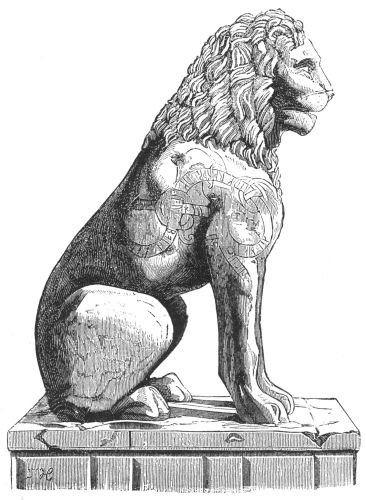
MARBLE LION FROM THE PIRÆUS, REMOVED IN 1687 TO VENICE, WHERE IT NOW STANDS AT THE ENTRANCE TO THE ARSENAL. THE RUNIC INSCRIPTION, CUT BY SOME VARANGIAN, IS NOW HALF EFFACED AND ILLEGIBLE.
Harold's adventures in Sicily, where he invented ingenious stratagems for the capture of cities; his love adventures with Maria, a relative of the Empress Zoë, the latter's jealousy and attempt to ruin him, his imprisonment, fight with the serpent, flight, vengeance upon the emperor, etc., are all of the typical kind and, therefore, more or less suspicious. Many Germanic heroes, both Norse and German,[A] had adventures of this order, when they visited the Orient, and there was a curious uniformity in the fates that befell them, both in love and war. To make the similarity complete, it was to make himself worthy of Elizabeth or Ellisif, the daughter of Jaroslav, that Harold set out in quest of fame and riches; and he did not fail to claim her on his return, and bring her back with him to the land of his fathers. He met his nephew, King Magnus, in Denmark, as he was sailing through the Sound along the coast of Skaane. His ship, in which he carried his treasures, was the most magnificent that had ever been seen in the North; and made a sensation wherever it appeared. Magnus, when he saw the beautiful galley, sent men aboard to find out whence it came and to whom it belonged. A very tall and handsome man, with courtly manners stepped forward, and said that he was an embassador from Harold Sigurdsson, King Magnus' uncle, and his errand was to learn how the king would receive his master. In response to this, the generous Magnus sent a message that he would receive his uncle with open arms, as he would expect to find a strong friend and supporter in a kinsman like him. The tall man was none other than Harold himself. A meeting was then arranged, and the two kinsmen were well pleased with each other. One there was, however, who was not pleased and that was Einar Thambarskelver. He foresaw what was coming, and when Harold presently advanced his claim to half the kingdom, he could scarcely restrain his wrath. Nevertheless, the king, who was most closely concerned in this demand, answered gently that he would not hastily dismiss his kinsman's request, but would be guided by the opinion of his counsellors. Einar, as the most important, was now asked for his advice and he arose, saying that if King Magnus was to cede half the kingdom of Norway to Harold, it was only fair that Harold should share his treasures with Magnus. This proposal did not prove agreeable to Harold; he had not, he said, braved dangers and gathered wealth for the purpose of enriching his nephew's men.
[A] The German stories of "Herzog Ernst" and "Hugditrich," and particularly that of "King Rother," have many features in common with the saga records of Harold Sigurdsson.
"But," rejoined Einar aptly, "thou wast far away, Harold, when we won the land back from the race of Knut, and no desire have we now to divide it between the chieftains. Hitherto we have only served one king at a time, and thus it shall continue to be, as long as King Magnus is alive and governs. I will do all I can to prevent thee from getting any share in the kingdom."
The other counsellors agreed that this judgment was sound, and declared themselves in the same spirit. This was the beginning of the bitter enmity between Harold Sigurdsson and Einar Thambarskelver which led to so many unhappy events in the near future. Harold, who in his victorious career had been unaccustomed to rebuffs, resented keenly his nephew's attitude toward him; and, for the purpose of bringing him to terms, formed an alliance with Sweyn Estridsson. With his great wealth he had no difficulty in raising a considerable force, with which, in Sweyn's company, he attacked Denmark, ravaging Seeland and Funen with ruthless cruelty. But the moment he learned that Magnus was approaching with his fleet, he separated from his ally and returned in haste to Norway. To justify this breach of faith, he spread the rumor that Sweyn had tried to assassinate him. A man did actually, in the dead of night, row over from Sweyn's ship to that of Harold, and steal into the latter's cabin. But Harold, pretending to expect an attempt upon his life, had put a log in his bed, covering it carefully with the bedclothes. The assassin, creeping across the floor, struck his axe into the log and made his escape. The next morning Harold showed the log with the axe yet sticking in it to his men, and denouncing Sweyn's faithlessness, set sail for Norway. There was, however, a suspicion that he had himself arranged the whole affair.
On his arrival in Norway, Harold sought his old friends and kinsmen in Ringerike, offering them great rewards if they would recognize him as king. But, partly because Magnus was so generally beloved, partly for fear of the consequences, the chieftains held aloof from the new pretender and discouraged his aspirations. In Guldbrandsdale he met with a better reception, and succeeded in gathering a band of partisans who were ready to share his fortunes. Here he summoned the people to a thing, where his cousin Thore of Steig, a youth of fifteen years, proclaimed him king. As soon as Magnus heard of his uncle's doings, he sailed to Viken. Here a battle seemed imminent, as Harold and his men were coming southward to attack the king. Magnus, however, was reluctant to fight against his father's brother, and, after some negotiations, it was agreed that the two kinsmen should both be kings, govern together, and share equally the income from taxes and the royal estates (1046). Norway was, accordingly, not divided into equal parts, each with a separate king, but the royal dignity was divided between two kings, who both exercised authority over the entire land. It was, as the future proved, a most disastrous precedent, which, however, Harold the Fairhaired himself had been the first to establish.
In return for his nephew's concession, Harold consented to share with him his wealth, which is said to have been very great, thus enabling Magnus to prosecute with the greater vigor his war with Sweyn Estridsson. The friendship between the two kings was, however, but of short duration. Not only their interests were in many points conflicting, but their characters were such as to invite antagonism. Harold's greed of money, his extortion of the peasants, and his jealous insistence upon every right which Magnus had of his own accord bestowed upon him, must have aroused in the latter's mind many bitter reflections. And still, with his innate generosity and forbearance, Magnus refused to credit the many complaints that reached his ears. He was so averse to quarrelling that, where his dignity permitted, he rather ignored an affront than resented it. It seems, on the other hand, as if Harold foresaw that so strained a relation could not last, and perhaps even desired to put an end to it. To his imperious temperament it was galling to suffer any restraint in the exercise of power.
Many incidents are related of his controversies with Magnus and his men. Thus, on one occasion, Einar Thambarskelver, in order to convince his foster-son of Harold's untrustworthiness, went to a thing, which the latter had summoned, and witnessed the proceedings. Einar wore a gilt helmet and was accompanied by sixty armed men. Harold, irritated by his presence, surpassed himself in the severity of his demands upon the peasants, and aroused much indignation. An old peasant named Toke, rose and said: "I have now lived and borne the name of peasant in the reigns of several kings, but I supposed when we had one king who with full right had accepted the kingdom and been proclaimed at Oere-thing, according to the counsel of the chiefs and with the consent of the people, and a man came later demanding the name and power of a king, that it is the former and not the latter who has the most power over us, his thegns. My advice is, therefore, ye peasants, that we await King Magnus' decision in regard to King Harold's demands and extortions, and that we continue in all things to accord honor to King Magnus."
When the old man had finished, Einar Thambarskelver arose and thanked him and all the peasants for their friendly disposition toward King Magnus. This was more than King Harold could endure. He sprang up and cried angrily: "Loftily dost thou wear thy helmet now, Einar, and always thou showest thyself as my opponent. Happy will the day be when thy helmet shall be laid low. As thou now art a head taller than others, thou shalt then be a head shorter."
Disagreements, of a more or less serious character, between the kings themselves were of frequent occurrence, and it was usually the prudence and self-control of Magnus which prevented an open rupture. No record has been preserved of the war which they waged together against Sweyn Estridsson. It is to be inferred that the greater number of the Danes took the part of Magnus against Sweyn, and that no battle of any consequence was fought. It is told that one day while the Norse fleet was lying close under land, a horseman, in splendid armor, came riding out of the forest, and began to exhibit his horsemanship, to the great admiration of the Norse warriors. When he had thus amused them for a while, he rode down to the edge of the water, and shouted: "I am a traitor to King Magnus, but so is King Harold to me; there is an immense difference between these kings."
At that moment King Magnus came on deck, and recognized Sweyn. But Sweyn spurred his horse and vanished among the trees. No attempt was made to pursue him.
"Sweyn Ulfsson is a goodly man," said Magnus, "and if he had as much people as he has courage and intrepidity, he would win more victories."
It was the bitterness that rankled in Magnus' heart against his uncle which made him lenient in his judgment of Sweyn. And we shall see how this sentiment presently affected his action. He had one day gone ashore with many of his men, and was riding in the neighborhood of the village Alsted, in Seeland, when his horse took fright and threw him. He was flung with his head against a stump, and was stunned, but afterward apparently recovered. Nevertheless, a morbid feeling took possession of him, and a foreboding of death darkened his mind. A dream which he had was rather the result than the cause of his melancholy presentiment. It seemed to him that his father, St. Olaf, came to him and gave him the choice between two things—viz., either to follow him now, or to live long and be the mightiest of kings, but load upon his soul a sin which hardly, if at all, could be forgiven.
"Choose thou for me, father," he seemed to answer.
"Then follow me now," said St. Olaf.
It is not hard to guess what the mortal sin was. That the temptation to resort to violence against his burdensome rival must have been frequently present to Magnus' mind, is scarcely to be wondered at. That the temptation was resisted, is rather a matter of wonder.
A few days passed, during which Magnus pondered the dream. Then, one morning, he woke up, burning with fever. Einar Thambarskelver, who stood at his bedside, asked if he was ill.
"Not very ill, yet, dear foster-father," he answered.
"It would be a sorrow which we could never get over if we were to lose thee," said Einar.
Magnus begged to be moved from one part of the ship to another; but changed his mind again and wished to be taken back to where he had first lain. Then Einar took alarm.
"Say to thy friends now, my lord, that which is nearest to thy heart," he said. "Give us good counsel; for mayhap our converse will not be long."
"Dear friend," the king replied, "I fear that this illness will soon make an end of our intercourse."
When the rumor spread that King Magnus was ill, Harold came aboard his ship and inquired about his condition.
"Yes, in sooth I am ill, kinsman," said the king, "and I have one prayer to you, that you will not show disfavor to my friends."
"That is only my duty for your sake," replied Harold, "but there are some of them who seem eternally sufficient unto themselves, and overlook me."
"What boots it to speak of such things now?" said Einar; "whatever Harold may promise, he has already determined in his mind what he will do."
Little was lacking that Harold got into a dispute with the dying king about the throne of Denmark, which Magnus had destined for Sweyn Estridsson, and the gold which they had shared between them when they shared the government. After having distributed gifts and keepsakes to his men, King Magnus died (1047), twenty-four years old, after having governed Norway for twelve years and a half, and Denmark for five years. No sooner had he closed his eyes than Harold sent men to intercept the messengers which had been despatched to Sweyn Estridsson to inform him of his succession to the Danish throne.
The death of King Magnus was announced to the fleet by the blowing of loors,[A] and the saying was indeed true, in his case, that he was mourned by all the people.
[A] Loors are long Alpine horns, made of wood bound with birch-bark, or of metal. They give a powerful sound.
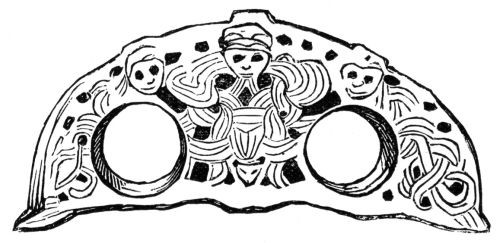
POMMEL OF GILT BRONZE FROM THE VIKING AGE.
CHAPTER XVI.
HAROLD SIGURDSSON HARD-RULER (1047-1066).
As Magnus the Good left no sons behind him, Harold Sigurdsson was the only remaining descendant in the male line of Harold the Fairhaired, and therefore undisputed heir to the throne. For, although the monarchy in Norway had not from the earliest times been strictly hereditary, the idea had gradually gained acceptance that the land belonged by allodial right to the male descendants of its first conqueror. In apparent, though not in real, conflict with this idea, was the custom of proclaiming the king separately at the thing in each shire and personally swearing him allegiance, on condition of his promising to rule in accordance with law and ancient usage. As we have seen, on many occasions, the tribal aristocracy never gave so blind an adherence to the hereditary principle as to renounce the practice of dictating conditions and, in many instances, deciding the choice between the various aspirants for the crown. If it had not been for the unhappy precedent, established by Harold the Fairhaired, that not one but all the sons of a king, legitimate and illegitimate, should succeed him on the throne, this balance of power would have prevented an arbitrary use of his authority, on the part of the king, and thus in the end have proved beneficial. In fact, the great principle of constitutional liberty is involved in this conflict of interests, and the natural opposition of an aristocracy to the encroachments of the crown. The situation in Norway, as well as the temperament of the people, was favorable to the gradual and uninterrupted development of a constitutional monarchy, such as the English, and if the long civil wars growing out of the claims of rival heirs to the throne had not exhausted the land, four hundred years of political extinction would not have preceded the resurrection of the nation in the present century.
Harold Sigurdsson soon showed that he appreciated the advantages of his position as the sole heir both of Harold the Fairhaired and St. Olaf. For St. Olaf's sanctity had shed new lustre upon the royal house, and greatly strengthened its hold upon the people. In fact, the later kings refer the source of their authority more frequently to their heirship of St. Olaf than to that of Harold the Fairhaired. When the tidings of King Magnus' death had gone abroad, his successor called a thing together and declared that it was not his intention to abide by his late nephew's decision to leave Denmark to Sweyn Estridsson. Denmark was his by right of inheritance, and he meant to go at once to Viborg-thing and proclaim himself king of the Danes. This declaration was not well received by the friends of King Magnus, and Einar Thambarskelver voiced their feelings, when he reminded Harold that it was his first duty to take the corpse to Nidaros and bury it with the proper honors. The fleet then broke up, and Harold having but a small force left, had no choice but to accept Einar's advice. At Borgar-thing, and later at Oere-thing, he was, according to ancient custom, proclaimed king, no opposition being offered to his succession. But cheerfully the peasants did not offer him their allegiance, for they knew him well and expected nothing good of him. His ideas of government he had imbibed among the Southern races, which patiently bore tyranny, because they lacked the sense of dignity and the sturdy manhood of the North. He had, indeed, a more definite political programme than any of his predecessors, but it was not a programme which was in accord with the genius of a free Germanic people.
Harold's first object, and the one which he pursued with indefatigable zeal throughout his reign, was to break the power of the tribal aristocracy. The influence, authority, and calm defiance of those miniature kings were perpetually a thorn in his flesh. His tall growth and great physical strength, no less than the ease with which he had so far achieved all that he had striven for, had inspired him with a supreme self-reliance and a corresponding contempt for all forces and interests opposed to his own. The ruthlessness with which he carried out his purposes made him many enemies and procured for him the surname Haardraade,[A] i. e., the hard ruler, the tyrant. What enabled him to maintain so stern a sway over a people, so jealous of their rights, was his superior intellect. "He was," says Snorre, "extremely intelligent, so that all men are agreed that there has never been a more intelligent king in the North. Moreover, he was an excellent swordsman, strong, and skilled in the art of war, and altogether a man who knew how to accomplish his purposes."
[A] Harold is referred to in English history as Harold the Haughty. German histories call him H. der Unbeugsame (H. the Inflexible).
Interesting in this connection is also his fondness for poetry and his skill as a scald. It is told that he sat up half the night with the blind Icelandic scald, Stuf Katson, and would not sleep as long as Stuf could recite to him. This little trait adds a vivid touch to his character and brings it closer to our sympathy and comprehension.
As the leader of the opposition to Harold, Einar Thambarskelver had long been prominent. As the son-in-law of Earl Haakon, the friend of Earl Erik and the foster-father of King Magnus, he occupied an exceptional position and was highly respected. His personal qualities were also such as to increase the esteem with which he was regarded. In natural endowments he was fully King Harold's match, and in imperiousness and proud self-assertion he did not yield much to him. Moreover, he was well skilled in the law, and when the king, as often happened, demanded more of the peasants than was his right, Einar rose as the people's spokesman and checked the arbitrary exaction. It was not to be wondered at that Harold hated him, but it is a striking tribute to the esteem in which he was held, that the king refrained so long from molesting him. But rashness was not among Harold's faults. He was fully capable of forecasting the results of his actions. As yet he felt that too great a risk would be involved in an attempt to rid himself of his enemy, who lived on a war-footing and was prepared to meet emergencies. With a view to weakening his power, Harold, therefore, made the Icelander Ulf Uspaksson his liegeman, and gave him far greater fiefs in Tröndelag than Einar had. Again, in order to break the solid front of the tribal magnates in that part of the country and divide their interests, he married the beautiful Thora, the sister of Eystein Orre, of the great race of the Arnmodlings.[A] The king was not then divorced from his first wife, Queen Ellisif, and it has therefore been supposed, that Thora was only his mistress. But it is not likely that her proud kinsmen would have allowed her to occupy such a position,[B] and it appears that the title of queen was everywhere accorded her. It is therefore impossible to escape the conclusion that Harold had, at the same time, two lawful wives.
[A] To this family belonged Finn Arnesson, who fought at St. Olaf's side at Stiklestad, and Kalf Arnesson, whom Magnus the Good exiled.
[B] See Munch: "Det Norske Folks Historie," ii., p. 180.
The tendency to subordinate all other considerations to policy, which Harold showed in his marriage, was also visible in his efforts to establish a rival saint to St. Olaf in the south of the country. The presence of the sanctuary of the national saint in Tröndelag had tended to increase the natural predominance of that province over the southern districts and to foster jealousies, which, in an imperfectly amalgamated nationality, are always rife. Viken, which had formerly belonged to Denmark, had never become intimately attached to the kingdom and race of Harold the Fairhaired; and Harold Sigurdsson judged rightly that a local saint of his own family would accomplish the double purpose. Such a saint was soon found in the person of Hallvard, the son of Vebjörn, and a cousin of the king. His history was not very remarkable, nor was his martyrdom, even with all its legendary embellishments, sufficient to warrant canonization. But it served the king's purpose well, and the regulation miracles began to manifest themselves in the usual fashion at St. Hallvard's shrine. Without submitting the question to the Pope, "the people" then proclaimed him a saint, and the king founded the town of Oslo, probably to shelter the new sanctuary (1051 or 1052). The site of the town was chosen with excellent judgment at the end of the Folden Fjord, where Christiania, the capital of Norway, is now situated.
When we consider the restless energy and power with which King Harold carried out his plans, both in internal and in foreign affairs, we cannot but derive a high idea of his ability. Whether, on the other hand, his activity was for the welfare of his subjects, is another question. Certainly, his long-continued war with Denmark was disastrous, both to himself and his people. His annual summer amusement consisted, for some time, in surprising the exposed ports on the Danish coast and harrying them with savage cruelty. At last, when both sides grew tired of this aimless destruction, it was agreed that Sweyn Estridsson should meet Harold at the mouth of the Götha Elv, and that the issue of the battle should decide in regard to the latter's claim to the throne of Denmark. At the time appointed, however, Sweyn failed to make his appearance, and Harold, after having waited for him in vain, sailed southward with his fleet, ravaging the coast of Jutland, burning the great city of Heidaby (Sleswick), and carrying away a number of high-born women, besides an enormous booty (1049). He was far from expecting to be pursued by the Danes, and, accordingly, allowed his ships to scatter on their homeward way. Head-winds and foggy weather delayed the Norsemen, and one morning when they were laying to under the island of Lesö, they saw a sudden flash through the fog which caused alarm. The king was called and asked what he supposed it to be.
"The Danish fleet is upon us," he said; "that which shines is the golden dragon-heads which flash in the morning sun."
Resistance was not to be thought of, and flight seemed also hopeless. But the king's presence of mind did not desert him. He ordered the men to the oars, but the ships, which were heavy and swollen from having been long in the water, made little headway, and, as the fog lifted, the Danish fleet, counting several hundred galleys, was seen bearing down upon them. Harold then commanded his men to nail bright garments and other precious things to logs and throw them overboard. The Danes, who could not resist the temptation to stop and pick them up, thereby lost time, and were rebuked by Sweyn for their folly. Again the pursuit began, and Harold was obliged to throw overboard malt, beer, and pork, in order to lighten his ships. Nevertheless, Sweyn was still gaining upon him, and Harold's own dragon-ship, which was the hindmost, was in danger of being captured. Then, in sheer desperation, he made rafts out of barrels and boards, put the Danish matrons and maidens upon them, and lowered them into the sea. One after another of these rafts was sent out at intervals, and the pursuers seeing their wives and daughters stretching out their arms to them, crying to be rescued, and some even struggling in the water, could not forbear to pause and save them. Thus Harold escaped, and Sweyn cursed his ill-luck. Nevertheless, when he captured some laggards among the Norse galleys, he refused to take vengeance upon them.
During a later expedition to Denmark (1060) Harold displayed again the same presence of mind, and daring invention. He had just beaten Sweyn in the battle of Djursaa, and felt perfectly safe in entering the long and narrow Lim-Fjord for purposes of plunder. But Sweyn, hearing that his antagonist had gone into such a trap, hastily gathered what forces he could command and laid to at Hals, where the fjord is so narrow that a few ships could easily engage a much superior number. Harold, perceiving that he was caught, gave orders to sail in through the fjord to the very end. Here a narrow isthmus separates the fjord from the North Sea. With enormous difficulty he now dragged his ships across the isthmus, and sailed gaily northward while Sweyn lay guarding the empty cage from which he had escaped. To make, however, an end of this wasteful and unprofitable warfare, Harold proposed to Sweyn that they should stake their kingdoms in a decisive battle in the Götha Elv.
It is not perfectly clear whether Sweyn accepted this challenge, though there is a probability that he did, as Harold would scarcely otherwise have gone to the place appointed for the battle. As on the former occasion, however, he waited in vain for the foe, and, dismissing the greater part of his force, sailed with one hundred and eighty ships down along the coast of Skaane until he came to Nis-aa, where he was surprised by Sweyn with a fleet of three hundred and sixty ships. A bloody battle was fought, lasting through an entire night (1062), and ending with the complete rout of the Danes. The victory was in a large measure due to the Norse chieftain Haakon Ivarsson, a man whom Harold had treated with harshness, but who, in the king's need, nevertheless, came to his rescue. Sweyn, too, owed his safety to Haakon, on board whose ship he sought refuge, and by whose aid he made his escape.
Great as the victory at Nis-aa was, its results, as far as Harold was concerned, proved insignificant. It was vain to suppose that Sweyn, as long as he had any power of resistance, would renounce his throne; and even if he had been willing to abide by such an agreement, the Norsemen's many plundering expeditions had made them so hated in Denmark that an army of occupation would have been needed to keep the land under their sway. They were, however, no less weary than the Danes of the incessant hostilities, and much against his will, Harold was forced to make peace at Götha Elv in 1064. He recognized Sweyn as king of Denmark, and promised no more to molest him.
The excessive burdens which Harold had imposed upon his people, in order to obtain the means to carry on this war, had produced great discontent among the peasants, and the important domestic events which preceded the peace will now claim our attention. During the prosecution of the war nothing irritated the king more than the captious criticism and opposition of the chieftains, and particularly of their leader, Einar Thambarskelver. Einar, with his six hundred men-at-arms, following him wherever he went, was the personified defiance of the king's authority; and Harold, when he once saw him land at the pier in Nidaros, flaunting his power in his face, is said to have exclaimed in verse: "Here I must see the haughty Einar land with a band of hus-carles so large that many an earl would have been satisfied with less. He thinks, perhaps, himself to mount the throne; and he will not stop until he has deprived me of my kingdom, unless he has first to kiss the thin lips of the axe."
Though this supposition may have been unfounded, it is very sure that Einar shunned no opportunity for manifesting his hostility to the king. Once he broke up a meeting when Harold was present, and with his armed retinue freed a convicted thief who had once been in his service. Another time he forced the king, by threatening an attack, to surrender a great treasure which once had been found in the ground, although the law adjudged all property thus acquired to the king. Einar, however, claimed that some runes on the lid of the chest, containing the treasure, showed it to have belonged to his father-in-law, Earl Haakon, whose only surviving heir was his wife Bergljot.
The king could scarcely be blamed for resenting such insolence, but the means he chose to get even with his enemy was unworthy of him. He had, by chance, captured some Danish men who had in their possession King Sweyn's seal. It is not improbable that they were secret emissaries from the Danish king, who was perhaps trying the tactics of his uncle Knut, whose bribes had once alienated the Norse chieftains from Olaf the Saint. It now occurred to Harold that he might use these men to test the disposition of the chieftains toward him and, what was especially important, gain a just reason for destroying those who should prove to be traitors. It was particularly against Einar Thambarskelver that this plot was directed. The men, purporting to come from King Sweyn, brought forged letters full of flattering assurances, and a large sum of money which they offered Einar as a pledge of the king's friendship. But he was equal to the test. "Every one knows," he said, "that King Harold is not my friend, while King Sweyn often speaks kindly of me, and I would fain be his friend. But if he comes to Norway with an army to fight King Harold and harry his kingdom, I will make him all resistance in my power, and I will help King Harold, with all the force at my command, to defend his kingdom."
When the Danes returned with this message to King Harold, he said:
"It was to be expected that he would answer like a man of honor, though not out of love for me."
There were other surprises in store for the king on this occasion. His friend and kinsman, Thore of Steig, who had first recognized his claim to the kingdom, accepted the bribe, and when informed that Harold was coming to punish him, he went cheerfully to meet him, and handed him the money, saying: "A short while ago, there were some Danish men at my house who brought me friendly letters and money from King Sweyn. I accepted the money, because I found it proper that you should receive what foreign kings were using to steal your country from you."
This was so shrewd an act that it extorted from Harold, even if he did see through it, a reluctant admiration.
A third man,—a peasant, named Högne Langbjörnsson—to whom the emissaries came, made them this answer:
"I did not think King Sweyn had heard of me, who am only a common peasant, but my answer to him is this: that if he comes to Norway with war-shield, no peasant's son shall do him more harm than I."
When this reply was reported to Harold he was greatly pleased, and presently offered Högne, as a reward for his fidelity, the title of liegeman, which was the highest dignity next to that of earl. But Högne was also proof against this temptation.
"All the friendship which you show me, my lord," he said, "I accept with thanks. But the title of liegeman I will not have, for I well know how things will go. When the liegemen came together they would say: 'Högne shall have the lowest seat, for he is only of peasant race, and thus the lowest of the liegemen.' My dignity would then not bring me honor, but shame. Far greater honor it is to be called a peasant and have the peasants say when they come together, that Högne is the foremost among them."
It is this sturdy sense of independence among peasants which makes Norwegian history unlike the history of any other country, and Norway the fountain-head of constitutional liberty in Europe. It was upon this rock that feudalism was wrecked in Norway, while it sailed triumphant down the current of history in Sweden, in Denmark, and all other European lands.
King Harold could not help recognizing this proud integrity, even when found in his enemies. He was more kindly disposed even toward Einar Thambarskelver after having become assured of his loyalty. In order to put an end to all differences between them, he invited the old man to a feast at the royal mansion in Nidaros, gave him the seat of honor next to himself, and entertained him in princely fashion. The horns were industriously drained, and Einar, who was nearly eighty years old, grew sleepy. As ill-luck would have it, the king was just then telling of his adventures in Constantinople, and he regarded the sleepiness of his guest as a mark of disrespect. He directed one of his men to play a rough trick on the sleeper, in return for which Einar, the next day, had the man slain. The old enmity then broke out afresh; and Harold, weary of the humiliations he had had to suffer, determined to rid himself of his foe. Under pretence of wishing to make peace with him, he invited him to a meeting. Einar came with his son Eindride and a large crowd of followers. The king, having concealed assassins in the hall, had covered up the smoke-hole so as to exclude the light. As Einar entered, leaving his son at the door outside, he expressed his astonishment at the darkness.
"Dark it is in the king's hall," he said.
The murderers immediately fell upon him and cut him down.
"Sharp are the fangs of the king's hounds," he cried.
Eindride, hearing his father's voice, rushed in to defend him, but was instantly surrounded and slain. In a few minutes the king strode out of the hall, and ordered his men to prepare themselves for an attack; but Einar's followers stood irresolute, and made no sign to pursue him, as he walked down to the river with his guard and rowed out to the fjord. The old Bergljot, when she heard of the king's treachery, rushed through the streets of the town, vainly calling upon the people to avenge her husband and son. She arrived at the king's mansion just in time to see Harold's boat gliding down the river. "Now we miss my kinsman Haakon Ivarsson," she cried; "for if he stood here on the slope, Einar's slayer would not be rowing down the river."
Harold acted wisely in betaking himself away after having aroused the wrath of the Trönders by this dastardly deed. He went to his kinsman by marriage, Finn Arnesson, and persuaded him to use his influence to quiet the people; in return for which he promised to recall his brother Kalf, and restore to him his property and dignities, of which King Magnus had deprived him. Moreover, Finn had to undertake a mission to Haakon Ivarsson, and induce him to forego his vengeance for the slaying of his kinsmen, and accept, as blood-wite, any favor which it was in the king's power to bestow. Finn accomplished both these missions with success; quieted the Trönders, and reconciled Haakon, who, as the price of peace, demanded the hand of Ragnhild, the daughter of Magnus the Good, in marriage. Nevertheless, the king had lost much in the estimation of the people by murdering Einar. The slaying itself they would readily have condoned; but the breach of faith they regarded as a crime, unworthy of an honorable warrior. Harold's disregard of faith and honor brought about a general disregard of moral obligations. Toward a treacherous king treason seemed pardonable. One after another of his liegemen, discovering his duplicity, turned away from him, left their country, and went to King Sweyn in Denmark, who received them well. The first who took this course was Finn Arnesson; Kalf, his brother, was a brave and able man, and King Harold seemed after his return to be kindly disposed toward him. For all that, during an expedition to Denmark, he sent him ashore with a small band of men and commanded him to attack a much superior Danish force, promising to come to his aid, if necessary. Kalf obeyed, and was killed with nearly all his men. Then, at last, when there was no need of it, the king landed and made an incursion for plunder into the country. Later, he boasted of having caused the death of thirteen men, and Finn was not wrong in supposing that his brother was one of them. He was so incensed at the king's treachery that he could no more endure to meet him face to face. He sailed with all his movable possessions to Denmark, where King Sweyn made him Earl of Halland, a province which now belongs to Sweden, and borders on the Norwegian province Viken.
A similar experience with King Harold had Haakon Ivarsson. He wooed Ragnhild, the daughter of King Magnus, but received the reply that she would not wed any man less than an earl. Haakon then begged the king to make him an earl; but Harold answered that he did not wish to have more than one earl at the time in his kingdom. Full of wrath, Haakon then betook himself to King Sweyn; but in the battle of Nis-aa again joined Harold, and saved him from defeat. His obligations toward Sweyn he also discharged by rescuing him after the battle, and sending him in safety to his friends. The fame which Haakon acquired by these exploits, so far from bringing him the favor of the king, rather excited his hostility. Harold did, indeed, persuade Ragnhild to marry him, and positively promised to make him an earl; but, after the wedding had taken place, he put him off on one pretext or another, and when Haakon pressed him for an answer, gave him a blank refusal. His wife, who had expected a different result, cried out to him joyously, as he returned: "Welcome, my Earl." He was forced to tell her what had occurred; and as he would not have the appearance of having won her under false pretences, he offered her divorce, and the right to keep all his property. This was a generous offer, but Ragnhild refused to accept it. Haakon, then, began secretly to dispose of his property, in the hope of escaping from the country without attracting the king's attention. Harold, however, got wind of his purpose, and started out with two hundred and forty men, in the night, to kill him. Being warned by a friend, he made his escape into Sweden, and thence to Denmark. Sweyn made him Earl of Halland after Finn Arnesson's death; and the Swedish king, Steinkil, gave him the two large provinces, Vestgötland and Vermeland. Haakon was now in possession of almost royal power, and he availed himself of his position to do as much damage to King Harold as possible. In the Oplands he had always been popular, while the king was much disliked for having deprived the peasants of certain privileges, bestowed upon them by Olaf the Saint. Haakon, therefore, had the audacity to levy taxes in this province, and when the king's tax-gatherers came, they were informed that there was no money due to him, as the taxes had been paid to Earl Haakon. But King Harold was not the man to pocket such insults. He gathered an army, invaded Sweden, and defeated Haakon and the Vestgoths; and the Oplanders he punished with exemplary severity.
In the year 1066, Earl Tostig, the brother of the English King Harold Godwineson, came to Norway to enlist Harold Sigurdsson's aid in an attempt to conquer England. He had been on a similar errand in Denmark, but had there met with small success. Sweyn Estridsson declared that he had no ambition to imitate the deeds of his uncle, Knut the Mighty; but would be quite content if he could keep and defend his own kingdom. Harold Sigurdsson, who never was averse to adventurous undertakings, lent a more favorable ear to the earl's representations, and in September, 1066, sailed for England with the largest fleet which up to that time had ever left the shores of Norway. About twenty thousand warriors embarked, and with the contingent which he exacted from the earls of the Orkneys, and Earl Tostig's own contribution, the entire force must have amounted to three hundred or three hundred and fifty ships and thirty thousand men. His queen, Ellisif, and his two daughters, Maria and Ingegerd, whom he had brought with him, he left on the Orkneys, and himself sailed down along the coast of Scotland to Northumberland. At Fulford he was met by an army under the Earls Markere and Eadwine, and won a great victory, whereupon the city of York surrendered. He encamped at Stamford Bridge, about seven miles from York; but left about one third of his army, under command of his son Olaf, to guard the ships. The weather was warm, and the men, having no thought of danger, did not wear their armors. At Stamford Bridge, however, they were surprised by a large army, led by Harold Godwineson. Tostig advised a speedy return to the ships; but Harold Sigurdsson, being too proud to turn his back to any foe, gave orders to await the attack of the English. While the army was being arranged in battle array, twenty English horsemen came riding toward them, and one of them asked if Earl Tostig was present.
"It is not to be denied that you will find him here," answered Tostig.
"We bring thee this greeting from thy brother Harold," said the Englishman, "that he offers thee peace and Northumberland; nay, he is not indisposed to grant thee one third of his kingdom, if he can gain thy friendship on no other terms."
"This, in sooth, is another offer than the scorn and strife which were offered me last autumn. * * * Suppose, now, that I accept this proposal; what does then my brother offer the King of Norway?"
"He has intimated how large a piece of England he will grant to King Harold Sigurdsson; it is the space of seven feet, or so much more as he is taller than other men."
"If such is the case," Tostig rejoined, "then ride back and bid King Harold commence the battle."
Harold Sigurdsson, who had listened to this colloquy, asked Tostig who the spokesman of the Englishmen was.
"That was my brother, Harold Godwineson himself," answered the earl. "Too late did I learn that," said King Harold.
The English cavalry made the first onslaught, but were repulsed. Thinking that their retreat indicated a general flight, the Norsemen started in pursuit, thus breaking up their battle array, which it was the king's intention to preserve until the expected reinforcements arrived from the ships. King Harold fought with berserkir fury, rushing into the thick of the fray and hewing savagely about him. The English ranks broke, and every thing indicated a victory for the Norsemen, when the king's throat was pierced by an arrow, and he fell from his horse dying. Tostig now assumed command, after having refused an armistice, offered by his brother. He fought bravely for a while, and the Norsemen, weary and wounded though they were, shouted their battle-cry and rushed forward once more, eager to avenge their king. Then Tostig, too, was cut down, and the wide battle-field was covered with the bodies of the slain. Just then, Eystein Orre, King Harold's brother-in-law, arrived with reinforcements, and a short and desperate combat ensued, until he, too, fell. Under cover of the twilight a small remnant of the great army succeeded in reaching the ships. One man, named Styrkaar Stallare, had got hold of a horse and dashed furiously away over the fields, arrayed in his shirt and a helmet. His clothes had been torn off him in the heat of the combat. A cold wind was blowing, and chilled him to the bone. On his way, he met an English yeoman, dressed in a warm jerkin of sheepskin. Styrkaar asked him how much he would take for the garment.
"I won't sell it to thee," answered the yeoman, "for I know thee by thy speech that thou art a Norseman."
"If that's so," said Styrkaar, "what wilt thou then do?"
[A] The German stories of "Herzog Ernst" and "Hugditrich," and particularly that of "King Rother," have many features in common with the saga records of Harold Sigurdsson.
Harold's adventures in Sicily, where he invented ingenious stratagems for the capture of cities; his love adventures with Maria, a relative of the Empress Zoë, the latter's jealousy and attempt to ruin him, his imprisonment, fight with the serpent, flight, vengeance upon the emperor, etc., are all of the typical kind and, therefore, more or less suspicious. Many Germanic heroes, both Norse and German,[A] had adventures of this order, when they visited the Orient, and there was a curious uniformity in the fates that befell them, both in love and war. To make the similarity complete, it was to make himself worthy of Elizabeth or Ellisif, the daughter of Jaroslav, that Harold set out in quest of fame and riches; and he did not fail to claim her on his return, and bring her back with him to the land of his fathers. He met his nephew, King Magnus, in Denmark, as he was sailing through the Sound along the coast of Skaane. His ship, in which he carried his treasures, was the most magnificent that had ever been seen in the North; and made a sensation wherever it appeared. Magnus, when he saw the beautiful galley, sent men aboard to find out whence it came and to whom it belonged. A very tall and handsome man, with courtly manners stepped forward, and said that he was an embassador from Harold Sigurdsson, King Magnus' uncle, and his errand was to learn how the king would receive his master. In response to this, the generous Magnus sent a message that he would receive his uncle with open arms, as he would expect to find a strong friend and supporter in a kinsman like him. The tall man was none other than Harold himself. A meeting was then arranged, and the two kinsmen were well pleased with each other. One there was, however, who was not pleased and that was Einar Thambarskelver. He foresaw what was coming, and when Harold presently advanced his claim to half the kingdom, he could scarcely restrain his wrath. Nevertheless, the king, who was most closely concerned in this demand, answered gently that he would not hastily dismiss his kinsman's request, but would be guided by the opinion of his counsellors. Einar, as the most important, was now asked for his advice and he arose, saying that if King Magnus was to cede half the kingdom of Norway to Harold, it was only fair that Harold should share his treasures with Magnus. This proposal did not prove agreeable to Harold; he had not, he said, braved dangers and gathered wealth for the purpose of enriching his nephew's men.
[A] Loors are long Alpine horns, made of wood bound with birch-bark, or of metal. They give a powerful sound.
The death of King Magnus was announced to the fleet by the blowing of loors,[A] and the saying was indeed true, in his case, that he was mourned by all the people.
[A] Harold is referred to in English history as Harold the Haughty. German histories call him H. der Unbeugsame (H. the Inflexible).
Harold's first object, and the one which he pursued with indefatigable zeal throughout his reign, was to break the power of the tribal aristocracy. The influence, authority, and calm defiance of those miniature kings were perpetually a thorn in his flesh. His tall growth and great physical strength, no less than the ease with which he had so far achieved all that he had striven for, had inspired him with a supreme self-reliance and a corresponding contempt for all forces and interests opposed to his own. The ruthlessness with which he carried out his purposes made him many enemies and procured for him the surname Haardraade,[A] i. e., the hard ruler, the tyrant. What enabled him to maintain so stern a sway over a people, so jealous of their rights, was his superior intellect. "He was," says Snorre, "extremely intelligent, so that all men are agreed that there has never been a more intelligent king in the North. Moreover, he was an excellent swordsman, strong, and skilled in the art of war, and altogether a man who knew how to accomplish his purposes."
[A] To this family belonged Finn Arnesson, who fought at St. Olaf's side at Stiklestad, and Kalf Arnesson, whom Magnus the Good exiled.
[B] See Munch: "Det Norske Folks Historie," ii., p. 180.
As the leader of the opposition to Harold, Einar Thambarskelver had long been prominent. As the son-in-law of Earl Haakon, the friend of Earl Erik and the foster-father of King Magnus, he occupied an exceptional position and was highly respected. His personal qualities were also such as to increase the esteem with which he was regarded. In natural endowments he was fully King Harold's match, and in imperiousness and proud self-assertion he did not yield much to him. Moreover, he was well skilled in the law, and when the king, as often happened, demanded more of the peasants than was his right, Einar rose as the people's spokesman and checked the arbitrary exaction. It was not to be wondered at that Harold hated him, but it is a striking tribute to the esteem in which he was held, that the king refrained so long from molesting him. But rashness was not among Harold's faults. He was fully capable of forecasting the results of his actions. As yet he felt that too great a risk would be involved in an attempt to rid himself of his enemy, who lived on a war-footing and was prepared to meet emergencies. With a view to weakening his power, Harold, therefore, made the Icelander Ulf Uspaksson his liegeman, and gave him far greater fiefs in Tröndelag than Einar had. Again, in order to break the solid front of the tribal magnates in that part of the country and divide their interests, he married the beautiful Thora, the sister of Eystein Orre, of the great race of the Arnmodlings.[A] The king was not then divorced from his first wife, Queen Ellisif, and it has therefore been supposed, that Thora was only his mistress. But it is not likely that her proud kinsmen would have allowed her to occupy such a position,[B] and it appears that the title of queen was everywhere accorded her. It is therefore impossible to escape the conclusion that Harold had, at the same time, two lawful wives.
As the leader of the opposition to Harold, Einar Thambarskelver had long been prominent. As the son-in-law of Earl Haakon, the friend of Earl Erik and the foster-father of King Magnus, he occupied an exceptional position and was highly respected. His personal qualities were also such as to increase the esteem with which he was regarded. In natural endowments he was fully King Harold's match, and in imperiousness and proud self-assertion he did not yield much to him. Moreover, he was well skilled in the law, and when the king, as often happened, demanded more of the peasants than was his right, Einar rose as the people's spokesman and checked the arbitrary exaction. It was not to be wondered at that Harold hated him, but it is a striking tribute to the esteem in which he was held, that the king refrained so long from molesting him. But rashness was not among Harold's faults. He was fully capable of forecasting the results of his actions. As yet he felt that too great a risk would be involved in an attempt to rid himself of his enemy, who lived on a war-footing and was prepared to meet emergencies. With a view to weakening his power, Harold, therefore, made the Icelander Ulf Uspaksson his liegeman, and gave him far greater fiefs in Tröndelag than Einar had. Again, in order to break the solid front of the tribal magnates in that part of the country and divide their interests, he married the beautiful Thora, the sister of Eystein Orre, of the great race of the Arnmodlings.[A] The king was not then divorced from his first wife, Queen Ellisif, and it has therefore been supposed, that Thora was only his mistress. But it is not likely that her proud kinsmen would have allowed her to occupy such a position,[B] and it appears that the title of queen was everywhere accorded her. It is therefore impossible to escape the conclusion that Harold had, at the same time, two lawful wives.