автордың кітабын онлайн тегін оқу Through Portugal
Transcriber's Note:
The cover image was created by the transcriber and is placed in the public domain.
THROUGH PORTUGAL
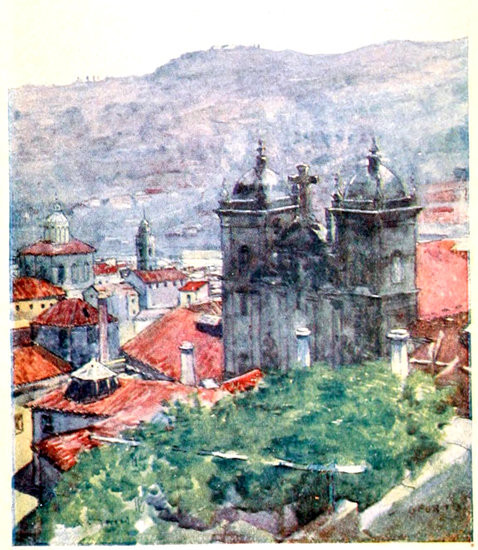
FROM A WINDOW, OPORTO.
THROUGH
PORTUGAL
BY
MARTIN HUME
WITH 32 ILLUSTRATIONS IN COLOUR BY
A. S. FORREST
AND 8 REPRODUCTIONS OF PHOTOGRAPHS
“Oh Christ! it is a goodly sight to see
What heaven hath done for this delicious land;
What fruits of fragrance blush on every tree,
What goodly prospects o’er the hills expand.”
Byron.
NEW YORK
McCLURE, PHILLIPS & COMPANY
1907
Printed by
Ballantyne, Hanson & Co.
Edinburgh
This record of
a pleasure journey through Europe’s
“Garden by the Sea”
is dedicated by gracious permission to
His Majesty
The King of Portugal
CONTENTS
CHAPTER I
PAGE
OPORTO
1CHAPTER II
BRAGA AND BOM JESUS
34CHAPTER III
CITANIA AND GUIMARÃES
54CHAPTER IV
BUSSACO
90CHAPTER V
COIMBRA, THOMAR, AND LEIRIA
122CHAPTER VI
BATALHA AND ALCOBAÇA
169CHAPTER VII
CINTRA
199CHAPTER VIII
LISBON
229CHAPTER IX
SETUBAL, TROYA, AND EVORA
264CHAPTER X
HINTS TO TRAVELLERS IN PORTUGAL
308I
OPORTO
II
BRAGA AND BOM JESUS
III
CITANIA AND GUIMARÃES
IV
BUSSACO
V
COIMBRA, THOMAR, AND LEIRIA
VI
BATALHA AND ALCOBAÇA
VII
CINTRA
VIII
LISBON
IX
SETUBAL, TROYA, AND EVORA
X
HINTS TO TRAVELLERS IN PORTUGAL
ILLUSTRATIONS
IN COLOUR
FROM A WINDOW IN OPORTO
FrontispieceEVENING: OPPOSITE OPORTO
To face page 8FROM THE RIBEIRA, OPORTO
To face page 16A SHOP IN OLD OPORTO
To face page 28THE AFTER-GLOW AT BRAGA
To face page 40ON THE TERRACE, BOM JESUS
To face page 50ON THE HOLY STAIR, BOM JESUS
To face page 52ON THE WAY TO MARKET, TAIPAS
To face page 58FROM THE BATTLEMENT, BUSSACO
To face page 96THE HOTEL FROM THE WOODS, BUSSACO
To face page 102IN THE GARDENS, BUSSACO
To face page 106THE PORTA DA SULLA, BUSSACO
To face page 108“BUSSACO’S IRON RIDGE”
To face page 112THE BATTLE MONUMENT, BUSSACO
To face page 116ENTRANCE TO THE CLOISTER, BUSSACO
To face page 120ON THE SUMMIT OF BUSSACO. THE CRUZ ALTA
To face page 122A STREET IN COIMBRA
To face page 128SANTA CLARA, COIMBRA
To face page 136A COUNTRY RAILWAY STATION
To face page 142A CORNER OF THE TOWN HALL AND THE MONASTERY, THOMAR
To face page 144SOME BEAUTIES OF THOMAR
To face page 146CHURCH OF S. JOÃO IN THE PRAÇA, THOMAR
To face page 156THE BRIDGE AT THOMAR
To face page 158IN THE MAIN STREET OF OUREM
To face page 160THE CASTLE, LEIRIA
To face page 164ON THE ALAMEDA, LEIRIA
To face page 166THE ENCARNAÇÃO, LEIRIA
To face page 168ON THE PRAÇA AT ALCOBAÇA
To face page 188UNDER THE ACACIAS, ALCOBAÇA
To face page 192THE OLD PALACE, CINTRA
To face page 204ON THE QUAY, LISBON
To face page 234LISBON, FROM THE NORTH
To face page 306FROM PHOTOGRAPHS
MANUELINE ARCHITECTURE AT THE HOTEL, BUSSACO
To face page 94ON THE VIA SACRA, BUSSACO
To face page 104THE CHOIR AND CHAPTER HOUSE, THOMAR
To face page 148THE CLOISTERS, BATALHA
To face page 180THE UNFINISHED CHAPELS, BATALHA
To face page 182MANUELINE WINDOWS IN THE OLD PALACE, CINTRA
To face page 224THE SOUTH DOOR AT BELEM
To face page 238THE “TEMPLE OF DIANA,” EVORA
To face page 300EVENING OPPOSITE OPORTO.
FROM THE RIBEIRA, OPORTO.
A SHOP IN OLD OPORTO.
THE AFTER-GLOW AT BRAGA.
ON THE TERRACE, BOM JESUS.
ON THE HOLY STAIR, BOM JESUS.
ON THE WAY TO MARKET, TAIPAS.
FROM THE BATTLEMENT, BUSSACO.
THE HOTEL, BUSSACO, FROM THE WOODS.
IN THE GARDENS, BUSSACO.
THE PORTA DA SULLA, BUSSACO.
BUSSACO’S IRON RIDGE.
THE BATTLE MONUMENT, BUSSACO.
ENTRANCE TO THE CLOISTER, BUSSACO.
ON THE SUMMIT OF BUSSACO, THE CRUZ ALTA.
A STREET IN COIMBRA.
SANTA CLARA, COIMBRA.
A COUNTRY RAILWAY STATION.
A CORNER OF THE TOWN HALL AND THE CONVENT, THOMAR.
SOME BEAUTIES OF THOMAR.
CHURCH OF ST. JOÃO IN THE PRAÇA, THOMAR.
THE BRIDGE AT THOMAR.
IN THE MAIN STREET OF OUREM.
THE CASTLE, LEIRIA.
ON THE ALAMEDA, LEIRIA.
THE ENCARNAÇÃO, LEIRIA.
ON THE PRAÇA AT ALCOBAÇA.
UNDER THE ACACIAS, ALCOBAÇA.
THE OLD PALACE, CINTRA.
ON THE QUAY, LISBON.
LISBON FROM THE NORTH.
Manueline Architecture at the Hotel, Bussaco
On the Via Sacra, Bussaco.
The Choir and Chapter-House, Thomar.
The Cloisters, Batalha.
“The Unfinished Chapels,” Batalha
Manueline Windows in the Old Palace, Cintra
The South Door at Belem
The “Temple of Diana,” Evora
INTRODUCTION
Portugal had been familiar to me from my earliest youth, for my road to and from Spain had often lain that way, and circumstances had made me conversant with the language and history of the country; and yet this book is not the outcome of any such previous knowledge, but mainly of one short voyage in search of change and health. It happened in this way. As oft befalls men who in this striving world have to wring their brains for drachmas, the completion of a particularly arduous book had left me temporarily a nervous wreck, sleepless and despairing. The first and most obvious need dictated to me by those who settle such matters, was to forget for a time that pens, ink, and paper existed, and to seek relaxation in a clime where printers cease from troubling and reviewers are at rest. But where? Spain certainly would offer me no such a haven: France was too near home, Germany I disliked, Switzerland was trite and overrun, the novelty of Italy I had long before exhausted, and Greece was too far away. A sea voyage was a desideratum, but it must not be too long, and as the autumn was already verging towards winter the south alone was available.
Then in the midst of my perplexity the happy thought suggested itself that, often as I had passed through Portugal, I had never seen the country. Why not try Portugal? I had some prejudices to overcome, prejudices, indeed, which up to that time had prevented me from seeking a deeper knowledge of the land and people than could be gained by an incurious glance on the way through. For I had been brought up in the stiff Castilian tradition that Portugal was altogether an inferior country, and the Portuguese uncouth boors who in their separation from their Spanish kinsmen had left to the latter all the virtues whilst they themselves had retained all the vices of the race. But, withal, I chose Portugal, and have made this book my apologia as a self-prescribed penance for my former injustice towards the most beautiful country and the most unspoilt and courteous peasantry in Southern Europe. Portugal and the Portuguese, indeed, have fairly conquered me, and the voyage, of which some of the incidents are here set forth, was for me a continual and unadulterated delight from beginning to end, bringing to me refreshment and renewed vigour of soul, mind, and body, opening to my eyes, though they had seen much of the world, prospects of beauty unsurpassed in my experience, and revealing objects of antiquarian and artistic interest unsuspected by most of those to whom the attractions of the regular round of European travel have grown flat and familiar.
It is impossible, of course, to pass on to others the full measure of enjoyment felt by an appreciative traveller in a happy trip through an unhackneyed pleasure-ground; but it has occurred to me that some record of my impressions on the way may lead other Englishmen to seek for themselves a repetition of the pleasure and benefit which I experienced in the course of a short holiday trip through Portugal from north to south. I am not pretending to write a guidebook: those that exist are doubtless sufficient for all purposes, although I have intentionally refrained from consulting any of them, in order that my impressions might not be biassed, even unconsciously, by the opinions of others; nor do I claim to speak of Portugal with the fulness of knowledge exhibited by Mr. Oswald Crawford in his books on the country where he resided so long. My object is rather to treat the subject from the point of view of the intelligent visitor in search of sunshine, health, or relaxation; to suggest from my own experience routes of travel and points of attraction likely to appeal to such a reader as I have in my mind, and to warn him frankly of the inevitable small inconveniences which he must be prepared to tolerate cheerfully if he would enjoy to the full a holiday spent in a country not as yet overrun by tourists who insist upon carrying England with them wherever they go. If he will consent to “play the game,” and not expect the impossible in such a country, I can promise my traveller a voyage full of colour, interest, and novelty in this “garden by the side of the sea,” where pines and palms grow side by side, and the stern north and softer south blend their gifts in lavish luxuriance beneath the happy conjunction of almost perpetual sunshine and moist Atlantic breezes.
MARTIN HUME.
THROUGH PORTUGAL
I
OPORTO
I stood in the centre of a daring bridge, spanning with one bold arch of nigh six hundred feet a winding rocky gorge. Far, far below me ran a chocolate-coloured river crowded with quaint craft, some with high-raised sheltered poops and crescent-peaked prows, some low and long astern with bows like gondolas and bright red lateen sails, upon which the fierce sun blazed sanguinely. On the right side thickly, and on the left more sparsely, climbing up the stony sides of the gorge, were piled hundreds of houses, pink, pale-blue, buff, and white, all with glowing red-tiled roofs, and each set amidst a riot of verdure which trailed and waved upon every nook and angle uncovered by buildings. Trellised vines clustered and flowers flaunted in tiny back-yards and square-enclosed courts by the score, all on different levels, but all open to the down-gazing eyes of the spectator on the bridge high above them. Here and there a tall palm waved its plumes as in unquiet slumber, but everywhere else was the impression of ardent, throbbing, exuberant life, such as all organic creation feels under the spur of stinging sunshine and the salt twang of the sea-breeze. The river gorge winds and turns so tortuously that the view forward and backward is not extensive, but as far as the eye reaches on each side of the umber stream the hills of houses and far-spread terraced vineyards beyond rise precipitously, with just a quayside at foot on the banks of the stream, thronged now with folk who swarm, gather, and separate like gaudy ants, and apparently no bigger, as seen from the coign of vantage on the bridge. To my left, as I stand looking towards the west, there crowns the summit of the ridge close by a vast white monastery against a green background; a monastery now, alas! like all others in this Catholic land, profanated and turned to purposes of war instead of peace, but, withal, there still rears its modest rood aloft upon the crest one poor little round chapel where the sainted image of Pilar of the Ridge stolidly receives the devotion of the faithful. To the right, the height is crowned by a vast square episcopal palace, and near it, over all, is the glittering golden cross that shines upon the city from the summit of the square cathedral towers. This is Oporto, The Port par excellence, which gives its name to Portugal, seen from the double-decked iron bridge of Dom Luis over the Douro.
For days I had been striving in vain to get into touch with the psychic principle of this strange city. I had mixed with the motley multitudes that lounge and labour upon the quays, I had lingered in the gilded churches where worshippers were ominously few, and stood for hours observant in chaffering marketplaces and amidst the crowds of sauntering citizens in the inevitable Praça de Dom Pedro; but till the revelatory moment came to me in one enlightening flash upon the Bridge of Dom Luis, I had always been alone in a foreign throng whose composite inner soul I could not read. But now all was changed. Thenceforward I saw Oporto whole and not in disintegrated fragments as before; for I had learnt the secret of putting the pieces of the puzzle together and the heart of the city was bared to me, a stranger.
Every large, enduring community comes to attain a distinct character of its own, which the outlander can only know by long association or sympathetic insight, sometimes not at all. I had looked for a people exuberant and gay in outward seeming with an underlying spirit of bitter mockery, such as I had known in so many other Iberian cities; but somehow these Oporto people were quite different. Grave and quiet, with introspective eyes, even the children seemed to take their play soberly. Look at the slim slip of a boy who gravely walks at the head of this team of enormous fawn-coloured oxen, toilsomely dragging their ponderous load up a hill so steep as almost to need a ladder to ascend. The urchin cannot be more than ten or eleven, and in any other country would alternately skip and idle, or at least allow his attention to wander with every fresh object that struck his fancy. Here he stalks along for hours at a time, without lingering or straying, always calm and patient, whilst his soiled and hardened bare feet plod on, heedless both of the white mire and sharp stones of the way. Over his shoulder he carries a long lithe wand, double as tall as himself, with which he directs the course of the great wide-horned bullocks. A mere turn of the wand is sufficient to indicate the way, and with low bowed heads beneath the heavy yoke the dull beasts plod slowly onward as long-suffering as their guide. The whole equipage might belong to the times when the world itself was young, so idyllic is it in form. The wain is narrow and high-set upon two wheels, like an ancient chariot, with boards or high rods to form its sides; the wheels are built up ponderously of solid wood, the two thick spokes that connect the heavy tire with the hub filling up most of the circle, and the axle, a heavy log of wood, itself turns with the wheels. In this part of Portugal there stands erect upon the neck of the team an adornment which is usually the pride of the owner’s heart, and the one superfluous article of luxury he possesses. It is a thick board of hardwood, about eighteen inches high and some five feet broad, intricately and beautifully carved in fretted open-work arabesques. The patterns are traditional, handed down from time immemorial, and usually consist of involved geometrical and curvilinear designs; sometimes, but not often, with a cross introduced in the centre, and with a row of little bristle brushes as an extra adornment along the top. A glance at this elaborate piece of ox furniture will show that its decoration is of Moorish origin, and the canga itself may be the survival of the high ox yoke still seen in some oriental countries. To complete the quaint picture of the universal ox team, for this part of Portugal is not a country of horses or mules, the dress of the small teamster must be described. The boy’s breeches usually do not reach below the knee, the rest of the legs and feet being bare; a jacket of brown homespun is slung upon one shoulder, except at night or during the cold winter days of December and January, when it is worn, and the shirt, open at the neck and breast, leaves much of the upper part of the body exposed. The headgear is peculiar. It is nearly always a knitted stocking bag cap, something like an old-fashioned nightcap, with a tassel at the end of the bag which hangs down the back or upon the shoulder of the wearer, its colour being sometimes green and red, but more frequently black.
The boy, like his similarly garbed elders, takes life very seriously, but neither he nor they seem sad or depressed. There is here none of the squalid misery or whining mendicancy that are so distressing to strangers in Spain and Southern Italy, for the Portuguese of the north is a sturdy, self-respecting peasant, who works hard and lives frugally upon his three testoons (1s. 3d.) per day; and so long as he can earn his dried stockfish, his beans, bread, and grapes, with a little red wine to drink, he scorns to beg for the indulgence of his idleness.
These are the people, and their social betters of the same race, whom a sudden flash of sympathy brought closer to me, as in the pellucid golden sunlight all Oporto was spread before and beneath me, palpitating with life. The absence of vociferation and vehemence in the people did not mean sulkiness or stupidity, but was the result of the intense earnestness with which their daily life was faced; their unregarding aloofness towards strangers was not rudeness, but the highest courtesy which bade them avoid obtrusive curiosity; and soon I learnt to know that their cold exterior barely concealed a disinterested desire to extend in fullest measure aid and sympathy to those who needed them. In all my wanderings I have never met, except perhaps in Norway, a peasantry so full of willingness to show courtesy to strangers without thought of gain to themselves as these people of north Portugal, almost pure Celts as they are, with the Celtic innate kindliness of heart and ready sympathy, though, of course, with the Celtic shortcomings of jealousy, inconstancy, and distrust.
I know few more characteristic thoroughfares than the road by the river-side at Oporto, called the Ribeira, which is the centre of maritime activity of the port. The path runs beneath what was the ancient river-wall, now pierced or burrowed out to form caverns of shops, where wine and food, cordage and clothing are sold to sailor men. Many of the open doors have vine trellises before them, in the shade of which quaintly garbed groups forgather, and a constant tide of men and women flows along the path, eddying into and out of the cavernous recesses in the ancient wall. Colour, flaring and fierce in the sun, flaunts everywhere; for the multi-tinted rags of the south festoon and flutter from every door and window and deck the persons of all the womankind. Swinging along, with peculiar and ungainly gait, go the women with prodigious burdens upon their heads. Everything, from babies to bales of merchandise, is borne upon the female head in Portugal; and these women of the north wear a peculiar headgear adapted to this custom. It is a round, soft, pork-pie hat of black cloth or velveteen, fitting well upon the top of the head, the upper rim being adorned with a sort of standing silk fringe. Such a hat, especially when surmounted by a knot, suffers no damage from a burden placed upon it; but the constant carrying of tremendous weights upon the head of females, even of little girls, quite spoils the figures of the women, thrusting the hips and pelvis forward inordinately, and rendering the movements in walking most ungraceful. The women and girls almost invariably go barefooted, whilst the men, except the fishermen, usually are shod; and the females of a family share to the full the work and hardships which are the common lot.
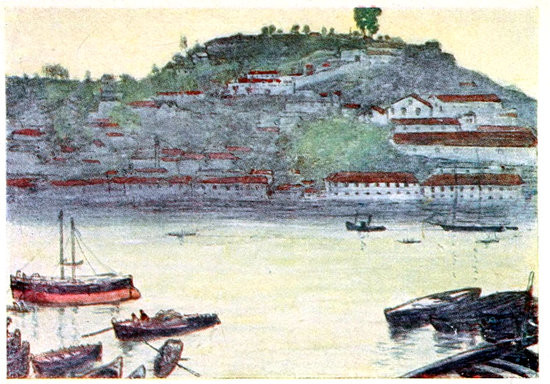
EVENING OPPOSITE OPORTO.
Along the shore of the busy Ribeira lie ships unloading, small craft they usually are, for the bar of the Douro is a terrible one, and the big ships now enter the harbour of Leixões, a league away. In a constant stream the men and women pass across the planks from ship to shore, carrying the cargo upon their heads or shoulders in peculiar boat-shaped baskets, which are the inseparable companion of the Oporto workers. Here is a smart schooner hailing from the Cornish port of Fowey, from which stockfish from Newfoundland is being landed on the heads of women, flat salt slabs as hard and dry as wood, but good nutritious food for all that; and farther along, with their prows to the shore, rest a dozen un-ladened wine and fruit boats from up the Douro, and flat-bottomed passenger skiffs into which women and men with baskets and bundles, representing their week’s supplies purchased in Oporto, are crowding to be carried back to their homes in the rich vineyard villages miles up the river. One by one the quaint craft hoist their crimson sails, and struggle out from the tangle of the bank, until the breeze catches them, and in a shimmer of red gold from the setting sun they hustle through the brown tide until a projecting corner hides them from view. It is a scene never to be forgotten.
The centre of the Ribeira is the Praça called after it, where a sloping square facing the water opens out. The scene is picturesque in the extreme. The space is thronged by men, either sleeping in their baskets or carrying them filled with fish or merchandise upon their heads: a motley, water-side crowd, men of all nations, pass to and fro, or gossip under the vine trellis before the wine shop overlooking the square, and as the observer casts his eyes upwards he sees the gaily coloured houses piled apparently on the top of one another, until at the top of all, as if overhead, is the glaring white palace of the bishop, and the glittering cathedral cross, standing out hard and clear against a sky of fathomless indigo.
This busy river-side way of the Ribeira is, so to speak, a street of two storeys. Below is the walk I have described, with the cavernous shops in the face of the old river-wall, and on the top of the wall is another path reached by occasional flights of steps, and also bordered by the squalid medley of dark shops in which strange savoury-odoured victuals are washed down by strong red wine, and quiet brown men and women, and grave-eyed swarthy babies are inextricably mixed up with brown merchandise in the gloom beyond the glaring sunlight. Unexpected steep alleys, arched and mysterious, lead to the thoroughfares higher up the precipitous slope, and the next storey, a parallel narrow street, the Rua do Robelleiro, narrow, dark, and ancient, is almost as picturesque as the Ribeira itself.
A slab let into the river-wall by the beach commemorates one of the most terrible days in Oporto’s history. The English army had been chased to its ships at Corunna, and the Spanish levies scattered: the Peninsula seemed to be at the mercy of the French legions, which, under Napoleon’s greatest marshals, held the richest provinces of Spain in the name of King Joseph Bonaparte. But 9000 English troops remained in Lisbon, and with Portugal in the hands of his enemies Napoleon knew that he would never be master of Spain. So the word went forth that Soult was to march down with a great army from Galicia, and sweep the English out of Portugal. It seemed easy, and authorities even in England believed that Portugal was untenable and should be evacuated. All but one man, Arthur Wellesley, whose victory at Vimeiro in the previous year had been wasted by the inept old women who were his superior officers. With 20,000 men, said Wellesley, he would hold Portugal against 100,000 French, the marshals notwithstanding; and the great Englishman had his way. Beresford was sent out to reorganise the scattered Portuguese fighting men, and Arthur Wellesley sailed from England with his little army to face Soult in Portugal. Before he arrived in Lisbon the French had swept down from Galicia, and on the 27th March 1809, Soult summoned Oporto to surrender. The warlike Bishop of Oporto was heading the hastily organised defence; his forces were undisciplined and badly armed, but their hearts were stout, and behind their poor earthworks the citizens of Oporto and their bishop bade defiance to Soult and his invading army.
On the 29th March at dawn the devoted city was stormed by Napoleon’s veterans, who swept all before them. There was no quarter, no mercy, and the steep streets of the city were turned to blood-smeared shambles. Down to the river bank flocked the affrighted people, falling as they ran under the rain of bullets that pursued them. Over the river from the Ribeira was a bridge of boats, and upon this the crowd of panic-stricken fugitives poured. The weight sank it, and thousands were drowned in the Douro, or struggled ashore only to be despatched by the French, whilst many of those who had been in arms deliberately drowned themselves rather than surrender. Eighteen thousand Portuguese perished on that awful day, without counting the drowned who were never recovered; whilst of the whole Portuguese host only two hundred live prisoners were taken.
Six weeks afterwards the tables were turned; six weeks spent by Soult in intrigues for his own advancement, and by his officers in discontented idleness. On the 12th May Wellesley and his army from Lisbon surprised him at Oporto in broad daylight, crossing the river a few miles above the city by a brilliant piece of daring, and Soult ignominiously fled north, leaving impedimenta and baggage behind him, harassed and scattered by the Portuguese peasants in arms, until a mere remnant of his force finally found refuge in Spain. The very dinner to which he was about to sit down at Oporto when he was surprised regaled Sir Arthur Wellesley instead, and the victor took up his residence in that big white monastery on the Serra de Pilar, which from the height on the left of the bridge affords a panorama of unequalled beauty of the city opposite on its amphitheatre of hills, shining white and stately against the dark background of the sky.
However you go from the lower level by the river-side to the main streets of the city the climb is a severe one, for in this town of precipitous hills the gradients are startling, even for the electric trams which of late years have completely taken possession of the streets. But we will leave the electric trams on this peregrination, and face the ascent on foot from the lower level of the bridge on the Ribeira itself to the upper town. First some toilsome flights of steps which have taken the place of the lower end of a precipitous alley, cut away to make the approach to the bridge, lead you up about two hundred feet to an ancient winding lane which itself is almost a flight of steps. Quaint foreign interiors are disclosed through the open doors of the dark humble abodes that line the way, and poor little home industries are carried on coram populo; half-way up the ladder-like ascent there is a ruined church, and by-and-by on the right we skirt the great battlemented wall of the vast disestablished monastery of Santa Clara. At a turn in the wall the corner of the grim old edifice itself appears, fortress-like and looming here as built for defence in the fierce times of long ago. Through the doubly-grated windows, a few feet above our heads, brown paws are thrust out, and a hoarse murmur from within takes form, by-and-by, as a demand for alms in the name of God. A glance inside makes one start back in horror, almost in disgust, though the sorry spectacle unfortunately soon becomes familiar to those who sojourn in any large Portuguese town. Huddled in squalor and filth together are half-naked, savage-looking criminals, old men, sturdy vagabonds, and youths almost children, staring out from the gloom of the prison-house through the unglazed barred windows, with whining prayer for charity, ribald jest, or explosive curses. These gaol-birds, herded publicly in their unutterable degradation behind the gratings, form the blackest spot visible in Portuguese life. Even Spain for the most part has brought her prisons into some semblance of civilised order, but Portugal in this one respect lags inexplicably behind.
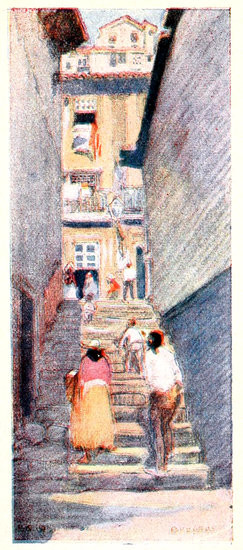
FROM THE RIBEIRA, OPORTO.
A few yards distant, through a little maze of mediæval streets, is the cathedral, the Sé, with a quiet little courtyard before it, from the parapet of which the red roofs and abundant verdure of the city spread downward in waves to the water-side. These north Portuguese cathedrals are marvellously alike; sharing the early beauties and later barbarities of their successive generations of masters. This of Oporto is a good specimen. The sturdy warrior kings who wrested Portugal, bit by bit, from Castilian and from Moor, in the twelfth and thirteenth centuries, were true crusaders. Where they set their foot sprang up the Christian church, to testify for ever their gratitude for victory vouchsafed to the Cross that symbolised their faith. Solid and staidly devotional were the edifices they raised; and wherever their work remains unconcealed by the scrolly banalities of a later age, it bears still the impress of simple faith and unostentatious grandeur. Here on the hill crest at Oporto stand two massive low towers, one still crowned by the pointed Morisco machicolations of the twelfth century, whilst its fellow, partly rebuilt, is spoilt by the addition of a trivial eighteenth-century parapet, with urns as an adornment. Still, the massive solidity of the towers remains, which is something to be thankful for when we regard the hideous top-heavy early eighteenth-century façade that connects them. The south door, of majestic romanesque, is similarly marred. Around it has been built a barbarous porch, overloaded with meaningless ornament, which not only obscures the serious work of the early builder, but half covers and cuts in two a lovely old round window above the door which lights the transept inside. But, however much these curly horrors of the late seventeenth and early eighteenth centuries may distract the eye, they do not destroy what is still visible of the old edifice. The double flight of low steps, for instance, which leads to this south door has for handrails two ancient stone serpents, so simple in design, yet so effective and perfectly adapted for their purpose, as to prove the unaffected but consummate artistry of the designer, whose taste must have been formed whilst yet the Byzantine traditions were strong in the stern romanesque.
One is struck at once in entering any of these cathedrals, and more particularly that of Oporto and its close congener Braga, with the vast difference between them and the pompous, splendid Spanish cathedrals. In the latter the span of the nave is usually tremendous, the church is plunged in tinted gloom, and the whole of the centre of the nave is blocked by an immense choir. Here in North Portugal the note struck in the cathedrals is not mystery richly dight, as in Spain, but sincere austerity, and a simple faith so essential in the edifice that the grave granite columns and arches appear as unaffected by the heaps, and piles, and masses of curly carved gilt wood around them as a monolith might be by the lizards that bask and slither round its base. Here in Oporto, for instance, the low, massive, granite pillars that line the narrow nave, and support the round romanesque arches, seem sullenly to bid defiance to time and decay; such is their prodigious solidity. And yet even these a later age has surmounted, if not adorned, with curly Corinthian capitals of carved gilt wood! Every altar here, and indeed nearly all over Portugal, is an overloaded mass of this particular barbaric style of decoration dear to the Portuguese since the seventeenth century. The skill in its production is undeniably great, especially in the chapel of St. Vincent in Oporto Cathedral; and in moderation the employment of richly painted, carved, and gilded wood generally may be advantageous where the light is low and the architectural style ornate. But here, where the simple romanesque prevails and the churches are flooded with light, it overwhelms one. In this low, old, plain Sé, either gilded wood or high-relief designs in beaten gold or silver in endless intricacy strike the eye unmercifully at every turn. On one of these ornate altars, screened by a curtain which a fee will raise, stands the ancient effigy, which those who still hold the simple faith of their fathers venerate so devoutly—Our Lady of Alem. Ages ago, so the story runs, when this old fane was yet a-building in the twelfth century, some Douro fishermen found their nets heavy with an unusual burden, and raising them, found this image, a miraculous gift vouchsafed them from the sea. Since then the prayers of those who win their living on the deep have been ceaselessly offered to the Lady of Alem for safety and good luck, and simple offerings of gratitude for boons thus gained—for sickness healed or safe return—hang thickly round the shrine.
The beautiful little cloisters of the cathedral are of a later date than the church—grave and simple Gothic of the late fourteenth century, with three small pointed lancet arches in each span, and a plain round light in the tympanum above. But even here the eighteenth century has done some damage by building out highly ornamental buttresses between the main spans. All around on the inner wall of the cloister is a decoration which abounds in nearly every Portuguese church that has lived through the seventeenth and eighteenth centuries—namely, large pictorial representations in blue and white tiles, like those commonly connected with the town of Delft. In the churches these tile pictures usually represent scenes from Scripture history, with a large admixture of heathen mythology or ordinary emblematic fancies, as here in Oporto, and the effect is quaint and not unpleasing. One of the things indeed which most strongly strike a stranger in Portugal, in the north especially, is the almost universal employment of glazed tiles, azulejos, both inside and outside buildings of all kinds, the majority of the better sort of dwelling-houses being entirely covered outside by tile designs in colours, sometimes very elaborate and beautiful. The custom exists to some extent in Spain, but is not so common there as in Portugal. In each case, however, the taste and original manufacture, like the name of these tiles, are clearly Moorish, and in some of the older edifices, to be mentioned later, the tiles themselves date from a period when Moors or Mudejares produced them.
In the sacristy of Oporto Cathedral they will show you a painting on terra-cotta of the Virgin and Child, backed by St. Joseph and angels bearing a cross, which is asserted to be a Raphael. The composition and drawing are clearly the work of a disciple of his school, but the colouring is dull and grey, such as the great one of Urbino would never have produced. Not this so-called Raphael, but another picture of the highest interest and beauty, is the principal artistic treasure of the city. In the board-room of Oporto’s most cherished and beneficent institution, the vast charitable organisation called the Misericordia, there hangs a painting that has few, if any, equals in Portugal. It is claimed for Jan Van Eyck, who is known to have been in Portugal for two years at about the period (1520) represented by the work, though personally I could see but slight traces of the peculiar quality of either of the brothers Van Eyck. Certainly it is broader in style than anything I have seen from the brush of the younger brother Jan, and may well be the work of Hubert Van der Goes or Hans Memling. But, whoever may be the painter, the picture is a magnificent one. Against a background representing a typical Flemish landscape and walled town, such as Memling loved to paint, there is a highly ornamented font filled with a pool of blood replenished from the stream that issues from the Saviour’s side, as He hangs upon the cross rising from the centre of the pool. Upon the edge of the font, on each side of the cross, in attitudes of prayer, stand two lovely life-size figures of the Virgin and St. John, whilst in the foreground there kneel, in regal robes of crimson, ermine, and gold brocade, the figures of the founder of the Misericordia in 1499, King Manuel the Fortunate and his wife. Kneeling behind them in decreasing size are members of their family, and on the farther side beyond the font are groups of ecclesiastics and laymen, all evidently life-like portraits of prominent courtiers, or benefactors of the institution. The colouring of the picture is glowing and gorgeous in the extreme, and the loving care expended upon the details is such as only the early Flemings had patience to exercise, accompanied by a breadth and boldness unusual in most of them. Fons Vitæ, as the painting is called, from an inscription on the edge of the font, is emblematical of the foundation of the home of mercy it adorns. Nor is it the only art treasure the Misericordia possesses, apart from the hundreds of awful daubs representing dead and gone benefactors that crowd every inch of wall-space. There is to be seen a beautiful Gothic gold chalice of fifteenth-century Portuguese work, some fifteen inches high, a specimen of the famous handicraft of the city, of great interest, the work being of the most intricate and elaborate description, and the condition of the jewel perfect.
Away from the river-side and the immediate surroundings of the cathedral, Oporto has little to show in the form of architectural quaintness. A busy, bustling place of modern-looking houses for the most part, the streets dominated by the indispensable electric tramways, casting scorn upon the lumbering ox wains that alone compete with them. Yet the city has some striking points that should not be missed. The view is very fine, for instance, from the top of the main modern shopping thoroughfare, the Rua de S. Antonio, which swoops down suddenly like a giant switchback to the Praça de Dom Pedro, the centre of the city, and then as the Rua dos Clerigos soars aloft again as suddenly to another eminence crowned by the extraordinary tower of the Church of the Clerigos, one of the loftiest spires in Portugal. The effect, looking up on either side from the Praça de Dom Pedro, is as curious as any streetscape of its kind in Europe. The Praça de Dom Pedro itself, crowded almost day and night with people, busy and idle, is a typical Portuguese “place,” paved, as most of them are, by the strange wave pattern in black and white stone mosaic that gives to the Praça de Dom Pedro in Lisbon (the Rocio) the English name of “rolling motion square.”
From the Praça de Dom Pedro in Oporto, leading downward towards the river-side, is the famous street of the old city called Rua das Flores, where now, as for centuries past, the gold and silver filigree jewelry for which Oporto is famous is made and sold in a score of dark old-fashioned little shops; and still farther down is the Praça do Comercio, with a striking statue amidst the flower-beds of Portugal’s national hero, Prince Henry the Navigator. In this square stands, too, the principal architectural boast of modern Oporto, the Exchange, of which the interior is really grandiose in the florid style so beloved by the Portuguese. The elaborate high-relief carvings prevalent in Portugal are usually executed in soft marble-like limestone, which hardens with exposure to the air; but here in the Bolsa of Oporto the intricate festoons and ingenious caprices that stand out everywhere in relief on walls, pillars, and staircases are carved out of the solid grey granite of which the edifice is built, as if out of defiance the most difficult material had been sought. Some of the fine apartments, especially the Tribunal of commerce, are beautifully decorated in frescoes by Salgado, in style much resembling those of Lord Leighton; and the great ballroom is a gorgeous hall in the brilliant gold and coloured arabesques of the Alhambra.
The Exchange is built upon the site of a disestablished Franciscan monastery, and cowering under the shadow of its modern magnificence there still stands the convent Church of St. Francis. The seventeenth century has left little of the original fifteenth-century church standing, and the interior is a mass of extravagantly rococo carved and gilt wood and other monstrosities; but in an ancient south transept chapel there is an altar-piece of interest in the style of Mantegna, though the sacristan ascribes it to some impossible artist of another school and century. Nothing, indeed, can equal the ignorance of, and apparent indifference to, antique and artistic objects in Portugal by the persons in charge of them. Even in national museums and historic buildings belonging to the Government, the guardians appear to have been chosen without the slightest regard to their fitness for understanding or describing the objects in their care, and the demeanour of the Portuguese people generally towards such objects is such as to force the conviction that, however proud they may be that their country has produced gems of art admired by strangers, they themselves have but a vague appreciation of their beauties or their merit.
The precipitous street leading up from the Praça de Dom Pedro to the conspicuous Church of the Clerigos is gay with a line of the drapers’ shops, with the gaudy wares aflaunt, which appeal specially to the country folk who flock in with their produce to the picturesque market of the Anjo behind the church. Red and yellow, blue and green, strive for mastery from street kerb to parapet, for the stock is as much outside the shops as in; and under the blazing sun, with the eternally deep azure sky overhead, the feast of colour in the clear air is so lavish as to dazzle eyes accustomed to the low tones and soft outlines of England. But relief is near. Through the chaffering market, with its piles of luscious fruit and all the bounteous gifts of earth and sea spread temptingly before brightly clad country wenches with flashing black eyes, the wayfarer may pass but need not tarry; nor is it worth his while to penetrate into the over-florid eighteenth-century churches of the Clerigos and the Carmo, which lie in his way—for just beyond them is a beautiful sub-tropical garden where shady groves of palms invite to repose, and towering planes temper the glare with a soft haze of sea-green. Seated in a quiet nook, with leisure now to watch the passers-by closely, one is struck by the prosperous busy look of the working people. There is no undue noise, and a stranger is allowed to go his way without unwelcome attention; above all, marvellous to relate, beggars are rare, whilst the persistent, offensive, mendicancy, amounting often to sheer blackmail, which is a perfect plague in Spain, is here quite unknown.
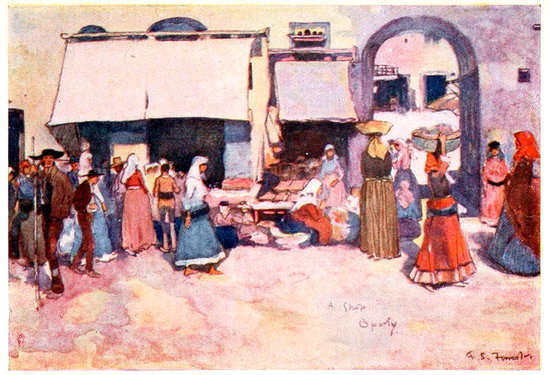
A SHOP IN OLD OPORTO.
The manners of these people of North Portugal, indeed, are irreproachable. So courteous are they that it seems almost rude of the stranger to note too closely the quaint garb of the working people around him. The peasant women especially keep their ancient costume unchanged. Barefoot they go, old and young, with their heavy burdens piled in their boat-shaped baskets upon the black, pork-pie hats they wear. Their skirts, usually black but often with a broad horizontal stripe of colour round the bottom, are very short, and gathered with great fulness at the waist and over the hips. Upon the shoulders there is almost invariably a brilliantly coloured handkerchief, and sometimes another upon the head beneath the hat; and long, pendant, gold earrings shine against their coarse jet-black hair. It is evident that for the most part they work quite as hard as the men, but they have no appearance of privation or ill-treatment, except that their habit of carrying heavy weights upon their heads has the effect of ruining their figures in the manner already described. There are no indications anywhere of excessive drinking, and even smoking is not conspicuous amongst the working men and boys in the streets; they seem, indeed, too seriously busy for that, except on some feast day, when, with their best clothes on, they are gay enough, though not vociferous even then, as most southern peoples are.
There is an ancient little church in the northern suburb of Oporto, which will be of some interest to students of architecture. It is little more than a fragment now, but represents the earliest orthodox Catholic foundation in the city, and indeed in this part of the Peninsula. In the clashing of creeds in the early centuries of Christianity, Visigothic Spain had been officially Arian, whilst orthodox trinitarianism was the creed of the great churchmen, and the majority of the Romanised people. In 559 Mir, King of the Suevians, who ruled in the north-west corner of the Peninsula, was distracted by the imminent danger of his son, who was ill apparently to death. He was an Arian, but the priests of the orthodox Church assured him that safety to his son might be gained by the aid of certain relics of St. Martin of Tours, and Mir swore that if the relics worked the miracle he and all his people would join the Catholic communion, and he would build a church to St. Martin within a year in his capital city. The prince recovered, and Mir was as good as his word. To the dismay of the Gothic monarchs of Spain, Suevia joined the orthodox fold, and in hot haste this Church of St. Martin was built; “Cedofeita,” “soon done,” being its name to this day. The upper part of the little cruciform church has been restored and the inner walls have been lined with the universal blue and white picture tiles; but the pillars and arches are pure romanesque, with capricious carvings on the capitals, and the charming little cloister is entered by a romanesque doorway of great beauty. The capitals, too, of the north doorway of the church are very curious, though apparently later than the cloister door, one of the carvings representing a man in a long gown being devoured by an animal’s head, doubtless an allegory of which the significance is lost to us.
Another church of some interest is that of Mattosinhos, a large and prosperous village adjoining the harbour of Leixões, where those who come by sea to Oporto land. The way thither from the city by the electric tramway lies along the river-side, and past the charming tropical-looking public gardens at the Foz de Douro, where in the summer heat the citizens of Oporto idle, flirt, and disport themselves in the surf that breaks upon the sandy beach. The Church of Mattosinhos is a great place of pilgrimage, for it possesses amongst other attractions a miraculous image of Christ, which is venerated throughout Portugal, and the shrine is a famous one. The church lies on a gentle eminence, and is approached by a beautiful, wide, mosaic pavement, bordered by avenues of planes and cork trees, under the shadow of which are six chapels containing life-sized groups representing scenes in the passion of Our Lord. The soft warm air from the sea comes heavy-laden with the scent of flowers, and on one side of the church a grove of orange trees shelters a merry school of boys, who do not even pause in their games to glance at the curious stranger peering about amongst them. The outside of the church, somewhat squat and solid eighteenth-century work, presents a fair specimen of a style of which we shall see much later; a style not at all ineffective, although its description may not sound attractive. Its peculiarity consists in the admixture of brownish-grey granite, of which all the architectural lines and salient points consist, with panels or spaces of snow-white plaster between. In this pure air, under a brilliant sun, the subdued colour of the granite softens the outlines, whilst the white spaces prevent an appearance of gloom or heaviness. Inside, the Church of Mattosinhos is grave and simple in its architectural features, but, as usual, the altars, and especially the chancel, are a riotous mass of gilt wood carving, without repose or restraint.
Down by the shore the great Atlantic rollers are thundering upon the beach, as if hungering to devour the crescent-shaped sardine boats drawn higher up for safety; and a long mail steamer, in the little harbour of Leixões, has its blue peter flying and its funnel smoking ready to sail for England. It is autumn there, no doubt, for the calendar tells us so and cannot lie; but here it is glorious summer still, for the palms and planes wave softly green in the languorous air, and the flowers, in great white and purple masses, hang over every wall and wrestle with the blue-black grapes that deck the trellises before the cottage doors. Everywhere is vivid colour and sharp outline in an atmosphere of marvellous clarity, and as we are carried rapidly through the balmy, voluptuous breeze to the city, we feel that life under such conditions is indeed worth living.
II
BRAGA AND BOM JESUS
The famous port-wine is grown upon a well-defined region nearly sixty miles up the river from Oporto, and, interesting as the manufacture is, the arid and inhospitable-looking land of terraced hillsides, where the glorious grape grows upon the loose, stony soil, offers little attraction to the seeker after the picturesque. To the north of Oporto, and indeed in most of the province of Minho, the wine produced, though varying in excellence, is generally of stout claret character, not unlike the Rioja wine grown in the north of Spain. But North Portugal, though cultivated like a garden wherever possible by a peasantry probably unequalled in Europe for self-respecting independence and laboriousness, thanks largely to causes that have made them practically owners as well as tillers of the soil, does not strike a cursory observer as being naturally fertile. For miles together, and as far as the eye reaches, pine-clad hillsides stretch: beautiful straight pines, rising in huge forests or isolated clumps, the light-green feathery foliage shining against the clear indigo background of the sky, high above the sandy soil carpeted with a thick soft cushion of pine-needles. But closer view shows that down in the sheltered valleys between the hills and on the lower slopes there nestle hundreds of little vineyards and fields of maize and rye, the staple breadstuffs of the people.
The peasantry live well in their way, and are not content with inferior food. Not for them is the poor makeshift of white bread and the fat cold bacon of the English farm hand. The bread of rye with an admixture of maize flour, the broa or brona, as it is called in north-western Spain, is dark in colour and coarse in texture; but it is a fine sustaining food, upon which, in Galicia, I have often made a good meal. The ever-present dried codfish, bacalhau, cooked with garlic and oil, and sometimes with rice, flavoured with saffron, is also not by any means a food to be contemned, unpalatable as it is to those who taste it for the first time. But this, although forming the staple fare of the Minho peasant and small farmer, does not exhaust his menu. There is for high days and holidays the savoury estofado of stewed meat and vegetables, of which the Portuguese peasant housewife is pardonably proud; there are olives, onions, and fruit ad libitum, and good, sound, new wine, tart, but not unpleasant, at the price of the cheapest small beer in England.
But the foreign visitor who comes simply for a short pleasure trip on the more or less beaten tracks will not be expected to regale himself upon this peasant fare, good as it is in its way. Of mutton he will find little or none, but veal, especially in the national stew, he will see at most meals, and ox-tongue, with a rich sauce, will appear on the table more frequently than is usual elsewhere. A thin, and, it must be confessed, usually tough steak, to which the adopted English name of beef (spelt bife) is given, will be placed before him pretty often, and he will find both the thing and the word omelette—which is never used in Spanish—universal in Portuguese dining-rooms.
Through a glorious country of pine-clad uplands and sheltered vineyards the railway runs from Oporto to the former great city of Braga, in Roman times Bracara Augusta, and capital of the whole north-western part of the Iberian Peninsula. Its position on a slight elevation in the midst of a vast undulating plain or cuenca, surrounded by mountains, has made of Braga the natural emporium of the province, and in each succeeding racial dispensation a royal seat and capital; and it remains to-day, though shorn of its splendour, the ecclesiastical capital of the Spains, claiming precedence over imperial Toledo for its archbishopric and primacy. It is a busy, prosperous place, humming with little spinning and weaving factories, where woollen and cotton fabrics are turned out in great quantities, and hold their own not only here in Minho, but in the rest of Portugal and far Brazil and Portuguese Africa.
At the railway station at Braga, in the outskirts of the city, a noisy, assertive little steam-train of several carriages is waiting in the street, and with much puffing and whistling, it carries the travellers up the slope into the narrow thoroughfares of the town. It is Sunday, and the streets are thronged with gaily-dressed people, the women, heavily decked with the ancient gold jewellery, long earrings, heavy neck chains, and crosses upon the white shirt that covers the bosom. Across the shoulders of most of them there is a brilliantly coloured silk handkerchief, whilst their full-pleated short skirts are usually of some thick dark-coloured cloth, and upon their heads here in Braga they often wear, like their sisters in Oporto, the peculiar round cloth pork-pie hat, with the curling silk fringe on the top of the rim. The men are less picturesque in their Sunday trim, for many of them wear felt wide-brimmed hats instead of the workaday bag cap; but even they have usually added a bit of colour to their sombre masculine garb in the form of a bright scarf encircling their waists to do the duty of braces.
Under the Porta Nova the fussy little train rushes, and up the narrow, picturesque street, the top-heavy stone scutcheon upon the eighteenth-century gate striking at the very entrance the dominant note of the ancient city. Here and everywhere the archiepiscopal insignia, the tasselled hat and mitre, and the Virgin and Child on the city arms, tell that the place from the earliest Christian times has been an ecclesiastical seignory. Churches, too, greet the eye at every turn; most of them massive seventeenth and eighteenth century structures in the peculiar style mentioned in the description of the Church of Mattosinhos in the last chapter: brownish grey granite outlines and salient points, with dazzling white plaster spaces between. Opposite one such church, in a tiny praça leading off from the main square of the city, the Largo da Lapa, I came across a picturesque scene worthy of the brush of John Philip. In a corner of the little square of San Francisco was an ancient recessed fountain in the wall, and around it, with water jars high and graceful like Roman amphoræ, there fluttered a group of women waiting their turn at the jet. Moving to and fro and clustering in the deep shadow contrasting with the blinding sunlight, these full-bosomed, black-haired women, with fine Roman heads and flashing eyes, were so many points of glaring colour, forming a brilliant giant kaleidoscope, whilst the chattering of many tongues, the jest and taunt thrown over the shoulder to rival or to swain, the careless laughter, seemed to blend and fill the languid air with a vague harmony to the ear, such as the mixed discordant colours in their aggregation produced to the eye. By the side of the gay fountain stood the contrast that heightened its effect. A frowning monastery with heavily grated windows high upon the wall, from which glowered evil faces and thrust thievish hands. For here, again, on this happy holiday afternoon in Braga, the gaol-birds held their levee. Beneath their bars stood their womenkind and children, consoling or grieving; and little bags hung down at the end of strings from the windows to receive the gifts it pleased their friends to send up to the sinister rascals, whose hoarse ribaldry or whining appeal broke in ever and anon upon the gay chatter of the fountain. As if in irony, the church that faced the monastery prison bore upon its front the name the “Temple of the Sacred Order of Penitence.” Of contrition one saw little sign on the part of those who from behind their bars looked for all their weary day upon the church commemorating the unmerited self-reproach of the “Seraphic Father St. Francis.”
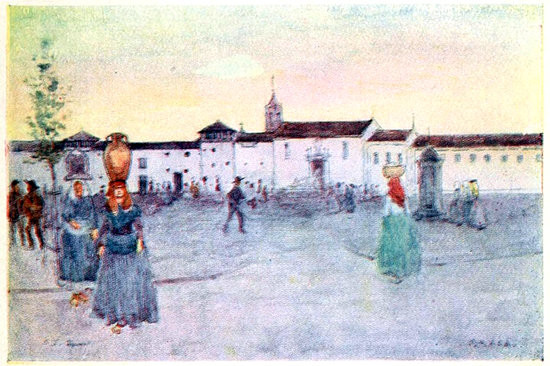
THE AFTER-GLOW AT BRAGA.
There is one thing throughout Portugal that may be unhesitatingly condemned, and here in Braga the evil is as patent as elsewhere. The old traditional and, in many cases, historical names of the praças and streets have been changed wholesale and wantonly for those of passing and second-rate celebrities, political and otherwise. In Braga the ancient Largo da Lapa has been turned into Largo de Hintze Ribeiro, after the leader of the Liberal party in the Cortes, and there is hardly a town in Portugal in which the principal squares and thoroughfares do not bear the name of Hintze Ribeiro, or of his rival politician, Conselheiro João Franco. Serpa Pinto and Mouzinho de Albuquerque, two fire-eating African explorers, who in the jingo colonial fever of a few years ago, when the feeling against England ran high, were made heroes, are commemorated in streets innumerable throughout Portugal, to the exclusion of names which were often quaint and significant landmarks of long ago.
The palace of the Archbishops of Braga hardly corresponds in appearance with the high claims of the primate, for the church in Portugal is sadly shorn of its splendour, and part of the rambling palace is a ruin; but the cathedral offers many points of interest. Enthusiastic local antiquarians are confident that the first edifice was raised by Saint James himself in the lifetime of the Holy Virgin. But, however that may be, the present church certainly dates from the twelfth century; and though, as usual, the seventeenth century did its best to spoil and smother its primitive simplicity; yet, as in the case of Oporto Cathedral, which that of Braga much resembles, the stern solidity of the original work stands out clear from the frippery by which it is overlaid.
The narrow nave is divided from the aisles by massive low clustered granite pillars supporting slightly pointed arches, above which spring the simple groins that form the vaulted roof. At the west end the church is darkened by the gilt wooden ceiling that supports the choir and the great gilded organ with spread trumpet pipes that is the pride of the cathedral. The choir itself, raised upon a loft and occupying the whole west end of the church, is of surprising magnificence; carving and gilding have run wild; cupids, cherubim, angels, musicians, and fabulous monsters jostle each other exuberantly upon choir stalls, lecterns, and panels: all the caprice, skill, and invention of sixteenth and seventeenth century Portuguese art have been lavished upon the work. And the effect is rich in the extreme, but utterly incongruous with the sober early ogival of the church itself. Even in the nave the massive granite pillars have been crowned by later vandals with florid capitals of carved gilt wood. The walls, too, are much covered with pictorial blue and white tiles, and the effect of this, though inartistic, is quaint and not displeasing. From the tiny cloister of plain romanesque there opens the chapel of St. Luke, where in two splendid sepulchres lie the bodies of the Leonese princess, Teresa, and her Burgundian husband, Count Henrique, to whom she brought the county of Portugal in the late eleventh century. These are the progenitors of the Kings of Portugal, the parents of Affonso Henriques, of whom we shall hear much later; and to Donna Teresa is owing the re-foundation of the Cathedral of Braga. In the side chapels, in the cloisters, and in the sumptuous chapel of St. Gerald, the patron saint, there lie dead and mouldering archbishops not a few; one of them, it is said, incorrupt after eight centuries, though in consequence of the flesh having been varnished he has the appearance of a mulatto, and shows to this day the honourable scar across his cheek that the warrior archbishop gained whilst fighting valiantly by the side of the Master of Avis at the ever-memorable battle of Aljubarrota, that gave the regal crown of Portugal to the illegitimate scion of the House of Burgundy. Another coffin there is, just inside the west door, that has for most people a still more human interest. It is of gilt copper, apparently French in design, bearing upon its lid an effigy of a pretty boy of ten, the little Prince Affonso, whose bones lie within, and who died at Braga in the year 1400.
The exterior of the cathedral has, like the interior, been much spoilt by later builders, the little square towers having been crowned by a mean-looking balustrade and crockets; but the exterior of the sixteenth-century Lady Chapel is a favourable specimen of the peculiar florid Portuguese renaissance style called Manueline, of which I shall have more to say later. Here at the Lady Chapel at Braga it is more restrained and presents fewer daring departures from the Gothic canons than elsewhere, though the surprising intricacy of the parapet and pinnacles show that the new spirit was strongly moving when it was built. That the artists who executed the work were Spaniards from Biscay is probably the reason why in this instance the peculiar and more questionable features of the style are less conspicuous than in the productions of native Portuguese craftsmen of the same period. The other churches of Braga have little show. They are mostly rococo seventeenth-century structures, granite and plaster outside, and nightmares of carved gilt wood inside; but almost under the shadow of the overloaded rococo façade of Santa Cruz there is a lovely little early ogival votive chapel standing by itself, and containing a characteristically Portuguese group of the dead Christ, infinitely touching and beautiful.
And so through the quaint old streets the stranger finds his way, passing by a house here and there whose balconies and windows are covered with the intricate wooden jalousies that linger still as a tradition of oriental civilisation. The whole place is bathed and flooded with vivid sunlight, except where the lengthening shadows fall almost purple in their depth; and wandering without special aim, past the public garden called the Campo de Sant’ Anna, towards the outskirts of the city, I found myself at the foot of a steep hill rising suddenly on the left of the walk. Climbing it, I found a little plateau on the top with a tiny quaint seventeenth-century hermitage chapel, the Guadalupe I learned was its name, under a clump of shady planes and chestnut trees. Around the plateau was a dwarf parapet upon which two lovers were sitting, oblivious to all around save each other; but as I reached the parapet, and my eyes took in the prospect spread before me, a cry of wonderment at its marvellous beauty sprang involuntarily from me, and aroused for a moment the attention of the youth and the girl, who sat with their backs to the landscape, caring nothing for such things. It was but a glance they gave me, and I could enjoy thenceforward without interruption or notice the rapture I felt from the scene, the first of many such peculiarly Portuguese prospects of rolling valleys and soaring mountains to be gained from comparatively low elevations; scenes such as in other countries can only be attained after long and arduous climbs up high mountains. I soon found, it is true, that this view from the Guadalupe in Braga was but a trifle in comparison with many others to be encountered in the course of a few weeks’ travel; but when it first burst unexpectedly upon me it filled me with an ecstasy that no subsequent prospect, however fine, could produce.
Just below me was a tangle of vines, and then a mass of oaks, planes, cork-trees, and acacias, with their fluttering light foliage, descending in a gracious ocean of greenery of every shade across a broad valley till they climbed half up the glowing red mountains miles away. White houses gleamed amidst the trees, and upon every hill-top a hermitage or shrine stood out with its shining cross above it. But that which attracted the eye most was what looked like a giant white marble staircase of immense width, leading right up the side of a wooded mountain spur opposite, upon the summit of which, at the head of the stupendous stair, set deep in the verdure of woods, stood a huge white temple. Seen from the Guadalupe, the architectural approach up the mountain side to the place of pilgrimage above looked almost too vast to be made by man. Beyond, on the right, rose a majestic range of granite peaks, bare of vegetation, and scattered to the summit with tremendous boulders; and over all the setting sun threw a glow of golden light that tipped the grey granite with crimson, orange, and purple, and deepened the shadows of the climbing woods to umber and to black. The light fell, and by-and-by only the crests of the red and grey mountains glowed, for the woods across the vast plain lay in the black shadow of the peaks. But still, white and gleaming, like a stupendous staircase of shining silver, there shone, clear from the surrounding gloom, the great pilgrimage of Bom Jesus do Monte. And so in the gathering twilight, sated with the beauty of the inanimate world, I slowly wandered down into the pulsing city again, leaving the lad and his lass still whispering on the parapet, alone in their happy blindness.
From the door of the hotel in the Campo Sant’ Anna the tyrannical little street train that bullies Braga several times a day carries us to the foot of the Bom Jesus on the spur of Mount Espinho. For nearly two miles of continuous gentle ascent the road passes through a long stretching suburb of humble houses; and then a quarter of a mile through a close grove of shady trees brings us to the outer portico of the sanctuary, a white gateway at the head of a flight of steps, backed apparently by a dense luxuriant wood. Hard by the portico is the starting platform of an elevator railway, by which pilgrims may, if they please, dodge the rigours of the penance, and arrive at the summit without exertion. This course, on my arrival, commended itself to me, and I left until the next day a full exploration of the place. On the summit of the spur, by the side and behind the great church, white outlined by brown granite as usual, there lies a land of enchantment. Vegetation of surprising luxuriance is everywhere, giant trees full of verdure nearly all the year round, mosses, ferns, and flowers in every crevice. Gushing fountains and cascades, rustic bridges, and sweet winding paths through the woods, everything that can conduce to tranquil repose and comfort is here, with air so pure and exhilarating at this great elevation as to raise the most depressed to vivacity. On a picturesque little clearing on the summit there are two or three hotels, the principal of which, the Grand Hotel, a long one-storey wooden building overhung by great trees, I can vouch for as excellent.
The sanctuary is naturally a great resort amongst the people of Braga in the hot summers on the plain, and I cannot conceive a more agreeable place to pass a few days for rest at any time of the year; but the special religious element draws many devotees who conscientiously go through the pilgrimage to the shrines, and on the 3rd of May and Whit Sunday especially many hundreds of pilgrims flock to the sanctuary for devotion as well as for pleasure. The astonishing feature of the place is, of course, the devotional approach to the church up the side of the mountain, and it is difficult in a few words to give an idea of the eccentricity of the structure. It may be admitted at once that the taste displayed is atrociously bad, for it belongs to that eighteenth century which has loaded Portugal with rococo monstrosities; but the very vastness of Bom Jesus, and its exquisite position, save it from triviality; and looked at as a whole, either from above or below, the effect is grandiose in the extreme.
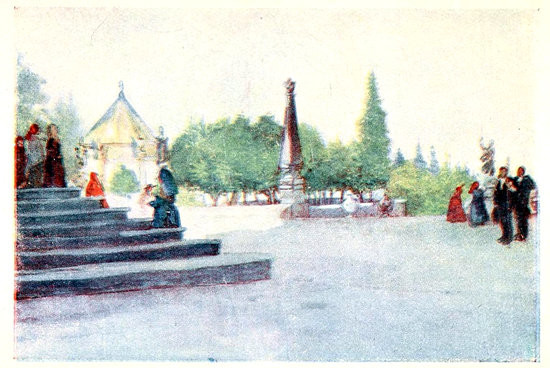
ON THE TERRACE, BOM JESUS.
Some sort of sanctuary had existed here from the fifteenth century, but it was not until the middle of the seventeenth that a miraculous figure of Christ drew to the hermitage large numbers of pilgrims, and gradually in the later eighteenth century the present structures grew under the care of successive archbishops of Braga. Standing upon the spacious open terrace before the church on the summit I looked down soon after sunrise upon the scene spread before me. If the view hitherward from the Guadalupe was fine this was more striking still. Wreaths of grey mist still floated in the valley far below, and the vast plain with Braga in its centre embosomed amongst trees, and surrounded as far as the eye reached with red-roofed hamlets, still lay in grey shadow. But ridge over ridge, crag beyond crag, in the background rose the mountains all tipped with shining gold with chasms of tender heliotrope; and then, before the mind had well realised the beauty of the contrast, the whole plain woke and smiled with sunshine.
The platform or terrace upon which I stood with my back to the church was flanked with granite obelisks and statues, and fronted by a wide stone parapet with a beautiful stone fountain above it. By two broad flights of steps at the sides a lower landing, or platform, was reached with an arched fountain set in the face of the wall, then by steps down to a similar platform, whence a pair of flights led to yet another, and so on, the parapets and balustrades in each case being surmounted by obelisks and statues, the fountains on the wall-faces being, like the figures, an extraordinary mixture of sacred and mythological art. Each alternate pair of platforms, after the first six, extending right across the structure and paved with the favourite black and white stone mosaic, was flanked by two shrines or little open chapels, each with a beautiful life-sized coloured group of figures representing scenes in the passion of our Lord. Half-way down there was an entrance from one of the platforms into a lovely old-world terraced garden, overflowing with flowers, palms, and sweet-scented verdure, and overhung by the dark yews and pines that bordered the graded descent from top to bottom. At length after descending many flights of steps and passing many terraced platforms with fountains, figures, and obelisks, a large mosaic-paved semicircular space was reached, ending in a stone parapet. Turning and looking upwards from here an extraordinary effect was presented. The alternate zigzags of the stairs and the faces of the walls, indeed all the architectural features, were outlined, like the great church towering far overhead, with brown grey granite, and faced with perfectly white plaster. Stage upon stage the great staircase rose, its parapets at the side and the centre line being marked by statues rising alternately one over the other at each successive stage of the ascent. Dark greenery, palms, yews, acacias, orange trees, and trailing flowers overhung the ascent on each side, and it was not difficult to understand the devotional fervour of pilgrims, who with tears and contrition toil up this vast viâ dolorosa by the hundred on the special anniversary, worshipping at the affecting shrines on the landings, and ending in an agony of remorse at the foot of the miraculous Christ which is the main attraction of the Sanctuary. Nor is the scene looking down over the parapet at the bottom of the main flight less striking. Sheer over the precipice you see the billowy masses of dark thick woods far below. On one side of the wide mosaic landing is a stair leading to another chapel, and so down by a succession of zigzag flights, bordered by thick greenery, to the porch, set in its grove of yews, and leading to the outer world. But mere words are weak to describe the charm and beauty of the Bom Jesus. There is nothing quite like it anywhere else in Europe, and as sanctuary, health resort, and architectural curiosity it deserves to be better known than it is.
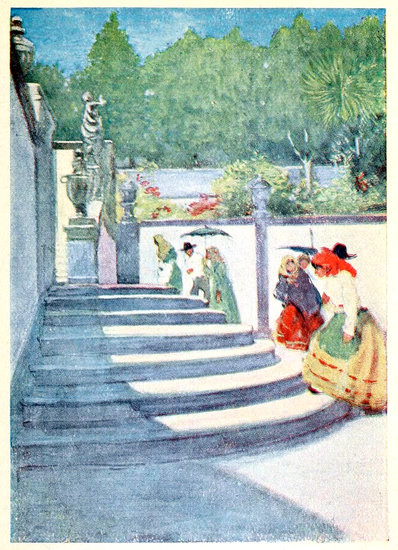
ON THE HOLY STAIR, BOM JESUS.
III
CITANIA AND GUIMARÃES
I drove out of Braga in the early morning. Passing over the ancient bridge spanning the little stream, at which lines of women knelt and washed their household linen, we left the city behind us and faced the mountain range beyond which lay my goal. Far above reared the grey crest of Mount Picoto, with a gilt cross dominating its highest point; and as the road wound upwards and ever upward in zigzags, at each turn of the path Braga, white and shining, set in its bed of verdure, receded far below. All around were glorious sun-kissed peaks scattered to the summit with huge granite boulders, as if the youthful Titans had there indulged in the sport of stone-throwing. Then over a hill pass, we dipped into a valley with the Falperra range clear before us, and beautiful St. Marta, with its crown of woods and its gleaming hermitage in the foreground, almost, as it seemed, over our heads. Maize fields spread across the valley and on the hill slopes all around us; and on the wayside, and dividing the fields, rows of oaks, chestnuts, planes, and, above all, white poplars, ran, every tree covered to the top by a trailing vine, loaded with purple grapes. The effect produced is most extraordinary, and the practice of thus utilising timber trees is peculiar to this part of the country.
For many miles, as we drove over valley and hill, tall poplars by the thousand, their light green leaves blending with the bronze, served as vine poles; and every white cottage had its shady trellis pergola before its open doorway, the great luscious bunches of fruit hanging temptingly over the heads of the women busy spinning, surrounded by quiet, brown, barefooted children.
The prevalence of granite is noticeable everywhere. The fields are divided from the path by granite walls, gate-posts, trellis standards, and even telegraph poles are slender granite monoliths, and the cottages themselves are granite built, solid and weather-proof. Many people meet us on their way to Braga: men in velvet jackets, wide, brown, homespun trousers, often with inserted patterns of other coloured cloth, and broad brimmed hats; the women, gay with bright kerchiefs over head and shoulders, but all barefooted, and many carrying poised upon their heads the slender red water jars, the fashion of which has known no change since the time when the legions of Augustus ruled the Celts and Suevians with iron hand from Bracara Augusta. Ox-carts slowly toil along, the bowed necks of the bullocks bearing above them the elaborately carved canga, here seen at its best. And still the road lies mainly upward through the keen pure air, the mountain slopes below and around us green with pine forests, and above us the eternal grey granite boulders. The land is bathed in a flood of sunlight, with here and there upon the widespread slopes and valleys the dark shadow of a passing cloud. Even up here amidst the masses of granite the fruit-laden vine persists, covering and embracing with its reaching tendrils poplars, oaks, and olives on the sheltered slopes, whilst the proud pines alone, towering on the exposed surfaces, defy the creeper’s insidious caress.
At length the high pass of the Falperra range is crossed, and before us spreads a vast fertile plain, with villages and homesteads scattered across its bosom. Soon the grey boulders disappear from around us, and the air grows softer, though granite still supplies the place of wood by the roadside. The fields of maize are usually not above an acre in extent, and are bordered everywhere by vine-clad poplars. It is clear to see that the little farms are for the most part cultivated by the owners and by hand labour, for no yard of tillable soil is left to waste. It is market day at Taipas, and flocks of picturesque husbandmen and their womenkind are wending their way into the village from distant hillside hamlets and lonely granite granges. It is a gaily clad and prosperous-looking crowd that chaffer and bargain for their herds of thin porkers, their vegetables, fruit, red clay pottery, and flaring textiles; all spread out to the best advantage beneath the trees of the market-place and by the shady wayside. The women almost invariably carry upon their heads in long spacious baskets the merchandise they buy or sell, be it live-stock, produce, yarn for weaving, or household stuff; and as invariably is the burden covered with a snowy cloth, and the woman herself is clean, well-fed, and upstanding.
Taipas, the famous thermal mineral baths of the Romans, did not detain me except to order lunch to be ready when I should return a few hours later to the primitive inn attached to the ancient baths, for I was bound for a place still more ancient than Roman Taipas, the mysterious buried city of Citania, the Portuguese Pompeii.
A few miles’ drive upon an excellent road and through a prosperous smiling country of maize, vines, and olives, brought me to the tiny hamlet of São Estevão de Briteiros, just a humble little grey church, a large farmhouse, an inn, a few cottages and a school. The road had led almost at right angles to that by which we had reached Taipas, and the Falperra range, which we had crossed earlier in the day, again loomed nearer; the nearest spur, a bold hill of nine hundred or a thousand feet high at some distance from the range, projecting far out into the plain, and rising precipitously from the little village of Briteiros, which was the present limit of my drive. Long before we reached it the abrupt hill with its tiny white hermitage chapel of São Romão on the highest point had stood out conspicuously, and seen from below looked impossible of ascent. From Briteiros, however, the climb was seen to be not so formidable; for a rough path started from behind the humble schoolhouse, through little farmsteads, gradually winding and zigzagging up the precipitous slope through the trees and brushwood that clothed the lower portion of the hill. The population of Briteiros were mostly at Taipas for the market, and a demand for the services of um rapaz, a boy, to guide the stranger to the lost city of long ago met with the reply that no man nor boy was readily available.
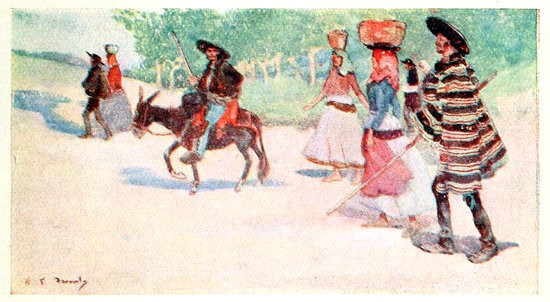
ON THE WAY TO MARKET, TAIPAS.
After some short delay an aged woman produced a substitute in the form of an elfin little maiden of ten or eleven, with great black eyes, half-bashful, half-bold, and jet black hair floating unrestrained over her shoulders. With her bare feet and scanty floating raiment she skipped like a dryad from stone to stone over the rugged pathway, looking back now and again as if in wondering contempt at the lumbering stranger slipping and floundering after her upon the thick carpet of pine needles that clothed the spaces between the boulders forming the track. Track it was and no more, scarped on the hillside, and evidently had been made by hands; for the stones still showed some signs of regularity and the larger masses had been removed to the side, whilst those which stood upon the causeway itself proved by their flat and polished surfaces that ages of human feet had passed over them up and down the hill. As the weird little damsel sprang with the free action of a wild thing from stone to stone, her black hair floating in the pine-scented breeze, it was easy for me to imagine how the people who long, long ago, before history records, had dwelt upon this hill and made this causeway had looked and moved. Racial inundations had passed over the land since then, leaving traces perhaps in this or the other type of the countryside, but the girl’s far-off ancestors, dwelling always upon the same spot, had struck deeper and more lasting root than their stone walls and causeways, and as the little guide flittered up the rough climb before me, the ages seemed to fall away and the dim past to grow in clearness.
Half up the hill the trees cease, and the stony causeway rises precipitously through a region of purple heather, broom and yellow gorse, thickly strewn with giant granite boulders. Presently the ruins of a wall of rough stones cemented together stretch across right and left; and running parallel, and just inside of it, a dry water channel well made of hewn stones. The ground-plans and walls a yard or two high, of houses are on all sides of us; and climbing a little higher and turning the shoulder of the hill we see spread before us, covering the whole of the south upper slopes of the declivity, a vast stretch of uncovered ruins—a once-populous town of the unrecorded past.
Before describing in detail these, by far the most complete and interesting Celtiberian remains in the Peninsula, a few words may be said with regard to the discovery and exploration of them, as well as to the theories as to their origin. For reasons which need not be re-stated here the Celtic element was less intimately mixed with the Iberian in the north-western part of the Peninsula than elsewhere, and the tribes in this part of the country were those which withstood longest the imposition of the Roman bureaucratic system after the assassination of the patriot Viriatus, and the fall of Numancia in the second century B.C. Not till the time of the great Julius did the legionaries, stationed then permanently at Braga, sweep all this province clean of revolt, and bring the tribesmen to their knees after dire slaughter and destruction. The Celtiberian tribes in this remote corner had lived their simple pastoral lives from time unrecorded in small family clans, each independent, with its own law and its own gods; but for purposes of mutual defence in later times confederations of many clans were formed, mòr thuatha, as in Ireland. Each of these confederations possessed a fortified centre or stronghold as a place of assembly and refuge, usually upon an eminence, wherein the scattered clans might meet for defence or in council to treat of common interests. The Roman historian, Valerius Maximus speaks especially of some such fortress upon a mountain in Lusitania, and praises its inhabitants for their stubborn bravery. He calls it by the name of Citania, and antiquaries have given to the extensive ruins now before us that name during the last few years, on the assumption that this may be the place referred to by the Roman chronicler.
Vague stories had always pervaded the countryside of buried ruins, with the accompanying legends of witches, warlocks, and enchanted Moors existing upon the hill of São Romão; and in the eighteenth century the curate of São Estevão de Briteiros at the foot of the hill had brought down from the hill-top and placed in his church porch a great mysterious slab of stone covered with mystic devices and of strange fashioning. But not until our own times did a man come with public spirit enough to devote his life and small fortune to the exploration of this city of the past, for in Portugal public encouragement of any such objects is rare indeed. This man was Dr. Sarmento, who for many years until his death recently, made a labour of love in uncovering systematically the vestiges of the prehistoric city.
All over the plain, for many miles around, the ruins of Celto-Roman villages have been found, and in many cases partially explored by Dr. Sarmento and others; the objects discovered, like those found in Citania, having been deposited in the museum at Guimarães belonging to the explorer, but in consequence of his death henceforward to be a public institution subsidised by the State. As I shall point out when I describe my visit to the museum, the objects unearthed at Sabroso, St. Iria, and other neighbouring places are immensely more numerous than those from Citania itself; great masses of coins, personal ornaments, arms, inscriptions, and utensils in the museum proving that these places existed far into Roman times, and perhaps much later. The chaotic condition of the Sarmento collection at present, and the apparent absence of any skilled and enthusiastic guardianship, have probably been a reason why certain investigators have attributed to Citania many objects discovered elsewhere, and have founded upon them theories which must necessarily be misleading. Dr. Hübner, who did not see the place personally, aroused the wrath of Dr. Sarmento in this way, and other archæologists have spoken somewhat loosely as to the nature of the finds in the Citania excavations. The great interest of the hill stronghold, indeed, consists in the fact that we have here practically an unspoilt Celtic or Celtiberian town, in which Roman civilisation had but little part. It will be seen by the objects actually unearthed that the place was inhabited after the Roman influence and language had dominated the district, as late, indeed, as the time of Hadrian; but of purely Roman remains, so plentiful elsewhere in the district there are in Citania hardly any; the construction and plan of the houses having much in common with the Irish and Scotch Celtic cashels, and the absence of all indications of Christianity being complete.
Following a well-paved causeway of some seven or eight feet wide, the flat stones of which have been worn smooth by countless generations of forgotten footsteps, we can perceive perfectly the ground plan of the houses on each side. In most cases Dr. Sarmento has excavated down to the stone-laid flooring of the houses inside, and to the base of the masonry outside; and it is possible to wander through the main lanes or streets of the town, crossing each other at right angles here and there, and interspersed by little circular paved open spaces, and to reconstruct in the mind’s eye the primitive life of this city of long ago. Here, for instance, just inside the wall by which we entered is a little square house, some twelve feet wide, containing two rough millstones, of which many have been found. The walls are of huge, rough stones, evidently taken as they came and fitted together with small stones where necessary to fill in interstices, the whole cemented together by some hard rubbly compost. Running past this building and through the town (in one or two cases, indeed, through the houses themselves) is one of the several stone water channels protected by low walls on each side, and supplied in ancient times by the springs that still gush out plentifully on the hillside.
Some of the houses are much larger, and must have contained two or more apartments. But what strikes the eye of the observer most is the relatively large number of purely circular edifices, and this it is that has mainly attracted the speculations of archæologists. Mr. Oswald Crawford, who went over the place whilst the excavations were in their earlier stages many years ago, was mistaken in his estimate that the round buildings were eight or nine times more numerous than the square, and he founded upon this and other data the opinion that the whole place was a great granary, where the food of the tribes might be stored in safety. So far from the round houses being eight times as numerous as the square, found at least four square houses to every one round; but that which struck me as most curious, and so far as I could learn, it had not specially attracted the attention of previous visitors, was that in a large number of cases the round houses were enclosed in a square or angular walled space, not very much larger than the circle, but leaving a passage of some two feet wide, in most cases on the right-hand side, between the two walls, leading to a space at the back between the circular wall and the wall of the square enclosure, the left-hand side of the circular wall being mostly built to touch the square wall on that side. Dr. Sarmento was of opinion that the space thus formed was for the purpose of sheltering cattle and domestic animals, and says that he had found some rough stone excavations like troughs in them, with, in one or two cases, a ring in the wall as if to tether beasts. The width of the entrance passage and the extent of the enclosed space in the rear of the circle would be too small to admit any large animal; but probably goats would be housed in them easily. In one or two cases I noted that the stone post forming a jamb to the entrance to the passage between the round house and the square enclosure was grooved on the inner surface. This in Dr. Sarmento’s opinion proved that the entrance to the passage was closed by a lifting hatch of wood, which to some extent confirms the idea that the back space was intended to shelter animals such as goats, as a lifting door set in a groove would be much less likely to be forced by them than a swing door turning, as the house door did, on wooden pegs.
There are very few instances of party walls being utilised for two adjoining houses, though the buildings are often only a few inches apart. Even in the case of the round houses enclosed in square spaces and touching the square wall, the circular structure is quite complete at the point of contact. In one instance I measured a large walled parallelogram fronting on the principal causeway, seventeen yards in length, enclosing within it one square house of nine yards wide, and two circular houses, one on each side, the structures in each case being complete, but the circular walls in this instance merged for a few inches only at the point of contact with the square outer wall at the side. Whether these square or outer enclosures were tiled or were merely enclosed yards it is difficult to say, but that the houses themselves were so covered is evident from the immense number of well-made red shards scattered everywhere, and particularly inside the houses, the tiles being turned up at each end, so that a concave tile to cover over the joint between them would make a roof covered with them quite watertight. A door jamb and lintel in one house showed a well-carved rope moulding, but in most cases they were plain, the lintels and doorsteps containing, however, at the side a square-cut hollow, in which a block of wood was apparently inserted to receive the wooden peg or pivot which formed a sort of hinge for the door, an arrangement still adopted for the doors of barns, &c., in the neighbourhood; though Dr. Sarmento was of opinion that no wood was employed in the construction of the houses themselves, the polished rounded stones fixed to the walls in some of the houses, which Dr. Hübner considered to be bases of pillars, being in the opinion of the Portuguese archæologist seats for the inhabitants.
The round houses are usually about fourteen feet in diameter, and the walls remaining rarely rise above four or five feet from the surface. The doorstep is usually raised a foot or so above the level of the ground. One round house has been tentatively rebuilt by Dr. Sarmento on the level space on the top of the hill, an unattractive beehive-looking structure without windows, but later investigation convinced him that he had built it too high; and that it should not be of so great an elevation as the measure of its diameter. The principal thoroughfares running transversely on the slope of the hill are carefully walled upon the scarped inner side, and in some cases the stone water channel runs alongside of it.
On reaching the bare space at the very summit of the hill, upon which the little modern Christian chapel stands, a good idea may be formed of the whole plan of the place. The town, covering perhaps five or six acres, all lies over the crest and down the south and south-west slopes. The wall by which we entered from the south is apparently the inner wall of three, and practically encloses the top of the hill and the centre of the town on the slope. The second wall, which shows signs of a moat, is of greater extent, following the irregular contour of the hill, whilst the third or outer defence extends far down almost to the plain on the west and south-west side; traces of buildings, although but little explored, being very abundant between the two inner walls on the south and south-west, and clearly defined paths leading down from the main city to the outer defences and the suburbs. In consequence of the formation of the ground, attack was to be looked for mainly from the most accessible point, namely, the north-east; for here the three lines of defences are almost close together, and each of the walls is here brought to a rough angle. From the apex of the outer wall on this side there are indications of another defence running straight out at right angles along the saddle which connects the hill with an outlying spur easy of approach, and at the end of this long projection there appears to have been two parallel horizontal outworks running across the end of the saddle, this being the vulnerable point of the fortress.
It is easy to imagine how almost impregnable such a place could be made. The hill at any other point than this could only be scaled, if at all, with the greatest difficulty, and the huge boulders on its side would enable even weak defenders under their cover to hurl down stones or spears upon an advancing foe. The south side of the hill is the least accessible of all for any considerable body, and there the defences are the most distant and the weakest.
In the midst of the ruined town I found a bright intelligent peasant lad, busy arranging fragments of pottery upon a stone for the later inspection of some one in authority; and from him I heard much quaint and simple local folklore. His own interest was greatest in what he called the cemetery, four or five small grave-like troughs, about three or four feet long and a foot deep, neatly made and lined with dressed stone slabs. The so-called graves lie close to the causeway and amongst the houses, in an irregular group, and can hardly have been sepulchral, considering their size and position; Dr. Sarmento inclining to the belief that they were troughs for feeding cattle. The cemetery, if there be any, would probably lie far down the slope outside the second, perhaps outside the outer, wall, but here no excavation of any importance has been executed. At some little distance down have been found three perfectly plain dolmens of the usual shape, which are usually sepulchral; and doubtless extensive exploration around them would reveal human remains. My peasant friend was also much concerned in a mysterious “mine,” as it is called, from which he assured me, in awe-stricken tones, that enchanted Moors came at night and carried evil over the plain. It is supposed that this cave, which is of no great extent, some two yards in diameter at the mouth, and a few yards deep, was adjoining or under the place where the great slab which the country-people call Pedra Formosa, the handsome-stone, to which I shall revert presently, was found.
I have mentioned that Mr. Crawford was of opinion that the round houses were granaries, but seeing that the Celts of Ireland and Scotland frequently built and lived in round houses within their cashels, and bearing in mind the existence of the spaces for animals, which I have described as attached to those of Citania, I am strongly of opinion that, comfortless as they appear, these were the veritable dwellings of many of the neolithic folk who for centuries held their foes at bay upon this headland jutting out upon the rich plain of Guimarães. Still another solution of the round-house problem is, as I understand his words, suggested by my friend Professor Altamira in his Historia de Espana y de la Civilization espanõla. The earlier generations of this people, he says, buried their dead under dolmens which when covered were circular; and later generations retained the tradition of circular sepulchres. “They were built round,” he says, “with a sort of domed roof, the middle of which was supported by a pillar of wood or stone. Some of such tombs had passages (or galleries) to enter by—which was frequently the case also with the dolmens—and some had lateral chambers.... Of this class are those discovered at Citania, on the hill of San Roman in Portugal.” Apart from the fact that no human remains have been found in these round houses at Citania, there is no sepulchral suggestion about them. They are, it is true, if Dr. Sarmento be right, windowless and rough, but the comparison must not be made with the dwellings of to-day, but with the haunts of cave men, who had been the progenitors of the early settlers of Citania; and judged by that standard, these stout, weather-proof, stone houses, with doors and an enclosed separate space behind for cattle, were almost luxurious. In any case, a close examination of them left in my mind no doubt at all that they had been the dwellings of human creatures in the earlier stages of civilisation.
It required no great effort of the imagination to people the narrow paved paths on the hillside and the little round central spaces with the dwellers in these rough abodes: wild-looking, shaggy men, with long hair, and clad in skin or rough woollen garments, going about their daily toil as hunters, husbandmen, potters, or smiths, to paint to oneself the alarm of an approaching foe, the savage warfare to repel attack, and finally the victorious host of Roman legionaries of Augustus levelling the poor homes, slaughtering, ravishing, destroying, until the poor remnant of the vanquished knelt in the dust and bowed their necks evermore to the yoke of discipline and civilisation.
The place continued to be the abode of men long afterwards, for Latin became the speech of some people who lived there, and coins as late as Tiberius and one of Hadrian (117 A.D.) have been unearthed at Citania; but with the Roman officers supreme at Braga, and the whole plain prospering and smiling under the arts of peace and Roman luxury, poor Citania on its bold hill-top lost its reason for existence, and must have dwindled, until long before the time of the Goths and Suevians all men forgot it, and the ages covered it with the mantle of earth, undisturbed till now.
But whilst I am thus speculating, my little girl guide is getting restless, and the westerly tending sun tells me that I have long outstayed the appointed time when I was to return to Taipas. So, reluctantly, and with my brain full of idle fancies which made me dream of creatures such as those I have pictured lurking behind the thick-strewn boulders, and challenging my intrusion upon their stronghold, I slowly paced the paved lanes again through the lines of stark ruined walls, and so out upon the precipitous hillside down to Briteiros, where the carriage awaited me in the grateful shade.
The market people were homeward bound from Taipas now; the women with their purchases or unsold wares swaying rhythmically upon their heads as they walked, and the men leading live stock or bent beneath burdens, but never too heavily laden to prevent them from courteously saluting the passing stranger. The inn, nearly empty of bathing visitors now that the summer was past, was feverishly anxious to do its best; and, though Citania had detained me for hours longer than I had reckoned, Taipas contrived to offer me a tolerable lunch, the first meal I had eaten in that long day of delight. Upon a wall of the open courtyard before the inn is an ancient fountain with a pompous poetical inscription, setting forth that John I. of Portugal, Para que a morte mais tropheos não conte, “that death should no more trophies boast,” had raised this miraculous fountain of healing water. But John I. was a mere modern in these ancient thermes; for here the great Hadrian was cured of his malady, and founded the sumptuous baths, of which extensive remains have in recent times been discovered, but not explored to any extent. In a field nearly opposite the inn is an enormous block of granite, upon which a long Roman inscription tells that this work was erected by the orders of the Imperial Cæsar Trajan, son of Nerva, conqueror of the Germans, and much more to similar effect; whilst upon another face of the block an interminable list of modern Portuguese names of gentlemen interested in the rehabilitation of the baths in recent times shows the universal hankering after immortality in company with the great felt by the little men of the world.
The bathing establishment itself is primitive enough, consisting of about twenty baths large and small, in separate wooden compartments, built round three sides of a square, the temperature of the water being about 85° Fahr., very abundant, clear, and bright, and with a strong sulphureous taste and smell. The waters are said to be extraordinarily efficacious in cutaneous affections, maladies of the mucous membranes, laryngitis, bronchitis, and rheumatism, and as many as 1500 patients visit them from May to September every year, the flow of water being a quarter of a million litres a day.
All the way from Taipas to Guimarães the road lay through maize fields bordered thickly by vine-covered poplars; a prosperous land of well-fed, laborious people. Near the ancient city, the birthplace of the Portuguese monarchy, the ground rises, and the pine forests spread for miles on the uplands all around, the fresh sweet scent of the woods adding one more sensuous joy to a closing day of incomparable loveliness. As the carriage clattered over the cobble stones, through the narrow streets of the town, and so into the beautiful alameda and the public garden, in which the principal hotel stands, there rose as if from the end of the alameda the giant granite peak of the Penha, all glorified and transfigured by the setting sun. The mountain, almost sheer as seen from this side, seemed to tower right overhead: green woods clothed its sides up the greater part of its height, and then, like a wall, sprang a precipice of bare scarred rock, now orange and purple against a violet sky. On the summit of the apparently inaccessible saw edge of the peak stood out the white walls of a building, which may have been a hermitage, but I am told is now a guest-house, where in the most torrid summer the citizens of Guimarães find cool breezes and refreshment. As I gazed, entranced at the changing colours of the sunset on the peak—orange deepening to crimson and to bronze, purple fading by soft degrees to slaty-blue, and the rose-pink of the growing after-glow softening the rugged outlines with tender light—there came the clanging of an acolyte’s bell, and across the alameda there wound a devout little procession bearing the Host, with flaring tapers, swinging censers, priests, and choristers. It was the one note needed to complete the picture. Guimarães in the gathering twilight took me back in one happy moment to the ages long ago, when simple faith unbroken reigned, and all was beautiful and all was true.
Guimarães has a proper pride in itself, and boldly asserts its claim to be not only one of the most ancient, but the most glorious and prosperous city in Portugal.
“A nobre Guimarães tem por brazão
Ser Corte primeira Portugueza,”
sings the poet, but the pride of Guimarães extends far beyond this boast. Seated in the centre of the province of Minho, in the very garden of Portugal, with abundant streams and fertile valleys for miles round, protected by the mountains on each side that enclose the plain from inclement winds, the town is in an ideal situation. Forming, as it did in old times, one of the fiefs of the left-handed royal house of Braganza, that made the dukes richer than the king, one of the legitimate Infantes is said to have exclaimed jealously, as he looked down upon the rich domain, Quem te deu não te via; se te vira não te dera, “he who gave thee never saw thee; if he had seen thee he would not give thee,” and one of the greatest of Portuguese writers, Manoel de Faria, speaking of Guimarães said: “If the Elysian fields ever existed on earth it must have been here, and if they did not exist they should have been created in order to place them here.” But another subject of pride, and an article of faith with all good citizens of the town, is that Guimarães possesses the most beautiful women in Europe. Personally I must confess that they did not strike me as being more comely than their sisters of the rest of North Portugal, especially of Braga and Coimbra, but from ancient times the women of Araduca, the modern Guimarães, were held to be pre-eminent, and it is too late now to gainsay it, confirmed as it is by writers Portuguese and French innumerable.
In any case, the city is as beautiful as it is historically interesting. Here on the site of the ruined ancient town of Celts and Romans, a Leonese princess, in the tenth century, founded the great Benedictine house, around which the mediæval town gradually grew. But its principal glory began when Count Henrique of Burgundy and his royal Leonese bride, Teresa, came to govern Portugal as Count, for his father-in-law, Alfonso VI., the friend and foe of the Cid. Here at Guimarães in the splendid castle, even now sturdy in its dismantlement, the first Count of Portugal held his court, and here his great son, Affonso Henriques, the national hero and first king, was born in 1109 and passed his youth.
It is impossible to imagine a ruin more stately than that of the grand mediæval castle which, upon a gentle eminence on the outskirts, dominates the town. Granite built upon a granite base, the walls sharp and clear to-day, look as if cut but nine years ago instead of nine centuries. Here is the dignity of age without its feebleness. A vast battlemented outer wall, with corner bastions and pointed crenellations, surrounds the majestic keep, the monolithic battlements of which, huge single stones, stand uninjured still by time or the more destructive hand of man. The cyclopean masses are reddened now by lichen and stained by weather, but nine centuries have failed to crumble them, and they stand a splendid monument of the first of the two outstanding epochs in Portuguese history, when the nation was stirred with vast ambitions and endowed with heroic energy to fulfil them. Affonso Henriques of Guimarães was the protagonist of the first epoch, that of national independence; Prince Henry the Navigator, the protagonist of the second, that of national expansion.
Guimarães is delightful, and an artist might spend a month in its quaint streets and alleys without exhausting the “bits” that call for delineation. One charming old-world corner is the square in which stands the church that alone remains of the vast monastery founded by the Leonese Princess Munia—the Collegiada the townspeople call it, although I believe it bears officially another name. The early florid Gothic tower is a beautiful one, and more beautiful still the detached rood canopy at its west end, with its quaint mixture of early Gothic with Greek and Byzantine ornament. Opposite this is the low-arched sixteenth-century arcade beneath the town-hall, and the houses that surround the irregular little praça are in picturesque keeping with the rest. There is in a street called Largo dos Trigães, one of the finest stretches of crenellated wall that ever I saw. It must be three hundred yards long, and at least five-and-twenty feet high, independent of its pointed battlements, and is in the most perfect preservation though many centuries old. It is said to enclose the grounds of a disestablished monastery, for Guimarães was in old times monastic or nothing.
But curious and interesting as Guimarães is, I was not drawn thither mainly to see the town, but to examine in the Sarmento museum the objects discovered in the excavation of Citania. The collection is at present in a state of chaos, which may possibly be remedied when the reconstruction of the house is completed by the authorities. The number of objects is immense, though by far the greater part of them came from other places in the neighbourhood than Citania, and are mainly attributable to the Roman period, though many of them are very early and ante-Christian. The few purely Roman objects, however, found at Citania are neither peculiar to the place nor of special interest. What is far more attractive to the student are the relics that exist of the real and original Celtiberian makers of the hill town.
First of all is the famous Pedra Formosa, to which reference has been made. It stands at present in the open at the back of the Sarmento house, but protected from the weather by a low roof which unfortunately prevents a photograph being secured of it. It is a thick slab of granite, seven feet long by nine feet wide, and notwithstanding the contention of Dr. Hübner, who has not seen it, I am convinced that, whatever may have been its purpose, its position was intended to be horizontal, and that it is not a sepulchral stone to be set on edge. At present it is mounted on four low posts or pillars, like a table, and the elaborate carving upon it can be consequently seen plainly. At the top of its shorter diameter in the centre is a hollow, ending in a point, the outer circumference of the hollow being about the size of a human head. From this, extending downwards about six feet to a semicircular gap cut into the stone, at the foot is a raised cord-like pattern cut out of the thickness of the stone, beneath which is bored a tunnel, or channel, leading from the point of the hollow cone at the top down to a hole through the stone at the bottom, a few inches from the semicircular gap. From the base of the hollow at the top, leading obliquely to the sides, are two other raised cord-like ridges similar to that from top to bottom; the main design being roughly that of a human being with the hollow for the head, the straight cord from top to bottom for the body and legs, and the oblique cords for the arms. The whole of the spaces between the cords are filled with a most intricate series of designs, beautifully incised in the stone, concentric whorls, curves, and scrolls being in each case the main motive.
Whatever may have been the purpose of the stone—religious, sacrificial, or tribal—the work must have occupied many men for a long period, and the skill, both of design and execution, prove that the artificers must have reached a relatively high stage of artistic development. The art is obviously ante-Christian, and the form of the stone suggests that it may have been sacrificial, with the hollow cone to receive the blood from a severed jugular and the tunnel beneath the central cord to convey it to where the priest stood in the gap to catch it as it ran through the hole at the bottom of the stone. The incised design shows no indication of Greek or Roman influence, but the concentric curves are identical with some of the earliest ornamental decoration of the stonework in the museum brought from other Celto-Roman places in the neighbourhood, and also with the decoration upon Celtic pottery found elsewhere in Portugal and at Carmona in Spain.
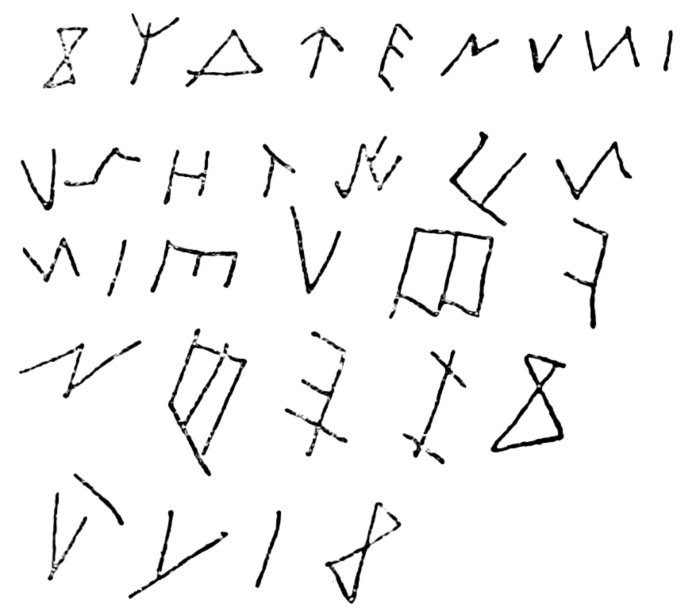
A stone of great interest found also at Citania may perhaps add more to our knowledge than the mysterious Pedra Formosa. It bears an inscription in the Celtiberian character, of which comparatively few specimens have hitherto been discovered, and no key has been found to decipher them. One of those known and reproduced by Dr. Hübner was found at Peñalba de Castro in Spain, and appears to be nearly identical in character with that from Citania; whilst another, also in Hübner, brought from Barcelona, presents several important differences. The Citania inscription is here reproduced, and I am indebted to Professor Rhys, the famous Celtic authority, for an interesting suggestion, namely, that the whole inscription, although written in the unknown Celtiberian character, may be intended to be read in Latin; in which case the first line and a half might represent Syatenunius. This point, however, I must leave as being too abstruse for a book of this kind. We are on firmer ground in the case of the very numerous specimens of red pottery found at Citania and stamped with a mark entirely unknown elsewhere. The marks of Roman potters on jars and pitchers were always printed in small letters outside the mouth, whereas the marked pieces in question from Citania bear in letters an inch long inside the mouth “Camal” or “Arg,” and sometimes both words, and scores of red tiles have also been found similarly marked ARG CAMAL. Upon a lintel-stone from Citania in the museum I read the words CORONERI CALI DOMUS, and another, apparently from the same house, is mentioned by Dr. Sarmento, but which I did not see, bearing the inscription CRON CAMALI DOMUS, most of the pottery bearing Camal’s name having been found near this house. Whether Camal was a Celto-Roman potter, or, as seems much more likely, a great personage or chief of Citania, is a point yet to be decided; but from the fact that the name on the clay vessels is not situated where the potter’s mark is usually inscribed, would tend to the belief that he was the owner rather than the manufacturer. Arg, or Airg, as it may be read, may have represented a Celtiberian title or dignity, and Camal, or Camalus, is undoubtedly a Celtic name. It is unlikely, moreover, that if Camal had simply been a potter his son Coronerus would have considered it necessary to record upon his stone door-lintel the fact of his descent, which he probably would have done if his father Camalus was a person of consequence. Another peculiar fact in connection with the incised ornamentation upon stones at Citania is the repetition of the Swastick or wheeled cross and the wheeled whorl, which are of pre-Christian and oriental origin, this design being also quite frequent in the objects found in other places in the neighbourhood, and amongst Celtic remains in other parts of the Peninsula.
The death of Dr. Sarmento has, of course, put an end to his self-sacrificing life-task, leaving by far the greater part of the exploration of the outer zones of Citania unattempted. It is almost too much to hope that any other similarly public-spirited Portuguese will provide the funds needed for the purpose, for there is little enthusiasm for such subjects in the country; but if funds could be obtained to excavate extensively the lower slopes of the hill on the south side where numerous hillocks suggest that sepulchral remains may lie beneath, it is probable that discoveries of great importance in Celtiberian civilisation would be made, and perhaps the riddle of the Celtiberian alphabet solved.
IV
BUSSACO
After losing sight of the marvellous view across the river of the city upon its amphitheatre of hills, the road from Oporto towards the south runs through a country of drifting sands parallel with the seashore. Pines bending away from the prevailing westerly wind stand singly and in clumps at first, and then in vast tracts, as in the Landes about Arcachon, binding the unstable soil together; and within a few miles of Oporto here and there a sea-bathing village of châlets and houses of entertainment breaks the monotony of the scene. It was but seven in the evening, but the autumn day had already sunk into dusk with an angry streaked black and crimson after-glow when I came to the little thermal bathing village of Luzo, on the lower slopes of the mountains that cover the whole of the north of Portugal except the strip of country bordering the sea. For some miles, ever since we had left the main railway line from Oporto to Lisbon at Pampilhosa junction, we had been rising, whilst the pines bordering the line had been growing thicker and more sturdy, and from Luzo onward the way grew still steeper. The stars shone brightly, but a dew almost as heavy as rain was falling as the carriage that had met me at the station drawn by two gigantic mules, rattled along the excellent road through Luzo.
There is always a feeling of uncanniness in speeding through an unknown town at night for the first time. Here at Luzo little white cottages flashed past us, a dim light flickered before a shrine at a street corner, a man dimly visible tinkled a bandurra a by the side of a grated window, little groups whispered mysteriously in the semi-darkness: they were all shadows to me, whilst I, poor waif, to them was nothing, for the clatter of the mules and the rattle of the carriage over the cobble stones were the only signs they had of the momentary presence of a man who, like a ship passing in the night, flitted in the darkness through the village which to them was life and death and all things. Our road lay ever upward. By the dim light of a waning moon one could see the trunks of great pines close together, and the soft moist air was heavily charged with the grateful balsamic scent of the trees. As we toiled patiently upward and still upward, in the darkness of the night the hush of the woods fell deeply upon us, for no breath of wind stirred the lofty tops that closed over us like an arch, and the summer night-birds had already taken flight farther south. Presently we passed through what in the dimness looked like an imposing architectural gateway set in a high wall, and then the wood grew perceptibly denser. By the wayside the bank on the left rose sheer from the road covered with verdure, and one felt rather than saw that up and up, as it seemed infinitely, the great trees towered higher and higher upon the steep slope, whilst on the right hand the huge eucalyptus trunks shining white through the blackness of the night, stood upon the brink of a precipitous drop, from which emerged now and again tree tops and a tumult of vegetation that showed, even though one saw but little of it, that we were in the midst of a luxuriant forest such as those I have seen on the Amazon and in Brazil, but never before in Europe.
Presently we drove into a circle of light, and one of the surprises of my life burst upon me. A palace so stately and beautiful, so new and spotless withal, as to seem like a scene from a fairy tale. But no—this flashing white dream in stone is no scenic illusion; the carved tracery, like petrified lace, and leaves, and branches, infinite in caprice and variety, the lovely cloistered terrace, the monumental staircase, and the almost insolent wealth and intricacy of sculptured ornament, are all solid chiselled stone, and this splendid royal castle in the most wondrous wood in Europe is an ordinary hotel, or rather an extraordinary one run on ordinary lines.
The first instinct of a traveller when he lights upon such a find as this is to keep it to himself rather than diminish his enjoyment in the possession of his secret by sharing it with others; but Bussaco is big enough, and it would be ungenerous to hide it. It was built by the Portuguese Government, it is said, for a royal residence, and is hardly yet quite finished, for an annexe is now being constructed for the use of the royal family during their summer sojourn, and some of the frescoes in the main castle are still to be added; but it is difficult to understand—unless the intention really was, as stated, to make the place a permanent royal residence—the reason for spending the vast sums of money that the place must have cost upon a house of public entertainment. However, there it stands, with its stately tower, its majestic carved staircase, and all its heraldic blazonry, in the midst of a crown domain seized from a Carmelite monastery, probably the most beautiful hotel in Europe, certainly by far the best in the Peninsula; in an exquisite climate, with perfect sanitation and water, a good white wine grown on its own hillside, a cuisine with which no fault can reasonably be found, cleanliness, and order; a Swiss lessee who speaks English fluently and understands English needs, a bill of almost disconcerting moderation ... and the woods! For, after all, the hotel-palace, the golf-links, the tennis-lawn, the ballroom, and all the rest of the added attractions of the place, are but subsidiary incidents to the terrestrial paradise that surrounds it, enclosed in its high granite wall six miles in circumference.
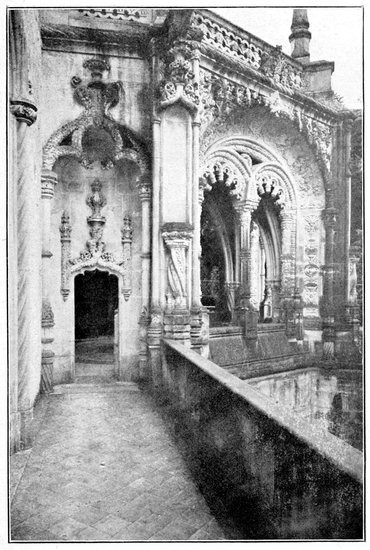
Manueline Architecture at the Hotel, Bussaco
It was night when the gleaming salt-white palace first flashed upon me out of the darkness, but when I opened my shutters as the dawn was breaking the next morning, and stepped out upon the wide battlements of the castle, the scene before me was so wonderful as to force from me an involuntary prayer of praise and thankfulness to God that so much of beauty should be vouchsafed to my senses. Below and around me for miles on all sides stretched the woods, woods such as I have seen nowhere else in Europe, though the private gardens and plantations of Cintra and Monserrat approach them in luxuriant fertility. Great palms and towering cedars of Lebanon grow side by side with oaks of giant bulk: oranges and fig-trees, cork and acacia, maple, birch, and willow stand beneath the straight eucalyptus, “tall as the mast of some great admiral”: araucarias spread their spiny branches with a luxuriance never seen at home, and mosses, ivy, and ferns clothe thickly every inch of ground, every bank, and even the time-worn stones, that all around testify to the existence of dwelling here long before the white palace raised its tall tower over the darkening wood.
Beyond the trees, on the fair morning I first beheld the scene, the shadow of twilight still lingered in the valleys and the horizon was veiled in mist, but already the sun was touching the mountain-tops all around. One range after another caught the golden light, and as far as the vision reached mountain succeeded mountain like mighty waves suddenly stayed in their onward sweep and turned into rosy rock. Here and there amidst the greenery, far below upon the plains, a white cottage, or the clustered red roofs of a village lit up the picture with a note of emphasis, and the sweet, cool air of the mountains, fresh with the scent of pine, eucalyptus, and wild flowers innumerable, came to the jaded town-dweller like a foretaste of some exquisite new sense to endow mankind in a fuller life to come.
Straight before me, as I stood upon the battlements looking towards the south, there rose as it seemed quite close a steep mountain slope clothed with a mass of verdure so thick as to look like a solid billowy surface of every tint of green, from tender primrose to deepest bronze. Here and there a straight pine or cedar, more lofty than its fellows, caught with its feathery top a glinting sun-ray and held it, whilst high up, almost overhead, upon a rocky spur emerging from the foliage there stood a humble hermitage, and on the very summit, looking so inaccessible that no human foot could reach it, a little white tower of another hermitage reared its cross over all.
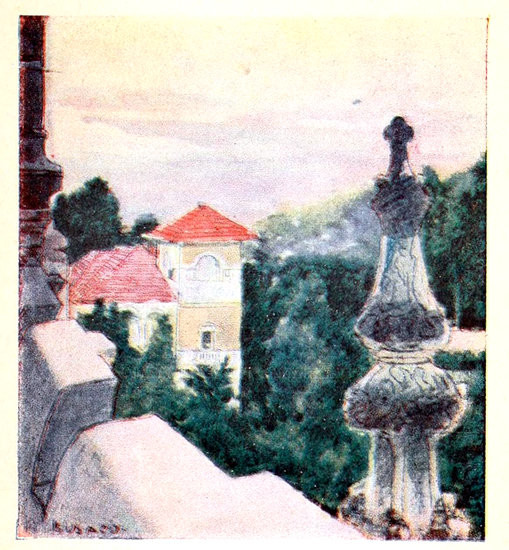
FROM THE BATTLEMENT, BUSSACO.
On the right hand, as one looked down over the battlements, the pretty gardens of the palace, with flowers and palms, are spread at the foot, whilst, resting humbly under the shadow of the palace, is the ancient church and the tiny monastery, which for centuries housed the silent Trappists, whose loving care made this holy wood to grow upon the spurs and glens of a granite mountain. Beyond the garden, the wood slopes suddenly down in billows of greenery, and then at its foot spreads the vast plain, with towns and villages nestling in its hollows. And as the sun grows in brightness I see beyond the limits of the plain, far away, a long strip of white, and over it, high up, as it seems above the horizon, a deep violet wall. It is the sea, the broad Atlantic, with its fringe of silvery sand many miles distant, and it gives the supreme touch to a scene of perfect beauty. On the other side of the castle the view is just as lovely in a different way. Beyond the palms and flowers at the foot, seen over a hundred carved crockets and capricious stone pinnacles and gargoyles, with the great tower of the castle and its armillary sphere over all, is a far stretch of undulating wood; and then a vast tumble of mountains, range over range, all but the highest clothed to the top with forests, and beyond and above them all the bare granite peaks of the Caramulo range, iridescent now with the morning sun. The domain occupies the whole of the north-western end of a long continuous mountain ridge, some eight miles in total length, running from south-east to north-west and extremely precipitous on all sides. From the earliest times, at all events since the fourth century, the glens and ravines that score these slopes have been jealously guarded by ecclesiastical masters. The sheltered position and soft westerly breezes from the Atlantic endowed the spot with a climate mild, equable, and healthy, even for Portugal, whilst the purity and abundance of the springs and the marvellous fertility of the soil in the deep, moist gorges on the mountain-side made it an enviable place of secluded residence. Whilst the minimum winter temperature is about forty degrees, frost being unknown, the summer heat is tempered by the altitude of the place and by the abundant shade of the woods, so that the temperature rarely exceeds that of a warm July day in England.
With these climatic conditions it is natural that this end of the ridge, protected on all sides, should develop a vegetation of extraordinary luxuriance. So remarkably was this the case that the successive ecclesiastical bodies to which it belonged for fifteen hundred years decreed that the woods were for ever to be held sacred as a place of sanctuary and devotion. From the eleventh century onward the domain belonged to the Archbishops of Braga, and in 1626 one of them granted it to the order of shoeless Carmelites, as a retreat remote from the world, where the monks following the strict Trappist rule might meditate in silence undisturbed by the turmoil of their fellow-men. In poverty, and with the hard labour of their own hands, the monks built the little monastery and humble church as they now stand, with other portions since demolished; and, year by year, for two hundred years, planted and tended with devout care the sacred wood which was their one earthly concern. From all quarters of the globe where the Portuguese flag waved, from India, South America, and the Far East, rare plants and trees were sent by Carmelites to their beloved “Matto de Bussaco.” Medicinal herbs, rare and lovely ferns, and exotic fruit and flowers, impossible in other places in Europe, here grew luxuriantly, and the silent, white-robed gardeners planted and tended their domain until it became not a wood but a sylvan garden of surpassing beauty, as it remains to-day.
A high wall shuts it in from the rest of the world, whilst a special Bull of Urban VIII., deeply cut to this day upon a great slab on the principal gateway, condemned to major excommunication any person who violated the sanctuary or injured any plant within the sacred precincts; and another papal Bull bans any woman who dares to set her foot upon the domain. Beautiful terraced paths were cut upon the hillsides, and zigzagging down the ravines, fountains that gushed spontaneously from the mossy rocks were dedicated to saints and adorned with sculptured shrines or rustic grottoes. Everything that single-hearted toil and devotional spirit could do, for centuries the shoeless Carmelites did for their remote monastery and the fairy glens of Bussaco; and since the abolition of the monastic orders in Portugal, the Government have tended and guarded the spot as carefully as the silent monks before them. One trembles for each innovation in such a spot as this, and the present road-cutting operations through the wood and just around the palace, though the new approaches will doubtless add to the accessibility of the place, cannot fail to injure somewhat its sylvan beauty; just as the building of the palace itself, and especially of the new annexe now in course of construction, further dwarfs and hides the quaint little monastery, which really seems to strike the note harmonious with the place.
To describe in detail the beauties of Bussaco is impossible in the space at my disposal, but one ramble amongst many may be cited as an example of the effect produced by them upon an appreciative visitor. The sky was the deep, lustrous, sapphire blue of which Portugal alone seems to hold the secret, and the fierce sunlight, held in check by the lofty canopy of leaves, just dappled with golden tesselation the steep path up which I wandered from the palace door. On each side of the well-kept walk stood low stone walls, a mass of brilliant emerald, clothed, as they were, with long trailing mosses and tender fronds of ferns innumerable. Autumn as yet had done nothing to braise and brand the greenness of summer; for in this favoured spot the seasons make but slight difference in the vegetation. Verdant glades and dim recesses of sea-green shadow open up at every turn in the winding path; domed masses of foliage above and below on the steep sides of the glen seem like the silent naves and aisles of vast cathedrals. To say that the air was like wine is a commonplace. This was primeval air, the breath of a myriad trees and sweet health-giving plants, inhaled upon a mountain top overlooking the boundless sea. Not like wine grossly made by man was this, but like some vital elixir distilled in a magician’s laboratory, bringing new life and vigour, with a sensuous joy added by the spirit of the place and the soft warmth of the shaded sun.
Towering eucalyptus trees, the fawn-coloured bark hanging in long loose strips and showing the silver skin beneath, alternated with pied planes and feathery palms. Pines and cedars of Lebanon, and a score of trees one knows not by name, tower over all, their great trunks (I measured one cedar twenty feet round), clothed at foot by a dense undergrowth of flowering plants. Large camellia trees, agaves and magnolias full of bloom, the big white pendent flower of the datura, the pink and blue masses of hydrangea, and the glistening foliage of orange trees, lit up the shadowy slopes overhung by the dense foliage of the forest; and trails of smilax, and I know not what other verdant creepers hung in festoons from branch to branch.
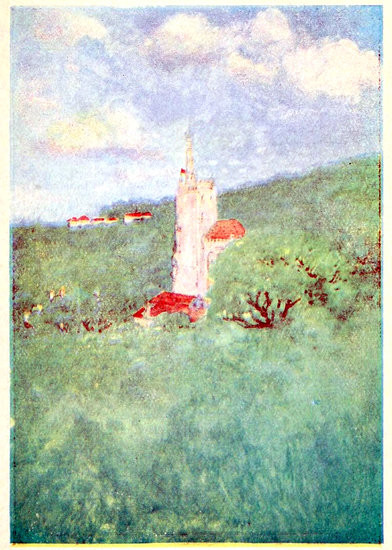
THE HOTEL, BUSSACO, FROM THE WOODS.
At the top of the path a moss-grown cross at the foot of a flight of broken stone steps, hard by a crumbling archway, marks the beginning of one of the several pilgrimages of the Cross scattered through the woods, a lichen-covered slab upon the cross recording that: “These two hermitages of the pilgrimage of the Cross were built by order of the Illustrious João de Melo, Bishop and Count, in the year 1694.” The little hermitages stand almost intact, though their thick walls are all overgrown with bright mosses and reaching arms of verdure. Passing beneath the archway, shadowed by a mighty cedar, I find myself at the foot of this Via Sacra, a steep ascent with green and crumbling steps before each open shrine of the Passion every hundred yards or so. The shrines, little quaint square buildings, with the window-like opening breast high, and a kneeling-stone before each, are all dismantled and empty now; though with their cloak of foliage and ferns and their lichen-clothed slabs telling the scene of the sacred Passion which used to be exhibited inside, they are perhaps more beautiful so than ever they were. Weeks after, when I saw at Caldas, in course of construction, some very fine sacred groups in enamelled earthenware, the figures half life-size, and was told that these scenes of the Passion were intended by the Government for the restoration of the shrines at Bussaco, I breathed a silent hope that, though the groups might be replaced, no attempt would be made to restore to newness the shrines themselves.
As one trod the old path of the pilgrimage, up mossy steps and past despoiled shrines, with glimpses of sunlit glades and shady green dells, it was impossible to shut away from one’s thoughts those generations of silent white-clad figures, who, shoeless, had toiled so often up the Via Dolorosa, with tears of penitence, perhaps agonies of regret, for the life from which they had fled. All around were relics of their unrecorded labour. Sculptured stones, chapels, hermitages, fountains, grottoes, and shrines were all built by their patient hands; paths scarped on steep hillsides, seats placed in quiet nooks for the meditative and the weary, nay, the trees and plants from all lands growing so proudly now had all been tended anxiously by the same dumb shadows that for centuries waited for death within the walls enclosing the sacred wood. If ever a place was haunted by sad, harmless ghosts, these paths of pilgrimage at Bussaco must still be thronged by the white-robed phantoms of those who made them.
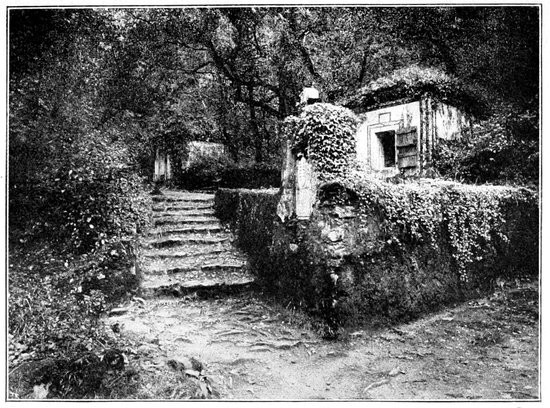
On the Via Sacra, Bussaco.
Turning aside and descending the glen by a narrower path, a ramble of half a mile brings me to another scene of marvellous beauty. In the foreground is a pool covered with water lilies and overshadowed by trees; and from it, leading straight up the hillside, is the “holy stair,” or cold spring, as it is called. Eleven double flights of stone stairs, each pair of flights leading to a landing of black and white mosaic, whilst in the centre between the two lines of steps a rocky cataract leads a rushing stream of icy cold clear water from the fountain gushing at the top from the rock in its mosaic recess down to the bottom of the hill, where it tumbles tumultuously into the pool. Through the whole length of the long fall, flanked by stairs, perhaps two hundred feet, rare ferns and mosses grow with wild luxuriance, especially in and about the pools on the ten landings; and, embosomed as the whole hillside is in dense greenery, it is impossible to exaggerate the delicious coolness and beauty of this secluded spot.
From the top of the Fonte Fria, or Scala Santa, the path leads through a valley, and then precipitously up the ascent that faced me when on the morning after my arrival I stood upon the battlements for the first time. The hermitage of St. Antão stands upon a ledge high up the slope, a tiny dismantled cell, from which a view is gained on a clear day that fairly takes one’s breath away. Below, set in its vast bed of verdure, the white stone castle stands, the gold armillary sphere that crowns its tower glittering in the sun; whilst on the left the far-flung panorama of the plain, with the blue wall of the sea beyond, and the grey mountains on the north, is flooded with an inundation of light, and scattered with the abodes of men—the sombre masses of greenery and the profound silence that surround us making the contrast the more striking. A wider view still than this is obtained from the highest point of the domain, on the very outskirts towards the south, where the Cruz Alta, the “high cross,” marks the site of what in ancient times was a watch-tower of soldier-monks, overlooking the country towards Coimbra, whence the Moors might come to invade the sacred wood.
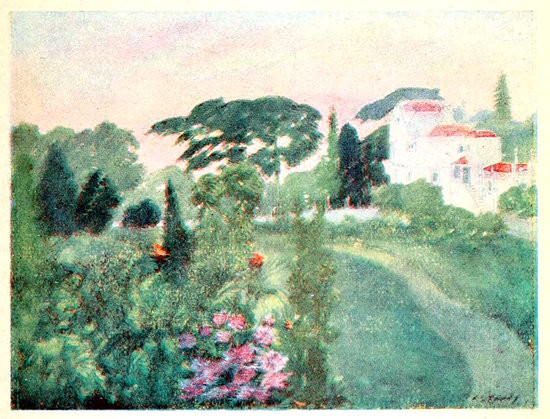
IN THE GARDENS, BUSSACO.
A greater battle than ever Christian and Moslem fought raged in later times upon this “Bussaco’s iron ridge,” just outside the granite walls of the wood on the north-west slopes of the long mountain. “Victory’s darling,” Massena, was to bring stubborn Portugal to heel at last. Soult had been expelled in 1809, after Wellington’s surprise of Oporto; and the Emperor was determined that nothing should stand between him and his small victim this time. Massena was at the height of his glory and success, and the flower of the imperial legions, eighty thousand men, marched through Spain, and carried all before him at first in Portugal. Almeida and Vizeu fell into his hands without a struggle; and the invaders thought that no serious obstacle would be offered to the march upon Lisbon by way of Coimbra. The road led them through the valley between the long mountains of Bussaco and the Cremullo range opposite, and Wellington, whose headquarters were at Coimbra, fifteen miles distant, decided to stop their progress there. Before the whole of his forces could be got into position, news came that the French had crossed the river Mondego, and the Anglo-Portuguese force gradually fell back, always fighting with the French advance-guard, until the whole of Wellington’s army of nearly 50,000 were stationed upon the long ridge of Bussaco, from the east wall of the domain to the river Mondego, where the mountain ends.
A curious relation exists, hitherto unnoted in English narratives, in which a monk of Bussaco gives a minute account from day to day of the events there from the 20th September 1810 until after the battle on the 27th, and the artless details of the good man are more personally interesting perhaps than the broad facts of the great battle itself. He tells that, on the 20th September, an orderly of Lord Wellington came to the monastery, and: “As soon as the door was opened to him he said, ‘I want to see the monastery, ha! ha! ha! To-morrow at two o’clock the commander-in-chief is coming here. He slept last night at Lorvão, and the French have already arrived at Tondella....’ The prior was told, and he showed the orderly the monastery and chapel, ordering the best lodging-chamber to be cleaned and got ready for the general, and the orderly, after drinking a little wine, galloped back to Lorvão.”
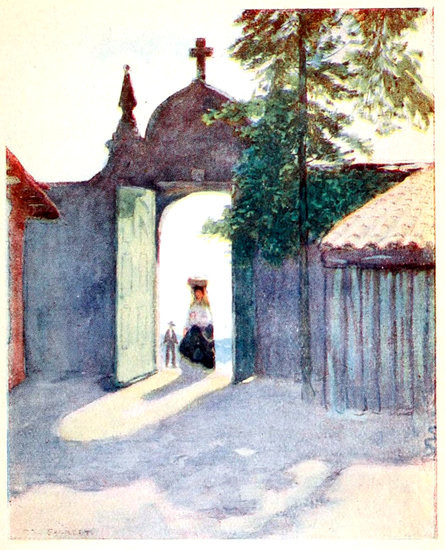
THE PORTA DA SULLA, BUSSACO.
Early next morning the whole wood, the hermitages, the monastery, and the chapel were filled with English officers, fifty officers being quartered in the monastery itself. Wellington arrived at midday, and when the prior showed him the best guest-chamber, swept and garnished for his use, he refused it, “although it was the best,” because it had only one door, and another apartment with two doors had to be found for him. Whilst this lodging was being prepared and cleaned, the general rode out of the domain by the gate on the north side and inspected the whole position from the highest point of the ridge to the east, on the bare granite crest of which he fixed his own position for the day of the battle. Standing upon this spot there spreads below the steep slopes in the foreground an undulating plain, some five miles across, with Caramulo mountains on the other side. Through this broken plain Massena was forced to march in order to turn or cross the Bussaco mountains, and proceed on his road to Coimbra, Lisbon, and Oporto. When he learnt that the English general had decided to risk everything by making a stand there with forces inferior to his own he at first refused to believe it, for constant success had made him think that his troops could do anything; and if Wellington were beaten here, then annihilation would await the English, and Portugal would follow Spain in bowing to the yoke of France. But if Wellington does take the risk, said Massena, “Je le tiens! demain nous finirons la conquête de Portugal, et en un pen de jours je noyerai le léopard.” Ney, Junot, and Regnier in vain counselled Massena not to fling his men away upon attacking such a tremendous position as that of Bussaco, and urged him to retire and await reinforcements from France; but Massena laughed at their wise fears, and decided to storm the height. “There is only the rearguard of the English there,” he said; “if the whole army is there so much the better, the good luck of the darling of victory will not abandon him.”
Every cell and every corner of the monastery and dependencies were full of English troops, “except Father Antonio of the Angels’ cell, which no one would have, as it was filled with all sorts of old rags, rubbish, and old iron he could pick up, and the monks had to sleep anywhere.” On the 26th September the French were seen on the mountains opposite and upon the plain below, where skirmishing was constant between advance-guards. The north-east wall of the domain was partly demolished and crowded with English troops, whilst batteries of artillery topped the crest of the ridge, and Crawford’s corps held an outlying spur that projects into the plain from opposite the north gate (Porta da Rainha) of the wood. Lord Wellington rose very early on the morning of the 27th, and to the dismay of the monks ordered his baggage to be sent out of the wood towards Coimbra. It was not for flight, as the monks feared, but prudence, and after breakfast the great general rode out and took his stand upon the top of the ridge of Bussaco, overlooking the long valley. His own troops were to a large extent hidden behind the crest of the hill, and occupied the whole length of the mountain from beyond the Mondego on the north-east to the monastery on the west, Crawford’s position on the projecting spur on the English left flank making the position at that end practically semicircular; this left flank consequently enfiladed with its artillery the face of the declivity upon whose crest Wellington’s centre was stationed. On the extreme right of the English, on the other side of the Mondego, General Hill was in command, with the Portuguese under General Fane; but the whole of the rest of the Anglo-Portuguese army was posted upon or behind the long crest of Bussaco, the extreme left under General Crawford being thrust forward upon the projecting spur. At six o’clock on the morning of the 27th September, under cover of a heavy mist, two desperate attacks were delivered upon the centre of the English position. That on the right of the centre was led by Regnier with incredible dash and bravery, but with terrible loss to the French. A whole division of Frenchmen at one point here finally struggled to the summit of the ridge, and the eagles planted on the granite crest proclaimed to Massena that the victory was won. But the 88th and 45th regiments were in reserve behind the crest, and at the captured position gallant Picton was in command. Like an avalanche the two regiments, with a Portuguese battalion, advanced along the ridge with fixed bayonets at the charge. With irresistible impetus they swept all before them. The French division was hurled helter-skelter down the precipitous declivity with hideous ruin and devastation. All the face of Bussaco at that point was sown with the dead and dying, the French loss exceeding four thousand, and the legions of the Darling of Victory experienced the bitterness of their first defeat. This awful carnage took place at some little distance to the right of where Wellington stood on the summit of the ridge though well within sight, and a similar attempt, but with even less success was made still nearer to him on his left; whilst a stubborn and sanguinary struggle took place upon the spur on the extreme English left occupied by Crawford and Packe, upon one point of which now stands the obelisk commemorating the battle.
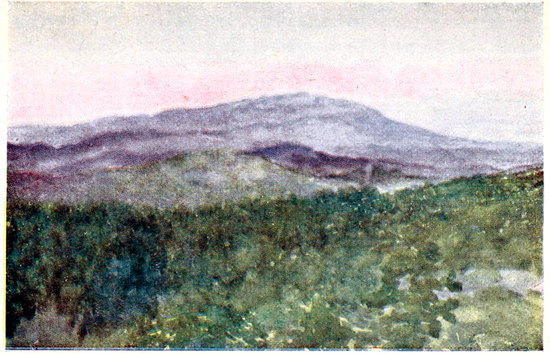
BUSSACO’S IRON RIDGE.
The English and Portuguese under English officers vied with each other in stubborn bravery, and the moral result of Bussaco was tremendous, though the material advantage was small. From that hour of defeat the legions of the Emperor knew that they were not invincible, and the sun that was to set at Waterloo first turned its meridian when Massena’s gallant infantry were hurled headlong down the hill. By a masterly piece of strategy Wellington, the day after the victory, sent off a division to occupy Coimbra, and when defeated Massena by a circuitous route arrived in the neighbourhood of the city he found himself forestalled, though the English shortly after evacuated it and fell back. The lines of Torres Vedras finally frustrated the French, but Bussaco was the turning-point of victory.
The monkish diarist has many poignant little stories to tell of the horrors into which the monastery was plunged during and after the battle. The wounded were everywhere, but were packed especially close in the little unfinished chapel outside the walls of the wood opposite Crawford’s position, now a commemorative chapel where many relics of the fight are shown.
At midnight on the 28th an English officer hurried to the monastery and reported that Massena was retreating and endeavouring to reach Coimbra by another road. The night was dark and the rain fell heavily, but Wellington rose from his bed, and at once gave orders for the English army to march upon Coimbra. Like magic the monastery and wood—even the great mountain itself—was freed from armed men, and before midday nothing was left but the débris of battle and the dead and wounded. The monk who tells his simple tale says that they managed to give beds in the monastery to most of the English officers during their stay, “and a general who was in the bishop’s chapel had a tablecloth, two brass candlesticks, and a great copper jar for water, and also some napkins. All of this,” he adds, “was lost.” “To Lord Wellington,” he continues, “we gave the best napkins we had, four dozens of candles, and everything that the other officers were continually asking for. Even to the common soldiers and the people who came for refuge, we gave salt and all we could. We gave out a lot of wine, bread, cheese, oil, and other things for the troops, and when Lord Wellington was leaving he sent word to the prior that he would pay for what had been supplied, if he would tell him the amount. The prior replied that he asked for nothing but peace. This monastery of ours lost very heavily by the troops. Nearly everything we provided for the beds and tables of the officers disappeared, and not a thing of any value was left.... Besides this they stole all the oranges in our two orchards, they forced the door of the storehouse and took all the bread and wine they chose, with a basket of eggs, and a comb of honey, and many other things. Indeed they acted just as badly or worse than the French.”
And so, after the short agony, the wave of war and horror swept away from Bussaco, leaving only the memory behind; and the sacred wood was abandoned to the white-robed monks:—
“The Carmelite, who in his cell recluse
Was wont to sit, and from a skull receive
Death’s silent lesson, wheresoe’er he walked,
Henceforth may find his teacher. He shall see
The Frenchman’s bones in glen and grove, on rock
And height where’er the wolves and carrion birds
Have strewn them, washed in torrents bare and bleached
By sun and rain, and by the winds of Heaven.”
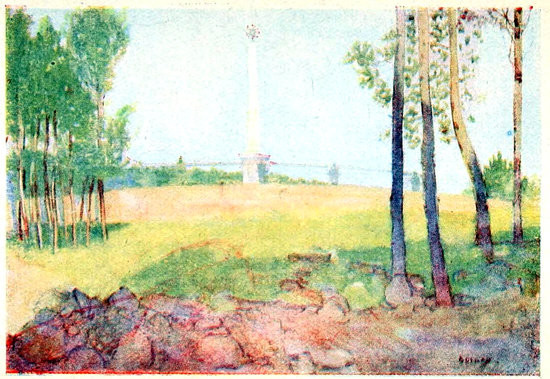
THE BATTLE MONUMENT, BUSSACO.
It is all forgotten now, and nothing matters much, I mused, as I wandered up the dark avenue of cypress, yew, and pine that leads to the low three-arched façade of the old monastery. Before the quaint little one-storey porch, faced with designs of coats-of-arms, flowers, and scrolls in black and white mosaic, stands an ancient cross, and within the entrance is the tiny cloister and church that alone remains of the monastery. I wandered into the dim cloister full of thoughts of Bussaco’s baptism of blood, though it was all quiet and peaceful now in this humble retreat. At each corner of the cloister stands a dismantled altar, faced with coloured tiles of Talavera majolica, and the walls between the windows are hung with mouldering and tattered canvases of dead and gone Carmelites—saintly men whose bones lie beneath our feet and in the little green enclosure formed by the cloister. Around the walls on three sides are the doors of the cells, each door covered, as are the timbers of the cloister, with rough cork bark, which adds to the appearance of antiquity. One picture attracted my attention, a poor defaced painting, faded by time and weather, representing at full length a white-clad monk holding a skull in his left hand, and in his right a scroll. Something noble and dignified in the appearance of the face attracted me, and I tried to decipher the almost effaced inscription on the scroll. It was difficult, but at last I read that the monk was the “Reverend Father, Fray Luis de Jesus,” who in the world had been called the Marquis of Mancera, when the seventeenth century was young. And beneath the name this distich ran:—
“A morte me fas deixar
O que me podia danar.”
As I pondered on this curious couplet, “Death makes me leave What might me grieve,” in the shadowy cloister, there came towards me a phantom of the past. It was an old, old man dressed in brown undyed homespun, short jacket, and breeches of a bygone fashion, and the universal black knitted stocking nightcap of the Portuguese peasant. He hobbled out of the cell where the great duke had slept the nights before the battle; and as he came slowly towards me, supported by a long staff, he courteously doffed his cap, and wished me good day. He was, he told me, ninety-three years old, but his eyes were still bright and his skin clear, and I fell into discourse with the ancient, as we rested together upon a bench in the darkling cloister, through the end door of which a bright splash of orange sunlight sent shimmering waves into the dimness.
Yes! graças à Deus, he was well, notwithstanding his great age, and he dwelt, past work now, with his son, a sort of foreman on the domain, in the double cell which had been that of the prior of the monastery. He was born in a neighbouring village, and had never been far away. He had witnessed the expulsion of the monks and the building of the beautiful palace that had pushed aside the pathetic abode of penitence, humility, and patience. In his prime he had known and talked to many of those who had witnessed the great battle on Bussaco’s slopes, and he told me artlessly, and in his quavering treble, how all down the slope, upon which I saw him the next day, the dead and wounded Frenchmen had lain thickly, with their arms, drums, and big shakoes scattered around them; how the poor wretches, crying in their agony for a draught of water, were refused by the country people, who hated so bitterly the invaders of their fatherland; how the good monks strove their hardest, succouring the wounded, French, English, and Portuguese alike, and reverently burying the dead in consecrated ground.
As the old man spoke, quietly and gently, telling at first-hand the story of nearly a century ago, my mind went back to another old man whom I had known when I was little more than a child, who himself had fought in this battle; but to my eager inquiries for details had little of satisfaction to impart. But, somehow, the mere fact of having known an actor in the scene, however inarticulate, and now to be speaking upon the spot with one who had all his life heard direct from those who witnessed it the story that made his countryside for ever famous, brought nearer to me the vivid vision of long ago. Bussaco fight to me for a brief space was real, as Salamanca and Vitoria never can be, and I feel that for one half hour I have lived in the time when the giants of the world contended for mastery.
Outside the cloister the dream vanished. The lofty white tower with its golden globe, emblem of Portugal’s princely pioneer of extended empire, spoke of another age and aroused other memories: peace, luxury, and security reigned now supreme in this ancient abode of austerity, and no invader of the land was possible. The far-spread forest wafted its balsamic breath to me, and the myriad leaves softly whispered in the sensuous breeze, as if that awful day of the 27th September 1810 had never dawned upon the sacred wood. Bussaco is beautiful enough to live in the present without its one cruel memory, gently pensive occasionally at the thought of the stern, sad, anchorites who laboured to make it perfect for the glory of God. But to Englishmen—aye, and to Frenchmen and Portuguese too—there must come at least once during their stay a rousing bugle blast that calls their souls to arms and bids them honour their glorious dead who stood and fell so gallantly upon Bussaco’s granite ridge in the long long ago.
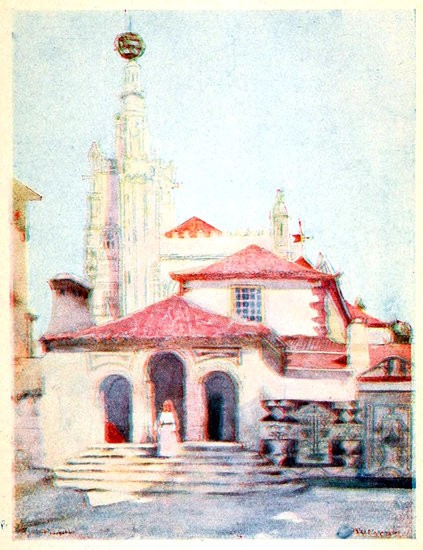
ENTRANCE TO THE CLOISTER, BUSSACO.
V
COIMBRA, THOMAR, AND LEIRIA
The morning was sparkling, the sky without a fleck, and the air like draughts of nectar, as I slowly descended from the monastery and hotel of Bussaco, through the lovely umbrageous “valley of ferns” to the “Gate of Grottoes,” in the south wall of the wood, where I had directed a carriage to await me and carry me to Coimbra, fifteen miles distant. I was loath to leave this exquisite spot, which art and nature have conspired to make perfect; the fairy glens, the unrivalled prospects from the heights, the spacious magnificence and homely comfort of the guest-house—but I had already exceeded my allotted time, and other places called me.
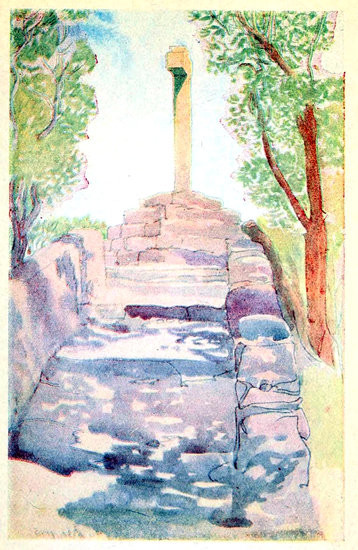
ON THE SUMMIT OF BUSSACO, THE CRUZ ALTA.
Our road lay downward for a mile or two, through a beautiful country of pines and gorgeous stretches of purple heather in full bloom; and here and there long trellised vineyards, with the red bronze of the vine-leaves adding a splash of colour to the scene. As we wound down and along the plain, there always towered above us, as it seemed right overhead, the “Cruz Alta” of Bussaco amidst the trees at the highest point of the wood, near where the wall limited the greenery; and soon the whole of the long, sharp hog’s-back of granite ridge, standing clear and distinct from surrounding mountains, tremendous in bulk, is seen from the plain. It was hard to realise that only yesterday I had stood, without fatigue or trouble, upon that giddy height of the Cruz Alta, which looked from here as if an eagle alone might reach it.
Patient ox-teams toil along, led by small boys in black nightcaps, gravely courteous to the stranger, and black-eyed solemn children play soberly by the wayside and take no heed. Soon we pass through the big, poor-looking village of Pampilhosa, and leave the pines and heather behind us; for here down in the valley olives, cork trees, ilex, and vines abound, with figs, pears, and apples, in orchards nestled round the white cottages. Aloe hedges, with the big, fleshy lancet leaves of silver-grey, show that we are in a sub-tropical land, and patches of succulent sugar-cane for cattle fodder grow brilliantly green against the maize and millet fields; whilst all along the wayside the light-leafed poplars rear their straight shafts, heavily burdened by masses of purple grapes and flaming vine leaves, the only sign of autumn, though October is now upon us.
As we near Coimbra, though it is not much past noon, we meet many groups of handsome country women, with, as usual, heavy burdens upon their heads, returning home from the weekly market in the city. Barefooted they go invariably, with their fine broad shoulders, full bosoms, classical faces, and broad, low brows, their gay kerchiefs on head and bosom, and their fine eyes gazing straight forth with modest dignity; and mentally I deny assent to the boast of Guimarães that its maids and matrons reign supreme in buxom grace, for those of Coimbra need bow the head to none on earth. All around the city are gently rounded undulating hills covered by olive orchards, and as the road tops one of them we see the picturesque old capital beneath us upon its steep slope, the broad Mondego at its foot, and beyond the river a high green ridge crowned by an immense white convent.
In the ancient times, as the Christian monarchs wrested from the Moors one territory after another, and drove the Crescent ever farther south, the capital of Portugal followed the victorious standard, and Guimarães soon had to cede its place to Coimbra, which remained the capital from the time of the first Affonso (Henriques) in the twelfth century until the extinction of his dynasty in the fourteenth, and occasionally later. Coimbra is crowded with memories of the heroic times, of combats with the Moors, and of deeds of violence and blood perpetrated within its walls; and in its quaint crowded streets are corners that can hardly have changed since the Affonsos and Sanchos here held their court—the Arco d’Almedina leading out of the principal street, Rua do Visconde da Luz, for instance, and the quaint renascence palace, incorrectly called the palace of the martyred Maria de Telles, in the Rua de Sub-Ripas.
But to the famed Church of Santa Cruz, all that remains intact of a vast Augustian monastery, the pilgrim’s steps first turn. It stands in an open place at the end of the Rua do Visconde da Luz, sunk several feet below the present level of the street, and the magnificent Manueline, or Portuguese renascence front is spoilt by a mean and hideous detached portico, in front of the real doorway, with its fine carved figures and capricious canopies. The lower part of the octagonal tower is much damaged, and the delicately carved decorations destroyed; but enough remains of the upper part to prove the magnificence with which King Manuel in the beginning of the sixteenth century rebuilt the sepulchre of the earliest kings. In this church, of which the interior, lined with pictorial blue tiles, is now reduced to eighteenth-century aridity, with the exception of the roof and chancel where the magnificent tombs with recumbent figures of Affonso Henriques and his son, King Sancho, shame the tastelessness of the later work, a dramatic scene was once enacted. Both these first kings of Portugal had worn the habit of St. Augustine, and were lay members of this monastery where their bones were laid. In order to establish his right to the patronage of the foundation, King Manuel, in 1510, rebuilt the church and monastery in the exuberant and gorgeous style associated with his reign; and when the time came to restore the bodies of the kings to the new sepulchres prepared for them, Manuel caused the mummified corpse of Affonso Henriques to be clad in royal robes and kingly crown, enthroned before the high altar of Santa Cruz, and there receive the homage of his subjects as if still alive. The pulpit of the church, the work of Jean de Rouen, though stripped now of its side pilasters and famous canopy, is one of the most splendid examples of early French renascence; but the richest treasure of the church is a splendid early triptych, in the mysterious style of the so-called Gran Vasco (who is a mythical painter), in which the early Flemings are imitated exactly by apparently Portuguese hands. This triptych, which should be compared with the “Fountain of Life” described in the chapter on Oporto, and also with the famous “St. Peter” at Vizeu, is signed “Vellascus,” and represents in its three panels the “Ecce Homo,” the “Calvary” and the “Pentecost,” with the exquisite finish and glowing colour of Van Eyck and Memling. The cloisters of the church are a beautiful specimen, as is much of the exterior of the church itself, of the peculiar Manueline renascence Gothic, of which I have so frequently spoken, the motives being the capricious intertwining of cordage and branches, spiral bossed mouldings, exuberant pinnacles, and pendent floreated ornaments on the interior lines of arches and vaultings. Of this style the Bussaco palace-hotel is a notable modern specimen, and in a later chapter I propose to treat in some detail the other examples inspected during my trip. By the side of Santa Cruz, separated from it by a road formerly spanned by a high bridge, lies a splendid massive tower, and a huge block of the old monastic buildings now turned into a squalid barrack, so often the fate of the profanated religious houses in Portugal, whilst behind the church and cloister lies another large portion also turned to secular uses.
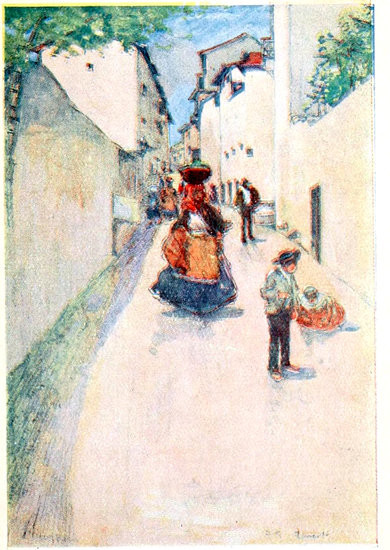
A STREET IN COIMBRA.
Coimbra is famous as the seat of learning for all Portugal—for many centuries, and still, the only university town in the realm. The huge square bulk of the university buildings on the crest of the hill overlooking the town typify the absolute domination of the place by the academical tradition. The hotel on the Alameda, like other hostelries of its sort, has no lack of commercial customers, but even they, assertive as they are, are swamped by the university professors, staff and graduates, who flock to its tables for their meals; whilst in the streets bookshops jostle each other all filled with text-books, and the unmistakable students are everywhere. And yet, with all this academical presence, there is none of that staid atmosphere of aloof erudition which is especially noticeable at Cambridge, and, to a lesser degree, at Oxford. It is true that the youngsters at Coimbra affect a garb at which the present-day undergraduate at Cambridge would scoff, if he did not proceed to more violent means to reduce its primness. A very clerical-looking black frock-coat, buttoned to the chin, is de rigueur, covered by a long black cloak reaching to the wearer’s heels, although, to tell the truth, this cloak, like a Cambridge third-year man’s gown, is oftener festooned over one shoulder or trailed along upon the arm than worn decorously as intended.
These Coimbra youths wear no head covering, and affect a gravity of demeanour whilst in the streets that gives them all the appearance of budding priests. But the absence of a collegiate system brings both staff and students into more direct contact with the town than is the case with our older universities, and the peculiar learned atmosphere of the High at Oxford or King’s Parade at Cambridge does not exist. It is a stiff climb up the hill to the university, and the cathedrals. The former is built round three sides of a large court, with a tower in one corner and an observatory in the open face, the enormous palace of the rector occupying one entire side of the square. Seven good light classrooms and a fine hall, senate-house, and examination rooms, give ample accommodation; and the view of the city from the end of the corridor containing the lecture-rooms is exceedingly fine. The library is a gorgeous gilt and over-decorated room in the florid taste of the eighteenth century, the worst possible style for a place of quiet study; and almost the only attractive feature in the exterior of the university is the fine Manueline doorway to the chapel in the great quadrangle. Here twisted cables, rich mouldings, floreated crockets and pinnacles, armillary spheres and crosses, the usual notes of the style, mark the work as being of the period when Portugal was ebullient with feverish energy and ambition.
Hard by is the bishop’s palace, now almost a ruin, but with some lovely bits of Manueline, and a delightful sixteenth-century courtyard like a scene upon the stage. The old cathedral (Sé Velha) upon the same hill, is perhaps the most perfect and unspoilt specimen of pure Romanesque of the twelfth century in the Peninsula. The deeply recessed west door, with round arch, quadruple ball mouldings, finely decorated Byzantine Romanesque pillars, and a large, recessed window in the same style above, occupy a square projecting battlemented tower flanked on each side by other square towers at the corners. On the south side the early renascence door reaching to the battlemented roof of the aisle is practically in ruins; but the pure, solid Romanesque of the rest of the building stands sturdy as ever after eight centuries. Small and grave, the nave and aisles, with the beautiful round-headed, recessed clerestory windows and capricious Romanesque Byzantine capitals, remain unmarred, though gilt and alabaster altars and chapels clamour for notice, and splendid sarcophagi of bishops and nobles on all sides contrast with the stern lines of the original building. Two features of the more recent periods deserve attention, the truly superb high-altar of Flemish workmanship of the first years of the sixteenth century, and the circular chapel of the Soares family, dated 1566. I could not tear myself away from the contemplation of the exterior of this old Sé on the hill over Coimbra, and at night when the darkness of the ancient city was hardly disturbed by flickering lamps, I lingered in the square around the battlemented walls and sturdy towers, reconstructing the scenes that had been enacted here, and calling up in imagination from their eternal sleep those great ones who rested so quietly within.
The new cathedral (Sé Nova) is a plain and ugly pseudo-classical building, in the so-called Jesuit style, standing on the summit of the hill, and only merits notice on account of its treasures. These form a veritable museum of early ecclesiastical art, from the twelfth century onward. I have rarely seen a finer specimen of goldsmith’s work than the custode of George d’Almeida, of pure Portuguese Gothic, in a similar style, but more imposing than the chalice already described at the Misericordia at Oporto.
Looking across the beautiful river Mondego from the acacia-shaded alameda where stands the hotel, the high wooded ridge straight opposite is crowned by the vast white convent of Santa Clara, once the glory of Coimbra and the cloister of queens, now partly destroyed and partly desecrated and turned into a factory. The heat was oppressive on the morning after my arrival at Coimbra, but a pilgrimage to the shrine of Saint Isabel the Queen, and to the shrine of love near to it, could not be foregone. Crossing the bridge I first wended my way to a beautiful villa almost on the banks of the river, in whose grounds there stands the Gothic ruin of a palace, and adjoining it gushing from a rock shaded by dark cedars a copious spring leaps joyously along a stone channel of some twenty feet long into a stone tank covered with water lilies. It is a lovely tranquil spot, where no sound reaches but the rustling of leaves and the gurgling of crystal water, and yet here, tradition says, was enacted in the long ago one of those tragedies that inspire poets, painters, and dramatists for all time. It was in 1355, and Ines de Castro, the lovely mistress of the Prince Dom Pedro, had so infatuated him that he refused to marry another at his father’s bidding. The King, Alfonso IV., incensed at the recalcitrancy of his heir, caused Ines to be done to death here beside the “Fountain of Love” by three courtiers. The son, Dom Pedro, rose in rebellion, and saw his father no more; but when two years afterwards the king died and Pedro succeeded him, he worked his ghastly revenge upon those who had persecuted his beloved. Ines had been buried at Santa Clara, the convent near, to which this estate belonged, and now her body was disinterred, dressed in royal robes, crowned with a diadem and adorned with jewels, and placed, a crumbling corpse, thus arrayed upon a throne in the monastery-Church of Alcobaça, whilst all the courtiers upon their knees kissed the dead hand of her whom they had insulted and contemned in life. Upon a stone by the side of the fountain this verse of Camões is inscribed:—
“As filhas do Mondego morte escura,
Longo tempo chorando morarão:
E por memoria eterna em fonte pura
As lagrimas choradas transformarão,
O nome e reputação que inda dura
Dos amores de Ignes que ali pasarão
Vede que fresca fonte rega as flores
Que lagrimas são agua, e o nome amores.”
“The fountain of love in the garden of tears” is the spot called to this day, and a crumbling little Gothic convent founded by the lover king between this and the river bears the name of “the convent of tears.”
Above us gleams the long white building of Santa Clara, and zigzagging up the steep hill lies the path, shrines at each turn of the way inviting to devotion and to rest. The sun beats fiercely on the steep white road, but the view from the summit upon the esplanade that faces the convent church repays the trouble of the climb. Opposite, across the river, the city is piled up upon its grand amphitheatre of hills, the huge, square bulk of the university and the Sé Nova topping it all; whilst beyond the rolling hills covered with olives provide a dark-green background, which throws into higher relief the blue, white, and pink houses grouped in the limpid air, under a cloudless sky, flooded with sunlight.
Of all the rich foundation of the royal convent of Santa Clara all that now remains devoted to religious uses is the white church, and the adjoining sanctuary of the saintly queen, tended by ladies dedicated to charitable work, but not cloistered. The church is mainly of the seventeenth century, in the usual “Jesuit” style, and is crowded with gilt and carved woodwork; a large stately, unencumbered interior, containing several sarcophagi of members of the royal house, and the rich treasure in the sacristy must on no account be missed. A turret stair at the west end leads into a small loft overlooking the church, and richly, but sombrely decorated. Here stands a little altar, and on lifting a trap in the centre of it, and peering down through a grating a most impressive scene is presented to the view. A large, solemn choir-chamber, with carved stalls in rows, extending lengthwise along it, and the ample central space occupied by a magnificent canopy, under which, lit by a tiny red lamp burning eternally before it, lies a great coffin of rich repoussé silver, in which there rests the body of the sainted queen, the patron of Coimbra, the heroic Aragonese princess, who in 1323, rode between the armies of her husband, King Diniz, and their rebellious son, and stayed their unnatural strife at her own great peril.
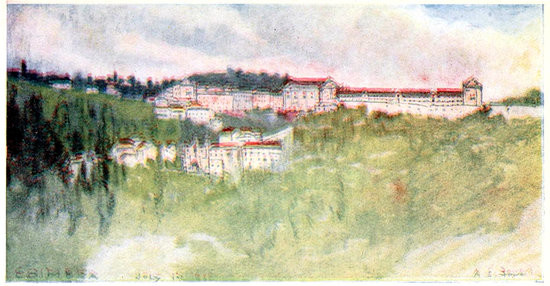
SANTA CLARA, COIMBRA.
One other royal shade at least haunts the royal convent of Santa Clara. Here, retired from the turmoil of ambitions and wrongs, of which through her youth she had been the victim, passed the long years of her devout renunciation that injured Princess Joan, “the Beltraneja,” daughter of Henry IV. of Castile, whom the great Isabel the Catholic ousted from her inheritance. Here in Coimbra, too, the tragedy of Maria de Telles, subject of poems and plays innumerable, was enacted in real life. King Ferdinand the Handsome, about 1371, though betrothed to a Castilian princess, fell in love with a lady called Leonor de Telles, and so endangered the recently concluded alliance. His people rose in revolt, and the lady’s family, especially her sister Maria, resented the adulterous connection. Leonor, secure in her mastery over the king, wreaked a terrible revenge upon those who opposed her; poison, the dagger, and the dungeon doing her fell work, until all Portugal was in fear at her feet, and the king became her wedded husband. The virtuous sister, Maria de Telles, happily married to the king’s half-brother, João, and safe in her palace at Coimbra, was difficult to attack. But the wicked Leonor was equal to the occasion, and, like a female Iago, instilled into the ears of the prince suspicions of his wife’s fidelity, and with forged evidence prompted him to revenge. The enraged husband murdered his protesting and innocent wife in cold blood at Coimbra (but not at the house now shown as the scene of the tragedy), and as soon as the foul deed was done Queen Leonor, who had been waiting in an adjoining room, entered, and, in the presence of the murdered Maria, mocked at the husband’s pain, and showed him that her sister was innocent. The prince in his rage attempted to murder the treacherous queen, but was seized, and subsequently escaped into exile, whilst Leonor lived to perpetrate other misdeeds.
I paced the acacia-shaded alameda as the sun sank below the hills, thinking of these sad memories of the times long past; of the noble self-sacrifice of the sainted queen, of the long agony of the Beltraneja, and of the blood-stained soul of Leonor. The air was cool and fresh, and the glowing sunset faded from crimson to dead rose in the west; but across the shimmering river the after-glow, like a luminous opal dawn, threw up the black silhouette of the wooded ridge, and the vast bulk of Santa Clara on the crest stood sharp and clear as if cut out of black velvet and laid upon pearly satin. And just over the great convent church a star of dazzling brilliancy—the brightest star, it seemed to me, I have ever beheld—blazed out alone in the pellucid sky, and tipped with diamond the cross above the silent silver shrine with its dim red lamp burning through the centuries. Thus sweet self-sacrifice conquers over time and death. The mouldering bones are naught, darkness enshrouds even the huge building in which they lie; yet far aloft the cross still stands distinct above all, gemmed with its glittering star, as the eternal memory of good deeds done still illumines the blackness of the world.
The next morning I took the train for Chão de Maçãs, a little roadside station, where a carriage had been ordered to meet me, and carry me two leagues over the mountains to Thomar. There was some stay at Pombal, where it was a feast day, and the peasant costumes were seen at their best—good upstanding people these, gaily clad, sober, and orderly, coming to the railway stations in good time and unhurried, but not hours before the train starts, as the peasants do in Spain. In the market, under the shadow of the great mediæval castle ruins on the hill, they do their buying and selling, live-stock for the most part to-day, without vociferation, but with an earnest quietness which is as far as possible from depression. Here at Pombal, and at Albergaria near, the men wear brown undyed homespun jackets, and trousers girt with red sashes. The bag cap is almost universal, and mutton-chop whiskers are the rule, but what will attract a foreign visitor most in their dress are the curious triple-caped ulsters, made of layers of grass, seen in many places in Portugal in wet weather, but especially in this neighbourhood. These garments, bulky as they look, are not heavy, and are an excellent protection against heavy rain.
The women here have very full, short, gathered skirts, and though none of them wear shoes or stockings hardly any are without heavy ancient jewelry of gold filigree apparently of considerable value. The bodices of the dresses are mostly red or yellow, and a broad horizontal stripe of bright colour often enlivens the skirt also, their brilliant head-kerchiefs being usually topped by a broad-brimmed velveteen hat, for the pork-pie hat of the north has been left behind now.
We had mounted into the country of pines and heather when we stopped at the little station of Chão de Maçãs, dumped down, as it seemed, in the wilderness with just a row of one-storey whitewashed cottages opposite. But where was the carriage? None had been heard of there, and I found myself several miles from anywhere, and with no means of conveyance. Sympathetic interest was not wanting. A muleteer loudly deplored that he was engaged to carry a load of goods to Ourem, and could not take me to Thomar. Clearly something must be done, however; so the little meeting of grave consultants adjourned from the station platform to the door of the humble general shop and tavern opposite to continue the important discussion. It happened that the whole village was just then deeply absorbed in witnessing an itinerant barber cutting a man’s hair in an open stable whilst the onlookers criticised and suggested improvements and variations in the process; but when the news spread that a strange gentleman was stranded at Chão de Maçãs with no conveyance to take him to Thomar, the critics of the barber’s art adjourned en masse to the tavern, and respectfully joined in the discussion as to my fate. They were quite unanimous in agreeing that the Senhor Mathias Araujo, the hotelkeeper at Thomar, could not have received the letter or he would certainly have sent the carriage, of that there could be no doubt whatever. But oh! that correio, the post, was always at fault; and then many anecdotes were given at great length of hairbreadth escapes and heavy losses incurred by the sins and omissions of the Portuguese post-office. All this was no doubt interesting, but not helpful to me in my quandary, and I gently led the talk again to the chance of my getting a conveyance. The outlook was not hopeful, but the sympathetic muleteer somewhat doubtfully suggested to the innkeeper that some one near had a pair of mules. A significant look passed round, but the hint was not lost upon me, and by dint of much diplomacy a rapaz was sent off for the mules. He returned by-and-by with an excellent-looking pair of animals, and an ancient shandrydan was pulled out of a stable. I wondered what had caused the hesitation, but my wonder did not last long. No sooner were the mules hitched to the bar than they began to kick furiously. Kicking chains were of little use; the lout who drove the team used his whip with heart and arm, the pieced and spliced rope and chain harness was strained almost to breaking, and the ancient “machine” threatened every moment to disintegrate into splinters.
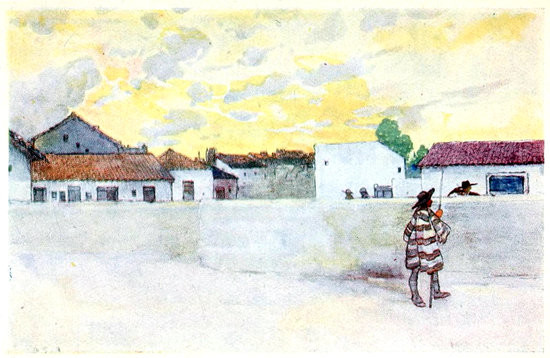
A COUNTRY RAILWAY STATION.
And so the team kicked their hardest all the seven miles to Thomar, and performed the distance, as it seemed to me, in one continued gymnastic exercise, more on their fore-legs than on their full complement of limbs. But kicking mules were powerless to mar the delight of the drive. The road was a perfect one, over hills covered with pines and dales ablaze with purple heather. The cool mountain breeze, laden with the scent of wild thyme, brought with it a new sense of delight which made breathing a conscious enjoyment, and the jaded elderly person in the shivering shandrydan felt impelled to shout aloud in mere exhilaration of living in such an atmosphere. Only a three weeks before I had seen Deeside at its best, but Deeside heather was dull, and the Deeside pine-clad hills in their wreaths of clouds were depressing, in comparison with this sparkling sweep of sandy moor and mountain.
Turning the shoulder of the highest ridge we came in sight of the vast and beautiful valley below us with Thomar in its midst upon its river bank nestling in greenery, with its steep, abrupt hill and castle standing sentinel over it. It was Sunday, and, although broad daylight when I drove into Thomar, a flight of rockets rushed into the air from the town-hall, and the braying of a brass band told me that the town was en fête. It was, I learnt, the ceremony of prize-giving and treating the school children by the town council, and all the little ones, clean, chubby, and well-clad they looked, were trooping, shouting, and cheering, as children do the world over. I found a warm welcome at the Hotel União, and was soon convinced that the Chão de Maçãs meeting was right in their assurance that the failure to send the carriage was from no fault of the host, a gentleman of cultured manners and tastes, quite unlike the ordinary type of Portuguese innkeeper. He was distressed to have received no letter to advise him of my coming, as he ought to have done two days before, but an hour or two afterwards he rushed into my room, excited and triumphant. He had forced them to open the post-office, Sunday though it was, and had rescued my letter from a heap which some careless postman had neglected to deliver! Thenceforward Senhor Jose Mathias Araujo, a pattern of Portuguese hotelkeepers, was indefatigable in making me, a mere passing stranger though I was, of whose name he had only heard vaguely, feel at home and comfortable at Thomar.
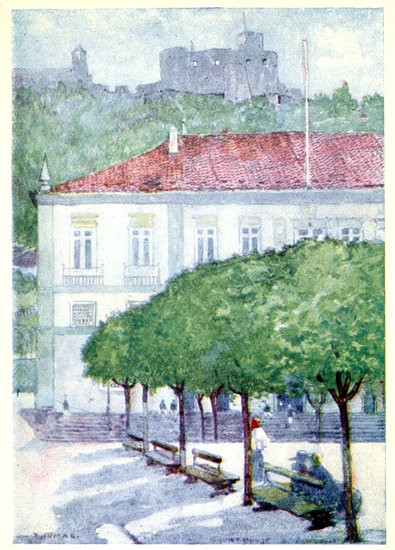
A CORNER OF THE TOWN HALL AND THE CONVENT, THOMAR.
The place is one which to my latest days I shall never forget. A clean little rectangular town with straight streets of singularly modern aspect, on the banks of an exquisitely beautiful stream fringed by trees and gardens. The shops for the most part are but doorways open upon the street, for they have not adopted the modern fashion of windows for the display of goods. And life in general seems to pass drowsily, for with the exception of a small factory in some ancient conventual buildings on the farther bank of the stream, there is not much doing in the place.
But the object of my coming to this sweet, dull, little town pervades it everywhere. At the end of the three straight streets running from the river to the square market-place, with its ancient church and town-hall, there looms upon a steep hill, right up over the roofs as it seems, the most splendid and interesting mediæval castle-monastery in this land of hill-top strongholds—the ancient fortress headquarters of the crusading knights of the Order of Christ, successors in Portugal of the Templars. Thomar was the metropolis and fief of the Order, and on all sides the emblem of their peculiar cross is evident. Impressed upon my mind for ever is the view as I first gazed upon it from the main street (of course, incongruously called now after Serpa Pinto) on the sparkling autumn day. Clear and sharp high up on the hill against the indigo sky stood a ruined bell tower through whose gaping window the light shone, with tall, pointed cypresses by its side, and flanked by a mighty stretch of warm, grey battlements, above which rose the bulk of a great square keep.
A zigzag path leads from behind the sixteenth-century town-hall in the praça up the rocky sides of the precipitous hill. Gnarled olive trees, dwarf oaks, and aloes grew in the crevices and amidst the ruins of outer walls upon the face of the declivity; and the outer donjon, still standing unwrecked across the path, shows the tremendous strength even of these exterior defences. Above these loomed the Titanic walls, their battlemented sides and turrets, all stained a golden yellow with the lichen that covered them. The inner donjon, which adjoins the picturesque ruined bell tower, gives entrance to a charming grassy garden with tall cypresses, orange trees, and gay flowers, growing in what was once the wide courtyard of the castle; and the huge square main keep standing in the midst, all dismantled as it is, rears its flame-tinged battlements as proudly as when the soldiers of the Cross held this isolated stronghold against the hordes of Islam. The walls are everywhere pierced with loopholes in the shape of a cross surmounting a globe, and the cruciform device of the Order is graven upon stones on all sides.
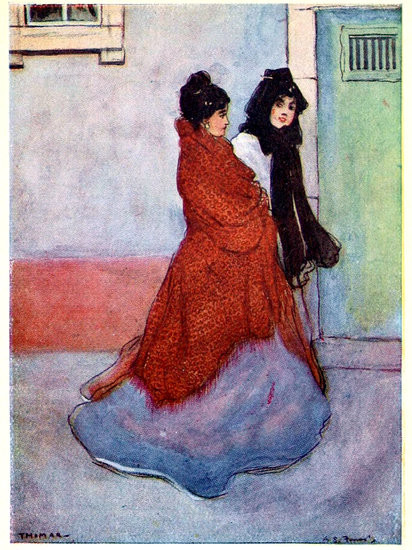
SOME BEAUTIES OF THOMAR.
Connected with the walls of the ancient castle, and upon a somewhat higher level than the keep, there stands the high round church of the Templars, with buttresses of immense strength reaching to the parapet, and a crumbling square bell tower upon one of its faces. Upon an ancient slab let into the sides of the church an inscription tells how Dom Affonso, first King of Portugal, and Gualdrim Paes, master of the Portuguese Templars, constructed this edifice in 1108. Joined to this ancient structure is one of the most astounding specimens of Manueline architecture in Portugal, built in the early sixteenth century, when all the country was pulsating with new life and eager longings. It is the choir and chapter-house, and behind them is the ruin of the great monastery of the Order of Christ. Words are weak to convey an idea of the capricious splendour of the choir and chapter-house so far as they remain undefaced, for later ages have done their best to spoil the edifice. Eight cloisters have been built around it, and tacked on to it, by the sixteenth and seventeenth centuries. Its lovely Manueline doorway has been marred, and the east end of the building blocked as high as its upper windows by the “Cloister of the Philips.”
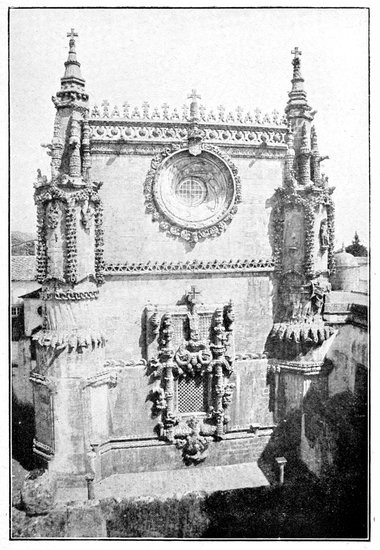
The Choir and Chapter-House, Thomar.
But notwithstanding all the vandalism, enough of the Manueline building remains intact to strike the beholder with reverent wonder at the intricate beauty of the work, and the inexhaustible invention of the design. The doorway stands in a recess reaching to the parapet, and enclosed within an arch of surprising beauty, of which the under curve is lined with an elaborate pendent ornament. Within the recess filling the whole space and over the door itself, figures in niches stand under canopies and upon pillars in which caprice and intricacy surpass themselves. Coiled cables, bossed spirals, floreated pinnacles, armillary spheres, crosses, and intertwined branches, stand out in high relief and under cut, as if the sculptors had purposely sought difficulties in order to overcome them. The arch of the door itself is beyond description, so luxuriant is the design of the chiselled stone which forms the three grooves and two spiral pilasters around it. The parapet of the whole edifice is similarly rich, alternating the cross of the Order with the armillary sphere; and although most of the lower part of the walls is hidden, the view of the east end with its two corner towers, as seen from the roof of the adjoining cloister, is magnificent. The lower window, which lights the interior of the choir, is a massive tangle of outstanding cables; each point being crowned by the cross and the armillary sphere which formed the device of the grand master, the famous Prince Henry the Navigator. Around one of the corner towers a great chain cable, each link carved entire in stone, is braced, and around the other an equally tremendous buckled belt, representing the Order of the Garter, which the Prince, a Plantagenet on his mother’s side, possessed. The upper window which lights the chapter-house is more suggestive still. It is a highly decorated circular light bevilled into the deep thickness of the wall, and represents upon the sloping inner face of the circle a series of bulging staysails, each held down by a rope.
But all this description in detail is incapable of conveying an idea of the richness of effect produced by the whole work. The exuberance of the style and its tricky capriciousness may be, and are, condemned by purists as in questionable taste; but as an outcome of national feeling, and as an example of original inventive ingenuity and patience, this and other notable specimens of the style, to which reference will be made later, are of the highest interest to the student, and a delight to the ordinary observer who can free himself from the straightlaced traditions of the schools.
Inside the grave old round church of the Templars, to which this gorgeous edifice was to serve as a choir for the warrior monks of Christ, a fine Byzantine altar stands in the centre. The interior of the edifice itself is a quaint and curious mixture of Byzantine, Moorish, Romanesque, and Gothic, the pillars being painted and gilt in oriental taste, whilst the splendid canopy over the central altar is pure Gothic, and dated 1500. In four of the eleven arched spaces upon the wall of the circular church there are some ancient pictures of the highest interest, the remaining seven having been stolen by the French invaders in the Napoleonic wars. The paintings are fine enough to be by the hand of Jan Van Eyck himself, and are, as usual, ascribed by Portuguese to the mythical Gran Vasco. It is far more likely, however, that they may be the work of a painter called Jean Dralia of Bruges, who was living in this monastery at the end of the fifteenth century, and is buried here. It is lamentable to see the condition to which these masterpieces have been allowed to fall from sheer want of care; and unless they are promptly rescued, a few years more will complete their ruin.
The great choir, added on to the round church, presents in its interior the same wealth of fancy as that already described on the outside; but the wonderful choir stalls of the Manueline period were stolen or destroyed during the French invasion. As I stood under the exquisitely carved ceiling of this choir, looking towards the Byzantine altar in the round church before me, my mind flew back to a scene enacted here in April 1581, which I had more than once endeavoured to describe in writing without having seen the place. Philip II. had followed in the devastating steps of Alba to wrest from the native Portuguese pretender the crown he coveted. Portugal had sullenly bent its neck to the yoke, and the nobles had either been exiled or bought to the side of the Spaniard. But one thing more was needed to make grim Philip legally King of Portugal as well as King of Spain. The Portuguese Cortes, elected of the people, though in this case elected with Alba’s grip upon its throat, had to swear allegiance to the new monarch, and Philip had to pledge his oath to respect the rights and liberties of his new subjects. The stronghold of the Knights of Christ at Thomar was chosen by the Spaniard for the crowning act of Portuguese national subjection; and here Philip arrived on the 15th March 1581. On the 3rd April, in one of those charming little letters to his orphan daughters, he wrote from Thomar saying that the Cortes would sit soon, for many people were already arriving, and the oaths would be taken as soon as they were met. “You have heard,” he says, “that they insist upon my dressing in brocade, much against my will, but they say it is the custom here.”
On the 16th of April the church of the monastery was aglow with shimmer of gold and gems and rich stuffs. Under a dais at the end of this choir Philip sat in a robe of cloth of gold over a dress of crimson brocade; though his heart was sad for the death of his last wife, and he hated splendour in his broken old age. After mass had been said, the Cortes did homage and swore to keep their faith to him as king; and then stepping down from the throne, he advanced to the high altar and solemnly pledged his word to respect the laws and liberties of Portugal. How little he relished the splendour is seen in a letter he sent to his girls from Thomar a fortnight later, as soon as he could find time to write to those whom he loved more dearly than any other creatures on earth. “How much I wish,” he wrote, “you could have seen the ceremony of taking the oath from a window as my nephew [the Archduke Albert] did, who saw everything excellently. But I send you a full account of it all.... I have given the Golden Fleece to the Duke of Braganza, and he went with me to mass, both of us wearing the collar of the Order; which upon my mourning looked very bad, and I can tell you he looked much smarter than I did, although they say that the day of the oath was the first time he had worn low shoes, though everybody is wearing them here now except myself.” Thomar, for the last time in its existence, was a blaze of splendour for those six feverish weeks; for Spanish and Portuguese nobles, jealous of each other, vied in lavish expenditure; and then the fortress of the Knights was left to its solitude: gradually royal encroachments stripped the Order of its wealth and power, and Thomar lived in memory alone.
The upper chamber of the Manueline building over the choir is the chapter-house of the Order of Christ. A grand, low, pillared hall, with the twisted cables and the repeated cross and sphere, testifying once more to the reigning idea of the period of the Navigator Grand-Master. Here it was that the Portuguese Cortes sat to confirm the religious act of allegiance to Philip, and set the seal of subservience upon the nation for nearly a century. Every carved stone and crocket has a story to tell if we could but hear it. Here in the older monastic building the Navigator himself held his chapters, dwelling in the adjoining palace, in the intervals of his life-task upon his eyrie at Sagres; here in the “cloisters of the Philips,” dull Philip III. held his monastic court upon his one visit to Portugal; and the magnificent cloister of John III. testifies to the classical reaction after the exuberance of the times of his father Dom Manuel.
In the quaint little Gothic cloister around the burial-place of the monks, called the “Cloister of Dom Henrique,” a strange sight is to be seen in the upper ambulatory. Baltasar de Faria was the instrument of Philip II. in forcing the Spanish form of Inquisition ruthlessly upon Portugal, and in cruelty surpassed his master. So bitterly hated was he that the saying ran that earth itself would reject and refuse to assimilate the body of such a monster. In the lid of a stone coffin in the cloister a pane of glass is set, and he who will may gaze and see how Baltasar de Faria looks now. He was a splendid courtier in his time, and doubtless a gallant-looking one too, for it was a sumptuous age; but the poor gentleman’s looks have now little to recommend them, as he lies contorted and mummified but perfect in his narrow home, to be gazed and wondered at by those who list—a scoff for the ribald, a text for the moralist.
More there was, much more, to describe in this wonderful monastery, but I have said more than enough to prove that the visitor to Portugal who misses Thomar has failed to see a relic, which, in its way, has hardly an equal in Europe. The drives around Thomar are exquisitely beautiful, the view from the hill across the river embracing the monastery and the great white sanctuary of the Misericordia, with its long scala sacra, upon the twin hill, being one never to be forgotten. Just outside the town, hard by an ancient pillar marking the junction place of the armies which won for a second time the independence of Portugal from Spain (at Aljubarrota, 1385), there stands the beautiful old church of Santa Maria, a perfect Gothic fane; and close to its west end a strong tower built as a place of refuge for its constructors against the constant attacks of the Moors. Much I should like to linger upon Thomar: upon the quaint garb of the peasants, the picturesque bits of the old Manueline church of St. João in the praça, upon the lovely private gardens by the side of the stream, upon the noble aqueduct, and upon the sweet tranquillity of the acacia-shaded walks; but I dare not delay further, for the carriage is at the door of the humble though hospitable, Hotel União, to carry me on this brilliant morning the twenty-five miles to Leiria, where I must pass the night. As we drove clear of the town the loveliness of its situation came home to one with more intensity than ever. The peaceful stream winding through the plain, its course marked by a continuous line of poplars, the pine-clad hills all around—miles away but in this clear air seeming within touching distance of the hand—the cluster of white and pink houses with red roofs, and, almost sheer above them, the two hills, one crowned by its never-to-be-forgotten monastery-castle with its long battlemented walls, its high keep, and, most striking of all, its gaunt bell tower, with its guard of tall cypresses; whilst climbing up the gentler green slope of the other hill is the snow-white scala sacra of twenty-five flights of steps leading to the gleaming sanctuary of the Misericordia. Above all a sky of deep luminous blue, and pervading all the soft warm air, sweet with the scent of thyme, basil, cistus, and pines.

CHURCH OF ST. JOÃO IN THE PRAÇA, THOMAR.
Thus, for two hours or more, I drove over a good road, winding round the foot of rising hills, and following the sinuosity of fertile valleys, above me grey boulders, around me pines, olives, and sweeps of flowering heather on the red earth. At length, afar off, there loomed a bolder hill than the rest, rising abruptly and crowned by another great fortress, as it seemed at an unscalable height, with a cluster of ancient houses nestled just beneath it. Patience and a scarped road on the hillside, however, enabled us to reach without apparent difficulty half up the hill to the modern village of Ourem, where a rest for the horses and a meal for myself had been agreed upon. The place was dead, basking in the hot sunshine, all the village, as it seemed, baked to the uniform yellowish-white colour of the soil of the hill upon which it stood. The gaunt yellow castle above[1] softened only by the verdure of a crown of pines, and just below its walls the ancient town and a great monastery of long ago.
1. I noted with interest that this castle of Ourem, and others of these vast hill-top strongholds, had the outer defences arranged similarly to those I have described in the chapter on the buried city of Citania; namely, that on the side of the hill, where attack was difficult or impracticable, the outer walls dipped far down the slope, whilst at the point where danger might be apprehended the three lines of circumvallation were comparatively close together. This arrangement of hill-top defences was evidently long pre-Roman in the Peninsula, and seems to have been adopted by the Romans and their Gothic successors.