


автордың кітабын онлайн тегін оқу In Darkest Africa, Vol. 1; or, The Quest, Rescue, and Retreat of Emin, Governor of Equatoria
Every attempt has been made to replicate the original as printed.
The
footnotesfollow the text.
Some illustrations have been moved from mid-paragraph for ease of reading.
(etext transcriber's note)
COPYRIGHT 1890 BY CHARLES SCRIBNER'S SONS
IN DARKEST AFRICA
OR THE
QUEST, RESCUE, AND RETREAT OF EMIN
GOVERNOR OF EQUATORIA
BY
HENRY M. STANLEY
WITH TWO STEEL ENGRAVINGS, AND ONE HUNDRED AND
FIFTY ILLUSTRATIONS AND MAPS
IN TWO VOLUMES
Vol. I
"I will not cease to go forward until I come to the place where the two seas meet,
though I travel ninety years."—Koran, chap. xviii., v. 62.
NEW YORK
CHARLES SCRIBNER'S SONS
1890
[All rights reserved]
Copyright, 1890, by
CHARLES SCRIBNER'S SONS
Press of J. J. Little & Co.,
Astor Place, New York.
CONTENTS OF VOLUME I.
PAGEPrefatory Letter to Sir William Mackinnon, Chairman of the Emin Pasha relief expedition
1 CHAPTER I.INTRODUCTORY CHAPTER.
The Khedive and the Soudan—Arabi Pasha—Hicks Pasha's defeat—The Mahdi—Sir Evelyn Baring and Lord Granville on the Soudan—Valentine Baker Pasha—General Gordon: his work in the Upper Soudan—Edward Schnitzler (or Emin Effendi Hakim) and his Province—General Gordon at Khartoum: and account of the Relief Expedition in 1884 under Lord Wolseley—Mr. A. M. Mackay, the missionary in Uganda—Letters from Emin Bey to Mr. Mackay, Mr. C. H. Allen, and Dr. R. W. Felkin, relating to his Province—Mr. F. Holmwood's and Mr. A. M. Mackay's views on the proposed relief of Emin—Suggested routes for the Emin Relief Expedition—Sir Wm. Mackinnon and Mr. J. F. Hutton—The Relief Fund and preparatory details of the Expedition—Colonel Sir Francis De Winton—Selection of officers for the Expedition—King Leopold and the Congo Route—Departure for Egypt
11 CHAPTER II.EGYPT AND ZANZIBAR.
Surgeon T. H. Parke—Views of Sir Evelyn Baring, Nubar Pasha, Professor Schweinfurth and Dr. Junker on the Emin Relief Expedition—Details relating to Emin Pasha and his Province—General Grenfell and the ammunition—Breakfast with Khedive Tewfik: message to Emin Pasha—Departure for Zanzibar—Description of Mombasa town—Visit to the Sultan of Zanzibar—Letter to Emin Pasha sent by messenger through Uganda—Arrangements with Tippu-Tib—Emin Pasha's Ivory—Mr. MacKenzie, Sir John Pender, and Sir James Anderson's assistance to the Relief Expedition
49 CHAPTER III.BY SEA TO THE CONGO RIVER.
The Sultan of Zanzibar—Tippu-Tib and Stanley Falls—On board s.s. Madura—"Shindy" between the Zanzibaris and Soudanese—Sketches of my various Officers—Tippu-Tib and Cape Town—Arrival at the mouth of the Congo River—Start up the Congo—Visit from two of the Executive Committee of the Congo State—Unpleasant thoughts
67 CHAPTER IV.TO STANLEY POOL.
Details of the journey to Stanley Pool—The Soudanese and the Somalis—Meeting with Mr. Herbert Ward—Camp at Congo la Lemba—Kindly entertained by Mr. and Mrs. Richards—Letters from up river—Letters to the Rev. Mr. Bentley and others for assistance—Arrival at Mwembi—Necessity of enforcing discipline—March to Vombo—Incident at Lukungu Station—The Zanzibaris—Incident between Jephson and Salim at the Inkissi River—A series of complaints—The Rev. Mr. Bentley and the steamer Peace—We reach Makoko's village—Leopoldville—Difficulties regarding the use of the Mission steamers—Monsieur Liebrichts sees Mr. Billington—Visit to Mr. Swinburne at Kinshassa—Orders to, and duties of, the officers
79 CHAPTER V.FROM STANLEY POOL TO YAMBUYA.
Upper Congo scenery—Accident to the Peace—Steamers reach Kimpoko—Collecting fuel—The good-for-nothing Peace—The Stanley in trouble—Arrival at Bolobo—The Relief Expedition arranged in two columns—Major Barttelot and Mr. Jameson chosen for command of Rear Column—Arrival at Equator and Bangala Stations—The Basoko villages: Baruti deserts us—Arrival at Yambuya
99 CHAPTER VI.AT YAMBUYA.
We land at Yambuya villages—The Stanley leaves for Equator Station—Fears regarding Major Barttelot and the Henry Reed—Safe arrival—Instructions to Major Barttelot and Mr. Jameson respecting the Rear Column—Major Barttelot's doubts as to Tippu-Tib's good faith—A long conversation with Major Barttelot—Memorandum for the officers of the Advance Column—Illness of Lieutenant Stairs—Last night at Yambuya: statements as to our forces and accoutrements
111 CHAPTER VII.TO PANGA FALLS.
An African road—Our mode of travelling through the forests—Farewell to Jameson and the Major—160 days in the forest—The Rapids of Yambuya—Attacked by natives of Yankonde—Rest at the village of Bahunga—Description of our march—The poisoned skewers—Capture of six Babali—Dr. Parke and the bees—A tempest in the forest—Mr. Jephson puts the steel boat together—The village of Bukanda—Refuse heaps of the villages—The Aruwimi river scenery—Villages of the Bakuti and the Bakoka—The Rapids of Gwengweré—The boy Bakula-Our "chop and coffee"—The islands near Bandangi—The Baburu dwarfs—The unknown course of the river—The Somalis—Bartering at Mariri and Mupé—The Aruwimi at Mupé—The Babé manners, customs, and dress—Jephson's two adventures—Wasp Rapids—The chief of the Bwamburi—Our camp at My-yui—Canoe accident—An abandoned village—Arrival at Panga Falls—Description of the Falls
134 CHAPTER VIII.FROM TANGA FALLS TO UGARROWWA'S.
Another accident at the Rapids—The village of Utiri—Avisibba settlement—Enquiry into a murder case at Avisibba—Surprised by the natives—Lieutenant Stairs wounded—We hunt up the enemy—The poisoned arrows—Indifference of the Zanzibaris—Jephson's caravan missing—Our wounded—Perpetual rain—Deaths of Khalfan, Saadi, and others—Arrival of caravan—The Mabengu Rapids—Mustering the people—The Nepoko river—Remarks by Binza—Our food supply—Reckless use of ammunition—Half-way to the Albert Lake—We fall in with some of Ugarrowwa's men—Absconders—We camp at Hippo Broads and Avakubi Rapids—The destroyed settlement of Navabi—Elephants at Memberri—More desertions—The Arab leader, Ugarrowwa—He gives us information—Visit to the Arab settlement—First specimen of the tribe of dwarfs—Arrangements with Ugarrowwa
171 CHAPTER IX.UGARROWWA'S TO KILONGA-LONGA'S.
Ugarrowwa sends us three Zanzibari deserters—We make an example—The 'Express' rifles—Conversation with Rashid—The Lenda river—Troublesome rapids—Scarcity of food—Some of Kilonga-Longa's followers—Meeting of the rivers Ihuru and Ituri—State and numbers of the Expedition—Illness of Captain Nelson—We send couriers ahead to Kilonga-Longa's—The sick encampment—Randy and the guinea fowl—Scarcity of food—Illness caused by the forest pears—Fanciful menus—More desertions—Asmani drowned—Our condition in brief—Uledi's suggestion—Umari's climb—My donkey is shot for food—We strike the track of the Manyuema and arrive at their village
211 CHAPTER X.WITH THE MANYUEMA AT IPOTO.
The ivory hunters at Ipoto—Their mode of proceeding—The Manyuema headmen and their raids—Remedy for preventing wholesale devastations—Crusade preached by Cardinal Lavigerie—Our Zanzibar chiefs—Anxiety respecting Captain Nelson and his followers—Our men sell their weapons for food—Theft of rifles—Their return demanded—Uledi turns up with news of the missing chiefs—Contract drawn up with the Manyuema headmen for the relief of Captain Nelson—Jephson's report on his journey—Reports of Captain Nelson and Surgeon Parke—The process of blood brotherhood between myself and Ismaili—We leave Ipoto
236 CHAPTER XI.THROUGH THE FOREST TO MAZAMBONI'S PEAK.
In the country of the Balessé—Their houses and clearings—Natives of Bukiri—The first village of dwarfs—Our rate of progress increased—The road from Mambungu's—Halts at East and West Indékaru—A little storm between "Three o'clock" and Khamis—We reach Ibwiri—Khamis and the "vile Zanzibaris"—The Ibwiri clearing—Plentiful provisions—The state of my men; and what they had recently gone through—Khamis and party explore the neighbourhood—And return with a flock of goats—Khamis captures Boryo, but is released—Jephson returns from the relief of Captain Nelson—Departure of Khamis and the Manyuema—Memorandum of charges against Messrs. Kilonga-Longa & Co. of Ipoto—Suicide of Simba—Sali's reflections on the same—Lieutenant Stairs reconnoitres—Muster and reorganisation at Ibwiri—Improved condition of the men—Boryo's village—Balessé customs—East Indenduru—We reach the outskirts of the forest—Mount Pisgah—The village of Iyugu—Heaven's light at last; the beautiful grass-land—We drop across an ancient crone—Indésura and its products—Juma's capture—The Ituri river again—We emerge upon a rolling plain—And forage in some villages—The mode of hut construction—The district of the Babusessé—Our Mbiri captives—Natives attack the camp—The course of the Ituri—The natives of Abunguma—Our fare since leaving Ibwiri—Mazamboni's Peak—The east Ituri—A mass of plantations—Demonstration by the natives—Our camp on the crest of Nzera-Kum—"Be strong and of a good courage"—Friendly intercourse with the natives—We are compelled to disperse them—Peace arranged—Arms of the Bandussuma
255 CHAPTER XII.ARRIVAL AT LAKE ALBERT AND OUR RETURN TO IBWIRI.
We are further annoyed by the natives—Their villages fired—Gavira's village—We keep the natives at bay—Plateau of Unyoro in view—Night attack by the natives—The village of Katonza's—Parley with the natives—No news of the Pasha—Our supply of cartridges—We consider our position—Lieutenant Stairs converses with the people of Kasenya Island—The only sensible course left us—Again attacked by natives—Scenery on the lake's shore—We climb a mountain—A rich discovery of grain—The rich valley of Undussuma—Our return journey to Ibwiri—The construction of Fort Bodo
319 CHAPTER XIII.LIFE AT FORT BODO.
Our impending duties—The stockade of Fort Bodo—Instructions to Lieutenant Stairs—His departure for Kilonga-Longa's—Pested by rats, mosquitoes, &c.—Nights disturbed by the lemur—Armies of red ants—Snakes in tropical Africa—Hoisting the Egyptian flag—Arrival of Surgeon Parke and Captain Nelson from Ipoto—Report of their stay with the Manyuema—Lieutenant Stairs arrives with the steel boat—We determine to push on to the Lake at once—Volunteers to convey letters to Major Barttelot—Illness of myself and Captain Nelson—Uledi captures a Queen of the Pigmies—Our fields of corn—Life at Fort Bodo—We again set out for the Nyanza
350 CHAPTER XIV.TO THE ALBERT NYANZA A SECOND TIME.
Difficulties with the steel boat—African forest craft—Splendid capture of pigmies, and description of the same—We cross the Ituri River—Dr. Parke's delight on leaving the forest—Camp at Bessé—Zanzibari wit—At Nzera-Kum Hill once more—Intercourse with the natives—"Malleju," or the "Bearded One," being first news of Emin—Visit from chief Mazamboni and his followers—Jephson goes through the form of friendship with Mazamboni—The medicine men, Nestor and Murabo—The tribes of the Congo—Visit from chief Gavira—A Mhuma chief—The Bavira and Wahuma races—The varying African features—Friendship with Mpinga—Gavira and the looking-glass—Exposed Uzanza—We reach Kavalli—The chief produces "Malleju's" letter—Emin's letter—Jephson and Parke convey the steel boat to the lake—Copy of letter sent by me to Emin through Jephson—Friendly visits from natives
373 CHAPTER XV.THE MEETING WITH EMIN PASHA.
Our camp at Bundi—Mbiassi, the chief of Kavalli—The Balegga granaries—Chiefs Katonza and Komubi express contrition—The kites at Badzwa—A note from Jephson—Emin, Casati and Jephson walk into our camp at old Kavalli—Descriptions of Emin Pasha and Captain Casati—The Pasha's Soudanese—Our Zanzibaris—The steamer Khedive—Baker and the Blue Mountains—Drs. Junker and Felkin's descriptions of Emin—Proximity of Kabba Rega—Emin and the Equatorial Provinces—Dr. Junker's report of Emin—I discuss with Emin our future proceedings—Captain Casati's plans—Our camp and provisions at Nsabé—Kabba Rega's treatment of Captain Casati and Mohammed Biri—Mabruki gored by a buffalo—Emin Pasha and his soldiers—My propositions to Emin and his answer—Emin's position—Mahomet Achmet—The Congo State—The Foreign Office despatches
393 CHAPTER XVI.WITH THE PASHA—
continued.
Fortified stations in the Province—Storms at Nsabé—A nest of young crocodiles—Lake Ibrahim—Zanzibari raid on Balegga villages—Dr. Parke goes in search of the two missing men—The Zanzibaris again—A real tornado—The Pasha's gifts to us—Introduced to Emin's officers—Emin's cattle forays—The Khedive departs for Mswa station—Mabruki and his wages—The Pasha and the use of the sextant—Departure of local chiefs—Arrival of the Khedive and Nyanza steamers with soldiers—Made arrangements to return in search of the rear-column—My message to the troops—Our Badzwa road—A farewell dance by the Zanzibaris—The Madi carriers' disappearance—First sight of Ruwenzori—Former circumnavigators of the Albert Lake—Lofty twin-peak mountain near the East Ituri River—Aid for Emin against Kabba Rega—Two letters from Emin Pasha—We are informed of an intended attack on us by chiefs Kadongo and Musiri—Fresh Madi carriers—We attack Kadongo's camp—With assistance from Mazamboni and Gavira we march on Musiri's camp which turns out to be deserted—A phalanx dance by Mazamboni's warriors—Music on the African Continent—Camp at Nzera-kum Hill—Presents from various chiefs—Chief Musiri wishes for peace
418 CHAPTER XVII.PERSONAL TO THE PASHA.
Age and early days of Emin Pasha—Gordon and the pay of Emin Pasha—Last interview with Gordon Pasha in 1877—Emin's last supply of ammunition and provisions—Five years' isolation—Mackay's library in Uganda—Emin's abilities and fitness for his position—His linguistic and other attainments—Emin's industry—His neat journals—Story related to me by Shukri Agha referring to Emin's escape from Kirri to Mswa—Emin confirms the story—Some natural history facts related to me by Emin—The Pasha and the Dinka tribe—A lion story—Emin and "bird studies"
422 CHAPTER XVIII.START FOR THE RELIEF OF THE REAR COLUMN.
Escorted by various tribes to Mukangi—Camp at Ukuba village—Arrival at Fort Bodo—Our invalids in Ugarrowwa's care—Lieut. Stairs' report on his visit to bring up the invalids to Fort Bodo—Night visits by the malicious dwarfs—A general muster of the garrison—I decide to conduct the Relief force in person—Captain Nelson's ill-health—My little fox-terrier "Randy"—Description of the fort—The Zanzibaris—Estimated time to perform the journey to Yambuya and back—Lieut. Stairs' suggestion about the steamer Stanley—Conversation with Lieut. Stairs in reference to Major Barttelot and the Rear Column—Letter of instructions to Lieut. Stairs
452 CHAPTER XIX.ARRIVAL AT BANALYA: BARTTELOT DEAD!
The Relief Force—The difficulties of marching—We reach Ipoto—Kilonga Longa apologises for the behaviour of his Manyuema—The chief returns us some of our rifles—Dr. Parke and fourteen men return to Fort Bodo—Ferrying across the Ituri River—Indications of some of our old camps—We unearth our buried stores—The Manyuema escort—Bridging the Lenda River—The famished Madi—Accidents and deaths among the Zanzibaris and Madi—My little fox-terrier "Randy"—The vast clearing of Ujangwa—Native women guides—We reach Ugarrowwa's abandoned station—Welcome food at Amiri Falls—Navabi Falls—Halt at Avamburi landing-place—Death of a Madi chief—Our buried stores near Basopo unearthed and stolen—Juma and Nassib wander away from the Column—The evils of forest marching—Conversation between my tent-boy, Sali, and a Zanzibari—Numerous bats at Mabengu village—We reach Avisibba, and find a young Zanzibari girl—Nejambi Rapids and Panga Falls—The natives of Panga—At Mugwye's we disturb an intended feast—We overtake Ugarrowwa at Wasp Rapids and find our couriers and some deserters in his camp—The head courier relates his tragic story—Amusing letter from Dr. Parke to Major Barttelot—Progress of our canoe flotilla down the river—The Batundu natives—Our progress since leaving the Nyanza—Thoughts about the Rear Column—Desolation along the banks of the river—We reach Banalya—Meeting with Bonny—The Major is dead—Banalya Camp
468 CHAPTER XX.THE SAD STORY OF THE REAR COLUMN.
Tippu-Tib—Major E. M. Barttelot—Mr. J. S. Jameson—Mr. Herbert Ward—Messrs. Troup and Bonny—Major Barttelot's Report on the doings of the Rear Column—Conversation with Mr. Bonny—Major Barttelot's letter to Mr. Bonny—Facts gleaned from the written narrative of Mr. Wm. Bonny—Mr. Ward detained at Bangala—Repeated visits of the Major to Stanley Falls—Murder of Major Barttelot—Bonny's account of the murder—The assassin Sanga is punished—Jameson dies of fever at Bangala Station—Meeting of the advance and rear columns—Dreadful state of the camp—Tippu-Tib and Major Barttelot—Mr. Jameson—Mr. Herbert Ward's report
498 APPENDIX.Copy of Log of Rear Column
527LIST OF ILLUSTRATIONS
VOLUME I.
STEEL ENGRAVING.
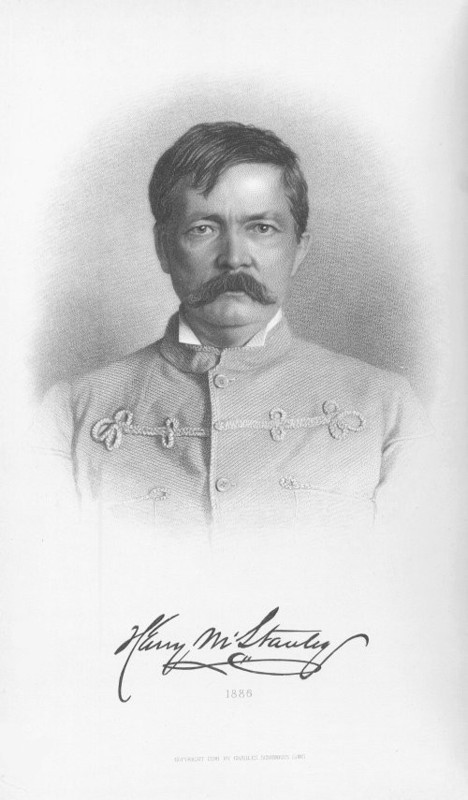
Portrait of Henry M. Stanley Frontispiece(From a Photograph by Elliott & Fry, 1886)
FULL-PAGE ILLUSTRATIONS.
Facing
page
Group—Mr. Stanley and his Officers. 1 The Steel Boat "Advance" 80 In the Night and Rain in the Forest 146 The Fight with the Avisibba Cannibals 174 The River Column Ascending the Aruwimi River with the "Advance" and Sixteen Canoes. 184 Wooden Arrows of the Avisibba 180 "The Pasha is Coming" 196 The Relief of Nelson and Survivors at Starvation Camp 250 Gymnastics in a Forest Clearing 258 Iyugu; a Call to Arms 286 Emerging from the Forest 292 First Experiences with Mazamboni's People. View from Nzera Kum Hill 306 View of the South End of Albert Nyanza 324 Sketch-Map: "Return to Ugarrowa's." By Lieutenant Stairs 365 Emin and Casati Arrive at Lake Shore Camp 396 A Phalanx Dance by Mazamboni's Warriors 438 Meeting with the Rear Column at Banalya 494OTHER ILLUSTRATIONS.
Portrait of Emin Pasha 18 Portrait of Captain Nelson 39 Portrait of Lieutenant Stairs 40 Portrait of William Bonny 41 Portrait of A. J. Mounteney Jephson 42 Portrait of Surgeon Parke, A. M. D. 50 Portrait of Nubar Pasha 51 Portrait of The Khedive Tewfik 55 Portrait of Tippu-Tib 68 Maxim Automatic Gun 83 Launching the Steamer "Florida" 96 Stanley Pool 100 Baruti Finds his Brother 109 A Typical Village on the Lower Aruwimi 112 Landing at Yambuya 113 Diagram Of Forest Camps 130 Marching Through the Forest 135 The Kirangozi, or Foremost Man 137 Head-Dress—Crown of Bristles 160 Paddle of the Upper Aruwimi or Ituri 160 Wasps' Nests 164 Fort Island, Near Panga Falls 168 Panga Falls 169 View of Utiri Village 172 Leaf-Bladed Paddle of Avisibba 174 A Head-Dress of Avisibba Warriors 178 Coroneted Avisibba Warrior—Head-Dress 179 Cascades of the Nepoko 193 View of Bafaido Cataract 202 Attacking an Elephant in the Ituri River 203 Randy Seizes the Guinea Fowl 224 Kilonga Longa's Station 234 Shields of the Balessé 256 View of Mount Pisgah from the Eastward 281 Villages of the Bakwuru on a Spur of Pisgah 283 A Village at the Base of Pisgah 284 Chief of the Iyugu 285 Pipes of Forest Tribes 290 Shields of Babusessé 299 Suspension Bridge Across the East Ituri 304 Shield of the Edge of the Plains 317 The South End of the Albert Nyanza, Dec. 13, 1887 318 Corn Granary of the Babusessé 342 A Village of the Baviri: Europeans Tailoring 345 Great Rock Near Indétonga 348 Exterior View of Fort Bodo 349 Interior View of Fort Bodo 351 Plan of Fort Bodo and Vicinity, by Lieutenant Stairs 354 The Queen of the Dwarfs 368 Within Fort Bodo 371 One of Mazamboni's Warriors 384 Kavalli, Chief of the Babiassi 389 Milk Vessel of the Wahuma 392 The Steamers "Khedive" and "Nyanza" on Lake Albert 426 View of Banalya Curve 493 Portrait of Major Barttelot 499 Portrait of Mr. Jameson 501MAP.
A Map of the Great Forest Region, Showing the Route of the Emin Pasha Relief Expedition from the River Congo to Victoria Nyanza. By Henry M. Stanley.In Pocket.
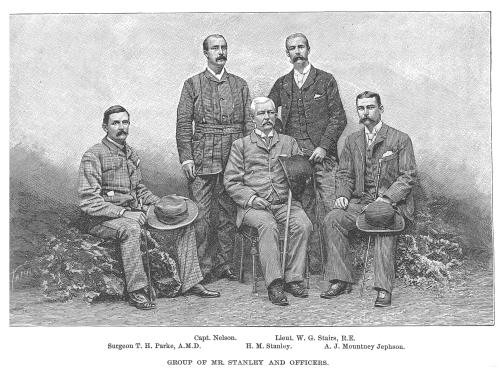
GROUP OF MR. STANLEY AND OFFICERS.
IN DARKEST AFRICA.
PREFATORY LETTER
My Dear Sir William,
I have great pleasure in dedicating this book to you. It professes to be the Official Report to yourself and the Emin Relief Committee of what we have experienced and endured during our mission of Relief, which circumstances altered into that of Rescue. You may accept it as a truthful record of the journeyings of the Expedition which you and the Emin Relief Committee entrusted to my guidance.
I regret that I was not able to accomplish all that I burned to do when I set out from England in January, 1887, but the total collapse of the Government of Equatoria thrust upon us the duty of conveying in hammocks so many aged and sick people, and protecting so many helpless and feeble folk, that we became transformed from a small fighting column of tried men into a mere Hospital Corps to whom active adventure was denied. The Governor was half blind and possessed much luggage, Casati was weakly and had to be carried, and 90 per cent. of their followers were, soon after starting, scarcely able to travel from age, disease, weakness or infancy. Without sacrificing our sacred charge, to assist which was the object of the Expedition, we could neither deviate to the right or to the left, from the most direct road to the sea.
You who throughout your long and varied life have steadfastly believed in the Christian's God, and before men have professed your devout thankfulness for many mercies vouchsafed to you, will better understand than many others the feelings which animate me when I find myself back again in civilization, uninjured in life or health, after passing through so many stormy and distressful periods. Constrained at the darkest hour to humbly confess that without God's help I was helpless, I vowed a vow in the forest solitudes that I would confess His aid before men. A silence as of death was round about me; it was midnight; I was weakened by illness, prostrated with fatigue and worn with anxiety for my white and black companions, whose fate was a mystery. In this physical and mental distress I besought God to give me back my people. Nine hours later we were exulting with a rapturous joy. In full view of all was the crimson flag with the crescent, and beneath its waving folds was the long-lost rear column.
Again, we had emerged into the open country out of the forest, after such experiences as in the collective annals of African travels there is no parallel. We were approaching the region wherein our ideal Governor was reported to be beleaguered. All that we heard from such natives as our scouts caught prepared us for desperate encounters with multitudes, of whose numbers or qualities none could inform us intelligently, and when the population of Undusuma swarmed in myriads on the hills, and the valleys seemed alive with warriors, it really seemed to us in our dense ignorance of their character and power, that these were of those who hemmed in the Pasha to the west. If he with his 4000 soldiers appealed for help, what could we effect with 173? The night before I had been reading the exhortation of Moses to Joshua, and whether it was the effect of those brave words, or whether it was a voice, I know not, but it appeared to me as though I heard: "Be strong, and of a good courage, fear not, nor be afraid of them, for the Lord thy God He it is that doth go with thee, He will not fail thee nor forsake thee." When on the next day Mazamboni commanded his people to attack and exterminate us, there was not a coward in our camp, whereas the evening before we exclaimed in bitterness on seeing four of our men fly before one native, "And these are the wretches with whom we must reach the Pasha!"
And yet again. Between the confluence of the Ihuru and the Dui rivers in December 1888, 150 of the best and strongest of our men had been despatched to forage for food. They had been absent for many days more than they ought to have been, and in the meantime 130 men besides boys and women were starving. They were supported each day with a cup of warm thin broth, made of butter, milk and water, to keep death away as long as possible. When the provisions were so reduced that there were only sufficient for thirteen men for ten days, even of the thin broth with four tiny biscuits each per day, it became necessary for me to hunt up the missing men. They might, being without a leader, have been reckless, and been besieged by an overwhelming force of vicious dwarfs. My following consisted of sixty-six men, a few women and children, who, more active than the others, had assisted the thin fluid with the berries of the phrynium and the amomum, and such fungi as could be discovered in damp places, and therefore were possessed of some little strength, though the poor fellows were terribly emaciated. Fifty-one men, besides boys and women, were so prostrate with debility and disease that they would be hopelessly gone if within a few hours food did not arrive. My white comrade and thirteen men were assured of sufficient for ten days to protract the struggle against a painful death. We who were bound for the search possessed nothing. We could feed on berries until we could arrive at a plantation. As we travelled that afternoon we passed several dead bodies in various stages of decay, and the sight of doomed, dying and dead produced on my nerves such a feeling of weakness that I was well-nigh overcome. Every soul in that camp was paralysed with sadness and suffering. Despair had made them all dumb. Not a sound was heard to disturb the deathly brooding. It was a mercy to me that I heard no murmur of reproach, no sign of rebuke. I felt the horror of silence of the forest and the night intensely. Sleep was impossible. My thoughts dwelt on these recurring disobediences which caused so much misery and anxiety. "Stiff-necked, rebellious, incorrigible human nature, ever showing its animalism and brutishness, let the wretches be for ever accursed! Their utter thoughtless and oblivious natures and continual breach of promises kill more men, and cause more anxiety, than the poison of the darts or barbs and points of the arrows. If I meet them I will—" But before the resolve was uttered flashed to my memory the dead men on the road, the doomed in the camp, and the starving with me, and the thought that those 150 men were lost in the remorseless woods beyond recovery, or surrounded by savages without hope of escape, then do you wonder that the natural hardness of the heart was softened, and that I again consigned my case to Him who could alone assist us. The next morning within half-an-hour of the start we met the foragers, safe, sound, robust, loaded, bearing four tons of plantains. You can imagine what cries of joy these wild children of nature uttered, you can imagine how they flung themselves upon the fruit, and kindled the fires to roast and boil and bake, and how, after they were all filled, we rode back to the camp to rejoice those unfortunates with Mr. Bonny.
As I mentally review the many grim episodes and reflect on the marvellously narrow escapes from utter destruction to which we have been subjected during our various journeys to and fro through that immense and gloomy extent of primeval woods, I feel utterly unable to attribute our salvation to any other cause than to a gracious Providence who for some purpose of His own preserved us. All the armies and armaments of Europe could not have lent us any aid in the dire extremity in which we found ourselves in that camp between the Dui and Ihuru; an army of explorers could not have traced our course to the scene of the last struggle had we fallen, for deep, deep as utter oblivion had we been surely buried under the humus of the trackless wilds.
It is in this humble and grateful spirit that I commence this record of the progress of the Expedition from its inception by you to the date when at our feet the Indian Ocean burst into view, pure and blue as Heaven when we might justly exclaim "It is ended!"
What the public ought to know, that have I written; but there are many things that the snarling, cynical, unbelieving, vulgar ought not to know. I write to you and to your friends, and for those who desire more light on Darkest Africa, and for those who can feel an interest in what concerns humanity.
My creed has been, is, and will remain so, I hope, to act for the best, think the right thought, and speak the right word, as well as a good motive will permit. When a mission is entrusted to me and my conscience approves it as noble and right, and I give my promise to exert my best powers to fulfil this according to the letter and spirit, I carry with me a Law, that I am compelled to obey. If any associated with me prove to me by their manner and action that this Law is equally incumbent on them, then I recognize my brothers. Therefore it is with unqualified delight that I acknowledge the priceless services of my friends Stairs, Jephson, Nelson and Parke, four men whose devotion to their several duties were as perfect as human nature is capable of. As a man's epitaph can only be justly written when he lies in his sepulchre, so I rarely attempted to tell them during the journey, how much I valued the ready and prompt obedience of Stairs, that earnestness for work that distinguished Jephson, the brave soldierly qualities of Nelson, and the gentle, tender devotion paid by our Doctor to his ailing patients; but now that the long wanderings are over, and they have bided and laboured ungrudgingly throughout the long period, I feel that my words are poor indeed when I need them to express in full my lasting obligations to each of them.
Concerning those who have fallen, or who were turned back by illness or accident, I will admit, with pleasure, that while in my company every one seemed most capable of fulfilling the highest expectations formed of them. I never had a doubt of any one of them until Mr. Bonny poured into my ears the dismal story of the rear column. While I possess positive proofs that both the Major and Mr. Jameson were inspired by loyalty, and burning with desire throughout those long months at Yambuya, I have endeavoured to ascertain why they did not proceed as instructed by letter, or why Messrs. Ward, Troup and Bonny did not suggest that to move little by little was preferable to rotting at Yambuya, which they were clearly in danger of doing, like the 100 dead followers. To this simple question there is no answer. The eight visits to Stanley Falls and Kasongo amount in the aggregate to 1,200 miles; their journals, log books, letters teem with proofs that every element of success was in and with them. I cannot understand why the five officers, having means for moving, confessedly burning with the desire to move, and animated with the highest feelings, did not move on along our tract as directed; or, why, believing I was alive, the officers sent my personal baggage down river and reduced their chief to a state of destitution; or, why they should send European tinned provisions and two dozen bottles of Madeira down river, when there were thirty-three men sick and hungry in camp; or, why Mr. Bonny should allow his own rations to be sent down while he was present; or, why Mr. Ward should be sent down river with a despatch, and an order be sent after him to prevent his return to the Expedition. These are a few of the problems which puzzle me, and to which I have been unable to obtain satisfactory solutions. Had any other person informed me that such things had taken place I should have doubted them, but I take my information solely from Major Barttelot's official despatch (See Appendix). The telegram which Mr. Ward conveyed to the sea requests instructions from the London Committee, but the gentlemen in London reply, "We refer you to Mr. Stanley's letter of instructions." It becomes clear to every one that there mystery here for which I cannot conceive a rational solution, and therefore each reader of this narrative must think his own thoughts but construe the whole charitably.
After the discovery of Mr. Bonny at Banalya, I had frequent occasions to remark to him that his goodwill and devotion were equal to that shown by the others, and as for bravery, I think he has as much as the bravest. With his performance of any appointed work I never had cause for dissatisfaction, and as he so admirably conducted himself with such perfect and respectful obedience while with us from Banalya to the Indian Sea, the more the mystery of Yambuya life is deepened, for with 2,000 such soldiers as Bonny under a competent leader, the entire Soudan could be subjugated, pacified and governed.
It must thoroughly be understood, however, while reflecting upon the misfortunes of the rear-column, that it is my firm belief that had it been the lot of Barttelot and Jameson to have been in the place of, say Stairs and Jephson, and to have accompanied us in the advance, they would equally have distinguished themselves; for such a group of young gentlemen as Barttelot, Jameson, Stairs, Nelson, Jephson, and Parke, at all times, night or day, so eager for and rather loving work, is rare. If I were to try and form another African State, such tireless, brave natures would be simply invaluable. The misfortunes of the rear-column were due to the resolutions of August 17th to stay and wait for me, and to the meeting with the Arabs the next day.
What is herein related about Emin Pasha need not, I hope, be taken as derogating in the slightest from the high conception of our ideal. If the reality differs somewhat from it no fault can be attributed to him. While his people were faithful he was equal to the ideal; when his soldiers revolted his usefulness as a Governor ceased, just as the cabinet-maker with tools may turn out finished wood-work, but without them can do nothing. If the Pasha was not of such gigantic stature as we supposed him to be, he certainly cannot be held responsible for that, any more than he can be held accountable for his unmilitary appearance. If the Pasha was able to maintain his province for five years, he cannot in justice be held answerable for the wave of insanity and the epidemic of turbulence which converted his hitherto loyal soldiers into rebels. You will find two special periods in this narrative wherein the Pasha is described with strictest impartiality to each, but his misfortunes never cause us to lose our respect for him, though we may not agree with that excess of sentiment which distinguished him, for objects so unworthy as sworn rebels. As an administrator he displayed the finest qualities; he was just, tender, loyal and merciful, and affectionate to the natives who placed themselves under his protection, and no higher and better proof of the esteem with which he was regarded by his soldiery can be desired than that he owed his life to the reputation for justice and mildness which he had won. In short, every hour saved from sleep was devoted before his final deposition to some useful purpose conducive to increase of knowledge, improvement of humanity, and gain to civilization. You must remember all these things, and by no means lose sight of them, even while you read our impressions of him.
I am compelled to believe that Mr. Mounteney Jephson wrote the kindliest report of the events that transpired during the arrest and imprisonment of the Pasha and himself, out of pure affection, sympathy, and fellow-feeling for his friend. Indeed the kindness and sympathy he entertains for the Pasha are so evident that I playfully accuse him of being either a Mahdist, Arabist, or Eminist, as one would naturally feel indignant at the prospect of leading a slave's life at Khartoum. The letters of Mr. Jephson, after being shown, were endorsed, as will be seen by Emin Pasha. Later observations proved the truth of those made by Mr. Jephson when he said, "Sentiment is the Pasha's worst enemy; nothing keeps Emin here but Emin himself." What I most admire in him is the evident struggle between his duty to me, as my agent, and the friendship he entertains for the Pasha.
While we may naturally regret that Emin Pasha did not possess that influence over his troops which would have commanded their perfect obedience, confidence and trust, and made them pliable to the laws and customs of civilization, and compelled them to respect natives as fellow-subjects, to be guardians of peace and protectors of property, without which there can be no civilization, many will think that as the Governor was unable to do this, that it is as well that events took the turn they did. The natives of Africa cannot be taught that there are blessings in civilization if they are permitted to be oppressed and to be treated as unworthy of the treatment due to human beings, to be despoiled and enslaved at will by a licentious soldiery. The habit of regarding the aborigines as nothing better than pagan abid or slaves, dates from Ibrahim Pasha, and must be utterly suppressed before any semblance of civilization can be seen outside the military settlements. When every grain of corn, and every fowl, goat, sheep and cow which is necessary for the troops is paid for in sterling money or its equivalent in necessary goods, then civilization will become irresistible in its influence, and the Gospel even may be introduced; but without impartial justice both are impossible, certainly never when preceded and accompanied by spoliation, which I fear was too general a custom in the Soudan.
Those who have some regard for righteous justice may find some comfort in the reflection that until civilization in its true and real form be introduced into Equatoria, the aborigines shall now have some peace and rest, and that whatever aspects its semblance bare, excepting a few orange and lime trees, can be replaced within a month, under higher, better, and more enduring auspices.
If during this Expedition I have not sufficiently manifested the reality of my friendship and devotion to you, and to my friends of the Emin Belief Committee, pray attribute it to want of opportunities and force of circumstances and not to lukewarmness and insincerity; but if, on the other hand, you and my friends have been satisfied that so far as lay in my power I have faithfully and loyally accomplished the missions you entrusted to me in the same spirit and to the same purpose that you yourself would have performed them had it been physically and morally possible for you to have been with us, then indeed am I satisfied, and the highest praise would not be equal in my opinion to the simple acknowledgment of it, such as "Well done."
My dear Sir William, to love a noble, generous and loyal heart like your own, is natural. Accept the profession of mine, which has been pledged long ago to you wholly and entirely.
Henry M. Stanley.
To Sir William Mackinnon, Bart.,
of Balinakill and Loup,
in the County of Argyleshire,
The Chairman of the Emin Pasha Relief Committee.
&c. &c. &c.
FOOTNOTES.
PREFATORY LETTER
INTRODUCTORY CHAPTER.
EGYPT AND ZANZIBAR.
BY SEA TO THE CONGO RIVER.
TO STANLEY POOL.
FROM STANLEY POOL TO YAMBUYA.
AT YAMBUYA.
TO PANGA FALLS.
FROM PANGA FALLS TO UGARROWWA'S.
UGARROWWA'S TO KILONGA-LONGA'S.
WITH THE MANYUEMA AT IPOTO.
THROUGH THE FOREST TO MAZAMBONI'S PEAK.
ARRIVAL AT LAKE ALBERT, AND OUR RETURN TO IBWIRI.
LIFE AT FORT BODO.
TO THE ALBERT NYANZA A SECOND TIME.
THE MEETING WITH EMIN PASHA.
WITH THE PASHA (continued).
PERSONAL TO THE PASHA.
START FOR THE RELIEF OF THE REAR COLUMN.
ARRIVAL AT BANALYA: BARTTELOT DEAD.
THE SAD STORY OF THE REAR COLUMN.
THE STEEL BOAT ADVANCE.
IN THE NIGHT AND RAIN IN THE FOREST.
THE FIGHT WITH THE AVISIBBA CANNIBALS.
THE RIVER COLUMN ASCENDING THE ARUWIMI RIVER WITH "ADVANCE" AND SIXTEEN CANOES.
WOODEN ARROWS OF THE AVISIBBA.
(From a photograph.)
"THE PASHA IS COMING."
THE RELIEF OF NELSON AND SURVIVORS AT STARVATION CAMP.
GYMNASTICS IN A FOREST CLEARING.
IYUGU; A CALL TO ARMS.
EMERGING FROM THE FOREST.
OUR FIRST EXPERIENCES WITH MAZAMBONI'S PEOPLE. VIEW FROM NZERA KUM HILL.
VIEW OF THE SOUTH END OF ALBERT NYANZA. (See page 306.)
Stanford's Geographical Estab.
EMIN AND CASATI ARRIVE AT OUR LAKE SHORE CAMP.
A PHALANX DANCE BY MAZAMBONI'S WARRIORS.
MEETING WITH THE REAR COLUMN AT BANALYA.
EMIN PASHA.
CAPTAIN NELSON.
LIEUTENANT STAIRS.
MR. WILLIAM BONNY.
MR. A. J. MOUNTENEY JEPHSON.
SURGEON PARKE, A. M. D.
NUBAR PASHA.
THE KHEDIVE TEWFIK.
PORTRAIT OF TIPPU-TIB.
MAXIM AUTOMATIC GUN.
LAUNCHING THE STEAMER "FLORIDA."
STANLEY POOL.
BARUTI FINDS HIS BROTHER.
A TYPICAL VILLAGE ON THE LOWER ARUWIMI.
OUR LANDING AT YAMBUYA.
DIAGRAM OF OUR FOREST CAMPS.
MARCHING THROUGH THE FOREST.
THE KIRANGOZI, OR FOREMOST MAN.
HEAD-DRESS—CROWN OF BRISTLES.
PADDLE OF THE UPPER ARUWIMI OR ITURI.
WASPS' NESTS, ETC.
FORT ISLAND, NEAR PANGA FALLS.
PANGA FALLS.
VIEW OF UTIRI VILLAGE.
LEAF-BLADED PADDLE OF AVISIBBA.
A HEAD-DRESS OF AVISIBBA WARRIORS.
CORONETED AVISIBBA WARRIOR—HEAD-DRESS.
CASCADES OF THE NEPOKO.
VIEW OF BAFAIDO CATARACT.
ATTACKING AN ELEPHANT IN THE ITURI RIVER.
RANDY SEIZES THE GUINEA FOWL.
KILONGA LONGA'S STATION.
SHIELDS OF THE BALESSÉ.
VIEW OF MOUNT PISGAH FROM THE EASTWARD.
VILLAGES OF THE BAKWURU ON A SPUR OF PISGAH.
A VILLAGE AT THE BASE OF PISGAH.
CHIEF OF THE IYUGU.
PIPES.
SHIELDS OF BABUSESSÉ.
SUSPENSION BRIDGE ACROSS THE E. ITURI.
SHIELD OF THE EDGE OF THE PLAINS.
THE SOUTH END OF THE ALBERT NYANZA, DEC. 13, 1887.
CORN GRANARY OF THE BABUSESSÉ.
A VILLAGE OF THE BAVIRI: EUROPEANS TAILORING, ETC.
GREAT ROCK NEAR INDE-TONGA.
VIEW OF FORT BODO.
VIEW OF FORT BODO.
PLAN OF FORT BODO AND VICINITY. By Lieut. Stairs, R.E.
THE QUEEN OF THE DWARFS.
WITHIN FORT BODO.
ONE OF MAZAMBONI'S WARRIORS.
KAVALLI, CHIEF OF THE BA-BIASSI.
MILK VESSEL OF THE WAHUMA.
THE STEAMERS "KHEDIVE" AND "NYANZA" ON LAKE ALBERT.
VIEW OF BANALYA CURVE.
MAJOR BARTTELOT.
MR. JAMESON.
CHAPTER I.
INTRODUCTORY CHAPTER.
The Khedive and the Soudan—Arabi Pasha—Hicks Pasha's defeat—The Mahdi—Sir Evelyn Baring and Lord Granville on the Soudan—Valentine Baker Pasha—General Gordon: his work in the Upper Soudan—Edward Schnitzler (or Emin Effendi Hakim) and his province—General Gordon at Khartoum: and account of the Belief Expedition in 1884, under Lord Wolseley—Mr. A. M. Mackay, the missionary in Uganda—Letters from Emin Bey to Mr. Mackay, Mr. C. H. Allen, and Dr. R. W. Felkin, relating to his Province—Mr. F. Holmwood's and Mr. A. M. Mackay's views on the proposed relief of Emin—Suggested routes for the Emin Relief Expedition—Sir Wm. Mackinnon and Mr. J. F. Hutton—The Relief Fund and Preparatory details of the Expedition—Colonel Sir Francis De Winton—Selection of officers for the Expedition—King Leopold and the Congo Route—Departure for Egypt.
Only a Carlyle in his maturest period, as when he drew in lurid colours the agonies of the terrible French Revolution, can do justice to the long catalogue of disasters which has followed the connection of England with Egypt. It is a theme so dreadful throughout, that Englishmen shrink from touching it. Those who have written upon any matters relating to these horrors confine themselves to bare historical record. No one can read through these without shuddering at the dangers England and Englishmen have incurred during this pitiful period of mismanagement. After the Egyptian campaign there is only one bright gleam of sunshine throughout months of oppressive darkness, and that shone over the immortals of Abu-Klea and Gubat, when that small body of heroic Englishmen struggled shoulder to shoulder on the sands of the fatal desert, and won a glory equal to that which the Light Brigade were urged to gain at Balaclava. Those were fights indeed, and atone in a great measure for a series of blunders, that a century of history would fail to parallel. If only a portion of that earnestness of purpose exhibited at Abu-Klea had been manifested by those responsible for ordering events, the Mahdi would soon have become only a picturesque figure to adorn a page or to point a metaphor, and not the terrible portent of these latter days, whose presence blasted every vestige of civilization in the Soudan to ashes.
In order that I may make a fitting but brief introduction to the subject matter of this book, I must necessarily glance at the events which led to the cry of the last surviving Lieutenant of Gordon for help in his close beleaguerment near the Equator.
To the daring project of Ismail the Khedive do we owe the original cause of all that has befallen Egypt and the Soudan. With 5,000,000 of subjects, and a rapidly depleting treasury, he undertook the expansion of the Egyptian Khediviate into an enormous Egyptian Empire, the entire area embracing a superficial extent of nearly 1,000,000 square miles—that is, from the Pharos of Alexandria to the south end of Lake Albert, from Massowah to the western boundary of Darfur. Adventurers from Europe and from America resorted to his capital to suggest the maddest schemes, and volunteered themselves leaders of the wildest enterprises. The staid period when Egyptian sovereignty ceased at Gondokoro, and the Nile was the natural drain of such traffic as found its way by the gentle pressure of slow development, was ended when Captains Speke and Grant, and Sir Samuel Baker brought their rapturous reports of magnificent lakes, and regions unmatched for fertility and productiveness. The termination of the American Civil War threw numbers of military officers out of employment, and many thronged to Egypt to lend their genius to the modern Pharaoh, and to realize his splendid dreams of empire. Englishmen, Germans, and Italians, appeared also to share in the honours that were showered upon the bold and the brave.
While reading carefully and dispassionately the annals of this period, admiring the breadth of the Khedive's views, the enthusiasm which possesses him, the princely liberality of his rewards, the military exploits, the sudden extensions of his power, and the steady expansions of his sovereignty to the south, west, and east, I am struck by the fact that his success as a conqueror in Africa may well be compared to the successes of Alexander in Asia, the only difference being that Alexander led his armies in person, while Ismail the Khedive preferred the luxuries of his palaces in Cairo, and to commit his wars to the charge of his Pashas and Beys.
To the Khedive the career of conquest on which he has launched appears noble; the European Press applaud him; so many things of grand importance to civilization transpire that they chant pæans of praise in his honour; the two seas are brought together, and the mercantile navies ride in stately columns along the maritime canal; railways are pushed towards the south, and it is prophesied that a line will reach as far as Berber. But throughout all this brilliant period the people of this new empire do not seem to have been worthy of a thought, except as subjects of taxation and as instruments of supplying the Treasury; taxes are heavier than ever; the Pashas are more mercenary; the laws are more exacting, the ivory trade is monopolised, and finally, to add to the discontent already growing, the slave trade is prohibited throughout all the territory where Egyptian authority is constituted. Within five years Sir Samuel Baker has conquered the Equatorial Province, Munzinger has mastered Senaar, Darfur has been annexed, and Bahr-el-Ghazal has been subjugated after a most frightful waste of life. The audacity manifested in all these projects of empire is perfectly marvellous—almost as wonderful as the total absence of common sense. Along a line of territory 800 miles in length there are only three military stations in a country that can only rely upon camels as means of communication except when the Nile is high.
In 1879, Ismail the Khedive having drawn too freely upon the banks of Europe, and increased the debt of Egypt to £128,000,000, and unable to agree to the restraints imposed by the Powers, the money of whose subjects he had so liberally squandered, was deposed, and the present Khedive, Tewfik, his son, was elevated to his place, under the tutelage of the Powers. But shortly after, a military revolt occurred, and at Kassassin, Tel-el-Kebir, Cairo, and Kafr Dowar, it was crushed by an English Army, 13,000 strong, under Lord Wolseley.
During the brief sovereignty of Arabi Pasha, who headed the military revolt, much mischief was caused by the withdrawal of the available troops from the Soudan. While the English General was defeating the rebel soldiers at Tel-el-Kebir, the Mahdi Mohamet-Achmet was proceeding to the investment of El Obeid. On the 23rd of August he was attacked at Duem with a loss of 4500. On the 14th he was repulsed by the garrison of Obeid, with a loss, it is said, of 10,000 men. These immense losses of life, which have been continuous from the 11th of August, 1881, when the Mahdi first essayed the task of teaching the populations of the Soudan the weakness of Egyptian power, were from the tribes who were indifferent to the religion professed by the Mahdi, but who had been robbed by the Egyptian officials, taxed beyond endurance by the Government, and who had been prevented from obtaining means by the sale of slaves to pay the taxes, and also from the hundreds of slave-trading caravans, whose occupation was taken from them by their energetic suppression by Gordon, and his Lieutenant, Gessi Pasha. From the 11th of August, 1881, to the 4th of March, 1883, when Hicks Pasha, a retired Indian officer, landed at Khartoum as Chief of the Staff of the Soudan army, the disasters to the Government troops had been almost one unbroken series; and, in the meanwhile, the factious and mutinous army of Egypt had revolted, been suppressed and disbanded, and another army had been reconstituted under Sir Evelyn Wood, which was not to exceed 6000 men. Yet aware of the tremendous power of the Mahdi, and the combined fanaticism and hate, amounting to frenzy, which possessed his legions, and of the instability, the indiscipline, and cowardice of his troops—while pleading to the Egyptian Government for a reinforcement of 5000 men, or for four battalions of General Wood's new army—Hicks Pasha resolves upon the conquest of Kordofan, and marches to meet the victorious Prophet, while he and his hordes are flushed with the victory lately gained over Obeid and Bara. His staff, and the very civilians accompanying him, predict disaster; yet Hicks starts forth on his last journey with a body of 12,000 men, 10 mountain guns, 6 Nordenfelts, 5500 camels, and 500 horses. They know that the elements of weakness are in the force; that many of the soldiers are peasants taken from the fields in Egypt, chained in gangs; that others are Mahdists; that there is dissension between the officers, and that everything is out of joint. But they march towards Obeid, meet the Mahdi's legions, and are annihilated.
England at this time directs the affairs of Egypt with the consent of the young Khedive, whom she has been instrumental in placing upon the almost royal throne of Egypt, and whom she is interested in protecting. Her soldiers are in Egypt; the new Egyptian army is under an English General; her military police is under the command of an English ex-Colonel of cavalry; her Diplomatic Agent directs the foreign policy; almost all the principal offices of the State are in the hands of Englishmen.
The Soudan has been the scene of the most fearful sanguinary encounters between the ill-directed troops of the Egyptian Government and the victorious tribes gathered under the sacred banner of the Mahdi; and unless firm resistance is offered soon to the advance of the Prophet, it becomes clear to many in England that this vast region and fertile basin of the Upper Nile will be lost to Egypt, unless troops and money be furnished to meet the emergency. To the view of good sense it is clear that, as England has undertaken to direct the government and manage the affairs of Egypt, she cannot avoid declaring her policy as regards the Soudan. To a question addressed to the English Prime Minister in Parliament, as to whether the Soudan was regarded as forming a part of Egypt, and if so, whether the British Government would take steps to restore order there, Mr. Gladstone replied, that the Soudan had not been included in the sphere of English operations, and that the Government was not disposed to include it within the sphere of English responsibility. As a declaration of policy no fault can be found with it; it is Mr. Gladstone's policy, and there is nothing to be said against it as such; it is his principle, the principle of his associates in the Government, and of his party, and as a principle it deserves respect.
The Political Agent in Egypt, Sir Evelyn Baring, while the fate of Hicks Pasha and his army was still unknown, but suspected, sends repeated signals of warning to the English Government, and suggests remedies and means of averting a final catastrophe. "If Hicks Pasha is defeated, Khartoum is in danger; by the fall of Khartoum, Egypt will be menaced."
Lord Granville replies at various times in the months of November and December, 1883, that the Government advises the abandonment of the Soudan within certain limits; that the Egyptian Government must take the sole responsibility of operations beyond Egypt Proper; that the Government has no intention of employing British or Indian troops in the Soudan; that ineffectual efforts on the part of the Egyptian Government to secure the Soudan would only increase the danger.
Sir Evelyn Baring notified Lord Granville that no persuasion or argument availed to induce the Egyptian Minister to accept the policy of abandonment. Cherif Pasha, the Prime Minister, also informed Lord Granville that, according to Valentine Baker Pasha, the means at the disposal were utterly inadequate for coping with the insurrection in the Soudan.
Then Lord Granville replied, through Sir Evelyn Baring, that it was indispensable that, so long as English soldiers provisionally occupied Egypt, the advice of Her Majesty's Ministers should be followed, and that he insisted on its adoption. The Egyptian Ministers were changed, and Nubar Pasha became Prime Minister on the 10th January, 1884.
On the 17th December, Valentine Baker departed from Egypt for Suakim, to commence military operations for the maintenance of communication between Suakim and Berber, and the pacification of the tribes in that region. While it was absolutely certain in England that Baker's force would suffer a crushing defeat, and suspected in Egypt, the General does not seem to be aware of any danger, or if there be, he courts it. The Khedive, fearful that to his troops an engagement will be most disastrous, writes privately to Baker Pasha: "I rely on your prudence and ability not to engage the enemy except under the most favourable conditions." Baker possessed ability and courage in abundance; but the event proved that prudence and judgment were as absent in his case as in that of the unfortunate Hicks. His force consisted of 3746 men. On the 6th of February he left Trinkitat on the sea shore, towards Tokar. After a march of six miles the van of the rebels was encountered, and shortly after the armies were engaged. It is said "that the rebels displayed the utmost contempt for the Egyptians; that they seized them by the neck and cut their throats; and that the Government troops, paralysed by fear, turned their backs, submitting to be killed rather than attempt to defend their lives; that hundreds threw away their rifles, knelt down, raised their clasped hands, and prayed for mercy."
The total number killed was 2373 out of 3746. Mr. Royle, the excellent historian of the Egyptian campaigns, says: "Baker knew, or ought to have known, the composition of the troops he commanded, and to take such men into action was simply to court disaster." What ought we to say of Hicks?
We now come to General Gordon, who from 1874 to 1876 had been working in the Upper Soudan on the lines commenced by Sir Samuel Baker, conciliating natives, crushing slave caravans, destroying slave stations, and extending Egyptian authority by lines of fortified forts up to the Albert Nyanza. After four months' retirement he was appointed Governor-General of the Soudan, of Darfur, and the Equatorial Provinces. Among others whom Gordon employed as Governors of these various provinces under his Vice-regal Government was one Edward Schnitzler, a German born in Oppeln, Prussia, 28th March, 1840, of Jewish parents, who had seen service in Turkey, Armenia, Syria, and Arabia, in the suite of Ismail Hakki Pasha, once Governor-General of Scutari, and a Mushir of the Empire. On the death of his patron he had departed to Niesse, where his mother, sister, and cousins lived, and where he stayed for several months, and thence left for Egypt. He, in 1875, thence travelled to Khartoum, and being a medical doctor, was employed by Gordon Pasha in that capacity. He assumed the name and title of Emin Effendi Hakim—the faithful physician. He was sent to Lado as storekeeper and doctor, was afterwards despatched to King Mtesa on a political mission, recalled to Khartoum, again despatched on a similar mission to King Kabba-Rega of Unyoro, and finally, in 1878, was promoted to Bey, and appointed Governor of the Equatorial Province of Ha-tal-astiva, which, rendered into English, means Equatoria, at a salary of £50 per month. A mate of one of the Peninsular and Oriental steamers, called Lupton, was promoted to the rank of Governor of the Province of Bahr-el-Ghazal, which adjoined Equatoria.
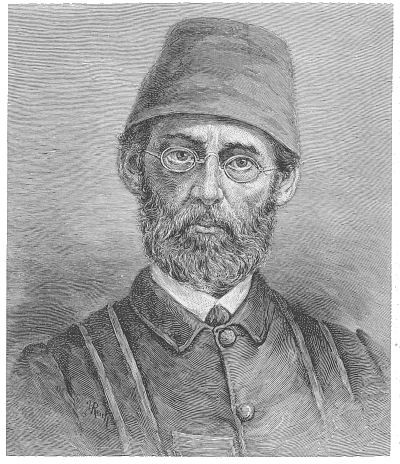
EMIN PASHA.
On hearing of the deposition of Ismail in 1879, Gordon surrendered his high office in the hands of Tewfik, the new Khedive, informing him that he did not intend to resume it.
In 1880 he accepted the post of Secretary under the Marquis of Ripon, but resigned it within a month.
In 1881 he is in Mauritius as Commandant of the Royal Engineers. In about two months he abandons that post to proceed to the assistance of the Cape authorities in their difficulty with the Basutos, but, after a little experience, finds himself unable to agree with the views of the Cape Government, and resigns.
Meantime, I have been labouring on the Congo River. Our successes in that immense territory of Western Africa have expanded into responsibilities so serious that they threaten to become unmanageable. When I visit the Lower Congo affairs become deranged on the Upper Congo; if I confine myself to the Upper Congo there is friction in the Lower Congo. Wherefore, feeling an intense interest in the growth of the territory which was rapidly developing into a State, I suggested to His Majesty King Leopold, as early as September, 1882, and again in the spring of 1883, that I required as an associate a person of merit, rank, and devotion to work, such as General Gordon, who would undertake either the management of the Lower or Upper Congo, while I would work in the other section, as a vast amount of valuable time was consumed in travelling up and down from one to the other, and young officers of stations were so apt to take advantage of my absence. His Majesty promised to request the aid of General Gordon, but for a long time the replies were unfavourable. Finally, in the spring of 1884, I received a letter in General Gordon's well-known handwriting, which informed me I was to expect him by the next mail.
It appears, however, that he had no sooner mailed his letter to me and parted from His Majesty than he was besieged by applications from his countrymen to assist the Egyptian Government in extricating the beleaguered garrison of Khartoum from their impending fate. Personally I know nothing of what actually happened when he was ushered by Lord Wolseley into the presence of Lord Granville, but I have been informed that General Gordon was confident he could perform the mission entrusted to him. There is a serious discrepancy in the definition of this mission. The Egyptian authorities were anxious for the evacuation of Khartoum only, and it is possible that Lord Granville only needed Gordon's services for this humane mission, all the other garrisons to be left to their fate because of the supposed impossibility of rescuing them. The Blue Books which contain the official despatches seem to confirm the probability of this. But it is certain that Lord Granville instructed General Gordon to proceed to Egypt to report on the situation of the Soudan, and on the best measures that should be taken for the security of the Egyptian garrisons (in the plural), and for the safety of the European population in Khartoum. He was to perform such other duties as the Egyptian Government might wish to entrust to him. He was to be accompanied by Colonel Stewart.
Sir Evelyn Baring, after a prolonged conversation with Gordon, gives him his final instructions on behalf of the British Government.
A precis of these is as follows:—
1. "Ensure retreat of the European population from 10,000 to 15,000 people, and of the garrison of Kartoum."[1]
2. "You know best the when and how to effect this."
3. "You will bear in mind that the main end (of your Mission) is the evacuation of the Soudan."
4. "As you are of opinion it could be done, endeavour to make a confederation of the native tribes to take the place of Egyptian authority."
5. "A credit of £100,000 is opened for you at the Finance Department."
Gordon has succeeded in infusing confidence in the minds of the Egyptian Ministry, who were previously panic-stricken and cried out for the evacuation of Khartoum only. They breathe freer after seeing and hearing him, and according to his own request they invest him with the Governor-Generalship. The firman, given him, empowers him to evacuate the respective territories (of the Soudan) and to withdraw the troops, civil officials, and such of the inhabitants as wish to leave for Egypt, and if possible, after completing the evacuation (and this was an absolute impossibility) he was to establish an organized Government. With these instructions Lord Granville concurs.
I am told that it was understood, however, that he was to do what he could—do everything necessary, in fact, if possible; if not all the Soudan, then he was to proceed to evacuating Khartoum only, without loss of time. But this is not on official record until March 23rd, 1884, and it is not known whether he ever received this particular telegram.[2]
General Gordon proceeded to Khartoum on January 26th, 1884, and arrived in that city on the 18th of the following month. During his journey he sent frequent despatches by telegraph abounding in confidence. Mr. Power, the acting consul and Times correspondent, wired the following despatch—"The people (of Khartoum) are devoted to General Gordon, whose design is to save the garrison, and for ever leave the Soudan—as perforce it must be left—to the Soudanese."
The English press, which had been so wise respecting the chances of Valentine Baker Pasha, were very much in the condition of the people of Khartoum, that is, devoted to General Gordon and sanguine of his success. He had performed such wonders in China—he had laboured so effectually in crushing the slave-trade in the Soudan, he had won the affection of the sullen Soudanese, that the press did not deem it at all improbable that Gordon with his white wand and six servants could rescue the doomed garrisons of Senaar, Bahr-el-Ghazal and Equatoria—a total of 29,000 men, besides the civil employees and their wives and families; and after performing that more than herculean—nay utterly impossible task—establish an organized Government.
On February 29th Gordon telegraphs, "There is not much chance of improving, and every chance is getting worse," and on the 2nd of the month "I have no option about staying at Khartoum, it has passed out of my hands." On the 16th March he predicts that before long "we shall be blocked." At the latter end of March he telegraphs, "We have provisions for five months, and are hemmed in."
It is clear that a serious misunderstanding had occurred in the drawing up of the instructions by Sir Evelyn Baring and their comprehension of them by General Gordon, for the latter expresses himself to the former thus:—
"You ask me to state cause and reason of my intention for my staying at Khartoum. I stay at Khartoum because Arabs have shut us up, and will not let us out."
Meantime public opinion urged on the British Government the necessity of despatching an Expedition to withdraw General Gordon from Khartoum. But as it was understood between General Gordon and Lord Granville that the former's mission was for the purpose of dispensing with the services of British troops in the Soudan, and as it was its declared policy not to employ English or Indian troops in that region, the Government were naturally reluctant to yield to the demand of the public. At last, however, as the clamour increased and Parliament and public joined in affirming that it was a duty on the country to save the brave man who had so willingly volunteered to perform such an important service for his country, Mr. Gladstone rose in the House of Commons on the 5th August to move a vote of credit to undertake operations for the relief of Gordon.
Two routes were suggested by which the Relief Expedition could approach Khartoum—the short cut across the desert from Suakim to Berber, and the other by the Nile. Gordon expressed his preference for that up the Nile, and it was this latter route that the Commanding General of the Relief Expedition adopted.
On the 18th September, the steamer "Abbas," with Colonel Stewart (Gordon's companion), Mr. Power, the Times correspondent, Mr. Herbin, the French Consul, and a number of Greeks and Egyptians on board—forty-four men all told—on trying to pass by the cataract of Abu Hamid was wrecked in the cataract. The Arabs on the shore invited them to land in peace, but unarmed. Stewart complied, and he and the two Consuls (Power and Herbin) and Hassan Effendi went ashore and entered a house, in which they were immediately murdered.
On the 17th November, Gordon reports to Lord Wolseley, who was then at Wady Halfa, that he can hold out for forty days yet, that the Mahdists are to the south, south-west, and east, but not to the north of Khartoum.
By Christmas Day, 1884, a great part of the Expeditionary Force was assembled at Korti. So far, the advance of the Expedition had been as rapid as the energy and skill of the General commanding could command. Probably there never was a force so numerous animated with such noble ardour and passion as this under Lord Wolseley for the rescue of that noble and solitary Englishman at Khartoum.
On December 30th, a part of General Herbert Stewart's force moves from Korti towards Gakdul Wells, with 2099 camels. In 46 hours and 50 minutes it has reached Gakdul Wells; 11 hours later Sir Herbert Stewart with all the camels starts on his return journey to Korti, which place was reached January 5th. On the 12th Sir Herbert Stewart was back at Gakdul Wells, and at 2 P.M. of the 13th the march towards Abu Klea was resumed. On the 17th, the famous battle of Abu Klea was fought, resulting in a hard-won victory to the English troops, with a loss of 9 officers and 65 men killed and 85 wounded, out of a total of 1800, while 1100 of the enemy lay dead before the square. It appears probable that if the 3000 English sent up the Nile Valley had been with this gallant little force, it would have been a mere walk over for the English army. After another battle on the 19th near Metammeh, where 20 men were killed and 60 wounded of the English, and 250 of the enemy, a village on a gravel terrace near the Nile was occupied. On the 21st, four steamers belonging to General Gordon appeared. The officer in command stated that they had been lying for some weeks near an island awaiting the arrival of the British column. The 22nd and 23rd were expended by Sir Chas. Wilson in making a reconnaissance, building two forts, changing the crews of the steamers, and preparing fuel. On the 24th, two of the steamers started for Khartoum, carrying only 20 English soldiers. On the 26th two men came aboard and reported that there had been fighting at Khartoum; on the 27th a man cried out from the bank that the town had fallen, and that Gordon had been killed. The next day the last news was confirmed by another man. Sir Charles Wilson steamed on until his steamers became the target of cannon from Omdurman and from Khartoum, besides rifles from a distance of from 75 to 200 yards, and turned back only when convinced that the sad news was only too true. Steaming down river then at full speed he reached Tamanieb when he halted for the night. From here he sent out two messengers to collect news. One returned saying that he had met an Arab who informed him that Khartoum had been entered on the night of the 26th January through the treachery of Farag Pasha, and that Gordon was killed; that the Mahdi had on the next day entered the city and had gone into a mosque to return thanks and had then retired, and had given the city up to three days' pillage.
In Major Kitchener's report we find a summary of the results of the taking of Khartoum. "The massacre in the town lasted some six hours, and about 4000 persons at least were killed. The Bashi Bazouks and white regulars numbering 3327, and the Shaigia irregulars numbering 2330, were mostly all killed in cold blood after they had surrendered and been disarmed." The surviving inhabitants of the town were ordered out, and as they passed through the gate were searched, and then taken to Omdurman where the women were distributed among the Mahdist chiefs, and the men were stripped and turned adrift to pick a living as they could. A Greek merchant, who escaped from Khartoum, reported that the town was betrayed by the merchants there, who desired to make terms with the enemy, and not by Farag Pasha.
Darfur, Kordofan, Senaar, Bahr-el-Ghazal, Khartoum, had been possessed by the enemy; Kassala soon followed, and throughout the length and breadth of the Soudan there now remained only the Equatorial Province, whose Governor was Emin Bey Hakim—the Faithful Physician.
Naturally, if English people felt that they were in duty bound to rescue their brave countryman, and a gallant General of such genius and reputation as Gordon, they would feel a lively interest in the fate of the last of Gordon's Governors, who, by a prudent Fabian policy, it was supposed, had evaded the fate which had befallen the armies and garrisons of the Soudan. It follows also that, if the English were solicitous for the salvation of the garrison of Khartoum, they would feel a proportionate solicitude for the fate of a brave officer and his little army in the far South, and that, if assistance could be rendered at a reasonable cost, there would be no difficulty in raising a fund to effect that desirable object.
On November 16, 1884, Emin Bey informs Mr. A. M. Mackay, the missionary in Uganda, by letter written at Lado, that "the Soudan has become the theatre of an insurrection; that for nineteen months he is without news from Khartoum, and that thence he is led to believe that the town has been taken by the insurgents, or that the Nile is blocked "; but he says:—
"Whatever it proves to be, please inform your correspondents and through them the Egyptian Government that to this day we are well, and that we propose to hold out until help may reach us or until we perish."
A second note from Emin Bey to the same missionary, on the same date as the preceding, contains the following:—
"The Bahr-Ghazal Province being lost and Lupton Bey, the governor, carried away to Kordofan, we are unable to inform our Government of what happens here. For nineteen months we have had no communication from Khartoum, so I suppose the river is blocked up."
"Please therefore inform the Egyptian Government by some means that we are well to this day, but greatly in need of help. We shall hold out until we obtain such help or until we perish."
To Mr. Charles H. Allen, Secretary of the Anti-Slavery Society, Emin Bey writes from Wadelai, December 31, 1885, as follows:—
"Ever since the month of May, 1883, we have been cut off from all communication with the world. Forgotten, and abandoned by the Government, we have been compelled to make a virtue of necessity. Since the occupation of the Bahr-Ghazal we have been vigorously attacked, and I do not know how to describe to you the admirable devotion of my black troops throughout a long war, which for them at least, has no advantage. Deprived of the most necessary things for a long time without any pay, my men fought valiantly, and when at last hunger weakened them, when, after nineteen days of incredible privation and sufferings, their strength was exhausted, and when the last torn leather of the last boot had been eaten, then they cut away through the midst of their enemies and succeeded in saving themselves. All this hardship was undergone without the least arrière-pensée, without even the hope of any appreciable reward, prompted only by their duty and the desire of showing a proper valour before their enemies."
This is a noble record of valour and military virtue. I remember the appearance of this letter in the Times, and the impression it made on myself and friends. It was only a few days after the appearance of this letter that we began to discuss ways and means of relief for the writer.
The following letter also impressed me very strongly. It is written to Dr. R. W. Felkin on the same date, December 31, 1885.
"You will probably know through the daily papers that poor Lupton, after having bravely held the Bahr-Ghazal Province was compelled, through the treachery of his own people, to surrender to the emissaries of the late Madhi, and was carried by them to Kordofan."
"My province and also myself I only saved from a like fate by a stratagem, but at last I was attacked, and many losses in both men and ammunition were the result, until I delivered such a heavy blow to the rebels at Rimo, in Makraka, that compelled them to leave me alone. Before this took place they informed us that Khartoum fell, in January, 1885, and that Gordon was killed."
"Naturally on account of these occurrences I have been compelled to evacuate our more distant stations, and withdraw our soldiers and their families, still hoping that our Government will send us help. It seems, however, that I have deceived myself, for since April, 1883, I have received no news of any kind from the north."
"The Government in Khartoum did not behave well to us. Before they evacuated Fashoda, they ought to have remembered that Government officials were living here (Equatorial Provinces) who had performed their duty, and had not deserved to be left to their fate without more ado. Even if it were the intention of the Government to deliver us over to our fate, the least they could have done was to have released us from our duties; we should then have known that we were considered to have become valueless."
"Anyway it was necessary for us to seek some way of escape, and in the first place it was urgent to send news of our existence in Egypt. With this object in view I went south, after having made the necessary arrangements at Lado, and came to Wadelai."
"As to my future plans, I intend to hold this country as long as possible. I hope that when our letters arrive in Egypt, in seven or eight months, a reply will be sent to me viâ Khartoum or Zanzibar. If the Egyptian Government still exists in the Soudan we naturally expect them to send us help. If, however, the Soudan has been evacuated, I shall take the whole of the people towards the south. I shall then send the whole of the Egyptian and Khartoum officials viâ Uganda or Karagwé to Zanzibar, but shall remain myself with my black troops at Kabba-Rege's until the Government inform me as to their wishes."
This is very clear that Emin Pasha at this time proposed to relieve himself of the Egyptian officials, and that he himself only intended to remain until the Egyptian Government could communicate to him its wishes. Those "wishes" were that he should abandon his province, as they were unable to maintain it, and take advantage of the escort to leave Africa.
In a letter written to Mr. Mackay dated July 6th, 1886, Emin says:—
"In the first place believe me that I am in no hurry to break away from here, or to leave those countries in which I have now laboured for ten years."
"All my people, but especially the negro troops, entertain a strong objection against a march to the south and thence to Egypt, and mean to remain here until they can be taken north. Meantime, if no danger overtakes us, and our ammunition holds out for sometime longer, I mean to follow your advice and remain here until help comes to us from some quarter. At all events, you may rest assured that we will occasion no disturbance to you in Uganda."
"I shall determine on a march to the coast only in a case of dire necessity. There are, moreover, two other routes before me. One from Kabba-Rega's direct to Karagwé; the other viâ Usongora to the stations at Tanganika. I hope, however, that I shall have no need to make use of either."
"My people have become impatient through long delay, and are anxiously looking for help at last. It would also be most desirable that some Commissioner came here from Europe, either direct by the Masai route, or from Karagwé viâ Kabba-Rega's country, in order that my people may actually see that there is some interest taken in them. I would defray with ivory all expenses of such a Commission."
"As I once more repeat, I am ready to stay and to hold these countries as long as I can until help comes, and I beseech you to do what you can to hasten the arrival of such assistance. Assure Mwanga that he has nothing to fear from me or my people, and that as an old friend of Mtesa's I have no intention to trouble him."
In the above letters we have Emin Bey's views, wherein we gather that his people are loyal—that is they are obedient to his commands, but that none of them, judging from the tenour of the letters, express any inclination to return to Egypt, excepting the Egyptians. He is at the same time pondering upon the routes by which it is possible to retreat—elsewhere he suggests the Monbuttu route to the sea; in these letters he hints at Masai Land, or through Unyoro, and west of Uganda to Usongora, and thence to Tanganika! If none of the black troops intended to follow him, he certainly could not have done so with only the Egyptian officials and their families.
From the following letters from the Consul-General, F. Holmwood, to Sir Evelyn Baring, dated September 25th and September 27th, we gather Mr. Holmwood's views, who, from his position and local knowledge, was very competent to furnish information as to what could be done in the way of the proposed relief.
"In Emin's letters to me he only reports his situation up to 27th February, 1886, when he proposed evacuating his province by detachments, the first of which he proposed to despatch at the close of the rains toward the end of July; but both Dr. Junker and Mr. Mackay inform me that they have since heard from Emin that the majority of the 4000 loyal Egyptian subjects who have remained faithful to Egypt throughout, and have supported him in the face of the constant attacks from the Mahdi's adherents, aggravated by an imminent danger of starvation, refuse to leave their country, and he had therefore determined, if he could possibly do so, to remain at his post, and continue to protect Egyptian interests till relief arrived."
"Were Uganda freed from this tyrant (Mwanga), the Equatorial Province, even should the present elementary system of communication remain unmodified, would be within eight weeks' post of Zanzibar, and a safe depôt on the Albert Nyanza would provide a base for any further operations that might be decided upon."
"Dr. Junker states that the country to the east of the Ripon Falls[3] has proved impracticable, and that Emin has lost many troops in endeavouring to open communication through it. If such be the case the alternative line by which Dr. Fischer tried to relieve Junker, and which I believe he still recommends, could not be relied on for turning Uganda and its eastern dependency, and the well-known route viâ Uganda would be the only one available for an Expedition of moderate size."
"As far as I am able to judge, without making any special calculation, I consider that 1200 porters would be the smallest number that would suffice, and a well-armed guard of at least 500 natives would be necessary."
"General Matthews, whom I had consulted as to the force necessary for the safety of the Expedition, is of opinion that I have formed far too low an estimate, but after weighing the testimony of many experienced persons acquainted with Uganda, I must adhere to my opinion that 500 native troops armed with modern rifles and under experienced persons, would, if supplemented by the irregular force, fully suffice."
An American officer of the Khedivial Government writes to Mr. Portal, and suggests that communication with Emin might be opened by the Zanzibar Arabs, but that to send stores and ammunition to him was impossible; that the Arabs might manage for his passage, though his safest line of retreat was westward to reach the Congo.
Mr. Fred Holmwood, in his despatch to the Foreign Office of September 23rd, 1886, writes that, "had it not been for the dangerous attitude of the King of Uganda, the question of relieving Emin would have been merely one of expenditure to be settled at Cairo; but under present circumstances, many other serious considerations are involved in it which will have to be referred to Her Majesty's Government."
"I would call attention to the account contained in Mr. Mackay's letter regarding the alternative route to Wadelai which Dr. Fischer endeavoured to take and, I believe, still recommends. If this statement be correct, any attempt to turn Uganda or its Eastern dependency by this unexplored line would probably fail."
Mr. A. M. Mackay writes from Uganda, May 14th, 1886:—
"From Dr. Junker's letter you will have seen that Emin Bey has had the good fortune to have secured the loyalty of the people he governs. Emin seems to have learned Gordon's secret of securing the affection of his subjects, and has bravely stuck to them. There can be no doubt at all but that had he been anxious to leave he would with a few hundred of his soldiers have easily made a dash for the coast either through the Masai Land or this way, asking no permission from Mwanga (King of Uganda) or anyone else. He knows that there is no power here able to stop him. In fact years ago he wrote me that it would be nothing to him to storm this wretched village and drive off the cattle."
"But what would be the fate of thousands of people who have remained loyal on the Upper Nile? Dr. Junker speaks of thousands. They do not want to be taken out of their own fertile country, and taken to the deserts of Upper Egypt."
"Dr. Emin is on all hands allowed to be a wise and able Governor. But he cannot remain for ever where he is, nor can he succeed himself, even should the Mahdi's troops leave him undisturbed in the future. His peculiar position should be taken advantage of by our country, which undertook to rescue the garrisons of the Soudan."
"Mwanga's action with respect to the letters forwarded him for Dr. Emin, was as disrespectful as possible to the British Government which had received with such kindness his father's envoys. We asked him merely to forward the letters in the first place until he should receive word from Emin as to whether or not he was prepared to come this way, but he detained your packet altogether."
In Mr. Mackay's letter to Sir John Kirk, June 28th, 1886, he says:—
"Dr. Fischer's difficulties would also only really begin after Kavirondo, as he then had the country of the dreaded Bakedi to cross, and Dr. Junker tells me that whole parties of Dr. Emin's soldiers have been repeatedly murdered by them."
Dr. Fischer, it will be remembered, was engaged to proceed to Equatoria in search of Dr. Junker by that traveller's brother, and chose the road viâ East coast of the Victoria Lake. Arriving at the N.E. corner of the Lake he returned to the coast.
Mr. Mackay proceeds:—
"Dr. Junker is living here with us. He brought me a letter from Emin Bey dated the 27th January (1886). He then proposed sending his people at once this way—some 4000—in small detachments. This policy would be fatal. He also asked me to go to meet him with a view to bringing here two steamers which otherwise he would have to abandon. One of them he meant for the King, and the other for the mission."
"Since then, however he finds that his people, officers and men, refuse to leave the Soudan, hence he is prepared to remain some years with them provided only he can get supplies of cloth, etc."
Mr. Mackay always writes sensibly. I obtained a great deal of solid information from these letters.
Naturally he writes in the full belief that Emin's troops are loyal. We all shared in this belief. We now see that we were grossly misled, and that at no time could Emin have cut his way to the coast through Uganda or any other country with men of such fibre as his ignorant and stolid Soudanese.
Mr. Joseph Thomson, in a letter to the Times, suggested a route through the Masai Land, and proposed to be responsible for the safe conduct of a Relief Expedition through that country.
Mr. J. T. Wills suggested that the Mobangi-Welle would prove an excellent way to Emin.
Mr. Harrison Smith expressed himself assured that a way by Abyssinia would be found feasible.
Another gentleman interested in the African Lakes Company proposed that the Expedition should adopt the Zambezi-Shire-Nyassa route, and thence viâ Tanganika north to Muta Nzige and Lake Albert, and a missionary from the Tanganika warmly endorsed it, as not presenting more difficulties than any other.
Dr. Felkin, in the 'Scottish Geographical Magazine,' after examining several routes carefully, came to the conclusion that a road west of Lake Victoria and Karagwé, through Usongora to Lake Albert, possessed some advantages over any other.
Early in October, 1886, Sir William Mackinnon and Mr. J. F. Hutton, ex-President of the Manchester Chamber of Commerce, had spoken with me respecting the possibilities of conveying relief to Emin, with a view to enable him to hold his own. To them it seemed that he only required ammunition, and I shared their opinion, and they were very earnest in their intention to collect funds for the support he required. But many of their friends were absent from town, and they could not decide alone what should be done without consultation. We discussed estimates and routes, and Mr. Hutton informs me that the rough estimate I furnished him then exceeds by £500 the actual cost of the Expedition.
As for routes, I intimated to them that there were four almost equally feasible.
The first, viâ Masai Land, was decidedly objectionable while carrying a vast store of ammunition which absolutely must reach Emin. Mr. Thomson had tried it, and his account of the extremities to which he was driven on returning from the Lake Victoria, for want of water and grain, were extremely unfavourable. In proceeding to the lake his people were dispirited, and deserted in such numbers that he was obliged to return a short distance, to Kilima Njaro, leave his camp there, and proceed with a few men back to the coast to recruit more men. In case of a pressing necessity like this it would be extremely unwise to return a mile after commencing the march. The tendency of the Zanzibaris to desert also was another disadvantage, and desertion of late from East Coast Expeditions had assumed alarming proportions owing to the impunity with which they could decamp with rifles and loads, and the number of opportunities presented to them. Many of the Zanzibaris had become professional advance-jumpers, and the greater the expedition the greater would be the loss in money, rifles and stores.
The second, viâ Victoria Nyanza and Uganda, which was naturally the best, was rendered impossible for a small expedition because of the hostility of Uganda. Even this hostility could be avoided if there were any vessels on Lake Victoria capable of transporting across the lake such an expedition as was needed. The danger of desertion was just as imminent on this as on the first.
The third was viâ Msalala, Karagwé and Ankori, and Unyoro and Lake Albert. Immense loss of men and goods would assuredly follow any attempt from the East Coast. Fifty per cent. loss was unavoidable, and no precautions would avail to prevent desertion. Besides, Karagwé was garrisoned by the Waganda, and no expedition could pass through that country without persistent hostility from the Waganda. If fortunate enough to force our way through Karagwé, we should have to reckon with the Wanyankori, who number 200,000 spears, and if introduced to them by fighting the Karagwé natives the outlook would be dismal in the extreme. As for going through any country west of Karagwé to avoid the Waganda that would be impossible, except at a cost that I did not suppose the subscribers would contemplate paying.
"The whole question resolves itself into that of money. With money enough every route is possible; but as I understand it, you propose to subscribe a moderate amount, and therefore there is only one route which is safely open for the money, and that is the Congo. This river has the disadvantage of not having enough transport vessels in its upper portion. I would propose then to supplement the Upper Congo flotilla with fifteen whale-boats, which will take an Expedition to within 200 miles, at least, of the Albert Nyanza. A heavy labour will be carrying the whale-boats from the Lower Congo to the Upper, but we can easily manage it by sending agents at once there to prepare carriers. There is one thing, however, that must be done—which is to obtain the sanction of King Leopold.
"But it may be we are rather premature in discussing the matter at all. You know I am aware of many projects mooted, and much 'talk' has been expended on each and this may end in smoke—collect your funds, and then call upon me if you want me. If you do not require me after this exposition of my views, let Thomson take his Expedition through the Masai Land, and put me down for £500 subscription for it."
As the middle of November drew near, Sir William Mackinnon requested me to write him a letter upon the subject that he might show it to his friends, who would soon be returning to town.
A few days after the despatch of the letter, I sailed for America, and on arrival at New York, the lecture "Tour," as it is called, commenced. But on the 11th December, the fifteenth day after arrival, I received the following:—
"London.
"Your plan and offer accepted. Authorities approve. Funds provided. Business urgent. Come promptly. Reply.
Mackinnon."
A reply was sent from St. Johnsbury, Vermont, for thus far the lecture tour had reached, as follows:—
Just received Monday's cablegram. Many thanks. Everything all right. Will sail per Eider 8 a.m. Wednesday morning. If good weather and barring accidents arrive 22nd December, Southampton. It is only one month's delay after all. Tell the authorities to prepare Holmwood (Consul General) Zanzibar, and Seyyid Barghash (Prince of Zanzibar). Best compliments to you.
"Stanley."
My agent was in despair—the audiences were so kind—the receptions were ovations, but arguments and entreaties were of no avail.
I arrived in England the day preceding Christmas, and within a few hours Sir William Mackinnon and myself were discussing the Expedition.
Of course, and without the least shade of doubt, I was firmly convinced that the Congo River route was infinitely the best and safest, provided that I should get my flotilla of whale-boats, and the permission of King Leopold to pass through his territory with an armed force. I knew a route from the East Coast, and was equally acquainted with that from the West Coast. From the furthest point reached by me in 1876, along the East Coast road, the distance was but 100 miles to Lake Albert—from Yambuya Rapids the distance was 322 geographical miles in an air line to the lake. Yet to the best of my judgment the Congo route was preferable. We should have abundance of water—which was so scanty and bad along the Eastern route; food there must be—it was natural to expect it from my knowledge that unsurpassed fertility such as the Upper Congo regions possesses would have been long ago discovered by the aborigines, whereas we knew from Thomson, Fischer, and Hannington's experiences that food and water was scanty in Masai Land; then again, that wholesale desertion so frequent on the East Coast would be avoided on the West Coast.
Yet notwithstanding they admitted that I might be right, it was the opinion of the Committee that it would be best to adopt the Eastern route.
"Very good, it is perfectly immaterial to me. Let us decide on the East Coast route, viâ Msalala, Karagwé, Ankori, and Unyoro. If you hear of some hard-fighting, I look to you that you will defend the absent. If I could drop this ammunition in Emin's camp from a balloon I certainly would do so, and avoid coming in contact with those warlike natives, but it is decided that the means of defence must be put into Emin's hands, and you have entrusted me with the escort of it. So be it."
A Relief Fund was raised, the subscriptions to which were as follows:—
£
Sir William Mackinnon, Bart.
2,000
Peter Mackinnon, Esq.
1,000
John Mackinnon, Esq.
300
Baroness Burdett-Coutts
100
W. Burdett-Coutts, Esq.
400
James S. Jameson, Esq.
1,000
Countess de Noailles
1,000
Peter Denny, Esq., of Dumbarton
1,000
Henry Johnson Younger, Esq., of the Scottish Geographical Society
500
Alexander L. Bruce, Esq., of the Scottish Geographical Society
500
Messrs. Gray, Dawes & Co., of London
1,000
Duncan Mac Neil, Esq.
700
James F. Hutton, Esq., of Manchester
250
Sir Thos. Fowell Buxton
250
James Hall, Esq., of Argyleshire
250
N. McMichael, Esq., of Glasgow
250
Royal Geographical Society, London
1,000
Egyptian Government
10,000
£21,500
[4]In order to increase the funds and create a provision against contingencies, I volunteered to write letters from Africa, which the Committee might dispose of to the press as they saw fit, and accept whatever moneys that might receive as my contribution to it.
The estimate of time required to reach Emin Pasha, after a careful calculation, was formed on the basis that whereas I travelled in 1874-5 a distance of 720 miles in 103 days, therefore:—
1st route.—
By Masai Land, march to Wadelai and return to coast 14 months. Reserve for delays 4 months = 18 months.
2nd route.—
By Msalala, Karagwé, Ankori, and Usongora to Lake Albert. Land march to and return 16 months, delays 4 months = 20 months.
3rd route.—
ViâCongo.
Zanzibar to Congo
1
mth.
=
1st
April
1887
Overland route to Stanley Pool
1
mth.
=
1st
May,
1887
By steam up the Congo
1½
mth.
=
15th
June,
1887
Halt
25th
June,
1887
Yambuya to Albert Nyanza
3
mths
=
25th
Sept.,
1887
Halt
9th
Jan.,
1888
Albert Nyanza to Zanzibar, land march
8
mth.
=
8th
Sept,
1888
Delays
3½
mth.
=
18 months.
The actual time, however, occupied by the Expedition is as follows:—
Arrive at Congo
18th
Mar.,
1887
Arrive at Stanley Pool
21st
Apr.,
1887
Arrive at Yambuya
15th
June,
1887
Halt at Yambuya
28th
June,
1887
Albert Nyanza
13th
Dec.,
1887
Return to Fort Bodo
8th
Jan.,
1888
Halt while collecting convalescents
2nd
Apr.,
1888
The Albert Nyanza, 2nd time
18th
Apr.,
1888
Halt until
25th
May,
1888
Fort Bodo again
8th
June,
1888
Banalya 90 miles from Yambuya
17th
Aug.,
1888
Fort Bodo again
20th
Dec.,
1888
Albert Nyanza, 3rd time
26th
Jan.,
1889
Halt near Albert Nyanza until
8th
May,
1889
March to Zanzibar, 1400 miles, 6 months.
6th
Dec.,
1889
So that we actually occupied a little over
10½
months
from Zanzibar to the Albert Nyanza, and
from the Nyanza to the Indian Ocean.
6
months
Halt at the Albert
1½
months
18
months
I was formally informed by letter on the 31st of December, 1886, that I might commence my preparations.
The first order I gave in connection with the Expedition for the relief of Emin Bey was by cable to Zanzibar to my agent, Mr. Edmund Mackenzie, of Messrs. Smith, Mackenzie & Co., to engage 200 Wanyamwezi porters at Bagamoyo to convey as many loads of rice (= 6 tons) to the missionary station at Mpwapwa, which was about 200 miles east of Zanzibar, the cost of which was 2,700 rupees.
The second order, after receiving the consent of His Highness the Seyyid of Zanzibar, was to enlist 600 Zanzibari porters, and also the purchase of the following goods, to be used for barter for native provisions, such as grain, potatoes, rice, Indian corn, bananas, plantains, etc.
Yards.
400
pieces
(30
yards each)
of brown sheeting
12,000
865
pieces
(8
yards each)
of kaniki
6,920
99
pieces
(8
yards each)
handkerchiefs
792
80
pieces
(8
yards each)
taujiri
640
214
pieces
(8
yards each)
dabwani
1,712
107
pieces
(8
yards each)
sohari
856
27
pieces
(8
yards each)
subaya
216
121
pieces
(8
yards each)
Barsati
968
58
pieces
(24
yards each)
kunguru
1,392
48
pieces
(8
yards each)
ismaili
384
119
pieces
(8
yards each)
kikoi
952
14
pieces
(4
yards each)
daole
56
27
pieces
(4
yards each)
jawah
108
4
pieces
(24
yards each)
kanga
96
4
pieces
(24
yards each)
bindera
96
58
pieces
(8
yards each)
rehani
464
6
pieces
(30
yards each)
joho
180
24
pieces
(4
yards each)
silk kikoi
96
4
pieces
(4
yards each)
silk daole
96
24
pieces
(4
yards each)
fine dabwani
96
13
pieces
(4
yards each)
sohari
52
3
pieces
(30
yards each)
fine sheeting
90
24
long shirts, white
24
long shirts, brown
Total yards
27,262
Also 3,600 lbs. of beads and 1 ton of wire, brass, copper, iron.
The third order was for the purchase of forty pack donkeys and ten riding asses, which necessitated an order for saddles to match, at an expense of £400.
Messrs. Forrest & Son received a design and order for the construction of a steel boat 28 ft. long, 6 ft. beam, and 2 ft. 6 in. deep. It was to be built of Siemens steel galvanized, and divided into twelve sections, each weighing about 75 lbs. The fore and aft sections were to be decked and watertight, to give buoyancy in case of accident.
From Egypt were despatched to Zanzibar 510 Remington rifles, 2 tons of gunpowder, 350,000 percussion caps, and 100,000 rounds Remington ammunition. In England the War Office furnished me with 30,000 Gatling cartridges, and from Messrs. Kynoch & Co., Birmingham, I received 35,000 special Remington cartridges. Messrs. Watson & Co., of 4, Pall Mall, packed up 50 Winchester repeaters and 50,000 Winchester cartridges. Hiram Maxim, the inventor of the Maxim Automatic Gun, donated as a gift one of his wonderful weapons, with shield attached mounted on a light but effective stand.
We despatched to Zanzibar 100 shovels, 100 hoes, for forming breastworks, 100 axes for palisading the camp, 100 bill-hooks for building zeribas.
Messrs. Burroughs & Welcome, of Snowhill Buildings, London, the well-known chemists, furnished gratis nine beautiful chests replete with every medicament necessary to combat the endemic diseases peculiar to Africa. Every drug was in tablets mixed with quick solvents, every compartment was well stocked with essentials for the doctor and surgeon. Nothing was omitted, and we all owe a deep debt of gratitude to these gentlemen, not only for the intrinsic value of these chests and excellent medicines, but also for the personal selection of the best that London could furnish, and the supervision of the packing, by which means we were enabled to transport them to Yambuya without damage.
Messrs. John Edgington & Co., of Duke Street, London, took charge of our tents, and made them out of canvas dipped in a preservative of sulphate of copper which preserved them for three years. Notwithstanding their exposure to three hundred days of rain, for the first time in my experience in Africa I possessed a tent which, after arrival at Zanzibar in 1889, was well able to endure two hundred days more of rain.
Messrs. Fortnum & Mason, of Piccadilly, packed up forty carrier loads of choicest provisions. Every article was superb, the tea retained its flavour to the last, the coffee was of the purest Mocha, the Liebig Company's Extract was of the choicest, and the packing of all was excellent.
[1] No. 2 clashes with No. 3 somewhat. Khartoum and the Soudan are not synonymous terms. To withdraw the garrison of Khartoum is an easy task, to evacuate the Soudan is an impossibility for a single person.
[2] This is the only clearly worded despatch that I have been able to find in the Blue Book of the period.
[3] This route would be through Masai Land.
[4] See Appendix for full statement of Receipts and Expenditure.
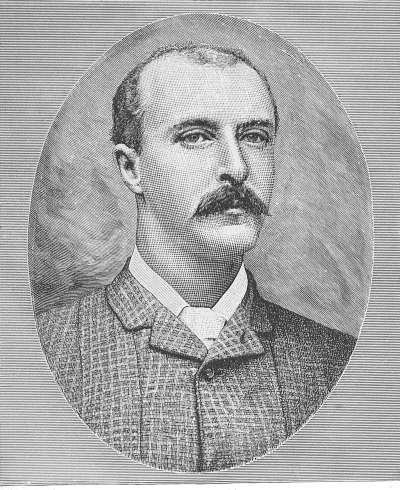
CAPTAIN NELSON.
I need not enumerate what else was purchased. Four expeditions into Africa, with my old lists of miscellanea before me, enabled me to choose the various articles, and in Sir Francis de Winton and Captain Grant Elliott I had valuable assistants who would know what magazines to patronize, and who could check the deliveries.
Colonel Sir Francis de Winton was my successor on the Congo, and he gave me gratuitously and out of pure friendship the benefit of his great experience, and his masterly knowledge of business to assist me in the despatch of the various businesses connected with the expedition, especially in answering letters, and selecting out of the hundreds of eager applicants for membership a few officers to form a staff.
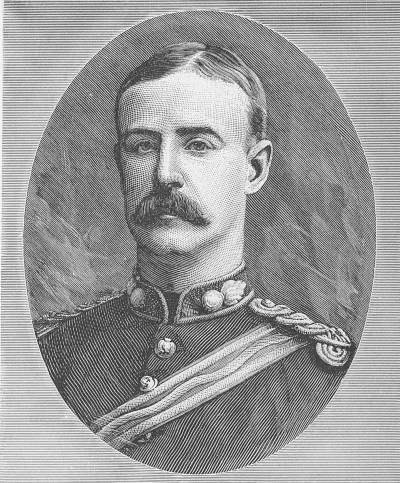
LIEUTENANT STAIRS.
The first selected was Lieutenant W. Grant Stairs, of the Royal Engineers, who had applied by letter. The concise style and directness of the application appealed strongly in his favour. We sent for him, and after a short interview enlisted him on condition that he could obtain leave of absence. Lord Wolseley kindly granted leave.
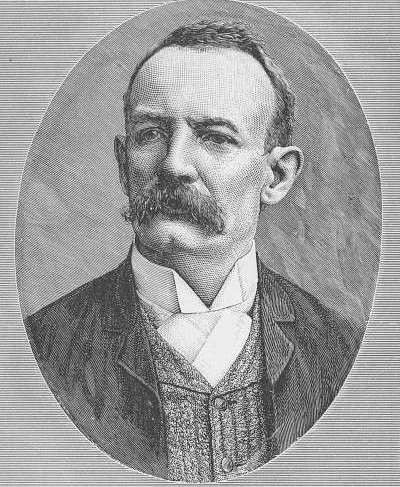
MR. WILLIAM BONNY.
The next was Mr. William Bonny, who, having failed in his epistolary ventures on former expeditions, thought the best way was to present himself in person for service in any capacity. The gentleman would not take a mild negative. His breast was covered with medals. They spoke eloquently, though dumb, for his merits. The end of it was Mr. Bonny was engaged as medical assistant, he having just left service in a hospital of the A.M.D.
The third was Mr. John Rose Troup, who had performed good service on the Congo. He was intimate with Swahili, the vernacular of Zanzibar. He was not dainty at work, was exact and methodical in preserving accounts. Mr. Troup was engaged.
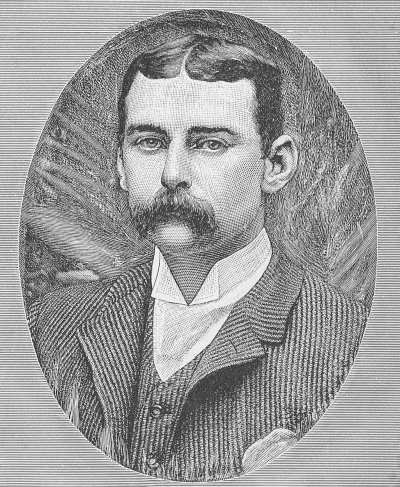
MR. A. J. MOUNTENEY JEPHSON.
The fourth volunteer who presented himself was Major Edmund Musgrave Barttelot, of the 7th Fusileers. He was accompanied by an acquaintance of mine who spoke highly of him. What passed at the interview will be heard later on. After a few remarks he was also engaged.
The fifth was Captain R. H. Nelson, of Methuen's Horse, fairly distinguished in Zulu campaigns. There was merit in his very face. Captain Nelson agreed to sign the articles of enlistment.
Our next volunteer was Mr. A. J. Mounteney Jephson, inexperienced as yet in foreign travel, and quite unaccustomed to "roughing" in wilds. On some members of the Committee Mr. Jephson made the impression that he was unfitted for an expedition of this kind, being in their opinion of too "high class." But the Countess de Noailles made a subscription in his favour to the Relief Fund of £1,000, an argument that the Committee could not resist, and Mr. Jephson signed the articles of agreement with unshaken nerves. Poor young Jephson! he emerged out of Africa after various severe trials which are herein related.
One of the latest to apply, and when the list was about to be closed, was Mr. James S. Jameson. He had travelled in Mashona and Matabele lands in South Africa to collect trophies of the wild chase, to study birds, and to make sketches. He did not appear remarkably strong. We urged that, but he as quickly defended his slight appearance, and argued that as he had already spent a long time in Africa his experience disproved our fears. Besides, he was willing to subscribe £1,000 for the privilege of membership, and do faithful and loyal service, as though it was indispensable for the Expedition to employ him. Mr. Jameson was firm, and subscribed to the articles.
We were in the full swing of preparations to meet the necessities of the overland march from Zanzibar, east to the Victoria Nyanza, when, as will be shown by the tenor of the following letter, it became necessary to reconsider our route.
"Palais de Bruxelles,
"7th January, 1887.
"Dear Mr. Stanley,
"The Congo State has nothing to gain by the Expedition for the relief of Emin Pasha passing through its territory. The King has suggested this road merely so as to lend your services to the Expedition, which it would be impossible for him to do were the Expedition to proceed by the Eastern coast. According to your own estimate, the Expedition proceeding by the Eastern coast would occupy about eighteen months. His Majesty considers that he would be failing in his duty towards the State were he to deprive it of your services, especially as the latter will be certainly needed before the expiration of this lapse of time.
"If the Expedition proceeds by the Congo the State will promise to show it all good will. The State likewise gratuitously places at the disposal of the Expedition the whole of its naval stock, inasmuch as will allow the working arrangements of its own administration, which it is, above all, desirous of ensuring, as you know. The Stanley is the largest steamer on the Upper Congo. We are forwarding a second one by the mail of the 15th inst., and we will hasten as much as possible the launching of this steamer at Stanley Pool; she will be a valuable and much-needed adjunct to our flotilla. In the meanwhile the mission steamer Peace would no doubt gratuitously effect certain transports.
"Should the Expedition desire it, we would facilitate the recruiting of Bangala; we are very pleased with the latter, as they are excellent soldiers, and do not fear the Arabs like the Zanzibaris.
"You will have remarked that the official documents, published this week in Berlin, limit the territory of Zanzibar to a narrow strip of land along the seashore. Beyond this strip the entire territory is German. If the Germans allow the Expedition to cross their territory, the Zanzibaris would be precisely as on the Congo, on foreign soil.
"With kind regards, I am, dear Mr. Stanley,
"Yours very truly,
"Comte de Borchgrave."
That this was not a light matter to be hastily decided will be evident by the following note which was sent me by Sir William Mackinnon:—
"Western Club, Glasgow,
"January 4th, 188.
"My dear Stanley,
"I had a pleasant short letter from the King showing how anxious he is the Congo route should be taken, and how unwilling to allow a break in the continuity of your connection with the Congo State, as he considers you a pillar of the State. He asks me to banish(?) any divergent sentiments, and get all parties to agree to the Congo route. I have explained fully all that has been done and is doing, and the difficulties in the way of cancelling existing engagements, and get the authorities, home and Egyptian and the Sultan of Zanzibar, to acquiesce in making such a change. I also mentioned the great additional charge involved by sending 600 men, even if the Sultan should consent to their going from Zanzibar to the Congo and bringing them back.
"I promised, however, to ascertain whether all interested in the present arrangements would agree in taking the Congo route."
In my diary of January 5th I find written briefly the heads of businesses despatched this day.
As suggested by Mackinnon, who has been written to by King Leopold upon the subject of the Congo route, I saw Sir Percy Anderson, and revealed the King's desire that the Expedition should proceed viâ Congo. I was requested to state what advantages the Congo route gave, and replied:—
1st. Certainty of reaching Emin.
2nd. Transport up the Congo River by state steamers to a point 320 geographical miles from Lake Albert.
3rd. Allaying suspicion of Germans that underlying our acts were political motives.
4th. Allaying alleged fears of French Government that our Expedition would endanger the lives of French Missionaries.
5th. If French Missionaries were endangered, then English Missionaries would certainly share their fate.
6th. Greater immunity from the desertion of the Zanzibaris who were fickle in the neighbourhood of Arab settlements.
Lord Iddesleigh writes me that the French ambassador has been instructed to inform him that if the Emin Pasha Relief Expedition proceeds by a route east of the Victoria Nyanza it will certainly endanger the lives of their Missionaries in Uganda. He suggests that I consider this question.
Visited Admiralty, inquired of Admiral Sullivan respecting the possibility of Admiralty supplying vessel to carry Expedition to Congo. He said if Government ordered it would be easy, if not, impossible.
Wrote to the King urging him to acquaint me how far his assistance would extend in transport on the Upper Congo.
January 8th.—Received letters from the King. He lays claim to my services. Offers to lend whole of his naval stock for transport except such as may be necessary for uses of administration. Wired to Mackinnon that I felt uneasy at the clause; that it was scarcely compatible with the urgency required. Colonel de Winton wrote to the same effect.
Effects of Expedition are arriving by many cuts.
De Winton worked with me until late in the night.
January 9th, 1887.—Colonel J. A. Grant, Colonel Sir F. de Winton, and myself sat down to consider His Majesty's letter, and finally wrote a reply requesting he would graciously respond with greater definiteness respecting quantity of transport and time for which transport vessels will be granted as so many matters depend upon quick reply, such as hire of Soudanese, detention of mail steamer for shipment of ammunition, etc. We therefore send special messenger.
January 10th, 1887.—De Winton visited Foreign Office and was promised as soon as possible to attend to the detention of mail steamer and Government transport round the Cape of Good Hope.
Messrs. Gray, Dawes & Co. write Postmaster-General willing to detain Zanzibar mail steamer at Aden to wait Navarino, which sails from London on the 20th with the ammunition and officers. I overtake Navarino at Suez after settling matters of Expedition in Egypt.
January 12th.—Answer arrived last night. Meeting was called by Honourable Guy Dawnay, Colonel Sir Lewis Pelly, Colonel Sir F. de Winton and self. The answer as regards Congo route being satisfactory was decided upon, and this has now been adopted unanimously.
Was notified at 2 P.M. by the Earl of Iddesleigh that he would see me at 6 P.M. But at 3.13 P.M. the Earl died suddenly from disease of the heart.
January 13th.—Foreign office note received from Sir J. Pauncefote transmitting telegram from Sir E. Baring, also letters concerning Admiralty transport. No help from Admiralty.
Goods arriving fast. Will presently fill my house.
Went down with Baroness Burdett-Coutts to Guildhall, arriving there 12.45 P.M. I received Freedom of City of London, and am called youngest citizen. Afterwards lunched at Mansion House, a distinguished party present, and affair most satisfactory.
Telegraphed to Brussels to know if Friday convenient to King. Reply, "Yes at 9.30 a.m."
January 14th.—Crossed over Channel last night towards Brussels viâ Ostend to see King Leopold. Saw King and gave my farewell. He was very kind. Left for London in evening at 8 P.M.
Telegram arrived from Sandringham requesting visit.
January 15th.—Sir Percy Anderson requested interview.
Mr. Joseph Thomson at this late hour has been writing to Geographical Society wanting to go with Expedition.
Arranged with Ingham to collect Congo carriers. He goes out shortly.
Telegraphed Zanzibar to recall rice carriers from Mpwapwa. This will cost 2,500 rupees more.
Wrote some days ago to the donor of the Peace Mission Steamer on the Congo requesting loan of her for the relief of Emin Pasha. Received the following quaint reply:—
"Leeds, January 15th, 1887.
"Dear Mr. Stanley,
"I have much regard for you personally, although I cannot, dare not, sanction all your acts.
"I am very sorry if I cannot give assent to your request; but I fully believe you will be no sufferer by the circumstance of not having the s.s. Peace. Yesterday I was able to come to a decision.
"Mr. Baynes, of the Baptist Missionary Society, Holborn, will, he hopes, make to you any communication he judges proper. If you have any reverential regard for 'the Man of Sorrows,' the 'King of Peace' may He mercifully preserve and save your party.
"I have no doubt of the safety of Emin—till his work is done. I believe he will be brought through this trial in perfect safety. God seems to have given you a noble soul (covers for the moment, if on your sad sin and mistakes), and I should like you should 'repent and believe the Gospel'—with real sense, and live hereafter in happiness, light, and joy—for ever. Here delay in you is more dangerous than delay for Emin.
"Your faithful friend,
"(Signed) Robert Arthington."
January 16th.—Colonel J. A. Grant offered to arrange with Mr. J. S. Keltie, Editor of Nature, to discuss Mr. Thomson's offer.
Letters accumulate by scores. All hands employed answering.
January 17th.—Wrote Sir Percy Anderson would call Wednesday 2 P.M. Correspondence increases.
Mr. Joseph Thomson's offer discussed. Mr. J. S. Keltie is to write to him privately—decision of committee.
Arranged with G. S. Mackenzie about Zanzibar matters. He despatched two telegrams. General Brackenbury wrote about coal being furnished requiring Treasury sanction.
January 18th.—Worked off morning's business.
Travelled to Sandringham with Colonel de Winton to see His Royal Highness. With African map before us gave short lecture to their Royal Highnesses respecting route proposed to reach Emin Pasha. Had a very attentive audience.
January 19th.—Sir William Mackinnon mustered his friends at the Burlington Hotel at a farewell banquet to me.
Have said "good-bye" to a host of friends to-day.
January 20th.—The S.S. Navarino sailed this afternoon carrying goods of Expedition and officers. Lieutenant Stairs, Captain Nelson, and Mr. Mounteney Jephson. Mr. William Bonny started from my rooms with black boy Baruti to Fenchurch Station at 8 a.m. Arriving there he leaves Baruti after a while and proceeds to Tower of London! He says that returning to station at 2 P.M. he found boat had gone. He then went to Gray, Dawes & Co., shipping agents, and is discouraged to find that the matter cannot be mended. Baruti found deserted in Fenchurch Station, very hungry and cold. Colonel J. A. Grant finds him and brings him to me.
January 21st.—Dispatch Mr. Bonny by rail to Plymouth to overtake a steamer bound for India and instruct him to debark at Suez with boy and await me.
Left London at 8.5 P.M. for Egypt. Quite a crowd collected to take a final shake of the hands and to bid me a kindly "God speed."
CHAPTER II.
EGYPT AND ZANZIBAR.
Surgeon T. H. Parke—Views of Sir Evelyn Baring, Nubar Pasha, Professor Schweinfurth and Dr. Junker on the Emin Relief Expedition—Details relating to Emin Pasha and his Province—General Grenfell and the ammunition—Breakfast with Khedive Tewfik: message to Emin Pasha—Departure for Zanzibar—Description of Mombasa town—Visit to the Sultan of Zanzibar—Letter to Emin Pasha sent by messenger through Uganda—Arrangements with Tippu-Tib—Emin Pasha's Ivory—Mr. Mackenzie, Sir John Pender and Sir James Anderson's assistance to the Relief Expedition.
1887. Jan. 27. Alexandria. January 27th, 1887.—Arrived at Alexandria 6 A.M. Surgeon T. H. Parke of the A.M.D. came to my hotel and applied for the position of surgeon to the Expedition. It was the one vacancy not yet filled to my satisfaction. I considered it a Godsend, though I appeared distant, as I had had two most unpleasant experiences with medical men, both of whom were crotchetty, and inconsistent in England. An extremely handsome young gentleman—diffident somewhat—but very prepossessing. To try if he were in earnest I said, "If you care to follow me to Cairo, I will talk further with you. I have not the time to argue with you here."
Left Alexandria at 10 A.M. for Cairo. At the station I met Sir Evelyn Baring, whom I had read of in Gordon's journals. We drove to Sir Evelyn's house and was told in his straightforward and clearest manner that there was a hitch somewhere. The Khedive and Nubar Pasha, the Prime Minister, were doubtful as to the wisdom of the Congo route. Professor Schweinfurth and Dr. Junker had both been struck with consternation, and by their manner had expressed that the idea was absurd.
1887. Jan. 27. Cairo. "Well, Sir Evelyn," I said, "do you not think that there are as clever men in England as Messrs. Schweinfurth and Junker? On the Relief Committee we have Colonel James Augustus Grant—companion of Speke. Colonel Sir Francis de Winton, late Administrator General of the Congo, Colonel Sir Lewis Pelly—late Political Agent at Zanzibar, the Honourable Guy Dawnay of the War Office, Sir John Kirk—late Consul-General at Zanzibar, the Rev. Horace Waller and several other distinguished and level-headed men. Nothing has been settled without the concurrence and assent of the Foreign Office. We have considered 1887. Jan. 27. Cairo. everything, and I have come thus far resolved to carry the project out as the committee and myself have agreed."
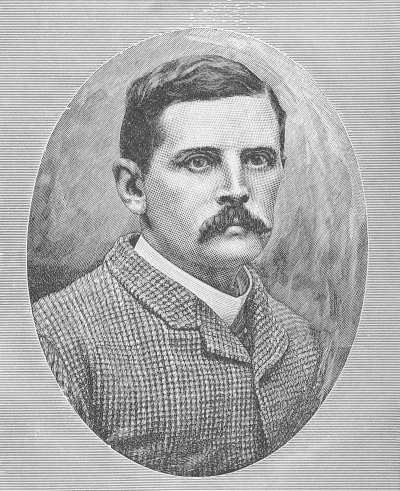
SURGEON PARKE, A. M. D.
And then I gave Sir Evelyn the pros and cons of the routes, which satisfied him. We then drove to the Prime Minister, Nubar Pasha, and the same explanations had to be entered into with him. Nubar, with a kindly benevolent smile, deferred to Sir Evelyn's superior judgment. Nubar assented to the wisdom and discretion of the change, and as a reward I was invited to breakfast for the morrow.
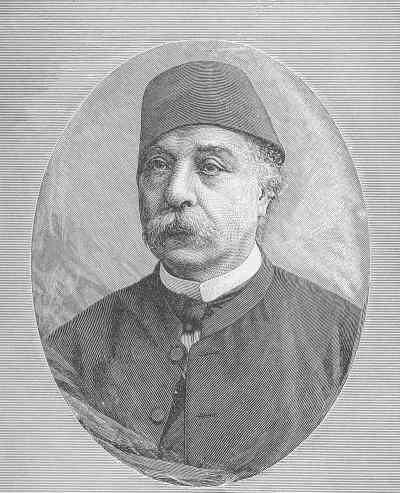
NUBAR PASHA.
January 28th, Cairo.—I breakfasted with Nubar Pasha. He introduced me to Mason Bey—the circumnavigator 1887. Jan. 28. Cairo. of Lake Albert in 1877, Madame Nubar and three daughters, Tigrane Pasha, his son-in-law, Mr. Fane, formerly Secretary of Legation at Brussels. During breakfast Nubar Pasha conversed upon many things, principally Egypt, Soudan, Africa and Gordon. Of Gordon he is clearly no admirer. He accredits the loss of the Soudan to him. His views of Baker were that he was a fighter—an eager pioneer—a man of great power.
Showed map to Nubar after breakfast. He examined the various routes carefully, and was convinced the Congo route was the best. He proposes to write instructions to Emin to return to Egypt on the ground that Egypt cannot afford to retain the Soudan under present circumstances. He permits us the use of the Egyptian Flag as the banner of the Expedition. He says he would like to see Emin return with as much ivory as possible and bringing his Makrakas with him. Should any ivory be brought out he will lay claim to some of the money on behalf of the Egyptian Government—because of the £10,000 furnished by it. Uniforms are being ordered for Emin Pasha and principal officers, for which the Relief Fund will have to pay. Rank and pay due to each officer assured.
I saw Schweinfurth and Junker, who have been considered experts here, and I have had a long and interesting conversation, the pith of which I here embody.
Schweinfurth and Junker, it seems, had formed the curious idea that because the Expedition was to be armed with several hundred Remingtons and a machine gun of the latest invention, it was to be an offensive force conducted after strict military rules.
If they had reflected at all the very title of the Expedition ought to have warned them that they were astray; the character of the people who subscribed the major portion of the fund ought to have still more assured them that their conception of the Expedition was wide of the mark. It is the relief of Emin Pasha that is the object of the Expedition, the said relief 1887. Jan. 28. Cairo. consisting of ammunition in sufficient quantity to enable him to withdraw from his dangerous position in Central Africa in safety, or to hold his own if he decides to do so for such length of time as he may see fit. Considering the quality of the escort, being mainly Zanzibaris or freed slaves, it would be rash to expect too much from them. It is already known in Zanzibar that Uganda is hostile, that Mwanga massacred some sixty of the followers of Bishop Hannington, that the Masai route has its dangers, that Karagwé is tributary to Mwanga, that the Wahha are numerous and aggressive, that Ruanda has never yet been penetrated, that beyond a certain line whether on the Masai route or the Karagwé route there is certain danger; and no matter with what cheerfulness they would assert at Zanzibar their readiness to defy all and every belligerent, African travellers remember how weak they are proved to be when in actual presence of danger. Assuming, however, that this band of 600 Zanzibaris were faithful, consider their inexperience of these new rifles, their wild, aimless, harmless firing, their want of discipline and tone, their disposition to be horrified at sight of the effects of fighting—remember that in reality they are only porters and do not pretend to be warriors—and you will see how very unequal such men are to the duties of defending munitions of war in the face of an enemy. It was only by stratagem that I secured their services for the desperate work of discovering the issue of the great river along which we had travelled with Tippu-Tib, when that now famous Arab deserted me in mid-Africa. It was only that there were no other means of escape that enabled me with their help to obtain a quiet retreat from savage Ituru. In many other instances they proved that when menaced with instant death they could be utilized to assist in the preservation of their own lives; but to expect them to march faithfully forward to court the dangers of fighting with the seductions of Unyamwezi and Zanzibar in their rear would be too much. In this Expedition we cannot turn aside as formerly in presence 1887. Jan. 28. Cairo. of a pronounced hostility and seek more peaceful countries; but our objective point must be reached, and risk must be run, and the ammunition must be deposited at the feet of Emin Pasha. Therefore to arm these people with Remingtons or machine guns is not enough—you must cut off their means of retreat, allow no avenue of escape—then they will stand together like men, and we may expect the object of the Expedition to be attained, even if we have now and again to meet bows and spears or guns.
Regarding Emin Pasha my information is various.
From Dr. Junker I learn that Emin Pasha is tall,[5] thin and exceedingly short-sighted; that he is a great linguist, Turkish, Arabic, German, French, Italian and English being familiar to him; to these languages may be added a few of the African dialects. He does not seem to have impressed Junker with his fighting qualities, though as an administrator, he is sagacious, tactful and prudent. His long isolation seems to have discouraged him. He says, "Egypt does not care for us and has forgotten us; Europe takes no interest in what we do." He is German by birth, and is about forty-seven years old.
His force is distributed among eight stations, from 200 to 300 men in each, say about 1,800 in all. The garrisons of the four northernmost stations were discontented and mutinous at last accounts. They answered Emin's advice to consolidate with reproaches; his suggestions that they should all withdraw from the equatorial province via Zanzibar, were responded to by accusations that he intended only to sell them to Zanzibar as slaves.
Junker cannot give an exact figure of the force itself, or of the Egyptians or clerks or Dongolese with Emin, but being questioned closely as to details replied that the approximate number of those likely to return with the Expedition would be as follows:—
White Egyptian Officers, 10; non-commissioned 1887. Jan. 28. Cairo. (black), 15; white clerks (Copts), 20; blacks from Dongola, Wady Halfa, etc., 300, =men 345, White-women, 22; blackwomen, 137, =women 159, children of officers, 40; soldiers' children, 60=children 100=Total 604.
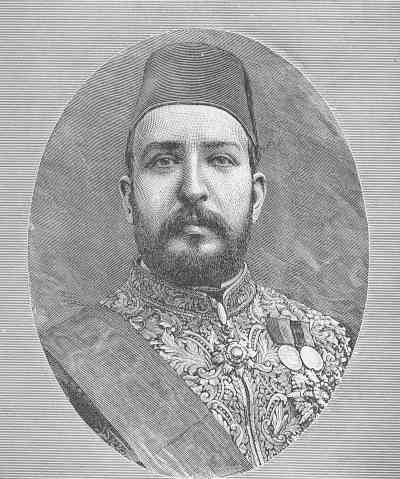
THE KHEDIVE TEWFIK.
Besides these the native troops on perceiving a general withdrawal, may also desire to return with their friends and comrades to Egypt. It is impossible to state what may be the effect on their minds of the appearance of the Relief Expedition. The decision of Emin Pasha, to remain or withdraw, will probably influence the majority.
1887. Jan. 28. Cairo. I expect my men from Wady Halfa to be here this afternoon. They will be armed, equipped and rationed at the Citadel, and on Thursday will accompany me to Suez. The Navarino is supposed to arrive at Suez the day following, when we will embark and be off.
Received telegrams from London. Reports from a well-known person at Cairo has reached newspapers that Emin Pasha had fought his way through Uganda after some desperate struggles, and that the Egyptian Government had placed difficulty in way of Expedition. Replied that such facts were unknown in Cairo.
February 1st.—Saw Sir Evelyn Baring at 10.45 A.M. Accompanied him to Khedive Tewfik. His Highness is most amiable and good-looking. Fine palace within, abundance of room, a host of attendants, &c. Am invited to breakfast with Khedive at noon to-morrow.
Taken later by Sir Evelyn to General Grenfell's office respecting suggestion made to me last night, at General Stephenson's by Valentine Baker Pasha, that I must assure myself that the Remington ammunition furnished by Egyptian Government was sound, as his experience of it was that 50 per cent. was bad. "You must think then" said he, "if the ammunition is so poor already what it will be about a year hence when you meet Emin, after humidity of tropics." General Grenfell said he had already tested the ammunition, and would make another trial, since Valentine Baker Pasha entertained such an opinion of it.
February 2nd.—Breakfast with Khedive Tewfik. He protests his patriotism, and loves his country. He is certainly most unaffected and genial.
Before leaving Khedive, the following Firman or High Order, was given to me open with the English translation.
Translation.
Copy of a High Arabic Order to Emin Pasha, dated 8th, Gamad Awal 1304, (1st February, 1887. No. 3).
"We have already thanked you and your officers for the plucky and successful defence of the Egyptian 1887. Feb. 2. Cairo. Equatorial provinces entrusted to your charge, and for the firmness you have shown with your fellow-officers under your command.
And we therefore have rewarded you in raising your rank to that of Lewa Pasha (Brigadier-General). We have also approved the ranks you thought necessary to give to the officers under your charge. As I have already written to you on the 29 November, 1886, No. 31, and it must have reached you with other documents sent by His Excellency Nubar Pasha, President of the Council of Ministers.
And, since it is our sincerest desire to relieve you with your officers and soldiers from the difficult position you are in, our Government have made up their mind in the manner by which you may be relieved with officers and soldiers from your troubles.
And as a mission for the relief has been formed under the command of Mr. Stanley, the famous and experienced African Explorer, whose reputation is well known throughout the world; and as he intends to set out on his Expedition with all the necessary provisions for you so that he may bring you here with officers and men to Cairo, by the route which Mr. Stanley may think proper to take. Consequently we have issued this High Order to you, and it is sent to you by the hand of Mr. Stanley to let you know what has been done, and as soon as it will reach you, I charge you to convey my best wishes to the officers and men—and you are at full liberty with regard to your leaving for Cairo or your stay there with officers and men.
Our Government has given a decision for paying your salaries with that of the officers and men.
Those who wish to stay there from the officers and men they may do it on their own responsibility, and they may not expect any assistance from the Government.
Try to understand the contents well, and make it well-known to all the officers and men, that they may be aware of what they are going to do.
(Signed) Mehemet Tewfik."
1887. Feb. 2. Cairo. In the evening Tigrane Pasha brought to me Nubar Pasha's—the Prime Minister—letter of recall to Emin. It was read to me and then sealed.
We stand thus, then; Junker does not think Emin will abandon the Province; the English subscribers to the fund hope he will not, but express nothing; they leave it to Emin to decide; the English Government would prefer that he would retire, as his Province under present circumstances is almost inaccessible, and certainly he, so far removed, is a cause of anxiety. The Khedive sends the above order for Emin to accept of our escort, but says, "You may do as you please. If you decline our proffered aid you are not to expect further assistance from the Government." Nubar Pasha's letter conveys the wishes of the Egyptian Government which are in accordance with those of the English Government, as expressed by Sir Evelyn Baring.
February 3rd.—Left Cairo for Suez. At the station to wish me success were Sir Evelyn and Lady Baring, Generals Stephenson, Grenfell, Valentine Baker, Abbaté Pasha, Professor Schweinfurth and Dr. Junker. The latter and sixty-one soldiers (Soudanese) from Wady Haifa accompanied me. At Zagazig, Surgeon T. H. Parke, now an enrolled member of the Expedition, joined me. At Ismailia our party were increased by Giegler Pasha. At Suez met Mr. James S. Jameson, the naturalist of the Expedition. Mr. Bonny of the Hospital Staff Corps, and Baruti, will arrive to-morrow per Garonne of the Orient line.
February 6th.—Breakfasted with Captain Beyts, Agent of the British India Steam Navigation Company. At 2 P.M. Capt. Beyts embarked with us on board Rob Roy, a new steamer just built for him, and we steamed out to the Suez harbour where the Navarino from London is at anchor. At 5 P.M., after friendly wishes from Captain Beyts and my good friend Dr. Junker, to whom I had become greatly attached for the real worth in him, the Navarino sailed for Aden.
February 8th.—Weather grows warm. Ther. Fah. 74° at 8 A.M. in Captain's cabin. My European servant 1887. Feb. 12. Aden. asked me if this was the Red Sea through which we were sailing. "Yes," I replied. "Well, sir, it looks more like a black sea than a red one," was his profound remark.
February 12th.—Reached Aden at 2 A.M. We now change steamers. Navarino proceeds to Bombay. The B.I.S.N. steamer Oriental takes us to Zanzibar. On board the latter steamer we met Major Barttelot. Cabled to Zanzibar following:—
"Mackenzie, Zanzibar.
"Your telegram very gratifying. Please engage twenty young lads as officers' servants at lower rate than men. We leave to-day with eight Europeans, sixty-one Soudanese, two Syrians, thirteen Somalis. Provision transport steamer accordingly."
The first-class passengers include self, Barttelot, Stairs, Jephson, Nelson, Parke, Bonny, Count Pfeil, and two German companions bound for Rufiji River.
February 19th.—Arrived off Lamu at 3 P.M. Soon after S.S. Baghdad came in with Dr. Lenz, the Austrian traveller, who had started to proceed to Emin Bey, but failing, came across to Zanzibar instead. He is on his way home. Having failed in his purpose, he will blame Africa and abuse the Congo especially. It is natural with all classes to shift the blame on others, and I feel assured Lenz will be no exception.
February 20th.—Arrived at Mombasa. Was told that a great battle had been fought lately between the Gallas and Somalis. The former are for the Germans, the latter are declared enemies to them. We also hear that Portugal has declared war against Zanzibar, or something like it.
Best place for commercial depot is on right hand of northern entrance, first point within harbour; it is bluffy, dips sheer down into deep water, with timber floated along base of bluff, and long-armed derricks on edge of bluff, steamers might be unloaded and loaded with ease. Cocoa-nut palms abundant. Good view of sea from it. If Mombasa becomes an English port—as I hope it will shortly—the best position of new town would be along face of bluff fronting seaward 1887. Feb. 22. Zanzibar. on island just where old Portuguese port is; a light railway and some draught mules would land on train all goods from harbour.
February 22nd.—Arrived at Zanzibar. Acting Consul-General Holmwood warmly proffered hospitality.
Instructed officers to proceed on board our transport, B.I.S.N. Co. Madura, and to take charge of Somalis and Soudanese, and Mackenzie to disembark forty donkeys and saddles from Madura—route being changed there was no need for so many animals.
Received compliments from the Sultan of Zanzibar; visits from the famous Tippu-Tib, Jaffar, son of Tarya Topan, his agent, and Kanji the Vakeel of Tarya.
Zanzibar is somewhat changed during my eight years' absence. There is a telegraphic cable, a tall clock-tower, a new Sultan's palace, very lofty and conspicuous, with wide verandahs. The Custom House has been enlarged. General Lloyd Mathews has new barracks for his Military Police; the promenade to Fiddler's grave has been expanded into a broad carriage-way, which extends to Sultan's house beyond Mbwenni. There are horses and carriages, and steam-rollers, and lamp-posts, at convenient distances, serve to bear oil-lamps to light the road when His Highness returns to city from a country jaunt.
There are six German war-vessels in port, under Admiral Knorr, H.B.M.S. Turquoise and Reindeer, ten merchant steamers, and a few score of Arab dhows, Baggalas, Kanjehs, and boats.
February 23rd.—Paid what is called a State visit to His Highness. As a special mark of honour the troops, under stout General Lloyd Mathews, were drawn up in two lines, about 300 yards in length. A tolerable military band saluted us with martial strains, while several hundreds of the population were banked behind the soldiers. The most frequent words I heard as I passed through with Consul Holmwood were: "Ndio huyu"—"Yes, it is he!" by which I gathered that scattered among the crowds must have been a large number of my old followers, pointing me out to their friends.
State visits are nearly always alike. The "Present 1887. Feb. 23. Zanzibar. arms!" by General Mathews, the martial strains, the large groups of the superior Arabs at the hall porch, the ascent up the lofty flights of stairs—the Sultan at the head of the stairs—the grave bow, the warm clasp, the salutation word, the courteous wave of the hand to enter, the slow march towards the throne—another ceremonious inclination all round—the Prince taking his seat, which intimates we may follow suit, the refreshments of sherbet after coffee, and a few remarks about Europe, and our mutual healths. Then the ceremonious departure, again the strains of music,—Mathews' sonorous voice at "Present arms!" and we retire from the scene to doff our London dress-suits, and pack them up with camphor to preserve them from moths, until we return from years of travel "Through the Dark Continent" and from "Darkest Africa."
In the afternoon, paid the business visit, first presenting the following letter:—
"To His Highness Seyyid Barghash bin Said,
"Sultan of Zanzibar.
"Burlington Hotel,
"Old Burlington Street, London, W.
"28th January, 1887.
"Your Highness,
"I cannot allow another mail to pass without writing to express to you my grateful appreciation of the kindly response you made to my telegram in regard to assisting the Expedition, which proceeds under the leadership of Mr. H. M. Stanley to relieve Emin Pasha. The cordiality with which you instructed your officers to assist in selecting the best men available is indeed a most important service to the Expedition, and I have reason to know that it has given great satisfaction in England. Mr. Stanley will reach Zanzibar in about four weeks. He is full of enthusiasm as the leader of his interesting Expedition, and his chief reasons for selecting the Congo route are that he may be able to convey the men your Highness has so kindly assisted him in procuring without fatigue or risk by sea to the Congo, and up the river in boats in comparative comfort, and they will arrive within 350 miles of their destination fresh and vigorous instead of being worn out and jaded by the fatigue of a long march inland. His services will be entirely devoted to the Expedition during its progress, and he cannot deviate from its course to perform service for the Congo State.
"It is probable also he will return by the east coast land route, and as I know him to be deeply interested in your Highness's prosperity and welfare, I am sure if he can render any service to Your Highness during his progress back to the coast, he will do so most heartily. I have had many conversations with him, and have always found him most friendly to Your Highness's interests, and I believe also the 1887. Feb. 23. Zanzibar. confidence of our mutual good friend. I pray you in these circumstances to communicate freely with Mr. Stanley on all points—as freely as if I had the honour of being there to receive the communications myself.
"With the repeated assurance of my hearty sympathy in all the affairs that concern Your Highness's interests.
"I remain,
"Your very obedient servant and friend,
"W. Mackinnon."
We then entered heartily into our business; how absolutely necessary it was that he should promptly enter into an agreement with the English within the limits assigned by Anglo-German treaty. It would take too long to describe the details of the conversation, but I obtained from him the answer needed.
"Please God we shall agree. When you have got the papers ready we shall read and sign without further delay and the matter will be over."
At night, wrote the following letter to Emin Pasha, for transmission to-morrow by couriers overland, who will travel through Uganda into Unyoro secretly.
"To His Excellency Emin Pasha,
"Governor of the Equatorial Provinces.
"H. B. Majesty's Consulate, Zanzibar.
"February 23rd, 1887.
"Dear Sir,
"I have the honour to inform you that the Government of His Highness the Khedive of Egypt, upon the receipt of your urgent letters soliciting aid and instructions, have seen fit to depute me to equip an Expedition to proceed to Wadelai to convey such aid as they think you require, and to assist you in other ways agreeably with the written instructions which have been delivered to me for you.
"Having been pretty accurately informed of the nature of your necessities from the perusal of your letters to the Egyptian Government, the Expedition has been equipped in such a manner as may be supposed to meet all your wants. As you will gather from the letters of His Highness and the Prime Minister of Egypt to you, and which I bring with me, all that could possibly be done to satisfy your needs has been done most heartily. From the translation of the letters delivered to me, I perceive that they will give you immense satisfaction. Over sixty soldiers from Wady Halfa have been detailed to accompany me in order that they may be able to encourage the soldiers under your command, and confirm the letters. We also march under the Egyptian standard.
"The Expedition includes 600 Zanzibari natives, and probably as many Arab followers from Central Africa.
"We sail to-morrow from Zanzibar to the Congo, and by the 18th June next we hope to be at the head of navigation on the Upper Congo. From the point where we debark to the southern end of Lake Albert is a distance of 320 miles in a straight line, say 500 miles by road, which will 1887. Feb. 23. Zanzibar. probably occupy us fifty days to march to the south-western or southern end, in the neighbourhood of Kavalli.
"If your steamers are in that neighbourhood, you will be able to leave word perhaps at Kavalli, or in its neighbourhood, informing me of your whereabouts.
"The reasons which have obliged me to adopt this route for the conveyance of your stores are various, but principally political. I am also impressed with the greater security of that route and the greater certainty of success attending the venture with less trouble to the Expedition and less annoyance to the natives. Mwanga is a formidable opponent to the south and south-east. The Wakedi and other warlike natives to the eastward of Fatiko oppose a serious obstacle, the natives of Kishakka and Ruanda have never permitted strangers to enter their country. En route I do not anticipate much trouble, because there are no powerful chiefs in the Congo basin capable of interrupting our march.
"Besides abundance of ammunition for your needs, official letters from the Egyptian Government, a heavy mail from your numerous friends and admirers, I bring with me personal equipments for yourself and officers suitable to the rank of each.
"Trusting that I shall have the satisfaction of finding you well and safe, and that nothing will induce you to rashly venture your life and liberty in the neighbourhood of Uganda, without the ample means of causing yourself and men to be respected which I am bringing to you,
"I beg you to believe me,
"Yours very faithfully,
"(Signed) Henry M. Stanley."
February 24th and 25th.—On arriving at Zanzibar, I found our Agent, Mr. Edmund Mackenzie, had managed everything so well that the Expedition was almost ready for embarkation. The steamer Madura, of the British India Steam Navigation Company, was in harbour, provisioned and watered for the voyage. The goods for barter, and transport animals, were on board. There were a few things to be done, however—such as arranging with the famous Tippu-Tib about our line of conduct towards one another. Tippu-Tib is a much greater man to-day than he was in the year 1877, when he escorted my caravan, preliminary to our descent down the Congo. He has invested his hard-earned fortune in guns and powder. Adventurous Arabs have flocked to his standard, until he is now an uncrowned king of the region between Stanley Falls and Tanganika Lake, commanding many thousands of men inured to fighting and wild Equatorial life. If I discovered hostile intentions, my idea was to give him a wide berth; for the ammunition I had to convey to Emin Pasha, if captured and employed by him, would endanger 1887. Feb. 24. Zanzibar. the existence of the infant State of the Congo, and imperil all our hopes. Between Tippu-Tib and Mwanga, King of Uganda, there was only a choice of the frying-pan and the fire. Tippu-Tib was the Zubehr of the Congo Basin—just as formidable if made an enemy, as the latter would have been at the head of his slaves. Between myself and Gordon there had to be a difference in dealing with our respective Zubehrs; mine had no animus against me personally; my hands were free, and my movements unfettered. Therefore, with due caution, I sounded Tippu-Tib on the first day, and found him fully prepared for any eventuality—to fight me, or be employed by me. I chose the latter, and we proceeded to business. His aid was not required to enable me to reach Emin Pasha, or to show the road. There are four good roads to Wadelai from the Congo; one of them was in Tippu-Tib's power, the remaining three are clear of him and his myriads. But Dr. Junker informed me that Emin Pasha possessed about 75 tons of ivory. So much ivory would amount to £60,000, at 8s. per lb. The subscription of Egypt to the Emin Pasha Fund is large for her depressed finance. In this quantity of ivory we had a possible means of recouping her Treasury—with a large sum left towards defraying expenses, and perhaps leaving a handsome present for the Zanzibari survivors.
Why not attempt the carriage of this ivory to the Congo? Accordingly, I wished to engage Tippu-Tib and his people to assist me in conveying the ammunition to Emin Pasha, and on return to carry this ivory. After a good deal of bargaining I entered into a contract with him, by which he agreed to supply 600 carriers at £6 per loaded head—each round trip from Stanley Falls to Lake Albert and back. Thus, if each carrier carries 70 lbs. weight of ivory, one round trip will bring to the Fund £13,200 nett at Stanley Falls.
On the conclusion of this contract, which was entered into in presence of the British Consul-General, I broached another subject in the name of His Majesty King Leopold with Tippu-Tib. Stanley Falls station 1887. Feb. 24. Zanzibar. was established by me in December 1883. Various Europeans have since commanded this station, and Mr. Binnie and Lieut. Wester of the Swedish Army had succeeded in making it a well-ordered and presentable station. Captain Deane, his successor, quarrelled with the Arabs, and at his forced departure from the scene set fire to the station. The object for which the station was established was the prevention of the Arabs from pursuing their devastating career below the Falls, not so much by force as by tact, or rather the happy combination of both. By the retreat of the officers of the State from Stanley Falls, the floodgates were opened and the Arabs pressed down river. Tippu-Tib being of course the guiding spirit of the Arabs west of Tanganika Lake, it was advisable to see how far his aid might be secured to check this stream of Arabs from destroying the country. After the interchange of messages by cable with Brussels—on the second day of my stay at Zanzibar—I signed an engagement with Tippu-Tib by which he was appointed Governor of Stanley Falls at a regular salary, paid monthly at Zanzibar, into the British Consul-General's hands. His duties will be principally to defend Stanley Falls in the name of the State against all Arabs and natives. The flag of the station will be that of the State. At all hazards he is to defeat and capture all persons raiding territory for slaves, and to disperse all bodies of men who may be justly suspected of violent designs. He is to abstain from all slave traffic below the Falls himself, and to prevent all in his command trading in slaves. In order to ensure a faithful performance of his engagement with the State, an European officer is to be appointed Resident at the Falls. On the breach of any article in the contract being reported, the salary is to cease.
Meantime, while I was engaged with these negotiations, Mr. Mackenzie had paid four months' advance pay—$12,415—to 620 men and boys enlisted in the Relief Expedition, and as fast as each batch of fifty men was satisfactorily paid, a barge was hauled alongside and the men were duly embarked, and a steam launch towed 1887. Feb. 25. Zanzibar. the barge to the transport. By 5 P.M. all hands were aboard, and the steamer moved off to a more distant anchorage. By midnight Tippu-Tib and his people and every person connected with the Expedition was on board, and at daybreak next day, the 25th February, the anchor was lifted, and we steamed away towards the Cape of Good Hope.
So far there had not been a hitch in any arrangement. Difficulties had been smoothed as if by magic. Everybody had shown the utmost sympathy, and been prompt with the assistance required. The officers of the Expedition were kept fully employed from morning to evening at laborious tasks connected with the repacking of the ammunition for Emin Pasha's force.
Before concluding these entries, I ought to mention the liberal assistance rendered to the Relief Expedition by Sir John Pender, K.C.M.G., and the Eastern Telegraph Company. All my telegrams from Egypt, Aden and Zanzibar, amounting in the aggregate to several hundred words were despatched free, and as each word from Zanzibar to Europe ordinarily costs eight shillings per word, some idea of the pecuniary value of the favour conferred may be obtained. On my return from Africa this great privilege was again granted, and as I received a score of cablegrams per day for several days, and answers were expected, I should speedily have paid dearly for the fortunate rescue of Emin Pasha, and most probably my stirring career had ended in the Bankruptcy Court had not Sir John Pender and Sir James Anderson quickly reassured me. Among the contributors to the Relief Fund to a very generous amount I therefore may fairly place the names of Sir John Pender and Sir James Anderson in behalf of the Eastern Telegraph Company. I should also state that they were prepared to lend me the Telegraph steamer at Zanzibar to convey my force of carriers and soldiers to the Congo had there been any difficulty in the way of engaging the B.I.S.N. Company's s.s. Madura.
CHAPTER III.
BY SEA TO THE CONGO RIVER.
The Sultan of Zanzibar—Tippu-Tib and Stanley Falls—On board s.s. Madura—"Shindy" between the Zanzibaris and Soudanese—Sketches of my various officers—Tippu-Tib and Cape Town—Arrival at the mouth of the Congo River—Start up the Congo—Visit from two of the Executive Committee of the Congo State—Unpleasant thoughts.
1887. March 9. Cape of Good Hope. The following private letter to a friend will explain some things of general interest:—
SS. Madura, March 9th, 1887,
Near Cape of Good Hope.
My dear ——,
Apart from the Press letters which are to be published for the benefit of the Relief Fund, and which will contain all that the public ought to know just now, I shall have somewhat to say to you and other friends.
The Sultan of Zanzibar received me with unusual kindness, much of which I owe to the introduction of Mr. William Mackinnon and Sir John Kirk. He presented me with a fine sword, a shirazi blade I should say, richly mounted with gold, and a magnificent diamond ring, which quite makes Tippu-Tib's eyes water. With the sword is the golden belt of His Highness, the clasp of which bears his name in Arabic. It will be useful as a sign, if I come before Arabs, of the good understanding between the Prince and myself; and if I reach the Egyptian officers, some of whom are probably illiterate, they must accept the sword as a token that we are not traders.
You will have seen by the papers that I have taken with me sixty-one soldiers—Soudanese. My object has 1887. March 9. Cape of Good Hope. been to enable them to speak for me to the Soudanese of Equatoria. The Egyptians may affect to disbelieve firmans and the writing of Nubar, in which case these Soudanese will be pushed forward as living witnesses of my commission.
[5] We consequently bade the tailor make long pantaloons, and they were quite six inches too long.
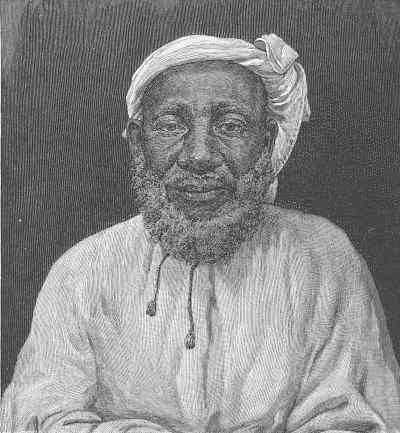
PORTRAIT OF TIPPU-TIB.
I have settled several little commissions at Zanzibar satisfactorily. One was to get the Sultan to sign the concessions which Mackinnon tried to obtain a long time ago. As the Germans have magnificent territory east of Zanzibar, it was but fair that England should have some portion for the protection she has accorded to Zanzibar since 1841. The Germans appeared to 1887. March 9. Cape of Good Hope. have recognized this, as you may see by the late Anglo-German Agreement. France had already obtained an immense area in West Africa. All the world had agreed to constitute the domain of King Leopold, on which he had spent a million sterling, as the Independent State of the Congo. Portugal, which is a chronic grumbler, and does little, and that little in a high-handed, illiberal manner, has also been graciously considered by the European Powers; but England, which had sent out her explorers, Livingstone, Burton, Speke, Grant, Baker, Keith Johnston, Thomson, Elton, &c., had obtained nothing, and probably no people had taken such interest in the Dark Continent, or had undergone such sacrifices in behalf of the aborigines, as the English. Her cruisers for the last twenty years had policed the ocean along the coast to suppress slave-catching; her missions were twenty-two in number, settled between East and West Africa. This concession that we wished to obtain embraced a portion of the East African coast, of which Mombasa and Melindi were the principal towns. For eight years, to my knowledge, the matter had been placed before His Highness, but the Sultan's signature was difficult to obtain.
Arriving at Zanzibar, I saw the Sultan was aging, and that he had not long to live.[6] Englishmen could not invest money in the reserved "sphere of influence" until some such concessions were signed.
"Please God," said the Sultan, "we shall agree; there will be no further doubt about the matter." But his political anxieties are wearing him fast, and unless this matter is soon completed it will be too late.
The other affair was with Tippu-Tib. He had actually in his possession three Krupp shells, unloaded, which he had brought with him from Stanley Falls, on the Upper Congo, to Zanzibar, to exhibit to his friends as the kind of missiles which the Belgians pelted his settlements with—and he was exceedingly wroth, and nourished a deep scheme of retaliation. It took me some time to quiet his spasms of resentment. People 1887. March 9. Cape of Good Hope. very furious must be allowed time to vent their anger. When he had poured out his indignation some time, I quietly asked him if he had finished, saying, in a bland way, that I knew well how great and powerful he was, etc., and I told him that it was scarcely fair to blame all the Europeans and King Leopold because an officer at Stanley Falls had been pleased to heave Krupp shells at his settlements; that this trouble had been caused by the excess of zeal of one man in defending a slave woman who had sought his protection, in the same way that Rashid, his nephew, had been carried away by the fury of youth to defend his rights. The Governor of the Congo State was absent nearly 1500 miles down the river, and Tippu-Tib, the owner of the settlements, was several hundred miles eastward on the way to Zanzibar. Now I look upon this affair as the result of a match between one young white man and a young Arab. The gray heads are absent who would have settled the trouble without fighting: youths are always "on their muscle," you know.
"Do you know," I continued, "that that station has given us a great deal of trouble. We sent Amelot, you remember. Well, he just left the station without orders, and died somewhere near Nyangwé; then the next, Gleerup, a Swede, followed suit, and travelled across Africa instead; then we sent Deane, and for a change he would have war with the Arabs. King Leopold is not to blame for all this. It is a difficult thing to get men who are always wise, and understand thoroughly what their orders are. If King Leopold had sent Deane to fight you, he would not have sent him with thirty men, you may be sure."
Now, look here. He proposes that you try your hand at governing that station. He will pay you every month what he would pay an European officer. There are certain little conditions that you must comply with before you become Governor.
Tippu-Tib opened his eyes and snapped them rapidly, as his custom is, and asked, "Me?"
"Yes, you. You like money; I offer you money. 1887. March 9. Cape of Good Hope. You have a grudge against white men being there. Well, if you do your work rightly there will be no need for any white men, except him whom we shall have to place under you, to see that the conditions are not broken."
"Well, what are they?"
"You must hoist the flag of the State. You must allow a Resident to be with you, who will write your reports to the King. You must neither trade in slaves, nor allow anybody else to trade in them below Stanley Falls. Nor must there be any slave-catching; you understand. Such trade as you make in ivory, gums, rubber, cattle, and anything else, you may do as much as you please. But there is to be no pillaging native property of any description whatever below your station. A monthly allowance will be paid into the hands of your Agent at Zanzibar. Don't answer right away. Go and discuss it with your friends, and think of what I offer you. My ship sails on the third day. Give me your answer to-morrow."
A favourable answer was given, a proper agreement was drawn up before the Consul-General, and we both signed.
I made another agreement with him about the engagement of carriers to carry ammunition to Lake Albert from the Congo. If there is no ivory I shall be indebted to Tippu-Tib for the sum of £3,600. But there must be some, as both Emin Pasha and Dr. Junker declare there is a large store of it. At the same time I shall not risk the Expedition for the sake of the ivory.
In consideration of these services which Tippu-Tib has solemnly contracted to perform, I permitted him free passage for himself and ninety-six of his kinsmen from Zanzibar to the Congo, with board included. I also undertook the responsibility of conveying the entire party safely to Stanley Falls, thus incurring not a small expense, but which if faithfully performed will be amply paid for by the services mentioned in the articles of agreement. These negotiations with Tippu-Tib 1887. March 9. Cape of Good Hope. also ensure for us a peaceful march from the Congo through his territory, a thing that would have been by no means possible without him—as his various hordes of raiders will be widely scattered throughout the region; and it is scarcely likely that we should be allowed to pass in peace, resenting, as they must naturally do, their late rupture with Deane. Having bound Tippu-Tib to me I feel somewhat safe against that constant fear of desertion of the Zanzibaris. No Arab will now persuade the people to desert, as is their custom when a white man's Expedition passes near their settlements. Tippu-Tib dare not countenance such proceedings in this case.
The Madura is a comfortable steamer. On the Oriental and Navarino we were uncomfortably crowded. Tween decks abreast of the boilers is rather a hot place for the people; but we have had agreeable weather, and the men have preferred to stow themselves in the boats, and among the donkeys, and on deck, to the baking heat below.
Two hours from Zanzibar, what is called a "shindy" took place between the Zanzibaris and Soudanese. For a short time it appeared as though we should have to return to Zanzibar with many dead and wounded. It rose from a struggle for room. The Soudanese had been located directly in the way of the Zanzibaris, who, being ten times more numerous, required breathing space. They were all professed Moslems, but no one thought of their religion as they seized upon firewood and pieces of planking to batter and bruise each other. The battle had raged some time before I heard of it. As I looked down the hatchway the sight was fearful—blood freely flowed down a score of faces, and ugly pieces of firewood flew about very lively. A command could not be heard in that uproar, and some of us joined in with shillelaghs, directing our attacks upon the noisiest. It required a mixture of persuasiveness and sharp knocks to reduce the fractious factions to order, especially with the Soudanese minority, who are huge fellows. The Soudanese were marched out of their 1887. March 9. Cape of Good Hope. place and located aft, and the Zanzibaris had all the forward half of the ship to themselves. After we had wiped the blood and perspiration away I complimented the officers, especially Jephson, Nelson, and Bonny, for their share in the fray. They had behaved most gallantly. The result of the scrimmage is ten broken arms, fifteen serious gashes with spears on the face and head, and contusions on shoulders and backs not worth remark, and several abrasions of the lower limbs.
Surgeon Parke has been very busy vaccinating the entire community on board ship. Fortunately I had procured a large supply of lymph for this purpose, because of the harsh experience of the past.
We also divided the people into seven companies of about ninety men each.
I have ordered my Agent to send me 200 loads of various goods to meet the Expedition at Msalala, south end of Lake Victoria. They will be sent about October or November, 1887, arriving at Msalala in February or March, 1888, because if everything proceeds as I should wish, we shall be somewhere near there not very long after that date.
I have been in the company of my officers since I left Aden, and I have been quietly observing them. I will give you a sketch of them as they appear to me now.
Barttelot is a little too eager, and will have to be restrained. There is abundance of work in him, and this quality would be most lovely if it were always according to orders. The most valuable man to me would be he who had Barttelot's spirit and "go" in him, and who could come and ask if such and such a work ought to be done. Such a course suggests thoughtfulness and willingness, besides proper respect.
There is a great deal in Mounteney Jephson, though he was supposed to be effeminate. He is actually fierce when roused, and his face becomes dangerously set and fixed. I noted him during the late battle aboard, and 1887. March 9. Cape of Good Hope. I came near crying out "Bravo, Jephson!" though I had my own stick, "big as a mast," as the Zanzibaris say, to wield. It was most gallant and plucky. He will be either made or marred if he is with this Expedition long enough.
Captain Nelson is a fine fellow, and without the ghost of a hobby: he is the same all round, and at all hours.
Stairs, of the Royal Engineers, is a splendid fellow, painstaking, ready, thoughtful, and industrious, and is an invaluable addition to our staff.
Jameson is still the nice fellow we saw; there is not an atom of change in him. He is sociable and good.
Bonny is the soldier. He is not initiative. He seems to have been under a martinet's drill.
March 16th, 1887.
At Cape Town, Tippu-Tib, after remarking the prosperity and business stir of the city, and hearing its history from me, said that he formerly had thought all white men to be fools.
"Really," I said; "Why?"
"That was my opinion."
"Indeed! and what do you think of them now?" I asked.
"I think they have something in them, and that they are more enterprising than Arabs."
"What makes you think so, particularly now?"
"Well, myself and kinsmen have been looking at this town, these big ships and piers, and we have thought how much better all these things appear compared to Zanzibar, which was captured from the Portuguese before this town was built, and I have been wondering why we could not have done as well as you white people. I begin to think you must be very clever."
"If you have discovered so much, Tippu-Tib, you are on the high road to discover more. The white men 1887. March 16. Cape Town. require a deal of study before you can quite make them out. It is a pity you never went to England for a visit."
"I hope to go there before I die."
"Be faithful to us on this long journey, and I will take you there, and you will see more things than you can dream of now."
"Inshallah! if it is the will of Allah we shall go together."
On the 18th March the Madura entered the mouth of the Congo River, and dropped her anchor about 200 yards abreast of the sandy point, called Banana.
In a few minutes I was in the presence of Mr. Lafontaine Ferney, the chief Agent of the Dutch Company, to whom our steamer was consigned. Through some delay he had not been informed of our intending to arrive as soon. Everybody professed surprise, as they did not expect us before the 25th, but this fortunate accident was solely due to the captain and the good steamer. However, I succeeded in making arrangements by which the Dutch Company's steamer K. A. Nieman—so named after a fine young man of that name, who had lately died at St. Paul de Loanda—would be placed at my disposal, for the transport to Mataddi of 230 men next day.
On returning to the ship, I found my officers surrounding two English traders, connected with the British Congo Company of Banana. They were saying some unpleasant things about the condition of the State steamers. "There is a piece of the Stanley on shore now, which will give you an idea of that steamer. The Stanley is a perfect ruin, we are told. However, will you leave the Pool? The State has not one steamer in service. They are all drawn up on the banks for repairs, which will take months. We don't see how you are to get away from here under six weeks! Look at that big steamer on the sands! she has just come out from Europe; the fool of a captain ran her on shore instead of waiting for a pilot. She has got the sections 1887. March 18. Congo River. of a steamer in her hold. The Heron and Belgique, both State steamers, have first, of course, to float that steamer off. You are in for it nicely, we can tell you."
Naturally, this news was very discouraging to our officers and two of them hastened to comfort me with the disastrous news. They were not so well acquainted with the manners of the "natives" of the Lower Congo as I was. I only marvelled why they had not been politely requested to accompany their new aquaintances to the cemetery, in order that they might have the exquisite gratification of exhibiting the painted headboards, which record the deaths of many fine young men, as promising in appearance as they.
I turned to the Agent of the British Congo, and requested permission to charter his steamer, the Albuquerque. The gentleman graciously acceded. This assured me transport for 140 men and 60 tons cargo. I then begged that he and his friend would negotiate for the charter of the large paddle boat the Serpa Pinto. Their good offices were entirely successful, and before evening I knew that we should leave Banana Point with 680 men and 160 tons cargo on the next day. The State steamer Heron I was told would not be able to leave before the 20th.
On the 19th the steamers K. A. Kieman, Albuquerque, and Serpa Pinto, departed from Banana Point, and before night had anchored at Ponta da Lenha. The next day the two former steamers steamed straight up to Mataddi. The Serpa Pinto hauled into the pier at Boma, to allow me to send an official intimation of the fact that the new Governor of Stanley Falls was aboard, and to receive a hurried visit from two of the Executive Committee charged with the administration of the Congo State.
We had but time to exchange a few words, but in that short time they managed to inform me that there was a "famine in the country"; that "the villages along the road to the Pool were abandoned"; that "the Stanley was seriously damaged"; that "the Mission steamers Peace and Henry Reed were in some unknown parts of 1887. March 19. Congo River. the Upper Congo"; that "the En Avant was on shore without machinery or boiler;" that "the A. I. A. was 500 miles above Stanley Pool"; and that "the Royal was perfectly rotten;" and had not been employed for a year; in fact, that the whole of the naval stock promised did not exist at all except in the imagination of the gentlemen of the Bureau at Brussels; and, said one, who seemed to be the principal of the Executive Committee, with deliberate emphasis: "The boats were only to assist you if they could be given without prejudice to the service of the State."
The gruff voice of the Portuguese captain of the Serpa Pinto ordered the gentlemen on shore, and we proceeded on our way up the Congo.
My thoughts were not of the pleasantest. With my flotilla of fifteen whale boats I might have been independent; but there was an objection to the Congo route, and therefore that plan was abandoned. We had no sooner adopted the East Coast route than the Sovereign of the Congo State invited the Expedition to pass through his territory; the Germans had murmured, and the French Government protested at the idea of our marching through East Africa. When it was too late to order the flotilla of whale boats from Forrest and Son we then accepted the Congo route, after stipulating for transport up the Lower Congo, for porterage to Stanley Pool, and the loan of the steamers on the Upper Congo which were now said to be wrecked, rotten, or without boilers or engines, or scattered inaccessible. In my ears rang the cry in England: "Hurry up, or you may be too late!" and singing through my memory were the words of Junker: "Emin will be lost unless immediate aid be given him;" and Emin's appeal for help; for, if denied, "we shall perish."
"Well, the aspect of our work is ominous. It is not my fault, and what we have to do is simple enough. We have given our promise to strive our level best. It is no time for regret, but to struggle and "steer right onward." Every article of our verbal bond, having accepted this responsibility, we must perform, 1887. March 19. Congo River. and it is the manner of this performance that I now propose to relate.
I shall not delay the narration to give descriptions of the route overland to the Pool, or of the Upper Congo and its banks, as these have been sufficiently treated of in 'Through the Dark Continent,' and 'The Congo and the Founding of its Free State'; and I now propose to be very brief with the incidents of our journey to Yambuya, at the head of navigation on the Aruwimi."
CHAPTER IV.
TO STANLEY POOL.
Details of the journey to Stanley Pool—The Soudanese and the Somalis—Meeting with Mr. Herbert Ward—Camp at Congo la Lemba—Kindly entertained by Mr. and Mrs. Richards—Letters from up river—Letters to the Rev. Mr. Bentley and others for assistance—Arrival at Mwembi—Necessity of enforcing discipline—March to Vombo—Incident at Lukungu Station—The Zanzibaris—Incident between Jephson and Salim at the Inkissi River—A series of complaints—The Rev. Mr. Bentley and the steamer Peace—We reach Makoko's village—Leopoldville—Difficulties regarding the use of the Mission steamers—Monsieur Liebrichts sees Mr. Billington—Visit to Mr. Swinburne at Kinshassa—Orders to and duties of the officers.
1887. March 21. Mataddi. On the 21st of March the Expedition debarked at the landing-place of the Portuguese trading-house of Senor Joda Ferrier d'Abren, situate at Mataddi, at a distance of 108 miles from the Atlantic. As fast as the steamers were discharged of their passengers and cargo they cast off to return to the seaport of Banana, or the river port below.
About noon the Portuguese gunboat Kacongo hove in sight. She brought Major Barttelot, Mr. Jephson, and a number of Soudanese and Zanzibaris; and soon after the state steamer Heron brought up the remainder of the cargo left on board the Madura.
We set up the tents, stored the immense quantity of rice, biscuits, millet, salt, hay, etc., and bestirred ourselves like men with unlimited work before us. Every officer distinguished himself—the Zanzibaris showed by their celerity that they were glad to be on shore.
Our European party now consisted of Messrs. Barttelot, Stairs, Nelson, Jephson, Parke, Bonny, who had voyaged with me from Aden, Mr. Walker, an engineer, who had 1887. March 21. Mataddi. joined us at the Cape, Mr. Ingham, an ex-Guardsman, who was our Congo Agent for collection of native carriers, Mr. John Rose Troup, who had been despatched to superintend native porterage to the Pool from Manyanga, and a European servant.
On the following day 171 porters, carrying 7 boxes biscuits = 420 lbs., 157 bags of rice = 10,205 lbs., and beads, departed from Mataddi to Lukungu as a reserve store for the Expedition on arrival. There were 180 sacks of 170 lbs. each = 30,600 lbs. besides, ready to follow or precede us as carriers offered themselves, and which were to be dropped at various places en route, and at the Pool. Couriers were also sent to the Pool with request to the Commandant to hurry up the repairs of all steamers.
On the second day of arrival, Mr. Ingham appeared with 220 carriers, engaged at a sovereign per load for conveying goods to the Pool. Lieutenant Stairs practised with the Maxim automatic gun, which fired 330 shots per minute, to the great admiration of Tippu-Tib and his followers.
On the 25th the trumpets sounded in the Soudanese camp at 5.15 A.M. By 6 o'clock tents were folded, the companies were ranged by their respective captains, and near each company's stack of goods, and by 6.15 A.M. I marched out with the vanguard, behind which streamed the Expedition, according to their company, in single file, bearing with us 466 separate "charges" or porterloads of ammunition, cloth, beads, wire, canned provisions, rice, salt, oil for engines, brass rods, and iron wire. The setting out was admirable, but after the first hour of the march the mountains were so steep and stony, the sunshine was so hot, the loads so heavy, the men so new to the work after the glorious plenty on board the Madura, and we ourselves were in such an overfed condition, that the Expedition straggled in the most disheartening manner to those not prepared for such a sight. Arriving at the first river, the Mpozo, the Advance was already jointed, and we were ferried over to the other bank by fifties, and camped.
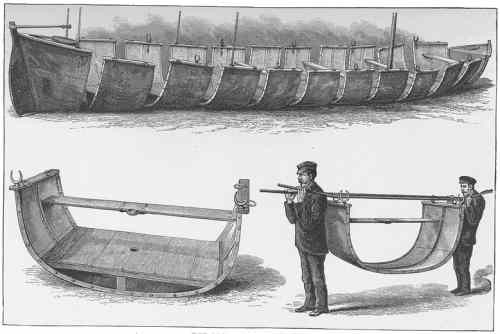
THE STEEL BOAT ADVANCE.
1887. March 25. Mpozo River. The Soudanese were a wretched sight. The Somalis were tolerable, though they had grumbled greatly because there were no camels. The former showed remarkably bad temper. Covered with their hooded great-coats, they had endured a terrible atmosphere, and the effects of heat, fatigue, and little worries were very prominent.
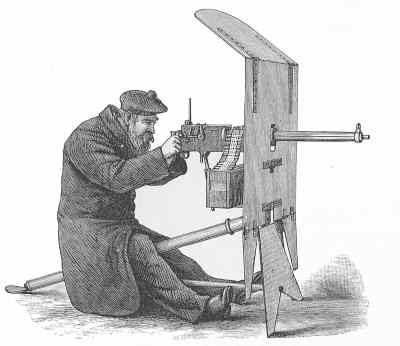
MAXIM AUTOMATIC GUN.
The next day we camped in the grounds of Palaballa, belonging to the Livingstone Inland Mission, and were most hospitably treated by Mr. Clarke, the superintendent, and ladies. As our men were so new to their work, we halted the next day. By the officers' returns I found that nine had died since leaving Zanzibar, and seventeen were so ill that we were compelled to leave them at Palaballa to recuperate.
We resumed the march on the 28th, and reached Maza Mankengi. On the road Mr. Herbert Ward was met, and volunteered as a member of the Expedition. 1887. March 28. Maza Mankengi. He was engaged, and sent to Mataddi to assist Mr. Ingham with the native transport. Mr. Ward had been of late years in the service of the Congo State, and previously had wandered in New Zealand and Borneo, and was always regarded by me as a young man of great promise.
We were in camp by noon of the 29th at Congo la Lemba, on the site of a place I knew some years ago as a flourishing village. The chief of it was then in his glory, an undisputed master of the district. Prosperity, however, spoiled him, and he began to exact tolls from the State caravans. The route being blocked by his insolence, the State sent a force of Bangalas, who captured and beheaded him. The village was burnt, and the people fled elsewhere. The village site is now covered with tall grass, and its guava, palm, and lemon-trees are choked with reeds.
There was a slight improvement in the order of the march, but the beginning of an Expedition is always a trying time. The Zanzibaris carry 65 lbs. of ammunition, 9 lbs. per rifle, four days' rations of rice, and their own kit, which may be from 4 to 10 lbs. weight of cloth and bedding mats. After they have become acclimated this weight appears light to them; but during the first month we have to be very careful not to make long marches, and to exercise much forbearance.
A heavy rain detained us the early part of next day, but soon after nine we moved on and reached the Lufu River. It was a terribly fatiguing march. Until midnight the people came streaming in, tired, footsore, and sour. The officers slept in my tent, and supped on biscuits and rice.
Near the Mazamba Wood we passed Baron von Rothkirch supervising a party of Kabindas, who were hauling the Florida's shaft. At the rate of progress they would probably reach the Pool about August next; and at the Bembezi Ford a French trader was met descending with a fine lot of ivory tusks.
We passed the Mangola River on the 31st, when I was myself disabled by a fit of sickness from indulging 1887. April 1. Banza Manteka. in the guavas of Congo la Lemba, and on the 1st April we travelled to Banza Manteka. At the L. I. Mission Mr. and Mrs. Richards most kindly entertained us. At this place a few years' mission work has produced a great change. Nearly all the native population had become professed Christians, and attended Divine service punctually with all the fervour of revivalists. Young men whom I had known as famous gin-drinkers had become sober, decent men, and most mannerly in behaviour.
I received three letters from up river, one from Troup at Manyanga, Swinburne at Kinshassa, and Glave at Equator Station, all giving a distressing account of the steamers Stanley, Peace, Henry Reed, and En Avant. The first is damaged throughout according to my informants, the Mission steamers require thorough overhauling, the En Avant has been reduced to a barge. Mr. Troup suggests that we carry a lighter or two from Manyanga to the Pool, a thing utterly impossible. We were already overloaded because of the rice we carried to feed nearly 800 people through the starving country. In order to lighten our work slightly Messrs. Jephson and Walker were despatched with our steel boat, the Advance, by the Congo to Manyanga.
We passed by the Lunionzo River on the 3rd, and the next day camped on the site of the abandoned village of Kilolo. During the march I passed a Soudanese trying to strangle a Zanzibari because the wearied man had slightly touched his shoulder with his box. The spleen the Soudanese show is extremely exasperating, but we must exercise patience yet awhile.
A march of three hours brought us to the Kwilu River, with the usual ups and downs of hills, which tire the caravan. At the river, which is 100 yards wide and of strong current, was a canoe without an owner. We took possession of it, and began to cross the Advance Company by tens.
The opportunity afforded by the ferriage was seized by me to write appealing letters to the Commandant at 1887. April 3. Kwilu River. Stanley Pool to interpret the orders of the Minister of the Interior, Strauch, according to the generous spirit expressed by King Leopold when he invited us to seek Emin Pasha viâ the Congo. Another was directed to the Rev. Mr. Bentley, of the Baptist Mission, requesting him to remember the assistance I gave the Baptists in 1880-84, and to be prepared to lead the steamer Peace that I might hurry the Expedition away from the poverty-stricken region around Stanley Pool. Another was despatched to Mr. Billington, superintendent of the Henry Reed, in similar terms, reminding him that it was I who had given them ground at Stanley Pool. Another to the Commandant of Lukungu Station, requesting him to collect 400 carriers to lighten the labours of my men.
On reaching Mwembi the 6th April, I was particularly struck with the increase of demoralization in the caravan. So far, in order not to press the people, I had been very quiet, entrusting the labour of bringing the stragglers to the younger men, that they might become experienced in the troubles which beset Expeditions in Africa; but the necessity of enforcing discipline was particularly demonstrated on this march. The Zanzibaris had no sooner pitched the tents of their respective officers than they rushed like madmen among the neighbouring villages, and commenced to loot native property, in doing which one named Khamis bin Athman was shot dead by a plucky native. This fatal incident is one of these signal proofs that discipline is better than constant forbearance, and how soon even an army of licentious, insubordinate, and refractory men would be destroyed.
It had probably been believed by the mass of the people that I was rather too old to supervise the march, as in former times; but on the march to Vombo, on the 7th, everyone was undeceived, and the last of the lengthy caravan was in camp by 11 A.M., and each officer enjoyed his lunch at noon, with his mind at ease for duty done and a day's journey well made. There is nothing more agreeable than the feeling one possesses 1887. April 7. Vombo. after a good journey briefly accomplished. We are assured of a good day's rest; the remainder of the day is our own to read, to eat, to sleep, and be luxuriously inactive, and to think calmly of the morrow; and there can scarcely be anything more disagreeable than to know that, though the journey is but a short one, yet relaxation of severity permits that cruel dawdling on the road in the suffocating high grass, or scorched by a blistering sun—the long line of carriers is crumpled up into perspiring fragments—water far when most needed; not a shady tree near the road; the loads robbed and scattered about over ten miles of road; the carriers skulking among the reeds, or cooling themselves in groves at a distance from the road; the officers in despair at the day's near close, and hungry and vexed, and a near prospect of some such troubles to recur again to-morrow and the day after. An unreflecting spectator hovering near our line of march might think we were unnecessarily cruel; but the application of a few cuts to the confirmed stragglers secure eighteen hours' rest to about 800 people and their officers, save the goods from being robbed—for frequently these dawdlers lag behind purposely for such intentions—and the day ends happily for all, and the morrow's journey has no horrors for us.
On the 8th the Expedition was welcomed at Lukungu Station by Messrs. Francqui and Dessauer. These hospitable Belgians had of their own impulse gathered four days' rations for our 800 people, of potatoes, bananas, brinjalls, Indian corn, and palm nuts.
No sooner had we all assembled than the Soudanese gathered in a body to demand more food. In fifteen days they had consumed each one 40 lbs. of biscuit and rice; and they announced their intention of returning to the Lower Congo if more rations were not served out. The four days' rations of vegetables they disdained to touch. I had resolved to be very patient; and it was too early yet to manifest even the desire to be otherwise. Extra rations of rice and biscuits were accordingly served out.
Fortunately for me personally there were good officers 1887. April 8. Lukungu. with me who could relieve me of the necessity of coming into conflict with wilful fellows like these sulky, obstinate Soudanese. I reserved for myself the rôle of mediator between exasperated whites and headstrong, undisciplined blacks. Provided one is not himself worn out by being compelled throughout the day to shout at thick-headed men, it is a most agreeable work to extenuate offences and soothe anger. Probably the angry will turn away muttering that we are partial; the other party perhaps thirsts for more sympathy on its side; but the mediator must be prepared to receive a rub or two himself.
Thinking that there would be less chance of the Soudanese storming so furiously against the Zanzibaris on the road, I requested Major Barttelot to keep his Soudanese a day's march ahead of the Zanzibaris.
It will not be surprising that we all felt more sympathy for the loaded Zanzibaris. These formed our scouting parties, and foragers, and food purveyors; they pitched our tents, they collected fuel, they carried the stores; the main strength of the Expedition consisted of them; without them the Europeans and Soudanese, if they had been ten times the number, would have been of no use at all for the succour of Emin. The Soudanese carried nothing but their rifles, their clothing, and their rations. By the time they would be of actual utility we should be a year older; they might perhaps fail us when the hour of need came, but we hoped not; in the meantime, all that was necessary was to keep them moving on with as little trouble as possible to themselves, the Zanzibaris, and us. The Major, however, without doubt was sorely tempted. If he was compelled to strike during these days, I must admit that the Soudanese were uncommonly provoking. Job would have waxed wrathful, and become profane.
The heat was terrible the day we left Lukungu—the 10th. The men dropped down on all sides; chiefs and men succumbed. We overtook the Soudanese again, and the usual scuffling and profanity occurred as an unhappy result.
1887. April 11. Lukungu. On Easter Monday, the 11th, the Soudanese Company was stricken down with fever, and lamentation was general, and all but two of the Somalis were prostrated. Barttelot was in a furious rage at his unhappy Company, and expressed a wish that he had been doing Jephson's duty with the boat. I received a letter from Jephson in the evening, wherein he wrote that he wished to be with us, or anywhere rather than on the treacherous and turbulent Congo.
The following day saw a foundering caravan as we struggled most wretchedly into camp. The Soudanese were miles from each other, the Somalis were all ill; one of those in the boat with Mr. Jephson had died. Liebig, and meat soups, had to be prepared in sufficient quantities to serve out cupfuls to each weakened man as he staggered in.
Lutete's was reached the next day, and the experiences of the march were similar. We suffer losses on every march—losses of men by desertion, by illness, of rifles, boxes of canned provisions, and of fixed ammunition.
At Nselo, on the Inkissi River, we encountered Jephson, who has seen some novelties of life during his voyage up the Congo rapids to Manyanga.
The sun has commenced to paint our faces a vermilion tint, for I see in each officer's face two inflamed circles glowing red and bright under each eye, and I fancy the eyes flash with greater brilliancy. Some of them have thought it would be more picturesque, more of the ideal explorer type, to have their arms painted also, and have bared their milk-white arms until they seem bathed in flame.
The 16th April we employed in ferrying the Expedition across the Inkissi River, and by 5.30 P.M. every soul was across, besides our twenty donkeys and herd of Cape goats.
During the ferriage some hot words were exchanged between Salim, son of Massoud, a brother-in-law of Tippu-Tib, and Mr. Mounteney Jephson, who is the master of the boat. Salim, since he has married a 1887. April 16. Nselo. sister of Tippu-Tib, aspires to be beyond censure; his conceit has made him abominably insolent. At Mataddi's he chose to impress his views most arrogantly on Lieutenant Stairs; and now it is with Mr. Jephson, who briefly told him that if he did not mind his own business he would have to toss him into the river. Salim savagely resented this, until Tippu-Tib appeared to ease his choler.
At the next camp I received some more letters from Stanley Pool. Lieutenant Liebrichts, the commissaire of the Stanley Pool district, wrote that the steamer Stanley would be at my disposition, and also a lighter! The En Avant would not be ready for six weeks. Another was from Mr. Billington, who declined most positively to lend the Henry Reed.
One of my most serious duties after a march was to listen to all sorts of complaints—a series of them were made on this day. A native robbed by a hungry Zanzibari of a cassava loaf required restitution; Binza, the goat-herd, imagined himself slighted because he was not allowed to participate in the delicacy of goat tripe, and solicited my favour to obtain for him this privilege; a Zanzibari weakling, starving amidst a well-rationed camp and rice-fed people, begged me to regard his puckered stomach, and do him the justice to see that he received his fair rations from his greedy chief. Salim, Tippu-Tib's henchman, complained that my officers did not admire him excessively. He said, "They should remember he no Queen man now he Tippu-Tib's brudder-in-law" (Salim was formerly an interpreter on board a British cruiser). And there were charges of thefts of a whinstone, a knife, a razor, against certain incorrigible purloiners.
At our next camp on the Nkalama River, which we reached on the 18th April, I received a letter by a courier from Rev. Mr. Bentley, who informed me that no prohibition had been received by him from England of the loan of the Baptist mission steamer Peace, and that provided I assured him that the Zanzibaris did nothing contrary to missionary character, which he as a 1887. April 18. Nkalama River. missionary was desirous of maintaining, that he would be most happy to surrender the Peace for the service of the "Emin Pasha Relief Expedition." Though very grateful, and fully impressed with his generosity, in this unnecessary allusion to the Zanzibaris, and to this covert intimation that we are responsible for their excesses, Mr. Bentley has proved that it must have cost him a struggle to grant the loan of the Peace. He ought to have remembered that the privilege he obtained of building his stations at Leopoldville, Kinshassa, and Lukolela was gained by the labours of the good-natured Zanzibaris, who though sometimes tempted to take freedoms, were generally well behaved, so much so that the natives preferred them to the Houssas, Kabindas, Kruboys, or Bangalas.
On the 19th we were only able to make a short march, as each day witnessed a severe downpour of rain, and the Luila near which we camped had become dangerously turbulent.
On the 20th we reached Makoko's village. The Zanzibaris were observed to be weakening rapidly. They have been compelled to live on stinted rations lately, and their habit of indulging in raw manioc is very injurious. A pound of rice per day is not a large ration for working men, but if they had contrived to be contented on this scanty but wholesome fare for a while they would not be in a robust condition, it is true, but there certainly would be less illness. During this march from the Lower Congo we had consumed up to date 27,500 lbs. of rice—about 13 tons—so that the resources of the entire region had been severely taxed to obtain this extra carriage. The natives having fled from the public paths, and our fear that the Zanzibaris, if permitted to forage far from the camp, would commit depredations, have been the main cause of their plucking up the poisonous manioc tubers, and making themselves wretchedly sick. There were about a hundred men on this date useless as soldiers or carriers.
Arriving at Leopoldville on the 21st to the great delight of all, one of my first discoveries was the fact 1887. April 21. Leopoldville. that the Stanley, a small lighter, our steel boat the Advance, and the mission steamer Peace were the only boats available for the transport of the Expedition up the Congo. I introduce the following notes from my diary:—
Leopoldville, April 22nd.—We are now 345 miles from the sea in view of Stanley Pool, and before us free from rapids are about 1100 miles of river to Yambuya on the Aruwimi whence I propose resuming the land journey to Lake Albert.
Messrs. Bentley and Whitley called on me to-day. We spoke concerning the Peace. They said the vessel required many repairs. I insisted that the case was urgent. They finally decided after long consultation that the repairs could be finished by the 30th.
In the afternoon I took Major Barttelot and Mr. Mounteney Jephson into my confidence, and related to them the difficulties that we were in, explained my claims on the consideration of the missionaries and the urgent necessity of an early departure from the foodless district, that provisions were so scarce that the State were able to procure only 60 full rations for 146 people, and that to supply the others the State officers had recourse to hunting the hippopotami in the Pool, and that we should have to pursue the same course to eke out the rice. And if 60 rations can only be procured for 146 people by the State authorities, how were we to supply 750 people? I then directed them to proceed to Mr. Billington and Dr. Sims, and address themselves to the former principally—inasmuch as Dr. Sims was an unsuccessful applicant for a position on this Expedition—and explain matters fairly to him.
They were absent about an hour and a half, and returned to me crestfallen,—they had failed. Poor Major! Poor Jephson!
Monsieur Liebrichts, who had formerly served with me on the Congo at Bolobo, was now the Governor of the Stanley Pool district. He dined with me this evening and heard the story as related by Major Barttelot and Mr. Mounteney Jephson. Nothing was kept back 1887. April 22. Leopoldville. from him. He knew much of it previously. He agreed heartily with our views of things and acknowledged that there was great urgency. Jephson said, "I vote we seize the Henry Reed."
"No, my friend Jephson. We must not be rash. We must give Mr. Billington time to consider, who would assuredly understand how much his mission was indebted to me, and would see no difficulty in chartering his steamer at double the price the Congo State paid to him. Those who subsist on the charity of others naturally know how to be charitable. We will try again to-morrow, when I shall make a more formal requisition and offer liberal terms, and then if she is not conceded we must think what had best be done under the circumstances."
April 23rd.—Various important matters were attended to this morning. The natives from all parts in this neighbourhood came to revive acquaintance, and it was ten o'clock before I was at liberty.
Ngalyema was somewhat tedious with a long story about grievances that he had borne patiently, and insults endured without plaint. He described the change that had come over the white men, that of late they had become more imperious in their manner, and he and other chiefs suspecting that the change boded no good to them had timidly absented themselves from the stations, the markets had been abandoned, and consequently food had become scarce and very dear.
Having given my sympathy to my old friends I called Barttelot and Jephson and read to them a statement of former kindnesses shown to the 'Livingstone Inland Mission.' "When you have spoken, request in the name of charity and humanity, and all good feeling, that Mr. Billington allow me to offer liberal terms for the charter of the Henry Reed for a period of sixty days."
Barttelot was inspired to believe that his eloquence would prevail, and asked permission to try in his way once more.
"Very good, Major, go, and success attend you."
1887. April 23. Leopoldville. "I'm sure I shall succeed like a shot," said the Major confidently.
The Major proceeded to the Mission House, and Mr. Jephson accompanied him as a witness of the proceedings. Presently I received a characteristic note from the Major, who wrote that he had argued ineffectually with the missionaries, principally with Mr. Billington, but in the presence of Dr. Sims, who sat in a chair contenting himself with uttering remarks occasionally.
Lieutenant Liebrichts was informed of the event, and presented himself, saying that this affair was the duty of the State.
Monsieur Liebrichts, who is undoubtedly one of the most distinguished officers in the Congo State, and who has well maintained the high character described in a former book of mine, devoted himself with ardour to the task of impressing Mr. Billington with the irrationality of his position, and of his obstinacy in declining to assist us out of our difficulties in which we had been placed by the fault of circumstances. To and fro throughout the day he went demanding, explaining, and expostulating, and finally after twelve hours prevailed on Mr. Billington to accept a charter upon the liberal terms offered; namely, £100 per month.
April 24th.—Mustered Expedition and discovered we are short of 57 men, and 38 Remington rifles. The actual number now is 737 men and 496 rifles. Of bill-hooks, axes, shovels, canteens, spears, &c., we have lost over 50 per cent.—all in a twenty-eight days' march.
Some of the men, perhaps, will return to their duties, but if such a large number deserts 3000 miles from their native land, what might have been expected had we taken the East Coast route. The Zanzibar headmen tell me with a cynical bitterness that the Expedition would have been dissolved. They say, "These people from the clove and cinnamon plantations of Zanzibar are no better than animals—they have no sense of feeling. They detest work, they don't know what silver is, and they have no parents or homes. The men who have homes never desert, if they did they would be so 1887. April 24. Leopoldville. laughed at by their neighbours that they could not live." There is a great deal of truth in these remarks, but in this Expedition are scores of confirmed bounty-jumpers who are only awaiting opportunities. In inspecting the men to-day I was of the opinion that only about 150 were free men, and that all the remainder were either slaves or convicts.
Mr. J. S. Jameson has kindly volunteered to proceed to shoot hippopotami to obtain meat. We are giving 1 lb. of rice to each man—just half rations. For the officers and our Arab guests I have a flock of goats, about thirty in number. The food presents from the various chiefs around have amounted to 500 men's rations and have been very acceptable.
Capt. Nelson is busy with the axemen preparing fuel for the steamers. The Stanley must depart to-morrow with Major Barttelot and Surgeon Parke's companies, and debark them at a place above the Wampoko, when they will then march to Mswata. I must avail myself of every means of leaving Stanley Pool before we shall be so pinched by hunger that the men will become uncontrollable.
April 25th.—The steamer Stanley, steamed up river with 153 men under Major Barttelot and Surgeon Parke.
I paid a visit to Kinshassa to see my ancient secretary, Mr. Swinburne, who is now manager of an Ivory Trading Company, called the "Sanford Exploring Company." The hull of his steamer, Florida, being completed, he suggested that if we assisted him to launch her he would be pleased to lend her to the Expedition, since she was of no use to anybody until her machinery and shaft came up with Baron von Rothkirch, who probably would not arrive before the end of July. I was only too glad, and a number of men were at once ordered up to begin the operations of extending the slip to the river's edge.
Our engineer, Mr. John Walker, was detailed for service on the Henry Reed, to clean her up and prepare her for the Upper Congo.
One Soudanese and one Zanzibari died to-day.
1887. April 27. Kinshassa. April 27th.—Thirteen Zanzibaris and one Soudanese, of those left behind from illness, at stations on the way have arrived. They report having sold their rifles and sapper's tools!
April 28th.—Struck camp and marched Expedition overland to Kinshassa that I might personally superintend launching of hull of steamer, Florida, which we hope to do the day after to-morrow, when the ship is finished. We are being hospitably entertained meanwhile by Mr. Antoine Greshoff, of the Dutch Company, and Mr. Swinburne of the Sanford Company.
[6] Seyyid Barghash died six months later.
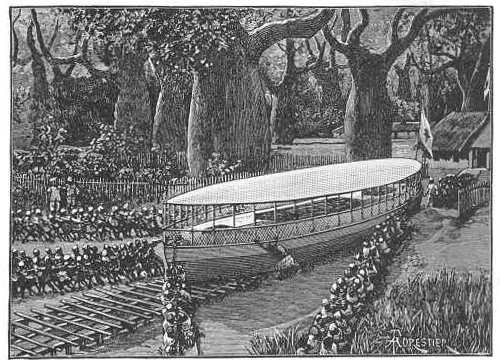
LAUNCHING THE STEAMER "FLORIDA."
April 29th.—In camp at Kinshassa under the baobabs. The steamers Stanley and Henry Reed, towing-barge En Avant arrived.
April 30th.—The hull of the Florida was launched this morning. Two hundred men pulled her steadily over the extended slip into the river. She was then taken to the landing-place of the Dutch Company and fastened to the steamer Stanley.
1887. April 30. Kinshassa. Each officer was furnished with the plan of embarkation, and directed to begin work of loading the steamers according to programme.
The following orders were also issued:—
The Officers commanding companies in this Expedition are—
Company
E. M. Barttelot
Major
No.
1,
Soudanese.
W. G. Stairs
Captain
No.
2,
Zanzibaris.
R. H. Nelson
Captain
No.
3,
Zanzibaris.
A. J. Mounteney
Captain
No.
4,
Zanzibaris.
J. S. Jameson
Captain
No.
5,
Zanzibaris.
John Rose Troup
Captain
No.
6,
Zanzibaris.
T. H. Parke
Captain and Surgeon
No.
7,
Somalis and Zanzibaris.
Mr. William Bonny takes charge of transport and riding animals and live stock, and assists Surgeon Parke when necessary.
"Each officer is personally responsible for the good behaviour of his company and the condition of arms and accoutrements."
"Officers will inspect frequently cartridge-pouches of their men, and keep record to prevent sale of ammunition to natives or Arabs."
"For trivial offences—a slight corporal punishment only can be inflicted, and this as seldom as possible. Officers will exercise discretion in this matter, and endeavour to avoid irritating the men, by being too exacting, or showing unnecessary fussiness."
"It has been usual for me to be greatly forbearing—let the rule be, three pardons for one punishment."
"Officers will please remember that the labour of the men is severe, their burdens are heavy, the climate hot, the marches fatiguing, and the rations poor and often scanty. Under such conditions human nature is extremely susceptible, therefore punishments should be judicious, not vexatious, to prevent straining patience too much. Nevertheless discipline must be taught, and when necessary enforced for the general well-being."
"Serious offences affecting the Expedition generally will be dealt with by me."
1887. April 30. Kinshassa. "While on shipboard one officer will be detailed to perform the duties of the day. He must see to the distribution of rations, ship cleaned, and that no fighting or wrangling occurs, as knifing soon follows unless checked, that the animals are fed and watered regularly. For all petty details apply to the senior officer, Major Barttelot."
CHAPTER V.
FROM STANLEY POOL TO YAMBUYA.
class="hang"> Upper Congo scenery—Accident to the Peace—Steamers reach Kimpoko—Collecting fuel—The good-for-nothing Peace—The Stanley in trouble—Arrival at Bolobo—The Relief Expedition arranged in two columns—Major Barttelot and Mr. Jameson chosen for command of Rear Column—Arrival at Equator and Bangala Stations—The Basoko villages: Baruti deserts us—Arrival at Yambuya.
1887. May 1. Upper Congo. As I have already expatiated at large upon the description of scenes of the Upper Congo, I intend to expunge altogether any impressions made on us according to our varying moods during our river voyage of about 1100 miles to Yambuya. I will confine myself to the incidents.
The days passed quickly enough. Their earlier hours presented to us every morning panoramas of forest-land, and myriads of forest isles, and broad channels of dead calm water so beshone by the sun that they resembled rivers of quicksilver. In general one might well have said that they were exceedingly monotonous, that is if the traveller was moving upward day by day past the same scenes from such a distance as to lose perception of the details. But we skirted one bank or the other, or steered close to an island to avail ourselves of the deep water, and therefore were saved from the tedium of the monotony.
Seated in an easy-chair scarcely 40 feet from the shore, every revolution of the propeller caused us to see new features of foliage, bank, trees, shrubs, plants, buds and blossoms. We might be indifferent to, or ignorant of the character and virtues of the several plants and varied vegetation we saw, we might have no interest in 1887. May 1. Upper Congo. any portion of the shore, but we certainly forgot the lapse of time while observing the outward forms, and were often kindled into livelier interest whenever an inhabitant of the air or of the water appeared in the field of vision. These delightful views of perfectly calm waters, and vivid green forests with every sprig and leaf still as death, and almost unbroken front line of thick leafy bush sprinkled with butterflies and moths and insects, and wide rivers of shining water, will remain longer in our minds than the stormy aspects which disturbed the exquisite repose of nature almost every afternoon.
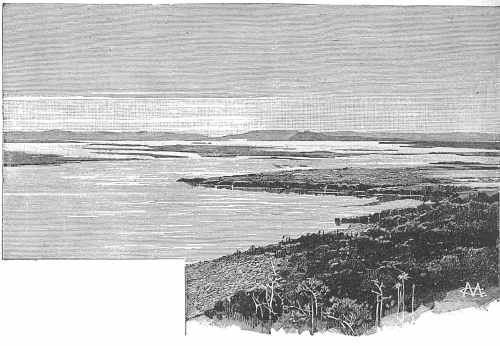
STANLEY POOL.
From the middle of March to the middle of May was the rainy season, and daily, soon after 2 P.M., the sky betokened the approach of a lowering tempest; the sun was hidden by the dark portents of storms, and soon after the thunderbolts rent the gloom, lightning blazed through it, the rain poured with tropical copiousness, and general misery prevailed and the darkness of the night followed.
Nature and time were at their best for us. The river was neither too high nor too low. Were it the former 1887. May 1. Upper Congo. we should have had the difficulty of finding uninundated ground; had it been the latter we should have been tediously delayed by the shallows. We were permitted to steer generally about 40 yards from the left bank, and to enjoy without interruption over 1000 miles of changing hues and forms of vegetable life, which for their variety, greenness of verdure, and wealth and scent of flowers, the world cannot equal. Tornadoes were rare during the greater portion of the day, whereby we escaped many terrors and perils; they occurred in the evening or the night oftener, when we should be safely moored to the shore. Mosquitoes, gadflies, tsetse and gnats were not so vicious as formerly. Far more than half the journey was completed before we were reminded of their existence by a few incorrigible vagrants of each species. The pugnacious hippopotami and crocodiles were on this occasion well-behaved. The aborigines were modest in their expectations, and in many instances they gave goats, fowls, and eggs, bananas and plantains, and were content with "chits" on Mr. John Rose Troup, who would follow us later. Our health was excellent, indeed remarkably good, compared with former experiences; whether the English were better adapted physically, or whether they declined to yield, I know not, but I had fewer complaints on this than on any previous expedition.
On the 1st of May the start up the Congo was commenced with the departure of the Henry Reed and two barges, with Tippu-Tib and 96 followers and 35 of our men. Soon after her followed the Stanley and her consort the Florida, with 336 people, besides 6 donkeys, and cargoes of goods; and half-an-hour later the Peace attempted to follow, with 135 passengers on board; but the good wishes of the people on shore had scarcely died away, and we were breasting the rapid current, when her rudder snapped in two. Her captain commanded the anchors to be dropped, which happened to be over exceedingly rugged ground where the current was racing six knots. The boat reeled to her beam ends, the chains tore her deck, and as the anchors could not 1887. May 1. Upper Congo. be lifted, being foul among the rocks below, we had to cut ourselves loose and to return to Kinshassa landing-place. Captain Whitley and Mr. David Charters the engineer set to to repair the rudder, and at 8 P.M. their task was completed.
The next morning we had better fortune, and in due time we reached Kimpoko at the head of the Pool, where the other steamers awaited us.
The Peace led the advance up river on the 3rd; but the Stanley drew up, passed us, and reached camp an hour and a half ahead of us. The Henry Reed was last because of want of judgment on the part of her captain.
The Peace was spasmodic. She steamed well for a short time, then suddenly slackened speed. We waited half an hour for another spurt. Her boiler was a system of coiled tubes, and her propellers were enclosed in twin cylindrical shells under the stern, and required to be driven at a furious rate before any speed could be obtained. She will probably give us great trouble.
As soon as we camped, which we generally did about 5 P.M., each officer mustered his men, for wood cutting for the morrow's fuel. This was sometimes very hard work, and continued for hours into the night. The wood of dead trees required to be sought by a number of men and conveyed to the landing-place for the cutters. For such a steamer as the Stanley it would require fifty men to search for and carry wood for quite two hours; it would require a dozen axemen to cut it up into 30-inch lengths for the grates. The Peace and Henry Reed required half as many axes and an equal amount of time to prepare their fuel. It must then be stored on board the steamers that no delay might take place in the morning, and this required some more work before silence, which befits the night, could be obtained, and in the meantime the fires were blazing to afford light, and the noise of crashing, cutting, and splitting of logs continued merrily.
The good-for-nothing Peace continued to provoke us on the 4th May. She was certainly one of the slowest steamers any shipbuilder could build. We 1887. May 4. Upper Congo. halted every forty-five minutes or so to "oil up," and sometimes had to halt to clear out the cylinders of the propellers, had to stop to raise steam, to have the grate cleared out of charcoal, while five minutes after raising steam up to 60°, she fell to 40°, and then 35°, and the poor miserable thing floated down stream at the rate of a knot an hour. We lost seven days at Stanley Pool through her; a day was lost when the rudder broke; we were fated to be belated.
The next day, the 5th, we made fast to the landing-place of Mswata. The Major and Dr. Parke had arrived four days previously. They had prepared quantities of fuel, and had purchased a large pile of provisions—loaves of bread from the manioc root and Indian corn.
On the 6th the Major and his companions received orders to march their men to Kwamouth, and await the steamer. The Stanley was ordered to proceed to Bolobo, debark her passengers, and descend to Kwamouth to convey Barttelot and men, while we reorganized companies at Bolobo.
On the 7th we observed the Stanley steamer ashore on the left bank near Chumbiri, and proceeding to her to inquire into the delay discovered that she was badly injured by running on a rocky reef. The second section had been pierced in four separate places and several rivets knocked out and others loosened. We therefore set to with the engineers of all the other steamers to repair her, but Messrs. Charters and Walker, both Scotchmen, were the most effective at the repairs. We cut up some old sheet iron oil drums, formed plates of them, and screwed them in from the outside. This was a very delicate labour, requiring patience and nicety of touch, as there were two feet of water in the hold, and the screws required to be felt to place the nuts on, as well as the punching of holes through the bottom of the steamer. The engineer was up to his waist in water, and striking his chisel through an element that broke the blow, then there was the preparation of the plate to correspond with the holes in the steamer, spreading the minium, 1887. May 7. Upper Congo. then a layer of canvas, and another layer of minium. When everything was ready for fixing the iron plate, a diver was sent down, the iron plate with its canvas patch and minium layers in one hand, and the end of a string attached to a hole in the plate in the other hand. The diver outside had to feel for the corresponding hole in the steamer, and the engineer up to his hips in water within the hold felt for the end of the twine, which when found, was drawn in gently, and the plate carefully guided, or the bolt was slipped in, and the engineer placed the nut on. For hours this tedious work went on, and by evening of the 7th, one large rent in the steel hull had been repaired; the 8th and 9th were passed before the steamer was able to continue her voyage.
On the 10th the Stanley caught the asthmatic Peace up, and passed us in company with the Henry Reed. A few hours later the Peace sulked altogether, and declined to proceed. Only 30 lbs. steam could be maintained. We were therefore compelled to make fast to the shore. At this period Mr. Charters' face possessed more interest than anything else in the world. We hung on his words as though they were decrees of Fate. He was a sanguine and cheerful little man, and he comforted us exceedingly. He was sure we would arrive in Bolobo in good time, though we did not appear to be proceeding very rapidly while tied to the shore.
The next day we tried again, starting at 4 A.M., resolved to distinguish ourselves. For an hour the Peace behaved nobly, but finally she showed symptoms of relapse. The steam descended lower and lower, and could not retain 5 lbs., and we therefore cast anchor. At 10 A.M. the case appearing hopeless, I despatched Mr. Ward in the whale boat to obtain assistance from the Henry Reed, and at eight at night she appeared and anchored sixty yards from us, and all the day we had been idly watching the dark brown current flow by, anchored in mid-stream at least 500 yards from either shore or island, seeing nothing but hippopotami, grassy clumps, weeds, and débris of woods floating by. On 1887. May 12. Upper Congo. the 12th we arrived ignominiously at Bolobo in tow of the Henry Reed.
When the traveller reaches Uyanzi such a thing as famine is scarcely possible, and one of the best river ports for abundance and variety of food is Bolobo. Here, then, after reaching a district where the people could recuperate and forget the miseries of limited rations endured since leaving Lukungu, was the place to form the Relief Expedition into two columns.
It was decided that as the force could not be transported on one voyage to the Upper Congo, that the healthiest men should be selected to proceed to Yambuya, and that the weakly should remain in Bolobo as a portion of Major Barttelot's column under Messrs. Herbert Ward, and William Bonny, until the Stanley should return from Yambuya. We had started from England with the cry of "urgency" in our ears and memories, and it behoved us to speed on as well as circumstances would permit in obedience to the necessity, trusting that the rear column would be able to follow on our tracks some six or seven weeks later.
We accordingly selected 125 men who appeared weakest in body, and left them at Bolobo to fatten up on the bananas and excellent native bread and fish that were easily procurable here. The Stanley in the meantime had descended to Kwamouth with Major Barttelot, Dr. Parke, and 153 men.
The vexed question was also settled here as to who should take charge of the rear column. It being the most important post next to mine, all eyes were naturally directed to the senior officer, Major Barttelot. It was said that he had led a column of a thousand men from Kosseir on the Red Sea to Keneh on the Nile, and that he had distinguished himself in Afghanistan and in the Soudan Campaign. If these facts were true, then undoubtedly he was the fittest officer for the office of commanding the rear column. Had there been a person of equal rank with him, I should certainly have delegated this charge to another, not because of any known unfitness, but because he was so eager to accompany the 1887. May 12. Upper Congo. advance column. On reflecting on the capacities and rank of the other gentlemen, and their eagerness being too well known to me, I informed the Major that I could not really undertake the responsibility of appointing youthful lieutenants to fill a post that devolved on him by rank, experience, and reputation.
"One more steamer like the Stanley would have done it, Major, completely," I said, cheerfully, for the young officer was sorely depressed. "Only 125 men and a cargo of goods left of the Expedition. All the rest are on board comfortably. If you can discover some better person than yourself to take your place between here and Yambuya, I would gladly know him. I hope you will not take it too much to heart. For what does it matter after all? You who bring up the rear are as much entitled to credit as we in the advance. If Tippu-Tib will only be faithful, you will only be six weeks behind us, and you may overtake us, for we shall be naturally delayed a great deal, finding the track and boring our way through all kinds of obstacles. You will follow an indicated path, and frequently you may be able to make two of our marches in one day. If Tippu-Tib does not join us, you will be master of your own column, and you will be so occupied with your task that the days will slip by you fast enough. And I tell you another thing for your comfort, Major; there is plenty of work ahead of us, wherein you shall have the most important part. Now tell me, who would you wish for your second?"
"Oh, I would rather leave it to you."
"Nay, I would prefer you would select some one friend as your companion, to share your hopes and thoughts. We all of us have our partialities, you know."
"Well, then, I choose Jameson."
"Very well, Mr. Jameson shall be appointed. I will speak to him myself. I will then leave Mr. Rose Troup, who is a capital fellow, I have reason to believe, and young Ward and Bonny. Both Troup and Ward speak Swahili, and they will be of vast service to you."
In this manner the matter was arranged, and on the 1887. May 15. Upper Congo. 15th of May the flotilla resumed the up-river voyage, conveying 511 persons of the Expedition, and Tippu-Tib and ninety of his followers.
We made a fair journey on the 16th, the repairs on the Peace having greatly improved her rate of progress, and on the 19th made fast to the shore near the Baptist Mission of Lukolela, though the Stanley did not make her appearance until late on the 19th.
We halted on the 20th at Lukolela, to purchase food for our journey to Equator Station, and we were extremely grateful for the kind hospitality shown to us by the missionaries at this station.
On the 24th of May we arrived at Equator Station, now owned by the Sanford Company, which was represented by Mr. E. J. Glave, a young and clever Yorkshireman. Captain Van Gele was also here, with five Houssa soldiers lately returned from a futile effort to ascend the Mobangi higher than Mr. Grenfell, the missionary, had succeeded in doing some months previously.
We reached Bangala Station on the 30th May. This place was now a very large and prosperous settlement. There was a garrison of sixty men and two Krupps, for defence. Bricks were made, of excellent quality; 40,000 had already been manufactured. The establishment was in every way very creditable to Central Africa. The chief, Van Kirkhoven, was absent at Langa-Langa. He had lately succeeded in releasing twenty-nine Houssa soldiers from slavery. During the escape of Deane from Stanley Falls, these Houssas had precipitately retreated into a canoe, and had floated as far as Upoto when they were captured as runaways by the natives of the district.
Among other good qualities of Bangala, there is a never-failing supply of food. The station possessed 130 goats and a couple of hundred fowls, which supplied the officers with fresh eggs. Ten acres were green with a promising rice crop. The officers enjoyed wine of palm and banana, and fermented beer made of sugar-cane, and exceedingly potent I found the latter to be.
At Bangala I instructed Major Barttelot to proceed with Tippu-Tib and party direct to Stanley Falls, having 1887. May 30. Upper Congo. first taken out thirty-five Zanzibaris from the boats, and replaced them with forty Soudanese, that none of the Zanzibaris might become acquainted with the fact that Stanley Falls was but a few days' march from Yambuya.
With the exception of certain irregularities in the behaviour of the steamer Stanley, which by some mysterious manœuvres disappeared amid intricate passages, on the plea that sufficient fuel of a right quality could be found, we steamed up to the Aruwimi River without any incident, and arrived at our ancient camp, opposite the Basoko villages, on June 12th.
The Basoko were the countrymen of Baruti, or "Gunpowder," who had been captured by Karema when a child, in 1883, and had been taken to England by Sir Francis de Winton, with a view of impressing on him the superiority of civilized customs. From Sir Francis' care Baruti passed into mine, and here we were at last in view of his natal village and tribe, from which he had been absent six years.
Seeing Baruti eyeing with excessive interest the place of his birth, he was encouraged by me to hail the Basoko, and invite them to visit us. My previous attempts at winning the confidence of these forest natives had been failures, though in time I was sure there would be no difficulty. For a long period it had been an interesting question to me why aborigines of the forest were more intractable and coy than natives of the open country. The same methods had been applied, the dangling of some bright or gaudy article of barter, the strings of beads of dazzling colour, suspended patiently, the artful speech, the alluring smile and gesture, all were resorted to for long hours, but always ending with disappointment and postponement to a more leisurely occasion. But the reason is that the forest has been always a handy fastness for retreat, the suspicion of the stranger, and the convenient depth of trackless woods plead strongly against some indefinite risk. The least advance causes a precipitate backward movement until he gains the limits of the forest, and then he stands to take a last survey, and finally disappears 1887. June 12. Upper Congo. into the gloom with an air of "It won't do, you know; you can't come over me." Whereas in the open country the native has generally some coign of vantage, some eminence, a tree or an ant-hill, from the crest of which he has taken his observations, and been warned and informed of the character of the strangers, in the forest the stranger meets the tenant of the woods abruptly; he has advanced out of the unknown, with purpose unfathomed. Surprise is in the face of one, terror marks the face of the other.
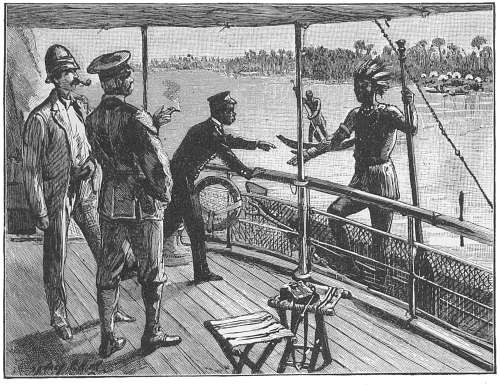
BARUTI FINDS HIS BROTHER.
Baruti hailed, and the canoes advanced towards us with a tediously slow process, but finally they approached within easy hearing. He recognized some of the canoemen, and informed them that they had no cause for fear. He asked for a person whose name he uttered, and the wild men hallooed the word with splendid lung-power across the river, until some one responded, and embarked in a canoe and approached. This turned out to be Baruti's elder brother. Baruti 1887. June 12. Upper Congo. demanded to know how his brother fared, after so many year of absence. The brother eyed him vacantly, could not recognize any feature in him, and grunted his doubt.
Baruti mentioned the name of his parents, that of his father, and afterwards that of his mother. Great interest now manifested itself in his brother's face, and he skilfully drew his canoe nearer.
"If you are my brother, tell me some incident, that I may know you."
"Thou hast a scar on thy arm—there, on the right. Dost thou not remember the crocodile?"
This was enough; the young, broad-chested native gave a shout of joy, and roared out the discovery to his countrymen on the further bank, and Baruti for the first time shed tears. The young fellow drew near to the ship, forgot his fears of the strangers, and gave Baruti a frantic hug, and the other canoes advanced to participate in the joy of the two restored brothers.
In the evening Baruti was offered his choice of staying in his village among his tribe, or of following our adventures; at the same time he was advised not to leave us, as life among the Basoko would be very insecure with the Arabs in such close proximity as Stanley Falls.
The lad appeared to think so too, and so declined to be restored to his native land and tribe; but a day or two after reaching Yambuya he altered his mind, came into my tent in the dead of night, armed himself with my Winchester rifle and a brace of Smith and Wesson revolvers, a supply of rifle and revolver cartridges, took possession of a silver road-watch, a silver pedometer, a handsome belt with fitted pouches, a small sum of money, and, possessing himself of a canoe, disappeared down river to some parts unknown, most probably to his tribe. At any rate, we have never seen or heard of him since. Peace be with him!
On the 15th of June we arrived opposite Yambuya villages, situated on the left bank of the Aruwimi, 96 miles above the confluence of the Aruwimi and the Congo.
CHAPTER VI.
AT YAMBUYA.
We land at Yambuya villages—The Stanley leaves for Equator Station—Fears regarding Major Barttelot and the Henry Reed—Safe arrival—Instructions to Major Barttelot and Mr. Jameson respecting the Rear Column—Major Barttelot's doubts as to Tippu-Tib's good faith—A long conversation with Major Barttelot—Memorandum for the officers of the Advance Column—Illness of Lieutenant Stairs—Last night at Yambuya—Statements as to our forces and accoutrements.
1887. June 15. Yambuya. We were now over 1300 miles from the sea. Opposite to us were the villages which we hoped, with the goodwill of the natives, to occupy temporarily as a depot for the men and stores left at Bolobo and Leopoldville, 125 men and about 600 porter-loads of impedimenta; if not with the natives' goodwill by fair purchase of the privilege, then by force.
On an exploring visit in 1883 I had attempted to conciliate them without any permanent result. We had a very serious object in view now. In prospective we saw only the distant ports of the Nile and the Albert Nyanza, defended by men ever casting anxious glances to every cardinal point of the compass, expectant of relief, as they must by this time be well informed by our couriers from Zanzibar; but between us and them was a broad region justly marked with whiteness on the best maps extant. Looking at that black wall of forest which had been a continuous bank of tall woods from Bolobo hitherto, except when disparted by the majestic streams pouring their voluminous currents to the parent river, each of us probably had his own thoughts far hidden in the recesses of the mind. Mine were of that ideal Governor in the 1887. June 15. Yambuya. midst of his garrisons, cheering and encouraging his valiant soldiers, pointing with hand outstretched to the direction whence the expected relief would surely approach if it were the will of God, and in the distance beyond I saw in my imagination the Mahdist hordes advancing with frantic cries and thrilling enthusiasm crying out, "Yallah, Yallah," until from end to end of the swaying lines the cry was heard rolling through the host of fervid and fanatical warriors, and on the other sides multitudes of savages vowed to extermination biding their time, and between them and us was this huge area of the unknown without a track or a path.
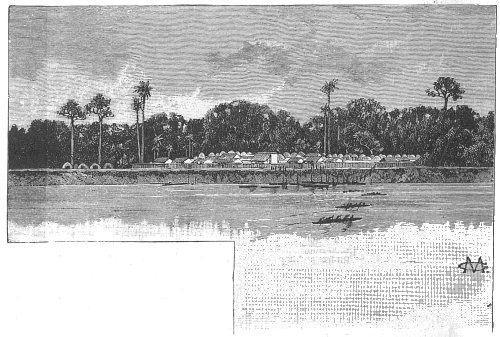
A TYPICAL VILLAGE ON THE LOWER ARUWIMI.
Ammunition was served out by the captains of the companies, and instructions were issued to them to have steam up on board their respective steamers that we might commence the first most important move preparatory to marching towards the Albert Nyanza.
At six o'clock in the morning of the 16th of June the Peace glided from her berth until she was abreast of the Stanley, and when near enough to be heard, I requested the officers to await my signal. Then, steaming 1887. June 16. Yambuya. gently across the river, we attempted to soothe the fears and quiet the excitement of the natives by remaining abreast of the great crowd that stood upon the bluffy bank fifty feet above us, regarding us with wonder and curiosity. Our interpreter was well able to make himself understood, for the natives of the lower Aruwimi speak but one language. After an hour's interchange of compliments and friendly phrases, they were induced to send a few of the boldest down to the river's edge, and by a slight movement of the helm the current pushed the steamer close to the bank, where another hour was passed in entreaty and coaxing on our part, denials and refusals on the other. We succeeded in the purchase of one of their knives for a liberal quantity of beads! Encouraged by this, we commenced to negotiate for leave to reside in their village for a few weeks at a price in cloth, beads, wire, or iron, but it was met with consistent and firm denial for another hour.
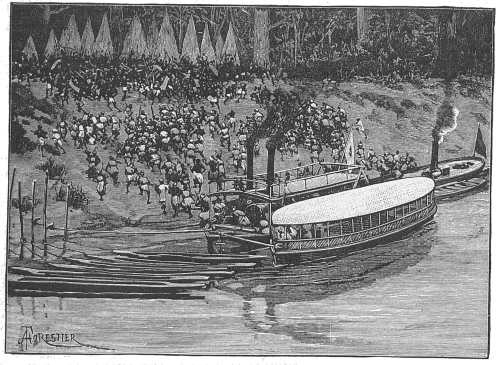
OUR LANDING AT YAMBUYA.
It was now nine o'clock, my throat was dry, the sun was getting hot, and I signalled to the steamer Stanley to 1887. June 16. Yambuya. come across and join us, and when near enough, according to agreement a second signal caused the steam whistles to sound, and under cover of the deafening sounds, pent up as they were by the lofty walls of the forest, both steamers were steered to the shore, and the Zanzibaris and Soudanese scramble up the steep sides of the bluff like monkeys, and when the summit was gained not a villager was in sight.
We found Yambuya settlement to consist of a series of villages of conical huts extending along the crest of the bank, whence far-reaching views of the Aruwimi up and down stream could be obtained. The companies were marched to their respective quarters. Guards were set at the end of every path leading out. Some of the men were detailed to cut wood for a palisade, others to collect fuel, and several squads were despatched to ascertain the extent of the fields and their locality.
In the afternoon two natives from a village below Yambuya made their appearance with a flattering confidence in their demeanour. They belonged to the Baburu tribes, to which these various fragments of tribes between Stanley Falls and the Lower Aruwimi belong. They sold us a few bananas, were well paid in return, and invited to return with more food, and assurance was given that they need be under no alarm.
On the next day men were sent to collect manioc from the fields, others were sent to construct a palisade, a ditch was traced, workers were appointed to dig a trench for sinking the stockade poles, woodcutters were sent to work to prepare to load the steamers with fuel, that with their weakened crews they might not be surprised on their return journey to the Pool, and everywhere was life and activity.
Several captures were made in the woods, and after being shown everything, the natives were supplied with handfuls of beads to convey the assurance that no fear ought to be entertained of us and no harm done to them.
On the 19th fuel sufficient had been cut for six days' 1887. June 17. Yambuya. steaming for the Stanley with which she could proceed to Equator Station. A cheque was drawn for £50 in favour of the Captain, and another for a similar amount for the engineer, on Ransom, Bouverie & Co., and both were handed in their presence to Mr. Jameson to be presented to them on their return from Stanley Pool, provided they safely reached Yambuya about the middle of August. A valuable jewel was sent to Lieutenant Liebrichts as a token of my great regard for him. The Stanley left next morning with my letters to the Emin Relief Committee.
The Peace was detained for the sake of accompanying her consort, the Henry Reed, which was now hourly expected from Stanley Falls according to the instructions given to Major Barttelot, as she ought to have reached us on the 19th.
In a wild country like this, cannibals in the forest on either hand, and thousands of slave raiders in such a close vicinity as Stanley Falls, we were naturally prone to suspect the occurrence of serious events, if one's expectations were not promptly and punctually realized. Major Barttelot had passed the mouth of the Aruwimi on the 11th inst. in command of the steamer Henry Reed, conveying Tippu-Tib and party to a settlement from which an English commandant and garrison had been precipitately ousted. True, the Arab chief had been very confident in his manner, and earnest in the assurance that in nine days after arriving at his settlement he would present himself at Yambuya with 600 carriers in accordance with his agreement, and I was loth to believe that he was in any way responsible for this detention of the Major. Yet the Major should have reached Stanley Falls on the 13th, on the evening of the 14th he should have been at the mouth of the Aruwimi again, and on the 16th at Yambuya; that is, provided the Major was gifted with the spirit of literal performance and permitted nothing to tempt him to delay. It was now the 21st. The officers were confident that nothing had occurred but the delays natural to circumstances of existence in Africa, but hourly I 1887. June 21. Yambuya. found myself straying to the edge of the bluff sweeping the view down river with my glass.
On the 22nd my uneasiness was so great that I penned an order to Lieutenant Stairs to take fifty of the best men, and the Maxim machine gun, to proceed down river on the morning of the 23rd with the Peace to search for the Henry Reed, and if all other eventualities mentioned and explained had not transpired to proceed to Stanley Falls. On arriving before this settlement if the vessel was seen at the landing-place, and his friendly signals as he advanced were not responded to, he was to prepare everything for assault and re-capture of the steamer, and to hurry back to me with the news if unsuccessful.
At 5 P.M., however, the Zanzibaris rang out the welcome cry of "Sail ho!" Barttelot was safe, no accident had occurred. Tippu-Tib had not captured the vessel, the Soudanese had not mutinied against the Major, the natives had not assaulted the sleeping camp by night, the steamer had not been sunk by a snag nor had she been run aground, and the boat for which we were morally responsible to the Mission was in as good order and condition as when she left Stanley Pool. But in Africa it is too wearing to be the victim of such anxieties.
The Major had been simply detained by various mischances—fighting with natives, palaver with Tippu-Tib and men, &c. &c.
Two days later the steamers Peace and Henry Reed were loaded with fuel and despatched homeward down river, and we had severed the last link with civilization for many a month to come.
On this day I delivered the following letter of instructions to Major Barttelot, and a copy of it to Mr. J. S. Jameson his second in command.
June 24th, 1887.
To Major Barttelot, &c., &c., &c.
Sir,—As the senior of those officers accompanying me on the Emin Pasha Relief Expedition, the command of this important post naturally devolves on you. It is also for the interest of the Expedition that you accept this command, from the fact that your Soudanese company, being 1887. June 24. Yambuya. only soldiers, and more capable of garrison duty than the Zanzibaris, will be better utilized than on the road.
The steamer Stanley left Yambuya on the 22nd of this month for Stanley Pool. If she meets with no mischance she ought to be at Leopoldville on the 2nd of July. In two days more she will be loaded with about 500 loads of our goods, which were left in charge of Mr. J. R. Troup. This gentleman will embark, and on the 4th of July I assume that the Stanley will commence her ascent of the river, and arrive at Bolobo on the 9th. Fuel being ready, the 125 men in charge of Messrs. Ward and Bonny, now at Bolobo, will embark, and the steamer will continue her journey. She will be at Bangala on the 19th of July, and arrive here on the 31st of July. Of course, the lowness of the river in that month may delay her a few days, but, having great confidence in her captain, you may certainly expect her before the 10th of August.[7]
It is the non-arrival of these goods and men which compel me to appoint you as commander of this post. But as I shall shortly expect the arrival of a strong reinforcement of men,[8] greatly exceeding the advance force which must, at all hazards, push on to the rescue of Emin Pasha, I hope you will not be detained longer than a few days after the departure of the Stanley on her final return to Stanley Pool in August.
Meantime, pending the arrival of our men and goods, it behoves you to be very alert and wary in the command of this stockaded camp. Though the camp is favourably situated and naturally strong, a brave enemy would find it no difficult task to capture if the commander is lax in discipline, vigour and energy. Therefore I feel sure that I have made a wise choice in selecting you to guard our interests here during our absence.
The interests now entrusted to you are of vital importance to this Expedition. The men you will eventually have under you consist of more than an entire third of the Expedition. The goods that will be brought up are the currency needed for transit through the regions beyond the Lakes; there will be a vast store of ammunition and provisions, which are of equal importance to us. The loss of these men and goods would be certain ruin to us, and the Advance Force itself would need to solicit relief in its turn. Therefore, weighing this matter well, I hope you will spare no pains to maintain order and discipline in your camp, and make your defences complete, and keep them in such a condition, that however brave an enemy may be he can make no impression on them. For this latter purpose I would recommend you to make an artificial ditch 6 feet wide, 3 feet deep, leading from the natural ditch, where the spring is round the stockade. A platform, like that on the southern side of the camp, constructed near the eastern as well as the western gate, would be of advantage to the strength of the camp. For remember, it is not the natives alone who may wish to assail you, but the Arabs and their followers may, through some cause or other, quarrel with you and assail your camp.
Our course from here will be due east, or by magnetic compass east by south as near as possible. Certain marches that we may make may not exactly lead in the direction aimed at. Nevertheless, it is the south-west corner of Lake Albert, near or at Kavalli, that is our destination. When we arrive there we shall form a strong camp in the neighbourhood, launch our boat, and steer for Kibero, in Unyoro, to hear from Signor 1887. June 24. Yambuya. Casati, if he is there, of the condition of Emin Pasha. If the latter is alive, and in the neighbourhood of the Lake, we shall communicate with him, and our after conduct must be guided by what we shall learn of the intentions of Emin Pasha. We may assume that we shall not be longer than a fortnight with him before deciding on our return towards the camp along the same road traversed by us.
We will endeavour, by blazing trees and cutting saplings along our road, to leave sufficient traces of the route taken by us. We shall always take, by preference, tracks leading eastward. At all crossings where paths intersect, we shall hoe up and make a hole a few inches deep across all paths not used by us, besides blazing trees when possible.
It may happen, should Tippu-Tib have sent the full number of adults promised by him to me, viz., 600 men (able to carry loads), and the Stanley has arrived safely with the 125 men left by me at Bolobo, that you will feel yourself sufficiently competent to march the column, with all the goods brought by the Stanley, and those left by me at Yambuya, along the road pursued by me. In that event, which would be very desirable, you will follow closely our route, and before many days we should most assuredly meet. No doubt you will find our bomas intact and standing, and you should endeavour to make your marches so that you could utilise these as you marched. Better guides than those bomas of our route could not be made. If you do not meet them in the course of two days' march, you may rest assured that you are not on our route.
It may happen, also, that though Tippu-Tib has sent some men, he has not sent enough to carry the goods with your own force. In that case you will, of course, use your discretion as to what goods you can dispense with to enable you to march. For this purpose you should study your list attentively.
1st. Ammunition, especially fixed, is most important.
2nd. Beads, brass wire, cowries and cloth, rank next.
3rd. Private luggage.
4th. Powder and caps.
5th. European provisions.
6th. Brass rods as used on the Congo.
7th. Provisions (rice, beans, peas, millet, biscuits).
Therefore you must consider, after rope, sacking, tools, such as shovels (never discard an axe or bill-hook), how many sacks of provisions you can distribute among your men to enable you to march—whether half your brass rods in the boxes could not go also, and there stop. If you still cannot march, then it would be better to make two marches of six miles twice over, if you prefer marching to staying for our arrival, than throw too many things away.
With the Stanley's final departure from Yambuya, you should not fail to send a report to Mr. William Mackinnon, c/o Gray, Dawes and Co., 13, Austin Friars, London, of what has happened at your camp in my absence, or when I started away eastward; whether you have heard of or from me at all, when you do expect to hear, and what you purpose doing. You should also send him a true copy of this order, that the Relief Committee may judge for themselves whether you have acted, or propose to act, judiciously.
Your present garrison shall consist of 80 rifles, and from 40 to 50 supernumeraries. The Stanley is to bring you within a few weeks 50 more rifles and 75 supernumeraries, under Messrs. Troup, Ward and Bonny.
I associate Mr. J. S. Jameson with you at present. Messrs. Troup, Ward and Bonny, will submit to your authority. In the ordinary duties of the defence, and the conduct of the camp or of the march, there is 1887. June 24. Yambuya. only one chief, which is yourself; but, should any vital step be proposed to be taken, I beg you will take the voice of Mr. Jameson also. And when Messrs, Troup and Ward are here, pray admit them to your confidence, and let them speak freely their opinions. I think I have written very clearly upon everything that strikes me as necessary. Your treatment of the natives, I suggest, should depend entirely upon their conduct to you. Suffer them to return to the neighbouring villages in peace, and if you can in any manner by moderation, small gifts occasionally of brass rods, &c., hasten an amicable intercourse, I should recommend you doing so. Lose no opportunity of obtaining all kinds of information respecting the natives, the position of the various villages in your neighbourhood, &c., &c.
I have the honour to be, your obedient servant,
Henry M. Stanley.
Commanding Expedition.
The Major withdrew to read it, and then requested Mr. Jameson to make a few copies.
About two o'clock the Major returned to me and asked for an interview. He said he desired to speak with me concerning Tippu-Tib.
"I should like to know, sir, something more regarding this Arab. When I was delayed a few days ago at the Falls, you were pleased to deliver some rather energetic orders to Lieutenant Stairs. It strikes me that you are exceedingly suspicious of him, and if so, I really cannot see why you should have anything to do with such a man."
"Well, sir, I shall be pleased to discuss him with you, or any other subject," I replied.
"Three days before your steamer was sighted coming up river, I must confess to have been very anxious about you. You were in command of a steamer which belonged to other parties to whom we were pledged to return her within a certain time. You had a company of forty soldiers, Soudanese, as your escort. The vessel was well fitted and in perfect order. We knew the time you ought to have occupied, provided no accident occurred, and as your instructions were positively to depart from Stanley Falls, as soon as the cow promised by our friend Ngalyema was aboard, and if she was not forthcoming within an hour you were to slip away down river. Assuming that no accident happened and that you obeyed orders, you should have been here on the 1887. June 24. Yambuya. evening of the 16th, or on the 17th at the latest. You did not arrive until 5 P.M. on the 22nd.
"We have no telegraphs here, or posts. As we could gain no intelligence of you, my anxiety about you created doubts. As one day after another passed, doubts became actual dread that something unaccountable had occurred. Had you struck a snag, run aground, like the Stanley and Royal did, as almost all steamers do, had you been assaulted by natives in the night like Captain Deane in the A. I. A. at Bunga, had your Soudanese mutinied as they threatened to do at Lukungu, had you been shot as a Soudanese regiment shot all their white officers in the Soudan once, had you been detained by force because Tippu-Tib had been over persuaded to do by those young fire-eaters of Arabs at the Falls, had you quarrelled with those young fellows, the two Salims, as Stairs and Jephson did below Stanley Pool. If not, what had occurred? Could I, could anybody suggest anything else?"
"But I was obliged——"
"Never mind, my dear Major, say no more about it. Don't think of defending yourself. I am not mentioning these things to complain of you, but replying to your question. All is well that ends safely.
"Now as to Tippu-Tib. I have nothing to do with Tippu-Tib, but from necessity, for your sake as well as mine. He claims this is his territory. We are on it as his friends. Supposing we had not made agreement with him, how long should we be left to prepare for the march to the Albert, or how long would you be permitted to remain here, before you had to answer the question why you were on his territory? Could I possibly leave you here, with my knowledge of what they are capable of—alone? With eighty rifles against probably 3000, perhaps 5000 guns? Why, Major, I am surprised that you who have seen Stanley Falls, and some hundreds of the Arabs should ask the question?
"You have accompanied Tippu-Tib and nearly a hundred of his followers from Zanzibar. You have seen 1887. June 24. Yambuya. what boyish delight they took in their weapons, their Winchesters, and valuable double-barrelled rifles. You know the story of Deane's fight at Stanley Falls. You know that Tippu-Tib is vindictive, that his fiery nephews would like a fight better than peace. You know that he meditated war against the Congo State, and that I had to pass on a relief mission through a portion of his territory. Why how can you—grown to the rank of Major—ask such questions, or doubt the why and wherefore of acts which are as clear as daylight?
"Our transport the Madura was in Zanzibar harbour. The owner of this district, as he calls himself, was preparing munitions against all white men on the Congo, resenting and resentful. Would it have been prudent for me to have left this man in such a state? That he prepared for war against the State did not materially affect me, but that he intended doing so while I had to pass through his territory, and in his neighbourhood on a humane mission was everything. Therefore I was as much interested in this affair of patching up a peace between the Congo State and King Leopold as His Majesty himself was, and more so indeed.
"And I suppose you will ask me next how does it affect your personal interests? Have you not told me over and over again that you are burning to accompany us, that you would infinitely prefer marching to waiting here? And is it not understood according to your letter of instructions—that failing Tippu-Tib's appearance with his 600 carriers, you are to make double-stages, or triple-stages rather than stay at Yambuya?
"Look at these pencilled calculations on this paper—nay, you can keep it, if you please. They represent what you can do with your own men, and what you can do assuming that Tippu-Tib really keeps to the letter of his contract.
"Now I have grounded my instructions principally on your impetuous answer to me at Bolobo. 'By Jove! I will not stay a day at Yambuya after I get my column together!'
1887. June 24. Yambuya. "See here! The letter says—'It may happen that Tippu-Tib has sent some men, but not sent enough; therefore, you know, use your discretion; dispense with No. 7, provisions, such as rice, beans, peas, millet, biscuits. See how many sacks of provisions you can issue out to your men—they will eat them fast enough, I warrant you.'
"It goes on—'If you still cannot march, then it would be better to make marches of six miles twice over—that is, to go one march of six miles, and then return to fetch another lot, and march forward again. Such as my work was on the Congo, when with 68 men I made 33 round trips on the stretch of 52 miles to take 2000 loads—5 immense waggons and make a waggon road, building bridges, etc.' That pencilled paper in your hand informs you how many miles you can do in this fashion in six months.
"But this is how my pact with Tippu-Tib affects you personally. If Tippu-Tib performs his contract faithfully, then on the arrival of the Stanley with Messrs. Ward, Troup, and Bonny, and their men, you can set out from Yambuya within a day or two, and perhaps overtake us, or on our return from the Albert we shall meet before many days.
"Now which would you personally prefer doing? Travelling backwards and forwards from camp to camp, twice, or perhaps thrice, or have Tippu-Tib with 600 carriers to help your 200 carriers, and march at a swinging pace through the woods on our track, straight for the Albert Nyanza?"
"Oh, there is not a doubt of it. I should prefer marching straight away and try and catch up with you. Naturally."
"Well, do you begin to understand why I have been sweet, and good, and liberal to Tippu-Tib? Why I have given him free passage and board for himself and followers from Zanzibar to Stanley Falls? Why I have shared the kid and the lamb with him?"
"Quite."
"Not quite yet, I am afraid, Major, otherwise you 1887. June 24. Yambuya. would not have doubted me. There is still a serious reason.
"Assuming, for instance, that I had not brought Tippu-Tib here, that the Arabs at Stanley Falls were not wrathy with white men for Deane's affair, or that they would fear attacking you. They had but to affect friendship with you, sell you goats and food, and then tell your Zanzibaris that their settlement was but six or seven days away—where they had plenty of rice and fish and oil to tempt three-fourths of your men to desert in a few days, while you were innocently waiting for the Bolobo contingent; and no sooner would the other fellows have reached here than they would hear of the desertion of their comrades for the Falls, and follow suit either wholesale or by twos and threes, sixes and tens, until you would have been left stranded completely. Is it not the fear of this desertion that was one of the reasons I chose the Congo? Having Tippu-Tib as my friend and engaged to me, I have put a stop to the possibility of any wholesale desertion.
"Let these reasons sink into your mind, Major, my dear fellow. Yet withal, your column may be ruined if you are not very careful. Be tender and patient with your people, for they are as skittish as young colts. Still, it was with these people, or men like them, that I crossed Africa—followed the course of the Congo to the sea, and formed the Congo State."
"Well, now, say do you think Tippu-Tib will keep his contract, and bring his 600 people?" asked the Major.
"You ought to know that as well as I myself. What did he say to you before you left him?"
"He said he would be here in nine days, as he told you at Bangala. Inshallah!" replied the Major, mimicking the Arab.
"If Tippu-Tib is here in nine days, it will be the biggest wonder I have met."
"Why?" asked the Major, looking up half wonderingly.
"Because to provide 600 carriers is a large order. He will not be here in fifteen days or even twenty days. We 1887. June 24. Yambuya. must be reasonable with the man. He is not an European—taught to be rigidly faithful to his promise. Inshallah! was it he said? To-morrow—Inshallah means the day after—or five days hence, or ten days. But what does it matter to you if he does not come within twenty days? The Stanley will not be here until the 10th, or perhaps the middle of August; that will be about seven weeks—forty-two days—hence. He has abundance of time. What do you want to look after 600 men in your camp doing nothing, waiting for the steamer? Idle men are mischievous. No; wait for him patiently until the Stanley comes, and if he has not appeared by that time he will not come at all."
"But it will be a severe job for us if he does not appear at all, to carry 500 or 600 loads with 200 carriers, to and fro, backwards and forwards, day after day!
"Undoubtedly, my dear Major, it is not a light task by any means. But which would you prefer; stay here, waiting for us to return from the Albert, or to proceed little by little—gaining something each day—and be absorbed in your work?"
"Oh, my God! I think staying here for months would be a deuced sight the worse."
"Exactly what I think, and, therefore, I made these calculations for you. I assure you, Major, if I were sure that you could find your way to the Albert, I would not mind doing this work of yours myself, and appoint you commander of the advance column, rather than have any anxiety about you."
"But tell me, Mr. Stanley, how long do you suppose it will be before we meet?"
"God knows. None can inform me what lies ahead here, or how far the forest extends inland. Whether there are any roads, or what kind of natives, cannibals, incorrigible savages, dwarfs, gorillas. I have not the least idea. I wish I had; and would give a handsome sum for the knowledge even. But that paper in your hand, on which I have calculated how long it will take me to march to the Albert Nyanza, is based on this fact. In 1887. June 24. Yambuya. 1874 and 1875 I travelled 720 miles in 103 days. The distance from here to the Albert Nyanza is about 330 geographical miles in a straight line. Well, in 1874-75, I travelled 330 geographical miles—Bagamoyo to Vinyata, in Ituru, in 64 days; from Lake Uhimba to Ujiji, 330 miles, in 54 days. These were, of course, open countries, with tolerably fair roads, whereas this is absolutely unknown. Is it all a forest?—then it will be an awful work. How far does the forest reach inland? A hundred—two hundred—three hundred miles? There is no answer. Let us assume we can do the journey to the Albert in three months; that I am detained a fortnight, and that I am back in three months afterwards. Well, I shall meet you coming toward me, if Tippu-Tib is not with you, the latter part of October or November. It is all down on that paper.
"But it is immaterial. The thing has to be done. We will go ahead, we will blaze the trees, and mark our track through the forest for you. We will avail ourselves of every advantage—any path easterly will suit me until I bore through and through it, and come out on the plains or pastureland. And where we go, you can go. If we can't go on, you will hear from us somehow. Are you now satisfied?"
"Perfectly," he replied. "I have it all here," touching his forehead—"and this paper and letter will be my reminders. But there is one thing I should like to speak about, it refers to something you said to me in London."
"Ah, indeed. What was said that was in any way peculiar?" I asked.
"Well"—here there was a little hesitation—"do you remember when Mr. ——, of the India Office, introduced me to you? The words you used sounded strangely, as though someone had been warning you against me."
"My dear Barttelot, take my word for it, I don't remember to have heard the name of Barttelot before I heard your name. But you interest me. What could 1887. June 24. Yambuya. I have possibly said that was any way peculiar to cling to your memory like this? I remember the circumstance well?"
"The fact is," he said, "you said something about 'forbearance,' which reminded me that I had heard that word before, when General —— pitched into me about punishing a Somali mutineer in the desert during the Soudan campaign. I was all alone with the Somalis when they turned on me, and I sprang upon the ringleader at last when there was no other way of reducing them to order and pistolled him, and at once the Somalis became quiet as lambs. I thought that General ——, who is not remarkable for goodwill to me, had mentioned the affair to you."
"Indeed. I never heard the story before, and I do not understand how General —— could have warned me, considering he could not have known you were going to apply for membership. It was your own face which inspired the word forbearance. Your friend introduced you to me as a distinguished officer full of pluck and courage; upon which I said that those qualities were common characteristics of British officers, but I would prefer to hear of another quality which would be of equal value for a peculiar service in Africa—and that was forbearance. You will excuse me now, I hope, for saying that I read on your face immense determination and something like pugnacity. Now a pugnacious fellow, though very useful at times, you know, is not quite so useful for an expedition like this—which is to work in an atmosphere of irritability—as a man who knows not only how and when to fight, but also how to forbear. Why, a thousand causes provoke irritation and friction here between himself and fellow-officers his own followers and natives, and frequently between himself and his own person. Here is bad food always, often none at all, a miserable diet at the best, no stimulant, incessant toil and worry, intense discomfort, relaxed muscles, weariness amounting to fainting, and, to cap all, dreadful racking fevers, urging one to curse the day he ever thought of Africa. A pugnacious man 1887. June 24. Yambuya. is naturally ill-tempered, and unless he restrains his instincts, and can control his impulses, he is in hot water every minute of his existence, and will find cross rubs with every throb of his heart. To be able to forbear, to keep down rigorously all bitter feelings, to let the thoughts of his duty, his position, plead against the indulgence of his passions. Ah, that quality, while it does not diminish courage, prevents the waste of natural force; but I don't wish to preach to you, you know what I mean.
"And now to close—one word more about Tippu-Tib. Do you see that Maxim out there with its gaping muzzle. I regard Tippu-Tib somewhat as I do that. It is an excellent weapon for defence. A stream of bullets can be poured out of it, but it may get jammed, and its mechanism become deranged from rust or want of good oil. In that event we rely on our Remingtons, and Winchester Repeaters. If Tippu-Tib is disposed to help us—he will be a most valuable auxiliary—failure becomes impossible, we shall complete our work admirably. If he is not disposed, then we must do what we can with our own men, and goodwill covers a multitude of errors.
"Do you remember that in 1876 Tippu-Tib broke his contract with me, and returned to Nyangwe, leaving me alone. Well, with about 130 of my own men, I drove my way down the Congo despite his sneer. You said you met Dr. Lenz, the Austrian traveller, at Lamu, after having failed to reach Emin Pasha. Why did he fail? He relied on Tippu-Tib alone; he had no private reserve of force to fall back upon. You have over 200 carriers and 50 soldiers, besides servants and efficient companions. On the Congo work I was promised a contingent of natives to assist me. Only a few came, and those deserted; but I had a faithful reserve of sixty-eight men—they were the fellows who made the Congo State. You remember my letter to the Times, where I said, 'We do not want Tippu-Tib to assist us in finding Emin Pasha. We want him to carry ammunition, and on his return to bring away ivory to help pay the expenses of 1887. June 24. Yambuya. the Mission.' Then, as a last proof of how I regard Tippu-Tib, do not forget that written order to Lieutenant Stairs a few days ago, to rake his settlement with the machine gun upon the least sign of treachery. You have read that letter. You ought to know that the gage of battle is not thrown in the face of a trusted friend.
"Now, Major, my dear fellow, don't be silly. I know you feel sore because you are not to go with us in the advance. You think you will lose some kudos. Not a bit of it. Ever since King David, those who remain with the stuff, and those who go to the war, receive the same honours. Besides, I don't like the word 'kudos.' The kudos impulse is like the pop of a ginger-beer bottle, good for a V.C. or an Albert medal, but it effervesces in a month of Africa. It is a damp squib, Major. Think rather of Tennyson's lines:—
[7] She arrived on the 14th of August. Had been detained a few days by running on a snag.
[8] Tippu-Tib's 600 carriers.
"Not once or twice in our fair island story
Has the path of duty been the way to glory."
There, shake hands upon this, Major. For us the word is 'Right Onward'; for you 'Patience and Forbearance.' I want my tea. I am dry with talking."
On the 25th the stockade was completed all round the camp, the ditch was approaching completion. Barttelot superintended the works on one side; Jephson, in shirt-sleeves, looked over another. Nelson was distributing the European provisions—share and share alike; our Doctor, cheery, smiling, anxious as though he were at a surgical operation, was constructing a gate, and performed the carpenter's operation in such a manner that I wrote in my diary that evening, "He is certainly one of the best fellows alive." Jameson was busy copying the letter of instructions. Stairs was in bed with a severe bilious fever.
A Soudanese soldier, as innocent as a lamb cropping sweet grass before a fox's covert, trespassed for the sake of loot near a native village, and was speared through the abdomen. It is the second fatal case resulting from looting. It will not be our last. We place a Soudanese 1887. June 25. Yambuya. on guard; his friend comes along, exchanges a word or two with him, and passes on, with the completest unconsciousness of danger that can be imagined. If not slain outright, he returns with a great gash in his body and a look of death in his face. The Zanzibari is set to labour at cutting wood or collecting manioc; he presently drops his task, utters an excuse for withdrawing for a moment—a thought glances across his vacuous mind, and under the impulse he hastes away, to be reported by-and-by as missing.
On the 26th I drew out a memorandum for the officers of the Advance Column, of which the following is a copy:—
We propose to commence our march the day after to-morrow, the 28th of June, 1887.
The distance we have to traverse is about 330 geographical miles in an air line—or about 550 miles English, provided we do not find a path more than ordinarily winding.
If we make an average of ten miles per day we ought to be able to reach the Albert within two months.
In 1871 my Expedition after Livingstone performed 360 English miles in 54 days = about 6½ miles per day.
In 1874 my Expedition across Africa performed 360 English miles in 64 days, viz., from Bagamoyo to Vinyata = 5-3/4 miles per day.
In 1874-75 the same Expedition reached Lake Victoria from Bagamoyo, 720 miles distance in 103 days = 7 miles per day.
In 1876 the same Expedition traversed 360 miles, the distance from Lake Uhimba to Ujiji in 59 days = 6-1/10 miles per day.
Therefore if we travel the distance to Kavalli, say 550 miles at an average of 6 miles per day, we should reach Lake Albert about the last day of September.
A conception of the character of more than half of the country to be traversed may be had by glancing at our surroundings. It will be a bush and forested country with a native path more or less crooked connecting the various settlements of the tribes dwelling in it.
The track now and then will be intersected by others connecting the tribes north of our route and those south of it.
The natives will be armed with shields, spears and knives, or with bows and arrows.
As our purpose is to march on swiftly through the country, we take the natives considerably by surprise. They cannot confederate or meet us in any force, because they will have no time. Whatever hostilities we may meet will be the outcome of impulse, and that naturally an angry one. Officers must therefore be prompt to resist these impulsive attacks, and should at all times now see that their Winchester magazines are loaded, and their bearers close to them. Side arms should not be dispensed with on any account.
The order of the march will be as follows:
At dawn the reveille will sound as usual.
First by the Soudanese trumpeter attached to No. 1 Company.
1887. June 26. Yambuya. Second by the bugle attached to Captain Stairs's Company, No. 2—Captain Stairs.
Third by the trumpeter attached to the No. 3 Company—Captain Nelson.
Fourth by the drummer attached to Captain Jephson's No. 4 Company.
Officers will feed early on coffee and biscuit, and see that their men are also strengthening themselves for the journey.
At 6 A.M. the march of the day will begin, led by a band of 50 pioneers armed with rifles, bill-hooks and axes, forming the advance guard under myself.
The main body will then follow after 15 minutes, led by an officer whose turn it is to be at the head of it, whose duty will be specially to see that he follows the route indicated by "blazing" or otherwise.
This column will consist of all bearers, and all men sick or well who are not detailed for rear guard. The major part of three companies will form the column. Close to the rear of it, keeping well up, will be the officer whose turn it is to maintain order in rear of the main body.
The rear guard will consist of 30 men under an officer selected for the day to protect the column from attacks in the rear. These men will not be loaded with anything beyond their private kits. No member of the Expedition must be passed by the rear guard. All stragglers must be driven on at all costs, because the person left behind is irretrievably lost.
At the head of the main body will be the head-quarter tents and private luggage, immediately succeeding the officer in command. This officer will also have to be on the alert for signals by trumpets, to communicate them to those in the rear, or be ready to receive signals from the front and pass the word behind.
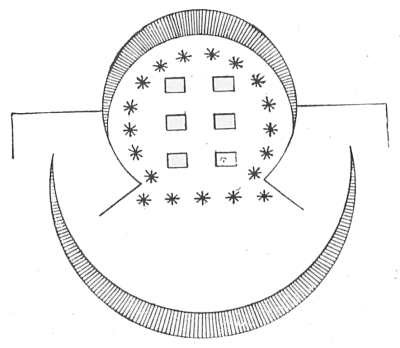
DIAGRAM OF OUR FOREST CAMPS.
The advance guard will "blaze" the path followed, cut down obstructing creepers, and, on arrival at camp, set to at once for building the boma or bushfence. As fast as each company arrives assistance must be given for this important work of defence. No camp is to be considered complete until it is fenced around by bush or trees. Those unemployed in this duty will erect tents.
The boma must be round with two gates well masked by at least five yards of bush.
The diameter of the camp should be about 250 feet. Tents and baggage piled in the centre, the huts will range around an inner circle of about 200 feet in diameter.
The above relates only to the circumstances attending the transit of a caravan through a dangerous country, unattended by more than the troubles naturally arising from the impulsive attacks of savages.
The pulse of the country which we shall traverse will be felt by the advance guard, of course. If the obstacles in the front are serious, and threaten to be something more than a mere impulse, or temporary, messages will be sent to the main body announcing their character.
Wherever practicable we shall camp in villages, if the natives have deserted them, for the sake of obtaining food, but such villages must be rendered defensive at once. Officers should remember that it is in the 1887. June 26. Yambuya. nature of their black soldiers, Soudanese, Somalis or Zanzibaris, to be thoughtless and indifferent, to scatter themselves about in the most heedless manner. They must take my assurance that more lives are lost in this manner than by open warfare. Therefore their men's lives I consider are in the hands of their officers, and the officer who will not relax his energy and rigid enforcement of orders until everything is made snug and tight for the night, will be the most valuable assistant in this Expedition for me. Arriving at the intended halting place for the night, if a village, the officer should first cast his eyes about for lodgment of his people; select such as will be uniform with those already occupied by the preceding company, and those to be occupied by the succeeding company or companies; then turn to and destroy all those lying without the occupied circle, or use their timbers, all material in the vicinity to defend his quarters from night attack by fire or spear. A cue will be given when and how to do things by the conduct of the advance guard, but the officer must not fail to ascertain what this cue is, nor wait to be told every petty detail. He must consider himself as the Father of his Company, and act always as a wise leader should act.
At all such village camps, Lieutenant Stairs will see to the nightly guards being placed at the more accessible points, every company serving out details as may be necessary.
During the first week we will not attempt any very long marches, that the people and ourselves may be broken in gently, but after a fourth of the distance has been made the marches will sensibly lengthen, and I anticipate that, before the half of the journey has been performed, we shall be capable of making wonderful progress.
Further memoranda will be furnished when necessary.
Yambuya. (Signed) Henry M. Stanley.
June 26th, 1887. Commanding Expedition.
I close this chapter with a quotation from my diary made on the last evening.
"Yambuya, June 27th.—Our men claimed a holiday to-day because it had been deferred until the steamers were despatched, and the camp was fortified for the protection of the garrison. Numbers of things had also to be done. Companies had to be re-organized, since several had sickened since leaving Bolobo, the weak had to be picked out, and the four companies selected for the march ought to be in as perfect condition as possible. Our pioneer's tools required numbering. Out of one hundred bill-hooks there were only twenty-six, out of one hundred axes there were left twenty-two, out of one hundred hoes there were only sixty-one, out of one hundred shovels there were but sixty-seven. All the rest had been stolen, and sold to the natives or thrown away. It is a trying work to look after such reckless people.
1887. June 27. Yambuya. "Three hundred and eighty-nine souls will march to-morrow—God permitting—into the absolutely unknown. From a native I have heard of names of tribes, or sections of tribes, but of their strength or disposition I know nothing.
"Yesterday we made blood-brotherhood with one of the chiefs of Yambuya. As the Major was Commandant of the post, he went bravely through the ceremony, which was particularly disgusting. On the flowing blood a pinch of dirty salt was placed, and this had to be licked. The chief performed his part as though he loved it. The Major looked up and saw the cynical faces of his friends and was mortified.
"'To ensure peace!'
"'Even so,' replied the Major, and sacrificed his taste.
"These forest natives have not been able to win any great regard from me yet. They are cowardly, and at the same time vicious. They lie oftener than any open country folk. I do not credit any statement or profession made by them. At the same time I hope that after better acquaintance there will be a change. This chief received a liberal gift from the hand of the Major, and in return he received a fortnight-old chick and a feathered bonnet of plaited cane. The oft-promised goat and ten fowls had not yet been seen. And the blood of a Soudanese soldier has been spilled, and we have not avenged it. We are either so poor in spirit, or so indifferent to the loss of a man, that a stalwart soldier, worth twenty of these natives, can be slain unavenged. Not only that, but we entreat them to come often and visit us, for they have fish and goats, fowls, eggs, and what not to sell of which we would be buyers. This perhaps will go on for some weeks more.
"It is raining to-night, and the morrow's march will be an uncomfortable one. Stairs is so sick that he cannot move, and yet he is anxious to accompany us. It is rather rash to undertake carrying a man in his condition, though, if death is the issue, it comes as easy in the jungle as in the camp. Dr. Parke has made me exceedingly uncomfortable by saying that it is enteric 1887. June 27. Yambuya. fever. I lean to bilious fever. We shall put him in a hammock and trust for a favourable issue."
The Advance Force will consist of:—
No. 1 company
90
men and boys
99
rifles
No. 2 company
113
men and boys
85
rifles
No. 3 company
90
men and boys
87
rifles
No. 4 company
90
men and boys
86
rifles
Officers—Self
1
men and boys
..
Officers—Stairs
1
men and boys
..
Officers—Nelson
1
men and boys
..
Officers—Jebhson
1
men and boys
..
European servant
1
men and boys
..
——
——
389
357
rifles
The garrison of Yambuya consists of:—
Soudanese
44
men
44
rifles
Zanzibari
71
men
38
rifles
Barttelot's servants
3
men
..
Jameson's servants
2
men
Sowahis
5
men
Sick men
2
men
Barttelot personally
1
men
8
rifles
Jameson personally
1
men
2
rifles
——
——
129
87
rifles
——
——
Contingent at Bolobo to be joined to garrison of Yambuya:—
Zanzibaris
128
men and boys
52
rifles
John Rose Troup
1
men and boys
Herbert Ward
1
men and boys
William Bonny
1
men and boys
——
——
131
men
52
rifles
Advance force
389
men
357
rifles
Yambuya garrison
129
men
87
rifles
Bolobo, Kinshassa, &c.
131
men
52
rifles
——
——
649
men
496
rifles
——
——
Loss of men from Zanzibar to
Yambuya
57
men
28
rifles
——
——
706
men
524
rifles
——
——
CHAPTER VII.
TO PANGA FALLS.
An African road—Our mode of travelling through the forests—Farewell to Jameson and the Major—160 days in the forest—The Rapids of Yambuya—Attacked by natives of Yankonde—Rest at the village of Bahunga—Description of our march—The poisoned Skewers—Capture of six Babali—Dr. Parke and the bees—A tempest in the forest—Mr. Jephson puts the steel boat together—The village of Bukanda—Refuse heaps of the villages—The Aruwimi river scenery—Villages of the Bakuti and the Bakoka—The Rapids of Gwengweré—The boy Bakula-Our "chop and coffee"—The islands near Bandangi—The Baburu dwarfs—The unknown course of the river—The Somalis—Bartering at Mariri and Mupé—The Aruwimi at Mupé—The Babé manners, customs, and dress—Jephson's two adventures—Wasp Rapids—The chief of the Bwamburi—Our camp at My-yui—Canoe accident—An abandoned village—Arrival at Panga Falls—Description of the Falls.
1887. June 28. Yambuya. An African road generally is a foot-track tramped by travel to exceeding smoothness and hardness as of asphalt when the season is dry. It is only twelve inches wide from the habit of the natives to travel in single file one after another. When such a track is old it resembles a winding and shallow gutter, the centre has been trodden oftener than the sides—rain-water has rushed along and scoured it out somewhat—the sides of the path have been raised by humus and dust, the feet of many passengers have brushed twigs and stones and pressed the dust aside. A straight path would be shorter than the usual one formed by native travel by a third in every mile on an average. This is something like what we hoped to meet in defiling out of the gate of the intrenched camp at Yambuya, because during four preceding Expeditions into Africa we had never failed to follow such a track for hundreds of miles. Yambuya consisted of a series villages. Their inhabitants must have neighbours to the 1887. June 28. Yambuya. Eastward as well as to the Southward or Westward. Why not?
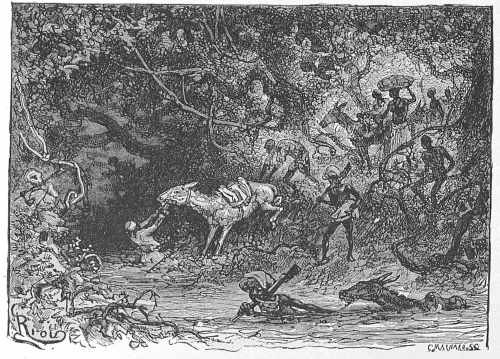
MARCHING THROUGH THE FOREST.
We marched out of the gate, company after company in single file. Each with its flag, its trumpeter or drummer, each with its detail of supernumeraries, with fifty picked men as advance guard to handle the bill-hook and axe, to cut saplings, "blaze," or peel a portion of the bark of a tree a hand's-breadth, to sever the leaves and slash at the rattan, to remove all obtrusive branches that might interfere with the free passage of the hundreds of loaded porters, to cut trees to lay across streams for their passage, to form zeribas or bomas of bush and branch around the hutted camp at the end of the day's travel. The advance guard are to find a path, or, if none can be found, to choose the thinnest portions of the jungle and tunnel through without delay, for it is most fatiguing to stand in a heated atmosphere with a weighty load on the head. If no thinner jungle can be found, then through anything, however impenetrable it may appear; they must be brisk—"chap-chap"—as we say, or an ominous murmur will rise from the impatient carriers 1887. June 28. Yambuya. behind. They must be clever and intelligent in wood-craft; a greenhorn, or as we call him "goee-goee," must drop his bill-hook, and take the bale or box. Three hundred weary fellows are not to be trifled with, they must be brave also—quick to repel assault—arrows are poisonous, spears are deadly—their eyes must be quick to search the gloom and shade, with sense alert to recognition, and ready to act on the moment. Dawdlers and goee-goees are unbearable; they must be young, lithe, springy—my 300 behind me have no regard for the ancient or the corpulent—they would be smothered with chaff and suffocated with banter. Scores of voices would cry out, "Wherein lies this fellow's merit? Is it all in his stomach? Nay, it is in his wooden back—tut—his head is too big for a scout. He has clearly been used to hoeing. What does the field hand want on the Continent? You may see he is only a Banian slave! Nay, he is only a Consul's freed man! Bosh! he is a mission boy." Their bitter tongues pierce like swords through the armour of stupidity, and the bill-hooks with trenchant edges are wielded most manfully, and the bright keen axes flash and sever the saplings, or slice a broad strip of bark from a tree, and the bush is pierced, and the jungle gapes open, and fast on their heels continuously close presses the mile-long caravan.
This is to be the order, and this the method of the march, and I have stood observing the files pass by until the last of the rear guard is out of the camp, and the Major and Jameson and the garrison next crowd out to exchange the farewell.
"Now, Major, my dear fellow, we are in for it. Neck or nothing! Remember your promise and we shall meet before many months."
"I vow to goodness. I shall be after you sharp. Let me once get those fellows from Bolobo and nothing shall stop me."
"Well, then, God bless you—keep a stout heart—and Jameson—old man—the same to you."
Captain Nelson, who heard all this, stepped up in his turn to take a parting grasp, and I strode on to the 1887. June 28. Yambuya. front, while the Captain placed himself at the head of the rear guard.
The column had halted at the end of the villages or rather the road that Nelson the other day had commenced.
"Which is the way, guide?" I asked to probably the proudest soul in the column—for it is a most exalted position to be at the head of the line. He was in a Greekish costume with a Greekish helmet à la Achilles.
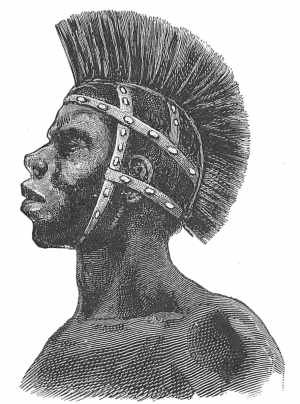
THE KIRANGOZI, OR FOREMOST MAN.
"This, running towards the sunrise," he replied.
"How many hours to the next village?"
"God alone knows," he answered.
"Know ye not one village or country beyond here?"
"Not one; how should I?" he asked.
This amounted to what the wisest of us knew.
"Well, then, set on in the name of God, and God be ever with us. Cling to any track that leads by the river until we find a road."
"Bismillah!" echoed the pioneers, the Nubian trumpets 1887. June 28. Yambuya. blew the signal of "move on," and shortly the head of the column disappeared into the thick bush beyond the utmost bounds of the clearings of Yambuya.
This was on the 28th day of June, and until the 5th of December, for 160 days, we marched through the forest, bush and jungle, without ever having seen a bit of greensward of the size of a cottage chamber floor. Nothing but miles and miles, endless miles of forest, in various stages of growth and various degrees of altitude, according to the ages of the trees, with varying thickness of undergrowth according to the character of the trees which afforded thicker or slighter shade. It is to the description of the march through this forest and to its strange incidents I propose to confine myself for the next few chapters, as it is an absolutely unknown region opened to the gaze and knowledge of civilized man for the first time since the waters disappeared and were gathered into the seas, and the earth became dry land. Beseeching the reader's patience, I promise to be as little tedious as possible, though there is no other manuscript or missal, printed book or pamphlet, this spring of the year of our Lord 1890, that contains any account of this region of horrors other than this book of mine.
With the temperature of 86° in the shade we travelled along a path very infrequently employed, which wound under dark depths of bush. It was a slow process, interrupted every few minutes by the tangle. The bill-hooks and axes, plied by fifty men, were constantly in requisition; the creepers were slashed remorselessly, lengths of track one hundred yards or so were as fair as similar extents were difficult.
At noon we looked round the elbow of the Aruwimi, which is in view of Yambuya, and saw above, about four miles, another rapid with its glancing waters as it waved in rollers in the sunshine; the rapids of Yambuya were a little below us. Beneath the upper rapids quite a fleet of canoes hovered about it. There was much movement and stir, owing, of course, to the alarm that the Yambuyas had communicated to their neighbours. At 4 P.M. we observed that the point we had gazed at 1887. June 28. Yakondé. abreast of the rapids consisted of islands. These were now being crowded with the women and children of Yankondé, whom as yet we had not seen. About a hundred canoes formed in the stream crowded with native warriors, and followed the movements of the column as it appeared and disappeared in the light and into the shadows, jeering, mocking, and teasing.
The head of the column arrived at the foot of a broad cleared road, twenty feet wide and three hundred yards long, and at the further end probably three hundred natives of the town of Yankondé stood gesticulating, shouting, with drawn bows in their hands. In all my experience of Africa I had seen nothing of this kind. The pioneers halted, reflecting, and remarking somewhat after this manner: "What does this mean? The pagans have carved a broad highway out of the bush to their town for us, and yet there they are at the other end, ready for a fight! It is a trap, lads, of some kind, so look sharp."
With the bush they had cut they had banked and blocked all passage to the forest on either side of the road for some distance. But, with fifty pairs of sharp eyes searching around above and below, we were not long in finding that this apparent highway through the bush bristled with skewers six inches long sharpened at both ends, which were driven into the ground half their length, and slightly covered with green leaves so carelessly thrown over them that we had thought at first these strewn leaves were simply the effect of clearing bush.
Forming two lines of twelve men across the road, the first line was ordered to pick out the skewers, the second line was ordered to cover the workers with their weapons, and at the first arrow shower to fire. A dozen scouts were sent on either flank of the road to make their way into the village through the woods. We had scarcely advanced twenty yards along the cleared way before volumes of smoke broke out of the town, and a little cloud of arrows came towards us, but falling short. A volley was returned, the skewers were fast being picked out, and an advance was steadily 1887. June 28. Yakondé. made until we reached the village at the same time that the scouts rushed out of the underwood, and as all the pioneers were pushed forward the firing was pretty lively, under cover of which the caravan pressed through the burning town to a village at its eastern extremity, as yet unfired.
Along the river the firing was more deadly. The very noise was sufficient to frighten a foe so prone as savages to rely on the terrors of sound, but unfortunately the noise was as hurtful as it was alarming. Very many, I fear, paid the penalty of the foolish challenge. The blame is undoubtedly due to the Yambuyas, who must have invented fables of the most astounding character to cause their neighbours to attempt stopping a force of nearly four hundred rifles.
It was nearly 9 P.M. before the rear-guard entered camp. Throughout the night the usual tactics were resorted to by the savages to create alarm and disturbance, such as vertically dropping assegais and arrows heavily tipped with poison, with sudden cries, whoops, howls, menaces, simultaneous blasts of horn-blowing from different quarters, as though a general attack was about to be made. Strangers unacquainted with the craftiness of these forest satyrs might be pardoned for imagining that daylight only was required for our complete extermination. Some of these tactics I knew before in younger days, but there was still something to be gleaned from the craft of these pure pagans. The camp was surrounded by sentries, and the only orders given were to keep strict silence and sharpen their eyesight.
In the morning a narrow escape was reported. A man had wakened to find a spear buried in the earth, penetrating his sleeping cloth and mat on each side of him, slightly pinning him to his bedding. Two were slightly wounded with arrows.
We wandered about for ten minutes or so looking for a track next morning, and at last discovered one leading through a vast square mileage of manioc fields, 1887. June 28. Yakondé. and at the little village of Bahunga, four miles S.E. of Yankondé, we gladly rested, our object being not to rush at first setting out after a long river voyage, but to accustom the people little by little to the long journey before them.
On the 30th we lit on a path which connected a series of fourteen villages, each separate and in line, surrounded by their respective fields, luxuriant with crops of manioc, or, as some call it, the cassava. We did not fail to observe, however, that some disaster had occurred many months before, judging from the traces. The villages we passed through were mostly newly built, in the sharp, conical—candle-extinguisher—or rather four-angled spiry type; burnt poles, ruins of the former villages, marked the sites of former dwellings. Here and there were blazings on trees, and then I knew that Arabs and Manyuema must have visited here—probably Tippu-Tib's brother.
The following day our march was through a similar series of villages, twelve in number, with a common, well-trodden track running from one to another. In this distance sections of the primeval forest separated each village; along the track were pitfalls for some kind of large forest game, or bow-traps fixed for small animals, such as rabbits, squirrels, rats, small monkeys. In the neighbourhood of each village the skewers were plentiful in the ground, but as yet no hurt had been received from them.
Another serious inconvenience of forest travel was experienced on this day. Every fifty yards or so a great tree, its diameter breast high, lay prostrate across the path over which the donkeys had to be assisted with a frequency that was becoming decidedly annoying. Between twenty and fifty of these had to be climbed over by hundreds of men, not all of whom were equally expert at this novel travelling, and these obstructions by the delays thus occasioned began to be complained of as very serious impediments. The main approaches to the many villages were studded with these poisoned skewers, which made every one except the booted whites tread 1887. July 1. Yakondé. most gingerly. Nor could the Europeans be altogether indifferent, for, slightly leaning, the skewer was quite capable of piercing the thickest boot-leather and burying the splinters of its head deep in the foot—an agony of so dreadful a nature that was worth the trouble of guarding against.
At 3 P.M. we camped near some pools overhung by water lilies far removed from a village, having had three wounded during the traverse through the settlements.
This morning, about three hours before dawn, the camp was wakened by howls, and loud and continued horn-blowing. These were shortly after hushed, and the voices of two men were heard so clear, and distinct that many like myself attempted to pierce the intense darkness in the vain effort to see these midnight orators.
The first Speaker said, "Hey, strangers, where are you going?"
The Parasite echoed, "Where are you going?"
Speaker. This country has no welcome for you.
Parasite. No welcome for you.
Speaker. All men will be against you.
Parasite. Against you.
Speaker. And you will be surely slain.
Parasite. Surely slain.
Speaker. Ah-ah-ah-ah-ah-aah.
Parasite. Ah-ah-aaah.
Speaker. Ooh-ooh-ooh-ooh-ooooh.
Parasite. Ooh-ooh-ooooooh.
This parasite was such a palpable parasite, with such a sense of humour—that it raised such a chorus of laughter so sudden, startling, and abrupt, that scared speaker and parasite away in precipitate haste.
At dawn of the 2nd, feeling somewhat uneasy at the fact that the track which brought us to these pools was not made by man but by elephants, and feeling certain that the people had made no provision of food beyond the day, I sent 200 men back to the villages to procure each a load of manioc. By the manner these men performed this duty, the reflection came into my mind that they had little or no reasoning faculties, and that not a 1887. July 2. Yakondé. half of the 389 people then in the camp would emerge out of Africa. They were now brimful of life and vitality—their rifles were perfect, their accoutrements were new, and each possessed 10 rounds of cartridges. With a little care for their own selves and a small portion of prudence, there was no reason why they should not nearly all emerge safe and sound, but they were so crude, stolid, unreasoning, that orders and instructions were unheeded, except when under actual supervision, and, to supervise them effectually, I should require 100 English officers of similar intelligence and devotion to the four then with me. In the meantime they will lose their lives for trifles which a little sense would avoid, and until some frightful calamity overtakes them I shall never be able thoroughly to impress on their minds that to lose life foolishly is a crime.
A party of scouts were also sent ahead along the track to observe its general direction, and, about the same time that the foragers returned, the scouts returned, having captured six natives in the forest. They belonged to a tribe called the Babali, and were of a light chocolate in hue, and were found forming traps for game.
As we endeavoured to draw from them some information respecting the country to which the track led, they said, "We have but one heart. Don't you have two," which meant, Do not speak so fairly to us if you mean any harm to us, and like all natives they asserted strongly that they did not eat human meat, but that the custom was practised by the Babanda, Babali, Babukwa tribes, occupying the bank of the Aruwimi above Yankondé.
Soon after this interview with the natives, Dr. Parke, observing the bees which fluttered about, had mentioned to one of his brother officers that he did not think they stung at all, upon which at the same moment a vicious bee settling in his neck drove its sting into it to punish him for his scornful libel. He then came to me and reported the fact as a good joke, whereupon a second bee attacked and wounded him almost in the same spot, drawing from him an exclamation of pain. "By Jove! 1887. July 2. Yakondé. but they do sting awfully, though." "Just so," said I; "nothing like experience to stimulate reason."
After distributing the manioc, with an injunction to boil the roots three times in different waters, we resumed the march at 1 P.M. and camped at 4 o'clock.
The next day left the track and struck through the huge towering forest and jungly undergrowth by compass. My position in this column was the third from the leader, so that I could direct the course. In order to keep a steady movement, even if slow, I had to instruct the cutters that each man as he walked should choose an obstructing lliané, or obtrusive branch of bush, and give one sharp cut and pass on—the two head men were confining themselves to an effective and broad "blaze" on the trees, every ten yards or so, for the benefit of the column, and, as the rear party would not follow us for perhaps two months, we were very particular that these "blazes" should be quite a hand's-breadth peel of bark.
Naturally penetrating a trackless wild for the first time the march was at a funereal pace, in some places at the rate of 400 yards an hour, in other more open portions, that is of less undergrowth, we could travel at the rate of half, three-quarters, and even a mile per hour—so that from 6.30 A.M. to 11 A.M. when we halted for lunch and rest, and from 12.30 P.M., to 3 o'clock or 4 P.M. in from six to seven hours per day, we could make a march of about five miles. On the usual African track seen in other regions we could have gone from fourteen to eighteen miles during the same time. Therefore our object was to keep by settlements, not only to be assured of food, but in the hope of utilizing the native roads. We shall see later how we fared.
At 4 P.M. of this day we were still on the march, having passed through a wilderness of creeks, mud, thick scum-faced quagmires green with duckweed into which we sank knee-deep, and the stench exhaled from the fetid slough was most sickening. We had just emerged out of this baneful stretch of marshy ground, intersected by lazy creeks and shallow long stream-shaped pools, 1887. July 3. Yakondé. when the forest became suddenly darkened, so dark that I could scarcely read the compass, and a distant murmur increasing into loud soughing and wrestling and tossing of branches and groaning of mighty trees warned us of the approach of a tempest. As the ground round about was most uninviting, we had to press on through the increasing gloom, and then, as the rain began to drip, we commenced to form camp. The tents were hastily pitched over the short scrubby bush, while bill-hooks crashed and axes rang, clearing a space for the camp. The rain was cold and heavily dripped, and every drop, large as a dollar on their cotton clothes, sent a shiver through the men. The thunder roared above, the lightning flashed a vivid light of fire through the darkness, and still the weary hungry caravan filed in until 9 o'clock. The rain was so heavy that fires could not be lit, and until three in the morning we sat huddled and crouching amid the cold, damp, and reeking exhalations and minute spray. Then bonfires were kindled, and around these scores of flaming pyramids the people sat, to be warmed into hilarious animation, to roast the bitter manioc, and to still the gnawing pain of their stomachs.
On the 4th we struck N. by E., and in an hour heard natives singing in concert afar off. We sent scouts ahead to ascertain what it meant. We presently heard firing which seemed to approach nearer. We mustered the men in the nearest company, stacked goods and deployed them as skirmishers. Then messengers came and reported that the scouts had struck the river, and, as they were looking upon it, a canoe advanced into view with its crew standing with drawn bows and fixed arrows, which were flown at them at once, and compelled the scouts to fire. We then resumed the march, and at 8 A.M. we were on the river again, in time to see a line of native canoes disappearing round a bend on the opposite bank, and one canoe abandoned tied to the bank with a goat.
Observing that the river was calm and free from rapids, and desirous of saving the people from as much 1887. July 4. Yakondé. labour as circumstances would offer, the steel boat sections were brought up to the bank, and Mr. Jephson, whose company had special charge of the Advance, commenced to fit the sections together. In an hour the forty-four burdens, which the vessel formed, had been attached together and fitted to their respective places and launched. As the boat weighed forty-four loads and had a capacity of fifty loads, and at least ten sick, we could then release ninety-eight people from the fatigue of bearing loads and carrying Lieutenant Stairs, who was still very ill. Mr. Jephson and crew were despatched across river and the goat secured.
As the Advance was in the river, it was necessary for the column to cling to the bank, not only for the protection of the boat, but to be able to utilize the stream for lessening labour. Want of regular food, lack of variety, and its poor nutritive qualities, coupled with the urgency which drove us on, requiring long marches and their resulting fatigue, would soon diminish the strength of the stoutest. A due regard for the people therefore must be shown, and every means available for their assistance must be employed. Therefore, the boat keeping pace with the column, we travelled up-stream until 3 P.M. and camped.
On the 5th the boat and column moved up, as on the day previous, and made six-and-half miles. The river continued to be from 500 to 800 yards wide. The bank was a trifle more open than in the interior, though frequently it was impossible to move before an impenetrable mass of jungle had been tunnelled to allow our passage under the vault of close network of branch and climber, cane, and reed above. At 2.30 we reached the village of Bukanda. We had come across no track, but had simply burst out of the bush and a somewhat young forest with a clearing. In the middle of the clearing by the river side was the village. This fact made me think, and it suggested that if tracks were not discoverable by land, and as the people were not known to possess the power of aerial locomotion, that communication was maintained by water.
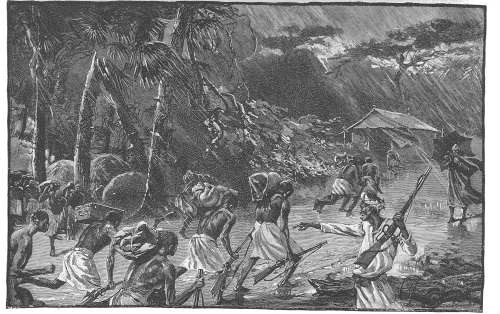
IN THE NIGHT AND RAIN IN THE FOREST.
1887. July 5. Bukanda. We had reason to rejoice at the discovery of a village, for since the 2nd the caravan subsisted on such tubers of manioc as each man took with him on that date. Had another day passed without meeting with a clearing we should have suffered from hunger.
It was evening before the boat appeared, the passage of rapids and an adventure with a flotilla of eleven canoes had detained her. The canoes had been abandoned in consequence, and the commander of the boat had secured them to an island. One was reported to be a capacious hollow log, capable of carrying nearly as much as the boat. Since the river was the highway of the natives, we should be wise to employ the stream, by which we should save our men, and carry our sick as well as a reserve of food. For we had been narrowly brought to the verge of want on the last day, and we were utter strangers in a strange land, groping our way through darkness. The boat was sent back with an extra crew to secure the canoe and paddle her up to our camp.
Of course Bukanda had been abandoned long before we reached it—the village of cone huts was at our disposal—the field of manioc also. This custom also was unlike anything I had seen in Africa before. Previously the natives may have retired with their women, but the males had remained with spear and target, representing ownership. Here the very fowls had taken to flight. It was clearly a region unsuitable for the study of ethnology.
At noon of the 6th we defiled out of Bukanda refurnished with provisions, and two hours later were in camp in uninhabited space. We had devoted the morning to cleaning and repairing rifles—many of whose springs were broken.
Some facts had already impressed themselves upon us. We observed that the mornings were muggy and misty—that we were chilly and inclined to be cheerless in consequence; that it required some moral courage to leave camp to brave the cold, damp, and fogginess without, to brave the mud and slush, to ford creeks up to the waist in water; that the feelings were terribly 1887. July 6. Bukanda. depressed in the dismal twilight from the want of brightness and sunshine warmth; and the depression caused by the sombre clouds and dull grey river which reflected the drear daylight. The actual temperature on these cold mornings was but seventy to seventy-two degrees—had we judged of it by our cheerlessness it might have been twenty degrees less.
The refuse heaps of the little villages were large and piled on the edge of the bank. They were a compost of filth, sweepings of streets and huts, peelings of manioc, and often of plantains with a high heap of oyster-shells. Had I not much else to write about, an interesting chapter on these composts, and the morals, manners, and usages of the aborigines might be written. Just as Owen could prefigure an extinct mammoth of the dead ages from the view of a few bones, the history of a tribe could be developed by me out of these refuse heaps. Revelling in these fetid exhalations were representatives of many insect tribes. Columns of ants wound in and out with more exact formation than aborigines could compose themselves, flies buzz in myriads over the heaps, with the murmur of enjoyment, butterflies which would have delighted Jameson's soul swarmed exulting in their gorgeous colours, and a perfect cloud of moths hovered above all.
The villages of the Bakuti were reached on the 7th, after seven hours' slow marching and incessant cutting. I occupied a seat in the boat on this day and observed that the banks were from six to ten feet above the river on either side, that there were numerous traces of former occupation easily detected despite the luxuriance of the young forest that had grown up and usurped the space once occupied by villages and fields; that either wars or epidemics had disturbed the inhabitants twenty years ago, and that as yet only one crocodile had been seen on the Aruwimi, and only one hippo, which I took to be a sure sign that there was not much pasture in this region.
As the rowers urged the boat gently up the stream, and I heard the bill-hooks and axes carving away 1887. July 7. Bakuti. through bush and brake tangle and forest without which scarcely a yard of progress could be made, I regretted more than ever that I had not insisted on being allowed to carry out my own plan of having fifteen whale-boats. What toil would have been saved, and what anxiety would have been spared me.
On the 9th we gained, after another seven hours' toiling and marching, the villages of the Bakoka. Already the people began to look jaded and seedy. Skewers had penetrated the feet of several, ulcers began to attract notice by their growing virulence, many people complained of curious affections in the limbs. Stairs was slowly recovering.
We had passed so many abandoned clearings that our expedition might have been supported for weeks by the manioc which no owner claimed. It was very clear that internecine strife had caused the migrations of the tribes. The Bakoka villages were all stockaded, and the entrance gates were extremely low.
The next day we passed by four villages all closely stockaded, and on the 10th came to the rapids of Gwengweré. Here there were seven large villages bordering the rapids and extending from below to above the broken water. All the population had fled probably to the opposite main, or to the islands in mid-river, and every portable article was carried away except the usual wreckage of coarse pottery, stools, and benches, and back rests. The stockades were in good order and villages intact. In one large village there were 210 conical huts, and two square sheds used for public assemblies and smithies. This occupied a commanding bluff sixty feet above the river, and a splendid view of a dark grey silver stream, flanked by dense and lofty walls of thickest greenest vegetation, was obtained.
Lieutenant Stairs was fast recovering from his long attack of bilious fever; my other companions enjoyed the best of health, though our diet consisted of vegetables, leaves of the manioc and herbs bruised and made into patties. But on this day we had a dish of weaver-birds furnished by the Doctor, who with his shot-gun 1887. July 10. Gwengweré. bagged a few of the thousands which had made their nests on the village trees.
On the 11th we marched about a mile to give the canoemen a chance to pole their vessels through the rapids and the column a rest. The day following marched six geographical miles, the river turning easterly, which was our course. Several small rapids were passed without accident. As we were disappearing from view of Gwengweré, the population was seen scurrying from the right bank and islands back to their homes, which they had temporarily vacated for our convenience. It seemed to me to be an excellent arrangement. It saved trouble of speech, exerted possibly in useless efforts for peace and tedious chaffer. They had only one night's inconvenience, and were there many caravans advancing as peaceably as we were, natural curiosity would in time induce them to come forward to be acquainted with the strangers.
Our people found abundant to eat in the fields, and around the villages. The area devoted to cultivation was extensive: plantains flourished around the stockades; herbs for potage were found in little plots close to the villages; also sufficient tobacco for smoking, and pumpkins for dessert, and a little Indian corn; but, alas, we all suffered from want of meat.
There were few aquatic birds to be seen. There were some few specimens of divers, fish eagles, and kingfishers. Somewhere, at a distance, a pair of ibis screamed; flocks of parrots whistled and jabbered in vain struggles to rob the solitude of the vast trackless forest of its oppressive silence; whip-poor-wills, and sunbirds, and weavers aided them with their varied strains; but insects, and flies, and moths were innumerable.
On the 12th we moved up as usual, starting at 6.30 A.M., the caravan preceding the boat and its consorts. Though proceeding only at the rate of a mile and a half per hour, we soon overhauled the struggling caravan, and passed the foremost of the pioneers. At 10 A.M. we met a native boy, called Bakula, of about fifteen years, floating down river on a piece of a canoe. He sprung aboard our 1887. July 12. Bandangi. boat with alacrity, and used his paddle properly. An hour later we rounded the lowest point of a lengthy curve, bristling with numerous large villages. The boy volunteer who had dropped to our aid from the unknown, called the lower village Bandangi, the next Ndumba, and the long row of villages above, the houses of the Banalya tribe. But all were deserted. We halted at Bandangi for lunch, and at 2 P.M. resumed our journey.
An hour's pull brought us to the upper village, where we camped. Our river party on this day numbered forty men; but, as we landed, we were lost in the large and silent village. I had counted thirteen villages—one of these numbered 180 huts. Assuming that in this curve there were 1300 huts, and allowing only four persons to each hut, we have a population of 5200.
At 5.30 appeared the advance guard of the column, and presently a furious tempest visited us, with such violent accompaniments of thunder and lightning as might have been expected to be necessary to clear the atmosphere charged with the collected vapours of this humid region—through which the sun appeared daily as through a thick veil. Therefore the explosive force of the electric fluid was terrific. All about us, and at all points, it lightened and shattered with deafening explosions, and blinding forks of flame the thick, sluggish, vaporous clouds. Nothing less than excessive energy of concentrated electricity could have cleared the heavy atmosphere, and allowed the inhabitants of the land to see the colour of the sky, and to feel the cheering influence of the sun. For four hours we had to endure the dreadful bursts; while a steady stream of rain relieved the surcharged masses that had hung incumbent above us for days. While the river party and advance guard were housed in the upper village, the rear guard and No. 4 Company occupied Bandangi, at the town end of the crescent, and we heard them shooting minute guns to warn us of their presence; while we vainly, for economical reasons, replied with the tooting of long ivory horns.
Such a large population naturally owned exclusive 1887. July 12. Bandangi. fields of manioc, plantations of bananas, and plantains, sugar-cane, gardens of herbs, and Indian corn, and as the heavy rain had saturated the ground, a halt was ordered.
By nine o'clock the rear guard was known to have arrived by Nelson's voice crying out for "chop and coffee"—our chop consisted of cassava cakes, a plantain or so roasted, and a mess of garden greens, with tea or coffee. Flesh of goat or fowl was simply unprocurable. Neither bird nor beast of any kind was to be obtained. Hitherto only two crocodiles and but one hippo had been discovered, but no elephant, buffalo, or antelope or wild hog, though tracks were numerous. How could it be otherwise with the pioneers' shouts, cries, noise of cutting and crushing, and pounding of trees, the murmur of a large caravan? With the continuous gossip, storytelling, wrangling, laughing or wailing that were maintained during the march, it was simply impossible. Progress through the undergrowth was denied without a heavy knife, machette, or bill-hook to sever entangling creepers and while an animal may have been only a few feet off on the other side of a bush, vain was the attempt to obtain view of it through impervious masses of vegetation.
In our boat I employed the halt for examining the islands near Bandangi. We discovered lengthy heaps of oyster-shells on one island, one of which was sixty feet long, ten feet wide, and four feet high; we can imagine the feasts of the bivalves that the aborigines enjoyed during their picnics, and the length of time that had elapsed since the first bivalve had been eaten. On my return I noticed through a bank-slip in the centre of the curve a stratum of oyster-shell buried three feet under alluvium.
Our native boy Bakula, informed us that inland north lived the Baburu, who were very different from the river tribes, that up river, a month's journey, would be found dwarfs about two feet high, with long beards; that he had once journeyed as far as Panga where the river tumbled from a height as high as the tallest tree, that the Aruwimi was now called Lui by the people of 1887. July 12. Bandangi. the left bank, but that to the Baburu on the right bank it was known as the Luhali. Bakula was an exceptionally crafty lad, a pure cannibal, to whom a mess of human meat would have been delectable. He was a perfect mimic, and had by native cunning protected himself by conforming readily to what he divined would be pleasing to the strangers by whom he was surrounded. Had all the native tribes adopted this boy's policy our passage through these novel lands would have been as pleasant as could be desired. I have no doubt that they possessed all the arts of craft which we admired in Bakula, they had simply not the courage to do what an accident had enabled him to carry out.
From Chief Bambi's town of the Banalya we moved to Bungangeta villages by river and land on the 15th. It was a stern and sombre morning, gloomy with lowering and heavy clouds. It struck me on this dull dreary morning, while regarding the silent flowing waters of the dark river and the long unbroken forest frontage, that nature in this region seems to be waiting the long expected trumpet-call of civilization—that appointed time when she shall awake to her duties, as in other portions of the earth. I compared this waiting attitude to the stillness preceding the dawn, before the insect and animal life is astir to fret the air with its murmur, before the day has awakened the million minute passions of the wilds; at that hour when even Time seems to be drowsy and nodding, our inmost thoughts appear to be loud, and the heart throbs to be clamorous. But when the young day peeps forth white and gray in the East the eyelids of the world lift up. There is a movement and a hum of invisible life, and all the earth seems wakened from its brooding. But withal, the forest world remains restful, and Nature bides her day, and the river shows no life; unlike Rip Van Winkle, Nature, despite her immeasurably long ages of sleep, indicates no agedness, so old, incredibly old, she is still a virgin locked in innocent repose.
What expansive wastes of rich productive land lie in this region unheeded by man! Populous though the 1887. July 15. Bungangeta. river banks are, they are but slightly disturbed by labour—a trifling grubbing of parts of the foreshore, a limited acreage for manioc, within a crater-like area in the bosom of the dark woods, and a narrow line of small cotes, wherein the savages huddle within their narrow circumference.
One of my amusements in the boat was to sketch the unknown course of the river—for as the aborigines disappeared like rats into their holes on one's approach I could gain no information respecting it. How far was it permissible for me to deviate from my course? By the river I could assist the ailing and relieve the strong. The goods could be transported and the feeble conveyed. Reserves of manioc and plantain could also be carried. But would a somewhat long curve, winding as high as some forty or fifty geographical miles north of our course, be compensated by these advantages of relief of the porters, and the abundance of provisions that are assuredly found on the banks? When I noted the number of the sick, and saw the jaded condition of the people, I felt that if the river ascended as far as 2° N., it was infinitely preferable to plunging into the centre of the forest.
The temperature of the air during the clouded morning was 75°, surface of the river 77°. What a relief it was to breathe the air of the river after a night spent in inhaling the close impure air in the forest by night!
On the 16th we possessed one boat and five canoes, carrying seventy-four men and 120 loads, so that with the weight of the boat sections, half of our men were relieved of loads, and carried nothing every alternative day. We passed by the mouth of a considerable affluent from the south-east, and camped a mile above it. The temperature rose to 94° in the afternoon, and as a consequence rain fell in torrents, preceded by the usual thunder roars and lightning flashes. Until 1 P.M. of the 17th the rain fell unceasingly. It would have been interesting to have ascertained the number of inches that fell during these nineteen hours' rain-pour. Few of the people enjoyed any rest; there was a general 1887. July 17. Lower Mariri. wringing of blankets and clothes after it ceased, but it was some hours before they recovered their usual animation. The aborigines must have been also depressed, owing to our vicinity, though if they had known what wealth we possessed, they might have freely parted with their goats and fowls for our wares.
The column camped at 3 P.M. opposite the settlement of Lower Mariri. Besides their immense wooden drums, which sounded the alarm to a ten-mile distance, the natives vociferated with unusual powers of lung, so that their cries could be heard a mile off. The absence of all other noises lends peculiar power to their voices.
The Somalis, who are such excellent and efficient servants in lands like the Masai, or dry regions like the Soudan, are perfectly useless in humid regions. Five of them declined to stay at Yambuya, and insisted on accompanying me. Since we had taken to the river I had employed them as boatmen, or rather did employ them when they were able to handle a paddle or a pole, but their physical powers soon collapsed, and they became mere passengers. On shore, without having undergone any exertion, they were so prostrated after a two hours' river voyage, that they were unable to rig shelter against rain and damp, and as they were thievish the Zanzibaris refused to permit them to approach their huts. The result was that we had the trouble each day to see that a share of food even was doled out to them, as they would have voluntarily starved rather than cut down the plantains above their heads.
From opposite Lower Mariri we journeyed to a spot ten miles below the Upper Mariri on the 18th. The canoes had only occupied 4 h. 15 m., but the land column did not appear at all.
On the 19th I employed the boat and canoe crews to cut a road to above a section of the rapids of Upper Mariri. This was accomplished in 2½ hours. We returned to camp in 45 minutes. Our pace going up was similar to that of the caravan, consequently an ordinary day's travel through the forest would be six miles. On returning to camp formed the column, and 1887. July 20. Upper Mariri. marched it to the end of our paths; the boat and canoes were punted up the rapids without accident, and in the afternoon the people foraged for food at a village a mile and a half above camp with happy results. On the 20th the advance column marched up and occupied the village.
About two hours after arrival some of the natives of Mariri came in a canoe and hailed us. We replied through Bakula, the native boy, and in a short time were able to purchase a couple of fowls, and during the afternoon were able to purchase three more. This was the first barter we had been able to effect on the Aruwimi. Mariri is a large settlement abounding in plantains, while at our village there were none. Two men, Charlie No. 1 and Musa bin Juma disappeared on this day. Within twenty-three days we had not lost a man.
No casualty had as yet happened, and good fortune, which had hitherto clung to us, from this date began to desert us. We were under the impression that those men had been captured by natives, and their heedless conduct was the text of a sermon preached to the men next morning when they were mustered for the march. It was not until thirteen months later that we knew that they had deserted, that they had succeeded in reaching Yambuya, and had invented the most marvellous tales of wars and disasters, which, when repeated by the officers at Yambuya in their letter to the Committee, created so much anxiety. Had I believed it had been possible that two messengers could have performed that march, we certainly had availed ourselves of the fact to have communicated authentic news and chart of the route to Major Barttelot, who in another month would be leaving his camp as we believed. From the village opposite Upper Mariri we proceeded to S. Mupé, a large settlement consisting of several villages, embowered in plantations. The chiefs of Mupé are Mbadu, Alimba, and Mangrudi.
On the 22nd Surgeon Parke was the officer of the day, and was unfortunate enough to miss the river, and strike through the forest in a wrong direction. He 1887. July 22. Mupé. finally struck a track on which the scouts found a woman and a large-eyed, brown-coloured child. The woman showed the route to the river, and was afterwards released. Through her influence the natives of N. Mupé on the right bank were induced to trade with us, by which we were enabled to procure a dozen fowls and two eggs.
The bed of the river in this locality is an undisturbed rock of fine-grained and hard, brick-coloured sandstone. This is the reason that the little rapids, though frequent enough, present but little obstacles to navigation. The banks at several places rose to about forty feet above the river, and the rock is seen in horizontal strata in bluffy form, in many instances like crumbling ruins of cut stone.
The sign of peace with these riverine natives appears to be the pouring of water on their heads with their hands. As new-comers approached our camp they cried out, "We suffer from famine, we have no food, but up river you will find plenty, Oh, 'monomopote'! (son of the sea)." "But we suffer from want of food, and have not the strength to proceed unless you give us some," we replied. Whereupon they threw us fat ears of Indian corn, plantains, and sugar-cane. This was preliminary to a trade, in doing which these apparently unsophisticated natives were as sharp and as exorbitant as any of the Wyyanzi on the Congo. The natives of Mupé are called Babé.
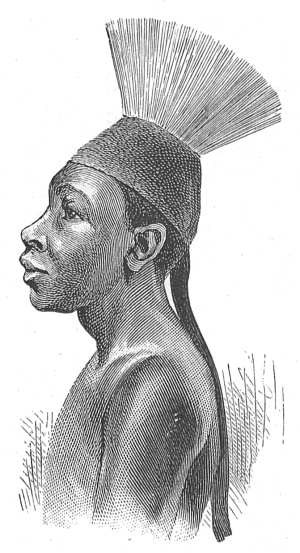
HEAD-DRESS—CROWN OF BRISTLES.
Trifles, such as empty sardine boxes, jam and milk cans, and cartridge cases, were easily barterable for sugar-cane, Indian corn, and tobacco. A cotton handkerchief would buy a fowl, goats were brought to our view, but not parted with. They are said to be the monopoly of chiefs. The natives showed no fixed desire for any speciality but cloth—gaudy red handkerchiefs. We saw some cowries among them, and in the bottom of a canoe we found a piece of an infantry officer's sword nine inches long. We should have been delighted to have heard the history of that sword, and the list of its owners since it left Birmingham. But we 1887. July 22. Mupé. could not maintain any lengthy conversation with them, our ignorance of the language, and their excitability prevented us from doing more than observing and interchanging words relating to peace and food with them. We can accept the bit of sword blade as evidence that their neighbours in the interior have had some contact with the Soudanese.
Neither in manners, customs or dress was there any very great difference between these natives and those belonging to the upper parts of the Upper Congo. Their head-dresses were of basket work decorated with red parrot feathers, monkey skin caps of grey or dark fur, with the tails drooping behind. The neck, arm and ankle ornaments were of polished iron, rarely of copper, never of brass.

PADDLE OF THE UPPER ARUWIMI OR ITURI.
They make beautiful paddles, finely carved like a long pointed leaf. "Senneneh" was the peaceful hail as in Manyuema, Uregga and Usongora, above Stanley Falls. The complexion of these natives is more ochreous than black. When a body of them is seen on the opposite bank, there is little difference of colour between their bodies and the reddish clayey soil of the landing-place. Much of this is due to the Camwood powder, and with this mixed with oil they perform their toilet. But protection from sunshine 1887. July 24. Mupé. considerably contributes to this light colour. The native boy, Bakula, for instance, was deprived of this universal cosmetic made of Camwood, and he was much lighter than the average of our Zanzibaris.
On the 24th, Mr. Jephson led the van of the column, and under his guidance we made the astonishing march of seven and a half geographical miles—the column having been compelled to wade through seventeen streams and creeks. During these days Jephson exhibited a marvellous vigour. He was in many things an exact duplicate of myself in my younger days, before years and hundreds of fevers had cooled my burning blood. He is exactly of my own height, build and weight and temperament. He is sanguine, confident, and loves hard work. He is simply indefatigable, and whether it is slushy mire or a muddy creek, in he enters, without hesitation, up to his knees, waist, neck or overhead it is all the same. A sybarite, dainty and fastidious in civilization, a traveller and labourer in Africa, he requires to be restrained and counselled for his own sake. Now these young men, Stairs, Nelson and Parke, are very much in the same way. Stairs is the military officer, alert, intelligent, who understands a hint, a curt intimation, grasps an idea firmly and realizes it to perfection. Nelson is a centurion as of old Roman times, he can execute because it is the will of his chief; he does not stay to ask the reason why; he only understands it to be a necessity, and his great vigour, strength, resolution, plain, good sense is at my disposal, to act, suffer or die; and Parke, noble, gentle soul, so tender and devoted, so patient, so sweet in mood and brave in temper, always enduring and effusing comfort as he moves through our atmosphere of suffering and pain. No four men ever entered Africa with such qualities as these. No leader ever had cause to bless his stars as I.
On this day Jephson had two adventures. In his usual free, impulsive manner, and with swinging gait he was directing the pioneers—crushing through the jungle, indifferent to his costume, when he suddenly sank out of sight into an elephant pit! We might 1887. July 24. Mupé. have imagined a playful and sportive young elephant crashing through the bushes, rending and tearing young saplings, and suddenly disappearing from the view of his more staid mamma. Jephson had intelligence, however, and aid was at hand, and he was pulled out none the worse. It was a mere amusing incident to be detailed in camp and to provoke a laugh.
He rushed ahead of the pioneers to trace the course to be followed, and presently encountered a tall native, with a spear in his hand, face to face. Both were so astonished as to be paralysed, but Jephson's impulse was that of a Berseker. He flung himself, unarmed, upon the native, who, eluding his grasp, ran from him, as he would from a lion, headlong down a steep bank into a creek, Jephson following. But the clayey soil was damp and slippery, his foot slipped, and the gallant Captain of the Advance measured his length face downwards with his feet up the slope, and such was his impetus that he slid down to the edge of the creek. When he recovered himself it was to behold the denizen of the woods, hurrying up the opposite bank and casting wild eyes at this sudden pale-faced apparition who had so disturbed him as he brooded over the prospect of finding game in his traps that day.
Our camp on this day was a favourite haunt of elephants from time immemorial. It was near a point round which the river raced with strong swirling currents. A long view of a broad silent river is seen upward, and one of a river disparted by a series of islands below.
On the 25th Captain Nelson led the column, Jephson was requested to assist me with the long narrow canoes laden with valuable goods, and to direct some of the unskilful "lubbers" who formed our crews. The boat led the way anchored above the dangerous and swirly point, and cast the manilla rope to the canoe crew, who, hauling by this cord drew the canoes to quiet water. Then rowing hard against the strong currents, at 11 A.M. we caught the head of the caravan gathered on the bank of a wide and dark sluggish creek, the Rendi, which lazily 1887. July 25. Wasp Rapids. flowed out of dark depths of woods. By one o'clock the ferriage was completed, and the column resumed its march, while we, on the river, betook ourselves to further struggles with the dangerous waves and reefs of what is now called Wasp Rapids, from the following incident.
These rapids extended for a stretch of two miles. Above them were the villages which became the scene of a tragic strife, as will be learned later in a subsequent chapter, and these settlements were the dear objects of our aims in order to obtain shelter and food.
Our first efforts against the rapids were successful. The current was swift and dangerous, breaking out into great waves now and then. For the first half-hour we were successful. Then began a struggle, rowing on one side hard and the starboard side crew grasping at overhanging bushes, two men poling, two men on the decked bow, with boat-hooks outstretched with their fangs ready to snatch at saplings for firm hold. I steered. We advanced slowly but steadily, a narrow rushing branch between rocky islets, and the bank was before us which raced over a reef, showing itself in yard square dots of rock above the waves. We elected to ascend this as in view of a capsize there was less fear of drowning. With noble spirits braced for an exciting encounter, we entered it. Eager hands were held out to catch at the branches, but at the first clutch there issued at this critical moment an army of fierce spiteful wasps and settled on our faces, hands, and bodies, every vulnerable spot, and stung us with the venom of fiends. Maddened and infuriated by the burning stings, battling with this vicious enemy, beset by reefs, and rocks, and dangerous waves, and whirling vortexes, we tore on with tooth and nail, and in a few minutes were a hundred yards above the awful spot. Then, clinging to the trees, we halted to breathe and sympathise with each other, and exchange views and opinions on the various stings of insects, bees, hornets, and wasps.
One asked my servant with a grim smile, "Did you say the other day that you believed there was much 1887. July 25. Wasp Rapids. honey in these brown paper nests of the wasps? Well, what do you think of the honey now? don't you think it is rather a bitter sort?" This raised a general laugh. We recovered our good temper, and resumed our work, and in an hour reached the village which the land party had occupied. The canoes crews, who followed us, seeing the battle with the wasps, fled across river, and ascended by the right bank. But the Somalis and Soudanese, more trustful in Allah, bravely followed our track, and were dreadfully stung; still, they were consoled by being able to exult over the Zanzibaris, the leader of which was Uledi, of the "Dark Continent."
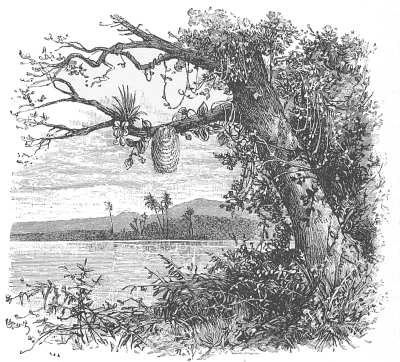
WASPS' NESTS, ETC.
"Oh," I remarked to Uledi, "it is not a brave thing you have done this day—to fly away from wasps."
"Oh, sir," he replied, "naked manhood is nowhere in such a scrape as that. Wasps are more dangerous than the most savage men."
1887. July 25. Wasp Rapids. The native settlement on the left bank is called Bandeya; the one facing opposite consists of the villages of the Bwamburi. North of the Bwamburi, a day's march, begins the tribes of the Ababua and the Mabode, who have a different kind of architecture from the steeply conical huts prevailing among the riverine tribes. The Mabodé are said to possess square houses with gable roofs, the walls are neatly plastered, and along the fronts are clay verandahs.
On the 26th we halted to rest and recuperate. Those of us who were attacked by the wasps suffered from a fever; the coxswain of the boat was in great distress. The following day the chief of the Bwamburi came over to pay us a visit, and brought us as a gift a month old chick, which was declined on the ground that we should feel we were robbing him were we to accept such a gift from a professedly poor man. His ornaments consisted of two small ivory tusks planed flat and polished, which hung suspended from a string made of grass encircling his neck. His head-dress was a long-haired monkey skin. We exchanged professions of amity and brotherhood, and commenced the march, and camped opposite Mukupi, a settlement possessing eight villages, on the 28th.
Two sturdy prisoners imparted to us strange information of a large lake called "No-uma," as being situate somewhere in the neighbourhood of a place called Panga. It was said to be many days' journey in extent. In the centre was a large island, so infested with serpents that natives dreaded to go near it; that from it flowed the Nepoko into the Nowellé, the name now given to the Aruwimi. After several days' march we discovered that the lake story was a myth, and that the Nepoko did not flow from the left bank of the Aruwimi.
Our camp on the 29th was opposite My-yui, a series of villages embowered amongst banana groves on the right bank. It was not long before we struck an acquaintance with this tribe. We quickly recognized a disposition on the part of the aborigines to be 1887. July 29. My-yui. sociable. A good report of our doings had preceded us. Trade commenced very pleasantly. Our people had cowries, beads, and brass rods, besides strange trifles to exchange for food. When the land column arrived, prices advanced somewhat, owing to the greater demand. It was reported that there were no settlements between our camp opposite My-yui and Panga; that we should be nine days performing the journey through the forest.
The next morning the bartering was resumed, because we wished to prepare provisions for several days; new ration currency had already been distributed to each man. But we were astonished to find that only three ears of Indian corn were given on this day for a brass rod twenty-eight inches in length, of the thickness of telegraph wire. At Bangala such a brass rod would have purchased five days' provisions per man in my days, and here was a settlement in the wilds where we could only obtain three ears of corn! For one fowl brass rods were demanded. Cowries were not accepted; beads they declined. The men were ravenously hungry; there were nine days' wilderness ahead. Wasp rapids was the nearest place below. We expostulated, but they were firm. The men then began to sell their cartridge-pouches for two plantains each. They were detected selling their ammunition at the rate of one cartridge for an ear of corn; a tin canteen purchased two. Bill-hooks and axes went next, and ruin stared in the face. The natives were driven away; one of Mugwye's (the chiefs) principal slaves was lifted out of his canoe by a gigantic Zanzibari, and word was sent to the natives that if there were no fair sales of food made as on the first day, that the prisoner would be taken away, and that we should cross over and help ourselves.
Having waited all the afternoon for the reappearance of food, we embarked at dawn on the 31st with two full companies, entered My-yui, and despatched the foragers. By 3 P.M. there was food enough in the camp for ten days.
1887. Aug. 1. Mambanga. In the afternoon of the 1st of August, the advance column was encamped opposite Mambanga. The river party met with an accident. Careless Soudanese were capsized, and one of the Zanzibari steersmen disobeying orders shoved his canoe under the branchy trees which spread out from the bank to the distance of fifty feet; and by the swift current was driven against a submerged branch, and capsized, causing a loss of valuable property—some of them being fine beads, worth four shillings a necklace. Six rifles were also lost.
The first death in the advance column occurred on the 2nd August, the 36th day of departure from Yambuya, which was a most extraordinary immunity considering the hardship and privations to which we were all subjected. Could we have discovered a settlement of bananas on the other bank, we should certainly have halted to recuperate for many days. A halt at this period of four or five days at a thriving settlement, would have been of vast benefit to all of us, but such a settlement had not been found, and it was necessary for us to march and press on until we could discover one.
We traversed a large village that had been abandoned for probably six months before we reached, and as it was the hour of camping, we prepared to make ourselves comfortable for the evening. But as the tents were being pitched, my attention was called to the cries made by excited groups, and hastening to the scene, heard that there was a dead body almost covered with mildew in a hut. Presently the discovery of another was announced and then another. This sufficed to cause us to hastily pack up again and depart from the dead men's village, lest we might contract the strange disease that had caused the abandonment of the village.
One of our poor donkeys, unable to find fitting sustenance in the region of trees and jungle, lay down and died. Another appeared weak and pining for grass, which the endless forest did not produce.
Opposite our camp on this day was the mouth of the Ngula River, an affluent on the north side. Within the river it appeared to be of a width of fifty yards.
1887. Aug. 3. Ngula River. On the 3rd two hills became visible, one bearing E.S.E., the other S.E. by E. 1/2 E., as we moved up the river. We camped at the point of a curve in the centre of which were two islands. Paying a visit to one of them we found two goats, at which we were so rejoiced, that long before evening one was slaughtered for the officers, and another to make broth for the sick. A flock of a hundred would have saved many a life that was rapidly fading away.
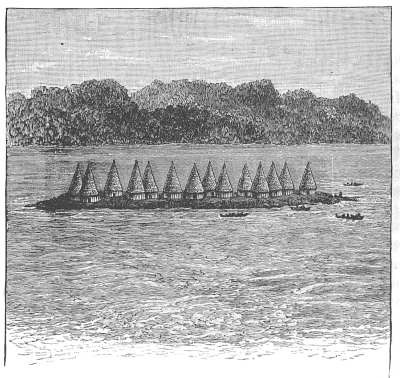
FORT ISLAND, NEAR PANGA FALLS.
The next day we arrived at Panga or the Nepanga Falls, about which we had heard so much from Bakula, the native boy.
The falls are fully thirty feet high, though at first view they appear to be double that height, by the great slope visible above the actual fall. They extend over a mile in length from the foot of the falls, to above the 1887. Aug. 4. Panga Falls. portage. They are the first serious obstacles to navigation we had encountered. They descend by four separate branches, the largest of which is 200 yards wide. They run by islets of gneissic rock, and afford cover to the natives of Panga, who when undisturbed, live upon a large island called Nepanga, one mile long and 300 yards wide, situated 600 yards below the Falls. This island contains three villages, numbering some 250 huts of the conical type. There are several settlements inland on both banks. The staple food consists of plantains, though there are also fields of manioc.
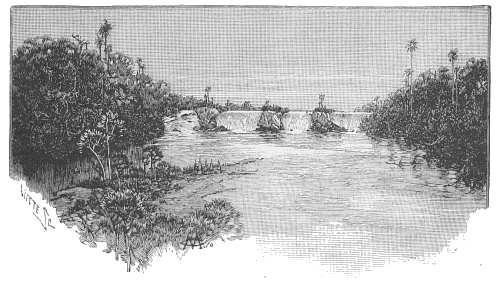
PANGA FALLS.
An unfortunate Zanzibari, as though he had vowed to himself to contribute largely to our ruin, capsized his canoe as he approached Nepanga, by which we lost two boxes of Maxim ammunition, five boxes of cowries, three of white beads, one of fancy beads, one box fine copper wire, cartridge pouches and seven rifles.
All things are savage in this region. No sooner had a solitary hippo sighted us than he gave chase, and nearly caught us. He was punished severely, and probably received his death wound. The fowls of Nepanga declined to be caught on the island of Nepanga, but evaded the foragers by flight into the 1887. Aug. 4. Panga Falls. jungle; the goats were restless, and combative, and very wild. Altogether we captured twelve, which gave us some hopes of being able to save some of our sick people. A few fish were obtained in the weirs and basket-nets.
The results of 3 days' foraging on islands, right and left banks were 250 lbs. of Indian corn, 18 goats, and as many fowls, besides a few branches of plantains, among 383 people. A number of villages and settlements were searched, but the natives do not appear to possess a sufficiency of food. They were said to be at war with a tribe called the Engweddé, and instead of cultivating live on banana stalks, mushrooms, roots, herbs, fish, and snails and caterpillars, varying this extraordinary diet by feeding on slain humanity. In such a region there were no inducements to stay, and we accordingly commenced the business of portage. Stairs' Company was detailed for clearing the canoe track, and to strew it with branches place athwart the road. No. 3 and 4 Companies hauled the canoes, and No. 1 Company carried the whale-boat bodily overland to the sound of wild music and song, and by the end of the 6th, after a busy day, we were encamped above the great Falls of Panga.
CHAPTER VIII.
FROM PANGA FALLS TO UGARROWWA'S.
Another accident at the Rapids—The village of Utiri—Avisibba settlement—Inquiry into a murder case at Avisibba—Surprised by the natives—Lieutenant Stairs wounded—We hunt up the enemy—The poisoned arrows—Indifference of the Zanzibaris—Jephson's caravan missing—Our wounded—Perpetual rain—Deaths of Khalfan, Saadi, and others—Arrival of caravan—The Mabengu Rapids—Mustering the people—The Nepoko river—Remarks by Binza—Our food supply—Reckless use of ammunition—Half-way to the Albert Lake—We fall in with some of Ugarrowwa's men—Absconders—We camp at Hippo Broads and Avakubi Rapids—The destroyed settlement of Navabi—Elephants at Memberri—More desertions—The Arab leader, Ugarrowwa—He gives us information—Visit to the Arab settlement—First specimen of the tribe of dwarfs—Arrangements with Ugarrowwa.
1887. Aug. 7. Panga Falls. In full view of this last camp there was an island in mid-river distant about two miles, that resembled a water battery, and a village lying low, apparently level with the face of the river. On exploring it on the 7th—by no means an easy task, so strong was the current sweeping down the smooth dangerous slope of river towards Panga—it appeared to have been originally a flat rocky mass of rock a few inches above high river, with inequalities on its surface which had been filled in with earth carried from the left bank. It measured 200 feet in length by about ninety feet in width, to which a piscatorial section of a tribe had retreated and built 60 cone huts, and boarded it round about with planks cut out of a light wood out of the forest and wrecked canoes. At this period the river was but six inches below the lowest surface of the island.
Another serious accident occurred on this day during the journey from above Panga Falls to Nejambi Rapids.
1887. Aug. 7. Panga Falls. A witless, unthinking canoe coxswain took his canoe among the branches in broken water, got entangled, and capsized. Nine out of eleven rifles were recovered; two cases of gunpowder were lost. The Zanzibaris were so heedless and lubberly among rapids that I felt myself growing rapidly aged with intense anxiety while observing them. How headstrong human nature is prone to be, I had ample proofs daily. My losses, troubles, and anxieties rose solely from the reckless indifference to instructions manifested by my followers. On land they wandered into the forest, and simply disappeared, or were stabbed or pierced with arrows. So far we had lost eight men and seventeen rifles.
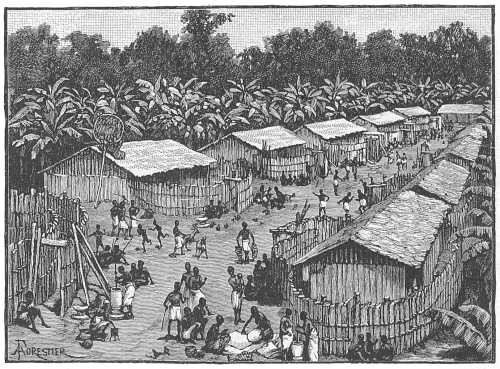
VIEW OF UTIRI VILLAGE.
On the 8th the caravan had hauled the canoes past Nejambi Rapids, and was camped a few miles below Utiri. The next day we reached the villages, where we found the architecture had changed. The houses were now all gable-roofed and low, and each one surrounded by strong, tall, split log palisades, six feet long, nine inches by four inches wide and thick, of the 1887. Aug. 8. Uturi. rubiacæ wood. Constructed in two lines, a street about twenty feet ran between them. As I observed them I was impressed with the fact that they were extremely defensible even against rifles. A dozen resolute men in each court of one of these villages armed with poisoned arrows might have caused considerable loss and annoyance to an enemy.
On the 10th we halted, and foragers were despatched in three different directions with poor results, only two days' rations being procurable. One man, named Khalfan, had been wounded in the wind-pipe by a wooden arrow. The manner he received the wound indicates the perfect indifference with which they receive instructions. While Khalfan examined the plantains above, a native stood not twenty feet away and shot him in the throat with a poisoned arrow. The arrow wound was a mere needle-point puncture, and Dr. Parke attended to him with care, but it had a fatal consequence a few days later.
The 11th was consumed by the river party in struggling against a wild stretch, five miles long, of rapids, caused by numerous reefs and rocky islets, while the land column wound along the river bank on a passable track which led them to Engweddé, where we rejoined them on the 12th. Our day's rate having been broken by the rapids, foragers were again despatched to collect food, and succeeded in procuring three days' rations of plantains. On the 13th we marched to Avisibba, or Aveysheba, a settlement of five large villages, two of which were situate on the upper side of Ruku Creek.
The river column was the first to occupy the villages above the Ruku. A fine open street ran between two rows of low huts, each hut surrounded by its tall palisades. There was a promising abundance in the plantain groves about. The untouched forest beyond looked tall, thick, and old. From the mouth of the creek to the extremity of the villages there was a hundred yards' thickness of primeval forest, through which a native path ran. Between the village and the Aruwimi was a belt of timber fifty yards wide. While 1887. Aug. 13. Avisibba. the ferriage was progressing across the creek, the boat-crew was searching eagerly and carefully among the scores of courts for hidden savages, and with rifles projecting before them were burrowing into the plantain groves, and outside the villages.
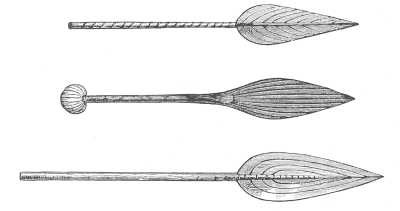
LEAF-BLADED PADDLE OF AVISIBBA.
When the column was across I had a murder case to inquire into. For on the 12th, at Engweddé, one of our Zanzibaris had been killed with a rifle bullet outside of camp, and it was supposed that some vengeful ruffian in the column had shot him. Meantime, I had suggested to two head men to take forty scouts and re-cross the creek, to explore if there were any opportunities for foraging on the next day to the south-west of the creek. My little court had just sat down for the inquiry, and a witness was relating his evidence, when the rifles were heard firing with unusual energy. Lieutenant Stairs mustered some fifty men, and proceeded on the double-quick to the river. Under the impression that ninety breech-loaders were quite sufficient we resumed the investigation, but as volley after volley rang out, with continued cracking of scouts' rifles, the Doctor, Nelson, and myself hastened to the scene with a few more men. The first person I saw was 1887. Aug. 13. Avisibba. Lieutenant Stairs, with his shirt torn open, and blood streaming from an arrow-wound in the left breast, about the region of the heart, and I heard a pattering on the leaves around me, and caught a glimpse of arrows flying past. After consigning our poor friend to Parke's care I sought for information. There were numbers of men crouching about, and firing in the most senseless fashion at some suspicious bushes across the creek. There were certainly obstinate savages hidden behind them, but I failed to get a glimpse of one. The creek I soon found lay between us. I was told that as the boat was crossing the creek a body of natives had suddenly issued on the other side and shot their arrows into them; that surprised by the discharge they had crouched in the bottom of the boat to escape the arrows, and had paddled the boat back to the landing-place with their hands. They had then picked up their rifles and blazed away at them. Simultaneously Lieutenant Stairs had rushed in among them and fired at the enemy, who were of a bolder kind than any they had yet met. In a short time he had received an arrow in the breast, which he had torn off while retreating, and five other men had been punctured. Almost as soon as I had finished receiving these particulars, I saw for the first time a dark shadow creep along the ground between two bushes, and fired into the centre of it, and a curiously weird wail responded to it. Two minutes later the arrows had ceased their patter among the leaves. Having posted a strong guard of the best shots along the bank to observe any movement on the opposite bank of the creek, the rest of the people were withdrawn.
In the evening some scouts that had searched in the woods inland returned with a flock of seven goats. They had discovered the crossing-place, and had suddenly opened fire on a small column going either to the assistance of the enemy or coming from their direction.
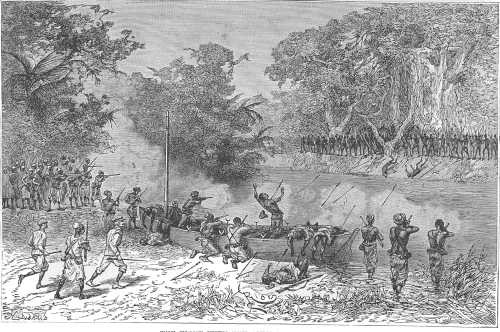
THE FIGHT WITH THE AVISIBBA CANNIBALS.
On the 14th, at dawn, pushed over the creek two companies to hunt up the enemy that had done us such damage; a company was also sent, under Captain Nelson, to the forest inland. In a few minutes we heard a volley, 1887. Aug. 14. Avisibba. and a second, and then incessant rifle fire, showing that the enemy were of a resolute character. There were some crack shots in No. 1 Company, but it was scarcely possible to do much damage in a thick bush against a crafty enemy, who knew that they possessed most dangerous weapons, and who were ignorant of the deadly force of the pellets that searched the bushes. About 300 rounds had been fired, and silence followed. Four only of these had been fatal, and our party received four wounds from arrows smeared over freshly with a copal-coloured substance. One dead body was brought to me for examination.
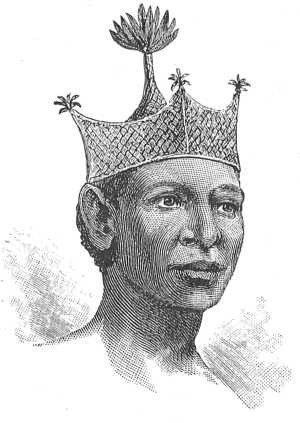
A HEAD-DRESS OF AVISIBBA WARRIORS.
The head had a crop of long hair banded by a kind of coronet of iron; the neck had a string of iron drops, with a few monkey teeth among them. The teeth were filed into points. The distinguishing mark of the body appears to form double rows of tiny cicatrices across the chest and abdomen. The body was uncircumcised. Another dead body brought to the landing-place had a necklace of human teeth, and a coronet of shining plated iron, and the forehead and several wristlets of the same metal, polished; on the left arm was the thick pad of silk cotton covered with goat skin, to protect the arm from the bow string.
After the natives had been chased away on all sides from the vicinity, the people commenced to forage, and succeeded in bringing to Avisibba during the day sufficient plantains to give eighty per man—four days' rations.
Lieutenant Stairs' wound was one-fifth of an inch in diameter, an inch and a quarter below the heart, and the pointed head of the arrow had penetrated an inch 1887. Aug. 14. Avisibba. and a half deep. The other men were wounded in the wrists, arms, and one in the fleshy part of the back. At this period we did not know what this strange copal-coloured substance was with which the points had been smeared, nor did we know what were its peculiar effects when dry or wet; all that the Doctor could do at this time was to inject water in the wounds and cleanse them. The "old hands" of the Zanzibaris affirmed it was poison extracted from the India rubber (Landolphia) by boiling; that the scum after sufficient boiling formed the poison.
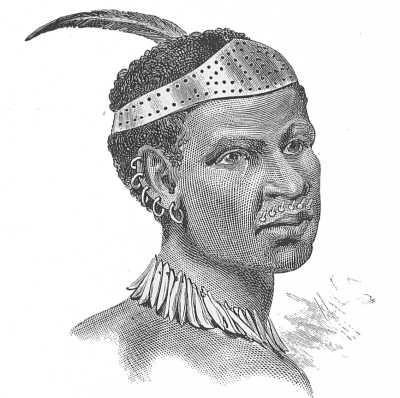
CORONETED AVISIBBA WARRIOR—HEAD-DRESS.
A native declared that it was made of a species of arum, which, after being bruised, was boiled; that the water was then poured out into another pot, and boiled again until it had left a strong solution, which was mixed with fat, and this was the substance on the arrows. The odour was acrid, with a suspicion of asafœtida. The men proved its deadly properties by remarking that elephants and all big game were killed by it. All these stories caused us to be very anxious, but our ignorance was excessive, I admit. We could only look on with wonder at the small punctures on the arms, and express our 1887. Aug. 14. Avisibba. opinion that such small wounds could not be deadly, and hope, for the sake of our friend Stairs and our nine wounded men, that all this was mere exaggeration.
The arrows were very slender, made of a dark wood, twenty-four inches long, points hardened by slow baking in the warm atmosphere above the hut fires; at the butt end was a slit, in which a leaf was introduced to guide the flight; the sharp points were as sharp as needles, and half an inch from the point began a curving line of notches for about two inches. The arrow heads were then placed in the prepared and viscid substance, with which they were smeared; large leaves were then rolled round a sheaf before they were placed in the quiver. Another substance was pitch black in colour, and appeared more like Stockholm tar when fresh, but had a very disagreeable smell. In a quiver there would be nearly a hundred arrows. When we observed the care taken of these arrows, rolled up in green leaves as they were, our anxiety for our people was not lessened.
The bow is of stubborn hard brown wood, about three feet long; the string is a broad strip of rattan carefully polished. To experiment with their power I drove one of the wooden arrows, at six feet distance, through two sides of an empty biscuit tin. At 200 yards' distance was a tall tree. I drove an arrow, with full force, over the top of the highest branch and beyond the tree. It dawned on us all then that these wooden arrows were not the contemptible things we had imagined. At a short distance we judged, from what we saw, that the stiff spring of this little bow was sufficient to drive one of these slender arrows clean through a human body. At 120 paces I have been able to miss a bird within an inch with one of them.
At noon on the 15th of August the land column filed out of the palisaded villages of Avisibba led by Mr. Jephson, the officer of the day. As a captive had informed us that there were three cataracts ahead not far off, I instructed Mr. Jephson that he must follow the river and halt at the first convenient spot about 2.30 P.M.; that I would halt the river column, now 1887. Aug. 15. Avisibba. consisting of the boat and fourteen canoes, until the rear guard under Captain Nelson had quite left the settlement; but as the canoes would proceed faster than the land caravan, I would probably overtake him, and camp at the first fit place I could find after an hour's row, in which event he would proceed until he found us. The instructions were also repeated to the leading men of the pioneers.
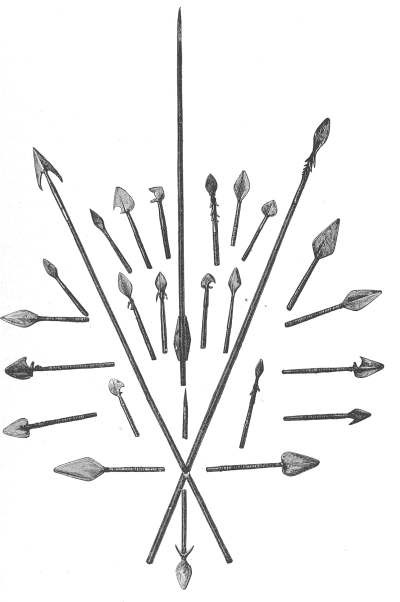
WOODEN ARROWS OF THE AVISIBBA.
(From a photograph.)
I ought to have stated that our start at noon was occasioned by the delay caused by the discovery at the morning muster that five men were absent. They ultimately turned up at 10 o'clock; but this perpetual straying away without leave was most exasperating, and had drawn a lecture from me, though this was not uncommon in those stupid early days of training.
The Zanzibaris persisted in exhibiting an indifference to danger absolutely startling, not from bravery, or from ignorance of fear, but from an utter incapacity to remember that danger existed, and from a stupid unconsciousness as to how it affected them. Animals are indebted to instinct as a constant monitor against danger, but these men appeared to possess neither instinct nor reason, neither perception nor memory. Their heads were uncommonly empty. The most urgent entreaties to beware of hidden foes, and the most dreadful threats of punishment, failed to impress on their minds the necessity they were under of being prudent, wary, and alert to avoid the skewers in the path, the lurking cannibal behind the plantain stalk, the cunning foe lying under a log, or behind a buttress, and the sunken pit, with its pointed pales at the bottom. When the danger fronted them it found them all unprepared. A sudden shower of arrows sent them howling abjectly out of reach or under shelter; and if the arrows were only followed by a resolute advance, resistance, by reason of excess of terror, would be impossible. An unexpected show of dauntlessness in a native compelled from them a ready recognition of his courage. On the road they sneaked into the woods to avoid the rear guard, but flew screaming with terror if a prowling savage suddenly 1887. Aug. 15. Avisibba. rose before them with uplifted spear. They roved far singly or by twos amongst the villages, as looting was dear to their hearts; but should they meet the wild owners of them they were more apt to throw the deadly rifle down on the ground than to use it. They strayed through the plantain grove with magnificent unconcern, but if they heard the whiz of an arrow they collapsed nervelessly and submitted to their fate. With an astounding confidence they scattered along the road, and stretched the line of the column to 3 miles in length, but at sight of natives all sense was lost save that of cowardly fear. Out of 370 men at this time in the camp there were clearly 250 of this description, to whom rifles were of no use save as a clumsy, weighty club, which they would part with for a few ears of corn, or would willingly exchange for a light walking staff if they dared.
The day previous the Zanzibari head men, urged by their friends, had appeared before me in a body, and demanded to be despatched to forage without any officers, as the officers, they said, bored them with their perpetual orders of "Fall in, fall in." "Why," said they, "who can gather bananas if they are continually watched and told to 'Fall in, fall in?'"
"Very true," said I, "the thing is impossible. Let me see what you can do by yourselves. The banana plantations are but a quarter of an hour's distance. I shall expect you all back within an hour."
After such an exposition of character as the above it will not be wondered, that, each man having cleared from my presence, forgot all his promises, and wandered according to his wont. A flock of sheep or a herd of swine could not have gone further astray. After fourteen hours' absence the 200 foragers had returned save five. These five had departed no one knew where until 10 A.M. of this day.
Ah, those early days! Worse were to come, and then, having become purified by suffering, and taught by awful experience, they became Romans!
But to return to Jephson. We pulled up stream—after seeing that every one was clear of the settlement of 1887. Aug. 15. Avisibba. Avisibba—at the rate of a knot and a half an hour, and at 2.45, having discovered a convenient camp, halted for the night. We waited in vain for Mr. Jephson, and the column fired signal guns, rowed out into the stream, and with a glass searched the shore up and down, but there was no sign of camp-fire, or smoke above the woods, which generally covered the forest as with a fog in still weather, no sound of rifle-shot, blare of trumpet, or human voice. The caravan, we thought, must have found a fine track, and proceeded to the cataracts ahead.
On the 16th the river column pulled hard up stream, passed Mabengu villages, came up to a deep but narrow creek flowing from the south bank into the Nevva, as the Aruwimi was now called, looked anxiously up stream, and an hour later we had reached the foot of Mabengu Rapids. On the right bank, opposite to where we selected a camping-place, was a large settlement—that of Itiri. Then, having as yet, met no traces of the absent column, I sent boat's crew up the creek to search for traces of fording. After ascending several miles up the creek, the boat's crew returned unsuccessful; then I despatched it back again to within half-an-hour's distance of Avisibba, and at midnight the boat returned to announce their failure to find any traces of the missing.
On the 17th the boat's crew, with "Three o'clock," the hunter (Saat Tato), and six scouts, were sent to our camping-place of the 15th, with orders for the hunter and his six scouts to follow the path observed there—inland—until they had struck the trail of the column, then to follow the trail and overtake them, and return with them to the river. On the boat's return, the coxswain informed me that they had seen the trail about 7 miles (3 hours' march). I concluded that Mr. Jephson had led his column south, instead of E. by N. and E. N. E., according to course of river, and that Saat Tato would overtake them, and return next day.
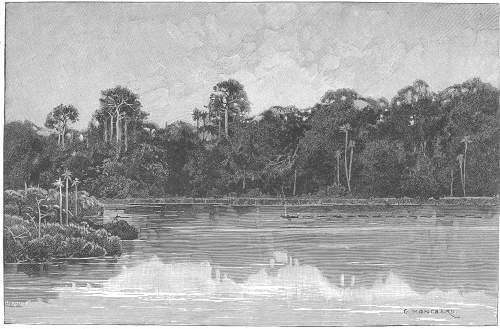
THE RIVER COLUMN ASCENDING THE ARUWIMI RIVER WITH "ADVANCE" AND SIXTEEN CANOES.
Our condition at the river camp was this. We had thirty-nine canoemen and boatmen, twenty-eight sick people, three Europeans, and three boys, and one of the 1887. Aug. 17. Itiri. Europeans (Lieutenant Stairs) was suffering from a dangerous wound, and required the constant care of the surgeon. One man had died of dysentery at Avisibba. We had a dying idiot in camp, who had become idiotic some days before. We had twenty-nine suffering from pleurisy, dysentery, incurable debility, and eight suffering from wounds. One called Khalfan was half strangled with the wound in his windpipe, another called Saadi, wounded in the arm, appeared dangerously ill, his arm was swollen, and gave him great pain. Out of the thirty-nine available I had despatched three separate parties in different directions to scout for news of the missing column, lest it was striking across some great bend to reach the river a long distance higher up, while we, unable to stir, were on the other side of the curve. Across the river the people of Itiri, perceiving we were so quiet on our side of the river, seemed to be meditating an attack, and only two miles below on our bank was the large settlement of Mabengu, from whose inhabitants we might hear at any moment, while our little force of thirty-nine men, scattered in various directions, were searching for the missing 300. But the poet said that it became
"No man to nurse despair;
But in the teeth of clenched antagonisms
To follow the worthiest till he die."
I quote from my diary of August 18th.
The idiot fell asleep last night. His troubles are over, and we have buried him.
I wonder if Tennyson were here, who wrote such noble lines, what he would think of our state. A few days ago I was chief of 370 men, rich in goods, munitions of war, medicines, and contented with such poor comforts as we had, and to-day I have actually only eighteen men left fit for a day's march, the rest have vanished. I should be glad to know where.
If 389 picked men, such as we were when we left Yambuya, are unable to reach Lake Albert, how can Major Barttelot with 250 men make his way through this endless forest. We have travelled, on an average, 1887. Aug. 18. Itiri. 8 hours per day for forty-four days since leaving Yambuya. At two miles per hour we ought, by this date, to have arrived on the Lake shore, but, instead of being there, we have accomplished just a third of the distance. The poet says we must not "nurse despair," for to do that is to lie down and die, to make no effort, and abandon hope.
Our wounded take considerable time to heal. The swelling is increasing, the wounds are most painful, not one has yet proved fatal, but they are all quite incapacitated from duty.
The fifth rain of this month began at 8 A.M. Had we not enough afflictions without this perpetual rain? One is almost tempted to think that the end is approaching. The very "flood gates of heaven" seem opened, and nature is dissolving. Such a body of rain is falling that the view of all above is obscured by the amazing fall of rain-drops. Think of the countless numbers of leaves in this forest, and that every leaf drops ten to twenty times per minute, and that from the soaking ground rises a grey cloud of minute rain in vapour, and that the air is full of floating globules of water and flying shreds of leaves! And add to all this the intense fall of rain as the blast comes bearing down the top, and whips drowning showers on us, and sways the countless branches, and rushes wailing through the glades with such force, as though it would wrench the groaning trees out of the earth. The moaning and groaning of the forest is far from comforting, and the crashing and fall of mighty trees is far from assuring, but it is a positive terror when the thunder rumbles above, and its sounds reverberating through the aisles and crooked corridors of the forest, and the blazing lightning darts spitefully hither and thither its forky tongues and sheets of flame, and explodes over our heads with overwhelming and deafening shocks. It would be a vast relief for our sick and wounded to be free of such sounds. An European battle has no such variety. And throughout the day this has continued unceasingly. It is now about the tenth hour of the day. It is scarcely 1887. Aug. 18. Itiri. possible daylight will ever appear again, at least so I judge from the human faces steeped in misery. Their owners appear stupefied by terror, woe, sickness, loss of friends, hunger, rain and thunder, and general wretchedness. They may be seen crouching under plantain-leaf sheds, native shields, cotton shelters, straw mats, earthen and copper pots above their heads, even saddles, tent canvass covers, blankets, each body wreathed in blue vapour, self-absorbed with speechless anguish. The poor asses with their ears drawn back, inverted eyes and curving backs, captive fowls with drooping crests represent abject discomfort. Alas! the glory of this earth is quite extinguished. When she finally recovered her beauty, and her children assumed their proud bearing, and the growing lakes and increasing rivers were dried up, and how out of chaos the sun rose to comfort the world again I know not. My own feeling of misery had so exhausted me that a long sleep wrapped me in merciful oblivion.
August 19th.—Still without news of land caravan. The scouts have returned without having seen any traces of the missing. Two of the wounded men are doing very badly. Their sufferings appear to be terrible.
August 20th.—Still without news of caravan. Young Saadi wounded by a poisoned arrow on the morning of the 14th, is attacked with tetanus, and is in a very dangerous condition. Wherefore I take it to be a vegetable poison. Khalfan's neck and spine have become rigid. I have given both morphine by injection, but the doses though double, that is in half grains, do not appear to ease the sufferers much. Stairs is just the same as yesterday, neither worse nor better. The wound is painful, still he has appetite, and enjoys sleep. I fear the effect on him of knowing what the other patients are undergoing.
It is strange that out of 300 people and 3 officers, not one has sense enough to know that he has lost the road, and that the best way of recovering it would be to retrace their steps to Avisibba and try again.
1887. Aug. 21. Itiri. August 21st.—Poor Khalfan wounded in the windpipe on the 10th instant, and the young fellow Saadi hurt on the morning of the 14th; both died in the night, after intolerable agonies—one at 4 A.M., Saadi about midnight. Khalfan's wound was caused by a poisoned arrow; but the poison must have been laid on the arrow some days before it was used. He had been daily getting weaker from abstinence from food, because of pain. The wound did not seem dangerous; it had closed up, externally, and there were no signs of inflammation; but the poor fellow complained he could not swallow. He had subsisted on liquid food made of plantain flour gruel. On the 8th day his neck became rigid and contracted; he could not articulate, but murmur; the head was inclined forward, the abdomen was shrunk, and on his face lines of pain and anxiety became fixed. Yesterday he had some slight spasms. I gave two injections of half a grain hypodermically, which relieved him for an hour, but, not much accustomed to treat patients with morphia, I feared giving larger doses. Saadi was punctured on the right forearm, midway between wrist and elbow—a mere wound, such as a coarse stocking needle would have made. The wound was sucked by a comrade; it was syringed with warm water and dressed, but on the morning of the fourth day he was attacked with tetanus of so severe a kind that his case was hopeless from our sheer inability to relieve him from the frightful spasms. Morphia injections rendered him slightly somnolent; but the spasms continued, and Saadi died on the 111th hour after receiving the wound. I am inclined to think that the arrow was smeared for the fight of the 14th the night previous.
A third man died of dysentery before noon, making the fourth death in this camp.
At 5 P.M. the caravan arrived. Its sufferings have been great from mental distress. There have been three deaths also in the land column. Maruf, punctured in shoulder, died of tetanus on the night of the 19th, 24 hours earlier than Saadi. This may have been due to the travel accelerating the action of the poison.
1887. Aug. 21. Itiri. One man named Ali was shot by an iron-barbed arrow, and died of internal hæmorrhage, the arrow having pierced the liver. Another succumbed to dysentery immediately after the heavy rain which had afflicted us on the 18th; thus we have had seven fatal cases since the 14th. We have several others, in whom life is flickering. The column brought in two others wounded by arrows. The wounds are much inflamed, and exude a gangrenous matter.
Lieut. Stairs still appears hearty, and appears as though he was recovering, despite the influence these many deaths might have on his nerves. The surgeon having appeared, I feel an intense relief. I hate to see pain, and take no delight in sick men's groans. I feel pleasure in ministering to their needs only when conscious I can cure.
We have now about 373 in camp, but 60 of them appear fitter for a hospital than to continue our wandering life; but in this savage region not even rest and food can be secured for the weary souls.
A few more days of this disheartening work, attending on the sick, looking at the agonies of men dying from lockjaw, listening to their muffled screams, observing general distress and despondency, from hunger, and the sad anxiety caused by the unaccountable absence of their brothers and comrades, with the loss of 300 men impending over me must have exercised a malign influence over myself. I am conscious of the insidious advance of despair towards me. Our food has been bananas or plantains, boiled or fried, our other provisions being reserved for perhaps an extreme occasion which may present itself in the near future. The dearest passion of my life has been, I think, to succeed in my undertakings; but the last few days have begun to fill me with a doubt of success in the present one.
What the feelings of the officers have been I have not heard yet; but the men have frankly confessed that they have been delivered from a hell.
The following note has just been placed in my hands:—
1887. Aug. 21. Itiri.
"August 1887.
"Dear Sir,
"Saat Tato reached us at 3 P.M. yesterday with your order to follow him. We at once recrossed the river (the creek which the boat's crew had searched) and hope to reach you to-night. I can understood how great your anxiety must have been, and deeply regret having caused it.
"I have the honour to be,
"&c., &c., &c.
"A. M. Jephson."
On the 22nd we moved camp to the foot of the highest Mabengu Rapids, and on the following day proceeded above the rapids.
I then took the opportunity of mustering the people. The following returns tell their own tale:—
Healthy.
Sick.
Dead.
Loads.
Company No. 1
80
6
4
43
Captain Stairs, No. 2
69
14
5
50
Captain Nelson, No. 3
67
16
4
72
Captain Jephson, No. 4
63
21
3
72
Europeans
6
Boys
12
Soudanese
10
Somalis
6
Cooks
2
Donkey boy
1
Sick
57
373
Dead
16
389
The experiences of the column during its wanderings appeared to confirm me in my impressions that the Aruwimi in this region of rapids was not so much utilized by the natives as it was below. Large settlements had been discovered inland; the scouts had traversed the forest by several well-trodden tracks which led from the river to the interior. The river banks were not so populous, the settlements were now generally a little way inland, and along the river bank was a perceptible path which materially assisted us. Ever since leaving Utiri we had noted this fact. On the 24th we travelled a few miles, and camped below Avugadu Rapids, near a rich plantain grove, and the next 1887. Aug. 26. Nepoko River. day passed the rapids and formed a comfortable camp in a somewhat open portion of the forest, haunted by fishermen. On the 26th the column on land swung along at a good rate, while we had a long stretch of undisturbed river, and had to pull hard to keep pace with them until both columns met in one of the largest villages of the Avejeli tribe established in front of the Nepoko mouth.
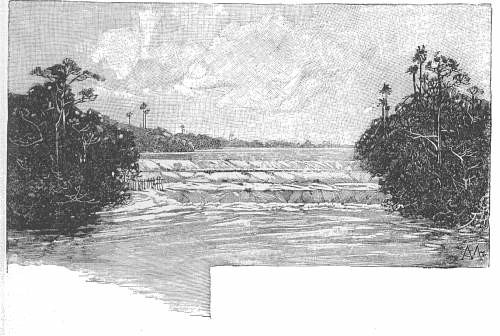
CASCADES OF THE NEPOKO.
This latter river, of which Dr. Junker was the first to inform us, and which he had crossed far up, tumbled into the Aruwimi, now called the Itiri, by a series of cascades, over reefs of shaly rock, from an altitude of 40 feet. The mouth was about 300 yards wide, narrowing to about 250 yards above the cascade. The natives had staked a considerable distance of the reef, to which to attach their large funnel-shaped baskets for the reception of the fish washed down the rapids. The colour of the Nepoko was of chocolate, that of the Itiri was of tea and milk.
Had I known that one week later I should have encountered Arabs, and their desperate bands of Manyuema, there is no doubt that I should have endeavoured 1887. Aug. 26. Nepoko River. to put a degree of latitude between the centre of their influence and our route. Even as it was, I mentally debated a change of route, from some remarks made to me by Binza (Dr. Junker's Monbuttu boy), who suggested that it were better to travel through lands inhabited by "decent men," to such a horrid region infested by peoples who did not deserve the name of men applied to them, and that the Momvu tribes were sure of according a welcome to those who could show in return that they appreciated hospitality. Binza was most enticing in his descriptions of the Momvu nation. But food with the Avejeli was abundant and various, and we hoped that a change had come over the land. For ever since we had observed a difference in the architecture of the native dwellings, we had observed a change for the better in the diet of the people. Below Panga Falls the aborigines principally subsisted on manioc, and on the different breads, puddings, cakes, and porridges to which they converted these tubers. It will not be forgotten, perhaps, that tapioca is made out of manioc or cassava. But above Panga Falls manioc had been gradually replaced by plantain groves and the plantain is a much more excellent edible than manioc for an expedition, and the groves had been clearly growing into higher importance, therefore we hoped that happier days were in store for us. There were also fields of Indian corn, manioc, yams, and colocassia, plots of tobacco for the smokers, and to our great joy we came across many fowls. A halt was ordered that the sorely-tried people might recuperate.
In their very excusable eagerness for meat the Zanzibaris and Soudanese were very reckless. No sooner was a fowl sighted than there was a general scramble for it; some reckless fellows used their rifles to shoot the chickens, and many a cartridge was expended uselessly for which due punishment was frequently awarded. The orders were most positive that no ammunition was to be wasted, and the efforts made to detect all breaches of these orders were most energetic, but when did a Zanzibari obey orders when away from his employer's eye? 1887. Aug. 26. Nepoko River. The indiscriminate shooting of this day resulted in the shooting of one of the brave band of hard-working pioneers. A bullet from a Winchester struck him in the foot, the bones of which were pulverized and its amputation became imperative. Surgeon Parke performed the operation in a most skilful and expeditious manner, and as the good surgeon was most resolute when "one of his cases" required care—this unfortunate[9] young man had to be lifted in and out by eight men, must needs have the largest share of a canoe that nothing might offend the tender wound, and of necessity required and received the most bounteous supply of the best food and to have servants to wait upon him—in short, such a share of good things and ready services that I often envied him, and thought that for a sixpence in addition I would not mind exchanging places with him.
Of course another severe lecture followed, and there were loud protestations that they would all pay implicit attention in the future, and of course before the next day every promise was forgotten. There is much to be said for these successive breaches of promise. They relieve the mind from vast care and all sense of responsibility. No restraint burdens it, and an easy gladness brightens the face. Why should a man, being an animal, continually fetter himself with obligations as though he were a moral being to be held accountable for every idle word uttered in a gushing moment?
On the 28th the river column consisting now of the Advance steel boat and sixteen canoes, pushed up river to a camp five miles above Avejeli. The land party was left far behind, for they were struggling through a series of streams and creeks, and buried in depths of suffocatingly close bush, and did not arrive until the next day at noon, when they were urged to proceed about two hours higher, whither we followed them.
We arrived at the foot of a big cataract on the 30th, 1887. Aug. 30. Nepoko River. and by observation ascertained that we had reached half-way to the Albert Lake, Kavalli being in 30° 30' and Yambuya in 25° 3½'. Our camp on this day was in about 27° 47'.
We had 163 geographical miles in an air line to make yet, which we could never accomplish within 64 days as we had performed the western half of the route. The people were in an impoverished state of body, and mentally depressed, ulcers were raging like an epidemic, anæmia had sapped their vitality. They were told the half-way camp was reached, but they replied with murmurs of unbelief. They asked, "How can the master tell? Will that instrument show him the road? Will it tell him which is the path? Why does it not tell us, then, that we may see and believe? Don't the natives know their own country better? Which of them has seen grass? Do they not all say that all the world is covered with trees and thick bush? Bah—the master talks to us as though we were children and had no proper perception."
The morning of the evil date, August 31st, dawned as on other days. It struggled through dense clouds of mist, and finally about 9 o'clock the sun appeared, pale, indistinct, a mere circle of lustreless light. But in the meantime we were hard at our frequent task of cutting a broad highway through the bush and forest, through which the boat could be carried bodily by 60 men, standing underneath; the crew of the flotilla were wrestling with the mad waters, and shoving their vessels up steep slopes of a racing river.
The highway was finished in an hour, and a temporary camp was located above. The canoes began to arrive. I left the Doctor to superintend the pioneers bearing the boat, but he presently returned to report that the boat could not be lifted. I retraced my steps to oversee the operation personally. I had succeeded in conveying it half way when my European servant came running at a mad pace, crying out as he ran: "Sir, oh, sir, Emin Pasha has arrived."
"Emin Pasha!"
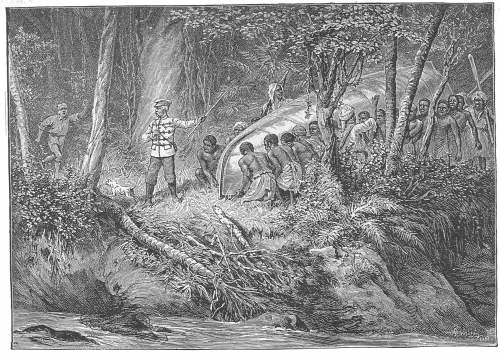
"THE PASHA IS COMING."
1887. Aug. 31. Nepoko River. "Yes, sir. I have seen him in a canoe. His red flag, like ours (the Egyptian), is hoisted up at the stern. It is quite true, sir!"
Of course we bounded forward; the boat was dropped as though it was red hot. A race began, master and man striving for the lead. In the camp the excitement was also general. It was owing, we soon heard, to the arrival of nine Manyuema, who served one called Uledi Balyuz, known to natives by the name of Ugarrowwa, and who was reported to be settled about eight marches up river, and commanding several hundred armed men.
The Arabs were, then, so far inland on the Upper Aruwimi, and I had flattered myself that I had heard the last of these rovers! We were also told that there were fifty of them camped six miles above on their way, by orders of Ugarrowwa, to explore the course of the river, to ascertain if communication with Stanley Falls could be obtained by the unknown stream on whose banks they had settled.
We imparted the information they desired, whereupon they said they would return to their camp and prepare for a hospitable reception on the morrow. The Zanzibaris were considerably elated at the news, for what reason may shortly be seen.
The first absconder was one Juma, who deserted with half a hundredweight of biscuit that night.
On the 1st September, in the early morning, we were clear of the rapids, and, rowing up in company with the caravan, were soon up at the village where the Manyuema were said to be camped. At the gate there was a dead male child, literally hacked to pieces; within the palisades was a dead woman, who had been speared. The Manyuema had disappeared. It seemed to us then that some of our men had damped their joy at the encounter with us, by suggesting that the slaves with them might probably cause in us a revulsion of feeling. Suspicion of this caused an immediate change in their feelings. Their fears impelled them to decamp instantly. Their society was so much regretted, however, that five 1887. Sept. 1. Nepoko River. Zanzibaris, taking five loads, four of ammunition and one of salt, disappeared.
We resumed our journey, and halted at the base of another series of rapids.
The next day Saat Tato, having explored the rapids, reported encouragingly, and expressed his confidence that without much difficulty these could also be surmounted. This report stimulated the boatmen to make another trial. While the river column was busy in its own peculiar and perilous work, a search party was despatched to hunt news of the missing men, and returned with one man, a box of ammunition, and three rifles. The search party had discovered the deserters in the forest, with a case of ammunition open, which they were distributing. In trying to surround them, the deserters became alarmed and scudded away, leaving three of their rifles and a case behind them.
On the 3rd of September five more deserted, carrying away one case of Remington cartridges, one case of Winchester cartridges, one box of European provisions, and one load of fine Arab clothing, worth £50. Another was detected with a box of provisions open before him, having already abstracted a tin of sago, one tin of Liebig, a tin of butter, and one of milk. Ten men had thus disappeared in a couple of days. At this rate, in sixty days the Expedition would be ended. I consulted the chiefs, but I could gain no encouragement to try what extreme measures would effect. It was patent, however, to the dullest that we should be driven to resort to extremities soon to stop this wholesale desertion and theft. Since leaving Yambuya we had lost forty-eight rifles and fifteen cases of Maxim, Winchester, and Remington ammunition.
The day following four men deserted, and one was caught in the act of desertion. The people were accordingly mustered, and sixty men, suspected of being capable of desertion, as no head man would guarantee their fidelity, were rendered helpless by abstracting the mainsprings of the rifles, which we took and locked up. Demoralisation had set in rapidly since we had met the 1887. Sept. 5. Nepoko River. Manyuema. Nothing was safe in their hands. Boxes had been opened, cloth had been stolen, beads had been pilfered, much ammunition had been taken out of the cases, and either thrown, or secreted as a reserve, by the way.
On September 5th we camped near Hippo Broads, so called because the river was fine and broad, and a large herd of hippopotami were seen. The site of our resting place was an abandoned clearing, which had become the haunts of these amphibiæ, and exquisite bits of greensward caused us to imagine for a moment that possibly the open country was not far. Foragers returned after a visit into the interior, on both banks, with four goats and a few bananas, numbers of roast rats, cooked beetles, and slugs. On the 6th we reached a cataract opposite the Bafaido settlement, where we obtained a respectable supply of plantains. The day following we dragged our canoes over a platform of rock, over a projecting ledge of which the river tumbled 10 feet.
From the Bafaido cataract we journeyed along a curving river to Avakubi Rapids, and formed a camp at the landing-place. A path led hence into the interior, which the hungry people soon followed. While scouring the country for food, a woman and child were found, who were brought to me to be examined. But the cleverest interpreter was at fault. No one understood a syllable of the meaningless babble.
Some more rapids were reached the next day. We observed that the oil-palm flourished throughout this section.
Palm nuts were seen in heaps near each village. We even discovered some palms lately planted, which showed some regard for posterity. Achmet, the Somali, who had insisted on leaving Yambuya, in accompanying us had been a passenger ever since we had struck the river above Yankondé, was reported to be dying. He was said to suffer from melanosis. Whatever the disease might be, he had become singularly emaciated, being a literal skeleton covered lightly with skin.
1887. Sept. 5. Nepoko River. From this camp we rounded a point, passed over a short winding course of river, and in an hour approached in view of an awful raging stream choked by narrow banks of shale. The outlook beyond the immediate foreview was first of a series of rolling waves whirling and tossed into spray, descending in succeeding lines, and a great fall of about 30 feet, and above that a steep slope of wild rapids, and the whole capped with mist, and tearing down tumultuously towards us. This was appalling considering the state of the column. There were about 120 loads in the canoes, and between fifty and sixty sick and feeble people. To leave these in the woods to their fate was impossible, to carry the loads and advance appeared equally so; yet to drag the canoes and bear the boat past such a long stretch of wild water appeared to be a task beyond our utmost powers.
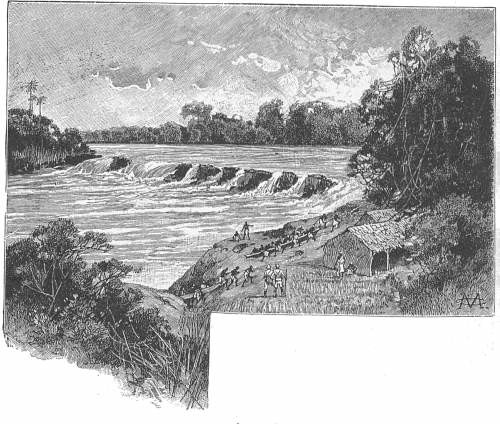
VIEW OF BAFAIDO CATARACT.
Leaving the vessels below the falls and rapids, I led the Expedition by land to the destroyed settlement of Navabi, situated near a bend of the Itiri (Aruwimi) above the disturbed stream, where we established a 1887. Sept. 6. Navabi. camp. The sick dragged themselves after the caravan, those too feeble and helpless to travel the distance were lifted up and borne to the camp. Officers then mustered the companies for the work of cutting a broad highway through the bush and hauling the canoes. This task occupied two whole days, while No. 1 Company foraged far and near to obtain food, but with only partial success.
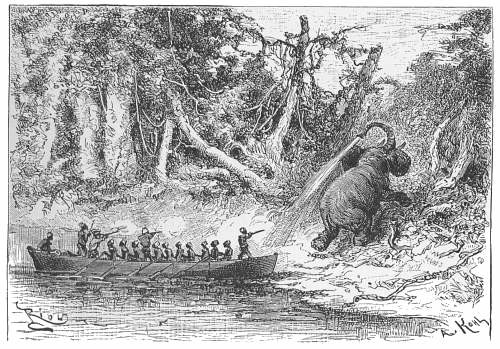
ATTACKING AN ELEPHANT IN THE ITURI RIVER.
Navabi must have been a remarkable instance of aboriginal prosperity once. It possessed groves of the elais and plantain, large plots of tobacco and Indian corn; the huts under the palms looked almost idyllic; at least so we judged from two which were left standing, and gave us a bit of an aspect at once tropical, pretty, and apparently happy. Elsewhere the whole was desolate. Some parties, which we conjectured belonged to Ugarrowwa, had burnt the settlement, chopped many of the palms down, levelled the banana plantations, and strewed the ground with the bones of the defenders. Five skulls of infants were found within our new camp at Navabi.
1887. Sept. 12. Memberri. On the 12th, as we resumed our journey, we were compelled to leave five men who were in an unconscious state and dying. Achmet, the Somali, whom we had borne all the way from Yambuya, was one of them.
From Navabi we proceeded to the landing place of Memberri, which evidently was a frequent haunt of elephants. One of these not far off was observed bathing luxuriously in the river near the right bank. Hungry for meat, I was urged to try my chance. On this Expedition I had armed myself with the Express rifles of 577-bore, which Indian sportsmen so much applaud. The heavy 8-bores were with Major Barttelot and Mr. Jameson. I succeeded in planting six shots in the animal at a few yards distance, but to no purpose except to unnecessarily wound him.
At Memberri we made a muster, and according to returns our numbers stood:—
August 23rd
373 men
September 12th
343 men.
14 deserted and 16 deaths; carriers 235; loads 227; sick 58
Added to these eloquent records every member of the Expedition suffered from hunger, and the higher we ascended the means for satisfying the ever-crying want of food appeared to diminish, for the Bakusu and Basongora slaves, under the Manyuema head men of Ugarrowwa, had destroyed the plantations, and either driven the populations to unknown recesses in the forest or had extirpated them.
On the following day we reached Amiri Falls. The previous day the head man, Saadi, had been reproached for leaving one named Makupeté to return along the track to search for a box of ammunition that was reported to be missing, whereupon Saadi took the unwise resolution of proceeding to hunt up Makupeté. Then one, Uledi Manga, disgusted with the severe work and melancholy prospect before us, absconded with another box of ammunition.
1887. Sept. 13. Amiri Falls. We had only three Zanzibar donkeys left. Out of the six with which we had started from Yambuya, one of the three, probably possessed with a presentiment that the caravan was doomed, took it into his head that it was better to return before it was too late, and deserted also. Whither he went no one knew. It is useless to search in the forest for a lost man, donkey, or article. Like the waves divided by a ship's prow uniting at the stern, so the forest enfolds past finding within its deep shades whatsoever enters, and reveals nothing.
Near a single old fishing hut our camp was pitched on the 15th. The river after its immense curve northward and eastward now trended south-easterly, and we had already reached S. Lat. 1° 24' from 1° 58'.
Having been in the habit of losing a box of ammunition per diem for the last few days, having tried almost every art of suppressing this robbery, we now had recourse to lashing the boxes in series of eights, and consigning each to the care of a head man, and holding him responsible for them. This we hoped would check the excuse that the men disappeared into the forest under all kinds of wants.
On the 16th of September, while halting for the midday rest and lunch, several loud reports of musketry were heard up-river. I sent Saat Tato to explore, and in half-an-hour we heard three rifle-shots announcing success; and shortly after three canoes besides our own appeared loaded with men in white dresses, and gay with crimson flags. These came, so they reported, to welcome us in the name of Ugarrowwa, their chief, who would visit my evening camp. After exchanging compliments, they returned up-river, firing their muskets and singing gaily.
At the usual hour we commenced the afternoon march, and at 4 P.M. were in camp just below Ugarrowwa's station. At the same time a roll of drums, the booming of many muskets, and a flotilla of canoes, announced the approach of the Arab leader. About 50 strong, robust fellows accompanied him, besides singers and 1887. Sept. 13. Amiri Falls. women, every one of whom was in prime condition of body.
The leader gave his name as Ugarrowwa, the Zanzibar term for "Lualaba," or native name of "Ruarawwa," known formerly as Uledi Balyuz (or the Consuls Uledi). He had accompanied Captains Speke and Grant, 1860-3, as a tent-boy, and had been left or had deserted in Unyoro. He offered as a gift to us two fat goats and about 40 lbs. of picked rice, a few ripe plantains, and fowls.
Upon asking him if there was any prospect of food being obtained for the people in the vicinity of his station, he admitted, to our sorrow, that his followers in their heedless way had destroyed everything, that it was impossible to check them because they were furious against the "pagans" for the bloody retaliation and excesses the aborigines had committed against many and many of their countrymen during their search for ivory.
Asked what country we were in, he replied that we were in Bunda, the natives of which were Babunda; that the people on the north bank in the neighbourhood of his station were called Bapai or Bavaiya.
He also said that his raiders had gone eastward a month's journey, and had seen from a high hill (Kassololo?), a grassy country extending to the eastward.
Further information was to the effect that his caravan, 600 strong, had left the Lualaba at Kibongés (above Leopold R.), and that in nine moons he had travelled the distance of 370 geographical miles, about a N.E. course, throughout continuous forest without having seen as much grass as would cover the palm of his hand; that he had only crossed one river, the Lindi, before he sighted the Ituri, as the Aruwimi was now called; that he had heard from Arab traders that the Lulu (Lowwa) rose from a small lake called the Ozo, where there was a vast quantity of ivory.
Four days higher Ugarrowwa possessed another station manned with 100 guns, near the Lenda river, a tributary of the Aruwimi, which entered it from the south 1887. Sept. 13. Amiri Falls. bank. His people had sown rice, of which he had brought us some, and onions; but near each settlement was a waste, as it was not policy to permit such "murderous pagans" to exist near them, otherwise he and his people's lives were not safe. He had lost about 200 men of the Bakusu and Basangora tribes, and many a fine Manyuema headman. One time he had lost 40, of whom not one had returned. He had an Arab guest at his station who had lost every soul out of his caravan.
I observed a disposition on his part to send some men with me to the Lake, and there appeared to be no difficulty in housing with him my sick men for a consideration to be hereafter agreed upon.
On the 17th we proceeded a short distance to encamp opposite Ugarrowwa's station.
In the afternoon I was rowed across in my boat to the Arab settlement, and was hospitably received. I found the station to be a large settlement, jealously fenced round with tall palisades and short planks lashed across as screens against chance arrows. In the centre, facing the river, was the house of the chief, commodious, lofty, and comfortable, the walls of which were pierced for musketry. It resembled a fort with its lofty and frowning walls of baked clay. On passing through a passage which separated Ugarrowwa's private apartments from the public rooms, I had a view of a great court 60 feet square, surrounded by buildings and filled with servants. It suggested something baronial in its busy aspect, the abundant service, the great difference of the domestics, amplitude of space, and plenty. The place was certainly impregnable against attack, and, if at all spiritedly defended, a full battalion would have been necessary to have captured this outpost of a slave trader.
I was informed that the river for many days' march appeared to flow from the eastward; that the Ihuru, a considerable distance up, flowed from the northward and joined the Ituri, and that, besides the Lenda, there was another affluent called the Ibina, which entered from the south.
1887. Sept. 17. Ugarrowwa's station. Somewhere higher up also,—vaguely given as ten days' by others twenty days' march,—another Arab was settled who was called Kilonga-Longa, though his real name was also Uledi.
At this settlement I saw the first specimen of the tribe of dwarfs who were said to be thickly scattered north of the Ituri, from the Ngaiyu eastward. She measured thirty-three inches in height, and was a perfectly formed young woman of about seventeen, of a glistening and smooth sleekness of body. Her figure was that of a miniature coloured lady, not wanting in a certain grace, and her face was very prepossessing. Her complexion was that of a quadroon, or of the colour of yellow ivory. Her eyes were magnificent, but absurdly large for such a small creature—almost as large as that of a young gazelle; full, protruding, and extremely lustrous. Absolutely nude, the little demoiselle was quite possessed, as though she were accustomed to be admired, and really enjoyed inspection. She had been discovered near the sources of the Ngaiyu.
Ugarrowwa, having shown me all his treasures, including the splendid store of ivory he had succeeded in collecting, accompanied me to the boat, and sent away with me large trays of exquisitely cooked rice, and an immense bowl full of curried fowl, a dish that I am not fond of, but which inspired gratitude in my camp.
Our landing-place presented a lively scene. The sellers of bananas, potatoes, sugar-cane, rice, flour of manioc, and fowls clamoured for customers, and cloths and beads exchanged hands rapidly. This is the kind of life which the Zanzibaris delight in, like almost all other natives, and their happy spirits were expressed in sounds to which we had long been strangers.
Early this morning I had sent a canoe to pick up any stragglers that might have been unable to reach camp, and before 3 P.M. five sick men, who had surrendered themselves to their fate, were brought in, and shortly after a muster was held. The following were the returns of men able to march:—
1887. Sept. 17. Ugarrowwa's station.
Men.
Chiefs.
No. 1 Company
69
4
No. 2 Company
57
4
No. 3 Company
60
4
No. 4 Company
61
4
Cooks
3
Boys
9
Europeans
6
Soudanese
6
271
16
Sick
56
327
Departed from Yambuya
389
Loss by desertion and death
62
The boat and canoes were manned, and the sick transported to the Arab settlement, arrangements having been made for boarding them at the rate of five dollars each per month until Major Barttelot should appear, or some person bearing an order from me.
It will be remembered that we met Ugarrowwa's men on the 31st of August, one day's march from Avejeli, opposite the Nepoko mouth. These men, instead of pursuing their way down river, had returned to Ugarrowwa to inform him of the news they had received from us, believing that their mission was accomplished. It was Ugarrowwa's wish to obtain gunpowder, as his supply was nearly exhausted. Major Barttelot possessed two and a quarter tons of this explosive, and, as reported by us, was advancing up river, but as he had so much baggage it would take several months before he could arrive so far. I wished to communicate with Major Barttelot, and accordingly I stipulated with Ugarrowwa that if his men continued their way down river along the south or left bank until they delivered a letter into his hands, I would give him an order for three hundredweight of powder. He promised to send forty scouts within a month, and expressed great gratitude. (He actually did send them, as he promised, between the 20th and 25th of October. They succeeded in reaching Wasp Rapids, 165 miles from Yambuya, whence they were obliged to return, owing to losses and the determined hostility of the natives.)
1887. Sept. 17. Ugarrowwa's station. Our Zanzibari deserters had been deluded like ourselves. Imagining that Ugarrowwa's people had continued their journey along some inland route westward, they had hastened westward in pursuit to join them, whereas we discovered they had returned eastward to their master. The arrangements made with Ugarrowwa, and the public proclamation of the man himself before all, would, I was assured, suffice to prevent further desertion.
We were pretty tired of the river work with its numerous rapids, and I suggested to Ugarrowwa that I should proceed by land; the Arab, however, was earnest in dissuading me from that course, as the people would be spared the necessity of carrying many loads, the sick having been left behind, and informed me that his information led him to believe that the river was much more navigable above for many days than below.
CHAPTER IX.
UGARROWWA'S TO KILONGA-LONGA'S.
Ugarrowwa sends us three Zanzibari deserters—We make an example—The "Express" rifles—Conversation with Rashid—The Lenda river—Troublesome rapids—Scarcity of food—Some of Kilonga-Longa's followers—Meeting of the rivers Ihuru and Ituri—State and numbers of the Expedition—Illness of Captain Nelson—We send couriers ahead to Kilonga-Longa's—The sick encampment—Randy and the guinea fowl—Scarcity of food—Illness caused by the forest pears—Fanciful menus—More desertions—Asmani drowned—Our condition in brief—Uledi's suggestion—Umari's climb—My donkey is shot for food—We strike the track of the Manyuema and arrive at their village.
1887. Sept. 19. Ugarrowwa's station. Once more the Expedition consisted of picked men. My mind was relieved of anxiety respecting the rear column, and of the fate which threatened the sick men. We set out from Ugarrowwa's station with 180 loads in the canoes and boat, forty-seven loads to be carried once in four days by alternate companies. The Arabs accompanied us for a few hours on the 19th to start us on our road and to wish us success in our venture.
We had scarcely been all collected in our camp, and the evening was rapidly becoming dusky, when a canoe from Ugarrowwa appeared with three Zanzibaris bound as prisoners. Inquiring the cause of this, I was astonished to find that they were deserters whom Ugarrowwa had picked up soon after reaching his station. They had absconded with rifles, and their pouches showed that they had contrived to filch cartridges on the road. I rewarded Ugarrowwa with a revolver and 200 cartridges. The prisoners were secured for the night, but before retiring I debated carefully as to what method was best to deal with these people. If this were permitted to 1887. Sept. 19. Ugarrowwa's station. proceed without the strongest measures, we should in a short time be compelled to retrace our steps, and all the lives and bitter agonies of the march would have been expended in vain.
In the morning "all hands" were mustered, and an address was delivered to the men in fitting words, to which all assented; and all agreed that we had endeavoured our utmost to do our duty, that we had all borne much, but that the people on this occasion appeared to be all slaves, and possessed no moral sense whatever. They readily conceded that if natives attempted to steal our rifles, which were "our souls," we should be justified in shooting them dead, and that if men, paid for their labour, protected and treated kindly, as they were, attempted to cut our throats in the night, were equally liable to be shot.
"Well then," said I, "what are these doing but taking our arms, and running away with our means of defence. You say that you would shoot natives, if they stood in your way preventing your progress onward or retreat backward. What are these doing? For if you have no rifles left, or ammunition, can you march either forward or backward?"
"No," they admitted.
"Very well, then, you have condemned them to death. One shall die to-day, another to-morrow, and another the next day, and from this day forward, every thief and deserter who leaves his duty and imperils his comrades' lives shall die."
The culprits were then questioned as to who they were. One replied that he was the slave of Farjalla-bill Ali—a headman in No. 1 company; another that he was the slave of a Banyan in Zanzibar, and the third that he was the slave of an artizan at work in Unyanyembé.
Lots were cast, and he who chose the shortest paper of three slips was the one to die first. The lot fell upon the slave of Farjalla, who was then present. The rope was heaved over a stout branch. Forty men at the word of command lay hold of the rope and a noose was cast round the prisoner's neck.
1887. Sept. 19. Ugarrowwa's station. "Have you anything to say before the word is given?"
He replied with a shake of the head. The signal was given, and the man was hoisted up. Before the last struggles were over, the Expedition had filed out of camp leaving the rear-guard and river column behind. A rattan was substituted in place of our rope, the body was secured to the tree, and within fifteen minutes the camp was abandoned.
We made good progress on this day. A track ran along the river which greatly assisted the caravan. In passing through we searched and found only ten bunches of miniature plantains. We formed camp an hour's distance from the confluence of the Lenda and Ituri.
Another noble tusker was bathing opposite the river, and Captain Nelson, with a double-barrelled rifle, similar to my own, myself, and Saat Tato the hunter, crossed over and floated down within fifteen yards of the elephant. We fired three bullets simultaneously into him, and in a second had planted two more, and yet with all this lead fired at vital parts the animal contrived to escape. From this time we lost all confidence in these rifles. We never bagged one head of game with the Expresses during the entire Expedition. Captain Nelson sold his rifle for a small supply of food to Kilonga-Longa some time afterwards, and I parted with mine as a gift to Antari, King of Ankori, nearly two years later. With the No. 8 or No. 10 Reilly rifle I was always successful, therefore those interested in such things may avail themselves of our experience.
As the next day dawned and a grey light broke through the umbrageous coping of the camp I despatched a boy to call the head chief Rashid.
"Well, Rashid, old man, we shall have to execute the other man presently. It will soon be time to prepare for it. What do you say?"
"Well, what can we do else than kill those who are trying to kill us? If we point to a pit filled at the bottom with pointed pales and poisoned skewers, and 1887. Sept. 20. Ugarrowwa's station. tell men to beware of it, surely we are not to blame if men shut their ears to words of warning and spring in. On their own heads let the guilt lie."
"But it is very hard after all. Rashid bin Omar, this forest makes men's hearts like lead, and hunger has driven their wits out of their heads; nothing is thought of but the empty belly and crying stomach. I have heard that when mothers are driven by famine they will sometimes eat their children. Why should we wonder that the servant runs away from his master when he cannot feed him?"
"That is the truth as plain as sunshine. But if we have to die let us all die together. There are plenty of good men here who will give you their hearts whenever you bid them do it. There are others—slaves of slaves—who know nothing and care for nothing, and as they would fly with what we need to make our own lives sure, let them perish and rot. They all know that you, a Christian, are undergoing all this to save the sons of Islam who are in trouble near some great sea, beyond here; they profess Islam, and yet would leave the Christian in the bush. Let them die."
"But supposing, Rashid, we could prevent this breakup and near ruin by some other way not quite so severe as to hang them up until they are dead; what would you say?"
"I would say, sir, that all ways are good, but, without doubt, the best is that which will leave them living to repent."
"Good, then, after my coffee the muster will be sounded. Meanwhile, prepare a long rattan cable; double it over that stout branch yonder. Make a good noose of a piece of that new sounding line. Get the prisoner ready, put guards over him, then when you hear the trumpet tell these words in the ears of the other chiefs, 'Come to me, and ask his pardon, and I will give it you.' I shall look to you, and ask if you have anything to say; that will be your signal. How do you like it?"
"Let it be as you say. The men will answer you."
1887. Sept. 20. Ugarrowwa's station. In half-an-hour the muster signal sounded; the companies formed a square enclosing the prisoner. A long rattan cable hung suspended with the fatal noose attached to a loop; it trailed along the ground like an immense serpent. After a short address, a man advanced and placed the noose around the neck; a company was told off to hoist the man upward.
"Now, my man, have you anything to say to us before you join your brother who died yesterday?"
The man remained silent, and scarcely seemed conscious that I spoke. I turned round to the head man. "Have you anything to say before I pass the word?"
Then Rashid nudged his brother chiefs, at which they all rushed up, and threw themselves at my feet, pleading forgiveness, blaming in harsh terms the thieves and murderers, but vowing that their behaviour in future would be better if mercy was extended for this one time.
During this scene the Zanzibaris' faces were worth observing. How the eyes dilated and the lips closed, and their cheeks became pallid, as with the speed of an electric flash the same emotion moved them!
"Enough, children! take your man, his life is yours. But see to it. There is only one law in future for him who robs us of a rifle, and that is death by the cord."
Then such a manifestation of feeling occurred that I was amazed—real big tears rolled down many a face, while every eye was suffused and enlarged with his passionate emotions. Caps and turbans were tossed into the air. Rifles were lifted, and every right arm was up as they exclaimed "Until the white cap is buried none shall leave him! Death to him who leaves Bula Matari! Show the way to the Nyanza! Lead on now—now we will follow!"
Nowhere have I witnessed such affecting excitement except in Spain—perhaps when the Republicans stormily roared their sentiments, after listening to some glorious exhortations to stand true to the new faith in Libertad, Igualdad, and Fraternidad!
1887. Sept. 20. Ugarrowwa's station. The prisoner also wept, and after the noose was flung aside knelt down and vowed to die at my feet. We shook hands and I said, "It is God's work, thank Him."
Merrily the trumpet blared once more, and at once rose every voice, "By the help of God! By the help of God!" The detail for the day sprang to their posts, received their heavy load for the day, and marched away rejoicing as to a feast. Even the officers smiled their approval. Never was there such a number of warmed hearts in the forest of the Congo as on that day.
The land and river columns reached the Lenda within an hour, and about the same time. This was apparently a deep river about a hundred yards wide. On the west side of the confluence was a small village, but its plantain groves had been long ago despoiled of fruit. Soon after the ferriage was completed the men were permitted to scour the country in search of food; some on the north bank, and others on the south bank, but long before night they all returned, having been unable to find a morsel of any kind of edible.
On the 22nd, while pursuing our way by river and by land as usual, I reflected that only on the 18th I had left fifty-six invalids under the care of an Arab; yet on observing the people at the muster, I noticed that there were about fifty already incapacitated by debility. The very stoutest and most prudent were pining under such protracted and mean diet. To press on through such wastes unpeopled by the ivory hunters appeared simply impossible, but on arriving at Umeni we had the good fortune to find sufficient for a full day's rations, and hope again filled us.
The following day, one man, called "Abdallah the humped," deserted. We on the river were troubled with several rapids, and patches of broken water, and in discharging cargo, and hauling canoes, and finally we came in view of a fall of forty feet with lengths of rapids above and below.
One would have thought that by this time the Ituri 1887. Sept. 23. Ituri River. would have become an insignificant stream, but when we saw the volume of water precipitated over the third large cataract, we had to acknowledge that it was still a powerful river.
The 24th was passed by us in foraging, and cutting a highway to above the rapids and disconnecting boat sections for transport. The pioneers secured a fair quantity of plantains, the three other companies nothing. The obstructions to this cataract consisted of reddish schistose rock.
On the next day we were clear of the third cataract and halted at an old Arab encampment. During this day no new supply of food was obtained.
The day following we reached another series of rapids, and after a terrible day's work unloading and reshipping several times, with the fatigues and anxiety incurred during the mounting of the dangerous rapids, we reached camp opposite Avatiko.
How useful the boat and canoes were to us may be imagined from the fact that it required us to make three round trips to carry 227 loads. Even then it occupied all the healthy men until night. The people were so reduced by hunger, that over a third could do no more than crawl. I was personally reduced to two bananas on this day from morning to night. But some of our Zanzibaris had found nothing to subsist on for two entire days, which was enough to sap the strength of the best. A foraging party of No. 1 Company crossed the river to Avatiko settlement, and found a small supply of young fruit, but they captured a woman who stated that she knew and could guide us to plantains as large as her arms.
The 27th of September was a halt. I despatched Lieutenant Stairs to explore ahead along the river, and 180 men across river to forage for food, with our female captive as guide. The former returned to report that no village had been seen, and to detail an exciting encounter he had had with elephants, from which it appeared he had a narrow escape. The Zanzibaris came back with sufficient plantains to distribute from 1887. Sept. 27. Avatiko. sixty to eighty per man. If the people had followed our plan of economising the food, we should have had less suffering to record, but their appetites were usually ungovernable. The quantity now distributed impartially, ought to have served them for from six to eight days, but several sat up all night to eat, trusting in God to supply them with more on peremptory demand.
On the 30th the river and land parties met at lunch time. This day the officers and myself enjoyed a feast. Stairs had discovered a live antelope in a pit, and I had discovered a mess of fresh fish in a native basket-net at the mouth of a small creek. In the afternoon we camped at a portion of the river bank which showed signs of its being used as a landing near a ferry. Soon after camping we were startled by three shots. These indicated the presence of Manyuema, and presently about a dozen fine-looking men stalked into the camp. They were the followers of Kilonga-Longa, the rival of Ugarrowwa in the career of devastation to which these two leaders had committed themselves.
The Manyuema informed us that Kilonga-Longa's settlement was but five days' journey, and that as the country was uninhabited it would be necessary to provide rations of plantains which could be procured across river, and that still a month's journey lay between us and the grass land. They advised us to stay at the place two days to prepare the food, to which we were very willing to agree, the discovery of some kind of provisions being imperative.
During the first day's halt, the search for food was unsuccessful, but on the second day at early dawn a strong detachment left for the north bank, under Lieutenant Stairs and Surgeon Parke. In the afternoon the foragers returned with sufficient plantains to enable us to serve out forty to each man. Some of the most enterprising men had secured more, but extreme want had rendered them somewhat unscrupulous, and they had contrived to secrete a small reserve.
On the 3rd of October, soon after leaving our camp in the morning, we entered into a pool-like formation, 1887. Oct. 3. Starvation Camp. surrounded by hills rising from 250 to 600 feet above the river, and arriving at the end saw a crooked, ditch-like, and very turbulent stream. The scenery reminded us of a miniature Congo cañon banked as it was with lines of lofty hills. A presentiment warned us that we were about to meet more serious obstacles than any we had yet met. We progressed, however, upward about three miles, but the difficulties of advance were so numerous that we were unable to reach the caravan camp.
On the 4th we proceeded about a mile and a half, and crossed the Expedition to the north bank, as we had been told that the Manyuema settlement of Ipoto was situated on that side. The Manyuema had disappeared, and three of our deserters had accompanied them. Two men had also died of dysentery. We experienced several narrow escapes; a canoe was twice submerged, the steel boat was nearly lost, and the severe bumping she received destroyed the rate of our chronometers, which hitherto had been regular. I should have abandoned the river on this day, but the wilderness, the horrible, lonely, uninhabited wilderness, and the excessive physical prostration and weakness of the people, forbade it. We hoped and hoped that we should be able to arrive at some place where food and rest could be obtained, which appeared improbable, except at Kilonga-Longa's settlement.
The next day we arrived, at 10 A.M., after a push through terribly wild water, at a sharp bend curving eastward from N.E., distinguished by its similarity of outline on a small scale to Nsona Mamba, of the Lower Congo. Stepping on shore before we had gone far within the bend, and standing on some lava-like rock, I saw at a glance that this was the end of river navigation by canoes. The hills rose up to a bolder height, quite 600 feet, the stream was contracted to a width of twenty-five yards, and about a hundred yards above the point on which I stood, the Ihuru escaped, wild and furious, from a gorge; while the Ituri was seen descending from a height in a series of cataracts, and, 1887. Oct. 5. Starvation Camp. both uniting at this point, and racing madly at the highest pitch and velocity, bellowed their uproar loudly amongst the embanking and sombre forest heights.
I sent messengers across the river to recall the caravan which was under the leadership of Stairs, and on their return recrossed the people to the south bank.
On the morning of the 6th of October our state and numbers were 271 in number, including white and black. Since then two had died of dysentery, one from debility, four had deserted, and one man was hanged. We had therefore 263 men left. Out of this number fifty-two had been reduced to skeletons, who first, attacked by ulcers, had been unable to forage, and to whom through their want of economizing what rations had been distributed, had not sufficient to maintain them during the days that intervened of total want. These losses in men left me 211 still able to march, and as among these there were forty men non-carriers, and as I had 227 loads, it followed that when I needed carriage, I had about eighty loads more than could be carried. Captain Nelson for the last two weeks had also suffered from a dozen small ulcers, which had gradually increased in virulence. On this day then, when the wild state of the river quite prohibited further progress by it, he and fifty-two men were utterly unfit and incapable of travel.
It was a difficult problem that now faced us. Captain Nelson was our comrade, whom to save we were bound to exert our best force. To the fifty-two black men we were equally bound by the most solemn obligations; and dark as was the prospect around us, we were not so far reduced but that we entertained a lively hope that we could save them. As the Manyuema had reported that their settlement was only five days' journey, and we had already travelled two days' march, then probably the village or station was still three days ahead of us. It was suggested by Captain Nelson that if we despatched intelligent couriers ahead, they would be enabled to reach Kilonga-Longa's settlement long 1887. Oct. 6. Starvation Camp. before the column. As this suggestion admitted of no contradiction, and as the head men were naturally the most capable and intelligent, the chief of the head men and five others were hastened off, and instructed at once to proceed along the south bank of the river until they discovered some landing place, whence they must find means to cross the Ituri and find the settlement, and obtain an immediate store of food.
Before starting officers and men demanded to know from me whether I believed the story of Arabs being ahead. I replied that I believed most thoroughly, but that it was possible that the Manyuema had underestimated the distance to gratify or encourage us and abate our anxiety.
After informing the unfortunate cripples of our intention to proceed forward until we could find food that we might not all be lost, and send relief as quickly as it could be obtained, I consigned the fifty-two men, eighty-one loads, and ten canoes in charge of Captain Nelson—bade him be of good cheer, and hoisting our loads and boat on our shoulders, we marched away.
No more gloomy spot could have been selected for a camp than that sandy terrace, encompassed by rocks and hemmed in narrowly by those dark woods, which rose from the river's edge to the height of 600 feet, and pent in the never-ceasing uproar created by the writhing and tortured stream and the twin cataracts, that ever rivalled each other's thunder. The imagination shudders at the hapless position of those crippled men, who were doomed to remain inactive, to listen every moment to the awful sound of that irreconcilable fury of wrathful waters, and the monotonous and continuous roar of plunging rivers, to watch the leaping waves, coiling and twisting into changing columns as they ever wrestled for mastery with each other, and were dashed in white fragments of foam far apart by the ceaseless force of driven currents; to gaze at the dark, relentless woods spreading upward and around, standing perpetually fixed in dull green, mourning over past ages, past times, and past generations; then think of the 1887. Oct. 6. Nsona Mamba. night, with its palpable blackness, the dead black shadows of the wooded hills, that eternal sound of fury, that ceaseless boom of the cataracts, the indefinite forms born of nervousness and fearfulness, that misery engendered by loneliness and creeping sense of abandonment; then will be understood something of the true position of these poor men.
And what of us trudging up these wooded slopes to gain the crest of the forest uplands, to tramp on and on, whither we knew not, for how long a time we dared not think, seeking for food with the double responsibility weighing us down for these trustful, brave fellows with us, and for those, no less brave and trustful, whom we had left behind at the bottom of the horrible cañon!
As I looked at the poor men struggling wearily onward it appeared to me as though a few hours only were needed to ensure our fate. One day, perhaps two days, and then life would ebb away. How their eyes searched the wild woods for the red berries of the phrynia, and the tartish, crimson, and oblong fruit of the amoma! How they rushed for the flat beans of the forest, and gloated over their treasures of fungi! In short, nothing was rejected in this severe distress to which we were reduced except leaves and wood. We passed several abandoned clearings; and some men chopped down pieces of banana stalk, then searched for wild herbs to make potage, the bastard jack fruit, or the fenessi, and other huge fruit became dear objects of interest as we straggled on.
[9] Was he very unfortunate? I paid Ugarrowwa for thirteen months' board, sent him to Stanley Falls, thence down the Congo and by sea to Madeira, viâ the Cape to Zanzibar, where he arrived in a state well described by "as fat as butter."
"Return we could not, nor
Continue where we were; to shift our place
Was to exchange one misery with another.
And every day that came, came to decay
A day's work in us."
On the 7th of October we began at 6.30 A.M. to commence that funereal pace through the trackless region on the crest of the forest uplands. We picked up fungi, and the matonga wild fruit, as we travelled, and after seven hours' march we rested for the day. At 11 A.M. we had halted for lunch at the usual hour. Each officer 1887. Oct. 7. Forest. had economised his rations of bananas. Two were the utmost that I could spare for myself. My comrades were also as rigidly strict and close in their diet, and a cup of sugarless tea closed the repast. We were sitting conversing about our prospects, discussing the probabilities of our couriers reaching some settlement on this day, or the next, and the time that it would take them to return, and they desired to know whether in my previous African experiences I had encountered anything so grievous as this.
"No; not quite so bad as this," I replied. "We have suffered; but not to such an extremity. Those nine days on the way into Ituru were wretched. On our flight from Bumbiré we certainly suffered much hunger, and also while floating down the Congo to trace its course our condition was much to be pitied; but we had a little of something, and at least large hope. The age of miracles is past, it is said, but why should they be? Moses drew water from the rock at Horeb for the thirsty Israelites. Of water we have enough and to spare. Elijah was fed by ravens at the brook Cherith, but there is not a raven in all this forest. Christ was ministered unto by angels. I wonder if any one will minister unto us?"
Just then there was a sound as of a large bird whirring through the air. Little Randy, my fox-terrier, lifted up a foot and gazed inquiringly; we turned our heads to see, and that second the bird dropped beneath the jaws of Randy, who snapped at the prize and held it fast, in a vice as of iron.
"There, boys," I said, "truly the gods are gracious. The age of miracles is not past," and my comrades were seen gazing in delighted surprise at the bird, which was a fine fat guinea fowl. It was not long before the guinea fowl was divided, and Randy, its captor, had his lawful share, and the little doggie seemed to know that he had grown in esteem with all men, and we enjoyed our prize each with his own feelings.
On the next day, in order to relieve the boat-bearers of their hard work, Mr. Jephson was requested 1887. Oct. 7. Forest. to connect the sections together, and two hours after starting on the march came opposite an inhabited island. The advance scouts seized a canoe and bore straight on to the island, to snatch in the same unruly manner as Orlando, meat for the hungry.
"What would you, unruly men?"
"We would have meat! Two hundred stagger in these woods and reel with faintness."
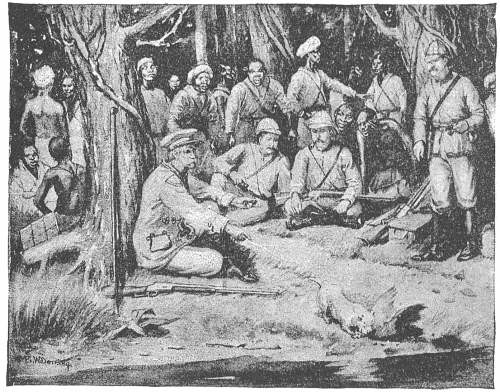
RANDY SEIZES THE GUINEA FOWL.
The natives did not stand for further question, but vanished kindly, and left their treasures of food. We received as our share two pounds of Indian corn and half-a-pound of beans. Altogether about twenty-five pounds of corn were discovered, which was distributed among the people.
In the afternoon I received a note from Mr. Jephson, who was behind with the boat: "For God's sake, if you can get any food at the village send us some."
We despatched answer to Jephson to hunt up the wounded elephant that I had shot, and which had taken 1887. Oct. 9. Forest. refuge on an island near him, and in reply to his anxious letter, a small handful of corn.
On the 9th of October 100 men volunteered to go across river and explore inland from the north bank with a resolute intention not to return without food of some kind. I went up river with the boat's crew, and Stairs down river to strike inland by a little track in the hope that it might lead to some village; those who were too dispirited to go far wandered southward through the woods to search for wild fruit and forest beans. This last article was about four times the size of a large garden bean, encased in a brown leathery rind. At first we had contented ourselves with merely skinning it and boiling it, but this produced sickness of the stomach. An old woman captured on the island was seen to prepare a dish of these beans by skinning them and afterwards cleaning the inner covering, and finally scraping them as we would nutmegs. Out of this floury substance she made some patties for her captor, who shouted in ecstasies that they were good. Whereupon everybody bestirred themselves to collect the beans, which were fairly plentiful. Tempted by a "lady finger" cake of this article that was brought to me, I ventured to try it, and found it sufficiently filling, and about as palatable as a mess of acorns. Indeed, the flavour strongly reminded me of the acorn. The fungi were of several varieties, some pure and perfect mushrooms, others were of a less harmless kind; but surely the gods protected the miserable human beings condemned to live on such things. Grubs were collected, also slugs from the trees, caterpillars, and white ants—these served for meat. The mabengu (nux vomica) furnished the dessert, with fenessi or a species of bastard jack fruit.
The following day some of the foragers from across the river returned bringing nothing. They had discovered such emptiness on the north bank as we had found on the south bank; but "Inshallah!" they said, "we shall find food either to-morrow or the next day."
1887. Oct. 10. Forest. In the morning I had eaten my last grain of Indian corn, and my last portion of everything solid that was obtainable, and at noon the horrid pains of the stomach had to be satisfied with something. Some potato leaves brought me by Wadi Khamis, a headman, were bruised fine and cooked. They were not bad, still the stomach ached from utter depletion. Then a Zanzibari, with his face aglow with honest pride, brought me a dozen fruit of the size and colour of prize pear, which emitted a most pleasant fruity odour. He warranted them to be lovely, and declared that the men enjoyed them, but the finest had been picked out for myself and officers. He had also brought a pattie made out of the wood-bean flour which had a rich custardy look about it. With many thanks I accepted this novel repast, and I felt a grateful sense of fulness. In an hour, however, a nausea attacked me, and I was forced to seek my bed. The temples presently felt as if constricted by an iron band, the eyes blinked strangely, and a magnifying glass did not enable me to read the figures of Norie's Epitome. My servant, with the rashness of youth, had lunched bravely on what I had shared with him of the sweetly-smelling pear-like fruit, and consequently suffered more severely. Had he been in a little cockle boat on a mad channel sea he could scarcely have presented a more flabby and disordered aspect than had been caused by the forest pears.
Just at sunset the foragers of No. 1 Company, after an absence of thirty-six hours, appeared from the N. bank, bringing sufficient plantains to save the Europeans from despair and starvation; but the men received only two plantains each, equal to four ounces of solid stuff, to put into stomachs that would have required eight pounds to satisfy.
The officers Stairs, Jephson, and Parke, had been amusing themselves the entire afternoon in drawing fanciful menus, where such things figured as:—
Filet de bœuf en Chartreuse.
Petites bouchées aux huîtres de Ostende.
Bécassines rôties à la Londres.
1887. Oct. 10. Forest. Another had shown his Anglo-Saxon proclivities for solids such as:—
Ham and eggs and plenty of them,
Roast beef and potatoes unlimited,
A weighty plum pudding.
There were two of the foragers missing, but we could not wait for them. We moved from this starvation camp to one higher up, a distance of eleven miles.
A man of No. 3 Company dropped his box of ammunition into a deep affluent and lost it. Kajeli stole a box of Winchester ammunition and absconded. Salim stole a case containing Emin Pasha's new boots and two pairs of mine, and deserted. Wadi Adam vanished with Surgeon Parke's entire kit. Swadi, of No. 1 Company, left his box on the road, and departed himself to parts unknown. Bull-necked Uchungu followed suit with a box of Remington cartridges.
On the 12th of October we marched four-and-a-half miles, E. by S. The boat and crew were far below, struggling in rapids. We wished now to cross the river to try our fortune on the N. bank. We searched for a canoe, and saw one on the other side, but the river was 400 yards wide, and the current was too strong against the best swimmers in their present state of debility.
Some scouts presently discovered a canoe fastened to an island only forty yards from the south bank, which was situate a little above our halting place. Three men volunteered, among whom was Wadi Asman, of the Pioneers, a grave man, faithful, and of much experience in many African lands. Twenty dollars reward was to be the prize of success. Asman lacked the audacity of Uledi, the coxswain of the "advance," as well as his bold high spirit, but was a most prudent and valuable man.
These three men chose a small rapid for their venture, that they might obtain a footing now and then on the rocks. At dusk two of them returned to grieve us with the news that Asman had tried to swim with his 1887. Oct. 12. Forest. Winchester on his back, and had been swept by the strong current into a whirlpool, and was drowned.
We were unfortunate in every respect; our chiefs had not yet returned, we were fearing for their fate, strong men deserted. Our rifles were rapidly decreasing in number. Our ammunition was being stolen. Feruzi, the next best man to Uledi as a sailor, soldier, carrier, good man and true, was dying from a wound inflicted on the head by a savage's knife.
The following day was also a halt. We were about to cross the river, and we were anxious for our six chiefs, one of whom was Rashid bin Omar, the "father of the people," as he was called. Equipped with only their rifles, accoutrements and sufficient ammunition, such men ought to have travelled in the week that had elapsed since our departure from Nelson's camp over a hundred miles. If they, during that distance, could not discover the Manyuema settlement, what chance had we, burdened with loads, with a caravan of hungry and despairing men, who for a week had fed on nothing but two plantains, berries, wild fruit, and fungi? Our men had begun to suffer dearly during this protracted starvation. Three had died the day before.
Towards evening Jephson appeared with the boat, and brought a supply of Indian corn, which sufficed to give twelve cupfuls to each white. It was a reprieve from death for the Europeans.
The next day, the 15th, having blazed trees around the camp, and drawn broad arrows with charcoal for the guidance of the head men when they should return, the Expedition crossed over to the north bank and camped on the upper side of a range of hills. Feruzi Ali died of his wound soon after.
Our men were in such a desperately weak state, that I had not the heart to command the boat to be disconnected for transport, as had a world's treasure been spread out before them, they could not have exhibited greater power than they were willing to give at a word. I stated the case fairly to them thus:—
"You see, my men, our condition in brief is this. 1887. Oct. 15. Forest. We started from Yambuya 389 in number and took 237 loads with us. We had 80 extra carriers to provide for those who by the way might become weak and ailing. We left 56 men at Ugarrowwa's Settlement, and 52 with Captain Nelson. We should have 271 left, but instead of that number we have only 200 to-day, including the chiefs who are absent. Seventy-one have either died, been killed, or deserted. But there are only 150 of you fit to carry anything, and therefore we cannot carry this boat any further. I say, let us sink her here by the riverside, and let us press on to get food for ourselves and those with Captain Nelson, who are wondering what has become of us, before we all die in these woods. You are the carriers of the boat—not we, Do you speak, what shall be done unto her?"
Many suggestions were made by the officers and men, but Uledi of 'Through the Dark Continent,' always Uledi—the ever faithful Uledi, spoke straight to the purpose. "Sir, my advice is this. You go on with the caravan and search for the Manyuema, and I and my crew will work at these rapids, and pole, row, or drag her on as we can. After I have gone two days up, if I do not see signs of the Manyuema I will send men after you to keep touch with you. We cannot lose you, for a blind man could follow such a track as the caravan makes."
This suggestion was agreed by all to be the best, and it was arranged that our rule of conduct should be as Uledi sketched out.
We separated at 10 A.M., and in a short time I had my first experience among the loftier hills of the Aruwimi valley. I led the caravan northward through the trackless forest, sheering a little to the north east to gain a spur, and using animal tracks when they served us. Progress was very slow, the undergrowth was dense; berries of the phrynium and fruit of the Amomum fenessi and nux vomica, besides the large wood beans and fungi of all sorts, were numerous, and each man gathered a plentiful harvest. Unaccustomed to hills for years, our hearts palpitated violently as we breasted the 1887. Oct. 15. Forest. steep-wooded slopes, and cut arid slashed at the obstructing creepers, bush and plants.
Ah, it was a sad night, unutterably sad, to see so many men struggling on blindly through that endless forest, following one white man who was bound whither none knew, whom most believed did not know himself. They were in a veritable hell of hunger already! What nameless horrors awaited them further on none could conjecture? But what matter, death comes to every man soon or late! Therefore we pushed on and on, broke through the bush, trampled down the plants, wound along the crest of spurs zigzagging from north-east to north-west, and descending to a bowl-like valley by a clear stream, lunched on our corn and berries.
During our mid-day halt, one Umari having seen some magnificent and ripe fenessi at the top of a tree thirty feet high, essayed to climb it, but on gaining that height, a branch or his strength yielded and he tumbled headlong upon the heads of two other men who were waiting to seize the fruit. Strange to say, none of them were very seriously injured. Umari was a little lame in the hip and one of those upon whom he fell complained of a pain in the chest.
At 3.30 after a terrible struggle through a suffocating wilderness of arums, amoma, and bush, we came to a dark amphitheatral glen and at the bottom found a camp just deserted by the natives, and in such hot haste that they had thought it best not to burden themselves with their treasures. Surely some divinity provided for us always in the most stressful hours. Two bushels of Indian corn, and a bushel of beans awaited us in this camp.
My poor donkey from Zanzibar showed symptoms of surrender. Arums and amoma every day since June 28th were no fit food for a dainty Zanzibar ass, therefore to end his misery I shot him. The meat was as carefully shared as though it were the finest venison, for a wild and famished mob threatened to defy discipline. When the meat was fairly served a free fight 1887. Oct. 15. Forest. took place over the skin, the bones were taken up and crushed, the hoofs were boiled for hours, there was nothing left of my faithful animal but the spilled blood and hair; a pack of hyænas could not have made a more thorough disposal of it. That constituent of the human being which marks him as superior to all others of the animal creation was so deadened by hunger that our men had become merely carnivorous bipeds, inclined to be as ferocious as any beast of prey.
On the 16th we crossed through four deep gorges one after another, through wonderful growths of phrynia. The trees frequently bore fenessi nearly ripe, one foot long and eight inches in diameter. Some of this fruit was equal to pineapple, it was certainly wholesome. Even the rotten fruit was not rejected. When the fenessi were absent, the wood-bean tree flourished and kindly sprinkled the ground with its fruit. Nature seemed to confess that the wanderers had borne enough of pain and grief. The deepest solitudes showed increasing tenderness for the weary and long-suffering. The phrynia gave us their brightest red berries, the amoma furnished us with the finest and ripest scarlet fruit, the fenessi were in a state of perfection, the wood-beans were larger and fatter, the streams of the wood glens were clear and cold; no enemy was in sight, nothing was to be feared but hunger, and nature did its best with her unknown treasures, shaded us with her fragrant and loving shades, and whispered to us unspeakable things sweetly and tenderly.
During the mid-day halt the men discussed our prospects. They said, with solemn shaking of their heads, "Know you that such and such a man is dead? that the other is lost! another will probably fall this afternoon! the rest will perish to-morrow!" The trumpet summoned all to their feet, to march on, and strive, and press forward to the goal.
Half-an-hour later the pioneers broke through a growth of amoma, and stepped on a road. And lo! on every tree we saw the peculiar "blaze" of the Manyuema, a discovery that was transmitted by every 1887. Oct. 16. Forest. voice from the head to the rear of the column, and was received with jubilant cheers.
"Which way, sir?" asked the delighted pioneers.
"Right turn of course," I replied, feeling far more glad than any, and fuller of longings for the settlement that was to end this terrible period, and shorten the misery of Nelson and his dark followers.
"Please God," they said, "to-morrow or the next day we shall have food," which meant that after suffering unappeasable hunger for 336 hours, they could patiently wait if it pleased God another thirty-six or sixty hours more.
We were all frightfully thin, the whites not so much reduced as our coloured men. We thought of the future and abounded with hope, though deep depression followed any inspection of the people. We regretted that our followers did not have greater faith in us. Hunger followed by despair killed many. Many freely expressed their thoughts and declared to one another plainly that we knew not whither we were marching. And they were not far wrong, for who knew what a day might bring forth in unexplored depths of woods. But as they said, it was their fate to follow us, and therefore they followed fate. They had fared badly and had suffered greatly. It is hard to walk at all when weakness sets in through emptiness; it is still worse to do so when burdened with sixty pounds weight. Over fifty were yet in fair condition; 150 were skeletons covered with ashy grey skins, jaded and worn out, with every sign of wretchedness printed deep in their eyes, in their bodies and movements. These could hardly do more than creep on and moan, and shed tears and sigh. My only dog "Randy," alas! how feeble he had become! Meat he had not tasted—except with me of the ass's meat—for weeks. Parched corn and beans were not fit for a terrier, and fenessi and mabengu, and such other acid fruit he disdained, and so he declined, until he became as gaunt as the pariah of a Moslem. Stairs had never failed me. Jephson every now and then had been fortunate in discoveries of grain treasures, 1887. Oct. 16. Forest. and always showed an indomitable front, and Parke was ever striving, patient, cheerful and gentle. Deep, deep down to undiscovered depths our life in the forest had enabled me to penetrate human nature with all its endurance and virtues.
Along the track of the Manyuema it was easy to travel. Sometimes we came to a maze of roads; but once the general direction was found, there was no difficulty to point to the right one. It appeared to be well travelled, and it was clearer every mile that we were approaching a populous settlement. As recent tracks became more numerous, the bush seemed more broken into, with many a halt and many wayward strayings. Here and there trees had been lopped of their branches. Cording vines lay frequently on the track; pads for native carriers had often been dropped in haste. Most of the morning was expended in crossing a score of lazy, oozy rillets, which caused large breadths of slime-covered swamp. Wasps attacked the column at one crossing, and stung a man into high fever, and being in such an emaciated condition there was little chance of his recovery. After a march of seven miles south-eastwardly we halted on the afternoon of the 17th.
The night was ushered by a tempest which threatened to uproot the forest and bear it to the distant west, accompanied by floods of rain, and a severe cold temperature. Nevertheless, fear of famishing drove us to begin the march at an early hour on the following day. In about an hour, and-a-half we stood on the confines of a large clearing, but the fog was so dense that we could discern nothing further than 200 feet in front. Resting awhile to debate upon our course, we heard a sonorous voice singing in a language none of us knew, and a lusty hail and an argument with what appeared to be some humour. As this was not a land where aborigines would dare to be so light-hearted and frivolous, this singing we believed could proceed from no other people than those who knew they had nothing to fear. I fired a Winchester rapidly in the air. The response by heavy-loaded muskets revealed that these 1887. Oct. 17. Forest. were the Manyuema whom we had been so long seeking, and scarcely had their echoes ceased their reverberations than the caravan relieved its joy by long continued hurrahs.
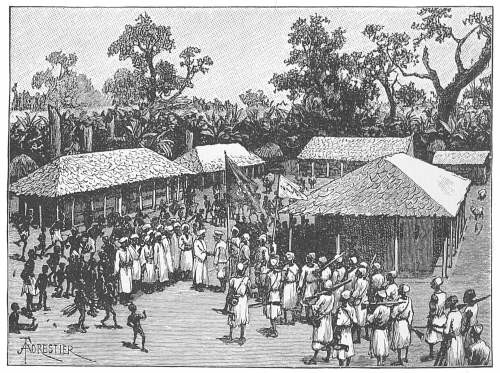
KILONGA LONGA'S STATION.
We descended the slope of the clearing to a little valley, and from all sides of an opposite slope were seen lines of men and women issuing to welcome us with friendly hails. We looked to the right and left and saw thriving fields, Indian corn, rice, sweet potatoes and beans. The well-known sounds of Arab greeting and hospitable tenders of friendship burst upon our ears; and our hands were soon clasped by lusty huge fellows, who seemed to enjoy life in the wilds as much as they could have enjoyed it in their own lands. These came principally from Manyuema, though their no less stout slaves, armed with percussion muskets and carbine, echoed heartily their superiors' sentiments and professions.
We were conducted up the sloping clearing through fields of luxuriant grain, by troops of men and 1887. Oct. 17. Ipoto. youngsters who were irrepressibly frolicsome in their joy at the new arrivals and dawning promise of a holiday. On arrival at the village we were invited to take our seats in deep shady verandahs where we soon had to answer to hosts of questions and congratulations. As the caravan filed past us to its allotted quarters which men were appointed to show, numerous were the praises to God, uttered by them for our marvellous escapes from the terrible wilderness that stretched from their settlement of Ipoto to the Basopo Cataract, a distance of 197 miles, praises in which in our inmost hearts each one of our sorely tried caravan most heartily joined.
CHAPTER X.
WITH THE MANYUEMA AT IPOTO.
The ivory hunters at Ipoto—Their mode of proceeding—The Manyuema headmen and their raids—Remedy for preventing wholesale devastations—Crusade preached by Cardinal Lavigerie—Our Zanzibar chiefs—Anxiety respecting Captain Nelson and his followers—Our men sell their weapons for food—Theft of Rifles—Their return demanded—Uledi turns up with news of the missing chiefs—Contract drawn up with the Manyuema headmen for the relief of Captain Nelson—Jephson's report on his journey—Reports of Captain Nelson and Surgeon Parke—The process of blood brotherhood between myself and Ismaili—We leave Ipoto.
1887. Oct. 18. Ipoto. This community of ivory hunters established at Ipoto had arrived, five months previous to our coming, from the banks of the Lualaba, from a point situated between the exits of the Lowwa and the Leopold into the great river. The journey had occupied them seven-and-a-half months, and they had seen neither grass nor open country, nor even heard of them during their wanderings. They had halted a month at Kinnena on the Lindi, and had built a station-house for their Chief Kilonga-Longa, who, when he had joined them with the main body, sent on about 200 guns and 200 slave carriers to strike further in a north-easterly direction, to discover some other prosperous settlement far in advance of him, whence they could sally out in bands to destroy, burn and enslave natives in exchange for ivory. Through continual fighting, and the carelessness which the unbalanced mind is so apt to fall into after one or more happy successes, they had decreased in number within seven-and-a-half months into a force of about ninety guns. On reaching the Lenda River they had heard of the settlements of Ugarrowwa, and sheered 1887. Oct. 18. Ipoto. off the limits of his raiding circle to obtain a centre of their own, and, crossing the Lenda, they succeeded in reaching the south bank of the Ituri, about south of their present settlement at Ipoto.
As the natives would not assist them over the river to the north bank, they cut down a big tree and with axe and fire hollowed it into a sizeable canoe which conveyed them across to the north bank to Ipoto. Since that date they had launched out on one of the most sanguinary and destructive careers to which even Tippu-Tib's or Tagamoyo's career offer but poor comparison. Towards the Lenda and Ihuru Rivers, they had levelled into black ashes every settlement, their rage for destruction had even been vented on the plantain groves, every canoe on the rivers had been split into pieces, every island had been searched, and into the darkest recesses, whither a slight track could be traced, they had penetrated with only one dominating passion, which was to kill as many of the men and capture as many of the women and children as craft and cruelty would enable them. However far northward or eastward these people had reached, one said nine days' march, another fifteen days; or wherever they had gone they had done precisely as we had seen between the Lenda River and Ipoto, and reduced the forest land into a howling wilderness, and throughout all the immense area had left scarcely a hut standing.
What these destroyers had left of groves and plantations of plantain and bananas, manioc, and corn-fields, the elephant, chimpanzee, and monkeys had trampled and crushed into decaying and putrid muck, and in their places had sprung up, with the swiftness of mushrooms, whole hosts of large-leafed plants native to the soil, briars, calamus and bush, which the natives had in times past suppressed with their knives, axes and hoes. With each season the bush grew more robust and taller, and a few seasons only were wanted to cover all traces of former habitation and labour.
From Ipoto to the Lenda the distance by our track is 105 miles. Assume that this is the distance eastward to 1887. Oct. 18. Ipoto. which their ravages have extended, and northward and southward, and we have something like 44,000 square miles. We know what Ugarrowwa has done from the preceding pages, what he was still doing with all the vigour of his mind, and we know what the Arabs in the Stanley Falls are doing on the Lumami and what sort of devil's work Mumi Muhala, and Bwana Mohamed are perpetrating around Lake Ozo, the source of the Lulu, and, once we know where their centres are located, we may with a pair of compasses draw great circles round each, and park off areas of 40,000 and 50,000 square miles into which half-a-dozen resolute men, aided by their hundreds of bandits, have divided about three-fourths of the Great Upper Congo Forest for the sole purpose of murder, and becoming heirs to a few hundred tusks of ivory.
At the date of our arrival at Ipoto, there were the Manyuema headmen, physically fine stalwart fellows, named Ismailia, Khamisi, and Sangarameni, who were responsible to Kilonga-Longa, their chief, for the followers and operations entrusted to their charge. At alternate periods each set out from Ipoto to his own special sub-district. Thus, to Ismailia, all roads from Ipoto to Ibwiri and east to the Ituri were given as his special charge. Khamisi's area was along the line of the Ihuru, then east to Ibwiri, to Sangarameni all the land east and west between the Ibina and Ihuru affluents of the Ituri. Altogether there were 150 fighting men, but only about 90 were armed with guns. Kilonga-Longa was still at Kinnena, and was not expected for three months yet.
The fighting men under the three leaders consisted of Bakusu, Balegga, and Basongora, youths who were trained by the Manyuema as raiders in the forest region, in the same manner as in 1876, Manyuema youths had been trained by Arabs and Waswahili of the east coast. We see in this extraordinary increase in number of raiders in the Upper Congo basin the fruits of the Arab policy of killing off the adult aborigines and preserving the children. The girls are distributed among the Arab, 1887. Oct. 18. Ipoto. Swahili and Manyuema harems, the boys are trained to carry arms and are exercised in the use of them. When they are grown tall and strong enough they are rewarded with wives from the female servants of the harem, and then are admitted partners in these bloody ventures. So many parts of the profits are due to the great proprietor, such as Tippu-Tib, or Said bin Abed, a less number becomes the due of the headmen, and the remainder becomes the property of the bandits. At other times large ivories, over 35 lbs. each, become the property of the proprietor, all over 20 lbs. to 35 lbs. belong to the headmen, scraps, pieces and young ivory are permitted to be kept by the lucky finders. Hence every member of the caravan is inspired to do his best. The caravan is well armed and well manned by the proprietor, who stays at home on the Congo or Lualaba river indulging in rice and pilaf and the excesses of his harem, the headmen, inspired by greed and cupidity, become ferocious and stern, the bandits fling themselves upon a settlement without mercy to obtain the largest share of loot, of children, flocks, poultry, and ivory.
All this would be clearly beyond their power if they possessed no gunpowder. Not a mile beyond their settlements would the Arabs and their followers dare venture. It is more than likely that if gunpowder was prohibited entry into Africa there would be a general and quick migration to the sea of all Arabs from inner Africa, as the native Chiefs would be immeasurably stronger than any combination of Arabs armed with spears. What possible chance could Tippu-Tib, Abed bin Salim, Ugarrowwa and Kilonga-Longa have against the Basongora and Bakusu? How could the Arabs of Ujiji resist the Wajiji and Warundi, or how could those of Unyamyembé live among the bowmen and spearmen of Unyamwezi?
There is only one remedy for these wholesale devastations of African aborigines, and that is the solemn combination of England, Germany, France, Portugal, South and East Africa, and Congo State against the introduction of gunpowder into any part of the 1887. Oct. 18. Ipoto. Continent except for the use of their own agents, soldiers, employés, or seizing upon every tusk of ivory brought out, as there is not a single piece nowadays which has been gained lawfully. Every tusk, piece and scrap in the possession of an Arab trader has been steeped and dyed in blood. Every pound weight has cost the life of a man, woman or child, for every five pounds a hut has been burned, for every two tusks a whole village has been destroyed, every twenty tusks have been obtained at the price of a district with all its people, villages and plantations. It is simply incredible that, because ivory is required for ornaments or billiard games, the rich heart of Africa should be laid waste at this late year of the nineteenth century, signalized as it has been by so much advance, that populations, tribes and nations should be utterly destroyed. Whom after all does this bloody seizure of ivory enrich? Only a few dozens of half-castes, Arab and Negro, who, if due justice were dealt to them, should be made to sweat out the remainder of their piratical lives in the severest penal servitude.
On arriving in civilization after these terrible discoveries, I was told of a crusade that had been preached by Cardinal Lavigerie, and of a rising desire in Europe to effect by force of arms in the old crusader style and to attack the Arabs and their followers in their strongholds in Central Africa. It is just such a scheme as might have been expected from men who applauded Gordon when he set out with a white wand and six followers to rescue all the garrisons of the Soudan, a task which 14,000 of his countrymen, under one of the most skilful English generals, would have found impossible at that date. We pride ourselves upon being practical and sensible men, and yet every now and then let some enthusiast—whether Gladstone, Gordon, Lavigerie or another—speak, and a wave of Quixotism spreads over many lands. The last thing I heard in connection with this mad project is that a band of 100 Swedes, who have subscribed £25 each, are about to sail to some part of the East Coast of Africa, and proceed to Tanganika to 1887. Oct. 18. Ipoto. commence ostensibly the extirpation of the Arab slave-trader, but in reality to commit suicide.
However, these matters are not the object of this chapter. We are about to have a more intimate acquaintance with the morals of the Manyuema, and to understand them better than we ever expected we should.
They had not heard a word or a whisper of our Headmen whom we had despatched as couriers to obtain relief for Nelson's party, and, as it was scarcely possible that a starving caravan would accomplish the distance between Nelson's Camp and Ipoto before six active and intelligent men, we began to fear that among the lost men we should have to number our Zanzibari chiefs. Their track was clear as far as the crossing-place of the 14th and 15th December. It was most probable that the witless men would continue up the river until they were overpowered by the savages of some unknown village. Our minds were never free from anxiety respecting Capt. Nelson and his followers. Thirteen days had already elapsed since our parting. During this period their position was not worse than ours had been. The forest was around them as it was around us. They were not loaded down as we were. The most active men could search about for food, or they could employ their canoes to ferry themselves over to the scene of the forage of the 3rd December, one day's journey by land, or an hour by water. Berries and fungi abounded on the crest of the hills above their camp as in other parts. Yet we were anxious, and one of my first duties was to try and engage a relief party to take food to Nelson's camp. I was promised that it should be arranged next day.
For ourselves we received three goats and twelve baskets of Indian corn, which, when distributed, gave six ears of corn per man. It furnished us with two good meals, and many must have felt revived and refreshed, as I did.
On the first day's halt at Ipoto we suffered considerable lassitude. Nature either furnishes a stomach and no food, or else furnishes a feast and robs us of all 1887. Oct. 18. Ipoto. appetite. On the day before, and on this, we had fed sumptuously on rice and pilaf and goat stew, but now we began to suffer from many illnesses. The masticators had forgotten their office, and the digestive organs disdained the dainties, and affected to be deranged. Seriously, it was the natural result of over-eating; corn mush, grits, parched corn, beans and meat are solids requiring gastric juice, which, after being famished for so many days, was not in sufficient supply for the eager demand made for it.
The Manyuema had about 300 or 400 acres under corn, five acres under rice, and as many under beans. Sugar-cane was also grown largely. They possessed about 100 goats—all stolen from the natives. In their store-huts they had immense supplies of Indian corn drawn from some village near the Ihuru, and as yet unshucked. Their banana plantations were well stocked with fruit. Indeed the condition of every one in the settlement was prime.
It is but right to acknowledge that we were received on the first day with ostentatious kindness, but on the third day something of a strangeness sprang up between us. Their cordiality probably rose from a belief that our loads contained some desirable articles, but unfortunately the first-class beads that would have sufficed for the purchase of all their stock of corn were lost by the capsizing of a canoe near Panga Falls, and the gold braided Arab burnooses were stolen below Ugarrowwa, by deserters. Disappointed at not receiving the expected quantity of fine cloth or fine beads, they proceeded systematically to tempt our men to sell everything they possessed, shirts, caps, daoles, waist cloths, knives, belts, to which, being their personal property, we could make no objection. But the lucky owners of such articles having been seen by others less fortunate, hugely enjoying varieties of succulent food, were the means of inspiring the latter to envy and finally to theft. The unthrifty and reckless men sold their ammunition, accoutrements, bill hooks, ramrods, and finally their Remington Rifles. Thus, after escaping the terrible dangers of starvation 1887. Oct. 18. Ipoto. and such injuries as the many savage tribes could inflict on us, we were in near peril of becoming slaves to the Arab slaves.
Despite entreaties for corn, we could obtain no more than two ears per man per day. I promised to pay triple price for everything received, on the arrival of the rear column, but with these people a present possession is better than a prospective one. They professed to doubt that we had cloth, and to believe that we had travelled all this distance to fight them. We represented on the other hand that all we needed were six ears of corn per day during nine days' rest. Three rifles disappeared. The Headmen denied all knowledge of them. We were compelled to reflect that, if it were true, they suspected we entertained sinister intentions towards them, that surely the safest and craftiest policy would be to purchase our arms secretly, and disarm us altogether, when they could enforce what terms they pleased on us.
On the 21st six more rifles were sold. At this rate the Expedition would be wrecked in a short time, for a body of men without arms in the heart of the great forest, with a host of men to the eastward and a large body to the westward depending upon them, were lost beyond hope of salvation. Both advance and retreat were equally cut off, and no resource would be left but absolute submission to the chief who chose to assert himself to be our master or Death. Therefore I proposed for my part to struggle strongly against such a fate, and either to provoke it instantly, or ward it off by prompt action.
A muster was made, the five men without arms were sentenced to twenty-five lashes each and to be tied up. After a considerable fume and fuss had been exhibited, a man stepped up, as one was about to undergo punishment and begged permission to speak.
"This man is innocent, sir." "I have his rifle in my hut, I seized it last night from Juma (one of the cooks), son of Forkali, as he brought it to a Manyuema to sell. It may be Juma stole it from this man. I know that 1887. Oct. 21. Ipoto. all these men have pleaded that their rifles have been stolen by others, while they slept. It may be true as in this case." Meantime Juma had flown, but was found later on hiding in the corn fields. He confessed that he had stolen two, and had taken them to the informer to be disposed of for corn, or a goat, but it was solely at the instigation of the informer. It may have been true, for scarcely one of them but was quite capable of such a course, but the story was lame, and unreasonable in this case and was rejected. Another now came up and recognized Juma as the thief who had abstracted his rifle—and having proved his statement and confession having been made—the prisoner was sentenced to immediate execution, which was accordingly carried out by hanging.
It now being proved beyond a doubt that the Manyuema were purchasing our rifles at the rate of a few ears of corn per gun, I sent for the head men, and make a formal demand for their instant restitution, otherwise they would be responsible for the consequences. They were inclined to be wrathy at first. They drove the Zanzibaris from the village out into the clearing, and there was every prospect of a fight, or as was very probable, that the Expedition was about to be wrecked. Our men, being so utterly demoralized, and utterly broken in spirit from what they had undergone, were not to be relied on, and as they were ready to sell themselves for corn—there was little chance of our winning a victory in case of a struggle. It requires fulness of stomach to be brave. At the same time death was sure to conclude us in any event, for to remain quiescent under such circumstances tended to produce an ultimate appeal to arms. With those eleven rifles, 3000 rounds of ammunition had been sold. No option presented itself to me than to be firm in my demand for the rifles; it was reiterated, under a threat that I would proceed to take other means—and as a proof of it they had but to look at the body hanging from a tree, for if we proceeded to such extremities as putting to death one of our own men, they certainly 1887. Oct. 21. Ipoto. ought to know that we should feel ourselves perfectly prepared to take vengeance on those who had really caused his death by keeping open doors to receive stolen property.
After an hour's storming in their village they brought five rifles to me, and to my astonishment pointed the sellers of them. Had it not been impolitic in the first place to drive things to the extreme, I should have declined receiving one of them back before all had been returned, and could I have been assured of the aid of fifty men I should have declared for a fight; but just at this juncture Uledi, the faithful coxswain of the Advance, strode into camp, bringing news that the boat was safe at the landing-place of Ipoto and of his discovery of the six missing chiefs in a starving and bewildered state four miles from the settlement. This produced a revulsion of feelings. Gratitude for the discovery of my lost men, the sight of Uledi—the knowledge that after all, despite the perverseness of human nature, I had some faithful fellows, left me for the time speechless.
Then the tale was told to Uledi, and he undertook the business of eradicating the hostile feelings of the Manyuema, and pleaded with me to let bygones be bygones on the score that the dark days were ended, and happy days he was sure were in store for us.
"For surely, dear master," he said, "after the longest night comes day, and why not sunshine after darkness with us? I think of how many long nights and dark days we pulled through in the old times when we pierced Africa together, and now let your heart be at peace. Please God we shall forget our troubles before long."
The culprits were ordered to be bound until morning. Uledi, with his bold frank way, sailed straight into the affections of the Manyuema headmen. Presents of corn were brought to me, apologies were made and accepted. The corn was distributed among the people, and we ended this troublesome day, which had brought us all to the verge of dissolution, in much greater content than could have been hoped from its ominous commencement.
1887. Oct. 23. Ipoto. Our long wandering chiefs who were sent as heralds of our approach to Ipoto arrived on Sunday the 23rd. They surely had made but a fruitless quest, and they found us old residents of the place they had been despatched to seek. Haggard, wan and feeble from seventeen days feeding on what the uninhabited wilderness afforded, they were also greatly abashed at their failure. They had reached the Ibina River which flows from the S.E., and struck it two days above the confluence with the Ituri; they had then followed the tributary down to the junction, had found a canoe and rowed across to the right bank, where they had nearly perished from hunger. Fortunately Uledi had discovered them in time, had informed them of the direction of Ipoto, and they had crawled as they best could to our camp.
Before night, Sangarameni, the third head man, appeared from a raid with fifteen fine ivories. He said he had penetrated a twenty days' journey, and from a high hill had viewed an open country all grass land.
Out of a supply I obtained on this day I was able to give two ears of corn per man, and to store a couple of baskets for Nelson's party. But events were not progressing smoothly, I could obtain no favourable answer to my entreaty for a relief party. One of our men had been speared to death by the Manyuema on a charge of stealing corn from the fields. One had been hanged, twenty had been flogged for stealing ammunition, another had received 200 cuts from the Manyuema for attempting to steal. If only the men could have reasoned sensibly during these days, how quickly matters could have been settled otherwise!
I had spoken and warned them with all earnestness to "endure, and cheer up," and that there were two ways of settling all this, but that I was afraid of them only, for they preferred the refuse of the Manyuema to our wages and work. The Manyuema were proving to them what they might expect of them; and with us the worst days were over; all we had to do was to march beyond the utmost reach of the Manyuema raids, when we should all become as robust as they. Bah! 1887. Oct. 24. Ipoto. I might as well have addressed my appeals to the trees of the forest as unto wretches so sodden with despair.
The Manyuema had promised me three several times by this day to send eighty men as a relief party to Nelson's camp, but the arrival of Sangarameni, and misunderstandings, and other trifles, had disturbed the arrangements.
On the 24th firing was heard on the other side of the river, and, under the plea that it indicated the arrival of Kilonga-Longa, the relief caravan was again prevented from setting out.
The next day, those who had fired, arrived in camp, and proved to be the Manyuema knaves whom we had seen on the 2nd of October. Out of fifteen men they had lost one man from an arrow wound. They had wandered for twenty-four days to find the track, but having no other loads than provisions these had lasted with economy for fifteen days, but for the last nine days they had subsisted on mushrooms and wild fruit.
On this evening I succeeded in drawing a contract, and getting the three headmen to agree to the following:—
"To send thirty men to the relief of Captain Nelson, with 400 ears of corn for his party.
"To provide Captain Nelson and Surgeon Parke, and all sick men unable to work in the fields, with provisions, until our return from Lake Albert.
"The service of a guide from Ipoto to Ibwiri, for which they were to be paid one bale and a half of cloth on the arrival of the rear column."
It was drawn up in Arabic by Rashid, and in English by myself, and witnessed by three men.
For some fancy articles of personal property I succeeded in purchasing for Mr. Jephson and Capt. Nelson 250 ears of Indian corn, and for 250 pistol cartridges I bought another quantity, and for an ivory-framed mirror from a dressing-case purchased two baskets full; for three bottles of ottar of roses obtained three fowls, so that I had 1000 ears of corn for the relieving and relieved parties.
On the 26th Mr. Mounteney Jephson, forty Zanzibaris, 1887. Oct. 26. Ipoto. and thirty Manyuema slaves started on their journey to Nelson's camp. I cannot do better than introduce Mr. Jephson's report on his journey.
"Arab Settlement at Ipoto,
"November 4th, 1887.
"Dear Sir,
"I left at midday on October 26th, and arrived at the river and crossed over with 30 Manyuema and 40 Zanzibaris under my charge the same afternoon and camped on landing. The next morning we started off early and reached the camp, where we had crossed the river, when we were wandering about in a starving condition in search of the Arabs, by midday the signs and arrow heads we had marked on the trees to show the chiefs we had crossed were still fresh. I reached another of our camps that night. The next day we did nearly three of our former marches. The camp where Feruzi Ali had got his death wound, and where we had spent three such miserable days of hunger and anxiety, looked very dismal as we passed through it. During the day we passed the skeletons of three of our men who had fallen down and died from sheer starvation, they were grim reminders of the misery through which we had so lately gone.
"On the morning of the 29th I started off as soon as it was daylight, determining to reach Nelson that day and decide the question as to his being yet alive. Accompanied by one man only, I soon found myself far ahead of my followers. As I neared Nelson's camp a feverish anxiety to know his fate possessed me, and I pushed on through streams and creeks, by banks and bogs, over which our starving people had slowly toiled with the boat sections. All were passed by quickly to-day, and again the skeletons in the road testified to the trials through which we had passed. As I came down the hill into Nelson's camp, not a sound was heard but the groans of two dying men in a hut close by, the whole place had a deserted and woe-begone look. I came quietly round the tent and found Nelson sitting there; we clasped hands, and then, poor fellow! he turned away and sobbed, and muttered something about being very weak.
"Nelson was greatly changed in appearance, being worn and haggard looking, with deep lines about his eyes and mouth. He told me his anxiety had been intense, as day after day passed and no relief came; he had at last made up his mind that something had happened to us, and that we had been compelled to abandon him. He had lived chiefly upon fruits and fungus which his two boys had brought in from day to day. Of the fifty-two men you left with him, only five remained, of whom two were in a dying state. All the rest had either deserted him or were dead.
"He has himself given you an account of his losses from death and desertion. I gave him the food you sent him, which I had carefully watched on the way, and he had one of the chickens and some porridge cooked at once, it was the first nourishing food he had tasted for many days. After I had been there a couple of hours my people came in and all crowded round the tent to offer him their congratulations.
"You remember Nelson's feet had been very bad for some days before we left him, he had hardly left the tent the whole time he had been here. At one time he had had ten ulcers on one foot, but he had now recovered from them in a great measure and said he thought he would be able to march slowly. On the 30th we began the return march. I gave out 1887. Oct. 26. Ipoto. most of the loads to the Manyuema and Zanzibaris, but was obliged to leave thirteen boxes of ammunition and seven other loads, these I buried, and Parke will be able to fetch them later on.
"Nelson did the marches better than I expected, though he was much knocked up at the end of each day. On the return march we crossed the river lower down and made our way up the right bank and struck your old road a day's march from the Arab camp. Here again we passed more skeletons, at one place there were three within 200 yards of each other.
"On the fifth day, that is November 3rd, we reached the Arab camp, and Nelson's relief was accomplished. He has already picked up wonderfully in spite of the marching, but he cannot get sleep at night and is still in a nervous and highly strung state; the rest in the Arab camp will, I trust, set him up again. It is certain that in his state of health he could not have followed us in our wanderings in search of food, he must have fallen by the way.
"I am &c., &c.
"(Signed) A. J. Mounteney Jephson."
The following are the reports of Captain Nelson and Surgeon Parke.
"Arab Village, Ipoto,
"6th November, 1887,
"Dear Sir,
"Mr. Jephson arrived at my camp on the 29th October with the men for the loads and with the food you sent for me. Many thanks for the food, it was badly needed. He will tell you what state he found me in and of the few men still alive.
"You left me on the 6th October last; on the morning of the 9th I got up a canoe and sent Umari and thirteen of the best men I could find (they were all very bad) over the river to look for food. On the 8th Assani (No. 1 Company) came to me and said that he had returned from the column sick. Same day Uledi's brother came into camp, told me he had lost the road while looking for bananas, near the camp, where we met the Manyuema. On the 10th I found that Juma, one of Stairs' chiefs, had cleared in the night with ten men, and stolen a canoe and gone down river. On the 11th I counted the men and could only find seventeen (I had fifty-two the first day); the rest had gone away either after the column or down river. On the 14th one man died. Umari returned with very few bananas, about enough for two days; however, they were very welcome, as I had nothing but herbs and fungi to eat up to this time. On the 15th another man died, and I found that Saadi (No. 1.) with some other men had come into camp in the night and stolen the canoe (Umari had re-crossed the river in) and gone down river. On the 17th Umari went away with twenty-one men to look for food; 19th, man died; 22nd, two men died; 23rd, man died; 29th, two men died; Jephson arrived; 30th, one man died; we left camp on way here. Umari had not returned; he, however, if alive, will come on here, I feel sure, but how many men with him I cannot tell, perhaps five or six may reach here with him. With the exception of the few bananas I got from Umari I lived entirely on herbs, fungi, and a few mabengu. I had ten ulcers on my left leg and foot and so was unable to look for food myself and was kept alive entirely by my two boys and little Baruk, one of my company, and Abdalla, a man Stairs left with me. I was very weak when Jephson arrived. Now, however, I feel a little better. We arrived at the village on the 3rd November, the chief Ismail brought me the day I came a very 1887. Oct. 26. Ipoto. small quantity of coarse meal and two small dried fish, about enough for one meal.
"Yesterday, no food having come for two days, we sent for it, and after a good deal of trouble Ismail sent us a little meal. At present I am living on my clothes; we get hardly anything from the Chief. To-day Dr. Parke and I went to the Chief, with Hamis Pari as interpreter, and talked to him about food. He told us that no arrangement had been made by you for my food, and that he was feeding the Doctor and me entirely from his own generosity, and he refused to feed our boys, three in number (fewer we cannot possibly do with), as you never told him to do so.
"I have the honour to be,
&c., &c."
"R. H. Nelson."
"Arab Camp, Ipoto,
"November 6th, 1887.
"My dear Mr. Stanley,
"Captain Nelson and Mr. Jephson arrived here on the 3rd inst. a few of the Zanzibaris and Manyuema men getting in with their loads the previous day. Of all those men left at Nelson's camp, only five have arrived here, the remaining live ones were away on a foraging tour with Umari, when the relief party arrived. It is very likely that some of them may find their way here; if so, I shall get Ismaili to allow them to work for their food. Nelson staggered into camp greatly changed in appearance, a complete wreck after the march, his features shrunken and pinched, and a frame reduced to half its former size. I have done the best I could for him medically, but good nourishing food is what he requires to restore him to his health; and I regret to say that my experience here and the conversation which we had to-day with Ismaili goes to show that we shall have to exist on scanty fare. Since you left, I have had some flour and corn from the chiefs, but this was generally after sending for it several times. By a lucky accident I got a goat, most of which I distributed amongst the sick men here, for I am informed by Ismaili, through H. Pari, that only those who work in the field get food, and there are some here who certainly cannot do so; therefore they are trusting to the generosity of the other men, who get five heads of corn each day they work. Both Nelson and myself have much trouble in getting food from Ismaili for ourselves, and he has refused to feed our boys, who are absolutely necessary to draw water, cook, &c., &c., although I have reduced mine to one.
"Nelson and myself went and saw him to day (Hamis Pari, interpreter), and Ismaili stated that you had told the chiefs that a big Mzungu was to come (Nelson), and he would make his own arrangements about food, and that I was here living on his (Ismaili's) generosity, as no arrangements had been made for me. I reminded him of the conversation you had with him in your tent the evening you called me down and gave me your gold watch, and I said that you had told me that you had made a written arrangement with the chiefs that both Nelson and myself should be provisioned. We both told him that we did not want goats and fowls, but simply what he can give us. Not having seen any agreement, I could not argue further, but asked to see the document, so that we might convince him; this he said he could not do, as Hamis, the Chief, had it, and he was away, and would not return for two months. He however sent us up some corn shortly afterwards. This is a very unhappy state of affairs for us who shall have to remain here for so long a time. Nelson has sold much of his clothes, and out of my scanty supply (my 1887. Oct. 26. Ipoto. bag having been lost on the march), I have been obliged to make a further sale so as to provide ourselves with sufficient food.
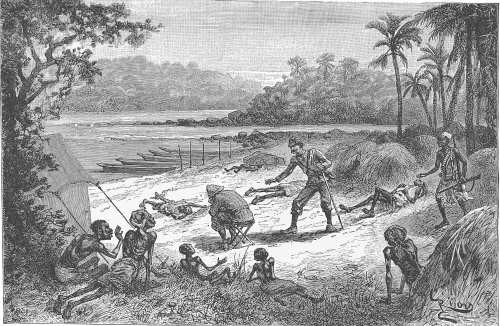
THE RELIEF OF NELSON AND SURVIVORS AT STARVATION CAMP.
"We shall get along here as best we can, and sacrifice much to keep on friendly terms with the Arabs, as it is of such essential importance. I sincerely hope you will have every success in attaining the object of the Expedition, and that we shall all have an opportunity of meeting soon and congratulating Emin Pasha on his relief.
"With best wishes, &c.,
(Signed) "T. H. Parke.
"A.M.D.
"Arab Village, Ipoto,
"10th November, 1887.
"Dear Sir,
"I am sorry to have to tell you that several attempts have been made to rob the hut, and last night unfortunately they managed to get a box of ammunition out of Parke's tent while we were having dinner; also one attempt to burn the hut, which happily I frustrated, owing to my not being able to sleep well. We have spoken to the Chief Ismail about the thieving: he says it is done by Zanzibaris and not by his people; but if there were no sale for the cartridges they would not be stolen. It is of course most unfortunate. Since Jephson left, the enormous quantity of forty small heads of Indian corn has been given to us by Ismail; this is of course quite absurd; as we cannot live on it, we get herbs, with which we supplement our scanty fare.
"Uledi returned this afternoon and goes on to-morrow, and by him I send this letter.
"With kindest regards to you, Sir, Stairs and Jephson.
"I have the honour to be, &c., &c.,
(Signed) "R. H. Nelson.
P.S.—Just as I finished this letter the Chief sent us a little meal, which evidently was done so that Uledi who was waiting for the letter could tell you that we were getting plenty (!!) of food.
"H. M. Stanley, Esq.,
"Commanding E. P. R. Expedition."
On the evening of the 26th Ismaili entered my hut, and declared that he had become so attached to me that he would dearly love to go through the process of blood-brotherhood with me. As I was about to entrust Captain Nelson and Surgeon Parke and about thirty sick men to the charge of himself and brother chiefs, I readily consented, though it was somewhat infra dig. to make brotherhood with a slave, but as he was powerful in that bloody gang of bandits, I pocketed my dignity and underwent the ceremony. I then selected a five-guinea rug, silk handkerchiefs, a couple of yards of crimson broadcloth, and a few other costly trifles. Finally I made another written agreement for guides to accompany me to the distance of fifteen camps, which 1887. Oct. 26. Ipoto. he said was the limit of his territory, and good treatment of my officers, and handed to him a gold watch and chain, value £49 in London, as pledge of this agreement, in presence of Surgeon Parke.
The next day after leaving Surgeon Parke to attend to his friend Nelson and twenty-nine men, we left Ipoto with our reduced force to strive once more with the hunger of the wilderness.