



автордың кітабын онлайн тегін оқу In Darkest Africa, Vol. 2; or, The Quest, Rescue, and Retreat of Emin, Governor of Equatoria
Every attempt has been made to replicate the original as printed.
Some illustrations have been moved from mid-paragraph for ease of reading.
The
footnotesfollow the text.
In certain versions of this etext, in certain browsers, clicking on this symbol
(etext transcriber's note)
COPYRIGHT 1890 BY CHARLES SCRIBNER’S SONS
IN DARKEST AFRICA
OR THE
QUEST, RESCUE, AND RETREAT OF EMIN
GOVERNOR OF EQUATORIA
BY
HENRY M. STANLEY
WITH TWO STEEL ENGRAVINGS, AND ONE HUNDRED AND
FIFTY ILLUSTRATIONS AND MAPS
IN TWO VOLUMES
Vol. II
“I will not cease to go forward until I come to the place where the two seas meet,
though I travel ninety years.”—Koran, chap. xviii., v. 62.
NEW YORK
CHARLES SCRIBNER’S SONS
1890
[All rights reserved]
Copyright, 1890, by
CHARLES SCRIBNER’S SONS
Press of J. J. Little & Co.,
Astor Place, New York.
CONTENTS OF VOLUME II.
CHAPTER XXI.WE START OUR THIRD JOURNEY TO THE NYANZA.
PAGEMr. Bonny and the Zanzibaris—The Zanzibaris’ complaints—Poison of the Manioc—Conversations with Ferajji and Salim—We tell the rear column of the rich plenty of the Nyanza—We wait for Tippu-Tib at Bungangeta Island—Muster of our second journey to the Albert—Mr. Jameson’s letter from Stanley Falls dated August 12th—The flotilla of canoes starts—The Mariri Rapids—Ugarrowwa and Salim bin Mohammed visit me—Tippu-Tib, Major Barttelot and the carriers—Salim bin Mohammed—My answer to Tippu-Tib—Salim and the Manyuema—The settlement of the Batundu—Small-pox among the Madi carriers and the Manyuema—Two insane women—Two more Zanzibari raiders slain—Breach of promises in the Expedition—The Ababua tribe—Wasp Rapids—Ten of our men killed and eaten by natives—Canoe accident at Manginni—Lakki’s raiding party at Mambanga—Feruzi and the bush antelope—Our cook, Jabu, shot dead by a poisoned arrow—Panga Falls—Further casualties by the natives—Nejambi Rapids—The poisoned arrows—Mabengu Rapids—Child-birth on the road—Our sick list—Native affection—A tornado at Little Rapids—Mr. Bonny discovers the village of Bavikai—Remarks about Malaria—Emin Pasha and mosquito curtain—Encounter with the Bavikai natives—A cloud of moths at Hippo Broads—Death of the boy Soudi—Incident at Avaiyabu—Result of vaccinating the Zanzibaris—Zanzibari stung by wasps—Misfortunes at Amiri Rapids—Our casualities—Collecting food prior to march to Avatiko
1 CHAPTER XXII.ARRIVAL AT FORT BODO.
Ugarrowwa’s old station once more—March to Bunda—We cross the Ituri River—Note written by me opposite the mouth of the Lenda River—We reach the Avatiko plantations—Mr. Bonny measures a pigmy—History and dress of the pigmies—A conversation by gesture—The pigmy’s wife—Monkeys and other animals in the forest—The clearing of Andaki—Our tattered clothes—The Ihuru River—Scarcity of food; Amani’s meals—Uledi searches for food—Missing provisions—We reach Kilonga-Longa’s village again—More deaths—The forest improves for travelling—Skirmish near Andikumu—Story of the pigmies and the box of ammunition—We pass Kakwa Hill—Defeat of a caravan—The last of the Somalis—A heavy shower of rain—Welcome food discovery at Indemau—We bridge the Dui River—A rough muster of the people—A stray goat at our Ngwetza camp—Further capture of dwarfs—We send back to Ngwetza for plantains—Loss of my boy Saburi in the forest—We wonder what has become of the Ngwetza party—My boy Saburi turns up—Starvation Camp—We go in search of the absentees, and meet them in the forest—The Ihuru River—And subsequent arrival at Fort Bodo
37 CHAPTER XXIII.THE GREAT CENTRAL AFRICAN FOREST.
Professor Drummond’s statements respecting Africa—Dimensions of the great forest—Vegetation—Insect life—Description of the trees, &c.—Tribes and their food—The primæval forest—The bush proper—The clearings: wonders of vegetable life—The queer feeling of loneliness—A forest tempest—Tropical vegetation along the banks of the Aruwimi—Wasps’ nests—The forest typical of human life—A few secrets of the woods—Game in the forest—Reasons why we did not hunt the animals—Birds—The Simian tribe—Reptiles and insects—The small bees and the beetles—The “jigger”—Night disturbances by falling trees, &c.—The Chimpanzee—The rainiest zone of the earth—The Ituri or Upper Aruwimi—The different tribes and their languages—Their features and customs—Their complexion—Conversation with some captives at Engweddé—The Wambutti dwarfs: their dwellings and mode of living—The Batwa dwarfs—Life in the forest villages—Two Egyptians captured by the dwarfs at Fort Bodo—The poisons used for the arrows—Our treatment for wounds by the arrows—The wild fruits of the forest—Domestic animals—Ailments of the Madis and Zanzibaris—The Congo Railway and the forest products
73 CHAPTER XXIV.IMPRISONMENT OF EMIN PASHA AND MR. JEPHSON.
Our reception at Fort Bodo—Lieut. Stairs’ report of what took place at the Fort during our relief of the rear column—No news of Jephson—Muster of our men—We burn the Fort and advance to find Emin and Jephson—Camp at Kandekoré—Parting words to Lieut. Stairs and Surgeon Parke, who are left in charge of the sick—Mazamboni gives us news of Emin and Jephson—Old Gavira escorts us—Two Wahuma messengers bring letters from Emin and Jephson—Their contents—My replies to the same handed to Chief Mogo for delivery—The Balegga attack us, but, with the help of the Bavira, are repulsed—Mr. Jephson turns up—We talk of Emin—Jephson’s report bearing upon the revolt of the troops of Equatoria, also his views respecting the invasion of the province by the Mahdists, and its results—Emin Pasha sends through Mr. Jephson an answer to my last letter
112 CHAPTER XXV.EMIN PASHA AND HIS OFFICERS REACH OUR CAMP AT KAVALLI.
Lieut. Stairs and his caravan are sent for—Plans regarding the release of Emin from Tunguru—Conversations with Jephson by which I acquire a pretty correct idea of the state of affairs—The rebel officers at Wadelai—They release Emin, and proceed in the s.s. Khedive and Nyanza to our camp at Kavalli—Emin Pasha’s arrival—Stairs and his caravan arrive at Mazamboni’s—Characteristic letter from Jephson, who is sent to bring Emin and his officers from the Lake to Kavalli—Short note from the Pasha—Arrival of Emin Pasha’s caravan—We make a grand display outside our camp—At the grand divan: Selim Bey—Stairs’ column rolls into camp with piles of wealth—Mr. Bonny despatched to the Nyanza to bring up baggage—Text of my message to the rest of the revolted officers at Wadelai—Note from Mr. Bonny—The Greek merchant, Signor Marco, arrives—Suicide of Zanzibari named Mrima—Neighbouring chiefs supply us with carriers—Captain Nelson brings in Emin’s baggage—Arrangements with the chiefs from the Ituri River to the Nyanza—The chief Kabba-Rega—Emin Pasha’s daughter—Selim Bey receives a letter from Fadl-el-Mulla—The Pasha appointed naturalist and meteorologist to the Expedition—The Pasha a Materialist—Dr. Hassan’s arrival—My inspection over the camp—Capt. Casati arrives—Mr. Bonny appears with Awash Effendi and his baggage—The rarest doctor in the world—Discovery of some chimpanzees—The Pasha in his vocation of “collecting”—Measurements of the dwarfs—Why I differ with Emin in the judgment of his men—Various journeys from the camp to the Lake for men and baggage—The Zanzibaris’ complaints of the ringleaders—Hassan Bakari—The Egyptian officers—Interview with Shukri Agha—The flora on the Baregga Hills—The chief of Usiri joins our confederacy—Conversation with Emin regarding Selim Bey and Shukri Agha—Address by me to Stairs, Nelson, Jephson and Parke before Emin Pasha—Their replies—Notices to Selim Bey and Shukri Agha
139 CHAPTER XXVI.WE START HOMEWARD FOR ZANZIBAR.
False reports of strangers at Mazamboni’s—Some of the Pasha’s ivory—Osman Latif Effendi gives me his opinions on the Wadelai officers—My boy Sali as spy in the camp—Capt. Casati’s views of Emin’s departure from his province—Lieut. Stairs makes the first move homeward—Weights of my officers at various places—Ruwenzori visible—The little girl reared by Casati—I act as mediator between Mohammed Effendi, his wife, and Emin—Bilal and Serour—Attempts to steal rifles from the Zanzibari’s huts—We hear of disorder and distress at Wadelai and Mswa—Two propositions made to Emin Pasha—Signal for general muster under arms sounded—Emin’s Arabs are driven to muster by the Zanzibaris—Address to the Egyptians and Soudanese—Lieut. Stairs brings the Pasha’s servants into the square—Serour and three others, being the principal conspirators, placed under guard—Muster of Emin Pasha’s followers—Osman Latif Effendi and his mother—Casati and Emin not on speaking terms—Preparing for the march—Fight with clubs between the Nubian, Omar, and the Zanzibaris—My judgments on the combatants—We leave Kavalli for Zanzibar—The number of our column—Halt in Mazamboni’s territory—I am taken ill with inflammation of the stomach—Dr. Parke’s skilful nursing—I plan in my mind the homeward march—Frequent reports to me of plots in the camp—Lieut. Stairs and forty men capture Rehan and twenty-two deserters who left with our rifles—At a holding of the court it is agreed to hang Rehan—Illness of Surgeon Parke and Mr. Jephson—A packet of letters intended for Wadelai falls into my hands, and from which we learn of an important plot concocted by Emin’s officers—Conversation with Emin Pasha about the same—Shukri Agha arrives in our camp with two followers—Lieut. Stairs buries some ammunition—We continue our march and camp at Bunyambiri—Mazamboni’s services and hospitality—Three soldiers appear with letters from Selim Bey—Their contents—Conversation with the soldiers—They take a letter to Selim Bey from Emin—Ali Effendi and his servants accompany the soldiers back to Selim Bey
182 CHAPTER XXVII.EMIN PASHA—A STUDY.
The Relief of David Livingstone compared with the Relief of Emin Pasha—Outline of the journey of the Expedition to the first meeting with Emin—Some few points relating to Emin on which we had been misinformed—Our high conception of Emin Pasha—Loyalty of the troops, and Emin’s extreme indecision—Surprise at finding Emin a prisoner on our third return to the Nyanza—What might have been averted by the exercise of a little frankness and less reticence on Emin’s part—Emin’s virtues and noble desires—The Pasha from our point of view—Emin’s rank and position in Khartoum, and gradual rise to Governor of Equatoria—Gordon’s trouble in the Soudan—Emin’s consideration and patience—After 1883 Emin left to his own resources—Emin’s small explorations—Correctness of what the Emperor Hadrian wrote of the Egyptians—The story of Emin’s struggles with the Mahdi’s forces from 1883 to 1885—Dr. Junker takes Emin’s despatches to Zanzibar in 1886—Kabba Rega a declared enemy of Emin—The true position of Emin Pasha prior to his relief by us, showing that good government was impossible—Two documents (one from Osman Digna, and the other from Omar Saleh) received from Sir Francis Grenfell, the Sirdar
228 CHAPTER XXVIII.TO THE ALBERT EDWARD NYANZA.
Description of the road from Bundegunda—We get a good view of the twin peaks in the Ruwenzori range—March to Utinda—The Pasha’s officers abuse the officer in command: which compels a severe order—Kaibuga urges hostilities against Uhobo—Brush with the enemy: Casati’s servant, Akili, killed—Description of the Ruwenzori range as seen from Mboga—Mr. Jephson still an invalid—The little stowaway named Tukabi—Captain Nelson examines the Semliki for a suitable ferry—We reach the Semliki river: description of the same—Uledi and Saat Tato swim across the river for a canoe—A band of Wara Sura attack us—All safely ferried across the river—In the Awamba forest—Our progress to Baki-kundi—We come across a few Baundwé, forest aborigines—the Egyptians and their followers—Conversation with Emin Pasha—Unexplored parts of Africa—Abundance of food—Ruwenzori from the spur of Ugarama—Two native women give us local information—We find an old man at Batuma—At Bukoko we encounter some Manyuema raiders: their explanation—From Bakokoro we arrive at Mtarega, the foot of the Ruwenzori range—Lieutenant Stairs with some men explore the Mountains of the Moon—Report of Lieutenant Stairs’ experiences—The Semliki valley—The Rami-lulu valley—The perfection of a tropical forest—Villages in the clearing of Ulegga—Submission of a Ukonju chief—Local knowledge from our friends the Wakonju—Description of the Wakonju tribe—The Semliki river—View of Ruwenzori from Mtsora—We enter Muhamba, and next day camp at Karimi—Capture of some fat cattle of Rukara’s—the Zeriba of Rusessé—Our first view of Lake Albert Edward Nyanza
250 CHAPTER XXIX.THE SOURCES OF THE NILE—THE MOUNTAINS OF THE MOON, AND THE FOUNTAINS OF THE NILE.
Père Jerome Lobo and the Nile—The chartographers of Homer’s time—Hekatæus’s ideas of Africa—Africa after Hipparchus—The great Ptolemy’s map—Edrisi’s map—Map of the Margarita Philosophica—Map of John Ruysch—Sylvannus’ map—Sebastian Cabot’s map—The arbitrariness of the modern map maker—Map of Constable, Edinburgh—What Hugh Murray says in his book published in 1818—A fine dissertation on the Nile by Father Lobo—Extracts from part of a MS. in the possession of H. E. Ali Pasha Moubarek—Plan of Mount Gumr—A good description of Africa by Scheabeddin—The Nile according to Abdul Hassen Ali—Abu Abd Allah Mohammed on the Nile river
291 CHAPTER XXX.RUWENZORI: THE CLOUD KING.
Recent travellers who have failed to see this range—Its classical history—The range of mountains viewed from Pisgah by us in 1887—The twin cones and snowy mountain viewed by us in 1888 and January 1889—Description of the range—The Semliki valley—A fair figurative description of Ruwenzori—The principal drainage of the snowy range—The luxurious productive region known as Awamba forest or the Semliki valley—Shelter from the winds—Curious novelties in plants in Awamba forest—The plains between Mtsora and Muhamba—Changes of climate and vegetation on nearing the hills constituting the southern flank of Ruwenzori—The north-west and west side of Ruwenzori—Emotions raised in us at the sight of Ruwenzori—The reason why so much snow is retained on Ruwenzori—The ascending fields of snow and great tracts of débris—Brief views of the superb Rain Creator or Cloud King—Impression made on all of us by the skyey crests and snowy breasts of Ruwenzori
313 CHAPTER XXXI.RUWENZORI AND LAKE ALBERT EDWARD.
Importance of maps in books of travels—The time spent over my maps—The dry bed of a lake discovered near Karimi; its computed size—Lessons acquired in this wonderful region—What we learn by observation from the Semliki valley to the basin of the twin lakes—Extensive plain between Rusessé and Katwé—The Zeribas of euphorbia of Wasongora—The raid of the Waganda made eighteen years ago—The grass and water on the wide expanses of flats—The last view and southern face of Ruwenzori—The town of Katwé—The Albert Edward Nyanza—Analysis of the brine obtained from the Salt Lake at Katwé—Surroundings of the Salt Lake—The blood tints of its waters—The larger Salt Lake of Katwé, sometimes called Lake of Mkiyo—The great repute of the Katwé salt—The Lakists of the Albert Edward—Bevwa, on our behalf, makes friends with the natives—Kakuri appears with some Wasongora chiefs—Exploration of the large Katwé lake—Kaiyura’s settlement—Katwé Bay—A black leopard—The native huts at Mukungu—We round an arm of the lake called Beatrice Gulf, and halt at Muhokya—Ambuscade by some of the Wara-Sura, near the Rukoki: we put them to flight—And capture a Mhuma woman—Captain Nelson and men follow up the rear guard of Rukara—Halt at Buruli: our Wakonju and Wasongora friends leave us—Sickness amongst us through bad water—The Nsongi River crossed—Capture of a Wara-Sura—Illness and death among the Egyptians and blacks—Our last engagement with the Wara-Sura at Kavandaré pass—Bulemo-Ruigi places his country at our disposal—The Pasha’s muster roll—Myself and others are smitten down with fever at Katari Settlement—The south side of Lake Albert Edward and rivers feeding the Lake—Our first and last view, also colour of the Lake—What we might have seen if the day had been clearer
334 CHAPTER XXXII.THROUGH ANKORI TO THE ALEXANDRA NILE.
The routes to the sea, viâ Uganda, through Ankori, to Ruanda and thence to Tanganika—We decide on the Ankori route—We halt at Kitété, and are welcomed in the name of King Antari—Entertained by Masakuma and his women—A glad message from King Antari’s mother—Two Waganda Christians, named Samuel and Zachariah, appear in camp: Zachariah relates a narrative of astounding events which had occurred in Uganda—Mwanga, King of Uganda; his behaviour—Our people recovering from the fever epidemic—March up the valley between Iwanda and Denny Range—We camp at Wamaganga—Its inhabitants—The Rwizi River crossed—Present from the king’s mother—The feelings of the natives provoked by scandalous practices of some of my men—An incident illustrating the different views men take of things—Halt at the valley of Rusussu—Extract from my diary—We continue our journey down Namianja Valley—The peaceful natives turn on us, but are punished by Prince Uchunku’s men—I go through the rite of blood-brotherhood with Prince Uchunku—The Prince’s wonder at the Maxim gun—A second deputation from the Waganda Christians: my long cross-examination of them: extract from my journal—My answer to the Christians—We enter the valley of Mavona—And come in sight of the Alexandra Valley—The Alexandra Nile
358 CHAPTER XXXIII.THE TRIBES OF THE GRASS-LAND.
The Wahuma: the exact opposite of the Dwarfs: their descendants—Tribes nearly allied to the true negro type—Tribes of the Nilotic basin—The Herdsmen—The traditions of Unyoro—My experiences of the Wahuma gained while at Kavalli—View of the surrounding country from Kavalli camp—Chiefs Kavalli, Katto, and Gavira, unbosom their wrongs to me—Old Ruguji’s reminiscences—The pasture-land lying between Lake Albert and the forest—The cattle in the district round Kavalli: their milk-yield—Three cases referring to cattle which I am called upon to adjudicate—Household duties of the women—Dress among the Wahuma—Old Egyptian and Ethiopian characteristics preserved among the tribes of the grass-land—Customs, habits, and religion of the tribes—Poor Gaddo suspected of conspiracy against his chief, Kavalli: his death—Diet of the Wahuma—The climate of the region of the grass-land
384 CHAPTER XXXIV.TO THE ENGLISH MISSION STATION, SOUTH END OF VICTORIA NYANZA.
Ankori and Karagwé under two aspects—Karagwé; and the Alexandra Nile—Mtagata Hot Springs—A baby rhinoceros, captured by the Nubians, shows fight in camp—Disappearance of Wadi Asmani—The Pasha’s opinion of Capt. Casati—Surgeon Parke and the pigmy damsel—Conduct of a boy pigmy—Kibbo-bora loses his wife at the Hot Springs—Arrival at Kufurro—Recent kings of Karagwé—Kiengo and Captain Nelson’s resemblance to “Speke”—The King of Uganda greatly dreaded in Karagwé—Ndagara refuses to let our sick stay in his country—Camp at Uthenga: loss of men through the cold—We throw superfluous articles in Lake Urigi in order to carry the sick—We enter the district of Ihangiro: henceforward our food has to be purchased—the Lake of Urigi—At the village of Mutara, Fath-el-Mullah runs amuck with the natives, and is delivered over to them—The Unyamatundu plateau—Halt at Ngoti: Mwengi their chief—Kajumba’s territory—We obtain a good view of Lake Victoria—The country round Kisaho—Lions and human skulls in the vicinity of our camp—The events of 1888 cleared our track for a peaceful march to the sea—We reach Amranda and Bwanga—The French missionaries and their stations at Usambiro—Arrival at Mr. Mackay’s, the English Mission station—Mr. Mackay and his books—We rest, and replenish our stores, etc.—Messrs. Mackay and Deakes give us a sumptuous dinner previous to our departure—The last letter from Mr. A. M. Mackay, dated January 5, 1890
404 CHAPTER XXXV.FROM THE VICTORIA NYANZA TO ZANZIBAR.
Missionary work along the shores of the Victoria Nyanza and along the Congo river—The road from Mackay’s Mission—The country at Gengé—Considerable difficulty at preserving the peace at Kungu—Rupture of peace at Ikoma—Capture and release of Monangwa—The Wasukuma warriors attack us, but finally retire—Treachery—The natives follow us from Nera to Seké—We enter the district of Sinyanga; friendship between the natives and our men—Continued aggression of the natives—Heavy tributes—Massacre of caravan—The district of Usongo, and its chief Mittinginya—His surroundings and neighbours—Two French missionaries overtake us—Human skulls at Ikungu—We meet one of Tippu-Tib’s caravans from Zanzibar—Troubled Ugogo—Lieutenant Schmidt welcomes us at the German station of Mpwapwa—Emin Pasha visits the Pères of the French Mission of San Esprit—The Fathers unacquainted with Emin’s repute—Our mails in Africa continually going astray—Contents of some newspaper clippings—Baron von Gravenreuth and others meet us at Msua—Arrival of an Expedition with European provisions, clothing and boots for us—Major Wissman—He and Schmidt take Emin and myself on to Bagamoyo—Dinner and guests at the German officer’s mess house—Major Wissman proposes the healths of the guests; Emin’s and my reply to the same—Emin’s accident—I visit Emin in the hospital—Surgeon Parke’s report—The feeling at Bagamoyo—Embark for Zanzibar—Parting words with Emin Pasha—Illness of Doctor Parke—Emin Pasha enters the service of the German Government—Emin Pasha’s letter to Sir John Kirk—Sudden termination of Emin’s acquaintance with me—Three occasions when I apparently offended Emin—Emin’s fears that he would be unemployed—The British East African Company and Emin—Courtesy and hospitality at Zanzibar—Monies due to the survivors of the Relief Expedition—Tippu-Tib’s agent at Zanzibar, Jaffar Tarya—The Consular Judge grants me an injunction against Jaffar Tarya—At Cairo—Conclusion
432 APPENDICES.
A.—
Congratulations by Cable received at Zanzibar 481 B.—
Comparative Tables of Forest and Grass-land Languages 490 C.—
Itinerary of the Journeys made in 1887, 1888, 1889 496 D.—
Balance Sheet, &c., of the Relief Expedition 513 General Index 515LIST OF ILLUSTRATIONS.
VOLUME II.
STEEL ENGRAVING.
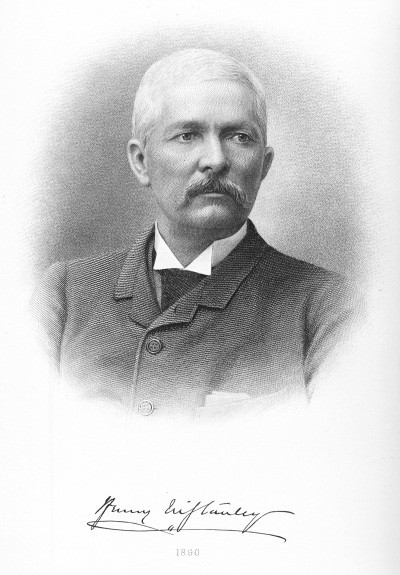
Portrait of Henry M. Stanley Frontispiece.
(From a Photograph taken at Cairo, March, 1890.)
FULL-PAGE ILLUSTRATIONS.
Facingpage Swords and Knives of the Ababua 22 Entering Andikumu 50 The Scouts Discover the Pigmies Carrying away the Case of Ammunition 54 Starvation Camp: Serving out Milk and Butter for Broth 66 A Page from Mr. Stanley’s Note-Book—Sketch-Maps 94 The Pigmies at Home—A Zanzibar Scout Taking Notes 104 Address to Rebel Officers at Kavalli 148 The Pigmies as Compared with the English Officers, Soudanese, and Zanzibaris 152 The Pigmies under the Lens, as Compared to Captain Casati’s Servant Okili 164 Climbing the Plateau Slopes 170 Rescued Egyptians and Their Families 220 Ruwenzori, from Kavalli’s 252 Ruwenzori, from Mtsora 286 Bird’s-Eye View of Ruwenzori, Lake Albert Edward, and Lake Albert 318 Ruwenzori, from Karimi 328 Expedition Winding up the Gorge of Karya-Muhoro 362 A Page from Mr. Stanley’s Note-Book—Musical Instruments 396 Weapons of the Balegga and Wahuma Tribes 400 Baby Rhinoceros Showing Fight in Camp 406 South-West Extremity of Lake Victoria Nyanza 419 Stanley, Emin, and Officers at Usambiro 425 Experiences in Usukuma 438 Banquet at Msua 450 Under the Palms at Bagamoyo 454 The Relief Expedition Returning to Zanzibar 462 The Faithfuls at Zanzibar 474
OTHER ILLUSTRATIONS.
A Swimming Race after a Bush Antelope 25 Dwarf Captive at Avitako 41 Bridging the Dui River 60 Two-Edged Spears 99 Play-Table 99 Back-Rest and Stool 99 Decorated Earthen Pot 99 Arrows of the Dwarfs 101 Elephant Trap 102 A Belle of Bavira 130 View of Camp at Kavalli 140 Shukri Agha, Commandant of Mswa Station 173 Sali, Head-Boy 185 An Ancient Egyptian Lady 207 Attack by the Wanyoro at Semliki Ferry 260 Houses on the Edge of the Forest 264 Egyptian Women and Children 266 The Tallest Peak of Ruwenzori, from Awamba Forest 274 South-West Twin Cones of Ruwenzori—Sketch. By Lieut. Stairs 278 [1]Africa in Homer’s World 293 “ Map of Hekatæus 294 “ Hipparchus, 100 b.c. 295 Ptolemy’s Map of Africa, a.d. 150 295 Central Africa according to Edrisi, a.d. 1154 296 Map of the Margarita Philosophica, a.d. 1503 296 “ John Ruysch, a.d. 1508 297 Map, Sylvanus', a.d. 1511 297 Hieronimus de Verrazano’s Map, a.d. 1529 298 Sebastian Cabot’s Map of the World, 16th Century 298 The Nile’s Sources According to Geographers of the 16th and 17th Centuries 299 Map of the Nile Basin, a.d. 1819 301 Mountains of the Moon—Massoudi, 11th Century 308 Map of Nile Basin to-day from the Mediterranean to S. Lat. 4° 311 View of Ruwenzori from Bakokoro Western Cones 326 The Little Salt Lake at Katwé 342 Section of a House near Lake Albert Nyanza 348 A Village in Ankori 361 Expedition Climbing the Rock in the Valley of Ankori 362 Musical Instruments of the Balegga 399 A Hot Spring, Mtagata 406 Lake Urigi 415 View from Mackay’s Mission, Lake Victoria 428 Rock Hills, Usambiro 437 House and Balcony from which Emin Fell 454 Sketch of Casket containing the Freedom of the City of London 488 Sketch of Casket, the Gift of King Leopold 489MAPS.
A Map of the Route of the Emin Pasha Relief Expedition through Africa. In Pocket. A Map of Emin Pasha’s Province. In Pocket. Profile Sketch of Ruwenzori and the Valley of the Semliki. Facing page 335FOOTNOTES:
On the afternoon of the 21st I was gratified to see that the people had been very successful. How many had followed my advice it was impossible to state. The messes had sent half their numbers to gather the food, and every man had to contribute two handfuls for the officers and sick. It only remained now for the chiefs of the messes to be economical of the food, and the dreaded wilderness might be safely crossed.
On the 20th we cut a track through the deserted plantations, and after an hour’s hard work reached our well-known road, which had been so often patrolled by us. We soon discovered traces of recent travel, and late foraging in piles of plantain skins near the track; but we could not discover by whom these were made. Probably the natives had retired to their settlements; perhaps the dwarfs were now banqueting on the fat of the land. We approached the end of our broad western military road, and at the turning met some Zanzibari patrols who were as much astonished as we were ourselves at the sudden encounter. Volley after volley soon rang through the silence of the clearing. The fort soon responded, and a stream of frantic men, wild with joy, advanced by leaps and bounds to meet us; and among the first was my dear friend the Doctor, who announced, with eyes dancing with pleasure, “All is well at Fort Bodo.”
Respecting the productions of the forest I have written at such length in “The Congo and the Founding of its Free State” that it is unnecessary to add any more here. I will only say that when the Congo Railway has been constructed, the products of the great forest will not be the least valuable of the exports of the Congo Independent State. The natives, beginning at Yambuya, will easily be induced to collect the rubber, and when one sensible European has succeeded in teaching them what the countless vines, creepers, and tendrils of their forest can produce, it will not be long before other competitors will invade the silent river, and invoke the aid of other tribes to follow the example of the Baburu.
I am, Sir,
Your obedient servant,
(Signed) Dr. Emin Pasha.
The guides promised to this dilatory and obtuse Soudanese colonel were despatched, according to promise, with a letter from the Pasha; and though we loitered, and halted, and made short journeys of between one and three hours’ march for a month longer, this was the last communication we had with Selim Bey. What became of him we never discovered, and it is useless to try to conjecture. He was one of those men with whom it was impossible to reason, and upon whose understanding sense has no effect. He was not wicked nor designing, but so stupid that he could only comprehend an order when followed by a menace and weighted with force; but to a man of his rank and native courage, no such order could be given. He was therefore abandoned as a man whom it was impossible to persuade, and still less compel.
On the 16th June, after a long march of four and three-quarter hours, we arrived at the zeriba of Rusessé. We descended from Karimi about 700 feet to the plain of Eastern Usongora, and an hour later we came to Ruverahi River, 40 feet wide, and a foot deep; an ice-cold stream, clear as crystal and fresh from the snows. Ruwenzori was all the morning in sight, a bright vision of mountain beauty and glory. As we approached Rusessé a Msongora herdsman, in the employ of Rukara, the General of the Wara-Sura, came across the plain, and informed us that he could direct us to one of Rukara’s herds. We availed ourselves of his kind offices, which he was performing as a patriot son of the soil tyrannised over and devastated by Rukara; and fifty rifles were sent with him, and in fifteen minutes we were in possession of a fine herd of twenty-five fat cattle, which we drove without incident with our one hundred head to the zeriba of Rusessé. From a bank of cattle-dung, so high as to be like a great earthwork round about the village, we gained our first view of the Albert Edward Nyanza, at a distance of three miles.
These brief—too brief—views of the superb Rain-Creator or Cloud-King, as the Wakonju fondly termed their mist-shrouded mountains, fill the gazer with a feeling as though a glimpse of celestial splendour was obtained. While it lasted, I have observed the rapt faces of whites and blacks set fixed and uplifted in speechless wonder towards that upper region of cold brightness and perfect peace, so high above mortal reach, so holily tranquil and restful, of such immaculate and stainless purity, that thought and desire of expression were altogether too deep for utterance. What stranger contrast could there be than our own nether world of torrid temperature, eternally green sappy plants, and never-fading luxuriance and verdure, with its savagery and war-alarms, and deep stains of blood-red sin, to that lofty mountain king, clad in its pure white raiment of snow, surrounded by myriads of dark mountains, low as bending worshippers before the throne of a monarch, on whose cold white face were inscribed “Infinity and Everlasting!” These moments of supreme feeling are memorable for the utter abstraction of the mind from all that is sordid and ignoble, and its utter absorption in the presence of unreachable loftiness, indescribable majesty, and constraining it not only to reverentially admire, but to adore in silence, the image of the Eternal. Never can a man be so fit for Heaven as during such moments, for however scornful and insolent he may have been at other times, he now has become as a little child, filled with wonder and reverence before what he has conceived to be sublime and Divine. We had been strangers for many months to the indulgence of any thought of this character. Our senses, between the hours of sleeping and waking, had been occupied by the imperious and imminent necessities of each hour, which required unrelaxing vigilance and forethought. It is true we had been touched with the view from the mount called Pisgah of that universal extent of forest, spreading out on all sides but one, to many hundreds of miles; we had been elated into hysteria when, after five months’ immurement in the depths of forest wilds, we once again trod upon green grass, and enjoyed open and unlimited views of our surroundings—luxuriant vales, varying hill-forms on all sides, rolling plains over which the long spring grass seemed to race and leap in gladness before the cooling gale; we had admired the broad sweep and the silvered face of Lake Albert, and enjoyed a period of intense rejoicing when we knew we had reached, after infinite trials, the bourne and limit of our journeyings; but the desire and involuntary act of worship were never provoked, nor the emotions stirred so deeply, as when we suddenly looked up and beheld the skyey crests and snowy breasts of Ruwenzori uplifted into an inaccessible altitude, so like what our conceptions might be of a celestial castle, with dominating battlement, and leagues upon leagues of unscaleable walls.
But alas! alas! In vain we turned our yearning eyes and longing looks in their direction. The Mountains of the Moon lay ever slumbering in their cloudy tents, and the lake which gave birth to the Albertine Nile remained ever brooding under the impenetrable and loveless mist.
The Alexandra Nile at this place was about 125 yards wide, and an average depth of nine feet, flowing three knots per hour in the centre.
The climate of the region is agreeable. Five hours’ work per day can be performed, even out-door, without discomfort from excessive heat, and three days out of seven during the whole of daylight, because of the frequent clouded state of the sky. When, however, the sky is exposed, the sun shines with a burning fervour that makes men seek the shelter of their cool huts. The higher portions of the grass-land—as at Kavalli’s, in the Balegga Hills, and on the summit of the Ankori pastoral ranges—range from 4,500 to 6,500 feet above the sea, and large extents of Toro and Southern Unyoro as high as 10,000, and promise to be agreeable lands for European settlers when means are provided to convey them there. When that time arrives they will find amiable, quiet, and friendly neighbours in that fine-featured race, of which the best type are the Wahuma, with whom we have never exchanged angry words, and who bring up vividly to the mind the traits of those blameless people with whom the gods deigned to banquet once a year upon the heights of Ethiopia.
To my great grief, I learn that Mr. Mackay, the best missionary since Livingstone, died about the beginning of February. Like Livingstone, he declined to return, though I strongly urged him to accompany us to the coast.
The Thanks be to God for ever and ever. Amen.
The design of the casket is Arabesque, and it stands upon a base of Algerine onyx, surmounted by a plinth of ebony, the corners of which project and are rounded. On each of these, at the angle of the casket, stands an ostrich carved in ivory; behind each bird and curving over it projects an elephant’s tusk, which is looped to three spears placed in the panelled angle of the casket, the pillars of which are of crocidolite, resting in basal sockets of gold, and surmounted by capitals of the same metal. The panels of the casket and also the roof are of ivory richly overlaid with ornamental work in fine gold of various colours. The back panel bears the City arms emblazoned in the proper heraldic colours. Of the end panels, one bears the tricoloured monogram “H.M.S.” surrounded by a wreath-emblem of victory, and the other that of the Lord Mayor of London. The front panel, which is also the door of the casket, bears a miniature map of Africa surmounting the tablet bearing the inscription: “Presented to Henry Morton Stanley with the freedom of the City.” Above both the front and back panels on the roof are the standards of America and Great Britain, and, surmounting the whole, on an oval platform is an allegorical figure of the Congo Free State, seated by the source of the river from which it derives its name, and holding the horn of plenty, which is overflowing with native products. The design was selected from among a large number submitted by the leading London goldsmiths, and reflects great credit upon the taste and workmanship of the designers and makers, Messrs. George Edward & Son, Glasgow, and Poultry, London.
But any person who has travelled with the writer thus far will have observed that almost every fatal accident hitherto in this Expedition has been the consequence of a breach of promise. How to adhere to a promise seems to me to be the most difficult of all tasks for every 999,999 men out of every million whom I meet. I confess that these black people who broke their promises so wantonly were the bane of my life, and the cause of continued mental disquietude, and that I condemned them to their own hearing as supremest idiots. Indeed, I have been able to drive from one to three hundred cattle a five hundred mile journey with less trouble and anxiety than as many black men. If we had strung them neck and neck along a lengthy slave-chain they would certainly have suffered a little inconvenience, but then they themselves would be the first to accuse us of cruelty. Not possessing chains, or even rope enough, we had to rely on their promises that they would not break out of camp into the bush on these mad individual enterprises, which invariably resulted in death, but never a promise was kept longer than two days.
On the 12th, we followed a track, along which quite a tribe of pigmies must have passed. It was lined with amoma fruit-skins, and shells of nuts, and the crimson rinds of phrynia berries. No wood-beans, or fenessi, or mabungu, are to be found in this region, as on the south bank of Ituri River. On reaching camp, I found that at the ferry, near the native camp at which we starved four days, six people had succumbed—a Madi, from a poisonous fungus, the Lado soldier, who was speared above Wasp Rapids, two Soudanese of the rear-column, a Manyuema boy in the service of Mr. Bonny, and Ibrahim, a fine young Zanzibari, from a poisoned skewer in the foot.
Arriving near the spot, they saw quite a tribe of pigmies, men, women and children, gathered around two pigmy warriors, who were trying to test the weight of the box by the grummet at each end. Our headmen, curious to see what they would do with the box, lay hidden closely, for the eyes of the little people are exceedingly sharp. Every member of the tribe seemed to have some device to suggest, and the little boys hopped about on one leg, spanking their hips in irrepressible delight at the find, and the tiny women carrying their tinier babies at their backs vociferated the traditional wise woman’s counsel. Then a doughty man put a light pole, and laid it through the grummets, and all the small people cheered shrilly with joy at the genius displayed by them in inventing a method for heaving along the weighty case of Remington ammunition. The Hercules and the Milo of the tribe put forth their utmost strength, and raised the box up level with their shoulders, and staggered away into the bush. But just then a harmless shot was fired, and the big men rushed forward with loud shouts, and then began a chase; and one over-fat young fellow of about seventeen was captured and brought to our camp as a prize. We saw the little Jack Horner, too fat by many pounds; but the story belongs to the headmen, who delivered it with infinite humour.
On the sixth day we made the broth as usual, a pot of butter and a pot of milk for 130 people, and the headmen and Mr. Bonny were called to council. On proposing a reverse to the foragers of such a nature as to cause an utter loss of all, they appeared unable to comprehend such a possibility, though folly after folly, madness after madness, had marked every day of my acquaintance with them. The departure of men secretly on raids, and never returning, the leaping of fifty men into the river after a bush antelope, the throwing away of their rations after fifteen months’ experiences of the forest, the reckless rush into guarded plantations, skewering their feet, the inattention they paid to abrasions leaving them to develope into rabid ulcers; the sale of their rifles to men who would have enslaved them all, follies practised by blockheads day after day, week after week; and then to say they could not comprehend the possibility of a fearful disaster. Were not 300 men with three officers lost in the wood for six days? Were not three persons lost close to this camp yesterday and they have not returned? Did I not tell these men that we should all die if they were not back on the fourth day? Was not this the sixth day of their absence? Were there not fifty people close to death now? and much else of the same kind?
In 1887 rain fell during eight days in July, ten days in August, fourteen days in September, fifteen days in October, seventeen days in November, and seven days in December, = seventy-one days. From the 1st of June, 1887, to the 31st of May, 1888, there were 138 days, or 569 hours of rain. We could not measure the rain in the forest in any other way than by time. We shall not be far wrong if we estimate this forest to be the rainiest zone on the earth.
The pigmies arrange their dwellings—low structures of the shape of an oval figure cut lengthways; the doors are from two feet to three feet high, placed at the ends—in a rough circle, the centre of which is left cleared for the residence of the chief and his family, and as a common. About 100 yards in advance of the camp, along every track leading out of it, is placed the sentry-house, just large enough for two little men, with the doorway looking up the track. If we assumed that native caravans ever travelled between Ipoto and Ibwiri, for instance, we should imagine, from our knowledge of these forest people, that the caravan would be mulcted of much of its property by these nomads, whom they would meet in front and rear of each settlement, and as there are ten settlements between the two points, they would have to pay toll twenty times, in tobacco, salt, iron, and rattan, cane ornaments, axes, knives, spears, arrows, adzes, rings, &c. We therefore see how utterly impossible it would be for the Ipoto people to have even heard of Ibwiri, owing to the heavy turnpike tolls and octroi duties that would be demanded of them if they ventured to undertake a long journey of eighty miles. It will also be seen why there is such a diversity of dialects, why captives were utterly ignorant of settlements only twenty miles away from them.
Mr. Jephson with your people have arrived yesterday, and we propose to start to-morrow morning; I shall therefore have the pleasure to see you the day after to-morrow. My men are very anxious to hear from your own lips that their foolish behaviour in the past will not prevent you from guiding them.
Well, I said, open your ears that the words of truth may enter. The English people, hearing from your late guest, Dr. Junker, that you were in sore distress here, and sadly in need of ammunition to defend yourselves against the infidels and the followers of the false prophet, have collected money, which they entrusted to me to purchase ammunition, and to convey it to you for your needs. But as I was going through Egypt, the Khedive asked me to say to you, if you so desired you might accompany us, but that if you elected to stay here, you were free to act as you thought best; if you chose the latter, he disclaimed all intention of forcing you in any manner. Therefore you will please consult your own wishes entirely, and speak whatever lies hidden in your hearts.
Each morning his clerk Rajab roams around to murder every winged fowl of the air, and every victim of his aim he brings to his master, and then after lovingly patting the dead object he coolly gives the order to skin it. By night we see it suspended, with a stuffing of cotton within, to be in a day or two packed up as a treasure for the British Museum!
Near sunset, Hassan Bakari having absented himself without permission, was lightly punished with a cane by the captain of his company. On being released, he rushed in a furious temper to his hut, vowing he would shoot himself. He was caught in the act of preparing his rifle for the deed. Five men were required to restrain him. Hearing the news, I proceeded to the scene, and gently asked the reason of this outburst. He declaimed against the shame which had been put on him, as he was a freeman of good family and was not accustomed to be struck like a slave. Remarks appropriate to his wounded feelings were addressed to him, to which he gratefully responded. His rifle was restored to him with a smile. He did not use it.
“But after the 5th of April this method was altered. I should have been wrong were I to separate from you, because I had a proof sufficient for myself and officers that you had no people, neither soldiers nor servants; that you were alone. I proposed then as I propose now; should Selim Bey reach us, not to allow Selim Bey, or one single soldier of his force, to approach my camp with arms. Long before they approach us we shall be in position along the track, and if they do not ground arms at command—why, then the consequences will be on their heads. Thus you see that since the 5th of April I have been rather wishing that they would come. I should like nothing better than to bring this unruly mob to the same state of order and discipline they were in before they became infatuated with Arabi, Mahdism, and chronic rebellion. But if they come here they must first be disarmed; their rifles will be packed up into loads, and carried by us. Their camp shall be at least 500 yards from us. Each march that removes them further from Wadelai will assist us in bringing them into a proper frame of mind, and by-and-by their arms will be restored to them, and they will be useful to themselves as well as to us.”
On the morning of this day, Ruwenzori came out from its mantle of clouds and vapours, and showed its groups of peaks and spiny ridges resplendent with shining white snow; the blue beyond was as that of ocean—a purified and spotless translucence. Far to the west, like huge double epaulettes, rose the twin peaks which I had seen in December, 1887, and from the sunk ridge below the easternmost rose sharply the dominating and unsurpassed heights of Ruwenzori proper, a congregation of hoary heads, brilliant in white raiment; and away to the east extended a roughened ridge, like a great vertebra—peak and saddle, isolated mount and hollow, until it passed out of sight behind the distant extremities of the range we were then skirting. And while in constant view of it, as I sat up in the hide hammock suspended between two men, my plan of our future route was sketched. For to the west of the twin peaks, Ruwenzori range either dropped suddenly into a plain or sheered away S.S.W. What I saw was either an angle of a mass or the western extremity. We would aim for the base of the twin peaks, and pursue our course southerly to lands unknown, along the base-line. The guides—for we had many now—pointed with their spears vaguely, and cried out “Ukonju” and (giving a little dab into the air with their spear-points) “Usongora,” meaning that Ukonju was what we saw, and beyond it lay Usongora, invisible.
From an anthill near Mtsora, I observed that from W.N.W., a mile away, commenced a plain, which was a duplicate of that which had so deceived the Egyptians, and caused them to hail it as their lake, and that it extended southerly, and appeared as though it were the bed of a lake from which the waters had recently receded. The Semliki, which had drained it dry, was now from 50 to 60 feet below the crest of its banks. The slopes, consisting of lacustrine deposits, grey loam, and sand, could offer no resistance to a three-mile current, and if it were not for certain reefs, formed by the bed-rock under the surface of the lacustrine deposit, it is not to be doubted that such a river would soon drain the upper lake. The forest ran across from side to side of the valley, a dark barrier, in very opposite contrast to the bleached grass which the nitrous old bed of the lake nourished.
The average European reader will perfectly understand the character of the Semliki Valley and the flanking ranges, if I were to say that its average breadth is about the distance from Dover to Calais, and that in length it would cover the distance between Dover and Plymouth, or from Dunkirk to St. Malo in France. For the English side we have the Balegga hills and rolling plateau from 3,000 to 3,500 feet above the valley. On the opposite side we have heights ranging from 3,000 to 15,500 feet above it. Now, Ruwenzori occupies about ninety miles of the eastern line of mountains, and projects like an enormous bastion of an unconquerable fortress, commanding on the north-east the approaches by the Albert Nyanza and Semliki Valley, and on its southern side the whole basin of the Albert Edward Lake. To a passenger on board one of the Lake Albert steamers proceeding south, this great bastion, on a clear day, would seem to be a range running east and west; to a traveller from the south it would appear as barring all passage north. To one looking at it from the Balegga, or western plateau, it would appear as if the slowly rising table-land of Unyoro was but the glacis of the mountain range. Its western face appears to be so precipitous as to be unscaleable, and its southern side to be a series of traverses and ridges descending one below the other to the Albert Edward Lake. While its eastern face presents a rugged and more broken aspect, lesser bastions project out of the range, and is further defended by isolated outlying forts like Gordon Bennett Mountain, 14,000 to 15,000 feet high, and the Mackinnon Mountain of similar height. That would be a fair figurative description of Ruwenzori.
Sometimes these ascending fields of snow, by the velocity of their movements, grinding and dragging power, weight and compactness of their bodies, cause extensive landslips, when tracts of wood and bush are borne sheer down, with all the soil which nourished them, to the bed rock, from which it will be evident that enormous masses of material, consisting of boulders, rock fragments, pebbles, gravel, sand trees, plants, and soil, are precipitated from the countless mountain slopes and ravine sides into the valley of the Semliki.
From Kitété a considerable portion of the south-east extremity of Lake Albert Edward appeared in view. We were a thousand feet above it. The sun shone strongly, and for once we obtained about a ten-mile view through the mist. From 312½° to 324° magnetic, the flats below were penetrated with long-reaching inlets of the lake, surrounding numbers of little low islets. To 17½° magnetic rose Nsinda Mountain, 2500 feet above the lake; and behind, at the distance of three miles, rose the range of Kinya-magara; and on the eastern side of a deep valley separating it from the uplands of Ankori rose the western face, precipitous and gray, the frowning walls of the Denny range.
The next case that I had to judge was somewhat difficult. Chief Mpigwa having appeared at the Barza (Durbar), a man stepped up to complain of him, because he withheld two cows that belonged to his tribe. Mpigwa explained that the man had married a girl belonging to his tribe and had paid two cows for her, that she had gone to his house, and in course of time had become a mother, and had borne three children to her husband. The man died, whereupon his tribe accused the woman of having contrived his death by witchcraft, and drove her home to her parents. Mpigwa received her into the tribe with her children, and now the object of complaint was the restoration of the two cows to the husband’s tribe. “Was it fair,” asked Mpigwa, “after a woman had become the mother of three children in the tribe to demand the cattle back again after the husband’s death, when they had sent the woman and her infants away of their own accord?” The decision upheld Mpigwa in his views, as such conduct was not only heartless and mean, but tended to bring the honoured custom of marriage contracts into contempt.
In looking over Wilkinson’s ‘Ancient Egyptians’ the other day I was much struck with the conservative character of the African, for among the engravings I recognize in plate 459 the form of dress most common among the Wahuma, Watusi, Wanyambu, Wahha, Warundi, and Wanyavingi, and which were in vogue thirty-five centuries ago among the black peoples who paid tribute to the Pharaohs. The musical instruments also, such as are figured in plates 135, 136—a specimen of which is in the British Museum—we discovered among the Balegga and Wahuma, and in 1876 among the Basoga. The hafts of knives, the grooves in the blades and their form, the triangular decorations in plaster in their houses, or on their shields, bark clothes, boxes, cooking utensils, and in their weapons, spears, bows, and clubs; in their mundus, which are similar in form to the old pole-axe of the Egyptians, in the curved head-rests, their ivory and wooden spoons; in their eared sandals, which no Mhuma would travel without; in their partiality to certain colours, such as red, black, and yellow; in their baskets for carrying their infants; in their reed flutes; in the long walking-staffs; in the mode of expressing their grief, by wailing, beating their breasts, and their gestures expressive of being inconsolable; in their sad, melancholy songs; and in a hundred other customs and habits, I see that old Egyptian and Ethiopian characteristics are faithfully preserved among the tribes of the grass-land.
We are now in Karagwé. The Alexandra Nile—drawing its waters from Ruanda, Mpororo, to the west; and from north, Uhha; and north-east, Urundi and Kishakka—runs north along the western frontier of Karagwé, and reaching Ankori, turns sharply round to eastward to empty into the Victorian Sea; and as we leave its narrow valley, and ascend gradually upward, along one of those sloping narrow troughs so characteristic of this part of Central Africa, we camp at Unyakatera, below a mountain ridge of that name, and like the view obtained from that summit two score of times repeated, is all Karagwé. It is a system of deep narrow valleys running between long narrow ranges as far as the eye can reach. In the north of Karagwé they are drained by small streams which flow into the Alexandra.
We cut across a broad cape-like formation of land and passed from the bay of Kisaho to a bay near Itari on the 20th, and from the summit of a high ridge near the latter place I perceived by compass bearings and solar observation, that we were much south of the south-west coast line, as marked on my map in “Through the Dark Continent.” From this elevated ridge could be seen the long series of islands overlapping one another, which, in our flight from the ferocious natives of Bumbiré in 1875, without oars, had been left unexplored, and which, therefore, I had sketched as mainland.
I was ushered into the room of a substantial clay structure, the walls about two feet thick, evenly plastered, and garnished with missionary pictures and placards. There were four separate ranges of shelves filled with choice, useful books. “Allah ho Akbar,” replied Hassan, his Zanzibari head-man, to me; “books! Mackay has thousands of books, in the dining-room, bedroom, the church, everywhere. Books! ah, loads upon loads of them!” And while I was sipping real coffee, and eating home-made bread and butter for the first time for thirty months, I thoroughly sympathised with Mackay’s love of books. But it becomes quite clear why, amongst so many books, and children, and outdoor work, Mackay cannot find leisure to brood and become morbid, and think of “drearinesses, wildernesses, despair and loneliness.” A clever writer lately wrote a book about a man who spent much time in Africa, which from beginning to end is a long-drawn wail. It would have cured both writer and hero of all moping to have seen the manner of Mackay’s life. He has no time to fret and groan and weep, and God knows if ever man had reason to think of “graves and worms and oblivion,” and to be doleful and lonely and sad, Mackay had, when, after murdering his Bishop, and burning his pupils, and strangling his converts, and clubbing to death his dark friends, Mwanga turned his eye of death on him. And yet the little man met it with calm blue eyes that never winked. To see one man of this kind, working day after day for twelve years bravely, and without a syllable of complaint or a moan amid the “wildernesses,” and to hear him lead his little flock to show forth God’s loving kindness in the morning, and His faithfulness every night, is worth going a long journey, for the moral courage and contentment that one derives from it.
The Wasukuma swayed closer up, but cautiously, and, it appeared to me, reluctantly. In front of the mob coming from the south were several skirmishers, who pranced forward to within 300 yards. One of the skirmishers was dropped, and the machine showered about a hundred and fifty rounds in their direction. Not one of the natives was hit, but the great range and bullet shower was enough. They fled; a company was sent out to meet the eastern mob, another was sent to threaten the crowd to the north, and the Wasukuma yielded and finally retired. Only one native was killed out of this demonstration made by probably 2000 warriors.
The précis of the intelligence received having been doctored by a writer at Zanzibar, rendered the message still more unintelligible. The intelligence was received at Zanzibar by an agent of the ivory raider, Ugarrowwa, and was intended to read thus:
On arriving at the ferry of the Kingani River, Major Wissman came across to meet us, and for the first time I had the honour of being introduced to a colleague who had first distinguished himself, at the headquarters of the Kasai River, in the service of the International Association, while I was building stations along the main river. On reaching the right bank of the Kingani we found some horses saddled, and turning over the command of the column to Lieut. Stairs, Emin Pasha and myself were conducted by Major Wissman and Lieut. Schmidt to Bagamoyo. Within the coast-town we found the streets decorated handsomely with palm branches, and received the congratulations of Banian and Hindu citizens, and of many a brave German officer who had shared the fatigues and dangers of the arduous campaign, which Wissman was prosecuting with such well deserved success, against the Arab malcontents of German East Africa. Presently rounding a corner of the street we came in view of the battery square in front of Wissman’s headquarters, and on our left, close at hand, was the softly undulating Indian Sea, one great expanse of purified blue. “There, Pasha,” I said. “We are at home!”
There was not one European at Bagamoyo but felt extremely grieved at the sad event that had wrecked the general joy. The feeling was much deeper than soldiers will permit themselves to manifest. Outwardly there was no manifestation; inwardly men were shocked that his first day’s greeting among his countrymen and friends should have proved so disastrous to him after fourteen years’ absence from them. What the Emir Karamallah and his fanatics, a hundred barbarous negro tribes, conspirators, and rebel soldiery, and fourteen years of Equatorial heat had failed to effect, an innocent hospitality had nearly succeeded in doing. At the very moment he might well have said, Soul, enjoy thyself! behold, the shadow of the grave is thrust across their vision. This extremely dismal prospect and immediate blighting of joy made men chary of speech, and solemnly wonder at the mishap.
The Agent of the East African Company, in company with Lieut. Stairs, having completed their labours, of calculating the sums due to the survivors of the Relief Expedition, and having paid them accordingly, a purse of 10,000 rupees was subscribed thus: 3000 rupees from the Khedive of Egypt; 3000 rupees from the Emin Relief Fund; 3000 rupees from myself personally; 1000 rupees from the Seyyid Khalifa of Zanzibar, which enabled the payees to deliver from 40 to 60 rupees extra to each survivor according to desert. General Lloyd Mathews gave them also a grand banquet, and in the name of the kind-hearted Sultan in various ways showed how merit should be rewarded. An extra sum of 10,000 rupees set apart from the Relief Fund is to be distributed also among the widows and orphans of those who perished in the Yambuya Camp, and with the Advance Column.
While preparing our forest camps we were frequently startled at the sudden rush of some small animal resembling a wild goat, which often waited in his covert until almost trodden upon, and then bounded swiftly away, running the gauntlet among hundreds of excited and hungry people, who with gesture, voice, and action attempted to catch it. This time, however, the animal took a flying leap over several canoes lying abreast into the river, and dived under. In an instant there was a desperate pursuit. Man after man leaped head foremost into the river, until its face was darkly dotted with the heads of the frantic swimmers. This mania for meat had approached madness. The poisoned arrow, the razor-sharp spear, and the pot of the cannibal failed to deter them from such raids; they dared all things, and in this instance an entire company had leaped into the river to fight and struggle, and perhaps be drowned, because there was a chance that a small animal that two men would consider as insufficient for a full meal, might be obtained by one man out of fifty. Five canoes were therefore ordered out to assist the madmen. About half a mile below, despite the manœuvres of the animal which dived and swam with all the cunning of savage man, a young fellow named Feruzi clutched it by the neck, and at the same time he was clutched by half-a-dozen fellows, and all must assuredly have been drowned had not the canoes arrived in time, and rescued the tired swimmers. But, alas! for Feruzi, the bush antelope, for such it was, no sooner was slaughtered than a savage rush was made on the meat, and he received only a tiny morsel, which he thrust into his mouth for security.
Not one London editor could guess the feelings with which I regarded this mannikin from the solitudes of the vast central African forest. To me he was far more venerable than the Memnonium of Thebes. That little body of his represented the oldest types of primeval man, descended from the outcasts of the earliest ages, the Ishmaels of the primitive race, for ever shunning the haunts of the workers, deprived of the joy and delight of the home hearth, eternally exiled by their vice, to live the life of human beasts in morass and fen and jungle wild. Think of it! Twenty-six centuries ago his ancestors captured the five young Nassamonian explorers, and made merry with them at their villages on the banks of the Niger. Even as long as forty centuries ago they were known as pigmies, and the famous battle between them and the storks was rendered into song. On every map since Hekataeus’ time, 500 years B.C., they have been located in the region of the Mountains of the Moon. When Mesu led the children of Jacob out of Goshen, they reigned over Darkest Africa undisputed lords; they are there yet, while countless dynasties of Egypt and Assyria, Persia, Greece and Rome, have flourished for comparatively brief periods, and expired. And these little people have roamed far and wide during the elapsed centuries. From the Niger banks, with successive waves of larger migrants, they have come hither to pitch their leafy huts in the unknown recesses of the forest. Their kinsmen are known as Bushmen in Cape Colony, as Watwa in the basin of the Lulungu, as Akka in Monbuttu, as Balia by the Mabodé, as Wambutti in the Ihuru basin, and as Batwa under the shadows of the Lunae Montes.
After a halt of five days the Expedition marched from Indemau on the 1st of December for the Dui. Mr. Bonny and old Rashid, with their assistants, were putting the finishing touches to the bridge, a work which reflected great credit on all concerned in its construction, but especially on Mr. Bonny. Without halting an instant the column marched across the five branches of the Dui, over a length of rough but substantial woodwork, which measured in the aggregate eighty yards, without a single accident.
This region, which embraces twelve degrees of longitude, is mainly forest, though to the west it has several reaches of grass-land, and this fact modifies the complexion considerably. The inhabitants of the true forest are much lighter in colour than those of the grass-land. They are inclined normally to be coppery, while some are as light as Arabs, and others are dark brown, but they are all purely negroid in character. Probably this lightness of colour may be due to a long residence through generations in the forest shades, though it is likely to have been the result of an amalgamation of an originally black and light coloured race. When we cross the limits of the forest and enter the grass-land we at once remark, however, that the tribes are much darker in colour.
Scattered among the Balessé, between Ipoto and Mount Pisgah, and inhabiting the land situated between the Ngaiyu and Ituri Rivers, a region equal in area to about two-thirds of Scotland, are the Wambutti, variously called Batwa, Akka, and Bazungu. These people are undersized nomads, dwarfs, or pigmies, who live in the uncleared virgin forest, and support themselves on game, which they are very expert in catching. They vary in height from three feet to four feet six inches. A full-grown adult male may weigh ninety pounds. They plant their village camps at a distance of from two to three miles around a tribe of agricultural aborigines, the majority of whom are fine stalwart people. A large clearing may have as many as eight, ten, or twelve separate communities of these little people settled around them, numbering in the aggregate from 2,000 to 2,500 souls. With their weapons, little bows and arrows, the points of which are covered thickly with poison, and spears, they kill elephants, buffalo, and antelope. They sink pits, and cunningly cover them with light sticks and leaves, over which they sprinkle earth to disguise from the unsuspecting animals the danger below them. They build a shed-like structure, the roof being suspended with a vine, and spread nuts or ripe plantains underneath, to tempt the chimpanzees, baboons, and other simians within, and by a slight movement, the shed falls, and the animals are captured. Along the tracks of civets, mephitis, ichneumons, and rodents are bow traps fixed, which, in the scurry of the little animals, are snapped and strangle them. Besides the meat and hides to make shields, and furs, and ivory of the slaughtered game, they catch birds to obtain their feathers; they collect honey from the woods, and make poison, all of which they sell to the larger aborigines for plantains, potatoes, tobacco, spears, knives, and arrows. The forest would soon be denuded of game if the pigmies confined themselves to the few square miles around a clearing; they are therefore compelled to move, as soon as it becomes scarce, to other settlements.
They perform other services to the agricultural and larger class of aborigines. They are perfect scouts, and contrive, by their better knowledge of the intricacies of the forest, to obtain early intelligence of the coming of strangers, and to send information to their settled friends. They are thus like voluntary picquets guarding the clearings and settlements. Every road from any direction runs through their camps. Their villages command every cross-way. Against any strange natives, disposed to be aggressive, they would combine with their taller neighbours, and they are by no means despicable allies. When arrows are arrayed against arrows, poison against poison, and craft against craft, probably the party assisted by the pigmies would prevail. Their diminutive size, superior wood-craft, their greater malice, would make formidable opponents. This the agricultural natives thoroughly understand. They would no doubt wish on many occasions that the little people would betake themselves elsewhere, for the settlements are frequently outnumbered by the nomad communities. For small and often inadequate returns of fur and meat, they must allow the pigmies free access to their plantains, groves, and gardens. In a word, no nation on the earth is free from human parasites, and the tribes of the Central African forest have much to bear from these little fierce people who glue themselves to their clearings, flatter them when well fed, but oppress them with their extortions and robberies.
On the evening of the 21st, notice was brought to me that the Balegga were collecting to attack us, and early the following morning sixty rifles, with 1,500 Bavira and Wahuma were sent to meet them. The forces met on the crest of the mountains overlooking the Lake, and the Balegga, after a sharp resistance, were driven to their countrymen among the subjects of Melindwa, who was the ally of Kabba Rega.
On February 7th I decided to send for Lieutenant Stairs and his caravan, and despatched Rashid with thirty-five men to obtain a hundred carriers from Mazamboni to assist the convalescents. My object was to collect the expedition at Kavalli, and send letters in the meantime to Emin Pasha proposing that he should: 1st. Seize a steamer and embark such people as chose to leave Tunguru, and sail for our Lake shore camp. After which we could man her with Zanzibaris, and perform with despatch any further transport service necessary. If this was not practicable, then—
I see the Egyptian officers congregating in special and select groups each day, seated on their mats, smoking cigarettes, and discussing our absolute slavishness. They have an idea that any one of them is better than ten Zanzibaris, but I have not seen any ten of them that could be so useful in Africa as one Zanzibari.
I saw Osman Latif proceed soon after to the Pasha’s quarters, and kiss his hands, and bend reverently before him, and immediately I followed, curious to observe. The Pasha sat gravely on his chair, and delivered his orders to Osman Latif with the air of power, and Osman Latif bowed obsequiously after hearing each order, and an innocent stranger might have imagined that one embodied kingly authority and the other slavish obedience. Soon after I departed absorbed in my own thoughts.
During the sudden muster of the day before yesterday, and the fierce declaration of my intentions, he became energetic himself, and I found that energy, as well as disease, becomes contagious. He had prepared for an immediate start after us. His mother, an old lady, seventy-five years old, with a million of wrinkles in her ghastly white face, was not very fortunate in her introduction to me, for, while almost at white heat, she threw herself before me in the middle of the square, jabbering in Arabic to me, upon which, with an impatient wave of the hand, I cried, “Get out of this; this is not the place for old women.” She lifted her hands and eyes up skyward, gave a little shriek, and cried, “O Allah!” in such tragic tones that almost destroyed my character. Every one in the square witnessed the limp and shrunk figure, and laughed loudly at the poor old thing as she beat a hasty retreat.
At 5 P.M. Mr. Bonny performed signal service. He accepted the mission of leading five Soudanese across the Semliki as the vanguard of the Expedition. By sunset there were fifty rifles across the river.
The 24th of May was a halt, and we availed ourselves of it to despatch two companies to trace the paths, that I might obtain a general idea which would best suit our purposes. One company took a road leading slightly east of south, and suddenly came across a few Baundwe, whom we knew for real forest aborigines. This was in itself a discovery, for we had supposed we were still in Utuku, as the east side of the Semliki is called, and which is under Kabba Rega’s rule. The language of the Baundwe was new, but they understood a little Kinyoro, and by this means we learned that Ruwenzori was known to them as Bugombowa, and that the Watwa pigmies and the Wara Sura were their worst enemies, and that the former were scattered through the woods to the W.S.W.
The Egyptians and their followers had such a number of infants and young children that when the camp space was at all limited, as on a narrow spur, sleep was scarcely possible. These wee creatures must have possessed irascible natures, for such obstinate and persistent caterwauling never tormented me before. The tiny blacks and sallow yellows rivalled one another with force of lung until long past midnight, then about 3 or 4 A.M. started afresh, woke everyone from slumber, while grunts of discontent at the meeawing chorus would be heard from every quarter.
We were told that they had met gangs of the Wara Sura, but had met “bad luck,” and only one small tusk of ivory rewarded their efforts. Ipoto, according to them, was twenty days’ march through the forest from Bukoko.
Shortly after 4 P.M. we halted among some high heaths for camp. Breaking down the largest bushes we made rough shelters for ourselves, collected what firewood we could find, and in other ways made ready for the night. Firewood, however, was scarce, owing to the wood being so wet that it would not burn. In consequence of this, the lightly-clad Zanzibaris felt the cold very much, though the altitude was only about 8,500 feet. On turning in the thermometer registered 60° F. From camp I got a view of the peaks ahead, and it was now that I began to fear that we should not be able to reach the snow. Ahead of us, lying directly in our path, were three enormous ravines; at the bottom of at least two of these there was dense bush. Over these we should have to travel and cut our way through the bush. It would then resolve itself into a question of time as to whether we could reach the summit or not. I determined to go on in the morning, and see exactly what difficulties lay before us, and if these could be surmounted in a reasonable time, to go on as far as we possibly could.
[1] The Sketch Maps on pages 293 to 308 inclusive are from tracings from ancient books in the Khedive’s library at Cairo.
What the chartographers of Homer’s time illustrated of geographical knowledge succeeding chartographers effaced, and what they in their turn sketched was expunged by those who came after them. In vain explorers sweated under the burning sun, and endured the fatigues and privations of arduous travel: in vain did they endeavour to give form to their discoveries, for in a few years the ruthless map-maker obliterated all away. Cast your eyes over these series of small maps, and witness for yourselves what this tribe has done to destroy every discovery, and to render labour and knowledge vain. There is a chartographer living, the chiefest sinner alive. In 1875, I found a bay at the north-east end of Lake Victoria. A large and mountainous island, capacious enough to supply 20,000 people with its products of food, blocked the entrance from the lake into it, but there is a winding strait at either end of sufficient depth and width to enable an Atlantic liner to steam in boldly. The bay has been wiped out, the great island has been shifted elsewhere, and the picturesque channels are not in existence on his latest maps, and they will not be restored until some other traveller, years hence, replaces them as they stood in 1875. And young travellers are known to chuckle with malicious pleasure at all this, forgetful of what old Solomon said in the olden time: “There is no remembrance of former things; neither shall there be any remembrance of things that are to come with those that shall come after.”
So, though it is some satisfaction to be able to vindicate the more ancient geographers to some extent, I publish at the end of the series of old maps the small chart which illustrates what we have verified during our late travels. I do it with the painful consciousness that some stupid English or German map-maker within the next ten years may, from spleen and ignorance, shift the basin 300 or 400 miles farther east or west, north or south, and entirely expunge our labours. However, I am comforted that on some shelf of the British Museum will be found a copy of ‘In Darkest Africa,’ which shall contain these maps, and that I have a chance of being brought forth as an honest witness of the truth, in the same manner as I cite the learned geographers of the olden time to the confusion of the map-makers of the nineteenth century.
Here follows the great Ptolemy, the Ravenstein or Justas Perthes of his period. Some new light has been thrown by his predecessors, and he has revised and embellished what was known. He has removed the sources of the Nile, with scientific confidence, far south of the equator, and given to the easternmost lake the name of Coloe Palus.
Four centuries later we see, by the following map, that the lakes have changed their position. Ambitious chartographers have been eliciting information from the latest traveller. They do not seem to be so well acquainted with the distant region around the Nile sources as those ancients preceding Edrisi. Nevertheless, the latest travellers must know best.
Within three years Africa seems to have been battered out of shape somewhat. The three lakes have been attracted to one another; between two of the lakes the Mountains of the Moon begin to take form and rank. The Mons Lunæ are evidently increasing in height and length. As Topsy might have said, “specs they have grown some.”
In the following map we see a reproduction of Sebastian Cabot’s map in the sixteenth century. I have omitted the pictures of elephants and crocodiles, great emperors and dwarfs, which are freely scattered over the map with somewhat odd taste. The three lakes have arranged themselves in line again, and the Mountains of the Moon are picturesquely banked at the top head of all the streams, but the continent evidently suggests unsteadiness generally, judging from the form of it.
“Eratosthenes compared Africa to a trapezium, of which the Mediterranean coast formed one side, the Nile another, the southern coast the longest side, and the western coast the shortest side. So little were the ancients aware of its extent that Pliny pronounced it to be the least of the continents, and inferior to Europe. Upon the Nile, therefore, they measured the habitable world of Africa, and fixed its limit at the highest known point to which that river had been ascended. This is assigned about three thousand stadia (three or four hundred miles) beyond Meroe. They seem to have been fully aware of two great rivers rising from lakes and called the Astaboras and Astapus, of which the latter (White Nile) flows from the lake to the south, is swelled to a great height by summer rains and forms then almost the main body of the Nile.
“The historian El Gahez, in his description of countries, says that ‘the source of the river of Sindh[25] and the river Nile is from one place,’ and that he came to this conclusion because ‘the two rivers rise at the same time, and because the crocodile is found in them both,’ and that ‘the kind of land-cultivation upon both is the same.’ The historian Mashi, in his ‘History of Egypt,’ says that in the country of Tegala is a Soudanese tribe of the same name in whose land gold crops up, and that in their land the Nile splits and becomes two rivers, the one branch being the Nile of Egypt, and the other being green, which flows eastward and traverses the salt sea to the landing of Sindh, and this is the river called Meharaam.
Mukhbat ed-dahr fê Ajaîb al-barr walbahr
Though from the nearest point to the central range we were distant eight English miles in an air line, during the few brief clear views obtained by us, especially that from Bakokoro, examination through a good binocular informed us of the reason why so much snow was retained on Ruwenzori. As will be seen from the various sketches of the profile, the summit of the range is broken up into many sharp triangular casques or narrow saddle-shaped ridges. Each casque, separately examined, seems to be a miniature copy of the whole range, and dented by the elements, time and weather, wind, rain, frost, and snow, and every side of Ruwenzori appears to represent, though in an acuter degree, the multitudinous irregularities of slopes and crests so characteristic of its mighty neighbours which lie nearest to us, and are fully exposed to the naked eye. Mostly all these triangular casque-like tops of the range are so precipitous that, despite the everlasting snowfalls hardened by the icy winds blowing over their exposed sides and summits, very little snow is seen; but about 300 feet below, as may be estimated, ground more adapted for the retention of the snow is found, which in some parts is so extensive as to represent a vast field. Below this, however, another deep precipice exposes its brown walls, and at the foot of it spreads out another great field of snow joined here and there by sloping ground, and this explains why the side of the range presented to view is not uniformly covered with snow, and why the fields are broken up by the brown patches. For quite 3,000 feet from the summit, as may be seen most clearly from the view obtained from Karimi, there is illustrated a great snowy continent enclosing numerous brown islands.
After seeing to the distribution of corn, I proceeded across the ridge, and descending a stiff slope, almost cliffy in its upper part, after 154 feet of a descent, came to the dark sandy shore of the Salt Lake of Katwé, at a place where there were piles of salt-cakes lying about. The temperature of the water was 78·4° Fahrenheit; a narrow thread of sulphurous water indicated 84°. Its flavour was that of very strong brine.[32] Where the sand had been scooped cut into hollow beds, and the water of the lake had been permitted to flow in, evaporation had left a bed of crystal salt of rocky hardness, compacted and cemented together like coarse quartz. The appearance of these beds at a distance was like frozen pools. When not disturbed by the salt-gatherers, the shore is ringed around with Ukindu palms, scrubby bush, reedy cane, euphorbia, aloetic plants; and at Mkiyo, a small village inhabited by salt-workers, there is a small grove of bananas, and a few fields of Indian corn and Eleusine coracana. Thus, though the lake has a singularly dead and lonely appearance, the narrow belt of verdure below the cliffy walls which encompass it, is a relief. Immediately behind this greenness of plants and bush, the precipitous slopes rise in a series of horizontal beds of grey compacted deposit, whitened at various places by thin incrustations of salt. There are also chalky-looking patches here and there, one of which, on being examined, proved to be of stalagmite. In one of these I found a large tusk of ivory, bones of small animals, teeth, and shells of about the size of cockles. There were several of these stalagmite beds around the lake.
The cattle had been driven across into the Island of Irangara, everything of value had been deported away, and a monstrous herd had but lately left Mukungu for Buruli, urged to fast travel by the retreating Rukara and his army. The huts of the chiefs showed that these people of Mukungu were advanced in the arts of ornamental architecture. A house which the Pasha occupied was one of the most ornate I had seen. The hut was twenty feet in height and about twenty-five feet in diameter, with a doorway brilliant in colouring like a rude imitation of the stucco work of primitive Egyptians. The doorway was ample—six feet high and six feet wide, with a neat arched approach. Plastered partitions divided the interiors into segments of circles, in which were sunk triangles and diamond figures, lines of triangles surmounting lines of diamonds, the whole pointed in red and black. One division before the wide doorway was intended as a hall of audience—behind the gaily-decorated partition was the family bed-chamber; to the right were segments of the circle devoted to the children.
On the morning of the 4th we turned our backs to the Albert Edward Nyanza, and followed a road leading east of south over the plain. In about an hour the level flat assumed a rolling character freely sprinkled over with bush clumps and a few trees. An hour’s experience of this kind brought us to the base of the first line of hills, thence up one ascent after another until noon, when we halted at Kitété, having gained a thousand feet of altitude. We were received kindly, and welcomed in the name of the King Antari. Messengers had arrived almost simultaneously from Masakuma, the Governor of the Lake Province of Ankori, that we should be received with all hospitality and honour, and brought by degrees to him. Consequently, such is the power of emissaries from authority, the villagers were ordered out of their houses with cries of “Room for the guests of Antari! Room for the friends of Masukuma! Ha, villains, don’t you hear? Out with you, bag and baggage!” and so forth, the messengers every now and then taking sly glances at us to note if we admired the style of the thing. We had not been long in Ankori before we grasped the situation thoroughly. Ankori was the king’s property. The people we should have to deal with were only the governors, called Wakungu, and the king, his mother, brothers, sisters, uncles, aunts, &c. Ankori was a copy of Uganda.
In looking over Wilkinson’s ‘Ancient Egyptians’ the other day I was much struck with the conservative character of the African, for among the engravings I recognize in plate 459 the form of dress most common among the Wahuma, Watusi, Wanyambu, Wahha, Warundi, and Wanyavingi, and which were in vogue thirty-five centuries ago among the black peoples who paid tribute to the Pharaohs. The musical instruments also, such as are figured in plates 135, 136—a specimen of which is in the British Museum—we discovered among the Balegga and Wahuma, and in 1876 among the Basoga. The hafts of knives, the grooves in the blades and their form, the triangular decorations in plaster in their houses, or on their shields, bark clothes, boxes, cooking utensils, and in their weapons, spears, bows, and clubs; in their mundus, which are similar in form to the old pole-axe of the Egyptians, in the curved head-rests, their ivory and wooden spoons; in their eared sandals, which no Mhuma would travel without; in their partiality to certain colours, such as red, black, and yellow; in their baskets for carrying their infants; in their reed flutes; in the long walking-staffs; in the mode of expressing their grief, by wailing, beating their breasts, and their gestures expressive of being inconsolable; in their sad, melancholy songs; and in a hundred other customs and habits, I see that old Egyptian and Ethiopian characteristics are faithfully preserved among the tribes of the grass-land.
The Lake of Urigi is pretty when seen from Useni or Kavari. At this season its hilly frame is all brown, with little dots of dark green bush scattered here and there; the water was of a light blue owing to a bright blue sky. Its receding waters have left great extents of flat plain on the sides and around the bays running far inland into valleys. Its shores and waters are favourite haunts of birds, from cranes, herons, and pelicans, to the small black Parra Africana, egrets and waders, which find excellent feeding over the large spaces near the extremities and shore line of bays, covered with close-packed growths of Pistia stratiotes plants, until they resemble green lawns from a little distance off. Hippos abound, and, unfortunately, armies of black mosquitoes. The eastern shore we found to be littered with bones of slain animals, for the lions and hyenas, it is said, kill much game. A large supply of fish is found in the lake, but they are infested with guinea worm—at least those which we purchased were deemed quite uneatable from that cause. The lake measures about twenty-five miles in length by from one to three miles wide, and is sunk about 1200 feet below the average level of the bare grassy hills around it.
We were rich in goods of all kinds, for in Mr. Mackay’s keeping since Mr. Stokes brought them from the coast in 1888, we possessed about 200 loads of bulky currency and forty loads of preserved provisions. Thirty loads of cloth were instantly distributed among the people on account, at cost price, that each man might make amends during our rest for any late privations. We had also fourteen pack-donkeys, which were delivered to the Pasha’s followers, and the Pasha, Casati, and myself, were able to purchase riding asses from the French Missionaries at Bukumbi, who were good enough to visit us with valuable gifts of garden produce. From their stores our officers were enabled to purchase very necessary outfits, such as boots, slippers, shirts, and hats, which made them presentable once more.
From our camp we could see the ancient bed of the Lake spreading out for a distance of many miles. Every half-mile or so there was a large cluster of hamlets, each separated from the other by hedges of milk-weed. The plain separating these clusters was common pasture ground, and had been cropped by hungry herds as low as stone moss. On our way to the camp a herd of cattle had been captured, but they had been released; we had a Monangwa in our hands, and we asked him what all this was about. He could not, or he would not, answer. We clothed him in fine cloths, and sent him away to tell Malissa that we were white men, friends of Stokes, that we had many Wasukuma porters in our caravan, and that we had no intention of fighting anybody, but of going to the coast as quickly as possible. The chief was escorted within a quarter of a mile of Malissa’s village, and released. He did not return, but during the day there were several efforts made to annoy us, until at 4 P.M., from the north, east and south, appeared three separate multitudes, for a great effort. It was then the machine-gun was prepared.
La Société espère que vous voudrez bien la mettre à même d’en apprécier toute l’importance.
The design of the casket is Arabesque, and it stands upon a base of Algerine onyx, surmounted by a plinth of ebony, the corners of which project and are rounded. On each of these, at the angle of the casket, stands an ostrich carved in ivory; behind each bird and curving over it projects an elephant’s tusk, which is looped to three spears placed in the panelled angle of the casket, the pillars of which are of crocidolite, resting in basal sockets of gold, and surmounted by capitals of the same metal. The panels of the casket and also the roof are of ivory richly overlaid with ornamental work in fine gold of various colours. The back panel bears the City arms emblazoned in the proper heraldic colours. Of the end panels, one bears the tricoloured monogram “H.M.S.” surrounded by a wreath-emblem of victory, and the other that of the Lord Mayor of London. The front panel, which is also the door of the casket, bears a miniature map of Africa surmounting the tablet bearing the inscription: “Presented to Henry Morton Stanley with the freedom of the City.” Above both the front and back panels on the roof are the standards of America and Great Britain, and, surmounting the whole, on an oval platform is an allegorical figure of the Congo Free State, seated by the source of the river from which it derives its name, and holding the horn of plenty, which is overflowing with native products. The design was selected from among a large number submitted by the leading London goldsmiths, and reflects great credit upon the taste and workmanship of the designers and makers, Messrs. George Edward & Son, Glasgow, and Poultry, London.
IN DARKEST AFRICA.
CHAPTER XXI.
WE START OUR THIRD JOURNEY TO THE NYANZA.
Mr. Bonny and the Zanzibaris—The Zanzibaris’ complaints—Poison of the Manioc—Conversations with Ferajji and Salim—We tell the rear column of the rich plenty of the Nyanza—We wait for Tippu-Tib at Bungangeta Island—Muster of our second journey to the Albert—Mr. Jameson’s letter from Stanley Falls dated August 12th—The flotilla of canoes starts—The Mariri rapids—Ugarrowwa and Salim bin Mohammed visit me—Tippu-Tib, Major Barttelot, and the carriers—Salim bin Mohammed—My answer to Tippu-Tib—Salim and the Manyuema—The settlement of the Batundu—Small-pox among the Madi carriers and the Manyuema—Two insane women—Two more Zanzibari raiders slain—Breach of promises in the Expedition—The Ababua tribe—Wasp Rapids—Ten of our men killed and eaten by natives—Canoe accident at Manginni—Lakki’s raiding party at Mambanga—Feruzi and the bush antelope—Our cook, Jabu, shot dead by a poisoned arrow—Panga Falls—Further casualties by the natives—Nejambi Rapids—The poisoned arrows—Mabengu Rapids—Child-birth on the road—Our sick list—Native affection—A tornado at Little Rapids—Mr. Bonny discovers the village of Bavikai—Remarks about Malaria—Emin Pasha and mosquito curtain—Encounter with the Bavikai natives—A cloud of moths at Hippo Broads—Death of the boy Soudi—Incident at Avaiyabu—Result of vaccinating the Zanzibaris—Zanzibari stung by wasps—Misfortunes at Amiri Rapids—Our casualties—Collecting food prior to march to Avatiko.
1888.
Aug. 21.
Bavabya.
That uncanny concurrence of circumstances, illustrated by the contents of the last chapter, was recalled to my mind again on the next morning which dawned on us after the arrival of the advance column at Bavabya.
1888.
Aug. 21.
Forest.
In Mr. Bonny’s entry in the log-book will be found mentioned that the Soudanese and Zanzibaris mustered of their own accord to lay their complaints before me. Mr. Bonny, in his official report, had stated it was his intention, “under God’s help, to make the Expedition more successful than it had been hitherto.” By his written report, and his oral accounts, by the brave deliberation of his conduct during the terrible hours of the 19th July, and by the touching fidelity to his duties, as though every circumstance of his life was precisely what it ought to be, Mr. Bonny had leaped at a bound, in my estimation, to a most admiring height. I was sure, also, that Major Barttelot must have discovered remarkable elements of power in him, which, unfortunately for my credit, had been unseen by me. But no sooner had permission been given to the men to speak, than I was amazed at finding himself listening to a confession that the first day’s march to the eastward under Mr. Bonny was to be the signal for his total abandonment by the Zanzibaris.
I gave them a patient hearing. Only sixty seemed in any way likely to survive the trials they had endured out of the 101 or 102 remaining. They all appeared unutterably miserable, many seemed heart-broken, but there were several whose looks suggested a fixed hate, malice, and spite.
“Well, sit down, children,” said I, “and let us talk this matter quietly,” and when they had seated themselves in a semi-circle before me, and our own robust people from the Nyanza had crowded about behind, I addressed them thus:—
“Ah, my poor men, the days of weeping and grieving are over. Dry your tears and be glad. See those stout fellows behind you. They have seen the white Pasha, they have shared his bounties of meat, and milk and millet, and have heard him praise their manliness. They are the people who should weep, but weep for gladness, for every step hence is one step nearer to Zanzibar. We came back from the Nyanza to seek you who were so long lost to us. We have found you, thanks be to God! Now, let bygones be bygones. I cannot restore the dead, but I can rejoice the hearts of the living. Think no more of your sufferings, but live in hope of a brighter future. It was necessary for us to go before you, to clear the road and assist the white man before he perished. We told you all this before we departed from you. You should have remembered our promise that as soon as we had found him whom we sought we should come back with the good news to you. We have kept our word—have you kept yours?
“No, you lost your faith in us. When the runaways from our party returned to you, and they, with gaping mouths, told you what was false to hide their crime of desertion, you listened with wide-open ears, and accepted their tales as truths. Did they bring a letter from any of us? No! but you found silver watches, and Arab cloaks striped with gold in their baggage. Do common carriers find such things in the forest? If they do, then you should have said to them, ‘Come, turn back with us, and show us the place where we may also find such wealth.’ Those carriers had stolen those things from us, and had run away with their booty. You saw these things, and yet you believed that we were all destroyed, that I was shot in seventeen places, and all the white men except one had been killed, and the one remaining had gone to Ujiji! Oh, men of little wit!
“What, nearly 400 Zanzibaris, and six white men, all lost except a few, and those few gone to Ujiji instead of coming to you, their brothers and friends! That is too much for belief. I thought Zanzibaris were wiser men, for truly I have seen wise ones in my time.
“And if I were not dead, how came you to believe that I would forget you, and my white sons whom I left with you. Whither could I go, except to my own children if I were distressed or unable to go on? Was not the fact of our long absence a proof that we were still going on doing our work, since even deserters and thieves had nowhere to flee except back to you?
“Aye, I see well how it has happened unto you. You lay on your backs rotting in camp, and have been brooding and thinking until the jiggers have burrowed into your brains, and Shaitan has caused you to dream of evil and death. You became hardened in mind, and cruel to your own bodies. Instead of going to the little masters, and telling them of your griefs and fears, you have said Mambu Kwa Mungu—it is God’s trouble. Our masters don’t care for us, and we don’t care for them.
“Now, Ferajji, you are a head man, tell me what cause of complaint in particular you have. Did the white men ill-treat you?”
“No, they treated me well; but they were hard on some of the men.”
“How hard, and on whom?”
“On the Zanzibaris, and if they were not chap-a-chap (active).”
“But what did they wish to be chap-a-chap for? Had you important work to do?”
“No, for when the steamer went away there was little to do. Only fixing the earth work, sweep camp, cut fuel, and stand guard at night. But the goee-goees (lazy or useless) would not come when called. Then the white men got impatient, and would call again louder. Then the goee-goees would come slowly—lazily—little by little, and say they had pains in the head, or in the body, back, chest, or feet. Then the masters would get angry, and say it was shamming. Every day it was the same thing.”
“But how could sweeping camp, getting fuel, and standing guard be hard work for 250 people?”
“It was no work at all.”
“Was anybody else punished except the goee goees?”
“No one except the thieves.”
“Did you have many of them?”
“I think all the thieves of Zanzibar joined the ‘journey-makers’ this time.”
“That cannot be, Ferajji, because we had some thieves with us, and there must have been a few left on the coast.”
The audience laugh. Ferajji replied, “That is indeed truth, but we had a great many. Brass rods, cowries, and garments were lost daily. Zanzibaris accused Soudanese, Soudanese accused Somalis, Somalis accused Zanzibaris, and so it went round. Nothing was safe. Put anything under your pillow, roll it under the sleeping-mat, bind it tight, and make it into a headrest, and lo! in the morning it was gone! Indeed, I became afraid my teeth would be stolen next.”
“But those white teeth of yours are not purchased, are they, Ferajji?”
“No, thank Allah, they were born with me, but those who thrive on thieving may well be feared.”
“That is true, Ferajji; but why should they have stolen all the time?”
“Hunger made them steal. Hunger killed the strong lion in the fable, and hunger will kill the best man.”
“Hunger! what are you talking of. Hunger, with all those fields of manioc near here?”
“Manioc, master! Manioc will do for a time, but manioc with sauce is better.”
“Sauce! I don’t understand you, Ferajji?”
“Why, dry manioc—that is manioc with nothing but itself—manioc in the morning, and at noon, and at the sunset meal, and nothing but eternal manioc, with neither salt, nor fish, nor meat, nor oil, nor butter, nor fat of any kind to assist its passage down the gullet, is apt to cloy. Give the appetite something now and then new to smell, or see with the manioc, and the Zanzibari is satisfied. Without that the stomach by-and-by shuts the door, and won’t take anything, and men die.”
“I see, but I left salt in the storeroom. It was to purchase fish, bananas and palm oil that the brass rods, cowries and beads were for.”
“Ah, now you are drawing near the point, master. Sometimes—nay, we were a long time without either.”
“But if they were in the store, surely there must be some reason why they were not given out?”
“We come to the thieves again, who became so active that they sold our axes and bill-hooks, and sold them to the natives for fish. Those who shared in the fish refused to tell who the thieves were, and our rations of cowries and brass rods were stopped.”
“After all, Ferajji, though manioc by itself is very dry eating, it is very good food. Think of it, all the blacks from Banana to Stanley Falls live on it, why should not Zanzibaris of this expedition live on it as they lived during six years on the Congo with me. I cannot see any reason for manioc to kill 100 men in eleven months. Tell me when did the people begin to sicken.”
“There were about a dozen sick when you left, sick of ulcers, bowel and chest complaints. A few recovered; then, in about four weeks, many got very feeble, and some sank lower and thinner until they died, and we buried them. When our friends came up from Bolobo, we thought they looked very different from us at Yambuya. They were stout and strong—we were thin and dying. Then, in another month, the men from Bolobo began to sicken and die, and every few days we buried one, or two, or even three at a time. There was no difference after a while between the Yambuya and Bolobo men.”
“Had you any cholera, small-pox, fever, or dysentery among you?”
“No, the men did not die of any of those things. Perhaps the Somalis and Soudanese did not take kindly to the climate, but it was not the climate that killed the Zanzibaris. Oh——”
“And you say it was not by the stick, or hard work, or cholera, small-pox, fever, dysentery or climate?”
“Nothing of any of those things killed the Zanzibaris.”
“Were they shot, or hanged, poisoned, or drowned?”
“Neither was any of those things done unto them, and a proper and good man was never punished, and we had one day out of seven in the week to ourselves.”
“Now in the name of the Prophet Mohammed—throw your eyesight on these forty men here who sit apart. Look at those big eyes, hollow cheeks, thin necks, and every rib bare to the view. You see them? What has caused those men to be thus?”
“God knows!”
“Yet they are wasting away, man, and they will die.”
“It is true.”
“Well, then, give me some idea—of what is killing them?”
“I cannot tell you, master; may be it is their fate to be thus.”
“Bah! God has done His best for you. He has given you eyes, hands to feel, feet to walk, a good stomach to digest your food, and a sense to pilot your path through the world. Don’t say that God made strong men to wither them away in this manner. I must and will find the reason of this out.
“Now, you Salim, the son of Rashid, speak to me. The son of a wise father should know a few wise things. There is Death among you, and I want to find out why. Say, how you and your comrades living in camp for a year can lose more lives than we did during all our journey, through this big forest, despite all the hunger and hard work we met?”
Salim thus urged, replied modestly: “I am not wise, and all the world knows it. I am but a youth, and a porter, who for a little wage has come to gather a little money by carrying my load through Pagan lands. What strength I have I give freely to the owner of the caravan. Bitter things have happened to us while you were away. I have lost a brother since I came here. You must know, sir, that dry manioc and water is not good for a son of Adam. If our friends and relatives have sickened, and died—it must surely be that the manioc has had something to do with it. Thank God, I am well, and still strong, but I have seen the days when I would willingly have sold my freedom for a full meal. Whatsoever tended to fill the void of the stomach I have sought out and have continued to live on day after day, until, praise be to God and the Prophet—you have come back to us. But, sir, all men are not the same—the sense of all men is not equal, and it may be that white men differ one from the other as much as we blacks; for I see that some of them are rich, and some are poor, some attend the engines down in the belly of the ship, and some walk the quarter deck and command.”
“Aye, Salim has the gift of speech,” murmured the crowd.
This encouraged Salim, who, clearing his throat, resumed: “There is no doubt that the main fault lies in the manioc. It is a most bitter kind, and the effects of eating it we all know. We know the sickness, the retching, the quaking of the legs, the softening of the muscles, the pain in the head as if it were bound with iron and the earth swimming round the place whereon we stand, and the fall into a deadly faint. I say we have felt all this, and have seen it in others. Some of us have picked up the knack of making it eatable; but there are others who are already too feeble or too lazy to try, or try to care how to live.
“For some time we have been thinking that in every camp of ours there is nothing but graves, and dying and burying. There has been no meat, nor salt, nor dripping, nor gravy. There has been manioc, always manioc, and no more. But if the gullet be dry, what will drive the food down the passage? If the stomach is filled with loathing it requires a little gravy or dripping to make the food palatable.
“We knew that in a few weeks we were to leave here for Stanley Falls, or for up the river, and we had made up our minds to leave the white men’s service—every one of us. There has been death among us, it is here still, and no one knows what is the cause of it. I myself don’t quite believe that it is because we are working for white men, but there are some of us who do. But we were all agreed until you came that we had seen enough of it. There is another thing I wished to say, and that is—we have wondered why we who belong to the Continent should die, and white men who are strangers to it should live. When we were on the Congo and on other journeys it was the white men who died, and not we. Now it is we who die, a hundred blacks for one white. No, master, the cause of death is in the food. The white men had meat of goat, and fowls, and fish; we have had nothing but manioc and therefore died. I have spoken my say.”
“Well, it is my turn to talk. I have been listening, and thinking, and everything seems clear to me. You say that manioc was your food at Yambuya, and that it made you sick and your men died?”
“Yes.”
“And you say that the men of Bolobo when they come to Yambuya were in good condition?”
“Yes.”
“But that afterwards they became sick and died also?”
“Yes.”
“What did the men of Bolobo eat when there?”
“Chikwanga.”
“Well, what is chikwanga but bread made out of manioc?”
“That is true.”
“Did you make it into bread?”
“Some of us.”
“And some of you have lived. Now the truth of the matter is this. You went out into the fields, and gathered the manioc tubers, the finest and best. And you cut some leaves of manioc and brought them in, to bruise them and make greens. This manioc is of the bitter kind. This bitterness which you taste in it is poison. It would not only kill a few hundreds. It would kill a whole race.
“As you peeled the tubers, you cut raw slices and ate them, you pounded your greens and as ‘kitowêo,’ you ate them also. These are two instances in which you took poison.
“Now the men from Bolobo had bought the manioc bread from the native women. They had steeped the tubers in the river for four or five or six days until the poison had all been washed away, they had then picked the fibres out, dried the mush, and when dry they had made it into good bread. That was what fed the Bolobo men, and fattened them. But the men of Yambuya had scraped their manioc, and cut the roots for drying in the sun, and as they did so they ate many a piece raw, and before the slices were well dried they had eaten some, because they had no reserve of food, and hunger forced them. Even those of you who put your roots to soak in the water ate many a nice-looking bit, and you bruised and cooked your greens to serve with your badly-prepared bread, and men naturally sickened and died of the poison; and the men of Bolobo, when they came up, did like the men of Yambuya, and by-and-by they fell ill and died also. That is the reason why there are a hundred graves at Yambuya, and that is what ails these sick men here. Not one of the white men died, because they had rice, beans, biscuits and meat of fowl and goat. If it were the climate that had killed your friends, the white men less adapted for it would have died first, as they have done on the lower Congo; but neither the climate nor the camp had anything to do with your mortal sickness—the retching, and quaking of the limbs, the vertigo and pain in the head, the weakening of the knees, and the softening of the muscles, the final loathing, and indifference to life—nothing else than the poison of the bitter manioc.
“What you should have done was to have sent two or three daily out of each mess to gather in the manioc in sufficient quantities and steep it in the river, and have always plenty of prepared flour on hand to make porridge or dumplings when hungry. Had you done so, I should have about 200 sleek and strong men ready for travel with me to Zanzibar.
“Now follow what I say to you now. Eat as little of this manioc as you can. Go, gather plenty of it, put it in the river to steep, and while it is soaking eat your fill of bananas and plantains. In a day or two I will move away from here. The sick shall be carried to a big island a few hours distant, and there you will prepare twenty days’ provisions of flour. Those who cannot get sufficient bananas make gratings over the fire, slice your manioc thin, and let them dry till morning; then pound, and make into flour, and eat what is good for white man as well as black. To-morrow, all of you come back again to me, and you will throw away those filthy rags of clothing into the river, and I shall clothe you anew. Meantime, rejoice, and thank God that we have come to save you from the grave.”
We had brought with us a saving salve for all the despair and discontent that wrought confusion in the minds of those who were herded within the pen of Banalya. The influence of the beauty of the grass-land, its wealth of grains and vegetables, and its stores of food had been impressed so vividly upon the minds of our men of the advance column, that the subject-matter of their revelations excited the dullest mind to a lively hope that good times were come again. The men who had feasted their eyes and glutted their appetites in that glorious land were never tired of relating those details which have such a charm for those who know from bitter experience what it is to hunger. As vivid as the word pictures describing the happy region was the rapture of attention paid to them by the poor emaciates who bore on their faces the unhealthy stain of anæmia. To these it seemed an Eden filled with all manner of pleasant things—abundance of food, grain and meat for strength, milk and millet for nourishment. Slight regard was paid by the narrators to the miserable months to be endured before the Eden could be reached, nor did the eager listeners seem to care to sift the narratives. Their imagination was so engrossed with the bright scenes that quite obscured the stern realities to be borne before they could be attained. I listened to the artless prattle of these adult children, sympathised with their enthusiasm, and pitied them with all my soul. “Inshallah!” said the boys from the Nyanza, with fervid emotion, “We shall feast on beef once again, then you will laugh at the days you fed on manioc roots and greens.”
Was it to be doubted that these seductive visions would lead the sickly ones of Banalya from erring thoughts of desertion? Milk and honey, meat and millet, with wages and bounties, were stronger attractions than the dried fish of Stanley Falls, the cane of the Arab master, and a doubtful future.
The cloud that had weighed down the spirits of the men of the rear column so long was now about to be uplifted. But first it was necessary to remove every one from the immediate vicinity of Banalya, the scene of the tragedy and nursery of vicious moods and mischiefs. The couriers sent on the 17th of August with notice of our arrival to Tippu-Tib must have reached him on the 24th of August. I had stated I should wait for him ten days, and even that period was begrudged by the impatient Nyanza men, who had heard with scorn of his calculating dilatoriness. But this delay was not only needed to give another opportunity to Tippu-Tib, but also to enable Mr. Jameson, who was reported to be at Stanley Falls, to join us, and also to reorganise the Expedition, and re-arrange the goods, which had become terribly deranged by the demands of Tippu-Tib, that they should be reduced to suit mere boy carriers.
1888.
Aug. 21.
Bungangeta.
After three days’ halt at the camp we embarked all the sick and goods in the canoes, and proceeded to Bungangeta Island, which we reached in three hours. All the Manyuema carriers proceeded by land to a camp opposite the island. During our stay at Banalya, Ugarrowwa had descended the river from Wasp Rapids and occupied the larger island; we therefore paddled to another higher up, which in some respects was more suitable for us. The land column straggled into the camp opposite during three successive days, but the rear guard, driving the stragglers, did not reach the landing-place until the evening of the 24th, though the distance was but six miles. Mr. Bonny did not reach until the 22nd. The advance column in 1887 had covered the distance in four hours, but meantime the Arabs had destroyed the large settlements, and the marvellously thriving bush had buried ruins, fields, and plantations under accumulated layers of leafy parasites. This short march, protracted over three days, emphasised the necessity that existed for a complete reorganization and thorough overhaul. We had also lost four half-loads and two rifles through absconding Manyuema. On the whole it was a capital test march, and proves, if any further proof was needed beyond the log-book, the utter unruliness of this mob of slaves, which had half-maddened the officers of the rear column. Without Tippu-Tib, or one of his nephews, such a column could not be taken through the broad extents of wildernesses ahead. At this rate of marching we should be 450 days reaching the Albert Nyanza. Messrs. Jameson and Bonny had been forty-three days going ninety miles. The difficulties which our officers met on the road are but slightly glanced at in the log-book, but the patience with which they had met them was never more manifest. We stayed on our breezy island until the 31st August. Cloth, beads, cowries, and brass rods had been distributed at the rate of five doti or twenty yards, three pounds cowries, one pound beads, and fifteen brass rods per man of the Nyanza force, and half as much to the men of the rear column, equal in value to £760 to the Nyanza force, and £283 to the Banalya men. They all deserved equally, but the latter had already a pretty fair kit, whereas the Nyanza men had been clad in goat skins and strips of bark-cloth. This “pocket-money” to each would enable our men to enjoy perfect rest while Ugarrowwa’s 600 people would only be too happy in preparing flour, making manioc cakes and bread—as reserve provisions—for a fair portion of cloth and other articles.
Besides the work of restoring the baggage into order, which needed my personal supervision, I had to write my reports to the Relief Committee, to the London Royal, and Royal Scottish Geographical Societies, who were contributories to the Relief Fund, to hold my palaver with the Manyuema headmen, who one day vowed strictest fidelity, and the next burdened my ear with complaints of their moody-mad men, losses by disease, desertion, thefts of goods, menaces, &c., &c. But my answer to them all was almost similar in terms to that used in my note to Tippu-Tib on the 17th: “If you decline the journey it is well, if you proceed with me it is well also. Exercise your own free will. I do not need you, but if you like to follow me I can make use of you, and will pay you according to the number of loads you carry.” Some of them understood this as implying leave to proceed upon their own business—that of ravaging and marauding—but three head men volunteered to accompany me. I engaged them on the condition that if they followed me of their own will for thirty days I would after that time trust them with loads.
At the muster of the Expedition, August 29th, the roll was made out as follows:—
Men.
Carriers.
Zanzibaris capable of carrying goods
165
= 283
Madi carriers
57
Manyuema carriers
61
Soudanese and officers
21
Sick, &c. (Zanzibaris)
45
Somali
1
Emin Pasha’s soldiers
4
Manyuema chiefs, women and followers
108
Officers and servant
3
465
283
List of loads to be carried on 2nd Journey to the Albert:—
Gunpowder
37
cases
Remington ammunition
83
”
Winchester
11
”
Maxim
9
”
Beads in sacks
19
”
Cowries
6
”
Brass wire coils
4
”
Cloth in bales
17
”
Percussion caps
4
”
Miscellaneous
40
”
230
loads
for 283 carriers.
There were besides a few extra loads of miscellanea, which, so long as all were carried in canoes, were useful and necessary, such as service ammunition, native provisions, rope, &c., but the above formed the indispensable baggage, when we should start overland. Though we had fifty-three carriers in excess of loads, sickness, wounds, and death would naturally, from the nature of the country and the present physical condition of the rear column, decrease the number greatly, and the time would arrive no doubt when the carriers would only be equal to the loads, and the head men would have to relieve the sick porters. But meantime a very fair chance of life was offered to the sick. For something like sixty days they would be carried in canoes, and fed on plantain flour and garden herbs. Goats and fowls were very scarce, for Ugarrowwa had despoiled both banks. Also the porters would not be called upon to exert their strength in the transport of any burdens. It only remained for individuals to abstain from wild and reckless looting, and seeking untimely fate by excess of zeal and imprudence, to assure us a greater immunity from loss of life on this final journey to the Albert Nyanza than we enjoyed on our first journey.
1888
Aug. 30
Lower Mariri
During our stay out at Bungangeta Island Mr. Jameson’s letter from Stanley Falls arrived dated August 12th. Though the letter stated he purposed to descend to Bangala, the messenger reported that he was likely to proceed to Banana Point, but whether Banana Point or Bangala mattered very little. When he descended from Stanley Falls he deliberately severed himself from the Expedition, and no inducement would tempt me to remain in the neighbourhood of Banalya. I had given my word to the officers at Fort Bodo and to Emin Pasha and the Egyptians that on December 22nd, or thereabouts, I should be in the neighbourhood of Fort Bodo, and by January 16th, or near that date, on the Nyanza. It was natural that we should grieve and deplore the loss of Mr. Jameson to the Expedition, for the log-book entries pleaded powerfully for him, but the fatality that attached itself to the rear column was not to deplete our numbers also, nor should the garrison at Fort Bodo wonder and bewail our long absence, and lose their wits in consequence of our breach of promise. I wrote a letter, however, to Mr. Jameson, wherein I suggested that if he could muster sixty men, and immediately follow our blazed path, which was too broad to be mistaken, he might easily overtake our large column marching in single file through the forest along a road, bristling with obstacles, of sloughs, marshes, creeks and rivers. But, as the reader is aware, though we were ignorant of it, Mr. Jameson had been dead twelve days before my letter was written.
On the 30th August I sent the entire flotilla of canoes—twenty-nine in number, with twelve of Ugarrowwa’s—to transport Mr. Bonny, 239 men and their personal kit, provisions and cooking pots, five miles up river to the landing-place above the Rendi River, with orders to the land column to continue along our track to the next village, and the canoes having discharged their passengers returned to the island.
The next day—thirteen days having elapsed since Tippu-Tib had been communicated with and no reply having been received—we departed from Bungangeta Island on our final journey through the forest land, east. We embarked 225 men, inclusive of canoe crews, feeble and sick, and 275 full loads of between sixty and sixty-five pounds each of expeditionary property, provisions of flour, private kits of the people, &c., and despite a burning sun, which made extempore awnings very necessary, pressed on up river for six hours until we arrived at our old camp below Lower Mariri. On the 1st of September we reached the foot of Mariri Rapids to find that Bonny’s column had passed on to South Mupé. As the unsophisticated Zanzibaris and Manyuema had quite overlooked the device of portage opposite rapids, we had to despatch couriers to South Mupé for men to assist in the transport of loads overland.
On the 2nd we were engaged in poling the canoes through the dangerous river, and in the operation two were capsized. The next day we poled through the upper Mariri Rapids, and at noon we were all assembled at South Mupé.
1888.
Sept. 4.
Mupé.
Ugarrowwa had followed us up with his flotilla to collect a little more ivory, and was encamped at Upper Mariri Village. I had finished my hastily written letters to the Royal and Scottish Geographical Societies, and availed myself of his visit to me to request him to see that they were forwarded to England, but during our halt on the 4th September at South Mupé he re-visited me with Salim bin Mohammed, the nephew of Tippu-Tib, so often mentioned in connection with Major Barttelot and Mr. Jameson. This man was of medium height and of slender build, with good and regular Arab features, much marred by the small-pox, and a face that reflected courage and audacity.
Mr. Bonny’s story of him and his malevolence to Major Barttelot personally had led me to imagine that I had misjudged his character, but at this interview I was confirmed in my previous impressions of him and of Tippu-Tib. It was simply this, that both Arabs were quite capable of shedding pagan blood without concern as to its guilt, but would not plan out any cold-blooded conspiracy to murder Arabs or white men for a less cause than revenge. Now as neither had cause to plot the murder of Barttelot, or to conspire for the destruction of the rear column, there ought absolutely to be no grounds for supposing that they had ever imagined such mischiefs. I am not disposed to doubt that Tippu-Tib did send or lead a contingent of carriers in person to the Aruwimi. His excuses for his early return—on the plea that he could not find the camp—may be told to the “Marines.” They prove that he was lukewarm, that he did not care sufficiently for the promised reward, and he ought to have been dropped out of mind. When, however, the young officers pleaded, and entreated, and coaxed him, both he and his nephew saw clearly that the service so eagerly and earnestly desired was worth money, and they raised their price; not out of ill-will, but out of an uncontrollable desire to make more profit. The obligations Tippu was under by contract, the gratitude due me for my assistance, were all forgotten in the keen and sharpened appetite for money. The Major possessed no resources to meet their demands, the worthy uncle and nephew believed that both he and Jameson were rich, and the Expedition to be under the patronage of wealthy men. “Why, then,” say they both with smug complacency, “if they want us so badly, let them pay. Stanley has been good to us, that is true (see the Major’s report), but a man can’t work for his friend for nothing—friendship is too dear at the price”—and so they took another turn of the screw. It was done effectively I admit. If Tippu-Tib appeared a trifle indifferent he knew how to assume it, he knew he would be coaxed to good humour with gifts. If Salim bin Mohammed appeared a little vexed, sour, or talked of wounded susceptibilities, the Major opened his boxes and chose a gay uniform jacket, or sent a forty-five guinea rifle, or a bale of cloth, or a pair of ivory handled revolvers; if Salim bin Massoud his brother-in-law talked a little big, his condescending kindness was secured and stimulated by a rich bounty.
Salim had come in person, he said, to give a verbal reply to my note of the 17th, and he was ordered by his uncle to send couriers immediately back to him with my words.
The Arab’s inability to comprehend the meaning of a legal contract, his litigious and wavering spirit, his settled forgetfulness of words spoken, his facility for breaking promises, and tampering with agreements, his general inveracity, insincerity and dissimulation, as well as his gift of pouring a stream of compliments amid a rain of Mashallahs and Inshallahs, were never better displayed than at this interview. Salim said that Tippu-Tib had sent him to ask what we should do. This, after six letters, one in English and five in Arabic and Swahili, on the 17th!
“Now Salim,” said I, “listen. If I thought you or Tippu-Tib were in any way implicated in the murder of my friend, you would never leave this camp alive. You have only seen hitherto one side of me. But I know and believe from my soul that it was neither you nor Tippu-Tib who caused the death of the Major. Therefore we can speak together as formerly without anger. Tippu-Tib has not injured me beyond what the consul and the Seyyid of Zanzibar can settle easily between them. Into their hands I will commit the case. Tell your uncle that the passage of himself and his ninety-six followers from Zanzibar to Stanley Falls must be paid, that the loss of goods, rifles, powder, and ammunition, the loss of time of this entire expedition will have to be made good. Tell him to do what he likes, but in the end I shall win. He cannot hurt me, but I can hurt him. Tell him to consider these things, and then say whether it would not be better to prove at the last that he was sorry, and that in future he would try to do better. If he would like to try, say, that if he gathers his men, and overtakes me before I cross the expedition over the Ituri in about fifty days hence, he shall have a chance of retrieving my good opinion, and quashing all legal proceedings.”
“Very well, I hear all you say. I shall return to-night to Banalya; Ugarrowwa will lend me canoes. I shall be with Tippu-Tib in eight days, and on the 17th day I shall be back here, on your track. I shall overhaul you before forty days.”
“Good, then,” I said, “we had better utter our last farewells, for we shall not meet again unless we meet at Zanzibar, about eighteen months hence.”
“Why?”
“Because neither you nor Tippu-Tib have the least intention of keeping your word. Your business here has been to order the Manyuema who are with me back to Stanley Falls. But it is perfectly immaterial. Take them back, for once more I say, it is not in your power to hurt me.”
“Inshallah, Inshallah, let your heart rest in peace, we meet in less than forty days, I swear to you.”
Poor Salim! he proceeded straight from my presence to the quarters of the Manyuema headmen, and tempted them to return with him, which, singular to relate, they obstinately declined to do. Salim waxing wrathful, employed menaces, upon hearing which they came to me demanding protection.
Smiling, I said to Salim, “What you promised me just now is true; you have seen me in less than forty days! But what is the meaning of this? These are independent Manyuema chiefs, who were sent by Tippu-Tib to follow us. They are obeying Tippu-Tib in doing so. Let them alone, Salim, there will be less people for you to look after on the road, you know, because you also will follow us. Don’t you see? There, that will do. Come and get into your canoe, otherwise we shall make two marches before you leave here—and you have promised to catch me, you know, in forty days.”
Our move on the 5th was to the large settlement of the Batundu, who owned a flourishing crop of Indian corn, and a splendid plantation of bananas, as yet untouched by any caravan. The rear column men required good feeding to restore them to health, and though meat was unprocurable, bananas and corn were not amiss. Here we halted two days, during which we became aware of certain serious disadvantages resulting from contact with the Manyuema. For these people had contracted the small-pox, and had communicated it to the Madi carriers. Our Zanzibaris were proof against this frightful disease, for we had taken the precautions to vaccinate every member of the expedition on board the Madura, in March, 1887. But on the Madis it began to develop with alarming rapidity. Among the Manyuema were two insane women, or rather, to be quite correct, two women subject to spasms of hysterical exaltation, possessed by “devils,” according to their chiefs, who prevented sleep by their perpetual singing during the night. Probably some such mania for singing at untimely hours was the cause of the Major’s death. If the poor Major had any ear for harmony, their inharmonious and excited madhouse uproar might well have exasperated him.
The female sympathisers of these afflicted ones frequently broke out into strange chorus with them, in the belief that this method had a soothing effect, while any coercive measures for silencing them only exaggerated their curious malady. Whatever influence the chorus may have had on the nerves of the sufferers, on us, who were more tranquil, it was most distressing.
1888.
Sept. 5.
Batundu.
At this settlement two Zanzibaris, exceedingly useful, and reckoned among the elect of the force, secretly left camp to make a raid on the Batundu, and were ambushed and slain. This was the manner our most enterprising men became lost to us. One of these two was the leader of the van, and had acted in that capacity since we had departed from Yambuya, June 1887. The sad occasion was an opportunity to impress on the infatuated men for the hundredth time the absurd folly they were guilty of in sacrificing their lives for a goat, in nobly working for months to earn pay and honour by manliness and fidelity, and then bury all in the entrails of cannibals. I had bestowed on them cattle, sheep, goats, fowls, handfuls of silver, and a thousand pounds’ worth of clothes, but none, no, not one, had offered his throat to me to be cut. But for the sake of a goat, at any time day or night the cannibal might kill and then eat them. What monstrous ingratitude! They were instantly penitential. Again they promised to me by Allah! that they would not do so again, and, of course, in a day or two they would forget their promise. It is their way.
But any person who has travelled with the writer thus far will have observed that almost every fatal accident hitherto in this Expedition has been the consequence of a breach of promise. How to adhere to a promise seems to me to be the most difficult of all tasks for every 999,999 men out of every million whom I meet. I confess that these black people who broke their promises so wantonly were the bane of my life, and the cause of continued mental disquietude, and that I condemned them to their own hearing as supremest idiots. Indeed, I have been able to drive from one to three hundred cattle a five hundred mile journey with less trouble and anxiety than as many black men. If we had strung them neck and neck along a lengthy slave-chain they would certainly have suffered a little inconvenience, but then they themselves would be the first to accuse us of cruelty. Not possessing chains, or even rope enough, we had to rely on their promises that they would not break out of camp into the bush on these mad individual enterprises, which invariably resulted in death, but never a promise was kept longer than two days.
1888.
Sept. 8.
Elephant Playground.
“Elephant Playground” Camp was our next halting-place, and thence we moved to Wasp Rapids.
I learned from some of Ugarrowwa’s men that inland from Bwamburi are the Ababua tribe, among whom a different style of architecture prevails, the huts being more commodious and comfortable, and plastered, and that to the dwellings are attached wide verandahs. I was also told that their blacksmith’s art was carried to a high standard, and that on every blade of spear, sword, knife, or arrow, considerable decorations were lavished. Some of the tri-bladed and four-bladed knives were shown to me, and they were recognised as characteristic of the Monbuttu and Nyam-Nyam as described by Schweinfurth in his “Artes Africanæ.”
On leaving Wasp Rapids, on the 12th, our canoes carried 198; the land column under Mr. Bonny numbered 262. Being unladen, the trained men arrived in camp before the advance canoe of the flotilla. The road was now distinct and well trodden like ordinary African footpaths.
1888.
Sept. 12.
Manginni.
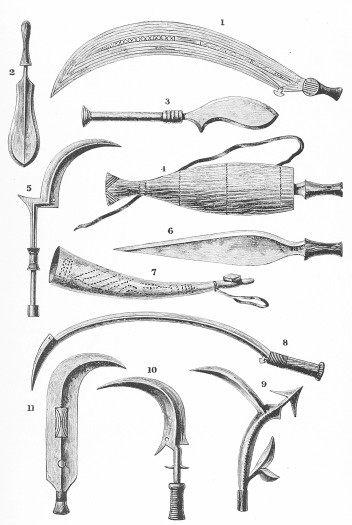
SWORDS AND KNIVES. (From a photograph.)
On reaching camp, however, the men, under pretence of cutting phrynia leaves to roof their huts, vanished into the forest, eluding the guards, and escaped along a path leading inland. Some of these managed to gain a few fowls, a sheaf or two of sugar-cane, and an abundance of mature plantains, but there were others who met only misfortune. Three Manyuema were killed, and a Lado soldier of the irregulars of Emin Pasha received a broad and sharp spear through his body, which, glancing past the vertebræ, caused a ghastly wound, but fortunately uninjured a vital part. The wounds were sewn up and bandages applied. The rear guard reported that on the road five Manyuema, three Zanzibaris, and one Soudanese were killed and eaten by ghoulish natives who had been hiding while the column was passing, and that these men belonging to the Banalya party had been resting near their hiding-place, when they were suddenly set upon and despatched. It was only five days previously that I had addressed the people publicly on the danger they were incurring by these useless and wholly unnecessary raids. When food was really required, which was once in five days, a foraging party would be sent to cut plantains in such abundance that they sufficed for several days, and twelve hours’ drying over a fire rendered the provisions portable. Their absolute inability to keep their promise, and the absolute impossibility of compelling them to do so, had been the cause of twelve deaths, and the thirteenth person was so seriously wounded that he was in imminent danger of dying. We had the small-pox raging among the Manyuema and Madis, and daily creating havoc among their numbers, and we had this fatal want of discipline, which was utterly irremediable in the forest region. The more vehemently I laboured to correct this disorder in the mob, the more conscious I became that only a death penalty on the raider would stop him; but then when the natives themselves executed infallibly the sentence, there was no necessity for me to do it.
Just above Manginni a canoe was capsized through pure carelessness. With our best divers we proceeded to the scene and recovered every article excepting a box of gunpowder and one of beads. The canoe was broken.
Passing by Mugwye’s, we reached Mambanga, and halted two days to prepare food for the uninhabited wilderness that stretches thence to Engwedde. At this camp Lakki or a “Hundred thousand,” a veritable Jack Cade, loud, noisy, blustering—the courier who in the midst of the midnight fray at Bandeya shouted to his comrades: “These fellows want meat, and meat they shall have, but it will be their own!”—heading a secret raiding party made up of choice friends, and returned twenty-four hours later with a curious and most singular wound from a poisoned arrow. Carbonate of ammonium was injected into the wound, and he was saved, but Lakki was firmly of the opinion that he was indebted to the green tobacco leaves employed to cover it.
1888.
Sept. 14.
Mambanga.
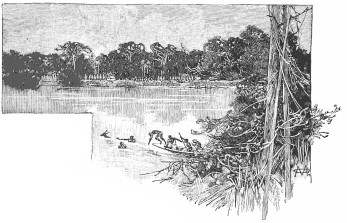
A SWIMMING RACE AFTER A BUSH ANTELOPE.
1888.
Sept. 17.
Ngula River.
While preparing our forest camps we were frequently startled at the sudden rush of some small animal resembling a wild goat, which often waited in his covert until almost trodden upon, and then bounded swiftly away, running the gauntlet among hundreds of excited and hungry people, who with gesture, voice, and action attempted to catch it. This time, however, the animal took a flying leap over several canoes lying abreast into the river, and dived under. In an instant there was a desperate pursuit. Man after man leaped head foremost into the river, until its face was darkly dotted with the heads of the frantic swimmers. This mania for meat had approached madness. The poisoned arrow, the razor-sharp spear, and the pot of the cannibal failed to deter them from such raids; they dared all things, and in this instance an entire company had leaped into the river to fight and struggle, and perhaps be drowned, because there was a chance that a small animal that two men would consider as insufficient for a full meal, might be obtained by one man out of fifty. Five canoes were therefore ordered out to assist the madmen. About half a mile below, despite the manœuvres of the animal which dived and swam with all the cunning of savage man, a young fellow named Feruzi clutched it by the neck, and at the same time he was clutched by half-a-dozen fellows, and all must assuredly have been drowned had not the canoes arrived in time, and rescued the tired swimmers. But, alas! for Feruzi, the bush antelope, for such it was, no sooner was slaughtered than a savage rush was made on the meat, and he received only a tiny morsel, which he thrust into his mouth for security.
During the next journey it was the river column that suffered. We were near our old camp at the confluence of the Ngula and the Ituri. A man in the advance canoe was shot in the back with a poisoned arrow. The wound was treated instantly with an injection of carbonate of ammonia, and no ill-effects followed.
The day following, the river column again suffered, and this time the case was as fatal as that caused by a bullet, and almost instantaneous. Jabu, our cook, somewhat indisposed, was sitting in the stern of a canoe while the crew was on shore about forty feet from him, hauling it past a bit of rapids. A bold and crafty native, with fixed arrow before him, steadily approached the vessel and shot a poisoned wooden dart, which penetrated the arm near the shoulders and pierced the base of the throat. The wound was a mere needle-hole puncture, but Jabu had barely time to say “Mahommed!” when he fell back dead.
Our next move was to Panga Falls. On the following day, 20th September, we made a road past the Falls, hauled twenty-seven canoes to the landing-place above, in view of Fort Island and then conveyed all goods and baggage to the camp.
1888.
Sept. 21.
Nejambi Rapids.
During our first journey through the neighbourhood we had lost no person through native weapons, but since our first passage the natives had been stimulated into aggressive efforts by the ease with which the reckless improvident black when not controlled by a white man, could be butchered. The deserters from the advance column had furnished the wretches with several meals; the stupid, dense-headed Bakusu under Ugarrowwa had supplied them with victims until the cannibal had discovered that by his woodcraft he could creep upon the unsuspecting men and drive his spear through them as easily as through so many goats. We had lost fourteen men in thirty days. A silly Madi strayed into the bush on the 20th, to collect fuel. A native confronted him and drove his weapon clean through his body. On the 21st a Manyuema woman, fifty paces from our camp, was pierced with a poisoned arrow, and was dead before we could reach her. And, to complete the casualties, a Zanzibari of the rear column succumbed to manioc poison.
Nejambi Rapids was our next camp. As soon as we had arrived and stacked goods, about a hundred men, driven by hunger, started in a body to forage for plantains. We, who remained in camp, had our hands full of work. The twenty-seven canoes required to be hauled, on the next day, past the rapids, and a road had to be cleared, and rattan cables were wanted for each vessel for hauling.
By sunset several of the foragers had returned well rewarded for their enterprise, but many were belated, and, till long past midnight, guns were fired as signals, and the great ivory horns sounded loud blasts which travelled through the glades with continued rolling echoes. About nine p.m., tidings came that two Zanzibaris had been killed by poisoned arrows. An hour later a dead body, that of Ferajji, the humorous head-man, who was cross-examined at Banalya, was brought in. On inspection, the corpse was found studded with beads of perspiration. The arrow wound was a mere pin-hole puncture in upper left arm, but it had proved quite enough. It was said that he walked about an hour after being struck, towards camp, but then cried out for a little rest, as he was faint. During the ten minutes’ rest he died.
Young Hussein bin Juma, of a respectable parentage at Zanzibar, was soon after carried in, and brought to me, not dead, as reported, but in an extremely low condition. I discovered that the arrow had pierced the outer flesh of the right arm, and had entered an inch above the third rib. The arrow was hastily withdrawn and shown to me. It was smeared over with a dark substance like thick coal tar, and emitted a most peculiar odour. The arm was not swollen, but the body wound had caused a considerable tumour, soft to the touch. He said that he had felt exceedingly faint at one time, and that he perspired greatly, but had felt great relief after retching. At present he was languid, and suffered from thirst. After washing well both wounds, five grains of carbonate ammonia were injected into each wound, and a good dose of strong medical brandy was administered.
In ten days young Hussein was quite restored, and went about performing his accustomed duties.
A squad of men returned long after midnight with fowls, plantains, and fortunately without accident. But early in the morning, Tam, a native of Johanna, raving from small-pox, threw himself into the rapids and was drowned. He had declined being vaccinated.
After hauling our canoes overland three-quarters of a mile, we halted a day above the rapids to prepare five days’ rations of flour. The strain of hauling the rotten craft had reduced our flotilla to twenty-two vessels.
Engwedde’s long series of rapids was passed without accident, and thence we moved to Avisibba, and a good march brought us to the camp below Mabengu Rapids, where we had waited so long for the lost column under Jephson in August, 1887.
The next day was a halt, and a strong foraging party was sent over to Itiri to collect food. In the afternoon it returned, bringing several days’ supply of plantains with a few goats and fowls, and for the first time we were able to make soup and distribute meat to the Banalya sick. It was reported to me that the Manyuema had carved a woman most butcherly to allay their strong craving for meat, but the headman assured me that it was utterly false, and I am inclined to believe him, for the Zanzibaris, if they had really detected such a monstrous habit in people who might at any time contaminate their cooking-pots, would have insisted on making a severe example.
1888.
Sept. 30.
Avugadu.
On the last day of September we moved up to above upper rapids of Avugadu, at which camp we discovered wild oranges. There were also wild mango-trees, if we may trust the flowering and foliage. Red figs of a sweetish flavour were very common, but as their shrunk pedicels possessed no saccharine secretions they were uneatable.
A native woman was delivered of a child on the road. She was seen standing over the tiny atom. The Zanzibaris as they came up crowded around the unusual sight, and one said, “throw the thing into the river out of the way.” “But why should you do that when the infant is alive?” asked another. “Why don’t you see that it is white? it must be some terrible disease I am sure.” “Oh Ignorance, how many evils transpire under thy dark shade.” “Father, forgive them, for they know not what they do,” rushed to my mind, as I looked in wonder at the speakers, who, utterly unconscious that they were committing murder, would have extinguished the little spark of life there and then.
Our anxieties at this period were mainly on the account of those suffering from ulcers. There was one wise little boy of about thirteen called Soudi, who formerly attended on the Major. An injury he had received had caused about four inches of the leg bone to be exposed. We had also fifteen cases of small-pox, who mingled in the freest manner possible with our Zanzibaris, and only the suicide, Tam, had thus far been attacked.
1888.
Oct. 1.
Avejeli.
On arriving at Avejeli, opposite the Nepoko, the wife of the Manyuema drummer, a prepossessing lassie, went out to the gardens close by to collect herbs. A band of natives were in hiding, and they pierced her with arrows. Seven of them quivered in her body. Her screams attracted attention, and she was hastily brought in, but even as we were about to inject the ammonium she rolled over, raised her arms, and embraced her young husband in the most touching manner, gave a long sigh, and died. “Oh, ye travellers! who belong to that clique who say the Africans know neither love, affection, nor jealousy. What would you have said to this pitiful death-scene?” We had also a Manyuema woman who was a hideous object, a mass of loathsome pustules, emitting an almost unbearable stench, but her husband tended and served her with a surpassing and devoted tenderness. Death, death everywhere, and on every day, and in every shape; but love, supreme love stood like a guardian angel to make death beautiful! Poor unlettered, meek creatures, the humblest of humanity, yet here unseen, and unknown of those who sing of noble sacrifices, of constancy and devotion, proving your brotherhood with us amid the sternest realities by lulling your loved ones to rest with the choicest flowers of love!
On the 2nd of October we moved up to Little Rapids below the confluence of the Ngaiyu with the Ituri, where a tornado visited us, churned up the generally waveless river into careering rollers, that stretched from bank to bank, with a power and force that disturbed the very bed and muddied the stream until it resembled a wild strip of shallow wind-driven sea, beating on an alluvial shore. Our canoes were dashed one against the other until they promised to become matchwood, while the great forest groaned and roared with the agony of the strife, but in half-an-hour the river had resumed its placid and tender face, and the forest stood still as though petrified.
During a halt on the 3rd, Mr. Jameson’s box, containing various trifles belonging to an industrial naturalist, was opened. Books, diaries, and such articles as were worth preserving, were sealed up for transport athwart the continent; the others, unnecessary to a person in civilization, were discarded.
1888.
Oct. 3.
Bavikai.
Mr. Bonny was despatched with twenty-eight men past the Ngaiyu, to verify my hope that a landing-place I had observed in passing and repassing would lead to the discovery of a road by which I could avoid the devastated wilderness that stretched for nearly 200 miles along the south bank between the Basopo Rapids and Ibwiri. Mr. Bonny, after returning, was pleased to express his surprise at the marvellous dexterity and agility of the scouts, who sprang with the lightness of springing bush antelopes over every kind of impediment, and who in almost every thousand paces gained five hundred ahead of him. A mile and a half from the landing-place on the north bank he had found a fine village surrounded by rich groves of plantains. To this village, called Bavikai, we proceeded more in the hope that we could utilize some road going north-easterly, whence, after sixty miles or so, we could strike on a bee-line course for the Albert.
As the men were being transported across the river opposite the landing-place of the Bavikai on the 4th, I saw a dozen Madis in a terrible condition from the ravages of the small-pox, and crowding them, until they jostled them in admirable unconcern, were some two dozen of the tribe as yet unaffected by the disease. This little fact put me on a line of reflections which, had a first-class shorthand writer been near, might have been of value to other thoughtless persons. Never did ignorance appear to me so foolish. Its utter unsuspectingness was pitiful. Over these human animals I saw the shadow of Death, in the act to strike. But I said to myself, I see the terrible shade over them ready to smite them with the disease which will make them a horror, and finally kill them. When I fall also it will probably be from some momentary thoughtlessness, when I shall either be too absorbed, or too confident to observe the dark shadow impending over me. However, Mambu Kwa Mungu, neither they nor I can avoid our fate.
Among my notes on the 5th of October I find a few remarks about Malaria.
While we have travelled through the forest region we have suffered less from African fevers, than we did in the open country between Mataddi and Stanley Pool.
A long halt in the forest clearings soon reminds us that we are not yet so acclimated as to utterly escape the effects of malaria. But when within the inclosed woods our agues are of a very mild form, soon extinguished by a timely dose of quinine.
On the plateau of Kavalli and Undussuma, Messrs. Jephson, Parke, and myself were successively prostrated by fever, and the average level of the land was over 4500 feet above the sea.
On descending to the Nyanza plain, 2500 feet lower, we were again laid up with fierce attacks.
At Banana Point, which is at sea-level, ague is only too common.
At Boma, 80 feet higher, the ague is more common still.
At Vivi, there were more cases than elsewhere, and the station was about 250 feet higher than Boma, and not a swamp was near it.
At Stanley Pool, about 1100 feet above sea level, fever of a pernicious form was prevalent.
While ascending the Congo with the wind astern we were unusually exempted from ague.
But descending the Upper Congo, facing the wind, we were smitten with most severe forms of it.
While ascending the Aruwimi we seldom thought of African fever, but descending it in canoes, meeting the wind currents, and carried towards it by river-flow and paddle, we were speedily made aware that acclimatisation is slow.
Therefore it is proved that from 0 to 5000 feet above the sea there is no immunity from fever and ague, that over forty miles of lake water between a camp and the other shore are no positive protection; that a thousand miles of river course may serve as a flue to convey malaria in a concentrated form; that if there is a thick screen of primeval forest, or a grove of plantains between the dwelling-place and a large clearing or open country there is only danger of the local malaria around the dwelling, which might be rendered harmless by the slightest attention to the system; but in the open country neither a house nor a tent are sufficient protection, since the air enters by the doors of the house, and under the flaps, and through the ventilators to poison the inmates.
Hence we may infer that trees, tall shrubbery, a high wall or close screen interposed between the dwelling-place and the wind currents will mitigate their malarial influence, and the inmate will only be subjected to local exhalations.
Emin Pasha informed me that he always took a mosquito curtain with him, as he believed that it was an excellent protector against miasmatic exhalations of the night.
Question, might not a respirator attached to a veil, or face screen of muslin, assist in mitigating malarious effects when the traveller finds himself in open regions?
Three companies of forty men each were sent in three different directions to follow the tracks leading from Bavikai. The first soon got entangled in the thick woods bordering the Ngaiyu, and had an engagement with the natives of Bavikai, who were temporarily encamped in the dark recesses, the second followed a path that ran E. by N., and soon met a large force of natives coming from three different villages. One of our men was wounded in the head with a poisoned arrow. The third was perplexed by a network of paths, and tried several of them, but all ended in plantations of plantains and thin bush of late growth, and in the search these men encountered savages well armed and prepared with poisoned darts. We were therefore compelled to recross the river to the south bank, to try again higher up, to avoid the trying labour of tunnelling through the forest.
1888.
Oct. 10.
Hippo Broads.
On the 10th the Expedition reached Hippo Broads. On this date we saw a cloud of moths sailing up river, which reached from the water’s face to the topmost height of the forest, say 180 feet, so dense, that before it overtook us we thought that it was a fog, or, as was scarcely possible, a thick fall of lavender-coloured snow. The rate of flight was about three knots an hour. In the dead calm morning air they maintained an even flight, but the slightest breeze from the banks whirled them confusedly about, like light snow particles on a gusty day. Every now and then the countless close packed myriads met a cloud of moth migrants from above river, and the sunbeams glinting and shining on their transparent wing caused them to resemble fire sparks.
Bits of turfy green, cropped close by hippo, which favours this fine reach of river, distinguish the banks near this locality. Many oil palms, some raphia, arums, phrynia, amoma, pepper bushes, &c., denote a very ancient site of a human settlement. My tent was pitched under a small branching fig-tree, which protected it from a glowing Equatorial sun, but the heat reflected from the river’s face mounted up to 87° in the shade at 3 P.M. This unusual heat preceded a tempest, with lightning, startling thunder, and deluging rain.
At the Bafaido Cataract, a woman who fell into our hands informed us that the Medze tribe lived on the other side of the Ngaiyu River and that the Babandi were found on its left bank.
Near Avaiyabu, a lurking native who had been standing behind a leafy screen of parasites depending from the branches of a big tree, suddenly stepped into the path, snatched a little girl belonging to the Manyuema, and drove his double-edged dagger from breast to back, and holding his weapon above his head uttered a furious cry, which might well have been “Death to the invader!”
And at the next camp, Avamberri landing-place, Soudi the wise little boy who had served the Major, while being carried past the rapids to the canoes waiting above, died on the carriers’ shoulders. The enamel covering of the leg-bone had been all destroyed by the virulent ulcer. Since we had left Bungangeta Island, Soudi had been carried and nursed, but want of exercise, and exposure to sun in the canoe and constant rain had weakened his digestion. His constitution had been originally healthy and sound. The little fellow had borne his sufferings bravely, but the reserve medicines were at Bangala, and we could do nothing for him.
On the 18th of October we were at Amiri Rapids, and the second Zanzibari showed symptoms of small-pox. So far we had been remarkably free of the disease, despite the fact that there were from ten to twenty sufferers daily in the camp since arriving at the settlement of the Batundu. Out of 620 Zanzibaris who were ordered to be vaccinated, some few constitutions might possibly have resisted the vaccine; but no more decided proof of the benefits resulting to humanity could be obtained from Jenner’s discovery than were furnished by our Expedition. Among the Manyuema, Madis, and native followers, the epidemic had taken deadly hold, and many a victim had already been tossed into the river weighted with rocks. For this was also a strange necessity we had to resort to, to avoid subsequent exhumation by the natives whom we discovered to be following our tracks for the purpose of feeding on the dead.
One of the Zanzibari headmen while acting as coxswain of a canoe was so stung by wasps at this camp that he despaired of his life, and insisted that his will should be written, wherein he made his brother, then with us, his sole legatee. I conformed to his wish in a clerkly fashion that pleased him well, but I also administered a ten-grain dose of carbonate of ammonium hypodermically, and told him he should reach Zanzibar in spite of the vicious wasps who had so punished him. The next day he was a new man, and boasted that the white man’s medicines could cure everything except death.
1888.
Oct. 18.
Amiri Falls.
After moving to the top of Amiri Rapids, a series of misfortunes met us. Some few of the flighty-headed untrained men of the rear-column rushed off to the plantain plantations without a leader or authority, and conducted themselves like children. The natives surrounded them and punished them, wounding three. Two others, one suffering from a palpitation of the heart, and another feeble youth, had left the trail to hide from the rear-guard.
Up to date, we had lost since 1st of September, nine Zanzibaris killed, one from suicide, one from ulcers, and two were missing. Of the Manyuema contingent, fifteen had been killed or had died from small pox, and eighteen Madis had either been killed or had perished from the pest. Total loss, forty-four deaths within forty-nine days.
1888.
Oct. 19.
Amiri Falls.
From Amiri Falls to Avatiko was a seven-days’ march through a depopulated country, through a land wholly empty of food. Beyond Avatiko by the new route I proposed to follow, two days would probably transpire before another supply of food could be obtained. This was my estimate, at which with the Zanzibaris of the advance column who were now trained in forest life, we might perform these journeys. If we could obtain no food at Avatiko, then our lot would be hard indeed. Up to within a day’s march of Avatiko, we could employ the canoes in carrying an extra supply of provisions. It would not be impossible to take twenty days’ rations of flour per capita; but a leader to perform such a work must be obeyed. He performs his duties by enjoining on all his followers to remember his words, to take heed of his advice, and do their utmost to conform to his instructions.
On the 20th at dawn, 160 rifles were despatched to the plantations five miles inland from Amiri Falls. The men were told how many days Avatiko was distant, and that they should employ one day in collecting food, in peeling, slicing and drying their plantains in the plantation, so that they could bring from sixty to seventy pounds of food, which when distributed would supply each person with over twenty pounds, equal to ten days’ rations. Experience of them proved to me that the enterprising would carry sufficient to satisfy them with fifteen days’ unstinted food; others, again, despite the warning of death rung in their ears, would not carry more than would suffice them for four days.
On the afternoon of the 21st I was gratified to see that the people had been very successful. How many had followed my advice it was impossible to state. The messes had sent half their numbers to gather the food, and every man had to contribute two handfuls for the officers and sick. It only remained now for the chiefs of the messes to be economical of the food, and the dreaded wilderness might be safely crossed.
CHAPTER XXII.
ARRIVAL AT FORT BODO.
Ugarrowwa’s old station once more—March to Bunda—We cross the Ituri River—Note written by me opposite the mouth of the Lenda River—We reach the Avatiko plantations—Mr. Bonny measures a pigmy—History and dress of the pigmies—A conversation by gesture—The pigmy’s wife—Monkeys and other animals in the forest—The clearing of Andaki—Our tattered clothes—The Ihuru River—Scarcity of food; Amani’s meals—Uledi searches for food—Missing provisions—We reach Kilonga-Longa’s village again—More deaths—The forest improves for travelling—Skirmish near Andikumu—Story of the pigmies and the box of ammunition—We pass Kakwa Hill—Defeat of a caravan—The last of the Somalis—A heavy shower of rain—Welcome food discovery at Indemau—We bridge the Dui River—A rough muster of the people—A stray goat at our Ngwetza camp—Further capture of dwarfs—We send back to Ngwetza for plantains—Loss of my boy Saburi in the forest—We wonder what has become of the Ngwetza party—My boy Saburi turns up—Starvation Camp—We go in search of the absentees, and meet them in the forest—The Ihuru River—And subsequent arrival at Fort Bodo.
1888.
Oct. 23.
Ugarrowwa’s Station.
The Expedition reached Ugarrowwa’s old station on the 23rd of October, and slept within its deserted huts. In the court of the great house of the chief of the raiders, a crop of rice had grown up, but the birds had picked every grain. Over one hundred people found comfortable shelter in the spacious passages; and had supplies been procurable within a respectable distance, it would not have ill-suited us for a halt of a week; but it was too risky altogether to consume our rations because of the comfort of shelter. It was the centre of a great desolate area, which we were bound by fear of famine to travel through with the utmost speed.
1888.
Oct. 24.
Bunda.
The following day we marched to Bunda. The river column received attention from Ugarrowwa’s old subjects, and the Manyuema sprang overboard to avoid the arrows; but the Zanzibaris from the canoe behind leaped ashore, and by a flank attack assisted us to save the bewildered Manyuema, who in their careless happy attitudes in the canoe had offered such tempting targets for the natives.
The Ituri River was now in full flood, for the rains fell daily in copious tropical showers. The streams and creeks flowing into the Ituri from the right bank were deep, which caused the land party excessive worry and distress. No sooner had they crossed one creek up to the waist, than in a few moments another of equal or greater depth had to be waded through. They were perpetually wringing their clothes, and declaiming against the vexatious interruptions. Across the mouths of deeper tributaries the canoes were aligned, and served as floating bridges for the party to cross, while each man was the subject of some jest at his bedraggled appearance. The foremost men were sure to have some wet mud or soapy clay on the boards; the garments of others would be dripping with water, and presently fall after fall would testify to the exceeding slipperiness of the bridge, and would be hailed with uproarious chaff and fun. On this day thirty-two streams were crossed by the land party.
On the 25th, we moved up to a camp, opposite the mouth of the Lenda River. We were making progress, but I came across the following note written that evening. It will be seen later that such congratulations could only have been the outcome of a feeling of temporary pleasure that the day was not far distant when we should see the end to our harder labours.
1888.
Oct. 25.
Lenda River.
“I desire to render most hearty thanks that our laborious travels through the forest are drawing to a close. We are about 160 miles to-night from the grass-land; but we shall reduce this figure quickly enough, I hope. Meantime we live in anticipation. We bear the rainy season without a murmur, for after the rain the harvest will be ready for us in the grass-land. We do not curse the mud and reek of this humid land now, though we crossed thirty-two streams yesterday, and the mud banks and flats were sorely trying to the patience. We have a number of minor pleasures in store. It will be a great relief to be delivered from the invasions of the red ants, and to be perfectly secure from their assaults by day and by night. When we have finally dried the soles of our boots and wiped the mildew of the forest off their tops, our dreams will be undisturbed by one enemy at least. While we smart under the bites of the ferocious small bees, and start at the sting of small ants, and writhe under the venom of a hornet, or groan by reason of the sting of a fiendish wasp, or flap away the ever-intrusive butterfly, or dash aside the hurtful tiger slug, or stamp with nervous haste on the advancing greenish centipede, we remind ourselves that these miseries will not be for many days now. A little more patience and then merrier times. We have had four goats since August 17th for meat. We have subsisted mainly on roast plantains. They have served to maintain the soul attached to the body. We are grateful even for this, though our strength is not to be boasted of. We complacently think of the beef, and veal, and mutton diet ahead, garnished with a variety of edibles such as the sweet potato and beans, and millet flour for porridge with milk, and sesamum oil for cooking. Relief also from the constant suspicion, provoked by an animal instinct, that a savage with a sheaf of poisoned arrows is lurking within a few feet of one will be something to be grateful for. The ceaseless anxiety, the tension of watchfulness, to provide food, and guard the people from the dangers that meet their frolics, will be relaxed; and I shall be glad to be able to think better of the world and its inhabitants than the doubtful love I entertain for mankind in the forest.”
1888.
Oct. 27.
Lenda River.
We found our camp at Umeni on the 26th, but there were only two small bunches of miniature plantains discovered here, and a raging tornado roared like a legion of demons through the forest, and shook the ancient tree giants to their base, while the dark Ituri was so beswept that it became pallid under the whistling, screaming fury of the squalls.
On the next day we rowed up to below Big Cataract, unloaded the goods, left the canoes in the bushes, shouldered our loads, and marched away after half an hour’s halt only, for five miles inland. We had left the Ituri navigation for the last time.
We entered the Avatiko plantations after three hours’ march on the 28th, and just while the majority of the people was perilously near starvation. They spread over the plantations with the eagerness of famished wolves after prey. Here we stayed two days in foraging and preparing a supply of food.
We had not been long at Avatiko before a couple of pigmies were brought to me. What relation the pair were to one another is not known. The man was young, probably twenty-one. Mr. Bonny conscientiously measured him, and I recorded the notes.
Height, 4 ft.; round head, 20¼ in.; from chin to back top of head, 24¼ in.; round chest, 25½ in.; round abdomen, 27¾ in.; round hips, 22½ in.; round wrist, 4¼ in.; round muscle of left arm, 7½ in.; round ankle, 7 in.; round calf of leg, 7¾ in.; length of index finger, 2 in.; length of right hand, 4 in.; length of foot, 6¼ in.; length of leg, 22 in.; length of back, 18½ in.; arm to tip of finger, 19¾ in.
This was the first full-grown man we had seen. His colour was coppery, the fell over the body was almost furry, being nearly half an inch in length. His head-dress was a bonnet of a priestly form, decorated with a bunch of parrot feathers; it was either a gift or had been stolen. A broad strip of bark cloth covered his nakedness. His hands were very delicate, and attracted attention by their unwashed appearance. He had evidently been employed in peeling plantains.
1888.
Oct. 28.
Avatiko.
Not one London editor could guess the feelings with which I regarded this mannikin from the solitudes of the vast central African forest. To me he was far more venerable than the Memnonium of Thebes. That little body of his represented the oldest types of primeval man, descended from the outcasts of the earliest ages, the Ishmaels of the primitive race, for ever shunning the haunts of the workers, deprived of the joy and delight of the home hearth, eternally exiled by their vice, to live the life of human beasts in morass and fen and jungle wild. Think of it! Twenty-six centuries ago his ancestors captured the five young Nassamonian explorers, and made merry with them at their villages on the banks of the Niger. Even as long as forty centuries ago they were known as pigmies, and the famous battle between them and the storks was rendered into song. On every map since Hekataeus’ time, 500 years B.C., they have been located in the region of the Mountains of the Moon. When Mesu led the children of Jacob out of Goshen, they reigned over Darkest Africa undisputed lords; they are there yet, while countless dynasties of Egypt and Assyria, Persia, Greece and Rome, have flourished for comparatively brief periods, and expired. And these little people have roamed far and wide during the elapsed centuries. From the Niger banks, with successive waves of larger migrants, they have come hither to pitch their leafy huts in the unknown recesses of the forest. Their kinsmen are known as Bushmen in Cape Colony, as Watwa in the basin of the Lulungu, as Akka in Monbuttu, as Balia by the Mabodé, as Wambutti in the Ihuru basin, and as Batwa under the shadows of the Lunae Montes.
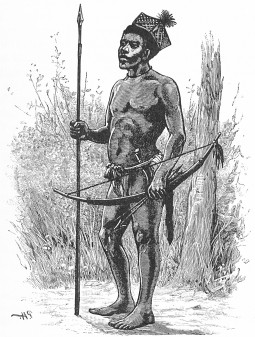
DWARF CAPTIVE AT AVATIKO.
As the gigantic Madis, and tall Soudanese, and tallest Zanzibaris towered above the little man, it was delightful to observe the thoughts within him express themselves with lightning rapidity on his face. The wonderment that filled him, the quick shifting and chilling fears as to his fate, the anxious doubts that possessed him, the hopes that sprang up as he noted humour on the faces, the momentary shades of anxiety, curiosity to know whence these human monsters had come from, what they would do with him eventually; would they kill him, how? by roasting him alive, or plunging him screaming into a vat-like cooking pot? Ach Gott! I hope not, and a slight shake of the head, with a more pallid colour on the lips and a nervous twitch showed what distress he was in. He would do anything to deserve the favour of these big men, just as the young Nassamonians were willing to do 2600 years ago, when his pigmy forefathers pointed their fingers and jabbered at them in the old Nigritian village. So we took him to sit by us, and stroked him on the back, gave him some roast bananas to put into that distended aldermanic abdomen of his, and the pigmy smiled his gratitude. What a cunning rogue he was! how quick-witted! He spoke so eloquently by gesture that he was understood by the dullest of us.
“How far is it to the next village where we can procure food?”
He placed the side of his right hand across the left wrist. (More than two days’ march.)
“In what direction?”
He pointed east.
“How far is it to the Ihuru?”
“Oh!” He brought his right hand across his elbow joint—that is double the distance, four days.
“Is there any food north?”
He shook his head.
“Is there any west or north-west?”
He shook his head, and made a motion with his hand as though he were brushing a heap of sand away.
“Why?”
He made the motion with his two hands as though he were holding a gun, and said “Doooo!”
“To be sure the Manyuema have destroyed everything.”
“Are there any ‘Doooo’ in the neighbourhood, now?”
He looked up and smiled with a gush as artful as a London coquette, as if to say, “You know best! Oh! naughty man, why do you chaff me?”
“Will you show us the road to the village where we can get food?”
He nodded his head rapidly, patted his full-moon belly, which meant, “Yes, for there I shall get a full meal; for here”—he smiled disdainfully as he pressed his thumb nail on the first joint of his left index finger—“are plantains only so big, but there they are as big as this,” and he clasped the calf of his leg with two hands.
“Oh, Paradise!” cried the men, “bananas as big as a man’s leg!” The pigmy had contrived to ingratiate himself into every man’s affection. My authority was gone until the story of the monstrous bananas would be disproved. Some of them looked as if they would embrace him, and his face mimicked artless innocence, though he knew perfectly well that, in their opinion, he was only a little lower than an angel.
And all this time, the coppery face of the nut-brown little maid was eloquent with sympathy in the emotions of the male pigmy. Her eyes flashed joy, a subtle spirit glided over her features with the transition of lightning. There were the same tricks of by-play; the same doubts, the same hopes, the same curiosity, the same chilling fear, was felt by the impressionable soul as she divined what feelings moved her kinsman. She was as plump as a thanksgiving turkey or a Christmas goose; her breasts glistened with the sheen of old ivory, and as she stood with clasped hands drooping below—though her body was nude—she was the very picture of young modesty.
The pair were undoubtedly man and woman. In him was a mimicked dignity, as of Adam; in her the womanliness of a miniature Eve. Though their souls were secreted under abnormally thick folds of animalism, and the finer feelings inert and torpid through disuse, they were there for all that. And they suited the wild Eden of Avatiko well enough.
1888.
Oct. 28.
Forest.
Burdened with fresh supplies of dried plantains, and guided by the pigmies, we set out from the abandoned grove of Avatiko E.N.E., crossed the clear stream of Ngoki at noon, and at 3 P.M. were encamped by the brook Epeni. We observed numerous traces of the dwarfs in the wilds which we had traversed, in temporary camps, in the crimson skins of the amoma, which they had flung away after eating the acid fruit, in the cracked shells of nuts, in broken twigs that served as guides to the initiated in their mysteries of woodcraft, in bow-traps by the wayside, in the game-pits sunk here and there at the crossings of game-tracks. The land appeared more romantic than anything we had seen. We had wound around wild amphitheatral basins, foliage rising in terraces one above another, painted in different shades of green, and variegated with masses of crimson flowers, and glistening russet, and the snowdrop flowerets of wild mangoes, or the creamy silk floss of the bombax, and as we looked under a layer of foliage that drooped heavily above us, we saw the sunken basin below, an impervious mass of leafage grouped crown to crown like heaped hills of soft satin cushions, promising luxurious rest. Now and then troops of monkeys bounded with prodigious leaps through the branches, others swinging by long tails a hundred feet above our heads, and with marvellous agility hurling their tiny bodies through the air across yawning chasms, and catching an opposite branch, resting for an instant to take a last survey of our line before burying themselves out of sight in the leafy depths. Ibises screamed to their mates to hurry up to view the column of strangers, and touracos argued with one another with all the guttural harshness of a group of Egyptian fellahs, plantain-eaters, sunbirds, grey parrots, green parroquets, and a few white-collared eagles either darted by or sailed across the leafy gulf, or sat drowsily perched in the haze upon aspiring branches. There was an odour of musk, a fragrance of flowers, perfume of lilies mixed with the acrid scent of tusky boars in the air; there were heaps of elephant refuse, the droppings of bush antelopes, the pungent dung of civets, and simians along the tracks, and we were never long away from the sound of rushing rivulets or falling cascades, sunlight streamed in slanting silver lines and shone over the undergrowth and the thick crops of phrynia, arum, and amoma, until their damp leaves glistened, and the dewdrops were brilliant with light.
And the next day our march underneath the eternal shades was through just such a land, and on the morning of the 1st of November we emerged into the clearing of Andaki, to refresh our souls with the promised fruit of its groves. The plantains were not very large, but they were mature and full, and before an hour had elapsed, the wooden grates were up, and the fruit lay in heaps of slices on the bars over the fire. The word was passed that the first and second day of the month should be employed in preparing as much provisions as every man could carry. We were in N. Lat. 1° 16½′. Kilonga-Longa’s station was in 1° 6′, and Fort Bodo in 1° 20′, so that our course was good.
1888.
Nov. 2.
Audaki.
On the second some scouts hunting up the various tracks extending eastward came across two women, one of whom said she knew of a great village to the north where there was food. Another said that Andari lay E.N.E., four days’ march, where there was such a stock of food that Andaki was a mere handful compared with it.
Soon after leaving Andaki, and crossing a broad ridge, we came upon a vast abandoned clearing. Probably a year had elapsed since the people had fled, and their settlements had been consumed with fire, for the banana plants were choked by the voracious undergrowth and wild plants, and the elephants had trampled through and through, and sported for months among the wasted groves, and over the crushed Musa plants, through phrynia flourishing two fathoms deep, and where the stumps of cut trees had sprouted and grown until their tufted tops were joined to one another in one great thick carpet of bush. Through this we carved our way with brandished billhooks and cutlasses; the native women had lost the track, and were bewildered by the wildly luxuriant shrubbery, under which we sweated in the damp hot-house heat, and ploughed our way through the deep green sea, until after ten hours we came to a babbling rillet, and must perforce camp from sheer exhaustion, though we had made but five miles.
1888.
Nov. 4.
Forest.
On the morning of the fourth we resumed the task, to slash, cut, creep and crawl, bore through, in and out, to clamber over logs, tread carefully over gaping rifts in the reeking compost, bend under logs, to tunnel away with might and main, to drive through—a hungry column of men was behind, a wilderness before us—to crash headlong through the plants, veer to the left, and now to the right, to press on and on, to sharpen the weapons on the stones of the brook; to take a hasty drink to satisfy our thirst, and again to the work. Cleave away merrily, boys; sever those creepers; cut those saplings down! No way now? then widen that game hole in the bush clump! Come, strike with billhook and sword, axe and cutlass! We must not die like fools in this demon world! This way and that, through and through, until after sixteen hours we had cut a crooked channel through the awful waste, and stood once more under the lordly crowns of the primeval forest.
Paddy’s traditional patchy clothes was a dress suit compared to mine, as I stood woefully regarding the rents and tatters and threads waving in tassels from my breeches and shirt; and the men smiled, and one said we looked like rats dragged through the teeth of traps, which I thought was not a bad simile. But we had no time for talk; we ate a couple of roast plantains for lunch, and continued our journey, and by 3 P.M. were within half-an-hour of the Ihuru River.
The next day, before it was full daylight, we were filing along an elephant track that ran parallel with the Ihuru, which was at this time one raging series of rapids its whole length, and sounding its unceasing uproar in our ears. Numbers of deep tributaries were waded through; but we maintained a quick pace, owing to the broad track of the elephants, and by the usual hour of the afternoon nine miles had been covered.
Thirteen Zanzibaris of the rear column, and one of the Danagla soldiers of Emin Pasha, had succumbed during the last few days, and I do not know how many Madis and Manyuema.
On the evening of the sixth, after a march of eight miles, I became impressed with the necessity of finding food shortly, unless we were to witness wholesale mortality. Starvation is hard to bear, but when loads must be carried upon empty stomachs, and the marches are long, the least break in the continuity of supply brings with it a train of diseases which soon thins the ranks. Our Nyanza people were provident, and eked their stores with mushrooms and wild fruit; but the feeble manioc-poisoned men of the rear column, Madis and Manyuema, were utterly heedless of advice and example.
A youth named Amani, who looked rather faint, was adjured to tell me the truth about what he had eaten the last two days.
1888.
Nov. 6.
Forest.
“I will,” he said. “My mess had a fair provision of plantain flour that would have kept us with ease two days longer; but Sulimani, who carried it, put it down by the roadside while he went to gather mushrooms. When he returned the food was gone. He says the Manyuema had stolen it. Each one of us then on reaching camp last night set out to hunt for mushrooms, out of which we made a gruel. That is what we had to eat last night for supper. This morning we have fasted, but we are going to hunt up mushrooms again.”
“And what will you eat to-morrow?”
“To-morrow is in the hands of God. I will live in hopes that I shall find something.”
This youth, he was only nineteen, had carried sixty pound of cartridges in the meantime, and would carry it again to-morrow, and the next day, until he dropped, and measured his length with eyes upturned to the dark cope of leaves above, to be left there to mildew and rot; for out of nothing, nothing can be extracted to feed hungry men. He was only a solitary instance of over 400 people.
We reached a Manyuema Camp, and Uledi recognised it as being a place where he had halted during a forage tour to the west of the Ihuru, while he was waiting for Messrs. Jephson and Nelson at Ipoto, and the advance column was journeying to Ibwiri in November, 1887.
On the 7th a halt was ordered, that a column might be sent under Uledi to search the clearing of Andari, six miles N.N.W. of the camp, but over a hundred were so weak that they were unable to go, whereupon the messes were ordered to bring their pots up, and three handfuls of flour were placed in each to make gruel with, that they might have strength to reach the plantation.
On the 8th, about 200 remained silent in camp awaiting the foragers. In the afternoon, perceiving that it was too long a fast to wait for them we served out more plantain flour.
1888.
Nov. 9.
Forest.
On the 9th, the foragers had not arrived. Two men had died in camp. One reeled from the effects of a poisonous fungus, as they came to get another ration of flour for their gruel; their steps were more feeble; the bones of the sternum were fearfully apparent. Three days would find us all perished, but we were hopeful that every minute we should hear the murmur of the returning column.
On the morning of the 10th, anxious for the European provisions which we were carrying for the officers at Fort Bodo, I had them examined, and discovered to my consternation that fifty-seven tins of meat, teas, coffees, milks, were short—had been eaten by the Manyuema. If a look had potency sufficient to blast them, they would have speedily been reduced to ashes. “Dear me, how could the tins have vanished?” asked the chief Sadi. Ah, how? But the provision boxes were taken from his party, and Winchester and Maxim ammunition cases were served instead to them as freight.
At 2 P.M. the column of foragers returned, bringing from three to six days’ provisions, which they had gathered from an abandoned plantation. The bearers had refreshed themselves previous to gathering. Now, in return for my gruel, each member had to refund me one pound of flour, as my reserve store, and one pound for the sick, who were deprived of the power to forage, and who were rejected by the messes. So that in this manner the sick received about eight pounds of flour, or dried plantains, and I owned a reserve of 200 pounds for future use.
Within an hour-and-a-half on the 11th we had reached Kilonga-Longa’s ferry. The natives, fearing a repetition of his raids to the west of the Ihuru, had destroyed every canoe, and thus prevented me from crossing to pay Kilonga-Longa another visit, and to settle some accounts with him. The river was also in flood, and a gaunt and hungry wilderness stretched all round us. There was no other way for it than to follow the Ihuru upward until we could find means to cross to the east, or left side. Our course was now N.E. by N.
1888.
Nov. 12.
Forest.
On the 12th, we followed a track, along which quite a tribe of pigmies must have passed. It was lined with amoma fruit-skins, and shells of nuts, and the crimson rinds of phrynia berries. No wood-beans, or fenessi, or mabungu, are to be found in this region, as on the south bank of Ituri River. On reaching camp, I found that at the ferry, near the native camp at which we starved four days, six people had succumbed—a Madi, from a poisonous fungus, the Lado soldier, who was speared above Wasp Rapids, two Soudanese of the rear-column, a Manyuema boy in the service of Mr. Bonny, and Ibrahim, a fine young Zanzibari, from a poisoned skewer in the foot.
During the 13th the great forest was perceptibly improved for travel. Our elephant and game track had brought us across another track leading easterly from Andari, and both joined presently, developing to a highway much patronised by the pigmy tribes. This we followed for two hours. We could tell where they had stopped to light their pipes, and to crack nuts, and trap game, and halt to gossip. The twigs were broken three feet from the ground, showing that they were snapped by dwarfs. Where it was a little muddy the path showed high delicate insteps, proving their ancient ancestry and aristocratic descent, and small feet not larger than those of young English misses of eight years old. The path improved as we tramped along; it grew a highway of promise. Camps of the dwarfs were numerous. The soil was ochreous, the trees were larger, and towered to magnificent heights.
1888.
Nov. 13.
Forest.
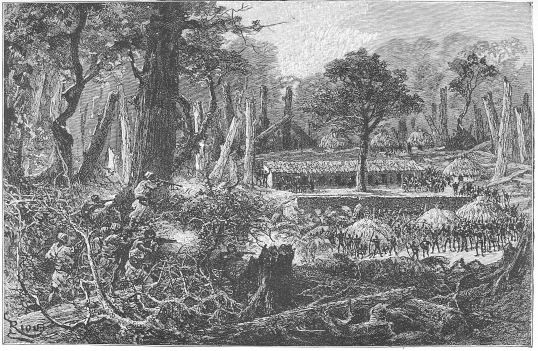
ENTERING ANDIKUMU.
I observed as we filed into camp that it was time to obtain a further supply of food, and rest somewhere, the bearing of the people lacked confidence, their forms were shrinking under the terrible task, and perpetual daily toil and round of marching and hunger. I could have wept at the excess of misfortunes which weighed us daily lower towards the grave; but we had been for so long strained to bear violent vicissitudes, and so frequently afflicted with sights of anguish and suffering, that we were reduced to hear each day’s tale of calamity in sorrowful silence. What losses we had already borne were beyond power of plaint and tear to restore. The morrow’s grief awaited us, as certain as the morrow’s sun; and to dwell upon the sorrowful past was to unfit us for what we had yet to bear.
To make 230 loads equal to the daily lessening number of carriers was a most aggravating task. Not one out of twenty men but made some complaint of a severe ulcer, a headache, or threatened rupture, undefined bodily pains, a whitlow, a thorn in the foot, rheumatism, fever, &c. The loads remained always the same, but the carriers died.
On the 14th, the Expedition, after a six hours’ march, approached Anduta and Andikumu. As the advance guard was pressing in over the logs and débris of the prostrated forest, some arrows flew, and two men fell wounded, and immediately boxes and bales were dropped, and quite a lively skirmish with the tall-hatted natives occurred; but in half-an-hour the main body of the caravan filed in, to find such a store of abnormally large plantains that the ravenous men were in ecstacies.
In extent the clearing was equal to the famous one of Ibwiri. It was situate in the bosom of hills which rose to the east, west and south. Along one of the tracks we saw the blazings of the Manyuema on the trees, and one of the villages was in ruins; but the size of the clearing had baffled the ravaging horde in their attempt to destroy the splendid plantain groves.
On examining the boxes of ammunition before stacking them for the night, it was found that Corporal Dayn Mohammed had not brought his load in, and we ascertained that he had laid it at the base of a big tree near the path. Four headmen were at once ordered to return with the Soudanese Corporal to recover the box.
1888.
Nov. 14.
Andikumu.
Arriving near the spot, they saw quite a tribe of pigmies, men, women and children, gathered around two pigmy warriors, who were trying to test the weight of the box by the grummet at each end. Our headmen, curious to see what they would do with the box, lay hidden closely, for the eyes of the little people are exceedingly sharp. Every member of the tribe seemed to have some device to suggest, and the little boys hopped about on one leg, spanking their hips in irrepressible delight at the find, and the tiny women carrying their tinier babies at their backs vociferated the traditional wise woman’s counsel. Then a doughty man put a light pole, and laid it through the grummets, and all the small people cheered shrilly with joy at the genius displayed by them in inventing a method for heaving along the weighty case of Remington ammunition. The Hercules and the Milo of the tribe put forth their utmost strength, and raised the box up level with their shoulders, and staggered away into the bush. But just then a harmless shot was fired, and the big men rushed forward with loud shouts, and then began a chase; and one over-fat young fellow of about seventeen was captured and brought to our camp as a prize. We saw the little Jack Horner, too fat by many pounds; but the story belongs to the headmen, who delivered it with infinite humour.
Mr. Bonny was sent to the Ihuru River on the 17th, to examine an old ferry reported to be there, but returned unsuccessful in finding a canoe, but with the information that the river appeared to flow from E.N.E., and was about sixty yards wide, with quiet current, and good depth.
The afternoon of the 14th, 15th and 16th of November, were spent by the people in making amends for their past abstinence. What with boiled, roasted plantains and porridge, they must have consumed an immense number. Probably each man had eaten 140 plantains during the three days.
1888.
Nov. 19.
Anduta.
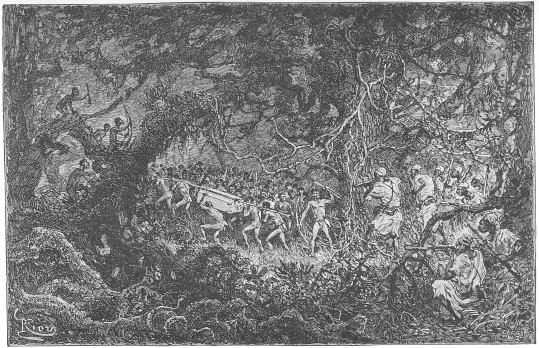
THE SCOUTS DISCOVER THE PYGMIES CARRYING AWAY THE CASE OF AMMUNITION.
Within a short time after leaving Andikumu on the 19th, we passed through Anduta; and then the column passed by a picturesque hill called Kakwa, over a rough country bristling with immense rock fragments and boulders thickly covered, and surrounded with depths of ferns. Among the rocks near our camp on this date was found a store of corn and bananas, which no doubt belonged to the dwarfs. Had the find occurred a few days previously, there would have been a riotous scramble for them; but now each man was so burdened with his private stores that they regarded it with supreme indifference. The men also so suffered from indigestion after their revel at Andikumu that they were unfit for travel.
A five-mile march was made on the 20th. Since striking the dwarfs’ highway, unlike the loamy soils which absorbed the perpetual rains nearer the Ituri, the path now led through a stiff red clayey country, which retained the rain in pools, and made it soapy and slippery.
At the noonday halt the leader of the van wandered a few hundred yards ahead on the path and encountered a native caravan from Anditoké, N. The natives uttered a howl of surprise at perceiving him, but seeing that he had no weapon, quickly advanced towards him with uplifted spears. But the howl they had raised had been heard by all at the halting-place, and the savages were met in time to save the Zanzibari leader. A skirmish took place, two of the natives were wounded and one was killed, and the effects of the caravan were captured. These effects consisted of iron rings, knobs, bracelets, and anklets, and calamus fibre leg-rings, a few native smith’s tools, and, most singular of all, several unfired Remington cartridges.
The first thought that was suggested was that Fort Bodo had either been evacuated or captured, or that some patrols had been waylaid; but on reflection we settled on the conviction that these cartridges had belonged to some raiding parties of Manyuema, but that originally they were our property.
The travelling powers of the men was noticeably low on the 21st; they still suffered from their late debauch. At noon of this day we were in N. lat. 1° 43′, which proved that, despite every effort to find a path leading eastward we were advancing north.
1888.
Nov. 21.
Forest.
Chama Issa, the last of the Somalis, was reported dead on this day, but at the noon halt I was greatly gratified to see him; his case, being as he was the last of the Somalis, excited great interest. A portion from my own table went to him daily, and two Soudanese were detailed for extra pay to serve, feed, and carry him. Up to the evening of this day thirty-two out of the Banalya rear column had perished. At Banalya I had estimated that about half of the number would not survive. While they were being carried in the canoes there was no call for exertion, but the march overland had been most fatal to the unfortunates.
On the 22nd, soon after the advance had reached camp, a cold and heavy shower of rain fell, which demoralized many in the column; their failing energies and their impoverished systems were not proof against cold. Madis and Zanzibaris dropped their loads in the road, and rushed helter-skelter for the camp. One Madi managed to crawl near my tent, wherein a candle was lit, for in a rainstorm the forest, even in daylight, is as dark as on an ordinary night in the grass-land. Hearing him groan, I issued out with the candle, and found the naked body rigid in the mud, unable to move. As he saw the candle flame his eyes dilated widely, and he attempted to grasp it with his hands. He was at once borne to a fire, and laid within a few inches of it, and with the addition of a pint of hot broth made from the Liebig Company’s extract of meat we restored him to his senses. On the road in front of the rear guard two Madis died, and also one Zanzibari of the rear column stricken instantaneously to death by the intensely cold rain.
We made a march of two hours the next day, and then despatched forty-five choice men ahead to try and obtain meal for the salvation of the Banalya men and the Madis, whose powers were too weak for further effort. The scouts returned within twenty-four hours with a goat, which was at once slaughtered to make thirty gallons of soup. When thickened with two pounds of wheaten flour, the soup made a most welcome meal for over sixty men. We reached Indemau by 10 A.M. on the 25th. The village was situated in a hollow at the base of a mount, and was distant from the Dui branch of the Ihuru six miles.
1888.
Nov. 25.
Indemau.
At Indemau the long-enduring members of the Expedition received another respite from total annihilation. The plantain groves were extensive and laden with fruit, and especially with ripe mellow plantains whose fragrance was delicious. But in the same manner that it was impossible to teach these big children to economise their rations, so it was impossible to teach them moderation when they found themselves in the midst of plenty. At Andikumu an army might have been supplied with good wholesome food, but the inordinate voracity of the famished people had been followed by severe indigestion, and at Indemau their intemperate appetites brought on such sickening repletion that we were engaged every morning in listening to their complaints and administering enemata to relieve the congested bodies.
A path from Indemau was discovered, leading across the Dui River; there was another leading to Indeperri, a large settlement about fifteen miles N.E. from Fort Bodo. It had been my original purpose to steer a course through the forest which would take us direct to the grass-land, along a more northerly route than the line of Ipoto and Fort Bodo, after sending a detachment to settle accounts with Kilonga-Longa; but in our endeavour to find a ford or ferry across the Ihuru we had been compelled by the high flood to continue parallel with the river until now. Observation proved us to be in N. lat. 1° 47′ and E. long. 29° 7′ 45″. But the discovery of Remington cartridges among the stores of a native caravan in these unknown parts, and yet within a reasonable distance of Fort Bodo, notwithstanding a rational assurance that Fort Bodo was impregnable and the garrison were now safe with Emin Pasha on the Nyanza, had intruded doubts in my mind which I thought would best be resolved by deflecting our course southward, and sweeping past the old Fort, and seeing with our own eyes what had really occurred. Mr. Bonny was therefore sent with the chief Rashid and sixty men, to build a bridge across the Dui River.
1888.
Dec. 1.
Dui River.
After a halt of five days the Expedition marched from Indemau on the 1st of December for the Dui. Mr. Bonny and old Rashid, with their assistants, were putting the finishing touches to the bridge, a work which reflected great credit on all concerned in its construction, but especially on Mr. Bonny. Without halting an instant the column marched across the five branches of the Dui, over a length of rough but substantial woodwork, which measured in the aggregate eighty yards, without a single accident.
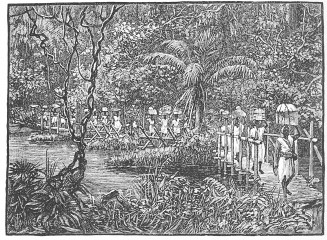
BRIDGING THE DUI RIVER.
On the other side of the Dui we made a rough muster of the people, and discovered that thirty-four of the rear column had died, and that out of sixteen Zanzibaris on the sick list, fourteen were of the Yambuya party, and they all appeared to be in such a condition that a few days only would decide their fate. Every goat and fowl that we could procure were distributed to these poor people in the hope of saving them. We cooked for them; Mr. Bonny was directed to administer medicines daily; we relieved them of every article, excepting their own rations, and yet so wrecked were their systems by what they had endured at Yambuya and Banalya, that a slight abrasion from plants, branches or creepers, developed into a raging ulcer, which in three or four days would be several inches across. Nothing but the comforts and rest obtained in a metropolitan hospital would have arrested this rapid decline.
We made a short march to the small village of Andiuba, and from thence we reached in three hours the large settlement of Addiguhha. On the 4th we reached Ngwetza in four-and-a-half hours, and formed camp outside of the plantain-grove. We had passed through ten villages of the pigmies, but without having seen one of them. The woods were dense, and the undergrowth flourishing. Belts of sloughy mud, disparted by small streams, divided one village from another. It was in just such a locality our camp was pitched on the 4th of December. Presently into the centre of the camp a full uddered goat, with two fine kids four months old, walked, and after a short stare of undisguised surprise at the family, we sprang upon them and secured the undoubted gift of the gods, and sacrificed them. Half-an-hour later we were told that one of the Uchu natives attached to Mr. Bonny had received an arrow in his body, and that the dwarfs had attacked and killed a Manyuema boy. A party was sent to convey the boy’s body into the woods, where it could be buried by his friends, but in the morning the meat had been carried away.
The criers were instructed to proceed through the camp to prepare five days’ provisions of food. Their cries were heard ringing from end to end, and huge loads of material for the wooden grates were brought in, and throughout the 5th the people devoted themselves to the preparation of flour.
1888.
Dec. 5.
Ngwetza.
The next day, as we marched southerly, it was observed that we were following a gradual slope to the river Ihuru. We crossed six broad and sluggish streams, with breadths of mud coloured red by iron; banked by dense nurseries of Raphia Palm and rattan. About 3 P.M. the advance-guard stumbled upon several families of dwarfs, and a capture was made of an old woman, a girl, and a boy of eighteen, besides a stock of bananas, and some fowls. The “old” lady was as strong as a horse apparently, and to the manner of carrying a load of bananas she appeared to be quite accustomed.
The family of little people intimated that they knew the forest well, but they had a strong inclination for an E.N.E. course, which would have taken us away from Fort Bodo. They were therefore sent to the rear, and we swung along S., and by E., sometimes S.S.E., traversed six streams on the 7th, and a similar number on the 8th.
Soon after the headquarters’ tent had been pitched, and the undergrowth of leafy plants had been cleared somewhat, I observed a young fellow stagger; and going up to him I questioned him as to the cause. I was astonished to be told that it was from weakness, and want of food. Have you eaten all your five days’ rations already? No, he had thrown it away because the dwarf captives had said that in one day they would reach a famous place for plantains, the “biggest in the world.”
Upon extending my inquiries it was found that there were at least 150 people in the camp who had likewise followed his example, and discarded superfluous food, and on that day, the 8th, they had nothing. The headmen were called that night to a council, and after being reproached for their reckless conduct, it was resolved that on the next day almost every able-bodied person should return to Ngwetza which we had left on the morning of the 6th. The distance was 19½ hours for the caravan, but as much time was necessarily lost in cutting through the jungly undergrowth, and even now and then in laying a course, the forage party would be able to return to Ngwetza in eleven hours’ travel.
1888.
Dec. 5.
Ngwetza.
On the morning of the 9th, about 200 people started for the plantain groves of Ngwetza, but before departing they contributed about 200 lbs. of plantain flour as a reserve for the sickly ones, and guards of the camp. We were about 130 in number, men, women and pigmies, the majority of whom were already distressed. I gave half-a-cupful of flour to each person for the day, then despatched Mr. Bonny with ten men to find the Ihuru River. According to my calculations, the camp was in N. lat. 1° 27′ 15″, and E. long. 29° 21′ 30″, about nine geographical miles in an air-line north of Fort Bodo, but it was useless to show the chart to men dreading that starvation was again imminent. All they saw was the eternal myriads of trees with a dead black unknown environing the camp round about, shutting out all hope, and a viewless and stern prospect of rigid wood with a dark cope of leaves burying them out of sight of sky and sunshine, as though they lived under a pall. But they knew that the Ihuru was not far from Fort Bodo, and if Mr. Bonny and his men discovered it, some little encouragement would be gained. Mr. Bonny succeeded in finding the river, and blazed a path to it.
For employment’s sake I sat down to recalculate all my observations with exactitude, to correct certain discrepancies that our journeys over the same ground had enabled me to detect; and buried in my Norie, and figures and charts, my mind was fully occupied. But on the 14th my work was done. I lived in hope the next day, with my hearing on the strain for the sound of voices. The people looked miserable, but hopeful. A box of European provisions was opened, a pot of butter and milk were taken out, and a table-spoonful of each dropped into the earthenware pots that were already filled with boiling water. In this manner a thin broth was made which would serve to protract the agony of existence. On the sixth day the pots were again ranged round me in a semi-circle, and in rotation, each cook brought his vessel of hot water to receive his butter and milk, and after being well stirred, marched off with his group to distribute the broth according to measure. A little heartened by the warm liquid they scattered through the woods to hunt up the red berries of the phrynia, and pick up now and then the amomum, whose sour-sweet pulp appeared to quiet the gnawing of the stomach. A mushroom in the course of several hundred yards’ rambling would perhaps fall to the lot of the seeker. But when 130 men have wandered about and about, to and fro, searching for the edibles, the circle widens, and day by day the people had to penetrate further and further away from the camp. And it happened that while searching with eagerness, impelled on and on by the eager stomach, that they were carried some miles away, and they had paid no regard to the course they were going; and when they wished to return to camp they knew not which way to seek it, and two full-grown men and Saburi, a little boy of eight years, did not return. I had a peculiar liking for the small child. His duty was to carry my Winchester, and cartridge pouch. He was usually a dark cherub, round as a roller, strong and sturdy, with an old man’s wisdom within his little boy’s head, and frequently when the caravan was on its mettle, and a fair road before it, I looked back often and often to see how little Saburi trotted steadily after me. Being the rifle-bearer, trained to be at my heels at any strange sound, I deprived myself of many a choice bit to nourish Saburi with, so that his round stomach had drawn a smile from all who looked at him. He looked like a little boy with a keg under his frock. But, alas! in the last few days the keg had collapsed, and he, like all the others, had penetrated into the wilderness of phrynia to search for berries. On this day he was lost.
In the dark the muzzle-loaders of the Manyuema were employed to fire signals. About 9 P.M. we thought we heard the little boy’s voice. The halloo was sounded, and a reply came from the other end of the camp. One of the great ivory horns boomed out its deep sound. Then the cry came from the opposite side. Some of the men said that it must be Saburi’s ghost wailing his death. The picture of the little fellow seeing the dark night come down upon him with its thick darkness in those eerie wilds, with fierce dwarfs prowling about, and wild boar and huge chimpanzee, leopards and cheetahs, with troops of elephants trampling and crashing the crisp phrynia, and great baboons beating hollow trees—everything terrifying, in fact, round about him—depressed us exceedingly. We gave him up for lost.
It had been an awful day. In the afternoon a boy had died. Three persons were lost. The condition of the majority was most disheartening. Some could not stand, but fell down in the effort. These sights began to act on my nerves, until I began to feel not only moral sympathy, but physical as well, as though bodily weakness was infectious.
On my bed that night the thought of the absent men troubled me; but however distasteful was the idea that a terrible misfortune—such as being lost in the woods, or collapsing from hunger before they reached the groves—it became impossible not to regard the darkest view and expect the worst, in order, if possible, to save a remnant of the Expedition that the news might be carried to the Pasha and thence to civilisation some day. I pictured the entire column perished here in this camp, and the Pasha wondering month after month what had become of us, and we corrupting and decaying in this unknown corner in the great forest, and every blaze on the trees healed up, and every trail obliterated within a year, and our burial-place remaining unknown until the end of time. Indeed, it appeared to me as if we were drifting steadily towards just such a fate. Here were about 200 men without food going thirty-five miles to seek it. Not 150 would perhaps reach it; the others would throw themselves, like the Madis, to the ground, to wait, to beg from others, if perchance they returned. If an accident to the 50 bravest men happen, what then? Some are shot down by dwarfs; the larger aborigines attack the others in a body. The men have no leader; they scatter about, they become bewildered, lose their way, or are speared one after another. While we are waiting, ever waiting for people who cannot return, those with me die first by threes, sixes, tens, twenties, and then, like a candle extinguished, we are gone. Nay, something had to be done.
On the sixth day we made the broth as usual, a pot of butter and a pot of milk for 130 people, and the headmen and Mr. Bonny were called to council. On proposing a reverse to the foragers of such a nature as to cause an utter loss of all, they appeared unable to comprehend such a possibility, though folly after folly, madness after madness, had marked every day of my acquaintance with them. The departure of men secretly on raids, and never returning, the leaping of fifty men into the river after a bush antelope, the throwing away of their rations after fifteen months’ experiences of the forest, the reckless rush into guarded plantations, skewering their feet, the inattention they paid to abrasions leaving them to develope into rabid ulcers; the sale of their rifles to men who would have enslaved them all, follies practised by blockheads day after day, week after week; and then to say they could not comprehend the possibility of a fearful disaster. Were not 300 men with three officers lost in the wood for six days? Were not three persons lost close to this camp yesterday and they have not returned? Did I not tell these men that we should all die if they were not back on the fourth day? Was not this the sixth day of their absence? Were there not fifty people close to death now? and much else of the same kind?
By-and-by, the conviction stole on their minds that if by accident we were to remain in camp inactive for three days, we should then be too weak to seek food; and they agreed with me that it would be a wise thing to bury the goods, and set out on our return to Ngwetza to procure food for ourselves. But there was one difficulty. If we buried the goods, and fifty sick men preferred to remain in the camp to following us, should we return to the caché, we should find that the sick had exhumed the goods, and wrecked everything out of pure mischief.
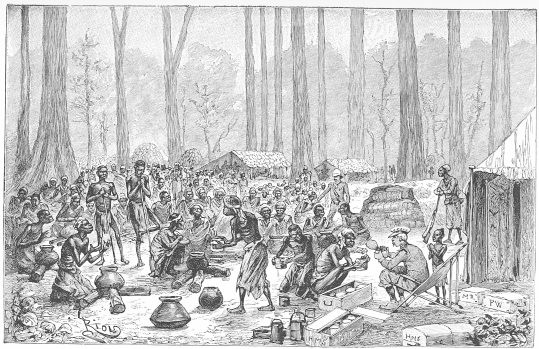
STARVATION CAMP: SERVING OUT MILK AND BUTTER FOR BROTH.
Mr. Bonny then came to the rescue, and offered to stay with ten men in camp, if I provided food for him and the garrison for ten days, the time we decided we should be absent. Food to make a light gruel for so small a number for ten days was not difficult to find. Half a cupful of cornflour per man for thirteen men for ten days was measured, with the addition of four milk biscuits per man each day. A few tins of butter and condensed milk were also set apart to assist the gruel. For those unwilling or unable to follow us to the plantains we could do nothing. What might sustain a small garrison of thirteen men for many days would not save the lives of fifty when they were already so far gone, that only an abundance of digestive plantain flour could possibly save them.
On this morning little Saburi walked into camp quite unconcerned, and fresh as from a happy outing. “Why Saburi! where have you been?” “I lost my way while picking berries, and I wandered about, and near night I came to a track. I saw the marks of the axes, and I said—Lo! this is our road, and I followed it thinking I was coming to camp. But, instead of that, I saw only a big river. It was the Ihuru! Then I found a big hollow tree, and I went into it and slept; and then I came back along the road, and so and so, until I walked in here. That is all.”
We mustered every soul alive in the camp on the morning of the 15th. Sadi, the Manyuema headman, reported fourteen of his people unable to travel; Kibbobora reported his sick brother as being the only person of his party too sick to move; Fundi had a wife and a little boy too weak for the journey. The Expedition was obliged to leave 26. 43 persons verging on dissolution unless food could be procured within twenty-four hours. Assuming a cheery tone, though my heart was well-nigh breaking, I told them to be of good courage, that I was going to hunt up the absentees, who no doubt were gorging themselves; most likely I should find them on the road, in which case they would have to run all the way. “Meantime, pray for my success. God is the only one who can help you!”
1888.
Dec. 9.
Starvation Camp.
We set out 1 P.M. on our return journey towards Ngwetza, thirty-five miles distant, with sixty-five men and boys and twelve women. We travelled until night, and then threw ourselves on the ground, scattered about in groups, or singly, each under his own clump of bush, silent and sad, and communing with his own thoughts. Vain was it for me to seek for that sleep which is the “balm of hurt minds.” Too many memories crowded about me; too many dying forms haunted me in the darkness; my lively fancies were too distorted by dread, which painted them with dismal colours; the stark forms lying in links along the path, which we had seen that afternoon in our tramp, were things too solemn for sudden oblivion. The stars could not be seen to seek comfort in their twinkling; the poor hearts around me were too heavy to utter naught but groans of despair; the fires were not lit, for there was no food to cook—my grief was great. Out of the pall-black darkness came out the eerie shapes that haunt the fever-land, that jibe and mock the lonely man, and weave figures of flame, and draw fiery forms in the mantle of the night; and whispers breathed through the heavy air of graves and worms, and forgetfulness; and a demon hinted in the dazed brain that ‘twere better to rest than to think with a sickening heart; and the sough of the wind through the crowns of the thick-black bush seemed to sigh and moan “Lost! lost! lost! Thy labour and grief are in vain. Comfortless days upon days; brave lives are sobbing their last; man after man roll down to the death, to mildew and rot, and thou wilt be left alone!”
“Allah ho Akbar,” was the cry that rang through the gloom, from a man with a breaking heart. The words went pealing along through the dark, and they roused the echoes of “God is great” within me. Why should a Moslem recall a Christian to thoughts of his God? “Ye fools, when will ye be wise? He that planted the ear, shall He not hear? He that formed the eye, shall He not see?” And, lo! worthier thoughts possess the mind, the straining of the eyes through the darkness is relaxed, and the sight is inverted to see dumb witnesses of past mercies on this or that forgotten occasion; one memory begets another, until the stubborn heart is melted, and our needs are laid as upon a tablet before the Great Deliverer.
Towards morning I dozed, to spring up a few hours later as the darkness was fading, and a ghostly light showed the still groups of my companions.
“Up, boys, up! to the plantains! up! Please God we shall have plantains to-day!” This was uttered to cheer the sad hearts. Within a few minutes we had filed away from our earthy couches, and were on the track in the cheerless light of the morning, some hobbling from sores, some limping from ulcers, some staggering from weakness. We had commenced to feel warmed up with the motion of the march, when, hark! I heard a murmur of voices ahead. Little Saburi held the rifle ready, observant of the least sign of the hand, when I saw a great pile of green fruit rising above the broad leaves of the phrynia that obstructed a clear view, and intuitively one divined that this must be the column of foragers advancing to meet us, and in a second of time, the weak, the lame, and the cripple, the limping and moaning people forgot their griefs and their woes, and shouted the grateful chant which goes up of its own accord towards the skies out of the full and sensitive hearts, “Thanks be to God.” Englishman and African, Christian and Pagan, all alike confess Him. He is not here, or there, but everywhere, and the heart of the grateful man confesseth Him.
It needed only one view of the foremost men to have told what the heedless, thoughtless herd had been doing. It was no time for reproaches, however, but to light fires, sit down and roast the green fruit, and get strength for the return, and in an hour we were swinging away back again to Starvation Camp, where we arrived at 2.30 P.M., to be welcomed as only dying men can welcome those who lend the right hand to help them. And all that afternoon young and old, Zanzibari and Manyuema, Soudanese and Madi, forgot their sorrows of the past in the pleasures of the present, and each vowed to be more provident in the future—until the next time.
1888.
Dec. 17.
Ihuru River.
On the 17th we reached the Ihuru, and the next day forded the river, and from thence we cut our way through the forest, through bush and plants which were the undergrowth, and early in the afternoon of the 19th we emerged out of the trackless bush, and presently were on the outskirts of the plantations of Fort Bodo, at which all the people admired greatly.
On the 20th we cut a track through the deserted plantations, and after an hour’s hard work reached our well-known road, which had been so often patrolled by us. We soon discovered traces of recent travel, and late foraging in piles of plantain skins near the track; but we could not discover by whom these were made. Probably the natives had retired to their settlements; perhaps the dwarfs were now banqueting on the fat of the land. We approached the end of our broad western military road, and at the turning met some Zanzibari patrols who were as much astonished as we were ourselves at the sudden encounter. Volley after volley soon rang through the silence of the clearing. The fort soon responded, and a stream of frantic men, wild with joy, advanced by leaps and bounds to meet us; and among the first was my dear friend the Doctor, who announced, with eyes dancing with pleasure, “All is well at Fort Bodo.”
CHAPTER XXIII.
THE GREAT CENTRAL AFRICAN FOREST.
Professor Drummond’s statements respecting Africa—Dimensions of the great forest—Vegetation—Insect life—Description of the trees, &c.—Tribes and their food—The primæval forest—The bush proper—The clearings: wonders of vegetable life—The queer feeling of loneliness—A forest tempest—Tropical vegetation along the banks of the Aruwimi—Wasps’ nests—The forest typical of human life—A few secrets of the woods—Game in the forest—Reasons why we did not hunt the animals—Birds—The Simian tribe—Reptiles and insects—The small bees and the beetles—The “jigger”—Night disturbances by falling trees, &c.—The Chimpanzee—The rainiest zone of the earth—The Ituri or Upper Aruwimi—The different tribes and their languages—Their features and customs—Their complexion—Conversation with some captives at Engweddé—The Wambutti dwarfs: their dwellings and mode of living—The Batwa dwarfs—Life in the forest villages—Two Egyptians captured by the dwarfs at Fort Bodo—The poisons used for the arrows—Our treatment for wounds by the arrows—The wild fruits of the forest—Domestic animals—Ailments of the Madis and Zanzibaris—The Congo Railway and the forest products.
1888.
Dec.
Forest.
An English Professor, qualified to write F.R.S.E., F.G.S., after his name, who is a talented writer, and gifted with first-class descriptive powers, while confessing that he was but a “minor traveller, possessing but few assets,” ventured upon the following bold statements respecting Africa:—
“Cover the coast belt with rank yellow grass, dot here and there a palm, scatter through it a few demoralised villages, and stock it with the leopard, the hyena, the crocodile, and the hippopotamus; clothe the mountainous plateaux next, both of them with endless forest, not grand umbrageous forest, like the forests of South America, nor matted jungle like the forests of India, but with thin, rather weak forest, with forest of low trees, whose half-grown trunks and scanty leaves offer no shade from the tropical sun,”—but you will find nothing in all these trees to remind you that you are in the tropics. “Day after day you may wander through these forests with nothing except the climate to remind you where you are * * * * *.” “The fairy labyrinth of ferns and palms, the festoons of climbing plants blocking the paths and scenting the forests with their resplendent flowers, the gorgeous clouds of insects, the gaily plumaged birds, the parraquets, the monkey swinging from his trapeze in the shaded bowers—these are unknown to Africa.”
“Once a week you will see a palm; once in three months the monkeys will cross your path; the flowers on the whole are few, the trees are poor, and, to be honest”—but enough; if this is honest description, the reader had better toss my books aside, for this chapter goes to prove that I differ in toto with the learned Professor’s views respecting tropical Africa.
We have travelled together thus far 1670 miles through the great central African forest, and we can vouch that the above description by Professor Drummond bears no more resemblance to tropical Africa than the tors of Devon, or the moors of Yorkshire, or the downs of Dover represent the smiling scenes of England, of leafy Warwickshire, the gardens of Kent, and the glorious vales of the isle. Nyassaland is not Africa, but itself. Neither can we call the wilderness of Masai Land, or the scrub-covered deserts of Kalahari, or the rolling grass land of Usukuma, or the thin forests of Unyamwezi, or, the ochreous acacia-covered area of Ugogo, anything but sections of a continent that boasts many zones. Africa is about three times greater than Europe in its extent, and is infinitely more varied. You have the desert of deserts in the Sahara, you have the steppes of Eastern Russia in Masai Land and parts of South Africa, you have the Castilian uplands in Unyamwezi, you have the best parts of France represented by Egypt, you have Switzerland in Ukonju and Toro, the Alps in Ruwenzori—you have Brazil in the Congo basin, the Amazon in the Congo River, and its immense forests rivalled by the Central African forest which I am about to describe.
The greatest length of this forest, that is from near Kabambarré in South Manyuema to Bagbomo on the Welle-Makua in West Niam-niam, is 621 miles; its average breadth is 517 miles, which makes a compact square area of 321,057 square miles. This is exclusive of the forest areas separated or penetrated into by campo-like reaches of grass land, or of the broad belts of timber which fill the lower levels of each great river basin like the Lumani, Lulungu, Welle-Mubangi, and the parent river from Bolobo to the Loika River.
The Congo and the Aruwimi rivers enabled us to penetrate this vast area of primeval woods a considerable length. I only mean to treat, therefore, of that portion which extends from Yambuya in 25° 3½′ E. L. to Indesura, 29° 59′ = 326½ English miles in a straight line.
Now let us look at this great forest, not for a scientific analysis of its woods and productions, but to get a real idea of what it is like. It covers such a vast area, it is so varied and yet so uniform in its features, that it would require many books to treat of it properly. Nay, if we regard it too closely, a legion of specialists would be needed. We have no time to examine the buds and the flowers or the fruit, and the many marvels of vegetation, or to regard the fine differences between bark and leaf in the various towering trees around us, or to compare the different exudations in the viscous or vitrified gums, or which drip in milky tears or amber globules, or opaline pastils, or to observe the industrious ants which ascend and descend up and down the tree shafts, whose deep wrinkles of bark are as valleys and ridges to the insect armies, or to wait for the furious struggle which will surely ensue between them and yonder army of red ants. Nor at this time do we care to probe into that mighty mass of dead tree, brown and porous as a sponge, for already it is a mere semblance of a prostrate log. Within it is alive with minute tribes. It would charm an entomologist. Put your ear to it, and you hear a distinct murmurous hum. It is the stir and movement of insect life in many forms, matchless in size, glorious in colour, radiant in livery, rejoicing in their occupations, exultant in their fierce but brief life, most insatiate of their kind, ravaging, foraging, fighting, destroying, building, and swarming everywhere and exploring everything. Lean but your hand on a tree, measure but your length on the ground, seat yourself on a fallen branch, and you will then understand what venom, fury, voracity, and activity breathes around you. Open your notebook, the page attracts a dozen butterflies, a honey-bee hovers over your hand; other forms of bees dash for your eyes; a wasp buzzes in your ear, a huge hornet menaces your face, an army of pismires come marching to your feet. Some are already crawling up, and will presently be digging their scissor-like mandibles in your neck. Woe! woe!
And yet it is all beautiful—but there must be no sitting or lying down on this seething earth. It is not like your pine groves and your dainty woods in England. It is a tropic world, and to enjoy it you must keep slowly moving.
Imagine the whole of France and the Iberian peninsula closely packed with trees varying from 20 to 180 feet high, whose crowns of foliage interlace and prevent any view of sky and sun, and each tree from a few inches to four feet in diameter. Then from tree to tree run cables from two inches to fifteen inches in diameter, up and down in loops and festoons and W’s and badly-formed M’s; fold them round the trees in great tight coils, until they have run up the entire height, like endless anacondas; let them flower and leaf luxuriantly, and mix up above with the foliage of the trees to hide the sun, then from the highest branches let fall the ends of the cables reaching near to the ground by hundreds with frayed extremities, for these represent the air roots of the Epiphytes; let slender cords hang down also in tassels with open thread-work at the ends. Work others through and through these as confusedly as possible, and pendent from branch to branch—with absolute disregard of material, and at every fork and on every horizontal branch plant cabbage-like lichens of the largest kind, and broad spear-leaved plants—these would represent the elephant-eared plant—and orchids and clusters of vegetable marvels, and a drapery of delicate ferns which abound. Now cover tree, branch, twig, and creeper with a thick moss like a green fur. Where the forest is compact as described above, we may not do more than cover the ground closely with a thick crop of phrynia, and amoma, and dwarf bush; but if the lightning, as frequently happens, has severed the crown of a proud tree, and let in the sunlight, or split a giant down to its roots, or scorched it dead, or a tornado has been uprooting a few trees, then the race for air and light has caused a multitude of baby trees to rush upward—crowded, crushing, and treading upon and strangling one another, until the whole is one impervious bush.
But the average forest is a mixture of these scenes. There will probably be groups of fifty trees standing like columns of a cathedral, grey and solemn in the twilight, and in the midst there will be a naked and gaunt patriarch, bleached white, and around it will have grown a young community, each young tree clambering upward to become heir to the area of light and sunshine once occupied by the sire. The law of primogeniture reigns here also.
There is also death from wounds, sickness, decay, hereditary disease and old age, and various accidents thinning the forest, removing the unfit, the weakly, the unadaptable, as among humanity. Let us suppose a tall chief among the giants, like an insolent son of Anak. By a head he lifts himself above his fellows—the monarch of all he surveys; but his pride attracts the lightning, and he becomes shivered to the roots, he topples, declines, and wounds half a dozen other trees in his fall. This is why we see so many tumorous excrescences, great goitrous swellings, and deformed trunks. The parasites again have frequently been outlived by the trees they had half strangled, and the deep marks of their forceful pressure may be traced up to the forks. Some have sickened by intense rivalry of other kinds, and have perished at an immature age; some have grown with a deep crook in their stems, by a prostrate log which had fallen and pressed them obliquely. Some have been injured by branches, fallen during a storm, and dwarfed untimely. Some have been gnawed by rodents, or have been sprained by elephants leaning on them to rub their prurient hides, and ants of all kinds have done infinite mischief. Some have been pecked at by birds, until we see ulcerous sores exuding great globules of gum, and frequently tall and short nomads have tried their axes, spears, and knives, on the trees, and hence we see that decay and death are busy here as with us.
To complete the mental picture of this ruthless forest, the ground should be strewn thickly with half formed humus of rotting twigs, leaves, branches; every few yards there should be a prostrate giant, a reeking compost of rotten fibres, and departed generations of insects, and colonies of ants, half veiled with masses of vines and shrouded by the leafage of a multitude of baby saplings, lengthy briars and calamus in many fathom lengths, and every mile or so there should be muddy streams, stagnant creeks, and shallow pools, green with duckweed, leaves of lotus and lilies, and a greasy green scum composed of millions of finite growths. Then people this vast region of woods with numberless fragments of tribes, who are at war with each other and who live apart from ten to fifty miles in the midst of a prostrate forest, amongst whose ruins they have planted the plantain, banana, manioc, beans, tobacco, colocassia, gourds, melons, &c., and who, in order to make their villages inaccessible, have resorted to every means of defence suggested to wild men by the nature of their lives. They have planted skewers along their paths, and cunningly hidden them under an apparently stray leaf, or on the lee side of a log, by striding over which the naked foot is pierced, and the intruder is either killed from the poison smeared on the tops of the skewers, or lamed for months. They have piled up branches, and have formed abattis of great trees, and they lie in wait behind with sheaves of poisoned arrows, wooden spears hardened in fire, and smeared with poison.
The primeval forest, that is that old growth untouched by man, and left since the earliest time to thrive and die, one age after another, is easily distinguishable from that part which at some time or another afforded shelter for man. The trees are taller and straighter, and of more colossal girth. It has frequently glades presenting little difficulty for travel, the invariable obstructions being the arum, phrynia, and amoma. The ground is firmer and more compact, and the favourite camping ground for the pigmy nomads are located in such places. When the plants and small bushes are cut down, we have an airy, sylvan, and cool temple, delightful for a dwelling.
Then comes the forest which during a few generations has obliterated all evidences of former husbandry. A few of the trees, especially of the soft-wooded kind, have grown to equal height with the ancient patriarchs, but as soon as man abandoned the clearing, hosts of nameless trees, shrubs, and plants have riotously hastened to avail themselves of his absence, and the race for air and light is continued for many years; consequently the undergrowth by the larger quantity of sunshine becomes luxuriant, and there are few places penetrable in it without infinite labour. Among these a variety of palms will be found, especially the Elais and Raphia vinifera.
And after this comes the bush proper, the growth of a few years, which admits no ingress whatever within its shade. We are therefore obliged to tunnel through stifling masses of young vegetation, so matted and tangled together that one fancies it would be easier to travel over the top were it of equal and consistent thickness and level. Vigorous young trees are found imbedded in these solid and compact masses of vegetation, and these support the climbing plants, the vines, and creepers. Under these, after a pathway has been scooped out, the unshod feet are in danger from the thorns, and the sharp cut stalks, which are apt to pierce the feet and lacerate the legs.
This last was the character of the bush mostly near the river. Both banks presented numberless old clearings and abandoned sites; and as the stream was the only means of communication employed by the tribes, the only way of effecting any progress was by laborious cutting.
The clearings which had been abandoned within a year exhibited veritable wonders of vegetable life, of unsurpassed fecundity, and bewildering variety of species. The charred poles of the huts became the supports of climbers whose vivid green leaves soon shrouded the ugliness of desolation, and every upright and stump assumed the appearance of a miniature bower, or a massive piece of columned ruin. As the stumps were frequently twenty feet high, and were often seen in twins, the plants had gravitated across the space between, and after embracing had continued their growth along the length of one another, and had formed in this manner an umbrageous arch, and had twisted themselves in endless lengths around the supports until it became difficult to find what supported such masses of delicate vines. In some instances they had formed lofty twin towers with an arched gateway between, resembling a great ruin of an old castle, and the whole was gay with purple and white flowers. The silvered boles of ancient primeval giants long ago ringed by the axe and doomed to canker and decay, and the great gaunt far-spreading arms and branchlets had been clothed by vines a hundred-fold until they seemed like clouds of vivid green, which, under the influence of sudden gusts, streamed with countless tendrils, or swayed like immense curtains.
When marching along with the column, or encamped for the night, the murmur of voices was not congenial to nourishing any fine sentiments about the forest. We suffered too much hunger, and sustained such protracted misery; we were preyed upon too often in patience, and temper, and forbearance. Our clothes, suited well enough for open country, were no protection against the hostilities of the bush. But if once we absented ourselves from camp, and the voices of the men died away, and we forgot our miseries, and were not absorbed by the sense of the many inconveniences, an awe of the forest rushed upon the soul and filled the mind. The voice sounded with rolling echoes, as in a cathedral. One became conscious of its eerie strangeness, the absence of sunshine, its subdued light, and marvelled at the queer feeling of loneliness, while inquiringly looking around to be assured that this loneliness was no delusion. It was as if one stood amid the inhabitants of another world. We enjoyed life—the one vegetable, the other human. Standing there so massive and colossal, so silent and still, and yet with such solemn severity of majesty, it did seem curious that the two lives, so like in some sense, were yet so incommunicable. It would have suited the fitness of things, I thought, had a wrinkled old patriarch addressed me with the gravity and seriousness of a Methuselah, or an Achillean and powerful bombax, with his buttressed feet planted firm in the ground, had disdainfully demanded my business in that assembly of stately forest kings.
But what thoughts were kindled as we peeped out from an opening in the woods and looked across the darkening river which reflected the advancing tempest, and caught a view of the mighty army of trees—their heights as various as their kind, all rigid in the gloaming, awaiting in stern array the war with the storm. The coming wind has concentrated its terrors for destruction, the forked lightning is seen darting its spears of white flame across the front of infinite hosts of clouds. Out of their depths issues the thunderbolt, and the march of the winds is heard coming to the onset. Suddenly the trees, which have stood still—as in a painted canvas—awaiting the shock with secure tranquillity, are seen to bow their tops in unison, followed by universal swaying and straining as though a wild panic had seized them. They reel this way and that, but they are restrained from flight by sturdy stems and fixed roots, and the strong buttresses which maintain them upright. Pressed backward to a perilous length they recover from the first blow, and dart their heads in furious waves forward, and the glory of the war between the forest and the storm is at its height. Legion after legion of clouds ride over the wind-tost crests, there is a crashing and roaring, a loud soughing and moaning, shrill screaming of squalls, and groaning of countless woods. There are mighty sweeps from the great tree-kings, as though mighty strokes were being dealt; there is a world-wide rustling of foliage, as though in gleeful approval of the vast strength of their sires; there are flashes of pale green light, as the lesser battalions are roused up to the fight by the example of their brave ancients. Our own spirits are aroused by the grand conflict—the Berserker rage is contagious. In our souls we applaud the rush and levelling force of the wind, and for a second are ready to hail the victor; but the magnificent array of the forest champions, with streaming locks, the firmness with which the vast army of trees rise in unison with their leaders, the rapturous quiver of the bush below inspire a belief that they will win if they but persevere. The lightning darts here and there with splendour of light and scathing flame, the thunders explode with deafening crashes, reverberating with terrible sounds among the army of woods, the black clouds roll over and darken the prospect; and as cloud becomes involved within cloud, in the shifting pale light, we have a last view of the wild war, we are stunned by the fury of the tempest, and the royal rage of the forest, when down comes the deluge of tropic rain—which in a short time extinguishes the white heat wrath of the elements, and soothes to stillness the noble anger of the woods.
Along the banks of the Aruwimi, a better idea of tropical vegetation may be obtained than in any part of Africa, outside of the eastern half of the Congo basin. The banks are for the most part low, though no one could guess what height they were, because of the lofty hedges of creeping plants, which cover every inch of ground from the water’s edge to as high as fifty feet above in some places, while immediately behind them rises the black-green forest to the towering height of from 150 to 200 feet above the river. The aspects of the banks vary considerably however. Abandoned sites of human dwellings possess their own peculiar wilderness appearance, the virgin forest its own, and as the soil varies so do its growths.
Lately abandoned clearings will show, besides inordinate density of vegetation, gorgeous flowering sections. Above these will probably rise a few trees with masses of thick, shining leaves, and a profusion of blood-red flowers, whose petals have been showered on the impervious mass of leguminous vines of creepers and shrubs below, and strongly contrast to their own light purple, yellow, or white flowerets. The amoma show snowy flower-goblets, edged with pink; a wild vine will have its light purple; a creeper, with pinnate leaves, though flowerless at the time, will have its foliage tinted auburn; a pepper bush with its red pods, or a wild mango, attracts attention by myriads of bead-like flowerets; or an acacia effuses overpowering fragrance from its snowy buds, or a mimosa with its sweet-smelling yellow blossoms. Different shades of green are presented by ferns, protruding leaves of sword grass, a young Elais palm, or the broad and useful leaf of the phrynium. A young fig-tree, with silver stem, and branching widely, mixes its leaves with those of the tender leaflets of the sensitive plant and the palmate calamus; below is a multitude of nettles, and nettle-leafed plants with stalks and leaves, making a mass of vegetation at once curious and delightful. Perhaps the base of all this intricate and inextricable confusion of plants and impervious hill of verdure and beauty, is a prostrate tree, long ago fallen, fast decaying, black with mould, spread thinly with humus, fungous parasites abounding, and every crack, cranny, and flaw in it nesting all kinds of insatiable insects, from the tiny termite to the black centipede or mammoth beetle.
Further on we see something different. Numberless giant trees, pressing right up to the edge of the river bank, have caused some to grow horizontally to the length of fifty feet over the river. Under their shade a hundred canoes find shelter from a scorching sun. The wood is yellow and hard as iron. To cut one of these trees would require a score of American axes. It bears clusters of fruit which when unripe are russet, and afterwards resemble beautiful damsons. Others of the same species produce a fruit like ripe dates, but neither are edible.
These widely-spreading trees are favourites with the black wasps, to which they attach their pensile nests. Externally the nests are like fancifully cut brown-paper sacks, or a series of such sacks arranged one above another, with frills and ornate cuttings, like the fancy paper grate-covers in English parlours in summer time.
We avoided such trees religiously, and when there was no such terror as a big nest of wasps near, we could rest in comfort and examine the forest at leisure. We first saw besides countless grey columns, thousands of pendent slender threads and wavy lines, loops, festoons, clustered groups and broad breadths of grey mingled with more than studied disorder with darkest depths of green, lightened only by broad damp leaves reflecting stray glints of sunshine or sprays, and a magic dust of softened light perpetually shifting and playing, profound spaces of darkness relieved by a breadth of grey tree trunk, silvered rods of parasites, or fancy grey filigree of vine stems. As we surveyed the whole, the eye caught various crimson dots of phrynia berries, or red knots of amoma fruit, outer fringes of auburn leaves, a cap of a mushroom staring white out of a loose sheaf of delicate ferns, or snowy bits of hard fungi clinging like barnacles to a deeply-wrinkled log; the bright green of orchid leaves, the grey green face of a pendent leaf of an elephant-eared plant—films of moss, tumorous lumps on trees exuding tears of gum, which swarmed with ants, length after length of whiplike calamus—squirming and twisting lianes, and great serpent-like convolvuli, winding in and out by mazy galleries of dark shadows, and emerging triumphant far above to lean their weight on branches, running coils at one place, forming loops at another place, and then stretching loosely their interminable lengths out of sight.
As I have already said, the forest is typical of the life of humanity. No single glance can be taken of it without becoming conscious that decay, and death, and life, are at work there as with us. I never could cast a leisurely look at it but I found myself, unconsciously, wondering at some feature which reminded me of some scene in the civilised world. It has suggested a morning when I went to see the human tide flowing into the city over London Bridge between half-past seven and half-past eight, where I saw the pale, overworked, dwarfed, stoop-shouldered, on their way to their dismal struggle for existence. They were represented here faithfully, in all their youth, vigour, and decrepitude; one is prematurely aged and blanched, another is goitrous, another is organically weak, another is a hunchback, another suffers from poor nutrition, many are pallid from want of air and sunshine, many are supported by their neighbours because of constitutional infirmity, many of them are toppling one over another, as though they were the incurables of a hospital, and you wonder how they exist at all. Some are already dead, and lie buried under heaps of leaves, or are nurseries of bush families and parasites, or are colonised by hordes of destructive insects; some are bleached white by the palsying thunderbolt, or shivered by the levin brand, or quite decapitated; or some old veteran, centuries old, which was born before ever a Christian sailed south of the Equator, is decaying in core and vitals; but the majority have the assurance of insolent youth, with all its grace and elegance of form, the mighty strength of prime life, and the tranquil and silent pride of hoary old aristocrats; and you gather from a view of the whole one indisputable fact—that they are resolved to struggle for existence as long as they may. We see all characters of humanity here, except the martyr and suicide. For sacrifice is not within tree nature, and it may be that they only heard two precepts, “Obedience is better than sacrifice,” and “Live and multiply.”
And as there is nothing so ugly and distasteful to me as the mob of a Derby day, so there is nothing so ugly in forest nature as when I am reminded of it by the visible selfish rush towards the sky in a clearing, after it has been abandoned a few years. Hark! the bell strikes, the race is about to begin. I seem to hear the uproar of the rush, the fierce, heartless jostling and trampling, the cry, “Self for self, the devil take the weakest!” To see the white-hot excitement, the noisy fume and flutter, the curious inequalities of vigour, and the shameless disregard for order and decency!
It is worth pausing also to ask why small incidents in such an out of the way place as the trackless depths of a primeval forest should remind one of thoughts of friends and their homes in England. The melancholy sound of the wind fluttering the leafy world aloft, and the sad rustle of the foliage reminded me vividly of a night spent at —— House, where I passed half the time listening to the dreadful sighing of the rooky grove, which filled my mind with forlornness and discomfort. Here again, as I lay in my tent, were suggested memories of ocean gales, and general cold, pitiful wretchedness, and when the rain fell in an earnest shower and the heavy fall of raindrops roused the deep and funereal dirge that sounded round about me, it seemed to me I heard sad and doleful echoes of sad and unsatisfied longings, and crowds of unworded thoughts, and past aspirations, unbreathed sentiments of love, friendship, and unuttered sympathies advancing with awful distinctness to the sharpened imagination, until one seemed ready to dissolve in tears and gasp sobbingly, “Oh, my friends, the good God is above all, and knows all things!”
These are a few secrets of the woods that one learns in time, even without a mentor in forestry. To know that the Elais palm while requiring moisture requires plenty of sunshine to flourish, that the Raphia palm flourishes best by the sedge-lined swamp and stenchful sewery ooze, that the Calamus palm requires a thick bush for its support, that the Phœnix spinosa thrives best by the waterside, and that the Fan palm is killed by excessive moisture, is not difficult to learn. But for a stranger in tropic woods, accustomed to oak, beech, poplar, and pine, he is somewhat mazed at the unfamiliar leafage above him. By-and-by, however, he can tell at a glance which are the soft and hard woods. There are several families of soft woods, which stand in place of the pine and fir in the tropics, and these have invariably large leaves. It seems to be a rule that the soft woods shall have large leaves, and the hard woods shall have smaller leaves, though they vary according to their degrees of strength and durability. The trees of the Rubiaceæ order, for instance, have leaves almost similar in form and size to the castor-oil plant. The wood is most useful and workable, fit to build fleets of wooden vessels, or to be turned into beautiful domestic utensils—trays, benches, stools, troughs, wooden milk-pots, platters, mugs, spoons, drums, &c. It serves for boarding, ceiling, doors, fences, and palisades. Though it is brittle as cedar it will stand any amount of weather without splitting. There are more than one species of what is known as cotton-wood, but you may know them all by the magnificent buttresses, and their unsurpassed height, by the silver grey of their bark, and by the stiff thorns on their stems, by the white floss of their flowering and grey-green leaves.
Then there is the strong African teak, the camwood, the African mahogany, the green-heart, the lignum vitæ, the everlasting iron-wood, the no less hard yellow wood by the riverside, infinitely harder than an oak; the stink-wood, the ebony, the copal-wood tree with its glossy and burnished foliage, the arborescent wild mango, the small-leaved wild orange, the silver-boled wild fig, the butter tree, the acacia tribes, the stately mpafu, and the thousands of wild fruit-trees, most of which are unknown to me. Therefore, to understand what this truly tropical forest is like you must imagine all these confusedly mixed together, and lashed together by millions of vines, creepers, and giant convolvuli, until a perfect tangle has been formed, and sunshine quite shut out, except a little flickering dust of light here and there to tell you that the sun is out in the sky like a burning lustrous orb.
Considering how many months we were in the forest, the hundreds of miles we travelled through and through it, it is not the least wonder that an accident never befell one of the Expedition from the beginning to the end of our life in it, from the fall of a branch or a tree. Trees have fallen immediately before the van, and directly after the rear guard had passed; they have suddenly crashed to the earth on our flanks, and near the camps, by night as well as by day. The nearest escape we had was soon after we had landed from our boat one day, when a great ruin dropped into the river close to the stern, raising the boat up high with the mound of water raised by it, and spraying the crew who were at work.
Many people have already questioned me respecting the game in the forest. Elephant, buffalo, wild pig, bush antelopes, coneys, gazelles, chimpanzees, baboons, monkeys of all kinds, squirrels, civets, wild cats, genets, zebra—ichneumons, large rodents, are among the few we know to exist within the woods. The branches swarm with birds and bats, the air is alive with their sailing and soaring forms, the river teems with fish and bivalves, oysters and clams; there are few crocodiles and hippopotami also. But we must remember that all the tribes of the forest are naturally the most vicious and degraded of the human race on the face of the earth, though in my opinion they are quite as capable of improvement as the wild Caledonian, and susceptible of transformation into orderly and law-abiding peoples. The forest, however, does not admit of amicable intercourse. Strangers cannot see one another until they suddenly encounter, and are mutually paralysed with surprise at the fact. Instinctively they raise their weapons. One has a sheaf of arrows to kill game, and a poison as deadly as prussic acid; the other has a gun which sends a bullet with such force that the frontal bone is instantly smashed. Supposing that one at least of the parties is so amiable as to allow the other to kill him; his friends would dub him a fool, and nothing has been gained. The dead man’s friends must feel called upon to avenge him, and will hunt the murderer too. Fortunately, these buried peoples contrive to learn news of any strangers, and disappear generally in time before their villages are reached. But how far they have retreated, or how near they may be, is unknown; consequently as they are in the habit of eating what they kill it would not be safe for a small hunting party to set out to search for game. That is one reason why there were no animals hunted.
Secondly, it is not every person who has the gift of finding his way in a forest. A dozen times on a day’s march I had to correct the course of the van. Even such a grand landmark as a river was not sufficient to serve as a guide to the course. Within 200 yards any man in the Expedition, if he were turned about a little, would be bewildered to find his way back to the place whence he started.
Thirdly, a small party would make too much noise in breaking of twigs, in treading upon crisp leaves, in brushing against bush, or in cutting a vine or a creeper to make headway. A wild animal is warned long before the hunters know that it is near them, and bounds away to distant coverts. We have suddenly come across elephants, but when they were within ten yards of us they have crashed their way through a jungle that was impervious to pursuers. As for buffalo and other game, their tracks were very common, but it would have been madness to have pursued them for the above three reasons alone.
Fourthly, we had too serious an object in view, which was to discover food and where we were most likely to get it—not for a small party, but for all.
As for birds, they made clatter enough overhead, but we were in the basement, and they were on the roof of a fifteen-storey house. They could not be seen at all, though their whistlings, warblings, screamings, and hootings were heard everywhere. There were parrots, ibis, touracos, parraquets, sunbirds, swifts, finches, shrikes, whip-poor-wills, hoopoes, owls, guinea fowl, blackbirds, weavers, kingfishers, divers, fish eagles, kites, wagtails, bee-eaters, pipits, sandpipers, cockatoos, hornbills, jays, barbets, woodpeckers, pigeons, and unknown minute tribes, and millions of large and small bats.
The Simian tribe was well represented. I have caught sight of more than a dozen species. I have seen the colobus, dark and grey furred baboons, small black monkeys, galagos and flying squirrels, and others, but not nearer than a hundred yards. Long before we could reach them they had been alarmed by the murmur of the caravan, and commenced the retreat.
We came across a number of reptiles. The Ituri swarms with water snakes of various lengths. They continued to drop frequently very close to our boat, slender green whip-snakes, others lead colour of formidable size; others green, gold and black, six feet long. We saw pythons, puff adders, horned and fanged snakes, while small bush snakes about two feet long often fell victims during the preparation of camps.
Insects would require a whole book. Never have I seen such countless armies and species as during my various marches through this forest. I should consider it infra dig. to refer to those minute creatures after the lavish abuses I, in common with others of the Expedition, have bestowed on them. I recollect but few hours of daylight that I did not express myself unkindly towards them. Those bees, large and small, the wasps, the hordes of moths by night, the house-flies, tsetse, gadflies, gnats, and butterflies by day, the giant beetles, attracted by the light in the tent, sailing through the darkness, and dashing frantically against the canvas, rebounding in their rage from side to side, and all the time hoarsely booming, finally with roars of fury dashing themselves against my book or face, as though they would wreak vengeance on me for some reason; then the swarms of ants peering into my plate, intruding into my washy soup, crawling over my bananas, the crickets that sprang like demons, and fixed themselves in my scalp, or on my forehead; the shrill cicadæ that drove one mad, worse than the peppo-inspired Manyuema women. The Pasha professes to love these tribes, and I confess I have done as much mischief to them as possible.
The small bees of the size of gnats were the most tormenting of all the species; we became acquainted with four. They are of the Mellipona. To read, write, or eat required the devoted services of an attendant to drive them away. The eyes were their favourite points of attack; but the ears and nostrils also were sensitive objects to which they invariably reverted. The donkeys’ legs were stripped bare of hair, because of these pests. The death of one left an odour of bitter almonds on the hand.
The beetles, again, varied from the size of a monstrous two-and-a-half inches in length to an insect that would have bored through the eye of a tailor’s needle. This last when examined through a magnifying glass seemed to be efficiently equipped for troubling humanity. It burrowed into the skin. It could not be discovered by the eyes unless attention was directed by giving a cross rub with the hand, when a pain like the prick of a pin was felt. The natives’ huts were infested with three peculiar species. One burrowed into one’s body, another bored into the rafters and dropped fine sawdust into the soup, another explored among the crisp leaves of the roof and gave one a creeping fear that there were snakes about; a fourth, which was a roaring lion of a beetle, waited until night and then made it impossible to keep a candle lit for a quiet pipe and meditation.
1888.
Dec.
Forest.
Among the minor unpleasantnesses which we had to endure we may mention the “jigger,” which deposited its eggs under the toenails of the most active men, but which attacked the body of a “goee-goee” and made him a mass of living corruption; the little beetle that dived underneath the skin and pricked one as with a needle; the mellipona bee, that troubled the eyes, and made one almost frantic some days; the small and large ticks that insidiously sucked one’s small store of blood; the wasps, which stung one into a raging fever if some careless idiot touched the tree, or shouted near their haunts; the wild honey-bees, which one day scattered two canoe crews, and punished them so that we had to send a detachment of men to rescue them; the tiger-slug, that dropped from the branches and left his poisonous fur in the pores of the body until one raved from the pain; the red ants, that invaded the camp by night and disturbed our sleep, and attacked the caravan half a score of times on the march, and made the men run faster than if pursued by so many pigmies; the black ants, which infested the trumpet tree, and dropped on us when passing underneath, and gave us all a foretaste of the Inferno; the small ants that invaded every particle of food, which required great care lest we might swallow half a dozen inadvertently, and have the stomach membranes perforated or blistered—small as they were, they were the most troublesome, for in every tunnel made through the bush thousands of them housed themselves upon us, and so bit and stung us that I have seen the pioneers covered with blisters as from nettles; and, of course, there were our old friends the mosquitos in numbers in the greater clearings.
But if we were bitten and stung by pismires and numberless tribes of insects by day, which every one will confess is as bad as being whipped with nettles, the night had also its alarms, terrors, and anxieties. In the dead of night, when the entire caravan was wrapped in slumber, a series of explosions would wake every one. Some tree or another was nightly struck by lightning, and there was a danger that half the camp might be mangled by the fall of one; the sound of the branches during a storm was like the roar of breakers, or the rolling of a surge on the shore. When the rain fell no voice could be heard in the camp, it was like a cataract with its din of falling waters. Each night almost a dead tree fell with startling crackle, and rending and rushing, ending with the sound which shook the earth.
There were trees parting with a decayed member, and the fall of it made the forest echo with its crash as though it were a fusillade of musketry. The night winds swayed the branches and hurled them against each other, amid a chorus of creaking stems, and swinging cables and rustle of leaves. Then there was the never-failing crick of the cricket, and the shriller but not less monotonous piping call of the cicadæ, and the perpetual chorus of frogs; there was the doleful cry of the lemur to his mate, a harsh, rasping cry which made night hideous, and loneliness and darkness repulsive. There was a chimpanzee at solitary exercise amusing himself with striking upon a tree like the little boys at home rattle a stick against the area railings. There were the midnight troops of elephants, who no doubt were only prevented from marching right over us by the scores of fires scattered about the camp.
Considering the number of sokos or chimpanzees in this great forest, it is rather a curious fact that not one of the Expedition saw one alive. My terrier “Randy” hunted them almost every day between Ipoto and Ibwiri, and one time was severely handled. I have heard their notes four several times, and have possessed a couple of their skulls, one of which I gave to the Pasha; the other, that I was obliged to leave at the time, was monstrously large.
In 1887 rain fell during eight days in July, ten days in August, fourteen days in September, fifteen days in October, seventeen days in November, and seven days in December, = seventy-one days. From the 1st of June, 1887, to the 31st of May, 1888, there were 138 days, or 569 hours of rain. We could not measure the rain in the forest in any other way than by time. We shall not be far wrong if we estimate this forest to be the rainiest zone on the earth.
For nine months of the year the winds blow from the South Atlantic along the course of the Congo, and up the Aruwimi. They bear the moisture of the sea, and the vapours exhaled by a course of 1400 miles of a river which spreads from half-a-mile to sixteen miles wide, and meeting on their easterly course the cold atmosphere prevailing at the high altitude they descend upon the forest almost every alternate day in copious showers of rain. This forest is also favourably situated to receive the vapours exhaled by Lakes Tanganika, the Albert Edward, and Albert Lakes. While standing in the plain on the verge of the forest, I have seen the two rain clouds, one from the westward and one from the eastward, collide and dissolve in a deluge of rain on Pisgah Mount and the surrounding country. Besides the rains, which lasted ten or twelve hours at a time during our march from Yambuya to Fort Bodo, we had frequent local showers of short duration. When these latter fell we were sure that some lofty hill was in the neighbourhood, which had intercepted a portion of the vapour drifting easterly, and liquified it for the benefit of the neighbourhood. The rear-guard of the caravan was sometimes plunged in misery by a heavy rainfall while the pioneers were enjoying the effects of sunshine above their heads. It occurred at Mabengu Rapids, and at Engweddé. Being in the depths of the forest we could not see any sign of a hill, but such sudden showers betrayed the presence of one in the vicinity. When well away from these localities we would sometimes look behind down a straight stretch of river, and hilly masses 500 feet above the river were revealed to us.
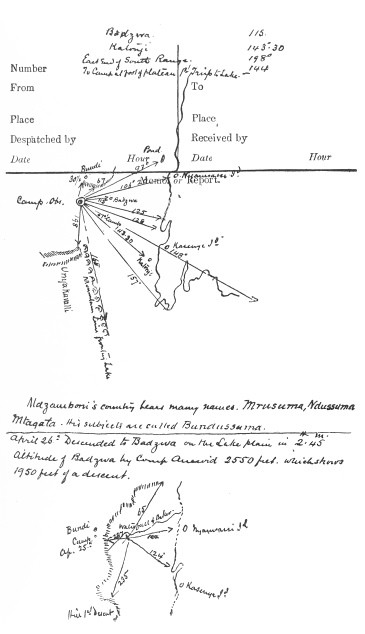
A PAGE FROM MR. STANLEY’S NOTE-BOOK.
The Ituri or Upper Aruwimi is therefore seldom very low. We have seen it in July about six feet below high-water mark. In October one night it rose a foot; it is highest in November, and lowest in December. But it is a stream that constantly fluctuates, and pours an immense volume of water into the Congo. In length of course it is about 700 miles, rising to the south of that group of hills known as the Travellers’ Group, and called Mounts Speke, Schweinfurth, and Junker. Its basin covers an area of 67,000 square miles.
On the north side of the basin we have heard of the Ababua, Mabodé, Momvu, and the Balessé, to the south are the Bakumu and Baburu. These are the principal tribes, which are subdivided into hundreds of smaller tribes. The language of the Bakumu which is to be found inland east of Stanley Falls, is known as far as Panga Falls, with slight dialectic variations among the Baburu. The language of Momvu is spoken between Panga Falls and the Ngaiyu. East of that we found that the language of the Balessé took us as far as Indenduru, beyond that was a separate and distinct language spoken by the Babusessé. But we found sub-tribes in each section who professed not to understand what was said to them from natives two camps removed from them.
All the tribes from the Atlantic Ocean to East Longitude 30° in the Equatorial region have a distant resemblance of features and customs, but I should place East Longitude 18° as the divisional line of longitude between two families of one original parent race. Across twelve degrees of longitude, we have hundreds of tribes bearing a most close resemblance to one another. What Schweinfurth and Junker, Emin and Casati, have said about the Monbuttu, Niam Niam, and Momvu, may with a few fine shades of difference, be said about the Bangala, the Wyyanzi, the Batomba, the Basoko, the Baburu, the Bakumu, and Balessé. One tribe more compact in organisation may possess a few superior characteristics to one which has suffered misfortunes, and been oppressed by more powerful neighbours, but in the main I see no difference whatever. They own no cattle, but possess sheep, goats, and domestic fowls. One tribe may be more partial to manioc, but they all cultivate the plantain and banana. Their dresses all alike are of bark cloth, their headdresses are nearly similar, though one tribe may be more elaborate in the mode of dressing theirs than another. Some of them practise circumcision, and they are addicted to eating the flesh of their enemies. Their weapons are nearly the same—the broad razor-sharp spear, the double-edged and pointed knife, the curious two-or four-bladed knives, their curved swords; their small bows and short arrows; their stools, benches, and back-rests; their ear-rings, bracelets, armlets and leglets; their great war-drums and little tom-toms, their war-horns; their blacksmiths’ and carpenters’ tools.
In the architecture of their houses there is a great difference; in the tattooing, facial marks, and their upper lip ornaments they also differ; but these are often due to the desire to distinguish tribes, though they do not show a difference of race. If one could travel in a steamer from Equatorville on the Congo to Indesura on the Upper Ituri, and see the various communities on the river banks from the deck, the passengers would be struck, not only by the similarity of dress and equipments, but also of complexion; whereas were a colony of Soudanese, Zanzibaris, Wanyamwezi to be seen accidentally among those communities, the stranger might easily distinguish them as being foreign to the soil.
This region, which embraces twelve degrees of longitude, is mainly forest, though to the west it has several reaches of grass-land, and this fact modifies the complexion considerably. The inhabitants of the true forest are much lighter in colour than those of the grass-land. They are inclined normally to be coppery, while some are as light as Arabs, and others are dark brown, but they are all purely negroid in character. Probably this lightness of colour may be due to a long residence through generations in the forest shades, though it is likely to have been the result of an amalgamation of an originally black and light coloured race. When we cross the limits of the forest and enter the grass-land we at once remark, however, that the tribes are much darker in colour.
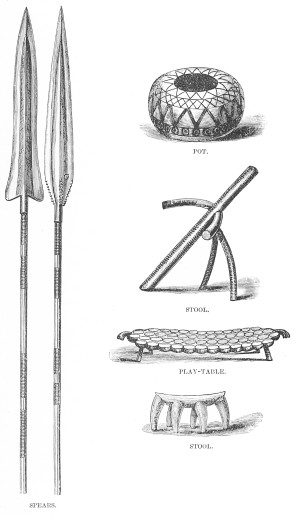
SPEARS.
POT.
STOOL.
PLAY-TABLE.
STOOL.
Among these forest tribes we have observed some singularly prepossessing faces, and we have observed others uncommonly low and degraded. However incorrigibly fierce in temper, detestable in their disposition, and bestial in habits these wild tribes may be to-day, there is not one of them which does not contain germs, and by whose means at some future date civilisation may spread, and with it those manifold blessings inseparable from it. I was much struck with the personal appearance and replies of some captives of Engweddé, with whom, as they knew the language of Momvu, I was able to converse. I asked them if they were in the habit of fighting strangers always. Said they, “What do strangers want from us? we have nothing. We have only plantains, palms, and fish.” “But supposing strangers wished to buy plantains, palm oil, and fish from you, would you sell them?” “We have never seen any strangers before. Each tribe keeps to its own place until it comes to fight with us for some reason.” “Do you always fight your neighbours?” “No; some of our young men go into the woods to hunt game, and they are surprised by our neighbours; then we go to them, and they come to fight us until one party is tired, or one is beaten.” “Well, will you be friends with me if I send you back to your village?” They looked incredulous, and when they were actually escorted out of the camp with cowries in their hands, they simply stood still and refused to go fearing some trap. It seemed incredible to them that they should not be sacrificed. One returned to my tent, and was greeted kindly as an old acquaintance, received a few bananas, deliberately went to a fire and roasted them, weighing in his mind, I suppose, meanwhile, what it all meant; after refreshing himself, he lit his pipe, and walked away with an assumed composure. Three trips past that settlement, and their confidence would have been gained for ever.
Scattered among the Balessé, between Ipoto and Mount Pisgah, and inhabiting the land situated between the Ngaiyu and Ituri Rivers, a region equal in area to about two-thirds of Scotland, are the Wambutti, variously called Batwa, Akka, and Bazungu. These people are undersized nomads, dwarfs, or pigmies, who live in the uncleared virgin forest, and support themselves on game, which they are very expert in catching. They vary in height from three feet to four feet six inches. A full-grown adult male may weigh ninety pounds. They plant their village camps at a distance of from two to three miles around a tribe of agricultural aborigines, the majority of whom are fine stalwart people. A large clearing may have as many as eight, ten, or twelve separate communities of these little people settled around them, numbering in the aggregate from 2,000 to 2,500 souls. With their weapons, little bows and arrows, the points of which are covered thickly with poison, and spears, they kill elephants, buffalo, and antelope. They sink pits, and cunningly cover them with light sticks and leaves, over which they sprinkle earth to disguise from the unsuspecting animals the danger below them. They build a shed-like structure, the roof being suspended with a vine, and spread nuts or ripe plantains underneath, to tempt the chimpanzees, baboons, and other simians within, and by a slight movement, the shed falls, and the animals are captured. Along the tracks of civets, mephitis, ichneumons, and rodents are bow traps fixed, which, in the scurry of the little animals, are snapped and strangle them. Besides the meat and hides to make shields, and furs, and ivory of the slaughtered game, they catch birds to obtain their feathers; they collect honey from the woods, and make poison, all of which they sell to the larger aborigines for plantains, potatoes, tobacco, spears, knives, and arrows. The forest would soon be denuded of game if the pigmies confined themselves to the few square miles around a clearing; they are therefore compelled to move, as soon as it becomes scarce, to other settlements.
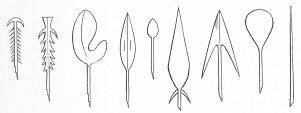
ARROWS OF THE DWARFS.
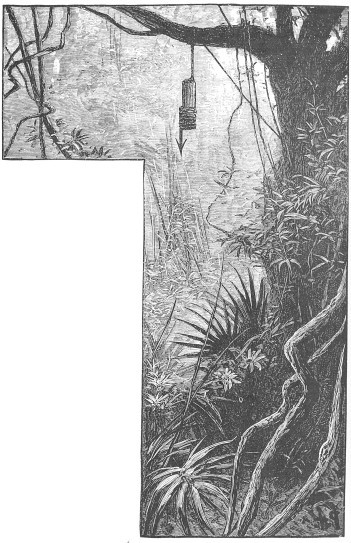
ELEPHANT TRAP.
They perform other services to the agricultural and larger class of aborigines. They are perfect scouts, and contrive, by their better knowledge of the intricacies of the forest, to obtain early intelligence of the coming of strangers, and to send information to their settled friends. They are thus like voluntary picquets guarding the clearings and settlements. Every road from any direction runs through their camps. Their villages command every cross-way. Against any strange natives, disposed to be aggressive, they would combine with their taller neighbours, and they are by no means despicable allies. When arrows are arrayed against arrows, poison against poison, and craft against craft, probably the party assisted by the pigmies would prevail. Their diminutive size, superior wood-craft, their greater malice, would make formidable opponents. This the agricultural natives thoroughly understand. They would no doubt wish on many occasions that the little people would betake themselves elsewhere, for the settlements are frequently outnumbered by the nomad communities. For small and often inadequate returns of fur and meat, they must allow the pigmies free access to their plantains, groves, and gardens. In a word, no nation on the earth is free from human parasites, and the tribes of the Central African forest have much to bear from these little fierce people who glue themselves to their clearings, flatter them when well fed, but oppress them with their extortions and robberies.
The pigmies arrange their dwellings—low structures of the shape of an oval figure cut lengthways; the doors are from two feet to three feet high, placed at the ends—in a rough circle, the centre of which is left cleared for the residence of the chief and his family, and as a common. About 100 yards in advance of the camp, along every track leading out of it, is placed the sentry-house, just large enough for two little men, with the doorway looking up the track. If we assumed that native caravans ever travelled between Ipoto and Ibwiri, for instance, we should imagine, from our knowledge of these forest people, that the caravan would be mulcted of much of its property by these nomads, whom they would meet in front and rear of each settlement, and as there are ten settlements between the two points, they would have to pay toll twenty times, in tobacco, salt, iron, and rattan, cane ornaments, axes, knives, spears, arrows, adzes, rings, &c. We therefore see how utterly impossible it would be for the Ipoto people to have even heard of Ibwiri, owing to the heavy turnpike tolls and octroi duties that would be demanded of them if they ventured to undertake a long journey of eighty miles. It will also be seen why there is such a diversity of dialects, why captives were utterly ignorant of settlements only twenty miles away from them.
As I have said, there are two species of these pigmies, utterly dissimilar in complexion, conformation of the head, and facial characteristics. Whether Batwa forms one nation and Wambutti another we do not know, but they differ as much from each other as a Turk would from a Scandinavian. The Batwa have longish heads and long narrow faces, reddish, small eyes, set close together, which give them a somewhat ferrety look, sour, anxious, and querulous. The Wambutti have round faces, gazelle-like eyes, set far apart, open foreheads, which give one an impression of undisguised frankness, and are of a rich yellow, ivory complexion. The Wambutti occupy the southern half of the district described, the Batwa the northern, and extend south-easterly to the Awamba forests on both banks of the Semliki River, and east of the Ituri.
The life in their forest villages partakes of the character of the agricultural classes. The women perform all the work of collecting fuel and provisions, and cooking, and the transport of the goods of the community. The men hunt, and fight, and smoke, and conduct the tribal politics. There is always some game in the camp, besides furs and feathers and hides. They have nets for fish and traps for small game to make. The youngsters must always be practising with the bow and arrow, for we have never come across one of their villages without finding several miniature bows and blunt-headed arrows. There must be free use of axes also, for the trees about bear many a mark which could only have been done to try their edge. In every camp we have seen deep incisions in a tree several inches deep, and perhaps 500 yards from the camp a series of diamond cuttings in a root of a tree across the track, which, when seen, informed us that we were approaching a village of the Wambutti pigmies.
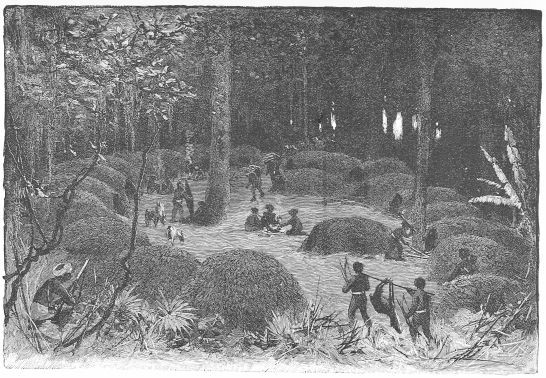
A DWARF VILLAGE.
Two Egyptians, a corporal and a Cairo boy of fifteen, both light complexioned, were captured near Fort Bodo during my absence, and no one discovered what became of them. It is supposed they were made prisoners, like young Nassamonians of old. I have often wondered what was done to them, and what the feelings of both were—they were devout Mussulmans—after they were taken to the Wambutti’s camp. I fancy they must have been something similar to those of Robert Baker, a sailor, in 1562—
“If cannibals they be In kind, we do not know, But if they be, then welcome we, To pot straightway we goe. They naked goe likewise, For shame, we cannot so; We cannot live after their guise, Thus naked for to go. By roots and leaves they live, As beasts do in the wood: Among these heathen who can thrive, On this so wilde a food?”
One of the poisons employed by the tribes of the forest to smear their weapons, in order to make them more deadly, is a dark substance of the colour and consistency of pitch. It is supposed—if native women may be trusted—to be made out of a species of arum, a very common plant, with large leaves, found in any quantity between Fort Bodo and Indesura. Its smell, when fresh, reminds one of the old blister plaster. That it is deadly there can be no doubt. They kill the elephants and other big game with it, as certainly as these animals could be slain with bone-crushing rifles. That they do kill elephants is proved by the vast stores of ivory collected by Ugarrowwa, Kilonga-Longa, and Tippu-Tib, and each adult warrior has a waist-belt, or a shoulder-belt, to suspend his dagger and skinning-knife, and every mother who carries her child and every wife who carries a basket has need of broad forehead-straps, made out of buffalo hide, to bear her load on her back.
1888.
Dec.
Forest.
The poison is not permitted to be manufactured in a village. It seems to be a necessity, to prevent fatal accidents, that the poison should be prepared in the bush. It is then laid on the iron arrows thickly, and into the splints of the hard wooden arrows.
Another poison is of a pale gluey colour. At Avisibba we discovered several baskets of dried red ants among the rafters, and I conjectured, from their resemblance in colour to the deadly poison which the Avisibbas used, that it must have been made by crushing them into a fine powder, and mixing it with palm oil. If one of these insects can raise a blister on the skin of the size of a groat, what may not the powder of mummied insects of the same species effect? If this pale poison be of this material, one must confess that, in the forest, they possess endless supplies of other insects still worse, such as the long black ants which infest the trumpet tree, a bite from one of which can only be compared to cautery from a red hot iron. But whatever it be, we have great faith in a strong hypodermic injection of carbonate of ammonium, and it may be that stronger doses of morphia than any that I ventured upon might succeed in conquering the fatal tetanic spasms which followed every puncture and preceded death.
When one of these poisons is fresh its consequences are rapid. There is excessive faintness, palpitation of the heart, nausea, pallor, and beads of perspiration break out over the body, and death ensues. One man died within one minute from a mere pin-hole, which pierced the right arm and right breast. A headman died within an hour and a quarter after being shot. A woman died during the time that she was carried a distance of one hundred paces; another woman died within twenty minutes; one man died within three hours; two others died after one hundred hours had elapsed. These various periods indicate that some poisons were fresh and others had become dry. Most of these wounds were sucked and washed and syringed, but evidently some of the poison was left, and caused death.
To render the poison ineffective, a strong emetic should be given, sucking and syringing should be resorted to, and a heavy solution of carbonate of ammonium should be injected into the wound, assuming that the native antidote was unknown.
As there is no grass throughout the forest region, the natives would be put to hard shifts to cover their houses were it not for the invaluable phrynia leaves, which grow everywhere, but most abundantly in the primeval woods. These leaves are from a foot to twenty inches in diameter, are attached to slender straight stalks from three to seven feet high. Both stalks and leaves are useful in the construction of native huts and camps. The fruit is like red cherries, but the rinds are not eaten, though the kernels are often eaten to “deceive the stomach.”
The wild fruits of the forest are various, and having been sustained through so many days of awful famine, it would be well to describe such as we found useful. We owe most to a fine stately tree with small leaves, which grows in large numbers along the south banks of the Ituri between East Long. 28° and 29°. Its fruit lies in pods about ten inches long, and which contain four heart-shaped beans called “makwemé,” an inch and a quarter long by an inch broad and half an inch thick. It has a tough dove-coloured skin which when cut shows a reddish inner skin. When this latter is scraped away the bean may be bruised, mashed, or boiled whole. It is better bruised, because, as the bean is rather leathery, it has a better chance of being cooked to be digestible. The pigmies taught us the art, and it may be well conceived that they have had often need of it to support life during their forest wanderings.
In the neighbourhood of these wood-bean trees grew a bastard bread-fruit called fenessi by the Zanzibaris, the fruit of which is as large as a water-melon. When ripe we found it delightful and wholesome.
On a higher level, as we followed the Ituri up from 1° 6′ to Lat. 1° 47′, we found the spondia or hog-plums, a yellow, fragrant fruit with a large stone. An india-rubber vine produced a pear-shaped fruit which, though of delicious odour, was the cause of much nausea; a fruit also of the size of a crab-apple, with an insipid sweetness about it, assisted to maintain life. Then there were some nuts like horse-chestnuts which we found the pigmies partial to, but we cannot speak very highly of them. Besides the cherry-like berries of the phrynia, the kernels of which were industriously sought after, were the rich red fruit of the amoma, within whose husks is found an acid sweet pulp, and the grains of paradise which were first introduced to England in the year 1815. The berries of the calamus, or rattan, were also eaten, but they were difficult to get. Figs also were tried, but they were not very tempting, though anything to disguise hunger and to “deceive the stomach” found favour. Even the cola nuts were eaten, but more for the sake of expectoration than for the sake of pandering to the digestive organs.
Among other articles to which we were reduced were white ants, slugs—not the tiger-slug—snails, crabs, tortoises, roast field-rats, and the siluroids of the streams.
The domestic animals of the natives were principally confined to a fine breed of goats, dogs—of the usual pariah order, but vari-coloured. We saw only one domestic cat, and that was a brindled animal, and very tame, but kept in a cage.
It struck me as curious that while nearly all the Madis were attacked with guinea worms, which rendered them utterly unfit for work, not one Zanzibari suffered from them. The Madis’ medicine for these was simply oil or fat rubbed over the inflammation, which served to cause the worm to withdraw from the leg. At one time, however, we had fifteen cases of mumps among the Zanzibaris, but they used no medicine except rubbing the swollen face with flour and water. Numbers of Manyuema, natives, and Madis, unvaccinated and uninoculated, fell victims to variola; but only four Zanzibaris were attacked with the disease, only one of which was fatal, and two of them were not so much indisposed as to plead being relieved from duties.
Respecting the productions of the forest I have written at such length in “The Congo and the Founding of its Free State” that it is unnecessary to add any more here. I will only say that when the Congo Railway has been constructed, the products of the great forest will not be the least valuable of the exports of the Congo Independent State. The natives, beginning at Yambuya, will easily be induced to collect the rubber, and when one sensible European has succeeded in teaching them what the countless vines, creepers, and tendrils of their forest can produce, it will not be long before other competitors will invade the silent river, and invoke the aid of other tribes to follow the example of the Baburu.
CHAPTER XXIV.
IMPRISONMENT OF EMIN PASHA AND MR. JEPHSON.
Our reception at Fort Bodo—Lieut. Stairs’ report of what took place at the Fort during our relief of the rear column—No news of Jephson—Muster of our men—We burn the Fort and advance to find Emin and Jephson—Camp at Kandekoré—Parting words to Lieut. Stairs and Surgeon Parke, who are left in charge of the sick—Mazamboni gives us news of Emin and Jephson—Old Gavira escorts us—Two Wahuma messengers bring letters from Emin and Jephson—Their contents—My replies to the same handed to Chief Mogo for delivery—The Balegga attack us, but, with the help of the Bavira, are repulsed—Mr. Jephson turns up—We talk of Emin—Jephson’s report bearing upon the revolt of the troops of Equatoria, also his views respecting the invasion of the province by the Mahdists, and its results—Emin Pasha sends through Mr. Jephson an answer to my last letter.
1888.
Dec. 20.
Fort Bodo.
Those who have read the pitiful tale of the rear column will no doubt be curious to know how we re-entered Fort Bodo, which was only garrisoned with fifty-nine rifles, after six months’ absence. With my heart filled with joy and gratitude I was escorted up the western avenue, glad men leaping around me like spaniels, the Doctor imparting the most cheery news; prosperous fields of corn on either hand, and goodly crops everywhere; fenced squares, a neat village, clean streets, and every one I met—white and black—in perfect health, except a few incurables. Nelson was quite recovered, the dark shadow of the starvation camp was entirely gone, and the former martial tread and manly bearing had been regained; and Stairs, the officer par excellence, was precisely what he ought to have been—the one who always obeyed and meant to obey.
Lieutenant Stairs possessed 24,000 ears of corn in his granary, the plantation was still bearing plantains and sweet potatoes and beans, there was a good crop of tobacco; the stream in the neighbourhood supplied fish—siluroids—and between officers and men there existed the very best of feeling. He had not been free from trouble; troops of elephants had invaded the fort, native plunderers by night had robbed him of stores of tobacco, a mild benevolence had brought on the plantation a host of pygmies, but at once alertness and firmness had made him respected and feared by pigmies, aborigines, and Zanzibaris, and in every wise suggestion his comrades had concurred and aided him. The admirable and welcome letter herewith given speaks for itself—
Fort Bodo, Ibwiri, Central Africa,
21st December, 1888.
H. M. Stanley, Esq.,
Command of Emin Pasha Relief Expedition.
Sir,
I have the honour to report that, in accordance with your letter of instructions, dated Fort Bodo, June 13th, 1888, I took over the charge of Fort Bodo and its garrison.
The strength of the garrison was then as follows:—Officers, 3; Zanzibaris, 51; Soudanese, 5; Madis, 5; total, 64.
Soon after your departure from Yambuya, the natives in the immediate vicinity became excessively bold and aggressive; gangs of them would come into the plantations nearly every day searching for plantains, and at last a party of them came into the gardens east of the Fort at night-time and made off with a quantity of tobacco and beans. On the night of the 21st August they again attempted to steal more tobacco; this time, however, the sentries were on the alert. The lesson they received had the effect of making the natives less bold, but still our bananas were being taken at a great rate. I now found it necessary to send out three parties of patrols per week; these had as much as they could do to keep out the natives and elephants. If fires were not made every few days the elephants came into the bananas, and would destroy in a single night some acres of plantation.
By November 1st we had got the natives well in hand, and at this time I do not believe a single native camp exists within eight miles of the Fort. Those natives to the S.S.E. of the Fort gave us the most trouble, and were the last to move away from our plantations.
At the end of July we all expected the arrival of Mr. Mounteney Jephson from the Albert Nyanza to relieve the garrison, and convey our goods on to the Lake shore. Day after day, however, passed away, and no sign of him or news from him reaching us made many of the men more and more restless as each day passed. Though most of the men wished to remain at the Fort till relief turned up, either in the shape of Mr. Jephson or yourself, still some eight or ten discontented ones, desirous of reaching the Lake and partaking of the plenty there, were quite ready at any time to desert the loads, the white men, and sick.
Seeing how things stood I treated the men at all times with the greatest leniency, and did whatever I could to make their life at the Fort as easy for them as was possible.
Shortly after the time of Mr. Jephson’s expected arrival, some of the men came to me and asked for a “shauri;” this I granted. At this shauri the following propositions were made by one of the men (Ali Juma), and assented to by almost every one of the Zanzibaris present.
I. To leave the Fort, march on to the Lake by way of Mazamboni’s country, making double trips, and so get on all the loads to the Lake and have plenty of food.
II. Or, to send say fifteen couriers with a letter to the edge of the plain, there to learn if the Bandusuma were still our friends or no; if unfriendly, then to return to the Fort; if friendly, then the couriers would take on the letter to Mr. Jephson, and relief would come.
To the first proposal I replied:—
(1.) Mr. Stanley told me not to move across the plain, whatever else I did, without outside aid.
(2.) Did not Mr. Stanley tell Emin Pasha it was not safe to cross the plains, even should the natives be friendly, without sixty guns?
(3.) We had only thirty strong men, the rest were sick; we should lose our loads and sick men.
We all lived on the best of terms after I had told them we could not desert the Fort. We went on hoeing up the ground and planting corn and other crops, as if we expected a prolonged occupation. On the 1st September a severe hurricane accompanied by hail passed over the Fort, destroying fully 60 per cent. of the standing corn, and wrecking the banana plantations to such an extent that at least a month passed before the trees commenced to send up young shoots. Had it not been for this we should have had great quantities of corn; but as it was I was only able to give each man ten corns per week. The weakly ones, recommended by Dr. Parke, got one cup of shelled corn each per day. At one time we had over thirty men suffering from ulcers, but, through the exertion of Dr. Parke, all their ulcers on your arrival had healed up with the exception of some four.
Eight deaths occurred from the time of your departure up to the 20th December, two were killed by arrows, and two were captured by natives.
In all matters where deliberation was necessary the other officers and myself took part. We were unanimous in our determination to await your arrival, knowing that you were using every endeavour to bring relief to us as speedily as possible.
On the 20th December I handed over the charge of the Fort to you, and on the 21st the goods entrusted to my care.
I have the honour to be, Sir,
Your obedient servant,
(Signed) W. G. Stairs, Lieut. R.E.
1888.
Dec. 21.
Fort Bodo.
We were now left to conjecture what had become of the energetic Jephson, the man of action, who had been nick-named Buburika, or the Cheetah, because he was so quick and eager, and strained at the leash. No small matter would have detained him, even if the Pasha after all thought that a long journey to Fort Bodo was unnecessary.
But the fact that neither had been heard of placed us in a dilemma. We had fifty-five extra loads to carry, over and above the number of carriers, of absolutely necessary property. After a little midnight mental deliberation I resolved to make double marches between Fort Bodo and the Ituri River on the edge of the plains, leave Lieutenant Stairs and officers and sick at the well-furnished clearing of Kandekoré, and march to the Nyanza to search for Emin Pasha and Mr. Mounteney Jephson. This would probably cause me to exceed my original estimate of time by ten days. But what can one do when every plan is thwarted by some unlucky accident or another? Fort Bodo had been reached two days before the stipulated time. If I arrived at the Nyanza by January 26 I should be ten days behind time.
On the 21st of December all this was explained to the men, and that fifty-five men must volunteer to do double duty, but for every camp made by them twice over I should pay for the extra work in cloth. Volunteers responded readily at this, and the difficulty of carrying the extra fifty-five loads of ammunition vanished.
At the muster on the 22nd of December there were present in the Fort—209 Zanzibaris, 17 Soudanese, 1 Somali, 151 Manyuema and followers, 26 Madis, 2 Lados, 6 whites; total 412. Therefore the journey from Banalya to Fort Bodo had cost 106 lives, of whom 38 belonged to the rear column.
On the 23rd we set out from Fort Bodo, and on the next day Captain Nelson, having buried the Pasha’s big demijohn, some broken rifles, &c., set fire to the Fort and joined us.
1889.
Jan. 2.
Indenduru.
Christmas Day and the day after we foraged for the double journeys, and on the 27th Stairs was pushed forward with one hundred rifles to occupy the ferry at the Ituri River, with orders, after making himself snug, to send back fifty-five men to our Cross Roads camp. Meantime, being very dilapidated in clothing, the Doctor and I tailored to make ourselves respectable for the grass-land.
On the 2nd of January, while waiting for the contingent from Stairs, a Soudanese, gathering fuel only 150 yards from camp, received five arrows in his back, which were extracted after tremendous exertion by the Doctor—two of the arrows being so deeply fixed in bone and muscle that the wounded man was almost raised from the ground. A sixth arrow was found two months later. The man ultimately recovered, to die close to Bagamoyo nearly a year later.
On the next day the fifty-five men returned from Stairs with a note reporting all was well at Ituri, and that he was hopeful of a pacific conclusion to the negotiations with the natives of Kandokoré, and on the 4th of the month at noon we moved from Cross Roads Camp. Six hours’ march on the 5th brought us to West Indenduru. The 6th we reached Central Indenduru, and on the 7th we were in the Bakwuru village at the foot of Pisgah, in view of the grass-land, at which the men of the rear column and the Manyuema were never tired of gazing and wondering. On the 9th we crossed the Ituri River and established a camp in the village of Kandekoré on the east side.
The next day all hands were set to work to make a camp, to clear the bush around, for natives are accustomed to let it grow right up to the eaves of their huts to enable them to retreat unperceived in case of danger.
In the evening after dinner Lieutenant Stairs and Surgeon Parke were called to my tent, and I addressed them as to their duties during my absence. Said I—
“Gentlemen, I have called you to give you a few parting words.
“You know as well as I do that there is a constant unseen influence at work creating an anxiety which has sometimes tempted us to despair. No plan, however clear and intelligible it may be, but is thwarted and reversed. No promises are fulfilled, instructions are disregarded, suggestions are unavailing, and so we are constantly labouring to correct and make amends for this general waywardness which pursues us. We are no sooner out of one difficulty than we are face to face with another, and we are subjected to everlasting stress and strains of appalling physical miseries, and absolute decimation. It is as clear to you as to me why these things are so. They will go on and continue so, unless I can gather the fragments of this Expedition together once and for all, and keep it together, never to be separated again. But each time I have wished to do so, the inability of the men to march, the necessity of hurrying to one place and then to another, keep us eternally detached. After bringing the rear column, and uniting it with the advance, and collecting your garrison at Fort Bodo, we are astonished at this total absence of news from Jephson and the Pasha. Now I cannot manœuvre with a hospital in tow, such as we have with us. At the muster of to-day, after inspection, there were 124 men suffering from ulcers, debility, weakness, dysentery, and much else. They cannot march, they cannot carry. Jephson and the Pasha are perhaps waiting for me. It is now January 10th, I promised to be on the Nyanza again, even if I went as far as Yambuya, by the 16th, I have six days before me. You see how I am pulled this way and that way. If I could trust you to obey me, obey every word literally, that you would not swerve one iota from the path laid down, I could depart from you with confidence, and find out what is the matter with Jephson and the Pasha.”
1889.
Jan. 10.
Kandekoré.
“I don’t see why you should doubt us. I am sure we have always tried to do our very best to please and satisfy you,” replied Stairs.
“That is strictly true, and I am most grateful to you for it. The case of Yambuya seems to be repeated. Our friend Jephson is absent, perhaps dead from fever or from some accident; but why do we not hear from the Pasha? Therefore we surmise that some other trouble has overtaken both. Well, I set out for the Nyanza, and either send or cause to hear the news, or cut my way through Melindwa to behind Mswa Station to discover the cause of this strange silence. Have the Mahdists come up river, and annihilated everybody, or has another Expedition reached them from the East, and they are all too busy attending to them to think of their promise to us? Which is it? No one can answer, but because of this mystery we cannot sit down to let the mystery unfold itself, and I can do nothing towards penetrating it with 124 men, who require a long rest to recover from their fatigues and sicknesses. Therefore I am compelled to trust to you and the doctor, that you will stay here until I know what has happened, whether for one month or two months. I want you to stay here and look after the camp alertly, and I want the doctor to attend to these sick men and cure them, not to stint medicines, but nurse them with good food from morning until night. Do you promise this faithfully, on your words as gentlemen?”
“We do,” replied both warmly.
“Now Doctor, I particularly address myself to you. Stairs will perform all that is required as Superintendent and Governor of the camp, but I look to you mostly. These 124 men are on the sick list, some are but slightly indisposed, and some are in a dreadful state. But they all require attention, and you must give it devotedly. You must see that your worst cases are fed regularly. Three times a day see that their food is prepared, and that it is given to them; trust no man’s word, see to it yourself in person; we want these men to reach home. I warn you solemnly that your ‘flood-tide of opportunity’ has come. Are you ambitious of distinction? Here is your chance; seize it. Your task is clear before you, and you are required to save these men, who will be the means of taking you home, and of your receiving the esteem of all who shall hear of your deeds.
1889.
Jan. 10.
Kandekoré.
“Gentlemen, the causes of failure in this world are that men are unable to see the thing that lies ready at their hands. They look over their work and forget their tasks, in attempting to do what is not wanted. Before I left England I received some hundreds of applications from volunteers to serve with me on this Expedition. They at least believed that they could win what men vulgarly call ‘kudos,’ though I do not believe that one in a thousand of them knew what is the true way to glory. For instance, there are only six whites here in this camp, yet one of the six sought me the other night to request permission to explore the Welle-Mubangi River—of all places in Africa! His duty was clearly before him, and yet he did not see it. His opportunities were unheeded. He cast yearning looks over and above what was right at his feet. He seemed as if wakened out of a dream when I told him that to escort refugees to their homes was a far nobler task than any number of discoveries. On this Expedition there was a man who received a salary for being loyal and devoted to me, yet when there were opportunities for distinguishing himself, he allowed his employer’s baggage to be sent away before his very eyes, and his own rations to be boxed up, and sent out of camp, and he never knew until told that he had lost his opportunities to gain credit, increase of salary, and promotion. I point out your opportunities, therefore hold fast to them with a firm grip; do all you can with might and main to make the most of them. Don’t think of ‘kudos,’ or ‘glory,’ but of your work. All your capital is in that; it will give you great or little profit, as you perform it. Good-night. To-morrow I go to do something, I know not what, and do not care until I hear what it is I have to do. As I will do mine, do yours.”
The next morning, after encouraging remarks to the invalids, we set out from Kandekoré in the territory of the Bakuba, and in forty-five minutes we had emerged out of the bush, to the immense delight and wonder of such of the rear column and Manyuema as had not seen the glorious land before.
On the 12th we reached Bessé, and were well received by our native friends. They informed us that the Pasha was building big houses at Nyamsassi, and the rumour was that he and many followers intended to pass through the land. As we had been very anxious, this piece of good news was hailed with great satisfaction.
1889.
Jan. 14.
Undussuma.
We camped the day following in a vale a little north of Mukangi, and on the 14th we reached our old camp in Mazamboni’s country. It was not long before Mazamboni, and Katto his brother, and his inseparable cousin Kalengé, appeared, and in reply to our eager questioning, informed us that Jephson had reached Kavalli’s the day before yesterday (12th); that Hailallah, a boy deserter, was in charge of Kavalli, and had grown as tall as a spear. We were also told that Maleju (the Pasha) had despatched ten men to Kavalli’s to obtain news of us, and that he had caused some fields to be cultivated near the lake, and had planted corn for our use. “What a good, thoughtful, kind man he must be!” we mentally remarked.
As Mazamboni presented us with two fat beeves, it was essential that the Zanzibaris, and the Manyuema should be indulged a little after long abstinence from flesh. We accordingly halted on the 15th, and during the day Chief Gavira came in and imparted the intelligence that Jephson had arrived at Katonza’s village three days before with seventeen soldiers; and our people, who were now well supplied with cloth for extra labour, and five doti each from Banalya, besides beads, cowries, and wire, were able to invest in luxuries to their hearts’ content. The Manyuema smiled blandly, and the Zanzibaris had contracted a habit, as they had scented the grass-lands, of crowing, which when once started was imitated by nearly 300 people.
Old Gavira escorted us the next day, on the 16th, the date I should have been on the Nyanza, and by the afternoon we were in one of the old villages which was once burned by us, and which was again clean and new and prosperous, and we welcome and honoured guests, only one long day’s march from the Lake.
Now that we were actually out of the forest, and only one thing more to do—since both the Pasha and Mr. Jephson were on the Lake shore just below us, according to the native—viz., to deliver the ammunition into the Pasha’s hands, and escort a few Egyptians home, Old Gavira had reason to suppose that afternoon that “Bula Matari” was a very amiable person.
1889.
Jan. 16.
Gavira’s.
But at 5 P.M. two Wahuma messengers came with letters from Kavalli’s, and as I read them a creeping feeling came over me which was a complete mental paralysis for the time, and deadened all the sensations except that of unmitigated surprise. When I recovered myself the ears of Jephson and the Pasha must certainly have tingled. I need not criminate myself, however, and any person of any imagination may conceive what I must have felt after he has read the following letters:—
Letter from Emin.
Dufflé, 2nd September, 1888.
Dear Sir,
Mr. Jephson having been obliged to accompany some officers who start to see you, I profit of the occasion to tender you with my best wishes, hearty congratulations for the safe arrival of your Expedition, of which we have heard only by our boys, our letters being rigorously withheld from us. Mr. Jephson, who has been of good help to me, under very trying circumstances, will tell you what has happened, and is likewise able to give you the benefit of his experience, and to make some suggestions, should you decide to come here as people wish. In the case of your coming, you will greatly oblige me by taking measures for the safety of my little girl, about whom I feel most anxious.
Should, however, you decide not to come, that I can only wish you a good and safe return to your country, and at the same time I may be permitted to request you to tender my cordial thanks to your officers and your people, and my heartfelt acknowledgment to those kind hearted benefactors in England by whose generosity the Expedition was started.
Believe me, Dear Sir, to be,
Yours very sincerely,
(Signed) Dr. Emin.
2nd Letter from Emin.
Dufflé, 6, 11, 88.—Since the foregoing was written I have been always a prisoner here. Twice we heard you had come in, but it was not true. Now, the Mahdi’s people having come up, and Rejaf Station having been taken, we may be attacked some day or other, and there seems only a few hours of our escaping. However, we hope yet. To-day I have heard the soldiers from Muggi started yesterday for Rejaf, and if they are defeated, as without any doubt they will be, the Khartoum people will be here very quickly.
Mr. Jephson has acquainted me with the letter he wrote to you, and I think there is nothing to be joined to it.[2]
Yours very sincerely,
(Signed) Dr. Emin.
3rd Letter from Emin.
Tunguru, 21st December, 1888.
Dear Mr. Stanley,
Mr. Jephson having told to you whatever has happened here after we left Dufflé, I refrain from repeating the narrative.[3] Although for a moment there happened a movement in my favour, the officers, elated with their victory, soon were just as bad as they were in the beginning of this comedy. Everyone is now fully decided to leave the country for finding a shelter somewhere. Nobody thinks, however, of going to Egypt, except, perhaps, a few officers and men. I am, nevertheless, not without hope of better days; but I join my entreaties with those of Mr. Jephson asking you to stay where you are, viz., at Kavalli’s, and to send only word of your arrival as quickly as you can.
Chief Mogo, the bearer of this and Mr. Jephson’s letter, has my orders to remain at Kavalli’s until you arrive. He is a good and true fellow, and you will oblige me by looking after him.
With the best wishes for you and all your people,
I am,
Yours very sincerely,
(Signed) Dr. Emin.
Letters of Mr. Jephson.
Dufflé, 7th November, 1888.
Dear Sir,
I am writing to tell you of the position of affairs in this country, and I trust Shukri Aga will be able by some means to deliver this letter to Kavalli in time to warn you to be careful.
On August 18th a rebellion broke out here, and the Pasha and I were made prisoners. The Pasha is a complete prisoner, but I am allowed to go about the station, though my movements are watched. The rebellion has been got up by some half dozen officers and clerks, chiefly Egyptians, and gradually others have joined; some through inclination, but most through fear; the soldiers, with the exception of those at Laboré, have never taken part in it, but have quietly given in to their officers. The two prime promoters of the rebellion were two Egyptians, who we heard afterwards had gone and complained to you at Nsabé. One was the Pasha’s adjutant, Abdul Vaal Effendi, who was formerly concerned in Arabi’s rebellion; the other was Achmet Effendi Mahmoud, a one-eyed clerk. These two and some others, when the Pasha and I were on our way to Rejaf, went about and told the people they had seen you, and that you were only an adventurer, and had not come from Egypt; that the letters you had brought from the Khedive and Nubar Pasha were forgeries; that it was untrue that Khartoum had fallen, and that the Pasha and you had made a plot to take them, their wives and children out of the country, and hand them over to slaves to the English. Such words, in an ignorant and fanatical country like this, acted like fire amongst the people, and the result was a general rebellion, and we were made prisoners.
The rebels then collected officers from the different stations, and held a large meeting here to determine what measures they should take, and all those who did not join in the movement were so insulted and abused, that they were obliged for their own safety to acquiesce in what was done. The Pasha was deposed, and those officers who were suspected of being friendly to him were removed from their posts, and those friendly to the rebels were put in their places. It was decided to take the Pasha away as a prisoner to Rejaf, and some of the worst rebels were even for putting him in irons, but the officers were afraid to put these plans into execution, as the soldiers said they would never permit any one to lay a hand on him. Plans were also made to entrap you when you returned, and strip you of all you had.
Things were in this condition when we were startled by the news that the Mahdi’s people had arrived at Lado with three steamers and nine sandals and nuggars, and had established themselves on the site of the old station. Omar Sale, their general, sent down three peacock dervishes with a letter to the Pasha demanding the instant surrender of the country. The rebel officers seized them and put them in prison, and decided on war. After a few days the Donagla attacked and captured Rejaf, killing five officers and numbers of soldiers, and taking many women and children prisoners, and all the stores and ammunition in the station were lost. The result of this was a general stampede of people from the stations of Bidden, Kirri, and Muggi, who fled with their women and children to Laboré, abandoning almost everything. At Kirri the ammunition was abandoned, and was at once seized by the natives. The Pasha reckons that the Donagla numbers about 1,500.
The officers and a large number of soldiers have returned to Muggi, and intend to make a stand against the Donagla. Our position here is extremely unpleasant, for since this rebellion all is chaos and confusion; there is no head, and half a dozen conflicting orders are given every day, and no one obeys; the rebel officers are wholly unable to control the soldiers. We are daily expecting some catastrophe to happen, for the Baris have joined the Donagla, and if they come down here with a rush nothing can save us. After the fall of Rejaf, the soldiers cursed their officers and said, “If we had obeyed our Governor, and had done what he told us, we should now be safe; he has been a father and a mother to us all these years; but instead of listening to him we listened to you, and now we are lost.”
The officers are all very much frightened at what has happened, and we are now anxiously awaiting your arrival, and desire to leave the country with you, for they are now really persuaded that Khartoum has fallen, and that you have come from the Khedive. The greater part of the officers and all the soldiers wish to reinstate the Pasha in his place, but the Egyptians are afraid that if he is reinstated vengeance will fall on their heads, so they have persuaded the Soudanese officers not to do so. The soldiers refuse to act with their officers, so everything is at a standstill, and nothing is being done for the safety of the station, either in the way of fortifying or provisioning it. We are like rats in a trap; they will neither let us act nor retire, and I fear unless you come very soon you will be too late, and our fate will be like that of the rest of the garrisons of the Soudan. Had this rebellion not happened, the Pasha could have kept the Donagla in check for some time, but as it is he is powerless to act.
I would make the following suggestions concerning your movements when you arrive at Kavalli’s, which, of course, you will only adopt if you think fit.
On your arrival at Kavalli’s, if you have a sufficient force with you, leave all unnecessary loads in charge of some officers and men there, and you yourself come to Nsabé, bringing with you as many men as you can; bring the Soudanese officers, but not the soldiers, with you.
Despatch natives in a canoe to Mswa with a letter in Arabic to Shukri Aga, telling him of your arrival, and telling him you wish to see the Pasha and myself, and write also to the Pasha or myself telling us number of men you have with you; it would, perhaps, be better to write to me, as a letter to him might be confiscated.
On no account have anything to do with people who come to you unaccompanied by either the Pasha or myself, whoever they are, or however fair their words may be. Neither the Pasha nor I think there is the slightest danger now of any attempt to capture you being made, for the people are now fully persuaded you come from Egypt, and they look to you to get them out of their difficulties; still it would be well for you to make your camp strong.
If we are not able to get out of the country, please remember me to my friends. With kindest wishes to yourself and all with you,
I am,
Yours faithfully,
(Signed) A. J. Mounteney Jephson.
To H. M. Stanley, Esq.,
Commander of the Relief Expedition.
[2] This proves that the Pasha endorses what Mr. Jephson writes.
[3] The Pasha appears to admit that he has read Mr. Jephson’s letters.
1889.
Jan. 16.
Nyanza.
Wadelai, November 24th, 1888.
My messenger having not yet left Wadelai, I add this postscript, as the Pasha wishes me to send my former letter to you in its entirety, as it gives a fair description of our position at the time I wrote, when we hardly expected to be ever able to get out of the country. Shortly after I had written to you, the soldiers were led by their officers to attempt to retake Rejaf, but the Donagla defeated them, and killed six officers and a large number of soldiers; amongst the officers killed were some of the Pasha’s worst enemies. The soldiers in all the stations were so panic-stricken and angry at what had happened that they declared they would not attempt to fight unless the Pasha was set at liberty; so the rebel officers were obliged to free him and sent us to Wadelai, where he is free to do as he pleases, but at present he has not resumed his authority in the country; he is, I believe, by no means anxious to do so. We hope in a few days to be at Tunguru, a station on the Lake two days by steamer from Nsabé, and I trust when we hear of your arrival that the Pasha himself will be able to come down with me to see you.
Shukri Aga tells us he has everything ready against your arrival, in the shape of cattle, goats, chickens, corn, etc.; he has behaved capitally throughout this rebellion, and is the only chief of station who has been able to stand against the rebels.
Our danger, as far as the Donagla are concerned, is, of course, increased by this last defeat, but our position is in one way better now, for we are further removed from them, and we have now the option of retiring if we please, which we had not before when we were prisoners. We hear that the Donagla have sent steamers down to Khartoum for reinforcements; if so, they cannot be up for another six weeks; meantime I hope that until the reinforcements arrive they will not care to come so far from their base as Wadelai or Tunguru. If they do, it will be all up with us, for the soldiers will never stand against them, and it will be a mere walk over.
These people are not the same sort that the soldiers fought three years ago, but are regular fanatics, and come on with a rush, cutting down men with their long sharp swords and broad spears. Every one is anxiously looking for your arrival, the coming of the Donagla has completely cowed them. Everything now rests on what the Donagla decided on doing. If they follow up their victories and come after us, we are lost, as I said before, for I do not think the people will allow us to retire from the country; but if the Donagla have sent down to Khartoum for reinforcements, and have decided to wait for the arrival of their reinforcements, then we may just manage to get out if you do not come later than the end of December, but it is utterly impossible to foresee what will happen.
A. J. M. J.
Tunguru, December 18th, 1888.
Dear Sir,—
Mogo not having yet started I send a second postscript in order to give you the latest news I can. We are now at Tunguru. On November 25th the Donagla surrounded Dufflé and besieged it for four days, but the soldiers, of whom there were some 500 in the station, managed at last to repulse them, and they retired to Rejaf, which is their headquarters. They have sent down to Khartoum for reinforcements, and doubtless will again attack and take the country when they are strengthened. In our flight from Wadelai I was asked by the officers to destroy our boat lest it should fall into the hands of the Donagla; I therefore broke it up, as we were unable to save it.
Dufflé is being evacuated as fast as possible, and it is the intention of the officers to collect at Wadelai, and to decide on what steps they shall next take. The Pasha is unable to move hand or foot, as there is still a very strong party against him, and the officers are no longer in immediate fear of the Mahdi’s people.
Do not on any account come down to Nsabé, but make your camp at Kavalli’s; send a letter directly you arrive, and as soon as we hear of your arrival I will come down to you. I will not disguise the fact from you that you will have a difficult and dangerous task before you in dealing with the Pasha’s people. I trust you will arrive before the Donagla return, or our case will be desperate.
I am, yours faithfully,
(Signed) A. J. Mounteney Jephson.
My Reply To Mr. Jephson.
Camp at Gavira’s, one day from Nyanza, and one day’s march east
of Mazamboni’s.
January 17th, 1889.
My dear Jephson,—
Your letter of November 7th, 1888, with two postscripts, one dated November 24th, and the other dated December 18th, is to hand and contents noted.
I will not criticise your letter nor discuss any of its contents. I wish to be brief, and promptly act; with that view I present you with a précis of events connected with our journey.
We separated from the Pasha on the 23rd of May last, with the understanding that in about two months you, with or without the Pasha, would start for Fort Bodo with sufficient porters to take the goods at the Fort and convey them to the Nyanza, the Pasha expressing himself anxious to see Mt. Pisgah and our Fort, and, if words may be relied on, he was anxious to assist us in his own relief. We somewhat doubted whether his affairs would permit the Pasha’s absence, but we were assured you would not remain inactive.
It was also understood that the Pasha would erect a small station on Nyamsassi Island as a provision depot, in order that our Expedition might find means of subsistence on arrival at the Lake.
Eight months have elapsed, and not one single promise has been performed.
On the other hand, we, faithful to our promise, departed from the Nyanza Plain May 25th, arrived at Fort Bodo June 8th—fifteen days from the Nyanza. Conveying to Lieutenant Stairs and Captain Nelson your comforting assurances that you would be there in two months, and giving written permission to Stairs and Nelson to evacuate the Fort and accompany you to the Nyanza with the garrison, which, with the Pasha’s soldiers, would have made a strong depôt of Nyamsassi Island, I set out from Fort Bodo on the 16th June to hunt up the Major and his column.
On the morning of the 17th August at 10 A.M., we sighted the rear column at Banalya, ninety miles (English) from Yambuya—592 miles from the Nyanza on the sixty-third day from Fort Bodo, and the eighty-fifth from the Nyanza shore.
I sent my despatches to Stanley Falls and thence to Europe, and on the 31st August commenced my return towards the Nyanza. Two days before the date stated I was at Fort Bodo—December 20th. On the 24th December we moved from Fort Bodo towards the Ituri Ferry. But as your non-arrival at Fort Bodo had left us with a larger number of goods than our force could carry at one time, we had to make double journeys to Fort Bodo and back to the Ituri Ferry, but by the 10th January all that remained of the Expedition, with all its effects, were on this side of the Ituri River, encamped half a mile from the ferry, with abundance of food assured for months. On the 12th January I left Stairs; your absence from the Fort, and the absolute silence respecting you all, made us suspect that serious trouble had broken out. Yesterday your letter, as above stated, came to hand, and its contents explained the trouble.
The difficulties I met at Banalya, are repeated to-day, near the Albert Lake, and nothing can save us now from being overwhelmed by them but a calm and clear decision. If I had hesitated at Banalya very likely I should still be there waiting for Jameson and Ward, with my own men dying by dozens.
Are the Pasha, Casati and yourself to share the same fate? If you are still victims of indecision, then a long good-night to you all. But, while I retain my senses, I must save my Expedition; you may be saved also if you are wise.
In the “High Order” of the Khedive, dated 1st February, 1887, No. 3, to Emin Pasha, a translation of which was handed to me, I find the following words:—
“And since it is our sincerest desire to relieve you with your officers and soldiers from the difficult position you are in, our Government have made up their minds about the manner by which relief from these troubles may be obtained. A mission for the relief has been found, and the command of it given to Mr. Stanley, the famous, &c., &c., &c., and he intends to set out on it with all the necessary provisions for you, so that he may bring you, with your officers and men, to Cairo by the route he may think proper to take. Consequently we have issued this ‘High Order’ to you, and it is sent to you by the hand of Mr. Stanley, to let you know what was being done. As soon as it reaches you convey my best wishes to the officers and men, and you are at full liberty with regard to your leaving for Cairo or your stay there with officers and men.
“Our Government has given a decision for paying your salaries, with that of the officers and men.
“Those who wish to stay there of the officers and men may do so on their own responsibility, and they may not expect any assistance from the Government.
“Try to understand the contents well, and make them well known to all the officers and men, that they may be fully aware of what they are going to do.”
It is precisely what the Khedive says that I wish to say to you. Try and understand all this thoroughly that you may be saved from the effect of indecision, which will be fatal to you all if unheeded.
The first instalment of relief was handed to Emin Pasha on or about the 1st of May, 1888. The second and final instalment of relief is at this camp with us, ready for delivery at any place the Pasha designates, or to any person charged by the Pasha to receive it. If the Pasha fails to receive it, or to decide what shall be done with it I must then decide briefly what I must do.
Our second object in coming here was to receive such at our camp as were disposed to leave Africa, and conduct them home by the nearest and safest route. If there are none disposed to leave Africa our Expedition has no further business in these regions, and will at once retire. Try and understand what all this means. Try and see the utter and final abandonment of all further relief, and the bitter end and fate of those obstinate and misguided people who decline assistance when tendered to them. From the 1st May, 1888, to January 1889, are nine months—so long a time to consider a simple proposition of leaving Africa or staying here!
Therefore, in this official and formal letter accompanying this explanatory note to you, I designate Kavalli’s village as the rendezvous where I am willing to receive those who are desirous of leaving Africa, subject, of course, to any new light thrown upon the complication by a personal interview or a second letter from you.
And now I address myself to you personally. If you consider yourself still a member of the Expedition subject to my orders, then, upon receipt of this letter, you will at once leave for Kavalli’s with such of my men—Binza and the Soudanese—as are willing to obey you, and bring to me the final decision of Emin Pasha and Signor Casati respecting their personal intentions. If I am not at Kavalli’s then, stay there, and send word by letter by means of Kavalli’s messengers to Mpinga, Chief of Gavira, who will transmit the same to Mazamboni’s, when probably I shall receive it. You will understand that it will be a severe strain on Kavalli’s resources to maintain us with provisions longer than six days, and if you are longer than this period we must retire to Mazamboni’s, and finally to our camp on the Ituri Ferry. Otherwise we must seize provisions by force, and any act of violence would cut off and close native communication. This difficulty might have been avoided had the Pasha followed my suggestion of making a depôt at Nyamsassi. The fact that there are provisions at Mswa does not help us at all. There are provisions in Europe also. But unfortunately they are as inaccessible as those of Mswa. We have no boat now to communicate by lake, and you do not mention what has become of the steamers, the Khedive and Nyanza.
I understand that the Pasha has been deposed and is a prisoner. Who, then, is to communicate with me respecting what is to be done? I have no authority to receive communications from the officers—mutineers. It was Emin Pasha and his people I was supposed to relieve. If Emin Pasha was dead, then to his lawful successor in authority. Emin Pasha being alive prevents my receiving a communication from any other person, unless he be designated by the Pasha. Therefore the Pasha, if he be unable to come in person to me at Kavalli’s with a sufficient escort of faithful men, or be unable to appoint some person authorised to receive this relief, it will remain for me to destroy the ammunition so laboriously brought here, and return home.
Finally, if the Pasha’s people are desirous of leaving this part of Africa, and settle in some country not far remote from here, or anywhere bordering the Nyanza (Victoria), or along the route to Zanzibar, I am perfectly ready to assist, besides escorting those willing to go home to
Cairo safely; but I must have clear and definite assertions, followed by prompt action, according to such orders as I shall give for effecting this purpose, or a clear and definite refusal, as we cannot stay here all our lives awaiting people who seem to be not very clear as to what they wish.
Give my best wishes to the Pasha and Signor Casati, and I hope and pray that wisdom may guide them both before it is too late. I long to see you, my dear fellow, and hear from your own lip your story.
Yours very sincerely,
(Signed) Henry M. Stanley.
To A. J. Mounteney Jephson, Esq.
Private Postscript.
Kavalli, January 18th, 1889 3 p.m.
My dear Jephson,—
I now send thirty rifles and three of Kavalli’s men down to the Lake with my letters, with urgent instructions that a canoe should set off and the bearers be rewarded.
I may be able to stay longer than six days here, perhaps for ten days. I will do my best to prolong my stay until you arrive, without rupturing the peace. Our people have a good store of beads, cowries, and cloth, and I notice that the natives trade very readily, which will assist Kavalli’s resources should he get uneasy under our prolonged visit.
Be wise, be quick, and waste no hour of time, and bring Binza and your own Soudanese with you. I have read your letters half-a-dozen times over, but I fail to grasp the situation thoroughly, because in some important details one letter seems to contradict the other. In one you say the Pasha is a close prisoner, while you are allowed a certain amount of liberty; in the other you say that you will come to me as soon as you hear of our arrival here, and “I trust,” you say, “the Pasha will be able to accompany me.” Being prisoners, I fail to see how you could leave Tunguru at all. All this is not very clear to us who are fresh from the bush.
If the Pasha can come, send a courier on your arrival at our old camp on the Lake below here to announce the fact, and I will send a strong detachment to escort him up to the plateau, even to carry him, if he needs it. I feel too exhausted, after my thirteen hundred miles of travel since I parted from you last May, to go down to the Lake again. The Pasha must have some pity on me.
Don’t be alarmed or uneasy on our account; nothing hostile can approach us within twelve miles without my knowing it. I am in the midst of a friendly population, and if I sound the war-note, within four hours I can have two thousand warriors to assist to repel any force disposed to violence. And if it is to be a war of wits, why then I am ready for the cunningest Arab alive.
I wrote above that I read your letters half-a-dozen times, and my opinion of you varies with each reading. Sometimes I fancy you are half Mahdist or Arabist, and then Eminist. I shall be wiser when I see you.
Now don’t you be perverse, but obey; and let my order to you be as a frontlet between the eyes, and all, with God’s gracious help, will end well.
I want to help the Pasha somehow, but he must also help me and credit me. If he wishes to get out of this trouble, I am his most devoted servant and friend; but if he hesitates again, I shall be plunged in wonder and perplexity. I could save a dozen Pashas if they were willing to be saved. I would go on my knees to implore the Pasha to be sensible in his own case. He is wise enough in all things else, except in his own interest. Be kind and good to him for many virtues, but do not you be drawn into that fatal fascination which Soudan territory seems to have for all Europeans of late years. As soon as they touch its ground, they seem to be drawn into a whirlpool, which sucks them in and covers them with its waves. The only way to avoid it is to obey blindly, devotedly, and unquestioningly, all orders from the outside.
The Committee said, “Relieve Emin Pasha with this ammunition. If he wishes to come out, the ammunition will enable him to do so; if he elects to stay, it will be of service to him.” The Khedive said the same thing, and added, “But if the Pasha and his officers wish to stay, they do so on their own responsibility.” Sir Evelyn Baring said the same thing, in clear and decided words; and here I am, after 4,100 miles of travel, with the last instalment of relief. Let him who is authorised to take it, take it. Come; I am ready to lend him all my strength and wit to assist him. But this time there must be no hesitation, but positive yea or nay, and home we go.
Yours very sincerely,
Henry M. Stanley.
A. J. Mounteney Jephson, Esq.
Camp at Mpinga’s, one long march
from the Nyanza, and 10 miles east of Mazamboni’s.
January 17th, 1889.
To His Excellency Emin Pasha,
Governor of the Equatorial Province.
Sir,
I have the honour to inform you that the second instalment of relief which this Expedition was ordered to convey to you is now in this camp, ready for delivery to any person charged to receive it by you. If you prefer that we should deposit it at Kavalli or at Kyya Nkondo’s, on the Lake, we shall be ready to do so on the receipt of your instructions.
This second instalment of relief consists of sixty-three cases Remington cartridges, twenty-six cases of gunpowder, each 45 lbs. weight; four cases of percussion caps, four bales of goods, one bale of goods for Signor Casati—a gift from myself; two pieces of blue serge, writing-paper, envelopes, blank books, &c.
Having after great difficulty—greater than was anticipated—brought relief to you, I am constrained to officially demand from you receipts for the above goods and relief brought to you, and also a definite answer to the question if you propose to accept our escort and assistance to reach Zanzibar, or if Signor Casati proposes to do so, or whether there are any officers or men disposed to accept of our safe conduct to the sea. In the latter event, I would be obliged to you if you would kindly state how those persons desirous of leaving Africa can be communicated with. I would respectfully suggest that all persons desirous of leaving with me should proceed to and form camp either at Nsabé or at Kyya Nkondo’s on the Lake, with sufficient stores of grain, &c., to support them one month, and that a note should be sent to me informing me of the same viâ Kavalli, whence I soon may receive it. The person in charge of the people at this camp will inform me definitely whether the people are ready to accept of our safe conduct, and, upon being thus informed, I shall be pleased to assume all further charge of them.
If, at the end of twenty days, no news has been heard from you or Mr. Jephson, I cannot hold myself responsible for what may happen. We should be glad to stay at Kavalli’s if we were assured of food, but a large following cannot be maintained there except by exacting contributions by force, which would entirely close our intercourse with the natives, and prevent us from being able to communicate with you.
If grain could be landed at Kyya Nkondo’s by steamer, and left in charge of six or seven of your men, I could, upon being informed of the fact, send a detachment of men to convey it to the plateau. It is only the question of food that creates anxiety. Hence you will perceive that I am under the necessity of requesting you to be very definite and prompt, if you have the power.
If within this period of twenty days you will be able to communicate with me, and inform or suggest to me any way I can make myself useful, or lend effective aid, I promise to strain every effort to perform service to you. Meantime, awaiting your steamer with great anxiety,[4]
I am, your obedient servant,
(Signed) Henry M. Stanley,
Commanding Relief Expedition.
The second day after reaching Kavalli’s, thirty rifles were despatched to the Lake shore with my replies to Emin Pasha and Mr. Jephson. The men delivered the letters to Chief Mogo, and on their return to our camp reported that the chief had departed from Nsabé for Mswa station. During these few days we had received five beeves, six goats, and five days’ rations of Indian corn, beans, sweet potatoes and millet, and further contributions were on the way to camp from the surrounding chiefs.
On the evening of the 21st, notice was brought to me that the Balegga were collecting to attack us, and early the following morning sixty rifles, with 1,500 Bavira and Wahuma were sent to meet them. The forces met on the crest of the mountains overlooking the Lake, and the Balegga, after a sharp resistance, were driven to their countrymen among the subjects of Melindwa, who was the ally of Kabba Rega.
1889.
Jan. 23.
Nyanza.
The 23rd was spent by all the people of the plain country as a thanksgiving day, and the Bavira women met at the camp to relieve their joy at their deliverance from their inveterate enemy, with dancing and singing, which lasted from 9 A.M. until 3 P.M. Each woman and child in the dance circles was decked with bunches of green leaves in front and rear and was painted with red clay, while their bodies were well smeared with butter. The dance was excellent and exciting and not ungraceful, but the healthy vocal harmony was better. The young warriors circled around the female dancers, and exhibited their dexterity with the spear.
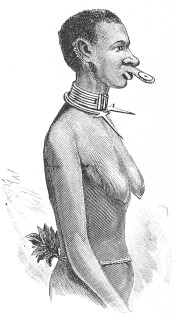
A BELLE OF BAVIRA.
During the following days we had rest and quiet. Contributions of cattle, sheep, goats, fowls and provisions were supplied daily with great regularity, but on the 5th of February a note came from Jephson, stating that he had arrived on the Lake shore, and a detachment of Zanzibaris was at once sent to escort him to the plateau, the distance being about thirteen miles.
The next day Mr. Jephson himself arrived, and after dinner, in conversing about the Pasha, he summed up, after nine months’ residence with him, all he had learned, in the following words:—
“Sentiment is the Pasha’s worst enemy. No one keeps Emin Pasha back but Emin Pasha himself.” He further said, “I know no more about Emin Pasha’s intentions this minute than you do yourself, and yet we have talked together every day during your absence.” I then asked him to write me a full report of what had taken place, bearing upon the revolt of the troops of Equatoria, and his views respecting the invasion of the Province by the Mahdists, and its results. Mr. Jephson readily complied, and wrote the following:—
Kavalli’s Village, Albert Nyanza,
February 7th, 1889.
Dear Sir,
I have the honour to submit to you the following report of my stay, from May 24th, 1888, up to the present time, with his Excellency Emin Pacha, Mudir of the Equatorial Province.
According to your orders I visited nearly all the stations in the Province, and read the letters from His Highness the Khedive and from His Excellency Nubar Pasha, before all the officers, soldiers, and Egyptian employés in each station and also your own address to the soldiers. After having read, I spoke to the people, and after giving them sufficient time to talk it over amongst themselves, invited them to give me their decision as to whether they elected to accept our safe-conduct to Egypt, or remain in this country.
In every station, with the exception of Laboré, their unanimous answer was “We will follow our mudir wherever he goes.” They all seemed glad that we had come to help them, and said many things indicating their good opinion of their mudir, and spoke in the highest terms of his justice and kindness to them, and of his devotion to them all these years. During the whole of my stay in his country the Pasha has left me perfect liberty to mix with his officers and people, and I was free to converse with them as I pleased.
On reaching Kirri, which is the last station occupied by the soldiers of the 2nd Battalion, we stayed before going further, to hear news from Rejaf. The country to the north and west of Kirri is occupied by the soldiers of the 1st Battalion, who have been in open rebellion against the Pasha’s authority for nearly four years. Here the Pasha received a letter from Hamid Aga, the major of the 1st Battalion, begging him not to come on to Rejaf, as the rebels had formed a plan to seize us and take us down to Khartoum, as they believed Government still existed there, and that the news that it had fallen was false. We were therefore obliged to return without visiting the more northern stations.
On our return, whilst reading the letters before the people at Laboré, a soldier stepped out of the ranks and exclaimed, “All that you are saying is a lie, and these letters are forgeries. Khartoum has not fallen. That is the right road to Egypt. We will go by that road only, or will stay and die in this country.”
On the Pasha’s ordering him to be put in prison, the soldiers broke from their ranks and surrounded us, and having loaded their rifles presented them at us. They were generally excited and the utmost uproar prevailed, and for some minutes we expected a general massacre of ourselves and the small number of people with us. However, they gradually cooled down, and asked me afterwards to come and speak with them alone, which I did, and they expressed great regret at what had happened. We have since heard that Surur Aga, the Chief of the Station, had instigated them to act in this way.
A few days afterwards, on our return to Dufflé, August 18th, we found a mutiny had broken out, headed by Fadl el Mulla Aga, the Chief of Fabbo Station, and that the station was in the hands of the mutineers—on our entry we were at once made prisoners. It appears that during our absence certain Egyptians, chief amongst them Abdul Wahab Effendi and Mustapha Effendi el Adjemi, both of whom were sent up here for being concerned in Arabi’s rebellion, together with the clerks Mustapha Effendi Achmet, Achmet Effendi Mahmoud, Sabri Effendi, Tybe Effendi, and several others had in our absence been speaking to the people and circulating letters amongst them, saying it was untrue that Khartoum had fallen, that the letters we had brought from His Highness the Khedive and his Excellency Nubar Pasha were forgeries, that you were only an adventurer and had not come from Egypt, but that you had formed a plot with the Pasha to take all the people out of the country and to hand them over, together with their wives and children, as slaves to the English. They added, in Egypt they had rebelled against His Highness the Khedive himself, so that it was no great matter to rebel against Emin Pasha.
These words raised a storm in the country, and though the soldiers themselves took no active part in the mutiny beyond acting as sentries over us, they allowed their officers to do as they pleased. The head mutineers Fadl el Mulla Aga, Achmet Aga Dinkawi, and Abdul Aga el Opt had them marched to Dufflé and joined the rebellious Egyptians who had invited him to act as their chief. They sent letters to all the stations, telling the officers they had put the mudir and myself in prison, as we had conspired to betray them, and ordered them to come up to Dufflé and attend a meeting, when they would decide what further steps should be taken—they also invited the rebellious officers of the 1st Battalion to act with them.
I was brought up before the mutineers and questioned about the Expedition, and the letter from His Highness was examined and declared by the clerks to be a forgery. The mutineers then proposed to depose the Pasha, and all those who were averse to such a measure were by intimidation at last forced to give in. A letter was handed to him informing him of his deposition, and it was decided that he should be kept a prisoner at Rejaf. I was declared to be free, but to all intents and purposes I was a prisoner, as I was not allowed to leave the station, and all my movements were closely watched. A plan was also formed to entice you into the country, and to rob you of all your guns, ammunition, stores, etc., and then to turn you adrift.
The mutineers then proceeded to form a new Government, and all those officers who were suspected of being friendly to the Pasha were removed from their posts. Soon, however, jealousy and dissensions began to arise amongst them, and after the Pasha’s house and the houses of two or three people supposed to be friendly to him had been looted, things came pretty much to a standstill.
Whilst things were in this state, we suddenly heard, on October 15th, that the Mahdi’s people had arrived in three steamers, and nine sandals and nuggars, at Lado; and on the 17th three dervishes, under a flag of truce, brought a letter from Omar Sale, the commander of the Mahdi’s forces, addressed to the Pasha, promising him a free pardon should he and his people surrender. The letter was opened by the mutineers who decided to fight. On October 21st we heard that the Mahdi’s people, who had been joined by many negroes of the Bari tribe, had attacked and taken Rejaf, and three officers, two clerks, and a great many men had been killed, and all the women and children in the station had been captured. This created a panic, and the officers and soldiers, together with their women and children, abandoned the stations of Bidden, Kirri, and Muggi, and fled in disorder to Laboré; at Kirri they even left the ammunition behind them.
The mutineers on hearing of this disaster determined to send down large reinforcements to Muggi, and soldiers were sent down from all the southern stations to collect there. On October 31st we heard that there were great dissensions amongst the officers at Muggi, and the soldiers had declared they would not fight unless their mudir was set at liberty. On November 15th we heard that the soldiers had marched down to Rejaf, but that on their approaching the station the Mahdi’s people had sallied out and attacked them with a rush; the soldiers made no attempt to fight, but turned at once and fled, leaving their officers behind them. Six officers, and the newly-made Governor of the Province, and some of the worst of the rebels were killed, two more officers were missing, and many soldiers were killed as they fell down exhausted in the flight.
Upon hearing the news, the officers who were friendly to the Pasha, at once pressed the rebel officers to set him at liberty; and they being afraid of the people, set him free and sent us to Wadelai, where the Pasha was most enthusiastically received by the faithful part of the population there—he had been a close prisoner just three months. At last the people believed that Khartoum had fallen and that we had come from Egypt.
After remaining some days at Wadelai and hearing no news from Dufflé, people became very uneasy, and messengers were sent down to Dufflé, on the east bank of the river, to carry letters and to ascertain the reason of the long silence, as we had heard that a large body of the Mahdi’s people were advancing from the west on Wadelai and were only four days distant.
On December 4th, an officer in command of Bora, a small station between Wadelai and Dufflé, came in with his soldiers in great haste, saying they had abandoned their post at Dufflé, Fabbo and all the northern station had fallen, and that the steamers also had been captured and were in the hands of the Mahdi’s people, the natives round the stations had all risen and joined the enemy and had killed our messengers. On hearing this news a council was held, and the officers and soldiers at once decided to abandon and retire to Tunguru, from which place they would ascend the mountains and try to join you at Fort Bodo. I was desired at the council to destroy our boat the Advance, to prevent her falling into the hands of the Mahdi, and, as there was no prospect of saving her, I was reluctantly obliged to do so. On the next day, December 5th, we had all ready for an early start, taking with us only a few bundles of the most necessary things and abandoning everything else. All the ammunition in the storehouses was divided among the soldiers, who at the last moment declared, as they now had plenty of ammunition, they preferred to retire to their own countries—Makraka and the countries round—where they would disperse and live amongst their own people, and that they would desert the Pasha and their officers.
Things, however, seemed desperate, and we hurried on without them—a long, straggling procession, consisting chiefly of Egyptian employés with their wives and families; we were accompanied only by some seven or eight soldiers who remained faithful. Some of our servants were armed with percussion-guns, and we may have mustered some thirty guns amongst us. Immediately on our quitting the station the soldiers entered the houses and looted them.
On December 6th a steamer was seen coming up the river after us, and our people prepared to fire on her; but it turned out that there were some of our own people from Dufflé on board with letters from the Pasha. The letters contained the news that Fabbo had been evacuated, and that the refugees had been able to reach Dufflé in spite of the negroes who had attacked them. Dufflé had been besieged by the Mahdi’s people for four days, and the station itself had been taken and held for some time by a small body of the enemy, who had entered it at night and they had also captured the steamers. They had driven the soldiers, of whom there were some 500, actually out of the station; but they, finding themselves between two fires, had with the energy of despair responded to the entreaties of their officers. Selim Aga Mator, Bellal Aga, Bachil Aga, Burgont, and Suleiman Aga, had re-entered the station and retaken it, and after making a sally, had so punished the enemy that they retired to Rejaf and sent down two steamers to Khartoum for reinforcements.
From all accounts we have since heard the soldiers acted with great cowardice, except at last when they were rendered desperate. In this affray at Dufflé, fourteen officers and a large number of soldiers were killed, and Suleiman Aga was shot by his own men, and has since died. The losses of the enemy were estimated at 250, but probably a third of that number would be nearer the mark, even though the Mahdi’s people fought almost entirely with spears and swords, and the soldiers were armed with Remingtons, and fought behind a ditch and earthworks, but they are such bad shots that their shooting had not much effect.
The officers and soldiers at Wadelai were anxious for the Pasha to return, but after the faithless example the soldiers had shown, when he believed things to be desperate, he preferred to proceed to Tunguru. After this retreat from Wadelai, lasting only two days, I am better able to understand what a difficult and almost impossible task getting the people to Zanzibar will be, should they elect to go with us.
After this retreat from Wadelai, the party against the Pasha, which is again in the ascendant, now that the immediate fear of the Mahdi’s people is removed, have accused him of having invented the whole story of the fall of Dufflé, in order to cut off their retreat and hand them over to the Mahdi, whilst he and the people with him escaped from the country and joined you. They sentenced the Pasha, Casati and myself to death for treachery.
During the Council held eventually at Wadelai by all the officers and soldiers, there was a great amount of quarrelling and discussion, some wishing to stay in the country, and some wishing to follow the Pasha, words ran high, and the contending parties even came to blows. Fadl el Mulla Aga and his party wished to take the Pasha and myself prisoners, and the other party, headed by Selim Aga Mator, wished to join the Pasha and leave the country with him; but though they profess to wish to leave the country, they make no effort whatever to get things ready for the start. If you intend to take them with you, you will have to wait many months before they are ready. Meanwhile the Pasha, Signor Casati and I were waiting at Tunguru, the mutineers having given strict injunctions to the chief of the station to detain us there until further orders.
On January the 26th the Pasha and I got letters from you, dated January 17th and 18th, and obeying the strict order you give me in your letters to start for Kavalli’s immediately on receipt of them, I got ready to start the next day, bringing with me the Pasha’s answer to your letter. Owing to the treachery of some of the Pasha’s people, I was delayed two days in the earlier stage of my journey; but thanks to Shukri Agha, the Chief of Mswa Station, who has remained faithful to the Pasha, and of whose conduct throughout the whole of the last unfortunate five months I cannot speak too highly, I was enabled to induce the natives to bring me in a canoe to Nyamsassi, but as the Lake is so rough and dangerous at this time of the year, it has taken me five days from Mswa to Nyamsassi.
It is impossible to give you any true idea of the state of the country at the present. Sometimes the mutineers are in the ascendant, and sometimes the party for the Pasha. One steamer full of reinforcements for the Mahdi’s people has already arrived at Rejaf, and two more steamers full are shortly expected, reinforcements will also probably soon come in from Bahr el Ghazal, when the Mahdi’s people, turning to revenge their defeat at Dufflé, will most certainly descend on Wadelai with an overpowering force, and will surprise the people in the midst of their quarrels and uncertainty. Tunguru is but two days distant from Wadelai, and the Pasha’s position there, surrounded by people in whom he can place no trust, is dangerous in the extreme, and it is of the utmost importance that he should be relieved with as little delay as possible.
In your letter to me dated January 17th and 18th, you speak rather bitterly of the Pasha and myself having failed to carry out our promises of building a station at Nsabé, garrisoning it and storing it with provisions ready for you on your return to the Nyanza, of having failed to relieve Fort Bodo, and to carry the loads and garrison to the station at Nsabé, and of not having such people as wished to avail themselves of our escort ready at Nsabé, to start with you on your return. The reason we were unable to do so was as follows:—After being away from his country for nearly a month with you at Nsabé, the Pasha had naturally much business to attend to on his return to Wadelai, the seat of Government, and I myself was for nearly a month constantly prostrated by fever, and we were not able to start from Wadelai to visit the northern stations till July.[5]
Having done our work to the north, we were returning with the intention of carrying out our promises to you, when on August 18th, we were taken prisoners, and all authority was taken out of the Pasha’s hands, and we were rendered absolutely powerless to fulfil those promises. We had tried before leaving Wadelai, to start a party to Nsabé to build a station, but the soldiers had refused to obey the order, until they had heard what their brethren in the Northern stations had decided to do. It is very lucky that a station was not built, and the goods and garrison of Fort Bodo removed there, for the rebels would most certainly have seized all our goods, and made the Europeans in charge prisoners.
And this leads me now to say a few words concerning the position of affairs in this country when I entered it on 21st April, 1888. The first battalion had long been in open rebellion against the Pasha’s authority, and had twice attempted to make him prisoner; the second battalion, though professedly loyal, was insubordinate and almost unmanageable, the Pasha possessed only a semblance, a mere rag of authority—and if he required anything of importance to be done he could no longer order, he was obliged to beg his officers to do it.
Now when we were at Nsabé in May ’88, though the Pasha hinted that things were a little difficult in this country, he never revealed to us the true state of things, which was actually desperate; and we had not the slightest idea that any mutiny or discontent was likely to arise amongst his people. We thought—as we and most people in Europe and Egypt had been taught to believe, by the Pasha’s own letters and Dr. Junker’s later information—that all these difficulties arose from events outside his country, whereas in point of fact, his real danger arose from internal dissensions. Thus we were led to place our trust in people who were utterly unworthy of our confidence and help, and who instead of being grateful to us for wishing to help them, have from the very first conspired to plunder the Expedition, and turn us adrift; and had the mutineers in their highly excited state been able to prove one single case of injustice, cruelty or neglect of his people against the Pasha, he would most assuredly have lost his life in this rebellion.
There are of course some people who have remained faithful to the Pasha, and many who have remained neutral, and these chiefly are the people who are willing to come out with us. There are also a great number of Egyptian clerks, many of whom have behaved very badly, but the coming of the Mahdi’s people has so frightened them that they too now wish to come out with us; but in spite of my constant advice to them to move forward, they seem incapable of making any effort to leave the country and concentrate at Nsabé, at which place they would be within our reach—there is absolutely nothing to prevent their doing so, but their own laziness.
The greater part of the people, a large number of Egyptians and most of the Soudanese, are decidedly averse to going to Egypt, and do not wish to leave the country. Most of them have never been to Egypt, but have been recruited from the countries round here. Here they can support a large household, many of the officers have as many as from eighteen to one hundred people, women, children and servants, in their houses, and it is the great ambition of every Soudanese to have as many people as possible in his house, but in Egypt they could only afford to support three or four people on their pay. These things being considered, it is quite natural that they should prefer to remain in their own country.
As to the Pasha’s wish to leave the country, I can say decidedly he is most anxious to go out with us, but under what condition he will consent to come out I can hardly understand. I do not think he quite knows himself, his ideas seem to me to vary so much on the subject; to-day he is ready to start up and go, to-morrow some new idea holds him back. I have had many conversations with him about it, but have never been able to get his unchanging opinion on the subject. After this rebellion I remarked to him, “I presume now that your people have deposed you and put you aside, you do not consider that you have any longer any responsibility or obligation concerning them,” and he answered, “Had they not deposed me I should have felt bound to stand by them and help them in any way I could, but now, I consider I am absolutely free to think only of my personal safety and welfare, and if I get the chance, I shall go out regardless of everything;” and yet only a few days before I left him, he said to me, “I know I am not in any way responsible for these people, but I cannot bear to go out myself first and leave anyone behind me who is desirous of quitting the country. It is mere sentiment I know, and perhaps a sentiment you will not sympathize with, but my enemies at Wadelai would point at me and say to the people, ‘You see he has deserted you.’” These are merely two examples of what passed between us on the subject of his going out with us, but I could quote numbers of things he said, all equally contradictory. Again, too, being somewhat impatient after one of these unsatisfactory conversations, I said, “If even the Expedition does reach any place near you, I shall advise Mr. Stanley to arrest you and carry you off, whether you will or no;” to which he replied, “Well, I shall do nothing to prevent his doing that.” It seems to me, if we are to save him, we must first save him from himself.
Before closing this report, I must bear witness to the fact that in my frequent conversations with all sorts and conditions of the Pasha’s people, most of them spoke of his justice and generosity to them, but they also said, and what I have seen confirms it, that he did not hold his people with a sufficiently firm hand.
The three Soudanese soldiers you left with me as orderlies and my servant Binza return with me, but Mabruki Kassim, the man who was wounded by the buffalo at Nsabé, died two days after you left for Fort Bodo.
I am, dear Sir,
Your obedient servant,
(Signed) A. J. Mounteney Jephson.
To H. M. Stanley, Esq.,
Commanding the Relief Expedition.
Mr. Jephson also handed me an official receipt to my formal letter of January 18th, written by Emin Pasha.
[4] I have read this letter scores of times, yet I fail to see how this officially worded letter, which, as suggested by Mr. Jephson, might have fallen into the rebel officers’ hands, could have wounded the most delicate susceptibilities, yet I was informed that the Pasha was very much offended at it. Nothing was further from my mind than to affront a friend, my sole object being to obtain a definite answer to the question “Will you stay here, or accompany me?”
[5] Omar al Khattab, the second Caliph from Mohammed, said, “Four things come not back; the spoken word; the sped arrow; the past life; and the neglected opportunity.” I accept Mr. Jephson’s explanations, but I nevertheless adhere to the belief that much suffering and anxiety would have been avoided, and the imprisonment and danger would have been impossible, had the promises been kept. July was the date they should have started for Fort Bodo. The arrest took place August 18th.
Tunguru,
January 27th, 1889.
To H. M. Stanley, Esq.,
Commanding the Relief Expedition.
Sir,
I have the honour to acknowledge receipt of your note of January 14th, Camp Undussuma, and of your official letter of January 17th, which came to hand yesterday afternoon. I beg at the same time to be allowed to express my sincere congratulations to you and to your party for the work you performed.
I take note of your offer to deliver to me, or any person appointed by me, the second instalment of goods brought by you, consisting of sixty-three cases of Remington cartridges, twenty-six cases of gunpowder, each 45 lbs. weight, four cases percussion caps, four bales of goods, one bale of goods for Signor Casati—a gift from yourself; two pieces of serge, writing-paper, envelopes, blank-books, &c. As soon as the officers I am awaiting from Wadelai come here, I shall appoint one of them to take charge of these goods, and I shall at the same time instruct him to give you formal receipt for them.
The thirty-one cases of Remington cartridges, which formed the first instalment of goods, have been duly deposited in Government stores.
Concerning your question if Signor Casati and myself propose to accept your escort and assistance to reach Zanzibar, and if there are any officers and men disposed to accept of your safe-conduct to the sea, I have to state that not only Signor Casati and myself would gladly avail us of your help, but that there are lots of people desirous of going out from the far Egypt, as well as for any other convenient place. As these people have been delayed by the deplorable events which have happened during your absence, and as only from a few days they begin to come in, I should entreat you to kindly assist them. I propose to send them to Nyamsassi, and a first party start to-day with Mr. Jephson. Every one of them has provisions enough to last at least for a month.
I beg to tender my thanks for the statement of your movements. As from the day you fixed your movements until the arrival of your letter elapsed nine days; the remainder of the time you kindly gave us, viz., eleven days, will scarcely be sufficient. I cannot, therefore, but thank you for your good intentions, and those of the people who sent you, and I must leave it to you if you can await us, and prefer to start after the twenty days have elapsed.
I fully understand the difficulties of getting food and provisions for your people, and I am very sorry that the short time you have to give me will not be sufficient to send you stores from here.
As Mr. Jephson starts by this steamer, and has kindly promised to hand you this note, I avail myself of the occasion to bear witness to the great help and assistance his presence afforded to me. Under the most trying circumstances he has shown so splendid courage, such unfaltering kindness and patience, that I cannot but wish him every success in life, and thank him for all his forbearance. As probably I shall not see you any more,[6] you will be pleased to inform his relations of my thanks to him and them.
Before concluding, I beg to be permitted to tender anew my most heartfelt thanks to you and to your officers and men, and to ask you to transmit my everlasting gratitude to the kind people who sent you to help us. May God protect you and your party, and give you a happy and speedy homeward march.
I am, Sir,
Your obedient servant,
(Signed) Dr. Emin Pasha.
CHAPTER XXV.
EMIN PASHA AND HIS OFFICERS REACH OUR CAMP AT KAVALLI.
Lieut. Stairs and his caravan are sent for—Plans regarding the release of Emin from Tunguru—Conversations with Jephson by which I acquire a pretty correct idea of the state of affairs—The rebel officers at Wadelai—They release Emin, and proceed in the s.s. Khedive and Nyanza to our camp at Kavalli—Emin Pasha’s arrival—Stairs and his caravan arrive at Mazamboni’s—Characteristic letter from Jephson, who is sent to bring Emin and his officers from the Lake to Kavalli—Short note from the Pasha—Arrival of Emin Pasha’s caravan—We make a grand display outside our camp—At the grand divan: Selim Bey—Stairs’ column rolls into camp with piles of wealth—Mr. Bonny despatched to the Nyanza to bring up baggage—Text of my message to the rest of the revolted officers at Wadelai—Note from Mr. Bonny—The Greek merchant, Signor Marco, arrives—Suicide of Zanzibari named Mrima—Neighbouring chiefs supply us with carriers—Captain Nelson brings in Emin’s baggage—Arrangements with the chiefs from the Ituri River to the Nyanza—The chief Kabba-Rega—Emin Pasha’s daughter—Selim Bey receives a letter from Fadl-el-Mulla—The Pasha appointed naturalist and meteorologist to the Expedition—The Pasha a Materialist—Dr. Hassan’s arrival—My inspection over the camp—Capt. Casati arrives—Mr. Bonny appears with Awash Effendi and his baggage—The rarest doctor in the world—Discovery of some chimpanzees—The Pasha in his vocation of “collecting”—Measurements of the dwarfs—Why I differ with Emin in the judgment of his men—Various journeys from the camp to the Lake for men and baggage—The Zanzibaris’ complaints—The ringleaders—Hassan Bakari—The Egyptian officers—Interview with Shukri Agha—The flora on the Baregga Hills—The chief of Usiri joins our confederacy—Conversation with Emin regarding Selim Bey and Shukri Agha—Address by me to Stairs, Nelson, Jephson and Parke before Emin Pasha—Their replies—Notices to Selim Bey and Shukri Agha.
1889.
Feb. 7.
Kavalli’s.
On February 7th I decided to send for Lieutenant Stairs and his caravan, and despatched Rashid with thirty-five men to obtain a hundred carriers from Mazamboni to assist the convalescents. My object was to collect the expedition at Kavalli, and send letters in the meantime to Emin Pasha proposing that he should: 1st. Seize a steamer and embark such people as chose to leave Tunguru, and sail for our Lake shore camp. After which we could man her with Zanzibaris, and perform with despatch any further transport service necessary. If this was not practicable, then—
2nd. To march to Mswa station overland, and on arrival to report by canoe that he had done so. If this was not possible.
3rd. Stay at Tunguru, and let me know by Chief Mogo whether he needed a force of rescue.
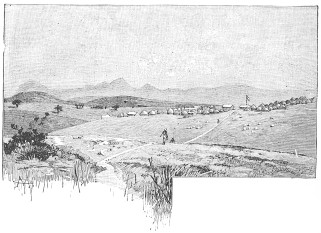
VIEW OF CAMP AT KAVALLI.
In which case, on arrival of Lieutenant Stairs, I proposed to march with 300 rifles and 2,000 native auxiliaries through Melindwa to Mswa station, and thence to Tunguru, to employ force for the relief of the Pasha. But it was absolutely necessary that I should be clearly told what the Pasha wished. In his letter of the 27th January there was a disposition to be somewhat lachrymose and melancholic, quite contrary to what was expected in answer to the definite question given in the formal letter of January 17th, “Was he disposed to accept our escort and assistance to reach Zanzibar, or suggest to me any way by which I could make myself useful or lend effective aid.” If he stated his wish decisively then, then I promised “to strain every effort to perform service to him.”
Perceiving that neither my letter to Mr. Jephson—which was intended to be read to the Pasha—nor that my formal letter to himself was understood by him, I proceeded to write one after a purely business style, which I thought the dullest private in his army might understand, but when Jephson heard it read he affected to be aghast at it.
As there was no intention to wound the most super-sensitive susceptibilities of any person—least of all the Pasha—I wrote one after a style which probably Chesterfield himself would have admitted was the proper thing, which my friend Jephson pronounced was “charming,” and “nice,” and “exquisitely sweet,” and on the 8th sent the couriers down to the Lake with it.
Day by day, during conversation with Mr. Jephson—who was, “by the bye,” a pronounced Eminist—I acquired a pretty correct idea of the state of affairs. There was one confirmed habit I observed that Mr. Jephson had contracted during his compulsory residence with the Pasha which provoked a smile, and that was, while saying several crushing things about the Province, he interlarded his clever remarks with—“Well, you know, the poor, dear Pasha! He is a dear old fellow, you know. ‘Pon my word, I can’t help but sympathise with the Pasha, he’s such a dear good man,” &c., &c. They served to illuminate traits of character, and showed that, at all events, Jephson had a kindly heart, and what he had seen and heard only made him esteem the Pasha the more; but when he spoke of the Egyptians, the most portentous vocabulary was requisitioned to load them with abuse—“unmitigated scoundrels, depraved villains, treacherous dogs, unscrupulously vile,” &c., &c. The Egyptians were “animals with foxy natures,” the Soudanese were “brutishly stupid.” One chief clerk had falsified accounts at the Khartoum Arsenal, and had been the recipient of 1,500 stripes with the kourbash; another had been detected making huge profits by mixing powdered charcoal with the gunpowder, and filling Remington cartridges with it. A major had been convicted of trading in Government stores; others had been sent to the Siberia of the Equator as convicts, guilty of various felonies, arson, murder, &c.; others were transported thither for being concerned in Arabi’s rebellion, &c., &c.; and it became clear that whatever sanguine hopes the Pasha had cherished, he must often have distrusted his powers during his constrained intercourse with the penal outcasts placed under him. While there was a reserve of dominating power, and an overshadowing personality of stern justice in the figure of Gordon at Khartoum, the penal serfs were under some control, though Gessi Pasha, even as far back as 1879, was copious in complaints of Emin to Gordon, but when the news spread throughout the Province that Khartoum was taken, and the Governor-General slain, and all traces of Egyptian Government had vanished, the native unruliness of the Egyptians, and brutish stubbornness of the Soudanese found vent, and was manifested in utter disregard to orders, and perverse misconduct. Emin was now a Pasha in name and title only. Government was petrified, order was dead. Some men, in Emin’s place, would have become so disgusted, that after arming themselves with excuses for retreat by overt proofs of contempt of his authority, would have collected a few faithful men, or have retired to some small post like Mswa station at the remote South, reported frankly the events, and have applied for relief and instructions. Others, again, would have exacted performance of duty and discipline to the very end, regardless of consequences. Others, again, would have removed with such as were willing from the arena of perpetual discord, founded an empire or a kingdom, and have applied for assistance from the civilized world, which they would certainly have obtained. Others, like Emin did, would have temporised and hoped. Men, however, reap only what they have sown; as the seed is sown, so will be the harvest.
But while we were discussing the probable decision of the Pasha, and awaiting the arrival of Stairs’s column, events unknown to us were occurring, which decided the matter for us as well as for Emin.
The rebel officers, who were concentrated at Wadelai, while Jephson was on his way to us South of Tunguru, heard of our arrival on the Lake. Report had magnified our forces. We had several hundred Zanzibaris and allies, and we were armed with machine guns and repeating rifles. The Egyptian Government at Khartoum was dead, and in its place was a Khalif, with resistless armies fully established. There were Mahdist agents and traitors among them, the rest were indifferent. Emin was deposed, and a prisoner. To him who hath shall be given. Like a rolling snowball, power, when once established, attracts and grows; an isolated snowdrop melts. Emin was the snowdrop, the Khalif of Khartoum was the growing snowball.
It is easy, therefore, to understand the motives of the officers, who are declared rebels, who have traitors and Mahdists among them to influence their councils, and to predict what the natural outcome will be. They will curry favour with the Khalif by betraying their would-be rescuers and their former Pasha and his white companions into his hands, and win honour and glory by so doing. For the machine guns, repeating rifles and Remingtons, and a batch of white prisoners, the Khalif would reward them handsomely, and promote those chiefly concerned in their delivery to him to honourable and lucrative offices, and endow them with robes of honour. But there is a difficulty. How will they gain access to the camp of their rescuers when they have heard of the Pasha being imprisoned and their friend Jephson having been treated so cruelly? “Nothing easier,” says one; “let us send a deputation to the Pasha to humbly ask forgiveness, and promise to reinstate him in power, and Emin is so good-natured that he will readily condone our offences, and offer to introduce us to his friends as penitents, who, wearied with trouble, only now seek to prove their obedience and loyalty to their great Government. Once in the stranger’s camp, we may see for ourselves what further can be done, and if we then agree to capture the gang of whites and their followers, nothing will be easier, for all white men are soft-headed duffers. At any rate, it is wise to have two ways from which to choose. If the Khalif is relentless, and his Donagla pursue us with that fierceness so characteristic of them, and the door to his mercy is closed, we can fall back upon the camp of the white men, and by apparent obedience disarm all suspicion, make use of them to find us a land of plenty, and suddenly possess ourselves of their arms and ammunition, and either send them adrift as beggars, or slay the whites and make their followers our slaves.”
We can imagine the thunders of applause that greeted this Egyptian son of Beelzebub as he ended his oration. But whether such a speech was made or not, the officers despatched a deputation to the Pasha, of fourteen officers. They kissed Emin’s hands, they expressed humble contrition for their offences, they offered to reinstate him in power as Governor, and they implored him to accompany them to Stanley’s Camp at Kavalli, and to speak for them, and the Pasha gladly acceded to their request. He embarked on board the steamer Khedive; refugees crowded on board with their goods and baggage, and Captain Casati was with them with his following, and the Nyanza likewise was freighted, and with every show of honour the Pasha was brought to Mswa. At this station he met my messengers with my last letter, and having read it, he resumed his voyage to our Lake shore Camp.
While Jephson and I were at dinner on the evening of February 13th, messengers came to us and delivered to us a letter from Emin Pasha.
Camp,
February 13th, 1889.
To Henry M. Stanley, Esq., Commanding the Relief Expedition.
Sir,—
In answer to your letter of the 7th instant, for which I beg to tender my best thanks, I have the honour to inform you that yesterday, at 3 P.M., I arrived here with my two steamers, carrying a first lot of people desirous to leave this country under your escort. As soon as I have arranged for cover of my people, the steamships have to start for Mswa station, to bring on another lot of people awaiting transport.
With me there are some twelve officers anxious to see you, and only forty soldiers. They have come under my orders to request you to give them some time to bring their brothers—at least, such as are willing to leave—from Wadelai, and I promised them to do my best to assist them. Things having to some extent now changed, you will be able to make them undergo whatever conditions you see fit to impose upon them. To arrange these I shall start from here with the officers for your camp, after having provided for the camp, and if you send carriers I could avail me of some of them.
I hope sincerely that the great difficulties you have had to undergo, and the great sacrifices made by your Expedition in its way to assist us, may be rewarded by a full success in bringing out my people. The wave of insanity which overran the country has subsided, and of such people as are now coming with me we may be sure.
Signor Casati requests me to give his best thanks for your kind remembrance of him.
Permit me to express to you once more my cordial thanks for whatever you have done for us until now, and believe me to be,
Yours very faithfully,
Dr. Emin.
The Pasha evidently believes that his men are still faithful to him. He says: “You will be able to make them undergo whatever conditions you see fit to impose upon them....” “Of such people as are now coming with me you may be sure.”
I hope so, but if one-half of what Jephson says is true, the Pasha must have greater confidence in them than I can command. However, if the “wave of insanity has subsided,” so much the better. All is well that ends well. Jephson will go down to the Lake to-morrow with fifty rifles, to escort the Pasha and his officers to the Plateau. I shall send couriers also to Stairs at Mazamboni’s to bring up his force quickly, that we may be all at hand to impress our rebel friends by the way our wild fantastic warrior-carriers deploy at the word of command.
February 16th.—Received note from Stairs announcing arrival at Mazamboni’s, which states he may arrive on the 17th or 18th instant. He writes: “We were all delighted at the Ituri River Camp at the arrival of your couriers with Chief Rashid, bringing the news that Jephson was with you; but the news about Emin Pasha seemed very black. However, your letter this morning dispels every foreboding, and now we all hope we shall be able to move on with speed towards Zanzibar.”
Goodness, how impatient young men are! I wonder if we shall get away within three months!
Another courier has arrived from Jephson with one of Jephson’s characteristic letters.
Weré Camp, Albert Nyanza, February 15th, 1889.
Dear Sir,—
I reached this camp yesterday, but owing to the natives leading us by a very long road we did not arrive till morning.
We found the Pasha, Casati, Marco, Vita, the apothecary, and several officers and clerks, who had made their camp in a very nice spot about two miles north of our old camp, where we first met the Pasha.
On arriving, after having delivered your letter, and having told and heard the news, I asked the Pasha when he proposed moving. He said he must speak to his officers first. This morning a meeting was called, and it was decided that we should start to-morrow for Kavalli’s, taking two days on the road.
The Pasha will come to see you, will perhaps stay a few days in your camp, and then return and bring up his daughter and the rest of his loads, which amount to about 200, which consist of millet, salt, sesame, &c. The officers will only bring twenty loads, as they are merely coming up to talk with you for bringing up their troops and goods. The clerks bring up all their loads and remain with us.
Both the steamers return to Mswa on the 18th, to bring up the rest of the people and goods from that station, as well as to bring up corn for the supply of the Lake camp.
On the arrival of the steamers at Mswa, the irregulars (some fifty guns) will march overhead to Kavalli’s with such women as are able to walk well, and the steamers, on their return here, will at once take the officers down to Wadelai.
The Pasha has brought sixty tusks of ivory; the surplus will doubtless be useful. Though there is a day’s delay, I do not regret it, as both the Zanzibaris and myself were fairly worn out when we reached here yesterday, and had we started to-day there would, I fear, have been many sore feet. In spite, however, of our fatigue, the Zanzibaris rushed madly into the camp, howling like demons. They went through the usual mad exercises with imaginary enemies, and then drew up in line before the Pasha. The soldiers drew up in correct form and saluted him also. He was very pleased, and asked me to say a few words to them, expressing his thanks to them for all the trials they have gone through to help him, which I did, as well as I was able, in my broken Ki-swa-hili. The Pasha set all the women to grind corn, and I served out two cups apiece to them, the Soudanese, Manyuema, and natives. To-day Saat Tato, the hunter, and another, have brought in two kudu, and a springbok, so that they have plenty to eat. I was much amused to see how the slothful ugly Soudanese stared at the mad antics of the Zanzibaris, with the sort of expression that said, What sort of people can these boisterous, unruly Zanzibaris be?
I find Casati more impossible than ever. I asked him whether he would go with us to-morrow, and he replied he would rather wait. I then asked, “How many loads have you?”
“Oh,” he answered, “you know I have very few things. All my things were taken by Kabba-Rega; perhaps I may want eighty carriers.”
Vita, the apothecary, wants forty carriers, and Marco, the Greek trader, wants sixty, so at this rate our Zanzibaris will be killed between here and Kavalli’s. The Pasha remonstrated with Casati for taking all his grinding-stones, earthen jars, bedsteads for his boys and women, &c., upon which he said:—
“Mr. Stanley has offered to take all our loads.”
These people have no conscience, and would rather load down our long-suffering people than throw away a single load of rubbish which they will eventually be obliged to discard.
Casati, so the Pasha tells me, was averse to their leaving Tunguru, in spite of Shukri Aga’s offer of carriers, and my urgent letter, and did all he could to prevent his coming down here, as he considered it “impolitic.” One internally fumes at the selfishness of these people, and at their inability or aversion from seeing things as they really are.
The rumour of the “white man’s” expedition to Fallibeg has turned out to be, as Clerk Jopson says, “all a bam,” and nothing more has been heard of it.
Casati refuses to move until he has sufficient carriers to take him and all his goods away together. The Pasha is very irritated about it.
The boat (Advance) has been very well mended with bolts just like our own. I am going on board the steamer this evening to get some spanners, and, if possible, some spare bolts. The Pasha has also brought the light oars, which belonged to Gordon’s india-rubber boat, so that we have now the full complement.
The Pasha, Casati, and the officers desire me to send you their greetings.
I am, &c., &c., &c.,
A. J. Mounteney Jephson.
The Pasha, 200 loads! Casati, who has lost everything, eighty loads! Vita, the apothecary, forty loads! Marco, the Greek, sixty loads! = 380 loads for four persons! True, I promised to convey everything up to the Plateau Camp but grinding stones! Well, if I gave such a promise, we must keep it, I suppose. However, there is no harm in Mr. Jephson fuming a little.
From the Pasha the following note was received:—
Dear Sir,—
Mr. Jephson with your people have arrived yesterday, and we propose to start to-morrow morning; I shall therefore have the pleasure to see you the day after to-morrow. My men are very anxious to hear from your own lips that their foolish behaviour in the past will not prevent you from guiding them.
I am greatly obliged for your kindly letter,[7] handed to me by Mr. Jephson, and I hope that my being somewhat African in my moods may not interfere with our friendly relations.
Agree, dear Sir, my best wishes, and believe me to be,
Yours very faithfully,
Dr. Emin.
February 17th.—Emin Pasha’s caravan, consisting of about sixty-five persons, reached this camp about noon. The officers, who are a deputation from the revolted troops at Wadelai, are headed by Selim Bey—promoted to Bey by the Pasha. He is six feet high, large of girth, about fifty years old, black as coal: I am rather inclined to like him. The malignant and deadly conspirator is always lean. I read in this man’s face, indolence, a tendency to pet his animalism. He is a man to be led, not to conspire. Feed him with good things to eat, and plenty to drink, Selim Bey would be faithful. Ah, the sleepy eye of the full-stomached man! This is a man to eat, and sleep, and snore, and play the sluggard in bed, to dawdle slip-shod in the bed-chamber, to call for coffee fifty times a day, and native beer by the gallon; to sip and sip and smile and then to sleep again; and so and so to his grave. The others are lean, of Cassius’ make. Three of them were Egyptians, something of Arabi in their facial mould; the others are black Soudanese.
We made a grand display outside the camp, banners waving, the Zanzibari veterans like a wall of iron on each side of the pathway, the Manyuema auxiliaries with a rough-and-ready look about them, the natives of Kavalli and the neighbourhood in hundreds, banking the formation.
Through the centre of the twin lines the Pasha, small and wiry of figure, like a Professor of Jurisprudence in appearance, despite his fez and white clothes, was escorted to the great square of the camp, and straight to the Barzah.
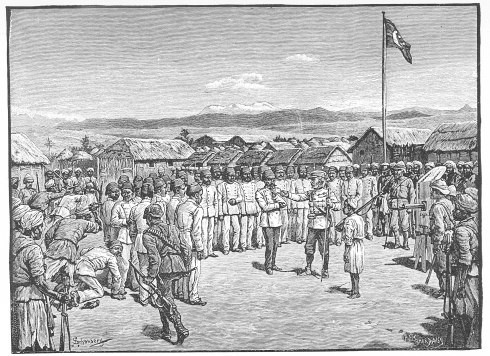
ADDRESS TO REBEL OFFICERS AT KAVALLI.
The officers, in brand new uniforms, rarely aired, evidently created a great sensation. The natives hungrily looked at them, and looked with gaping lips and projected eyes.
At the Barzah house, the Pasha formally introduced these officers. We mutually saluted. We enquired anxiously about each other’s healths, and expressed ourselves mutually gratified that there was no fear of consumption, diabetes, or dysentery troubling us, and that possibly, without fear of these ailments, we might meet on the morrow at a grand divan, whereat each one would be pleased to express his heart’s secret desire.
February 18th.—The grand divan was held to-day. Each person present was arrayed in his best uniform. After an interchange of elegant compliments and coffee had been served, the Pasha was requested to be good enough to enquire of the deputation if they would be pleased to state their errand, or whether they would prefer that I should disclose the object of this gathering from twenty lands near the shores of their Lake.
They expressed through the Pasha, who is admirable as a translator, and who has the art of softening any rigour of speech that a plain Anglo-Saxon might naturally use, that they would be greatly gratified to hear me first.
1889.
Feb. 18.
Kavalli’s.
Well, I said, open your ears that the words of truth may enter. The English people, hearing from your late guest, Dr. Junker, that you were in sore distress here, and sadly in need of ammunition to defend yourselves against the infidels and the followers of the false prophet, have collected money, which they entrusted to me to purchase ammunition, and to convey it to you for your needs. But as I was going through Egypt, the Khedive asked me to say to you, if you so desired you might accompany us, but that if you elected to stay here, you were free to act as you thought best; if you chose the latter, he disclaimed all intention of forcing you in any manner. Therefore you will please consult your own wishes entirely, and speak whatever lies hidden in your hearts.
After the Pasha had translated there was a general murmur of “Khweis”—good.
Then Selim Bey, the superior officer, said—
“The Khedive is most gracious and kind. We are His Highness’s most devoted and loyal subjects. We cannot wish to stay here. We hail from Cairo, and we desire nothing better than to visit the land of our breeding again. Far be it from us to wish to stay here. What gain can be obtained here? We are officers and soldiers of His Highness. He has but to command, and we will obey. Those who choose to live among the pagans here will do so. If they are left behind, it is their own fault. We have been deputed by our brothers and friends at Wadelai to ask you to give us only time to embark our families, so that we may assemble together in your camp, and start for home.”
They then produced the following document, the translation of which is as follows:—
“To His Excellency the Envoy of our Great Government, Mr. Stanley.
“When Selim Bey Mator, commander of the troops of this province, came here and told us of the news of your coming, we were greatly rejoiced to learn of your safe arrival in this Province, and our desire to reach our Government has been greatly augmented, and therefore we hope, with the help of God, to be very soon with you, and to inform you of this we have written this letter.
Wadelai.
Mabruk Shereef,
Lieutenant.
Ali el Kurdi,
Lieutenant.
Noor Abd el bein
”
Ahmed Sultan
”
Mustapha Ahmed
”
Fadl el Mula Bakhit
”
Halid Abdallah
”
Dais el Bint Abdallah
”
Faraj Sid Hamed
”
Said Ibrahim
”
Mursal Sudan
”
Hussein Mohamed,
Captain.
Murjan Ndeen
”
Murjan Idris
”
Sabah el Hami
”
Mustapha el Adjemi
”
Bakhit Mohamed
”
Kher Yusuf es Said
”
Adeen Ahmed
”
Marjan Bakhit
”
Ismail Hussein
”
Surur Sudan
”
Mohamed Abdu
”
Abdallah Mauzal
”
Halid Majib
”
Fadl el Mulla el Emin
”
Ahmed Idris
”
Ahmed el Dinkani
”
Rehan Rashid
”
Kadi Ahmed
”
Rikas Hamed en Nil
”
Said Abd es Sid
”
Halil Sid Ahmed
”
Bakhit Bergoot,
Adjutant Major.
Feraj Mohamed
”
Bilal Dinkani
”
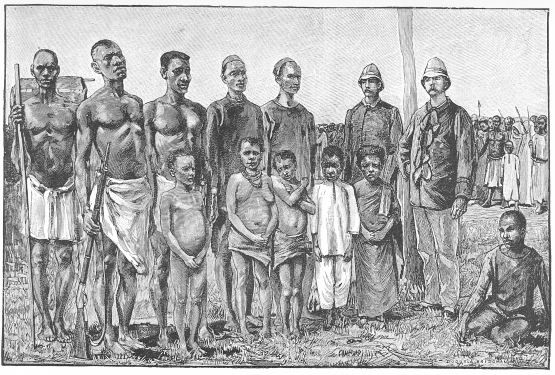
DWARFS AND SOUDANESE, WITH OFFICERS.
I then said: “I have heard with attention what you have spoken. I shall give you a written promise to the effect that you are granted a sufficient time to proceed from here to Wadelai to collect your troops and embark them with your families on board the steamers. It takes five days for a steamer to proceed to Wadelai, and five days to return. I shall give you a reasonable time for this work, and if I see that you are really serious in your intentions, I shall be quite willing to extend the time in order that we may proceed homeward in comfort.”
Selim Bey and his officers answered simultaneously, “We are serious in our intentions, and there is no occasion for delay.” To which I, wholly convinced, readily assented. The meeting terminated. An ox was presented to them and their followers for meat rations; and ten gallons of beer, with loads of sweet potatoes and bananas, were dispatched to their quarters for their entertainment.
At noon, Stairs’ column rolled into camp with piles of wealth—Remington, Maxim and Winchester fixed ammunition, gunpowder, percussion caps, bales of handkerchiefs, white cottons, blue cutch cloths, royal striped robes, beads of all colours, coils of bright wire, &c. &c. There were Zanzibaris, Madis, Lados, Soudanese, Manyuema, Baregga, Bandusuma, dwarfs and giants; in all, 312 carriers.
The stay on the Ituri River had benefited the men greatly. As Surgeon Parke came in, I mentally blessed him, for to this fine display of convalescents he had largely contributed by his devotion.
The camp numbers now over 500 people, and the huts extend on each side of a great open square, 200 yards long by 60 wide. As a fire would be most destructive, a liberal space is preserved between each hut.
1889.
Feb. 19.
Kavalli’s.
February 19th.—I have despatched Mr. William Bonny to the Nyanza with thirty rifles and sixty-four Bavira natives, to bring up the baggage of Captain Casati, Signor Marco, the Greek, and Dr. Vita Hassan. I propose sending at intervals a company of men from our camp (which is on top of the plateau, 4,800 feet above the sea level) to the Lake shore, which is about 2,400 above the sea. The journey is a long and tiring day’s march, but the round trip is made within three days. The plateau slope is very steep and stony. I have vowed not to descend it again for any idle purpose. I have already been up and down four times; would as soon undergo shot-drill or the treadmill as undertake it again. Bonny, of course, will be curious to see the Lake, as this is his first visit.
Called Selim Bey and his officers to the Barzah house, and delivered to him my message to the revolted officers at Wadelai.
Salaams!
The officers, Selim Bey, and others, having requested Mr. Stanley to await the arrival of their friends from Wadelai, Mr. Stanley causes his answer to be written down in order to prevent misunderstanding.
Mr. Stanley and his officers having been specially sent by the Khedive as guides to show the road to such people as desired to leave the Equatorial province for Cairo, cannot do otherwise than consent to give such reasonable time as may be required for the assembling of all people willing to depart with him.
It must, however, be positively understood that all men proposing to depart with Mr. Stanley must provide their own means of carriage for themselves, their families, and baggage. No exception can be made except for the Pasha, Captain Casati, and the Greek merchant named Marco, the two last being strangers and not in the Egyptian service.
Therefore all officers and men proposing to depart from this country with Mr. Stanley will be careful to provide such animals and porters as they may need for the transport of their children and goods.
They will also be careful not to burden themselves with superfluous articles; arms, clothing, ammunition, cooking pots, and provisions being the only necessaries needed.
The reserve ammunition, which has been brought from Egypt for the service of the Pasha and his people, is of course at the disposition of the Pasha only, according to the orders of His Highness the Khedive.
Mr. Stanley wishes it to be distinctly understood that he is responsible only for finding the right road, and for provisioning all the people according to the nature of the country.
Mr. Stanley, however, holds himself in honor bound to do all in his power for the comfort, safety, and welfare of Emin Pasha and his people, and to assist his friends in all things to the best of his ability.
On the arrival of this answer before the officers at Wadelai, the officers responsible for the direction of the people will do well to hold a general council, and consider this answer before moving. Such people as believe in their hearts that they have the courage and means to depart from the Equatorial Province will prepare to proceed to this camp as directed by the Pasha. Such people as are doubtful of their power and ability to move, will act as the superiors of the party will decide.
Mr. Stanley, in the meanwhile, will form an advance camp to make ready for the reception of such people as are going out.
At Kavalli’s, Henry M. Stanley,
February 19th, 1889. Commanding the Relief Expedition.
1889.
Feb. 21.
Kavalli’s.
February 21st.—Chief Katonza on the Lake shore has been sending messengers to the Lake camp to inform Captain Casati that Kabba Regga, King of Unyoro, had seized his cattle on the 19th inst., and that his next objective was Casati’s camp.
What followed may be gleaned from the following note just received from Mr. W. Bonny:—
“At the wish of Signor Casati I send you this note. He is writing his own views to the Pasha. He states that Kabba Regga’s general has a strong force somewhere near, and wishes me to remain another day that you may reinforce me. I have agreed to send a messenger, but decline to remain. I have pointed out to him, that if there is danger, I cannot risk my men unnecessarily. My men will leave with the loads this morning. I have endeavoured to persuade Casati that if he wishes to avoid danger, he can march under our escort to the Plateau. If Kabba Regga’s people meet me on the road I hope to make them learn that they have met some of Stanley’s men.
“Yours, &c.,
“W. Bonny.”
The native courier arrived with this news at 2 P.M. The Pasha and officers started immediately for the Lake camp with sixty rifles and sixty natives of the plateau. I do not think there will be any irruption of the Wanyoro into territory protected by us, but it is better to be on the safe side.
February 22nd.—The Greek merchant Signor Marco, a fine manly-looking man much browned by tropic heat, arrived to-day, escorted by Mr. Bonny. Marco has an eye to comfort I see. In his train are domestics bearing parrots, pigeons, bedsteads for himself and harem, heavy Persian carpets, ox-hide mats and enormous baskets, and, oh horror! he has actually brought three hundredweight of stone to serve as grinding stones to reduce his grain to flour, as though the natives here could not lend us any number of grinding stones. He has brought, besides, ten gallon pots to make beer, and to use as water vessels. If all the refugees are similarly encumbered, we shall, I fear, be employed here for months. That was a rash promise of mine to convey all their property. I will wait a little to note if all the officers, clerks, and soldiers expect me to regard stone as baggage.
1889.
Feb. 23.
Kavalli’s.
Feb. 23rd.—One of our Zanzibaris named Mrima, impatient at the slow progress towards recovery from a large and painful ulcer, shot himself with a Remington rifle to-day. Poor fellow, I remember him as a cheery, willing, and quick boy.
The Pasha writes me that all is well at the Lake camp.
Feb. 24th.—Sent twenty-five rifles, under headman Wadi Khamis, to escort fifty of Mpinga’s natives as carriers.
I have notified all the chiefs of the various tribes on the plateau that they must supply carriers varying from fifty to one hundred each, according to their strength, to assist me in the transport of the baggage of our guests. Eleven have consented to proceed to the Lake in rotation, provided I protect their people from the brutality of the strangers, who, they say, have been beating their people in the most cruel manner, and making them carry “stones” of too heavy a weight for a man. This is the first time I have heard of this, and will make inquiries immediately.
Feb. 25th.—Captain Nelson, who escorted the Pasha to the Lake the other day, brought in sixty loads of baggage, mostly belonging to the Pasha. I observe an immense number of articles that must necessarily be thrown away. There is an old Saratoga trunk, which was borne by two men. I tried to lift one end of it, and from its weight I should say it contains stones or treasure. What a story that old trunk could tell since it left Cairo. How many poor natives has it killed? How much anguish has it caused? The Zanzibaris smile grimly at the preposterously large size of the boxes they have to carry. They declare there are thousands of such cumbrous articles yet, and that they will be kept here for ten years. The square is littered with sea-chests and clumsy coffin-like coffers, the ten-gallon jars increase in number, and the baskets look bigger and ominously heavy.
1889.
Feb. 25.
Kavalli’s.
One man, an Egyptian, named Achmet Effendi, who came up, is about fifty-five years old, bent, thin, feeble, and sick. He is unable to ride a donkey without assistance.
I foresee a terrible mortality, if only sick and feeble men and women propose to undertake the 1,400 miles journey to the sea. Already a large number of small children, from one to eight years old, have arrived. These will have to be carried. By whom?
A Soudanese woman gave birth to a child on the road. Another child is so ill that it cannot survive long.
Lieut. Stairs was despatched with Chief Mwité to stir up his refractory people, who for the last four days have sent us no food.
We have formed a confederacy on the plateau, embracing all the region from the Ituri River to the Nyanza. For protection granted them against marauding Balegga of the mountains and the Warasura Kabba Rega, the chiefs agree to supply us with contributions of grain and cattle, and to surrender the government of the country into my hands, to raise fighting men whenever ordered, and to assist me in invading Unyoro should retaliation for invasion of their soil by the Warasura render it necessary.
Feb. 26th.—An ally of Kabba Rega was attacked this morning, and 125 head of cattle were captured. Much mischief has been done by this man, and already he occupies the country between here and the Pasha’s province, and Kabba Rega relied on him for assistance when the grand struggle between him and the Pasha should begin. Communication is made across the Lake in canoes, and Kabba Rega is well informed of our movements. When we retire from here we shall have to reckon with Kabba Rega. He possesses 1,500 guns; mostly rifles and double-barrelled shot guns, Jocelyn and Starr, Sharp, Henry-Martini, and Snider rifles, and carbines. Having undertaken the serious work of protecting these hundreds of refugees to the sea, I shall enter on the affair with a clear conscience. We will not seek a struggle; the opposing forces are not matched, but there is only one road, and that runs through a portion of Unyoro.
[6] I do not know what induced the Pasha to write in this melancholy strain, for as plain as tongue could speak, and pen could write, I had been endeavouring to explain to him that we considered ourselves as his servants, and bound to render any service in our power to him, provided he but distinctly and definitely stated his wishes.
[7] This kindly letter was after the Chesterfield style so commended by Mr. Jephson, whose sharp wits had perceived the Pasha’s extremely delicate susceptibilities. Oh dear! oh dear!
1889.
Feb. 27.
Kavalli’s.
Feb. 27th.—Our cattle were driven to pasture this morning, but the calves were most intractable, and created great fun and not a little trouble. We have milk and meat for our sick now.
I hear that Selim Bey and the Egyptian officers departed on the 26th inst. by the steamers Khedive and Nyanza, which brought to the Lake camp from Mswa a large cargo of baggage and several score of fresh refugees.
Emin Pasha reached camp this morning from the Lake. He was accompanied by his daughter, a little girl of six years old, named Ferida, the offspring of an Abyssinian woman. She is extremely pretty, with large, beautiful black eyes.
104 carriers conveyed the Pasha’s luggage and stores of flour, millet, sesamum, honey, and salt.
The head man, Wadi Khamis, who escorted this caravan, reports that one of Selim Bey’s officers stole a Remington rifle and took it with him. This is odd. If these people meditate returning here they should be aware that theft of arms is severely punished.
The Pasha informs me that another mail arrived from Wadelai on the 25th, and that an official letter was handed to Selim Bey from the rebel officers headed by Fadl-el-Mulla, announcing to him that he was deposed from his position as Chief Commander of the Troops, and that he, the Pasha and Casati, were sentenced to death by court-martial. Captain Fadl-el-Mulla has promoted himself on assuming authority to the rank of Bey or Colonel. This is quite in Jack Cade’s style. We must now call him Fadl-el-Mulla Bey.
Feb. 28th.—Sent fifty rifles and seventy-two natives of the Wabiaasi and Ruguji tribes under Lieut. Stairs to the Lake camp to escort another contingent of refugees and convey baggage up to the plateau.
March 1st.—The Pasha, with his own consent, and indeed on his own proposal, has been appointed naturalist and meteorologist to the Expedition. He has accordingly received one aneroid, one max. and min. thermometer, one Bath thermometer, one standard thermometer, two boiling-point thermometers, which, added to his own instruments, equip him completely. No expedition could be so well served as ours will be. He is the most industrious and exact observer that I know.[8]
1889.
March 1.
Kavalli’s.
The Pasha is in his proper element as naturalist and meteorologist. He is of the school of Schweinfurth and Holub. His love of science borders on fanaticism. I have attempted to discover during our daily chats whether he was Christian or Moslem, Jew or Pagan, and I rather suspect that he is nothing more than a Materialist. Who can say why votaries of science, though eminently kindly in their social relations, are so angular of character? In my analysis of the scientific nature I am constrained to associate with it, as compared with that of men who are more Christians than scientists, a certain hardness, or rather indelicacy of feeling. They strike me as being somewhat unsympathetic, and capable of only cold friendship, coolly indifferent to the warmer human feelings. I may best express what I mean by saying that I think they are more apt to feel an affection for one’s bleached skull and frame of unsightly bones, than for what is divine within a man. If one talks about the inner beauty, which to some of us is the only beauty worth anything, they are apt to yawn, and to return an apologetic and compassionate smile. They seem to wish you to infer that they have explored the body through and through, and that it is waste of time to discuss what only exists in the imagination.
Sent seventy-two natives of Mpigwa’s tribe under twelve Zanzibaris to Lake camp for baggage.
Up to date 514 loads of baggage have been conveyed from the Lake shore to our camp on the plateau.
March 2nd.—Dr. Vita Hassan, of Tunis, has arrived in charge of Lieut. Stairs, with 122 carriers.
March 3rd.—Mr. Bonny descended to the Nyanza to-day with fifty-two Zanzibaris and forty natives of the tribe of Malai and Mabisé.
1889.
March 3.
Kavalli’s.
I went over the camp on an inspection. I find that we have here representatives of Germany, Greece, Tunis, England, Ireland, Italy, America, Egypt, Nubia, Madiland, Monbuttu, Langgo, Bari, Shuli, Zanzibar, Usagara, Useguhha, Udoé, Unyamwezi, Uganda, Unyoro, Bavira, Wahuma, Marungu, Manyuema, Basoko, Usongora, Congo, Arabia, Johanna, Comoro, Madagascar, Somali, Circassia, Turkey!!! besides pigmies from the Great Forest, and giants from the Blue Nile.
The camp is rapidly spreading out into a town. Order is maintained without any trouble. Eighty gallons of milk are served out daily to the sick, and six pounds of beef per week per man, besides flour, sweet potatoes, peas, beans, and bananas with liberal measure.
There must be a fearful consumption of food in the Soudanese camp if one may judge from the quantity of flour that is being ground. From the early morning until late in the afternoon the sound of the grinding stones and the sweet voices of the grinders are heard.
The tribe of Mpigwa arrived with seventy loads from the Lake shore. These came up with Capt. Casati, to whom the baggage belongs.
March 5th.—Mr. Bonny appeared this morning with ninety-four loads of luggage from below. He was accompanied by the Major of the 2nd Battalion, Awash Effendi. I am told all this monstrous pile belongs to him alone. Ninety-four loads represent a weight of 2⅓ tons.
Mr. Mounteney Jephson started for the Nyanza this morning with forty-two Zanzibaris and Manyuema.
During the six weeks we have been here three men and a baby have died.
This Expedition possesses the rarest doctor in the world. No country in Europe can produce his equal in my opinion. There may be many more learned perhaps, more skilful, older, or younger, as the case may be, but the best of them have something to learn from our doctor. He is such a combination of sweetness and simplicity. So unostentatious, so genuinely unobtrusive. We are all bound to him with cords of love. We have seen him do so much out of pure love for his “cases,” that human nature becomes ennobled by this gem. He is tenderness itself. He has saved many lives by his devoted nursing. We see him each day at 8 A.M.. and 5 P.M. with his selectest circle of “sick” around him. None with tender stomach dare approach it. He sits in the centre as though it were a rare perfume. The sloughing ulcers are exposed to view, some fearful to behold, and presenting a spectacle of horror. The doctor smiles and sweetly sniffs the tainted air, handles the swollen limbs, cleanses them from impurity, pours the soothing lotion, cheers the sufferers, binds up the painful wounds, and sends the patient away with a hopeful and gratified look. May the kindly angels record this nobleness and obliterate all else. I greatly honour what is divine in man. This gift of gentleness and exquisite sensibility appeal to the dullest. At Abu-Klea our doctor was great; the wounded had cause to bless him; on the green sward of Kavalli, daily ministering to these suffering blacks, unknowing and unheeding whether any regarded him, our doctor was greater still.
1889.
March 5.
Kavalli’s.
March 6th.—Some chimpanzees have been discovered in a grove which fills a deep hollow in the Baregga Hills. The Pasha has shown me a carefully prepared skull of one which he procured near Mswa. It exactly resembles one I picked up at Addiguhha, a village between the two branches of the Ihuru River. The chimpanzee is the “soko” of Livingstone, though he grows to an unusual size in the Congo forest.
During the few days we have been here the Pasha has been indefatigable in adding to his collection of birds, larks, thrushes, finches, bee-eaters, plantain eaters, sunbirds, &c., &c.
The Pasha appears to be extraordinarily happy in this vocation of “collecting.” I have ordered the Zanzibaris to carry every strange insect, bird, and reptile to him. Even vermin do not appear amiss to him. We are rewarded by seeing him happy.
Each morning his clerk Rajab roams around to murder every winged fowl of the air, and every victim of his aim he brings to his master, and then after lovingly patting the dead object he coolly gives the order to skin it. By night we see it suspended, with a stuffing of cotton within, to be in a day or two packed up as a treasure for the British Museum!
1889.
March 6.
Kavalli’s.
These “collectors” strike me as being a rare race. Schweinfurth boiled the heads of the slain in Monbuttu once to prepare the skulls for a Berlin museum. Emin Pasha proposes to do the same should we have a brush with the Wanyoro. I suggested to him that the idea was shocking; that possibly the Zanzibaris might object to it. He smiled: “All for science.”
This trait in the scientific man casts some light upon a mystery. I have been attempting to discover the reasons why we two, he and I, differ in our judgments of his men. We have some dwarfs in the camp. The Pasha wished to measure their skulls; I devoted my observations to their inner nature. He proceeded to fold his tape round the circumference of the chest; I wished to study the face. The Pasha wondered at the feel of the body; I marvelled at the quick play of the feelings as revealed in lightning movements of the facial muscles. The Pasha admired the breadth of the frontal bone;[9] I studied the tones of the voice, and watched how beautifully a slight flash of the eye coincided with the slightest twitch of a lip. The Pasha might know to a grain what the body of the pigmy weighed, but I only cared to know what the inner capacity was.
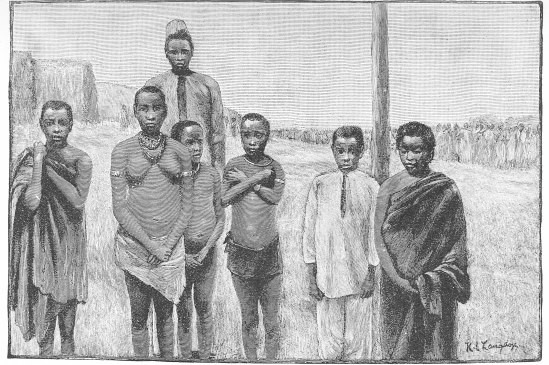
THE PYGMIES UNDER THE LENS, AS COMPARED TO CAPTAIN CASATI’S SERVANT OKILI.
And this is the reason the Pasha and I differ about the characters of his men. He knows their names, their families, their tribes, their customs; and little as I have been with them, I think I know their natures. The Pasha says they are faithful; I declare they are false. He believes that the day he leaves Kavalli they will all follow him to a man; I imagine he will be wofully deceived. He argues that he has known them for thirteen years, and he ought to know better than I who have not known them as many weeks. Very well, let it be so. Time will decide. Nevertheless, these discussions make the days at Kavalli pass smoothly, for the Pasha is an accomplished conversationalist.
March 7th.—Mr. Mounteney Jephson arrived from the Lake shore with Mohammed Emin and family, an Egyptian widow, and four orphan children.
Surgeon Parke was permitted a holiday, to be devoted to leading to the Nyanza fifty-two Zanzibaris, thirty natives, and nineteen Manyuema for conveyance of luggage here.
March 8th.—Uledi, the hero of old days, was despatched with twenty-one carriers to carry loads from the Lake to this camp.
March 9th.—Surgeon Parke has returned with his caravan. “Well, doctor,” said I, “how did you like your holiday?” He smiled. “It may be agreeable as a change, but it is fearful work. I see that the best men are pulled down by that steep long climb up the plateau slope. I hear a great deal of grumbling.”
“I am aware,” I replied, “of what is going on. But what can we do? These people are our guests. We are bound to help them as much as possible. We indeed came here for that purpose. I wish, however, they would leave those stones behind, for even the carriers laugh at the absurd idea of carrying an 80lb. rock such a fearful height. However, when the Zanzibaris are tired of it, they will let me know in some way. Meantime, let us see to how far a point they will push our patience.”
1889.
March 9.
Kavalli’s.
March 10th.—This morning as the Zanzibaris mustered for the detail to be picked out for the usual caravan to the Nyanza, they demanded to speak to me. The speaker was applauded every few minutes by the companies as they stood under their respective officers.
“Sir,” said he, “we are tired of this work of carrying rocks, and great double-load boxes, and wooden bedsteads. If we did not think it were a waste of labour we would not speak. Whither can they take the rubbish we have been obliged to carry up here? Will any one man undertake to carry one of those huge coffins a day’s march through the bush? The strongest man in the world would be killed under it. For whom are we doing it? For a set of thankless, heartless people, who profess God with their lips, and know nothing of Him or of the prophet Mohammed—blessed be his name! Besides, what do they think of us? They call us abid—slaves. They think that any one of them can lick ten of us. They say that some day they will take our rifles from us, and make us their slaves. We know enough Arabic to know what they mean, bad as their slang Arabic is. We have come to ask you how long this is to last? If you mean to kill us, who were saved out of the forest, with this ungrateful work, please tell us. We are your servants, and we must do your bidding.”
“It is well,” I replied. “I have heard your speech. I knew you would come to this. But you must have some faith in me. Trust to me. Go on to the Nyanza to-day, and when you return I will explain further.”
Captain Nelson was appointed leader of the caravan of 81 Zanzibaris, Soudanese, and Manyuema, and marched away with them.
I observed that the people declined their rations for the journey, and that they were unmistakably discontented and in an evil mood. Fearing trouble, I sent messengers after Captain Nelson to send me the two who seemed to be the principals under guard back to camp. The Captain on receipt of the order commanded the Soudanese to take them, upon which the fifty Zanzibaris set up a loud yell of defiance, and some cried, “Shoot them all, and let us go to Mazamboni.”
1889.
March 10.
Kavalli’s.
The Captain, however, was firm, and insisted on sending them to me, whereupon they said they would all return to camp to protect their friends.
Seeing the caravan return, the signal to muster under arms was given, and the companies were drawn up in position to prevent any sudden manœuvre.
The malcontents were formed in line in the centre, and on looking at them I saw that little was needed to provoke strife. I sympathised with them secretly, but could not overlook such a serious breach of discipline.
“Now, my men,” I said, “obey me at once, and to the letter. He who hesitates is lost. Open your ears and be sharp. ‘Ground arms!’ It was done promptly. ‘Retire four paces to the rear!’ They withdrew quietly. ‘Now, Captain Stairs, march your company to the front, and take possession of the rifles,” which was done.
Captain Nelson was then ordered to make his report as to the cause of the caravan’s return. He pointed out the ringleaders concerned in the outbreak, and those who had cried, “Shoot them all, and let us run to Mazamboni.” These were at once seized and punished. The ringleaders were tied to the flag-staff. The caravan was again entrusted to Captain Nelson, but without arms, and was marched away to its duty.
Near sunset, Hassan Bakari having absented himself without permission, was lightly punished with a cane by the captain of his company. On being released, he rushed in a furious temper to his hut, vowing he would shoot himself. He was caught in the act of preparing his rifle for the deed. Five men were required to restrain him. Hearing the news, I proceeded to the scene, and gently asked the reason of this outburst. He declaimed against the shame which had been put on him, as he was a freeman of good family and was not accustomed to be struck like a slave. Remarks appropriate to his wounded feelings were addressed to him, to which he gratefully responded. His rifle was restored to him with a smile. He did not use it.
March 11th.—Forty-one natives descended to the Nyanza to-day for more baggage. These make a total of 928 men sent down for the same purpose up to date.
March 12th.—“Three O’clock,” the hunter, took a caravan to the Nyanza, consisting of thirty-four Zanzibaris and twenty-five natives.
March 13th.—Lieut. Stairs, R.E., took down to the Lake sixty-three Zanzibaris and Manyuema.
The forty-one natives who left on the 11th inst. returned to-day, bringing with them absolute rubbish—wooden bedsteads, twenty gallon copper pots, and some more flat rocks, which the Soudanese call grinding-stones. They complained that when they objected to carry these heavy, useless weights they were cruelly beaten.
As I have informed the Pasha several times that I cannot allow such rubbish to be carried, and as the Pasha has written to that effect to Osman Latif Effendi, the commander of the Lake shore camp, and his orders are not obeyed, I shall presently have to stop this cruel work.
March 14th.—Twenty-one of the Balegga have offered their services, and have been sent down to the Lake to carry baggage. Total loads up to date, 1,037.
I consider this carrier work to which I have subjected myself, officers, and men, as an essential part of my duty to my guests. They may not be deserving of this sacrifice on our part, but that makes no difference. What I regret is that such severe labour should be incurred uselessly. If any one of them were to express a concern that we were put to so much trouble, most of us would regard it as some compensation. But I have heard nothing which would lead me to believe that they regard this assistance as anything more than their due.
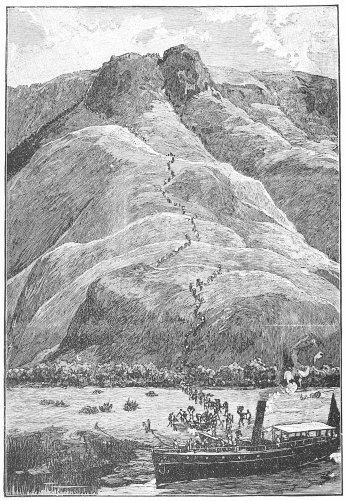
CLIMBING THE PLATEAU-SLOPES.
I see the Egyptian officers congregating in special and select groups each day, seated on their mats, smoking cigarettes, and discussing our absolute slavishness. They have an idea that any one of them is better than ten Zanzibaris, but I have not seen any ten of them that could be so useful in Africa as one Zanzibari.
1889.
March 14.
Kavalli’s.
March 15th.—Lieut. Stairs appeared with his caravan to-day. He reports that there are 100 people still at the Nyanza Camp, with an immense pile of baggage of the usual useless kind just arrived from Mswa station.
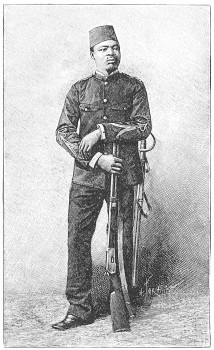
SHUKRI AGHA, COMMANDANT OF MSWA STATION.
Shukri Agha, commandant of Mswa, has also arrived. At an interview with him, in the presence of the Pasha, I informed him in plain terms that if he expected to retire to the coast he would have to set about it immediately. I told him that I had been amazed at many things since my arrival the third time at the Lake, but the most wonderful thing of all was the utter disregard to instructions and orders manifested by everybody. In May last, ten months ago, they had all been informed of the cause of our coming. They had promised to be ready, and now he, Shukri Agha, had come to us to ask us for instructions, just as though he had never heard anything of the matter. If he, a commandant of a station, and commander of troops, appeared to be so slow to comprehend, how ever was it possible to convey it into the sense of the Soudanese soldier. All I had to say now was, that unless he, Shukri Agha, paid attention to what I said, he would be left behind to take the consequences.
1889.
March 15.
Kavalli’s.
“Ah,” says Shukri, “I will go back to Mswa, and the very next day I shall embark the women and children on the steamers, and I shall march with our cattle through Melindwa overland, and we shall all be here in seven days.”
“I shall expect you on the tenth day from this, with your families, soldiers, and cattle.”
The Pasha said to me in the evening, “Shukri Agha has given me his solemn promise that he will obey the orders I have given him to depart from Mswa at once.”
“Did you write them firmly, Pasha, in such a manner that there can be no doubt!”
“Surely, I did so.”
“Do you think he will obey them?”
“Most certainly. What, Shukri Agha! He will be here in ten days without fail, and all his soldiers with him.”
March 16th.—Shukri Agha descended to the Nyanza to-day; also 108 carriers, natives, for baggage.
March 17th.—Twenty-nine natives of Malai’s tribe, and sixteen natives of Bugombi, have been sent to the Nyanza Camp. Total, 1,190 carriers up to date.
The Pasha proceeded this morning to the Baregga Hills for a picnic, and to increase his ornithological and entomological collections. A goat was taken up also to be slaughtered for the lunch. Lieut. Stairs, Mr. Jephson, Captain Nelson, Surgeon Parke, and Mr. Bonny have gone up with quite a following to encourage him to do his best and keep him company.
1889.
March 17.
Kavalli’s.
Yesterday Jephson and I had examined the summits of the hills, and in one of the hollows we had discovered tree ferns, standing eight feet high, with stalks eight inches in diameter. We also brought with us a few purple flowering heliotropes, aloes, and rock ferns for the Pasha. All this has inspired him with a desire to investigate the flora for himself.
These hills have an altitude varying from 5,400 to 5,600 feet above the sea. The folds and hollows between these hills are here and there somewhat picturesque, though on account of late grass burnings they are not at their best just now. Each of the hollows has its own clear water rillet, and along their courses are bamboos, tree ferns, small palms, and bush, much of which is in flower. From the lively singing of the birds I heard yesterday, it was thought likely this insatiable collector might be able to add to his store of stuffed giant-larks, thrushes, bee-eaters, sun-birds, large pigeons, &c. Only four specimens were obtained, and the Pasha is not happy.
In a bowl-like basin, rimmed around by rugged and bare rocks, I saw a level terrace a mile and a half long by a mile wide, green as a tennis lawn. Round about the foot of this terrace ran a clear rivulet, through a thick bank of woods, the tops of which just came to the level of the terrace. It has been the nicest site for a mission or a community of white men that I have seen for a long time. The altitude was 5,500 feet above the sea. From the crest of the rocky hills encircling it we may obtain a view covering 3,000 square miles of one of the most gloriously beautiful lands in the world. Pisgah, sixty miles westward, dominates all eminences and ridges in the direction of the forest world; Ruwenzori, 18,000 to 19,000, white with perpetual snow, eighty miles off, bounds the view south; to the east the eye looks far over the country of Unyoro; and north-east lies the length of the Albert Nyanza. On the terrace the picnic was held.
1889.
March 18.
Kavalli’s.
March 18th.—The redoubtable Rudimi, chief of Usiri, has at last joined our confederacy. Besides seven head of cattle, seven goats, and an ample store of millet flour and sweet potatoes, he brought me thirty-one carriers. They were immediately sent to the Lake shore camp.
We can now trust these natives to handle any property unguarded. Altogether fifteen chiefs have submitted to our stipulation that they shall cease fighting with one another; that they shall submit all causes of complaint to us, and agree to our decisions. The result is that the Wavira shake hands with the Wasiri, the Balegga, and the Wahuma. The cases are frequently very trivial, but so far our decisions have given satisfaction.
The camp now consists of 339 huts and five tents, exclusive of Kavalli’s village, on the southern side of which our town has grown. There are sometimes as many as 2,000 people in it.
March 21st.—The natives of Melindwa, having made a descent upon Ruguji’s, one of our Wahuma allies, and captured forty head of his cattle, Lieut. Stairs and Mr. Jephson were despatched with Companies 1 and 2, and returned with 310 head of cattle. Ruguji recognised his cattle and received them. The Wahuma are all herdsmen and shepherds. The Wavira devote themselves to agriculture.
March 22nd.—The Pasha, with Mr. Marco, paid a visit to Mpigwa, chief of Nyamsassi, and were well received, returning with large gifts of food.
March 23rd.—Contributions of provisions have come in from many chiefs to-day as an expression of gratitude for the retaliatory raid on Melindwa.
March 26th.—Yesterday afternoon the steamer Nyanza came in with the mails from Wadelai, and carriers came in this morning with them.
Selim Bey writes from Wadelai to the Pasha that he is sure all the rebels will follow him, and that they may be expected at our camp. The Pasha, beaming with joy, came to me and imparted this news, and said, “What did I tell you? You see I was right? I was sure they would all come.”
1889.
March 26.
Kavalli’s.
Let us see what this good news amounts to.
Selim Bey left our camp on the 26th February with a promise that I should wait “a reasonable time.” Though the distance is only five days, we will give him eight days. He arrives at Wadelai on the 4th March. He promised solemnly to begin embarking as soon as possible. We will grant him five days for this, considering that such people have no idea of time, and eight days for the voyage from Wadelai to our Lake camp. He should then have arrived on the 17th inst. He has not appeared yet, and in his letters to the Pasha he only states that his intentions are what they were on the 26th February last, viz., to start.
On the 14th of March Shukri Agha, commandant of Mswa, appeared to obtain instructions from the Pasha, and on the 17th Shukri Agha was back again at Mswa station, having received an order to abandon that station and to be here on the 27th. We are now told that Shukri Agha is still at Mswa, and Selim Bey still at Wadelai, and that every order issued by the Pasha has been disregarded, and every promise broken.
I replied to the Pasha that I was only aware of our folly in relying on any promise made by such people, that neither Selim Bey nor probably Shukri Agha had any intention of accompanying us anywhere. Days had passed into weeks, and weeks had grown into months, and years would doubtless elapse before we should leave Africa.
“I must beg leave, Pasha, to impress on you that, besides my duty to you and to your people, I have a duty to perform to the Relief Committee. Every month I stay in Africa costs about £400. I have a duty to perform to my officers. They have their careers in the army to think of—their leave of absence has long ago expired. Then we must think of the Zanzibaris. They will want to return to their homes; they are already waxing impatient. If we had only some proof that Selim Bey and his men had any real intention of leaving Africa, and would furnish this proof by sending a couple of companies of soldiers, and I could see that the soldiers were under control, there would be no difficulty in staying some months more. But if you think that from the 1st of May, 1888, to the end of March, 1889, are eleven months, and that we have been only able to get about forty officers and clerks and their families, and that the baggage of these has required all the carriers on this plateau one month to carry it two days’ march, you will perceive that I have no reason to share in your joy.
“I pray you also to remember, that I have been at great pains to get at the correct state of mind which those officers at Wadelai are in. I have been told most curious things. Major Awash Effendi, of the 2nd Battalion, Osman Latif Effendi, Mohamed the engineer, have told me secretly that neither Selim Bey or Fadl-el-Mulla Bey will leave for Egypt. The former may perhaps come as far as here and settle in this district. But whatever the Wadelai officers may profess to be desirous of doing, I have been warned that I must be on my guard. Nobody places any faith in them except yourself. While believing that you may perhaps be right after all, you must admit that I have the best of reasons for doubting their good intentions. They have revolted three times against you. They captured Mr. Jephson, and in menacing him with rifles they insulted me. They have made it known widely enough that they intended to capture me on my return here. But, Pasha, let me tell you this much: it is not in the power of all the troops of the province to capture me, and before they arrive within rifle-shot of this camp, every officer will be in my power.”
“But what answer shall I give them?” asked the Pasha.
“You had better hear it from the officers yourself. Come, without saying a word to them. I will call them here and ask them in your presence, because they are involved in the question as much as I am myself.”
“Very well,” he replied.
1889.
March 26.
Kavalli’s.
A messenger was sent to summon the officers, Stairs, Nelson, Jephson, and Parke, and when they were seated I addressed them:—
“Gentlemen,—Before giving me the benefit of your advice at this important period, let me sum up some facts as they have transpired.
“Emin Pasha has received a mail from Wadelai. Selim Bey, who left the post below here on the 26th February last, with a promise that he would hurry up such people as wished to go to Egypt, writes from Wadelai that the steamers are engaged in transporting some people from Dufflé to Wadelai, that the work of transport between Wadelai and Tunguru will be resumed upon the accomplishment of the other task. When he went away from here, we were informed that he was deposed, and that Emin Pasha and he were sentenced to death by the rebel officers. We now learn that the rebel officers, ten in number, and all their faction, are desirous of proceeding to Egypt; we may suppose, therefore, that Selim Bey’s party is in the ascendant again.
“Shukri Agha, the chief of the Mswa Station—the station nearest to us—paid us a visit there in the middle of March. He was informed on the 16th of March, the day that he departed, that our departure for Zanzibar would positively begin on the 10th of April. He took with him urgent letters for Selim Bey, announcing that fact in unmistakable terms.
“Eight days later we hear that Shukri Agha is still at Mswa, having only sent a few women and children to the Nyanza Camp; yet he and his people might have been here by this if they intended to accompany us.
“Thirty days ago Selim Bey left us with a promise of a reasonable time. The Pasha thought once that twenty days would be a reasonable time. However, we have extended it to forty-four days. Judging by the length of time Selim Bey has already taken, only reaching Tunguru with one-sixteenth of the expected force, I personally am quite prepared to give the Pasha my decision. For you must know, gentlemen, that the Pasha having heard from Selim Bey ‘intelligence so encouraging,’ wishes to know my decision, but I have preferred to call you to answer for me.
“You are aware that our instructions were to carry relief to Emin Pasha, and to escort such as were willing to accompany us to Egypt. We arrived at the Nyanza, and met Emin Pasha in the latter part of April, 1888, just twelve months ago. We handed him his letters from the Khedive and his Government, and also the first instalment of relief, and asked him whether we were to have the pleasure of his company to Zanzibar. He replied that his decision depended on that of his people.
“This was the first adverse news that we received. Instead of meeting with a number of people only too anxious to leave Africa, it was questionable whether there would be any except a few Egyptian clerks. With Major Barttelot so far distant in the rear, we could not wait at the Nyanza for his decision, as that might possibly require months; it would be more profitable to seek and assist the rear column, and by the time we arrived here again, those willing to go to Egypt would be probably impatient to start. We, therefore, leaving Mr. Jephson to convey our message to the Pasha’s troops, returned to the forest region for the rear column, and in nine months were back again on the Nyanza. But instead of discovering a camp of people anxious and ready to depart from Africa, we found no camp at all, but hear that both the Pasha and Mr. Jephson are prisoners, that the Pasha has been in imminent danger of his life from the rebels, and at another time is in danger of being bound on his bedstead and taken to the interior of Makkaraka country. It has been current talk in the Province that we were only a party of conspirators and adventurers, that the letters of the Khedive and Nubar Pasha were forgeries, concocted by the vile Christians, Stanley and Casati, assisted by Mohammed Emin Pasha. So elated have the rebels been by their bloodless victory over the Pasha and Mr. Jephson, that they have confidently boasted of their purpose to entrap me by cajoling words, and strip our Expedition of every article belonging to it, and send us adrift into the wilds to perish. We need not dwell on the ingratitude of these men, or on their intense ignorance and evil natures, but you must bear in mind the facts to guide you to a clear decision.
“We believed when we volunteered for this work that we should be met with open arms. We were received with indifference, until we were lead to doubt whether any people wished to depart. My representative was made a prisoner, menaced with rifles, threats were freely used. The Pasha was deposed, and for three months was a close prisoner. I am told this is the third revolt in the Province. Well, in the face of all this, we have waited nearly twelve months to obtain the few hundreds of unarmed men, women, and children in this camp. As I promised Selim Bey and his officers that I would give a reasonable time, Selim Bey and his officers repeatedly promised to us there should be no delay. The Pasha has already fixed April 10th, which extended their time to forty-four days, sufficient for three round voyages for each steamer. The news brought to-day is not that Selim Bey is close to here, but that he has not started from Wadelai yet.
“In addition to his own friends, who are said to be loyal and obedient to him, he brings the ten rebel officers, and some six hundred or seven hundred soldiers, their faction.
“Remembering the three revolts which these same officers have inspired, their pronounced intentions against this Expedition, their plots and counterplots, the life of conspiracy and smiling treachery they have led, we may well pause to consider what object principally animates them now—that from being ungovernably rebellious against all constituted authority, they have suddenly become obedient and loyal soldiers of the Khedive and his ‘Great Government.’ You must be aware that, exclusive of the thirty-one boxes of ammunition delivered to the Pasha by us in May, 1888, the rebels possess ammunition of the Provincial Government equal to twenty of our cases. We are bound to credit them with intelligence enough to perceive that such a small supply would be fired in an hour’s fighting among so many rifles, and that only a show of submission and apparent loyalty will ensure a further supply from us. Though the Pasha brightens up each time he obtains a plausible letter from these people, strangers like we are may also be forgiven for not readily trusting those men whom they have such good cause to mistrust. Could we have some guarantee of good faith, there could be no objection to delivering to them all they required: that is, with the permission of the Pasha. Can we be certain, however, that if we admit them into this camp as good friends and loyal soldiers of Egypt, they will not rise up some night and possess themselves of all the ammunition, and so deprive us of the power of returning to Zanzibar? It would be a very easy matter for them to do so, after they had acquired the knowledge of the rules of the camp. With our minds filled with Mr. Jephson’s extraordinary revelations of what has been going on in the Province since the closing of the Nile route, beholding the Pasha here before my very eyes, who was lately supposed to have several thousands of people under him, but now without any important following, and bearing in mind the ‘cajoling’ and ‘wiles’ by which we were to be entrapped, I ask you, would we be wise in extending the time of delay beyond the date fixed, that is, the 10th of April?”
The officers one after another replied in the negative.
“There, Pasha,” I said, “you have your answer. We march on the 10th of April.”
The Pasha then asked if we could “in our conscience acquit him of having abandoned his people,” supposing they had not arrived by the 10th of April. We replied, “Most certainly.”
March 27th.—The couriers have left to embark for Wadelai.
They bore the following:
Notice to Selim Bey and the Rebel Officers.
Camp at Kavalli,
March 26th, 1889.
“Salaams,—The Commander of the Relief Expedition having promised to grant a reasonable time for the arrival of such people at this camp as were desirous to quit the country, notifies Selim Bey and his brother officers that this is the 30th day since they departed from the Nyanza Camp for Wadelai to assemble their people.
“The ‘reasonable time’ promised to them has expired to-day.
“However, as the Pasha has requested an extension of time, it is hereby notified to all concerned that the Expedition will make a further halt at this camp of fourteen days from this date, or, in other words, that the Expedition will positively commence the march toward Zanzibar on the morning of the Tenth of April next. All those people not arriving by that date must abide the consequences of their absence on the day of our departure.
“Henry M. Stanley.”
Notice to Shukri Agha, Commanding Mswa.
“The Commander of the Relief Expedition hereby announces to the good and loyal officer Shukri Agha, that in order to allow him sufficient time to reach this camp, the Expedition will make a further halt of fourteen days from this date, at this camp, but that on the morning of the tenth day of April next, no matter who or who may not be ready to march on that date, positively no further delay will be granted.
“The Commander of the Expedition, out of sincere affection for Shukri Agha, begs that he will take this last notice into his earnest consideration, and act accordingly,
“Henry M. Stanley.”
CHAPTER XXVI.
WE START HOMEWARD FOR ZANZIBAR.
False reports of strangers at Mazamboni’s—Some of the Pasha’s ivory—Osman Latiff Effendi gives me his opinions on the Wadelai officers—My boy Sali as spy in the camp—Capt. Casati’s views of Emin’s departure from his province—Lieut. Stairs makes the first move homeward—Weights of my officers at various places—Ruwenzori visible—The little girl reared by Casati—I act as mediator between Mohammed Effendi, his wife, and Emin—Bilal and Serour—Attempts to steal rifles from the Zanzibari’s huts—We hear of disorder and distress at Wadelai and Mswa—Two propositions made to Emin Pasha—Signal for general muster under arms sounded—Emin’s Arabs are driven to muster by the Zanzibaris—Address to the Egyptians and Soudanese—Lieut. Stairs brings the Pasha’s servants into the square—Seroor and three others, being the principal conspirators, placed under guard—Muster of Emin Pasha’s followers—Osman Latif Effendi and his mother—Casati and Emin not on speaking terms—Preparing for the march—Fight with clubs between the Nubian, Omar, and the Zanzibaris—My judgments on the combatants—We leave Kavalli for Zanzibar—The number of our column—Halt in Mazamboni’s territory—I am taken ill with inflammation of the stomach—Dr. Parke’s skilful nursing—I plan in my mind the homeward march—Frequent reports to me of plots in the camp—Lieut. Stairs and forty men capture Rehan and twenty-two deserters who left with our rifles—At a holding of the court it is agreed to hang Rehan—Illness of Surgeon Parke and Mr. Jephson—A packet of letters intended for Wadelai falls into my hands, and from which we learn of an important plot concocted by Emin’s officers—Conversation with Emin Pasha about the same—Shukri Agha arrives in our camp with two followers—Lieut. Stairs buries some ammunition—We continue our march and camp at Bunyambiri—Mazamboni’s services and hospitality—Three soldiers appear with letters from Selim Bey—Their contents—Conversation with the soldiers—They take a letter to Selim Bey from Emin—Ali Effendi and his servants accompany the soldiers back to Selim Bey.
[8] The Pasha has, however, severely refrained from communicating anything.
[9]
List of Measurements taken on Wambutti pigmies belonging
to Mr. Stanley’s Expedition.
Name of the Individuum
{Tokbali.
A girl.
A woman.
A boy.
P. 20
I.H.P. 15
P. 35
P. 15
Height from vortex to the earth
1·360 m.
1·240 m.
1·365 m.
1·280 m.
Height from shoulder
1·116 m.
1·021 m.
1·110 m.
1·090 m.
Height from navel
0·835 m.
0·725 m.
0·785 m.
0·970 m.
Length of arm from shoulder to
tip of middle finger
0·707 m.
0·571 m.
0·580 m.
0·540 m.
Breadth from shoulder to
shoulder
0·320 m.
0·304 m.
0·295 m.
0·260 m.
Circumference below nipples
0·710 m.
0·660 m.
0·710 m.
0·640 m.
Circumference under armpit
0·720 m.
0·660 m.
0·710 m.
0·630 m.
Greatest longitudinal
diameter of head
200 mm.
176 mm.
180 mm.
175 mm.
Smallest transversal
diameter of head
147 mm.
150 mm.
145 mm.
140 mm.
Breadth of the nose
60 mm.
60·5 mm.
65 mm.
65 mm.
Circumference of skull
530 mm.
535 mm.
510 mm.
510 mm.
Length of foot
220·5 mm.
190 mm.
212 mm.
190 mm.
Bodies covered with stiffish, grey, short hair.—
Dr. Emin.