



автордың кітабын онлайн тегін оқу The Feather
THE FEATHER
THE CHILDREN’S
LIBRARY
THE FEATHER
THE CHILDREN’S LIBRARY.
——————
- THE BROWN OWL.
- A CHINA CUP, and other Stories.
- STORIES FROM FAIRYLAND.
- TALES FROM THE MABINOGION.
- THE STORY OF A PUPPET.
- THE LITTLE PRINCESS.
- IRISH FAIRY TALES.
- AN ENCHANTED GARDEN.
- LA BELLE NIVERNAISE.
- THE FEATHER.
——————
(Others in the Press.)
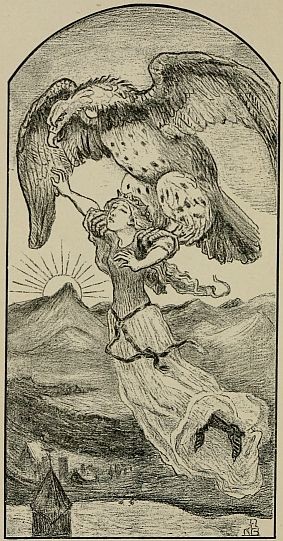
“BUT THE EAGLE HAD THE BEST OF IT AFTER ALL.”
THE FEATHER
BY
FORD H. MADOX HUEFFER
AUTHOR OF ‘THE BROWN OWL’
WITH FRONTISPIECE BY
F. MADOX BROWN
LONDON
T. FISHER UNWIN
1892
TO JULIET
—————
‘True, I talk of dreams,
Which are the children of an idle brain,
Begot of nothing but vain fantasy,
Which is as thin of substance as the air.’
THE FEATHER

ONCE upon a time there was a King who reigned over a country as yet, for a reason you may learn later on, undiscovered—a most lovely country, full of green dales and groves of oak, a land of dappled meadows and sweet rivers, a green cup in a circlet of mountains, in whose shadow the grass was greenest; and the only road to enter the country lay up steep, boiling waterfalls, and thereafter through rugged passes, the channels that the rivers had cut for themselves. Therefore, as you may imagine, the dwellers in the land were little troubled by inroads of hostile nations; and they lived peaceful lives, managing their own affairs, and troubling little about the rest of the world.
Now this King, like many kings before and after him, had a daughter who, while very young, had, I am sorry to say, been very self-willed; and the King, on the death of his wife, finding himself utterly unable to manage the Princess, handed her over to the care of an aged nurse, who, however, was not much more successful—but that is neither here nor there.
For years everything went on smoothly, and it seemed as if everything intended to go on smoothly until doomsday, in which case this history would probably never have been written. But one evening in summer the Princess and her nurse, who had by this time become less able than ever to manage her charge, sat on a terrace facing the west. The Princess had been amusing herself by pelting the swans swimming in the river with rose-leaves, which the indignant swans snapped up as they fluttered down on the air or floated by on the river.
But after a time she began to tire of this pastime, and sitting down, looked at the sun that was just setting, a blinding glare of orange flame behind the black hills. Suddenly she turned to the nurse and said:
‘What’s on the other side of the hills?’
‘Lawk-a-mussy-me, miss!’ answered the nurse, ‘I’m sure I don’t know. What a question to ask!’
‘Then why don’t you ask some one who has been there?’
‘Because no one ever has, miss.’
‘But why not?’
‘Because there’s a fiery serpent that eats every one who comes near the hills; and if you’re not eaten up, you’re bound to tumble down a precipice that’s nearly three miles deep, before you can get over the hills.’
‘Oh, what fun! Let’s go,’ said the Princess, by no means awed. But the nurse shook her head.
‘No, miss, I won’t go; and I’m sure your pa won’t let you go.’
‘Oh yes, he will; let’s go and ask him.’
But at that moment a black shadow came across the sun, and the swans, with a terrified ‘honk, honk,’ darted across the water to hide themselves in the reeds on the other side of the river, churning dark tracks in the purple of the sunlit water’s glassy calmness.
‘Oh dear! oh dear! it’s a boggles, and it’s coming this way,’ cried the nurse.
‘But what is a boggles, nurse?’
‘Oh dear, it’s coming! Come into the house and I’ll tell you—come.’
‘Not until you tell me what a boggles is.’
The nurse perforce gave in.
‘A boggles is a thing with a hooked beak and a squeaky voice, with hair like snakes in corkscrews; and it haunts houses and carries off things; and when it once gets in it never leaves again—oh dear, it’s on us! Oh-h-h!’
Her cries only made the thing see them sooner. It was only an eagle, not a boggles; but it was on the look-out for food, and the sun shining on the Princess’s hair had caught its eyes, and in spite of the cries of the nurse it swooped down, and, seizing the Princess in its claws, began to carry her off. The nurse, however, held on to her valiantly, screaming all the while for help; but the eagle had the best of it after all, for it carried up, not only the Princess, but the nurse also.
The nurse held on to her charge for some seconds, but finding the attempt useless she let go her hold; and since it happened that at the moment they were over the river, she fell into it with a great splash, and was drifted on shore by the current.
Thus the Princess was carried off; and although the land far and wide was searched, no traces of her were discoverable. You may imagine for yourself what sorrow and rage the King indulged in. He turned the nurse off without warning, and even, in a paroxysm of rage, kicked one of his pages downstairs; nevertheless that did not bring back the Princess.
As a last resource he consulted a wise woman (ill-natured people called her a witch) who lived near the palace. But the witch could only say that the Princess would return some day, but she couldn’t or wouldn’t say when, even though the King threatened to burn her. So it was all of no use, and the King was, and remained, in despair. But, since his Majesty is not the important personage in the story, we may as well leave him and return to the Princess.
She, as you can think, was not particularly happy or comfortable, for the claws of the eagle pinched her, and besides, she was very frightened; for, you see, she didn’t know that it wasn’t a boggles, as the nurse had called it, and a boggles is a great deal worse than the worst eagle ever invented.
Meanwhile the eagle continued flying straight towards the sun, which was getting lower and lower, so that by the time they reached the mountains it was dark altogether. But the eagle didn’t seem at all afraid of the darkness, and just went on flying as if nothing had happened, until suddenly it let the Princess down on a rock—at least, that was what it seemed to her to be. Not knowing what else to do, she sat where the eagle had let her fall, for she remembered something about the precipice three miles deep, and she did not at all wish to tumble down that.
She expected that the eagle would set to and make a meal off her at once. But somehow or other, either it had had enough to eat during the day, or else did not like to begin to have supper so late for fear of nightmare; at any rate, it abstained, and that was the most interesting matter to her. Everything was so quiet around that at last, in spite of herself, she fell asleep. She slept quite easily until daylight, although the hardness of the rock was certainly somewhat unpleasant. When she opened her eyes it was already light, and the sun at her back was darting black shadows of the jagged mountains on to the shimmering gray sea of mist that veiled the land below. Her first thought was naturally of the eagle, and she did not need to look very far for him, since he was washing himself in a little pool close by, keeping an eye on her the while.
As soon as he saw her move he gave himself a final shake, so that the water flew all around, sparkling in the sunlight; after which he came towards her by hops until he was quite close—rather too close, she thought. Nevertheless she did not move, having heard somewhere that, under the circumstances, that is the worst thing to do; she also remembered animals cannot stand being looked at steadily by the human eye, therefore she looked very steadfastly at the eyes of the eagle. But the remedy did not seem to work well in this case, for the glassy yellow eyes of the bird looked bad-tempered, and it winked angrily, seeming to say, ‘Whom are you staring at?’ And then it began to stretch out its bill towards her until it was within a few inches of her face. This was more than she could stand, and she said sharply, ‘Take your head away.’
The eagle, however, took no notice whatever of this; and seeing nothing better to do, she lifted up her hand and gave it a smart box on the ear, or rather on the place where its ear should have been. The eagle drew back its beak in a hurry and scratched its head with one claw as if it were puzzled. After a moment’s reflection it put out its head again, and once more the Princess lifted up her hand; but when the eagle saw that it jumped backwards in a hurry, as if it did not care to receive a second box on the ear, and began to stride sulkily away as if it thought it better to wait a while. When it reached the edge of the rock—for I have forgotten to tell you that they were on a flat rock at the top of a mountain—it sat preening its feathers in a sulky manner, as if it imagined itself a very ill-used bird; moreover, although it seemed inclined to remain there a long time, I need not tell you that the Princess had no objections. However, after a time even the waiting began to grow unpleasant; but suddenly a peculiar sound, as of something shooting through the air, came from below, and the eagle gave a leap and fell down a mass of tumbled feathers with an arrow quivering in their centre, and, with hardly a shudder, it was dead.
The Princess, as you may imagine, was a good deal startled by this sudden occurrence, but I cannot say she was very sorry for the eagle; on the contrary, she was rather glad to be rid of him, and it suddenly came into her head that the man who had shot the arrow might possibly be somewhere below, and in that case might come up and save her if she called to him. So she tried to get up, but she was so stiff that she could hardly move, and when she did stand up she had pins and needles in one of her feet, and had to stamp hard on the ground before it would go away. So that it was some time before she got to the edge and looked over. Now it happened that, just as she bent carefully forward to look down the side, the head of a man appeared over the edge, and his hands were so near her that he almost caught hold of her foot as he put them up to help himself. As she drew back a little to let him have room, he suddenly noticed her, and almost let go his hold in astonishment.
‘Hullo, little girl,’ he said; ‘how did you come here? It’s rather early in the morning for you to be up. But who are you when you’re at home?’
‘I’m the daughter of King Caret.’
‘King how much?’
‘King Caret, I said; and I should be glad if you would help me down from this height, and show me the way back.’
‘How on earth can I show you the way back when I don’t know who King Caret is?’
‘But surely you must know who he is?’
‘Never heard of him. What’s he like, and what’s he king of?’
‘He’s the King of Aoland.’
‘And where’s Aoland?’
‘I don’t know—it’s somewhere over those mountains—the eagle brought me here, you know.’
‘Ah! the eagle brought you here, did he? It’s a little habit he’s got; he’s carried off no end of my kids and young sheep, so I suppose he thought he’d try a change and carry off one of King Turnip—I mean Caret’s. But if he brought you from over the mountains you won’t get back in a hurry, I can tell you; you’d have to jump up a precipice three miles high, and then you’d be eaten by old Kinchof the dragon.’
‘Oh dear! then I shall never get back!’
‘No, I’m afraid you won’t. But don’t begin to cry now—there, there—and I’ll take you to King Mumkie; he’s the king of this country, you know.’
‘What an awful name—Mumkie!’
‘Yes, it is rather unpleasant, isn’t it? And then, he’s a usurper—he drove the last king out and made himself king instead. He used to be a cat’s-meat man, but he got up an army and drove the other off the throne, and now he’s turned into a gardener—his name’s Abbonamento.’
‘Oh, never mind what his name is, only get me down—I’m awfully hungry; for you see I’ve been up here all night.’
‘Oh! all right. But I say, how are you going to get down—you can’t climb, can you?’
‘I don’t know,’ she answered; ‘I’ve never tried.’
‘Then you can be sure you can’t. The only thing seems to be for me to carry you down.’
But the Princess did not seem to relish the idea at all.
‘You might let me drop, you know; it’s rather steep.’ And it was pretty steep, too—about as steep as the wall of a house, and a good deal higher than a very high house. However, it seemed to be the only thing to do, so she let herself be carried down. The man took her on one arm, and yet seemed to climb down about as easily as if he were going downstairs. However, the Princess did not notice that, since she kept her eyes shut hard, for, to tell the truth, she was rather nervous.
But at last they were at the bottom, and he let her down on to the ground.
‘Now, what are you going to do?’ he said.
‘I don’t know at all. What can I do?’
‘You’d better go and see King Mumkie and ask him what to do.’
‘But he has got such a dreadful name; it sounds as if he was awfully ugly,’ she said.
‘But he’s not at all; he’s just like me, and I’m sure I’m handsome enough for any one.’
The Princess looked at him now for the first time; for you see, she had not noticed him very much while she was on the mountain. But now she could hardly repress a shudder; for he was awfully ugly. To begin with, he was big enough for any giant, and then his hair was of a purple hue, and his eyes of a delicate sea-green that flashed in the shade like a cat’s; and then his nose was awfully red, and shaped like a mangel-wurzel; and his teeth, which were long and bright green, shone in the sun like danger-signals. Altogether he was not prepossessing; and the Princess could hardly help smiling when he said that the King was as handsome as himself. However, he went on:
‘My name’s Wopole; I’m King Mumkie’s falconer, and so I can tell you all about him. Come, let’s go towards the town.’
And as there seemed nothing else to do, she set out with him; but he walked so fast that she could hardly keep up.
‘How slowly you do walk!’ he grumbled in a bad-tempered manner; ‘can’t you keep up? Come along, I can’t wait all day.’ And he went on faster than ever, so that she had to run to keep up with him. Suddenly he stopped as if he had been shot.
‘Confound it, I’ve forgotten to bring the eagle, and I shall have to go all the way back and get it. Oh—ouch!’ And he began to howl in such a dreadful manner that the Princess felt quite relieved when he turned and ran towards the hill at the top of his speed, howling all the way.
‘What on earth shall I do now?’ thought the Princess. ‘If I wait for this dreadful giant, goodness knows what may happen, and then his king has such an unpleasant name; at any rate, I should like some breakfast, for I’m awfully hungry. I think I’ll go on towards the town, and see if I can’t find some one who’ll show me the way home.’
So she went on down the lane for some way, until, coming to a place where a stream went across the path, she knelt down and scooped up a little water in the palm of her hand and drank it; for, you see, the sun was very hot now, and the heat made her throat feel quite dry and parched. When she had finished she went and lay down in the long grass that bordered the road, for she was rather tired. She intended to wait till some one came along, only she was quite resolved not to go with the giant at any rate. So she lay quietly in the shade listening to the loud humming of the bees and the chirp of a linnet that was pluming itself, swinging on a bough above her head.
She had not been waiting long before she heard a dreadful noise behind her coming down the road, and in a few minutes she recognised the voice of the giant, who seemed to be in a terrible temper. Gradually the sound of his voice and his footsteps came nearer. The Princess did not know what to do, for if she tried to run away he would only catch her up; so she lay perfectly still, hoping he would pass her without seeing her. And that is just what did happen; for, in a few moments, he came rushing round the corner shouting out, ‘Stop! stop! will you?’ And as his eyes were fixed on the road far in advance, of course he did not notice her, and was soon round another bend in the road. The Princess noticed that he had the eagle hanging with its claws round his neck, and the jolting, as he went by, had shaken one of its large tail feathers out, and as soon as she had got over her fright, she went and picked it up out of the dusty road.
Just as she picked it up, the clatter of feet running along the road came to her ears, and for a moment she feared that the giant had returned; but soon a cow trotted round the bend and stopped at the stream to drink, presently another, and then a third. Each of them took a long look at the Princess, and then bent down its head to take a draught out of the stream. Just then an old man came round the corner, and when he saw the cows had stopped he called out:
‘Gee on, Lightfoot; now, Daisy; come up, Cherry,’ and the cows gave their heads a toss, and walked slowly through the stream.
The Princess hurried to one side of the road, for, like many people, she had an instinctive dread of anything like a cow or a bull.
The old man noticed it and smiled.
‘Oh, you needn’t be afraid, miss, they won’t hurt you,’ he said; but all the same, she didn’t care to go too near them. ‘They’ve just been frightened by Wopole, King Mumkie’s falconer,’ he went on. ‘Wopole came running round the corner suddenly, and almost knocked Lightfoot—that’s the dun cow—over. He was roaring out “Where is she?” awfully loud. I pity her when he gets her, whoever she is.’
‘But who is she?’ asked the Princess.
‘I don’t know—how should I?’
‘Oh, I only thought you might know. But what will he do with her when he gets her?’
‘I don’t know; fry her in lard or something—that’s what they generally do to strangers in the town now.’
‘Oh dear!’ said the Princess; ‘how am I to get away from him?’
The old man looked at her curiously.
‘Oh! you’re her,’ he said.
‘I rather think I am. But how am I to get away?’ she answered.
‘If you’ll come with me I’ll take you to my cottage over there, and they’ll never think of looking for you there.’
But the Princess did not exactly like the idea.
‘Aren’t you one of these people?’ she asked; ‘because I don’t relish being fried in lard, or oil, or anything else.’
But the old man shook his head.
‘Good gracious me, no!’ he said. ‘I wouldn’t let them roast the last stranger that came to the town, and so they turned me out.’
‘Oh,’ said the Princess, ‘then you must be King Abominable.’
‘I am Abbonamento.’
‘Then I suppose I shall be safe with you?’
‘Quite safe, if you like to come; only just help me to drive the cows.’ And the old man called to his animals who were browsing in the grass at the wayside, and they trudged quietly on till they came to a gate in the hedge. This they waited for the old man to open for them, and then went through the meadow until they came to a little farmhouse half hidden by trees.
‘This is my house,’ the King said. ‘Just wait a moment till I have put the cows in the byre, and then I’ll come back and let you in; for you see my wife’s away at the market, and there’s no one else at home.’
So the Princess stopped where she was, and the old man went whistling round to the back of the house driving his cows before him.
It was a very small house, with the thatched roof coming so low down that you could touch it almost with your hand, and the windows were quite overshadowed by it. Over a little arbour of trellis-work before the door ran a rose-tree of deep red flowers, and the roses were full of bees that came from the hives arranged on benches under the eaves, and a few chickens were asleep on one leg under the porch.
In two or three minutes the door opened, and the old man appeared, and the chickens walked lazily away.
‘I entered by a back door,’ he explained. ‘Come in and make yourself at home.’
The inside of the house was just as small and homely as the outside, and the rooms were refreshingly shady and cool after the hot sunlight without.
‘Sit down,’ said the old man, pointing to an arm-chair; and the Princess did as she was told.
‘Now,’ said he, ‘if you will tell me where you come from, I will try to find out how to take you back.’
So she told him all her story, and he listened very attentively. When she had finished he said:
‘It’s lucky for you that Wopole forgot the eagle, or goodness knows what would have happened to you; but how you’re to get back I don’t know. It’s my opinion you never will, for no one was ever known to pass those mountains safely yet.’
I don’t know what else he would have gone on to say, but by this time the Princess had begun to cry bitterly.
‘Oh dear me!’ said the old man, ‘what a fool I was to go and tell her all that. Now goodness knows what’ll happen. Oh dear, oh dear, Princess, don’t go on weeping like that, or you’ll melt altogether; do leave off.’
But the Princess did not seem at all inclined to leave off, and she might have melted altogether, only just then the door opened, and an old woman with a market-basket on her arm and a big umbrella in her hand came into the room, but stood transfixed with her eyes and mouth wide open when she saw the Princess.
‘My! Abbonamento, what’s the little girl crying for? and where does she come from? and what does it all mean?’
And she picked up her umbrella, which she had dropped, and leaned it against the table, and put her market-basket on a chair. This she did very slowly, and all the while the old king was telling her what had happened, so that by the time she had finished her preparations she knew nearly as much about it as he did. When he had finished she shook her head.
‘Poor girl! poor girl! So you come from the land on the other side of the mountains. I know it.’
The Princess had by this time left off crying, and when she heard the old lady say ‘I know it’ she said:
‘“Kennst du das Land
Wo die Citronen blühen?”’
But the old lady shook her head.
‘That’s Greek, and I never could understand Greek. If it had been German or French now—but just translate it for me, will you?’
So the Princess translated it for her.
‘“Knowest thou the land where blooms the lemon-flower?”’
But the old lady shook her head.
‘I don’t know so much about the lemon-flower; but my grand-aunt Thompson had a sister whose daughter had a servant who’d seen the dragon eat up the last man that ever tried to cross the mountains.’
‘But I don’t see how that is to help me to get back—do you?’
‘No, I don’t exactly; but perhaps something will turn up to help you. Won’t it, Abbonamento?’
Abbonamento nodded.
‘But what shall I do in the meanwhile?’ said the Princess; ‘for, you see, I don’t want to be fried in lard, as you say the townsmen are in the habit of doing.’
‘You’d better stop with us,’ said Abbonamento. ‘Eh, wife, what do you say?’
And his wife said:
‘Oh yes, certainly; it’s the only thing to do. Do stop.’
‘Well, I suppose I must,’ said the Princess. ‘Only, shan’t I be rather in the way?’
But the King answered:
‘Oh, not at all, quite the other way. You’ll be very useful. You can milk the cows, and pluck the fowls, and feed the pigs, and all sorts of things.’
‘But what will the people of the town say if they see me?’ asked the Princess.
‘The people of the town—oh, they never come near me, although they are glad to buy butter and milk and eggs of me in the market. They think it seems grand to say they buy their things of a king; but they never trouble about me at all except for that.’
Just at this moment the old lady, thinking it her turn to say something, said:
‘By the bye, you have not told us your name yet.’
‘Would you like it in full, or only what I’m generally called?’ asked the Princess.
‘Oh, say it in full, unless you’ve any objection.’
‘Well, you see, it’s rather long; it generally takes about a quarter of an hour to say, only if you want it particularly I’ll tell you.’
But the Queen answered:
‘Ah! well, perhaps we’ll wait for a time, until we’ve got leisure to listen to it. Meanwhile you might tell us what the short of it is.’
‘They generally call me the Princess Ernalie. Now you might tell me your name, if you don’t mind.’
‘They generally call me Queen Araminta. If you like, and are not too tired, I’ll show you the farm, and then we’ll have dinner.’
So the Princess went through the yard to the cows’ byre, and from the stalls to the pig-sties, and from the sties to the poultry-run, and thence to the orchard, and from the orchard to the flower-garden, and after that home again.
So it was arranged that the Princess Ernalie was to stop with the King and Queen until something should turn up. But nothing ever did turn up, and the days lengthened into months, and the months into years, and still she stayed with the old couple; and as time went on she seemed to do almost all the work of the farm, for the old King and Queen were beginning to get too old and weak for hard work. And gradually she began to forget about her native land, and it seemed as if the farm were to be her home for ever. And every year she grew taller and more beautiful; but that’s a habit that princesses have pretty often. So five years passed quietly away, and nothing seemed likely to disturb the peace of the household.
Every morning regularly she got up at five o’clock to drive the cows to the pasture, and then she fed the poultry, and, if it happened to be a Thursday or Saturday, she went with the Queen to take the butter and eggs to market; besides which she had to milk the cows and cook the dinner, and all sorts of things, so that she was gradually turning into a simple country maid.
During all the five years no one from the town ever came near the house, and so you may imagine how surprised she was one morning when she got up and opened her bedroom window to see a man coming across the clover-field towards the house. She watched him come right up to the door, and then, when she heard him knock, ran down to tell the King and Queen that a man was knocking at the door.
‘Who on earth can it be?’ asked Abbonamento.
‘It’s not the tax-collector, is it?’ asked Araminta.
‘Oh no, it’s not him; he’s an old man, and this one is quite young,’ answered the Princess.
‘Nor the water-man?’
‘No, it’s not him either. There he is knocking again.’
Indeed, the knocking was becoming quite furious.
‘He’s a very impatient young man, whoever he is,’ said Abbonamento. ‘You’d better go and tell him not to make such a noise. Let him in—be quick, or he’ll knock the door down!’
And it seemed so likely, that Ernalie ran down as fast as she could and opened the door.
‘Why can’t you open the door faster?’ said an angry voice; and then Ernalie saw a young man looking at her in a state of great surprise. ‘Why, who are you?’ he asked. ‘Is this not the house of their Majesties King Abbonamento and Queen Araminta?’
‘They used to be King and Queen at one time,’ answered Ernalie.
‘They ought to be now,’ said the young man with a frown.
‘That’s quite another thing,’ retorted Ernalie.
‘Oh, is it?’ said he, with a smile this time. ‘But who on earth are you, if I may ask?’
‘I am Her Royal Highness Princess Ernalie of Aoland; and who on earth are you, if I may ask?’
‘I am Prince Treblo of this country,’ answered he.
‘I suppose you are the son of King Mumkie, then?’ said she.
‘Good gracious, no!’ said the Prince.
The Princess was just about to say, ‘Then whose son are you?’ when the old King burst into the room. He had evidently got up in a hurry, and he was only attired in his flowered dressing-gown.
‘My long-lost chee-yld!’ he exclaimed, as he threw himself into the stranger’s arms. ‘Araminta! Araminta! come along, it’s Treblo.’
And the Queen came rushing down in haste, as you may imagine. Over the rest of this affecting scene we will draw a curtain—that’s what they generally do with affecting scenes—in books, at least.
The Princess Ernalie easily perceived that she was a little—as the French say—de trop; that is, finding that ‘three was company and four none.’ So she left the room and went upstairs to comb her hair and wash her face and hands, and make herself look smart generally; for she thought that would be only right on the day on which the eldest son of the house came home—especially as he was very handsome.
Now it happened that as she was bending down to pick up her best shoes from under her toilet-table, one of them had gone a little far back, and as she drew it out she noticed that something lay behind the shoe, and she drew that out too. You may perhaps remember that she had picked up out of the road an eagle’s feather which Wopole had let fall as he hurried by with the eagle on his back. Well, then, it was this feather that she now drew out from under the toilet-table. It had lain there since she had first entered the room five years ago. Now this doesn’t say much for the cleanliness of the floors, but in those unsophisticated days they never thought of sweeping any hidden spot in the floor. This habit, curiously enough, survives even now among some people. However, to return to the Princess Ernalie.
When she picked up the feather she stood upright again and examined it carefully.
‘Why, how nice,’ she said. ‘It’s the old eagle’s feather. Now that’ll come in handy; my hat rather wanted a new feather, and it’ll just suit the colour of my hair and eyes.’
So she went to the looking-glass and held the feather close against her hair. But to her astonishment nothing was to be seen in the glass—not a vestige of herself; it seemed as if she had vanished altogether.
‘Why, what’s the matter with the glass?’ she said. ‘Something seems to have gone wrong with it.’ So she put the feather on the table and went to rub the glass, but when she looked at it she was there all right again.
‘That’s queer,’ she thought; ‘I can’t have been right in front of the glass.’ So she took up the feather and went in front of the glass. This time she saw herself very well, but as soon as the feather touched her hair she vanished just as before.
‘Good gracious!’ she said; ‘what is the matter with the glass?’ So she tried again, and the result was always the same—whenever the feather touched her hair she vanished. ‘It must be something the matter with the feather.’ So she examined it quite closely, and she found rolled round the quill end of it a small piece of paper on which was written:
‘Guard well the feather, for whoso toucheth his hair therewith—though he be but feather-brained—shall be invisible, yet shall he see all.’
Ernalie read it over once or twice from beginning to end.
‘The writing says “his” hair; but it seems to act just as well with “her” hair—that is, my hair. What fun I shall have now. I think I’ll try it on at once on the King. But then, it might frighten him. No, I’ll wait, and try it on Treblo; and that reminds me I think that they’ve had enough of it all to themselves now. I’ll go and see if I can do anything for them.’ So she locked the feather up in one of the drawers, and then, putting on her shoes, went downstairs.
Now it happened that just as she had almost reached the bottom step her heel came out of her shoe, and as she stopped to put it firmly on again she heard the voice of the stranger saying:
‘By the bye, mother, who was that girl who opened the door to me?’
‘Oh! that’s Ernalie,’ answered the Queen’s voice.
(It seemed as if the shoe took some time to get on again.)
‘So she told me; but who is Ernalie?’ he asked again.
‘Oh! you’d better get her to tell you that too when she comes down. Well, what do you think of her?’
‘Oh, she’s—she’s just lovely,’ answered he.
(‘Listeners never hear any good of themselves,’ thought the Princess. However, the shoe had come on just at that moment, and she entered the room.)
‘Speak of the—ahem!’ the King was just saying, when the Prince interrupted him.
‘“Speak of angels, and you hear the rustling of their wings,” you mean,’ he said.
‘Thank you for the compliment, if it was meant for me,’ said the Princess.
‘Oh! don’t mention it—it’s nothing when you’re used to it,’ said Treblo, who, to tell the truth, seemed rather confused.
‘And are you used to calling young ladies angels?’ said his father sharply. ‘I suppose it’s some of the foreign manners you’ve learnt.’
‘Suppose we change the subject,’ retorted his son, and the subject was changed.
Ernalie retired again. She wanted to look after the dinner, so that it might not be late, and so nothing else in particular happened, for Treblo went round the farm with his father, and Araminta went into the kitchen to help Ernalie with the dinner. When the goose was turning on the spit, and the apple-tart had been put into the oven, the Princess had time to ask some questions about Treblo, and the Queen told her that he had been sent out of the way by Mumkie, in order that he might not attempt to put his father on the throne again; but after seven years he had come back safe, having had all sorts of adventures, and he now felt quite confident that he would be able to restore his father, for he was very popular with the army that had just returned from the war, and as to the people of the town, they cared very little who was king—in fact, they rather preferred Abbonamento to Mumkie. So Araminta was quite cheerful over it, for she much preferred living in a palace to living in a cottage.
Things went merrily through the day, and at dinner-time they drank the health of the King and Queen of the country, and altogether they seemed very happy. After dinner the King composed himself for his afternoon nap, and the Queen took down a volume of sermons and began to read. Ernalie went out to milk the cows and take the eggs from the hens’ nests. As to the Prince, he said he was going out to take a walk.
Before going out the Princess slipped up to her room, and took the eagle’s feather from the drawer where she had locked it up. She intended to try if she were invisible to the cows and poultry. So she put it in her sunbonnet and went out. It really seemed as if it was quite correct about the feather, for as soon as she got out of the door a bee ran right against her, and then a sparrow that was chirping on a rail allowed her to catch hold of it before it took any notice of her approach. However, she let it go, and it flew away, looking very astonished indeed, as you may imagine.
She reached the pasture, and opened the gate, calling to the cows:
‘Daisy, Daisy; come, Lightfoot; Cherry, come!’
The cows looked up from the ground, and came towards the gate, looking very astonished indeed; but when they got quite close and saw no one they stopped, and however much she called them they refused to move.
‘This will never do,’ she said; ‘I must really let them see me, or they won’t come.’
So she took the feather from her bonnet, and called again. This time the cows seemed quite ready to come, and they trotted along to the gate and crowded round her to be stroked. So she shut the gate again and told the cows to go on—for they understood her quite well—and then she went on after them. When they got to the dairy she milked them one after the other as they came in their regular order to the stool. She was milking the last one—Cherry, the best of them all—and she leaned her face against its side, and listened to the ‘thud, thud,’ of the milk as it streamed into the pail with a foam like the sea in a rage. She was in fact almost lulled to sleep by it, when she was startled by a voice behind her. It was so sudden that she almost upset the milk-pail in her fright.
‘It seems to be easy work milking,’ said the voice, and she looked round and saw it was the Prince, who had come quietly up behind, and was leaning over the fence at her back, looking on lazily at her.
‘Oh! how you startled me, Prince,’ she said.
‘Did I?’ he answered. ‘I am very sorry for that; but you needn’t call me Prince yet. I’m not a Prince, you see, and then you’re the adopted daughter of my parents, so you ought to call me your brother.’
‘Oh, really!’ said she. ‘However, you soon will be a Prince, and then I shan’t be able to call you brother, shall I?’
‘Why not?’
‘Because you will be a Prince, and I am only a dairymaid.’
‘But you’re a Princess, aren’t you?’ he asked.
‘I was a Princess once,’ she said, with a sigh; ‘but——’
‘You shall be again,’ he said.
‘But how do you know?’ she asked.
‘I know—oh, well, let’s change the subject. As I said before, it seems to be easy work milking. You might let me try?’
But she said:
‘It wouldn’t be any good. Cherry wouldn’t let any one but me touch her. Besides, I’ve just done, and I’m going to carry the pails to the house.’
‘Let me carry them for you?’ he said quickly.
‘Oh, thanks; if you’ll take two, I’ll take the other two, and thus we shall do it all in one journey,’ she answered.
So he did as he was told, and the pails were put safely in the house.
‘Now I must go and get the eggs,’ she said.
‘Can I be of any use?’ asked the Prince.
But she answered:
‘Oh no, there’s nothing for you to do, thanks.’
But he went with her all the same. I suppose he thought he might be of some use. So she let him hold the basket for her, and the eggs were also put safely in the house. Just, however, as he had put them down, a shrill whistle sounded twice from behind the garden hedge, and the Prince said:
‘Oh, that’s a friend of mine. You must excuse me for a few moments,’ and he went towards the hedge.
‘I wonder who his friend is,’ she said to herself. ‘I think I’ll put the feather on again and go after them. It would be a good way of trying my feather on men.’
So she took the feather out of her pocket again, and put it in her bonnet, and then ran after him. He had got over the fence some time before she reached it, but he was still in sight on the other side, and with him his friend was walking. He seemed to be a soldier, so far as she knew. They were talking very earnestly; but, from where she was, she was not able to hear what they said. So she too got over the fence, and went towards them; but she reached them rather too late to hear anything much that they did say. What she did hear was this, from the soldier:
‘Then you will come to-night at half-past twelve?’
‘Yes,’ answered the Prince.
‘We’ll have everything ready, and it will be easily done. If I were you I wouldn’t tell the King or Queen, it would only make them nervous, and we’re sure to succeed.’
‘Very well,’ said Treblo; ‘at half-past twelve.’
(‘Half-past twelve,’ thought the Princess; ‘what on earth is he going to do at that time of night? It sounds funny. I think I’ll go with him to look after him.’ For, you see, Ernalie was rather inquisitive, as you may have found out by this time.)
So the soldier went one way, and Treblo went back to the house whistling ‘When the king shall enjoy his own again.’
But the Princess ran on in front of him and reached the house first, so that by the time he was there she had taken the feather out of her bonnet and was quite visible again.
He came in quite naturally, as if nothing had happened, and the rest of the day went off quietly enough.
They went very early to bed at the farm, and the house was quiet by half-past eight.
Just before they went to bed Ernalie asked the Prince:
‘Do you like walking at night much?’
‘It depends upon the night very much,’ he answered.
‘Such a night as this, for instance,’ said she.
‘Oh yes—“a moonlight night for a ramble,” don’t you know?’ he said, laughing.
‘About half-past twelve, I suppose.’
The Prince looked astonished and shocked.
‘Half-past twelve!’ he said, with his eyes wide open; ‘why, I’m never out after eight. My mother says the night air’s not good for me.’
‘Oh, is that it?’ said the Princess. ‘However, I’m tired; good-night.’ And she went to her room and lay down on her bed with all her clothes on. It was rather hard work keeping awake for such a time, but at last she heard the kitchen clock strike twelve, and she knew it was twenty past. So she got up as quietly as possible and put on the feather, for, you see, she didn’t want any one to see her. It seemed very ghostly getting up so late at night, and although she stepped very lightly, the stairs creaked loudly. She went into the sitting-room and sat on a chair waiting for the Prince to come down. She had to wait close on half an hour; for, you see, the Prince had heard the clock strike too, but didn’t know it was twenty minutes slow. However, at last he came downstairs holding the candle in his hand. He hadn’t put his boots on for fear of waking any one, and so he, too, sat down on a chair to put them on. This was rather unpleasant for the Princess, for of course she had to keep as quiet as a mouse for fear of making him suspicious; for, you see, it was so quiet that the least breath she took could be heard. At last the putting on of his boots was finished, and he stood up, saying to himself out loud, ‘Now, where’s my hat?’ and then he looked straight at the Princess and said, ‘Ah, there it is,’ and he began to walk towards her.
‘What can he want?’ thought the Princess; and then she looked down at the chair—for, you see, she could see right through herself—and she discovered she was sitting on his hat. By this time he was quite close to her and bending down to pick his hat up, so she jumped sideways off the chair as fast as she could; but even then, as he put his hand out, he caught hold of hers, which had not time to get out of the way. As soon as his hand closed on it, however, he let go as if it had stung him.
‘Good gracious! what is that?’ he said in astonishment. And he did look so funny that she had hard work to keep from laughing at him. However, he calmed down in a minute, and again tried to take up his hat. This time you may be sure that the Princess’s hand was no longer there, for she had taken herself and it over to the other side of the table. So he took up the hat and looked at it.
‘Looks as if it had been sat on,’ he muttered. ‘Just like ’em; people always do sit on my hat if they can.’ However, he pushed it out straight again and looked at his boots to see if the laces were quite tight; and then he blew the light out, seeming, by the noise he was making, to be trying to get out of the door. When she heard him in the passage she thought it was about time to follow him. So she tried to do it, making as little noise as possible; but although she did try very hard she did not succeed very well, for she fell right over a chair and made noise enough to be heard all over the house.
‘What on earth’s that?’ she heard the Prince ask, and then he lit a match to look. But he didn’t see anything, and the light allowed the Princess to get quite close to him without upsetting anything more, and he opened the door, letting the moonlight shine in clear and white. While he was standing at the door she managed to slip past him into the open air, and there she waited for him. He wasn’t very long coming, and then she followed him down the garden, keeping to the grassy edge, and not walking on the path for fear of the noise that her feet would make on the gravel. They reached the field and then the road, and the Prince was joined by the other man whom the Princess had seen before. This man—whom, by the bye, the Prince called Ablot—was dressed in complete armour, and he carried another suit, which the Prince proceeded to put on.
(‘This begins to look exciting,’ thought Ernalie. ‘Perhaps he’s a highwayman, or a footpad—anyhow, I mean to keep up with them.’)
So she walked on faster, for she had fallen a little behind. When she got up with them she heard the Prince say:
‘Well, we’ll surround the Palace, take Mumkie prisoner, and turn him into the market-gardener; and then we’ll proclaim it to the rest of the citizens that my father and mother are King and Queen once more, and if they won’t give in—so much the worse for them. The soldiers are all on my side.’
The other answered:
‘Oh, but they’ll give in without the soldiers. They’re not at all fond of Mumkie. He has made himself very unpopular of late. You see, he put a farthing on the income tax, and he’s raised the price of everything that begins with “S,” like “sausages” and “sealing-wax” and “soap” and “sewing-machines.” Now your father only raised the price of things that begin with “Z,” and there aren’t many “Z’s,” you know; there’s “zebras” and “zeal,” and you can’t make much out of selling zeal.’
(‘Ah, that’s what you’re up to!’ thought the Princess. ‘We ought to have some fun then.’)
However, they were walking too fast for her to think much. All she could do was to keep up, and that she did to the best of her power, until at last they reached the middle of the town, where the King’s Palace stood. Here they halted to take counsel.
‘You wait here while I go and fetch the men,’ said Ablot, and as the Prince made no objection, he went and left him standing in the moonlit square. As Ablot seemed gone rather a long time, the Princess thought she would have a little fun, and going close to the Prince she whispered in his ear:
‘Does your mother know you’re out?’
The Prince turned round once or twice, as if to assure himself that there was no one hiding behind his back; but as he could see no one, he simply said:
‘I beg your pardon.’
‘That’s very good of you; but I thought you were never allowed out after half-past eight o’clock. I heard you tell Ernalie so this evening. I’m afraid you told a fib.’
The Prince looked very astonished.
‘Who or what are you?’ he asked.
‘Never you mind. I’ve a good mind not to let you succeed this evening, because you deceive not only your old mother who is asleep at home, but you have also told a fib to that innocent girl, of whom I’m very fond.’ (‘That’s quite true,’ thought the Princess. ‘I’m very fond of myself.’ And so she was.)
The Prince looked astonished.
‘How on earth could you know that?’ he said.
‘I heard it, I tell you.’
‘But there was no one in the room except the Princess and myself.’
‘All the same, I heard every word you said, and, what’s more, I shall hear every word you ever say to her,’ answered the Princess.
‘Well, then, you’ll be a great nuisance,’ said the Prince angrily.
‘Very well, I’ll tell the Princess all that you say, and I’ve a good mind not to let you succeed, as I’ve said before.’
‘Then you’ll do the Princess a great deal of harm if you do.’
‘Why?’
‘Because she’s—she’s——’ he began.
‘She’s what?’ asked the voice.
‘Oh, well, never mind.’
‘But I do mind,’ said the voice.
‘“She’s all that fancy painted!” if you want to know so much,’ said the Prince.
‘But I don’t see how that’ll make any difference to her in case you should succeed,’ said the voice.
‘You’re uncommonly dull if you don’t see it,’ said the Prince, who was beginning to feel bad-tempered over being cross-questioned thus.
‘Don’t be rude, or you shan’t succeed,’ said the voice.
‘If I don’t succeed the Princess will never become Queen of the kingdom.’
‘How can she become Queen of the kingdom?—it would have to be a queendom. And I don’t see, if you do succeed, how she is to become Queen!’
‘As I’ve said before,’ said the Prince, ‘you’re excessively dull if you don’t see.’
‘I shall tell her what you said.’
‘Oh, do anything you like, only leave me alone, do,’ said the Prince, who by this time was quite in a temper.
So she let him alone, and made no answer when he wanted her to talk again. However, in a few minutes Ablot came into the square, followed by a large number of men, whom she heard him command to surround the Palace, which they accordingly did; and then, choosing five men, he and the Prince entered the Palace, Ernalie following them, for she didn’t know exactly what else to do. The first of the Palace guards they came to was fast asleep, and they did not molest him; but the second one was awake, and so was the third one. These two made some resistance, but they were soon knocked down and bound; but that was not much good, for they made such a noise that they would soon have brought the household about their ears, only it happened to be Saturday and all the servants were having a half holiday, and the only effect of the shouting was to bring King Mumkie out on to the landing. He had been sitting up to let the servants in when they came home, and he was in rather a bad temper.
‘What the deuce are you making such a noise for?’ he shouted to the guards.
But as the guards had been gagged by this time, they could only gurgle hopelessly.
‘Why don’t you answer?’ roared the King. But the guards made no reply, and the King came running down to see what was the matter. He was holding a candlestick above his head, and the light that fell on his face showed that he was in a very great rage indeed. When he saw the Prince in the hall he stopped, and said:
‘What do you want making this unearthly row at this time of night? Every one’s in bed, and I shall catch my death of cold coming down in my dressing-gown into this cold hall. Now, just go off—do, and leave me alone.’
‘I shall not,’ answered the Prince.
‘Why not? What do you want at this time of night?’
‘I want the throne!’
‘Then you can’t have it; it’s a reserved seat, and I’ve taken it already.’
‘But what right have you to it?’
‘I’m the sovereign,’ said Mumkie.
‘You’re a false coin then—you’re not half a sovereign!’
‘I’m quite as good as the last sovereign. He’s lost the crown, so he’s only worth fifteen shillings.’
‘Well, fifteen shillings is three crowns, and you haven’t got one.’
‘Yes, I have.’
‘Well, then, you won’t have it long.’
‘I shall have it to the end of my life.’
‘Not if I can help it,’ retorted the Prince.
‘But you can’t help it.’
‘Why not, pray?’
‘Well, you can’t, unless you scalp me,—it’s the crown of my head I mean.’
‘Well, then, I’ll have your head cut off.’
‘I shall die then, so I shall keep the crown until I die. Besides, I shall have your head cut off instead, for I’ll call out the soldiers.’
‘That’s no good. They’re all on my side,’ answered the Prince.
‘Then it’s all up with me. As Julius Cæsar says—let’s see, what did he say, now?—ah yes!’ and he began to roar ‘A horse! a horse! my kingdom for a horse!’
‘You’ll make yourself hoarse if you go on roaring like that. Besides, your share of the kingdom isn’t worth a horse—it’s not even worth a horse-chestnut.’
‘That’s rather old,’ said the King. ‘However, what are you going to do with me?’
‘I’m going to turn you into what you wanted to turn my father into. You shall have his cottage and all the live-stock and implements thereto appertaining.’
‘What does that mean?’ asked the astonished Mumkie.
‘Oh, find out,’ said the Prince. And he found out eventually.
The Prince now gave orders that he should be taken to the coal-cellar and locked in there for fear of escape. And so the poor old man was led off, muttering to himself, ‘Uneasy lies the head that wears a crown.’
But the Prince answered:
‘Well, you needn’t talk; your head doesn’t wear a crown.’ And from that time forth it didn’t.
While this was being done, the Princess had noticed that a man had been stealing round the corner. He was standing close beside her now, and he seemed quite unconscious of her presence. The Princess looked at him.
‘He must be one of the five they brought in with them,’ she said to herself. So she counted; but to her astonishment she found there were six of them—with him.
‘He must be some one belonging to the Palace,’ she thought, ‘and he may be up to some mischief.’ So she watched him closely. It was evident that the rest thought he was one of themselves, for they took no notice of him in particular.
The man, however, seemed quite innocent; but the Princess noticed that he was fingering a pistol that he had in his belt in a most suspicious way. So she kept quite close to him while they descended the stairs to the cellars. And she was right; for, in the twinkling of a bed-post, he drew the pistol from his belt and aimed straight towards the Prince. But before he could draw the trigger, she lifted up her hand and gave him such a box on the ear that, in his astonishment and pain, he dropped the pistol altogether, and it exploded harmlessly. As for the man, he was so astonished that he sat down on the floor with his mouth and eyes wide open, looking like an expiring frog.
At the report of his pistol every one turned, and Ablot noticed him for the first time.
‘Why, who are you?’ he said.
But the man only gasped.
‘Who is he?’ asked the Prince of the men.
‘We thought he was one of us,’ they all answered in astonishment.
‘Who are you?’ asked the Prince.
But he only gasped on in silence.
‘Stick a pin into him, and see if that will bring him to.’ And a man was just going to do it when he said, in a gruff voice:
‘Don’t; I’m Wopole.’
‘Oh, you’re Wopole. And who’s he?’ asked the Prince.
‘I used to be the falconer of the late tyrant, now sojourning in the coal-hole there.’
‘Oh! and so you tried to shoot me?’
‘Not at all, your Majesty. I was only firing a royal salute to show my joy at your ascent to the throne.’
‘That’s not true,’ said the voice of the Princess, so suddenly that every one started and the falconer collapsed again.
‘I’ve a good mind to have your head cut off,’ said the Prince, who by this time had grown used to the voice. ‘However, I’ll just put you in the coal-hole along with your late master.’
Wopole having been accordingly put into the hole, everything seemed quiet; and as it was getting late, the Princess thought she would leave them. She therefore returned as fast as she could, and getting into bed slept soundly till morning.
She did not awake until long after her usual hour, for you see she was not used to being out so late, and she was only roused in the morning by the Queen knocking at the door.
‘Ernalie! Ernalie!’ she called; ‘get up. It’s half-past seven. You ought to have been up this two hours.’
She got up as fast as she could; and when she had laid the table, the King and Queen came down.
‘I wish you’d knock at Treblo’s door and tell him we’re waiting breakfast for him,’ the Queen said to Ernalie, and she accordingly went; but she couldn’t get any answer, and she went downstairs once more and told them he seemed to be out.
‘Where can he be?’ asked the King.
‘I rather think he’s gone out for a walk,’ suggested the Princess.
‘It’s funny; he usedn’t to be fond of getting up so early. Just go to the door and see if he is coming across the fields.’
Ernalie obediently went to the door, and shading her eyes from the glare of the sun, looked over the fields towards the road.
She came back quickly.
‘I can’t see him,’ she said; ‘but there’s a whole lot of people coming across the field.’
The King looked vexedly astonished.
‘What on earth do they want?’ he said. ‘It must be some fresh trick of Mumkie for bothering me.’
However, by this time the people had reached the garden gate, and they could hear a man’s step on the gravel-walk. It stopped at the door, and a knock was heard.
‘Come in,’ cried the King; and the man entered, bowing profoundly.
When the King saw who it was he looked surprised, and said:
‘Why, Lord Corax, what do you want with me?’
‘I have come to receive your Majesty’s orders,’ said the man in a singularly hoarse voice.
The King looked still more astonished.
‘My orders! What do you mean?’
‘I mean your Majesty’s orders for the management of affairs,’ said the man, with a still deeper obeisance.
A light broke on the King’s face.
‘Oh! that’s what you mean, is it?’ he said.
‘It is, your Majesty,’ answered the courtier, bowing once more.
‘It strikes me you’re rather late in the day coming here, aren’t you?’ asked his Majesty.
The courtier pulled out a large watch.
‘It is, I believe, at the present moment thirty-five and a half minutes after eight a.m., your Majesty. At eight precisely I received orders from your Majesty’s son to come hither, bringing with me your Majesty’s coach and guard of honour. Likewise a person, by name Mumkie, who is for the future to inhabit this cottage, and to enjoy the privilege of using for his own purposes all the live stock—sheep, oxen, kine, sows, pigs, cocks, hens——’
Here the King interrupted him.
‘That is enough. Tell them to get the carriage ready for three, and send Mumkie to me.’
‘Just so, your Majesty,’ said the courtier, and departed on his errand.
When he had gone the King said to the Queen and Ernalie:
‘Now, my dears, run up and put on your best things, and, Araminta, just see if our crowns are very tarnished. We ought to make our triumphal entry in state, for we are reinstated. And, by the bye, see if you’ve got an old coronet of Treblo’s that will fit Ernalie.’
‘What for, your Majesty?’ asked Ernalie in surprise.
‘For you to wear, of course,’ said the King.
‘But what do I want with a crown? I have to stop here with Mumkie—I’m part of the live stock.’
‘Good gracious! what do you mean?’ said the King and Queen together.
‘Well, you see, the agreement between your son and Mumkie was that Mumkie should have all the live stock of the farm, and as I’m alive I suppose I’m part of the live stock.’
‘I suppose you are,’ said the King.
Just at that moment a voice was heard outside, saying:
‘May I come in?’
‘Oh yes, come in,’ said the King.
And Mumkie entered, looking very dirty and black with coal-dust, for, you see, he had spent the night in the coal-cellar. They were all very much surprised, and naturally too, and the King remarked:
‘Good-morning! Have you washed?’
Mumkie shook his head.
‘I’ve been watched—only it’s not quite the same thing, your Majesty.’
‘Well, never mind. So there’s been a revolt, has there?’
‘A revolution, sire,’ answered Mumkie.
‘Ah, well, it’s all the same. They manage these things quickly here. By the bye, what was the arrangement that my son made about this house?’
‘He said I was to have the house and all the live stock.’
‘All the live stock?’ said the King.
‘All, your Majesty.’
‘Then I’m afraid it’s all up with you, Ernalie!’
‘I’m afraid it is, your Majesty, unless your Majesty would buy me from this gentleman.’
‘Good idea! What’ll you take for her, Mumkie?’
Mumkie looked at her critically.
‘What’s your weight?’ he said to her suddenly.
‘I don’t exactly see what that has to do with it.’
‘Well, I suppose you’re good, aren’t you?’
‘Oh, very good,’ said the Princess.
‘She’s as good as gold,’ said the Queen.
‘Just so,’ said Mumkie. ‘That’s why I wanted to know her weight. You see, I’ll sell her to you for her weight in gold.’
The King put his hand in his pocket, and drew out his purse and looked into it.
‘Will you take threepence-farthing on account?’ he said.
But Mumkie shook his head.
‘We only take ready money here, or pay on delivery.’
‘Then I suppose the only thing to do is to go to the Palace and fetch the money. Good-bye till then, Ernalie.’
So Ernalie kissed the King and Queen, and watched them go down the garden walk to the carriage, and saw them get in. The guard of honour fired a royal salute, and they drove off at a gallop. But Ernalie turned back into the house where Mumkie was awaiting her.
‘I’ve got a friend coming here to-day, shortly, and I don’t want to have our conversation overheard, so when he comes you cut your stick. Go and perform some wholesome menial function—clean the plates. Understand? And don’t you listen at the door, miss.’
‘I am not in the habit of listening at doors, and you’d better call me “your Royal Highness,” if you please.’
‘And why, your Royal Highness?’
‘Because I’m a Princess.’
‘Oh, you are! Then, I suppose, you’re a foreigner? And they have a custom here with foreigners of boiling them alive. How would you like that, your Royal Highness?’
‘You daren’t do it,’ said the Princess; but all the same she felt rather frightened. Just then a knock came at the door.
‘That’s Wopole,’ said Mumkie, ‘so your Royal Highness may take yourself off, and if I catch you listening at the door I’ll skin you alive.’
‘I never listen at doors,’ said the Princess. But she thought to herself: ‘I listen inside the room sometimes, though.’ And she ran upstairs to fetch her feather. She got it very quickly, and ran downstairs as lightly as possible. They had shut the door of the room, but she opened it boldly, and stepped in as quietly as she could. Mumkie looked up, as if he expected to see some one come in; but of course he did not.
‘It’s the wind, I suppose,’ said Wopole. ‘Anyhow, you’d better shut it. Some one might be listening.’
So Mumkie got up and shut it, and then went back to his seat again.
‘You say you can’t try to murder this Prince again?’ he said.
Wopole shook his head.
‘It’s no good. I tried last night, and I got such a box on my ear that I was half killed.’
‘But who gave it to you?’
‘How on earth should I know? I could see nobody. Just as I was raising the pistol to shoot—bang! it came. I wouldn’t try it again for anything.’
‘What a nuisance it is that you let that feather fall out of the eagle’s tail. You could have done it easily then. As it is, I don’t know what to do. You won’t try again, and I’m too old, and no one else in the country would hurt him for love or money. There’s only one other thing to do, and it’s not an easy task, anyway.’
‘Oh, never mind the ease or difficulty. If it’s possible to be done, I’ll do it.’
‘Then I’ll tell you. You’ll have to cut his thread of life.’
‘Really, and what with?’
‘Oh, anything you like. The trouble is to get to the place where they’re kept.’
‘Oh! and where is that?’
‘They’re kept by three old women who live in the moon. They’re called the Fates.’
‘And how am I to get to the moon?’
‘That’s just it. You’ll have to take a boat one evening at six, and if you sail straight towards the moon while she is visible, and anchor when she is out of sight, in three weeks and two days you will reach the end of the sea, where the moon touches at night, and then you can get out of the boat; and take care to haul it up out of reach of the sea, or else it’ll be carried off, and you won’t be able to get back to the earth again.’
‘And when I’ve got to the moon what am I to do?’
‘The moon’s not a very large place, although it’s certainly larger than it looks from the earth. There are five people who live in the moon. One is the man in the moon, the rest are all women; these are three Fates, who sit twisting the threads of life into one large rope, and besides that there’s Diana; but she keeps to herself, and never troubles about the other four. When you touch the shore you’ll see the man in the moon. He’s a wrinkled old man, who carries a bundle of sticks and a lanthorn. When you meet him, give him a loaf of bread to pacify him, for the moon being made of green cheese they have nothing else to eat, and so they’re very fond of bread to eat with it. Ask him the way to the Miss Parkers—those are the three Fates. He’ll show you in reward for the bread, and then you’ll see the house. Knock at the door, and when it’s opened, slip in. The Fates are blind, and won’t see you. When you get in you’ll see a lot of reels of silver threads. Among them you’ll see his thread. You’ll know it by the label on the reel. Cut that and those of the King and Queen, and then come back again as soon as you like.’
‘Very well, then; when shall I start?’ asked Wopole.
‘When you will.’
‘Will to-morrow evening do?’
‘Yes, quite well.’
‘Very well, I’ll start to-morrow evening about eight. In the meantime, I must see about getting food, as I’m not a fasting man.’
‘Very well, do.’
Just then came a knock at the door, and Wopole said:
‘Well, I suppose it’s settled. I shall open the door and see who’s knocking.’
‘Yes, do. I suppose it’s some one come to buy this Princess.’
‘Oh, is it?’ and Wopole went to open the door.
The Princess meanwhile quietly slipped upstairs and took the feather out. In a few moments she heard a voice calling her, and she went down. She found the Prince with the other two in the little parlour.
‘Good-morning, Ernalie,’ he said; and she answered, ‘Good-morning.’
‘This absurd man,’ the Prince went on, ‘insists that you shall be weighed, although I offered him two thousand ounces of gold; and I’m sure you don’t weigh that. However, he will have you weighed, and it can’t be helped.’
‘I suppose it can’t,’ said the Princess.
So she was weighed. It doesn’t matter what she did weigh, but it was less than two thousand ounces. The Prince ordered the two men whom he had brought with him as bearers of the gold, to stop and see it properly weighed out, and then he set out with the Princess for the town.
‘I thought you wouldn’t mind there not being an escort,’ he said apologetically; ‘but all the people about the Palace are busy preparing for a festival.’
The Princess said she didn’t mind at all.
She had not had much time to think about what she had heard Wopole and Mumkie say, nevertheless she determined to tell the Prince all she had heard.
When he had listened to it all, he laughed.
‘Ah, well, if that’s all I’ve got to fear I’m quite safe. He’s sure to get drowned if he tries,’ was all he said; and he refused to say anything more on the subject.
So they went quietly on till they came to a slight hill down which the road went, and from the top they could see the city shining in the morning sun.
‘It’s a very beautiful place, isn’t it?’ said the Prince.
‘Very beautiful; only my own country is far more beautiful.’
‘It must be very beautiful indeed, then. However, I suppose this is good enough for you while you are away from your own country.’
‘It’ll have to be, at any rate,’ said the Princess dismally, as they went down the hill.
They soon reached the city, and went, through crowds of bowing citizens and citizenesses, to the Palace, where they found the King and Queen anxiously awaiting them.
‘So you’ve come at last,’ the King said; ‘I was afraid that you would come to some harm with that Mumkie.’
But the Princess laughed.
‘Oh no,’ she said; ‘I’m quite able to take care of myself and of other people too; and while I was in the house I heard something of great importance.’ And she proceeded to tell them what she had heard.
But when she had finished, the King laughed even more than his son had done.
‘Why, my dear little girl,’ he said, ‘do you believe all that rigmarole? They were having a joke at your expense. They must have heard you outside the door and wanted to frighten you. Don’t you think of such rubbish. Why, if they tried it on alone they’d get swallowed up in a storm; and I’m sure none of my people would ever help them.’
But the Princess did not feel at all convinced, all the same.
‘You might just as well have them put in prison, and then they couldn’t do anything.’
But the King shook his head.
‘That’s just it, you see; I’ve only just let them go, and I can’t put them into prison unless they’ve committed some fresh crime.’
‘But isn’t it treason to compass the death of the King or his eldest son?’
‘It is; but then it’s such a foolish scheme that no one would believe any one capable of inventing it. So we’d better leave it alone.’
But still the Princess was not at all convinced.
‘If you won’t stop him going, I shall go with him,’ she said.
‘But he won’t take you,’ said the King.
‘He won’t be able to help it,’ said she.
‘Oh, well, have your own way, my dear,’ said the King good-naturedly; for he thought she would change her mind. But she was quite in earnest.
However, she didn’t say anything more about it, and the rest of the day went on quietly.
The old King and his son attended the council just as if nothing unusual had ever intervened between it and the last council they had held before they had been turned out. As for the Queen and Princess, they occupied themselves with choosing dresses for a grand ball that was to be given on the day after the morrow. So that the time was pretty well filled up until the evening; and as the Princess said she felt rather tired, she went out to take a walk on the sands by the sea. To tell the truth, she intended to see whether Wopole were not making preparations.
Now it so happened that the Prince, too, was going out to take an evening stroll, and so they went together; and as the town was rather full, they walked along the beach to get out of the way of the enthusiastic populace, who insisted on congratulating him on his good fortune. This is a habit of populaces, they are all fond of congratulating any one who is successful—but they never assist any one to success if they can help it. So they walked on for some time, and as the evening was approaching, turned back towards the harbour.
Now it happened that as they came round a bend of the shore they noticed a crowd assembled round one of the boats.
‘I wonder what the excitement is?’ said the Princess.
‘I don’t know, really, unless it’s some gigantic dog-fish, or perhaps they’ve found a scale of the sea-serpent. Shall we go and look at it?’
‘Yes, let us,’ said the Princess eagerly.
And so they went towards the crowd, who made way at their approach.
‘Why, it’s Wopole!’ said the Princess suddenly; and so it was.
‘What is he up to?’ asked the Prince of one of the bystanders.
‘I don’t know, your Majesty, only we saw him coming along bringing packages of things to his boat here, and we thought we’d come and see that he wasn’t up to mischief.’
The Prince then spoke to Wopole, who was looking angrily at him.
‘Well, Wopole,’ he said, ‘what are you up to now?’
‘I’m going to leave the country,’ said he angrily.
‘A good thing for the country,’ said several of the crowd. But the Prince said:
‘I’m sorry you’re going to leave us. However, I shall be glad to make you a small present before you go.’ And he felt in his coat, and after a moment’s search he drew out a minute pair of nail-scissors. ‘Perhaps these might be of some use to you. They’re very good for cutting threads of any kind. Good-day.’
And pretending not to notice his look of astonishment, he drew the Princess’s arm through his, and they walked off.
‘Why did you do that?’ asked the Princess, after they had got out of hearing.
The Prince laughed.
‘I thought it might surprise him a little,’ he said. ‘And they wouldn’t cut butter if they were heated, so he won’t do much harm with them.’
‘So you don’t mean to stop him?’
The Prince laughed.
‘No, no!’ he said; ‘why should I? He’ll never get to the moon.’
‘Then if you don’t stop him I shall go with him.’
‘I think he’ll take care that you don’t,’ retorted the Prince.
‘But he won’t be able to help himself.’
‘And why not?’
Because he won’t be able to see me.’
‘Nonsense!’
‘You may call it nonsense if you like. But do you remember some one who spoke to you last night in the square? You couldn’t see me then, and why should he stop me if he can’t see me?’
‘Good gracious! Was that you last night? How stupid of me not to recognise your voice! But you won’t go with him, will you?’
‘I shall, unless you stop him.’
‘But I promised not to stop him, and I can’t break my promise.’
‘Then I must go, that’s all. I can’t allow you and your father and mother to be killed because you’ve promised not to stop him.’
‘But, Ernalie, can’t I go instead?’
‘He wouldn’t take you, and you can’t make yourself invisible, you see.’
‘But all the same, you must not go; it’s absurd.’
‘Why?’
‘You may be drowned, or anything.’
‘If I’m drowned or anything Wopole will have to be drowned or anythinged too, so that you’ll be safe in any case.’
‘But I don’t want to be safe if you are drowned.’
‘What difference will it make to you if I’m drowned or not?’
‘Oh, Ernalie, you are too bad,’ he said earnestly. ‘Can’t you see I love you more than all the world?’
The Princess looked at him in utter astonishment.
‘You love me!’ she said, with her lips parted and the colour coming and going in her cheeks. ‘Why, whatever made you?’
And the Prince answered naturally:
‘Why, you did, of course.’
‘But you’ve not known me for more than two days.’
‘If I had known you only for two hours it would have been more than enough. You are the most beautiful girl I ever saw.’
‘Perhaps you’ve not seen many,’ said the Princess.
He took no notice of her flippant remark—he was very much in earnest.
‘I love you as much as the whole world, and a great deal besides. And don’t you love me a little in return?’
‘Well, to tell the truth, I never thought of it at all before; but now I come to think of it I do love you, and a very great deal too—if you don’t tease.’
So they prolonged the stroll indefinitely, thinking nothing about the unpleasant walking that the heavy shingle afforded, or even that it was getting very dark, and that the air was chilly with the night and the sea-foam that the wind blew against them, so that it was after supper-time by a great deal when they arrived at the Palace once more. But all that he could say would not persuade her not to go with Wopole, although she was very sorry that she could not stop. But, as she said, it was no use stopping if her love died, and if any one was to die she would be the one. Wopole was sure to die with her, so the Prince would be safe at any rate. And although the King and Queen both tried to dissuade her it made no difference. She refused to promise not to go.
So on the next day they watched her carefully, though without hindering her going about.
The day went past just as the day before had done, and about the same time in the evening she asked the Prince to go down to the beach with her, and they went just as before. But all the while the Prince kept fast hold of her hand.
So they walked along the beach as the wind freshened, and they talked of all sorts of things,—it is not necessary to say what.
But the Princess noticed that the boat which Wopole had loaded with provisions was almost in the water, and Wopole and Mumkie were both standing talking by it.
So she drew the feather quietly out of her pocket, for you may be sure she had not forgotten to bring it. Suddenly she said:
‘Oh dear! my shoe’s full of sand. I must take it off and shake it out.’
‘Will you let me do it for you?’ said the Prince, who stepped easily into the trap.
‘Yes, you might, if it’s not too much trouble,’ she said.
So he knelt down, and unlaced her shoe, took it off, and shook out the sand, and then put it on again for her. He was just getting up again when the Princess gave him a little push, so that he lost his balance altogether, and before he could recover himself she put the feather to her hair, and ran along the sands to the boat which Wopole and Mumkie were just about to launch.
She stepped over the back just before they reached it, and then she went at once to the front of the boat in order not to be in the way of Wopole when he got on board. In a moment the boat was dancing on the water, and Wopole sprang in over the stern. The boat shipped a good deal over the bows, and the Princess got rather wet. However, she was too excited to care much about a little water.
In a few moments Wopole had hauled up the sail, and the boat began to move through the dancing waters. Just at this moment Treblo reached the edge of the sea, and saw the boat well out of his power.
‘Come back!’ he cried to Wopole.
‘Don’t you!’ said Mumkie.
‘You needn’t be afraid!’ Wopole called as loud as he could. ‘I shan’t come back!’
‘But you’ve got the Princess on board!’
‘You bet!’ remarked Wopole with familiar vulgarity now he was out of the Prince’s reach.
The Princess thought it was her turn to say something, so she called:
‘Good-bye, Treblo, my love, good-bye!’
Wopole was naturally somewhat surprised at this voice that appeared to come from nowhere in particular.
‘I suppose she’s hanging in the water,’ he said to himself out loud. ‘I shan’t trouble to help her on board if she is. I shall just let her drown.’
‘How very good of you,’ remarked Ernalie sweetly.
Wopole looked surprised.
‘Sounds as if she was on board. However, she isn’t.’
And as the Princess thought it best to be quiet, he remained of the same opinion.
All the while the boat had been getting rapidly out of the bay, and the Princess thought they were quite safe from pursuit. But suddenly Wopole rose from his seat in the stern and let down the sail.
‘What on earth is he going to do?’ thought the Princess. ‘He can’t be going to stop.’
However, it was soon pretty clear what he was going to do, for she noticed he was steering towards a large vessel that lay near them.
The way that the sail had left on the boat was sufficient to carry them to the vessel, which the boat soon bumped against. Wopole now seemed to be coming forward; and as there was not room in the boat for her to slip past him, she jumped from the bow and managed to scramble on board the ship, although it was rather difficult, and boats have a habit of slipping away under any one who tries jumping off them.
However, she luckily managed it, and was soon safe on board.
She was followed almost immediately by Wopole, who didn’t find much difficulty in getting on board; in fact, he came so quickly that he almost fell on top of the Princess. However, she just managed to slip out of his way, and he did not notice her, as he was occupied in tying the boat-rope to a cleat.
He then went through various nautical exercises—such as boxing the compass, and shivering his timbers, and danging his lee-deadlights, and other things which it takes a sailor, or a nautical novel-writer, to understand. The effect of these operations was to make the sails run up, and then the vessel bent to the freshening gale and began to walk the waters like a thing of life—at least, as like a thing of life as a wet sheet and a flowing sea and a wind to follow after, but no legs, could make it walk.
Wopole had taken the helm by this time, and he was steering a course east by west, so that they stood—that is, they walked—straight out from the shore. Thus they sailed on for an hour or two till the moon began to show itself, and then Wopole altered the course so that they sailed straight towards her. It might be as well to explain that in those days a ship was only provided with two sails, and so one man could manage a pretty large ship; and as Wopole was a very strong man, it stands to reason that he could manage a rather large ship. So, you see, it was not altogether so impossible as it looks to sail for three weeks alone on the sea, although I own it would be somewhat difficult nowadays.
When the moon rose, as I have mentioned before, Wopole steered straight for it, and he continued steering straight towards it all night—at least all the time that the moon could be seen.
Towards sunrise, however, the moon set; and as soon as he could see it no more, he let down the sail, threw his anchor overboard, and in a few moments the ship was at rest.
When this had been done he walked to a hatch, which he opened, and took out some beef, captain’s biscuits, and pickled pork. From these he cut slices and placed the slices on plates, after which he took the joints back to the hatchway and put them in the meat-safes again. Then he filled a glass with water from a little cistern that stood on deck.
After these preparations, he sat down and made a comfortable meal, and then he went downstairs—that is, down the hatchway—and into his cabin.
He seemed to have departed for good, so the Princess followed his example—at least, so far as the eating was concerned; only, she washed the knives, forks, and plates before she used them.
‘I wonder if he’ll see any difference in the size of the joints?’ she thought to herself. ‘If he does, he won’t know how it is, so that’s all right.’
So she made a hearty meal, and then replaced the things just as he had put them.
The question now was—how to pass away the time?—and it was a very difficult one to answer. There were no books to read—at least, she was not able to find any on deck. So she tried playing cat’s-cradle by herself; but that was not a very great success, because there was no one to take it up. She next attempted going to sleep, but that was not a success either. Then she tried counting how many times the ship rolled in the course of an hour; but she always forgot how many hundreds she had counted. At last she went and sat on one of the bulwarks and watched the porpoises as they played about the ship’s bows. So the day passed away and evening came, and just as the sun set Wopole came on deck yawning and stretching himself.
He looked at the vane, which was blown out nearly straight in the evening wind.
‘A nice breeze,’ the Princess heard him say to himself. ‘If the wind holds good like this it won’t take more than a fortnight.’
‘Thank goodness,’ the Princess said to herself; for she was beginning already to grow rather tired of the adventure. ‘I think I’ll go down and see what the vessel is like below-stairs.’
So she descended the dark hatchway as well as she could, though it was no easy matter, for the boat was beginning to roll in a most unpleasant manner; for, you see, the wind was freshening a good deal, and Wopole had not yet hoisted the sails. However, she managed to get to the bottom without tumbling down more than four steps at a time.
It was not quite dark in the cabin below, for an open port-hole let in the last rays of daylight.
The cabin was a very small one, though it did not seem very cosy; however, the Princess was delighted to see one thing, and that was that there were some books on a table in the centre of the cabin.
She went and looked at their titles, but it was too dark to read them, and she didn’t know where to find the matches. Through the porthole she could see that the sea was getting rougher, and the waves were beginning to dash loudly against the side of the boat.
‘It’ll be getting wet on deck,’ she thought to herself; ‘I think I shall stop where I am, for I hate being damp, and I’m quite comfortable here.’ Just at this moment she heard heavy steps coming down the hatchway. ‘Good gracious! here’s Wopole coming down. What does he want, I wonder?’
Wopole opened the door and looked in, but he didn’t seem to notice her. He just put his arm round the door and unhooked a tarpaulin coat that was hanging there. Then he took a sou’-wester from another peg and put it on his head and shut the door again, and she heard him tramp up on to the deck.
‘I suppose he’s gone for good,’ she said to herself. ‘Anyhow, I’ll lock the door, and then he won’t be able to get in.’ So she locked the door with the key that was in the lock. ‘Now I wonder where the bed is?’ she thought. ‘That place like a shelf can’t be it; but it’s got bed-clothes on it. However, I can’t get into it. I shall just lie on this sofa for the night.’
So she lay down and slept all night in spite of the noise that the wind and waves made.
She awoke next morning on hearing a most tremendous rumble and splashing.
‘What is that?’ she said to herself. ‘He must be letting out the anchor.’
And so he was; for in a moment she heard him coming downstairs.
‘I wonder what he’ll do when he finds the door locked?’ she thought.
Just then he reached the door and turned the handle, but the door refused to move; and although he kicked and banged, it was all no use.
‘I’ll go and fetch a hatchet and prise it open,’ he grunted, out of breath with his exertions; and he thumped up the stairs again.
But meanwhile the Princess unlocked the door, and seizing a couple of books at random off the bookshelf she ran up on deck; but she kept possession of the door-key.
Now it so happened that Wopole had dropped his hatchet in front of the hatchway, and he was bending down to pick it up just as she came out of it, so that the result was a collision; and as Wopole was bending down he got considerably the worst of it, although the books that the Princess was carrying were thrown right out of her hands.
Wopole got up from the sitting posture which the sudden shock had made him assume.
‘Well, this is extraordinary! Shiver my old lee-scuppers if it isn’t! Here first I can’t get into my cabin, and then I’m knocked over by my own books that come flying at my head. I think it’s those books that are the cause of the mischief, and I’ll just throw them overboard,’ and he was just bending over to pick them up. But this was too much for the Princess, who had no wish to be left for the whole of another day without books. So she snatched the books from just under his hand—at least, the book he was going to pick up—and as soon as she touched it, it became invisible.
Wopole shook his head dismally as if he had quite expected it, and then he tried to pick up the other one; but just the same thing happened. Now the Princess had just been bending down to pick the book up as he bent down, and the wind blew her hair right across his eyes. He, feeling the tickling, put his hand up to his face and caught the hair before she could draw it away.
‘What is this now?’ he said, as he examined his hand. ‘Feels like hair,’ he mused. But in his fit of musing he let his fingers relax their grasp, and she drew her hair away very quickly.
‘I thought so,’ Wopole said. ‘It was only the hair—the wind, I mean. I wonder what’s the matter with the books, though? It must be the cabin that’s bewitched them. I won’t sleep in that cabin to-day. I’ll change my apartments at once.’
And he did. So, for the rest of the time, the Princess had the cabin all to herself, and she was quite contented; for Wopole was so sure that it was bewitched, that he moved his clothes and things out of it, and never came near it again.
And the Princess had decidedly the best of it; for Wopole slept all day and watched all night, and she kept awake all day and slept all night just as usual. So the time passed away, and every night the moon got larger and larger as they got nearer and nearer, until it was quite close.
They had been a fortnight and three days out before they came to the edge of the sea, but it was eight o’clock in the evening, and the moon had just left the water, as it flew into the air like a large—a very large—white bird.
‘What a confounded nuisance!’ Ernalie heard Wopole say. ‘Now I shall have to wait the whole of another day for it to rise above the sea; and then it’s so jolly dangerous.’
The Princess couldn’t help wondering why it was so jolly dangerous; and how, if it were dangerous, it could be jolly. So she asked—quite without thinking that she was invisible:
‘Why?’
‘Why, you dunderhead!’ retorted Wopole; ‘because we’re quite near the edge of the world, and if a strong wind should rise we should be blown right over it, and then we should fall right into the sun. See, stupid?’
The Princess replied meekly:
‘I thank you.’
‘I should think you ought to thank me,’ Wopole retorted angrily. ‘It’s bad enough to have spirits on board a temperance ship without having to talk to them.’
‘But I’m not a spirit,’ said Ernalie.
‘Then who are you?’
‘I’m——’ But she thought it best not to tell him more.
‘Oh, you are, are you?’ he replied. ‘Thanks for the information. I’m sure it wasn’t necessary for you to tell me so much, and I don’t want to know any more about you. Only, look here, I don’t know whether you want to be roasted?’
‘Of course not,’ answered the Princess.
‘Well, then, if a storm comes up it will blow us right over the world’s end into the sun; so look out. If the anchor holds, we are safe.’
‘What does the anchor hold?’ asked Ernalie.
‘The ground, of course. If it doesn’t, we shall have to hoist the sails and try to beat against the wind.’
‘I suppose you beat against the wind to make it run away?’ said Ernalie.
But Wopole replied gruffly:
‘No puns allowed on board. Now, if we have to beat against the wind, I shall have to manage the sails, so you must go to the helm.’
‘What is the helm?’ she asked.
‘That’s it,’ said Wopole, pointing to it.
‘Oh, that’s the helm; and what am I to do with it?’
‘Do what I tell you.’
‘Very well.’
‘That’s all.’
So the Princess, not seeing anything better to do, went down below to bed.
The night passed safely, and nearly the whole of the next day; but towards evening the wind began to get up. Wopole was on deck, and as he did not seem to wish to talk she let him alone. About seven the moon was to rise, and at about half-past five Ernalie went down to her cabin to get a book. She selected a small one that she had not noticed before. It was called ‘The Life and Surprising Adventures of Robinson Crusoe of Hull, Mariner, who——’ But before she had half finished the title-page—which, by the bye, is rather long—a sudden reeling of the vessel threw her right over to one corner of the room, and at the same time from above there sounded a shrieking as of ten thousand demons.
‘What on earth is that?’ she thought as well as she could, for she was lying in one corner of the room among chairs and various other articles of furniture. However, she got out of it as quickly as she could, and ran on deck, or at least she tried to run, for the vessel was rolling and pitching, and the shrieking continued to resound from above. At last she did reach the deck; but she rather wished she had stopped below, for the wind was so biting it nearly bit her hair off, and this same wind behaved so badly to the ropes of the vessel that they shrieked in their pain as the blast cut past them, causing the strange sounds that the Princess had heard below.
It was nearly as difficult to stand on deck as it had been in the cabin, and the spray that came dashing over the boat made it very difficult to see, for it got into her eyes and half blinded her.
However, she managed to steady herself by holding on to a rope, and in a few minutes she was able to see Wopole standing in the bow of the boat, and looking over the side. So she went towards him as well as she could, for the wind and spray came from over the bows. Nevertheless, she reached him somehow. He was leaning quietly against the bulwarks over the hawser-hole watching the straining cable, just as calm as if there were nothing in particular depending on whether the anchor held or not.
As soon as she could find her breath she touched him on the shoulder and shouted in his ear as loud as she could:
‘Will the rope break?’ But it was no use trying to out-roar the tempest—at least for her.
When Wopole felt something touch him on the shoulder he looked round.
‘Oh, it’s you, is it?’ she heard him cry. But the wind was still too high for her to answer. She only nodded; but she might have spared herself the trouble.
Presently, after she had waited some minutes in silence, the wind fell, almost as suddenly as it had risen.
‘Thank goodness! It’s over now,’ she said, and it was so quiet that Wopole overheard her easily.
‘Don’t hulloa till you’re out of the wood,’ he said. ‘Look there!’
The Princess did look, and she saw that the horizon was hidden by masses of white foam that rose and fell as if the sea were one great cauldron full of boiling water.
‘That’s the storm coming down again,’ Wopole went on. ‘Hurry to the helm and put it hard down when I hoist the sail, for the cable will snap like thread before it. Quick—quick!’
The Princess ran like lightning along the deck, for the sea was quite quiet, and the vessel hardly pitched at all, and she reached the helm in a very few minutes.
When she got there she stood still and listened. Everything was quiet and still; the vessel only rolled slightly, and the cordage creaked uneasily, as if it feared the coming strain that it would have to stand. From where the sea boiled a noise came—so low and grumbling that it might have been the faint growl of an angry cat before it makes a spring.
Just then Wopole looked towards the helm:
‘Mind and put it hard down!’ he shouted.
‘I wonder why he wants me to put it down,’ she thought.
But before she could ask the storm was upon them again. Swifter than the arrow leaps from the bow it came, and the churned sea fled from the attack of the wind like a mighty white horse. The flying scud and rain beat mercilessly against her face; but she held bravely to the tiller, and stemmed the storm as well as she could, with her eyes shut and her teeth set.
The noise the storm made would have frightened Neptune himself; but high over it she heard Wopole shout:
‘The cable’s parted! Hard down!’
And she pressed on the tiller as hard as she could; but the stubborn bar refused to go down, and though she leant her whole weight on it, it only fell away to one side, and she had only strength to lie against it in vain hope of putting it down. Just then the sail began to raise itself, and the vessel seemed to feel its influence, for it was turning slowly round. Suddenly she saw Wopole appear in the mist of rain.
‘Let me have the tiller!’ he shouted; and she let go. Instantly he seized it and pushed it the other way with all his might.
But at this critical moment a disaster happened, that made it look as if everything had conspired against them. The tiller broke in half under the strong hands of Wopole, and before they could wink the vessel had turned its back to the wind, and they were carried at racing speed towards the end of the world. They had but a mile or so to go, and a mile is soon covered.
The last part of the journey was through a thick mist; but it didn’t much matter to Ernalie.
‘Anyhow, Wopole won’t be able to cut the strings,’ she thought.
Just then the fog began to get lighter, as if some great fire were just outside it, and in a few seconds they burst through the veil of mist into a light so blinding that the Princess could not keep her eyes open.
‘This must be the sun we’ve fallen into,’ she thought. ‘But it doesn’t seem very hot.’ Then there was a bump, as if the boat had run into a lump of mud, and then a greasy slide, and then Ernalie fainted.
When she came to herself, she heard voices close to her. One sounded like the voice of an old man, and the other, she was quite sure, was that of Wopole; but she had never heard him so polite before. They had evidently only just met, for Wopole was saying:
‘I am very happy to make your acquaintance, sir. May I trouble you to tell me your name?’
‘It’s a great deal of trouble,’ grumbled the other; ‘but I’ll tell you. I’m the Man.’
‘How strange—I too happen to be a man.’
‘You’re only a man. I’m the Man.’
‘The Man in the Moon, I should think?’ said Wopole.
‘Exactly,’ answered the voice.
‘Why, we must be in the moon,’ thought the Princess; and it was the case, for the ship had run right over the edge of the world on to the moon, which had been hidden behind the clouds.
‘I’ll just go and look at him,’ she said to herself, and so she sat up to look where the voices came from. ‘They seem to be behind the sail,’ she went on. So she walked to the sail, and peeped round the corner, and there sure enough he was.
I daresay you’ve often seen the Man in the Moon—at all events, you ought to have. Perhaps you mayn’t have; if so, this is what the Princess saw.
He was a very old man, and looked very much as if he was in his second childhood, and he carried an enormous lanthorn, which made him even more bent than he might have been if he had not carried it so often. On his shoulders he carried a bundle of thorns, which appeared to prick him and cause him a good deal of uneasiness generally; and besides this he had an ugly little dog by his side, which made continual attacks on Wopole’s shins, and it made such a noise with its barking that the old man in a temper aimed a vicious kick at it; but he missed his mark, and the weight of the lanthorn overbalancing him he sat down rather suddenly, and during the rest of the evening he remained there.
But the conversation proceeded just as if nothing in particular had happened.
‘Being the Man in the Moon, perhaps you would be so kind as to direct me to the place where the Misses Parker reside?’ Wopole said.
‘That I won’t,’ said the Man. ‘Why should I?’
‘I thought that you might be so good as to direct me, and I had intended presenting you with a loaf of bread. However, that does not matter. Good-day. I daresay I shall find the house by myself,’ and Wopole made preparations for getting over the side of the vessel.
But the Man no sooner heard the word ‘bread’ than he became very eager to help him on the way.
‘Oh, wait a minute,’ he said; and Wopole accordingly waited.
‘If you’ll give me two loaves I’ll show you,’ he went on.
‘I’ll give you one now, and the other when I have paid my visit and am safely back on the ship.’
‘Well, that’ll do. Give me the one, and I’ll show you at once.’
So Wopole went to the hatch which covered the pantry and took out a large loaf, which he handed to the old Man.
‘Now trot,’ he said; and the Man hurried to the side of the vessel and scrambled down as well as he could, followed by Wopole and the Princess.
It was curious how bright it was when they got over the side; for although it was past nine o’clock p.m. by the Princess’s watch, the ground itself seemed to shoot out light, and what was still more funny, they threw no shadows, although that was easily explained; for as the moon itself provided the light, it would be rather difficult to throw a shadow on the moon.
They plodded on for some time in silence; but although the old Man hobbled very much he managed to get along very fast, almost too fast for the Princess, for the walking was very heavy.
Presently Wopole said:
‘How soft the ground is; is it all the same about here?’
‘Of course it is. It’s all cheese; and you don’t want hard cheese.’
‘I don’t want cheese at all,’ said Wopole.
‘You’d want it if you were me,’ remarked the old Man.
‘Why?’ asked Wopole.
‘Because it’s all there is to eat in the moon, and if it were hard I shouldn’t be able to eat it.’
‘Oh, I see; but why don’t you come to the earth? You’d make your fortune in a show.’
The Man shook his head sadly.
‘I did try once; but I got my mouth burnt, and I shan’t try again.’
‘Why, how was that?’ asked Wopole.
‘Don’t you know the song?’ said the old Man in astonishment.
‘Not I.’
‘Then I’ll sing it.’
And forthwith he began to sing:


