автордың кітабын онлайн тегін оқу The Collected works of John Muir: The Story of My Boyhood and Youth, My First Summer in the Sierra, The Mountains of California, Stickeen and others. Illustrated
THE COLLECTED WORKS OF JOHN MUIR
The Story of My Boyhood and Youth, My First Summer in the Sierra, The Mountains of California, Stickeen and others
Illustrated
John Muir was one of the creators of the United States national park system and protected nature reserves. His love of nature and activism preserved the Yosemite Valley, Sequoia National Park, and other wilderness areas for generations.
He wrote prolifically on man’s duty to care for the environment. His works continue to inspire ordinary people as well as presidents and politicians to love nature and to strive to protect it.
Our National Parks,
Stickeen,
My First Summer in the Sierra,
The Yosemite,
Travels in Alaska,
A Thousand-Mile Walk to the Gulf,
The Mountains of California,
Steep Trails.
The Grand Cañon of the Colorado,
The Story of My Boyhood and Youth.
OUR NATIONAL PARKS
TO CHARLES SPRAGUE SARGENT
STEADFAST LOVER AND DEFENDER
OF OUR COUNTRY’S FORESTS
THIS LITTLE BOOK
Is Affectionately Dedicated
PREFACE
In this book, made up of sketches first published in the Atlantic Monthly, I have done the best I could to show forth the beauty, grandeur, and all-embracing usefulness of our wild mountain forest reservations and parks, with a view to inciting the people to come and enjoy them, and get them into their hearts, that so at length their preservation and right use might be made sure.
Martinez, California
September, 1901
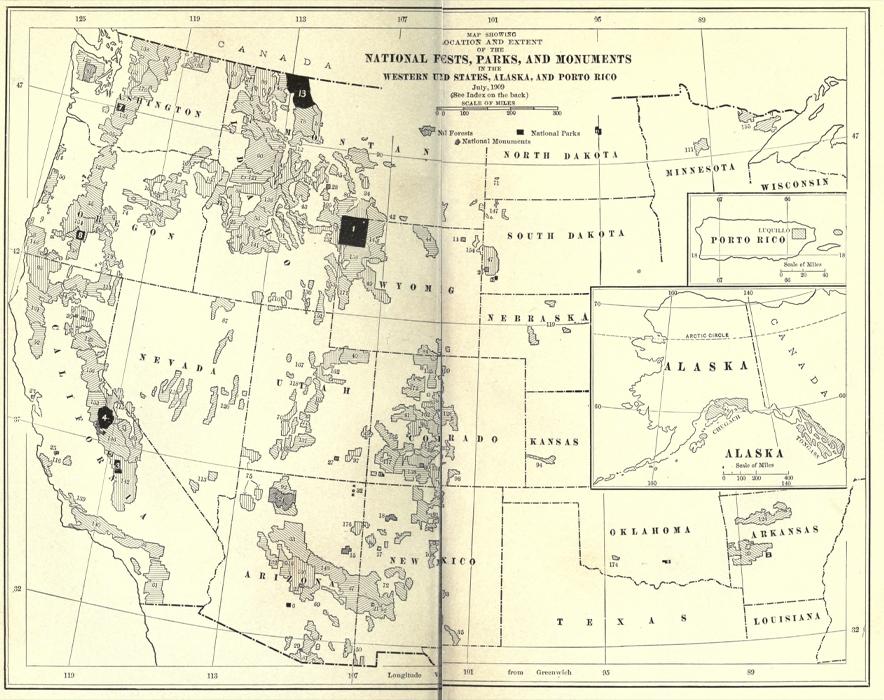
Map showing the National Forests, Parks, and Monuments of the United States.
INDEX TO THE MAP
(There are two National Forests in Florida and two in Michigan which are included in the table on page 373 are not shown on the map.)
NATIONAL PARKS
(In black on map)
1. Yellowstone, Wyo., Mont., and Ida.
2. Hot Springs, Ark.
3. Sequoia, Cal.
4. Yosemite, Cal.
5. General Grant, Cal.
6. Casa Grande, Ariz.
7. Mt. Rainier, Wash.
8. Crater Lake, Ore.
9. Platt, Okla.
10. Wind Cave, S. D.
11. Sully’s Hill, N. D.
12. Mesa Verde, Colo.
13. Glacier (see pp. 368, 369), Mont.
NATIONAL MONUMENTS
(Cross-hatched)
14. Devil’s Tower, Wyo.
15. Petrified Forest, Ariz.
16. Montezuma Castle, Ariz.
17. El Morro, N. M.
18. Chaco Canyon, N. M.
19. Lassen Peak, Cal.
20. Cinder Cone, Cal.
21. Gila Cliff-Dwellings, N. M.
22. Tonto, Ariz.
23. Muir Woods, Cal.
24. Grand Canyon, Ariz.
25. Pinnacles, Cal.
26. Jewel Cave, S. D.
27. Natural Bridges, Utah
28. Lewis and Clark Cavern, Mont.
29. Tumacocori, Ariz.
30. Wheeler, Colo.
31. Mt. Olympus, Wash.
32. Navajo, Ariz.
33. Oregon Caves, Ore.
NATIONAL FORESTS
(Shaded)
34. Absaroka, Mont.
35. Alamo, N. M.
36. Angeles, Cal.
37. Apache, Ariz.
38. Arapaho, Colo.
39. Arkansas, Ark.
40. Ashley, Utah and Wyo.
41. Battlement, Colo.
42. Beartooth, Mont.
43. Beaverhead, Ida. and Mont.
44. Bighorn, Wyo.
45. Bitterroot, Mont.
46. Blackfeet, Mont.
47. Black Hills, S. D.
48. Boise, Ida.
49. Bonneville, Wyo.
50. Cabinet, Mont.
51. Cache, Ida. and Utah
52. California, Cal.
53. Caribou, Ida. and Wyo.
54. Carson, N. M.
55. Cascade, Ore.
56. Challis, Ida.
57. Chelan, Wash.
58. Cheyenne, Wyo.
59. Chiricahua, Ariz. and N. M.
60. Clearwater, Ida.
61. Cleveland, Cal.
62. Cochetopa, Colo.
63. Coconino, Ariz.
64. Cœur d’Alene, Ida.
65. Columbia, Wash.
66. Colville, Wash.
67. Coronado, Ariz.
68. Crater, Cal. and Ore.
69. Crook, Ariz.
70. Custer, Mont.
71. Dakota, N. D.
72. Datil, N. M.
73. Deerlodge, Mont.
74. Deschutes, Ore.
75. Dixie, Ariz. and Utah
76. Fillmore, Utah
77. Fishlake, Utah
78. Flathead, Mont.
79. Fremont, Ore.
80. Gallatin, Mont.
81. Garces, Ariz.
82. Gila, N. M.
83. Gunnison, Colo.
84. Hayden, Wyo. and Colo.
85. Helena, Mont.
86. Holy Cross, Colo.
87. Humboldt, Nev.
88. Idaho, Ida.
89. Inyo, Cal. and Nev.
90. Jefferson, Mont.
91. Jemez, N. M.
92. Kaibab, Ariz.
93. Kaniksu, Ida. and Wash.
94. Kansas, Kan.
95. Klamath, Cal.
96. Kootenai, Mont.
97. La Sal, Utah and Colo.
98. Las Animas, Colo, and N. M.
99. Lassen, Cal.
100. Leadville, Colo.
101. Lemhi, Ida.
102. Lewis and Clark, Mont.
103. Lincoln, N. M.
104. Lolo, Mont.
105. Madison, Mont.
106. Malheur, Ore.
107. Manti, Utah
108. Manzano, N. M.
109. Medicine Bow, Colo.
110. Minidoka, Ida. and Utah
111. Minnesota, Minn.
112. Missoula, Mont.
113. Moapa, Nev.
114. Modoc, Cal.
115. Mono, Cal. and Nev.
116. Monterey, Cal.
117. Montezuma, Colo.
118. Nebo, Utah
119. Nebraska, Neb.
120. Nevada, Nev.
121. Nezperce, Ida.
122. Olympic, Wash.
123. Oregon, Ore.
124. Ozark, Ark.
125. Payette, Ida.
126. Pecos, N. M.
127. Pend d’Oreille, Ida.
128. Pike, Colo.
129. Plumas, Cal.
130. Pocatello, Ida. and Utah
131. Powell, Utah
132. Prescott, Ariz.
133. Rainier, Wash.
134. Rio Grande, Colo.
135. Routt, Colo.
136. Salmon, Ida.
137. San Isabel, Colo.
138. San Juan, Colo.
139. San Luis, Cal.
140. Santa Barbara, Cal.
141. Sawtooth, Ida.
142. Sequoia, Cal.
143. Sevier, Utah
144. Shasta, Cal.
145. Shoshone, Wyo.
146. Sierra, Cal.
147. Sioux, Mont, and S. D.
148. Siskiyou, Ore. and Cal.
149. Sitgreaves, Ariz.
150. Siuslaw, Ore.
151. Snoqualmie, Wash.
152. Sopris, Colo.
153. Stanislaus, Cal.
154. Sundance, Wyo.
155. Superior, Minn.
156. Tahoe, Cal. and Nev.
157. Targhee, Ida. and Wyo.
158. Teton, Wyo.
159. Toiyabe, Neb.
160. Tonto, Ariz.
161. Trinity, Cal.
162. Uinta, Utah
163. Umatilla, Ore.
164. Umpqua, Ore.
165. Uncompahgre, Colo.
166. Wallowa, Ore.
167. Wasatch, Utah
168. Washington, Wash.
169. Wenaha, Ore. and Wash.
170. Wenatchee, Wash.
171. Weiser, Ida.
172. White River, Colo.
173. Whitman, Ore.
174. Wichita, Okla.
175. Wyoming, Wyo.
176. Zuñi, Ariz. and N. M.
CHAPTER I
The Wild Parks and Forest Reservations of the West
“Keep not standing fix’d and rooted,
Briskly venture, briskly roam;
Head and hand, where’er thou foot it,
And stout heart are still at home.
In each land the sun does visit
We are gay, whate’er betide:
To give room for wandering is it
That the world was made so wide.”
The tendency nowadays to wander in wildernesses is delightful to see. Thousands of tired, nerve-shaken, over-civilized people are beginning to find out that going to the mountains is going home; that wildness is a necessity; and that mountain parks and reservations are useful not only as fountains of timber and irrigating rivers, but as fountains of life. Awakening from the stupefying effects of the vice of over-industry and the deadly apathy of luxury, they are trying as best they can to mix and enrich their own little ongoings with those of Nature, and to get rid of rust and disease. Briskly venturing and roaming, some are washing off sins and cobweb cares of the devil’s spinning in all-day storms on mountains; sauntering in rosiny pinewoods or in gentian meadows, brushing through chaparral, bending down and parting sweet, flowery sprays; tracing rivers to their sources, getting in touch with the nerves of Mother Earth; jumping from rock to rock, feeling the life of them, learning the songs of them, panting in whole-souled exercise, and rejoicing in deep, long-drawn breaths of pure wildness. This is fine and natural and full of promise. So also is the growing interest in the care and preservation of forests and wild places in general, and in the half wild parks and gardens of towns. Even the scenery habit in its most artificial forms, mixed with spectacles, silliness, and kodaks; its devotees arrayed more gorgeously than scarlet tanagers, frightening the wild game with red umbrellas,-even this is encouraging, and may well be regarded as a hopeful sign of the times.
All the Western mountains are still rich in wildness, and by means of good roads are being brought nearer civilization every year. To the sane and free it will hardly seem necessary to cross the continent in search of wild beauty, however easy the way, for they find it in abundance wherever they chance to be. Like Thoreau they see forests in orchards and patches of huckleberry brush, and oceans in ponds and drops of dew. Few in these hot, dim, strenuous times are quite sane or free; choked with care like clocks full of dust, laboriously doing so much good and making so much money,-or so little,-they are no longer good for themselves.
When, like a merchant taking a list of his goods, we take stock of our wildness, we are glad to see how much of even the most destructible kind is still unspoiled. Looking at our continent as scenery when it was all wild, lying between beautiful seas, the starry sky above it, the starry rocks beneath it, to compare its sides, the East and the West, would be like comparing the sides of a rainbow. But it is no longer equally beautiful. The rainbows of to-day are, I suppose, as bright as those that first spanned the sky; and some of our landscapes are growing more beautiful from year to year, notwithstanding the clearing, trampling work of civilization. New plants and animals are enriching woods and gardens, and many landscapes wholly new, with divine sculpture and architecture, are just now coming to the light of day as the mantling folds of creative glaciers are being withdrawn, and life in a thousand cheerful, beautiful forms is pushing into them, and new-born rivers are beginning to sing and shine in them. The old rivers, too, are growing longer, like healthy trees, gaining new branches and lakes as the residual glaciers at their highest sources on the mountains recede, while the rootlike branches in the flat deltas are at same time spreading farther and wider into the seas and making new lands.
Under the control of the vast mysterious forces of the interior of the earth all the continents and islands are slowly rising or sinking. Most of the mountains are diminishing in size under the wearing action of the weather, though a few are increasing in height and girth, especially the volcanic ones, as fresh floods of molten rocks are piled on their summits and spread in successive layers, like the wood-rings of trees, on their sides. New mountains, also, are being created from time to time as islands in lakes and seas, or as subordinate cones on the slopes of old ones, thus in some measure balancing the waste of old beauty with new. Man, too, is making many far-reaching changes. This most influential half animal, half angel is rapidly multiplying and spreading, covering the seas and lakes with ships, the land with huts, hotels, cathedrals, and clustered city shops and homes, so that soon, it would seem, we may have to go farther than Nansen to find a good sound solitude. None of Nature’s landscapes are ugly so long as they are wild; and much, we can say comfortingly, must always be in great part wild, particularly the sea and the sky, the floods of light from the stars, and the warm, unspoilable heart of the earth, infinitely beautiful, though only dimly visible to the eye of imagination. The geysers, too, spouting from the hot underworld; the steady, long-lasting glaciers on the mountains, obedient only to the sun; Yosemite domes and the tremendous grandeur of rocky cañons and mountains in general,-these must always be wild, for man can change them and mar them hardly more than can the butterflies that hover above them. But the continent’s outer beauty is fast passing away, especially the plant part of it, the most destructible and most universally charming of all.
Only thirty years ago, the great Central Valley of California, five hundred miles long and fifty miles wide, was one bed of golden and purple flowers. Now it is ploughed and pastured out of existence, gone forever,-scarce a memory of it left in fence corners and along the bluffs of the streams. The gardens of the Sierra, also, and the noble forests in both the reserved and unreserved portions are sadly hacked and trampled, notwithstanding, the ruggedness of the topography,-all excepting those of the parks guarded by a few soldiers. In the noblest forests of the world, the ground, once divinely beautiful, is desolate and repulsive, like a face ravaged by disease. This is true also of many other Pacific Coast and Rocky Mountain valleys and forests. The same fate, sooner or later, is awaiting them all, unless awakening public opinion comes forward to stop it. Even the great deserts in Arizona, Nevada, Utah, and New Mexico, which offer so little to attract settlers, and which a few years ago pioneers were afraid of, as places of desolation and death, are now taken as pastures at the rate of one or two square miles per cow, and of course their plant treasures are passing away,-the delicate abronias, phloxes, gilias, etc. Only a few of the bitter, thorny, unbitable shrubs are left, and the sturdy cactuses that defend themselves with bayonets and spears.
Most of the wild plant wealth of the East also has vanished,-gone into dusty history. Only vestiges of its glorious prairie and woodland wealth remain to bless humanity in boggy, rocky, unploughable places. Fortunately, some of these are purely wild, and go far to keep Nature’s love visible. White water-lilies, with rootstocks deep and safe in mud, still send up every summer a Milky Way of starry, fragrant flowers around a thousand lakes, and many a tuft of wild grass waves its panicles on mossy rocks, beyond reach of trampling feet, in company with saxifrages, bluebells, and ferns. Even in the midst of farmers fields, precious sphagnum bogs, too soft for the feet of cattle, are preserved with their charming plants unchanged,-chiogenes, Andromeda, Kalmia, Linnæa, Arethusa, etc. Calypso borealis still hides in the arbor vitæ swamps of Canada, and away to the southward there are a few unspoiled swamps, big ones, where miasma, snakes, and alligators, like guardian angels, defend their treasures and keep them as pure as paradise. And beside a’ that and a’ that, the East is blessed with good winters and blossoming clouds that shed white flowers over all the land, covering every scar and making the saddest landscape divine at least once a year.
The most extensive, least spoiled, and most unspoilable of the gardens of the continent are the vast tundras of Alaska. In summer they extend smooth, even, undulating, continuous beds of flowers and leaves from about lat. 62° to the shores of the Arctic Ocean; and in winter sheets of snowflowers make all the country shine, one mass of white radiance like a star. Nor are these Arctic plant people the pitiful frost-pinched unfortunates they are guessed to be by those who have never seen them. Though lowly in stature, keeping near the frozen ground as if loving it, they are bright and cheery, and speak Nature’s love as plainly as their big relatives of the South. Tenderly happed and tucked in beneath downy snow to sleep through the long, white winter, they make haste to bloom in the spring without trying to grow tall, though some rise high enough to ripple and wave in the wind, and display masses of color,-yellow, purple, and blue,-so rich that they look like beds of rainbows, and are visible miles and miles away.
As early as June one may find the showy Geum glaciale in flower, and the dwarf willows putting forth myriads of fuzzy catkins, to be followed quickly, especially on the dryer ground, by mertensia, eritrichium, polemonium, oxytropis, astragalus, lathyrus, lupinus, myosotis, dodecatheon, arnica, chrysanthemum, nardosmia, saussurea, senecio, erigeron, matrecaria, caltha, valeriana, stellaria, Tofieldia, polygonum, papaver, phlox, lychnis, cheiranthus, Linnæa, and a host of drabas, saxifrages, and heathworts, with bright stars and bells in glorious profusion, particularly Cassiope, Andromeda, ledum, pyrola, and vaccinium,-Cassiope the most abundant and beautiful of them all. Many grasses also grow here, and wave fine purple spikes and panicles over the other flowers,-poa, aira, calamagrostis, alopecurus, trisetum, elymus, festuca, glyceria, etc. Even ferns are found thus far north, carefully and comfortably unrolling their precious fronds,-aspidium, cystopteris, and woodsia, all growing on a sumptuous bed of mosses and lichens; not the scaly lichens seen on rails and trees and fallen logs to the southward, but massive, roundheaded, finely colored plants like corals, wonderfully beautiful, worth going round the world to see. I should like to mention all the plant friends I found in a summer’s wanderings in this cool reserve, but I fear few would care to read their names, although everybody, I am sure, would love them could they see them blooming and rejoicing at home.
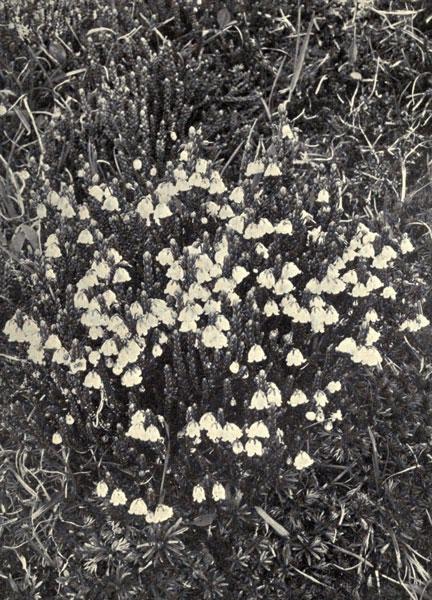
Cassiope.
On my last visit to the region about Kotzebue Sound, near the middle of September, 1881, the weather was so fine and mellow that it suggested the Indian summer of the Eastern States. The winds were hushed, the tundra glowed in creamy golden sunshine, and the colors of the ripe foliage of the heathworts, willows, and birch-red, purple, and yellow, in pure bright tones-were enriched with those of berries which were scattered everywhere, as if they had been showered from the clouds like hail. When I was back a mile or two from the shore, reveling in this color-glory, and thinking how fine it would be could I cut a square of the tundra sod of conventional picture size, frame it, and hang it among the paintings on my study walls at home, saying to myself, “Such a Nature painting taken at random from any part of the thousand-mile bog would make the other pictures look dim and coarse,” I heard merry shouting, and, looking round, saw a band of Eskimos-men, women, and children, loose and hairy like wild animals-running towards me. I could not guess at first what they were seeking, for they seldom leave the shore; but soon they told me, as they threw themselves down, sprawling and laughing, on the mellow bog, and began to feast on the berries. A lively picture they made, and a pleasant one, as they frightened the whirring ptarmigans, and surprised their oily stomachs with the beautiful acid berries of many kinds, and filled sealskin bags with them to carry away for festive days in winter.
Nowhere else on my travels have I seen so much warm-blooded, rejoicing life as in this grand Arctic reservation, by so many regarded as desolate. Not only are there whales in abundance along the shores, and innumerable seals, walruses, and white bears, but on the tundras great herds of fat reindeer and wild sheep, foxes, hares, mice, piping marmots, and birds. Perhaps more birds are born here than in any other region of equal extent on the continent. Not only do strong-winged hawks, eagles, and water-fowl, to whom the length of the continent is merely a pleasant excursion, come up here every summer in great numbers, but also many short-winged warblers, thrushes, and finches, repairing hither to rear their young in safety, reinforce the plant bloom with their plumage, and sweeten the wilderness with song; flying all the way, some of them, from Florida, Mexico, and Central America. In coming north they are coming home, for they were born here, and they go south only to spend the winter months, as New Englanders go to Florida. Sweet-voiced troubadours, they sing in orange groves and vine-clad magnolia woods in winter, in thickets of dwarf birch and alder in summer, and sing and chatter more or less all the way back and forth, keeping the whole country glad. Oftentimes, in New England, just as the last snow-patches are melting and the sap in the maples begins to flow, the blessed wanderers may be heard about orchards and the edges of fields where they have stopped to glean a scanty meal, not tarrying long, knowing they have far to go. Tracing the footsteps of spring, they arrive in their tundra homes in June or July, and set out on their return journey in September, or as soon as their families are able to fly well.
This is Nature’s own reservation, and every lover of wildness will rejoice with me that by kindly frost it is so well defended. The discovery lately made that it is sprinkled with gold may cause some alarm; for the strangely exciting stuff makes the timid bold enough for anything, and the lazy destructively industrious. Thousands at least half insane are now pushing their way into it, some by the southern passes over the mountains, perchance the first mountains they have ever seen,-sprawling, struggling, gasping for breath, as, laden with awkward, merciless burdens of provisions and tools, they climb over rough-angled boulders and cross thin miry bogs. Some are going by the mountains and rivers to the eastward through Canada, tracing the old romantic ways of the Hudson Bay traders; others by Bering Sea and the Yukon, sailing all the way, getting glimpses perhaps of the famous fur-seals, the ice-floes, and the innumerable islands and bars of the great Alaska river. In spite of frowning hardships and the frozen ground, the Klondike gold will increase the crusading crowds for years to come, but comparatively little harm will be done. Holes will be burned and dug into the hard ground here and there, and into the quartz-ribbed mountains and hills; ragged towns like beaver and muskrat villages will be built, and mills and locomotives will make rumbling, screeching, disenchanting noises; but the miner’s pick will not be followed far by the plough, at least not until Nature is ready to unlock the frozen soil-beds with her slow-turning climate key. On the other hand, the roads of the pioneer miners will lead many a lover of wildness into the heart of the reserve, who without them would never see it.
In the meantime, the wildest health and pleasure grounds accessible and available to tourists seeking escape from care and dust and early death are the parks and reservations of the West. There are four national parks,[1] -the Yellowstone, Yosemite, General Grant, and Sequoia,-all within easy reach, and thirty forest reservations, a magnificent realm of woods, most of which, by railroads and trails and open ridges, is also fairly accessible, not only to the determined traveler rejoicing in difficulties, but to those (may their tribe increase) who, not tired, not sick, just naturally take wing every summer in search of wildness. The forty million acres of these reserves are in the main unspoiled as yet, though sadly wasted and threatened on their more open margins by the axe and fire of the lumberman and prospector, and by hoofed locusts, which, like the winged ones, devour every leaf within reach, while the shepherds and owners set fires with the intention of making a blade of grass grow in the place of every tree, but with the result of killing both the grass and the trees.
In the million acre Black Hills Reserve of South Dakota, the easternmost of the great forest reserves, made for the sake of the farmers and miners, there are delightful, reviving sauntering-grounds in open parks of yellow pine, planted well apart, allowing plenty of sunshine to warm the ground. This tree is one of the most variable and most widely distributed of American pines. It grows sturdily on all kinds of soil and rocks, and, protected by a mail of thick bark, defies frost and fire and disease alike, daring every danger in firm, calm beauty and strength. It occurs here mostly on the outer hills and slopes where no other tree can grow. The ground beneath it is yellow most of the summer with showy Wythia, arnica, applopappus, solidago, and other sun-loving plants, which, though they form no heavy entangling growth, yet give abundance of color and make all the woods a garden. Beyond the yellow pine woods there lies a world of rocks of wildest architecture, broken, splintery, and spiky, not very high, but the strangest in form and style of grouping imaginable. Countless towers and spires, pinnacles and slender domed columns, are crowded together, and feathered with sharp-pointed Engelmann spruces, making curiously mixed forests,-half trees, half rocks. Level gardens here and there in the midst of them offer charming surprises, and so do the many small lakes with lilies on their meadowy borders, and bluebells, anemones, daises, castilleias, comandras, etc., together forming landscapes delightfully novel, and made still wilder by many interesting animals,-elk, deer, beavers, wolves, squirrels, and birds. Not very long ago this was the richest of all the red man’s hunting-grounds hereabout. After the season’s buffalo hunts were over,-as described by Parkman, who, with a picturesque cavalcade of Sioux savages, passed through these famous hills in 1846,-every winter deficiency was here made good, and hunger was unknown until, in spite of most determined, fighting, killing opposition, the white gold-hunters entered the fat game reserve and spoiled it. The Indians are dead now, and so are most of the hardly less striking free trappers of the early romantic Rocky Mountain times. Arrows, bullets, scalping-knives, need no longer be feared; and all the wilderness is peacefully open.
The Rocky Mountain reserves are the Teton, Yellowstone, Lewis and Clark, Bitter Root, Priest River and Flathead, comprehending more than twelve million acres of mostly unclaimed, rough, forest-covered mountains in which the great rivers of the country take their rise. The commonest tree in most of them is the brave, indomitable, and altogether admirable Pinus contorta, widely distributed in all kinds of climate and soil, growing cheerily in frosty Alaska, breathing the damp salt air of the sea as well as the dry biting blasts of the Arctic interior, and making itself at home on the most dangerous flame-swept slopes and bridges of the Rocky Mountains in immeasurable abundance and variety of forms. Thousands of acres of this species are destroyed by running fires nearly every summer, but a new growth springs quickly from the ashes. It is generally small, and yields few sawlogs of commercial value, but is of incalculable importance to the farmer and miner; supplying fencing, mine timbers, and firewood, holding the porous soil on steep slopes, preventing landslips and avalanches, and giving kindly, nourishing shelter to animals and the widely outspread sources of the life-giving rivers. The other trees are mostly spruce, mountain pine, cedar, juniper, larch, and balsam fir; some of them, especially on the western slopes of the mountains, attaining grand size and furnishing abundance of fine timber.
Perhaps the least known of all this grand group of reserves is the Bitter Root, of more than four million acres. It is the wildest, shaggiest block of forest wildness in the Rocky Mountains, full of happy, healthy, storm-loving trees, full of streams that dance and sing in glorious array, and full of Nature’s animals,-elk, deer, wild sheep, bears, cats, and innumerable smaller people.
In calm Indian summer, when the heavy winds are hushed, the vast forests covering hill and dale, rising and falling over the rough topography and vanishing in the distance, seem lifeless. No moving thing is seen as we climb the peaks, and only the low, mellow murmur of falling water is heard, which seems to thicken the silence. Nevertheless, how many hearts with warm red blood in them are beating under cover of the woods, and how many teeth and eyes are shining! A multitude of animal people, intimately related to us, but of whose lives we know almost nothing, are as busy about their own affairs as we are about ours: beavers are building and mending dams and huts for winter, and storing them with food; bears are studying winter quarters as they stand thoughtful in open spaces, while the gentle breeze ruffles the long hair on their backs; elk and deer, assembling on the heights, are considering cold pastures where they will be farthest away from the wolves; squirrels and marmots are busily laying up provisions and lining their nests against coming frost and snow foreseen; and countless thousands of birds are forming parties and gathering their young about them for flight to the southlands; while butterflies and bees, apparently with no thought of hard times to come, are hovering above the late-blooming goldenrods, and, with countless other insect folk, are dancing and humming right merrily in the sunbeams and shaking all the air into music.
Wander here a whole summer, if you can. Thousands of God’s wild blessings will search you and soak you as if you were sponge, and the big days will go by uncounted. If you are business-tangled, and so burdened with duty that only weeks can be got out of the heavy-laden year, then go to the Flathead Reserve; for it is easily and quickly reached by the Great Northern Railroad. Get off the track at Belton Station, and in a few minutes you will find yourself in the midst of what you are sure to say is the best care-killing scenery on the continent,-beautiful lakes derived straight from glaciers, lofty mountains steeped in lovely nemophila-blue skies and clad with forests and glaciers, mossy, ferny waterfalls in their hollows, nameless and numberless, and meadowy gardens abounding in the best of everything. When you are calm enough for discriminating observation, you will find the king of the larches, one of the best of the Western giants, beautiful, picturesque, and regal in port, easily the grandest of all the larches in the world. It grows to a height of one hundred and fifty to two hundred feet, with a diameter at the ground of five to eight feet, throwing out its branches into the light as no other tree does. To those who before have seen only the European larch or the Lyall species of the eastern Rocky Mountains, or the little tamarack or hackmatack of the Eastern States and Canada, this Western king must be a revelation.
Associated with this grand tree in the making of the Flathead forests is the large and beautiful mountain pine, or Western white pine (Pinus monticola), the invincible contorta or lodge-pole pine, and spruce and cedar. The forest floor is covered with the richest beds of Linnæa borealis I ever saw, thick fragrant carpets, enriched with shining mosses here and there, and with Clintonia, pyrola, moneses, and vaccinium, weaving hundred-mile beds of bloom that would have made blessed old Linnæus weep for joy.
Lake McDonald, full of brisk trout, is in the heart of this forest, and Avalanche Lake is ten miles above McDonald, at the feet of a group of glacier-laden mountains. Give a month at least to this precious reserve. The time will not be taken from the sum of your life. Instead of shortening, it will indefinitely lengthen it and make you truly immortal. Nevermore will time seem short or long, and cares will never again fall heavily on you, but gently and kindly as gifts from heaven.
The vast Pacific Coast reserves in Washington and Oregon-the Cascade, Washington, Mount Rainier, Olympic, Bull Run, and Ashland, named in order of size-include more than 12,500,000 acres of magnificent forests of beautiful and gigantic trees. They extend over the wild, unexplored Olympic Mountains and both flanks of the Cascade Range, the wet and the dry. On the east side of the Cascades the woods are sunny and open, and contain principally yellow pine, of moderate size, but of great value as a cover for the irrigating streams that flow into the dry interior, where agriculture on a grand scale is being carried on. Along the moist, balmy, foggy, west flank of the mountains, facing the sea, the woods reach their highest development, and, excepting the California redwoods, are the heaviest on the continent. They are made up mostly of the Douglas spruce (Pseudotsuga taxifolia), with the giant arbor vitæ, or cedar, and several species of fir and hemlock in varying abundance, forming a forest kingdom unlike any other, in which limb meets limb, touching and overlapping in bright, lively, triumphant exuberance, two hundred and fifty, three hundred, and even four hundred feet above the shady, mossy ground. Over all the other species the Douglas spruce reigns supreme. It is not only a large tree, the tallest in America next to the redwood, but a very beautiful one, with bright green drooping foliage, handsome pendent cones, and a shaft exquisitely straight and round and regular. Forming extensive forests by itself in many places, it lifts its spiry tops into the sky close together with as even a growth as a well-tilled field of grain. No ground has been better tilled for wheat than these Cascade Mountains for trees: they were ploughed by mighty glaciers, and harrowed and mellowed and outspread by the broad streams that flowed from the ice-ploughs as they were withdrawn at the close of the glacial period.
In proportion to its weight when dry, Douglas spruce timber is perhaps stronger than that of any other large conifer in the country, and being tough, durable, and elastic, it is admirably suited for ship-building, piles, and heavy timbers in general; but its hardness and liability to warp when it is cut into boards render it unfit for fine work. In the lumber markets of California it is called “Oregon pine.” When lumbering is going on in the best Douglas woods, especially about Puget Sound, many of the long, slender boles are saved for spars; and so superior is their quality that they are called for in almost every shipyard in the world, and it is interesting to follow their fortunes. Felled and peeled and dragged to tide-water, they are raised again as yards and masts for ships, given iron roots and canvas foliage, decorated with flags, and sent to sea, where in glad motion they go cheerily over the ocean prairie in every latitude and longitude, singing and bowing responsive to the same winds that waved them when they were in the woods. After standing in one place for centuries they thus go round the world like tourists, meeting many a friend from the old home forest; some traveling like themselves, some standing head downward in muddy harbors, holding up the platforms of wharves, and others doing all kinds of hard timber work, showy or hidden.
This wonderful tree also grows far northward in British Columbia, and southward along the coast and middle regions of Oregon and California; flourishing with the redwood wherever it can find an opening, and with the sugar pine, yellow pine, and libocedrus in the Sierra. It extends into the San Gabriel, San Bernardino, and San Jacinto Mountains of southern California. It also grows well on the Wasatch Mountains, where it is called “red pine,” and on many parts of the Rocky Mountains and short interior ranges of the Great Basin. But though thus widely distributed, only in Oregon, Washington, and some parts of British Columbia does it reach perfect development.
To one who looks from some high standpoint over its vast breadth, the forest on the west side of the Cascades seems all one dim, dark, monotonous field, broken only by the white volcanic cones along the summit of the range. Back in the untrodden wilderness a deep furred carpet of brown and yellow mosses covers the ground like a garment, pressing about the feet of the trees, and rising in rich bosses softly and kindly over every rock and mouldering trunk, leaving no spot uncared for; and dotting small prairies, and fringing the meadows and the banks of streams not seen in general views, we find, besides the great conifers, a considerable number of hard-wood trees,-oak, ash, maple, alder, wild apple, cherry, arbutus, Nuttall’s flowering dogwood, and in some places chestnuts. In a few favored spots the broad-leaved maple grows to a height of a hundred feet in forests by itself, sending out large limbs in magnificent interlacing arches covered with mosses and ferns, thus forming lofty sky-gardens, and rendering the underwoods delightfully cool. No finer forest ceiling is to be found than these maple arches, while the floor, ornamented with tall ferns and rubus vines, and cast into hillocks by the bulging, moss-covered roots of the trees, matches it well.
Passing from beneath the heavy shadows of the woods, almost anywhere one steps into lovely gardens of lilies, orchids, heathworts, and wild roses. Along the lower slopes, especially in Oregon, where the woods are less dense, there are miles of rhododendron, making glorious masses of purple in the spring, while all about the streams and the lakes and the beaver meadows there is a rich tangle of hazel, plum, cherry, crab-apple, cornel, gaultheria, and rubus, with myriads of flowers and abundance of other more delicate bloomers, such as erythronium, brodiæa, fritillaria, calochortus, Clintonia, and the lovely hider of the north, Calypso. Beside all these bloomers there are wonderful ferneries about the many misty waterfalls, some of the fronds ten feet high, others the most delicate of their tribe, the maidenhair fringing the rocks within reach of the lightest dust of the spray, while the shading trees on the cliffs above them, leaning over, look like eager listeners anxious to catch every tone of the restless waters. In the autumn berries of every color and flavor abound, enough for birds, bears, and everybody, particularly about the stream-sides and meadows where sunshine reaches the ground: huckleberries, red, blue, and black, some growing close to the ground others on bushes ten feet high; gaultheria berries, called “sal-al” by the Indians; salmon berries, an inch in diameter, growing in dense prickly tangles, the flowers, like wild roses, still more beautiful than the fruit; raspberries, gooseberries, currants, blackberries, and strawberries. The underbrush and meadow fringes are in great part made up of these berry bushes and vines; but in the depths of the woods there is not much underbrush of any kind,-only a thin growth of rubus, huckleberry, and vine-maple.
Notwithstanding the outcry against the reservations last winter in Washington, that uncounted farms, towns, and villages were included in them, and that all business was threatened or blocked, nearly all the mountains in which the reserves lie are still covered with virgin forests. Though lumbering has long been carried on with tremendous energy along their boundaries, and home-seekers have explored the woods for openings available for farms, however small, one may wander in the heart of the reserves for weeks without meeting a human being, Indian or white man, or any conspicuous trace of one. Indians used to ascend the main streams on their way to the mountains for wild goats, whose wool furnished them clothing. But with food in abundance on the coast there was little to draw them into the woods, and the monuments they have left there are scarcely more conspicuous than those of birds and squirrels; far less so than those of the beavers, which have dammed streams and made clearings that will endure for centuries. Nor is there much in these woods to attract cattle-keepers. Some of the first settlers made farms on the small bits of prairie and in the comparatively open Cowlitz and Chehalis valleys of Washington; but before the gold period most of the immigrants from the Eastern States settled in the fertile and open Willamette Valley of Oregon. Even now, when the search for tillable land is so keen, excepting the bottom-lands of the rivers around Puget Sound, there are few cleared spots in all western Washington. On every meadow or opening of any sort some one will be found keeping cattle, raising hops, or cultivating patches of grain, but these spots are few and far between. All the larger spaces were taken long ago; therefore most of the newcomers build their cabins where the beavers built theirs. They keep a few cows, laboriously widen their little meadow openings by hacking, girdling, and burning the rim of the close-pressing forest, and scratch and plant among the huge blackened logs and stamps, girdling and killing themselves in killing the trees.
Most of the farm lands of Washington and Oregon, excepting the valleys of the Willamette and Rogue rivers, lie on the east side of the mountains. The forests on the eastern slopes of the Cascades fail altogether ere the foot of the range is reached, stayed by drought as suddenly as on the west side they are stopped by the sea; showing strikingly how dependent are these forest giants on the generous rains and fogs so often complained of in the coast climate. The lower portions of the reserves are solemnly soaked and poulticed in rain and fog during the winter months, and there is a sad dearth of sunshine, but with a little knowledge of woodcraft any one may enjoy an excursion into these woods even in the rainy season. The big, gray days are exhilarating, and the colors of leaf and branch and mossy bole are then at their best. The mighty trees getting their food are seen to be wide-awake, every needle thrilling in the welcome nourishing storms, chanting and bowing low in glorious harmony, while every raindrop and snowflake is seen as a beneficent messenger from the sky. The snow that falls on the lower woods is mostly soft, coming through the trees in downy tufts, loading their branches, and bending them down against the trunks until they look like arrows, while a strange muffled silence prevails, making everything impressively solemn. But these lowland snowstorms and their effects quickly vanish. The snow melts in a day or two, sometimes in a few hours, the bent branches spring up again, and all the forest work is left to the fog and the rain. At the same time, dry snow is falling on the upper forests and mountain tops. Day after day, often for weeks, the big clouds give their flowers without ceasing, as if knowing how important is the work they have to do. The glinting, swirling swarms thicken the blast, and the trees and rocks are covered to a depth of ten to twenty feet. Then the mountaineer, snug in a grove with bread and fire, has nothing to do but gaze and listen and enjoy. Ever and anon the deep, low roar of the storm is broken by the booming of avalanches, as the snow slips from the overladen heights and crushes down the long white slopes to fill the fountain hollows. All the smaller streams are crushed and buried, and the young groves of spruce and fir near the edge of the timber-line are gently bowed to the ground and put to sleep, not again to see the light of day or stir branch or leaf until the spring.
These grand reservations should draw thousands of admiring visitors at least in summer, yet they are neglected as if of no account, and spoilers are allowed to ruin them as fast as they like.[2] A few peeled spars cut here were set up in London, Philadelphia, and Chicago, where they excited wondering attention; but the countless hosts of living trees rejoicing at home on the mountains are scarce considered at all. Most travelers here are content with what they can see from car windows or the verandas of hotels, and in going from place to place cling to their precious trains and stages like wrecked sailors to rafts. When an excursion into the woods is proposed, all sorts of dangers are imagined,-snakes, bears, Indians. Yet it is far safer to wander in God’s woods than to travel on black highways or to stay at home. The snake danger is so slight it is hardly worth mentioning. Bears are a peaceable people, and mind their own business, instead of going about like the devil seeking whom they may devour. Poor fellows, they have been poisoned, trapped, and shot at until they have lost confidence in brother man, and it is not now easy to make their acquaintance. As to Indians, most of them are dead or civilized into useless innocence. No American wilderness that I know of is so dangerous as a city home “with all the modern improvements.” One should go to the woods for safety, if for nothing else. Lewis and Clark, in their famous trip across the continent in 1804-1805, did not lose a single man by Indians or animals, though all the West was then wild. Captain Clark was bitten on the hand as he lay asleep. That was one bite among more than a hundred men while traveling nine thousand sand miles. Loggers are far more likely to be met than Indians or bears in the reserves or about their boundaries, brown weather-tanned men with faces furrowed like bark, tired-looking, moving slowly, swaying like the trees they chop. A little of everything in the woods is fastened to their clothing, rosiny and smeared with balsam, and rubbed into it, so that their scanty outer garments grow thicker with use and never wear out. Many a forest giant have these old woodmen felled, but, round-shouldered and stooping, they too are leaning over and tottering to their fall. Others, however, stand ready to take their places, stout young fellows, erect as saplings; and always the foes of trees outnumber their friends. Far up the white peaks one can hardly fail to meet the wild goat, or American chamois,-an admirable mountaineer, familiar with woods and glaciers as well as rocks,-and in leafy thickets deer will be found; while gliding about unseen there are many sleek furred animals enjoying their beautiful lives, and birds also, notwithstanding few are noticed in hasty walks. The ousel sweetens the glens and gorges where the streams flow fastest, and every grove has its singers, however silent it seems,-thrushes, linnets, warblers; humming-birds glint about the fringing bloom of the meadows and peaks, and the lakes are stirred into lively pictures by water-fowl.
The Mount Rainier Forest Reserve should be made a national park and guarded while yet its bloom is on;[3] for if in the making of the West Nature had what we call parks in mind,-places for rest, inspiration, and prayers,-this Rainier region must surely be one of them. In the centre of it there is a lonely mountain capped with ice; from the ice-cap glaciers radiate in every direction, and young rivers from the glaciers; while its flanks, sweeping down in beautiful curves, are clad with forests and gardens, and filled with birds and animals. Specimens of the best of Nature’s treasures have been lovingly gathered here and arranged in simple symmetrical beauty within regular bounds.
Of all the fire-mountains which, like beacons, once blazed along the Pacific Coast, Mount Rainier is the noblest in form, has the most interesting forest cover, and, with perhaps the exception of Shasta, is the highest and most flowery. Its massive white dome rises out of its forests, like a world by itself, to a height of fourteen thousand to fifteen thousand feet. The forests reach to a height of a little over six thousand feet, and above the forests there is a zone of the loveliest flowers, fifty miles in circuit and nearly two miles wide, so closely planted and luxuriant that it seems as if Nature, glad to make an open space between woods so dense and ice so deep, were economizing the precious ground, and trying to see how many of her darlings she can get together in one mountain wreath,-daisies, anemones, geraniums, columbines, erythroniums, larkspurs, etc., among which we wade knee-deep and waist-deep, the bright corollas in myriads touching petal to petal. Picturesque detached groups of the spiry Abies lasiocarpa stand like islands along the lower margin of the garden zone, while on the upper margin there are extensive beds of bryanthus, Cassiope, Kalmia, and other heathworts, and higher still saxifrages and drabas, more and more lowly, reach up to the edge of the ice. Altogether this is the richest subalpine garden I ever found, a perfect floral elysium. The icy dome needs none of man’s care, but unless the reserve is guarded the flower bloom will soon be killed, and nothing of the forests will be left but black stump monuments.
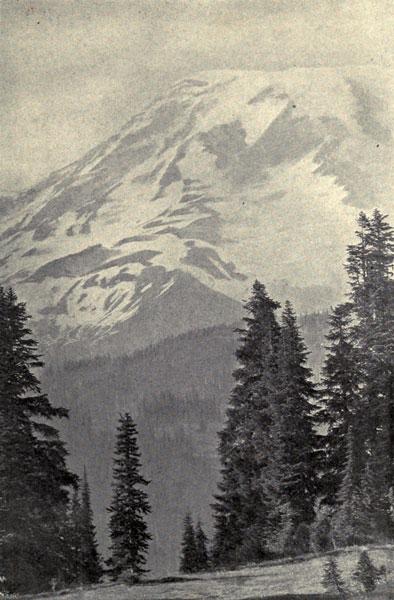
Mt. Rainier and Alpine Firs (Abies lasiocarpa).
The Sierra of California is the most openly beautiful and useful of all the forest reserves, and the largest excepting the Cascade Reserve of Oregon and the Bitter Root of Montana and Idaho. It embraces over four million acres of the grandest scenery and grandest trees on the continent, and its forests are planted just where they do the most good, not only for beauty, but for farming in the great San Joaquin Valley beneath them. It extends southward from the Yosemite National Park to the end of the range, a distance of nearly two hundred miles. No other coniferous forest in the world contains so many species or so many large and beautiful trees,-Sequoia gigantea, king of conifers, “the noblest of a noble race,” as Sir Joseph Hooker well says; the sugar pine, king of all the world’s pines, living or extinct; the yellow pine, next in rank, which here reaches most perfect development, forming noble towers of verdure two hundred feet high; the mountain pine, which braves the coldest blasts far up the mountains on grim, rocky slopes; and five others, flourishing each in its place, making eight species of pine in one forest, which is still further enriched by the great Douglas spruce, libocedrus, two species of silver fir, large trees and exquisitely beautiful, the Paton hemlock, the most graceful of evergreens, the curious tumion, oaks of many species, maples, alders, poplars, and flowering dogwood, all fringed with flowery underbrush, manzanita, ceanothus, wild rose, cherry, chestnut, and rhododendron. Wandering at random through these friendly, approachable woods, one comes here and there to the loveliest lily gardens, some of the lilies ten feet high, and the smoothest gentian meadows, and Yosemite valleys known only to mountaineers. Once I spent a night by a camp-fire on Mount Shasta with Asa Gray and Sir Joseph Hooker, and, knowing that they were acquainted with all the great forests of the world, I asked whether they knew any coniferous forest that rivaled that of the Sierra. They unhesitatingly said: “No. In the beauty and grandeur of individual trees, and in number and variety of species, the Sierra forests surpass all others.”
This Sierra Reserve, proclaimed by the President of the United States in September, 1893, is worth the most thoughtful care of the government for its own sake, without considering its value as the fountain of the rivers on which the fertility of the great San Joaquin Valley depends. Yet it gets no care at all. In the fog of tariff, silver, and annexation politics it is left wholly unguarded, though the management of the adjacent national parks by a few soldiers shows how well and how easily it can be preserved. In the meantime, lumbermen are allowed to spoil it at their will, and sheep in uncountable ravenous hordes to trample it and devour every green leaf within reach; while the shepherds, like destroying angels, set innumerable fires, which burn not only the undergrowth of seedlings on which the permanence of the forest depends, but countless thousands of the venerable giants. If every citizen could take one walk through this reserve, there would be no more trouble about its care; for only in darkness does vandalism flourish.[4] The reserves of southern California,-the San Gabriel, San Bernardino, San Jacinto, and Trabuco,-though not large, only about two million acres together, are perhaps the best appreciated. Their slopes are covered with a close, almost impenetrable growth of flowery bushes, beginning on the sides of the fertile coast valleys and the dry interior plains. Their higher ridges, however, and mountains are open, and fairly well forested with sugar pine, yellow pine, Douglas spruce, libocedrus, and white fir. As timber fountains they amount to little, but as bird and bee pastures, cover for the precious streams that irrigate the lowlands, and quickly available retreats from dust and heat and care, their value is incalculable. Good roads have been graded into them, by which in a few hours lowlanders can get well up into the sky and find refuge in hospitable camps and club-houses, where, while breathing reviving ozone, they may absorb the beauty about them, and look comfortably down on the busy towns and the most beautiful orange groves ever planted since gardening began.
The Grand Cañon Reserve of Arizona, of nearly two million acres, or the most interesting part of it, as well as the Rainier region, should be made into a national park, on account of their supreme grandeur and beauty. Setting out from Flagstaff, a station on the Atchison, Topeka, and Santa Fé Railroad, on the way to the cañon you pass through beautiful forests of yellow pine,-like those of the Black Hills, but more extensive,-and curious dwarf forests of nut pine and juniper, the spaces between the miniature trees planted with many interesting species of eriogonum, yucca, and cactus. After riding or walking seventy-five miles through these pleasure-grounds, the San Francisco and other mountains, abounding in flowery parklike openings and smooth shallow valleys with long vistas which in fineness of finish and arrangement suggest the work of a consummate landscape artist, watching you all the way, you come to the most tremendous cañon in the world. It is abruptly countersunk in the forest plateau, so that you see nothing of it until you are suddenly stopped on its brink, with its immeasurable wealth of divinely colored and sculptured buildings before you and beneath you. No matter how far you have wandered hitherto, or how many famous gorges and valleys you have seen, this one, the Grand Cañon of the Colorado, will seem as novel to you, as unearthly in the color and grandeur and quantity of its architecture, as if you had found it after death, on some other star; so incomparably lovely and grand and supreme is it above all the other cañons in our fire-moulded, earthquake-shaken, rain-washed, wave-washed, river and glacier sculptured world. It is about six thousand feet deep where you first see it, and from rim to rim ten to fifteen miles wide. Instead of being dependent for interest upon waterfalls, depth, wall sculpture, and beauty of parklike floor, like most other great cañons, it has not waterfalls in sight, and no appreciable floor spaces. The big river has just room enough to flow and roar obscurely, here and there groping its way as best it can, like a weary, murmuring, overladen traveler trying to escape from the tremendous, bewildering labyrinthic abyss, while its roar serves only to deepen the silence. Instead of being filled with air, the vast space between the walls is crowded with Nature’s grandest buildings,-a sublime city of them, painted in every color, and adorned with richly fretted cornice and battlement spire and tower in endless variety of style and architecture. Every architectural invention of man has been anticipated, and far more, in this grandest of God’s terrestrial cities.
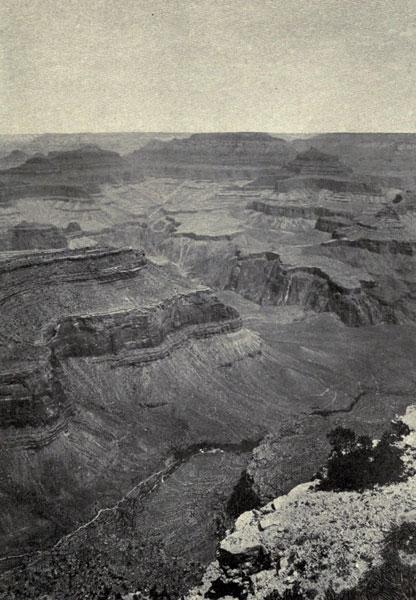
The Grand Cañon of Colorado.
4
See footnote 2.
3
This was done shortly after the above was written. “One of the most important measures taken during the past year in connection with forest reservations was the action of Congress in withdrawing from the Mount Rainier Forest Reserve a portion of the region immediately surrounding Mount Rainier and setting it apart as a national park.” (Report of Commissioner of General Land Office, for the year ended June, 1899.) But the park as it now stands is far too small.
2
The outlook over forest affairs is now encouraging. Popular interest, more practical than sentimental in whatever touches the welfare of the country’s forests, is growing rapidly, and a hopeful beginning has been made by the Government in real protection for the reservations as well as for the parks. From July 1, 1900, there have been 9 superintendents, 39 supervisors, and from 330 to 445 rangers of reservations.
1
There are now (1909) twelve parks and one hundred and fifty forest reservations, besides twenty “national monuments.”
CHAPTER II
The Yellowstone National Park
Of the four national parks of the West, the Yellowstone is far the largest. It is a big, wholesome wilderness on the broad summit of the Rocky Mountains, favored with abundance of rain and snow,-a place of fountains where the greatest of the American rivers take their rise. The central portion is a densely forested and comparatively level volcanic plateau with an average elevation of about eight thousand feet above the sea, surrounded by an imposing host of mountains belonging to the subordinate Gallatin, Wind River, Teton, Absaroka, and snowy ranges. Unnumbered lakes shine in it, united by a famous band of streams that rush up out of hot lava beds, or fall from the frosty peaks in channels rocky and bare, mossy and bosky, to the main rivers, singing cheerily on through every difficulty, cunningly dividing and finding their way east and went to the two far-off seas.
Glacier meadows and beaver meadows are out-spread with charming effect along the banks of the streams, parklike expanses in the woods, and innumerable small gardens in rocky recesses of the mountains, some of them containing more petals than leaves, while the whole wilderness is enlivened with happy animals.
Beside the treasures common to most mountain regions that are wild and blessed with a kind climate, the park is full of exciting wonders. The wildest geysers in the world, in bright, triumphant bands, are dancing and singing in it amid thousands of boiling springs, beautiful and awful, their basins arrayed in gorgeous colors like gigantic flowers; and hot paint-pots, mud springs, mud volcanoes, mush and broth caldrons whose contents are of every color and consistency, plash and heave and roar in bewildering abundance. In the adjacent mountains, beneath the living trees the edges of petrified forests are exposed to view, like specimens on the shelves of a museum, standing on ledges tier above tier where they grew, solemnly silent in rigid crystalline beauty after swaying in the winds thousands of centuries ago, opening marvelous views back into the years and climates and life of the past. Here, too, are hills of sparkling crystals, hills of sulphur, hills of glass, hills of cinders and ashes, mountains of every style of architecture, icy or forested, mountains covered with honey-bloom sweet as Hymettus, mountains boiled soft like potatoes and colored like a sunset sky. A’ that and a’ that, and twice as muckle’s a’ that, Nature has on show in the Yellowstone Park. Therefore it is called Wonderland, and thousands of tourists and travelers stream into it every summer, and wander about in it enchanted.
Fortunately, almost as soon as it was discovered it was dedicated and set apart for the benefit of the people, a piece of legislation that shines benignly amid the common dust-and-ashes history of the public domain, for which the world must thank Professor Hayden above all others; for he led the first scientific exploring party into it, described it, and with admirable enthusiasm urged Congress to preserve it. As delineated in the year 1872, the park, contained about 3344 square miles. On March 30, 1891 it was to all intents and purposes enlarged by the Yellowstone National Park Timber Reserve, and in December, 1897, by the Teton Forest Reserve; thus nearly doubling its original area, and extending the southern boundary far enough to take in the sublime Teton range and the famous pasture-lands of the big Rocky Mountain game animals. The withdrawal of this large tract from the public domain did not harm to any one; for its height, 6000 to over 13,000 feet above the sea, and its thick mantle of volcanic rocks, prevent its ever being available for agriculture or mining, while on the other hand its geographical position, reviving climate, and wonderful scenery combine to make it a grand health, pleasure, and study resort,-a gathering-place for travelers from all the world.
The national parks are not only withdrawn from sale and entry like the forest reservations, but are efficiently managed and guarded by small troops of United States cavalry, directed by the Secretary of the Interior. Under this care the forests are flourishing, protected from both axe and fire; and so, of course, are the shaggy beds of underbrush and the herbaceous vegetation. The so-called curiosities, also, are preserved, and the furred and feathered tribes, many of which, in danger of extinction a short time ago, are now increasing in numbers,-a refreshing thing to see amid the blind, ruthless destruction that is going on in the adjacent regions. In pleasing contrast to the noisy, ever changing management, or mismanagement, of blundering, plundering, money-making vote-sellers who receive their places from boss politicians as purchased goods, the soldiers do their duty so quietly that the traveler is scarce aware of their presence.
This is the coolest and highest of the parks. Frosts occur every month of the year. Nevertheless, the tenderest tourist finds it warm enough in summer. The air is electric and full of ozone, healing, reviving, exhilarating, kept pure by frost and fire, while the scenery is wild enough to awaken the dead. It is a glorious place to grow in and rest in; camping on the shores of the lakes, in the warm openings of the woods golden with sunflowers, on the banks of the streams, by the snowy waterfalls, beside the exciting wonders or away from them in the scallops of the mountain walls sheltered from every wind, on smooth silky lawns enameled with gentians, up in the fountain hollows of the ancient glaciers between the peaks, where cool pools and brooks and gardens of precious plants charmingly embowered are never wanting, and good rough rocks with every variety of cliff and scaur are invitingly near for outlooks and exercise.
From these lovely dens you may make excursions whenever you like into the middle of the park, where the geysers and hot springs are reeking and spouting in their beautiful basins, displaying an exuberance of color and strange motion and energy admirably calculated to surprise and frighten, charm and shake up the least sensitive out of apathy into newness of life.
However orderly your excursions or aimless, again and again amid the calmest, stillest scenery you will be brought to a standstill hushed and awe-stricken before phenomena wholly new to you. Boiling springs and huge deep pools of purest green and azure water, thousands of them, are plashing and heaving in these high, cool mountains as if a fierce furnace fire were burning beneath each one of them; and a hundred geysers, white torrents of boiling water and steam, like inverted waterfalls, are ever and anon rushing up out of the hot, black underworld. Some of these ponderous geyser columns are as large as sequoias,-five to sixty feet in diameter, one hundred and fifty to three hundred feet high,-and are sustained at this great height with tremendous energy for a few minutes, or perhaps nearly an hour, standing rigid and erect, hissing, throbbing, booming, as if thunderstorms were raging beneath their roots, their sides roughened or fluted like the furrowed boles of trees, their tops dissolving in feathery branches, while the irised spray, like misty bloom is at times blown aside, revealing the massive shafts shining against a background of pine-covered hills. Some of them lean more or less, as if storm-bent, and instead of being round are flat or fan-shaped, issuing from irregular slits in silex pavements with radiate structure, the sunbeams sifting through them in ravishing splendor. Some are broad and round-headed like oaks; others are low and bunchy, branching near the ground like bushes; and a few are hollow in the centre like big daisies or water-lilies. No frost cools them, snow never covers them nor lodges in their branches; winter and summer they welcome alike; all of them, of whatever form or size, faithfully rising and sinking in fairy rhythmic dance night and day, in all sorts of weather, at varying periods of minutes, hours, or weeks, growing up rapidly, uncontrollable as fate, tossing their pearly branches in the wind, bursting into bloom and vanishing like the frailest flowers,-plants of which Nature raises hundreds or thousands of crops a year with no apparent exhaustion of the fiery soil.
The so-called geyser basins, in which this rare sort of vegetation is growing, are mostly open valleys on the central plateau that were eroded by glaciers after the greater volcanic fires had ceased to burn. Looking down over the forests as you approach them from the surrounding heights, you see a multitude of white columns, broad, reeking masses, and irregular jets and puffs of misty vapor ascending from the bottom of the valley, or entangled like smoke among the neighboring trees, suggesting the factories of some busy town or the camp-fires of an army. These mark the position of each mush-pot, paint-pot, hot spring, and geyser, or gusher, as the Icelandic words mean. And when you saunter into the midst of them over the bright sinter pavements, and see how pure and white and pearly gray they are in the shade of the mountains, and how radiant in the sunshine, you are fairly enchanted. So numerous they are and varied, Nature seems to have gathered them from all the world as specimens of her rarest fountains, to show in one place what she can do. Over four thousand hot springs have been counted in the park, and a hundred geysers; how many more there are nobody knows.
These valleys at the heads of the great rivers may be regarded as laboratories and kitchens, in which, amid a thousand retorts and pots, we may see Nature at work as chemist or cook, cunningly compounding an infinite variety of mineral messes; cooking whole mountains; boiling and steaming flinty rocks to smooth paste and mush,-yellow, brown, red, pink, lavender, gray, and creamy white,-making the most beautiful mud in the world; and distilling the most ethereal essences. Many of these pots and caldrons have been boiling thousands of years. Pots of sulphurous mush, stringy and lumpy, and pots of broth as black as ink, are tossed and stirred with constant care, and thin transparent essences, too pure and fine to be called water, are kept simmering gently in beautiful sinter cups and bowls that grow ever more beautiful the longer they are used. In some of the spring basins, the waters, though still warm, are perfectly calm, and shine blandly in a sod of overleaning grass and flowers, as if they were thoroughly cooked at last, and set aside to settle and cool. Others are wildly boiling over as if running to waste, thousands of tons of the precious liquids being thrown into the air to fall in scalding floods on the clean coral floor of the establishment, keeping onlookers at a distance. Instead of holding limpid pale green or azure water, other pots and craters are filled with scalding mud, which is tossed up from three or four feet to thirty feet, in sticky, rank-smelling masses, with gasping, belching, thudding sounds, plastering the branches of neighboring trees; every flask, retort, hot spring, and geyser has something special in it, no two being the same in temperature, color, or composition.
In these natural laboratories one needs stout faith to feel at ease. The ground sounds hollow underfoot, and the awful subterranean thunder shakes one’s mind as the ground is shaken, especially at night in the pale moonlight, or when the sky is overcast with storm-clouds. In the solemn gloom, the geysers, dimly visible, look like monstrous dancing ghosts, and their wild songs and the earthquake thunder replying to the storms overhead seem doubly terrible, as if divine government were at an end. But the trembling hills keep their places. The sky clears, the rosy dawn is reassuring, and up comes the sun like a god, pouring his faithful beams across the mountains and forest, lighting each peak and tree and ghastly geyser alike, and shining into the eyes of the reeking springs, clothing them with rainbow light, and dissolving the seeming chaos of darkness into varied forms of harmony. The ordinary work of the world goes on. Gladly we see the flies dancing in the sun-beams, birds feeding their young, squirrels gathering nuts, and hear the blessed ouzel singing confidingly in the shallows of the river,-most faithful evangel, calming every fear, reducing everything to love.
The variously tinted sinter and travertine formations, outspread like pavements over large areas of the geyser valleys, lining the spring basins and throats of the craters, and forming beautiful coral-like rims and curbs about them, always excite admiring attention; so also does the play of the waters from which they are deposited. The various minerals in them are rich in colors, and these are greatly heightened by a smooth, silky growth of brilliantly colored confervæ which lines many of the pools and channels and terraces. No bed of flower-bloom is more exquisite than these myriads of minute plants, visible only in mass, growing in the hot waters. Most of the spring borders are low and daintily scalloped, crenelated, and beaded with sinter pearls. Some of the geyser craters are massive and picturesque, like ruined castles or old burned-out sequoia stumps, and are adorned on a grand scale with outbulging, cauliflower-like formations. From these as centres the silex pavements slope gently away in thin, crusty, overlapping layers, slightly interrupted in some places by low terraces. Or, as in the case of the Mammoth Hot Springs, at the north end of the park, where the building waters issue from the side of a steep hill, the deposits form a succession of higher and broader terraces of white travertine tinged with purple, like the famous Pink Terrace at Rotomahana, New Zealand, draped in front with clustering stalactites, each terrace having a pool of indescribably beautiful water upon it in a basin with a raised rim that glistens with confervæ,-the whole, when viewed at a distance of a mile or two, looking like a broad, massive cascade pouring over shelving rocks in snowy purpled foam.
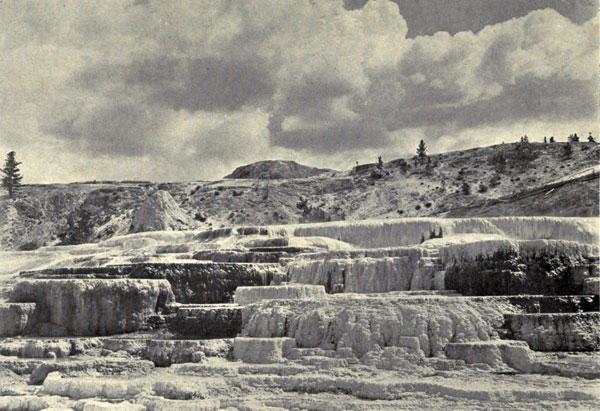
Minerva Terrace, Mammoth Hot Springs, Yellowstone Park.
The stones of this divine masonry, invisible particles of lime or silex, mined in quarries no eye has seen, go to their appointed places in gentle, tinkling, transparent currents or through the dashing turmoil of floods, as surely guided as the sap of plants streaming into bole and branch, leaf and flower. And thus from century to century this beauty-work has gone on and is going on.
Passing through many a mile of pine and spruce woods, toward the centre of the park you come to the famous Yellowstone Lake. It is about twenty miles long and fifteen wide, and lies at a height of nearly 8000 feet above the level of the sea, amid dense black forests and snowy mountains. Around its winding, wavering shores, closely forested and picturesquely varied with promontories and bays, the distance is more than 100 miles. It is not very deep, only from 200 to 300 feet, and contains less water than the celebrated Lake Tahoe of the California Sierra, which is nearly the same size, lies at a height of 6400 feet, and is over 1600 feet deep. But no other lake in North America of equal area lies so high as the Yellowstone, or gives birth to so noble a river. The terraces around its shores show that at the close of the glacial period its surface was about 160 feet higher than it is now, and its area nearly twice as great.
It is full of trout, and a vast multitude of birds-swans, pelicans, geese, ducks, cranes, herons, curlews, plovers, snipe-feed in it and upon its shores; and many forest animals come out of the woods, and wade a little way in shallow, sandy places to drink and look about them, and cool themselves in the free flowing breezes.
In calm weather it is a magnificent mirror for the woods and mountains and sky, now pattered with hail and rain, now roughened with sudden storms that send waves to fringe the shores and wash its border of gravel and sand. The Absaroka Mountains and the Wind River Plateau on the east and south pour their gathered waters into it, and the river issues from the north side in a broad, smooth, stately current, silently gliding with such serene majesty that one fancies it knows the vast journey of four thousand miles that lies before it, and the work it has to do. For the first twenty miles its course is in a level, sunny valley lightly fringed with trees, through which it flows in silvery reaches stirred into spangles here and there by ducks and leaping trout, making no sound save a low whispering among the pebbles and the dipping willows and sedges of its banks. Then suddenly, as if preparing for hard work; it rushes eagerly, impetuously forward rejoicing in its strength, breaks into foam-bloom, and goes thundering down into the Grand Cañon in two magnificent falls, one hundred and three hundred feet high.
The cañon is so tremendously wild and impressive that even these great falls cannot hold your attention. It is about twenty miles long and a thousand feet deep,-a weird, unearthly-looking gorge of jagged, fantastic architecture, and most brilliantly colored. Here the Washburn range, forming the northern rim of the Yellowstone basin, made up mostly of beds of rhyolite decomposed by the action of thermal waters, has been cut through and laid open to view by the river; and a famous section it has made. It is not the depth or the shape of the cañon nor the waterfall, nor the green and gray river chanting its brave song as it goes foaming on its way, that most impresses the observer, but the colors of the decomposed volcanic rocks. With few exceptions, the traveler in strange lands finds that, however much the scenery and vegetation in different countries may change, Mother Earth is ever familiar and the same. But here the very ground is changed, as if belonging to some other world. The walls of the cañon from top to bottom burn in a perfect glory of color, confounding and dazzling when the sun is shining,-white, yellow, green, blue, vermilion, and various other shades of red indefinitely blending. All the earth hereabouts seems to be paint. Millions of tons of it lie in sight, exposed to wind and weather as if of no account, yet marvelously fresh and bright, fast colors not to be washed out or bleached out by either sunshine or storms. The effect is so novel and awful, we imagine that even a river might be afraid to enter such a place. But the rich and gentle beauty of the vegetation is reassuring. The lovely Linnæa borealis hangs her twin bells over the brink of the cliffs, forests and gardens extend their treasures in smiling confidence on either side, nuts and berries ripen well whatever may be going on below; blind fears varnish, and the grand gorge seems a kindly, beautiful part of the general harmony, full of peace and joy and good will.
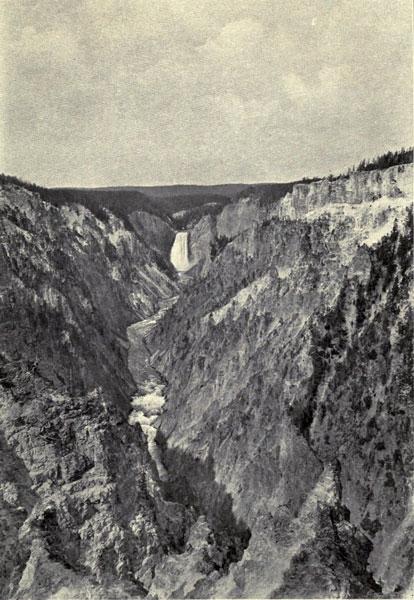
Great Falls and Grand Cañon, Yellowstone Park.
The park is easy of access. Locomotives drag you to its northern boundary at Cinnabar, and horses and guides do the rest. From Cinnabar you will be whirled in coaches along the foaming Gardiner River to Mammoth Hot Springs; thence through woods and meadows, gulches and ravines along branches of the Upper Gallatin, Madison, and Firehole rivers to the main geyser basins; thence over the Continental Divide and back again, up and down through dense pine, spruce, and fir woods to the magnificent Yellowstone Lake, along its northern shore to the outlet, down the river to the falls and Grand Cañon, and thence back through the woods to Mammoth Hot Springs and Cinnabar; stopping here and there at the so-called points of interest among the geysers, springs, paint-pots, mud volcanoes, etc., where you will be allowed a few minutes or hours to saunter over the sinter pavements, watch the play of a few of the geysers, and peer into some of the most beautiful and terrible of the craters and pools. These wonders you will enjoy, and also the views of the mountains, especially the Gallatin and Absaroka ranges, the long, willowy glacier and beaver meadows, the beds of violets, gentians, phloxes, asters, phacelias, goldenrods, eriogonums, and many other flowers, some species giving color to whole meadows and hillsides. And you will enjoy your short views of the great lake and river and cañon. No scalping Indians will you see. The Blackfeet and Bannocks that once roamed here are gone; so are the old beaver-catchers, the Coulters and Bridgers, with all their attractive buckskin and romance. There are several bands of buffaloes in the park, but you will not thus cheaply in tourist fashion see them nor many of the other large animals hidden in the wilderness. The song-birds, too, keep mostly out of sight of the rushing tourist, though off the roads thrushes, warblers, orioles, grosbeaks, etc., keep the air sweet and merry. Perhaps in passing rapids and falls you may catch glimpses of the water-ouzel, but in the whirling noise you will not hear his song. Fortunately, no road noise frightens the Douglas squirrel, and his merry play and gossip will amuse you all through the woods. Here and there a deer may be seen crossing the road, or a bear. Most likely, however, the only bears you will see are the half tame ones that go to the hotels every night for dinner-table scraps,-yeast-powder biscuit, Chicago canned stuff, mixed pickles, and beefsteaks that have proved too tough for the tourists.
Among the gains of a coach trip are the acquaintances made and the fresh views into human nature; for the wilderness is a shrewd touchstone, even thus lightly approached, and brings many a curious trait to view. Setting out, the driver cracks his whip, and the four horses go off at half gallop, half trot, in trained, showy style, until out of sight of the hotel. The coach is crowded, old and young side by side, blooming and fading, full of hope and fun and care. Some look at the scenery or the horses, and all ask questions, an odd mixed lot of them: “Where is the umbrella? What is the name of that blue flower over there? Are you sure the little bag is aboard? Is that hollow yonder a crater? How is your throat this morning? How high did you say the geysers spout? How does the elevation affect your head? Is that a geyser reeking over there in the rocks, or only a hot spring?” A long ascent is made, the solemn mountains come to view, small cares are quenched, and all become natural and silent, save perhaps some unfortunate expounder who has been reading guidebook geology, and rumbles forth foggy subsidences and upheavals until he is danger of being heaved overboard. The driver will give you the names of the peaks and meadows and streams as you come to them, call attention to the glass road, tell how hard it was to build,-how the obsidian cliffs naturally pushed the surveyor’s lines to the right, and the industrious beavers, by flooding the valley in front of the cliff, pushed them to the left.
Geysers, however, are the main objects, and as soon as they come in sight other wonders are forgotten. All gather around the crater of the one that is expected to play first. During the eruptions of the smaller geysers, such as the Beehive and Old Faithful, though a little frightened at first, all welcome the glorious show with enthusiasm, and shout, “Oh, how wonderful, beautiful, splendid, majestic!” Some venture near enough to stroke the column with a stick, as if it were a stone pillar or a tree, so firm and substantial and permanent it seems. While tourists wait around a large geyser, such as the Castle or the Giant, there is a chatter of small talk in anything but solemn mood; and during the intervals between the preliminary splashes and upheavals some adventurer occasionally looks down the throat of the crater, admiring the silex formations and wondering whether Hades is as beautiful. But when, with awful uproar as if avalanches were falling and storms thundering in the depths, the tremendous outburst begins, all run away to a safe distance, and look on, awe-stricken and silent, in devout, worshiping wonder.
The largest and one of the most wonderfully beautiful of the springs is the Prismatic, which the guide will be sure to show you. With a circumference of 300 yards, it is more like a lake than a spring. The water is pure deep blue in the centre, fading to green on the edges, and its basin and the slightly terraced pavement about it are astonishingly bright and varied in color. This one of the multitude of Yellowstone fountains is of itself object enough for a trip across the continent. No wonder that so many fine myths have originated in springs; that so many fountains were held sacred in the youth of the world, and had miraculous virtues ascribed to them. Even in these cold, doubting, questioning, scientific times many of the Yellowstone fountains seem able to work miracles. Near the Prismatic Spring is the great Excelsior Geyser, which is said to throw a column of boiling water 60 to 70 feet in diameter to a height of from 50 to 300 feet, at irregular periods. This is the greatest of all the geysers yet discovered anywhere. The Firehole River, which sweeps past it, is, at ordinary states, a stream about 100 yards wide and 3 feet deep; but when the geyser is in eruption, so great is the quantity of water discharged that the volume of the river is doubled, and it is rendered too hot and rapid to be forded.
Geysers are found in many other volcanic regions,-in Iceland, New Zealand, Japan, the Himalayas, the Eastern Archipelago, South America, the Azores, and elsewhere; but only in Iceland, New Zealand, and this Rocky Mountain park do they display their grandest forms, and of these three famous regions the Yellowstone is easily first, both in the number and in the size of its geysers. The greatest height of the column of the Great Geyser of Iceland actually measured was 212 feet, and of the Strokhr 162 feet.
In New Zealand, the Te Pueia at Lake Taupo, the Waikite at Rotorna, and two others are said to lift their waters occasionally to a height of 100 feet, while the celebrated Te Tarata at Rotomahana sometimes lifts a boiling column 20 feet in diameter to a height of 60 feet. But all these are far surpassed by the Excelsior. Few tourists, however, will see the Excelsior in action, or a thousand other interesting features of the park that lie beyond the wagon-roads and the hotels. The regular trips-from three to five days-are too short. Nothing can be done well at a speed of forty miles a day. The multitude of mixed, novel impressions rapidly piled on one another make only a dreamy, bewildering, swirling blur, most of which is unrememberable. Far more time should be taken. Walk away quietly in any direction and taste the freedom of the mountaineer. Camp out among the grass and gentians of glacier meadows, in craggy garden nooks full of Nature’s darlings. Climb the mountains and get their good tidings. Nature’s peace will flow into you as sunshine flows into trees. The winds will blow their own freshness into you, and the storms their energy, while cares will drop off like autumn leaves. As age comes on, one source of enjoyment after another is closed, but Nature’s sources never fail. Like a generous host, she offers here brimming cups in endless variety, served in a grand hall, the sky its ceiling, the mountains its walls, decorated with glorious paintings and enlivened with bands of music ever playing. The petty discomforts that beset the awkward guest, the unskilled camper, are quickly forgotten, while all that is precious remains. Fears vanish as soon as one is fairly free in the wilderness.
Most of the dangers that haunt the unseasoned citizen are imaginary; the real ones are perhaps too few rather than too many for his good. The bears that always seem to spring up thick as trees, in fighting, devouring attitudes before the frightened tourist whenever a camping trip is proposed, are gentle now, finding they are no longer likely to be shot; and rattlesnakes, the other big irrational dread of over-civilized people, are scarce here, for most of the park lies above the snake-line. Poor creatures, loved only by their Maker, they are timid and bashful, as mountaineers know; and though perhaps not possessed of much of that charity that suffers long and is kind, seldom, either by mistake or by mishap, do harm to any one. Certainly they cause not the hundredth part of the pain and death that follow the footsteps of the admired Rocky Mountain trapper. Nevertheless, again and again, in season and out of season, the question comes up, “What are rattlesnakes good for?” As if nothing that does not obviously make for the benefit of man had any right to exist; as if our ways were God’s ways. Long ago, an Indian to whom a French traveler put this old question replied that their tails were good for toothache, and their heads for fever. Anyhow, they are all, head and tail, good for themselves, and we need not begrudge them their share of life.
Fear nothing. No town park you have been accustomed to saunter in is so free from danger as the Yellowstone. It is a hard place to leave. Even its names in your guidebook are attractive, and should draw you far from wagon-roads,-all save the early ones, derived from the infernal regions: Hell Roaring River, Hell Broth Springs, The Devil’s Caldron, etc. Indeed, the whole region was at first called Coulter’s Hell, from the fiery brimstone stories told by trapper Coulter, who left the Lewis and Clark expedition and wandered through the park, in the year 1807, with a band of Bannock Indians. The later names, many of which we owe to Mr. Arnold Hague of the U. S. Geological Survey, are so telling and exhilarating that they set our pulses dancing and make us begin to enjoy the pleasures of excursions ere they are commenced. Three River Peak, Two Ocean Pass, Continental Divide, are capital geographical descriptions, suggesting thousands of miles of rejoicing streams and all that belongs to them. Big Horn Pass, Bison Peak, Big Game Ridge, bring brave mountain animals to mind. Birch Hills, Garnet Hills, Amethyst Mountain, Storm Peak, Electric Peak, Roaring Mountain, are bright, bracing names. Wapiti, Beaver, Tern, and Swan lakes, conjure up fine pictures, and so also do Osprey and Ouzel falls. Antelope Creek, Otter, Mink, and Grayling creeks, Geode, Jasper, Opal, Carnelian, and Chalcedony creeks, are lively and sparkling names that help the streams to shine; and Azalea, Stellaria, Arnica, Aster, and Phlox creeks, what pictures these bring up! Violet, Morning Mist, Hygeia, Beryl, Vermilion, and Indigo springs, and many beside, give us visions of fountains more beautifully arrayed than Solomon in all his purple and golden glory. All these and a host of others call you to camp. You may be a little cold some nights, on mountain tops above the timber-line, but you will see the stars, and by and by you can sleep enough in your town bed, or at least in your grave. Keep awake while you may in mountain mansions so rare.
If you are not very strong, try to climb Electric Peak when a big bossy, well-charged thunder-cloud is on it, to breathe the ozone set free, and get yourself kindly shaken and shocked. You are sure to be lost in wonder and praise, and every hair of your head will stand up and hum and sing like an enthusiastic congregation.
After this reviving experience, you should take a look into a few of the tertiary volumes of the grand geological library of the park, and see how God writes history. No technical knowledge is required; only a calm day and a calm mind. Perhaps nowhere else in the Rocky Mountains have the volcanic forces been so busy. More than ten thousand square miles hereabouts have been covered to a depth of at least five thousand feet with material spouted from chasms and craters during the tertiary period, forming broad sheets of basalt, andesite, rhyolite, etc., and marvelous masses of ashes, sand, cinders, and stones now consolidated into conglomerates, charged with the remains of plants and animals that lived in the calm, genial periods that separated the volcanic outbursts.
Perhaps the most interesting and telling of these rocks to the hasty tourist, are those that make up the mass of Amethyst Mountain. On its north side it presents a section two thousand feet high of roughly stratified beds of sand, ashes, and conglomerates coarse and fine, forming the untrimmed edges of a wonderful set of volumes lying on their sides,-books a million years old, well bound, miles in size, with full-page illustrations. On the ledges of this one section we see trunks and stumps of fifteen or twenty ancient forests ranged one above another, standing where they grew, or prostrate and broken like the pillars of ruined temples in desert sands,-a forest fifteen or twenty stories high, the roots of each spread above the tops of the next beneath it, telling wonderful tales of the bygone centuries, with their winters and summers, growth and death, fire, ice, and flood.
There were giants in those days. The largest of the standing opal and agate stumps and prostrate sections of the trunks are from two or three to fifty feet in height or length, and from five to ten feet in diameter; and so perfect is the petrifaction that the annual rings and ducts are clearer and more easily counted than those of living trees, centuries of burial having brightened the records instead of blurring them. They show that the winters of the tertiary period gave as decided a check to vegetable growth as do those of the present time. Some trees favorably located grew rapidly, increasing twenty inches in diameter in as many years, while others of the some species, on poorer soil or overshadowed, increased only two or three inches in the same time.
Among the roots and stumps on the old forest floors we find the remains of ferns and bushes, and the seeds and leaves of trees like those now growing on the southern Alleghanies,-such as magnolia, sassafras, laurel, linden, persimmon, ash, alder, dogwood. Studying the lowest of these forests, the soil it grew on and the deposits it is buried in, we see that it was rich in species, and flourished in a genial, sunny climate. When its stately trees were in their glory, volcanic fires broke forth from chasms and craters, like larger geysers, spouting ashes, cinders, stones and mud, which fell on the doomed forest like hail and snow; sifting, hurtling through the leaves and branches, choking the streams, covering the ground, crushing bushes and ferns, rapidly deepening, packing around the trees and breaking them, rising higher until the topmost boughs of the giants were buried, leaving not a leaf or twig in sight, so complete was the desolation. At last the volcanic storm began to abate, the fiery soil settled; mud floods and boulder floods passed over it, enriching it, cooling it; rains fell and mellow sunshine, and it became fertile and ready for another crop. Birds, and the winds, and roaming animals brought seeds from more fortunate woods, and a new forest grew up on the top of the buried one. Centuries of genial growing seasons passed. The seedling trees became giants, and with strong outreaching branches spread a leafy canopy over the gray land.
The sleeping subterranean fires again awake and shake the mountains, and every leaf trembles. The old craters, with perhaps new ones, are opened, and immense quantities of ashes, pumice, and cinders are again thrown into the sky. The sun, and shorn of his beams, glows like a dull red ball, until hidden in sulphurous clouds. Volcanic snow, hail, and floods fall on the new forest, burying it alive, like the one beneath its roots. Then come another noisy band of mud floods and boulder floods, mixing, settling, enriching the new ground, more seeds, quickening sunshine and showers; and a third noble magnolia forest is carefully raised on the top of the second. And so on. Forest was planted above forest and destroyed, as if Nature were ever repenting, undoing the work she had so industriously done, and burying it.
Of course this destruction was creation, progress in the march of beauty through death. How quickly these old monuments excite and hold the imagination! We see the old stone stumps budding and blossoming and waving in the wind as magnificent trees, standing shoulder to shoulder, branches interlacing in grand varied round-headed forests; see the sunshine of morning and evening gilding their mossy trunks, and at high noon spangling on the thick glossy leaves of the magnolia, filtering through translucent canopies of linden and ash, and falling in mellow patches on the ferny floor; see the shining after rain, breathe the exhaling fragrance, and hear the winds and birds and the murmur of brooks and insects. We watch them from season to season; see the swelling buds when the sap begins to flow in the spring, the opening leaves and blossoms, the ripening of summer fruits, the colors of autumn, and the maze of leafless branches and sprays in winter; and we see the sudden oncome of the storms that overwhelmed them.
One calm morning at sunrise I saw the oaks and pines in Yosemite Valley shaken by an earthquake, their tops swishing back and forth, and every branch and needle shuddering as if in distress like the frightened screaming birds. One may imagine the trembling, rocking, tumultuous waving of those ancient Yellowstone woods, and the terror of their inhabitants when the first foreboding shocks were felt, the sky grew dark, and rock-laden floods began to roar. But though they were close pressed and buried, cut off from sun and wind, all their happy leaf-fluttering and waving done, other currents coursed through them, fondling and thrilling every fibre, and beautiful wood was replaced by beautiful stone. Now their rocky sepulchres are partly open, and show forth the natural beauty of death.
After the forest times and fire times had passed away, and the volcanic furnaces were banked and held in abeyance, another great change occurred. The glacial winter came on. The sky was again darkened, not with dust and ashes, but with snow which fell in glorious abundance, piling deeper, deeper, slipping from the overladen heights in booming avalanches, compacting into glaciers, that flowed over all the landscape, wiping off forests, grinding, sculpturing, fashioning the comparatively featureless lava beds into the beautiful rhythm of hill and dale and ranges of mountains we behold to-day; forming basins for lakes, channels for streams, few soils for forests, gardens, and meadows. While this ice-work was going on, the slumbering volcanic fires were boiling the subterranean waters, and with curious chemistry decomposing the rocks, making beauty in the darkness; these forces, seemingly antagonistic, working harmoniously together. How wild their meetings on the surface were we may imagine. When the glacier period began, geysers and hot springs were playing in grander volume, it may be, than those of to-day. The glaciers flowed over them while they spouted and thundered, carrying away their fine sinter and travertine structures, and shortening their mysterious channels.
The soils made in the down-grinding required to bring the present features of the landscape into relief are possibly no better than were some of the old volcanic soils that were carried away, and which, as we have seen, nourished magnificent forests, but the glacial landscapes are incomparably more beautiful than the old volcanic ones were. The glacial winter has passed away, like the ancient summers and fire periods, though in the chronology of the geologist all these times are recent. Only small residual glaciers on the cool northern slopes of the highest mountains are left of the vast all-embracing ice-mantle, as solfataras and geysers are all that are left of the ancient volcanoes.
Now the post-glacial agents are at work on the grand old palimpsest of the park region, inscribing new characters; but still in its main telling features it remains distinctly glacial. The moraine soils are being leveled, sorted, refined, re-formed, and covered with vegetation; the polished pavements and scoring and other superficial glacial inscriptions on the crumbling lavas are being rapidly obliterated; gorges are being cut in the decomposed rhyolites and loose conglomerates, and turrets and pinnacles seem to be springing up like growing trees; while the geysers are depositing miles of sinter and travertine. Nevertheless, the ice-work is scarce blurred as yet. These later effects are only spots and wrinkles on the grand glacial countenance of the park.
Perhaps you have already said that you have seen enough for a lifetime. But before you go away you should spend at least one day and a night on a mountain top, for a last general, calming, settling view. Mount Washburn is a good one for the purpose, because it stands in the middle of the park, is unencumbered with other peaks, and is so easy of access that the climb to its summit is only a saunter. First your eye goes roving around the mountain rim amid the hundreds of peaks; some with plain flowing skirts, others abruptly precipitous and defended by sheer battlemented escarpments; flat-topped or round; heaving like sea-waves or spired and turreted like Gothic cathedrals; streaked with snow in the ravines, and darkened with files of adventurous trees climbing the ridges. The nearer peaks are perchance clad in sapphire blue, others far off in creamy white. In the broad glare of noon they seem to shrink and crouch to less than half their real stature, and grow dull and uncommunicative,-mere dead, draggled heaps of waste ashes and stone, giving no hint of the multitude of animals enjoying life in their fastnesses, or of the bright bloom-bordered streams and lakes. But when storms blow they awake and arise, wearing robes of cloud and mist in majestic speaking attitudes like gods. In the color glory of morning and evening they become still more impressive; steeped in the divine light of the alpenglow their earthiness disappears, and, blending with the heavens, they seem neither high nor low.
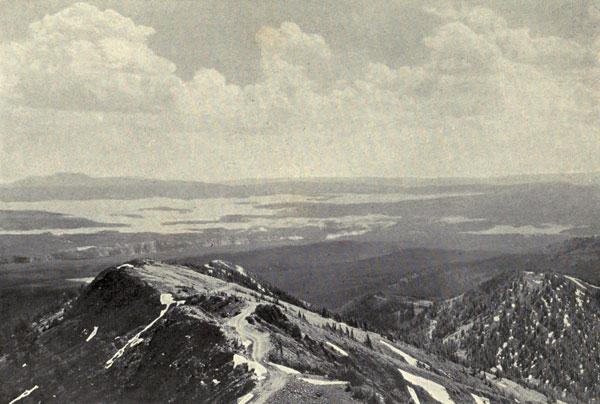
Looking South from the Summit of Mt. Washburn, Yellowstone Park.
Over all the central plateau, which from here seems level, and over the foothills and lower slopes of the mountains, the forests extends like a black uniform bed of weeds, interrupted only by lakes and meadows and small burned spots called parks,-all of them, except the Yellowstone Lake, being mere dots and spangles in general views, made conspicuous by their color and brightness. About eighty-five per cent of the entire area of the park is covered with trees, mostly the indomitable lodge-pole pine (Pinus contorta, var. Murrayana), with a few patches and sprinklings of Douglas spruce, Engelmann spruce, silver fir (Abies lasiocarpa), Pinus flexilis, and a few alders, aspens, and birches. The Douglas spruce is found only on the lowest portions, the silver fir on the highest, and the Engelmann spruce on the dampest places, best defended from fire. Some fine specimens of the flexilis pine are growing on the margins of openings,-wide-branching, sturdy trees, as broad as high, with trunks five feet in diameter, leafy and shady, laden with purple cones and rose-colored flowers. The Engelmann spruce and sub-alpine silver fir are beautiful and notable trees, but as the plateau became drier and fires began to run, they were driven up the mountains, and into the wet spots and islands where we now find them, leaving nearly all the park to the lodge-pole pine, which, though as thin-skinned as they and as easily killed by fire, takes pains to store up its seeds in firmly closed cones, and holds them from three to nine years, so that, let the fire come when it may, it is ready to die and ready to live again in a new generation. For when the killing fires have devoured the leaves and thin resinous bark, many of the cones, only scorched, open as soon as the smoke clears away; the hoarded store of seeds is sown broadcast on the cleared ground, and a new growth immediately springs up triumphant out of the ashes. Therefore, this tree not only holds its ground, but extends its conquests farther after every fire. Thus the evenness and closeness of its growth are accounted for. In one part of the forest that I examined, the growth was about as close as a cane-brake. The trees were from four to eight inches in diameter, one hundred feet high, and one hundred and seventy-five years old. The lower limbs die young and drop off for want of light. Life with these close-planted trees is a race for light, more light, and so they push straight for the sky. Mowing off ten feet from the top of the forest would make it look like a crowded mass of telegraph-poles; for only the sunny tops are leafy. A sapling ten years old, growing in the sunshine, has as many leaves as a crowded tree one or two hundred years old. As fires are multiplied and the mountains become drier, this wonderful lodge-pole pine bids fair to obtain possession of nearly all the forest ground in the West.
How still the woods seem from here, yet how lively a stir the hidden animals are making; digging, gnawing, biting, eyes shining, at work and play, getting food, rearing young, roving through the underbrush, climbing the rocks, wading solitary marshes, tracing the banks of the lakes and streams! Insect swarms are dancing in the sunbeams, burrowing in the ground, diving, swimming,-a cloud of witnesses telling Nature’s joy. The plants are as busy as the animals, every cell in a swirl of enjoyment, humming like a hive, singing the old new song of creation. A few columns and puffs of steam are seen rising above the treetops, some near, but most of them far off, indicating geysers and hot springs, gentle-looking and noiseless as noiseless as downy clouds, softly hinting the reaction going on between the surface and the hot interior. From here you see them better than when you are standing beside them, frightened and confused, regarding them as lawless cataclysms. The shocks and out-bursts of earthquakes, volcanoes, geysers, storms, the pounding of waves, the uprush of sap in plants, each and all tell the orderly love-beats of Nature’s heart.
Turning to the eastward, you have the Grand Cañon and reaches of the river in full view; and yonder to the southward lies the great lake, the largest and most important of all the high fountains of the Missouri-Mississippi, and the last to be discovered.
In the year 1541, when De Soto, with a romantic band of adventurers, was seeking gold and glory and the fountain of youth, he found the Mississippi a few hundred miles above its mouth, and made his grave beneath its floods. La Salle, in 1682, after discovering the Ohio, one of the largest and most beautiful branches of the Mississippi, traced the latter to the sea from the mouth of the Illinois, through adventures and privations not easily realized now. About the same time Joliet and Father Marquette reached the “Father of Waters” by way of the Wisconsin, but more than a century passed ere its highest sources in these mountains were seen. The advancing stream of civilization has ever followed its guidance toward the west, but none of the thousand tribes of Indians living on its banks could tell the explorer whence it came. From those romantic De Soto and La Salle days to these times of locomotives and tourists, how much has the great river seen and done! Great as it now is, and still growing longer through the ground of its delta and the basins of receding glaciers at its head, it was immensely broader toward the close of the glacial period, when the ice-mantle of the mountains was melting: then with its three hundred thousand miles of branches out-spread over the plains and valleys of the continent, laden with fertile mud, it made the biggest and most generous bed of soil in the world.
Think of this mighty stream springing in the first place in vapor from the sea, flying on the wind, alighting on the mountains in hail and snow and rain, lingering in many a fountain feeding the trees and grass; then gathering its scattered waters, gliding from its noble lake, and going back home to the sea, singing all the way! On it sweeps, through the gates of the mountains, across the vast prairies and plains, through many a wild, gloomy forest, cane-brake, and sunny savanna; from glaciers and snowbanks and pine woods to warm groves of magnolia and palm; geysers dancing at its head keeping time with the sea-waves at its mouth; roaring and gray in rapids, booming in broad, bossy falls, murmuring, gleaming in long, silvery reaches, swaying now hither, now thither, whirling, bending in huge doubling, eddying folds, serene, majestic, ungovernable, overflowing all its metes and bounds, frightening the dwellers upon its banks; building, wasting, uprooting, planting; engulfing old islands and making new ones, taking away fields and towns as if in sport, carrying canoes and ships of commerce in the midst of its spoils and drift, fertilizing the continent as one vast farm. Then, its work done, it gladly vanishes in its ocean home, welcomed by the waiting waves.
Thus naturally, standing here in the midst of its fountains, we trace the fortunes of the great river. And how much more comes to mind as we overlook this wonderful wilderness! Fountains of the Columbia and Colorado lie before us, interlaced with those of the Yellowstone and Missouri, and fine it would be to go with them to the Pacific; but the sun is already in the west, and soon our day will be done.
Yonder is Amethyst Mountain, and other mountains hardly less rich in old forests, which now seem to spring up again in their glory; and you see the storms that buried them,-the ashes and torrents laden with boulders and mud, the centuries of sunshine, and the dark, lurid nights. You see again the vast floods of lava, red-hot and white-hot, pouring out from gigantic geysers, usurping the basins of lakes and streams, absorbing or driving away their hissing, screaming waters, flowing around hills and ridges, submerging every subordinate feature. Then you see the snow and glaciers taking possession of the land, making new landscapes. How admirable it is that, after passing through so many vicissitudes of frost and fire and flood, the physiognomy and even the complexion of the landscape should still be so divinely fine!
Thus reviewing the eventful past, we see Nature working with enthusiasm like a man, blowing her volcanic forges like a blacksmith blowing his smithy fires, shoving glaciers over the landscapes like a carpenter shoving his planes, clearing, ploughing, harrowing, irrigating, planting, and sowing broadcast like a farmer and gardener, doing rough work and fine work, planting sequoias and pines, rosebushes and daisies; working in gems, filling every crack and hollow with them; distilling fine essences; painting plants and shells, clouds, mountains, all the earth and heavens, like an artist,-ever working toward beauty higher and higher. Where may the mind find more stimulating, quickening pasturage? A thousand Yellowstone wonders are calling, “Look up and down and round about you!” And a multitude of still, small voices may be heard directing you to look through all this transient, shifting show of things called “substantial” into the truly substantial, spiritual world whose forms flesh and wood, rock and water, air and sunshine, only veil and conceal, and to learn that here is heaven and the dwelling-place of the angles.
The sun is setting; long, violet shadows are growing out over the woods from the mountains along the western rim of the park; the Absaroka range is baptized in the divine light of the alpenglow, and its rocks and trees are transfigured. Next to the light of the dawn on high mountain tops, the alpenglow is the most impressive of all the terrestrial manifestations of God.
Now comes the gloaming. The alpenglow is fading into earthy, murky gloom, but do not let your town habits draw you away to the hotel. Stay on this good fire-mountain and spend the night among the stars. Watch their glorious bloom until the dawn, and get one more baptism of light. Then, with fresh heart, go down to your work, and whatever your fate, under whatever ignorance or knowledge you may afterward chance to suffer, you will remember these fine, wild views, and look back with joy to your wanderings in the blessed old Yellowstone Wonderland.
CHAPTER III
The Yosemite National Park
Of all the mountain ranges I have climbed, I like the Sierra Nevada the best. Though extremely rugged, with its main features on the grandest scale in height and depth, it is nevertheless easy of access and hospitable; and its marvelous beauty, displayed in striking and alluring forms, wooes the admiring wanderer on and on, higher and higher, charmed and enchanted. Benevolent, solemn, fateful, pervaded with divine light, every landscape glows like a countenance hallowed in eternal repose; and every one of its living creatures, clad in flesh and leaves, and every crystal of its rocks, whether on the surface shining in the sun or buries miles deep in what we call darkness, is throbbing and pulsing with the heartbeats of God. All the world lies warm in one heart, yet the Sierra seems to get more light than other mountains. The weather is mostly sunshine embellished with magnificent storms, and nearly everything shines from base to summit,-the rocks, streams, lakes, glaciers, irised falls, and the forests of silver fir and silver pine. And how bright is the shining after summer showers and dewy nights, and after frosty nights in spring and autumn, when the morning sunbeams are pouring through the crystals on the bushes and grass, and in winter through the snow-laden trees!
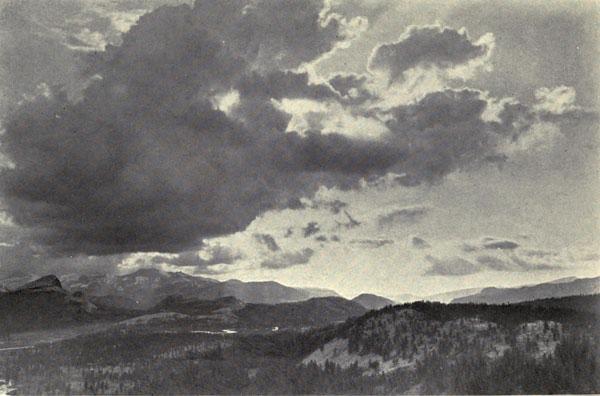
A Thunder-Storm in the Sierras.
The average cloudiness for the whole year is perhaps less than ten hundredths. Scarcely a day of all the summer is dark, though there is no lack of magnificent thundering cumuli. They rise in the warm midday hours, mostly over the middle region, in June and July, like new mountain ranges, higher Sierras, mightily augmenting the grandeur of the scenery while giving rain to the forests and gardens and bringing forth their fragrance. The wonderful weather and beauty inspire everybody to be up and doing. Every summer day is a workday to be confidently counted on, the short dashes of rain forming, not interruptions, but rests. The big blessed storm days of winter, when the whole range stands white, are not a whit less inspiring and kind. Well may the Sierra be called the Range of Light, not the Snowy Range; for only in winter is it white; while all the year it is bright.
Of this glorious range the Yosemite National Park is a central section, thirty-six miles in length and forty-eight miles in breadth. The famous Yosemite Valley lies in the heart of it, and it includes the head waters of the Tuolumne and Merced rivers, two of the most songful streams in the world; innumerable lakes and waterfalls and smooth silky lawns; the noblest forests, the loftiest granite domes, the deepest ice-sculptured cañons, the brightest crystalline pavements, and snowy mountains soaring into the sky twelve and thirteen thousand feet, arrayed in open ranks and spiry pinnacled groups partially separated by tremendous cañons and amphitheatres; gardens on their sunny brows avalanches thundering down their long white slopes, cataracts roaring gray and foaming in the crooked rugged gorges, and glaciers in their shadowy recesses working in silence, slowly completing their sculpture; new-born lakes at their feet, blue and green, free or encumbered with drifting icebergs like miniature Arctic Oceans, shining, sparkling, calm as stars.
Nowhere will you see the majestic operations of nature more clearly revealed beside the frailest, most gentle and peaceful things. Nearly all the park is a profound solitude. Yet it is full of charming company, full of God’s thoughts, a place of peace and safety amid the most exalted grandeur and eager enthusiastic action, a new song, a place of beginnings abounding in first lessons on life, mountain-building, eternal, invincible, unbreakable order; with sermons in stones, storms, trees, flowers, and animals brimful of humanity. During the last glacial period, just past, the former features of the range were rubbed off as a chalk sketch from a blackboard, and a new beginning was made. Hence the wonderful clearness and freshness of the rocky pages.
But to get all this into words is a hopeless task. The leanest sketch of each feature would need a whole chapter. Nor would any amount of space, however industriously scribbled, be of much avail. To defrauded town toilers, parks in magazine articles are like pictures of bread to the hungry. I can write only hints to incite good wanderers to come to the feast.
While this glorious park embraces big, generous samples of the very best of the Sierra treasure, it is, fortunately, at the same time, the most accessible portion. It lies opposite San Francisco, at a distance of about one hundred and forty miles. Railroads connected with all the continent reach into the foothills, and three good carriage roads, from Big Oak Flat, Coulterville, and Raymond, run into Yosemite Valley. Another, called the Tioga road, runs from Crocker’s Station on the Yosemite Big Oak Flat road near the Tuolumne Big Tree Grove, right across the park to the summit of the range by way of Lake Tenaya, the Big Tuolumne Meadows, and Mount Dana. These roads, with many trials that radiate from Yosemite Valley, bring most of the park within reach of everybody, well or half well.
The three main natural divisions of the park, the lower, middle, and alpine regions, are fairly well defined in altitude, topographical features, and vegetation. The lower, with an average elevation of about five thousand feet, is the region of the great forests, made up of sugar pine, the largest and most beautiful of all the pines in the world; the silvery yellow pine, the next in rank; Douglas spruce, libocedrus, the white and red silver firs, and the Sequoia gigantea, or “big tree,” the king of conifers, the noblest of a noble race. On warm slopes next the foothills there are a few Sabine nut pines; oaks make beautiful groves in the cañon valleys; and poplar, alder, maple, laurel, and Nuttall’s flowering dogwood shade the banks of the streams. Many of the pines are more than two hundred feet high, but they are not crowded together. The sunbeams streaming through their feathery arches brighten the ground, and you walk beneath the radiant ceiling in devout subdued mood, as if you were in a grand cathedral with mellow light sifting through colored windows, while the flowery pillared aisles open enchanting vistas in every direction. Scarcely a peak or ridge in the whole region rises bare above the forests, though they are thinly planted in some places where the soil is shallow. From the cool breezy heights you look abroad over a boundless waving sea of evergreens, covering hill and ridge and smooth-flowing slope as far as the eye can reach, and filling every hollow and down-plunging ravine in glorious triumphant exuberance.
Perhaps the best general view of the pine forests of the park, and one of the best in the range, is obtained from the top of the Merced and Tuolumne divide near Hazel Green. On the long, smooth, finely folded slopes of the main ridge, at a height of five to six thousand feet above the sea, they reach most perfect development and are marshaled to view in magnificent towering ranks, their colossal spires and domes and broad palmlike crowns, deep in the kind sky, rising above one another,-a multitude of giants in perfect health and beauty,-sun-fed mountaineers rejoicing in their strength, chanting with the winds, in accord with the falling waters. The ground is mostly open and inviting to walkers. The fragrant chamæbatia is outspread in rich carpets miles in extent; the manzanita, in orchard-like groves, covered with pink bell-shaped flowers in the spring, grows in openings facing the sun, hazel and buckthorn in the dells; warm brows are purple with mint, yellow with sunflowers and violets; and tall lilies ring their bells around the borders of meadows and along the ferny, mossy banks of the streams. Never was mountain forest more lavishly furnished.
Hazel Green is a good place quietly to camp and study, to get acquainted with the trees and birds, to drink the reviving water and weather, and to watch the changing lights of the big charmed days. The rose light of the dawn, creeping higher among the stars, changes to daffodil yellow; then come the level enthusiastic sunbeams pouring across the feathery ridges, touching pine after pine, spruce and fir, libocedrus and lordly sequoia, searching every recess, until all are awakened and warmed. In the white noon they shine in silvery splendor, every needle and cell in bole and branch thrilling and tingling with ardent life; and the whole landscape glows with consciousness, like the face of a god. The hours go by uncounted. The evening flames with purple and gold. The breeze that has been blowing from the lowlands dies away, and far and near the mighty host of trees baptized in the purple flood stand hushed and thoughtful, awaiting the sun’s blessing and farewell,-as impressive a ceremony as if it were never to rise again. When the daylight fades, the night breeze from the snowy summits begins to blow, and the trees, waving and rustling beneath the stars, breathe free again.
It is hard to leave such camps and woods; nevertheless, to the large majority of travelers the middle region of the park is still more interesting, for it has the most striking features of all the Sierra scenery,-the deepest sections of the famous cañons, of which the Yosemite Valley, Hetch-Hetchy Valley, and many smaller ones are wider portions, with level parklike floors and walls of immense height and grandeur of sculpture. This middle region holds also the greater number of the beautiful glacier lakes and glacier meadows, the great granite domes, and the most brilliant and most extensive of the glacier pavements. And though in large part it is severely rocky and bare, it is still rich in trees. The magnificent silver fir (Abies magnifica), which ranks with the giants, forms a continuous belt across the park above the pines at an elevation of from seven to nine thousand feet, and north and south of the park boundaries to the extremities of the range, only slightly interrupted by the main cañons. The two-leaved or tamarack pine makes another less regular belt along the upper margin of the region, while between these two belts, and mingling with them, in groves or scattered, are the mountain hemlock, the most graceful of evergreens; the noble mountain pine; the Jeffrey form of the yellow pine, with big cones and long needles; and the brown, burly, sturdy Western juniper. All these, except the juniper, which grows on bald rocks, have plenty of flowery brush about them, and gardens in open spaces.
Here, too, lies the broad, shining heavily sculptured region of primeval granite, which best tells the story of the glacial period on the Pacific side of the continent. No other mountain chain on the globe, as far as I know, is so rich as the Sierra in bold, striking, well-preserved glacial monuments, easily understood by anybody capable of patient observation. Every feature is more or less glacial, and this park portion of the range is the brightest and clearest of all. Not a peak, ridge, dome, cañon, lake basin, garden, forest, or stream but in some way explains the past existence and modes of action of flowing, grinding, sculpturing, soil-making, scenery-making ice. For, notwithstanding the post-glacial agents-air, rain, frost, rivers, earthquakes, avalanches-have been at work upon the greater part of the range for tens of thousands of stormy years, engraving their own characters over those of the ice, the latter are so heavily emphasized and enduring they still rise in sublime relief, clear and legible through every after inscription. The streams have traced only shallow wrinkles as yet, and avalanche, wind, rain, and melting snow have made blurs and scars, but the change effected on the face of the landscape is not greater than is made on the face of a mountaineer by a single year of weathering.
Of all the glacial phenomena presented here, the most striking and attractive to travelers are the polished pavements, because they are so beautiful, and their beauty is of so rare a kind,-unlike any part of the loose earthy lowlands where people dwell and earn their bread. They are simply flat or gently undulating areas of solid resisting granite, the unchanged surface over which the ancient glaciers flowed. They are found in the most perfect condition at an elevation of from eight to nine thousand feet above sea level. Some are miles in extent, only slightly blurred or scarred by spots that have at last yielded to the weather; while the best preserved portions are brilliantly polished, and reflect the sunbeams as calm water or glass, shining as if rubbed and burnished every day, notwithstanding they have been exposed to plashing, corroding rains, dew, frost, and melting sloppy snows for thousands of years.
The attention of hunters and prospectors, who see so much in their wild journeys, is seldom attracted by moraines, however regular and artificial-looking; or rocks, however boldly sculptured; or cañons, however deep and sheer-walled. But when they come to these pavements, they go down on their knees and rub their hands admiringly on the glistening surface, and try hard to account for its mysterious smoothness and brightness. They may have seen the winter avalanches come down the mountains, through the woods, sweeping away the trees and scouring the ground; but they conclude that this cannot be the work of avalanches, because the striæ show that the agent, whatever it was, flowed along and around and over the top of high ridges and domes, and also filled the deep cañons. Neither can they see how water could be the agent, for the strange polish is found thousands of feet above the reach of any conceivable flood. Only the winds seem capable of moving over the face of the country in the directions indicated by the lines and grooves.
The pavements are particularly fine around Lake Tenaya, and have suggested the Indian name Py-we-ack, the Lake of the Shining Rocks. Indians seldom trouble themselves with geological questions, but a Mono Indian once came to me and asked if I could tell him what made the rocks so smooth at Tenaya. Even dogs and horses, on their first journeys into this region, study geology to the extent of gazing wonderingly at the strange brightness of the ground, and pawing it and smelling it, as if afraid of falling or sinking.
In the production of this admirable hard finish, the glaciers in many places exerted a pressure of more than a hundred tons to the square foot, planing down granite, slate, and quartz alike, showing their structure, and making beautiful mosaics where large feldspar crystals form the greater part of the rock. On such pavements the sunshine is at times dazzling, as if the surface were of burnished silver.
Here, also, are the brightest of the Sierra landscapes in general. The regions lying at the same elevation to the north and south were perhaps subjected to as long and intense a glaciation; but because the rocks are less resisting, their polished surfaces have mostly given way to the weather, leaving here and there only small imperfect patches on the most enduring portions of cañon walls protected from the action of rain and snow, and on hard bosses kept comparatively dry by boulders. The short, steeply inclined cañons of the east flank of the range are in some places brightly polished, but they are far less magnificent than those of the broad west flank.
One of the best general views of the middle region of the park is to be had from the top of a majestic dome which long ago I named the Glacier Monument. It is situated a few miles to the north of Cathedral Peak, and rises to a height of about fifteen hundred feet above its base and ten thousand above the sea. At first sight it seems sternly inaccessible, but a good climber will find that it may be scaled on the south side. Approaching it from this side you pass through a dense bryanthus-fringed grove of mountain hemlock, catching glimpses now and then of the colossal dome towering to an immense height above the dark evergreens; and when at last you have made your way across woods, wading through azalea and ledum thickets, you step abruptly out of the tree shadows and mossy leafy softness upon a bare porphyry pavement, and behold the dome unveiled in all its grandeur. Fancy a nicely proportioned monument, eight or ten feet high, hewn from one stone, standing in a pleasure ground; magnify it to a height of fifteen hundred feet, retaining its simplicity of form and fineness, and cover its surface with crystals; then you may gain an idea of the sublimity and beauty of this ice-burnished dome, one of many adorning this wonderful park.
In making the ascent, one finds that the curve of the base rapidly steepens, until one is in danger of slipping; but feldspar crystals, two or three inches long, that have been weathered into relief, afford slight footholds. The summit is in part burnished, like the sides and base, the striæ and scratches indicating that the mighty Tuolumne Glacier, two or three thousand feet deep, overwhelmed it while it stood firm like a boulder at the bottom of a river. The pressure it withstood must have been enormous. Had it been less solidly built, it would have been ground and crushed into moraine fragments, like the general mass of the mountain flank in which at first it lay imbedded; for it is only a hard residual knob or knot with a concentric structure of superior strength, brought into relief by the removal of the less resisting rock about it,-an illustration in stone of the survival of the strongest and most favorably situated.
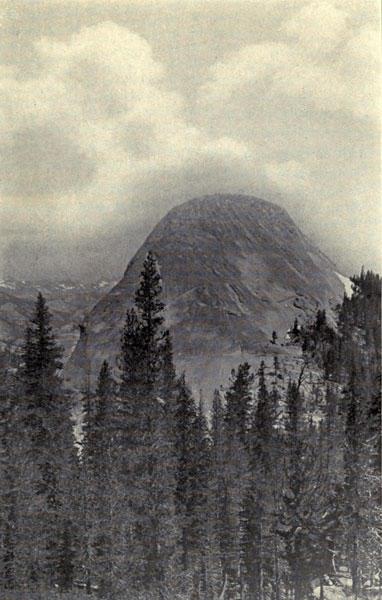
Glacier Monument (Fairview Dome).
Hardly less wonderful, when we contemplate the storms it has encountered since first it saw the light, is its present unwasted condition. The whole quantity of postglacial wear and tear it has suffered has not diminished its stature a single inch, as may be readily shown by measuring from the level of the unchanged polished portions of the surface. Indeed, the average postglacial denudation of the entire region, measured in the same way, is found to be less than two inches,-a mighty contrast to that of the ice; for the glacial denudation here has been not less than a mile; that is, in developing the present landscapes, an amount of rock a mile in average thickness has been silently carried away by flowing ice during the last glacial period.
A few erratic boulders nicely poised on the founded summit of the monument tell an interesting story. They came from a mountain on the crest of the range, about twelve miles to the eastward, floating like chips on the frozen sea, and were stranded here when the top of the monument emerged to the light of day, while the companions of these boulders, whose positions chanced to be over the slopes where they could not find rest, were carried farther on by the shallowing current.
The general view from the summit consists of a sublime assemblage of iceborn mountains and rocks and long wavering ridges, lakes and streams and meadows, moraines in wide-sweeping belts, and beds covered and dotted with forests and groves,-hundreds of square miles of them composed in wild harmony. The snowy mountains on the axis of the range, mostly sharp-peaked and crested, rise in a noble array along the sky to the eastward and northward; the gray-pillared Hoffman spur and the Yosemite domes and a countless number of others to the westward; Cathedral Peak with its many spires and companion peaks and domes to the southward; and a smooth billowy multitude of rocks, from fifty feet or less to a thousand feet high, which from their peculiar form seem to be rolling on westward, fill most of the middle ground. Immediately beneath you are the Big Tuolumne Meadows, with an ample swath of dark pine woods on either side, enlivened by the young river, that is seen sparkling and shimmering as it sways from side to side, tracing as best it can its broad glacial channel.
The ancient Tuolumne Glacier, lavishly flooded by many a noble affluent from the snow-laden flanks of Mounts Dana, Gibbs, Lyell, Maclure, and others nameless as yet, poured its majestic overflowing current, four or five miles wide, directly against the high outstanding mass of Mount Hoffman, which divided and deflected it right and left, just as a river is divided against an island that stands in the middle of its channel. Two distinct glaciers were thus formed, one of which flowed through the Big Tuolumne Cañon and Hetch-Hetchy Valley, while the other swept upward five hundred feet in a broad current across the divide between the basins of the Tuolumne and Merced into the Tenaya basin, and thence down through the Tenaya Cañon and Yosemite Valley.
The maplike distinctness and freshness of this glacial landscape cannot fail to excite the attention of every observer, no matter how little of its scientific significance he may at first recognize. These bald, glossy, westward-leaning rocks in the open middle ground, with their rounded backs and shoulders toward the glacier fountains of the summit mountains and their split angular fronts looking in the opposite direction, every one of them displaying the form of greatest strength with reference to physical structure and glacial action, show the tremendous force with which through unnumbered centuries the ice flood swept over them, and also the direction of the flow; while the mountains, with their sharp summits and abraded sides, indicate the height to which the glacier rose; and the moraines, curving and swaying in beautiful lines, mark the boundaries of the main trunk and its tributaries as they existed toward the close of the glacial winter. None of the commercial highways of the sea or land, marked with buoys and lamps, fences and guideboards, is so unmistakably indicated as are these channels of the vanished Tuolumne glaciers.
The action of flowing ice, whether in the form of river-like glaciers or broad mantling folds, is but little understood as compared with that of other sculpturing agents. Rivers work openly where people dwell, and so do the rain, and the sea thundering on all the shores of the world; and the universal ocean of air, through unseen, speaks aloud in a thousand voices and explains its modes of working and its power. But glaciers, back in their cold solitudes, work apart from men, exerting their tremendous energies in silence and darkness. Coming in vapor from the sea, flying invisible on the wind, descending in snow, changing to ice, white, spiritlike, they brood outspread over the predestined landscapes, working on unwearied through unmeasured ages, until in the fullness of time the mountains and valleys are brought forth, channels furrowed for the rivers, basins made for meadows and lakes, and soil beds spread for the forests and fields that man and beast may be fed. Then vanishing like clouds, they melt into streams and go singing back home to the sea.
To an observer upon this adamantine old monument in the midst of such scenery, getting glimpses of the thoughts of God, the day seems endless, the sun stands still. Much faithless fuss is made over the passage in the Bible telling of the standing still of the sun for Joshua. Here you may learn that the miracle occurs for every devout mountaineer, for everybody doing anything worth doing, seeing anything worth seeing. One day is as a thousand years, a thousand years as one day, and while yet in the flesh you enjoy immortality.
From the monument you will find an easy way down through the woods and along the Big Tuolumne Meadows to Mount Dana, the summit of which commands a grand telling view of the alpine region. The scenery all the way is inspiring, and you saunter on without knowing that you are climbing. The spacious sunny meadows, through the midst of which the bright river glides, extend with but little interruption ten miles to the eastward, dark woods rising on either side to the limit of tree growth, and above the woods a picturesque line of gray peaks and spires dotted with snow banks; while, on the axis of the Sierra, Mount Dana and his noble compeers repose in massive sublimity, their vast size and simple flowing contours contrasting in the most striking manner with the clustering spires and thin-pinnacled crests crisply outlined on the horizon to the north and south of them.
Tracing the silky lawns, gradually ascending, gazing at the sublime scenery more and more openly unfolded, noting the avalanche gaps in the upper forests, lingering over beds of blue gentians and purple-flowered bryanthus and cassiope, and dwarf willows an inch high in close-felted gray carpets, brightened here and there with kalmia and soft creeping mats of vaccinium sprinkled with pink bells that seem to have been showered down from the sky like hail,-thus beguiled and enchanted, you reach the base of the mountain wholly unconscious of the miles you have walked. And so on to the summit. For all the way up the long red slate slopes, that in the distance seemed barren, you find little garden beds and tufts of dwarf phlox, ivesia, and blue arctic daisies that go straight to your heart, blessed fellow mountaineers kept safe and warm by a thousand miracles. You are now more than thirteen thousand feet above the sea, and to the north and south you behold a sublime wilderness of mountains in glorious array, their snowy summits towering together in crowded, bewildering abundance, shoulder to shoulder, peak beyond peak. To the east lies the Great Basin, barren-looking and silent, apparently a land of pure desolation, rich only in beautiful light. Mono Lake, fourteen miles long, is outspread below you at a depth of nearly seven thousand feet, its shores of volcanic ashes and sand, treeless and sunburned; a group of volcanic cones, with well-formed, unwasted craters rises to the south of the lake; while up from its eastern shore innumerable mountains with soft flowing outlines extend range beyond range, gray, and pale purple, and blue,-the farthest gradually fading on the flowing horizon. Westward you look down and over the countless moraines, glacier meadows, and grand sea of domes and rock waves of the upper Tuolumne basin, the Cathedral and Hoffman mountains with their wavering lines and zones of forest, the wonderful region to the north of the Tuolumne Cañon, and across the dark belt of silver firs to the pale mountains of the coast.
In the icy fountains of the Mount Lyell and Ritter groups of peaks, to the south of Dana, three of the most important of the Sierra rivers-the Tuolumne, Merced, and San Joaquin-take their rise, their highest tributaries being within a few miles of one another as they rush forth on their adventurous courses from beneath snow banks and glaciers.
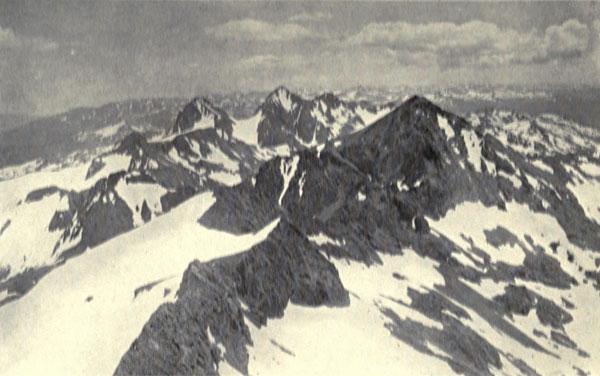
Along the Crest of the High Sierras from the Summit of Mt. Lyell (13,090 feet).
Of the small shrinking glaciers of the Sierra, remnants of the majestic system that sculptured the range, I have seen sixty-five. About twenty-five of them are in the park, and eight are in sight from Mount Dana.
The glacier lakes are sprinkled over all the alpine and subalpine regions, gleaming like eyes beneath heavy rock brows, tree-fringed or bare, embosomed in the woods, or lying in open basins with green and purple meadows around them; but the greater number are in the cool shadowy hollows of the summit mountains not far from the glaciers, the highest lying at an elevation of from eleven to nearly twelve thousand feet above the sea. The whole number in the Sierra, not counting the smallest, can hardly be less than fifteen hundred, of which about two hundred and fifty are in the park. From one standpoint, on Red Mountain, I counted forty-two, most of them within a radius of ten miles. The glacier meadows, which are spread over the filled-up basins of vanished lakes and form one of the most charming features of the scenery, are still more numerous than the lakes.
An observer stationed here, in the glacial period, would have overlooked a wrinkled mantle of ice as continuous as that which now covers the continent of Greenland; and of all the vast landscape now shining in the sun, he would have seen only the tops of the summit peaks, rising darkly like storm-beaten islands, lifeless and hopeless, above rock-encumbered ice waves. If among the agents that nature has employed in making these mountains there be one that above all other deserves the name of Destroyer, it is the glacier. But we quickly learn that destruction is creation. During the dreary centuries through which the Sierra lay in darkness, crushed beneath the ice folds of the glacial winter, there was a steady invincible advance toward the warm life and beauty of to-day; and it is just where the glaciers crushed most destructively that the greatest amount of beauty is made manifest. But as these landscapes have succeeded the preglacial landscapes, so they in turn are giving place to others already planned and foreseen. The granite domes and pavements, apparently imperishable, we take as symbols of permanence, while these crumbling peaks, down whose frosty gullies avalanches are ever falling, are symbols of change and decay. Yet all alike, fast or slow, are surely vanishing away.
Nature is ever at work building and pulling down, creating and destroying, keeping everything whirling and flowing, allowing no rest but in rhythmical motion, chasing everything in endless song out of one beautiful form into another.
CHAPTER IV
The Forests of the Yosemite Park
The coniferous forests of the Yosemite Park, and of the Sierra in general, surpass all others of their kind in America or indeed in the world, not only in the size and beauty of the trees, but in the number of species assembled together, and the grandeur of the mountains they are growing on. Leaving the workaday lowlands, and wandering into the heart of the mountains, we find a new world, and stand beside the majestic pines and firs and sequoias silent and awe-stricken, as if in the presence of superior beings new arrived from some other star, so calm and bright and godlike they are.
Going to the woods is going home; for I suppose we came from the woods originally. But in some of nature’s forests the adventurous traveler seems a feeble, unwelcome creature; wild beasts and the weather trying to kill him, the rank, tangled vegetation, armed with spears and stinging needles, barring his way and making life a hard struggle. Here everything is hospitable and kind, as if planned for your pleasure, ministering to every want of body and soul. Even the storms are friendly and seem to regard you as a brother, their beauty and tremendous fateful earnestness charming alike. But the weather is mostly sunshine, both winter and summer and the clear sunny brightness of the park is one of its most striking characteristics. Even the heaviest portions of the main forest belt, where the trees are tallest and stand closest, are not in the least gloomy. The sunshine falls in glory through the colossal spires and crowns, each a symbol of health and strength, the noble shafts faithfully upright like the pillars of temples, upholding a roof of infinite leafy interlacing arches and fretted skylights. The more open portions are like spacious parks, carpeted with small shrubs, or only with the fallen needles sprinkled here and there with flowers. In some places, where the ground is level or slopes gently, the trees are assembled in groves, and the flowers and underbrush in trim beds and thickets as in landscape gardens or the lovingly planted grounds of homes; or they are drawn up in orderly rows around meadows and lakes and along the brows of cañons. But in general the forests are distributed in wide belts in accordance with climate and the comparative strength of each kind in gaining and holding possession of the ground, while anything like monotonous uniformity is prevented by the grandly varied topography, and by the arrangement of the best soilbeds in intricate patterns like embroidery; for these soilbeds are the moraines of ancient glaciers more or less modified by weathering and stream action, and the trees trace them over the hills and ridges, and far up the sides of the mountains, rising with even growth on levels, and towering above one another on the long rich slopes prepared for them by the vanished glaciers.
Had the Sierra forests been cheaply accessible, the most valuable of them commercially would ere this have fallen a prey to the lumberman. Thus far the redwood of the Coast Mountains and the Douglas spruce of Oregon and Washington have been more available for lumber than the pine of the Sierra. It cost less to go a thousand miles up the coast for timber, where the trees came down to the shores of navigable rivers and bays, than fifty miles up the mountains. Nevertheless, the superior value of the sugar pine for many purposes has tempted capitalists to expend large sums on flumes and railroads to reach the best forests, though perhaps none of these enterprises has paid. Fortunately, the lately established system of parks and reservations has put a stop to any great extension of the business hereabouts in its most destructive forms. And as the Yosemite Park region has escaped the millmen, and the all-devouring hordes of hoofed locusts have been banished, it is still in the main a pure wilderness, unbroken by axe clearings except on the lower margin, where a few settlers have opened spots beside hay meadows for their cabins and gardens. But these are mere dots of cultivation, in no appreciable degree disturbing the grand solitude. Twenty or thirty years ago a good many trees were felled for their seeds; traces of this destructive method of seed-collecting are still visible along the trails; but these as well as the shingle-makers ruins are being rapidly overgrown, the gardens and beds of underbrush once devastated by sheep are blooming again in all their wild glory, and the park is a paradise that makes even the loss of Eden seem insignificant.
On the way to Yosemite Valley, you get some grand views over the forests of the Merced and Tuolumne basins and glimpses of some of the finest trees by the roadside without leaving your seat in the stage. But to learn how they live and behave in pure wildness, to see them in their varying aspects through the seasons and weather, rejoicing in the great storms, in the spiritual mountain light, putting forth their new leaves and flowers when all the streams are in flood and the birds are singing, and sending away their seeds in the thoughtful Indian summer when all the landscape is glowing in deep calm enthusiasm,-for this you must love them and live with them, as free from schemes and cares and time as the trees themselves.
And surely nobody will find anything hard in this. Even the blind must enjoy these woods, drinking their fragrance, listening to the music of the winds in their groves, and fingering their flowers and plumes and cones and richly furrowed boles. The kind of study required is as easy and natural as breathing. Without any great knowledge of botany or wood-craft, in a single season you may learn the name and something more of nearly every kind of tree in the park.
With few exceptions all the Sierra trees are growing in the park,-nine species of pine, two of silver fir, one each of Douglas spruce, libocedrus, hemlock, juniper, and sequoia,-sixteen conifers in all, and about the same number of round-headed trees, oaks, maples, poplars, laurel, alder, dogwood, tumion, etc.
The first of the conifers you meet in going up the range from the west is the digger nut-pine (Pinus Sabiniana), a remarkably open, airy, wide-branched tree, forty to sixty feet high, with long, sparse, grayish green foliage and large cones. At a height of fifteen to thirty feet from the ground the trunk usually divides into several main branches, which, after bearing away from one another, shoot straight up and form separate heads as if the axis of the tree had been broken, while the secondary branches divide again and again into rather slender sprays loosely tasseled, with leaves eight to twelve inches long. The yellow and purple flowers are about an inch long, the staminate in showy clusters. The big, rough, burly cones, five to eight or ten inches in length and five or six in diameter, are rich brown in color when ripe, and full of hard-shelled nuts that are greatly prized by Indians and squirrels. This strange-looking pine, enjoying hot sunshine like a palm, is sparsely distributed along the driest part of the Sierra among small oaks and chaparral, and with its gray mist of foliage, strong trunk and branches, and big cones seen in relief on the glowing sky, forms the most striking feature of the foothill vegetation.
Pinus attenuata is a small, slender, arrowy tree, with pale green leaves in threes, clustered flowers half an inch long, brownish yellow and crimson, and cones whorled in conspicuous clusters around the branches and also around the trunk. The cones never fall off or open until the tree dies. They are about four inches long, exceedingly strong and solid, and varnished with hard resin forming a waterproof and almost worm and squirrel proof package, in which the seeds are kept fresh and safe during the lifetime of the tree. Sometimes one of the trunk cones is overgrown and imbedded in the heart wood like a knot, but nearly all are pushed out and kept on the surface by the pressure of the successive layers of wood against the base.
This admirable little tree grows on brushy, sun-beaten slopes, which from their position and the inflammable character of the vegetation are most frequently fire-swept. These grounds it is able to hold against all comers, however big and strong, by saving its seeds until death, when all it has produced are scattered over the bare cleared ground, and a new generation quickly springs out of the ashes. Thus the curious fact that all the trees of extensive groves and belts are of the same age is accounted for, and their slender habit; for the lavish abundance of seed sown at the same time makes a crowded growth, and the seedlings with an even start rush up in a hurried race for light and life.
Only a few of the attenuata and Sabiniana pines are within the boundaries of the park, the former on the side of the Merced Cañon, the latter on the walls of Hetch-Hetchy Valley and in the cañon below it.
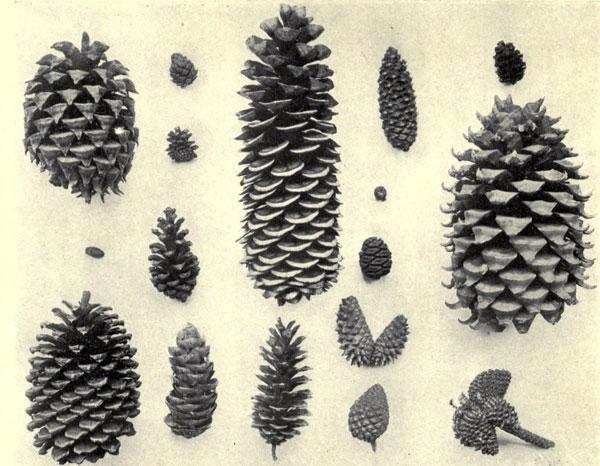
California Cones.
The nut-pine (Pinus monophylla) is a small, hardy, contended-looking tree, about fifteen or twenty feet high and a foot in diameter. In its youth the close radiating and aspiring branches form a handsome broad-based pyramid, but when fully grown it becomes round-topped, knotty, and irregular, throwing out crooked divergent limbs like an apple tree. The leaves are pale grayish green, about an inch and a half long, and instead of being divided into clusters they are single, round, sharp-pointed, and rigid like spikes, amid which in the spring the red flowers glow brightly. The cones are only about two inches in length and breadth, but nearly half of their bulk is made up of sweet nuts.
This fruitful little pine grows on the dry east side of the park, along the margin of the Mono sage plain, and is the commonest tree of the short mountain ranges of the Great Basins. Tens of thousands of acres are covered with it, forming bountiful orchards for the Red-man. Being so low and accessible, the cones are easily beaten off with poles, and the nuts procured by roasting until the scales open. To the tribes of the desert and sage plains these seeds are the staff of life. They are eaten either raw or parched, or in the form of mush or cakes after being pounded into meal. The time of nut harvest in the autumn is the Indian’s merriest time of all the year. An industrious squirrelish family can gather fifty or sixty bushels in a single month before the snow comes, and then their bread for the winter is sure.
The white pine (Pinus flexilis) is widely distributed through the Rocky Mountains and the ranges of the Great Basin, where in many places it grows to a good size, and is an important timber tree where none better is to be found. In the park it is sparsely scattered along the eastern flank of the range from Mono Pass southward, above the nut-pine, at an elevation of from eight to ten thousand feet, dwarfing to a tangled bush near the timber-line, but under favorable conditions attaining a height of forty or fifty feet, with a diameter of three to five. The long branches show a tendency to sweep out in bold curves, like those of the mountain and sugar pines to which it is closely related. The needles are in clusters of five, closely packed on the ends of the branchlets. The cones are about five inches long,-the smaller ones nearly oval, the larger cylindrical. But the most interesting feature of the tree is its bloom, the vivid red pistillate flowers glowing among the leaves like coals of fire.
The dwarfed pine or white-barked pine (Pinus albicaulis) is sure to interest every observer on account of its curious low matted habit, and the great height on the snowy mountains at which it bravely grows. It forms the extreme edge of the timber-line on both flanks of the summit mountains-if so lowly a tree can be called timber-at an elevation of ten to twelve thousand feet above the level of the sea. Where it is first met on the lower limit of its range it may be thirty or forty feet high, but farther up the rocky wind-swept slopes, where the snow lies deep and heavy for six months of the year, it makes shaggy clumps and beds, crinkled and pressed flat, over which you can easily walk. Nevertheless in this crushed, down-pressed, felted condition it clings hardily to life, puts forth fresh leaves every spring on the ends of its tasseled branchlets, blooms bravely in the lashing blasts with abundance of gay red and purple flowers, matures its seeds in the short summers, and often outlives the favored giants of the sun lands far below. One of the trees that I examined was only about three feet high, with a stem six inches in diameter at the ground, and branches that spread out horizontally as if they had grown up against a ceiling; yet it was four hundred and twenty-six years old, and one of its supple branchlets, about an eighth of an inch in diameter inside the bark, was seventy-five years old, and so tough that I tied it into knots. At the age of this dwarf many of the sugar and yellow pines and sequoias are seven feet in diameter and over two hundred feet high.
In detached clumps never touched by fire the fallen needles of centuries of growth make fine elastic mattresses for the weary mountaineer, while the tasseled branchlets spread a roof over him, and the dead roots, half resin, usually found in abundance, make capital camp-fires, unquenchable in thickest storms of rain or snow. Seen from a distance the belts and patches darkening the mountain sides look like mosses on a roof, and bring to mind Dr. Johnson’s remarks on the trees of Scotland. His guide, anxious for the honor of Mull, was still talking of its woods and pointing them out. “Sir,” said Johnson, “I saw at Tobermory what they called a wood, which I unluckily took for heath. If you show me what I shall take for furze, it will be something.”
The mountain pine (Pinus monticola) is far the largest of the Sierra tree mountaineers. Climbing nearly as high as the dwarf albicaulis, it is still a giant in size, bold and strong, standing erect on the storm-beaten peaks and ridges, tossing its cone-laden branches in the rough winds, living a thousand years, and reaching its greatest size-ninety to a hundred feet in height, six to eight in diameter-just where other trees, its companions, are dwarfed. But it is not able to endure burial in snow so long as the albicaulis and flexilis. Therefore, on the upper limit of its range it is found on slopes which, from their steepness or exposure, are least snowy. Its soft graceful beauty in youth, and its leaves, cones, and outsweeping feathery branches constantly remind you of the sugar pine, to which it is closely allied. An admirable tree, growing nobler in form and size the colder and balder the mountains about it.
The giants of the main forest in the favored middle region are the sequoia, sugar pine, yellow pine, libocedrus, Douglas spruce, and the two silver firs. The park sequoias are restricted to two small groves, a few miles apart, on the Tuolumne and Merced divide, about seventeen miles from Yosemite Valley. The Big Oak Flat road to the valley runs through the Tuolumne Grove, the Coulterville through the Merced. The more famous and better known Mariposa Grove, belonging to the state, lies near the southwest corner of the park, a few miles above Wawona.
The sugar pine (Pinus Lambertiana) is first met in the park in open, sunny, flowery woods, at an elevation of about thirty-five hundred feet above the sea, attains full development at a height between five and six thousand feet, and vanishes at the level of eight thousand feet. In many places, especially on the northern slopes of the main ridges between the rivers, it forms the bulk of the forest, but mostly it is intimately associated with its noble companions, above which it covers in glorious majesty on every hill, ridge, and plateau from one extremity of the range to the other, a distance of five hundred miles,-the largest, noblest, and most beautiful of all the seventy or eighty species of pine trees in the world, and of all the conifers second only to King Sequoia.
A good many are from two hundred to two hundred and twenty feet in height, with a diameter at four feet from the ground of six to eight feet, and occasionally a grand patriarch, seven or eight hundred years old, is found that is ten or even twelve feet in diameter and two hundred and forty feet high, with a magnificent crown seventy feet wide. David Douglas, who discovered “this most beautiful and immensely grand tree” in the fall of 1826 in southern Oregon, says that the largest of several that had been blown down, “at three feet from the ground was fifty-seven feet nine inches in circumference” (or fully eighteen feet in diameter); “at one hundred and thirty-four feet, seventeen feet five inches; extreme length, two hundred and forty-five feet.” Probably for fifty-seven we should read thirty-seven for the base measurement, which would make it correspond with the other dimensions; for none of this species with anything like so great a girth has since been seen. A girth of even thirty feet is uncommon. A fallen specimen that I measured was nine feet three inches in diameter inside the bark at four feet from the ground, and six feet in diameter at a hundred feet from the ground. A comparatively young tree, three hundred and thirty years old, that had been cut down, measured seven feet across the stump, was three feet three inches in diameter at a height of one hundred and fifty feet, and two hundred and ten feet in length.
The trunk is a round, delicately tapered shaft with finely furrowed purplish-brown bark, usually free of limbs for a hundred feet or more. The top is furnished with long and comparatively slender branches, which sweep gracefully downward and outward, feathered with short tasseled branchlets, and divided only at the ends, forming a palmlike crown fifty to seventy-five feet wide, but without the monotonous uniformity of palm crowns or of the spires of most conifers. The old trees are as tellingly varied and picturesque as oaks. No two are alike, and we are tempted to stop and admire every one we come to, whether as it stands silent in the calm balsam-scented sunshine or waving in accord with enthusiastic storms. The leaves are about three or four inches long, in clusters of five, finely tempered, bright lively green, and radiant. The flowers are but little larger than those of the dwarf pine, and far less showy. The immense cylindrical cones, fifteen to twenty or even twenty-four inches long and three in diameter, hang singly or in clusters, like ornamental tassels, at the ends of the long branches, green, flushed with purple on the sunward side. Like those of almost all the pines they ripen in the autumn of the second season from the flower, and the seeds of all that have escaped the Indians, bears, and squirrels take wing and fly to their places. Then the cones become still more effective as ornaments, for by the spreading of the scales the diameter is nearly doubled, and the color changes to a rich brown. They remain on the tree the following winter and summer; therefore few fertile trees are ever found without them. Nor even after they fall is the beauty work of these grand cones done, for they make a fine show on the flowery, needle-strewn ground. The wood is pale yellow, fine in texture, and deliciously fragrant. The sugar, which gives name to the tree, exudes from the heart wood on wounds made by fire or the axe, and forms irregular crisp white candy-like masses. To the taste of most people it is as good as maple sugar, though it cannot be eaten in large quantities.
No traveler, whether a tree lover or not, will ever forget his first walk in a sugar-pine forest. The majestic crowns approaching one another make a glorious canopy, through the feathery arches of which the sunbeams pour, silvering the needles and gilding the stately columns and the ground into a scene of enchantment.
The yellow pine (Pinus ponderosa) is surpassed in size and nobleness of port only by its kingly companion. Full-grown trees in the main forest where it is associated with the sugar pine, are about one hundred and seventy-five feet high, with a diameter of five to six feet, though much larger specimens may easily be found. The largest I ever measured was little over eight feet in diameter four feet above the ground, and two hundred and twenty feet high. Where there is plenty of sunshine and other conditions are favorable, it is a massive symmetrical spire, formed of a strong straight shaft clad with innumerable branches, which are divided again and again into stout branchlets laden with bright shining needles and green or purple cones. Where the growth is at all close half or more of the trunk is branchless. The species attains its greatest size and most majestic form in open groves on the deep, well-drained soil of lake basins at an elevation of about four thousand feet. There nearly all the old trees are over two hundred feet high, and the heavy, leafy, much-divided branches sumptuously clothe the trunk almost to the ground. Such trees are easily climbed, and in going up the winding stairs of knotty limbs to the top you will gain a most telling and memorable idea of the height, the richness and intricacy of the branches, and the marvelous abundance and beauty of the long shining elastic foliage. In tranquil weather, you will see the firm outstanding needles in calm content, shimmering and throwing off keen minute rays of light like lances of ice; but when heavy winds are blowing, the strong towers bend and wave in the blast with eager wide-awake enthusiasm, and every tree in the grove glows and flashes in one mass of white sunfire.
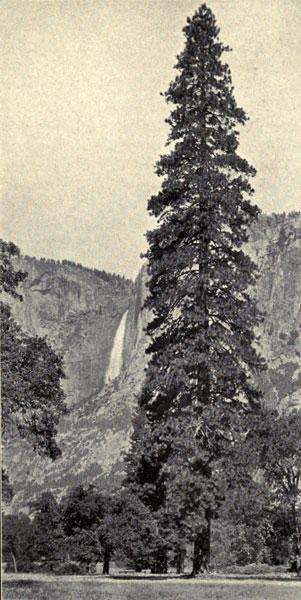
Yellow Pine (Yosemite Valley Form).
Both the yellow and sugar pines grow rapidly on good soil where they are not crowded. At the age of a hundred years they are about two feet in diameter and a hundred or more high. They are then very handsome, though very unlike: the sugar pine, lithe, feathery, closely clad with ascending branches; the yellow, open, showing its axis from the ground to the top, its whorled branches but little divided as yet, spreading and turning up at the ends with magnificent tassels of long stout bright needles, the terminal shoot with its leaves being often three or four feet long and a foot and a half wide, the most hopeful looking and the handsomest tree-top in the woods. But instead of increasing, like its companion, in wildness and individuality of form with age, it becomes more evenly and compactly spiry. The bark is usually very thick, four to six inches at the ground, and arranged in large plates, some of them on the lower part of the trunk four or five feet long and twelve to eighteen inches wide, forming a strong defense against fire. The leaves are in threes, and from three inches to a foot long. The flowers appear in May: the staminate pink or brown, in conspicuous clusters two or three inches wide; the pistillate crimson, a fourth of an inch wide, and mostly hidden among the leaves on the tips of the branchlets. The cones vary from about three to ten inches in length, two to five in width, and grow in sessile outstanding clusters near the ends of the upturned branchlets.
Being able to endure fire and hunger and many climates this grand tree is widely distributed: eastward from the coast across the broad Rocky Mountain ranges to the Black Hills of Dakota, a distance of more than a thousand miles, and southward from British Columbia, near latitude 51°, to Mexico, about fifteen hundred miles. South of the Columbia River it meets the sugar pine, and accompanies it all the way down along the Coast and Cascade mountains and the Sierra and southern ranges to the mountains of the peninsula of Lower California, where they find their southmost homes together. Pinus ponderosa is extremely variable, and much bother it gives botanists who try to catch and confine the unmanageable proteus in two or a dozen species,-Jeffreyi, deflexa, Apacheca latifolia, etc. But in all its wanderings, in every form, it manifests noble strength. Clad in thick bark like a warrior in mail, it extends its bright ranks over all the high ranges of the wild side of the continent: flourishes in the drenching fog and rain of the northern coast at the level of the sea, in the snow-laden blasts of the mountains, and the white glaring sunshine of the interior plateaus and plains, on the borders of mirage-haunted deserts, volcanoes, and lava beds, waving its bright plumes in hot winds undaunted, blooming every year for centuries, and tossing big ripe cones among the cinders and ashes of nature’s hearths.
The Douglas spruce grows with the great pines, especially on the cool north sides of ridges and cañons, and is here nearly as large as the yellow pine, but less abundant. The wood is strong and tough, the bark thick and deeply furrowed, and on vigorous, quick-growing trees the stout, spreading branches are covered with innumerable slender, swaying sprays, handsomely clothed with short leaves. The flowers are about three fourths of an inch in length, red or greenish, not so showy as the pendulous bracted cones. But in June and July, when the young bright yellow leaves appear, the entire tree seems to be covered with bloom.
It is this grand tree that forms the famous forests of western Oregon, Washington, and the adjacent coast regions of British Columbia, where it attains its greatest size and is most abundant, making almost pure forests over thousands of square miles, dark and close and almost inaccessible, many of the trees towering with straight, imperceptibly tapered shafts to a height of three hundred feet, their heads together shutting out the light,-one of the largest, most widely distributed, and most important of all the Western giant.
The incense cedar (Libocedrus decurrens), when full grown, is a magnificent tree, one hundred and twenty to nearly two hundred feet high, five to eight and occasionally twelve feet in diameter, with cinnamon-colored bark and warm yellow-green foliage, and in general appearance like an arbor vitæ. It is distributed through the main forest from an elevation of three to six thousand feet, and in sheltered portions of cañons on the warm sides to seven thousand five hundred. In midwinter, when most trees are asleep, it puts forth its flowers. The pistillate are pale green and inconspicuous; but the staminate are yellow, about one fourth of an inch long, and are produced in myriads, tingeing all the branches with gold, and making the tree as it stands in the snow look like a gigantic goldenrod. Though scattered rather sparsely amongst its companions in the open woods, it is seldom out of sight, and its bright brown shafts and warm masses of plumy foliage make a striking feature of the landscape. While young and growing fast in an open situation no other tree of its size in the park forms so exactly tapered a pyramid. The branches, outspread in flat plumes and beautifully fronded, sweep gracefully downward and outward, except those near the top, which aspire; the lowest droop to the ground, overlapping one another, shedding off rain and snow, and making fine tents for storm-bound mountaineers and birds. In old age it becomes irregular and picturesque, mostly from accidents: running fires, heavy wet snow breaking the branches, lightning shattering the top, compelling it to try to make new summits out of side branches, etc. Still it frequently lives more than a thousand years, invincibly beautiful, and worthy its place beside the Douglas spruce and the great pines.
This unrivaled forest is still further enriched by two majestic silver firs, Abies magnifica and Abies concolor, bands of which come down from the main fir belt by cool shady ridges and glens. Abies magnifica is the noblest of its race, growing on moraines, at an elevation of seven thousand to eight thousand five hundred feet above the sea, to a height of two hundred or two hundred and fifty feet, and five to seven in diameter; and with these noble dimensions there is a richness and symmetry and perfection of finish not to be found in any other tree in the Sierra. The branches are whorled, in fives mostly, and stand out from the straight red purple bole in level or, on old trees, in drooping collars, every branch regularly pinnated like fern fronds, and clad with silvery needles, making broad plumes singularly rich and sumptuous.
The flowers are in their prime about the middle of June: the staminate red, growing on the underside of the branchlets in crowded profusion, giving a rich color to nearly all the tree; the pistillate greenish yellow tinged with pink, standing erect on the upper side of the topmost branches; while the tufts of young leaves, about as brightly colored as those of the Douglas spruce, push out their fragrant brown buds a few weeks later, making another grand show.
The cones mature in a single season from the flowers. When full grown they are about six to eight inches long, three or four in diameter, blunt, massive, cylindrical, greenish gray in color, covered with a fine silvery down, and beaded with transparent balsam, very rich and precious-looking, standing erect like casks on the topmost branches. If possible, the inside of the cone is still more beautiful. The scales and bracts are tinged with red, and the seed wings are purple with bright iridescence.
Abies concolor, the white silver fir, grows best about two thousand feet lower than the magnifica. It is nearly as large, but the branches are less regularly pinnated and whorled, the leaves are longer, and instead of standing out around the branchlets or turning up and clasping them they are mostly arranged in two horizontal or ascending rows, and the cones are less than half as large. The bark of the magnifica is reddish purple and closely furrowed, that of the concolor is gray and widely furrowed,-a noble pair, rivaled only by the Abies grandis, amabilis, and nobilis of the forests of Oregon, Washington, and the Northern California Coast Range. But none of these northern species form pure forests that in extent and beauty approach those of the Sierra.
The seeds of the conifers are curiously formed and colored, white, brown, purple, plain or spotted like birds eggs, and expecting the juniper they are all handsomely and ingeniously winged with reference to their distribution. They are a sort of cunningly devised flying machines,-one-winged birds, birds with but one feather,-and they take but one flight, all save those which, after flying from the cone-nest in calm weather, chance to alight on branches where they have to wait for a wind. And though these seed wings are intended for only a moment’s use, they are as thoughtfully colored and fashioned as the wings of birds, and require from one to two seasons to grow. Those of the pine, fir, hemlock, and spruce are curved in such manner that, in being dragged through the air by the seeds, they are made to revolve, whirling the seeds in a close spiral, and sustaining them long enough to allow the winds to carry them to considerable distances,-a style of flying full of quick merry motion, strikingly contrasted to the sober dignified sailing of seeds on tufts of feathery pappus. Surely no merrier adventurers ever set out to seek their fortunes. Only in the fir woods are large flocks seen; for, unlike the cones of the pine, spruce, hemlock, etc., which let the seeds escape slowly, one or two at a time, by spreading the scales, the fir cones when ripe fall to pieces, and let nearly all go at once in favorable weather. All along the Sierra for hundreds of miles, on dry breezy autumn days, the sunny spaces in the woods among the colossal spires are in a whirl with these shining purplewinged wanderers, notwithstanding the harvesting squirrels have been working at the top of their speed for weeks trying to cut off every cone before the seeds were ready to swarm and fly. Sequoia seeds have flat wings, and glint and glance in their flight like a boy’s kite. The dispersal of juniper seeds is effected by the plum and cherry plan of hiring birds at the cost of their board, and thus obtaining the use of a pair of extra good wings.
Above the great fir belt, and below the ragged beds and fringes of the dwarf pine, stretch the broad dark forests of Pinus contorta, var. Murrayana, usually called tamarack pine. On broad fields of moraine material it forms nearly pure forests at an elevation of about eight or nine thousand feet above the sea, where it is a small, well proportioned tree, fifty or sixty feet high and one or two in diameter, with thin gray bark, crooked much-divided straggling branches, short needles in clusters of two, bright yellow and crimson flowers, and small prickly cones. The very largest I ever measured was ninety feet in height, and a little over six feet in diameter four feet above the ground. On moist well-drained soil in sheltered hollows along streamsides it grows tall and slender with ascending branches, making graceful arrowy spires fifty to seventy-five feet high, with stems only five or six inches thick.
The most extensive forest of this pine in the park lies to the north of the Big Tuolumne Meadows,-a famous deer pasture and hunting ground of the Mono Indians. For miles over wide moraine beds there is an even, nearly pure growth, broken only by glacier meadows, around which the trees stand in trim array, their sharp spires showing to fine advantage both in green flowery summer and white winter. On account of the closeness of its growth in many places, and the thinness and gumminess of its bark, it is easily killed by running fires, which work wide-spread destruction in its ranks; but a new generation rises quickly from the ashes, for all or a part of its seeds are held in reserve for a year or two or many years, and when the tree is killed the cones open and the seeds are scattered over the burned ground like those of the attenuata.
Next to the mountain hemlock and the dwarf pine this species best endures burial in heavy snow, while in braving hunger and cold on rocky ridgetops it is not surpassed by any. It is distributed from Alaska to Southern California, and inland across the Rocky Mountains, taking many forms in accordance with demands of climate, soil, rivals, and enemies; growing patiently in bogs and on sand dunes beside the sea where it is pelted with salt scud, on high snowy mountains and down in the throats of extinct volcanoes; springing up with invincible vigor after every devastating fire and extending its conquests farther.
The sturdy storm-enduring red cedar (Juniperus occidentalis) delights to dwell on the tops of granite domes and ridges and glacier pavements of the upper pine belt, at an elevation of seven to ten thousand feet, where it can get plenty of sunshine and snow and elbow-room without encountering quick-growing overshadowing rivals. They never make anything like a forest, seldom come together even in groves, but stand out separate and independent in the wind, clinging by slight joints to the rock, living chiefly on snow and thin air, and maintaining tough health on this diet for two thousand years or more, every feature and gesture expressing steadfast dogged endurance. The largest are usually about six or eight feet in diameter, and fifteen or twenty in height. A very few are ten feet in diameter, and on isolated moraine heaps forty to sixty feet in height. Many are mere stumps, as broad as high, broken by avalanches and lightning, picturesquely tufted with dense gray scalelike foliage, and giving no hint of dying. The staminate flowers are like those of the libocedrus, but smaller; the pistillate are inconspicuous. The wood is red, fine-grained, and fragrant; the bark bright cinnamon and red, and in thrifty trees is strikingly braided and reticulated, flaking off in thin lustrous ribbons, which the Indians used to weave into matting and coarse cloth. These brown unshakable pillars, standing solitary on polished pavements with bossy masses of foliage in their arms, are exceedingly picturesque, and never fail to catch the eye of the artist. They seem sole survivors of some ancient race, wholly unacquainted with their neighbors.
I have spent a good deal of time, trying to determine their age, but on account of dry rot which honeycombs most of the old ones, I never got a complete count of the largest. Some are undoubtedly more than two thousand years old; for though on good moraine soil they grow about as fast as oaks, on bare pavements and smoothly glaciated overswept granite ridges in the dome region they grow extremely slowly. One on the Starr King ridge, only two feet eleven inches in diameter, was eleven hundred and forty years old. Another on the same ridge, only one foot seven and a half inches in diameter, had reached the age of eight hundred and thirty-four years. The first fifteen inches from the bark of a medium-sized tree-six feet in diameter-on the north Tenaya pavement had eight hundred and fifty-nine layers of wood, or fifty-seven to the inch. Beyond this the count was stopped by dry rot and scars of old wounds. The largest I examined was thirty-three feet in girth, or nearly ten in diameter; and though I failed to get anything like a complete count, I learned enough from this and many other specimens to convince me that most of the trees eight to ten feet thick standing on pavements are more than twenty centuries of age rather than less. Barring accidents, for all I can see, they would live forever. When killed, they waste out of existence about as slowly as granite. Even when overthrown by avalanches, after standing so long, they refuse to lie at rest, leaning stubbornly on their big elbows as if anxious to rise, and while a single root holds to the rock putting forth fresh leaves with a grim never-say-die and never-lie-down expression.
As the juniper is the most stubborn and unshakable of trees, the mountain hemlock (Tsuga Mertensiana) is the most graceful and pliant and sensitive, responding to the slightest touches of the wind. Until it reaches a height of fifty or sixty feet it is sumptuously clothed down to the ground with drooping branches, which are divided into countless delicate waving sprays, grouped and arranged in most indescribably beautiful ways, and profusely sprinkled with handsome brown cones. The flowers also are peculiarly beautiful and effective; the pistillate very dark rich purple; the staminate blue of so fine and pure a tone that the best azure of the high sky seems to be condensed in them.
Though apparently the most delicate and feminine of all the mountain trees, it grows best where the snow lies deepest, at an elevation of from nine thousand to nine thousand five hundred feet, in hollows on the northern slopes of mountains and ridges. But under all circumstances and conditions of weather and soil, sheltered from the main currents of the winds or in blank exposure to them, well fed or starved, it is always singularly graceful in habit. Even at its highest limit in the park, ten thousand five hundred feet above the sea on exposed ridgetops, where it crouches and huddles close together in low thickets like those of the dwarf pine, it still contrives to put forth its sprays and branches in forms of irrepressible beauty, while on moist well-drained moraines it displays a perfectly tropical luxuriance of foliage, flower, and fruit.
In the first winter storms the snow is oftentimes soft, and lodges in the dense leafy branches, pressing them down against the trunk, and the slender drooping axis bends lower and lower as the load increases, until the top touches the ground and an ornamental arch is made. Then, as storm succeeds storm and snow is heaped on snow, the whole tree is at last buried, not again to see the light or move leaf or limb until set free by the spring thaws in June or July. Not the young saplings only are thus carefully covered and put to sleep in the whitest of white beds for five or six months of the year, but trees thirty and forty feet high. From April to May, then the snow is compacted, you may ride over the prostrate groves without seeing a single branch or leaf of them. In the autumn they are full of merry life, when Clark crows, squirrels, and chipmunks are gathering the abundant crop of seeds while the deer rest beneath the thick concealing branches. The finest grove in the park is near Mount Conness, and the trail from the Tuolumne soda springs to the mountain runs through it. Many of the trees in this grove are three to four or five feet in diameter and about a hundred feet high.
The mountain hemlock is widely distributed from near the south extremity of the high Sierra northward along the Cascade Mountains of Oregon and Washington and the coast ranges of British Columbia to Alaska, where it was first discovered in 1827. Its northmost limit, so far as I have observed, is in the icy fiords of Prince William’s Sound in latitude 61°, where it forms pure forests at the level of the sea, growing tall and majestic on the banks of the great glaciers, waving in accord with the mountain winds and the thunder of the falling icebergs. Here as in the Sierra it is ineffably beautiful, the very loveliest evergreen in America.
Of the round-headed dicotyledonous trees in the park the most influential are the black and goldcup oaks. They occur in some parts of the main forest belt, scattered among the big pines like a heavier chaparral, but form extensive groves and reach perfect development only in the Yosemite valleys and flats of the main cañons. The California black oak (Quercus Californica) is one of the largest and most beautiful of the Western oaks, attaining under favorable conditions a height of sixty to a hundred feet, with a trunk three to seven feet in diameter, wide-spreading picturesque branches, and smooth lively green foliage handsomely scalloped, purple in the spring, yellow and red in autumn. It grows best in sunny open groves on ground covered with ferns, chokecherry, brier rose, rubus, mints, goldenrods, etc. Few, if any, of the famous oak groves of Europe, however extensive, surpass these in the size and strength and bright, airy beauty of the trees, the color and fragrance of the vegetation beneath them, the quality of the light that fills their leafy arches, and in the grandeur of the surrounding scenery. The finest grove in the park is in one of the little Yosemite valleys of the Tuolumne Cañon, a few miles above Hetch-Hetchy.
The mountain live-oak, or goldcup oak (Quercus chrysolepis), forms extensive groves on earthquake and avalanche taluses and terraces in cañons and Yosemite valleys, from about three to five thousand feet above the sea. In tough, sturdy, unwedgeable strength this is the oak of oaks. In general appearance it resembles the great live-oak of the Southern states. It has pale gray dark, a short, uneven, heavily buttressed trunk which usually divides a few feet above the ground into strong wide-reaching limbs, forming noble arches, and ending in an intricate maze of small branches and sprays, the outer ones frequently drooping in long tresses to the ground like those of the weeping willow, covered with small simple polished leaves, making a canopy broad and bossy, on which the sunshine falls in glorious brightness. The acorn cups are shallow, thick-walled, and covered with yellow fuzzy dust. The flowers appear in May and June with a profusion of pollened tresses, followed by the bronze-colored young leaves.
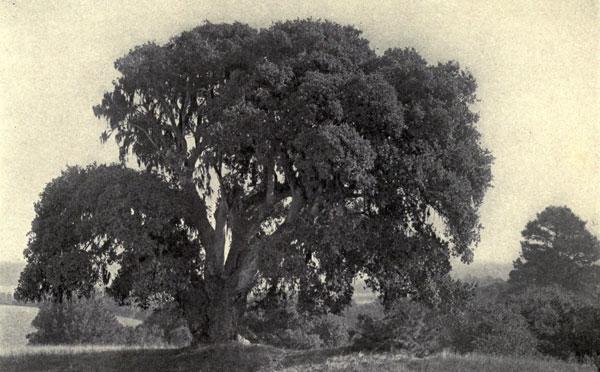
A California Life-Oak.
No tree in the park is a better measure of altitude. In cañons, at an elevation of four thousand, feet you may easily find a tree six or eight feet in diameter; and at the head of a side cañon, three thousand feet higher, up which you can climb in less than two hours, you find the knotty giant dwarfed to a slender shrub, with leaves like those of huckleberry bushes, still bearing acorns, and seemingly contented, forming dense patches of chaparral, on the top of which you may make your bed and sleep softly like a Highlander in heather. About a thousand feet higher it is still smaller, making fringes about a foot high around boulders and along seams in pavements and the brows of cañons, giving hand-holds here and there on cliffs hard to climb. The largest I have measured were from twenty-five to twenty-seven feet in girth, fifty to sixty feet high, and the spread of the limbs was about double the height.
The principal riverside trees are poplar, alder, willow, broad-leaved maple, and Nuttall’s flowering dogwood. The poplar (Populus trichocarpa), often called balm of Gilead from the gum on its buds, is a tall, stately tree, towering above its companions and gracefully embowering the banks of the main streams at an elevation of about four thousand feet. Its abundant foliage turns bright yellow in the fall, and the Indian-summer sunshine sifts through it in delightful tones over the slow-gliding waters when they are at their lowest ebb.
The flowering dogwood is brighter still in these brooding days, for every branch of its broad head is then a brilliant crimson flame. In the spring, when the streams are in flood, it is the whitest of trees, white as a snow bank with its magnificent flowers four to eight inches in width, making a wonderful show, and drawing swarms of moths and butterflies.
The broad-leaved maple is usually found in the coolest boulder-choked cañons, where the streams are gray and white with foam, over which it spreads its branches in beautiful arches from bank to bank, forming leafy tunnels full of soft green light and spray,-favorite homes of the water ousel. Around the glacier lakes, two or three thousand feet higher, the common aspen grows in fringing lines and groves which are brilliantly colored in autumn, reminding you of the color glory of the Eastern woods.
Scattered here and there or in groves the botanist will find a few other trees, mostly small,-the mountain mahogany, cherry, chestnut-oak, laurel, and nutmeg. The California nutmeg (Tumion Californicum) is a handsome evergreen, belonging to the yew family, with pale bark, prickly leaves, fruit like a green-gage plum, and seed like a nutmeg. One of the best groves of it in the park is at the Cascades below Yosemite.
But the noble oaks and all these rock-shading, stream-embowering trees are as nothing amid the vast abounding billowy forests of conifers. During my first years in the Sierra I was ever calling on everybody within reach to admire them, but I found no one half warm enough until Emerson came. I had read his essays, and felt sure that of all men he would best interpret the sayings of these noble mountains and trees. Nor was my faith weakened when I met him in Yosemite. He seemed as serene as a sequoia, his head in the empyrean; and forgetting his age, plans, duties, ties of every sort, I proposed an immeasurable camping trip back in the heart of the mountains. He seemed anxious to go, but considerately mentioned his party. I said: “Never mind. The mountains are calling; run away, and let plans and parties and dragging lowland duties all ‘gang tapsal-teerie’. We’ll go up a cañon singing your own song, ‘Good-by, proud world! I’m going home,’ in divine earnest. Up there lies a new heaven and a new earth; let us go to the show.” But alas, it was too late,-too near the sundown of his life. The shadows were growing long, and he leaned on his friends. His party, full of indoor philosophy, failed to see the natural beauty and fullness of promise of my wild plan, and laughed at it in good-natured ignorance, as if it were necessarily amusing to imagine that Boston people might be led to accept Sierra manifestations of God at the price of rough camping. Anyhow, they would have none of it, and held Mr. Emerson to the hotels and trails.
After spending only five tourist days in Yosemite he was led away, but I saw him two days more; for I was kindly invited to go with the party as far as the Mariposa big trees. I told Mr. Emerson that I would gladly go to the sequoias with him, if he would camp in the grove. He consented heartily, and I felt sure that we would have at least one good wild memorable night around a sequoia camp-fire. Next day we rode through the magnificent forests of the Merced basin, and I kept calling his attention to the sugar pines, quoting his wood-notes, “Come listen what the pine tree saith,” etc., pointing out the noblest as kings and high priests, the most eloquent and commanding preachers of all the mountain forests, stretching forth their century-old arms in benediction over the worshiping congregations crowded about them. He gazed in devout admiration, saying but little, while his fine smile faded away.
Early in the afternoon, when we reached Clark’s Station, I was surprised to see the party dismount. And when I asked if we were not going up into the grove to camp they said: “No; it would never do to lie out in the night air. Mr. Emerson might take cold; and you know, Mr. Muir, that would be a dreadful thing.” In vain I urged, that only in homes and hotels were colds caught, that nobody ever was known to take cold camping in these woods, that there was not a single cough or sneeze in all the Sierra. Then I pictured the big climate-changing, inspiring fire I would make, praised the beauty and fragrance of sequoia flame, told how the great trees would stand about us transfigured in the purple light, while the stars looked down between the great domes; ending by urging them to come on and make an immortal Emerson night of it. But the house habit was not to be overcome, nor the strange dread of pure night air, though it is only cooled day air with a little dew in it. So the carpet dust and unknowable reeks were preferred. And to think of this being a Boston choice! Sad commentary on culture and the glorious transcendentalism.
Accustomed to reach whatever place I started for, I was going up the mountain alone to camp, and wait the coming of the party next day. But since Emerson was so soon to vanish, I concluded to stop with him. He hardly spoke a word all the evening, yet it was a great pleasure simply to be near him, warming in the light of his face as at a fire. In the morning we rode up the trail through a noble forest of pine and fir into the famous Mariposa Grove, and stayed an hour or two, mostly in ordinary tourist fashion,-looking at the biggest giants, measuring them with a tape line, riding through prostrate fire-bored trunks, etc., though Mr. Emerson was alone occasionally, sauntering about as if under a spell. As we walked through a fine group, he quoted, “There were giants in those days,” recognizing the antiquity of the race. To commemorate his visit, Mr. Galen Clark, the guardian of the grove, selected the finest of the unnamed trees and requested him to give it a name. He named it Samoset, after the New England sachem, as the best that occurred to him.
The poor bit of measured time was soon spent, and while the saddles were being adjusted I again urged Emerson to stay. “You are yourself a sequoia,” I said. “Stop and get acquainted with your big brethren.” But he was past his prime, and was now as a child in the hands of his affectionate but sadly civilized friends, who seemed as full of old-fashioned conformity as of bold intellectual independence. It was the afternoon of the day and the afternoon of his life, and his course was now westward down all the mountains into the sunset. The party mounted and rode away in wondrous contentment, apparently, tracing the trail through ceanothus and dogwood bushes, around the bases of the big trees, up the slope of the sequoia basin, and over the divide. I followed to the edge of the grove. Emerson lingered in the rear of the train, and when he reached the top of the ridge, after all the rest of the party were over and out of sight, he turned his horse, took off his hat and waved me a last good-by. I felt lonely, so sure had I been that Emerson of all men would be the quickest to see the mountains and sing them. Gazing awhile on the spot where he vanished, I sauntered back into the heart of the grove, made a bed of sequoia plumes and ferns by the side of a stream, gathered a store of firewood, and then walked about until sundown. The birds, robins, thrushes, warblers, etc., that had kept out of sight, came about me, now that all was quiet, and made cheer. After sundown I built a great fire, and as usual had it all to myself. And though lonesome for the first time in these forests, I quickly took heart again,-the trees had not gone to Boston, nor the birds; and as I sat by the fire, Emerson was still with me in spirit, though I never again saw him in the flesh. He sent books and wrote, cheering me on; advised me not to stay too long in solitude. Soon he hoped that my guardian angel would intimate that my probation was at a close. Then I was to roll up my herbariums, sketches, and poems (though I never knew I had any poems), and come to his house; and when I tired of him and his humble surroundings, he would show me to better people.
But there remained many a forest to wander through, many a mountain and glacier to cross, before I was to see his Wachusett and Monadnock, Boston and Concord. It was seventeen years after our parting on the Wawona ridge that I stood beside his grave under a pine tree on the hill above Sleepy Hollow. He had gone to higher Sierras, and, as I fancied, was again waving his hand in friendly recognition.